Samacheer Kalvi Guru 11th Chemistry Guide Book Back Answers Solutions

Samacheer Kalvi Guru 11th Chemistry Guide Book Back Answers Solutions

Understand topics of 11th Chemistry that you never seemed to understand by utilizing the Tamilnadu State Board Solutions for 11th Chemistry prevailing. Practice using the Samacheer Kalvi 11th Physics Book Solutions Questions and Answers PDF regularly and get to know different questions that you might witness as a part of your exam. Just tap on the direct links available and score better grades in your exam and clear the exams with flying colors.

Samacheer Kalvi 11th Chemistry Book Solutions Answers Guide

Use the Samacheer Kalvi 11th Chemistry Book Solutions Questions and Answers to learn various chapters of the subject easily. All the Solutions are given by subject expertise keeping in mind the latest syllabus guidelines and test pattern. Stand out from the crowd with frequent practice using the Samacheer Kalvi 11th Chemistry Book Solutions Questions and Answers PDF so that you can attempt the exam with confidence.

Students can also read Tamil Nadu 11th Chemistry Model Question Papers 2019-2020 English & Tamil Medium.

Samacheer Kalvi 11th Chemistry Guide Book Back Answers

Samacheer Kalvi 11th Chemistry Book Back Answers

Tamilnadu State Board Samacheer Kalvi 11th Chemistry Book Volume 1 Solutions

Tamilnadu State Board Samacheer Kalvi 11th Chemistry Book Volume 2 Solutions

Hope the information shared regarding the Tamilnadu State Board Solutions for 11th Chemistry has been beneficial to you. If you feel any information is missing or needs to be added feel free to reach us and we will revert back to you at the earliest. Keep in touch with our site to know the latest updates at your fingertips.

Samacheer Kalvi 11th Physics Guide Book Back Answers Solutions

Samacheer Kalvi 11th Physics Guide Book Back Answers Solutions

Tamilnadu State Board 11th Physics Solutions PDF is provided by subject experts as per the latest syllabus guidelines. Enhance your subject knowledge and learn various topics of the subject Physics easily. Download the Tamilnadu State Board 11th Physics Solutions provided here for free of cost and prepare from anywhere you want. Simply click on the quick links available to access the Chapterwise Samacheer Kalvi 11th Physics Book Solutions Questions and Answers and clarify all your queries.

Samacheer Kalvi 11th Physics Book Solutions Answers Guide

Ace up your preparation taking the help of the Tamilnadu State 11th Solutions for Physics and score better grades in your exam. Clarify all your concerns with the Detailed 11th Physics Board Solutions PDF and stand out from the crowd. You need not worry about the accuracy of the 11th Physics Board Solutions as they are given to you after ample research. Practicing through the Samacheer Kalvi 11th Physics Book Solutions Questions and Answers you can definitely Score good marks.

Students can also read Tamil Nadu 11th Physics Model Question Papers 2019-2020 English & Tamil Medium.

Samacheer Kalvi 11th Physics Guide Book Back Answers

Samacheer Kalvi 11th Physics Book Back Answers

Tamilnadu State Board Samacheer Kalvi 11th Physics Book Volume 1 Solutions

Tamilnadu State Board Samacheer Kalvi 11th Physics Book Volume 2 Solutions

We believe the information shared regarding Tamilnadu State Board Solutions for 11th Physics has shed some light on you. If you need any other help you can always leave us a comment via the comment section and we will get back to you at the soonest possibility. Bookmark our site for the latest updates on Tamilnadu State Board Solutions for different subjects in no time.

Samacheer Kalvi Guru 11th Biology Guide Book Back Answers Solutions

Samacheer Kalvi Guru 11th Biology Guide Book Back Answers Solutions

Tamilnadu State Board Solutions for 11th Biology are prevailing here in direct pdf links for effective exam preparation. Students who are studying 11th Biology can refer to this page Samacheer Kalvi 11th Biology Book Solutions Questions and Answers for grabbing pdf chapter wise for free. By reading the Tamilnadu State board 11th Biology solutions, you will be able to understand all the topics and can easily score good marks.

Also, there are so many advantages that you can avail from the Tamilnadu State Board 11th Biology solutions pdf. So download Tamilnadu State Board Textbook Solutions for 11th Biology in Pdf via quick links & access them easily while preparation.

Samacheer Kalvi Guru 11th Biology Guide Book Back Answers Solutions

Provided Tamilnadu State board solutions for 11th Biology are prepared by subject experts after sample research. So students are suggested to download the Samacheer Kalvi 11th Biology Book Solutions Questions and Answers from the available PDF links and kickstart your preparations for final exams. You can download them freely & practice regularly to score high marks in the examinations.

Students can also read Tamil Nadu 11th Biology Model Question Papers 2019-2020 English & Tamil Medium.

Samacheer Kalvi 11th Biology Guide Book Back Answers

Samacheer Kalvi 11th Biology Book Back Answers

Samacheer Kalvi 11th Bio Botany Book Solutions

Samacheer Kalvi 11th Bio Zoology Book Solutions

We wish the data shed above will benefit you at the time of your preparation & gain good scores. So, download Samacheer Kalvi 11th Biology Book Solutions Questions and Answers from here and become a topper in the final examinations. Moreover, keep in touch with our site & get all updated chapter wise Tamilnadu State Board Solutions for all subjects.

Samacheer Kalvi Guru 11th English Guide Book Back Answers Solutions

Samacheer Kalvi Guru 11th English Guide Book Back Answers Solutions

Tamilnadu State Board 11th English Solutions Download pdf is available here. Students are suggested to refer Samacheer Kalvi 11th English Book Solutions Questions and Answers while preparing for your examinations. It is very difficult to score the highest marks in exams without grammar knowledge. So make use of the Tamilnadu State State Board 11th English Solutions Pdf links to enhance your grammar skills. Learning the concepts of Grammar is important in addition to the fast learning so Download Samacheer Kalvi 11th English Book Solutions Questions and Answers pdf for free of cost.

Samacheer Kalvi 11th English Book Solutions Answers Guide

The solutions for Tamilnadu State Board 11th English are prepared by the experts after the plentiful research on the subject. So, don’t worry about the answers just go through the Tamilnadu State Board 11th English Textbook Solutions. Tap on the Chapter wise Samacheer Kalvi 11th English Book Solutions Questions and Answers Pdf links and start practicing now. Just check whether your answers are correct or not by referring to Tamilnadu State Board Solutions for 11th English. Students can understand the topics in depth by using the Tamilnadu State Board 11th English Textbook. This helps the students to get the solutions for all the topics which are not covered in class.

Students can also read Tamil Nadu 11th English Model Question Papers 2019-2020 English & Tamil Medium.

Samacheer Kalvi 11th English Guide Book Back Answers

Samacheer Kalvi 11th English Book Back Answers

Samacheer Kalvi 11th English Book Solutions Prose

Samacheer Kalvi 11th English Book Solutions Poem

Samacheer Kalvi 11th English Book Solutions Supplementary

Samacheer Kalvi 11th English Grammar with Answers

Speaking

Reading

Writing

Grammar

I wish the details provided in Tamilnadu State Board 11th English Solutions are helpful for all the students to gain knowledge over the subject. Don’t hesitate to clarify your doubts regarding any topic. Students can post their comments in the below comment section. Stay with us to get the fresh updates on Tamilnadu State Board Solutions of different chapters.

Samacheer Kalvi Guru11th Books Solutions Guide

Samacheer Kalvi 11th Books Solutions Guide

Expert Teachers at SamacheerKalviGuru.com has created Tamilnadu State Board Samacheer Kalvi 11th Books Answers and Solutions Guide Pdf Free Download of Volume 1 and Volume 2 in English Medium and Tamil Medium are part of Samacheer Kalvi Books Solutions. Here we have given TN State Board New Syllabus Samacheer Kalvi 11th Std Guide Pdf of Book Back Questions and Answers, Chapter Wise Important Questions, Study Material, Question Bank, Notes, Formulas.

Students can also read Tamil Nadu 11th Model Question Papers 2020-2021.

Samacheer Kalvi 11th Guide Book Back Answers Solutions Pdf Free Download

TN Samacheer Kalvi 11th Book Back Answers Solutions Guide

We hope the given Tamilnadu State Board Samacheer Kalvi Class 11th Books Volume 1 and Volume 2 Solutions and Answers Guide Pdf Free Download in English Medium and Tamil Medium will help you. If you have any queries regarding TN State Board New Syllabus Samacheer Kalvi 11th Standard Guides Pdf of Book Back Questions and Answers, Chapter Wise Important Questions, Study Material, Question Bank, Notes, Formulas, drop a comment below and we will get back to you at the earliest.

Samacheer Kalvi 11th Accountancy Solutions Chapter 2 Conceptual Framework of Accounting

Students can Download Accountancy Chapter 2 Conceptual Framework of Accounting Questions and Answers, Notes Pdf, Samacheer Kalvi 11th Accountancy Book Solutions Guide Pdf helps you to revise the complete Tamilnadu State Board New Syllabus and score more marks in your examinations.

Tamilnadu Samacheer Kalvi 11th Accountancy Solutions Chapter 2 Conceptual Framework of Accounting

Samacheer Kalvi 11th Accountancy Conceptual Framework of Accounting Text Book Back Questions and Answers

I. Multiple Choice Questions
Choose the Correct Answer

11th Accountancy Chapter 2 Book Back Answers Question 1.
The business is liable to the proprietor of the business in respect of capital introduced by the person according to ………………
(a) Money measurement concept
(b) Cost concept
(c) Business entity concept
(d) Dual aspect concept
Answer:
(c) Business entity concept

Accounts 2nd Chapter Question 2.
The concept which assumes that a business will last indefinitely is ………………
(a) Business Entity
(b) Going concern
(c) Periodicity
(d) Conservatism
Answer:
(b) Going concern

11th Accounts Chapter 2 Question 3.
GAAPs are:
(a) Generally Accepted Accounting Policies
(b) Generally Accepted Accounting Principles
(c) Generally Accepted Accounting Provisions
(d) None of these
Answer:
(c) Generally Accepted Accounting Provisions

Samacheer Kalvi Guru 11th Accountancy Question 4.
The rule of stock valuation ‘cost price or realisable value’ whichever is lower is based on the accounting principle of ………………
(a) Materiality
(b) Money measurement
(c) Conservatism
(d) Accrual
Answer:
(c) Conservatism

Accountancy Class 11 Samacheer Kalvi Question 5.
In India, Accounting Standards are issued by ………………
(a) Reserve Bank of India
(b) The Cost and Management Accountants of India
(c) Supreme Court of India
(d) The Institute of Chartered Accountants of India
Answer:
(d) The Institute of Chartered Accountants of India

II. Very Short Answer Questions

Accounts Chapter 2 Class 11 Notes Question 1.
Define book – keeping.
Answer:
“Book – keeping is an art of recording business dealings in a set of books”. (J.R.Batlibai)
“Book – keeping is the science and art of recording correctly in the books of account all those business transactions of money or money’s worth”. (R.N. Carter)

Accounts Samacheer Kalvi Question 2.
What is meant by accounting concepts?
Answer:
Accounting concepts are the basic assumptions or conditions upon which accounting has been laid. Accounting concepts are the results of broad consensus. The word concept means a notion or abstraction which is generally accepted. Accounting concepts provide unifying structure to the accounting process and accounting reports.

Samacheer Kalvi Accountancy 11th Question 3.
Briefly explain about revenue recognition concept.
Answer:
According to accrual concept, the effects of the transactions are recognised on mercantile basis, i.e., when they occur and not when cash is paid or received. Revenue is recognised when it is earned and expenses are recognised when they are incurred. All expenses and revenues related to the accounting period are to be considered irrespective of the fact that whether revenues are received in cash or not and whether expenses are paid in cash or not.

Accountancy Samacheer Kalvi Question 4.
What is “Full Disclosure Principle” of accounting.
Answer:
It implies that the accounts must be prepared honestly and all material information should be disclosed in the accounting statement. This is important because the management is different from the owners in most of the organisations.

Samacheer Kalvi 11th Accountancy Question 5.
Write a brief note on ‘Consistency’ assumption.
Answer:
The consistency convention implies that the accounting policies must be followed consistently from one accounting period to another. The results of different years will be comparable only when same accounting policies are followed from year to year.

III. Short Answer Questions

Samacheer Kalvi 11th Accountancy Solutions Question 1.
What is matching concept? Why should a business concern follow this concept?
Answer:
Matching concept: According to this concept, revenues during an accounting period are matched with expenses incurred during that period to earn the revenue during that period. This concept is based on accrual concept and periodicity concept. Periodicity concept fixes the time frame for measuring performance and determining financial status. All expenses paid during the period are not considered, but only the expenses related to the accounting period are considered.

On the basis of this concept, adjustments are made for outstanding and prepaid expenses and accrued and unearned revenues. Also due provisions are made for depreciation of the fixed assets, bad debts, etc., relating to the accounting period. Thus, it matches the revenues earned during an accounting period with the expenses incurred during that period to earn the revenues before sharing any profit or loss.

11th Accountancy Samacheer Kalvi Question 2.
“Only monetary transactions are recorded in accounting”. Explain the statement.
Answer:
This concept implies that only those transactions, which can be expressed in terms of money, are recorded in the accounts. Since, money serves as the medium of exchange transactions expressed in money are recorded and the ruling currency of a country is the measuring unit for accounting. Transactions which do not involve money will not be recorded in the books of accounts. For example, working conditions in the work place, strike by employees, efficiency of the management, etc. will not be recorded in the books, as they cannot be expressed in terms of money.

Samacheer Kalvi Accountancy Question 3.
“Business units last indefinitely”. Mention and explain the concept on which the statement is based.
Answer:
This concept implies that a business unit is separate and distinct from the owner or owners, that is, the persons who supply capital to it. Based on this concept, accounts are prepared from the point of view of the business and not from the owner’s point of view. Hence, the business is liable to the owner for the capital contributed by him/her.

According to this concept, only business transactions are recorded in the books of accounts. Personal transactions of the owners are not recorded. But, their transactions with the business such as capital contributed to the business or cash withdrawn from the business for the personal use will be recorded in the books of accounts. It implies that the business itself owns assets and owes liabilities.

Samacheer Kalvi Guru 11 Accountancy Question 4.
Write a brief note on Accounting Standards.
Answer:
Accounting Standards provide the framework and norms to be followed in accounting so that the financial statements of different enterprises become comparable. It is necessary to standardise the accounting principles to ensure consistency, comparability, adequacy and reliability of financial reporting. Thus, Accounting Standards are written policy documents issued by the expert accounting body or by government or other regulatory body covering the aspects of recognition, measurement, treatment, presentation and disclosure of accounting transactions and events in the financial statements.

Textbook Case Study Solved

Magesh started a new trading business. He buys and sells packing materials. He wants to be honest in doing his business. He has plans to establish his business in the future. He has little accounting knowledge but has excellent business skills. At the end of his first year of trading, he wanted to value his closing stock. He finds some of the goods are damaged. If he wants to sell them, then he has to • spend some amount for making them in a saleable condition. He also takes some money from his business bank account for his personal use. But, he forgot to record that.
Now, discuss on the following points:

11th Accounts Samacheer Kalvi Solutions Question 1.
Does every businessman need accounting knowledge?
Answer:
No, Every businessman does not need accounting knowledge. The businessman is called sole trader. If he has little accounting knowledge, is enough, but he should have business skill.

Samacheer Kalvi 11th Accountancy Chapter 4 Question 2.
Identify some of the accounting concepts in this case study.
Answer:

  1. Money measurement concept.
  2. Going concern concept.
  3. Matching concept.
  4. Realisation concept
  5. Accrual concept

11th Accounts 2nd Chapter Question 3.
How should his closing stock be valued?
Answer:
Convention of conservation or prudence concept. The closing stock will be valued at market price or cost price whichever is lower.

Question 4.
Is it possible for him to compare his business results with that of his competitors?
Answer:
Yes, it is possible for him to compare his business results with that of his competitors, but the method is not accurate. It may be approximated i.e., capital comparison method followed.

Samacheer Kalvi 11th Accountancy Conceptual Framework of Accounting Additional Questions and Answers

I. Multiple Choice Questions
Choose the correct answer

Question 1.
ASB was constituted in India in the year of ………………
(a) 1977
(b) 1978
(c) 1979
(d) 1976
Answer:
(a) 1977

Question 2.
……………… is the primary stage in accounting.
(a) Journal
(b) Book – keeping
(c) ledger
(d) Transactions
Answer:
(b) Book – keeping

Question 3.
According to ……………… concept, every transaction or event has two aspects i.e.,’dual effect.
(a) Dual aspect concept
(b) Periodicity concept
(c) Matching concept
(d) Cost concept
Answer:
(a) Dual aspect concept

Question 4.
……………… is routine and clerical in nature.
(a) Book – keeping
(b) Accounting
(c) Ledger
(d) Journal
Answer:
(a) Book – keeping

Question 5.
……………… requires analytical skill.
(a) Accounting
(b) Single entry
(c) Book – keeping
(d) Ledger
Answer:
(a) Accounting

Question 6.
The word convention refers ………………
(a) traditions
(b) trade
(c) business
(d) accounting
Answer:
(a) traditions

Question 7.
Capital + Liabilities = Assets
(a) Dual aspect concept
(b) Periodicity concept
(c) Matching concept
(d) Cost concept
Answer:
(a) Dual aspect concept

Question 8.
requires that all accounting transactions recorded should be based on objective evidence.
(a) Matching concept
(b) Cost concept
(c) Dual aspect concept
(d) Objective evidence concept
Answer:
(d) Objective evidence concept

II. Very Short Answer Questions

Question 1.
Write any two features of book – keeping.
Answer:
The main features of Book – keeping are:

  1. It is the process of recording transactions in the books of accounts.
  2. Monetary transactions only are recorded in the accounts.

Question 2.
Write any two limitations of book-keeping.
Answer:
The limitations of Book-keeping are:

  1. Only monetary transactions are recorded in the book accounts.
  2. Effects of price level changes are not considered.

Question 3.
Write any two advantages of book – keeping.
Answer:
The advantages of Book – keeping are:

  1. Transactions are recorded systematically in chronological order in the book of accounts. Thus, book – keeping provides a permanent and reliable record for all business transactions.
  2. Book – keeping is useful to get the financial information.

Question 4.
What is dual aspect concept?
Answer:
Accorcling to this concept, every transaction or event has two aspects, i.e., dual effect. This is the concept which recognises the fact that for every debit, there is a corresponding and equal credit. This is the basis of the entire system of double entry book – keeping.

Question 5.
Write any two needs for accounting standards.
Answer:
The need for accounting standards is:

  1. To promote better understanding of financial statements.
  2. To help accountants to follow uniform procedures and practices.

III. Short Answer Questions

Question 1.
What are the objectives of book-keeping?
Answer:
The main objectives of book – keeping are:

  1. To have a complete and permanent record of all business transactions in chronological order and under appropriate headings.
  2. To facilitate ascertainment of the profit or loss of the business during a specific period.
  3. To facilitate ascertainment of financial position.
  4. To know the progress of the business.
  5. To find out the tax liabilities.
  6. To fulfil the legal requirements.

Question 2.
What are the features of book-keeping?
Answer:
The main features of book-keeping are:

  1. It is the process of recording transactions in the books of accounts.
  2. Monetary transactions only are recorded in the accounts.
  3. Book – keeping is the primary stage in the accounting process.
  4. Book – keeping includes journalising and ledger processing.

Question 3.
What are the advantages of book – keeping?
Answer:
The advantages of book-keeping are:

  1. Transactions are recorded systematically in chronological order in the book of accounts. Thus, book-keeping provides a permanent and reliable record for all business transactions.
  2. Book – keeping is useful to get the financial information.
  3. It helps to have control over various business activities.
  4. Records provided by business serve as a legal evidence in case of any dispute.
  5. Comparison of financial information of different business units is facilitated.
  6. Book – keeping is useful to find out the tax liabilities.

Question 4.
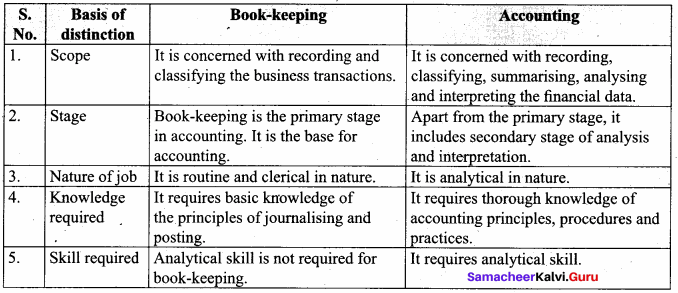
What are the differences between book – keeping and accounting?
Answer:
11th Accountancy Chapter 2 Book Back Answers Samacheer Kalvi Solutions Conceptual Framework Of Accounting


Samacheer Kalvi 11th Maths Solutions Chapter 5 Binomial Theorem, Sequences and Series Ex 5.1

You can Download Samacheer Kalvi 11th Maths Book Solutions Guide Pdf, Tamilnadu State Board help you to revise the complete Syllabus and score more marks in your examinations.

Tamilnadu Samacheer Kalvi 11th Maths Solutions Chapter 5 Binomial Theorem, Sequences and Series Ex 5.1

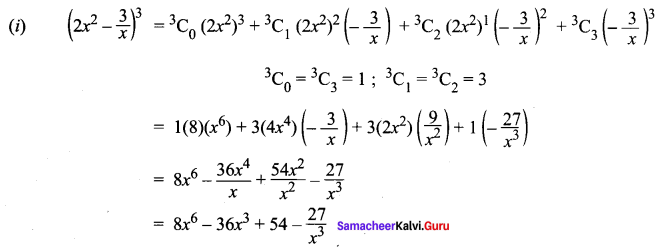
11th Maths Exercise 5.1 Question 1.
11th Maths Exercise 5.1 Solutions Chapter 5 Binomial Theorem, Sequences And Series Samacheer Kalvi
Solution:
11th Maths Exercise 5.1 Samacheer Kalvi Solutions Chapter 5 Binomial Theorem, Sequences And Series Ex 5.1
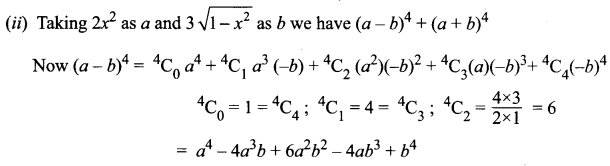
Sequences And Series Solutions Samacheer Kalvi 11th Maths Chapter 5 Binomial Theorem, Ex 5.1
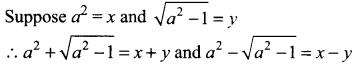
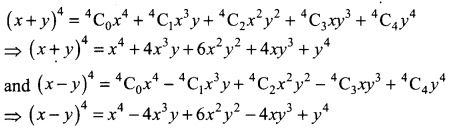
Similarly (a + b)4 = a4 + 4a3b + 6a2b2 + 4ab3 + b4
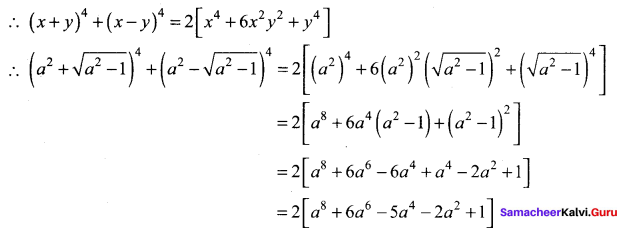
∴ (a – b)4 + (a + b)4 = 2 [a4 + 6a2b2 + b4]
Substituting the value of a and b we get
11 Maths Samacheer Kalvi Solutions Chapter 5 Binomial Theorem, Sequences And Series Ex 5.1
= 2[16x8 + 6(4x4)(9(1 – x2)) + 81(1 – x2)2]
= 2[16x8 + 216x4(1 – x2) + 81(1 – x2)2]
= 2[16x8 + 216x4 – 216x6 + 81 + 81x4 – 162x2]
= 2[16x8 – 216x6 + 297x4 – 162x2 + 81]
= 32x8 – 432x6 + 594x4 – 324x2 + 162

11th Maths Exercise 5.1 Samacheer Kalvi Question 2.
Compute
(i) 1024
(ii) 994
(iii) 97
Solution:

(i) 1024 = (100 + 2)4 = (102 + 2)4
Ex 5.1 Class 11 Samacheer Kalvi Maths Solutions Chapter 5 Binomial Theorem, Sequences And Series
= 1(108) + 4(106)(2) + 6(104)(4) + 4(102)(8) + 16
= 100000000 + 8000000 + 240000 + 3200 + 16
= 108243216

(ii) 994 = (100 – 1)4 = (102 – 1)4
Chapter 5 Class 11 Maths Samacheer Kalvi 11th Maths Solutions Binomial Theorem, Sequences And Series Ex 5.1
= 1(108) + 4(106)(-1) + 6 (104)(1) + 4( 104)(-1) + (-1)4
= 100000000 – 4000000 + 60000 – 400 + 1
= 100060001 – 4000400 = 96059601

(iii) 97 = (10 – 1)7
Samacheer Kalvi 11th Maths Solutions Chapter 5 Binomial Theorem, Sequences And Series Ex 5.1
= 1(10000000) + 7(1000000)(-1) + 21(100000)(1) + 35(10000)(-1) + 35(1000)(1) + 21(100)(-1) + 7(10)(1) + 1(-1)
= 10000000 – 7000000 + 2100000 – 350000 + 35000 – 2100 + 70 – 1
= 12135070 – 7352101 = 4782969

Sequences And Series Solutions Question 3.
Using binomial theorem, indicate which of the following two number is larger: (1.01)1000000, 10000.
Solution:
(1.01)1000000 = (1 + 0.01)1000000
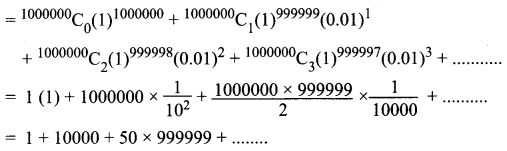
Class 11 Maths Binomial Theorem Samacheer Kalvi Solutions Chapter 5 Sequences And Series Ex 5.1
which is > 10000
So (1.01)1000000 > 10000 (i.e.) (1.01)1000000 is larger

11 Maths Samacheer Kalvi Question 4.
Class 11 Ex 5.1 Samacheer Kalvi Maths Solutions Chapter 5 Binomial Theorem, Sequences And Series
Solution:
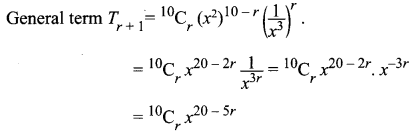
Class 11 Maths Chapter 5 Exercise 5.1 Samacheer Kalvi Solutions Binomial Theorem, Sequences And Series
To find coefficient of x15 we have to equate x power to 15
i.e. 20 – 5r = 15
20 – 15 = 5r ⇒ 5r = 5 ⇒ r = 5/5 = 1
So the coefficient of x15 is 10C1 = 10

Ex 5.1 Class 11 Question 5.
Chapter 5 Maths Class 11 Samacheer Kalvi Solutions Binomial Theorem, Sequences And Series Ex 5.1
Solution:
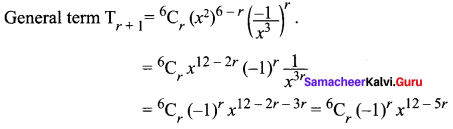
Class 11 Chapter 5 Maths Samacheer Kalvi Solutions Binomial Theorem, Sequences And Series Ex 5.1
To find coefficient of x6
12 – 5r = 6
12 – 6 = 5r ⇒ 5r = 6 ⇒ r = 6/5 which is not an integer.
∴ There is no term involving x6.
To find coefficient of x2
12 – 5r = 2
5r = 12 – 2 = 10 ⇒ r = 2
Class 11 Maths Chapter 5 Samacheer Kalvi Solutions Binomial Theorem, Sequences And Series Ex 5.1

Question 6.
Samacheer Kalvi 11th Maths Solutions Chapter 5 Binomial Theorem, Sequences and Series Ex 5.1 999
Solution:
Samacheer Kalvi 11th Maths Solutions Chapter 5 Binomial Theorem, Sequences and Series Ex 5.1 888
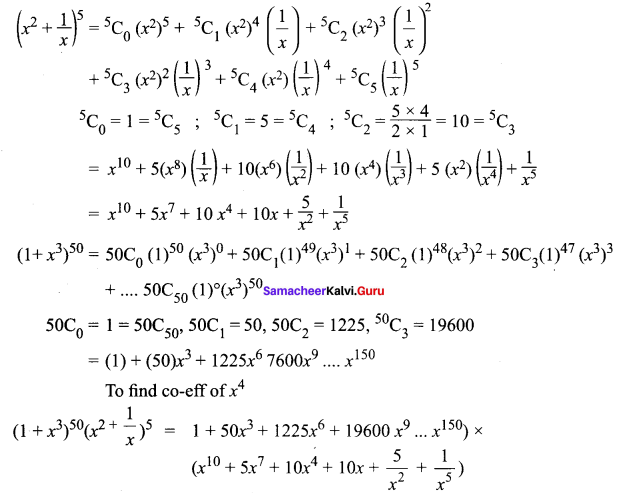
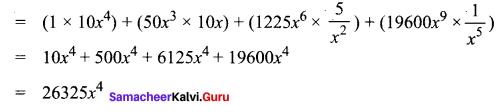
when multiplying these terms, we get x4 terms
Samacheer Kalvi 11th Maths Solutions Chapter 5 Binomial Theorem, Sequences and Series Ex 5.1 11111
∴ The co-eff of x4 is 26325

Ex 5.1 Class 11 Question 7.
Samacheer Kalvi 11th Maths Solutions Chapter 5 Binomial Theorem, Sequences and Series Ex 5.1 122
Solution:
Samacheer Kalvi 11th Maths Solutions Chapter 5 Binomial Theorem, Sequences and Series Ex 5.1 13

Chapter 5 Class 11 Maths Question 8.
Find the last two digits of the number 3600.
Solution:
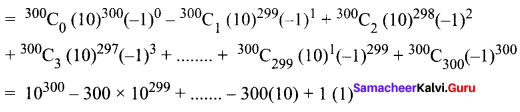
3600 = 32 × 300 = (9)300 = (10 – 1)300
Samacheer Kalvi 11th Maths Solutions Chapter 5 Binomial Theorem, Sequences and Series Ex 5.1 14
All the terms except last term are ÷ by 100. So the last two digits will be 01.

Samacheer Kalvi 11th Maths Question 9.
If n is a positive integer, show that, 9n + 1 – 8n – 9 is always divisible by 64.
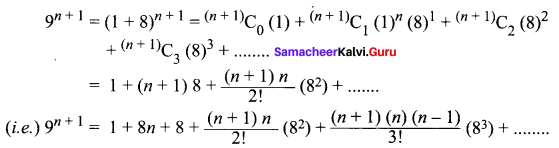
Solution:
Samacheer Kalvi 11th Maths Solutions Chapter 5 Binomial Theorem, Sequences and Series Ex 5.1 15
∴ 9n + 1 – 8n – 9 = 64 [an integer]
⇒ 9n + 1 – 8n – 9 is divisible by 64

Class 11 Maths Binomial Theorem Question 10.
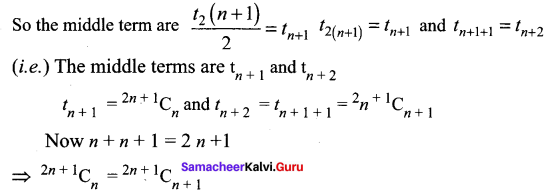
If n is an odd positive integer, prove that the coefficients of the middle terms in the expansion of (x + y)n are equal.
Solution:
Given n is odd. So let n = 2n + 1, where n is an integer.
The expansion (x + y)n has n + 1 terms.
= 2n + 1 + 1 = 2(n + 1) terms which is an even number.
Samacheer Kalvi 11th Maths Solutions Chapter 5 Binomial Theorem, Sequences and Series Ex 5.1 16
⇒ The coefficient of the middle terms in (x + y)n are equal.

Class 11 Ex 5.1 Question 11.
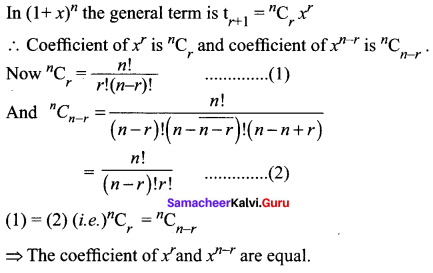
If n is a positive integer and r is a non – negative integer, prove that the coefficients of xr and xn – r in the expansion of (1 + x)n are equal.
Solution:
Samacheer Kalvi 11th Maths Solutions Chapter 5 Binomial Theorem, Sequences and Series Ex 5.1 17

Class 11 Maths Chapter 5 Exercise 5.1 Question 12.
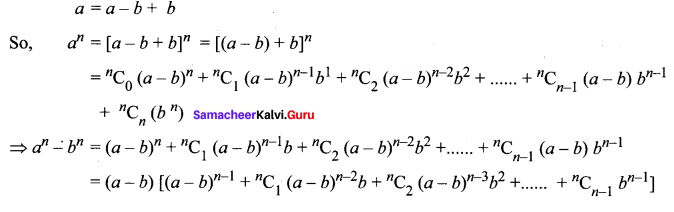
If a and b are distinct Integers, prove that a – b is a factor of an – bn, whenever n is a positive integer. [Hint: write an = (a – b + b)n and expand]
Solution:
Samacheer Kalvi 11th Maths Solutions Chapter 5 Binomial Theorem, Sequences and Series Ex 5.1 18
= (a – b)[an integer]
⇒ an – bn is divisible by (a – b)

Chapter 5 Maths Class 11 Question 13.
In the binomial expansion of (a + b)an, the coefficients of the 4th and 13th terms are equal to each other, find n.
Solution:
In (a + b)n general term is tr + 1 = nCr an – r br
So, t4 = t3 + 1 = nC3 = nC12
⇒ n = 12 + 3 = 15
We are given that their coefficients are equal ⇒ nC3 = nC12 ⇒ n = 12 + 3 = 15
[nCx = nCy ⇒ x = y (or) x + y = n]

Class 11 Chapter 5 Maths Question 14.
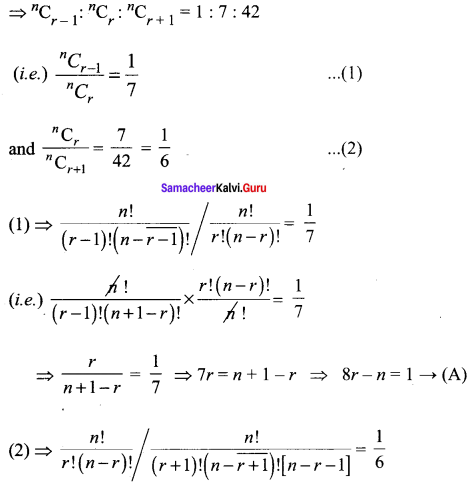
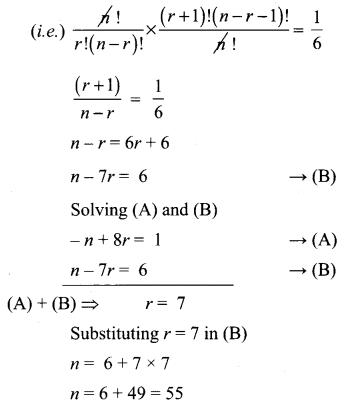
If the binomial coefficients of three consecutive terms in the expansion of (a + x)n are in the ratio 1 : 7 : 42, then find n.
Solution:
In (a + x)n general term is tr + 1 = nCr
So, the coefficient of tr + 1 is nCr
We are given that the coefficients of three consecutive terms are in the ratio 1 : 7 : 42.
Samacheer Kalvi 11th Maths Solutions Chapter 5 Binomial Theorem, Sequences and Series Ex 5.1 50
Samacheer Kalvi 11th Maths Solutions Chapter 5 Binomial Theorem, Sequences and Series Ex 5.1 51

Class 11 Maths Chapter 5 Question 15.
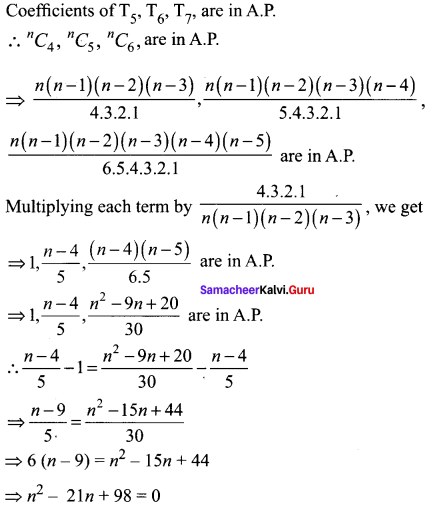
In the binomial coefficients of (1 + x)n, the coefficients of the 5th, 6th and 7 terms are in AP. Find all values of n.
Solution:
Samacheer Kalvi 11th Maths Solutions Chapter 5 Binomial Theorem, Sequences and Series Ex 5.1 52
⇒ (n – 1)(n – 14) = 0
∴ n = 7 , 14

Question 16.
Samacheer Kalvi 11th Maths Solutions Chapter 5 Binomial Theorem, Sequences and Series Ex 5.1 998
Solution:
Samacheer Kalvi 11th Maths Solutions Chapter 5 Binomial Theorem, Sequences and Series Ex 5.1 55

Samacheer Kalvi 11th Maths Solutions Chapter 5 Binomial Theorem, Sequences and Series Ex 5.1 Additional Questions Solved

Question 1.
Samacheer Kalvi 11th Maths Solutions Chapter 5 Binomial Theorem, Sequences and Series Ex 5.1 56
Solution:
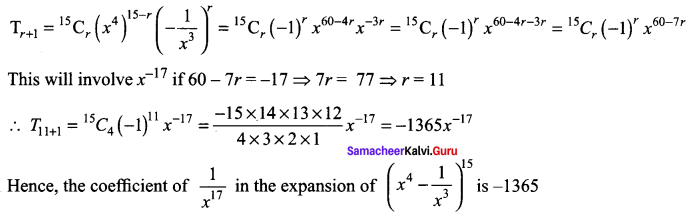
Let Tr + 1 be the term in which x32 and x-17 occurs,
Samacheer Kalvi 11th Maths Solutions Chapter 5 Binomial Theorem, Sequences and Series Ex 5.1 57

(i) Since x32 occurs in this term
∴ Exponent of x = 32
⇒ 60 – 7r = 32 ⇒ 7r = 28
r = 28 ÷ 7 = 4
∴ Coefficient of the term containing x32 = 15C4 (-1)4 = 1365

(ii) Since x-17 occurs in this term .
∴ Exponent of x = -17
⇒ 60 – 7r = -17 ⇒ 7r = 77, ∴ r = 11
Samacheer Kalvi 11th Maths Solutions Chapter 5 Binomial Theorem, Sequences and Series Ex 5.1 58

Question 2.
Find a positive value of m for which the coefficient of x2 in the expansion of (1 + x)m is 6.
Solution:
Samacheer Kalvi 11th Maths Solutions Chapter 5 Binomial Theorem, Sequences and Series Ex 5.1 59
Also, coefficient of x2 in the expansion of (1 + x)m is 6
Samacheer Kalvi 11th Maths Solutions Chapter 5 Binomial Theorem, Sequences and Series Ex 5.1 60
⇒ m (m – 1) = 4.3 ⇒ m = 4

Question 3.
In the binomial expansion of (1 + a)m + n, prove that the coefficients of am and an are equal.
Solution:
Samacheer Kalvi 11th Maths Solutions Chapter 5 Binomial Theorem, Sequences and Series Ex 5.1 66

Question 14.
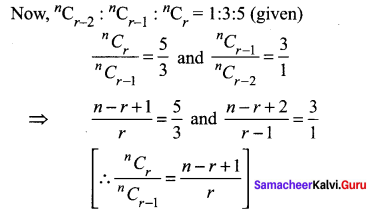
The coefficient of (r – 1)th, rth, and (r + 1)th terms in the expansion of (x + 1)n are in the ratio 1 : 3 : 5. Find both n and r.
Solution:
We know that co-effcients of (r – 1)th, rth and (r + 1)th terms in the expansion of (x + 1)n are nCr – 2: nCr – 1 and nCr respectively
Samacheer Kalvi 11th Maths Solutions Chapter 5 Binomial Theorem, Sequences and Series Ex 5.1 7
⇒ 3n – 8r + 3 = 0 and n – 4r + 5 = 0
Solving these for n, r we get,
n = 7 and r = 3

Question 5.
Samacheer Kalvi 11th Maths Solutions Chapter 5 Binomial Theorem, Sequences and Series Ex 5.1 8888
Solution:
Samacheer Kalvi 11th Maths Solutions Chapter 5 Binomial Theorem, Sequences and Series Ex 5.1 9999
Using binomial theorem,
Samacheer Kalvi 11th Maths Solutions Chapter 5 Binomial Theorem, Sequences and Series Ex 5.1 1222
Samacheer Kalvi 11th Maths Solutions Chapter 5 Binomial Theorem, Sequences and Series Ex 5.1 10

Question 6.
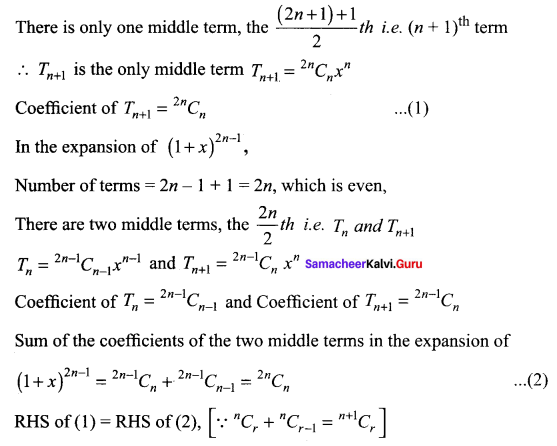
Show that the coefficient of the middle term in the expansion of (1 + x)2n is equal to the sum of the coefficients of the two middle terms in the expansion of (1 + x)2n – 1.
Solution:
In the expansion of (1 + x)2n,
Number of terms = 2n + 1, which is odd
Samacheer Kalvi 11th Maths Solutions Chapter 5 Binomial Theorem, Sequences and Series Ex 5.1 128

Question 7.
If three consecutive coefficients in the expansion of (1 + x)n are in the ratio 6 : 33 : 110, find n.
Solution:
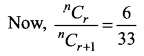
Let the consecutive coefficients nCr, nCr + 1 and nCr + 2 be the coefficients of Tr + 1, Tr + 2 and Tr + 3 then nCr : nCr + 1 : nCr + 2 = 6 : 33 : 110
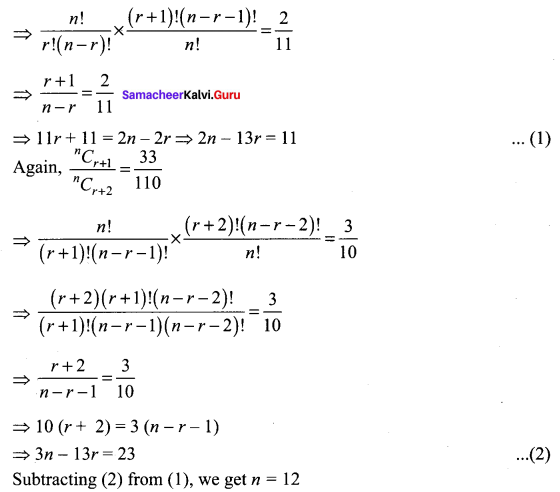
Samacheer Kalvi 11th Maths Solutions Chapter 5 Binomial Theorem, Sequences and Series Ex 5.1 123
Samacheer Kalvi 11th Maths Solutions Chapter 5 Binomial Theorem, Sequences and Series Ex 5.1 133

Question 8.
If the sum of the coefficients in the expansion of (x + y)n is 4096. Then find the greatest coefficient in the expansion.
Solution:
Given that, Sum of the coefficients in the expansion of (x + y)n = 4096
nC0 + nC1 + nC2+…+ nCn = 4096
[∴ Sum of binomial coefficients in the expansion of (x + a)n is 2n]
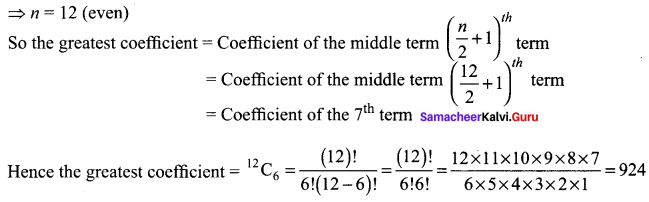
⇒ 2n = 4096 = 212
Samacheer Kalvi 11th Maths Solutions Chapter 5 Binomial Theorem, Sequences and Series Ex 5.1 144

Question 9.
Samacheer Kalvi 11th Maths Solutions Chapter 5 Binomial Theorem, Sequences and Series Ex 5.1 155
Solution:
The general term in the expansion of
Samacheer Kalvi 11th Maths Solutions Chapter 5 Binomial Theorem, Sequences and Series Ex 5.1 166

Question 10.
Samacheer Kalvi 11th Maths Solutions Chapter 5 Binomial Theorem, Sequences and Series Ex 5.1 177
Solution:
Samacheer Kalvi 11th Maths Solutions Chapter 5 Binomial Theorem, Sequences and Series Ex 5.1 188

Samacheer Kalvi 11th Computer Applications Solutions Chapter 3 Computer Organisation

Students can Download Computer Applications Chapter 3 Computer Organisation Questions and Answers, Notes Pdf, Samacheer Kalvi 11th Computer Applications Book Solutions Guide Pdf helps you to revise the complete Tamilnadu State Board New Syllabus and score more marks in your examinations.

Tamilnadu Samacheer Kalvi 11th Computer Applications Solutions Chapter 3 Computer Organisation

Samacheer Kalvi 11th Computer Applications Computer Organisation Text Book Back Questions and Answers

I. Choose The Correct Answer

11th Samacheer Kalvi Computer Application Question 1.
Which of the following is said to be the brain of a computer?
(a) Input devices
(b) Output devices
(c) Memory device
(d) Microprocessor
Answer:
(d) Microprocessor

Samacheer Kalvi 11th Computer Application Question 2.
Which of the following is not the part of a microprocessor unit?
(a) ALU
(b) Control unit
(c) Cache memory
(d) register
Answer:
(c) Cache memory

Samacheer Kalvi 11 Computer Application Question 3.
How many bits constitute a word?
(a) 8
(b) 16
(c) 32
(d) Determined by the processor used.
Answer:
(d) Determined by the processor used.

Samacheer Kalvi Computer Application Question 4.
Which of the following device identifies the location when address is placed in the memory address register?
(a) Locator
(b) Encoder
(c) Decoder
(d) Multiplexer
Answer:
(c) Decoder

Samacheer Kalvi Guru 11th Computer Application Question 5.
Which of the following is a CISC processor?
(a) Intel P6
(b) AMD K6
(c) Pentium III
(d) Pentium IV
Answer:
(c) Pentium III

Computer Application Samacheer Kalvi Question 6.
Which is the fastest memory?
(a) Hard disk
(b) Main memory
(c) Cache memory
(d) Blue-Ray dist
Answer:
(c) Cache memory

Samacheer Kalvi 11th Computer Application Guide Question 7.
How many memory locations are identified by a processor with 8 bits address bus at a time?
(a) 28
(b) 1024
(c) 256
(d) 8000
Answer:
(c) 256

Samacheer Kalvi Computer Application Guide Question 8.
What is the capacity of 12cm diameter DVD with single sided and single layer?
(a) 4.7 GB
(b) 5.5 GB
(c) 7.8GB
(d) 2.2 GB
Answer:
(a) 4.7 GB

Samacheer Kalvi 11th Computer Applications Guide Question 9.
What is the smallest size of data represented in a CD?
(a) Blocks
(b) Sectors
(c) Pits
(d) Tracks
Answer:
(c) Pits

11th Computer Applications Samacheer Kalvi Question 10.
Display devices are connected to the computer through:
(a) USB port
(b) Ps/2 port
(c) SCSI port
(d) VGA connector
Answer:
(d) VGA connector

II. Short Answers

11th Computer Application Samacheer Kalvi Question 1.
What are the parameters which influence the characteristics of a microprocessor?
Answer:
A Microprocessor’s performance depends on the following characteristics:

  1. Clock speed
  2. Instruction set
  3. Word size.

Samacheer Kalvi 11th Computer Question 2.
What is an instruction?
Answer:
A command which is given to a computer to perform an operation on a piece of data is called an instruction.

Question 3.
What is a program counter?
Answer:
The Program Counter (PC) is a special register in the CPU which always keeps the address of the next instruction to be executed.

Question 4.
What is HDMI?
Answer:
High-Definition Multimedia Interface is an audio/video interface which transfers the uncompressed video and audio data from a video controller, to a compatible computer monitor, LCD projector, digital television etc.

Question 5.
Which source is used to erase the content of a EPROM?
Answer:
Erasable Programmable Read Only Memory is a special type of memory which serves as a PROM, but the content can be erased using ultraviolet rays. EPROM retains its contents until it is exposed to ultraviolet light. The ultraviolet light clears its contents, making it possible to reprogram the memory.

III. Explain in Brief.

Question 1.
Differentiate Computer Organization from Computer Architecture?
Answer:
Computer Organisation:
Computer organisation deals with the hardware components of a computer system. It includes input / output devices, the central processing unit, storage and primary memory.

Computer Architecture:
Computer architecture deals with the engineering considerations involed in designing a computer.

Question 2.
Classify the microprocessor based on the size of the data?
Answer:
Depending on the data width, microprocessors can process instructions. The microprocessors can be classified as follows:

  1. 8-bit microprocessor
  2. 16-bit microprocessor
  3. 32-bit microprocessor
  4. 64-bit microprocessor.

Question 3.
Write down the classifications of microprocessors based on the instruction set?
Answer:
Reduced Instruction Set Computers (RISC):
RISC stands for Reduced Instruction Set Computers. They have a small set of highly optimized instructions. Complex instructions are also implemented using simpler instructions, thus reducing the size of the instruction set.
Eg: RISC processors are Intel P6, Pentium IV, AMD K6 and K7.

Complex Instruction Set Computers (CISC):
CISC stands for Complex Instruction Set Computers. They support hundreds of instructions. Computers supporting CISC can accomplish a wide variety of tasks, making them ideal for personal computers.
Eg: CISC processors are Intel 386 & 486, Pentium, Pentium II and III, and Motorola 68000.

Question 4.
Differentiate PROM and EPROM?
Answer:
PROM:
PROM is a memory on which data can be written only once.

EPROM:
EPROM is a memory on which ultra violet rays are used to clear its contents and making it possible to reprogram the memory.

Question 5.
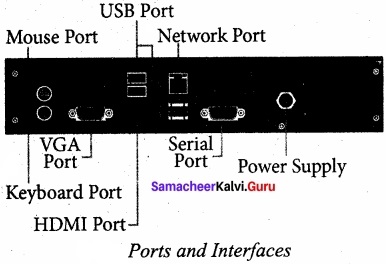
Write down the interfaces and ports available in a computer?
Answer:
11th Samacheer Kalvi Computer Application Solutions Chapter 3 Computer Organisation
Serial Port:
To connect the external devices, found in old computers.

Parallel Port:
To connect the printers, found in old computers.

USB Ports:
To connect external devices like cameras, scanners, mobile phones, external hard disks and printers to the computer. USB 3.0 is the third major version of the Universal Serial Bus (USB) standard to connect computers with other electronic gadgets. USB 3.0 can transfer data up to 5 Giga byte/second. USB 3.1 and USB 3.2 are also released.

VGA Connector:
To connect a monitor or any display device like LCD projector. Audio Plugs: To connect sound speakers, microphone and headphones.

PS/2 Port:
To connect mouse and keyboard to PC.

SCSI Port:
To connect the hard disk drives and network connectors.

High Definition Multimedia Interface (HDMI):
High-Definition Multimedia Interface is an audio/video interface which transfers the uncompressed video and audio data from a video controller, to a compatible computer monitor, LCD projector, digital television etc.

Question 6.
Differentiate CD and DVD?
Answer:
CD:

  1. CD stands for compact Disk.
  2. CDs are made with the purpose of holding audio files as well as program files.
  3. A standard CD can store about 700 MB of data.

DVD:

  1. DVD stands for digital versatile disc.
  2. DVDs are made with the purpose of holding video files, movies, substantial amount of programs etc.
  3. A standard DVD can hold 4.7 GB of data.

Question 7.
How will you differentiate a flash memory and an EEPROM?
Answer:
Flash Memory:

  1. The flash memory allows data to be written or erased in blocks.
  2. Flash memory is faster in performance.

EEPROM:

  1. The EEPROM requires data to be written or erased one byte at a time.
  2. EEPROM is slower in performance.

IV. Explain in detail.

Question 1.
Explain the characteristics of a microprocessor?
Answer:
A Microprocessor’s performance depends on the following characteristics:

  1. Clock speed
  2. Instruction set
  3. Word size.

1. Clock Speed:
Every microprocessor has an internal clock that regulates the speed at which it executes instructions. The speed at which the microprocessor executes instructions is called the clock speed. Clock speed is measured in MHz (Mega Hertz) or in GHz (Giga Hertz).

2. Instruction Set:
A command which is given to a computer to perform an operation on data is called an instruction. Basic set of machine level instructions that a microprocessor is designed to execute is called as an instruction set. This instruction set carries out the following types of operations: Data transfer, Arithmetic operations, Logical operations, Control flow, Input/output.

3. Word Size:
The number of bits that can be processed by a processor in a single instruction is called its word size. Word size determines the amount of RAM that can be accessed by a microprocessor at one time and the total number of pins on the microprocessor. Total number of input and output pins in turn determines the architecture of the microprocessor.

Question 2.
How the read and write operations are performed by a processor? Explain?
Answer:
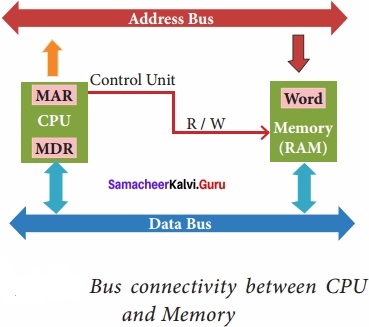
The read operation fetches data from memory and transfers to MDR. A single control line performs two operations like Read / Write using 1 or 0. Also, the write operation transfers data from the MDR to memory. This organisation is shown in figure.
Samacheer Kalvi 11th Computer Application Solutions Chapter 3 Computer Organisation
The word in the RAM has the same size (no. of bits) as the Memory Data Register (MDR). If the processor is an 8-bit processor like Intel 8085, its MDR and the word in the RAM both have 8 bits.

If the size of the MDR is eight bits, which can be connected with a word of eight bits where the data can be stored or retrieved, the data bus has eight wires in parallel to transfer the data in any one direction which depends on whether the control is read or write. This control line is labeled as R/W, which becomes 1 meAnswer: READ operation and 0 me WRITE operation.

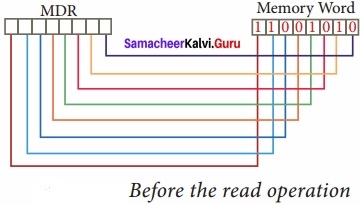
Figure shows the content of MDR and the Memory Word before the READ operation. Also Figure shows the content of MDR and the Memory Word after the READ operation.
Samacheer Kalvi 11 Computer Application Solutions Chapter 3 Computer Organisation
Samacheer Kalvi Computer Application 11th Solutions Chapter 3 Computer Organisation

The read operation transfers the data (bits) from word to memory data register. The write operation transfers the data (bits) from memory data register to word.

Question 3.
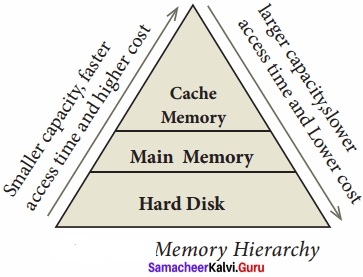
Arrange the memory devices in ascending order based on the access time?
Samacheer Kalvi Guru 11th Computer Application Solutions Chapter 3 Computer Organisation
Answer:
Cache memory:
The cache is a very high speed, expensive piece of memory, which is used to speed up the memory retrieval process. The idea of introducing a cache is that, this extremely fast memory would store data that is frequently accessed and if possible, the data that is spatially closer to it. This helps to achieve the fast response time.

Random-access memory / main memory:
RAM is a volatile memory, which meAnswer: that the information stored in it is not permanent. As soon as the power is turned off, whatever data that resided in a RAM is lost. It allows both read and write operations.

Hard Disk:
Hard disk is a magnetic disk on which we can store computer data. In general, hard disks are less portable than floppies, although it is possible to port by removable hard disks. Two types of removable hard disks are disk packs and removable catridges.

Compact disk:
A CD or CD-ROM is made from 1.2 millimeters thick, polycarbonate plastic material. A thin layer of aluminium or gold is applied to the surface. CD data is represented as tiny indentations known as “pits”, encoded in a spiral track moulded into the top of the polycarbonate layer. The areas between pits are known as “lands”. A motor within the CD player rotates the disk. The capacity of an ordinary CD-ROM is 700MB.

Digital versatile Disc (DVD):
A DVD (Digital Versatile Disc or Digital Video Disc) is an optical disc capable of storing up to 4.7 GB of data, more than six times what a CD can hold. DVDs are often used to store movies at a better quality than with a VHS. DVDs can also have interactive menus and bonus features such as deleted scenes and commentaries. Like CDs, DVDs are read with a laser.

Question 4.
Explain the types of ROM?
Answer:
Read-Only memory (ROM):
Read-only memory refers to special memory in a computer with pre-recorded data at manufacturing time which cannot be modified. The stored programs that start the computer and perform diagnostics are available in ROMs. ROM stores critical programs such as the program that boots the computer.

Once the data has been written onto a ROM chip, it cannot be modified or removed and can only be read. ROM retains its contents even when the computer is turned off. So, ROM is called as a non-volatile memory.

Programmable Read-Only Memory (PROM):
Programmable read-only memory is also a non-volatile memory on which data can be written only once. Once a program has been written onto a PROM, it remains there forever. Unlike the main memory, PROMs retain their contents ‘ even when the computer is turned off.

The PROM differs from ROM. PROM is manufactured as a blank memory, whereas a ROM is programmed during the manufacturing process itself. PROM programmer or a PROM burner is used to write data to a PROM chip. The process of programming a PROM is called burning the PROM.

Erasable Programmable Read-Only Memory (EPROM): Erasable Programmable Read-Only Memory is a special type of memory which serves as a PROM, out the content can be erased , using ultraviolet rays. EPROM retains its contents until it is exposed to ultraviolet light. The ultraviolet light clears its contents, making it possible to reprogram the memory.

An EPROM differs from a PROM, PROM can be written only once and cannot be erased. EPROMs are used widely in personal computers because they enable the manufacturer to change the contents of the PROM to replace with updated versions or erase the contents before the computer is delivered.

Electrically Erasable Programmable Read-Only Memory is a special type of PROM that can be erased by exposing it to an electrical charge. Like other types of PROM, EEPROM retains its contents even when the power is turned off. Comparing with all other types of ROM, EEPROM is slower in performance.

Samacheer Kalvi 11th Computer Applications Computer Organisation Additional Questions and Answer

1. Choose The Correct Answer

Question 1.
………………….. deals with the engineering considerations involved in designing a computer.
(a) Computer organisation
(b) Computer architecture
(c) Microprocessor
(d) Registers
Answer:
(b) Computer architecture

Question 2.
Microprocessor is made up of ……………………. units.
(a) 3
(b) 2
(c) 4
(d) 5
Answer:
(a) 3

Question 3.
The speed at which the microprocessor executes instructions is called:
(a) clock speed
(b) instruction set
(c) word size
(d) control flow
Answer:
(a) clock speed

Question 4.
The number of bits that can be processed by a processor in a single instruction is called its:
(a) clock speed
(b) instruction set
(c) word size
(d) control flow
Answer:
(c) word size

Question 5.
……………………….. is unidirectional.
(a) Data bus
(b) Control bus
(c) Register
(d) Address bus
Answer:
(d) Address bus

Question 6.
…………………… is bidirectional.
(a) Data bus
(b) Control bus
(c) Register
(d) Address bus
Answer:
(a) Data bus

Question 7.
……………………. is a volatile memory.
(a) ROM
(b) EPROM
(c) PROM
(d) RAM
Answer:
(d) RAM

Question 8.
The areas between pits are known as:
(a) sector
(b) track
(c) layer
(d) lands
Answer:
(d) lands

Question 9.
The capacity of an ordinary CD-ROM is:
(a) 800 MB
(b) 700 MB
(c) 900 MB
(d) 600 MB
Answer:
(b) 700 MB

Question 10.
……………………… is the type of disc used for play station games and for playing high-definition (HD) movies.
(a) Hard disks
(b) CD
(c) DVD
(d) Blu-ray disc
Answer:
(d) Blu-ray disc

II. Short Answers

Question 1.
Define computer organisation?
Answer:
Computer organization deals with the hardware components of a computer system. It includes input/output devices, the central processing unit, storage and primary memory. It is concerned with how the various components of computer hardware operate. It also deals with how they are interconnected to implement an architectural specification.

Question 2.
What are the three main units of microprocessor?
Answer:
The microprocessor is made up of 3 main units. They are –
(i) Arithmetic and Logic unit (ALU):
To perform arithmetic and logical instructions based on computer instructions.

(ii) Control unit:
To control the overall operations of the computer through signals.

(iii) Registers (Internal Memory):
They are used to hold the instruction and data for the execution of the processor.

Question 3.
Define instruction set?
Answer:
A command which is given to a computer to perform an operation on data is called an instruction. Basic set of machine level instructions that a microprocessor is designed to execute is called as an instruction set.

Question 4.
What do you mean by word size?
Answer:
The number of bits that can be processed by a processor in a single instruction is called its word size. Word size determines the amount of RAM that can be accessed by a microprocessor. Total number Of input and output pins in turn determines the architecture of the microprocessor.

Question 5.
Define bus?
Answer:
Abus is a collection of wires used for communication between the internal components of a computer.

Question 6.
What is decoder?
Answer:
A decoder, a digital circuit is used to point to the specific memory location where the word can be located.

Question 7.
What is read operation?
Answer:
The read operation transfers the data (bits) from memory word to memory data register.

Question 8.
What is write operation?
Answer:
The write operation transfers the data (bits) from memory data register to word.

Question 9.
What criteria microprocessors are classified?
Answer:
Microprocessors are classified based on the following criteria:

  1. The width of data that can be processed.
  2. The instipction set.

Question 10.
What is USB 3.0?
Answer:
USB 3.0 is the third major version of the Universal Serial Bus (USB) standard to connect computers with other electronic gadgets. USB 3.0 can transfer data up to 5 Giga byte/second. USB 3.1 and USB 3.2 are also released.

Question 11.
What are the two basic types of ROM?
Answer:
There are two basic types of RAM

  1. Dynamic RAM (DRAM)
  2. Static RAM (SRAM)

Question 12.
What is Access time?
Answer:
Access time is the time delay or latency between a request to an electronic system, and the access being completed or the requested data returned.

Question 13.
What is a computer memory?
Answer:
Computer memory is the storage space in the computer, where data and instructions are stored. There are two types of accessing methods to access (store or retrieve) the memory. They are sequential access and random access. In sequential access, thd memory is accessed in an orderly manner from starting to end. But, in random access, any byte of memory can be accessed directly without navigating through previous bytes.

Question 14.
What is a system bus?
Answer:
The system bus is a bunch of wires which is the collection of address bus, data bus and control bus.

Question 15.
Differentiate static RAM and Dynamic RAM?
Answer:
Static RAM:

  1. Static RAM needs to be refreshed less often.
  2. Static RAM is more expensive.
  3. Static RAM uses transistor to store a single bit of data.
  4. Static RAM are used in cache memory.

Dynamic RAM:

  1. Dynamic RAM needs to be refreshed frequently.
  2. Dynamic RAM is less expensive.
  3. Dynamic RAM uses a separate capacitor to store each bit of data.
  4. Dynamic RAM are used in main memory.

III. Explain in Brief.

Question 1.
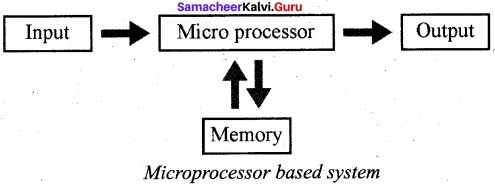
What is microprocessor? Draw the block diagram of microprocessor?
Answer:
The microprocessor is a programmable multipurpose silicon chip that is based on a register. It is driven by clock pulses. It accepts input as a binary data and after processing, it provides the output data as per the instructions stored in the memory.
Computer Application Samacheer Kalvi 11th Solutions Chapter 3 Computer Organisation

Question 2.
Write short notes on DVD?
Answer:
A DVD (Digital Versatile Disc or Digital Video Disc) is an optical disc capable of storing up to 4.7 GB of data, more than six times what a CD can hold. DVDs are often used to store movies at a better quality. Like CDs, DVDs are read with a laser.

The disc can have one or two sides, and one or two layers of data per side; the number of sides and layers determines how much it can hold. A 12 cm diameter disc with single sided, single layer has 4.7 GB capacity, whereas the single sided, double layer has 8.5 GB capacity. The 8 cm DVD has 1.5 GB capacity. The capacity of a DVD-ROM can be visually determined by noting the number of data sides of the disc. Double-layered sides are usually gold-coloured, while single-layered sides are usually silver-coloured, like a CD.

Question 3.
Write short notes on Blu-ray Disc?
Answer:
Blu-Ray Disc is a high-density optical disc similar to DVD. Blu-ray is the type of disc used for PlayStation games and for playing high-definition (HD) movies. A double-layer Blu-Ray disc can store up to 50GB (gigabytes) of data. This is more than 5 times the capacity of a DVD, and above 70 times of a CD.

The format was developed to enable recording, rewriting and playback of high-definition video, as well as storing large amount of data. DVD uses a red laser to read and write data. But, Blu-ray uses a blue-violet laser to write. Hence, it is called as Blu-Ray.

Question 4.
What are the methods to access the memory? Draw the memory Hierarchy?
Answer:
Computer memory is the storage space in the computer, where data and instructions are stored. There are two types of accessing methods to access (read or write) the memory.

They are sequential access and random access. In sequential access, the memory is accessed in an orderly manner from starting to end. But, in random access, any byte of memory can be accessed directly without navigating through previous bytes.
For figure refer Page 46, Fig. No. 3.5.

Question 5.
List down the different types of operations in Instruction set?
Answer:
A command which is given to a computer to perform an operation on data is called an instruction. Basic set of machine level instructions that a microprocessor is designed to execute is called as an instruction set. This instruction set carries out the following types of operations:

  1. Data transfer
  2. Arithmetic operations
  3. Logical operations
  4. Control flow
  5. Input/output.

IV. Explain in detail.

Question 1.
Explain in detail the various types of storage devices?
Answer:
Secondary Storage Devices:
The secondary storage devices are used to store data that is of larger size which can be accessed later. Since the main memory is costly, the size is generally very limited in a computer. A portion of a secondary storage which can serve as an extension of the main memory and can perform its job is called as virtual memory.

Hard Disks:
Hard disk is a magnetic disk on which you can store computer data. The term hard is used to distinguish it from a soft, or floppy disk. Hard disks can store more data and are faster than floppy disks.

A hard disk, for example, can store anywhere from 10 megabytes to several gigabytes, whereas most floppies have a maximum storage capacity of 1.4 megabytes. In general, hard disks are less portable than floppies, although it is possible to port by removable hard disks. There are two types of removable hard disks: disk packs and removable cartridges.

Compact Disc (CD):
A CD or CD-ROM is made from 1.2 millimeters thick, polycarbonate plastic material. A thin layer of aluminum or gold is applied to the surface. CD data is represented as tiny indentations known as “pits”, encoded in a spiral track moulded into the top of the polycarbonate layer. The areas between pits dre known as “lands”. A motor within the CD player rotates the disk. The capacity of an ordinary CD-ROM is 700MB.

Digital Versatile Disc (DVD):
A DVD (Digital Versatile Disc or Digital Video Disc) is an optical disc capable of storing up to 4.7 GB of data, more than six times what a CD can hold. DVDs are often used to store movies at a better quality than with a VHS. DVDs can also have interactive menus and bqpus features such as deleted scenes and commentaries. Like CDs, DVDs are read with a laser.

The disc can have one or two sides, and one or two layers of data per side; the number of sides and layers determines how much it can hold. A 12 cm diameter disc with single sided, single layer has 4.7 GB capacity, whereas the single sided, double layer has 8.5 GB capacity.

The 8 cm DVD has 1.5 GB capacity. The capacity of a DVD-ROM can be visually determined by noting the number of data sides of the disc. Double-layered sides are usually gold-coloured, while single-layered sides are usually silver-coloured, like a CD.

Flash Memory Devices:
Flash memory is an electronic (solid-state) non-volatile computer storage medium that can be electrically erased and reprogrammed. They are either EEPROM or EPROM. Examples for Flash memories are pendrives, memory cards etc.

Flash memories can be used in personal computers, Personal Digital Assistants (PDA), digital audio players, digital cameras and mobile phones. Flash memory offers fast access times. The time taken to read or write a character in memory is called access time. The capacity of the flash memories vary from 1 Gigabytes (GB) to 2 Terabytes (TB).

Blu-Ray Disc:
Blu-Ray Disc is a high-density optical disc format similar to DVD. Blu-ray is the type of disc used for PlayStation games and for playing high-definition (HD) movies. In the past, there were other standards for such movies. A double-layer Blu-Ray disc can store up to 50GB (gigabytes) of data.

This is more than 5 times the capacity of a DVD, and above 70 times of a CD. The format was developed to enable recording, rewriting and playback of high-definition video (HD), as well as storing large amounts of data. DVD uses a red laser to read and write data. But, Blu-ray uses a blue-violet laser to write. Hence, it is called as Blu-Ray.

Samacheer Kalvi 11th Bio Botany Solutions Chapter 2 Plant Kingdom

Students who are in search of 11th Bio Botany exam can download this Tamilnadu State Board Solutions for 11th Bio Botany Chapter 2 Plant Kingdom from here for free of cost. These cover all Chapter 2 Plant Kingdom Questions and Answers, PDF, Notes, Summary. Download the Samacheer Kalvi 11th Biology Book Solutions Questions and Answers by accessing the links provided here and ace up your preparation.

Tamilnadu Samacheer Kalvi 11th Bio Botany Solutions Chapter 2 Plant Kingdom

Kickstart your preparation by using this Tamilnadu State Board Solutions for 11th Bio Botany Chapter 2 Plant Kingdom Questions and Answers get the max score in the exams. You can cover all the topics of Chapter 2 Plant Kingdom Questions and Answers easily after studying the Tamilnadu State Board 11th Bio Botany Textbook solutions pdf.

Samacheer Kalvi 11th Bio Botany Plant Kingdom Text Book Back Questions and Answers

Choose the correct answer
11th Botany Samacheer Kalvi Question 1.
Which of the plant group has gametophyte as a dominant phase?
(a) Pteridophytes
(b) Bryophytes
(c) Gymnosperm
(d) Angiosperm
Answer:
(b) Bryophytes

Samacheer Kalvi 11th Botany Book Question 2.
Which of following represent gametophytic generation in pteridophytes?
(a) Prothallus
(b) Thallus
(c) Cone
(d) Rhizophore
Answer:
(a) Prothallus

Samacheer Kalvi Guru 11th Botany Question 3.
The haploid number of chromosome for an Angiosperm is 14, the number of chromosome in its endosperm would be …………… .
(a) 7
(b) 14
(c) 42
(d) 28
Answer:
(c) 42

Samacheer Kalvi 11th Botany Question 4.
Endosperm in Gymnosperm is formed …………… .
(a) at the time of fertilization
(b) before fertilization
(c) after fertilization
(d) along with the development of embryo
Answer:
(b) before fertilization

Question 5.
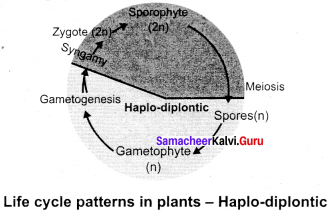
Differentiate halpontic and diplontic life cycle.
Answer:
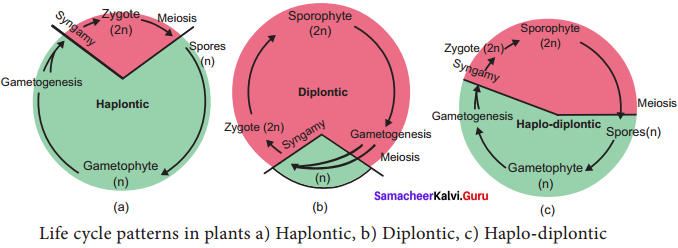
Halpontic cycle:

  • Gametophyte is dominant
  • Sporophyte is represented by zygote

Diplontic cycle:

  • Sporophyte is dominant
  • Gametophyte is represented by few cell gametophyte

Question 6.
What is Plectostele? Give example.
Answer:
Plectostele: Xylem plates alternates with phloem plates. Example: Lycopodiurn clavatum.

Question 7.
What do you infer from the term Pycnoxylic?
Answer:
Pycnoxylic wood is compact with narrow medullary ray. Example: Pinus

Question 8.
Mention two characters shared by Gymnosperms and Angiosperms.
Answer:
Gymnosperms:

  • Vessels are absent (except Gnetales)
  • Phloem lacks companion cells

Angiosperms:

  • Vessels are present
  • Companion cells are present

Question 9.
Do you think shape of chloroplast is unique for algae? Justify your answer.
Answer:
Variation among the shape of the chloroplast is found in members of algae. It is Cup shaped (chlamydomonas). Discoid ((Chara), Girdle shaped (Ulothrix), reticulate (Oedogonium), spiral (Spirogyra), stellate (Zygnema) and plate like (Mougeoutia).

Question 10.
Do you agree with the statement ‘Bryophytes need water for fertilization’? Justify your answer.
Answer:
Yes, in Bryophytes. water plays a vital role in fertilisation, since water film is needed for the transfer of spermatium (male sex cell) to the egg cell.

Entrance Examination Questions Solved

Question 1.
Which of the following are found in extreme saline conditions? (NEET – 2017)
(a) Archaebacteria
(b) Eubacteria
(c) Cyanobacteria
(d) Mycobacteria
Answer:
(a) Archaebacteria

Question 2.
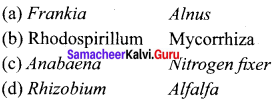
Select the mismatch …………… . (NEET – 2017)
11th Botany Samacheer Kalvi Solutions Chapter 2 Plant Kingdom
Answer:
(b) Rhodospirillum – Mycorrhiza

Question 3.
Which among the following are the smallest living cells, known without a definite cell wall, pathogenic to plants as well as animals and can survive without oxygen? (NEET – 2017)
(a) Bacillus
(b) Pseudomonas
(c) Mycoplasma
(d) Nostoc
Answer:
(c) Mycoplasma

Question 4.
Read the following statements (A to E) and select the option with all correct statements: (AIPMT – 2015).
A. Mosses and Lichens are the first organisms to colonise a bare rock.
B. Selaginella is a homosporous pteridophyte,
C. Coralloid roots in Cycas have VAM.
D. Main plant body in bryophytes is gametophytic, whereas in pteridophytes it is sporophytic.
E. In gymnosperms, male and female gametophytes arc present within sporangia located on sporophyte.

(a) B, C and E
(b) A, C and D
(c) B, C and D
(d) A, D and E
Answer:
(d) A, D and E

Question 5.
An example of colonial algae is …………… . (NEET – 2017)
(a) Chlorella
(b) Volvox
(c) Ulothrix
(d) Spirogyra
Answer:
(b) Volvox

Question 6.
Five kingdom system of classification suggested by RH. Whittaker is not based on …………… . (AIPMT- 2014)
(a) Presence or absence of a well defined nucleus
(b) Mode of reproduction
(c) Mode of nutrition
(d) Complexity of body organisation
Answer:
(a) Presence or absence of a well defined nucleus

Question 7.
Mycorrhizae are the example of …………… . (NEET – 2017)
(a) Fungitasis
(b) Amensalism
(c) Antibiosis
(d) Mutualism
Answer:
(d) Mutualism

Question 8.
Which of the following shows coiled RNA strand and capsomeres? (AIPMT – 2014)
(a) Polio virus
(b) Tobacco mosaic virus
(c) Measles virus
(d) Retrovirus
Answer:
(b) Tobacco mosaic virus

Question 9.
Viroids differ from viruses in having: (NEET – 2017)
(a) DNA molecules with protein coat
(b) DNA molecules without protein coat
(c) RNA molecules with protein coat
(d) RNA molecules without protein coat
Answer:
(d) RNA molecules without protein coat

Question 10.
Select the mismatch: (NEET – 2017)
(a) Pinus – Dioecious
(b) Cycas – Dioecious
(c) Salvinia – Heterosporous
(d) Equisetum – Homosporous
Answer:
(a) Pinus – Dioecious

Question 11.
Life cycle of Ectocarpus and Fucus respectively are …………… . (NEET – 2017)
(a) Haplontic, Diplontic
(b) Diplontic, Haplodiplontic
(c) Haplodiplontic, Diplontic
(d) Haplodiplontic, Halplontic
Answer:
(c) Haplodiplontic, Diplontic

Question 12.
Zygote meiosis Is characterisitic of …………… . (NEET – 2017)
(a) Marchantia
(b) Fucus
(c) Funaria
(d) Chlamydomonas
Answer:
(d) Chlamydomonas

Question 13.
Which of the following is correctly matched for the product produced by them? (NEET – 2017)
(a) Acetobacter aceti : Antibiotics
(b) Merthanobacterium : Lactic acid
(c) Penicillium natatum : Acetic acid
(d) Saccharomyces cerevisiae : Ethanol
Answer:
(d) Saccharomyces cerevisiae : Ethanol

Question 14.
Which of the following components provides sticky character to the bacterial cell? (NEET – 2017)
(a) Cell wall
(b) Nuclear membrane
(e) Plasma membrane
(d) Glycocalyx
Answer:
(d) Glycocalyx

Question 15.
Which of the following statements is wrong for viroids? (NEET – 2016)
(a) They lack a protein coat
(b) They are smaller than viruses
(c) They causes infections
(d) Their RNA is a high molecular weight
Answer:
(d) Their RNA Is a high molecular weight

Question 16.
In bryophytes and pteridophytes, transport of male gametes require …………… . (NEET – 20L6)
(a) Wind
(b) Insects
(c) Birds
(d) Water
Answer:
(d) Water

Question 17.
How many organisms in the list below are autotrophs? (AIPMT Mains 2012)
Answer:
Lactobacillus, Nostoc, Chora, Nitrosomonas, Nitrobacter, Streptomyces, Saccharomyces, Trypanosoma, Porphyra, Wolffia.
(a) Four
(b) Five
(c) Six
(d) Three
Answer:
(c) Six

Question 18.
Which of the following would appear as the pioneer organisms on bare rocks? (NEET – 2016)
(a) Lichens
(b) Liverworts
(c) Mosses
(d) Green algae
Answer:
(a) Lichens

Question 19.
Monoecious plant of Chara shows occurrence of …………… .(NEET – 2013)
(a) Stamen and carpel on the same plant
(b) Upper antheridium and lower oogonium on the same plant
(c) Upper oogonium and lower antheridium on the same plant
(d) Antheridiophore and archegoniophore on the same plant
Answer:
(c) Upper oogonium and lower antheridium on the same plant

Question 20.
Read the following five statement (A – E) and answer as asked next to them …………… . (AIPMT Prelims – 2012)
(a) In Equisetum, the female gametophyte is retained on the parent sporophyte
(b) In Ginkgo, male gametophyte is not independent
(c) The sporophyte in Riccia is more developed than that in Polytrichum
(d) Sexual reproduction in Volvox is isogamous
(e) The spores of slime moulds lack cell walls
How many of the above statement are correct? (AIPMT Prelims – 2012)
(a) Two
(b) Three
(c) Four
(d) One
Answer:
(d) One

Question 21.
One of the major components of cell wall of most fungi is …………… . (NEET – 2016)
(a) Chitin
(b) Peptidoglycan
(c) Cellulose
(d) Hemicellulose
Answer:
(a) Chitin

Question 22.
Which one of the following statements is wrong? (NEET – 2016)
(a) Cyanobacteria are also called blue – green algae
(b) Golden algae are also called desmids
(c) Eubacteria are also called false bacteria
(d) Phycomycetes are also called algal fungi
Answer:
(c) Eubacteria are also called false bacteria

Question 23.
Flagellated male gametes are present in all the three of which one of the following sets? (AIPMT Prelims – 2007)
(a) Riccia, Dryopteris and Cycas
(b) Anthoceros, Funaria and Spirogyra
(c) Zygnema, Saprolegnia and Hydrilla
(d) Fucus, Marsilea and Calotropis
Answer:
(a) Riccia, Dryopteris and Cycas

Question 24.
Ectophloic siphonostele is found in …………… . (AIPMT Prelims – 2005)
(a) Adiantum and Cucurbitaceae
(b) Osmunda and Equisetum
(c) Marsilea and Botrychium
(d) Dicksonia and maiden hair fern
Answer:
(b) Osmunda and Equisetum

Question 25.
Which part of the tobacco plant is infected by Meloidogyne incognita? (NEET – 2016)
(a) Flower
(b) Leaf
(c) Stem
(d) Root
Answer:
(d) Root

Question 26.
Select the correct statement: (NEET – 2016)
(a) Gymnosperms are both homosporous and heterosporous
(b) Salvinia, Ginkgo and Pinus all are gymnosperms
(c) Sequoia is one of the tallest trees
(d) The leaves of gymnosperms are not well adapted to extremes of climate
Answer:
(c) Sequoia is one of the tallest trees

Question 27.
Seed formation without fertilization in flowering plants involves the process of …………… . (NEET – 2016)
(a) Sporulation
(b) Budding
(c) Somatic hybridization
(d) Apomixis
Answer:
(d) Apomixis

Question 28.
Chrysophytes, Euglenoids, Dinoflagellates and Slime moulds are included in the kingdom …………… . (NEET – 2016)
(a) Animalia
(b) Monera
(c) Protista
(d) Fungi
Answer:
(b) Monera

Question 29.
The primitive prokaryotes responsible for the production of biogas from the dung of ruminant animals, include the …………… . (NEET – 2016)
(a) Halophiles
(b) Thermoacidophiles
(c) Methanogens
(d) Eubacteria
Answer:
(c) Methanogens

Samacheer Kalvi 11th Bio Botany Plant Kingdom Additional Questions and Answers

I. Multiple Choice Questions
Choose the correct answer
Question 1.
Gametophytic phase is …………… .
(a) triploid
(b) tetraploid
(c) haploid
(d) diploid
Answer:
(c) haploid

Question 2.
Haplodiplontic life cycle is seen in …………… .
(a) algae
(b) gymnosperm
(c) bryophytes
(d) angiosperm
Answer:
(c) bryophytes

Question 3.
Which algae leads an endozoic life in Hydra?
(a) Chlorella
(b) Gracilaria
(c) Ulothrix
(d) Chlamydomonas
Answer:
(a) Chlorella

Question 4.
Study of algae is called …………… .
(a) biology
(b) mycology
(c) bryology
(d) phycology
Answer:
(d) phycology

Question 5.
Siliceous walls are present in …………… .
(a) Chara
(b) Chlamydomonas
(c) Dunaliella
(d) Diatoms
Answer:
(d) Diatoms

Question 6.
In Chara, thallus is encrusted with …………… .
(a) calcium carbonate
(b) hydrogen sulphate
(c) silica
(d) ammonium carbonate
Answer:
(a) calcium carbonate

Question 7.
Pyrenoids are present in …………… .
(a) mitochondrion
(b) chloroplast
(c) ribosomes
(d) lysosomes
Answer:
(b) chloroplast

Question 8.
Type of vegetative reproduction seen in ulothrix is …………… .
(a) bulbils
(b) fission
(c) fragmentation
(d) tubers
Answer:
(c) fragmentation

Question 9.
…………… are thin walled non – motile spores.
(a) Zoospores
(b) Akinetes
(c) Aplanospores
(d) Genunae
Answer:
(c) Aplanospores

Question 10.
Fusion of either morphologically or physiologically dissimilar gametes is called as …………… .
(a) isogamy
(b) anisogamy
(c) syngamy
(d) oogamy
Answer:
(b) anisogamy

Question 11.
According to Fritsch, the algae are classified into …………… classes.
(a) 10
(b) 12
(c) 11
(d) 9
Answer:
(c) 11

Question 12.
Photosynthetic part of the phaeophyceae thallus Is called as
(a) holdfast
(b) stipes
(c) lamina
(d) fronds
Answer:
(d) fronds

Question 13.
A characteristic pigment of phaeophyceae is …………… .
(a) xanthophyle
(b) carotenoid
(c) fucoxanthin
(d) chlorophyll
Answer:
(c) fucoxanthin

Question 14.
…………… is used as single cell protein.
(a) Chlorella
(b) Kelps
(c) Chlamydomonas
(d) Spirogyra
Answer:
(a) Chlorella

Question 15.
Gelidium belongs to …………… members.
(a) Rhodophyccae
(b) Phaeophyceae
(c) Cyanophyccae
(d) Dinophyceae
Answer:
(a) Rhodophyceae

Question 16.
Carrageenan is obtained from …………… .
(a) Chlorella
(b) Chara
(c) Chondrus
(d) Chlamydomonas
Answer:
(c) Chondrus

Question 17.
…………… are the amphibians of the plant kingdom.
(a) Pteridophytes
(b) Algae
(c) Gymnosperms
(d) Bryophytes
Answer:
(d) Bryophytes

Question 18.
Marchantia vegetatively propagates by …………… .
(a) tubers
(b) gemmae
(c) buds
(d) brood bodies
Answer:
(b) gemmae

Question 19.
Peat is obtained from …………… .
(a) Anthoceros
(b) Dendroceros
(c) Sphagnum
(d) Funaria
Answer:
(c) Sphagnum

Question 20.
…………… is a bryophyte used to cure pulmonary tuberculosis.
(a) Marchantia polymorpha
(b) Polytrichum
(c) Sphagnum
(d) Bryum
Answer:
(a) Marchantia polymorpha

Question 21.
Type of stele seen in Marsilea is …………… .
(a) Protostele
(b) Siphonostele
(c) Adiantum
Answer:
(b) Siphonostele

Question 22.
Which of the following pteridophyte is used as a biofertiliser?
(a) Marsilea
(b) Pteridium
(c) Pteris
(d) Azolla
Answer:
(d) Azolla

Question 23.
Which of the following is naked seed producing plant?
(a) Angiosperm
(b) Gymnosperm
(c) Pteridophytes
(d) Bryophytes
Answer:
(b) Gymnosperm

Question 24.
Amber is obtained from …………… .
(a) Angiosperm
(b) Gymnosperm
(c) Pteridophytes
(d) Bryophytes
Answer:
(b) Gymnosperm

Question 25.
Coralloid roots of cycas have symbiotic association with …………… .
(a) Blue green algae
(b) Mycorrhiza
(c) Euglena
(d) Rhizobium
Answer:
(a) Blue green algae

Question 26.
Pinus roots are in symbiotic relationship with …………… .
(a) Blue green algae
(b) Mycorrhiza
(c) Euglena
(d) Rhizobium
Answer:
(b) Mycorrhiza

Question 27.
Which is not a class of Gymnosperm?
(a) Lycopodia
(b) Cycadopsida
(c) Coniferopsida
(d) gnetopsida
Answer:
(a) Lycopodia

Question 28.
The endosperm of gymnosperm is …………… .
(a) haploid
(b) triploid
(c) diploid
(d) Poliploidy
Answer:
(a) haploid

Question 29.
Shiwalik fossil park is located at …………… .
(a) Madhya Pradesh
(b) Himachal Pradesh
(c) Rajmahal hills
(d) Jharkhand
Answer:
(b) Himachal Pradesh

Question 30.
When does the angiosperm appeared on Earth?
(a) Devonian
(b) Cambrian
(c) Early cretaceous
Answer:
(c) Early cretaceous

Question 31.
Which is also called as vascular cryptogam?
(a) Gymnosperms
(b) Pteridophytes
(c) Bryophytes
(d) Algae
Answer:
(b) Pteridophytes

Question 32.
Which is not a cryptogam?
(a) Algae
(b) Bryophytes
(c) Pteridophyta
(d) Angiospermae
Answer:
(d) Angiospermae

Question 33.
…………… is a haiophytic alga.
(a) Chlamydomonas nivalis
(b) Dunaliella salina
(c) Coleochaete
(d) Volvox
Answer:
(b) Dunaliella salina

Question 34.
Who is called as the Father of Indian Phycology?
(a) M.O. Parthasarathy
(b) Y. Bharadwaja
(c) V.S. Sundaralingam
(d) V. Desikachary
Answer:
(a) M.O. Parthasarathy

Question 35.
Wedge shaped modified branches developed by Sphacelaria are called as …………… .
(a) Buds
(b) Akinetes
(c) Tubers
(d) Bulbils
Answer:
(d) Bulbils

Question 36.
Pteridophytes were abundant in the …………… period.
(a) Cambrian
(b) Precambrian
(c) Devonian
(d) Cretaceous
Answer:
(c) Devonian

Question 37.
Heterospory is originated in …………… .
(a) Gymnosperms
(b) Pteridophytes
(c) Bryophytes
(d) Algae
Answer:
(b) Pteridophytes

Question 38.
Sago is obtained from …………… .
(a) Cycas revoluta
(b) Pinus roxburghii
(c) Finus insularis
(d) Cedrus deodara
Answer:
(a) Cycas revoluta

II. Very Short Answer Type Questions (2 Marks)

Question 1.
Define alternation of generation.
Answer:
Alternation of the haploid gametophytic phase (n) with diploid sporophytic phase (2n) during the life cycle is called alternation of generation.

Question 2.
Name any two marine algae.
Answer:
Two marine alga:

  1. Gracilaria and
  2. Sargassum

Question 3.
Name any two fresh water algae.
Answer:
Two fresh water algae:

  1. Oedogonium and
  2. Ulothrix

Question 4.
Mention any two endozoic algae.
Answer:
Two endozoic algae:

  1. Chlorella and
  2. Cladophora crispata.

Question 5.
Define Phycology.
Answer:
The study of algae is called as phycology or algology.

Question 6.
Define epiphytic algae with an example.
Answer:
Algae growing on the surface of aquatic plants are called as epiphytic algae.
Example: Coleochaete.

Question 7.
Name few eminent algologist.
Answer:
F.E. Fritsch, F.E. Round, Y. Bharadwaja and T.V. Desikachary

Question 8.
Write the chemical composition of algae cell wall.
Answer:
Cellulose and hemicellulose.

Question 9.
List out the criteria involved in algal classification.
Answer:
Pigmentation, reserve food materials and flagellation pattern.

Question 10.
What are pyrenoids? Mention its role.
Answer:
Pyrenoids are proteinaceous bodies found in chromatophores of algae and assist in the synthesis and storage of starch.

Question 11.
Distinguish between Isogamy and Oogamy with example.
Answer:
Between Isogamy Oogamy with example:

Isogamy

Oogamy

Fusion of morphologically and physiologically similar gametes. e.g. UlothrixFusion of both morphologically and physiologically dissimilar gametes. e.g. Sargassum

Question 12.
Which is the reserve food material of phaeophyceae members.
Answer:
Mannitol and Laminarin starch.

Question 13.
Name the male & female sex organ of Rhodophyceae members.
Answer:
Male sex organ is called spermatangium. Female sex organ is called carpogonium.

Question 14.
Which is responsible for pigmentation of Brown algae?
Answer:
A golden brown pigment called fucoxanthin is present and it gives shades of colour from olive green to brown to the algal members of Phaeophyceae.

Question 15.
Mention any two algae members used in Agar – Agar production.
Answer:
Two algae member used in Agar – Agar production:

  1. Gracilaria and
  2. Gigartina.

Question 16.
Bryophytes are amphibians of plant kingdom – Justify.
Answer:
Bryophytes are called as ‘amphibians of plant kingdom’ because they need water for completing their life cycle.

Question 17.
Why bryophytes are called as Non – vascular cryptogam?
Answer:
Vascular tissue like xylem and phloem are completely absent in bryophytes, hence called as ‘Non – vascular cryptogams’.

Question 18.
Which type of sexual reproduction occurs in Bryophytes. Name the male & female parts.
Answer:
Sexual reproduction is Oogamous. Male sex organ is called as Antheridia. Female sex organ is called as Archegonia.

Question 19.
What are sporophylls?
Answer:
Sporophylls are the special leaves on which spore bearing sporangia are borne. Sporophylls organize to form strobilus or cone.

Question 20.
Compare Eusporangiate and Leptosporangiate.
Answer:
Eusporangiate and Leptosporangiate:

Eusporangiate

Leptosporangiate

Development of sporangium from group of initialsDevelopment of sporangium from single initial

Question 21.
Differentiate homospory and heterospory with example.
Answer:
Homospory and Heterospory With Example:

Homospory

Heterospory

Production of one type of spores. e.g. LycopodiumProduction of two types of spores. e.g. Selaginella

Question 22.
Which period, does the pteridophytes dominate the surface?
Answer:
Devonian period of Paleozoic era.

Question 23.
List out the ways of vegetative propagation by Pteridophytes.
Answer:
Fragmentation, resting buds, root tubers and adventitious buds.

Question 24.
Define Stele & mention its types.
Answer:
Stele refers to the central cylinder of vascular tissues consisting of xylem, phloem. pericycle and sometimes medullary rays with pith. There are two types of steles:

  1. Protostele
  2. Siphonostele

Question 25.
Distinguish between Protostele & Siphonostele.
Answer:

Protostele

Siphonostele

In protostele, xylem surrounds phloem.In siphonostele, phloem surrounds xylem.

Question 26.
DefIne Eustele?
Answer:
The stele is split into distinct collateral vascular bundles around the pith. Example: Dicot stem.

Question 27.
What Is amber? Which group of plants produce amber?
Answer:
Amber is a plant secretion that is a efficient preservative that doesn’t get degraded and hence can preserve remains of extinct life forms. The amber is produced by Pinites succinifera, a Gymnosperm.

Question 28.
Which period, does the gymnosperm dominate the Earth?
Answer:
Jurassic and Cretaceous periods of Mesozoic era.

Question 29.
Distinguish between Manoxylic & Pycnoxylic.
Answer:

Manoxylic

Pycnoxylic

Porous, soft woodCompact hard wood
More parenchyma with wide medullary rays.Compact with narrow medullary rays.

Question 30.
Define Siphonogamous condition.
Answer:
Siphonogainy refers to the development of pollen tubes for the transfer of male nuclei to egg cell.

Question 31.
Mention any two common features for both gymnosperm & angiosperm.
Answer:
Two common features for both gymnosperm & angiosperm.:

  1. Production of seeds
  2. Presence of Eustele

Question 32.
What is Canada balsam. Add a note on it.
Answer:
Canada balsam is a resin obtained from Abies balsamea. It is used as mounting medium in permanent slide preparation.

Question 33.
Why do we use the term ‘form genera’ for fossil plants?
Answer:
The term ‘form genera’ is used to name the fossil plants because the whole plant is not recovered as fossils instead organs or parts of the extinct plants are obtained in fragments.

Question 34.
Name few fossil sites of india.
Answer:
few fossil sites of india:

1. Shiwalik fossil park1. Himachal Pradesh
2. Mandla fossil park2. Madhya Pradesh
3. Rajmahal hills3. Jharkhand
4. Ariyalur4. Tamil Nadu

Question 35.
Mention the names of any two fossil gymnosperm.
Answer:
Medullosa, Lepidocarpon and Lepidodendron.

Question 36.
Which group of plants dominate the Earth today? Define it.
Answer:
Angiosperms are the group of plants producing ovules enclosed by ovary.

Question 37.
What is an open vascular bundle?
Answer:
A vascular bundle is open when it has Cambium.

Question 38.
What is a closed vascular bundle?
Answer:
A vascular bundle is closed when it does not have Cambium.

Question 39.
Mention any two morphological differences between Dicot & Monocot.
Answer:
Two morphological differences between Dicot:

  1. Leaves show reticulate venation
  2. Flowers are tetramerous or pentamerous

Two morphological differences between Monocot:

  1. Leaves show parallel venation
  2. Flowers are trimerous

Question 40.
Name the two divisions of spermatophyta?
Answer:
The two divisions are:

  1. Gymnospermae and
  2. Angiospermae

Question 41.
What are brood bodies?
Answer:
Brood bodies are the small detachable branches which help in vegetative propagation.
e.g., Bryopteris fruticulosa.

Question 42.
What are gemmae?
Answer:
Gemmae are small propagative structures which help in asexual reproduction.
e.g., Marchantia.

III. Short Answer Type Questions (3 Marks)

Question 1.
What are cryptogam? Mention its division.
Answer:
Cryptogams are non – flowering or non – seed producing plants. It has been divided into Algae, Bryophytes and Pteridophytes.

Question 2.
In which group of plants we can observe Haplodiplontic life cycle? Draw a diagram of Haplodiplontic life cycle.
Answer:
Bryophytes and Pteridophytes:
Samacheer Kalvi 11th Botany Book Solutions Chapter 2 Plant Kingdom

Question 3.
Name the 3 types of life cycles seen in plants?
Answer:
The 3 types of life cycles seen in plant:

  1. Haplontic life cycle
  2. Diplontic life cycle
  3. Haplodiplontic life cycle

Question 4.
Where can we see cryophytic & halophytic algae? Give example.
Answer:
Cryophytic & Halophytic Algae:

  • Cryophytic algae grow on snow. e.g., Chlamydomonas nivalis.
  • Halophytic algae grow in salt pans, e.g., Dunaliella salina.

Question 5.
List out the various types of vegetative reproduction seen in algae.
Answer:
Fission, fragmentation, budding, bulbils, tubers.

Question 6.
List out the various asexual spores produced by algae.
Answer:
Zoospores, aplanospores, autospores, hypnospores, tetraspores and akinetes.

Question 7.
Write any three differences between chlorophyceae and phaeophyceae members?
Answer:
Samacheer Kalvi Guru 11th Botany Solutions Chapter 2 Plant Kingdom

Question 8.
Define exoscopic embryogeny.
Answer:
In exoscopic embryogeny, the first division of the zygote is transverse & form inner and outer cell. The apex of the embryo develops from outer cell.

Question 9.
Name the three classes of Bryophytes, according to Proskauer.
Answer:
Three Classes of Bryophytes, According to Proskauer:

  1. Hepaticopsida
  2. Anthocerotopsida and
  3. Bryopsida.

Question 10.
How peat is obtained? Write its economic value.
Answer:
A large amount of dead thallus of Sphagnum gets accumulated and compressed, hardened to form peat. It is used as fuel in commercial scale (Netherlands). Nitrates, brown dye and tanning materials are derived from peat. Sphagnum and peat are also used in horticulture as packing material because of their water holding capacity.

Question 11.
Mention any three Pteridophytes and their economic value.
Answer:
Economic Importance of Pteridophyte:
Pteridophyte:

  • Marsilea
  • Azolla
  • Pteris vittata

Uses:

  • Food
  • Biofertilizer
  • Removal of heavy metals from soils – Bioremediation

Question 12.
How the vascular plants dominate the Earth?
Answer:
The success and dominance of vascular plants is due to the development of,

  1. Extensive root system.
  2. Efficient conducting tissues.
  3. Cuticle to prevent desiccation.
  4. Stomata for effective gaseous exchange.

Question 13.
Name the three classes of gymnosperms.
Answer:
Three Classes of Gymnosperms:

  1. Cycadospsida
  2. Coniferopsida and
  3. Gnetopsida.

Question 14.
Name any three economically important products & uses of the gymnosperm plants.
Answer:
Three economically important products & uses of the gymnosperm plants:
Samacheer Kalvi 11th Botany Solutions Chapter 2 Plant Kingdom

Question 15.
Compare the anatomical features between Dicots & Monocots.
Answer:
Samacheer Kalvi 11th Bio Botany Solutions Chapter 2 Plant Kingdom 8

IV. Long Answer Type Questions (5 Marks)

Question 1.
Explain in detail about the various life cycle patterns in plants.
Answer:
Life cycle patterns in plants: Alternation of Generation: Alternation of generation is common in all plants. Alternation of the haploid gametophytic phase (n) with diploid sporophytic phase (2n) during the life cycle is called alternation of generation. Following type of life cycles are found in plants:

(a) Haplontic life cycle: Gametophytic phase is dominant. photosynthetic and independent, whereas sporophytic phase is represented by the zygote. Zygote undergoes meiosis to restore haploid condition. Example: Volvox and Spimgyra.

(b) Diplontic life cycle: Sporophytic phase (2n) is dominant, photosynthetic and independent. The gametophytic phase is represented by the single to few celled gametophyte. The gametes fuse to form zygote which develops into sporophyte. e.g., Fucus, gymnosperms and angiosperms.

(c) Haplodiplontic life cycle: This type of life cycle is found in Bryophytes and pteridophytes which is intermediate between haplontic and diplontic type. Both the phases are multicellular, but they differ in their dominant phase.
Samacheer Kalvi 11th Bio Botany Solutions Chapter 2 Plant Kingdom 9
In Bryophytes dominant independent phase is gametophyte and it alternates with short – lived multicellular sporophyte totally or partially dependent on the gametophyte. In Pteridophytes sporophyte is the independent phase. It alternates with multicellular saprophytic or autotrophic, independent, short lived gametophyte (n).

Question 2.
Write a note on diversified thallus organisation seen in algae with examples.
Answer:
A wide range ofthallus organisation is found in algae. Unicellular motile (Chlamydomonas), unicellular non-motile (Chlorella), Colonial motile (Volvox), Colonial non-motile (Hydrodictyon), siphonous (Vaucheria), unbranched filamentous (Spirogyra), branched filamentous (Cladophora), discoid (Coleochaete) heterotrichous (Fritschiella), Foliaceous (Ulva) to Giant Kelps (Laminaria and Macrocystis).

Question 3.
Describe the various types of sexual reproduction observed in algae.
Answer:
Sexual reproduction in algae are of three type:

  1. Isogamy: Fusion of morphologically and Physiologically similar gametes E.g. Ulothrix.
  2. Anisogamy: Fusion of either morphologically or physiologically dissimilar gametes E.g. Pandorina
  3. Oogamy: Fusion of both morphologically and physiologically dissimilar gametes. E.g. Sargassum.

The life cycle shows distinct alternation of generation.

Question 4.
Describe the salient features of Chlorophyceae members.
Answer:
The salient features of Chlorophyceae members:

  1. Chlorophyceae commonly called as green algae.
  2. Mostly aquatic (fresh water or marine), few terrestrial.
  3. Shape of chloroplast differs. It may be cup shaped (Chlamydomonas) or girdle – shaped or reticulate, or stellate etc.
  4. Chlorophyll ‘a’ and ‘b’ are photosynthetic pigments.
  5. Pyrenoids store starch & also proteins.
  6. Outer cell wall is made of pectin and inner is cellulose.
  7. Vegetative reproduction is by fragmentation.
  8. Asexual reproduction by zoospores, aplanospores and akinetes.
  9. Sexual reproduction may be isogamous, anisogamous or oogamous. E.g. Chlamydomonas, Volvox and Spirogyra.

Question 5.
Describe the salient features of Phaeophyceae members.
Answer:
The salient features of Phaeophyceae members:

  1. Phaeophyceae commonly called as Brown algae.
  2. Majority are marine habitats. Pleurocladia is a fresh water form.
  3. Thallus may be filamentous, frond – like or giant kelps.
  4. Thallus is differentiated into photosynthetic part-frond, stalk – like structure – stipe and a holdfast for attachment.
  5. Chlorophyll ‘a’ and ‘c’, carotenoids and Xanthophylls are photosynthetic pigments.
  6. A golden brown fucoxanthin pigment gives olive green to brown colour.
  7. Mannitol and Laminarin starch is the storage material.
  8. Motile spores with unequal flagella (one whiplash and one tinsel) are present.
  9. Oogamous is the major type of sexual reproduction. Isogamy is also seen.
  10. Alternation of generation is seen. Example: Sargassum, Fucus, Laminaria and Dictyota.

Question 6.
Describe the salient features of Rhodophyceae.
Answer:
The salient features of Rhodophyceae:

  1. Rhodophyceae commonly called as red algae.
  2. Mostly marine habitats.
  3. The thallus is multicellular, macroscopic, and may be filamentous, ribbon – like etc.
  4. Chlorophyll ‘a’, r-phycoerythrin and r-phycocyanin are photosynthetic pigments.
  5. Asexual reproduction is by means of monospores, neutral spores and tetraspores.
  6. Floridean starch is the storage material
  7. Sexual reproduction in oogamous.
  8. Male sex organ is spermatangium producing spermatium.
  9. Female sex organ is carpogonium.
  10. Spermatium is carried by water and fuses with egg forming zygote.
  11. Zygote undergoes meiosis forming carpospores.
  12. Alternation of generation is seen. Example: Ceramium, Gelidium and Gigartina.

Question 7.
Tabulate the economic importance of algae.
Answer:
Economic importance of Algae:
Samacheer Kalvi 11th Bio Botany Solutions Chapter 2 Plant Kingdom 10

Question 8.
Enumerate the general character of Bryophytes.
Answer:
The general character of Bryophytes:

  1. Bryophytes are non – vascular cryptogams due to absence of xylem & phloem.
  2. The plant body is a gametophyte and it is conspicuous, long – lived.
  3. Plant body is undifferentiated into root, stem & leaves. Thalloid forms with rhizoids are seen in liverworts & hornworts. Leaf – like and stem – like structures are seen in mosses.
  4. Vegetative reproduction is by adventitious buds, tubers, brood bodies or by gemmae.
  5. Sexual reproduction is oogamous producing Antheridia & Archegonia in multicellular protective coverings.
  6. Antheridia produces biflagellate antherozoids which swims in water & fuse with egg forming diploid zygote.
  7. Water is essential for fertilization.
  8. Zygote is the first cell of sporophyte. Zygote undergoes mitotics forming undifferentiated embryo, forming sporophyte. The embryogeny is exoscopic.
  9. Sporophyte is dependent on gametophyte.
  10. Sporophyte is differentiated into foot, seta & capsule.
  11. Capsule of Sporophyte produces haploid spores by meiosis.
  12. Bryophtyes are homosporous which are dispersed by elaters.
  13. Spores germinate producing haploid gametophyte.
  14. Heterologous alternation of generation.
  15. Proskauer classified bryophytes into 3 classes, Hepaticopsida(Riccia),Anthocerotopsida (Anthoceros) and Bryopsida (Funaria).

Question 9.
List out the general characters of Pteridophytes.
Answer:
General characteristic features of Pteridophytes:

  1. Plant body is sporophyte (2n) and it is the dominant phase. It is differentiated into root, stem and leaves.
  2. Roots are adventitious.
  3. Stem shows monopodial or dichotomous branching.
  4. Leaves may be microphyllous or megaphyllous.
  5. Stele is protostele but in some forms siphonostele is present (Marsilea)
  6. Tracheids are the major water conducting elements but in Selaginella vessels are found.
  7. Sporangia, spore bearing bag like structures are borne on special leaves called sporophyll. The sporophylls gets organized to form cone or strobilus. e.g., Selaginella and Equisetum.
  8. They may be homosporous (produce one type of spores – Lycopodium) or Heterosporous (produce two types of shorts – Selaginella). Heterospory is the origin for seed habit.
  9. Development of sporangia may be eusporangiate (development of sporangium from group of initials) or leptosporangiate (development of sporangium from single initial).
  10. Spore mother cells undergo meiosis and produce spores (n).
  11. Spore germinates to produce haploid, multicellular green, cordate shaped independent gametophytes called prothallus.
  12. Fragmentation, resting buds, root tubers and adventitious buds help in vegetative reproduction.
  13. Sexual reproduction is Oogamous. Sex organs, namely antheridium and archegonium are produced on the prothallus.
  14. Antheridium produces spirally coiled and multiflagellate antherozoids.
  15. Archegonium is flask shaped with broad venter and elongated narrow neck. The venter possesses egg or ovum and neck contain neck canal cells.
  16. Water is essential for fertilization. After fertilization a diploid zygote is formed and undergoes mitotic division to form embryo.
  17. Pteridophytes show apogamy and apospory.

Question 10.
Write a note on economic importance of Pteridophytes.
Answer:
A note on economic importance of Pteridophytes:
Pteridophyte:

  1. Rumohra adiantiformis (leather leaf fem)
  2. Marsilea
  3. Azolla
  4. Dryopteris filix – mas
  5. Pteris vittata
  6. Pteridium sp.
  7. Equisetum sp.
  8. Psilotum, Lycopodium, Selaginella, Angiopteris, Marattia.

Uses:

  1. Cut flower arrangements
  2. Food
  3. Biofertilizer
  4. Treatment for tapeworm
  5. Removal of heavy metals from soils – Bioremediation
  6. Leaves yield green dye
  7. Stems for scouring
  8. Ornamental plants

Question 11.
What is protostele? Explain its types.
Answer:
In protostele xylem surrounds phloem. The type includes Haplostele, Actinostele, Plectostele and mixed protostele.

  1. Haplostele: Xylem surrounded by phloem is known as haplostele. E.g. Selaginella.
  2. Actinostele: Star shaped xylem core is surrounded by phloem is known as actinostele. E.g. Lycopodium serratum.
  3. Plectostele: Xylem plates alternates with phloem plates. E.g. Lycopodium clavatum.
  4. Mixed prototostele: Xylem groups uniformly scattered in the phloem. E.g. Lycopodium cernuum.

Question 12.
Define Siphonostele. Explain its types.
Answer:
In siphonostele xylem is surrounded by phloem with pith at the centre. It includes Ectophloic siphonostele, Amphiphloic siphonostele, Solenostele, Eustele, Atactostele and Polycylic stele.

  1. Ectophloic siphonostele: The phloem is restricted only on the external side of the xylem. Pith is in centre. E.g. Osmunda.
  2. Amphiphloic siphonostele: The phloem is present on both the sides of xylem. The pith is in the centre. E.g. Marsilea.
  3. Solenostele: The stele is perforated at a place or places corresponding the origin of the leaf trace.
    • Ectophloic solenostele – Pith is in the centre and the xylem is surrounded by phloem. E.g. Osmunda.
    • Amphiphloic solenostele – Pith is in the centre and the phloem is present on both sides of the xylem. E.g. Adiantum pedatum.
    • Dictyostele – The stele is separated into several vascular strands and each one is called meristele. E.g. Adiantum capillus – veneris.
  4. Eustele: The stele is split into distinct collateral vascular bundles around the pith. E.g. Dicot stem.
  5. Atactostele: The stele is split into distinct collateral vascular bundles and are scattered in the ground tissue. E.g. Monocot stem.
  6. Polycyclic stele: The vascular tissues are present in the form of two or more concentric cylinders. E.g. Pteridium.

Question 13.
Point out the general characters of Gymnosperms.
Answer:
General characteristic features:

  1. Most of the gymnosperms are evergreen woody trees or shrubs. Some are lianas (Gnetum)
  2. The plant body is sporophyte and is differentiated into root, stem and leaves.
  3. A well developed Tap root system is present. Coralloid Roots of Cycas have symbiotic association with blue green algae. In Pinus the roots have mycorrhizae.
  4. The stem is aerial, erect and branched or unbranched (Cycas) with leaf scars.
  5. In conifers two types of branches namely branches of limited growth (Dwarf shoot) and Branches of unlimited growth (Long shoot) is present.
  6. Leaves are dimorphic, foliage and scale leaves are present. Foliage leaves are green, photosynthetic and borne on branches of limited growth. They show xerophytic features.
  7. The xylem consists of tracheids but in Gnetum and Ephedra vessels are present.
  8. Secondary growth is present. The wood may be Manoxylic (Porous, soft, more parenchyma with wide medullary ray – Cycas) or Pycnoxylic (compact with narrow medullary ray – Pinus).
  9. They are Heterosporous. The plant may be monoecious (Pinus) or dioecious (Cycas).
  10. Microsporangia and Megasporangia are produced on Microsporophyll and Megasporophyll respectively.
  11. Male and female cones are produced.
  12. Anemophilous pollination is present.
  13. Fertilization is siphonogamous and pollen tube helps in the transfer of male nuclei.
  14. Sporne (1965) classified gymnosperms into 3 classes, 9 orders and 31 families. The classes include
    • Cycadospsida
    • Coniferopsida
    • Gnetopsida.

Question 14.
List out the features common for both Gymnosperms & Angiosperms.
Answer:
Gymnosperms resemble with angiosperms in the following features:

  1. Presence of well organised plant body which is differentiated into roots, stem and leaves
  2. Polyembryony (presence of many embryo). The naked ovule develops into seed. The endosperm is haploid and develop before fertilization.
  3. The life cycle shows alternation of generation. The sporophytic phase is dominant and gametophytic phase is highly reduced.
  4. Presence of cambium in gymnosperms as in dicotyledons.
  5. Flowers in Gnetum resemble to the angiosperm male flower. The Zygote represent the first cell of sporophyte.
  6. Presence of integument around the ovule.
  7. Both plant groups produce seeds
  8. Pollen tube helps in the transfer of male nucleus in both.
  9. Presence of Eustele.

Question 15.
Differentiate the characters of Gymnosperm & Angiosperm.
Answer:
Difference between Gymnosperms and Angiosperms:
Gymnosperms:

  1. Vessels are absent [except Gnetales]
  2. Phloem lacks companion cells
  3. Ovules are naked
  4. Wind pollination only
  5. Double fertilization is absent
  6. Endosperm is haploid
  7. Fruit formation is absent
  8. Flowers absent

Angiosperms:

  1. Vessels are present
  2. Companion cells are present
  3. Ovules are enclosed within the ovary
  4. Insects, wind, water, animals etc., act as pollinating agents
  5. Double fertilization is present
  6. Endosperm is triploid
  7. Fruit formation is present
  8. Flowers present

Question 16.
List out the economic importance of Gymnosperms.
Answer:
Economic importance of Gymnosperms:
Samacheer Kalvi 11th Bio Botany Solutions Chapter 2 Plant Kingdom 13

Question 17.
List Out the salient’ features of Anglosperms.
Answer:
Salient features of Anglosperms:

  1. Vascular tissue (Xylem and Phloem) is well developed.
  2. Flowers are produced instead of cone.
  3. The embryosac (Ovule) remains enclosed in the ovary.
  4. Pollen tube helps in fertilization, so water is not essential for fertilization.
  5. Double fertilization is present. The endosperm is triploid.
  6. Angiosperms are broadly classified into two classes namely Dicotyledons and Monocotyledons.

Question 18.
Distinguish between Dicotyledons and Monocotyledons.
Answer:
Angiosperms:
Samacheer Kalvi 11th Bio Botany Solutions Chapter 2 Plant Kingdom 14

V. Higher Order Thinking Skills (HOTs)

Question 1.
State which were the first true land plants? Mention two Characteristics features of these plants.
Answer:
Pteridophytes are the first true land plants. Pteridophytes are the first plants to acquire vascular tissue. Heterosporous condition was developed from Pteridophytes.

Question 2.
Give a comparative account of the following:
(a) Marchantia and Marsilea
(b) Cycas and rose
Answer:
(a) Marchantia is a Bryophyte whereas Marsilea is a Pteridophyte.
(b) Cycas is a gymnospermic plant and rose is a angiospermic plant.

Question 3.
Why are angiosperms so called? In which structures do the seeds develop?
Answer:
Angiosperms are so called because these plants have covered seeds. Seed of angiosperms develop within the ovary which later modify into fruit.

Question 4.
Name the gymnosperms that are exception with regard – to vascular tissue.
Answer:
All the gymnosperms possess tracheids as conducting tissues whereas gymnosperms like Gnetum & Ephedra possess vessels as their conducting tissues.

Question 5.
Both gymnosperms & angiosperms are seed bearers. Yet they are classified separately. Why?
Answer:
Gymnosperms and angiosperms are classified separately because the seeds of the angiosperms are enclosed by ovary (fruit wall) whereas the gymnospermic seeds are naked (not covered by ovary).

Question 6.
Bryophytes maintain soil texture – comment.
Answer:
Bryophytes play a major role in soil formation through succession and help in soil conservation.

Question 7.
Why heterosporous condition is advanced?
Answer:
Heterospory refers to the development of two different types of spores. Heterospory is the origin for seed habit.

Question 8.
Associate the following features with groups in which they first appeared.
(a) Vascular tissues
(b) Seeds inside fruits
(c) Heterospore production
Answer:
(a) Vascular tissues – Pteridophytes
(b) Seeds inside fruits – Angiosperms
(c) Heterospory – Pteridophytes.

Believing that the Samacheer Kalvi 11th Biology Book Solutions Questions and Answers learning resource will definitely guide you at the time of preparation. For more details about Tamilnadu State 11th Bio Botany Chapter 2 Plant Kingdom textbook solutions, ask us in the below comments and we’ll revert back to you asap.

Samacheer Kalvi 11th Bio Botany Solutions Chapter 3 Vegetative Morphology

Students who are in search of 11th Bio Botany exam can download this Tamilnadu State Board Solutions for 11th Bio Botany Chapter 3 Vegetative Morphology from here for free of cost. These cover all Chapter 3 Vegetative Morphology Questions and Answers, PDF, Notes, Summary. Download the Samacheer Kalvi 11th Biology Book Solutions Questions and Answers by accessing the links provided here and ace up your preparation.

Tamilnadu Samacheer Kalvi 11th Bio Botany Solutions Chapter 3 Vegetative Morphology

Kickstart your preparation by using this Tamilnadu State Board Solutions for 11th Bio Botany Chapter 3 Vegetative Morphology Questions and Answers get the max score in the exams. You can cover all the topics of Chapter 3 Vegetative Morphology Questions and Answers easily after studying the Tamilnadu State Board 11th Bio Botany Textbook solutions pdf.

Samacheer Kalvi 11th Bio Botany Vegetative Morphology Text Book Back Questions and Answers

Choose the correct answer
Samacheer Kalvi Guru 11th Bio Botany Question 1.
Which of the following k polycarpic plant?
(a) Mangifera
(b) Bambusa
(c) Musa
(d) Agave
Answer:
(a) Mangifera

Samacheer Kalvi Guru 11th Botany Question 2.
Roots are …………… .
(a) descending. negatively geotrophic, positively phototrophic
(b) descending, positively geotrophic, negatively phototrophic
(c) ascending, positively geotrophic, negatively phototrophic
(d) ascending, negatively geotrophic, positively phototrophic
Answer:
(b) descending, positively geotrophic, negatively pholotrophic

Samacheer Kalvi 11th Botany Solutions Question 3.
Bryophyllum and Dioscorea are example for …………… .
(a) foliar bud, apical bud
(b) foliar bud, cauline bud
(c) cauline bud, apical bud
(d) cauline bud, foliar bud
Answer:
(b) foliar bud, cauline bud

Question 4.
Which of the following is correct statement?
(a) In Pisum sativum leaflets modified into tendrils
(b) In Atalantia terminal bud is modified into thorns
(c) In Nepenthes midrib is modified into lid
(d) In Smilax inflorescence axis is modified into tendrils
Answer:
(b) In Pisum sativum leaflets modified into tendrils

Question 5.
Select the mismatch pair.
Samacheer Kalvi Guru 11th Bio Botany Solutions Chapter 3 Vegetative Morphology
Answer:
(d) Allamanda – (iv) Ternate phyllotaxy

Question 6.
Draw and label the parts of regions of root.
Answer:
The parts of regions of root:
Samacheer Kalvi Guru 11th Botany Solutions Chapter 3 Vegetative Morphology

Question 7.
Write the similarities and differences between
1. Avicennia and Trapa
2. Radical buds and foliar buds
3. Phylloclade and cladode
Answer:
1. Avicennia and Trapa
2. Radical buds and foliar buds
3. Phylloclade and cladode
Samacheer Kalvi 11th Botany Solutions Chapter 3 Vegetative Morphology

Question 8.
How root climbers differ from stem climbers?
Answer:
Root climbers:

  1. Plants climbing with the help of adventitious roots (arise from nodes)
  2. Example: Piper betel

Stem climbers (twiners):

  1. These climbers lack specialised structure for climbing and the stem itself coils around the support.
  2. Example: Ipomoea

Question 9.
Compare sympodial branching with monopodial branching.
Answer:
Sympodial branching:
The terminal bud cease to grow after a period of growth and the further growth is taken care by successive or several lateral meristem or buds. This type of growth is also known as sympodial branching. Example: Cycas.

Monopodial branching:
The terminal bud grows uninterrupted and produce several lateral branches. This type of growth is also known as monopodial branching. Example: Polyalthia.

Question 10.
Compare pinnate unicostate venation and palmate multicostate venation.
Answer:
Pinnate Unicostate Venation and Palmate Multicostate Venation:

  1. Pinnate unicostate venation: In pinnate unicostate there is only one prominent midrib.
  2. Palmate multicostate venation: In palmate multicostate there are many midribs running parallel to each other.

Text Book Activities Solved

Question 1.
Collection of medicines prepared from root, stem, leaf of organic plants.
Answer:
Medicines Prepared From Root, Stem, Leaf Of Organic Plants:
Samacheer Kalvi 11th Bio Botany Solutions Chapter 3 Vegetative Morphology 1 F

Question 2.
Prepare a report of traditional medicines.
Answer:
Traditional medicines: Ayurvcda, Siddha, Unani, Acupuncture, Homeopathy, Naturopathy, Chinese or oriental medicine.

Question 3.
Growing micro greens In class room – project work. (Green seed sprouts)
Answer:
Definition: Micro green are miniature plants of greens, herbs or vegetables. They arc rich nutrient source and also added as flavouring agent in food. Growing micro greens in classroom:

  • Step 1. Take a shallow tray.
  • Step 2. Place a inch of organic potting soil in the bottom of tray.
  • Step 3. Scatter the seeds (celery, lettuce, etc.) over the soil surface.
  • Step 4. Sprinkle some water. Cover the seeds with a thin layer of soil.
  • Step 5. Place the whole setup near the lighted window.
  • Step 6. Within a day or two, seeds with germinate.
  • Step 7. Maintain the moisture of soil. Greens can be harvested within 2 – 3 weeks.

Samacheer Kalvi 11th Bio Botany Vegetative Morphology Additional Questions and Answers

I. Multiple Choice Questions
Choose the correct answer
Question 1.
The study about external features of an organism is known as …………… .
(a) morphology
(b) anatomy
(c) physiology
(d) taxonomy
Answer:
(a) morphology

Question 2.
…………… deals with the study of shape. site and structure of plant parts.
(a) External morphology
(b) Internal morphology
(c) External anatomy
(d) Internal anatomy
Answer:
(a) External morphology

Question 3.
The branch of science that deals with the classification of organisms is called as …………… .
(a) taxonomy
(b) morphology
(c) physiology
(d) anatomy
Answer:
(a) taxonomy

Question 4.
…………… deals with the study about the root and shoot system.
(a) Vegetative morphology
(b) Reproductive morphology
(c) External morphology
(d) Internal morphology
Answer:
(a) Vegetative morphology

Question 5.
…………… deals with the study about flowers, fruits and seeds of a plant.
(a) Reproductive morphology
(b) Vegetative morphology
(c) External morphology
(d) Internal morphology
Answer:
(a) Reproductive morphology

Question 6.
The general form of a plant is referred to as …………… .
(a) habitat
(b) structure
(c) habit
(d) shape and size
Answer:
(c) habit

Question 7.
…………… are soft stemmed plants with less wood or no wood.
(a) Shrubs
(b) Trees
(c) Herbs
(d) Climbers
Answer:
(c) Herbs

Question 8.
Perennial herbs having a bulb, corm. rhizome or tuber as the underground stem are termed as …………… .
(a) thallophytes
(b) rhodophytes
(c) geophytes
(d) cyanophytes
Answer:
(c) geophytes

Question 9.
Climbers are also called as …………… .
(a) herbs
(b) trees
(c) vines
(d) shrubs
Answer:
(c) vines

Question 10.
…………… is a perennial, woody plant with several main stems arising from the ground level.
(a) Herb
(b) Runner
(c) Climber
(d) Shrub
Answer:
(d) Shrub

Question 11.
…………… is an example for vines.
(a) Hibiscus
(b) Phyllanthus
(c) Palmyra
(d) Ventilago
Answer:
(d) Ventilago

Question 12.
…………… grows on rocks.
(a) Mesophytes
(b) Lithophytes
(c) Xerophytes
(d) Psammophytcs
Answer:
(b) Lithophytes

Question 13.
The plants that grows on dry habitats are called …………… .
(a) meophytes
(b) xerophytes
(c) lithophytes
(d) psammophytes
Answer:
(b) xerophytes

Question 14.
Mesophytes grows on …………… .
(a) sand
(b) soils with sufficient water
(c) rocks
(d) dry habitats
Answer:
(b) soils with sufficient water

Question 15.
…………… grows on sand.
(a) Mesophytes
(b) Psammophytes
(c) Lithophytes
(d) Xerophytes
Answer:
(b) Psammophytes

Question 16.
Azadirachta indica is an example for …………… .
(a) psammophytes
(b) mesophytes
(c) lithophy es
(d) xerophytes
Answer:
(b) mesophytes

Question 17.
Ipomoea pes – caprae is an example for …………… .
(a) mesophyles
(b) psammophytes
(c) lithophytes
(d) serophytes
Answer:
(b) psammophytes

Question 18.
…………… is an example for xerophytes.
(a) Lichens
(b) Euphorbia
(c) Ficus
(d) Ipomoea
Answer:
(b) Euphorbia

Question 19.
Plants growing emergent in marshy saline habitat are called as …………… plants.
(a) free floating
(b) submerged
(c) emergent
(d) mangroves
Answer:
(d) mangroves

Question 20.
…………… type of aquatic plants with roots or stems are anchored to the substrate under water with aerial shoots growing above water.
(a) Submerged
(b) Free floating
(c) Emergent
(d) Mangroves
Answer:
(c) Emergent

Question 21.
Hydrilla and Vallisneria are the examples of …………… type of aquatic plants.
(a) emergent
(b) free floating
(c) submerged
(d) mangroves
Answer:
(c) submerged

Question 22.
Plants that grows completely under water are called as ……………. type of aquatic plants.
(a) emergent
(b) free floating
(c) submerged
(d) mangroves
Answer:
(c) submerged

Question 23.
Plants growing on the water surface are called as …………… type of aquatic plants.
(a) emergent
(b) submerged
(c) free floating
(d) mangroves
Answer:
(c) free floating

Question 24.
Therophyte is a plant that completes its life cycle in …………… growing season.
(a) one
(b) two
(c) three
(d) several
Answer:
(a) one

Question 25.
A plant that grows vegetatively during the first season and undergoes flowering and fruiting during the second season is called as …………… .
(a) biennial
(b) therophyte
(c) perennial
(d) geophyte
Answer:
(a) biennial

Question 26.
Spinach, carrot and lettuce are the examples of …………… .
(a) biennial
(b) annual
(c) geophytes
(d) ephemerals
Answer:
(a) biennial

Question 27.
A plant that grows for many years that flowers and set fruits for several season during the life span is called as …………… .
(a) geophytes
(b) annual
(c) biennial
(d) ephemerals
Answer:
(a) geophytes

Question 28.
When perennial plants bear fruits every year they are called as …………… .
(a) polycarpic
(b) ephemerals
(c) annual
(d) therophyte
Answer:
(a) polycarpic

Question 29.
Talipot palm, Bamboo and Agave are examples of …………… .
(a) polycarpic geophytes
(b) therophytes
(c) monocarpic geophytes
(d) biennial
Answer:
(c) monocarpic geophytes

Question 30.
Watermelon is a / an …………… plant.
(a) biennial
(b) perennial
(c) geophytic
(d) ephemeral
Answer:
(d) ephemeral

Question 31.
…………… is an example for polycarpic perennial.
(a) Peas
(b) Fennel
(c) Agave
(d) Sapota
Answer:
(d) Sapota

Question 32.
Flowering plants are also called as …………… .
(a) sporophytes
(b) thallophytes
(c) magnoliophytes
(d) phaeophytes
Answer:
(c) magnoliophytes

Question 33.
The part of a plant that arises from radicle is …………… .
(a) stem
(b) root
(c) bud
(d) flower
Answer:
(b) root

Question 34.
Root cap is made up of …………… cells.
(a) parenchyma
(b) collenchyma
(c) sclerenchyma
(d) chlorenchyma
Answer:
(a) parenchyma

Question 35.
In …………… plant multiple root cap is seen.
(a) Pandanus
(b) Pistia
(c) Bougainvillea
(d) Pea
Answer:
(a) Pandanus

Question 36.
Root pockets are seen in …………… .
(a) Pandanus
(b) Pistia
(c) Bougainvillea
(d) Pea
Answer:
(b) Pistia

Question 37.
In …………… zone of the root, the cells get differentiated.
(a) Root hair zone
(b) Elongation zone
(c) Meristematic zone
(d) Maturation zone
Answer:
(d) Maturation zone

Question 38.
Roots developing from any part of the plant other than the radicle is called …………… root.
(a) fibrous
(b) adventitious
(c) tap
Answer:
(b) adventitious

Question 39.
Match the following topics with correct examples.
Samacheer Kalvi 11th Bio Botany Solutions Chapter 3 Vegetative Morphology 1 A
Answer:
(d) a – ii, b – iv, c – i, d – iii.

Question 40.
The cells of this region undergo active cell division …………… .
(a) root hair zone
(b) maturation zone
(c) elongation zone
(d) meristematic zone
Answer:
(d) meristematic zone

Question 41.
Tap root system develops from this part of embryo …………… .
(a) plumule
(b) coleoptile
(c) node
(d) radicle
Answer:
(d) radicle

Question 42.
Negatively geotropic roots are seen in plant like …………… .
(a) Beta vulgaris
(b) Hibiscus
(c) Rhizophora
(d) Euphorbia
Answer:
(c) Rhizophora

Question 43.
Respiratory roots are found in …………… .
(a) Sweet potato
(b) Bruguiera
(c) Mango
(d) Dahlia
Answer:
(b) Bruguiera

Question 44.
Beaded root are also called as …………… root.
(a) annulated
(b) moniliform
(c) tuberous
(d) fasciculated
Answer:
(b) moniliform

Question 45.
Match the following.
Samacheer Kalvi 11th Bio Botany Solutions Chapter 3 Vegetative Morphology 1
Answer:
(c) a – iv, b – iii, c – ii, d – i.

Question 46.
Match the following.
Samacheer Kalvi 11th Bio Botany Solutions Chapter 3 Vegetative Morphology 2
Answer:
(d) a – v, b – i, c – ii, d – iii, e – iv.

Question 47.
The roots that grows vertically downwards from the lateral branches into the soil is called as …………… roots
(a) brace
(b) climbing
(c) buttress
(d) prop
Answer:
(d) prop

Question 48.
…………… roots are thick roots growing obliquely from the basal nodes of their main stem.
(a) pillar
(b) stilt
(c) buttress
(d) prop
Answer:
(b) stilt

Question 49.
Clasping roots are also called as …………… .
(a) Pillar
(b) Stilt
(c) Clinging
(d) Buttress
Answer:
(c) Clinging

Question 50.
Match the following.
Samacheer Kalvi 11th Bio Botany Solutions Chapter 3 Vegetative Morphology 3
Answer:
(c) a – iii, b – iv, c – i, d – ii.

Question 51.
Which part of embryo develops into stem?
(a) Radicle
(b) Micropyle
(c) Ostia
(d) Plumule
Answer:
(d) Plumule

Question 52.
The point from which leaf arises is called as …………… .
(a) internode
(b) intranode
(c) node
(d) code
Answer:
(c) node

Question 53.
Which is not a character of stem?
(a) Exogenous branches
(b) Descending portion
(c) Nodes
(d) buds
Answer:
(b) Descending portion

Question 54.
Which is not a function of stem?
(a) Support
(b) transport of food
(c) Transport of water
(d) Absorption of water
Answer:
(d) Absorption of water

Question 55.
Which is the primary function of stem?
(a) Storage
(b) Perennation
(c) Photosynthesis
(d) Water transport
Answer:
(d) Water transport

Question 56.
Collateral bud is a …………… bud.
(a) terminal
(b) lateral
(c) extra axillary
(d) accessory
Answer:
(d) accessory

Question 57.
Cauline buds arise from …………… .
(a) root
(b) stem
(c) leaf
(d) nodes
Answer:
(b) stem

Question 58.
Which of the following plant produces bulbils?
(a) Bryophyllum
(b) Begonia
(c) Allium proliferum
(d) Solanum americanum
Answer:
(c) Allium proliferum

Question 59.
…………… plants produce foliar buds.
(a) Allium
(b) Solanum
(c) Citrus
(d) Begonia
Answer:
(d) Begonia

Question 60.
Radical buds develop from …………… .
(a) root
(b) stem
(c) leaf
(d) plumule
Answer:
(a) root

Question 61.
In Polyalthia longifolia, the stem is …………… .
(a) decurrent
(b) caudex
(c) excurrent
(d) culm
Answer:
(c) excurrent

Question 62.
Which of the following is not a creeper?
(a) Cynodon
(b) Oxalis
(c) Indigofera
(d) Centella
Answer:
(c) Indigofera

Question 63.
Clockwise coiling climbers are called …………… .
(a) hexose
(b) dextrose
(c) ministrose
(d) sinistrose
Answer:
(b) dextrose

Question 64.
In Artabotrys, …………… is modified into hook.
(a) leaflets
(b) inflorescence axis
(c) petiole
(d) axillary buds
Answer:
(b) inflorescence axis

Question 65.
…………… are woody stem climbers.
(a) Lianas
(b) Tendrils
(c) Phylloclade
(d) Phyllode
Answer:
(a) Lianas

Question 66.
……………. is a characteristic adaptation of xerophytes.
(a) Hook
(b) Thorn
(c) Cladode
(d) Phylloclade
Answer:
(d) Phylloclade

Question 67.
Flattened cladode is present in …………… .
(a) Asparagus
(b) Atalantia
(c) Carissa
(d) Ruscus
Answer:
(d) Rusus

Question 68.
Musa is an example for …………… .
(a) climber
(b) runner
(c) stolon
(d) sucker
Answer:
(d) sucker

Question 69.
Eichhornia exhibit …………… type of stem modification.
(a) stolon
(b) offset
(c) runner
(d) sucker
Answer:
(b) offset

Question 70.
Underground stems are generally called as …………… .
(a) root caps
(b) root stocks
(c) root pockets
(d) root modification
Answer:
(b) root stocks

Question 71.
Which is not a character of root stock?
(a) Nodes
(b) Internodes
(c) Terminal bud
(d) Root cap
Answer:
(d) Root cap

Question 72.
Which is an example for compound tunicated bulb?
(a) Allium cepa
(b) Allium sativum
(c) Tulipa sps.
(d) Bulbophyllum
Answer:
(b) Allium sativum

Question 73.
…………… is a pseudobulb.
(a) Allium cepa
(b) Allium sativum
(c) Tulipa sps.
(d) Bulbophyllum
Answer:
(d) Bulbophyllum

Question 74.
…………… is a horizontally growing underground stem.
(a) Corm
(b) Rhizome
(c) Bulb
(d) Tuber
Answer:
(b) Rhizome

Question 75.
All the leaves of a plant together called as …………… .
(a) phyllome
(b) phyllode
(c) phylloclade
(d) Phyllanthus
Answer:
(a) phyllome

Question 76.
Which Is not a primary function of leaf?
(a) Photosynthesis
(b) Transpiration
(c) Storage
(d) Gas exchange
Answer:
(c) Storage

Question 77.
Lamina of leaf is called as …………… .
(a) hypopodium
(b) mesopodium
(c) endopodiurn
(d) epipodium
Answer:
(d) epipodium

Question 78.
Swollen, broad leaf base Is called as …………… .
(a) phyttome
(b) pulvinus
(c) stipule
(d) bract
Answer:
(b) pulvinus

Question 79.
Pulvinus is a characteristic feature of …………… .
(a) Malvaceae
(b) Fabaceae
(c) Musaceae
(d) Solanaceae
Answer:
(b) Fabaceae

Question 80.
Stalk of leaf is called as …………… .
(a) pedicel
(b) pctiole
(c) phyllum
(d) perianth
Answer:
(b) petiote

Question 81.
Poaceac is seen in …………… family.
(a) Malvaceae
(b) Fabaceae
(c) Musaccac
(d) Sotanaccac
Answer:
(c) Musacese

Question 82.
Which of the following plant possess sessile leases?
(a) Hibiscus
(b) mangifera
(c) Psidiun
(d) Gloriosa
Answer:
(d) Gloriosa

Question 83.
Arrangement of veins on lamina is called …………… .
(a) venalion
(b) aesivation
(c) placentation
(d) phyllotaxy
Answer:
(a) venation

Question 84.
Parallel venatlon is the characteristic feature of …………… .
(a) angiospertns
(b) gymnosperms
(c) dicots
(d) monocots
Ans.
(d) monocots

Question 85.
In greek, ‘taxis’ means …………… .
(a) crowding
(b) spreading
(c) arrangement
(d) attachment
Answer:
(c) arrangement

Question 86.
Palmately parallel divergent venation is seen in …………… .
(a) Carica papaya
(b) Borassus flabellifer
(c) Zizyphus
(d) Cinnamomum
Answer:
(b) Borassus flabellifer

Question 87.
Spiral arrangement of leaves show vertical rows called …………… .
(a) decussate
(b) bifarious
(c) orthostichies
(d) distichous
Answer:
(c) orthostichies

Question 88.
Nerium exhibits …………… phyllotaxy.
(a) ternate
(b) whorled
(c) decussate
(d) alternate
Answer:
(a) ternate

Question 89.
In Allamanda, …………… phyllotaxy is seen.
(a) ternate
(b) verticillate
(c) alternate
(d) opposite
Answer:
(b) verticillate

Question 90.
The secondary rachii are called as …………… .
(a) stipel
(b) ligule
(c) petiole
(d) pinnae
Answer:
(d) pinnae

Question 91.
Tripinnate compound leaves are seen in …………… .
(a) Citrus
(b) Oxalis
(c) Oroxylum
(d) Allamanda
Answer:
(c) Oroxylum

Question 92.
In Gloriosa, …………… is modified into tendril.
(a) apical leaflet
(b) entire leaf
(c) leaf tip
(d) Petiole
Answer:
(c) leaf tip

Question 93.
In Euphorbia, …………… are modified into spines.
(a) stipels
(b) ligules
(c) stipules
(d) Petiole
Answer:
(c) stipules

Question 94.
Storage leaves are observed in …………… family.
(a) Solanaceae
(b) Cucurbitaceae
(c) Crassulaceae
(d) Musaceae
Answer:
(c) Crassulaceae

Question 95.
Phyllodes are the modification of …………… .
(a) pedicel
(b) pinnae
(c) petiole
(d) stipule
Answer:
(c) petiole

Question 96.
…………… is an example for pitcher.
(a) Sarracenia
(b) Acacia
(c) Parkinsonia
(d) Sedum
Answer:
(a) Sarracenia

Question 97.
Stamens are equivalent to …………… .
(a) megasporophyll
(b) microsporophyll
(c) microsporangium
(d) megasporangium
Answer:
(a) megasporophyll

Question 98.
Rolling or folding of individual leaves is called …………… .
(a) venation
(b) phyllotaxy
(c) ptyxis
(d) branching
Answer:
(c) ptyxis

Question 99.
In Mimusops, the leaves are …………… .
(a) fagacious
(b) evergreen
(c) deciduous
(d) marcescent
Answer:
(b) evergreen

Question 100.
Heterophylly is mainly seen in …………… .
(a) xerophytes
(b) mesophytes
(c) lithophytes
(d) hydrophytes
Answer:
(d) hydrophytes

Question 101.
Isobilateral leaf is seen in …………… .
(a) onion
(b) pine
(c) tridax
(d) grass
Answer:
(d) grass

II. Very Short Answer Type Questions (2 Marks)

Question 1.
Define morphology.
Answer:
The study of various external features of the organism is known as morphology.

Question 2.
What is plant morphology?
Answer:
Plant morphology also known as external morphology deals with the study of shape, size and structure of plants and their parts like (roots, stems, leaves, flowers, fruits and seeds).

Question 3.
Differentiate between vegetative morphology & reproductive morphology.
Answer:
between vegetative morphology & reproductive morphology:

  1. Vegetative morphology:  Vegetative morphology deals with the shoot system and root system.
  2. Reproductive morphology:  Reproductive morphology deals with flowers, inflorescence, fruits & seals.

Question 4.
Define shrub. Give an example.
Answer:
A shrub is a perennial, woody plant with several main stems arising from the ground level. e.g.. Hibiscus

Question 5.
Classify plants based on habitat.
Answer:
Depending upon where plants grow habitats may be classified into major categories:

  1. Terrestrial and
  2. Aquatic.

Question 6.
Distinguish between terrestrial and aquatic plants.
Answer:
Between terrestrial and aquatic plants:

  1. Terrestrial plants:  Plants growing on land are called terrestrial plants.
  2. Aquatic plants: Plants living in water environment are called aquatic plants.

Question 7.
Classify the terrestrial plants based on their adaptation.
Answer:
Mcsophytes, serophytes, psammophytes and lithophytes.

Question 8.
What do you mean by caudex?
Answer:
If the trunk of a plant remains unbranched it is said to be caudex. e.g.. Palmyra and coconut.

Question 9.
What is a liana? Mention its importance.
Answer:
Liana is a vine that is perennial and woody. Lianas are major components in the tree canopy layer of some tropical forests. e.g. Ventilago.

Question 10.
What are therophytes?
Answer:
Therophyte is a plant that completes its life cycle in one growing season. e.g. Peas.

Question 11.
Name the two primary functions of roots.
Answer:
The two primary functions of roots:

  1. Absorption of water and nutrients from soil.
  2. Anchorage of plants in soil.

Question 12.
Where does the roots develop from?
Answer:
Root develops from the radicle which is the first structure that comes out when a seed is placed in the soil.

Question 13.
Give an example for
(a) Free floating plants
(b) Submerged plants
(c) Mangroves and
(d) Emergent plants?
Answer:
(a) Free floating plant – e.g Pistia.
(b) Submerged plant – e.g: Hydrilla
(c) Mangroves – e.g: Avicennia
(d) Emergent – e.g: Typha

Question 14.
What is root cap? Mention its role.
Answer:
Root tip is covered by a dome shaped parenchymatous cells called root Cap. It protects the meristematic cells in the apex.

Question 15.
Explain the nature of root based on tropism.
Answer:
Based on tropism. roots are positively geotropic and negatively phototropic.

Question 16.
What are adventitious roots?
Answer:
Roots developing from any part of the plant other than radicle is called adventitious roots.

Question 17.
Why do roots modify their structure? Name the types of root modification.
Answer:
Roots modify their structure to perform secondary functions. The two types of root modification are tap root modification and fibrous root modification.

Question 18.
Name the places from which adventitious roots arise.
Answer:
Adventitious roots may rise from base of stem, nodes or internodes.

Question 19.
What are prop roots? Give an example.
Answer:
Prop (Pillar) roots grow vertically downward from the lateral branches into the soil, e.g., Ficus benghalensis (banyan tree) and Indian rubber.

Question 20.
How velamen helps the Vanda plant?
Answer:
Velamen is a spongy tissue developed by epiphytic roots of Vanda. It helps in absorption of moisture from atmosphere.

Question 21.
Which type of adventitious roots are seen in Bryophyllum plants?
Answer:
Bryophyllum produces foliar roots which arise from the veins or lamina of leaf for the formation of new plants.

Question 22.
How Cuscuta survives?
Answer:
Cuscuta is a parasitic plant which produces haustorial roots from stem that penetrates into the tissue of host plant and suck nutrients. Thus Cuscuta survives.

Question 23.
“Roots perform photosynthesis” – Justify with example.
Answer:
Roots of some climbing or epiphytic plants develop chlorophyll and turn green which help in photosynthesis. These roots are called as photosynthetic roots. e.g.,Tinospora.

Question 24.
Which part of embryo gives rise to root and shoot?
Answer:
Radicle gives rise to root. Plumule gives rise to shoot.

Question 25.
Define node & internode.
Answer:
Node & Internode:

  • Node: The point from which the leaf arises is called node.
  • Internode: The region between two adjacent nodes is called intemode.

Question 26.
Explain stem based on tropism.
Answer:
Stem is positively phototropic & negatively geotropic.

Question 27.
Classify buds based on their origin & function.
Answer:
Buds based on their origin & functio:

  1. Based on origin, buds are classified into (a) Terminal or Apical bud and (b) Lateral or Axillary or Axil bud.
  2. Based on function, buds are classified into (a) Vegetative bud and (b) Floral or Reproductive bud.

Question 28.
What are adventitious buds? Give an example.
Answer:
Buds arising at any part other than stem are known as adventitious bud. e.g., Begonia.

Question 29.
Mention various types of stem seen in angiosperms.
Answer:
Majority of angiosperm possess upright, vertically growing erect stem. They are:

  1. Excurrent
  2. Decurrent
  3. Caudex and
  4. Culm.

Question 30.
Why do certain plants climb?
Answer:
Climbing helps to display the leaves towards sunlight and to position the flower for effective pollination.

Question 31.
What are creepers? Give example.
Answer:
Creepers are plants growing horizontally closer to the ground and produces roots at each node. e.g., Oxalis.

Question 32.
Distinguish between dextrose & sinistrose climbers.
Answer:
Between dextrose & sinistrose climbers:

  1. Dextrose: Clockwise coiling climbers are called dextrose, e.g. Dioscorea alata.
  2. Sinistrose: Anti – clockwise coiling climbers are called sinistrose. e.g. Dioscorea bulbifera.

Question 33.
What are root stocks? What are its function?
Answer:
Perennial and some biennial herbs have underground stems, which are generally known as root stocks.  Root stock functions as a storage and protective organ.

Question 34.
What is a bulb? Mention its types.
Answer:
Bulb is a condensed, conical or convex stem surrounded by fleshy scale leaves. There are two types:

  1. Tunicated (coated) bulb and
  2. Scaly bulb.

Question 35.
Define branching. Mention its types.
Answer:
The mode of arrangement of branches on a stem is known as branching. There are two main types of branching:

  1. Lateral branching and
  2. Dichotomous branching.

Question 36.
Define phyllome.
Answer:
All the leaves of a plant together are referred as phyllome.

Question 37.
List out any four primary functions of leaves.
Answer:
Photosynthesis, transpiration, gaseous exchange and protection of buds.

Question 38.
What is a leaf base?
Answer:
The part of the leaf attached to the node of the stem is called leaf base. It protects growing buds at its axil.

Question 39.
What is pulvinus?
Answer:
In legumes leaf base become broad, thick and swollen which is known as pulvinus. e.g., Clitoria.

Question 40.
Which leaf part acts a bridge between leaf & stem? Define.
Answer:
Petiole is the bridge between leaf and stem. Petiole or leaf stalk is a cylindrical or subcylindrical or flattened structure of a leaf which joins the lamina with the stem.

Question 41.
Mention the types of leaves based on petiole.
Answer:
A leaf with petiole is said to be petiolate. e.g. Hibiscus. Leaves that do not possess petiole is said to be sessile, e.g. Calotropis.

Question 42.
What are stipules? State its functions.
Answer:
Stipules are the two lateral appendages develop at the leaf base of dicot plants. Stipules protects the leaf in bud condition.

Question 43.
Define venation. Mention its types.
Answer:
The arrangement of veins and veinlets on the leaf blade or lamina is called venation. Venation is classified into two types:

  1. Reticulate venation and
  2. Parallel venation.

Question 44.
Define ligule.
Answer:
In some grasses (Monocots) an additional out growth is present between leaf base and lamina. It is called ligule.

Question 45.
What are stipulate & exstipulate leaves?
Answer:
Stipulate & Exstipulate Leaves:

  1. Leaves with stipules are called stipulate leaves.
  2. Leaves without stipules are called exstipulate or estipulate leaves.

Question 46.
Define phyllotaxy. Mention its types.
Answer:
The mode of arrangement of leaves on the stem is known as phyllotaxy.  There are 4 types of phyllotaxy:

  1. Alternate
  2. Opposite
  3. Temate and
  4. Whorled.

Question 47.
How phyllotaxy helps the plants?
Answer:
Phyllotaxy is to avoid over crowding of leaves and expose the leaves maximum to the sunlight for photosynthesis.

Question 48.
You are given a mango leaf. Which type does it belongs to? Define it.
Answer:
Mango leaf is a simple leaf. A simple leaf is the one, where the petiole bears a single lamina.

Question 49.
Define heterophylly. Which type of plants show this adaptation?
Answer:
Occurence of two different kinds of leaves in the same plants is called heterophylly. Heterophylly is an adaptation of aquatic plants.

Question 50.
When a leaf is said to be centric?
Answer:
When the leaf is more or less cylindrical and directed upwards or downwards, as in pine and onion, etc., the leaf is said to be centric.

Question 51.
Which type of leaf is common among monocots? Define it.
Answer:
When the leaf is directed vertically upwards, as in many monocotyledons, it is said to be ‘ isobilateral leaf. Example: Grass.

Question 52.
Define ptyxis.
Answer:
Rolling or folding of individual leaves is called as ptyxis.

Question 53.
Classify plants based on habit.
Answer:
Based on habit plants are classified into herbs, shrubs, climbers (vines) and trees.

Question 54.
Musa is a monocarpic perennial. Give possible reason.
Answer:
Musa is a monocarpic perennial, since it produces flowers and fruits only once and die after a vegetative growth of several years.

Question 55.
What are the parts that constitute the typical leaf?
Answer:
There are three main parts in a typical leaf:

  1. Leaf base (Hypopodium)
  2. Petiole (Mesopodium) and
  3. Lamina (Epipodium).

Question 56.
What is a pseudobulb?
Answer:
Pseudobulb is a short erect aerial storage or propagating stem of certain epiphytic and terrestrial sympodial orchids, e.g. Bulbophyllum.

Question 57.
Which factor determines the branching patterns?
Answer:
Branching pattern is determined by the relative activity of apical meristem.

Question 58.
Mention the secondary functions of leaf with an example for each.
Answer:
Functions:

  1. Storage
  2. Protection
  3. Support
  4. Reproduction

Examples:

  1. Aloe
  2. Opuntia
  3. Nepenthes
  4. Bryophyllum

Question 59.
List out the families that possess sheathing leafbase.
Answer:
Arecaceae, Musaceae, Zingiberaceae and Poaceae.

Question 60.
What are stipels?
Answer:
Sometimes, small stipule like outgrowths are found at the base of leaflets of a compound leaf. They are called stipels.

Question 61.
Compare the stem nature of Corm and Rhizome
Answer:
Corm:

  1. Stem is succulent underground
  2. Presence of erect growing tips.
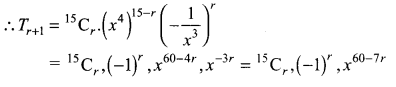
Rhizome:

  1. Stem is horizontal underground
  2. Presence of lateral growing tips.

III. Short Answer Type Questions (3 Marks)

Question 1.
Morphological study is important in Taxonomy. Why?
Answer:
Morphological features are important in determining productivity of crops. Morphological characters indicate the specific habitats of living as well as the fossil plants and help to correlate the distribution in space and time of fossil plants. Morphological features are also significant for phylogeny.


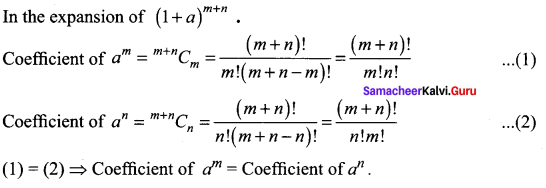
Question 2.
Differentiate between polycarpic and monocarpic perennial.
Answer:
Polycarpic perennial:

  1. When they bear fruits every year, they are called polycarpic.
  2. e.g. mango, sapota, etc.

Monocarpic perennial:

  1. Some plants produce flowers and fruits only once and die after a vegetative growth of several years. These plants are called monocarpic.
  2. e.g. Bamboo, Agave, Musa, Talipot palm.

Question 3.
List down the key difference between roots and shoots.
Answer:
Roots:

  1. Positively geotropic
  2. Negatively phototropic
  3. Non – green in colour
  4. Nodes, intemodes and buds are absent

Shoots:

  1. Negatively geotropic
  2. Positively phototropic
  3. Green in colour
  4. Nodes, intemodes and buds are present

Samacheer Kalvi 11th Bio Botany Solutions 3 Vegetative Morphology

Question 4.
Name the three distinct zones of root.
Answer:
The three distinct zones of root:

  1. Meristematic Zone
  2. Zone of Elongation
  3. Zone of Maturation

Question 5.
Draw a simplified diagram showing the various regions of root.
Answer:
The various regions of root:
Samacheer Kalvi 11th Bio Botany Solutions Chapter 3 Vegetative Morphology 12

Question 6.
Give a brief account on tap root system.
Answer:
Primary root is the direct prolongation of the radicle. When the primary root persists and continues to grow as in dicotyledons, it forms the main root of the plant and is called the tap root. Tap root produces lateral roots that further branches into finer roots. Lateral roots along with its branches together called as secondary roots.

Question 7.
How does the fibrous root system develops?
Answer:
Most of the monocots the primary root of the seedling is short lived and lateral roots arise from various regions of the plant body. These are bunch of thread – like roots equal in size which are collectively called fibrous root system generally found in grasses. Example: Oryza sativa.

Question 8.
Briefly explain the development process of leaf primordium.
Answer:
The plumule of the embryo of a germinating seed grows into stem. The epicotyl elongates after embryo growth into the axis (the stem) that bears leaves from its tip, which contain the actively dividing cells of the shoot called apical meristem. Further cell divisions and growth result in the formation of mass of tissue called a leaf primordium.

Question 9.
Name the three types of Adventitious buds.
Answer:
The three types of Adventitious buds:

  1. Radical buds
  2. Foliar buds
  3. Cauline buds

Question 10.
Write a brief note on Bulbils.
Answer:
Bulbils (or specialized buds): Bulbils are modified and enlarged bud, meant for propagation. When bulbils detach from parent plant and fall on the ground, they germinate into new plants and serve as a means of vegetative propagation, e.g., Agave.

Question 11.
Distinguish between root climbers and stem climbers.
Answer:
Root climbers:

  1. Plants climbing with the help of adventitious roots (arise from nodes).
  2. e.g. Piper betel, Piper nigrum, Hedera helix, Pothos, Hoya.

Stem climbers:

  1. These climbers lack specialised structure for climbing and the stem itself coils around the support.
  2. e.g. Ipomoea, Convolvulus, Dolichos, Clitoria, Quisqualis.

Question 12.
Explain the three different types of trailers with an example.
Answer:
Types of Trailers:

  1. Prostrate (Procumbent): A stem that grows flat on the ground, e.g. Evolvulus alsinoides, Indigofera prostrata.
  2. Decumbent: A stem that grows flat but becomes erect during reproductive stage. e.g., Portulaca, Tridax, Lindenbergia.
  3. Diffuse: A trailing stem with spreading branches, e.g. Boerhaavia diffusa, Merremia tridentata.

Question 13.
Cladode is a stem modification. Comment on it.
Answer:
Cladode is a flattened or cylindrical stem similar to Phylloclade but with one or two inteENodes only. Their stem nature is evident by the fact that they bear buds, scales and flowers. e.g. Asparagus (cylindrical cladode), Ruscus (flattened Cladode).

Question 14.
Comment on Corm with an example.
Answer:
Corm is a succulent underground stem with an erect growing tip. The corm is surrounded by scale leaves and exhibit nodes and intemodes. e.g., Amorphophallus, Gladiolus, Colacasia, Crocus, Colchicum.

Question 15.
Differentiate between monopodial and sympodial branching.
Answer:
Monopodial branching:

  1. The terminal bud grows uninterrupted and produce several lateral branches. This type of growth is also known as monopodial branching.
  2. e.g. Polyalthia, Swietenia, Antiaris.

Sympodial branching:

  1. The terminal bud caese to grow after a period of growth and the further growth is taken care by successive or several lateral meristem or buds. This type of growth is also known as sympodial branching.
  2. e.g. Cycas.

Samacheer Kalvi 11th Bio Botany Solutions 3 Vegetative Morphology

Question 16.
Draw and label the parts of a leaf.
Answer:
The parts of a leaf:
Samacheer Kalvi 11th Bio Botany Solutions Chapter 3 Vegetative Morphology 15

Question 17.
Describe the pattern of leaf arrangement in mosaic leaf.
Answer:
In mosaic leaf, leaves tend to fit in with one another and adjust themselves in such a way that they may secure the maximum amount of sunlight with minimum amount of overlapping. The lower leaves have longer petioles and successive upper leaves possess decreasing length petioles, e.g., Acalypha, Begonia.

Question 18.
How the leaf hooks helps the Bignonia plant?
Answer:
In cat’s nail (Bignonia unguiscati) an elegant climber, the terminal leaflets become modified into three, very sharp, stiff and curved hooks, very much like the nails of a cat. These hooks cling to the bark of a tree and act as organs of support for climbing.

Question 19.
Which types of plants develop tendril? How does it helps the plant?
Answer:
In some plants Stem is very weak and hence they have some special organs for attachment to the support. So some leaves are partially or wholly modified into tendril. Tendril is a slender wiry coiled structure which helps in climbing the support.

Question 20.
Rosa species plants are not eaten by herbivores. Why?
Answer:
Rosa species plants develop Prickles. Prickles are small, sharp structure which are the outgrowths from epidermal cells of stem or leaf. It helps the plant in scrambling over other plants. It is also protective against herbivory.

Question 21.
Certain plants like Aloe and Agave can survive in extreme dry conditions. How ?
Answer:
Aloe and Agave are Xerophytes. They develop fleshy and swollen leaves. These succulent leaves store water, mucilage and food. They also resist desiccation.

Question 22.
Write a brief note on Phyllode.
Answer:
Phyllodes are flat, green – coloured leaf – like modifications of petioles or rachis. The leaflets or lamina of the leaf are highly reduced or caducous. The phyllodes perform photosynthesis and other functions of leaf.
Example: Acacia auriculiformis (Australian acacia), Parkinsonia.

Question 23.
Briefly describe the leaf modification in Nepenthes.
Answer:
The leaf becomes modified into a pitcher in Nepenthes. In Nepenthes the basal part of the leaf is laminar and the midrib continues as a coiled tendrillar structure. The apical part of the leaf as modified into a pitcher the mouth of the pitcher is closed by a lid which is the modification of leaf apex.

Question 24.
How the leaves of Utricularia helps in its nourishment?
Answer:
In bladderwort (Utricularia), a rootless free – floating, aquatic plant the leaf is very much segmented. Some of these segments are modified to form bladder – like structures, with a trap – door entrance that traps aquatic animalcules.

Question 25.
What do you understand by the term developmental heterophylly.
Answer:
In plants like Ficus heterophylla leaves vary from entire to variously lobed structures during different developmental stages. Young leaves are usually lobed or dissected and the mature leaves are entire. Such type is known as developmental heterophylly.

Question 26.
List out few secondary functions of stem.
Answer:
Foods storage, perennation, water storage, photosynthesis, buoyancy, protection and support.

Question 27.
Make a tabular column showing types of terrestrial plants and their environmental adaptation with examples.
Answer:
Types of terrestrial plants and their environmental adaptation with examples:
Samacheer Kalvi 11th Bio Botany Solutions Chapter 3 Vegetative Morphology 16

IV. Long Answer Type Questions (5 Marks)

Question 1.
Make a list of aquatic plants and their environmental adaptation with an example.
Answer:
Aquatic plants and their environmental adaptation with an example:
Samacheer Kalvi 11th Bio Botany Solutions Chapter 3 Vegetative Morphology 17

Question 2.
Compare the location, cellular types and the functions of different zones of root.
Answer:
The location, cellular types and the functions of different zones of root:
Samacheer Kalvi 11th Bio Botany Solutions Chapter 3 Vegetative Morphology 18

Question 3.
Draw a flow chart depicting the various types of root modification.
Answer:
The various types of root modification:
Samacheer Kalvi 11th Bio Botany Solutions Chapter 3 Vegetative Morphology 19

Question 4.
Describe the tap root modification for storage purpose with diagram.
Answer:
Tap root modification – Storage roots

  1. Conical Root – These are cone like, broad at the base and gradually tapering towards the apex. e.g. Daucus carota.
  2. Fusiform root – These roots are swollen in the middle and tapering towards both ends. e.g. Raphanus sativus
  3. Napiform root – It is very broad and suddenly tapers like a tail at the apex. e.g. Beta vulgaris
    Samacheer Kalvi 11th Bio Botany Solutions Chapter 3 Vegetative Morphology 20

Question 5.
Define bud. Explain the types of buds based on location.
Answer:
Buds are the growing points surrounded by protective scale leaves:

  1. Terminal bud or Apical bud: These buds are present at the apex of the main stem and at the tips of the branches.
  2. Lateral bud or Axillary bud: These buds occur in the axil of the leaves and develop into a branch or flower.
  3. Extra axillary bud: These buds are formed at nodes but outside the axil of the leaf as in Solanum americanum.
  4. Accessory bud: An extra bud on either side (collateral bud) or above (superposed bud or serial bud) the axillary bud. e.g: Citrus and Duranta.

Question 6.
Draw a flow chart illustrating stem modifications.
Answer:
A flow chart illustrating stem modifications:
Samacheer Kalvi 11th Bio Botany Solutions Chapter 3 Vegetative Morphology 21

Question 7.
List out the characteristics of leaf.
Answer:
The characteristics of leaf:

  • Leaf is a lateral appendage of the stem.
  • It is borne at the node of the stem.
  • It is exogenous in origin.
  • It has limited growth.
  • It does not possess apical bud.
  • It has three main parts namely, leaf base, petiole and lamina.
  • Lamina of the leaf is traversed by vascular strands, called veins.

Question 8.
Define phyllotaxy. Explain its types
Answer:
The mode of arrangement of leaves on the stem is known as phyllotaxy (Greek. Phyllon = leaf; taxis = arrangement). Phyllotaxy is to avoid over crowding of leaves and expose the leaves maximum to the sunlight for photosynthesis. The four main types of phyllotaxy are:

  1. Alternate
  2. Opposite
  3. Temate and
  4. Whorled.

1. Alternate phyllotaxy: In this type there is only one leaf per node and the leaves on the successive nodes are arranged alternate to each other. Spiral arrangement of leaves show vertical rows are called orthostichies. They are two types:

  • Alternate spiral: In which the leaves are arranged alternatively in a spiral manner. e.g. Hibiscus and Ficus.
  • Alternate distichous or Bifarious: In which the leaves are organized alternatively in two rows on either side of the stem, e.g. Monoon longifolium (Polyalthia longifolia).

2. Opposite phyllotaxy: In this type each node possess two leaves opposite to each other. They are organized in two different types:

  1. Opposite superposed: The pair of leaves arranged in succession are in the same direction, that is two opposite leaves at a node lie exactly above those at the lower node. e.g. Psidium (Guava), Eugenia jambolana (Jamun) and Quisqualis (Rangoon creeper).
  2. Opposite decussate: In this type of phyllotaxy one pair of leaves is placed at right angles to the next upper or lower pair of leaves, e.g., Calotropis, Zinnia and Ocimum

3. Ternate phyllotaxy: In this type there are three leaves attached at each node. e.g. Nerium.

4. Whorled (verticillate) type of phyllotaxy: In this type more than three leaves are present in a whorl at each node forming a circle or whorl, e.g. Allamanda and Alstonia scholaris.

Question 9.
Define ptyxis & explain its types.
Answer:
Rolling or folding of individual leaves is called ptyxis. There are seven types of ptyxis as follows:

  1. Reclinate – When the upper half of the leaf blade is bent upon the lower half as in loquat (Eriobotrya japonica).
  2. Conduplicate – When the leaf is folded lengthwise along the mid – rib, as in guava, sweet potato and camel’s foot tree (Bauhinia).
  3. Plicate or Plaited – When the leaf is repeatedly folded longitudinally along ribs in a zig – zag manner, as in Borassus flabellifer.
  4. Circinate – When the leaf is rolled from the apex towards the base like the tail of a dog, as in ferns.
  5. Convolute – When the leaf is rolled from one margin to the other, as in banana, aroids and Indian pennywort. Musa and members of Araceae.
  6. Involute – When the two margins are rolled on the upper surface of the leaf towards the mid – rib or the centre of the leaf, as in water lily, lotus, Sandwich Island Climber (Antigonon) and Plumbago.
  7. Crumpled – When the leaf is irregularly folded as in cabbage.

Question 10.
How the duration of leaf is determined? Classify leaves according to duration.
Answer:
Leaves may stay and function for few days to many years, largely determined by the adaptations to climatic conditions.

  • Cauducuous (Fagacious): Falling off soon after formation, e.g., Opuntia and Cissus quadrangularis.
  • Deciduous: Falling at the end of growing season so that the plant (tree or shrub) is leafless in winter / summer season, e.g., Maple, Plumeria, Launea and Erythrina.
  • Evergreen: Leaves persist throughout the year, falling regularly so that tree is never leafless. e.g., Mimusops and Calophyllum.
  • Marcescent: Leaves not falling but withering on the plant as in several members of Fagaceae.

V. Higher Order Thinking Skills (HOTs)

Question 1.
Roots are non – green coloured. Is there is any green coloured root? Explain.
Answer:
Yes, roots of certain epiphytic & climbing plants develop chlorophyll and turn green to perform the function of photosynthesis. Such a root is called photosynthetic root or assimilatory root. E.g., Tinospora.

Question 2.
Which part of ginger and onion are edible?
Answer:
The edible part of onion is stem covered by fleshy leaves (bulb). The edible part of ginger is underground stem (rhizome).

Question 3.
Name the body parts of the following plants which is modified for food storage.
Answer:
Plant:

  1. Carrot
  2. Colocasia
  3. Aloe

Modified part for food storage:

  1. Root
  2. Stem
  3. Leaves

Question 4.
Give two examples for angiospermic plants producing adventitious roots.
Answer:
Two examples for angiospermic plants producing adventitious roots:

  1. Buttress root of Bombax.
  2. Prop (Pillar) root of Ficus benghalensis.

Question 5.
Rhizome of ginger is like roots of other plants grown underground. Despite this fact ginger is a stem not a root – Justify.
Answer:
Rhizome of ginger is a underground stem not a root because, it possess nodes, internodes, scale leaves & buds, which are the characteristics of stem.

Question 6.
Vanda is an epiphyte. Epiphytes are the plants growing on branches of trees. They do not have direct contact with soil. How they obtain water for its photosynthetic activity?
Answer:
Epiphytic plants like Vanda develop special type of roots containing sponge – like tissue called velamen. These spongy tissue helps in absorbing the atmospheric moisture and utilize it for their photosynthetic activity.

Question 7.
How does a pneumatopore work?
Answer:
Pneumatopores are the special above-ground roots growing above the surface of water seen in plants growing in water logged soils. These pneumatopores has small pores that facilitate the intake of oxygen by roots.

Question 8.
Carnivorous plants like Nepenthes have nutritional adaptations. Which part of Nepenthes plant is modified to solve this problem?
Answer:
The apical part of the leaf is modified into pitcher and the leaf tip is modified into lid of pitcher.

Question 9.
Why do we use the term ‘monocarpic perennial’ for Musa?
Answer:
Musa is a monocarpic perennial because it grows for several years but produces flowers and fruits once in its life time.

Question 10.
Mention any two morphological characters to differentiate monocots from dicots.
Answer:
Two morphological characters to differentiate monocots from dicots:

  1. Monocots have fibrous roots and dicots have tap root system.
  2. Monocot leaves show parallel venation, whereas dicot leaves show reticulate venation.

Question 11.
Why potato tuber is considered as a stem? Although it is an underground plant part.
Answer:
Though potato tuber is found underground, it is a stem since it possess axillary buds & scale leaves.

Question 12.
Fibrous roots are adventitious in origin – Explain.
Answer:
Adventitious roots are those arising from plant parts other than radicle. Fibrous roots are seen in monocots. In monocots, the primary root arising from radicle is short – lived & soon replaced by the lateral roots arising in bunches from the base of stem. Thus fibrous roots are adventitious in origin.

Believing that the Samacheer Kalvi 11th Biology Book Solutions Questions and Answers learning resource will definitely guide you at the time of preparation. For more details about Tamilnadu State 11th Bio Botany Chapter 3 Vegetative Morphology textbook solutions, ask us in the below comments and we’ll revert back to you asap.