Samacheer Kalvi 11th Maths Solutions Chapter 8 Vector Algebra – I Ex 8.2

You can Download Samacheer Kalvi 11th Maths Book Solutions Guide Pdf, Tamilnadu State Board help you to revise the complete Syllabus and score more marks in your examinations.

Tamilnadu Samacheer Kalvi 11th Maths Solutions Chapter 8 Vector Algebra – I Ex 8.2

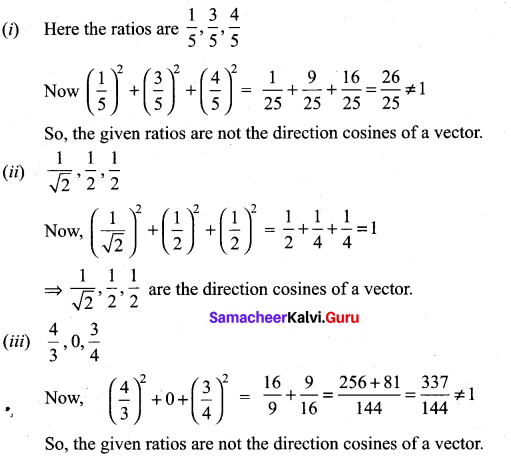
11th Maths Exercise 8.2 Question 1.
Verify whether the following ratios are direction cosines of some vector or not.

11th Maths Exercise 8.2 Solutions Chapter 8 Vector Algebra - I Samacheer Kalvi
Solution:
11th Maths Vector Algebra Solutions Chapter 8 Ex 8.2 Samacheer Kalvi

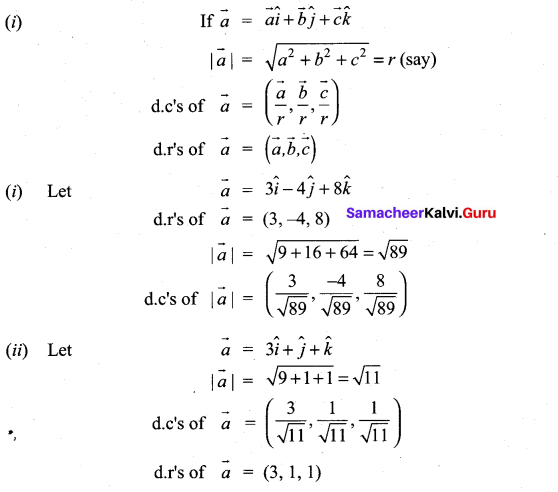
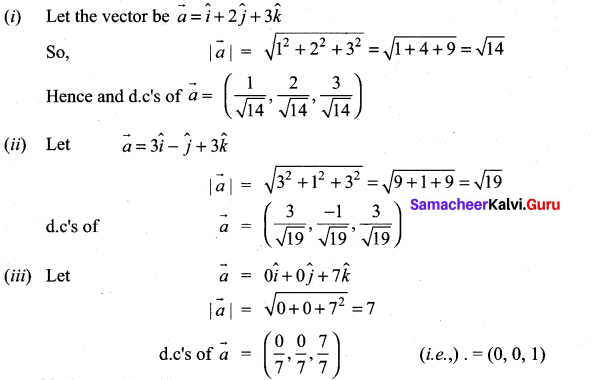
11th Maths Vector Algebra Solutions Question 2.
Find the direction cosines of a vectors whose direction ratios are
(i) 1, 2, 3
(ii) 3, -1, 3
(iii) 0, 0, 7
Solution:
11th Maths Exercise 8.2 Answers Solutions Chapter 8 Vector Algebra - I Samacheer Kalvi

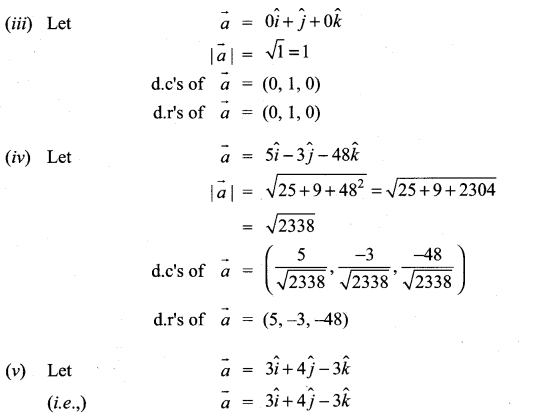
11th Maths Exercise 8.2 Answers Question 3.
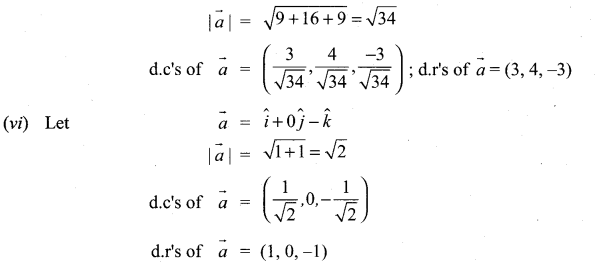
Find the direction cosines and direction ratios for the following vectors

11th Maths Vector Algebra Exercise 8.2 Chapter 8 Samacheer Kalvi
Solution:
11th Maths 8.2 Solutions Chapter 8 Vector Algebra Samacheer Kalvi
Class 11th Maths Exercise 8.2 Solution Chapter 8 Vector Algebra Samacheer Kalvi
Class 11 Maths Chapter 8 Exercise 8.2 Solutions Vector Algebra Samacheer Kalvi

11th Maths Vector Algebra Exercise 8.2 Question 4.
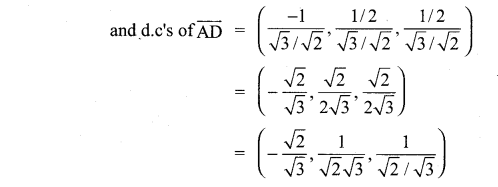
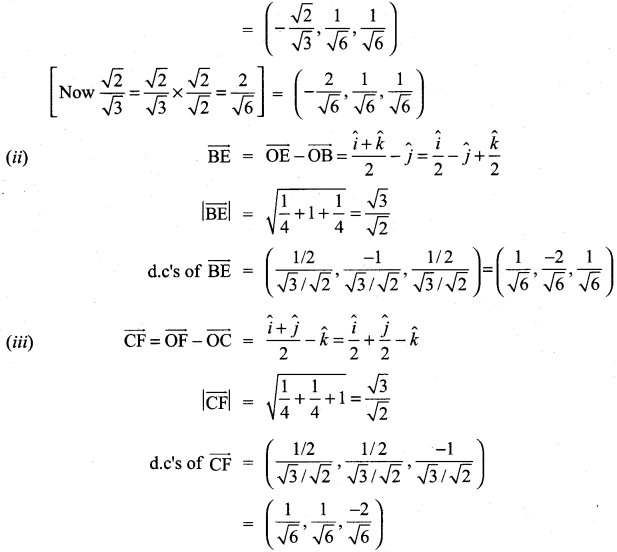
A triangle is formed by joining the points (1, 0, 0), (0, 1, 0) and (0, 0, 1). Find the direction cosines of the medians.
Solution:
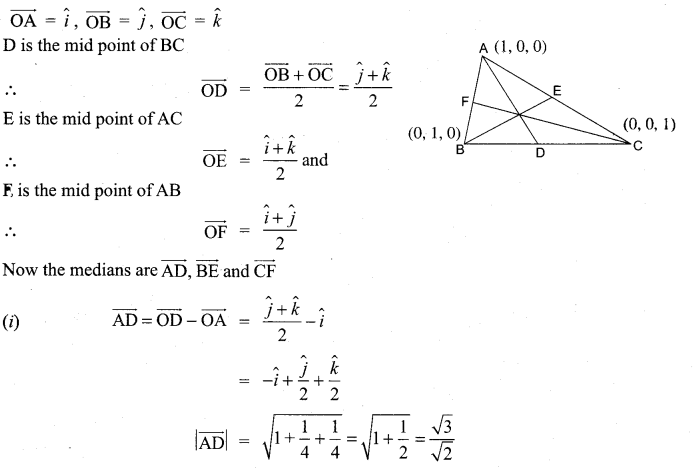
11th Maths Guide Solutions Chapter 8 Vector Algebra - I Ex 8.2 Samacheer Kalvi
Samacheer Guru 11th Maths Solutions Chapter 8 Vector Algebra - I Ex 8.2
11th Samacheer Maths Solutions Chapter 8 Vector Algebra - I Ex 8.2 Samacheer Kalvi

11th Maths 8.2 Question 5.
If \(\frac{1}{2}, \frac{1}{\sqrt{2}}\), a are the direction cosines of some vector, then find a.
Solution:
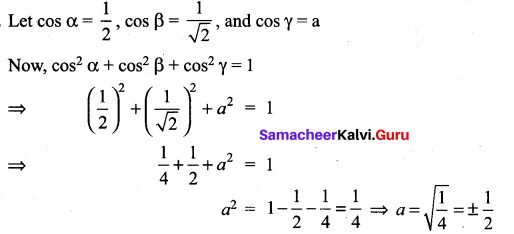
Samacheer Kalvi 11th Guide Maths Chapter 8 Vector Algebra - I Ex 8.2

Class 11th Maths Exercise 8.2 Solution Question 6.
If (a, a + b, a + b + c) is one set of direction ratios of the line joining (1, 0, 0) and (0, 1, 0), then find a set of values of a, b, c.
Solution:
Let A be the point (1, 0, 0) and B be the point (0, 1, 0) (i.e.,) \(\overrightarrow{\mathrm{OA}}=\hat{i}\) and \(\overrightarrow{\mathrm{OB}}=\hat{j}\)
Then \(\overrightarrow{\mathrm{AB}}=\overrightarrow{\mathrm{OB}}-\overrightarrow{\mathrm{OA}}=\hat{j}-\hat{i}=-\hat{i}+\hat{j}\)
= (-1, 1, 0)
= (a, a + b, a + b + c)
⇒ a = -1, a + b = 1 and a + b + c = 0
Now a = -1 ⇒ -1 + b = 1 ;a + b + c = 0
⇒ b = 2; -1 + 2 + c = 0 ⇒ c + 1 = 0
⇒ c = -1
∴ a = -1; b = 2; c = -1.
Note: If we taken \(\overrightarrow{\mathrm{BA}}\) then we get a = 1, b = -2 and c = 1.

Class 11 Maths Chapter 8 Exercise 8.2 Solutions Question 7.
Show that the vectors \(2 \hat{i}-\hat{j}+\hat{k}, 3 \hat{i}-4 \hat{j}-4 \hat{k}, \hat{i}-3 \hat{j}-5 \hat{k}\) form a right angled triangle.
Sol:
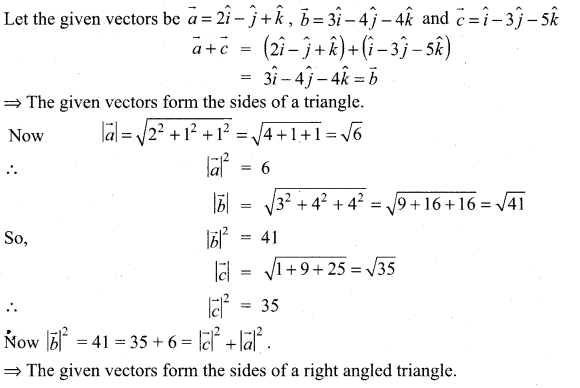
Samacheer Kalvi 11th Maths Solutions Chapter 8 Vector Algebra - I Ex 8.2
⇒ The given vectors form the sides of a right angled triangle.

11th Maths Guide Question 8.
Find the value of k for which the vectors \(\vec{a}=3 \hat{i}+2 \hat{j}+9 \hat{k}\) and \(\vec{b}=\hat{i}+\lambda \hat{j}+3 \hat{k}\) are parallel.
Solution:
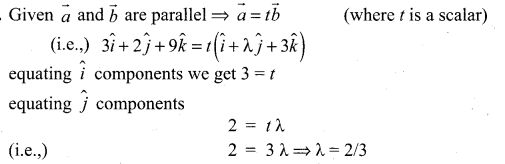
11 Samacheer Maths Solutions Chapter 8 Vector Algebra - I Ex 8.2

Samacheer Guru 11th Maths Question 9.
Show that the following vectors are coplanar.
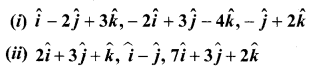
Ex 8.2 Class 11 Maths Solutions Chapter 8 Vector Algebra Samacheer Kalvi
Solution:
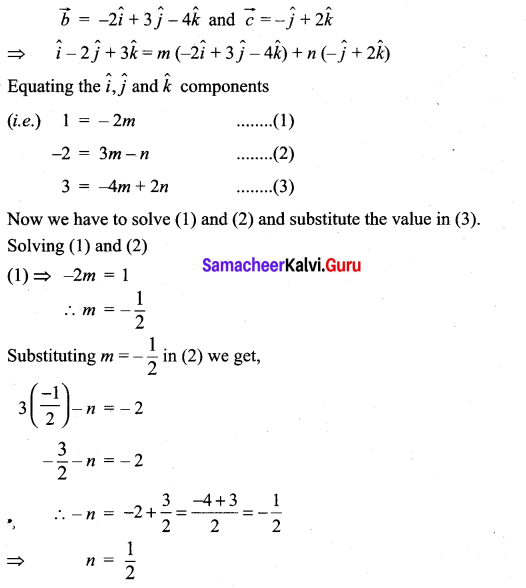
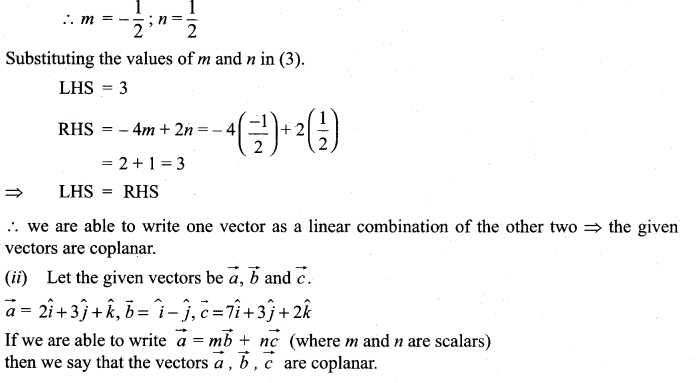
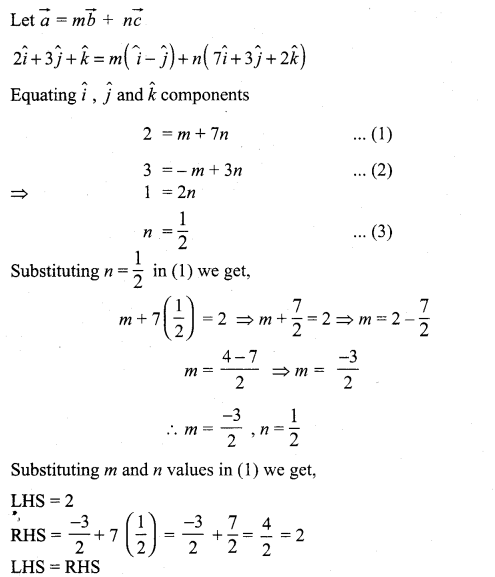
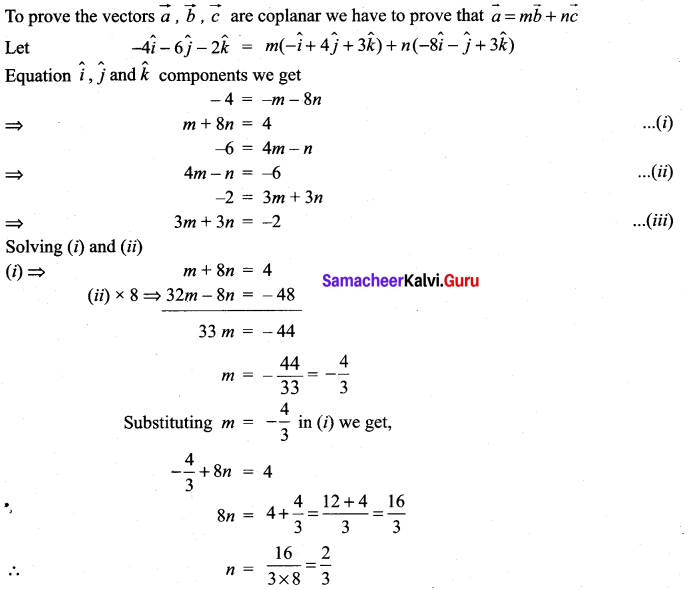
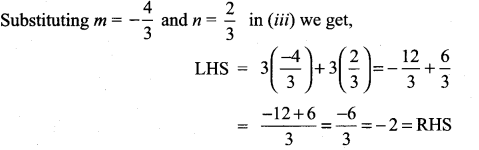
Let the given three vectors be \(\vec{a}\), \(\vec{b}\) and \(\vec{c}\). When we are able to write one vector as a linear combination of the other two vectors, then the given vectors are called coplanar vectors.
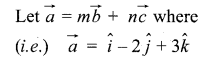
11th Maths 8th Chapter Solutions Vector Algebra - I Ex 8.2 Samacheer Kalvi
Samacheer Kalvi Maths Guide 11th Solutions Chapter 8 Vector Algebra - I Ex 8.2
Samacheer Kalvi.Guru 11th Maths Solutions Chapter 8 Vector Algebra - I Ex 8.2
Maths Guide 11th Solutions Chapter 8 Vector Algebra - I Ex 8.2 Samacheer Kalvi
We are able to write \(\vec{a}\) as a linear combination of \(\vec{b}\) and \(\vec{c}\)
∴ The vectors \(\vec{a}\), \(\vec{b}\), \(\vec{c}\) are coplanar

11th Samacheer Maths Solutions Question 10.
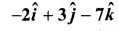
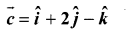
Show that the points whose position vectors Maths Solutions Class 11 Samacheer Kalvi Chapter 8 Vector Algebra - I Ex 8.2 and Samacheer Kalvi 11th Maths Solution Book Chapter 8 Vector Algebra - I Ex 8.2 are coplanar

Solution:
Let the given points be A, B, C and D. To prove that the points A, B, C, D are coplanar, we have to prove that the vectors \(\overrightarrow{\mathrm{AB}}, \overrightarrow{\mathrm{AC}}\) and \(\overrightarrow{\mathrm{AC}}\) are coplanar
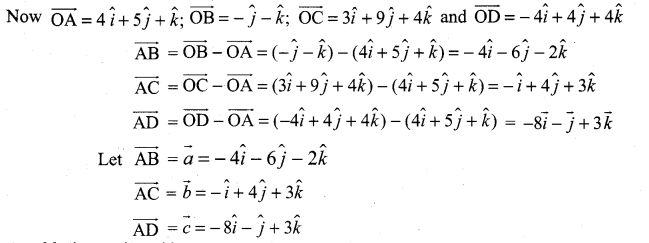
Samacheer Kalvi 11th Maths Solutions Chapter 8 Vector Algebra - I Ex 8.2 20
Samacheer Kalvi 11th Maths Solutions Chapter 8 Vector Algebra - I Ex 8.2 21
Samacheer Kalvi 11th Maths Solutions Chapter 8 Vector Algebra - I Ex 8.2 22
∴ we are able to write one vector as a linear combination of the other two vectors ⇒ the given vectors \(\vec{a}\), \(\vec{b}\), \(\vec{c}\) are coplanar.
(i.e.,) the given points A, B, C, D are coplanar.

Samacheer Kalvi 11th Guide Maths Question 11.
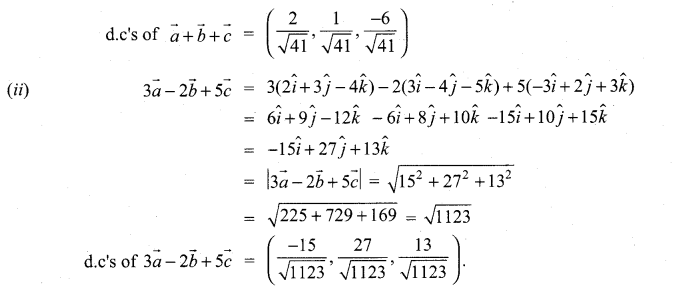
If \(\vec{a}=2 \hat{i}+3 \hat{j}-4 \hat{k}\), \(\vec{b}=3 \hat{i}-4 \hat{j}-5 \hat{k}\) and \(\vec{c}=-3 \hat{i}+2 \hat{j}+3 \hat{k}\), find the magnitude and direction cosines of
(i) \(\vec{a}+\vec{b}+\vec{c}\)
(ii) \(3 \vec{a}-2 \vec{b}+5 \vec{c}\)
Solution:

Samacheer Kalvi 11th Maths Solutions Chapter 8 Vector Algebra - I Ex 8.2 23
Samacheer Kalvi 11th Maths Solutions Chapter 8 Vector Algebra - I Ex 8.2 24>

Samacheer Kalvi 11th Maths Question 12.
The position vectors of the vertices of a triangle are Samacheer Kalvi 11th Maths Solutions Chapter 8 Vector Algebra - I Ex 8.2 25 and Samacheer Kalvi 11th Maths Solutions Chapter 8 Vector Algebra - I Ex 8.2 26. Find the perimeter of the triangle

Solution:
Let A, B, C be the vertices of the triangle ABC,
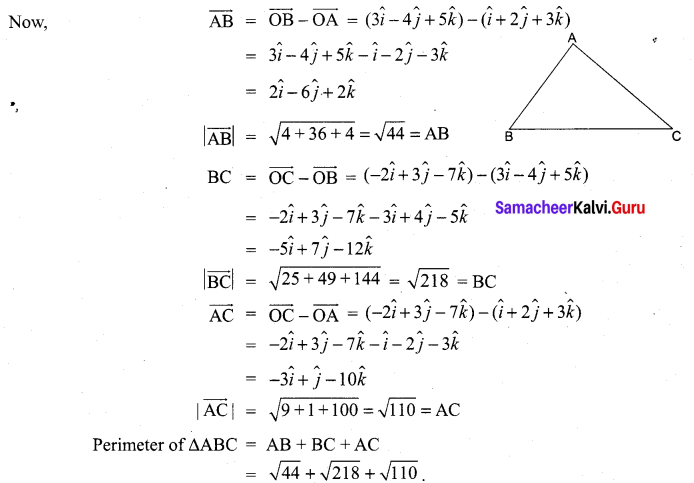
Samacheer Kalvi 11th Maths Solutions Chapter 8 Vector Algebra - I Ex 8.2 27

11 Samacheer Maths Solutions Question 13.
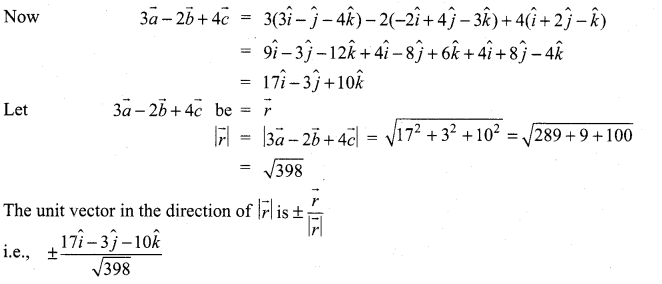
Find the unit vector parallel to Samacheer Kalvi 11th Maths Solutions Chapter 8 Vector Algebra - I Ex 8.2 28 and Samacheer Kalvi 11th Maths Solutions Chapter 8 Vector Algebra - I Ex 8.2 29

Solution:
Samacheer Kalvi 11th Maths Solutions Chapter 8 Vector Algebra - I Ex 8.2 30
Samacheer Kalvi 11th Maths Solutions Chapter 8 Vector Algebra - I Ex 8.2 31

12th Maths Exercise 8.2 Samacheer Kalvi Question 14.
The position vector \(\vec{a}\), \(\vec{b}\), \(\vec{c}\) three points satisfy the relation \(2 \vec{a}-7 \vec{b}+5 \vec{c}=\overrightarrow{0}\). Are these points collinear?
Solution:
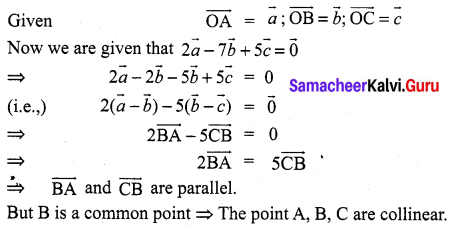
Samacheer Kalvi 11th Maths Solutions Chapter 8 Vector Algebra - I Ex 8.2 32

10th Maths Exercise 8.2 Samacheer Kalvi Question 15.
The position vectors of the point P, Q, R, S are Samacheer Kalvi 11th Maths Solutions Chapter 8 Vector Algebra - I Ex 8.2 33 and Samacheer Kalvi 11th Maths Solutions Chapter 8 Vector Algebra - I Ex 8.2 34 respectively. Prove that the line PQ and RS are parallel.

Solution:
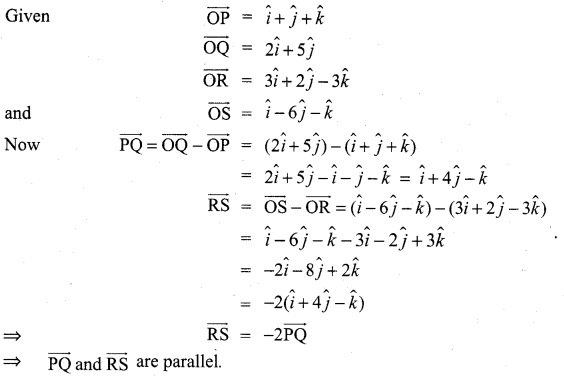
Samacheer Kalvi 11th Maths Solutions Chapter 8 Vector Algebra - I Ex 8.2 35

Ex 8.2 Class 11 Question 16.
Find the value or values of m for which \(m(\hat{i}+\hat{j}+\hat{k})\) is a unit vector
Solution:
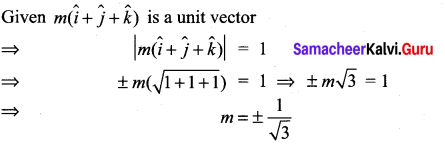
Samacheer Kalvi 11th Maths Solutions Chapter 8 Vector Algebra - I Ex 8.2 36

11th Maths 8th Chapter Question 17.
Show that the points A(1, 1, 1), B(1, 2, 3) and C(2, -1, 1) are vertices of an isosceles triangle.
Solution:
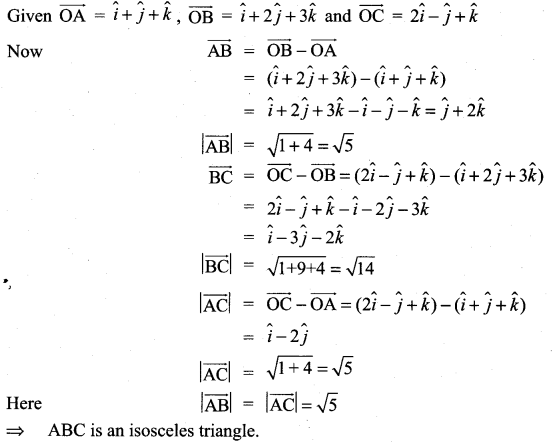
Samacheer Kalvi 11th Maths Solutions Chapter 8 Vector Algebra - I Ex 8.2 37

Samacheer Kalvi 11th Maths Solutions Chapter 8 Vector Algebra – I Ex 8.2 Additional Problems

Samacheer Kalvi Maths Guide 11th Question 1.
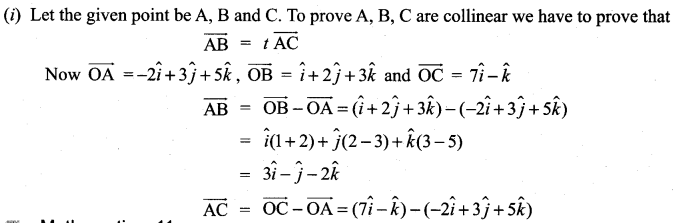
Show that the points whose position vectors given by

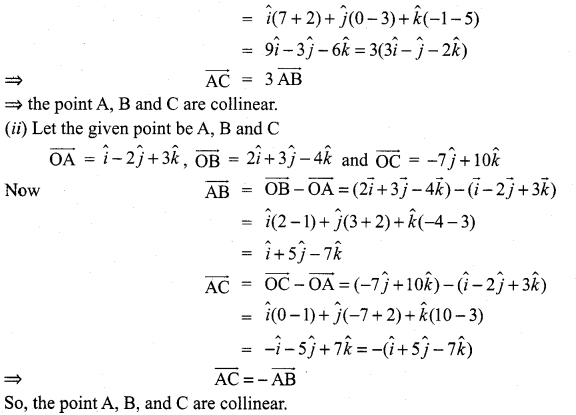
Samacheer Kalvi 11th Maths Solutions Chapter 8 Vector Algebra - I Ex 8.2 38
Samacheer Kalvi 11th Maths Solutions Chapter 8 Vector Algebra - I Ex 8.2 39
Solution:
Samacheer Kalvi 11th Maths Solutions Chapter 8 Vector Algebra - I Ex 8.2 40
Samacheer Kalvi 11th Maths Solutions Chapter 8 Vector Algebra - I Ex 8.2 41

Samacheer Kalvi.Guru 11th Maths Question 2.
Find the unit vectors parallel to the sum of \(3 \hat{i}-5 \hat{j}+8 \hat{k}\) and \(-2 \hat{j}-2 \hat{k}\)
Solution:
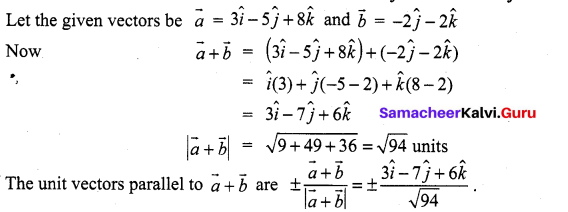
Samacheer Kalvi 11th Maths Solutions Chapter 8 Vector Algebra - I Ex 8.2 42

Maths Guide 11th Question 3.
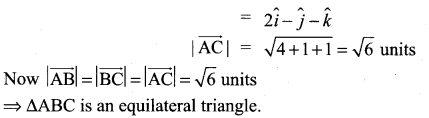
The vertices of a triangle have position vectors Samacheer Kalvi 11th Maths Solutions Chapter 8 Vector Algebra - I Ex 8.2 43 Prove that the triangle is equilateral.

Solution:
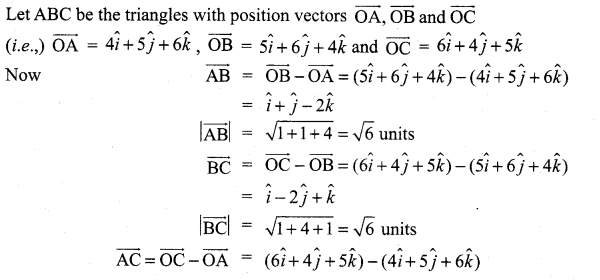
Samacheer Kalvi 11th Maths Solutions Chapter 8 Vector Algebra - I Ex 8.2 44
Samacheer Kalvi 11th Maths Solutions Chapter 8 Vector Algebra - I Ex 8.2 45

Maths Solutions Class 11 Samacheer Kalvi Question 4.
Prove that the points Samacheer Kalvi 11th Maths Solutions Chapter 8 Vector Algebra - I Ex 8.2 46 form an equilateral triangle.

Solution:
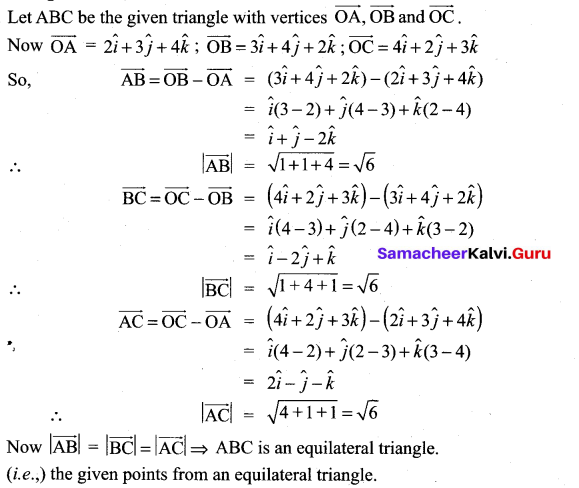
Samacheer Kalvi 11th Maths Solutions Chapter 8 Vector Algebra - I Ex 8.2 47

Samacheer Kalvi 11th Maths Solution Book Question 5.
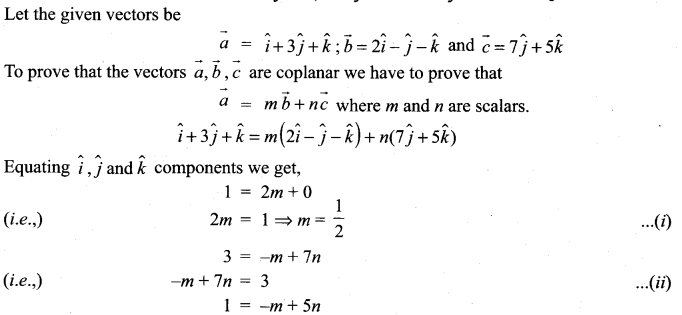
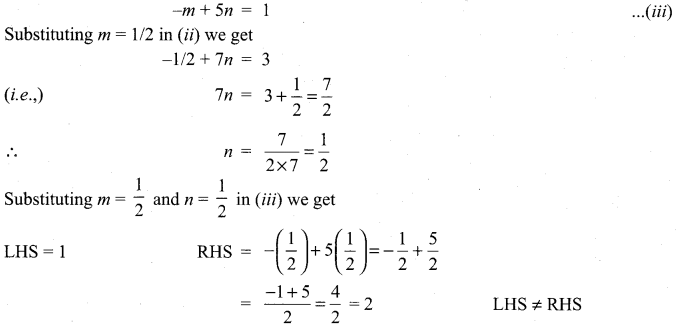
Examine whether the vectors Samacheer Kalvi 11th Maths Solutions Chapter 8 Vector Algebra - I Ex 8.2 48 are coplanar

Solution:
Samacheer Kalvi 11th Maths Solutions Chapter 8 Vector Algebra - I Ex 8.2 49
Samacheer Kalvi 11th Maths Solutions Chapter 8 Vector Algebra - I Ex 8.2 50
⇒ We are not able to write one vector as a linear combination of the other two vectors
⇒ the given vectors are not coplanar.
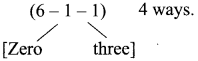
Samacheer Kalvi 11th Maths Solutions Chapter 4 Combinatorics and Mathematical Induction Ex 4.1

You can Download Samacheer Kalvi 11th Maths Book Solutions Guide Pdf, Tamilnadu State Board help you to revise the complete Syllabus and score more marks in your examinations.

Tamilnadu Samacheer Kalvi 11th Maths Solutions Chapter 4 Combinatorics and Mathematical Induction Ex 4.1

11th Maths Exercise 4.1 Question 1.

(i) A person went to a restaurant for dinner. In the menu card, the person saw 10 Indian and 7 Chinese food items. In how many ways the person can select either an Indian or a Chinese food?
Solution:
Selecting an Indian food item from the given 10 can be done in 10 ways. Selecting a Chinese food item from the given 7 can be done in 7 ways.
∴ Selecting an Indian or a Chinese food can be done in 10 + 7 = 17 ways.

(ii) There are 3 types of toy car and 2 types of toy train available in a shop. Find the number of ways a baby can buy a toy car and a toy train?
Solution:
Given, Number of toy cars = 3
Number of toy trains = 2
∴ A baby buying a toy car from 3 can be done in 3 ways
∴ A baby buying a toy train from 2 can be done in 2 ways
∴ Buying a toy car and a toy train together can be done in 3 × 2 = 6 ways

(iii) How many of two-digit numbers can be formed using 1, 2, 3, 4, 5 without repetition of digits?
Solution:
The given digits are 1, 2, 3, 4, 5
A two digit number has unit place and 10’s place. We are given 5 digits (1, 2, 3, 4, 5). The unit place can be filled (using the 5 digits) in 5 ways. After filling the unit place since repetition is not allowed one number (filled in the unit place) should be excluded. So the 10’s place can be filled (using the remaining 4 digits) in 4 ways
∴ Unit place and 10’s place together can be filled in 5 × 4 = 20 ways. So the number of two digit numbers = 20

(iv) Three persons enter in to a conference hall in which there are 10 seats. In how many ways they can take their places?
Solution:
Given, Number of the persons = 3 and Number of seats = 10
The first person can take his place (from 10 seats) in 10 ways
The second person can take his place (from the remaining 9 seats) in 9 ways
The third person can take his place (from the remaining 8 seats) in 8 ways
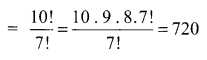
∴ The three persons together can take their places in 10 × 9 × 8 = 720 ways

(v) In how many ways 5 persons can be seated in a row?
Solution:
5 persons can be arranged among themselves in 5! ways
(i.e) 5 × 4 × 3 × 2 × 1 = 120 ways

11th Maths 4th Chapter Solutions Question 2.

(i) A mobile phone has a passcode of 6 distinct digits. What is the maximum number of attempts one makes to retrieve the passcode?
Solution:
Number of digits = 10
∴ Number of attempts made = 10 × 9 × 8 × 7 × 6 × 5 = 151200 ways

(ii) Given four flags of different colours, how many different signals can be generated if each signal requires the use three flags, One below the other?
Solution:
Number of flags given = 4
Number of flag needed (to show a signal) = 3
The first flag can be chosen in 4 ways (from the 4 flags)
The second flag can be chosen (from the remaining 3 flags) in 3 ways
The third flag can be chosen (from the remaining 2 flags) in 2 ways
So the first, second and the third flags together can be chosen in (to generate a signal) 4 × 3 × 2 = 24 ways
(i.e) 24 signals can be generated

11th Maths Exercise 4.1 In Tamil Question 3.
Four children are running a race.

(i) In how many ways can the first two places be filled?
Solution:
Number of children in the running race = 4
The first place can be filled in (from the 4 children) 4 ways
After filling in first place only 3 children are left out
So the second place can be filled in (from the remaining 3 children) 3 ways
So the first and the second places together can be filled in 4 × 3 = 12 ways

(ii) In how many different ways could they finish the race?
Solution:
The first and second places can be filled in 12 ways
The third place can be filled (from the remaining 2 children) in 2 ways and the fourth place can be filled in 1 way
So the race can be finished in 12 × 2 × 1 = 24 ways

11th Maths Exercise 4.1 Solutions Question 4.
Count the number of three-digit numbers which can be formed from the digits 2, 4, 6, 8? if.

(i) repetitions of digits is allowed
Solution:
Number of digit given = 4 (2,4, 6, 8)
So the unit place can be filled in 4 ways, 10’s place can be filled in 4 ways and 100’s place can be filled in 4 ways
∴ The unit place, 10’s place and 100’s place together can be filled (i.e) So the Number of 3 digit numbers = 4 × 4 × 4 = 64 ways

(ii) repetitions of digits is not allowed.
Solution:
The unit place can be filled (using the 4 digits) in 4 ways after filling the unit place since repetition of digits is not allowed that digit should be excluded.
So the 10’s place can be filled in (4 – 1) 3 ways and the 100’s place can be filled in (3 – 1) 2 ways
So the unit place, 10’s and 100’s places together can be filled in 4 × 3 × 2 = 24 ways
(i.e) The number of 3 digit numbers = 4 × 3 × 2 = 24 ways

11th Maths Exercise 4.1 Solution Question 5.
How many three-digit numbers are there with 3 in the unit place?

(i) with repetition
Solution:
with repetition
The unit place is filled (by 3) in 1 way
The 10’s place can be filled in 10 ways
The 100’s place can be filled in 9 ways (excluding 0)
So the number of 3 digit numbers with 3 unit – place = 9 × 10 × 1 = 90

(ii) without repetition
Solution:
The digits are 0, 1,2, 3, 4, 5, 6, 7, 8, 9
A three digit number has 3 digits l’s, 10’s and 100’s place.
The unit place is (filled by 3) filled in one way.
After filling the unit place since the digit ‘0’ is there, we have to fill the 100’s place. Now to fill the 100’s place we have 8 digits (excluding 0 and 3) So 100’s place can be filled in 8 ways.
Now to fill the 10’s place we have again 8 digits (excluding 3 and any one of the number) So 10’s place can be filled in 8 ways.
∴ Number of 3 digit numbers with ‘3’ in unit place = 8 × 8 × 1 = 64

Combinatorics And Mathematical Induction Question 6.
How many numbers are there between 100 and 500 with the digits 0, 1, 2, 3, 4, 5 if

(i) repetition of digits allowed
Solution:
repetition of digits allowed
The given digits are 0, 1, 2, 3, 4, 5
We have to find numbers between 100 and 500. So the 100’s place can be filled (by the numbers 1, 2, 3, 4) in 4 ways.
The 10’s place can be filled in (using 0, 1, 2, 3, 4, 5) 6 ways
and the unit-place can be filled in (using 0,1, 2, 3, 4, 5) 6 ways
But the number 100 should be excluded
So the number of numbers between 100 and 500 = 4 × 6 × 6 = 144

(ii) the repetition of digits is not allowed
Solution:
The 100’s place can be filled (by using 1, 2, 3, 4) 10’s in 4 ways
The 10’s place can be filled in (6 – 1) 5 ways and the unit place can be filled in (5 – 1) 4 ways
So the number of 3 digit number 4 × 5 × 4 = 80

10th Maths Exercise 4.1 11th Sum Question 7.
How many three-digit odd numbers can be formed by using the digits 0, 1, 2, 3, 4, 5 if

(i) The repetition of digits is not allowed
Solution:
The repetition of digits is not allowed
The given digits are 0, 1, 2, 3, 4, 5. Here the odd number are 1, 3, 5.
So the unit place can be filled in 3 ways (using the 3 odd number)
After filling the unit place since 0 is a given digit be fill the 100’s place which can be
filled in
11th Maths Exercise 4.1 Solutions Chapter 4 Combinatorics And Mathematical Induction Samacheer Kalvi
Then the 10’s place can be filled in (6 – 2) 4 ways.
So the number of 3 digit odd numbers = 3 × 4 × 4 = 48

(ii) The repetition of digits is allowed
Solution:
The unit place can be filled in 3 ways. We are given 6 digits.
So 10’s place can be filled in 6 ways and the 100’s place can be filled in (6 – 1) (excluding zero) 5 ways
So the Number of 3 digit numbers = 3 × 6 × 5 = 90

11th Maths 4.1 Question 8.
Count the numbers between 999 and 10000 subject to the condition that there are

(i) no restriction
Solution:
no restriction
We have to find 4 digit numbers
The 1000’s place can be filled in 9 ways (excluding zero) and the 100’s, 10’s and unit places respectively can be filled in 10, 10, 10 ways (including zero)
So the number of numbers between 999 and 10000 = 9 × 10 × 10 × 10 = 9000

(ii) no digit is repeated
Solution:
Since 0 is given as a digit we have to start filling 1000’s place.
Now 1000’s place can be filled in 9 ways (excluding 0)
Then the 100’s place can be filled in 9 ways (excluding one digit and including 0)
10’s place can be filled in (9 – 1) 8 ways and unit place can be filled in (8 – 1) 7 ways So the number of 4 digit numbers are 9 × 9 × 8 × 7 = 4536 ways

(iii) at least one of the digits is repeated
Solution:
Required number of numbers = 9000 – 4536 = 4464 numbers

11th Maths Chapter 4 Exercise 4.1 Question 9.
How many three-digit numbers, which are divisible by 5, can be formed using the digits 0, 1, 2, 3, 4, 5 if

(i) The repetition of digits are not allowed?
Solution:
The repetition of digits are not allowed.
The given digits are 0, 1, 2, 3, 4, 5. A number will be divisible by 5 if the digit in the unit place is 0 or 5
So the unit place can be filled by 0 or 5

(a) When the unit place is 0 it is filled in 1 way
And so 10’s place can be filled in 5 ways (by using 1, 2, 3, 4, 5) and 100’s place can be filled in (5 – 1) 4 ways
So the number of 3 digit numbers with unit place 0 = 1 × 5 × 4 = 20

(b) When the unit place is 5 it is filled in 1 way
Since 0 is given as a digit to fill 100’s place 0 should be excluded
So 100’s place can be filled in (excluding 0 and 5) 4 ways and 10’s place can be filled in (excluding 5 and one digit and including 0) 4 ways So the number of 3 digit numbers with unit place 5 = 1 × 4 × 4 = 16
∴ Number of 3 digit numbers ÷ by 5 = 20 + 16 = 36

(ii) The repetition of digits are allowed.
Solution:
The digits are
0 1 2 3 4 5
To get a number divisible by 5 we should have the unit place as 5 or 0 So the unit place (using 0 or 5) can be filled in 2 ways.
The 10’s place can be filled (Using 0, 1, 2, 3, 4, 5) in 6 ways and the 100’s place (Using 1, 2, 3, 4, 5) can be filled in 5 ways.
So the number of 3 digit numbers ÷ by 5 (with repetition) = 2 × 6 × 5 = 60

Class 11 Maths Exercise 4.1 Solutions Question 10.
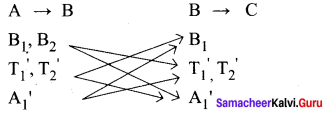
To travel from a place A to place B, there are two different bus routes B1, B2 two different train routes T1, T2 and one air route A1. From place B to place C there is one bus route say B1‘, two different train routes say T1‘, T2‘ and one air route A1‘. Find the number of routes of commuting from place A to place C via place B without using similar mode of transportation.
Solution:
11th Maths 4th Chapter Solutions Combinatorics And Mathematical Induction Samacheer Kalvi
From the above diagram the number of routes from A to C
= (2 × 2 + 2 × 1) + [(2 × 1) + (2 × 1)] + [(1 × 1) + (1 × 2)]
= 4 + 2 + 2 + 2 + 1 + 2 = 13

Class 11 Maths Chapter 4 Exercise 4.1 Solution Question 11.
How many numbers are there between 1 and 1000 (both inclusive) which are divisible neither by 2 nor by 5?
Solution:
From 1 to 1000, the numbers ÷ by 2 = 500
the number ÷ by 5 = 200
and the numbers ÷ by 10 = 100(5 × 2 = 10)
So number ÷ by 2 or 5 = 500 + 200 – 100 = 600
Total numbers from 1 to 1000 = 1000
So the number of numbers which are ÷ neither by 2 nor by 5 = 1000 – 600 = 400

11th Maths Chapter 4 Question 12.
How many strings can be formed using the letters of the word LOTUS if the word

(i) either starts with L or ends with S?
Solution:
either starts with L or ends with S?
To find the number of words starting with L
Number of letters in LOTUS = 5 when the first letter is L it can be filled in 1 way only. So the remaining 4 letters can be arranged in 4! =24 ways = n(A). When the last letter is S it can be filled in the 1 way and the remaining 4 letters can be arranged is 4! = 24 ways = n(B)
Samacheer Kalvi 11th Maths Solutions Chapter 4 Combinatorics and Mathematical Induction Ex 4.1 60
(1) (1) 3! = 6 = n(A ∩ B)
Now n(A ∪ B) = n(A) + n(B) – n(A ∩ B)
= 24 + 24 – 6 = 42
Now, neither words starts with L nor ends with S = 42

(ii) neither starts with L nor ends with S?
Solution:
Number of letters of the word LOTUS = 5.
They can be arranged in 5 ! = 120 ways
Number of words starting with L and ending with S = 42
So the number of words neither starts with L nor ends with S = 120 – 42 = 78

Ex 4.1 Class 11 Pdf Question 13.
(i) Count the total number of ways of answering 6 objective type questions, each question having 4 choices.
Solution:
Count the total number of ways of answering 6 objective type questions, each question having 4 choices.
One question can be answered in 4 ways
Two questions can be answered in 4 × 4 = 42 ways
∴ Six questions can be answered in 46 ways

(ii) In how many ways 10 pigeons can be placed in 3 different pigeon holes ?
Solution:
First pigeons can be placed in pigeon hole in 3 ways (selecting 1 from 3 holes)
Second pigeons can be placed in pigeon hole in 3 ways Tenth pigeons can be placed in pigeon hole in 3 ways
So total number of ways in which all the number 10 place can be sent = 3 × 3 × 3 × 3 × 3 × 3 × 3 × 3 × 3 × 3 = 310 ways

(iii) Find the number of ways of distributing 12 distinct prizes to 10 students?
Solution:
To give the first prize we have to select, from the 10 students which can be done in 10 ways.
To give the second prize we have to select one from the 10 students which can be done is 10 ways.
To give the 12th prize we have to select one from 10 students which can be done in 10 ways.
So all the 12 prizes can be given in (10 × 10 × 10 …. 12 times) = 1012 ways.

Samacheerkalvi.Guru 11th Maths Question 14.
Find the value of

(i) 6!
Solution:
6! = 6 × 5 × 4 × 3 × 2 × 1 = 720

(ii) 4! + 5!
Solution:
4! + 5! = (4 × 3 × 2 × 1) + (5 × 4 × 3 × 2 × 1)
= 24 + 120 = 144

(iii) 3! – 2!
Solution:
3! – 2! = (3 × 2 × 1) – (2 × 1)
= 6 – 2 = 4

(iv) 3! × 4!
Solution:
3! × 4! = (3 × 2 × 1) × (4 × 3 × 2 × 1) = 6 × 24 = 144
12!

(v) \(\frac{12 !}{9 ! \times 3 !}\)
Solution:
11th Maths Exercise 4.1 In Tamil Solutions Chapter 4 Combinatorics And Mathematical Induction Samacheer Kalvi

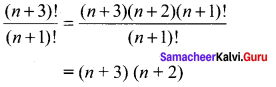
(vi) \(\frac{(n+3) !}{(n+1) !}\)
Solution:
11th Maths Exercise 4.1 Solutions Chapter 4 Combinatorics And Mathematical Induction Samacheer Kalvi

Exercise 4.1 Class 11 Question 15.
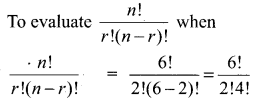
Evaluate \(\frac{n !}{r !(n-r) !}\) when

(i) n = 6,
r = 2
Solution:
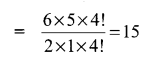
11th Maths Exercise 4.1 Solution Chapter 4 Combinatorics And Mathematical Induction Samacheer Kalvi
Combinatorics And Mathematical Induction Ex 4.1 Samacheer Kalvi 11th Maths Solutions Chapter 4

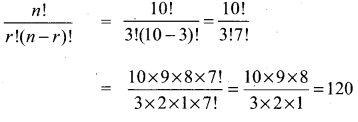
(ii) n = 10,
r = 3
Solution:
10th Maths Exercise 4.1 11th Sum Combinatorics And Mathematical Induction Samacheer Kalvi

(iii) For any n with r = 2
Solution:
11th Maths 4.1 Solutions Chapter 4 Combinatorics And Mathematical Induction Samacheer Kalvi

Chapter 4 Maths Class 11 Question 16.
Find the value of n if

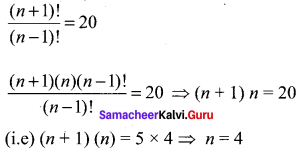
(i) (n + 1)! = 20(n – 1)!
Solution:
11th Maths Chapter 4 Exercise 4.1 Combinatorics And Mathematical Induction Samacheer Kalvi

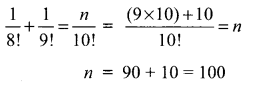
(ii) \(\frac{1}{8 !}+\frac{1}{9 !}=\frac{n}{10 !}\)
Solution:
Class 11 Maths Exercise 4.1 Solutions Chapter 4 Combinatorics And Mathematical Induction Samacheer Kalvi

Samacheer Kalvi 11th Maths Solutions Chapter 4 Combinatorics and Mathematical Induction Ex 4.1 Additional Questions Solved

Samacheer Kalvi 11th Maths Example Sums Question 1.
If the letter of the word ‘RACHIT’ are arranged in all possible ways as listed in dictionary, then what is the rank of the word ‘RACHIT’?
Solution:
The alphabetical order of RACHIT is A, C, H, I, R and T
Number of words beginning with A = 5!
Number of words beginning with C = 5!
Number of words beginning with H = 5!
Number of words beginning with 1 = 5!
and Number of words beginning with R (i.e) RACHIT = 1
∴ The rank of the word ’RACHIT’ in the dictionary = 5! + 5! + 5! + 5! + 1 = 4 × 5! + 1
= 4 × 5 . 4 . 3 . 2 . 1 + 1 = 4 × 120 + 1 = 480 + 1 = 481

Samacheer Kalvi Guru 11th Maths Question 2.
Find the number of positive integers greater than 6000 and less than 7000 which are divisible by 5, provided that no digit is to be repeated.
Solution:
Any number divisible by 5, its unit place must have 0 or 5. We have to find 4-digit number greater than 6000 and less than 7000.
So, the unit place can be filled with 2 ways (0 or 5) since, repetition is not allowed.
∴ Tens place can be filled with 7 ways and hundreds place can be filled with 8 ways.
But the required number is greater than 6000 and less than 7000. So, thousand place can be filled with 1 digits (i.e) 6.
Class 11 Maths Chapter 4 Exercise 4.1 Solution Combinatorics And Mathematical Induction Samacheer Kalvi
So, the total number of integers =1 × 8 × 7 × 2 = 112
Hence, the required number of integers = 112

Ex 4.1 Class 11 Question 3.
Find the number of integers greater than 7000 that can be formed with the digits 3, 5, 7, 8 and 9 where no digits are repeated.
Solution:
Given that all the 5 digit numbers are greater than 7000.
So, the ways of forming 5-digit numbers = 5 × 4 × 3 × 2 × 1 = 120
Now, all the four digit number greater than 7000 can be formed as follows.
Thousand place can be filled with 3 ways
Hundred place can be filled with 4 ways
Tenths place can be filled with 3 ways
Units place can be filled with 2 ways
So, the total number of 4-digits numbers = 3 × 4 × 3 × 2 = 72
∴ Total number of integers = 120 + 72 = 192
Hence, the required number of integers = 192

Ch 4 Maths Class 11 Question 4.
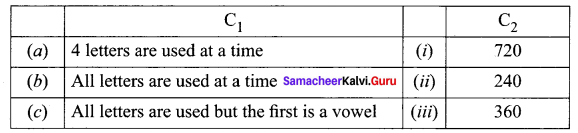
How many words (with or without dictionary meaning) can be made from the letters of the word MONDAY, assuming that no letter is repeated, if
11th Maths Chapter 4 Solutions Samacheer Kalvi Combinatorics And Mathematical Induction Ex 4.1
Solution:
Samacheer Kalvi 11th Maths Solutions Chapter 4 Combinatorics and Mathematical Induction Ex 4.1 61
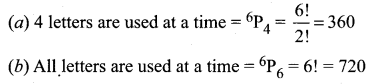
(c) All letters are used but the first is a vowel = 2 × 5! = 2 × 120 = 240
Hence, the required matching is
(a) ↔ (iii), (b) ↔ (i), (c) ↔ (ii)

Chapter 4 Class 11 Maths Question 5.
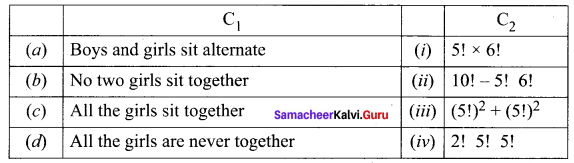
Five boys and 5 girls form a line. Find the number of ways of making the seating arrangement under the following condition.
Ex 4.1 Class 11 Pdf Maths Solutions Chapter 4 Combinatorics And Mathematical Induction Samacheer Kalvi
Solution:
(a) Total number of arrangement when boys and girls alternate : = (5!)2 + (5!)2
(b) No two girls sit together = 5! 6!
(c) All the girls sit together = 2! 5! 5!
(d) All the girls sit never together = 10! – 5! 6!
Hence, the required matching is (a) ↔ (iii), (b) ↔ (i), (c) ↔ (iv), (d) ↔ (ii)

Class 11 Chapter 4 Maths Question 6.
How many automobile license plates can be made, if each plate contains two different letters followed by three different digits?
Solution:
We have 26 English alphabet and 10 digits (0 to 9)
Since, it is given that each plate contains 2 different letters followed by 3 different digits.
∴ Number of arrangement of 26 letter taken 2 at a time
Samacheerkalvi.Guru 11th Maths Solutions Chapter 4 Combinatorics And Mathematical Induction Ex 4.1
Three digit number can be formed out of 10 digit = 10P3
Exercise 4.1 Class 11 Maths Solutions Chapter 4 Combinatorics And Mathematical Induction Samacheer Kalvi
Total number of license plates = 650 × 720 = 468000
Hence, the required number of plates = 468000.

Samacheer Kalvi 11th English Solutions Poem Chapter 4 Macavity – The Mystery Cat

Students who are interested in learning of 11th English Poem Chapter 4 Macavity – The Mystery Cat Questions and Answers can use Tamilnadu State Board Solutions of 11th English Chapter Wise Pdf. First check in which chapter you are lagging and then Download Samacheer Kalvi 11th English Book Solutions Questions and Answers Summary, Activity, Notes Chapter Wise. Students can build self confidence by solving the solutions with the help of Tamilnadu State Board English Solutions. English is the scoring subject if you improve your grammar skills. Because most of the students will lose marks by writing grammar mistakes. So, we suggest you to Download Tamilnadu State Board 11th English Solutions according to the chapters.

Tamilnadu Samacheer Kalvi 11th English Solutions Poem Chapter 4 Macavity – The Mystery Cat

Check out the topics covered in Poem Chapter 4 Macavity – The Mystery Cat Questions and Answers before you start your preparation. Improve your grammar skills with the help of Samacheer Kalvi 11th English Book Solutions Questions and Answers pdf links. The solutions for Tamilnadu State Board 11th English Textbook are prepared by the English experts. So, if you follow Tamilnadu State Board Solutions 11th English Textbook Solutions you can cover all the topics in Poem Chapter 4 Macavity – The Mystery Cat Questons and Answers. This helps to improve your communication skills.

11th English Guide Warm Up

A. French proverb goes thus: ‘The dog may be wonderful prose, but only the cat is poetry.’ You may have observed that all animals possess a number of unique qualities. Fill in the columns with words and phrases associated with each of the following animals.

DOGCATWOLFELEPHANT

Answer:

DOGCATWOLFELEPHANT
Barksmeowshowlstrumpets
open fightstealthygroupsgroups
aggressivepretends to be gentleroughgentle
faithfulungratefulwildcivilized
fights for foodquickly steals foodpredatorygraceful

B. People admire some of these animal qualities. What are they? Have you noticed some of them in yourself or in others? Share your views with the class.

Cats are stealthy and walk without making noise.
My friend Vimal / Mala is cat-like. He / She surprises me often appearing suddenly. Jackal is clever and persuades others like Ratna / Raja to work for him. Whenever a difficult assignment is given, he / she praises the gifted student and gets his/ her work done. Elephant is graceful and known for strong memory. Murugan / Neela is very gentle and has terrific memory. One must be very cautious with such persons. Even a small hurt will be in their memory for long.

Samacheer Kalvi 11th English Macavity – The Mystery Cat Textual Questions

A. Based on your understanding of the poem, answer the following question in a sentence or two.

Macavity’s a Mystery Cat: he’s called the Hidden Paw
For he’s the master criminal who can defy the Law.
He’s the bafflement of Scotland Yard, the Flying Squad’s despair:
For when they reach the scene of crime – Macavity’s not there!

Macavity, Macavity, there’s no one like Macavity,
He’s broken every human law, he breaks the law of gravity.
His powers of levitation would make a fakir stare,
And when you reach the scene of crime – Macavity’s not there!

You may seek him in the basement, you may look up in the air
But I tell you once and once again, Macavity’s not there!
Macavity’s a ginger cat, he’s very tall and thin;
You would know him if you saw him, for his eyes are sunken in.

His brow is deeply lined with thought, his head is highly domed;
His coat is dusty from neglect, his whiskers are uncombed.
He sways his head from side to side, with movements like a snake;
And when you think he’s half asleep, he’s always wide awake.

Macavity, Macavity, there’s no one like Macavity,
For he’s a fiend in feline shape, a monster of depravity.
You may meet him in a by-street, you may see him in the square
But when a crime’s discovered, then Macavity’s not there!

11th English Guide Solutions Poem Chapter 4 Macavity - The Mystery Cat Samacheer Kalvi

He’s outwardly respectable. (They say he cheats at cards.)
And his footprints are not found in any file of Scotland Yard’s.
And when the larder’s looted, or the jewel-case is rifled,
Or when the milk is missing, or another Peke’s been stifled,

Or the greenhouse glass is broken, and the trellis past repair
Ay, there’s the wonder of the thing! Macavity’s not there!
And when the Foreign Office find a Treaty’s gone astray,
Or the Admiralty lose some plans and drawings by the way,

There may be a scrap of paper in the hall or on the stair
But it’s useless to investigate, Macavity’s not there!
And when the loss has been disclosed, the Secret Service say:
‘It must have been Macavity!’ but he’s a mile away.

You’ll be sure to find him resting, or a licking of his thumbs,
Or engaged in doing complicated long division sums.
Macavity, Macavity, there’s no one like Macavity,
There never was a Cat of such deceitfulness and suavity.

He always has an alibi, and one or two to spare:
At whatever time the deed took place, MACAVITY WASN’T THERE!
And they say that all the Cats whose wicked deeds are widely known,
(I might mention Mungojerrie, I might mention Griddlebone)

Are nothing more than agents for the Cat who all the time
Just controls their operations: the Napoleon of Crime

11th English Guide Pdf Download Question (i)
What is Macavity’s nickname?
Answer:
Macavity’s nickname is “ Hidden Paw”.

Macavity The Mystery Cat Book Back Answers Question (ii)
Why is the Flying Squad frustrated?
Answer:
The Flying squad is frustrated because every time they rush to the spot of crime to arrest Macavity, he is not there.

11 English Guide Question (iii)
Which law does Macavity break?
Answer”
Macavity breaks human law and also the law of gravity.

11th English Book Back Answers Question (iv)
What makes the fakir stare in wonder?
Answer:
Macavity’s power of levitation makes the fakir stare in wonder.

English Guide For Class 11 Question (v)
Describe Macavity’s appearance.
Answer:
Macavity is veiy tall and slim. His eyes are sunken. His brow is deeply lined. His head is highly domed. His coat is dusty and whiskers unkempt.

11th English Samacheer Guide Question (vi)
Where can you encounter Macavity?
Answer:
One may meet Macavity in a street or in the square. But he vanishes when a crime is committed.

11th Std English Book Answers Question (vii)
Why does the poet say Macavity is ‘out wardly’ respectable?
Answer:
The poet says that Macavity is respectable ‘out wardly’ because all his stealthy, criminal activities betray his vile nature.

11th Samacheer Kalvi English Book Back Answers Question (viii)
Why is Macavity called the ‘Napoleon of Crime’?
Answer:
He is agile and cautious. He is a monster of depravity

Samacheer Kalvi 11th English Book Question (ix)
Which two characters does the poet refer to as examples of wicked cats?
Answer:
Mungojerrie and Griddlebone are examples of wicked cats.

11 Std English Guide Pdf Question (x)
Mention any two qualities of Macavity.
Answer:
Similar to Napoleon he was a strategist and military leader. Macavity controlled the operations of all the wicked cats in London.

B. Read the poem once again and complete the summary using the words given in the box.

larderwhiskersrespectable
criminaldevilthought
sunkendivisionagents
detectivealibidesperate
fakirqualitiesgravity
greenhouse

Macavity – The Mystery Cat’ is a humorous poem, where the poet T.S. Eliot describes the mysterious

(a) ______ of a shrewd vile cat. He commits a crime at every possible opportunity.He is an elusive master (b) ______ who leaves no evidence after he commits a crime.Even the Scotland Yard, the London (c) ______ agency is unable to arrest him. The Flying Squad is (d) ______ because every time they rush to the crime spot to seize Macavity, he is not there. He breaks the human law as well as the law of (e) ______ He baffles even a (f) ______ with his powers of levitation. Macavity appears tall and thin with (g) ______ eyes. He is always preoccupied with some serious (h) ______ His coat is dusty and his (i) ______ are unkempt. Macavity is a (f) ______ in the guise of a cat. He appears to be outwardly (k) ______ but his actions disprove it. Macavity loots the (l) ______ , ransacks the jewel-case, and breaks the (m) ______ glass but wonder of wonders he is not to be found anywhere there. He is always a mile away from the scene of crime, happily relaxing or doing difficult (n) ______ sums. He is clever at making up an (o) ______ every time he plots a crime. All the notorious cats are nothing but the (p) ______ of Macavity, the Napoleon of Crime.
Answer:
(a) qualities
(b) criminal
(c) detective
(d) baffled
(e) gravity
(f) fakir
(g) sunken
(h) thought
(i) whiskers
(j) fiend
(k) respectable
(p) agents
(0) larder
(m) greenhouse
(n) division
(o) alibi

C. Read the poem and answer the following in a short paragraph of 8 to 10 sentences each.

English Guide 11th Pdf Question (i)
What are the mysterious ways in which Macavity acts?
Answer:
Macavity is an elusive master criminal who leaves no evidence after he commits a crime. He baffles Scotland Yard police and the flying squad as he disappears before their arrival to the scene of crime. He defies law of gravity and his powers of levitation make me fakir stare with wonder. Macavity loots the larder. He ransacks the jewel case. He is an elusive criminal who escapes from the spot of crime before the flying squad or Scotland Yard reach there. He breaks every human law and laws of gravity. He breaks greenhouse glasses. He steals stealthily into . the kitchen and empties milk. When an important treaty in the embassy is missing or. when the admiralty loses some plans or drawings, the investigation terms conclude that it is the work of Macavity. But Macavity, as a wonder of wonders, would be miles away relaxing somewhere.

Question (ii)
Give an account of Macavity’s destructive mischief.
Answer:
Macavity is a “Friend in feline shape”. He loots the food from the larder. Jewel case gets ransacked. Milk gets robbed. A pekinese dog is stifled. Greenhouse glass is broken. Important agreement in the embassy is tom and important drawings in the admiralty are lost. The investigation team may find a scrap of paper in the stairs but Macavity always makes good his escape after doing all the above destructive activities. Besides, he is the Napoleon of crime controlling the operations of all cats in London.

Question (iii)
Describe the appearance and qualities of Macavity.
Answer:
Macavity is tall and thin. His eyes are sunken in. His brow is deeply lined with thought. His head is highly domed. His coat is dusty and his whiskers unkempt. He makes movements like a snake. He is a friend in feline shape. He is a monster of depravity. He is a cat of deceitfulness and suavity. When one thinks he is half-asleep, he is wide awake. He is an elusive, agile and phantom-like cat.

D. Read the given lines and answer the questions that follow.

(i) Macavity’s a Mystery Cat: he’s called the Hidden Paw…

Question (a)
Does the poet talk about a real cat?
Answer:
No, the poet talks about an imaginary character.

Question (b)
Why is he called the Hidden Paw?
Answer:
He is called a “ Hidden paw “ because even Scotland Yard is unable to arrest him after he commits any crime. He does not leave his foot prints in the spot of crime.

(ii) He’s the bafflement of Scotland Yard, the Flying Squad’s despair: For when they reach
the scene of crime Macavity’s not there!..

Question (a)
What is ‘Scotland Yard’?
Answer:
Scotland Yard, is the world famous headquarters of London metropolitan police service known for quick investigation of crime and nabbing the criminal in record time.

Question (b)
Why does the flying squad feel disappointed?
Answer:
Flying squad reach the scene of crime very fast. But Macavity is not at all there. The flying squad is disappointed because they are unable to arrest the crafty criminal.

(iii) He sways his head from side to side, with movements like a snake;
And when you think he’s half asleep,he’s always wide awake…

Question (а)
Explain the comparison made here.
Answer:
The poet compares the movement of the cat to that of a snake. He employs a simile here.
The movement is quiet but swift.


Question (b)
What does he pretend to do?
Answer:
He pretends to be half asleep when he is fully awake. .

Question (c)
Identify the figure of speech in the first line.
Answer:
Simile.

(iv) For he’s a fiend in feline, shape, a monster of depravity.

Question (a)
How is the cat described in this line?
Answer:
Macavity is described as a “demon in the shape of a cat”.

Question (b)
Explain the phrase ‘monster of depravity’.
Answer:
Satan is called the master of depravity. T.S. Eliot calls Macavity, the master of depravity. He means that the cat is an embodiment of evil. He is wicked, all the time involved in doing something evil.

(v) And his footprints are not found in any file of Scotland Yard’s.

Question (а)
What seems to be a challenge for the Scotland Yard?
Answer:
Scotland Yard police, known for its efficiency to nab criminals in record time, is unable to link any crime to Macavity. He has an alibi when ever a crime is committed. Arresting Macavity with clinching evidence for his involvement in a crime is a challenge for Scotland Yard.

Question (b)
Why do they need his footprints?
Answer:
They need Macavity’s foot prints to prove the court of law that he was present in the scene of crime.

(iv) It must have been Macavity!’ but he’s a mile away.

Question (a)
What is Macavity blamed for?
Answer:
Macavity is blamed for most of the crimes which leave the Scotland police and flying squad fuming and fretting because he just vanishes after every crime is committed. Besides, he leaves no proof or evidence behind.

Question (b)
Where is he?
Answer:
He is in a by-street or in the square when a crime is discovered. He always has one or two alibi.

(vii) There never was a Cat of such deceitfulness and suavity.

Question (a)
Which cat is being talked of here?
Answer:
Macavity is being talked of here.

Question (b)
How is he different from the rest?
Answer:
Other cats are lazy and just stay in the kitchen and take the food offered by their master. But Macavity is agile and defies law of the land and laws of gravity.. Despite doing all wicked things, he pretends to be innocent. So the poet claims one can never come across such a cat of “Deceitfulness and suavity”

E. Explain the following lines with reference to the context.

Question (i)
His powers of levitation would make a fakir stare
Answer:
Reference: These words are from the poem “Macavity – the mystery cat” written by T.S. Eliot. Context: T.S Eliot says, these words describing the skills of Macavity – The mystery cat. Explanation: Macavity does all kinds of mischiefs, petty thefts. He breaks things also. But before anyone could link the crime to Macavity he makes good his escape, floating in the air, jumping from building to building. His powers of levitation baffles even a fakir who has mystical powers.
Comment: The truth behind levitation is well brought out.

Question (ii)
And when you think he’s half asleep, he’s always Wide awake
Answer:
Reference : There words are from the poem “ Macavity – the mystery cat” written by T.S. Eliot.
Context: The poet says these words about the ability of the mysterious cat to hoodwink everyone.
Explanation: Macavity is a master of deceitfulness and suavity. When he appears to “be half-asleep with his half-closed eyes, he would be wide-awake. He is an enigma to everyone. Comment: Macavity is indeed a mystery.

Question (iii)
And his footprints are not found in any file of Scotland Yard’s
Answer:
Reference: These words are. from the poem “ Macavity the mystery cat” written by T.S. Eliot. Context: The poet says these words about the clever escape Macavity makes after every crime is committed.
Explanation: Scotland yard police is known all over the world for its capacity to investigate crimes and nab criminals in record time. But many crimes happen in London. Before Scotland Yard or the flying squad could reach the spot of crime, the criminal vanishes without leaving
any trace of the evidence. Scotland yard police wants to nab him with evidence. But his foot prints are nowhere to be found. So, Scotland Yard is unable to arrest Macavity.
Comment: The mysterious moves of Macavity stuns even the Scotland Yard.


Question (iv)
There may be a scrap of paper in the hall or on the stair.
But it’s useless to investigate…
Answer:
Reference: There words are from the poem “Macavity- the mysterious cat” written by T.S. Eliot .
Context: The poet says these words while discussing the left over evidences of crime. Explanation: The Scotland yard police and the flying squads are guardians of peace in London. They keep watch. But whenever Macavity does a crime, he leaves before the police arrives. The clues like empty larder, rifled jewel case, disappearance of a treaty or drawings from the office or admiralty may lead to some shredded bits of paper lying on the floor or the staircase. But thsese bits of paper can’t help the police nab Macavity. They know it is the work of Macavity but they are helpless.
Comment: Not a trace is left behind by mysterious Macavity.

Question (v)
He always has an alibi, and one or two to spare
Answer:
Reference: These words are from the poem, “ Macavity – the mystery cat” written by T.S. Eliot.
Context: The poet says these words while describing the deceitful and clever nature of Macavity.
Explanation: Macavity breaks laws of the land regularly. But gets away before the long arm. of the law reaches the spot of crime. He always has an alibi (one or more to spare) to escape from being caught. This proves his cleverness.
Comment: The wit of Macavity needs high commendation.

Additional Questions

Question (vi)
Mecavity is a Mystery cat; he’s called the Hidden paw
Answer:
Reference: These words are from the poem, “Macavity – the mystery cat”.
Context: T.S. Eliot says these words while discussing the deceitfulness and the ability of the wicked cat to disappear room after a crime is committed.
Explanation: The poet describes the attributes of the mystery cat “ Macavity the cat is deceitful • and he baffles Scotland yard. The modus operandi of each unsolved crime points to Macavity only. But the lack of evidence like foot print prevents Scotland yard police from arresting him. Hence, he is called “The Hidden Law”.
Comment: Does Macavity truly have an unseen paw?

Question (vii)
Just controls their operation ; the Napoleon of Crime .
Answer:
Reference: These words are from the poem, “ Macavity – the mystery cat, written by T.S. Eliot.
Context: The poet says this about the daring acts of evil done by enigmatic villainous cat Macavity.
Explanation: Scotland yard police is unable to arrest Macavity as he leaves no evidence of crime he commits. He has many agents whose operations are controlled by him. Macavity is like military despot Napoleon, he guides all wicked cats in London unseen.
Comment: There is indeed no difference between Napoleon and Macavity.

F. Eliot has used many figures of speech to present the poem to the readers in an interesting way. He has attributed human qualities to a cat in this poem.

Question (i)
Identify the literary devices used in the following lines: .

Question (a)
He sways his head from side to side,with movements like a snake.
Answer:
simile


Question (b)
They say he cheats at cards.
Answer:
Personification

Additional:
(c) for he’s a friend in feline shape – Personification
(d) He’s outwardly respectable (they say he cheats at cards) – personification (The animal is attributed to human qualities)
(e) Just control their operations ; the Napoleon of Crime – Personification
(f) He always has an alibi and one or two to spare – Personification
(g) Or engaged in doing a complicated long division sums – Personification
(h) Are nothing more than agents for the Cat – Personification
(i) Just controls their operations the Napoleon or crime – metaphor

Question (ii)
Give four instances where the poet has used alliteration in the poem.
Answer:
milk, missing, larder’s, looted, sways, side to side, snake, break, broke – Alliteration

Question (iii)
What is the rhyme scheme used in the poem?
Answer:
Rhyme scheme of the poem is aa bb

(iv) Pick out all the pairs of rhyming words used in the poem.

Rhyming words in the poem
(a) Paw: Law
(b) despair: there
(c) Macavity: gravity
(d) stare: there
(e) air: there
(f) thin: in
(g) domed: uncombed
(h) snake: awake
(i) Macavity: depravity
(j) Square : their
(k) cards: yards
(l) rifled: stifled
(m) repair: there
(n) astray: way
(o) stair: there
(p) say: away
(q) thumbs : sums.
(r) Macavity: suavity
(s) spare: there
(t) known: bone
(u) time: crime

listening Activity

G. First, read the following sets of limericks with missing words. Now, listen to them being read out aloud by your teacher or played on the recorder. As you enjoy the absurd fun, complete the verse with what you hear. You may listen to them again, if required.
I
A wonderful bird is the (i) ______
His beak can hold more than his (ii) _______ can.
He can hold in his beak Enough food for a (iii) _______ !
But I’ll be darned if I know how the Peli-can?

II
There once was a (iv) _______ at the zoo
Who always had something to do
When it (iv) _______ him, you know,
To go to and fro.
He (v) _______ . it and went fro and to.

III
There once was a (vi) _______ little bunny
Who I thought was sweet and (vii) _______ .
He ate all the carrots,
And looked at the .(ix) _______
And that was my cute little (x) _______
Answers:
(i) pelican
(ii) belly
(iii) week
(iv) bear
(v) bored
(vi) reversed
(vii) cute
(viii) funny
(ix) Parrots
(x) bunny

Speaking Activity

H. Speaking Activity

Work with a partner. Read the following questions and share your views with the class. Have you heard of the phrase ‘cat’s paw’? The meaning is similar to that of ‘firing from the other’s shoulder’. ‘Cat’s paw’ refers to a person who is used unwittingly or unwillingly by another person to accomplish his own purpose.

Question (a)
This phrase originates from the fable ‘The Monkey and the Cat’. Explain how Macavity contradicts the phrase ‘cat’s paw’.
Answer:
Cat’s paw means being an incumbent in someone’s hand and do what the other person says. But Macavity is the master. He’s nicknamed the “hidden paw”. He is the Napoleon of crime controlling the operation of all the wicked cats in London. Macavity really contradicts “cat’s paw” absolutely.


Question (b)
‘When the mouse laughs at the cat, there is a hole nearby.’ Explain the meaning of this statement to your friends.
Answer:
Mouse knows the capacity of the cat to pounce on him and make a meal of him in just records. The mouse could dare to laugh at the cat when the scope of escape into the hole is bright.

Question (c)
Compose your own limericks on an elephant, a peacock and a butterfly. Read it put to your class.

1. Butterfly
A Spider awaits a butterfly
As he comes fluttering by
It’s caught in the silken trap
And straggles acts wings flap
Battling for survival under the blue skies

2. An elephant
There was a little elephant
To whom the river bank was forbidden .
But he went to the brink
Waiting for the crow to drink
And a bitter lesson when his flunk got bitten

3. A Peacock
“Joy is a peacock. It’s beauty so rare
A rainbow of colours that vibrantly flares
After the rain, brightly they come out
Into a fan-like form uniquely it creates
Never forgot, this vision, joyfully it illuminates”!

Macavity – The Mystery Cat About the Poet:

11th English Guide Pdf Download Poem Chapter 4 Macavity - The Mystery Cat Samacheer Kalvi

T.S Eliot (1888-1965) is an Essayist, play wright, literary and social critic. He moved out of USA to become a citizen of Great Britain at the age of 25. He renounced his American Passport when he was 39. He attracted widespread attention for his poem “The Love Song” of Alfred Prufrock (1915). It was seen on his Masterpiece of modern movement. It was followed by some of his best known poems including “The Wasteland” (1922), “The hollow men” (1915), “Ash Wednesday” (1930) and “Four quarters” (1943). During his stay in Harvard University, he developed a deep understanding of Indian philosophy and also studied Sanskrit. It is said that when he wrote the poem “The Wasteland”, doctors expressed concern over the health of his mind and strongly advised him to avoid writing.

But he wrote the poem in any paper that was found. It was Ezra Pound who brought order by editing the poem. He is well remembered for his plays such as “Murder in the Cathedral” (1935) and “The Cocktail Party” (1949). He was awarded the Nobel Prize for Literature in 1948 for his outstanding, pioneering contribution to modern poetry.

Macavity – The Mystery Cat Summary

“Macavity, The mystery cat”, is a humorous poem from a serious poet. The poet describes the atrocities done by Macavity. He commits crime after crime with impunity and without leaving any evidence. He looks for the opportune moment to commit the crime and gets away before the Scotland yard Police troops come in. Every time he does a crime, he is sensible enough to stay out of the spot of crime when investigators reach the spot of crime. He breaks every human law and even the law of gravity.

His powers of levitation startles even a fakir. He is always preoccupied with some serious thought. He has dirty coat and unkempt hair like modem gypsies. He is a hypocrite who appears to be respectable but does every mean act. He loots food, ransacks the jewel case and breaks the green house glass. But it is amazing that nobody is able to find him in the scene of crime. It looks as if all the vile cat in the area act as per his script. Like cold-blooded criminals, he always makes up an alibi every time he commits a criminal act. He is the chief of all wicked cats. He resembles “Napoleon of crime”, the chief of criminal act.

Macavity – The Mystery Cat Glossary

Textual:
Admiralty – a Government Department that administered the British Navy
alibi – a claim Of evidence that one was elsewhere when a Crime was committed
bafflement total confusion
deceitfulness – cunnmgness
defy – to resist or to challenge
depravity – evil quality; immorality
fakir – a holy person who live son alms and has the power to levitate
feline – cat
fiend – demon
Flying Squad – a police force ready to plunge into action
ginger – alert and cautious
larder – cupboard for storing food
levitation – the action of rising and floating in air
Peke – a Pekinese dog
rifle – ransack; to steal
Scotland Yard – the headquarters of London Metropolitan Police Service
stifle – suppress someone from acting; restrain
suavity – confidence and sophistication
trellis – wooden bar used as a support for creepers

Additional:
atrocities – cruelty; violation; wrongdoing
complicated – tough
criminal – law breaker
go astray – become useless; trangress
hypocrite – pretender, one who acts like adifferent person
impunity – doing wicked things without ever getting punished;unpunished
investigate – enquire
limerick – a humourous verse of five lines
startles – amazes
treaty – pact
vile – wicked

The main aim is to share the knowledge and help the students of 11th English to secure the best score in their final exams. Use the concepts of Samacheer Kalvi 11th English Book Solutions Poem Chapter 4 Macavity – The Mystery Cat Questions and Answers in Real time to enhance your skills. If you have any doubts you can post your comments in the comment section, We will clarify your doubts as soon as possible without any delay.

Samacheer Kalvi 11th English Solutions Supplementary Chapter 1 After Twenty Years

Students who are interested in learning of 11th English Supplementary Chapter 1 After Twenty Years Questions and Answers can use Tamilnadu State Board Solutions of 11th English Chapter Wise Pdf. First check in which chapter you are lagging and then Download Samacheer Kalvi 11th English Book Solutions Questions and Answers Summary, Activity, Notes Chapter Wise. Students can build self confidence by solving the solutions with the help of Tamilnadu State Board English Solutions. English is the scoring subject if you improve your grammar skills. Because most of the students will lose marks by writing grammar mistakes. So, we suggest you to Download Tamilnadu State Board 11th English Solutions according to the chapters.

Tamilnadu Samacheer Kalvi 11th English Solutions Supplementary Chapter 1 After Twenty Years

Check out the topics covered in Supplementary Chapter 1 After Twenty Years Questions and Answers before you start your preparation. Improve your grammar skills with the help of Samacheer Kalvi 11th English Book Solutions Questions and Answers pdf links. The solutions for Tamilnadu State Board 11th English Textbook are prepared by the English experts. So, if you follow Tamilnadu State Board Solutions 11th English Textbook Solutions you can cover all the topics in Supplementary Chapter 1 After Twenty Years Questons and Answers. This helps to improve your communication skills.

11th English Supplementary Reader Paragraph Warm up

(a) What do you expect your close friends to do for you? Beautify the petals with your thoughts?

11th English Supplementary Reader Paragraph Chapter 1 After Twenty Years Samacheer Kalvi

Answer:

    1. Educate
    2. help
  1. encourage
  2. support
  3. share
  4. care
  5. guide

11th English After Twenty Years Paragraph Questions (b)

After Twenty Years Questions And Answers Pdf Question (i)
Find out when the International Day of Friendship is celebrated.
Answer:
International day of friendship is celebrated every year on 30 July.

After Twenty Years Paragraph Question (ii)
How is that day celebrated?
Answer:
Activities on a friendship day:

  • Cards indicating how one values the other’s friendship are handwritten and exchanged.
  • Friends exchange small gifts such as flowers, cakes, chocolates and friendship bands.
  • Call and greet “Happy Friendship Day” or at least SMS the greeting.
  • Buy a ticket for a movie to show how one values the other.
  • Take a group photograph and upload it on social media.

Samacheer Kalvi 11th English After Twenty Years Textual Questions

(1) Answer the following questions in a sentence or two each, based on your understanding of the story:

After Twenty Years Question Answer Class 11 Question (a)
Describe the appearance of the policeman on the beat.
Answer:
The policeman on the beat was strong. He had a well-built physique. He had an air of authority about. He had a sense of pride of being a guardian of peace and walked with a swagger.

After Twenty Years Questions And Answers Question (b)
What did he keep doing while on his rounds?
Answer:
On his rounds, the policeman checked the door knobs of shops to ensure that every shop was safe. He carefully watched down the pacific through fare.

After Twenty Years Summary In Tamil Question (c)
Why were the streets devoid of people?
Answer:
It was 10 ‘O’ clock at night. Most of the shops were closed. It was chill. It appeared that it might rain soon as the gusts of winds were very chill with the taste of rain. So, the streets were devoid of people.

After Twenty Years Question And Answer Question (d)
What story did the man standing near the hardware store tell the passing cop?
Answer:
The stranger told the cop that himself and Jimmy Wells, his best friend dined at Big Joe Brady’s restaurant and decided to meet there after twenty years that day at 10 p.m. If Jimmy were alive, he would definitely meet him there. They had both decided that twenty years was long enough to make one’s fortune. Jimmy Wells stayed in New York and he had gone to the west.

11th English After Twenty Years Summary Question (e)
What used to be there in the place of that shop twenty years ago?
Answer:
In the place of the shop twenty years ago, Big Joe Brady’s restaurant was there.

11th English Supplementary Reader In Tamil Question (f)
Describe the man awaiting the arrival of his friend.
Answer:
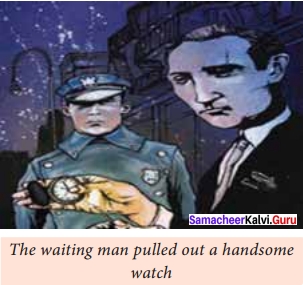
The waiting man was pale and had a square jawed, face with keen eyes. There was a little scar near his right eyebrow. His scarf pin was a large diamond oddly set.

11th English Supplementary After Twenty Years Question (g)
Why did the friends part ways?
Answer:
Both parted ways to seek out their fortunes. Jimmy refused to leave New York. But Bob took the risk and the went to the west to seek his fortune.

After Twenty Years Questions Question (h)
When and how did Bob realize that the tall man was not his friend?
Answer:
A drug store stood at the comer. It was brilliant with electric lights. When Bob and the tall man came into this glare, they simultaneously gazed upon each other. It was then Bob realized that the man in the overcoat was not Jimmy Wells.

After Twenty Years Class 11 Question (i)
Who was the tall man?
Answer:
The tall man was another policeman in plain clothes. He had been sent by Jimmy Wells to arrest Bob.

After Twenty Years Hints Development Question (j)
What did he give Bob?
Answer:
He gave Bob a note written by Jimmy Wells.

2. State whether the following statements are true or false by marking ‘✓’ or ‘✗’ in the corresponding boxes:

(a) The cop suddenly slowed his walk, when he heard the barking of dogs.
(b) The friends grew up together in the city of New York.
(c) Both Jimmy and Bob were of the same age.
(d) The friends parted one night after watching a movie together.
(e) The friends could not keep in touch because they lost each other’s phone numbers.
(J) Bob wanted to stay for half an hour more than the appointed time.
(g) Jimmy grew a little taller after he was twenty.
(h) Bob realised that the tall man was not Jimmy Wells from the shape of his nose.
Answer:
(a) False
(b) True
(c) False
(d) False
(e) False
(f) True
(g) False

(3) What does each of the following mean in the story? Choose the right option.

Question (a)
on the beat:
(i) moving around hitting everyone with a stick
(ii) on duty walking around the assigned area
(iii) marching with his heart beating fast
Answer:
(ii) on duty walking around the assigned area

Question (b)
a guardian of peace:
(i) a watchman
(ii) a holy man
(iii) a policeman
Answer:
(iii) a policeman


Question (c)
arm in arm:
(i) with arms linked together
(ii) with weapons in hands
(iii) with handcuffs on wrists
Answer:
(i) with arms linked together

Question (d)
plainclothes man:
(i) a man who wears simple clothes for grand occasions
(ii) a policeman in civilian clothes while on duty
(iii) a cine artist in ordinary costumes
Answer:
(ii) a policeman in civilian clothes while on duty

(4) Answer the following questions in three or four sentences each:

Question (a)
What did Bob share with the cop about their friendship?
Answer:
Bob said that Jimmy Wells and himself were like brothers. Both were raised in New York. He was eighteen and Jimmy was twenty. He couldn’t drag Jimmy to west because Jimmy, the plodder thought New York was the only place on earth. He believed that Jimmy would meet him at the appointed place as he was his best friend.

Question (b)
Answer:
What are the strengths and weaknesses of Jimmy Wells from Bob’s point of view? Jimmy Wells was assertive. He did not want to leave New York. But he was not adventurous enough to chase his dreams, across the nation. He was a plodder.

Question (c)
Was Bob hopeful of his friend’s arrival? How do you know?
Answer:
Bob was really hopeful of his friend’s arrival. He told the patrolman that he would wait for his best chum for another half an hour. He added that Jimmy would meet him there if he were alive for he was always the truest, staunchest old chap in the world.

Question (d)
How did the cop come to understand that Bob had been successful in the West?
Answer:
In the cigar light, Jimmy Wells saw Bob wearing a Diamond studded watch and a scarf pin too. He was wearing a very costly dress too. He admitted that he did pretty well in the west. He expected Jimmy too to be at  least half successful compared to him. Thus the cop understood that Bob had been successful in making money.

Question (e)
Bob’s life in the West was not a bed of roses. Give reasons.
Answer:
Bob, during the course of his conversation with the cop, admitted that he had to compete with some of the sharpest wits going to get his pile (i.e.) wealth. In fact, West did put a razor’s edge on him. He had overcome many obstacles. Thus, it is very clear that life was not a bed of roses for Bob. Even if he had enjoyed the rose bed for sometime, it did have its thorns. He knew the risks involved in his effort to make quick illegal bucks.

Question (f)
Why didn’t Jimmy Wells, being a cop himself, arrest Bob?
Answer:
Jimmy Wells sent a note to Bob through a plainclothes man explaining his inability to arrest him. The note read that he had also remembered the rendezvous they had made twenty years ago. But, when he lit the cigar, he could find the features of the criminal wanted in Chicago. Some how, he could not bring himself to arrest him. It is obvious his emotions prevented him from doing so. So, he had sent someone else to do the job.

Question (g)
Who do you think has been more successful between the two? Give reasons.
Answer:
I think Jimmy Wells has been more successful in his career than his friend. It is not just because he became a guardian of peace. It is a question of personal ethics. He was concerned with the means to achieve his end. He led a contented life and gained respect from colleagues and general public as an honest officer.

(5) Answer the following questions in a paragraph of about 150 words each:

Question (a)
Compare and contrast the character of Jimmy Wells and Bob with suitable references from the story to support your view.
Answer:
I think Jimmy Wells has been more successful in his career than his friend. It is not because he became a guardian of peace. It is a question of personal ethics. He was concerned with the means to achieve his end. He led a contented life and gained respect from colleagues and general public as an honest officer. In twenty years Jimmy Wells had developed a good physique and a slight swagger. There was an air of pride about his movements. Bob, on the other hand wasn’t bothered about the means. He just wanted to make money even violating the laws of the land.

Money is of course a measure of success but end never justifies means. Bob may have been more successful in making money. But he is haunted by the fear of being arrested all the time. He is cunning and escapes law. He is hated by police for breaking the law and hurting innocent citizens of the country. The guardian of law is bold and sure. But Bob is all the time perturbed and afraid. Thus ill-gotten wealth doesn’t give Bob peace of mind. I believe both the characters are well-made Jimmy, an ordinary person without much ambitions but holding on to the path of virtue. But Bob has received his character in order to make money. Bob is like an art lover who has sold his eyes to buy a beautiful painting.

Question (b)
‘Means should justify the end.’ Explain this adage with reference to O. Henry’s story.
Answer:
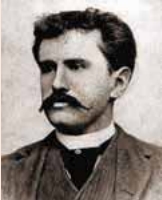
‘Mahatma Gandhi often said, “Means should justify the end”. Even for a just end like freedom he advised his followers not to resort to violence or sedition, i. e., agitation which was followed by some groups who wanted to punish the British. Bob had no scruple of conscience or value system. His only intention in life was to make money even if it demanded his direct involvement in criminal activities. Ill-gotten wealth may satisfy the ego of an individual and serve his sense of personal ego trip but law will take its course against such criminals.

So, the low paid policeman did worry about means but not Bob. Jimmy Wells is enjoying sound health and is unafraid. But Bob has to hide and be watchful of the movement of police officers. He has to run from state to state to stay away from prison. The scars do not symbolize trace of hardwork but combat with the guardians of law while involved in criminal activities. Jimmy Wells is richer than Bob in the sense that he is blessed with contentment. But Bob is busy making his pile and running away all the time to be safe. He is happy with his wealth but is all the time restless, stressed and afraid. This adage, “Means should justify the end” brings home the understanding that the methods we adopt to succeed in life should be socially acceptable and morally sound.

Question (c)
‘Tell me who your friends are and I shall tell you who you are’. How will you explain this statement in the light of Jimmy’s and Bob’s friendship?
Answer:
We can’t fully agree with the statement “Tell me who your friends are and I shall tell you who you are”. This adage may be applicable to those friends who behave like “birds of the same feather” and involve in any activity with a common purpose. But this does not apply to those who live by different value systems personal and professional ethics. In this story, Bob and Jimmy Wells had been life-time friends. Jimmy Wells became, guardian of peace but Bob becomes a criminal wanted by Chicago police, Very often we tend to regard “a friend” as a life-time companion. A friend is one with who we need not conceal our real physical or psychological problems.

One does not wear a mask in front of a friend. A friend usually rushes to help another unsought in times of trouble. All these impressions are relevant only to those who travel the same path of virtue and socially accepted norms and cultural expectations. But a childhood friend who has chosen the evil path to make money is a ‘long lost.friend’ with whom one may not like to continue the friendship. So, proverbs need to be taken with a pinch of salt. They may not be relevant on all occasions or apply to all always.

Question (d)
To your shock, you find out that your close friend is indulging in some wrong activity. Will you avoid him/her or try to correct him/her? Give reasons for your answer.
Answer:
How could I avoid him/her? He is my friend. I am bound to persuade him to return to the path of virtue. I may threaten him to snap my ties with him and try all that is in my capacity to convince him. I shall persist in correcting his behaviour. I shall tell him that his wrong activity would destroy his reputation and he might fall from the grace of teachers, classmates and his own parents when what he does gets exposed. I shall share some real life examples of people who have taken wrong means to acquire wealth or power and how they have been caught and punished later. To make things clear to my friend, I shall make him realise the consequences of wrong activities. I shall try my level best to bail him out of the path of evil. After all, “A friend in need is a friend indeed.”

Question (e)
What would you do in this situation, if you were Jimmy Wells? Substantiate your reason.
Answer:
If I were Jimmy Wells, I would have been- in a real fix. It would have pained me to discover the truth. I would have invited him for a dinner and talked all night to give up his wicked activities and surrender to police. I would visit him in jail and discuss him about his reformed life after his release. I would get a pass for his family members and help them visit him in jail. Request them to tell him how they don’t want the ill-gotten wealth.

I shall encourage his children to plead with him to return to the path of virtue. I shall engage the best lawyers of the country to get him less years of punishment. I shall provide him good books to read and organize yoga and meditation serious for him. I shall take all measures to understand the value of hard-earned money. I know for sure his improved behaviour would lessen his term in jail. I would help him rebuild his life. If he needs journey to start a decent business, I would offer him my support. After all, that is what a friend should do.

Additional Questions

I. Choose the right options.

Question 1.
The policeman on duty moved impressively due to his _______
(a) pride
(b) arrogance
(c) habit
(d) flamboyancy
Answer:
(c) habit


Question 2
_______ is described as guardian of peace.
(a) Bob
(b) Plain people
(c) Jimmy Wells
(d) jimmy’s friend
Answer:
(c) Jimmy Wells

Question 3.
Bob and Jimmy had dined at _______ 20 years ago.
(a) Park Sheraton
(b) White House
(c) a motel
(d) big joe brandy’s
Answer:
(d) big joe brandy’s

Question 4
_______ years ago, Big Joe Bredy’s restaurant was pulled down.
(a) Four
(b) Six
(c) Five
(d) Five
Answer:
(d) Five

Question 5.
When the stranger struck the match and lit his cigar, Bob saw a little white _______ near man’s right eye brow.
(a) mole
(b) scar
(c) pimple
(d) scare
Answer:
(b) scar

Question 6.
Jimmy and Bob decided to meet after _______ years at Big Joe Brady’s restaurant.
(a) ten
(b) twenty
(c) thirty
(d) five
Answer:
(b) twenty

Question 7.
The appointed time of meeting was _______ PM.
(a) 7
(b) 10
(c) 11
(d) 8
Answer:
(b) 10

Question 8
_______ was at the appointed place early.
(a) Plainclothes man
(b) Bob
(c) Jimmy Wells
(d) Drug dealer
Answer:
(b) Bob

Question 9.
It was _______ P.M. when Bob was talking to Jimmy Wells without realizing who he was.
(a) 9.37
(b) 9.57
(c) 9.47
(d) 10.03
Answer:
(b) 9.57

Question 10.
Bob decided to wait till _______ P.M. to meet Jimmy Wells.
(a) 1.1
(b) 10.30
(c) 11.30
(d) 11.15
Answer:
(b) 10.30

Question 11.
The plainclothes man had _______ which helped Bob to find out the truth.
(a) Roman nose
(b) Cleft lip
(c) Scar below his chin
(d) Pug nose
Answer:
(d) Pug nose

Question 12.
Bob pulled out a handsome watch whose.lid was set with small _______
(a) rubies
(b) pearls
(c) diamonds
(d) nuggets of gold
Answer:
(a) rubies


Question 13.
Bob made his pile in _______
(a) New York
(b) West.
(c) North
(d) East
Answer:
(b) West.

Question 14.
The plainclothes man said that Bob was already under arrest for _______ minutes.
(a) five
(b) six
(c) ten
(d) fifteen
Answer:
(c) ten

Question 15.
Who was mistaken to have grown tall by two or three inches?
(a) Plainclothes man in the guise of Jimmy Wells
(b) Bob
(c) Drug dealer
(d) Common friend of Jimmy and Bob
Answer:
(a) Plainclothes man in the guise of Jimmy Wells

Question 16.
_______ had impersonated Jimmy Wells.
(a) Bob
(b) Plainclothes man
(c) John
(d) Peter
Answer:
(b) Plainclothes man

Question 17.
Who claimed to have got a position in a Departmental store?
(a) Plainclothes man
(b) Bob
(c) Peter
(d) John
Answer:
(a) Plainclothes man

Question 18.
Whose egotism was enlarged by success?
(a) Jimmy Wells
(b) Bob’s
(c) Near a drugstore
(d) he evaded law skillfull
Answer:
(b) Bob’s

Question 19.
Where did the plainclothes man and Bob look at each other closely?
(a) Near a bank
(b) Near a drugstore
(c) Near a police station
(d) Near a vegetable market
Answer:
(b) Near a drugstore

Question 20.
The tall man addressed Bob as ‘Silky Bob’ because _______
(a) he had a shiny face
(b) he wore fashionable clothes
(c) his watch shone brightly
(d) he evaded law skillfully
Answer:
(d) he evaded law skillfully

II. Identify the speaker: Who said to whom? (Exam model)

1. “it’s all right, officer. I’m just waiting for a friend – (Bob to Jimmy Wells)
2.There used to be a restaurant where this store stands-Big Joe Brady’s restaurant – (Bob to Jimmy Wells)
3. Twenty years ago tonight I dined here to Big Joe Brady’s with Jimmy Wells, my best chum – Bob to Policeman (Jimmy Wells)
4. It sounds pretty interesting – (Policeman to Bob)
5. Haven’t you heard from your friend since you left? – (Policeman (Jimmy Wells) to Bob)
6. Rather a long time between the meets – (Policeman (Jimmy Wells) to Bob)
7. But after a year or two we lost track of each other – Bob to the policeman (Jimmy Wells)
8. He was always the truest, staunchest old chap in the world – Bob to policeman (Jimmy Wells)
9. I came thousand miles to stand in this door tonight – Bob to Policeman (Jimmy Wells)
10. Three minutes to ten – Bob to Policeman (Jimmy Wells)
11. It was exactly ten O’ clock when we parted here at the restaurant door – Bob to Policeman (Jimmy Wells)
12. “Did pretty well in the west, didn’t you?” – Policeman (Jimmy Wells) to Bob
13. I hope Jimmy had done half as well – Bob to Policeman (Jimmy Wells)
14. I’ve had to compete with the sharpest wits going to get my pile” – Bob to Policeman (Jimmy Wells)
15. “Going to call time on him sharp?” – (Jimmy Wells to Bob)
16. I should say not. I’ll give him half an hour at least – Bob to Policeman (Jimmy Wells)
17. “Is that you Bob?” – (Plainclothes man to Bob)
18. Bless my heart! – (Plainclothes man to Bob)
19. It’s Bob, sure as fate – (Plainclothes man to Bob)
20. I wish it had lasted, so we could have had another dinner there – (Plainclothes man to Bob)
21. How has the west treated you, old man? – (Plainclothes man to Bob)
22. Bully, it, has given me everything I asked it for – (Bob to Plainclothes man)
23. You’ve changed lots Jimmy – (Bob to Plainclothes man)
24. Oh, I grew a bit after twenty – (Plainclothes man to Bob)
25. “Doing well in New York, Jimmy? – (Bob to Plainclothes man)
26. “Moderately, I have a position, in one of the city departments” – (Plainclothes man to Bob)
27. “Come on, Bob! we’ll go around to a place I know of and have good long talk about old times”- (Plainclothes man to Bob)
28. You’re not Jimmy Wells – (Bob to Plainclothes man)
29. “Twenty years is a long time but not long enough to change a man’s nose from a Roman to a pug” – (Bob to Plainclothes man)
30. “It sometimes changes a good man into a bad one” – (Plainclothes man to Bob)
31. “You’ve been under arrest for ten minutes, you silky Bob” – (Plainclothes man to Bob)
32. Some how I couldn’t do it myself – (Jimmy Wells to Bob through a note)

III. Rearrange the following sentences in the logical order:

1. Unable to arrest Bob himself, he sends a plainclothes man to do it.
2. Bob kept his words and reached the spot before 10 p.m. and waited anxiously.
3. A patrolman (Jimmy Wells) finds a notorious criminal wanted by Chicago police in is Bob.
4. Both promised to meet at the same spot at 10 p.m. 20 years later.
5. Jimmy Wells and Bob had dinner at Big Joe’ Brady’s restaurant.
Answers:
1. Jimmy Wells and Bob had dinner at Big Joe’ Brady’s restaurant.
2. Both promised to meet at the same spot at 10 p.m. 20 years later.
3. Bob kept his words and reached the spot before 10 p.m. and waited anxiously.
4. A patrolman (Jimmy Wells) finds a notorious criminal wanted by Chicago police in is Bob.
5. Unable to arrest Bob himself, he sends a plainclothes man to do it.

IV. Read the following passages and answer the questions given below?

1. “It’s all right, officer,” he said, reassuringly. “I’m just waiting for a friend. It’s an appointment made twenty years ago. Sounds a little funny to you, doesn’t it? Well, I’ll explain if you’d like to make certain it’s all straight. About that long ago there used to be a restaurant where this store stands- Big Joe’ Brady’s restaurant.”
“Until five years ago,” said the policeman. “It was tom down then.”

Question (a)
What was the stranger waiting for?
Answer:
He was waiting for a friend,


Question (b)
When was the appointment made? .
Answer:
The appointment was made twenty years ago.

Question (c)
What happened to Big Joe’ Brady’s restaurant?
Answer:
It was pulled down five years ago.

Question (d)
Why were the two men talking about a non-existent restaurant?
Answer:
The stranger and his friend had made an appointment to meet at Big Joe’ Brady’s restaurant h 20 years ago. The stranger did not know what became of the building.

Question (e)
Why did the stranger try to reassure the patrol man on duty?
Answer:
The stranger was the criminal wanted on Chicago. He did not want to raise any suspicion – in the mind of the patrol man. So, he spoke about the odd appointment to him reassuringly.

2. “It sounds pretty interesting,” said the policeman. “Rather a long time between meets, though,
’it seems to me. Haven’t you heard from your friend since you left?”

“Well, yes, for a time we corresponded,” said the other. “But after a year or two we lost track of each other. You see, the West is a pretty big proposition, and I kept hustling around over it 1 pretty lively. But I know Jimmy will meet me here if he’s alive, for he always was the truest,

staunchest old chap in the world. He’ll never forget. I came a thousand miles to stand in this door tonight, and it’s worth it if my old partner turns up.”

The waiting man pulled out a handsome watch, the lids of it set with small diamonds.
“Three minutes to ten,” he announced. “It was exactly ten o’clock when we parted here at the restaurant door.”

Question (a)
Why did he appear a long time between the meeting of friends?
Answer:
Twenty years is obviously a long time between meets.

Question (b)
How did the stranger justify the long gap between their meeting?
Answer:
The stranger said that they corresponded for a year or two and then they lost track of each other.

Question (c)
What was the stranger very optimistic about?
Answer:
The stranger was very optimistic about meeting his boyhood friend Jimmy Wells that night.

Question (d)
Why did the stranger believe that Jimmy Wells would honour the appointment made twenty years ago?
Answer:
Jimmy Wells and the stranger were raised in New York. Both moved like brothers. He was the truest and staunchest old chap in the world. So, the stranger (Bob) believed that Jimmy Wells would certainly come if he were alive.

Question (e)
How did the patrol man figure out that the stranger was stinkingly rich?
Answer:
The stranger (Bob) had a very handsome watch whose lids were set in diamonds. He was already found to have a large diamond oddly set as it scarf pin too. These evidence helped the patrol man figure out that the stranger was stinkingly rich.

Question 3.
“You’re not Jimmy Wells,” he snapped. “Twenty years is a long time, but not long enough to change a man’s nose from a Roman to a pug.”

“It sometimes changes a good man into a bad one”, .said the tall man. “You’ve been under arrest for ten minutes, ‘Silky’ Bob. Chicago thinks you may have dropped over our way and wires us she wants to have a chat with you. Going quietly, are you? That’s sensible. Now, before we go on to the station here’s a note I was asked to hand you. You may read it here at the window. It’s from Patrolman Wells.”

The man from the West unfolded the little piece of paper handed to him. His hand was steady when he began to read, but it trembled a little by the time he had finished. The note was rather short.

“Bob, I was at the appointed place on time. When you struck the match to light your cigar I saw it was the face of the man wanted in Chicago. Somehow I couldn’t do it myself so I went around and got a plainclothes man to do the job.”

Question (a)
How did Bob find out that the plainclothes man was not Jimmy Wells?
Answer:
Under the brilliant lights of the drug stone, Bob noticed the pug nose of the policeman in plainclothes. Jimmy Wells had a sharp Roman nose.

Question (b)
How did the plainclothes man respond to Bob’s discovery of the identity?
Answer:
The policeman said that twenty years, sometimes, is long enough to change a good man to a bad man.


Question (c)
How did New York police get scent of Bob’s presence in New York?
Answer:
Chicago police had sent a telegram describing Bob’s facial features. Thus New York police got scent of his presence in New York.

Question (d)
What did the plainclothes man give Bob?
Answer:
The plainclothes man gave Bob a note written by patrolman Wells.

Question (e)
Why did the note shock Bob?
Answer:
The note read that Jimmy Wells had arrived at the appointed spot. In the cigar light, he had noticed the features of a man wanted by Chicago police. As he could not arrest him himself, he had sent a police clothes man to do the job. The realization that his boyhood friend had got him arrested shocked him.

After Twenty Years About the Author

11th English After Twenty Years Paragraph Chapter 1 Samacheer Kalvi

O. Henry (1862-1910) is a famous American short story writer. His stories are known for
the twist or surprising ends. His original name was William Sydney Porter. As a child he was always reading from classics to dime novels. Though he was jailed for embezzlement of funds in a bank where he received a poor salary, his prolific writing skills stayed infact.

He wrote one story per week for New York world Sunday Magazine. He wrote 381 short stories. He is best remembered for his short stories such as: “The Cuffs of Magic”, “Cop and the Anthem”, “The Ransom of the Red Chief’ and “A Retrieved Reformation and the Third Ingredient”. He married his childhood sweetheart Sarah. His heavy drinking affected both his health and the quality of his writing. So, Sarah left him to die alone.

After Twenty Years Summary

This story is about two friends. As young adults they decide to part ways to make their own fortunes. Jimmy Wells, the plodder, becomes a policeman in New York. But Bob competes with the sharpest wits and makes his fortune. He becomes rich. As per their agreement, Bob has travelled thousand miles to meet his boyhood chum Jimmy Wells after a passage of twenty years at 10 p.m. Their proposed meeting point Big Joe ‘Brady’s restaurant is gone. The policeman on beat, tells him that it was pulled down five years ago.

After Twenty Years Questions And Answers Pdf Samacheer Kalvi 11th English Solutions Supplementary Chapter 1

Jimmy Wells also remembers the appointment. In the dark, when Bob lights a cigarette, Jimmy Wells notices the features of a criminal wanted by Chicago police. His diamond-studded watch, the large diamond scarf pin, show how rich he has become. The policeman leaves after assuring that Bob would wait at least for another half an hour. Then a man in an overcoat comes calling out his name. Bob boasts of his success in the west and how he amassed wealth. Once they go out of the dark lane, the lights from a drug store helps them see each other.

After Twenty Years Paragraph Samacheer Kalvi 11th English Solutions Supplementary Chapter 1

Bob releases himself saying that he is not Jimmy Wells. Twenty years can’t change a Roman nose into a pug. The plainclothes man tells him he has been under arrest for the past ten minutes. From a note handed to him, he realizes that the patrolman is only Jimmy Weils who has sent another policeman to arrest him.

After Twenty Years Glossary

Textual:

absurdity – quality of being silly and foolish.
avenue – a wide street
dismally – without happiness and cheer
egotism – a feeling of self-importance
groove – a dull routine that does not change
habitual – regular
intricate – complicated
nigh – almost
outline – describe
plodder – one who toils slowly but steadily
proposition – theory or system
razor-edge – a critical situation
reassuringly – making someone feel less doubtful
stalwart – physically strong
swagger – walk in a confident way
twirling – twisting and spinning around
vicinity – the surrounding area (neighbourhood)
wires – sends a telegraphic message
wits – intelligent people

Additional:

destiny – fate
exactly – accurately
fortunes – wealth
funny amusing
gaze – look deeply
lasted – continued
plainclothes man – A policeman in civil dress
rendezvous – appointed meeting place
sensible – practical uncertain – unsure
staunchest – steadfast, consistent
unfolded – opened

The main aim is to share the knowledge and help the students of 11th English to secure the best score in their final exams. Use the concepts of Samacheer Kalvi 11th English Book Solutions Supplementary Chapter 1 After Twenty Years Questions and Answers in Real time to enhance your skills. If you have any doubts you can post your comments in the comment section, We will clarify your doubts as soon as possible without any delay.

Samacheer Kalvi 11th Maths Solutions Chapter 3 Trigonometry Ex 3.4

You can Download Samacheer Kalvi 11th Maths Book Solutions Guide Pdf, Tamilnadu State Board help you to revise the complete Syllabus and score more marks in your examinations.

Tamilnadu Samacheer Kalvi 11th Maths Solutions Chapter 3 Trigonometry Ex 3.4

11th Maths Exercise 3.4 Samacheer Kalvi Question 1.
11th Maths Exercise 3.4 Samacheer Kalvi Solutions Chapter 3 Trigonometry
Solution:
11th Maths Exercise 3.4 Solutions Chapter 3 Trigonometry Samacheer Kalvi
11th Maths Exercise 3.4 Answers Solutions Chapter 3 Trigonometry Samacheer Kalvi

11th Maths Exercise 3.4 Question 2.
11 Maths Samacheer Solution Chapter 3 Trigonometry Ex 3.4
Solution:
Class 11 Maths Ex 3.4 Solutions Chapter 3 Trigonometry Samacheer Kalvi
Samacheer Kalvi 11 Maths Solutions Chapter 3 Trigonometry Ex 3.4

11th Maths Exercise 3.4 Answers Question 3.
Samacheer Kalvi Guru 11th Maths Solution Chapter 3 Trigonometry Ex 3.4
Solution:
11th Maths Samacheer Solutions Chapter 3 Trigonometry Ex 3.4
Trigonometry 3.4 Class 11 Solutions Chapter 3 Trigonometry Samacheer Kalvi
since x is in III quadrant
Both sin x and cos x are negative
Samacheer Kalvi Guru 11th Maths Solutions Chapter 3 Trigonometry Ex 3.4

11 Maths Samacheer Solution Question 4.
Samacheer Kalvi Class 11 Maths Solutions Chapter 3 Trigonometry Ex 3.4
Solution:
Samacheer Kalvi Maths 11th Solutions Chapter 3 Trigonometry Ex 3.4

Class 11 Maths Ex 3.4 Solutions Question 5.
Samacheer Kalvi 11th Maths Solutions Chapter 3 Trigonometry Ex 3.4
Solution:
Samacheer Kalvi Guru 11 Maths Solutions Chapter 3 Trigonometry Ex 3.4
Samacheerkalvi.Guru 11th Maths Solutions Chapter 3 Trigonometry Ex 3.4

Samacheer Kalvi 11 Maths Solutions Question 6.
Samacheer Kalvi.Guru 11th Maths Solutions Chapter 3 Trigonometry Ex 3.4
Solution:
Samacheer Kalvi 11th Maths Solutions Chapter 3 Trigonometry Ex 3.4

(ii) L.HS = cos(π + θ) = cos(180° + θ)
= cos 180° cos θ – sin 180° sin θ
= (-1) cos θ – (0) sin θ
= – cos θ = RHS

(iii) LHS = sin (π + θ) = sin π cos θ + cos π sin θ
= (0) cos θ + (-1) sin θ
= -sin θ = RHS

Samacheer Kalvi Guru 11th Maths Solution Question 7.
Find a quadratic equation whose roots are sin 15° and cos 15°
Solution:
Samacheer Kalvi 11th Maths Book Solutions Chapter 3 Trigonometry Ex 3.4
Samacheer Kalvi 11th Maths Solution Chapter 3 Trigonometry Ex 3.4

11th Maths Samacheer Solutions Question 8.
Expand cos(A + B + C). Hence prove that cos A cos B cos C = sin A sin B cos C + sin B sin C cos A + sin C sin A cos B, if A + B + C = \(\frac{\pi}{2}\)
Solution:
Taking A + B = X and C = Y
We get cos (X + Y) = cos X cos Y – sin X sin Y
(i.e) cos (A + B + C) = cos (A + B) cos C – sin (A + B) sin C
= (cos A cos B – sin A sin B) cos C – [sin A cos B + cos A sin B] sin C
cos (A + B + C) = cos A cos B cos C – sin A sin B cos C – sin A cos B sin C – cos A sin B sin C If (A + B + C) = π/2 then cos (A + B + C) = 0
⇒ cos A cos B cos C – sin A sin B cos C – sin A cos B sin C – cos A sin B sin C = 0
⇒ cos A cos B cos C = sin A sin B cos C + sin B sin C cos A + sin C sin A cos B

Trigonometry 3.4 Class 11 Question 9.
Prove that
(i) sin(45° + θ) – sin(45° – θ) = \(\sqrt{2}\)sin θ.
(ii) sin(30° + θ) + cos(60° + θ) = cos θ.
Solution:
Samacheer 11 Maths Solutions Chapter 3 Trigonometry Ex 3.4

Samacheer Kalvi Guru 11th Maths Question 10.
If a cos(x + y) = b cos(x – y), show that (a + b) tan x = (a – b) cot y.
Solution:
a cos (x + y) = b cos (x – y)
a[cos x cos y – sin x sin y] = 6[cos x cos y + sin x sin y]
(i.e) a cos x cos y – a sin x sin y = b cos x cos y + b sin x sin y
a cos x cos y – b sin x sin y = a sin x sin y + b cos x cos y
Samacheer Kalvi 11th Maths Book Solutions Chapter 3 Trigonometry Ex 3.4
⇒ a cot y – b tan x = a tan x + b cot y
a cot y – b cot y = a tan x + b tan x
⇒ (a + b) tan x = (a – b) cot y.

Samacheer Kalvi Class 11 Maths Solutions Question 11.
Prove that sin 105° + cos 105° = cos 45°.
Solution:
sin 105° = sin (60°+ 45°)
= sin 60° cos 45° + cos 60° cos 45°
11th Maths Solutions Samacheer Kalvi Chapter 3 Trigonometry Ex 3.4
= cos 45° = RHS

Samacheer Kalvi Maths 11th Question 12.
Prove that sin 75° – sin 15° = cos 105° + cos 15°.
Solution:
RHS = cos 105° + cos 15° = cos (90° + 15°) + cos (90° – 75°)
= – sin 15° + sin 75°
= sin 75° – sin 15° = LHS

Samacheer Kalvi 11th Maths Solutions Question 13.
Show that tan 75° + cot 75° = 4
Solution:
11th Samacheer Kalvi Maths Solutions Chapter 3 Trigonometry Ex 3.4

Samacheer Kalvi Guru 11 Maths Question 14.
Prove that cos(A + B) cos C – cos(B + C) cos A = sin B sin(C – A).
Solution:
LHS = (cos A cos B – sin A sin B) cos C – (cos B cos C – sin B sin C) cos A
= cos A cos B cos C – sin A sin B cos C – cos A cos B cos C + cos A sin B sin C
= cos A sin B sin C – sin A sin B cos C
= sin B [sin C cos A – cos C sin A]
= sin B [sin (C – A)] = RHS

Samacheerkalvi.Guru 11th Maths Question 15.
Prove that sin(n + 1) θ sin(n – 1) θ + cos(n + 1) θ cos(n – 1)θ = cos 2θ, n ∈ Z.
Solution:
Taking (n + 1) θ = A and (n – 1) θ = B
LHS = sin A sin B + cos A cos B
= cos (A – B)
= cos[(n + 1) – (n – 1)]θ
= cos (n + 1 – n + 1)θ = cos 2θ = RHS

Samacheer Kalvi.Guru 11th Maths Question 16.
Maths Samacheer Kalvi 11th Solutions Chapter 3 Trigonometry Ex 3.4
Solution:
Samacheer Kalvi 11th Maths Solutions Chapter 3 Trigonometry Ex 3.4 68

Samacheer Kalvi 11th Maths Question 17.
Prove that
(i) sin(A + B) sin(A – B) = sin2 A – sin2 B
(ii) cos(A + B) cos(A – B) = cos2 A – sin2 B = cos2 B – sin2 A
(iii) sin2(A + B) – sin2(A – B) = sin2A sin2B
(iv) cos 8θ cos 2θ = cos2 5θ – sin2
Solution:
(i) LHS = sin (A + B) sin (A – B)
= (sin A cos B + cos A sin B) (sin A cos B – cos A sin B)
= sin2A cos2 B – cos2 A sin2 B
= sin2 A (1 – sin2 B) – (1 – sin2 A) sin2 B
= sin2 A – sin2 A sin2 B – sin2 B + sin2 A sin2 B
= sin2 A – sin2 B = RHS

(ii) LHS = cos (A + B) cos (A – B) = (cos A cos B – sin A sin B) (cos A cos B + sin (A sin B)
= cos2 A cos2 B – sin2 A sin2 B
= cos2 A (1 – sin2 B) – (1 – cos2 A) sin2 B
= cos2 A – cos2 A sin2 B – sin2 B + cos2 A sin2 B
= cos2 A – sin2 B = RHS
Now cos2 A – sin2 B = (1 – sin2 A) – (1 – cos2 B)
= 1 – sin2 A – 1 + cos2 B
= cos2 B – sin2 A

(iii) sin2 A – sin2 B = sin (A + B) sin (A – B)
LHS = sin2 (A + B) – sin2 (A – B) = sin [(A + B) + (A – B)] [sin (A + B) – (A – B)]
= sin 2A sin 2B = RHS

(iv) LHS = cos 8θ cos 2θ
= cos (5θ + 3θ) cos (5θ – 3θ) .
We know cos (A + B) cos (A – B) = cos2 A – sin2 B
∴ cos (5θ + 3θ) cos (5θ – 3θ) = cos2 5θ – sin2 3θ = RHS

Samacheer Kalvi 11th Maths Book Solutions Question 18.
Show that cos2 A + cos2 B – 2 cos A cos B cos(A + B) = sin2(A + B).
Solution:
LHS = cos2 A + cos2 B – 2 cos A cos B [cos A cos B – sin A sin B]
= cos2 A + cos2 B – 2 cos2 A cos2 B + 2 sin A cos A sin B cos B
= (cos2 A – cos2 A cos2 B) + (cos2 B – cos2 A cos2 B) + 2 sin A cos A sin B cos B
= cos2 A (1 – cos2 B) + cos2 B (1 – cos2 A) + 2 sin A cos A sin B cos B
= cos2 A sin2 B + cos2 B sin2 A + 2 sin A cos B sin B cos A
= (sin A cos B + cos A sin B)2
= sin2 (A + B) = RHS

Samacheer Kalvi 11th Maths Solution Question 19.
If cos(α – β) + cos(β – γ) + cos(γ – α) = \(-\frac{3}{2}\), then prove that cos α + cos β + cos γ = sin α + sin β + sin γ
Solution:
Samacheer Kalvi 11th Maths Solutions Chapter 3 Trigonometry Ex 3.4 70
2 cos (α – β) + 2cos (β – γ) + 2cos (γ – α) = -3
2cos(α – β) + 2cos(β – γ) + 2cos (γ – α) + 3 = 0
[2 cos α cos β + 2 sin α sin β] + [2 cos β cos γ + 2 sin β sin γ] + [2 cos γ cos α + sin γ sin α] + 3 = 0
= [2 cos α cos β + 2 cos β cos γ + 2 cos γ cos α] + [2 sin α sin β + 2 sin β sin γ + 2 sin γ sin α] + (sin2 α + cos2 α) + (sin2 β + cos2 β) + (sin2 γ + cos2 γ) = 0
⇒ (cos2 α + cos2 β + cos2 γ + 2 cos α cos β + 2 cos β cos γ + 2 cos γ cos α) + (sin2 α + sin2 β) + (sin2 γ + 2 sin α sin β + 2 sin β sin γ + 2 sin γ sin α) = 0
(cos α + cos β + cos γ)2 + (sin α + sin β + sin γ)2 = 0
=(cos α + cos β + cos γ) = 0 and sin α + sin β + sin γ = 0
Hence proved

Samacheer 11 Maths Solutions Question 20.
Samacheer Kalvi 11th Maths Solutions Chapter 3 Trigonometry Ex 3.4 71
Solution:
Samacheer Kalvi 11th Maths Solutions Chapter 3 Trigonometry Ex 3.4 72

Samacheer Kalvi 11th Maths Book Question 21.
Samacheer Kalvi 11th Maths Solutions Chapter 3 Trigonometry Ex 3.4 73
Solution:
Samacheer Kalvi 11th Maths Solutions Chapter 3 Trigonometry Ex 3.4 74
Samacheer Kalvi 11th Maths Solutions Chapter 3 Trigonometry Ex 3.4 75

11th Maths Solutions Samacheer Kalvi Question 22.
Samacheer Kalvi 11th Maths Solutions Chapter 3 Trigonometry Ex 3.4 76
Solution:
Samacheer Kalvi 11th Maths Solutions Chapter 3 Trigonometry Ex 3.4 77

11th Samacheer Kalvi Maths Question 23.
Samacheer Kalvi 11th Maths Solutions Chapter 3 Trigonometry Ex 3.4 78
Solution:
Samacheer Kalvi 11th Maths Solutions Chapter 3 Trigonometry Ex 3.4 79

Question 24.
Samacheer Kalvi 11th Maths Solutions Chapter 3 Trigonometry Ex 3.4 80
Solution:
Samacheer Kalvi 11th Maths Solutions Chapter 3 Trigonometry Ex 3.4 81

Maths Samacheer Kalvi 11th Question 25.
Samacheer Kalvi 11th Maths Solutions Chapter 3 Trigonometry Ex 3.4 83
Solution:
Samacheer Kalvi 11th Maths Solutions Chapter 3 Trigonometry Ex 3.4 84
Samacheer Kalvi 11th Maths Solutions Chapter 3 Trigonometry Ex 3.4 85

Samacheer Kalvi 11th Maths Solutions Chapter 3 Trigonometry Ex 3.4 Additinal Questions

10th Maths Exercise 3.4 Samacheer Kalvi Question 1.
Prove that sin (A + B) sin (A – B) = cos2 B – cos2 A
Solution:
LHS = sin (A + B) sin (A – B)
= (sin A cos B + cos A sin B) (sin A cos B – cos A sin B)
= sin2 A cos2 B – cos2 A sin2 B
= (1 – cos2 A) cos2 B – cos2 A (1 – cos2 B)
= cos2 B – cos2 A cos2 B – cos2 A + cos2 A cos2 B
= cos2 B – cos2 A = RHS

Question 2.
Prove that
(i) sin A + sin(120° + A) + sin (240° + A) = 0
(ii) cos A + cos (120° +A) + cos (120° – A) = 0
Solution:
(i) sin A + sin(120° + A) + sin (240° + A)
= sin A+ sin 120° cos A + cos 120° sin A + sin 240° cos A + cos 240° sin A …… (1)
Samacheer Kalvi 11th Maths Solutions Chapter 3 Trigonometry Ex 3.4 86
By substituting these values in (1), we get,
Samacheer Kalvi 11th Maths Solutions Chapter 3 Trigonometry Ex 3.4 87

(ii) cos 120° = cos (180° – 60°) = – cos 60° = \(\frac{-1}{2}\)
LHS = cos A + cos (120° + A) + cos (120° – A)
= cos A + cos 120° cos A – sin 120° sin A + cos 120° cos A + sin 120° sin A
= cos A + 2 cos 120° cos A
Samacheer Kalvi 11th Maths Solutions Chapter 3 Trigonometry Ex 3.4 88

Question 3.
Samacheer Kalvi 11th Maths Solutions Chapter 3 Trigonometry Ex 3.4 89
Solution:
Samacheer Kalvi 11th Maths Solutions Chapter 3 Trigonometry Ex 3.4 90
tan (A + B) = 1 ⇒ A+ B = 45°

Question 4.
If A + B = 45°, show that (1 + tan A) (1 + tan B) = 2 and hence deduce the value of tan \(22 \frac{1^{0}}{2}\).
Solution:
Given A + B = 45° ⇒ tan (A + B) = tan 45°
Samacheer Kalvi 11th Maths Solutions Chapter 3 Trigonometry Ex 3.4 91
(i.e.) tan A + tan B = 1 – tan A.tan B
(i.e.) 1 + tan A + tan B = 2 – tan A tan B (add 1 on both sides)
1 + tan A + tan B + tan A tan B = 2
(i.e.) (1 + tan A) (1 + tan B) = 2
Samacheer Kalvi 11th Maths Solutions Chapter 3 Trigonometry Ex 3.4 92

Samacheer Kalvi 11th Chemistry Solutions Chapter 2 Quantum Mechanical Model of Atom

Enhance your subject knowledge with Tamilnadu State Board for Chapter 2 Quantum Mechanical Model of Atom and learn all the underlying concepts easily. Make sure to Download Samacheer Kalvi 11th Chemistry Book Solutions, Notes Pdf Chapter 2 Quantum Mechanical Model of Atom Questions and Answers PDF on a day to day basis and score well in your exams. Are given after enormous research by people having high subject knowledge. You can rely on them and prepare any topic of Chemistry as per your convenience easily.

Tamilnadu Samacheer Kalvi 11th Chemistry Solutions Chapter 2 Quantum Mechanical Model of Atom

Students looking for Chapter 2 Quantum Mechanical Model of Atom Concepts can find them all in one place from our Tamilnadu State Board Solutions. Simply click on the links available to prepare the corresponding topics of Chemistry easily. Samacheer Kalvi 11th Chemistry Chapter wise Questions and Answers are given to you after sample research and as per the latest edition textbooks. Clarify all your queries and solve different questions to be familiar with the kind of questions appearing in the exam. Thus, you can increase your speed and accuracy in the final exam.

Samacheer Kalvi 11th Chemistry Chapter 2 Quantum Mechanical Model of Atom Textual Evaluation Solved

I. Choose the correct answer
Quantum Mechanical Model Of Atom Class 11 Book Back Answers Question 1.
Electronic configuration of species M2+ is 1s2 2s2 2p63s2 3p6 3d6 and its atomic weight is 56. The number of neutrons in the nucleus of species M is ………..
(a) 26
(b) 22
(c) 30
(d) 24
Answer:
(c) 30
Solution:
M2+ : 1s2 2s2 2p63s2 3p6 3d6
M : 1s2 2s2 2p63s2 3p6 3d8
Atomic number = 26
Mass number = 56
No. of neutrons = 56 – 26 = 30.

11th Chemistry Quantum Mechanical Model Of Atom Question 2.
The energy of light of wavelength 45 nm is
(a) 6.67 x 10¹⁵ J
(b) 6.67 x 10¹¹ J
(c) 4.42 .x 1018 J
(d) 4.42 x 10⁻¹⁵ J
Answer:
(c) 4.42 .x 1018 J
Solution:
E = hv = hc / λ
\(\frac{6.626 \times 10^{-34} \mathrm{J} \mathrm{s} \times 3 \times 10^{8} \mathrm{ms}^{-1}}{45 \times 10^{-9} \mathrm{m}}\) = 4.42 .x 1018 J.

11th Chemistry Chapter 2 Book Back Answers Question 3.
The energies E1 and E2 of two radiations are 25 eV and 50 eV respectively. The relation between their wavelengths i.e. λ1 and λ2 will be …………
(a) \(\frac{\lambda_{1}}{\lambda_{2}}=1\)
(b) λ1 = 2 λ2
(c) λ1 = \(\sqrt{25 \times 50} \lambda_{2}\)
(d) 2 λ1 = λ2
Answer:
(b) λ1 = 2 λ2
Solution:
\(\frac{E l}{E 2}\) = \(\frac{25eV}{50eV}\) = \(\frac{1}{2}\)
\(\frac{\mathrm{hc}}{\lambda_{1}} \times \frac{\lambda_{2}}{\mathrm{hc}}\) = \(\frac{1}{2}\)
2 = λ1.

Samacheer Kalvi Guru 11th Chemistry Question 4.
Splitting of spectral lines in an electric field is called …………….
(a) Zeeman effect
(b) Shielding effect
(c) Compton effect
(d) Stark effect
Answer:
(d) Stark effect
Solution:
Splitting of spectral lines in magnetic field is called Zeeman effect and splitting of spectral lines in electric field, is called Stark effect.

Samacheerkalvi.Guru 11th Chemistry Question 5.
Based on equation E = -2.178 x 10¹⁸ J \(\left(\frac{z^{2}}{n^{2}}\right)\) certain conclusions are written. Which of them is not correct ? (NEET)
(a) Equation can be used to calculate the change in energy when the electron changes orbit
(b) For n = 1, the electron has a more negative energy than it does for n = 6 which means that the electron is more loosely bound in the smallest allowed orbit
(c) The negative sign in equation simply means that the energy of electron bound to the nucleus is lower than it would be if the electrons were at the infinite distance from the nucleus.
(d) Larger the value of n, the larger is the orbit radius.
Answer:
(b) For n = 1, the electron has a more negative energy than it does for n = 6 which means that the electron is more loosely bound in the smallest allowed orbit
Solution:
Correct statement:
For n = 6, the electron has more negative energy than it does for n = 6 which means that the electron is strongly bound in the smallest allowed orbit.

11th Chemistry Samacheer Kalvi Question 6.
According to the Bohr Theory, which of the following transitions in the hydrogen atom will give rise to the least energetic photon?
(a) n = 6 to n = 1
(b) n = 5 to n = 4
(c) n = 5 to n = 3
(d) n = 6 to n = 5
Answer:
(d) n = 6 to n = 5
Solution:
n = 6 to n = 5
E6 = -13.6 / 62 ; E5 = – 13.6 / 52
E6 – E5 = (-13.6 / 62) – (-13.6 / 52)
= 0.166 eV atom-1
E5 – E4 = (-13.6 / 52) – (-13.6 / 42)
= 0.306 eV atom-1

Samacheer Kalvi.Guru 11th Chemistry Question 7.
Assertion : The spectrum of He+ is expected to be similar to that of hydrogen
Reason : He+ is also one electron system,
(a) If both assertion and reason are true and reason is the correct explanation of assertion.
(b) If both assertion and reason are true but reason is not the correct explanation of assertion.
(c) If assertion is true but reason is false
(d) If both assertion and reason are false
Answer:
(a) If both assertion and reason are true and reason is the correct explanation of assertion.

Samacheer Kalvi Guru 11 Chemistry Question 8.
Which of the following pairs of d-orbitals will have electron density along the axes ? (NEET Phase – II)
(a) dz2, dxz
(b) dxz, dyz
(c) dz2, \(d_{x^{2}-y^{2}}\)
(d) dxy, \(d_{x^{2}-y^{2}}\)
Answer:
(c) dz2, \(d_{x^{2}-y^{2}}\)

Samacheer Kalvi 11th Chemistry Question 9.
Two electrons occupying the same orbital are distinguished by …………
(a) azimuthal quantum number
(b) spin quantum number
(c) magnetic quantum number
(d) orbital quantum number
Answer:
(b) spin quantum number
Solution:
Spin quantum number For the first electron ms = +\(\frac {1}{2}\)
For the second electron ms = –\(\frac {1}{2}\).

Quantum Mechanical Model Of Atom Question 10.
The electronic configuration of Eu (atomic no. 63) Gd (atomic no. 64) and Tb (atomic no. 65) are (NEET – Phase II)
(a) [Xe] 4f7 5d1 6s2, [Xe] 4f7 5d1 6s2 and [Xe] 4f8 5d1 6s2
(b) [Xe] 4f7, 6s2, [Xe] 4f7 5d1 6s2 and [Xe] 4f9 6s2
(c) [Xe] 4f7 , 6s2, [Xe] 4f8 6s2 and [Xe] 4f8 5d1 6s2
(d) [Xe] 4f8 5d1 6s2[Xe] 4f7 5d1 6s2 and [Xe] 4f9 6s2
Answer:
(b) [Xe] 4f7, 6s2, [Xe] 4f7 5d1 6s2 and [Xe] 4f9 6s2
Solution:
Eu : [Xe] 4f7, 5d0, 6s2
Gd : [Xe] 4f7, 5d1, 6s2
Tb : [Xe] 4f9, 5d0,6s2

Chemistry Class 11 Samacheer Kalvi Question 11.
The maximum number of electrons in a sub shell is given by the expression …………..
(a) 2n2
(b) 21 + 1
(c) 41 + 2
(d) none of these
Answer:
(c) 41 + 2
Solution:
2 (21 + 1) = 41 + 2.

11th Chemistry 2nd Lesson Question 12.
For d-electron, the orbital angular momentum is ………….
(a) \(\frac{\sqrt{2} h}{2 \pi}\)
(b) \(\frac{\sqrt{2 \mathrm{h}}}{2 \pi}\)
(c) \(\sqrt{2 \times 4}\)
(d) \(\frac{\sqrt{6} h}{2 \pi}\)
Answer:
(d) \(\frac{\sqrt{6} h}{2 \pi}\)
Solution:
Orbital angular momentum
= \(\sqrt{(1(1+1)}) \mathrm{h} / 2 \pi\)
For d orbital = \(\sqrt{(2 × 3)} \mathrm{h} / 2 \pi\) = \(\sqrt{6} \mathrm{h} / 2 \pi\).

Quantum Mechanical Model Of Atom Class 11 Question 13.
What is the maximum numbers of electrons that can be associated with the following set of quantum numbers ? n = 3,l = 1 and m = -1
(a) 4
(b) 6
(c) 2
(d) 10
Answer:
(c) 2
Solution:
n = 3; l = 1; m = -1 either 3px or 3py

Samacheer Kalvi Guru Chemistry Question 14.
Assertion: Number of radial and angular nodes for 3p orbital are l, l respectively. Reason: Number of radial and angular nodes depends only on principal quantum number.
(a) both assertion and reason are true and reason is the correct explanation of assertion.
(b) both assertion and reason are true but reason is not the correct explanation of assertion.
(c) assertion is true but reason is false
(d) both assertion and reason are false
Answer:
(c) assertion is true but reason is false
Solution:
No. of radial node = n- l – 1
No. of angular node = l for 3p orbital
No. of angular node = l =1
No. of radial node = n- l – 1 = 3 – 1 – 1 = 1.

Question 15.
The total number of orbitals associated with the principal quantum number n = 3 is ………..
(a) 9
(b) 8
(c) 5
(d) 7
Answer:
(a) 9
Solution:
n = 3; l = 0; m1 = 0 – one s orbital n = 3; l = 1; m1 = -1, 0, 1 – three p orbitals n = 3; l = 2; m1 = -2, -1, 0, 1, 2 – five d orbitals, overall nine orbitals are possible.

Question 16.
If n = 6, the correct sequence for filling of electrons will be, …………
(a) ns → (n – 2) f → (n – 1)d → np
(b) ns → (n – 1) d → (n – 2) f → np
(c) ns → (n – 2) f → np → (n – 1) d
(d) none of these are correct
Answer:
(a) ns → (n – 2)f → (n – l)d → np
Solution:
n = 6 According Aufbau principle,
6s → 4f → 5d → 6p
ns → (n – 1)f → (n – 2)d → np.

Question 17.
Consider the following sets of quantum numbers:
Quantum Mechanical Model Of Atom Class 11 Book Back Answers Samacheer Kalvi Chemistry Solutions Chapter 2
Which of the following sets of quantum number is not possible ?
(a) (i), (ii), (iii) and (iv)
(b) (ii), (iv) and (v)
(c) (z) and (iii)
(d) (ii), (iii) and (iv)
Answer:
(b) (ii), (iv) and (v)
Solution:
(ii) l can have the values from 0 to n – 1 n = 2; possible l values are 0, 1 hence l = 2 is not possible.
(iv) for l = 0; m = -1 not possible
(v) for n = 3 l = 4 and m = 3 not possible.

Question 18.
How many electrons in an atom with atomic number 105 can have (n + 1) = 8 ?
(a) 30
(6) 17
(c) 15
(d) unpredictable
Answer:
(b) 17
Solution:
n + 1 = 8
Electronic configuration of atom with atomic number 105 is [Rn] 5f14 6d3 7s2

Orbital(n+1)No. of electrons
5f5 + 3 = 814
6d6 + 2 = 83
7s7 + 0 = 02
                 No. of electrons = 14 + 3 = 17

Question 19.
Electron density in the yz plane of 3 dx2-y2 orbital is …………….
(a) zero
(b) 0.50
(c) 0.75
(d) 0.90
Answer:
(a) zero
11th Chemistry Quantum Mechanical Model Of Atom Chapter 2 Samacheer Kalvi
11th Chemistry Chapter 2 Book Back Answers Quantum Mechanical Model Of Atom Samacheer Kalvi

Samacheer Kalvi Guru 11th Chemistry Solutions Chapter 2 Quantum Mechanical Model Of Atom

Question 20.
If uncertainty in position and momentum are equal, then minimum uncertainty in velocity is ……….
(a) \(\frac{1}{m} \sqrt{\frac{h}{\pi}}\)
(b) \(\sqrt{\frac{\mathrm{h}}{\pi}}\)
(c) \(\frac{1}{2 m} \sqrt{\frac{h}{\pi}}\)
(d) \(\frac{\mathrm{h}}{4 \pi}\)
Answer:
(c) \(\frac{1}{2 m} \sqrt{\frac{h}{\pi}}\)
Solution:
Samacheerkalvi.Guru 11th Chemistry Solutions Chapter 2 Quantum Mechanical Model Of Atom

Question 21.
A macroscopic particle of mass 100 g and moving at a velocity of 100 cm s-1d will have a de Broglie wavelength of ………….
(a) 6.6 x 10⁻²⁹ cm
(b) 6.6 x 10⁻³⁰ cm
(c) 6.6 x 10⁻³¹ cm
(d) 6.6 x 10⁻³² cm
Answer:
(c) 6.6 x 10⁻³¹ cm
Solution:
m = 100 g = 100 x 10-3 kg
v = 100 cm s-1 = 100 x 10-2 m s-1
λ = \(\frac{h}{mv}\) =Samacheer Kalvi 11th Chemistry Solutions Chapter 2 Quantum Mechanical Model of Atom
= 6.626 x 10⁻³¹ ms-1
= 6.626 x 10⁻³¹ cm s-1

Question 22.
The ratio of de Broglie wavelengths of a deuterium atom to that of an a – particle, when the velocity of the former is five times greater than that of later, is ……………
(a) 4
(b) 0.2
(c) 2.5
(d) 0.4
Answer:
(d) 0.4

Question 23.
The energy of an electron in the 3rd orbit of hydrogen atom is -E. The energy of an electron in the first orbit will be ……………..
(a) – 3E
(b) – E /3
(c) – E / 9
(d) – 9E
Answer:
(c) – E / 9
Solution:
En  = \(\frac{-13.6}{n^{2}}\) eV atom-1
E1 = \(\frac{-13.6}{1^{2}}\)13.6 = \(\frac{-13.6}{9}\)
Given that,
E3 = – E
\(\frac{-13.6}{9}\) = -E
13.6 = – 9E = E1 = – 9E
E1 = – 9E

Question 24.
Time independent Schnodinger wave equation is ………….
Samacheer Kalvi.Guru 11th Chemistry Solutions Chapter 2 Quantum Mechanical Model Of Atom
Answer:
(a) \(\widehat{\mathrm{H}} \psi=\mathrm{E} \psi\).

Question 25.
Which of the following does not represent the mathematical expression for the Heisenberg uncertainty principle?
(a) ∆E.∆p ≥ h/4π
(b) ∆E.∆v ≥ h/4πm
(c) ∆E.∆t ≥ h/4π
(d) ∆E.∆x ≥ h/4π
Answer:
(d) ∆E.∆x ≥ h/4π.

II. Write brief answer to the following questions

Question 26.
Which quantum number reveal information about the shape, energy, orientation and size of orbitals?
Answer:
Magnetic quantum number reveal information about the shape, energy, orientation and size of orbitals.

Question 27.
How many orbitals are possible for n =4?
Answer:
If n = 4, the possible number of orbitals are calculated as follows –
n = 4, main shell = N
If n = 4, l values are 0, 1, 2, 3
If l = 0,  4s orbital = 1 orbital
If l = 1,  m = -1,0, +1 = 3 orbitals
If l = 2,  m = -2,-1,0, +1,+2 = 5 orbitals
If l = 3,  m = -3,-2,-1,0, +1,+2,+3 = 7 orbitals
∴ Total number of orbitals = 16 orbitals

Question 28.
How many radial nodes for 2s, 4p, 5d and 4f orbitals exhibit? How many angular nodes?
Answer:
Formula for total number of nodes = n – 1

1. For 2s orbital: Number of radial nodes =1.

2. For 4p orbital: Number of radial nodes = n – l – 1. = 4 – 1 – 1 = 2
Number of angular nodes = l
∴ Number of angular nodes = 1
So, 4p orbital has 2 radial nodes and 1 angular node.

3. For 5d orbital:
Total number of nodes = n – 1 = 5 – 1 = 4 nodes
Number of radial nodes = n – l – 1 = 5 – 2 – 1 = 2 radial nodes.
Number of angular nodes = l = 2
∴ 5d orbital have 2 radial nodes and 2 angular nodes.

4. For 4f orbital:
Total number of nodes = n – 1 = 4 – 1 = 3 nodes
Number of radial nodes = n – 7 – 1 = 4 – 3 – 1 = 0 node.
Number of angular nodes = l = 3 nodes
∴ 4f orbital have 0 radial node and 3 angular nodes.

Question 29.
The stabilization of a half filled d-orbital is more pronounced than that of the p-orbital why?
Answer:
The exactly half filled orbitals have greater stability. The reason for their stability are –

  1. symmetry
  2. exchange energy.

(1) Symmetry:
The half filled orbitals are more symmetrical than partially filled orbitals and this symmetry leads to greater stability.

(2) Exchange energy:
The electrons with same spin in the different orbitals of the same sub shell can exchange their position. Each such exchange release energy and this is known as exchange energy. Greater the number of exchanges, greater the exchange energy and hence greater the stability. In d-orbital, 10 exchanges are possible but in p-orbital 6 exchanges are possible. So, d – orbital with 5 unpaired electrons (10 exchanges)n i.e. half filled is more stable than p – orbital with 3 unpaired electrons (6 exchanges).

Question 30.
Consider the following electronic arrangements for the d5 configuration.
Samacheer Kalvi 11th Chemistry Solutions Chapter 2 Quantum Mechanical Model of Atom
(1) Which of these represents the ground state
(2) Which configuration has the maximum exchange energy.
Answer:
(1) Samacheer Kalvi 11th Chemistry Solutions Chapter 2 Quantum Mechanical Model of Atom – This represents the ground state.
(2)  Samacheer Kalvi 11th Chemistry Solutions Chapter 2 Quantum Mechanical Model of Atom-65 – This represents the maximum exchange energy.
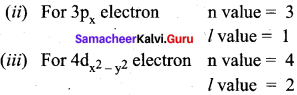

Question 31.
State and explain Pauli’s exclusion principle.
Answer:
Pauli’s exclusion principle states that “No two electrons in an atom can have the same set of values of all four quantum numbers”.
Illustration: H(Z = 1) 1s1.
One electron is present in hydrogen atom, the four quantum numbers are n = 1, l = 0, m = 0 and s = + \(\frac {1}{2}\). For helium Z = 2. He: 1s2. In this one electron has the quantum number same as that of hydrogen, n = 1,l = 0, m = 0 and s = +½ For other electron, fourth quantum number is different, i.e. n = 1, l = 0, m = 0 and s = – ½.

Question 32.
Define orbital? What are the n and l values for 3px and 4 dx2-y2 electron?
Answer:
(i) Orbital is a three dimensional space which the probability of finding the electron is maximum.
Samacheer Kalvi 11th Chemistry Solutions Chapter 2 Quantum Mechanical Model of Atom

Question 33.
Explain briefly the time independent Schrodinger wave equation?
Answer:
The time independent Schrodinger equation can be expressed as
\(\widehat{\mathrm{H}}\) Ψ = EΨ ……………(1)
Where \(\widehat{\mathrm{H}}\) is called Hamiltonian operator.
Ψ is the wave function.
E is the energy of the system.
Samacheer Kalvi 11th Chemistry Solutions Chapter 2 Quantum Mechanical Model of Atom
Since Ψ is a function of position coordinates of the particle and is denoted by Ψ (x, y, z)
∴ Equation (1) can be written as,
Samacheer Kalvi 11th Chemistry Solutions Chapter 2 Quantum Mechanical Model of Atom
Multiply the equation (3) by \(\widehat{\mathrm{H}}\) and rearranging
Samacheer Kalvi 11th Chemistry Solutions Chapter 2 Quantum Mechanical Model of Atom
The above equation (4) Schrodinger wave equation does not contain time as a variable and is referred to as time independent Schrodinger wave equation.

Question 34.
Calculate the uncertainty in position of an electron, if ∆v = 0.1% and n = 2.2 x 10⁶ ms-1.
Answer:
Mass of an electron = m = 9.1 x 10⁻³¹ kg.
∆v = Uncertainty in velocity = \(\frac {0.1}{100}\) x 2.2 x 10³ ms-1 .
∆v = 0.22 x 104 = 2.2 x 10³ ms-1
∆x . ∆v . m = \(\frac {h}{4π}\)
∆x = \(\frac {h}{∆v . m x 4π}\)
Samacheer Kalvi 11th Chemistry Solutions Chapter 2 Quantum Mechanical Model of Atom
= 0.02635 x 10⁻⁶
∆x = 2.635 x 10⁻⁸
Uncertainty in position = 2.635 x 10⁻⁸.

Question 35.
Determine the values of all the four quantum numbers of the 8th electron in O – atom and 15th electron in Cl atom and the last electron in chromium.
Answer:
(1) O (Z = 8) 1s2 2s2 2px2 2py1 2pz1
Four quantum numbers for 2px1 electron in oxygen atom:
n = principal quantum number = 2
l = azimuthal quantum number =1
m = magnetic quantum number =+1
s = spin quantum number = +\(\frac {1}{2}\)

(2) Cl (Z = 17) 1s2 2s2 2p6 3s2 3px2 3py2 3pz1
Four quantum numbers for 15th electron in chlorine atom:
n = 3, l = 1, m = 0, s = + ½

(3) Cr (Z = 24) 1s2 2s2 2p2 3s2 3p2 3d2 4s1
n = 3, l = 2, m = +2, s = + ½

Question 36.
The quantum mechanical treatment of the hydrogen atom gives the energy value:
En = \(\frac{-13.6}{n^{2}}\) eV atom-1

  1. use this expression to find ∆E between n = 3 and n = 4
  2. Calculate the wavelength corresponding to the above transition.

Answer:
(1) When n = 3
E3 = \(\frac{-13.6}{3^{2}}\) = \(\frac {-13.6}{9}\) = – 1.511 eV atom-1
When n = 4 E4 = \(\frac{-13.6}{4^{2}}\) = – 0.85 eV atom-1
∆E = E4 – E3 = – 0.85 – (-1.511) = + 0.661 eV atom
∆E = E3 – E4
= – 1.511 – (-0.85)
= – 0.661 eV atom-1

(2) Wave length = λ
∆E = \(\frac {hc}{ λ}\)
λ = \(\frac {hc}{∆E}\)
h = Planck’s constant = 6.626 x 10⁻³⁴ Js-1
c = 3 x 10⁸ m/s
λ = \(\frac{6.626 \times 10^{-34} \times 3 \times 10^{8}}{0.661}\)
= 10.02 x 10-34 x 3 x 108
= 30 x 10-26
λ = 3 x 10-25 m.

Question 37.
How fast must a 54 g tennis ball travel in order to have a de Broglie wavelength that is equal to that of a photon of green light 5400 Å?
Answer:
m = mass of tennis ball = 54 g = 5.4 x 10⁻² kg.
λ = de Broglie wavelength = 5400 Å. = 5400 x 10-10 m.
V = velocity of the ball = ?
λ = \(\frac {h}{mV}\)
V = \(\frac {h}{λ.m}\)
Samacheer Kalvi 11th Chemistry Solutions Chapter 2 Quantum Mechanical Model of Atom
= 0.2238 x 10-24
= 2.238 x 10⁻²⁵ m.

Question 38.
For each of the following, give the sub level designation, the allowable m values and the number of orbitals.

  1. n = 4, l = 2,
  2. n = 5, l = 3
  3. n = 7, l = 0

Answer:
1. n = 4, l = 2
If l = 2, ‘m’ values are -2, -1, 0, +1, +2
So, 5 orbitals such as dxy,dyz,dxz,\(d_{x^{2}-y^{2}}\) and dz

2. n = 5 , l = 3
If l = 3, ‘m’ values are -3, -2, -1, 0, +1, +2, +3
So, 7 orbitals such as f z, fxz, fyz, fxyz, fz(x2 y2)’ ^x(x2-3y2)’ ^y(3×2 ??y

3. n = 7 , l = 0
If l = 0, ‘m’ values are 0. Only one value.
So, 1 orbital such as 7s orbital.

Question 39.
Give the electronic configuration of Mn2+ and Cr3+
Answer:
1. Mn (Z = 25)
Mn → Mn2+ + 2e
Mn2+ electronic configuration is 1s 1s2 2s2 2p6 3s2 3p6 3d5

2. Cr (Z = 24)
Cr → Cr3+ + 3e
Cr3+ electronic configuration is Is2 2s2 2p6 3s23p6 3d3

Question 40.
Describe the Aufbau principle.
Answer:
In the ground state of the atoms, the orbitals are filled in the order of their increasing energies. That is the electrons first occupy the lowest energy orbital available to them. Once the lower energy orbitals are completely filled, then the electrons enter the next higher energy orbitals.
The order of filling of various orbitals as per Aufbau principle is –
1 s < 2s < 2p < 3s < 3p < 4s < 3d < 4p < 5s < 4d ………..
For e.g., K (Z =19)
The electronic configuration is 1s2 2s2 2p6 3s2 3p6 4s1.
After filling 4s orbital only we have to fill up 3d orbital.

Question 41.
A n atom of an element contains 35 electrons and 45 neutrons. Deduce

  1. the number of protons
  2. the electronic configuration for the element
  3. All the four quantum numbers for the last electron

Answer:
An element X contains 35 electrons, 45 neutrons

  1. The number of protons must be equal to the number of electrons. So the number of protons = 35.
  2. Number of electrons = 35. So the electronic configuration is 1s2 2s2 2p6 3s2 3p6 4s2 3d10 4p5.
  3. The last electron i.e. 5th electron in 4p orbital has the following quantum numbers. n = 4, l = 1, m =+1, s = + \(\frac {1}{2}\)

Question 42.
Show that the circumference of the Bohr orbit for the hydrogen atom is an integral multiple of the de Broglie wave length associated with the electron revolving around the nucleus.
Answer:
In order for the electron wave to exist in phase, the circumference of the orbit should be an integral multiple of the wavelength of the electron wave. Otherwise, the electron wave is out of phase.
mvr = nh / 2π, 2πr = nλ,
where mvr = angular momentum
where 2πr = circumference of the orbit
Samacheer Kalvi 11th Chemistry Solutions Chapter 2 Quantum Mechanical Model of Atom
n = 3, n = 4

Question 43.
Calculate the energy required for the process.
He+(g) → He2+(g) + e
The ionization energy for the H atom in its ground state is – 13.6 eV atom-1.
Answer:
The ionization energy for the H atom in its ground state =-13.6 eV atom-1.
Ionization energy = \(\frac{13.6 z^{2}}{n^{2}}\) eV
Z = atomic number
n = principal quantum number or shell number
For He, n = 1, z = 2
IE = \(\frac{-13.6 \times 2^{2}}{1^{2}}\)eV.

Question 44.
An ion with mass number 37 possesses unit negative charge. If the ion contains 11.1% more neutrons than electrons. Find the symbol of the ion.
Answer:
Let the number of electrons in an ion = x
number of neutrons = n = x + \(\frac{11.1}{100}\) eV = 1.111 x
(As the number of neutrons are 11.1% more than the number of electrons)
In the neutral of atom, number of electron.
e = x – 1 (as the ion carries -1 charge)
Similarly number of protons = P = x – 1 Number of protons + number of neutrons = mass number = 37
(x – 1) + 1.111 x = 37 .
2.111 x = 37 +1
2.111 x = 38
x = \(\frac{38}{2.111}\) = 18.009 = 18
∴ Number of protons = atomic number – 1 = 18-1 = 17
∴ The symbol of the ion = \(_{17}^{37} \mathrm{Cl}\).

Question 45.
The Li2+ ion is a hydrogen like ion that can be described by the Bohr model. Calculate the Bohr radius of the third orbit and calculate the energy of an electron in 4th orbit.
Answer:
Li2+ hydrogen like ion.
Bohr radius of the third orbit = r3 = ?
r3 = \(\frac{(0.529) n^{2}}{Z}\) A
Where n = shell number, Z = atomic number.
r3 = \(\frac{(0.529) 3^{2}}{3}\) A [∴for lithium Z = 3, n = 3]
= \(\frac{0.529 x 9}{3}\)
r3 = l.587Å
En = \(\frac{(-13.6) Z^{2}}{n^{2}}\) eV atom-1.
E4 = Energy of the fourth orbit = ?
E4 = \(\frac{(-13.6) \times 3^{2}}{4^{2}}\) = \(\frac{-13.6 \times 9}{16}\) = -7.65 eV atom-1
E4 = – 7.65 eV atom-1

Question 46.
Protons can be accelerated in particle accelerators. Calculate the wavelength (in Å)of such accelerated proton moving at 2.85 × 10⁸ ms-1 (the mass of proton is 1.673 x 10⁻²⁷ Kg).
Answer:
m = mass of the proton = 1.673 x 10⁻²⁷ Kg
v = velocity of the proton = 2.85 x 10⁸ ms-1
λ = \(\frac{h}{mv}\)
h = Planck’s constant = 6.626 x 1034 Kg m2 s-1
Samacheer Kalvi 11th Chemistry Solutions Chapter 2 Quantum Mechanical Model of Atom
Wavelength of proton = λ = 1.389 x 10⁻¹⁵ m.

Question 47.
What is the de Broglie wavelength (in cm) of a 160g cricket ball travelling at 140 Km hr-1.
Answer:
m = mass of the cricket ball = 160g = 0.16 kg.
v = velocity of the cricket ball =140 Km h-1
= \(\frac {140 x 5}{18}\) = 38.88 ms-1
de Broglie equation = λ = \(\frac{h}{mv}\)
h = Planck’s constant = 6.626 x 10⁻³⁴ kg m2 s-1
Samacheer Kalvi 11th Chemistry Solutions Chapter 2 Quantum Mechanical Model of Atom
λ = 1.065 x 10⁻³⁴m
Wave length in cm = 1.065 x 10-34 x 100
= 1.065 x 10⁻³² cm.

Question 48.
Suppose that the uncertainty in determining the position of an electron in an orbit is 0.6 A. What is the uncertainty in its momentum?.
Answer:
∆x = uncertainty in position of an electron = 0.6 Å = 0.6 x 10⁻¹⁰ m.
∆p = uncertainty in momentum = ?
Heisenberg’s uncertainty principle states that,
∆x.∆p ≥ \(\frac{h}{4π}\)
∆p = \(\frac{h}{4π.∆x}\)
h = Planck’s constant = 6.626 x 10⁻³⁴ kg m2 s-1
Samacheer Kalvi 11th Chemistry Solutions Chapter 2 Quantum Mechanical Model of Atom
Uncertainty in momentum = 0.8792 x 10⁻²⁴ kg ms-1 (or) = 8.792 x 10⁻²⁵ kg ms-1

Question 49.
Show that if the measurement of the uncertainty in .the location of the particle is equal to its de Broglie wavelength, the minimum uncertainty in its velocity is equal to its velocity /4π
Answer:
If, uncertainty in position = ∆x = λ , the value of uncertainty in velocity = \(\frac{v}{4π}\)
Heisenberg’s principle states that
∆x.∆v. m = \(\frac{h}{4π}\) …………(1)
de Broglie equation states that
λ = \(\frac{h}{mv}\) ………….(2)
∴ h = λ .m.v …………(3)
∆x = \(\frac{h}{∆v.4π}\) ………….(4)
Substituting the value of h in equation (4)
∆x = \(\frac{λ x m. v}{∆v.4π.m}\)
if ∆x = λ
∆v = Samacheer Kalvi 11th Chemistry Solutions Chapter 2 Quantum Mechanical Model of Atom = \(\frac{v}{4π}\)

Question 50.
What is the de Broglie wave length of an electron, which is accelerated from the rest, through a potential difference of 100V?
Answer:
Potential difference = V = 100 V
Potential energy = eV = 1.609 x 10-19c x 100V
\(\frac{v}{4π}\) m v2 = 1.609 x 10-19 x 100
\(\frac{v}{4π}\) m v2 = 1.609 x 10⁻¹⁹ J
v2 = \(\frac{2 \times 1.609 \times 10^{-17}}{m}\)
m = mass of electron = 9.1 x 10⁻³¹ Kg
Samacheer Kalvi 11th Chemistry Solutions Chapter 2 Quantum Mechanical Model of Atom
v = 5.93 x 10⁶ m/s
λ = \(\frac{h}{mv}\) where h = 6.62 x 10⁻³⁴ JS
= \(\frac{6.62 \times 10^{-34}}{9.1 \times 10^{-31} \times 5.93 \times 10^{6}}\)
= 1.2x 10⁻¹⁰m
A= 1.2 Å.

Question 51.
Identify the missing quantum numbers and the sub energy level
Samacheer Kalvi 11th Chemistry Solutions Chapter 2 Quantum Mechanical Model of Atom
Answer:
Samacheer Kalvi 11th Chemistry Solutions Chapter 2 Quantum Mechanical Model of Atom

Samacheer Kalvi 11th Chemistry Quantum Mechanical Model of Atom In-Text Questions – Evaluate Yourself

Question 1.
Calculate the de Broglie wavelength of an electron that has been accelerated from rest through a potential difference of 1 k eV.
Answer:
λ = \(\frac{h}{mv}\)
Potential difference of an electron = V = 1 keV.
Potential energy = \(\frac{1}{2}\) mv2 = eV
e = charge of an electron = 1.609 x 10⁻¹⁹c
l k V = 1000 V
:. Potential energy = 1.609 x 10-19 x 1000 = 1.609 x 10⁻¹⁹
\(\frac{1}{2}\) mv2 = 1.609 x 10⁻¹⁶V
m = 9.1 x 10⁻³¹ kg
λ = \(\frac{h}{mv}\)
Samacheer Kalvi 11th Chemistry Solutions Chapter 2 Quantum Mechanical Model of Atom
= 1.2 x 10⁻¹¹ m
λ = 1.2 x 10⁻¹¹ m.

Question 2.
Calculate the uncertainty in the position of an electron, if the uncertainty in its velocity is 5.7 x 10 s ms-1.
Answer:
Uncertainty in velocity = Av = 5.7 x 10⁵ ms-1
Mass of an electron = m = 9.1 x 10⁻³¹ kg.
Uncertainty in position = ∆x = ?
∆x.m.∆v = \(\frac{h}{4π}\)
Samacheer Kalvi 11th Chemistry Solutions Chapter 2 Quantum Mechanical Model of Atom
= 1 x 10⁻¹⁰m.
Uncertainty in position = 1 x 10⁻¹⁰ m.

Question 3.
How many orbitals are possible in the 4th energy level? (n = 4)
Answer:
n = 4
Number of orbitals in 4th energy level = ?
When n = 4, l = 0,1,2,3
If l = 0 orbital = 4s =1
If l = 1 orbital = 4px, 4py, 4pz = 2
If l = 2 orbital = \(4 \mathrm{d}_{\mathrm{xy}}, 4 \mathrm{d}_{\mathrm{yz}}, 4 \mathrm{d}_{\mathrm{zx}}, 4 \mathrm{d}_{\mathrm{x}} 2_{\mathrm{y}}, 2,4 \mathrm{d}_{\mathrm{z}^{2}}\) = 5
If l = 3 orbital = -3,-2, -1, 0, +1, +2, +3 = 7
Number of orbitals in 4th energy level = 16.

Question 4.
Calculate the total number of angular nodes and radial nodes present in 3d and 4f orbitals.
Answer:
Number of angular nodes in 3d orbital = ?
Number of radial nodes in 3d orbital = ?
Number of angular nodes = l
Number of radial nodes = n – l – 1

1. For 3d orbital:
Number of angular nodes = 2 because l = 2
Number of radial nodes = 3 – 2 -1 = 0
Total number of nodes in 3d orbital = 2

2. For 4f orbital:
Number of angular nodes = 3 because l = 3
Number of radial nodes = n – l – l =4 – 3 – 1 = 0
Total number of nodes in 4f orbital = 3.

Question 5.
Energy of an electron in hydrogen atom in ground state is -13.6 eV. What is the energy of the electron in the second excited state?
Answer:
Energy of an electron in ground state = -13.6 eV.
∴ Energy of an electron in the second excited state = E2.
n = 2
E2 = \(\frac{-13.6 \mathrm{eV}}{\mathrm{n}^{2}}\) = \(\frac{-13.6}{2^{2}}\) = \(\frac{-13.6}{4}\) = -3.4 eV.

Question 6.
How many unpaired electrons are present in the ground state of Fe3+ (z = 26), Mn2+ (z = 25) and argon (z=18)?
Answer:
Samacheer Kalvi 11th Chemistry Solutions Chapter 2 Quantum Mechanical Model of Atom

1s2 2s2 2p6 3s2 3p6 3d6 4s2 for Fe atom.
1s2 2s2 2p6 3s2 3p6 3d6 3d5 for Fe3+ ion.
So, it contain 5 unpaired electrons.
Mn (Z = 25). Electronic configuration is 1s2 2s2 2p6 3s2 3p6 3d6 3d5
Mn → Mn2+ + 2e
Number of unpaired electrons in Mn2+ = 5
Ar (Z = 18). Electronic configuration is 1s2 2s2 2p6 3s2 3p6.
All orbitals are completely filled. So, no unpaired electrons in it.

Question 7.
Explain the meaning of the symbol 4f2. Write all the four quantum numbers for these electrons.
Answer:
4f2 : It means that the element has 2 electrons in outermost 4f shell.
Quantum number values are, Samacheer Kalvi 11th Chemistry Solutions Chapter 2 Quantum Mechanical Model of Atom
n = principal quantum number = 4
l = azimuthal quantum number = 3
m = magnetic quantum number = – 3, -2
s = spin quantum number = +\(\frac {1}{2}\) – \(\frac {1}{2}\).

Question 8.
Which has the stable electronic configuration? Ni2+ or Fe3+
Answer:
Ni (Z = 28). 1s2 2s2 2p6 3s2 3p64s23d8
Ni2+ electronic configuration = Is2 2s22p6 3s2 3p6 3d8
Fe (Z = 26). 1s2 2s2 2p6 3s2 3p6 4s2 3d6
Fe3+ Is2 2s2 2p6 3s23p6 3d5
If d orbital is half filled, according to Aufbau principle, it is more stable. So Fe3+ is more stable than Ni2+.

Samacheer Kalvi 11th Chemistry Solutions Quantum Mechanical Model of Atom Additional Questions Solved

I. Choose the correct answer

Question 1.
Which of the following experiment proves the presence of an electron in an atom?
(a) Rutherford’s α-ray scattering experiment
(b) Davisson and Germer experiment
(c) J.J. Thomson cathode ray experiment
(d) G.R Thomson gold foil experiment
Answer:
(c) J.J. Thomson cathode ray experiment.

Question 2.
Consider the following statements regarding Rutherford’s α-ray scattering experiment.
i. Most of the α-particles were deflected through a small angle.
ii. Some of α-particles passed through the foil.
iii. Very few α-particles were reflected back by 180°.
Which of the above statements is/are not correct.
(a) i and ii
(b) ii and iii
(c) i and iii
(d) i ii and iii
Answer:
(a) i and ii.

Question 3.
Considering Bohr’s model which of the following statements is correct?
(a) The energies of electrons are continuously reduced in the form of radiation.
(b) The electron is revolving around the nucleus in a dynamic orbital.
(c) Electrons can revolve only in those orbits in which the angular momentum (mvr) of the electron must be equal to an integral multiple of h/2 π.
(d) In an atom, electrons are embedded like seeds in watermelon.
Answer:
(c) Electrons can revolve only in those orbits in which the angular momentum (mvr) of the electron must be equal to an integral multiple of h/2π.

Question 4.
The energy of an electron of hydrogen atom in 2nd main shell is equal to
(a) – 13.6 eV atom-1
(b) – 6.8 eV atom-1
(c) – 0.34 eV atom-1
(d) – 3.4 eV atom-1
Answer:
(d) -3.4 eV atom-1
Hints:
Energy of an electron in 2nd main shell = \(\frac{(-13.6) Z^{2}}{n^{2}}\); Z = 1, n = 2
E = \(\frac{-13.6}{2^{2}}\) = \(\frac{-13.6}{4}\) = -3.4 atom-1.

Question 5.
The energy of an electron of Li2+ in the 3rd main shell is …………..
(a) – 1.51 eV atom-1
(b) – 6.8 eV atom-1
(c) + 1.51 eV atom-1
(d) – 3.4 eV atom-1
Answer:
(a) -1.51 eV atom-1
Hints:
E = \(\frac{(-13.6) Z^{2}}{n^{2}}\) eV atom-1
Li2+= H atom. So Z = 1, n = 3.
E = \(\frac{(-13.6) 1^{2}}{3^{2}}\) = \(\frac{-13.6}{9}\) = -1.51 eV atom-1

Question 6.
The energy of an electron of hydrogen atom in main shell in terms of U mold is
(a) – 1312.8 k J mol-1
(b) – 82.05 k J mol-1
(c) – 328.2 kJ mol-1
(d) – 656.4 k J mol-1
Answer:
(b) – 82.05 k J mol-1
Hints:
E = \(\frac{(-13.6) Z^{2}}{n^{2}}\) kJ mol-1 , Z = 1, n = 4
∴ E = \(\frac{-1312.8}{16}\) = -82.50 kJ mol-1

Question 7.
The Bohr’s radius of Li2 0f21d orbit is
(a) 0.529 Å
(b) 0.0753 Å
(c) 0.7053 Å
(d) 0.0529 Å
Answer:
(c) 0.7053 Å
Hints:
rn = \(\frac{(0.529) Z^{2}}{n^{2}}\)Å, n = 2, Z = 3(for Li2+)
r = \(\frac{(0.529) 3^{2}}{2^{2}}\) = \(\frac{0.529 x 4}{3}\) = 0.7053 Å.

Question 8.
The formula used to calculate the Boh’s radius is ………..
(a) rn = \(\frac{(-13.6) Z^{2}}{n^{2}}\) eV atom-1
(b) rn = \(\frac{(0.529) Z^{2}}{n^{2}}\) A
(c) rn= \(\frac{(-1312.8) Z^{2}}{n^{2}}\) kJ mol-1
(d) rn = \(\frac{(+1312.8) Z^{2}}{n^{2}}\) kJ mol-1
Answer:
(b) rn = \(\frac{(0.529) Z^{2}}{n^{2}}\) A.

Question 9.
Who proposed the dual nature of light to all forms of matter?
(a) John Dalton
(b) Neils Bohr
(c) Albert Einstein
(d) J.J. Thomson
Answer:
(c) Albert Einstein

Question 10.
dc Brogue equation is ………..
(a) E = h γ
(b) E = mc2
(c) γ = \(\frac{\mathrm{E}_{2}-\mathrm{E}_{1}}{\mathrm{h}}\)
(d) λ = \(\frac{h}{mv}\)
Answer:
(d) λ = \(\frac{h}{mv}\).

Question 11.
The crystal used in Davison and Germer experiment is …………….
(a) nickel
(b) zinc suiphide
(c) gold foil
(d) NaCl
Answer:
(a) nickel.

Question 12.
Which one of the following is the time independent Schrodinger wave equation?
Samacheer Kalvi 11th Chemistry Solutions Chapter 2 Quantum Mechanical Model of Atom
Answer:
Samacheer Kalvi 11th Chemistry Solutions Chapter 2 Quantum Mechanical Model of Atom

Question 13.
Match the list-I and list-II correctly using the code given below the list.
List – I
A. Principal quantum number
B. Azimuthal quantum number
C. Magnetic quantum number
D. Spin quantum number

List – II
1. represents the directional orientation of orbital
2. represents the spin of the electron
3. represents the main shell
4. represents the sub shell
Samacheer Kalvi 11th Chemistry Solutions Chapter 2 Quantum Mechanical Model of Atom
Answer:
Samacheer Kalvi 11th Chemistry Solutions Chapter 2 Quantum Mechanical Model of Atom

Question 14.
The maximum number of electrons that can be accommodated in N shell is …………..
(a) 8
(b) 18
(c) 32
(d) 36
Answer:
(c) 32
Hints:
Number of electrons in the main shell = 2n2 n = 4, for N shell.
∴ Maximum number of electrons in N shell = 2(4)2 = 32.

Question 15.
The maximum number of electrons that can be accommodated in f orbital is ………….
(a) 10
(b) 14
(c) 16
(d) 6
Answer:
(6) 14
Hints:
forbital – l = 3.
Maximum number of electrons in sub shell = 2(2l + 1)
∴ For ‘f’ orbital, the maximum number of electrons = 2(2 x 3 + l) = 14.

Question 16.
When l = 0, the number of electrons that can be accommodated in the sub shell is ……………..
(a) 0
(b) 2
(c) 6
(d) 8
Answer:
(b) 2
Hints:
If l = 0, number of electrons = (2l + 1)
= 2 (2 x 0 + 1) = 2.

Question 17.
Which one of the quantum number is used to calculate the angular momentum of an atom?
(a) n
(b) m
(c) l
(d) s
Answer:
(c) l

Question 18.
What is the formula used to calculate the angular momentum?
(a) \(\sqrt{l^{(l+1)}} \frac{h}{2 \pi}\)
(b) \(\frac{\mathrm{mvr}}{2 \pi}\)
(c) \(\frac{mvr}{2}\)
(d) m . ∆v
Answer:
(a) \(\sqrt{l^{(l+1)}} \frac{h}{2 \pi}\).

Question 19.
Which of the following provides the experimental justification of magnetic quantum number?
(a) Zeeman effect
(b) Stark effect
(c) Uncertainty principle
(d) Quantum condition
Answer:
(a) Zeeman effect.

Question 20.
What are the values of n, l, m and s for 3px electron?
(a) 3, 2, 1, 0
(b) 3, 1,-l, +½
(c) 3, 2, +1, -½
(d) 3, 0, 0, +½]
Answer:
(b) 3, 1, -1, +½
Hint:
3px electron ; n = 3 (main shell)
for px orbitaI, l = 1, m = -1, s = \(\frac {1}{2}\).

Question 21.
Identify the quantum number for \(4 d_{x^{2}-y^{2}}\) electron.
(a) 4, 2, -2, +½
(b) 4, 0, 0, +½
(c) 4, 3, 2, +½
(d) 4, 3, 2, -½
Answer:
(a) 4, 2, -2, +½.

Question 22.
How many orbitals are possible in 3rd energy level?
(a) 16
(6) 9
(c) 3
(d) 27
Answer:
(b) 9
Hints:
3rd energy level Number of orbitals = ?
n = 3 main shell = m
l = 0, 1,2 m = 0, -1,0, +1
Total = 9 orbitals.

Question 23.
The region where the probability density function of electron reduces to zero is called
(a) orbit
(b) orbital
(c) nodal surface
(d) sub shell
Answer:
(c) nodal surface.

Question 24.
Consider the following statements.
(i) The region where the probability density of electron is zero, called nodal surface.
(ii) The probability of finding the electron is independent of the direction of the nucleus.
(iii) The number of radial nodes is equal to n + l + 1 Which of the above statements is/are correct?
(a) (i) and (iii)
(b) (i) and (ii)
(c) (iii) only
(d) (ii) and (iii)
Answer:
(b) (i) and (ii).

Question 25.
Match the list-I and list-II correctly using the code given below the list.
List-I
A. s – orbital
B. p – orbital
C. d – orbital
D. f – orbital

List-II
1. complex three-dimensional shape
2. symmetrical sphere
3. dumb-bell shape
4. clover leaf shape
Samacheer Kalvi 11th Chemistry Solutions Chapter 2 Quantum Mechanical Model of Atom
Answer:
Samacheer Kalvi 11th Chemistry Solutions Chapter 2 Quantum Mechanical Model of Atom

Question 26.
Which one of the following is the correct increasing order of effective nuclear charge felt by an electron?
(a) s>p>d>f
(b) s<p<d<f
(c) s>p>f>d
(d) f<p<d<s
Answer:
(a) s>p>d>f.

Question 27.
The value of n, l, m and s of 8th electron in an oxygen atom are respectively
(a) 1, 0, 0, + ½
(b) 2, 1, +1, – ½
(c) 2, 1, -1, – ½
(d) 2, 1, 0, +½
Answer:
(a) 2, 1, +1, – ½.

Question 28.
The number of impaired electrons in carbon atom in the gaseous state is
(a) 0
(b) 1
(c) 2
(d) 3
Answer:
(c) 2

Question 29.
Which of the following is not used in writing electronic configuration of an atom?
(a) Aufbau principle
(b) Hund’s rule
(c) Pauli’s exclusion principle
(d) Heisenberg’s uncertainty principle
Answer:
(d) Heisenberg’s uncertainty principle.

Question 30.
Which of the following is the expected configuration of Cr (Z = 24)?
(a) 1s2 2s2 2p6 3s2 3p6 3d4 4s2
(b) 1s2 2s2 2p6 3s2 3p6 3d5 4s1
(c) 1s2 2s2 2p6 3s2 3p6 3d6
(d) 1s2 2s2 2p6 3s2 3p6 3d5 4s3
Answer:
(a) 1s2 2s2 2p6 3s2 3p6 3d4 4s2

Question 31.
Which of the following is the actual configuration of Cr (Z = 24)?
(a) 1s2 2s2 2p6 3s2 3p6 3d4 4s2
(b) 1s2 2s2 2p6 3s2 3p6 3d5 4s1
(c) 1s2 2s2 2p6 3s2 3p6 3d6
(d) 1s2 2s2 2p6 3s2 3p6 3d5 4s3
Answer:
(b) 1s2 2s2 2p6 3s2 3p6 3d5 4s1

Question 32.
Assertion (A) : Cr with electronic configuration [Ar] 3d5 4s1 is more stable than [Ar] 3d4 4s1.
Reason(R ): Half filled orbitals have been found to have extra stability than partially filled orbitals.
(a) A and R are correct and R is the correct explanation of A.
(b) A and R are correct but R is not the correct the explanation of A.
(c) A is correct but R is wrong.
(d) A is wrong but R is correct.
Answer:
(a) A and R are correct and R is the correct explanation of A.

Question 33.
Assertion (A): Copper (Z = 29) with electronic configuration [Ar] 4s1 3d10 is more stable than [Ar] 4s1 3d10.
Reason(R): Copper with [Ar] 4s2 3d9 is more stable due to symmetrical distribution and exchange energies of d electrons.
(a) A and R are correct and R is the correct explanation of A.
(b) A and R are correct but R is not the correct explanation of A.
(c) A is correct but R is wrong.
(d) A is wrong but R is correct.
Answer:
(a) A and R are correct and R is the correct explanation of A.

Question 34.
In a sodium atom (atomic number = 11 and mass number = 23) and the number of neutrons is …………..
(a) equal to the number of protons
(b) less than the number of protons
(c) greater than the number of protons
(d) none of these
Answer:
(c) greater than the number of protons.

Question 35.
The idea of stationary orbits was first given by …………
(a) Rutherford
(b) J.J. Thomson
(c) Nails Bohr
(d) Max Planck
Answer:
(c) Niels Bohr.

Question 36.
de Broglie equation is ……………
(a) λ = \(\frac {h}{mv}\)
(b) λ = \(\frac {hv}{m}\)
(c) λ = \(\frac {mv}{h}\)
(d) λ = hmv
Answer:
(a) λ = \(\frac {h}{mv}\).

Question 37.
The orbital with n = 3 and l = 2 is …………..
(a) 3s
(b) 3p
(c) 3d
(d) 3J
Answer:
(c) 3d

Question 38.
The outermost electronic configuration of manganese (at. no. = 25) is …………
(a) 3d5 4s2
(b) 3d6 4s1
(c) 3d7 4s0
(d) 3d6 4s2
Answer:
(a) 3d5 4s2

Question 39.
The maximum number of electrons in a sub-shell is given by the equation
(a) n2
(b) 2 n2
(c) 2 l – l
(d) 2 l + 1
Answer:
(d) 2 l + 1

Question 40.
Which of the following statements is correct for an electron that has the quantum numbers n = 4 and m = -2.
(a) The electron may be in 2 p orbital
(b) The electron may be in 4 d orbital
(c) The electron is in the second main shell
(d) The electron must have spin quantum number as +\(\frac {1}{2}\).
Answer:
(b) The electron may be in 4d orbital.

Samacheer Kalvi 11th Chemistry Quantum Mechanical Model of Atom 2 – Marks Questions

Question 1.
Write a note about J.J. Thomson’s atomic model.
Answer:

  • J.J. Thomson’s cathode ray experiment revealed that atoms consist of negatively charged particles called electrons.
  • He proposed that atom is a positively charged sphere in which the electrons are embedded like the seeds in the watermelon.

Question 2.
Explain about theory of electromagnetic radiation.
Answer:

  • The theory of electromagnetic radiation states that a moving charged particle should continuously loose its energy in the form of radiation.
  • O Therefore, the moving electron in an atom should continuously loose its energy and finally collide with nucleus resulting in the collapse of the atom.

Question 3.
Explain how matter has dual character?
Answer:

  • Albert Einstein proposed that light has dual nature, i.e. like photons behave both like a particle and as a wave.
  • Louis de Broglie extended this concept and proposed that all forms of matter showed dual character.
  • He combined the following two equations of energy of which one represents wave character (hυ) and the other represents the particle nature (mc2).

Question 4.
Explain about the significance of de Broglie equation.
Answer:

  • X = \(\frac {h}{mv}\). This equation implies that a moving particle can be considered as a wave and a wave can exhibit the properties of a particle.
  • For a particle with high linear momentum (mv) the wavelength will be so small and cannot be observed.
  • For a microscopic particle such as an electron, the mass is of the order of 10-31 kg, hence the wavelength is much larger than the size of atom and it becomes significant.
  • For the electron, the de Broglie wavelength is significant and measurable while for the iron ball it is too small to measure, hence it becomes insignificant.

Question 5.
How many electrons can be accommodated in the main shell l, m and n?
Answer:
Samacheer Kalvi 11th Chemistry Solutions Chapter 2 Quantum Mechanical Model of Atom

Question 6.
How many electrons that can be accommodated in the sub shell s, p, d, f ?
Answer:
Samacheer Kalvi 11th Chemistry Solutions Chapter 2 Quantum Mechanical Model of Atom

Question 7.
What are quantum numbers?
Answer:

  • The electron in an atom can be characterized by a set of four quantum numbers, namely principal quantum number (n), azimuthal quantum number (l), magnetic quantum number (m) and spin quantum number (s).
  • When Schrodinger equation is solved for a wave function T, the solution contains the first three quantum numbers n, l
  • and m.
  • The fourth quantum number arises due to the spinning of the electron about its own axis.

Question 8.
How many orbitals are possible in the 3rd energy level?
Answer:
n = 3, main shell is m.
Total number of orbitals in 3rd energy level = ?
Samacheer Kalvi 11th Chemistry Solutions Chapter 2 Quantum Mechanical Model of Atom
Total number of orbitals = 9.

Question 9.
What are Ψ and Ψ2 ?
Answer:

  • Ψ itself has no physical meaning but it represents an atomic orbital.
  • Ψ2 is related to the probability of finding the electrons within a given volume of space.

Question 10.
What is meant by nodal surface?
Answer:

  • The. region where there is probability density function reduces to zero is called nodal surface or a radial node.
  • For ns orbital, (n-1) nodes are found in it.

Question 11.
Mention the shape of s, p, d orbitals.
Answer:

  • Shape of s – orbital – sphere
  • Shape of p – orbital – dumb bell
  • Shape of d – orbital – clover leaf

Question 12.
Calculate the total number of angular nodes and radial nodes present in 4p and 4d orbitals.
Answer:
1. For 4p orbital:
Number of angular nodes = l
For 4p orbital 7 = l
Number of angular nodes = l
Number of radial nodes = n – l – 1 = 4 -1 -1 = 2
Total number of nodes = n -1 = 4 – 1 = 3
1 angular node and 2 radial nodes.

2. For 4d orbital:
Number of angular nodes = l
For 4d orbital l = 2
Number of angular nodes = 2
Number of radial nodes = n – l – 1 = 4 – 2 – 1 = 1
Total number of nodes = n – l = 4 – l = 3
1 radial nodes and 2 angular node.

Question 13.
Write the equation to calculate the energy of nth orbit.
Answer:
En = \(\frac{(-1312.8) Z^{2}}{n^{2}}\) kJ mol-1
Where Z = atomic number, n = principal quantum number.

Question 14.
what are degenerate orbitals?
Answer:

  • Three different orientations in space that are possible for a p-orbital. All the three p-orbitals, namely px, py and pz have same energies and are called degenerate orbitals.
  • In the presence of magnetic or electric field, the degeneracy is lost.

Question 15.
Energy of an electron in hydrogen atom in ground state is -13.6 eV. What is the energy of the electron in the third excited state?
Answer:
E1 = – 13.6 eV
E3 = \(\frac{-13.6}{n^{2}}\) Where n = 3
E3 = \(\frac{-13.6}{9}\) = 1.511 eV
Energy of the electron in the third excited state = 1.511 eV.

Question 16.
The energies of the same orbital decreases with an increase in the atomic number. Justify this statement.
Answer:
The energy of the 2s orbital of hydrogen atom is greater than that of 2s orbital of lithium and that of lithium is greater than that of sodium and so on because H (Z =1), Li (Z = 3) and Na (Z = 11). When atomic number increases, the energies of the same orbital decreases. E2s(H) > E2s(Li) > E2s(Na) > E2s(K) ………….

Question 17.
State Hund’s rule of maximum multiplicity.
Answer:
It states that electron pairing in the degenerate orbitals does not take place until all the available orbitals contain one electron each.

Question 18.
How many unpaired electrons are present in the ground state of –
1. Cr3+ (Z = 24)
2. Ne (Z = 10)
Answer:
1. Cr3+ (Z = 24) 1s2 2s2 2p6 3s2 3p6 3d5 4s1
Cr3+ – 1s2 2s2 2p6 3s2 3p6 3d4.
It contains 4 unpaired electrons.

2. Ne (Z = 10) 1s22s22p6. No unpaired electrons in it.

Question 19.
What is meant by electronic configuration? Write the electronic configuration of N (Z = 7).
Answer:
The distribution of electrons into various orbitals of an atom is called its electronic configuration.
Samacheer Kalvi 11th Chemistry Solutions Chapter 2 Quantum Mechanical Model of Atom

Question 20.
Which is the actual configuration of Cr (Z = 24) Why?
Answer:
Cr (Z = 24) 1s22s22p6.
The reason for this is, Cr with 3d5 configuration is half filled and it will be more stable. Chromium has [Ar] 3d5 4s1 and not [Ar] 3d4 4s2 due to the symmetrical distribution and exchange energies of d electrons.

Question 21.
What is the actual configuration of copper (Z = 29)? Explain about its stability.
Answer:
Copper (Z = 29)
Expected configuration : 1s2 2s2 2p6 3s2 3p6 3d9 4s2
Actual configuration : 1s2 2s2 2p6 3s2 3p6 3d10 4s1
The reason is that fully filled orbitals have been found to have extra stability. Copper has the electronic configuration [Ar] 3d10 4s1 and not [Ar] 3d9 4s2 due the symmetrical distribution and exchange energies of d electrons. Symmetry leads to stability. The full filled configuration have symmetrical distribution of electrons and hence they are more stable than unsymmetrical configuration.

Samacheer Kalvi 11th Chemistry Quantum Mechanical Model of Atom 3 – Mark Questions

Question 1.
What are the conclusions of Rutherford’s α – rays scattering experiment?
Answer:

  • Rutherford bombarded a thin gold foil with a stream of fast moving α – particles.
  • It was observed that most of the a-particles passed through the foil.
  • Some of them were deflected through a small angle.
  • Very few α- particles were reflected back by 180°.
  • Based on these observations, he proposed that in an atom, there is a tiny positively charged nucleus and the electrons are moving around the nucleus with high speed.

Question 2.
What are the limitations of Bohr’s atom model?
Answer:

  • The Bohr’s atom model is applicable only to species having one electron such as hydrogen, Li2+ etc and not applicable to multi – electron atoms.
  • It was unable to explain the splitting of spectral lines in the presence of magnetic field (Zeeman effect) or an electric field (Stark effect).
  • Bohr’s theory was unable to explain why the electron is restricted to revolve around the nucleus in a fixed orbit in which the angular momentum of the electron is equal to nh / 2π.

Question 3.
Illustrate the significance of de Broglie equation with an iron ball and an electron.

  1. 6.626 kg iron ball moving with 10 ms-1.
  2. An electron moving at 72.73 ms-1.

Answer:
1. λiron ball = \(\frac{h}{mv}\)
Samacheer Kalvi 11th Chemistry Solutions Chapter 2 Quantum Mechanical Model of Atom
= 1 x 10-35m

2. λiron ball = \(\frac{h}{mv}\)
Samacheer Kalvi 11th Chemistry Solutions Chapter 2 Quantum Mechanical Model of Atom
= \(\frac{6.626}{662.6}\) x 10-3m = 1 x 10⁵m
For an electron, the de Broglie wavelength is significant and measurable while for iron ball it is too small to measure, hence it becomes insignificant.

Question 4.
Explain Davisson and Germer experiment.
Answer:

  • The wave nature of electron was experimentally confirmed by Davisson and Germer.
  • They allowed the accelerated beam of electrons to fall on a nickel crystal and recorded the diffraction pattern.
  • The resultant diffraction pattern is similar to the X – ray diffraction pattern.
  • The finding of wave nature of electron leads to the development of various experimental ’ techniques such as electron microscope, low energy electron diffraction etc.

Question 5.
Bohr radius of 1st orbit of hydrogen atom is 0.529 Å. Assuming that the position of an electron in this orbit is determined with the accuracy of 0.5% of the radius, calculate the uncertainty in the velocity of the electron in hydrogen atom.
Answer:
Uncertainty in position = ∆x
= \(\frac{0.5}{100}\) x 0.529 Å
= \(\frac{0.5}{100}\) x 10-10 x 0.529 m
∆x = 2.645 x 10⁻¹³ m
From Heisenberg’s uncertainty principle,
∆x.∆p ≥ \(\frac{h}{4π}\)
∆x.m.∆p ≥ \(\frac{h}{4π}\)
∆v ≥ \(\frac{h}{∆x.m.4π}\)
∆v = Samacheer Kalvi 11th Chemistry Solutions Chapter 2 Quantum Mechanical Model of Atom
∆v = 2.189 x 10⁸m.

Question 6.
Write a note about principal quantum number.
Answer:

  • The principal quantum number represents the energy level in which electron revolves around the nucleus and is denoted by the symbol ‘n’.
  • The ‘n’ can have the values 1, 2, 3,… n = 1 represents K shell; n=2 represents L shell and n = 3, 4, 5 represent the M, N, O shells, respectively.
  • The maximum number of electrons that can be accommodated in a given shell is 2n2.
  • ‘n’ gives the energy of the electron,

En = \(\frac{(-1312.8) Z^{2}}{n^{2}}\) KJ mol-1 and the distance of the electron from the nucleus is given by rn = \(\frac{(-0.529) n^{2}}{Z}\) A.

Question 7.
Explain about azimuthal quantum number.
Answer:

  • It is represented by the letter 7′ and can take integral values from zero to n – 1, where n is the principal quantum number.
  • Each l value represents a subshell (orbital). l = 0, 1, 2, 3 and 4 represents the s, p, d, f and g orbitals respectively.
  • The maximum number of electrons that can be accommodated in a given subshell (orbital) is 2(2l + 1).
    It is used to calculate the orbital angular momentum using the expression Angular momentum = \(\sqrt{l(l+1)} \frac{h}{2 \pi}\).

Question 8.
Draw the shapes of 1s, 2s and 3s orbitals
Answer:
Samacheer Kalvi 11th Chemistry Solutions Chapter 2 Quantum Mechanical Model of Atom

Question 9.
Explain how effective nuclear charge is related with stability of the orbital.
Answer:

  • In a multi-electron atom, in addition to the electrostatic attractive force between the electron and nucleus, there exists a repulsive force among the electrons.
  • These two forces are operating in the opposite direction. This results in the decrease in the nuclear force of attraction on electron.
  • The net charge experienced by the electron is called effective nuclear charge.
  • The effective nuclear charge depends on the shape of the orbitals and it decreases with increase in azimuthal quantum number l.
  • The order of the effective nuclear charge felt by a electron in an orbital within the given shell is s > p > d > f.
  • Greater the effective nuclear charge, greater is the stability of the orbital. Hence, within a given energy level, the energy of the orbitals are in the following order s < p < d < f.

Question 10.
Calculate the wavelength of an electron moving with a velocity of 2.05 x 10⁷ ms-1.
Answer:
According to de Broglie’s equation, λ = \(\frac {h}{mv}\)
Mass of electron (m) = 9.1 x 10⁻³¹ kg
Velocity of electron (υ) = 2.05 x 10⁷ ms-1
Planck’s constant (h) = 6.626 x 10⁻³⁴ kg m2 s-1
λ = Samacheer Kalvi 11th Chemistry Solutions Chapter 2 Quantum Mechanical Model of Atom =355 x 10-4m.

Question 11.
The mass of an electron is 9.1 x 10⁻³¹ kg. If its kinetic energy is 3.0 x 10⁻²⁵ J, calculate its wavelength.
Answer:
Step I.
Calculation of the velocity of electron
Kinetic energy = 1 / 2 mυ2 = 3.0 x 10⁻²⁵ kg m2 s-2
υ2Samacheer Kalvi 11th Chemistry Solutions Chapter 2 Quantum Mechanical Model of Atom = 65.9 x 10⁴ m2 s-2
υ = (65.9 x 10⁴ m s-2) = 8.12 x 10² ms-1

Step II.
Calculation of wavelength of the electron
According to de Broglie’s equation,
λ = \(\frac {h}{mv}\) = Samacheer Kalvi 11th Chemistry Solutions Chapter 2 Quantum Mechanical Model of Atom
=  0.08967 x l0-5 m = 8967 x 10-10 m = 8967 Å (∴1Å = 10-10m).

Question 12.
From the following sets of quantum numbers, state which are possible. Explain why the others are not possible.

  1. n = 0, l = 0, ml = 0, ms = + \(\frac {1}{2}\)
  2. n = 1, l = 0, ml = 0, ms = – \(\frac {1}{2}\)
  3. n = 1, l = 1, ml = 0, ms = + \(\frac {1}{2}\)
  4. n = 1, l = 0, ml = +1, ms= +\(\frac {1}{2}\)
  5. n = 3, l = 3, ml = -3, ms = + \(\frac {1}{2}\)
  6. n = 3, l = 1, ml = 0, ms = +\(\frac {1}{2}\)

Answer:

  1. The set of quantum numbers is not possible because the minimum value of n can be 1 and not zero.
  2. The set of quantum numbers is possible.
  3. The set of quantum numbers is not possible because, for n = 1,1 cannot be equal to 1. It can have 0 value.
  4. The set of quantum numbers is not possible because for l = 0, ml; cannot be +1. It must be zero.
  5. The set of quantum numbers is not possible because, for n = 3, l = 3.
  6. The set of quantum numbers is possible.

Question 13.
How many electrons in an atom may have the following quantum numbers?
(a) n = 4; ms = – ½
(b) n = 3, l = 0.
Answer:
(a) For n = 4
1 Total number of electrons = 2n2 = 2 x 16 = 32
Half out of these will have ms = – \(\frac {1}{2}\)
Total electrons with ms (-½) = 16.

(b) For n = 3
l = 0; m1 = 0, ms = + ½ – ½ (two e).

Question 14.
Show that the circumference of the Bohr orbit for the hydrogen atom is an integral multiple of the de Broglie wavelength associated with the electron revolving around the orbit.
Answer:
According to Bohr’s theory,
mυr = \(\frac {nh}{2π}\) (n = 1,2,3, …… so on)
or 2πr = \(\frac {nh}{mυ}\) or mυ = \(\frac {nh}{2πr}\) ………..(i)
According to de Brogue equation,
λ = \(\frac {h}{mυ}\) or mυ = \(\frac {h}{λ}\) ……….(ii)
Comparing (i) and (ii),
\(\frac {nh}{2πr}\) = \(\frac {h}{λ}\) or 2πr = nλ
Thus, the circumference (2πr) of the Bohr orbit for hydrogen atom is an into the de Broglie wave length.

Question 15.
An ion with mass number 56 contains 3 units of positive charge and 30.4% more neutrons than electrons. Assign symbol to the ion.
Answer:
Let the no. of electrons in the ion = x
the no. of the protons = x + 3 (as the ion has three units positive charge)
and the no. of neutrons = x + \(\frac {30.4x }{100}\) = x + 0.304 x
Now, mass number of ion = Number of protons + Number of neutrons
= (x + 3) + (x + 0.304 x)
∴ 56 = (x + 3) + (x + 0.304 x) or 2.304 x = 56 – 3 = 53
x = \(\frac {53}{2.304}\) = 23
Atomic number of the ion (or element) = 23 + 3 = 26
The element with atomic number 26 is iron (Fe) and the corresponding ion is Fe3+.

Question 16.
The uncertainty in the position of a moving bullet of mass 10 g is 10 s m. Calculate the uncertainty in its velocity?
Answer:
According to uncertainty principle,
∆x.m∆υ = \(\frac {h}{4π}\) or ∆υ = \(\frac {h}{4πm∆x}\);
h = 6.626 x 1o-34 kg m2 s-1; m = 10 g = 10-2 kg
∆x = 10-5m; ∆v = Samacheer Kalvi 11th Chemistry Solutions Chapter 2 Quantum Mechanical Model of Atom = 5.27 x 10⁻²⁸mv
= 1.6 x 10⁻¹⁵ kg m2 s-15
Or
\(\frac {1}{2}\) mv2 = 1.6 x 10⁻¹⁵kg m2s-2
v = Samacheer Kalvi 11th Chemistry Solutions Chapter 2 Quantum Mechanical Model of Atom = 5.93 x 10⁷m-1

Question 17.
The uncertainty in the position and velocity of a particle are 10-10 m and 5.27 × 10⁻²⁴ ms-1 respectively. Calculate the mass of the particle.
Answer:
According to uncertainty principle.
∆x. m∆υ = \(\frac {h}{4π}\)
or
m = \(\frac {h}{4π∆x.∆υ}\);
h = 6.626 x 10⁻³⁴ kg m2 s-1
∆x = 10-10 m; ∆x = 5.27 x 10⁻²⁴ms-1
m Samacheer Kalvi 11th Chemistry Solutions Chapter 2 Quantum Mechanical Model of Atom = 0.1 kg.

Question 18.
With what velocity must an electron travel so that its momentum Is equal to that of a photon of wave length = 5200 A?
Answer:
According to de Brogue equation, λ = \(\frac {h}{mv}\)
Momentum of electron, mv = \(\frac {h}{λ}\) Samacheer Kalvi 11th Chemistry Solutions Chapter 2 Quantum Mechanical Model of Atom
= 1.274 x 10⁻²⁷ kg ms-1 ………(i)
The momentum of electron can also be calculated as = mv = (9.1 x 10⁻³¹kg) x v ………(ii)
Comparing (i) and (ii)
(9.1 X 10⁻³¹kg) v = (1.274 x 10⁻²⁷ kg ms-1)
Samacheer Kalvi 11th Chemistry Solutions Chapter 2 Quantum Mechanical Model of Atom = 1.4 x 10³ ms-1

Question 19.
Using Aufbau principle, write the ground state electronic configuration of following atoms.

  1. Boron (Z = 5)
  2. Neon (Z = 10)
  3. Aluminium (Z = 13)
  4. Chlorine (Z = 17)
  5. Calcium (Z = 20)
  6. Rubidium (Z = 37)

Answer:

  1. Boron (Z = 5) ; 1s2 2s2 2p1
  2. Neon (Z = 10) ; 1s2 2s2 2p6
  3. Aluminium (Z = 13) ; 1s2 2s2 2p6 3s2 3p1
  4. Chlorine(Z = 17) ; 1s2 2s2 2p6 3s2 3p5
  5. Calcium (Z = 20) ; 1s2 2s2 2p6 3s2 3p6 4s2
  6. Rubidium (Z = 37) ; 1s2 2s22p6 3s2 3p63d10 4s2 4p6 5s1

Question 20.
Calculate the de Broglie wavelength of an electron moving with 1 % of the speed of light?
Answer:
According to de Brogue equation, A = \(\frac {h}{mv}\)
Mass of electron = 9.1 x 10⁻³¹ kg; Planck’s constant 6.626 x 10⁻³⁴ kg m2 s-1
Velocity of electron = 1% of speed of light = 3.0 x 108 x 0.01 = 3 106 ms-1
Wavelength of electron (λ) = \(\frac {h}{mv}\) Samacheer Kalvi 11th Chemistry Solutions Chapter 2 Quantum Mechanical Model of Atom
= 2.43 x 10⁻¹⁰m.

Question 21.
What is the wavelength for the electron accelerated by 1.0 X i0 volts?
Answer:
Step I.
Calculation of the velocity of electron
Energy (kinetic energy) of electron = 1.0 x 10⁴ volts.
= 1.0 x 104 x 1.6 x 10-19 J = 1.6 x 10⁻¹⁵J.

Step II.
Calculation of wavelength of the electron
According to de Broglie equation,
λ = \(\frac {h}{mυ}\); λ  Samacheer Kalvi 11th Chemistry Solutions Chapter 2 Quantum Mechanical Model of Atom
= 1.22 x 10⁻¹¹m .

Question 22.
In a hydrogen atom, the energy of an electron in first Bohr’s orbit is 13.12 x 10⁵ J mol-1. What is the energy required for its excitation to Bohr’s second orbit?
Answer:
Samacheer Kalvi 11th Chemistry Solutions Chapter 2 Quantum Mechanical Model of Atom
The energy required for the excitation is:
∆E = E2 – E1 = (-3.28 x l05) – (- 13.12 x 10⁵) = 9.84 x 10⁵ J mol-1

Question 23.
Dual behavior of matter proposed by de Broglie led to the discovery of electron microscope often used for the highly magnified images of biological molecules and other type of material. If the velocity of the electron in this microscope is 1.6 x 10⁶ ms-1, calculate de Broglie wavelength associated with this electron.
Answer:
λ = \(\frac {h}{mυ}\); λ = Samacheer Kalvi 11th Chemistry Solutions Chapter 2 Quantum Mechanical Model of Atom
= 0.455 x 10⁻³⁴ + 25 m = 0.455 nm = 455 pm.

Question 24.
An element with mass number 81 contains 31.7% more neutrons as compared to protons. Assign the symbol to the element.
Answer:
An element can be identified by its atomic number only. Let us find the atomic number.
Let the number of protons = x
∴ Number of neutrons = x + \(\frac {x × 31.7}{100}\) = (x + 0.317 x)
Now, Mass no. of element = No. of protons + No. of neutrons
81 = x + x + 0.317 x = 2.317 x
Or
x = \(\frac {81}{2.317}\) = 35
∴ No. of protons = 35, No. of neutrons = 81 – 35 = 46
Atomic number of element (Z) = Number of protons = 35
The element with atomic number (Z) 35 is bromine 8135Br.

Question 25.
The electron energy in hydrogen atom is given by En = (- 2.18 × 10⁻¹⁸) / n2 J. Calculate the energy required to remove an electron completely from the n = 2 orbit. What is the longest wavelength of light in cm that can be used to cause this transition?
Answer:
Step I.
Calculation of energy required
The energy required is the difference in the energy when the electron jumps from orbit with
n = ∞ to orbit with n = 2.
The energy required (∆E) = E – E2
= 0 – \(\left(-\frac{2.18 \times 10^{-18}}{4} \mathrm{J}\right)\) = 5.45 x 10⁻¹⁹ J.

Step II.
Calculation of the longest wavelength of light in cm used to cause the transition
∆E = hv = hc / λ.
λ = \(\frac {hc}{∆E}\) = Samacheer Kalvi 11th Chemistry Solutions Chapter 2 Quantum Mechanical Model of Atomn= 3.644 x 10⁻⁷

m = 3.644 x 10-7 x 102 = 3.645 x 10⁻⁵ cm.

Samacheer Kalvi 11th Chemistry Quantum Mechanical Model of Atom 5-Mark Questions

Question 1.
Describe about Bohr atom model.
Answer:
Assumptions of Bohr atom model.
1. The energies of electrons are quarantined

2. The electron is revolving around the nucleus in a certain fixed circular path called the stationary orbit.

3. Electron can revolve only in those orbits in which the angular momentum (mvr) of the electron must be equal to an integral multiple of h/2π
mvr = \(\frac {nh}{2π}\) where n = 1,2,3,…etc.,

4. As long as an electron revolves in a fixed stationary orbit, it doesn’t lose its energy. But if an electron jumps from a higher energy state (E2) to a lower energy state (E1), the excess energy is emitted as radiation. The frequency of the emitted radiation is E2 – E1= hv.
∴ v = \(\frac{\mathrm{E}_{2}-\mathrm{E}_{1}}{\mathrm{h}}\)
Conversely, when suitable energy is supplied to an electron, it will jump from lower energy orbit to a higher energy orbit.

5. Bohr’s postulates are applied to a hydrogen like atom (H, He+ and Li2+ etc..) the radius of the nth orbit and the energy of the electron revolving in the th orbit were derived.
rn = \(\frac{(0.529) n^{2}}{Z}\) A(0.529) n2
En = \(\frac{(-1 3.6) Z^{2}}{n}\) eV atom-1
En = \(\frac{(1312.8) Z^{2}}{n}\) kJ mol-1

Question 2.
Derive de Brogue equation and give its significance.
Answer:
1. Louis de Brogue extended the concept of dual nature of light to all forms of matter. To quantify this relation, he derived an equation for the wavelength of a matter-wave.

2. He combined the following two equations of the energy of which one represents wave character (hu) and the other represents the particle nature (mc2).
Planck’s quantum hypothesis:
E = hv ……….(1)
Einsteins mass-energy relationship:
E = mc2 ………(2)
From (1) and (2)
hv = mc2
hc/λ = mc2
∴ λ = \(\frac{h}{mc}\) ………(3)
The equation (3) represents the wavelength of photons whose momentum is given by mc. (Photons have zero rest mass).

3. For a particle of matter with mass m and moving with a velocity y, the equation (3) can be written as λ = \(\frac{h}{mc}\) ………(4)

4. This is valid only when the particle travels at speed much less than the speed of Light.

5. This equation implies that a moving particle can be considered as a wave and a wave can exhibit the properties of a particle (i.e momentum).

6. Significance of de Brogue equation:
For a particle with high linear momentum, the wavelength will be too small and cannot be observed. For a microscopic particle such as an electron, the mass is 9.1 x 10⁻³¹ kg. Hence the wavelength is much larger than the size of atom and it becomes significant.

Question 3.
What are the main features of the quantum mechanical model of an atom.
Answer:
1. The energy of electrons in an atom is quarantined.

2. The existence of quarantined electronic energy levels is a direct result of the wave-like properties of electrons. The solutions of the Schrodinger wave equation gives the allowed energy levels (orbits).

3. According to Heisenberg’s uncertainty principle, the exact position and momentum of an electron cannot be determined with absolute accuracy. As a consequence, quantum mechanics introduced the concept of orbital. Orbital is a three-dimensional space in which the probability of finding the electron is maximum.

4. The solution of the Schrodinger wave equation for the allowed energies of an atom gives the wave function Ψ, which represents an atomic orbital. The wave nature of the electron present in an orbital can be well defined by the wave function Ψ.

5. The wave function Ψ itself has no physical meaning. However, the probability of finding the electron in a small volume dx, dy, dz around a point (x,y,z) is proportional to |Ψ (x,y,z)|2 dx dy dz |Ψ (x,y,z)|2 is known as probability density and is always positive.

Question 4.
Explain about –
(1) Magnetic quantum number
(2) Spin quantum number
Answer:
(1) Magnetic quantum number:

  • It is denoted by the letter ml. It takes integral values ranging from – l to +l through 0.
    i.e. if l = 1; m = -1, 0 and +1.
  • The Zeeman Effect (the splitting of spectral lines in a magnetic field) provides the experimental justification for this quantum number.
  • The magnitude of the angular momentum is determined by the quantum number l while its direction is given by magnetic quantum number.

(2) Spin quantum number:

  • The spin quantum number represents the spin of the electron and is denoted by the letter ‘ms‘.
  • The electron in an atom revolves not only around the nucleus but also spins. It is usual to write this as electron spins about its own axis either in a clockwise direction or in anti-clockwise direction.
  • Corresponding to the clockwise and anti-clockwise spinning of the electron, maximum two values are possible for this quantum number.
  • The values of ‘ms‘ is equal to –\(\frac {1}{2}\) and +\(\frac {1}{2}\).

Question 5.
Explain about the shape of orbitals.
Answer:
Orbital: The solution to Schrodinger equation gives the permitted energy values called eigen values and the wave functions corresponding to the eigen values are called atomic orbitals.

Shape of orbital:
s – orbital:
For Is orbital, l = 0, m = 0, f(θ) = 1√2 and g(φ) = 1/√2π. Therefore, the angular distribution function is equal to 1/√2π. i.e. it is independent of the angle θ and φ. Hence, the probability of finding the electron is independent of the direction from the nucleus. So, the shape of the s orbital is spherical.
Samacheer Kalvi 11th Chemistry Solutions Chapter 2 Quantum Mechanical Model of Atom

p – orbital:
For p orbitals l = 1 and the corresponding m values are -1, 0 and +1. The three different m values indicates that there are three different orientations possible for p orbitals. These orbitals are designated as px, py and pz. The shape of p orbitals are dumb bell shape.
Samacheer Kalvi 11th Chemistry Solutions Chapter 2 Quantum Mechanical Model of Atom

d – orbital:
For ‘d’ orbital 1 = 2 and the corresponding m values are -2, -1, 0, +l,+2. The shape of the d orbital looks like a clover leaf. The five m values give rise to five d orbitals namely dxy, dyz, dzx, dx2-y2 and dz2 The 3d orbitals contain two nodal planes.
Samacheer Kalvi 11th Chemistry Solutions Chapter 2 Quantum Mechanical Model of Atom

f – orbital
For f orbital, 1 = 3 and the m values are -3, -2,-1, 0, +1, +2, +3 corresponding to seven f orbitals, \(\mathrm{f}_{\mathrm{z}^{3}}, \mathrm{f}_{\mathrm{xz}^{2}}, \mathrm{f}_{\mathrm{yz}^{2}}, \mathrm{f}_{\mathrm{xyz}}, \mathrm{f}_{\mathrm{z}\left(\mathrm{x}^{2}-\mathrm{y}^{2}\right)}, \mathrm{f}_{\mathrm{x}\left(\mathrm{x}^{2}-3 \mathrm{y}^{2}\right)}, \mathrm{f}_{\mathrm{y}\left(3 \mathrm{x}^{2}-\mathrm{y}^{2}\right)}\). They contain 3 nodal planes.
Samacheer Kalvi 11th Chemistry Solutions Chapter 2 Quantum Mechanical Model Of Atom

Question 6.
What is exchange energy? How it is related with stability of atoms? Explain with suitable examples.
Answer:
1. If two or more electrons with the same spin are present in degenerate orbitals, there is a possibility for exchanging their positions. During exchange process, the energy is released and the released energy is called exchange energy.

2. If more number of exchanges are possible, more exchange energy is released. More number of exchanges are possible only in the case of half filled and fully filled configurations.

3. For example, in chromium, the electronic configuration is [Ar]3d5 4s1. The 3d orbital is half filled and there are ten possible exchanges.
Quantum Mechanical Model Of Atom Samacheer Kalvi 11th Chemistry Solutions Chapter 2

4. On the other hand only six exchanges are possible for [Ar] 3d4 4s2 configuration.

5. Hence, exchange energy for the half filled configuration is more This increases the stability of half filled 3d orbitals.

We as a team believe the information prevailing regarding the Samacheer Kalvi Solutions for 11th Chemistry Chapter 2 Quantum Mechanical Model of Atom has been helpful in clearing your doubts to the fullest. For any other help do leave us your suggestions and we will look into them. Stay in touch to get the latest updates on Tamilnadu State Board Solutions for different subjects in the blink of an eye.

Samacheer Kalvi 11th Maths Solutions Chapter 1 Sets Ex 1.2

You can Download Samacheer Kalvi 11th Maths Book Solutions Guide Pdf, Tamilnadu State Board help you to revise the complete Syllabus and score more marks in your examinations.

Tamilnadu Samacheer Kalvi 11th Maths Solutions Chapter 1 Sets Ex 1.2

11th Maths Exercise 1.2 Solutions Question 1.
Discuss the following relations for reflexivity, symmetricity and transitivity:

(i) The relation R defined on the set of all positive integers by “mRn if m divides n”.
Solution:
S = {set of all positive integers}

(a) mRm ⇒ ‘m’ divides’m’ ⇒ reflexive

(b) mRn ⇒ m divides n but
nRm ⇒ n does not divide m
(i.e.,) mRn ≠ nRm
It is not symmetric

(c) mRn ⇒ nRr as n divides r
It is transitive

(ii) Let P denote the set of all straight lines in a plane. The relation R defined by “lRm if l is perpendicular to m”.
Solution:
P = {set of all straight lines in a plane}
lRm ⇒ l is perpendicular to m

(a) lRl ⇒ l is not perpendicular to l
⇒ It is not reflexive

(b) lRm ⇒ l is perpendicular to m
mRl ⇒ m is perpendicular to l
It is symmetric

(c) l perpendicular to m ⇒ m perpendicular to n ⇒ l is parallel to n It is not transitive

(iii) Let A be the set consisting of all the members of a family. The relation R defined by “aRb if a is not a sister of b”.
Solution:
A = {set of all members of the family}
aRb is a is not a sister of b

(a) aRa ⇒ a is not a sister of a It is reflexive

(b) aRb ⇒ a is not a sister of b.
bRa ⇒ b is not a sister of a.
It is symmetric

(c) aRb ⇒ a is not a sister of b.
bRc ⇒ b is not a sister of c.
⇒ aRc ⇒ a can be a sister of c
It is not transitive.

(iv) Let A be the set consisting of all the female members of a family. The relation R
defined by “aRb if a is not a sister of b”.
Solution:
A = {set of all female members of a family}

(a) aRa ⇒ a is a sister of a
It is reflexive

(b) aRb ⇒ a is a sister of b
bRa ⇒ b is a sister of a
⇒ It is symmetric

(c) aRb ⇒ a is a sister of b bRc ⇒ b is a sister of c aRc ⇒ a can be sister of c It is not transitive.

(v) On the set of natural numbers the relation R defined by “xRy if x + 2y = 1”.
Solution:
N= {1, 2, 3, 4, 5,….}
xRy if x + 2y = 1 R is an empty set

(a) xRx ⇒ x + 2x = 1 ⇒ x = \(\frac{1}{3}\) ∉ N. It is not reflexive
xRy = yRx ⇒ x + 2y = 1 It does not imply that y + 2x = 1 as y = \(\frac{1-x}{2}\) It is not symmetric.

(b) -x = y ⇒ (-1, 1) ∉ N
It is not transitive.

11th Maths Exercise 1.2 Answers Question 2.
Let X = {a, b, c, d} and R = {(a, a), {b, b), (a, c)}. Write down the minimum number
of ordered pairs to be included to R to make it
(i) reflexive
(ii) symmetric
(iii) transitive
(iv) equivalence
Solution:
X = {a, b, c, d}
R = {(a, a), (b, b), (a, c)}
(i) To make R reflexive we need to include (c, c) and (d, d)
(ii) To make R symmetric we need to include (c, a)
(iii) R is transitive
(iv) To make R reflexive we need to include (c, c)
To make R symmetric we need to include (c, c) and (c, a) for transitive
∴ The relation now becomes
R = {(a, a), (b, b), (a, c), (c, c), (c, a)}
∴ R is equivalence relation.

Exercise 1.2 Class 11 Maths State Board Question 3.
Let A = {a, b, c} and R = {(a, a), (b, b), (a, c)}. Write down the minimum number of ordered pairs to be included to R to make it
(i) reflexive
(ii) symmetric
(iii) transitive
(iv) equivalence
Solution:
(i) (c, c)
(ii) (c, a)
(iii) nothing
(iv) (c, c) and (c, a)

11th Maths Exercise 1.2 Question 4.
Let P be the set of all triangles in a plane and R be the relation defined on P as aRb if a is
similar to b. Prove that R is an equivalence relation.
Solution:
P = {set of all triangles in a plane}
aRb ⇒ a similar to b

(a) aRa ⇒ every triangle is similar to itself
∴ aRa is reflexive

(b) aRb ⇒ if a is similar to b ⇒ b is also similar to a.
⇒ It is symmetric

(c) aRb ⇒ bRc ⇒ aRc
a is similar to b and b is similar to c
⇒ a is similar to a
⇒ It is transitive
∴ R is an equivalence relation

11 Maths Exercise 1.2 Question 5.
On the set of natural numbers let R be the relation defined by aRb if 2a + 3b = 30. Write down the relation by listing all the pairs. Check whether it is
(i) reflexive
(ii) symmetric
(iii) transitive
(iv) equivalence
Solution:
N = {set of natural numbers}
R ={(3, 8), (6, 6), (9, 4), (12, 2)}

(a) (3, 3) ∉ R ⇒ R is not reflexive
2a + 3b = 30
3b = 30 – 2a
b = \(\frac{30-2 a}{3}\)

(b) (3, 8) ∈ R(8, 3) ∉ R
⇒ R is not symmetric

(c) (a, b) (b, c) ∉ R ⇒ R is transitive
∴ It is not equivalence relation.

11th Maths Exercise 1.2 Answers In Tamil Question 6.
Prove that the relation “friendship” is not an equivalence relation on the set of all people in Chennai.
Solution:
(a) S = aRa (i.e. ) a person can be a friend to himself or herself.
So it is reflextive.

(b) aRb ⇒ bRa so it is symmetric

(c) aRb, bRc does not ⇒ aRc so it is not transitive
⇒ It is not an equivalence relation

11th Maths Chapter 1 Exercise 1.2 Question 7.
On the set of natural numbers let R be the relation defined by aRb if a + b ≤ 6. Write down the relation by listing all the pairs. Check whether it is
(i) reflexive
(ii) symmetric
(iii) transitive
(iv) equivalence
Solution:
Set of all natural numbers aRb if a + b ≤ 6
R= {(1, 1), (1, 2), (1, 3), (1, 4), (1, 5), (2, 1), (2, 2), (2, 3), (2, 4), (3, 1), (3, 2), (3, 3), (4, 1), (4, 2), (5, 1)}
(i) (5, 1) ∈ R but(5, 5) ∉ R
It is not reflexive

(ii) aRb ⇒ bRa ⇒ It is symmetric

(iii) (4, 2), (2, 3) ∈ R ⇒ (4, 3) ∉ R
∴ It is not transitive

(iv) ∴ It is not an equivalence relation

11th Std Maths Exercise 1.2 Answers Question 8.
Let A = {a, b, c}. What is the equivalence relation of smallest cardinality on A? What is the equivalence relation of largest cardinality on A?
Solution:
R = {{a, a), (b, b), (c, c)} is this smallest cardinality of A to make it equivalence relation n(R) = 3

(i) R = {(a, a), {a, b), (a, c), (b, c), (b, b), {b, c), (c, a), (c, b), (c, c)}
n(R) = 9 is the largest cardinality of R to make it equivalence.

11 Maths Samacheer Kalvi Question 9.
In the set Z of integers, define mRn if m – n is divisible by 7. Prove that R is an equivalence relation.
Solution:
mRn if m – n is divisible by 7
(a) mRm = m – m = 0
0 is divisible by 7
∴ It is reflexive

(b) mRn = {m – n) is divisible by 7
nRm = (n – m) = – {m – n) is also divisible by 7
It is symmetric
Samacheer Kalvi 11th Maths Solutions Chapter 1 Sets Ex 1.2 1

It is transitive
mRn if m – n is divisible by 7
∴ R is an equivalence relation.

Samacheer Kalvi 11th Maths Solutions Chapter 1 Sets Ex 1.2 Additional Questions

Samacheer Kalvi 11th Maths Guide Question 1.
Find the range of the function.
f = {(1, x), (1, y), (2, x), (2, y), (3, z)}
Solution:
The range of the function is {x, y, z}.

Samacheer Kalvi 11th Maths Example Sums Question 2.
For n, m ∈ N, nln means that tt is a factor of n&m. Then find whether the given relation is an equivalence relation.
Solution:
Since n is a factor of n. So the relation is reflexive.
When n is a factor of m (where m ≠ n) then m cannot be a factor of n.
So the relation is not symmetric when n is a factor of m and m is a factor of p then n will be a factor of p. So the given relation is transitive. So it is not an equivalence relation.

11th Maths Solution Samacheer Question 3.
Verify whether the relation “is greater than” is an equivalence relation.
Solution:
You can do it yourself.

Samacheer Kalvi 11th Economics Solutions Chapter 2 Consumption Analysis

Immediately get Chapter Wise Tamilnadu State Board Solutions for 11th Economics to gain more marks and start Quick Revision of all Chapters. All Chapters Pdf is provided along with the Questions and Answers. You Can Dowload Samacheer Kalvi 11th Economics Book Solutions Questions and Answers for Chapter wise are given with a clear explanation. Tamilnadu State Board Solutions for 11th Economics Chapter 2 Consumption Analysis Questions and Answers is for free of cost.

Tamilnadu Samacheer Kalvi 11th Economics Solutions Chapter 2 Consumption Analysis

Tamilnadu State Board Solutions for 11th Economics Chapter 2 Consumption Analysis Questions and Answers PDF has all given in Chapter Wise Section. Check Out daily basis with Tamilnadu State Board Solutions 11th Economics PDF will help to improve your score. Improve your level of accuracy to answer a question by reading with Samacheer Kalvi 11th Economics Book Solutions Questions and Answers PDF.

Samacheer Kalvi 11th Economics Consumption Analysis Text Book Back Questions and Answers

Part – A

11th Economics Chapter 2 Book Back Answers Multiple Choice Questions

Samacheer Kalvi 11th Economics Solution Chapter 2 Question 1.
Pick the odd one out
(a) Luxuries
(b) Comforts
(c) Necessaries
(d) Agricultural
Answer:
(d) Agricultural

11th Economics Chapter 2 Question 2.
Choice is always constrained or limited by the …………………… of our resources.
(a) Scarcity
(b) Supply
(c) Demand
(d) Abundance
Answer:
(a) Scarcity

Samacheer Kalvi 11th Economics Book Back Answers Question 3.
The chief exponent of the Cardinal utility approach was
(a) J.R.Hicks
(b) R.G.D.Allen
(c) Marshall
(d) Stigler
Answer:
(c) Marshall

Samacheer Kalvi Guru 11th Economics Question 4.
Marginal Utility is measured by using the formula of ……………………..
(a) TUn – TUn-1
(b) TUn – TUn+1
(c) TUn + TUn+1
(d) TUn – TUn+1
Answer:
(a) TUn – TUn-1

11th Economics Samacheer Kalvi Question 5.
When marginal utility reaches zero, the total utility will be
(a) Minimum
(b) Maximum
(c) Zero
(d) Negative
Answer:
(b) Maximum

11th Economics Solutions Samacheer Kalvi Question 6.
Gossen’s first law is known as ……………………..
(a) Law of equi-marginal utility
(b) Law of diminishing marginal utility
(c) Law of demand
(d) Law of Diminishing returns.
Answer:
(b) Law of diminishing marginal utility

Samacheer Kalvi 11th Economics Question 7.
The basis for the law of demand is related to
(a) Law of diminishing marginal utility
(b) Law of supply
(c) Law of Equi-marginal utility.
(d) Gossen’s Law.
Answer:
(a) Law of diminishing marginal utility

Samacheer Kalvi 11th Economics Book Question 8.
The concept of consumer’s surplus is associated with ……………………….
(a) Adam smith
(b) Marshall
(c) Robbins
(d) Ricardo
Answer:
(b) Marshall

11 Economics Samacheer Kalvi Question 9.
Given the potential price is Rs.250 and the actual price is Rs.200. Find the consumer surplus,
(a) 375
(b) 175
(c) 200
(d) 50
Answer:
(d) 50

Samacheer Kalvi Guru 11 Economics Question 10.
Indifference curve approach is based on ………………………..
(a) Ordinal approach
(b) Cardinal approach
(c) Subjective approach
(d) Psychological approach
Answer:
(a) Ordinal approach

Samacheer Kalvi 11th Economics Solutions Question 11.
The concept of elasticity of demand was introduced by
(a) Ferguson
(b) Keynes
(c) Adam Smith
(d) Marshall
Answer:
(d) Marshall

Economics Class 11 Samacheer Kalvi Question 12.
Increase in demand is caused by ……………………..
(a) Increase in tax
(b) Higher subsidy
(c) Increase in interest rate
(d) decline in population
Answer:
(b) Higher subsidy

Samacheer Kalvi Economics Question 13.
The movement on or along the given demand curve is known as _______.
(a) Extension and contraction of demand.
(b) Shifts in the demand,
(c) Increase and decrease in demand.
(d) All the above
Answer:
(a) Extension and contraction of demand.

Chapter 2 Of Economics Class 11 Question 14.
In case of relatively more elastic demand, the shape of the curve is ……………………..
(a) Horizontal
(b) Vertical
(c) Steeper
(d) Flatter
Answer:
(d) Flatter

Economics Chapter 2 Question 15.
A consumer is in equilibrium when marginal utilities from two goods are
(a) Minimum
(b) Inverse
(c) Equal
(d) Increasing
Answer:
(c) Equal

Samacheer Kalvi Economics 11th Question 16.
Indifference curve was first introduced by ………………………..
(a) Hicks
(b) Allen
(c) Keynes
(d) Edgeworth
Answer:
(d) Edgeworth

Economics Chapter 2 Class 11 Question 17.
The elasticity of demand is equal to one indicates
(a) Unitary Elastic Demand
(b) Perfectly Elastic Demand
(c) Perfectly Inelastic Demand
(d) Relatively Elastic Demand
Answer:
(a) Unitary Elastic Demand

Economics Class 11 Chapter 2 Question 18.
The locus of the points which gives the same level of satisfaction is associated with ……………………….
(a) Indifference Curves
(b) Cardinal Analysis
(c) Law of Demand
(d) Law of Supply
Answer:
(a) Indifference Curves

Question 19.
Ordinal Utility can be measured by
(a) Ranking
(b) Numbering
(c) Wording
(d) None of these
Answer:
(a) Ranking

Question 20.
The indifference curve are ………………………..
(a) Vertical
(b) Horizontal
(c) Positive sloped
(d) Negatively sloped
Answer:
(d) Negatively sloped

Part – B

Answer the following questions in one or two sentences

Question 21.
Define Utility.
Answer:
Utility is the capacity of a commodity to satisfy human wants.

Question 22.
Mention the classifications of wants.
Answer:
(a) Necessaries
(b) Comforts
(c) Luxuries.

Question 23.
There are two basic approaches, namely:
1. Utility approach

  • The utility approach involves the use of measurable (cardinal) utility to study consumer behaviour.
  • Marshall is the chief exponent of the utility approach to the theory of demand. It is known cardinal utility analysis or Marginal utility analysis or Marshallian utility analysis.

2. Indifference curve approach

  • The indifference curve approach was the idea of comparable utility [ordinal utility] J.R. Hicks and R.G.D. Allen introduced the indifference curve approach.

Question 24.
What are the degrees of price elasticity of Demand?
Answer:
The Degrees of Price Elasticity of Demand:

  1. Perfectly Elastic Demand (Ep = α)
  2. Perfectly Inelastic Demand (Ep = 0)
  3. Relatively Elastic Demand (Ep >1)
  4. Relatively Inelastic Demand (Ep < 1)
  5. Unitary Elastic Demand (Ep =1).

Question 25.
State the meaning of indifference curves?
Answer:

  1. The Consumer is rational and his aim is to derive maximum satisfaction.
  2. The utility cannot be cardinally measured but can be ranked or compared or ordered by an ordinal number such as I, II, III, and so on.
  3. The indifference curve approach is based on the concept “Diminishing Marginal Rate of Substitution”.
  4. The consumer is consistent. This assumption is called the assumption of transitivity.

Question 26.
Write the formula of consumer surplus.
Answer:
Consumer’s surplus = Potential price – Actual price.
Consumer’s surplus = TU-(P × Q)
TU – Total Utility,
P – Price,
Q – Quantity.

Question 27.
What are Giffen goods? Why it is called that?
Answer:
Giffen Paradox: The Giffen good or inferior good is an exception to the law of demand. When the price of inferior goods, falls, the poor will buy less and vice versa.

Part – C

Answer the following questions in One Paragraph

Question 28.
Describe the feature of human wants.
Answer:
The Feature of Human:

  1. Wants are unlimited
  2. Wants become habits
  3. Wants are satiable
  4. Wants are alternative
  5. Wants are competitive
  6. Wants are complementary
  7. Wants are recurring.

Question 29.
Mention the relationship between marginal utility and total utility.
Answer:
Total Utility:

  1. If Total utility increases
  2. If Total utility reaches maximum.
  3. If Total utility diminishes

Marginal Utility:

  1. Marginal utility declines
  2. Marginal utility reaches zero
  3. Marginal utility becomes negative

MUn = TUn – TUn-1.

Question 30.
Explain the concept of consumer’s equilibrium with a diagram.
Answer:
Consumer’s surplus is the difference between the potential price and actual price. Consumer’s surplus = Potential price – Actual price.
(or)
Consumer’s surplus = TU – (P × Q)
TU – Total Utility, P – Price, Q – Quantity
11th Economics Chapter 2 Book Back Answers Consumption Analysis Samacheer Kalvi
In the diagram X – axis shows the amount demanded and Y – axis represents the price. DD shows the consumer’s utility from the purchase of different amounts of commodity.
Hence Actual price OPCQ
Potential price ODCQ
Consumer’ surplus = ODCQ – OPCQ
= PCD.

Question 31.
Explain the theory of “ Consumer’s Surplus ”?
Answer:
Alfred Marshall defines consumer’s surplus as “the excess of price which a person would be willing to pay a thing rather than go without the thing, over that which he actually does pay is the economic measure of this surplus satisfaction. This may be called consumer’s surplus”.

Question 32.
Distinguish between extension and contraction of demand.
Answer:
If the changes in the quantity demanded is due to the change in price alone then it is called extension and contraction of demand. Buying more at lower price is extension of demand and less at higher price is contraction of demand.

Question 33.
What are the properties of indifference curves?
Answer:

  1. Indifference curve must have negative slope.
  2. Indifference curves are convex to the origin.
  3. Indifference curve cannot intersect.
  4. Indifference curves do not touch the horizontal or vertical axis.

Question 34.
Briefly explain the concept of consumer’s equilibrium.
Answer:
Consumer’s equilibrium refers to a situation under which a consumer spends his entire income on purchase of a goods, in such a manner that it gives him maximum satisfaction.
The consumer reaches equilibrium at the point where the budget line is tangent on the indifference curve
Samacheer Kalvi 11th Economics Solution Chapter 2 Consumption Analysis
T is the point of Equilibrium as budget line AB is tangent on indifference curve IC3, the upper IC implies maximum level of satisfaction.

Part – D

Answer the following questions in about a page

Question 35.
Explain the law of demand and its exceptions.
Answer:
The law of demand was first stated by Augustin Cournot in 1838. Later it was refined and elaborated by Alfred Marshall.
Definition:
The law of demand says as “The quantity demanded increases with a fall in price and diminishes with a rise in price” -Marshall.

Assumptions of the law:

  1. The income, taste, habit, and preference of the consumer remain the same.
  2. No change in the prices of related goods.
  3. No substitutes for the commodity.
  4. The demand for the commodity must be continuous.
  5. No change in the quality of the commodity.

If there is change even in one of these assumptions, the law will not operate.
Demand schedule:
11th Economics Chapter 2 Consumption Analysis Samacheer Kalvi
From the above schedule if the price of the good is 5 then the quantity demanded is 1 unit and if the price decrease to 1 quantity demanded raises to 5 which shows the inverse relationship between price and quantity demanded.

Diagram:
Samacheer Kalvi 11th Economics Book Back Answers Chapter 2 Consumption Analysis
In the above diagram, X axis represents the quantity demanded and Y axis represents the price. DD is the demand curve which has a negative slope. It indicates that when price falls, the demand expands and when price rises, the demand contracts.

Market demand for a commodity:
Samacheer Kalvi Guru 11th Economics Solutions Chapter 2 Consumption Analysis
The market demand curve for a commodity is derived by adding the quantum demanded of the commodity by all the individuals in the market.
Exceptions to the law of demand:

  1. There are some unusual demand curves which slopes upwards from left to right. It is known as exceptional demand curve.
  2. In the case of exceptional demand curve a fall in price brings about contraction and a rise in price brings about extension of demand.

Reasons for exceptional demand curve:

  1. Giffen paradox
  2. Veblen or demonstration
  3. Ignorance
  4. Speculative effect
  5. Fear of shortage

Question 36.
Elucidate the law of diminishing marginal utility with diagram.
Answer:
H.H. Gosen, an Austrain Economist first formulated this law in 1854. Hence Jevons called this law as “Gossen’s first law of consumption”. Marshall perfected this law on the basis of cardinal analysis and it is based on the characteristics of human wants, it wants are satiable.

Definition:
Marshall states that “The additional benefit which a person derives from a given increase of his stock of a thing diminishes with every increase in the stock that he already has”
Assumptions:

  1. Utility can be measured cardinally.
  2. The marginal utility of money remains constant.
  3. Consumer is a rational economic man.
  4. The units of the commodity consumed must be reasonable in size.
  5. The commodity consumed should be homogenous in all aspects.
  6. Consumption takes place continuously at a given period of time.
  7. No change in the taste, habits, preferences, fashions, income and character of the consumer during the process of consumption.

Explanation:
The law states that if a consumer continues to consume more of more units of the same commodity, its marginal utility diminishes.

Illustration:
This law can be explained with a simple illustration. Suppose a consumer wants to consume apples one after another the utility from the first apple is 20. But the utility from the second apple will be less than the first (say 15), the third less than the second (say 10) and so on. Finally, the utility from the fifth apple becomes zero.

The utilities from sixth and seventh apples are negative. This tendency is called “The . law of diminishing marginal utility’”.
11th Economics Samacheer Kalvi Solutions Chapter 2 Consumption Analysis
From the above table and diagram. We find that the total utility goes on increasing but at a diminishing rate. Whereas marginal utility goes on diminishing. When marginal utility becomes zero, the total utility is maximum, when marginal utility becomes negative, the total utility diminishes.

Criticisms:

  1. As utility is subjective,it cannot be measured numerically.
  2. This law is based on the unrealistic assumptions.
  3. This law is not applicable to indivisible commodities.

Question 37.
Explain the law of Equi-marginal utility.
Answer:
To satisfy unlimited wants a consumer need more than one commodity. So, the law of diminishing marginal utility is extended and is called “Law of equi-marginal utility”. It is also called the “Law of substitution” “The law of consumer’s equilibrium”, “Gossen second law” and “The law of maximum satisfaction”.

Definitio :
Marshall states the law as, “If a person has a thing which he can put to several uses, he will distribute it among these uses in such a way that it has the same marginal utility in all. For if it had a greater marginal utility in one use than another he would gain by taking away some of it from the second use and applying it to first”.
Assumptions:

  1. The rational consumer wants to maximize his satisfaction.
  2. Utility is measurable cardinally.
  3. The marginal utility of money remains constant.
  4. The income of the consumer is given.
  5. There is perfect competition in the market.
  6. The prices of the commodities are given.
  7. The law of diminishing marginal utility operates.

Explanation:
The law can be explained with the help of an example. Suppose a consumer wants to spend his limited income on Apple and Orange. He is said to be in equilibrium, only when he gets maximum satisfaction with his limited income. Therefore, he will be in equilibrium, when

11th Economics Solutions Samacheer Kalvi Chapter 2 Consumption Analysis
K – Constant marginal unity of money

Table:
Samacheer Kalvi 11th Economics Solutions Chapter 2 Consumption Analysis
Let us assume that the consumer wants to spend his entire income (Rs.11) on Apple add Orange. The price of an Apple and Orange is Rs. 1 each.
If the consumer wants to attain maximum utility he should buy 6 units of Apples and 5 units or Oranges so that he can get 150 units.
Samacheer Kalvi 11th Economics Book Solutions Chapter 2 Consumption Analysis
Diagram:
11 Economics Samacheer Kalvi Solutions Chapter 2 Consumption Analysis
In the diagram X – axis represent amount of money spent and Y – axis marginal utilities of Apple and Orange. If the consumer spends Rs. 6 on Apple and Rs. 5 on Orange, the marginal utilities of both are equal (ie) AA, = BB,. Hence he gets maximum utility.

Question 38.
What are the methods of measuring Elasticity of demand?
Answer:
There are three methods of measuring elasticity of demand.

1. The percentage method:
Samacheer Kalvi Guru 11 Economics Solutions Chapter 2 Consumption Analysis
It is also known as ratio method, when we measure the ratio as
Samacheer Kalvi 11th Economics Solutions Chapter 2 Consumption Analysis
% ∆Q = perCentage change in demand, %∆P = Percentage change in price.

2. Total outlay method:
Marshall suggested that the simplest way to decide whether demand is elastic or inelastic is to examine the change in total outlay of the consumer or total revenue of the firm.
Total revenue = Price × Quantity sold
TR = P × Q
Total outlay method:
Economics Class 11 Samacheer Kalvi Solutions Chapter 2 Consumption Analysis
Demand is elastic, if there is inverse relation between price and total outlay and direct relation means inelastic. Elasticity is unity when total outlay is constant.

Question 3.
Point or geometrical elasticity:
Answer:
The point elasticity of a linear demand curve is shown by the ratio of the segments of the line to the right and to the left of the particular point.

Samacheer Kalvi Economics 11th Solutions Chapter 2 Consumption Analysis

EP – Point Elasticity, L – Lower Segment,U – Upper Segment.

Samacheer Kalvi 11th Economics Consumption Analysis Additional Questions and Answers

Part – A

Choose the best options

Question 1.
The utility cannot be measured, because the utility is ………………………. concept.
(a) Social
(b) Subjective
(c) Political
(d) Scientific
Answer:
(b) Subjective

Question 2.
_________ law is helpful in attaining social justice.
(a) Law of equi-margional utility
(b) Law of demand
(c) Law of diminishing marginal utility
(d) Law of marginal utility
Answer:
(c) Law of diminishing marginal utility

Question 3.
Consumer surplus is …………………….
(a) Potential price – Actual price
(b) MV = TV – TV
(c) Demand = Supply
(d) None
Answer:
(a) Potential price – Actual price

Question 4.
Income elasticity of demand is degree of responsiveness of change in demand to
(a) Change is price
(b) Elasticity of demand
(c) Change in substitutes
(d) Change in income
Answer:
(d) Change in income

Question 5.
Marshallian utility approach is …………………….. analysis.
(a) Subjective
(b) Psychological
(c) Ordinal
(d) Cardinal
Answer:
(d) Cardinal

Question 6.
_________ is the major determinant of demand.
(a) Consumption
(b) Price
(c) Supply
(d) All the above
Answer:
(b) Price

Question 7.
Principle of Economics” was defined by ………………….
(a) Marshall
(b) Hicks
(c) Allen
(d) Keynes
Answer:
(a) Marshall

Question 8.
The formula for point method
(a) Upper segment / Lower segment
(b) Middle segment / Upper segment
(c) Lower segment / Upper segment
(d) Upper segment / Left segment
Answer:
(c) Lower segment / Upper segment

Question 9.
What is the other name of the budget line?
(a) Price ratio line
(b) Quantity ratio line
(c) Equilibrium ratio line
(d) Compulsory ratio line
Answer:
(a) Price ratio line

Question 10.
_________ is the basis of all the laws of consumption.
(a) Law of demand
(b) Law of consumerism
(c) Law of elasticity
(d) Law of diminishing marginal utility
Answer:
(d) Law of diminishing marginal utility

Question 11.
Give the consumer’s surplus is 75 and the actual price 372, Find the potential price
(a) 447
(b) 50
(c) 375
(d) 474
Answer:
(a) 447

Choose the correct statement

Question 1.
(a) Consumption is the beginning of economic science
(b) Production is the beginning of economic science
(c) Distribution is the beginning of economic science
(d) Exchange is the beginning of economic science
Answer:
(a) Consumption is the beginning of economic science

Question 2.
(a) The law of diminishing marginal utility is called as Gresham’s law.
(b) The law Equi marginal utility is called as Marshall’s law.
(c) The law of diminishing marginal utility is called as Gossen’s first law of consumption.
(d) The law of demand is called as Gossen’s second law of consumption.
Answer:
(c) The law of diminishing marginal utility is called as Gossen’s first law of consumption.

Match the following and choose the answer using the codes given below

Question 3.
Chapter 2 Of Economics Class 11 Samacheer Kalvi Consumption Analysis
(a) 1 2 3 4
(b) 3 4 2 1
(c) 2 3 4 1
(d) 4 3 2 1
Answer:
(b) 3 4 2 1

Question 4.
Economics Chapter 2 Consumption Analysis Samacheer Kalvi
(a) 4 3 2 1
(b) 2 1 4 3
(c) 3 4 2 1
(d) 3 1 4 2
Answer:
(d) 3 1 4 2

Choose the odd one out

Question 5.
(a) Giffen paradox
(b) Demonstration effect
(c) Speculative effect
(d) Edge worth approach
Answer:
(d) Edge worth approach

Question 6.
(a) F.W. Edge worth
(b) Alfred Marshall
(c) Vilfredo Pareto
(d) J.R. Hicks and R.G.D. Allen
Answer:
(b) Alfred Marshall

Question 7.
(a) Percentage method
(b) Point method
(c) Total outlay method
(d) Income elasticity method
Answer:
(d) Income elasticity method

Choose the incorrect pair

Question 8.
Samacheer Kalvi Economics 11th Solutions Chapter 2 Consumption Analysis
Answer:
(a) Point (i) Upper segment/Lower segment.

Question 9.
Economics Chapter 2 Class 11 Consumption Analysis
Answer:
(b) Unptary elastic demand (i) ep= 0.

Question 10.
Economics Class 11 Chapter 2 Consumption Analysis Samacheer Kalvi
Answer:
(c) ep < 1 (iii) Rectangular hyperbola

Analyze the reason for the following

Question 11.
Assertion (A): Savings and demand are inversely related.
Reason (R): Increased savings leads to a decrease in consumption.
(a) Both (A) and (R) are true, (R) is the correct explanation of (A)
(b) Both (A) and (R) are true, (R) is not the correct explanation of (A)
(c) (A) is true but, (R) is false.
(d) Both (A) and (R) are false.
Answer:
(a) Both (A) and (R) are true, (R) is the correct explanation of (A)

Question 12.
Assertion (A) : When the price of an inferior goods fall, the poor will buy less.
Reason (R) : Poor consume less amount of inferior goods.
(a) Both (A) and (R) are true
(b) Both (A) and (R) are false
(c) (A) is true but (R) is false.
(d) (A) is false but (R) is true.
Answer:
(c) (A) is true but (R) is false.

Choose the incorrect statement

Question 13.
(a) The exceptional demand curve slopes upwards,
(b) The good salt is price inelastic
(c) Elasticity is unity when total outlay is constant
(d) Demand is more elastic in the short run than is long run
Answer:
(a) The exceptional demand curve slopes upwards

Question 14.
(a) The law of DMU is based on the characteristics of human wants.
(b) The law of consumer surplus is based on the law of DMU
(c) The indifference curve approach is based on scale of preference.
(d) None of the above.
Answer:
(d) None of the above.

Fill in the blanks with the suitable option given below

Question 15.
Diamond – water paradox was given by
(a) Adam Smith
(b) Marshall
(c) Robbins
(d) Samuelson
Answer:
(a) Adam Smith

Question 16.
_________ law is helpful in attaining social justice.
(a) Law of demand
(b) Law of diminishing marginal utility
(c) Law of equi-marginal utility
(d) None of the above
Answer:
(b) Law of diminishing marginal utility

Question 17.
_________ is the basis of all the laws of consumption.
(a) Law of demand
(b) Law of consumerism
(c) Law of elasticity
(d) Law of diminishing marginal utility
Answer:
(d) Law of diminishing marginal utility

Choose the best option

Question 18.
_________ is the major determinant of demand.
(a) Consumption
(b) Price
(c) Supply
(d) All the above
Answer:
(b) Price

Question 19.
If the total utility is maximum then marginal utility is _________
(a) Zero
(b) Negative
(c) Positive
(d) Maximum
Answer:
(a) Zero

Question 20.
Mathematically consumer’s surplus is
(a) TU – TUn-1
(b) TR – (P×Q)
(c) TU – (P×Q)
(d) TC – (Q×P)
Answer:
(c) TU-(P×Q)

Part – B

Answer the following questions in one or two sentences

Question 1.
Define “Consumption”?
Answer:
Consumption plays an important role in Economics. “ Consumption is the sole end and object of economic activity” – J.M. Keynes. Consumption is the beginning of economic science. In the absence of consumption, there can be no production; exchange, or distribution. Consumption is also an end of production. Producers produce goods to satisfy the wants of the people.

Question 2.
What is the law of demand?
Answer:
“The quantity demanded increases with a fall in price and diminishes with a rise in price” – Marshall.

Question 3.
Write the characteristics of demand?
Answer:
Characteristics of demand:

  1. Price: Demand is always related to price.
  2. Time: Demand always means demand per unit of time, per day, per week, per month on per year.
  3. Market: Demand is always related to the market, buyer and sellers.
  4. Amount: Demand is always a specific quantity that a consumer is willing to purchase.

Question 4.
What is marginal utility?
Answer:
Marginal utility is the utility derived from the last or marginal unit of consumption.

Question 5.
What is demand ?
Answer:
Demand is the desire backed by the ability to pay and the willingness to buy it.

Question 6.
What is elasticity of demand?
Answer:
Elasticity of demand is the degree of responsiveness of the quantity demand for a commodity to a change in its price.

Question 7.
What are the determinants of elasticity of demand?
Answer:

  1. Availability of substitutes
  2. Proportion of consumer’s income
  3. Number of uses of commodity
  4. Complementarity between goods.

Part – C

Answer the following questions in one Paragraph

Question 1.
What is an indifference map?
Answer:
An indifference map is a family or collection or set of indifference curves corresponding to different levels of satisfaction. In the diagram, the indifference curves IC1, IC2 and IC3 represent the indifference map, upper IC representing a higher level of satisfaction compared to lower IC.

Samacheer Kalvi 11th Economics Solutions Chapter 2 Consumption Analysis 15

Question 2.
Write the importance of the law of diminishing marginal utility?
Answer:

  1. This law of DMU is one of the fundamental laws of consumption. It has applications in several fields of study.
  2. The law of DMU is the basis for other consumption laws such as the law of Demand, Elasticity of Demand, Consumer Surplus, and the Law of Substitution, etc.
  3. The law emphasizes the equitable distribution of wealth. The MU of money to the more -moneyed is low. Hence redistribution of income from rich to poor is justified.

Question 3.
What are the determinants of demand?
Answer:

  1. Changes in tastes and fashions
  2. Change in weather
  3. Taxation and subsidy
  4. Change in expections
  5. Changes in savings
  6. State of trade activity
  7. Advertisement
  8. Change in income
  9. Change in population.

Question 4.
What is a scale of preference?
Answer:

  1. A rational consumer usually prefers the combination of goods which gives him a maximum level of satisfaction.
  2. Thus the consumer can arrange goods and their combination in order of their satisfaction.
  3. Such an arrangement of a combination of goods in the order of level of satisfaction is called the “Scale of preference”.

If you need some more information about Tamilnadu State Board Solutions for 11th Economics Chapter 2 Consumption Analysis Questions and Answers then visit our site frequently and get all the resources that you look for. Also, share this page with your friends and make them learn all the concepts thoroughly before the exams.

Samacheer Kalvi 11th English Grammar Clipped Words

Students who are interested in learning of 11th English Grammar Clipped Words Questions and Answers can use Tamilnadu State Board Solutions of 11th English Chapter Wise Pdf. First check in which chapter you are lagging and then Download Samacheer Kalvi 11th English Book Solutions Questions and Answers Summary, Activity, Notes Chapter Wise. Students can build self confidence by solving the solutions with the help of Tamilnadu State Board English Solutions. English is the scoring subject if you improve your grammar skills. Because most of the students will lose marks by Grammar grammar mistakes. So, we suggest you to Download Tamilnadu State Board 11th English Solutions according to the chapters.

Tamilnadu Samacheer Kalvi 11th English Grammar Clipped Words

Check out the topics covered in Grammar Clipped Words Questions and Answers before you start your preparation. Improve your grammar skills with the help of Samacheer Kalvi 11th English Book Solutions Questions and Answers pdf links. The solutions for Tamilnadu State Board 11th English Textbook are prepared by the English experts. So, if you follow Tamilnadu State Board Solutions 11th English Textbook Solutions you can cover all the topics in Grammar Clipped Words Questons and Answers. This helps to improve your communication skills.

Clipped Form Of Demonstration Question 1.
Choose the clipped word for ‘microphone’.
(a) micro
(b) mice
(c) phone
(d) mike
Answer:
(d) mike

Clipped Word For Demonstration Question 2.
Choose the clipped word for “helicopter”.
(a) heli
(b) cop
(c) copt
(d) copter
Answer:
(d) copter

Clipped Word For Diskette Question 3.
Choose the clipped word for the word “demonstration”.
(a) demon
(b) station
(c) demo
(d) dems
Answer:
(c) demo

Clipped Word Of Demonstration Question 4.
Choose the clipped word for “advertisement
(a) advent
(b) adment
(c) advertise
(d) ad
Answer:
(d) ad

Clipped Words For Demonstration Question 5.
Choose the clipped word for “memorandum i”.
(a) memes
(b) memo
(c) memory
(d) memorise
Answer:
(b) memo

Clipped Word Of Diskette Question 6.
Choose the clipped word for “diskette”.
(a) desk
(b) desket
(c) docket
(d) disc
Answer:
(d) disc

Clipped Form Of Microphone Question 7.
Choose the clipped word for “gymnasium”.
(a) gymna
(b) nasium
(c) gym
(d) masium
Answer:
(c) gym

Clipped Words For 11th English Question 8.
Choose the clipped word for “hamburger”.
(a) burg
(b) burger
(c) bike
(d) ham
Answer:
(b) burger

Clipped Words Helicopter Question 9.
Choose the clipped word for “laboratory”.
(a) labs
(b) labor
(c) labo
(d) lab
Answer:
(d) lab

Clipped Word For Microphone Question 10.
Choose the clipped word for “omnibus”.
(a) Omni
(b) bus
(c) omnibus
(d) nib
Answer:
(b) bus

The main aim is to share the knowledge and help the students of 11th English to secure the best score in their final exams. Use the concepts of Samacheer Kalvi 11th English Book Solutions Grammar Clipped Words Questions and Answers in Real time to enhance your skills. If you have any doubts you can post your comments in the comment section, We will clarify your doubts as soon as possible without any delay.

Samacheer Kalvi 11th Physics Solutions Chapter 4 Work, Energy and Power

For those looking for help on 11th Physics can use the Tamilnadu State Board Solutions for 11th Physics Chapter 4 Work, Energy and Power prevailing for free of cost.

Download the Samacheer Kalvi 11th Physics Book Solutions Questions and Answers Notes Pdf, for all Chapter Wise through the direct links available and take your preparation to the next level. The Tamilnadu State Board Solutions for 11th Physics Chapter 4 Work, Energy and Power Questions and Answers covers all the topics and subtopics within it. Practice using these Samacheer Kalvi 11th Physics Book Solutions Questions and Answers for Chapter 4 Work, Energy and Power PDF and test your preparation level and bridge the knowledge gap accordingly.

Tamilnadu Samacheer Kalvi 11th Physics Solutions Chapter 4 Work, Energy and Power

If you have any queries take the help of the Tamilnadu State Board Solutions for 11th Physics Chapter 4 Work, Energy and Power Questions and Answers learn all the topics in it effectively. We have everything covered and you can Practice them often to score better grades in your exam. By going through the Samacheer Kalvi 11th Physics Book Solutions Questions and Answers you can attempt the actual exam with utmost confidence.

Samacheer Kalvi 11th Physics Work, Energy and Power Textual Questions Solved

Samacheer Kalvi 11th Physics Work, Energy and Power Multiple Choice Questions
11th Physics Chapter 4 Book Back Answers Question 1.
A uniform force of (\(2 \hat{i}+\hat{j}\)) + N acts on a particle of mass 1 kg. The particle displaces from position \((3 \hat{j}+\hat{k})\) m to \((5 \hat{i}+3 \hat{j})\) m. Th e work done by the force on the particle is
[AIPMT model 2013]
(a) 9 J
(b) 6 J
(c) 10 J
(d) 12 J
Answer:
(c) 10 J

11th Physics Lesson 4 Book Back Answers Question 2.
A ball of mass 1 kg and another of mass 2 kg are dropped from a tall building whose height is 80 m. After, a fall of 40 m each towards Earth, their respective kinetic energies will be in the ratio of [AIPMT model 2004]
(a) \(\sqrt{2}\) : 1
(b) 1 : \(\sqrt{2}\)
(c) 2 : 1
(d) 1 : 23
Answer:
(d) 1 : 23

Samacheer Kalvi 11th Physics Solution Chapter 4 Question 3.
A body of mass 1 kg is thrown upwards with a velocity 20 m s-1. It momentarily comes to rest after attaining a height of 18 m. How much energy is lost due to air friction?
(Take g = 10 ms-2) [AIPMT 2009]
(a) 20 J
(b) 30 J
(c) 40 J
(d) 10 J
Answer:
(a) 20 J

11th Physics 4th Lesson Book Back Answers Question 4.
An engine pumps water continuously through a hose. Water leaves the hose with a velocity v and m is the mass per unit length of the water of the jet. What is the rate at which kinetic energy is imparted to water ? [AIPMT 2009]
11th Physics Chapter 4 Book Back Answers Work, Energy And Power Samacheer Kalvi
Answer:
(a) \(\frac{1}{2} m v^{2}\)

11th Physics 4th Chapter Book Back Answers Question 5.
A body of mass 4 m is lying in xv-plane at rest. It suddenly explodes into three pieces. Two pieces each of mass m move perpendicular to each other with equal speed v the total kinetic energy generated due to explosion is [AIPMT 2014]
11th Physics Lesson 4 Book Back Answers Work, Energy And Power Samacheer Kalvi
Answer:
(b) \(\frac{3}{2} m v^{2}\)

Work, Energy And Power Class 11 Numericals Pdf Question 6.
The potential energy of a system increases, if work is done
(a) by the system against a conservative force
(b) by the system against a non-conservative force
(c) upon the system by a conservative force
(d) upon the system by a non-conservative force
Answer:
(a) by the system against a conservative force

Work Energy And Power Class 11 Numericals Pdf Question 7.
What is the minimum velocity with which a body of mass m must enter a vertical loop of radius R so that it can complete the loop?
Samacheer Kalvi 11th Physics Solution Chapter 4 Work, Energy And Power
Answer:
(c) \(\sqrt{5 g R}\)

Unit 4 Physics Class 11 Work Energy And Power Question 8.
The work done by the conservative force for a closed path is
(a) always negative
(b) zero
(c) always positive
(d) not defined
Answer:
(b) zero

Class 11 Physics Chapter 4 Solutions Question 9.
If the linear momentum of the obj ect is increased by 0.1 %, then the kinetic energy is increased by
(a) 0.1%
(b) 0.2%
(c) 0.4%
(d) 0.01%
Answer:
(b) 0.2%

Work Power And Energy Iit Problems With Solutions Pdf Question 10.
If the potential energy of the particle is 11th Physics 4th Lesson Book Back Answers Samacheer Kalvi Work, Energy And Power, then force experienced by the particle is


11th Physics 4th Chapter Book Back Answers Samacheer Kalvi Work, Energy And Power
Answer:
(c) F = -βx

Samacheer Kalvi Guru 11th Physics Question 11.
A wind-powered generator converts wind energy into electric energy. Assume that the generator converts a fixed fraction of the wind energy intercepted by its blades into electrical energy. For wind speed v, the electrical power output will be proportional to
(a) v
(b) v2
(c) v3
(d) v4
Answer:
(c) v4

11th Physics Solutions Samacheer Kalvi  Question 12.
Two equal masses m1 and m2 are moving along the same straight line with velocities 5 ms-1 and -9 ms-1 respectively. If the collision is elastic, then calculate the velocities after the collision of Wj and m2, respectively
(a) -4 ms-1 and 10 ms-1
(b) 10 ms-1 and 0 ms-1
(c) -9 ms-1 and 5 ms-1
(d) 5 ms-1 and 1 ms-1
Answer:
(c) -9 ms-1 and 5 ms-1

Samacheerkalvi.Guru 11th Physics Question 13.
A particle is placed at the origin and a force F = kx is acting on it (where k is a positive constant). If U(0) = 0, the graph of U(x) versus x will be (where U is the potential energy function) [IIT 2004]
Work, Energy And Power Class 11 Numericals Pdf Samacheer Kalvi
Answer:
Work Energy And Power Class 11 Numericals Pdf Chapter 4 Samacheer Kalvi

Samacheer Kalvi Guru 11 Physics Question 14.
A particle which is constrained to move along x-axis, is subjected to a force in the same direction which varies with the distance x of the particle from the origin as F(x) = -kx + ax3. Here, k and a are positive constants. For x ≥ 0, the functional form of the potential energy U(x) of the particle is [IIT 2002]
Unit 4 Physics Class 11 Work Energy And Power Samacheer Kalvi
Answer:
Class 11 Physics Chapter 4 Solutions Work, Energy And Power Samacheer Kalvi

Class 11 Physics Solutions Samacheer Kalvi Question 15.
A spring of force constant k is cut into two pieces such that one piece is double the length of the other. Then, the long piece will have a force constant of
Work Power And Energy Iit Problems With Solutions Pdf Samacheer Kalvi 11th Physics Solutions Chapter 4
Answer:
(b) \(\frac{3}{2} k\)

Samacheer Kalvi 11th Physics Work, Energy and Power Short Answer Questions

Samacheer Kalvi 11th Physics Question 1.
Explain how the definition of work in physics is different from general perception.
Answer:
The term work is used in diverse contexts in daily life. It refers to both physical as well as mental work. In fact, any activity can generally be called as work. But in Physics, the.term work is treated as a physical quantity with a precise definition. Work is said to be done by the force when the force applied on a body displaces it.

Samacheer Kalvi 11 Physics Solutions Question 2.
Write the various types of potential energy. Explain the formulae.
Answer:
(a) U = mgh
U – Gravitational potential energy
m – Mass of the object,
g – acceleration due to gravity
h – Height from the ground,
Samacheer Kalvi Guru 11th Physics Chapter 4 Work, Energy And Power
u – Elastic potential energy
k – String constant; x-displacement.
Samacheerkalvi.Guru 11th Physics Solutions Chapter 4 Work, Energy And Power
U – electrostatic potential energy
\(\varepsilon_{0}\) = absolute permittivity
q1, q2 – electric charges

Question 3.
Write the differences between conservative and non-conservative forces. Give two examples each.
Answer:
Samacheer Kalvi Guru 11 Physics Solutions Chapter 4 Work, Energy And Power

Question 4.
Explain the characteristics of elastic and inelastic collision.
Answer:
In any collision process, the total linear momentum and total energy are always conserved whereas the total kinetic energy need not be conserved always. Some part of the initial kinetic energy is transformed to other forms of energy. This is because, the impact of collisions and deformation occurring due to collisions may in general, produce heat, sound, light etc. By taking these effects into account, we classify the types of collisions as follows:
(a) Elastic collision
(b) Inelastic collision
(a) Elastic collision: In a collision, the total initial kinetic energy of the bodies (before collision) is equal to the total final kinetic energy of the bodies (after collision) then, it is called as elastic collision, i.e.,
Total kinetic energy before collision = Total kinetic energy after collision
(b) Inelastic collision: In a collision, the total initial kinetic energy of the bodies (before collision) is not equal to the total final kinetic energy of the bodies (after collision) then, it is called as inelastic collision, i.e.,
Total kinetic energy before collision ≠ Total kinetic energy after collision
11th Physics Solutions Samacheer Kalvi Chapter 4 Work, Energy And Power
Even though kinetic energy is not conserved but the total energy is conserved. This is because the total energy contains the kinetic energy term and also a term ∆Q, which includes all the losses that take place during collision. Note that loss in kinetic energy during collision is transformed to another form of energy like sound, thermal, etc. Further, if the two colliding bodies stick together after collision such collisions are known as completely inelastic collision or perfectly inelastic collision. Such a collision is found very often. For example when a clay putty is thrown on a moving vehicle, the clay putty (or Bubblegum) sticks to the moving vehicle and they move together with the same velocity.

Question 5.
Define the following
(a) Coefficient of restitution
(b) Power
(c) Law of conservation of energy
(d) Loss of kinetic energy in inelastic collision.
Answer:
(a) The ratio of velocity of separation after collision to the velocity of approach before collision
Class 11 Physics Solutions Samacheer Kalvi Chapter 4 Work, Energy And Power
(b) Power is defined as the rate of work done or energy delivered
Samacheer Kalvi 11th Physics Solutions Chapter 4 Work, Energy And Power
Its unit is watt.
(c) The law of conservation of energy states that energy can neither be created nor destroyed. It may be transformed from one form to another but the total energy of an isolated system remains constant.
(d) In perfectly inelastic collision, the loss in kinetic energy during collision is transformed to another form of energy like sound, thermal, heat, light etc. Let KEi be the total kinetic energy before collision and KEf be the total kinetic energy after collision.
Total kinetic energy before collision,
Samacheer Kalvi 11 Physics Solutions Chapter 4 Work, Energy And Power
Total kinetic energy after Collision,
Samacheer Kalvi 11th Physics Solutions Chapter 4 Work, Energy and Power 31
Then the loss of kinetic energy is
Samacheer Kalvi 11th Physics Solutions Chapter 4 Work, Energy and Power 32

Samacheer Kalvi 11th Physics Work, Energy and Power Long Answer Questions

Question 1.
Explain with graphs the difference between work done by a constant force and by a variable force.
Answer:
Work done by a constant force: When a constant force F acts on a body, the small work done (dW) by the force in producing a small displacement dr is given by the relation,
dW = (F cos θ) dr ..(1)
The total work done in producing a displacement from initial position ri to final position rf is,
Samacheer Kalvi 11th Physics Solutions Chapter 4 Work, Energy and Power 33
The graphical representation of the work done by a constant force is shown in figure given below. The area under the graph shows the work done by the constant force.
Samacheer Kalvi 11th Physics Solutions Chapter 4 Work, Energy and Power 34
Work done by a variable force: When the component of a variable force F acts on a body, the small work done (dW) by the force in producing a small displacement dr is given by the relation
dW = F cos θ dr [F cos θ is the component of the variable force F]
where, F and θ are variables. The total work done for a displacement from initial position ri to final position rf is given by the relation,
Samacheer Kalvi 11th Physics Solutions Chapter 4 Work, Energy and Power 35
A graphical representation of the work done by a variable force is shown in figure given below. The area under the graph is the work done by the variable force.
Samacheer Kalvi 11th Physics Solutions Chapter 4 Work, Energy and Power 36

Question 2.
State and explain work energy principle. Mention any three examples for it.
Answer:
(i) If the work done by the force on the body is positive then its kinetic energy increases.
(ii) If the work done by the force on the body is negative then its kinetic energy decreases.
(iii) If there is no work done by the force on the body then there is no change in its kinetic energy, which means that the body has moved at constant speed provided its mass remains constant.
(iv) When a particle moves with constant speed in a circle, there is no change in the kinetic energy of the particle. So according to work energy principle, the work done by centripetal force is zero.

Question 3.
Arrive at an expression for power and velocity. Give some examples for the same.
Answer:
The work done by a force \(\overrightarrow{\mathrm{F}}\) for a displacement \(d \vec{r}\) is
Samacheer Kalvi 11th Physics Solutions Chapter 4 Work, Energy and Power 37
Left hand side of the equation (i) can be written as
Samacheer Kalvi 11th Physics Solutions Chapter 4 Work, Energy and Power 38
Since, velocity is Samacheer Kalvi 11th Physics Solutions Chapter 4 Work, Energy and Power 39. Right hand side of the equation (i) can be written as dt

Samacheer Kalvi 11th Physics Solutions Chapter 4 Work, Energy and Power 391
Substituting equation (ii) and equation (iii) in equation (i), we get
Samacheer Kalvi 11th Physics Solutions Chapter 4 Work, Energy and Power 40
This relation is true for any arbitrary value of dt. This implies that the term within the bracket must be equal to zero, i.e.,
Samacheer Kalvi 11th Physics Solutions Chapter 4 Work, Energy and Power 41
Hence power \(\mathrm{P}=\overrightarrow{\mathrm{F}} \cdot \vec{v}\)

Question 4.
Arrive at an expression for elastic collision in one dimension and discuss various cases.
Answer:
Consider two elastic bodies of masses m1 and m2 moving in a straight line (along positive x direction) on a frictionless horizontal surface as shown in figure given below.
Samacheer Kalvi 11th Physics Solutions Chapter 4 Work, Energy and Power 42
In order to have collision, we assume that the mass m] moves faster than mass m2 i.e., u1 > u2. For elastic collision, the total linear momentum and kinetic energies of the two bodies before and after collision must remain the same.
Samacheer Kalvi 11th Physics Solutions Chapter 4 Work, Energy and Power 43
From the law of conservation of linear momentum,
Total momentum before collision (pi) = Total momentum after collision (pf)
m1u1 + m2u2 = m1v1 + m2v2 …(i)
Samacheer Kalvi 11th Physics Solutions Chapter 4 Work, Energy and Power 44
Samacheer Kalvi 11th Physics Solutions Chapter 4 Work, Energy and Power 45
This means that for any elastic head on collision, the relative speed of the two elastic bodies after the collision has the same magnitude as before collision but in opposite direction. Further note that this result is independent of mass.
Rewriting the above equation for v1 and v2,
v1 = v2 + u2 – u2 …(vi)
Or v2 = u1 + v1 – u2 …(vii)
To find the final velocities v1 and v2:
Substituting equation (vii) in equation (ii) gives the velocity of as m1 as
m1 (u1 – v1) = m2(u1 + v1 – u2 – u2)
m1 (u1 – y1) = m2 (u1 + + v1  – 2u2)
m1u1 – m1v1 = m2u1 + m2v1 + 2m2u2
m1u1 – m2u1 + 2m2u2 = m1v1 + m2v1
(m1– m2) u1 + 2m2u2 = (m1 + m2) v1
Samacheer Kalvi 11th Physics Solutions Chapter 4 Work, Energy and Power 46
Similarly, by substituting (vi) in equation (ii) or substituting equation (viii) in equation (vii), we get the final velocity of m2 as
Samacheer Kalvi 11th Physics Solutions Chapter 4 Work, Energy and Power 47
Case 1: When bodies has the same mass i.e., m1 = m2,
Samacheer Kalvi 11th Physics Solutions Chapter 4 Work, Energy and Power 48
The equations (x) and (xi) show that in one dimensional elastic collision, when two bodies of equal mass collide after the collision their velocities are exchanged.
Case 2: When bodies have the same mass i.e., m1 = m2 and second body (usually called target) is at rest (u2 = 0),
By substituting m1 = m2 = and u2 = 0 in equations (viii) and equations (ix) we get,
from equation (viii) ⇒ v1 = 0 …(xii)
from equation (ix) ⇒ v2 = u1 ….. (xiii)
Equations (xii) and (xiii) show that when the first body comes to rest the second body moves with the initial velocity of the first body.
Case 3: The first body is very much lighter than the second body
Samacheer Kalvi 11th Physics Solutions Chapter 4 Work, Energy and Power 49
Dividing numerator and denominator of equation (viii) by m2, we get
Samacheer Kalvi 11th Physics Solutions Chapter 4 Work, Energy and Power 50
Similarly the numerator and denominator of equation (ix) by m2, we get
Samacheer Kalvi 11th Physics Solutions Chapter 4 Work, Energy and Power 501
The equation (xiv) implies that the first body which is lighter returns back (rebounds) in the opposite direction with the same initial velocity as it has a negative sign. The equation (xv) implies that the second body which is heavier in mass continues to remain at rest even after collision. For example, if a ball is thrown at a fixed wall, the ball will bounce back from the wall with the same velocity with which it was thrown but in opposite direction.
Samacheer Kalvi 11th Physics Solutions Chapter 4 Work, Energy and Power 51
Dividing numerator and denominator of equation (xiii) by m1, we get
Samacheer Kalvi 11th Physics Solutions Chapter 4 Work, Energy and Power 52
The equation (xvi) implies that the first body which is heavier continues to move with the same initial velocity. The equation (xvii) suggests that the second body which is lighter will move with twice the initial velocity of the first body. It means that the lighter body is thrown away from the point of collision.

Question 5.
What is inelastic collision? In which way it is different from elastic collision. Mention few examples in day to day life for inelastic collision.
Answer:
Inelastic collision: In a collision, the total initial kinetic energy of the bodies (before collision) is not equal to the total final kinetic energy of the bodies (after collision) then, it is called as inelastic collision, i.e.,
Total kinetic energy before collision ≠ Total kinetic energy after collision
Samacheer Kalvi 11th Physics Solutions Chapter 4 Work, Energy and Power 53
Even though kinetic energy is not conserved but the total energy is conserved. This is because the total energy contains the kinetic energy term and also a term ∆Q, which includes all the losses that take place during collision. Note that loss in kinetic energy during collision is transformed to another form of energy like sound, thermal, etc. Further, if the two colliding bodies stick together after collision such collisions are known as completely inelastic collision or perfectly inelastic collision. Such a collision is found very often. For example when a clay putty is thrown on a moving vehicle, the clay putty (or Bubblegum) sticks to the moving vehicle and they move together with the same velocity.
Difference between Elastic & in elastic collision
Samacheer Kalvi 11th Physics Solutions Chapter 4 Work, Energy and Power 54

Samacheer Kalvi 11th Physics Numerical Problems

Question 1.
Calculate the work done by a force of 30N in lifting a load of 2 Kg to a height of 10m(g = 10 ms-1)
Answer:
Given: F = 30 N, load (m) = 2 kg; height = 10 m, g = 10 ms-2
Gravitational force F = mg = 30 N
The distance moved h = 10 m
Work done on the object W = Fh = 30 × 10 = 300 J.

Question 2.
A ball with a velocity of 5 ms-1 impinges at angle of 60° with the vertical on a smooth horizontal plane. If the coefficient of restitution is 0.5, find the velocity and direction after the impact.
Answer:
Given: Velocity of ball: 5 ms-1
Angle of inclination with vertical: 60°
Coefficient of restitution = 0.5.
Note: Let the angle reflection is θ’ and the speed after collision is v’. The floor exerts a force on the ball along the normal during the collision. There is no force
parallel to the surface. Thus, the parallel component of the velocity of the ball remains unchanged. This gives
v’ sin θ’ = v sin θ …… (i)
Vertical component with respect to floor = v’ cos θ’ (velocity of separation)
Velocity of approach = v cos θ
Samacheer Kalvi 11th Physics Solutions Chapter 4 Work, Energy and Power 60
Samacheer Kalvi 11th Physics Solutions Chapter 4 Work, Energy and Power 601
from (i) and (ii)
Samacheer Kalvi 11th Physics Solutions Chapter 4 Work, Energy and Power 61
Samacheer Kalvi 11th Physics Solutions Chapter 4 Work, Energy and Power 62

Question 3.
A bob of mass m is attached to one end of the rod of negligible mass and length r, the other end of which is pivoted freely at a fixed center O as shown in the figure.
What initial speed must be given to the object to reach the top of the circle?
(Hint: Use law of conservation of energy). Is this speed. less or greater than speed obtained in the section 4.2.9?
Samacheer Kalvi 11th Physics Solutions Chapter 4 Work, Energy and Power 63
Answer:
To get the vertical speed given to the object to reach the top of the circle, law of conservation of energy can be used at a points (1) and (2)
Total energy at 1 = Total energy at 2
∴ Potential energy at point 1 = 0
Samacheer Kalvi 11th Physics Solutions Chapter 4 Work, Energy and Power 64
from eqn (i)
Samacheer Kalvi 11th Physics Solutions Chapter 4 Work, Energy and Power 641
In this case bob of mass m is connected with a rod of negligible mass, so the velocity of bob at highest point can be equal to zero i.e. v2 = 0
Samacheer Kalvi 11th Physics Solutions Chapter 4 Work, Energy and Power 65
The speed of bob obtained here is lesser than the speed obtained in section 4.2.9. It is only because of string is replaced by a massless rod here.

Question 4.
Two different unknown masses A and B collide. A is initially at rest when B has a speed v. After collision B has a speed v/2 and moves at right angles to its original direction of motion. Find the direction in which A moves after collision.
Answer:
Samacheer Kalvi 11th Physics Solutions Chapter 4 Work, Energy and Power 66

Question 5.
A bullet of mass 20 g strikes a pendulum of mass 5 kg. The centre of mass of pendulum rises a vertical distance of 10 cm. If the bullet gets embedded into the pendulum, calculate its initial speed.
Answer:
Given: m1 = 20 g = 20 × 10-3 kg; m2 = 5 kg; s = 10 × 10-2 m.
Let the speed of the bullet be v. The common velocity of bullet and pendulum bob is V. According to law of conservation of linear momentum.
Samacheer Kalvi 11th Physics Solutions Chapter 4 Work, Energy and Power 67
The bob with bullet go up with a deceleration of g = 9.8 ms-2. Bob and bullet come to rest at a height of 10 × 10-2 m.
from III rd equation of motion
Samacheer Kalvi 11th Physics Solutions Chapter 4 Work, Energy and Power 68

Samacheer Kalvi 11th Physics Conceptual Questions

Question 1.
A spring which in initially in un-stretched condition, is first stretched by a length x and again by a further length x. The work done in the first case W1 is one third of the work done in second case W2. True or false?
Answer:
The amount of work done to stretching distance x
Samacheer Kalvi 11th Physics Solutions Chapter 4 Work, Energy and Power 691
Total work done in stretching the spring through a distance 2x is
Samacheer Kalvi 11th Physics Solutions Chapter 4 Work, Energy and Power 701
Extra work required to stretch the additional x distance is
W = W2 – W1 = 4W1 – W1 = 3W1
Samacheer Kalvi 11th Physics Solutions Chapter 4 Work, Energy and Power 712
Hence it is true

Question 2.
Which is conserved in inelastic collision? Total energy (or) Kinetic energy?
Answer:
In inelastic collision total energy is only conserved but kinetic energy is not conserved. A part of kinetic energy is converted into some other form of energy such as sound, heat energy.
Note: The linear momentum is also conserved.

Question 3.
Is there any net work done by external forces on a car moving with a constant speed along a straight road?
Answer:
If the car moves at constant speed, then there is no change in its kinetic energy. It implies that if there is no change in kinetic energy then there is no work done by the force on the body provided its mass remains constant.

Question 4.
A car starts from rest and moves on a surface with uniform acceleration. Draw the graph of kinetic energy versus displacement. What information you can get from that graph?
Answer:
A car starts from rest and moves with uniform acceleration. The graph between kinetic energy and displacement, is a straight line.
The slope of KE and displacement graph gives net force acting on the car to keep the car with uniform acceleration.
Samacheer Kalvi 11th Physics Solutions Chapter 4 Work, Energy and Power 72

Question 5.
A charged particle moves towards another charged particle. Under what conditions the total momentum and the total energy of the system conserved?
Answer:
Coulomb force is acting in between the charged particles Internal force is a conservative force. If no external forces act or the work done by external forces is zero then the mechanical energy of the system and also total linear momentum also remains constant.

Samacheer Kalvi 11th Physics Work, Energy and Power Additional Questions Solved

Samacheer Kalvi 11th Physics Multiple Choice Questions

Question 1.
Thrust and linear momentum
(a) Thrust and linear momentum
(b) Work and energy
(c) Work and power
(d) Power and energy
Answer:
(b) Work and energy

Question 2.
The rate of work done is called as
(a) energy
(b) power
(c) force
(d) mechanical energy
Answer:
(b) power

Question 3.
Unit of work done
(a) Nm
(b) joule
(c) either a or b
(d) none
Answer:
(c) either a or b

Question 4.
Dimensional formula for work done is
(a) MLT-1
(b) ML2T2
(c) M-1L-1T2
(d) ML2T-2
Answer:
(d) ML2T-2

Question 5.
When a body moves on a horizontal direction, the amount of work done by the gravitational force is
(a) positive
(b) negative
(c) zero
(d) infinity
Answer:
(c) zero

Question 6.
The amount of work done by centripetal force on the object moving in a circular path is
(a) zero
(b) infinity
(c) positive
(d) negative
Answer:
(a) zero

Question 7.
The work done by the goal keeper catches the ball coming towards him by applying a force is
(a) positive
(b) negative
(c) zero
(d) infinity
Answer:
(b) negative

Question 8.
If the angle between force and displacement is acute then the work done is
(a) positive
(b) negative
(c) zero
(d) maximum
Answer:
(a) positive

Question 9.
If the force and displacement are perpendicular to each other, then the work done is
(a) positive
(b) negative
(c) zero
(d) maximum
Answer:
(c) zero

Question 10.
If the angle between force and displacement is obtuse, then the work done is
(a) positive
(b) negative
(c) zero
(d) minimum
Answer:
(b) negative

Question 11.
The area covered under force and displacement graph is
(a) work done
(b) acceleration
(c) power
(d) kinetic energy
Answer:
(a) work done

Question 12.
The capacity to do work is
(a) force
(b) energy
(c) work done
(d) power
Answer:
(b) energy

Question 13.
The energy possessed by a body due to its motion is called as
(a) potential energy
(b) kinetic energy
(c) mechanical energy
(d) none
Answer:
(b) kinetic energy

Question 14.
The energy possessed by the body by virtue of its position is called as
(a) potential energy
(b) kinetic energy
(c) mechanical energy
(d) none
Answer:
(a) potential energy

Question 15.
1 erg is equivalent to
(a) 10-7 J
(b) 1.6 × 10⁻¹⁹ J
(c) 4.186 J
(d) 3.6 × 10⁻⁶ J
Answer:
(a) 10-7 J

Question 16.
1 electron volt is equivalent to
(a) 10-7 J
(b) 1.6 × 10⁻¹⁹ J
(c) 4.186 J
(d) 3.6 × 10⁻⁶ J
Answer:
(b) 1.6 × 10⁻¹⁹ J

Question 17.
1 kilowatt hour is equivalent to
(a) 10-7 J
(b) 1.6 × 10⁻¹⁹ J
(c) 4.186 J
(d) 3.6 × 10⁻⁶ J
Answer:
(d) 3.6 × 10⁻⁶ J

Question 18.
1 calorie is equivalent to
(a) 10-7 J
(b) 1.6 × 10⁻¹⁹ J
(c) 4.186 J
(d) 3.6 × 10⁶ J
Answer:
(c) 4.186 J

Question 19.
The amount of work done by a moving body depends on the
(a) mass of the body
(b) velocity
(c) both (a) and (b)
(d) time
Answer:
(c) both (a) and (b)

Question 20.
The kinetic energy of a body is given by
Samacheer Kalvi 11th Physics Solutions Chapter 4 Work, Energy and Power 301
Answer:
(a) \(\frac{1}{2} m v^{2}\)

Question 21.
Kinetic energy of the body is always
(a) zero
(b) infinity
(c) negative
(d) positive
Answer:
(d) positive

Question 22.
If the work done by the force on the body is positive then its kinetic energy
(a) increases
(b) decreases
(c) zero
(d) either increases or decreases
Answer:
(a) increases

Question 23.
If p is the momentum of the particle then its kinetic energy is
Samacheer Kalvi 11th Physics Solutions Chapter 4 Work, Energy and Power 312
Answer:
(c) \(\frac{\mathbf{p}^{2}}{2 \mathbf{m}}\)

Question 24.
If two objects of masses m1 and m2 (m1 > m2) are moving with the same momentum then the kinetic energy will be greater for
(a) m1
(b) m2
(c) m1 or m2
(d) both will have equal kinetic energy
Answer:
(b) m2

Question 25.
For a given momentum, the kinetic energy is proportional to
Samacheer Kalvi 11th Physics Solutions Chapter 4 Work, Energy and Power 321
Answer:
(b) \(\frac{1}{\mathrm{m}}\)

Question 26.
Elastic potential energy possessed by a spring is
Samacheer Kalvi 11th Physics Solutions Chapter 4 Work, Energy and Power 331
Answer:
(c) \(\frac{1}{2}\)kx2

Question 27.
Potential energy stored in the spring depends on
(a) spring constant
(b) mass
(c) gravity
(d) length
Answer:
(b) mass

Question 28.
Two springs of spring constants k1 and k2 (k1 > k2). If they are stretched by the same force then (u1, u2 are potential energy of the springs) is
(a) u1 > u2
(b) u2 > u1
(c) u1 = u2
(d) u1 ≥ u2
Answer:
(b) u2 > u1

Question 29.
Conservative force is
(a) electrostatic force
(b) magnetic force
(c) gravitational force
(d) all the above
Answer:
(d) all the above

Question 30.
Non conservative force is
(a) frictional force
(b) viscous force
(c) air resistance
(d) all the above
Answer:
(d) all the above

Question 31.
If the work done is completely recoverable, then the force is
(a) conservative
(b) non-conservative
(c) both (a) and (b)
(d) frictional in nature
Answer:
(b) non-conservative

Question 32.
The work done by the conservative forces in a cycle is
(a) zero
(b) one
(c) infinity
(d) having negative value
Answer:
(a) zero

Question 33.
Negative gradient of potential energy gives
(a) conservative force
(b) non conservative force
(c) kinetic energy
(d) frictional force
Answer:
(a) conservative force

Question 34.
When a particle moving in a vertical circle, the variable is/are
(a) velocity of the particle
(b) tension of the string
(c) both (a) and (b)
(d) mass of the particle
Answer:
(c) both (a) and (b)

Question 35.
Which of the following is zero at the highest point in vertical circular motion?
(a) velocity of the particle
(b) tension of the spring
(c) potential energy
(d) none
Answer:
(a) velocity of the particle

Question 36.
The body must have a speed at highest point in vertical circular motion to stay in the circular path
Samacheer Kalvi 11th Physics Solutions Chapter 4 Work, Energy and Power 702
Answer:
(a) \(\geq \sqrt{\mathbf{g r}}\)

Question 37.
The body must have a minimum speed of lowermost point in vertical circular motion to complete the circle
Samacheer Kalvi 11th Physics Solutions Chapter 4 Work, Energy and Power 713
Answer:
(c) \(\geq \sqrt{5 \mathrm{gr}}\)

Question 38.
The rate of work done is
(a) energy
(b) force
(c) power
(d) energy flow
Answer:
(c) power

Question 39.
The unit of power is
(a) J
(b) W
(c) J s-1
(d) both (b) and (c)
Answer:
(d) both (b) and (c)

Question 40.
One horse power (1 hp) is
(a) 476 W
(b) 674 W
(c) 746 W
(d) 764 W
Answer:
(c) 746 W

Question 41.
The dimension of power is
(a) ML2T-2
(b) ML2T-3
(c) ML-2T2
(d) ML-2T3
Answer:
(b) ML2T-3

Question 42.
kWh is the practical unit of
(a) energy
(b) power
(c) electrical energy
(d) none
Answer:
(a) energy

Question 43.
If a force F is applied on a body and the body moves with velocity v, the power will be
(a) F.V
(b) F/V
(c) FV2
(d) FW2
Answer:
(a) F.V

Question 44.
A body of mass m is thrown vertically upward with a velocity v. The height at which the kinetic energy of the body is one third of its initial value is given by
Samacheer Kalvi 11th Physics Solutions Chapter 4 Work, Energy and Power 75
Answer:
(c) \(\frac{v^{2}}{6 g}\)
Solution:
Initial Samacheer Kalvi 11th Physics Solutions Chapter 4 Work, Energy and Power 76. The loss in K.E will be the gain in potential energy
Samacheer Kalvi 11th Physics Solutions Chapter 4 Work, Energy and Power 767

Question 45.
A body of mass 5 kg is initially at rest. By applying a force of 20 N at an angle of 60° with horizontal the body is moved to a distance of 4 m. The kinetic energy acquired by the body is
(a) 80 J
(b) 60 J
(c) 40 J
(d) 17.2 J
Answer:
(c) 40 J
Solution:
The work done is equal to its kinetic energy
∴ K.E gained = Fs cos θ = 20 × 4 cos 60° = 40 J.

Question 46.
A bullet is fired normally on an immovable wooden plank of thickness 2 m. It loses 20% of its kinetic energy in penetrating a thickness 0.2 m of the plank. The distance penetrated by the bullet inside the wooden plank is
(a) 0.2 m
(b) 0.8 m
(c) 1 m
(d) 1.5 m
Answer:
(c) 1 m
Solution:
The wood offers a constant retardation. If the bullet loses 20% of its kinetic energy by penetrating 0.2m. it can penetrate further into 4 × 0.2 = 0.8 m with the remaining kinetic energy. So the total distance penetrated by the bullet is 0.2 + 0.8 = 1 m.

Question 47.
Which of the following quantity is conserved in all collision process?
(a) kinetic energy
(b) linear momentum
(c) both (a) and (b)
(d) none.
Answer:
(b) linear momentum

Question 48.
The kinetic energy is conserved in
(a) elastic collision
(b) inelastic collision
(c) both (a) and (b)
(d) none
Answer:
(a) Elastic collision

Question 49.
The kinetic energy is not conserved in
(a) Elastic collision
(b) In elastic collision
(c) both (a) and (b)
(d) none
Answer:
(b) In elastic collision

Question 50.
In inelastic collision, which is conserved
(a) linear momentum
(b) total energy
(c) both (a) and (b)
(d) none
Answer:
(c) both (a) and (b)

Question 51.
If the two colliding bodies stick together after collision such collisions are
(a) elastic collision
(b) inelastic collision
(c) perfectly inelastic collision
(d) head on collision
Answer:
(c) perfectly inelastic collision

Question 52.
When bubblegum is thrown on a moving vehicle, it sticks is an example for
(a) elastic collision
(b) inelastic collision
(c) perfectly inelastic collision
(d) none
Answer:
(c) perfectly inelastic collision

Question 53.
Elastic collision is due to
(a) conservative force
(b) non conservative force
(c) gravitational force
(d) electrostatic force
Answer:
(b) non conservative force

Question 54.
Inelastic collision is due to
(a) conservative force
(b) non conservative force
(c) gravitational force
(d) electrostatic force
Answer:
(b) non conservative force

Question 55.
If the velocity of separation is equal to the velocity of approach, then the collision is
(a) conservative force
(b) non conservative force
(c) gravitational force
(d) electrostatic force
Answer:
(a) conservative force

Question 56.
For elastic collision, coefficient of restitution is
(a) 0
(b) 1
(c) 0 < e < 1
(d) ∞
Answer:
(b) 1

Question 57.
For inelastic collision co-efficient of restitution is
(a) 0
(b) 1
(c) 0 < e < 1
(d) ∞
Answer:
(c) 0 < e < 1

Question 58.
For perfectly inelastic collision, coefficient of restitution is
(a) 0
(b) 1
(c) 0 < e < 1
(d) ∞
Answer:
(a) 0

Question 59.
The ratio of velocities of equal masses in an inelastic collision with one of the masses is stationary is
60. A box is dragged across a surface by a rope which makes an angle 45° with the horizontal. The tension in the rope is 100 N when the box is dragged 10 m. The work done is
Samacheer Kalvi 11th Physics Solutions Chapter 4 Work, Energy and Power 80
Answer:
(a) \(\frac{1-e}{1+e}\)

Question 60.
A box is dragged across a surface by a rope which makes an angle 45° with the horizontal. The
tension in the rope is 100 N when the box is dragged 10 m. The work done is
(a) 707.1 J
(b) 607.1 J
(c) 1414.2 J
(d) 900 J
Answer:
(a) 707.1 J
Solution:
The component of force acting along the surface is T cos θ
Samacheer Kalvi 11th Physics Solutions Chapter 4 Work, Energy and Power 800
∴ Work done = T cos θ × x
= 10o cos 45° × 10
= 707.1 J

Question 61.
A position dependent force F = (7 – 2x + 3x2) N acts on a small body of mass 2 kg and displaces it from x = 0 to x = 5 m. Work done is
(a) 35 J
(b) 70 J
(c) 135 J
(d) 270 J
Answer:
(c) 135 J
Solution:
Samacheer Kalvi 11th Physics Solutions Chapter 4 Work, Energy and Power 81

Question 62.
In gravitational field, the work done in moving a body from one point into another depends on
(a) initial and final positions
(b) distance between them
(c) actual distance covered
(d) velocity of motion
Answer:
(c) initial and final positions

Question 63.
A particle of mass “m” moving with velocity v strikes a particle of mass “2m” at rest and sticks to it. The speed of the combined mass is
Samacheer Kalvi 11th Physics Solutions Chapter 4 Work, Energy and Power 82
Answer:
(c) \(\frac{v}{3}\)
Solution:
According to conservation of linear momentum
Samacheer Kalvi 11th Physics Solutions Chapter 4 Work, Energy and Power 83

Question 64.
A force of (\(10 \hat{i}-3 \hat{j}+6 \hat{k}\)) N acts on a body of 5 kg and displaces it from (\(6 \hat{i}+5 \hat{j}-3 \hat{k}\)) to (\(10 \hat{i}-2 \hat{j}+7 k\)) m. The work done is
(a) 100 J
(b) 0
(c) 121 J
(d) none of these
Answer:
(c) 121 J
Solution:
Samacheer Kalvi 11th Physics Solutions Chapter 4 Work, Energy and Power 84

Question 65.
A 9 kg mass and 4 kg mass are moving with equal kinetic energies. The ratio of their momentum is
(a) 1 : 1
(b) 3 : 2
(c) 2 : 3
(d) 9 : 4.
Answer:
(b) 3 : 2
Solution:
Given that K.E are equal
Samacheer Kalvi 11th Physics Solutions Chapter 4 Work, Energy and Power 85

Question 66.
If momentum of a body increases by 25% its kinetic energy will increase by
(a) 25%
(b) 50%
(c) 125%
(d) 56.25%
Answer:
(d) 56.25%
Solution:
Let momentum of p1 = 100% momentum of p2 = 125%.
Samacheer Kalvi 11th Physics Solutions Chapter 4 Work, Energy and Power 86

Question 67.
A missile fired from a launcher explodes in mid air, its total
(a) kinetic energy increases
(b) momentum increases
(c) kinetic energy decreases
(d) momentum decreases
Answer:
(a) kinetic energy increases

Question 68.
A bullet hits and gets embedded in a wooden block resting on a horizontal friction less surface. Which of the following is conserved?
(a) momentum alone
(b) kinetic energy alone
(c) both momentum and kinetic energy
(d) no quantity is conserved
Answer:
(a) momentum alone

Question 69.
Two balls of equal masses moving with velocities 10 m/s and -7 m/s respectively collide elastically. Their velocities after collision will be
(a) 3 ms-1 and 17 ms-1
(b) -7 ms-1 and 10 ms-1
(c) 10 ms-1 and -7 ms-1
(d) 3 ms-1 and -70 ms-1
Answer:
(b) -7 ms-1 and 10 ms-1

Question 70.
A spring of negligible mass having a force constant of 10 Nm-1 is compressed by a force to a distance of 4 cm. A block of mass 900 g is free to leave the top of the spring. If the spring is released, the speed of the block is
(a) 11.3 ms-1
(b) 13.3 × 101 ms-1
(c) 13.3 × 10⁻² ms-1
(d) 13.3 × 10⁻³ ms-1
Answer:
(c) 13.3 × 10⁻² ms-1
Solution:
We know that, the potential energy of the spring = \(\frac{1}{2}\)kx2. Here the potential energy of the spring is converted into kinetic energy of the block.
Samacheer Kalvi 11th Physics Solutions Chapter 4 Work, Energy and Power 90

Question 71.
A particle falls from a height ftona fixed horizontal plate and rebounds. If e is the coefficient ” of restitution, the total distance travelled by the particle on rebounding when it stops is
Samacheer Kalvi 11th Physics Solutions Chapter 4 Work, Energy and Power 91
Answer:
Samacheer Kalvi 11th Physics Solutions Chapter 4 Work, Energy and Power 912
S = h + 2e2h + 2e4h + 2e6h + …..
S = h + 2h (e2 + e4 + e6 +…)
By using binomixal expansion we can write it as
Samacheer Kalvi 11th Physics Solutions Chapter 4 Work, Energy and Power 92

Question 72.
If the force F acting on a body as a function of x then the work done in moving a body from x = 1 m to x = 3m is
Samacheer Kalvi 11th Physics Solutions Chapter 4 Work, Energy and Power 923
(a) 6 J
(b) 4 J
(c) 2.5 J
(d) 1 J
Answer:
(b) 4 J

Question 73.
A boy “A” of mass 50 kg climbs up a staircase in 10 s. Another boy “B” of mass 60 kg climbs up a Same staircase in 15s. The ratio of the power developed by the boys “A” and “B” is
Samacheer Kalvi 11th Physics Solutions Chapter 4 Work, Energy and Power 93
Answer:
(a) \(\frac{5}{4}\)
Solution:
Samacheer Kalvi 11th Physics Solutions Chapter 4 Work, Energy and Power 94

Samacheer Kalvi 11th Physics Short Answer Questions

Question 1.
Define work, energy, power.
Answer:
Work: Work is said to be done by the force when the force applied on a body displaces it.
Energy: Energy is defined as the ability to do work.
Power: The rate of work done is called power.

Question 2.
Discuss the possibilities of work done to be zero.
Answer:
Work done is zero in the following cases.
(i) When the force is zero (F = 0). For example, ,a body moving on a horizontal smooth frictionless surface will continue to do so as no force (not even friction) is acting along the plane. (This is an ideal situation.)
(ii) When the displacement is zero (dr = 0). For example, when force is applied on a rigid wall it does not produce any displacement. Hence, the work done is zero as shown in figure.
(iii) When the force and displacement are perpendicular (0 = 90°) to each other, when a body moves on a horizontal direction, the gravitational force (mg) does not work on the body, since it acts at right angles to the displacement as shown in Figure (b). In circular motion the centripetal force does not do work on the object moving on a circle as it is always perpendicular to the displacement as shown in Figure (c).
Samacheer Kalvi 11th Physics Solutions Chapter 4 Work, Energy and Power 95

Question 3.
Derive the relation between momentum and kinetic energy.
Answer:
Consider an object of mass m moving with a velocity v. Then its linear momentum is
Samacheer Kalvi 11th Physics Solutions Chapter 4 Work, Energy and Power 96
Samacheer Kalvi 11th Physics Solutions Chapter 4 Work, Energy and Power 97
Multiplying both the numerator and denominator of equation (i) by mass m
Samacheer Kalvi 11th Physics Solutions Chapter 4 Work, Energy and Power 98
where | \(\vec{p}\) | is the magnitude of the momentum. The magnitude of the linear momentum can be obtained by
Samacheer Kalvi 11th Physics Solutions Chapter 4 Work, Energy and Power 99
Note that if kinetic energy and mass are given, only the magnitude of the momentum can be calculated but not the direction of momentum. It is because the kinetic energy and mass are scalars.

Question 4.
How can an object move with zero acceleration (constant velocity) when the external force is acting on the object?
Answer:
It is possible when there is another force which acts exactly opposite to the external applied force. They both cancel each other and the resulting net force becomes zero, hence the object moves with zero acceleration.

Question 5.
Why should the object be moved at constant velocity when we define potential energy?
Answer:
If the object does not move at constant velocity, then it will have different velocities at the initial and final locations. According to work-kinetic energy theorem, the external force will impart some extra kinetic energy. But we associate potential energy to the forces like gravitational force, spring force and coulomb force. So the external agency should not impart any kinetic energy when the object is taken from initial to final location.

Question 6.
Derive an expression for potential energy near the surface of the earth.
Answer:
The gravitational potential energy (U) at some height h is equal to the amount of work required to take the object from ground to that height h with constant velocity. Let us consider a body of mass m being moved from ground to the height h against the gravitational force as shown.
Samacheer Kalvi 11th Physics Solutions Chapter 4 Work, Energy and Power 100
The gravitational force \(\overrightarrow{\mathrm{F}}_{g}\) acting on the body is, \(\overrightarrow{\mathrm{F}}_{g}=-m g \hat{j}\) (as Gravitational potential energy the force is in y direction, unit vector \(\hat{j}\) is used). Here, negative sign implies that the force is acting vertically downwards. In order to move the body without acceleration (or with constant velocity), an external applied force \(\overrightarrow{\mathrm{F}}_{a}\), equal in magnitude but opposite to that of gravitational force \(\overrightarrow{\mathrm{F}}_{g}\) has to be applied on the body i.e., \(\overrightarrow{\mathrm{F}}_{a}=-\overrightarrow{\mathrm{F}}_{g}\).
This implies that \(\overrightarrow{\mathrm{F}}_{a}=+m g \hat{j}\). The positive sign implies that the applied force is in vertically upward direction. Hence, when the body is lifted up its velocity remains unchanged and thus its kinetic energy also remains constant.
The gravitational potential energy (U) at some height h is equal to the amount of work required to take the object from the ground to that height h.
Samacheer Kalvi 11th Physics Solutions Chapter 4 Work, Energy and Power 101
Since the displacement and the applied force are in the same upward direction, the angle between them, θ = 0°. Hence, cos 0° = 1 and | \(\overrightarrow{\mathrm{F}}_{a}\) | = mg and | \(d \vec{r}\) | = dr.
Samacheer Kalvi 11th Physics Solutions Chapter 4 Work, Energy and Power 102

Question 7.
Explain force displacement graph for a spring.
Answer:
Samacheer Kalvi 11th Physics Solutions Chapter 4 Work, Energy and Power 7030
Since the restoring spring force and displacement are linearly related as F = – kx, and are opposite in direction, the graph between F and x is a straight line with dwelling only in the second and fourth quadrant as shown in Figure. The elastic potential energy can be easily calculated by drawing a F – x graph. The shaded area (triangle) is the work done by the spring force.
Samacheer Kalvi 11th Physics Solutions Chapter 4 Work, Energy and Power 103

Question 8.
Explain the potential energy – displacement graph for a spring.
Answer:
A compressed or extended spring will transfer its stored potential energy into kinetic energy of the mass attached to the spring. The potential energy-displacement graph is shown in Figure.
Samacheer Kalvi 11th Physics Solutions Chapter 4 Work, Energy and Power 105
In a frictionless environment, the energy gets transferred from kinetic to potential and potential to kinetic repeatedly such that the total energy of the system remains constant. At the mean position,
∆KE = ∆U

Question 9.
Define unit of power.
Answer:
The unit of power is watt. One watt is defined as the power when one joule of work is done in one second.

Question 10.
Define average power and instantaneous power.
Answer:
The average power is defined as the ratio of the total work done to the total time taken.
Pav = total work done/total time taken The instantaneous power is defined as the power delivered at an instant
pinst = dw/dt

Question 11.
Define elastic and inelastic collision.
Answer:
In any collision, if the total kinetic energy of the bodies before collision is equal to the total final kinetic energy of the bodies after collision then it is called as elastic collision.
In a collision the total initial kinetic energy of the bodies before collision is not equal to the . total final kinetic energy of the bodies after collision. Then it is called as inelastic collision.

Question 12.
What will happen to the potential energy of the system.
If (i) Two same charged particles are brought towards each other
(ii) Two oppositely charged particles are brought towards each other.
Answer:
(i) When the same charged particles are brought towards each other, the potential energy of the system will increase. Because work has to be done against the force of repulsion. This work done only stored as potential energy.
(ii) When two oppositely charged particles are brought towards each other, the potential energy of the system will decrease. Because work is done by the force of attraction between the charged particles.

Question 13.
Define the conservative and non-conservative forces. Give examples of each.
Answer:
Conservative force : e.g., Gravitational force, electrostatic force.
Non-Conservative force : e.g., forces of friction, viscosity.

Question 14.
A light body and a heavy body have same linear momentum. Which one has greater K.E ?
Answer:
Lighter body has more K.E. as K.E. = \(\frac{p^{2}}{2 m}\) and for constant p, K.E. \(\propto \frac{1}{m}\)

Question 15.
The momentum of the body is doubled, what % does its K.E change?
Answer:
Samacheer Kalvi 11th Physics Solutions Chapter 4 Work, Energy and Power 120

Question 16.
A body is moving along a circular path. How much work is done by the centripetal force?
Answer:
W = FS cos 90° = 0.

Question 17.
Which spring has greater value of spring constant – a hard spring or a delicate spring?
Answer:
Hard spring.

Question 18.
Two bodies stick together after collision. What type of collision is in between these two bodies? .
Answer:
Inelastic collision.

Question 19.
State the two conditions under which a force does not work.
Answer:

  1. Displacement is zero or it is perpendicular to force.
  2. Conservative force moves a body over a closed path.

Question 20.
How will the momentum of a body changes if its K.E. is doubled?
Answer:
Momentum becomes \(\sqrt{2}\) times.

Question 21.
K.E. of a body is increased by 300 %. Find the % increase in its momentum.
Answer:
Samacheer Kalvi 11th Physics Solutions Chapter 4 Work, Energy and Power 122

Question 22.
A light and a heavy body have same K.E., which of the two have more momentum and why?
Answer:
Heavier body.

Question 23.
Does the P.E. of a spring decreases or increases when it is compressed or stretched?
Answer:
Increases because W.D. on it when it increases is compressed or stretched.

Question 24.
Name a process in which momentum changes but K.E. does not.
Answer:
Uniform circular motion.

Question 25.
What happens to the P.E. of a bubble when it rises in water?
Answer:
Decreases.

Question 26.
A body is moving at constant speed over a frictionless surface. What is the work done by the weight of the body?
Answer:
W = 0.

Question 27.
Define spring constant of a spring.
Answer:
It is the restoring force set up in a string per unit extension.

Samacheer Kalvi 11th Physics Short Answer Questions 2 Marks

Question 28.
How much work is done by a coolie walking on a horizontal platform with a load on his head? Explain.
Answer:
W = 0 as his displacement is along the horizontal direction and in order to balance the load on his head, he applies a force on it in the upward direction equal to its weight. Thus angle between force and displacement is zero.

Question 29.
Mountain roads rarely go straight up the slope, but wind up gradually. Why?
Answer:
If roads go straight up then angle of slope 0 would be large so frictional force f = µ mg cos θ would be less and the vehicles may slip. Also greater power would be required.

Question 30.
A truck and a car moving with the same K.E. on a straight road. Their engines are simultaneously switched off which one will stop at a lesser distance?
Answer:
By Work – Energy Theorem,
Loss in K.E. = W.D. against the force × distance of friction
Samacheer Kalvi 11th Physics Solutions Chapter 4 Work, Energy and Power 125
∴ Truck will stop in a lesser distance because of greater mass.

Question 31.
Is it necessary that work done in the motion of a body over a closed loop is zero for every force in nature? Why?
Answer:
No. W.D. is zero only in case of a conservative force.

Question 32.
How high must a body be lifted to gain an amount of P.E. equal to the K.E. it has when moving at speed 20 ms-1. (The value of acceleration due to gravity at a place is 9.8 ms-2).
Answer:
Samacheer Kalvi 11th Physics Solutions Chapter 4 Work, Energy and Power 132

Question 33.
Give an example in which a force does work on a body but fails to change its K.E.
Answer:
When a body is pulled on a rough, horizontal surface with constant velocity. Work is done on the body but K.E. remains unchanged.

Question 34.
A bob is pulled sideway so that string becomes parallel to horizontal and released. Length of the pendulum is 2 m. If due to air resistance loss of energy is 10%, what is the speed with which the bob arrived at the lowest point.
Answer:
Samacheer Kalvi 11th Physics Solutions Chapter 4 Work, Energy and Power 133

Question 35.
Two springs A and B are identical except that A is harder than B (KA > KB) if these are stretched by the equal force. In which spring will more work be done?
Answer:
Samacheer Kalvi 11th Physics Solutions Chapter 4 Work, Energy and Power 134
Samacheer Kalvi 11th Physics Solutions Chapter 4 Work, Energy and Power 135

Question 36.
Find the work done if a particle moves from position r1 = to a position \((3 \hat{i}+2 \hat{j}-6 \hat{k})\) to a position \(\vec{r}_{2}=(14 \hat{i}+13 \hat{j}-9 \hat{k})\) under the effect of force \(\overrightarrow{\mathrm{F}}=(4 \hat{i}+\hat{j}+3 \hat{k}) \mathrm{N}\)
Answer:
Samacheer Kalvi 11th Physics Solutions Chapter 4 Work, Energy and Power 138

Question 37.
Spring A and B are identical except that A is stiffer than B, i.e., force constant kA > kB. In which spring is more work expended if they are stretched by the same amount?
Answer:
Samacheer Kalvi 11th Physics Solutions Chapter 4 Work, Energy and Power 139

Question 38.
A ball at rest is dropped from a height of 12 m. It loses 25% of its kinetic energy in striking the ground, find the height to which it bounces. How do you account for the loss in kinetic energy?
Answer:
If ball bounces to height h’, then
mgh’ = 75% of mgh
∴ h’ = 0.75 h = 9 m.

Question 39.
Which of the two kilowatt hour or electron volt is a bigger unit of energy and by what factor?
Answer:
kwh is a bigger unit of energy.
Samacheer Kalvi 11th Physics Solutions Chapter 4 Work, Energy and Power 140

Question 40.
A spring of force constant K is cut into two equal pieces. Calculate force constant of each part.
Answer:
Force constant of each half becomes twice the force constant of the original spring.

Samacheer Kalvi 11th Physics Short Answer Questions 3 Marks

Question 41.
A car of mass 2000 kg is lifted up a distance of 30 m by a crane in 1 min. A second crane does the same job in 2 min. Do the cranes consume the same or different amounts of fuel? What is the power supplied by each crane? Neglect Power dissipation against friction.
Answer:
t1 = 1 min = 60 s, t2 = 2 min = 120 s
W = Fs = mgs = 5.88 × 10⁵ J
As both cranes do same amount of work so both consume same amount of fuel.
Samacheer Kalvi 11th Physics Solutions Chapter 4 Work, Energy and Power 152

Question 42.
20 J work is required to stretch a spring through 0.1m. Find the force constant of the spring. If the spring is further stretched through 0.1 m, calculate work done.
Answer:
P.E. of spring when stretched through a distance 01m,
Samacheer Kalvi 11th Physics Solutions Chapter 4 Work, Energy and Power 153
when spring is further stretched through 01m, then P.E. will be :
Samacheer Kalvi 11th Physics Solutions Chapter 4 Work, Energy and Power 154

Question 43.
A pump on the ground floor of a building can pump up water to fill a tank of volume 30 m3 in 15 min. If the tank is 40 m above the ground, how much electric power is consumed by the pump. The efficiency of the pump is 30%.
Answer:
Samacheer Kalvi 11th Physics Solutions Chapter 4 Work, Energy and Power 155

Question 44.
A ball bounces to 80% of its original height. Calculate the mechanical energy lost in each bounce.
Answer:
Let Initial P.E. = mgh
P.E. after first bounce = mg × 80% of h = 0.80 mgh
P.E. lost in each bounce = 0.20 mgh
Samacheer Kalvi 11th Physics Solutions Chapter 4 Work, Energy and Power 156

Samacheer Kalvi 11th Physics Long Answer Questions

Question 1.
Obtain an expression for the critical vertical of a body revolving in a vertical circle
Answer:
Imagine that a body of mass (m) attached to one end of a massless and inextensible string executes circular motion in a vertical plane with the other end of the string fixed. The length of the string becomes the radius (r) of the circular path (See figure).
Samacheer Kalvi 11th Physics Solutions Chapter 4 Work, Energy and Power 160
Let us discuss the motion of the body by taking the free body diagram (FBD) at a position where the position vector (\(\vec{r}\)) makes an angle θ with the vertically downward direction and the instantaneous velocity is as shown in Figure.
There are two forces acting on the mass.
1. Gravitational force which acts downward
2. Tension along the string.
Applying Newton’s second law on the mass, in the tangential direction,
Samacheer Kalvi 11th Physics Solutions Chapter 4 Work, Energy and Power 161
The circle can be divided into four sections A, B, C, D for better understanding of the motion. The four important facts to be understood from the two equations are as follows:
(i) The mass is having tangential acceleration (g sin θ) for all values of θ (except θ = 0°), it is clear that this vertical circular motion is not a uniform circular motion.
(ii) From the equations (ii) and (i) it is understood that as the magnitude of velocity is not a constant in the course of motion, the tension in the string is also not constant.
Samacheer Kalvi 11th Physics Solutions Chapter 4 Work, Energy and Power 162
Hence velocity cannot vanish, even when the tension vanishes.
These points are to be kept in mind while solving problems related to motion in vertical circle.
To start with let us consider only two positions, say the lowest point 1 and the highest point 2 as shown in Figure for further analysis. Let the velocity of the body at the lowest point 1 be \(\vec{v}_{1}\), at the highest point 2 be \(\vec{v}_{2}\) and \(\vec{v}\) at any other point. The direction of velocity is tangential to the circular path at all points. Let \(\overrightarrow{\mathrm{T}}_{1}\) be the tension in the string at the lowest point and \(\overrightarrow{\mathrm{T}}_{2}\) be , the tension at the highest point and \(\overrightarrow{\mathrm{T}}\) be the tension at any other point. Tension at each point acts towards the center. The tensions and velocities at these two points can be found by applying the law of conservation of energy.
Samacheer Kalvi 11th Physics Solutions Chapter 4 Work, Energy and Power 163
For the lowest point (1)
When the body is at the lowest point 1, the gravitational force \(m \vec{g}\) which acts on the body (vertically downwards) and another one is the tension \(\overrightarrow{\mathrm{T}}_{1}\), acting vertically upwards, i.e. towards the center. From the equation (ii), we get
Samacheer Kalvi 11th Physics Solutions Chapter 4 Work, Energy and Power 164
For the highest point (2)
At the highest point 2, both the gravitational force mg on the body and the tension T2 act downwards, i.e. towards the center again.
Samacheer Kalvi 11th Physics Solutions Chapter 4 Work, Energy and Power 165
From equations (iv) and (ii), it is understood that T1 > T2. The difference in tension T1 – T2 is obtained by subtracting equation (iv) from equation (ii).
Samacheer Kalvi 11th Physics Solutions Chapter 4 Work, Energy and Power 166
The term Samacheer Kalvi 11th Physics Solutions Chapter 4 Work, Energy and Power 7032 can be found easily by applying law of conservation of energy at point 1 and also at point 2.
Note: The tension will not do any work on the mass as the tension and the direction of motion is always perpendicular.
The gravitational force is doing work on the mass, as it is a conservative force the total energy of the mass is conserved throughout the motion.
Total energy at point 1 (E1) is same as the total energy at a point 2 (E2)
E1 = E2
Potential energy at point 1, U1 = 0 (by taking reference as point 1)
Samacheer Kalvi 11th Physics Solutions Chapter 4 Work, Energy and Power 167
Similarly, Potential energy at point 2, U2 = mg (2r) (h is 2r from point 1)
Samacheer Kalvi 11th Physics Solutions Chapter 4 Work, Energy and Power 168
From the law of conservation of energy given in equation (vi), we get
Samacheer Kalvi 11th Physics Solutions Chapter 4 Work, Energy and Power 169
Samacheer Kalvi 11th Physics Solutions Chapter 4 Work, Energy and Power 170
Substituting equation (vii) in equation (iv) we get,
Samacheer Kalvi 11th Physics Solutions Chapter 4 Work, Energy and Power 171
Therefore, the difference in tension is
T1 – T2 = 6 mg …(viii)
Minimum speed at the highest point (2)
The body must have a minimum speed at point 2 otherwise, the string will slack before reaching point 2 and the body will not loop the circle. To find this minimum speed let us take the tension T2 = 0 in equation (iv).
Samacheer Kalvi 11th Physics Solutions Chapter 4 Work, Energy and Power 172
The body must have a speed at point 2, \(v_{2} \geq \sqrt{g r}\) to stay in the circular path.
Maximum speed at the lowest point 1
To have this minimum speed (\(v_{2}=\sqrt{g r}\)) at point 2, the body must have minimum speed also at point 1.
By making use of equation (vii) we can find the minimum speed at point 1.
Samacheer Kalvi 11th Physics Solutions Chapter 4 Work, Energy and Power 173
Substituting equation (ix) in (vii),
Samacheer Kalvi 11th Physics Solutions Chapter 4 Work, Energy and Power 174
The body must have a speed at point 1, \(v_{1} \geq \sqrt{5 g r}\) to stay in the circular path.
From equations (ix) and (x), it is clear that the minimum speed at the lowest point 1 should be v 5 times more than the minimum speed at the highest point 2, so that the body loops without leaving the circle.

Question 2.
Obtain the expressions for the velocities of the two bodies after collision in the case of one dimensional elastic collision and discuss the special cases.
Answer:
Consider two elastic bodies of masses m1 and m2 moving in a straight line (along positive x direction) on a frictionless horizontal surface as shown in figure.
Samacheer Kalvi 11th Physics Solutions Chapter 4 Work, Energy and Power 180
In order to have collision, we assume that the mass m1 moves faster than mass m2 i.e., u1 > u2.
For elastic collision, the total linear momentum and kinetic energies of the two bodies before and after collision must remain the same
Samacheer Kalvi 11th Physics Solutions Chapter 4 Work, Energy and Power 181
From the law of conservation of linear momentum,
Total momentum before collision (pi) = Total momentum after collision (pf)
Samacheer Kalvi 11th Physics Solutions Chapter 4 Work, Energy and Power 182
For elastic collision,
Total kinetic energy before collision KEi = Total kinetic energy after collision KFf
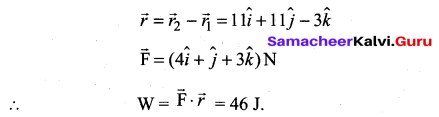
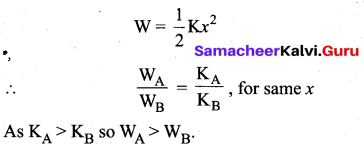
Samacheer Kalvi 11th Physics Solutions Chapter 4 Work, Energy and Power 183

After simplifying and rearranging the terms,
Samacheer Kalvi 11th Physics Solutions Chapter 4 Work, Energy and Power 184

Using the formula a2 – b2 = (a + b) (a – b), we can rewrite the above equation as
m1(u1 + v1)(u1 – v1) = m2 (v2 + u2) (v2 – u2) …(iv)
Dividing equation (iv) by (ii) gives,
Samacheer Kalvi 11th Physics Solutions Chapter 4 Work, Energy and Power 185

This means that for any elastic head on collision, the relative speed of the two elastic bodies after the collision has the same magnitude as before collision but in opposite direction. Further note that this result is independent of mass.

Rewriting the above equation for V1 and v2,
v1 = v2 + u2 – u1
Or v2 = u1 + v1 – u1
To find the final velocities v1 and v2 :
Substituting equation (vii) in equation (ii) gives the velocity of m1 as
m1 (u1 – v1 ) = m2 (u1 + v1 – u2 – u2)
m1u1 – m1v1 = m2(u1 + v1 – 2u2)
m1u1 + 2m2u2 = m1v1 + m2v1
Samacheer Kalvi 11th Physics Solutions Chapter 4 Work, Energy and Power 186
Similarly, by substituting (vi) in equation (ii) or substituting equation (viii) in equation (vii), we get the final velocity of m2 as
Samacheer Kalvi 11th Physics Solutions Chapter 4 Work, Energy and Power 1901
Case 1: When bodies has the same mass i.e., m1 = m2,
Samacheer Kalvi 11th Physics Solutions Chapter 4 Work, Energy and Power 191
The equations (x) and (xi) show that in one dimensional elastic collision, when two bodies of equal mass collide after the collision their velocities are exchanged.
Case 2: When bodies have the same mass i.e., m1 = m2 and second body (usually called target) is at rest (u2 = 0),
By substituting m1m2 = and u2 = 0 in equations (viii) and equations (ix) we get, from equation
(viii) ⇒ V1 = 0 …(xii)
from equation (ix) ⇒ v2 = u1 … (xiii)
Equations (xii) and (xiii) show that when the first body comes to rest the second body moves with the initial velocity of the first body.
Case 3: The first body is very much lighter than the second body
Samacheer Kalvi 11th Physics Solutions Chapter 4 Work, Energy and Power 192
Similarly, Dividing numerator and denominator of equation (ix) by m2, we get
Samacheer Kalvi 11th Physics Solutions Chapter 4 Work, Energy and Power 193
v2 = 0
The equation (xiv) implies that the first body which is lighter returns back (rebounds) in the opposite direction with the same initial velocity as it has a negative sign. The equation (xv) implies that the second body which is heavier in mass continues to remain at rest even after collision. For example, if a ball is thrown at a fixed wall, the ball will bounce back from the wall with the same velocity with which it was thrown but in opposite direction.
Samacheer Kalvi 11th Physics Solutions Chapter 4 Work, Energy and Power 194
Similarly,
Dividing numerator and denominator of equation (xiii) by m1, we get
Samacheer Kalvi 11th Physics Solutions Chapter 4 Work, Energy and Power 195
The equation (xvi) implies that the first body which is heavier continues to move with the same initial velocity. The equation (xvii) suggests that the second body which is lighter will move with twice the initial velocity of the first body. It means that the lighter body is thrown away from the point of collision.

Samacheer Kalvi 11th Physics Numerical Questions

Question 1.
A body is moving along z-axis of a coordinate system under the effect of a constant force F = Find the work done by the force in moving the body a distance of 2 m along z-axis.
Answer:
Samacheer Kalvi 11th Physics Solutions Chapter 4 Work, Energy and Power 196
\(\mathrm{W}=\overrightarrow{\mathrm{F}} \cdot \overrightarrow{\mathrm{S}}=2 \mathrm{J}\)

Question 2.
Water is pumped out of a well 10 m deep by means of a pump rated 10 KW. Find the efficiency of the motor if 4200 kg of water is pumped out every minute. Take g = 10 m/s2.
Answer:
Samacheer Kalvi 11th Physics Solutions Chapter 4 Work, Energy and Power 197

Question 3.
A railway carriage of mass 9000 kg moving with a speed of 36 kmph collides with a stationary carriage of same mass. After the collision, the carriages get coupled and move together. What is their common speed after collision? What type of collision is this?
Answer:
m1 = 9000 kg, u1 = 36 km/h = 10 m/s
m2 = 9000 kg, u2 = 0, v = v1 = v2 = ?
By conservation of momentum:
m1u1 + m2u2 = (m1 + m2)v
∴ v = 5 m/s
Samacheer Kalvi 11th Physics Solutions Chapter 4 Work, Energy and Power 198
As total K.E. after collision < Total K.E. before collision
∴ collision is inelastic

Question 4.
In lifting a 10 kg weight to a height of 2m, 230 J energy is spent. Calculate the acceleration with which it was raised.
Answer:
W = mgh + mah = m(g + a)h
∴ a = 1.5 m/s2.

Question 5.
A bullet of mass 0.02 kg is moving with a speed of 10 ms-1. It can penetrate 10 cm of a wooden block, and comes to rest. If the thickness of the target would be 6 cm only, find the K.E. of the bullet when it comes out.
Samacheer Kalvi 11th Physics Solutions Chapter 4 Work, Energy and Power 199
Samacheer Kalvi 11th Physics Solutions Chapter 4 Work, Energy and Power 200

Question 6.
A man pulls a lawn roller through a distance of 20 m with a force of 20 kg weight. If he applies the force at an angle of 60° with the ground, calculate the power developed if he takes 1 min in doing so.
Answer:
Samacheer Kalvi 11th Physics Solutions Chapter 4 Work, Energy and Power 201

Question 7.
A body of mass 0.3 kg is taken up an inclined plane to length 10 m and height 5 m and then allowed to slide down to the bottom again. The coefficient of friction between the body and the plane is 0.15. What is the
(i) work done by the gravitational force over the round trip?
(ii) work done by the applied force over the upward journey?
(iii) work done by frictional force over the round trip?
(iv) kinetic energy of the body at the end of the trip?
How is the answer to (iv) related to the first three answers?
Answer:
Samacheer Kalvi 11th Physics Solutions Chapter 4 Work, Energy and Power 202
Samacheer Kalvi 11th Physics Solutions Chapter 4 Work, Energy and Power 203
(i) W = FS = – mg sin θ × h = -14.7 J is the W.D. by gravitational force in moving plane.
W’ = FS = + mg sin θ × h = 14.7 J is the W.D. by gravitational force in moving the body down the inclined plane.
∴ Total W.D. round the trip, W1 = W + W’ = 0
(ii) Force needed to move the body up the inclined plane,
F = mg sin θ + fk = mg sin θ + µkR = mg sin θ + µk mg cos θ
∴ W.D. by force over the upward journey is
W2 = F × l = mg (sin θ + µk cos θ)l = 18.5 J
(iii) W.D. by frictional force over the round trip,
W3 = -fk(l + l) = -2fkl = -2µkcos θ l = -7.6 J
(iv) K.E. of the body at the end of round trip
= W.D. by net force in moving the body down the inclined plane
= (mg sin θ – µkcos θ) l
= 10.9 J
⇒ K.E. of body = net W.D. on the body.

Question 8.
Two identical 5 kg blocks are moving with same speed of 2 ms-1 towards each other along a frictionless horizontal surface. The two blocks collide, stick together and come to rest. Consider the two blocks as a system. Calculate work done by
(i) external forces and
(ii) Internal forces.
Answer:
Here no external forces are acting on the system so :
\(\overrightarrow{\mathrm{F}}_{\mathrm{ext}}=0 \Rightarrow \mathrm{W}_{\mathrm{ext}}=0\)
According to work-energy theorem :
Total W.D. = Change in K.E.
or Wext + = Final K.E. – Initial K.E.
Samacheer Kalvi 11th Physics Solutions Chapter 4 Work, Energy and Power 2012

Question 9.
A truck of mass 1000 kg accelerates uniformly from rest to a velocity of 15 ms-1 in 5 seconds. Calculate
(i) its acceleration,
(ii) its gain in K.E.,
(iii) average power of the engine during this period, neglect friction.
Answer:
Samacheer Kalvi 11th Physics Solutions Chapter 4 Work, Energy and Power 2013

Question 10.
An elevator which can carry a maximum load of 1800 kg (elevator + passengers) is moving up with a constant speed of 2 ms-1. The frictional force opposing the motion is 4000 N. Determine the minimum power delivered by the motor to the elevator in watts as well as in horse power.
Answer:
Downward force on the elevator is :
F = mg + f = 22000 N
∴ Power supplied by motor to balance this force is :
Samacheer Kalvi 11th Physics Solutions Chapter 4 Work, Energy and Power 2022

Question 11.
To simulate car accidents, auto manufacturers study the collisions of moving cars with mounted springs of different spring constants. Consider a typical simulation with a car of mass 1000 kg moving with a speed 18.0 kmh-1 on a smooth road and colliding with a horizontally mounted spring of spring constant 6.25 × 10⁻³ Nm-1. What is the maximum compression of the spring?
Answer:
At maximum compression xm, the K.E. of the car is converted entirely into the P.E. of the spring.
Samacheer Kalvi 11th Physics Solutions Chapter 4 Work, Energy and Power 2031

We as a team believe the knowledge shared on our page regarding the Samacheer Kalvi 11th Physics Book Solutions Questions and Answers for Chapter 4 Work, Energy and Power has cleared all your queries. For any other help don’t hesitate and leave us a comment so that we will get back to you at the soonest. Stay connected to our page to avail the latest updates regarding the Tamilnadu State Board Solutions for various subjects in a matter of seconds.