Tamil Nadu 11th Chemistry Model Question Papers 2019-2020 English Tamil Medium

Expert Teachers at SamacheerKalvi.Guru has created Samacheer Kalvi Tamil Nadu State Board Syllabus New Paper Pattern 11th Chemistry Model Question Papers 2019-2020 with Answers Pdf Free Download in English Medium and Tamil Medium of TN 11th Standard Chemistry Public Exam Question Papers Answer Key, New Paper Pattern of HSC 11th Class Chemistry Previous Year Question Papers, Plus One +1 Chemistry Model Sample Papers are part of Tamil Nadu 11th Model Question Papers.

Here we have given the Government of Tamil Nadu State Board 11th Chemistry Model Question Papers Tamil Medium with Answers 2019-20 Pdf. Students can view or download the Class 11th Chemistry New Model Question Papers 2020 Tamil Nadu English Medium Pdf for their upcoming Tamil Nadu HSC Board Exams. Students can also read Tamilnadu Samcheer Kalvi 11th Chemistry Book Solutions.

TN State Board 11th Chemistry Model Question Papers 2019 2020 English Tamil Medium

Tamil Nadu 11th Chemistry Model Question Papers English Medium 2019-2020

Tamil Nadu 11th Chemistry Model Question Papers Tamil Medium 2019-2020

  • Tamil Nadu 11th Chemistry Model Question Paper 1 Tamil Medium
  • Tamil Nadu 11th Chemistry Model Question Paper 2 Tamil Medium
  • Tamil Nadu 11th Chemistry Model Question Paper 3 Tamil Medium
  • Tamil Nadu 11th Chemistry Model Question Paper 4 Tamil Medium
  • Tamil Nadu 11th Chemistry Model Question Paper 5 Tamil Medium

11th Chemistry Model Question Paper Design 2019-2020 Tamil Nadu

Types of QuestionsMarksNo. of Questions to be AnsweredTotal Marks
Part-I Objective Type11515
Part-II Very Short Answers
(Totally 9 questions will be given. Answer any Six. Any one question should be answered compulsorily)
2611
Part-Ill Short Answers
(Totally 9 questions will be given. Answer any Six. Any one question should be answered compulsorily)
3618
Part-IV Essay Type5525
Total70
Practical Marks + Internal Assessment (20+10)30
Total Marks100

Tamil Nadu 11th Chemistry Model Question Paper Weightage of Marks

PurposeWeightage
1. Knowledge30%
2. Understanding40%
3. Application20%
4. Skill/Creativity10%

It is necessary that students will understand the new pattern and style of Model Question Papers of 11th Standard Chemistry Tamilnadu State Board Syllabus according to the latest exam pattern. These Tamil Nadu Plus One 11th Chemistry Model Question Papers State Board Tamil Medium and English Medium are useful to understand the pattern of questions asked in the board exam. Know about the important concepts to be prepared for TN HSLC Board Exams and Score More marks.

We hope the given Samacheer Kalvi Tamil Nadu State Board Syllabus New Paper Pattern Class 11th Chemistry Model Question Papers 2019 2020 with Answers Pdf Free Download in English Medium and Tamil Medium will help you.

If you have any queries regarding the Tamil Nadu Government 11th Chemistry State Board Model Question Papers with Answers 2019 20, TN 11th Std Chemistry Public Exam Question Papers with Answer Key, New Paper Pattern of HSC Class 11th Chemistry Previous Year Question Papers, Plus One +1 Chemistry Model Sample Papers, drop a comment below and we will get back to you at the earliest.

Tamil Nadu 11th Physics Model Question Paper 1 English Medium

Students can Download Tamil Nadu 11th Physics Model Question Paper 1 English Medium Pdf, Tamil Nadu 11th Physics Model Question Papers helps you to revise the complete Tamilnadu State Board New Syllabus and score more marks in your examinations.

TN State Board 11th Physics Model Question Paper 1 English Medium

Tamil Nadu 11th Physics Model Question Paper 1 English Medium

Instructions:

  1. The question paper comprises of four parts
  2. You are to attempt all the parts. An internal choice of questions is provided wherever: applicable
  3. All questions of Part I, II, III, and IV are to be attempted separately
  4. Question numbers to 15 in Part I are Multiple choice Questions of one mark each. These are to be answered by choosing the most suitable answer from the given four alternatives and writing the option code and the corresponding answer
  5. Question numbers 16 to 24 in Part II are two-mark questions. These are lo be answered in about one or two sentences.
  6. Question numbers 25 to 33 in Part III are three-mark questions. These are lo be answered in about three to five short sentences.
  7. Question numbers 34 to 38 in Part IV are five-mark questions. These are lo be answered in detail. Draw diagrams wherever necessary.

Time: 3 Hours
Max Marks: 70

Tamil Nadu 11th Physics Model Question Paper 1 English Medium

Part-I

Answer all the questions. [15 x 1 = 15]

Question 1.
A dimensionless quantity
(a) never has a unit
(b) always has a unit
(c) may have or have not a unit
(d) none of the above
Answer:
(c) may have or have not a unit

Question 2.
The magnitude of average velocity is equal to average speed when the particle moving with
(a) variable speed
(b) constant velocity
(c) variable velocity
(d) constant acceleration
Answer:
(b) constant velocity

Tamil Nadu 11th Physics Model Question Paper 1 English Medium

Question 3.
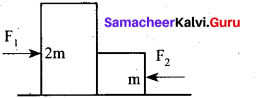
Two blocks of masses m and 2 m are placed on a smooth horizontal surface as shown. In the first case only a force F1 is applied from the left. Later only a force F2 is applied from the-right. If the force acting at the interface of the two blocks in the two cases is same, then
Tamil Nadu 11th Physics Model Question Paper 1 1
F1 : F2 is ……………. .
(a) 1 : 1
(b) 1 : 2
(c) 2 : 1
(d) 1 : 3
Answer:
(c) 2 : 1

Question 4.
The instantaneous angular position of a point on a rotating wheel is given by the equation θ(t) = 2t3 – 6t2. The torque on the wheel becomes zero at …………… .
(a) t = 1s
(b) t = 0.5s
(c) t = 0.25 s
(d) t = 2s
Answer:
(a) t = 1s

Tamil Nadu 11th Physics Model Question Paper 1 English Medium

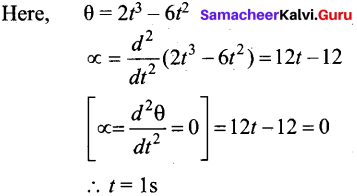
Hint: According to question, torque τ = 0 it means that \(\propto=\frac{d^{2} \theta}{d t^{2}}\)
Tamil Nadu 11th Physics Model Question Paper 1 2

Question 5.
The workdone by the conservative force for a closed path is
(a) always negative
(b) zero
(c) always positive
(d) not defined
Answer:
(b) zero

Question 6.
The rain drops are spherical in shape due to
(a) gravity
(b) due to contraction
(c) surface tension
(d) viscosity
Answer:
(c) surface tension

Tamil Nadu 11th Physics Model Question Paper 1 English Medium

Question 7.
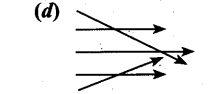
Which of the following diagrams does not represent a streamline flow?
Tamil Nadu 11th Physics Model Question Paper 1 3
Answer:
Tamil Nadu 11th Physics Model Question Paper 1 4

Question 8.
When a spiral spring is stretched by a force, the resultant strain is
(a) volume
(b) shear
(c) tensile
(d) all these
Answer:
(b) shear

Question 9.
In a simple harmonic oscillation, the acceleration against displacement for one complete oscillation will be
(a) an ellipse
(b) a circle
(c) a parabola
(d) a straight line
Answer:
(d) a straight line

Question 10.
Beats are produced by two progressive waves. Maximum loudness at the waxing is x times the loudness of each wave. The value of x is
(a) 1
(b) \(\sqrt{2}\)
(c) 2
(d) 4
Answer:
(d) 4

Tamil Nadu 11th Physics Model Question Paper 1 English Medium

Hint: The maximum amplitude is the sum of two amplitude, i.e. a + a = 2a Hence, maximum intensity is proportional to 4a2 Loudness of one wave is given by \(x=\frac{4 a^{2}}{a^{2}}=4\)

Question 11.
Water does not freeze at the bottom of the lakes in winter because ………… .
(a) ice is a good conductor of heat
(b) ice reflects heat and light
(c) of anomalous expansion of water between 4°C to 0°C
(d) nothing can be said ‘
Answer:
(c) of anomalous expansion of water between 4°C to 0°C

Question 12.
According to Stefan Boltzmann law, the heat radiated by a black body is directly proportional to
(a) T2
(b) T3
(c) T4
(d) T8
Answer:
(c) T4

Tamil Nadu 11th Physics Model Question Paper 1 English Medium

Question 13.
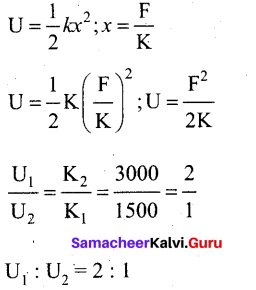
Two springs of spring constant 1500 Nm-1 and 300 Nm-1 respectively are stretched with the same force. They will have potential energy in the ratio
(a) 1 : 2
(b) 2 : 1
(c) 1 : 4
(d) 4 : 1
Answer:
(b) 2 : 1

Hint:

Tamil Nadu 11th Physics Model Question Paper 1 5

Question 14.
When the axis of rotation passes through its centre of gravity, then the moment of inertia of a rigid body is ………………. .
(a) reduced to its minimum value
(b) zero
(c) increased to its maximum value
(d) infinity
Answer:
(a) reduced to its minimum value

Tamil Nadu 11th Physics Model Question Paper 1 English Medium

Question 15.
Power is given by
\((a) \mathrm{P}=\frac{\overrightarrow{\mathrm{F}}}{\overline{\mathrm{V}}}
(b) \frac{\vec{F}^{2}}{\vec{V}}
(c) \frac{\overrightarrow{\mathrm{F}}}{\overrightarrow{\mathrm{V}}^{2}}
(d) \overrightarrow{\mathbf{F}} \cdot \overrightarrow{\mathbf{V}}\)
Answer:
\((d)\overrightarrow{\mathbf{F}} \cdot \overrightarrow{\mathbf{V}}\)

Part-II

Answer any six questions in which Q. No 23 is compulsory. [6 x 2 = 12]

Question 16.
In solids both longitudinal and transverse waves are possible, but transverse waves are not produced in gases. Why?
Answer:
It is because transverse waves travel in the form of crests and troughs which involves the change in shape. For the propagation of transverse waves, medium should posses elasticity of shape. Therefore transverse waves are not produced in gases.

Question 17.
It is possible that the brakes of a bus are so perfect that the bus stops instantaneously? If not, why?
Answer:
No. If the car stops instantaneously, this means that the velocity is reduced to zero is an infinitesimally small interval of time. This would further mean that the car has infinite deceleration. This is not possible. Thus, we cannot have a car which can stop instantaneously.

Tamil Nadu 11th Physics Model Question Paper 1 English Medium

Question 18.
Why does a rubber ball bounce higher on hills than in plains?
Answer:
The maximum height attained by the projectile is inversely proportional to acceleration due to gravity. At greater height, acceleration due to gravity will be lesser than plains. So ball can bounce higher in hills than in plains.

Question 19.
State conservation of angular momentum.
Answer:
The law of conservation of angular momentum states that when no external torque acts on the body the net angular momentum of a rotating rigid body remains constant.

Question 20.
Mountain roads rarely go straight up but wind up gradually. Why?
Answer:
Frictional force f is given by f = μ mg cos θ. If the roads go straight up the angle of slope θ would be large and frictional force will be less and vehicles may slip.

Question 21.
State Newton’s second law.
Answer:
The force acting on an object is equal to the rate of change of its momentum
\(\overrightarrow{\mathrm{F}}=\frac{d \vec{p}}{d t}\)

Question 22.
Why the specific heat capacity of constant pressure is greater than the specific heat capacity at constant volume?
Answer:
It implies that to increase the temperature of the gas at constant volume requires less heat than increasing the temperature of the gas at constant pressure. In other words sp is always greater than sv.

Tamil Nadu 11th Physics Model Question Paper 1 English Medium

Question 23.
Define angle of contact.
Answer:
The angle between tangents drawn at the point of contact to the liquid surface and solid surface inside the liquid is called the angle of contact for a pair of solid and liquid.

Question 24.
Define forced oscillation. Give an example.
Answer:
The body executing vibration initially vibrates with its natural frequency and due to the presence of external periodic force, the body later vibrates with the frequency of the applied periodic force. Such vibrations are known as forced vibrations.
Example: Sound boards of stringed instruments.

Part – III

Answer any six questions in which Q.No. 29 is compulsory. [6 x 3 = 18]

Question 25.
Convert G = 6.67 x 10⁻¹¹ Nm2 kg-2 to cm3 g-1 s-2
Answer:
G = 6.67 x 10⁻¹¹ N m2 kg-2
= 6.67 x 10⁻¹¹ (kg m s-2) (m2 kg-2)
= 6.67 x 10⁻¹¹ kg-1 m3 s-2
= 6.67 x 10⁻¹¹ (1000 g)-1 (100 cm)3 (s-2) .
= 6.67 x 10⁻¹¹ x \(\frac{1}{1000}\) x 100 x 100 x 100 g-1 cm3 s-2
= 6.67 x 10⁻⁸ g-1 cm3 s-2

Tamil Nadu 11th Physics Model Question Paper 1 English Medium

Question 26.
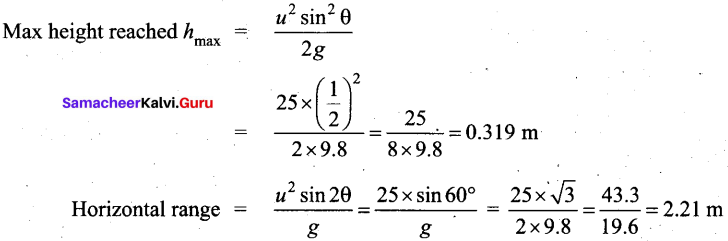
A object is thrown with initial speed 5 ms-1 with an angle of projection 30°. What is the height and range reached by the particle?
Answer:
Data: Initial speed = 5 ms-1.
Angle of projection = 30°
Tamil Nadu 11th Physics Model Question Paper 1 6

Question 27.
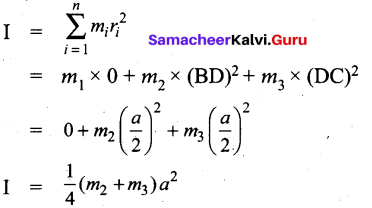
Three point masses m1, m2, m3 are located at the vertices of equilateral triangle of side “a”. What is the moment of inertia of system about an axis along the altitude of triangle passing through m1.
Answer:
Tamil Nadu 11th Physics Model Question Paper 1 7

Question 28.
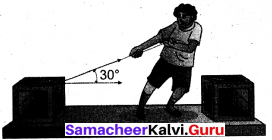
A box is pulled with a force of 25 N to produce a displacement of 15 m. If the angle between the force and displacement is 30°, find the work done by the force?
Answer:
Tamil Nadu 11th Physics Model Question Paper 1 8
Force, F = 25 N
Displacement, dr = 15 m
Angle between F and dr, θ = 30°
Work done, W = F dr cos θ
W = 25 x 15 x cos 30 = 25 x 15 x \(\frac{\sqrt{3}}{2}\)
W = 324.76 J

Tamil Nadu 11th Physics Model Question Paper 1 English Medium

Question 29.
The time period of a mass suspended by a spring (force constant K) is T. If the spring is cut into three equal pieces, what will be the force constant of each part? If the same mass be suspended from one piece what will be the periodic time?
Answer:
Consider the spring be made of a combination of three springs in series each of spring constant k. The effective spring constant K is given by
\(\frac{1}{K}=\frac{1}{k}+\frac{1}{k}+\frac{1}{k}=\frac{3}{k}\)
or K = \(\frac{k}{3}\) or k = 3K

∴ Time period of vibration of a body attached to the end of this spring,
Tamil Nadu 11th Physics Model Question Paper 1 9

When the spring is cut into three pieces, the spring constant k, time period of vibration of a body attached to the end of this spring,

T1 = 2π\(\sqrt{\frac{m}{k}}\) ………………………………. (2)

From eqns. (1) and (2)
\(\frac{T_{1}}{T}=\frac{1}{\sqrt{3}} \text { or } T_{1}=\frac{T}{\sqrt{3}}\)

Question 30.
Give various applications of viscosity.
Answer:

  1. The oil used as a lubricant for heavy machinery parts should have a high viscous coefficient. To select a suitable lubricant, we should know its viscosity and how it varies with temperature. [Note: As temperature increases, the viscosity of the liquid decreases].
  2. Also, it helps to choose oils with low viscosity used in car engines (light machinery).
  3. The highly viscous liquid is used to damp the motion of some instruments and is used as brake oil in hydraulic brakes.
  4. Blood circulation through arteries and veins depends upon the viscosity of fluids.
  5. Millikan conducted the oil drop experiment to determine the charge of an electron. He used the knowledge of viscosity to determine the charge.

Tamil Nadu 11th Physics Model Question Paper 1 English Medium

Question 31.
Write a note on quasi-static process.
Answer:
A quasi-static process is an infinitely slow process in which the system changes its variables (P,V,T) so slowly such that it remains in thermal, mechanical and chemical equilibrium with its surroundings throughout.

Question 32.
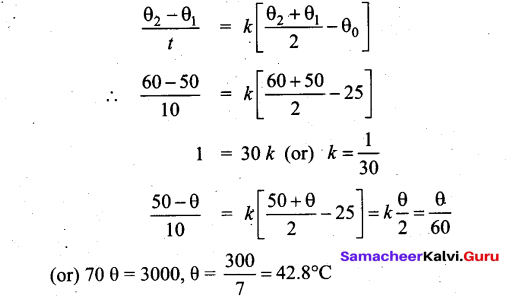
A body cools from 60°C to 50°C in 10 min of room after 10 more minute.
Answer:
According to Newton’s law of cooling
Tamil Nadu 11th Physics Model Question Paper 1 10

Question 33.
Consider two springs with force constants 1 Nm-1 and 2 Nm-1 connected in parallel. Calculate the effective spring constant (kp) and comment on kp.
Answer:
k1 = 1 Nm-1, k2 = 2 Nm-1
kp = k1 + k2 Nm-1
kp = 1 + 2 = 3 Nm-1
kp > k1 and kp > k2

Therefore, the effective spring constant is greater than both k1 and k2.

Tamil Nadu 11th Physics Model Question Paper 1 English Medium

Part-IV

Answer all the questions. [5 x 5 = 25]

Question 34.
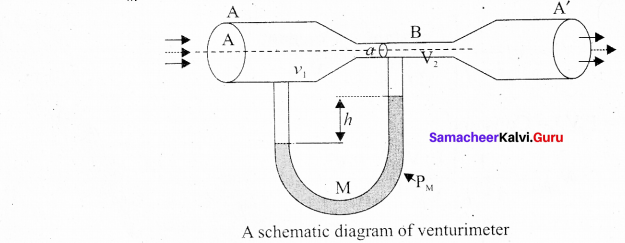
(a) Describe the construction and working of venturimeter and obtain an equation for the volume of liquid flowing per second through a wider entry of the tube.
Answer:
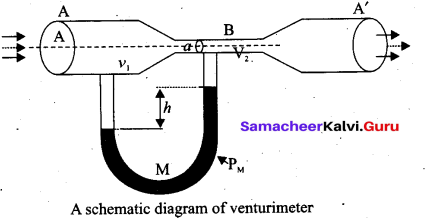
Tamil Nadu 11th Physics Model Question Paper 1 11
Venturimeter: This device is used to measure the rate of flow (or say flow speed) of the incompressible fluid flowing through a pipe. It works on the principle of Bernoulli’s theorem. It consists of two wider tubes A and A’ (with cross sectional area A) connected by a narrow tube B (with cross sectional area a). A manometer in the form of U-tube is also attached between the wide and narrow tubes. The manometer contains a liquid of density ‘pm’.

Let P1 be the pressure of the fluid at the wider region of the tube A. Let us assume that the fluid of density ‘p’ flows from the pipe with speed ‘v1’ and into the narrow region, its speed increases to ‘v2‘ According to the Bernoulli’s equation, this increase in speed is accompanied by a decrease in the fluid pressure P2 at the narrow region of the tube B. Therefore, the pressure difference between the tubes A and B is noted by measuring the height difference (ΔP = P1 – P2) between the surfaces of the manometer liquid.

From the equation of continuity, we can say that Av1 = av2 which means that
\(v_{2}=\frac{\mathbf{A}}{a} v_{1}\)

Tamil Nadu 11th Physics Model Question Paper 1 English Medium

Using Bernoulli’s equation,
Tamil Nadu 11th Physics Model Question Paper 1 12

From the above equation, the pressure difference
Tamil Nadu 11th Physics Model Question Paper 1 13

Thus, the speed of flow of fluid at the wide end of the tube
Tamil Nadu 11th Physics Model Question Paper 1 14

The volume of the liquid flowing out per second is
Tamil Nadu 11th Physics Model Question Paper 1 15

[OR]

(b) Derive the time period of satellite orbiting the Earth.
Answer:
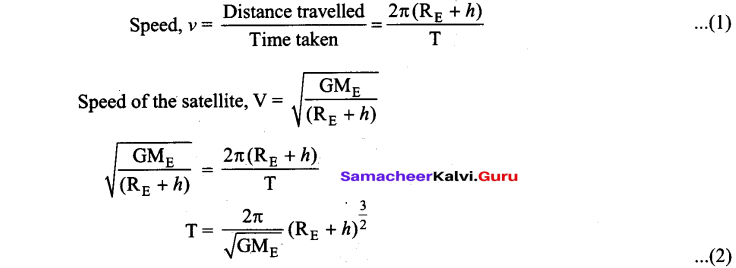
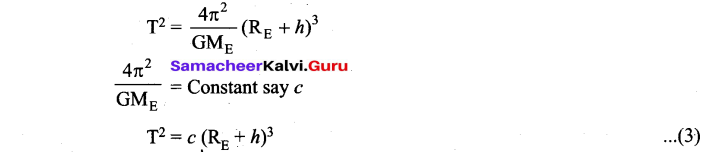
Time period of the satellite: The distance covered by the satellite during one rotation in its orbit is equal to 2π(RE + h) and time taken for it is the time period T. Then,
Tamil Nadu 11th Physics Model Question Paper 1 16

Squaring both sides of the equation (2) we get,
Tamil Nadu 11th Physics Model Question Paper 1 17

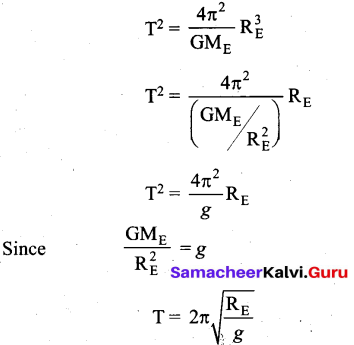
Equation (3) implies that a satellite orbiting the Earth has the same relation between time and distance as that of Kepler’s law of planetary motion. For a satellite orbiting near the surface of the Earth, h is negligible compared to the radius of the Earth RE. Then,
Tamil Nadu 11th Physics Model Question Paper 1 18

By substituting the values of RE = 6.4 x 10⁶ m and g = 9.8 ms-2, the orbital time period is obtained as T = 85 minutes.

Tamil Nadu 11th Physics Model Question Paper 1 English Medium

Question 35.
(a) State and explain work energy principle.
(b) Mention any three examples for it.
Answer:
(a) Work and energy are equivalents. This is true in the case of kinetic energy also. To prove this, let us consider a body of mass m at rest on a ffictionless horizontal surface. The work (W) done by the constant force (F) for a displacement (s) in the same direction is,
W = Fs ………………………….. (1)

The constant force is given by the equation,
F = ma ………………………….. (2)

The third equation of motion can be written as,
v2 = u2 + 2as
\(a=\frac{v^{2}-u^{2}}{2 s}\)

Substituting for a in equation (2),
Tamil Nadu 11th Physics Model Question Paper 1 19

Substituting equation (3) in (1),
Tamil Nadu 11th Physics Model Question Paper 1 20

(b) (i) If the work done by the force on the body is positive then its kinetic energy increases.
(ii) If the work done by the force on the body is negative then its kinetic energy decreases.
(iii) If there is no work done by the force on the body then there is no change in its kinetic energy, which means that the body has moved at constant speed provided its mass remains constant.
(iv) When a particle moves with constant speed in a circle, there is no change in the kinetic energy of the particle. So according to work energy principle, the work done by centripetal force is zero.

Tamil Nadu 11th Physics Model Question Paper 1 English Medium

[OR]

(b) Derive an expression for time taken by the round object to reach the ground on inclined plane.
Answer:
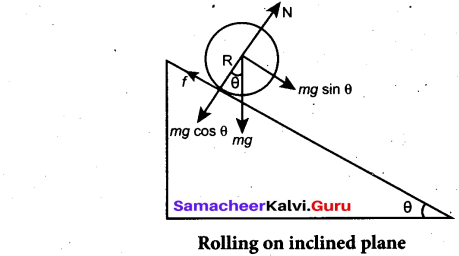
Let us assume a round object of mass m and radius R is rolling down an inclined plane without slipping as shown in figure. There are two forces acting on the object along the inclined plane. One is the component of gravitational force (mg sin θ) and the other is the static frictional force (f). The other component of gravitation force (mg cos θ) is cancelled by the normal force (N) exerted by the plane. As the motion is happening along the incline, we shall write the equation for motion from the free body diagram (FBP) of the object.
Tamil Nadu 11th Physics Model Question Paper 1 21

For translational motion, mg sin0 is the supporting force and f is the opposing force,
mg sinθ f = ma

For rotational motion, let us take the torque with respect to the center of the object. Then mg sin θ cannot cause torque as it passes through it but the frictional force/can set torque of Rf.
Rf = Iα
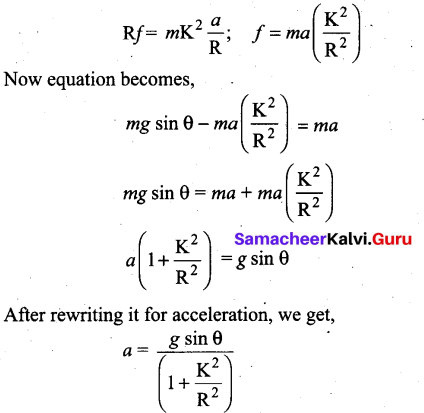
By using the relation, a = rα, and moment of inertia I = mK2, we get,
Tamil Nadu 11th Physics Model Question Paper 1 22

Tamil Nadu 11th Physics Model Question Paper 1 English Medium

We can also find the expression for final velocity of the rolling object by using third equation of motion for the inclined plane.

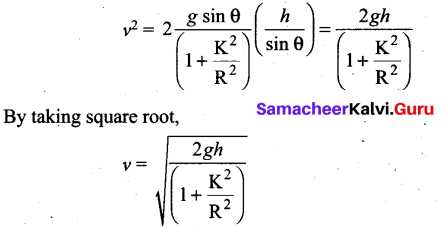
v2 = u2 + las. If the body starts rolling from rest, u = 0. When h is the vertical height of the incline, the length of the incline s is, s = \(\frac{h}{\sin \theta}\)
Tamil Nadu 11th Physics Model Question Paper 1 23

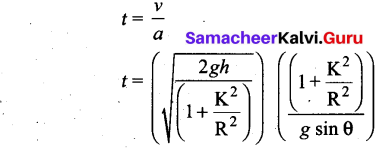
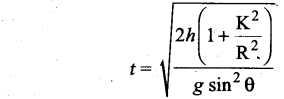
The time taken for rolling down the incline could also be written from first equation of motion as, v = u + at. For the object which starts rolling from rest, u = 0. Then,

The equation suggests that for a given incline, the object with the least value of radius of’ gyration K will reach the bottom of the incline first.
Tamil Nadu 11th Physics Model Question Paper 1 24
Tamil Nadu 11th Physics Model Question Paper 1 25

Question 36.
(a) Define heat engine. Derive the expression for carnot engine efficiency.
Answer:
Head engine: Heat engine is a device which takes heat as input and converts this heat in to work by undergoing a cyclic process.

Tamil Nadu 11th Physics Model Question Paper 1 English Medium

Efficiency of a Carnot engine: Efficiency is defined as the ratio of work done by the working substance in one cycle to the amount of heat extracted from the source.
Tamil Nadu 11th Physics Model Question Paper 1 26
From the first law of thermodynamics, W = QH – QLTamil Nadu 11th Physics Model Question Paper 1 27
Applying isothermal conditions, we get,
Tamil Nadu 11th Physics Model Question Paper 1 28

Here we omit the negative sign. Since we are interested in only the amount of heat (QL) ejected into the sink, we have
Tamil Nadu 11th Physics Model Question Paper 1 29

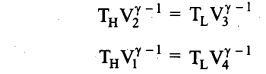
By applying adiabatic conditions, we get,
Tamil Nadu 11th Physics Model Question Paper 1 30

By dividing the above two equations, we get
Tamil Nadu 11th Physics Model Question Paper 1 31

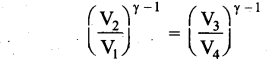
Which implies that \(\frac{V_{2}}{V_{1}}=\frac{V_{3}}{V_{4}}\) ………………………… (5)
Substituting equation (5) in (4), we get
Tamil Nadu 11th Physics Model Question Paper 1 32

Note: TL and TH should be expressed in Kelvin scale.

Important results:

  1. η is always less than 1 because TL is less than TH. This implies the efficiency cannot be 100%.
  2. The efficiency of the Carnot’s engine is independent of the working substance. It depends only on the temperatures of the source and the sink. The greater the difference between the two temperatures, higher the efficiency.
  3. When TH = TL the efficiency η = 0. No engine can work having source and sink at the same temperature.

Tamil Nadu 11th Physics Model Question Paper 1 English Medium

[OR]

(b) Derive the expression for moment of inertia of a rod about its center and perpendicular to the rod.
Answer:
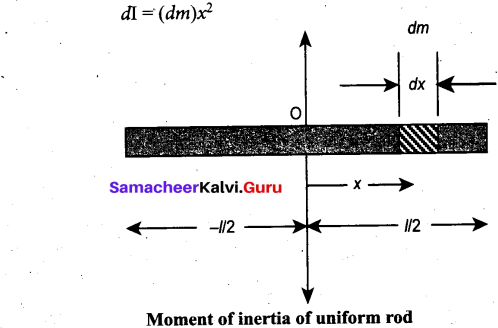
Let us consider a uniform rod of mass (M) and length (1) as shown in figure. Let us find an expression for moment of inertia of this rod about an axis that passes through the center of mass and perpendicular to the rod. First an origin is to be fixed for the coordinate system so that it coincides with the center of mass; which is also the geometric center of the rod. The rod is now along the x axis. We take an infinitesimally small mass (dm) at a distance (x) from the origin. The moment of inertia (dI) of this mass (dm) about the axis is,
Tamil Nadu 11th Physics Model Question Paper 1 33

As the mass is uniformly distributed, the mass per unit length (λ) of the rod is, λ = \(\frac{M}{l}\)

The (dm) mass of the infinitesimally small length as, dm = λdx = \(\frac{M}{l}\) dx
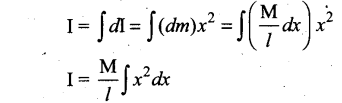
The moment of inertia (I) of the entire rod can be found by integrating dl,
Tamil Nadu 11th Physics Model Question Paper 1 34

As the mass is distributed on either side of the origin, the limits for integration are taken from to – l/2 to l/2.
Tamil Nadu 11th Physics Model Question Paper 1 35

Question 37.
(a) Show that the resultant intensity at any point depends on the phase difference at that point in interference of waves.
Answer:
Consider two harmonic waves having identical frequencies, constant phase difference φ and same wave form (can be treated as coherent source), but having amplitudes A1 and A2, then
y1 = A1 sin (kx – ωt) …………………………. (1)
y2 = A2 sin (kx – ωt + φ) ……………………. (2)

Tamil Nadu 11th Physics Model Question Paper 1 English Medium

Suppose they move simultaneously in a particular direction, then interference occurs (i.e., overlap of these two waves). Mathematically
y = y1 + y2 ………………………………. (3)

Therefore, substituting equation (1) and equation (3) in equation (3), we get
y = A1 sin (kx – ωt) + A2 sin (kx – ωt + φ)

Using trigonometric identity sin (α + β) = (sin α cos β + cos α sin β), we get
y = A1 sin (kx – ωt) +A2 [sin (kx – ωt) cos φ + cos (kx – ωt) sin φ]
y = sin (kx – ωt) (A1 + A2 cos φ) + A2 sin φ cos (kx – ωt) …………………………. (4)

Let us re-define A cos θ = (A1 + A2 cos φ) ……………………………….. (5)
and A sin θ = A2 sin φ …………………………………. (6)

then equation (4) can be rewritten as y = A sin (kx – ωt) cos θ + A cos (kx – ωt) sin θ
y = A (sin (kx – ωt) cos θ + sin θ cos (kx – ωt))
y = A sin (kx – ωt + 9) …………………………….. (7)

By squaring and adding equation (5) and equation (6), we get
A2 = A12 + A22 + 2A1 A2 cos φ …………………………… (8)

Since, intensity is square of the amplitude (I = A2), we have
I = I1 + I2 + 2\(2 \sqrt{\mathrm{I}_{1} \mathrm{I}_{2}}\) cos φ …………………………….. (9)

This means the resultant intensity at any point depends on the phase difference at that point.

(i) For constructive interference: When crests of one wave overlap with crests of another wave, their amplitudes will add up and we get constructive interference. The resultant wave has a larger amplitude than the individual waves as shown in figure (a).

Tamil Nadu 11th Physics Model Question Paper 1 English Medium

The constructive interference at a point occurs if there is maximum intensity at that point, which means that
cos φ = + 1 ⇒ φ = 0, 2π, 4π,… = 2nπ,
where n = 0, 1, 2,…

This is the phase difference in which two waves overlap to give constructive interference. Therefore, for this resultant wave,
\(I_{\text {maximum }}=(\sqrt{I_{1}}+\sqrt{I_{2}})^{2}=\left(A_{1}+A_{2}\right)^{2}\)

Hence, the resultant amplitude A = A1 + A2Tamil Nadu 11th Physics Model Question Paper 1 36

(ii) For destructive interference: When the trough of one wave overlaps with the crest of another wave, their amplitudes “cancel” each other and we get destructive interference as shown in figure (b). The resultant amplitude is nearly zero. The destructive interference occurs if there is minimum intensity at that point, which means cos φ = – 1 ⇒ φ = π, 3π, 5π,… = (2 n-1) π, where n = 0,1,2,…. i.e. This is the phase difference in which two waves overlap to give destructive interference. Therefore,
\(I_{\text {maximum }}=(\sqrt{I_{1}}+\sqrt{I_{2}})^{2}=\left(A_{1}+A_{2}\right)^{2}\)

Hence, the resultant amplitude
A= |A1 – A2|

(b) Define adiabatic process. Derive an expression for work done in an adiabatic process.
Answer:
Adiabatic process: This is a process in which no heat flows into or out of the system (Q = 0). But the gas can expand by spending its internal energy or gas can be compressed through some external work. So the pressure, volume and temperature of the system may change in an adiabatic process.

Tamil Nadu 11th Physics Model Question Paper 1 English Medium

For an adiabatic process, the first law becomes ΔU = W.

This implies that the work is done by the gas at the expense of internal energy or work is done on the system which increases its internal energy.

Work done in an adiabatic process: Consider μ moles of an ideal gas enclosed in a cylinder having perfectly non conducting walls and base. A frictionless and insulating piston of cross sectional area A is fitted in the cylinder.
Tamil Nadu 11th Physics Model Question Paper 1 37

Let W be the work done when the system goes from the initial state (Pi, Vi, Ti) to the final state (Pf, Vf, Tf) adiabatically.
\(\mathrm{W}=\int_{V_{1}}^{V_{f}} \mathrm{P} d \mathrm{V}\)

By assuming that the adiabatic process occurs quasi-statically, at every stage the ideal gas law is valid. Under this condition, the adiabatic equation of state is PVr = Constant (or)

\(P=\frac{\text { Constant }}{\mathrm{V} r}\)
can be substituted in the equation (1), we get
Tamil Nadu 11th Physics Model Question Paper 1 38

From ideal gas law, Pf Vf = μRT and Pi Vi = μRTi
Substituting in equation (2), we get
∴ Wadia = \(\frac{\mu \mathrm{R}}{\gamma-1}\) [Tf – Ti].

Tamil Nadu 11th Physics Model Question Paper 1 English Medium

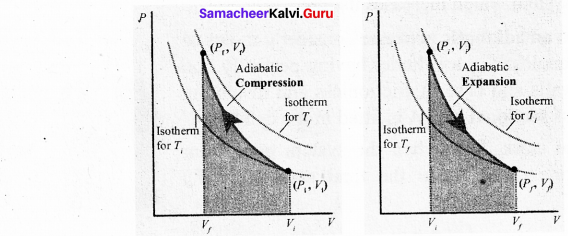
In adiabatic expansion, work is done by the gas. i.e., Watfoj is positive. As Ti > Tf, the gas cools during adiabatic expansion.

In adiabatic compression, work is done on the gas. i.e., Wadia is negative. As Ti < Tf, the temperature of the gas increases during adiabatic compression.
Tamil Nadu 11th Physics Model Question Paper 1 39
PV diagram -Work done in the adiabatic process

To differentiate between isothermal and adiabatic curves in PV diagram, the adiabatic curve is drawn along with isothennal curve for and Tf and Ti Note that adiabatic curve is steeper than isothermal curve. This is because ϒ > 1 always.

Question 38.
(a) Describe the construction and working of venturimeter and obtain an equation for the volume of liquid flowing per second though a wider entry of the tube.
Answer:
Venturimeter : This device is used to measure the rate of flow (or say flow speed) of the incompressible fluid flowing through a pipe. It works on the principle of Bernoulli’s theorem. It consists of two wider tubes A and A’ (with cross sectional area A) connected by a narrow tube B (with cross sectional area a). A manometer in the form of U-tube is also attached between the wide and narrow tubes. The manometer contains a liquid of density ‘pm
Tamil Nadu 11th Physics Model Question Paper 1 40

Tamil Nadu 11th Physics Model Question Paper 1 English Medium

Let P1 be the pressure of the fluid at the wider region of the tube A. Let us assume that the fluid of density ‘p’ flows from the pipe with speed ‘v1’ and into the narrow region, its speed increases to ‘v2’. According to the Bernoulli’s equation, this increase in speed is accompanied by a decrease in the fluid pressure P2 at the narrow region of the tube B. Therefore, the pressure difference between the tubes A and B is noted by measuring the height difference (ΔP = P1 – P2) between the surfaces of the manometer liquid.

From the equation of continuity, we can say that Av1 = av2 which means that
\(v_{2}=\frac{\mathrm{A}}{a} v_{1}\)

Using Bernoulli’s equation,
Tamil Nadu 11th Physics Model Question Paper 1 41
From the above equation, the pressure difference
Tamil Nadu 11th Physics Model Question Paper 1 42
Thus, the speed of flow of fluid at the wide end of the tube A
Tamil Nadu 11th Physics Model Question Paper 1 43
The volume of the liquid flowing out per second is
Tamil Nadu 11th Physics Model Question Paper 1 44

[OR]

(b) Define gravitational potential energy and derive the expression for it.
Answer:
Gravitational potential energy: Potential energy of a body at a point in a gravitational field is the work done by an external agent in moving the body from infinity to that point.

Tamil Nadu 11th Physics Model Question Paper 1 English Medium

Expression for Gravitational potential energy: The gravitational force is a conservative force and hence we can define a gravitational potential energy associated with this conservative force field.

Two masses m1 and m2 are initially separated by a distance r’. Assuming m1, to be fixed in its position, work must be done on m2 to move the distance from r’ to r.
Tamil Nadu 11th Physics Model Question Paper 1 45

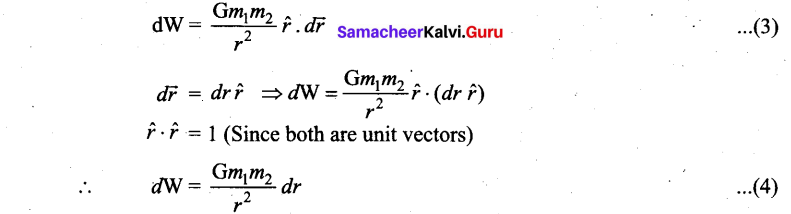
To move the mass m2 through an infinitesimal displacement \(d \vec{r}\) from \(\vec{r}\) to \(\vec{r}\) + \(d \vec{r}\), work has to be done externally. This infinitesimal work is given by
\(d \mathrm{W}=\overrightarrow{\mathrm{F}}_{e x t} \cdot d \vec{r}\) ……………(1)

The work is done against the gravitational force, therefore,
\(\overrightarrow{\mathbf{F}}_{e x t}=\frac{\mathrm{G} m_{1} m_{2}}{r^{2}} \hat{r}\) ………………………. (2)

Substituting equation (2) in (1), we get
Tamil Nadu 11th Physics Model Question Paper 1 46

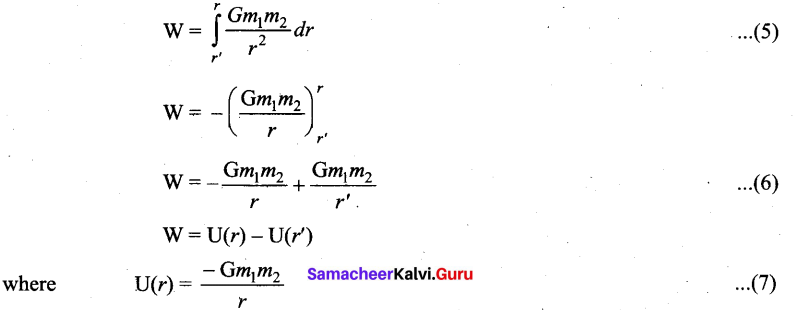
Thus the total work done for displacing the particle from r’ to r is f’
Tamil Nadu 11th Physics Model Question Paper 1 47

This work done W gives the gravitational potential energy difference of the system of masses m1 and m2 when the separation between them are r and r’ respectively.
Tamil Nadu 11th Physics Model Question Paper 1 48

Case 1: If r < r’ : Since gravitational force is attractive, m2 is attracted by m1. Then m2 can move from r to r’ without any external work. Here work is done by the system spending its internal energy and hence the work done is said to be negative.

Case 2: If r > r’ : Work has to be done against gravity to move the object from r’ to r. Therefore work is done on the body by external force and hence work done is positive.

Tamil Nadu 11th Physics Model Question Paper 1 English Medium

Tamil Nadu 11th Biology Model Question Papers 2019-2020 English Tamil Medium

Expert Teachers at SamacheerKalvi.Guru has created Samacheer Kalvi Tamil Nadu State Board Syllabus New Paper Pattern 11th Biology Model Question Papers 2019-2020 with Answers Pdf Free Download in English Medium and Tamil Medium of TN 11th Standard Biology (Bio Botany Bio Zoology) Public Exam Question Papers Answer Key, New Paper Pattern of HSC 11th Class Biology Previous Year Question Papers, Plus One +1 Biology Model Sample Papers are part of Tamil Nadu 11th Model Question Papers.

Here we have given the Government of Tamil Nadu State Board 11th Biology Model Question Papers Tamil Medium with Answers 2019-20 Pdf. Students can view or download the Class 11th Biology New Model Question Papers 2020 Tamil Nadu English Medium Pdf for their upcoming Tamil Nadu HSC Board Exams. Students can also read Tamilnadu Samcheer Kalvi 11th Biology Book Solutions.

TN State Board 11th Biology Model Question Papers 2019 2020 English Tamil Medium

Tamil Nadu 11th Biology Model Question Papers English Medium 2019-2020

Tamil Nadu 11th Biology Model Question Papers Tamil Medium 2019-2020

  • Tamil Nadu 11th Biology Model Question Paper 1 Tamil Medium
  • Tamil Nadu 11th Biology Model Question Paper 2 Tamil Medium
  • Tamil Nadu 11th Biology Model Question Paper 3 Tamil Medium
  • Tamil Nadu 11th Biology Model Question Paper 4 Tamil Medium
  • Tamil Nadu 11th Biology Model Question Paper 5 Tamil Medium

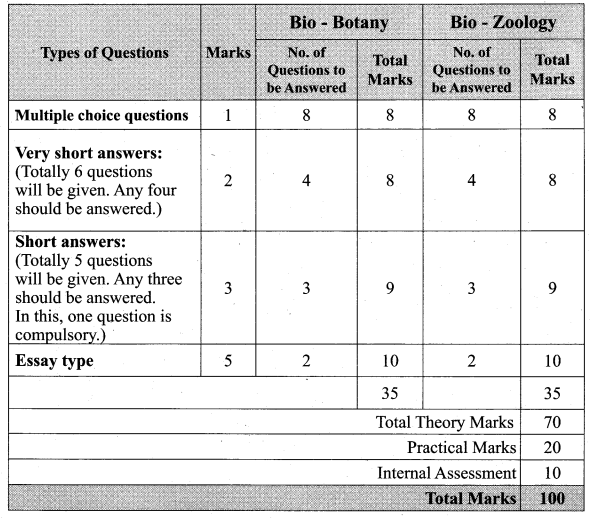
11th Biology Model Question Paper Design 2019-2020 Tamil Nadu

Tamil Nadu 11th Biology Model Question Papers English Tamil Medium

Tamil Nadu 11th Biology Model Question Paper Weightage of Marks

PurposeWeightage
1. Knowledge30%
2. Understanding40%
3. Application20%
4. Skill/Creativity10%

It is necessary that students will understand the new pattern and style of Model Question Papers of 11th Standard Biology Tamilnadu State Board Syllabus (Bio Botany Bio Zoology) according to the latest exam pattern. These Tamil Nadu Plus One 11th Biology Model Question Papers State Board Tamil Medium and English Medium are useful to understand the pattern of questions asked in the board exam. Know about the important concepts to be prepared for TN HSLC Board Exams and Score More marks.

We hope the given Samacheer Kalvi Tamil Nadu State Board Syllabus New Paper Pattern Class 11th Biology Model Question Papers 2019 2020 with Answers Pdf Free Download in English Medium and Tamil Medium will help you.

If you have any queries regarding the Tamil Nadu Government 11th Biology State Board Model Question Papers with Answers 2019 20 (Bio Botany Bio Zoology), TN 11th Std Biology Public Exam Question Papers with Answer Key, New Paper Pattern of HSC Class 11th Biology Previous Year Question Papers, Plus One +1 Biology Model Sample Papers, drop a comment below and we will get back to you at the earliest.
Samacheer Kalvi 11th Computer Science Solutions Chapter 8 Iteration and Recursion

Students can Download Computer Science Chapter 8 Iteration and Recursion Questions and Answers, Notes Pdf, Samacheer Kalvi 11th Computer Science Book Solutions Guide Pdf helps you to revise the complete Tamilnadu State Board New Syllabus and score more marks in your examinations.

Tamilnadu Samacheer Kalvi 11th Computer Science Solutions Chapter 8 Iteration and Recursion

Samacheer Kalvi 11th Computer Science Iteration and Recursion Text Book Back Questions and Answers

PART – 1
I. Choose The Correct Answer

Question 1.
A loop invariant need not be true ………………….
(a) at the start of the loop
(b) at the start of each iteration
(c) at the end of each iteration
(d) at the start of the algorithm
Answer:
(d) at the start of the algorithm

Question 2.
We wish to cover a chessboard with dominoes,Samacheer Kalvi 11th Computer Science Solutions Chapter 8 Iteration and Recursion 1 the number of black squares and the number of white squares covered by dominoes, respectively, placing a domino can be modeled by ………………….
(a) b : = b + 2
(b) w : = w + 2
(c) b, w : = b + 1, w + 1
(d) b : = w
Answer:
(c) b, w : = b + 1, w + 1

Question 3.
If m x a + n x b is an invariant for the assignment a, b : = a + 8, b + 7, the values of m and n are ………………….
(a) m = 8, n = 7
(b) m = 7, n = – 8
(c) m = 7, n = 8
(d) m = 8, n = – 7
Answer:
(b) m = 7, n = – 8

Samacheer Kalvi 11th Computer Science Solutions Chapter 8 Iteration and Recursion

Question 4.
Which of the following is not an invariant of the assignment?
m, n : = m + 2, n + 3
(a) m mod 2
(b) n mod 3
(c) 3 x m – 2 x n
(d) 2 x m – 3 x n
Answer:
(c) 3 x m – 2 x n

Question 5.
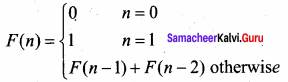
If Fibonacci number is defined recursively as
Samacheer Kalvi 11th Computer Science Solutions Chapter 8 Iteration and Recursion 2
to evaluate F(4), how many times F( ) is applied?
(a) 3
(b) 4
(c) 8
(d) 9
Answer:
(d) 9

Question 6.
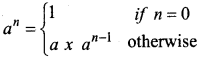
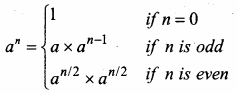
Using this recursive definition
Samacheer Kalvi 11th Computer Science Solutions Chapter 8 Iteration and Recursion 3
how many multiplications are needed to calculate a10?
(a) 11
(b) 10
(c) 9
(d) 8
Answer:
(b) 10

PART – 2
II. Short Answers

Question 1.
What is an invariant?
Answer:
An expression involving variables, which remains unchanged by an assignment to one of these variables is called as an invariant of the assignment.

Question 2.
Define a loop invariant.
Answer:
In iteration, the loop body is repeatedly executed as long as the loop condition is true. Each time the loop body is executed, the variables are updated. However, there is also a property of the variables which remains unchanged by the execution of the loop body. This unchanging property is called the loop invariant.

Samacheer Kalvi 11th Computer Science Solutions Chapter 8 Iteration and Recursion

Question 3.
Does testing the loop condition affect the loop invariant? Why?
Answer:
No, the loop condition do not affect the loop invariant. Because the loop invariant is true at four points.

  1. At the start of loop.
  2. At the start of each iteration.
  3. At the end of each iteration.
  4. At the end of the loop.

Question 4.
What is the relationship between loop invariant, loop condition and the input – output recursively?
Answer:
A loop invariant is a condition [among program variables] that is necessarily true immediately before and immediately after, each iteration of a loop. A loop invariant is some condition that holds for every iteration of the loop.

Question 5.
What is recursive problem solving?
Answer:
Recursion is a method of solving problems that involves breaking a problem down into smaller and smaller sub problems until user gets in to a small problem that it can be solved trivially. Usually recursion involves a function calling itself. While it may not seem like much on the surface, recursion allows us to write elegant solutions to problems that may otherwise be very difficult to program.

Question 6.
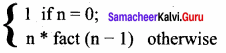
Define factorial of a natural number recursively.
Answer:
Samacheer Kalvi 11th Computer Science Solutions Chapter 8 Iteration and Recursion 4
Recursive Algorithm:
Fact (n)
– – inputs : n
– – outputs : Fact = n!
if (n = 0) – – base case
1
else
n * fact (n – 1) – – recursive step

PART – 3
III. Explain in Brief

Question 1.
There are 7 tumblers on a table, all standing upside down. You are allowed to turn any 2 tumblers simultaneously in one move. Is it possible to reach a situation when all the tumblers are right side up? (Hint: The parity of the number of upside down tumblers is invariant.)
Answer:
Let u – No. of tumblers right side up
v – No. of tumblers up side down
Initial stage : u = 0, v = 7 (All tumblers upside down)
Final stage output: u = 7, v = 0 (All tumblers right side up)

Possible Iterations:
(i) Turning both up side down tumblers to right side up
u = u + 2, v = v – 2 [u is even]

(ii) Turning both right side up tumblers to upside down.
u = u – 2, v = v + 2 [u is even]

(iii) Turning one right side up tumblers to upside down and other tumbler from upside down to right side up.
u = u + 1 – 1 = u, v = v + 1 – 1 = v [u is even]

Initially u = 0 and continuous to be even in all the three cases. Therefore u is always even. Invariant: u is even (i. e. No. of right side up tumblers are always even)
But in the final stage (Goal), u = 7 and v = 0 i. e. u is odd.
Therefore it is not possible to reach a situation where all the tumblers are right side up.

Samacheer Kalvi 11th Computer Science Solutions Chapter 8 Iteration and Recursion

Question 2.
A knockout tournament is a series of games. Two players complete in each game; the loser is knocked out (i.e. does not play any more), the winner carries on. The winner of the tournament is the player that is left after all other players have been knocked out. Suppose there are 1234 players in a tournament. How many games are played before the tournament winner is decided?
Answer:
Samacheer Kalvi 11th Computer Science Solutions Chapter 8 Iteration and Recursion 5
On the other hand let n be the number of games, played and r be the number of players remaining in the tournament.
After every game, r will be reduced by 1.
r → no. of players remaining
n → no. of games played
If r = 2 then n = 1
As n increases, r decreases
n, r : = n + 1, r – 1
n + r = (n + 1) + (r – 1)
= n + 1 + r – 1
= n + r
Therefore n + r is invariant. n + r = 1234 (No. of players initially)
The winner of the tournament is the player that is left after all other players have been knocked out.
After all the games, only one player (winner) is left out.
i. e. n = 1
Put n = 1 in (1)
n + r = 1234 …. (1)
1 + r = 1234
r = 1234 – 1 = 1233
No. of games played = 1233

Question 3.
King Vikramaditya has two magic swords. With one, he can cut off 19 heads of a dragon, but after that the dragon grows 13 heads. With the other sword, he can cut off 7 heads, but 22 new heads grow. If all heads are cut off, the dragon dies. If the dragon has originally 1000 heads, can it ever die? (Hint: The number of heads mod 3 is invariant.)
Answer:
No. of heads of dragon = 1000
sword 1 : cuts 19 heads but 13 heads grow back.
sword 2 : cuts 7 heads but 22 heads grow back.
Let n be the number of heads of the dragon at initial state.

Case 1 : King uses Sword 1
Sword 1 cuts off 19 heads but 13 heads grow back.
n : = n – 19 + 13 = n – 6 No. of heads are reduced by 6.

Case 2 : King uses Sword 2
Sword 2 cuts 7 heads but 22 heads grow back.
n : = n – 7 + 22 = n + 15
No. of heads are increased by 15.

Note:
In the above two cases either 6 heads are removed or 15 heads added. Both 6 and 15 are multiples of 3.
Therefore repeating case 1 and case 2 recursively will either reduce or increase dragon heads in multiples of 3.
That is the invariant is n mod 3.
If n mod 3 = 0 then there is a possibility that the dragon dies.
But 1000 is not a multiple of 3 1000 mod 3 = 1 ≠ 0
It is not possible to kill the dragon. The dragon never dies.

PART – 4
IV. Explain in Detail

Question 1.
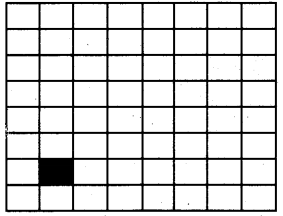
Assume an 8 x 8 chessboard with the usual coloring. “Recoloring” operation changes the color of all squares of a row or a column. You can recolor repeatedly. The goal is to attain just one black square. Show that you cannot achieve the goal. (Hint: If a row or column has b black squares, it changes by (|(8 – b) – b|).
Answer:
In a chess board no. of squares in any row or column = 8
Total No. of squares = 8 x 8 = 64
No. of black squares = 32
No. of white squares = 32
Let No. of blacks in a selected recoloring row or column = b
No. of black squares after recoloring operation = 8 – b
Initial state b = 32
Desired final state b = 1
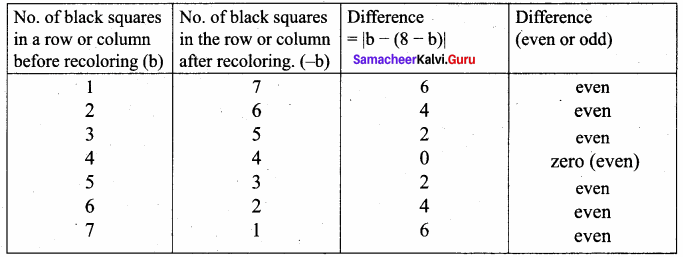
Let us tabulate all the possible outcomes after recoloring a row or column.
Samacheer Kalvi 11th Computer Science Solutions Chapter 8 Iteration and Recursion 6
Difference is the no. of black squares left out in a row or column after recoloring operation. Difference is even. Difference is invariant.
But our goal is one ( 1 is odd) black square, so, it is not possible to attain the goal.

Question 2.
Power can also be defined recursively as
Samacheer Kalvi 11th Computer Science Solutions Chapter 8 Iteration and Recursion 7
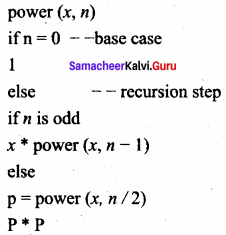
Construct a recursive algorithm using this definition. How many multiplications are needed to calculate a10?
Answer:
Power:
power (5, 2) = 5 x 5 = 25
power (x, n) raise x to the power n

Algorithm:
Samacheer Kalvi 11th Computer Science Solutions Chapter 8 Iteration and Recursion 8
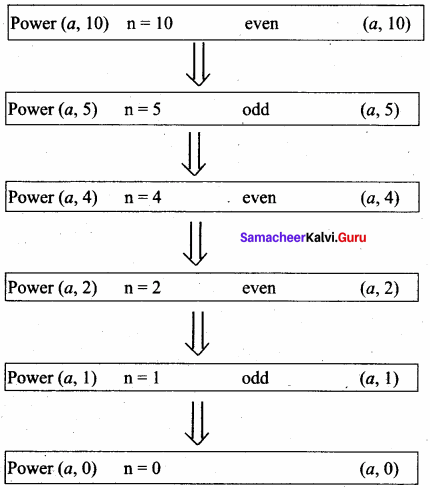
To find a10:
Samacheer Kalvi 11th Computer Science Solutions Chapter 8 Iteration and Recursion 9

Question 3.
A single – square – covered board is a board of 2n x 2n squares in which one square is covered with a single square tile. Show that it is possible to cover this board with triominoes without overlap.
Answer:
size of the board is 2nn x 2n
Number of squares = 2n x 2n = 4n
Number of squares covered = 1
Number of squares to be covered = 4n – 1
4n – 1 is a multiple of 3
Samacheer Kalvi 11th Computer Science Solutions Chapter 8 Iteration and Recursion 10
Case 1 : n = 1
The size of the board 2 x 2
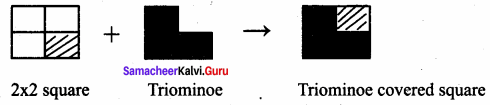
one triominoe can cover 3 squares without overlap.
Samacheer Kalvi 11th Computer Science Solutions Chapter 8 Iteration and Recursion 11
We can cover it with one triominoe and solve the problem.
Samacheer Kalvi 11th Computer Science Solutions Chapter 8 Iteration and Recursion 12

Case 2 : n ≥ 2
1. place a triominoe at the center of the entire board so as to not cover the covered sub – board.

2. One square in the board is covered by a tile. The board has 4 sub – boards of size 22n – 1 x 22n – 1.
Samacheer Kalvi 11th Computer Science Solutions Chapter 8 Iteration and Recursion 13
Out of 4 sub – boards one sub – board is a single square covered sub – board.
Samacheer Kalvi 11th Computer Science Solutions Chapter 8 Iteration and Recursion 14
One triominoe can cover remaining three sub – boards into single square covered sub – board. The problem of size n is divided into 4 sub – problems of size (n – 1). Each sub – board has 22n – 1 x 22n – 1 – 1 = 22n – 2 – 1 = 4n – 1 – 1 squares to be covered.
Samacheer Kalvi 11th Computer Science Solutions Chapter 8 Iteration and Recursion 25
4n – 1 – 1 is also a multiple of 3
In this, the 2n x 2n board is reduced to boards of size 2×2 having are square covered. A triominoe can be placed in each of these boards and hence the whole original 2n x 2n . board is covered with triominoe with out overlap.

Samacheer kalvi 11th Computer Science Iteration and Recursion Additional Questions and Answers

PART – 1
I. Choose the correct answer

Question 1.
………………… is an algorithm design technique, closely related to induction.
(a) Iteration
(b) Invariant
(c) Loop invariant
(d) Recursion
Answer:
(d) Recursion

Question 2.
In which year E W Dijkstra was awarded ACM Turing Award?
(a) 1972
(b) 1974
(c) 1970
(d) 1911
Answer:
(a) 1972

Samacheer Kalvi 11th Computer Science Solutions Chapter 8 Iteration and Recursion

Question 3.
In a loop, if L is an invariant of the loop body B, then L is known as a …………………
(a) recursion
(b) variant
(c) loop invariant
(d) algorithm
Answer:
(c) loop invariant

Question 4.
Recursion must have at least ………………… base case.
(a) one
(b) two
(c) three
(d) four
Answer:
(a) one

Question 5.
The unchanged variables of the loop body is …………………
(a) loop invariant
(b) loop variant
(c) condition
(d) loop variable
Answer:
(a) loop invariant

Question 6.
………………… is the algorithm design techniques to execute the same action repeatedly.
(a) Iteration
(b) Recursion
(c) Both a & b
(d) none of these
Answer:
(c) Both a & b

Question 7.
If L is a loop variant, then it should be true at ………………… important points in the algorithm.
(a) 2
(b) 3
(c) 4
(d) 5
Answer:
(c) 4

Question 8.
The loop invariant need not be true at the …………………
(a) Start of the loop
(b) end of the loop
(c) end of each iteration
(d) middle of algorithm
Answer:
(d) middle of algorithm

Question 9.
In an expression if the variables has the same value before and after an assignment, then it is of an assignment.
(a) variant
(b) Invariant
(c) iteration
(d) variable
Answer:
(b) Invariant

Question 10.
The input size to a sub problem is than the input size to the original problem.
(a) equal
(b) smaller
(c) greater
(d) no criteria
Answer:
(b) smaller

Question 11.
When the solver calls a sub solver, then it is called …………………
(a) Iterative call
(b) solver call
(c) recursive call
(d) conditional call
Answer:
(c) recursive call

Question 12.
How many cases are needed for a recursive solvers?
(a) 2
(b) 3
(c) 4
(d) 5
Answer:
(a) 2

Samacheer Kalvi 11th Computer Science Solutions Chapter 8 Iteration and Recursion

Question 13.
Which of the following is updated when each time the loop body is executed?
(a) data type
(b) subprogram
(c) function
(d) variable
Answer:
(d) variable

Question 14.
Which is the key to constract iterative algorithm …………………
(a) loop invariant
(b) Variable
(c) loop
(d) Recursive
Answer:
(a) loop invariant

PART – 3
II. Short Answers

Question 1.
When the loop variant will be true?
Answer:
The loop invariant is true before the loop body and after the loop body, each time.

Question 2.
What is an invariant?
Answer:
An expression involving variables, which remains unchanged by an assignment to one of these variables, is called an invariant of the assignment.

PART – 3
III. Explain in Brief

Question 1.
Write a note on Recursion.
Answer:
Recursion:
Recursion is another algorithm design technique, closely related to iteration, but more powerful. Using recursion, we solve a problem with a given input, by solving the same problem with a part of the input, and constructing a solution to the original problem from the solution to the partial input.

Question 2.
Write down the steps to be taken to construct a loop.
Answer:

  1. Establish the loop invariant at the start of the loop.
  2. The loop body should so update the variables as to progress toward the end, and maintain the loop invariant, at the same time.
  3. When the loop ends, the termination condition and the loop invariant should establish the input – output relation.

Samacheer Kalvi 11th Computer Science Solutions Chapter 8 Iteration and Recursion

Question 3.
Write a note on Iteration.
Answer:
Iteration:
In iteration, the loop body is repeatedly executed as long as the loop condition is true. Each time the loop body is executed, the variables are updated. However, there is also a property of the variables which remains unchanged by the execution of the loop body. This unchanging property is called the loop invariant. Loop invariant is the key to construct and to reason about iterative algorithms.

PART – 4
IV. Explain in Detail

Question 1.
Explain Loop invariant with a near diagram.
Answer:
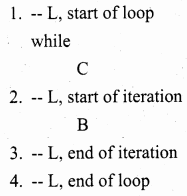
In a loop, if L is an invariant of the loop body B, then L is known as a loop invariant, while C
– – L
B
– – L
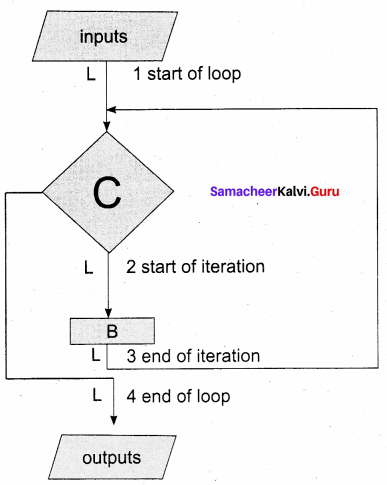
The loop invariant is true before the loop body and after the loop body, each time. Since L is true at the start of the first iteration, L is true at the start of the loop also (just before the loop). Since L is true at the end of the last iteration, L is true when the loop ends also (just after the loop). Thus, if L is a loop variant, then it is true at four important points in the algorithm, as annotated in the algorithm.

  1. At the start of the loop (just before the loop)
  2. at the start of each iteration (before loop body)
  3. at the end of each iteration (after loop body)
  4. at the end of the loop (just after the loop)

Samacheer Kalvi 11th Computer Science Solutions Chapter 8 Iteration and Recursion 23
Samacheer Kalvi 11th Computer Science Solutions Chapter 8 Iteration and Recursion 15

Question 2.
Explain recursive problem solving.
Answer:
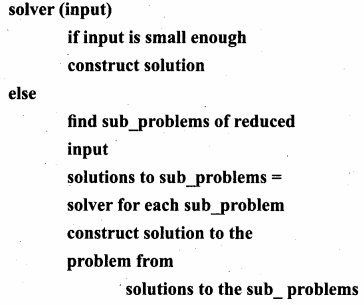
To solve a problem recursively, the solver reduces the problem to sub – problems, and calls another instance of the solver, known as sub – solver, to solve the sub – problem. The input size to a sub – problem is smaller than the input size to the original problem. When the solver calls a sub – solver, it is known as recursive call. The magic of recursion allows the solver to assume that the sub – solver (recursive call) outputs the solution to the sub – problem. Then, from the solution to the sub – problem, the solver constructs the solution to the given problem. As the sub – solvers go on reducing the problem into sub – problems of smaller sizes, eventually the sub-problem becomes small enough to be solved directly, without recursion. Therefore, a recursive solver has two cases:
1. Base case:
The problem size is small enough to be solved directly. Output the solution. here must be at least one base case.

2. Recursion step:
The problem size is not small enough. Deconstruct the problem into a sub – problem, strictly smaller in size than the given problem. Call a sub – solver to solve the sub problem. Assume that the sub – solver outputs the solution to the sub problem. Construct the solution to the given problem. This outline of recursive problem solving technique is shown below.
Samacheer Kalvi 11th Computer Science Solutions Chapter 8 Iteration and Recursion 16
Whenever we solve a problem using recursion, we have to ensure these two cases: In the recursion step, the size of the input to the recursive call is strictly smaller than the size of the given input, and there is at least one base case.

Question 3.
Give an example for loop invariant.
Answer:
The loop invariant is true in four crucial points in a loop. Using the loop invariant, we can construct the loop and reason about the properties of the variables at these points.
Example:
Design an iterative algorithm to compute an. Let us name the algorithm power(a, n). For example,
power(10, 4) = 10000
power (5, 3) = 125
power (2, 5) = 32
Algorithm power(a, n) computes an by multiplying a cumulatively n times,
Samacheer Kalvi 11th Computer Science Solutions Chapter 8 Iteration and Recursion 17
The specification and the loop invariant are shown as comments.
power (a, n)
– – inputs: n is a positive integer
– – outputs: p = an
p, i : = 1, 0
while i ≠ n
– – loop invariant: p = ai
p, i : = p x a, i + 1
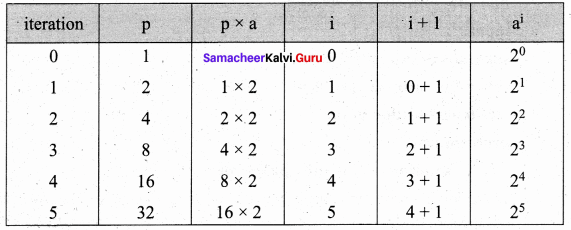
The step by step execution of power (2, 5) is shown in Table. Each row shows the values of the two variables p and i at the end of an iteration, and how they are calculated. We see that p = ai is true at the start of the loop, and remains true in each row. Therefore, it is a loop invariant.
Samacheer Kalvi 11th Computer Science Solutions Chapter 8 Iteration and Recursion 18
When the loop ends, p = ai is still true, but i = 5. Therefore, p = a5. In general, when the loop ends, p = an . Thus, we have verified that power(a, n) satisfies its specification.

Question 4.
There are 6 equally spaced trees and 6 sparrows sitting on these trees,one sparrow on each tree. If a sparrow flies from one tree to another, then at the same time, another sparrow flies from its tree to some other tree the same distance away, but in the opposite direction. Is it possible for all the sparrows to gather on one tree?
Answer:
Let us index the trees from 1 to 6. The index of a sparrow is the index of the tree it is currently sitting on. A pair of sparrows flying can be modeled as an iterative step of a loop. When a sparrow at tree i flies to tree i + d, another sparrow at tree j flies to tree j – d. Thus, after each iterative step, the sum S of the indices of the sparrows remains invariant. Moreover, a loop invariant is true at the start and at the end of the loop.
At the start of the loop, the value of the invariant is
S = 1 + 2 + 3 + 4 + 5 + 6 = 21
When the loop ends, the loop invariant has the same value. However, when the loop ends, if all the sparrows were on the same tree, say k, then S = 6k
Samacheer Kalvi 11th Computer Science Solutions Chapter 8 Iteration and Recursion 19
It is not possible – 21 is not a multiple of 6. The desired final values of the sparrow indices is not possible with the loop invariant. Therefore, all the sparrows cannot gather on one tree.

Question 5.
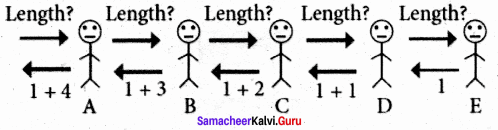
Customers are waiting in a line at a counter. The man at the counter wants to know how many customers are waiting in the line.
Answer:
Customers are waiting in a line at a counter. The man at the counter wants to know how many customers are waiting in the line.
Samacheer Kalvi 11th Computer Science Solutions Chapter 8 Iteration and Recursion 20
Instead of counting the length himself, he asks customer A for the length of the line with him at the head, customer A asks customer B for the length of the line with customer B at the head, and so on. When the query reaches the last customer in the line, E, since there is no one behind him, he replies 1 to D who asked him. D replies 1 + 1 = 2 to C, C replies 1 + 2 = 3 to B, B replies 1 + 3 = 4 to A, and A replies 1 + 4 = 5 to the man in the counter.

Question 6.
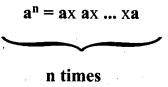
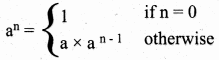
Design a recursive algorithm to compute an. We constructed an iterative algorithm to compute an in Example 8.5. an can be defined recursively as
Samacheer Kalvi 11th Computer Science Solutions Chapter 8 Iteration and Recursion 24
Answer:
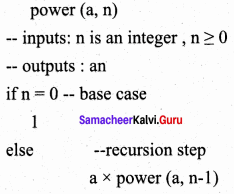
The recursive definition can be expressed as a recursive solver for computing power(a, n).
Samacheer Kalvi 11th Computer Science Solutions Chapter 8 Iteration and Recursion 21
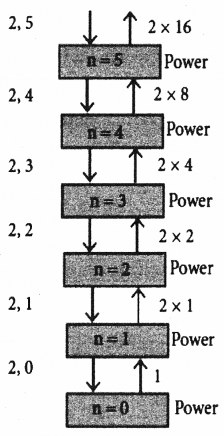
The recursive process resulting from power(2, 5)
Samacheer Kalvi 11th Computer Science Solutions Chapter 8 Iteration and Recursion 22
power (2, 5)
= 2 x power (2, 4)
= 2 x 2 x power (2, 3)
= 2 x 2 x 2 x power (2, 2)
= 2 x 2 x 2 x 2 x power (2, 1)
= 2 x 2 x 2 x 2 x 2 x power (2, 0) = 2 x 2 x 2 x 2 x 2 x 1
= 2 x 2 x 2 x 2 x 2 = 2 x 2 x 2 x 4 = 2 x 2 x 8 = 2 x 16 = 32

Tamil Nadu 11th Physics Previous Year Question Paper March 2019 English Medium

Students can Download Tamil Nadu 11th Physics Previous Year Question Paper March 2019 English Medium Pdf, Tamil Nadu 11th Physics Model Question Papers helps you to revise the complete Tamilnadu State Board New Syllabus and score more marks in your examinations.

TN State Board 11th Physics Previous Year Question Paper March 2019 English Medium

Instructions:

  • The question paper comprises of four parts.
  • You are to attempt all the parts. An internal choice of questions is provided wherever applicable.
  • All questions of Part I, II, III and IV are to be attempted separately.
  • Question numbers 1 to 15 in Part I are Multiple choice Questions of one mark each.  These are to be answered by choosing the most suitable answer from the given four alternatives and writing the option code and the corresponding answer.
  • Question numbers 16 to 24 in Part II are two-mark questions. These are lo be answered in about one or two sentences.
  • Question numbers 25 to 33 in Part III are three-mark questions. These are lo be answered in about three to five short sentences.
  • Question numbers 34 to 38 in Part IV are five-mark questions. These are lo be answered in detail. Draw diagrams wherever necessary.

Time: 2½ Hours
Max Marks: 70

PART – I

Answer all the Questions. [15 × 1 = 15]

Question 1.
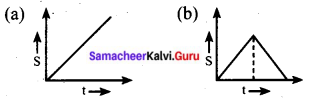
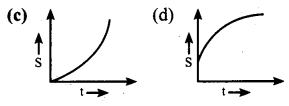
Which graph represents uniform acceleration?
Tamil Nadu 11th Physics Previous Year Question Paper March 2019 English Medium Q 1
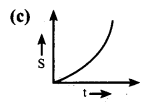
Tamil Nadu 11th Physics Previous Year Question Paper March 2019 English Medium Q 2
Answer:
Tamil Nadu 11th Physics Previous Year Question Paper March 2019 English Medium Q 3

Question 2.
A body of mass 5 kg is thrown up vertically with a kinetic energy of 1000 J. If acceleration due to gravity is 10 ms-2, find the height at which the kinetic energy becomes half of the original value.
(a) 10 m
(b) 20 m
(c) 50 m
(d) 100 m
Answer:
(a) 10 m
Half KE is converted into potential energy.
Then PE = \(\frac{1}{2}\) KE
mgh = \(\frac{1000}{2}\) = 500
\(\mathrm{h}=\frac{500}{\mathrm{mg}}=\frac{500}{5 \times 10}=10 \mathrm{m}\)

Tamil Nadu 11th Physics Previous Year Question Paper March 2019 English Medium

Question 3.
The process in which heat transfer is by actual movement of molecules in fluids such as liquids and gases is called ________
(a) Thermal conductivity
(b) Convection
(c) Conduction
(d) Radiation
Answer:
(b) Convection

Question 4.
If the temperature of the wire is increased, then Young’s Modules will
(a) increase rapidly
(b) increase by a very small amount
(c) remain the same
(d) decrease
Answer:
(d) decrease

Question 5.
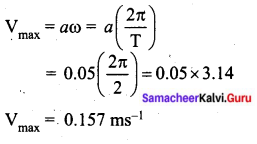
The amplitude and time period of a simple pendulum bob are 0.05 m and 2s respectively. Then the maximum velocity of the bob is :
(a) 0.157 ms-1
(b) 0.257 ms-1
(c) 0.10 ms-1
(d) 0.025 ms-1
Answer:
(a) 0.157 ms-1
Tamil Nadu 11th Physics Previous Year Question Paper March 2019 English Medium Q 4

Question 6.
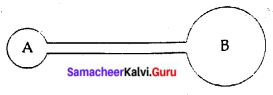
There is a small bubble at one end and a bigger bubble at another end of a pipe. Which among the following will happen?
Tamil Nadu 11th Physics Previous Year Question Paper March 2019 English Medium Q 5
(a) remains in equilibrium
(b) smaller will grow until they collapse
(c) bigger will grow until they collapse
(d) none of the above
Answer:
(b) smaller will grow until they collapse
Excess pressure is \(\Delta P=P_{2}-P_{1}=\frac{4 T}{R}\)

Tamil Nadu 11th Physics Previous Year Question Paper March 2019 English Medium

Question 7.
A closed cylindrical container is partially filled with water. As the container rotates in a horizontal plane above a perpendicular bisector, its moment of inertia :
(a) remains constant
(b) depends on the direction of rotation
(c) increases
(d) decreases
Answer:
(c) increases

Question 8.
Which of the following represents a wave?
(a) \(\frac{1}{(x+v t)}\)
(b) sin (x + vt)
(c) (x – vt)3
(d) x(x + vt)
Answer:
(b) sin (x + vt)

Question 9.
Which of the following pairs of physical quantities have the same dimension?
(a) Torque and Power
(b) Force and Torque
(c) Force and Power
(d) Torque and Energy
Answer:
(d) Torque and Energy

Question 10.
If the internal energy of an ideal gas U and volume V are doubled then the pressure of the gas _______
(a) halves
(b) quadruples
(c) doubles
(d) remains the same
Answer:
(d) remains the same

Tamil Nadu 11th Physics Previous Year Question Paper March 2019 English Medium

Question 11.
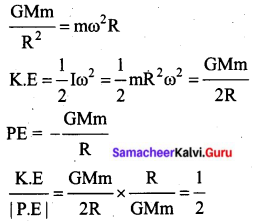
For a satellite moving in an orbit around the earth, the ratio of kinetic energy to potential energy is:
(a) 2
(b) √2
(c) \(\frac { 1 }{ 2 }\)
(d) \(\frac{1}{\sqrt{2}}\)
Answer:
(c) \(\frac { 1 }{ 2 }\)
Tamil Nadu 11th Physics Previous Year Question Paper March 2019 English Medium Q 6

Question 12.
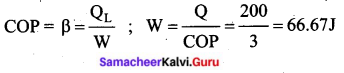
A refrigerator has a COP of 3. How much work must be supplied to a refrigerator in order to remove 200 J of heat from its interior?
(a) 33.33 J
(b) 44.44 J
(c) 66.67 J
(d) 50 J
Answer:
(c) 66.67 J
Tamil Nadu 11th Physics Previous Year Question Paper March 2019 English Medium Q 7

Question 13.
If the linear momentum of the object is increased by 0.1 % then the kinetic energy is increased by:
(a) 0.4 %
(b) 0.01 %
(c) 0.1 %
(d) 0.2 %
Answer:
(d) 0.2 %
Tamil Nadu 11th Physics Previous Year Question Paper March 2019 English Medium Q 8

Question 14.
What is the angular displacement made by a particle after 5s, when it starts from rest with an angular acceleration of 0.2 rads-2?
(a) 4 rad
(b) 1 rad
(c) 2.5 rad
(d) 5 rad
Answer:
(c) 2.5 rad
From the equation of circular motion, ω = 0
Tamil Nadu 11th Physics Previous Year Question Paper March 2019 English Medium Q 9

Question 15.
In an isochoric process, find which is relevant among the following :
(a) ΔU = 0
(b) ΔT = 0
(c) W = 0
(d) Q = 0
Answer:
(c) W = 0

Tamil Nadu 11th Physics Previous Year Question Paper March 2019 English Medium

PART – II

Answer any six of the following questions. Q. No. 24 is compulsory. [6 × 2 = 12]

Question 16.
Write any two errors of systematic errors. Explain them.
Answer:
Systematic errors: Systematic errors are reproducible inaccuracies that are consistently in the same direction. These occur often due to a problem that persists throughout the experiment. Systematic errors can be classified as follows.

  1. Instrumental errors: When an instrument is not calibrated properly at the time of manufacture, instrumental errors may arise. If a measurement is made with a meter scale whose end is worn out, the result obtained will have errors. These errors can be corrected by choosing the instrument carefully.
  2. Personal errors: These errors are due to individuals performing the experiment, maybe due to incorrect initial setting up of the experiment or carelessness of the individual making the observation due to improper precautions.

Question 17.
What is a projectile? Give two examples.
Answer:
Projectile: When an object is thrown in the air with some initial velocity and then allowed to move under the action of gravity alone, the object is known as a projectile.
Example:

  • A bullet fired from a rifle.
  • A ball is thrown in any direction

Question 18.
State Newton’s Second Law of Motion.
Answer:
The force acting on an object is equal to the rate of change of its momentum
\(\overrightarrow{\mathrm{F}}=\frac{d \vec{p}}{d t}\)

Tamil Nadu 11th Physics Previous Year Question Paper March 2019 English Medium

Question 19.
A car takes a turn with the velocity 50 ms-1 on a circular road of the radius of curvature
10 m. Calculate the centrifugal force experienced by a person of mass 60 kg inside the car.
Answer:
Given: Mass of a person = 60 kg
Velocity of the car = 50 ms-1
Radius of curvature = 10 m
Centrifugal force
\(\mathrm{F}=\frac{m \mathrm{V}^{2}}{r}=\frac{60 \times(50)^{2}}{10}=15,000 \mathrm{N}\)

Question 20.
Why is it more difficult to revolve a stone tied it to a longer string than a stone tied to a shorter string?
Answer:
MI of stone I = ml2 (l = length of string) l is large, α is very small
\(\begin{array}{l}
\tau=I \alpha \\
\alpha=\frac{\tau}{I}=\frac{\tau}{m l^{2}}
\end{array}\)
if l is large α is very small.
∴ more difficult to revolve.

Question 21.
State Stefan-Boltzmann law and write its expression.
Answer:
Stefan Boltzmann law states that the total amount of heat radiated per second per unit area of a black body is directly proportional to the fourth power of its absolute temperature.
E ∝ T4 (or) E = σT4

Question 22.
List the factors affecting Brownian motion.
Answer:

  1. Brownian motion increases with increasing temperature.
  2. Brownian motion decreases with bigger particle size, high viscosity and density of the liquid (or) gas.

Question 23.
“Soldiers are not allowed to march on a bridge.” Give reason.
Answer:
While crossing a bridge, if the period of stepping on the ground by marching soldiers be equal to the natural frequency of the bridge, it may be thrown into resonance vibration and the vibrations may be so large that the bridge may collapse. Thus to avoid resonant vibration of the bridge. Soldiers are ordered to break steps.

Tamil Nadu 11th Physics Previous Year Question Paper March 2019 English Medium

Question 24.
The surface tension of a soap solution is 0.03 Nm-1. How much work is done in producing soap bubble of radius 0.05 m?
Answer:
Surface area (∆s) = 4πr2 = 4 × 3.14 × (0.05)2
∆s = 0.0314 m
No. of surface area of a soap bubble = 2 (outer and inner area)
Total surface energy (E) = 2T∆S = 2 × 0.03 × 0.0314
E = 0.0018 J

PART – III

Answer any six of the following questions. Q. No. 33 is compulsory. [6 × 3 = 18]

Question 25.
What is the torque of the force \(\overrightarrow{\mathbf{F}}=3 \hat{i}-2 \hat{j}+4 \hat{k}\) acting at a point \(\vec{r}=2 \hat{i}+3 \hat{j}+5 \hat{k}\) about the origin?
Answer:
Tamil Nadu 11th Physics Previous Year Question Paper March 2019 English Medium Q 10

Question 26.
What are the various types of friction? Suggest a few methods to reduce friction.
Answer:
There are two types of Friction:
(i) Static Friction: Static friction is the force which opposes the initiation of motion of an object on the surface. The magnitude of static frictional force fs lies between \(0 \leq f_{s} \leq \mu_{s} N\)
where, µs — coefficient of static friction
N — Normal force
(ii) Kinetic friction: The frictional force exerted by the surface when an object slides is called kinetic friction. Also called as sliding friction or dynamic friction,
fk = µkN
where µk — the coefficient of kinetic friction
N — Normal force exerted by the surface on the object
Methods to reduce friction: Friction can be reduced

  1. By using lubricants
  2. By using Ball bearings
  3. By polishing
  4. By streamlining

Tamil Nadu 11th Physics Previous Year Question Paper March 2019 English Medium

Question 27.
A heavy body and a light body have the same momentum. Which one of them has more kinetic energy and why?
Answer:
Lighter body has more K.E. as K.E. = \(\frac{p^{2}}{2 m}\) and for constant p, K.E. ∝ \(\frac{1}{m}\).
The lighter body has more kinetic energy.

Question 28.
Find the rotational kinetic energy of a ring of mass 9 kg and radius 3 m rotating with 240 rpm about an axis passing through its centre and perpendicular to its plane.
Answer:
The rotational kinetic energy is, KE = \frac{1}{2} \mathrm{I} \omega^{2}
The moment of inertia of the ring is, I = MR2
I = 9 × 32 = 9 × 9 = 81 kg m2
The angular speed of the ring is,
Tamil Nadu 11th Physics Previous Year Question Paper March 2019 English Medium Q 11

Question 29.
What do you mean by the term weightlessness? Explain the state of weightlessness of a freely falling body.
Answer:
When a man is standing in the elevator, there are two forces acting on him.
1. The gravitational force acts downward. If we take the vertical direction as positive y-direction, the gravitational force acting on the man is \(\overrightarrow{\mathrm{F}}_{\mathrm{G}}=-m g \hat{j}\)
2. The normal force exerted by the floor on the man which acts vertically upward, \(\overrightarrow{\mathrm{N}}=\mathrm{N} \hat{j}\)
The weightlessness of freely falling bodies: Freely falling objects experience only gravitational force. As they fall freely, they are not in contact with any surface (by neglecting air friction). The normal force acting on the object is zero. The downward acceleration is equal to the acceleration due to the gravity of the Earth, i.e., (a = g)
Newton’s 2nd law acting on the man N = m(g – a)
a = g
∴ N = w(g – g) = 0

Tamil Nadu 11th Physics Previous Year Question Paper March 2019 English Medium

Question 30.
Derive the expression for the terminal velocity of a sphere falling through a viscous liquid.
Answer:
The expression for terminal velocity: Consider a sphere of radius r which falls freely through a highly viscous liquid of coefficient of viscosity η. Let the density of the material of the sphere be ρ and the density of the fluid be σ.
The gravitational force acting on the sphere,
Tamil Nadu 11th Physics Previous Year Question Paper March 2019 English Medium Q 12
Tamil Nadu 11th Physics Previous Year Question Paper March 2019 English Medium Q 13
Tamil Nadu 11th Physics Previous Year Question Paper March 2019 English Medium Q 14
Here, it should be noted that the terminal speed of the sphere is directly proportional to the square of its radius. If σ is greater than ρ, then the term (ρ – σ) becomes negative leading to a negative terminal velocity.

Question 31.
Explain the linear expansion of solid.
Answer:
Linear Expansion: In solids, for a small change in temperature
ΔT, the fractional change in length to \(\left(\frac{\Delta L}{L_{0}}\right)\) is directly proportional to ΔT.
Tamil Nadu 11th Physics Previous Year Question Paper March 2019 English Medium Q 15
\(\frac{\Delta \mathrm{L}}{\mathrm{L}_{0}}=\alpha_{\mathrm{L}} \Delta \mathrm{T}\)
Therefore, \(\alpha_{\mathrm{L}}=\frac{\Delta \mathrm{L}}{\mathrm{L}_{0} \Delta \mathrm{T}}\)
Where, αL = coefficient of linear expansion, ΔL = Change in length, L = Original length, ΔT = Change in temperature.

Question 32.
Write down any six postulates of the kinetic theory of gases.
Answer:

  1. All the molecules of a gas are identical, elastic spheres.
  2. The molecules of different gases are different.
  3. The number of molecules in a gas is very large and the average separation between them is larger than size of the gas molecules.
  4. The molecules of a gas are in a state of continuous random motion.
  5. The molecules collide with one another and also with the walls of the container.
  6. These collisions are perfectly elastic so. that there is no loss of kinetic energy during .collisions.
  7. Between two successive collisions, a molecule moves with uniform velocity.
  8. The molecules do not exert any force of attraction or repulsion on each other except during collision. The molecules do not possess any potential energy and the energy is wholly kinetic.
  9. The collisions are instantaneous. The time spent by a molecule in each collision is very small compared to the time elapsed between two consecutive collisions.
  10. These molecules obey Newton’s laws of motion even though they move randomly.

Tamil Nadu 11th Physics Previous Year Question Paper March 2019 English Medium

Question 33.
Two waves of wavelength 99 cm and 100 cm both travelling with the velocity of 396 ms-1 are made to interfere. Calculate the number of beats produced by them per sec.
Answer:
λ1 = 99 cm = 0.99 m
λ2 = 100 cm = 1 m
Velocity of sound waves in a gas is v = 396 ms-1
Relation between wavelength and velocity, v = λf
Tamil Nadu 11th Physics Previous Year Question Paper March 2019 English Medium Q 16

PART – IV

Answer all the questions. [5 × 5 = 25]

Question 34(a).
Explain the principle of homogeneity of dimensions and derive an expression for the force F acting on a body moving in a circular path depending on the mass of the body (m), velocity (v) and radius (r) of the circular path. Obtain the expression for the force by the dimensional analysis method (take the value k = 1)
Answer:
The principle of homogeneity of dimensions states that the dimensions of all the terms in a physical expression should be the same. For example, in the physical expression v2 = u2 + 2as, the dimensions of v2, u2 and 2as are the same and equal to [L2T-2].
F ∝ ma vb rc
F = K ma vb rc
Here K = 1
∴ F = ma vb rc
Dimensionally, [MLT-2] = [M]a [LT-1]b [L]c
Compare the power of M, L and T
a = 1 ….. (1)
b + c = 1 ….. (2)
-b = -2
b = 2 …… (3)
Sub (3) in (2) we get
b + c = 1
2 + c = 1
c = -1 …… (4)
Substitute a, b and c value in force equation
F = ma vb rc = m v2 r-1
\(F=\frac{m v^{2}}{r}\)
This equation is known as centripetal force.
[OR]
Question 34(b).
State and prove Bernoulli’s theorem for a flow of incompressible, non-viscous, and streamlined flow of liquid.
Answer:
Bernoulli’s theorem: According to Bernoulli’s theorem, the sum of pressure energy, kinetic energy, and potential energy per unit mass of an incompressible, non-viscous fluid in a streamlined flow remains a constant.
Mathematically, \(\frac{P}{\rho}+\frac{1}{2} v^{2}+g h=\text { constant }\)
This is known as Bernoulli’s equation.
Tamil Nadu 11th Physics Previous Year Question Paper March 2019 English Medium Q 17
Proof: Let us consider a flow of liquid through a pipe AB. Let V be the volume of the liquid when it enters A in a time t which is equal to the volume of the liquid leaving B at the same time. Let aA, vA and PA be the area of cross-section of the tube, the velocity of the liquid and pressure exerted by the liquid at A respectively.
Let the force exerted by the liquid at A is FA = PAaA
Distance travelled by the liquid in time t is d = vAt
Therefore, the work done is W = FAd = PAaAvAt
But aAvAt = aAd = V, the volume of the liquid entering at A.
Thus, the work done is the pressure energy (at A), W = FAd = PAV
Pressure energy per unit volume at A = \(\frac{\rho_{\mathrm{A}}}{\rho_{\mathrm{B}}}=\frac{4}{3}\)
Pressure energy per unit mass at A = \(\frac{\text { Pressure energy }}{\text { Mass }}=\frac{\mathrm{P}_{\mathrm{A}} \mathrm{V}}{m}=\frac{\mathrm{P}_{\mathrm{A}}}{\frac{m}{\mathrm{V}}}=\frac{\mathrm{P}_{\mathrm{A}}}{\rho}\)
Since m is the mass of the liquid entering at A in a given time, therefore, pressure energy of the liquid at A is \(\mathrm{E}_{\mathrm{PA}}=\mathrm{P}_{\mathrm{A}} \mathrm{V}=\mathrm{P}_{\mathrm{A}} \mathrm{V} \times\left(\frac{m}{m}\right)=m \frac{\mathrm{P}_{\mathrm{A}}}{\rho}\)
Potential energy of the liquid at A,
PEA = mghA
Due to the flow of liquid, the kinetic energy of the liquid at A,
\(\mathrm{KE}_{\mathrm{A}}=\frac{1}{2} m v_{\mathrm{A}}^{2}\)
Therefore, the total energy due to the flow of liquid at A,
EA = EPA + KEA + PEA
\(E_{A}=m \frac{P_{A}}{\rho}+\frac{1}{2} m v_{A}^{2}+m g h_{A}\)
Similarly, let aB, vB and PB be the area of cross section of the tube, velocity of the liquid and pressure exerted by the liquid at B. Calculating the total energy at EB, we get
Tamil Nadu 11th Physics Previous Year Question Paper March 2019 English Medium Q 18
The above equation is the consequence of the conservation of energy which is true until there is no loss of energy due to friction. But in practice, some energy is lost due to friction. This arises due to the fact that in a fluid flow, the layers flowing with different velocities exert frictional forces on each other. This loss of energy is generally converted into heat energy. Therefore, Bernoulli’s relation is strictly valid for fluids with zero viscosity or non-viscous liquids. Notice that when the liquid flows through a horizontal ‘ pipe, then
\(h=0 \Rightarrow \frac{\mathrm{P}}{\rho g}+\frac{1}{2} \frac{v^{2}}{g}=\text { constant }\)

Tamil Nadu 11th Physics Previous Year Question Paper March 2019 English Medium

Question 35.
(a) Prove the law of conservation of momentum. Use it to find the recoil velocity of a gun when a bullet is fired from it.
Answer:
In nature, conservation laws play a very important role. The dynamics of motion of bodies can be analysed very effectively using conservation laws. There are three conservation laws in mechanics. Conservation of total energy, conservation of total linear momentum, and conservation of angular momentum. By combining Newton’s second and third laws, we can derive the law of conservation of total linear momentum.
When two particles interact with each other, they exert equal and opposite forces on each other. The particle 1 exerts force \(\overrightarrow{\mathrm{F}}_{21}\) on particle 2 and particle 2 exerts an exactly equal and opposite force \(\overrightarrow{\mathrm{F}}_{21}\) on particle 1 according to Newton’s third law.
\(\overrightarrow{\mathrm{F}_{21}}=-\overrightarrow{\mathrm{F}_{12}}\) ….. (1)
In terms of momentum of particles, the force on each particle (Newton’s second law) can be written as
\(\overrightarrow{\mathrm{F}_{12}}=\frac{d \overrightarrow{p_{1}}}{d t} \text { and } \overrightarrow{\mathrm{F}_{21}}=\frac{d \overrightarrow{p_{2}}}{d t}\)
Here \(\vec{p}_{1}\) is the momentum of particle 1 which changes due to the force \(\overrightarrow{\mathrm{F}_{12}}\) exerted by particle 2. Further \(\vec{p}_{2}\) is the momentum of particle 2. This changes due to \(\overrightarrow{\mathrm{F}_{21}}\) exerted by particle 1.
Substitute equation (2) in equation (1)
Tamil Nadu 11th Physics Previous Year Question Paper March 2019 English Medium Q 19
It implies that \(\overrightarrow{p_{1}}+\overrightarrow{p_{2}}\) = constant vector (always).
\(\overrightarrow{p_{1}}+\overrightarrow{p_{2}}\) is the total linear momentum of the two particles (\(\overrightarrow{p_{\text {tot}}}=\overrightarrow{p_{1}}+\overrightarrow{p_{2}}\)). It is also called as total linear momentum of the system. Here, the two particles constitute the system. From this result, the law of conservation of linear momentum can be stated as follows.
If there are no external forces acting on the system, then the total linear momentum of the system (\(\vec{P}_{t o t}\)) is always a constant vector. In otherwords, the total linear momentum of the system is conserved in time. Here the word ‘conserve’ means that \(\overrightarrow{p_{1}}\) and \(\overrightarrow{p_{2}}\) can vary, in such a way that \(\overrightarrow{p_{1}}+\overrightarrow{p_{2}}\) is a constant vector.
The forces \(\overrightarrow{\mathrm{F}}_{12}\) and \(\overrightarrow{\mathrm{F}}_{21}\) are called the internal forces of the system, because they act only between the two particles. There is no external force acting on the two particles from outside. In such a case the total linear momentum of the system is a constant vector or is conserved.
Meaning of law of conservation of momentum:
1. The Law of conservation of linear momentum is a vector; law. It implies that both the magnitude and direction of total linear momentum are constant. In some cases, this total momentum can also be zero.
2. To analyse the motion of a particle, we can either use Newton’s second law or the law of conservation of linear momentum. Newton’s second law requires us to specify the forces involved in the process. This is difficult to specify in real situations. But conservation of linear momentum does not require any force involved in the process. It is convenient and hence important.
For example, when two particles collide, the forces exerted by these two particles on each other is difficult to specify. But it is easier to apply conservation of linear momentum during the collision process.
Examples:
Consider the firing of a gun. Here the system is Gun+bullet. Initially, the gun and bullet are at rest, hence the total linear momentum of the system is zero. Let \(\overrightarrow{\mathrm{P}}_{1}\) be the momentum of the bullet and \(\overrightarrow{\mathrm{P}}_{2}\) be the momentum of the gun before firing. Since initially both are at rest,
Tamil Nadu 11th Physics Previous Year Question Paper March 2019 English Medium Q 20
Total momentum before firing the gun is zero, \(\vec{p}_{1}+\vec{p}_{2}=0\)
According to the law of conservation of linear momentum, total linear momentum has to be zero after the firing also.
When the gun is fired, a force is exerted by the gun on the bulletin forward direction. Now the momentum of the bullet changes from \(\vec{p}_{1}+\vec{p}_{1}^{\prime}\). To conserve the total linear momentum of the system, the momentum of the gun must also change from \(\vec{p}_{2}\) to \(\vec{p}_{2}\)‘ Due to the conservation of linear momentum, \(\vec{p}_{1}^{\prime}+\vec{p}_{2}^{\prime}=0\). It implies that \(\overrightarrow{p_{1}^{\prime}}=-\vec{p}_{2}\) the momentum of the gun is exactly equal, but in the opposite direction to the momentum of the bullet. This is the reason after firing, the gun suddenly moves backwards with the momentum (-\vec{p}_{2}). It is called ‘recoil momentum’. This is an example of conservation of total linear momentum.
[OR]
Question 35(b).
State and prove parallel axis theorem.
Answer:
Parallel axis theorem: Parallel axis theorem states that the moment of inertia of a body about any axis is equal to the sum of its. moment of inertia about a parallel axis through its centre of mass and the product of the mass of the body and the square of the perpendicular distance between the two axes.
If IC is the moment of inertia of the body of mass M about an axis passing through the centre of mass, then the moment of inertia I about a parallel axis at a distance d from it is given by the relation,
I = IC + Md2
Let us consider a rigid body as shown in the figure. Its moment of inertia about an axis AB passing through the center of mass is IC. DE is another axis parallel to AB at a perpendicular distance d from AB. The moment of inertia of the body about DE is I. We attempt to get an expression for I in terms of IC. For this, let us consider a point mass m on the body at position x from its centre of mass.
The moment of inertia of the point mass about the axis DE is, m (x + d)2. The moment of inertia I of the whole body about DE is the summation of the above expression.
Tamil Nadu 11th Physics Previous Year Question Paper March 2019 English Medium Q 21
Tamil Nadu 11th Physics Previous Year Question Paper March 2019 English Medium Q 22

Tamil Nadu 11th Physics Previous Year Question Paper March 2019 English Medium

Question 36(a).
What is an elastic collision? Derive an expression for final velocities of two bodies which undergo elastic collision in one dimension.
Answer:
Elastic collision: In a collision, the total initial kinetic energy of the bodies (before the collision) is not equal to the total final kinetic energy of the bodies (after collision) then, it is called as inelastic collision, i.e.,
Consider two elastic bodies of masses m1 and m2 moving in a straight line (along positive x-direction) on a frictionless horizontal surface as shown in the figure.
Tamil Nadu 11th Physics Previous Year Question Paper March 2019 English Medium Q 23
In order to have a collision, we assume that the mass m1 moves faster than mass m2 i.e., u1 > u2. For elastic collision, the total linear momentum and kinetic energies of the two bodies before and after a collision must remain the same.
From the law of conservation of linear momentum,
Total momentum before collision (pi) = Total momentum after collision (pf)
Tamil Nadu 11th Physics Previous Year Question Paper March 2019 English Medium Q 24
This means that for any elastic head-on collision, the relative speed of the two elastic bodies after the collision has the same magnitude as before collision but in opposite direction. Further note that this result is independent of mass.
Rewriting the above equation for v1 and v2,
v1 = v12 + u2 – u1 ……… (6)
(or) v2 = u1 + v1 – u2 ……. (7)
To find the final velocities v1 and v2:
Substituting equation (7) in equation (2) gives the velocity of m1 as
Tamil Nadu 11th Physics Previous Year Question Paper March 2019 English Medium Q 25
The equations (10) and (11) show that in a one-dimensional elastic collision when two bodies of equal mass collide after the collision their velocities are exchanged.
Case 2: When bodies have the same mass i.e., m1 = m2 and second body (usually called target) is at rest (u2 = 0),
By substituting m1m2 = 0 and u2 = 0 in equations (8) and equations (9) we get,
from equation (8) ⇒ v1 = 0 ………(12)
from equation (9) ⇒ v2 = u1 ………(13)
Equations (12) and (13) show that when the first body comes to rest the second body moves with the initial velocity of the first body.
Case 3: The first body is very much lighter than the second body \(\left(m_{1}<<m_{2}, \frac{m_{1}}{m_{2}}<<1\right)\) then the ratio \(\frac{m_{1}}{m_{2}} \approx 0\) and also if the target is at rest (u2 = 0)
Dividing numerator and denominator of equation (8) by m2, we get
Tamil Nadu 11th Physics Previous Year Question Paper March 2019 English Medium Q 26
[OR]
Question 36(b).
How will you determine the velocity of sound using resonance air column apparatus?
Answer:
Resonance air column apparatus: The resonance air column apparatus and first, second and third resonance The resonance air column apparatus is one of the simplest techniques to measure the speed of sound in air at room temperature. It consists of a cylindrical glass tube of one-meter length whose one end A is open and another end B is connected to the water reservoir R through a rubber tube as shown in the figure. This cylindrical glass tube is mounted on a vertical stand with a scale attached to it. The tube is partially filled with water and the water level can be adjusted by raising or lowering the water in the reservoir R. The surface of the water will act as a closed-end and other as the open end. Therefore, it behaves like a closed organ pipe, forming nodes at the surface of water and antinodes at the closed end. When a vibrating tuning fork is brought near the open end of the tube, longitudinal waves are formed inside the air column. These waves move downward as shown in Figure, and reach the surfaces of water and get reflected and produce standing waves.

The length of the air column is varied by changing the water level until a loud sound is produced in the air column. At this particular length, the frequency of waves in the air column resonates with the frequency of the tuning fork (natural frequency of the tuning fork). At resonance, the frequency of sound waves produced is equal to the frequency of the tuning fork. This will occur only when the length of the air column is \(\left(\frac{1}{4}\right)^{t h}\) of the wavelength of the sound waves produced. Let the first resonance occur at length L1, then \(\frac{1}{4} \lambda=\mathrm{L}_{1}\) ……… (1)
But since the antinodes are not exactly formed at the open end, we have to include a correction, called end correction e, by assuming that the antinode is formed at some small distance above the open end. Including this end correction, the first resonance is
\(\frac{1}{4} \lambda=\mathrm{L}_{1}+e\) …….. (2)
Tamil Nadu 11th Physics Previous Year Question Paper March 2019 English Medium Q 27
Now the length of the air column is increased to get the second resonance. Let L2 be the length at which the second resonance occurs. Again taking end correction into account, we have
\(\frac{3}{4} \lambda=\mathrm{L}_{2}+e\) ……(3)
In order to avoid end correction, let us take the difference of equation (3) and equation (2)
\(\frac{3}{4} \lambda-\frac{1}{4} \lambda=\left(\mathrm{L}_{2}+e\right)-\left(\mathrm{L}_{1}+e\right) \Rightarrow \frac{1}{2} \lambda=\mathrm{L}_{2}-\mathrm{L}_{1}=\Delta \mathrm{L} \Rightarrow \lambda=2 \Delta \mathrm{L}\)
The speed of the sound in air at room temperature can be computed by using the formula
v = fλ = 2f∆L
Further, to compute the end correction, we use equation (2) and equation (3), we get
\(e=\frac{L_{2}-3 L_{1}}{2}\)

Tamil Nadu 11th Physics Previous Year Question Paper March 2019 English Medium

Question 37(a).
Derive Mayer’s relation for an ideal gas.
Answer:
Mayer’s relation: Consider µ mole of an ideal gas in a container with volume V, pressure P and temperature T.
When the gas is heated at the constant volume the temperature increases by dT. As no work is done by the gas, the heat that flows into the system will increase only the internal energy. Let the change in internal energy be dU.
If Cv is the molar specific heat capacity at constant volume, from the equation.
\(C_{V}=\frac{1}{\mu} \frac{d U}{d T}\) ………. (1)
dU = µCVdT ……. (2)
Suppose the gas is heated at constant pressure so that the temperature increases by dT. If ‘Q’ is the heat supplied in this process and ‘dV’ the change in volume of the gas.
Q = µCPdT …….(3)
If W is the workdone by the gas in this process, then
W = PdV …….. (4)
But from the first law of thermodynamics,
Q = dU + W ……….(5)
Substituting equations (2), (3) and (4) in (5), we get,
µCPdT = µCVdT + PdV
For mole of ideal gas, the equation of state is given by .
PV = µRT ⇒ PdV + VdP = µRdT
Since the pressure is constant, dP = 0
CPdT = CVdT +RdT
CP = CV + R (or) CP – CV = R ……(6)
This relation is called Mayer’s relation It implies that the molar specific heat capacity of an ideal gas at constant pressure is greater than molar specific heat capacity at constant volume. The relation shows that specific heat at constant pressure (sP) is always greater than specific heat at constant volume (sV).
[OR]
Question 37(b).
Explain the horizontal oscillations of a spring.
Answer:
Horizontal oscillations of a spring-mass system: Consider a system containing a block of mass m attached to a massless spring with stiffness constant or force constant or spring constant it placed on a smooth horizontal surface (frictionless surface) as shown in the figure. Let x0 be the equilibrium position or mean position of mass m when it is left undisturbed. Suppose the mass is displaced through a small displacement x towards right from its equilibrium position and then released, it will oscillate back and forth about its mean position x0. Let F be the restoring force (due to stretching of the spring) which is proportional to the amount of displacement of the block. For one dimensional motion, mathematically, we have
F ∝ x
F = -kx ….. (1)
where negative sign implies that the restoring force will always act opposite to the direction of the displacement. This equation is called Hooke’s law. Notice that, the restoring force is linear with the displacement (i.e., the exponent of force and displacement are unity). This is not always true; in case if we apply a very large stretching force, then the amplitude of oscillations becomes very large (which means, force is proportional to displacement containing higher powers of x) and therefore, the oscillation of the system is not linear and hence, it is called non-linear oscillation. We restrict ourselves only to linear oscillations throughout our discussions, which means Hooke’s law is valid (force and displacement have a linear relationship).
From Newton’s second law, we can write the equation for the particle executing simple harmonic motion
\(m \frac{d^{2} x}{d t^{2}}=-k x\) …….. (1)
\(\frac{d^{2} x}{d t^{2}}=-\frac{k}{m} x\) ……. (2)
Comparing the equation with simple harmonic motion equation, we get
\(\omega^{2}=\frac{k}{m}\) ……. (3)
which means the angular frequency or natural frequency of the oscillator is
\(\omega=\sqrt{\frac{k}{m}} \mathrm{rad} \mathrm{s}^{-1}\) ……. (4)
The frequency of the oscillation is
\(f=\frac{\omega}{2 \pi}=\frac{1}{2 \pi} \sqrt{\frac{k}{m}} \text { Hertz }\) …… (5)
and the time period of the oscillation is
\(\mathrm{T}=\frac{1}{f}=2 \pi \sqrt{\frac{m}{k}} \text { seconds }\) ……. (6)

Tamil Nadu 11th Physics Previous Year Question Paper March 2019 English Medium

Question 38.
(a) (i) Write down the equation of a freely falling body under gravity.
(ii) A ball is thrown vertically upwards with the speed of 19.6 ms-1 from the top of a building and reaches the earth in 6s. Find the height of the building.
Answer:
(i) Distance d traveled by an object falling for time ‘t’, u = 0; s = d; a = g
\(\begin{array}{l}
s=u t+\frac{1}{2} a t^{2} \\
d=\frac{1}{2} g t^{2}
\end{array}\)
Time ‘t’ taken for an object to fall distance ‘d’
\(t=\sqrt{\frac{2 d}{g}}\)
Instantaneous velocity vi of a falling object after elapsed time ‘t’
vi = gt
Instantaneous velocity vi of a falling object that has traveled distance ‘d’
\(v_{i}=\sqrt{2 g d}\)
(ii) u = -19.6 ms-1
a = 9.8 ms-2
t = 6 sec
height of the building,
\(\begin{aligned}
s &=u t+\frac{1}{2} a t^{2} \\
&=(-19.6 \times 6)+\frac{1}{2}(9.8)(6)^{2}=-117.6+176.4 \\
s &=58.8 \mathrm{m}
\end{aligned}\)
[OR]
Question 38(b).
(i) Define orbital velocity and establish an expression for it.
(ii) Calculate the value of orbital velocity for an artificial satellite of earth orbiting at a height of 1000 km (Mass of the earth = 6 × 1024 kg, radius of the earth = 64000 km).
Answer:
(i) Orbital velocity:
Orbital velocity is the velocity given to artificial satellite so that it may start revolving around the earth.
Expression for orbital velocity:
Consider a satellite of mass ‘m’ is revolving around the earth in a circular orbit of radius ‘r’, at a height ‘h’ from the surface of the earth.
Let ‘M’ be the mass of the earth and ‘R’ be the radius of the earth.
Therefore, r = R + h
The centripetal force that is required to revolve the satellite = \(\frac{m v_{0}^{2}}{r}\)
where, V0 is orbital velocity
Orbital velocity is produced by the gravitational force b/w the earth and the satellite = \(\frac{\mathrm{GMm}}{\mathrm{r}^{2}}\)
Tamil Nadu 11th Physics Previous Year Question Paper March 2019 English Medium Q 28
Tamil Nadu 11th Physics Previous Year Question Paper March 2019 English Medium Q 29
This is the expression for the orbital velocity.
(ii) Mass of the earth M = 6 × 1024 kg
The radius of the earth R = 64000 km
The height of the artificial satellite from the earth (h) = 1000 km
Gravitational constant, (G) = 6.67 × 10⁻¹¹ Nm-2 kg-2
Tamil Nadu 11th Physics Previous Year Question Paper March 2019 English Medium Q 30

Tamil Nadu 11th Economics Model Question Paper 2 English Medium

Students can Download Tamil Nadu 11th Economics Model Question Paper 2 English Medium Pdf, Tamil Nadu 11th Economics Model Question Papers helps you to revise the complete Tamilnadu State Board New Syllabus and score more marks in your examinations.

TN State Board 11th Economics Model Question Paper 2 English Medium

Instructions:

  1.  The question paper comprises of four parts.
  2.  You are to attempt all the parts. An internal choice of questions is provided wherever applicable.
  3. questions of Part I, II. III and IV are to be attempted separately
  4. Question numbers 1 to 20 in Part I are objective type questions of one -mark each. These are to be answered by choosing the most suitable answer from the given four alternatives and writing the option code and the corresponding answer
  5. Question numbers 21 to 30 in Part II are two-marks questions. These are to be answered in about one or two sentences.
  6. Question numbers 31 to 40 in Parr III are three-marks questions, These are to be answered in about three to five short sentences.
  7. Question numbers 41 to 47 in Part IV are five-marks questions. These are to be answered) in detail. Draw diagrams wherever necessary.

Time: 3 Hours
Maximum Marks: 90

Part – I

Choose the correct answer. Answer all the questions: [20 × 1 = 20]

Question 1.
The process of reasoning from particular to general is ………………….
(a) Deductive method
(b) Inductive method
(c) Positive Economics
(d) Normative Economics
Answer:
(b) Inductive method

Tamil Nadu 11th Economics Model Question Paper 2 English Medium

Question 2.
The relationship between the price of a commodity and the supply of commodity is ………………….
(a) negative
(b) positive
(c) zero
(d) increase
Answer:
(b) positive

Question 3.
Growth definition takes into account:
(a) The problem of choice in the dynamic frame work of Economics
(b) The problem of unlimited means in relation to wants
(c) The production and distribution of wealth
(d) The material welfare of human beings.
Answer:
(a) The problem of choice in the dynamic frame work of Economics

Tamil Nadu 11th Economics Model Question Paper 2 English Medium

Question 4.
Primary Institution is ………………….
(a) village
(b) cities
(c) both a & b
(d) urban
Answer:
(a) village

Question 5.
Density of population = ………………….
(a) Land area / Total Population
(b) Land area / Employment
(c) Total Population / Land area of the region
(d) Total Population / Employment
Answer:
(c) Total Population / Land area of the region

Question 6.
The Planning Commission was setup in the year ………………….
(a)1950
(b)1955
(c)1960
(d) 1952
Answer:
(a)1950

Question 7.
The arrival of Vasco-da Gama in Calicut, India ………………….
(a) 1498
(b) 1948
(c) 1689
(d) 1849
Answer:
(a) 1498

Tamil Nadu 11th Economics Model Question Paper 2 English Medium

Question 8.
If x + y = 5, x – y = 3 then value of x = ………………….
(a) 4
(b) 3
(c) 16
(d) 8
Answer:
(a) 4

Question 9.
The first known writer to apply mathematical method to economic problems was ………………….
(a) Cramer
(b) William Petty
(c) Giovanni Ceva
(d) Italian
Answer:
(c) Giovanni Ceva

Question 10.
Another name of price is ………………….
(a) Average Revenue
(b) Marginal Revenue
(c) Total Revenue
(d) Average cost
Answer:
(a) Average Revenue

Question 11.
Micro Economics is concerned with ………………….
(a) the economy as a whole
(b) different sectors of an economy
(c) the study of individual economic units behaviour
(d) the interactions with in the entire economy
Answer:
(c) the study of individual economic units behaviour

Question 12.
“ An Indian farmer is bom in debt, lives in debt, dies in debt and bequeaths debt”-who said this?
(a) Adam Smith
(b) Gandhi
(c) Amartya Sen
(d) Sir Malcolm Darling
Answer:
(d) Sir Malcolm Darling

Tamil Nadu 11th Economics Model Question Paper 2 English Medium

Question 13.
Formula for calculating AP is ………………….
(a) ∆TP/N
(b) ∆TP/AN
(c) TP/MP
(d) TP/N
Answer:
(d) TP/N

Question 14.
Identify the year of launch of MUDRA Bank?
(a) 1995
(b) 2000
(c)2010
(d) 2015
Answer:
(d) 2015

Question 15.
Identify the cause for rural indebtedness in India.
(a) Poverty
(b) High population
(c) High productivity
(d) Full employment
Answer:
(a) Poverty

Question 16.
The indifference are ………………….
(a) vertical
(b) horizontal
(c) positive sloped
(d) negatively sloped
Answer:
(d) negatively sloped

Question 17.
The functional relationship between “inputs” and “outputs” is called as ………………….
(a) Consumption Function
(b) Production Function
(c) Savings Function
(d) Investment Function
Answer:
(b) Production Function

Question 18.
Identify the agriculture related problem of rural economy.
(a) Poor communication
(b) Small size of landholding
(c) Rural poverty
(d) Poor banking network
Answer:
(b) Small size of landholding

Tamil Nadu 11th Economics Model Question Paper 2 English Medium

Question 19.
The primary factors of production are ………………….
(a) labour and organisation
(b) labour and capital
(c) Land and capital
(d) land and labour
Answer:
(d) land and labour

Question 20.
Profit is the reward for ………………….
(a) land
(b) organization
(c) capital
(d) labour
Answer:
(b) organization

Part – II

Answer any seven question in which Question No. 30 is compulsory. [7 × 2 = 14]

Question 21.
Name any two types of utility.
Answer:

  1. Time Utility: A sick man derives time utility from blood not at the time of its donation, but only at the operation-time, i.e., when it is used.
  2. Place Utility: A student derives place utility from a book not at the place of its publication (production centre) but only at the place of his education (consumption centre).

Question 22.
State the meaning of Special Economic Zones.
Answer:

  • The Special Economic Zones [SEZs] policy was announced in April 2000.
  • As per the Special Economic Zones Act of 2005, the government has so far notified about 400 such zones in the country.
  • The SEZ deprives the farmers of their land and livelihood, it is harmful to agriculture.
  • To promote export and Industrial growth in line with globalization the SEZ was introduced in many countries.

Question 23.
Distinguish between real and money wages.
Answer:

Money Wages :

  1. Money wages are referred to the wages paid in terms of money.
  2. Depend upon the standard of living workers in a country.

Real Wages :

  1. Real wages are the wages paid in terms of goods and services.
  2. Depend upon the purchasing power of money.

Question 24.
Define GSDP.
Answer:

  • The Gross State Domestic Product refers to the total money value of all the goods and services produced annually in the state.
  • Tamil Nadu is the second largest economy in India with a GSDP of $ 207.8 billion in 2016-2017 according to the Directorate of Economics and Statistics, Tamil Nadu.

Question 25.
What is the heritage tourism?
Answer:

  • Tamil Nadu has since ancient past been a hub for tourism.
  • In recent years, the state has emerged as one of the leading tourist destinations for both domestic and foreign tourists.
  • Tourism in Tamil Nadu is promoted by Tamil Nadu Tourism Development Corporation (TTDC), a Government of Tamil Nadu undertaking.
  • The State currently ranks the highest among Indian States with about 25 crore arrivals (in 2013). Approximately 28 lakh foreign and 11 crore domestic tourists visit the state.

Question 26.
Classify the factors of production.
(a) Land (b) Labour (c) Capital and (d) Organisation
Answer:
(a) Land: In Economics, land means all gifts of Nature owned and controlled by human beings which yield an income.
(b) Labour: Labour means manual labour or unskilled work.
(c) Capital: “Capital consists of all kinds of wealth other than free gifts of nature, which yield income”. Bohm-Bawerk defines it as ‘a produced means of production’.
(d) Organisation: The man behind organizing the business is called as ‘Organizer’ or ‘Entrepreneur’.

Question 27.
What do you mean by Micro Finance?
Answer:

  • Micro Finance also known as Micro credit is a financial service that offers loans, savings and insurance to entrepreneurs and small business owners who do not have access to traditional sources of capital like banks or investors.
  • The goal of micro financing is to provide individuals with money to invest in themselves or their business.
  • Micro finance is available through micro finance institutions, which range from small non-profit organisations to larger banks.

Tamil Nadu 11th Economics Model Question Paper 2 English Medium

Question 28.
Define Cost.
Answer:
Cost refers to the total expenses incurred in the production of a commodity. Cost analysis refers to the study of beheriour of cost in relation to one or more production criteria namely size of output, scale of production prices of factors and other economic variables.

Question 29.
What are the major ports in Tamil Nadu?
Answer:

  • Tamil Nadu has three major ports; one each at Chennai, Ennore, and Thoothkudi as well as one intermediate port in Nagpattinam, and 23 minor ports.
  • All the minor ports are managed by the Tamil Nadu Maritime Board, Chennai Port.
  • Ennore port was recently converted from an intermediate port to a major port and handles all the coal and ore traffic in Tamil Nadu.

Question 30.
Define Micro Industry.
Answer:

  • Micro, small and medium Enterprises are MSMEs produce a wide variety of products in almost all sectors.
  • The prominent among them are the engineering, electrical, chemicals, plastics, steel, paper, matches, textiles, hosiery and garments sector.

Part – III

Answer any seven question in which Question No. 40 is compulsory. [7 × 3 = 21]

Question 31.
What is GST advantages?
Answer:

  • GST – Goods and Services Tax. GST is defined as the tax levied when a consumer buys a good or service.
  • Removing cascading tax effect
  • Single point tax
  • Higher threshold for registration
  • Composition scheme for small business
  • Online simpler procedure under GST
  • Defined treatment for e-commerce .
  • Increased efficiency in logistics .
  • Regulating the unorganized sector

Tamil Nadu 11th Economics Model Question Paper 2 English Medium

Question 32.
Mention the Functions of APMC.
Answer:
The Agriculture Produce Market Committee [APMC] Act 2003, the Agricultural Produce Market Committee [AMPC] is a statutory body constituted by State Government in order to trade in agricultural or horticultural or livestock products.

Functions of APMC:

  • To promote public private partnership in the ambit of agricultural markets.
  • To provide market led extension services to farmer.
  • To bring transparency in pricing system and transactions taking place in market in a transparent manner.
  • To ensure payments to the farmers for the sale of agricultural produce on the same day.
  • To promote agricultural activities. ‘
  • To display data on arrivals and rates of agricultural produce from time to time into the market.

Question 33.
Define Economic Development.
Answer:

  • The economic development is indicated not just by GDP, but by an increase in citizen’s quality of life or well being.
  • The quality of life is being assessed by several indices such as Human Developments Index [HDI]
  • On the basis of the level of economic development, nations are classified as developed and developing economies.
  • Developed economies are those countries which are industrialized.
  • Developments economics are also termed as advanced countries.
  • On the other hand, countries which have not fully utilized their resources like land, mines, workers, etc. and have low per capita income are termed as under developed economics.

Question 34.
Explain the prospect for development of tourism.
Answer:

  • Tourism in Tamil Nadu is promoted by Tamil Nadu Tourism Development Corporation (TTDC), a Government of Tamil Nadu undertaking.
  • Tamil Nadu has since ancient past been a hub for tourism. In recent years, the state has emerged as one of the leading tourist destinations for both domestic and foreign tourists.
  • The state currently ranks the highest among Indian states with about 25 crore arrivals in 2013.
  • Approximately 28 lakh foreign and 11 crore domestic tourists visit the State.

Tourist arrival in India 2016
Tamil Nadu 11th Economics Model Question Paper 2 English Medium - 1

Question 35.
Mention the relationship between marginal utility and total utility.
Answer:
Marginal utility :

  1. Marginal utility goes-on diminishing.
  2. Marginal utility becomes zero.
  3. Marginal utility becomes negative.

Total utility:

  1. Total utility goes on Increasing.
  2. Total utility maximum.
  3. Total utility diminishes.

Tamil Nadu 11th Economics Model Question Paper 2 English Medium

Question 36.
Illustrate the uses of Mathematical Methods in Economics.
Answer:
Uses of Mathematical Methods in Economics:

  • Mathematical Methods help to present the economic problems in a more precise form.
  • Mathematical Methods help to explain economic concepts.
  • Mathematical Methods help to use a large number of variables in economic analyses.
  • Mathematical Methods help to quantity the impact dr effect of any economic activity implemented by Government or anybody. There are of course many other uses.

Question 37.
State the features of Duopoly.
Answer:

  • Each seller is fully aware of his rival’s motive and actions.
  • Both sellers may collude, (they agree on all matters regarding the sale of the commodity).
  • They may enter into cut-throat competition.
  • There is no perfect differentiation.
  • They fix the price for their product with a view to maximising their profit.

Question 38.
State Ambedkar’s Economic ideas on agricultural economics.
Answer:
In the 1918, Ambedkar published a paper “Small Holding in India and their Remedies”. Citing Adam Smith’s “Wealth of Nations”, he made a fine distinction between “Consolidation of Holdings” and Enlargement of Holdings”.

Question 39.
Write the VKRV Rao’s contribution on multiplier concept.
Answer:

  • VKRV Rao’s examination of the “Interrelation between investment, income and multiplier is an under developed economy” [1952] was his major contribution to macroeconofnic theory.
  • Asa thinker, teacher, economic adviser and direct policy maker, VKRV Rao followed the footstep of his great teacher, John Maynard Keynes.

Question 40.
Solve for x quantity demanded if 16x – 4 = 68 + 7x.
Answer:
16x – 4 = 68 + 7x
16x – 7x = 68 + 4
9x = 72
x = 72/9
.’. x = 8

Tamil Nadu 11th Economics Model Question Paper 2 English Medium

Part – IV

Answer all the questions. [7 × 5 = 35]

Question 41.
(a) Explain the objectives and characteristics of SEZs.
Answer:

  • The Special Economic Zones [SEZs] Policy was announced in April 2000.
  • The Special Economic Zones Act of 2005, the government has so far notified about 400 such zones in the country.

Major objectives of SEZs:

  • To enhance foreign investment, especially to attract foreign direct investment [FDI] and thereby increasing GDP.
  • To increase shares in Global Export. (International Business) ‘
  • To generate additional economic activity.
  • To create employment opportunities.
  • To develop infrastructure facilities.
  • To exchange technology in the global market.

Main Characteristics of SEZ:

  • Geographically demarked area with physical security.
  • Administrated by single body authority.
  • Streamlined procedures.
  • Having separate custom area.
  • Governed by more liberal economic laws.
  • Greater freedom to the firms located in SEZs.

[OR]

(b) The features of Rural Economy are peculiar – Argue.
Answer:
Features of Rural Economy:

  • Village is an Institution: The village is a Primary Institution and it satisfies almost all the needs of the rural community. The rural people have a feeling of belongingness and a sense of unity towards each other.
  • Dependence on Agriculture: The rural economy depends much on nature and agricultural
    activities. Agriculture and allied activities are the main occupation in rural areas.
  • Life of Rural people: Lifestyles in villages are very simple. Public services like education, housing, health and sanitation, transport and communication, banking, roads and markets are limited and unavailable. The standards of living of majority of rural people are poor and pitiable. In terms of methods of production, social organization and political mobilization, rural sector is extremely backward and weak.
  •  Population Density: Population density, measured by number of persons living per sq.km is very low and houses are scattered in the entire villages.
  • Employment: There exists unemployment, seasonal unemployment and under employment in rural areas.
  • Poverty: Poverty is a condition where the basic needs of the people like food, clothing and shelter are not being met.
  • Indebtedness: People in rural areas are highly indebted owing to poverty and underemployment, lack of farm and non – farm employment opportunities, low wage employment, seasonality in production, poor marketing network etc.
  • Rural Income: The Income of the rural people is constrained as the rural economy is not sufficiently vibrant to provide them.
  • Dependency: Rural households are largely dependent on social grants and remittances from family members working in urban areas and cities.
  • Dualism: Dualism means the co-existence of two extremely different features like developed and under developed. These characteristics are very common in rural areas.
  • Inequality: The distributions of income, wealth and assets are highly skewed among rural people. Land, livestock and other assets are owned by a few people.
  • Migration: Rural people are forced to migrate from villages to urban areas in order to seek gainful employment for their livelihood.

Tamil Nadu 11th Economics Model Question Paper 2 English Medium

Question 42.
(a) What are the characteristics of labour?
Answer:

  • Labour is the animate factor of production.
  • Labour is an active factor of production.
  • Labour implies several types. It may be manual [farmer] or intellectual [teacher, lawyer etc]
  • Labour is perishable.
  • Labour is inseparable from the labourer.
  • Labour is less mobile between places and occupations.
  • Labour is a means as well as an end. It is both the cause of production and consumer of the product.
  • Labour units are heterogeneous.
  • Labour differs in ability.
  • Labour – supply determines its reward [wage]
  • Labour has weak bargaining power.

[OR]

(b) Explain the Keynesian theory of Interest.
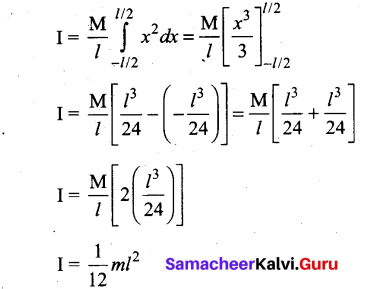
Answer:

  • Keynes’ Liquidity Preference Theory of Interest or The monetary Theory of Interest
  • Keynes propounded the Liquidity Preference Theory of Interest in his famous book,
    “ The General Theory of Employment, Interest and Money “in 1936.
  • According to Keynes, interest is purely a monetary phenomenon because the rate of interest is calculated in terms of money.
  • “Interest is the reward for parting with liquidity for a specified period of time”.

Meaning of Liquidity Preference:

  • Liquidity preference means the preference of the people to hold wealth in the form of liquid cash rather than in other non – liquid assets like bonds, securities, bills of exchange, land, building, gold etc.
  • “Liquidity Preference is the preference to have an amount of cash rather than of claims against others”. – Meyer.

Motives of Demand for Money:
According to Keynes, there are three motives for liquidity preferences. They are:

1. The Transaction Motive: –

The transaction motive relates to the desire of the people to hold cash for the current transactions [or-day-to-day expenses] M( = f(y)

2. The Precautionary Motive :

  • The precautionary motive relates to the desire of the people to hold cash to meet unexpected or unforeseen expenditures such as sickness, accidents, fire and theft.
  • The amount saved for this motive also depends on the level of Income Mp = f(y).

3. The Speculative Motive:

  • The speculative motive relates to the desire of the people to hold cash in order to take advantage of market movements regarding the future changes in the price of bonds and securities in the capital market. M = f(i)
  • There is inverse relation between liquidity preference and rate of interest.

Tamil Nadu 11th Economics Model Question Paper 2 English Medium - 2

Tamil Nadu 11th Economics Model Question Paper 2 English Medium

Question 43.
(a) Write a short note on Total Revenue.
Answer:
Total revenue is the amount of income received by the firm from the sale of its products. It is obtained by multiplying the price of the commodity by the number of units sold.
Tamil Nadu 11th Economics Model Question Paper 2 English Medium - 3
TR = P x Q
where, TR denotes Total Revenue, P denotes Price and Q denotes Quantity sold.

For example, a cell-phone company sold 100 cell-phones at the price of ₹ 500 each.
TR is ₹ 50,000.
(TR = 500 × 100 = 50,000).
Tamil Nadu 11th Economics Model Question Paper 2 English Medium - 4

When price is constant, the behaviour of TR is shown in the above table and diagram, assuming P = 5.
When P = 5; TR = PQ
When price is declining with increase in quantity sold. (e.g. Imperfect Competition on the goods market) the behaviour of TR is shown in the following table and diagram. TR can be
obtained from Demand function : If Q = 11 – p, when P = 1 Q = 10
Tamil Nadu 11th Economics Model Question Paper 2 English Medium - 5

TR = PQ = 1 x 10= 10
When P = 3, Q = 8, TR = 24
When P = 0, Q = 1, TR = 10

[OR]

(b) Explain price and output determined under monopolistic competition with help of diagram.
Answer:
Price and output Determination under Monopolistic competition:
The firm under monopolistic competition achieves its equilibrium when it’s MC = MR, and when its MC curve cuts its MR curve from below. If MC is less than MR, the sellers will find it profitable to expand their output.
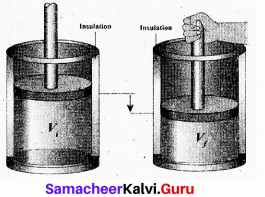
Under Monopolistic Competition:

  1. The demand curve is downwards sloping.
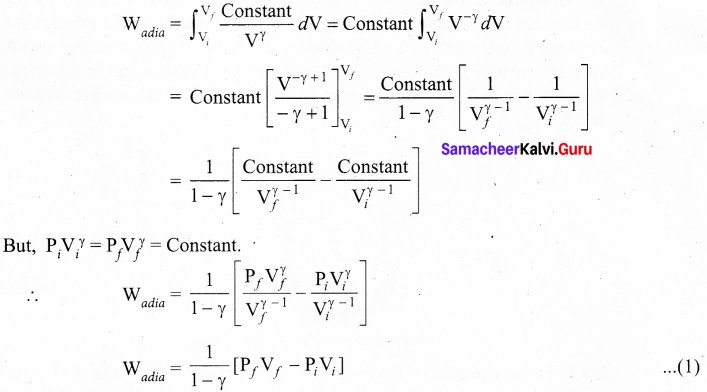
  2. There are close substitutes.
  3. The demand curve is fairly elastic.

Under monopolistic competition, different firms produce different varieties of the product and sell them at different prices.
Each firm under monopolistic competition seeks to achieve equilibrium as regards.

  1. Price and output
  2. Product adjustment
  3. Selling cost adjustment.

Tamil Nadu 11th Economics Model Question Paper 2 English Medium - 6

Short-run equilibrium:
The profit maximisation is achieved when MC = MR.
‘OM’ is the equilibrium output. ‘OP’ is the equilibrium price. The total revenue is ‘OMQP’. And the total cost is ‘OMRS’.
Therefore, total profit is ‘PQRS’. This is super normal profit under short-run. But under differing revenue and cost conditions, the monopolistically competitive firms many incur loss.

As shown in the diagram, the AR and MR curves are fairly elastic. The equilibrium situation occurs at point ‘E’,
where MC = MR
and MC cuts MR from below.

The equilibrium output is OM and the equilibrium price is OR The total revenue of the firm is ‘OMQP’ and the total cost of the firm is ‘OMLK’ and thus the total loss is ‘PQLK’. This firm incurs loss in the short run.
Tamil Nadu 11th Economics Model Question Paper 2 English Medium - 7

Long-Run Equilibrium of the Firm and the Group Equilibrium.
In the short run a firm under monopolistic competition may earn super normal profit or incur loss. But in the long run, the entry of the new firms in the industry will wipe out the super normal profit earned by the existing firms. The entry of new firms and exit of loss making firms will result in normal profit for the firms in the industry.
Tamil Nadu 11th Economics Model Question Paper 2 English Medium - 8

In the long run AR curve is more elastic or flatter, because plenty’ of substitutes are available.
Hence, the firms will earn only normal profit.

Tamil Nadu 11th Economics Model Question Paper 2 English Medium

Question 44.
(a) State the Cobb – Douglas production function.
Answer:
The Cobb-Douglas Production Function was developed by Charles W. Cobb and Paul H. Douglas, based on their empirical study of American manufacturing industry’. It is a linear homogeneous production function which implies that the factors of production can be substituted for one another up to a certain extent only.
The Cobb-Douglas production function can be expressed as follows.
Q = ALαKβ

Where, Q = output; A = positive constant; K = capital; L = Labor a and (3 are positive fractions showing, the elasticity coefficients of outputs for the inputs labor and capital, respectively.
β = (1 – α) since α + β = 1. denoting constant returns to scale.

Factor intensity can be measured by the ratio β / α.
The sum of α + β shows the returns to scale.
(i) (α + β) = 1, constant returns to scale. ‘
(ii) (α + β) < 1, diminishing returns to scale. (iii) (α + β) > 1, increasing returns to scale.

  • The production function explains that with the proportionate increase in the factors, the output also increases in the same proportion.
  • Cobb-Douglas production function implies constant returns to scale.
  • Cobb-Douglas Production Function is a specific standard equation applied to describe how much output can be made with capital and labour inputs.

[OR]

(b) Bring out Jawaharlal Nehru’s contribution to the idea of economic development.
Answer:
Assumptions of Simple Income Determination:

  • Jawaharlal Nehru, one of the chief builders of Modem India, was the first Prime Minister of Independent India.
  • He was a great patriot, thinker and statesman.

(i) Democracy and Secularism:

  • Jawaharlal Nehru was a firm believer in democracy.
  • He believed in free speech civil liberty, adult franchise and the Rule of Law and Parliamentary democracy.
  • Secularism, is another signal contribution of Nehru to India.

(ii) Planning:

  • Jawaharlal Nehru was responsible for the introduction of planning in our country.
  • Jawaharlal Nehru, the Plan was essentially an integrated approach for development.
  • Nehru Spoke on the theme of planning.
  • He said “the essence of planning is to find the best way to utilize all resources of manpower, of money and so on”.
  • “Planning for Nehru was essentially linked up with Industrialization and eventual self-reliance for the country’s economic growth on an self-accelerating growth.
  • Nehru carried through this basis strategy of planned development.
  • Nehru’s contribution to the advancement of science, research, technology and industrial development cannot be forgotten.
  • It was during is period, many IITs and Research Institutions were established.
  • Nehru always in insited on “ scientific temper”.

Question 45.
(a) Discuss about the Indian economy during British Period.
Answer:
Indian Economy during the British period:

  • India’s sea route trade to Europe started only after the arrival of Vascoda Gama in Calicut, India on May 20, 1498.
  • The Portuguese had traded in Goa as early as 1510.
  • In 1601 the East India Company was chartered, and the English began their first inroads into the Indian ocean.
  • In 1614 Sir Thomas Roe was successful in getting permission from Jahangir for setting up factories and slowly moved all parts of India.
  • Hundred years after Battle of Plassey, the rule ofthe East India Company finally did come to an end.
  • In 1858, British Parliament passed a law through which the power for governance of India was transferred from the East India Company [EIC] to the British Crown.
  • Even the transfer of power from the East India Company to the British Crown did not materially alter the situation.
  • Britain had exploited India over a period of two centuries of its colonial rule.
  • On the basis of the form of colonial exploitation, economic historians have divided the whole period into three phases:
  1. The period of merchant Capital
  2. The period of Industrial Capital
  3. The period of Finance Capital

[OR]

(b) Describe the Achievement of the Green Revolution.
Answer:
Achievement of the Green Revolution:

  • The major achievement of the new strategy was to boost the production of major cereals viz., wheat and rice.
  • The Green Revolution was confined only to High Yielding Varieties [HYV] cereals, mainly rice, wheat, maize and jowar.
  • This strategy was mainly directed to increase the production of commercial crops or cash crops such as sugarcane, cotton, jute oilseeds and potatoes.
  • Per hectare productivity of all crops had increased due to better seeds.
  • Green Revolution had positive effect on development of Industries, which manufactured agricultural tools like tractors, engines, threshers and pumping sets.
  • Green Revolution had bought prosperity to rural people.
  • Increased production had generated employment opportunities for rural masses.
  • Due to multiple cropping and more use of chemical fertilizers, the demand for labour increased.
  • Financial resources were provided by banks and co-operative societies.
  • These banks provided loans to farmer on easy terms.

Tamil Nadu 11th Economics Model Question Paper 2 English Medium

Question 46.
(a) Explain the “Abolition of MRTP Act”.
Answer:

  • The New Industrial policy of 1991 has abolished the Monopoly and Restrictive Trade Practices Act 1969.
  • In 2010, the competition commission has emerged as the watchdog in monitoring competitive practices in the economy.
  • The policy caused big changes including emergence of a strong and competitive private sector and a sizable number of foreign companies in India.

[OR]

(b) What are the limitations of “LPG”.
Answer:

Liberalization measures, when effectively enforced, favour an unrestricted entry offoreign companies in the domestic economy. Such an entry prevents the growth of the local manufacturers.

Privatization measures favour the continuance of the monopoly power. Only the powerful people can sustain in business markets. Social justice cannot be easily established and maintained. As a result, the disparities tend to widen among people and among regions.

As globalization measures tend to integrate all economies of the world and bringing them all under one umbrella; they pave the way for redistribution of economic power at the world level. Only the already well developed countries are favoured in this process and the welfare of the less developed countries will be neglected. The economic crisis of the developed countries are easily spread to the developing economies through trade.

Tamil Nadu 11th Economics Model Question Paper 2 English Medium

Question 47.
(a) Compare and contrast various definitions of economics.
Answer:
1. Adam Smith’s wealth definition:

  • Adam Smith [1723-1790] in his book “An Inquiry into Nature and Cause of Wealth of ‘ Nations” [ 1776] \ defines “Economics as the science of wealth”
  • He-explains how a nation’s wealth is created and increased.
  • He considers that the individual in the society wants to promote his own gain and in this process, he is guided and led by an “invisible hand”
  • Adam Smith favours the introduction of “division of labour” to increase the quantum of output.
  • Severe competition in factories and society helps in bettering the product.
  • Supply force is very active and a commodity is made available to the consumers at the •lowest price.

2. Alfred Marshall welfare definition:

  • Alfred Marshall [1842-1924] in his book “Principles of Economics” [1890] defines economics thus “Political Economy” or Economics is a study of mankind in the ordinary business of life.
  • It examines that part of individual and social action which is most closely connected with the attainment and with the use of the material requisites of well being.
  • Thus , it is on one side a study of wealth and on the other and more important side, a part of the study of man”.

The important features of Marshall’s definition are:

  • Economics does not treat wealth as the be-all and end-all of economic activities.
  • Man promotes primarily welfare and not wealth.
  • The science of economics contains the concerns of ordinary people who are moved by love and not merely guided or directed by the desire to get maximum monetary benefit.
  • Economics is a social science. It studies people in the society who influence one another.

3. Lionel Robbins – Scarcity definition:

  • Lionel Robbins published a book “An Essay on the Nature and Significance of Economic Science” in 1932.
  • According to him, “Economics is a science which studies human behaviour as a relationship between ends and scarce means which have alternative uses”.

The major features of Robbins’ definition:

  • Ends refer to human wants, human beings have unlimited number of wants.
  • On the other hand, resources or means that go to satisfy the unlimited human wants are
    limited or scarce in supply.
  • The scarce means are capable of having alternative uses.
  • An individual grades his wants and satisfies first his most urgent want.
  • Economics, according to Robbins, is a science of choice.

4. Samuelson’s -growth definition:

Paul Samuelson defines economics as “the study of how men and society choose, with or without the use of money, to employ scarce productive resources which could have alternative uses to produce various commodities over time, and distribute them for consumption, now and in the future among various people and groups of society”.

The major implications of this definition are as follows:

  • Samuelson’s makes his definition dynamic by including the element of time in it.
  • Samuelson’s definition is applicable also in a barter economy.
  • His definition covers various aspects like production, distribution and consumption.
  • Samuelson treats economics as a social science.
  • Samuelson appears to be the most satisfactory.

Tamil Nadu 11th Economics Model Question Paper 2 English Medium

[OR]

(b) Explain the law of Equi-marginal utility.
Answer:
The law of the Equi-marginal utility:

  • The law of diminishing marginal utility is applicable only to the want of a single commodity.
  • The law of equi – marginal utility explains the behavior of a consumer when he consumer more than one commodity.
  • Wants are unlimited but the income which is available are limited.
  • This law explains how the consumer spends his limited income on various commodities to get maximum satisfaction.
  • Law of Equi – Marginal Utility is also known as the law of substitution.
  • “The law of consumer’s equilibrium ”
  • “Gossen’s second law ” and “ The law of maximum satisfaction”.

Definition:
Marshall states the law as ,“ If a person has a thing which he can put to several uses, he will distribute it among these uses in such a way that it has the same marginal utility in all. For, if it had a greater marginal utility in one use than another he would gain by taking away some of it from the second use and applying it to first”.

Assumption:

  • The consumer is rational in the sense that he wants to get maximum satisfaction.
  • The utility of each commodity is measurable in cardinal numbers.
  • The marginal utility of money remains constant. . .
  • The income of the consumer is given.
  • There is perfect competition in the market.
  • The prices of the commodities are given.
  • The law of diminishing marginal utility operates.

Illustration:
This law can be illustrated with the help of table. Let us assume that the consumer has a given income of ₹ 11. He wants to spend this entire income i.e. ₹ 11] on Apple and Orange. The price of an Apple and the price of an orange is ₹ 1 each.
Tamil Nadu 11th Economics Model Question Paper 2 English Medium - 9

If the consumer wants to attain maximum utility, he should buy 6 units of apples and 5 units of oranges, so that she can get [92 + 58] = 150 units. No other combination of Apple and Orange can give higher than 150 utilities.

Diagrammatic Illustration:

  • In the diagram, X – axis represents the amount of money spent and Y axis represents the marginal utilities of Apple and Orange respectively.
  • If the consumer spends ₹ 6 on Apple and ₹ 5 on Orange, the marginal utilities of both are equal, i.e. AA1 = BB1 [4 = 4], Hence, he gets maximum utility.

Criticisms:

  • In practice, utility cannot be measured, only be felt.
  • This law cannot be applied to durable goods.

Tamil Nadu 11th Economics Previous Year Question Paper March 2019 English Medium

Students can Download Tamil Nadu 11th Economics Previous Year Question Paper March 2019 English Medium Pdf, Tamil Nadu 11th Economics Model Question Papers helps you to revise the complete Tamilnadu State Board New Syllabus and score more marks in your examinations.

TN State Board 11th Economics Previous Year Question Paper March 2019 English Medium

Instructions:

  1.  The question paper comprises of four parts.
  2.  You are to attempt all the parts. An internal choice of questions is provided wherever applicable.
  3. questions of Part I, II. III and IV are to be attempted separately
  4. Question numbers 1 to 20 in Part I are objective type questions of one -mark each. These are to be answered by choosing the most suitable answer from the given four alternatives and writing the option code and the corresponding answer
  5. Question numbers 21 to 30 in Part II are two-marks questions. These are to be answered in about one or two sentences.
  6. Question numbers 31 to 40 in Parr III are three-marks questions, These are to be answered in about three to five short sentences.
  7. Question numbers 41 to 47 in Part IV are five-marks questions. These are to be answered) in detail. Draw diagrams wherever necessary.

Time: 2½ Hours
Maximum Marks: 90

Part – I

Choose the correct answer. Answer all the questions. [20 × 1 = 20]

Question 1.
Who defined “Economics as the Science of Wealth”?
(a) Karl Marx
(b) Paul A. Samuelson
(c) Max Muller
(d) Adam Smith
Answer:
(d) Adam Smith

Question 2.
Utility means ________.
(a) Total value of commodity
(b) Desire for goods and services
(c) Equilibrium point at which demand and supply are equal
(d) Want satisfying capacity of goods and services
Answer:
(d) Want satisfying capacity of goods and services

Question 3.
Given the consumer’s surplus is ₹ 75 and the actual price is ₹ 372, find the potential price.
(a) 447
(b) 50
(c) 375
(d) 474
Answer:
(a) 447

Question 4.
Which factor is called the changing agent of the society?
(a) Organizer
(b) Capital
(c) Labour
(d) Land
Answer:
(a) Organizer

Tamil Nadu 11th Economics Previous Year Question Paper March 2019 English Medium

Question 5.
Which of the following is not a characteristic of land?
(a) Heterogeneous
(b) Gift of Nature
(c) Its limited supply
(d) It is mobile
Answer:
(d) It is mobile

Question 6.
α + β = 1 refers _______.
(a) Increasing returns to scale
(b) Constant returns to scale
(c) Diminishing returns to scale
(d) None
Answer:
(b) Constant returns to scale

Question 7.
Formula for estimating average variable cost.
(a) TFC/Q
(b) TAC/Q
(c) TC/Q
(d) TVC/Q
Answer:
(d) TVC/Q

Tamil Nadu 11th Economics Previous Year Question Paper March 2019 English Medium

Question 8.
Match the following:
Tamil Nadu 11th Economics Previous Year Question Paper March 2019 English Medium 1
Answer:
(b) (1) – (iv), (2) – (1), (3) – (ii), (4) – (iii)

Question 9.
The concept of imperfect competition was propounded by _________.
(a) J.M. Keynes
(b) Irving Fisher
(c) Marshall
(d) Joan Robinson
Answer:
(d) Joan Robinson

Question 10.
Identify the wrong statement about the features of Duopoly.
(a) There is product differentiation.
(b) They fix the price for their product to maximise their profit.
(c) Each seller is fully aware of his rival’s motive and actions.
(d) Both sellers may collude regarding the sale of commodity.
Answer:
(a) There is product differentiation.

Question 11.
“Wages is a sum of money paid under contract by an employer to a worker for the services rendered.” – Who said this statement?
(a) Walker
(b) Marshall
(c) Ricardo
(d) Benham
Answer:
(d) Benham

Question 12.
The first Wi-Fi facility was provided by Indian Railways in
(a) Bengaluru
(b) Chennai
(c) Delhi
(d) Mumbai
Answer:
(a) Bengaluru

Question 13.
Density of population =
(a) Total population / land area of the region
(b) Total population / Employment
(c) Land area / Total population
(d) Land area / Employment
Answer:
(a) Total population / land area of the region

Tamil Nadu 11th Economics Previous Year Question Paper March 2019 English Medium

Question 14.
The oldest large scale industry in India is _______.
(a) Steel
(b) Cement
(c) Cotton
(d) Jute
Answer:
(c) Cotton

Question 15.
Twelfth Five Year Plan period ________.
(a) 2007-2012
(b) 1997-2002
(c) 2012-2017
(d) 2002-2007
Answer:
(c) 2012-2017

Question 16.
India is the largest producer of ______ in the world
(a) petrol
(b) diesel
(c) fruits
(d) gold
Answer:
(c) fruits

Question 17.
‘India lives in villages’, said by ________.
(a) V.K.R.V. Rao
(b) J.C. Kumarappa
(c) Mahatma Gandhi
(d) Jawaharlal Nehru
Answer:
(c) Mahatma Gandhi

Question 18.
______ are set up with a view to develop rural economy by providing credit and other facilities to small and marginal farmers.
(a) MUDRA Bank
(b) RRB
(c) SHG
(d) NABARD
Answer:
(b) RRB

Tamil Nadu 11th Economics Previous Year Question Paper March 2019 English Medium

Question 19.
Which of the following is wrongly matched?
(a) SAIL – Salem
(b) The Pump City – Coimbatore tax
(c) BHEL – Trichy
(d) Knitting City – Karur
Answer:
(d) Knitting City – Karur

Question 20.
The first person to apply mathematical method to economic problem was ________.
(a) G. Crammer
(b) Paul Samuelson
(c) Sir William Petty
(d) Giovanni Ceva
Answer:
(d) Giovanni Ceva

Part – II

Answer any seven questions in which question No. 30 is compulsory. [7 × 2 = 14]

Question 21.
Define Consumer’s Surplus according to Alfred Marshall.
Answer:
Alfred Marshall defines Consumer’s Surplus as “the excess of price which a person would be willing to pay a thing rather than go without the thing, over that which he actually does pay is the economic measure of this surplus satisfaction. This may be called consumers surplus”.

Question 22.
What is meant by Sunk Cost?
Answer:
A cost incurred in the past and cannot be recovered in future is called as Sunk Cost. This is historical but irrelevant for future business decisions. It is called as sunk because, they are unalterable, unrecoverable and if once invested it should be treated as drowned or disappeared.

Question 23.
What are the kinds of profit? Explain them.
Answer:
There are three kinds of profit:

  • Monopoly Profit: Profit earned by the firm because of its monopoly control.
  • Windfall Profit: Sometimes, profit arises due to changes in price level. Profit is due to unforeseen factors.
  • Profit as functional reward: Just like rent, wage and interest, profit is earned by the entrepreneur for his entrepreneurial function.

Tamil Nadu 11th Economics Previous Year Question Paper March 2019 English Medium

Question 24.
What is NITI Aayog? What are its functions?
Answer:

  • The Planning Commission has been replaced by the NITI Aayog on 1 st January, 2015.
  • NITI (National Institution for Transforming India) Aayog will monitor, coordinate and ensure implementation of the accepted sustainable development goals.
  • NITI Aayog serves as a knowledge hub and monitors progress in the implementation of policies and programmes of the Government of India.
  • It includes the matters of national and international importance on the economic front, dissemination of best practices from within the .country and from other nations, the infusion of new policy ideas and specific issue-based support.

Question 25.
State any four features of developed economy.
Answer:
Features of a Developed Economy:

  1. High National Income
  2. High Per Capita Income
  3. High Standard of Living
  4. Full Employment of Resources

Question 26.
Define disinvestment.
Answer:
Disinvestment means selling of government securities of Public Sector Undertakings [PSUs] to other PSUs or Private Sectors or banks. This process has not been fully implemented.

Question 27.
Define Cottage Industry. State any two characteristics of cottage industries.
Answer:
Cottage industries are generally associated with agriculture and provide both part-time and full-time jobs in rural areas. Some important characteristics of cottage industries are:

  1. These industries are carried out by artisans in their own homes at their own risk and for their own benefit.
  2. No or little outside labour is employed. Normally, the members of the household provide the necessary labour.

Question 28.
What is crop insurance?
Answer:}
Agriculture in India is highly prone to risks like droughts and floods. It is necessary to protect the farmers from natural calamities and ensure their credit eligibility for the next season.

For this purpose, the Government of India introduced many agricultural schemes throughout the country. The Pradhan Mantri Fasal Bima Yojana (Prime Minister’s Crop Insurance Scheme) was launched on 18 February 2016.

Tamil Nadu 11th Economics Previous Year Question Paper March 2019 English Medium

Question 29.
Find the value of the determinant for the matrix A = \(\left(\begin{array}{cc}
3 & 4 \\
10 & -2
\end{array}\right)\)
Answer:
Given matrix A = \(\left(\begin{array}{cc}
3 & 4 \\
10 & -2
\end{array}\right)\) then, the department
|A| = \(\left|\begin{array}{ll}
3 & 4 \\
10 & -2
\end{array}\right|\) = 3(-2) – 10(4)
= – 6 – 40 = -46 is the value of the determinant.

Question 30.
Write short notes on mineral resources of Tamil Nadu.
Answer:

  • Tamil Nadu has a few mining projects based on Titanium, Lignite, Magnesite, Graphite, Limestone, Granite and Bauxite.
  • The first one is the Neyveli Lignite Corporation that has led development of large industrial complex around Neyveli in Cuddalore district with thermal power plants, Fertilizer and Carbonisation plants.
  • Magnesite mining is at Salem from which mining of Bauxite ores are carried out at Yercaud and this region is also rich in Iron Ore at Kanjamalai. Molybdenum is found in Karadikuttam in Madurai district.

Part – III

Answer any seven questions in which question No. 40 is compulsory. [7 × 3 = 21]

Question 31.
What are the differences between micro-economics and macro-economics.
Answer:
Micro Economics:

  1.  It is that branch of economics which deals with the economic decision making of individual economic agents such as the producer, the consumer etc.
  2. It takes into account small components of the whole economy
  3. It deals with the process of price determination in case of individual products and factors of production.
  4. It is known as price theory.
  5. It is concerned with the optimization goals of individual consumers and producers.

Macro Economics:

  1. It is that branch of economics which deals with aggregates and averages of the entire economy. E.g., aggregate output, national income, aggregate savings and investment, etc.
  2. It takes into consideration that economy of the country as a whole.
  3. It deals with general price-level in any economy.
  4. It is also known as the income theory.
  5. It is concerned with the optimization of the growth process of the entire economy.

Tamil Nadu 11th Economics Previous Year Question Paper March 2019 English Medium

Question 32.
Describe the features of human wants.
Answer:
(a) Wants are unlimited:
Human wants are countless in number and various in kinds. When one want is satisfied another want crops up. Human wants multiply with the growth of civilization and development.

(b) Wants become habits:
Wants become habits; for example, when a man starts reading news paper in the morning, it becomes a habit. Same is the case with drinking tea or chewing pans.

(c) Wants are Satiable:
Though we cannot satisfy all our wants, at the same time we can satisfy particular wants at a given time. When one feels hungry, he takes food and that want is satisfied.

(d) Wants are Alternative:
There are alternative ways to satisfy a particular want. E.g., Idly, dosa or chappathi.

(e) Wants are Competitive:
All our wants are not equally important. So, there is competition among wants. Hence, we have to choose more urgent wants than less urgent wants.

(f) Wants are Complementary:
Sometimes, satisfaction of a particular want requires the use of more than one commodity. Example: Car and Petrol, Ink and Pen.

(g) Wants are Recurring:
Some wants occur again and again. For example, if we feel hungry, we take food and satisfy out want. But after sometime, we again feel hungry and want food.

Question 33.
Find out the missing Marginal Product and Average Product for the given table.
Tamil Nadu 11th Economics Previous Year Question Paper March 2019 English Medium 2
Answer:
Tamil Nadu 11th Economics Previous Year Question Paper March 2019 English Medium 3

Question 34.
Define opportunity cost with an example.
Answer:

  • Opportunity refers to the cost of next best alternative use. In other words, it is the value of the next best alternative foregone.
  • For example, a farmer can cultivate both paddy and sugarcane in a farm land. If he cultivates paddy, the opportunity cost of paddy output is the amount of sugarcane output given up. Opportunity Cost is also called as ‘Alternative Cost’ or ‘Transfer Cost’.

Tamil Nadu 11th Economics Previous Year Question Paper March 2019 English Medium

Question 35.
What is Monopsony?
Answer:
Monopsony is a market structure in which there is only one buyer of a good or service. If there is only one customer for a certain good, that customer has monopsony power in the market for that good. Monopsony is analogous to monopoly, but monopsony has market power on the demand side rather than on the supply side.

Question 36.
What are the types of Natural resources?
Answer:
Water resources:
Tamil Nadu is not endowed with rich natural resources compared to other States. It accounts for three per cent of water sources, four per cent of land area against six per cent of population.

North East monsoon is the major source of rainfall followed by South West monsoon. There are 17 river basins in Tamil Nadu. The main rivers are Palar, Cheyyar, Ponnaiyar, Cauvery, Bhavani, Vaigai, Chittar, Tamiraparani, Vellar, Noyyal Siruvani, Gundar, Vaipar, Valparai, etc. Wells are the largest source of irrigation in Tamil Nadu (56%).

Mineral resources:
Tamil Nadu has a few mining projects based on Titanium, Lignite, Magnesite, Graphite, Limestone, Granite and Bauxite. The first one is the Neyveli Lignite Corporation that has led development of large industrial complex around Neyveli in Cuddalore district with thermal power plants, Fertilizer and Carbonisation plants.

Magnesite mining is at Salem from which mining of Bauxite ores are carried out at Yercaud and this region is also rich in Iron Ore at Kanjamalai. Molybdenum is found in Karadikuttam in Madurai district.

Question 37.
List out the objectives of MUDRA BANK.
Answer:

  1. Regulate the lender and the borrower of micro-finance and bring stability to the
    micro-finance system. .
  2. Extend finance and credit support to Micro-finance Institutions (MFI) and agencies that lend money to small businesses, retailers, self-help groups and individuals.
  3. Register all MFIs and introduce a system of performance rating and accreditation for the first time.
  4. Offer a Credit Guarantee scheme for providing guarantees to loans being offered to micro businesses.
  5. Introduce appropriate technologies to assist in the process of efficient lending, borrowing and monitoring of distributed capital.

Question 38.
Describe the development of Textile industry in Tamil Nadu.
Answer:

  • Tamil Nadu is the largest textile hub of India.
  • Tamil Nadu is known as the “Yam Bowl” of the country accounting for 41% of India’s cotton yam production.
  • The textile industry plays a significant role in the Indian economy by providing direct employment to an estimated 35 million people, and thereby contributing 4% of GDP and 35% of gross export earnings.
  • The textile sector contributes to 14% of the manufacturing sector.
  • From spinning to garment manufacturing, entire textile production chain facilities are in Tamil Nadu.
  • About half of India’s total spinning mill capacity is in Tamil Nadu.
  • The western part of Tamil Nadu comprising Coimbatore, Tirupur, Erode, Dindigul and Karur has the majority of spinning mills manufacturing cotton, polyester, blended yam and silk yam used by garment units in Tamil Nadu, Maharastra etc.,
  • Yam is also exported to China, Bangladesh, etc.,
  • Tirupur known as “knifting city” is the exporter of garments worth USD (United States Dollar) 3 billion.
  • Karur is the major home for textile manufacturing (curtain cloth, bed linens, kitchen linens, toilet linens, table linens, wall hangings etc.,) and export hub in India.
  • Erode is the main cloth market in South India for both retail and wholesale ready-mades.

Tamil Nadu 11th Economics Previous Year Question Paper March 2019 English Medium

Question 39.
Solve for x quantity demanded if 16x – 4 = 68 + 7x.
Answer:
16x – 4 = 68 + 7x
16x – 7x = 68 + 4
9x = 72
x = \(\frac{72}{9}\)
x = 8

Question 40.
Differentiate between Rent and Quasi-Rent.
Answer:
Rent:

  1. Rent accrues to land
  2. The supply of land is fixed forever.
  3. It enters into price

Quasi – Rent:

  1. Quasi-Rent accrues to manmade appliances.
  2. The supply of manmade appliances is fixed for a short period only.
  3. It does not enter into price.

Part – IV

Answer all the questions. [7 × 5 = 35]

Question 41.
(a) Explain basic problems of the economy with the help of Production Possibility Curve.
Answer:
Production possibility curve shows the menu of choice along which a society can choose to substitute one good for another assuming a given state of technology and given total resources.

Assumptions:

  • The time period does not change
  • Techniques of production are fixed.
  • There is full employment in the economy.
  • Only two goods can be produced from the given resources
  • Resources of production are fully mobile.

Tamil Nadu 11th Economics Previous Year Question Paper March 2019 English Medium 4
Tamil Nadu 11th Economics Previous Year Question Paper March 2019 English Medium 5

Explanation:

  1. The quantity of food is shown on x-axis and the number of cars is shown on y-axis.
  2. The different six production possibilities are being shown as point P1 P2 P3 P4 P5 & P6.
  3. A maximum of 500 tons of food can be produced, given the existing technology.
  4. If on the other hand, all resources are instead used for producing cars, 25 cars can be produced.
  5. In between these two extremes, possibilities exist.
  6. If we are willing to give up some food, we can have some cars.

[OR]

(b) Explain the public transport system in Tamil Nadu.
Answer:
Tamil Nadu has a well established transportation system that connects all parts of the State. This is partly responsible for the investment in the State. Tamil Nadu is served by an extensive road network in terms of its spread and quality, providing links between urban centres, agricultural market-places and rural habitations in the countryside. However, there is scope for improvement.

(a) Road Transport:

  • There are 28 national highways in the State covering a total distance of 5,036 km.
  • The State has a total road length of 167,000 km, of which 60,628 km are maintained by Highways Department.

(b) Rail Transport:

  • Tamil Nadu has a well-developed rail network as part of Southern Railway, Headquartered at Chennai.
  • Tamil Nadu has a total railway track length of 6,693 km and there are 690 railway stations in the State.
  • Main rail junctions in the State include Chennai, Coimbatore, Erode, Madurai, Salem, Tiruchirapalli and Tirunelveli.
  • Chennai has a well-established, suburban Railway network, a Mass Rapid Transport system and is currently developing a Metro System, with its first underground stretch operational since May 2017.

(c) Air Transport:

  • Tamil Nadu has four major international airports.
  • Chennai International Airport is currently the third largest airport in India.
  • Other international Airports in Tamil Nadu include Coimbatore International Airports, Madurai International Airport and Tiruchirapalli International Airport.
  • It also has domestic airports at Tuticorin, Salem, and Madurai.
  • Increased industrial activity has given rise to an increase in passenger traffic as well as freight movement which has been growing at over 18% per year.

(d) Ports:

  • Tamil Nadu has three major ports; one each at Chennai, Ennore and Tuticorin, as well as one intermediate port in Nagapattinam, and 23 minor ports.
  • The ports are currently capable of handling over 73 million metric tonnes of cargo annually (24 % share of India).
  • All the minor ports are managed by the Tamil Nadu Maritime Board, Chennai Port.
  • This is an artificial harbour and the second principal port in the country for handling containers.
  • It is currently being upgraded to have a dedicated terminal for cars capable of handling 4,00,000 vehicles.
  • Ennore port was recently converted from an intermediate port to a major port and handles all the coal and ore traffic in Tamil Nadu.

Tamil Nadu 11th Economics Previous Year Question Paper March 2019 English Medium

Question 42.
(a) Explain the law of demand with a diagram.
Answer:
Definition:
According to Alfred Marshall, the Law of Demand said as “the quantity demanded increases with a fall in price and diminishes with a rise in price”.

Assumptions of Law of Demand:

  1. The income of the consumer remain constant.
  2. The taste, habit and preference of the consumer remain the same.
  3. The prices of other related goods should not change.
  4. There should be no substitutes for the commodity in study.
PriceQuantity
Demanded
51
42
33
24
15

Tamil Nadu 11th Economics Previous Year Question Paper March 2019 English Medium 6

Explanation:

  1. Quantity demanded and Y axis represents the price of the commodity.
  2. DD is the demand curve, which has a negative slope.
  3. Slope downward from left to right which indicates that when price falls, the demand expands and when price rises, the demand contracts.

Conclusion:
Therefore, the law of demand states that there is an inverse relationship between the price and the quantity demanded of a commodity.

[OR]

(b) Illustrate the Ricardian theory of Rent.
Answer:
Definition:
According to Ricardo, “Rent is the that portion of the produce of the earth which is paid to the landlord for the use of the original and indestructible powers of the soil”.

Assumptions:

  1. Land differs in fertility.
  2. The law of diminishing returns operates in agriculture.
  3. Rent depends upon fertility and location of land.
  4. Theory assumes perfect competition.

Schedule of Ricardian Theory of Rent:

Grades of LandsProduction (in bags)Surplus (i.e., Rent in bags)
A4040 – 20 = 20
B3030 – 20 = 10
C2020 – 20 = 0

Tamil Nadu 11th Economics Previous Year Question Paper March 2019 English Medium 7

Explanation:

  1. In diagram, X axis represents various grades of land and Y axis represents yield per acre (in bags).
  2. 0A, AB and BC are the ‘A’ Grade, ‘B’ grade and ‘C’ grade lands respectively.
  3. The application of equal amount of labour and capital on each of them gives a yield represented by the rectangles standing just about the respective bases.
  4. The ‘C’ grade land is the ‘no-rent land’ “A” and “B” grade lands are “intra – marginal lands”.

Question 43.
(a) Describe the properties of Iso – quants with the help of diagrams.
Answer:
Properties of Iso-quant Curve:
Tamil Nadu 11th Economics Previous Year Question Paper March 2019 English Medium 8
1. The iso-quant curve has negative slope.
It slopes downwards from left to right indicating that the factors are substitutable. If more of one factor is used, less of the other factor is needed for producing the same level of output. In the diagram combination A refers to more of capital K5 and less of labour L2. As the producer moves to B, C, and D, more labour and less capital are used.

2. Convex to the origin.
This explains the concept of diminishing Marginal Rate of Technical Substitution (MRTSLK). For example, the capital substituted by 1 unit of labour goes on decreasing when moved from top to bottom. If so, it is called diminishing MRTS. Constant MRTS (straight line) and increasing MRTS (concave) are also possible. It depends on the nature of iso-quant curve.

This means that factors of production are substitutable to each other. The capital substituted per unit of labour goes on decreasing when the iso-quant is convex to the origin.

Marginal Rate of technical substitution
Tamil Nadu 11th Economics Previous Year Question Paper March 2019 English Medium 9

3. Non inter-section of Iso-quant curves.
For instance, point A lie on the isoquants IQ1 and IQ2. But the point C shows a higher output and the point B shows a lower level of output IQ1.
If C = A, B = A, then C = B. But C > B which is illogical.
Tamil Nadu 11th Economics Previous Year Question Paper March 2019 English Medium 10

4. An upper iso-quant curve represents a higher level of output.
Higher IQs show higher outputs and lower IQs show lower outputs, for upper iso-quant curve implies the use of more factors than the lower isoquant curve.

The arrow in the figure shows an increase in the output with a right and upward shift of an iso-quant curve.
Tamil Nadu 11th Economics Previous Year Question Paper March 2019 English Medium 11

5. Iso-quant curve does not touch either X axis or Y axis.
No iso-quant curve touches the X axis or Y axis because in IQ1 only capital is used, and in IQ2 only labour is used.
Tamil Nadu 11th Economics Previous Year Question Paper March 2019 English Medium 12

[OR]

(b) Explain about the Industry clusters in Tamil Nadu
Answer:

  • Chennai is sometimes referred to as the Health Capital of India or the Banking Capital of India, having attracted investments from International Finance Corporations and the World Bank. It is also called as Detroit of Asia.
  • Tamil Nadu has a network of about 110 industrial parks / estates that offer developed plots with supporting infrastructure.
  • Also, the Government is promoting other industrial parks like Rubber Park, Apparel Park, Floriculture Park, TICEL Park for Biotechnology, Siruseri IT Park and Agro Export Zones.
  • The heavy engineering manufacturing companies are Centred around the subrubs of Chennai. Chennai boasts of global car manufacturing giants as well as home grown companies.
    Tamil Nadu 11th Economics Previous Year Question Paper March 2019 English Medium 13
  • Karur is known for its bus body building which contributes 80% of South Indian bus body building.
  • TNPL is the Asia’s largest ecofriendly paper mill. Salem is called as steel city and has many sago producing units and mineral wealth.
  • Sivakasi is the leader in printing, fireworks, safety matches production in India. It contributes to 80% of India’s total safety matches production and 90% of India’s total fireworks production.
  • Thoothukudi is the gateway of Tamil Nadu. It is a major chemical producer next only to Chennai.

Tamil Nadu 11th Economics Previous Year Question Paper March 2019 English Medium

Question 44.
(a) Bring out the relationship between AR and MR curves under various price conditions.
Answer:
If a firm is able to sell additional units at the same price then AR and MR will be constant and equal. If the firm is able to sell additional units only by reducing the price, then both AR and MR will fall and be different.

Constant AR and MR (at Fixed Price):
When price remains constant or fixed, the MR will be also constant and will coincide with AR. Under perfect competition as the price is uniform and fixed, AR is equal to MR and their shape will be a straight line horizontal to X axis. The AR and MR Schedule under constant price is given in the below table and in the diagram.
Tamil Nadu 11th Economics Previous Year Question Paper March 2019 English Medium 14

Declining AR and MR (at Declining Price):
When a firm sells large quantities at lower prices both AR and MR will fall but the fall in MR will be more steeper than the fall in the AR.

It is to be noted that MR will be lower than AR. Both AR and MR will be sloping downwards straight from left to right. The MR curve divides the distance between AR Curve and Y axis into two equal parts. The decline in AR need not be a straight line or linear. If the prices are declining with the increase in quantity sold, the AR can be non-linear, taking a shape of concave or convex to the origin.

[OR]

(b) If the demand function is P = 35 – 2x – x2 and the demand x0 is 3, what will be the consumer’s surplus?
Answer:
Given demand function,
P = 35 – 2x – x2 For x = 3
P = 35 – 2(3) – 32
= 35 – 6 – 9.
P = 20 Therefore,
CS = (Area of the curve below the demand curve from 0 to 3) – Area of the rectangle (20 x – = 60)
Tamil Nadu 11th Economics Previous Year Question Paper March 2019 English Medium 15
= 105 – 9 – 9 – 60 = 27 Units

Question 45.
(a) Explain the features of Oligopoly.
Answer:

  • Few large firms: Very few big firms own the major control of the whole market by producing major portion of the market demand.
  • Interdependence among firms: The price and quality decisions of a particular firm are dependent on the price and quality decisions of the rival firms.
  • Group behaviour: The firms under oligopoly relalise the importance of mutual cooperation.
  • Advertisment cost: The oligopolist could raise sales either by advertising or improving the quality of the product.
  • Nature of product: The oligopoly means homogeneous products and imperfect oligopoly deals with- heterogeneous products.
  • Price rigidity: It implies that prices are difficult to be changed. The oligopolistic firms do not-change their prices due to the fear of rivals’ reaction.

[OR]

(b) Write a brief note on the Gandhian economic ideas.
Answer:
1. Village Republics:
To Gandhi, India lives in villages. He was interestred in developing the villages j as self sufficient units. He opposed extensive use of machinery, urbanization and industrialization.

2. On Machinery:
Gandhi described machinery as “Great Sin’. He said that “Books could be written to demonstrate the evils it is necessary to realize that machinery is bad. Instead of welcoming machinery as a boon, we should look upon it as an evil. It would ultimately crease.

3. Industrialism:
Gandhi considered industrialism as a curse on mankind. He thought industrialism depended entirely on a country’s capacity to exploit.

4. Decentralization:
He advocated a decentralized economy, i.e., production at a large number of places on a small scale or production in the people’s homes.

5. Villge Sarvodaya:
According to Gandhi, “Real India was to be found in villages and not in towns or cities. So he suggested the development of self sufficient, self-dependent villages.

6. Bread Labour:
Gandhi realized the dignity of human labour. He believed that God created man to eat his bread by sweat of his brow. Bread labour or body labour was the expression that Gandhi used to mean manual labour.

7. The Dcotrine of Trusteeship:
Trusteeship provides a means of transforming the present capitalist order of society into an egalitarian one. It gives no quarter to capitalism. However, now India experiences * S both casino capitalism and crony capitalsm.

8. On the Food Problem:
Gandhi was against any sort of food controls. He thought Such controls only created artificial scarcity. Once India was begging for food grain, but India tops the world with very large production of foodgrains, fruits, vegetables, milk, egg, meat etc.

9. On population:
Gandhi opposed the method of population control through contraceptives. He was, however, in favour of birth control as a sovereign remedy to the problem of over population.

10. On Prohibition:
Gandhi advocated cent per cent prohibition. He regarded the use of liquor as a disease rather than a vice. He felt that it was better for India to be poor than to have thousands of drunkards. But, now many states depend on revenue from liquor sales.

Tamil Nadu 11th Economics Previous Year Question Paper March 2019 English Medium

Question 46.
(a) Explain the objectives of nationalization of commercial banks.
Answer:
The Government of India nationalized the commercial banks to achieve the following objectives:

  • The main objective of nationalization was to attain Social Welfare. Sectors such as agriculture, small and village industries were in need of funds for their expansion and further economic development.
  • Nationalisation of banks helped to curb private monopolies in order to ensure a smooth supply of credit to socially desirable sections.
  • In India, nearly 70% of population lived in rural areas. Therefore it was needed to encourage the banking habit among the rural population.
  • Nationalisation of banks was required to reduce the regional imbalances where the banking facilities were not available.
  • Before Independence, the numbers of banks were certainly inadequate. After nationalization, new bank branches were opened in both rural and urban areas.
  • Banks created credit facilities mainly to the agriculture sector and its allied activities after nationalization.

After New Economic Policy 1991, the Indian banking Industry has been facing the new horizons of competitions, efficiency and productivity.

[OR]

(b) How are the information and communication technologies (ICT) used in economics?
Answer:
Information and Communication Technology (ICT) is the infrastructure that enables computing faster and accurate. The following table gives an idea of range of technologies that fall under the category of ICT.

InformationTechnologies
CreationPersonal Computer, Digital Camera, Scanner, Smart Phone.
ProcessingCalculation, PC, Smart Phone
StorageCD, DVD, Pen Drive, Microchip, Cloud
DisplayPC, TV, Projector, Smart Phone
TransmissionInternet, Teleconference, Video Conferencing, Mobile Technology, Radio
ExchangeE-mail, Cell phone

THE EVALUATION OF ICT HAS FIVE PHASES.
They are evolution in

  1. Computer
  2. PC
  3. Microprocessor
  4. Internet and
  5. Wireless links

In Economics, the uses of mathematical and statistical tools need the support of ICT for data compiling, editing, manipulating and presenting the results. In general, SPSS and Excel packages are often used by researchers in economics. Such Software is designed to do certain user tasks. Word process, spread sheet and web browser are some of the examples which are frequently used while undertaking analysis in the study of economics.

Tamil Nadu 11th Economics Previous Year Question Paper March 2019 English Medium

Question 47.
(a) Explain the objectives and characteristics of Special Economic Zones (SEZ).
Answer:

  • The Special Economic Zones [SEZs] Policy was announced in April 2000.
  • The Special Economic Zones Act of 2005, the government has so far notified about 400 such zones in the country.

Major objectives of SEZs:

  • To enhance foreign investment, especially to attract foreign direct investment [FDI] and thereby increasing GDP.
  • To increase shares in Global Export. (International Business)
  • To generate additional economic activity.
  • To create employment opportunities.
  • To develop infrastructure facilities.
  • To exchange technology in the global market.

Main Characteristics of SEZ:

  • Geographically demarked area with physical security.
  • Administrated by single body authority.
  • Streamlined procedures.
  • Having separate custom area.
  • Governed by more liberal economic laws.
  • Greater freedom to the firms located in SEZs. .

[OR]

(b) Analyse the causes for Rural Indebtedness.
Answer:
The causes for rural indebtedness may be summarized as below:

  • Poverty of Farmers: The vicious circle of poverty forces the farmers to borrow for consumption, cultiviation and celebrations., Thus, poverty, debt and high rates of interest hold the farmer in the grip of money lenders.
  • Failure of Monsoon: Frequent failure of monsoon is a curse to the farmers and they have to suffer due to the failure of nature. Therefore, farmers find it difficult to identify good years to repay their debts.
  • Litigation: Due to land disputes litigation in the court compels them to borrow heavily. Being uneducated and ignorant they are caught in the litigation process and dry away their savings and resources.
  • Money Lenders and High Rates of Interest: The rate of interest charged by the local money lenders is very high and the compounding of interest leads to perpetuate indebtedness of the farmer.

Samacheer Kalvi 11th Computer Applications Solutions Chapter 4 Theoretical Concepts of Operating System

Students can Download Computer Applications Chapter 4 Theoretical Concepts of Operating System Questions and Answers, Notes Pdf, Samacheer Kalvi 11th Computer Applications Book Solutions Guide Pdf helps you to revise the complete Tamilnadu State Board New Syllabus and score more marks in your examinations.

Tamilnadu Samacheer Kalvi 11th Computer Applications Solutions Chapter 4 Theoretical Concepts of Operating System

Samacheer Kalvi 11th Computer Applications Theoretical Concepts of Operating System Text Book Back Questions and Answers

I. Choose The Correct Answer

Question 1.
Operating system is a:
(a) application software
(b) hardware
(c) system software
(d) component
Answer:
(c) system software

Samacheer Kalvi 11th Computer Applications Solutions Chapter 4 Theoretical Concepts of Operating System

Question 2.
Identify the usage of operating systems:
(a) easy interaction between the human and computer
(b) controlling input & output Devices
(c) managing use of main memory
(d) all the above
Answer:
(d) all the above

Question 3.
Which of the following is not a function of an Operating System?
(a) Process Management
(b) Memory Management
(c) Security management
(d) Complier Environment
Answer:
(d) Complier Environment

Samacheer Kalvi 11th Computer Applications Solutions Chapter 4 Theoretical Concepts of Operating System

Question 4.
Which of the following OS is a Commercially licensed Operating system?
(a) Windows
(b) UBUNTU
(c) FEDORA
(d) REDHAT
Answer:
(a) Windows

Question 5.
Which of the following Operating systems support Mobile Devices?
(a) Windows 7
(b) Linux
(c) BOSS
(d) iOS
Answer:
(d) iOS

Samacheer Kalvi 11th Computer Applications Solutions Chapter 4 Theoretical Concepts of Operating System

Question 6.
File Management manages:
(a) files
(b) folders
(c) directory systems
(d) All the Above
Answer:
(d) All the Above

Question 7.
Interactive Operating System provides:
(a) Graphics User Interface (GUI)
(b) Data Distribution
(c) Security Management
(d) Real Time Processing
Answer:
(a) Graphics User Interface (GUI)

Question 8.
Android is a:
(a) Mobile Operating
(b) Open Source
(c) Developed by Google
(d) All the above
Answer:
(d) All the above

Samacheer Kalvi 11th Computer Applications Solutions Chapter 4 Theoretical Concepts of Operating System

Question 9.
Which of the following refers to Android operating system’s version?
(a) JELLY BEAN
(b) UBUNTU
(c) OS/2
(d) MITTIKA
Answer:
(a) JELLY BEAN

II. Short Answers

Question 1.
What are the advantages of memory management in Operating System?
Answer:
Memory Management is the process of controlling and coordinating computer’s main memory and assigning memory block (space) to various running programs to optimize overall computer performance. The Memory management involves the allocation of specific memory blocks to individual programs based on user demands. At the application level, memory management ensures the availability of adequate memory for each running program at all times.

Samacheer Kalvi 11th Computer Applications Solutions Chapter 4 Theoretical Concepts of Operating System

Question 2.
What is the multi-user Operating system?
Answer:
Multi-user operating system is used in computers and laptops that allow same data and applications to be accessed by multiple users at the same time. The users can also communicate with each other. Eg: Windows, Linux and UNIX.

Question 3.
What is a GUI?
Answer:
The Graphical User Interface is a type of user interface that allows users to interact with electronic devices through graphical icons and visual indicators such as secondary notation, instead of text-based user interfaces, typed command labels or text navigation.

Question 4.
List out different distributions of Linux operating system?
Answer:
Different distributions of Linux are Linux Mint, Fedora, Ubuntu, BOSS, RedHat.

Samacheer Kalvi 11th Computer Applications Solutions Chapter 4 Theoretical Concepts of Operating System

Question 5.
What are the security management features available ip Operating System?
Answer:
The Operating System provides three levels of securities to the user end. They are

  1. File access level
  2. System level
  3. Network level.

Question 6.
What is multi-processing?
Answer:
This is a one of the features of Operating System. It has two or more processors for a single running process (job). Processing takes place in parallel is known as parallel processing. Each processor works on different parts of the same task or on two or more different tasks.

Samacheer Kalvi 11th Computer Applications Solutions Chapter 4 Theoretical Concepts of Operating System

Question 7.
What are the different Operating Systems used in computer?
Answer:
Some of the popular Operating Systems used in personal computers and laptops are Windows, UNIX and Linux. The mobile devices mostly use Android and iOS as mobile OS.

III. Explain In Brief.

Question 1.
What are the advantages and disadvantages of Time-sharing features?
Answer:
Advantages:

  1. Provides the advantage of quick response.
  2. Avoids duplication of software
  3. Reduces CPU idle time.

Disadvantages:

  1. Problem of data communication and security.
  2. Problem of reliability.

Samacheer Kalvi 11th Computer Applications Solutions Chapter 4 Theoretical Concepts of Operating System

Question 2.
Explain and List out examples of mobile operating system?
Answer:
Mobile devices such as phones, tablets and MP3 players are different from desktop and laptop computers and hence they need special Operating Systems. Examples of mobile Operating Systems are Apple iOS and Google Android. Operating systems for mobile devices generally are not as fully featured as those made for desktop and laptop computers and they are not able to run all software.

Android:
It is a mobile operating system developed by Google, based on Linux and designed primarily for touch screen mobile devices such as smart phones and tablets. Google has further developed Android TV for televisions, Android Auto for cars and Android Wear for wrist watches, each with a specialized PCs and other electronic gadgets.

Samacheer Kalvi 11th Computer Applications Solutions Chapter 4 Theoretical Concepts of Operating System

Question 3.
What are the differences between Windows and Linux Operating system?
Answer:
Windows:

  1. Microsoft Windows is a family of proprietary operating system.
  2. It is a user interface.
  3. Windows can only be modified by the company that owns it.

Linux:

  1. Linux is a family of open-source operating system.
  2. It is a command line access.
  3. It can be modified and distributed by anyone around the world.

Samacheer Kalvi 11th Computer Applications Solutions Chapter 4 Theoretical Concepts of Operating System

Question 4.
Explain the process manangement algorithms in Operating System?
Answer:
The following algorithms are mainly used to allocate the job (process) to the processor.

  1. FIFO
  2. SJF
  3. Round Robin
  4. Based on Priority.

1. FIFO (First In First Out) Scheduling:
This algorithm is based on queuing technique. Assume that a student is standing in a queue (Row) to get grade sheet from his/her teacher. The other student who stands first in the queue gets his/her grade sheet first and leaves from the queue (Row). Followed by the next student in the-queue gets it corrected and so on.

This is the basic logic of the FIFO algorithm.
Technically, the process that enters the queue first is executed first by the CPU, followed by the next and so on. The processes are executed in the order of the queue (row).

2. SJF (Shortest Job First) Scheduling:
This algorithm works based on the size of the job being executed by the CPU.
Consider two jobs A and B.
(a) A = 6 kilo bytes
(b) B = 9 kilo bytes
First the job “A” will be assigned and then job “B” gets its turn.

3. Round Robin Scheduling:
The Round Robin (RR) scheduling algorithm is designed especially for time sharing systems. Jobs (processes) are assigned and processor time in a circular method. For example take three jobs A, B, C. First the job A is assigned to CPU then job B and job C and then again A, B and C and so on.

4. Based On Priority:
The given job (process) is assigned based on a Priority. The/job which has higher priority is more important than other jobs. Take two jobs A and B. Let the priority of A be 5 and priority B be 7.
Job B is assigned to the processor before job A.

IV. Explain in detail.

Question 1.
Explain the concept of a Distributed Operating System?
Answer:
This feature takes care of the data and application that are stored and processed on multiple physical locations across the world over the digital network (internet/intranet).

The Distributed Operating System is used to access shared data and files that reside in any machine around the world. The user can handle the data from different locations. The users can access as if it is available on their own computer. The advantages of distributed Operating System are as follows:

  1. A user at one location can make use of all the resources available at another location over the network.
  2. Many computer resources can be added easily in the network
  3. Improves the interaction with the customers and clients.
  4. Reduces the load on the host computer.

Samacheer Kalvi 11th Computer Applications Solutions Chapter 4 Theoretical Concepts of Operating System

Question 2.
Explain the main purpose of an operating system?
Answer:
In earlier day’s user had to design the application to die internal structure of the hardware. Operating system was needed to enable the user to design the application without the knowledge of the computer’s internal structure and hardware system.
Nowadays, user needs an interface to interact with the computer and controls the execution of all kinds of programs without knowing the intemals-of the hardware.
Usage of Operating system:

  1. Easy interaction between the human and computer.
  2. Starting computer operation automatically when power is turned on.
  3. Loading and scheduling users program.
  4. Controlling input and output devices.
  5. Managing use of main memory.
  6. Providing security to users program.

Question 3.
Explain advantages and disadvantages of open source operating systems?
Answer:
Advantages:

  1. It’s cheaper.
  2. It is high quality.
  3. Open source operating system is very reliable.
  4. Help us become more flexible.
  5. Creativity.

Disadvantages:

  1. Vulnerable to malicious users.
  2. It is not always user-friendly.
  3. Personalized support is rarely available.
  4. institutional and organizational procurement process affecting the decision making process.

Samacheer Kalvi 11th Computer Applications Theoretical Concepts of Operating System Additional Questions and Answers

I. Choose The Correct Answer

Question 1.
…………………….. is set of instructions that perform specific test.
(a) Software
(b) Hardware
(c) Instruction
(d) Data
Answer:
(a) Software

Samacheer Kalvi 11th Computer Applications Solutions Chapter 4 Theoretical Concepts of Operating System

Question 2.
There are types of software.
(a) 2
(b) 3
(c) 4
(d) 6
Answer:
(a) 2

Question 3.
…………………… is a set of programs to perform specific task.
(a) Software
(b) System software
(c) Application software
(d) Hardware
Answer:
(c) Application software

Samacheer Kalvi 11th Computer Applications Solutions Chapter 4 Theoretical Concepts of Operating System

Question 4.
………………….. is an application software.
(a) Linux
(b) Unix
(c) MS-Word
(d) Windows
Answer:
(c) MS-Word

Question 5.
………………….. is an system software:
(a) Windows
(b) MS-Word
(c) MS-Excell
(d) Lotus
Answer:
(a) Windows

Question 6.
An operating system allows only a single user to perform a task at a time is called as a:
(a) single user operating system
(b) multi-user operating system
(c) time sharing
(d) distributed operating system
Answer:
(a) single user operating system

Samacheer Kalvi 11th Computer Applications Solutions Chapter 4 Theoretical Concepts of Operating System

Question 7.
The operating system provides ……………………… levels of securities to the end user.
(a) four
(b) five
(c) six
(d) three
Answer:
(d) three

Question 8.
The expansion of FIFO is ……………………….
(a) First In First Out
(b) Fast in Fast Out
(c) Fast In First Out
(d) First in Fast Out
Answer:
(a) First In First Out

Samacheer Kalvi 11th Computer Applications Solutions Chapter 4 Theoretical Concepts of Operating System

Question 9.
The expansion of SJF is ……………………..
(a) Slower Job First
(b) Slower Job Front
(c) Shortest Job First
(d) Shortest Job Front
Answer:
(a) Slower Job First

Question 10.
………………… Security is offered by the password in a multi-user environment:
(a) System level
(b) File level
(c) Network level
(d) Software level
Answer:
(a) System level

Samacheer Kalvi 11th Computer Applications Solutions Chapter 4 Theoretical Concepts of Operating System

Question 11.
The Linux operating system was originated in the year:
(a) 1991
(b) 1997
(c) 1980
(d) 1993
Answer:
(a) 1991

Question 12.
………………….. is an example for a single user operating system:
(a) Windows
(b) Linux
(c) Unix
(d) MS-Dos
Answer:
(d) MS-Dos

Samacheer Kalvi 11th Computer Applications Solutions Chapter 4 Theoretical Concepts of Operating System

Question 13.
………………….. management is the process of controlling and coordinating computer’s main memory:
(a) Memory
(b) Process
(c) Security
(d) Fault tolerance
Answer:
(a) Memory

Question 14.
The …………………… operating system is used to access shared data and files that residue in any machine around the world:
(a) multi user
(b) single user
(c) distributed
(d) time sharing
Answer:
(c) distributed

Samacheer Kalvi 11th Computer Applications Solutions Chapter 4 Theoretical Concepts of Operating System

Question 15.
The scheduling algorithm is desinged especially for time sharing system:
(a) FIFO
(b) SJF
(c) Round Robin
(d) Based on priority
Answer:
(c) Round Robin

Question 16.
iOS was created and developed by:
(a) Apple Inc
(b) IBM
(c) Apple iOS
(d) Microsoft
Answer:
(a) Apple Inc

Samacheer Kalvi 11th Computer Applications Solutions Chapter 4 Theoretical Concepts of Operating System

Question 17.
…………………. is a computer related mistake:
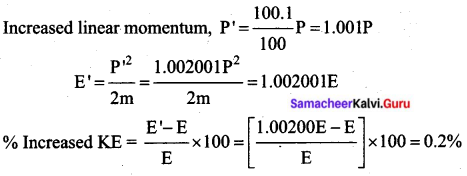
(a) Data
(b) Program
(c) File
(d) Error
Answer:
(d) Error

II. Short Answers

Question 1.
What is a software?
Answer:
A software is set of instructions that perform specific task. It interacts basically with the hardware to generate the desired output.

Samacheer Kalvi 11th Computer Applications Solutions Chapter 4 Theoretical Concepts of Operating System

Question 2.
Mention the types of software?
Answer:
Software is classified into two types:

  1. Application Software
  2. System Software.

Question 3.
Define application software?
Answer:
Application software is a set of programs to perform specific task. For example MS-Word is an application software to create text document and VLC player is familiar application software to play audio, video files and many more.

Samacheer Kalvi 11th Computer Applications Solutions Chapter 4 Theoretical Concepts of Operating System

Question 4.
Define system software?
Answer:
System software is a type of computer program that is designed to run the computer’s hardware and application programs. For example Operating System and Language Processor.

Question 5.
Define OS?
Answer:
An Operating System (OS) is a system software which serves as an interface between a user and a computer.

Question 6.
Write the key features of the operating system?
Answer:
The key features of the operating system are:

  1. User Interface
  2. Memory Management
  3. Process Management
  4. Security Management
  5. Fault Tolerance
  6. File Management.

Samacheer Kalvi 11th Computer Applications Solutions Chapter 4 Theoretical Concepts of Operating System

Question 7.
What is the main objective of memory management?
Answer:
The objective of Memory Management process is to improve both the utilization of the CPU and the speed of the computer’s response to its users via main memory. For these reasons the computers must keep several programs in main memory that associates with many different Memory Management schemes.

Question 8.
What is Garbage collection?
Answer:
Allocation and de-allocation of memory blocks as needed by the program in main memory is called Garbage collection.

Samacheer Kalvi 11th Computer Applications Solutions Chapter 4 Theoretical Concepts of Operating System

Question 9.
How the processes are classified?
Answer:
A computer consists of a collection of processes, they are classified as two categories:

  1. Operating System processes which is executed by system code
  2. User Processes which is execute by user code

Question 10.
Write the resources of a process?
Answer:
A process needs certain resources including CPU time, memory, files and I/O devices to finish its task.

II. Short Answers

Question 1.
What is a software?
Answer:
A software is set of instructions that perform specific task. It interacts basically with the hardware to generate the desired output.

Samacheer Kalvi 11th Computer Applications Solutions Chapter 4 Theoretical Concepts of Operating System

Question 2.
Mention the types of software?
Answer:
Software is classified into two types:

  1. Application Software
  2. System Software.

Question 3.
Define application software?
Answer:
Application software is a set of programs to perform specific task. For example MS-Word is an application software to create text document and VLC player is familiar application software to play audio, video files and many more.

Samacheer Kalvi 11th Computer Applications Solutions Chapter 4 Theoretical Concepts of Operating System

Question 4.
Define system software?
Answer:
System software is a type of computer program that is designed to run the computer’s hardware and application programs. For example Operating System and Language Processor.

Question 5.
Define OS?
Answer:
An Operating System (OS) is a system software which serves as an interface between a user and a computer.

Samacheer Kalvi 11th Computer Applications Solutions Chapter 4 Theoretical Concepts of Operating System

Question 6.
Write the key features of the operating system?
Answer:
The key features of the operating system are:

  1. User Interface
  2. Memory Management
  3. Process Management
  4. Security Management
  5. Fault Tolerance
  6. File Management.

Question 7.
What is the main objective of memory management?
Answer:
The objective of Memory Management process is to improve both the utilization of the CPU and the speed of the computer’s response to its users via main memory. For these reasons the computers must keep several programs in main memory that associates with many different Memory Management schemes.

Samacheer Kalvi 11th Computer Applications Solutions Chapter 4 Theoretical Concepts of Operating System

Question 8.
What is Garbage collection?
Answer:
Allocation and de-allocation of memory blocks as needed by the program in main memory is called Garbage collection.

Question 9.
How the processes are classified?
Answer:
A computer consists of a collection of processes, they are classified as two categories:

  1. Operating System processes which is executed by system code
  2. User Processes which is execute by user code

Question 10.
Write the resources of a process?
Answer:
A process needs certain resources including CPU time, memory, files and I/O devices to finish its task.

Samacheer Kalvi 11th Computer Applications Solutions Chapter 4 Theoretical Concepts of Operating System

Question 11.
What is Round Robin Scheduling?
Answer:
The Round Robin (RR) scheduling algorithm is designed especially for time sharing systems. Jobs (processes) are assigned and processor time in a circular method. For example take three jobs A, B, C. First the job A is assigned to CPU then job B and job C and then again A, B and C and so on.

Question 12.
What is meant by fault tolerance?
Answer:
The Operating Systems should be robust. When there is a fault, the Operating System should not crash, instead the Operating System have fault tolerance capabilities and retain the existing state of system.

Samacheer Kalvi 11th Computer Applications Solutions Chapter 4 Theoretical Concepts of Operating System

Question 13.
List the prominent operating system/
Answer:
Prominent OS are as follows:

  1. UNIX
  2. Microsoft Windows
  3. Linux
  4. iOS
  5. Android

Question 14.
What is Unix?
Answer:
UNIX is a family of multitasking, multi-user operating systems that derive originally from AT&T Bell Labs, where the development began in the 1970s by Ken Thompson and Dennis Ritchie.

Samacheer Kalvi 11th Computer Applications Solutions Chapter 4 Theoretical Concepts of Operating System

Question 15.
What is iOS?
Answer:
iOS (formerly iPhone OS) is a mobile Operating System created and developed by Apple Inc., exclusively for its hardware. It is the Operating System that presently powers many of the company’s mobile devices, including the iPhone, iPad and iPod Touch. It is the second most popular mobile Operating System globally after Android.

Question 16.
What is meant by Error Log File?
Answer:
The user interface should reduce number of errors committed by the user with little practice the user should be in a position to avoid errors (Error Log File).

Samacheer Kalvi 11th Computer Applications Solutions Chapter 4 Theoretical Concepts of Operating System

Question 17.
What is process?
Answer:
A process is the unit of work (program) in a computer. A word-processing program being run by an individual user on a computer is a process. A system task, such as sending output to a printer or screen, can also be called as a Process.

Question 18.
Expand the following FAT and NTFS?
Answer:
FAT – File Allocation Table.
NTFS – NeXT generation File System.

III. Explain in Brief.

Question 1.
Write the uses of operating system?
Answer:
The main use of Operating System is –

  1. To ensure that a computer can be used do to exact if what the user wants it do.
  2. Easy interaction between the users and computers.
  3. Starting computer operation automatically when power is turned on (Booting).
  4. Controlling Input and Output Devices.
  5. Manage the utilization of main memory.
  6. Providing security to user programs.

Samacheer Kalvi 11th Computer Applications Solutions Chapter 4 Theoretical Concepts of Operating System

Question 2.
Mention the types of operating system?
Answer:

  1. Single user operating system
  2. Multi-user operating system
  3. Multi processing operating system
  4. Time sharing operating system
  5. Real time operating system
  6. Distributed operating system
  7. Interactive operating system.

Question 3.
How the operating system provides securities to the end user?
The Operating System provides three levels of securities to the user end.
They are

  1. File access level
  2. System level
  3. Network level.

(i) In order to access the files created by other people, you should have the access permission. Permissions can either be granted by the creator of the file or bythe administrator of the system.

(ii) System level security is offered by the password in a multi-user environment.
Both windows and Linux offer the password facility.

(iii) Network security is an indefinable one. So people from all over the world try to provide such a security.

Samacheer Kalvi 11th Computer Applications Solutions Chapter 4 Theoretical Concepts of Operating System

Question 4.
Write short notes on time-sharing?
Answer:
This is a one of the features of Operating Systems. It allows execution of multiple tasks or processes concurrently. For each task a fixed time is allocated. This division of time is called Time- sharing. The processor switches rapidly between various processes after a time is elapsed or the process is completed.

For example assume that there are three processes called PI, P2, P3 and time allocated for each process 30, 40, 50 minutes respectively. If the process PI completes within 20 minutes then processor takes the next process P2 for the execution. If the process P2 could not complete within 40 minutes, then the current process P2 will be paused and switch over to the next process P3.

Samacheer Kalvi 11th Computer Applications Solutions Chapter 4 Theoretical Concepts of Operating System

Question 5.
Write the responsibilities of operating system in connection with memory management?
Answer:
The Operating System is responsible for the following activities in connection with memory management:

  1. Keeping track of which portion of memory are currently being used and who is using them.
  2. Determining which processes (or parts of processes) and data to move in and out of memory.
  3. Allocation and de-allocation of memory blocks as needed by the program in main memory. (Garbage Collection)

Question 6.
Write the responsibilities of operating system associated with the process management?
Answer:
The Operating System is responsible for the following activities associated with the process management:

  1. Scheduling processes and threads on the CPUs.
  2. Creating and deleting both user and system processes.
  3. Suspending and resuming processes.
  4. Providing mechanisms for process synchronization.
  5. Providing mechanisms for process communication.

Samacheer Kalvi 11th Computer Applications Solutions Chapter 4 Theoretical Concepts of Operating System

Question 7.
Write short note on file management?
Answer:
File management is an important function of OS which handles the data storage techniques. The operating System manages the files, folders and directory systems on a computer. Any type of data in a computer is stored in the form of files and directories/folders through File Allocation Table (FAT). The FAT stores general information about files like filename, type (text or binary), size, starting address and access mode (sequential/indexed/indexed-sequential/direct/relative).

The file manager of the operating system helps to create, edit, copy, allocate memory to the files and also updates the FAT. The OS also takes care of the files that are opened with proper access rights to read or edit them. There are few other file management techniques available like Next Generation File System (NTFS) and ext2 (Linux).

Question 8.
What are the advantages of distributed operating system?
Answer:
The advantages of distributed Operatirfg System are as follows:

  1. A user at one location can make use of all the resources available at another location over the network.
  2. Many computer resources can be added easily in the network
  3. Improves the interaction with the customers and clients.
  4. Reduces the load on the host computer.

Samacheer Kalvi 11th Computer Applications Solutions Chapter 4 Theoretical Concepts of Operating System

Question 9.
Write short note on Linux?
Answer:
Linux is a family of open-source operating systems. It can be modified and distributed by anyone around the world. This is different from proprietary software like Windows, which can only be modified by the company that owns it. The main advantage of Linux operating system is that it is open source. There are many versions and their updates. Most of the servers run on Linux because it is easy to customize.

There are a few different distributions of Linux, like Ubuntu, Mint, Fedora, RedHat, Debian, Google’s Android, Chrome OS, and Chromium OS which are popular among users.

The Linux operating system was originated in 1991, as a project of “Linus Torvalds” from a university student of Finland. He posted information about his project on a news group for computer students and programmers. He received support and assistance from a large pool of volunteers who succeeded in creating a complete and functional Operating System. Linux is similar to the UNIX operating system.

Linux distributions:
Linux mint, Fedora, Ubuntu, BOSS, Redhat.

Samacheer Kalvi 11th Computer Applications Solutions Chapter 4 Theoretical Concepts of Operating System

Question 10.
Write in detail about memory management?
Answer:
Memory Management is the process of controlling and coordinating computer’s main memory and assigning memory block (space) to various running programs to optimize overall computer performance. The Memory management involves the allocation of specific memory blocks to individual programs based on user demands. At the application level, memory management ensures the availability of adequate memory for each running program at all times.

The objective of Memory Management process is to improve both the utilization of the CPU and the speed of the computer’s response to its users via main memory. For these reasons the computers must keep several programs in main memory that associates with many different Memory Management schemes.
The Operating System is responsible for the following activities in connection with memory management:

  • Keeping track of which portion of memory are currently being used and who is using them.
  • Determining which processes (or parts of processes) and data to move in and out of memory.
  • Allocation and de-allocation of memory blocks as needed by the program in main memory. (Garbage Collection)

Samacheer Kalvi 11th Computer Applications Solutions Chapter 4 Theoretical Concepts of Operating System

Question 11.
How will you classify the operating system?
Answer:
Samacheer Kalvi 11th Computer Applications Solutions Chapter 4 Theoretical Concepts of Operating System

IV. Explain in detail.

Question 1.
What is a software? Explain the types of software?
Answer:
A software is set of instructions that perform specific task. It interacts basically with the hardware to generate the desired output.

Types of Software:
Software is classified into two types:
(i) Application Software
(ii) System Software.
Application software is a set of programs to perform specific task. For example MS-word is an application software to create text document and VLC player is familiar application software to play audio, video files and many more. System software is a type of computer program that is designed to run the computer’s hardware and application programs. For example Operating System and Language Processor.

Samacheer Kalvi 11th Computer Applications Solutions Chapter 4 Theoretical Concepts of Operating System

Question 2.
Explain in detail the User Interface (Ul) in operating system?
Answer:
User interface is one of the significant feature in Operating System. The only way that user can make interaction with a computer. If the computer interface is not user-friendly, the user slowly reduces the computer usage from their normal life. This is a main reason for key success of GUI (Graphical User Interface) based Operating System. The GUI is a window based system with a pointing device to direct I/O, choose from menus, make selections and a keyboard to enter text.Its vibrant colours attract the user very easily. Beginners are impressed by the help and pop up window message boxes. Icons are playing vital role of the particular application.

Now Linux distribution is also available as GUI based Operating System. The following points are considered when User Interface is designed for an application.

  1. The user interface should enable the user to retain this expertise for a longer time.
  2. The user interface should also satisfy the customer based on their needs.
  3. The user interface should save user’s precious time. Create graphical elements like Menus,Window,Tabs, Icons and reduce typing work will be an added advantage of the Operating System.
  4. The ultimate aim of any product is to satisfy the customer. The User Interface is also to satisfy the customer.
  5. The user interface should reduce number of errors committed by the user with little practice the user should be in a position to avoid errors (Error Log File).

Samacheer Kalvi 11th Computer Applications Solutions Chapter 4 Theoretical Concepts of Operating System

Question 3.
Explain the process management?
Answer:
Process management is function that includes creating and deleting processes and providing mechanisms for processes to communicate and synchronize with each other.
A process is the unit of work (program) in a computer. A word-processing program being run by an individual user on a computer is a process. A system task, such as sending output to a printer or screen, can also be called as a Process.
A computer consists of a collection of processes, they are classified as two categories:

  1. Operating System processes which is executed by system code
  2. User Processes which is execute by user code

All these processes can potentially execute concurrently on a single CPU.
A process needs certain resources including CPU time, memory, files and I/O devices to finish its task.
The Operating System is responsible for the following activities associated with the process management:

  1. Scheduling processes and threads on the CPUs
  2. Creating and deleting both user and system processes
  3. Suspending and resuming processes
  4. Providing mechanisms for process synchronization
  5. Providing mechanisms for process communication.

Samacheer Kalvi 11th Computer Applications Solutions Chapter 1 Introduction to Computers

Students can Download Computer Applications Chapter 1 Introduction to Computers Questions and Answers, Notes Pdf, Samacheer Kalvi 11th Computer Applications Book Solutions Guide Pdf helps you to revise the complete Tamilnadu State Board New Syllabus and score more marks in your examinations.

Tamilnadu Samacheer Kalvi 11th Computer Applications Solutions Chapter 1 Introduction to Computers

Samacheer Kalvi 11th Computer Applications Introduction to Computers Text Book Back Questions and Answers

I. Choose The Correct Answer

Question 1.
First generation computers used:
(a) vacuum tubes
(b) transistors
(c) integrated circuits
(d) microprocessors
Answer:
(a) vacuum tubes

Samacheer Kalvi 11th Computer Applications Solutions Chapter 1 Introduction to Computers

Question 2.
Name the volatile memory:
(a) ROM
(b) PROM
(c) RAM
(d) EPROM
Answer:
(c) RAM

Question 3.
Identify the output device:
(a) keyboard
(b) memory
(c) monitor
(d) mouse
Answer:
(c) monitor

Samacheer Kalvi 11th Computer Applications Solutions Chapter 1 Introduction to Computers

Question 4.
Identify the input device:
(a) printer
(b) mouse
(c) plotter
(d) projector
Answer:
(b) mouse

Question 5.
……………………… output device is used for printing building plan, flex board, etc.
(a) Thermal printer
(b) Plotter
(c) Dot matrix
(d) Inkjet printer
Answer:
(b) Plotter

Samacheer Kalvi 11th Computer Applications Solutions Chapter 1 Introduction to Computers

Question 6.
In ATM machines, which one of the following is used to:
(a) touch screen
(b) speaker
(c) monitor
(d) printer
Answer:
(a) touch screen

Question 7.
When a system restarts ………………………. which type of booting is used?
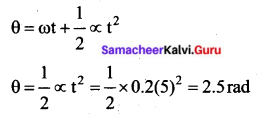
(a) Warm booting
(b) Cold booting
(c) Touch boot
(d) Real boot
Answer:
(a) Warm booting

Samacheer Kalvi 11th Computer Applications Solutions Chapter 1 Introduction to Computers

Question 8.
Expand POST:
(a) Post on self Test
(b) Power on Software Test
(c) Power on Self Test
(d) Power on Self Text
Answer:
(c) Power on Self Test

Question 9.
Which one of the following is the main memory?
(a) ROM
(b) RAM
(c) Flash drive
(d) Hard disk
Answer:
(b) RAM

Samacheer Kalvi 11th Computer Applications Solutions Chapter 1 Introduction to Computers

Question 10.
Which generation of computer used IC’s?
(a) First
(b) Second
(c) Third
(d) Fourth
Answer:
(d) Fourth

II. Short Answers

Question 1.
What is a computer?
Answer:
“A Computer is an electronic device that takes raw data (unprocessed) as an input from the user and processes it under the control of a set of instructions (called program), produces a result (output), and saves it for future use.”

Samacheer Kalvi 11th Computer Applications Solutions Chapter 1 Introduction to Computers

Question 2.
Distinguish between data and information?
Answer:
Data:
Data is defined as an unprocessed collection of raw facts, suitable for communication, interpretation or processing.
Eg: 134, 16, ‘Kavitha’ ‘C’ are data. This will not give any meaningful message.

Information:
Information is a collection of facts from which conclusions may be drawn.
Eg: Kavitha is 16 years old.

Question 3.
What are the components of a CPU?
Answer:
The CPU has three components which are Control Unit, Arithmetic and Logic Unit (ALU) and Memory Unit.

Samacheer Kalvi 11th Computer Applications Solutions Chapter 1 Introduction to Computers

Question 4.
What is the function of an ALU?
Answer:
The ALU is a part of the CPU where various computing functions are performed on data. The ALU performs arithmetic operations such as addition, subtraction, multiplication, division and logical operations. The result of an operation is stored in internal memory of CPU. The logical operations of ALU promote the decision-making ability of a computer.

Question 5.
Write the functions of control unit?
Answer:
The control unit controls the flow of data between the CPU, memory and I/O devices. It also controls the entire operation of a computer.

Samacheer Kalvi 11th Computer Applications Solutions Chapter 1 Introduction to Computers

Question 6.
What is the function of memory?
Answer:
The memory unit is of two types which are primary memory and secondary memory. The primary memory is used to temporarily store the programs and data when the instructions are ready to execute. The secondary memory is used to store the data permanently.

The Primary Memory is volatile, that is, the content is lost when the power supply is switched off. The Random Access Memory (RAM) is an example of a main memory. The Secondary memory is non volatile, that is, the content is available even after the power supply is switched off. Hard disk, CD-ROM and DVD ROM are examples of secondary memory.

Question 7.
Differentiate Input and output unit?
Answer:
Input unit:
Input unit is used to feed data to the computer, initially which can be stored in the memory unit for further processing.
Eg: Keyboard, Mouse, etc.

Output unit:
An output unit is any hardware component that conveys information in users understandable form.
Eg: Printer, Plotter etc.

Samacheer Kalvi 11th Computer Applications Solutions Chapter 1 Introduction to Computers

Question 8.
Distinguish Primary and Secondary memory?
Answer:
Primary memory:

  1. It is used to temporarily store the programs and data when the instructions are ready to execute.
  2. It is a volatile memory that is, the content is lost when the power supply is switched off.
  3. Eg: Random Access Memory (RAM)

Secondary memory:

  1. It is used to store the data permanently.
  2. It is a non-volatile memory that is, the content is available even after the power supply is switched off.
  3. Eg: Hard disk, CD-ROM and DVD ROM.

III. Explain in Brief

Question 1.
What are the characteristics of a computer?
Answer:
The general characteristics of computers are speed, memory capacity, accuracy, diligence, representativeness, reliability, endurance and versatility.

Samacheer Kalvi 11th Computer Applications Solutions Chapter 1 Introduction to Computers

Question 2.
Write the applications of computer?
Answer:
The applications of computers are business, education, marketing, banking, insurance, communication, health care, military, engineering design.

Question 3.
What is an input device? Give two examples?
Answer:
The input device is the component through which data and instructions are provided to the computer. Eg: Keyboard and mouse.

Question 4.
Name any three output devices?
Answer:
The output device is the component which delivers the data and informtion proceed by the CPU. Eg: Monitor, plotter, printers.

Samacheer Kalvi 11th Computer Applications Solutions Chapter 1 Introduction to Computers

Question 5.
Differentiate optical and Laser mouse?
Answer:
Optical Mouse:

  1. It uses Red, Blue or Green led.
  2. It has three buttons.
  3. It is less sensitive and sensitive towards surface.

Laser Mouse:

  1. It use only infrared led.
  2. It has as many as 12 buttons and can be programmed by user.
  3. It is highly sensitive and able to. work on any hard surface.

Samacheer Kalvi 11th Computer Applications Solutions Chapter 1 Introduction to Computers

Question 6.
Write short note on impact printer?
Answer:
These printers print with striking of hammers or pins on ribbon. These printers can print on miflti-part (using carbon papers) by using mechanical pressure. Eg: Dot Matrix printers and Line matrix printers.

A Dot matrix printer that prints using a fixed number of pins or wires. Each dot is produced by a tiny metal rod, also called a “wire” or “pin”, which works by the power of a tiny electromagnet or solenoid, either directly or through a set of small levers. It generally prints one line of text at a time. The printing speed of these printers varies from 30 to 1550 CPS (Character Per Second).
Samacheer Kalvi 11th Computer Applications Solutions Chapter 1 Introduction to Computers

Line matrix printers use a fixed print head for printing. Basically, it prints a page-wide line of dots. But it builds up a line of text by printing lines of dots. Line printers are capable of printing much more than 1000 Lines Per Minute, resulting in thousands of pages per hour. These printers also uses mechanical pressure to print on multi-part (using carbon papers).

Question 7.
Write the characteristics of sixth generation?
Answer:

  1. Parallel and Distributed computing.
  2. Computers have become smarter, faster and smaller.
  3. Development of robotics.
  4. Natural Language Processing.
  5. Development of Voice Recognition Software.

Samacheer Kalvi 11th Computer Applications Solutions Chapter 1 Introduction to Computers

Question 8.
Write the significant features of monitor?
Answer:
Monitor is the most commonly used output device to display the information. It looks like a TV, Pictures on a monitor are formed with picture elements called Pixels. Monitors may either be Monochrome which display text or images in Black and White or can be color, which display results in multiple colors.

There are many types of monitors available such as CRT (Cathode Ray Tube), LCD (Liquid Crystal Display) and LED (Light Emitting Diodes). The monitor works with the VGA (Video Graphics Array) card. The video graphics card helps the keyboard to communicate with the screen. It acts as an interface between the computer and display monitor. Usually the recent motherboards incorporate built-in video card.

IV. Explain in detail

Question 1.
Explain the basic components of a computer with a neat diagram?
Answer:
The computer is the combination of hardware and software. Hardware is the physical component of a computer like motherboard, memory devices, monitor, keyboard etc., while software is the set of programs or instructions. Both hardware and software together make the computer system function.
Samacheer Kalvi 11th Computer Applications Solutions Chapter 1 Introduction to Computers

Input device:
Input unit is used to feed any form of data to the computer, which can be stored in the memory unit for further processing. Eg: Keyboard, mouse, etc.

Central processing unit (CPU):
CPU is the major component which interprets and executes software instructions. It also control the operation of all other components such as memory, input and output units. It accepts binary data as input, process the data according to the instructions and provide the result as output. The CPU has three components which are Control unit, Arithmetic and logic unit (ALU) and Memory unit.

(i) Arithmetic and Logic Unit:
The ALU is a part of the CPU where various computing functions are performed on data. The ALU performs arithmetic operations such as addition, subtraction, multiplication, division and logical operations. The result of an operation is stored in internal memory of CPU. The logical operations of ALU promote the decision making ability of a computer.

(ii) Control Unit:
The control unit controls the flow of data between the CPU, memory and I/O devices. It also controls the entire operation of a computer.

Output Unit:
An Output Unit is any hardware component that conveys information to users in an understandable form. Example: Monitor, Printer etc.

Memory Unit:
The Memory Unit is of two types which are primary memory and secondary memory. The primary memory is used to temporarily store the programs and data when the instructions are ready to execute. The secondary memory is used to store the data permanently.

(i) The Primary Memory is volatile, that is, the content is lost when the power supply is switched off. The Random Access Memory (RAM) is an example of a main memory.

(ii) The Secondary memory is non volatile, that is, the content is available even after the power supply is switched off. Hard disk, CD-ROM and DVD ROM are examples of secondary memory.

Samacheer Kalvi 11th Computer Applications Solutions Chapter 1 Introduction to Computers

Question 2.
Discuss the various generations of computers?
Answer:
Growth in the computer industry is determined by the development in technology. Based on various stages of development, computers can be divided into different generations.
Samacheer Kalvi 11th Computer Applications Solutions Chapter 1 Introduction to Computers

Question 3.
Explain the following:

  1. Inkjet Printer
  2. Multimedia projector
  3. Bar code
  4. QR code Reader.

1. Inkjet Printer:
inkjet Printers use colour cartridges which combined Magenta, Yellow and Cyan inks to create color tones. A black cartridge is also used for monochrome output. Inkjet printers work by spraying ionised ink at a sheet of paper. The speed of Inkjet printers generaly range from 1-20 PPM (Page Per Minute).

They use the technology of firing ink by heating it so that it explodes towards the paper in bubbles or by using piezoelectricity in which tiny electric currents controlled by electronic circuits are used inside the printer to spread ink in jet speed. An Inkjet printer can spread millions of dots of ink at the paper every single second.

2. Multimedia projector:
Multimedia projectors are used to produce computer output on a big screen. These are used to display presentations in meeting halls or in classrooms.

3. Bar code / QR code Reader:
A Bar code is a pattern printed in lines of different thickness. The Bar code reader scans the information on the bar codes transmits to the Computer for further processing. The system gives fast and error free entry of information into the computer.

4. QR (Quick response) Code:
The QR code is the two dimension bar code which can be read by a camera and processed to interpert the image.

Samacheer Kalvi 11th Computer Applications Introduction to Computers Additional Important Questions and Answers

I. Choose The Correct Answer

Question 1.
………………….. is the father of computer.
(a) John Napier
(b) William Oughtred
(c) Blaise Pascal
(d) Charles Babbage
Answer:
(d) Charles Babbage

Samacheer Kalvi 11th Computer Applications Solutions Chapter 1 Introduction to Computers

Question 2.
The expansion of ALU is:
(a) Arithmetic Logic Unit
(b) Arithmetic Long Unit
(c) Arithmetic Law Unit
(d) Arithmetic Logo Unit
Answer:
(a) Arithmetic Logic Unit

Question 3.
The first generation was in the year:
(a) 1942-1955
(b) 1955-1964
(c) 1964-1975
(d) 1975-present
Answer:
(a) 1942-1955

Samacheer Kalvi 11th Computer Applications Solutions Chapter 1 Introduction to Computers

Question 4.
The first generation computers used:
(a) assembly language
(b) machine language
(c) high level language
(d) word processor language
Answer:
(b) machine language

Question 5.
……………………. used in second generation computers.
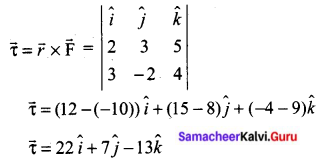
(a) Punched cards
(b) Plotter
(c) Printers
(d) Keyboard
Answer:
(a) Punched cards

Samacheer Kalvi 11th Computer Applications Solutions Chapter 1 Introduction to Computers

Question 6.
Second generation computers used:
(a) vaccum tube
(b) transistor
(c) integrated circuit
(d) micro processor
Answer:
(b) transistor

Question 7.
Batch processing and multi programming operating system were used in:
(a) first generation
(b) second generation
(c) third generation
(d) fourth generation
Answer:
(b) second generation

Samacheer Kalvi 11th Computer Applications Solutions Chapter 1 Introduction to Computers

Question 8.
The second generation was in the year:
(a) 1942-1955
(b) 1955-1964
(c) 1964-1975
(d) 1975-1980
Answer:
(b) 1955-1964

Question 9.
Third generation computers used:
(a) vaccum tube
(b) transistor
(c) integrated circuit
(d) microprocessor
Answer:
(c) integrated circuit

Samacheer Kalvi 11th Computer Applications Solutions Chapter 1 Introduction to Computers

Question 10.
The third generation was in the year:
(a) 1955 – 1964
(b) 1964 – 1975
(c) 1975 – 1980
(d) 1942 – 1955
Answer:
(b) 1964- 1975

Question 11.
High level language appeared in:
(a) first generation
(b) second generation
(c) third generation
(d) fourth generation
Answer:
(c) third generation

Samacheer Kalvi 11th Computer Applications Solutions Chapter 1 Introduction to Computers

Question 12.
Fourth generation computers used:
(a) vaccum tube
(b) transistor
(c) integrated circuit
(d) microprocessor
Answer:
(d) microprocessor

Question 13.
Portable computers are introduced in generation.
(a) first
(b) second
(c) third
(d) fourth
Answer:
(d) fourth

Question 14.
Fourth generation computers was in the year:
(a) 1942-1955
(b) 1955-1964
(c) 1964-1975
(d) 1975-1980
Answer:
(d) 1975-1980

Samacheer Kalvi 11th Computer Applications Solutions Chapter 1 Introduction to Computers

Question 15.
Microcomputer series such as IBM and APPLE developed in ………………………. generation.
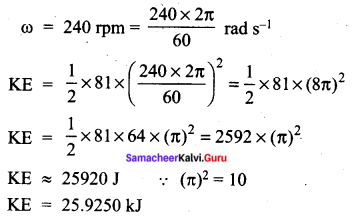
(a) first
(b) second
(c) third
(d) fourth
Answer:
(d) fourth

Question 16.
Fifth generation was in the year:
(a) 1980-1990
(b) 1955-1964
(c) 1980 – present
(d) 1942-1955
Answer:
(c) 1980 – present

Question 17.
Computers can recognize images and graphs in:
(a) first generation
(b) second generation
(c) fourth generation
(d) fifth generation
Answer:
(d) fifth generation

Samacheer Kalvi 11th Computer Applications Solutions Chapter 1 Introduction to Computers

Question 18.
Introduction of Artificial intelligence is in ………………….. generation.
(a) sixth
(b) third
(c) fourth
(d) fifth
Answer:
(d) fifth

Question 19.
…………………….. is in the sixth generation.
(a) Introduction of portable computers
(b) Introduction of artificial intelligence
(c) Development of robotics
(d) Introduction of word processors
Answer:
(c) Development of robotics

Samacheer Kalvi 11th Computer Applications Solutions Chapter 1 Introduction to Computers

Question 20.
Sixth generation computers are:
(a) batch processing
(b) parallel processing
(c) natural language processing
(d) natural networks
Answer:
(c) natural language processing

Question 21.
Voice Recognition is in the generation.
(a) sixth
(b) fourth
(c) fifth
(d) third
Answer:
(a) sixth

Question 22.
……………………….. is the ability of a computer program to understand human language.
(a) NLP
(b) CPU
(c) ANN
(d) AI
Answer:
(a) NLP

Samacheer Kalvi 11th Computer Applications Solutions Chapter 1 Introduction to Computers

Question 23.
……………………. is a component of artificial intelligence.
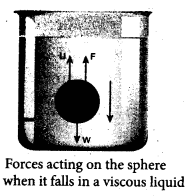
(a) CPU
(b) ANN
(C) NLP
(d) ALU
Answer:
(C) NLP

Question 24.
……………………. deals with the design, construction, operation and use of robots.
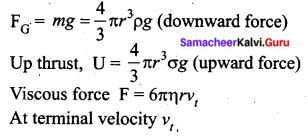
(a) NLP
(b) Robotics
(c) AI
(d) ANN
Answer:
(b) Robotics

Question 25.
…………………… is the study and application of extremely small things.
(a) Nanotechnology
(b) ANN
(c) Natural language processing
(d) Bio Engineering
Answer:
(a) Nanotechnology

Question 26.
…………………… involves the ability to see and to control individual atoms and molecules.
(a) Robotics
(b) Artificial neural networks
(c) Nanotechnology
(d) NLP
Answer:
(c) Nanotechnology

Samacheer Kalvi 11th Computer Applications Solutions Chapter 1 Introduction to Computers

Question 27.
……………………. that applies engineering principles of design and analysis to biological systems and biomedical technologies.
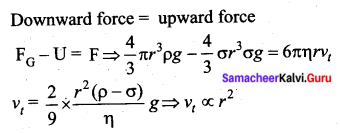
(a) Nanotechnology
(b) Robotics
(c) Bio-engineering
(d) NLP
Answer:
(c) Bio-engineering

Question 28.
……………………… is the term used for rawfacts and figures.
(a) Data
(b) Information
(c) Mother board
(d) Data processing
Answer:
(a) Data

Question 29.
Data represented in useful and meaningful form is:
(a) data processing
(b) information
(c) data
(d) information set
Answer:
(b) information

Samacheer Kalvi 11th Computer Applications Solutions Chapter 1 Introduction to Computers

Question 30.
The conversion of data to information is called:
(a) computer
(b) information
(c) data processing
(d) software
Answer:
(c) data processing

Question 31.
The computer is the combination of:
(a) hardware and software
(b) mother board and memory devices
(c) monitor and keyboard
(d) monitor and CPU
Answer:
(a) hardware and software

Question 32.
…………………. is the physical components of a computer.
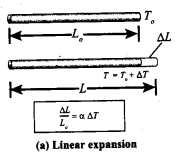
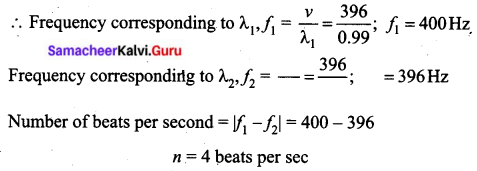
(a) Software
(b) Hardware
(c) Mouse
(d) CPU
Answer:
(b) Hardware

Samacheer Kalvi 11th Computer Applications Solutions Chapter 1 Introduction to Computers

Question 33.
……………………. is the set of programs or instructions.
(a) Hard ware
(b) Soft ware
(c) Input – Process – Output
(d) Data
Answer:
(b) Soft ware

Question 34.
Every task given to a computer follows an:
(a) instruction
(b) input – process – output cycle
(c) data
(d) process cycle
Answer:
(b) input – process – output cycle

Question 35.
holds the data and instructions during the processing.
(a) Input unit
(b) Memory unit
(c) Output unit
(d) Storage imit
Answer:
(b) Memory unit

Samacheer Kalvi 11th Computer Applications Solutions Chapter 1 Introduction to Computers

Question 36.
…………………….. is the component through which data and instructions are provided to the computer.
(a) Input device
(b) Output device
(c) Memory xmit
(d) Storage device
Answer:
(a) Input device

Question 37.
…………………. is the heart of the computer.
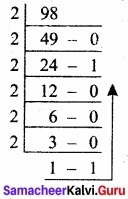
(a) Memory
(b) Software
(c) Storage devices
(d) CPU
Answer:
(d) CPU

Samacheer Kalvi 11th Computer Applications Solutions Chapter 1 Introduction to Computers

Question 38.
The …………………. is the component which delivers the data and inffomation processed by the CPU.
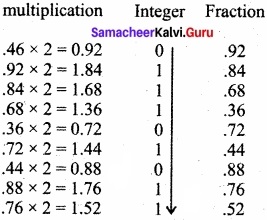
(a) memory storage device
(b) input device
(c) CPU
(d) output device
Answer:
(d) output device

Question 39.
The expansion of CPU is:
(a) Central Processing Unit
(b) Central Prefix Unit
(c) Central Power Unit
(d) Central Printer Unit
Answer:
(a) Central Processing Unit

Question 40.
…………………….. is the logical machine which interprets and executes software instructions.
(a) CPU
(b) Mother Board
(c) Input Device
(d) Storage Device
Answer:
(a) CPU

Question 41.
The CPU has ………………….. units.
(a) four
(b) five
(c) two
(d) three
Answer:
(d) three

Samacheer Kalvi 11th Computer Applications Solutions Chapter 1 Introduction to Computers

Question 42.
The ……………………… performs arithmetic operations.
(a) ALU
(b) CPU
(c) control unit
(d) memory unit
Answer:
(a) ALU

Question 43.
The ……………………. operations of ALU promote the decision making ability of a computer.
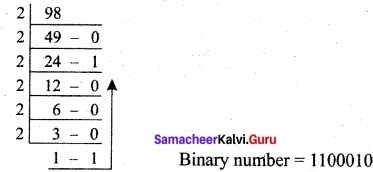
(a) arithmetic
(b) logical
(c) comparison
(d) text
Answer:
(b) logical

Samacheer Kalvi 11th Computer Applications Solutions Chapter 1 Introduction to Computers

Question 44.
The unit controls the flow of data between the CPU, memory and I/O devices.
(a) memory
(b) ALU
(c) CPU
(d) control
Answer:
(d) control

Question 45.
The memory unit is of ………………………. kinds.
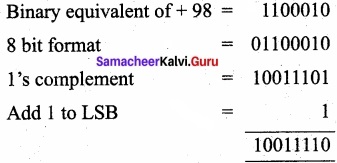
(a) three
(b) four
(c) five
(d) two
Answer:
(d) two

Question 46.
……………………… memory is used to temporarily store the programs and data.
(a) Primary
(b) Secondary
(c) PROM
(d) EPROM
Answer:
(a) Primary

Samacheer Kalvi 11th Computer Applications Solutions Chapter 1 Introduction to Computers

Question 47.
…………………….. is the most common input device used today.
(a) Keyboard
(b) Mouse
(c) Scanner
(d) Light Pen
Answer:
(a) Keyboard

Question 48.
……………………….. is a pointing device used to control the movement of the cursor on the display screen.
(a) Keyboard
(b) Scanner
(c) Trackball
(d) Mouse
Answer:
(d) Mouse

Question 49.
……………………… are used to enter information directly into the computer’s memory.
(a) Mouse
(b) Keyboard
(c) Scanner
(d) Trackball
Answer:
(c) Scanner

Samacheer Kalvi 11th Computer Applications Solutions Chapter 1 Introduction to Computers

Question 50.
…………………… used for computer security equipped with the fingerprint recognition.
(a) Fingerprint scanner
(b) Retinal scanner
(c) Optical character – Reader
(d) Touch Screen
Answer:
(a) Fingerprint scanner

Question 51.
……………………. uses the unique patterns on a person’s retina blood vessels.
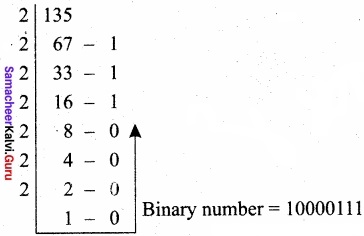
(a) Scanners
(b) Finger print scanner
(c) Barcode reader
(d) Retinal scanner
Answer:
(d) Retinal scanner

Samacheer Kalvi 11th Computer Applications Solutions Chapter 1 Introduction to Computers

Question 52.
……………………. is an input device which is used to draw lines or figures on a computer screen.
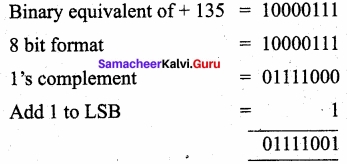
(a) OCR
(b) Light pen
(c) Mouse
(d) Keyboard
Answer:
(b) Light pen

Question 53.
……………………. is a device which detects alpha numeric characters printed or written on a paper.
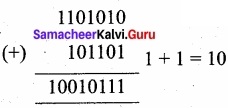
(a) Optical Character Reader
(b) Light Pen
(c) Scanner
(d) Bar code Reader
Answer:
(a) Optical Character Reader

Samacheer Kalvi 11th Computer Applications Solutions Chapter 1 Introduction to Computers

Question 54.
………………….. reads bar codes and converts them into electric pulses to be processed by a computer.
(a) Scanner
(b) Track Ball
(c) Mouse
(d) Bar Code Reader
Answer:
(d) Bar Code Reader

Question 55.
A ……………………. convert human speech into electrical signals.
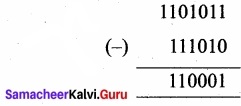
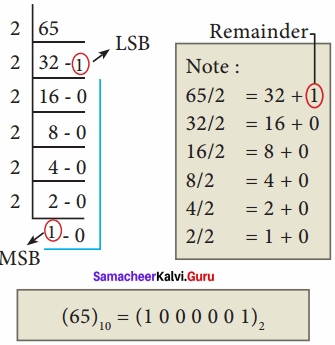
(a) digital camera
(b) touch screen
(c) microphone
(d) keyboard
Answer:
(c) microphone

Question 56.
…………………….. converts graphics directly into the digital form.
(a) Microphone
(b) Light pen
(c) Touch screen
(d) Digital Camera
Answer:
(d) Digital Camera

Samacheer Kalvi 11th Computer Applications Solutions Chapter 1 Introduction to Computers

Question 57.
……………………. is a display device that allows the uses to interact with a computer by using the finger.
(a) Microphone
(b) Light pen
(c) Touch screen
(d) Digital Camera
Answer:
(c) Touch screen

Question 58.
…………………….. is a device for signalling by hand.
(a) Keyer
(b) Microphone
(c) Touchscreen
(d) Scanner
Answer:
(c) Touchscreen

Samacheer Kalvi 11th Computer Applications Solutions Chapter 1 Introduction to Computers

Question 59.
…………………… is the most commonly used output device to display the information.
(a) Printer
(b) Monitor
(c) Plotter
(d) Keyer
Answer:
(b) Monitor

Question 60.
……………………. is used to produce graphical output on papers.
(a) Printers
(b) Plotters
(c) Monitor
(d) Scanners
Answer:
(b) Plotters

Question 61.
……………………. are used to print the information on papers.
(a) Plotters
(b) Monitor
(c) Printers
(d) Scanners
Answer:
(c) Printers

Question 62.
Printers are divided into ……………………… main categories.
(a) three
(b) two
(c) four
(d) five
Answer:
(b) two

Samacheer Kalvi 11th Computer Applications Solutions Chapter 1 Introduction to Computers

Question 63.
The printing speed.of serial dot matrix printers varies from:
(a) 50 to 1000 cps
(b) 100 to 1000 cps
(c) 40 to 1550 cps
(d) 30 to 1550 cps
Answer:
(d) 30 to 1550 cps

Question 64.
Line printers are capable of printing much ……………………… lines per minute.
(a) more than 500
(b) more than 800
(c) more than 100
(d) more than 1000
Answer:
(d) more than 1000

Samacheer Kalvi 11th Computer Applications Solutions Chapter 1 Introduction to Computers

Question 65.
……………………. produces voice output.
(a) Printer
(b) Projector
(c) Speakers
(d) Plotters
Answer:
(c) Speakers

Question 66.
…………………….. is used to produce computer output on a big screen.
(a) Monitor
(b) Multimedia projector
(c) Speakers
(d) Plotters
Answer:
(b) Multimedia projector

Question 67.
Booting process is of types.
(a) two
(b) three
(c) four
(d) five
Answer:
(a) two

Samacheer Kalvi 11th Computer Applications Solutions Chapter 1 Introduction to Computers

Question 68.
Cold Booting is also called as:
(a) hard booting
(b) soft booting
(c) rough booting
(d) fast booting
Answer:
(a) hard booting

Question 69.
……………………. transfers from hard disk into main memory.
(a) Assembler
(b) Complier
(c) Bootstrap loader
(d) Loader
Answer:
(c) Bootstrap loader

II. Short Answers

Question 1.
What is a Registers?
Answer:
Registers are the high speed temporary storage locations in the CPU. Although the number of registers varies from computer to computer, there are some registers which are common to all computers.

Samacheer Kalvi 11th Computer Applications Solutions Chapter 1 Introduction to Computers

Question 2.
What type of challenges in natural language processing (NLP) frequently involved?
Answer:
Speech Recognition, Natural Language Understanding and Natural Language Generation.

Question 3.
What is a function of Robotics?
Answer:
Robotics deals with the design, construction, operation and use of robots, as well as computer systems for their control, sensory feedback and processing.

Samacheer Kalvi 11th Computer Applications Solutions Chapter 1 Introduction to Computers

Question 4.
What is Data?
Answer:
Data is defined as an unprocessed collection of raw facts, suitable for communication, interpretation or processing.
Eg: 134, 16 ‘Kavitha’, ‘C’ are data. This will not give any meaningful message.

Question 5.
What is Information?
Answer:
Information is a collection of facts from which conclusions may be drawn. In simple words we can say that data is the raw facts that is proqessed to give meaningful, ordered or structured information. Eg: Kavitha is 16 years old. This information is about Kavitha and conveys some meaning. This conversion of data into information is called data processing.

Samacheer Kalvi 11th Computer Applications Solutions Chapter 1 Introduction to Computers

Question 6.
Write the different types of mouse?
Answer:
Different types of mouse available are: Mechanical Mouse, Optical, Laser Mouse, Air Mouse, 3D Mouse, Tactile Mouse,firgonomic Mouse and Gaming Mouse.

Question 7.
What is Track Ball?
Answer:
Track ball is similar to the upside- down design of the mouse. The user moves the ball directly, while the device itself remains stationary. The user spins the ball in various directions to navigate the screen movements.

Question 8.
Mention the uses of scanner?
Answer:
Scanners are used to enter the information directly into the computer’s memory. This device works like a Xerox machine. The scanner converts any type of printed or written information including photographs into a digital format, which can be manipulated by the computer.

Samacheer Kalvi 11th Computer Applications Solutions Chapter 1 Introduction to Computers

Question 9.
What is the use of plotters?
Answer:
Plotter is an output device that is used to produce graphical output’ on papers. It uses single color or multi color pens to draw pictures.

Question 10.
How the printers are categorized?
Answer:
Printers are used to print the information on papers. Printers are divided into two main categories:

  1. Impact Printers.
  2. Non Impact Printers.

Question 11.
Name the types of Booting process?
Answer:
Booting process is of two types.

  1. Cold Booting
  2. Warm Booting.

Samacheer Kalvi 11th Computer Applications Solutions Chapter 1 Introduction to Computers

Question 12.
What is meant by Cold Booting?
Answer:
When the system starts from initial state i.e. it is switched on, we call it cold booting or Hard Booting. When the user presses the Power button, the instructions are read from the ROM to initiate the booting process.

Question 13.
What is meant by Warm Booting?
Answer:
When the system restarts or when Reset button is pressed, we call it Warm Booting or Soft Booting. The system does not start from initial state and so all diagnostic tests need not be carried out in this case. There are chances of data loss and system damage as the data might not have been stored properly.

Question 14.
Write the performance of a Retinal Scanner?
Answer:
This performs a retinal scan which is a biometric technique that uses unique patterns on a person’s retinal blood vessels.

III. Explain in Brief

Question 1.
What is a mouse?
Answer:
Mouse (wired/wireless) is a pointing device used to control the movement of the cursor on the display screen. It can be used to select icons, menus, command buttons or activate something on a computer. Some mouse actions are move, click, double click, right click, drag and drop.

Samacheer Kalvi 11th Computer Applications Solutions Chapter 1 Introduction to Computers

Question 2.
What are the variety of mouse available?
Answer:
Variety of mouse available, they are: Mechanical Mouse, Optical and Laser Mouse, Air Mouse, 3D Mouse, Tactile Mouse, Pucks, Ergonomic Mouse and Gaming Mouse. Among all the types, Mechanical and Optical and Laser mouse is very familiar.

Question 3.
What are the two main type of printers? Give example?
Answer:
Printers are used to print the information on papers. Printers are divided into two main categories: (i) Impact Printers and (ii) Non Impact printers
(i) Impact Printers:
These printers print with striking of hammers or pins on ribbon. These printers can print on multi-part (using carbon papers) by using mechanical pressure. Eg: Dot Matrix printers and Line matrix printers are impact printers.

(ii) Non-Impact Printers:
These printers do not use striking mechanism for printing. They use electrostatic and laser technology. Quality and speed of these printers is better than Impact printers. Eg: Laser printers and Inkjet printers are non-impact printers.

Samacheer Kalvi 11th Computer Applications Solutions Chapter 1 Introduction to Computers

Question 4.
What is the classification of memory?
Answer:
The Memory Unit is of two kinds which are primary memory and secondary memory. The primary memory is used to temporarily store the programs and data when the instructions are ready to execute.
Eg: RAM The secondary memory is used to permanently store the data. Eg: Hard disk, CD-ROM

Question 5.
What is boot sequence? (or) Write the process of Booting?
Answer:
An Opertaing System (OS) is a basic software that makes the computer to work. When a computer is switched on, there is no information in its RAM.At the same time, in ROM, the pre-written program called POST (Power on Self Test) will be executed first. This program checks if the devices like RAM, keyboard, etc., are connected properly and ready to operate.

If these devices are ready, then the BIOS (Basic Input Output System) gets executed. This process is called Booting. Thereafter, a program called “Bootstrap Loader” transfers OS from hard disk into main memory. Now the OS gets loaded (Windows/Linux, etc.,) and will get executed. Booting process is of two types.(i) Cold Booting, (ii) Warm Booting.

Samacheer Kalvi 11th Computer Applications Solutions Chapter 1 Introduction to Computers

Question 6.
Write short notes on sixth generation computing?
Answer:
In the Sixth Generation, computers could be defined as the era of intelligent computers, based on Artificial Neural Networks. One of the most dramatic changes in the sixth generation will be the explosive growth of Wide Area Networking. Natural Language Processing (NLP) is a component of Artificial Intelligence (AI). It provides the ability to develop the computer program to understand human language.

Question 7.
Write the mechanism for mechanical mouse?
Answer:

  1. A small ball is kept inside and touches the pad through a hole at the bottom of the mouse.
  2. When the mouse is moved, the ball rolls.
  3. This movement of the ball is converted into signals and sent to the computer.

Question 8.
Write the function of keyboard?
Answer:
Keyboard (wired / wireless, virtual) is the most common input device used today. The individual keys for letters, numbers and special characters are collectively known as character keys. This keyboard layout is derived from the keyboard of original typewriter.

The data and instructions are given as input to the computer by typing on the keyboard. Apart from alphabet and numeric keys, it also has Function keys for performing different functions. There are different set of keys available in the keyboard such as character keys, modifier keys, system and GUI keys, enter and editing keys, function keys, navigation keys, numeric keypad and lock keys.

Samacheer Kalvi 11th Computer Applications Solutions Chapter 1 Introduction to Computers

Question 9.
Write short notes on
(i) Optical character reader
(ii) Voice input system.

(i) Optical Character Reader:
It is a device which detects characters printed or written on a paper with OCR, a user can scan a page from a book. The Computer will recognize the characters in the page as letters and punctuation marks and stores. The Scanned document can be edited using a wordprocessor.

(ii) Voice Input System:
Microphone serves as a voice Input device. It captures the voice data and send it to the Computer. Using the microphone along with speech recognition software can offer a completely new approach to input information into the Computer.

Question 10.
Expand the following:
(i) POST
(ii) BIOS
(iii) NLP
Answer:
(i) POST:
Power on Self Test.

(ii) BIOS:
Basic Input Output System.

(iii) NLP:
Natural Language Processing.

Samacheer Kalvi 11th Computer Applications Solutions Chapter 1 Introduction to Computers

Question 11.
How the touch screen allows the user to interact with computer?
Answer:
A touch screen is a display device that allows the user to interact with a computer by using the . finger. It can be quite useful as an alternative to a mouse or keyboard for navigating a Graphical User Interface (GUI). Touch screens are used on a wide variety of devices such as computers, laptops, monitors, smart phones, tablets, cash registers and information kiosks. Some touch screens use a grid of infrared beams to sense the presence of a finger instead of utilizing touch- sensitive input.

Question 12.
What is the use of Fingerprint Scanner?
Answer:
Fingerprint Scanner is a fingerprint recognition device used for computer security equipped with the fingerprint recognition feature that uses biometric technology. Fingerprint Reader / Scanner is a very safe and convenient device for security instead of using passwords, which is vulnerable to fraud and is hard to remember.

Samacheer Kalvi 11th Computer Applications Solutions Chapter 1 Introduction to Computers

Question 13.
Write about the light pen?
Answer:
A light pen is a pointing device shaped like a pen and is connected to a monitor. The tip of the light pen contains a light-sensitive element which detects the light from the screen enabling the computer to identify the location of the pen on the screen. Light pens have the advantage ofedrawing’ directly onto the screen, but this becomes hard to use, and is also not accurate.

Question 14.
What is hardware and software?
Answer:
Hardware is the physical component of a computer like motherboard, memoiy devices, monitor, keyboard etc. while software is the set of programs or instructions.

Samacheer Kalvi 11th Computer Applications Solutions Chapter 1 Introduction to Computers

Question 15.
Give the use of speakers?
Answer:
Speakers produce voice output (audio). Using speaker along with speech synthesize software, the computer can provide voice output. This has become very common in places like airlines, schools, banks, railway stations, etc.

IV. Explain in detail

Question 1.
List a few commonly used Input devices and explain them briefly?
Answer:
The most commonly used Input devices are:
(i) Keyboard:
Keyboard (wired / wireless, virtual) is the most common input device used today. The individual keys for letters, numbers and special characters are collectively known as character keys. This keyboard layout is derived from the keyboard of original typewriter.

The data and instructions are given as input to the computer by typing on the keyboard. Apart from alphabet and numeric keys, it also has Function keys for performing different functions. There are different set of keys available in the keyboard such as character keys, modifier keys, system and GUI keys, enter and editing keys, function keys, navigation keys, numeric keypad and lock keys.

(ii) Mouse:
Mouse (wired/wireless) is a pointing device used to control the movement of the cursor on the display screen. It can be used to select icons, menus, command buttons or activate something on a computer. Some mouse actions are move, click, double click, right click, drag and drop.

(iii) Scanner:
Scanners are used to enter the information directly into the computer’s memory. This device works like a Xerox machine. The scanner converts any type of printed or written information including photographs into a digital format, which can be manipulated by the computer.

(iv) Barcode Readers:
A Bar code is a pattern printed in lines of different thickness. The Bar code reader scans the information on the bar codes transmits to the Computer for further processing. The system gives fast and error free entry of information into the computer.

(v) Digital camera:
It captures images J videos directly in the digital form. It uses a CCD (Charge Coupled Device) electronic chip. When light falls on the chip through the lens, it converts light rays into digital format.

Samacheer Kalvi 11th Computer Applications Solutions Chapter 1 Introduction to Computers

Question 2.
Write the commonly used output devices and explain them briefly?
Answer:
The most commonly used output devices are
(i) Monitor
(ii) Printers.

(i) Monitor:
Monitor is the most commonly used output device to display the information. It looks like a TV, Pictures on a monitor are formed with picture elements called Pixels. Monitors may either be Monochrome which display text or images in Black and White or can be color, which display results in multiple colors. There are many types of monitors available such as CRT (Cathode Ray Tube), LCD (Liquid Crystal Display) and LED (Light Emitting Diodes). The monitor works with the VGA (Video Graphics Array) card. The video graphics card helps the keyboard to communicate with the screen. It acts as an interface between the computer and display monitor. Usually the recent motherboards incorporate built-in video card.

(ii) Printers:
Printers are used to print the information of papers. Printers are divided into two main categories.
Samacheer Kalvi 11th Computer Applications Solutions Chapter 1 Introduction to Computers

(a) Impact Printers:

The memory unit is of two types which are primary memory and secondary memory. The primary memory is used to temporarily store the programs and data when the instructions are ready to execute. The secondary memory is used to store the data permanently.

The Primary Memory is volatile, that is, the content is lost when the power supply is switched off. The Random Access Memory (RAM) is an example of a main memory. The Secondary memory is non volatile, that is, the content is available even after the power supply is switched off. Hard disk, CD-ROM and DVD ROM are examples of secondary memory.

(b) Non-Impact Printers:
These printers do not use striking mechanism for printing. They use electrostatic or laser technology. Quality and speed of these printers are better than Impact printers. Eg: Laser printers and Inkjet printers are non-impact printers.

Thermal Printers:
It is a digital printing process which produces a printed image by selectively heating coated thermochromic paper, or thermal paper as it is commonly known, when the paper passes over the thermal print head. The coating turns black in the areas where it is heated, producing an image. Two colour direct thermal printers can print both black and an additional colour (often red) by applying heat at two different temperature.

Laser Printers:
Laser printers mostly work with similar technology used by photocopiers. It makes a laser beam scan back and forth across a drum inside the printer, building up a pattern. It can produce very good quality of graphic images. One of the chief characteristics of laser printer is their resolution – how many Dots per inch(DPI). The available resolution range around 1200 dpi. Approximately it can print 100 pages per minute(PPM).

Inkjet Printers:
inkjet Printers use colour cartridges which combined Magenta, Yellow and Cyan inks to create color tones. A black cartridge is also used for monochrome output. Inkjet printers work by spraying ionised ink at a sheet of paper. The speed of Inkjet printers generaly range from 1-20 PPM (Page Per Minute).

They use the technology of firing ink by heating it so that it explodes towards the paper in bubbles or by using piezoelectricity in which tiny electric currents controlled by electronic circuits are used inside the printer to spread ink in jet speed. An Inkjet printer can spread millions of dots of ink at the paper every single second.

Question 3.
Explain the types of mouse?
Answer:
Samacheer Kalvi 11th Computer Applications Solutions Chapter 1 Introduction to Computers

Samacheer Kalvi 11th Computer Applications Solutions Chapter 2 Number Systems

Students can Download Computer Applications Chapter 2 Number Systems Questions and Answers, Notes Pdf, Samacheer Kalvi 11th Computer Applications Book Solutions Guide Pdf helps you to revise the complete Tamilnadu State Board New Syllabus and score more marks in your examinations.

Tamilnadu Samacheer Kalvi 11th Computer Applications Solutions Chapter 2 Number Systems

Samacheer Kalvi 11th Computer Applications Number Systems Text Book Back Questions and Answers

I. Choose The Correct Answer

Question 1.
Which refers to the number of bits processed by a computer’s CPU?
(a) Byte
(b) Nibble
(c) Word length
(d) Bit
Answer:
(c) Word length

Samacheer Kalvi 11th Computer Applications Solutions Chapter 2 Number Systems

Question 2.
How many bytes does 1 KiloByte contain?
(a) 1000
(b) 8
(c) 4
(d) 1024
Answer:
(d) 1024

Question 3.
Expansion for ASCII:
(a) American School Code for Information Interchange
(b) American Standard Code for Information Interchange
(c) All Standard Code for Information Interchange
(d) American Society Code for Information Interchange
Answer:
(b) American Standard Code for Information Interchange

Samacheer Kalvi 11th Computer Applications Solutions Chapter 2 Number Systems

Question 4.
2^50 is referred as:
(a) kilo
(b) tera
(c) peta
(d) zetta
Answer:
(c) peta

Question 5.
How many characters can be handled in Binary Coded Decimal System?
(a) 64
(b) 255
(c) 256
(d) 128
Answer:
(a) 64

Question 6.
For 11012 what is the Hexadecimal equivalent?
(a) F
(b) E
(c) D
(d) B
Answer:
(c) D

Samacheer Kalvi 11th Computer Applications Solutions Chapter 2 Number Systems

Question 7.
What is the 1 ’s complement of 00100110?
(a) 00100110
(b) 11011001
(c) 11010001
(d) 00101001
Answer:
(b) 11011001

Samacheer Kalvi 11th Computer Applications Solutions Chapter 2 Number Systems

Question 8.
Which amongst this is not an Octal number?
(a) 645
(b) 234
(c) 876
(d) 123
Answer:
(c) 876

II. Short Answers

Question 1.
What is data?
Answer:
The term data comes from the word datum, which means a raw fact. The data is a fact about people, places or some objects.
Eg: Let ‘Name’, ‘Age’, ‘Class’, ‘Marks’ and ‘Subject’ be some defined variables. Now, let us assign a value to each of these variables.
Name = Rajesh
Age = 16
Class = XI
Mark – 65
Subject = Computer Science
In the above example, the values assigned to the five different variables are called data.

Samacheer Kalvi 11th Computer Applications Solutions Chapter 2 Number Systems

Question 2.
Write the l’s complement procedure?
Answer:

  1. Step 1: Convert given Decimal number into Binary
  2. Step 2: Check if the binary number contains 8 bits, if less add 0 at the left most bit, to make it as 8 bits.
  3. Step 3: Invert all bits (i.e. Change 1 as 0 and 0 as 1)

Question 3.
Convert (46)10 into Binary number?
Samacheer Kalvi 11th Computer Applications Solutions Chapter 2 Number Systems img 1

Question 4.
We cannot find 1’s complement for (28)10. State reason?
Answer:
1’s complement representation is an easier approach to represent signed numbers. This is for negative numbers only. This (28)10 this whole numbers cannot be determined by negative number because the number whose MSB is 1.

Samacheer Kalvi 11th Computer Applications Solutions Chapter 2 Number Systems

Question 5.
List the encoding systems for characters immemory?
Answer:
There are several encoding systems used for computer. They are

  1. BCD: Binary Coded Decimal.
  2. EBCDIC: Extended Binary Coded Decimal Interchange Code.
  3. ASCII: American Standard Code for Information Interchange.
  4. Unicode
  5. ISCII: Indian Standard Code for Information Interchange.

III. Explain in Brief

Question 1.
What is radix of a number system? Give example?
Answer:
A numbering system is a way of representing numbers. The most commonly used numbering system in real life is Decimal number system. Other number systems are Binary, Octal, Hexadecimal number system. Each number system is uniquely identified by its base value or radix. Radix or base is the count of number of digits in each number system. Radix or base is the general idea behind positional numbering system.
Eg: (123)10, (547)g, (1001)2, (25)16.

Samacheer Kalvi 11th Computer Applications Solutions Chapter 2 Number Systems

Question 2.
Write note on binary number system?
Answer:
There are only two digits in the Binary system, namely, 0 and 1. The numbers in the binary system are represented to the base 2 and the positional multipliers are the powers of 2. The left most bit in the binary number is called as the Most Significant Bit (MSB) and it has the largest positional weight. The right most bit is the Least Significant Bit (LSB) and has the smallest positional weight.
Samacheer Kalvi 11th Computer Applications Solutions Chapter 2 Number Systems img 2
Eg: The binary sequence (1101)2 has the decimal equivalent:
(1101)2 = 1 × 23+ 1 × 22 + 0 × 21 + 1 × 20
= 8 + 4 + 0+ 1 = (13)10

Question 3.
Convert (150)10 into Binary, then convert that Binary number to Octal?
Binary number:
Samacheer Kalvi 11th Computer Applications Solutions Chapter 2 Number Systems img 3
Binary number to octal:
Samacheer Kalvi 11th Computer Applications Solutions Chapter 2 Number Systems img 4

Question 4.
Write short note on ISCII?
Answer:
ISCII is the system of handling the character of Indian local languages. This as a 8-bit coding system. Therefore it can handle 256 (2s) characters. This system is formulated by the department of Electronics in India in the year 1986-88 and recognized by Bureau of Indian Standards (BIS). Now this coding system is integrated with Unicode.

Samacheer Kalvi 11th Computer Applications Solutions Chapter 2 Number Systems

Question 5.
Add:
(i)-2210+1510
(ii) 2010+ 2510
Answer:
(i) -22 +15
The binary equivalent of 22 is 00010110
Samacheer Kalvi 11th Computer Applications Solutions Chapter 2 Number Systems img 5
The binary equivalent of 15 is 1111.
Binary addition of -22 and +15
Samacheer Kalvi 11th Computer Applications Solutions Chapter 2 Number Systems img 6

(ii) 20 + 25
Binary number for 20 = 00010100
Binary number or 25 = 00011001
Samacheer Kalvi 11th Computer Applications Solutions Chapter 2 Number Systems img 7

IV. Explain in detail.

Question 1.
(a) Write the procedure to convert fractional Decimal to Binary.
(b) Convert (98.46)10 to Binary.
Answer:
(a) The method of repeated multiplication by 2 has to be used to convert such kind of decimal fractions.
The steps involved in the method of repeated multiplication by 2:

Step 1: Multiply the decimal fraction by 2 and note the integer part. The integer part is either 0 or 1.
Step 2: Discard, the integer part of the previous product. Multiply the fractional part of the previous product by 2 Repeat Step 1 until the same fraction repeats or terminates (0).
Step 3: The resulting integer part forms a sequence of Os and Is that become the binary equivalent of decimal fraction.
Step 4: The final answer is to be written from first integer part obtained till the last integer part obtained.
Samacheer Kalvi 11th Computer Applications Solutions Chapter 2 Number Systems img 8
Samacheer Kalvi 11th Computer Applications Solutions Chapter 2 Number Systems img 9
(98.46)10 = (1100010.011101011…..)2

Samacheer Kalvi 11th Computer Applications Solutions Chapter 2 Number Systems

Question 2.
Find 1’s Complement and 2’s Complement for the following Decimal number:
(a) – 98
(b) -135
(a) – 98
First convert given decimal number into binary:
Samacheer Kalvi 11th Computer Applications Solutions Chapter 2 Number Systems img 10
Binary number = 1100010
Second, check binary number as 8 bits, If less add 0 as the left most bit, 01100010
Third, Invert all bits (change 1 as 0 and 0 as 1)
1’s complement for 10011101.

2’s complement:
Samacheer Kalvi 11th Computer Applications Solutions Chapter 2 Number Systems img 11
(b) – 135
First convert gives decimal number into Binary.
Samacheer Kalvi 11th Computer Applications Solutions Chapter 2 Number Systems img 12
Binary number = 10000111
Second, check binary number as 8 bits, If less add 0 at the left most bit. It has 8 bits, 10000111.
Third, Invert all bits (change 1 as 0 and 0 as 1)
1 ’s complement for 01111000.
2’s complement:
Samacheer Kalvi 11th Computer Applications Solutions Chapter 2 Number Systems
2’s complement of – 135 – 01111001

Samacheer Kalvi 11th Computer Applications Solutions Chapter 2 Number Systems

Question 3.
(a) Add 11010102+ 1011012
(b) Subtract 11010112 – 11101022
Answer:
(a) 11010102 + 1011012
Samacheer Kalvi 11th Computer Applications Solutions Chapter 2 Number Systems img 13
11010102 + 1011012 = 100101112

(b) 11010112 – 1110102
Samacheer Kalvi 11th Computer Applications Solutions Chapter 2 Number Systems img 14
11010112 – 1110102 = 1100012

Samacheer Kalvi 11th Computer Applications Number Systems Additional Questions and Answers

I. Choose The Correct Answer

Question 1.
A bit is the short form of:
(a) binary data
(b) binary digit
(c) binary decimal
(d) big digit
Answer:
(b) binary digit

Samacheer Kalvi 11th Computer Applications Solutions Chapter 2 Number Systems

Question 2.
A ……………………… is a collection of 4 bits.
(a) bit
(b) byte
(c) nibble
(d) word length
Answer:
(c) nibble

Question 3.
A collection of 8 bits is called:
(a) bit
(b) byte
(c) word length
(d) nibble
Answer:
(b) byte

Samacheer Kalvi 11th Computer Applications Solutions Chapter 2 Number Systems

Question 4.
2^40 is referred as:
(a) mega
(b) giga
(c) peta
(d) tera
Answer:
(d) tera

Question 5.
2^70 is referred as:
(a) peta
(b) exa
(c) zetta
(d) yotta
Answer:
(c) zetta

Samacheer Kalvi 11th Computer Applications Solutions Chapter 2 Number Systems

Question 6.
1024 GB is referred as:
(a) kilo byte
(b) mega byte
(c) giga byte
(d) tera byte
Answer:
(d) tera byte

Question 7.
……………………. are used to represent characters in a text.
(a) Bits
(b) Bytes
(c) Nibble
(d) Wordlength
Answer:
(b) Bytes

Samacheer Kalvi 11th Computer Applications Solutions Chapter 2 Number Systems

Question 8.
The ASCII value for blank space is:
(a) 32
(b) 91
(c) 48
(d) 65
Answer:
(a) 32

Question 9.
The ASCII value for numeric 0 is:
(a) 32
(b) 91
(c) 48
(d) 65
Answer:
(c) 48

Samacheer Kalvi 11th Computer Applications Solutions Chapter 2 Number Systems

Question 10.
Each number system is uniquely identified by its:
(a) decimal value
(b) binary value
(c) base value or radix
(d) octal value
Answer:
(c) base value or radix

Question 11.
The range of ASCII values for lower case alphabets is from:
(a) 97 to 122
(b) 65 to 90
(c) 98 to 122
(d) 97 to 123
Answer:
(a) 97 to 122

Samacheer Kalvi 11th Computer Applications Solutions Chapter 2 Number Systems

Question 12.
The range of ASCII values for upper case alphabets is from:
(a) 97 to 122
(b) 65 to 90
(c) 66 to 90
(d) 65 to 97
Answer:
(b) 65 to 90

Question 13.
The expansion of MSB is:
(a) most significant bit
(b) most signed bit
(c) must significant bit
(d) must signed bit
Answer:
(a) most significant bit

Question 14.
The expansion of LSB is:
(a) lower significant bit
(b) least significant bit
(c) lower signed bit
(d) least signed bit
Answer:
(b) least significant bit

Samacheer Kalvi 11th Computer Applications Solutions Chapter 2 Number Systems

Question 15.
Radix of octal number is:
(a) 2
(b) 10
(c) 16
(d) 1
Answer:
(d) 1

Question 16.
The binary sequence (1101 )2 has the decimal equivalent:
(a) (25)10
(b) ( 15)10
(c) (17)10
(d) (13)10
Answer:
(d) (13)10

Question 17.
In hexadecimal C represents:
(a) 11
(b) 0
(c) 12
(d) 15
Answer:
(c) 12

Samacheer Kalvi 11th Computer Applications Solutions Chapter 2 Number Systems

Question 18.
The simplest method to represent negative binary numbers is called:
(a) signed magnitude
(b) unsigned magnitude
(c) magnitude bit
(d) unmagnitude bit
Answer:
(a) signed magnitude

Question 19.
EBDIC coding system can handle …………………….. characters.
(a) 64
(b) 255
(c) 256
(d) 128
Answer:
(c) 256

Samacheer Kalvi 11th Computer Applications Solutions Chapter 2 Number Systems

Question 20.
The most commonly used coding scheme is the:
(a) Binary Coded Decimal
(b) Extended Binary Coded Decimal Interchange Code
(c) Indian Standard Code for Information Interchange
(d) American Standard Code for Information Interchange
Answer:
(d) American Standard Code for Information Interchange

II. Short Answers

Question 1.
Define word length?
Answer:
Word length refers to the number of bits processed by a Computer’s CPU. For example, a word length can have 8 bits, 16 bits, 32 bits and 64 bits (Present day Computers use 32 bits or 64 bits).

Samacheer Kalvi 11th Computer Applications Solutions Chapter 2 Number Systems

Question 2.
Define byte?
Answer:
A collection of 8 bits is called Byte. A byte is considered as the basic unit of measuring the memory size in the computer.

Question 3.
What is a bit?
Answer:
A bit is the short form of Binary digit which can be ‘0’ or ‘1’. It is the basic unit of data in computers.

Samacheer Kalvi 11th Computer Applications Solutions Chapter 2 Number Systems

Question 4.
What is Decimal Number System?
Answer:
It consists of 0,1,2,3,4,5,6,7,8,9 (10 digits). It is the oldest and most popular number system used in our day-to-day life. In the positional number system, each decimal digit is weighted relative to its position in the number. This means that each digit in the number is multiplied by 10 raised to a power corresponding to that digit’s position.

Question 5.
What is meant by Octal Number System?
Answer:
Octal number system uses digits 0, 1, 2, 3, 4, 5, 6 and 7 (8 digits). Each octal digit has its own positional value or weight as a power of 8.

Samacheer Kalvi 11th Computer Applications Solutions Chapter 2 Number Systems

Question 6.
Convert (547)8 to its decimal equivalent?
Answer:
The Octal sequence (547)g has the decimal equivalent:
(547)8 = 5 × 82 + 4 × 81 + 7 × 80
= 5 × 64 + 4 × 8 + 7 × 1
= 320 + 32 + 7 – (359)10

Question 7.
Convert (65)10 into its equivalent binary number?
Answer:
Samacheer Kalvi 11th Computer Applications Solutions Chapter 2 Number Systems img 15

Question 8.
How will you convert decimal to octal? Give example?
Answer:
To convert Decimal to Octal, “Repeated Division by 8” method can be used. In this method, we have to divide the given number by 8.
Eg: Convert (65)10 into its equivalent Octal Number.
Samacheer Kalvi 11th Computer Applications Solutions Chapter 2 Number Systems img 16

Samacheer Kalvi 11th Computer Applications Solutions Chapter 2 Number Systems

Question 9.
Write octal numbers and their binary equivalent?
Answer:
Samacheer Kalvi 11th Computer Applications Solutions Chapter 2 Number Systems img 17

Question 10.
Convert (11010110)2 into octal equivalent?
Answer:
Samacheer Kalvi 11th Computer Applications Solutions Chapter 2 Number Systems img 18

Question 11.
Convert the following binary numbers to decimal
(i) 11101
(ii) 1011010
Answer:
Samacheer Kalvi 11th Computer Applications Solutions Chapter 2 Number Systems img 19
(11101)2 = (29)10

(ii) 1011010
Samacheer Kalvi 11th Computer Applications Solutions Chapter 2 Number Systems img 20
(1011010)2 = (90)10

Question 12.
Convert (3EF)16 to decimal?
Answer:
Samacheer Kalvi 11th Computer Applications Solutions Chapter 2 Number Systems img 21
(3EF)16 = (1007)10

Question 13.
Convert (111011)2 into its equivalent decimal number?
Answer:
Samacheer Kalvi 11th Computer Applications Solutions Chapter 2 Number Systems img 22
(111011)2 = (59)10

Samacheer Kalvi 11th Computer Applications Solutions Chapter 2 Number Systems

Question 14.
In what ways the numbers are represented in computers?
Answer:
The numbers are represented in computers in different ways:

  1. Signed Magnitude representation.
  2. 1 ’s Complement.
  3. 2’s Complement

Question 15.
What is a character set?
Answer:
In general, 26 uppercase letters, 26 lowercase letters, 0 to 9 digits and special characters are used in a computer is called character set. All these character set are denoted through numbers only.

III. Explain in Brief

Question 1.
Write the hierarchy of data representation?
Answer:
Samacheer Kalvi 11th Computer Applications Solutions Chapter 2 Number Systems img 23

Question 2.
Write short note on hexadecimal number system?
Answer:
A hexadecimal number is represented using base 16. Hexadecimal or Hex numbers are used as a shorthand form of binary sequence. This system is used to represent data in a more compact manner. Since 16 symbols are used, 0 to F, the notation is called hexadecimal. The first 10 symbols are the same as in the decimal system, 0 to 9 and the remaining 6 symbols are taken from the first 6 letters of the alphabet sequence, A to F, where A represents 10, B is 11, C is 12, D is 13, E is 14 and F is 15.
Eg: The hexadecimal sequence (25)16 has the decimal equivalent:
(25)16 = 2 × 161 + 5 × 160
= 32 + 5 = (37)10

Samacheer Kalvi 11th Computer Applications Solutions Chapter 2 Number Systems

Question 3.
Write the steps for binary to decimal conversion?
Answer:
To convert Binary to Decimal we can use positional notation method.

  1. Step 1: Write down the Binary digits and list the powers of 2 from right to left (Positional Notation)
  2. Step 2: For each positional notation written for the digit, now write the equivalent weight.
  3. Step 3: Multiply each digit with its corresponding weight.
  4. Step 4: Add all the values.

Question 4.
How will you convert binary to octal?
Answer:

  1. Step 1: Group the given binary number into 3 bits from right to left.
  2. Step 2: You can add preceding 0 to make a group of 3 bits if the left most group has less than 3 bits.
  3. Step 3: Convert equivalent octal value using “2’s power positional weight method”.

Eg: Convert (11010110)2 to its Octal equivalent.
Samacheer Kalvi 11th Computer Applications Solutions Chapter 2 Number Systems img 24
(11010110)2 = (326)8

Samacheer Kalvi 11th Computer Applications Solutions Chapter 2 Number Systems

Question 5.
Write the steps for converting binary to hexadecimal?
Answer:

  1. Step 1: Group the given number into 4 bits from right to left.
  2. Step 2: You can add preceding 0’s to make a group of 4 bits if the left most group has less than 4 bits.
  3. Step 3: Convert equivalent Hexadecimal value using “2’s power positional weight method”.

Eg: Convert (1111010110)2 to Hexadecimal.
Samacheer Kalvi 11th Computer Applications Solutions Chapter 2 Number Systems img 25
[Note: 0’s are added to the left most group to make it a group of 4 bits]
(1111010110)2 = (3D6)16

Question 6.
Write the steps for octal to decimal conversion?
Answer:
To convert octal to decimal, we can use positional notation method.

  1. Write down the octal digits and list the powers of 8 from right to left(Positional Notation).
  2. For each positional notation of the digit write the equivalent weight.
  3. Multiply each digit with its corresponding weight
  4. Add all the values

Eg: Convert (1265)8 to equivalent Decimal number.
Samacheer Kalvi 11th Computer Applications Solutions Chapter 2 Number Systems img 26
(1265)8 = 512 × 1 + 64 × 2 + 8 × 6 + 1 × 5
= 512 + 128 + 48 + 5
(1265)8 = (693)10

Samacheer Kalvi 11th Computer Applications Solutions Chapter 2 Number Systems

Question 7.
Write the steps for converting hexadecimal to decimal?
Answer:
To convert Hexadecimal to Decimal we can use positional notation method.

  1. Write down the Hexadecimal digits and list the powers of 16 from right to left (Positional Notation).
  2. For each positional notation written for the digit, now write the equivalent weight.
  3. Multiply each digit with its corresponding weight.
  4. Add all the values to get one final value.

Eg: Convert (25F)16 into its equivalent Decimal number.
Samacheer Kalvi 11th Computer Applications Solutions Chapter 2 Number Systems img 28
(25F)16 = 2 × 256 + 5 × 16 + 15 × 1
= 512 + 80 + 15
(25F)16 = (607)10

Samacheer Kalvi 11th Computer Applications Solutions Chapter 2 Number Systems

Question 8.
Write short note on signed magnitude representation?
Answer:
The value of the whole numbers can be determined by the sign used before it. If the number has ‘+’ sign or no sign it will be considered as positive. If the number has ‘-‘ sign it will be considered as negative.
Eg: + 43 or 43 is a positive number,
– 43 is a negative number.
In signed binary representation, the left most bit is considered as sign bit. If this bit is 0, it is a positive number and if it 1, it is a negative number. Therefore a signed binary number has 8 bits, only 7 bits used for storing values (magnitude) and the 1 bit is used for sign.
+ 43 is represented in memory as follows:
Samacheer Kalvi 11th Computer Applications Solutions Chapter 2 Number Systems img 29
– 43 can be represented in memory as follows:
Samacheer Kalvi 11th Computer Applications Solutions Chapter 2 Number Systems img 30

Question 9.
Write 2’s complement procedure with example?
Answer:
The 2’s-complement method for negative number is as follows:

  1. Invert all the bits in the binary sequence (i.e., change every 0 tol and every 1 to 0 i.e., 1’s complement)
  2. Add 1 to the result to the Least Significant Bit (LSB).

Eg: 2’s Complement represent of (-24)10
Samacheer Kalvi 11th Computer Applications Solutions Chapter 2 Number Systems img 31

Question 10.
Write short note Unicode?
Answer:
This coding system is, used in most of the modem computers. The popular coding scheme after ASCII is Unicode. ASCII can represent only 256 characters. Therefore English and European Languages alone can be handled by ASCII. Particularly there was a situation, when the languages like Tamil, Malayalam, Kannada and Telugu could not be represented by ASCII. Hence, the Unicode was generated to handle all the coding system of Universal languages. This is 16 bit code and can handle 65536 characters.

IV. Explain in detail

Question 1.
Give the steps to convert fractional binary to decimal equivalent with example?
Answer:
Step 1: Convert integral part of Binary to Decimal equivalent using positional notation method.
Step 2: To convert the fractional part of binary to its decimal equivalent.
Step 2.1: Write down the Binary digits in the fractional part.
Step 2.2: For all the digits write powers of 2 from left to right starting from 2-1,2-22, 2-3………………… 2-n, now write the equivalent weight.
Step 2.3: Multiply each digit with its corresponding weight.
Step 2.4: Add all the values which you obtained in Step 2.3.
Samacheer Kalvi 11th Computer Applications Solutions Chapter 2 Number Systems img 32
Step 3: To get final answer write the integral part (after conversion), followed by a decimal point(.) and the answer arrived at Step 2.4.
Eg: Convert the given Binary number (11.011)2 into its decimal equivalent Integer part (11)2 = 3.
Samacheer Kalvi 11th Computer Applications Solutions Chapter 2 Number Systems img 32
3 + (0 × 0.5 + 1 × 0.25 + 1 × 0.125) = 3. 375
(11.011)2 = (3.375)10

Samacheer Kalvi 11th Computer Applications Solutions Chapter 2 Number Systems

Question 2.
Explain in detail the different encoding systems used for computer?
Answer:
There are several encoding systems used for computer. They are –
(i) Binary Coded Decimal (BCD):
This encoding system is not in the practice right now. This is 26 bit encoding system. This can handle 26 = 64 characters only.

(ii) American Standard Code for Information Interchange (ASCII):
This is the most popular encoding system recognized by United States. Most of the computers use this system. Remember this encoding system can handle English characters only. This can handle 27 bit which means 128 characters.

In this system, each character has individual number. The new edition (version) ASCII – 8, has 28 bits and can handle 256 characters are represented from 0 to 255 unique numbers.

The ASCII code equivalent to the uppercase letter ‘ A’ is 65. The binary representation of ASCII (7 bit) value is 1000001. Also 01000001 in ASCII-8 bit.

(iii) Extended Binary Coded Decimal Interchange Code (EBCDIC):
This is similar to ASCII Code with 8 bit representation. This coding system is formulated by International Business Machine(IBM). The coding system can handle 256 characters. The input code in ASCII can be converted to EBCDIC system and vice – versa.

(iv) Indian Standard Code for Information Interchange (ISCII):
ISCII is the system of handling the character of Indian local languages. This as a 8-bit coding system. Therefore it can handle 256 (28) characters. This system is formulated by the department of Electronics in India in the year 1986-88 and recognized by Bureau of Indian Standards (BIS). Now this coding system is integrated with Unicode.

(v) Unicode:
This coding system is used in most of the modem computers. The popular coding scheme after ASCII is Unicode. ASCII can represent only 256 characters. Therefore English and European Languages alone can be handled by ASCII. Particularly there was a situation, when the languages like Tamil, Malayalam, Kannada and Telugu could not be represented by ASCII. Hence, the Unicode was generated to handle all the coding system of Universal languages. This is 16 bit code and can handle 65536 characters.