Samacheer Kalvi 11th Accountancy Solutions Chapter 1 Introduction to Accounting

Students can Download Accountancy Chapter 1 Introduction to Accounting Questions and Answers, Notes Pdf, Samacheer Kalvi 11th Accountancy Book Solutions Guide Pdf helps you to revise the complete Tamilnadu State Board New Syllabus and score more marks in your examinations.

Tamilnadu Samacheer Kalvi 11th Accountancy Solutions Chapter 1 Introduction to Accounting

Samacheer Kalvi 11th Accountancy Introduction to Accounting Text Book Back Questions and Answers

I. Multiple Choice Questions
Choose the Correct Answer

Samacheer Kalvi Guru 11th Accountancy Question 1.
The root of financial accounting system is ……………..
(a) Social accounting
(b) Stewardship accounting
(c) Management accounting
(d) Responsibility accounting
Answer:
(b) Stewardship accounting

11th Accountancy Chapter 1 Question 2.
Which one of the following is not a main objective of accounting?
(a) Systematic recording of transactions
(b) Ascertainment of the profitability of the business
(c) Ascertainment of the financial position of the business
(d) Solving tax disputes with tax authorities
Answer:
(d) Solving tax disputes with tax authorities

11th Accountancy 1st Chapter Question Answer Question 3.
Which one of the following is “hot a branch of accounting?
(a) Financial accounting
(b) Management accounting
(c) Human resources accounting
(d) None of the above
Answer:
(d) None of the above

Samacheer Kalvi 11th Accountancy Guide Question 4.
Financial position of a business is ascertained on the basis of ……………..
(a) Journal
(b) Trial balance
(c) Balance Sheet
(d) Ledger
Answer:
(c) Balance Sheet

Samacheer Kalvi Accountancy 11th Question 5.
Who is considered to be the internal user of the financial information?
(a) Creditor
(b) Employee
(c) Customer
(d) Government
Answer:
(b) Employee

II. Very Short Answer Questions

11th Accountancy Samacheer Kalvi Question 1.
Define accounting.
Answer:
American Accounting Association has defined accounting as “the process of identifying, measuring and communicating economic information to permit informed judgements and decisions by users of the information.”

Samacheer Kalvi 11th Accountancy Book Question 2.
List any two functions of accounting.
Answer:
The main functions of accounting:

  1. Measurement
  2. Forecasting

1. Measurement: The main function of accounting is to keep systematic record of transactions, post them in the ledger and ultimately prepare the final accounts.

2. Forecasting: With the help of the various tools of accounting, future performance and financial position of the business enterprises can be forecasted.

Accountancy Class 11 Pdf Samacheer Kalvi Question 3.
What are the steps involved in the process of accounting?
Answer:
Accounting is the systematic process of identifying, measuring, recording, classifying, summarising, interpreting and communicating financial information.

11th Accountancy 1st Chapter Question 4.
Who are the parties interested in accounting information?
Answer:

  1. Internal users: Owners, Management and Employees.
  2. External users: Creditors, Investors, Customers, Tax authorities, Government, Researchers and General Public.

Samacheer Kalvi 11th Accountancy Question 5.
Name any two basis of recording accounting information.
Answer:
There are three basis of accounting in common usage.

  1. Cash basis
  2. Accrual or mercantile basis

III. Short Answer Questions

Samacheer Kalvi 11th Accountancy Book Back Answers Question 1.
Explain the meaning of accounting.
Answer:
Accounting is the systematic process of identifying, measuring, recording, classifying, summarising, interpreting and communicating financial information. Accounting gives information on:

  1. The resources available
  2. How the available resources have been employed and
  3. The results achieved by their use.

11th Accountancy Solutions Samacheer Kalvi Question 2.
Discuss briefly the branches of accounting.
Answer:
The main branches of accounting are:
1. Financial Accounting: It involves recording of financial transactions and events.

2. Cost Accounting: It involves the collection, recording, classification and appropriate allocation of expenditure for the determination of the costs of products or services and for the presentation of data for the purpose of cost control and managerial decision making.

3. Management Accounting: It is concerned with the presentation of accounting information in such a way as to assist management in decision making and in the day – to – day operations of an enterprise.

4. Social Responsibility Accounting: It is concerned with presentation of accounting information by business entities and other organisations from the view point of the society by showing the social costs incurred such as environmental pollution by the enterprise and social benefits such as infrastructure development and employment opportunities created by them.

5. It is concerned with identification, quantification and reporting of investments made in human resources of an enterprise.

11th Accountancy Book Samacheer Kalvi Question 3.
Discuss in detail the importance of accounting.
Answer:
The importance of accounting is:
1. Systematic records: All the transactions of an enterprise which are financial in nature are recorded in a systematic way in the books of accounts.

2. Preparation of financial statements: Results of business operations and the financial position of the concern can be ascertained from accounting periodically through the preparation of financial statements.

3. Assessment of progress: Analysis and interpretation of financial data can be done to assess the progress made in different areas and to identify the areas of weaknesses.

4. Aid to decision making: Management of a firm has to make routine and strategic decisions while discharging its functions.

5. Satisfies legal requirements: Various legal requirements like maintenance of provident fund (PF) for employees, Tax deducted at source (TOS), filing of tax returns and properly fulfilled with the help of accounting.

6. Information to interested groups: Accounting supplies appropriate information to different interested groups like owners, management, creditors, employees, financial institutions, tax authorities and the Government.

7. Legal evidence: Accounting records are generally accepted as evidence in courts of law and other legal authorities in the settlement of disputes.

8. Computation of tax: Accounting records are the basic source for computation and settlement of income tax and other taxes.

9. Settlement during mergers: When two or more business units decide to merge, accounting records provide information for deciding the terms of merger and any compensation payable as a consequence of merges.

Account 11th 1st Chapter Question 4.
Why are the following parties interested in accounting information?

  1. Investors
  2. Government

Answer:
1. Investors: Persons who are interested in investing their funds in an organisation should know about the financial condition of a business unit while making their investment decisions. They are more concerned about future earnings and risk bearing capacity of the organisation which will affect the return to the investors.

2. Government: The scarce resources of the country are used by business enterprises. Information about performance of business units in different industries helps the government in policy formation for development of trade and industry, allocation of scarce resources, grant of subsidy, etc.

11th Accounts Samacheer Kalvi Solutions Question 5.
Discuss the role of an accountant in the modem business world.
Answer:
The important role of an accountant is:
1. Record keeper: The accountant maintains a systematic record of financial transactions.

2. Provider of information to the management : The accountant assists the management by providing financial information required for decision making and for exercising controls.

3. Protector of business assets: The accountant maintains records of assets owned by the business which enables the management to protect and exercise control over these assets.

4. Financial advisor: The accountant analysis financial information and advises the business managers regarding investment opportunities, strategies for cost savings, capital budgeting, provision for future growth and development, expansions of enterprise, etc.

5. Tax managers: The accountant ensures that tax returns are prepared and filed correctly on time and payment of tax is made on time

6. Public relation officer: The accountant provides accounting informations to various interest users for analysis as per their requirements.

Textbook Case Study Solved

Samacheer Kalvi 11th Accountancy Solutions Question 1.
How do SHGs maintain their accounting?
Answer:
They are maintaining single entry systems, so the cash book and personal accounts are being maintained by them. The nominal accounts are not being maintained by them, so we can not find out the accurate profit or loss on the business. We can find out the estimated value only.

11th Accountancy Guide Samacheer Kalvi Question 2.
Do you think that financial accounting system is suitable for all businesses?
Answer:
This system is not suitable for all business because the actual profit or loss cannot be found out by this system. If it is a small business only then we can follow this system.

Samacheer Kalvi 11th Accountancy Introduction to Accounting Additional Questions and Answers

I. Multiple Choice Questions
Choose the correct answer

11th Accounts Chapter 1 Question 1.
In 1494, ……………. an Italian developed double – entry book – keeping system.
(a) Luca Pacioli
(b) Kautilya
(c) Wheeler
(d) R.N.Cart
Answer:
(a) Luca Pacioli

Accountancy Class 11 Samacheer Kalvi Question 2.
Who is considered to be the external user of the financial information?
(a) Employee
(b) Owners
(c) Management
(d) Creditor
Answer:
(d) Creditors

11th Accountancy Chapter 1 Book Back Answers Question 3.
Which one is not a role of an accountant?
(a) Record keeper
(b) Tax manager
(c) PRO
(d) Owner
Answer:
(d) Owner

11th Accounts Book Samacheer Kalvi Question 4.
The first step of accounting cycle.
(a) Transactions
(b) Journlising
(c) Profit & loss account
(d) Trading account
Answer:
(a) Transactions

Samacheer Kalvi 11th Accountancy Book Pdf Question 5.
Original entry is otherwise called ………………
(a) Journal
(b) Ledger
(c) Trial balance
(d) Balance sheet
Answer:
(a) Journal

Accountancy 1st Chapter Question 6.
……………… is the language of business.
(a) Accounting
(b) Book – keeping
(c) Trade
(d) Banking
Answer:
(a) Accounting

Accountancy Book Class 11 Samacheer Kalvi Question 7.
Financial information for managerial decision making caused emergence of ……………… accounting.
(a) Management
(b) Cost
(c) Financial
(d) Corporate
Answer:
(a) Management

Samacheer Kalvi 11th Accounts Question 8.
Transferring the entries from the journal to the ledger ……………….
(a) Posting
(b) Journal
(c) Ledger
(d) Transaction
Answer:
(a) Posting

Question 9.
The balance in the trading account is the gross profit or ……………….
(a) Net profit
(b) Net loss
(c) gross loss
(d) balance
Answer:
(c) gross loss

Question 10.
A statement showing the balances of assets and liabilities is called as ……………….
(a) Profit & loss A/c
(b) Trading A/c
(c) Balance sheet
(d) Final A/c
Answer:
(c) Balance sheet

Question 11.
Two or more business units forming a single entity is known as ……………….
(a) Joint
(b) Merger
(c) Link
(d) Compound
Answer:
(b) Merger

Question 12.
………………. is irrecoverable debt ……………….
(a) debtor
(b) creditor
(c) bad debt
(d) loan
Answer:
(c) bad debt

Question 13.
Unsold goods lying in a business on a particular date are known as ……………….
(a) Stock
(b) creditor
(c) debtor
(d) cash
Answer:
(a) Stock

Question 14.
………………. is the incapability of a person or an enterprises to pay the debts
(a) Asset
(b) Liability
(c) Insolvency
(d) Sales
Answer:
(c) Insolvency

Question 15.
………………. is the amount incurred in order to produce and sell the goods and services.
(a) Creditor
(b) Debtor
(c) Stock
(d) Expense
Answer:
(d) Expense

II. Very Short Answer Questions

Question 1.
Write any two objectives of Accounting.
Answer:

  1. To keep a systematic record of financial transactions and events.
  2. To ascertain the profit or loss of the business enterprise.

Question 2.
Who are researchers?
Answer:
Researchers who carry out their research can use accounting information and make use of the published financial statements for analysis and evaluation.

Question 3.
Who is Public Relation Officer? (PRO)
Answer:
The accountant provides accounting information to various interested users for analysis as per their requirements.

Question 4.
What do you mean by legal evidence?
Answer:
Accounting records are generally accepted as evidence in courts of law and other legal authorities in the settlement of disputes.

Question 5.
Who is a creditor of business?
Answer:
A person who gives a benefit without receiving money or money’s worth immediately but to claim in future.

Question 6.
What is a bad debt?
Answer:
It is a loss to the business arising out of failure of a debtor to pay the dues. It is irrecoverable debt.

Question 7.
What is capital?
Answer:
It is the amount invested by the owner or proprietor in an organisation.

Question 8.
What is drawings?
Answer:
It is the amount of cash or value of goods, assets, etc., withdrawn from the business by the owner for the personal use of the owner.

Question 9.
What is a voucher?
Answer:
Any written or printed document in support of a business transaction is called a voucher.

Question 10.
What is depreciation?
Answer:
It refers to the gradual reduction in the value of fixed assets due to usage and passage of time.

III. Short Answer Questions

Question 1.
Write a note on

  1. Debtor
  2. Creditor

Answer:

  1. Debtor: A person who receives a benefit without giving money or money’s worth immediately, but liable to pay in future or in due course of time.
  2. Creditor: A person who gives a benefit without receiving money or money’s worth immediately but to claim in future.

Question 2.
Write a note on

  1. Purchases
  2. Sales.

Answer:

  1. Purchases: Buying of goods with the intention of resale is called purchase.
  2. Sales: When goods meant for resale are sold, it is called sales.

Question 3.
What is the difference between cash transaction and credit transactions?
Answer:
Cash transaction:
It is a transaction which involves immediate cash receipt or immediate cash payment.

Credit transaction:
It is a transaction in which cash is not received or paid immediately, but will be received or paid later.

Question 4.
What is the difference between voucher and invoice?
Answer:
Voucher:
Any written or printed document in support of business transaction is called a voucher. Examples: cash receipts, bank pay – in – slip, etc.

Invoice:
It is a statement prepared by a seller of goods to be sent to the buyer. It shows details of quantity, price, value, etc., of the goods and any discount given, finally showing the net amount payable by the buyer.
 

Samacheer Kalvi 11th Bio Zoology Solutions Chapter 1 The Living World

Students who are in search of 11th Bio Zoology exam can download this Tamilnadu State Board Solutions for 11th Bio Zoology Chapter 1 The Living World from here for free of cost. These cover all Chapter 1 The Living World Questions and Answers, PDF, Notes, Summary. Download the Samacheer Kalvi 11th Biology Book Solutions Questions and Answers by accessing the links provided here and ace up your preparation.

Tamilnadu Samacheer Kalvi 11th Bio Zoology Solutions Chapter 1 The Living World

Kickstart your preparation by using this Tamilnadu State Board Solutions for 11th Bio Zoology Chapter 1 The Living World Questions and Answers get the max score in the exams. You can cover all the topics of Chapter 1 The Living World Questions and Answers easily after studying the Tamilnadu State Board 11th Bio Zoology Textbook solutions pdf.

Samacheer Kalvi 11th Bio Zoology The Living World Text Book Back Questions and Answers

Multiple Choice Question and Answers
Choose the correct answer
Zoology 11th Class First Chapter Question 1.
A living organism is differentiated from non-living structure based on
(a) Reproduction
(b) Growth
(c) Metabolism
(d) AH the above
Answer:
(c) Metabolism

11th Zoology 1st Chapter Question 2.
A group of organisms having similar traits of a rank is
(a) Species
(b) Taxon
(c) Genus
(d) Family
Answer:
(a) Species

Samacheer Kalvi Guru 11th Zoology Question 3.
Every unit of classification regardless of its rank is
(a) Taxon
(b) Variety
(c) Species
(d) Strain
Answer:
(a) Taxon

Zoology Class 11 Chapter 1 Question 4.
Which of the following is not present in same rank?
(a) Primata
(b) Orthoptera
(c) Diptera
(d) Insecta
Answer:
(a) Primata

Zoology Chapter 1 Class 11 Question 5.
What taxonomie aid gives comprehensive information about a taxon?
(a) Taxonomic Key
(b) Herbarium
(c) Flora
(d) Monograph
Answer:
(a) Taxonomic Key

Samacheer Kalvi 11 Zoology Solutions Question 6.
Who coined the term biodiversity?
(a) Walter Rosen
(b) AG Tansley
(c) Aristotle
(d) AP de Candole
Answer:
(a) Walter Rosen

Samacheer Kalvi 11 Bio Zoology Solutions Question 7.
Cladogram considers the following characters –
(a) Physiological and Biochemical
(b) Evolutionary and Phylogenetic
(c) Taxonomie and systematic
(d) None of the above
Answer:
(b) Evolutionary and Phylogenetic

Samacheer Kalvi 11th Zoology Solutions Question 8.
Molecular taxonomic tool consists of –
(a) DNA and RNA
(b) Mitochondria and Endoplasmic reticulum
(c) Cell wall and Membrane proteins
(d) All the above
Answer:
(a) DNA and RNA

Samacheer Kalvi 11th Zoology Question 9.
Differentiate between probiotic and pathogenic bacteria.

Probiotic bacteriaPathogenic bacteria
1.Probiotic bacteria are beneficial bacteria.1.Pathogenic bacteria are harmful bacteria.
2.The bacteria which cause fermentation are examples of probiotic bacteria.                                         ‘2.The disease causing bacteria such as Mycobacterium tuberculosis are pathogenic.

Samacheer Kalvi Guru 11th Bio Zoology Question 10.
Why mule is sterile in nature?
Answer:
Mule gets one set of chromosomes (32) from male parent, horse and one set of chromosomes (31) from female parent, donkey. These two sets of chromosomes do not match with each other and cannot produce gametes by meiosis. Hence mule is sterile in nature.

Class 11 Zoology Chapter 1 Notes Question 11.
List any five salient features of the family Felidae.
Answer:

  • The species in the Felidae family are carnivores or omnivores.
  • Felids are generally solitary with a few exceptions.
  • They have sharp vision, hearing and a strong sense of smell.
  • They have short faces and their paws have toes in the 5 forefeet and 4 toes in the hind feet.
  • Most Felids live in the wild e.g. cat, tiger, lion, cheetah.

The Living World Class 11 Pdf Question 12.
What is the role of Charles Darwin in relation to concept of species?
Answer:
Charles Darwin’s book on Origin of Species explains the evolutionary connections of species by the process of natural selection.

Class 11 Zoology Chapter 1 Question 13.
Why elephants and other wild animals are entering into human living area?
Answer:
Elephants and other wild animals enter into human living area because of the loss of their habitat, deforestation, mono-culture vegetation by destroying forests

11th Bio Zoology Samacheer Kalvi Question 14.
What is the difference between a Zoo and wild life sanctuary?
Answer:

Zoo

Wild Life Sanctuary

1.Zoo is a place where animals and birds are in captivity of artificially created habitat.1.Wild life sanctuary is the natural habitat of wild animals and birds.
2.Public can have easy access to the zoo.2.Public does not have easy access to the wild life sanctuaries.
3.Zoo is based on commercial aspects.3.Sanctuaries are non-commercial.
4.Animals are caged and hence they are not free to roam about.4.In a sanctuary, animals can roam about freely.

Zoology Chapter 1 Question 15.
Can we use recent molecular tools to identify and classify organisms?
Answer:
The recent molecular taxonomical tools can be used to identify and classify the organism. The following molecular techniques and approaches are used in molecular tools.

(a) DNA bar coding – Short genetic marker in an organism’s DNA to identify whether it belongs to a particular species.

(b) DNA hybridization – Measures the degree of genetic similarity between pools of DNA sequences.

(c) DNA finger printing – to identify an individual from a sample of DNA by looking at unique patterns in their DNA.

(d) Restriction Fragment Length Polymorphism (RFLP) Analysis- difference in homologous DNA sequences can be detected by the presence of fragments of different lengths after digestion of DNA samples.

(e) Polymerase chain reaction (PCR) sequencing- to amplify a specific gene, or portion of gene.

Samacheer Kalvi 11th Bio Zoology Solutions Question 16.
Explain the role of Latin and Greek names in Biology.
Answer:
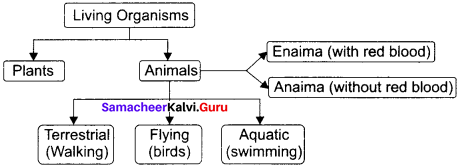
Aristotle (384 to 322 BC) was the first to classify all animals in his Historia Animalium in Latin. He classified the living organisms into plants and animals. Animals were classified as walking (terrestrial), flying (birds), and swimming (aquatic) based in their locomotion.

He classified the animals with red blood cells as Enaima and those without red blood cells as Anaima. Though his method of classification had limitation, his contribution to biology was remarkable. Theophrastus did his research on the classification of plants. He was known as the Father of Botany.

In-Text Questions Solved

11th Zoology Solutions Question 1.
If you find an animal with four legs, with two eyes, paired ear pinna, covered with fur, possessing mammary gland, which class will you position it? How will you give a binomial name, if you are the first person to discover and report that animal.
Answer:
Do it yourself.

Question 2.
What may be the reasons for the extinction of Dinosaurs? If you know the reasons for their extinction, why Sparrows are listed as endangered species?
Answer:
The extinction of the dinosaurs is an enigma that has captivated scientists for well over a century. We find the fossilized remains of giant reptiles all over the earth.

Yet we do not see any of the creatures alive today. If sparrows are not there the population of birds of prey may also be affected. Apart from this, every constitute of an ecosystem is important from an ant to an elephant. We are eliminating species by species which are important links which make the web of life. Today it’s these species which are getting extinct.

Textbook Activity Solved

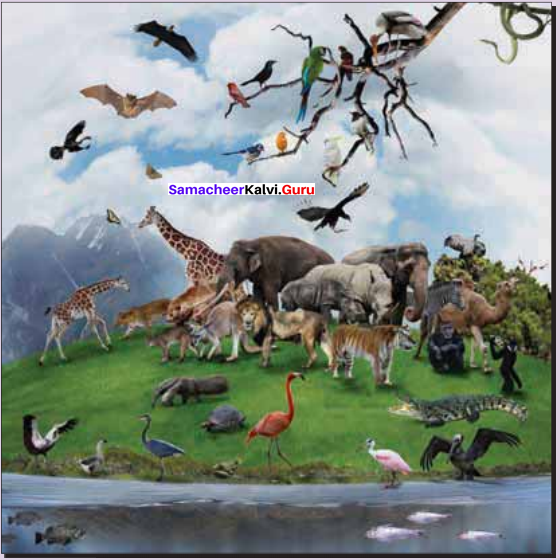
The main objective of this activity is to check the students understanding about animals and its characteristics before learning the lesson. Observe the picture given below, identify the animals and classify them according to you own understanding write one character about each class of animals.

Take the students to the school ground and ask them to observe and identify few invertebrates (insects, earthworm, spiders etc). Ask the students to write few characteristics of each animal which they have observed.
Zoology 11th Class First Chapter The Living World Samacheer Kalvi

SI. NoName of the AnimalKnown CharacterClassHabitat

1

Elephant

TerrestrialMammaliaLand
2BirdFlyingAves

Aerial

3

CrocodileAmmotic eggReptilia

Water

4

FishCold bloodedPiscesSea

Entrance Examination Questions Solved
Choose the correct answer:
Question 1.
The smallest taxon among the following is ………. (PMT-94)
(a) class
(b) order
(c) species
(d) genus
Answer:
(c) species

Question 2.
Taxonomically a species is ……….. (PMT-94)
(a) A group of evolutionary related population
(b) A fundamental unit in the phylogeny of organisms
(c) Classical evolutionary taxonomy
(d) A community taken into consideration. An evolutionary base.
Answer:
(b) A fundamental unit in the phylogeny of organisms

Question 3.
Species is
(a) not related to evolution
(b) specific class of evolution
(c) specific unit of evolution
(d) fertile specific unit in the evolutionary history of a race
Answer:
(d) fertile specific unit in the evolutionary history of a race

Question 4.
Two words comprising the binomial nomenclature are ………… (DPMT-96)
(a) Family & genus
(b) order & family
(c) genus & species
(d) species & variety
Answer:
(c) genus & species

Question 5.
A group of plants or animals with similar traits of any rank is kept under ………. (PMT-96)
(a) species
(b) genus
(c) order
(d) taxon
Answer:
(d) taxon

Question 6.
Which of the following is the correct sequence in the increasing order of complexity? (PMT-97)
(a) molecules, tissues, community, population
(b) cell, tissues, community, population
(c) tissues, organisms, population, community
(d) molecules, tissues, community, cells
Answer:
(c) tissues, organisms, population, community

Question 7.
New systematic and the concept of life was given by ……….. (BHU-98)
(a) Huxley
(b) Odom
(c) Elton
(d) Linnaeus
Answer:
(c) Elton

Question 8.
Two organisms of same class but different families will be kept under the same ……… (CET-98)
(a) genera
(b) species
(c) order
(d) family
Answer:
(c) order

Question 9.
Which of the following will form a new species? (PMT-98)
(a) inter breeding
(b) variations
(c) differential reproduction
(d) none of the above
Answer:
(b) variations

Question 10.
A community includes ……….. (CET-98)
(a) a group of same genera
(b) a group of same population
(c) a group of individuals from same species
(d) different populations interacting with each other
Answer:
(d) different populations interacting with each other

Question 11.
Binomial nomenclature was given by …………(BHU-97)
(a) Huxley
(b) Ray
(c) Darwin
(d) Linnaeus
Answer:
(d) Linnaeus

Question 12.
In classification the category below the level of family is ……….. (CET-98)
(a) class
(b) species
(c) phylum
(d) genus
Answer:
(d) genus

Question 13.
Taxon is …………. (CET-2000)
(a) species
(b) unit of classification
(c) highest rank in classification
(d) group of closely related
Answer:
(b) unit of classification

Question 14.
One of the following includes most closely linked organisms ………… (PMT-2001)
(a) species
(b) genus
(c) family
(d) class
Answer:
(a) species

Question 15.
Which of the following taxons cover a greater number of organisms?(PMT-2001)
(a) order
(b) family
(c) genus
(d) phylum
Answer:
(d) phylum

Question 16.
Inbreeding is possible between two members of ………… (AMU-2005)
(a) order
(b) family
(c) genus
(d) species
Answer:
(d) species

Question 17.
Which of these is correct order of hierarchy? (WARDHA-2002)
(a) kingdom, division, phylum, genus & species
(b) phylum, division, genus & class
(c) kingdom, genus, class, phylum & division
(d) phylum, kingdom, genus, species &class
Answer:
(a) kingdom, division, phylum, genus & species

Question 18.
Which is not a unit of taxonomic category? (BVP-2002)
(a) series
(b) glumaceae
(c) class
(d) phylum
Answer:
(b) glum aceae

Question 19.
Which is the first step of taxonomy? (MGIMS-2002)
(a) nomenclature
(b) classification
(c) identification
(d) hierarchical arrangement
Answer:
(c) identification

Question 20.
The five kingdom classification was given by ………… (BYP-2002)
(a) Whittaker
(b) Linnacus
(c) Copeland
(d) Haeckel
Answer:
(a) Whittaker

Question 21.
Taxon includes ………… (PMT-2002)
(a) Genus and species
(b) kingdom and division
(c) all ranks of hierarchy
(d) none of the above
Answer:
(c) all ranks of hierarchy

Question 22.
Binomial nomenclature refers to …………. (CET – 2000)
(a) Two names of a species
(b) one specific and one local name of a species
(c) two words for the name of a species
(d) two life cycles of a organism
Answer:
(c) two words for the name of a species

Question 23.
Carl Linnaeus is famous for ………… (GGSPU-2002)
(a) coining the term ‘systematics’
(b) introducing binomial nomenclature
(c) giving all natural system of classification
(d) all of these
Answer:
(b) introducing binomial nomenclature

Question 24.
True species are …………
(a) interbreeding
(b) sharing the same niche
(c) feeding on the same food
(d) reproductively isolated
Answer:
(d) reproductively isolated

Question 25.
The smallest unit of classification is ………… (GGSPU-2002)
(a) species
(b) sub – species
(c) class
(d) genus
Answer:
(a) species

Question 26.
Who coined the term ‘taxonomy’? (BVP-2003)
(a) Candolle
(b) Waksman
(c) Leuwenhoek
(d) Louis Pasteur
Answer:
(a) Candolle

Question 27.
Basic unit of classification of organisms is ………… (CET-2003)
(a) species
(b) population
(c) class
(d) family
Answer:
(a) species

Question 28.
The unit of classification containing concrete biological entities is ……….. (WARDHA-2003)
(a) taxon
(b) species
(c) category
(d) order
Answer:
(a) taxon

Question 29.
Species are considered as …………..
(a) real basic units of classification
(b) the lowest units of classification
(c) artificial concept of human mind which cannot be defined in absolute terms
(d) real units of classification devised by taxonomists
Answer:
(a) real basic units of classification

Question 30.
The living organisms can be unexceptionally distinguished from the non-living things on the basis of their ability for …………
(a) interaction with the environment and progressive evolution
(b) reproduction
(c) growth and movement
(d) responsiveness to touch
Answer:
(b) reproduction

Question 31.
Taxonomic category arrange in descending order ……….. (MH-01)
(a) key
(b) hierarchy
(c) taxon
(d) taxonomic category
Answer:
(d) taxonomic category

Question 32.
In which of the animal dimorphic nucleus is found? (PMT 2002).
(a) Amoebaproteus
(b) Trypanosoma gambiense
(c) Plasmodium vivax
(d) Paramecium caudatum
Answer:
(d) Paramecium caudatum

Question 33.
When a fresh-water protozoan possessing a contractile vacuole, is placed in a glass containing marine water, the vacuole will ………. (PMT 2004)
(a) increase in number
(b) disappear
(c) increase in size
(d) decrease in size
Answer:
(d) decrease in size

Question 34.
Which form of reproduction is correctly matched? (AIIMS 2007)
(a) Euglena transvers binary fission
(b) Paramecium longitudinal binary fission
(c) Amoeba multiple fission
(d) Plasmodium binary fission
Answer:
(c) Amoeba multiple fission

Question 35.
The presence of two types of nuclei, a macronucleus and a micronucleus, is characteristic of protozoans are grouped under the class ……….. (BHU 1994, 1999)
(a) sporozoa
(b) flagellate
(c) sarcodina
(d) ciliata
Answer:
(d) ciliata

Question 36.
Which class of protozoa is totally parasitic? (BHU 1994)
(a) Sporozoa
(b) Mastigophora
(c) Ciliate
(d) Sarcodina
Answer:
(a) Sporozoa

Question 37.
Reproduction in Paramecium is controlled by ………. (BHU 1999).
(a) flagella
(b) cell wall
(c) micronucleus
(d) macronucleus
Answer:
(c) micronucleus

Question 38.
In the life cycle of Plasmodium exflagellation occurs in ……….. (BHU 2007)
(a) sporozoties
(b) microgametes
(c) macrogametes
(d) signet ring
Answer:
(b) microgametes

Question 39.
Excretion in Amoeba occurs through ………… (DPMT 1997)
(a) lobopodia
(b) plasma membrane
(c) uroid portion
(d) contractile vacuole
Answer:
(d) contractile vacuole

Question 40.
Method of dispersal in Amoeba is ……….. (DPMT 1995)
(a) locomotion
(b) encystment
(c) sporulation
(d) binary fission
Answer:
(b) encystment

Question 41.
Mode of feeding in free living protozoans is …………. (DPMT 2007).
(a) holozoic
(b) saprozoic
(c) both (a) and (b)
(d) none of these
Answer:
(c) both (a) and (b)

Question 42.
Infection of Entamoeba is caused ………… (UP- CPMT 1996, 1999).
(a) by kissing
(b) by wearing clothes of patient
(c) by contaminated food
(d) none of these
Answer:
(c) by contaminated food

Question 43.
Choose the correct statement.
(a) All reptiles have a three chambered heart.
(b) All Pisces have gills covered by a operculum
(c) All mammals are viviparous
(d) All cyclostomes do not posses jaws and paired fin
Answer:
(d) All cyclostomes do not posses jaws and paired fin

Question 44.
Which of the following characteristics is mainly responsible for diversification of insects on land?
(a) Segmentation
(b) Bilateral symmetry
(c) Exoskeleton
(d) Eyes
Answer:
(c) Exoskeleton

Question 45.
The primitive prokaryotes responsible for the production of biogas from the ruminant animals. Include the …………. (2016)
(a) Thermoacidophiles
(b) methanogens
(c) Eubacteria
(d) Halophiles.
Answer:
(b) methanogens

Question 46.
Methanogens belong to ………. (2016)
(a) Dinoflagellates
(b) Slime moulds
(c) Eubacteria
(d) Archaebacteria
Answer:
(d) Archaebacteria

Samacheer Kalvi 11th Bio Zoology The Living World Additional Questions Solved

Multiple Choice Questions
Choose the correct answer:
Question 1.
Which of the following is not correct with regard to ecosystem?
(a) It includes living and non-living things.
(b) It shows interrelationship among living things.
(c) It shows interrelationship among living and non-living things.
(d) It has a large number of species.
Answer:
(b) It shows interrelationship among living things.

Question 2.
Who was known as the father of Botany?
(a) Aristotle
(b) Carolus Linnaeus
(c) John Ray
(d) Theophrastus
Answer:
(d) Theophrastus

Question 3.
Who developed the scientific system of Taxonomy and Binomial nomenclature?
(a) R.H. Whittaker
(b) Carolus Linnaeus
(c) John Ray
(d) Charles Darwin
Answer:
(b) Carolus Linnaeus

Question 4.
The system of classification of organisms based on evolutionary and genetic relationship among organisms is called as –
(a) Natural system of classification
(b) Phylogenetic system of classification
(c) Binomial classification
(d) Trinomial classification
Answer:
(b) Phylogenetic system of classification

Question 5.
The bacteria which live in salty environment are called –
(a) Theromoacidophiles
(b) Methanogens
(c) Halophiles
(d) Pathogens
Answer:
(c) Halophiles

Question 6.
Which of the following is the characteristics of the domain Bacteria?
(a) They are eukaryotic organisms
(b) They have true nucleus and membrane bound organelles
(c) The ribosomes are of 80 s type in the cytoplasm
(d) They have membrane bound 70 s type ribosomes.
Answer:
(d) They have membrane bound 70 s type ribosomes.

Question 7.
Which of the following is not correct with regard to species?
(a) They have similar morphological features
(b) They are reproductively isolated
(c) They produce viable young ones
(d) They have similar anatomical features
Answer:
(b) They are reproductively isolated

Question 8.
The cross between male lion and female tiger results in the production of –
(a) Mule
(b) Tigon
(c) Liger
(d) Hinny
Answer:
(c) Liger

Question 9.
The related families constitute –
(a) Clans
(b) Phylum
(c) Genus
(d) Order
Answer:
(d) Order

Question 10.
Which of the following is not related to scientific names of organisms?
(a) There is only one name for a species.
(b) They are universally accepted.
(c) They are named based on the guidelines of the ICZN.
(d) They are not unique to an organism.
Answer:
(d) They are not unique to an organism.

Question 11.
Naja naja is the zoological name of –
(a) Indian house crow
(b) Indian cobra
(c) Emerald dove
(d) Indian pea fowl
Answer:
(b) Indian cobra

Question 12.
Origin of species is the book written by –
(a) John Ray
(b) Charles Darwin
(c) Linnaeus
(d) Aristotle
Answer:
(b) Charles Darwin

Question 13.
Taxonomical keys are useful to study –
(a) Similarities and dissimilarities of animals
(b) Preserved plants and animals
(c) Animals kept in protected environments
(d) Plant taxonomy
Answer:
(a) Similarities and dissimilarities of animals

Question 14.
DNA hybridization is helpful to –
(a) Identify an individual from a sample of DNA
(b) Detect difference in homologous DNA sequences
(c) Measure the degree of genetic similarity between pools of DNA sequences
(d) Amplify a specific gene
Answer:
(c) Measure the degree of genetic similarity between pools of DNA sequences

Question 15.
DAISY, the cyber tool is –
(a) Digital automated identification system
(b) Digital automated information system
(c) Direct automated identification system
(d) Digital automated identification science
Answer:
(a) Digital automated identification system

Question 16.
INOTAXA is an e-Taxonomic resource useful for –
(a) Studying electron microscopic images to study molecular structures of cell organelles.
(b) Digital images and description about the species.
(c) Studying behaviour of organisms
(d) Identifying digital resources of animals.
Answer:
(b) Digital images and description about the species.

II. Give Reasons

Question 1.
Classification of organisms is necessary.
Answer:
Classification of organisms is necessary to recognise, identify them and differentiate closely related species.

Question 2.
Extremophiles inhabiting volcanic vents prepare food.
Answer:
Extremophiles inhabiting volcanic vents prepare food without sunlight and oxygen by utilizing hydrogen peroxide and other chemicals through chemosynthesis.

Question 3.
The mating between difference species produces sterile off springs.
Answer:
The maternal and paternal chromosomes of the off springs produced by the mating between different species are not identical and hence gametes are not produced by meiotic division.

Question 4.
Nomenclature of organisms is necessary.
Answer:
The unique nomenclature for each organisms is necessary as it is uniform in all countries and in all languages. A scientific name refers to only one organism.

Question 5.
Why are molecular tools used now to study taxonomy?
Answer:
Molecular tools are accurate and authentic. Hence they are used to study taxonomy.

III. Match the following
Question 1.

1.Ecosystem(a) Walter Rosen
2.Taxonomy(b) Carolus Linnaeus
3.Biodiversity(c) AP de Candolle
4.Species(d) A.G. Tansley
5.Binomial nomenclature(e) John Ray

Answer:

  1. (d) A.G. Tansley
  2. (c) AP de Candolle
  3. (a) Walter Rosen
  4. (e) John Ray
  5. (b) Carolus Linnaeus

Question 2.

1.Extremophiles(a)  Beneficial
2.Probiotic bacteria(b)  70s type of ribosomes
3.Pathogenic bacteria(c)  membrane bound organelles
4.Eukarya(d)  Extreme conditions
5.Bacteria(e) disease causing
(f)  80s type of ribosomes

Answer:

  1. (d)  Extreme conditions
  2. (a)  Beneficial
  3. (e) disease causing
  4. (c)  membrane bound organelles
  5. (b)  70 s type of ribosomes

Question 3.

1.Felis margarita(a) Pea fowl
2.Chalcophaps indica(b) Red Panda
3.Pavo cristatus(c)  Tiger
4.Ailurus fulgens(d)  Jungle cat
5.Panthera Tigris(e) Emerald dove

Answer:

  1. (d)  Jungle cat
  2. (e) Emerald dove
  3. (a) Pea fowl
  4. (b) Red Panda
  5. (c)  Tiger

Question 4.

1.Historia Animalium(a)  Charles Darwin
2.Methodus plantarum(b) R.H. Whittaker
3Origin of species(c) John Ray
4Three Domain classification(d) Aristotle
5Five kingdom classification(e) Carl Woese

Answer:

  1. (d) Aristotle
  2. (c) John Ray
  3. (a)  Charles Darwin
  4. (e) Carl Woese
  5. (b) R.H. Whittaker

Question 5.

1.Museum(a) Analysis of DNA
2.Taxonomical keys(b) Similarities and dissimilarities of organisms.
3.Herbarium(c) Difference in homologous DNA sequence
4.RFLP Analysis(d) Preserved plants and animals
5.DNA fingerprinting(e) Plant Taxonomy

Answer:

  1. (d) Preserved plants and animals
  2. (b) Similarities and dissimilarities of organisms.
  3. (e) Plant Taxonomy
  4. (c) Difference in homologous DNA sequence
  5.  (a) Analysis of DNA

Short Answer Questions

Question 1.
Define ecosystem.
Answer:
Ecosystem is defined as a community of living organisms (plants and animals), non-living things (minerals, climate, soil, sunlight and water) and their interrelationships, e.g. Forest and grassland.

Question 2.
What is biodiversity?
Answer:
The presence of a large number of species in a particular ecosystem is called biodiversity.

Question 3.
Distinguish between living and non-living things.
Answer:

Living things

Non-living things

1.Living things exhibit life processes such as nutrition, respiration, excretion, metabolism, growth and movement.1.Non-living things do not exhibit life processes.
2.These are biotic component of ecosystem.2.These are abiotic component of ecosystem.

Question 4.
What is the need for classification?
Answer:
The basic need for classification are:

  • To identify and differentiate closely related species.
  • To know the variation among the species.
  • To understand the evolution of the species.
  • To create a phylogenetic tree among the different groups.
  • To conveniently study living organisms.

Question 5.
Define Taxonomy.
Answer:
It is the branch of science of identifying, describing, naming and classifying organisms.

Question 6.
What are the features of systematics?
Answer:

  • Identifying, describing, naming, arranging, preserving and documenting the organisms.
  • Investigating evolutionary history of the species, their adaptations to the environment and the interrelationship among species.

Question 7.
How did Aristotle classify organisms?
Answer:
Aristotle classified living organisms into plants and animals. Animals were classified into walking (terrestrial), flying (birds) and swimming (aquatic) based on their locomotion. Based on the presence or absence of red blood animals were classified into Enaima and Anaima.
11th Zoology 1st Chapter The Living World Samacheer Kalvi

Question 8.
What are the limitations of Aristotle’s classification?
Answer:
Many organisms were not fitting into his classification. Frogs have lungs and they are amphibians while their larva, tadpole is aquatic and respires through gills. It is difficult to classify frogs according to his method. All flying organisms such as birds, bats, flying insects were grouped together. Ostrich, emu and penguin are flightless birds and hence they cannot be classified by his method.

Question 9.
What is natural system of classification?
Answer:
Linnaeus considered a few characters of organisms for classifying them. Later many characters were considered for classifying organisms. Morphological, anatomical and embryological characters were considered.

Question 10.
What is numerical taxonomy?
Answer:
The evaluation of resemblances and differences of organisms through statistical methods followed by computer analysis to establish the numerical degree of relationship among them is known as numerical taxonomy.

Question 11.
What is phylogenetic classification or cladistics?
Answer:
The classification of organisms based on evolutionary and genetic relationship among them is known as phylogenetic classification.

Question 12.
What is cladogram?
Answer:
A tree diagram which represents the evolutionary relationship among organisms is known as cladogram.

Question 13.
What is cladistic classification?
Answer:
Cladistic classification is the method of classifying the organisms based on genetic differences among all species in a phylogenetic tree.

Question 14.
What is the significance of cladistic classification?
Answer:
Cladistic classification takes into account ancestral characters (traits commons for the entire group) and derived characters (traits whose structure and function differ from the ancestral characters). The accumulation of derived characters resulted in the formation of new subspecies.

Question 15.
Explain five kingdom classification of Whittaker.
Answer:
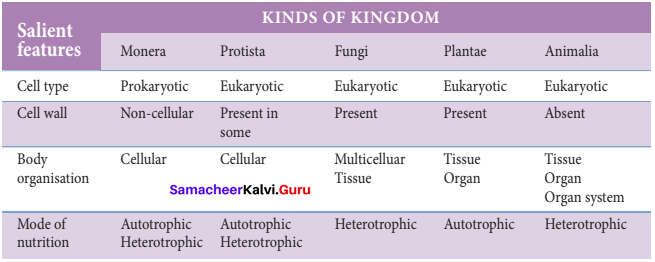
R.H. Whittaker (1969) proposed the Five kingdom classification. They included Monera, Protista, Fungi, Plantae and Animalia. He classified organisms based on cell structure, nutrition, reproduction and phylogenetic relationships.
Kinds of kingdom:
Samacheer Kalvi Guru 11th Zoology Solutions Chapter 1 The Living World

Question 16.
Describe three domain classification.
Answer:
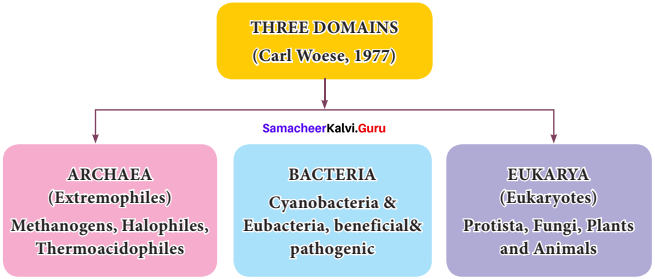
Three domain classification was proposed by Carl Woese (1977) and his co-workers. They classified organisms based on the difference in 16s rRNA genes. This adds the taxon domain higher than the kingdom. In this system, prokaryotes are divided into two domains-bacteria and Arachaea.

All eukaryotes are placed under the domain Eukarya. Archae appears to have common features with Eukarya. Archaea differ from bacteria in cell wall composition and differ from bacteria and eukaryotes in membrane composition and RNA types.
Zoology Class 11 Chapter 1 The Living World Samacheer Kalvi

Question 17.
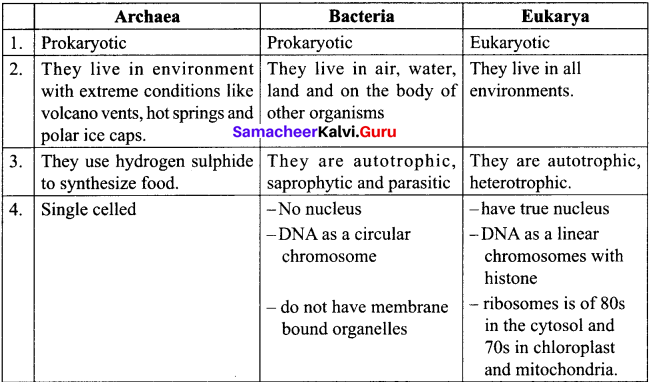
Distinguish Archaea, Bacteria and Eukarya.
Answer:
Zoology Chapter 1 Class 11 The Living World Samacheer Kalvi

Question 18.
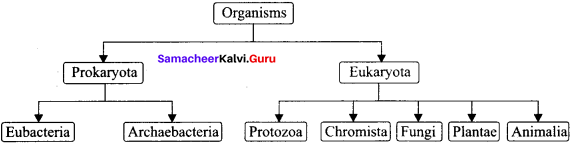
Classify organisms on the basis of seven kingdom system.
Answer:
Samacheer Kalvi 11 Zoology Solutions Chapter 1 The Living World

Question 19.
Define species.
Answer:
Species is a group of organisms that have similar morphological and physiological characters which can interbreed to produce fertile off springs.

Question 20.
Show the mating with closely related species.
Answer:

  • Male Donkey – Female Horse – Mule
  • Male Horse – Female donkey – Hinny
  • Male lion – female tiger – Liger
  • Male tiger – Female lion – Tiger

Question 21.
Distinguish between species and genus.
Answer:
Species:

  • Species is a group of interbreeding population having similar characters.
  • It is the basic unit of classification e.g. Felis domestica, genus species.

Genus:

  • Genus is a group of related species.
  • It is the second level in classification, e.g., Felis margarita genus species.

Question 22.
Distinguish between Family and Order.
Answer:
Family:

  • Family is a group of related genera.
  • It is the lower taxon e.g. felidae

Order:

  • Order is a group of related families.
  • It is the higher taxon e.g. Carnivora

Question 23.
Distinguish between Class and Phylum.
Answer:
Class:

  1. The one or more related orders with some common characters is the class
  2. It is the lower taxon e.g. Mammalia.

Phylum:

  1. The related orders constitute the phylum.
  2. It is the higher taxon, e.g. Chordata.

Question 24
What are the advantages of assigning nomenclature to organisms?
Answer:
Assigning nomenclature or scientific name to organisms have advantages.

  • They are universally accepted.
  • Each organism has unique nomenclature.
  • It avoids confusion in naming the organisms.

Question 25.
What is binomial system of nomenclature?
Answer:
The system of naming the organism with two names, generic name and specific (species) name is known as binomial system of nomenclature, e.g. Pavo cristatus – Indian pea fowl.

Question 26.
What is trinomial system of nomenclature?
Answer:
The system of naming the organism with three names, generic name, specific name (species) and sub-species name is known as trinomial system of nomenclature, e.g. Corvus splendens -Indian house crow.

Question 27.
What are the rules to be followed in the nomenclature of organisms?
Answer:
The scientific name should be italicized in printed form and the generic name and specific name should be underlined separately if it is handwritten.

  • The first alphabet of the generic name should be of uppercase.
  • The specific name (species) should be in lower case letters.
  • The name or abbreviated name of the scientist who first published the scientific name may be written after the specific (species) name along with the year of publication, e.g. Felis Leo Linn., 1958.
  • If the specific (species) name is framed after any person’s name, the name of the species shall end with i, ii or ae. e.g. Ground – dwelling lizard Cyrtodactylus varadgirii

Question 28.
What are the taxonomical tools used for the study of plants and animals?
Answer:
Herbarium and Botanical garden may be used as tools for the plant taxonomy. Museum, Taxonomical keys and Zoological parks are classical tools for animal studies. Field visits, survey, identification, classification, preservation and documentation are the important components of taxonomical tools.

Question 29.
Explain the classical taxonomical tools.
Answer:
Taxonomical tools are the tools for the study of classification of organisms. They include- Taxonomical keys: Keys are based on comparative analysis of the similarities and dissimilarities of organisms. There are separate keys for different taxonomic categories. Museum: Biological Museums have collection of preserved plants and animals for study and ready reference. Specimens of both extinct and living organisms can be studied.

Zoological parks:
These are places where wild animals are kept in protected environments under human care. It enables us to study their food habits and behavior.

Marine parks:

  • Marine organisms are maintained in protected environments.
  • Printed taxonomical tools: It consist of identification cards, description, field guides and manuals.

Question 30.
Name some Automated species identification tools or cybertools.
Answer:
ALIS : Automated Leafhopper Identification System.
DAISY : Digital Automated Identification System.
ABIS : Automatic Bee Identification System.
SPIDA : Species Identified Automatically (spiders, wasp, bee wing characters).
Draw wing : Honey bee wing identification.

Question 31.
What are neo – taxonomical tools?
Answer:
The new taxonomical tools which are based on electron microscopic images to study the molecular structure of cell organelles are neo-taxonomical tools.

Question 32.
What is INOTAXA?
Answer:
INOTAXA is an electronic resource for digital images and description about species. It was developed by Natural History Museum, London. INOTAXA means Integrated Open Taxonomic Access.

Question 33.
Scientists and their contribution for taxonomy.
Answer:

  1. Ecosystem – A.G. Tansley, 1935
  2. Biodiversity – Walter Rosen, 1985
  3. Taxonomy – AP de Candolle
  4. Father of Taxonomy (classical) – Aristotle
  5. Father of modem taxonomy, Founder of modem systematics – Carolus Linnaeus
  6. Aristotle – Historia Animalium
  7. Theophrastus – Father of Botany
  8. Species – John Ray (1627 – 1708)
  9. Five kingdom classification – R.H. Whittaker (1969)
  10. Three domain classification – Carl Woese (1977)
  11. Seven kingdom classification – Cavalier- Smith (1987)
  12. Binomial nomenclature – Carolus Linnaeus
  13. John Ray – Methodus Plantarum Nova and Historia Generalis Plantarum
  14. Trinomial nomenclature – Huxley and Stricklandt
  15. Charles Darwin – Origin of species
  16. Ernst Haeckal – Cladogram

Question 34.
Distinguish between Monotypic genus and polytypic genus
Answer:

Monotypic genus:

  • If a genus has only one species, it is called a monotypic genus.
  • e.g. Ailurus fulgens (red panda)

Polytypic genus:

  • If a genus has more than one species, it is called polytypic genus.
  • e.g. Felis domestica Felis margarita

Believing that the Samacheer Kalvi 11th Biology Book Solutions Questions and Answers learning resource will definitely guide you at the time of preparation. For more details about Tamilnadu State 11th Bio Zoology Chapter 1 The Living World textbook solutions, ask us in the below comments and we’ll revert back to you asap.

Samacheer Kalvi 11th Commerce Solutions Chapter 1 Historical Background of Commerce in the Sub-Continent

Students can find the most related topics which helps them to analyse the concepts if they practice according to the chapter-wise page. It is necessary for the students to practice more Questions and Answers for Tamilnadu State Board Solutions of 11th Commerce are given in the pdf format in chapter 1 Historical Background of Commerce in the Sub-Continent Questions and Answers so that students can prepare in both online and offline modes. So, Download Samacheer Kalvi 11th Commerce Book Solutions Questions and Answers, Notes Pdf, to score good marks.

Samacheer Kalvi 11th Commerce Solutions Chapter 1 Historical Background of Commerce in the Sub-Continent

Get the Questions and Answers, in Tamilnadu State Board 11th Commerce Solutions for Chapter 1 Historical Background of Commerce in the Sub-Continent. Learn the concepts of 11th Commerce Chapter-Wise by referring to the Tamilnadu State Board Solutions for Chapter 1 Historical Background of Commerce in the Sub-Continent Questions and Answers. Hence we suggest the students to Download Samacheer Kalvi 11th Commerce Book Solutions Questions and Answers pdf to enhance your knowledge.

Samacheer Kalvi 11th Commerce Historical Background of Commerce in the Sub-Continent Textbook Exercise Questions and Answers

I. Choose the Correct Answer

11th Commerce Chapter 1 Question 1.
The place where the goods are sold is ……………
(a) Angadi
(b) Market
(c) Nalangadi
(d) Allangadi
Answer:
(a) Angadi

Trade And Commerce Was Common To Dynasty Question 2.
Hindrance of place is removed by ……………
(a) Transport
(b) Warehouse
(c) Salesman
(d) Insurance
Answer:
(a) Transport

11th Commerce 1st Chapter Question 3.
Who wrote “Arthasasthra”?
(a) Kautilya
(b) Chanakiya
(c) Thiruvalluvar
(d) Elangovadigal
Answer:
(a) Kautilya

Trade And Commerce Was Common To Dash Dynasty Question 4.
Trade and Commerce was common to …………… Dynasty.
(a) Pallava
(b) Chola
(c) Pandiya
(d) Chera
Answer:
(c) Pandiya

Historical Background Of Commerce Question 5.
…………… was first sultan who paved way in the dense forest and helped traders to move from one market place to others place for their commercial caravans.
(a) Balban
(b) Vasco da Gama
(c) Akbar
(d) Alauddin Khilji
Answer:
(a) Balban

II. Very Short Answer Questions

Samacheer Kalvi Guru 11th Commerce Question 1.
What is meant by Barter system?
Answer:
Goods were exchanged for goods prior to invention of money.

Question 2.
What is meant by Nalangadi?
Answer:
The place where the goods were sold was called ‘Angadi’ in the Pandiya period. Day market was called as Nalangadi.

Question 3.
What is meant by Allangadi?
Answer:
The night market was called as Allangadi according to Saint Poet Ilango in Silapathigaram, Madurai-Kanchi.

III. Short Answer Questions

Question 1.
Explain the meaning of the term “Vanigam”.
Answer:
The word ‘Vanigam’ has been widely used in Sangam literature like Purananuru and Thirukkural. The earliest trading population of India was Indus valley people, who used the word ‘trade’. The word vaniyam or vanipam would have had a Dravidian origin.

Question 2.
State the meaning of Maruvurapakkam and Pattinapakkam.
Answer:
Big cities like Poompuhar had the ‘Maruvurappakam’ (inland town) and ‘Pattinapakkam’ (coastal town), had market and bazaars where many merchants met one another for the purpose of selling or buying different kinds of commodities and food stuff.

Question 3.
What is the role of Sangam in trade development of ancient Tamil Nadu?
Answer:
Sangam work refers to great traders, their caravans, security force, markets, marts and guilds of such great traders.

Question 4.
What are the ports developed by Pandiya kingdom?
Answer:
Port towns like Tondi, Korkai, Puhar and Muziri were always seen as busy with marts and markets with activities related to imports and exports. In such a brisk trade, people of the coastal region, engaged themselves in coastal trade and developed their intercontinental trade contacts.

Question 5.
What was focused in Arthasasthra about creation of wealth?
Answer:
Arthasasthra focused on creation of wealth as the means to promote the well being of the state. Kautilya advocated maintenance of perfect balance between State management and people’s welfare through trading activities.

IV. Long Answer Questions

Question 1.
What are the hindrances of business?
Answer:
Hindrances of business:
1. Hindrance of Person: Manufacturers do not know the place and face of the consumers. It is the retailer who knows the taste, preference and location of the consumers. The chain of middlemen consisting of wholesalers, agents and retailers establish the link between the producers and consumers.

2. Hindrance of Place: Production takes place in one centre and consumers are spread throughout the country and world. Rail, air, sea and land transports bring the products to the place of consumer.

3. Hindrance of Time: Consumers want products whenever they have money, time and willingness to buy. Goods are produced in anticipation of such demands.

4. Hindrance of risk of deterioration in quality: Proper packaging and modern air conditioned storage houses ensure that there is no deterioration in quality of products.

5. Hindrance of risk of loss: Fire, theft, floods and accidents may bring huge loss to the business.

6. Hindrance of knowledge: Advertising and communication help in announcing the arrival of new products and their uses to the people.

7. Hindrance of exchange: Money functions as a medium of exchange and enables the buying and selling of any product or service by payment of the right price.

8. Hindrance of finance: Producers and traders may not have the required funds at the time of their need.

9. Hindrance of developing the exact product: Research and development helps in developing the exact product or service which can satisfy the specific wants of consumers and thus improve the standard of living of the people.

10. Hindrance of both selection and delivery at doorsteps: E – Commerce enables the consumer to select the product in the website, place online orders and make payment after receiving the product at the doorstep.

Question 2.
State the constraints in barter system.
Answer:
1. Lack of double coincidence of Wants: Unless two persons who have surplus have the demand for the goods possessed by each other, baiter could not materialize. If this “coincidence of wants” does not exist, Barter cannot take place.

2. Non – existence of common measure of value: Barter system could not determine the value of commodities to be exchanged as they lacked commonly acceptable measures to evaluate each and every commodity.

3. Lack of direct contact between producer and consumers: It was not possible for buyers and sellers to meet face to face in many contexts for exchanging the commodities for commodities.

4. Lack of surplus stock: Absence of surplus stock was one of the impediments in barter system. If the buyers and sellers do not have surplus then no barter was possible.

Question 3.
Explain the development of Commerce and Trade in North India.
Answer:
India was prosperous even during the medieval period from 12th to 16th centuries despite political upheavals. Balban was the first sultan who paved the way in the dense forest and helped traders and their commercial caravans to move from one market place to others. Allauddin Khilji brought the price to a very low ebb. He encouraged import of foreign goods from Persia and subsidised the goods.

Arabs were dominant players in India’s foreign trade. They never discouraged Indian traders like Tamils, Gujaratis, etc. The trade between the coastal ports were in the hands and Marwaris and Gujiratis, The overland trade with central and west Asia was in the hands of Multanis who were Hindus and Khurasanis who were Afghans, Iranians and so on.

Question 4.
Briefly explain the coastal trade in ancient Tamil Nadu.
Answer:
Big cities like Poompuhar had the ‘Maruvurappakam’ (inland town) and ‘Pattinapakkam’ (coastal town), had market and bazaars where many merchants met one another for the purpose of selling or buying different kinds of commodities and food stuff. Port towns like Tondi, Korkai, Puhar and Muziri were always seen as busy with marts and markets with activities related to imports and exports. In such a brisk trade, people of the coastal region, engaged themselves in coastal trade and developed their intercontinental trade contacts.

They were engaged in different kinds of fishing pearls, and conches and produced salts and built ships. Boats like ‘Padagu’, ‘Thimil’, ‘Thoni’, ‘Ambu’, ‘Odampunai’, etc., were used to cross rivers for domestic trade while ‘Kalam’, ‘Marakalam’, ‘Vangam’, ‘Navai’, etc., were used for crossing oceans for foreign trade.

Question 5.
What do you know about the overseas trading partners of ancient Tamil Nadu?
Answer:
Foreigners who transacted business were known as Yavanars. Arabs who traded with Tamil were called ‘Jonagar’. Pattinappalai praised Kaveripumpattinam as a city where various foreigners of high civilization speaking different languages assembled to transact business with the support of the then Kingdom.

Many ports were developed during the Sangam period. Kaveripumpattinam was the chief port of the Kingdom of Cholas while Nagapattinam, Marakannam, Arikamedu, etc., were other small ports on east coast. Similarly, Pandiyas developed Korkai, Saliyur, Kayal, Marungaurpattinam and Kumari for foreign trade. The State Govertments installed check posts to collect customs along the highways and the ports.

Samacheer Kalvi 12th Commerce Historical Background of Commerce in the Sub-Continent Additional Questions and Answers

I. Choose the Correct Answer:

Question 1.
…………….. is part and parcel of human life.
(a) Commerce
(b) Banking
(c) Insurance
(d) Warehousing
Answer:
(a) Commerce

Question 2.
…………….. means exchange of goods for goods.
(a) Insurance
(b) Money
(c) Barter System
(d) Transport
Answer:
(c) Barter System

Question 3.
Commerce activities are heading for a cashless system through ……………..
(a) e – commerce
(b) banking
(c) insurance
(d) warehousing
Answer:
(a) e – commerce

Question 4.
…………….. in Sangam period was both internal and external.
(a) Sales
(b) Education
(c) Industry
(d) Trade
Answer:
(d) Trade

Question 5.
Day market was called as ……………..
(a) Nalangadi
(b) Angadi
(c) Business
(d) Trade
Answer:
(a) Nalangadi

Question 6.
Night market was called as ……………..
(a) Allangadi
(b) Street store
(c) Shop
(d) Maligai
Answer:
(a) Allangadi

Question 7.
Which is called as sleepless city?
(a) Chennai
(a) Allangadi
(c) Tuticorin
(d) Salem
Answer:
(a) Allangadi

Question 8.
Boats like …………….. were used to cross rivers for domestic trade.
(a) Fishings
(b) Kalam
(c) Marakalam
(d) Thimil
Answer:
(d) Thimil

Question 9.
Boats like …………….. were used for crossing oceans for foreign trade.
(a) Vangam
(b) Thimil
(c) Ambu
(d) Thoni
Answer:
(a) Vangam

Question 10.
…………….. was the chief port of the Kingdom of Cholas.
(a) Marakannam
(b) Arikamedu
(c) Kayal
(d) Kaveripumpattinam
Answer:
(d) Kaveripumpattinam

Question 11.
…………….. Who advocated maintenance of perfect balance between State management and people’s welfare through trading activities.
(a) Kautilya
(b) Pandiya
(c) Hebrew
(d) Chola
Answer:
(a) Kautilya

Question 12.
The profit margin allowed for traders ranged from 5% for indigenous goods and ……………..
for imported goods.
(a) 10%
(b) 5%
(c) 15%
(d) 20%
Answer:
(a) 10%

Question 13.
Who encouraged import of foreign goods from Persia and subsidized the goods?
(a) Balban
(b) Sultan
(c) Alauddin Khilji
(d) Kautilya
Answer:
(c) Alauddin Khilji

Question 14.
Which one helps in announcing the arrival of new products and their uses to the people?
(a) Advertising
(b) Banking
(c) Trade
(d) Transport
Answer:
(a) Advertising

Question 15.
…………….. functions as a medium of exchange.
(a) Transport
(b) Banking
(c) Money
(d) Warehousing
Answer:
(c) Money

II. Very Short Answer Questions

Question 1.
What is cashless system?
Answer:
Commerce activities are heading for a cashless system through e-commerce which means business activities enabled through electronic modes like Online trading, Mobile banking and e – marketing.

Question 2.
What is ‘Angadi’?
Answer:
The place where the goods were sold was called ‘Angadi’ in Pandiya Dynasty.

Question 3.
Which city was called sleepless city?
Answer:
Madurai was called sleepless city due to round – the – clock business activities.

Question 4.
What type of boats were used to cross rivers for domestic trade?
Answer:
Boats like ‘Padgu’, ‘Thimil’, ‘Thom’, ‘Ambu’ ‘Odampunai’, etc., were used to cross rivers for domestic trade.

Question 5.
What type of boats were used to cross oceans for foreign trade?
Answer:
Boats like ‘Kalam’, ‘Marakalam’, ‘Vangam’, ‘Navai’, etc., were used for crossing oceans for foreign trade.

Question 6.
How were the foreigners called in Ancient Tamil Nadu?
Answer:
Foreigners who transacted business were known as ‘yavanars’.

Question 7.
What was the role of the state in trade?
Answer:
The role of the state in trade related to two aspects namely adequate infrastructure to sustain the trade and administrative machinery for taxation.

Question 8.
What was advocated by Kautilya?
Answer:
Kautilya advocated maintenance of perfect balance between State management and people’s welfare through trading activities.

Question 9.
With whom Cholas had a strong trading relationship?
Answer:
Cholas had a strong trading relationship with Chinese Song Dynasty.

Question 10.
What are the constraints of Barter System? (any two)
Answer:

  1. Lack of double coincidence of wants
  2. Non – existence of common measure of value

III. Short Answer Questions

Question 1.
How has the commerce activities emerged how?
Answer:
The whole of commerce activity has emerged from barter system into a multi – dimensional and multifaceted scientific system consisting of courses like Monetary system, Mail order business, Hire purchase system, Instalment purchase system and so on.

Question 2.
What is the course of commerce activities in today’s technology driven society?
Answer:
In a technology driven society today again the course of commerce activities is heading for a cashless system through e-commerce which means business activities enabled through electronic modes like Online trading, Mobile banking and e – marketing.

Question 3.
What were the constraints in barter system? (Any three)
Answer:
1. Lack of Double Coincidence of Wants:
Unless two persons who have surplus have the demand for the goods possessed by each other, barter could not materialize. If this “coincidence of wants” does not exist, barter cannot take place.

2. Non – existence of Common Measure of Value:
Barter system could not determine the value of commodities to be exchanged as they lacked commonly acceptable measures to evaluate each and every commodity.

3. Lack of Direct Contact between Producer and Consumers:
It was not possible for buyers and sellers to meet face to face in many contexts for exchanging the commodities for commodities.

Question 4.
Write any three hindrances of commerce.
Answer:
1. Hindrance of Person: Manufacturers do not know the place and face of the consumers. The chain of middlemen consisting of wholesalers, agents and retailers establish the link between the producers and consumers.

2. Hindrance of Place: Production takes place in one centre and consumers are spread throughout the country and world. Rail, air, sea and land transports bring the products to the place of consumer.

3. Hindrance of Time: Consumers want products whenever they have money, time and willingness to buy. Goods are produced in anticipation of such demands.

IV. Long Answer Questions

Question 1.
How did the ancient Tamil country trade with Rome, China and Europe?
Answer:
Roman and Greek traders frequented the ancient Tamil country and forged trade relationship with ancient Kings of Pandiya, Chola and Chera dynasties. Cholas had a strong trading relationship with Chinese Song Dynasty. The Cholas conquered the Sri Vijaya Empire of Indonesia and Malaysia to secure a sea trading route to China. During the 16th and 18th centuries, India’s overseas trade expanded due to trading with European companies. The discovery of new all sea routes from Europe to India via Cape of Good Hope by Vasco da Gama had far-reaching impact on the civilized world. The arrival of Portuguese in India was followed by the advent of other European communities. They gained a strong foothold in India’s maritime trade by virtue’ of their strong naval power.

Share this Tamilnadu State Board Solutions for 11th Commerce Chapter 1 Historical Background of Commerce in the Sub-Continent Questions and Answers with your friends to help them to overcome the issues in exams. Keep visiting this site Tamilnadu State Board Solutions frequently to get the latest information on different subjects. Clarify your doubts by posting the comments and get the answers in an easy manner.

Samacheer Kalvi 11th Maths Solutions Chapter 1 Sets Ex 1.1

You can Download Samacheer Kalvi 11th Maths Book Solutions Guide Pdf, Tamilnadu State Board help you to revise the complete Syllabus and score more marks in your examinations.

Tamilnadu Samacheer Kalvi 11th Maths Solutions Chapter 1 Sets Ex 1.1

11th Maths Exercise 1.1 Answers Question 1.
Write the following in roster form.
(i) {x ∈ N : x2 < 121 and x is a prime}.
(ii) the set of all positive roots of the equation (x – 1)(x + 1)(x2 – 1) = 0.
(iii) {x ∈ N : 4x + 9 < 52}.
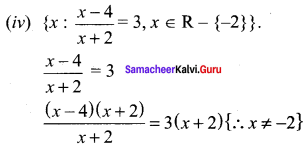
(iv) {x : \(\frac{x-4}{x+2}\) = 3, x ∈ R – {-2}}
Solution:
(i) A = {2, 3, 5, 7}
(ii) B = {1}
(iii) 4x + 9 < 52
4x + 9 – 9 < 52 – 9
4x < 43
x < \(\frac{43}{4}\) (i.e.) x < 10.75 4
But x ∈ N
∴ A = {1, 2, 3, 4, 5, 6, 7, 8, 9, 10}
11th Maths Exercise 1.1 Answers Samacheer Kalvi Chapter 1 Sets
(i.e.) x – 4 = 3(x + 2)
x – 4 = 3x + 6
– 4 – 6 = 3x – x
2x = -10 ⇒ x = -5
A = {-5}

11th Std Maths Exercise 1.1 Answers Question 2.
Write the set {-1,1} in set builder form.
Solution:
A = {x: x2 = 1}

11th Maths Book Exercise 1.1 Answers Question 3.
State whether the following sets are finite or infinite.
(i) {x ∈ N : x is an even prime number}
(ii) {x ∈ N : x is an odd prime number}
(iii) {x ∈ Z : x is even and less than 10}
(iv) {x ∈ R : x is a rational number}
(v) {x ∈ N : x is a rational number}
Solution:
(i) Finite set
(ii) Infinite set
(iii) Infinite
(iv) and
(v) infinite

Exercise 1.1 Class 11 Maths State Board Question 4.
By taking suitable sets A, B, C, verify the following results:
(i) A × (B ∩ C) = (A × B) ∩ (A × C).
(if) A × (B ∪ C) = (A × B) ∪ (A × C).
(iii) (A × B) ∩ (B × A) = (A ∩ B) × (B ∩ A).
(iv) C – (B – A) = (C ∩ A) ∪ (C ∩ B).
(v) (B – A) ∩ C = (B ∩ C) – A = B ∩ (C – A).
Solution:
To prove the following results let us take U = {1, 2, 5, 7, 8, 9, 10}
A = {1, 2, 5, 7}
B = {2, 7, 8, 9}
C = {1, 5, 8, 7}
(i) To prove: A × (B ∩ C) = (A × B) ∩ (A × C)
B ∩ C = {8}; A = {1, 2, 5, 7}
So A × (B ∩ C) = {1, 2, 5, 7} × {8}
= {(1, 8), (2. 8), (5, 8), (7, 8)}
Now A x B = {(1, 2), (1, 7), (1, 8), (1, 9), (2, 2), (2, 7), (2, 8), (2, 9), (5, 2), (5, 7), (5, 8), (5, 9), (7, 2), (7, 7), (7, 8), (7, 9)} …. ( 1)
A × C = {(1, 1), (1, 5),(1, 8), (1, 10), (2, 1), (2, 5), (2, 8), (2, 10), (5, 1), (5, 5), (5, 8), (5, 10), (7, 1), (7, 5), (7, 8), (7, 10)}
(A × B) ∩ (A × C) = {(1, 8), (2, 8), (5, 8), (7, 8)} ……… (2)
(1) = (2)
⇒ A × (B ∩ C) = (A × B) ∩ (A × C)

(ii) To prove A × (B ∪ C) = (A × B) (A × C)
B = {2, 7, 8, 9}, C = {1, 5, 8, 10)
B ∪ C = {1, 2, 5, 7, 8, 9, 10}
A = {1, 2, 5, 7}
A × (B ∪ C) = {(1, 1), (1, 2), (1, 5), (1, 7), (1, 8), (1, 9), (1, 10), (2, 1), (2, 2), (2, 5), (2, 7), (2, 8), (2, 9), (2, 10), (5, 1), (5, 2), (5, 5), (5, 7), (5, 8), (5, 9), (5, 10), (7, 1), (7, 2), (7, 5), (7, 7), (7, 8), (7, 9), (7, 10)) …. (1)
A × B = {(1, 2), (1, 7), (1, 8), (1, 9), (2, 2), (2, 7), (2, 8), (2, 9), (5, 2), (5, 7), (5, 8), (5, 9),
(7, 2), (7, 7), (7, 8), (7, 9)}
A × C = {(1, 1), (1, 5), (1, 8), (1, 10), (2, 1), (2, 5), (2, 8), (2, 10), (5, 1), (5, 5), (5, 8), (5, 10), (7, 1), (7, 5), (7, 8), (7, 10)}
(A × B) ∪ (A × C) = (1, 1), (1, 2), (1, 5), (1, 7), (1, 8), (1,9), (1, 10), (2, 1), (2, 2), (2, 5), (2, 7), (2, 8), (2, 9), (2, 10), (5, 1), (5, 2), (5, 5), (5, 7), (5, 8), (5, 9), (5, 10), (7, 1), (7, 2), (7, 5), (7, 7), (7, 8), (7, 9), (7, 10)} …… (2)
(1) = (2) ⇒ A × (B ∪ C) = (A × B) ∪ (A × C)

(iii) A × B = {(1, 2), (1, 7), (1, 8), (1, 9) (2, 2), (2, 7), (2, 8), (2, 9) (5, 2), (5, 7), (5, 8), (5, 9) (7, 2), (7, 7), (7, 8), (7, 9)}
B × A = {(2, 1), (2, 2), (2, 5), (2, 7) (7, 1), (7, 2), (7, 5), (7, 7) (8, 1), (8, 2), (8, 5), (8, 7) (9,1), (9, 2), (9, 5), (9, 7)}
L.H.S. (A × B) ∩ (B × A) = {(2, 2), (2, 7), (7, 2), (7, 7)} …. (1)
R.H.S. A ∩ B = {2, 7}
B ∩ A = {2, 7}
(A ∩ B) × (B ∩ A) = {2, 7} × {2, 7}
= {(2, 2), (2, 7), (7, 2), (7, 7)} ……… (2)
(1) = (2) ⇒ LHS = RHS

(iv) To prove C – (B – A) = (C ∩ A) ∪ (C ∩ B)
B – A = {8, 9}
C = {1, 5, 8, 10}
∴ LHS = C – (B – A) = {1, 5, 10} …… (1)
C ∩ A = {1}
U = {1, 2, 5, 7, 8, 9, 10}
B = {2, 7, 8, 9} ∴ B’ = {1, 5, 10}
C ∩ B = {1, 5, 10}
R.H.S. (C ∩ A) ∪ (C ∩ B) = {1} ∪ {1, 5, 10}
= {1, 5, 10} ……. (2)
(1) = (2) ⇒ LHS = RHS

(v) To prove (B – A) ∩ C = (B ∩ C) – A = B ∩ (C – A)
A= {1, 2, 5, 7}, B = {2, 7, 8, 9}, C = {1, 5, 8, 10}
Now B – A = {8, 9}
(B – A) ∩ C = {8} ……. (1)
B ∩ C = {8}
A = {1, 2, 5, 7}
So (B ∩ C) – A = {8} …… (2)
C – A = {8, 10}
B = {2, 7, 8, 9}
B ∩ (C – A) = {8} …. (3)
(1) = (2) = (3)

(vi) To prove (B – A) ∪ C ={1, 5, 8, 9, 10}
B – A = {8, 9},
C = {1, 5, 8, 10}
(B – A) ∪ C = {1, 5, 8, 9, 10} ……. (1)
B ∪ C = {1, 2, 5, 7, 8, 9, 10}
A – C = {2, 7}
(B ∪ C) – (A – C) = {1, 5, 8, 9, 10} ……… (2)
(1) = (2)
⇒ (B – A) ∪ C = (B ∪ C) – (A – C)

11th Maths Exercise 1.1 Question 5.
Justify the trueness of the statement.
“An element of a set can never be a subset of itself.”
Solution:
A set itself can be a subset of itself (i.e.) A ⊆ A. But it cannot be a proper subset.

11th Maths Chapter 1 Exercise 1.1 Question 6.
If n(P(A)) = 1024, n(A ∪ B) = 15 and n(P(B)) = 32, then find n(A ∩ B).
Solution:
n(P( A)) = 1024 = 210 ⇒ n( A) = 10
n(A ∪ B) = 15
n(P(B)) = 32 = 25 ⇒ n(B) = 5
We know n(A ∪ B) = n{A) + n(B) – n(A ∩ B)
(i.e.) 15 = 10 + 5 – n(A ∩ B)
⇒ n(A ∩ B) = 15 – 15 = 0

11 Maths Exercise 1.1 Question 7.
If n(A ∩ B) = 3 and n(A ∪ B) = 10, then find n(P(A(A ∆ B)).
Solution:
n(A ∪ B) = 10; n(A ∩ B) = 3
n(A ∆ B) = 10 – 3 = 7
and n(P(A ∆ B)) = 27 = 128

11th Maths 1.1 Exercise Question 8.
For a set A, A × A contains 16 elements and two of its elements are (1, 3) and (0, 2). Find the elements of A.
Solution:
A × A = 16 elements = 4 × 4
⇒ A has 4 elements
∴ A = {0, 1, 2, 3}

11th Maths Exercise 1.1 Answers In Tamil Question 9.
Let A and B be two sets such that n(A) = 3 and n(B) = 2. If (x, 1), (y, 2), (z, 1) are in A × B, find A and B, where x, y, z are distinct elements.
Solution:
n(A) = 3 ⇒ set A contains 3 elements
n(B) = 2 ⇒ set B contains 2 elements –
we are given (x, 1), (y, 2), (z, 1) are elements in A × B ⇒ A = {x, y, z} and B = {1, 2}

11th Maths Exercise 1.1 Answers State Board Question 10.
If A × A has 16 elements, S = {(a, b) ∈ A × A : a < b} ; (-1, 2) and (0, 1) are two elements of S, then find the remaining elements of S.
Solution:
n(A × A) = 16 ⇒ n( A) = 4
S ={(-1, 0), (-1, 1), (0, 2), (1, 2)}

Samacheer Kalvi 11th Maths Solutions Chapter 1 Sets Ex 1.1 Additional Questions

Samacheer Kalvi 11th Maths Example Sums Question 1.
Write the following sets in roster form
(a) {x ∈ N; x3 < 1000}
(b) {The set of positive roots of the equation (x2 – 4) (x3 – 27) = 0}
Solution:
(a) A = {1, 2, 3, 4, 5, 6, 7, 8, 9}
(b) B = {2, 3}

11th Maths Exercise 1.1 4th Sum Question 2.
By taking suitable sets A, B, C verify the following results
(i) A × (B ∪ C) = (A × B) ∪ (A × C)
(ii) (B – A) ∪ C = (B ∪ C) – (A – C)
Solution:
Prove by yourself

11th Maths 1st Chapter Exercise 1.1 Question 3.
Given n(A) = 7; n(B) = 8 and n(A ∪ B) = 10 find n[P(A ∩ B)].
Solution:
n(A ∪ B) = n(A) + n(B) – n(A ∩ B)
(i.e.,) 10 = 7 + 8 – n(A ∩ B)
⇒ n(A ∩ B) = 7 + 8 – 10 = 5
So n[P(A ∩ B)] = 25 = 32

Samacheer Kalvi 11th Chemistry Solutions Chapter 4 Hydrogen

Enhance your subject knowledge with Tamilnadu State Board for Chapter 4 Hydrogen and learn all the underlying concepts easily. Make sure to Download Samacheer Kalvi 11th Chemistry Book Solutions, Notes Pdf Chapter 4 Hydrogen Questions and Answers PDF on a day to day basis and score well in your exams. Are given after enormous research by people having high subject knowledge. You can rely on them and prepare any topic of Chemistry as per your convenience easily.

Tamilnadu Samacheer Kalvi 11th Chemistry Solutions Chapter 4 Hydrogen

Students looking for Chapter 4 Hydrogen Concepts can find them all in one place from our Tamilnadu State Board Solutions. Simply click on the links available to prepare the corresponding topics of Chemistry easily. Samacheer Kalvi 11th Chemistry Chapter wise Questions and Answers are given to you after sample research and as per the latest edition textbooks. Clarify all your queries and solve different questions to be familiar with the kind of questions appearing in the exam. Thus, you can increase your speed and accuracy in the final exam.

Samacheer Kalvi 11th Chemistry Hydrogen Textual Evaluation Solved

I. Choose The Correct Answer:
11th Chemistry Chapter 4 Book Back Answers Question 1.
Which of the following statements about hydrogen is incorrect ? (NEET – 2016)
(a) Hydrogen ion, H3O+ exists freely in solution.
(b) Dihydrogen acts a,s a reducing agent.
(c) Hydrogen has three isotopes of which tritium is the most common.
(d) Hydrogen never acts as cation in ionic salts.
Answer:
(c) Hydrogen has three isotopes of which tritium is the most common.
Hint:
Correct statement:
Hydrogen has three isotopes of which protium is the most common.

11th Chemistry Lesson 4 Book Back Answers Question 2.
Water gas is ………..
(a) H2 O(g)
(b) CO + H2O
(C) CO + H2
(d) CO + N2
Answer:
(c) CO + H2

11th Chemistry 4th Lesson Book Back Answers Question 3.
Which one of the following statements is incorrect with regard to ortho and para dihydrogen ?
(a) They are nuclear spin isomers
(b) Ortho isomer has zero nuclear spin whereas the para isomer has one nuclear spin
(c) The para isomer is favoured at low temperatures
(d) The thermal conductivity of the para isomer is 50% greater than that of the ortho isomer.
Answer:
(b) Ortho isomer has zero nuclear spin whereas the para isomer has one nuclear spin
Hints:
Correct statement:
Ortho isomer – one nuclear spin Para isomer – zero nuclear spin

11th Chemistry Unit 4 Book Back Answers Question 4.
Ionic hydrides are formed by …………….
(a) halogens
(b) chalogens
(c) inert gases
(d) group one elements
Answer:
(d) group one elements
e.g., Sodium hydride (Na+ H )

Chemistry Class 11 Samacheer Kalvi Question 5.
Tritium nucleus contains ……………..
(a) 1p + 0n
(b) 2p + 1n
(c) 1p + 2n
(d) none of these
Answer:
(c) lp + 2n
1T3 (le, lp, 2n)

Class 11 Chemistry Solutions Samacheer Kalvi Question 6.
Non-stoichiometric hydrides are formed by……………..
(a) palladium, vanadium
(b) carbon, nickel
(c) manganese, lithium
(d) nitrogen, chlorine
Answer:
(a) palladium, vanadium

11th Chemistry Hydrogen Lesson Question 7.
Assertion : Permanent hardness of water is removed by treatment with washing soda.
Reason : Washing soda reacts with soluble calcium and magnesium chlorides and sulphates in hard water to form insoluble carbonates
(a) Both assertion and reason are true and reason is the correct explanation of assertion.
(b) Both assertion and reason are true but reason is not the correct explanation of assertion.
(c) Assertion is true but reason is false
(d) Both assertion and reason are false
Answer:
(a) Both assertion and reason are true and reason is the correct explanation of assertion.
Ca2+ + Na2CO3 → CaCO3↓ + 2Na+

11th Chemistry 4th Chapter Question 8.
If a body of a fish contains 1.2 g hydrogen in its total body mass, if all the hydrogen is replaced with deuterium then the increase in body weight of the fish will be ……………
(a) 1.2 g
(b) 2.4 g
(c) 3.6 g
(d) \(\sqrt{4.8}\) g
Answer:
(a) 1.2 g
Hints:
Mass of deuterium = 2 × mass of protium
If all the 1.2 g hydrogen is replaced with deuterium, the weight will become 2.4g. Hence the increase in body weight is (2.4 – 1.2 = 1.2 g).

Samacheer Kalvi 11th Chemistry Book Solutions Question 9.
The hardness of water can be determined by volumetrically using the reagent …………..
(a) sodium thio sulphate
(b) potassium permanganate
(c) hydrogen peroxide
(d) EDTA
Answer:
(d) EDTA

Hydrogen 11th Chemistry Question 10.
The cause of permanent hardness of water is due to ………….
(a) Ca(HCO3)2
(b) Mg(HCO3k)3
(c) CaCl2
(d) MgCO3
Answer:
(c) CaCl2
Hints:
Permanent hardness if water is due to the presence of the chlorides, nitrates and sulphates of Ca2+ and Mg2+ ions.

Hydrogen Class 11 Questions And Answers Question 11.
Zeolite used to soften hardness of water is, hydrated ………….
(a) Sodium aluminium silicate
(b) Calcium aluminium silicate
(c) Zinc aluminium borate
(d) Lithium aluminium hydride
Answer:
(a) Sodium aluminium silicate
Zeolite is sodium aluminium silicate.
(NaAlSi2O6 .H2O)

11th Chemistry Deleted Book Back Questions Question 12.
A commercial sample of hydrogen peroxide marked as 100 volume H2O2, it means that ……………
(a) 1 ml of H2O2 will give 100 ml O2 at STP
(b) 1 L of H2O2 will give 100 ml O2 at STP
(c) 1 L of H2O2 will give 22.4 L O2
(d) 1 ml of H2O2 will give 1 mole of O2 at STP
Answer:
(a) 1 ml of H2O2 will give 100 ml O2 at STP

Samacheer Kalvi Guru 11th Chemistry Question 13.
When hydrogen peroxide is shaken with an acidified solution of potassium dichromate in presence of ether, the ethereal layer turns blue due to the formation of
(a) Cr2 O3
(b) CrO42-
(c) CrO(O2)2
(d) none of these
Answer:
(c) CrO(O2)2 CrO(O2)2
Hints:
Cr2O72- + 2H+ + 4H2O2 → 2CrO(O2)2 + 5H2O

Samacheer Kalvi 11th Chemistry Question 14.
For de colorization of 1 mole of acidified KMnO4, the moles of H2O2 required is …………….
(a) \(\frac {1}{2}\)
(b) \(\frac {3}{2}\)
(c) \(\frac {5}{2}\)
(d) \(\frac {7}{2}\)
Answer:
(c) \(\frac {5}{2}\)
Hints:
2MnO4 + 5H2O2(aq) + 6H+ → 2Mn2++ 5O2 + 8H2O

11th Chemistry Samacheer Kalvi Question 15.
Volume strength of 1.5 N H2O2 is ……………..
(a) 1.5
(b) 4.5
(c) 16.8
(d) 8.4
Answer:
(d) 8.4
Hints:
Volume strength of hydrogen peroxide = Normality of hydrogen peroxide × 5.6 = 1.5 x 5.6 = 8.4
11th Chemistry Chapter 4 Book Back Answers Samacheer Kalvi Hydrogen
Volume strength of hydrogen peroxide 11th Chemistry Lesson 4 Book Back Answers Samacheer Kalvi Hydrogen
= Normality × \(\frac {17 × 22.4}{68}\)
Volume strength of hydrogen peroxide = Normality x 5.6

Samacheer Kalvi Chemistry 11th Question 16.
The hybridization of oxygen atom is H2O and H2O2 are respectively
(a) sp and sp3
(b) sp and sp
(c) sp and sp2
(d) sp3 and sp3
Answer:
(d) sp3 and sp3

Samacheer Kalvi 11th Chemistry Solutions Question 17.
The reaction H3PO2 + D2O → H2DPO2 + HDO indicates that hypo-phosphorus acid is ……………
(a) tri basic acid
(b) di basic acid
(c) mono basic acid
(d) none of these
11th Chemistry 4th Lesson Book Back Answers Samacheer Kalvi Hydrogen
Answer:
(c) mono basic acid
Hints:
Hypophosphorus acid on reaction with D2O, only one hydrogen is replaced P by deuterium and hence it is mono basic.

Samacheer Kalvi Class 11 Chemistry Solutions Question 18.
In solid ice, oxygen atom is surrounded
(a) tetrahedrally by 4 hydrogen atoms
(b) octahedrally by 2 oxygen and 4 hydrogen atoms
(c) tetrahedrally by 2 hydrogen and 2 oxygen atoms
(d) octahedrally by 6 hydrogen atoms
Answer:
(a) tetrahedrally by 4 hydrogen atoms

Samacheer Kalvi 11th Chemistry Guide Pdf Question 19.
The type of H-bonding present in ortho nitro phenol and p-nitro phenol are respectively ……………
(a) inter molecular H-bonding and intra molecular H-bonding
(b) intra molecular H-bonding and inter molecular H-bonding
(c) intra molecular H – bonding and no H – bonding
(d) intra molecular H – bonding and intra molecular H – bonding
11th Chemistry Unit 4 Book Back Answers Samacheer Kalvi Hydrogen
Answer:
(A) intra molecular H-bonding and inter molecular H-bonding

11 Chemistry Samacheer Kalvi Question 20.
Heavy water is used as ……………
(a) modulator in nuclear reactions
(b) coolant in nuclear reactions
(c) both (a) and (b)
(d) none of these
Answer:
(c) both (a) and (A)
Hints:
Heavy water is used as moderator as well as coolant in nuclear reactions.

Samacheer Kalvi.Guru 11th Chemistry Question 21.
Water is a ……………
(a) basic oxide
(b) acidic oxide
(c) amphoteric oxide
(d) none of these
Answer:
(c) amphoteric oxide

II. Write brief answer to the following questions

Question 22.
Explain why hydrogen is not placed with the halogen in the periodic table.
Answer:

  • Hydrogen resembles alkali metals as well as halogens.
  • Hydrogen resembles more alkali metals than halogens.
  • Electron affinity of hydrogen is much less than that of halogen atom. Hence the tendency to form hydride ion is low compared to that of halogens.
  • In most of its compounds hydrogen exists in +1 oxidation state. Therefore it is reasonable to place the hydrogen in group 1 along with alkali metals as shown in the latest periodic table published by IUPAC.

Question 23.
the cube at 0°C is placed in some liquid water at 0°C, the ice cube sinks – Why ?
Answer:

  • In an ice cube, each atom is surrounded tetrahedrally by four water molecules through hydrogen bond and its density is low.
  • Liquid water at 0°C has the density as 999.82 kg/cm3. Maximum density is attained by water only at 4°C as 1000 kg/cm3.
  • When the temperature changed from 4°C to 0°C, the density of water decreases rather than increases. This is called anomalous expansion of water.
  • The reason for this phenomenon lies in the structure of ice lattice and hydrogen bonding in water.
  • At 0°C, ice cube sinks in liquid water at 0°C because of the lesser density and greater volume of water.

Question 24.
Discuss the three types of Covalent hydrides.
Answer:

  1. They are the compounds in which hydrogen is attached to another element by sharing of electrons.
  2. The most common examples of covalent hydrides are methane, ammonia, water and hydrogen chloride.
  3. Molecular hydrides of hydrogen are further classified into three categories as,
    • Electron precise (CH4, C2 H6 , SiH4 , GeH4 )
    • Electron-deficient (B2 H6 ) and
    • Electron-rich hydrides (NH3 , H2O)
  4. Since most of the covalent hydrides consist of discrete, small molecules that have relatively weak intermolecular forces, they are generally gases or volatile liquids.

Question 25.
Predict which of the following hydrides is a gas on a solid (a) HCl (b) NaH. Give your reason.
Answer:

  • At room temperature, HCl is a colourless gas and the solution of HCl in water is called hydrochloric acid and it is in liquid state.
  • Sodium hydride NaH is an ionic compound and it is made of sodium cations (Na+) and hydride (H) anions. It has the octahedral crystal structure. It is an alkali metal hydride.

Question 26.
Write the expected formulas for the hydrides of 4th period elements. What is the trend in the formulas? In what way the first two numbers of the series different from the others ?
Answer:
The expected formulas for the hydrides of 4th period elements MH4 (electron precise). M2H6 (electron deficient) and MH3 (electron rich).
The trend in formula is –

  • Electron precise hydrides – CH4 C2H6, SiH4, GeH4
  • Electron deficient hydrides – B2H6
  • Electron rich hydrides – NH3, H2O

The first two members of the series KH, CaH2 are ionic hydrides whereas the other members of the series CH4, C2H6, SiH4, B2H6, NH3 are covalent hydrides.

Question 27.
Write chemical equation for the following reactions.

  1. reaction of hydrogen with tungsten (VI) oxide NO3 on heating.
  2. hydrogen gas and chlorine gas.

Answer:

  1. 3H2 + WO2 → W + 3H2O
    Hydrogen reduces tungsten (VI) oxide. WO3 to tungsten at high temperature.
  2. H2 + Cl2 → 2HCl (Hydrogen Chloride)
    Hydrogen reacts with chlorine at room temperature under light to give hydrogen chloride.

Question 28.
Complete the following chemical reactions and classify them in to (a) hydrolysis (b) redox (c) hydration reactions.

  1. KMnO4 + H2O2
  2. CrCl3+ H4O →
  3. CaO + H2O →

Answer:

  1. 2KMnO4 + 3H2O2 → 2MnO2 + 2KOH + 3H2O + 3O2(g)
    This reaction is a redox reaction.
  2. CrCl3 + 6H2O2 → [Cr(H2O)6)] Cl3
    This reaction is a hydration reaction.
  3. CaO + H2O → Ca(OH)2
    This reaction is a hydrolysis reaction.

Question 29.
Hydrogen peroxide can function as an oxidizing agent as well as reducing agent. Substantiate this statement with suitable examples.
Answer:
Hydrogen peroxide can function as an oxidizing agent as well as reducing agent.

  • H2O2 act as oxidizing agent in acidic medium. For example,
    Chemistry Class 11 Samacheer Kalvi Solutions Chapter 4 Hydrogen
  • H2O2 act as reducing agent in basic medium. For example,
    Class 11 Chemistry Solutions Samacheer Kalvi Chapter 4 Hydrogen>

Question 30.
Do you think that heavy water can be used for drinking purposes ?
Answer:

  • Heavy water (D2O) contains a proton and a neutron. This makes deuterium about twice as heavy as protium, but it is not radioactive. So heavy water is not radioactive.
  • If you drink heavy water, you don’t need to worry about radiation poisoning. But it is not completely safe to drink, because the biochemical reaction in our cells are affected by the difference in the mass of hydrogen atoms.
  • If you drink an appreciable volume of heavy water, you might feel dizzy because of the density difference. It would change the density of fluid in your inner ear. So it is unlikely to drink heavy water.

Question 31.
What is water-gas shift reaction?
Answer:
The carbon monoxide of water gas can be converted to carbon dioxide by mixing the gas mixture with more steam at 400°C and passed over a shift converter containing iron/copper catalysts. This reaction is called water-gas shift reaction.
CO + H2O → CO2 + H2

Question 32.
Justify the position of hydrogen in the periodic table?
Answer:
Hydrogen resembles alkali metals in the following aspects.

  1. Electronic configuration Is1 as alkali metals have ns1.
  2. Hydrogen forms unipositive H+ ion like alkali metals Na+, K+.
  3. Hydrogen form halides (HX), oxides (H2O) peroxide (H2O2) like alkali metals (NaX. Na2O, Na2O2).
  4. Hydrogen also acts as reducing agent like alkali metals. Hydrogen resembles halogens in the following aspects.
  5. Hydrogen has a tendency to gain one electron to form hydride ion (H) as halogens to form halide ion. (X).
  6. Comparing the properties of hydrogen with alkali metals and with halogens, we can conclude that hydrogen resembles more alkali metals. In most of the compounds hydrogen exist in +1 oxidation state.
  7. Therefore, it is reasonable to place the hydrogen in group 1 along with alkali metals as shown in the latest periodic table published by IUPAC.

Question 33.
What are isotopes? Write the names of isotopes of hydrogen.
Answer:

  1. Isotopes are atoms of the same element that have the same atomic number but having different mass numbers (or) Isotopes are atoms with the same number of protons and electrons but differ in number of neutrons.
  2. Hydrogen has three naturally occuring isotopes namely Protium (1H1), Deuterium (1H2) and Tritium (1H3).
    11th Chemistry Hydrogen Lesson Samacheer Kalvi Chapter 4

Question 34.
Give the uses of heavy water.
Answer:

  1. Heavy water is used as moderator in nuclear reactors as it can lower the energies of fast moving neutrons.
  2. D2O is commonly used as an tracer to study organic reaction mechanisms and mechanism of metabolic reactions.
  3. It is also used as a coolant in nuclear reactors as it absorbs the heat generated.

Question 35.
Explain the exchange reactions of deuterium.
Answer:
Deuterium can replace reversibly hydrogen in compounds either partially or completely depending upon the reaction conditions. These reactions occur in the presence of deuterium.
11th Chemistry 4th Chapter Hydrogen Samacheer Kalvi

Question 36.
How do you convert para hydrogen into ortho hydrogen ?
Answer:
Para hydrogen can be converted into ortho hydrogen by the following ways:

  • By treating with catalysts platinum or iron.
  • By passing an electric discharge
  • By heating > 800°C.
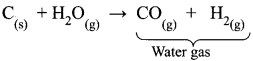
  • By mixing with paramagnetic molecules such as O2, NO, NO2.
  • By treating with nascent/atomic hydrogen.

Question 37.
Mention the uses of deuterium.
Answer:

  • Deuterium is used as a tracer element.
  • Deuterium is used to study the movement of ground water by isotopic effect.

Question 38.
Explain preparation of hydrogen using electrolysis.
Answer:
High purity of hydrogen (>99.9%) is obtained by the electrolysis of water containing traces of acid or alkali or electrolysis of aqueous solution of sodium hydroxide or potassium hydroxide using a nickel anode and iron cathode. This process is not economical for large scale production.
At anode : 2OH → H2O + ½ O2 + 2e
At cathode : 2H2O + 2e → 2OH + H2
Overall reaction : H2O → H2 + 14 O2

Question 39.
A groups metal (A) which is present in common salt reacts with (B) to give compound (C) in which hydrogen is present in -1 oxidation state. (B) on reaction with a gas (C) to give universal solvent (D). The compound (D) on reacts with (A) to give (B), a strong base. Identify A, B, C, D and E. Explain the reactions.
Answer:
1.Group (1) metal (A) is present in common salt NaCl. So, (A) is sodium – Na.
2. Sodium reacts with hydrogen (B) to give sodium hydride – NaH (C) in which hydrogen is in -1 oxidation state.
Samacheer Kalvi 11th Chemistry Book Solutions Chapter 4 Hydrogen
3. Hydrogen on reaction with oxygen (O2) gas which is (C) to give a universal solvent water (D).
Hydrogen 11th Chemistry Solutions Chapter 4 Samacheer Kalvi
4. Water (D) reacts with sodium metal (A) to give a strong base sodium hydroxide NaOH which is (E).
Hydrogen Class 11 Questions And Answers Chapter 4 Samacheer Kalvi
Samacheer Kalvi 11th Chemistry Solutions Chapter 4 Hydrogen

Question 40.
An isotope of hydrogen (A) reacts with diatomic molecule of element which occupies group number 16 and period number 2 to give compound (B) is used as a modulator in nuclear reaction. (A) adds on to a compound (C), which has the molecular formula C3H6 to give (D). Identify A, B, C and D.
Answer:
1. An isotope of hydrogen Deuterium (A) reacts with diatomic molecule of element belongs to group number 16 and period number 2 oxygen O2 to give a compound (B) which is heavy water D2O. D2O is used as a moderator in nuclear reaction.
11th Chemistry Deleted Book Back Questions Samacheer Kalvi Chapter 4
2. Deuterium reacts with C3H6 propane (C) to give Deutero propane C2D6 (D).
Samacheer Kalvi 11th Chemistry Solutions Chapter 4 Hydrogen

Question 41.
NH3 has exceptionally high melting point and boiling point as compared to those of the hydrides of the remaining element of group 15- Explain.
Answer:

  1. NH3 has exceptionally high melting point and boiling point due to hydrogen bonding between NH3 molecules.
  2. Each molecule can form a maximum of 4 hydrogen bonds but on average 1 hydrogen bond per molecule as there is only one lone pair on NH3 available for hydrogen bonding.
  3. Hydrogen bonding is strong intermolecular attraction as H on NH3 acts like a proton due to partial positive on it whole N has the partial negative charge. Thus when the very polarized H comes close to a N atom in another NH3 molecule, a very strong hydrogen bond is formed.
  4. Due to much strong intermolecular interactions compared to weaker permanent dipole-dipole interactions between other XH3 molecules in group 15, large amount of energy are required to overcome the forces, giving it the highest boiling point and highest melting point.

Question 42.
Why interstitial hydrides have a lower density than the parent metal.
Answer:

  • d block elements form metallic or interstitial hydrides, on heating with dihydrogen under pressure.
  • Hydrogen atom being small in size occupy some in the metallic lattice producing distortion without any change in its type.
  • The densities of these hydrides are lower than those of metals from which they are formed since the crystal lattice expands due to the inclusion of dihydrogen.

Question 43.
How do you expect the metallic hydrides to be useful for hydrogen storage?
Answer:
In metallic hydrides, hydrogen is adsorbed as H-atoms. Due to the adsorption of H atoms the metal lattice expands and become unstable. Thus, when metallic hydride is heated, it decomposes to form hydrogen and finely divided metal. The hydrogen evolved can be used as fuel.

Question 44.
Arrange NH3, H2O and HF in the order of increasing magnitude of hydrogen bonding and explain the basis for your arrangement.
Answer:

  • Increasing magnitude of hydrogen bonding among NH3, H2O and HF is
    HF>H2O>NH3
  • The extent of hydrogen bonding depends upon electronegativity and the number of hydrogne atoms available for bonding.
  • Among N, F nd O the increasing order of their electronegativities are
    N<O H2O>NH3.

Question 45.
Compare the structures of H2O and H2O2.
Answer:
In water, O is sp3 hybridized. Due to stronger lone pair-lone pair repulsions than bond pair-bond pair repulsions, the HOH bond angle decreases from 109.5° to 104.5°. Thus water molecule has a bent structure.
Samacheer Kalvi Guru 11th Chemistry Solutions Chapter 4 Hydrogen
H2O2 has a non-planar structure. The 0 – H bonds are in different planes. Thus, the structure of H2O2 is like an open book.
Samacheer Kalvi 11th Chemistry Solutions Chapter 4 Hydrogen

Samacheer Kalvi 11th Chemistry Hydrogen Additional Questions Solved

I. Choose the correct answer:

Question 1.
Which one of the following element mostly present in the sun and the stars?
(a) Hydrogen
(b) Lithium
(c) Helium
(d) Beryllium
Answer:
(a) Hydrogen

Question 2.
is the most abundant 90% of all atoms…………
(a) Lithium
(b) Hydrogen
(c) Oxygen
(d) Silicon
Answer:
(A) Hydrogen

Question 3.
At room temperature normal hydrogen consists of …………….
(a) 25% ortho form + 75% para form
(b) 50% ortho form + 50% para form
(c) 75% ortho form + 25% para form
(d) 60% ortho form + 40% para form
Answer:
(c) 75% ortho form + 25% para form

Question 4.
Which one of the metal is used to convert para hydrogen into ortho hydrogen?
(a) Copper
(b) Aluminium
(c) Sodium
(d) Platinum
Answer:
(d) Platinum

Question 5.
Consider the following statements…………….
(i) In ortho form of hydrogen molecule, the nuclear spins are opposed to each other
(ii) The magnetic moment of para hydrogen is twice that of ortho hydrogen
(iii) By passing an electric discharge, para hydrogen can be converted into ortho hydrogen. Which of the above statement is/are not correct?
(a) (i) only
(b) (iii) only
(c) (i) and (ii)
(d) (ii) and (iii)
Answer:
(c) (i) and (ii)

Question 6.
Which of the following is not used in the conversion of para hydrogen into ortho hydrogen?
(a) by heating more than 800°C
(b) by passing an electric discharge
(c) by mixing with atomic hydrogen
(d) by mixing with diamagnetic molecules
Answer:
(d) by mixing with diamagnetic molecules

Question 7.
The magnetic moment of para hydrogen is ……………
(a) one
(b) zero
(c) twice
(d) maximum
Answer:
(b) zero

Question 8.
Which one of the following does not contain neutron?
(a) ordinary hydrogen
(b) Heavy hydrogen
(c) Radioactive hydrogen
(d) Deuterium
Answer:
(a) ordinary hydrogen

Question 9.
The half life period of tritium is ……………..
(a) 123.3 year
(b) 12.33 years
(c) 1 year
(d) 1600 years
Answer:
(a) 12.33 years

Question 10.
Which of the following is used in illumination of wrist watches?
(a) Phosphorous
(b) Radon
(c) Tritium
(d) Deuterium
Answer:
(c) Tritium

Question 11.
Which one of the following is used to study the movements of ground water?
(a) Deuterium
(b) Protium
(c) Tritium
(d) HD
Answer:
(a) Deuterium

Question 12.
By which rays nuclear reactions are induced in upper atmosphere to produce tritium?
(a) α-rays
(b) β-rays
(c) γ-rays
(d) cosmic rays
Answer:
(d) cosmic rays

Question 13.
Which of the following is produced by bombardment of neutrons with lithium?
(a) Deuterium
(b) Protium
(c) Tritium
(d) Beryllium
Answer:
(c) Tritium

Question 14.
Consider the following statements ……………..
(i) Tritium is a beta emitting radioactive isotope of hydrogen.
(ii) Deuterium is known as heavy hydrogen.
(iii) Deuterium is used in emergency exit signs.
Which of the following statement is/are not correct?
(a) (i) only
(b) (iii) only
(c) (i) and (ii)
(d) (i) (ii) and (iii)
Answer:
(b) (iii) only

Question 15.
Which of the following mixture of gases is called water gas?
(a) CO2(g)  + H2(g)
(b) CO2(g) + N2(g)
(c) CO(g) + H2(g)
(d) N2(g) + H2(g)
Answer:
(c) CO(g) + H2(g)

Question 16.
Consider the following statements.
(i)Hydrogen is a colourless, odourless, tasteless heavy and highly inflammable gas.
(ii) Hydrogen is a good reducing agent.
(ii) Hydrogen can be liquefied under low pressure and high temperature.
Which of the above statements is/are not correct?
(a) (i) only
(b) (ii) only (c)
(c) (i) and (iii)
(d) (ii) and (Hi)
Answer:
(c) (i) and (iii)

Question 17.
The products formed during the cracking long chain hydrocarbon C6H12 are
(a) CO2 + H2O
(b) CO + H2
(c) C6H10 + H2
(d) C6H6 + 3H2
Answer:
(d) C6H6 + 3H2

Question 18.
Which one of the following is manufactured in Haber’s process?
(a) SO3
(b) NH3
(C) N2
(d) H2
Answer:
(b) NH3

Question 19.
Hydrogen combines with carbon monoxide in the presence of copper catalyst will synthesise
(a) Ethanol
(b) Methane
(c) Methanol
(d) Methanal
Answer:
(c) Methanol

Question 20.
Match the List-I and List-II using the correct code given below the list.
List-I
A. Hydrogenation of unsaturated vegetable oils
B. Calcium hydride
C. Liquid hydrogen
D. Atomic hydrogen

List-II
1. Rocket fuel
2. Welding of metals
3. Desiccant
4. Margarine
11th Chemistry Samacheer Kalvi Solutions Chapter 4 Hydrogen
Answer:
Samacheer Kalvi Chemistry 11th Solutions Chapter 4 Hydrogen

Question 21.
Statement-I: Hydrogen is placed at the top of the group which is in-line with the latest periodic table.
Statement-II: Hydrogen has a tendency to lose its electron to form H+, thus showing electropositive character like alkali metals. On the other hand, hydrogen has a tendency to gain an electron to yield H , thus showing electronegative character like halogens.
(a) Statements-I and II are correct and Statement-II is the correct explanation of statement-I.
(b) Statements-I and II are correct but Statement-II is not the correct explanation of statement-I.
(c) Statement-I is correct but Statement-II is wrong.
(d) Statement-I is wrong but Statement-II is correct.
Answer:
(a) Statements-I and II are correct and Statement-II is the correct explanation of statement-I.

Question 22.
Statement-I: The magnetic moment of para-hydrogen is zero.
Statement-II: The spins of two hydrogen atoms in para H2 molecule neutralise each other.
(a) Statements-I and II are correct and Statement-II is the correct explanation of statement-I.
(b) Statements-I and II are correct but Statement-II is not the correct explanation of statement-I.
(c) Statement-I is correct but Statement-II is wrong.
(d) Statement-I is wrong but Statement-II is correct.
Answer:
(a) Statements-I and II are correct and Statement-II is the correct explanation of statement-I.

Question 23.
Which of the following process is important in food industry?
(a) Dehydration
(b) Dehalogenation
(c) Hydrogenation
(d) Carboxylation
Answer:
(c) Hydrogenation

Question 24.
Which of the following is used as desiccants to remove moisture from organic solvents?
(a) Calcium hydride
(b) LiAlH4
(c) Sodium boro hydride
(d) Sodium hydride
Answer:
(a) Calcium hydride

Question 25.
Which of the following is used for cutting and welding?
(a) Atomic hydrogen and oxy hydrogen torches
(b) Liquid hydrogen
(c) Calcium hydride
(d) Sodium boro hydride
Answer:
(a) Atomic hydrogen and oxy hydrogen torches

Question 26.
Liquid hydrogen is used as
(a) a rocket fuel as well as in space research
(b) fuel cells for generating electrical energy
(c) cutting and welding torch
(d) desiccant to remove moisture from organic solvent
Answer:
(a) a rocket fuel as well as in space research

Question 27.
Which one of the following is a universal solvent?
(a) Alcohol
(b) Ether
(c) CCl4
(d) Water
Answer:
(d) Water

Question 28.
At the temperature conditions of the earth (300K) the OPR of H2O is ……………
(a) 2.5
(b) 3
(c) 1
(d) zero
Answer:
(b) 3

Question 29.
Water does not react with
(a) Sodium
(b) Magnesium
(c) Beryllium
(d) Calcium
Answer:
(c) Beryllium

Question 30.
Which of the following does not have any effect with water?
(a) Sodium
(b) Iron
(c) Lead
(d) Mercury
Answer:
(d) Mercury

Question 31.
Which set of the metals do not have any effect on water?
(a) Ag, Au, Pt
(b) Na, Mg, Al
(c) Fe, Ca, Zn
(d) Fe, Pb, Na
Answer:
(a) Ag, Au, Pt

Question 32.
Which of the following non-metal reacts with ordinary water?
(a) Carbon
(b) Sulphur
(c) Chlorine
(d) Phosphorous
Answer:
(c) Chlorine

Question 33.
Consider the following statements.
(i) Silver, Gold, Mercury and Platinum do not have any effect on water.
(ii) Carbon, Sulphur and Phosphorous do not react with water.
(iii) Beryllium reacts with water less violently.
Which of the following statements is/are not correct?
(a) (i) only
(b) (ii) and (iii)
(c) (iii) only
(d) (ii) only
Answer:
(c) (iii) only

Question 34.
Which one of the following is used as a bleach?
(a) Cl2 water
(b) Br, water
(c) Water gas
(d) Liquid hydrogen
Answer:
(a) Cl2 water

Question 35.
Water is an/a oxide.
(a) neutral
(b) acidic
(c) basic
(d) amphoteric
Answer:
(d) amphoteric

Question 36.
Permanent hardness of water is removed by
(a) boiling
(b) lime
(c) washing soda
(d) chlorine
Answer:
(c) washing soda

Question 37.
Which one of the following is used as water softener?
(a) Zeolites
(b) lime
(c) washing soda
(d) bleaching powder
Answer:
(a) Zeolites

Question 38.
In chelating method of softening of hard water is used.
(a) magnesia
(b) lime
(c) EDTA
(d) washing soda
Answer:
(c) EDTA

Question 39.
Which of the following is used to remove toxic and heavy metals from water?
(a) zeolites
(b) magnesia
(c) Bleaching agent
(d) lime
Answer:
(a) zeolites

Question 40.
Match the List-I and List-Il using the code given below the list.
List-I
A. Heavy water
B. Hydrogen peroxide
C. Heavy hydrogen
D. Lithium Aluminium hydride

List-Il
1. Antiseptic
2. Moderator
3. Reducing agent
4. Tracer
Samacheer Kalvi 11th Chemistry Solutions Chapter 4 Hydrogen
Answer:
Samacheer Kalvi Class 11 Chemistry Solutions Chapter 4 Hydrogen

Question 41.
Consider the following statements.
(i) H2O2 is a powerful oxidising agent.
(ii) H2O2 is stored in dark coloured bottles
(iii) H2O2 is used as moderator in nuclear reactors.
Which of the above statements is/are not correct.
(a) (i) only
(b) (i) and (ii)
(c) (iii) only
(d) (i), (ii) and (iii)
Answer:
(c) (iii) only

Question 42.
Statement-I: Heavy water has been widely used as moderator in nuclear reactors.
Statement-Il: Heavy water can lower the energies of fast moving neutrons.
(a) Statements-I and II are correct and Statement-Il is the correct explanation of statement-I.
(b) Statements-I and II are correct but Statement-IT is not the correct explanation of statement-I;
(c) Statement-I is correct but Statement-Il is wrong.
(d) Statement-I is wrong but Statement-Il is correct.
Answer:
(a) Statements-I and II are correct and Statement-Ills the correct explanation of statement-I.

Question 43.
Which one of the following is prepared in industry by the auto oxidation of 2-alkylanthraquional?
(a) Heavy water
(b) Deuterium
(c) Hydrogen peroxide
(d) Tritium
Answer:
(c) Hydrogen peroxide

Question 44.
Which one of the following is an ionic or saline hydride?
(a) SiH4
(b) GeH4
(c) B2H6
(cl) LiH
Answer:
(d) LiH

Question 45.
Which one of the following is an electron deficient hydride?
(a) C2H6
(b) B2H6
(c) GeH4
(d) CH4
Answer:
(b) B2H6

Question 46.
Which of the following pair is an electron rich hydride?
(a) NH3, H2O
(b) CH4, C2H6
(c) B2H6, GeH4
(d) CH4, SiH4
Answer:
(a) NH3, H2O

Question 47.
Which one of the following is not a covalent hydride?
(a) Ammonia
(b) Methane
(c) Lithium hydride
(d) water
Answer:
(e) Lithium hydride

Question 48.
Metallic hydrides are otherwise called …………….
(a) Salt hydrides
(b) Saline hydrides
(c) molecular hydrides
(d) Interstitial hydrides
Answer:
(d) Interstitial hydrides

Question 49.
Which one of the following is used for hydrogen storage applications?
(a) Saline hydrides
(b) Interstitial hydrides
(c) covalent hydrides
(d) molecular hydrides
Answer:
(b) Interstitial hydrides

Question 50.
Which one of the following is known as Hydrogen sponge?
(a) Lithium hydride
(b) Diborane
(c) Palladium hydride
(d) Ammonia
Answer:
(c) Palladium hydride

Question 51.
Which of the following is the correct order of stability of bonds?
(a) Hydrogen bond < CovaLent bond < Vanderwaals bond
(b) Vanderwaals bond < Hydrogen bond <Covalent, bond
(c) Vanderwaals bond > Hydrogen bond > Covalent bond
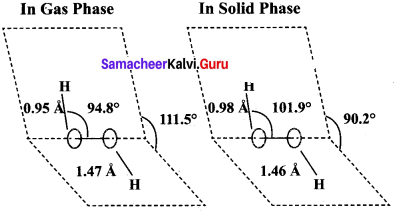

(d) Covalent bond < Hydrogen bond <Vanderwaals bond
Answer:
(b) Vanderwaals bond < Hydrogen bond <Covalent, bond

Question 52.
Which one of the following does not have intramolecular hydrogen bonding?
(a) water
(b) o-nitrophenol
(c) Salicylaldehyde
(d) Salicylic acid
Answer:
(a) water

Question 53.
Which of the following contains intramolecular hydrogen bonding?
(a) Acetic acid
(b) o-nitrophenol
(c) Hydrogen fluoride
(d) water
Answer:
(b) o-nitrophenol

Question 54.
Consider the following statements.
(i) In ice, each oxygen atom is surrounded by hydrogen atoms tetrahedrally to four water molecules.
(ii) Acetic acid exists as dimer due to intra molecular hydrogen bonding.
(iii) Strong hydrogen bonds lead to an increase in the melting and boiling points.
Which of the above statements is/are not correct? ,
(a) (ii) only
(b) (i) and (iii)
(c) (i) (ii) and (iii)
(d) (i) only
Answer:
(a) (ii) only

Question 55.
Which one of the following is an example for Clatharate hydrate?
(a) CuSO4.5H2O
(b) Na2CO3. 10H2O
(c) CH4. 20 H2O
(d) FeSO3.7H2O
Answer:
(c) CH4. 20 H2O

Question 56.
Which one of the following is not a crystalline hydrate?
(a) CH4. 20H2O
(b) Na2,CO3. 10H2O
(c) CuSO4.5H2O
(d) FeSO4.7H20
Answer:
(a) CH4. 20H2O

Question 57.
Statement-I: Hydrogen can be used as a clean burning fuel.
Statement-II: Hydrogen on combustion give only water as end product and it is free from pollutants.
(a) Statements-I and li are correct and Statement-lI is the correct explanation of statement-I.
(b) Statements-I and II are correct but Statement-Il is not the correct explanation of statement-I.
(e) Statement-I is correct but Statement-Il is wrong.
(d) Statement-I is wrong but Statement-lI is correct.
Answer:
(a) Statements-I and II are correct and Statement-Il is the correct explanation of statement-I.

Question 58.
Which isotope of hydrogen is radioactive?
(a) Protium
(b) Deuterium
(c) Tritium
(d) H
Answer:
(c) Tritium

Question 59.
Which type of elements form interstitial hydrides ………..
(a) s-block and p-block
(b) p-block only
(c) d-block and f-block
(d) s-block only
Answer:
(c) d-block and f-block

Question 60.
Which of the following is named as perhydrol and used as an antiseptic?
(a) D2O
(b) H2O2
(c) NaH
(d) B2H6
Answer:
(b) H2O2

Question 61.
Which of the following causes temporary hardness of water?
(a) MgCl2
(b) Na2SO4
(c) Mg(HCO3)2
(d) NaCl
Answer:
(c) Mg(HCO3)2

Question 62.
Which of the following can oxidise Hydrogen peroxide?
(a) acidified KMnO4
(b) Cu
(c) dil. HNO4
(d) CrO2Cl2
Answer:
(a) acidified KMnO4

Question 63.
Which type of hydrides are generally non-stoichiometric in nature?
(a) Metallic hydride
(b) Covalent hydrides
(c) Ionic hydride
(d) Saline hydride
Answer:
(a) Metallic hydride

Question 64.
Hydrogen gas is generally prepared by the ………….
(a) reaction of granulated zinc with dilute H2SO4
(b) reaction of zinc with cone, H2SO4
(c) reaction of pure zinc with dil. H2SO4
(d) action of stream on red hot coke
Answer:
(a) reaction of granulated zinc with dilute H2SO4

Question 65.
The higher density of water than that of ice is due to ……………
(a) dipole-dipole interaction
(b) dipole-induced dipole interaction
(c) hydrogen bonding
(d) all of these
Answer:
(c) hydrogen bonding

Question 66.
Hydrogen resembles halogens in many respects for which several factors are responsible. Of the following factors which one is most important in this respect?
(a) Its tendency to lose an electron to form a cation.
(b) Its tendency to gain an electron to attain stable electronic configuration.
(c) Its low negative electron gain enthalpy value.
(d) Its small size.
Answer:
(b) Its tendency to gain an electron to attain stable electronic configuration.

Question 67.
Metal hydrides are ionic, covalent or molecular in nature. Among L1H, NaH, KH, RbH, CsH, the correct order of increasing ionic character is ………….
(a) LiH>NaH>CsH>KH>RbH
(b) LiH<NaH<KH<RbHCsH>NaH>Kil>LIH
(d) NaH>CsH>RbH>LiH>KH
Answer:
(b) LiH<NaH<KH<RbH<CsH

Question 68.
Statement-I: Permanent hardness of water is removed by treatment with washing soda ………..
Statement-II: Washing soda reacts with soluble magnesium and calcium sulphate to form insoluble carbonate.
(a) Statements-I and II are correct and Statement-Il is the correct explanation of statement-I.
(b) Statements-I and II are correct but Statement-Il is not the correct explanation of statement-I.
(c) Statement-I is correct but Statement-II is wrong.
(d) Statement-I is wrong but Statement-II is correct.
Answer:
(a) Statements-I and II are correct and Statement-Ills the correct explanation of statement-I.

Question 69.
Which of the following is a saline hydride?
(a) HCl
(b) NH3
(c) NaH
(d) PbH
Answer:
(e) NaH

Question 70.
Which metal does not liberate H2 gas from dilute aqueous hydrochloric acid at 298 K?
(a) Mg
(b) Zn
(c) Al
(d) Cu
Answer:
(d) Cu

Question 71.
When zeolite is treated with hard water, the sodium ions are exchanged with …………
(a) H+ ions and Cl ions
(b) Ca2+ ions
(c) Cl ions
(d) Ca2+ ions and Mg2+ ions
Answer:
(d) Ca2+ ions and Mg2+ ions

Question 72.
The most abundant element in the universe is …………..
(a) Carbon
(b) Nitrogen
(c) Silicon
(d) Hydrogen
Answer:
(d) Hydrogen

Question 73.
Which of the following can effectively remove all types of hardness of water?
(a) Soap
(b) Slaked lime
(c) Washing soda
(d) Zeolite
Answer:
(a) Soap

Question 74.
A commercial sample of H2O2 is labelled as 100 volume. Its percentage strength is nearly
(a) 10%
(b) 30%
(c) 100%
(d) 90%
Answer:
(b) 30%

Question 75.
Which of the following will not produce di hydrogen gas?
(a) Cu + dil (HCl)
(b) CH2(g) + H2O(g)
(c) Zn + dil. HCl
(cl) C(s) + H2O(g)
Answer:
(a) Cu + dil (HCl)

Samacheer Kalvi 11th Chemistry Hydrogen 2-Mark Questions
Question 1.
Draw and define ortho and para hydrogen molecule.
Answer:
Molecular hydrogen have oriho and para form in which the nuclear spins are aligned or opposed, respectively.
Samacheer Kalvi 11th Chemistry Guide Pdf Solutions Chapter 4 Hydrogen

Question 2.
What is the nuclear reaction that take place in the sun and other stars?
Answer:
The sun and other stars are composed mainly of 85 – 95% hydrogen which generates their energy by nuclear fusion of hydrogen nuclei into helium.

Question 3.
Mention the uses of tritium.
Answer:

  • Tritium has replaced radium in application such as emergency exit sign.
  • Tritium is used in illumination of wrist watches.

Question 4.
Draw the structures of three isotopes of hydrogen, Hydrogen Deuterium
Answer:
11 Chemistry Samacheer Kalvi Solutions Chapter 4 Hydrogen

Question 5.
What is the half life period of tritium? How is it undergoes radioactive disintegration?
Answer:

  • The half life of tritium = 12.33 years.
  • Tritium is a beta-emitting radioactive isotope of hydrogen.
    Samacheer Kalvi.Guru 11th Chemistry Solutions Chapter 4 Hydrogen

Question 6.
Why hydrogen gas is used as fuel?
Answer:
Hydrogen burns in air, virtually free from pollution and produces significant amount of energy. This reaction is used in fuel cells to generate electricity.
2H2(g) + O2(g) → 2H2O(l) + energy

Question 7.
How ammonia is manufactured from Hydrogen? Give the uses of ammonia.
Answer:

  • Ammonia is manufactured by Habe?s prôcess in which the largest consumer of hydrogen is used.
    N2(g) + 3H2(g) ⇌ 2 NH3(g)
  • Ammonia is employed for the manufacture of nitric acid, fertilizers and explosives.

Question 8.
how ¡s methanol synthesized from hydrogen? Give the uses of methanol.
Answer:

  • Huge quantities of hydrogen are used for the synthesis of methanol from carbon monoxide in presence of copper catalyst.
    CO(g) + 2H2(g) → CH3OH(l)
  •  Methanol is an industrial solvent and a starting material for the manufacture of formaldehyde used in makihg plastics.

Question 9.
What is hydrogenation? Give one example.
Answer:
Hydrogenation is a reaction in which addition of hydrogen to an alkene /alkyne. Compounds containing multiple bonds.
Samacheer Kalvi 11th Chemistry Solutions Chapter 4 Hydrogen

Question 10.
How is hydrogen used in metallurgy? Prove it with an example.
Answer:
In metallurgy, for the extraction of pure metals from their mineral sources, hydrogen is used to reduce many metal oxides to metals at high temperatures.
CuO(s) +H2(g) → Cu(s) +H(2)O(g)

Question 11.
How alkali metals react with water? Give an equation?
Answer:
The most reactive alkali metals decompose water in the cold with the evolution of hydrogen and leaving an alkali solution.
2Na(s) +2H2O(l) → 2NaOH(aq) +H2(g)

Question 12.
What happens when steam is passed over red hot iron?
Answer:
When steam is passed over red hot iron, iron oxide will be formed with the release of hydrogen.
3Fe(s) + 4H2O(l) → Fe3O + 4H4(g)

Question 13.
Explain the action of chlorine with water.
Answer:
Chlorine reacts with the water to form hydrochloric acid and hypochiorous acid.
Cl2(g) + H2O(l) → HCl(aq) + HOCl(aq)

Question 14.
What is temporary hardness of water? How is it removed?
Answer:
Temporary hardness of water is due to the presence of soluble bicarbonates of magnesium and calcium. By heating / boiling, these salts decomposed into insoluble carbonate and hydroxide, respectively. The resulting precipitates can be removed by filtration.
Ca (HCO3)2(aq) → CaCO3(s) + H2O(l) + CO2(l)
Mg(HCO3)2(aq) → Mg(OH)2(s) + CO2(g)

Question 15.
What ¡s permanent hardness of water? How ¡t will be removed?
Answer:
Permanent hardness of water is due to the presence of soluble salts of magnesium and calcium in the form of chlorides and suiphates in water. It can be removed by adding washing soda which reacts with these metal chlorides and suiphates in hard water to form insoluble carbonates.
MCl2(aq) + Na2CO3(aq) → MCO3(s) + 2NaCl(aq)
MSO4(aq) + Ni2 CO3(aq) → MCO3(s) + Na2SO4(s)
Where M = Ca or Mg.

Question 16.
How would you prepare Hydrogen peroxide?
Answer:
Hydrogen peroxide can be prepared by adding a metal peroxide to dilute acid.
BaO2(s)+ H2SO4(aq) → BaSO4(s) + H3O2(aq)

Question 17.
H2O2 is always stored in plastic bottles. Why?
Answer:
The aqueous solution of hydrogen peroxide is spontaneously disproportionate to give oxygen. The reaction is slow but it is explosive when it is catalyzed by metal or alkali dissolved from glass. For this reason, its solution are stored in plastic bottles.
H2O2(aq) → H2O(l) + ½ O2(g)

Question 18.
Why H2O2 ¡s used as mild antiseptic?
Answer:
The oxidising property of hydrogen peroxide and harmless nature of its products such as water and oxygen, leads to oxidation of pollutants in water and act as a mild antiseptic.

Question 19.
Why the bond angle in solid phase of H2O2 is reduced when compared to gas phase of H2O2?
Answer:
Both the gas phase and solid phase, H2O2 adopt a skew configuration due to the repulsive interaction of the OH bonds with lone pairs of electrons on each oxygen atoms. Indeed, it is the smallest molecule known to show hindered rotation about a single bond. In the solid phase, the dihedral angle is sensitive and hydrogen bonding decreases from 111.50 in the gas phase to 90.2 in the solid phase.

Question 20.
What is meant by 100 – volume hydrogen peroxide?
Answer:
A 30% solution is marketed as 100 – volume hydrogen peroxide indicating that at STP, 100 volumes of oxygen are liberated per millimeter of the solution.

Question 21.
Prove that Hydrogen peroxide is a vigorous oxidizing agent and the solution of H2O2 is slightly acidic.
Answer:
H2 O2(aq) + 2 H2O(l) ⇌ H3 O+(aq) + HO+2(aq)

H3O+ Hydronium ion formation proves that solution of H2O2 is acidic. Because it donates H+ to H2O to form H3O+ ion.
H2O2 oxidizes Ferrous sulphate to Ferric sulphate in acidic medium.
2FeSO4(aq) + H2SO4(aq) + H4O2(aq) ⇌ Fe2(SO4)3(aq)( + 2H2O(l)

Question 22.
What is meant by binary hydride? Give example.
Answer:
A binary hydride is a compound formed by hydrogen with other electropositive elements including metals and non-metals, e.g., LiH or MgH2.

Question 23.
What are ternary hydrides? Give example?
Answer:
Ternary hydrides are compounds in which the molecule is constituted by hydrogen and two types of elements, e.g., LiBH4 or LiAlH4.

Question 24.
What arc the different types of hydrides?
Answer:
The hydrides are classified as Ionic, Covalent and Metallic Hydrides.
Ionic hydride – LiH
Covalent hydride – CH4
Metallic hydride -TiH

Question 25.
Why metallic hydrides are called interstitial hydrides? Give one example.
Answer:
Metallic hydrides are usually obtained by hydrogenation of metals and alloys in which hydrogen occupies the interstitial sites (voids). Hence, they are called interstitial hydrides. e.g., PdH.

Question 26.
What is hydrogen bonding?
Answer:
When a hydrogen atom (H) is covalently bonded to a highly electronegative atom such as fluorine (F) or oxygen (O) or nitrogen (N), the bond is polarized in such a way that the hydrogen atom is able to form a weak bond between the hydrogen atom of a molecule and the electronegative atom of a second molecule. The bond thus formed is a hydrogen bond and it is denoted by dotted lines (……)

Question 27.
What are the types of hydrogen bonding? Give example.
Answer:
There are two types of hydrogen bonding.

  • Intramolecular hydrogen bonding: It can occur with a molecule. e.g., o – nitrophenol.
  • Intermolecular hydrogen bonding: It is formed between two molécules of same type or different type. e.g., H2O.

Question 28.
Explain about the type of bonding present in hydrogen fluoride?
Answer:
In hydrogen fluoride (HF), for example, one molecule is strongly attracted to the fluorine on its neighboring hydrogen. In both liquid and solid, hydrogen fluoride forms long hydrogen bonded zig-zag chains as a consequence of the orientation of the lone pairs on the fluorine atoms.
Samacheer Kalvi 11th Chemistry Solutions Chapter 4 Hydrogen

Question 29.
Ice is less dense than water at 0°C. Justify this statement.
Answer:
In ice, each oxygen atom is surrounded tetrahedrally by through hydrogen bonds to four water molecules. That is, the presence of two hydrogen atoms and two lone electron pairs (on oxygen) in each water molecule results in a three – dimensional structure. The arrangements creates an open structure, which in turn accounts for the fact that ice is less dense than water at 0°C.

Question 30.
Draw the structure of –

  1. Acetic acid
  2. Water.

Answer:
1. Acetic acid:
Samacheer Kalvi 11th Chemistry Solutions Chapter 4 Hydrogen
2. Water:
Samacheer Kalvi 11th Chemistry Solutions Chapter 4 Hydrogen

Question 31.
Write a note about gas hydrates.
Answer:
Gas hydrates are a kind of inclusion compounds, where gas molecules arc trapped in the crystal lattice having voids of right size, without being chemically bonded. An interesting hydrate is that of the hydronium ion (H2O) in the gas-phase, similar to methane hydrate. Each water molecule is bonded to three others in the dodecahedron.

Question 32.
Give the advantages of future fuel – Hydrogen.
Answer:
Hydrogen is considered as a potential candidate for this purpose as it is a clean burning fuel. Hence, hydrogen can directly be used as a fuel and can replace existing gasoline (petrol) diesellkerosene powered engines, and indirectly be used with oxygen in fuel cells to generate electricity. One major advantage of using hydrogen is that the combustion product is essentially free from pollutants; the end product formed in both cases is water.

Question 33.
What do you understand by the term non-stoichiometric hydrides’? Do you expect this type of hydrides to be formed by alkali metals? Justify your answer.
Answer:
Those hydrides which do not have fixed composition are called non-stoichiometric hydrides, and the composition varies with temperature and pressure. This type of hydrides are formed by d and f-block elements. They cannot be formed by alkali metals because alkali thetal hydrides form ionic hydrides.

Question 34.
How does the atomic hydrogen or oxy – hydrogen torch function for cutting and welding purposes? Explain.
Answer:
When hydrogen is burnt in oxygen the reaction is highly exothermic, it produces very high temperature nearly 4000°C which is used for cutting and welding purposes.

Question 35.
How does H2O2 behave as bleaching agent?
Answer:
Bleaching action of H2O2 is due to the oxidation of colouring matter by nascent oxygen.
H2 O2 → H2O(l) + O(g)

Question 36.
Can we use concentrated sulphuric acid and pure zinc in the preparation of dihydrogen?
Answer:
Cone. H2SO4 cannot be used because it acts as an oxidizing agent also and gets reduced to SO2
Zn + 2H2SO4 (Conc.) → ZnSO4 + 2H2O + SO2
Pure Zn is not used because it is non-porous and reaction will be slow. The impurities in Zn help in constitute of electrochemical couple and speed up reaction.

Question 37.
Write the chemical reactions to show the amphoteric nature of water.
Answer:
Water is amphotenc in nature and it behaves both as an acid as well as base. With acids stronger than itself (e.g., H2S) it behaves as a base and with bases stronger than itself (e.g., NH3) it acts as an acid.

  1. As a base : H2O(l) + H2S(aq) → H3 O(aq) + HS(aq)
  2. As an acid : H2O(l) + NH3(aq) → OH(aq) + NH+4(aq)

Question 38.
Why is hydrogen peroxide stored ¡n wax-lined plastic coloured bottles?
Answer:
The decomposition of H2O2 occurs readily in the presence of rough surface (acting as catalyst). It is also decomposed by exposure of light. Therefore, wax-lined smooth surface and coloured bottles retard the decomposition of H2O2.

Samacheer Kalvi 11th Chemistry Hydrogen 3 – Mark Questions

Question 1.
Compare the properties of ortho and para hydrogen.
Answer:

s.noPropertiesOrtho hydrogenPara hydrogen
1.Melting point13.95 K13.83 K
2.Boiling point20.39 K20.26 K
3.Vapour pressurecNormalhigher
4.Magnetic momentTwicezero

Question 2.
Compare the properties of isotopes of hydrogen.
Answer:

s.noPropertyProtiumDeuteriumTritium
1.Atomic natureHDT
2.Atomic mass1.0082.0143.016
3.Nuclear stabilityStableStableRadioactive
4.Molecular hydrogenH2D2T2
5.Abundance(%)99.9850.015᷉10-16
6.Molecular mass2.0164.0286.032

Question 3.
Draw the structure of the isotopes of hydrogen and distinguish them.
Answer:
Samacheer Kalvi 11th Chemistry Solutions Chapter 4 Hydrogen

Question 4.
Explain the different methods of preparation of Tritium with equation.
Answer:
It occurs naturally as a result of nuclear reactions induced by cosmic rays in the upper atmosphere.
Samacheer Kalvi 11th Chemistry Solutions Chapter 4 Hydrogen

Question 5.
How would you prepare hydrogen in the laboratory?
Answer:
Small amounts of hydrogen are conveniently prepared in laboratory by the reaction of metals, such as zinc, iron and tin, with dilute acid.
Zn(s)  + 2HCl(aq) → ZnCl2(s) + H2(g)
In principle, any metal with a negative standard reduction potential will react with an acid to generate hydrogen.
Samacheer Kalvi 11th Chemistry Solutions Chapter 4 Hydrogen

Question 6.
What happens when hydrogen reacts with –

  1. O2
  2. Cl2
  3. Na ?

Answer:

  1. 2 H2(g) + O2(g) → 2 H2O(l) – Water
  2. H2(g) + Cl2(g) → 2 HCl(g) – Hydrogen Chloride
  3. 2 Na(s) + H2(g) → 2 NaH(s) – Sodium hydride

Question 7.
Write a note about ortho water and para water.
Answer:

  1. Water exists in space in the interstellar clouds, ¡n proto-planetary disks, in the comets and icy satellites of the solar system, and on the Earth.
  2. In particular, the ortho-to-para ratio (OPR) of water in space has recently received attention. Like hydrogen, water can also be classified into ortho-H2O and para-H2O, in which the directions are antiparallel.
    Samacheer Kalvi 11th Chemistry Solutions Chapter 4 Hydrogen
  3. At the temperature conditions of the Earth (300 K), the OPR of H2O is 3.
  4. At low temperatures below (< 50 K) the amount of para-H2O increases. It is known that the OPR of water in interstellar clouds and comets has more para-H2O (OPR = 2.5) than on Earth.

Question 8.
Water ¡s an amphoteric oxide. Justify this statement.
Answer:

  1. Water is an amphoteric oxide. It has the ability to act an acid as well as a base. That is, water shows this behavior when it reacts with hydrogen chloride and ammonia.
  2. When water reacts with ammonia, it behaves as an acid.
    Samacheer Kalvi 11th Chemistry Solutions Chapter 4 Hydrogen
  3. When water reacts with hydrogen chloride, behaves as a base.
    Samacheer Kalvi 11th Chemistry Solutions Chapter 4 Hydrogen
    So water is an amphoteric oxide.

Question 9.
Distinguish between Hard water and Soft water.
Answer:
Hard water:

  • Presence of magnesium and calcium in the form of bicarbonate, chloride and sulphate in water makes hard water.
  • Cleaning capacity of soap is rcduced when used in hard water.
  • When hard water is boiled deposits of insoluble carbonates of magnesium and calcium are obtained.

Soft water:

  • Presence of soluble salts of calcium and magnesium in water makes it soft water.
  • Cleaning capacity of soap is more when used in soft water.
  • When soft water is boiled, there is no deposition of salts.

Question 10.
Explain the action of soap with hard water.
Answer:

  • The cleaning capacity of soap is reduced when used in hard water.
  • Soaps are sodium or potassium salts of long chain fatty acids.
  • When soap is added to hard water, the divalent magnesium and calcium cations present in hard water react with soap.
  • The sodium salts present in soaps are converted to their corresponding magnesium and calcium salts which are precipitated as scum or precipitate.
    M2+ + 2RCOONa (RCOO)2M(s) + 2Na+(aq);
    Where, M Ca or Mg;
    R = C17H35.

Question 11.
Describe about ion exchange method of softening water (or) Explain Zeolite (or) Permutit process.
Answer:

  1. Hardness can be removed by passing through an ion-exchange bed like zeohtes or resin containing column. Thus, the zeolites work as water softener.
  2. Zeolites are hydrated sodium alumini-silicates with a general formula, NaO.Al2O3.xSiO2.yH2O (x = 2 – 10, y = 2 – 6). They have high ion exchange capacity.
  3. The complex structure can represented as Na2 – Z with sodium as exchangeable cations. This method is called zeolite or permutit process.
  4. Zeolites have porous structure in which the monovalent sodium ions are loosely held and can be exchanged with hardness producing divalent metal ions (Ca or Mg) in water.
    Na2 – Z(s) + M2+(aq) → M-Z(s) + 2Na+(aq)
  5. When exhausted, the materials can be regenerated by treating with aqueous sodium chloride. Hard minerals caught in the zeolite are released and they get replenished with sodium ions.
    M-Z(s) + 2NaCl(aq) → Na(s)-Z(s) + MCl2(aq)

Question 12.
Explain about the exchange reactions of deuterium oxide.
Answer:
When compounds containing hydrogen are treated with D2O, hydrogen undergoes an exchange for Deuterium.
Samacheer Kalvi 11th Chemistry Solutions Chapter 4 Hydrogen

Question 13.
Complete the following reactions.
A14C3 + D2O → ?
CaC2 + D2O →?
Mg3N2 + D2O →?
Ca3P2 + D2O →?
Answer:
Samacheer Kalvi 11th Chemistry Solutions Chapter 4 Hydrogen

Question 14.
What are the uses of hydrogen peroxide?
Answer:

  • H2O2 is used in water treatment to oxidize pollutants.
  • H2O2 is used as a mild antiseptic.
  • H2O2 is used as a bleach in textile, paper and hair-care industry.

Question 15.
Prove that H2O2 act as reducing agent ¡n alkaline medium.
Answer:
In alkaline conditions, H2O2 act as a reducing agent.
2KMnO4(aq)(Potassium permanganate) + 3 H2SO4(aq) + 5H2O2(aq) → K2 SO4 + 2MnSO4 + 8H2 O(l) + 5O2(g)

Question 16.
Write a note about saline (or) ionic hydride.
Answer:
Ionic hydrides composed of an electropositive metal, generally, an alkali or alkaline-earth metal (except beryllium and magnesium) formed by transferring of electrons from metal to hydrogen atoms. They can be prepared by the reaction of elements at about 400°C. These are salt-like, high-melting, white, crystalline solids having hydride ions (H) and metal cations (Mn+).
2Li(s) + H2(g) → 2LiH(s) (Lithiuinhydride)
2 Ca(s) + H2(g) → 2 CaH2(s) (Calcium hydride)

Question 17.
What are metallic hydrides? Explain about it.
Answer:

  • Metallic hydrides are obtained by hydrogenation of metals and alloys in which hydrogen occupies the interstitial sites (voids). Hence, they are called interstitial hydrides.
  • The hydrides show properties similar to parent metals and hence they are also known as metallic hydrides.
  • They arc mostly non-stoichiometric with variable composition (TiH1.5-1.818 and PdH0.6-0.8).
  • Some are relatively light, inexpensive and thermally unstable which makes them useful for hydrogen storage applications. Example, TiH2, ZrH2, ZnH2.

Question 18.
What are intra molecular hydrogen bonding? Explain with an example.
Answer:

  1. Intramolecular hydrogen bonds are those which occur within one single molecule. This occurs between two functional groups within a molecule.
    Samacheer Kalvi 11th Chemistry Solutions Chapter 4 Hydrogen
  2. An intramolecular hydrogen bond (dashed lines) joins the OH group to the doubly bonded oxygen atom of the carboxyl group on the same molecule. e.g., Salicylic acid.
    Samacheer Kalvi 11th Chemistry Solutions Chapter 4 Hydrogen
  3. Salicylic acid act as an analgesic and antipyretic.

Question 19.
What are intermolecular hydrogen bonds? Explain with example.
Answer:

  1. Intermolecular hydrogen bonds occur between two separate molecules. They can occur between any numbers of like or unlike molecules as long as hydrogen donors and acceptors are present in positions in which they can interact.
  2. For e.g., Intermolecular hydrogen bonds can occur between ammonia molecules alone, between water molecules alone or between ammonia and water.
    Samacheer Kalvi 11th Chemistry Solutions Chapter 4 Hydrogen
    Samacheer Kalvi 11th Chemistry Solutions Chapter 4 Hydrogen

Question 20.
Explain about the importance of hydrogen bonding ¡n proteins.
Answer:

  • Hydrogen bonds occur in complex biomolecules such as proteins and in biological systems.
  • For example, hydrogen bonds play an important role in the structure of deoxyribonucleic acid (DNA), since it holds together the two helical nucleic acid chains.
  • In these systems, hydrogen bonds are formed between specific pairs, for example. with a thymine unit in one chain bonding to an adenine unit in another; similarly, a cytosine unit in one chain bonds to a guanine unit in another.
  • Intramolecular hydrogen bonding also plays an important role in the structure of polymers, both synthetic and natural.

Question 21.
What are Clatharate hydrate? Explain it with suitable example.
Answer:

  • Gas hydrates ¡n which the guest molecules are not bonded chemically but retained by the structure of host is called Clatharates.
  • Water forms clatharate hydrates, e.g., methane hydrate (CH4 20H2O) which arc a type of ice that will bum when a lit match is held to it.
  • The structure of methane hydrate is made of linked polyhedra that contains 20 hydrogen bonded water molecules forming a cage in which methane molecule is trapped.
  • Deposits of methane clatharates occur naturally in deep sea bed.
  • Hydrates are commonly obtained when water is frozen in presence of a gas such as argon, methane, etc.
  • Most gases form hydrates under high pressure.

Question 22.
What are crystalline hydrates? Explain it with example.
Answer:

  1. In these, hydrogen bonding is very important. Often the water molecules serve to fill in the interstices and bind together structure.
  2. A specific example is CuSO4  5H2O.
  3. Although there are five water molecules for every divalent copper ion, only four are coordinated to the cation, it’s six-coordination being completed from sulphate anions. The fifth water molecule is held in place of hydrogen bonds, O – H – O, between it and two coordinated water molecules and then coordinate sulphate anion.
  4. Water forms hydrated salts during crystallization. Examples, Na2 CO3 . 10H2O, FeSO4 .7H2O.
  5. The water present in the hydrates is called as water of hydration.

Question 23.
What do you understand by –

  1. Electron-deficient
  2. Electron-precise
  3. Electron-rich compounds of hydrogen? Provide justification with suitable examples.

Answer:

  1. Electron deficient hydrides:
    Compounds in which central atom has incomplete octet, are called electron deficient hydrides. For example, BeH2 , BH3  are electron deficient hydrides
  2. Electron precise hydrides:
    Those compounds in which exact number of electrons are present in central atom or the central atom contains complete octet are called precise hydrides e.g., CH4 , SiH4, GeH4 etc. are precise hydrides.
  3. Electron rich hydrides:
    Those compounds in which central atom has one or more lone pair of excess electrons are called electron rich hydrides. e.g., NH3, H2O.

Question 24.
What causes the temporary and permanent hardness of water?
Answer:
Temporary hardness of water is due to the presence of bicarbonates of calcium and magnesium in water i.e., Ca(HCO3)2 and Mg(HCO3) in water. Permanent hardness of water is due to the presence of soluble chlorides and suiphates of calcium and magnesium i.e., CaCl2, CaSO4, MgCl2 and MgSO4.

Question 25.
Write chemical reaction to show the amphoteric nature of water.
Answer:
Water is amphoteric in nature because it acts as an acid.
Samacheer Kalvi 11th Chemistry Solutions Chapter 4 Hydrogen
Question 26.
What is the difference between the terms ‘hydrolysis’ and ‘hydration’?
Answer:
Hydrolysis is a chemical reaction in which a substance reacts with water under neutral, acidic or alkaline conditions.
Samacheer Kalvi 11th Chemistry Solutions Chapter 4 Hydrogen
Hydration on the other hand is the property of a chemical compound to take up molecules of water of crystallization and get hydrated.
Samacheer Kalvi 11th Chemistry Solutions Chapter 4 Hydrogen

Samacheer Kalvi 11th Chemistry Hydrogen 5-Mark Questions

Question 1.
Explain about the different industrial preparation of hydrogen.
Answer:
In the large scale, hydrogen is produced currently by steam reforming of hydrocarbons. Steam and methane reacts with each other in the presence of nickel catalyst at 35 atm and at a temperature of 800°C gives hydrogen.
CH4(g) + H2O(g) → CO(g) +3H2(g)
Steam is passed over a red hot coke to produce carbon monoxide and hydrogen.
Samacheer Kalvi 11th Chemistry Solutions Chapter 4 Hydrogen
Water is reduced to hydrogen with carbon monoxide by passing over iron oxide catalyst at 400°C.
CO(g) + H2O(g) → CO2(g) + H2(g)
Hydrogen is produced as a by-product in oil refining industry during the cracking of long chain hydrocarbons.
C6H12(g) → CH66(g) + 3H2(g)
Hydrogen is also obtained in the manufacture of chlonne and sodium hydroxide via electrolysis of a concentrated solution of sodium chloride.

Question 2.
Explain about the uses of hydrogen compounds.
Answer:

  • The hydrogen compounds such as sodium borohydride (NaBH4) and lithium aluminium hydride (LiAlH4) are commonly used as reducing agents in organic chemistry.
  • Hydrides such as sodium hydride (NaH) and potassium hydride (KH) are used as strong bases in organic synthesis.
  • Calcium hydride is used as desiccant to remove moisture from organic solvents.
  • Hydride complexes are catalysts.
  • Atomic hydrogen and oxy-hydrogen torches for cutting and welding.
  • Hydrogen is used in fuel cells for generating electrical energy.
  • Liquid hydrogen is used as a rocket fuel as well as in space research.
  • Metallic hydrides are used in battery applications.

Question 3.
Describe the process of water softening and purification.
Answer:

  1. An idealised image of water softening process involves replacement of cations such as Mg, Ca and Fe in water with sodium ions.by a cation exchange zeolite. The ion exchange zeolites or resins are used to replace the Mg and Ca ions found in hard water with sodium ions.
  2. They can be recharged by washing it with a solution containing a high concentration of sodium ions.
  3. The calcium and magnesium ions migrate from the zeolite or resin being replaced by sodium ions from the solution until a new equilibrium is reached. That is, the salt is used to recharge an ion exchange medium, which itself is used to soften the water.
  4. A couple of other methods, namely chelating method and reverse osmosis are also used to soften hard water. Chelating method employs a polydentate ligand such as EDTA, while reserve osmosis uses high pressure to force the water through a semi-permeable membrane.
  5. In the case of water purification application, ion exchange zeolites or resins are used to remove toxic (eg., copper) and heavy metal (e.g., cadmium or lead) ions from solution, replacing them with harmless sodium or potassium ions.

Question 4.
(a) How is H2O2 prepared?
(b) Explain about the structure of H2O2.
Answer:
(a) Hydrogen peroxide can be made by adding a metal peroxide to dilute acid.
BaO2(s) + H(s)SO4 → BaSO4(s) + H2O2(aq)
(b) Structure of H2O2
Samacheer Kalvi 11th Chemistry Solutions Chapter 4 Hydrogen

1. H2O2 has a non-polar structure. The molecular dimensions in the gas phase and solid phase differ as shown in the figure.

2. Both in gas phase and solid phase, the H2O2 molecule adopt a skew configuration due to repulsive interaction of the – OH bonds with lone pairs of electrons on each oxygen atom.

3. Indeed, it is the smallest molecule known to show hindrance rotation about a single bond. in solid phase, the dihedral angle is sensitive and hydrogen bonding decreasing from 111.50 in the gas phase to 90.2°, in the solid phase.

4. Structurally, H2O2 is represented by the dihydroxyl formula in which the two O-H groups do not lie in the same plane. In the solid phase of molecule, the dihedral angle reduces to 90.2° due to hydrogen bonding and the O-O-H angle expands from 94.8° to 101.9°.

5. One way of explaining the shape of hydrogen peroxide is that the hydrogen atoms would lie on the pages of a partly opened book, and the oxygen atoms along the spin.

Question 5.
Explain about Hydrogen sponge.
Answer:
1. Hydrogen sponge (or) Metal hydride e.g., palladium-hydrogen system is a binary hydride (PdH).

2. Upon heating, H atoms diffuse through the metal to the surface and recombine to form molecular hydrogen. Since no other gas behaves this way with palladium, this process has been used to separate hydrogen gas from other gases:
2Pd(s) + H2(g) ⇌ 2PdH(s)

3. The hydrogen molecule readily adsorb on the palladium surface, where it dissociates into atomic hydrogen. The dissociated atoms dissolve into the interstices or voids (octahedral or tetrahedral) of the crystal lattice.
Samacheer Kalvi 11th Chemistry Solutions Chapter 4 Hydrogen

4. Technically, the formation of metal hydride is by chemical reaction but it behaves like a physical storage method, i.e., it is absorbed and released like a water sponge. Such a reversible uptake of hydrogen in metals and alloys is also attractive for hydrogen Storage and for rechargeable metal hydride battery applications.

Question 6.
How are reducing agents in synthetic organic chemistry prepared?
Answer:
Hydrogen has a tendency to react with reactive metals like lithium, sodium to give corresponding hydrides.
2Li+H2 → 2LiH
2Na+H2 → 2NaH
These hydrides are used as reducing agents in synthetic organic chemistry. It is also used to prepare important hydrides such as lithium aluminium hydride and sodium boro hydride (organic reducing agents).
4 LiH + AlCl3 → Li[AIH4] + 3 LiCl
4 NaH + B(OCH3)3 → Na[BH4] + 3 CH3ONa

Question 7.
How does water react with –
1. SiCl4
2. P4O10
Answer:
1. Water reacts with SiCl4 to give silica.
SiCl4 + 4H2O → Si(OH)4 + 4HCl
Samacheer Kalvi 11th Chemistry Solutions Chapter 4 Hydrogen
2. Water reacts with P4O10 to give ortho phosphoric acid.
Samacheer Kalvi 11th Chemistry Solutions Chapter 4 Hydrogen

Question 8.
Explain about the structure of CuSO4.5H2O
Answer:
Copper sulphate pentahydrate CuSO4.5H2O. In this compound, 4 water molecules form coordinate bonds while the fifth water molecule present outside the coordination can form intermolecular hydrogen bond with another molecule as [Cu(H2O)2] SO2.H2O.
Samacheer Kalvi 11th Chemistry Solutions Chapter 4 Hydrogen

Question 9.
How is hydrogen peroxide prepared on industrial scale?
Answer:
On an industrial scale, hydrogen peroxide is prepared by auto oxidation of of 2-alkyl antliraquinol.
Samacheer Kalvi 11th Chemistry Solutions Chapter 4 Hydrogen

Question 10.
How is hydrogen peroxide is used to restore the white colour of old paintings.
Answer:
Hydrogen peroxide is used to restore the white colour which was lost due to the reaction of hydrogen suiphide in air with the white pigment Pb3(OH)2(CO3)2 to form black colored lead suiphide (PbS) Hydrogen peroxide oxidises black coloured lead suiphide to white coloured lead sulphate, there by restoring the colour.
PbS + 4H2O2 → PbSO2 + 4H2O

We as a team believe the information prevailing regarding the Samacheer Kalvi Solutions for 11th Chemistry Chapter 4 Hydrogen has been helpful in clearing your doubts to the fullest. For any other help do leave us your suggestions and we will look into them. Stay in touch to get the latest updates on Tamilnadu State Board Solutions for different subjects in the blink of an eye.

Samacheer Kalvi 11th Chemistry Solutions Chapter 6 Gaseous State

Enhance your subject knowledge with Tamilnadu State Board for Chapter 6 Gaseous State and learn all the underlying concepts easily. Make sure to Download Samacheer Kalvi 11th Chemistry Book Solutions, Notes Pdf Chapter 6 Gaseous State Questions and Answers PDF on a day to day basis and score well in your exams. Are given after enormous research by people having high subject knowledge. You can rely on them and prepare any topic of Chemistry as per your convenience easily.

Tamilnadu Samacheer Kalvi 11th Chemistry Solutions Chapter 6 Gaseous State

Students looking for Chapter 6 Gaseous State Concepts can find them all in one place from our Tamilnadu State Board Solutions. Simply click on the links available to prepare the corresponding topics of Chemistry easily. Samacheer Kalvi 11th Chemistry Chapter wise Questions and Answers are given to you after sample research and as per the latest edition textbooks. Clarify all your queries and solve different questions to be familiar with the kind of questions appearing in the exam. Thus, you can increase your speed and accuracy in the final exam.

Samacheer Kalvi 11th Chemistry Gaseous State Textual Evaluation Solved

I. Choose the correct answer from the following:

11th Chemistry Lesson 6 Book Back Answers Question 1.
Gases deviate from ideal behavior at high pressure. Which of the following statement (s) is correct for non – ideality?
(a) at high pressure the collision between the gas molecule become enormous
(b) at high pressure the gas molecules move only in one direction
(c) at high pressure, the volume of gas become insignificant
(d) at high pressure the inter molecular interactions become significant
Answer:
(d) at high pressure the inter molecular interactions become significant

11th Chemistry Chapter 6 Book Back Answers Question 2.
Rate of diffusion of a gas is …………
(a) directly proportional to its density
(b) directly proportional to its molecular weight
(c) directly proportional to its square root of its molecular weight
(d) inversely proportional to the square root of its molecular weight
Answer:
(d) inversely proportional to the square root of its molecular weight

Gaseous State 11th Chemistry Question 3.
Which of the following is the correct expression for the equation of state of van der Waals gas?
11th Chemistry Lesson 6 Book Back Answers Samacheer Kalvi Gaseous State
Answer:
11th Chemistry Chapter 6 Book Back Answers Samacheer Kalvi Gaseous State

11th Chemistry Unit 6 Book Back Answers Question 4.
When an ideal gas undergoes unrestrained expansion, no cooling occurs because the molecules ………….
(a) are above inversion temperature
(b) exert no attractive forces on each other
(c) do work equal to the loss in kinetic energy
(d) colide without loss of energy
Answer:
(b) exert no attractive forces on each other

11th Chemistry Gaseous State Question 5.
Equal weights of methane and oxygen is mixed in an empty container at 298 K. The fraction of total pressure exerted by oxygen ………..
(a) 1/3
(b) 1/2
(c) 2/3
(d) 1/3 × 273 × 298
Answer:
(a) 1/3
Hint:
mass of methane = mass of oxygen = a
number of moles of methane = \(\frac {a}{16}\)
number of moles of Oxygen = \(\frac {a}{32}\)
mole fraction of Oxygen = Gaseous State 11th Chemistry Solutions Chapter 6 Samacheer Kalvi
Partial pressure of oxygen = mole fraction x Total Pressure = \(\frac {1}{3}\)P

Gaseous State Class 11 Question 6.
The temperatures at which real gases obey the ideal gas laws over a wide range of pressure is called …………
(a) Critical temperature
(b) Boyle temperature
(c) Inversion temperature
(d) Reduced temperature
Answer:
(b) Boyle temperature
Hint:
The temperature at which real gases obey the ideal gas laws over a wide range of pressure is called Boyle temperature

Gaseous State Class 11 Notes Pdf Question 7.
In a closed room of 1000 m3 a perfume bottle is opened up. The room develops a smell. This is due to which property of gases?
(a) Viscosity
(b) Density
(c) Diffusion
(d) None
Answer:
(c) Diffusion

Samacheer Kalvi Guru 11th Chemistry Question 8.
A bottle of ammonia and a bottle of HCl connected through a long tube are opened simultaneously at both ends. The white ammonium chloride ring first formed will be ………….
(a) At the center of the tube
(b) Near the hydrogen chloride bottle
(c) Near the ammonia bottle
(d) Throughout the length of the tube
Answer:
(b) Near the hydrogen chloride bottle
Hint:
Rate of diffusion α 1/√m
mNH3  = 17
mHCl = 36.5
γNH3  > γHCl
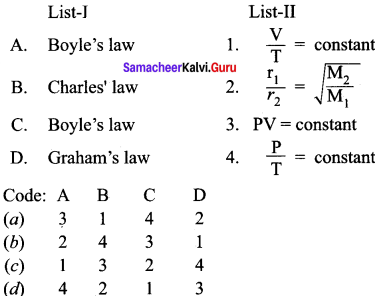
Hence white fumes first formed near hydrogen chloride.

Samacheer Kalvi Class 11 Chemistry Solutions Question 9.
The value of universal gas constant depends upon ………..
(a) Temperature of the gas
(b) Volume of the gas
(c) Number of moles of the gas
(d) units of Pressure and volume
Answer:
(d) units of Pressure and volume

Samacheer Kalvi.Guru 11th Chemistry Question 10.
The value of the gas constant R is …………
(a) 0.082 dm3 atm.
(b) 0.987 cal mol-1 K-1
(c) 8.3 J mol-1K-1
(d) 8 erg mol-1K-1
Answer:
(c) 8.3 J mol-1K-1

Samacheerkalvi.Guru 11th Chemistry Question 11.
Use of hot air balloon in sports at meteorological observation is an application of
(a) Boyle’s law
(b) Newton’s law
(c) Kelvin’s law
(d) Brown’s law
Answer:
(a) Boyle’s law

Class 11 Chemistry Solutions Samacheer Kalvi Question 12.
The table indicates the value of van der Waals constant ‘a’ in (dm3)2 atm. mol-2
11th Chemistry Unit 6 Book Back Answers Samacheer Kalvi Gaseous State
The gas which can be most easily liquefied is ………….
(a) O2
(b) N2
(c) NH3
(d) CH4
Answer:
(c) NH3
Hint:
Higher the value of ‘a’, greater the intermolecular force of attraction, easier the liquefaction. Option (c) is correct

Gaseous State Questions And Answers Pdf Question 13.
Consider the following statements.
(i) Atmospheric pressure is less at the top of a mountain than at sea level
(ii) Gases are much more compressible than solids or liquids
(iii) When the atmospheric pressure increases the height of the mercury column rises Select the correct statement.
(a) (i) and (ii)
(b) (ii) and (iii)
(c) (i) and (iii)
(d) (i), (ii) and (iii)
Answer:
(d) (i), (ii) and (iii)

Class 11 Gaseous State Question 14.
Compressibility factor for CO2 at 400 K and 71.0 bar is 0.8697. The molar volume of CO2 under these conditions is ………..
(a) 22.04 dm3
(b) 2.24 dm3
(c) 0.41 dm3
(d) 19.5 dm3
Answer:
(c) 0.41 dm3
Compressibility factor (z) = \(\frac {Pv}{nRT}\)
V = \(\frac {z x nRT }{p}\)
11th Chemistry Gaseous State Samacheer Kalvi Chapter 6 Gaseous State
V = 0.41 dm3

Samacheer Kalvi 11th Chemistry Solution Question 15.
If temperature and volume of an ideal gas is increased to twice its values, the initial pressure P becomes ………….
(a) 4P
(b) 2P
(c) P
(d) 3P
Answer:
(c) P
Hint:
Gaseous State Class 11 Chemistry Solutions Chapter 6 Gaseous State Samacheer Kalvi
P2 = P2 Option (c)

Question 16.
At identical temperature and pressure, the rate of diffusion of hydrogen gas is 3\(\sqrt{3}\) times that of a hydrocarbon having molecular formula What is the value of n?
(a) 8
(b) 4
(c) 3
(d) 1
Answer:
(b) 4.
Hint:
Gaseous State Class 11 Notes Pdf Chemistry Solutions Chapter 6 Gaseous State Samacheer Kalvi
Squaring on both sides and rearranging
27 x 2 = mCnH2n-2
54 = n(12) + (2n-2)(l)
54 = 12n+2n – 2
54 = 14n – 2
n = (54 + 2)/14 = 56/14 = 4

Question 17.
Equal moles of hydrogen and oxygen gases are placed in a container, with a pin-hole through which both can escape what fraction of oxygen escapes in the time required for one-half of the hydrogen to escape. (NEET phase 1)
(a) 3/8
(b) 1/2
(c) 1/8
(d) 1/4
Answer:
(c) 1/8
Hint:
Samacheer Kalvi Guru 11th Chemistry Solutions Chapter 6 Gaseous State
The fraction of oxygen that escapes in the time required for one half of the hydrogen to escape is 1/8

Question 18
The variation of volume V, with temperature T, keeping pressure constant is called the coefficient of thermal expansion ie α = \(\frac{1}{V}\left(\frac{\partial V}{\partial T}\right)_{P}\)For an ideal gas α is equal to ………..
(a) T
(b) 1/T
(c) P
(d) none of these
Answer:
(b) 1/T
Hint:
Samacheer Kalvi Class 11 Chemistry Solutions Chapter 6 Gaseous State

Question 19.
Four gases P, Q, R and S have almost same values of ‘b’ but their ‘a’ values (a, b are Van der Waals Constants) are in the order Q < R < S < P. At a particular temperature, among the four gases the most easily liquefiable one is ………….
(a) P
(b) Q
(c) R
(d) S
Answer:
(a) P
Hint:
Greater the ‘a’ value, casier the liquefaction

Question 20.
Maximum deviation from ideal gas is expected from (NEET)
(a) CH4(g)
(b) NH3(g)
(c) H2(g)
(d) N2(g)
Answer:
(b) NH3(g)

Question 21.
The units of Van der Waals constants ‘b’ and ‘a’ respectively
(a) mol L-1 and L atm2 mol-1
(b) mol L and L atm mol2
(c) mol-1 L and L2 atm mol-1
(d) none of these
Answer:
(c) mol-1 L and L2 atm mol-1
Hint:
an2/V2 atm
a = atm L2/mol2 = L2 mol-2 atm
nb = L
b = L /mol = L mol-1

Question 22.
Assertion : Critical temperature of CO2 is 304 K, it can be liquefied above 304 K.
Reason : For a given mass of gas, volume is to directly proportional to pressure at constant temperature.
(a) both assertion and reason arc true and reason is the correct explanation of assertion
(b) both assertion and reason are true but reason is not the correct explanation of assertion
(c) assertion is true but reason is false
(d) both assertion and reason are false
Answer:
(d) both assertion and reason are false
Hint:
Correct Statement: Critical temperature of CO2 is 304 K. It means that CO2 cannot be liquefied above 304 K, whatever the pressure may applied. Pressure is inversely proportional to volume.

Question 23.
What is the density of N, gas at 227°C and 5.00 atm pressure? (R = 0.082 L atm K-1 mol-1)
(a) 1.40 g/L
(b) 2.81 g/L
(c) 3.41 g/L
(d) 0.29 g/L
Answer:
(c) 3.41 g/L
Hint:
Density = \(\frac {Mass}{Volume}\)
Samacheer Kalvi.Guru 11th Chemistry Solutions Chapter 6 Gaseous State

Question 24.
Which of the following diagrams correctly describes the behaviour of a fixed mass of an ideal gas ? (T is measured in K)
Samacheerkalvi.Guru 11th Chemistry Solutions Chapter 6 Gaseous State
Answer:
Class 11 Chemistry Solutions Samacheer Kalvi Chapter 6 Gaseous State
For a fixed mass of an ideal gas V α T
P α 1/V
and PV = Constant

Question 25.
25 g of each of the following gases are taken at 27°C and 600 mm Hg pressure. Which of these will have the least volume?
(a) HBr
(b) HCl
(c) HF
(d) HI
Answer:
(d) HI
Hint:
At a given temperature and pressure
Volume α number of moles
Volume α Mass / Molar mass
Volume α 28 / Molar mass
i.e. if molar mass is more , volume is less. Hence Hl has the least volume.

II. Answer these questions briefly.

Question 26.
State Boyle’s law.
Answer:
Boyle’s law states that at a given temperature. the volume occupied by a fixed mass of a gas is inversely proportional to its pressure.
V α \(\frac {1}{P}\);
where T and n are fixed or PV = Constant = k

Question 27.
A balloon filled with air at room temperature and cooled to a much lower temperalure can be used as a model for Charles’ law.
Answer:
Charles’ law:

  • V T at constant P and n (or) \(\frac {V}{T}\) = Constant
  • A balloon filled with air at room temperature and cooled to a much lower temperature. the size of the balloon is reduced. Because if the temperature of the gas decreases, the volume also decreases in a direct proportion.
  • When temperature is reduced, the gas molecules inside in over slower due to decreased temperature and hence the volume decreases.

Question 28.
Name two items that can serve as a model for Gay Lussac’s law and explain.
Answer:
Gay Lussac’s law:
1. P α T at constant volume (or) = \(\frac {V}{T}\)
2. Example – 1:
You fill the car type completely full of air on the hottest day of summer. The type cannot change it shape and volume. But when winter comes, the pressure inside the lyre is reduced and the shape is also reduced. This confirms that pressure and temperature are direct related to each other.
3. Example – 2:
The egg in the bottle experiment.
Gaseous State Questions And Answers Pdf Samacheer Kalvi 11th Chemistry Solutions Chapter 6
A glass bottle is taken, inside the bottle put some pieces of cotton with fire. Then place a boiled egg (shell removed) at the top of the bottle. The temperature inside the bottle increases from the fire, rising (he pressure. By scaling the bottle with egg, the fire goes on, dropping the temperature and pressure. This causes the egg to be sucked into the bottle.
P α T is proved (or) = \(\frac{P_{1}}{V_{1}}=\frac{P_{2}}{V_{2}}\)

Question 29.
Give the mathematical expression that relates gas volume and moles. Describe in words what the mathematical expression means.
Answer:

  1. The mathematical relationship betwêen the volume of a gas and the number of moles is V α n
  2. \(\frac{V_{1}}{n_{1}}=\frac{V_{2}}{n_{2}}\) = Constant
    Where V1 and n1 are the volume and number of moles of a gas and V2 and n2 are the values of volume and number of moles of same gas at a different set of conditions.
  3. If the volume of the gas increase then the number of moles of the gas also increases.
  4. At a certain temperature and pressure, the volume of a gas is dirctly proportional to the number of the moles of the gas.

Question 30.
What are ideal gases? In what way real gases differ from ideal gases.
Answer:

  1. Ideal gases are the gases that obey gas laws or gas equation PV = nRT.
  2. Real gases do not obey gas equation. PV = nRT.
  3. The deviation of real gases from ideal behaviour is measure in terms of a ratio of PV to nRT. This is termed as compression factor (Z). Z = \(\frac {PV}{nRT}\)
  4. For ideal gases Z = 1.
  5. For real gases Z > 1 or Z < 1. For example, at high pressure real gases have Z >1 and at intermediate pressure Z < 1.
  6.  Above the Boyle point Z> 1 for real gases and below the Boyle point, the real gases first show a decrease for Z, reaches a minimum and then increases with the increase in pressure.
  7. So, it is clear that at low pressure and high temperature, the real gases behave as ideal gases.

Question 31.
Can a Van der Waals gas with a = 0 be liquefied? Explain.
Answer:

  • a = 0 for a Van der Waals gas i.e. for a real gas. Van der Waals constant a = 0. It cannot be liquefied.
  • If a = 0, there is a very less interaction between the molecules of gas.
  • ‘a’ is the measure of strength of Van der Waals force of attraction between the molecules of the gas.
  • If a is equal to zero, the Van der Waals force of attraction is very less and the gas cannot be liquefied.

Question 32.
Suppose there ¡s a tiny sticky area on the wan of a container of gas. Molecules hitting this area stick there permanently. Is the pressure greater or less than on the ordinary area of walls?
Answer:

  • Molecules hitting the tiny sticky area on the wall of the container of gas moves faster as they get closer to adhesive surface, but this effect is not permanent.
  • The pressure on the sticky wall is greater than on the ordinary area of walls.

Question 33.
Explain the following observations
(a) Aerated water bottles are kept under water during summer
(b) Liquid ammonia bottle is cooled before opening the seal
(c) The type of an automobile is inflated to slightly lesser pressure in summer than in winter
(d) The size of a weather balloon becomes larger and larger as it ascends up into larger altitude
Answer:
(a) In aerated water bottles, CO2 gas is passed through the aqueous solution under pressure because the solubility of the gas in water is not very high. In summer, the solubility of the gas in water is likely to decrease because of the rise in temperature. Thus, in summer, more of gas will be present above the liquid surface in the glass bottle.

In case, the pressure of the gas becomes too high, the glass will not be able to withstand the pressure and the bottle may explode. To avoid this, the bottles are kept under water. As a result, the temperature is likely to decrease and the solubility of CO2 is likely to increase in aqueous solution resulting in decreased pressure.

(b) Liquid ammonia bottle contains the gas under very high pressure. If the bottle is opened as such, then the sudden decrease in pressure will lead to a large increase in volume of the gas. As a result, the gas will come out of the bottle all of a sudden with force. This will lead to the breakage of the bottle and also causes accident.

However, if the bottle is cooled under tap water for sometime, there will be a decrease in the volume of a gas to a large extent. if the seal is opened now, the gas will corne out of the bottle at a slower rate, reduces the chances of accident.

(c) The pressure of air is directly proportional to the temperature. Since the temperature is higher in summer than in higher, the pressure of the air in the tube of the lyre is likely to be quite high as compared to winter. It is quite likely that the tube may burst under high pressure in summer, Therefore, it is advisable to inflate the types to lesser pressure in summer than in winter.

(d) The volume of the gas is inversely proportional to pressure at a given temperature according to Boyle’s law. As the weather balloon ascends, the pressure tends to decrease. As a result, the volume of the gas inside the balloon or the size of the balloon is likely to increase.

Question 34.
Give suitable explanation for the following facts about gases.
(a) Gases don’t settle at the bottom of a container
(b) Gases diffuse through all the space available to them and
(c) Explain with an increase in temperature
Answer:
(a) Gases by definition are the least dense state of matter. They have negligible intermolecular forces of attraction. So they are all free to roam separately. So the least dense gas particles will not sink at the bottom of a container.

(b) When a sample of a gas introduced to one part of a closed container, its molecules very quickly disperse throughout the container, this process by which molecules disperse in space in response to differences in concentration is called diffusion. For e.g., you can smell perfume in a room, because it difluses into the air totally inside the room.

(c) Diffusion is faster at higher temperature because the gas molecules have greater kinetic energy. Since heat increase the motion, then diffusion happens faster.

Question 35.
Suggest why there ¡s no hydrogen (H2) in our atmosphere. Why does the moon have no atmosphere?
Answer:
1. Hydrogen is the lightest element thus when produced in free state, it rises above all the other gases to the top of the atmosphere, where it is open to cosmic storms and solar flares. There it literally leaks from the atmosphere to the empty space. Hydrogen easily gains velocity required to escape Earth’s magnetic field. Hydrogen is very reactive in nature. So it would have reacted with O2 , in its way to produce H2O. So majority portion of H2 reacts and very less amount of it present in the upper level of atmosphere and gains velocity to escape the atmosphere.

2. Moon has no atmosphere because the value of acceleration due to gravity ‘g’ on the surface of the moon is small. Therefore, the value of escape velocity on the surface of the moon is very small. The molecule of the atmospheric gases on the surface of the moon have thermal velocities greater than the escape velocity. That’s why all the molecules of gases have escaped and there is no atmosphere in the moon. The moon has insufficient gravity to retain an atmosphere. So we conclude that moon has no atmosphere.

Question 36.
Explain whether a gas approaches ideal behaviour or deviates from ideal behaviour if –
(a) it is compressed to a smaller volume at constant temperature
(b) the temperature is raised while keeping the volume constant
(c) more gas is introduced into the same volume and at the same temperature
Answer:
(a) it a gas is compressed to a smaller volume at constant temperature, pressure is increased. At high pressure with a smaller volume, the gas deviates from ideal behaviour.

(b) If a gas temperature is raised keeping the volume constant, the pressure of the gas will increase. At high pressure, the gas deviates from ideal behaviour.

(c) if more gas is introduced into the same volume and at the same temperature, the number of moles are increasing. if the volume remains same, the increased number of moles collide with each other and kinetic energy increases and pressure decreases. At increased pressure, the gas deviates from ideal behaviour.

Question 37.
Which of the following gases would you expect to deviate from ¡deal behaviour under conditions of low temperature F Cl2, or Br2? Explain.
Answer:
1. Bromine deviates (Br2) from the ideal gas maximum than Cl2 and F2. Because Br2 has biggest size (atomic weight 79.9) provides maximum attraction between bromine molecules which is directly proportional to the size of the molecule and the boiling point of the liquid made from those molecules.

2. Br2 deviates from ideal behaviour because it has largest atomic radii compared to Cl2 and F2. So it contains more electrons than other two, and the Vander Waals forces are stronger in Br2 than in Cl2 and F2. So Br2 deviates from ideal behaviour.

Question 38.
Distinguish between diffusion and effusion.
Answer:
Diffusion:

  • Diffusion is the spreading of molecules of a substance throughout a space or a second substance.
  • Diffusion refers to the ability of the gases to mix with each other.
  • E.g.. Spreading of something such as brown tea liquid spreading through the water in a tea cup.

Effusion:

  • Effusion is the escape of gas molecules through a very small hole in a membrane into an evacuated area.
  • Effusion is a ability of a gas to travel through a small pin-hole.
  • E.g., pouring out something like the soap studs bubbling out from a bucket of water.

Question 39.
Aerosol cans carry clear warning of heating of the can. Why?
Answer:
Aerosol cans carry clear warning of heating of the can. As the temperature rises, pressure in the can will increase and ambient temperatures about 120°F may lead to explosions. So aerosol cans should always be stored in dry areas where they will not be exposed to excessive temperatures. You should never throw an aerosol can onto a fire or leave it in the direct sunlight. even it is empty. This is because the pressure will build up so much that the can will burst. It is due to 2 reasons.

  • The gas pressure increases.
  • More of the liquefied propellant turns into a gas.

Question 40.
When the driver of an automobile applies brake, the passengers are pushed toward the front of the car but a helium balloon is pushed toward back of the car. Upon forward acceleration the passengers are pushed toward the front of the car. Why?
Answer:
1. When the driver of an automobile applies brake, the passengers are pushed toward the front of the car due to inertia of the body, but a helium balloon pushed toward back of the car. Helium balloon responds to the air around it. Helium molecules are lighter than air of our atmosphere, and so they move toward back by gravity as a result of the accelerating frame.

2. Upon forward acceleration, the passengers arc pushed toward the front of the car, because the body in motion tends to stay in motion until acted upon by an outside force. Helium balloon is going to move opposite to this pseudo gravitational force.

Question 41.
Would it be easier to drink water with a straw on the top of Mount Everest?
Answer:
It is difficult to drink water with a straw on the top of Mount Everest. This is because the reduced atmospheric pressure is less effective in pushing water into the straw at the top of the mountain because gravity falls off gradually with height. The air pressure falls off, there isn’t enough atmospheric pressure to push the water up in the straw all the way to the mouth.

Question 42.
Write the Van der Waals equation for a real gas. Explain the correction term for pressure and volume.
Answer:
Van der Waals equation of state for real gases is –
\(\left(P+\frac{a n^{2}}{V^{2}}\right)(V-n b)\) = nRT

Correction term for pressure:
\(\frac{\mathrm{an}^{2}}{\mathrm{V}^{2}}\) is the pressure correction. It represents the intermolecular interaction that causes the non ideal behaviour.

Correction term for Volume:
V – nb is the volume correction. it is the effective volume occupied by real gas.

Question 43.
Derive the values of critical constants from the Van der Waals constants.
Answer:
Derivation of critical constants from the Van der Waals constants:
Van der Waals equation is,
\(\left(P+\frac{a n^{2}}{V^{2}}\right)(V-n b)\) = nRT for 1 mole
From this equation, the values of critical constant PCVC and TC arc derived in terms of a and b the Van der Waals constants.
\(\left(P+\frac{a n^{2}}{V^{2}}\right)(V – b)\) = RT ………..(1)
On expanding the equestion (1)
P V + \(\frac {a}{V}\) – pb – \(\frac{\mathrm{ab}}{\mathrm{V}^{2}}\) – RT = 0 ………(2)
Multiplying eqestion (2) by \(\frac{V^{2}}{P}\),
Class 11 Gaseous State Samacheer Kalvi Chemistry Solutions Chapter 6
equation (3) is rearranged in the powers of V
V3 – \(\left[\frac{\mathrm{RT}}{\mathrm{P}}+\mathrm{b}\right]\) V2 + \(\frac {aV}{P}\) –
= 0 ………..(4)
The above equation (4) is an cubic equation of V, which can have three roots. At the critical point. all the three values of V are equal to the critical volume VC.
i.e. V = VC.
V – VC = O ……….(5)
(V – VC)3 = O ………(6)
(V3 – 3VCV2 + 3VC3V – VC3 = 0 ………(7)
As the equation (4) is identical with equation (7), comparing the ‘V’ ternis in (4) and (7),
Samacheer Kalvi 11th Chemistry Solution Chapter 6 Gaseous State
Divide equation (11) by (10)
Samacheer Kalvi 11th Chemistry Solutions Chapter 6 Gaseous State
When equation (12) is substituted in (10)
Samacheer Kalvi 11th Chemistry Solutions Chapter 6 Gaseous State
substituting the values of Vc and Pc in equation (9)
Samacheer Kalvi 11th Chemistry Solutions Chapter 6 Gaseous State
Critical constant a and b can be calculated using Van der Waals Constant as follows:
Samacheer Kalvi 11th Chemistry Solutions Chapter 6 Gaseous State

Question 44.
Why do astronauts have to wear protective suits when they are on the surface of moon?
Answer:
In space, there is no pressure, if we do wear a pressurised suit, our body will die. In space, we have to wear a pressurised suit, otherwise our body will continue to push out and blow up like a balloon. It would look cool, but we will be dead. So the astronauts in space must wear a pressurised suit (protective suits).

Question 45.
When ammonia combines with HCl, NH4 Cl is formed as white dense fumes. Why do more funies appear near HCl?
Answer:

  1. When ammonia combines with HCl, NH4 Cl is formed as white dense fumes. The reaction takes place in neutralization between a weak base and a strong acid.
  2. The property of the gas is diffusion.
  3. Diffusion of gases Ammonia and hydrogen chloride. Concentrated ammonia solution is placed on a pad in one end of a tube and concentrated HCl on the pad at the other. After about a minute, the gases diffuses far enough to meet and a ring of solid ammonium chloride is formed near the HCl end.

Question 46.
A sample of gas at 15°C at 1 atm has a volume of 2.58 dm3. Vhen the temperature is raised to 38°C at I atm does the volume of the gas increase? if so, calculate the final volume.
Answer:
Samacheer Kalvi 11th Chemistry Solutions Chapter 6 Gaseous State
V2 = 2.78 dm3 i.e. volume increased from 2.58 dm3 to 2.78 dm3.

Question 47.
A sample of gas has a volume of 8.5 dm3 at an unknown temperature. When the sample is submerged in ice water at 0°C, its volume gets reduced to 6.37 dm3. What ¡s its initial temperature?
Answer:
Samacheer Kalvi 11th Chemistry Solutions Chapter 6 Gaseous State
T1 = 364.28 K

Question 48.
Of two samples of nitrogen gas, sample A contains 1.5 moles of nitrogen in a vessel of volume of 37.6 dm3 at 298K, and the sample B is in a vessel of volume 16.5 dm3 at 298 K. Calculate the number of moles in sample B.
Answer:
nA = 1.5 mol nB = ?
VA = 37.6 dm3 VB = 16.5 dm3
(T = 298 K constant)
Samacheer Kalvi 11th Chemistry Solutions Chapter 6 Gaseous State

Question 49.
Sulphur hexafluoride is a colourless, odourless gas; calculate the pressure exerted by 1.82 moles of the gas in a steel vessel of volume 5.43 dm3 at 69.5°C, assuming ¡deal gas behaviour.
Answer:
n = 1.82 mole
V = 5.43 dm3
T = 69.5 + 273 = 342.5
P = ?
PV = nRT
P = \(\frac {nRT}{V}\)
Samacheer Kalvi 11th Chemistry Solutions Chapter 6 Gaseous State
P = 94.25 atm.

Question 50.
Argon is an inert gas used in light bulbs to retard the vapourlzation of the tungsten filament. A certain light bulb containing argon at 1.2 atm and 18°C is heated to 85°C at constant volume. Calculate its final pressure in atm.
Answer:
P1 = 1.2 atm
T1 = 18°C + 273 = 291 K
T2 = 85°C + 273 = 358 K
P2 = ?
\(\frac{P_{1}}{T_{1}}=\frac{P_{2}}{T_{2}}\)
Samacheer Kalvi 11th Chemistry Solutions Chapter 6 Gaseous State-

Question 51.
A small bubble rises from the bottom of a lake, where the temperature and pressure are 6°C and 4 atm. to the water surface, where the temperature is 25°C and pressure is 1 atm. Calculate the final volume in (mL) of the bubble, if its initial volume is 1.5 mL.
Answer:
T1 = 6°C + 273 = 279 K
P1 = 4 atm V1 = 1.5m
T2 = 25°C + 273 = 298 K
P2 = 1 atm V 1 = ?
\(\frac{P_{1} V_{1}}{T_{1}}=\frac{P_{2} V_{2}}{T_{2}}\)
Samacheer Kalvi 11th Chemistry Solutions Chapter 6 Gaseous State-
V2 = 6.41 mol.

Question 52.
Hydrochloric acid is treated with a metal to produce hydrogen gas. Suppose a student carries out this reaction and collects a volume of 154.4 x 10⁻³ dm3 of a gas at a pressure of 742 mm of Hg at a temperature of 298 K. What mass of hydrogen gas (in mg) did the student collect?
Answer:
V = 154.4 x 10⁻³dm3
P = 742 mm of Hg
T = 298 K m = ?
n = \(\frac{PV}{RT}\) = Samacheer Kalvi 11th Chemistry Solutions Chapter 6 Gaseous State-
= 0.006 mol
n = \(\frac{PV}{RT}\)
n = \(\frac{Mass}{Molar Mass}\)
Mass = n x Molar mass
= 0.006 x 2.016
= 0.0121 g = 12.1 mg.

Question 53.
It takes 192 sec for an unknown gas to diffuse through a porous wall and 84 sec for N2 gas to effuse at the same temperature and pressure. What is the molar mass of the unknown gas?
Answer:
Samacheer Kalvi 11th Chemistry Solutions Chapter 6 Gaseous State

Question 54.
A tank contains a mixture of 52.5 g of oxygen and 65.1 g of CO2 at 300 K the total pressure in the tank ¡s 9.21 atm. Calculate the partial pressure (in atm.) of each gas in the mixture.
Answer:
mO2 = 52.5 g
PO2 = ?
mCO2 = 65.1 g
PCO2 = ?
T = 300 K P = 9.21 atm
PO2 = XO2 x total pressure
Samacheer Kalvi 11th Chemistry Solutions Chapter 6 Gaseous State-
PO2 = XO2 x Total pressure
= 0.53 x 9.21 atm = 4.88 atm
PCO2 = XCO2 x Total pressure
= 0.47 x 9.21 atm = 4.33 atm

Question 55.
A combustible gas Is stored in a metal tank at a pressure of 2.98 atm at 25 °C. The tank can withstand a maximum pressure of 12 atm after which it will explode. The building in which the tank has been stored catches fire. Now predict whether the tank will blow up first or start melting? (Melting point of the metal = 1100 K).
Answer:
T1 = 298 K;
P1 = 2.98 atm;
T2 = 1100K;
P2 = ?
\(\frac{P_{1}}{T_{1}}=\frac{P_{2}}{T_{2}}\)
P2 = \(\frac{P_{1}}{T_{1}} \times T_{2}\)
= \(\frac{2.98 \mathrm{atm}}{298 \mathrm{K}} \times 1100 \mathrm{K}\) = 11 atm
At 1100 K, the pressure of the gas inside the tank will become 11 atm. Given that tank can withstand a maximum pressure of 12 atm, the tank will start melting first.

In Text Questions – Evaluate Yourself

Question 1.
Freon-I 2, the compound widely used in the refrigerator system as coolant causes depletion of ozone layer. Now It has been replaced by eco-friendly compounds. Consider 1.5 dm3 sample of gaseous freon at a pressure of 0.3 atm. If the pressure is changed to 1.2 atm. at a constant temperature, what will be the volume of the gas increased or decreased?
Answer:
Volume of freon (V1) = 1.5 dm3
Pressure (P1) = 0.3 atm
‘T’ is constant
P2 = 1.2 atm
V2 = ?
P1V1 = P2V2
V2 = \(\frac{P_{1} V_{1}}{P_{2}}\)
Samacheer Kalvi 11th Chemistry Solutions Chapter 6 Gaseous State-
= 0.375 dm3
Volume decreased from 1.5 dm3 to 0.375 dm3

Question 2.
Inside a certain automobile engine, the volume of air in a cylinder is 0.375 dm3, when the pressure is 1.05 atm. When the gas is compressed to a volume of 0.125 dm3 at the same temperature, what is the pressure of the compressed air?
Answer:
V1 = 0.375dm3
V2 = 0.125 dm3
P1 = 1.05 atm
P2 = ?
T – Constant
P1V1 = P2V2
P2 = \(\frac{P_{1} V_{1}}{V_{2}}=\frac{10.5 \times 0.375}{0.125}\)
= 3.15 atm.

Question 3.
A sample of gas has a volume of 3.8 dm3 at an unknown temperature. When the sample is submerged in ice water at 0°C, its volume gets reduced to 2.27 dm3. What is its initial temperature?
Answer:
V1 = 3.8 dm3
T2 = 0°C = 273K
T1 = ? V2 = 2.27dm3
\(\frac{V_{1}}{T_{1}}=\frac{V_{2}}{T_{2}}\)
Samacheer Kalvi 11th Chemistry Solutions Chapter 6 Gaseous State-
T1 = 457 K

Question 4.
An athlete in a kinesiology research study has his lung volume of 7.05 dm3 during a deep inhalation. At this volume the lungs contain 0.312 mole of air. During exhalation the volume of his Jung decreases to 2.35 dm3 How many moles of air does the athlete exhale during exhalation? (assume pressure and temperature remain constant)
Answer:
V1 = 7.05 dm3
V2 = 2.35 dm3
n1 = 0.312 mol
n1 =?
‘P’ and ‘T’ are constant
\(\frac{V_{1}}{n_{1}}=\frac{V_{2}}{n_{2}}\)
Samacheer Kalvi 11th Chemistry Solutions Chapter 6 Gaseous State-
n2 = 0.104 mol
Number of moles exhaled = 0.312 – 0.104 = 0.208 moles

Question 5.
A small bubble rises from the bottom of a lake, where the temperature and pressure are 8° C and 6.4 atm. to the water surface, where the temperature ¡s 25°C and pressure is 1 atm. Calculate the final volume in (ml) of the bubble, if its initial volume is 2.1 ml.
Answer:
T1 = 8°C = 8 + 273 = 281K
P1 = 6.4atm V1 = 2.1 mol
T2 = 25°C = 25 + 273 = 298 K
P2 = 1 atm
V2 = ?
\(\frac{P_{1} V_{1}}{T_{1}}=\frac{P_{2} V_{2}}{T_{2}}\)
Samacheer Kalvi 11th Chemistry Solutions Chapter 6 Gaseous State-
V2 = 14.25 ml

Question 6.
(a) A mixture of He and O2 were used ¡n the ‘air’ tanks of underwater divers for deep dives. For a particular dive 12 dm3 of O2 at 298 K, I atm. and 46 dm3 of He, at 298 K, 1 aim. were both pumped into a 5 dm3 tank. Calculate the partial pressure of each gas and the total pressure In the tank at 298 K
Answer:
Samacheer Kalvi 11th Chemistry Solutions Chapter 6 Gaseous State
P = 1 atm
Vtotal = 5 dm3
PO2 = XO2 x Ptotal
Samacheer Kalvi 11th Chemistry Solutions Chapter 6 Gaseous State
PHe = 3.54 atm

Question 6.
(b) A sample of solid KClO3 (potassium chlorate) was heated in a test tube to obtain O2 according to the reaction 2KClO3 → 2KCl(s) + 3O2 The oxygen gas was collected by downward displacement of water at 295 K. The total pressure of the mixture is 772 mm of Hg. The vapour pressure of water is 26.7 mn of Hg at 300K. What is the partial pressure of the oxygen gas?
Answer:
2KCl3(s) → 2KCl(s) 3O3(g)
Ptotal = 772 mm Hg
PH2O = 26.7 mm Hg
Ptotal = PO2 + PH2O
PO2 = Ptotal – PH2O
P1 = 26.7 mm Hg
T1 = 300 K
T2 = 295 K
P2 = ?
\(\frac{P_{1}}{T_{1}}=\frac{P_{2}}{T_{2}}\)
Samacheer Kalvi 11th Chemistry Solutions Chapter 6 Gaseous State
P2 = 26.26 mm Hg
∴ PO2 = 772 – 26.26
= 745.74 mm Hg

Question 7.
A flammable hydrocarbon gas of particular volume is found to diffuse through a small hole in 1.5 minutes. Under the same conditions of temperature and pressure an equal volume of bromine vapour takes 4.73 min to diffuse through the same hole. Calculate the molar mass of the unknown gas and suggest what this gas might be, (Given that molar mass of bromine = 159.8 g/ mole)
Answer:
t1 = 1.5 minutes (gas)hydrocarbon
t2 = 4.73 minutes (gas)Bromi
Samacheer Kalvi 11th Chemistry Solutions Chapter 6 Gaseous State
n (12) + (2n + 2) 1 = 16 (general formula for hydrocarbon CnH2n+2)
12n + 2n + 2 = 16
14n = 16 – 2
14n = 14
n = 1
The hydrocarbon is C1H2(1) + 2 = CH4

Question 8.
Critical temperature of H2O, NH3 and CO2 are 647.4, 405.5 and 304.2 K, respectively. When we start cooling from a temperature of 700 K which will liquefy first and which will liquefy finally?
Answer:
Critical temperature of a gas is defined as the temperature above which it cannot be liquefied even at high pressures.
∴ When cooling starts from 700 K, H2O vill liquefied first, then followed by ammonia and finally carbon dioxide will liquefied.

In-Text Example Problems

Question 9.
In the below figure, let us find the missing parameters [volume in (b) and pressure in (c)]
P1 = 1 atm P2 = 2 atm P3 = ? atm
V1 I dm3  V2 =? dm3 V3 = 0.25 dm3
T1 = 298 K T2 = 298 K T3 = 298 K
Solution:
According to Boyle’s law, at constant temperature for a given mass of gas at constant temperature,Samacheer Kalvi 11th Chemistry Solutions Chapter 6 Gaseous State
P1V1 = P2V2 = P3V3
I atm x 1 dm3 = 2 atm x V2 = P3x 0.25 dm3
∴ 2 atm x V2 = 1 atm x 1 dm3
Samacheer Kalvi 11th Chemistry Solutions Chapter 6 Gaseous State
V2 = 0.5 dm3
and P3 x 0.25 dm3 = 1 atm x 1 dm3
Samacheer Kalvi 11th Chemistry Solutions Chapter 6 Gaseous State
P3 = 4atm

Question 10.
In the below figure, let us find the missing parameters [volume in (b) and temperature in (c)]
P1 = 1 atm P2 = 1 atm P3 = 1 atm
V1 = 0.3dm3 V2 = ?dm3 V3 = 0.15dm3
T1 = 200K T2 = 300 K T3 = ? K
Answer:
Samacheer Kalvi 11th Chemistry Solutions Chapter 6 Gaseous State
According to Charles law,
Samacheer Kalvi 11th Chemistry Solutions Chapter 6 Gaseous State
T3 = 100k

Question 11.
Calculate the pressure exerted by 2 moles of sulphur hexafluoride in a steel vessel of volume 6 dm3 at 70°C assuming It is an ideal gas.
Answer:
We will use the ideal gas equation for this calculation as below:
P = \(\frac {nRT}{V}\)
Samacheer Kalvi 11th Chemistry Solutions Chapter 6 Gaseous State
= 9.39 atm.

Question 12.
A mixture of gases contains 4.76 mole of Ne, 0.74 mole of Ar and 2.5 mole of Xe. Calculate the partial pressure of gases, if the total pressure is 2 atm. at a fixed temperature. Solve this problem using Dalton’s law.
Answer:
PNe = XNe PTotal
Samacheer Kalvi 11th Chemistry Solutions Chapter 6 Gaseous State
PNe = XNe PTotal = 0.595 x 2 = 1.19 atm.
PNe = XNe PTotal = 0.093 x 2 = 0. 186 atm.
PNe = XNe PTotal = 0.312 x 2 = 0.624 atm.

Question 13.
An unknown gas diffuses at a rate of 0.5 time that of nitrogen at the same temperature and pressure. Calculate the molar mass of the unknown gas.
Answer:
Samacheer Kalvi 11th Chemistry Solutions Chapter 6 Gaseous State

Question 14.
If a scuba diver takes a breath at the surface filling his lungs with 5.82 dm3 of air what volume will the air in his lungs occupy when he drives to a depth, where the pressure ¡s 1.92 atm. (assume temperature is constant and the pressure at the surface is exactly 1 atm.)
Solution :
Temperature = Constant
Pressure at the surface = 1 atm – P1
Pressure at the depth = 1.92 atm – P2
Vdlume of air breathing at the surface of the air = 5.82 dm3 – V1
Volume of air breathing at the depth = V2 = ?
Samacheer Kalvi 11th Chemistry Solutions Chapter 6 Gaseous State
V1 = 3.03 dm3
The volume of air scuba diver’s lung occupy = 3.03 dm3

Question 15.
Inside a certain automobile engine, the volume of air in a cylinder is 0.475 dm3, when the pressure is 1.05 atm. When the gas is compressed, the pressure increased to 5.65 atm. at the same temperature. What is the volume of compressed air?
Solution:
Volume of air in the cylinder 0.475 dm3 – V1
Pressure of air P1 = 1.05 atm
Increased pressure P2 = 5.65 atm
Volume of air compressed V2 = ?
P1V1 = P2V2
Samacheer Kalvi 11th Chemistry Solutions Chapter 6 Gaseous State
V2 = 0.08827 dm3
Compressed volume of air = 0.08 827 dm3

Samacheer Kalvi 11th Chemistry Gaseous State Additional Questions Solved

I. Choose the correct answer.

Question 1.
For one mole of a gas, the ideal gas equation is ………..
(a) PV = \(\frac {1}{2}\) RT
(b) PV = RT
(c) PV = \(\frac {3}{2}\)RT
(d) PV = \(\frac {5}{2}\)RT
Answer:
(b) PV= RT

Question 2.
The average kinetic energy of the gas molecule is …………
(a) inversely proportional to its absolute temperature
(b) directly proportional to its absolute temperature
(c) equal to the square of its absolute temperature
(d) All of the above
Answer:
(b) directly proportional to Its absolute temperature

Question 3.
Which of the following is the correct mathematical relation for Charles’ law at constant pressure?
(a) V ∝ T
(b) V ∝ t
(c) V ∝ – \(\frac {1}{T}\)
(d) all of above
Answer:
(a) V ∝ T

Question 4.
At constant temperature, the pressure of the gas is reduced to one-third, the volume
(a) reduce to one-third
(b) increases by three times
(c) remaining the same
(d) cannot be predicted
Answer:
(b) increases by three times

Question 5.
With rise in temperature, the surface tension of a liquid …………
(a) decreases
(b) increases
(c) remaining the same
(d) none of the above
Answer:
(a) decreases

Question 6.
Viscosity of a liquid is a measure of ……………
(a) repulsive forces between the liquid molecules
(b) frictional resistance
(c) intermolecular forces between the molecules
(d) none of the above
Answer:
(b) frictional resistance

Question 7.
The cleansing action of soaps and detergents is due to …………..
(a) internal friction
(b) high hydrogen bonding
(c) viscosity
(d) surface tensions
Answer:
(d) surface tensions

Question 8.
In Vander Waals equation of state for a non-ideal gas the net force of attraction among the molecules is given by ………..
(a) \(\frac{\mathrm{an}^{2}}{\mathrm{V}^{2}}\)
(b) P + \(\frac{\mathrm{an}^{2}}{\mathrm{V}^{2}}\)
(c) P – \(\frac{\mathrm{an}^{2}}{\mathrm{V}^{2}}\)
(d) – \(\frac{\mathrm{an}^{2}}{\mathrm{V}^{2}}\)
Answer:
(a) \(\frac{\mathrm{an}^{2}}{\mathrm{V}^{2}}\)

Question 9.
The compressibility factor, z for an ideal gas is ………….
(a) zero
(b) less than one
(c) greater than one
(d) equal to one
Answer:
(d) equal to one

Question 10.
Which of the following gases will have the lowest rate of diffusion?
(a) H2
(b) N2
(c) F2
(d) O2
Answer:
(c) F2

Question 11.
Which of the following is a mono atomic gas in nature?
(a) Oxygen
(b) Hydrogen
(c) Helium
(d) Ozone
Answer:
(c) Helium

Question 12.
Which of the following is a diatomic gas in nature?
(a) Oxygen
(b) Ozone
(c) Helium
(d) Radon
Answer:
(a) Oxygen

Question 13.
Which one of the following is not a monoatomic gas?
(a) Neon
(b) Xenon
(c) Argon
(d) Oxygen
Answer:
(d) Oxygen

Question 14.
Among the following groups which contains monoatomic gases?
(a) Group 17
(b) Group 18
(c) Group 1
(d) Group 15
Answer:
(b) Group 18

Question 15.
Which of the following is a tri atomic gas at room temperature?
(a) Oxygen
(b) Helium
(c) Ozone
(d) Nitrogen
Answer:
(c) Ozone

Question 16.
Which of the following gas is essential for our survival?
(a) N2
(b) H2
(c) O2
(d) He
Answer:
(c) O2

Question 17.
Among the following, which is deadly poison?
(a) CO2
(b) HCN
(c) HCl
(d) NH3
Answer:
(b) HCN

Question 18.
Which of the following is not chemically inert?
(a) Helium
(b) Oxygen
(c) Argon
(d) Krypton
Answer:
(b) Oxygen

Question 19.
Match the List-I and List-II using the correct code given below the list.
Samacheer Kalvi 11th Chemistry Solutions Chapter 6 Gaseous State

Answer:
Samacheer Kalvi 11th Chemistry Solutions Chapter 6 Gaseous State

Question 20.
Pressure of a gas is equal to ………..
(a) \(\frac {F}{a}\)
(b) F x a
(c) \(\frac {a}{F}\)
(d) F – a
Answer:
(a) \(\frac {F}{a}\)

Question 21.
The SI unit of pressure is ………..
(a) Nm-2  Kg-1
(b) Pascal
(c) bar
(d) atmosphere
Answer:
(b) Pascal

Question 22.
Statement-I: The pressure cooker takes more time for cooking at high altitude.
Statement-II: Air is subjected to Earth’s gravitational force. The pressure of air gradually decreases from the surface of the Earth to higher altitude.
(a) Statement-I and II are correct and Statement-II is the correct explanation of Statement-I
(b) Statement-I and II are correct but Statement-II is not the correct explanation of Statement-I
(e) Statement-I is wrong but Statement-II is correct
(ð) Statement-I is correct but Statement-II is wrong
Answer:
(a) Statement-I and II are correct and Statement-II is the correct explanation of Statement-I

Question 23.
The instrument used for measuring the atmospheric pressure is …………….
(a) lactometer
(b) barometer
(c) electrometer
(d) ammeter
Answer:
(b) barometer

Question 24.
The standard atmospheric pressure at sea level at 0°C is equal to ……………..
(a) 1 mm Hg
(b) 76 mm Hg
(c) 760 mm Hg
(d) 680 mm Hg
Answer:
(c) 760 mm Hg

Question 25.
Mathematical expression of Boyle’s law is ………….
(a) P1V1 = P2V2
(b) \(\frac {P}{V}\) = Constant
(c) \(\frac {V}{T}\) = Constant
(J) \(\frac {P}{T}\) = Constant
Answer:
(a) P1V1 = P2V2

Question 26.
Statement-I: If the volume of a fixed mass of a gas is reduced to half at constant temperature the gas pressure doubles.
Statement-II: If the volume is halved, the density of the gas is doubled.
(a) Statement-I and II are correct and Statement-II is the correct explanation of Statement-I
(b) Statement-I and II are correct but Statement-II is not the correct explanation of Statement-I
(c) Statement-I is correct but Statement-II is wrong
(d) Statement-I is wrong but Statement-II is correct
Answer:
(a) Statement-I and liare correct and Statement-II is the correct explanation of Statement-I

Question 27.
Which one of the following represents the Charles’ law?
(a) PV = Constant
(b) \(\frac {V}{T}\) = Constant
(c) VT Constant
(d) \(\frac {T}{V}\) = R
Answer:
(b) \(\frac {V}{T}\) = Constant

Question 28.
Which one of the following is absolute zero?
(a) 293 K
(b) 273 K
(c) – 273.15°C
(d) 0°C
Answer:
(c) – 273.15°C

Question 29.
\(\frac {P}{T}\) = Constant is known as …………..
(a) Boyle’s law
(b) Charles’ law
(c) Gay Lussac’s law
(d) Dalton’s law
Answer:
(c) Gay Lussac’s law

Question 30.
The ideal gas equation is …………..
(a) PV = RT for 1 mole
(b) P1 V1 = P2V2
(c) \(\frac {P}{T}\) = R
(d) P = P2 + P2 + P2
Answer:
(a) PV = RT for 1 mole

Question 31.
The value of Universal gas constant in a ideal gas equation is equal to ………….
(a) 8.3 14 KJ
(b) 0.082057 dm3 atm mol-1 K-1
(c) 1 Pascal
(d) 8.314 x 10⁻²Pascal
Answer:
(b) 0.082057 dm3 atm mol-1 K-1

Question 32.
Mathematical expression of Graham’ s law is ……………….
Samacheer Kalvi 11th Chemistry Solutions Chapter 6 Gaseous State
Answer:
Samacheer Kalvi 11th Chemistry Solutions Chapter 6 Gaseous State

Question 33.
Which law is used in the isotopic separation of deuterium and protium?
(a) Boyle’s law
(b) Charles’ law
(c) Graham’ s law
(d) Gay Lussac’s law
Answer:
(c) Graham’ s law

Question 34.
The value of compression factor Z is equal to ………….
(a) \(\frac {nRT}{PV}\)
(b) \(\frac {PV}{RT}\)
(c) PV x nRT
(d) \(\frac {PV}{nRT}\)
Answer:
(d) \(\frac {PV}{nRT}\)

Question 35.
The value of critical volume is equal in terms of Vander Waals constant is ……….
(a) 3b
(b) \(\frac{8a}{27 Rb}\)
(c) \(\frac{a}{27 b^{2}}\)
(d) \(\frac{2a}{Rb}\)
Answer:
(a) 3b

Question 36.
The value of critical temperature of carbon dioxide is …………
(a) 273 K
(b) 303.98 K
(c) 373 K
(d) – 80°C
Answer:
(b) 303.98 K

Question 37.
Match the List-I and List-II using the correct code given below the list.
Samacheer Kalvi 11th Chemistry Solutions Chapter 6 Gaseous State
Answer:
Samacheer Kalvi 11th Chemistry Solutions Chapter 6 Gaseous State

Question 38.
The value of critical pressure of CO2 is ……………….
(a) 173 atm
(b) 73 atm
(c) 1 atm
(d) 22.4 atm
Answer:
(b) 73 atm

Question 39.
The temperature below which a gas obey Joule Thomson effect is called …………..
(a) critical temperature
(b) standard temperature
(c) inversion temperature
(d) normal temperature
Answer:
(c) Inversion temperature

Question 40.
The substance used in adiabatic process of liquefaction is ……………
(a) liquid helium
(b) gadolinium sulphate
(c) iron sulphate
(d) liquid ammonia
Answer:
(b) Gadolinium sulphate

Question 41.
The temperature produced in adiabatic process of liquefaction is …………..
(a) zero kelvin
(b) -273 K
(c) 10-4 K
(d) 104 K
Answer:
(c) 10-4 K

Question 42.
The molecules of a gas A travel four times faster than the molecules of gas B at same temperature. The ratio of molecular weight MA/ MB is ………….
(a) 1/16
(b) 4
(c) 1/4
(d) 16
Answer:
(a) 1/16

Question 43.
The compressibility factor for an ideal gas is …………….
(a) 1.5
(b) 2
(c) 1
(d) x
Answer:
(c) 1

Question 44.
Which of the following pair will diffuse at the same rate?
(a) CO2 and N2O
(b) CO2 and NO
(c) CO2 and CO
(d) N2O and NO
Answer:
(a) CO2 and N2O

Question 45.
The value of Vander Waals constant “a” is maximum for ……………….
(a) helium
(b) nitrogen
(c) methane
(d) ammonia
Answer:
(d) Ammonia

Question 46.
A person living in Shimla observed that cooking food with using pressure cooker takes more time. The reason for this observation is that at high altitude …………..
(a) pressure increases
(b) temperature decreases
(c) pressure decreases
(a) temperature decreases
Answer:
(c) pressure decreases

Question 47.
Statement-I : At constant temperature PV vs V plot for real gases is not a straight line.
Statement-II : At high pressure, all gases have Z >1, but at intermediate pressure most gases have Z <1.
(a) Statement-I and II are correct and Statement-II is the correct explanation of Statement-I
(b) Statement-I and II are correct but Statement-II is not the correct explanation of Statement-I
(c) Statement-I is correct but Statement-Il is wrong
(d) Statement-I is wrong but Statement-Il is correct .
Answer:
(a) Statement-I and liare correct and Statement-II is the correct explanation of Statement-I

Question 48.
Statement-I: Gases do not liquefy above their critical temperature, even on applying high press ure.
Statement-II: Above critical temperature, the molecular speed is high and intermolecular
attractions cannot hold the molecules together because they escape because of high speed.
(a) Statement-I and II are correct and Statement-II is the correct explanation of Statement-I
(b) Statement-I and II are correct but Statement-II is not the correct explanation of Statement-I
(c) Statement-I is correct but Statement-II is wrong
(d) Statement-I is wrong but Statement-II is correct
Answer:
(c) Statement-I and II are correct and Statement-IIs the correct explanation of Statement-I

Question 49.
The rate of diffusion of a gas is ………….
(a) directly proportional to its density
(b) directly proportional to its molecular mass
(c) directly proportional to its square root of its molecular mass
(d) inversely proportional to its square root of its molecular mass
Answer:
(d) inversely proportional to its square root of its molecular mass

Question 50.
In a closed flask of 5 liters, 1.0 g of H2 is heated from 300 to 600 K, which statement is not correct’?
(a) pressure of the gas increases
(b) the rate of the collusion increase
(c) the number of moles of gas increases
(d) the energy of gaseous molecules increases
Answer:
(c) the number of moles of gas increases

Question 51.
Match the List-I and List-II using the correct code given below the list.
Samacheer Kalvi 11th Chemistry Solutions Chapter 3 Periodic Classification of Elements - 49
Answer:
Samacheer Kalvi 11th Chemistry Solutions Chapter 6 Gaseous State

Question 52.
Consider the following statements.
(i) All the gases have higher densities than liquids and solids.
(ii) All gases occupy zero volume at absolute zero.
(iii) At very low pressure all gases exhibit ideal behaviour.
Which of the above statement is/are not correct?
(a) (i) only
(b) (ii) only
(c) (iii) only
(d) (ii) and (iii) only
Answer:
(a) (i) only

Question 53.
Which of the following gas is present maximum in atmospheric air?
(a) O2
(b) N2
(c) H2
(d) radon
Answer:
(b) N2

Question 54.
Which law is used in the process of enriching the isotope of U235 from other isotopes?
(a) Boyle’s law
(b) Dalton’s law of partial pressure
(c) Graham’s law of diffusion
(d) Charles’ law
Answer:
(c) Graham’s law of diffusion

Samacheer Kalvi 11th Chemistry Gaseous State 2 – Mark Questions

Question 1.
Identify the elements that are in gaseous state under normal atmospheric conditions.
Answer:

  • Hydrogen, nitrogen, oxygen, fluorine and chlorine exist as gaseous diatomic molecules.
  • Another form of oxygen namely ozone tr iatomic molecule exist as a gas at room temperature.
  • Noble gases namely helium, neon, argon, krypton, xenon and radon are mono atomic gases.

Question 2.
Distinguish between a gas and a vapour.
Answer:

  • Gas : A substance that is normally in a gaseous state at ordinary temperature and pressure. .,e.g., Hydrogen.
  • Vapou r: The gaseous form of any substance that is a liquid or solid at normal temperature and pressure. e.g., At 298 K and 1 atm, water exist as water vapour.

Question 3.
Define pressure. Give its units.
Answer:

  • Pressure is defined as the force exerted by a gas on unit area of the wall. Force F
  • Pressure = \(\frac {Force}{Area}\) = \(\frac {F}{a}\)
  • The SI unit of pressure is Pascal (Pa)

Question 4.
Define atmospheric pressure. What is its value?
Answer:

  • The pressure exerted on a unit area of Earth by the colunm of air above it is called atmospheric pressure.
  • The standard atmospheric pressure = 1 atm.
  • 1 atm = 760 mm Hg.

Question 5.
Deep sea divers ascend slowly and breath continuously by time they reach the surface. Give reason.
Answer:

  • For every 10 m of depth, a diver experiences an additional 1 atm of pressure due to the weight of water surrounding him.
  • At 20 m, the diver experiences a total pressure of 3 atm. So the most important rule in diving is never hold breath.
  • Divers must ascend slowly and breath continuously allowing the regulator to bring the air pressure in their lungs to 1 atm by the time they reach the surface.

Question 6.
Most aeroplanes cabins are artificially pressurized. Why?
Answer:
The pressure decreases with the increase in altitude because there are fewer molecules per unit volume of air. Above 9200 m (30,000 ft), for example, where most commercial aeroplanes fly, the pressure is so low that one could pass out for lack of oxygen. For this reason most aeroplanes cabins arc artificially pressurized.

Question 7.
What is the reason behind the cause of ear pain while climbing a mountain? How it can be rectified?
Answer:

  • When one ascends a mountain in a plain, the external pressure drops while the pressure within the air cavities remains the same. This creates an imbalance.
  • The greater internal pressure forces the eardrum to bulge outward causing pain.
  • With time and with the help of a yawn or two, the excess air within your ear’s cavities escapes thereby equalizing the internal and external pressure and relieving the pain.

Question 8.
State Charles’ law.
Answer:
Charles’ law:
For a fixed mass of a gas constant pressure, the volume is directly proportional to temperature (K).
Mathematically V – T at constant P and n. (or) \(\frac {V}{T}\) = Constant (or) \(\frac{V_{1}}{T_{1}}=\frac{V_{2}}{T_{2}}\) = Constant

Question 9.
What are the applications of Charles’ law?
Answer:

  • A hot air inside the balloon rises because of its decreased density and causes the balloon to float  inside the balloon rises because of its decreased density and causes the balloon to float.
  • If you take a helium balloon outside on a chilly day, the balloon will crumble. Once you get back into warm area, the balloon will return to its original shape. This is because, in accordance with Charles’ law, a gas like helium takes up more space when it is warm.

Question 10.
State Avogadro’s hypothesis.
Answer:
Equal volumes of all gases under the same conditions of temperature and pressure contain equal number of molecules. Mathematically V ∝ n
\(\frac{V_{1}}{n_{1}}=\frac{V_{2}}{n_{2}}\) = Constant

Question 11.
Define Dalton’s law of partial pressure.
Answer:
Dalton’s law of partial pressure:
It states that the total pressure of a mixture of gases is the sum of partial pressures of the gases present.
Ptotal = P1 + P2 + P3

Question 12.
What are the applications of Dalton’s law of partial pressure?
Answer:
1. Physicians report the pressure of the patient’s gases in blood, analyzed by hospital lab, the values are reported as partial pressures.
Gas – Normal range
PCO2 35 – 45mm of Hg
PO2  80 – 100 mm of Hg

2. When gas is collected by downward displacement of water, the pressure of dry vapour collected is computed using Dalton’s law
Samacheer Kalvi 11th Chemistry Solutions Chapter 3 Periodic Classification of Elements - 50

Question 13.
How can you identify a heavy smoker with the help of Dalton’s law?
Answer:
Physicians report the pressure of the patient’s gases in blood, analyzed by hospital lab. The values are reported as partial pressures.
Samacheer Kalvi 11th Chemistry Solutions Chapter 3 Periodic Classification of Elements - 51
A heavy smoker may be expected to have low O2 and huge CO2 partial pressures.

Question 14.
Define Graham’s law of diffusion.
Answer:
Graham’s law of diffusion:
The rate of diffusion or effusion is inversely proportional to the square root of molecular mass of a gas through an orifice.
\(\frac{\mathrm{r}_{\mathrm{A}}}{\mathrm{r}_{\mathrm{B}}}=\sqrt{\frac{\mathrm{M}_{\mathrm{B}}}{\mathrm{M}_{\mathrm{A}}}}\)
rArB = rate of diffusion of gases A, B
MA, MB = Molecular mass of gases A, B

Question 15.
Helium diffuses more than air. Give reason.
Answer:
Take two balloons, one is filled with air and another with helium. After one day, the helium balloon was shrunk, because helium being lighter diffuses out faster than the air

Question 16.
Explain about the applications of Graham’s law of diffusion.
Answer:

  • Graham’s law of diffusion is useful to determine the molecular mass of the gas if the rate of diffusion is known.
  • Graham’s law forms the basis of the process of enriching the isotopes of U235 from other isotopes and also useful in isotopic separation of deuterium and protium.

Question 17.
What is compression factor?
Answer:
The deviation of real gases from ideal behaviour is measured in terms of a ratio of PV to nRT.
This is termed as compression factor.
Compression factor = Z = \(\frac {PV}{nRT}\)
For ideal gases Z = 1 at all temperature and pressures.

Question 18.

  1. Define critical temperature.
  2. What is the critical temperature of CO2 gas?

Answer:

  1. The temperature below which a gas can be liquefied by application of pressure is known as critical temperature.
  2. The critical temperature of CO2 gas is 303.98 K.

Question 19.

  1. Define critical pressure.
  2. What is the critical pressure of CO2 gas?

Answer:

  1. Critical temperature (PC) of a gas is defined as the minimum pressure required to liquefy.
  2. The critical pressure of CO2 is 73 atm.

Question 20.
CO2 gas cannot be liquefied at room temperature. Give reason.
Answer:
Only below the critical temperature, by the application of pressure, a gas can be liquefied. CO2 has critical temperature as 303.98 K. Room temperature means (30 + 273 K) 3O3 K. At room temperature, (critical temperature) even by applying large amount of pressure CO2 cannot be liquefied. Only below the critical temperature, it can be liquefied. At room temperature, CO2 remains as gas.

Question 21.
What is meant by Joule-Thomson effect?
Answer:
The phenomenon of lowering of temperature when a gas is made to expand adiabatically form a region of high pressure into a region of low pressure is known as Joule-Thomson effect.

Question 22.
Define inversion temperature.
Answer:
The temperature below which a gas obey Joule-Thomson effect is called inversion temperature (Ti).
Ti = \(\frac {2a}{Rb}\)

Question 23.
State and explain Boyle’s law. Represent the law graphically.
Answer:
It states that, the pressure of a fixed mass of a gas is inversely proportional to its volume if temperature is kept constant.
P – \(\frac {1}{V}\)
PV = Constant (n and T are constant)
P1v1 = P2V2
Graphical Representation:
Samacheer Kalvi 11th Chemistry Solutions Chapter 6 Gaseous State

Question 24.
Give an expression for the van der Waals equation. Give the significance of the constants used in the equation. What are their units?
Answer:
\(\left(P+\frac{n^{2} a}{V^{2}}\right)\) (V- nb) = nRT
Where n is the number of moles present and ‘a’’ b’ are known as van der Waals constants.

Significance of Van der Waals constants:
Van der Waals constant ‘a’:
‘a’ is related to the magnitude of the attractive forces among the molecules of a particular gas. Greater the value of’a’, more will be the attractive forces.
Unit of’a’ = L2 mol-2

Van der Waals constant ‘b’:
‘b’ determines the volume occupied by the gas molecules which depends upon size of molecule.
Unit of ‘b’ = L mol-1

Question 25.
What are ideal and real gases? Out of CO2 and NH3 gases, which is expected to show more deviation from the ideal gas behaviour?
Answer:
Ideal gas:
A gas that follows Boyle’s law, Charles’ law and Avogadro law strictly is called an ideal gas. It is assumed that intermolecular forces are not present between the molecules of an ideal gas.

Real gases:
Gases which deviate from ideal gas behaviour are known as real gases. NH3 is expected to show more deviation. Since NH3 is polar in nature and it can be liquefied easily.

Samacheer Kalvi 11th Chemistry Gaseous State 3 – Mark Questions

Question 1.
Explain the graphical representation of Boyle’s law.
Answer:
Boyle’s law states that at a given temperature the volume occupied by a fixed mass of a gas is inversely proportional to its pressure. V ∝ (T and n are fixed) .
If the pressure of the gas increases, volume will decrease and if the pressure of the gas decreases, the volume will increase. So PV = Constant.
Samacheer Kalvi 11th Chemistry Solutions Chapter 6 Gaseous State

Question 2.
What are the consequences of Boyle’s law?
Answer:
1. if the volume of a fixed mass of a gas is reduced to half at constant temperature the gas pressure doubles.
2. Boyle’s law also helps to relate pressure to density.
P1V1 = P3V3 (Boyle’s law)
\(P_{1} \frac{m}{d_{1}}=P_{2} \frac{m}{d_{2}}\)
Where ‘m’ is the mass, d1 and d2 are the densities of gases at pressure P1 and P2. The density of the gas is directly proportional to pressure.

Question 3.
Explain Charles’ law with an experimental illustration.
Answer:
Charles’ law states that for a fixed mass of a gas at constant pressure, the volume is directly proportional to temperature (K).
V ∝ T (or) \(\frac {V}{T}\) = Constant
Samacheer Kalvi 11th Chemistry Solutions Chapter 6 Gaseous State

Volume vs Temperature:
If a balloon is moved from an ice water bath to a boiling water bath, the gas molecules inside move faster due to increased temperature and hence the volume increases.

Question 4.
Explain the graphical representation of Charles’ law.
Answer:
1. Variation of volume of the gas sample with temperature at constant pressure.
2. Each line (iso bar) represents the variation of volume with temperature at certain pressure. The pressure increases from P1 to P5.
3.  i.e. P1<P2 < P3  <P4 < P5 . When these lines are extrapolated to zero volume, they intersect at a temperature of -273.15°C.
4. All gases are becoming liquids, if they are cooled to sufficiently low temperatures.
5. In other words, all gases occupy zero volume at absolute zero. So the volume of a gas can be measured over only a limited temperature range.
Samacheer Kalvi 11th Chemistry Solutions Chapter 6 Gaseous State

Question 5.
Explain graphicl representation of Gay Lussac’s law
Answer:
Gay Lussac’s law
At constant volume, the pressure of a fixed mass of a gas is directly proportional to temperature.
P – T (or) \(\frac {P}{T}\) = Constant
It can be graphically represented as shown here:
Lines in the pressure vs temperature graph are known as isochores (constant volume) of a gas.
Samacheer Kalvi 11th Chemistry Solutions Chapter 6 Gaseous State

Question 6.
Explain the graphical representation of Avogadro’s hypothesis.
Answer:
Avogadros hypothesis states that equal volumes of all gases under the same conditions of temperature and pressure contain equaLnumbr of molecules.
V ∝ n
\(\frac{V_{1}}{n_{1}}=\frac{V_{2}}{n_{2}}\) = Constant.
Where V1 and are the volume and number 10- of moles of a gas and V2 and n2 are the different set of values of volume and number of moles of the same gas.

Samacheer Kalvi 11th Chemistry Solutions Chapter 6 Gaseous State

A better example to iflustrate Avogadro’s Number of Moles (n) hypothesis is to observe the effect of pumping more gas into a balloon. When more gas molecules (particularly CO2) are passed, the volume of the balloon increases. The pressure and temperature stay constant as the balloon inflates, so the increase in volume is due to the increase in the quantity of gas inside the balloon.

Question 7.
Derive ideal gas equation.
Answer:
The gaseous state is described completely using the following four variables T, P, V and n. Each gas law relates one variable of a gaseous sample to another while the other two variables are held constant. Therefore, combining all equations into a single equation will enable to account for the change in any or all of the variables.
Boyle’s law: V ∝ \(\frac{1}{P}\)
Charles’ law: V ∝ T
Avogadro’s law: V ∝ n
We can combine these equations into the following general equation that describes the physical
behaviour of all gases.
V ∝ \(\frac{nT}{P}\)
V = \(\frac{nRT}{P}\)
V = , where R = Proportionately constant.
The above equation can be rearranged to give PV = nRT – Ideal gas equation. Where, R is also known as Universal gas constant.

Question 8.
Derive the various values of R, gas constant.
Answer:
1. For standard conditions in which P is 1 atm, volume 22.4 14 dm3 for 1 mole at 273.15 K.
Samacheer Kalvi 11th Chemistry Solutions Chapter 6 Gaseous State
= 0.08205 7 dm3 atm mol-1 K-1

2. Where P = 105 Pascal, V = 22.71 x 10⁻³ m3 for I mole of a gas at 273.15 K.
Samacheer Kalvi 11th Chemistry Solutions Chapter 6 Gaseous State
= 8.314 pa m3 K-1 mol-1
=8.314x 10⁻²bar dm3 K-1mol-1
R = 8.314 J K-1 mol-1.

Question 9.
What is meant by Boyle temperature (or) Boyle point? How is it related with compression point?
Answer:
(1) Over a range of low pressures, the real gases can behave ideally at a particular temperature called as Boyle temperature or Boyle point.
(2) The Boyle point varies with the nattirc of the gas.
(3) Above the Boyle point, the compression point Z > 1 for real gases i.e. real gases show positive deviation.
(4) Below the Boyle point, the real gases first show a decrease for Z, reaches a minimum and then increase with increase in pressure. So, it is clear that at low pressure and at high temperature, the real gases behave as ideal gases.
Samacheer Kalvi 11th Chemistry Solutions Chapter 6 Gaseous State

Question 10.
Explain the different methods used for liquefaction of gases.
Answer:

  • Linde’s method: Joule-Thomson effect is used to get liquid air or any other gas.
  • Claude’s process: In addition to Joule-Thomson effect, the gas is allowed to perform mechanical work so that more cooling is produced.
  • Adiabatic process: This method of cooling is produced by removing the magnetic property of magnetic material e.g. Gadolinium sulphate. By this method, a temperature of 10-4 K i.e. as low as zero Kelvin can be achieved.

Samacheer Kalvi 11th Chemistry Gaseous State 5 – Mark Question

Question 1.
How CH4 He and NH3 are deviating from ideal behaviour? (or) Explain how real gases deviate from ideal behaviour.
Answer:
1. The gases which obeys gas equation PV = nRT are known as ideal gases. The gases which do not obey PV = nRT are known as real gases.

2. The gas laws and the kinetic theory are based on the assumption that molecules in the gas phase occupy negligible volume (assumption 1) and that they do not exert any force on one another either attractive or repulsive (assumption 2). Gases whose behaviour is consistent with these assumptions are said to exhibit ideal behaviour.

3. The following graph shows RT plotted against P for three real gases and an ideal gas at a given temperature.

4. According to ideal gas equation, PV/RT is equal to n. Plot PV/RT versus P for ‘n’ moles oigas at 0°C. For1 mole of an ideal gas PV/ RT is equal to 1 irrespective of the pressure of the gas.

5. For real gases, we observe various deviations from ideal behaviour at high pressure. At very low pressure, all gases exhibit ideal behaviour, ie. PV/RT values all converge to n as P approaches zero.
Samacheer Kalvi 11th Chemistry Solutions Chapter 6 Gaseous State
6. For real gases, this is true only at moderate low pressures. (≤ 5 atm) significant variation occurs as the pressure increases. Attractive forces operate among molecules at relatively short deviation.

7. At atmospheric pressure, the molecules in a gas are far apart and attractive forces arc negligible. At high pressure, the density of the gas increases and the molecules are much closer to one another. Intermolecular forces can be significant enough to affect the motion of the molecules and the gas will not behave ideally.

Question 2.
Derive Van der Waals equation of state.
Answer:
1. Consider the effect of intermolecular forces on the pressure exerted by a gas form the following explanation.

2. The speed of a molecule that is moving toward the wall of a container is reduced by the attractive forces exerted by its neighbours. Hence, the measured gas pressure is Q lower than the pressure the gas would exert, if it behave ideally.
Samacheer Kalvi 11th Chemistry Solutions Chapter 6 Gaseous State
Where ‘a’ is the proportionality constant and depends on the nature of the gas and n and V are the number of moles and volume of the container and respectively an2/ V2 is the correction term.

3. The frequency of encounters increases with the square of the number of molecules per unit volume n2/ V2. Therefore an2/ V2 represents the intermolecular interaction that causes non-ideal behaviour.

4.  Another correction is concerned with the volume ¿ccupied by the gas molecules. ‘V’ represents the volume of the container. As every individual molecule of a real gas occupies certain volume, the effective volume V- nb which is the actually available for the gas, n is the number of moles and b is a constant of gas.

5.  Hence Van der Waals equation of state for real gases are given as \(\left(P+\frac{a n^{2}}{V^{2}}\right)\) (V – nb) = nRT Where a and b are Van der Waals constants.

Question 3.
Explain about Andrew’s experimental isotherms of CO2 gas.
Answer:
1. Andrew plotted isotherms of carbon dioxide at different temperatures. it is then proved that many real gases behave in a similar manner like CO2.

2. At a temperature of 303.98 K, CO2 remains as a gas. Below this temperature, CO2, turns into liquid CO2 at 7 3atm. It is called the critical temperature of CO2.
Samacheer Kalvi 11th Chemistry Solutions Chapter 6 Gaseous State

3. At 303.98 K and 73 atm pressure, CO3,, becomes a liquid but remains a gas at higher temperature.

4. Below the critical temperature, the behaviour of CO2 is different. For example, consider an isotherm of CO2 at 294.5 K, it is a gas until the point B, is reached. At B, a liquid separates along the line BC, both the liquid and gas co-exist. At C, the gas is completely condensed.

5. If the pressure is higher than at C, only the liquid is compressed so, a steep rise in pressure is observed. Thus, there exist a continuity of state.

6.  A gas below the critical temperature can be liquefied by applying pressures.

Activity – 1
The table below contains the values of pressure measured at different temperatures for 1 moie of an ideal gas. Plot the values in a graph and verify the Gay Lussac’s law. [Lines in the pressure vs temperature graph are known as iso chores (constant volume) of a gas]
Samacheer Kalvi 11th Chemistry Solutions Chapter 6 Gaseous State
Solution:
Gay Lussac’s law at constant volume = \(\frac{P_{1}}{T_{1}}=\frac{P_{2}}{T_{2}}\)
Samacheer Kalvi 11th Chemistry Solutions Chapter 6 Gaseous State
If temperature increases, pressure also increases.
So \(\frac{P_{1}}{T_{1}}=\frac{P_{2}}{T_{2}}\)
Samacheer Kalvi 11th Chemistry Solutions Chapter 6 Gaseous State

We as a team believe the information prevailing regarding the Samacheer Kalvi Solutions for 11th Chemistry Chapter 6 Gaseous State has been helpful in clearing your doubts to the fullest. For any other help do leave us your suggestions and we will look into them. Stay in touch to get the latest updates on Tamilnadu State Board Solutions for different subjects in the blink of an eye.

Samacheer Kalvi 11th Maths Solutions Chapter 1 Sets Ex 1.3

You can Download Samacheer Kalvi 11th Maths Book Solutions Guide Pdf, Tamilnadu State Board help you to revise the complete Syllabus and score more marks in your examinations.

Tamilnadu Samacheer Kalvi 11th Maths Solutions Chapter 1 Sets Ex 1.3

11th Maths Exercise 1.3 Answers Question 1.
Suppose that 120 students are studying in 4 sections of eleventh standard in a school. Let A denote the set of students and B denote the set of the sections. Define a relation from A to B as “x related toy if the student x belongs to the section y”. Is this relation a function? What can you say about the inverse relation? Explain your answer.
Solution:
(i) A = {set of students in 11th standard}
B = {set of sections in 11sup>th standard}
R : A ➝ B ⇒ x related to y
⇒ Every students in eleventh Standard must in one section of the eleventh standard.
⇒ It is a function.
Inverse relation cannot be a function since every section of eleventh standard cannot be related to one student in eleventh standard.

Exercise 1.3 Class 11 Maths State Board Question 2.
Write the values of f at – 4, 1, -2, 7, 0 if
11th Maths Exercise 1.3 Answers Samacheer Kalvi Chapter 1 Sets
Solution:
f(-4) = -(-4) + 4 = 8
f(1) = 1 – 12 = 0
f(-2) = (-2)2 – (-2) = 4 + 2 = 6
f(7) = 0
f(0) = 0

11th Maths Exercise 1.3 Question 3.
Write the values of f at -3, 5, 2, -1, 0 if
Exercise 1.3 Class 11 Maths State Board Samacheer Kalvi Chapter 1 Sets
Solution:
f(-3) = (-3)2 – 3 – 5 = 9 – 8 = 1
f(5) = (5)2 + 3(5) – 2 = 25 + 15 – 2 = 38
f(2) = 4 – 3 = 1
f(-1) = (-1)2 + (-1) – 5 = 1 – 6 = -5
f(0) = 0 – 3 = -3

11th Maths Exercise 1.3 Solutions Question 4.
State whether the following relations are functions or not. If it is a function check for one-to-oneness and ontoness. If it is not a function, state why?
(i) If A = {a, b, c] and/= {(a, c), (b, c), (c, b)};(f: A ➝ A).
(ii) If X = {x, y, z} and/= {(x, y), (x, z), (z, x)}; (f: X ➝ X).
Solution:
(i) f : A ➝ A
11th Maths Exercise 1.3 Samacheer Kalvi Chapter 1 Sets
It is a function but it is not 1 – 1 and not onto function.

(ii) f : X ➝ X
11th Maths Exercise 1.3 Solutions Samacheer Kalvi Chapter 1 Sets
x ∈ X (Domain) has two images in the co-domain x. It is not a function.

11th Maths Exercise 1.3 Answers Samacheer Question 5.
Let A = {1, 2, 3, 4} and B = {a, b, c, d}. Give a function from A ➝ B for each of the following:
(i) neither one-to-one nor onto.
(ii) not one-to-one but onto.
(iii) one-to-one but not onto.
(iv) one-to-one and onto.
Solution:
A = {1, 2, 3, 4}
B = {a, b, c, d}.
11th Maths Exercise 1.3 Answers Samacheer Kalvi Chapter 1 Sets
R = {(1, b) (2, b) (3, c) (4, d)} is not 1-1 and not onto

(iii) Not possible

(iv) 11 Maths Exercise 1.3 Samacheer Kalvi Chapter 1 Sets

11 Maths Exercise 1.3 Question 6.
Find the domain of \(\frac{1}{1-2 \sin x}\)
Solution:
11th Maths Exercise 1.3 In Tamil Samacheer Kalvi Chapter 1 Sets

11th Maths Exercise 1.3 In Tamil Question 7.
Find the largest possible domain of the real valued function f(x) = \(\frac{\sqrt{4-x^{2}}}{\sqrt{x^{2}-9}}\)
Solution:
Samacheer Kalvi 11 Maths Solutions Chapter 1 Sets Ex 1.3
∴ No largest possible domain
The domain is null set

Samacheer Kalvi 11 Maths Solutions Question 8.
Find the range of the function \(\frac{1}{2 \cos x-1}\)
Solution:
The range of cos x is – 1 to 1
Exercise 1.3 Class 11 Maths Solutions Chapter 1 Sets Samacheer Kalvi

Exercise 1.3 Class 11 Maths Question 9.
Show that the relation xy = -2 is a function for a suitable domain. Find the domain and the range of the function.
Solution:
xy = – 2 ⇒ y = -2/x
which is a function
The domain is (-∞, 0) ∪ (0, ∞) and range is R – {0}

Samacheer Kalvi Guru 11th Maths Question 10.
If f, g : R ➝ R are defined by f(x) = |x| + x and g(x) = |x| – x, find gof and fog.
Solution:
Samacheer Kalvi Guru 11th Maths Chapter 1 Sets Ex 1.3

Samacheer Kalvi 11th Maths Question 11.
If f, g, h are real valued functions defined on R, then prove that
(f + g)oh = foh + goh. What can you say about fo(g + h) ? Justify your answer.
Solution:
Let f + g = k
Samacheer Kalvi 11th Maths Solutions Chapter 1 Sets Ex 1.3
= (f + g((h(x))
= f[h(x)] + g [h(x)]
= foh + goh
(i.e.,)(f + g)(o)h = foh + goh
fo(g + h) is also a function

Samacheer Kalvi Guru 11 Maths Question 12.
If f: R ➝ R is defined by f(x) = 3x – 5, prove that f is a bijection and find its inverse.
Solution:
P(x) = 3x – 5
Let y = 3x – 5 ⇒ 3x = y + 5
Samacheer Kalvi Guru 11 Maths Solutions Chapter 1 Sets Ex 1.3

Samacheer Kalvi 11th Maths Book Back Answers Question 13.
The weight of the muscles of a man is a function of his body weight x and can be expressed as W(x) = 0.35x. Determine the domain of this function.
Solution:
W(x) = 0.35x
Since body weight x is positive and if it increases then W(x) also increase.
Domain is (0, ∞) i.e.,x > 0

Samacheerkalvi.Guru 11th Maths Question 14.
The distance of an object falling is a function of time t and can be expressed as s(t) = -16t2. Graph the function and determine if it is one-to-one.
Solution:
s(t) = -16t2
Suppose S(t1) = S(t2)
Samacheer Kalvi 11th Maths Book Back Answers Chapter 1 Sets Ex 1.3
since time cannot be negative, we to take t1 = t2
Hence it is one-one.

t0123
s0-16-64-144

Samacheerkalvi.Guru 11th Maths Solutions Chapter 1 Sets Ex 1.3

Samacheer Kalvi.Guru 11th Maths Question 15.
The total cost of airfare on a given route is comprised of the base cost C and the fuel surcharge S in rupee. Both C and S are functions of the mileage m; C(m) = 0.4m + 50 and S(m) = 0.03m. Determine a function for the total cost of a ticket in terms of the mileage and find the airfare for flying 1600 miles.
Solution:
C – base cost,
S = fuel surcharge,
m = mileage
C(m) = 0.4 m + 50
S(m) = 0.03 m
Total cost = C(m) + S(m)
= 0.4 m + 50 + 0.03 m
= 0.43 m + 50
for 1600 miles
T(c) = 0.43 (1600) + 50 = 688 + 50 = ₹ 738

Samacheer Kalvi Class 11 Maths Question 16.
A salesperson whose annual earnings can be represented by the function A(x) = 30, 000 + 0.04x, where x is the rupee value of the merchandise he sells. His son is also in sales and his earnings are represented by the function S(x) = 25, 000 + 0.05x. Find (A + S)(x) and determine the total family income if they each sell Rupees 1,50,00,000 worth of merchandise.
Solution:
A(x) = 30, 000 + 0.04x, where x is merchandise rupee value
S(x) = 25000 + 0.05 x
(A + S) (x) = A(x) + S(x)
= 30000 + 0.04x + 25000 + 0.05 x
= 55000 + 0.09x
(A + S) (x) = 55000+ 0.09x
They each sell x = 1,50,00,000 worth of merchandise
(A + S) x = 55000 + 0.09 (1,50,00,000)
= 55000 + 13,50,000
∴ Total income of family = ₹ 14,05,000

Samacheer Kalvi Class 11 Maths Solutions Question 17.
The function for exchanging American dollars for Singapore Dollar on a given day is f(x) = 1.23x, where x represents the number of American dollars. On the same day the function for exchanging Singapore Dollar to Indian Rupee is g(y) = 50.50y, where y represents the number of Singapore dollars. Write a function which will give the exchange rate of American dollars in terms of Indian rupee.
Solution:
f(x) = 1. 23x where x is number of American dollars.
g(y) = 50.50y where y is number of Singapore dollars.
gof(x) = g(f(x))
= g(1. 23x)
= 50.50 (1.23x)
= 62.115 x

Question 18.
The owner of a small restaurant can prepare a particular meal at a cost of Rupees 100. He estimates that if the menu price of the meal is x rupees, then the number of customers who will order that meal at that price in an evening is given by the function D(x) = 200 – x. Express his day revenue, total cost and profit on this meal as functions of x.
Solution:
cost of one meal = ₹ 100
Total cost = ₹ 100 (200 – x)
Number of customers = 200 – x
Day revenue = ₹ (200 – x) x
Total profit = day revenue – total cost
= (200 – x) x – (100) (200 – x)

Question 19.
The formula for converting from Fahrenheit to Celsius temperatures is \(y=\frac{5 x}{9}-\frac{160}{9}\)
Find the inverse of this function and determine whether the inverse is also a function.
Solution:
Samacheer Kalvi.Guru 11th Maths Solutions Chapter 1 Sets Ex 1.3

Question 20.
A simple cipher takes a number and codes it, using the function f(x) = 3x – 4. Find the inverse of this function, determine whether the inverse is also a function and verify the symmetrical property about the line y = x (by drawing the lines).
Solution:
f(x) = 3x – 4
Let y = 3x – 4
Samacheer Kalvi Class 11 Maths Solutions Chapter 1 Sets Ex 1.3

Samacheer Kalvi 11th Maths Solutions Chapter 1 Sets Ex 1.3 Additional Questions

Question 1.
Find the domain and range of the function \(f(x)=\frac{1}{\sqrt{x-5}}\)
Solution:
Given that : f(x) \(f(x)=\frac{1}{\sqrt{x-5}}\)
Here, it is clear that / (x) is real when x – 5 > 0 ⇒ x > 5
Hence, the domain = (5, ∞)
Now to find the range put
Samacheer Kalvi Class 11 Maths Solutions Chapter 1 Sets Ex 1.3
For x ∈ (5, ∞), y ∈ R+.
Hence, the range of f = R+.

Question 2.
If \(f(x)=\frac{x-1}{x+1}\), then show that
Samacheer Kalvi 11th Maths Solutions Chapter 1 Sets Ex 1.3 91
Solution:
Samacheer Kalvi 11th Maths Solutions Chapter 1 Sets Ex 1.3 92

Question 3.
Find the domain of each of the following functions given by:
\(f(x)=\frac{x^{3}-x+3}{x^{2}-1}\)
Solution:
Samacheer Kalvi 11th Maths Solutions Chapter 1 Sets Ex 1.3 93
Here, f(x) is not defined if x2 – 1 ≠ 0
(x – 1) (x + 1) ≠ 0
x ≠ 1, x ≠ -1
Hence, the domain of f = R – {-1, 1}

Question 4.
Find the range of the following functions given by
f(x) = 1 + 3 cos 2x
Solution:
Given that: f(x) = 1 + 3 cos 2x
We know that -1 ≤ cos 2x ≤ 1
⇒ -3 ≤ 3 cos 2x ≤ 3 ⇒ -3 + 1 ≤ 1 + 3 cos 2x ≤ 3 + 1
⇒ -2 ≤ 1 + 3 cos 2x ≤ 4 ⇒ -2 ≤ f(x) ≤ 4
Hence the range of f = [-2, 4]

Question 5.
Find the domain and range of the function \(f(x)=\frac{x^{2}-9}{x-3}\)
Solution:
Samacheer Kalvi 11th Maths Solutions Chapter 1 Sets Ex 1.3 55
Domain off: Clearly f(x) is not defined for x – 3 = 0 i.e. x = 3.
Therefore, Domain (f) = R – {3}
Range off: Let f(x) = y. Then,
Samacheer Kalvi 11th Maths Solutions Chapter 1 Sets Ex 1.3 65
It follows from the above relation that y takes all real values except 6 when x takes values in the set R – {3}. Therefore, Range (f) = R {6}.

Question 6.
Find the range of the following functions given by f(x) = \(\frac{1}{2-\sin 3 x}\)
Solution:
Samacheer Kalvi 11th Maths Solutions Chapter 1 Sets Ex 1.3 565

Samacheer Kalvi 11th Computer Science Solutions Chapter 9 Introduction to C++

Students can Download Computer Science Chapter 9 Introduction to C++ Questions and Answers, Notes Pdf, Samacheer Kalvi 11th Computer Science Book Solutions Guide Pdf helps you to revise the complete Tamilnadu State Board New Syllabus and score more marks in your examinations.

Tamilnadu Samacheer Kalvi 11th Computer Science Solutions Chapter 9 Introduction to C++

Samacheer Kalvi 11th Computer Science Introduction to C++ Text Book Back Questions and Answers

PART – 1
I. Choose The Correct Answer

11th Computer Science Chapter 9 Book Back Answers Question 1.
Who developed C++?
(a) Charles Babbage
(b) Bjame Stroustrup
(c) Bill Gates
(d) Sundar Pichi
Answer:
(b) Bjame Stroustrup

11th Computer Science Evaluate Yourself Answers Question 2.
What was the original name given to C++?
(a) CPP
(b) Advanced C
(c) C with Classes
(d) Class with C
Answer:
(c) C with Classes

Samacheer Kalvi Guru 11th Computer Science Question 3.
Who coined C++?
(a) Rick Mascitti
(b) Rick Bjame
(c) Bill Gates
(d) Dennis Ritchie
Answer:
(a) Rick Mascitti

Samacheer Kalvi Computer Science Question 4.
The smallest individual unit in a program is:
(a) Program
(b) Algorithm
(c) Flowchart
(d) Tokens
Answer:
(d) Tokens

Computer Science Samacheer Kalvi Question 5.
Which of the following operator is extraction operator of C++?
(a) >>
(b) <<
(c) <>
(d) ^^
Answer:
(a) >>

Samacheer Kalvi 11th Computer Science Question 6.
Which of the following statements is not true?
(a) Keywords are the reserved words convey specific meaning to the C++ compiler.
(b) Reserved words or keywords can be used as an identifier name.
(c) An integer constant must have at least one digit without a decimal point.
(d) Exponent form of real constants consists of two parts
Answer:
(b) Reserved words or keywords can be used as an identifier name.

11th Samacheer Kalvi Computer Science Question 7.
Which of the following is a valid string literal?
(a) ‘A’
(b) ‘Welcome’
(c) 1232
(d) “1232”
Answer:
(d) “1232”

11th Computer Science Samacheer Kalvi Question 8.
A program written in high level language is called as ……………….
(a) Object code
(b) Source code
(c) Executable code
(d) All the above
Answer:
(b) Source code

Samacheer Kalvi Computer Science Book Question 9.
Assume a = 5, b = 6; what will be result of a & b?
(a) 4
(b) 5
(c) 1
(d) 0
Answer:
(a) 4

11 Computer Science Samacheer Kalvi Question 10.
Which of the following is called as compile time operators?
(a) sizeof
(b) pointer
(c) virtual
(d) this
Answer:
(a) sizeof

PART – 2
II. Answer to all the questions

Samacheer Kalvi.Guru 11th Computer Science Question 1.
What is meant by a token? Name the token available in C++.
Answer:
C++ program statements are constructed by many different small elelments such as commands, variables, constants and many more symbols called as operators and punctuators. Individual elements are collectively called as Lexical units or Lexical elements or Tokens. C++ has the following tokens:

  1. Keywords
  2. Identifiers
  3. Literals
  4. Operators
  5. Punctuators

Samacheer Kalvi 11th Computer Science Book Back Answers Question 2.
What are keywords? Can keywords be used as identifiers?
Answer:
Keywords are the reserved words which convey specific meaning to the C++ compiler. They are the essential elements to construct C++ programs. Most of the keywords are common to C, C++ and Java. Keywords are reserved and cannot be used as identifiers.

Question 3.
The following constants are of which type?

  1. 39
  2. 032
  3. OXCAFE
  4. 04.14

Answer:

  1. 39 – Decimal
  2. 032 – Octal
  3. OXCAFE – Hexadecimal
  4. 04.14 – Decimal

Question 4.
Write the following real constants into the exponent form:

  1. 23.197 00
  2. 7.214
  3. 0.00005
  4. 0.319

Answer:

  1. 23.197 = 0.23197 x 102 = 0.23197E2
  2. 00 7.214 = 0.7214 x 101 = 0.7214E1
  3. 0.00005 = 0.5 x 10-4 = 0.5E – 4
  4. 0.319 = 3.19 x 10-1 = 3.19E – 1

Question 5.
Assume n = 10; what will be result of n>>2;?
Answer:
11th Computer Science Chapter 9 Book Back Answers Introduction To C++ Samacheer Kalvi

Question 6.
Match the following:
11th Computer Science Evaluate Yourself Answers Samacheer Kalvi Chapter 9 Introduction To C++
Answer:
Samacheer Kalvi Guru 11th Computer Science Solutions Chapter 9 Introduction To C++

PART – 3
III. Answer to all the questions

Question 1.
Describe the differences between keywords and identifiers?
Answer:
Keywords:

  • Keywords are the reserved words which convey specific meaning to the C++ compiler.
  • They are essential elements to construct C++ programs.
  • Most of the keywords are common to C, C++ and Java.

Identifiers:

  • Identifiers are the user-defined names given to different parts of the C++ program.
  • They are the fundamental building blocks of a program.
  • Every language has specific rules for naming the identifiers.

Question 2.
Is C++ case sensitive? What is meant by the term “case sensitive”?
Answer:
C++ is a case sensitive programming language so, all the keywords must be in lowercase. Case sensitive means that the uppercase and lowercase letters are considered differently.

Question 3.
Differentiate “=” and “==”.
Answer:

= = =
‘=’ is an assignment operator‘= =’ is an equal to operator and it is a relational operator.
It is used to assign the value of variable or expressionIt is used for comparison of both left and right side operands.

Question 4.
Assume a = 10, b = 15; What will be the value of a^b?
Answer:
Samacheer Kalvi Computer 11th Science Solutions Chapter 9 Introduction To C++

Question 5.
What is the difference between “Run time error” and “Syntax error”?
Answer:
Run – time Error:

  • A run time error occurs during the execution of a program. It occurs because of some illegal operation that takes place.
  • For example, if a program tries to open a file which does not exist, it results in a run – time error.

Syntax Error:

  • Syntax errors occur when grammatical rules of C++ are violated.
  • Example: if you type as follows, C++ will throw an error.
    cout << “Welcome to Programming in C++”

Question 6.
What are the differences between “Logical error” and “Syntax error”?
Answer:
Logical Error : Logical errors occur when there is an incorrect usage of variable / operator / order of execution etc. It is also called as Semantic Error.

Syntax Error : Syntax errors occur when grammatical rules of C++ are violated.

Question 7.
What is the use of a header file?
Answer:
Header files contain definitions of Functions and Variables, which is imported or used into any C++ program by using the pre – processor #include statement. Header files have an extension “.h” which contains C++ function declaration and macro definition.
Example: #include

Question 8.
Why is main function special?
Answer:
C++ program is a collection of functions. Every C++ program must have a main function. The main() function is the starting point where all C++ programs begin their execution. Therefore, the executable statements should be inside the main() function.

Question 9.
Write two advantages of using include compiler directive.
Answer:

  1. The program is broken down into modules, thus making it more simplified.
  2. More library functions can be used, at the same time size of the program is retained.

Question 10.
Write the following in real constants.

  1. 15.223
  2. 211.05
  3. 0.00025

Answer:

  1. 15.223 = 0.15223E2
  2. 211.05 = 0.21105E3
  3. 0.00025 = 0.25E – 3

PART – 4
IV. Answer all the questions

Question 1.
Write about Binary operators used in C++.
Answer:
Binary Operators require two operands:
Arithmetic operators that perform simple arithmetic operations like addition, subtraction, multiplication, division (+, -, *, %, /) etc. are binary operators which requires minimum of two operands.

Relational operators are used to determine the relationship between its operands. The relational operators (<, >, >=, <=, ==, !=) are applied on two operands, hence they are binary operators. AND, OR (logical operator) both are binary operators. Assignment operator is also a binary operator (+=, – =, *=, /=, %=).

Question 2.
What are the types of Errors?
Answer:

Type of ErrorDescription
Syntax ErrorSyntax errors occur when grammatical rules of C++ are violated.
Semantic ErrorSemantic Error occur when there is wrong use of variable / operator / order of execution etc.

It is also called as Logical Error.

Run – time errorA run time error occurs during the execution of a program. It is occurs because of some illegal operation that takes place.

Question 3.
Assume a = 15, b = 20; What will be the result of the following operations?
(a) a&b
(b) a|b
(c) a^b
(d) a>>3
(e) (~b)
Answer:
Computer Science Samacheer Kalvi 11th Solutions Chapter 9 Introduction To C++

PART – 1
I. Choose the correct answer

Question 1.
How many categories of data types available in C++?
(a) 5
(b) 4
(c) 3
(d) 2
Answer:
(c) 3

Question 2.
Which of the following data types is not a fundamental type?
(a) signed
(b) int
(c) float
(d) char
Answer:
(a) signed

Question 3.
What will be the result of following statement?
char ch= ‘B’;
cout<< (int) ch;
(a) B
(b) b
(c) 65
(d) 66
Answer:
(d) 66

Question 4.
Which of the character is used as suffix to indicate a floating point value?
(a) F
(b) C
(c) L
(d) D
Answer:
(a) F

Question 5.
How many bytes of memory allocates for the following variable declaration if you are using
Dev C++? short int x;
(a) 2
(b) 4
(c) 6
(d) 8
Answer:
(a) 2

Question 6.
What is the output of the following snippet?
charch =‘A’;
ch = ch + 1;
(a) B
(b) A1
(c) F
(d) 1A
Answer:
(a) B

Question 7.
Which of the following is not a data type modifier?
(a) signed
(b) int
(c) long
(d) short
Answer:
(b) int

Question 8.
Which of the following operator returns the size of the data type?
(a) sizeof()
(b) int ()
(c) long ()
(d) double ()
Answer:
(a) sizeof()

Question 9.
Which operator is used to access reference of a variable?
(a) $
(b) #
(c) &
(d) !
Answer:
(c) &

Question 10.
This can be used as alternate to endl command:
(a) \t
(b) \b
(a) \0
(d) \n
Answer:
(d) \n

PART – 2
II. Answer to all the questions

Question 1.
Write a short note const keyword with an example.
Answer:
const is the keyword used to declare a constant, const keyword modifies / restricts the accessibility of a variable. So, it is known as Access modifier.

Question 2.
What is the use of setw( ) format manipulator?
Answer:
setw manipulator sets the width of the field assigned for the output. The field width determines the minimum number of characters to be written in output.
Syntax:
setw(number of characters)

Question 3.
Why is char often treated as integer data type?
Answer:
Character data type accepts and returns all valid ASCII characters. Character data type is often said to be an integer type, since all the characters are represented in memory by their associated ASCII Codes. If a variable is declared as char, C++ allows storing either a character or an integer value.

Question 4.
What is a reference variable? What is its use?
Answer:
Reference variable in C++ is alias for existing variable. They store nothing but the address of the variable used at the time of its declaration. It is important to assign the reference variable at the time of declaration, else it will show an error.

Question 5.
Consider the following C++ statement. Are they equivalent?
char ch = 67;
charch = ‘C’;
Answer:
Both the statements are equivalent as they declare ‘ch’ to be char and initialize it with the value of 67. Since this is the ASCII code for ‘C’, the character constant also can be used to initialize ‘ch’ to 67.

Question 6.
What is the difference between 56L and 56?
Answer:
56L – The suffix L forces the constant to be represented as long, which occupies 4 bytes.

56 – This will be represented as int type constant which occupies 2 bytes as per Turbo C++.

Question 7.
Determine which of the following are valid constant? And specify their type.

  1. 0 0.5
  2. ‘Name’
  3. ‘\t’
  4. 27,822

Answer:

  1. 0.5 – is a valid constant. It is a decimal.
  2. ‘Name’ – Invalid constant as single quote is not allowed.
  3. ‘\t’ – Escape sequence (or) non – graphical character (horizontal tab).
  4. 27,822 – Invalid constant. Comma is not allowed.

Question 8.
Suppose x and y are two double type variable that you want add as integer and assign to an integer variable. Construct a C++ statement for the doing so.
Answer:
double x = 10.5, y = 4.5; int a;
a = int (x) + int (y);

Question 9.
What will be the result of following if num=6 initially.
(a) cout << num;
(b) cout << (num==5);
Answer:
(a) 6 (b) False

Question 10.
Which of the following two statements are valid? Why? Also w rite their result, int a; a = 3,014; a=(3,014);
Answer:
It is invalid as comma is not allowed in an integer constant. It is valid. Comma in bracket is allowed.

PART – 3
III. Answer to all the questions

Question 1.
What are arithmetic operators in C++? Differentiate unary and binary arithmetic operators. Give example for each of them.
Answer:
Arithmetic operators : perform simple arithmetic operations like addition, subtraction, multiplication, division etc.
Unary Operators : Require only one operand . Example: +, -, *, /, %, >, <, <=, AND, OR

Binary Operators:

  1. Require two operands
  2. Example: ++ (Plus, Plus) Increment operator, – – (Minus, Minus) Decrement operator, NOT, ~,

Question 2.
Evaluate x + = x + + + x; Let x = 5;
Answer:
x + = x + + + x (x = 5) x + = x + + + 5 (x becomes 6)
x + = 6 + 6
x + = 12
x = 6 + 12
x = 18

Question 3.
How relational operators and logical operators are related to one another?
Answer:
Relational operators are used to determine the relationship between its operands. When the relational operators are applied on two operands, the result will be a boolean value 1 or 0 which represents True or False respectively which represents logical operator.

Question 4.
Evaluate the following C++ expressions where x, y, z are integers and m, n are floating point numbers. The value of x = 5, y = 4 and m = 2.5;
Answer:

  1. n = x + y / x;
  2. z = m * x + y;
  3. z = (x++) * m + x;

Answer:
1. n = x + y / x;
= 5 + 4/5
= 5 + 0 (both x and y are int type. Therefore only integer part of quotient is considered)
=5

2. z = m * x + y;
= 2.5 * 5 + 4 (m is float type, so x value is promoted to float [implicit conversion])
= 12.5 + 4 ‘
= 16 (2 is int type. So ‘.2’, the fractional part is discarded)

3. z = (x++) * m + x;
= 5*2.5 + x
= 12.5 + 5
= 18 (z is int type, therefore the fractional part is removed, x is incremented after the addition)

Samacheer kalvi 11th Computer Science Introduction to C++ Additional Questions and Answers

PART – 1
I. Choose The Correct Answer

Question 1.
The latest standard version published in December 2017 as ISO/IEC …………….. which is informally known as C++ 17.
(a) 14882 : 1998
(b) 14883 : 2017
(c) 14882 : 2017
(d) 14882 : 2000
Answer:
(c) 14882 : 2017

Question 2.
The smallest individual unit in a program is known as ……………..
(a) token
(b) lexical unit
(c) lexical element
(d) all the above
Answer:
(d) all the above

Question 3.
Integer constant is also called as ……………..
(a) fixed point constant
(b) floating point constant
(c) real constants
(d) boolean literals
Answer:
(a) fixed point constant

Question 4.
Exponent form of real constants consists of parts.
(a) 3
(b) 2
(c) 5
(d) 4
Answer:
(b) 2

Question 5.
…………….. relational operators are binary operators.
(a) 7
(b) 8
(c) 6
(d) 2
Answer:
(c) 6

Question 6.
Match the following
Samacheer Kalvi 11th Computer Science Solutions Chapter 9 Introduction to C++
(a) 1 – (i) 2 – (ii) 3 – (iii) 4 – (iv)
(b) 1 – (iv) 2 – (ii) 3 – (iii) 4 – (i)
(c) 1 – (i) 2 – (iii) 3 – (ii) 4 – (iv)
(d) 1 – (i) 2 – (ii) 3 – (iv) 4 – (iii)
Answer:
(b) 1 – (iv) 2 – (ii) 3 – (iii) 4 – (i)

Question 7
…………….. used to label a statement.
(a) colon
(b) comma
(c) semi – colon
(d) parenthesis
Answer:
(a) colon

Question 8.
Match the following
Samacheer Kalvi 11th Computer Science Solutions Chapter 9 Introduction to C++
(a) 1 – (i) 2 – (ii) 3 – (iii) 4 – (iv)
(b) 1 – (ii) 2 – (iv) 3 – (i) 4 – (iii)
(c) 1 – (i) 2 – (iii) 3 – (ii) 4 – (iv)
(d) 1 – (i) 2 – (ii) 3 – (iv) 4 – (iii)
Answer:
(d) 1 – (i) 2 – (ii) 3 – (iv) 4 – (iii)

Question 9.
IDE stands for ……………..
(a) Integrated Development Environment
(b) International Development Environment
(c) Integrated Digital Environment
(d) None of the above
Answer:
(a) Integrated Development Environment

Question 10.
In programming language …………….. are referred as variables and the values are referred to as data.
(a) constant
(b) integer
(c) fields
(d) files
Answer:
(c) fields

Question 11.
…………….. data type signed more precision fractional value.
(a) char
(b) short
(c) long double
(d) signed doubles
Answer:
(c) long double

Question 12.
Syntax for reference is ……………..
(a) =
(b) = <& reference>
(c) <&reference_variable>=
(d) None of these
Answer:
(c) <&reference_variable>=

Question 13.
…………….. manipulator is the member of iomanip header file.
(a) setw
(b) setfill
(c) setf
(d) all the above
Answer:
(d) all the above

Question 14.
…………….. is used to set the number of decimal places to be displayed.
(a) Set precision
(b) Garbage
(c) Constant
(d) All the above
Answer:
(a) Set precision

Question 15.
Match the following
Samacheer Kalvi 11th Computer Science Solutions Chapter 9 Introduction To C++
(a) 1 – (iv) 2 – (iii) 3 – (ii) 4 – (i)
(b) 1 – (i) 2 – (ii) 3 – (iii) 4 – (iv)
(c) 1 – (iv) 2 – (i) 3 – (i) 4 – (iii)
(d) 1 – (iv) 2 – (iii) 3 – (i) 4 – (ii)
Answer:
(a) 1 – (iv) 2 – (iii) 3 – (ii) 4 – (i)

PART – 2
II. Short Answers

Question 1.
Mention any two benefits of C++.
Answer:

  1. C++ is a highly portable language and is often the language of choice for multi – device, multi – platform app development.
  2. C++ is an object – oriented programming language and includes classes, inheritance, polymorphism, data abstraction and encapsulation.

Question 2.
What is the use of Boolean literals?
Answer:
Boolean literals are used to represent one of the Boolean values (True or false). Internally true has value 1 and false has value 0.

Question 3.
What are the types of C++ operators based on the number of operands?
Answer:
The types of C++ operators based on the number of operands are:

  1. Unary Operators – Require only one operand
  2. Binary Operators – Require two operands
  3. Ternary Operators – Require three operands

Question 4.
What are the types of bitwise operators?
Answer:
In C++, there are three kinds of bitwise operators, which are:

  1. Logical bitwise operators
  2. Bitwise shift operators
  3. One’s compliment operators

Question 5.
What is stream extraction operator?
Answer:
C++ provides the operator >> to get input. It extracts the value through the keyboard and assigns it to the variable on its right; hence, it is called as “Stream extraction” or “get from” operator.

Question 6.
Expand IDE and GNU.
Answer:
IDE stands for Integrated Development Environment and GNU stands for General Public License.

Question 7.
What are the main types of C++ datatypes?
Answer:
In C++, the data types are classified as three main categories

  1. Fundamental data types
  2. User – defined data types and
  3. Derived data types.

Question 8.
Write C++ program to accept any character and display its next character.
Answer:
C++ Program to accept any character and display its next character
11th Samacheer Kalvi Computer Science Solutions Chapter 9 Introduction To C++
The output produced by the program will be
Enter a character: A
The Next character: B

Question 9.
Write C++ program to find the area of circle.
Answer:
C++Program to find the area of circle
11th Computer Science Samacheer Kalvi Solutions Chapter 9 Introduction To C++
Output:
Enter Radius: 6.5
The Area of the circle is 132.665

Question 10.
What is Junk (or) Garbage values?
Answer:
If you declare a variable without any initial value, the memory space allocated to that variable will be occupied with some unknown value. These unknown values are called as “Junk” or “Garbage” values.

PART – 3
III. Explain in Brief

Question 1.
What are the uses of Set precision?
Answer:
setprecision () prints the values from left to right. For the above code, first, it will take 4 digits and then prints one digit from fractional portion. setprecision can also be used to set the number of decimal places to be displayed. In order to do this task, you will have to set an ios flag within setf() manipulator. This may be used in two forms: fixed and (i) fixed (ii) scientific These two forms are used when the keywords fixed or scientific are appropriately used before the setprecision manipulator.

Question 2.
Define – Expression?
Answer:
An expression is a combination of operators, constants and variables arranged as per the rules of C++. It may also include function calls which return values.

Question 3.
What is Automatic conversion and Type promotion?
Answer:
An Implicit type conversion is a conversion performed by the compiler automatically. So, implicit conversion is also called as “Automatic conversion”. This type of conversion is applied usually whenever different data types are intermixed in an expression. If the type of the operands differ, the compiler converts one of them to match with the other, using the rule that the “smaller” type is converted to the “wider” type, which is called as “Type Promotion”.

Question 4.
What is type casting. Write its syntax?
Answer:
C++ allows explicit conversion of variables or expressions from one data type to another specific data type by the programmer. It is called as “type casting”.
Syntax:
(type – name) expression;
Where type – name is a valid C++ data type to which the conversion is to be performed.

Question 5.
What kind of constants are the following?

  1. 0X568
  2. – 27
  3. – 27

Answer:

  1. Hexadecimal
  2. Decimal
  3. Octal

Question 6.
What are the types of C++operators?
Answer:
C++ Operators are classified as:

  1. Arithmetic Operators
  2. Relational Operators
  3. Logical Operators
  4. Bitwise Operators
  5. Assignment Operators
  6. Conditional Operator
  7. Other Operators

Question 7.
Convert the following real constants into exponent form:

  1. 12.0005
  2. 0.00000009
  3. 7.9283

Answer:
0 12.0005 = 0.120005 x 102 = 0.120005E2
0.00000009 = 0.9 x 10-7 = 0.9E-7
7.9283 = 0.79283 x 101 = 0.79283E1

Question 8.
If a = 15; what is the result of a<<3 and a >> 2?
If a = 15; equivalent binary value of a is 00001111
Answer:
Samacheer Kalvi Computer Science 11th Book Solutions Chapter 9 Introduction To C++

Question 9.
If b = 15 what is the result of ~b?
If b = 15; equivalent binary value of b is 00001111
Answer:
11 Computer Science Samacheer Kalvi Solutions Chapter 9 Introduction To C++

Question 10.
If a = 65, b = 15, what is the result of a|b?
Equivalent Binary values of 65 = 01000001; 15 = 00001111
Answer:
Samacheer Kalvi.Guru 11th Computer Science Solutions Chapter 9 Introduction To C++

PART – 4
IV. Explain in Detail

Question 1.
Explain steps involved in creating and execution of C++ program.
Answer:
For creating and executing a C++ program, one must follow four important steps.
1. Creating Source code : Creating includes typing and editing the valid C++ code as per the rules followed by the C++ Compiler.

2. Saving source code with extension .cpp
After typing, the source code should be saved with the extension .cpp

3. Compilation
This is an important step in constructing a program. In compilation, compiler links the library files with the source code and verifies each and every line of code. If any mistake or error is found, it will inform you to make corrections. If there are no errors, it translates the source code into machine readable object file with an extension .obj

4. Execution
Execution is the final step of construction of a C++ Program. In this stage, the object file becomes an executable file with extension .exe. Once the program becomes an executable file, the program has an independent existence. This means, you can run your application without the help of any compiler or IDE.
Samacheer Kalvi 11th Computer Science Book Back Answers Chapter 9 Introduction To C++

Question 2.
Explain working with Dev C++.
Answer:
Dev C++ is an open source, cross platform (alpha version available for Linux), full featured Integrated Development Environment (IDE) distributed with the GNU General Public License for programming in C and C++. It is written in Delphi. It can be downloaded from
http://www.bloodshed.net/dev/devcpp.html

After installation Dev C++ icon is available on the desktop. Double click to open IDE. Dev C++ IDE appears.
To create a source file, Select File → New → Source file or Press Ctrl + N.
On the screen that appears, type your C++ program, and save the file by clicking File → Save or Pressing Ctrl + S. It will add .cpp by default at the end of your source code file. No need to type .cpp along with your file name.
Samacheer Kalvi 11th Computer Science Solutions Chapter 9 Introduction to C++
After save, Click Execute → Compile and Run or press F11 key.
After successful compilation, output will appear in output console, as follows
Samacheer Kalvi 11th Computer Science Solutions Chapter 9 Introduction to C++

Question 3.
Draw memory allocation of a variable and int type variable.
Answer:
Samacheer Kalvi 11th Computer Science Solutions Chapter 9 Introduction to C++

Question 4.
Write the C++ program to find the curved surface area of the cylinder.
C++ Program to find the Curved Surface Area of a cylinder (CSA) (CSA = 2 nr * h)
Answer:
#include
using namespace std;
int main()
{

float pi = 3.14, radius, height, CSA;
cout << “\n Curved Surface Area of a cylinder”;
cout << “\n Enter Radius (in cm):”; cin >> radius;
cout << “\n Enter Height (in cm):”; cin >> height;
CSA = (2*pi*radius)*height; system (“els”);
cout << “\n Radius:” << radius « “cm”;
cout << “\n Height:” << height« “cm”;
cout << “\n Curved Surface Area of a Cylinder is” << CSA «“sq. cm.”;

}

Output:
Curved Surface Area of a cylinder
Enter Radius (in cm) : 7
Enter Height (in cm) : 20
Radius : 7cm
Height : 20cm
Curved Surface Area of a Cylinder is 879.2 sq. cm.

Question 5.
Write the C++ program to calculate Net salary.
Program to Calculate Net Salary
Answer:
#include
#include using namespace std;
int main()
{

float basic, da, hra, gpf, tax, gross, np; char name[30];
cout << “\n Enter Basic Pay:”; cin >> basic;
cout<< “\n Enter D.A cin >> da;
cout << “\n Enter H.R.A:”; cin >> hra;
gross = basic+da+hra; // sum of basic, da nad hra
gpf = (basic+da) * 0.10; //10% of basic and da
tax = gross * 0.10; //10% of gross pay
np = gross – (gpf+tax); //netpay = earnings – deductions
cout << setw(25) << “Basic Pay:” << setw(10) << basic << endl;
cout << setw(25) << “Dearness Allowance:”<< setw(10) << da << endl;
cout << setw(25) << “House Rent Allowance:” << setw(10) << hra << endl;
cout << setw(25) << “Gross Pay:” << setw(10) << gross << endl;
cout << setw(25) << “G.P.F:” << setw(10) << gpf << endl;
cout << setw(25) << “Income Tax:” << setw(10) << tax << endl;
cout << setw(25) << “Net Pay:” << setw(10) << np << endl;

}
The output will be,
Enter Basic Pay : 12000
Enter D.A : 1250
Enter H.R.A : 1450
Basic Pay : 12000
Dearness Allowance : 1250
House Rent Allowance : 1450
Gross Pay : 14700
G.P.F : 1325
Income Tax : 1470
Net Pay : 11905

Question 6.
If a = 17, b = 24, what is the result of the following?

  1. a & b
  2. a|b
  3. a^b
  4. a>>3
  5. ~ b

Answer:
Samacheer Kalvi 11th Computer Science Solutions Chapter 9 Introduction to C++

Samacheer Kalvi 11th English Solutions Prose Chapter 4 Tight Corners

Students who are interested in learning of 11th English Prose Chapter 4 Tight Corners Questions and Answers can use Tamilnadu State Board Solutions of 11th English Chapter Wise Pdf. First check in which chapter you are lagging and then Download Samacheer Kalvi 11th English Book Solutions Questions and Answers Summary, Activity, Notes Chapter Wise. Students can build self confidence by solving the solutions with the help of Tamilnadu State Board English Solutions. English is the scoring subject if you improve your grammar skills. Because most of the students will lose marks by writing grammar mistakes. So, we suggest you to Download Tamilnadu State Board 11th English Solutions according to the chapters.

Tamilnadu Samacheer Kalvi 11th English Solutions Prose Chapter 4 Tight Corners

Check out the topics covered in Prose Chapter 4 Tight Corners Questions and Answers before you start your preparation. Improve your grammar skills with the help of Samacheer Kalvi 11th English Book Solutions Questions and Answers pdf links. The solutions for Tamilnadu State Board 11th English Textbook are prepared by the English experts. So, if you follow Tamilnadu State Board Solutions 11th English Textbook Solutions you can cover all the topics in Prose Chapter 4 Tight Corners Questons and Answers. This helps to improve your communication skills.

Check out the topics covered in Chapter 4 Tight Corners Questions and Answers before you start your preparation. Improve your grammar skills with the help of Samacheer Kalvi 11th English Book Solutions Questions and Answers pdf links. The solutions for Tamilnadu State Board 11th English Textbook are prepared by the English experts. So, if you follow Tamilnadu State Board Solutions 11th English Textbook Solutions you can cover all the topics in Chapter 4 Tight Corners Questons and Answers. This helps to improve your communication skills.

Tight Corners Summary Warm Up

Many of us have unused, old but valuable items at home. If we wish to get rid of them, we can sell them at an auction. Items like paintings, jewels, household articles, vehicles, even houses can be auctioned.

The flowchart below will help you understand how an auction is conducted.

Tight Corners Summary Samacheer Kalvi 11th English Solutions Prose Chapter 4

Samacheer Kalvi 11th English Tight Corners Textual Questions

Tight Corner Questions And Answers Question (a)
Describe the activity that was going on in the sale – room at King Street.
Answer:
Christie Auction house was full. The auction house was selling Barbizon pictures and getting tremendous sums for each. Some were sold for two thousand and some for three thousand pounds. It was surprising to observe that all the sold items were little bit of things like forest scenes, pools at evening, shepherdesses and the regular subjects.

Tight Corners Pdf Question (b)
What can you say about the author’s attitude when he high-handedly participated in the auction?
Answer:
The author behaved like a gambler. He risked high banking on serendipity alone. In reality, he should have a minimum balance of 500 pounds in his bank account to be eligible to be a bidder in the auction. But he had only sixty three pounds. He didn’t have rich acquaintances or relatives who could bail him out-of a financial crisis of such a serious nature at a short notice. So, the author’s participation in the auction in a high handed manner demonstrates his audacity combined with absurdity.

Tight Corners Question (c)
Why was the author sure he would not be caught?
Answer:
The author decided to bid safely by just raising the stake a little bit and leave it for real millionaires to go ahead. Thus he was sure that he would not be caught.

Tight Corners Paragraph Question (d)
What made the author ignore his friend’s warning?
Answer:
The author was confident that he couldn’t run any risks by a playful participation in the auction. So, he ignored his friend’s warning.

Tight Corners Lesson Question (e)
How had the author managed the auction without getting involved in the deal?
Answer:
Although many bids ended up in four figures, they were started with a modest price of fifty to hundred guineas only. He ventured till the figures reached.only upto three digits. Thus he managed the auction without getting involved in the deal.

Summary Of The Lesson Tight Corners Question (f)
What came as a shock to the author?
Answer:
Unlike previous lots, one painting’s launch price was four thousand pounds. When, the millionaires were too stunned to react, the author had sheepishly said “and fifty”. The auctioneer clinched the deal in the author’s favour. This was a rude shock to the author because he did not wish to buy any painting.” .

Tight Corners Book Back Answers Question (g)
What did the falling of the hammer indicate?
Answer:
The falling of the hammer indicated “closure of the bid” and it mandated the highest bidder to pay and collect his purchase.

Tight Corners Theme Question (h)
What made the friend laugh heartily?
Answer:
The author’s friend realized that he had got into a pickle and there was no possible escape. Looking.at the crisis from outside made him laugh heartily.

Tight Corners Summary In English Question (i)
What kind of excuses did the narrator think he could make?
Answer:
The author speculated on the possibility of confessing his poverty to one of Christie ’s staff and request to put up the picture for sale once again.

Tight Corners Summary In Tamil Question (j)
Why did the friend desert the narrator, a second time?
Answer:
The author’s friend was so much tickled by the comedy of the situation that he deserted the author for a second time to have a hearty laugh alone.

Tight Corners Moral Question (k)
How does the narrator describe the man who approached him?
Answer:
The man who approached the author wore a green baize apron and spoke in a husky cockney tones. He had come to find out if he would accept the offer of fifty guineas for his expression of interest for Daubigny.

Question (l)
How does the Narrator show presence of mind in the sudden turn of events?
Answer:
The author should have been grateful for the stranger’s offer to bail him out of potential insolvency. He could have embraced him and even accepted fifty farthings for restoring him from a mental agony. But he asked the mediator if that was the most he could offer. This was . nothing but wordly guile. The man offered to find out saying there was no harm trying for a bit more. The author gave his ultimatum that he would take a hundred. He got a cheque for hundred guineas.

Question (m)
The narrator would not forget two things about his friend. What are they?
Answer:
The author’s friend only persuaded him to go to Christie’s auction. Secondly, he was the only witness to the author ’s mental agony in trying to get out of the crisis.

1. Choose the most appropriate answer for the following questions:

Question (a)
‘Tight Comer’ means a
(i) difficult situation
(ii) crowded comer
(iii) tragic incident
(iv) fierce fight
Answer:
(i) difficult situation

Question (b)
Barbizon refers to a
(i) kind of paint
(ii) type of architecture
(iii) a region in Britain
(iv) a French school of painting
Answer:
(iv) a French school of painting

Question (c)
The narrator visited the sale-room as he
(i) wished to see an auction
(ii) had a painting to sell
(iii) was persuaded by his friend
(iv) wanted to buy a painting
Answer:
(iii) was persuaded by his friend

Question (d)
The narrator had been a safe contributor at the auction, as
(i) there were bidders quoting higher prices
(ii) he had a sound financial background
(iii) his friend had lent him money
(iv) he did not make any bidding
Answer:
(i) there were bidders quoting higher prices

Question (e)
‘And I got it.’ Here‘it’refers to the’
(i) the picture
(ii) the price
(iii) an award
(iv) the card
Answer:
(iv) the card

2. Answer the following questions:

Question (a)
What is a tight corner? What happens when one finds oneself in a tight corner?
Answer:
Tight comer is a difficult situation. When one finds oneself in a tight comer, one worries and thinks seriously about the ways of getting out of it.


Question (b)
What is the difference between a physical and mental tight corner?
Answer:
Physical tight comers are those situations which threaten the lives of an individual. Mental tight comers are worries for which no solution is in sight. It upsets the individuals and confounds them. .

Question (c)
Why did the narrator visit Christie’s?
Answer:
The narrator visited Christie’s to watch the process of auctioning.

Question (d)
The narrator heard his own voice saying, ‘and fifty’. What does this suggest?
Answer:
The narrator heard his voice saying “and fifty”. This suggested that he offered to buy the painting by paying four thousand fifty guineas.

Question (e)
What was the narrator’s financial condition?
Answer:
The narrator had just sixty three pounds in his bank account. The tragic fact was that he did not even have 500 pounds which was the security deposit to be eligible to bid for the paintings.

Question (h)
The narrator could not pretend to have made a mistake in bidding. Why?
Answer:
The narrator had made bids for many paintings. Now he could not confess his poverty. So, he could not pretend tahave made a genuine mistake.

Question (g)
What could have been the best way for the narrator, to get himself out of the tight corner?
Answer:
The author could have confessed his poverty and
requested the auctioned picture to be put up again for “sale” again to get himself freed from the auction.

Question (h)
Why did the narrator feel he could have welcomed a firing party?
Answer:
The author had made many bids in a low margin and got escaped. But he got trapped by saying “and fifty” when a picture was put up for sale with a starting price of 4000 guineas. No one else raised the stake. The auctioner rang the bell and the author realized with alarm how on earth he could ever raise that much money. He thought he could find a firing party to shoot him down. Death is better than public disgrace.

Question (i)
What was the bidder’s offer to the narrator?
Answer:
The bidder offered 50 guineas to the narrator to give up his claim of the painting.

Question (j)
How did the narrator take advantage of the situation?
Answer:
The author asked the mediator of the bidder if that was the most he could offer. The mediator said that there was no harm in asking for a little more. Then the narrator gave his ultimatum that he would take hundred. This showed how guile the narrator was though the stranger was inadvertently rescuing him from a tight comer.

3. Form a meaningful summary of the lesson by rewriting the numbers in the correct sequence:

(a) The narrator had only 63 pounds with him and did not know how to manage the situation. [ ]
(b) The narrator thought of ail his relations from whom he could borrow. [ ]
(c) Unfortunately he had made the highest bid. [ ]
(d) The narrator entered Christie’s as his friend persuaded him to visit the sale room. [ ]
(e) Every time someone else made a higher bid and hence the narrator was not caught. [ ]
(f) The narrator on a sudden impulse added 50 more guineas, to the amount offered. [ ]
(g) His friend joined him then but left immediately unable to control his laughter. [ ]
(h) He even thought of borrowing from money lenders and considered the possibility of confessing the truth to the staff at Christie’s. [ ]
(i) The picture was declared sold to the narrator. [ ]
(j) After sometime a picture was put up and a bid for 4000 guineas was raised. [ ]
(k) A sudden stroke of luck befell the narrator when he heard that the gentleman who had made the bid of 4000 guineas would offer him the additional 50 guineas and buy the picture. [ ]
(l) The narrator kept bidding just for fun. [ ]
(m) The picture was given away to the other bidder and the narrator was saved from humiliation. [ ]
(n) His friend had left the place roaring with laughter at the narrator’s predicament. [ ]
(o) The narrator was too happy at the offer but demanded 100 guineas instead of the 50. Now there was no need for him to make any payment. [ ]

Answer:

1. The narrator entered Christie’s as his friend persuaded him to visit the sale room.
2. The narrator kept bidding just for fun.
3. Every time someone else made a higher bid and hence the narrator was not caught.
4. After sometime a picture was put up and a bid for 4000 guineas was raised.
5. The narrator on a sudden impulse added 50 more guineas, to the amount offered.
6. Unfortunately he had made the highest bid.
7. The picture was declared sold to the narrator.
8. The narrator had only 63 pounds with him and did not know how to manage the situation.
9. The narrator thought of all his relations from whom he could borrow.
10. He even thought of borrowing from moneylenders and considered the possibility of confessing the truth to the staff at Christie’s,
11. His friend had left the place roaring with laughter at the narrator’s predicament. .
12. A sudden stroke of luck befell the narrator when he heard that the gent who had made the bid of 4000 guineas would offer him the additional 50 guineas and buy the picture.
13. The narrator was too happy at the offer but demanded 100 guineas instead of the 50. Now there was no need for him to make any payment.
14. The picture was given away to the other bidder and the narrator was saved from humiliation.
15. His friend joined him then but left immediately unable to control his laughter.

4. Answer the following questions in a paragraph of about 100 – 150 words.

Question (a)
Narrate the circumstances that led to the narrator getting into a tight corner, by his own folly.
Answer:
Lucas learnt that an auction was in progress. His friend suggested that they peeped in, to watch the fun. Despite the caution from his friend, he started bidding at moderate rates. He had only 63 pounds in his account. A bidder was supposed to have a minimum of 500 pounds to take part in the bid. As bidding for most of the paintings were started with two or three digits in guineas, the author sailed through raising the stakes of many paintings and staying behind watching millionaires bid with higher prices. But one painting viz big Daubigny was launched at an offer price of 4000 Guineas.

Only one bidder showed interest. The rest were in silence. The author heard himself say “and fifty”. After seconds of uncomfortable silence, the dealer banged the hammer indicating the acceptance of the narrator’s offer of 4050 guineas for the painting. It was only then the narrator realized that he was in a tight comer. He wished a firing squad would be welcomed to eliminate him and put an end to his mental agony. He had no friend or relative or even money lenders who could extend him a loan to raise the money. He had got into a mess of his own choice.

“Auction houses run a rigged game. They know exactly how many people will be bidding on a work and exactly who they are. In a gallery, works of art just needs on to pay. ”


Question (b)
Trace the thoughts that went on in the mind of the narrator when picture after picture was put up and sold at the auction.
Answer:
The author was enthusiastically participating in the bid at Christie with very little money on him. He sailed smooth for a long time raising the stakes on many paintings and carefully staying behind other competitors. It was fun watching till he got trapped in a net, set by his own tongue. When one particular painting was offered for 4000 guineas, the bidders maintained an uncomfortable silence when the author heard himself foolishly saying “and fifty”. The auctioner banged the hammer finalizing the deal in the narrator’s favour.

It was then the narrator realized with alarm that he had no money on him. Suddenly he lost interest in fun bidding. He started thinking fast for a way out of the tight comer he had created for himself. Many small and big paintings were offered and sold out fast. The Barbizon pictures were selling fast like hot cakes for 2000 to 3000 guineas. The author was running over the names of friends, relatives and even money lenders who might bail him out of the tight comer. He even speculated on the possibility of confessing his poverty to the staff of Christie and request them to put up the picture again for sale. Such a genuine mistake could have been rectified at the early stages of auction. As he had enthusiastically participated in the bid for many paintings,

the auctioners wouldn’t buy his justification for the “genuine mistake”. As bidders stood in a queue to hand in their cheques/cash to collect their paintings, the narrator stood deliberately at the end. He never felt such a fool or had colder feet all his life.

“People do not wish to appear foolish; to avoid the appearance of foolishness, they are will to
remain actually fools but wait in patience for the right time

Question (c)
Explain how the narrator got out of the tight corner that he was in.
Answer:
When the author was perplexed beyond measure and was even ready to welcome a firing squad to bail him out of the current crisis, a divine chance presented itself to the narrator. The narrator had stupidly given an open bid to buy “big Daubigny” for 4050 guineas when he had only 63 pounds in his bank account. However hard he tried, he could not recall a name of an “uncle” or a friend who could extend him a loan to cover the price of the painting. To delay disgrace, he was standing at the end of the queue of the successful bidders. Like a providential intervention, a mediator from the starting bidder who was ready to take the same painting for 4000 guineas enquired the narrator in a husky cockney tone if he was the gentleman who had bought, “big Daubigny”.

The narrator admitted it. To the narrator’s great relief, the mediator said the first bidder wanted to know if he would take 50 guineas for his interest. The author should have embraced him and wept for joy for bailing him out of a potential disgrace. But he made the best use of the opportunity exhibiting his guile, by asking him if that was the most he could offer. The mediator said that there was no harm in asking for some more. The narrator said he would take hundred guineas. When the man left to find out the possibility both the author and his friend laughed.

But when the author saw the cheque for hundred guineas, he became serious. He said with joy and shock, “of all the luck! well, I’m hanged”. Thus the narrator had a narrow escape from a tight comer. One could even say that the narrator escaped by the skin of his teeth.

“Call it a narrow escape, maybe it’s your lucky day. ”

Question (d)
As the narrator, make a diary entry about the tight corner you faced at Christie’s and how you were saved from the dire situation.
Answer:
Thursday, 17th Nov. 20xx
I was lunching at a club in King James’s street. While passing along Kingstreet later, my friend suggested that we peeped in at Christie’s where an auction of Barbizon pictures was going on. The prices of the paintings were pertaining to forest scenes, pools at evening, shepherdesses, and the regular subjects were tremendous for each ranging from two to three thousand guineas each. The remarkable thing was that nothing was sold at three figures. After watching the auction for fun for a while I found myself bidding.

I had exactly sixty three pounds in my account in the bank. I knew that any bidder must have a minimum of five hundred pounds in the bank to stand as security to bid for the artistic works. I enthusiastically participated in many bids as the starting price for each paining was a modest fifty to hundred guineas. Things went on well for me for quite sometime. But a cruel fate awaited me. A short red-faced man electrified the room by fixing the starting price at 4000 guineas. There was a rustle of excitement followed by terrible silence. But I found myself saying “and fifty”. The dealer looked at the opener and at the company. To my surprise and horror, the dealer shot his bolt.

My heart stopped and my blood congealed. I was in possession of the picture I did not want to buy. I was the top purchaser in the auction with just 63 pounds in the bank account. I turned to my friend for some moral support but he had deserted me to have a hearty laugh at a distance. With great alarm, I saw many other Barbizon pictures being put up and sold. The auction came to an end. The bidders stood in a queue to pay the price and collect the pictures. I stayed behind at the end of the queue as I could not recall the name of any uncle, aunt or even a relative who could offer me 4050 guineas to buy the painting. I wished that a firing squad could give me a welcome relief by shooting me down. I preferred death to public disgrace. But something divine turned my tragedy into a comedy.

Just then one gentleman enquired if I was the gentlemen who bought “big Daubigny”. I admitted. The mediator asked if 1 could take 50 guineas for my interest and give up my claim. I would have hugged him and wept for joy of relief from the tight comer. But I had the guile/presence of mind to ask, “Is that the most he would offer?” The mediator said that there was no harm in trying for a bit more. I said, “Tell him I will take hundred” myself and my friend started laughing. But when I saw the cheque for hundred guineas, I became grave, My friend said to me that it was he who brought me to Christie. I admitted, “I shall never forget it. It is indelibly branded in letters of fire on my heart”

Additional Questions

Question (e)
Describe the activity that was going on in the sale-room at King street. What can you say about the author’s attitude when he high handedly participated in the auction?
Answer:
The sale-room at Christie’s was full. Billionaire’s and millionaires who wished to showcase their taste in art had assembled there. The dealer was offering Barbizon pictures on sale. The paintings had mainly forest scenes, pools at evening, shepherdesses and the regular subjects. But each of the little paintings was sold at tremendous prices ranging from two to three thousand guineas. Nothing was sold at three digits. The narrator had just 63 pounds in his bank. The auctioneer had made it mandatory that each bidder should have a minimum of 500 pounds in the bank to stand as security for the bid.

Being aware of this condition, the narrator’s friend cautioned him against participating in the auction for fun. But the narrator ignored his friend’s caution and started bidding for many paintings. He promised his friend that he was not going to run any risk. As most of the paintings were offered with the initial modest price of either 50 or 100 guineas, he carefully hiked the price a little and derived great pleasure in the hot bidding that ensued among millionaires. His over confidence and high handed participation did land him in trouble.

“Life is not a competition. Each one is on their own journey. Live according to your choices,capacity, values and principles. ”

Vocabulary

(i) Auction House Puzzler
You have come across many terms associated with auction, in the lesson. Now solve the crossword puzzle with words from the lesson. Make use of the clues given

Tight Corner Questions And Answers Samacheer Kalvi 11th English Solutions Prose Chapter 4

Across
1. conducts
2. a protective garment
3. strip with numbers
4. offer

1. painter
2. school of painting
3. auction houses
4. painting Answers

Answers:

Across
1. Auctioneer
2. Apron
3. Card
4. Bid

Down
1. Daubigny
2. Barbizon
3. Christie
4. Art

A. Here are some more idioms taken from the lesson. Find out their meanings and use them in sentences of your own.

Question 1.
Tight corners – difficult situations.
Answer:
Those who act on impulse find themselves in tight comers.

Question 2.
Shoot one’s bolt – exhaust one’s effort
Answer:
Mithali Raj had shot her bolt and made 54 runs to help India win the World Cup Cricket title.


Question 3.
In a nice pickle – in a mess
Answer:
Boney Kapoor is in a nice pickle unable to explain Sridevi’s sudden death to media personal and to film Industry friends.

Question 4.
Have a cold feet – be frightened
The hotel staff had a cold feet when Dubai police enquired him about Sridevi’s death.

B. Match the following idioms related to difficult situations with their meanings.

AB
1.alarm bells ringing(a)abandoning one who is in difficulty
2.back to the wall(b)try any method to overcome a crisis
3.grasp /clutch at straws(c)sign of something going wrong
4.save by the bell(d)in serious difficulty
5-.hang out to dry(e)help at the last moment rescuing one from a difficult situation

Answer:

  1. (c)
  2. (d)
  3. (b)
  4. (e)
  5. (a)

C. We use a variety of idioms in our daily life to describe various situations. Describethe narrator’s situation in your own words, making use of some of the new idiomsyou have just learnt.

Question 1.
Saved by the bell – saved from being counted out by the ringing of bell at the end of a round of boxing.
Answer:
The batsman was tired and was saved by the bell otherwise he would have lost his wicket.


Question 2.
Hang out to dry – leave some one in a difficult situation.
Answer:
When Lucas was in dire straits after bidding the highest price, he found that his friend had hung him out to dry. ‘

Question 3.
Grasp/clutch at straw’s try any method to overcome a crisis.
Answer:
The man who got suspended from his job like a drowning man clutching at straw, sought the advice of his door peon to come out of the crisis.

Question 4.
Back to the wall – in a serious difficulty.
Answer:
The narrator had little money to buy the painting and was back to the wall.

Question 5.
Alarm bells ringing – sign of something going wrong.
Answer:
Seeing the policeman round the comer, the chain snatcher heard alarm bells ringing in his head.

Question 6.
Run the risk – exposure to injury or loss
Answer:
If you tell her the truth, you may run the risk of hurting.

Question 7.
Escape by the skin of one’s teeth – have a narrow escape
Answer:
Lucas escaped by the skin of his teeth when a gentleman offered him 100 guineas to buy the painting for which he had made the highest bid.

Question 8.
At one’s wit’s end – desperate
Answer:
I am unable to send a mail due to poor connectivity all day long. I am at my wit’s end.

Question 9.
Catch 22 situation – a situation in which it’s impossible to succeed because of conflicting conditions or rules.
Answer:
Getting one’s first job is a catch-22 because companies want to hire experienced candidates. But how could one get experience before being hired?

Question 10.
Dodge a bullet – barely escaped from a disastrous situation
Answer:
Jaswanth’s girl friend told the press that she was glad she broke up with him. She had infact dodged a bullet.

Question 11.
In dire straits – in a serious, bad situation
Answer:
Sunitha’s husband abandoned her. She is really in dire straits as she had stupidly resigned her job soon after marriage.

Question 12.
You’ve got your work cut out for you – you have a large and difficult job to perform
Answer:
If you wish to complete a degree course in a single sitting, you’ve got your work cut out for you.

Question 13.
Last resort – last option
Answer:
Politics is the last resort of the scoundrels.

Question 14.
The tip of the iceberg – the biggest part of the problem is hidden
Answer:
Common men are apprehensive that Nirav Modi’s scam and Rotomac pen owner’s scam which are just a tip of the ice berg. Many scams may still be untraced or untraceable.

Question 15.
Vicious cycle – chain like issues
Answer:
Poverty causes a vicious cycle as it prevents education and thus it perpetuates poverty.


Question 16.
To be in double bind – to choose between two unsatisfactory alternatives
Answer:
Kamala was in a double bind as she had to choose a low paying job or an early marriage with a rogue neither of which she liked.

Phrasal Verbs

(iii) Use the following phrasal verbs in sentences of your own. The first one has been done for you: stand

(i) up – Your statement will not stand up as proof in the court of law.
(ii) for – My father always stands for truth and honesty.
(iii) by – Come what may, I will stand by you.

Question 1.
look
(i) into : __________
(ii) at : __________
(iii) through : __________
Answer:
(i) The principal promised to look into his application.
(ii) She was looking at the painting for a long time.
(iii) Don’t look through your poor relatives.

Question 2.
run
(i) over : __________
(ii) away : __________
(iii) into : __________
Answer:
(i) The tortoise was run over by a speeding lorry.
(ii) The run away slave was caught
(iii) She’ advised her son not to fall into bad company.

Question 3.
put
(i) on : __________
(ii) up : __________
(iii) off : __________
Answer:
(i) Do not put on airs
(ii) She had to put up with her rude husband.
(iii) The match was put off due to rains.

Additional Questions

Question 1.

Question (a)
back down – with draw one’s position in a fight
Answer:
It’s too late to backed down now.

Question (b)
back up – help or support
Answer:
You can back up the contacts stored on your device or SIM card.

Question (c)
back off – retreat / withdraw
Answer:
He refused to back off from his earlier statement.

Question 2.
(a) Ask for – demand/request for something
Answer:
Oliver should ask for a hike in salary.


Question (b)
Ask after – enquire some one’s health
Answer:
Did she ask after me in her letter?

Question (c)
Ask out – invite some one to begin a relationship
Answer:
I heard Murugesh ask out Sonia.

Question 3.

Question (a)
Blow up – destroy something
Answer:
They used 10 tonnes of dynamite to blow up the rock.

Question (b)
Blow out – extinguish
Answer:
Blow out the candles before they bum out.

Question (c)
Blow off – decide not do what is expected of someone
Answer:
Moorthy bunked the classes when the last exam was scheduled. He deliberately blew it off.

Question 4.

Question (a)
break down – divide something in small units
Answer:
It is easier to leam a big lesson if you break it down into many small segments. [OR] The car broke down on the way to Chennai.

Question (b)
break into – to get into a building stealthily by force
Answer:
Generally, the burglars break into a bank and rob in the nights.

Question (c)
break off – suddenly stop speaking .
Answer:
Nayanthara, while sharing her grief over, the death of Sridevi, had to break off in the middle of her speech.

Question (d)
break out – some unpleasant beginning
Answer:
The civil war broke out in China.

Question (e)
break through – force one’s way through barriers
Answer:
The protesters will break through the barriers and storm into the office.


Question (f)
break up – to get separated
Answer:
Money problem often result in a marital break up.

Question 5.

Question (a)
bring over – bring someone to a place
Answer:
I should bring over Mala for dinner.

Question (b)
bring up – raise some one.
Answer:
The aged couple will bring up the children with values.

Question (c)
bring back – to return something
Answer:
He asked Ramesh to bring back his pony.

Question 6.

Question (a)
burn down – destroy something with fire
Answer:
Hate not only bums down buildings but also the relationship between countries.

Question (b)
burn out – nothing left to bum
Answer:
As she did not get her promotion for long, she became a bum out.

Question (c)
burn up – destroy with fire .
Answer:
The lab burnt up and got reduced to ashes due to the negligence of the watchman.

Question 7.

Question (a)
call in – request some one to help
Answer:
Dr. Amar was called in to revive the dying lady.

Question (b)
call off – cancel a planned programme
Answer:
The strike was called off as the boss agreed to most of their demands.

Question (c)
call up – chosen to be a part of military service
Answer:
Young ones waste away their adult life jobless as they are not called up in military.

Question 8.

Question (a)
carry away – do something out of the ordinary due to strong feelings
Answer:
She was carried away by his flattery and regretted her decision to marry him.

Question (b)
carry on – continue to do something
Answer:
You must carry on your work

Question (c)
carry out – do
Answer:
The workers carried out their duties without grumbling.

Question 9.

Question (a)
come about – when something occurs
Answer:
Ram was happy to see that things came about as expected.

Question (b)
come across – meet
Answer:
I came across a strange bird in the jungle.


Question (c)
come down – move from higher to lower position
Answer:
He came down because of his arrogance.

Question (d)
come down with – experience symptoms of illness
Answer:
Chitra came down with flu

Question 10.

Question (a)
cut back – spendless
Answer:
If young ones don’t learn to cutback their expenses now, they will regret later.

Question (b)
cut down – reduced expense
Answer:
Mother cut down domestic expenses to support her child’s education.

Question (c)
cut off – completely remove
Answer:
The village was cut off from electricity and water due to Tsunami

Question 11.

Question (a)
drop in – visit
Answer:
I dropped into Hari’s home last evening.

Question (b)
drop off – decline
Answer:
The price of gold has dropped off a little

Question (c)
dropout – quit school
Answer:
She dropped out of school for her teacher was very rude.

Question 12.

Question (a)
fall for – get attracted to
Answer:
He fell for her beauty.

Question (b)
fall behind – move slower
Answer:
Ram has fallen behind others in studies because he stayed away for a month.

Question (c)
face through – collapse of a plan
Answer:
The project of converting sea water into drinking water fell through as the money got
diverted to freebies.

Question 13.

Question (a)
Get over – move past an obstacle
Answer:
You must learn to get over small problems to achieve great things in life.

Question (b)
get behind – progress slowly
Answer:
The minister’s car got behind due to a traffic jam.

Question (c)
get through – pass
Answer:
Priya will get through NEET because she is preparing smartly for it.

Question 14.

Question (a)
give away – distribute freely .
Answer:
Give away your surplus wealth to poor relatives.


Question (b)
give in – surrender
Answer:
The terrorists gavein when they could not fight Indian jawans any more.

Question (c)
give up – stop doing something
Answer:
Never give up hope.

Question 15.

Question (a)
go through – read
Answer:
I went through the book “Three cups of tea”.

Question (b)
go up – extend to a higher level
Answer:
The price of rice, is going up everyday but the farmers are starving.

Question (c)
go over – visit a place
Answer:
I went over Agra last week with my school teacher.

listening Activity

(A) Listen to the announcement made by your teacher and answer the questions that follow.

(For listening to the passage refer to our website www.fullcircleeducation.iri)
The Department of School Education has organized a one-day seminar on ‘Career Guidance and Counselling’ for the students appearing for the oncoming Public Examination. The programme is scheduled at 3 p.m. today, at Dr. A P J Abdul Kalam Auditorium, in our School campus. You are to assemble at the venue at 2.45 p.m. sharp, with a notebook and a pen. The main purpose of the programme is to create awareness among students on the numerous career options available and the various institutions that offer relevant courses.

The other objective is to boost their self-confidence and prepare them to face the challenges they encounter from time to time with courage. You are expected to be attentive throughout the programme, actively participate in discussions and get all your doubts clarified without any hesitation. The second session will be conducted in the first week of next month. Those who are interested in attending the next session can register your names with the School Pupil Leader within two days.

Complete the following sentences based on your listening.

  1. The programme is organized by the Department of ______
  2. The topic of the seminar is ______
  3. The programme is to be held at ______ p.m. at .
  4. Students are instructed to carry and a to the programme hall.
  5. Students who wish to attend the second session should register within
  6. The main purpose of the programme is to provide information on options and the that offer relevant courses.

Answer:

  1. School Education
  2. Career Guidance and Counselling
  3. 2.45, Dr. APJ Abdul Kalam Auditorium
  4. notebook, pen
  5. two days
  6. career, institutions

Speaking Activity

Question (a)
Work with a partner: Your friend has lost his books just before the annual examination and he/she is depressed. How will you help him / her? Share it with the class and enact.
Answer:
Vinod, why are you upset?
I have lost my books
In a couple of days, we have the Board examination.
Yes, that is why I am upset.
Don’t worry. I shall mail you the pdf version of the books. You can just open them in your laptop. Read them at your own pace.
Thank you for the excellent idea.
You are most welcome.

Question (b)
You have recently shifted to a new locality. You cannot find your way home. Your uncle spots you and takes you home. Narrate the incident to the class.
Answer:
My dear friends we shifted our home from Gandhi Nagar to Ambedkar Nagar last week. My I mom asked me to buy something in the grocery shop. There was no grocery shop in my street. I just wandered into the third street. After purchasing the items I realized with alarm that It had forgotten the road I had taken to reach the market. When I had wasted half on hour trying to find my way back home. I met my uncle Dr. Sukumar. He took me back home in just five minutes. I can never forget the helplessness I felt last week.

Question (c)
As a friend of the narrator, describe how you would have behaved at the auction.
Answer:
As an author’s friend, I would have dissuaded him from continuing the risk he was taking by idding. I would have reasoned with him that bidding without even the security deposit of 500 pounds in the bank had the potential threat of facing public-disgrace. If I insisted, he would
definitely give up bidding. Friendship is a heavy responsibility. One can’t permit a friend to go towards a tight comer unthinkingly.

Reading

Read the following passage and answer the questions that follow:

The Stationmaster’s supreme sacrifice by Sanchari Pal (Adapted)

1. Thirty-three years ago, on the night of December 2,1984, Bhopal was hit by a catastrophe that had no parallel in the world’s industrial history. An accident at the Union Carbide pesticide plant in Bhopal had released almost 30 tons of a highly toxic gas called methyl isocyanate, turning the city into a vast gas chamber. The result was a nightmare; more than 600,000 people were exposed to the, deadly gas cloud that left thousands dead and many more breathless, blind and in agonizing pain. Few people know that during the Bhopal gas tragedy a heroic stationmaster risked his own life to save others.

2. On the evening of December 3, 1984,Ghulam Dastagir was settling down in his office to
complete some pending paper work. This work kept him in his office till 1 am in the night, when he emerged to check the arrival of the Gorakhpur Mumbai Express. As he stepped on to the platform, the deputy station master felt his eyes bum and a queer itching sensation in his throat. He did not know that poisonous fumes leaking from Union Carbide’s pesticide factory were stealthily enveloping the railway station. .

3. Beginning to choke, Dastagir did not know then, that twenty-three of his railway colleagues, including his boss, station superintendent Harish Dhurve, had already died. It was later reported that Dhurve had heard about the deadly gas and had immediately tried stopping the movement of trains passing through Bhopal before collapsing in his office chamber. His suddenly worsening health and years of experience told Dastagir that something was very wrong.

Though he did not fully comprehend what was happening, he decided to act immediately when he did not get any response from the station master. He alerted the senior staff at nearby stations, like Vidisha and Itarsi, to suspend all train traffic to Bhopal.

4. However, the jam-packed Gorakhpur-Kanpur Express was already standing at the platform . and its departure time was 20 minutes away. Listening to his gut instinct, Dastagir summoned his staff and told them to immediately clear the train for departure. When they asked if they should wait until the order to do so came from the head office, Dastagir replied that he would take complete responsibility for the train’s early departure. He wanted to ensure that the train left immediately,without any delay. His colleagues later recalled that Dastagir could barely stand and breathe as he spoke to them. Breaking all rules and without taking permission from anyone, he and his brave staff personally flagged off the train.


5. But Dastagir’s work was not done. The railway station was filling up with people, desperate to flee the fumes. Some were gasping, others were vomiting,and most were weeping. Dastagir chose to remain on duty, running from one platform to another, attending, helping and consoling victims. He also sent an SOS to all the nearby’railway offices,asking for immediate medical help. As a result, four ambulances with paramedics and railway doctors arrived at the station.

It was winter and the gas was staying low to the ground, a thick haze poisoning everything in its path. Besieged by hordes of suffering people, the station soon resembled the emergency room of a large hospital. Dastagir stayed at the station, steadfastly doing his duty, knowing that his family was out there in the ill-fated city. That day all he had for his protection was a wet handkerchief on his mouth.

6. Ghulatti Dastagir’s devotion to duty saved the lives of hundreds of people. However, the catastrophe didn’t leave him unscathed. One of his sons died on the night of the tragedy and another developed a lifelong skin infection. Dastagir himself spent his last 19 years shuttling n and out of hospitals; he developed a painful growth in the throat due to prolonged exposure to toxic fumes. When he passed away in 2003, his death certificate mentioned that he was suffering from diseases caused as a direct result of exposure to MIC (Methyl Isocyanate) gas.

A memorial has been built at platform No. 1 to pay tribute to those who sacrificed their lives in the line of duty on the fateful night of December 3, 1984. However, Ghulam Dastagir, who died later, is not one of them. A forgotten hero whose sense of duty and commitment saved countless lives, Dastagir’s story deserves to be recognized and remembered by our fellow countrymen.

Question (i)
Why was the accident at Union Carbide unparalleled in the world’s industrial history?
Answer:
The union carbide pesticide plant in Bhopal had released almost 30 tons of a highly toxic gas called methyl isocyanate. It had turned the city into a gas chamber. It left thousands dead. Six lakh persons suffered due to exposure to the toxic gas. So, the Bhopal tragedy was unparalleled in the world’s industrial history.

Question (ii)
How was Dastagir affected by the poisonous gas?
Answer:
One of his sons died. Another developed a life long infection. Ghulam Dastagir himself spent his last 19 years in and out of hospitals. He developed a painful growth in his throat. He was suffering from diseases caused by direct exposure to toxic fumes.

Question (iii)
What was the action taken by the station superintendent?
Answer:
Dastagir alerted senior staff members at the nearby railways station like vidhisha and Itarsi to suspend all train traffic to Bhopal. Against rule he alerted his staff to clear the train immediately for departure. He got medical help. Four ambulances with para medics arrived to attend the suffering people at the station.

Question (iv)
How did Dastagir and his staff break rules?
Answer:
A train can’t be flagged off before its stipulated time without getting permission from top level officers. Dastagir gives orders to release the train
immediately after it reached the station. They flagged off the train even before it stopped. Traffic to Bhopal from other stations was blocked by his timely orders. Thus Dastagir and his staff broke the rules.

Question (v)
What was the cause of Dastagir’s death?
Answer:
Dastagir died after 19 years of suffering of diseases caused by direct result of exposure to MIC (methyl ISO cyanate) gas.

Question (vi)
Find words from the passage which mean the opposite of the following.
(a) safeguard x risk
(b) common x queer
(c) prompt x delay
(d) cause x result

Grammar

(i) Complete the following with appropriate conditional clauses.

(a) We will miss our train, ______
(b) Jayashree would travel to France, ______
(c) People get sun-burnt, ______
(d) Vicky would have passed, ______
(e) I wouldn’t refuse, ______
(f) Sundar would have waited, ______
(g) Vijayshree will be busy, ______
(h) Adhvika will not go to play, ______

Answer:

(a) if we don’t go fast
(b) if she had money
(c) if they move about in hot sunlight
(d) if he had worked hard
(e) if I were you
(f) if he had been informed
(g) if you go to meet her after 10 a.m.
(h) if it rains

Grammar

(i) Complete the following with appropriate conditional clauses.

(a) We will miss our train, _____
(b) Jayashree would travel to France, _____
(c) People get sun-burnt, _____
(d) Vicky would have passed, _____
(e) I wouldn’t refuse, _____
(f) Sundar would have waited, _____
(g) Vijayshree will be busy, _____
(h) Adhvika will not go to play, _____

Answer:

(a) if we don’t go fast
(b) if she had money
(c) if they move about in hot sunlight
(d) if he had worked hard
(e) if I were you
(f) if he had been informed
(g) if you go to meet her after 10 a.m.
(h) if it rains

(ii) Complete the following paragraph.

Did you hear about that boy who won one crore in a game show? If I (1) ________ (win) that much money, I (2) ________ (quit) my job the next day. I ……(3) ________ (travel) round the world and (4) (stay) in the most luxurious hotels. If I (5) (want) anything, I (6) ________ (buy) it. If I (7) ________ (see) a Mercedes that I wanted, I (8) ________ (buy) it. I (9) ________ (can) do anything in the world if I had one crore rupees, I am starting to sound a little materialistic. Well, I (10) ________ (do) good things with the money as well. If anybody (11) ________ (need) help, I (12) (take) care of their needs. I (13) ________ (donate) money to charities. I (14) ________ (give) money to help support the arts. If I (15) ________ (win) that much money, I wouldn’t keep it all for myself. I (16) ________ (help) as many people as possible.
Answers:

  1. won
  2. would quit
  3. will travel
  4. stay
  5. wanted
  6. would buy
  7. saw
  8. would buy
  9. can
  10.  will do
  11. needs
  12. will take
  13. will donate
  14. will give
  15. won
  16. will help

(iii) Fill in the blanks in the following dialogue.

Gopal : What’s wrong, Muthu? You look terrible!
Muthu : Well, you (1) ______ (look) terrible today, too, if you (2) ______ (have) a day like mine yesterday. My car slid into a tree, because the roads were slippery.
Gopal : Oh! I was driving on the slippery roads yesterday, and I didn’t have such trouble. What happened?
Muthu : Well, I think if I (3) ______ (drive not) so fast, I . (4) ______ (slide, not) into the tree.
Gopal : Slippery roads and speed don’t mix. If drivers (5) ______ (speed) on wet roads, they’re likely to spin their car in circles.
Muthu : I know. But I have one more problem. I didn’t have my driver’s license with me. If I (6) ______ (have) it, I (7) ______ (have to, not) pay an extra fine in the court next week.
Gopal : Why were you driving without your license?
Muthu : Well, I lost my wallet some days ago. It slipped out of my pocket, while I was riding the bus to work.
Gopal : Oh, Muthu! If you (8) ______ (take, not) that bus, you ,(9) ______ (lose, not) your wallet. If you (10) ______ (lose, not) your wallet, you (11) ______ (have) your driver’s license with you when you hit the tree. If you (12) ______ (have) your. driver’s license with you, you ;(13) ______ (have to pay, not) a big fine when you go to court next week. And of course, if you .(14) ______ (drive, not) too fast, you.(15) ______ (run into, not) a tree, and you (16) ______ (be, not) in this mess now. If I (17) ______ (be) you, I (18) ______ (take) it easy for a while and just .(19) ______ (stay) home where you are safe.
Muthu : Enough about me! How about you?
Gopal : Well, things are really looking up for me. I’m planning to take off for Goa as soon as I finish my finals. I’m sick of all this old, rainy weather we’ve been having.
Muthu : I wish I (20) ______ (go) with you. How are you planning on getting there?
Gopal : If I! (21) ______ (have) enough money, I (22) ______ (fly). Otherwise, I (23) ______ (take) the bus. I wish (24) ______ (drive) my own car because it (25) ______ . (be)
nice to drive there, but it’s such a long trip. I’ve been looking for a friend to go with me and share the driving.
Muthu : I have a super idea! Why don’t I go with you? I can share the driving. I’m a great driver!
Gopal : Oh, Muthu! I can’t believe it.
Answer:

  1. would look
  2. had
  3. had not driven
  4. would not have slid
  5. speed
  6. had
  7. would not have had to
  8. had not taken the bus
  9. would not have lost
  10. had not lost
  11. you would have had
  12. had
  13. would not have had to pay
  14. had not driven
  15. would not have run into
  16. would not be
  17. were
  18. would take
  19. stay
  20. go/went
  21. had
  22. would fly
  23. would take
  24. i could drive
  25. would be

A. Seema goes to a hotel for lunch. The waiter explains to her the different items available at that time. Here is the conversation between them. Complete the dialogue. You may use modals to frame questions.

Seema: Could I get something to eat immediately?
Waiter: Yes Ma’am. We have , (1) ______
Seema: (2) ______
Waiter: Yes Ma’am. It is available.
Seema: (3) _______
Waiter: It should not take long (4) _______
Seema: Yes bring that too (5) _______
Waiter: (6) _______
Seema: I prefer it cold, (7) ________
Waiter: Sorry Ma’am we don’t have ice creams served here. But you can get it in the outlet next door.
Seema: Oh that’s fine. Okay, please get these quickly.
Waiter: Sure Ma’am.
Answer:

  1. Mini meals
  2. Is Veg fried rice available?
  3. Can you give it to me quickly?
  4. We do have Kushbu Idli too.
  5. Do you give ginger oil and spicy chilli powder for Idly?
  6. We have filter coffee mam.
  7. or else can you give me Gulfi Ice cream?


B. Read the following story and do the exercises that follow.

Last night somebody broke into our neighbour’s house. He stole everything he found. The neighbours, Mr. and Mrs. Umar saw him while he was running away but they couldn’t catch him. This morning an inspector arrived to make an inquiry.

The Inspector posed certain questions to Mr. Umar.
The Inspector: The thief broke into the house at around IQ p.m. What were you doing then?
Mr. Umar: I was watching a movie with my wife. Then I went to the kitchen to prepare tea. .
The Inspector: How many minutes did you spend in the kitchen?
Mr. Umar: I think 10 or 15 minutes… I’m not sure….
The Inspector: Did you prepare only tea?
Mr. Umar: Yes.
The Inspector: Okay. Thanks.

The Inspector also asked Mi’s. Umar some questions:

The Inspector: What were you doing at around 10 p.m. yesterday?
Mrs. Umar: I was watching a movie while drinking my coffee.
The Inspector: Coffee? But your husband has prepared tea.
Mrs. Umar: Tea? No… We didn’t drink tea last night.
The Inspector: Okay. What was he doing in the kitchen?
Mrs. Umar: He was thirsty. He wanted to drink water. ‘
The Inspector: Hmmm. What happened then?
Mrs.Umar: A friend of his called him and he went out to help him.
The Inspector: So, you were alone at home, weren’t you?
Mrs.Umar: Yes, I was. I called him immediately but he didn’t answer.

The inspector was suspicious about Mr.Umar and so he asked him to Come to the station for further questioning.

The Inspector: You weren’t at home when the thief broke into your neighbour’s house. Where were you?
Mr.Umar: I went out to help a friend of mine.
The Inspector: Who is that friend?
Mr.Umar: Ehhhh… he is just a friend. ’
The Inspector: Hmmm. Who is that friend?
Mr.Umar: I told you already. He is just a friend.
If you cannot prove that you were with a friend, we can arrest you.
At the end of the questioning session, Mr.Umar told the inspector the truth.
“Last night, somebody called me, but he wasn’t my friend. I had borrowed some money from him and he had given me time till last night to return it. But I did not do so. So, he called home asking me to meet him outside the house. That’s why I went out. I did not tell my wife as I did not want her to know about it. When I went out, I saw a stranger entering my neighbour’s house but I did not stop as I was in a hurry to meet the moneylender.

Answer the questions after reading the story.

Question 1.
Did Mrs. Umar see the thief?
Answer:
No, Mrs. Umar did not see the thief.

Question 2.
What was Mrs. Umar doing when the thief broke into the house?
Answer:
Mrs. Umar was drinking coffee and watching TV.

Question 3.
Was Mr. Umar watching movie with his wife when the thief broke into the house?
Answer:
No, Mr. Umar had gone out of the house to meet a friend when the thief broke into a neighbour’s house.

Question 4.
What was Mr. Umar doing in the kitchen?
Answer:
He was drinking water in the kitchen.

Frame Questions:

Question 1.
Mr. Umar was at home when the event occurred.
Answer:
Where was Mr. Umar when the event occurred?

Question 2.
Yes, Mr. Umar saw the thief entering the neighbour’s house.
Answer:
Did Mr. Umar see the thief entering the neighbour’s house?

Question 3.
Mrs. Umar was watching the movie while her husband was drinking water.
Answer:
What was Mrs. Umar doing when her husband was drinking water?

Question 4.
The thief broke into the house while they were watching a movie.
Answer:
When did the thief break into the house?

A. Add appropriate question tags to the following sentences.

  1. Cities are increasingly becoming urbanised.
  2. They experiment with ways to improve air quality.
  3. The aim should be to reduce congestion.
  4. There is an urgent need to provide clean, reliable and affordable energy to their growing populations.
  5. Automation and shared mobility will play a key role in this transformation.
  6. It changes the way people commute in cities.
  7. Before long, a fleet of electric autonomous vehicles (AVs) could drive people to their destinations.
  8. These shared AVs will run at higher utilization rates.
  9. They can substantially reduce the cost of mobility and congestion.
  10. These should not be thought of as luxury but as necessity. .

Answers :

  1. aren’t they?
  2. don’t they?
  3. shouldn’t it be?
  4. isn’t it?
  5. won’t they?
  6. doesn’t it?
  7. couldn’t they?
  8. won’t they?
  9. can’t they?
  10. should they?

B. Add appropriate question tags and role play the dialogue with your friend.

Jeyanth : Hello, Anish! It’s your Physics exam today, isn’t it?
Anish : Yes. They have set a very long paper. Yet, I managed to finish the paper 1 ______
Jeyanth True. My maths paper too was very long. I couldn’t finish it, 2 ______
Anish : I could not solve my paper properly, 3 ______
Jeyanth : Ok. Actually, my question paper was very easy, 4 ______
Anish : Mine wasn’t easy. I made a silly mistake, 5 ______
Jeyanth : Tell me about your English paper, 6 ______
Anish : The story comprehension was very easy. I am sure to score more than ten marks
on fifteen. I wrote it very well. There wouldn’t be any mistake, 7 ______
Jeyanth : For me, my letter- writing was the best. I didn’t make a single mistake, 8 ______
Anish : Ok. I’ve got lots to study for tomorrow’s exam, 9 ______
Jeyanth : Me too. So, see you later. All the best, bye. .
Anish : Thank you. Wish you the same, bye.
Answers:

  1. didn’t?
  2. could I?
  3. could I?
  4. wasn’t it?
  5. didn’t I?
  6. won’t you?
  7. will there be?
  8. did I?
  9. haven’t I?

Writting

A. Read the information in the table below and answer the following questions.

SI. No.EventYearAffected Area
1.Earthquake2001Bhuj, Gujarat
2.Tsunami2004Coastline TN, Kerala, C.P., A & N Islands, Pondicherry
3.FloodsJuly 2005Maharashtra
4.Earthquake2008Kashmir
5.Floods2008North Bihar
6.Cyclone2008Tamil Nadu
7.Floods2009Andhra Pradesh & Karnataka
8.Cyclone2011Tamil Nadu / Cuddalore
9.Flash floodsJune 2013Uttarkhand
10.CycloneOct.2013Coastline of Orissa & Jharkhand
11.FloodsDec. 2015Tamil Nadu / Chennai
12.CycloneDec. 2016Tamil Nadu / Chennai

Question 1.
What kinds of natural disasters have occurred before 2005?
Answer:
Earth quake and Tsunami have occured before 2005.

Question 2.
Name the disasters that are common in India.
Answer:
Floods and cyclones are common in India.


Question 3.
Mention the states often affected by disasters.
Answer:
Tamil Nadu and Andhra are often affected by disasters.

Question 4.
List out the disasters that are common in North India.
Answer:
Earth quake, floods and flash floods are common in North India.

Question 5.
Write three sentences on your inference about the data given.
Answer:
Coastal towns in Tamil Nadu, Andhra and Orissa are often plagued with cyclone and floods. Kashmir and Gujarat were affected by earthquake about 15 years ago. Cyclones and floods happen often in the South India in the coastal belt.

(B) Study the pie-chart carefully and answer the questions that follow.

Percentage of people who speak each language as their first language.

Tight Corners Pdf Samacheer Kalvi 11th English Solutions Prose Chapter 4

Use expressions such as…
Generally….
A majority….
Most of the….
Some of the….
Minority of….
In conclusion….

Question 1.
Which language is spoken by most people?
Answer:
Mandarin is spoken by most people.

Question 2.
What are the Indian languages that rank among the top five spoken languages?
Answer:
Hindi and Bengali rank among the top five languages spoken in the world.

Question 3.
Which are the languages that are spoken by less than three percent of people?
Answer:
Hindi, Bengali, Portuguese, Russian, Japanese, German and Javanese are the languages spoken by less than 3% people of the world.

Question 4.
With the help of the questions and answers, draw your own conclusions from the pie chart. Then, write a paragraph on the popular.spoken languages.
Answer:
A majority of people in China speak Mandarin. It constitutes 12.44$ of the world population. Spanish is spoken more than English (i.e) 0.2% more people in the world speak Sopanish (i.e) (4.85%). Hindi, Bengali and Portuguese are spoken by a minority of around 2.7% of world population. A minority of just 1.25% of world population speaks Javanese, Russian language is spoken only by a minority of 2.12% people, in the world. As low as 1.8% of people speak Japanese language. Many other languages are little known in the world or spoken by other people in the world for which exact statistics is not available. There are many fast disappearing languages which have no writter script. Along with a language, a culture also disappears.

Write conversations on the following situations.

(i) Between two friends about uses and abuses of mobile phone

A : Mobile phone has made our lives comfortable.
B : How?
A : Well, for any project related queries, I just google. I get a variety of solved projects, I get an opportunity to refer to any information in Science.
B : Well deosn’t it have its abuses too?
A : Of course yes, any technology has its own advantages or disadvantages.
B : Most of the elders are really worried about facebook and what’s app addiction and squandering of time in social websites.
A : I agree with you absolutely. Moderation is necessary in the use of mobile phones,

(ii) Between two friends about planting trees

A : A country without trees has a hopeless future
B : What a strong statement? Who said it?
A : Theodore Roosevelt said it.
B : Can you tell me about living legends who plant trees and protect them?
A : Have you heard of Jamuna Tudu? What has she done? Where is she?
B : She is in Jharkhand. She has fought against timber mafia and saved fifty hectare of forests with the help of women volunteers.
A : How did she achieve such a feat?
B : In 1998, she formed “Vana Suraksha Smitit” (i.e) Forest safety committee.
A : Didn’t she get opposition from villagers and Timber mafia?
B : Yes of course the villagers protested because they needed fire wood. She persuaded them to use small twigs and leave the main tree. The timber mafia looted their home and pelted stones at her husband who was critically wounded.
A : How strong is her committee now?
B : She has created 300 groups of women volunteers who roam the forest with bow and, arrows to protect the trees.

(iii) Between two friends about the importance of reading newspapers

A : Do we need newspapers? We have different sources of news. Even an android phone gives one access different kinds of news.
B : Well, the question is how important is reading of news papers?
A : My contention was that one can read the e.version.
B : Read any version, brother. Newspapers must be read.
A : Why do you advise it so strongly?
B : I advocate reading of newspaper strongly because, most of the students focus only on their Board exam or class tests. If they cultivate the habit of reading newspapers, , their knowledge of the world will expand. In future, they will be in a comfortable position to prepare for any competitive examination including IAS examination.
A : We will tell all our friends about this.
B : That’s nice.

(iv) Between two friends about the uses of the internet

A : Where are you going?
B : To Sakthi Browsing Centre.
A : Why?
B : To browse internet for my school project.
A : Why don’t you visit the district library?
B : Well, the internet section in the library is always crowded.
A : Well, I meant why don’t you refer to books? How is internet useful?
B : Everyday knowledge is being added on. Continuous updation of data is done in internet. I have an easy access to e.profiles and projects of children. Besides, I can select video lectures of eminent personalities. When I feel low, I listen to the inspirational lectures of Suki Sivam and Jayantha Sree Balakrishnan. All subject references are available at a click of a button. Last week, I read prize winning essays on various topics. If you don’t wander into toxic Face book or What’s app, you could always use internet to your own maximum advantage. Through skype, we can talk to people around the world, share ideas and strengthen cultural bondages too.

(v) Between a father and a son on choice of a career

Father : Why don’t you take up B.E Information Technology.
Son ; Dad I am interested in music.
Father : It is good for entertainment. Will it give you a steady income?
Sun : Dad, let me master music. I passionately love people. I may become a good musician.
Father : All can’t become like A.R. Rehman or Ilayara Raja.
Son : Dad, let me be myself.
Father : You are my only son. Will I suggest something bad for you.
Sun : Dad, please suggest the dress in which I will look better. Suggest the food item which would suit me better. But, career option, please leave it to me.
Father : Do you really believe you can shine in the field of music?
Son : Dad, faith is life. Music is just not an entertainment.
Father : OK. It is your life. Go to music college.
Son : Thanks Dad.


(vi) Between you and a bookseller on buying books

Bookseller : What do you want sir?
Boy : I want a dictionary.
Bookseller : Hindi – English, Tamil – English, English -English which brand?
Boy : I want a good dictionary to last till I do my Graduation.
Bookseller : Then please take Oxford Advanced learners dictionary by A.S. Hornby and Daniel Jones.
Boy : How much is it?
Bookseller : After discount it is Rs. 640/
Boy : Take the money sir, thank you.

(vii) Between two friends on the benefits of early rising

A : Why are you late today?
B : Yesterday I had been to movies. I overslept.
A : You must practise early rising.
B : Why?
A : Early to bed and early to rise makes you a healthy person.
B : Tell me why I should get up early?
A : If you get up early, you will be brisk. The morning walk will provide you extra energy, you will bathe in time and be celebrated for being punctual. An early bird catches its prey. Similarly early risers achieve a lot in life.
B : Thank you. I will rise early from tomorrow.

(viii) Between two friends on an exciting cricket match

A : Did you watch T20 cricket between India and Bangladesh last night?
B : No, I slept when the Bangladesh was making inroads into our bowling attack.
A : Bangladesh was chasing 177 runs.
B : Who bowled well?
A : Washington Sundar did a wonderful job. He bowled and took wickets giving minimum runs.
B : Shikar Dhawan and Rohit Sharma did excellently well.
A : Who scored high?
B : Skipper Rohit Sharma scored 89 runs leading the team from the front.
A : Who else did well?
B : Suresh Raina scored 47 and Shikar Dhawans 35. They both contributed handsomely to India’s victory over Bangladesh.
A : We shall see another sensational game soon.
B : Yes.

(ix) Between two friends on the importance of punctuality

Varun : Karun, you are alwasy ahead of us. How?
Kanin : Varun, my dad insists that I must be always punctual.
Varun : Are they going to reward you?
Karun : No, virtue can’t ask for a reward because it is a reward by itself.
Varun : How does punctuality help us?
Karun : Punctuality makes others believe that you value their time.
Varun : What can I do to be punctual?
Karun : It is simple. Have a calendar for your daily activities. Fix time for everything. You will reap the fruits soon.
Vanin : Thank you

(x) Between two friends on a picnic they enjoyed recently

A : Wasn’t our picnic-to Mahabalipuram wonderful?
B : Yes, I enjoyed the stroll on the beach.
A : I liked the monolithic structures. How beautifully they have frozen beauty on stones!
B : The five Rathas reminded me of Pandavas.
A : I like the games we played as a team sitting in a circle.
B : The Anthakshari we played was very interesting.
A : The riddles were also challenging.
B : I liked the Kabaddi game played by our friends on the beach.
A : Infact, I can’t forget the picnic we ha

Tight Corners About the author

Tight Corners Samacheer Kalvi 11th English Solutions Prose Chapter 4

Edward Vcrral Lucas (1868-1938) was an English humorist, essayist, play wright. biographer, publisher, poet novelist and short story writer. His contribution to the humorous magazine Punch started in 1904 and lasted till his death.

Tight Corners Summary

In this humorous prose piece, the writer confesses how he was bailed out of a humiliating experience by a sudden stroke of luck and thus got relieved from a tight comer he had foolishly walked into.

The author’s friends quoted incidents such as

  1. a man caught by the tide in Brittany and escaped by the skin of his teeth
  2. a man was on an elephant when a wounded tiger attacked it
  3. a man was on the top storey of a burning house
  4. a man was torpedoed in a war. All these incidents talk of physical problems which are claimed to be tight comers. But the author cites from his personal experience an example of a mental tight comer which almost took him to the brink of public disgrace at an auction house at Christie’s.

An auction was in progress at Christie’s. The author and his friend were passing along King Street after having lunch at a club. He persuaded the author to peep into the auction room where Barbizon pictures were on sale. Each picture was sold at two to three thousand pounds.

Tight Corners Paragraph Samacheer Kalvi 11th English Solutions Prose Chapter 4

The author had only sixty-three pounds in the bank. He realized that it was not enough to borrow securities to the tune of five hundred pounds, which is the minimum required deposit to be eligible to bid. Yet, the author found himself bidding just for fun.

The author’s friend cautioned him that he may get caught. But he was overconfident and asserted that he was not going to run any risks. Things moved on well till some well-known dealer put up a picture for a price a little higher than any picture had reached in that auction so far. All the previous bids had been started with the most moderate sum of fifty guineas or a hundred guineas. One particular picture was started with an astounding sum of4000 pounds.

There was an uncomfortable silence in the auction hall. There was a hushed excitement expressing surprise at the sudden hike in the opening bid amount. But foolishly the author had his own voice saying “and fifty”. He expected competitors to hike the price and save him from trouble. But there was a stunned silence. The auctioner after waiting for a few minutes of silence clinched the deal with a hammer saying “four thousand and fifty guineas offered”. The author ’s blood congealed in obvious horror. The auctioner asked for an advance for the bid.

The author, despite the warning of his friend, had foolishly got into a mess. He had to pay four thousand and fifty guineas, the top price of that day. His friend had deserted him to have a hearty laugh.

Not exhibiting the inner turmoil and alarm, the author non-chalantly gave his visiting card. Whoever had bid came and paid for the picture and collected the painting. The author stayed behind at the end of the queue feverishly thinking of the next steps. He was trying to recall uncles and aunts who might lend him the required money. But deep within he realized that his contacts and relatives would not give him money but promises future support. The only open course of action was to confess his poor financial status. But he was scared of the reaction of the auctioning agents, about the credibility he had established by bidding for many ‘prized’ collections. He had created such an impression that anyone would ever treat his behaviour as a “genuine mistake”.

Someone came and politely asked the author if he was the gentleman who had made a bid for big Daubigny. The author confirmed it. He asked the author if he would take fifty guineas from the man who had made a bid for four thousand guineas.

Instead of weeping for joy for getting such an opportunity to be relieved from a predicament or a tight comer with a bonus of fifty guineas, the author asked, “Is that the most he would offer?”. The mediator said that there was no harm in asking for a little bit more. Cashing in on the opportunity the author said, “Tell him I will take a hundred”.

The author and his friend started laughing at the sudden turn of the events like O. Henry twist. But when the author saw the cheque for 100 guineas, he became suddenly serious and said that of all the luck, he was hanged. The author ’s friend reminded him that he would not have been at Christie had it not been for him. The author agreed that it was indelibly written on his heart with letters of fire and promised that he would never forget it.

People who take calculated risks may get away. But those who take high risks usually find themselves in tight comers. The author was lucky but every one may not have similar luck.

Tight Corners Glossary

Textual:
baize – coarse woollen material
bloatocrat – bloated + aristocrat (a term coined by E.V. Lucas to mean a bloated (fat) and wealthy person) y
Brittany – a region in the coast of North – West France
congealed – thickened as if frozen (through fear etc.)
cresendo – progress towards a climax
electrified – shocked by something unexpected
farthing – as low as paise
glibly – smoothly but not sincerely
guile – cunning, deceit
indelible – cannot be rubbed out or removed
nonchalantly – unconcernedly, coolly
note of hand – promissory note,
rectitude – honesty, good behaviour
smothered – suppressed
St. James – Street, King
Street – well-known commercial streets in London

Additional:
auction – a public event of selling things to the highest bidder
cautioned – warned
enough – adequate
excitement – thrill
inquiringly – inquisitively
modestly – moderately
persuaded – induced
purchaser – buyer
remote – isolated
torpedoed – bombed

Tight Corners Synonyms

Choose the most appropriate synonyms for the underlined words.

Question 1.
The talk was running on critical situations.
(a) electrical
(b) extremely ill
(c) serious
(d) ready for chain reaction
Answer:
(c) serious

Question 2.
A wounded tiger charged at it.
(a) complained
(b) attacked
(c) gave power
(d) reported
Answer:
(b) attacked

Question 3.
A fourth was torpedoed in the war.
(a) rescued
(b) bombed
(c) lifted
(d) arrested
Answer:
(b) bombed


Question 4.
He persuaded me to look in at the sale-room.
(a) discouraged
(b) criticised
(c) induced
(d) dissuaded
Answer:
(c) induced

Question 5.
I found myself bidding just for fun.
(a) offering
(b) with drawing
(c) neglecting
(d) accepting
Answer:
(a) offering

Question 6.
And not enough securities to borrow five hundred on
(a) surplus
(b) efficient
(c) adequate
(d) excess
Answer:
(c) adequate

Question 7.
I was nodding away to the auctioneer like a bloated aristocrat.
(a) bloated autocrat
(b) bloatocrat
(c) bloated artist
(d) bloated
Answer:
(b) bloatocrat

Question 8.
A dealer electrified the room by starting the bid with a huge figure.
(a) pleased
(b) shocked
(c) electrocuted
(d) provoked
Answer:
(b) shocked

Question 9.
The previous lots had run into four figures but they had all been modestly started at fifty or a hundred guineas.
(a) immodestly
(b) politely
(c) moderately
(d) exorbitantly
Answer:
(c) moderately

Question 10.
The dealer made his sensational bid.
(a) dull
(b) insipid
(c) exciting
(d) timid
Answer:
(c) exciting

Question 11.
The narrator was contributing safely to the gradual crescendo.
(a) climax
(b) anti-climax
(c) denouement
(d) excitement
Answer:
(a) climax

Question 12.
There was a rustle of excitement.
(a) sensation/thrill
(b) reason
(c) argument
(d) appeasement
Answer:
(a) sensation/thrill

Question 13.
The auctioneer looked inquiringly first at the opener and then at the company.
(a) ignorantly
(b) innocently
(c) inquisitively
(d) incessantly
Answer:
(c) inquisitively

Question 14.
Mv blood congealed arround the cut.
(a) thawed
(b) thickened
(c) boiled
(d) showed down
Answer:
(b) thickened

Question 15.
There was a curious smothered noise from my friend.
(a) expressed
(b) articulated
(c) hidden
(d) suppressed
Answer:
(d) suppressed


Question 16.
That was a nice pickle to be in.
(a) comfort
(b) mess
(c) canteen
(d) cafeterial
Answer:
(b) mess

Question 17.
I had become a purchaser of a picture I didn’t want to own.
(a) seller
(b) auctioneer
(c) buyer
(d) antic-dealer
Answer:
(c) buyer

Question 18.
He had left me not out of baseness as I discovered later.
(a) foundation
(b) meanness
(c) sanctity
(d) holiness
Answer:
(b) meanness

Question 19.
He deserted me to find a remote place to laugh.
(a) nearby
(b) neighbouring
(c) isolated
(d) irritated
Answer:
(c) isolated

Question 20.
The narrator wondered if money lenders who talk so glibly about “note of hand” really mean it.
(a) rudely
(b) sincerely
(c) honestly
(d) insincerely
Answer:
(d) insincerely

Question 21.
He started speculating on the possibility of confessing his poverty.
(a) believing
(b) hypothesize
(c) distrusts
(d) doubting
Answer:
(b) hypothesize

Question 22.
I pulled myself together sufficiently to hand my card nonchalantly.
(a) devotedly
(b) enthusiastically
(c) coolly / unconcernedly
(d) with concern
Answer:
(c) coolly / unconcernedly

Question 23.
The stafflooked prosperous.
(a) poor
(b) dirty
(c) rich
(d) stingly
Answer:
(c) rich

Question 24.
A genuine mistake could have been rectified.
(a) fake
(b) false
(c) real
(d) feigned
Answer:
(c) real

Question 25.
A career of rectitude has rewards.
(a) disloyalty
(b) dishonesty
(c) contentment
(d) honesty
Answer:
(d) honesty

Question 26.
The rewards are beyond the consciousness of virtue.
(a) sin
(b) crime
(c) vice
(d) morality
Answer:
(d) morality

Question 27.
Even among the best of us there is wordly guile.
(a) wisdom
(b) cunningness
(c) virtue
(d) morality
Answer:
(d) morality

Question 28.
He became suddenly grave.
(a) light hearted
(b) humorous
(c) serious
(d) critical
Answer:
(c) serious

Question 29.
It is indelibly branded on letters of fire on my heart.
(a) unforgettable
(b) inerasable
(c) misunderstood
(d) ineligible
Answer:
(b) inerasable

Tight Corners Antonyms

Choose the most appropriate antonyms for the underlined words.

Question 1.
The talk was on critical situations.
(a) important
(b) precious
(c) unimportant / trivial
(d) furious
Answer:
(c) unimportant / trivial

Question 2.
Someone talked as if tight comers were always physical affairs.
(a) fiscal
(b) bodily
(c) concrete
(d) mental
Answer:
(d) mental

Question 3.
He persuaded me to look in at the sale.
(a) led
(b) followed
(c) dissuaded
(d) made
Answer:
(c) dissuaded

Question 4.
Each picture was getting tremendous sums.
(a) poor / meagre
(b) impressive
(c) excellent
(d) huge
Answer:
(a) poor / meagre


Question 5.
I had not enough money for securities.
(a) adequate
(b) sufficient
(c) surplus
(d) limited
Answer:
(c) surplus

Question 6.
The.place was full.
(a) crowded
(b) empty
(c) overflowing
(d) congested
Answer:
(b) empty

Question 7.
I had to borrow five hundred pounds.
(a) receive.
(b) raise
(c) lend
(d) land
Answer:
(c) lend

Question 8.
Then I found myself.
(a) gained
(b) discovered
(c) established
(d) lost
Answer:
(d) lost

Question 9.
I had often been safely contributing to the hike in auction.
(a) calmly
(b) harmlessly
(c) innocently
(d) dangerously
Answer:
(d) dangerously

Question 10.
The dealer made his sensational bid.
(a) exciting
(b) remarkable
(c) extraordinary
(d) ordinary
Answer:
(d) ordinary

Question 11.
The auctioneer built up the crescendo gradually.
(a) climax
(b) bottom
(c) peak
(d) zenith
Answer:
(b) bottom

Question 12.
There was a rustle of excitement.
(a) sensation
(b) calmness
(c) fun
(d) activity
Answer:
(b) calmness

Question 13.
To my horror, the red faced dealer gave no sign of life. .
(a) antipathy
(b) hate
(c) dread
(d) delight
Answer:
(d) delight

Question 14.
Four thousand and fifty guineas offered.
(a) presented
(b) withdrew
(c) provided
(d) tendered
Answer:
(b) withdrew

Question 15.
There was no sound but a curious smothered noise from my friend.
(a) suffocated
(b) stifled
(c) expressed
(d) suppressed
Answer:
(c) expressed


Question 16.
I was the purchaser of a picture.
(a) consumer
(b) client
(c) seller
(d) bidder
Answer:
(c) seller

Question 17.
My blood congealed.
(a) froze
(b) solidified
(c) thickened
(d) thinned
Answer:
(d) thinned

Question 18.
My friend had left me not because of baseness.
(a) depravity
(b) mobility
(c) vileness
(d) wickdenss
Answer:
(b) mobility

Question 19.
He had left to find a remote place to laugh.
(a) distant
(b) aloof
(c) isolated
(d) nearby
Answer:
(d) nearby

Question 20.
I was stunned and dazed.
(a) astounded
(b) astonised
(c) amazed
(d) cool hedede
Answer:
(d) cool hedede

Question 21.
I handed in my card non-chalantlv.
(a) indifferently
(b) eagerly/mindfull
(c) coolly
(d) careless
Answer:
(b) eagerly/mindfull

Question 22.
I set to pondering oil the problem.
(a) ignoring
(b) reflecting
(c) consider
(d) contemplating
Answer:
(a) ignoring

Question 23.
They talk so glibly.
(a) smoothly
(b) effortlessly
(c) dismissively
(d) rudely
Answer:
(d) rudely

Question 24.
A career of rectitude has its rewards.
(a) honesty
(b) good behaviour
(c) depravity
(d) uprightness
Answer:
(c) depravity

Question 25.
The rewards are beyond the mere consciousness of virtue.
(a) nobility
(b) dignity
(c) morality
(d) vice
Answer:
(d) vice

Question 26.
I admitted it.
(a) confessed
(b) acknowledged
(c) denied
(d) accepted
Answer:
(c) denied

Question 27.
The staff looked prosperous
(a) affluent
(b) rich
(c) proud
(d) poor
Answer:
(d) poor

Question 28.
A genuine mistake could have been rectified.
(a) Teal
(b) sincere
(c) loyal
(d) false
Answer:
(d) false

Question 29.
Will you take fifty guineas for your bid?
(a) order
(b) offer
(c) tender
(d) rejection
Answer:
(d) rejection


Question 30.
In the best of us, there is worldly guile.
(a) artistic
(b) clever
(c) cunning
(d) honesty
Answer:
(d) honesty

Question 31.
He became grave.
(a) cheerful
(b) serious
(c) severe
(d) solemn
Answer:
(c) severe

Question 32.
It is indelibly branded in letters of fire on my heart.
(a) permanently
(b) unerasably
(c) erasable
(d) fixed
Answer:
(c) erasable

The main aim is to share the knowledge and help the students of 11th English to secure the best score in their final exams. Use the concepts of Samacheer Kalvi 11th English Book Solutions Prose Chapter 4 Tight Corners Questions and Answers in Real time to enhance your skills. If you have any doubts you can post your comments in the comment section, We will clarify your doubts as soon as possible without any delay.

Samacheer Kalvi 11th Computer Science Solutions Chapter 3 Computer Organization

Students can Download Computer Science Chapter 3 Computer Organization Questions and Answers, Notes Pdf, Samacheer Kalvi 11th Computer Science Book Solutions Guide Pdf helps you to revise the complete Tamilnadu State Board New Syllabus and score more marks in your examinations.

Tamilnadu Samacheer Kalvi 11th Computer Science Solutions Chapter 3 Computer Organization

Samacheer Kalvi 11th Computer Science Computer Organization Text Book Back Questions and Answers

PART – 1
I. Choose The Correct Answer

11th Computer Science Chapter 3 Book Back Answers Question 1.
Which of the following is said to be the brain of a computer?
(a) Input devices
(b) Output devices
(c) Memory device
(d) Microprocessor
Answer:
(d) Microprocessor

Computer Science Chapter 3 Answers Question 2.
Which of the following is not the part of a microprocessor unit?
(a) ALU
(b) Control unit
(c) Cache memory
(d) register
Answer:
(c) Cache memory

Samacheer Kalvi Guru 11th Computer Science Question 3.
How many bits constitute a word?
(a) 8
(b) 16
(c) 32
(d) determined by the processor used
Answer:
(d) determined by the processor used

Class 11 Computer Science Chapter 3 Notes Question 4.
Which of the following device identifies the location when address is placed in the memory address register?
(a) Locator
(b) encoder
(c) decoder
(d) multiplexer
Answer:
(c) decoder

Computer Science Samacheer Kalvi Question 5.
Which of the following is a CISC processor?
(a) Intel P6
(b) AMD K6
(c) Pentium III
(d) Pentium IV
Answer:
(c) Pentium III

Samacheer Kalvi Computer Science Question 6.
Which is the fastest memory?
(a) Hard disk
(b) Main memory
(c) Cache memory
(d) Blue – Ray disc
Answer:
(c) Cache memory

Samacheer Kalvi 11th Computer Science Question 7.
How many memory locations are identified by a processor with 8 bits address bus at a time?
(a) 28
(b) 1024
(c) 256
(d) 8000
Answer:
(c) 256

Samacheer Kalvi.Guru 11th Computer Science Question 8.
What is the capacity of 12 cm diameter DVD with single sided and single layer?
(a) 4.7 GB
(b) 5.5 GB
(c) 7.8 GB
(d) 2.2 GB
Answer:
(a) 4.7 GB

11th Samacheer Kalvi Computer Science Question 9.
What is the smallest size of data represented in a CD?
(a) blocks
(b) sectors
(c) pits
(d) tracks
Answer:
(c) pits

Question 10.
Display devices are connected to the computer through.
(a) USB port
(b) PS/2 port
(c) SCSI port
(d) VGA connector
Answer:
(d) VGA connector

PART – 2
II. Short Answers

Question 1.
What are the parameters which influence the characteristics of a microprocessor?
Answer:
It depends on (a) Clock speed (b) Instruction set (c) Word size

Question 2.
What is an instruction?
Answer:
Instruction is a command which is given to the computer to perform an operation on a piece of data.

Question 3.
What is a program counter?
Answer:
A program counter (PC) is a CPU register in the computer processor which has the address of the next instruction to be executed from memory. It is a digital counter needed for faster execution of tasks as well as for tracking the current execution point.

Question 4.
What is HDMI?
Answer:
HDMI (High Definition Multimedia Interface is an audio/video interface which transfer the the uncompressed video and audio data from a video controller, to a compatible computer monitor, LCD projector, digital television, etc.

Question 5.
Which source is used to erase the content of a EPROM?
Answer:
Ultra violet rays are used to erase the contents of EPROM. EPROM retains its contents until it is exposed to ultraviolet light. The ultraviolet light clears its contents making it possible to reprogram the memory.

PART – 3
III. Explain in Brief

Question 1.
Differentiate Computer Organisation from Computer Architecture.
Answer:
Differences between computer organisation and Computer Architecture:
Computer Organisation:

  • Often called micro architecture (low level).
  • Transparent from programmer (example: a programmer does not worry much how addition is implemented in hardware).
  • Physical components (Circuit design. Adders, Signals, Peripherals).

Computer Architecture:

  • Computer architecture (a bit higher level)
  • Programmer viewfi.e. Programmer has to be aware of which instruction set used)
  • Logic (Instruction set, Addressing modes, Data types, Cache optimization)

Question 2.
Classify the microprocessor based on the size of the data.
Answer:
Depending upon the size of the data the microprocessor can be classified as

  1. 8 bit microprocessor
  2. 16 bit microprocessor
  3. 4 bit microprocessor
  4. 32 bit microprocessor
  5. 64 bit microprocessor.

Question 3.
Write down the classifications of microprocessors based on the instruction set.
Answer:
Classification of Microprocessor based on the Instruction set:

  1. RISC- Reduced Instruction Set Computers.
  2. CISC- Complex Instruction set Computers.

Question 4.
Differentiate PROM and EPROM.
Answer:
PROM:

  • Can be Programmed only once.
  • This has Permanent memory.
  • Enclosed in plastic package so that not visible to UV light.
  • Uses high Voltage.

EPROM:

  • It is reusable and can be programmed multiple times.
  • EPROMs memory can be erased using UV light.
  • EPROMs are fused with quartz window.
  • Also use high Voltage but not enough to alter the semiconductor layer permanently.

Question 5.
Write down the interfaces and ports available in a computer.
Answer:
Interfaces are HDMI interface port, USB 3.0 port, Ports available in the computer: Serial Port. Parallel port, USB ports, VGA connector. Audio plugs, PS/2 port, SCSI Port.

Question 6.
Differentiate CD and DVD.
Answer:
CD:

  • CD stands for Compact Disc.
  • Can store up to 700 MB.
  • CD’s are single sided.
  • Due to capacity constraint, CD’s cannot store movies of good quality.
  • CD players cannot play DVD’s.

DVD:

  • DVD stands for Digital Versatile Disc.
  • Capacity of DVD is 4.7 GB of data.
  • DVD’s are single or double sided.
  • DVD’s are used for storing movies with good quality.
  • DVD players can play CD’s.

Question 7.
How will you differentiate a flash memory and an EEPROM?
Answer:
Flash memory:

  • It is faster.
  • Flash memory is read/write memory.
  • Flash memory can store 4GB to 2TB of data.
  • Flash memory is used in PDA’S, Digital camera to store data.

EEPROM:

  • It is slower.
  • EEPROM is read only memory.
  • EEPROM can store only less data.
  • It is used to store critical programs.

PART – 4
IV. Explain in Detail

Question 1.
Explain the characteristics of a microprocessor.
Answer:
(a) Clock speed – Each microprocessor has an internal clock that regulates the speed at which it executes instructions. The speed at which the microprocessor executes instructions is called clock speed. It is measured in MHz or in GHz.

(b) Instructions set – The set of machine level instructions that a microprocessor is designed to execute is called as an instruction set. This carries 4 types of operations. They are

  • Data transfer
  • Arithmetic operations
  • Logical Operations
  • Control flow
  • Input/output

(c) Word size – The number of bits that can be processed by a processor in a single instruction is called as its word size. It determines the amount of RAM that can be accessed at one time and the total number of pins on the microprocessor. Total number of input and output pins in turn determines the architecture of the microprocessor.

Question 2.
How the read and write operations are performed by a processor? Explain.
Answer:

  1. The Central Processing Unit(CPU) has a Memory Data Register (MDR) and a Memory Address Register (MAR).
  2. The Memory Data Register (MDR) keeps the data which is transferred between the Memory and the CPU. The Program Counter (PC) is a special register in the CPU which always keeps the address of the next instruction to be executed.
  3. The Arithmetic and Logic unit of CPU places the address of the memory to be fetched, into the Memory Address Register.
  4. A bus is a collection of wires used for communication between the internal components of a computer.
  5. The address bus is used to point a memory location. A decoder, a digital circuit is used to point to the specific memory location where the word can be located.
  6. The address register is connected with the address bus, which provides the address of the instruction. A data bus is used to transfer data between the memory and the CPU.
  7. The data bus is bidirectional and the address bus is unidirectional. The control bus controls both read ana write operations.
  8. The read operation fetches data from memory and transfers to MDR. A single control line performs two operations like Read/Write using lor 0.
  9. Also, the write operation transfers data from the MDR to memory. This organisation is shown below.
    11th Computer Science Chapter 3 Book Back Answers Computer Organization Samacheer Kalvi
  10. The word in the RAM has the same size (no. of bits) as the Memory Data Register (MDR). If the processor is an 8-bit processor like Intel 8085, its MDR and the word in the RAM both have 8 bits.
  11. If the size of the MDR is eight bits, which can be connected with a w7ord in the memory which is also eight bits size. The data bus has eight parallel wires to transfer data either from MDR to word or word to MDR based on the control(Read or write).
  12. This control line is labeled as R/W, which becomes 1 means READ operation and 0 means WRITE operation.
    Computer Science Chapter 3 Answers Samacheer Kalvi 11th Computer Science Solutions
  13. These pictures show the contents of MDR and the word before and after the READ operation.
  14. The read operation transfers the data(bits) from word to Memory Data Register.
  15. The write operation transfers the data(bits) from Memory Data Register to word.

Question 3.
Arrange the memory devices in ascending order based on the access time.
Answer:
A memory is just like a human brain. It is used to store data and instructions. Computer memory is the storage space in the computer, where data and instructions are stored. There are two types of accessing methods to access (read or write) the memory. They are sequential access and random access. In sequential access, the memory is accessed in an orderly manner from starting to end. But, in random access, any byte of memory can be accessed directly without navigating through previous bytes. Different memory devices are arranged according to the capacity,
Samacheer Kalvi Guru 11th Computer Science Solutions Chapter 3 Computer Organization

Question 4.
Explain the types of ROM.
Answer:
Types of Rom:
Class 11 Computer Science Chapter 3 Notes Samacheer Kalvi Computer Organization
Read Only Memory (ROM):

  1. Read Only Memory refers to special memory in a computer with pre-recorded data at manufacturing time which cannot be modified.
  2. The stored programs that start the computer and perform diagnostics are available in ROM’s. ROM stores critical programs such as the program that boots the computer.
  3. Once the data has been written onto a ROM chip, it cannot be modified or removed and can only be read.
  4. ROM retains its contents even when the computer is turned off. So, ROM is called as a non – volatile memory.

Programmable Read Only Memory (PROM):

  1. Programmable read only memory is also a non – volatile memory on which data can be written only once. Once a program has been written onto a PROM, it remains there forever.
  2. Unlike the main memory, PROM’s retain their contents even when the computer is turned off.
  3. The PROM differs from ROM. PROM is manufactured as a blank memory, whereas a ROM is programmed during the manufacturing process itself.
  4. PROM programmer or a PROM burner is used to write data to a PROM chip. The process of programming a PROM is called burning the PROM.

Erasable Programmable Read Only Memory (EPROM):

  1. Erasable Programmable Read Only Memory is a special type of memory which serves as a PROM, but the content can be erased using ultraviolet rays.
  2. EPROM retains its contents until it is exposed to ultraviolet light. The ultraviolet light clears its contents, making it possible to reprogram the memory.
  3. An EPROM differs from a PROM, PROM can be written only once and cannot be erased.
  4. EPROMs are used widely in personal computers because they enable the manufacturer to change the contents of the PROM to replace with updated versions or erase the contents before the computer is delivered.

Electrically Erasable Programmable Read Only Memory (EEPROM):

  1. Electrically Erasable Programmable Read Only Memory is a special type of PROM that can be erased by exposing it to an electrical charge.
  2. Like other types of PROM, EEPROM retains its contents even when the power is turned off.
  3. Comparing with all other types of ROM, EEPROM is slower in performance.

Samacheer kalvi 11th Computer Science Computer Organization Additional Questions and Answers

PART – 1
I. Choose the correct answer

Question 1.
The ………………. is the major component of a computer, which performs all taks.
(a) CPU
(b) MDR
(c) MAR
(d) RISC
Answer:
(a) CPU

Question 2.
The speed at which the microprocessor executes instructions is called ……………….
(a) Instruction set
(b) word size
(c) clock speed
(d) control flow
Answer:
(c) clock speed

Question 3.
The number of bits that can be processed by a processor in a single instruction is called ……………….
(a) word size
(b) CPU
(c) Data transfer
(d) CISC
Answer:
(a) word size

Question 4.
The main memory is otherwise called as ……………….
(a) cache memory
(b) main memory
(c) hard disk
(d) random access memory
Answer:
(d) random access memory

Question 5.
………………. is a magnetic disk on which you can store data.
(a) compact disc
(b) hard disk
(c) DVD
(d) flash memory devices
Answer:
(b) hard disk

Question 6.
………………. is a high – density optical disc similar to DVD.
(a) Blu – Ray disc
(b) digital versatile disc
(c) flash memory devices
(d) compact disc
Answer:
(a) Blu – Ray disc

Question 7.
………………. connect the hard disk drives and network connectors.
(a) PS/2 port
(b) SCSI port
(c) USB port
(d) serial port
Answer:
(b) SCSI port

Question 8.
………………. is an electronic (solid – state) non – volatile computer storage medium that can be electrically erased and reprogrammed.
(a) main memory
(b) flash memory
(c) Blu – Ray disc
(d) USB
Answer:
(b) flash memory

Question 9.
The micro processors were first introduced in early ……………….
(a) 1976
(b) 1975
(c) 1970
(d) 1978
Answer:
(c) 1970

Question 10.
………………. is commonly used to measure wave frequencies.
(a) Hertz
(b) internal memory
(c) RAM
(d) ALU
Answer:
(a) Hertz

Question 11.
Which one of the following deals with hardware components of a computer system.
(a) Computer organisation
(b) Computer architecture
(c) System software
(d) Application software
Answer:
(a) Computer organisation

Question 12.
Computer architecture deals with ……………….
(a) designing the computer
(b) input devices
(c) output devices
(d) memory
Answer:
(a) designing the computer

Question 13.
The first general purpose microprocessor was ……………….
(a) IBM 2002
(b) IBM 1620
(c) Intel 4004
(d) Intel 4002
Answer:
(c) Intel 4004

Question 14.
Which one of the following is a programmable multipurpose silicon chip and are driven by clock pulses?
(a) Hardware
(b) Memory
(c) Microprocessor
(d) Clock
Answer:
(c) Microprocessor

Question 15.
Which of the following temporarily holds the instructions and data for execution of the processor.
(a) ALU
(b) CU
(c) Registers
(d) RAM
Answer:
(c) Registers

Question 16.
How many types of system buses are available?
(a) 2
(b) 3
(c) 4
(d) 5
Answer:
(b) 3

Question 17.
System bus is a collection of ……………….
(a) address bus
(b) data bus
(c) control bus
(d) all of these
Answer:
(d) all of these

Question 18.
Which one of the following bus serves as a communication channel between the microprocessor and other devices.
(a) Address bus
(b) Data bus
(c) Control bus
(d) Process bus
Answer:
(c) Control bus

Question 19.
MHz arid GHz are the units of ……………….
(a) clock speed
(b) instruction set
(c) Word size
(d) system bus
Answer:
(a) clock speed

Question 20.
An average human ear can detect sound waves between ……………….
(a) 20 to 200 Hz
(b) 20 to 2000 Hz
(c) 20 to 20000 Hz
(d) 20 to 200000 Hz
Answer:
(c) 20 to 20000 Hz

Question 21.
One hertz is equal to ………………. cycles per second.
(a) 1
(b) 10
(c) 2
(d) 20
Answer:
(a) 1

Question 22.
Which among the following is not an operation carried out Instruction set?
(a) Arithmetic operations
(b) Logical operations
(c) Control flow
(d) Bitwise operations
Answer:
(d) Bitwise operations

Question 23.
The architecture of the microprocessor is determined by ……………….
(a) total no. of input and output pins
(b) clock speed
(c) word size
(d) instruction set
Answer:
(a) total no. of input and output pins

Question 24.
The amount of RAM that can be accessed by a microprocessor at one time is determined by ……………….
(a) clock speed
(b) word size
(c) instruction
(d) software
Answer:
(b) word size

Question 25.
Intel 8085 is a ………………. bit processor.
(a) 8
(b) 16
(c) 32
(d) 64
Answer:
(a) 8

Question 26.
What will be the value of of control line for read operation from RAM to MDR?
(a) 1
(b) 0
(c) 1
(d) 2
Answer:
(a) 1

Question 27.
Which bus is unidirectional?
(a) Control
(b) System
(c) Data
(d) Address
Answer:
(d) Address

Question 28.
Which of the following digital circuit is used to point to the specific memory location where the word can be located?
(a) Logic gate
(b) Transistor
(c) Encoder
(d) Decoder
Answer:
(d) Decoder

Question 29.
How many classifications of microprocessors are there based on data width?
(a) 2
(b) 3
(c) 4
(d) 5
Answer:
(c) 4

Question 30.
Which one of the following is not a RISC processor?
(a) Pentium IV
(b) AMD K6
(c) Intel P6
(d) AMD K8
Answer:
(d) AMD K8

Question 31.
Which one of the following is not a CISC processor?
(a) Pentium II
(b) Pentium III
(c) Pentium IV
(d) Pentium
Answer:
(c) Pentium IV

Question 32.
Which of the following memory is of higher cost?
(a) Hard disk
(b) Main memory
(c) Cache memory
(d) Floppy
Answer:
(c) Cache memory

Question 33.
Which of the following needs refreshing very often?
(a) ROM
(b) Static RAM
(c) Dynamic RAM
(d) EPROM
Answer:
(c) Dynamic RAM

Question 34.
In which of the following memory, contents can be erased by exposing to ultraviolet rays?
(a) ROM
(b) EPROM
(c) PROM
(d) RAM
Answer:
(b) EPROM

Question 35.
Identify the wrong statement.
(i) Dynamic RAM have to be refreshed frequently.
(ii) SRAM is faster.
(iii) SRAM is cheap.
(iv) SRAM is to be refreshed less often.
(a) (iv)
(b) (iii)
(c) (ii)
(d) (i)
Answer:
(b) (iii)

Question 36.
The time taken to respond to a read/write operation is ………………….
(a) response time
(b) access time
(c) both (a) and (b)
(d) sequential time
Answer:
(c) both (a) and (b)

Question 37.
CD data represented as tiny indentations are called ………………….
(a) tracks
(b) sectors
(c) stacks
(d) pits
Answer:
(d) pits

Question 38.
Which one of the following has the stacked arrangement of disks?
(a) CD
(b) DVD
(c) Blu – Ray
(d) Hard disk
Answer:
(d) Hard disk

Question 39.
A 12 cm diameter DVD with single sided, single layer has the storage capacity of ………………….
(a) 4.7 GB
(b) 8.7 GB
(c) 8.5 GB
(d) 1.5 GB
Answer:
(a) 4.7 GB

Question 40.
What is the colour of double layered sides DVD?
(a) Silver
(b) Green
(c) Gold
(d) Brown
Answer:
(c) Gold

Question 41.
Which type of disc is : used for playing High-Definition movies?
(a) CD
(b) DVD
(c) Flash Devices
(d) Blu – Ray Disc
Answer:
(d) Blu – Ray Disc

Question 42.
DVD uses a …………………. colour laser to read and write data.
(a) red
(b) green
(c) blue
(d) orange
Answer:
(a) red

Question 43.
Blu – ray uses a …………………. laser to write data.
(a) red
(b) green
(c) blue – violet
(d) violet
Answer:
(c) blue – violet

Question 44.
USB 3.0 can transfer data up to ………………….
(a) 3 GB/sec
(b) 5GB/sec
(c) 5GB/min
(d) 3GB/min
Answer:
(b) 5GB/sec

Question 45.
Match the following.
Computer Science Samacheer Kalvi 11th Chapter 3 Computer Organization
(a) (1) (2) (3) (4)
(b) (4) (3) (2) (1)
(c) (2) (3) (4) (1)
(d) (3)(4) (2) (1)
Answer:
(c) (2) (3) (4) (1)

Question 46.
Which port is used to LCD projector.
(a) SCSI
(6) PS/2
(c) Audio
(d) VGA port
Answer:
(d) VGA port

Question 47.
The areas between the pits in CD’s are called ………………….
(a) memory
(b) bus
(c) buffer
(d) lands
Answer:
(d) lands

Question 48.
Which one of the following uses magnetic disk to store the data?
(a) DVD
(b) HD
(c) CD
(d) FD
Answer:
(b) HD

Question 49.
How are sound waves close to 20 Hz with low pitch called?
(a) Treble
(b) Tremble
(c) Bass
(d) Accumulator
Answer:
(c) Bass

Question 50.
Which of the following interface transfers the uncompressed audio and video data to monitor, projector?
(a) CD
(b) DVD
(c) HDMI
(d) FDD
Answer:
(c) HDMI

PART – 2
II. Short Answers

Question 1.
Which is the first commercial microprocessor?
Answer:
Intel 4004 is a 4-bit processor.

Question 2.
What are the components of CPU?
Answer:
The CPU has a Memory Data Register (MDR) and a Memory Address Register (MAR). The MDR keeps the data which is to be transferred between memory and the CPU. The ALU of CPU places the address of the memory to be fetched into MAR.

Question 3.
What is Program counter?
Answer:
Program counter is a special Register in the CPU which always keeps the address of the next instruction to be executed.

Question 4.
Define a BUS?
Answer:

  1. A bus is a collection of wires used for communication between the internal components of a computer.
  2. The three types of buses are: address bus, data bus and control bus.

Question 5.
What is the use of cache memory?
Answer:

  1. Cache memory is a very high speed and expensive memory.
  2. It is used to speed up the memory retrieval process.
  3. Cache memory comes with smaller size.

Question 6.
What is meant by Hard Disk?
Answer:

  1. Hard disk is a magnetic disk on which user can store data.
  2. The hard disks has the stacked arrangement of disks accessed by a pair of heads for each of the disk.
  3. The hard disks come with a single or double sided disk.

Question 7.
Write notes on Blu-Ray Disc.
Answer:

  1. Blu – Ray disc is a high density optical disc used for playstation games and HD movies.
  2. A double layer Blu-Ray disc can store up to 50 GB of data.
  3. Blu – Ray disc uses a blue-violet laser to write data.

Question 8.
Why the Blu – Ray disc is called so?
Answer:
Since it uses a blue – violet laser to write, hence it is called so.

Question 9.
What is meant by word size?
Answer:

  1. The number of hits that can be processed by a processor in a single instruction is called its Word Size.
  2. Word size determines the amount of RAM that can be accessed by a microprocessor at one time and the total number of pins on the microprocessor.

Question 10.
Expand RISC, CISC
Answer:
RISC stands for Reduced Instruction Set Computers CISC stands for Complex Instruction Set Computers.

Question 11.
What is Cache Memory?
Answer:
The cache memory is a very high speed and expensive memory, which is used to speed up the memory retrieval process.

Question 12.
Expand HDMI
Answer:
HDMI – High Definition Multimedia Interface

Question 13.
What are the main units of a microprocessor.
Answer:
The three major units of a microprocessor are:

  1. Arithmetic Logic Unit (ALU): To perform arithmetic and logical instructions.
  2. Control Unit (CU): To control the overall operation of the computer through signals.
  3. Registers (Internal Memory): They are used to hold the data and instruction for the execution of the processor.

Question 14.
Name the types of operations performed by the Instruction Set.
Answer:

  1. Data transfer
  2. Arithmetic operations
  3. Logical operations
  4. Control flow
  5. Input/output

Question 15.
Mention the criteria on which microprocessors are classified.
Answer:
Microprocessors are classified based on the following criteria:

  1. The width of the data that can be processed.
  2. The instruction set.

Question 16.
What is RISC?
Answer:
RISC stands for Reduced Instruction Set Computers. They have small set of highly optimised instructions. Example Pentium IV, intel P6, AMD K6 and K7.

Question 17.
What is CISC?
Answer:
CISC stands for Complex Instruction Set Computers. They support hundreds of instructions. It is ideal for personal computers. Example Intel 386486, Pentium, Pentium II and III, Motorola 68000.

Question 18.
What are the two types of accessing methods to access the memory?
Answer:
The two types of accessing methods are:

  1. In sequential access, the memory is accessed in an orderly manner from starting to end.
  2. In random access, any byte of memory can be accessed directly without navigating through previous bytes.

Question 19.
Give the Block diagram of microprocessor based system.
Answer:
Samacheer Kalvi Computer Science 11th Chapter 3 Computer Organization

Question 20.
Write note on secondary storage devices.
Answer:
To store data and programs permanently, secondary storage devices are used. Secondary storage devices serve as a supportive storage to main memory and they are non-volatile in nature. Secondary storage is also called as back up storage.

PART – 3
III. Explain in Brief

Question 1.
What is memory?
Answer:
A memory is just like a human brain. It is used to store data and instructions. Computer memory is the storage space in the computer, where data and instructions are stored.

Question 2.
What is RAM?
Answer:
The main memory is otherwise called as Random Access Memory. This is available in computers in the form of Integrated Circuits (ICs). It is the place in a computer where the Operating System, Application Programs and the data in current use are kept temporarily so that they can be accessed by the computer’s processor.

Question 3.
What is ALU?
Answer:
Arithmetic and Logic unit (ALU):
To perform arithmetic and logical instructions based on computer instructions.

Question 4.
What is control unit?
Answer:
Control unit: To control the overall operations of the computer through signals.

Question 5.
What is microprocessor?
Answer:
The microprocessor is a programmable multipurpose silicon chip. It is driven by clock pulses. It accepts input as a binary data and after processing, it provides the output data as per the instructions stored in the memory.

PART – 4
IV. Explain in Detail

Question 1.
Explain the ports and interfaces.
Answer:
Ports and Interfaces:
The Motherboard of a computer has many I/O sockets that are connected to the ports and interfaces found on the rear side of a computer. The external devices can be connected to the ports and interfaces. The various types of ports are given below:

Serial Port:
To connect the external devices, found in old computers.

Parallel Port:
To connect the printers, found in old computers.

USB Ports:
To connect external devices like cameras, scanners, mobile phones, external, hard disks and printers to the computer. USB 3.0 is the third major version of the Universal Serial Bus (USB) standard to connect computers with other electronic gadgets. USB 3.0 can transfer data up to 5 Giga byte/second. USB 3.1 and USB 3.2 are also released.

SCSI Port:
To connect the hard disk drives and network connectors.

VGA Connector:
To connect a monitor or any display devices like LCD projector.

Audio plugs:
To connect sound speakers, microphone and headphones

PS/2 Port:
To connect mouse and keyboard to PC.

High Definition Multimedia Interface (HDMI):
High Definition Multimedia Interface is an audio/video interface which transfers the uncompressed video and audio data from a video controller to a compatible computer monitor, LCD projector, digital television.

Question 2.
Explain the flash memory devices and Blu-ray disc.
Answer:
Flash Memory Devices:
Flash memory is an electronic (solid – state) non – volatile computer storage medium that can be electrically erased and reprogrammed. They are either EEPROM or EPROM. Examples for Flash memories are pendrives, memory cards etc. Flash memories can be used in personal computers, Personal Digital Assistants (PDA), digital audio players, digital cameras and mobile phones. Flash memory offers fast access times. The time taken to read or write a character in memory is called access time. The capacity of the flash memories vary from 1 Gigabytes (GB) to 2 Terabytes (TB).

Blu – Ray Disc:
Blu – Ray Disc is a high – density optical disc similar to DVD. Blu-ray is the type of disc used for PlayStation games and for playing High – Definition (HD) movies. A double – layer Blu – Ray disc can store up to 50 GB (gigabytes) of data. This is more than 5 times the capacity of a DVD, and above 70 times of a CD. The format was developed to enable recording, rewriting and playback of high – definition video, as well as storing large amount of data. DVD uses a red laser to read and write data. But, Blu – ray uses a blue-violet laser to write. Hence, it is called as Blu – Ray.

Question 3.
Explain various types of microprocessors.
Answer:
Microprocessors can be classified based on the following criteria:

  1. The width of data that can be processed
  2. The instruction set

Classification of Microprocessors based on the Data Width
Depending on the data width, microprocessors can process instructions. The microprocessors can be classified as follows:

  1. 8 – bit microprocessor
  2. 16 – bit microprocessor
  3. 32 – bit microprocessor
  4. 64 – bit microprocessor

Classification of Microprocessors based on Instruction Set:
The size of the instruction set is another important consideration while categorizing microprocessors. Initially, microprocessors had very small instruction sets because complex hardware was expensive as well as difficult to build. As technology had developed to overcome these issues, more and more complex instructions were added to increase the functionality of microprocessors. Let us learn more about the two types of microprocessors based on their instruction sets.

Reduced Instruction Set Computers (RISC):
RISC stands for Reduced Instruction Set Computers. They have a small set of highly optimized instructions. Complex instructions are also implemented using simple instructions, thus reducing the size of the instruction set.
Examples of RISC processors are Pentium IV, Intel P6, AMD K6 and K7.

Complex Instruction Set Computers (CISC):
CISC stands for Complex Instruction Set Computers. They support hundreds of instructions. Computers supporting CISC can accomplish a wide variety of tasks, making them ideal for personal computers.
Examples of CISC processors are Intel 386 & 486, Pentium, Pentium II and III, and Motorola 68000.

Question 4.
Explain the secondary storage devices.
Answer:
Secondary Storage Devices:
A computer generally has limited amount of main memory which is expensive and volatile. To store data and programs permanently, secondary storage devices are used. Secondary storage devices serve as a supportive storage to main memory and they are non – volatile in nature, secondary storage is also called as Backup storage

Hard Disks:
Hard disk is a magnetic disk on which you can store data. The hard disk has the stacked arrangement of disks accessed by a pair of heads for each of the disks. The hard disks come with a single or double sided disk.

Compact Disc (CD):
A CD or CD – ROM is made from 1.2 millimeters thick, polycarbonate plastic material. A thin layer of aluminum or gold is applied to the surface. CD data is represented as tiny indentations known as “pits”, encoded in a spiral track moulded into the top of the polycarbonate layer. The areas between pits are known as “lands”. A motor within the CD player rotates the disk. The capacity of an ordinary CD – ROM is 700 MB.
Samacheer Kalvi 11th Computer Science Solutions Chapter 3 Computer Organization

Digital Versatile Disc (DVD)
A DVD (Digital Versatile Disc or Digital Video Disc) is an optical disc capable of storing up to 4.7 GB of data, more than six times what a CD can hold. DVDs are often used to store movies at a better quality. Like CDs, DVDs are read with a laser.
The disc can have one or two sides, and one or two layers of data per side; the number of sides and layers determines how much it can hold. A 12 cm diameter disc with single sided, single layer has 4.7 GB capacity, whereas the single sided, double layer has 8.5 GB capacity. The 8 cm DVD has 1.5 GB capacity. The capacity of a DVD-ROM can be visually determined by noting the number of data sides of the disc. Double – layered sides are usually gold – coloured, while single – layered sides are usually silver – coloured, like a CD.
Samacheer Kalvi.Guru 11th Computer Science Solutions Chapter 3 Computer Organization

Fash Memory Devices:
Flash memory is an electronic (solid – state) non – volatile computer storage medium that can be electrically erased and reprogrammed. They are either EEPROM or EPROM. Examples for Flash memories are pendrives, memory cards etc. Flash memories can be used in personal computers, Personal Digital Assistants (PDA), digital audio players, digital cameras and mobile phones. Flash memory offers fast access times. The time taken to read or write a character in memory is called access time. The capacity of the flash memories vary from 1 Gigabytes (GB) to 2 Terabytes (TB).

Blu – Ray Disc
Blu – Ray Disc is a high-density optical disc similar to DVD. Blu-ray is the type of disc used for PlayStation games and for playing High-Definition (HD) movies. A double – layer Blu-Ray disc can store up to 50GB (gigabytes) of data. This is more than 5 times the capacity of a DVD, and above 70 times of a CD. The format was developed to enable recording, rewriting and playback of high-definition video, as well as storing large amount of data. DVD uses a red laser to read and write data. But, Blu-ray uses a blue-violet laser to write. Hence, it is called as Blu-Ray.

Question 5.
Explain the cache memory.
Answer:
Cache Memory:
The cache memory is a very high speed and expensive memory, which is used to speed up the memory retrieval process. Due to its higher cost, the CPU comes with a smaller size of cache memory compared with the size of the main memory. Without cache memory, every time the CPU requests the data, it has to be fetched from the main memory which will consume more time. The idea of introducing a cache is that, this extremely fast memory would store data that is frequently accessed and if possible, the data that is closer to it. This helps to achieve the fast response time, Where response time, (Access Time) refers to how quickly the memory can respond to a read / write request. Arrangement of cache memory between the CPU and the main memory is shown below
11th Samacheer Kalvi Computer Science Solutions Chapter 3 Computer Organization

Question 6.
Explain main memory and its types.
Answer:
The main memory is otherwise called as Random Access Memory. This is available in computers in the form of Integrated Circuits (ICs). It is the place in a computer where the Operating System, Application Programs and the data in current use are kept temporarily so that they can be accessed by the computer’s processor. The smallest unit of information that can be stored in the memory is called as a bit. The memory can be accessed by a collection of 8 bits which is called as a byte. The bytes are referred by ‘B\ If a computer has 1 megabyte of memory, then it can store 10,48,576 bytes (or characters) of information. [Hence 1MB is 1024KB and 1 KB is 1024 Bytes, So 1024 X 1024 =10,48.576 Bytes],

Types of RAM:
There are two basic types of”RAM

  1. Dynamic RAM (DRAM)
  2. Static RAM (SRAM)

These two types differ in the technology they use to hold data. Dynamic RAM being a common type needs to be refreshed frequently. Static RAM needs to be refreshed less often, which makes it .faster. Hence, Static RAM is more expensive than Dynamic RAM.