Tamil Nadu 11th Economics Model Question Paper 1 English Medium

Students can Download Tamil Nadu 11th Economics Model Question Paper 1 English Medium Pdf, Tamil Nadu 11th Economics Model Question Papers helps you to revise the complete Tamilnadu State Board New Syllabus and score more marks in your examinations.

TN State Board 11th Economics Model Question Paper 1 English Medium

Instructions:

  1.  The question paper comprises of four parts.
  2.  You are to attempt all the parts. An internal choice of questions is provided wherever applicable.
  3. questions of Part I, II. III and IV are to be attempted separately
  4. Question numbers 1 to 20 in Part I are objective type questions of one -mark each. These are to be answered by choosing the most suitable answer from the given four alternatives and writing the option code and the corresponding answer
  5. Question numbers 21 to 30 in Part II are two-marks questions. These are to be answered in about one or two sentences.
  6. Question numbers 31 to 40 in Parr III are three-marks questions, These are to be answered in about three to five short sentences.
  7. Question numbers 41 to 47 in Part IV are five-marks questions. These are to be answered) in detail. Draw diagrams wherever necessary.

Time: 3 Hours
Maximum Marks: 90

Part – I

Choose the correct answer. Answer all the questions: [20 × 1 = 20]

Question 1.
The shape of the indifference curve is …………..
(a) Price line
(b) Budget line
(c) ISO – cost line
(d) All the above
Answer:
(d) All the above

Tamil Nadu 11th Economics Model Question Paper 1 English Medium

Question 2.
The basic problem studied in Economics is ……………
(a) Unlimited wants
(b) Unlimited means
(c) Scarcity
(d) Strategy to meet all our wants
Answer:
(c) Scarcity

Question 3.
The man – made physical goods used to produce other goods and services are referred to as …………….
(a) Land
(b) Labour
(c) Capital
(d) Organisation
Answer:
(c) Capital

Question 4.
Identify the advantages of rural roads
(a) rural marketing
(b) rural employment
(c) rural development
(d) all the above
Answer:
(d) all the above

Question 5.
In monopoly, MR curve lies below ……………
(a) TR
(b) MC
(c) AR
(d) AC
Answer:
(c) AR

Question 6.
The concept of elasticity of demand was introduced by……………..
(a) Ferguson
(b) Keynes
(c) Adam Smith
(d) Marshall
Answer:
(d) Marshall

Tamil Nadu 11th Economics Model Question Paper 1 English Medium

Question 7.
The Secondary factors are……………..
(a) Capital
(b) Organisation
(c) Both (a) and (b)
(d) Labour
Answer:
(a) Capital

Question 8.
When marginal utility reaches zero, the total utility will be ………….
(a) minimum
(b) maximum
(c) zero
(d) negative
Answer:
(b) maximum

Question 9.
Author of “An inquiry into the Nature and causes of wealth of Nations”.
(a) Alfred Marshall
(b) Adam Smith
(c) Lionel Robbins
(d) Paul A Samuelson
Answer:
(b) Adam Smith

Question 10.
In investment proposals filed by MSMEs, TN ranks ………………
(a) I
(b) II
(c) III
(d) IV
Answer:
(a) I

Question 11.
Identify the formula of estimating average cost.
(a) AVC/Q
(b) TC/Q
(c) TVC/Q
(d) AFC/Q
Answer:
(b) TC/Q

Question 12.
The Goods and Services Tax came into effect on
(a) 1st July 2017
(b) 1st July 2016
(c) 1st January 2017
(d) 1st January 2016
Answer:
(a) 1st July 2017

Tamil Nadu 11th Economics Model Question Paper 1 English Medium

Question 13.
Pick the odd one out:
(a) Luxuries
(b) Comforts
(c) Necessaries
(d) Agriculture goods
Answer:
(d) Agriculture goods

Question 14.
The concept of consumer’s surplus is associated with ………..
(a) Adam Smith
(b) Marshall
(c) Robbins
(d) Ricardo
Answer:
(b) Marshall

Question 15.
Who has given scarcity definition of economics?
(a) Adam Smith
(b) Alfred Marshall
(c) Robbins
(d) Robertson
Answer:
(c) Robbins

Question 16.
Saved amount is called …………..
(a) Capital
(b) Income
(c) Production
(d) Output
Answer:
(a) Capital

Question 17.
Which theory is generally included under micro economics?
(a) Price theory
(b) Income theory
(c) Employment theory
(d) Trade theory
Answer:
(a) Price theory

Question 18.
Expansion of FDI
(a) Foreign Private Investment
(b) Foreign Port folio Investment
(c) Foreign Direct Investment
(d) Forex Private Investment
Answer:
(c) Foreign Direct Investment

Question 19.
Marginal Utility is measured by using the formula of
(a) TUn – TUn-1
(b) TUn – TUn+1
(c) TUn + TUn+1
(d) TUn – TUn+1
Answer:
(a) TUn – TUn-1

Question 20.
The indifference curve are
(a) vertical
(b) horizontal
(c) positive sloped
(d) Negatively sloped
Answer:
(d) Negatively sloped

Tamil Nadu 11th Economics Model Question Paper 1 English Medium

Part-II

Answer any seven question in which Question No. 30 is compulsory. [7 × 2 = 14]

Question 21.
Mention any two types of price discrimination?
Answer:

  1. Personal: Different prices are charged for different individuals. For example, the railways give tickets at concessional rate to the ‘Senior citizens’ for the same journey.
  2. Geographical: Different prices are charged at different places for the same product. For example, a book sold within India at a price is sold in a foreign country at lower price.

Question 22.
Distinguish between real and money wages.
Answer:
Money Wages :

  1. Money wages are referred to the wages paid in terms of money.
  2. Depend upon the standard of living workers in a country.

Real Wages :

  1. Real wages are the wages paid in terms of goods and services.
  2. Depend upon the purchasing power of money.

Question 23.
Mention the classification of wants.
Answer:
Wants are broadly classified into three categories.

  • Necessaries: Goods which are indispensable for the human beings to exist in the world are called “Necessaries”. For example, food, clothing and shelter.
  • Comforts: Goods which are not indispensable for life but to make our life easy, convenient and comfortable are called “Comforts”. Ex: TV, Fan, Refrigerator and Air conditioner.
  • Luxuries: Goods which are not very essential but are very costly are known as “Luxuries”. ( Ex: Jewellery, Diamonds and Cars. However, for people with higher income they may look necessaries or comforts.

Question 24.
What are the degrees of price elasticity of demand?
Answer:
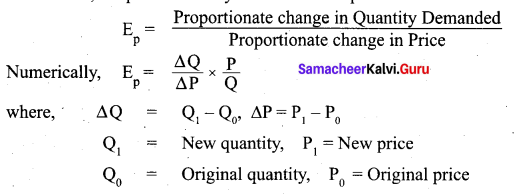
The price elasticity of demand, commonly known as the elasticity of demand refers to the responsiveness and sensitiveness of demand for a product to the changes in its price. In other words, the price elasticity of demand is equal to
Question 25.
State any two features of developed economy.
Answer:

  1. High National Income
  2. High Per Capita Income

Question 26.
Define Utility.
Answer:

  • Utility is the capacity of a commodity to satisfy human wants.
  • Utility cannot be cardinally measured, but can be ranked or compared or ordered by ordinal number such as I, II, III and so on.

Tamil Nadu 11th Economics Model Question Paper 1 English Medium

Question 27.
Name the basic approaches to consumer behaviour.
Answer:
There are two basic approaches, namely:
1. Utility approach

  • The utility approach involves the use of measurable (cardinal) utility to study consumer behaviour.
  • Marshall is the chief exponent of the utility approach to the theory of demand. It is known cardinal utility analysis or Marginal utility analysis or marshallian utility analysis.

2. Indifference curve approach

The indifference curve approach was the idea of comparable utility [ordinal utility] J.R. Hicks and R.G.D. Allen introduced the indifference curve approach.

Question 28.
What are the conditions for produces’s equilibrium?
Answer:

  • Producer equilibrium implies the situation where producer maximizes his output.
  • It is also known as optimum combination of the factors of production.
  • In short, the producer manufactures a given amount of output with ‘ least cost combination of factors’, with his given budget.

Question 29.
State the meaning of liquidity preference.
Answer:

  • Liquidity preference means the preference of the people to hold wealth in the form of liquid cash rather than in other non – liquid assets like bonds, securities, bills of exchange, land, building, gold etc.
  • “Liquidity Preference is the preference to have an equal amount of cash rather than of claims against other”.

Question 30.
Explicit Cost- Define.
Answer:
Payment made to other for the purchase of factors of production is known as Explicit Costs. It refers to the actual expenditures of the firm to purchase or hire the inputs the firm needs.

Tamil Nadu 11th Economics Model Question Paper 1 English Medium

Part – III

Answer any seven question in which Question No. 40 is compulsory. [7 × 3 = 21]

Question 31.
Explain the concept of consumer’s equilibrium with a diagram.
Answer:
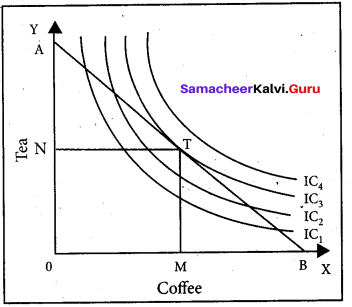
Consumer Equilibrium: The consumer reaches equilibrium at the point where the budget line is tangent on the indifference curve.

‘T’ is the point of equilibrium as budget line AB is tangent on indifference curve IC3 the upper most IC which implies maximum possible level of satisfaction.

At equilibrium point, the slope of IC refers to MRSxy and the slope of BL (Budget Line) refers to ratio of price of x to price of y.

i.e., \(\frac{P_{x}}{P_{y}}\) Therefore \(\mathrm{MRS}_{\mathrm{xy}}=\frac{\mathrm{P}_{\mathrm{x}}}{\mathrm{P}_{\mathrm{y}}} \)
Tamil Nadu 11th Economics Model Question Paper 1 English Medium q31

Question 32.
Explain social infrastructure.
Answer:

  • Social infrastructure refers to those structures which are improving the quality of manpower and contribute indirectly towards the growth of an economy.
  • These structures are outside the system of production and distribution.
  • The development of these social structures help in increasing the efficiency and productivity of manpower.
  • For example, schools, colleges, hospitals and other civic amenities.
  • It is a fact that one of the reasons for the low productivity of Indian workers is the lack of development of social infrastructure.

The status and developments in the social infrastructure in India are discussed below:

Education in India:
The India education system has flourished and developed with the growing needs of the economy.

Health in India:

  • Health in India is a state government responsibility.
  • The Central Council of Health and Welfare formulates the various health care projects and health department reform policies.

Question 33.
Write a short note on welfare economics given by Amartya Sen.
Answer:

  • Amartya Kumar Sen has included the concept of entitlement items like nutrition, food, medical and health care, employment, security of food supply in times of famine etc.
  • He considered famine as arising out of the failure of establishing a system of entitlements.

Question 34.
What are the characteristics of land?
Answer:

  • Land is a primary factor of production
  • Land is a passive factor of production
  • Land is the free gift of nature
  • Land has no cost of production
  • Land is fixed in supply. It is inelastic in supply
  • Land is permanent
  • Land is immovable
  • Land is heterogeneous as it differs in fertility
  • Land has alternative uses
  • Land is subject to Law of Diminishing Returns.

Question 35.
Briefly explain the concept of consumer’s equilibrium.
Answer:
The consumer reaches equilibrium at the point where the budget line is tangent on the indifference curve.
T is the point of equilibrium as budget line AB is tangent on indifference curve IC3 the upper IC which implies maximum possible level of satisfaction’.

At equilibrium point, the slope of IC refers to MRSXY and the slope of BL (Budget Line) refers to ratio of price of X to price of Y z.e. P x/ Py . Therefore MRSxy = Px / Py

Question 36.
The Handicrafts were declined in India in British period. Why?
Answer:

  • The Indian handicrafts products had a worldwide market.
  • Indian exports consisted chiefly of hand weaved cotton and silk fabrics, calicoes, artistic
    wares, wood carving etc. ,
  • Through discriminatory tariff policy, the British Government purposefully destroyed the
    handicrafts.
  • With the disappearance of Nawabs and Kings. There was no one to protect Indian handicrafts.
  •  Indian handicraft products could not complete with machine – made products.
  • The introduction of railways in India increased the domestic market for the British goods.

Question 37.
Elucidate the different types of land tenure system in colonial India.
Answer:
Land Tenure refers to the system of land ownership and management. The features that distinguish a land tenure system from the others relate to the following:

  • Who owns the land.
  • Who cultivates the land.
  • Who is responsible for paying the land revenue to the government.

Based on these questions, three different types of land tenure existed in India before Independence. They were:

  • Zamindari System or the Landlord – Tenant System.
  • Mahalwari System or Communal System of Farming.
  • Ryotwari System or the Owner Cultivator System.

Zamindari System or the Land lord Tenant System:

  • Under this system the land lord or the Zamindars were declared as the owners of the land and they were responsible to pay the land revenue to the government.
  • The share of the government in total rent collected was fixed as 10/11th the balance going to the
    Zamindars as remuneration.

Mahalwari System or Communal System of Farming:

  • After introduction of this system, it was later extended to Madhya Pradesh and Punjab.
  • The ownership of the land was maintained by the collective body usually the villagers which served as a unit of management.

Ryotwari System (or) the Owner Cultivator System:

  • This system was initially introduced in Tamil Nadu and later extended to Maharashtra,
  • Gujarat, Assam, Coorg, East Punjab and Madhya Pradesh.
  • Under this system the ownership rights of use and control of land were held by the tiller himself.\

Tamil Nadu 11th Economics Model Question Paper 1 English Medium

Question 38.
State and explain the elasticity of supply.
Answer:

    • Elasticity of supply may be defined as the degree of responsiveness of change in supply to change in price on the part of sellers.
    • It is Mathematically expressed as,
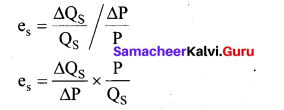
      Elasticity of supply = Proportionate change in supply / Proportionate change in price
      Tamil Nadu 11th Economics Model Question Paper 1 English Medium - 3

Where Qs represents the supply, P represents price , A denotes a change.

Question 39.
Write the strategy of Jawaharlal Nehru in India’s planning.
Answer:

  • Jawaharlal Nehru was responsible for the introduction of planning in our country.
  • To Jawaharlal Nehru, the Plan was essentially an integrated approach for development.
  • Initiating the debate on the Second Plan in the Lok Sabha in May 1956, Nehru spoke on the theme of planning.
  • Nehru Said “the essence of planning is to find the best way to utilize all resources of manpower, of money and so on”.
  • Planning for Nehru was essentially linked up with industrialization and eventual self-reliance for the country’s economic growth on a self-accelerating growth.
  • Nehru carried through this basic strategy of planned development.

Question 40.
What are the reasons for upward sloping supply curve?
Answer:
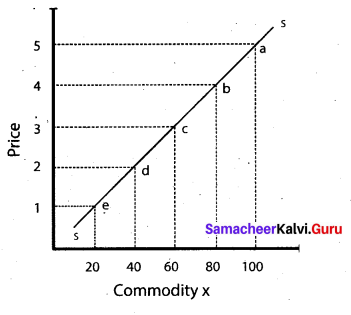
A supply curve represents the data given in the supply schedule. As the price of the commodity increases, the quantum supplied of the commodity also increases. Thus the supply curve has a positive slope from left to right.

The quantum supplied of commodity x is represented on X axis. And the price of the commodity is represented on the Y axis. The points such as e, d, c, b and a on the supply curve SS’, represent various quantities at different prices.
Tamil Nadu 11th Economics Model Question Paper 1 English Medium - 4

Tamil Nadu 11th Economics Model Question Paper 1 English Medium

Part – IV

Answer all the questions. [7 × 5 = 35]

Question 41.
(a) Discuss the short run cost curves with suitable diagram.
Short run Cost Curves:
Total Fixed Cost (TFC):
Answer:
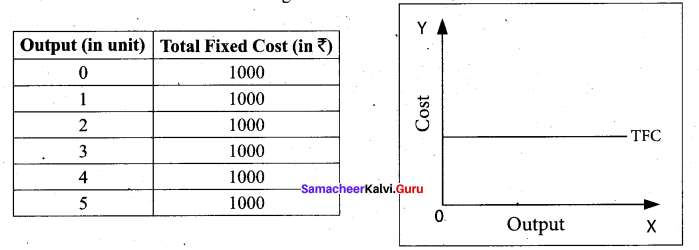
All payments for the fixed factors of production are known as Total Fixed Cost. A hypothetical TFC is shown in below table and diagram .
Tamil Nadu 11th Economics Model Question Paper 1 English Medium - 5

For instance if TC = Q3 – 18Q2 + 91Q + 12, the fixed cost here is 12. That means, if Q is zero, the Total cost will be 12, hence fixed cost.
It could be observed that TFC does not change with output. Even when the output is zero, the fixed cost is ₹ 1000. TFC is a horizontal straight line, parallel to X axis.

Total Variable Cost (TVC):
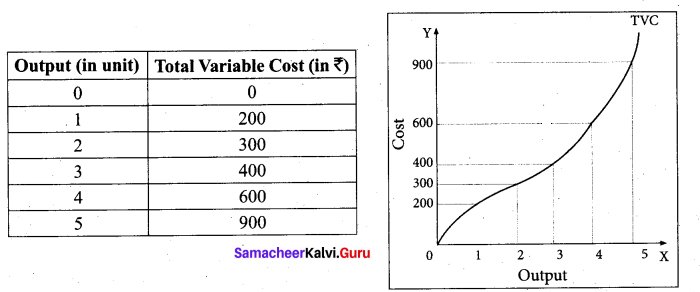
All payments to the variable factors of production is called as Total Variable Cost. Hypothetical TVC is shown in the below table and diagram.
Tamil Nadu 11th Economics Model Question Paper 1 English Medium - 6

In the diagram the TVC is zero when nothing is produced. As output increases TVC also increases. TVC curve slopes upward from left to right.
For instance in TC = Q3 – 18 Q2 + 91 Q + 12, variable cost, TVC = Q3 – 18Q2 + 91Q

Total Cost Curves:
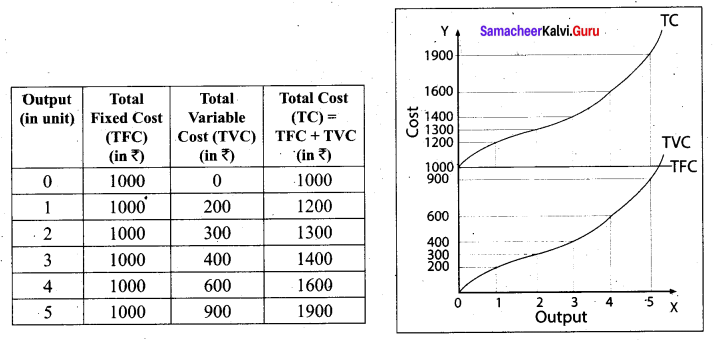
Total Cost means the sum total of all payments made in the production. It is also called as Total Cost of Production.
Total cost is the summation of Total Fixed Cost (TFC) and Total Variable Cost (TVC). It is written symbolically as
TC = TFC + TVC. For example, when the total fixed cost is ₹ 1000 and the total variable cost is ₹ 200 then the Total cost is = ₹ 1200 (₹1000 + ₹ 200).
If TFC = 12 and
TVC = Q3– 18 Q2 + 91 Q
TC = 12 + Q3 – 18 Q2 + 91 Q
Tamil Nadu 11th Economics Model Question Paper 1 English Medium - 7

Average Fixed Cost (AFC):
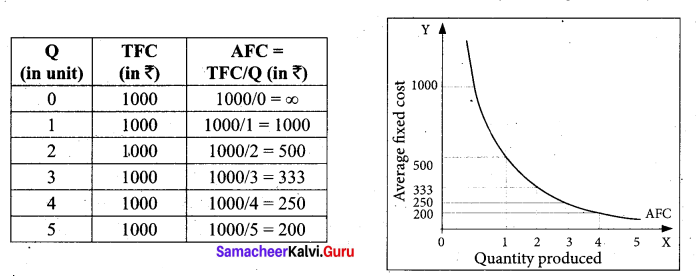
Average Fixed Cost refers to the fixed cost per unit of output. It is obtained by dividing the total fixed cost by the quantity of output. AFC = TFC / Q where, AFC denotes average fixed cost, TFC denotes total fixed cost and Q denotes quantity of output. For example, if TFC is 1000 and the quantity of output is 10, the AFC is ₹ 100, obtained by dividing ₹ 1000 by 10. TVC is shown in below table and diagram.
Tamil Nadu 11th Economics Model Question Paper 1 English Medium - 8
It is to be noted that

  • AFC declines as output increases, as fixed cost remains constant.
  • AFC cuiwe is a downward sloping throughout its length, never touching X and Y axis. It is asymptotic to both the axes.
  • The shape of the AFC curve is a rectangular hyperbola.

Average Variable Cost (AVC):
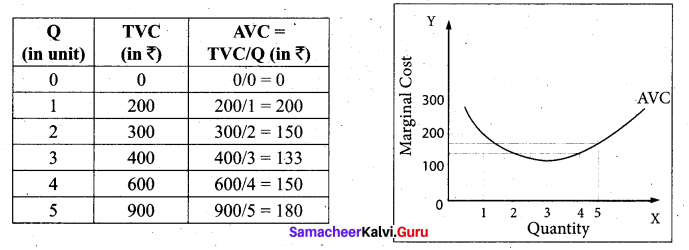
Average Variable Cost refers to the total variable cost per unit of output. It is obtained by dividing total variable cost (TVC) by the quantity of output (Q). AVC = TVC / Q where, AVC denotes Average Variable cost, TVC denotes total variable cost and Q denotes quantity of output. For example, When the TVC is ₹ 300 and the quantity produced is 2, the AVC is ₹ 150,
(AVC = 300/2 = 150) AVC is shown in the below table and diagram.
Tamil Nadu 11th Economics Model Question Paper 1 English Medium - 9

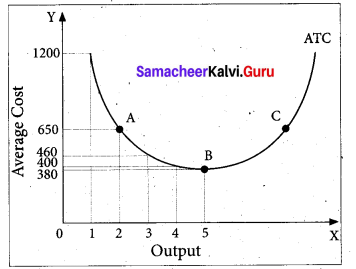
Average Total Cost (ATC) or Average Cost (AC):
Average Total Cost refers to the total cost per unit of output.

It can be obtained in two ways.

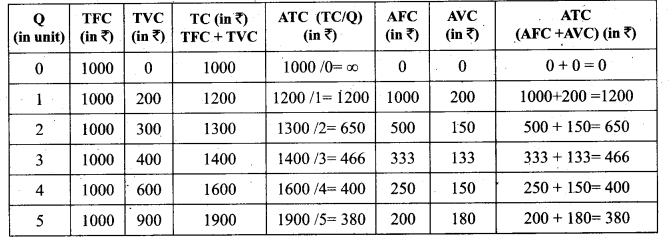
1. By dividing the firm’s total cost (TC).by the quantity of output (Q). ATC = TC / Q.
For example, if TC is ₹ 1600 and quantity of output is Q = 4, the Average Total Cost is ₹ 400. (ATC = 1600/4 = 400)
If ATC is Q3 – 18 Q3 + 91 Q + 12, then AC = Q2 – 18 Q +91 + 12/Q

2. By ATC is derived by adding together Average Fixed Cost (AFC) and Average Variable Cost (AVC) at each level of output. ATC = AFC + AVC:
For example, when Q = 2, TFC = 1000, TVC = 300; AFC = 500; AVC =150; ATC=650. ATC or AC is shown in the below table and diagram
Tamil Nadu 11th Economics Model Question Paper 1 English Medium - 10
Tamil Nadu 11th Economics Model Question Paper 1 English Medium - 11

Marginal Cost (MC):
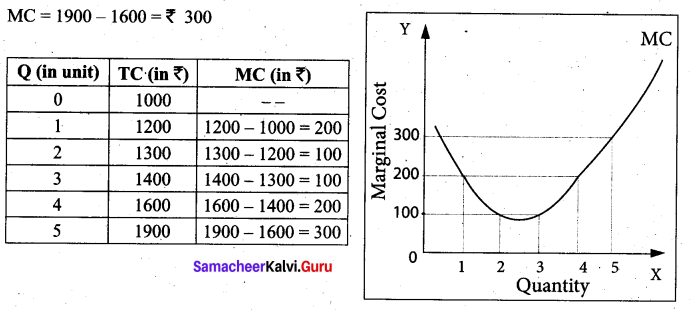
Marginal Cost is the cost of the last single unit produced. It is defined as the change in total costs resulting from producing one extra unit of output. In other words, it is the addition made to the total cost by producing one extra unit of output. Marginal cost is important for deciding whether any additional output can be produced or not. MC = ATC / AQ where MC denotes Marginal Cost, ATC denotes change in total cost and AQ denotes change in total quantity. For example, a firm produces 4 units of output and the Total cost is ₹ 1600. When the firm produces one more unit (4+1 = 5 units) of output at the total cost of ₹ 1900, the marginal cost is ₹ 300.
Tamil Nadu 11th Economics Model Question Paper 1 English Medium - 12

[OR]

(b) Bring out the features of perfect competition.
Answer:
(i) Large Number of Buyers and sellers

  • “A large number of buyers” implies that each individual buyer buys a very very small quantum of a product as compared to that found in the market.
  • This means that he has no power to fix the price of the product.
  • He is only a price-taker and not a price-maker
  • Large number of sellers” implies that share of each individual seller is a very very small quantum of a product.
  • No power to fix the price of the product.

(ii) Homogeneous Product and Uniform Price

  • The product sold and bought is homogeneous in nature, in the sense that the units of the product are perfectly substitutable.
  • All the units of the product are identical i.e., of the same size, shape, colour, quality etc.
  • Therefore, a uniform price prevails in the market.

(iii) Free Entry and Exit

  • In the short run, it is possible for the very efficient producer, producing the product at a very low cost, to earn super normal profits.
  • An inefficient producer, who is unable to bring down the cost incurs loss.

(iv) Absence of Transport Cost :
The prevalence of the uniform price is also due to the absence of the transport cost.

(v) Perfect Mobility of Factors of Production

  • The prevalence of the uniform price is also due to the perfect mobility of the factors of production.
  • As they enjoy perfect freedom to move from one place to another and from one occupation to another, the price gets adjusted.

(vi) Perfect Knowledge of the Market
All buyers and sellers have a thorough knowledge of the quality of the product, prevailing price etc.

(vii) No Government Intervention
There is no government regulation on supply of raw materials, and in the determination of price etc.

Question 42.
(a) Describe the features of oligopoly.
Answer:
Features of oligopoly:

  • Few large firms: Veiy few big firms own the major control of the whole market by producing major portion of the market demand.
  • Interdependence among firms: The price and quality decisions of a particular firm are dependent on the price and quality decisions of the rival firms.
  • Group behaviour: The firms under oligopoly realise the importance of mutual . co-operation.
  • Advertisement cost: The oligopolist could raise sales either by advertising or improving the quality of the product.
  • Nature of product: Perfect oligopoly means homogeneous products and imperfect oligopoly deals with heterogeneous products.
  • Price rigidity: It implies that prices are difficult to be changed. The oligopolistic firms do not change their prices due to the fear of rival’s reaction.

[OR]

(b) Discuss about the Indian Economy during British period.
Answer:
Indian Economy during the British period:

  • India’s sea route trade to Europe started only after the arrival of Vasco da Gama in Calicut, India on May 20, 1498.
  • The Portuguese had traded in Goa as early as 1510.
  • In 1601 the East India Company was chartered, and the English began their first inroads into the Indian ocean.
  • In 1614 Sir Thomas Roe was successful in getting permission from Jahangir for setting up factories and slowly moved all parts of India.
  • Hundred years after Battle of Plassey, the rule of the East India Company finally did come
    to an end.
  • In 1858, British Parliament passed a law through which the power for governance of India was transferred from the East India Company [EIC] to the British Crown.
  • Even the transfer of power from the East India Company to the British Crown did not materially alter the situation.
  • Britain had exploited India over a period of two centuries of its colonial rule.

On the basis of the form of colonial exploitation, economic historians have divided the whole period into three phases:

  1. The period of merchant Capital
  2. The period of Industrial Capital
  3. The period of Finance Capital

Tamil Nadu 11th Economics Model Question Paper 1 English Medium

Question 43.
(a) What is GST? Write its advantages.
Answer:

  • GST – Goods and Services Tax. GST is defined as the tax levied when a consumer buys a good or service.
  • Removing cascading tax effect
  • Single point tax
  • Higher threshold for registration
  • Composition scheme for small business
  • Online simpler procedure under GST
  • Defined treatment for e-commerce
  • Increased efficiency in logistics
  • Regulating the unorganized sector

[OR]

(b) What are the remedial measures for Rural unemployment?
Answer:
Remedial measures for Rural unemployment:
In order to reduce rural unemployment in the country there is a need to take integrated and coordinated efforts from various levels. A few remedial measures are listed below:

Subsidiary Occupation: To reduce the seasonal unemployment rural people should be encouraged to adopt subsidiary occupations. Loans should be granted and proper arrangements should be made for marketing their products.

Rural Works Programme: Rural Works Programme such as construction and maintenance of roads, digging of drains, canals etc., should be planned during off season to provide gainful employment to the unemployed.

Irrigation Facilities: Since rainfall is uncertain irrigation facilities should be expanded to enable the farmers to adopt multiple cropping.

Rural Industrialization: To provide employment new industries should be set up in rural areas. Technical Education: Employment oriented courses should be introduced in schools and colleges to enable the literate youth to start their own units.

Question 44.
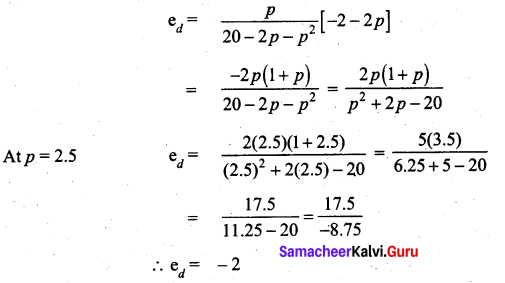
(a) The demand function is given by x = 20 – 2p – p2 where p and x are the price and the quantity respectively. Find the elasticity of demand for p = 2.5.
Answer:
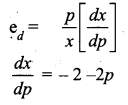
Tamil Nadu 11th Economics Model Question Paper 1 English Medium - 13
Tamil Nadu 11th Economics Model Question Paper 1 English Medium - 14

[OR]
(b) Solve for x quantity demanded if 16x – 4 = 68 + 7x.
Answer:
16x – 4 = 68 + 7x
16x – 7x = 68 + 4
9x = 72
x = 72/9
∴ x = 8

Question 45.
(a) Bring out Jawaharlal Nehru’s contribution to the idea of economic development.
Answer:

  • Jawaharlal Nehru, one of the chief builders of Modem India, was the first Prime Minister of Independent India.
  • He was a great patriot, thinker and statesman.

(i) Democracy and Secularism:

  • Jawaharlal Nehru was a firm believer in democracy.
  • He believed in free speech civil liberty, adult franchise and the Rule of Law and Parliamentary democracy.
  • Secularism, is another signal contribution of Nehru to India.

(ii) Planning:

  • Jawaharlal Nehru was responsible for the introduction of planning in our country.
  • Jawaharlal Nehru, the Plan was essentially an integrated approach for development.
  • Nehru Spoke on the theme of planning.
  • He said “the essence of planning is to find the best way to utilize all resources of manpower, of money and so on”.
  • “Planning for Nehru was essentially linked up with Industrialization and eventual self-reliance for the country’s economic growth on a self-accelerating growth.
  • Nehru carried through this basis strategy of planned development.
  • Nehru’s contribution to the advancement of science, research, technology and industrial development cannot be forgotten.
  • It was during is period, many IITs and Research Institutions were established.
  • Nehru always in insisted on “ scientific temper”.

[OR]

(b) – Describe the performance of 12 five year plans in India.
Answer:
Performance of Five Year Plans:
First Five Year Plan – [1951 -1956]

  • It was based on the Harrod – Domar Model.
  • Its main focus was on the agricultural development of the country. ,
  • This plan was successful and achieved the GDP growth rate of 3.6%. [more than its target]

Second Five Year Plan – [1956 – 1961]

  • It was based on the P.C. Mahalanobis Model.
  • Its main focus was on the industrial development of the country.
  • This plan was successful and achieved growth rate of 4.1%

Third Five Year Plan- [1961-1966].

  • This plan was called ‘Gadgil Yojana’.
  • The main target of this plan was to make the economy independent and to reach self propelled position or take off.
  • Due to Indo – China war, this plan could not achieve its growth target of 5.6%.

Fourth Five Year Plan – [1969 -1974]

  • There are two main objectives of this plan (i.e) growth with stability and progressive achievement of self reliance.
  • This plan failed and could achieve growth rate of 3.3% only against the target of 5.7%.

Fifth Five Year Plan – [1974 1979]

  • In this plan top priority was given to agriculture, next came industry and mines.
  • This plan achieved the growth of 4.8% against the target of 4.4%.

Sixth Five Year Plan-[1980-1985]

  • The basic objective of this plan was poverty eradication and technological self reliance.
  • Its growth target was 5.2% but it achieved 5.7%

Seventh Five Year Plan – [1985 – 1990]

  • This plan establishment of the self sufficient economy, opportunities for productive employment.
  • Its growth target was 5.0% but it achieved 6.0%

Eighth Five Year Plan – [1992-1997]

  • In this plan the top priority was given to development of the human resources (i.e) employment, education and public health.
  • This plan was successful and got annual growth rate of 6.8%.

Ninth Five Year Plan-[1997-2002]

  • The main focus of this plan was “growth with justice and equity”.
  • This plan failed to achieve the growth target of 7% and Indian economy grew only at the rate of 5.6%.

Tenth Five Year Plan – [2002 – 2007]

  • This plan aimed to double the per capita income of India in the next 10 years.
  • It aimed to reduce the poverty ratio of 15%
  • Its growth target was 8.0% but it achieved only 7.2%

Eleventh Five Year Plan – [2007 – 2012]

  • Its main theme was “faster and more inclusive growth”.
  • Its growth rate target was 8.1% but it achieved only 7.9%

Twelfth Five Year Plan – [2012 – 2017]

  • Its main theme is “faster, more inclusive and sustainable growth”.
  • Its growth rate target is 8%
  • Since the Indian Independence the five year plans of India played a very prominent role in the economic development of the country.

Tamil Nadu 11th Economics Model Question Paper 1 English Medium

Question 46.
(a) If TC = 2.5q3 – 13q2 + 50q + 12 derive the MC function and AC function.
Answer:
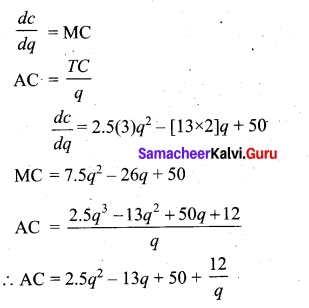
Tamil Nadu 11th Economics Model Question Paper 1 English Medium - 15

[OR]

(b) What are the ideas of information and communication technology used in Economics?
Answer:
Information and communication Technology [ICT] is the infrastructure that enables computiftg faster and accurate.
The following table given an idea of range of technologies that fall under the category of ICT

S.NoInformationTechnologies
1.CreationPersonal computers, Digital Camera, Scanner, Smart Phone
2.ProcessingCalculator, PC – Personal Computer, Smart Phone
3.StorageCD, DVD, Pen Drive, Microchip, Cloud
4.DisplayPC – Personal computer, TV – Television, Projector, Smart Phone
5.TransmissionInternet, Teleconference, Video, Conferencing, Mobile, Technology, Radio
6.ExchangeE – mail, Cell Phone

The evaluation of ICT has five phases:

They are evaluation in: (a) Computer (b) PC – Personal Computer (c) Micro Processor ‘ (d) Internet (e) Wireless links
In Economics, the uses of mathematical and statistical tools need the support of ICT for: (a) Data Compiling (b) Editing (c) Manipulating (d) Presenting the results

Tamil Nadu 11th Economics Model Question Paper 1 English Medium

Question 47.
(a) Bring out the relationship between AR and MR curves under various price conditions.
Answer:
Relationship between AR and MR Curves: If a firm is able to sell additional units at the same price then AR and MR will be constant and equal. If the firm is able to sell additional units only by reducing the price, then both AR and MR will fall and be different.
Constant AR and MR (at Fixed Price): When price remains constant or fixed, the MR will be also constant and will coincide with AR. Under perfect competition as the price is uniform and fixed, AR is equal to MR and their shape will be a straight line horizontal to X axis. The AR and MR Schedule under constant price is given in the below table and in the diagram.
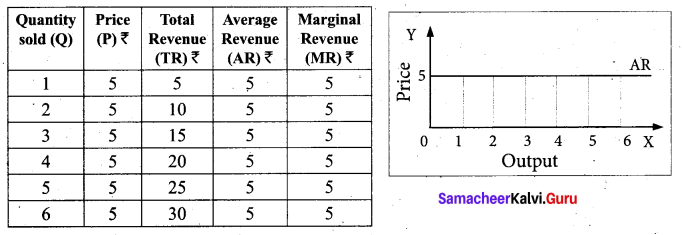
Tamil Nadu 11th Economics Model Question Paper 1 English Medium - 16

Declining AR and MR (at Declining Price)
When a firm sells large quantities at lower prices both AR and MR will fall but the fall in MR
will be more steeper than the fall in the AR.
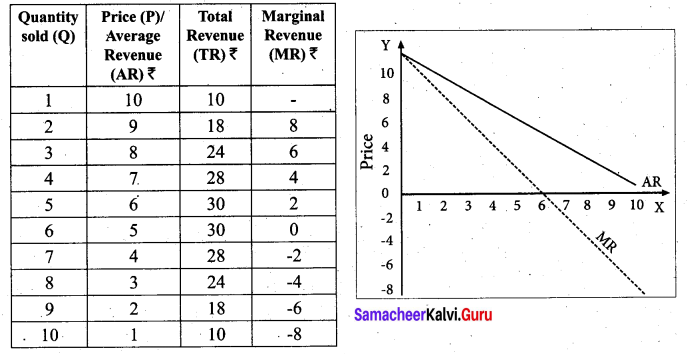
Tamil Nadu 11th Economics Model Question Paper 1 English Medium - 17

It is to be noted that MR will be lower than AR. Both AR and MR will be sloping downwards straight from left to right. The MR curve divides the distance between AR Curve and Y axis into two equal parts. The decline in AR need not be a straight line or linear. If the prices are declining with the increase in quantity sold, the AR can be non-linear, taking a shape of concave or convex to the origin.

[OR]

(b) Define Market.
Answer:

  • Market refers to a physical place, where commodities and services are bought and sold. In Economics, The term “market” refers to a system of exchange between the buyers and the sellers of a commodity.
  • Besides direct exchanges, there are exchanges that are carried out through correspondence, telephones, online, e-mail etc.

A market has the following characteristic features:

  1. Buyers and sellers of a commodity or a service
  2. A commodity to be bought and sold
  3. Price agreeable to buyer and seller
  4. Direct or indirect exchange.
Tamil Nadu 11th Physics Model Question Papers 2019-2020 English Tamil Medium

Expert Teachers at SamacheerKalvi.Guru has created Samacheer Kalvi Tamil Nadu State Board Syllabus New Paper Pattern 11th Physics Model Question Papers 2019-2020 with Answers Pdf Free Download in English Medium and Tamil Medium of TN 11th Standard Physics Public Exam Question Papers Answer Key, New Paper Pattern of HSC 11th Class Physics Previous Year Question Papers, Plus One +1 Physics Model Sample Papers are part of Tamil Nadu 11th Model Question Papers.

Here we have given the Government of Tamil Nadu State Board 11th Physics Model Question Papers Tamil Medium with Answers 2019-20 Pdf. Students can view or download the Class 11th Physics New Model Question Papers 2020 Tamil Nadu English Medium Pdf for their upcoming Tamil Nadu HSC Board Exams. Students can also read Tamilnadu Samcheer Kalvi 11th Physics Book Solutions.

TN State Board 11th Physics Model Question Papers 2019 2020 English Tamil Medium

Tamil Nadu 11th Physics Model Question Papers English Medium 2019-2020

Tamil Nadu 11th Physics Model Question Papers Tamil Medium 2019-2020

  • Tamil Nadu 11th Physics Model Question Paper 1 Tamil Medium
  • Tamil Nadu 11th Physics Model Question Paper 2 Tamil Medium
  • Tamil Nadu 11th Physics Model Question Paper 3 Tamil Medium
  • Tamil Nadu 11th Physics Model Question Paper 4 Tamil Medium
  • Tamil Nadu 11th Physics Model Question Paper 5 Tamil Medium

11th Physics Model Question Paper Design 2019-2020 Tamil Nadu

Types of QuestionsMarksNo. of Questions to be AnsweredTotal Marks
Part-I Objective Type11515
Part-II Very Short Answers
(Totally 9 questions will be given. Answer any Six. Any one question should be answered compulsorily)
2611
Part-Ill Short Answers
(Totally 9 questions will be given. Answer any Six. Any one question should be answered compulsorily)
3618
Part-IV Essay Type5525
Total70
Practical Marks + Internal Assessment (20+10)30
Total Marks100

Tamil Nadu 11th Physics Model Question Paper Weightage of Marks

PurposeWeightage
1. Knowledge30%
2. Understanding40%
3. Application20%
4. Skill/Creativity10%

It is necessary that students will understand the new pattern and style of Model Question Papers of 11th Standard Physics Tamilnadu State Board Syllabus according to the latest exam pattern. These Tamil Nadu Plus One 11th Physics Model Question Papers State Board Tamil Medium and English Medium are useful to understand the pattern of questions asked in the board exam. Know about the important concepts to be prepared for TN HSLC Board Exams and Score More marks.

We hope the given Samacheer Kalvi Tamil Nadu State Board Syllabus New Paper Pattern Class 11th Physics Model Question Papers 2019 2020 with Answers Pdf Free Download in English Medium and Tamil Medium will help you.

If you have any queries regarding the Tamil Nadu Government 11th Physics State Board Model Question Papers with Answers 2019 20, TN 11th Std Physics Public Exam Question Papers with Answer Key, New Paper Pattern of HSC Class 11th Physics Previous Year Question Papers, Plus One +1 Physics Model Sample Papers, drop a comment below and we will get back to you at the earliest.

Tamil Nadu 11th Economics Model Question Papers 2019-2020 English Tamil Medium

Expert Teachers at SamacheerKalvi.Guru has created Samacheer Kalvi Tamil Nadu State Board Syllabus New Paper Pattern 11th Economics Model Question Papers 2019-2020 with Answers Pdf Free Download in English Medium and Tamil Medium of TN 11th Standard Economics Public Exam Question Papers Answer Key, New Paper Pattern of HSC 11th Class Economics Previous Year Question Papers, Plus One +1 Economics Model Sample Papers are part of Tamil Nadu 11th Model Question Papers.

Here we have given the Government of Tamil Nadu State Board 11th Economics Model Question Papers Tamil Medium with Answers 2019-20 Pdf. Students can view or download the Class 11th Economics New Model Question Papers 2020 Tamil Nadu English Medium Pdf for their upcoming Tamil Nadu HSC Board Exams. Students can also read Tamilnadu Samcheer Kalvi 11th Economics Book Solutions.

TN State Board 11th Economics Model Question Papers 2019 2020 English Tamil Medium

Tamil Nadu 11th Economics Model Question Papers English Medium 2019-2020

Tamil Nadu 11th Economics Model Question Papers Tamil Medium 2019-2020

  • Tamil Nadu 11th Economics Model Question Paper 1 Tamil Medium
  • Tamil Nadu 11th Economics Model Question Paper 2 Tamil Medium
  • Tamil Nadu 11th Economics Model Question Paper 3 Tamil Medium
  • Tamil Nadu 11th Economics Model Question Paper 4 Tamil Medium
  • Tamil Nadu 11th Economics Model Question Paper 5 Tamil Medium

11th Economics Model Question Paper Design 2019-2020 Tamil Nadu

Types of QuestionsMarksNo. of Questions to be AnsweredTotal Marks
Part-I Objective Type12020
Part-II Very Short Answers
(Totally 10 questions will be given. Answer any Seven. Any one question should be answered compulsorily)
2714
Part-Ill Short Answers
(Totally 10 questions will be given. Answer any Seven. Any one question should be answered compulsorily)
3721
Part-IV Essay Type5735
Marks90
Internal Assessment10
Total Marks100

Tamil Nadu 11th Economics Model Question Paper Weightage of Marks

PurposeWeightage
1. Knowledge30%
2. Understanding40%
3. Application20%
4. Skill/Creativity10%

It is necessary that students will understand the new pattern and style of Model Question Papers of 11th Standard Economics Tamilnadu State Board Syllabus according to the latest exam pattern. These Tamil Nadu Plus One 11th Economics Model Question Papers State Board Tamil Medium and English Medium are useful to understand the pattern of questions asked in the board exam. Know about the important concepts to be prepared for TN HSLC Board Exams and Score More marks.

We hope the given Samacheer Kalvi Tamil Nadu State Board Syllabus New Paper Pattern Class 11th Economics Model Question Papers 2019 2020 with Answers Pdf Free Download in English Medium and Tamil Medium will help you.

If you have any queries regarding the Tamil Nadu Government 11th Economics State Board Model Question Papers with Answers 2019 20, TN 11th Std Economics Public Exam Question Papers with Answer Key, New Paper Pattern of HSC Class 11th Economics Previous Year Question Papers, Plus One +1 Economics Model Sample Papers, drop a comment below and we will get back to you at the earliest.

11th Model Question Papers 2020-2021 Tamil Nadu State Board English Tamil Medium with Answers

Expert Teachers at SamacheerKalvi.Guru has created Samacheer Kalvi Tamil Nadu State Board Syllabus New Paper Pattern 11th Model Question Papers 2020-2021 with Answers Pdf Free Download in English Medium and Tamil Medium of TN 11th Standard Public Exam Question Papers Answer Key, New Paper Pattern of HSC 11th Class Previous Year Question Papers, Plus One +1 Model Sample Papers, 11th Quarterly Half Yearly Model Question Papers Tamil Nadu are part of Samacheer Kalvi.

Here we have given the Tamil Nadu Government 11th State Board Model Question Papers with Answers for All Subjects 2020-21 Tamil Medium Pdf. Students can view or download the Class 11th New Model Question Papers 2021 Tamil Nadu English Medium Pdf for their upcoming Tamil Nadu HSC Board Exams. Students can also read Tamilnadu Samcheer Kalvi 11th Books Solutions.

11th New Public Exam Model Question Papers Tamil Nadu 2020 2021 English Tamil Medium

11th New Model Question Papers 2020 2021 Tamil Nadu

It is necessary that students will understand the new pattern and style of Model Question Papers of 11th Standard Tamilnadu State Board Syllabus according to the latest exam pattern. These Tamilnadu Plus One 11th Model Question Papers State Board Tamil Medium and English Medium are useful to understand the pattern of questions asked in the board exam. Know about the important concepts to be prepared for TN HSLC Board Exams and Score More marks.

We hope the given Samacheer Kalvi Tamil Nadu State Board Syllabus New Paper Pattern Class 11th Model Question Papers 2020 2021 with Answers Pdf Free Download in English Medium and Tamil Medium will help you.

If you have any queries regarding the Tamil Nadu Government 11th State Board Model Question Papers with Answers 2020 21 for All Subjects, TN 11th Std Public Exam Question Papers with Answer Key, New Paper Pattern of HSC Class 11th Previous Year Question Papers, Plus One +1 Model Sample Papers, 11th Quarterly Half Yearly Model Question Papers Tamil Nadu, drop a comment below and we will get back to you at the earliest.

Samacheer Kalvi 11th Accountancy Solutions Chapter 12 Final Accounts of Sole Proprietors – I

Students can Download Accountancy Chapter 12 Final Accounts of Sole Proprietors – I Questions and Answers, Notes Pdf, Samacheer Kalvi 11th Accountancy Book Solutions Guide Pdf helps you to revise the complete Tamilnadu State Board New Syllabus and score more marks in your examinations.

Tamilnadu Samacheer Kalvi 11th Accountancy Solutions Chapter 12 Final Accounts of Sole Proprietors – I

Samacheer Kalvi 11th Accountancy Final Accounts of Sole Proprietors – I Text Book Back Questions and Answers

I. Multiple Choice Questions
Choose the Correct Answer

Question 1.
Closing stock is an item of ……………..
(a) Fixed asset
(b) Current asset
(c) Fictitious asset
(d) Intangible asset
Answer:
(b) Current asset

Question 2.
Balance sheet is ……………..
(a) An account
(b) A statement
(c) Neither a statement nor an account
(d) None of the above
Answer:
(b) A statement

Question 3.
Net profit of the business increases the ……………..
(a) Drawings
(b) Receivables
(c) Debts
(d) Capital
Answer:
(d) Capital

Samacheer Kalvi 11th Accountancy Solutions Chapter 12 Final Accounts of Sole Proprietors – I

Question 4.
Carriage inwards will be shown ……………..
(a) In the trading account
(b) In the profit and loss account
(c) On the liabilities side
(d) On the assets side
Answer:
(a) In the trading account

Question 5.
Bank overdraft should be shown ……………..
(a) In the trading account
(b) Profit and loss account
(c) On the liabilities side
(d) On the assets side
Answer:
(c) On the liabilities side

Question 6.
Balance sheet shows the …………….. of the business.
(a) Profitability
(b) Financial position
(c) Sales
(d) Purchases
Answer:
(b) Financial position

Question 7.
Drawings appearing in the trial balance is ……………..
(a) Added to the purchases
(b) Subtracted from the purchases
(c) Added to the capital
(d) Subtracted from the capital
Answer:
(d) Subtracted from the capital

Question 8.
Salaries appearing ill the trial balance is shown on the ……………..
(a) Debit side of trading account
(b) Debit side of profit and loss account
(c) Liabilities side of the balance sheet
(d) Assets side of the balance sheet
Answer:
(b) Debit side of profit and loss account

Samacheer Kalvi 11th Accountancy Solutions Chapter 12 Final Accounts of Sole Proprietors – I

Question 9.
Current assets does not include ……………..
(a) Cash
(b) Stock
(c) Furniture
(d) Prepaid expenses
Answer:
(c) Furniture

Question 10.
Goodwill is classified as ……………..
(a) A current asset
(b) A liquid asset
(c) A tangible asset
(d) An intangible asset
Answer:
(d) An intangible asset

II. Very Short Answer Questions

Question 1.
Write a note on trading account.
Answer:
Trading refers to buying and selling of goods with the intention of making profit. The trading account is a nominal account which shows the result of buying and selling of goods for an accounting period. Trading account is prepared to find out the difference between the revenue from sales and cost of goods sold.

Question 2.
What are wasting assets?
Answer:
These are the assets which get exhausted gradually in the process of excavation. Examples: mines and quarry.

Question 3.
What are fixed assets?
Answer:
Fixed assets are those assets which are acquired or constructed for continued use in the business and last for many years such as land and building, plant and machinery, motor vehicles, furniture, etc.

Samacheer Kalvi 11th Accountancy Solutions Chapter 12 Final Accounts of Sole Proprietors – I

Question 4.
What is meant by purchases returns?
Answer:
Goods purchased which are returned to suppliers are termed as purchases returns or returns outward.

Question 5.
Name any two direct expenses and indirect expenses.
Answer:
Direct expenses:

  • Carriage inwards or freight inwards
  • Wages Indirect expenses:

Indirect expenses:

  • Office and administrative expenses
  • Selling and distribution expenses

Question 6.
Mention any two differences between trial balance and balance sheet.
Answer:

S.No.BasisTrial BalanceBalance Sheet
1.NatureTrial balance is a list of ledger balances on a particular date.Balance sheet is a statement showing the position of assets and liabilities on a particular date.
2.PurposeTrial balance is prepared to check the arithmetical accuracy of the accounting entries made.Balance sheet is prepared to ascertain the financial position of a business.

Question 7.
What are the objectives of preparing trading account?
Answer:

  1. Provides information about gross profit or gross loss.
  2. Provides an opportunity to safeguard against possible losses.

Question 8.
What is the need for preparing profit and loss account?
Answer:

  1. Ascertainment of net profit or net loss
  2. Comparison of profit
  3. Control on expenses
  4. Helpful in the preparation of balance sheet.

III. Short Answer Questions

Question 1.
What are final accounts? What are its constituents?
Answer:
Businessmen want to know the profitability and the financial position of the business. These can be ascertained by preparing the final accounts or financial statements. The final accounts or financial statements include the following:

  1. Income statement or trading and profit and loss account; and
  2. Position statement or Balance sheet.

Samacheer Kalvi 11th Accountancy Solutions Chapter 12 Final Accounts of Sole Proprietors – I

Question 2.
What is meant by closing entries? Why are they passed?
Answer:
Balances of all the nominal accounts are required to be closed on the last day of the accounting year to facilitate the preparation of trading and profit and loss account. It is done by passing necessary closing entries in the journal proper. Purchases has debit balance and purchases returns has credit balance. At the end of the accounting year, the balance in purchases returns account is closed by transferring to purchase account.

Question 3.
What is meant by gross profit and net profit?
Answer:

  1. If the amount of sales exceeds the cost of goods sold, the difference is gross profit.
    Sales – Cost of goods sold = Gross profit.
  2. If the total of the credit side of the profit and loss account exceeds the debit side, the difference is termed as net profit.

Question 4.
“Balance sheet is not an account” – Explain.
Answer:
A balance sheet is a part of the final accounts. However, the balance sheet is a statement and not an account. It has no debit or credit sides and as such the words ‘To’ and ‘By’ are not used before the names of the accounts shown therein.

Question 5.
What are the advantages of preparing a balance sheet?
Answer:
Balance sheet discloses the financial position of a business on a particular date, it gives
the balances only for the date on which it is prepared. It shows the financial position of the business according to the going concern concept.

Samacheer Kalvi 11th Accountancy Solutions Chapter 12 Final Accounts of Sole Proprietors – I

Question 6.
What is meant by grouping and marshalling of assets and liabilities?
Answer:
1. The term ‘grouping’ means showing the items of similar nature under a common heading. For example, the amount due from various customers will be shown under the head‘sundry debtors’.

2. ‘Marshalling’ is the arrangement of various assets and liabilities in a proper order. Marshalling can be made in one of the following two ways:

  • In the order of liquidity
  • In the order of permanence

IV. Exercises

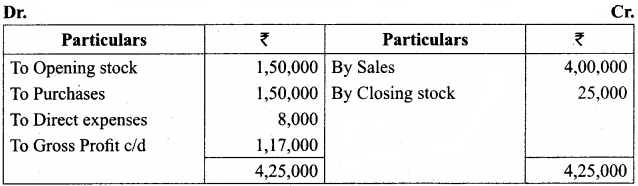
Question 1.
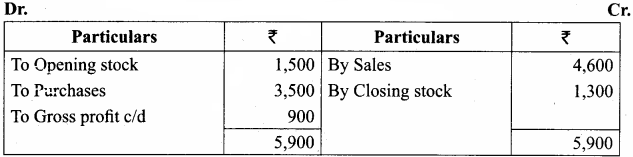
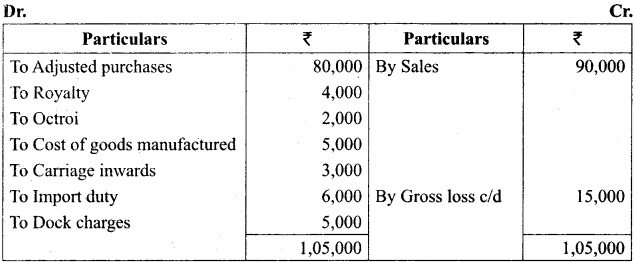
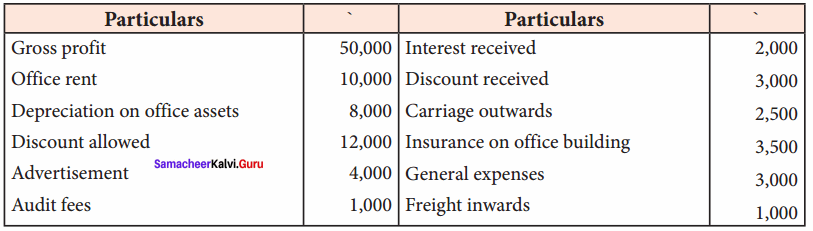
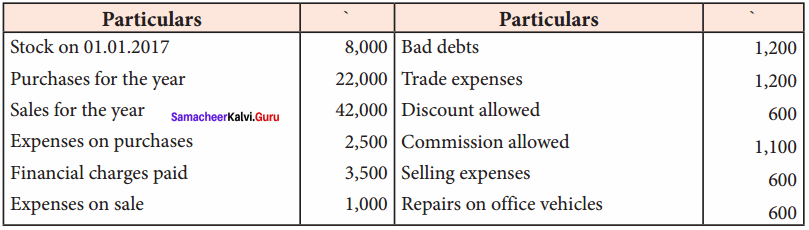
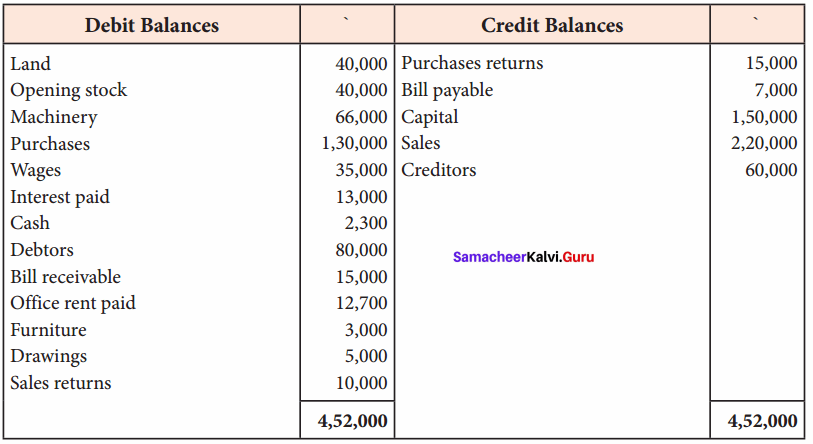
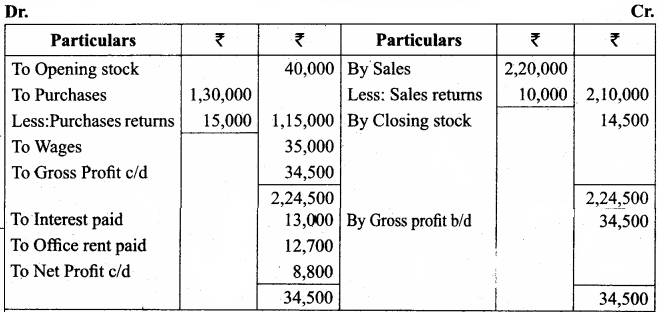
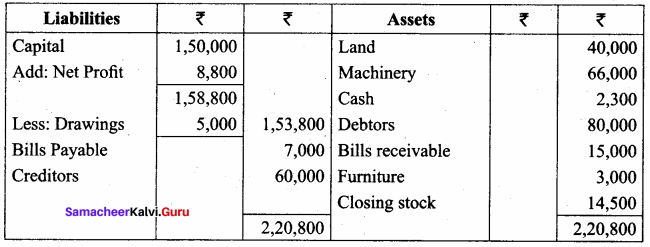
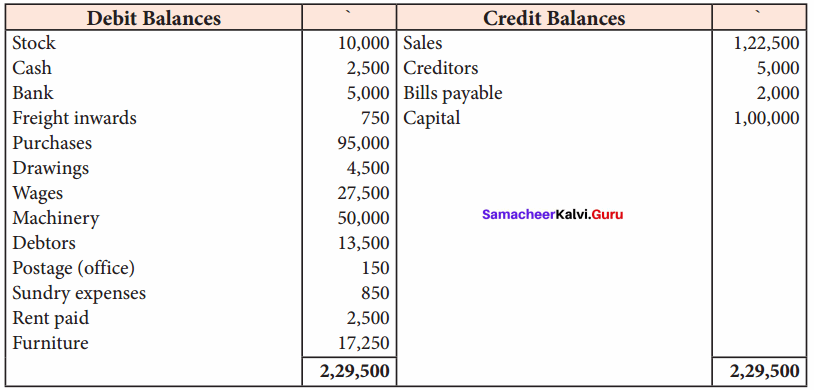
Prepare trading account in the books of Sivashankar from the following figures:
Samacheer Kalvi 11th Accountancy Solutions Chapter 12 Final Accounts of Sole Proprietors – I
Answer:
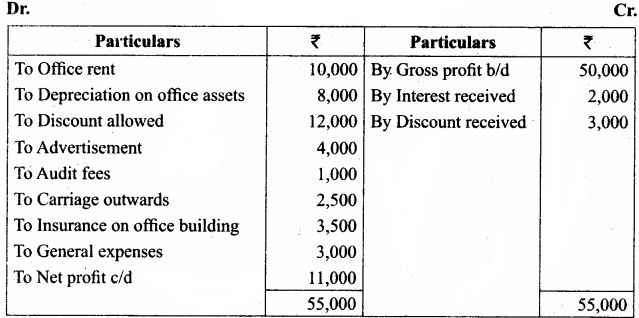
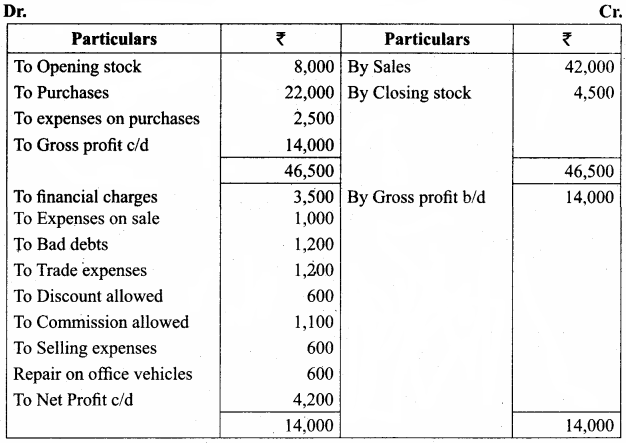
Trading account of Sivashankar
Samacheer Kalvi 11th Accountancy Solutions Chapter 12 Final Accounts of Sole Proprietors – I

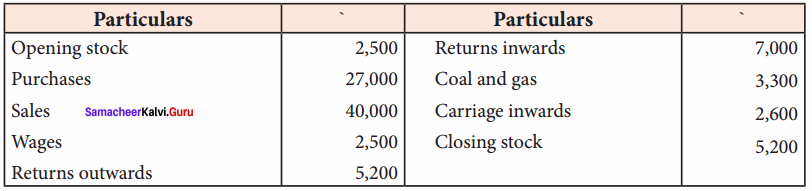
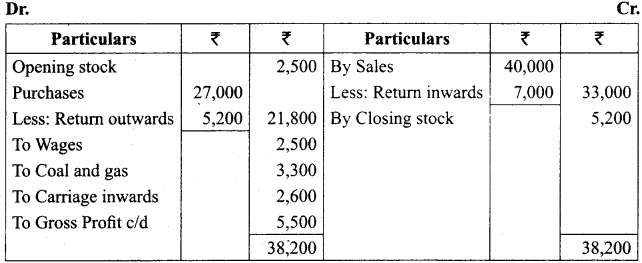
Question 2.
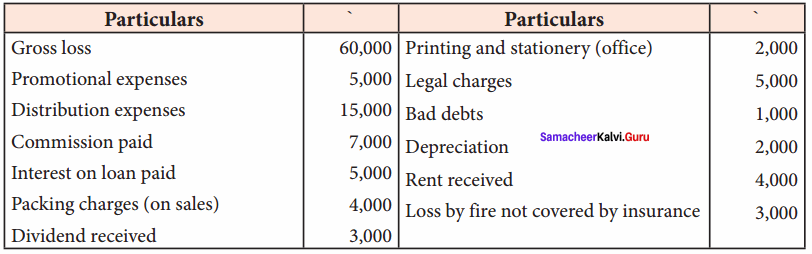
Prepare trading account in the books of Mr. Sanj ay for the year ended 31st December 2017:
Samacheer Kalvi 11th Accountancy Solutions Chapter 12 Final Accounts of Sole Proprietors – I
Answer:
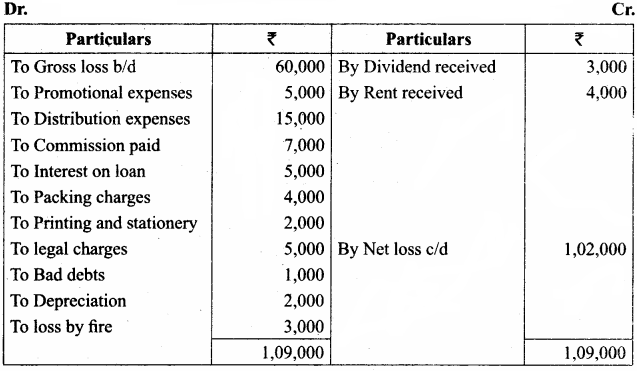
Trading account of Mr. Sanjay for the year ended 31st December, 2017
Samacheer Kalvi 11th Accountancy Solutions Chapter 12 Final Accounts of Sole Proprietors – I

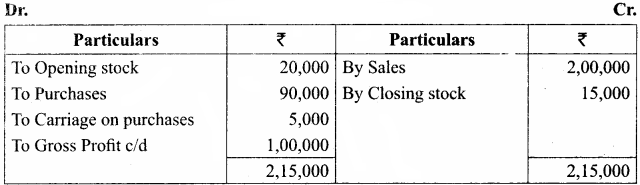
Question 3.
Prepare trading account in the books of Mr. Sanj ay for the year ended 31st December 2017:
Samacheer Kalvi 11th Accountancy Solutions Chapter 12 Final Accounts of Sole Proprietors – I
Answer:
Trading account of Saravanan for the year ended 31st December, 2017
Samacheer Kalvi 11th Accountancy Solutions Chapter 12 Final Accounts of Sole Proprietors – I

Question 4.
From the following details for the year ended 31st March, 2018, prepare trading account
Samacheer Kalvi 11th Accountancy Solutions Chapter 12 Final Accounts of Sole Proprietors – I
Answer:
Trading account for the year ended 31st March, 2018
Samacheer Kalvi 11th Accountancy Solutions Chapter 12 Final Accounts of Sole Proprietors – I

Question 5.
Ascertain gross profit or gross loss from the following:
Samacheer Kalvi 11th Accountancy Solutions Chapter 12 Final Accounts of Sole Proprietors – I
Answer:
Profit and Loss Account
Samacheer Kalvi 11th Accountancy Solutions Chapter 12 Final Accounts of Sole Proprietors – I

Question 6.
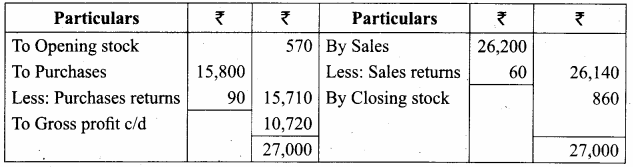
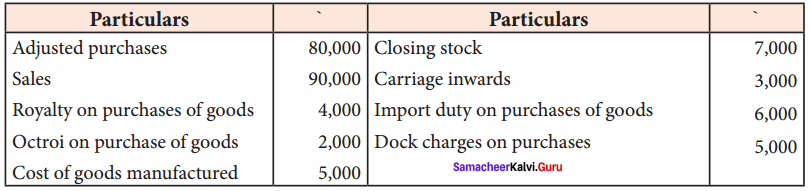
From the following balances taken from the books of Victor, prepare trading account for the year ended December 31,2017:
Samacheer Kalvi 11th Accountancy Solutions Chapter 12 Final Accounts of Sole Proprietors – I
Answer:
Trading Account of Victor for the year ended 31st December, 2017
Samacheer Kalvi 11th Accountancy Solutions Chapter 12 Final Accounts of Sole Proprietors – I
Hint : Closing stock will not appear in trading account because of adjusted purchases have been given.

Question 7.
Compute cost of goods sold from the following information:
Samacheer Kalvi 11th Accountancy Solutions Chapter 12 Final Accounts of Sole Proprietors – I
Answer:
Cost of goods sold = Opening stock + Net purchases + Direct expenses – Closing stock
= 10,000 + 80,000 + 7,000 – 15,000
= ₹ 82,000
Note: Indirect expenses do not form part of cost of goods sold.

Question 8.
Find out the amount of sales from the following information:
Samacheer Kalvi 11th Accountancy Solutions Chapter 12 Final Accounts of Sole Proprietors – I
Answer:
Cost of goods sold = Opening stock + Net purchases + Direct expenses – Closing stock
= 30,000 + 2,00,000 + 0 – 20,000
= ₹ 2,10,000
Samacheer Kalvi 11th Accountancy Solutions Chapter 12 Final Accounts of Sole Proprietors – I
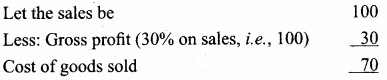
Therefore, percentage of gross profit on cost of goods sold is
\(\frac { 30 }{ 70 }\) x 100 = 42.85% (42.857142 ……….)
Gross profit = 42.85% on 2,10,000 i.e., \(\frac { 42.85 }{ 100 }\) x 2,10,000 = ₹ 90,000
Sales = Cost of goods sold + Gross Profit
= 2,10,000 + 90,000 (Fractions to be rounded)
= ₹ 3,00,000

Question 9.
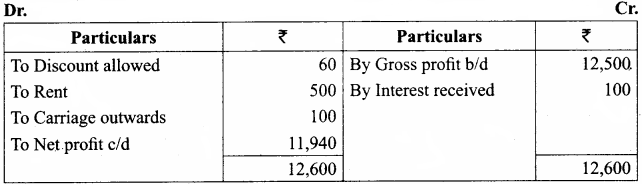
Prepare profit and loss account in the books of Kirubavathi for the year ended 31st December, 2016 from the following information:
Samacheer Kalvi 11th Accountancy Solutions Chapter 12 Final Accounts of Sole Proprietors – I
Answer:
Profit and loss account of Kirubavathi for the year ended 31st Dec, 2016
Samacheer Kalvi 11th Accountancy Solutions Chapter 12 Final Accounts of Sole Proprietors – I

Question 10.
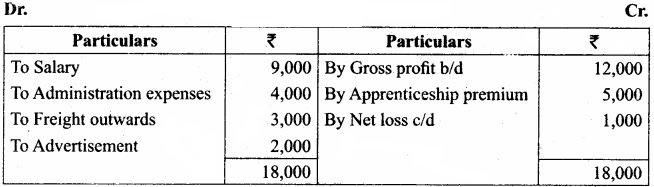
Ascertain net profit or net loss from the following:
Samacheer Kalvi 11th Accountancy Solutions Chapter 12 Final Accounts of Sole Proprietors – I
Answer:
Profit and loss account
Samacheer Kalvi 11th Accountancy Solutions Chapter 12 Final Accounts of Sole Proprietors – I

Question 11.
From the following details, prepare profit and loss account.
Samacheer Kalvi 11th Accountancy Solutions Chapter 12 Final Accounts of Sole Proprietors – I
Answer:
Profit and loss account
Samacheer Kalvi 11th Accountancy Solutions Chapter 12 Final Accounts of Sole Proprietors – I
(Hint: Freight inwards will not appear in profit and loss account as it is a direct expense)

Question 12.
From the following information, prepare profit and loss account for the year ending 31st December, 2016.
Samacheer Kalvi 11th Accountancy Solutions Chapter 12 Final Accounts of Sole Proprietors – I
Answer:
Profit and loss account for the year ended 31st December, 2016
Samacheer Kalvi 11th Accountancy Solutions Chapter 12 Final Accounts of Sole Proprietors – I

Question 13.
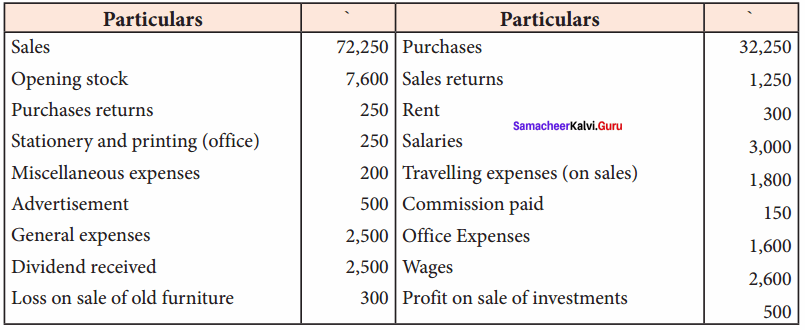
From the following balances obtained from the books of Mr. Ganesh, prepare trading and profit and loss account:
Samacheer Kalvi 11th Accountancy Solutions Chapter 12 Final Accounts of Sole Proprietors – I
Answer:
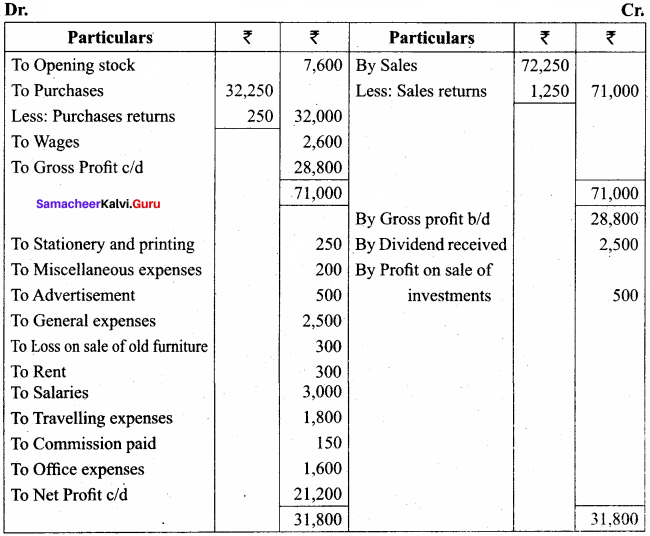
Trading and Profit & loss account of Mr. Ganesh
Samacheer Kalvi 11th Accountancy Solutions Chapter 12 Final Accounts of Sole Proprietors – I

Question 14.
From the following balances extracted from the books of a trader, ascertain gross profit and net profit for the year ended March 31,2017:
Samacheer Kalvi 11th Accountancy Solutions Chapter 12 Final Accounts of Sole Proprietors – I
Answer:
Trading and Profit & Loss account for the year ended 31st March, 2017
Samacheer Kalvi 11th Accountancy Solutions Chapter 12 Final Accounts of Sole Proprietors – I

Question 15.
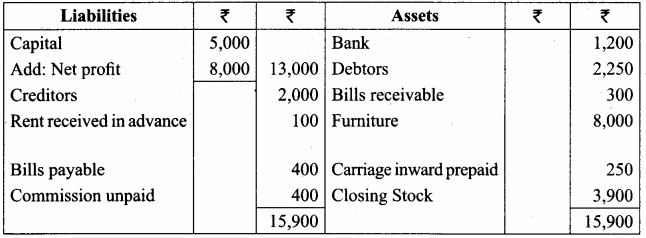
From the following particulars, prepare balance sheet in the books of Bragathish as on 31st December, 2017:
Samacheer Kalvi 11th Accountancy Solutions Chapter 12 Final Accounts of Sole Proprietors – I
Answer:
Balance Sheet of Bragathish as on 31st December, 2017
Samacheer Kalvi 11th Accountancy Solutions Chapter 12 Final Accounts of Sole Proprietors – I

Question 16.
Prepare trading and profit and loss account in the books of Ramasundari for the year ended 31st December, 2017 and balance sheet as on that date from the following information:
Samacheer Kalvi 11th Accountancy Solutions Chapter 12 Final Accounts of Sole Proprietors – I
Answer:
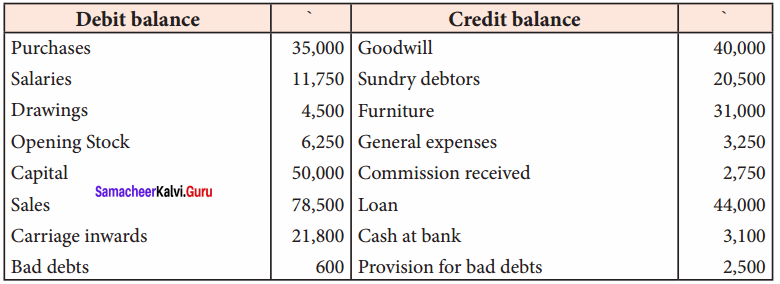
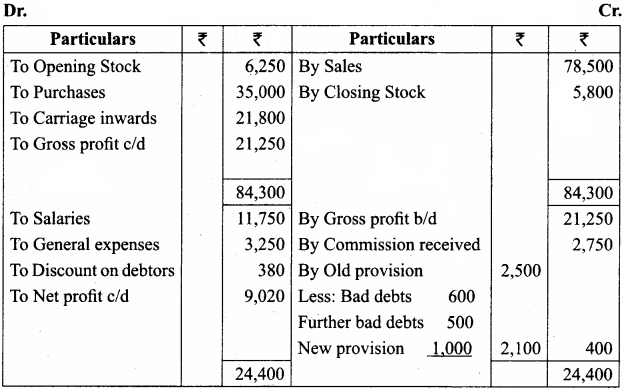
Trading and Profit & Loss a/c of Ramasundari for the year ended 31 Dec, 2017 Cr.
Samacheer Kalvi 11th Accountancy Solutions Chapter 12 Final Accounts of Sole Proprietors – I
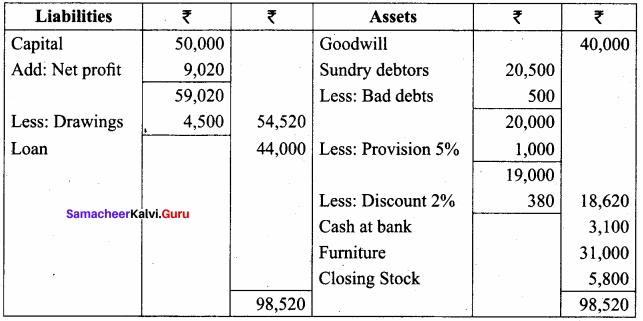
Balance Sheet of Ramasundari as on 31st March, 2018
Samacheer Kalvi 11th Accountancy Solutions Chapter 12 Final Accounts of Sole Proprietors – I

Question 17.
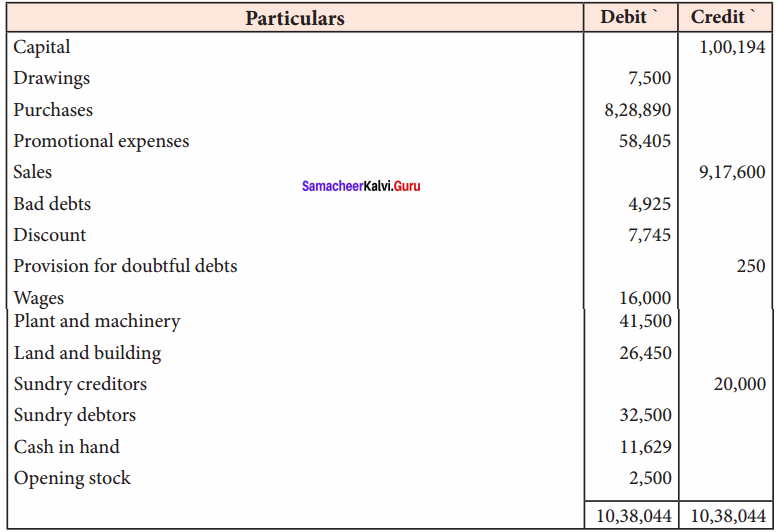
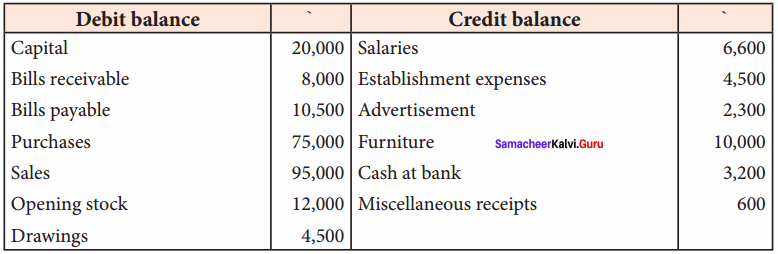
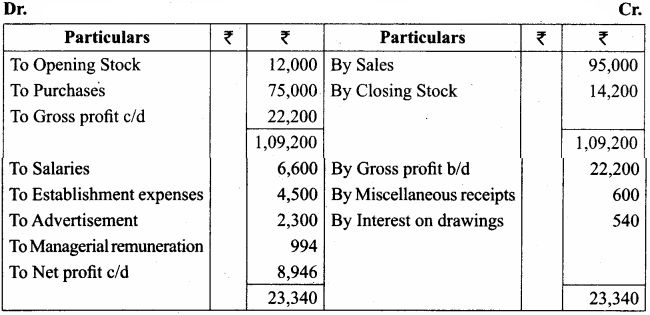
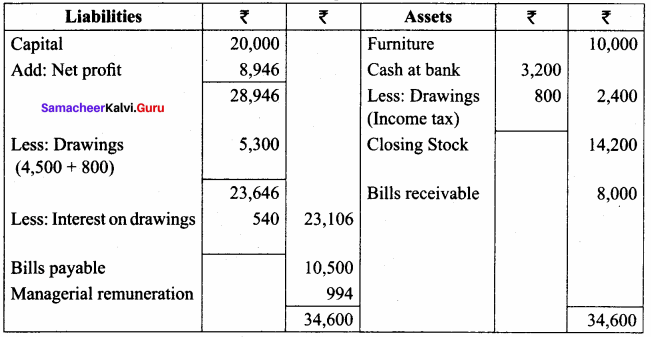
From the Trial balance, given by Saif, prepare final accounts for the year ended 31st March, 2018 in his books:
Samacheer Kalvi 11th Accountancy Solutions Chapter 12 Final Accounts of Sole Proprietors – I
Answer:
Trading and Profit & Loss a/c of Saif for the year ended 31 March, 2018
Samacheer Kalvi 11th Accountancy Solutions Chapter 12 Final Accounts of Sole Proprietors – I
Balance Sheet of Saif as on 31st March, 2018
Samacheer Kalvi 11th Accountancy Solutions Chapter 12 Final Accounts of Sole Proprietors – I

Question 18.
Prepare trading and profit and loss account and balance sheet in the books of Deri, a trader, from the following balances as on March 31, 2018.
Samacheer Kalvi 11th Accountancy Solutions Chapter 12 Final Accounts of Sole Proprietors – I
Answer:
Trading and Profit & Loss a/c of Deri for the year ended 31st March, 2018
Samacheer Kalvi 11th Accountancy Solutions Chapter 12 Final Accounts of Sole Proprietors – I
Balance Sheet of Deri as on 31st March, 2018
Samacheer Kalvi 11th Accountancy Solutions Chapter 12 Final Accounts of Sole Proprietors – I

Textbook Case Study Solved

Question 1.
Mr. Abhinav started a small shop of selling dairy products. He wanted to maintain proper books of accounts. But, he had very little knowledge of accounting. He maintained only three books – purchases, sales and cash book by himself. He bought some dairy products and a refrigerator to store the milk products for which the payment was made by cheque but recorded the same in the purchases book. He also spent for the transportation charges and paid some money to the person who unloaded the stock. He recorded the same in the cash book.

He made both cash and credit sale for the next few weeks. He entered the entire sales in the sales book. In the middle of the month, he was in need of some money for his personal use. So he took some money, but did not record in the books.
Now, discuss on the following points:

Question 1.
Do you think Mr. Abhinav needs an accountant? Why do you think so?
Answer:
Yes, Mr. Abhinav needs an accountant because he records all cash and credit transactions.

Question 2.
Does he maintain enough books of accounts?
Answer:
Yes, he maintains enough books of accounts.

Samacheer Kalvi 11th Accountancy Solutions Chapter 12 Final Accounts of Sole Proprietors – I

Question 3.
What other books do you think that he needs to maintain?
Answer:
He needs to maintain a petty cashbook.

Question 4.
What will be the impact on the profit, if he records the purchase of refrigerator in the purchases book?
Answer:
The purchase book will be overcast because this transaction will be recorded in proper journal.

Question 5.
Is it important to record the money taken for personal use? Will it affect the final accounts?
Answer:
Yes, then only the actual profit or loss can be found out in the business.

Question 6.
Identify some of the accounting principles relevant to this situation.
Answer:
Some of the accounting principles relevant to this situation are: matching principles, business entity concept, money measurement concept, dual output concept, periodicity concept and going concern concept.

Samacheer Kalvi 11th Accountancy Final Accounts of Sole Proprietors – I Additional Questions and Answers

I. Multiple Choice Questions
Choose the correct answer

Question 1.
Income statement is divided into ……………….. parts.
(a) one
(b) two
(c) three
(d) four
Answer:
(b) two

Question 2.
The first part of the income statement is ………………..
(a) Final account
(b) Trading account
(c) Profit and Loss account
(d) Balance Sheet
Answer:
(b) Trading account

Samacheer Kalvi 11th Accountancy Solutions Chapter 12 Final Accounts of Sole Proprietors – I

Question 3.
Balances of all ……………….. accounts are required to be closed on the last day of the accounting year.
(a) Nominal
(b) Personal
(c) Real
(d) Representative personal
Answer:
(a) Nominal

Question 4.
Trading account is a ……………….. account.
(a) Personal
(b) Nominal
(c) Real
(d) Representative personal
Answer:
(b) Nominal

Question 5.
Sales – Gross Profit = ………………..
(a) Sales
(b) Cost of goods sold
(c) Gross profit
(d) Gross loss
Answer:
(b) Cost of goods sold

Question 6.
……………….. account is the second part of income statement.
(a) Trading
(b) Profit and Loss
(c) Balance sheet
(d) Final
Answer:
(b) Profit and Loss

Question 7.
Which one is correctly matched?
(a) Bad debts – Indirect expense
(b) Wages – Asset
(c) Salary – Trading account
(d) Net Profit – Asset
Answer:
(a) Bad debts – Indirect expense

Samacheer Kalvi 11th Accountancy Solutions Chapter 12 Final Accounts of Sole Proprietors – I

Question 8.
Balances of all the personal and real account are shown in ………………..
(a) Trading account
(b) Profit and loss account
(c) Income statement
(d) Balance sheet
Answer:
(d) Balance sheet

Question 9.
A balance sheet is a part of the ……………….. account.
(a) Trading
(b) Profit and Loss
(c) Income statement
(d) Final
Answer:
(d) Final

Question 10.
……………….. is a summary of the personal and real accounts.
(a) Balance sheet
(b) Final account
(c) Trading account
(d) Profit and loss account
Answer:
(a) Balance sheet

Question 11.
The balance sheet of business concern can be presented in the ……………….. forms.
(a) two
(b) three
(c) four
(d) six
Answer:
(a) two

Question 12.
Marshalling can be made in one of the ……………….. ways.
(a) three
(b) two
(c) four
(d) five
Answer:
(b) two

Question 13.
These are the assets which get exhausted gradually in the process of excavation.
(a) Wasting assets
(b) Nominal assets
(c) Liquid assets
(d) Current assets
Answer:
(a) Wasting assets

Question 14.
……………….. liabilities are not shown in the balance sheet.
(a) Contingent
(b) Current
(c) Liquid
(d) Fixed
Answer:
(a) Contingent

Samacheer Kalvi 12th Computer Applications Solutions Chapter 11 Network Examples and Protocols

Students can Download Computer Applications Chapter 11 Network Examples and Protocols Questions and Answers, Notes Pdf, Samacheer Kalvi 12th Computer Applications Book Solutions Guide Pdf helps you to revise the complete Tamilnadu State Board New Syllabus and score more marks in your examinations.

Tamilnadu Samacheer Kalvi 12th Computer Applications Solutions Chapter 11 Network Examples and Protocols

Samacheer Kalvi 12th Computer Applications Network Examples and Protocols Text Book Back Questions and Answers

PART – I
I. Choose The Correct Answer

Question 1.
The ……………………… “the Net,” is a worldwide system of computer networks
(a) Internet
(b) mobile
(c) communication
(d) protocol
Answer:
(a) Internet

Samacheer Kalvi 12th Computer Applications Solutions Chapter 11 Network Examples and Protocols

Question 2.
Which one of the following will be easy the way to uses Internet technology and the public telecommunication system to securely share business’s information with suppliers, vendors, partners and customers.
(a) Extranet
(b) Intranet
(c) arpanet
(d) arcnet
Answer:
(a) Extranet

Question 3.
Match the following and choose the correct Answer:wer
(i) HTTP -The core protocol of the World Wide Web.
(ii) FTP- enables a client to send and receive complete files from a server.
(iii) SMTP – Provide e-mail services.
(iv) DNS- Refer to other host computers by using names rather than numbers.
(a) (i), (ii), (iii), (iv)
(b) (ii), (iii), (iv), (i)
(c) (iii), (iv), (i), (ii)
(d) (iv), (iii), (ii), (i)
Answer:
(a) (i), (ii), (iii), (iv)

Samacheer Kalvi 12th Computer Applications Solutions Chapter 11 Network Examples and Protocols

Question 4.
Communication over …………………………… is be made up of voice, data, images and text messages.
(a) Social media
(b) mobile network
(c) whatsapp
(d) software
Answer:
(b) mobile network

Question 5.
Wi-Fi stands for ……………………………
(a) Wireless Fidelity
(b) wired fidelity
(c) wired optic fibre
(d) wireless optic fibre
Answer:
(a) Wireless Fidelity

Samacheer Kalvi 12th Computer Applications Solutions Chapter 11 Network Examples and Protocols

Question 6.
A TCP/IP network with access restricted to members of an organization
(a) LAN
(b) MAN
(c) WAN
(d) Intranet
Answer:
(d) Intranet

Question 7.
RFID stands for …………………………
(a) Radio Free identification
(b) real Frequency identity
(c) Radio Frequency indicators
(d) Radio Frequency Identification.
Answer:
(d) Radio Frequency Identification.

Samacheer Kalvi 12th Computer Applications Solutions Chapter 11 Network Examples and Protocols

Question 8.
It guarantees the sending of data is successful and which checks error on operation at OSI layer is ………………………………
(a) Application layer
(b) Network layer
(c) Transport Layer
(d) Physical layer
Answer:
(c) Transport Layer

Question 9.
Which one of the following will secure data on trAnswer:missions?
(a) HTTPS
(b) HTTP
(c) FTP
(d) SMTP
Answer:
(a) HTTPS

Samacheer Kalvi 12th Computer Applications Solutions Chapter 11 Network Examples and Protocols

Question 10.
………………………… provides e-mail service.
(a) DNS
(b) TCP
(c) FTP
(d) SMTP
Answer:
(d) SMTP

Question 11.
………………………… refer to other host computers by using names rather than numbers.
(a) DNS
(b) TCP
(c) FTP
(d) SMTP
Answer:
(a) DNS

Samacheer Kalvi 12th Computer Applications Solutions Chapter 11 Network Examples and Protocols

Question 12.
TCP/IP is a combination of two protocols:
(i) TrAnswer:mission Control Protocol (TCP)
(ii) Internet Protocol (IP)
(iii) Selection Protocol (SP)
(iv) Captial Protocol (CP)
(a) (i), (ii)
(b) (i), (iii)
(c) (iii), (iv)
(d) (ii), (iii)
Answer:
(a) (i), (ii)

PART – II
II. Short Answer

Question 1.
Define Intranet?
Answer:
INTRANET:

  1. It is a private network within an enterprise to share company data and computing resources between the employees.
  2. It may consist of many interlinked local area networks.

Samacheer Kalvi 12th Computer Applications Solutions Chapter 11 Network Examples and Protocols

Question 2.
What is the uses of mobile networks?
Answer:
The common application of mobile networks is mobile phones, tablets, etc.. In past, wireless communications largely used circuit switching to carry only voice over a network, but now currently both data and voice are being trAnswer:mitted over both circuit via switched networks and packet-switched networks.

Question 3.
List out the benefits of WiFi/
Answer:

  1. It provides mobility.
  2. It provides connection to Internet.
  3. Flexibility of LAN.
  4. Ensures connectivity.
  5. It allows places that are remote to benefit from connectivity.
  6. Low cost, high benefit.

Samacheer Kalvi 12th Computer Applications Solutions Chapter 11 Network Examples and Protocols

Question 4.
How many types of RFID System available and what are they?
Answer:
Two types of RFID Systems:
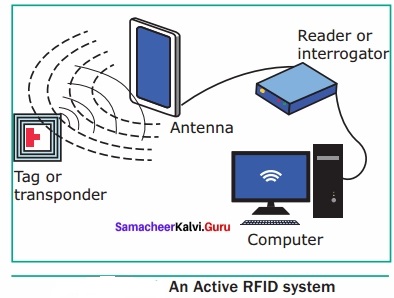
1. Active RFID system:
the tag has its own power source. These systems used for larger distances and to track high value goods like vehicles.

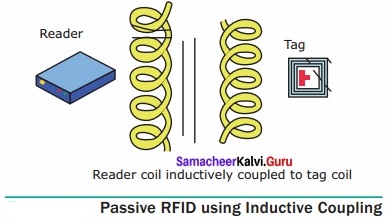
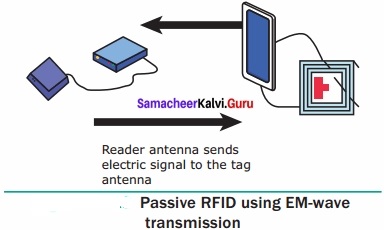
2. Passive RFID system:
the tag gets power through power from a reader antenna to the tag „ antenna. They are used for shorter range trAnswer:mission.

Samacheer Kalvi 12th Computer Applications Solutions Chapter 11 Network Examples and Protocols

Question 5.
Expand HTTP, HTTPS, FTP?
Answer:

  1. HTTP – Hypertext Transfer Protocol
  2. HTTPS – Hypertext Transfer Protocol Secure
  3. FTP – File Transfer Protocol

PART – III
III. Explain in Brief Answer

Question 1.
Compare Internet, Intranet and Extranet?
Answer:
Samacheer Kalvi 12th Computer Applications Solutions Chapter 11 Network Examples and Protocols

Question 2.
List out the components of a RFID enabled system?
Answer:
Main Components of a RFID System

  1. A RFID tag: It has silicon microchip attached to a small antenna and mounted on a substrate.
  2. A reader: It has a scanner with antennas to trAnswer:mit and receive signals, used for communication.
  3. A Controller: It is the host computer with a Microprocessor which receives the reader input and process the data.

Samacheer Kalvi 12th Computer Applications Solutions Chapter 11 Network Examples and Protocols

Question 3.
Write short notes on HTTP, HTTPS, FTP?
Answer:

  1. HTTP – A protocol used between a web client and a web server protects non-secure data trAnswer:missions. The core protocol of the World Wide Web.
  2. HTTPS – A protocol used between a web client and a web server permits secure data trAnswer:missions.
  3. FTP – Used between computers for sending and receiving data. Enables a client to send and receive complete files from a server.

Question 4.
What are the layers available in TCP/IP Reference Model?
Answer:
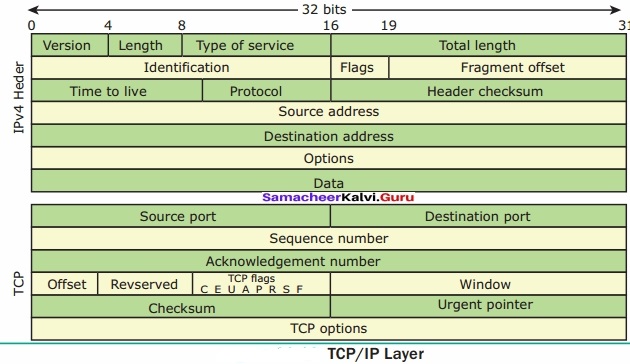
There are four total layers of TCP/IP protocol, each of which is listed below with a brief description.

  1. Network Access Layer – concerned with building packets.
  2. Internet Layer – describes how packets are to be delivered.
  3. Transport Layer – ensure the proper transfer mission of data.
  4. Application Layer – application network processes. These processes include File Transfer Protocol (FTP), Hypertext Transfer Protocol (HTTP), and Simple Mail Transfer Protocol (SMTP).

Samacheer Kalvi 12th Computer Applications Solutions Chapter 11 Network Examples and Protocols

Question 5.
Expand ARP, ICMP, SMTP and DNS?
Answer:

  1. Address Resolution Protocol (ARP)
  2. Internet Control Message Protocol (ICMP)
  3. Transfer mission Control Protocol (TCP)
  4. Simple Mail TrAnswer:fer Protocol (SMTP)
  5. Domain Name System (DNS).

PART – IV
IV. Explain in detail

Question 1.
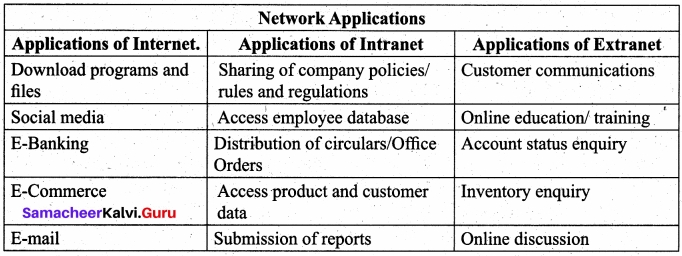
Explain about Internet, Intranet and Extranet?
Internet/Intranet/Extranet
INTERNET:
Answer:

  1. The Internet, “the Net,” is a worldwide system of computer networks.
  2. A network of networks where the users at any one computer can, if they have permission, get information from any other computer.
  3. The Internet is a network of global connections – comprising private, public, business, academic and government networks – linked by guided, wireless and fiber-optic technologies.
  4. It was perceived by the Advanced Research Projects Agency (ARPA) of the U.S. government in 1969 and was first recognized as the ARPANet.
  5. The unique aim was to generate a network that would permit users of a research computer from one university to “talk to” research computers on other universities.
  6. The Internet denotes to the global communication system, including infrastructure and hardware, whereas the web is one of the services interconnected over the Internet.

INTRANET:

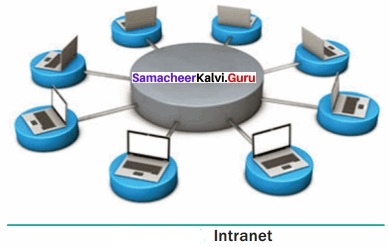
  1. It is a private network within an enterprise to share company data and computing resources between the employees.
  2. It may consist of many interlinked local area networks.
  3. It includes connections through one or more gateway (connects two networks using different protocols together known as protocol convertor) computers to outside Internet.

Samacheer Kalvi 12th Computer Applications Solutions Chapter 11 Network Examples and Protocols

EXTRANET:
It is a private network that uses Internet technology and the public – telecommunication system to securely share business’s information with suppliers, vendors, partners, customers, or other businesses.

Samacheer Kalvi 12th Computer Applications Solutions Chapter 11 Network Examples and Protocols

Question 2.
Discuss about OSI model with its layers?
Answer:
OSI Model:
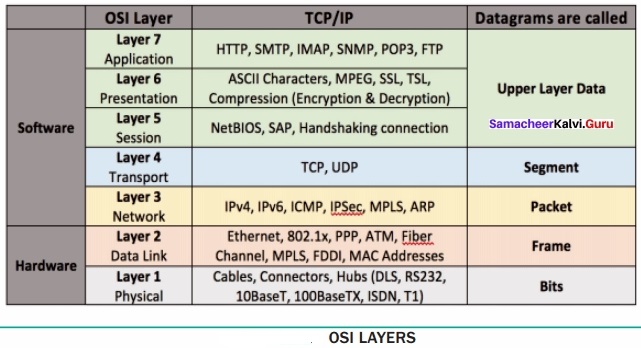
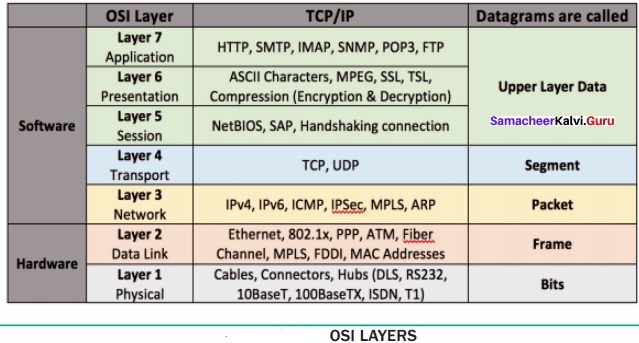
Open System Interconnection (OSI) model was found in the year 1934, general framework that enables network protocols along with software and systems to be developed based on general set of guidelines. It describes the standards for the inter-computer communication.
Samacheer Kalvi 12th Computer Applications Solutions Chapter 11 Network Examples and Protocols

OSI Layers:
(i) Physical Layer:
This is the 1st layer, it defines the electrical and physical specifications for devices.

(ii) Data Link Layer:
It is the 2nd layer and it guarantees that the data trAnswer:mitted are free of errors. This layer has simple protocols like “802.3 for Ethernet” and “802.11 for Wi-Fi”.

(iii) Network Layer:
It is the 3rd layer determining the path of the data packets. At this layer, routing of data packets is found using IP Addressing.

(iv) Transport Layer:
It is the 4th layer that guarantees the trAnswer:portation/sending of data is successful. It includes the error checking operation.

(v) Session Layer:
It is the 5th layer, identifies the established system session between different network entities. It controls dialogues between computers. For instance, while accessing a system remotely, session is created between your computer and the remote system.

(vi) Presentation Layer:
It is the 6th layer that does the trAnswer:lation of data to the next layer (Prepare the data to the Application Layer). Encryption and decryption protocols occur in this layer such as, Secure Socket Layer (SSL).

(vii) Application Layer:
It is the 7th layer, which acts as the user interface platform comprising of software within the system.

Samacheer Kalvi 12th Computer Applications Solutions Chapter 11 Network Examples and Protocols

Question 3.
Difference between TCP/IP and OSI Reference Model?
Answer:
Samacheer Kalvi 12th Computer Applications Solutions Chapter 11 Network Examples and Protocols
TCP/Ip:

  1. TCP/IP stands for Transmission control protocol/Intemet protocol
  2. TCP/IP has 4 layers
  3. TCP/IP are set of rulers/protocols defined for communication over the network
  4. TCP/IP is a client-server model
  5. It follows top to bottom approach

OSI:

  1. OSI means open system interconnect
  2. OSI has 7 layers
  3. OSI is a model based on the concept of layering
  4. OSI is a conceptual model
  5. It follows bottom-up approach

Samacheer Kalvi 12th Computer Applications Solutions Chapter 11 Network Examples and Protocols

Question 4.
Explain about the development, merits and demerits in Mobile networks?
Merits of Mobile Networks:

  1. Higher efficiency.
  2. Increased ability to communicate in and out of the workspace.
  3. Greater access to modem apps and services.
  4. Improved networking capabilities.
  5. Quality and flexibility of services.
  6. Rapid developments in cloud technologies.

Demerits of Mobile Networks:

  1. Cost
  2. Vulnerable to security risks.
  3. Additional training is needed to use new technology.
  4. Cyber crime

Development:
The generations of mobile networks are as follows.

  1. First Generation(lG) 1981- NMT launch
  2. Second Generation(2G) 1991-GSM Launch
  3. Second to Third Generation Bridge (2.5)2000 – GPRS launch
  4. Third Generation! 3G) 2003- first UK 3G launch
  5. Fourth Generation (4G) 2007
  6. Fifth Generation (5G) 2019+

1. First Generation (1G) 1981 – NMT launch:

  1. During the initial periods the mobile systems were based on analog trAnswer:mission.
  2. NMT stands for Nordic Mobile Telephone communication.
  3. And a very poor voice quality.

2. Second Generation(2G) 1991-GSM Launch:

  1. Later the second generation of mobile systems were placed on digital trAnswer:mission with GSM.
  2. GSM stands for (Global System for Mobile communication) was most popular standard which is used in second generation, using 900MHz and 1800MHz for the frequency bands.
  3. The transfer mission used as TMDA stands for (Time Division Multiple Access) and CDMA One stands for (Code Division Multiple’Access) method to increase the amount of information trAnswer:ported on the network

3. Second to Third Generation Bridge (2.5)2000 – GPRS launch:

  1. GPRS was introduced here GPRS stands for (General Packet Radio Service). GPRS is a data service which enables mobile devices to send and receive messages, picture messages and e-mails.
  2. GSM data transfer mission rates typically reached 9.6kbit/s.

4. Third Generation( 3G) 2003- first UK 3G launch:
1. This generation of mobile systems merges different mobile technology standards, and uses higher frequency bands for transfer mission and Code Division Multiple Access to delivery data rates of up to 2Mbit/s supports multimedia services (MMS: voice, video and data).

2. Data transfer mission used a WCDMA. WCDMA stands for (Wideband Code Division Multiple Access).

3. Few 3G suppliers use ATM (Asynchronous Transfer Mode) for their ‘over the air’ network with in MPLS (Multiprotocol Label Switching) or IP for theirs backbone network.

5. Fourth Generation (4G) 2007:

1. 4G is at the research stage. 4G was based on an adhoc networking model where there was no need for a fixed infrastructure operation.
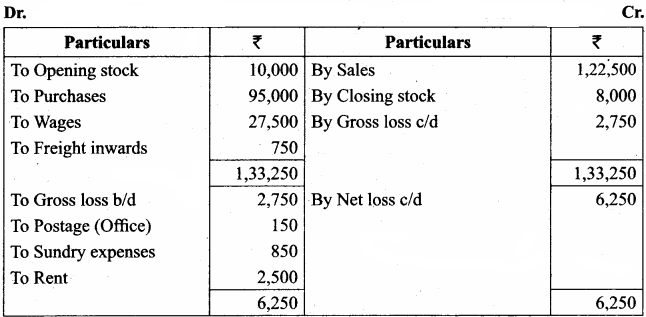
2. Adhoc networking requires global mobility features (e.g. Mobile IP) and connectivity to a global IPv6 network to support an IP address for each mobile device.
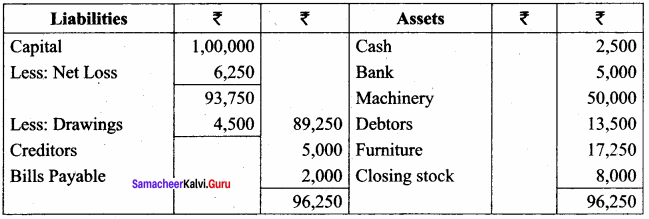
3. Logically roaming in assorted IP networks (for example: 802.11 WLAN, GPRS and UMTS) were be possible with higher data rates, from 2Mbit/s to 10-100Mbit/s, offering reduced delays and newly services.
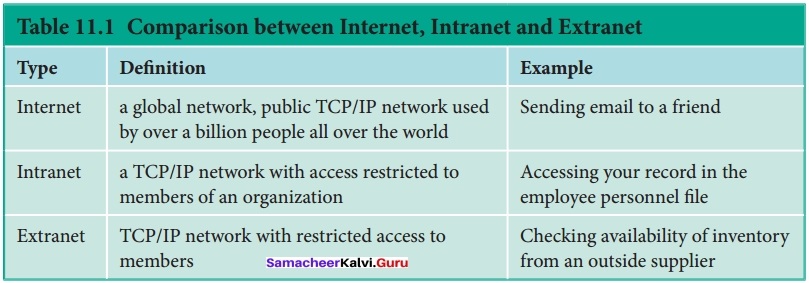
6. Fifth Generation (5G) 2019+:

1. 5G is the stage succeeds the 4G (LTE/ WiMAx), 3G(umts) and 2G(GSM) syetems.

2. 5G targets to performance the high data rate, reduced latency, energy saving, cost reduction, higher system, capacity, and massive device connectivity.

3. The ITU IMT – 2020 provides speeds up to 20 gigabits per second it has been demonstrated with millimeter waves of 15 gigahertz and higher frequency.

Samacheer Kalvi 12th Computer Applications Solutions Network Examples and Protocols Additional Question and Answer

I. Choose the Best Answer

Question 1.
Internet Protocol delivers packets from source to destination through
(a) TCP
(b) datagram
(c) packets header
(d) http
Answer:
(c) packets header

Samacheer Kalvi 12th Computer Applications Solutions Chapter 11 Network Examples and Protocols

Question 2.
IP connectionless datagram service was developed in the year
(a) 1972
(b) 1974
(c) 1976
(d) 1978
Answer:
(b) 1974

Question 3.
IP connectionless datagram service was developed by
(i) Vint cerf
(ii) Bob FrAnswer:ton
(iii) Bob Kahnin
(iv) Dan Bricklin
(a) i, ii
(b) ii, iii
(c) ii, iv
(d) i, iii
Answer:
(d) i, iii

Samacheer Kalvi 12th Computer Applications Solutions Chapter 11 Network Examples and Protocols

Question 4.
TCP/IP stands for …………………………..
Answer:
Transmission Control Protocol/Internet Protocol

Question 5.
Which protocols have to do end-to-end process of secure on time and manage data or communication.
(a) Physical
(b) TCP
(c) Network
(d) ARPC
Answer:
(c) Network

Question 6.
Pick the odd one out:
(a) HTTP
(b) SFTL
(c) SSL
(d) SNMP
Answer:
(d) SNMP

Samacheer Kalvi 12th Computer Applications Solutions Chapter 11 Network Examples and Protocols

Question 7.
Find the Network management protocol from the following
(a) ICMP
(b) HTTP
(c) TCP/IP
(d) SFTP
Answer:
(a) ICMP

Question 8.
Find the wrongly matched pair.
(a) Network Communication Protocol – HTTP, TCP/IP
(b) Network Security Protocol – ICMP
(c) Network Management Protocol – SNMP
Answer:
(b) Network Security Protocol – ICMP

Samacheer Kalvi 12th Computer Applications Solutions Chapter 11 Network Examples and Protocols

Question 9.
ARPANET was first recognized in the year
(a) 1964
(b) 1956
(c) 1972
(d) 1969
Answer:
(d) 1969

Question 10.
The ……………………….. is one of the services interconnected over the Internet.
Answer:
web

Samacheer Kalvi 12th Computer Applications Solutions Chapter 11 Network Examples and Protocols

Question 11.
Gateway connects two networks using different protocols together known as …………………………..
Answer:
Protocol Converter

Question 12.
Find the correct statement from the following.
I. Internet or things refers to the digital interconnection of everyday objects with the Internet
II. Extranet is a private network within an enterprise to share company data and computing resources between the employees.
(a) I-True, II-False
(b) I-False, II-True
(c) I, II-True
(d) I, II-False
Answer:
(a) I-True, II-False

Samacheer Kalvi 12th Computer Applications Solutions Chapter 11 Network Examples and Protocols

Question 13.
Sending e-mail to a friend is an example for ………………………..
(a) Internet
(b) Intranet
(c) Extranet
(d) IP address
Answer:
(a) Internet

Question 14.
A …………………………. as it is made up of a large number of signal areas called cells.
(a) Mobile Network
(b) Cellular Network
(c) Both a & b
(d) Chatting
Answer:
(c) Both a & b

Samacheer Kalvi 12th Computer Applications Solutions Chapter 11 Network Examples and Protocols

Question 15.
The NMT launch comes ………………………….. generation of mobile networks
(a) 1G
(b) 2G
(c) 3G
(d) 4G
Answer:
(a) 1G

Question 16.
Expand NMT.
(a) North Mobile Telephone
(b) Nordic Mobile Telephone
(c) Nordic Movement Telephone
(d) Nurture Mobile Telephone
Answer:
(b) Nordic Mobile Telephone

Samacheer Kalvi 12th Computer Applications Solutions Chapter 11 Network Examples and Protocols

Question 17.
Match the following:
(i) 1G – (I) GSM
(ii) 2G – (II) UMTS
(iii) 3G – (III) GPRS
(iv) 2-3G Bridge – (IV) NMT
(a) IV I II III
(b) I II III IV
(c) IV III II I
(d) II I IV III
Answer:
(a) IV I II III

Question 18.
GSM means ……………………………… communication.
Answer:
Global System for Mobile

Question 19.
SIM means …………………………. technology.
Answer:
Subscriber Identity Module

Samacheer Kalvi 12th Computer Applications Solutions Chapter 11 Network Examples and Protocols

Question 20.
TMDA means …………………………
Answer:
Time Division Multiple Access

Question 21.
CMDA stands for
(a) Code Divide Multiple Access
(b) Code Divide Mobile Access
(c) Code Division Multiple Access
(d) Code Division Mobile Access
Answer:
(c) Code Division Multiple Access

Samacheer Kalvi 12th Computer Applications Solutions Chapter 11 Network Examples and Protocols

Question 22.
GPRS stands for ………………………
Answer:
General Packet Radio Service

Question 23.
Expand EDGE
(a) Extra Data rates for Global Evolution
(b) Enhanced Data rates for Global Evolution
(c) Entry Data rates for Global Evolution
(d) Extra Dual rate for Global Evolution
Answer:
(b) Enhanced Data rates for Global Evolution

Samacheer Kalvi 12th Computer Applications Solutions Chapter 11 Network Examples and Protocols

Question 24.
UMTS stands for …………………………..
Answer:
Universal Mobile Telecommunication Systems

Question 25.
WCDMA stands for …………………………
Answer:
Wideband Code Division Multiple Access

Question 26.
ATM stands for ………………………….
Answer:
Asynchronous Transfer Mode

Samacheer Kalvi 12th Computer Applications Solutions Chapter 11 Network Examples and Protocols

Question 27.
First Generation (1G) was developed in the year …………………………
(a) 1980
(b) 1983
(c) 1982
(d) 1981
Answer:
(d) 1981

Question 28.
Find the wrongly matched pair.
(a) First Generation – 1981
(b) Second Generation – 1991
(c) Third Generation – 2004
(d) Fourth Generation – 2007
Answer:
(c) Third Generation – 2004

Samacheer Kalvi 12th Computer Applications Solutions Chapter 11 Network Examples and Protocols

Question 29.
Pick the odd one out.
(a) 1G
(b) 2G
(c) 2.5G
(d) 3.5G
Answer:
(d) 3.5G

Question 30.
Analog trAnswer:mission have taken place in …………………………
(a) 1G
(b) 2G
(c) 3G
(d) 4G
Answer:
(a) 1G

Samacheer Kalvi 12th Computer Applications Solutions Chapter 11 Network Examples and Protocols

Question 31.
Which technology is used to authenticate a user for identification and billing purposes and to encrypt the data to prevent listen without permission.
(a) GSM
(b) NMT
(c) CDMA
(d) SIM
Answer:
(d) SIM

Question 32.
Which method increased the amount of information trAnswer:ported on the network?
(I) SIM
(II) NMT
(III) TDMA
(IV) CDMA
(a) I, II
(b) II, III
(c) III, IV
(d) IV, I
Answer:
(c) III, IV

Samacheer Kalvi 12th Computer Applications Solutions Chapter 11 Network Examples and Protocols

Question 33.
General Packet Radio Service was introduced in
(a) 1G
(b) 2G
(c) 2.5G
(d) 3G
Answer:
(c) 2.5G

Question 34.
……………………………… is a data service which enables mobile devices to send and receive messages, picture messages and e-mails.
(a) GPS
(b) GPRS
(c) CDMA
(d) SIM
Answer:
(b) GPRS

Samacheer Kalvi 12th Computer Applications Solutions Chapter 11 Network Examples and Protocols

Question 35.
What is the data trAnswer:mission rate of GSM?
(a) 9.6 kb/s
(b) 11.2 kb/s
(c) 12.3 kb/s
(d) 8.5 kb/s
Answer:
(a) 9.6 kb/s

Question 36.
MMS is the combination of …………………………
(I) Image, Voice, Video
(II) Voice, Video, Speed
(III) Voice, Video, Data
(IV) Speed, Data, Image
(a) III
(b) II
(c) I
(d) IV
Answer:
(a) III

Samacheer Kalvi 12th Computer Applications Solutions Chapter 11 Network Examples and Protocols

Question 37.
The data trAnswer:mission used by 3G is ……………………………
(a) TDMA
(b) CDMA
(c) EDGE
(d) WCDMA
Answer:
(d) WCDMA

Question 38.
MPLS means ……………………….
Answer:
Multiprotocol Label Switching

Question 39.
Few 3G suppliers use ATM for their ……………………………. network with in MPLS or IP for their network.
Answer:
Over the Air

Samacheer Kalvi 12th Computer Applications Solutions Chapter 11 Network Examples and Protocols

Question 40.
Which generation of mobile network is considered as a research stage?
(a) 1G
(b) 2G
(c) 3G
(d) 4G
Answer:
(d) 4G

Question 41.
Li-Fi is the short form of …………………………..
(a) Light Fidelity
(b) LAN Fidelity
(c) Light Fix
(d) Low Frequency
Answer:
(a) Light Fidelity

Samacheer Kalvi 12th Computer Applications Solutions Chapter 11 Network Examples and Protocols

Question 42.
The term Li-Fi was first used by …………………………..
Answer:
Harald Haas

Question 43.
How many phases of 5G are there?
(a) 1
(b) 2
(c) 3
(d) 4
Answer:
(b) 2

Question 44.
The two phases of 5G are ………………………….
(I) Release-14
(II) Release-15
(III) Release-16
(IV) Release-17
(a) I, II
(b) II, III
(c) I, III
(d) III, IV
Answer:
(b) II, III

Samacheer Kalvi 12th Computer Applications Solutions Chapter 11 Network Examples and Protocols

Question 45.
ITU stands for ……………………………..
Answer:
International Telecommunication Union

Question 46.
Which is used for radio wares to read and capture information stored on a tag attached to an object?
(a) RF
(b) RFID
(c) Li-Fi
(d) Wi-Fi
Answer:
(b) RFID

Question 47.
How many parts are there in RFID tags are there?
(a) 1
(b) 2
(c) 3
(d) 4
Answer:
(b) 2

Samacheer Kalvi 12th Computer Applications Solutions Chapter 11 Network Examples and Protocols

Question 48.
RFID has a ……………………… and a ……………………….. or a ……………………………..
Answer:
reader, tag and label

Question 49.
Ffow many types of RFID tags are there?
(a) 1
(b) 2
(c) 3
(d) 4
Answer:
(b) 2

Question 50.
How many components of a RFID system are there?
(a) 1
(b) 2
(c) 3
(d) 4
Answer:
(c) 3

Samacheer Kalvi 12th Computer Applications Solutions Chapter 11 Network Examples and Protocols

Question 51.
………………………… is a scanner with antennas to trAnswer:mit and receive signals used for communication
(a) RFID tag
(b) Reader
(c) Controller
(d) Em-ware
Answer:
(b) Reader

Question 52.
Find the statement which is true.
(а) Active RFID System – larger distances
(b) Active RFID System – shorter range transfer mission
Answer:
(а) Active RFID System – larger distances

Samacheer Kalvi 12th Computer Applications Solutions Chapter 11 Network Examples and Protocols

Question 53.
Which method is used in passive RFID system?
(a) TCP
(b) UDP
(c) Induction coupling
(d) Direct coupling
Answer:
(c) Induction coupling

Question 54.
OSI model means ……………………………..
Answer:
Open System Interconnection

Question 55.
OSI model was found in the year
(a) 1927
(b) 1932
(c) 1935
(d) 1934
Answer:
(d) 1934

Samacheer Kalvi 12th Computer Applications Solutions Chapter 11 Network Examples and Protocols

Question 56.
Which one describes the standards for the inter-computer communication?
(a) OSI
(b) BSI
(c) DSI
(d) LSI
Answer:
(a) OSI

Question 57.
How many OSI layers are there?
(a) 5
(b) 6
(c) 7
(d) 8
Answer:
(c) 7

Samacheer Kalvi 12th Computer Applications Solutions Chapter 11 Network Examples and Protocols

Question 58.
The protocols for Ethernet in datalink layer is ………………………….
(a) 8.023
(b) 80.23
(c) 802.3
(d) 8023
Answer:
(c) 802.3

Question 59.
Which is the third layer in the OSI model?
(a) Datalink
(b) Physical
(c) port
(d) Network
Answer:
(d) Network

Question 60.
In which layer, routing of data packets is found using IP addressing?
(a) Data link
(b) Network
(c) port
(d) Physical
Answer:
(b) Network

Samacheer Kalvi 12th Computer Applications Solutions Chapter 11 Network Examples and Protocols

Question 61.
SSL stands for ………………………
Answer:
Secure Socket Layer

Question 62.
Match the following
(i) Physical Layer – (I) controls dialogues between computer
(ii) Network Layer – (II) Specifications for devices
(iii) TrAnswer:port Layer – (III) data packets
(iv) Session Layer – (IV) error checking
(v) Application Layer – (V) Encryption, Decryption
(a) II, III, IV, I, V, VI
(b) I, II, III, IV, VI, VI
(c) VI, V, IV, III, II, I
(d) III, IV, V, VI, II, I
Answer:
(a) II, III, IV, I, V, VI

Question 63.
Which protocol is accountable for guaranteeing the trustworthy trAnswer:mission of data?
(a) TCP
(b) IP
(c) HTTP
(d) SMTP
Answer:
(a) TCP

Samacheer Kalvi 12th Computer Applications Solutions Chapter 11 Network Examples and Protocols

Question 64.
google.com is the ………………………. for Google.
Answer:
domian name

Question 65.
How many different layers of TCP/IP are there?
(a) 2
(b) 3
(c) 4
(d) 5
Answer:
(c) 4

Question 66.
FTP stands for …………………………
(a) File Transfer Protocol
(b) File Transmission Protocol
(c) File Transport Protocol
(d) File Type Protocol
Answer:
(a) File Transfer Protocol

Samacheer Kalvi 12th Computer Applications Solutions Chapter 11 Network Examples and Protocols

Question 67.
HTTP stands for …………………………..
(a) High Text Transmission Protocol
(b) Hyper Text Transmission Protocol
(c) Hyper Text Transfer Protocol
(d) Height Typed Transfer Protocol
Answer:
(c) Hyper Text Transfer Protocol

Question 68.
SMTP stands for …………………………………
(a) Single Mail Transfer Protocol
(b) Single Message Transfer Protocol
(c) Simple Mail Text Protocol
(d) Simple Mail Transfer Protocol
Answer:
(d) Simple Mail Transfer Protocol

Samacheer Kalvi 12th Computer Applications Solutions Chapter 11 Network Examples and Protocols

Question 69.
Pick the odd one out.
(a) FTP
(b) RFID
(c) HTTP
(d) SMTP
Answer:
(b) RFID

Question 70.
Which one of the following is not a network protocol.
(a) SSL
(b) ARP
(c) TCPI
(d) FTP
Answer:
(c) TCPI

Question 71.
HTTPs stands for …………………………..
Answer:
Hyper Text Transfer Protocol Secure

Question 72.
ARP stands for ………………………….
Answer:
Address Resoloution Protocol

Samacheer Kalvi 12th Computer Applications Solutions Chapter 11 Network Examples and Protocols

Question 73.
Expand MAC
(a) Mega Access Code
(b) Multiple Access Code
(c) Medium Access Code
(d) Medium Access Control
Answer:
MEdium Access Control

Question 74.
Which one of the following is a hardware identification number that uniquely identifies each device on a network?
(a) MIC
(b) MAC
(c) MOC
(d) MUC
Answer:
(b) MAC

Question 75.
ICMP stands for ………………………….
Answer:
Internet Control Message Protocol

Question 76.
IGMP stands for …………………………..
Answer:
Internet Group Management Protocol

Question 77.
Which is used to send group communication messages to multiple IP addresses?
(a) ICMP
(b) IGMP
(c) IDMP
(d) IKMP
Answer:
(b) IGMP

Samacheer Kalvi 12th Computer Applications Solutions Chapter 11 Network Examples and Protocols

Question 78.
The two main protocols mainly used in the trAnswer:port layers are
(I) TCP
(II) UDP
(III) UTP
(IV) ATP
(V) STP
(a) I, II
(b) III, IV
(c) II, V
(d) IV, V
Answer:
(a) I, II

Question 79.
UDP stands for …………………………….
Answer:
User Daragram Protocol

Samacheer Kalvi 12th Computer Applications Solutions Chapter 11 Network Examples and Protocols

Question 80.
DNS meAnswer: ………………………..
Answer:
Domian Name System.

I. Short Answer

Question 1.
Write note on Extranet?
Answer:
EXTRANET:
It is a private network that uses Internet technology and the public telecommunication system to securely share business’s information with suppliers, vendors, partners, customers, or other businesses.

Samacheer Kalvi 12th Computer Applications Solutions Chapter 11 Network Examples and Protocols

Question 2.
Mention the various generations of Mobile networks?
Answer:
The generations of mobile networks are as follows.

  1. First Generation(lG) 1981- NMT launch
  2. Second Generation(2G) 1991-GSM Launch
  3. Second to Third Generation Bridge (2.5)2000 – GPRS launch ,
  4. Third Generation( 3G) 2003- UK 3G launch
  5. Fourth Generation (4G) 2007
  6. Fifth Generation (5G) 2019+

Question 3.
What is meant by Li-Fi?
Answer:
Li-Fi is a wireless technology which uses light-emitting diodes (LEDs) for data transmission Li-Fi is the short form of Light Fidelity.

Samacheer Kalvi 12th Computer Applications Solutions Chapter 11 Network Examples and Protocols

Question 4.
Define Wi-Fi?
Answer:
Wi-Fi stands for Wireless Fidelity. It is a wireless network technology that permits computers and alternative devices to be connected to every alternative into a local area network and to the net without wires and cables.

Question 5.
Write note on Network protocols?
Answer:
Network protocols is that the usual procedures, rules, formal standards and policies comprised of formats which allocates communication between more than one device Which connected to the network.

II. Explain in Brief Answer

Question 1.
Explain the types of Networking protocols?
Answer:
The broad types of networking protocols, including:

  1. Network communication protocols is that the Basic data communication protocols which specific as HTTP and TCP/IP.
  2. Network security protocols is that which implement security over network communications and include HTTP, SFTP and SSL.
  3. Network management protocols will Provide network governance and maintenance and include ICMP and SNMP.

Samacheer Kalvi 12th Computer Applications Solutions Chapter 11 Network Examples and Protocols

Question 2.
Define Internet of things?
Answer:
Internet of Things refers to the digital interconnection of everyday objects (home applicances, wearable devices or automobiles) with the Internet. The ‘thing’ in refers to an objects that have been assigned an IP address and have the ability to collect and transfer data over a network without manual assistance or intervention.

Question 3.
Write about Mobile Networks?
Answer:
Mobile Networks:
A mobile network or cellular network as it is made up of a large number of signal areas called cells. These cells join to form a large coverage area. Communication over mobile network is be made up of voice, data, images and text messages.

Samacheer Kalvi 12th Computer Applications Solutions Chapter 11 Network Examples and Protocols

Question 4.
Differentiate Wi-Fi?
Answer:
Wi-Fi stands for Wireless Fidelity. It is a wireless network technology that permits computers and alternative devices to be connected to every alternative into a local area network and to the net without wires and cables.

Question 5.
Write note on Network protocols?
Answer:
Network protocols is that the usual procedures, rules, formal standards and policies comprised of formats which allocates communication between more than one device Which connected to the network.

III. Explain in Brief Answer

Question 1.
Explain the types of Networking protocols?
Answer:
The broad types of networking protocols, including:

  1. Network communication protocols is that the Basic data communication protocols which specific as HTTP and TCP/IP.
  2. Network security protocols is that which implement security over network communications and include HTTP, SFTP and SSL.
  3. Network management protocols will Provide network governance and maintenance and include ICMP and SNMP.

Samacheer Kalvi 12th Computer Applications Solutions Chapter 11 Network Examples and Protocols

Question 2.
Define Internet of things?
Answer:
Internet of Things refers to the digital interconnection of everyday objects (home applicances, wearable devices or automobiles) with the Internet. The ‘thing’ in IoT refers to an objects that have been assigned an IP address and have the ability to collect and trAnswer:fer data over a network without manual assistance or intervention.

Question 3.
Write about Mobile Networks?
Answer:
Mobile Networks:
A mobile network or cellular network as it is made up of a large number of signal areas called cells. These cells join to form a large coverage area. Communication over mobile network is be made up of voice, data, images and text messages.

Question 4.
Differentiate Wi-Fi and Li-Fi?
Answer:
Wi-Fi:

  1. Wireless Fidelity
  2. Wi-Fi uses radio frequencies for data transmission.

Li-Fi:

  1. Li-Fi is a wireless technology which uses light-emitting diodes (LEDs) for data transmission.
  2. Li-Fi is the short form of Light Fidelity.

Samacheer Kalvi 12th Computer Applications Solutions Chapter 11 Network Examples and Protocols

Question 5.
What is RFID?
Answer:

  1. RFID stands for Radio -Frequency Identification (RFID).
  2. RFID used for radio waves to read and capture information stored on a tag attached to an object. Tag can be read from several feet away and does not need to be in direct-line-of-sight of the reader to be tracked.
  3. RFID has been made up of two parts a reader and a tag or a label.
  4. RFID tags are installed with a transmitter and receiver.

Question 6.
List out the two types of RFID tags?
Answer:
Two types of RFID tags were Active RFID and Passive RFID systems.

  1. Passive RFID tag will be used the reader radio wave energy to really its stored information back to the reader.
  2. Battery powered RFID tag is installed with small battery that powers the broadcast of information

Samacheer Kalvi 12th Computer Applications Solutions Chapter 11 Network Examples and Protocols

Question 7.
Write note on Network Interface Layer?
Answer:
Network Interface Layer:

  1. It is the bottom most level layer.
  2. It is comparable to that of the Open System Interconnection Physical and Data Link layers.
  3. Different TCP/IP protocols are being used at this layer, Ethernet and Token Ring for local area networks and protocols such as X.25, Frame Relay, and ATM for wide area networks.
  4. It is assumed to be an unreliable layer.

Question 8.
Write note on Application Layer?
Answer:
The Application layer of the TCP/IP model is similar to the Session, Presentation, and Application layers of the OSI Reference Model. The most popular Application layer protocols are:
(i) Hypertext Transfer Protocol (HTTP):
The core protocol of the World Wide Web.

(ii) File Transfer Protocol (FTP):
enables a client to send and receive complete files from a server.

(iii) Telnet:
connect to another computer on the Internet.

(iv) Simple Mail Transfer Protocol (SMTP):
Provide e-mail services.

(v) Domain Name System (DNS):
Refer to other host computers by using names rather than numbers

IV. Explain in detail

Question 1.
Explain any 5 applications of Internet Intranet and Extranet?
Answer:
Samacheer Kalvi 12th Computer Applications Solutions Chapter 11 Network Examples and Protocols

Samacheer Kalvi 12th Computer Applications Solutions Chapter 11 Network Examples and Protocols

Question 2.
Explain the working of Passive and Active RFID systems with diagram?
Working of Passive RFID System
A Passive RFID system using Induction coupling method:
Answer:
The RFID tag gets power from the reader through the inductive coupling method.
Samacheer Kalvi 12th Computer Applications Solutions Chapter 11 Network Examples and Protocols
A Passive RFID system using EM wave propagation method:
The reader antenna trAnswer:mits the electromagnetic waves that are received by the antenna.
Samacheer Kalvi 12th Computer Applications Solutions Chapter 11 Network Examples and Protocols

Working Of Active RFID System
The reader sends signal to the tag using an antenna.
Samacheer Kalvi 12th Computer Applications Solutions Chapter 11 Network Examples and Protocols

Question 3.
Discuss in detail about TCP/IP protocols?
Answer:
TCP/IP:
Transmission Control Protocol/Internet Protocol, TCP/IP is a set of protocols which governs communications among all computers on the Internet. TCP/IP protocol tells how information should be packaged, sent, and received, as well as how to get to its destination.

TCP WORKING: TCP/IP is a combination of two protocols: TrAnswer:mission Control Protocol (TCP) and Internet Protocol (IP). The Internet Protocol typically specifies he logistics of the packets that are sent out over networks; it specifies the packets which have to go, where to go and how to get there. The TrAnswer:mission Control Protocol is accountable for guaranteeing the trustworthy trAnswer:mission of data. It sees that the packets for errors and submits the requests for re-trAnswer:missions incase any of them are missing’.

Frequent TCP/IP Protocols

  • HTTP – It is used between a web client and a web server and it guarantees non-secure data trAnswer:missions.
  • HTTPS – It is used between a web client and a web server ensures secure data trAnswer:missions.
  • FTP – It is used between computers for sending and receiving file.

Domain Names and TCP/IP Addresses
The address for any website is not as easy as to remember, domain name are used instead. For example, 216.58.216.164 is one of the IP address for Google and google.com is the domain name.
Samacheer Kalvi 12th Computer Applications Solutions Chapter 11 Network Examples and Protocols

The Different Layers of TCP/IP
There are four total layers of TCP/IP protocol, each of which is listed below with a brief description.

  1. Network Access Layer – concerned with building packets.
  2. Internet Layer – describes how packets are to be delivered.
  3. Transport Layer – ensure the proper transmission of data.
  4. Application Layer – application network processes. These processes include File Transfer Protocol (FTP), Hypertext TrAnswer:fer Protocol (HTTP), and Simple Mail Transfer Protocol (SMTP).

Samacheer Kalvi 12th Computer Applications Solutions Chapter 11 Network Examples and Protocols

Question 4.
Explain the important protocols present in

  1. Network layer
  2. Transport Layer

Answer:
1. Network Layer:
It is the layer where data is addressed, packaged, and routed among networks. The important Internet protocols that operate at the Network layer are:

2. Internet Protocol (IP):
Routable protocol which uses IP addresses to deliver packets. It is an unreliable protocol, does not guarantee delivery of information.

3. Address Resolution Protocol (ARP):
Resolves IP addresses to MAC (Medium Access Control) addresses. (A MAC address is a hardware identification number that uniquely identifies each device on a network.)i.e., to map IP network addresses to the hardware addresses.

4. Internet Control Message Protocol (ICMP):
Used by network devices to send error messages and operational information. Example: A host or router might not be reached or a requested service is not presented.

5. Internet Group Management Protocol (IGMP):
It is a communication protocol used by hosts and routers to send Multicast (group Communication) messages to multiple IP addresses at once.

6. port Layer:
The sessions are recognized and data packets are swapped between hosts in this layer. Two main protocols established at this layer are:

7. Mission Control Protocol (TCP):
Provides reliable connection oriented trAnswer:mission between two hosts. It ensures delivery of packets between the hosts.

8. User Datagram Protocol (UDP):
Provides connectionless, unreliable, one-to-one or one- to-many delivery.

Samacheer Kalvi 11th Accountancy Solutions Chapter 14 Computerised Accounting

Students can Download Accountancy Chapter 14 Computerised Accounting Questions and Answers, Notes Pdf, Samacheer Kalvi 11th Accountancy Book Solutions Guide Pdf helps you to revise the complete Tamilnadu State Board New Syllabus and score more marks in your examinations.

Tamilnadu Samacheer Kalvi 11th Accountancy Solutions Chapter 14 Computerised Accounting

Samacheer Kalvi 11th Accountancy Computerised Accounting Text Book Back Questions and Answers

I. Multiple Choice Questions
Choose the Correct Answer

Question 1.
In accounting, computer is commonly used in the following areas:
(a) Recording of business transactions
(b) Payroll accounting
(c) Stores accounting
(d) All the above
Answer:
(d) All the above

Question 2.
Customised accounting software is suitable for ………………
(a) Small, conventional business
(b) Large, medium business
(c) Large, typical business
(d) None of the above
Answer:
(b) Large, medium business

Samacheer Kalvi 11th Accountancy Solutions Chapter 14 Computerised Accounting

Question 3.
Which one is not a component of computer system?
(a) Input unit
(b) Output unit
(c) Data
(d) Central Processing Unit
Answer:
(c) Data

Question 4.
An example of output device is ………………
(a) Mouse
(b) Printer
(c) Scanner
(d) Keyboard
Answer:
(b) Printer

Question 5.
One of the limitations of computerised accounting system is ………………
(a) System failure
(b) Accuracy
(c) Versatility
(d) Storage
Answer:
(a) System failure

Question 6.
Expand CAS ………………
(a) Common Application Software
(b) Computerised Accounting System
(c) Centralised Accounting System
(d) Certified Accounting System
Answer:
(b) Computerised Accounting System

Question 7.
Which one of the following is not a method of codification of accounts?
(a) Access codes
(b) Sequential codes
(c) Block codes
(d) Mnemonic codes
Answer:
(a) Access codes

Samacheer Kalvi 11th Accountancy Solutions Chapter 14 Computerised Accounting

Question 8.
TALLY is an example of ………………
(a) Tailor – made accounting software
(b) Ready – made accounting software
(c) In – built accounting software
(d) Customised accounting software
Answer:
(b) Ready – made accounting software

Question 9.
People who write codes and programs are called as ………………
(a) System analysts
(b) System designers
(c) System operators
(d) System programmers
Answer:
(d) System programmers

Question 10.
Accounting software is an example of ………………
(a) System software
(b) Application software
(c) Utility software
(d) Operating software
Answer:
(b) Application software

II. Very Short Answer Questions

Question 1.
What is a computer?
Answer:
A computer can be described as an electronic device designed to accept raw data as input, processes them and produces meaningful information as output. It has the ability to perform arithmetic and logical operations as per given set of instructions called program. Today, computers are used all over the world in several areas for different purposes.

Question 2.
What is CAS?
Answer:
Computerised accounting system (CAS) refers to the system of maintaining accounts using computers. It involves the processing of accounting transactions through the use of hardware and software in order to keep and produce accounting records and reports.

Question 3.
What is hardware?
Answer:
The physical components of a computer constitute its hardware. Hardware consists of input devices and output devices that make a complete computer system.

Samacheer Kalvi 11th Accountancy Solutions Chapter 14 Computerised Accounting

Question 4.
What is meant by software?
Answer:
A set of programs that form an interface between the hardware and the user of a computer system are referred to as software.

Question 5.
What is accounting software?
Answer:
The main function of CAS is to perform the accounting activities in an organisation and generate reports as per the requirements of the users. To obtain the desired results optimally, need based software or packages are to be installed in the organisation.

Question 6.
Name any two accounting packages.
Answer:

  1. Readymade software
  2. Customised software

Question 7.
Give any two examples of readymade software.
Answer:

  1. Tally
  2. Busy

Samacheer Kalvi 11th Accountancy Solutions Chapter 14 Computerised Accounting

Question 8.
What is coding?
Answer:
Code is an identification mark, generally, computerised accounting involves codification of accounts.

Question 9.
What is grouping of accounts?
Answer:
In any organisation, the main unit of classification is the major head which is further divided, into minor heads. Each minor head may have number of sub – heads. After classification of accounts into various groups.

Question 10.
What are mnemonic codes?
Answer:
A mnemonic code consists of alphabets or abbreviations as symbols to codify a piece of information.

III. Short Answer Questions

Question 1.
What are the various types of accounting software?
Answer:

  1. Readymade software
  2. Customised software and
  3. Tailormade software

Question 2.
Mention any three limitations of computerised accounting system.
Answer:
Heavy cost of installation, Cost of training and fear of unemployment

Samacheer Kalvi 11th Accountancy Solutions Chapter 14 Computerised Accounting

Question 3.
State the various types of coding methods.
Answer:
Sequential codes, block codes and mnemonic codes.

Question 4.
List out the various reports generated by computerised accounting system.
Answer:

  1. Liabilities and capital
  2. Assets
  3. Revenues and
  4. Expenses.

Under Liabilities and Capital:
Capital, Non – current liabilities and current liabilities.

Under Assets:
Non – current assets and Current assets.

Question 5.
State the input and output devices of a computer system.
Answer:
Input devices: keyboard, optical scanner, mouse, joystick, touch screen and stylus.
Output devices: Monitor and printer.

Textbook Case Study Solved

Question 1.
The manager of a medium – sized business is considering the introduction of computerised accounting system. Some staff feels that it is an opportunity to learn new skill. The manager has promised free framing for their staff, So, the staff realise that their own skill can be enhanced. Also, there is a demand for highly skilled staff. But, some staff feels threatened by these changes. They feel that they may not be able to leam new skill. Moreover, some of them are nearing their retiring age. So they think that it is not needed for them. But the manager expects the cooperation from all the staff.
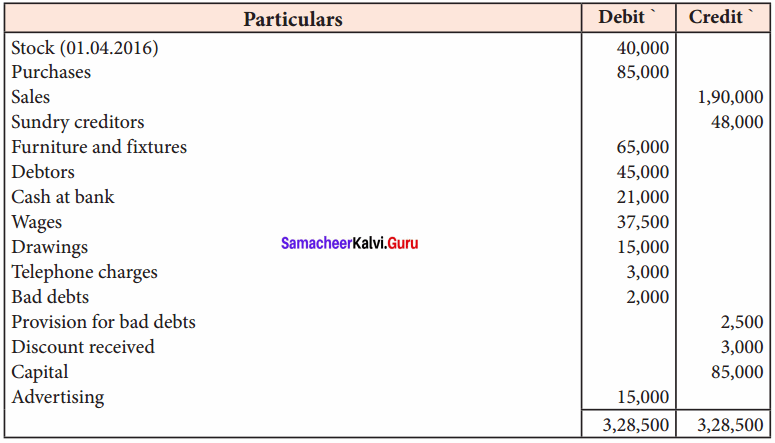
Now, discuss on the following points:

Question 1.
Will it be expensive for the business to introduce computerised accounting system?
Answer:
No, it will not be expensive. It may be integrated with enhanced MIS, multi – lingual and data organisation capabilities to simplify all the business processes easily and cost – effectively.
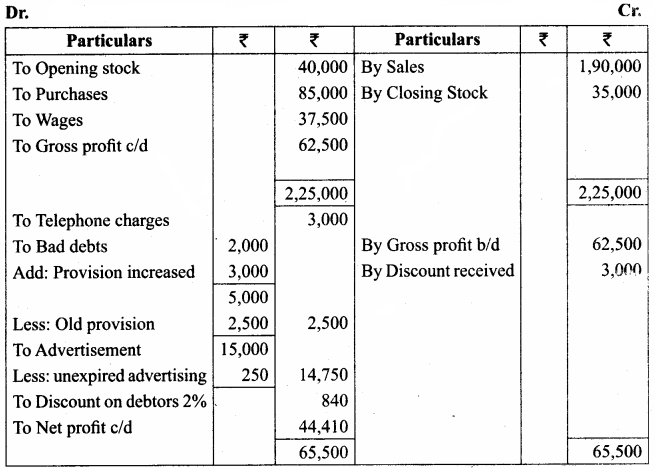
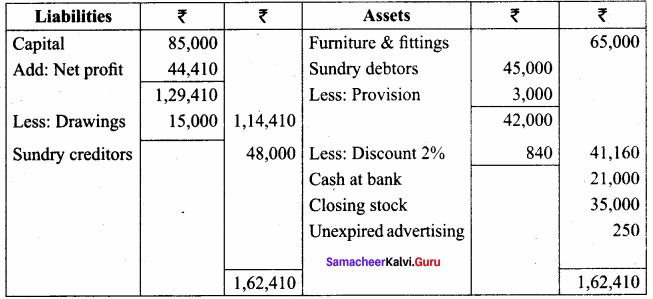
Samacheer Kalvi 11th Accountancy Solutions Chapter 14 Computerised Accounting

Question 2.
Will everyone get the access to use the computers? In such a case, how to protect data?
Answer:
It is an opportunity to leam new skill at free of cost. Retrieval of data is easier as the records are kept in soft copy in data base. By giving instructions, data can be retrieved quickly.

Question 3.
“People at the retirement age are not required to leam new skill” – Do you think so?
Answer:
No, the computerised accounting system is easy to leam by everyone. It is not a difficult one to retiring people also.

Question 4.
What are the factors to be considered by the managers before introducing CAS?
Answer:
The manager has to give an opportunity to leam new skill to his employees. It will take time but he has to face the employees problems:

  1. Heavy cost of installation.
  2. Cost of training.
  3. Fear of unemployment.
  4. Disruption of work and so on.

Samacheer Kalvi 11th Accountancy Computerised Accounting Additional Questions and Answers

I. Multiple Choice Questions
Choose the correct answer

Question 1.
Which one is output device?
(a) Monitor
(b) Keyboard
(c) Mouse
(d) Optical scanner
Answer:
(a) Monitor

Question 2.
Components of CAS can be classified into …………….. categories.
(a) Six
(b) Seven
(c) Five
(d) Three
Answer:
(a) Six

Samacheer Kalvi 11th Accountancy Solutions Chapter 14 Computerised Accounting

Question 3.
Which one is operating system?
(a) File manager
(b) COBOL
(c) Windows
(d) PASCAL
Answer:
(c) Windows

Question 4.
Which one is matched correctly?
(a) Land & building – current assets
(b) Goodwill – non – current liabilities
(c) Patents – intangible assets
(d) Sales – expenses
Answer:
(c) Patents – intangible assets

Question 5.
There are …………….. methods of codification.
(a) Two
(b) Three
(c) Four
(d) Five
Answer:
(b) Three

II. Very Short Answer Questions

Question 1.
Expands of MIS and CPU.
Answer:

  1. MIS – Management Information System
  2. CPU – Central Processing Unit

Question 2.
Mention any two features of CAS.
Answer:

  1. Simple and integrated
  2. Speed

Question 3.
What is utility software?
Answer:
These are designed specifically for managing the computer device and its resources.

Samacheer Kalvi 11th Accountancy Solutions Chapter 14 Computerised Accounting

Question 4.
What is system operators?
Answer:
People who operate the systems and use it for different purposes. They are also called as end users.

Question 5.
What do you mean by DATA?
Answer:
The facts and figures that are fed into a computer for further processing are called data.

III. Short Answer Questions

Question 1.
What are the types of people interacting with a computer system?
Answer:

  1. System analysts
  2. System programmers
  3. System operators

Question 2.
What is opearating system? Give two examples.
Answer:
A set of tools and programs to manage the overall working of a computer using a defined set of hardware components is called an operating system.
Example:

  1. DOS
  2. Windows.

Question 3.
Mention any three advantages of CAS.
Answer:

  1. Faster processing
  2. Accurate information and
  3. Reliability

Samacheer Kalvi 11th Accountancy Solutions Chapter 14 Computerised Accounting

Question 4.
What are the three types of procedures in a computer system?
Answer:

  1. Hardware oriented procedure
  2. Software oriented procedure and
  3. Internal procedure

Question 5.
Can you explain data?
Answer:
The facts and figures that are fed into a computer for further processing are called data. Data are raw input until the computer system interprets them using machine language, stores them in memory, classifies them for processing and produces results in conformance with the instructions given to it. Processed and useful data are called information which is used for decision making.

Samacheer Kalvi 11th Accountancy Solutions Chapter 13 Final Accounts of Sole Proprietors – II

Students can Download Accountancy Chapter 13 Final Accounts of Sole Proprietors – II Questions and Answers, Notes Pdf, Samacheer Kalvi 11th Accountancy Book Solutions Guide Pdf helps you to revise the complete Tamilnadu State Board New Syllabus and score more marks in your examinations.

Tamilnadu Samacheer Kalvi 11th Accountancy Solutions Chapter 13 Final Accounts of Sole Proprietors – II

Samacheer Kalvi 11th Accountancy Final Accounts of Sole Proprietors – II Text Book Back Questions and Answers

I. Multiple Choice Questions
Choose the Correct Answer

Question 1.
A prepayment of insurance premium will appear in ………………
(a) The trading account on the debit side
(b) The profit and loss account on the credit side
(c) The balance sheet on the assets side
(d) The balance sheet on the liabilities side
Answer:
(c) The balance sheet on the assets side

Question 2.
Net profit is ………………
(a) Debited to capital account
(b) Credited to capital account
(c) Debited to drawings account
(d) Credited to drawings account
Answer:
(b) Credited to capital account

Samacheer Kalvi 11th Accountancy Solutions Chapter 13 Final Accounts of Sole Proprietors – II

Question 3.
Closing stock is valued at ………………
(a) Cost price
(b) Market price
(c) Cost price or market price whichever is higher
(d) Cost price or net realisable value whichever is lower
Answer:
(d) Cost price or net realisable value whichever is lower

Question 4.
Accrued interest on investment will be shown ………………
(a) On the credit side of profit and loss account
(b) On the assets side of balance sheet
(c) Both (a) and (b)
(d) None of these
Answer:
(c) Both (a) and (b)

Question 5.
If there is no existing provision for doubtful debts, provision created for doubtful debts is ………………
(a) Debited to bad debts account
(b) Debited to sundry debtors account
(c) Credited to bad debts account
(d) Debited to profit and loss account
Answer:
(d) Debited to profit and loss account

II. Very Short Answer Questions

Question 1.
What are adjusting entries?
Answer:
Adjustment entries are the journal entries made at the end of the accounting period to account for items which are omitted in trial balance and to make adjustments for outstanding and prepaid expenses and revenues accrued and received in advance.

Question 2.
What is outstanding expense?
Answer:
Expenses which have been incurred in the accounting period but not paid till the end of the accounting period are called outstanding expenses.

Question 3.
What is prepaid expense?
Answer:
Prepaid expenses refer to any expense or portion of expense paid in the current accounting year but the benefit or services of which will be received in the next accounting period. They are also called as unexpired expenses.

Samacheer Kalvi 11th Accountancy Solutions Chapter 13 Final Accounts of Sole Proprietors – II

Question 4.
What are accrued incomes?
Answer:
Accrued income is an income or portion of income which has been earned during the current accounting year but not received till the end of that accounting year.

Question 5.
What is provision for discount on debtors?
Answer:
Cash discount is allowed by the suppliers to customers for prompt payment of amount due either on or before the due date. A provision created on sundry debtors for allowing such discount is called provision for discount on debtors.

III. Short Answer Questions

Question 1.
What is the need for preparing final accounts?
Answer:

  1. To record omissions in trial balance such as closing stock, interest on captial, interest on drawings, etc.
  2. To bring into account outstanding and prepaid expenses.
  3. To bring into account income accrued and received in advance.
  4. To create reserves and provisions.

Question 2.
What is meant by provision for doubtful debts? Why is it created?
Answer:
Provision for bad and doubtful debts refers to amount set aside as a charge against profit to meet any loss arising due to bad debt in future. The amount of doubtful debts is calculated on the basis of some percentage on debtors at the end of the accounting period after deducting further bad debts (if any). A provision for doubtful debts is created and is charged to profit and loss account.

Samacheer Kalvi 11th Accountancy Solutions Chapter 13 Final Accounts of Sole Proprietors – II

Question 3.
Explain how closing stock is treated in final accounts?
Answer:
The unsold goods in the business at the end of the accounting period are termed as closing stock. As per As-2 (Revised), the stock is valued at cost price or net realisable value, whichever is lower.

Presentation in final accounts:

  1. In the trading account: Shown on the credit side.
  2. In the balance sheet: Shown on the assets side under current assets.

Question 4.
Give the adjusting entries for interest on capital and interest on drawings.
Answer:
Adjusting Entry: Interest on Capital
Samacheer Kalvi 11th Accountancy Solutions Chapter 13 Final Accounts of Sole Proprietors – II
Adjusting Entry: Interest on Drawings
Samacheer Kalvi 11th Accountancy Solutions Chapter 13 Final Accounts of Sole Proprietors – II

Question 5.
Explain the accounting treatment of bad debts, provision for doubtful debts and provision for discount on debtors.
Answer:

  1. Bad Debts: When it is definitely known that amount due from a customer (debtor) to whom goods were sold on credit, cannot be realised at all, it is treated as bad debts.
  2. Provision for bad and doubtful debts refers to amount set aside as a charge against profit to meet any loss arising due to bad debt in future.
  3. Cash discount is allowed by the suppliers to customers for prompt payment of amount due either on or before the due date.

IV. Exercises

Question 1.
Pass adjusting entries for the following:
(a) The closing stock was valued at ₹ 5,000
(b) Outstanding salaries ₹ 150
(c) Insurance prepaid ₹ 450
(d) ₹ 20,000 was received in advance for commission.
(e) Accrued interest on investments is ₹ 1,000.
Answer:
Adjusting Entries
Samacheer Kalvi 11th Accountancy Solutions Chapter 13 Final Accounts of Sole Proprietors – II

Question 2.
For the fol owing adjustments, pass adjusting entries:
(a) Outstanding wages ₹ 5,000.
(b) Depreciate machinery by ₹ 1,000.
(c) Interest on capital @ 5% (Capital: ₹ 20,000)
(d) Interest on drawings ₹ 50
(e) Write off bad debts ₹ 500
Answer:
Adjusting Entries
Samacheer Kalvi 11th Accountancy Solutions Chapter 13 Final Accounts of Sole Proprietors – II

Question 3.
On preparing final accounts of Suresh, bad debt account has a balance of ₹ 800 and sundry debtors account has a balance of ₹ 16,000 of which ₹ 1,200 is to be written off as further bad debts. Pass adjusting entry for bad debts. And also show how it would appear in profit and loss account and balance sheet.
Answer:
Adjusting Entry
Samacheer Kalvi 11th Accountancy Solutions Chapter 13 Final Accounts of Sole Proprietors – II
Profit and Loss Account
Samacheer Kalvi 11th Accountancy Solutions Chapter 13 Final Accounts of Sole Proprietors – II
Balance Sheet
Samacheer Kalvi 11th Accountancy Solutions Chapter 13 Final Accounts of Sole Proprietors – II

Question 4.
The trial balance on March 31, 2016 shows the following:
Sundry debtors ₹ 30,000; Bad debts ₹ 1,200
It is found that 3% of sundry debtors is doubtful of recovery and is to be provided for. Pass journal entry for the amount of provision and also show how it would appear in the profit and loss account and balance sheet.
Answer:
Samacheer Kalvi 11th Accountancy Solutions Chapter 13 Final Accounts of Sole Proprietors – II
Profit and Loss Account for the year ended 31.03.2016
Samacheer Kalvi 11th Accountancy Solutions Chapter 13 Final Accounts of Sole Proprietors – II
Balance Sheet as on 31.03.2016
Samacheer Kalvi 11th Accountancy Solutions Chapter 13 Final Accounts of Sole Proprietors – II

Question 5.
The trial balance of a trader on 31st December, 2016 shows debtors as ₹ 50,000.
Adjustments:
(a) Write off ₹ 1,000 as bad debts
(b) Provide 5% for doubtful debts
(c) Provide 2% for discount on debtors
Show how these items will appear in the profit and loss A/c and balance sheet of the trader.
Answer:
Profit and Loss Account for the year ended 31st December, 2016
Samacheer Kalvi 11th Accountancy Solutions Chapter 13 Final Accounts of Sole Proprietors – II
Balance Sheet as on 31st December, 2016
Samacheer Kalvi 11th Accountancy Solutions Chapter 13 Final Accounts of Sole Proprietors – II

Question 6.
On 1st January, 2016, provision for doubtful debts account had a balance of ₹ 3,000. On December 31, 2016, sundry debtors amounted to ₹ 80,000. During the year, bad debts to be written off were ₹ 2,000. A provision for 5% was required for next year. Pass journal entries and show how these items would appear in the final accounts.
Answer:
Adjusting Entries
Samacheer Kalvi 11th Accountancy Solutions Chapter 13 Final Accounts of Sole Proprietors – II
Profit and Loss Account for the year ended 31st December, 2016
Samacheer Kalvi 11th Accountancy Solutions Chapter 13 Final Accounts of Sole Proprietors – II
Balance Sheet as on 31.12.2016
Samacheer Kalvi 11th Accountancy Solutions Chapter 13 Final Accounts of Sole Proprietors – II

Question 7.
The following are the extracts from the trial balance.
Sundry debtors ₹ 30,000; Bad debts ₹ 5,000 Additional information:
(a) Write off further bad debts ₹ 3,000.
(b) Create 10% provision for bad and doubtful debts.
You are required to pass necessary adjusting entries and show how these items will appear in profit and loss account and balance sheet.
Answer:
Adjusting Entries
Samacheer Kalvi 11th Accountancy Solutions Chapter 13 Final Accounts of Sole Proprietors – II
Profit and Loss Account
Samacheer Kalvi 11th Accountancy Solutions Chapter 13 Final Accounts of Sole Proprietors – II
Balance Sheet
Samacheer Kalvi 11th Accountancy Solutions Chapter 13 Final Accounts of Sole Proprietors – II

Question 8.
The following are the extracts from the trial balance.
Samacheer Kalvi 11th Accountancy Solutions Chapter 13 Final Accounts of Sole Proprietors – II
Additional information:
(a) Additional bad debts ₹ 3,000.
(b) Keep a provision for bad and doubtful debts @ 10% on sundry debtors.
You are required to pass necessary adjusting entries and show how these items will appear in profit and loss account and balance sheet.
Answer:
Adjusting Entries
Samacheer Kalvi 11th Accountancy Solutions Chapter 13 Final Accounts of Sole Proprietors – II
Profit and Loss Account
Samacheer Kalvi 11th Accountancy Solutions Chapter 13 Final Accounts of Sole Proprietors – II
Balance Sheet
Samacheer Kalvi 11th Accountancy Solutions Chapter 13 Final Accounts of Sole Proprietors – II

Question 9.
The accounts of Lakshmi traders showed the following balance on 31st March, 2016.
Sundry debtors ₹ 60,000; Bad debts ₹ 2,000
Provision for doubtful debts ₹ 4,200
At the time of preparation of final accounts on 31st March, it was found that out of sundry debtors, ₹ 1,000 will be irrecoverable. It was decided to create a provision of 2% on debtors to meet any future possible bad debts.
Pass necessary journal entries and show how these items would appear in the final accounts.
Answer:
Adjusting Entries
Samacheer Kalvi 11th Accountancy Solutions Chapter 13 Final Accounts of Sole Proprietors – II
Profit and Loss Account for the year ended 31.03.2016
Samacheer Kalvi 11th Accountancy Solutions Chapter 13 Final Accounts of Sole Proprietors – II
Balance Sheet as on 31.03.2016
Samacheer Kalvi 11th Accountancy Solutions Chapter 13 Final Accounts of Sole Proprietors – II

Question 10.
Samacheer Kalvi 11th Accountancy Solutions Chapter 13 Final Accounts of Sole Proprietors – II
The following are the extracts from the trial balance.
Additional information:
(a) Create a provision for doubtful debts @ 10% on sundry debtors.
(b) Create a provision for discount on debtors @ 5% on sundry debtors.
You are required to pass necessary adjusting entries and show how these items will appear in the final accounts.
Answer:
Adjusting Entries
Samacheer Kalvi 11th Accountancy Solutions Chapter 13 Final Accounts of Sole Proprietors – II
Profit and Loss Account
Samacheer Kalvi 11th Accountancy Solutions Chapter 13 Final Accounts of Sole Proprietors – II
Balance Sheet
Samacheer Kalvi 11th Accountancy Solutions Chapter 13 Final Accounts of Sole Proprietors – II

Question 11.
Following are the extracts from the trial balance.
Samacheer Kalvi 11th Accountancy Solutions Chapter 13 Final Accounts of Sole Proprietors – II
Additional information:
(a) Additional bad debts 1,000
(b) Create a provision for doubtful debts @ 5% on sundry debtors.
(c) Create a provision for discount on debtors @ 2% on sundry debtors.
You are required to pass necessary journal entries and show how these items will appear in the final accounts.
Answer:
Adjusting Entries
Samacheer Kalvi 11th Accountancy Solutions Chapter 13 Final Accounts of Sole Proprietors – II
Profit and Loss Account
Samacheer Kalvi 11th Accountancy Solutions Chapter 13 Final Accounts of Sole Proprietors – II
Balance Sheet
Samacheer Kalvi 11th Accountancy Solutions Chapter 13 Final Accounts of Sole Proprietors – II

Question 12.
The following are the extracts from the trial balance.
Samacheer Kalvi 11th Accountancy Solutions Chapter 13 Final Accounts of Sole Proprietors – II
Answer:
Profit and Loss Account
Samacheer Kalvi 11th Accountancy Solutions Chapter 13 Final Accounts of Sole Proprietors – II
Balance Sheet
Samacheer Kalvi 11th Accountancy Solutions Chapter 13 Final Accounts of Sole Proprietors – II

Question 13.
Prepare trading account of Archana for the year ending 31st December, 2106 from the following information.
Samacheer Kalvi 11th Accountancy Solutions Chapter 13 Final Accounts of Sole Proprietors – II
Adjustments:
(a) Closing stock ₹ 1,00,000
(b) Wages outstanding ₹ 12,000
(c) Freight inwards paid in advance ₹ 5,000
Answer:
Trading A/c of Archana for the year ended 31.12.2016
Samacheer Kalvi 11th Accountancy Solutions Chapter 13 Final Accounts of Sole Proprietors – II

Question 14.
Prepare profit and loss account of Manoj for the year ending on 31st March, 2016
Samacheer Kalvi 11th Accountancy Solutions Chapter 13 Final Accounts of Sole Proprietors – II
Adjustments:
(a) Salary outstanding ₹ 400
(b) Rent paid in advance ₹ 50
(c) Commission receivable ₹ 100
Answer:
Profit and Loss A/c of Manoj for the year ended 31.03.2016
Samacheer Kalvi 11th Accountancy Solutions Chapter 13 Final Accounts of Sole Proprietors – II

Question 15.
From the trial balance of Sumathi and the adjustments prepare the trading and profit and loss account for the year ended 31st March, 2016, and a balance sheet as on that date.
Samacheer Kalvi 11th Accountancy Solutions Chapter 13 Final Accounts of Sole Proprietors – II
Adjustments
(a) Six months interest on loan is outstanding.
(b) Two months rent is due from tenant, the monthly rent being ₹ 25.
(c) Salary for the month of March 2016, ₹ 75 is unpaid.
(d) Stock in hand on March 31, 2016 was valued at ₹ 1,030.
Answer:
Trading and Profit & Loss A/c of Sumathi
for the year ended 31st March, 2016
Samacheer Kalvi 11th Accountancy Solutions Chapter 13 Final Accounts of Sole Proprietors – II
Balance Sheet of Sumathi as on 31.03.2016
Samacheer Kalvi 11th Accountancy Solutions Chapter 13 Final Accounts of Sole Proprietors – II

Question 16.
The following trial balance was extracted from the books of Arun Traders as on 31st March, 2018.
Samacheer Kalvi 11th Accountancy Solutions Chapter 13 Final Accounts of Sole Proprietors – II
Answer:
Prepare trading and profit and loss account for the year ending 31st March, 2018 and balance sheet as on that date after considering the following:
(a) Depreciate Plant and machinery @ 20%
(b) Wages outstanding amounts to ₹ 750.
(c) Half of repairs and maintenance paid is for the next year.
(d) Closing stock was valued at ₹ 15,000.
Answer:
Trading and Profit & Loss A/c of Arun Traders for the year ended 31.03.2018
Samacheer Kalvi 11th Accountancy Solutions Chapter 13 Final Accounts of Sole Proprietors – II
Balance Sheet of Arun Traders as on 31.03.2018
Samacheer Kalvi 11th Accountancy Solutions Chapter 13 Final Accounts of Sole Proprietors – II

Question 17.
The following is the trial balance of Babu as on 31st December, 2016.
Samacheer Kalvi 11th Accountancy Solutions Chapter 13 Final Accounts of Sole Proprietors – II
Prepare trading and profit and loss account for the year ended 31st December, 2016 and a balance sheet as on that date after the following adjustments.
(a) Salaries outstanding ₹ 500
(b) Interest on investments receivable at 10%.
(c) Provision required for bad debts is 5%.
(d) Closing stock is valued at ₹ 9,900.
Answer:
Trading and Profit & Loss A/c for the year ended 31.12.2016
Samacheer Kalvi 11th Accountancy Solutions Chapter 13 Final Accounts of Sole Proprietors – II
Balance Sheet as on 31.12.2016
Samacheer Kalvi 11th Accountancy Solutions Chapter 13 Final Accounts of Sole Proprietors – II

Question 18.
From the following trial balance of Ramesh as on 31st March, 2017, prepare the trading and profit and loss account and the balance sheet as on that date.
Samacheer Kalvi 11th Accountancy Solutions Chapter 13 Final Accounts of Sole Proprietors – II
Answer:
Adjustments:
Closing stock was valued at ₹ 35,000
(b) Unexpired advertising ₹ 250
(c) Provision for bad and doubtful debts is to be increased to ₹ 3,000
(d) Provide 2% for discount on debtors.
Answer:
Trading and Profit & Loss A/c of Ramesh for the year ended 31.03.2017
Samacheer Kalvi 11th Accountancy Solutions Chapter 13 Final Accounts of Sole Proprietors – II
Balance Sheet of Ramesh as on 31.03.2017
Samacheer Kalvi 11th Accountancy Solutions Chapter 13 Final Accounts of Sole Proprietors – II

Question 19.
Following are the ledger balances of Devi as on 31st December, 2016.
Samacheer Kalvi 11th Accountancy Solutions Chapter 13 Final Accounts of Sole Proprietors – II
Prepare trading and profit and loss account for the year ended 31st December, 2016 and balance sheet as on that date.
(a) Stock on 31st December, 2016 ₹ 5,800.
(b) Write off bad debts ₹ 500.
(c) Make a provision for bad debts @ 5%.
(d) Provide for discount on debtors @ 2%.
Answer:
Trading and Profit & Loss A/c of Devi for the year ended 31.12.2016
Samacheer Kalvi 11th Accountancy Solutions Chapter 13 Final Accounts of Sole Proprietors – II
Balance Sheet of Devi as on 31.12.2016
Samacheer Kalvi 11th Accountancy Solutions Chapter 13 Final Accounts of Sole Proprietors – II

Question 20.
From the following trial balance of Mohan for the year ended 31st March, 2017 and additional information, prepare trading and profit and loss account and balance sheet.
Samacheer Kalvi 11th Accountancy Solutions Chapter 13 Final Accounts of Sole Proprietors – II
Additional information:
(a) Closing stock is valued at ₹ 15,500
(b) Write off ₹ 500 as bad debts and create a provision for bad debts @ 10% on debtors.
(c) Depreciation @ 10% required
Answer:
Trading and Profit and Loss A/c of Mohan for the year ended 31.03.2017
Samacheer Kalvi 11th Accountancy Solutions Chapter 13 Final Accounts of Sole Proprietors – II
Balance Sheet of Mohan as on 31.03.2017
Samacheer Kalvi 11th Accountancy Solutions Chapter 13 Final Accounts of Sole Proprietors – II

Question 21.
From the following trial balance of Subramaniam, prepare his trading and profit and loss account and balance sheet as on 31st December, 2016.
Samacheer Kalvi 11th Accountancy Solutions Chapter 13 Final Accounts of Sole Proprietors – II
Take into account the following adjustments:
(a) Charge interest on drawings at 8%.
(b) Outstanding salaries ₹ 3,000
(c) Closing stock was valued at ₹ 48,000
(d) Provide for 5% interest on capital.
Answer:
Trading and Profit & Loss A/c of Subramaniam for the year ended 31.12.2016
Samacheer Kalvi 11th Accountancy Solutions Chapter 13 Final Accounts of Sole Proprietors – II
Balance Sheet of Subramaniam as on 31.12.2016
Samacheer Kalvi 11th Accountancy Solutions Chapter 13 Final Accounts of Sole Proprietors – II

Question 22.
Prepare trading and profit and loss account and balance sheet from the following trial balance of Madan as on 31st March, 2018.
Samacheer Kalvi 11th Accountancy Solutions Chapter 13 Final Accounts of Sole Proprietors – II
Adjustments:
(a) The closing stock was ₹ 80,000
(b) Provide depreciation on plant and machinery @ 20%
(c) Write off ₹ 800 as further bad debts
(d) Provide the doubtful debts @ 5% on sundry debtors
Answer:
Trading and Profit & Loss A/c for the year ended 31.03.2018
Samacheer Kalvi 11th Accountancy Solutions Chapter 13 Final Accounts of Sole Proprietors – II
Balance Sheet as on 31.03.2018
Samacheer Kalvi 11th Accountancy Solutions Chapter 13 Final Accounts of Sole Proprietors – II

Question 23.
From the following information prepare trading and profit and loss account and balance sheet of Kumar for the year ending 31st December, 2017.
Samacheer Kalvi 11th Accountancy Solutions Chapter 13 Final Accounts of Sole Proprietors – II
Adjustments:
(a) The closing stock on 31st December, 2017 was valued at ₹ 3,900.
(b) Carriage inwards prepaid ₹ 250
(c) Rent received in advance ₹ 100
(d) Manager is entitled to receive commission @ 5% of net profit after providing such commission.
Answer:
Trading and Profit & Loss Account of Kumar for the year ended 31.12.2017
Samacheer Kalvi 11th Accountancy Solutions Chapter 13 Final Accounts of Sole Proprietors – II
Balance Sheet of Kumar as on 31.12.2017
Samacheer Kalvi 11th Accountancy Solutions Chapter 13 Final Accounts of Sole Proprietors – II

Question 24.
From the following information, prepare trading and profit and loss account and balance sheet in the books of Sangeetha for the year ending 31st March, 2018.
Samacheer Kalvi 11th Accountancy Solutions Chapter 13 Final Accounts of Sole Proprietors – II
Adjustments:
(a) Stock on 31st March, 2018 ₹ 14,200
(b) Income tax of Sangeetha paid ₹ 800
(c) Charge interest on drawings @ 12% p.a.
(d) Provide managerial remuneration @ 10% of net profit before charging such commission.
Answer:
Trading and Profit & Loss Account of Sangeetha for the year ended 31.03.2018
Samacheer Kalvi 11th Accountancy Solutions Chapter 13 Final Accounts of Sole Proprietors – II
Balance Sheet of Sangeetha as on 31.03.2018
Samacheer Kalvi 11th Accountancy Solutions Chapter 13 Final Accounts of Sole Proprietors – II

Textbook Case Study Solved

Question 1.
James is a trader who sells washing machines on credit. But, he does not remember the due date to collect the money from his debtors. Some of his customers do not pay on time. His cash inflow is becoming worse. As a result, he could not pay his telephone bill and rent at the end of the accounting period. Hence, he showed only the amount paid as expense. He has many washing machines unsold at the year end. He is worried about the performance of his business. So, he is planning to appoint a manager to take care of his business. The new manager insists James to apply the accounting principle of prudence and matching and also to allow cash discount.
Now, discuss on the following points:

Question 1.
Why does James sell on credit?
Answer:
James sells goods on credit to increase the sales volume and reduce the stock.

Samacheer Kalvi 11th Accountancy Solutions Chapter 13 Final Accounts of Sole Proprietors – II

Question 2.
Are there any ways to encourage his debtors to make the payment on time?
Answer:
Yes, there are many ways to encourage his debtors to make the payment on time by way of cash discount and trade discount.

Question 3.
What might happen if the debtors do not pay?
Answer:
If the debtors do not pay, the bad debts will be increased in the business.

Question 4.
In what ways prudence and matching principles can be applied for the business of James?
Answer:
Prudence principle can be applied for the business here closing stock was valued on cost price or market price whichever is lower under the prudence principle. Matching principle can be applied here for revenue and expense.

Question 5.
What will be the impact on income statement and the balance sheet, if the outstanding expenses are not adjusted?
Answer:
Outstanding expenses to be added with the concerned expenditure in the income Statement and the outstanding expenses will be recorded in liabilities side.

Samacheer Kalvi 11th Accountancy Solutions Chapter 13 Final Accounts of Sole Proprietors – II

Question 6.
On what basis the unsold washing machines should be valued?
Answer:
The unsold washing machine should be valued at cost price or market price, whichever is lower under prudence principle. Managerial commission can be given to motivate the new manager to retain him in the business of James.

Samacheer Kalvi 11th Accountancy Final Accounts of Sole Proprietors – II Additional Questions and Answers

I. Multiple Choice Questions (Other important questions)
Choose the correct answer

Question 1.
If closing stock is already adjusted, adjusted purchase account and ………………. stock will appear in trial balance.
(a) Opening
(b) Closing
(c) Average
(d) None of these
Answer:
(b) Closing

Question 2.
Outstanding expense account is a ………………. account.
(a) Nominal
(b) Real
(c) Representative personal
(d) Personal
Answer:
(c) Representative personal

Samacheer Kalvi 11th Accountancy Solutions Chapter 13 Final Accounts of Sole Proprietors – II

Question 3.
When bad debts already appears in the trial balance, it is taken only to debit side of ………………. account.
(a) Profit and Loss
(b) Balance sheet
(c) Asset side
(d) None of these
Answer:
(a) Profit and Loss

Question 4.
Income tax paid by the business for the proprietor is treated as ……………….
(a) Expense
(b) Profit and Loss A/c
(c) Drawings
(d) None of these
Answer:
(c) Drawings

Question 5.
Commission on net profit after charging such commission:
Samacheer Kalvi 11th Accountancy Solutions Chapter 13 Final Accounts of Sole Proprietors – II
Answer:
Samacheer Kalvi 11th Accountancy Solutions Chapter 13 Final Accounts of Sole Proprietors – II

Samacheer Kalvi 11th Accountancy Solutions Chapter 11 Capital and Revenue Transactions

Students can Download Accountancy Chapter 11 Capital and Revenue Transactions Questions and Answers, Notes Pdf, Samacheer Kalvi 11th Accountancy Book Solutions Guide Pdf helps you to revise the complete Tamilnadu State Board New Syllabus and score more marks in your examinations.

Tamilnadu Samacheer Kalvi 11th Accountancy Solutions Chapter 11 Capital and Revenue Transactions

Samacheer Kalvi 11th Accountancy Capital and Revenue Transactions Text Book Back Questions and Answers

I. Multiple Choice Questions
Choose the Correct Answer

Question 1.
Amount spent on increasing the seating capacity in a cinema hall is ……………….
(a) Capital expenditure
(b) Revenue expenditure
(c) Deferred revenue expenditure
(d) None of the above
Answer:
(a) Capital expenditure

Question 2.
Expenditure incurred ₹ 20,000 for trial run of a newly installed machinery will be ……………….
(a) Preliminary expense
(b) Revenue expenditure
(c) Capital expenditure
(d) Deferred revenue expenditure
Answer:
(c) Capital expenditure

Samacheer Kalvi 11th Accountancy Solutions Chapter 11 Capital and Revenue Transactions

Question 5.
Revenue expenditure is intended to benefit ……………….
(a) Past period
(b) Future period
(c) Current period
(d) Any period
Answer:
(c) Current period

Question 6.
Pre – operative expenses are ……………….
(a) Revenue expenditure
(b) Prepaid revenue expenditure
(c) Deferred revenue expenditure
(d) Capital expenditure
Answer:
(d) Capital expenditure

II. Very Short Answer Questions

Question 1.
What is meant by revenue expenditure?
Answer:
The expenditure incurred for day to day running of the business or for maintaining the earning capacity of the business is known as revenue expenditure. It is recurring in nature. It is incurred to generate revenue for a particular accounting period. The revenue expenditure may be incurred in relation with revenue or in relation with a particular accounting period.

Question 2.
What is capital expenditure?
Answer:
It is an expenditure incurred during an accounting period, the benefits of which will be available for more than one accounting period. It includes any expenditure resulting in the acquisition of any fixed asset or contributes to the revenue earning capacity of the business. It is non-recurring in nature.

Question 3.
What is capital profit?
Answer:
Capital profit is the profit which arises not from the normal course of the business. Profit on sale of fixed asset is an example for capital profit.

Samacheer Kalvi 11th Accountancy Solutions Chapter 11 Capital and Revenue Transactions

Question 4.
Write a short note on revenue receipt.
Answer:
Receipts which are obtained in the normal course of business are called revenue receipts. It is recurring in nature. The amount received is generally small.

Question 5.
What is meant by deferred revenue expenditure?
Answer:
An expenditure which is revenue expenditure in nature, the benefits of which is to be derived over a subsequent period or periods is known as deferred
revenue expenditure.

III. Short Answer Questions

Question 1.
Distinguish between capital expenditure and revenue expenditure.
Answer:

S. No.Capital ExpenditureRevenue Expenditure
1Purchase cost of fixed assets.Maintenance expenses of fixed assets.
2Purchase cost of long term investments.Insurance premium.
3Expenses to increase the earning capacity of fixed assets.Postage and stationery.

Question 2.
Distinguish between capital receipt and revenue receipt.
Answer:

S. No.CharacteristicsCapital ReceiptRevenue Receipt
1NatureNon-recurring in nature.Recurring in nature.
2SizeAmount is generally substantial.Amount is generally smaller.
3DistributionThese amounts are not available for distribution as profits.The excess’of revenue receipts over the revenue expenses can be used for distribution as profits.

Question 3.
What is deferred revenue expenditure? Give two examples.
Answer:
An expenditure, which is revenue expenditure in nature, the benefits of which is to be derived over a subsequent period or periods is known as deferred revenue expenditure. The benefit usually accrues for a period of two or more years. It is for the time being, deferred from being charged against income. It is charged against income over a period of certain years. Examples: Considerable amount spent on advertising and major repairs to plant and machinery.

IV. Exercises

Question 1.
State whether the following expenditures are capital, revenue or deferred revenue.
(a) Advertising expenditure, the benefits of which will last for three years.
(b) Registration fees paid at the time of registration of a building.
(c) Expenditure incurred on repairs and whitewashing at the time of purchase of an old building in order to make it usable.
Answer:
(a) Deferred revenue expenditure
(b) Capital expenditure
(c) Capital expenditure

Samacheer Kalvi 11th Accountancy Solutions Chapter 11 Capital and Revenue Transactions

Question 2.
Classify the following items into capital and revenue.
(a) Registration expenses incurred for the purchase of land.
(b) Repairing charges paid for remodelling the old building purchased.
(c) Carriage paid on goods purchased.
(d) Legal expenses paid for raising of loans.
Answer:
(a) Capital expenditure
(b) Capital expenditure
(c) Revenue expenditure
(d) Capital expenditure

Question 3.
State whether they are capital and revenue.
(a) Construction of building ₹ 10,00,000.
(b) Repairs to furniture ₹ 50,000.
(c) White-washing the building ₹ 80,000.
(d) Pulling down the old building and rebuilding ₹ 4,00,000.
Answer:
(a) Capital expenditure
(b) Revenue expenditure
(c) Revenue expenditure
(d) Capital expenditure

Question 4.
Classify the following items into capital and revenue.
(a) ₹ 50,000 spent for railway siding.
(b) Loss on sale of old furniture.
(c) Carriage paid on goods sold.
Answer:
(a) Capital expenditure
(b) Capital loss
(c) Revenue expenditure

Question 5.
State whether the following are capital, revenue and deferred revenue.
(a) Legal fees paid to the lawyer for acquiring a land ₹ 20,000.
(b) Heavy advertising cost of ₹ 12,00,000 spent on introducing a new product.
(c) Renewal of factory licence ₹ 12,000.
(d) A sum of ₹ 4,000 was spent on painting the factory.
Answer:
(a) Capital expenditure
(b) Deferred revenue expenditure
(c) Revenue expenditure
(d) Revenue expenditure

Question 6.
Classify the following receipts into capital and revenue.
(a) Sale proceeds of goods ₹ 75,000.
(b) Loan borrowed from bank ₹ 2,50,000.
(c) Sale of investment ₹ 1,20,000.
(d) Commission received ₹ 30,000.
(e) ₹ 1,400 wages paid in connection with the erection of new machinery.
Answer:
(a) Revenue receipts
(b) Capital receipts
(c) Capital receipts
(d) Revenue receipts
(e) Capital expenditure

Samacheer Kalvi 11th Accountancy Solutions Chapter 11 Capital and Revenue Transactions

Question 7.
Identify the following items into capital or revenue.
(a) Audit fees paid ₹ 10,000.
(b) Labour welfare expenses ₹ 5,000.
(c) ₹ 2,000 paid for servicing the company vehicle.
(d) Repair to furniture purchased second hand ₹ 3,000.
(e) Rent paid for the factory ₹ 12,000.
Answer:
(a) Revenue expenditure
(b) Revenue expenditure
(c) Revenue expenditure
(d) Capital expenditure
(e) Revenue expenditure

Textbook Case Study Solved

Question 1.
Sadhana decides to start a business of selling air – conditioners. She buys different brands of air – conditioners. She also buys a delivery van, some furniture and some tools to fix air- conditioners. She buys some stationery items and cleaning liquid. She spends some amount on advertising her shop. She records the entire amount spent in the trading account.
Now, discuss on the following points:

Question 1.
Is it correct to record the entire amount spent in the first year of trading in the trading account? What impact will it have on the profit for the year?
Answer:
It is not correct to record the entire amount spent in the first year of trading in the trading account. It will be shown as a capital expenditure. For example: furniture and delivery van.

Question 2.
What are her fixed assets?
Answer:

  1. A delivery van.
  2. Some furniture.
  3. Some tools.

Samacheer Kalvi 11th Accountancy Solutions Chapter 11 Capital and Revenue Transactions

Question 3.
Does she apply accounting concepts? If not which is the concept she does not apply?
Answer:
No, she does not apply accounting concepts. She does not apply business entity concepts.

Question 4.
Can you help Sadhana to classify the expenditure?
Answer:
Yes, I can help Sadhana to classify the expenditure:

Capital expenditureRevenue expenditureDeferred Revenue Expenditure
Non-recurringRecurringNon-recurring
1.  Delivery Van

2.   Furniture

3.  Tools

1. Air-conditioners

2.   Stationery items

3.  Cleaning liquid

She spends some amount on advertising her shop.

Question 5.
What other capital, revenue and deferred revenue expenditure her business may incur in the future?
Answer:
In the future:

Capital expenditureRevenue expenditureDeferred Revenue Expenditure
1.  Building extension

2.  Computer for office use

3.  Other furniture

1. Air-conditioners

2.  Other home appliances

A huge advertising.

Samacheer Kalvi 11th Accountancy Capital and Revenue Transactions Additional Questions and Answers

I. Multiple Choice Questions
Choose the correct answer

Question 1.
Cost of acquisition of land and building is an example of ………………
(a) Capital expenditure
(b) Revenue expenditure
(c) Capital receipts
(d) Revenue receipts
Answer:
(a) Capital expenditure

Question 2.
There are types of expenditure ………………
(a) One
(b) Two
(c) Three
(d) Four
Answer:
(c) Three

Samacheer Kalvi 11th Accountancy Solutions Chapter 11 Capital and Revenue Transactions

Question 3.
……………… expenditure is recurring in nature.
(a) Capital expenditure
(b) Revenue expenditure
(c) Capital loss
(d) Capital profit
Answer:
(b) Revenue expenditure

Question 4.
Considerable amount spent on advertising is an example of ……………… expenditure.
(a) capital
(b) revenue
(c) deferred
(d) none of these
Answer:
(c) deferred

II. Very Short Answer Questions

Question 1.
What is capital receipt?
Answer:
Receipt which is not revenue in nature is called capital receipt. It is non-recurring in nature. The amount received is normally substantial. It is shown on the liabilities side of the balance sheet.

Question 2.
Write any two features of revenue expenditure.
Answer:

  1. It is recurring in nature.
  2. It is incurred for maintaining the earning capacity of the business.

III. Short Answer Questions

Question 1.
Write three features of deferred revenue expenditure.
Answer:

  1. It is a revenue expenditure, the benefits of which is to be derived over a subsequent period or periods.
  2. It is not fully written off in the year of actual expenditure. It is written off over a period of certain years.
  3. The balance available after writing off (i.e., Actual expenditure – Amount written off) is shown on the assets side balance sheet.

Samacheer Kalvi 11th Accountancy Solutions Chapter 11 Capital and Revenue Transactions

Question 2.
What are the classifications of expenditures?
Answer:

  1. Capital expenditure
  2. Revenue expenditure
  3. Deferred revenue expenditure

Question 3.
Write any three examples of revenue expenditure.
Answer:

  1. Purchase of goods for sale
  2. Administrative, selling and distribution expenses
  3. Manufacturing expenses

Samacheer Kalvi 11th Computer Applications Solutions Chapter 13 CSS – Cascading Style Sheets

Students can Download Computer Applications Chapter 13 CSS – Cascading Style Sheets Questions and Answers, Notes Pdf, Samacheer Kalvi 11th Computer Applications Book Solutions Guide Pdf helps you to revise the complete Tamilnadu State Board New Syllabus and score more marks in your examinations.

Tamilnadu Samacheer Kalvi 11th Computer Applications Solutions Chapter 13 CSS – Cascading Style Sheets

Samacheer Kalvi 11th Computer Applications CSS – Cascading Style Sheets Text Book Back Questions and Answers

I. Choose The Correct Answer

Question 1.
Expansion of CSS:
(a) Cascading Style Schools
(b) Cascading Style Scheme
(c) Cascading Style Sheets
(d) Cascading Style Shares
Answer:
(c) Cascading Style Sheets

Samacheer Kalvi 11th Computer Applications Solutions Chapter 13 CSS - Cascading Style Sheets

Question 2.
Which of the following is the page level style?
(a) <Page>
(b) <Style>
(c) <Link>
(d) <H>
Answer:
(b) <Style>

Question 3.
CSS is also called as:
(a) Sitewide Style Sheets
(b) Internal Style Sheets
(c) Inline Style Sheets
(d) Internal Inline Sheets
Answer:
(a) Sitewide Style Sheets

Samacheer Kalvi 11th Computer Applications Solutions Chapter 13 CSS - Cascading Style Sheets

Question 4.
The extension of CSS file is:
(a) .ssc
(b) .css
(c) .CSC
(d) .htm
Answer:
(b) .css

Question 5.
What is selector?
(a) Property
(b) Value
(c) HTML tag
(d) Name
Answer:
(c) HTML tag

Samacheer Kalvi 11th Computer Applications Solutions Chapter 13 CSS - Cascading Style Sheets

Question 6.
The Declaration block of CSS is surrounded by:
(a) ( )
(b) [ ]
(c) { }
(d) <>
Answer:
(c) { }

Question 7.
The declaration should be terminated by:
(a) :
(b) ;
(c) .
(d) ,
Answer:
(b) ;

Question 8.
What is the property to set text as bold?
(a) Font-Style
(b) Font-Weight
(c) Font-Property
(d) Font-Bold
Answer:
(b) Font-Weight

Samacheer Kalvi 11th Computer Applications Solutions Chapter 13 CSS - Cascading Style Sheets

Question 9.
Which of the following indicates that the text included is a comment?
(a) /**/
(b) !* *!
(c) <* *>
(d) \* *\
Answer:
(a) /**/

Samacheer Kalvi 11th Computer Applications Solutions Chapter 13 CSS - Cascading Style Sheets

Question 10.
Which of the following ways below is correct, to write a CSS?
(a) p{coloured; text-align:center};
(b) p {colonred; text-align:center}
(c) p {color:red; text-align:center;}
(d) p (color:red;text-align:center;)
Answer:
(c) p {color:red; text-align:center;}

II. Answer To The Following Questions

Question 1.
What is the use of <style> tag?
Answer:
We are already know about the formatting tags and its attributes, in some situations, you may need to use a tag uniformly in the entire document. To do so, we can use <style> tag. A style tag is used to change the default characteristics of a particular tag in the entire web document wherever that tag is used.

Samacheer Kalvi 11th Computer Applications Solutions Chapter 13 CSS - Cascading Style Sheets

Question 2.
What is CSS?
Answer:
Cascading Style Sheets (CSS) are also called as Sitewide Style sheets or external style. CSS is a style sheet language used for describing the formatting of a document written in HTML. Using CSS, you can control the font colour, font style, spacing between pages, columns size, border colour, background image or colour and various other effects in a web page.

Question 3.
Write the general format of linking CSS with HTML?
Answer:
The <link> tag is used to add CSS file with HTML in head section. While using <link> tag, the following attributes are also included along with standard values.
rel = “stylesheet”
type = “text/css”
The href attribute is used to link the .css file. General format of <Link> tag:
<Link rel = “stylesheet” type = “text/css” href = CSS_ File_Name_with_Extension>

Samacheer Kalvi 11th Computer Applications Solutions Chapter 13 CSS - Cascading Style Sheets

Question 4.
What is Inline Style?
Answer:
“Inline style”, which is used to define style for a particular tag anywhere in an HTML document. You can define styles for any tag within an HTML document. But it is applicable only on that line where it is defined. If you use the same tag, again in the same documnet, it does not reflect the new style.

Samacheer Kalvi 11th Computer Applications Solutions Chapter 13 CSS - Cascading Style Sheets

Question 5.
Write down general format of CSS declaration?
Answer:
The body of the style sheet consists of a series of rules.

Selector:
HTML Tag

Declaration:
{Properties: Values}

III. Answer To The Following Questions

Question 1.
What are the advantages of using CSS?
Answer:
Maintainability:
CSS are also defined and stored as separate files. So, the style and appearance of a web page can be dynamically changed and maintain with less effort.

Reusability:
The styles defined in CSS can be reused in multiple HTML pages.

Easy to understand:
The tags in web pages are well organized with style specifications and therefore it is easy to understand.

Samacheer Kalvi 11th Computer Applications Solutions Chapter 13 CSS - Cascading Style Sheets

Question 2.
Write a short note on rule of CSS?
Answer:
CSS style declaration consists of two major parts; Selector and Declaration. The Selector refers an HTML tag in which you want to apply styles.

The Declaration is a block of code contains style definition. It should be surrounded by curly braces. You can include any number of properties for each selector, and they must be separated by semicolons, The property name and its value should be separated by a colon. Each declaration should be terminated by a semicolon (;).
Eg:
Samacheer Kalvi 11th Computer Applications Solutions Chapter 13 CSS - Cascading Style Sheets

Question 3.
Wrie a CSS file to define text color and alignment to <p> tag?
Answer:
The style properties are defined to <p> tag. Hereafter, whenever you use the <p>, the contents will be displayed with modified properties.

If you want to use the above style definition as an internal style then it should be specified within <style>,</style> block in head section. If you want store the above definition for using all your web pages, you should save the above code as a separate file with extension.css

Samacheer Kalvi 11th Computer Applications Solutions Chapter 13 CSS - Cascading Style Sheets

Question 4.
Write a CSS file to define font type, style and size to <h1> tag?
Answer:
<h1> tag in a particular font style and size with blue colour in the entire page,You can use <style> tag to define its properties in head section. The style of <h1> header tag is clearly defined. So, hereafter, the content between <h1> and </h1> will be displayed as per its definition.

IV. Answer To The Following Questions

Question 1.
Write an HTML document to display the following oaragraph as per the given description Using CSS:
Font Name:
Cooper Black

Style:
Bold Italics

Color:
Blue “The State Institute of Education (SIE) was established in 1965 to provide for systematic study of problems relating to School Education under the administration of Directorate of School Education.”

Samacheer Kalvi 11th Computer Applications Solutions Chapter 13 CSS - Cascading Style Sheets

Question 2.
List and explain the Font and text element properties and values used CSS?
Answer:
Samacheer Kalvi 11th Computer Applications Solutions Chapter 13 CSS - Cascading Style Sheets

Samacheer Kalvi 11th Computer Applications HTML – Adding Multimedia Elements and Forms Additional Questions and Answers

I. Choose The Correct Answer

Question 1.
Which tag is used to change the default characteristics of web document?
(a) Style
(b) Font
(c) Text
(d) Colour
Answer:
(a) Style

Samacheer Kalvi 11th Computer Applications Solutions Chapter 13 CSS - Cascading Style Sheets

Question 2.
Which is used to define style for a particular tag anywhere in a HTML document?
(a) Internal style
(b) Inline style
(c) External style
(d) Page style
Answer:
(b) Inline style

Question 3.
CSS was invented by:
(a) Hakon Wium Lie
(b) Hakon Willium Lee
(c) Hakon Street Man
(d) Hakon Lee
Answer:
(a) Hakon Wium Lie

Question 4.
The <style> tag are also called as:
(a) page-level styles
(b) inline styles
(c) external styles
(d) both (a) & (c)
Answer:
(a) page-level styles

Samacheer Kalvi 11th Computer Applications Solutions Chapter 13 CSS - Cascading Style Sheets

Question 5.
Which section is used by the <link> tag to add CSS file?
(a) Body
(b) Head
(c) Style
(d) Title
Answer:
(b) Head

Samacheer Kalvi 11th Computer Applications Solutions Chapter 13 CSS - Cascading Style Sheets

Question 6.
Expand XHTML:
(a) Extensible Hypertext Markup Language
(b) Extended Hypertext Markup Language
(c) Executed Hypertext Markup Language
(d) Except Hypertext Markup Language
Answer:
(a) Extensible Hypertext Markup Language

II. Answer The Following Questions

Question 1.
What is called page-level sheets or internal sheets?
Answer:
The <style> tag controls the presentation styles of a particular HTML document. If you want to use a particular tag with the same style applied in one HTML document to another is not possible. Thus, the <style> tags are called as “Page-Level Styles” or “Internal Style sheets”.

Samacheer Kalvi 11th Computer Applications Solutions Chapter 13 CSS - Cascading Style Sheets

Question 2.
What is known as sitewide style sheets or external style sheets?
Answer:
The “Internal Style Sheet” is defined and implemented only within an HTML document. If you want use the same style to multiple pages, you should define styles as a separate style file. These separate style files are known as “Sitewide Style Sheets” or ‘”External Style Sheets”.

III. Answer The Following Questions

Question 1.
Write the suitable example for creating CSS style?
Answer:
P {
font-style : Italic;
color :MediumSeaGreen;
}
H1
{
border: 2px solid red;
}
The above code should be saved with extension. css

Samacheer Kalvi 11th Computer Applications Solutions Chapter 13 CSS - Cascading Style Sheets

Question 2.
Write the properties and values of paragraph margin in CSS?
Answer:
Samacheer Kalvi 11th Computer Applications Solutions Chapter 13 CSS - Cascading Style Sheets

IV. Answer The Following Questions

Question 1.
Write the html code to change the background colour of browser using CSS?
Answer:
– Back_Color.css —
body
{
background-color : pink;
}
Background_CSS.htm
<html>
<head>
<title> Changing Background using CSS </title>
<link rel = “stylesheet” type=”text/css” href=”Body_Color.css”> </head>
<body>
<H1> Welcome to CSS
</H1>
</body>
</html>