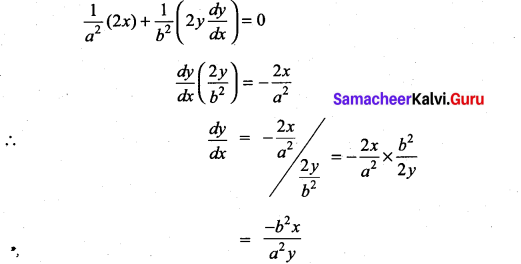
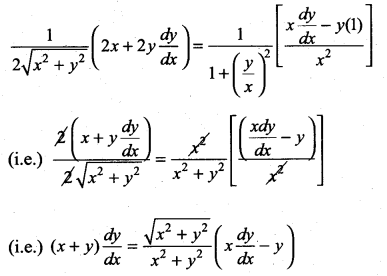
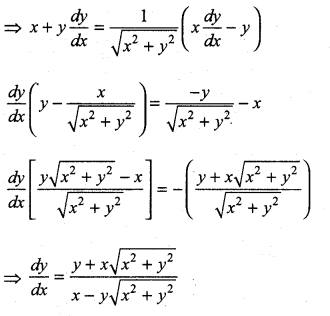
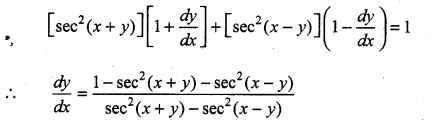
Samacheer Kalvi 11th Maths Solutions Chapter 6 Two Dimensional Analytical Geometry Ex 6.1

You can Download Samacheer Kalvi 11th Maths Book Solutions Guide Pdf, Tamilnadu State Board help you to revise the complete Syllabus and score more marks in your examinations.

Tamilnadu Samacheer Kalvi 11th Maths Solutions Chapter 6 Two Dimensional Analytical Geometry Ex 6.1

Question 1.
Find the locus of P, if for all values of a, the co-ordinates of a moving point P is
(i) (9 cos α, 9 sin α)
(ii) (9 cos α, 6 sin α)
Solution:
(i) Let P(h, k) be the moving point.
We are given h = 9 cos α and k = 9 sin α and
Samacheer Kalvi 11th Maths Solutions Chapter 6 Two Dimensional Analytical Geometry Ex 6.1 1
∴ locus of the point is x2 + y2 = 81

(ii) Let P(h , k) be a moving point.
We are given h = 9 cos α and k = 6 sin α
Samacheer Kalvi 11th Maths Solutions Chapter 6 Two Dimensional Analytical Geometry Ex 6.1 2

Question 2.
Find the locus of a point P that moves at a constant distant of
(i) Two units from the x-axis
(ii) Three units from the y-axis.
Solution:
(i) Let the point (x, y) be the moving point. Equation of a line at a distance of 2 units from x-axis is k = 2
So the locus is y = 2
(i.e.) y – 2 = 0
435

(ii) Equation of a line at a distance of 3 units from y-axis is h = 3
So the locus is x = 3 (i.e.) x – 3 = 0

Samacheer Kalvi 11th Maths Solutions Chapter 6 Two Dimensional Analytical Geometry Ex 6.1

Question 3.
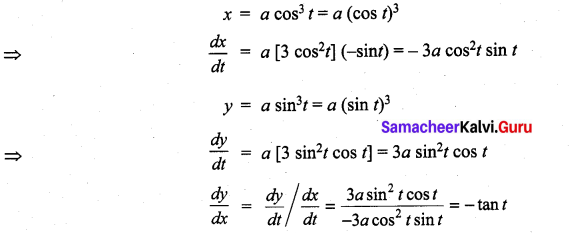
If θ is a parameter, find the equation of the locus of a moving point, whose coordinates are x – a cos3 θ, y = a sin3 θ
Solution:
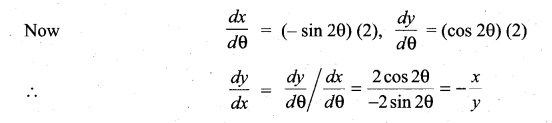
Samacheer Kalvi 11th Maths Solutions Chapter 6 Two Dimensional Analytical Geometry Ex 6.1 3
Question 4.
Find the value of k and b, if the points P (-3, 1) and Q (2, b) lie on the locus of x2 – 5x + ky = 0.
Solution:
Given P (-3, 1) lie on x2 – 5x + ky = 0
⇒ (-3)2 – 5(-3) + k(1) = 0
9 + 15 + k = 0 ⇒ k = -24
Q (2, b) lie on x2 – 5x + ky = 0
(2)2 – 5(2) + k(b) = 0 ⇒ 4 – 5(2) – 24b = 0
Samacheer Kalvi 11th Maths Solutions Chapter 6 Two Dimensional Analytical Geometry Ex 6.1 4

Question 5.
A straight rod of length 8 units slides with its ends A and B always on the x and y-axis respectively. Find the locus of the mid point of the line segment AB.
Solution:
Let P (h, k) be the moving point A (a, 0) and B (0, b) P is the mid point of AB.
Samacheer Kalvi 11th Maths Solutions Chapter 6 Two Dimensional Analytical Geometry Ex 6.1 5

Question 6.
Find the equation of the locus of a point such that the sum of the squares of the distance from the points (3, 5), (1, -1) is equal to 20.
Solution:
Let P (h, k) be the moving point
Let the given point be A (3, 5) and B (1, -1)
We are given PA2 + PB2 = 20
⇒ (h – 3)2 + (k – 5)2 + (h – 1)2 + (k + 1)2 = 20
⇒ h2 – 6h + 9 + k2 – 10k + 25 + h2 – 2h + 1 + k2 + 2k + 1 = 20
(i.e.) 2h2 + 2k2 – 8h – 8k + 36 – 20 = 0
2h2 + 2k2 – 8h – 8k + 16 = 0
(÷ by 2 ) h2 + k2 – 4h – 4k + 8 = 0
So the locus of P is x2 + y2 – 4x – 4y + 8 = 0

Samacheer Kalvi 11th Maths Solutions Chapter 6 Two Dimensional Analytical Geometry Ex 6.1

Question 7.
Find the equation of the locus of the point P such that the line segment AB, joining the points A (1, -6) and B (4, -2), subtends a right angle at P.
Solution:
Let P (h, k) be the moving point
Samacheer Kalvi 11th Maths Solutions Chapter 6 Two Dimensional Analytical Geometry Ex 6.1 62
Given A (1, – 6) and B (4, – 2),
Since ∆APB = 90°, PA2 + PB2 = AB2
(i.e.) (h – 1)2 + (k + 6)2 + (h – 4)2 + (k + 2)2 = (4 – 1)2 + (-2 + 6)2
(i.e) h2 + 1 – 2h + k2 + 36 + 12k + h2 + 16 – 8h + k2 + 4 + 4k = 32 + 42 = 25
2h2 + 2k2 -10h + 16k + 57 – 25 = 0
2h2 + 2k2 – 10h + 16k + 32 = 0
(÷ by 2)h2 + k2 – 5h + 8k + 16 = 0
So the locus of P is x2 + y2 – 5x + 8y + 16 = 0

Question 8.
If O is origin and R is a variable point on y2 = 4x, then find the equation of the locus of the mid-point of the line segment OR.
Solution:
Let P(h, k) be the moving point
We are given O (0, 0). Let R = (a, b)
Samacheer Kalvi 11th Maths Solutions Chapter 6 Two Dimensional Analytical Geometry Ex 6.1 65
Substituting a, b values is y2 = 4x
we get (2k)2 = 4 (2h)
(i.e) 4k2 = 8h
(÷ by 4) k2 = 2h
So the locus of P is y2 = 2x

Question 9.
Samacheer Kalvi 11th Maths Solutions Chapter 6 Two Dimensional Analytical Geometry Ex 6.1 69
Solution:
Samacheer Kalvi 11th Maths Solutions Chapter 6 Two Dimensional Analytical Geometry Ex 6.1 10

Question 10.
If P (2, -7) is a given point and Q is a point on 2x2 + 9y2 = 18, then find the equations of the locus of the mid-point of PQ.
Solution:
P = (2, -7); Let (h, k) be the moving point Q = (a, b)
Samacheer Kalvi 11th Maths Solutions Chapter 6 Two Dimensional Analytical Geometry Ex 6.1 70
⇒ a = 2h – 2,
b = 2k + l
Q is a point on 2x2 + 9y2 = 18 (i.e) (a, b) is on 2x2 + 9y2 = 18
⇒ 2(2h – 2)2 + 9 (2k + 7)2 = 18
(i.e) 2 [4h2 + 4 – 8h] + 9 [4k2 + 49 + 28k] – 18 = 0
(i.e) 8h2 + 8 – 16h + 36k2 + 441 + 252k – 18 = 0
8h2 + 36k2 – 16h + 252k + 431 = 0
The locus is 8x2 + 36y2 – 16x + 252y + 431 = 0

Samacheer Kalvi 11th Maths Solutions Chapter 6 Two Dimensional Analytical Geometry Ex 6.1

Question 11.
If R is any point on the x-axis and Q is any point on the y-axis and Pis a variable point on RQ with RP = b, PQ = a. then find the equation of locus of P.
Solution:
P = (x, 0), Q = (0, y), R (h, k) be a point on RQ such that PR : RQ = b : a
Samacheer Kalvi 11th Maths Solutions Chapter 6 Two Dimensional Analytical Geometry Ex 6.1 71
From the right angled triangle OQR, OR2 + OQ2 = QR2
Samacheer Kalvi 11th Maths Solutions Chapter 6 Two Dimensional Analytical Geometry Ex 6.1 72
Samacheer Kalvi 11th Maths Solutions Chapter 6 Two Dimensional Analytical Geometry Ex 6.1 79

Question 12.
If the points P (6, 2) and Q (-2, 1) and R are the vertices of a ∆PQR and R is the point on the locus y = x2 – 3x + 4, then find the equation of the locus of centroid of ∆PQR.
Solution:
P (6, 2), Q (-2, 1). Let R = (a, b) be a point on y = x2 – 3x + 4.
Samacheer Kalvi 11th Maths Solutions Chapter 6 Two Dimensional Analytical Geometry Ex 6.1 73
But (a, b) is a point on y = x2 – 3x + 4
b = a2 – 3a + 4
(i.e) 3k – 3 = (3h – 4)2 – 3(3h – 4) + 4
(i.e) 3k – 3 = 9h2 + 16 – 24h – 9h + 12 + 4
⇒ 9h2 – 24h – 9h + 32 – 3k + 3 = 0
(i.e) 9h2 – 33h – 3k + 35 = 0,
Locus of (h, k) is 9x2 – 33x – 3y + 35 = 0

Question 13.
If Q is a point on the locus of x2 + y2 + 4x – 3y + 7 = 0 then find the equation of locus of P which divides segment OQ externally in the ratio 3 : 4, where O is origin.
Solution:
Let (h, k) be the moving point O = (0, 0);
Let PQ = (a, b) on x2 + y2 + 4x – 3y + 7 = 0
Samacheer Kalvi 11th Maths Solutions Chapter 6 Two Dimensional Analytical Geometry Ex 6.1 74

Question 14.
Find the points on the locus of points that are 3 units from x – axis and 5 units from the point (5, 1).
Solution:
A line parallel to x-axis is of the form y = k. Here k = 3 ⇒y = 3
A point on this line is taken as P (a, 3). The distance of P (a, 3) from (5, 1) is given as 5 units
⇒ (a – 5)2 + (3 – 1)2 = 52
a2 + 25 – 10a + 9 + 1 – 6 = 25
a2 – 10a + 25 + 4 – 25 = 0
a2 – 10a + 4 = 0
Samacheer Kalvi 11th Maths Solutions Chapter 6 Two Dimensional Analytical Geometry Ex 6.1 75

Question 15.
The sum of the distance of a moving point from the points (4, 0) and (-4, 0) is always 10 units. Find the equation of the locus of the moving point.
Solution:
Let P (h, k) be a moving point
Here A = (4, 0) and B = (-4, 0)
Given PA + PB = 10
Samacheer Kalvi 11th Maths Solutions Chapter 6 Two Dimensional Analytical Geometry Ex 6.1 76
Samacheer Kalvi 11th Maths Solutions Chapter 6 Two Dimensional Analytical Geometry Ex 6.1 77

Samacheer Kalvi 11th Maths Solutions Chapter 6 Two Dimensional Analytical Geometry Ex 6.1 Additional Questions

Question 1.
If the sum of the distance of a moving point in a plane from the axis is 1, then find the locus of the point.
Solution:
Let coordinates of a moving point P be (x, y).
Given that the sum of the distances from the axis to the point is always 1.
Samacheer Kalvi 11th Maths Solutions Chapter 6 Two Dimensional Analytical Geometry Ex 6.1 78
∴ |x| + |y| = 1 ⇒ x + y = 1
⇒ -x – y = 1 ⇒ x – y = 1
Hence, these equations give us the locus of the point P which is a square.

Question 2.
A point moves so that square of its distance from the point (3, -2) is numerically equal to its distance from the line 5x -12y = 3. The equation of its locus is ……..
Solution:
The given equation of line is 5x – 12y = 3 and the given point is (3, -2).
Let (a, b) be any moving point.
Samacheer Kalvi 11th Maths Solutions Chapter 6 Two Dimensional Analytical Geometry Ex 6.1 799
Samacheer Kalvi 11th Maths Solutions Chapter 6 Two Dimensional Analytical Geometry Ex 6.1 80
⇒ 13a2 + 13b2 – 78a + 52b + 169 = 5a – 12b – 3
⇒ 13a2 + 13b2 – 83a + 64b + 172 = 0
So, the locus of the point is 13x2 + 13y2 – 83x + 64y + 172 = 0

Samacheer Kalvi 11th Maths Solutions Chapter 6 Two Dimensional Analytical Geometry Ex 6.1

Question 3.
Find the Locus of the mid points of the portion of the line x cos θ + y sin θ = p intercepted between the axis.
Solution:
Given equation of the line is x cos θ + y sin θ = p … (i)
Let C (h, k) be the mid point of the given line AB where it meets the two axis at A (a, 0) and B (0, b).
Since (a, 0) lies on eq (i) then “a cos θ + θ = p”
Samacheer Kalvi 11th Maths Solutions Chapter 6 Two Dimensional Analytical Geometry Ex 6.1 822
Samacheer Kalvi 11th Maths Solutions Chapter 6 Two Dimensional Analytical Geometry Ex 6.1 82
B (0, b) also lies on the eq (i) then 0 + b sin θ = p
Samacheer Kalvi 11th Maths Solutions Chapter 6 Two Dimensional Analytical Geometry Ex 6.1 83
Since C (h, k) is the mid point of AB
Samacheer Kalvi 11th Maths Solutions Chapter 6 Two Dimensional Analytical Geometry Ex 6.1 84
Putting the values of a and b is eq (ii) and (iii) we get P
Samacheer Kalvi 11th Maths Solutions Chapter 6 Two Dimensional Analytical Geometry Ex 6.1 85
Squaring and adding eq (iv) and (v) we get
Samacheer Kalvi 11th Maths Solutions Chapter 6 Two Dimensional Analytical Geometry Ex 6.1 86

Question 4.
Samacheer Kalvi 11th Maths Solutions Chapter 6 Two Dimensional Analytical Geometry Ex 6.1 87
Solution:
Samacheer Kalvi 11th Maths Solutions Chapter 6 Two Dimensional Analytical Geometry Ex 6.1 88
Here, α is a variable. To find the locus of P (h, k), we have to eliminate α.
From (i), we obtain
Samacheer Kalvi 11th Maths Solutions Chapter 6 Two Dimensional Analytical Geometry Ex 6.1 89

Question 5.
Samacheer Kalvi 11th Maths Solutions Chapter 6 Two Dimensional Analytical Geometry Ex 6.1 90
Solution:
Samacheer Kalvi 11th Maths Solutions Chapter 6 Two Dimensional Analytical Geometry Ex 6.1 91
Samacheer Kalvi 11th Maths Solutions Chapter 6 Two Dimensional Analytical Geometry Ex 6.1 92

Samacheer Kalvi 11th Maths Solutions Chapter 7 Matrices and Determinants Ex 7.4

You can Download Samacheer Kalvi 11th Maths Book Solutions Guide Pdf, Tamilnadu State Board help you to revise the complete Syllabus and score more marks in your examinations.

Tamilnadu Samacheer Kalvi 11th Maths Solutions Chapter 7 Matrices and Determinants Ex 7.4

Question 1.
Find the area of the triangle whose vertices are (0, 0), (1, 2) and (4, 3)
Solution:
Area of triangle with vertices
Samacheer Kalvi 11th Maths Solutions Chapter 7 Matrices and Determinants Ex 7.4 1
∴ Area of A with vertices (0, 0), (1, 2) and (4, 3) is
Samacheer Kalvi 11th Maths Solutions Chapter 7 Matrices and Determinants Ex 7.4 2

Samacheer Kalvi 11th Maths Solutions Chapter 7 Matrices and Determinants Ex 7.4

(as the area cannot be negative).

Question 2.
If (k, 2), (2, 4) and (3, 2) are vertices of the triangle of area 4 square units then determine the value of k.
Solution:
Samacheer Kalvi 11th Maths Solutions Chapter 7 Matrices and Determinants Ex 7.4 3

Question 3.
Identify the singular and non-singular matrices:
Samacheer Kalvi 11th Maths Solutions Chapter 7 Matrices and Determinants Ex 7.4 4
Solution:
(i) For a given square matrix A,
1. If |A| = 0 then it is a singular matrix.
2. If |A| ≠ 0 then it is a non singular matrix.
Samacheer Kalvi 11th Maths Solutions Chapter 7 Matrices and Determinants Ex 7.4 5
⇒ A is a singular matrix.
Samacheer Kalvi 11th Maths Solutions Chapter 7 Matrices and Determinants Ex 7.4 6
Which is a skew symmetric matrix
∴ |A| = 0 ⇒ A is a singular matrix.

Samacheer Kalvi 11th Maths Solutions Chapter 7 Matrices and Determinants Ex 7.4

Question 4.
Determine the value of a and b so that the following matrices are singular:
Samacheer Kalvi 11th Maths Solutions Chapter 7 Matrices and Determinants Ex 7.4 7
Solution:
Samacheer Kalvi 11th Maths Solutions Chapter 7 Matrices and Determinants Ex 7.4 8
expanding along R1
b(4 + 4) + 7 (-6 – 1) = 0 (given)
8b + 7 (-7) = 0
(i.e.,) 8b – 49 = 0 ⇒ 8b = 49 ⇒ b = 49/8

Question 5.
If cos 2θ = 0, determine \(\left[\begin{array}{ccc}{\theta} & {\cos \theta} & {\sin \theta} \\ {\cos \theta} & {\sin \theta} & {0} \\ {\sin \theta} & {0} & {\cos \theta}\end{array}\right]^{2}\)
Solution:
Samacheer Kalvi 11th Maths Solutions Chapter 7 Matrices and Determinants Ex 7.4 9

Question 6.
Find the value of the product; Samacheer Kalvi 11th Maths Solutions Chapter 7 Matrices and Determinants Ex 7.4 10
Sol:
Samacheer Kalvi 11th Maths Solutions Chapter 7 Matrices and Determinants Ex 7.4 11
Samacheer Kalvi 11th Maths Solutions Chapter 7 Matrices and Determinants Ex 7.4 12

Samacheer Kalvi 11th Maths Solutions Chapter 7 Matrices and Determinants Ex 7.4 Additional Problems

Question 1.
Identify the singular and non-singular matrix.
Samacheer Kalvi 11th Maths Solutions Chapter 7 Matrices and Determinants Ex 7.4 13
Solution:
If the determinant value of a square matrix is zero it is called a singular matrix. Otherwise it is non-singular.
Samacheer Kalvi 11th Maths Solutions Chapter 7 Matrices and Determinants Ex 7.4 14

Samacheer Kalvi 11th Maths Solutions Chapter 7 Matrices and Determinants Ex 7.4

Question 2.
Show that Samacheer Kalvi 11th Maths Solutions Chapter 7 Matrices and Determinants Ex 7.4 15
Solution:
Samacheer Kalvi 11th Maths Solutions Chapter 7 Matrices and Determinants Ex 7.4 16
Samacheer Kalvi 11th Maths Solutions Chapter 7 Matrices and Determinants Ex 7.4 17

Samacheer Kalvi 11th Maths Solutions Chapter 4 Combinatorics and Mathematical Induction Ex 4.5

You can Download Samacheer Kalvi 11th Maths Book Solutions Guide Pdf, Tamilnadu State Board help you to revise the complete Syllabus and score more marks in your examinations.

Tamilnadu Samacheer Kalvi 11th Maths Solutions Chapter 4 Combinatorics and Mathematical Induction Ex 4.5

Question 1.
The sum of the digits at the 10th place of all numbers formed with the help of 2, 4, 5, 7 taken all at a time is ……..
(a) 432
(b) 108
(c) 36
(d) 18
Solution:
(b) 108
Hint. Number of digits given = 2, 4, 5, 7
Number of 4 digit numbers formed = 4! =24
So each digit occur \(\frac{24}{4}\) = 6 times
Sum of the digits = 2 + 4 + 5 + 7 = 18
So sum of the digits in each place = 18 × 6 = 108

Question 2.
In an examination there are three multiple choice questions and each question has 5 choices. Number of ways in which a student can fail to get all answer correct is ……..
(a) 125
(b) 124
(c) 64
(d) 63
Solution:
(b) 124
Hint. Each question has 5 options in which 1 is correct
So the number of ways of getting correct answer for all the three questions is 53 = 125
So the number of ways in which a student can fail to get all answer correct is < 125 (i.e.) 125 – 1 = 124

Samacheer Kalvi 11th Maths Solutions Chapter 4 Combinatorics and Mathematical Induction Ex 4.5

Question 3.
The number of ways in which the following prize be given to a class of 30 boys first and second in mathematics, first and second in physics, first in chemistry and first in English is ……….
(a) 304 × 292
(b) 303 × 293
(c) 302 × 294
(d) 30 × 295
Solution:
(a) 304 × 292
Hint.
I and II in maths can be given can be given in 30 × 29 ways.
I and II in physics can be given in 30 × 29 ways.
I and chemistry can be given in 30 ways.
I in English can be given in 30 ways.
So total number of ways = 30 × 29 × 30 × 29 × 30 × 30 = 304 × 292

Samacheer Kalvi 11th Maths Solutions Chapter 4 Combinatorics and Mathematical Induction Ex 4.5

Question 4.
The number of 5 digit numbers all digits of which are odd is ………
(a) 25
(b) 55
(c) 56
(d) 625
Solution:
(b) 55
Hint. The odd number are 1, 3, 5, 7, 9
Number of odd numbers = 5
We need a five digit number So the number of five digit number = 55

Question 5.
In 3 fingers, the number of ways four rings can be worn is …… ways.
(a) 43 – 1
(b) 34
(c) 68
(d) 64
Solution:
(b) 34
Hint. Each letter can be ported in 3 ways
∴ 4 letter is 34 ways

Question 6.
Samacheer Kalvi 11th Maths Solutions Chapter 4 Combinatorics and Mathematical Induction Ex 4.5 60
(a) 7 and 11
(b) 6 and 7
(c) 2 and 11
(d) 2 and 6
Solution:
(b) 6 and 7

Question 7.
The product of r consecutive positive integers is divisible by ………
(a) r!
(b) (r – 1)!
(c) (r + 1)!
(d) r!
Solution:
(a) r!
Hint.
1(2) (3) ….. (r) = r! which is ÷ by r!

Question 8.
The number of 5 digit telephone numbers which have none of their digits repeated is
(a) 90000
(b) 10000
(c) 30240
(d) 69760
Solution:
(d) 69760
Hint.
The number of 5 digit telephone numbers which have none of their digits repeated is 10P5 = 30240
Thus the required number of telephone number is 105 – 30240 = 69760

Samacheer Kalvi 11th Maths Solutions Chapter 4 Combinatorics and Mathematical Induction Ex 4.5

Question 9.
If a2aC2 = a2aC4 then the value of ‘a’ is ….
(a) 2
(b) 3
(c) 4
(d) 5
Solution:
(b) 3
Hint.
a2 – a = 2 + 4 = 6
a2 – a – 6 = 0
(a – 3) (a + 2) = 0 ⇒ a = 3

Question 10.
There are 10 points in a plane and 4 of them are collinear. The number of straight lines joining any two points is ……..
(a) 45
(b) 40
(c) 39
(d) 38
Solution:
(b) 40
Hint.
Samacheer Kalvi 11th Maths Solutions Chapter 4 Combinatorics and Mathematical Induction Ex 4.5 10

Question 11.
The number of ways in which a host lady invite 8 people for a party of 8 out of 12 people of whom two do not want to attend the party together is
(a) 2 × 11C7 + 10C8
(b) 11C7 + 10C8
(c) 12C810C6
(d) 10C6 + 2!
Solution:
(c) 12C810C6
Hint.
Number of way of selecting 8 people from 12 in 12C8
∴ out of remaining people 8 can attend in 10C8
The number of ways in which two of them do not attend together = 12C810C6

Question 12.
The number of parallelograms that can be formed from a set of four parallel lines intersecting another set of three parallel lines …….
(a) 6
(b) 9
(c) 12
(d) 18
Solution:
(d) 18
Hint.
Number of parallelograms = 4C2 × 3C2
= 6 × 3 = 18

Samacheer Kalvi 11th Maths Solutions Chapter 4 Combinatorics and Mathematical Induction Ex 4.5

Question 13.
Everybody in a room shakes hands with everybody else. The total number of shake hands is 66. The number of persons in the room is …….
(a) 11
(b) 12
(c) 10
(d) 6
Solution:
(b) 12
Hint.
Samacheer Kalvi 11th Maths Solutions Chapter 4 Combinatorics and Mathematical Induction Ex 4.5 66

Question 14.
Number of sides of a polygon having 44 diagonals is ……….
(a) 4
(b) 4!
(c) 11
(d) 22
Solution:
(c) 11
Hint:
Samacheer Kalvi 11th Maths Solutions Chapter 4 Combinatorics and Mathematical Induction Ex 4.5 65

Question 15.
If 10 lines are drawn in a plane such that no two of them are parallel and no three are concurrent, then the total number of points of intersection are ………
(a) 45
(b) 40
(c) 10!
(d) 210
Solution:
(a) 45
Hint:
Samacheer Kalvi 11th Maths Solutions Chapter 4 Combinatorics and Mathematical Induction Ex 4.5 67

Question 16.
In a plane there are 10 points are there out of which 4 points are collinear, then the number of triangles formed is …….
(a) 110
(b) 10C3
(c) 120
(d) 116
Solution:
(d) 116
Hint:
Samacheer Kalvi 11th Maths Solutions Chapter 4 Combinatorics and Mathematical Induction Ex 4.5 68

Samacheer Kalvi 11th Maths Solutions Chapter 4 Combinatorics and Mathematical Induction Ex 4.5

Question 17.
In 2nC3 : nC3 = 11 : 1 then n is ………
(a) 5
(b) 6
(c) 11
(d) 1
Solution:
(b) 6
Hint.
Samacheer Kalvi 11th Maths Solutions Chapter 4 Combinatorics and Mathematical Induction Ex 4.5 69

Question 18.
(n – 1)Cr + (n – 1)C(r – 1) is ………
(a) (n + 1)Cr
(b) (n – 1)Cr
(c) nCr
(d) nCr – 1
Solution:
(c) nCr
Samacheer Kalvi 11th Maths Solutions Chapter 4 Combinatorics and Mathematical Induction Ex 4.5 70

Question 19.
The number of ways of choosing 5 cards out of a deck of 52 cards which include at least one king is …….
(a) 52C5
(b) 48C5
(c) 52C5 + 48C5
(d) 52C548C5
Solution:
(d) 52C548C5
Hint.
Selecting 5 from 52 cards = 52C5
selecting 5 from the (non-king cards 48) = 48C5
∴ Number of ways is 52C548C5

Question 20.
The number of rectangles that a chessboard has ……
(a) 81
(b) 99
(c) 1296
(d) 6561
Solution:
(c) 1296
Hint. Number of horizontal times = 9
Number of vertical times = 9
Selecting 2 from 9 horizontal lines = 9C2
Selecting 2 from 9 vertical lines = 9C2
Samacheer Kalvi 11th Maths Solutions Chapter 4 Combinatorics and Mathematical Induction Ex 4.5 150

Question 21.
The number of 10 digit number that can be written by using the digits 2 and 3 is ……..
(a) 10C2 + 9C2
(b) 210
(c) 210 – 2
(d) 10!
Solution:
(b) 210
Hint.
Selecting the number from (2 and 3)
For till the first digit can be done in 2 ways
For till the second digit can be done in 2 ways ….
For till the tenth digit can be done in 2 ways
So, total number of ways in 10 digit number = 2 × 2 × 2 × 2 × 2 × 2 × 2 × 2 × 2 × 2 = 210

Samacheer Kalvi 11th Maths Solutions Chapter 4 Combinatorics and Mathematical Induction Ex 4.5

Question 22.
If Pr stands for rPr then the sum of the series 1 + P1 + 2P2 + 3P3 + … + nPn is ……..
(a) Pn + 1
(b) Pn + 1 – 1
(c) Pn – 1 + 1
(d) (n + 1)P(n – 1)
Solution:
(b) Pn + 1 – 1
Hint:
1 + 1! + 2! + 3! + … + n!
Now 1 + 1 (1!) = 2 = (1 + 1)!
1 + 1 (1!) + 2(2!) = 1 + 1 + 4 = 6 = 3!
1 + 1(1!) + 2(2!)+ 3(3!) = 1 + 1 + 4 + 18 = 24 = 4!
1 + 1(1!) + 2(2!) + 3(3!) ….+ n(n!) = (n + 1) ! – 1
= n + 1Pn + 1 – 1 = Pn + 1 – 1

Question 23.
The product of first n odd natural numbers equals …….
Samacheer Kalvi 11th Maths Solutions Chapter 4 Combinatorics and Mathematical Induction Ex 4.5 80
Solution:
Samacheer Kalvi 11th Maths Solutions Chapter 4 Combinatorics and Mathematical Induction Ex 4.5 81
Hint:
Samacheer Kalvi 11th Maths Solutions Chapter 4 Combinatorics and Mathematical Induction Ex 4.5 82

Question 24.
If nC4, nC5, nC6 are in AP the value of n can be ………..
(a) 14
(b) 11
(c) 9
(d) 5
Solution:
(a) 14
Hint:
Samacheer Kalvi 11th Maths Solutions Chapter 4 Combinatorics and Mathematical Induction Ex 4.5 83
30 + n2 – 9n + 20 – 12n + 48 = 0
n2 – 21 n + 98 = 0
(n – 7) (n – 14) = 0
n = 7 (or) 14

Question 25.
1 + 3 + 5 + 7 + + 17 is equal to ………
(a) 101
(b) 81
(c) 71
(d) 61
Solution:
(b) 81
Hint:
Samacheer Kalvi 11th Maths Solutions Chapter 4 Combinatorics and Mathematical Induction Ex 4.5 84

Samacheer Kalvi 6th Maths Solutions Term 1 Chapter 3 Ratio and Proportion Additional Questions

You can Download Samacheer Kalvi 6th Maths Book Solutions Guide Pdf, Tamilnadu State Board help you to revise the complete Syllabus and score more marks in your examinations.
Samacheer Kalvi 6th Maths Solutions Term 1 Chapter 3 Ratio and Proportion Additional Questions

Tamilnadu Samacheer Kalvi 6th Maths Solutions Term 1 Chapter 3 Ratio and Proportion Additional Questions

Question 1.
3 : 5 :: ____
Solution:
6 : 10

Question 2.
Moni walks 6 km in an hour while Vimala walks 4 km in an hour. What is the ratio of the distance covered by Moni to the distance covered by Vimala?
Solution:
Distance covered by Moni in 1 hour = 6 km
Distance covered by Vimala in 1 hour = 4 km.
Samacheer Kalvi 6th Maths Term 1 Chapter 3 Ratio and Proportion Additional Questions 1 Q1
The required ratio = 3 : 2

Question 3.
In a school there were 75 holidays in one year. What is the ratio of the number of holidays to the number of days in one year.
Solution:
Given the number of holidays = 75.
We know that the number of days in one year = 365.
Samacheer Kalvi 6th Maths Term 1 Chapter 3 Ratio and Proportion Additional Questions 1 Q2
Hence the required ratio = 15 : 73

Question 4.
There are 20 girls and 25 boys in a class.
(a) What is the ratio of number of girls to the number of boys?
(b) What is the ratio of number of girls to the total number of students in the class?
Solution:
Given number of girls = 20
Number of boys = 25
Total number of students = 20 + 25 = 45.
Ratio of Number of girls to the number of boys
Samacheer Kalvi 6th Maths Term 1 Chapter 3 Ratio and Proportion Additional Questions 1 Q3
girls : boys = 4 : 5
Ratio of number of girls to the total number of students
Samacheer Kalvi 6th Maths Term 1 Chapter 3 Ratio and Proportion Additional Questions 1 Q3.1
Ratio of no. of gets to total students = 4 : 9

Samacheer Kalvi 6th Maths Solutions Term 1 Chapter 3 Ratio and Proportion Additional Questions

Question 5.
Simplify the ratio 20 : 5
Solution:
\(\frac{20}{5}=\frac{4}{1}\) = 4 : 1

Question 6.
Mother wants to divide ₹ 36 between her daughters Sumi and Divya in the ratio of their ages. If age of Sumi is 15 years and age of Divya is 12 years. Find how much Sumi and Divya gets?
Solution:
Given Sumi’s age = 15 years
Divya’s age = 12 years
Ratio of their ages
\(\frac{\text { Sumi’s age }}{\text { Divya’s age }}=\frac{15 \text { yrs }}{12 \text { yrs }}=\frac{5}{4}=5: 4\)
Now mother wants to divide ₹ 36 between the daughters in the ratio of their ages.
Sum of the parts of ratios = 5 + 4 = 9.
Sumi gets 5 parts and Divya gets 4 parts out of 9 equal parts.
Sumi’s share \(=\frac{5}{9} \times 36\) = ₹ 20
Divya’s share \(=\frac{4}{9} \times 36\) = ₹ 16

Question 7.
The ratio of breadth and length of a hall is 2 : 5. Complete the following table that shows some possible breadths and lengths of the hall.
Samacheer Kalvi 6th Maths Term 1 Chapter 3 Ratio and Proportion Additional Questions 2 Q2
Solution:
Given the ratio of breadth and length of the hall = 2 : 5.
Also given breadth of the hall = 10
length of the hall = 25.
Ratio of breadth : length = \(\frac{10}{25}=\frac{2}{5}=2: 5\)
To find First missing number:
Take the first ratio = \(\frac{2}{5}=\frac{2 \times 10}{5 \times 10}=\frac{20}{50}\)
First missing number = 20.
Also, \(\frac{2}{5}=\frac{2 \times 20}{5 \times 20}=\frac{40}{100}\)
Second missing number = 100
Samacheer Kalvi 6th Maths Term 1 Chapter 3 Ratio and Proportion Additional Questions 2 Q2.1

Question 8.
Kumaran has ₹ 600 and wants to divide it between Vimala and Yazhini in the ratio 2 : 3, who will get more and how much?
Solution:
Divide the whole money into 2 + 3 = 5 equal parts then, Vimala gets 2 parts out of 5 parts and Yazhini gets 3 parts out of 5 parts.
Amount Vimala gets = \(600 \times \frac{2}{5}\) = ₹ 240
Amount Yazhini gets = \(600 \times \frac{3}{5}\) = ₹ 360
Vimala received ₹ 240 and Yazhini gets ₹ 360, which is ₹ 120 more than that of Vimala.

Question 9.
Find the value of x if 16 : 24 :: x : 30.
Solution:
Given the two ratios are in proportion.
Product of extremes = 16 × 30 = 480
Product of means = 24 × x
We know that product of extremes = product of mean 480
480 = 24 × x
⇒ x = 20

Samacheer Kalvi 6th Maths Solutions Term 1 Chapter 3 Ratio and Proportion Additional Questions

Question 10.
The cost of 12 pens is ₹ 96, then find the cost of 8 such pens.
Solution:
Since the ratio of number of pens to its cost are in proportion.
We say that 12 : 96 :: 8 : cost
Product of extremes = 12 × cost
Product of means = 96 × 8 = 768
Product of extremes = product of means
12 × Cost = 96 × 8
Cost = \(\frac{96 \times 8}{12}=64\)
Cost of 8 pens ₹ 64

Question 11.
If the ratio between 72 and y is same as the ratio between 64 and x then what is the ratio between x and y?
Solution:
Given ratio between 72 and y = ratio between 64 and x
\(\frac{72}{y}=\frac{64}{x}\)
Taking cross product for one term
Samacheer Kalvi 6th Maths Term 1 Chapter 3 Ratio and Proportion Additional Questions 3 Q3

Question 12.
Fill in the boxes:
(i) ___ : 24 :: 80 : 64
(ii) 5 : 6 :: 125 : ___
Solution:
Samacheer Kalvi 6th Maths Term 1 Chapter 3 Ratio and Proportion Additional Questions 3 Q4

Question 13.
Aadisaran made 50 runs in 10 overs and Mohan made 42 runs in 7 overs. Whose run rate is better?
Solution:
Run Rate = Ratio of runs to over
Run rate of Aadisaran = \(\frac{50}{10}\) = 5
Run rate of Mohan = \(\frac{42}{7}\) = 6
Mohan’s run rate is better.

Question 14.
If the cost of 7 m of cloth is ₹ 294 find the cost of 5 m of cloth.
Solution:
Given cost of 7 m of cloth = ₹ 294.
Cost of 1 m of cloth = \(\frac{294}{7}\) = ₹ 42
Cost of 5 m of cloth = ₹ 42 × 5 = ₹ 210.
Cost of 5 m of cloth = ₹ 210.

Question 15.
Divino earns ₹ 1500 in 10 days. How much will she earn in 30 days?
Solution:
Divino’s earning for 10 days = ₹ 1500
His earning in 1 day = \(\frac{1500}{10}\) = ₹ 150
Divino’s earning in 30 days = 150 × 30 = ₹ 4,500
Divino earns ₹ 4,500 in 30 days.

Question 16.
The temperature dropped 15 degree Celsius in the last 30 days. If the rate of temperature drop remains the same how many degrees will the temperature drop in the next 10 days?
Solution:
Temperature drop in 30 days = 15 degrees.
Temperature drop in 1 days = \(\frac{15}{30}=\frac{15 \div 15}{30 \div 15}=\frac{1}{2}\)
Temperature drop in next 10 days = \(\frac{1}{2} \times 10\) = 5 degrees
Hence temperature dropped 5 degrees in the next 10 days.

Samacheer Kalvi 6th Maths Solutions Term 1 Chapter 3 Ratio and Proportion Additional Questions

Question 17.
Shobana pays ₹ 7500 as rent for 3 months. How much does he has to pay for the whole year if the rent per month remains the same?
Solution:
Rent paid for 3 months = ₹ 7500
Rent paid in 1 month = \(\frac{7500}{3}\) = ₹ 2500
Rent paid for the whole year = 2500 × 12 = ₹ 30,000
Shobana has to pay ₹ 30, 000 for the whole year.

Question 18.
By proportionality law, check whether 3 : 2 and 30 : 20 are in proportion.
Solution:
Here the extremes are 3 and 20 and the means are 2 and 30.
Product of extremes, ad = 3 × 20 = 60.
Product of means, bc = 2 × 30 = 60.
Thus by proportionality law, we find ad = bc and hence 3 : 2 and 30 : 20 are in proportion.

Samacheer Kalvi 8th Maths Solutions Term 1 Chapter 1 Rational Numbers Additional Questions

Students can Download Maths Chapter 1 Rational Numbers Additional Questions and Answers, Notes Pdf, Samacheer Kalvi 8th Maths Book Solutions Guide Pdf helps you to revise the complete Tamilnadu State Board New Syllabus and score more marks in your examinations.
Samacheer Kalvi 8th Maths Solutions Term 1 Chapter 1 Rational Numbers Additional Questions

Tamilnadu Samacheer Kalvi 8th Maths Solutions Term 1 Chapter 1 Rational Numbers Additional Questions

Additional Questions And Answers

Exercise 1.1

Very Short Answers [2 Marks]
Question 1.
Add \(\frac{3}{5}\) and \(\frac{13}{5}\)
Solution:
Samacheer Kalvi 8th Maths Term 1 Chapter 1 Rational Numbers Additional Questions 1

Question 2.
Add \(\frac{7}{9}\) and \(\frac{-12}{9}\)
Solution:
Samacheer Kalvi 8th Maths Term 1 Chapter 1 Rational Numbers Additional Questions 2

Question 3.
Add \(\frac{-3}{7}\) and \(\frac{-17}{7}\)
Solution:
Samacheer Kalvi 8th Maths Term 1 Chapter 1 Rational Numbers Additional Questions 3

Question 4.
Add \(\frac{4}{-13}\) and \(\frac{7}{13}\)
Solution:
Samacheer Kalvi 8th Maths Term 1 Chapter 1 Rational Numbers Additional Questions 4

Samacheer Kalvi 8th Maths Solutions Term 1 Chapter 1 Rational Numbers Additional Questions

Question 5.
Subtract \(\frac{3}{4}\) and \(\frac{7}{4}\)
Solution:
\(\frac{7}{4}-\frac{3}{4}=\frac{7-3}{4}=\frac{4}{4}\) = 1

Short Answers [3 Marks]

Question 1.
Add \(\frac{4}{-3}\) and \(\frac{8}{15}\)
Solution:
Samacheer Kalvi 8th Maths Term 1 Chapter 1 Rational Numbers Additional Questions 5

Question 2.
Simplify \(\frac{9}{-27}+\frac{18}{39}\)
Solution:
Samacheer Kalvi 8th Maths Term 1 Chapter 1 Rational Numbers Additional Questions 6

Long Answers [5 Marks]

Question 1.
By what number should we multiply \(\frac{3}{-14}\), so that the product may be \(\frac{5}{12}\)
Solution:
Let the number to be multiplied by x
Samacheer Kalvi 8th Maths Term 1 Chapter 1 Rational Numbers Additional Questions 7
∴ The number to be multiplied = \(\frac{-35}{18}\)

Question 2.
Simplify
Samacheer Kalvi 8th Maths Term 1 Chapter 1 Rational Numbers Additional Questions 8
Solution:
Samacheer Kalvi 8th Maths Term 1 Chapter 1 Rational Numbers Additional Questions 9

Exercise 1.2

Very Short Answers [2 Marks]
Question 1.
Verify addition of rational number is closed using \(\frac{1}{4}\) and \(\frac{2}{3}\)
Solution:
Samacheer Kalvi 8th Maths Term 1 Chapter 1 Rational Numbers Additional Questions 10
∴ Addition of rational numbers is closed

Samacheer Kalvi 8th Maths Solutions Term 1 Chapter 1 Rational Numbers Additional Questions

Question 2.
Is subtraction is commutative for rational numbers. Given an example.
Solution:
No, subtraction is not commutative for rational numbers.
Example: Let a = \(\frac{1}{2}\) and b = \(\frac{5}{6}\)
Samacheer Kalvi 8th Maths Term 1 Chapter 1 Rational Numbers Additional Questions 11
From (1) and (2)
a – b ≠ b – a for rational numbers

Very Short Answers [5 Marks]

Question 1.
Verify associative property for addition of rational numbers for a = \(\frac{5}{6}\), b = \(\frac{-3}{4}\), c = \(\frac{4}{7}\)
Solution:
Given a = \(\frac{5}{6}\), b = \(\frac{-3}{4}\), c = \(\frac{4}{7}\)
Samacheer Kalvi 8th Maths Term 1 Chapter 1 Rational Numbers Additional Questions 12
From (1) and (2) we have (a + b) + c = a + (b + c)
∴ Associative property is true for addition of rational numbers.

Question 2.
Verify distributive property of multiplication over addition for the rational numbers a = \(\frac{3}{4}\), b = \(\frac{-2}{3}\), c = \(\frac{3}{7}\)
Solution:
Given a = \(\frac{3}{4}\), b = \(\frac{-2}{3}\), c = \(\frac{3}{7}\)
To verify a × (b + c) = (a × b) + (a × c)
Samacheer Kalvi 8th Maths Term 1 Chapter 1 Rational Numbers Additional Questions 13
Samacheer Kalvi 8th Maths Term 1 Chapter 1 Rational Numbers Additional Questions 14
From (1) and (2)
a × (b + c) = (a × b) + (a × c)
∴ Distributive property of multiplication over addition is true for the given rational numbers.

Samacheer Kalvi 8th Maths Solutions Term 1 Chapter 4 Geometry Ex 4.1

Students can Download Maths Chapter 4 Geometry Ex 4.1 Questions and Answers, Notes Pdf, Samacheer Kalvi 8th Maths Book Solutions Guide Pdf helps you to revise the complete Tamilnadu State Board New Syllabus and score more marks in your examinations.
Samacheer Kalvi 8th Maths Solutions Term 1 Chapter 4 Geometry Ex 4.1

Tamilnadu Samacheer Kalvi 8th Maths Solutions Term 1 Chapter 4 Geometry Ex 4.1

Question 1.
From the figure given, prove that ∆ABC ~ ∆DEF.
Samacheer Kalvi 8th Maths Term 1 Chapter 4 Geometry Ex 4.1 1
Solution:
From the ∆ABC,
AB = AC
It is an isosceles triangle
Angles opposite to equal sides are equal
∴ ∠B = ∠C = 65°
∴ ∠B + ∠C = 65° + 65°
= 130°
We know that .sum of three angles is a triangle = 180°
∠A + ∠B + ∠C = 180°
∠A + 130° = 180°
∠A = 180°-130°
∠A = 50°
From ∆DEF, ∠D = 50°
∴ Sum of Remaining angles = 180° – 50° = 130°
DE = FD
∴ ∠D = ∠F
From ∆ABC and ∆DEF
Samacheer Kalvi 8th Maths Term 1 Chapter 4 Geometry Ex 4.1 2
∠A = ∠D = 50°
∠B = ∠E = 65°
∠C = ∠F = 65°
∴ By AAA criteria ∆DEF ~ ∆ABC

Question 2.
Prove that ∆GUM ~ ∆ BOX from the given figure.
Samacheer Kalvi 8th Maths Term 1 Chapter 4 Geometry Ex 4.1 5
Solution:
Samacheer Kalvi 8th Maths Term 1 Chapter 4 Geometry Ex 4.1 6
Samacheer Kalvi 8th Maths Term 1 Chapter 4 Geometry Ex 4.1 7
That is their corresponding sides are proportional.
∴ By SSS similarity ∆GUM ~ ∆BOX.

Question 3.
In the given figure YH ||TE Prove that ∆WHY ~ ∆WET and also find HE and TE.
Samacheer Kalvi 8th Maths Term 1 Chapter 4 Geometry Ex 4.1 8
Solution:
Samacheer Kalvi 8th Maths Term 1 Chapter 4 Geometry Ex 4.1 9
Samacheer Kalvi 8th Maths Term 1 Chapter 4 Geometry Ex 4.1 10
Samacheer Kalvi 8th Maths Term 1 Chapter 4 Geometry Ex 4.1 60

Samacheer Kalvi 8th Maths Solutions Term 1 Chapter 4 Geometry Ex 4.1

Question 4.
In the given figure, if ∆EAT ~ ∆BUN find the measure of all angles.
Samacheer Kalvi 8th Maths Term 1 Chapter 4 Geometry Ex 4.1 11
Solution:
Given ∆EAT ≡ ∆BUN
∴ Corresponding angles are equal
∴ ∠E = ∠B ..(1)
∠A = ∠U ..(2)
∠T = ∠N ..(3)
∠E = x°
∠A = 2x°
Sum of three angles of a triangle = 180°
In ∆EAT, x + 2x + ∠T = 180°
∠T = 180° – (x° + 2x° )
∠T = 180°- 3x° …(4)
Also in ∆BUN
(x + 40)° + + ∠U = 180°
x + 40° + x + ∠U = 180°
2x° + 40° + ∠U = 180°
∠U = 180° – 2x – 40°
= 140° – 2x°
Now by (2)
∠A = ∠U
2x = 140° – 2x
2x + 2x = 140°
4x = 140°
Samacheer Kalvi 8th Maths Term 1 Chapter 4 Geometry Ex 4.1 12
∠A = 2x° = 2 × 35° = 70°
∠N = x + 40°
= 35° + 40° = 75°
∴ ∠T = ∠N = 75°
∠E = ∠B = 35°
∠A = ∠U = 70°

Question 5.
From the given figure, UB || AT and CU ≡ CB Prove that ∆CUB ~ ∆CAT and hence ∆CAT is isosceles.
Samacheer Kalvi 8th Maths Term 1 Chapter 4 Geometry Ex 4.1 40
Solution:
Samacheer Kalvi 8th Maths Term 1 Chapter 4 Geometry Ex 4.1 41

Question 6.
In the figure, ∠CIP ≡ ∠COP and ∠HIP ≡ ∠HOP. Prove that IP ≡ OP.
Samacheer Kalvi 8th Maths Term 1 Chapter 4 Geometry Ex 4.1 42
Solution:
Samacheer Kalvi 8th Maths Term 1 Chapter 4 Geometry Ex 4.1 43

Samacheer Kalvi 8th Maths Solutions Term 1 Chapter 4 Geometry Ex 4.1

Question 7.
In the given triangle, AC ≡ AD and ∠CBD ≡ ∠DEC. Prove that ∆BCF ≡ ∆EDF.
Samacheer Kalvi 8th Maths Term 1 Chapter 4 Geometry Ex 4.1 13
Solution:
Samacheer Kalvi 8th Maths Term 1 Chapter 4 Geometry Ex 4.1 14

Question 8.
In the given figure, ∆ BCD is isosceles with base BD and ∠BAE ≡ ∠DEA. Prove that AB ≡ ED .
Samacheer Kalvi 8th Maths Term 1 Chapter 4 Geometry Ex 4.1 15
Solution:
Samacheer Kalvi 8th Maths Term 1 Chapter 4 Geometry Ex 4.1 16
Samacheer Kalvi 8th Maths Term 1 Chapter 4 Geometry Ex 4.1 80

Question 9.
In the given figure, D is the midpoint of OE and ∠CDE = 90°. Prove that ∆ODC ≡ ∆EDC.
Samacheer Kalvi 8th Maths Term 1 Chapter 4 Geometry Ex 4.1 17
Solution:
Samacheer Kalvi 8th Maths Term 1 Chapter 4 Geometry Ex 4.1 18

Question 10.
In the figure, if SW ≡ SE and ∠NWO ≡ ∠NEO. then, prove that NS bisects WE and ∠NOW = 90°
Samacheer Kalvi 8th Maths Term 1 Chapter 4 Geometry Ex 4.1 19
Proof:
Samacheer Kalvi 8th Maths Term 1 Chapter 4 Geometry Ex 4.1 20
Samacheer Kalvi 8th Maths Term 1 Chapter 4 Geometry Ex 4.1 21

Samacheer Kalvi 8th Maths Solutions Term 1 Chapter 4 Geometry Ex 4.1

Question 11.
Is ∆PRQ ≡ ∆QSP ? Why ?
Samacheer Kalvi 8th Maths Term 1 Chapter 4 Geometry Ex 4.1 22
Solution:
In ∠PRQ = ∠PSQ = 90° given
PR = QS = 3 cm given
PQ = PQ = 5 cm common
It satisfies RHS criteria
∴ ∆PRQ congruent to ∆QSP.

Question 12.
Fill in the blanks with the most correct term from the given list.
(in proportion, similar, corresponding, congruent shape, area, equal)
Statements Reasons

Question 1.
Corresponding sides of similar triangles are ___.
Solution:
in proportion

Question 2.
Similar triangles have the same ___ but not necessarily the same size.
Solution:
shape

Question 3.
In similar triangles, ___ sides are opposite to equal angles.
Solution:
equal

Question 4.
The symbol ~ is used to represent ___ triangles.
Solution:
congruent

Question 5.
The symbol ~ is used to represent ____ triangles.
Solution:
similar

Objective Type Questions

Question 13.
Two similar triangles will always have ___ angles
(A) acute
(B) obtuse
(C) right
(D) matching
Solution:
(D) matching

Question 14.
If in triangles PQR and XYZ, \(\frac{P Q}{X Y}=\frac{Q R}{Z X}\) then they will be similar if
Solution:
(C) Q = ∠X

Samacheer Kalvi 8th Maths Solutions Term 1 Chapter 4 Geometry Ex 4.1

Question 15.
A flag pole 15 cm high casts a shadow of 3 m at 10 a.m. The shadow cast by a building at the same time is 18.6 m. The height of the building is
(A) 90 m
(B) 91 m
(C) 92 m
(D) 93 m
Solution:
(D) 93 m

Question 16.
If ∆ABC ~ ∆PQR in which ∠A = 53° and ∠Q = 77°, then ∠R is
(A) 50°
(B) 60°
(C) 70°
(D) 80°
Solution:
(A) 50°

Question 17.
In the figure, which of the following statements is true?
(A) AB = BD
(B) BD < CD
(C) AC = CD
(D) BC = CD
Samacheer Kalvi 8th Maths Term 1 Chapter 4 Geometry Ex 4.1 50
Solution:
(C) AC = CD

Samacheer Kalvi 8th Maths Solutions Term 1 Chapter 1 Rational Numbers Ex 1.3

Students can Download Maths Chapter 1 Rational Numbers Ex 1.3 Questions and Answers, Notes Pdf, Samacheer Kalvi 8th Maths Book Solutions Guide Pdf helps you to revise the complete Tamilnadu State Board New Syllabus and score more marks in your examinations.
Samacheer Kalvi 8th Maths Solutions Term 1 Chapter 1 Rational Numbers Ex 1.3

Tamilnadu Samacheer Kalvi 8th Maths Solutions Term 1 Chapter 1 Rational Numbers Ex 1.3

Question 1.
Match the following appropriately.
Samacheer Kalvi 8th Maths Term 1 Chapter 1 Rational Numbers Ex 1.3 1
Solution:
(i) 5
(ii) 4
(iii) 2
(iv) 3
(v) 1

Question 2.
Which of the following properties hold for subtraction of rational numbers? Why?
(a) closure
(b) commutative
(c) associative
(d) identity
(e) inverse
Solution:
(i) For subtraction of rational numbers closure property is true.
Because for any two rational number a and b, a + b is in Q.
Eg. \(-\frac{1}{4}+\frac{3}{2}=\frac{-1+6}{4}=\frac{5}{4}\) is rational.
(ii) Commutative fails as \(\frac{1}{3}-\frac{2}{4} \neq \frac{2}{4}-\frac{1}{3}\)
(iii) Associative fails as \(\frac{1}{2}-\left(\frac{1}{3}-\frac{1}{4}\right) \neq\left(\frac{1}{2}-\frac{1}{3}\right)-\frac{1}{4}\)
(iv) Identity fails as 5 – 0 ≠ 0 – 5
(v) Inverse also fails.

Question 3.
Subbu spends \(\frac{1}{3}\) of his monthly earnings on rent, \(\frac{2}{5}\) on food and \(\frac{1}{10}\) on monthly usuals. What fractional part of his earnings is left with him for other expenses?
Solution:
Samacheer Kalvi 8th Maths Term 1 Chapter 1 Rational Numbers Ex 1.3 2

Samacheer Kalvi 8th Maths Solutions Term 1 Chapter 1 Rational Numbers Ex 1.3

Question 4.
In a constituency, \(\frac{19}{25}\) of the voters had voted for candidate A whereas \(\frac{7}{50}\) had voted for candidate B. Find the fraction of the voters who had voted for other.
Solution:
Samacheer Kalvi 8th Maths Term 1 Chapter 1 Rational Numbers Ex 1.3 3

Question 5.
If \(\frac{3}{4}\) of a box of apples weighs 3 kg and 225 gm, how much does a full box of apples weigh?
Samacheer Kalvi 8th Maths Term 1 Chapter 1 Rational Numbers Ex 1.3 4
Solution:
Let the total weight of a box of apple = x kg.
Weight of \(\frac{3}{4}\) of a box apples = 3 kg 225 gm. = 3.225 kg
\(\frac{3}{4}\) × x = 3225
x = \(\frac{3.225 \times 4}{3}\) kg
= 1.075 × 4 kg = 4.3 kg = 4 kg 300 gm
Weight of the box of apples = 4 kg 300 gm.

Question 6.
Mangalam buys a water jug of capacity 3\(\frac{4}{5}\) litres. If she buys another jug which is 2\(\frac{2}{3}\) times as large as the smaller jug, how many litres can the larger one hold?
Samacheer Kalvi 8th Maths Term 1 Chapter 1 Rational Numbers Ex 1.3 5
Solution:
Samacheer Kalvi 8th Maths Term 1 Chapter 1 Rational Numbers Ex 1.3 6

Question 7.
In a recipe making, every \(1 \frac{1}{2}\) cup of rice requires \(2 \frac{3}{4}\) cups of water. Express this in the ratio of rice to water.
Solution:
For the recipe rice required = \(1 \frac{1}{2}\) cup; water required = \(2 \frac{3}{4}\) cups
Samacheer Kalvi 8th Maths Term 1 Chapter 1 Rational Numbers Ex 1.3 7
∴ rice : water = 6 : 11

Question 8.
Ravi multiplied \(\frac{25}{8}\) and \(\frac{16}{15}\) to obtain \(\frac{400}{120}\). He says that the simplest form of this product is \(\frac{10}{3}\) and Chandru says the answer in the simplest form is \(3 \frac{1}{3}\). Who is correct? or Are they both correct? Explain.
Solution:
Samacheer Kalvi 8th Maths Term 1 Chapter 1 Rational Numbers Ex 1.3 8

Question 9.
A piece of wire is \(\frac{4}{5}\) m long. If it is cut into 8 pieces of equal length, how long will each piece be?
Solution:
Length of the wire = \(\frac{4}{5}\) m = \(\frac{4 \times 100}{5}\) cm = 80 cm
Number of equal pieces made from it = 8 Length of a single piece = 80 ÷ 8 = 10 cm
Length of each small pieces = 10 cm.

Samacheer Kalvi 8th Maths Solutions Term 1 Chapter 1 Rational Numbers Ex 1.3

Question 10.
Find the length of a room whose area is \(\frac{153}{10}\) sq.m and whose breadth is \(2 \frac{11}{20}\) m.
Solution:
Breadth of the room = \( 2\frac{11}{20}\) m; Area of the room = \(\frac{153}{10}\) sq.m
Length of the room × Breadth = Area of the room
Samacheer Kalvi 8th Maths Term 1 Chapter 1 Rational Numbers Ex 1.3 9
Length of the room = 6 m

Challenging Problems

Question 1.
Show that
Samacheer Kalvi 8th Maths Term 1 Chapter 1 Rational Numbers Ex 1.3 10
Solution:
Samacheer Kalvi 8th Maths Term 1 Chapter 1 Rational Numbers Ex 1.3 11

Question 2.
If A walks \(\frac{7}{4}\) km and then jogs \(\frac{3}{5}\) km, find the total distance covered by A. How much did A walk rather than jog?
Solution:
Distance walked by A = \(\frac{7}{4}\) km; Distance jogged by A = \(\frac{3}{5}\) km
Samacheer Kalvi 8th Maths Term 1 Chapter 1 Rational Numbers Ex 1.3 12

Question 3.
In a map, if 1 inch refers to 120km, then find the distance between two cities B and C which are \(4 \frac{1}{6}\) inches and \(3 \frac{1}{3}\) inches from the city A which is in between the cities B and C.
Samacheer Kalvi 8th Maths Term 1 Chapter 1 Rational Numbers Ex 1.3 13
Solution:
1 inch = 120 km
Samacheer Kalvi 8th Maths Term 1 Chapter 1 Rational Numbers Ex 1.3 14
Distance between B and C = 900 km

Question 4.
Give an example for each of the following statements.
(i) The collection of all non-zero rational numbers is closed under division.
(ii) Subtraction is not commutative for rational numbers.
(iii) Division is not associative for rational numbers.
(iv) Distributive of multiplication over subtraction is true for rational numbers, that is a (b – c) = ab – ac.
(v) The mean of two rational numbers is rational and lies between them.
Solution:
(i) Let a = \(\frac{5}{4}\) and b = \(\frac{-4}{3}\) be two non zero rational numbers.
a ÷ b = \(\frac{5}{6} \div \frac{-4}{3}=\frac{5}{6} \times \frac{3}{-4}=\frac{5}{-8}\) is in Q
∴ Collection of non-zero rational numbers are closed under division.
Samacheer Kalvi 8th Maths Term 1 Chapter 1 Rational Numbers Ex 1.3 15
∴ Division is not associative for rational numbers
Samacheer Kalvi 8th Maths Term 1 Chapter 1 Rational Numbers Ex 1.3 16
∴ From (1) and (2)
a × (b – c) = ab – bc
∴ Distributivity of multiplication over subtraction is true for rational numbers.
Samacheer Kalvi 8th Maths Term 1 Chapter 1 Rational Numbers Ex 1.3 17

Samacheer Kalvi 8th Maths Solutions Term 1 Chapter 1 Rational Numbers Ex 1.3

Question 5.
If \(\frac{1}{4}\) of a ragi adai weighs 120 grams, 4what will be the weight of \(\frac{2}{3}\) of the same ragi adai?
Solution:
Let the weight of 1 ragi adai = x grams given \(\frac{1}{4}\) of x = 120 gm
\(\frac{1}{4}\) × x = 120
x = 120 × 4
x = 480 gm
∴ \(\frac{2}{3}\) of the adai
= \(\frac{2}{3}\) × 480 gm = 2 × 160 gm = 320 gm
\(\frac{2}{3}\) of the weight of adai = 320 gm

Question 6.
Find the difference between the greatest and the smallest of the following rational numbers.
\(\frac{-7}{12}, \frac{2}{-9}, \frac{-11}{36}, \frac{-5}{-6}\)
Solution:
Here \(\frac{-5}{-6}=\frac{5}{6}\) and is a positive rational number.
All other numbers are negative numbers
∴ \(\frac{-5}{-6}\) is the greatest number
LCMof 12, 9, 36 = 3 × 4 × 3 = 36
Samacheer Kalvi 8th Maths Term 1 Chapter 1 Rational Numbers Ex 1.3 18

Question 7.
If p + 2q = 18 and pq = 4o, find \(\frac{2}{p}+\frac{1}{q}\)
Solution:
Given p + 2q = 18 …………… (1)
pq = 40 ………… (2)
Samacheer Kalvi 8th Maths Term 1 Chapter 1 Rational Numbers Ex 1.3 19

Samacheer Kalvi 8th Maths Solutions Term 1 Chapter 1 Rational Numbers Ex 1.3

Question 8.
Find ‘x’ \(5 \frac{x}{5} \times 3 \frac{3}{4}\) = 21.
Solution:
Samacheer Kalvi 8th Maths Term 1 Chapter 1 Rational Numbers Ex 1.3 20

Question 9.
The difference between a number and its two third is 30 more than one -fifth of the number. Find the numbers.
Solution:
Let the number to be find out = x
Its two third = \(\frac{2 x}{3}\)
Given x – \(\frac{2}{3}\) x = \(\frac{1}{5}\) x + 30
Samacheer Kalvi 8th Maths Term 1 Chapter 1 Rational Numbers Ex 1.3 21

Question 10.
By how much does \(\frac{1}{\frac{10}{11}}\) exceed \(\frac{1}{\frac{10}{11}}\)?
Solution:
Samacheer Kalvi 8th Maths Term 1 Chapter 1 Rational Numbers Ex 1.3 22

Samacheer Kalvi 8th Maths Solutions Term 1 Chapter 4 Geometry Intext Questions

Students can Download Maths Chapter 4 Geometry Intext Questions and Answers, Notes Pdf, Samacheer Kalvi 8th Maths Book Solutions Guide Pdf helps you to revise the complete Tamilnadu State Board New Syllabus and score more marks in your examinations.
Samacheer Kalvi 8th Maths Solutions Term 1 Chapter 4 Geometry Intext Questions

Tamilnadu Samacheer Kalvi 8th Maths Solutions Term 1 Chapter 4 Geometry Intext Questions

Answer the following questions:

Question 1.
The sum of the three angles of a triangle is ______
Solution:
1800

Question 2.
The exterior angle of a triangle is equal to the sum of the _______ angles opposite to it.
Solution:
interior

Question 3.
In a triangle, the sum of any two sides is ____ than the third side.
Solution:
greater

Question 4.
The difference between any two sides of a triangle is _______ than the third side.
Solution:
Smaller

Question 5.
Angles opposite to equal sides are ______ and vice-versa.
Solution:
Equal

Question 6.
The angles of a triangle are in the ratio 4 : 5 : 6
(i) Is it an acute, right or obtuse triangle?
(ii) Is it scalene, isosceles or equilateral?
Solution:
(i) Given the angles of a triangle are in the ratio 4 : 5 : 6 Sum of three angles of a
triangle = 180°.
Let the three angles 4x, 5x and 6x
4x + 5x + 6x = 180°
15x = 180° [∵ Vertically opposite angles are equal]
Samacheer Kalvi 8th Maths Term 1 Chapter 4 Geometry Intext Questions 15
∴ x = 12°
∴ The angles are 4x ⇒ 4 × 12 = 48°
5x ⇒ 5 × 12 = 60°
6x ⇒ 6 × 12 = 72°
∴ The angle of the triangle are 48°, 60°, 72°
∴ It is an acute angles triangle.

(ii) We know that the sides opposite to equal angles are equal.
Here all the three angles are different.
∴ The sides also different.
∴ The triangle is a scalene triangle.

Samacheer Kalvi 8th Maths Solutions Term 1 Chapter 4 Geometry Intext Questions

Question 7.
What is ∠A in the triangle ABC?
Samacheer Kalvi 8th Maths Term 1 Chapter 4 Geometry Intext Questions 16
Solution:
The exterior angle = sum of interior opposite angles.
∴ ∠A + ∠C = 150° in ∆ABC
But ∠C = 40° [∵ Vertically opposite angles are equal]
Samacheer Kalvi 8th Maths Term 1 Chapter 4 Geometry Intext Questions 17

Question 8.
Can a triangle have two supplementary angles? Why?
Solution:
Sum of three angles of a triangle is 180°.
∴ Sum of any two angles in a triangle will be less than 180°.
∴ A triangle cannot have two supplimentary angles.

Question 9.
________ shapes have the same shapes but different sizes.
Solution:
Similar

Question 10.
shapes are exactly the same in shape and size.
Solution:
Congruent

Exercise 4.1

Try these Page No. 99

Identify the pairs of shapes which are similar and congruent.
Samacheer Kalvi 8th Maths Term 1 Chapter 4 Geometry Intext Questions 1
Similar shapes:
(i) W and L
(ii) B and J
(iii) A and G
(iv) B and J
(v) B and Y
Congruent shapes:
(i) Z and I
(ii) J and Y
(iii) C and P You can find more.
(iv) B and K
(v) R and S
(vi) I and Z

Samacheer Kalvi 8th Maths Solutions Term 1 Chapter 4 Geometry Intext Questions

Try these Page No. 108

Question 1.
Match the following by their congruence
Samacheer Kalvi 8th Maths Term 1 Chapter 4 Geometry Intext Questions 2
Solution:
1 – (iv)
2 – (iii)
3 – (i)
4 – (ii)

Try this Page No. 108

Question 1.
In the figure, DA = DC and BA = BC. Are the triangles DBA and DBC congruent? Why?
Solution:
Samacheer Kalvi 8th Maths Term 1 Chapter 4 Geometry Intext Questions 3
Here AD = CD
AB = CB
DB = DB (common)
∆DBA ≅ ∆DBC [∵ By SSS Congruency]
Also RHS rule also bind here to say their congruency.

Exercise 4.3

Try this Page No. 114

Question 1.
Is it possible to construct a quadrilateral PQRS with PQ = 5 cm, QR = 3 cm, RS = 6 cm, PS = 7 cm and PR = 10 cm. If not, why?
Solution:
The lower triangle cannot be constructed as the sum of two sides 5 + 3 = 8 < 10 cm. So this quadrilateral cannot be constructed.
Samacheer Kalvi 8th Maths Term 1 Chapter 4 Geometry Intext Questions 4

Samacheer Kalvi 8th Maths Solutions Term 1 Chapter 1 Rational Numbers Ex 1.2

Students can Download Maths Chapter 1 Rational Numbers Ex 1.2 Questions and Answers, Notes Pdf, Samacheer Kalvi 8th Maths Book Solutions Guide Pdf helps you to revise the complete Tamilnadu State Board New Syllabus and score more marks in your examinations.
Samacheer Kalvi 8th Maths Solutions Term 1 Chapter 1 Rational Numbers Ex 1.2

Tamilnadu Samacheer Kalvi 8th Maths Solutions Term 1 Chapter 1 Rational Numbers Ex 1.2

Question 1.
Fill in the blanks:
(i) The multiplicative inverse of \(2 \frac{3}{5}\) is _____.
(ii) If -3 × \(\frac{6}{-11}=\frac{6}{-11}\) × x, then x is _______.
(iii) If distributive property is true for \(\left(\frac{3}{5} \times \frac{-4}{9}\right)+\left(x \times \frac{15}{17}\right)=\frac{3}{5} \times(y+z)\), then x, y, z are _____, _____ and ____.
(iv) If x × \(\frac{-55}{63}=\frac{-55}{63}\) × x = 1, then x is called the _____ of \(\frac{55}{63}\).
(v) The multiplicative inverse of -1 is ______.
Solution:
(i) \(\frac{5}{13}\)
(ii) -3
(iii) \(\frac{3}{5}, \frac{-4}{9}\) and \(\frac{15}{13}\)
(iv) Mulitplicative inverse
(v) -1

Question 2.
Say True or False.
(i) \(\frac{-7}{8} \times \frac{-23}{27}=\frac{-23}{27} \times \frac{-7}{8}\) illustrates the closure property of rational number.
(ii) Associative property is not true for subtraction of rational numbers.
(iii) The additive inverse of \(\frac{-11}{-17}\) is \(\frac{11}{17}\).
(iv) The product of two negative rational numbers is a positive rational number.
(v) The multiplicative inverse exists for all rational numbers.
Solution:
(i) False
(ii) True
(iii) False
(iv) True
(v) False

Question 3.
Verify the closure property for addition and multiplication of the rational numbers \(\frac{-5}{7}\) and \(\frac{8}{9}\)
Solution:
Closure property for addition.
Let a = \(\frac{-5}{7}\) and b = \(\frac{8}{9}\) be the given rational numbers.
Samacheer Kalvi 8th Maths Term 1 Chapter 1 Rational Numbers Ex 1.2 1
∴ Closure property is true for addition of rational numbers.
Closure property for multiplication
Samacheer Kalvi 8th Maths Term 1 Chapter 1 Rational Numbers Ex 1.2 2
∴ Closure property is true for multiplication of rational numbers.

Samacheer Kalvi 8th Maths Solutions Term 1 Chapter 1 Rational Numbers Ex 1.2

Question 4.
Verify the associative property for addition and multiplication of the rational numbers \(\frac{-10}{11}, \frac{5}{6}, \frac{-4}{3}\).
Solution:
Samacheer Kalvi 8th Maths Term 1 Chapter 1 Rational Numbers Ex 1.2 3
Samacheer Kalvi 8th Maths Term 1 Chapter 1 Rational Numbers Ex 1.2 4
a × (b × c) = \(\frac{100}{99}\)
From (1) and (2) a × (b × c) = (a × b) × c is true for rational numbers.
Thus associative property is true for addition and multiplication of rational numbers.

Question 5.
Check the commutative property for addition and multiplication of the rational numbers \(\frac{-10}{11}\) and \(\frac{-8}{33}\).
Solution:
Let a = \(\frac{-10}{11}\) and b = \(\frac{-8}{33}\) be the given rational numbers.
Samacheer Kalvi 8th Maths Term 1 Chapter 1 Rational Numbers Ex 1.2 5
From (1) and (2)
a + b = b + a and hence addition is commutative for rational numbers.
Samacheer Kalvi 8th Maths Term 1 Chapter 1 Rational Numbers Ex 1.2 6
From (3) and (4) a × b = b × a
Hence multiplication is commutative for rational numbers.

Question 6.
Verify the distributive property a × (b + c) = (a × b) + (a × c) for the rational numbers a = \(\frac{-1}{2}\) ,b = \(\frac{2}{3}\) and c = \(\frac{-5}{6}\).
Solution:
Given the rational number a = \(\frac{-1}{2}\) ,b = \(\frac{2}{3}\) and c = \(\frac{-5}{6}\).
Samacheer Kalvi 8th Maths Term 1 Chapter 1 Rational Numbers Ex 1.2 7
From (1) and (2) we have a × (b + c) = (a × b) + (a × c) is true.
Hence multiplication is distributive over addition for rational numbers Q.

Samacheer Kalvi 8th Maths Solutions Term 1 Chapter 1 Rational Numbers Ex 1.2

Question 7.
Evaluate:
Samacheer Kalvi 8th Maths Term 1 Chapter 1 Rational Numbers Ex 1.2 8
Solution:
Samacheer Kalvi 8th Maths Term 1 Chapter 1 Rational Numbers Ex 1.2 9
Samacheer Kalvi 8th Maths Term 1 Chapter 1 Rational Numbers Ex 1.2 10

Question 8.
Evaluate using appropriate properties.
Samacheer Kalvi 8th Maths Term 1 Chapter 1 Rational Numbers Ex 1.2 11
Solution:
Samacheer Kalvi 8th Maths Term 1 Chapter 1 Rational Numbers Ex 1.2 12
Samacheer Kalvi 8th Maths Term 1 Chapter 1 Rational Numbers Ex 1.2 13
Samacheer Kalvi 8th Maths Term 1 Chapter 1 Rational Numbers Ex 1.2 14

Question 9.
Use commutative and distributive properties to simplify \(\frac{4}{5} \times \frac{-3}{8}-\frac{3}{8} \times \frac{1}{4}+\frac{19}{20}\)
Solution:
Since multiplication is commutative
Samacheer Kalvi 8th Maths Term 1 Chapter 1 Rational Numbers Ex 1.2 15

Objective Type Questions

Question 10.
Mulitplicative inverse of 0 (is)
(A) 0
(B) 1
(C) -1
(D) does not exist
Solution:
(D) does not exist

Question 11.
Which of the following illustrates the inverse property for addition?
Samacheer Kalvi 8th Maths Term 1 Chapter 1 Rational Numbers Ex 1.2 16
Solution:
(A) \(\frac{1}{8}-\frac{1}{8}\) = 0

Question 12.
Closure property is not true for division of rational numbers because of the number
(A) 1
(B) -1
(C) 0
(D) \(\frac{1}{2}\)
Solution:
(C) 0

Samacheer Kalvi 8th Maths Solutions Term 1 Chapter 1 Rational Numbers Ex 1.2

Question 13.
\(\frac{1}{2}-\left(\frac{3}{4}-\frac{5}{6}\right) \neq\left(\frac{1}{2}-\frac{3}{4}\right)-\frac{5}{6}\) illustrates that subtraction does not satisfy the ____ law of rational numbers.
(A) commutative
(B) closure
(C) distributive
(D) associative
Solution:
(D) associative

Question 14.
\(\left(1-\frac{1}{2}\right) \times\left(\frac{1}{2}-\frac{1}{4}\right) \div\left(\frac{3}{4}-\frac{1}{2}\right)\) = ______________
Samacheer Kalvi 8th Maths Term 1 Chapter 1 Rational Numbers Ex 1.2 17
Solution:
(A) \(\frac{1}{2}\)

Samacheer Kalvi 8th Maths Solutions Term 1 Chapter 5 Information Processing Additional Questions

Students can Download Maths Chapter 5 Information Processing Additional Questions and Answers, Notes Pdf, Samacheer Kalvi 8th Maths Book Solutions Guide Pdf helps you to revise the complete Tamilnadu State Board New Syllabus and score more marks in your examinations.
Samacheer Kalvi 8th Maths Solutions Term 1 Chapter 5 Information Processing Additional Questions

Tamilnadu Samacheer Kalvi 8th Maths Solutions Term 1 Chapter 5 Information Processing Additional Questions

Additional Questions And Answers

Question 1.
A fast food restaurant has a meal special ?50 for a drink, sandwich, side item and dessert. The choices are Sandwich : Grilled chicken, All beef patty, Vegeburger and Fill filet.
Side : Regular fries, cheese fries, potato fries
Dessert: Chocolate chip cookie or Apple pie.
Drink: Fanta, Dr. Pepper, Coke, Diet coke and sprite.
How may meal combos are possible?
Solution:
There are 4 stages
1. Choosing a Sandwich
2. Choosing a side
3. Choosing a dessert
4. Choosing a drink
There are 4 different types of sandwich, 3 different types of side two different type of desserts and five different types of drink.
∴ The number of meal combos possible is = 4 × 3 × 2 × 5 = 120

Question 2.
A company puts a code on each different product they sell. The code is made up of 3 numbers and 2 letters. How many different codes are possible?
Solution:
There are 5 stages, Number – 1
Number – 2
Number – 3
Letter – 1
Letter – 2
There are 10 possible numbers 0 to 9
There are 26 possible letters A to Z.
We have 10 × 10 × 10 × 26 × 26 = 6,76, 000 possible codes.

Question 3.
Rani take a survey with five ‘yes’ or ‘No’ answers. How many different ways could she complete the survey?
Solution:
There are 5 stages
Question – 1
Question – 2
Question – 3
Question – 4
Question – 5
There are 2 choices for each question (Yes/No)
∴ Total number of possible ways to answer
= 2 × 2 × 2 × 2 × 2 = 32 ways.

Samacheer Kalvi 8th Maths Solutions Term 1 Chapter 5 Information Processing Additional Questions

Question 4.
There are 2 vegetarian entry options and 5 meat entry options on a dinner menu. What number of ways one can opt a dinner for any one of it?
Solution:
Number of veg options = 2
Number of meat option = 5
One can opt for any one dinner
∴ Total number of ways = 2 + 5 = 7 ways

Additional Questions And Answers

Question 1.
Colour the graph with minimum number of colours and no two adjacent vertices should have the same colour.
Solution:
Samacheer Kalvi 8th Maths Term 1 Chapter 5 Information Processing Additional Questions 1
Test Yourself

Question 1.
You have three dice, How many possible out comes are there on a toss?
Solution:
8

Question 2.
Your school offers tow English classes three maths classes and 3 history classes, you want to take one of each class. How many different ways are there to organize your schedule?
Solution:
18

Samacheer Kalvi 8th Maths Solutions Term 1 Chapter 5 Information Processing Additional Questions

Question 3.
A wedding caterer gives 3 choices for main dish, sin starters, five dessert. How many different meals (made up of starter, dinner and dessert and are there?
Solution:
90

Question 4.
In a company ID cards have 5 digit numbers.
(a) How many ID cards can he formed if repetition of the digits allowed?
(b) How many ID cards can be formed if repetition of digits is not allowed?
Solution:
(i) 10,000
(ii) 30,240

Question 5.
A student is shopping for a new computer. He is deciding among 3 desktop and 4 laptop computer. How many ways she can buy a computer?
Solution:
7

Question 6.
Colour the vertices bear the same colour using minimum number of colours.
Samacheer Kalvi 8th Maths Term 1 Chapter 5 Information Processing Additional Questions 2