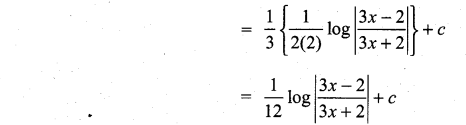
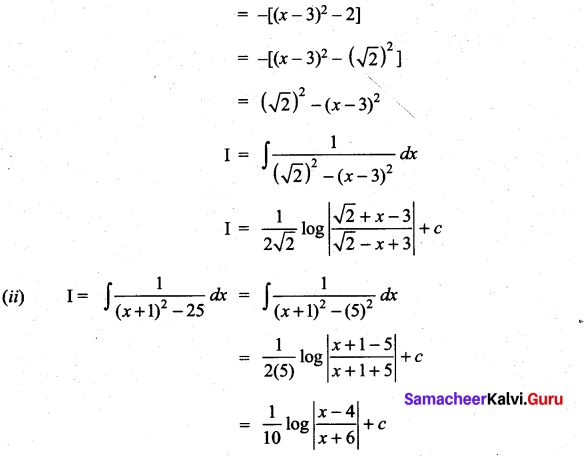
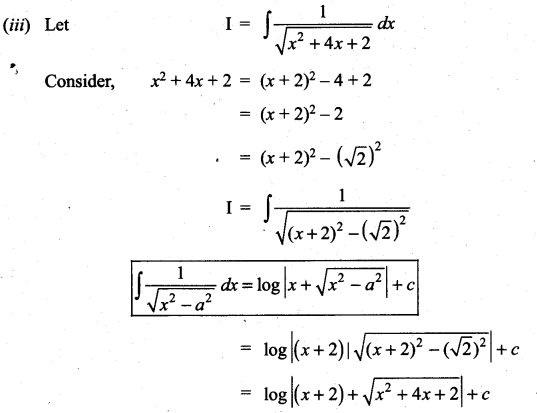
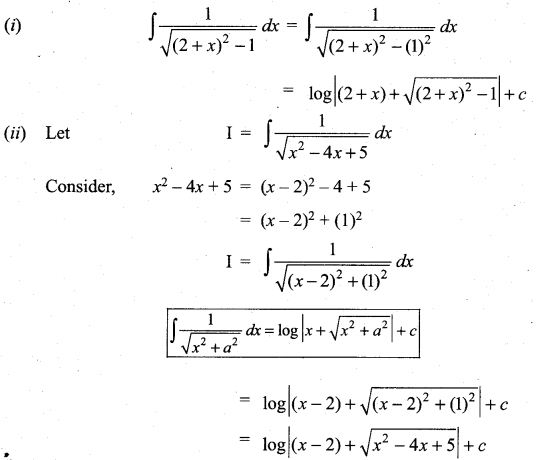
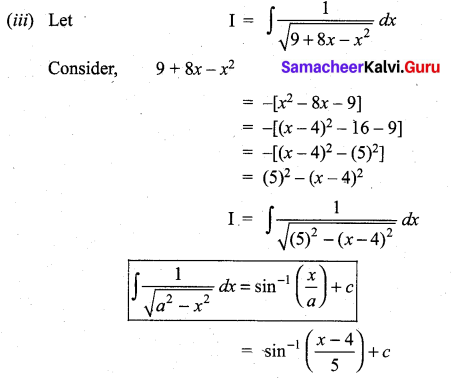
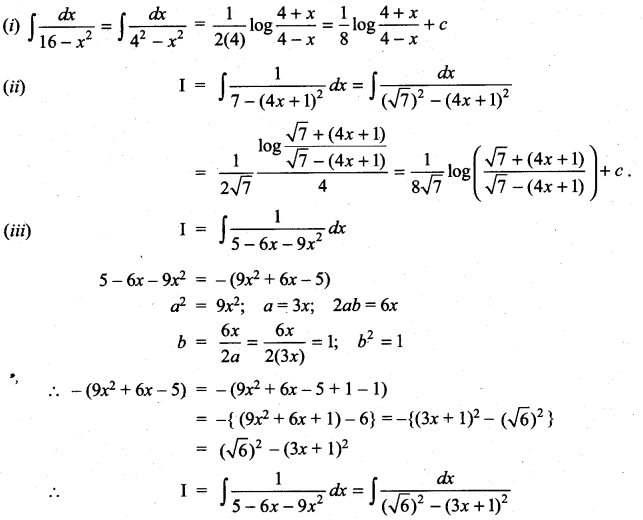
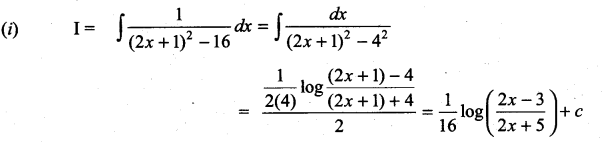
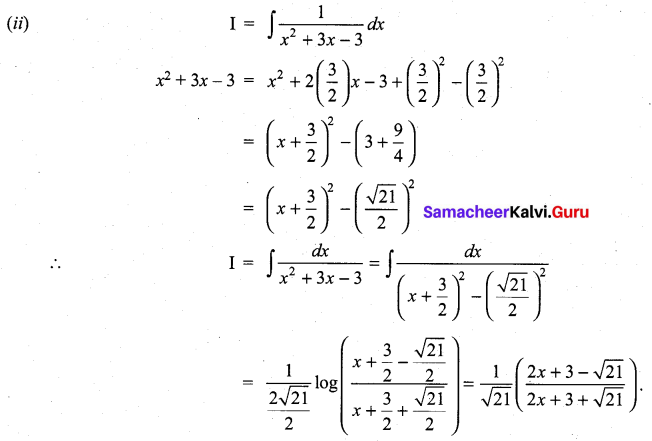
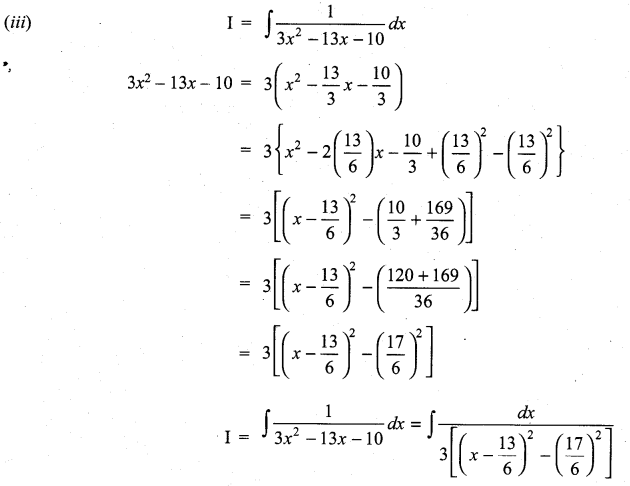
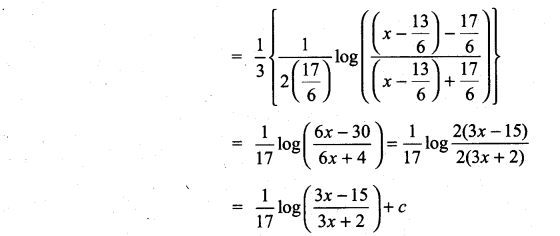
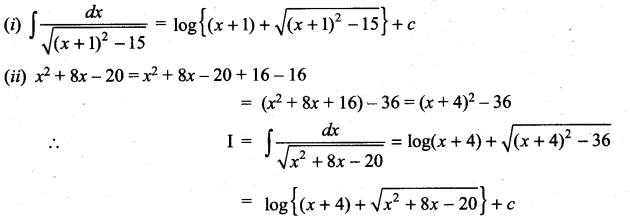
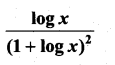
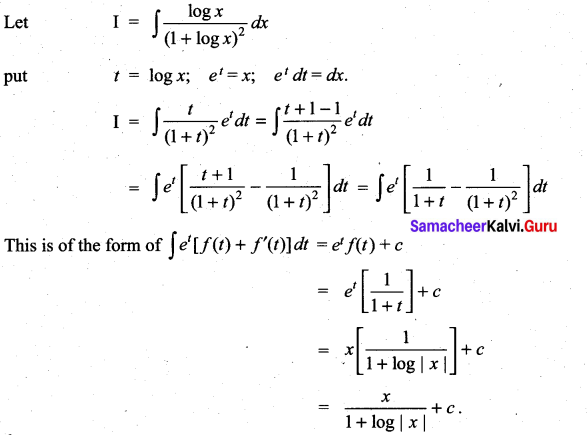
Samacheer Kalvi 11th Maths Solutions Chapter 12 Introduction to Probability Theory Ex 12.3

You can Download Samacheer Kalvi 11th Maths Book Solutions Guide Pdf, Tamilnadu State Board help you to revise the complete Syllabus and score more marks in your examinations.

Tamilnadu Samacheer Kalvi 11th Maths Solutions Chapter 12 Introduction to Probability Theory Ex 12.3

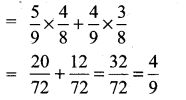
Question 1.
Can two events be mutually exclusive and independent simultaneously?
Solution:
When A and B are independent
P(A ∩ B) = P(A) P(B)
But when A and B are mutually
Exclusive P(A ∩ B) = 0

Question 2.
If A and B are two events such that P(A ∪ B) = 0.7, P(A ∩ B) = 0.2, and P(B) = 0.5 then show that A and B are independent.
Solution:
GivenP(A ∪ B) = 0.7, P(A ∩ B)= 0.2 and P(B) = 0.5
To find P(A)
Now, P(A ∪ B) = P(A) + P(B) – P(A ∩ B)
(i.e.,) 0.7 = P(A) + 0.5 – 0.2
⇒ 0.7 – 0.5 + 0.2 = P(A)
(i.e.,) P(A) = 0.4
Now P(A ∩ B) = 0.2 …………. (i)
P(A) P(B) = 0.4 × 0.5 = 0.2 ………… (ii)
(1) = (2) ⇒ P(A ∩ B) = P(A) P(B)
⇒ A and B are independent.

Question 3.
If A and B are two independent events such that P(A ∪ B) = 0.6, P(A) = 0.2, find P(B).
Solution:
Given A and B are independent.
⇒ P(A ∪ B) = P(A).P(B)
Here P(A ∪ B) = 0.6 and P(A) = 0.2
To find P(B):
Now, P(A ∪ B) = P(A) + P(B) – P(A ∩ B)
(i.e.,) P(A ∪ B) = P(A) + P(B) – P(A) . P(B)
(i.e.,) 0.6 = 0.2 + P(B) (1 – 0.2)
P(B) (0.8) = 0.4
⇒ P(B) = \(\frac{0.4}{0.8}=\frac{4}{8}=\frac{1}{2}\) = 0.5

Samacheer Kalvi 11th Maths Solutions Chapter 12 Introduction to Probability Theory Ex 12.3

Question 4.
If P(A) = 0.5, P(B) = 0.8 and P(B/A) = 0.8, find (P(A/B)) and P(A ∪ B)
Solution:
Given P(A) = 0.5, P(B) = 0.8 and P(B/A) = 0.8 to find P(A/B) & P(A ∪ B)
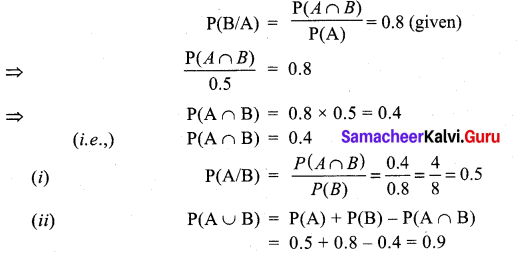
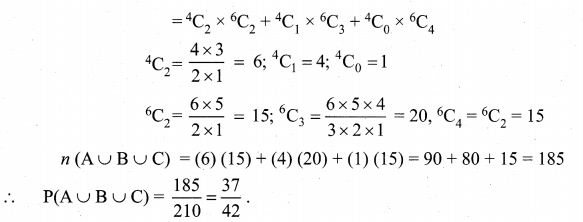
Samacheer Kalvi 11th Maths Solutions Chapter 12 Introduction to Probability Theory Ex 12.3 1
So, P(A/B) =0.5 and P(A ∪ B) = 0.9.

Question 5.
If for two events A and B, P(A) = \(\frac{3}{4}\), P(B) = \(\frac{2}{5}\) and A ∪ B = S (sample space), find the conditional probability P(A/B).
Solution:
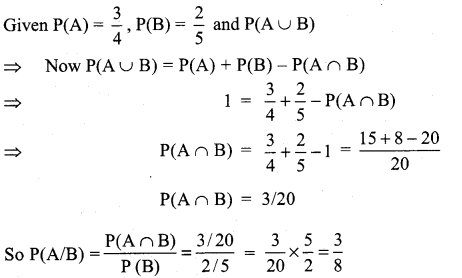
Samacheer Kalvi 11th Maths Solutions Chapter 12 Introduction to Probability Theory Ex 12.3 2

Question 6.
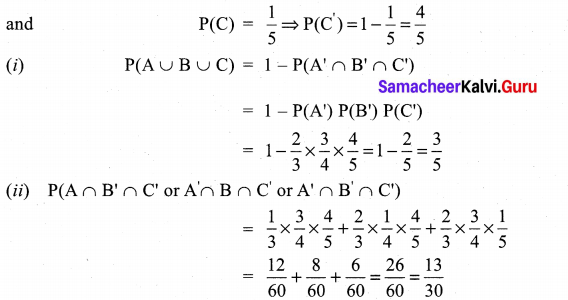
A problem in Mathematics is given to three students whose chances of solving it are \(\frac{1}{3}, \frac{1}{4}\) and\(\frac{1}{5}\)
(i) What is the probability that the problem is solved?
(ii) What is the probability that exactly one of them will solve it?
Solution:
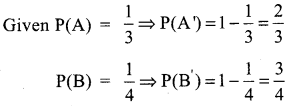
Samacheer Kalvi 11th Maths Solutions Chapter 12 Introduction to Probability Theory Ex 12.3 3
Samacheer Kalvi 11th Maths Solutions Chapter 12 Introduction to Probability Theory Ex 12.3 4

Question 7.
The probability that a car being filled with petrol will also need an oil change is 0.30; the probability that it needs a new oil filter is 0.40, and the probability that both the oil and filter need changing is 0.15.
(i) If the oil had to be changed, what is the probability that a new oil filter is needed?
(ii) If a new oil filter is needed, what is the probability that the oil has to be changed?
Solution:
Given P(A) = 0.3, P(B) = 0.4 and P(A ∩ B) = 0.15
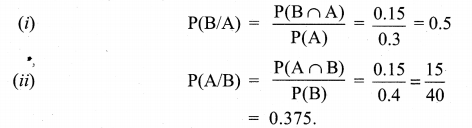
Samacheer Kalvi 11th Maths Solutions Chapter 12 Introduction to Probability Theory Ex 12.3 5

Question 8.
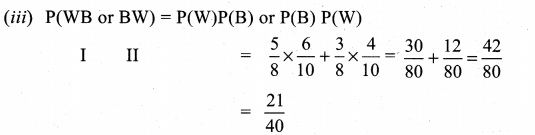
One bag contains 5 white and 3 black balls. Another bag contains 4 white and 6 black balls. If one ball is drawn from each bag, find the probability that (i) both are white (ii) both are black (iii) one white and one black.
Solution:
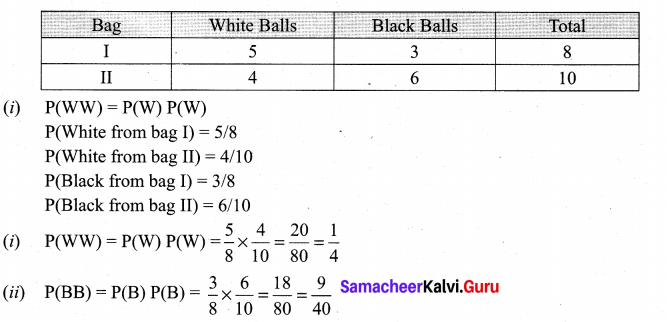
Samacheer Kalvi 11th Maths Solutions Chapter 12 Introduction to Probability Theory Ex 12.3 6
Samacheer Kalvi 11th Maths Solutions Chapter 12 Introduction to Probability Theory Ex 12.3 7

Samacheer Kalvi 11th Maths Solutions Chapter 12 Introduction to Probability Theory Ex 12.3

Question 9.
Two thirds of students in a class are boys and rest girls. It is known that the probability of a girl getting a first grade is 0.85 and that of boys is 0.70. Find the probability that a students chosen at random will get first grade marks.
Solution:
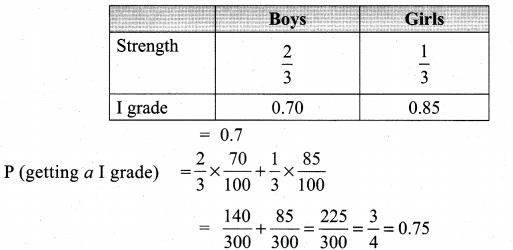
Samacheer Kalvi 11th Maths Solutions Chapter 12 Introduction to Probability Theory Ex 12.3 8

Question 10.
Given P(A) = 0.4 and P(A ∪ B) = 0.7. Find P(B) if
(i) A and B are mutually exclusive
(ii) A and B are independent events
(iii) P(A/B) = 0.4
(iv) P(B/A) = 0.5
Solution:
P(A) = 0.4, P(A ∪ B) = 0.7
(i) When A and B are mutually exclusive
P(A ∪ B) = P(A) P(B)
(i.e.,) 0.7 = 0.4 + P(B)
0.7 – 0.4 = P(B)
(i.e.,) P(B) = 0.3

(ii) Given A and B are independent
⇒ P(A ∩ B) = P(A). P(B)
Now, P(A ∪ B) = P(A) + P(B) – P (A ∩ B)
(i.e.,) 0.7 = 0.4 + P(B) – (0.4) (P(B))
(i.e.,) 0.7 – 0.4 = P(B) (1 – 0.4)
0.3 = P (B) 0.6
⇒ P(B) = \(\frac{0 \cdot 3}{0 \cdot 6}=\frac{3}{6}\) = 0.5

(iii) P(A/B) = 0.4
(i.e.,) \(\frac{P(A \cap B)}{P(B)}\) = 0.4
⇒ P(A ∩ B) = 0.4 [P(B)] …………. (i)
But We know P(A ∪ B) = P(A) + P(B) – P(A ∩ B)
P(A ∩ B) = P(A) + P(B) – P(A ∪ B)
⇒ P(A ∩ B) = 0.4 + P(B) – 0.7
= P(B) – 0.3 …………. (ii)
from (i) and (ii) (equating R.H.S) We get
0.4 [P(B)] = P(B) – 0.3
0.3 = P(B) (1 – 0.4)
0.6 (P(B)) = 0.3 ⇒ P(B) = \(\frac{0.3}{06}=\frac{3}{6}\) = 0.5

(iv) P(B/A) = 0.5
(i.e.,) \(\frac{P(A \cap B)}{P(A)}\) = 0.5
(i.e.,) P(A ∩ B) = 0.5 × P(A)
= 0.5 × 0.4 = 0.2
Now P(A ∪ B) = P(A) + P(B) – P(A ∩ B)
⇒ 0.7 = 0.4 + P(B) – 0.2
⇒ 0.7 = P(B) + 0.2
⇒ P(B) = 0.7 – 0.2 = 0.5

Samacheer Kalvi 11th Maths Solutions Chapter 12 Introduction to Probability Theory Ex 12.3

Question 11.
A years is selected at random. What is the probability that (i) it contains 53 Sundays (ii) it is a leap year which contains 53 Sundays?
Solution:
(i) A non-leap year contains 365 \(\frac{1}{4}\) days 365\(\frac{1}{4}\) ÷ 7 = 52 weeks + 1\(\frac{1}{4}\) days. In 52 weeks,
we get 52 Sundays from the remaining 1\(\frac{1}{4}\) days we should get one sunday.
∴ The probability of getting the day as Sunday = \(\frac{5 / 4}{7}=\frac{5}{4 \times 7}=\frac{5}{28}\)
(ii) A leap year has 366 days
\(\frac{366}{7}\) = 52 weeks + 2 days
In 52 weeks, we get 52 Sundays.
From the remaining two days we should get one Sunday, the remaining two days can be any one of the following combinations.
Saturday and Sunday, Sunday and Monday, Monday and Tuesday, Tuesday and Wednes¬day, Wednesday and Thursday, Thursday and Friday, Friday and Saturday of the seven combination two have Sundays.
∴ (Probability of getting a Sunday = \(\frac{2}{7}\)
Selecting a leap year = \(\frac{1}{4}\)
{∴ In every four consecutive years we get one leap year}
∴ Probability of getting 53 Sundays = \(\frac{2}{7} \times \frac{1}{4} \times \frac{1}{14}\)

Question 12.
Suppose the chances of hitting a target by a person X is 3 times in 4 shots, by Y is 4 times in 5 shots, and by Z is 2 times in 3 shots. They fire simultaneously exactly one time. What is the probability that the target is damaged by exactly 2 hits?
Solution:
Given P(X) = 3/4, P(X’) = 1 – 3/4 = 1/4
∴ P(Y) = 4/5, P(Y’) = 1 – 4/5 = 1/5
P(Z) = \(\frac{2}{3}\) ∴ P(Z’) = 1 – \(\frac{2}{3}\) = \(\frac{1}{3}\)
P(X ∩ Y ∩ Z’) + P(X ∩ Y’ ∩ Z) + P(X’ ∩ Y ∩ Z)
= \(\frac{3}{4} \times \frac{4}{5} \times \frac{1}{3}+\frac{3}{4} \times \frac{1}{5} \times \frac{2}{3}+\frac{1}{4} \times \frac{4}{5} \times \frac{2}{3}\)
= \(\frac{12}{60}+\frac{6}{60}+\frac{8}{60}=\frac{26}{60}=\frac{13}{30}\)

Samacheer Kalvi 11th Maths Solutions Chapter 12 Introduction to Probability Theory Ex 12.3 Additional Problems

Question 1.
If P(A) = 0.4, P(B) = 0.7 and P(B/A) = 0.5, find P(A /B) and P(A ∪ B).
Solution:
P(B/A) = 0.5 ⇒ \(\frac{\mathrm{P}(\mathrm{B} \cap \mathrm{A})}{\mathrm{P}(\mathrm{A})}\) = 0.5
(i.e.,) \(\frac{\mathrm{P}(\mathrm{B} \cap \mathrm{A})}{0.4}\) = 0.5
∴ P(B ∩ A) = 0.4 × 0.5 = 0.2
(i.e.,) P(A ∩ B)= 0.2
P(A ∪ B)= P(A) + P(B) – P(A ∩ B)
P(A ∪ B) = 0.4 + 0.7 – 0.2 = 0.9
P(A/B) = \(\frac{P(A \cap B)}{P(B)}=\frac{0.2}{0.7}=\frac{2}{7}\)

Question 2.
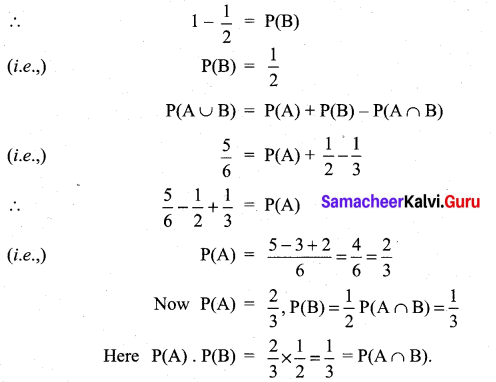
If A and B are two events such that P(A ∪ B) = \(\frac{5}{6}\), P(A ∩ B) = \(\frac{1}{3}\), P(\(\overline{B}\)) = \(\frac{1}{2}\) show that A and B are independent.
Solution:
P(\(\overline{B}\)) = \(\frac{1}{2}\) (i.e.,)1 – P(B) = \(\frac{1}{2}\)
Samacheer Kalvi 11th Maths Solutions Chapter 12 Introduction to Probability Theory Ex 12.3 9
∴ A and B are independent

Question 3.
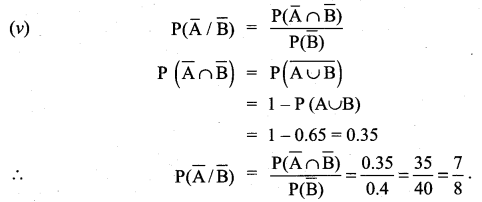
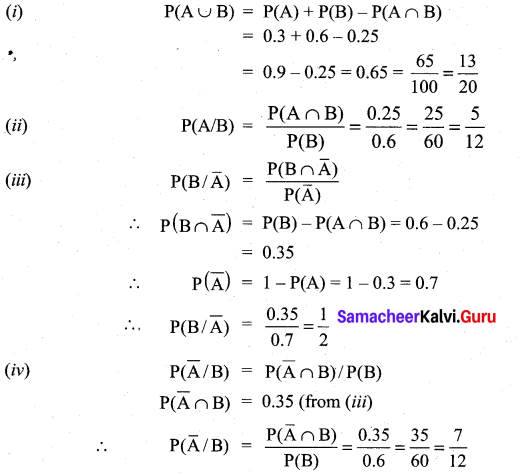
P(A) = 0.3, P(B) = 0.6 and P(A ∩ B) = 0.25. Find
(i) P(A ∪ B)
(ii) P(A/B)
(iii) P(B/\(\overline{\mathrm{A}}\))
(iv) \(\mathrm{P}(\overline{\mathrm{A}} / \mathrm{B})\)
(v) \(\mathrm{P}(\overline{\mathrm{A}} / \overline{\mathrm{B}})\)
Solution:
Samacheer Kalvi 11th Maths Solutions Chapter 12 Introduction to Probability Theory Ex 12.3 10
Samacheer Kalvi 11th Maths Solutions Chapter 12 Introduction to Probability Theory Ex 12.3 11

Samacheer Kalvi 11th Maths Solutions Chapter 12 Introduction to Probability Theory Ex 12.3

Question 4.
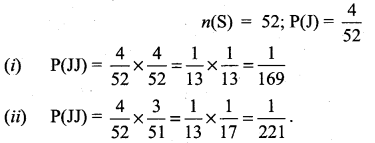
Two cards are drawn one by one at random from a deck of 52 playing cards. What is the – probability Of getting two jacks if (i) the first card is replaced before the second card is drawn (ii) the first card is not replaced before the second card is draw?
Solution:
Samacheer Kalvi 11th Maths Solutions Chapter 12 Introduction to Probability Theory Ex 12.3 12

Question 5.
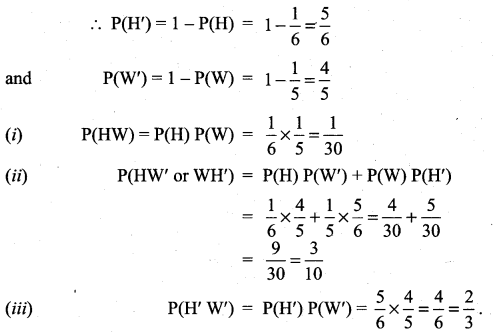
A husband and wife appear in an interview for two vacancies in the same post. The probability of husband’s selection is \(\frac{1}{6}\) and that of wife’s selection is \(\frac{1}{5}\). What is the probability that (i) both of them will be selected, (ii) only one of them will be selected, (iii) none of them will be selected?
Solution:
P(H) = Probability of husband’s selection = \(\frac{1}{6}\)
P(W) = Probability of wife’s selection = \(\frac{1}{5}\)
Samacheer Kalvi 11th Maths Solutions Chapter 12 Introduction to Probability Theory Ex 12.3 13

Question 6.
For a student the probability of getting admission in IIT is 60% and probability of getting admission in Anna university is 75%. Find the probability that (i) getting admission in only one of these, (ii) getting admission in atleast one of these.
Solution:
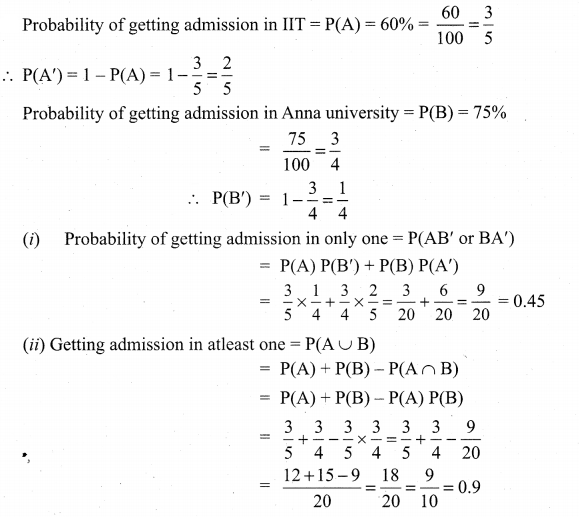
Samacheer Kalvi 11th Maths Solutions Chapter 12 Introduction to Probability Theory Ex 12.3 14

Samacheer Kalvi 11th Maths Solutions Chapter 12 Introduction to Probability Theory Ex 12.2

You can Download Samacheer Kalvi 11th Maths Book Solutions Guide Pdf, Tamilnadu State Board help you to revise the complete Syllabus and score more marks in your examinations.

Tamilnadu Samacheer Kalvi 11th Maths Solutions Chapter 12 Introduction to Probability Theory Ex 12.2

Question 1.
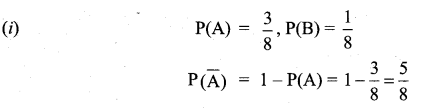
If A and B are mutually exclusive events P(A) = \(\frac{3}{8}\) and P (B) = \(\frac{1}{8}\), then find
(i) P\((\overline{\mathrm{A}})\)
(ii) P(A ∪ B)
(iii) P(\(\overline{\mathrm{A}}\) ∩ B
(iv) P\((\overline{\mathrm{A}} \cup \overline{\mathrm{B}})\)
Solution:
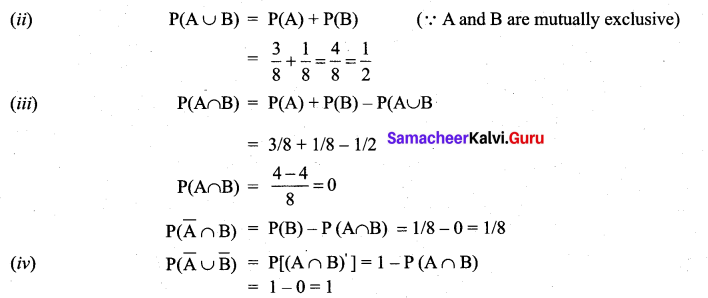
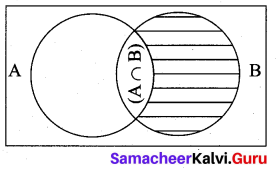
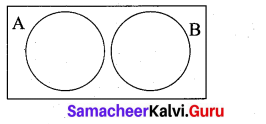
Samacheer Kalvi 11th Maths Solutions Chapter 12 Introduction to Probability Theory Ex 12.2 1
Samacheer Kalvi 11th Maths Solutions Chapter 12 Introduction to Probability Theory Ex 12.2 2

Samacheer Kalvi 11th Maths Solutions Chapter 12 Introduction to Probability Theory Ex 12.2

Question 2.
If A and B are two events associated with a random experiment for which P(A) = 0.35, P(A or B) = 0.85, and P(A and B) = 0.15.
Find (i) P(only B)
(ii) P\((\overline{\mathrm{B}})\)
(iii) P(only A)
Solution:
Given P(A) = 0.35
P(A ∪ B) = 0.85
P(A ∩ B) = 0.15
We know P(A ∪ B) = P(A) + P(B) – P(A ∩ B)
(i.e.,) 0.85 = 0.35 + P(B) – 0.15
⇒ 0.85 – 0.2 = P(B)
(i.e.,) P(B) = 0.65
Samacheer Kalvi 11th Maths Solutions Chapter 12 Introduction to Probability Theory Ex 12.2 3
(i) P(only B ) = P(B) – P(A ∩ B)
= 0.65 – 0.15 = 0.50
(ii) P\((\overline{\mathrm{B}})\) = 1 – P(B) = 1 – 0.65 = 0.35
(iii) P(A only) = P(A) – P(A ∩ B) = 0.35 – 0.15 = 0.20

Question 3.
A die is thrown twice. Let Abe the event, ‘First die shows 5’ and B be the event, ‘second die shows 5’. Find P(A ∪ B).
Solution:
When a die is throw twice
n(s) = 62 = 36
Let A be the event that first die shows 5 and B be the event that second die shows 5 Now A = {(5, 1), (5, 2) (5, 3), (5, 4), (5, 5) (5, 6}
n(A) = 6 ⇒ P(A) = \(\frac{n(\mathrm{A})}{n(\mathrm{S})}=\frac{6}{36}\)
and B = {(1, 5), (2, 5), (3, 5), (4, 5), (5, 5), (6, 5)}
n(B) = 6 ⇒ P(B) = \(\frac{n(\mathrm{B})}{n(\mathrm{S})}=\frac{6}{36}\)
Also A ∩ B = {(5, 5)} ⇒ n (A ∩ B) = 1
P(A ∪ B) = P(A) + P(B) – P(A ∩ B)
= \(\frac{6}{36}+\frac{6}{36}-\frac{1}{36}=\frac{11}{36}\)

Samacheer Kalvi 11th Maths Solutions Chapter 12 Introduction to Probability Theory Ex 12.2

Question 4.
The probability of an event A occurring is 0.5 and B occurring is 0.3. If A and B are mutually exclusive events, then find the probability of
(i) P(A ∪ B)
(ii) P(A ∩ \(\overline{B}\))
(iii)P(\(\overline{A}\) ∩ B)
Solution:
P(A) = 0.5, P(B) = 0.3
Here A and B are mutually exclusive.
(i) P(A ∪ B) = P(A) + P(B)
= 0.5 + 0.3 = 0.8
(ii) P(A ∩ B) = P(A) + P(B) – P(A ∪ B)
= 0.5 + 0.3 – 0.8
P(A ∩ B) = 0
P(A ∩ \(\overline{B}\)) = P(A) – P(A ∩ B) = 0.5 – 0 = 0.5
(iii) P(\(\overline{A}\) ∩ B) = P(B) – P(A ∩ B) = 0.3 – 0 = 0.3

Question 5.
A town has 2 fire engines operating independently. The probability that a fire engine is available when needed is 0.96.
(i) What is the probability that a fire engine is available when needed?
(ii) What is the probability that neither is available when needed?
Samacheer Kalvi 11th Maths Solutions Chapter 12 Introduction to Probability Theory Ex 12.2 4
Solution:
(i) P(atleast one engine is available) = (1 – probability of no engine available)
= 1 – P(A’ ∩ B’) = 1 – P (A’) P(B’)
= 1 – (0.04) (0.04) = 1 – 0.0016 = 0.9984
(ii) P (A’ ∩ B’) = P (A’) P(B’)
= 0.04 × 0.04
= 0.0016

Question 6.
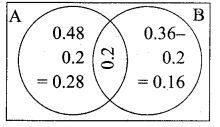
The probability that a new railway bridge will get an award for its design is 0.48, the probability that it will get an award for the efficient use of materials is 0.36, and that it will get both awards is 0.2. What is the probability, that (i) it will get atleast one of the two awards 00 it will get only one of the awards.
Solution:
Given P(A) = 0.48, P(B) = 0.36 and P(A ∩ B) = 0.2
Samacheer Kalvi 11th Maths Solutions Chapter 12 Introduction to Probability Theory Ex 12.2 5
(i) P(A ∪ B) = P(A) + P(B) – P(A ∩ B)
= 0.48 + 0.36 – 0.2 = 0.64.
(ii) P (Getting only one award)
= P(A) – P(A ∩ B) + P(B) – P(A ∩ B)
= (0.48 – 0.2) + (0.36 – 0.2)
= 0.28 + 0.16 = 0.44.

Samacheer Kalvi 11th Maths Solutions Chapter 12 Introduction to Probability Theory Ex 12.2 Additional Problems

Question 1.
A and B are two events associated with random experiment for which P(A) = 0.36, P(A or B) = 0.90 and P(A and B) = 0.25. Find
(i) P(B)
(ii) P\((\overline{\mathrm{A}} \cap \overline{\mathrm{B}})\)
Solution:
(i) Given P(A) = 0.36, P(A ∪ B) = 0.09, P(A ∩ B) = 0.25
P(A ∪ B) = P(A) + P(B) – P(A ∩ B)
(i.e.,) 0.90 = 0.36 + P(B) – 0.25
0.90 = 0.11 + P(B)
∴ P(B) = 0.90 – 0.11 = 0.79

(ii) P\((\overline{\mathrm{A}} \cap \overline{\mathrm{B}})\) = P{(A’ ∪ B)’} (Demorgan Law)
P(A ∪ B)’ = 1 – P(A ∪ B) = 1 – 0.90 = 0.1.

Samacheer Kalvi 11th Maths Solutions Chapter 12 Introduction to Probability Theory Ex 12.2

Question 2.
Given P(A) = 0.5, P(B) = 0.6 and P(A ∩ B) = 0.24. Find
(i) P(A ∪ B)
(ii) P(\(\overline{\mathrm{A}}\) ∩ B)
(iii) P(A ∩ \(\overline{\mathrm{B}}\))
(iv) P(\(\overline{\mathrm{A}} \cup \overline{\mathrm{B}})\)
(v) P\((\overline{\mathrm{A}} \cap \overline{\mathrm{B}})\)
Solution:
(i) P(A) = 0.5, P(B) = 0.6, P(A ∩ B) = 0.24
P(A ∪ B) = P(A) + P(B) – P(A ∩ B)
(i.e.,) P(A ∪ B) = 0.5 + 0.6 – 0.24
= 1.1 – 0.24 = 0.86
∴ P(A ∪ B)= 0.86

(ii) P(\(\overline{\mathrm{A}}\) ∩ B) = P(B) – P(A ∩ B)
= 0.6 – 0.24 = 0.36

(iii) P(A ∩ \(\overline{\mathrm{B}}\)) = P(A) – P(A ∩ B)
= 0.5 – 0.24 = 0.26

(iv) P(\(\overline{\mathrm{A}} \cup \overline{\mathrm{B}})\) = P {(A ∩ B)’} = 1 – P(A ∩ B)
= 1 – 0.24 = 0.76

(v) P\((\overline{\mathrm{A}} \cap \overline{\mathrm{B}})\) = P{A ∪ B)’} = 1 – P(A ∪ B)
= 1 – 0.86 = 0.14.

Question 3.
The probability of an event A occurring is 0.5 and B occurring is 0.3. If A and B are mutually exclusive events, then find the probability of neither A nor B occurring.
Solution:
Given A and B are mutually exclusive and P(A) = 0.5, P(B) = 0.3
∴ P(A ∪ B) = P(A) + P(B) = 0.5 + 0.3 = 0.8
So, P(A’ ∩ B’) = P{(A ∪ B)’} = 1 – P(A ∪ B)
= 1 – 0.8 = 0.2

Samacheer Kalvi 11th Maths Solutions Chapter 12 Introduction to Probability Theory Ex 12.2

Question 4.
The probability that a new ship will get an award for its design is 0.25, the probability that it will get an award for the efficient use of materials is 0.35 and that it will get both awards is 0.15. What is the probability, that (/) it will get atleast one of the two awards (ii) it will get only one of the awards?
Solution:
Probability of getting the award for its design = P(A) = 0.25
Probability of getting the award for the efficient use of materials = P(B) = 0.35
Probability of getting both awards = P(A ∩ B) = 0.15
Now P(A) =0.25; P(B) = 0.35 and P(A ∩ B) = 0.15
∴ (i) P(A ∪ B)= P(A) + P(B) – P(A ∩ B)
= 0.25 + 0.35 – 0.15 = 0.60 – 0.15 = 0.45
(ii) P(A’ ∩ B’ or B ∩ A’) = P(A ∩ B’) + P(A’ ∩ B)
P(A ∩ B’) = P(A) – P(A ∩ B)
= 0.25 – 0.15 = 0.10
P(A’ ∩ B) = P(B) – P(A ∩ B)
= 0.35 – 0.15 = 0.20
∴ P(A ∩ B’) + P(A’ ∩ B) = 0.10 + 0.20 = 0.30.

Samacheer Kalvi 11th Maths Solutions Chapter 12 Introduction to Probability Theory Ex 12.1

You can Download Samacheer Kalvi 11th Maths Book Solutions Guide Pdf, Tamilnadu State Board help you to revise the complete Syllabus and score more marks in your examinations.

Tamilnadu Samacheer Kalvi 11th Maths Solutions Chapter 12 Introduction to Probability Theory Ex 12.1

Question 1.
An experiment has the four possible mutually exclusive and exhaustive outcomes A, B, C and D. Check whether the following assignments of probability are permissible.
(i) P(A) = 0.15, P(B) = 0.30, P(C) = 0.43, P(D) = 0.12
(ii) P(A) = 0.22, P(B) = 0.38, P(C) = 0.16, P(D) = 0.34
(iii) P(A) = \(\frac{2}{5}\), P(B) = \(\frac{3}{5}\), P(C) = \(-\frac{1}{5}\), P(D) = \(\frac{1}{5}\)
Solution:
When A, B, C, D are the possible exclusive and exhaustive events the P(A) + P(B) + P(C) + P(D) = 1.
(i) P(A) = 0.15, P(B) = 0.30, P(C) = 0.43, P(D) = 0.12
Now P(A) + P(B) + P(C) + P(D) = 0.15 + 0.30 + 0.43 + 0.12 = 1
0.15 + 0.30 + 0.43 + 0.12 = 1
∴ The assignment of probability is permissible

(ii) P(A) = 0.22, P(B) = 0.38, P(C) = 0.16, P(D) = 0.34
Now P(A) + P(B) + P(C) + P(D) = 1
0.22 + 0.38 + 0.16 + 0.34 = 1.10 = ≠1
∴ The assignment of probability is not permissible.

(iii) P(A) = \(\frac{2}{5}\), P(B) = \(\frac{3}{5}\), P(C) = \(-\frac{1}{5}\), P(D) = \(\frac{1}{5}\)
P(C) = \(-\frac{1}{5}\) which is not possible
(i.e.) for any event A, (0 ≤ P(A) ≤ 1)
∴ The assignment of probability is not permissible.

Samacheer Kalvi 11th Maths Solutions Chapter 12 Introduction to Probability Theory Ex 12.1

Question 2.
If two coins are tossed simultaneously, then find the probability of getting
(i) one head and one tail
(ii) at most two tails
Solution:
When two coins are tossed the sample space will be
S = {(H, H), (H, T), (T, H), (T, T)}
n(S) = 4
(i) probability of getting 1 head and one tail = \(\frac{2}{4}=\frac{1}{2}\)
(ii) Probability of getting atmost two tails = \(\frac{4}{4}\) = 1

Question 3.
Five mangoes and 4 apples are in a box. If two fruits are chosen at random, find the probability that (i) one is a mango and the other is an apple (ii) both are of the same variety.
Solution:
(i) Mangoes (M) = 5
Apples (A) = 4 Total = 5 + 4=9
P(mango) = P(M) = 5/9
P(A) = 4/9.
When two Suits are chosen at random
P(one mango and one Apple) = P(MA or AM)
= P(M)P (A) × 2!
= \(\frac{5}{9} \times \frac{4}{8} \times 2 !=\frac{5}{9}\)
(PCM) = \(\frac{5}{9}\) (Sell from 5 mangoes and set 1 from a fruit)
P(A) = \(\frac{4}{8}\) (Sel 1 from 4 apples and set 1 from the remaining 8 fruits)

(ii) P(MMorAA)
= P(M) P(M) + P(A) P(A)
Samacheer Kalvi 11th Maths Solutions Chapter 12 Introduction to Probability Theory Ex 12.1 1

Question 4.
What is the chance that (i) non-leap year (ii) leap year should have fifty three Sundays?
Solution:
(i) Non leap year
No of days =365
= \(\frac{365}{7}\) weeks = 52 weeks + 1 day
In 52 week we have 52 Sundays. So we have to find the probability of getting the remaining one day as Sunday. The remaining 1 day can be Sunday, Monday, Tuesday, Wednesday, Thursday, Friday, Saturday
(i.e.,) n(S) = 7
In the n (Sunday) = A {Saturday to Sunday or Sunday to Monday}
(i.e.,) n(A) = 1
So, P(A) = 1.
∴ Probability of getting 53 Sundays \(\frac{n(\mathrm{A})}{n(\mathrm{S})}=\frac{1}{7}\)

(ii) Leap Year:
In 52 weeks we have 52 Sundays. We have to find the probability of getting one Sunday form the remaining 2 days the remaining 2 days can be a combination of the following S = {Saturday to Sunday, Sunday to Monday, Monday, to Tuesday, Tuesday to wednes¬day, Wednesday to Thursday, Thursday to Friday, Friday and Saturday}.
(i.e) n(s) =7
In this = A {Saturday to Sunday, Sunday to Monday}
(i.e) n(A) = 2
So, P(A) = \(\frac{2}{7}\)

Samacheer Kalvi 11th Maths Solutions Chapter 12 Introduction to Probability Theory Ex 12.1

Question 5.
Eight coins are tossed once, find the probability of getting
(i) exactly two tails
(ii)at least two tails
(iii) at most two tails
Solution:
When a coin is tossed 8 times or 8 coins are tossed one time n(s) = 28 = 256
(i) Let A be the event of getting exactly 2 tails.
Here n(A) = 8C2 = \(\frac{8 \times 7}{2 \times 1}\) = 28
P(A) = \(\frac{n(\mathrm{A})}{n(\mathrm{S})}=\frac{28}{256}=\frac{7}{64}\)

(ii) Let B be the event of getting at least two facts.
n(B) = 8C2 + 8C3 + ……….. + 8C8
= n( S) – (8C0 + 8C1) = 256 – (1 + 8) = 247
P(B) = \(\frac{n(\mathrm{B})}{n(\mathrm{S})}=\frac{247}{256}\)

(iii) Let C be the event of getting atmost two facts.
n(C) = 8C0 + 8C1 + 8C0
= 1 + 8 + \(\frac{8 \times 7}{2 \times 1}\) = 1 + 8 + 28 = 37
P(C) = \(\frac{n(\mathrm{C})}{n(\mathrm{S})}=\frac{37}{256}\)

Samacheer Kalvi 11th Maths Solutions Chapter 12 Introduction to Probability Theory Ex 12.1

Question 6.
An integer is chosen at random from the first 100 positive integers. What is the probability that the integer chosen is a prime or multiple of 8?
Solution:
S= {1, 2, 3, …………. 100}
n(S) = 100
Let A be the event of choosing a prime number
∴ A = {2, 3, 5, 7, 11, 13, 17, 19, 23, 29, 31, 37, 41, 43, 47, 53, 59, 61, 67, 71, 73, 79, 83, 89}
n(A) = 25 So P(A) = \(\frac{25}{100}\)
Let B be the event of getting a number multiple of 8
B = {8, 16, 24, 32, 40, 48, 56, 64, 72, 80, 88, 96}
n(B)= 12 So P(B) = \(\frac{12}{100}\)
also A ∩ B = ϕ
⇒ A and B are mutually exclusive
∴ P(A ∪ B) = P(A) + P(B) = \(\frac{25}{100}+\frac{12}{100}=\frac{37}{100}\)

Question 7.
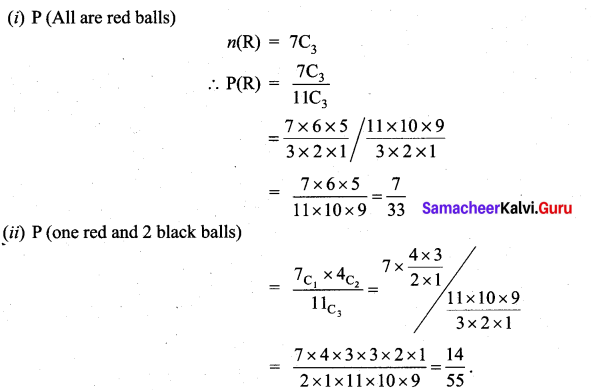
A bag contains 7 red and 4 black balls, 3 balls are drawn at random.
Find the probability that (i) all are red (ii) one red and 2 black.
Solution:
No. of Red balls = n(R) = 7
No. of Black balls = n(B) = 4
Total = 7 + 4 = 11 ⇒ n(S) = 11
Three balls are drawn at random
Samacheer Kalvi 11th Maths Solutions Chapter 12 Introduction to Probability Theory Ex 12.1 2

Question 8.
A single card is drawn from a pack of 52 cards. What is the probability that
(i) the card is an ace or a king
(ii) the card will be 6 or smaller
(iii) the card is either a queen or 9?
Solution:
Total No. of cards = 52 = n(S)
No. of ace cards = n(A) = 4
No. of king card = n(k) = 4
(i) P(A or K) = P(A) + P(K)
(∵ A and K are mutually exclusive).
= \(\frac{n(\mathrm{A})}{n(\mathrm{S})}+\frac{n(\mathrm{K})}{n(\mathrm{S})}=\frac{4}{52}+\frac{4}{52}\)
= \(\frac{8}{52}=\frac{2}{13}\)

(ii) Let B be the event of getting a number be 6 or smaller
So the numbers can be 6, 5, 4, 3, 2
There are 4 types of cards
So n(B) = 4 × 5 = 20
and So, p(B) = \(\frac{n(\mathrm{B})}{n(\mathrm{S})}=\frac{20}{52}=\frac{5}{13}\)

(iii) Let C be the event of getting a queen ⇒ so n(c) = 4
and Let D be the event of getting a number 9 ⇒ n(D) = 4
Now C ∩ D = ϕ
(i.e.,) C and D are mutually exclusive.
∴ P(C ∪ D) = P(C) + P(D) = \(\frac{4}{52}+\frac{4}{52}=\frac{8}{52}\)
= \(\frac{2}{13}\)

Question 9.
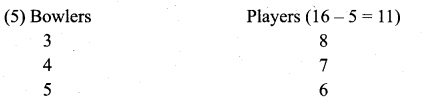
A cricket club has 16 members, of whom only 5 can bowl. What is the probability that in a team of 11 members at least 3 bowlers are selected?
Solution:
No. of players = 16
We need to select 11 players which can be done in 16 C11 ways
(i. e) n(S) = 16C11 ways
= 4368
Out of the selection of 11 members there should be a least 3 bowler So we can have 3 or 4 or 5 bowlers and S the remaining will be 8 or 7 or 6 players. So the selection can be done as follows.
Samacheer Kalvi 11th Maths Solutions Chapter 12 Introduction to Probability Theory Ex 12.1 3
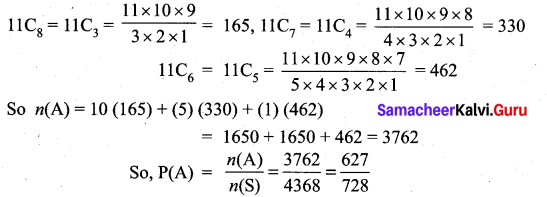
Let A be the event of selecting atleast 3 bowlers out of a selection of 11 players.
So n(A) = (5C3 × 11C8) + (5C4 × 11C7) + (5C5) (11C6)
∴ 5C3 = 10, 5C4 = 5, 5C5 = 1
Samacheer Kalvi 11th Maths Solutions Chapter 12 Introduction to Probability Theory Ex 12.1 4

Samacheer Kalvi 11th Maths Solutions Chapter 12 Introduction to Probability Theory Ex 12.1

Question 10.
(i) The odds that the event A occurs is 5 to 7, find P(A)
(ii) Suppose P(B) = \(\frac{2}{5}\). Express the odds that the event B occurs.
Solution:
If the probability of an event is P then the odds is favour of its occurrence are P to (1 – P) and the odds against its occurrence are (1 – P) to P.
Here we are given the odds that The event A occurs = 5 to 7
So, the odds that the event B occurs is 2 to 3.
∴ P(A) = \(\frac{5}{5+7}=\frac{5}{12}\)
(ii) We are given P(B) = \(\frac{2}{5}\)
(i.e.,) P(B) = \(\frac{2}{2+3}\)
So, the odds that the event B occurs is 2 to 3.

Samacheer Kalvi 11th Maths Solutions Chapter 12 Introduction to Probability Theory Ex 12.1 Additional Problems

Question 1.
An experiment has the four possible mutually exclusive outcomes A, B, C and D. Check whether the following assignments of probability are permissible.
P(A) = 0.32, P(B) = 0.28, P(C) = -0.06, P(D) = 0.46
Solution:
Probability of an event cannot be negative. Here P(C) = – 0.06.
∴ the above set of events are not possible.
P(A) = \(\frac{1}{3}\), P(B) = \(\frac{1}{6}\), P(C) = \(\frac{2}{9}\), P(D) = \(\frac{5}{18}\)

Question 2.
In a single throw of two dice, find the probability of obtaining
(i) sum of less than 5
(ii) a sum of greater than 10
(iii) a sum of 9 or 11.
Solution:
The sample space when throwing two dice once =
{(1, 1), (1, 2), …………. (1, 6)
(2, 1), ………… (2, 6)
:
:
(6, 1), ……….. (6, 6)}
n(S) = 62 = 36
(i) Let A be the event of getting a sum less than 5.
Then A = {(1, 1), (1, 2), (1, 3) (2, 1),(2, 2) (3, 1)}
n(A) = 6
∴ P(A) = \(\frac{n(\mathrm{A})}{n(\mathrm{S})}=\frac{6}{36}=\frac{1}{6}\)

(ii) Let B be the event of getting a sum greater than 10.
∴ The sum will be 11 or 12.
Now the numbers whose sum is 11.
= {(5, 6), (6, 5)}
The number whose sum is 12 = {(6, 6)}
n(B) = 2 + 1 = 3
∴ P(B) = \(\frac{3}{36}=\frac{1}{12}\)

(iii) Let C be the event of getting a sum 9 or 11.
Now C = {(3, 6), (4, 5)
(5, 4), (6, 3)
(5, 6), (6, 5)}
n(C) = 6
∴ P(C) = \(\frac{6}{36}=\frac{1}{6}\)

Question 3.
Three coins are tossed once. Find the probability of getting
(i) exactly two heads
(ii) at least two heads
(iii) atmost two heads.
Solution:
The sample space when three coin are tossed once is as follows:
S = {(H, H, H), (H, T, H), (T, H, H), (H, H, T), (T, T, H), (H, T, T) (T, H, T), (T, T, T)}
n(S) = 23 = 8
(i) Let A be the event of getting exactly two heads.
∴ A = {(H, T, H) (T, H, H) (H, H, T)}
n(A) = 3
∴ n( A) = \(\frac{3}{8}\)

(ii) Let B be the event of getting at least two heads.
B = {(H, T, H), (T, H, H), (H, H, T), (H, H, H)}
n(B) = 4
∴ P(B) = \(\frac{4}{8}=\frac{1}{2}\)

(iii) Let C be the event of getting atmost two heads.
C = {(T, T, T), (H, T, T), (T, H, T), (T, T, H) (H, H, T), (T, H, H), (H, T, H)}
n( C) = 7 ∴ P(C) = \(\frac{7}{8}\)

Samacheer Kalvi 11th Maths Solutions Chapter 12 Introduction to Probability Theory Ex 12.1

Question 4.
A bag contains 5 white and 7 black balls. 3 balls are drawn at random. Find the probability that
(i) all are white
(ii) one white and 2 black.
Solution:
Number of white balls = 5
Number of black balls = 7
Total number of balls = 12
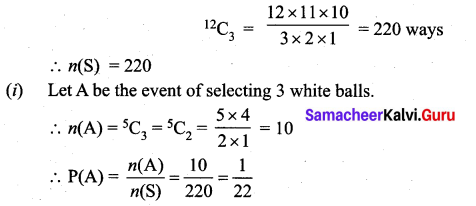
Selecting 3 from 12 balls can be done in
Samacheer Kalvi 11th Maths Solutions Chapter 12 Introduction to Probability Theory Ex 12.1 5

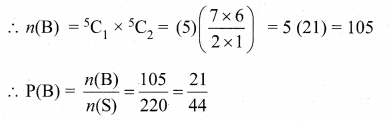
(ii) Let B be the event of selecting one white and 2 black balls.
Samacheer Kalvi 11th Maths Solutions Chapter 12 Introduction to Probability Theory Ex 12.1 6

Question 5.
In a box containing 10 bulbs, 2 are defective. What is the probability that among 5 bulbs chosen at random, none is defective?
Solution:
Total number of bulbs = 10
Number of defective bulbs = 2
∴ Number of good bulbs = 10 – 2 = 8
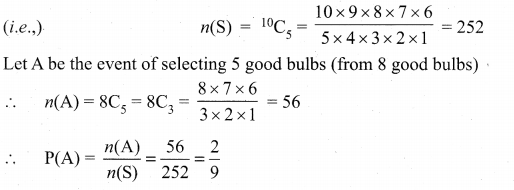
Now selecting 5 from the 10 bulbs can be done in 10C5 ways.
Samacheer Kalvi 11th Maths Solutions Chapter 12 Introduction to Probability Theory Ex 12.1 7

Question 6.
Out of 10 outstanding students in a school there are 6 girls and 4 boys. A team of 4 students is selected at random for a quiz programme. Find the probability that there are atleast two girls.
Solution:
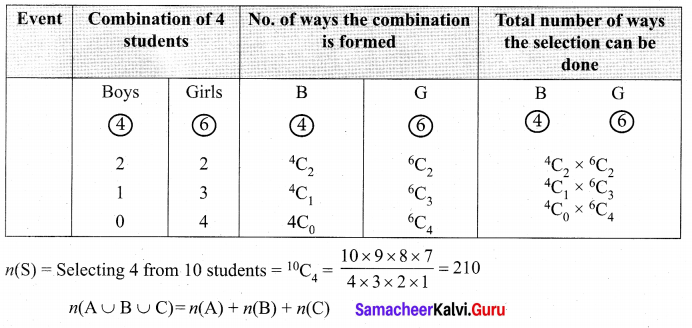
Let A, B and C be the three possible events of selections. The number of combinations are shown below:
Samacheer Kalvi 11th Maths Solutions Chapter 12 Introduction to Probability Theory Ex 12.1 8
Samacheer Kalvi 11th Maths Solutions Chapter 12 Introduction to Probability Theory Ex 12.1 9

Question 7.
An integers is chosen at random from the first fifty positive integers. What is probability that the integer chosen is a prime or multiple of 4.
Solution:
S = {1, 2, 3, ……….. ,50} ∴ n(S) = 50
Let A be the event of getting prime number.
∴ A = {2, 3, 5, 7, 11, 13, 17, 19, 23, 29, 31, 37, 41, 43, 47}
n(A) = 15, so P(A) = 15/50
Let B be the event of getting number multiple of 4
∴ B = {4, 8, 12, 16, 20, 24, 28, 32, 36, 40, 44, 48}
n(B) = 12, so P(B) = 12/50
Here A and B are mutually exclusive. (i.e.,) A ∩ B = ϕ
∴ P(A ∪ B) = P(A) + P(B) = 15/50 + 12/50 = 27/50.

Samacheer Kalvi 11th Maths Solutions Chapter 3 Trigonometry Ex 3.3

You can Download Samacheer Kalvi 11th Maths Book Solutions Guide Pdf, Tamilnadu State Board help you to revise the complete Syllabus and score more marks in your examinations.

Tamilnadu Samacheer Kalvi 11th Maths Solutions Chapter 3 Trigonometry Ex 3.3

Question 1.
Find the values of
(i) sin(480°)
(ii) sin(-1110°)
(iii) cos(300°)
(iv) tan(1050°)
(v) cot(660°)
(vi) tan \(\left(\frac{19 \pi}{3}\right)\)
(vii) sin \(\left(-\frac{11 \pi}{3}\right)\)
Solution:
(i) sin(480°) = sin(360° + 120°) = sin 120°
= sin(90° + 30°) = cos 30° = \(\sqrt{3}\)/2

(ii) sin(-1110°) = -sin(1110°)
= – sin (360° × 3 + 30°)
= -sin 30° = -1/2

(iii) cos(300°) = cos(270° + 30°) = sin 30° = 1/2

(iv) tan(1050°) = tan [3(360°) – 30°]
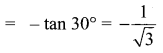
Samacheer Kalvi 11th Maths Solutions Chapter 3 Trigonometry Ex 3.3 5

(v) cot(660°) = cot (360° × 2 – 60°)
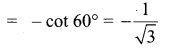
Samacheer Kalvi 11th Maths Solutions Chapter 3 Trigonometry Ex 3.3 6
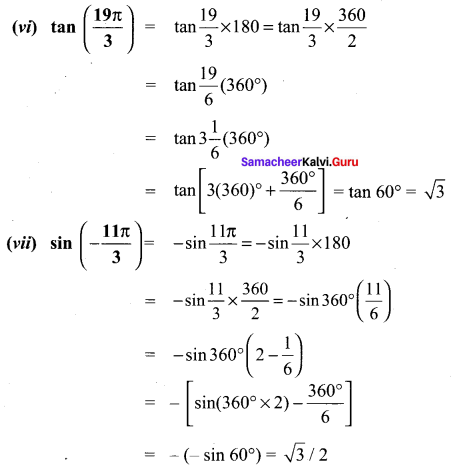
Samacheer Kalvi 11th Maths Solutions Chapter 3 Trigonometry Ex 3.3 7

Question 2.
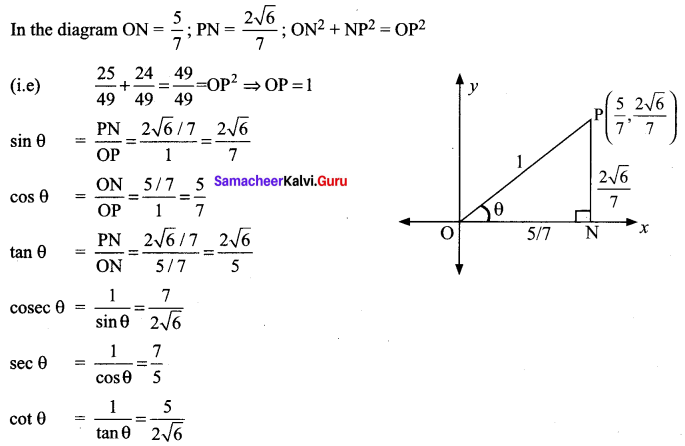
\(\left(\frac{5}{7}, \frac{2 \sqrt{6}}{7}\right)\) is a point on the terminal side of an angle θ is standard position. Determine the trigonometric function values of angle θ .
Solution:
Samacheer Kalvi 11th Maths Solutions Chapter 3 Trigonometry Ex 3.3 10

Samacheer Kalvi 11th Maths Solutions Chapter 3 Trigonometry Ex 3.3

Question 3.
Find the values of other five trigonometric functions for the following:

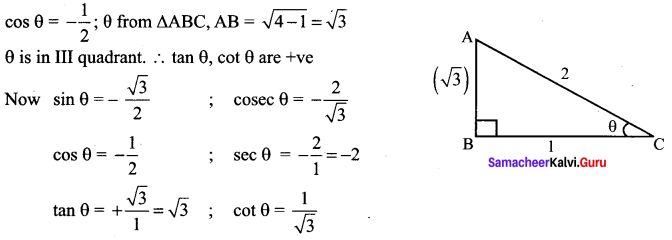
(i) cos θ = \(-\frac{1}{2}\); θ lies in the III quadrant.
Solution:
Taking the Numerical values
Samacheer Kalvi 11th Maths Solutions Chapter 3 Trigonometry Ex 3.3 11

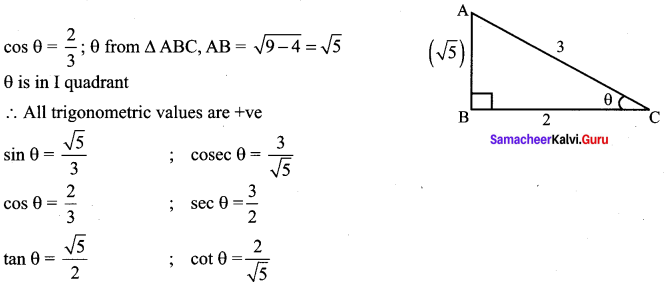
(ii) cos θ = \(\frac{2}{3}\) ; θ lies in the I quadrant
Solution:
Samacheer Kalvi 11th Maths Solutions Chapter 3 Trigonometry Ex 3.3 12

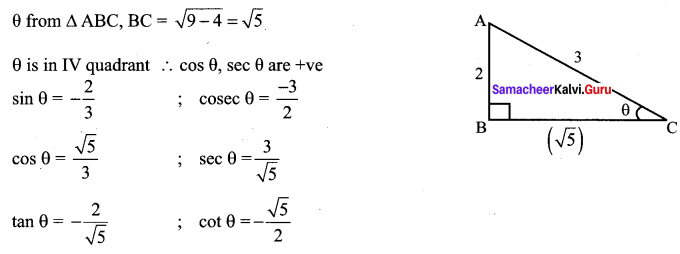
(iii) sin θ = –\(\frac{2}{3}\) ; θ lies in the IV quadrant
Solution:
Samacheer Kalvi 11th Maths Solutions Chapter 3 Trigonometry Ex 3.3 13

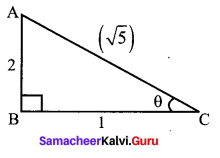
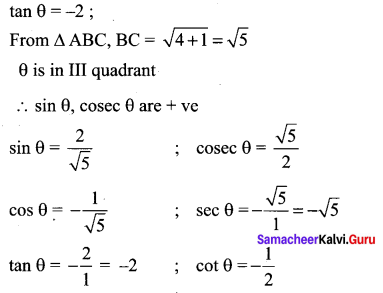
(iv) tan θ = -2; θ lies in the II quadrant
Solution:
Samacheer Kalvi 11th Maths Solutions Chapter 3 Trigonometry Ex 3.3 14
Samacheer Kalvi 11th Maths Solutions Chapter 3 Trigonometry Ex 3.3 15

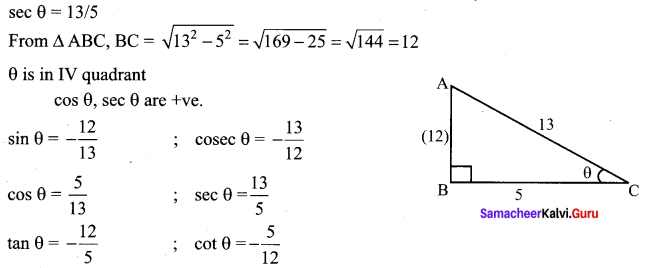
(v) sec θ = \(\frac{13}{5}\) ; θ lies in the IV quadrant
Solution:
Samacheer Kalvi 11th Maths Solutions Chapter 3 Trigonometry Ex 3.3 156

Samacheer Kalvi 11th Maths Solutions Chapter 3 Trigonometry Ex 3.3

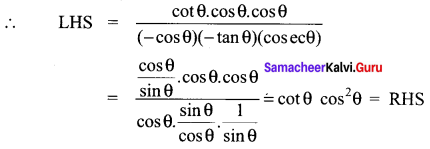
Question 4.
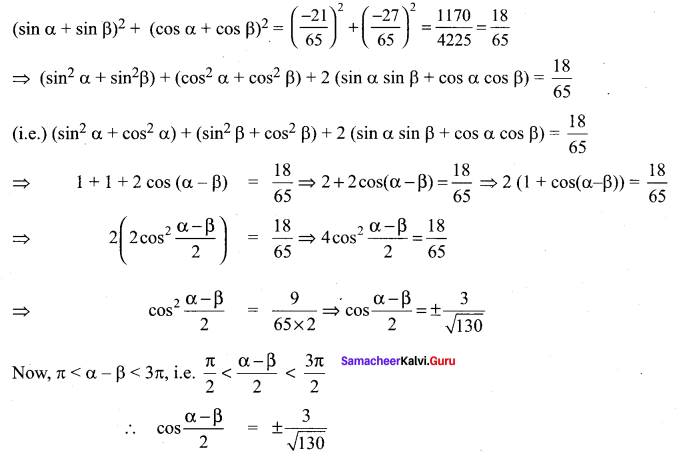
Samacheer Kalvi 11th Maths Solutions Chapter 3 Trigonometry Ex 3.3 16
Solution:
cot(180° + θ) = cot θ
sin (90° – θ) = cos θ
cos(-θ) = cos θ
sin (270 + θ) = – cos θ
tan(-θ) = -tan θ
cosec (360° + θ) = cosec θ
Samacheer Kalvi 11th Maths Solutions Chapter 3 Trigonometry Ex 3.3 17

Question 5.
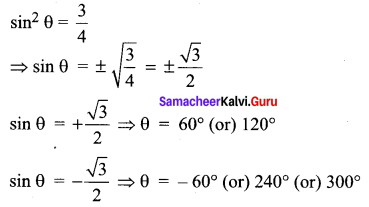
Find all the angles between 0° and 360° which satisfy the equation sin2 θ = \(\frac{3}{4}\)
Solution:
Samacheer Kalvi 11th Maths Solutions Chapter 3 Trigonometry Ex 3.3 18

Question 6.
Samacheer Kalvi 11th Maths Solutions Chapter 3 Trigonometry Ex 3.3 19
Solution:
LHS = sin2 10° + sin2 20° + sin2 70° + sin2 80°
= sin2 10° + sin2 (90° – 10°) + sin2 20° + sin2(90° – 20°)
= sin2 10° + (cos 10°)2 + sin2 20° + (cos 20°)2
= (sin2 10+ cos2 10) + sin2 20° + cos2 20°
= 1 + 1 = 2 = RHS

Samacheer Kalvi 11th Maths Solutions Chapter 3 Trigonometry Ex 3.3 Additional Questions Solved

Question 1.
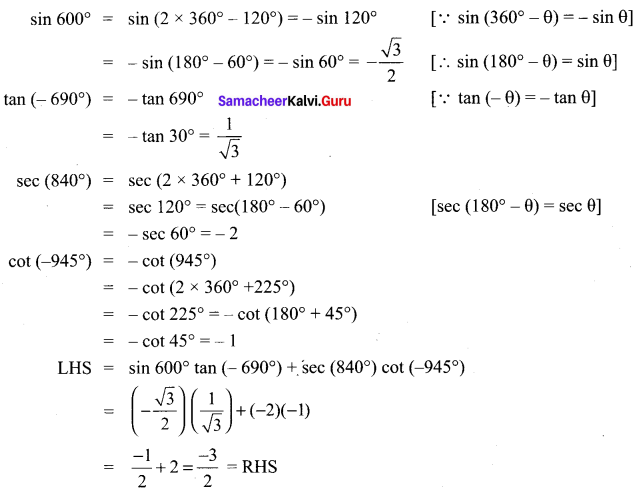
Prove that: sin 600°. tan (-690°) + sec 840°. cot (-945°) = \(\frac{3}{2}\)
Solution:
Samacheer Kalvi 11th Maths Solutions Chapter 3 Trigonometry Ex 3.3 60

Question 2.
Prove that sin (270° – θ) sin (90° – θ) – cos (270° – θ) cos (90° + θ) + 1 = 0
Solution:
LHS = sin (270° – θ) sin (90° – θ) – cos (270° – θ) cos (90° + θ) + 1
Now, sin (270° – θ) = sin {180°+ (90°- θ)}
= – cos (90° – θ) = – sin θ
LHS = – cos θ . cos θ – (- sin θ) (- sin θ) + 1
= – cos2 θ – sin2 θ + 1
= – (cos2 θ + sin2 θ) + 1 = -1 + 1 = 0 = RHS

Samacheer Kalvi 11th Maths Solutions Chapter 3 Trigonometry Ex 3.3

Question 3.
Prove that cos 24° + cos 55° + cos 125° + cos 204° + cos 300° = \(\frac{1}{2}\)
Solution:
cos 204° = cos (180°+ 24°) = – cos 24°
cos 125° = cos (180° – 55°) = – cos 55°
LHS = cos 24° + cos 55° + (- cos 55°) + (- cos 24°) + cos 300°
= cos 24° + cos 55° – cos 55° – cos 24° + cos 300°
Samacheer Kalvi 11th Maths Solutions Chapter 3 Trigonometry Ex 3.3 61

Question 4.
Samacheer Kalvi 11th Maths Solutions Chapter 3 Trigonometry Ex 3.3 62
Solution:
Samacheer Kalvi 11th Maths Solutions Chapter 3 Trigonometry Ex 3.3 63

Question 5.
Samacheer Kalvi 11th Maths Solutions Chapter 3 Trigonometry Ex 3.3 64
Solution:
Samacheer Kalvi 11th Maths Solutions Chapter 3 Trigonometry Ex 3.3 689
LHS = [(1 +cot α) + cosec α][(1 + cot α) – cosec α]
= (1 + cot α)2 – cosec2 α
= 1 + cot2α + 2 cot α – cosec2 α
[∵ 1 + cot2α = cosec2α]
= cosec2α + 2 cot α – cosec2α
= 2 cot α = RHS

Samacheer Kalvi 11th Maths Solutions Chapter 3 Trigonometry Ex 3.3

Question 6.
Samacheer Kalvi 11th Maths Solutions Chapter 3 Trigonometry Ex 3.3 66
Solution:
Samacheer Kalvi 11th Maths Solutions Chapter 3 Trigonometry Ex 3.3 67
= sec (450° – θ)
= sec[360° + (90° – θ)]
sec (90° – θ) = cosec θ
Samacheer Kalvi 11th Maths Solutions Chapter 3 Trigonometry Ex 3.3 68

Question 7.
Samacheer Kalvi 11th Maths Solutions Chapter 3 Trigonometry Ex 3.3 688
Solution:
cos (90° + θ) = – sin θ
sec (- θ) = sec θ
tan (180° – θ) = – tan θ
sec (360° – θ) = sec θ
sin (180° + θ) = – sin θ
cot (90° + θ) = – tan θ
Samacheer Kalvi 11th Maths Solutions Chapter 3 Trigonometry Ex 3.3 69

Question 8.
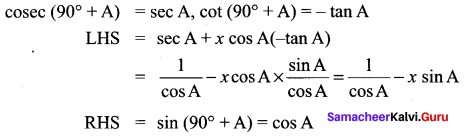
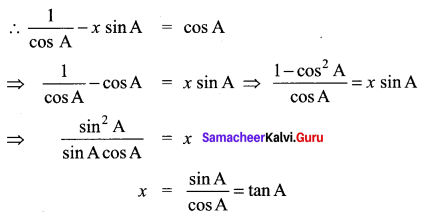
Find x from the equation cosec (90° + A) + x cos A cot (90° + A) = sin (90° + A).
Solution:
Samacheer Kalvi 11th Maths Solutions Chapter 3 Trigonometry Ex 3.3 70
Samacheer Kalvi 11th Maths Solutions Chapter 3 Trigonometry Ex 3.3 71

Samacheer Kalvi 11th Maths Solutions Chapter 3 Trigonometry Ex 3.2

You can Download Samacheer Kalvi 11th Maths Book Solutions Guide Pdf, Tamilnadu State Board help you to revise the complete Syllabus and score more marks in your examinations.

Tamilnadu Samacheer Kalvi 11th Maths Solutions Chapter 3 Trigonometry Ex 3.2

Question 1.
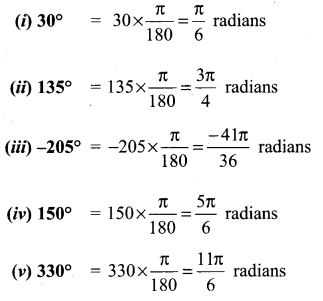
Express each of the following angles in radian measure:
(i) 30°
(ii) 135°
(iii) -205°
(iv) 150°
(v) 330°
Solution:
Samacheer Kalvi 11th Maths Solutions Chapter 3 Trigonometry Ex 3.2 1

Question 2.
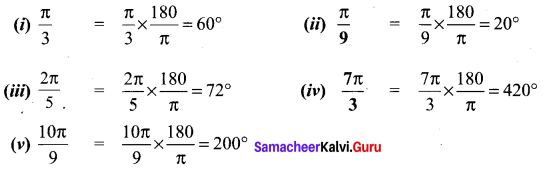
Find the degree measure corresponding to the following radian measures
Samacheer Kalvi 11th Maths Solutions Chapter 3 Trigonometry Ex 3.2 2
Solution:
Samacheer Kalvi 11th Maths Solutions Chapter 3 Trigonometry Ex 3.2 3

Samacheer Kalvi 11th Maths Solutions Chapter 3 Trigonometry Ex 3.2

Question 3.
What must be the radius of a circular running path, around which an athlete must run 5 times in order to describe 1 km?
Solution:
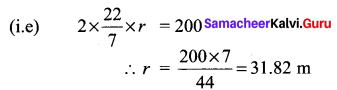
Distance travelled in 5 rounds = 1 km = 1000 m
Distance travelled in 1 round = \(\frac{1000}{5}\) = 200 m
Let the radius of the circular path be r metre
So 2πr = 200
Samacheer Kalvi 11th Maths Solutions Chapter 3 Trigonometry Ex 3.2 4

Question 4.
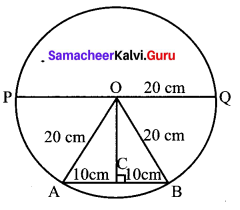
In a circle of diameter 40 cm, a chord is of length 20 cm. Find the length of the minor arc of the chord.
Solution:
O = centre of the circle
PQ = diameter = 40 cm
∴ OQ = 20 cm
radius = 20 cm
⇒ OA = OB = 20 cm
chord AB = 20 cm
OC ⊥ r AB
∴ AC = CB = 10 cm
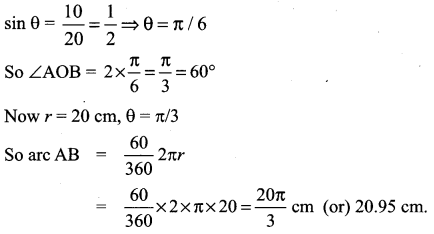
Now from the right angled triangle OCB
Samacheer Kalvi 11th Maths Solutions Chapter 3 Trigonometry Ex 3.2 20
Samacheer Kalvi 11th Maths Solutions Chapter 3 Trigonometry Ex 3.2 21

Samacheer Kalvi 11th Maths Solutions Chapter 3 Trigonometry Ex 3.2

Question 5.
Find the degree measure of the angle subtended at the centre of circle of radius 100 cm by an arc of length 22 cm.
Solution:
r = 100 cm; arc length = 22 cm
Samacheer Kalvi 11th Maths Solutions Chapter 3 Trigonometry Ex 3.2 22
Question 6.
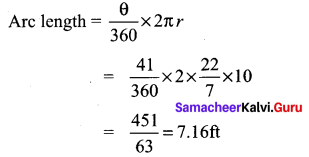
What is the length of the arc intercepted by a central angle of measure 41° in a circle of radius 10 ft?
Solution:
θ = 41°, r = 10 ft
Samacheer Kalvi 11th Maths Solutions Chapter 3 Trigonometry Ex 3.2 23

Question 7.
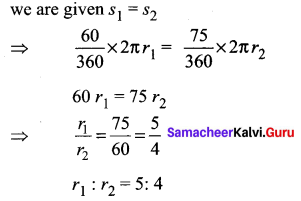
If in two circles, arcs of the same length subtend angles 60° and 75° at the centre, find the ratio of their radii.
Solution:
Let the two radii be r1 and r2
The central angles arc 60° and 75°
The arc lengths be s1 and s2
Samacheer Kalvi 11th Maths Solutions Chapter 3 Trigonometry Ex 3.2 24
So their radii are in the ratio 5 : 4.

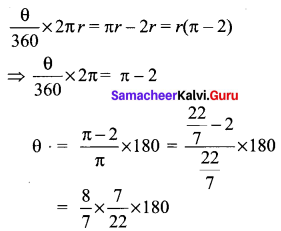
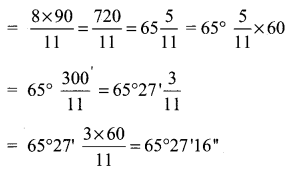
Question 8.
The perimeter of a certain sector of a circle is equal to the length of the arc of a semicircle having the same radius. Express the angle of the sector in degrees, minutes and seconds.
Solution:
Let r be the radius and so perimeter of a sector = l + 2r
Length of arc of the semicircle = πr
we are given l + 2r = πr
(i.e) l = πr – 2r
Samacheer Kalvi 11th Maths Solutions Chapter 3 Trigonometry Ex 3.2 25
Samacheer Kalvi 11th Maths Solutions Chapter 3 Trigonometry Ex 3.2 26

Question 9.
An airplane propeller rotates 1000 times per minute. Find the number of degrees that a point on the edge of the propeller will rotate in 1 second.
Solution:
Number of rotations in 1 min = 1000
Samacheer Kalvi 11th Maths Solutions Chapter 3 Trigonometry Ex 3.2 28
The angle rotated in 1 rotation = 360°
Samacheer Kalvi 11th Maths Solutions Chapter 3 Trigonometry Ex 3.2 29

Samacheer Kalvi 11th Maths Solutions Chapter 3 Trigonometry Ex 3.2

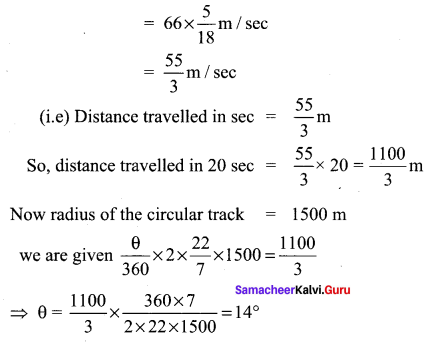
Question 10.
A train is moving on a circular track of 1500 m radius at the rate of 66 km / hr. What angle will it turn in 20 seconds?
Solution:
Speed of the train = 66 km/hr
Samacheer Kalvi 11th Maths Solutions Chapter 3 Trigonometry Ex 3.2 30

Question 11.
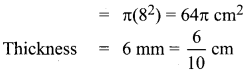
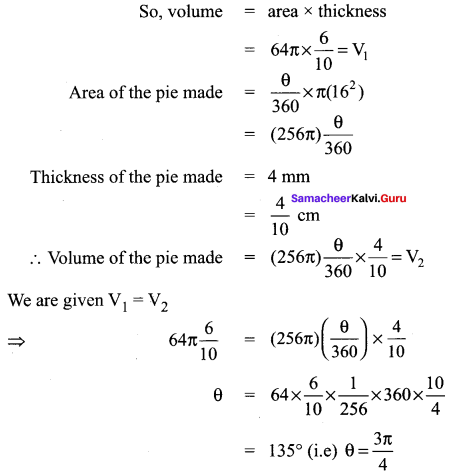
A circular metallic plate of radius 8 cm and thickness 6 mm is melted and molded into a pie (a sector of the circle with thickness) of radius 16 cm and thickness 4 mm. Find the angle of the sector.
Solution:
Area of the circular plate melted
Samacheer Kalvi 11th Maths Solutions Chapter 3 Trigonometry Ex 3.2 31
Samacheer Kalvi 11th Maths Solutions Chapter 3 Trigonometry Ex 3.2 32

Samacheer Kalvi 11th Maths Solutions Chapter 3 Trigonometry Ex 3.2 Additional Questions

Question 1.
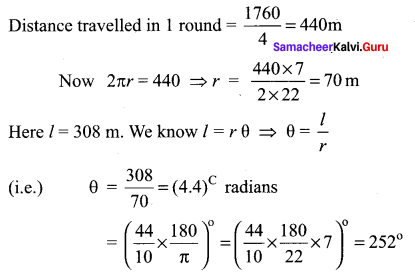
An athlete runs 4 times around a circular running track to describe 1760 m. What is the (radius of the tract) degrees subtended at the centre of the circle, after he has run a distance of 308 m?
Solution:
[Hint: Distance travelled in 4 rounds = 1760 m]
Samacheer Kalvi 11th Maths Solutions Chapter 3 Trigonometry Ex 3.2 33

Samacheer Kalvi 11th Maths Solutions Chapter 3 Trigonometry Ex 3.2

Question 2.
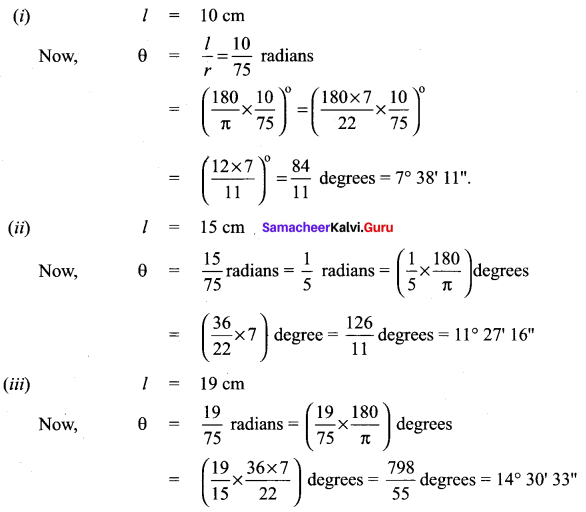
Find the angle through which a pendulum swings if its length is 75 cm and the tip describes an arc of length
(i) 10 cm
(ii) 15 cm
(iii) 19 cm
Solution:
Here, r = 75 cm
Samacheer Kalvi 11th Maths Solutions Chapter 3 Trigonometry Ex 3.2 34

Question 3.
The angles of a quadrilateral are in A.P and the greatest angle is 120°. Express the other angles in radians.
Solution:
Let the angles of the quadrilateral be a°, (a + d)°, (a + 2d)° and (a + 3d)°.
Since sum of all angles of a quadrilateral is 360°, we have .
a° + (a + d)° + (a + 2 d)° + (a + 3 d)° = 360° ⇒ 4a + 6d = 360°
⇒ 2a + 3d = 180° …(1)
Now, greatest angle is 120°
So, a + 3d = 120° …(2)
Solving (1) and (2), we have
a = 60°, d = 20°
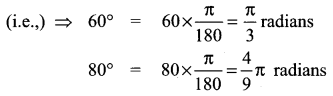
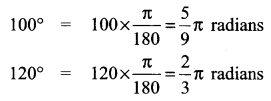
Hence, the angles are 60°, 80°, 100°, 120°.
Samacheer Kalvi 11th Maths Solutions Chapter 3 Trigonometry Ex 3.2 60
Samacheer Kalvi 11th Maths Solutions Chapter 3 Trigonometry Ex 3.2 61

Question 4.
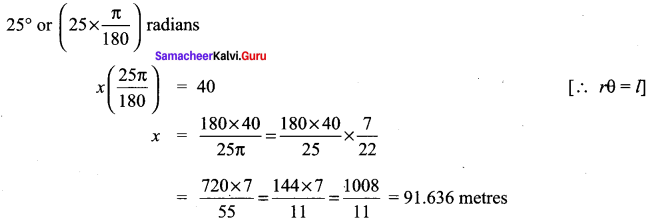
A railroad curve is to be laid out on a circle. What radius should be used if the track is to change direction by 25° in a distance of 40 metres?
Solution:
Let the radius of the circle on which the railroad curve is to be laid down be x metres and the angle subtended by it at the centre is
Samacheer Kalvi 11th Maths Solutions Chapter 3 Trigonometry Ex 3.2 62

Question 5.
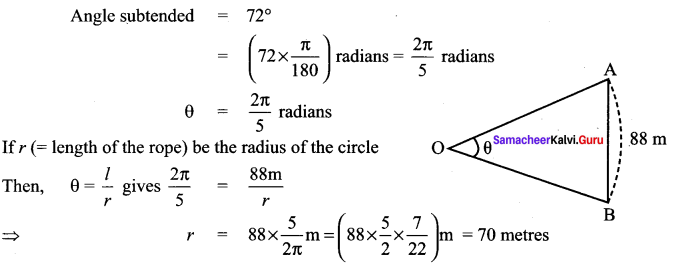
A horse is tied to a post by a rope. If the horse moves along a circular path always keeping the rope tight and describes 88 metres when it has traced out 72° at the centre, find the length of the rope.
Solution:
Let O be the post.
Let A, B be the two positions of the horse.
Here l, the length of the arc AB = 88 metres
Angle subtended = 72°
Samacheer Kalvi 11th Maths Solutions Chapter 3 Trigonometry Ex 3.2 63
Hence, the length of the rope = 70 metres

Samacheer Kalvi 11th Maths Solutions Chapter 3 Trigonometry Ex 3.2

Question 6.
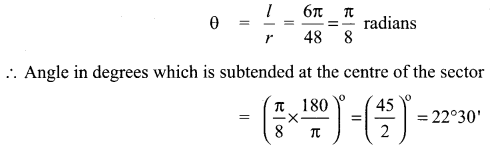
A circular wire of radius 3 cm is cut and bent so as to lie along the circumference of a sector whose radius is 48 cm. Find in degrees the angle which is subtended at the centre of the sector.
Solution:

Length of arc = Circumference of wire of radius = 3 cm
l = 2πr = 2π × 3 = 6π cm
The radius of the sector (r) = 48 cm
Samacheer Kalvi 11th Maths Solutions Chapter 3 Trigonometry Ex 3.2 64

Question 7.
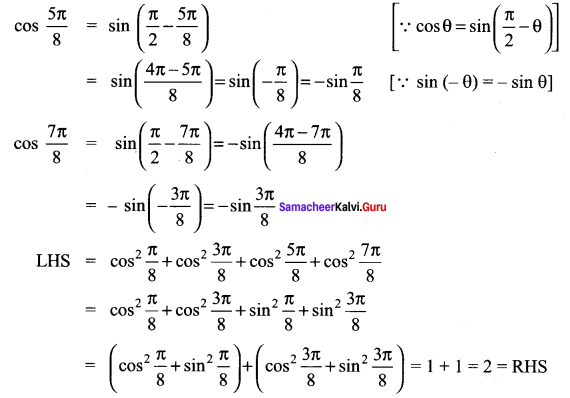
Samacheer Kalvi 11th Maths Solutions Chapter 3 Trigonometry Ex 3.2 65
Solution:
Samacheer Kalvi 11th Maths Solutions Chapter 3 Trigonometry Ex 3.2 66

Samacheer Kalvi 11th Maths Solutions Chapter 11 Integral Calculus Ex 11.12

You can Download Samacheer Kalvi 11th Maths Book Solutions Guide Pdf, Tamilnadu State Board help you to revise the complete Syllabus and score more marks in your examinations.

Tamilnadu Samacheer Kalvi 11th Maths Solutions Chapter 11 Integral Calculus Ex 11.12

Integrate the following with respect to x:
Question 1.
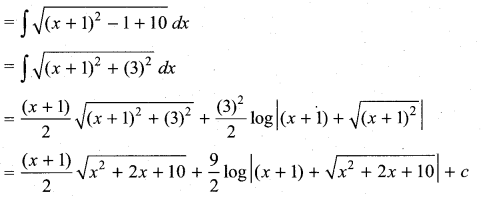
(i) \(\sqrt{x^{2}+2 x+10}\)
Solution:

Samacheer Kalvi 11th Maths Solutions Chapter 11 Integral Calculus Ex 11.12 1

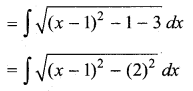
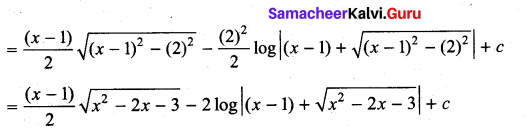
(ii) \(\sqrt{x^{2}-2 x-3}\)
Solution:

Samacheer Kalvi 11th Maths Solutions Chapter 11 Integral Calculus Ex 11.12 2
Samacheer Kalvi 11th Maths Solutions Chapter 11 Integral Calculus Ex 11.12 3

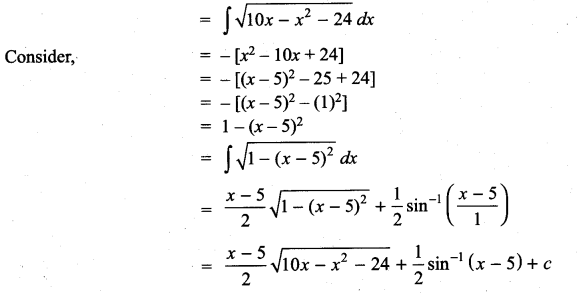
(iii) \(\sqrt{(6-x)(x-4)}\)
Solution:
Samacheer Kalvi 11th Maths Solutions Chapter 11 Integral Calculus Ex 11.12 4

Samacheer Kalvi 11th Maths Solutions Chapter 11 Integral Calculus Ex 11.12

Question 2.
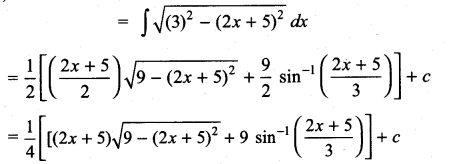
(i) \(\sqrt{9-(2 x+5)^{2}}\)
Solution:

Samacheer Kalvi 11th Maths Solutions Chapter 11 Integral Calculus Ex 11.12 5

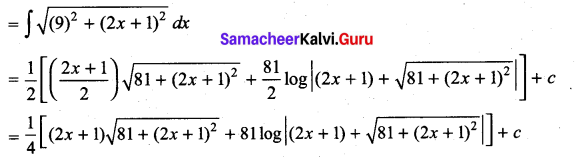
(ii) \(\sqrt{81+(2 x+1)^{2}}\)
Solution:
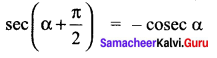
Samacheer Kalvi 11th Maths Solutions Chapter 11 Integral Calculus Ex 11.12 6

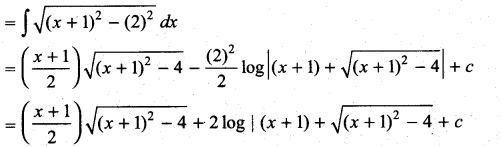
(iii) \(\sqrt{(x+1)^{2}-4}\)
Solution:

Samacheer Kalvi 11th Maths Solutions Chapter 11 Integral Calculus Ex 11.12 7

Samacheer Kalvi 11th Maths Solutions Chapter 11 Integral Calculus Ex 11.12 Additional Problems

Question 1.
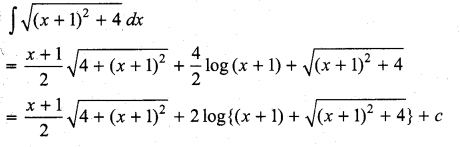
\(\sqrt{(x+1)^{2}+4}\)
Solution:
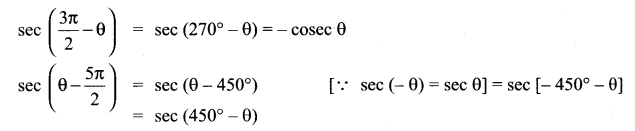
Samacheer Kalvi 11th Maths Solutions Chapter 11 Integral Calculus Ex 11.12 8

Question 2.
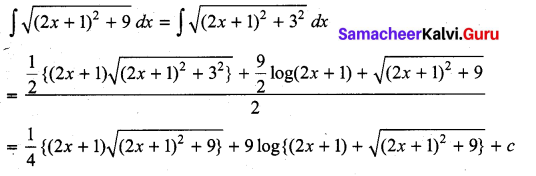
\(\sqrt{(2 x+1)^{2}+9}\)
Solution:
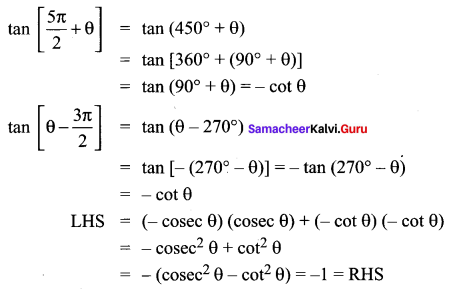
Samacheer Kalvi 11th Maths Solutions Chapter 11 Integral Calculus Ex 11.12 9

Question 3.
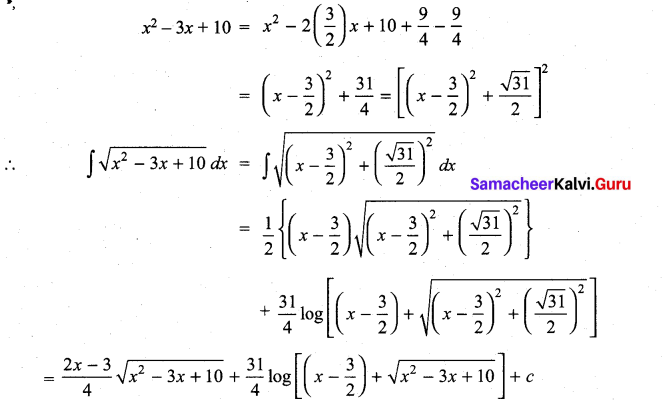
\(\sqrt{x^{2}-3 x+10}\)
Solution:

Samacheer Kalvi 11th Maths Solutions Chapter 11 Integral Calculus Ex 11.12 10

Samacheer Kalvi 11th Maths Solutions Chapter 11 Integral Calculus Ex 11.12

Question 4.
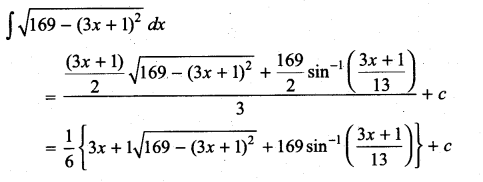
\(\sqrt{169-(3 x+1)^{2}}\)
Solution:

Samacheer Kalvi 11th Maths Solutions Chapter 11 Integral Calculus Ex 11.12 11

Question 5.
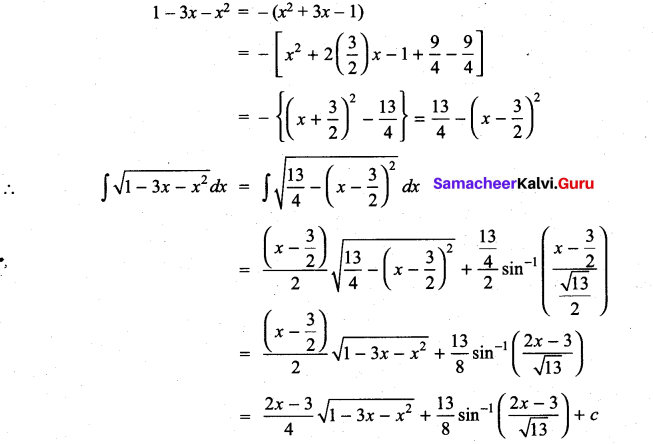
\(\sqrt{1-3 x-x^{2}}\)
Solution:
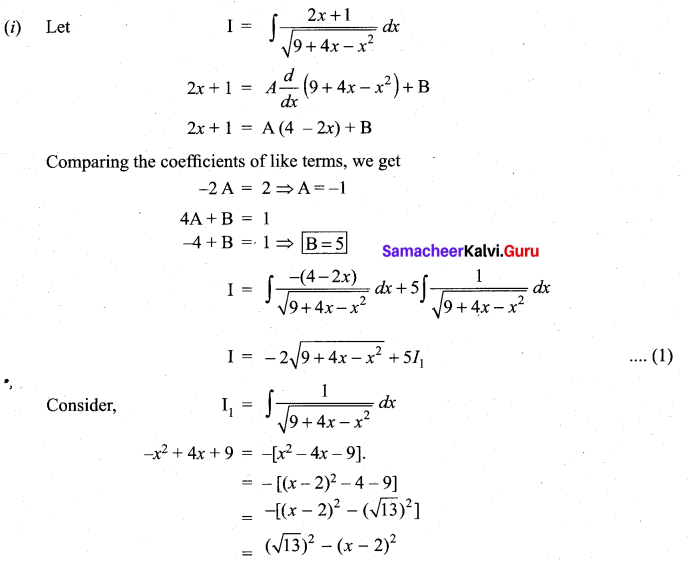
Samacheer Kalvi 11th Maths Solutions Chapter 11 Integral Calculus Ex 11.12 12

Question 6.
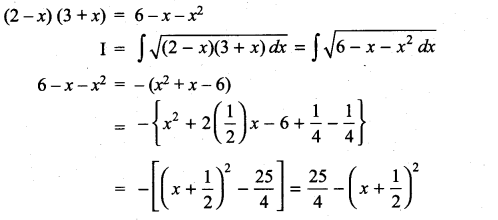
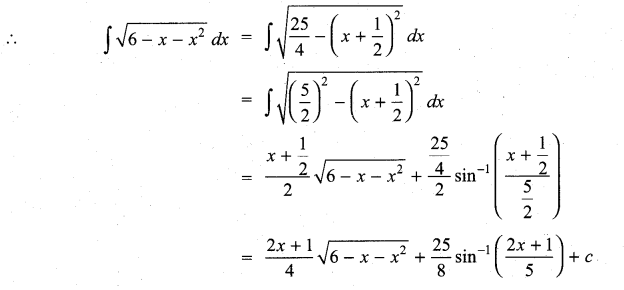
\(\sqrt{(2-x)(3+x)}\)
Solution:

Samacheer Kalvi 11th Maths Solutions Chapter 11 Integral Calculus Ex 11.12 13
Samacheer Kalvi 11th Maths Solutions Chapter 11 Integral Calculus Ex 11.12 14

Samacheer Kalvi 11th Maths Solutions Chapter 11 Integral Calculus Ex 11.11

You can Download Samacheer Kalvi 11th Maths Book Solutions Guide Pdf, Tamilnadu State Board help you to revise the complete Syllabus and score more marks in your examinations.

Tamilnadu Samacheer Kalvi 11th Maths Solutions Chapter 11 Integral Calculus Ex 11.11

Integrate the following with respect to x:
Question 1.
Samacheer Kalvi 11th Maths Solutions Chapter 11 Integral Calculus Ex 11.11 1
Solution:
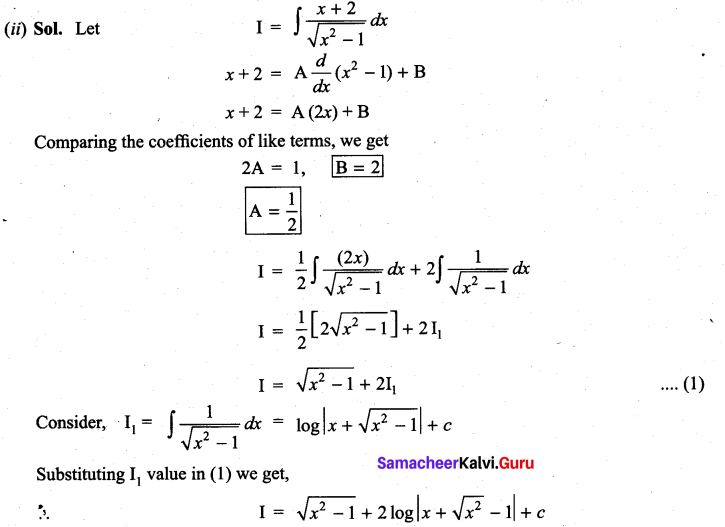
Samacheer Kalvi 11th Maths Solutions Chapter 11 Integral Calculus Ex 11.11 2
Samacheer Kalvi 11th Maths Solutions Chapter 11 Integral Calculus Ex 11.11 3
Samacheer Kalvi 11th Maths Solutions Chapter 11 Integral Calculus Ex 11.11 4
Samacheer Kalvi 11th Maths Solutions Chapter 11 Integral Calculus Ex 11.11 5
Samacheer Kalvi 11th Maths Solutions Chapter 11 Integral Calculus Ex 11.11 6
Samacheer Kalvi 11th Maths Solutions Chapter 11 Integral Calculus Ex 11.11 7
Samacheer Kalvi 11th Maths Solutions Chapter 11 Integral Calculus Ex 11.11 8

Samacheer Kalvi 11th Maths Solutions Chapter 11 Integral Calculus Ex 11.11

Question 2.
Samacheer Kalvi 11th Maths Solutions Chapter 11 Integral Calculus Ex 11.11 9
Solution:
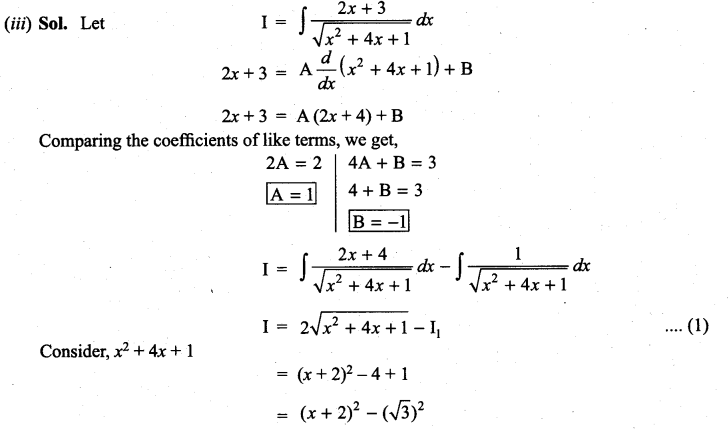
Samacheer Kalvi 11th Maths Solutions Chapter 11 Integral Calculus Ex 11.11 10
Samacheer Kalvi 11th Maths Solutions Chapter 11 Integral Calculus Ex 11.11 11
Samacheer Kalvi 11th Maths Solutions Chapter 11 Integral Calculus Ex 11.11 12
Samacheer Kalvi 11th Maths Solutions Chapter 11 Integral Calculus Ex 11.11 13
Samacheer Kalvi 11th Maths Solutions Chapter 11 Integral Calculus Ex 11.11 14

Samacheer Kalvi 11th Maths Solutions Chapter 11 Integral Calculus Ex 11.11 Additional Problems

Question 1.
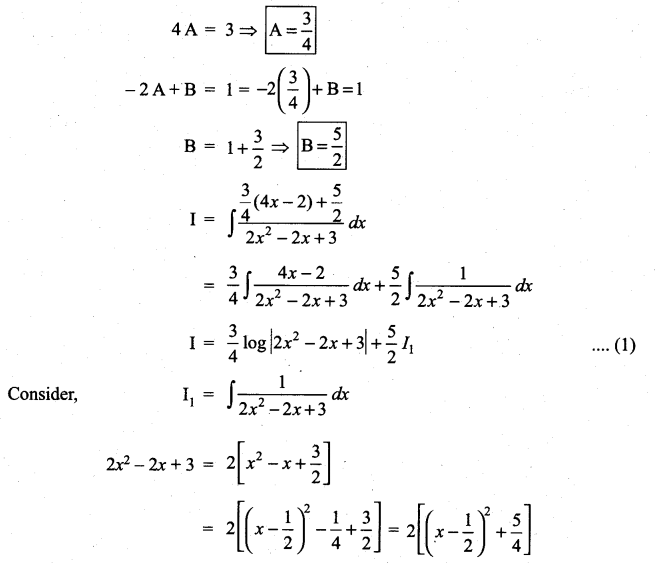
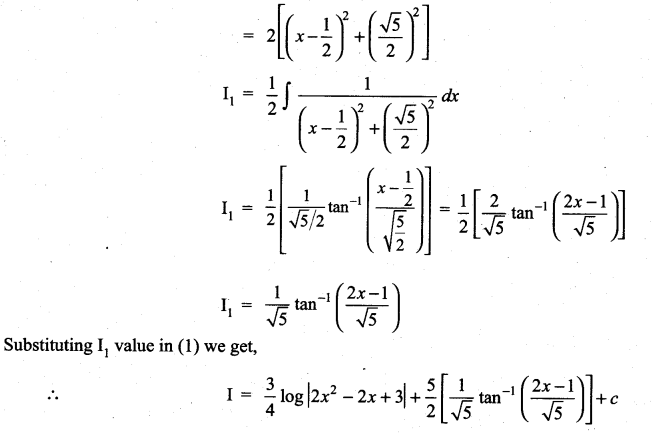
\(\frac{2 x-1}{2 x^{2}+x+3}\)
Solution:
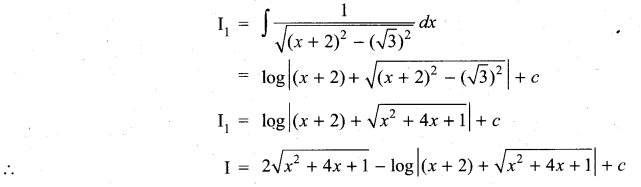
Samacheer Kalvi 11th Maths Solutions Chapter 11 Integral Calculus Ex 11.11 15
Samacheer Kalvi 11th Maths Solutions Chapter 11 Integral Calculus Ex 11.11 16
Samacheer Kalvi 11th Maths Solutions Chapter 11 Integral Calculus Ex 11.11 17

Question 2.
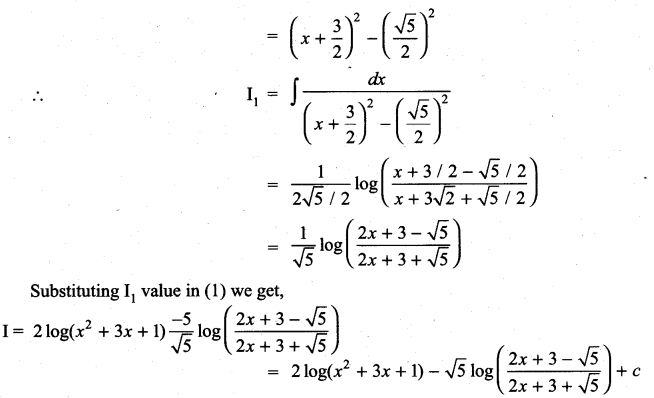
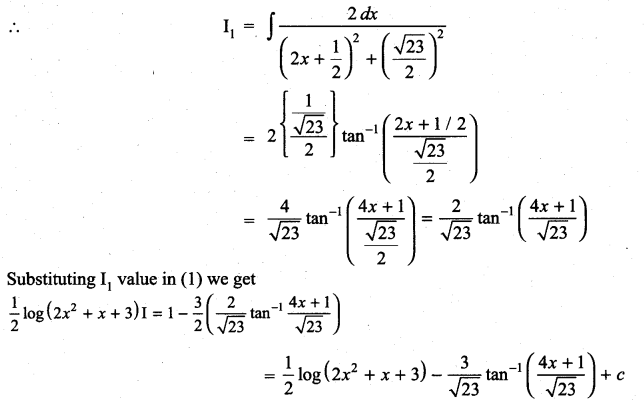
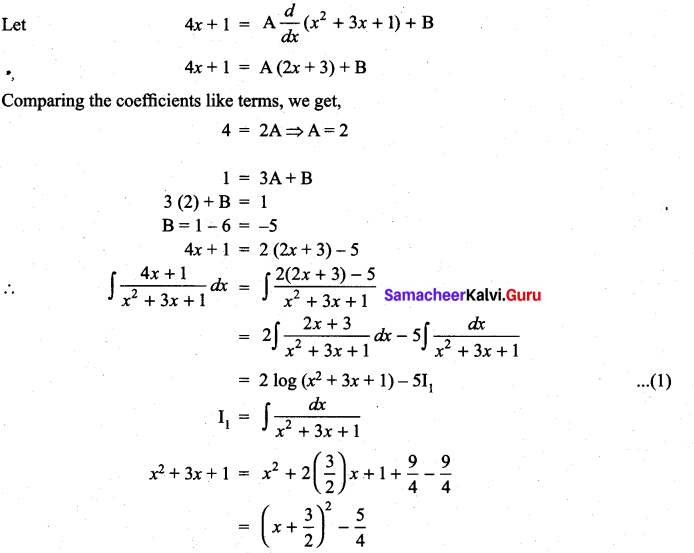
\(\frac{4 x+1}{x^{2}+3 x+1}\)
Solution:
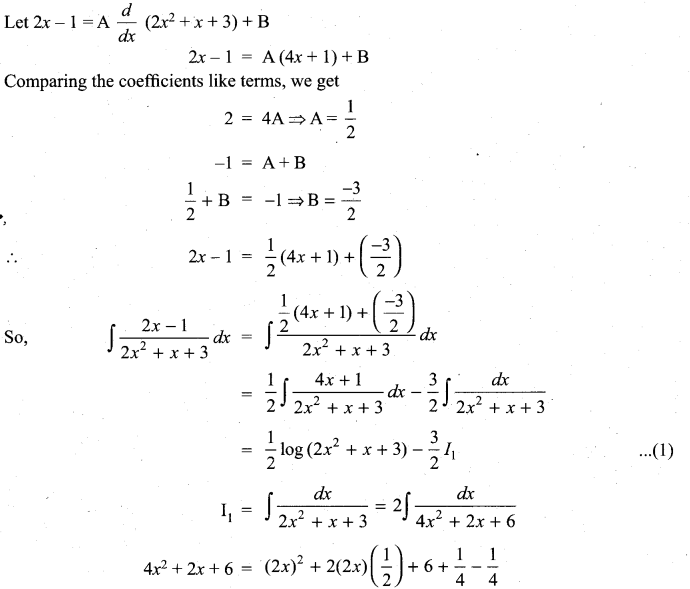
Samacheer Kalvi 11th Maths Solutions Chapter 11 Integral Calculus Ex 11.11 18
Samacheer Kalvi 11th Maths Solutions Chapter 11 Integral Calculus Ex 11.11 19

Samacheer Kalvi 11th Maths Solutions Chapter 11 Integral Calculus Ex 11.11

Question 3.
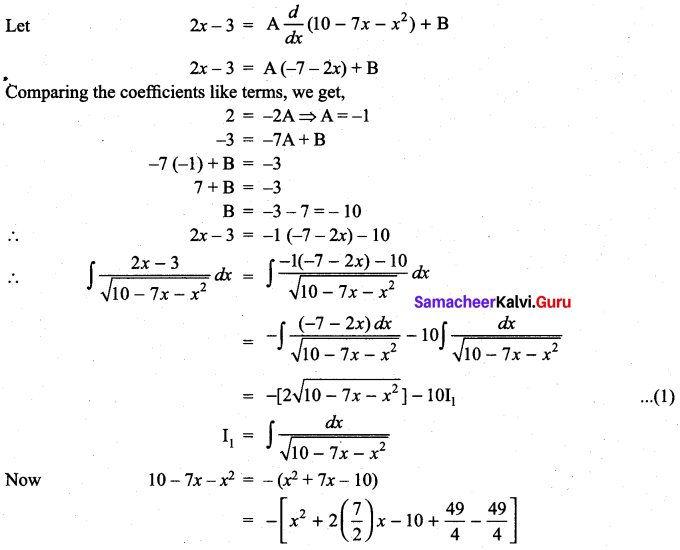
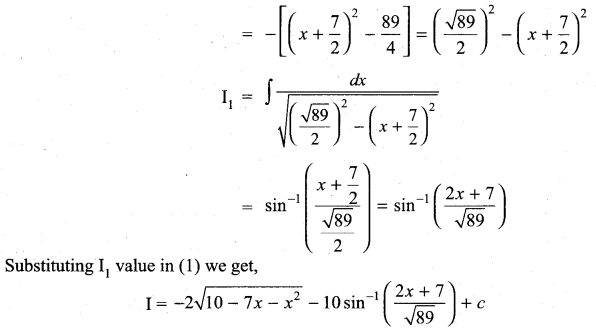
\(\frac{2 x-3}{\sqrt{10-7 x-x^{2}}}\)
Solution:

Samacheer Kalvi 11th Maths Solutions Chapter 11 Integral Calculus Ex 11.11 20
Samacheer Kalvi 11th Maths Solutions Chapter 11 Integral Calculus Ex 11.11 21

Question 4.
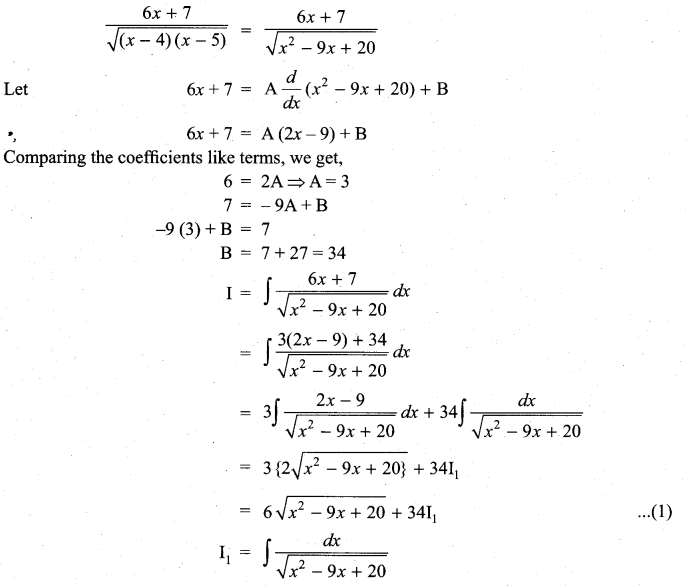
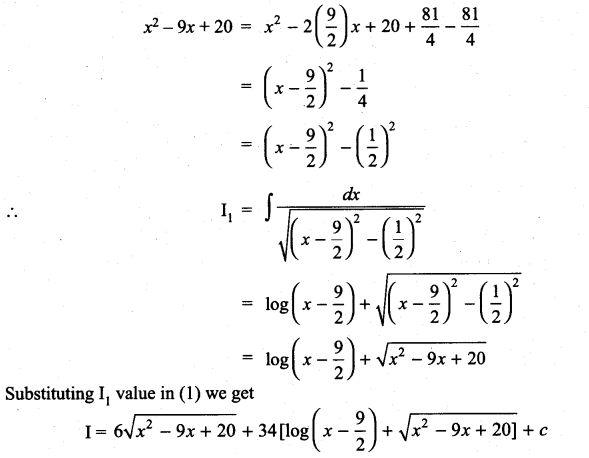
\(\frac{6 x+7}{\sqrt{(x-4)(x-5)}}\)
Solution:
Samacheer Kalvi 11th Maths Solutions Chapter 11 Integral Calculus Ex 11.11 22
Samacheer Kalvi 11th Maths Solutions Chapter 11 Integral Calculus Ex 11.11 23

Samacheer Kalvi 11th Maths Solutions Chapter 11 Integral Calculus Ex 11.10

You can Download Samacheer Kalvi 11th Maths Book Solutions Guide Pdf, Tamilnadu State Board help you to revise the complete Syllabus and score more marks in your examinations.

Tamilnadu Samacheer Kalvi 11th Maths Solutions Chapter 11 Integral Calculus Ex 11.10

Find the integrals of the following
Question 1.
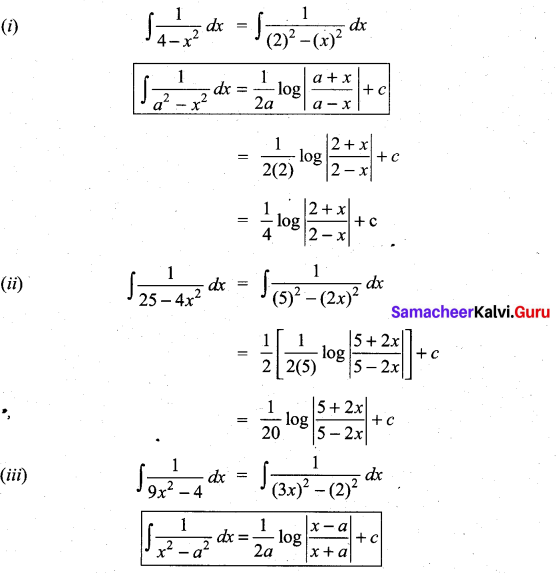
(i) \(\frac{1}{4-x^{2}}\)
(ii) \(\frac{1}{25-4 x^{2}}\)
(iii) \(\frac{1}{9 x^{2}-4}\)
Solution:
Samacheer Kalvi 11th Maths Solutions Chapter 11 Integral Calculus Ex 11.10 1
Samacheer Kalvi 11th Maths Solutions Chapter 11 Integral Calculus Ex 11.10 2

Samacheer Kalvi 11th Maths Solutions Chapter 11 Integral Calculus Ex 11.10

Question 2.
Samacheer Kalvi 11th Maths Solutions Chapter 11 Integral Calculus Ex 11.10 3
Solution:
(i) Let I = \(\int \frac{1}{6 x-7-x^{2}} d x\)
Consider, -x2 + 6x – 7 = -[x2 – 6x + 4]
= -[(x – 3)2 – 9 + 7]
Samacheer Kalvi 11th Maths Solutions Chapter 11 Integral Calculus Ex 11.10 4
Samacheer Kalvi 11th Maths Solutions Chapter 11 Integral Calculus Ex 11.10 5

Question 3.
Samacheer Kalvi 11th Maths Solutions Chapter 11 Integral Calculus Ex 11.10 6
Solution:
Samacheer Kalvi 11th Maths Solutions Chapter 11 Integral Calculus Ex 11.10 7
Samacheer Kalvi 11th Maths Solutions Chapter 11 Integral Calculus Ex 11.10 8

Samacheer Kalvi 11th Maths Solutions Chapter 11 Integral Calculus Ex 11.10 Additional Problems

Question 1.
Samacheer Kalvi 11th Maths Solutions Chapter 11 Integral Calculus Ex 11.10 9
Solution:
Samacheer Kalvi 11th Maths Solutions Chapter 11 Integral Calculus Ex 11.10 10
Samacheer Kalvi 11th Maths Solutions Chapter 11 Integral Calculus Ex 11.10 11

Question 2.
Samacheer Kalvi 11th Maths Solutions Chapter 11 Integral Calculus Ex 11.10 12
Solution:
Samacheer Kalvi 11th Maths Solutions Chapter 11 Integral Calculus Ex 11.10 13
Samacheer Kalvi 11th Maths Solutions Chapter 11 Integral Calculus Ex 11.10 14
Samacheer Kalvi 11th Maths Solutions Chapter 11 Integral Calculus Ex 11.10 15
Samacheer Kalvi 11th Maths Solutions Chapter 11 Integral Calculus Ex 11.10 16

Samacheer Kalvi 11th Maths Solutions Chapter 11 Integral Calculus Ex 11.10

Question 3.
Samacheer Kalvi 11th Maths Solutions Chapter 11 Integral Calculus Ex 11.10 17
Solution:
Samacheer Kalvi 11th Maths Solutions Chapter 11 Integral Calculus Ex 11.10 18

Samacheer Kalvi 11th Maths Solutions Chapter 2 Basic Algebra Ex 2.13

You can Download Samacheer Kalvi 11th Maths Book Solutions Guide Pdf, Tamilnadu State Board help you to revise the complete Syllabus and score more marks in your examinations.

Tamilnadu Samacheer Kalvi 11th Maths Solutions Chapter 2 Basic Algebra Ex 2.13

Choose the correct or the most suitable questions.

Question 1.
If |x + 2| ≤ 9, then x belongs to
(a) (-∞, -7)
(b) [-11, 7]
(c) (-∞, -7) ∪ [11, ∞)
(d)(-11, 7)
Solution:
(b) [-11, 7]
Hint:
-x – 2 ≤ 9 x + 2 ≤ 9
-x < 9 + 2 = 11 x ≤ 9 – 2 = 7
⇒ x ≥ -11
so x ∈ [-11, 7]

Question 2.
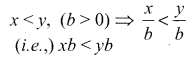
Given that x, y and b are real numbers x < y, b ≥ 0, then ……..
(a) xb < yb (b) xb > yb
(c) xb ≤ vb
(d) xlb ≥ ylb
Solution:
(a) xb < yb
Hint:
Samacheer Kalvi 11th Maths Solutions Chapter 2 Basic Algebra Ex 2.13 1

Question 3.
Samacheer Kalvi 11th Maths Solutions Chapter 2 Basic Algebra Ex 2.13 3
(a) [2, ∞]
(b) (2, ∞)
(c) (-∞, 2)
(d) (-2, ∞)
Solution:
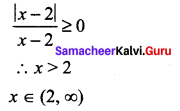
(b) (2, ∞)
Hint:
Samacheer Kalvi 11th Maths Solutions Chapter 2 Basic Algebra Ex 2.13 4

Question 4.
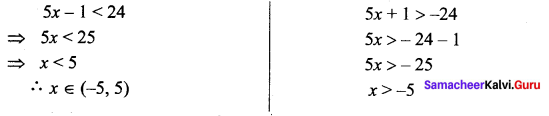
The solution of 5x – 1 < 24 and 5x + 1 > -24 is …….
(a) (4, 5)
(b) (-5, -4)
(c) (-5, 5)
(d) (-5, 4)
Solution:
(c) (-5, 5)
Hint:
Samacheer Kalvi 11th Maths Solutions Chapter 2 Basic Algebra Ex 2.13 5

Samacheer Kalvi 11th Maths Solutions Chapter 2 Basic Algebra Ex 2.13

Question 5.
The solution set of the following inequality |x – 1| ≥ |x – 3| is …….
(a) [0, 2]
(b) (2, ∞)
(c) (0, 2)
(d) (-∞, 2)
Solution:
(b) (2, ∞)

Question 6.
Samacheer Kalvi 11th Maths Solutions Chapter 2 Basic Algebra Ex 2.13 6
(a) 16
(b) 18
(c) 9
(d) 12
Solution:
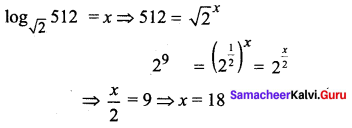
(b) 18
Hint:
Samacheer Kalvi 11th Maths Solutions Chapter 2 Basic Algebra Ex 2.13 7

Question 7.
Samacheer Kalvi 11th Maths Solutions Chapter 2 Basic Algebra Ex 2.13 8
(a) -2
(b) -8
(c) -4
(d) -9
Solution:
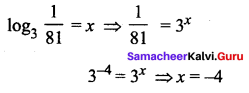
(c) -4
Hint:
Samacheer Kalvi 11th Maths Solutions Chapter 2 Basic Algebra Ex 2.13 9

Question 8.
Samacheer Kalvi 11th Maths Solutions Chapter 2 Basic Algebra Ex 2.13 10
(a) 0.5
(b) 2.5
(c) 1.5
(d) 1.25
Solution:
(a) 0.5
Hint:
Samacheer Kalvi 11th Maths Solutions Chapter 2 Basic Algebra Ex 2.13 11

Question 9.
Samacheer Kalvi 11th Maths Solutions Chapter 2 Basic Algebra Ex 2.13 12
(a) 2
(b) 1
(c) 3
(d) 4
Solution:
(b) 1
Hint:
Samacheer Kalvi 11th Maths Solutions Chapter 2 Basic Algebra Ex 2.13 13

Samacheer Kalvi 11th Maths Solutions Chapter 2 Basic Algebra Ex 2.13

Question 10.
If 3 is the logarithm of 343, then the base is ……
(a) 5
(b) 7
(c) 6
(d) 9
Solution:
(b) 7
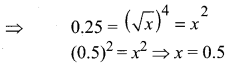
Hint.
⇒ logx343 = 3 ⇒ 343 = x3
(.i.e.,) 73 = x3 ⇒ x = 7
⇒ x = 7

Question 11.
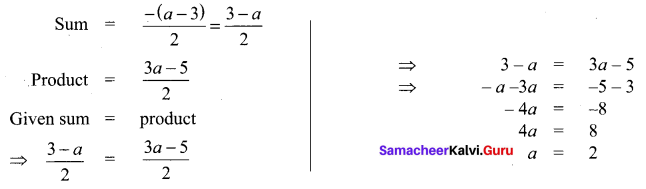
Find a so that the sum and product of the roots of the equation 2x2 + (a – 3)x + 3a – 5 = 0 are equal is ……..
(a) 1
(b) 2
(c) 0
(d) 4
Solution:
(b) 2
Hint:
Samacheer Kalvi 11th Maths Solutions Chapter 2 Basic Algebra Ex 2.13 14

Question 12.
If a and b are the roots of the equation x2 – kx + 16 = 0 and satisfy a2 + b2 = 32, then the value of k is ……
(a) 10
(b) -8
(c) (-8, 8)
(d) 6
Solution:
(c) -8, 8
Hint:
a + b = k ….(1) ab = 16 ….(2)
a2 + b2 = (a + b)2 – 2ab = 32 .
k2 – 32 = 32 ⇒ k2 = 64 ⇒ k = ±8

Question 13.
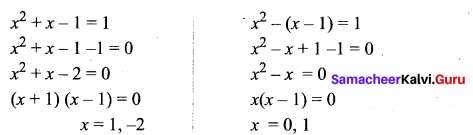
The number of solutions of x2 + |x – 1| = 1 is ………
(a) 1
(b) 0
(c) 2
(d) 3
Solution:
(c) 2
Samacheer Kalvi 11th Maths Solutions Chapter 2 Basic Algebra Ex 2.13 15
We have two solutions 0, 1

Question 14.
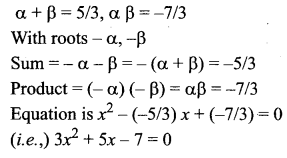
The equations whose roots are numerically equal but opposite in sign to the roots of 3x2 – 5x – 7 = 0 is ……
(a) 3x2 – 5x – 7 = 0
(b) 3x2 + 5x – 7 = 0
(c) 3x2 – 5x + 7 = 0
(d) 3x2 + x – 7 = 0
Solution:
(b) 3x2 + 5x – 7 = 0
Hint:
Samacheer Kalvi 11th Maths Solutions Chapter 2 Basic Algebra Ex 2.13 16

Samacheer Kalvi 11th Maths Solutions Chapter 2 Basic Algebra Ex 2.13

Question 15.
If 8 and 2 are the roots of x2 + ax + c = 0 and 3, 3 are the roots of x2 + ax + b = 0, then the roots of the equation x2 + ax + b = 0 are …….
(a) 1, 2
(b) -1, 1
(c) 9, 1
(d) -1, 2
Solution:
(c) 9, 1
Hint:
Sum = 8 + 2 = 10 = -a ⇒ a = -10
Product = 3 × 3 = 9 = b ⇒ b = 9
Now the equation x2 + ax + b = 0
⇒ x2 – 10x + 9 = 0
⇒ (x- 9) (x – 1) = 0
x = 1 or 9

Question 16.
If a and b are the real roots of the equation x2 – kx + c = 0, then the distance
between the points (a, 0) and (b, 0) is ……..
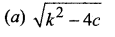
Samacheer Kalvi 11th Maths Solutions Chapter 2 Basic Algebra Ex 2.13 17
Solution:
Samacheer Kalvi 11th Maths Solutions Chapter 2 Basic Algebra Ex 2.13 18
Hint:
a + b = k, ab = c
Samacheer Kalvi 11th Maths Solutions Chapter 2 Basic Algebra Ex 2.13 19

Question 17.
Samacheer Kalvi 11th Maths Solutions Chapter 2 Basic Algebra Ex 2.13 20
(a) 1
(b) 2
(c) 3
(d) 4
Solution:
(c) 3
Samacheer Kalvi 11th Maths Solutions Chapter 2 Basic Algebra Ex 2.13 21

Question 18.
Samacheer Kalvi 11th Maths Solutions Chapter 2 Basic Algebra Ex 2.13 22
(a) -1/2
(b) -2/3
(c) 1/2
(d) 2/3
Solution:
(a) -1/2
Hint:
Samacheer Kalvi 11th Maths Solutions Chapter 2 Basic Algebra Ex 2.13 23

Samacheer Kalvi 11th Maths Solutions Chapter 2 Basic Algebra Ex 2.13

Question 19.
The number of real roots of (x + 3)4 + (x + 5)4 = 16 is ……
(a) 4
(b) 2
(c) 3
(d) 0
Solution:
(a) 4
Hint:
The equation is (x + 3)4 + (x + 5)4 = 16
(x + 3)4 + (x + 5)4 = 24
This is biquadratic equation. It has 4 roots.

Question 20.
The value of log3 11 . log11 13 . log13 15 . log15 27 . log27 81 is …….
(a) 1
(b) 2
(c) 3
(d) 4
Solution:
(d) 4
Solution:
(d) 4
Hint.
Samacheer Kalvi 11th Maths Solutions Chapter 2 Basic Algebra Ex 2.13 50

Samacheer Kalvi 11th Maths Solutions Chapter 11 Integral Calculus Ex 11.9

You can Download Samacheer Kalvi 11th Maths Book Solutions Guide Pdf, Tamilnadu State Board help you to revise the complete Syllabus and score more marks in your examinations.

Tamilnadu Samacheer Kalvi 11th Maths Solutions Chapter 11 Integral Calculus Ex 11.9

Integrate the following with respect to x
Question 1.
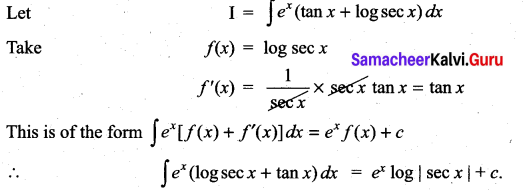
ex (tan x + log sec x)
Solution:
Samacheer Kalvi 11th Maths Solutions Chapter 11 Integral Calculus Ex 11.9 1

Question 2.
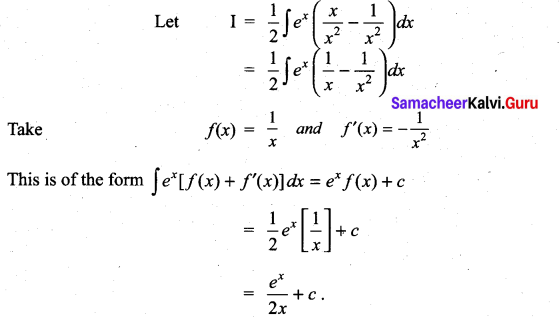
ex\(\left(\frac{x-1}{2 x^{2}}\right)\)
Solution:
Samacheer Kalvi 11th Maths Solutions Chapter 11 Integral Calculus Ex 11.9 2

Question 3.
ex sec x (1 + tan x)
Solution:
Let I = \(\mathrm{I}=\int e^{x}(\sec x+\sec x \tan x) d x\)
Take f(x) = sec x
f ‘ (x) = sec x tan x
This is of the form of \(\int e^{x}\left[f(x)+f^{\prime}(x)\right] d x\) = ex f(x) + c
= ex sec x + c

Samacheer Kalvi 11th Maths Solutions Chapter 11 Integral Calculus Ex 11.9

Question 4.
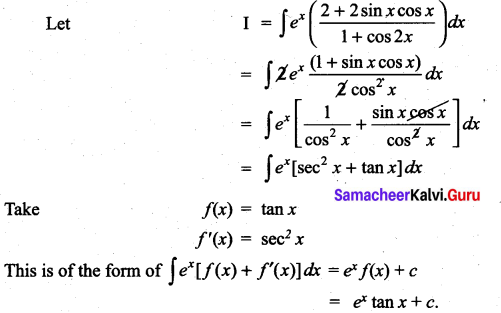
ex \(\left(\frac{2+\sin 2 x}{1+\cos 2 x}\right)\)
Solution:
Samacheer Kalvi 11th Maths Solutions Chapter 11 Integral Calculus Ex 11.9 3

Question 5.
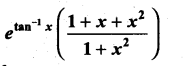
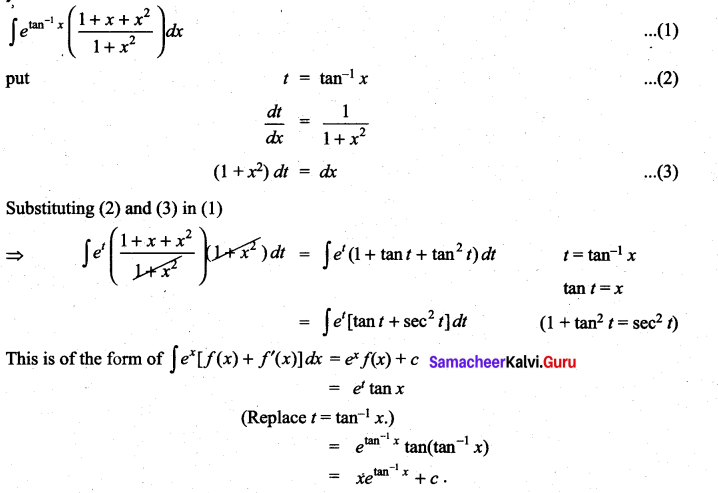
Samacheer Kalvi 11th Maths Solutions Chapter 11 Integral Calculus Ex 11.9 4
Solution:
Samacheer Kalvi 11th Maths Solutions Chapter 11 Integral Calculus Ex 11.9 5

Question 6.
Samacheer Kalvi 11th Maths Solutions Chapter 11 Integral Calculus Ex 11.9 6
Solution:
Samacheer Kalvi 11th Maths Solutions Chapter 11 Integral Calculus Ex 11.9 7