Samacheer Kalvi 8th Maths Solutions Term 1 Chapter 5 Information Processing Ex 5.3

Students can Download Maths Chapter 5 Information Processing Ex 5.3 Questions and Answers, Notes Pdf, Samacheer Kalvi 8th Maths Book Solutions Guide Pdf helps you to revise the complete Tamilnadu State Board New Syllabus and score more marks in your examinations.
Samacheer Kalvi 8th Maths Solutions Term 1 Chapter 5 Information Processing Ex 5.3

Tamilnadu Samacheer Kalvi 8th Maths Solutions Term 1 Chapter 5 Information Processing Ex 5.3

MISCELLANEOUS QUESTIONS

Question 1.
Shanthi has 5 chudithar sets and 4 Frocks. In how many possible ways, can she wear either a chudithar or a frock ?
Solution:
Shanthi his 5 chudidhar sets and 4 frocks.
She wear either chudidhar or a frock.
∴ Total possible ways = 5 + 4 = 9 ways

Question 2.
In a Higher Secondary School, the following types of groups are available in XI standard
I. Science Group:
(i) Physics, Chemistry, Biology and Mathematics
(ii) Physics, Chemistry, Mathematics and Computer Science
(iii) Physics, Chemistry, Biology and Home Science
II. Arts Group:
(i) 1. Accountancy, Commerce, Economics and Business Maths
(ii) 2. Accountancy, Commerce, Economics and Computer Science
(iii) 3. History, Geography, Economics and Commerce
III. Vocational Group:
(i) Nursing – Biology, Theory, Practical I and Practical II
(ii) Textiles and Dress Designing – Home Science, Theory, Practical I and Practical II
In how many possible ways, can a student choose the group?
Solution:
The student either select any one of science group in 3 ways or any of the arts group in 3 ways or any of the vocational group in 2 ways.
∴ Total possible ways = 3 + 3 + 2 = 8 ways

Samacheer Kalvi 8th Maths Solutions Term 1 Chapter 5 Information Processing Ex 5.3

Question 3.
An examination paper has 3 sections, each with five instructed to answer one question from each section. In can the questions be answered?
Solution:
The tree diagram for this may be
Samacheer Kalvi 8th Maths Term 1 Chapter 5 Information Processing Ex 5.3 1
∴ Number of possible ways to select one questions from each of 3 sections is 3 × 5 = 15 ways.

Question 4.
On a sports day, students must take also part in one of the one track events 100m Running and 4 × 100 m Relay. He must take part of any of the field events Long Jump, High Jump and Javelin Throw. In how many different ways can the student take part in the given events?
Solution:
Number of track events ⇒ (100m running, 4 × 100 m Relay) 2.
Number of field events ⇒ (Long jump, High jump, Javelin Throw) 3.
Students can take part in the given events in 2 × 3 = 6 ways.

Question 5.
The given spinner is spun twice and the two numbers got are used to form a 2 digit number. How many different 2 digits numbers are possible?
Samacheer Kalvi 8th Maths Term 1 Chapter 5 Information Processing Ex 5.3 6
Solution:
On the first spin we get any of the five numbers to form ones place then insecond spin the number got will fill 10’s place.
∴ Number of ways = 5 × 5 = 25 ways.
Removing the repetitions (11, 22, 33, 44, 55) once we get 25 – 5 = 20 ways.
20 different two digit numbers are possbile

Samacheer Kalvi 8th Maths Solutions Term 1 Chapter 5 Information Processing Ex 5.3

Question 6.
Colour the following pattern with as few colours as possible but make sure that no two adjacent sections are of the same colour.
Samacheer Kalvi 8th Maths Term 1 Chapter 5 Information Processing Ex 5.3 7
Solution:
Samacheer Kalvi 8th Maths Term 1 Chapter 5 Information Processing Ex 5.3 8

Samacheer Kalvi 8th Maths Solutions Term 1 Chapter 5 Information Processing Ex 5.2

Students can Download Maths Chapter 5 Information Processing Ex 5.2 Questions and Answers, Notes Pdf, Samacheer Kalvi 8th Maths Book Solutions Guide Pdf helps you to revise the complete Tamilnadu State Board New Syllabus and score more marks in your examinations.
Samacheer Kalvi 8th Maths Solutions Term 1 Chapter 5 Information Processing Ex 5.2

Tamilnadu Samacheer Kalvi 8th Maths Solutions Term 1 Chapter 5 Information Processing Ex 5.2

Question 1.
Colour the following patterns with as few colours as possible but make sure that no two adjacent sections are of the same colour.
Solution:
Samacheer Kalvi 8th Maths Term 1 Chapter 5 Information Processing Ex 5.2 1

Question 2.
Ramya wants to paint a pattern in her living room wall with a minimum budget. Help her to colour the pattern with 2 colours but make sure that no two adjacent boxes are the same colour. The pattern is shown in the picture.
Samacheer Kalvi 8th Maths Term 1 Chapter 5 Information Processing Ex 5.2 50
Solution:
Samacheer Kalvi 8th Maths Term 1 Chapter 5 Information Processing Ex 5.2 2

Samacheer Kalvi 8th Maths Solutions Term 1 Chapter 5 Information Processing Ex 5.2

Question 3.
Colour the countries in the following maps with as few colours as possible but make
sure that no two adjacent countries are of the same colour.
Samacheer Kalvi 8th Maths Term 1 Chapter 5 Information Processing Ex 5.2 3
Solution:
Samacheer Kalvi 8th Maths Term 1 Chapter 5 Information Processing Ex 5.2 4

Samacheer Kalvi 11th Maths Solutions Chapter 7 Matrices and Determinants Ex 7.3

You can Download Samacheer Kalvi 11th Maths Book Solutions Guide Pdf, Tamilnadu State Board help you to revise the complete Syllabus and score more marks in your examinations.

Tamilnadu Samacheer Kalvi 11th Maths Solutions Chapter 7 Matrices and Determinants Ex 7.3

Solve the following problems by using factor theorem

Question 1.
Show that <Samacheer Kalvi 11th Maths Solutions Chapter 7 Matrices and Determinants Ex 7.3 1 = (x – a)2 (x + 2a)
Solution:
Samacheer Kalvi 11th Maths Solutions Chapter 7 Matrices and Determinants Ex 7.3 2
⇒ (x + 2d) is a factor of A.
Now degree of Δ is 3 (x × x × x = x3) and we have 3 factors for A
∴ There can be a constant as a factor for A.
(i.e.,) Δ = k(x – a)2 (x + 2d)
equating coefficient of x3 on either sides we get k = 1

Samacheer Kalvi 11th Maths Solutions Chapter 7 Matrices and Determinants Ex 7.3

∴ Δ = (x – a)2 (x + 2a)

Question 2.
Show that Samacheer Kalvi 11th Maths Solutions Chapter 7 Matrices and Determinants Ex 7.3 3
Solution:
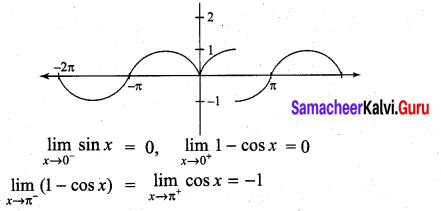
Samacheer Kalvi 11th Maths Solutions Chapter 7 Matrices and Determinants Ex 7.3 4
Similarly b and c are factors of Δ.
The product of the leading diagonal elements is (b + c) (c + a) (a + b)
The degree is 3. And we got 3 factors for Δ ∴ m = 3 – 3 = 0
∴ there can be a constant k as a factor for Δ.
Samacheer Kalvi 11th Maths Solutions Chapter 7 Matrices and Determinants Ex 7.3 5>

Question 3.
Samacheer Kalvi 11th Maths Solutions Chapter 7 Matrices and Determinants Ex 7.3 6
Solution:
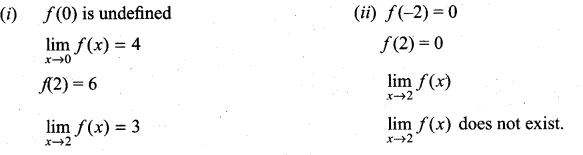
Samacheer Kalvi 11th Maths Solutions Chapter 7 Matrices and Determinants Ex 7.3 7
⇒ x = 0, 0 are roots.
Now the degree of the leading diagonal elements is 3.
∴ the equation is of degree 3, so the roots are 0, 0, – (a + b + c)

Samacheer Kalvi 11th Maths Solutions Chapter 7 Matrices and Determinants Ex 7.3

Question 4.
Show that Samacheer Kalvi 11th Maths Solutions Chapter 7 Matrices and Determinants Ex 7.3 8 = (a + b + c) (a – b) (b – c) (c – a)
Solution:
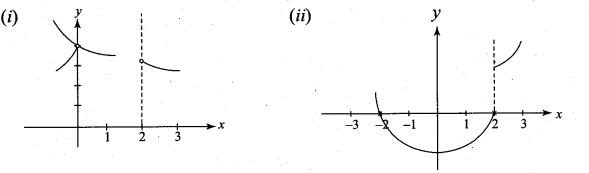
Samacheer Kalvi 11th Maths Solutions Chapter 7 Matrices and Determinants Ex 7.3 9
⇒ (a – b) is a factor of Δ.
Similarly (b – c) and (c – a) are factors of Δ.
The degree of the product of elements along leading diagonal is 1 + 1 + 2 = 4 and we got 3 factors for Δ. m = 4 – 3 = 1
∴ There can be one more factor symmetric with a, b, c which is of the form k (a + b + c).
Samacheer Kalvi 11th Maths Solutions Chapter 7 Matrices and Determinants Ex 7.3 10

Question 5.
Solve Samacheer Kalvi 11th Maths Solutions Chapter 7 Matrices and Determinants Ex 7.3 11
Solution:
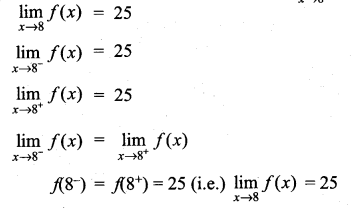
Samacheer Kalvi 11th Maths Solutions Chapter 7 Matrices and Determinants Ex 7.3 12
Samacheer Kalvi 11th Maths Solutions Chapter 7 Matrices and Determinants Ex 7.3 13

Question 6.
Show that Samacheer Kalvi 11th Maths Solutions Chapter 7 Matrices and Determinants Ex 7.3 14 = (x – y) (y – z) (z – x)
Solution:
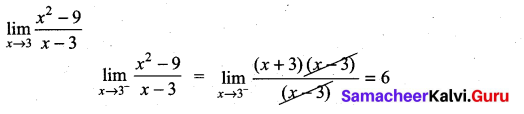
Samacheer Kalvi 11th Maths Solutions Chapter 7 Matrices and Determinants Ex 7.3 15
⇒ (x – y) is a factor of Δ.
Similarly (y – z) and (z – x) are factors of Δ.
Now degree of Δ = 0 + 1 + 2 = 3 and we have 3 factors of Δ.
and so there can be a constant k as a factor of Δ.
Samacheer Kalvi 11th Maths Solutions Chapter 7 Matrices and Determinants Ex 7.3 16

Samacheer Kalvi 11th Maths Solutions Chapter 7 Matrices and Determinants Ex 7.3

Samacheer Kalvi 11th Maths Solutions Chapter 7 Matrices and Determinants Ex 7.3 Additional Problems

Question 1.
Prove that Samacheer Kalvi 11th Maths Solutions Chapter 7 Matrices and Determinants Ex 7.3 17 = (a – b) (b – c) (c – a) (a + b + c).
Solution:
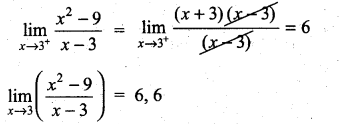
Samacheer Kalvi 11th Maths Solutions Chapter 7 Matrices and Determinants Ex 7.3 18
∴ (a – b) is a factor of Δ.
Similarly we observe that Δ is symmetric in a, b, c by putting b = c, c = a, we get Δ = 0. Hence (b – c) and (c – a) are also factors of Δ.
∴ The product (a – b) (b – c) (c – a) is a factor of Δ. The degree of this product is 3. The product of leading diagonal elements is 1. bc3. The degree of this product is 4.
∴ By cyclic and symmetric properties, the remaining symmetric factor of first degree must be k (a + b + c), where k is any non-zero constant.
Samacheer Kalvi 11th Maths Solutions Chapter 7 Matrices and Determinants Ex 7.3 19

Question 2.
Using factor method show that Samacheer Kalvi 11th Maths Solutions Chapter 7 Matrices and Determinants Ex 7.3 20 = (a – b) (b – c) (c – a)
Solution:
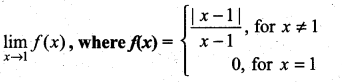
Samacheer Kalvi 11th Maths Solutions Chapter 7 Matrices and Determinants Ex 7.3 21
⇒ (a – b) is a factor of Δ.
similarly (b – c) and (c – a) are factors of Δ.
The product of leading diagonal elements is bc2. The degree of the product is 1 + 2 = 3.
∴ there will be three factors for Δ. We got 3 factors for Δ as (a – b), (b – c) and (c – a). Its degree = 3. ∴ m = 3 – 3 = 0
∴ there can be a constant k as a factor of Δ.
Samacheer Kalvi 11th Maths Solutions Chapter 7 Matrices and Determinants Ex 7.3 22

Samacheer Kalvi 11th Maths Solutions Chapter 7 Matrices and Determinants Ex 7.3

Question 3.
Samacheer Kalvi 11th Maths Solutions Chapter 7 Matrices and Determinants Ex 7.3 23
Solution:
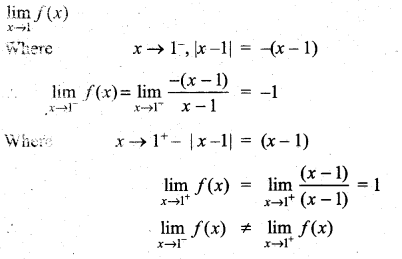
Samacheer Kalvi 11th Maths Solutions Chapter 7 Matrices and Determinants Ex 7.3 24
⇒ (a – b) is a factor of A.
Similarly (b – c) and (c – a) are factors of Δ.
The degree of Δ = 5 and degree of product of factors = 3.
Samacheer Kalvi 11th Maths Solutions Chapter 7 Matrices and Determinants Ex 7.3 25
Samacheer Kalvi 11th Maths Solutions Chapter 7 Matrices and Determinants Ex 7.3 26

Samacheer Kalvi 9th Social Science Geography Solutions Chapter 8 Disaster Management: Responding to Disasters

You can Download Samacheer Kalvi 9th Social Science Book Solutions Guide Pdf, Tamilnadu State Board help you to revise the complete Syllabus and score more marks in your examinations.

Tamilnadu Samacheer Kalvi 9th Social Science Geography Solutions Chapter 8 Disaster Management: Responding to Disasters

Disaster Management: Responding to Disasters Textual Exercise

I. Choose the best answer.

Question 1.
One among the following is not the first responder in case of a disaster.
(a) police officers
(b) firefighters
(c) Insurance agents
(d) emergency medical technicians
Answer:
(c) Insurance agents

Question 2.
‘Drop, Cover, Hold’ is a mock drill a vowal for …….
(a) Fire
(b) Earthquake
(c) Tsunami
(d) Riot
Answer:
(b) Earthquake

Question 3.
When you happen to see fire break out you will make a call to ……
(a) 114
(b) 112
(c) 115
(d) 118
Answer:
(b) 112

Question 4.
Which of the following statements is untrue?
(a) ‘Stop, Drop, Roll’ is for fire.
(b) ‘Drop, Cover, Hold’ is for an earthquake.
(c) ‘If sea water recedes back, run to higher places’ is for flood.
(d) ‘If gunshots are heard, drop to the ground and cover the head with hand’ is for riot.
Answer:
(d) ‘If gunshots are heard, drop to the ground and cover the head with hand’ is for riot.

Question 5.
Which of the following statements belongs to responding to earthquake?
(a) Avoid any place where police or security forces action is in progress.
(b) Know the height of your street above sea level and the distance of your street from the coast.
(c) Stay away from glass, windows, outside doors and walls, and anything that could fall.
(d) Before opening a door, feel it with the back of your hand.
Answer:
(c) Stay away from glass, windows, outside doors and walls, and anything that could fall.

II. Very short answer:

Question 1.
Who are the community’s first responders to disaster?
Answer:
On a daily basis, police officers, firefighters, and emergency medical technicians are our community’s first responders, whether during fire, flood or acts of terrorism.

Question 2.
What are the four phases of the Disaster Management Cycle?
Answer:
Disaster management includes Prevention, Mitigation, Preparedness, Response and Recovery.

Question 3.
Though Japan has the densest seismic network Indonesia has the most earthquakes. Why?
Answer:
Japan is in a very active seismic area and it has the densest seismic network in the world.
Indonesia is in a very active seismic zone, but because it is larger than Japan, it has more earthquakes.

Question 4.
How many males and females die per day due to fire in India?
Answer:
It is estimated that about 42 females and 21 males die every day in India due to fire.

Question 5.
What should you do after a Tsunami?
Answer:

  1. You should continue using a weather radio or staying tuned to a Coast Guard emergency frequency station or a local radio or television station for updated emergency information.
  2. Check yourself for injuries and get first aid if necessary, before helping injured or trapped persons.
  3. If someone needs to be rescued, call professionals with the right equipment to help.
  4. Help people who require special assistance, like Infants, elderly people, those without transportation, large families who may need additional help in an emergency situation, people with disabilities, and the people who care for them.
  5. Stay out of a building if water remains around it. Tsunami water, like floodwater, can undermine foundations, causing buildings to sink, floors to crack, or walls to collapse.
  6. Check for gas leaks. If you smell gas or hear a blowing or hissing noise, open a window and get everyone outside quickly.

III. Short answer:

Question 1.
Write a short note on Tsunami.
Answer:
A tsunami can kill or injure people and damage or destroy buildings and infrastructure as waves come forth and recede. A tsunami is a series of enormous ocean waves caused by earthquakes, underwater landslides, volcanic eruptions or asteroids. Tsunamis can travel 700-800 km per hour, with waves 10-30 meter high. It causes flooding and disrupts transportation, power, communications, and water supply.

Question 2.
What do you do if you are indoors during an earthquake?
Answer:
If indoors-

  1. DROP to the ground; take COVER by getting under a sturdy table or other piece of furniture and HOLD ON until the shaking stops. If there is no table or desk near you, cover your face and head with your arms and crouch in an inside comer of the building.
  2. Protect yourself by staying under the lintel of an inner door, in the comer of a room, under a table or even under a bed.
  3. Stay away from glass windows, outside doors and walls and anything that could fall (such as lighting fixtures or furniture).
  4. Stay inside until the shaking stops and afterwards it is safe to go outside.

Question 3.
How do you respond to Tsunami?
Answer:

  1. You should find out if your home, school, workplace or other frequently visited locations are in tsunami hazard areas along the sea-shore.
  2. Plan evacuation routes from your home, school, workplace, or any other place you could be, where tsunamis poses a risk.
  3. Use a weather radio or stay tuned to a local radio or television station to keep informed of local watches and warnings.
  4. Discuss tsunamis with your family. Everyone should be aware of what to do when tsunami strikes. Discussing tsunamis ahead of time will help reduce fear and save precious time in an emergency. Review flood safety and precautionary measures with your family.

Question 4.
What should you do if you are trapped in a car during a civil unrest?
Answer:
If trapped in a car;

  1. Keep abreast of the current news if you are in a volatile area.
  2. If you come across a demonstration, don’t become inquisitive, just leave the area and find another route to your intended destination.
  3. Avoid any place where police or security forces action is in progress.

Question 5.
Write three sentences about what to do during fire.
Answer:
Fire Safety Do’s and Don’ts

  1. Know your building’s evacuation plan.
  2. Evacuate calmly and quickly, whenever a fire alarm or carbon monoxide alarm sounds.
  3. Before opening a door, feel it with the back of your hand. If the door is hot, do not open it.

HOTs

Question 1.
Why should you cut off all the branches of trees below 3 metres of height standing near your house?
Answer:

  1. Old and overgrown branches might fall and injure people.
  2. They may cause damage to electricity and telephone lines, houses, cars and other belongings.
  3. Broken branches and leaves may create gutter.
  4. Large root systems can cause damage to the foundation of your house.
  5. Constant shade from the Sun will cause dampness on the roof.

To prevent all these problems you should trim and prune all trees and vegetation within 3 metres height standing near your house.

Disaster Management: Responding to Disasters Additional Questions

I. Choose the correct answer.

Question 1.
…… is measured using seismograph.
(a) Earthquake
(b) heat
(c) Pressure
(d) None of these
Answer:
(a) Earthquake

Question 2.
This country is in a very active seismic area.
(a) Russia
(b) Japan
(c) China
(d) Britain
Answer:
(b) Japan

Question 3.
…….. tops in riot in the world.
(a) India
(b) Iraq
(c) Nigeria
(d) Syria
Answer:
(d) Syria

Question 4.
Tsunamis can travel 700-800 kms per hour with waves …….. metres high.
(a) 10 – 30
(b) 10 – 40
(c) 10 – 60
(d) 10 – 50
Answer:
(a) 10 – 30

Question 5.
This is not the cause for fire.
(a) Lightning strikes
(b) Sparks during arid conditions
(c) The eruptions of volcanoes
(d) Ocean waves
Answer:
(d) Ocean waves

II. Very short answers:

Question 1.
What does Disaster Management include?
Answer:
Disaster Management includes Prevention, Mitigation, Preparedness, Response and Recovery.

Question 2.
What does Modern Disaster Management include?
Answer:
Modern disaster management goes beyond post-disaster assistance. It now includes pre-disaster planning and preparedness activities, organizational planning, training, information management, public relations and many other fields.

Question 3.
Write a short note on “Earth Quake”.
Answer:
An earthquake is a sudden vibration of the part of the earth caused by plate movements. It occurs along the plate boundaries. The place inside the earth where an earthquake originates is focus. The point on the earth’s surface above the called a focus is called an epicentre. The damage caused by the earthquake is the highest near the epicentre.

Question 4.
If you are in a vehicle, what will you do during an earthquake? If in a moving vehicle
Answer:

  1. Stop as quickly as safety permits. Avoid stopping near or under buildings, trees, overpasses and utility wires.
  2. Proceed cautiously once the earthquake has stopped. Avoid roads, bridges or ramps that might have been damaged by the earthquake.

Question 5.
Give an account of Tsunami?
Answer:
A tsunami can kill or injure people and damage or destroy buildings and infrastructure as waves come forth and recede. A tsunami is a series of enormous ocean waves caused by earthquakes, underwater landslides, volcanic eruptions or asteroids. Tsunamis can travel 700 – 800 km per hour, with waves 10 – 30 meter high. It causes flooding and disrupts transportation, power, communications, and water supply.

III. Short Answers:

Question 1.
What do you mean by Disaster Response?
Answer:
Disaster response entails restoring physical facilities, rehabilitation of affected population, restoration of lost livelihoods and reconstruction efforts to restore the infrastructure lost or damaged. The Response Phase focuses primarily on emergency relief: saving lives, providing first aid, restoring damaged systems (communications and transportation), meeting the basic life requirements of those impacted by disaster (food, water and shelter) and providing mental health and spiritual support and care.

Question 2.
What to do after a Tsunami?
Answer:

  1. You should continue using a weather radio or staying tuned to a Coast Guard emergency frequency station or a local radio or television station for updated emergency information.
  2. Check yourself for injuries and get first aid if necessary, before helping injured or trapped persons.
  3. If someone needs to be rescued, call professionals with the right equipment to help.
  4. Help people who require special assistance, like Infants, elderly people, those without transportation, large families who may need additional help in an emergency situation, people with disabilities, and the people who care for them.
  5. Stay out of a building if water remains around it. Tsunami water, like floodwater, can undermine foundations, causing buildings to sink, floors to crack, or walls to collapse.
  6. Check for gas leaks. If you smell gas or hear a blowing or hissing noise, open a window and get everyone outside quickly.

Question 3.
What to do if you are caught in a riot?
Answer:

  1. If you find yourself caught up in a demonstration, keep to the edge of the crowd where it is safer. At the first opportunity, break away and seek refuge in a nearby building or find a suitable doorway or alley and stay there until the crowd passes.
  2. When leaving the fringe of the demonstration, just walk away – don’t run as this will draw attention to you.
  3. In the event that you are arrested by the police/military, do not resist. Go along peacefully and contact your law advisor to help you resolve your predicament.
  4. If you are caught up in the crowd, stay clear of glass shop fronts, moreover, move with the flow.
  5. If shooting breaks out, drop to the ground and cover your head and neck, and lie as flat as you can.

Question 4.
Write aboutthe Fire Safety Do’s and Don’ts.
Answer:
Fire Safety Do’s and Don’ts

  1. Know your building’s evacuation plan.
  2. Evacuate calmly and quickly, whenever a fire alarm or carbon monoxide alarm sounds.
  3. Before opening a door, feel it with the back of your hand. If the door is hot, do not open it.
  4. If you encounter smoke during your evacuation, stay low to the floor.
  5. Know the outside rally point for your building.
  6. Know the locations of fire extinguishers, fire alarm pull stations and exits.

IV. Answer in Detail:

Question 1.
Explain the Disaster Management cycle with Diagram.
Answer:
Disaster management includes Prevention, Mitigation, Preparedness, Response and Recovery. Disaster management involves all levels of government. Non-governmental and community based organizations play a vital role in the process.

Modern disaster management goes beyond post-disaster assistance. It now includes pre-disaster planning and preparedness activities, organizational planning, training, information management, public relations and many other fields. Crisis management is important, but is only a part of the responsibility of a disaster manager.

The traditional approach to disaster management has a number of phased sequences of action or a continuum. These can be represented as a disaster management cycle. We mainly focus on the way how the community should respond to disasters.

Question 2.
Explain “Fire”.
Answer:
Wildfires occur when vegetated areas are set alight and are particularly common during hot and dry periods. They can occur in forests, grasslands, bush and deserts, and with blowing wind, can spread rapidly.
Fires can lead to the destruction of buildings, wooden bridges and poles, power, transmission and telecommunication lines, warehouses containing oil products and other fuel. It causes injury to people and animals.

The most common causes of fires are lightning strikes, sparks during arid conditions, eruption of volcanoes and man-made fires arising from deliberate arson or accidents.

A side-effect of wildfires which also threatens inhabited areas is smoke. Fires create large quantities of smoke, which can be spread far by wind and poses a respiratory hazard.

On an average, in India, every year, about 25,000 persons die due to fires and related causes. Female accounts for about 66% of those killed in fire accidents. It is estimated that about 42 females and 21 males die every day in India due to fire.

Samacheer Kalvi 9th Social Science History Solutions Chapter 11 Colonialism in Asia and Africa

You can Download Samacheer Kalvi 9th Social Science Book Solutions Guide Pdf, Tamilnadu State Board help you to revise the complete Syllabus and score more marks in your examinations.

Tamilnadu Samacheer Kalvi 9th Social Science History Solutions Chapter 11 Colonialism in Asia and Africa

Colonialism in Asia and Africa Textual Exercise

I. Choose the correct answer.

Question 1.
………….. was brought to the attention of the East India Company by Francis Light.
(a) Spice islands
(b) Java island
(c) Penang island
(d) Malacca
Answer:
(c) Penang island

Question 2.
In 1896 ………….. states were formed into the Federated Malay States.
(a) Four
(b) Five
(c) Three
(d) Six
Answer:
(a) Four

Question 3.
…………… was the only part of Indo-China which was directly under French Control.
(a) Annam
(b) Tong king
(c) Cambodia
(d) Cochin-China
Answer:
(d) Cochin-China

Question 4.
The Discovery of gold in the ………….. led to a large number of British miners settled in and around Johannesburg.
(a) Transvaal
(b) Orange Free State
(c) Cape Colony
(d) Rhodesia
Answer:
(a) Transvaal

Samacheer Kalvi 9th Social Science History Solutions Chapter 11 Colonialism in Asia and Africa

Question 5.
…………… became the first European power to establish trade with India.
(a) Portuguese
(b) French
(c) Danes
(d) Dutch
Answer:
(a) Portuguese

Question 6.
Ethiopia defeated Italy at the battle of ………………
(a) Adowa
(b) Dahomey
(c) Tonking
(d) Transvaal
Answer:
(a) Adowa

Question 7.
Indentured labour system was a form of …………….
(a) contract labour system
(b) slavery
(c) debt bondage
(d) serfdom
Answer:
(c) debt bondage

II. Fill in the blanks.

1. ……………. Conference resolved to divide Africa into spheres of influence of the various European Powers.
2. Ethiopia defeated Italy at the battle of ………….. in 1896.
3. The settlement made with the zamindars of Bengal, Bihar and Orissa is ……………
4. …………… was the author of a book called “Notebook from Prison”.
5. …………. were money lenders in the Tamil speaking areas.
Answers:
1. Berlin Colonial
2. Adowa
3. the Permanent Settlement
4. Antonio Gramsci
5. Nattukottai Chettiyars

III. Match the following:

Samacheer Kalvi 9th Social Science History Solutions Chapter 11 Colonialism in Asia and Africa 1
Answer:
1. (c)
2. (a)
3. (d)
4. (e)
5. (b)

IV. Find out the correct statement.

Question 1.
(i) Until the last quarter of the 19th century, Africa south of Sahara was unknown to the world.
(ii) The coastal states of Gold Coast became a British colony in 1864.
(iii) Spain ruled the Philippines for over 500 years.
(iv) The famine of 1876-78 occurred in Odhisha.
(a) (i) is correct
(b) (ii) is correct
(c) (ii) and (iii) are correct
(d) (iv) is correct
Answer:
(a) (i) is correct

Question 2.
(i) The French had occupied Java and Sumatra in 1640.
(ii) The Dutch began their conquest of the English Settlements by capturing Malacca.
(iii) Berlin Conference met to decide all issues connected with the Congo River basin.
(iv) The possessions of Sultan of Zanzibar were divided into French and German spheres of influence.
(a) (i) is correct
(b) (ii) and (i) are correct
(c) (iii) is correct
(d) (iv) is correct
Answer:
(c) (iii) is correct

Question 3.
Assertion (A): (A) In the Madras Presidency, the famine of 1876-78 was preceded by droughts.
Reason (R): Because of the colonial government’s policy of Laissez Faire in the trade of food- grains.
(a) A is correct R is wrong
(b) Both A & R are wrong
(c) A is correct, R is not the correct explanation of A
(d) A is correct, R is the correct explanation of A
Answer:
(c) A is correct, R is not the correct explanation of A

Question 4.
Assertion (A): Berlin Conference agreed to the rule of Leopold II in Congo Free State.
Reason (R): Leopold II, King of Belgium, showed interest in Congo.
(a) Both A and R are correct and R is the correct explanation of A.
(b) Both A and R are correct and R is not the correct explanation of A
(c) A is correct and R is wrong.
(d) A is wrong but R is correct
Answer:
(a) Both A and R are correct and R is the correct explanation of A.

V. Answer all questions given under each heading

Question 1.
Colonialism in India
(i) When did the East India Company acquire the Diwani Right?
Answer:
The Company acquired the Diwani right in 1765.

(ii) When were the Gurkhas conquered by the British?
Answer:
The British conquered the Gurkhas in 1816.

(iii) When was slavery abolished in British India?
Answer:
Slavery was abolished in India in 1843.

(iv) When did Burma become a part of the Madras Presidency?
Answer:
There was British rule in Burma from 1824 to 1948.

Samacheer Kalvi 9th Social Science History Solutions Chapter 11 Colonialism in Asia and Africa

Question 2.
South Africa
(i) Name the states possessed by the British in South Africa.
Answer:
The British possessed Natal, Cape Colony of South Africa.

(ii) What were the territories held by the Dutch?
Answer:
The Dutch held the states of the Transvaal and Orange Free State.

(iii) Who was the Prime Minister of Cape colony?
Answer:
Cecil Rhodes was the Prime Minister of Cape Colony..

(iv) How long did Boer Wars last?
Answer:
Boer War lasted for three years from 1899 to 1902.

VI. Answer the following briefly

Question 1.
Distinguish between Colonialism and Imperialism.
Answer:

Colonialism

Imperialism

Colonialism is a process of domination, involving’the subjugation of one people by another.Imperialism, on the other hand, draws attention to the way one country exercises power over another, whether through settlement, sovereignty, or indirect mechanisms of control.

Question 2.
Write a note on Zulu tribe.
Answer:
The Zulu tribe was known for its strong fighting spirit, represented by renowned warriors like Shaka Zulu who played a prominent role in building the largest Zulu nation in south-eastern Africa.

Question 3.
State the three phases in the colonialisation of Indian economy.
Answer:
The process of the colonialisation of India can be divided into three phases:
(a) Phase I Mercantilist Capitalism
(b) Phase II Industrial Capitalism
(c) Phase III Financial Capitalism

Samacheer Kalvi 9th Social Science History Solutions Chapter 11 Colonialism in Asia and Africa

Question 4.
Colonel Pennycuiek.
Answer:
Colonel Pennycuiek was an army Engineer and Civil Servant who also served as a member of the Madras Legislative Council. He decided to divert the west-flowing Periyar river draining into the Arabian Sea to the east so that it could irrigate lakhs of acres of dry land dependent on the Vaigai river.

Question 5.
Explain Home Charges.
Answer:
The East India Company remitted to England what was called Home Charges – the dividends on East India’s stock, interest on debt, savings from salaries and the pensions of officers and establishments and buildings in the India Office, London, transporting cost of British troops to and from India.

VII. Answer in detail

Question 1.
Discuss the economic impact of British Rule in India.
Answer:
Governor General Cornwallis, himself a big landlord in England, wanted to create landlords in India on the English model. There were already revenue farmers under the Mughals. Cornwallis came to a settlement with them, treating them as landlords. The outcome was that for the first time in India there was a class of zamindars or landlords with a right to own, bequeath and inherit land. The cultivators, on the other hand, were reduced to the position of mere tenants. The British dealt with the landlords or zamindars directly, and gave them total freedom to do what they liked with their tenants. This settlement made with the zamindars of Bengal, Bihar and Orissa is called the Permanent Settlement (1793). The Ryotwari System was a different revenue system introduced in south India.
Under the system, the peasant was the proprietor and paid tax on the land. The government dealt with him directly, without the intervention of a middleman or a tax-farmer. He was entitled to remain in possession of land acquired by him so long as he paid the land revenue. In case of default, apart from eviction and attachment of livestock, even household property or .personal belongings could be attached. The Ryotwari System introduced the concept of private property in land. The individual holders were registered and permitted to sell, lease out, mortgageor transfer their right over the land.

Question 2.
Explain the process of colonisation in Africa.
Answer:
Until the last quarter of nineteenth century, Africa south of the Sahara (Sub- Saharan Africa) was almost unknown to the outside world. The interior of Africa was unexplored. After 1875, European penetration and colonisation began on a large scale. The Berlin Colonial Conference of 1884-85 resolved to divide Africa into spheres of influence of the various European powers. European colonisation of Africa was thus accomplished smoothly, without any outbreak of war amongst major European powers. The invasion, occupation, colonisation and annexation of African territories by European powers between 1881 and 1914, the era of Imperialism, is called the Scramble for Africa or the Partition of Africa.

VIII. Activity

Question 1.
Prepare an album with pictures and images of famines that affected different parts of India during the British colonial rule.
Answer:
You can prepare the assignment using internet, under the guidance of your teacher.

Question 2.
Attempt an account of the cultural relations between India and Southeast Asia.
Answer:
(i) Southeast Asia was under Indian influence starting around 200 BC until around the 15th century, when Hindu-Buddhist influence was absorbed by local politics.

(ii) Kingdoms in the southeast coast of the Indian subcontinent had established trade, cultural and Political relations with Southeast Asian Kingdoms in Burma, Thailand, Indonesia, Malay Peninsula, Cambodia and Vietnam.

IX. Assignment

Question 1.
Arrange a debate in the classroom on the merits and demerits of the British rule in India.
Answer:
The merits of British Rule in India
In the cause of humanity:

  1. Abolition of Sati
  2. Destruction of Dacoits, Thugs and infanticide
  3. Elimination of Pindarees and other such pests of Indian Society
  4. Allowing remarriage of Hindu widows and Charitable aid in the time of famine

Demerits of British Rule in India

  1. Divide and Rule Policy
  2. Exploitation of resources
  3. Impalement of Tax Structure
  4. Loss of lives

Question 2.
Explore the impact of colonialism in British Burma.
Answer:
British rule in Burma, also known as British Burma lasted from 1824 to 1948 from the Anglo Burmese wars through the creation of Burma as province of British India to the establishment of an independently administered colony and finally independence.

Colonialism in Asia and Africa Additional Questions

I. Choose the correct answer.

Question 1.
The term colony comes from the ………….. word colonus, meaning farmer.
(a) Latin
(b) Roman
(c) Arabic
(d) Greek
Answer:
(a) Latin

Question 2.
………….. area in South East Asia was independent.
(a) Burma
(b) Siam (Thailand)
(c) Malaya
(d) Phillipines
Answer:
(b) Siam (Thailand)

Question 3.
The Portuguese conquered the great international emporium of …………. for the king of Portugal.
(a) Dutch East Indies
(b) French Indo-China
(c) Malacca
(d) Phillipines
Answer:
(c) Malacca

Samacheer Kalvi 9th Social Science History Solutions Chapter 11 Colonialism in Asia and Africa

Question 4.
The Dutch began their conquest of the Portuguese settlements by capturing Malacca in …………….
(a) 1941
(b) 1641
(c) 1741
(d) 1841
Answer:
(b) 1641

Question 5.
In 1819 …………… established Singapore as a key trading post for Britain in their rivalry with the Dutch.
(a) Albuquerque
(b) Rudyard Kipling
(c) Stamford Raffles
(d) Cecil Rhodes
Answer:
(c) Stamford Raffles

Question 6.
The …………… had occupied Java and Sumatra (Indonesia) as early as 1640.
(a) The Dutch
(b) The English
(c) The French
(d) The Spanish
Answer:
(a) The Dutch

Question 7.
During World War II …………….. fell to the Japanese.
(a) Malaya
(b) Thailand
(c) Burma
(d) Phillipines
Answer:
(c) Burma

Question 8.
The ………….. troops invaded Zulu territory and divided it into thirteen chiefdoms
(a) The French
(b) The Japanese
(c) The British
(d) The Dutch
Answer:
(c) The British

Question 9.
This country in Africa managed to evade European Colonialism ……………
(a) Nigeria
(b) Ethiopia
(c) Uganda
(d) Kenya.
Answer:
(b) Ethiopia

Question 10.
The Mullai Periyar Dam Construction was completed in 1895 by an army Engineer and civil servant …………..
(a) Colonel Pennycuick
(b) Arthur Cotton
(c) Robert Clive
(d) Governor General Cornwallis
Answer:
(a) Colonel Pennycuick

II. Fill in the blanks.

1. The term “South East Asia” has only been used since the …………
2. By 1826 …………… and had been linked with Penang to form the Strait Settlements.
3. ………….. was the capital of Indo-China under the French Government.
4. Spain ruled the Phillipines for over ……………. years.
5. Most Indonesians were ………….. and …………… and worked in plantations.
6. In 1890 ………… the Prime Minister of Cape Colony encouraged British expansion to the North of the Transvaal.
7. The ………….. tribe was known for its string fighting spirit, in South-eastern Africa.
8. …………….. was used for slave trading posts on the coast.
9. Ethiopia, with its traditional polity, was ruled by the ……………..
10. The Portuguese Sailor …………… arrived in Calicut in 1498.
Answers:
1. Second World War
2. Singapore, Malacca
3. Hanoi
4. 300
5. Fishermen, Peasants
6. Cecil Rhodes
7. Zulu
8. Nigeria
9. Emperor Menelik
10. Vasco da Gama

III. Match the following:

Samacheer Kalvi 9th Social Science History Solutions Chapter 11 Colonialism in Asia and Africa 2
Answer:
1. (d)
2. (e)
3. (a)
4. (b)
5. (c)

IV. Find out the correct statement.

Question 1.
(i) When European traders crossed the Indian Ocean at the close of the 15th century, they came for the spices of south-east Asia.
(ii) Penang Island had been brought to the attention of the East India Company by Francis Light.
(iii) The Dutch were interested in politics but focussed on exploiting Indonesia ruthlessly.
(iv) Spain ruled the Phillipines for over 200 years.
(a) (i) is correct
(b) (ii) is correct
(c) (i) and (ii) are correct
(d) (iv) is correct
Answer:
(c) (i) and (ii) are correct

Question 2.
(i) The interior of Africa was unexplored.
(ii) The coastal states of Gold coast became a British colony in 1854.
(iii) Spain in the sixteenth century was the richest and most powerful in the world.
(iv) The British encouraged irrigation in the first half of nineteenth century.
(a) (i) is correct
(b) (i), (ii) and (iii) are correct
(c) (iii) is correct
(d) (iv) is incorrect
Answer:
(b) (i), (ii) and (iii) are correct

Question 3.
Assertion (A): The Dutch began their conquest of the Portuguese settlements by capturing Malacca in 1641.
Reason (R): After establishing a base at Batavia in 1619, they interfered in succession disputes among the neighbouring Sultans.
(a) A is correct R is wrong
(b) Both A and R are wrong
(c) Both A and R are correct
(d) A is correct and R is the correct explanation of A
Answer:
(c) Both A and R are correct

Question 4.
Assertion (A): Money lending had been practised since time immemorial. Earlier the lenders lent at their own risk.
Reason (R): But the British enacted a law allowing them to attach land or property in default of repayment.
(a) Both A and R is correct and R is the correct explanation for A
(b) Both A and R is correct and R is not the correct explanation for A
(c) A is correct and R is wrong .
(d) A is wrong and R is correct
Answer:
(a) Both A and R is correct and R is the correct explanation for A

V. Answer all questions given under each heading.

Question 1.
Colonialism in Indonesia
(a) Who had occupied Java and Sumatra?
Answer:
The Dutch had occupied Java and Sumatra.

(b) Were the Dutch interested in politics?
Answer:
No, they weren’t interested in politics.

(c) What was the focus of the Dutch on Indonesia?
Answer:
They focussed on exploiting Indonesia ruthlessly.

(d) How did they improve Indonesia from the beginning of 19th century?
Answer:
They adopted measures for the social and economic advancement of the people

Samacheer Kalvi 9th Social Science History Solutions Chapter 11 Colonialism in Asia and Africa

Question 2.
Indentured Labour
(a) What was Indentured labour system?
Answer:
It was a form of debt bondage, a penal contract system.

(b) How many Indians were transported under this system?
Answer:
3.5 million Indians were transported to various British colonies to provide labour for the plantations.

(c) In which year was it started?
Answer:
It was started in 1843.

(d) What was its result?
Answer:
It resulted in the development of a large Indian diaspora, which spread from the Indian Ocean to Pacific Ocean, as well as contributing to the growth of Indo-Caribbean and Indo-African population.

VI. Answer the following briefly.

Question 1.
How did Europe justify their colonisation?
Answer:
In world history, no continent possessed so many colonies and justified their access to the world by means of a civilising mission as did modem Europe. Practically the whole non- Westem world was under one European power or the other for about four centuries until decolonisation happened after World War II.

Question 2.
Comment on Albuquerque, the Portuguese soldier.
Answer:
Albuquerque, the Portuguese soldier who conquered Goa and Malacca, and his successors’ were interested in the spice trade. Towards this end they built a chain of fortified trading stations linked by naval power. Initially, they did not interfere with the native rulers.

Question 3.
Write a short note on “Malay Settlements”.
Answer:
Between 1874 and 1895 there was a civil war between the remaining five Malay States. The British intervened and signed an agreement with each of the sultans. British Residents were appointed to the courts of sultans, who had to act in accordance with the advice given by the Residents. In 1896 four of the states were formed into the Federated Malay States. In 1900 there were the Straits Settlements, the four Federated Malay States and Johore. The population was about a million, of whom, half were Malay and the remainder were Chinese. Most of the merchants, planters and workers in the ports and big plantations were Chinese. Economically Malaya was prosperous.

Question 4.
Give a short account of Burma.
Answer:
The British conquered Burma after fighting three wars. Burma remained part of India from 1886 to 1937. Burma was administered by a Lieutenant Governor with the assistance of a nominated Legislative Council. Burma teak was shipped overseas. In addition, Burma with its rich soil became a big exporter of rice and most of south India was dependent on Burmese rice. During World War II when Burma fell to the Japanese, south India experienced acute scarcity of rice leading to a famine.

Question 5.
Who ruled the Phillippines?
Answer:
Spain ruled the Philippines for over 300 years, imposing its language, culture and religion. Consequently the population became predominantly Roman Catholic. Nationalism developed among the Filipinos during the latter part of the nineteenth century. There were two serious revolts in 1872 and 1896, which were crushed by the Spanish colonial government. In 1898, however, Spain was defeated by the United States in a war over Cuba, and as a result Philippines became an American colony.

Question 6.
What do you know about the Congo River basin?
Answer:
The Berlin Conference of 1884 – 85, also known as the Congo Conference or West Africa Conference, met to decide all issues connected with the Congo River basin in Central Africa. The conference proposed by Portugal to discuss its claim to control the Congo river basin was rejected. The general act of the Conference of Berlin declared the Congo River basin to be neutral and guaranteed freedom for trade and shipping for all states in the basin.

Samacheer Kalvi 9th Social Science History Solutions Chapter 11 Colonialism in Asia and Africa

Question 7.
How did the Europeans colonise Rhodesia?
Answer:
The British South African Company founded in 1889 conducted an expedition with 600 men- each of them were promised a 3,000 acre farm. The African king was tricked into believing that all that the Europeans wanted was gold. But they had come with a definite plan of colonising the Bechuanaland. During the next ten years African opposition was crushed. White immigrants were provided with farm lands and railways, and a telegraph system developed. The colony came to be called Rhodesia, after Cecil Rhodes.

Question 8.
How did the British emerge as a territorial power in India?
Answer:
The British conquered all the regional powers, in particular the most potential challengers, the Mysore Sultans and the Marathas, by defeating, them in three Anglo-Mysore and three Anglo- Maratha Wars. The conquest of the Gurkhas (1816), the Sindhis (1843) and the Sikhs (1849) enabled them to emerge as a territorial power in India. .

Question 9.
What does Mercantalism refer to?
Answer:
Mercantilism refers to a number of prevailing economic theories applied by the state in its effort to attain wealth and power. Spain in the sixteenth century was the richest and most powerful in the world. Spain’s power and wealth were found in the treasure pouring into Spain from its colonies. The more colonies a country had, the richer it would be. In sum, European countries pursued Mercantilism as a kind of national economic policy designed to maximize their trade, especially to maximize the accumulation of gold and silver.

Question 10.
What do you mean by “The Indenture system”?
Answer:
The Indenture system was a penal contract system. The contract made punishable the refusal of an indentured labourer to work or his abstention from work, or his defiance of the orders of his master or absconding, by forfeiture of wages or imprisonment with or without hard labour.

VII. Answer the following in detail.

Question 1.
How did the British colonise South Africa? Explain the Boer War.
Answer:
In South Africa the British possessed Natal, Cape Colony, while the Dutch (locally known as the Boers) held the states of the Transvaal and Orange Free State. In 1886 the discovery of gold in the Transvaal led to a large number of British miners settling in and around Johannesburg. The Boers feared and hated the miners whom they called Uitlanders (foreigners). In 1890, Cecil Rhodes, the Prime Minister of Cape Colony, encouraged British expansion to the north of the Transvaal. This worsened the relations between the Boers and the British. Denied of their political rights the British miners revolted. This led to the Boer War which lasted three years (1899-1902).

In the end the Boer army was defeated and Pretoria was occupied. The Boers suffered greatly in the war. Their farms and crops were destroyed and Boer women and children were confined to internment camps. The shortage of food, beds, medical and sanitary facilities caused the death of 26,000 people. The British annexed the two Boer states but promised self government in due course. Boer states were given full responsible government in 1907. After discussions over the years the four states finally decided to form a.union and South Africa as a state was bom in 1909.
Samacheer Kalvi 9th Social Science History Solutions Chapter 11 Colonialism in Asia and Africa

Question 2.
Write short notes on:
(a) Colonel Pennycuick
(b) Famine in British India
Answer:
(a) Colonel Pennycuick
Colonel Pennycuick was an army Engineer and Civil Servant who also served as a member of the Madras Legislative Council. He decided to divert the west-flowing Periyar river draining into the Arabian Sea to the east so that it could irrigate lakhs of acres of dry land dependent on the Vaigai river. Though Pennycuick and other British engineers went ahead with the construction, braving nature’s fury and the dangers of poisonous insects and wild animals, the constmction was disrupted by relentless rain. Since he could not get adequate funds from the British government, Pennycuick went to England and sold his family property to mobilise money to fund the project, which was completed in 1895. The Mullai Periyar Dam continues to irrigate agricultural lands in Theni, Dindigul, Madurai, Sivaganga and Ramanathapuram districts.

(b) Famine in British India.
The Bengal famine of 1770, took a heavy toll of about 10 million people or nearly one- third of the population in Bengal. This is how British mle commenced in India. Similarly the British mle ended with a terrible Bengal famine of 1943 that claimed the lives of nearly three millions. Amartya Sen, awarded the Nobel Prize in 1998, who as a young boy saw people dying on the streets of Kolkata wrote a path-breaking study of it.

Samacheer Kalvi 9th Social Science Civics Solutions Chapter 6 Road Safety

You can Download Samacheer Kalvi 9th Social Science Book Solutions Guide Pdf, Tamilnadu State Board help you to revise the complete Syllabus and score more marks in your examinations.

Tamilnadu Samacheer Kalvi 9th Social Science Civics Solutions Chapter 6 Road Safety

Road Safety In-Text Exercise

I. Look at the diagram given and answer the following.

Samacheer Kalvi 9th Social Science Civics Solutions Chapter 6 Road Safety 1

Question 1.
Which road use category causes the highest number of deaths? Could you give any three possible reasons? What would you suggest as the related safety rules?
Answer:

  1. Two-wheelers, Cars, Taxis, Vans & LMV’s and Trucks.
  2. Carelessness, alighting and boarding vehicles from the wrong side.
  3. Insufficient headlights.

Preventive measures for accidents:

  1. Education and awareness about road safety
  2. Strict enforcement of law
  3. Engineering:
    • Vehicle design
    • Road infrastructure

Samacheer Kalvi 9th Social Science Civics Solutions Chapter 6 Road Safety

Question 2.
How could pedestrians save themselves from road accidents?
Answer:

  1. Never use cell phones while crossing the roads.
  2. Follow the road rules.
  3. See both sides while crossing.
  4. Never take short cuts.
  5. Avoid distractions.

II. Look at the diagram carefully and answer the following.

Samacheer Kalvi 9th Social Science Civics Solutions Chapter 6 Road Safety 80
Source: WHO Global Burden of Disease Project, Version 1 (2002)

Question 1.
Which age group tops the number of road traffic deaths worldwide? Why?
Answer:
Age group 15-29 tops the number of road traffic deaths worldwide. This is due to carelessly projecting their body parts outside vehicles, travelling on footboards, and catching a running bus or train.

Samacheer Kalvi 9th Social Science Civics Solutions Chapter 6 Road Safety

Question 2.
Give some inference on the striking difference between the number of road accident deaths of males and females.
Answer:

  1. The number of road accident deaths of females are less compared to males.
  2. The reasons are: they follow road rules, they are cautious and responsible.

Road Safety Additional Questions

I. Choose the correct answer.

Question 1.
…… is the main cause of death in roads.
(a) Drink and drive
(b) Use of helmet
(c) Vehicle design
(d) Road conditions
Answer:
(a) Drink and drive

Question 2.
Every minute a child is killed in an accident worldwide.
(a) 5
(b) 7
(c) 3
(d) 2
Answer:
(c) 3

Samacheer Kalvi 9th Social Science Civics Solutions Chapter 6 Road Safety

Question 3.
Which age group tops the number of road traffic deaths world wide?
(a) 60+
(b) 15 – 29
(c) 30 – 44
(d) 45 – 59
Answer:
(b) 15 – 29

Question 4.
Road accidents are the leading cause of
(a) sales of helmet
(b) increased traffic signals
(c) more number of speed breakers
(d) death by injury
Answer:
(d) death by injury

II. Fill in the blanks.

1. Each year an estimate of ……. million people are killed in road crashes.
2. …….. in the pedestrians contribute to road accidents.
3. ……. and ……. are excluded from road accidents.
4. India has the worst road accident rate world wide with ……. deaths annually.
Answers:
1. 1.2
2. Carelessness
3. Internationa acts, natural disasters
4. 1,30,000

III. Answer the following.

Question 1.
Write short notes on ‘road accidents’.
Answer:
Road accident refers to any accident involving at least a vehicle, occurring on a road open to public transport, and in which at least one person is injured or killed. Intentional acts (murder, suicide) and natural disasters are excluded from road accidents.

Road accidents are the leading cause of death by injury and the tenth-leading cause of all deaths globally. An estimated 1.2 million people are killed in road crashes each year, and as many as 50 million people are injured.

Samacheer Kalvi 9th Social Science Civics Solutions Chapter 6 Road Safety

Question 2.
Mention the different factors that contribute to road accidents.
Answer:
Drivers: Over-speeding, rash driving, violation of rules, failure to understand signs, fatigue, alcohol
Pedestrians: Carelessness, illiteracy, crossing at wrong places, jaywalkers Passengers: Projecting their body parts outside vehicles, talking to drivers, alighting and boarding vehicles from the wrong side, travelling on footboards, catching a running bus etc.
Vehicles: Failure of brakes or steering, tyre burst, insufficient headlights, overloading Road Conditions: Potholes, damaged roads, eroded roads merging of rural roads with highways and illegal speed breakers.
Weather conditions: Fog, snow, heavy rainfall, wind storms, hail storms.

Question 3.
Which are the top 10 cities of India contributing to maximum road accidents?
Answer:
The top ten cities are: Chennai, Delhi, Bangaluru, Indore, Kolkata, Bhopal, Mumbai, Jabalpur, Jaipur and Hyderabad.

Question 4.
What are the preventive measures for accidents?
Answer:
Preventive measures for accidents:

  1. Education and awareness about road safety
  2. Strict enforcement of law
  3. Engineering:
    • Vehicle design,
    • Road infrastructure

Samacheer Kalvi 9th Social Science Civics Solutions Chapter 6 Road Safety

Question 5.
State the rules to Ensure safety for children.
Answer:
It is important for children to know about road safety rules and regulations. Here are a few basic road safety rules for children:

  1. Know Your Signals
  2. Stop, Look and Cross
  3. Pay Attention – Listen
  4. Don’t Run On Roads
  5. Always Use Sidewalks
  6. Never Stick Hands outside the Vehicle
  7. Never Cross Road at Bends
  8. Don’t Rush.

Question 6.
What are the direct consequences of accidents?
Answer:
Direct Consequences of Accidents are:

  1. Fatality (Death)
  2. Injury
  3. Damage to Property

Samacheer Kalvi 9th Social Science History Solutions Chapter 10 Industrial Revolution

You can Download Samacheer Kalvi 9th Social Science Book Solutions Guide Pdf, Tamilnadu State Board help you to revise the complete Syllabus and score more marks in your examinations.

Tamilnadu Samacheer Kalvi 9th Social Science History Solutions Chapter 10 Industrial Revolution

Industrial Revolution Textual Exercise

I. Choose the correct answer.

Question 1.
Who established the first steamboat service?
(a) Arkwright
(b) Samuel Crompton
(c) Robert Fulton
(d) James Watt
Answer:
(c) Robert Fulton

Question 2.
Why was Manchester considered ideal for textile production?
(a) availability of land
(b) rich human resources
(c) better living condition
(d) cool climate
Answer:
(d) cool climate

Question 3.
Who invented the sewing machine?
(a) Elias Howe
(b) Eli-Whitney
(c) Samuel Crompton
(d) Humphrey Davy
Answer:
(a) Elias Howe

Question 4.
Which family introduced steam engine in France?
(a) de Wendel
(b) de Hindal
(c) de Arman
(d) de Renault
Answer:
(a) de Wendel

Samacheer Kalvi 9th Social Science History Solutions Chapter 10 Industrial Revolution

Question 5.
Who called Slater, the father of American Industrial Revolution? .
(a) F.D. Roosevelt
(b) Andrew Jackson
(c) Winston Churchill
(d) Woodrow Wilson
Answer:
(b) Andrew Jackson

Question 6.
Which of the following is observed to commemorate the Hay Market Massacre?
(a) Independence Day
(b) Farmers Day
(c) Labour Day
(d) Martyrs Day
Answer:
(c) Labour Day

Question 7.
Where was Zollverein Customs Union formed?
(a) England
(b) Germany
(c) France
(d) America
Answer:
(b) Germany

Question 8.
Who produced the first batch of automobiles in France?
(a) Louis Renault
(b) Armand Peugeot
(c) Thomas Alva Edison
(d) McAdam
Answer:
(b) Armand Peugeot

Question 9.
What was the invention that removed seeds from cotton?
(a) Rolling Mill
(b) Cotton Gin
(c) Spinning Mule
(d) Spinning Jenny
Answer:
(b) Cotton Gin

Question 10.
Which of the following was used as fuel in olden days to smelt iron?
(a) Coke
(b) Charcoal
(c) Firewood
(d) Paper
Answer:
(b) Charcoal

II. Fill in the blanks.

1. ……………. called for voting rights to men in England.
2. …………… changed the way roads were built around the world.
3. ………….. discovered a faster and cheaper method of production of steel.

4. …………. advocated scientific socialism.
5. The first railroad line started in Germany was in the year ………….
Answers:
1. The Chartist
2. John Loudon McAdam
3. Henry Bessemer
4. Karl Marx
5. 1835

III. Match the following:

Samacheer Kalvi 9th Social Science History Solutions Chapter 10 Industrial Revolution 1
Answer:
1. (e)
2. (c)
3. (b)
4. (a)
5. (d)

IV. Find out the correct statement.

Question 1.
(i) British mine owners were faced with the problem of water seeping into their mines
(ii) Employing human labour was cheap for this work
(iii) Newton invented a steam engine to pump water out of mines
(iv) Water had to be removed to get coal in mines
(a) (i) is correct
(b) (ii) and (iii) are correct
(c) (i) and (iv) are correct
(d) (iii) is correct
Answer:
(c) (i) and (iv) are correct

Question 2.
(i) Trade Unions were formed by labourers to get their rights
(ii) Germany’s political setup was the most significant challenge for the industrial revolution
(iii) To protect capitalists Karl Marx advocated socialism
(iv) There were no natural resources in Germany.
(a) (i) is correct
(b) (ii) and (iii) are correct
(c) (i) and (iv) are correct
(d) (iii) is correct
Answer:
(a) (i) is correct

Question 3.
Assertion (A): Workers had rights to get holidays.
Reason (R): There were laws to protect the workers.
(a) A is correct R is wrong
(b) Both A & R are wrong
(c) Both A and R are correct
(d) A is correct R is not correct explanation of A
Answer:
(b) Both A & R are wrong

Samacheer Kalvi 9th Social Science History Solutions Chapter 10 Industrial Revolution

Question 4.
Assertion (A): Slater was called the Father of the American Industrial Revolution.
Reason (R): His spinning textile mill was duplicated and his techniques became popular.
(a) A is correct and R is the correct explanation of A
(b) A is wrong and R is the correct explanation of A
(c) Both. A and R are wrong
(d) Both A and R are correct
Answer:
(a) A is correct and R is the correct explanation of A

V. Answer all questions given under each heading.

Question 1.
Labour Movement
(a) Which Act prohibited the formation of associations of workers?
Answer:
Combination Laws of 1799 prohibited the formation of associations of workers.

(b) Name the Bill which granted voting rights to propertied middle class?
Answer:
The Reform Bill of 1832 granted voting rights only to the propertied middle class.

(c) When were the Combination Laws repealed?
Answer:
The Combination Laws were repealed in 1824.

(d) What were the demands of the Chartists?
Answer:
The Chartists called for voting rights to every man over twenty-one years of age, secret ballot (voting), abolition of property qualification for members of the parliament, annual parliamentary elections and equal representation.

Question 2.
Transportation and Communication
(a) Which was the first railway line opened in England?
Answer:
The first railway line in England was opened between Stockton and Darlington in 1825.

(b) How were the produced goods transported to markets?
Answer:
The goods were transported through new networks of canals, roads and railroads.

(c) How was the steamboat invented in the US called?
Answer:
Robert Fulton of the US invented the steamboat called Clermont in 1807.

(d) Who sailed from New York to Albany?
Answer:
Robert Fulton of the US invented the steamboat called Clermont in 1807 that sailed from New York to Albany.

VI. Answer the following briefly.

Question 1.
What was the condition of labourers houses during Industrial Revolution?
Answer:
The housing was tiny, dirty, and sickly for the labouring class. Workers had no time to clean or change their own atmosphere even if they wished to, leading to the outbreak of typhoid, cholera, and smallpox.

Question 2.
Account for urbanisation in England.
Answer:
With the advent of the Industrial Revolution, England became the workshop of the world. This resulted in the flow of population from villages to industrial towns. Population growth, migration and urbanisation were the major social changes taking place during this period. In pre-industrial society, over 80% of people lived in rural areas. As the migration from the countryside began to intensify, small towns became large cities. The city of London grew from a population of two million in 1840 to five million in forty years. –

Question 3.
Attempt a note on Haymarket Massacre.
Answer:
Haymarket Massacre
A labour protest took place on 4 May 1886, at Haymarket Square in Chicago. What began as a peaceful rally in support of workers striking for an eight hour day resulted in the killing of several workers by the police. To commemorate the Haymarket Affair 1 May 1887 is observed as the Labour Day or May Day or International Worker’s Day.

Samacheer Kalvi 9th Social Science History Solutions Chapter 10 Industrial Revolution

Question 4.
What do you know of Louis Renault?
Answer:
In 1898, Louis Renault built the quadricycle, from which he began to produce in large quantities under his company, the Societe Renault Freres (Company Renault Brothers).

Question 5.
Highlight any two important results of Industrial Revolution.
Answer:
The invention of flying shuttle by John Kay and the inventions of Hargreaves, Arkwright and Crompton within thirty years accelerated the process of spinning and weaving. Because of loss of market for hand-woven cotton goods, India lost her old industrial position and became an exporter of raw material. Weavers who were eking out an independent livelihood were thrown out of employment because of flooding of British factory-made cheap cotton fabrics in Indian markets.

VII. Answer the following in detail.

Question 1.
Enumerate the causes for the Second Industrialization in the USA.
Answer:
A shift from manual labour-based to more technical and machine-based manufacturing industry marked the Industrial Revolution in the United States. Samuel Slater, a citizen of England, having worked at a cotton mill from age 10, had gained enough experience to operate a mill. On learning that Americans were interested in the hew techniques, Slater departed for New York in 1789 illegally. Slater offered his services to Moses Brown, a leading Rhode Island industrialist, who had earlier made an unsuccessful attempt to operate a mill.

Brown agreed and in consequence the mill became operational in 1793, being the first water-powered roller spinning textile mill in the Americas. By 1800, Slater’s mill had been duplicated by many other entrepreneurs as Slater grew wealthier and his techniques more and more popular. Andrew Jackson, the U.S. President hailed him as “Father of the American Industrial Revolution.”

The United States in the nineteenth century began to show technological innovation. Robert Fulton established the steamboat service on the Hudson River. Samuel F.B. Morse’s invention of the telegraph and Elias Howe’s invention of the sewing machine came before the Civil war (1860-1865).

After the Civil War, industrialisation went on at a frantic pace. In 1869, the first transcontinental railroad was completed to transport people, raw materials and products. There was unprecedented urbanisation and territorial expansion in the US. As a result, between 1860 and 1900, fourteen million immigrants came to the country, providing workers for a variety of industries. The invention of electric bulb by Thomas Alva Edison (1879) and telephone by Alexander Graham Bell (1885) changed the world beyond recognition.

Andrew Carnegie established the first steel mills in the U.S for mass production. He acquired business interests in the mines that produced the raw materials for steel, the mills and ovens that created the final product and the railroad and shipping lines that transported goods, thus controlling every aspect of the steelmaking process. John D. Rockefeller merged the operation of many large companies to form a trust. His Standard Oil Trust came to monopolise 90% of the industry and reduced competition. These monopolies affected the smaller companies and even threatened them.

The U.S. government supported the industrial growth by providing land for construction of railroads and protected the American industry from-foreign competition. The Industrial Revolution quickened the process of the transition of the United States from a rural to an urban society. Young people raised on farms saw greater opportunities in the cities and moved there, as did millions of immigrants from Europe. Providing housing for all the new residents of cities was a problem, and many workers found themselves living in urban slums; open sewers ran alongside the streets, and the water supply was often contaminated, causing disease.

Question 2.
What were the effects of Industrial Revolution of England on India?
Answer:
Until the middle of eighteenth century, England was an agricultural country and India was known for its excellence in manufactures as well as in agriculture. In the first quarter of eighteenth century, in the context of Indian cotton manufactures flooding in England, a law was enacted prohibiting the use of Indian calicoes and silks. The invention of flying shuttle by John Kay and the inventions of Hargreaves, Arkwright and Crompton within thirty years accelerated the process of spinning and weaving. When the British established their foothold in Bengal as a territorial power, the look from Bengal and the Carnatic provided the required capital, and helped accomplish Industrial Revolution in England.

The weavers of Bengal suffered at the hands of the Company’s officials and their agents, who first insisted on payment of a transit duty for the commodities they carried from one place to another and later for cultivation of commercial crops required for British industries in England. The English deliberately destroyed Indian industry by dumping the Indian markets with their machine- made cheap cotton piece goods. Because of loss of market for hand-woven cotton goods, India lost her old industrial position and became an exporter of raw material.

By the first quarter of nineteenth century the export of Dacca muslin to England stopped. Even the export of raw cotton from India had steadily dwindled owing to the competition from -USA. Weavers who were eking out an independent livelihood were thrown out of employment because of flooding of British factory-made cheap cotton fabrics in Indian markets.

The Collector of Madurai reported that families of about 5000 weavers did not have the means to take more than one meal of fice a day. The Collector of Tirunelveli observed that the weaving population has ‘outrun its means of. subsistence and trammels of caste prevent them from taking to other work.’ Millions died of starvation in famines. To escape starvation deaths, peasants and artisans had to move out of the country opting to working on plantations in British Empire colonies as indentured (penal contract) labourers under wretched service and living conditions.

VIII. Activity 

Question 1.
Organize a debate on the positive and negative aspects of Industrial Revolution.
Answer:
Points for debate Positive Aspects:

  1. It provides more job opportunities
  2. More quicker and efficient production
  3. Cheaper prices
  4. Spectacular motivation
  5. Improved quality of life
  6. Urbanization

Negative Aspects:

  1. Pollution
  2. Unsafe
  3. Dirty
  4. Long working hours
  5. Reduced life expectancy
  6. Overpopulated cities.

Samacheer Kalvi 9th Social Science History Solutions Chapter 10 Industrial Revolution

Question 2.
Prepare a list of fabrics and designs and the places of production in India.
Answer:
Some of the many types of cotton fabrics are:
Broad cloth: A tightly woven lustrous cotton cloth with fine embedded cresswise ribs.
Canvas: Rugged, woven cloth made with coarse yam.
Chenille: A fuzzy cotton yam of fabric that has pile protruding around its weave, named after the French word for caterpillar.
Common types of fabric:
Silk, Cotton, Linen, Wool, Leather, Jute, Georgette, Chiffon, etc.
Top 10 textile companies in India:

  1. Bombay Dyeing and Manufacturing Company Ltd. (Wadala)
  2. Bombay Rayon Fashion Ltd.
  3. Fab India Overseas Pvt. Ltd.
  4. Grasim Industries Ltd.
  5. JCT Ltd.
  6. Karnataka Silk Industries
  7. Raymond Ltd.
  8. The Lakshmi Mills Company Ltd.
  9. Vardhman Textiles
  10. Arvind Mills

IX. Assignment

Question 1.
Collect the pictures of the inventions made at the time of Industrial Revolution.
Answer:
You can prepare the assignment using internet, under the guidance of your teacher.

Question 2.
Write an assignment on the modern plastic road being made by used plastics.
Answer:
You can prepare the assignment using internet, under the guidance of your teacher.
Hint- The common plastics used are:
(i) polyethylene, terephthalate
(ii) polyvinyl chloride
(iii) high and low density polyethylene

Industrial Revolution Additional Questions

I. Choose the correct answer.

Question 1.
What were the new basic materials used?
(a) Iron and Steel
(b) Copper
(c) Lead
(d) Zinc
Answer:
(a) Iron and Steel

Question 2.
Where did the Industrial Revolution begin?
(a) America
(b) England
(c) France
(d) Russia
Answer:
(b) England

Question 3.
Who invented the flying shuttle?
(a) John Kay
(b) James Hargreaves
(c) James Watt
(d) Richard Arkwright
Answer:
(a) John Kay

Samacheer Kalvi 9th Social Science History Solutions Chapter 10 Industrial Revolution

Question 4.
Who discovered a faster and cheaper method of producing Steel?
(a) Samuel Crompton
(b) John Kay
(c) Eli Whitney
(d) Henry Bessemer
Answer:
(d) Henry Bessemer

Question 5.
Who improved the Railway transport system in the country?
(a) John Loudon McAdam
(b) George Stephenson
(c) Sir Humphrey Davy
(d) James Watt
Answer:
(b) George Stephenson

Question 6.
Whose road pattern came to be adopted world over?
(a) John Loudon McAdam
(b) George Stephenson
(c) Henry Bessemer
(d) James Watt
Answer:
(a) John Loudon McAdam

Question 7.
Who became the workshop of the world?
(a) America
(b) England
(c) France
(d) Germany
Answer:
(b) England

Question 8.
The textile capital of the world is …………….
(a) Liverpool
(b) Lancashire
(c) Manchester
(d) London
Answer:
(c) Manchester

Question 9.
Which town brought British technology of refining cast iron?
(a) Mulhouse
(b) Saint-Chamond
(c) Lorraine
(d) Paris
Answer:
(a) Mulhouse

Question 10.
Who invented the sewing machine? .
(a) Samuel F.B. Morse
(b) Thomas Alva Edison
(c) Elias Howe
(d) Alexander Graham Bell
Answer:
(c) Elias Howe

II. Fill in the blanks.

1. The ………….. manufacture was at the heart of the Industrial Revolution.

2. Iron and steel helped quicken the process of ……………
3. ……………. road came to be adpoted world over.
4. The first railway line in England was opened between ……………. and …………… in 1825,
5. The Industrial Revolution helped create opportunities for ……………. for all members of the family.
6. ……………. was very poor in early industrial factories and mines.
7. The …………. of 1832 granted voting rights only to the propertied middle class.
8. …………. had the natural resources required for an industrial revolution.
9. …………. merged the operation of many large companies to form a trust.
10. To commemorate the Hay Market Massacre …………….. is observed as labour day.
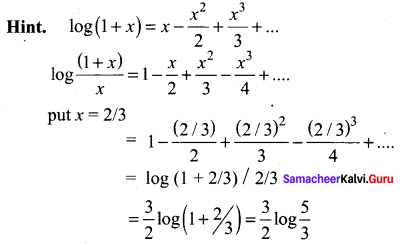
Answers:
1. Textile
2. Industrialization
3. Macadamised
4. Stockton and Darlington
5. employment
6. Safety
7. Reform Bill
8. Germany
9. John D. Rockfeller
10. 1st May

III. (a) Match the following:

Samacheer Kalvi 9th Social Science History Solutions Chapter 10 Industrial Revolution 2
Answer:
1. (c)
2. (d)
3. (a)
4. (b)

(b) Match the following:

Samacheer Kalvi 9th Social Science History Solutions Chapter 10 Industrial Revolution 3
Answer:
1. (e)
2. (a)
3. (b)
4. (c)
5. (d)

IV. Find out the correct statement.

Question 1.
(i) Society transformed from an agrarian economy to machine-production.
(ii) Industrial Revolution started first in England and spread to other parts of the world.
(iii) The term Industrial Revolution was popularized by the French economic historians.
(iv) There is no impact on Society and Politics by Industrial Revolution.
(a) (i) is incorrect
(b) (i) and (ii) are correct
(c) (i) and (iv) are correct
(d) (iii) is correct
Answer:
(b) (i) and (ii) are correct

Question 2.
(i) By the first quarter of 19th century the export of Dacca muslin to England was encouraged.
(ii) India became an exporter of raw materials.
(iii) British factory-made cheap Cotton fabrics in Indian markets.
(iv) The English deliberately destroyed the Indian Industry.
(a) (i) is correct
(b) (ii), (iii) and (iv) are correct
(c) (iii) is correct
(d) (iv) is correct
Answer:
(b) (ii), (iii) and (iv) are correct

Question 3.
Assertion (A): With the advent of the Industrial Revolution, England became the workshop of the world.
Reason (R): There was however a general decline in agriculture.
(a) A is correct R is wrong
(b) Both A and R are wrong
(c) Both A and R are correct
(d) A is correct R is irrelevant to A
Answer:
(d) A is correct R is irrelevant to A

Question 4.
Assertion (A): The Industrial Revolution quickened the process of transition of the United States from a rural to an urban society.
Reason (R): Young people raised on farms saw greater opportunities in the cities and moved there as did millions of immigrants from Europe.
(a) A is correct; R is the correct explanation of A
(b) A is wrong and R is the correct explanation of A
(c) Both A and R are wrong
(d) Both A and R are correct
Answer:
(a) A is correct; R is the correct explanation of A

V. Answer all questions given under each caption.

Question 1.
Invention of Steam Power
(а) What problems did the mine owners face?
Answer:
In the 18th century the British mine owners faced with the problem of water seeping into the mines.

(b) What did they do?
Answer:
They employed labourers to pump the water out.

(c) What did the British Engineer do at this juncture?
Answer:
The British Engineer Thomas Newcomen invented a contrive to pump the water out of mines.

(d) Was it successful?
Answer:
No, it consumed too much fuel.

Question 2.
Impact of Industrial Revolution on Labour Class
(a) What was the result of Industrial Revolution?
Answer:
It resulted in increased air and water pollution.

(b) How did it help the people?
Answer:
It helped the people by creating opportunities of employment for all the members of the family.

(c) Was there safety in the mines?
Answer:
No, safety was very poor.

Samacheer Kalvi 9th Social Science History Solutions Chapter 10 Industrial Revolution

(d) How was the living condition for the labour class?
Answer:
The housing was tiny, dirty, and sickly for the labouring class. Workers had no time to clean or change their own atmosphere even if they wished to, leading to the outbreak of typhoid, cholera, and smallpox.

VI. Answer the following briefly.

Question 1.
What is Industrial Revolution?
Answer:
In the latter half of the 18th Century major changes occurred in the method of production that changed the history of humankind. This profound transformation is described as the Industrial Revolution. Goods began to be produced not by hand but by machines. This increased the volume of goods produced exponentially.

Question 2.
Mention any three attributes of Industrial Revolution.
Answer:

  1. Use of new basic material: iron and steel.
  2. Use of new energy sources: coal, electricity, petroleum.
  3. Development in transportation and communication.

Question 3.
Why did Industrial Revolution begin in England first? Give three reasons.
Answer:

  1. England had abundant resources and possessed colonies, with India being “the brightest jewel in the British Crown”.
  2. Access to coal, iron and raw cotton from the colonies.
  3. England possessed the required infrastructure for textiles, developed by immigrant artisans from the Netherlands. ‘

Question 4.
How was Iron produced in olden days?
Answer:
In olden days iron ore was smelted in brick furnaces. Charcoal was used as fuel. The iron produced was not sturdy and strong. It had to be smelted again. Finally, coke (produced from coal) was used to produce iron. But this was a costly method.

Question 5.
How was the death of the miners reduced?
Answer:
As miners used oil lamps in the mines the risk of explosion was high leading to the death of miners. This was reduced by the invention of a safety lamp by Sir Humphrey Davy in 1815.

Question 6.
Industrial Revolution was dependent on good transportation. Comment.
Answer:
Industrial Revolution was dependent on good transportation. As production increased raw materials had to be brought from afar to the factories. After the goods were produced they had to be transported to the markets. As a result new networks of canals, roads and railroads were built. Macadamised roads and George Stephenson’s steam locomotive helped to improve road and railway transport system in the country.

Question 7.
What were the effects of Industrial Revolution in England in general?
Answer:
Industrial Revolution led to the expansion of trade, the production of more food, emergence of factory workers as a new class. The rise and growth of cities resulting in rapid urbanisation and organised workingclass movements, seeking voting rights and regulation of their service conditions brought about a new dynamics in politics.

Question 8.
Mention the socio-economic consequences of Industrial Revolution.
Answer:
While the peasants were pauperized and the working class suffered, the middle class became wealthy by investing capital in trade and industry. The governments of the day were influenced by them. All legislations safeguarded their interests. Labourers were not permitted to form trade unions. It was under these circumstances that Socialism as a new ideology was bom in Europe Karl Marx advocated scientific socialism for the protection of the working class from the exploitative policies of the capitalist class. By the latter half of the nineteenth century there were strong working class movements all over western. Europe which demanded economic as well as political rights.

Samacheer Kalvi 9th Social Science History Solutions Chapter 10 Industrial Revolution

Question 9.
Give an account of the entry of Industrial Revolution in France.
Answer:
France did not possess as much natural resources as England. The political instability caused by the French Revolution and the prolonged Napoleonic Wars wrecked the country. Many of those French businessmen who had sought refuge in Britain during the Revolution, on their return to France after Napoleonic Wars, used British technology. This helped to accomplish industrial revolution in their country.

Question 10.
Highlight the Industrial Revolution in Germany.
Answer:
Germany surpassed the home of the industrial revolution, Great Britain, and proved a competitor to the United States. In electrics, Germany offered companies like Siemens. In chemicals, Germany excelled in the production of potassium salt, dyes, pharmaceutical products, and synthetics. Companies like Bayer and Hoechst led the chemical industry of Germany. Germany became a leader in the automobile industry. Daimler and Benz became the most popular brands of automobiles in Germany and the world.

VII. Answer the following in detail.

Question 1.
Explain the working class strikes with special reference to Hay Market Massacre.
Answer:
The difficult working conditions in the factories, long hours of work, low wages, exploitation of women and children contributed to the growth of labour unions. After the Civil War, workers organized strikes. One major strike was the Great Railroad Strike of 1877. Wage cuts in the railroad industry, in the context of a prolonged economic depression, led to the strike, which began in West Virginia and spread to three additional states over a period of 45 days before being crushed by a combination of vigilantes, National Guardsmen, and Federal Army.

Haymarket Massacre
A labour protest took place on 4 May 1886, at Haymarket Square in Chicago. What began as a peaceful rally in support of workers striking for an eight-hour day resulted in the killing of several workers by the police. To commemorate the Haymarket Affair 1 May 1887 is observed as the Labour Day or May Day or International Worker’s Day.

Samacheer Kalvi 9th Social Science Civics Solutions Chapter 5 Local Self Government

You can Download Samacheer Kalvi 9th Social Science Book Solutions Guide Pdf, Tamilnadu State Board help you to revise the complete Syllabus and score more marks in your examinations.

Tamilnadu Samacheer Kalvi 9th Social Science Civics Solutions Chapter 5 Local Self Government

Local Self Government Textual Exercise

I. Choose the correct answer.

Question 1.
Which committee was appointed by the planning commission in 1985?
(a) Balwant Rai Mehta
(b) Ashok Mehta
(c) G V K Rao
(d) L M Singhvi
Answer:
(c) G V K Rao
Samacheer Kalvi 9th Social Science Civics Solutions Chapter 5 Local Self Government

Question 2.
The Uthiramerur stone inscription show evidences of prevalent local self government during the period in Tamil Nadu.
(a) Chola
(b) Chera
(c) Pandiya
(d) Pallava
Answer:
(a) Chola

Question 3.
The 73rd and 74th constitutional Amendment Acts, were enacted during the year in ………
(a) 1992
(b) 1995
(c) 1997
(d) 1990
Answer:
(a) 1992

Samacheer Kalvi 9th Social Science Civics Solutions Chapter 5 Local Self Government

Question 4.
……. act as the inspector of Village Panchayat.
(a) Commissioner
(b) District Collector
(c) Councilors
(d) Mayor
Answer:
(b) District Collector

II. Fill in the blanks.

1. …….. is known as the “Father of Local Governments”.

2. Restoration of has ……. become an article of faith during our freedom struggle.
3. …… was the name of the secret ballot method exercised to elect members to the village councils during the Chola period.
4. Local Government which are functioning in the Villages are called …….
5. …… will look after the administration of the Town Panchayat.
Answers:
1. LordRipon
2. panchayats
3. Kuda Olai Murai
4. Village Panchayats
5. Executive Officer

III. Match the following:

Samacheer Kalvi 9th Social Science Civics Solutions Chapter 5 Local Self Government 80
Answers:
1. (d)
2. (a)
3. (e)
4. (c)
5. (b)

IV. Find out the correct statement

Question 1.
(i) Panchayat Union is formed by grouping of Districts.
(ii) District Panchayat is constituted in each village.
(iii) The Municipal Commissioner will be a person from the Indian Administration Service (IAS).
(iv) In Village Panchayat the President and ward members are nominated by the people.
Answers:
(iii) is correct.

V. Answer in brief.

Question 1.
Name the taxes levied by the Village Panchayat.
Answer:
Taxes

  • Property Tax
  • Professional Tax
  • House Tax
  • Taxes for connection of drinking water
  • Land Tax
  • Taxes levied on shops

Question 2.
List out the salient features of Tamil Nadu Panchayat Raj Apt 1994.
Answer:
The salient features of the new Act are as follows:
(a) A three-tier system
(b) Gram Sabha
(c) Establishment of Election Commission
(d) Constitution of Finance Commission
(e) Reservation of seats for SC/ST’s proportionate to their population One third reservation of seats for women and
(g) Constitution of District Planning Committees.

Samacheer Kalvi 9th Social Science Civics Solutions Chapter 5 Local Self Government

Question 3.
Mention the important functions of the Village Panchayat.
Answer:
Functions of the Village Panchayat

  • Supply of drinking water
  • Maintenance of street lights
  • Maintenance of roads.
  • Maintenance of village libraries
  • Maintenance of small bridges
  • Granting permission to the housing plots
  • Maintenance of drainage
  • Construction of group houses
  • Cleaning of streets
  • Maintenance of burial grounds
  • Maintenance of common lavatory facilities

Question 4.
Which are the voluntary functions of the local governments?
Answer:
According to the Tamil Nadu Local Government Act passed in 1994, the following functions to be performed as voluntary functions by the local governments.

  • Maintenance of street lights in the villages
  • Maintenance of markets and fairs
  • Implantation of trees
  • Maintenance of play grounds
  • Maintenance of parking vehicles, slaughter houses and cattle sheds
  • Control over places of exhibition.

Question 5.
Who is the head of the District Panchayat?
Answer:
One district Panchayat is constituted for every 50,000 people and the ward members are directly elected by the people. The Chairman is elected from one among its members and their term is 5 years.

Samacheer Kalvi 9th Social Science Civics Solutions Chapter 5 Local Self Government

Question 6.
Name the Urban local governments.
Answer:
Urban Local Government

  • Town Panchayat
  • Municipality
  • Corporation.

VI Answer in paragraph.

Question 1.
Write in details about the salient features of the 73rd & 74th Constitutional Amendment Act (1992).
Answer:
Salient Features of the 73rd and 74th Constitutional Amendment Acts (1992)

  • Panchayats and Minicipalities will be ‘institutions of self-government’.
  • Basic Units of Democratic System – Grama Sabhas (Villages) and Ward Committees (Municipalities) comprising all the adult members registered as voters.
  • Three-tier system of panchayats at village, intermediate block/taluk/mandal and district levels. Two-tier for smaller states with population below 2 million.
  • Seats at all levels filled by direct elections.
    Seats reserved for Scheduled Castes (SCs) and chairpersons of the Panchayats at all levels also shall be reserved for SCs and STs in proportion to their population.
  • One-third of the total number of seats reserved for women. One-third of the seats reserved for SCs and STs also reserved for women. One-third offices of chairpersons at all levels reserved for women.
  • Uniform five year term and elections to constitute new bodies to be completed before the expiry of the term. In the event of dissolution, elections must be held compulsorily within six months.

Question 2.
Describe the major problems & challenges faced by the local self governments.
Answer:
Local self governments are the crucial basis for our democracy. The Constitutional status of local self governments adds more significance to their functioning. There are, however, a few critical concerns in the working of local self governments in India. Major problems and challenges may be mentioned as below:

  • Lack of clear demarcation of powers and functions of local bodies
  • Allocation of funds and needs assessment are not matched
  • Role of caste, class and religion in decision making at the local self governments
  • Poor accountability of elected members and officials at the grassroot levels of democracy

VII. Activity

Question 1.
Meet your President, Panchayat, Municipal Chairman and discuss with him how the local self goverment administered.
Answer:
You can do this activity under the guidance of your teacher.

Local Self Government Additional Questions

I. Choose the correct answer.

Question 1.
…… introduced the Local Self Government in 1882.
(a) Ashok Mehta
(b) Lord Rippon
(c) Mahatma Gandhi
(d) E.V.R. Periyar
Answer:
(b) Lord Rippon

Question 2.
Panchayat Raj System was introduced in Rajasthan in
(a) 1952
(b) 1953
(c) 1958
(d) 1959
Answer:
(d) 1959

Samacheer Kalvi 9th Social Science Civics Solutions Chapter 5 Local Self Government

Question 3.
Kuda Olai Murai was the name of the secret ballot method exercised by ….. to elect
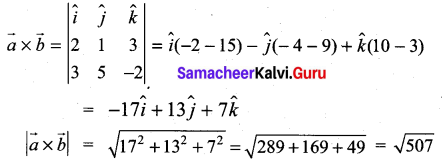
the village councils.
(a) Chera
(b) Chola
(c) Pandya
(d) Pallava
Answer:
(b) Chola

Question 4.
There are …… corporations in Tamil Nadu.
(a) 12
(b) 13
(c) 14
(d) 15
Answer:
(a) 12

Question 5.
…….. was the chairman of the Erode Municipality for many years since 1917.


(a) C.N. Annadurai
(b) E.V. Ramasamy Periyar
(c) M.G. Ramachandran
(d) Raja Gopalachari
Answer:
(b) E.V. Ramasamy Periyar

II. Find out the correct statement.

Question 1.
(i) Local governments which are functioning in the villages are called Village Panchayat.
(ii) The President and Ward members are indirectly elected.
(iii) Their term office is six years.
(iv) Collector acts as the Inspector of Village Panchayat.
(a) (i) and (ii) are correct
(b) (ii) and (iii) are correct
(c) (iv) is correct
(d) (ii) is incorrect
Answer:
(b) (ii) and (iii) are correct

Samacheer Kalvi 9th Social Science Civics Solutions Chapter 5 Local Self Government

Question 2.
(i) The area where less than 10,000 people are living is called as Town Panchayat.
(ii) Members and President of the town Panchayat are directly elected by the people.
(iii) Their term office is 5 years.
(iv) There is one Executive officer to look after the administration of the Town Panchayat.
(a) (i) and (ii) are correct
(b) (ii) and (iii) are incorrect
(c) (i), (ii) and (iii) are incorrect
(d) (ii), (iii) and (iv) are correct
Answer:
(d) (ii), (iii) and (iv) are correct

Question 3.
Assertion (A): The Mayor is elected by the people.
Reason (R): He is a link between the members of the corporation and the government.
(a) A is wrong; R is correct
(b) Both A and R are wrong
(c) A is correct and R is not the correct explanation of A
(d) A is correct and R is the correct explanation of A
Answers:
(d) A is correct and R is the correct explanation of A

III. Match the following:

Samacheer Kalvi 9th Social Science Civics Solutions Chapter 5 Local Self Government 50
Answers:
1. (d)
2. (c)
3. (a)
4. (b)

IV. Fill in the blanks.

1. After Independence the Gandhian ideas of ……. greatly influenced the constitution
makers.
2. ……… took some steps towards liberalizing the administration in India.
3. …… are constituted in each and every village wherever population is above 500.
4. …… is formed by grouping of villages.
5. Chennai Minicipality was constituted in …….
6. After which British Lord is Chennai Corporation building named?
7. Corporations, Municipalities’ and Town Panchayats are …… bodies.
Answers:
1. Grama Swaraj
2. Ripon
3. Village Panchayats
4. Panchayat Union
5. 1688
6. Lord Ripon
7. urban

V. Answer in brief.

Question 1.
What do you know about the Local Self Government?
Answer:
Local Self-Governments are institutions that look after the administration of an area or a small community such as a village, a town or a city. Local Self-Government operates at the lowest level of society. It works at the grassroot level, close to the people, touching their everyday life. Local Self-Government is the management of local affairs by such local bodies which have been elected by the local people. These local bodies provide services to the local community as well as act as an instrument of democratic self-government.

Question 2.
Mention any two salient features of the 73rd and 74th constitution Amendment Act 1992.
Answer:

  • Panchayats and Minicipalities will be ‘institutions of self-government’.
  • Basic Units of Democratic System – Grama Sabhas (Villages) and Ward Committees (Municipalities) comprising all the adult members registered as voters.

Question 3.
What are the functions of the Panchayat Union?
Answer:
Functions of the Panchayat Union are:

  • Supply of drinking water
  • Maintenance of Village Health Centres
  • Maintenance of roads
  • Establishment of Maternity Homes
  • Establishment of Public fairs
  • Establishment of Veterinary hospitals
  • Maintenance of Social forests
  • Repairing of Primary School buildings

Samacheer Kalvi 9th Social Science Civics Solutions Chapter 5 Local Self Government

Question 4.
Comment on District Panchayat.
Answer:
A District Panchayat is constituted in each district. One district Panchayat is constituted for every 50,000 people and the ward members are directly elected by the people. The Chairman is elected from one among its members and their term is 5 years.

Question 5.
What are the functions of the District Panchayat?
Answer:
The functions of the District Panchayat are:

  • Advising the government about the developmental schemes of the Village Panchayat and Panchayat Union.
  • Supervising the functions of District Planning Commission.

Question 6.
List down the important functions of the Mayor.
Answer:
Important functions of the Mayor

  • He acts as a bridge between the members of the corporation and the government.
  • He presides over the meetings of the Corporation Council.
  • He receives the dignitaries from foreign countries.

VI. Answer in a Paragraph.

Question 1.
Describe the Historical origin and Development of Local Self Government in Tamil Nadu.
Answer:
Tamil Nadu has a long history of local self-govemance as is evident Tamil Nadu, in those days was a land of village republics, with community groups undertaking many activities for their area development. This tradition reached its peak during the 10th and 11th centuries under the reign of Cholas when Village Councils used to levy taxes, improve community life and administer justice in their limited area.

These Village Councils had effective links with the Chola rulers. “Kuda Olai Murai” was the name of the secret ballot method exercised to elect members to the Village Councils. With the downfall of Cholas, the state experienced a decline of the village autonomy and rise of the centralized feudal administrative system. This continued till British rules introduced local self-govemance colonial British Government.

In the post independence era, the first enactment in democratic decentralization in the state was the Madras Village Panchayats Act, 1950. Pursuant to the White Paper on the ‘Reform of Local Administration’ in 1957, the Madras Panchayats Act, 1958 and Madras District Development Council Act were enacted with the following salient features.

Samacheer Kalvi 9th Social Science History Solutions Chapter 9 The Age of Revolutions

You can Download Samacheer Kalvi 9th Social Science Book Solutions Guide Pdf, Tamilnadu State Board help you to revise the complete Syllabus and score more marks in your examinations.

Tamilnadu Samacheer Kalvi 9th Social Science History Solutions Chapter 9 The Age of Revolutions

The Age of Revolutions Textual Exercise

I. Choose the correct answer.

Question 1.
The first British colony in America was ……………….
(a) New York
(b) Philadelphia
(c) Jamestown
(d) Amsterdam
Answer:
(c) Jamestown

Question 2.
The pioneer of French Revolution who fought on the side of Washington against the British was ……………..
(a) Mirabeau
(b) Lafayette
(c) Napoleon
(d) Danton
Answer:
(b) Lafayette

Question 3.
Lafayette, Thomas Jefferson and Mirabeau wrote the ………………
(a) Declaration of Independence
(b) Declaration of Pilnitz
(c) Declaration of Rights of Man and Citizen
(d) Human Rights Charter
Answer:
(c) Declaration of Rights of Man and Citizen

Samacheer Kalvi 9th Social Science History Solutions Chapter 9 The Age of Revolutions

Question 4.
The defeat of British at …………….. paved the way for the friendship between France and America.
(a) Trenton
(b) Saratoga
(c) Pennsylvania
(d) New York
Answer:
(b) Saratoga

Question 5.
…………… was the symbol of “Royal Despotism” in France.
(a) Versailles Palace
(b) Prison of Bastille
(c) Paris Commune
(d) Estates General
Answer:
(a) Versailles Palace

Question 6.
The forces of Austria and Prussia were defeated by the French Revolutionary forces at ……………..
(a) Verna
(b) Versailles
(c) Pilnitz
(d) Valmy
Answer:
(d) Valmy

Question 7.
Candide was written by …………….
(a) Voltaire
(b) Rousseau
(c) Montesquieu
(d) Danton
Answer:
(a) Voltaire

Question 8.
The moderate liberals who wanted to retain Louis XVI as a limited monarchy were called …………….
(a) Girondins
(b) Jacobins
(c) Emigres
(d) Royalists
Answer:
(d) Royalists

Question 9.
American War of Independence was ended with the Peace of Paris in the year ………………
(a) 1776
(b) 1779
(c) 1781
(d) 1783
Answer:
(d) 1783

Question 10.
Thomas Paine’s famous pamphlet was …………..
(a) Common Sense
(b) Rights of Man
(c) Bill of Rights
(d) Abolition of Slavery
Answer:
(a) Common Sense

II. Fill in the blanks.

1. The Postmaster General of the Postal Department of the government of Continental Congress was ……………….
2. The battle of Bunker Hill was fought on …………….
3. The …………… Act insisted on repaying the debt in gold or silver.
4. The leader of National Assembly of France was …………….
5. ………….. was guillotined for organizing a Festival of Liberty.
6. Louis XVI was arrested at ……………. with his family when he tried to escape from France.
Answers:
1. Benjamin Franklin
2. Massachusetts
3. Currency
4. Mirabeau
5. Herbert
6. Varennes

III Choose the correct statement:

Question 1.
(i) The Portuguese were the pioneers of naval expeditions.
(ii) New Plymouth was named after the Quaker Perm.
(iii) Quakers have the reputation of encouraging wars. .
(iv) The English changed the name of New Amsterdam to New York.
(a) (i) & (ii) are correct
(b) (iii) is correct
(c) (iv) is correct
(d) (i) & (iv) are correct
Answer:
(d) (i) & (iv) are correct

Question 2.
(i) The American War of Independence was as much a civil war as a war against the British.
(ii) The British forces emerged victorious in York Town.
(iii) The nobles in France were supportive of the rising middle class.
(iv) The British Parliament repealed the Townshend Act except the tax on paper.
(a) (i) & (ii) are correct
(b) (iii) is correct
(c) (iv) is correct
(d) (i) and (iv) are correct
Answer:
(a) (i) & (ii) are correct

Samacheer Kalvi 9th Social Science History Solutions Chapter 9 The Age of Revolutions

Question 3.
Assertion (A): Merchants of Boston boycotted the British goods
Reason (R): The British Finance Minister introduced new duties on imports into American . colonies
(a) A is correct and R is not the explanation of A
(b) A is incorrect and R is not the explanation of A
(c) A is correct and R is the explanation of A
(d) Both ‘A’ and ‘R’ are incorrect
Answer:
(c) A is correct and R is the explanation of A

Question 4.
Assertion (A): There was a massive peasant revolt in the Vendee against conscriptions;
Reason (R): The peasants as supporters of the king did not like to fight against him.
(a) Both A and R are incorrect
(b) Both A and R are correct
(c) A is correct and R is incorrect
(d) A is incorrect and R is correct
Answer:
(c) A is correct and R is incorrect

IV. Match the following:

Samacheer Kalvi 9th Social Science History Solutions Chapter 9 The Age of Revolutions 1
Answer:
1. (d)
2. (a)
3. (f)
4. (e)
5. (c)
6. (b)

V Answer the questions given under each caption:

Question 1.
Townshend Act
(a) Who introduced this Act?
Answer:
The British Finance Minister Charles Townshend introduced this Act.

(b) In which year was this Act passed?
Answer:
It was passed in 1767.

(c) Why did the colonists oppose the Act?
Answer:
The colonists opposed this Act as they introduced duties on imports to colonies such as glass, paper, paint, lead and tea.

(d) Why did the merchants of Boston oppose British goods?
Answer:
In March 1770, resentment rose in Boston, when troops fired on a crowd. This incident led to intense anti-British propaganda.

Question 2.
Social life in France
(a) What was the tax collected by the Church in France?
Answer:
The church collected one tenth of the annual produce or earnings from the common people.

(b) Who was Danton?
Answer:
Danton was a great leader of the Revolution.

(c) Who were the Encyclopaedists of eighteenth century France?
Answer:
Diderot and Jean d’Alembert were the Encyclopaedists of eighteenth-century France.

(d) Who provided free labour for the construction of public roads?
Answer:
The peasants provided free labour for the construction of public roads.

Samacheer Kalvi 9th Social Science History Solutions Chapter 9 The Age of Revolutions

VI. Answer the following questions briefly

Question 1.
Who were Puritans? Why did they leave England?
Answer:
Reformers who led a religious movement to reform the Church of England dispensing with the teachings and practices of Roman Catholic Church were known as Puritans. The Stuart kings, James I and Charles I, did not tolerate their attempts to reform the Church of England. The persecution of Puritans prompted many to leave England and settle.

Question 2.
What do you know about the Quakers?
Answer:
Quakers were members of a Christian group called the Society of Friends who, while laying emphasis on the Holy Spirit, rejected outward rites and an ordained ministry. George Fox was the founder of the society in England. Quakers have the reputation of actively working for peace and opposing war.

Question 3.
Point out the significance of “the Boston Tea Party”.
Answer:
Boston Tea Party was a protest against the British Parliament which had levied tax on tea in order to promote the business of the East India Company. In December. 1773, a group of men disguised themselves as Native Americans boarded the cargo vessels and threw the tea overboard. This was done publicly before a large sympathetic crowd. It was a challenge which led to war between the rebellious colonies and England.

Question 4.
Attempt an account of “September Massacres”.
Answer:
The people of Paris angered by the action of the Swiss guards in shooting and killing many of them hunted down the supporters of monarchy under their leader Marat. In three days, from September 2, about 1500 suspected dissidents were put in prison. After a trial, they were killed and this incident is called “September Massacres”. .

Question 5.
Explain the composition of “Three Estates of France”.
Answer:
The three estates comprised of the nobles, clergy and commoners respectively.
The clergy, despite being a minority, numbering only about 130,000, occupied a preeminent position in France.
The nobility, also a minority, numbering about 110,000, was a landowning class enjoying feudal rights formed the second estate.
The middle class and the peasants together formed the Third Estate.

Samacheer Kalvi 9th Social Science History Solutions Chapter 9 The Age of Revolutions

Question 6.
Sketch the role of Lafayette in the French Revolution.
Answer:
Lafayette, who fought the British on Washington’s side through to the conclusive battle at Yorktownin 1781, later during the French Revolution served the French National Guard as its Commander. He penned the Declaration of the Rights of Man and the Citizen, with the help . of Jefferson, which the National Assembly adopted on August 27, 1789.

Question 7.
What was the background for the storming of Bastille Prison?
Answer:
The king shut out the commoners and the latter assembled in the Tennis-Court and took an oath that they would not disperse until they found a way out to their problems. The King tried to use force but his own soldiers refused to obey his orders. Louis then intrigued to get foreign regiments to shoot down his own people. This provoked the people to rise in revolt in Paris on 14 July 1789. They stormed the Bastille prison and set free all the prisoners.

Question 8.
What were the taxes the peasants had to pay in France on the eve of Revolution?
Answer:
The peasants paid taxes to the state such as taille (land tax), gabelle (salt tax), etc., and provided free labour (corvee) for the construction of public roads.

VII. Answer in detail

Question 1.
“Taxation without Representation” led to the outbreak of American War of Independence – Explain.
Answer:
The Sugar Act of 1764 prohibited the import of foreign rum and imposed duties on molasses, wines, silks, coffee and other luxury items. As the Act was enforced ruthlessly, it led to protests by merchants in legislatures and town meetings. Soon the Currency Act was passed that insisted on colonies repaying the debt only in gold or silver. It was a huge burden on the colonial economy. The Quartering Act of 1765 required the colonies to pay for the cost of keeping British troops in America. The Stamp Act (1765) required that many printed materials in the colonies be produced on stamped paper produced in London, carrying an embossed revenue stamp.

The American colonists protested against all the above taxes arguing that they had to pay taxes for policies in which they had no say. The protests occurred at different levels of society. At the top, delegates from the colonies assembled and called for a boycott of trade with Britain Until the taxes were withdrawn: This apart, groups calling themselves “Sons of Liberty” sprang up in all the colonies in 1765 and 1766. The Sons of Liberty acted like a political party and instilled a new political awareness among many ordinary Americans.
The preamble of the Sugar Act provided the slogan ‘No Taxation without representation’.

Question 2.
Highlight the contribution of French Philosophers to the Revolution of 1789.
Answer:
There were many notable thinkers and writers in France in the eighteenth century. The most famous writer of the time on rationalistic and scientific subjects was Voltaire (1694 – 1778). When imprisoned and banished, he had to live at Femey near Geneva. Voltaire, Montesquieu (1689 – 1755) and Rousseau criticized the then existing conditions in France. Voltaire, was a prolific writer and activist, and was vehement in his criticism of the Church. His most famous work was Candide. His famous quote was: “those who can make you believe absurdities can make you commit atrocities.” He is said to have once exclaimed, “I disapprove of what you . say, but I will defend to the death your right to say it.”

Another great writer, a contemporary of Voltaire, but younger than him, was Jean Jacques Rousseau (1712 – 1778). His political theory set the minds of many afire with new ideas and new resolves. His ideas played an important part in preparing the people of France for the great revolution. He famously said in his book Social Contract, “Man is born free, but is everywhere in chains.” He argued that the laws are binding only when they are supported by – the general will of the people.

Montesquieu (1689 — 1755), who wrote The Persian Letters and The Spirit of the Laws, also defended liberty. He put forward the theory of separation of powers: The liberty of the individual would be best protected only in a government where the powers of its three organs, viz., legislature, executive and judiciary were separate. It would put in place the necessary checks and balances to prevent any one organ from assuming more power to itself.
An Encyclopaedia also came out in Paris about this time and this was full of articles by Diderot and Jean d’Alembert. These philosophers and thinkers, as opposed to religious intolerance and political and social privileges, succeeded in provoking large numbers of ordinary people to think and act.

VIII. Activity

Question 1.
If any Government becomes bankrupt like the Government of Louis XVI, what measures do you think are required to overcome the crisis?
Answer:
To avoid Bankruptcy the following steps can be followed:
(i) Maximize the Revenue
(ii) Attend mandatory credit counseling
(iii) Make ongoing payments to creditors
(iv) Attend mandatory financial-management education
(v) Make a Debt Management Plan
(vi) Settle some (or all) of the Debts
(vii) Stay out of Debts

Samacheer Kalvi 9th Social Science History Solutions Chapter 9 The Age of Revolutions

Question 2.
Attempt a comparative study of American W ar of Independence and Indian Independence
Movement.
Answer:
Comparison between American War of Independence and Indian Independence Movement:
A. Similarities

  1. Both the Americans and the Indians gained their freedom by challenging the British Empire with the use of alternating tactics and policies.
  2. Both wanted to be free because they were being coerced and restricted.
  3. The British Empire had a major influence on the development of Indian and American human societies.
  4. Indians boycotted British products in hopes of helping the Indian economy. Similarly, the Americans boycotted British tea and other products to get the attention of the British rule.

B. Differences

  1. Indians chose a peaceful way of gaining independence while Americans chose a violent way. The respective paths they chose were greatly influenced by their culture and the time periods they were in.
  2. Their leaders and strategies were extremely different.
  3. The American colony was actually a colony where the descendants of British people rebelled against Britain, whereas in India the rebellion was by the natives.
  4. The United States relied on the assistance of France, while India had no external ally.
  5. The British policy in America was to displace the native population and settle the territory as English territory, while India was more densely populated and the British policy centered on economic exploitation rather than full displacement and incorporation.
  6. The American Revolution took place just before the Industrial Revolution (when colonial arms were as good as British arms). The Indian Independence Movement took place well into the Industrial Revolution (when home country arms were potentially much better).

IX. Assignment

Question 1.
Attempting an account of Bastille prison.
Answer:
You can do this assignment under the guidance of your teacher.

The Age of Revolutions Additional Questions

I. Choose the correct answer.

Question 1.
The pioneers in geographical explorations and the founding of colonies were ……………
(a) The Portuguese and the Spanish
(b) The English and the Americans
(c) The Greeks and the Romans
(d) The Chinese and the Japanese
Answer:
(a) The Portuguese and the Spanish

Question 2.
The …………….. founded a town and called it New Amsterdam.
(a) English
(b) Portuguese
(c) Dutch
(d) Spanish
Answer:
(c) Dutch

Question 3.
The seven years of war between Britain and France took place between ……………..
(a) 1753-1760
(b) 1756-1763
(c) 1755-1762
(d) 1757-1764
Answer:
(b) 1756-1763

Question 4.
The …………… prohibited the import of foreign rum.
(a) Quartering Act of 1765
(b) Sugar Act of 1764
(c) Declaratory Act of 1766
(d) None of these
Answer:
(b) Sugar Act of 1764

Samacheer Kalvi 9th Social Science History Solutions Chapter 9 The Age of Revolutions

Question 5.
Merchants of …………… organized boycott of British goods.
(a) Washington
(b) New York
(c) Philadelphia
(d) Boston
Answer:
(d) Boston

Question 6.
The Spirit of Laws and the Persian letters were written by …………..
(a) Rousseau
(b) Montesquieu
(c) Voltaire
(d) Thomas Jefferson
Answer:
(b) Montesquieu

Question 7.
The French revolution exploded in …………….
(a) 1789
(b) 1788
(c) 1786
(d) 1790
Answer:
(a) 1789

Question 8.
The ‘Reign of Terror’ lasted for ……………. days in France.
(a) 44
(b) 45
(c) 46
(d) 48
Answer:
(c) 46

Question 9.
The execution of Louis XVI was on …………….
(a) 21st Jan 1793
(b) 2nd Sept 1792
(c) 3rd Sept 1792
(d) 27th July 1794
Answer:
(a) 21st Jan 1793

Question 10.
The Reign of Terror ended with the fall of …………..
(a) Danton
(b) Robespierre
(c) Napolean
(d) Herbert
Answer:
(b) Robespierre

II. Fill in the blanks.

1. The ……………. ship had taken a batch of Puritans from Plymouth England to America.
2. Declaration of Independence was drafted by …………
3. ………….. was the founder of the Society of Friends.
4. The native Americans were ……………
5. The Second Continental Congress met on 10th May 1775 at ……………
6. The …………….. Revolution affected the life and society in the whole of Continental Europe.
7. On the eve of the French Revolution, France was going through a period of …………….
8. The middle class and the peasants together formed the …………..
9. The great leader of the French Revolution was …………….
10. The Consulate was abolished by …………….. in France.
Answers:
1. May Flower
2. Thomas Jefferson
3. George Fox
4. Red Indians
5. Philadelphia
6. French
7. economic crisis
8. Third Estate
9. Danton
10. Napolean Bonaparte

III. Choose the correct statement.

Question 1.
(i) The American Revolution was the first political Revolution.
(ii) The French Revolution provided inspiration.
(iii) The Portuguese and the Spanish were the pioneers in Geographical explorations.
(iv) Jamestown was the first American colony in America.
(a) (i) and (ii) are correct
(b) (iii) is correct
(c) (i) and (iii) are correct
(d) (iv) is correct
Answer:
(c) (i) and (iii) are correct

Question 2.
(i) The American Revolution affected the life and Society in the whole of Continental Europe.
(ii) The Industrial Revolution laid the foundation for Capitalism.
(iii) The French Revolution helped to end the pre-capital feudal past.
(iv) The French Revolution exploded in 1789.
(a) (i) and (ii) are correct
(b) (iii) is correct
(c) (iv) is correct
(d) (ii) and (iv) are correct
Answer:
(d) (ii) and (iv) are correct

Samacheer Kalvi 9th Social Science History Solutions Chapter 9 The Age of Revolutions

Question 3.
(i) Cornwallis was bom into an aristocratic family.
(ii) Cornwallis joined the army in 1757. ‘
(iii) Cornwallis did not have an active career.
(iv) Cornwallis’s military action in the American war of Independence was not worthy.
(a) (i) and (ii) are correct
(b) (iii) is correct
(c) (iv) is correct
(d) (ii) and (iv) are correct
Answer:
(a) (i) and (ii) are correct

Question 4.
Assertion (A): The Dutch founded a town and called it New Amsterdam.
Reason (R): The English later changed the name to New York.
(a) A is correct and R is not the correct explanation of A.
(b) A is incorrect and R is not the correct explanation of A.
(c) A is correct and R is the correct explanation of A.
(d) Both A and R are incorrect.
Answer:
(c) A is correct and R is the correct explanation of A.

IV. Match the following:

Samacheer Kalvi 9th Social Science History Solutions Chapter 9 The Age of Revolutions 2
Answer:
1. (e)
2. (a)
3. (b)
4. (c)
5. (d)

V. Answer all questions given under each heading.

Question 1.
American War of Independence
(a) Who stated that no thinking man in North America desired Independence?
Answer:
George Washington

(b) Who was the first President of America?
Answer:
George Washington

(c) What were the grievances of the Americans?
Answer:
Their grievances were taxation and restrictions on trade. They challenged the right of the 88 British Parliament to tax them against their will.

(d) What was their famous battle cry?
Answer:
“No.taxation without representation”.

Question 2.
Second Continental Congress
(a) When did the Second Continental Congress meet?
Answer:
The Second Continental Congress met on 10th May 1775 at Philadelphia.

(b) Who were the prominent members of the Congress?
Answer:
John Adams, Sam Adams, Richard Henry Lee and Thomas Jefferson were the prominent members of the Congress.

(c) What did they do?
Answer:
They organized the army gathered around Boston as the Continental Army.

(d) Under whose command it was placed?
Answer:
They placed it under the command of George Washington.

Question 3.
Voltaire the French Philosopher
(a) Who was Voltaire?
Answer:
Voltaire was a prolific writer and activist.

(b) What did he criticize?
Answer:
He criticized the Church.

(c) What was his most famous work?
Answer:
His most famous work is ‘Candide’.

(d) What was his famous quote?
Answer:
His famous quote was ‘those who can make you believe absurdities, can make you commit atrocities’. .

Question 4.
The Reign of Terror
(a) Who were the main leaders of the National Convention?
Answer:
Danton, Herbert and Robespierre were the main leaders of the National Convention.

(b) What was the law of suspects?
Answer:
The Law of Suspects made spreading of false news to divide or instigate the people a punishable crime. ‘

(c) How was the Reign of Terror ended?
Answer:
The Reign of Terror ended with the fall of Robespierre.

(d) How did Robespierre earn notoriety?
Answer:
Though he was honest, patriotic and a person of integrity, he earned notoriety by sending many of his colleagues to the guillotine.

VI. Answer the following questions.

Question 1.
Write a short note on “Plantations and the Slave Labour”.
Answer:
As the Native Americans resisted attempts to make them work in the plantations, the European planters, chiefly of tobacco, in the southern states -Virginia, Carolinas and Georgia- in their search for labour resorted to acquiring slaves from Africa.

The innocent people of Africa were captured in man-hunts and sent across the seas in a cruel and inhuman manner. In the northern States conditions were different. There were compact farms, and not huge plantations as in the south. Large numbers of workers were not needed for these farms. Thus two economic systems developed in these colonies. Native Americans had no place in either of these. So these people were gradually pushed back to the west. This was made easier by the disunity and divisions among the Native American tribes.

Question 2.
What do you know about the Native Americans?
Answer:
Even before the arrival of Europeans in America, there was an indigenous population, called Native Americans (they used to be referred to as ‘Red Indians’; it is now considered demeaning, and historians do not use this term any more), spread over the vast American continent. They belonged to various tribes and many of them were at war with each other. Besides they refused to work under conditions of slavery. Through a combination of violence and diplomacy Europeans conquered and defeated many of these tribes. Greatly reduced in numbers today they live in various reserves. :

Question 3.
What was the reaction of the American colonies for the taxes?
Answer:
The American-colonists protested against all the above taxes arguing that they had to pay taxes for policies in which they had no say. The protests occurred at different levels of society. At the top, delegates from the colonies assembled and called for a boycott of trade with Britain until the taxes were withdrawn. This apart, groups calling themselves “Sons of Liberty” sprang up in all the colonies in 1765 and 1766. The Sons of Liberty acted like a political party and instilled a new political awareness among many ordinary Americans.

Samacheer Kalvi 9th Social Science History Solutions Chapter 9 The Age of Revolutions

Question 4.
Why was the Townshed Act introduced?
Answer:
The British Parliament however wanted to assert its control over the colonies. In 1766 it passed the Declaratory Act. It affirmed Parliament’s right to legislate for the colonies. There was not much opposition to it as it did not introduce any new taxes. Despite the withdrawal of the Stamp Act, the British still needed money to pay its troops and other expenses in the colonies. Hence, the British Finance Minister Charles Townshend introduced new duties on imports in 1767. Known as the Townshend Acts, they introduced duties on imports to colonies ‘ such as glass, paper, paint, lead and tea.

Question 5.
Why did the local tea traders boycott the foreign tea?
Answer:
The protests and boycotts made the British Parliament repeal the Townshend Acts. However, it retained the tax on tea, with the intention of encouraging the business of the East India Company by making it easy for it to take its tea to America and sell it there. This harmed the local tea trade and so it was decided to boycott this foreign tea.

Question 6.
Why didn’t the colonies begin fighting for the sake of independence?
Answer:
In 1774, a little before war began between the colonies and England, George Washington stated that no thinking man in North America desired independence. And yet he became the colonists’ commander-in-chief and later the first president of the American Republic. So the colonies did not begin fighting for the sake of independence. Their grievances were taxation and restrictions on trade. They challenged the right of the British Parliament to tax them against their will. “No taxation without representation” was their famous battle cry.

Question 7.
What were the political reasons for the French Revolution? ‘
Answer:
Louis XV succeeded his great-grandfather LoUis XlV and reigned for fifty nine years. He learnt no lesson that the king is not above law but bound by law from the English Revolution and the beheading of the King Charles I. In 1774 he was succeeded by his grandson Louis XVI.

He was entirely under the influence of his wife Marie Antoinette, who believed, more than the King, in the Divine Right Theory of Kingship – the theory that the king was representative of god on earth and therefore for all his actions he was accountable only to god and not to anybody else. Both the King and the Queen were hated by the people.

Question 8.
How did the Reign of Terror end?
Answer:
The Reign of Terrof ended with the fall of Robespierre. Robespierre, the dictator of the Convention, though he was honest, patriotic and a person of integrity, earned notoriety by sending many of his colleagues to the guillotine. In October 1795 the Convention broke up and a Directory of five members assumed power.

VII. Answer the following in detail.

Question 1.
Describe the results of American war of Independence.
Answer:
The immediate result of the war was America’s independence. For the first time a colonial power was overthrown by the colonised, leading to the establishment of a republican government in the United States. The colonists wanted to get rid of the feudal inequalities of Europe and they succeeded. For many followers of the Enlightenment in Europe, the language of the Declaration of Independence seemed a living fulfillment of their ideals. The Declaration of Independence of 1776 stated that “all men are bom equal.” But in reality the poor Black slaves did not fit in this. America had to fight a bitter civil war in the succeeding century, to’ abolish slavery.

By 1777 nearly all the colonies had a written constitution. These constitutions protected individual rights, freedom of press and freedom of religion. The Continental Congress had drafted the Articles of Confederation. The Church and the State were separated. Thomas Jefferson in his Virginia Statute for Religious Freedom introduced freedom of religion. It was later incorporated into the American Constitution.

The conception of people’s right to a government of their choice encouraged the Latin American revolutionaries to strive for the overthrow of the Spanish empire in South America. Mirabeau quoted the Declaration of Independence with enthusiasm during the French Revolution and the revolutionaries inspired by it were determined to fight against royal absolutism. The intellectuals of the time believed that the republican state was the only political structure in which individuals could preserve their basic freedom, including property and political rights.

Question 2.
Explain the impact of French Revolution.
Answer:
The French Revolution had many lasting results. It marked the end of the system of absolute monarchy in France. All feudal privileges were abolished and the power of clergy was curbed. The Revolution united the people of different sections and paved the way for the enhanced power of the state. It also led to the growth of feelings of nationalism and the emergence of an assertive middle class.

Samacheer Kalvi 9th Social Science History Solutions Chapter 9 The Age of Revolutions

Revolution upheld the theory of people’ sovereignty and laid the foundation for the birth of liberal constitutional governments in Europe. Liberty, equality, and fraternity became the watchwords of freedom loving people all over the world and inspired many later day political movements for the establishment of liberal democracy in Europe and elsewhere.

Samacheer Kalvi 9th Social Science History Solutions Chapter 8 The Beginning of the Modern Age

You can Download Samacheer Kalvi 9th Social Science Book Solutions Guide Pdf, Tamilnadu State Board help you to revise the complete Syllabus and score more marks in your examinations.

Tamilnadu Samacheer Kalvi 9th Social Science History Solutions Chapter 8 The Beginning of the Modern Age

The Beginning of the Modern Age Textual Exercise

I. Choose the correct answer.

Question 1.
Who among the following is known as the Father of Humanism?
(a) Leonardo da Vinci
(b) Francisco Petrarch
(c) Erasmus
(d) Thomas More
Answer:
(b) Francisco Petrarch

Question 2.
The School of Athens was painted by ……………..
(a) Raphael Sanzio
(b) Michelangelo
(c) Albrecht Durer
(d) Leonardo da Vinci
Answer:
(a) Raphael Sanzio

Question 3.
William Harvey discovered ……………
(a) Heliocentric theory
(b) Geocentric theory
(c) Gravitational force
(d) Circulation of blood
Answer:
(d) Circulation of blood

Samacheer Kalvi 9th Social Science History Solutions Chapter 8 The Beginning of the Modern Age

Question 4.
Who wrote the 95 Theses?
(a) Martin Luther
(b) Zwingli
(c) John Calvin
(d) Thomas More
Answer:
(a) Martin Luther

Question 5.
Who wrote the book Institutes of Christian Religion?
(a) Martin Luther
(b) Zwingli
(c) John Calvin
(d) Cervantes
Answer:
(c) John Calvin

Question 6.
Which sailor was the first to cross the Equator?
(a) Henry, the Navigator
(b) Lopo Gonzalves
(c) Bartholomew Diaz
(d) Christopher Columbus
Answer:
(b) Lopo Gonzalves

Question 7.
…………… named the sea as Pacific Ocean as it was very calm.
(a) Columbus
(b) Amerigo Vespucci
(c) Ferdinand Magellan
(d) Vasco-da-gama
Answer:
(c) Ferdinand Magellan

Question 8.
The continent of America was named after …………..
(a) Amerigo Vespucci
(b) Christopher Columbus
(c) Vasco da Gama
(d) Hernando Cortez
Answer:
(a) Amerigo Vespucci

Question 9.
……………… was the headquarters of the Portuguese possession in the East.
(a) Manila
(b) Bombay
(c) Pondicherry
(d) Goa
Answer:
(d) Goa

Question 10.
Which among the following plants were introduced from America to Europe?
(a) Sugarcane
(b) Sweet Potato
(c) Rice
(d) Wheat
Answer:
(b) Sweet Potato

II. Fill in the blanks.

1. In 1453 Constantinople was captured by …………….
2. ……………. was known as Prince among Humanists.
3. ………….. is famous for his paintings in the ceiling of the Sistine Chapel.
4. The reformation of the Catholic Church is known as …………….
5. The chief features of Commercial Revolution were …………., …………… and ……………
Answers:
1. Ottoman Turks
2. Erasmus
3. Michelangelo
4. Counter Reformation
5. Banking, Joint-stock companies and growth of trade

III. Find out the correct statement.

Question 1.
(a) Martin Luther broke away from the Catholic Church because he was discriminated.
(b) John Calvin’s government in Geneva was liberal and fun-filled.
(c) King Henry VIII had deep theological differences with the Catholic Church.
(d) Council of Trent reemphasized the importance of ceremonies and significance of the mass.
Answer:
(d) Council of Trent reemphasized the importance of ceremonies and significance of the mass.

Question 2.
(a) Discovery of new lands and sea routes shifted the economic centre from Italian city states to Spain and Portugal.
(b) Horses were native to America.
(c) During the begining of the Modem Age, State did not interfere in economic activities.
(d) The Portuguese collaborated with the Arabs in its trading activities in India.
Answer:
(a) and (d)

IV. Match the following:

Samacheer Kalvi 9th Social Science History Solutions Chapter 8 The Beginning of the Modern Age 1
Answer:
1. (d)
2. (e)
3. (c)
4. (a)
5. (b)

V. Answer the following questions briefly

Question 1.
Explain how the invention of printing press influenced Renaissance, Reformation and Geographical discoveries.
Answer:
(i) The invention of the printing press accelerated the process of modernisation. Earlier, manuscripts were written by hand on animal skin called vellum. Only the privileged few could access them. Johannes Gutenberg (1394-1468 A.D. (C.E.)) invented the printing press in Germany in the middle of the fifteenth century. The printing press enabled the production of multiple copies of a manuscript and their spread all over Western Europe.

(ii) In less than fifty years after the invention of the Gutenberg printing press, about six million books had been printed.

(iii) The invention of printing press not only spread knowledge widely, but also promoted critical thinking.

Question 2.
Write a short note on the impact of Renaissance. ‘
Answer:

  • Its most important contribution was the idea of humanism.
  • The introduction and practice of writing in the vernacular, starting from Dante, enriched the growth of vernacular languages which in turn provided the intellectual basis for the rise of nation-states.
  • Renaissance made a beginning in criticizing the corrupt and worldly practices of the Church.
  • Discovery of new land routes and remapping of the world.
  • Similarly, inquisitiveness and empiricism of renaissance combined with knowledge of the classical science led to new inventions in science.

Question 3.
Outline the differences of Martin Luther with the Catholic Church.
Answer:

  1. In Catholic Church, Pope was the spiritual authority, but he lived a luxurious life like, a prince.
  2. The Church prescribed a number of penances for various sins.
  3. The Church even began to grant pardon, known as the indulgences, for a fee.
  4. Luther opposed all these activities of the Church.
  5. He listed out the famous ninety five theses and-pasted them on the Church door.
  6. He put forward the doctrine of justification by faith.
  7. His reformation marked the first successful break from the Church and establishment of the Protestant Church.

Question 4.
Write a brief note on Counter Reformation.
Answer:

  • The Protestant reformation posed a threat to the Catholic Church.
  • In order to meet the challenge Pope Paul III and his successors introduced a number of rigorous reforms in the Church. They dealt with corruption severely and stopped the sale of offices.
  • The Council of Trent reemphasized the importance of ceremonies and the significance of the mass.
  • Further, it revitalized the Inquisition to deal with opposition to the Church. It also gave official sanction to the Society of Jesus.
  • This reformation of the Catholic Church from within is known as Counter Reformation.

Samacheer Kalvi 9th Social Science History Solutions Chapter 8 The Beginning of the Modern Age

Question 5.
What is Columbian Exchange?
Answer:
One of the most important outcomes of the conquest of Americas by the European colonial powers was the movement of plants, animals, technology, culture and strange diseases between the Americas and Europe or between the New World and the Old World. This is known as the Columbian Exchange.

VI. Answer all the questions given under each caption.

Question 1.
Renaissance
(a) Give reasons as to why renaissance originated in the Italian city-states.
Answer:
The Italian city-states were centres of cultural activities since the fourteenth century. With the coming of the scholars and artists from Constantinople there was a surge of enthusiasm and interest in studying classical literature and art of Greeks and Romans in the Italian city states. This creative upsurge was reflected in their writings, art, architecture and music. This cultural florescence is known as the renaissance.

(b) Name some of the important humanists and their works.
Answer:
Petrach (Father of Humanism) – My Secret Book
Dante – Divine Comedy
Machiavelli – The Prience
Erasmus – In Raise of Folly
Sir Thomas More – Utopia
Cervantes – Don Quixote

(c) List the differences between medieval art and Renaissance art.
Answer:
Renaissance paintings and sculptures were realistic and naturalistic. They improved over medieval paintings and sculptures which were stylized, unrealistic and two dimensional. They portrayed natural landscapes, human anatomy, emotions and ideas.

(d) Describe humanism.
Answer:
Humanism laid emphasis on human dignity and nature. Renaissance humanism promoted the view that humans are endowed with attributed that are to be used to achieve greatness.

Question 2.
Reformation
(а) Why did Martin Luther protest against the Church?
Answer:
Martin Luther rejected several teachings and practice of the Roman Catholic Church. He strongly disputed the Catholic view on indulgences.

(b) What is the doctrine of j ustification by faith?
Answer:
He argued that it was by faith alone that one could attain salvation. He put forward the doctrine of justification by faith. The grace of God would be bestowed by the divine will alone and not by the deeds of the people.

(c) Why did Henry VIII establish the Anglican Church? ”
Answer:
King Henry VIII longed for a son who would succeed him to the throne. For this purpose Henry wanted to marry again and therefore appealed to the Pope to annul his marriage with Catherine. However, the Holy Roman Emperor was Catherine’s nephew and he pressurized the Pope not to agree to his request.

As the Pope kept evading his decision, King Henry VIII grew impatient and broke his ties with Rome. By a series of Acts he established a separate Anglican Church. He confiscated the properties of the Catholic Church and monasteries in England and declared himself the Supreme Head of the Anglican Church.

(d) Mention the contribution of Ignatius Loyola.
Answer:
St. Ignatius Loyola founded the Society of Jesus to propagate Christianity. Its main work was through education and service to the destitute. It started a number of educational institutions, orphanages and homes for the destitute. Soon their missionaries were present in all parts of the world to spread the Catholic religion.

Question 3.
Geographical Discoveries
(a) Who is Henry, the Navigator?
Answer:
Henry thfe Navigator of Portugal laid the foundation for long distance sea voyages. He established a navigation school to train sailors. In his school, he taught them how to use navigational instruments such as the mariner’s compass and the astrolabe.

(b) List the causes for the geographical discoveries.
Answer:

  1. When the Ottoman Turks blocked the land route between the East and the West, spices and other goods became costlier.
  2. This intensified the urge to discover a new sea route to Asia.

(c) What led to the extinction of the natives of America?
Answer:

  1. Many natives also died because of epidemic diseases brought by the colonizers.
  2. The most dangerous weapons the natives had to encounter were these deadly diseases against which they were defenseless.
  3. It led to the near annihilation of the natives in most parts of the Americas.

(d) What is triangular trade?
Answer:
The Trans-Atlantic Trade was a triangular trade. The European countries purchased slaves from Africa who were transported to America. In return they got sugar and other raw materials from America. The European countries profited immensely from this trade.

VII. Answer the following in detail.

Question 1.
Discuss how Renaissance, Reformation and Geographical discoveries heralded the modern age?
Answer:
The Italian city-states were centres of cultural activities since the fourteenth century. With the coming of the scholars and artists from Constantinople there was a surge of enthusiasm and interest in studying classical literature and art of Greeks and Romans in the Italian city states. This creative upsurge was reflected in their writings, art, architecture and music. This cultural florescence is known as the renaissance. The origin of the word renaissance is from the Italian word renascita meaning rebirth. It is called renaissance because there was a rebirth or revival of classical Greek and Latin literature.

Many scholars in Italy went in search of manuscripts of classical literature. Greek scholar Manuel Chrysoloras who taught Greek classics in Italy, Guarino and Giovanni Aurispa, to name just a few, visited Constantinople several times to collect Greek manuscripts. Later they printed what they collected. This provided stimulus to the flowering of renaissance.

The critical thinking and inquisitive spirit of Renaissance humanism helped people question such practices of the Church. Humanists such as Erasmus and Sir Thomas More, apart from condemning the corrupt practices of the Church, were also critical of its doctrine. They issued pamphlets and published books highlighting the abuses of the Catholic Church.

Attempts to reform the Church before the sixteenth century met with failure. Those who protested were punished with death by the Church. However, in the age of reason, the moves of the reformers were supported by some of the rulers of the nation-states. This they thought would provide them an opportunity to free themselves from the interference of the Church in the affairs of the state.

The Lutheran reformation opened the gates for other Protestant reformations. Though inspired by the very same reasons as that of the Lutheran reformation, they showed differences in their doctrinal approach.

Question 2.
Examine the outcome of the geographical discoveries.
Answer:
The geographical discoveries transformed the European understanding of the world. It led to the redrawing of the world map. As a result of the discovery of new lands and new sea routes, the economic centre of Europe, shifted from the Italian city states to Spain and Portugal. Both Spain and Portugal established colonies that led to their economic prosperity.

Spanish discovery of the New World led to the conquest of Mexico and South America. The voyage of Columbus was followed by further explorations by Spanish Conquistadors (Conquerors) who defeated the natives and colonized it. They brutally killed the natives in their conquest and : The the remaining were employed under harsh conditions in gold and silver mines, and in plantations. The Spanish genocide of the natives included massacre, slavery and destruction of culture. Many natives also died because of epidemic diseases brought by the colonizers.

Student Activities

Question 1.
In an outline map of World, mark the routes of:
(a) Bartholomew Diaz
(b) Vasco-da-Gama
(c) Columbus
(d) Magellan
Answer:
Samacheer Kalvi 9th Social Science History Solutions Chapter 8 The Beginning of the Modern Age 2
Samacheer Kalvi 9th Social Science History Solutions Chapter 8 The Beginning of the Modern Age 3

Question 2.
Write a brief biography of Martin Luther.
Answer:
Martin Luther was bom in 1483. He was a German professor of theology, composer, priest, monk, and a seminal figure in the Protestant Reformation. He was ordained to the priesthood in 1507. He was a scrupulous follower of the Catholic faith. However, on his visit to Rome he was shocked by the luxurious life of the officials of the Church. Luther proposed an academic discussion of the practice and efficacy of indulgences in his Ninety-five Theses of 1517.

His refusal to renounce all of his writings at the demand of Pope Leo X in 1520 and the Holy Roman Emperor Charles V at the Diet of Worms in 1521 resulted in his excommunication by the pope and condemnation as an outlaw by the Holy Roman Emperor. Luther’s reformation marked the first successful break from the Church and establishment of the Protestant Church. He died in 1546.

The Beginning of the Modern Age Additional Questions

I. Choose the correct answer.

Question 1.
Europe was gradually moving towards urbanization due to decline of …………..
(a) Feudalism
(b) Trade
(c) Freedom
(d) Population
Answer:
(a) Feudalism

Question 2.
Cervantes of …………. wrote Don Quixote,
(a) Portugal
(b) Persia
(c) Italy
(d) Spain
Answer:
(d) Spain

Question 3.
……………… proved that earth revolved around the sun through a mathematical model.
(a) Ptolemy
(b) Galileo
(c) Copernicus
(d) Euclid
Answer:
(c) Copernicus

Question 4.
………… put forward the doctrine of justification by faith.
(a) Frederick
(b) Martin Luther
(c) Thomas More
(d) Johann Tetzel
Answer:
(b) Martin Luther

Samacheer Kalvi 9th Social Science History Solutions Chapter 8 The Beginning of the Modern Age

Question 5.
……….., with the support of King Ferdinand and Queen Isabella of Spain, set sail in three ships.
(a) Henry
(b) Ptolemy
(c) Columbus
(d) Amerigo Vespucci
Answer:
(c) Columbus

II. Fill in the blanks.

1. The Portuguese navy defeated the King of Calicut and captured Goa …………….
2. The introduction of Sugarcane led to the establishment of Sugarcane plantation in …………… islands.
3. Mercantilism refers to ……………. system.
4. The English East India Company had monopoly trade in ………………
5. Machiavelli wrote a …………… treatise called‘The Prince’.
6. The office of the Pope was known as …………..
7. ………….. founded the Society of Jesus to propagate Christianity.
8. Henry, the Navigator of Portugal laid the foundation for …………….
9. …………….. trade increased with the discovery and colonization of America.
Answers:
1. Zamorin
2. Caribbean
3. economic
4. India
5. political
6. Papacy
7. St. Ignatius Loyola
8. long-distance voyages
9. Slave

III. Match the following:

Samacheer Kalvi 9th Social Science History Solutions Chapter 8 The Beginning of the Modern Age 4
Answer:
1. (b)
2. (c)
3. (d)
4. (e)
d. (a)

IV. Give short answers.

Question 1.
What subject were taught in the Italian universities?
Answer:
Italian universities taught humanities namely language, grammar, rhetoric, history and ethics which prepared the students for public life, commerce and administration. The study of humanities was so popular in the Italian Universities. Students from all over the world flocked there.

Question 2.
Explain the term Inquisition.
Answer:
Inquisition was an institution of the Catholic Church to deal with heresies beliefs in opposition to the Catholic faith.Those found guilty and who recanted were awarded milder punishments and imprisonment. Those who refused to recant were burnt at the stake. The most infamous inquisition was the Spanish Inquisition.

Question 3.
Write about Zwingli and Calvin.
Answer:
Zwingli of Switzerland and John Calvin of Geneva followed Martin Luther. Zwingli worked from Zurich and was against all forms of rituals. John Calvin also apposed all forms of display of wealth. Calvin codified his views in his book Institutes of Christian Religion. He believed that church should be independent of political control on religious matters. Calvinism became more popular.

Question 4.
Bring out the main features of India at the dawn of Modern Age in Europe.
Answer:
The Mughal rule started in 1526 A.D. Vijayanagar state, founded in 1336, rose to a great power under Krishnadeva Raya. Portuguese established their empire in the East with headquarters at Goa. In Tamil Nadu, in Madurai, Nayak rule began dividing the Pandya kingdom into seventy two palayams. The arrival of Jesuit Missions and the work of St. Francis Xavier, as a member of Society of Jesus, led to conversion of fishing community to Christianity (Catholicism) in Thoothukudi region.

V. Answer all questions given under each heading.

Question 1.
Growth of trade and Rise of Towns.
(a) Where did the process urbanisation start first in Europe?
Answer:
This process of urbanisation started first in Italy because of its prosperous Mediterranean trade.

(b) Name the city states which profited due to this trade.
Answer:
Italian city-states such as Venice and Genoa profited immensely from this trade.

(c) What were the new ideas born in this Context?
Answer:
In this context, new ideas leading to the Renaissance, Refonhation and Exploration through sea voyages were bom.

(d) What did the Arabs bring?
Answer:
The Arabs brought spices from the east and then transported them by land to the ports of the Mediterranean region.

Question 2.
Fall of Constantinople.
(a) Who captured Constantinople?
Answer:
In 1453 A.D. Constantinople, the capital of the Byzantine Empire, was captured by the Ottoman Turks.

(b) What was the result?
Answer:
This acted as a catalyst for the birth of Renaissance. It also led to the discovery of new land routes. .

(c) Who moved towards the Italian City states?
Answer:
Following the Turkish occupation, a number of scholars, artists and artisans left Constantinople moving towards the Italian city states.

(d) What was promoted by them?
Answer:
Their presence and encouragement promoted the study of classical literature and art of Greeks and Romans.

Samacheer Kalvi 9th Social Science History Solutions Chapter 8 The Beginning of the Modern Age

Question 3.
Science during Renaissance.
(a) Who inspired the advances in Science?
Answer;
The advances in science were inspired by Ptolemy, Archimedes, Euclid and others.

(b) What was proved by Copernicus?
Answer:
Copernicus proved that earth revolved around the sun through a mathematical model.

(c) What was the contribution of Galileo?
Answer:
Galileo proved further astronomical proof with the aid of the telescope he invented.

(d) What role was played by the Church in the field of science?
Answer:
The Church continued to prevent the growth of science as it undermined its importance.

Question 4.
Vasco da Gama:
(а) When did Vasco da Gama sailed from Portugal?
Answer:
In 1497 A.D. Vasco da Gama sailed from Portugal.

(b) Where did he reach in Africa?
Answer:
He reached the Cape of Good Hope in Africa.

(c) Where did he reach on the Malabar Coast?
Answer:
1498 A.D. he reached Calicut on the Malabar Coast.

(d) Why was Vasco da Gama astounded?
Answer:
At Calicut, Vasco da Gama was astounded to find pepper and other spices, a precious commodity in Portugal, available at low prices.

VII. Answer the following in detail:

Question 1.
Write about Martin Luther.
Answer:
Martin Luther, a monk of the Augustinian Order and a Professor’ of Theology in the University of Wittenberg, was a devout Christian and a scrupulous follower of the Catholic faith. However, on his visit to Rome he was shocked by the luxurious life of the officials of the Church. Martin Luther wrote a pamphlet against the sale of indulgences, sale of offices and other corrupt practices. He listed out ninety five points and pasted them on the Church door of Wittenberg. Martin Luther signalled his revolt by publicly burning the Papal Bull.

Samacheer Kalvi 9th Social Science History Solutions Chapter 8 The Beginning of the Modern Age

Luther further elaborated his differences with the Church. He rejected the belief that ceremonies and penances would lead to salvation. He argued that it was by faith alone that one could attain salvation. He put forward the doctrine of justification by faith. The grace of God would be bestowed by the divine will alone and not by tfie deeds of the people. Luther’s reformation marked the first successful break from the Church and establishment of the Protestant Church.