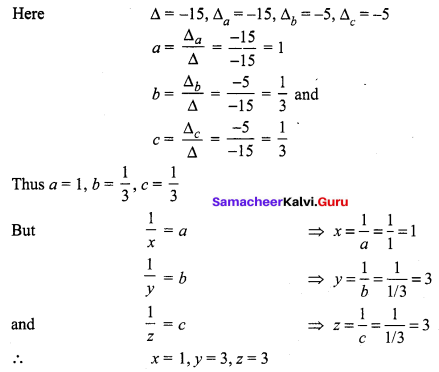
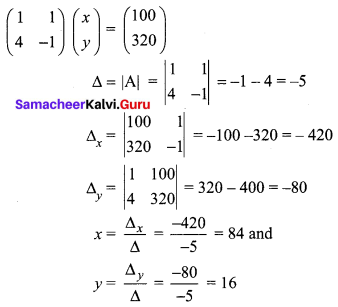
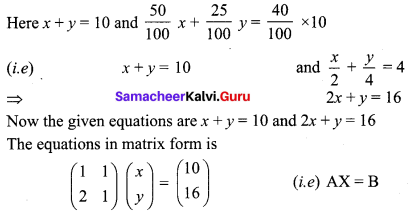
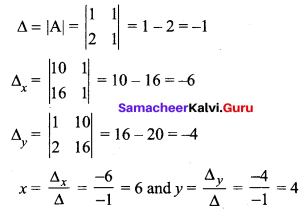
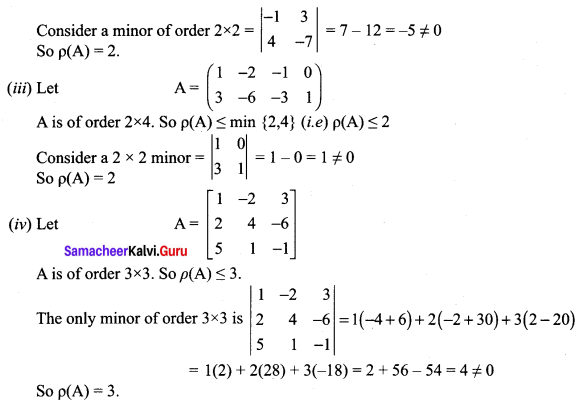
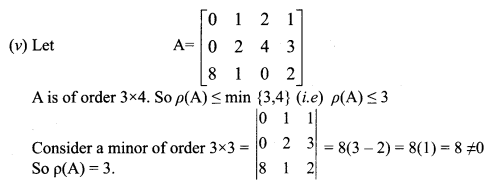
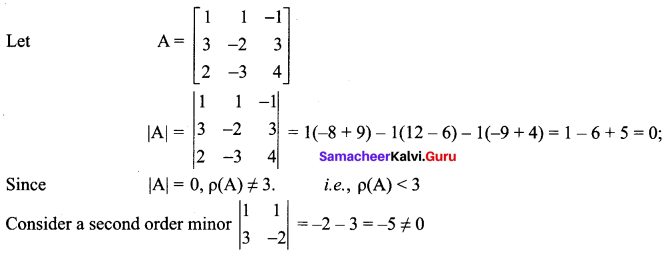
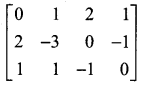
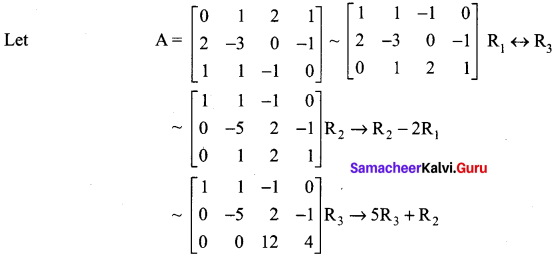
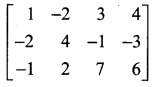
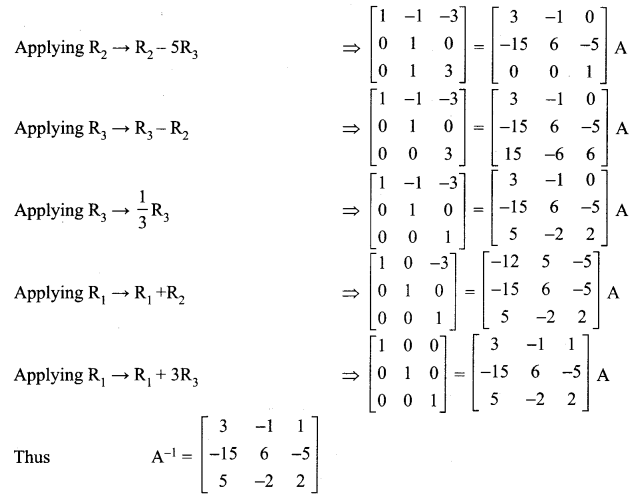
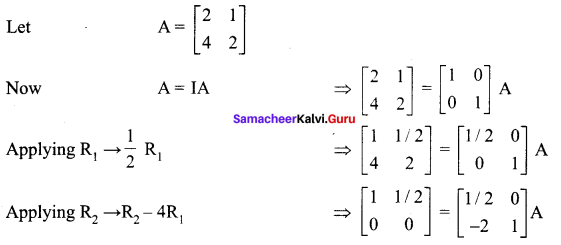
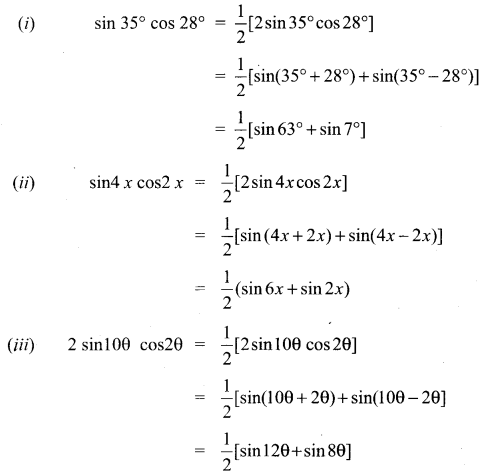
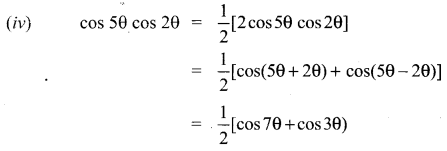
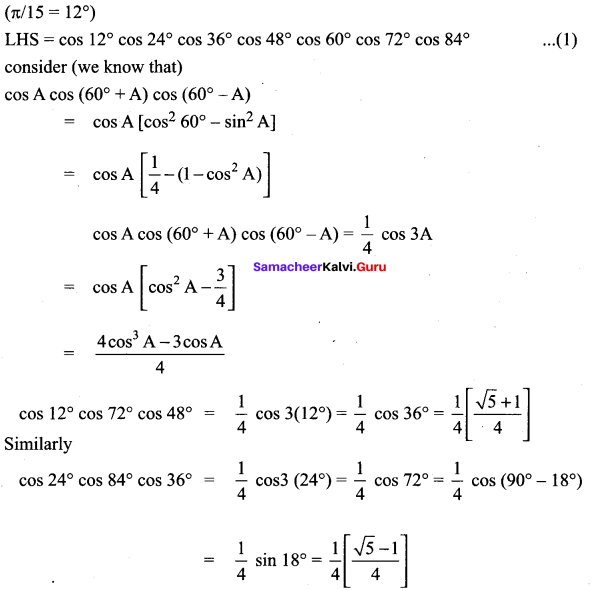
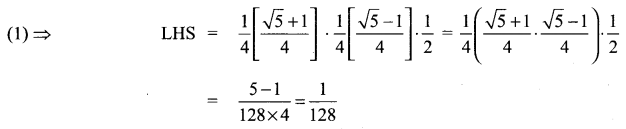
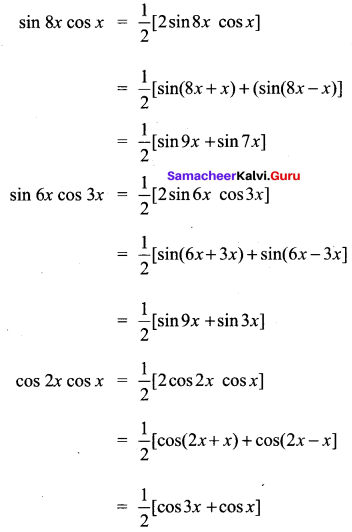
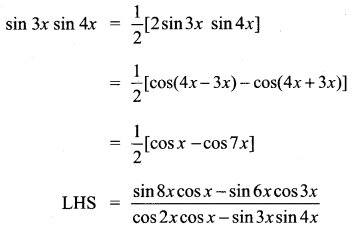
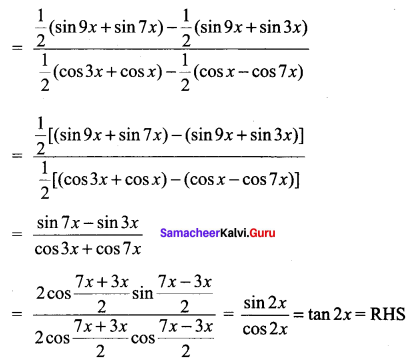
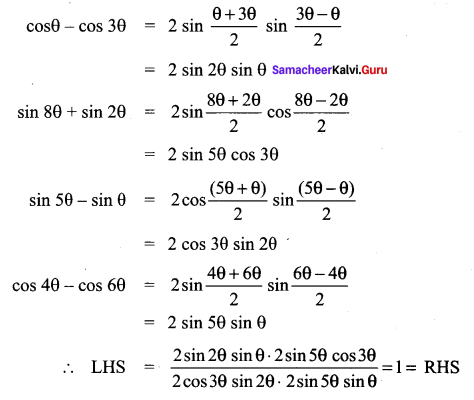
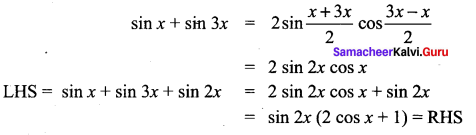
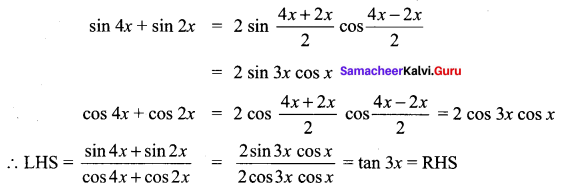
Samacheer Kalvi 12th Maths Solutions Chapter 1 Applications of Matrices and Determinants Ex 1.5

You can Download Samacheer Kalvi 12th Maths Book Solutions Guide Pdf, Tamilnadu State Board help you to revise the complete Syllabus and score more marks in your examinations.

Tamilnadu Samacheer Kalvi 12th Maths Solutions Chapter 1 Applications of Matrices and Determinants Ex 1.5

Question 1.
Solve the following systems of linear equations by Gaussian elimination method:
(i) 2x – 2y + 3z = 2, x + 2y – z = 3, 3x – y + 2z = 1
(ii) 2x + 4y + 6z = 22, 3x + 8y + 5z = 27, -x + y + 2z = 2
Solution:
(i) 2x – 2y + 3z = 2, x + 2y – z = 3 and 3x – y + 2z = 1
The matrix form of the above equations is \(\left(\begin{array}{rrr}{2} & {-2} & {3} \\ {1} & {2} & {-1} \\ {3} & {-1} & {2}\end{array}\right)\left(\begin{array}{l}{x} \\ {y} \\ {z}\end{array}\right)=\left(\begin{array}{l}{2} \\ {3} \\ {1}\end{array}\right)\)
(i.e) AX = B
The augment matrix (A, B) is
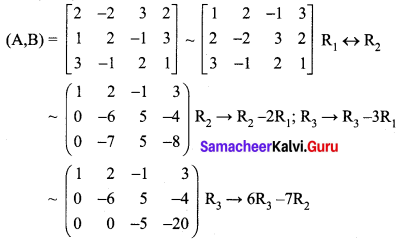
Samacheer Kalvi 12th Maths Solutions Chapter 1 Applications of Matrices and Determinants Ex 1.5 Q1
The above matrix is in echelon form.
Now writing the equivalent equations
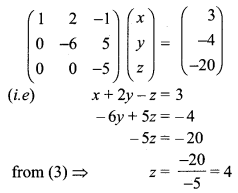
Samacheer Kalvi 12th Maths Solutions Chapter 1 Applications of Matrices and Determinants Ex 1.5 Q1.1
Substituting z = 4 in (2) we get
-6y + 20 = -4
⇒ -6y = -4 – 20 = -24
⇒ y = 4
Substituting z = 4 and y = 4 in (1) we get
x + 8 – 4 = 3
⇒ x + 4 = 3
⇒ x = 3 – 4 = -1
So, x = -1; y = 4; z = 4
(ii) 2x + 4y + 6z = 22 …… (1)
3x + 8y + 5z = 27 ……. (2)
-x + y + 2z = 2 ……. (3)
Divide equation (1) by 2 we get
x + 2y + 3z = 11 ……. (1)
3x + 8y + 5z = 27 …….. (2)
-x + y + 2z = 2 ……. (3)
The matrix form of the above equations is \(\left(\begin{array}{ccc}{1} & {2} & {3} \\ {3} & {8} & {5} \\ {-1} & {1} & {2}\end{array}\right)\left(\begin{array}{l}{x} \\ {y} \\ {z}\end{array}\right)=\left(\begin{array}{c}{11} \\ {27} \\ {2}\end{array}\right)\)
(i.e) AX = B
The augment matrix (A, B) is
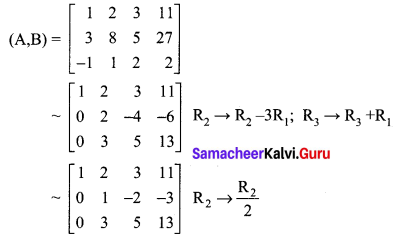
Samacheer Kalvi 12th Maths Solutions Chapter 1 Applications of Matrices and Determinants Ex 1.5 Q1.2
Samacheer Kalvi 12th Maths Solutions Chapter 1 Applications of Matrices and Determinants Ex 1.5 Q1.3
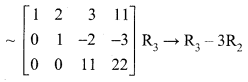
The above matrix is in echelon form.
Now writing the equivalent equations.
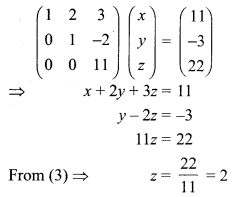
Samacheer Kalvi 12th Maths Solutions Chapter 1 Applications of Matrices and Determinants Ex 1.5 Q1.4
Substituting z = 2 in (2) we get
y – 4 = -3
⇒ y = -3 + 4 = 1
Substituting z = 2, y = 1 in (1) we get
x + 2(1) + 3(2) = 11
⇒ x + 2 + 6 = 11
⇒ x + 8 = 11
⇒ x = 11 – 8 = 3
x = 3, y = 1, z = 2

Samacheer Kalvi 12th Maths Solutions Chapter 1 Applications of Matrices and Determinants Ex 1.5

Question 2.
If ax2 + bx + c is divided by x + 3, x – 5, and x – 1, the remainders are 21, 61 and 9 respectively. Find a, b and c. (Use Gaussian elimination method.)
Solution:
P(x) = ax2 + bx + c. When P(x) is divided by x + 3, x – 5 and x – 1.
The remainders are respectively P(-3), P (5) and P (1).
We are given that P(-3) = 21; P(5) = 61; P(1) = 9
Now P(-3) = 21
⇒ a(-3)2 + b(-3) + c = 21
⇒ 9a – 3b + c = 21 ……. (1)
P(5) = 61
⇒ a(5)2 + b(5) + c = 61
⇒ 25a + 5b + c = 61 ……. (2)
P(1) = 9
⇒ a(1)2 + b(1) + c = 9
⇒ a + b + c = 9 …… (3)
Now the matrix form of the above three equations is \(\left(\begin{array}{ccc}{9} & {-3} & {1} \\ {25} & {5} & {1} \\ {1} & {1} & {1}\end{array}\right)\left(\begin{array}{l}{a} \\ {b} \\ {c}\end{array}\right)=\left(\begin{array}{c}{21} \\ {61} \\ {9}\end{array}\right)\)
(i.e) AX = B
The augmented matrix (A, B) is
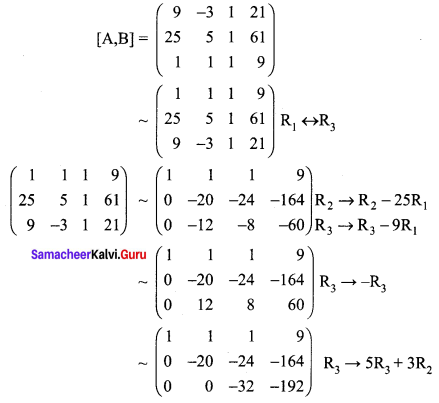
Samacheer Kalvi 12th Maths Solutions Chapter 1 Applications of Matrices and Determinants Ex 1.5 Q2
The above matrix is in echelon form now writing the equivalent equations.
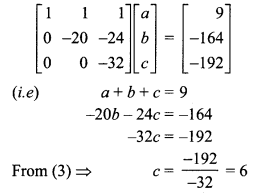
Samacheer Kalvi 12th Maths Solutions Chapter 1 Applications of Matrices and Determinants Ex 1.5 Q2.1
Substituting c = 6 in (2) we get
-20b – 24(6) = -164
⇒ -20b = -164 + 144 = -20
⇒ b = 1
Substituting c = 6, b = 1 in (1) we get
a + 1 + 6 = 9
⇒ a = 9 – 7 = 2
So a = 2, b = 1, c = 6

Question 3.
An amount of ₹ 65,000 is invested in three bonds at the rates of 6%, 8% and 10% per annum respectively. The total annual income is ₹ 5,000. The income from the third bond is ₹ 800 more than that from the second bond. Determine the price of each bond. (Use Gaussian elimination method.)
Solution:
Let the amount invested in 6% bond be ₹ x
and the amount invested in 8% bond be ₹ y
and the amount invested in 10% bond be ₹ z
Now x + y + z = 65000 ……. (1)
\(\frac{6}{100} x+\frac{8}{100} y+\frac{10}{100} z=5000\)
(i.e) 6x + 8y + 10z = 500000
(÷ by 2) 3x + 4y + 5z = 250000 ……. (2)
Also given that \(\frac{10}{100} z-\frac{8}{100} y=800\)
(i.e) -8y + 10z = 80000
(÷ by 2) -4y + 5z = 40000 …… (3)
Now the matrix form of the above three equations is \(\left(\begin{array}{ccc}{1} & {1} & {1} \\ {3} & {4} & {5} \\ {0} & {-4} & {5}\end{array}\right)\left(\begin{array}{l}{x} \\ {y} \\ {z}\end{array}\right)=\left(\begin{array}{c}{65000} \\ {250000} \\ {40000}\end{array}\right)\)
(i.e) AX = B
Now, the augmented matrix (A, B) is
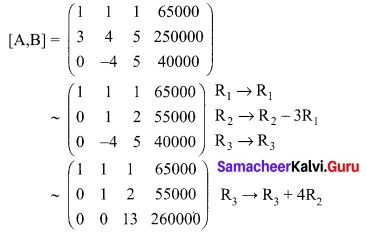
Samacheer Kalvi 12th Maths Solutions Chapter 1 Applications of Matrices and Determinants Ex 1.5 Q3
Now the above matrix is in echelon form. Writing the equivalent equations.
\(\left(\begin{array}{lll}{1} & {1} & {1} \\ {0} & {1} & {2} \\ {0} & {0} & {13}\end{array}\right)\left(\begin{array}{l}{x} \\ {y} \\ {z}\end{array}\right)=\left(\begin{array}{r}{65000} \\ {55000} \\ {260000}\end{array}\right)\)
(i.e) x + y + z = 65000
⇒ y + 2z = 55000
⇒ 13z = 260000
⇒ z = ₹ 20000
Substituting z = ₹ 20000 in (2) we get
y + 40000 = 55000
⇒ y = 55000 – 40000 = ₹ 15000
Substituting z = ₹ 20000, y = ₹ 15000 in (1) we get
x + 15000 + 20000 = 65000
⇒ x = 65000 – 35000 = ₹ 30000
So the amount invested in
6% bond x = ₹ 30000
8% bond y = ₹ 15000
and 10% bond z = ₹ 20000

Samacheer Kalvi 12th Maths Solutions Chapter 1 Applications of Matrices and Determinants Ex 1.5

Question 4.
A boy is walking along the path y = ax2 + bx + c through the points (-6, 8), (-2, -12), and (3, 8). He wants to meet his friend at P(7, 60). Will he meet his friend? (Use Gaussian elimination method.)
Solution:
We are given y = ax2 + bx + c
Also we are given (-6, 8), (-2, -12) and (3, 8) are points on the path.
(i) (-6, 8) is a point on y = ax2 + bx + c
at x = -6, y = 8
(i.e) a(36) + b(-6) + c = 8
⇒ 36a – 6b + c = 8 …… (1)
(ii) (-2, -12) is a point on y = ax2 + bx + c
at x = -2, y = -12
⇒ a(-2)2 + b(-2) + c = -12
⇒ 4a – 2b + c = -12 ….. (2)
(iii) (3, 8) is a point on y = ax2 + bx + c
at x = 3, y = 8
⇒ a(3)2 + 6(3) + c = 8
⇒ 9a + 3b + c = 8 …… (3)
The matrix form of the above three equations is \(\left(\begin{array}{ccc}{36} & {-6} & {1} \\ {4} & {-2} & {1} \\ {9} & {3} & {1}\end{array}\right)\left(\begin{array}{l}{a} \\ {b} \\ {c}\end{array}\right)=\left(\begin{array}{c}{8} \\ {-12} \\ {8}\end{array}\right)\)
(i.e) AX = B
The augmented matrix (A, B) is
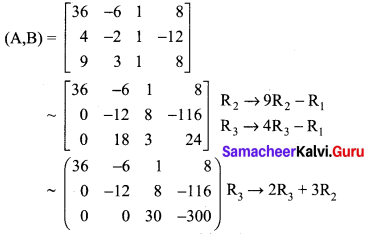
Samacheer Kalvi 12th Maths Solutions Chapter 1 Applications of Matrices and Determinants Ex 1.5 Q4
The above matrix is in echelon form. Now writing the equivalent equations we get
\(\left(\begin{array}{ccc}{36} & {-6} & {1} \\ {0} & {-12} & {8} \\ {0} & {0} & {30}\end{array}\right)\left(\begin{array}{l}{a} \\ {b} \\ {c}\end{array}\right)=\left(\begin{array}{c}{8} \\ {-116} \\ {-300}\end{array}\right)\)
(i.e) 36a – 6b + c = 8
⇒ -12b + 8c = -116
⇒ 30c = -300
⇒ c = -10
Substituting c = -10 in (2) we get
-12b + 8(-10) = -116
⇒ -12b = -116 + 80 = -36
⇒ b = 3
Substituting c = -10, b = 3 in (1) we get
36a – 6(3) + (-10) = 8
⇒ 36a – 18 – 10 = 8
⇒ 36a = 8 + 18 + 10 = 36
⇒ a = 1
a = 1, b = 3 and c = -10
y = (1)x2 + (3)x + (-10)
y = x2 + 3x – 10
Now at x = 7, y= (7)2 + 3(7)- 10 = 49 + 21 – 10 = 60
(7, 60) is a point on the path so he will meet his friend.

Samacheer Kalvi 12th Maths Solutions Chapter 1 Applications of Matrices and Determinants Ex 1.5

Samacheer Kalvi 12th Maths Solutions Chapter 1 Applications of Matrices and Determinants Ex 1.5 Additional Problems

Question 1.
Examine the consistency of the following system of equations. If it is consistent then solve the same.
(i) 4x + 3y + 6z = 25,
x + 5y + 7z = 13,
2x + 9y + z = 1
Solution:
The augmented matrix is
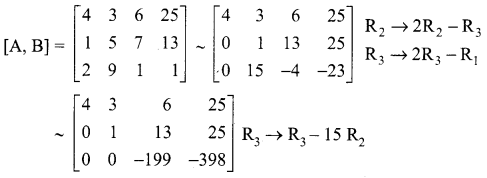
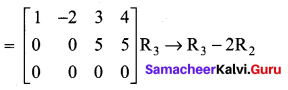
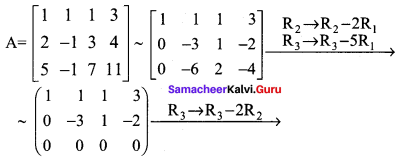
Samacheer Kalvi 12th Maths Solutions Chapter 1 Applications of Matrices and Determinants Ex 1.5 1
The last equivalent matrix is in the echelon form. It has three non-zero rows.
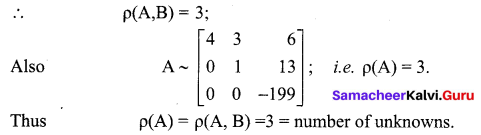
Samacheer Kalvi 12th Maths Solutions Chapter 1 Applications of Matrices and Determinants Ex 1.5 2
∴ The given system is consistent and has a unique solution
4x + 3y + 6z = 25 …… (1)
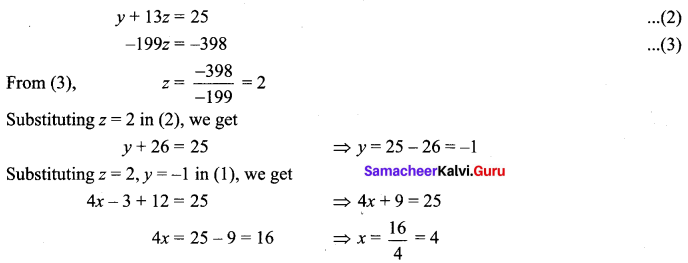
Samacheer Kalvi 12th Maths Solutions Chapter 1 Applications of Matrices and Determinants Ex 1.5 3
∴ The unique solution is x = 4, y = -1, z = 2.

Question 2.
Verify whether the given system of equations is consistent. If it is consistent, solve them. 2x + 5y + 7z = 52, x + 7 + z = 9, 2x + y – z = 0
Solution:
The given system of equations is equivalent to the single matrix equation.
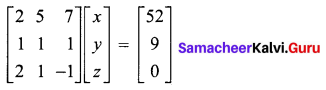
Samacheer Kalvi 12th Maths Solutions Chapter 1 Applications of Matrices and Determinants Ex 1.5 4
AX = B
The augmented matrix is
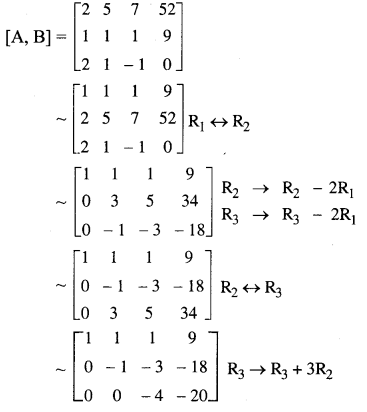
Samacheer Kalvi 12th Maths Solutions Chapter 1 Applications of Matrices and Determinants Ex 1.5 5
The last equivalent matrix is in the echelon form. It has three non-zero rows.
∴ \(\rho(\mathrm{A}, \mathrm{B})=3\)
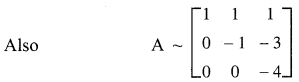
Samacheer Kalvi 12th Maths Solutions Chapter 1 Applications of Matrices and Determinants Ex 1.5 6
Since there are three non-zero rows, \(\rho(\mathrm{A})\) = 3

Samacheer Kalvi 12th Maths Solutions Chapter 1 Applications of Matrices and Determinants Ex 1.5 7
The given system is consistent and has a unique solution.
To find the solution, we see that the given system of equations is equivalent to the matrix equation.
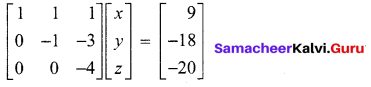
Samacheer Kalvi 12th Maths Solutions Chapter 1 Applications of Matrices and Determinants Ex 1.5 8
x + y + z = 9 ……. (1)
-y – 3z = -18 ……… (2)
-4z = -20 ……… (3)
(3) ⇒ z = 5, (2) ⇒ y = 18 – 3z = 13, (1) ⇒ x = 9 – y – z ⇒ x = 9 – 3 – 5 = 1
∴ Solution is x = 1,
y = 3,
z = 5

Samacheer Kalvi 12th Maths Solutions Chapter 1 Applications of Matrices and Determinants Ex 1.5

Question 3.
Examine the consistency of the equations.
2x – 3y + 3z = 5,
3x + y – 3z = 13,
2x + 19y – 47z = 32
Solution:
The given system of equations can be written in the form of a matrix equation as
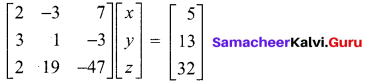
Samacheer Kalvi 12th Maths Solutions Chapter 1 Applications of Matrices and Determinants Ex 1.5 9
The augmented matrix is
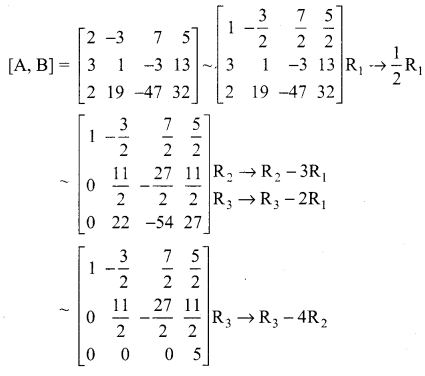
Samacheer Kalvi 12th Maths Solutions Chapter 1 Applications of Matrices and Determinants Ex 1.5 100
The last equivalent matrix is in the echelon form. It has three non-zero rows.

Samacheer Kalvi 12th Maths Solutions Chapter 1 Applications of Matrices and Determinants Ex 1.5 10
∴ The given system is inconsistent and hence has no solution.

Question 4.
Show that the equations: x + y + z = 6, x + 2y + 3z = 14, x + 4y + 7z = 30 are consistent and solve them.
Solution:
The matrix equation corresponding to the given system is.
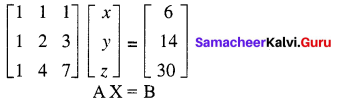
Samacheer Kalvi 12th Maths Solutions Chapter 1 Applications of Matrices and Determinants Ex 1.5 11
The augmented matrix is
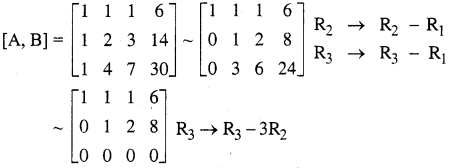
Samacheer Kalvi 12th Maths Solutions Chapter 1 Applications of Matrices and Determinants Ex 1.5 111
In the last equivalent matrix, there are two non-zero rows.

Samacheer Kalvi 12th Maths Solutions Chapter 1 Applications of Matrices and Determinants Ex 1.5 12
∴ The given system is consistent. But the value of the common rank is less than the number of unknowns. The given system has an infinite number of solutions.
The given system is equivalent to the matrix equation
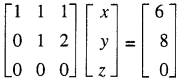
Samacheer Kalvi 12th Maths Solutions Chapter 1 Applications of Matrices and Determinants Ex 1.5 13
x + y + z = 6 ……(1)
y + 2z = 8 ….(2)
(2) ⇒ y = 8 – 2z ; (1) ⇒ x = 6 – y – z = 6 – (8 – 2z) – z = z – 2
Taking z = k, we get x = k – 2, y = 8 – 2k; k ∈ R
Putting k = 1, we have one solution as x = – 1, y = 6, z = 1. Thus by giving different values for k we get different solutions. Hence the given system has infinite number of solutions.

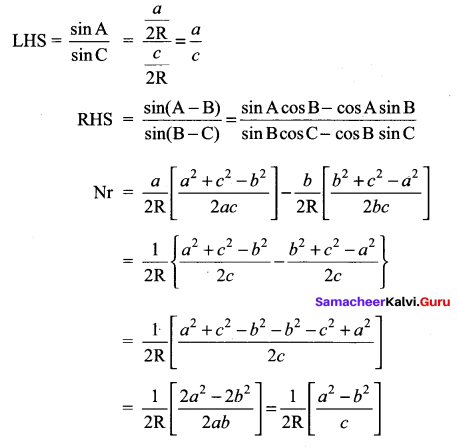
Samacheer Kalvi 11th Maths Solutions Chapter 3 Trigonometry Ex 3.9

You can Download Samacheer Kalvi 11th Maths Book Solutions Guide Pdf, Tamilnadu State Board help you to revise the complete Syllabus and score more marks in your examinations.

Tamilnadu Samacheer Kalvi 11th Maths Solutions Chapter 3 Trigonometry Ex 3.9

Question 1.
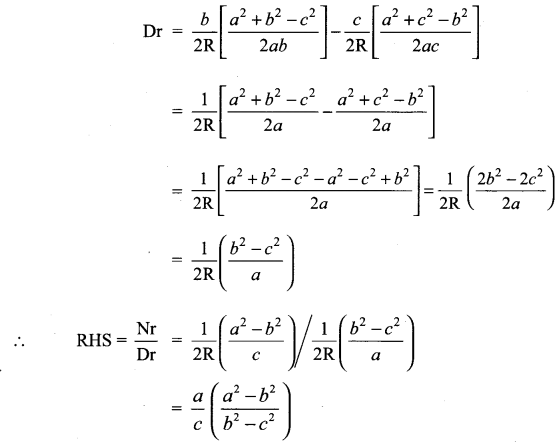
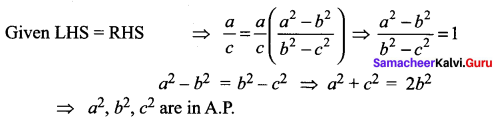
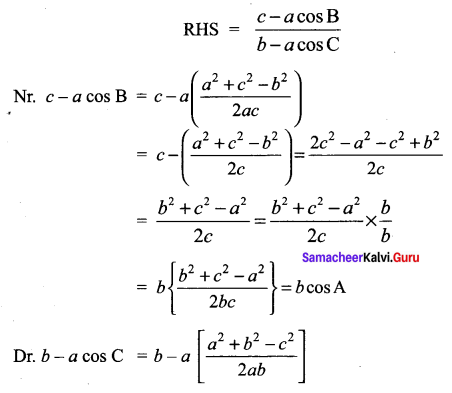
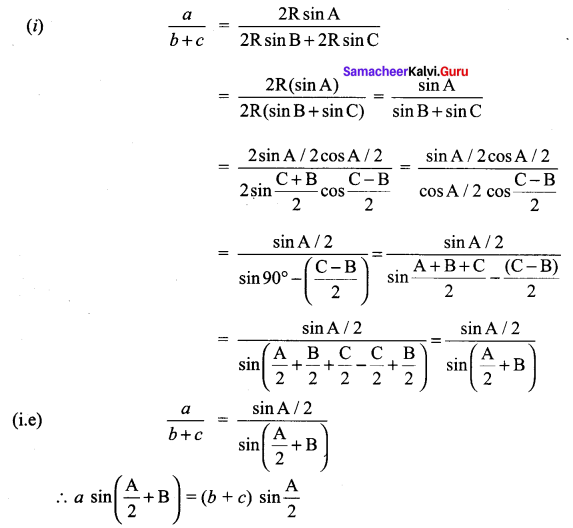
Samacheer Kalvi 11th Maths Solutions Chapter 3 Trigonometry Ex 3.9 1
Solution:
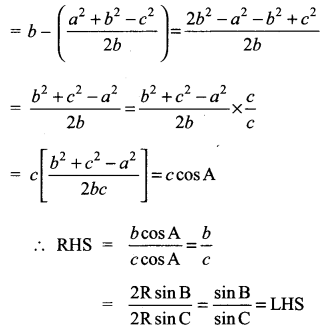
Samacheer Kalvi 11th Maths Solutions Chapter 3 Trigonometry Ex 3.9 2
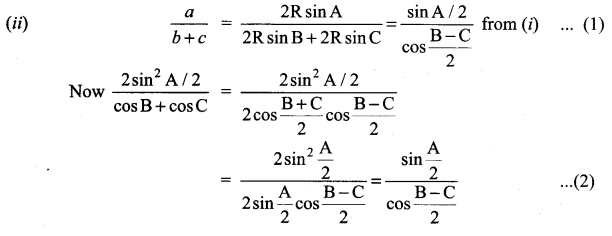
Samacheer Kalvi 11th Maths Solutions Chapter 3 Trigonometry Ex 3.9 3
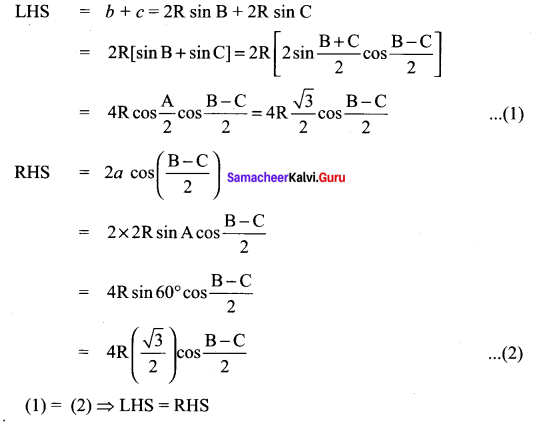
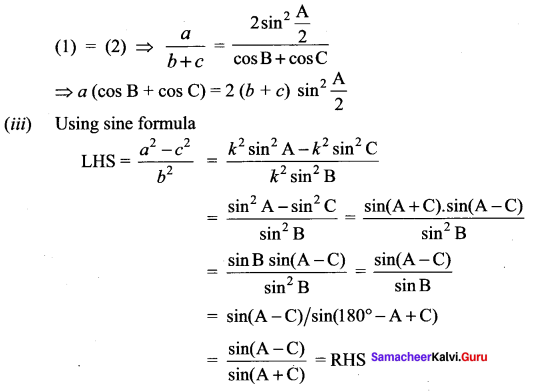
Samacheer Kalvi 11th Maths Solutions Chapter 3 Trigonometry Ex 3.9 4

Question 2.
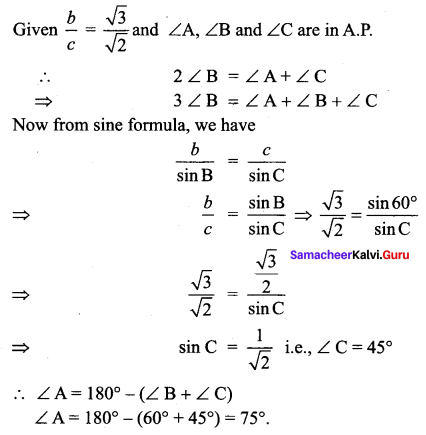
The angles of a triangle ABC, are in Arithmetic Progression and if b : c = \(\sqrt{3}: \sqrt{2}\), find ∠A.
Solution:
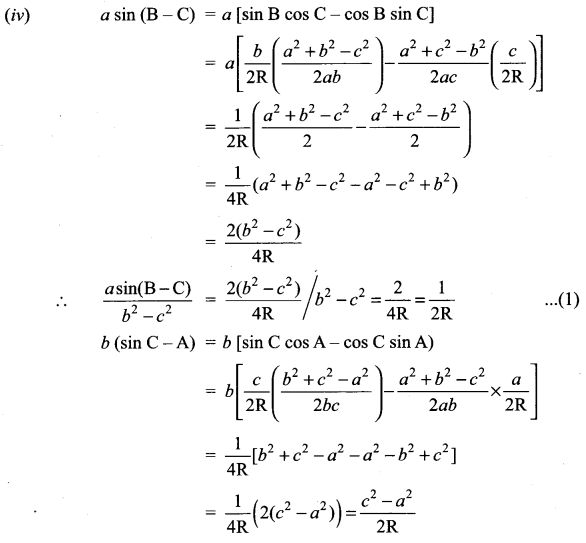
Samacheer Kalvi 11th Maths Solutions Chapter 3 Trigonometry Ex 3.9 5

Question 3.
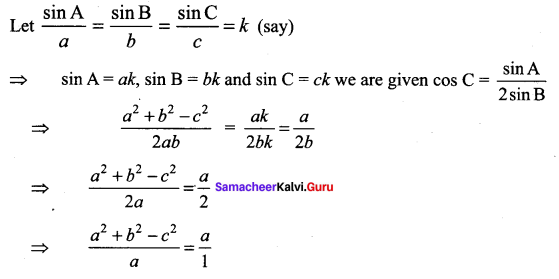
Samacheer Kalvi 11th Maths Solutions Chapter 3 Trigonometry Ex 3.9 6
Solution:
Samacheer Kalvi 11th Maths Solutions Chapter 3 Trigonometry Ex 3.9 7
⇒ a2 + b2 – c2 = a2 ⇒ b2 – c2 = a2 – a2
⇒ b2 – c2 = 0 ⇒ b = c
∴ ∆ ABC is isosceles

Question 4.
Samacheer Kalvi 11th Maths Solutions Chapter 3 Trigonometry Ex 3.9 8
Solution:
Samacheer Kalvi 11th Maths Solutions Chapter 3 Trigonometry Ex 3.9 9
Samacheer Kalvi 11th Maths Solutions Chapter 3 Trigonometry Ex 3.9 10

Samacheer Kalvi 11th Maths Solutions Chapter 3 Trigonometry Ex 3.9

Question 5.
In a ∆ABC, prove that a cos A + b cos B + c cos C = 2a sin B sin C.
Solution:
LHS = a cos A+ 6 cos B + c cos C
Using sine formula, we get k sin A cos A + k sin B cos B + k sin C cos C k
= \(\frac{k}{2}\) [2 sin A cos A + 2 sin B cos B + 2 sin C cos C]
= \(\frac{k}{2}\) [sin 2A + sin 2B + sin 2C]
= \(\frac{k}{2}\) [2 sin (A + B) . cos (A – B) + 2 sin C . cos C]
= \(\frac{k}{2}\) [2 sin (A – B) . cos (A – B) + 2 sin C . cos C]
= \(\frac{k}{2}\) [2 sin C . cos (A – B) + 2 sin C . cos C]
= k sin C [cos(A – B) + cos C]
Samacheer Kalvi 11th Maths Solutions Chapter 3 Trigonometry Ex 3.9 55
= k sin C [cos (A – B) – cos (A + B)]
= k sin C . 2 sin A sin B
= 2k sin A . sin B sin C
= 2a sin B sin C = RHS

Question 6.
Samacheer Kalvi 11th Maths Solutions Chapter 3 Trigonometry Ex 3.9 66
Solution:
Samacheer Kalvi 11th Maths Solutions Chapter 3 Trigonometry Ex 3.9 77

Question 7.
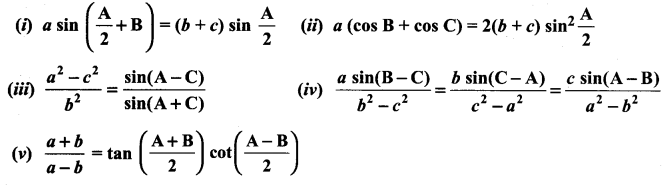
In a ∆ ABC, prove the following.
Samacheer Kalvi 11th Maths Solutions Chapter 3 Trigonometry Ex 3.9 88
Solution:
Samacheer Kalvi 11th Maths Solutions Chapter 3 Trigonometry Ex 3.9 91
Samacheer Kalvi 11th Maths Solutions Chapter 3 Trigonometry Ex 3.9 92
Samacheer Kalvi 11th Maths Solutions Chapter 3 Trigonometry Ex 3.9 93
Samacheer Kalvi 11th Maths Solutions Chapter 3 Trigonometry Ex 3.9 94
Samacheer Kalvi 11th Maths Solutions Chapter 3 Trigonometry Ex 3.9 95
Samacheer Kalvi 11th Maths Solutions Chapter 3 Trigonometry Ex 3.9 96

Question 8.
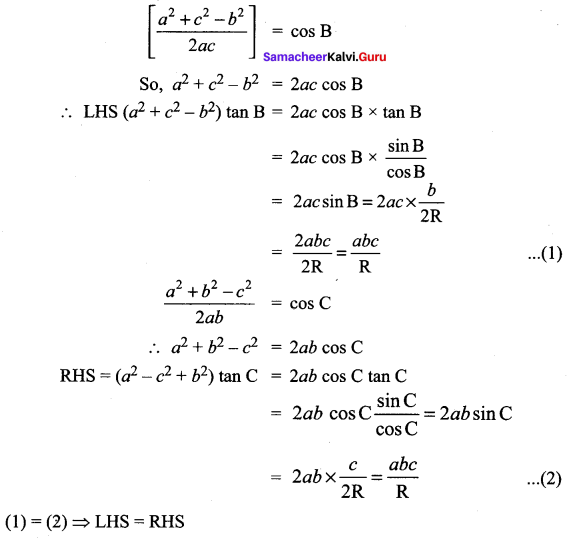
In a ∆ABC, prove that (a2 – b2 + c2) tan B = (a2 + b2 – c2)tan C
Solution:
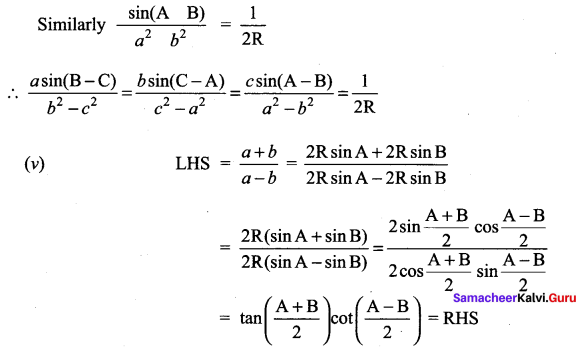
Samacheer Kalvi 11th Maths Solutions Chapter 3 Trigonometry Ex 3.9 14

Question 9.
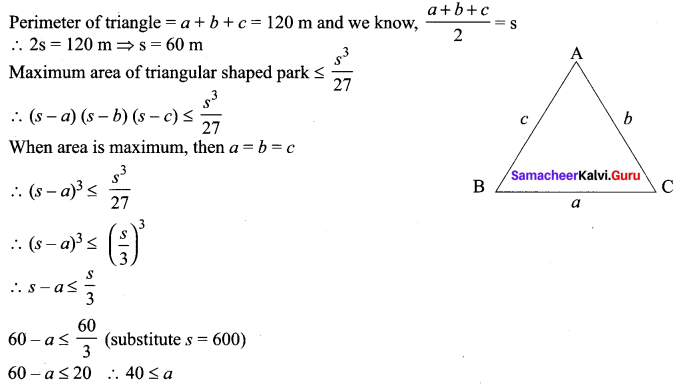
An Engineer has to develop a triangular shaped park with a perimeter 120 m in a village. The park to be developed must be of maximum area. Find out the dimensions of the park.
Solution:
Given, the perimeter of triangular shaped park = 120 m
Samacheer Kalvi 11th Maths Solutions Chapter 3 Trigonometry Ex 3.9 15
All sides of a triangular part would be 40 m.
i.e., a = 40 m,
b = 40 m,
c = 40 m.

Samacheer Kalvi 11th Maths Solutions Chapter 3 Trigonometry Ex 3.9

Question 10.
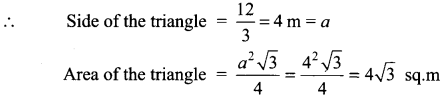
A rope of length 12 m is given. Find the largest area of the triangle formed by this rope and find the dimensions of the triangle so formed.
Solution:
The largest triangle will be an equilateral triangle
Samacheer Kalvi 11th Maths Solutions Chapter 3 Trigonometry Ex 3.9 16

Question 11.
Derive Projection formula from
(i) Law of sines,
(ii) Law of cosines.
Solution:
(i) To Prove a = b cos c + c cos B
Using sine formula
RHS = b cos C + c cos B
= 2R sin B cos C + 2R sin C cos B
= 2R [sin B cos C + cos B sin C]
= 2R sin (B + C) = 2R [sin π – A)
= 2R sin A = a = LHS

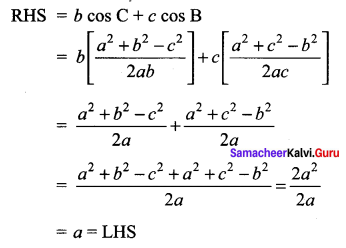
(ii) To prove a = b cos c + c cos B
Using cosine formula
Samacheer Kalvi 11th Maths Solutions Chapter 3 Trigonometry Ex 3.9 50

Samacheer Kalvi 11th Maths Solutions Chapter 3 Trigonometry Ex 3.9 Additional Questions

Question 1.
Samacheer Kalvi 11th Maths Solutions Chapter 3 Trigonometry Ex 3.9 51
Solution:
Samacheer Kalvi 11th Maths Solutions Chapter 3 Trigonometry Ex 3.9 52

Question 2.
Samacheer Kalvi 11th Maths Solutions Chapter 3 Trigonometry Ex 3.9 53
Solution:
Samacheer Kalvi 11th Maths Solutions Chapter 3 Trigonometry Ex 3.9 54

Question 3.
Samacheer Kalvi 11th Maths Solutions Chapter 3 Trigonometry Ex 3.9 555
Solution:
Samacheer Kalvi 11th Maths Solutions Chapter 3 Trigonometry Ex 3.9 56
Samacheer Kalvi 11th Maths Solutions Chapter 3 Trigonometry Ex 3.9 57

Samacheer Kalvi 11th Maths Solutions Chapter 3 Trigonometry Ex 3.9

Question 4.
Samacheer Kalvi 11th Maths Solutions Chapter 3 Trigonometry Ex 3.9 58
Solution:
Samacheer Kalvi 11th Maths Solutions Chapter 3 Trigonometry Ex 3.9 59

Question 5.
Samacheer Kalvi 11th Maths Solutions Chapter 3 Trigonometry Ex 3.9 60
Solution:
Samacheer Kalvi 11th Maths Solutions Chapter 3 Trigonometry Ex 3.9 61

Samacheer Kalvi 11th Maths Solutions Chapter 3 Trigonometry Ex 3.8

You can Download Samacheer Kalvi 11th Maths Book Solutions Guide Pdf, Tamilnadu State Board help you to revise the complete Syllabus and score more marks in your examinations.
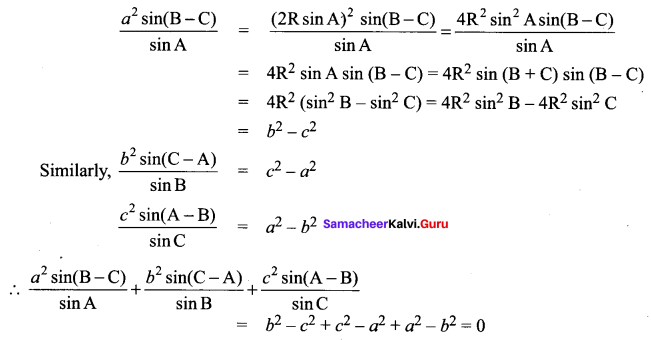
Tamilnadu Samacheer Kalvi 11th Maths Solutions Chapter 3 Trigonometry Ex 3.8

Question 1.
Find the principal solution and general solutions of the following:
Samacheer Kalvi 11th Maths Solutions Chapter 3 Trigonometry Ex 3.8 1
Solution:
Samacheer Kalvi 11th Maths Solutions Chapter 3 Trigonometry Ex 3.8 2
Samacheer Kalvi 11th Maths Solutions Chapter 3 Trigonometry Ex 3.8 3

Question 2.
Solve the following equations for which solutions lies in the interval 0° < θ < 360°
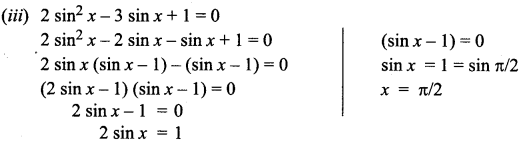
(i) sin4 = sin2x
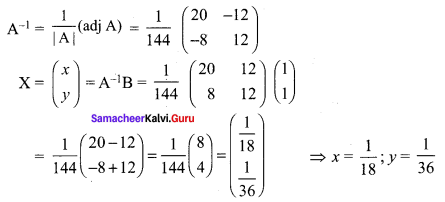
(ii) 2 cos2 x + 1 = – 3cos x
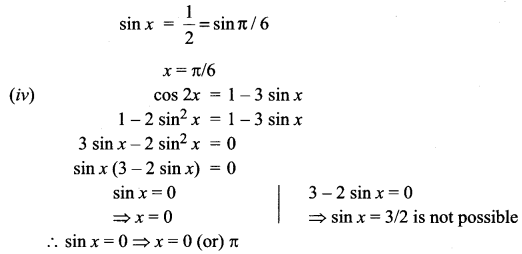
(iii) 2 sin2 x + 1 = 3 sin x
(iv) cos 2x = 1 – 3 sin x – 3 sin x
Solution:
Samacheer Kalvi 11th Maths Solutions Chapter 3 Trigonometry Ex 3.8 4
Samacheer Kalvi 11th Maths Solutions Chapter 3 Trigonometry Ex 3.8 5
Samacheer Kalvi 11th Maths Solutions Chapter 3 Trigonometry Ex 3.8 6

Samacheer Kalvi 11th Maths Solutions Chapter 3 Trigonometry Ex 3.8

Question 3.
Solve the following equations:
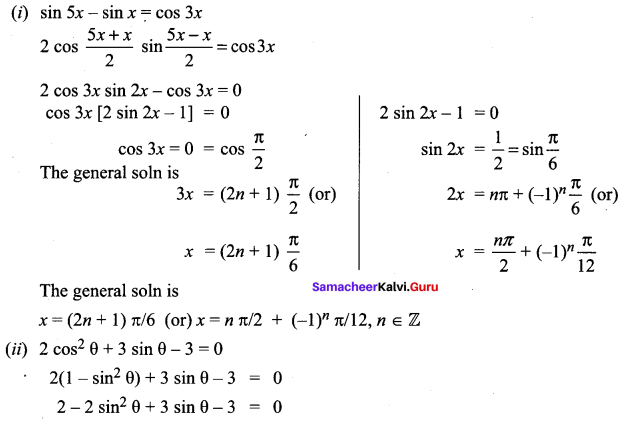
(i) sin 5x – sin x = cos 3x
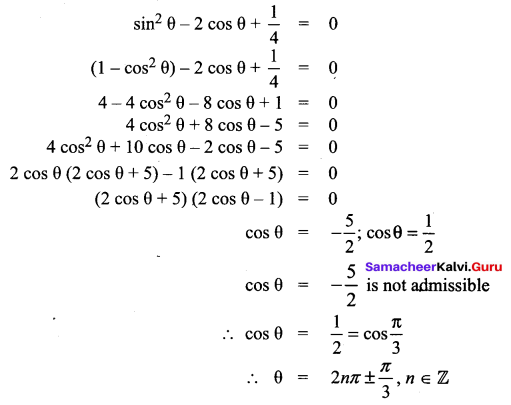
(ii) 2 cos2 θ + 3 sin θ – 3 = 0
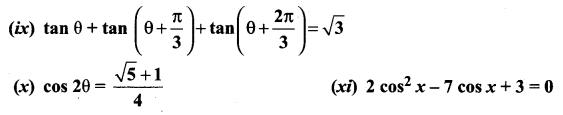
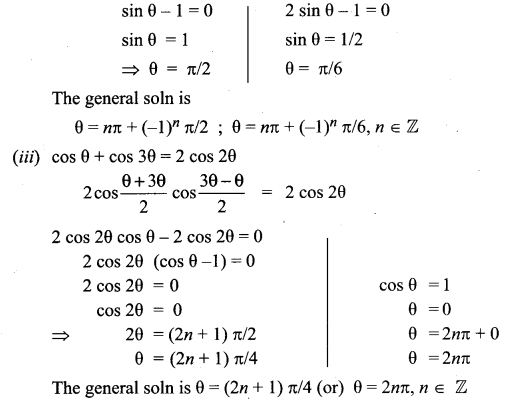
(iii) cos θ + cos 3θ = 2 cos 2θ
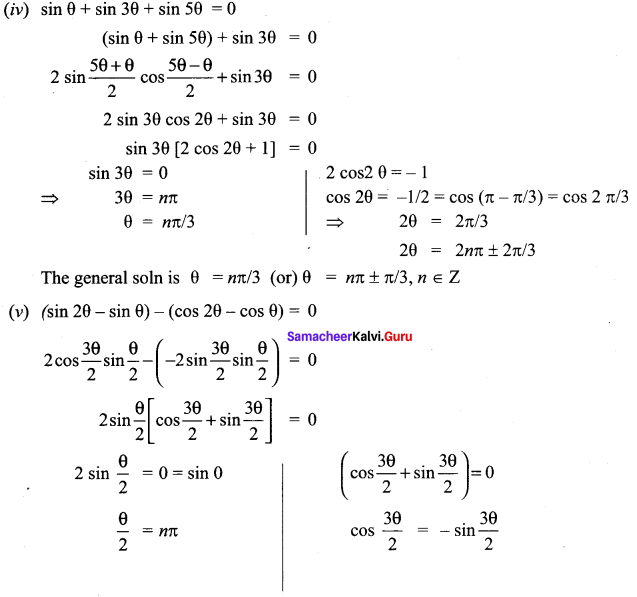
(iv) sin θ + sin 3θ + sin 5θ = 0
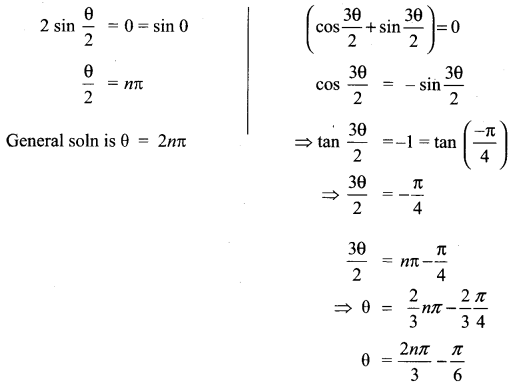
(v) sin 2θ – cos 2θ – sin θ + cos θ = 0
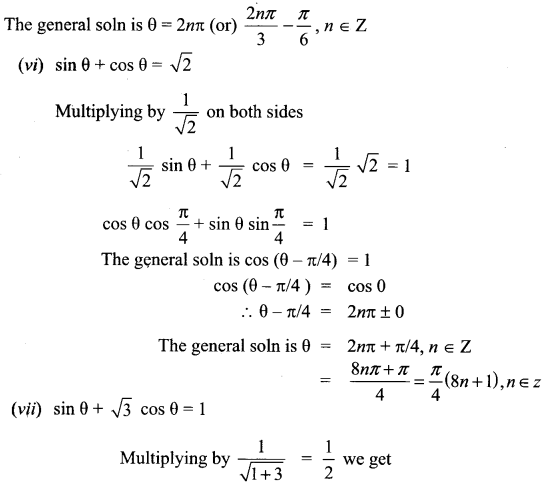
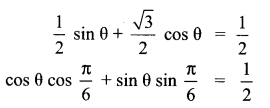
(vi) sin θ + cos θ = \(\sqrt{3}\)
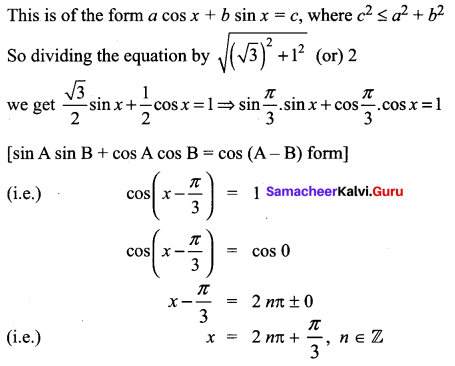
(vii) sin θ + \(\sqrt{3}\) cos θ = 1
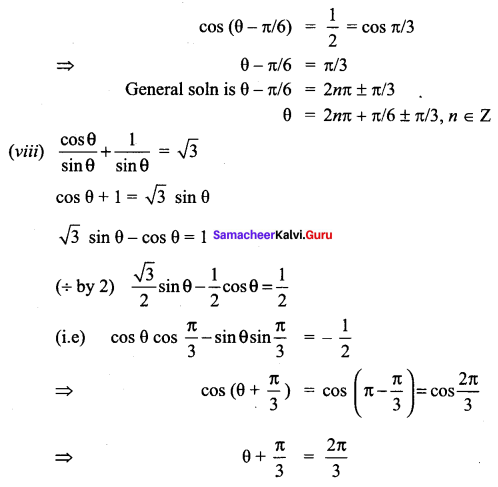
(viii) cot θ + cosec θ = \(\sqrt{3}\)
Samacheer Kalvi 11th Maths Solutions Chapter 3 Trigonometry Ex 3.8 10
Solution:
Samacheer Kalvi 11th Maths Solutions Chapter 3 Trigonometry Ex 3.8 8
Samacheer Kalvi 11th Maths Solutions Chapter 3 Trigonometry Ex 3.8 9
Samacheer Kalvi 11th Maths Solutions Chapter 3 Trigonometry Ex 3.8 100
Samacheer Kalvi 11th Maths Solutions Chapter 3 Trigonometry Ex 3.8 11
Samacheer Kalvi 11th Maths Solutions Chapter 3 Trigonometry Ex 3.8 12
Samacheer Kalvi 11th Maths Solutions Chapter 3 Trigonometry Ex 3.8 13
Samacheer Kalvi 11th Maths Solutions Chapter 3 Trigonometry Ex 3.8 14
Samacheer Kalvi 11th Maths Solutions Chapter 3 Trigonometry Ex 3.8 15
Samacheer Kalvi 11th Maths Solutions Chapter 3 Trigonometry Ex 3.8 16

Samacheer Kalvi 11th Maths Solutions Chapter 3 Trigonometry Ex 3.8 Additional Questions

Question 1.
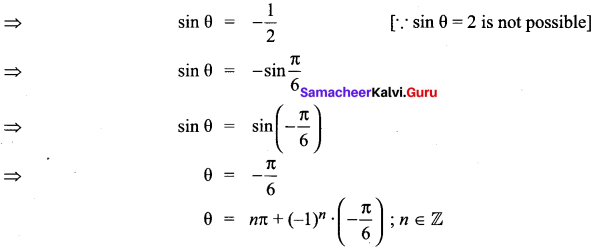
Solve: 2 cos2 θ + 3 sin θ = 0
Solution:
2 cos2 θ + 3 sin θ = 0
⇒ 2 (1 – sin2 θ) + 3 sin θ = 0
⇒ 2 – 2 sin2 θ + 3 sin θ = 0
⇒ -2 sin2 θ + 3 sin θ + 2 = 0
⇒ 2 sin2 θ – 3 sin θ – 2 = 0
⇒ (2 sin θ + 1)(sin θ – 2) = 0
Samacheer Kalvi 11th Maths Solutions Chapter 3 Trigonometry Ex 3.8 30

Question 2.
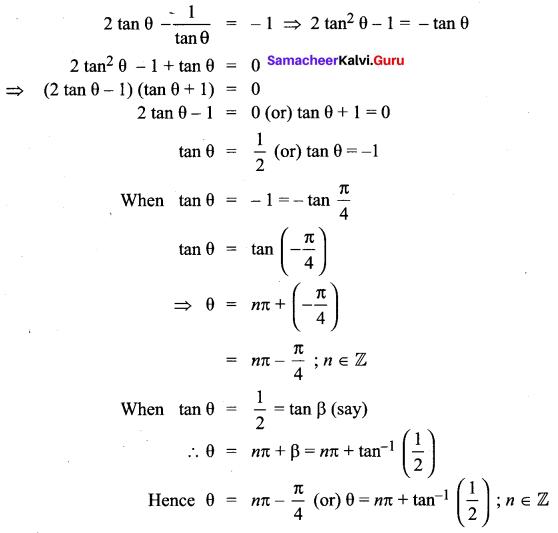
Solve: 2 tan θ – cot θ = -1
Solution:
2 tan θ – cot θ = -1
Samacheer Kalvi 11th Maths Solutions Chapter 3 Trigonometry Ex 3.8 31

Question 3.
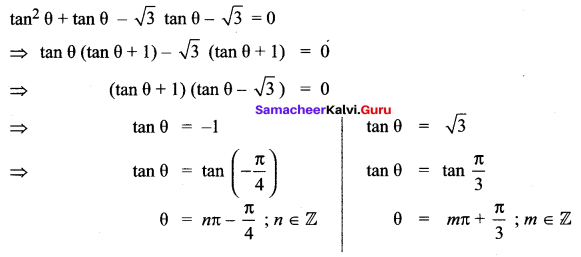
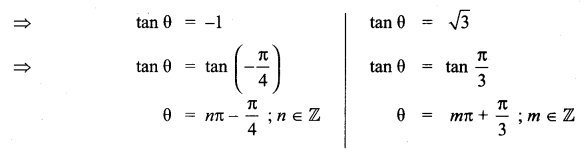
Solve: tan2 θ + (1 – \(\sqrt{3}\)) = 0
Solution:
Samacheer Kalvi 11th Maths Solutions Chapter 3 Trigonometry Ex 3.8 32
Samacheer Kalvi 11th Maths Solutions Chapter 3 Trigonometry Ex 3.8 33

Question 4.
Solve: \(\sqrt{3}\) x + cos x = 2
Solution:
Samacheer Kalvi 11th Maths Solutions Chapter 3 Trigonometry Ex 3.8 34

Samacheer Kalvi 11th Maths Solutions Chapter 3 Trigonometry Ex 3.8

Question 5.
Samacheer Kalvi 11th Maths Solutions Chapter 3 Trigonometry Ex 3.8 35
Solution:
Samacheer Kalvi 11th Maths Solutions Chapter 3 Trigonometry Ex 3.8 38

Samacheer Kalvi 12th Maths Solutions Chapter 1 Applications of Matrices and Determinants Ex 1.4

You can Download Samacheer Kalvi 12th Maths Book Solutions Guide Pdf, Tamilnadu State Board help you to revise the complete Syllabus and score more marks in your examinations.

Tamilnadu Samacheer Kalvi 12th Maths Solutions Chapter 1 Applications of Matrices and Determinants Ex 1.4

Question 1.
Solve the following systems of linear equations by Cramer’s rule:
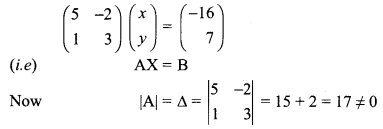
(i) 5x – 2y + 16 = 0, x + 3y – 7 = 0
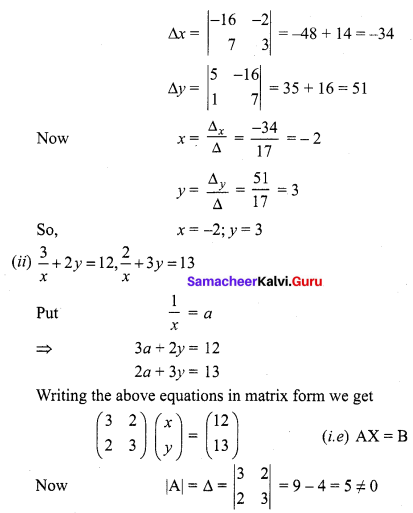
(ii) \(\frac{3}{x}+2 y=12, \frac{2}{x}+3 y=13\)
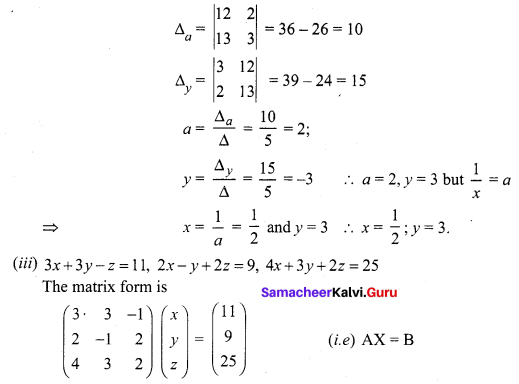
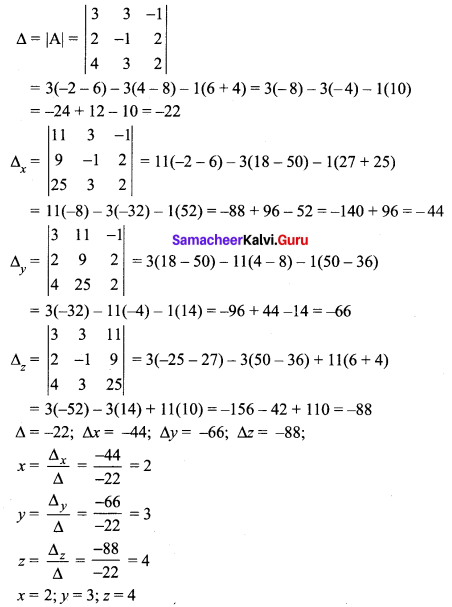
(iii) 3x + 3y – z = 11, 2x – y + 2z = 9, 4x + 3y + 2z = 25
Samacheer Kalvi 12th Maths Solutions Chapter 1 Applications of Matrices and Determinants Ex 1.4 Q1
Solution:
(i) 5x – 2y + 16 = 0, x + 3y – 7 = 0
The above equations are 5x – 2y = -16 and x + 3y = -7
The matrix form of two above equations is
Samacheer Kalvi 12th Maths Solutions Chapter 1 Applications of Matrices and Determinants Ex 1.4 Q1.1
Samacheer Kalvi 12th Maths Solutions Chapter 1 Applications of Matrices and Determinants Ex 1.4 Q1.2
Samacheer Kalvi 12th Maths Solutions Chapter 1 Applications of Matrices and Determinants Ex 1.4 Q1.3
Samacheer Kalvi 12th Maths Solutions Chapter 1 Applications of Matrices and Determinants Ex 1.4 Q1.4
Samacheer Kalvi 12th Maths Solutions Chapter 1 Applications of Matrices and Determinants Ex 1.4 Q1.5
Samacheer Kalvi 12th Maths Solutions Chapter 1 Applications of Matrices and Determinants Ex 1.4 Q1.6
Samacheer Kalvi 12th Maths Solutions Chapter 1 Applications of Matrices and Determinants Ex 1.4 Q1.7

Samacheer Kalvi 12th Maths Solutions Chapter 1 Applications of Matrices and Determinants Ex 1.4

Question 2.
In a competitive examination, one mark is awarded for every correct answer while \(\frac { 1 }{ 4 }\) mark is deducted for every wrong answer. A student answered 100 questions and got 80 marks. How many questions did he answer correctly? (Use Cramer’s rule to solve the problem).
Solution:
No. of Questions answered = 100
Let the No. of questions answered correctly be x and the No. of questions answered wrongly be y
Here, x + y = 100 and x – \(\frac { 1 }{ 4 }\) y = 80
(i.e) x + y = 100 and 4x – y = 320
The matrix form is
Samacheer Kalvi 12th Maths Solutions Chapter 1 Applications of Matrices and Determinants Ex 1.4 Q2
No. of questions answered correctly x = 84.

Question 3.
A chemist has one solution which is 50% acid and another solution which is 25% acid. How much each should be mixed to make 10 litres of a 40% acid solution? (Use Cramer’s rule to solve the problem).
Solution:
Let the no. of litres in 50% acid used be x litres and the no. of litres in 25% acid used be y litres
Samacheer Kalvi 12th Maths Solutions Chapter 1 Applications of Matrices and Determinants Ex 1.4 Q3
Samacheer Kalvi 12th Maths Solutions Chapter 1 Applications of Matrices and Determinants Ex 1.4 Q3.1
(i.e) we have to mix 6 litres in 50% acid and 4 litres in 25% acid.

Question 4.
A fish tank can be filled in 10 minutes using both pumps A and B simultaneously. However, pump B can pump water in or out at the same rate. If pump B is inadvertently run in reverse, then the tank will be filled in 30 minutes. How long would it take each pump to fill the tank by itself? (Use Cramer’s rule to solve the problem).
Solution:
Time is taken for pump A to fill the tank be x minutes and time taken for pump B to fill the tank be y minutes
Samacheer Kalvi 12th Maths Solutions Chapter 1 Applications of Matrices and Determinants Ex 1.4 Q4
Samacheer Kalvi 12th Maths Solutions Chapter 1 Applications of Matrices and Determinants Ex 1.4 Q4.1
(i.e) Pump A can fill the tank in 15 minutes and pump B can fill the tank in 30 minutes.

Samacheer Kalvi 12th Maths Solutions Chapter 1 Applications of Matrices and Determinants Ex 1.4

Question 5.
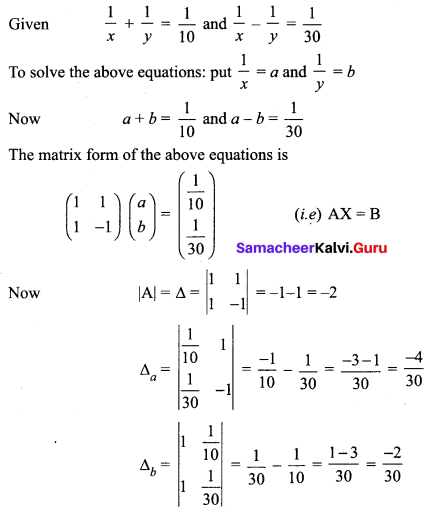
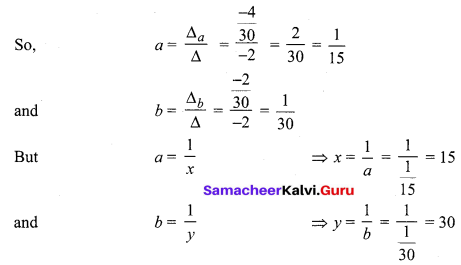
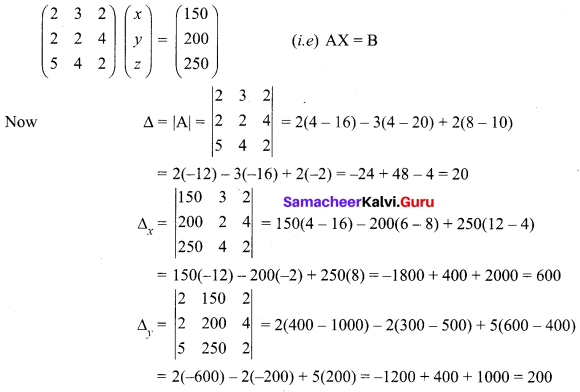
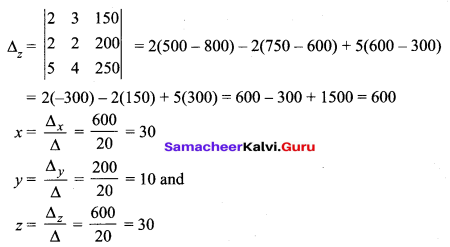
A family of 3 people went out for dinner in a restaurant. The cost of two dosai, three idlies and two vadais is ₹ 150. The cost of the two dosai, two idlies and four vadais is ₹ 200. The cost of five dosai, four idlies and two vadais is ₹ 250. The family has ₹ 350 in hand and they ate 3 dosai and six idlies and six vadais. Will they be able to manage to pay the bill within the amount they had?
Solution:
Let the cost of 1 dosai be ₹ x the cost of 1 idli be ₹ y and the cost of 1 vadai be ₹ z
Here 2x + 3y + 2z = 150
2x + 2y + 4z = 200
5x + 4y + 2z = 250
Writing the above equations in matrix form
Samacheer Kalvi 12th Maths Solutions Chapter 1 Applications of Matrices and Determinants Ex 1.4 Q5
Samacheer Kalvi 12th Maths Solutions Chapter 1 Applications of Matrices and Determinants Ex 1.4 Q5.1
So, cost of 1 dosai = x = ₹ 30
cost of 1 idli = y = ₹ 10 and
cost of 1 vadai = z = ₹ 30
Now cost of 3 dosai and 6 idlis and 6 vadais = 3 × 30 + 6 × 10 + 6 × 30 = 90+ 60+ 180 = ₹ 330
and they are having ₹ 350. So they will be able to manage to pay the bill.

Samacheer Kalvi 12th Maths Solutions Chapter 1 Applications of Matrices and Determinants Ex 1.4

Samacheer Kalvi 12th Maths Solutions Chapter 1 Applications of Matrices and Determinants Ex 1.4 Additional Problems

Question 1.
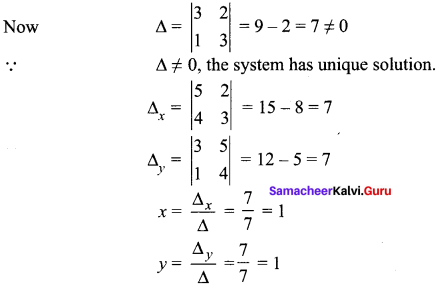
Solve the following non-homogeneous system of linear equations by determinant method: 3x + 2y = 5, x + 3y = 4.
Solution:
Samacheer Kalvi 12th Maths Solutions Chapter 1 Applications of Matrices and Determinants Ex 1.4 1
Solution is (x, y) = (1, 1).

Question 2.
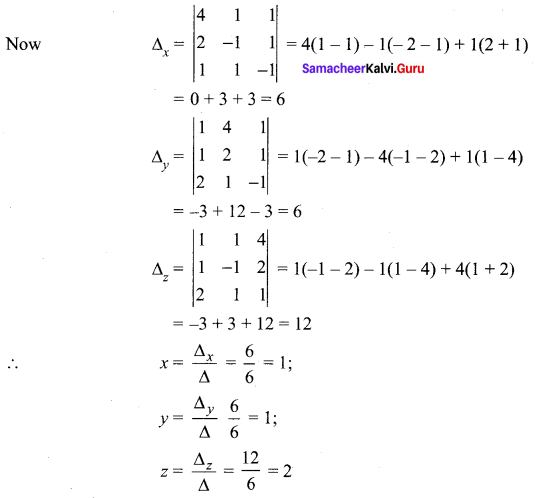
Solve the following non-homogeneous system of linear equations by determinant method: x + y + z = 4 ; x – y + z = 2 ; 2x + y – z = 1
Solution:
Samacheer Kalvi 12th Maths Solutions Chapter 1 Applications of Matrices and Determinants Ex 1.4 2
Since ∆ ≠ 0, the system has unique solution
Samacheer Kalvi 12th Maths Solutions Chapter 1 Applications of Matrices and Determinants Ex 1.4 3
Solution is x, y, z = 1, 1, 2

Question 3.
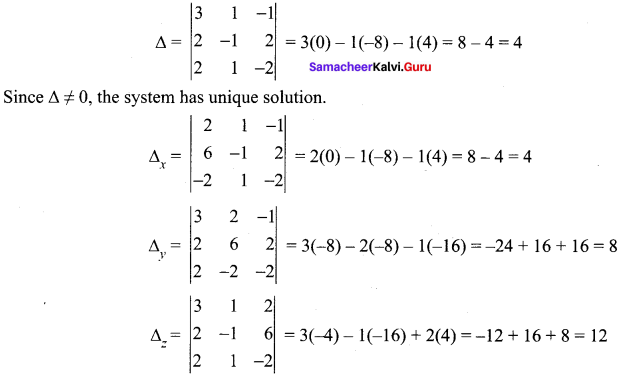
Solve the following non-homogeneous system of linear equations by determinant method: 3x + y – z = 2; 2x – y + 2z = 6; 2x + y – 2z = -2
Solution:
Samacheer Kalvi 12th Maths Solutions Chapter 1 Applications of Matrices and Determinants Ex 1.4 5
Samacheer Kalvi 12th Maths Solutions Chapter 1 Applications of Matrices and Determinants Ex 1.4 6
Solution is x, y, z = 1, 2, 3

Samacheer Kalvi 12th Maths Solutions Chapter 1 Applications of Matrices and Determinants Ex 1.4

Question 4.
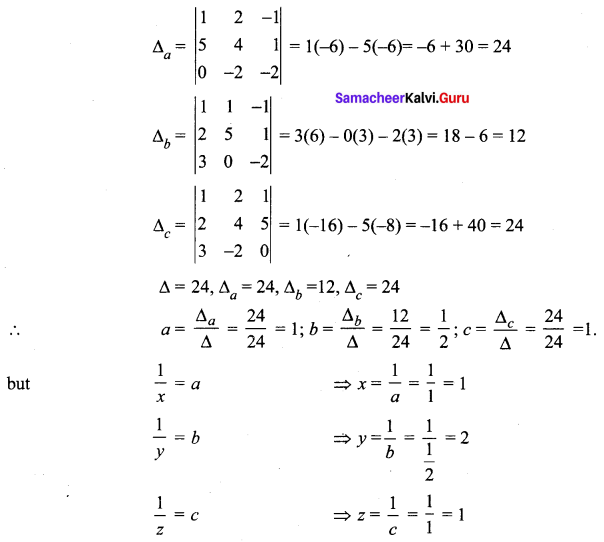
Solve the following non-homogeneous system of linear equations by determinant method:
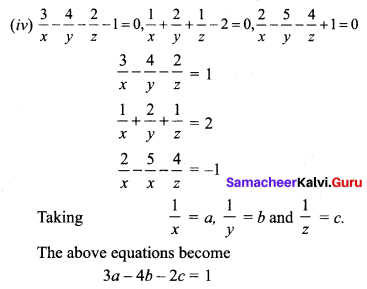
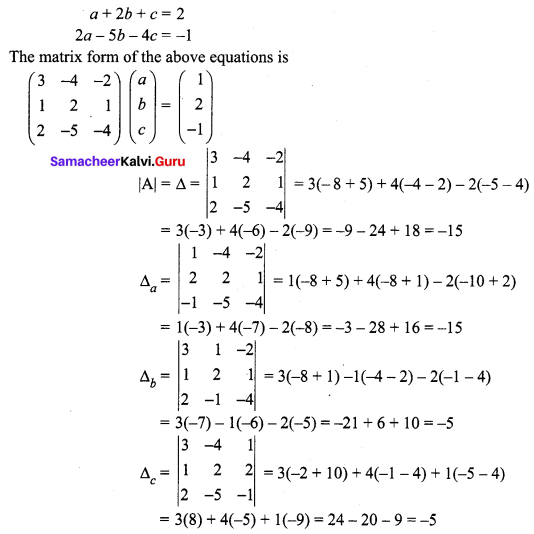
Samacheer Kalvi 12th Maths Solutions Chapter 1 Applications of Matrices and Determinants Ex 1.4 7
Solution:
Samacheer Kalvi 12th Maths Solutions Chapter 1 Applications of Matrices and Determinants Ex 1.4 8
a + 2b – c = 1 … (1)
2a + 4b + c = 5 ….. (2)
3a – 2b – 2c = 0 …… (3)
Samacheer Kalvi 12th Maths Solutions Chapter 1 Applications of Matrices and Determinants Ex 1.4 9
∴ The system has unique solution.
Samacheer Kalvi 12th Maths Solutions Chapter 1 Applications of Matrices and Determinants Ex 1.4 10
∴ Solution is x, y, z = 1, 2, 1.

Samacheer Kalvi 12th Maths Solutions Chapter 1 Applications of Matrices and Determinants Ex 1.3

You can Download Samacheer Kalvi 12th Maths Book Solutions Guide Pdf, Tamilnadu State Board help you to revise the complete Syllabus and score more marks in your examinations.
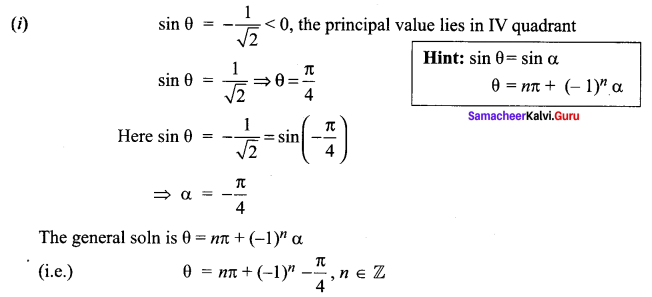
Tamilnadu Samacheer Kalvi 12th Maths Solutions Chapter 1 Applications of Matrices and Determinants Ex 1.3

Question 1.
Solve the following system of linear equations by matrix inversion method:
(i) 2x + 5y = -2, x + 2y = -3
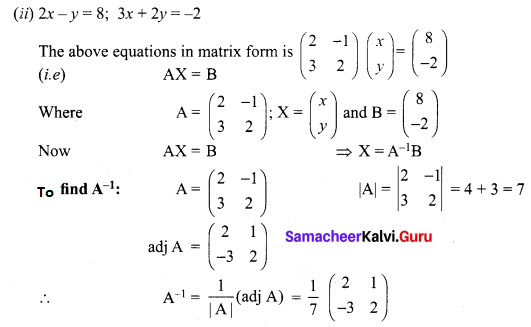
(ii) 2x – y = 8, 3x + 2y = -2
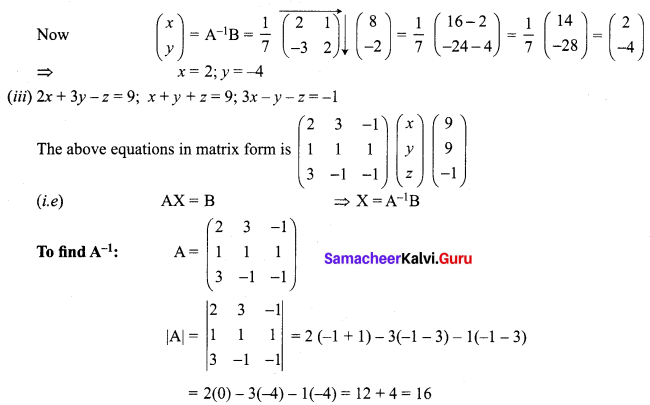
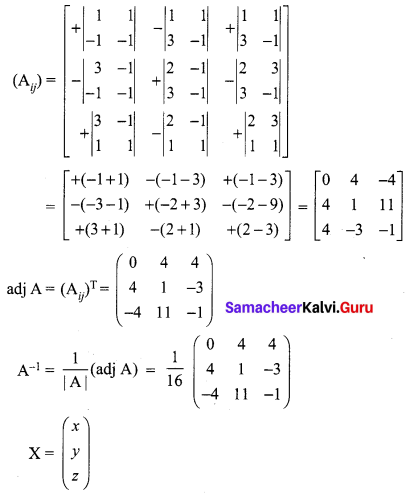
(iii) 2x + 3y – z = 9, x + y + z = 9, 3x – y – z = -1
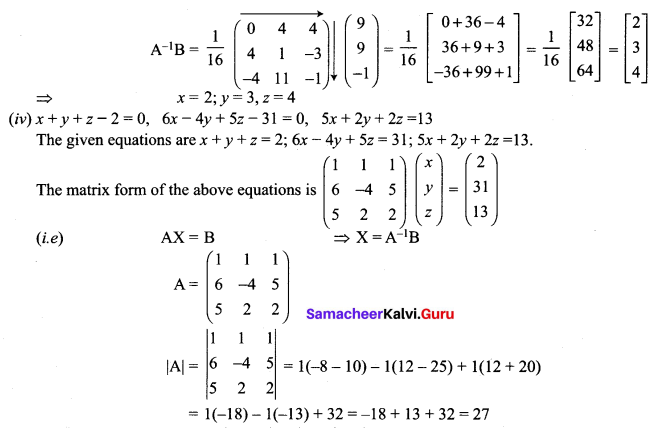
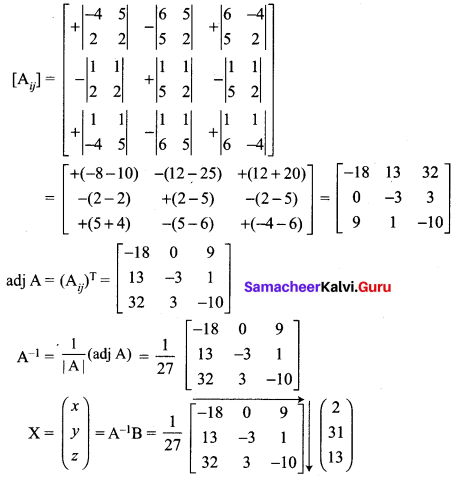
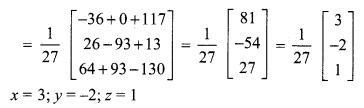
(iv) x + y + z – 2 = 0, 6x – 4y + 5z – 31 = 0, 5x + 2y + 2z = 13
Solution:
(i) 2x + 5y = -2, x + 2y = -3
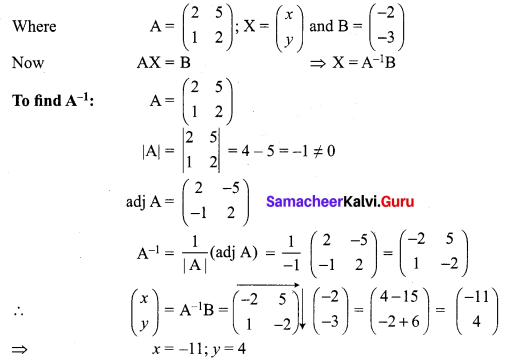
The matrix form of the above equations is \(\left(\begin{array}{ll}{2} & {5} \\ {1} & {2}\end{array}\right)\left(\begin{array}{l}{x} \\ {y}\end{array}\right)=\left(\begin{array}{l}{-2} \\ {-3}\end{array}\right)\)
(i.e) AX = B
Samacheer Kalvi 12th Maths Solutions Chapter 1 Applications of Matrices and Determinants Ex 1.3 Q1
Samacheer Kalvi 12th Maths Solutions Chapter 1 Applications of Matrices and Determinants Ex 1.3 Q1.1
Samacheer Kalvi 12th Maths Solutions Chapter 1 Applications of Matrices and Determinants Ex 1.3 Q1.2
Samacheer Kalvi 12th Maths Solutions Chapter 1 Applications of Matrices and Determinants Ex 1.3 Q1.3
Samacheer Kalvi 12th Maths Solutions Chapter 1 Applications of Matrices and Determinants Ex 1.3 Q1.4
Samacheer Kalvi 12th Maths Solutions Chapter 1 Applications of Matrices and Determinants Ex 1.3 Q1.5
Samacheer Kalvi 12th Maths Solutions Chapter 1 Applications of Matrices and Determinants Ex 1.3 Q1.6

Samacheer Kalvi 12th Maths Solutions Chapter 1 Applications of Matrices and Determinants Ex 1.3

Question 2.
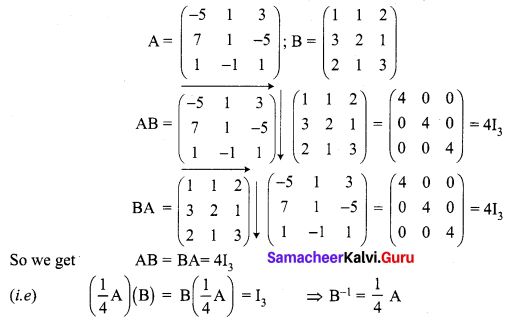
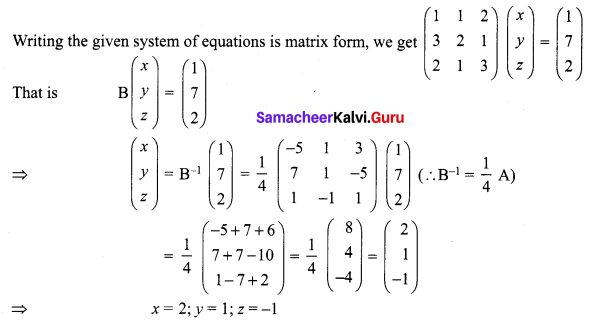
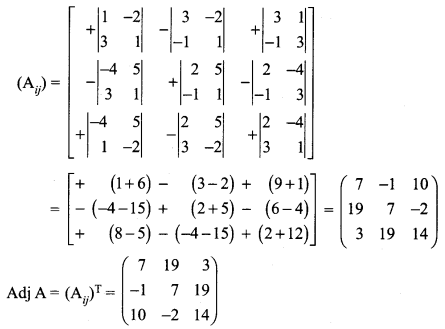
If A = \(\left[\begin{array}{ccc}{-5} & {1} & {3} \\ {7} & {1} & {-5} \\ {1} & {-1} & {1}\end{array}\right]\) and B = \(\left[\begin{array}{lll}{1} & {1} & {2} \\ {3} & {2} & {1} \\ {2} & {1} & {3}\end{array}\right]\) find the products AB and BA and hence solve the system of equations x + y + 2z = 1, 3x + 2y + z = 7, 2x + y + 3z = 2.
Solution:
Samacheer Kalvi 12th Maths Solutions Chapter 1 Applications of Matrices and Determinants Ex 1.3 Q2
Samacheer Kalvi 12th Maths Solutions Chapter 1 Applications of Matrices and Determinants Ex 1.3 Q2.1

Question 3.
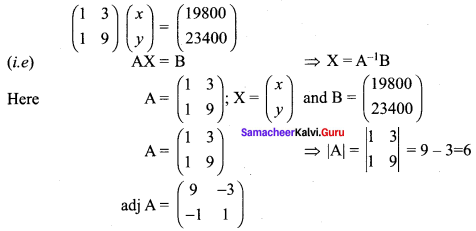
A man is appointed in a job with a monthly salary of certain amount and a fixed amount of annual increment. If his salary was ₹ 19,800 per month at the end of the first month after 3 years of service and ₹ 23,400 per month at the end of the first month after 9 years of service, find his starting salary and his annual increment. (Use matrix inversion method to solve the problem.)
Solution:
Let his monthly salary be ₹ x and his annual increment be ₹ y
Given x + 3y = 19800 and x + 9y = 23400
Writing the above equations in matrix form, we get
Samacheer Kalvi 12th Maths Solutions Chapter 1 Applications of Matrices and Determinants Ex 1.3 Q3
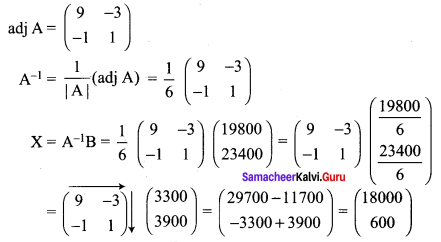
Samacheer Kalvi 12th Maths Solutions Chapter 1 Applications of Matrices and Determinants Ex 1.3 Q3.1
x = ₹ 18000 and y = ₹ 600
(i.e) monthly salary = ₹ 18000 and annual increment = ₹ 600

Question 4.
4 men and 4 women can finish a piece of work jointly in 3 days while 2 men and 5 women can finish the same work jointly in 4 days. Find the time taken by one man alone and that of one woman alone to finish the same work by using matrix inversion method.
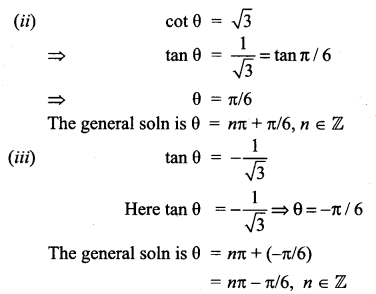
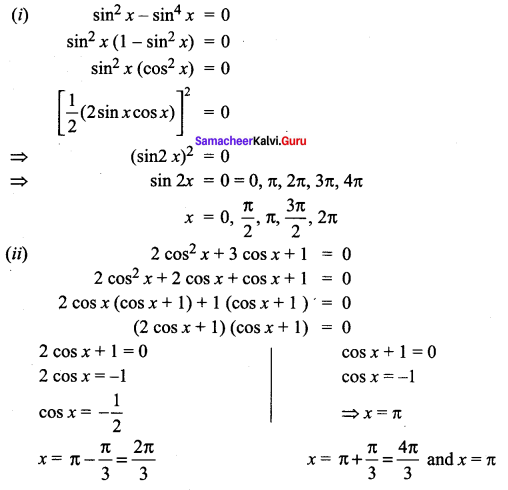
Solution:
Let the work done by man in 1 day be x and the work done by a woman in 1 day be y
Now we are given
4x + 4y = \(\frac { 1 }{ 3 }\) ⇒ 12x + 12y = 1
and 2x + 5y = \(\frac { 1 }{ 4 }\) ⇒ 8x + 20y = 1
The matrix form of the above equations is \(\left(\begin{array}{cc}{12} & {12} \\ {8} & {20}\end{array}\right)\left(\begin{array}{l}{x} \\ {y}\end{array}\right)=\left(\begin{array}{l}{1} \\ {1}\end{array}\right)\)
(i.e) AX = B ⇒ X = A-1B
Here
Samacheer Kalvi 12th Maths Solutions Chapter 1 Applications of Matrices and Determinants Ex 1.3 Q4
Samacheer Kalvi 12th Maths Solutions Chapter 1 Applications of Matrices and Determinants Ex 1.3 Q4.1
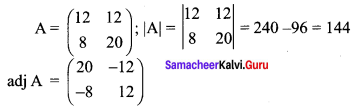
(i.e) The work done by a man in 1 day = x = \(\frac{1}{18}\)
The time taken by a man to finish the work = 18 days.
The work done by a woman in 1 day = y = \(\frac{1}{36}\)
The time is taken by a woman to finish the work = 36 days.

Question 5.
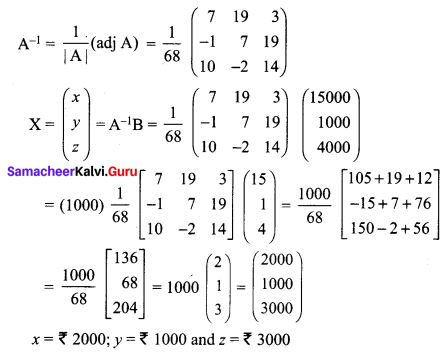
The prices of three commodities A, B and C are ₹ x, y and z per units respectively. A person P purchases 4 units of B and sells two units of A and 5 units of C. Person Q purchases 2 units of C and sells 3 units of A and one unit of B . Person R purchases one unit of A and sells 3 unit of B and one unit of C. In the process, P, Q and R earn ₹ 15,000, ₹ 1,000 and ₹ 4,000 respectively. Find the prices per unit of A,B and C. (Use matrix inversion method to solve the problem.)
Solution:
Price of A = ₹ x /unit
Price of B = ₹ y /unit
Price of C = ₹ z /unit
We are given
2x – 4y + 5z = 15000
3x + y – 2z = 1000
-x + 3y + z = 4000
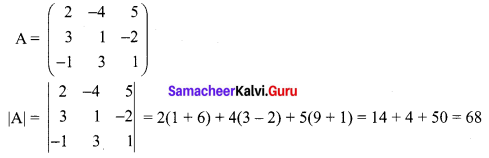
The matrix form of the above equations is \(\left(\begin{array}{rrr}{2} & {-4} & {5} \\ {3} & {1} & {-2} \\ {-1} & {3} & {1}\end{array}\right)\left(\begin{array}{l}{x} \\ {y} \\ {z}\end{array}\right)=\left(\begin{array}{r}{15000} \\ {1000} \\ {4000}\end{array}\right)\)
(i.e) AX = B ⇒ X = A-1B
Here
Samacheer Kalvi 12th Maths Solutions Chapter 1 Applications of Matrices and Determinants Ex 1.3 Q5
Samacheer Kalvi 12th Maths Solutions Chapter 1 Applications of Matrices and Determinants Ex 1.3 Q5.1
Samacheer Kalvi 12th Maths Solutions Chapter 1 Applications of Matrices and Determinants Ex 1.3 Q5.2

Samacheer Kalvi 12th Maths Solutions Chapter 1 Applications of Matrices and Determinants Ex 1.3

Samacheer Kalvi 12th Maths Solutions Chapter 1 Applications of Matrices and Determinants Ex 1.3 Additional Problems

Question 1.
Using matrix method, solve the following system of equations:
x + 2y + z = 7, x + 3z = 11, 2x – 3y = 1
Solution:
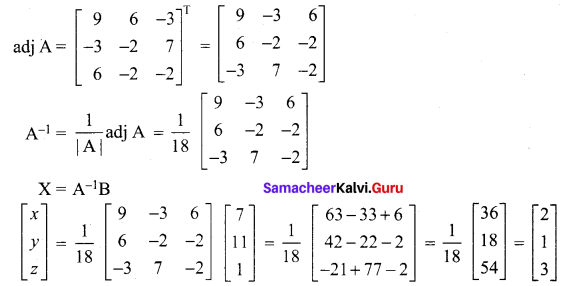
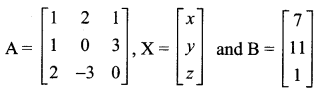
The system of equations can be written in the form AX = B, where
Samacheer Kalvi 12th Maths Solutions Chapter 1 Applications of Matrices and Determinants Ex 1.3 1
Samacheer Kalvi 12th Maths Solutions Chapter 1 Applications of Matrices and Determinants Ex 1.3 2
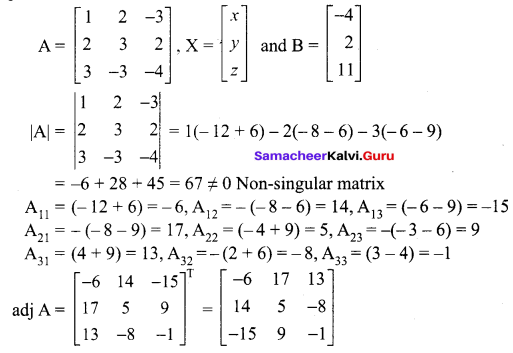
= 9 + 12 – 3 = 18 ≠ 0 Non-singular matrix.
A11 = (0 + 9) = 9, A12 = -(0 – 6) = 6,
A13 = (-3 – 0) = -3
A21 = – (0 + 3) = -3, A22 = (0 – 2) = -2
A23 = -(-3 – 4) = 7
A31 = (6 – 0) = 6, A32 = -(-3 – 1) = -2,
A33 = (0 – 2) = -2
Samacheer Kalvi 12th Maths Solutions Chapter 1 Applications of Matrices and Determinants Ex 1.3 3
Thus x = 2 ,y = 1 and z = 3.

Question 2.
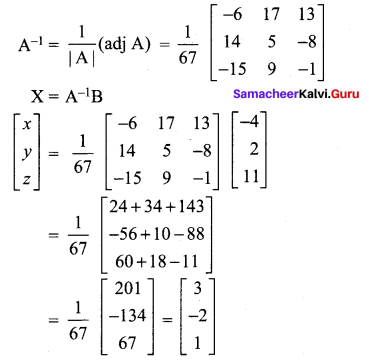
Using matrices, solve the following system of linear equations: x + 2y – 3z = -4, 2x + 3y + 2z = 2, 3x – 3y – 4z = 11.
Solution:
The system of equations can be written in the form AX = B, where
Samacheer Kalvi 12th Maths Solutions Chapter 1 Applications of Matrices and Determinants Ex 1.3 4
Samacheer Kalvi 12th Maths Solutions Chapter 1 Applications of Matrices and Determinants Ex 1.3 5
Thus x = 3,
y = -2 and z = 1

Samacheer Kalvi 12th Maths Solutions Chapter 1 Applications of Matrices and Determinants Ex 1.3

Question 3.
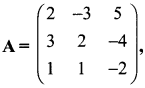
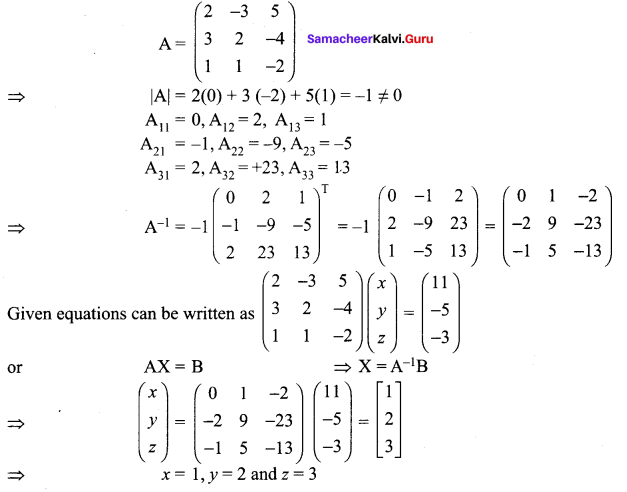
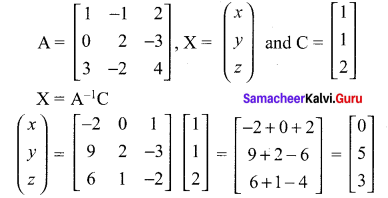
If Samacheer Kalvi 12th Maths Solutions Chapter 1 Applications of Matrices and Determinants Ex 1.3 6 Find A-1. Hence using A-1 solve the system of equations.
2x – 3y + 5z = 11,
3x + 2y – 4z = -5,
x + y – 2z = -3.
Solution:
Samacheer Kalvi 12th Maths Solutions Chapter 1 Applications of Matrices and Determinants Ex 1.3 66

Question 4.
Use product Samacheer Kalvi 12th Maths Solutions Chapter 1 Applications of Matrices and Determinants Ex 1.3 7 to solve the system of equations
x + 3z = 9,
-x + 2y – 2z = 4,
2x – 3y + 4z = -3
Solution:
Samacheer Kalvi 12th Maths Solutions Chapter 1 Applications of Matrices and Determinants Ex 1.3 8

Question 5.
Use product Samacheer Kalvi 12th Maths Solutions Chapter 1 Applications of Matrices and Determinants Ex 1.3 9 to solve the system of equations
x – y + 2z = 1,
2y – 3z = 1,
3x – 2y + 4z = 2
Solution:
Samacheer Kalvi 12th Maths Solutions Chapter 1 Applications of Matrices and Determinants Ex 1.3 10
The system of equations can be written in the form AX = C, where
Samacheer Kalvi 12th Maths Solutions Chapter 1 Applications of Matrices and Determinants Ex 1.3 11

Question 6.
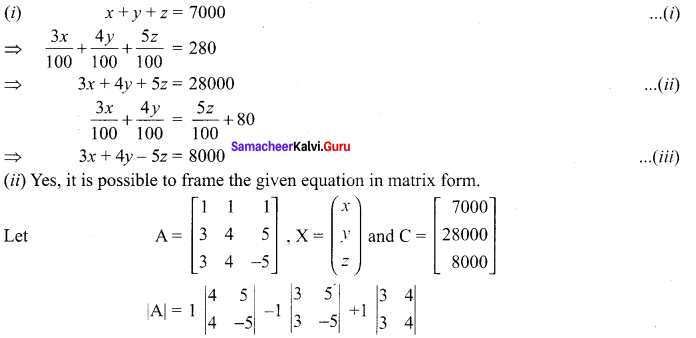
An amount of ₹ 7000 is invested in three types of investments x, y and z at the rate of 3%, 4% and 5% interest respectively. The total annual income is ₹ 280. If the combined income from x and y is ₹ 80 more than that from z, then
(i) Represent the above situation in form of linear equations .
(ii) Is it possible to frame the given linear equations in the form of matrix to obtain the three values x, y and z using matrix multiplication? If yes, find.
(iii) Which value is more beneficial to invest?
Solution:
Samacheer Kalvi 12th Maths Solutions Chapter 1 Applications of Matrices and Determinants Ex 1.3 12
⇒ -40 + 30 + 0 = -10 ≠ 0
Cofactors C11 = +(-20 – 20) = -40
C21 = -(5 – 4) = 9
C31 = +(5 – 4) = 1
C12 = +(-15 – 15) = -30
C22 = +(-5 – 3) = -8
C32 = -(5 – 3) = -2
C13 = +(12 – 12) = 0
C23 = -(4 – 3) = -1
C33 = +(4 – 3) = 1
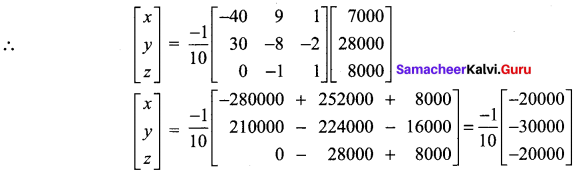
Samacheer Kalvi 12th Maths Solutions Chapter 1 Applications of Matrices and Determinants Ex 1.3 13
Thus, the three values x = ₹ 2000, y = ₹ 3000 and z = ₹ 2000
(iii) The value of y is more beneficial to invest

Question 7.
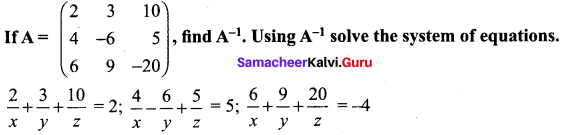
Samacheer Kalvi 12th Maths Solutions Chapter 1 Applications of Matrices and Determinants Ex 1.3 16
Solution:
Samacheer Kalvi 12th Maths Solutions Chapter 1 Applications of Matrices and Determinants Ex 1.3 18
In matrix form
Samacheer Kalvi 12th Maths Solutions Chapter 1 Applications of Matrices and Determinants Ex 1.3 19

Samacheer Kalvi 11th Maths Solutions Chapter 3 Trigonometry Ex 3.7

You can Download Samacheer Kalvi 11th Maths Book Solutions Guide Pdf, Tamilnadu State Board help you to revise the complete Syllabus and score more marks in your examinations.
Tamilnadu Samacheer Kalvi 11th Maths Solutions Chapter 3 Trigonometry Ex 3.7

Question 1.
If A + B + C = 180°, prove that
(i) sin 2A + sin 2B + sin 2C = 4 sin A sin B sin C
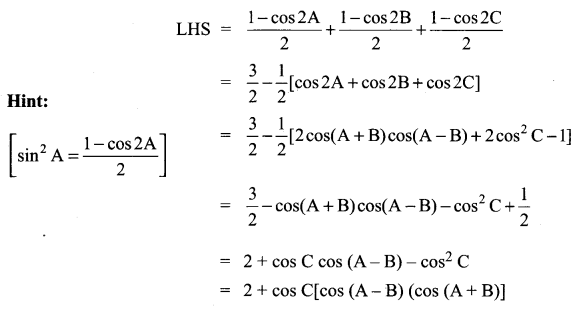
Samacheer Kalvi 11th Maths Solutions Chapter 3 Trigonometry Ex 3.7 1
(iii) sin2 A + sin2 B + sin2 C = 2 + 2 cos A cos B cos C
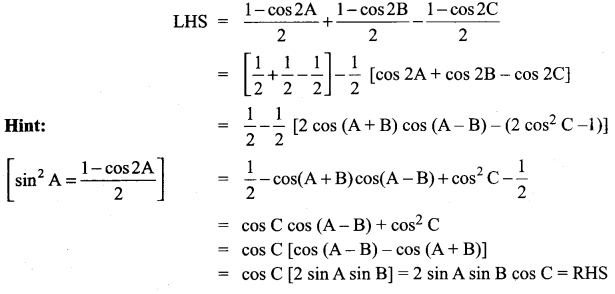
(iv) sin2 A + sin2 B – sin2 C = 2 sin A sin B cos C
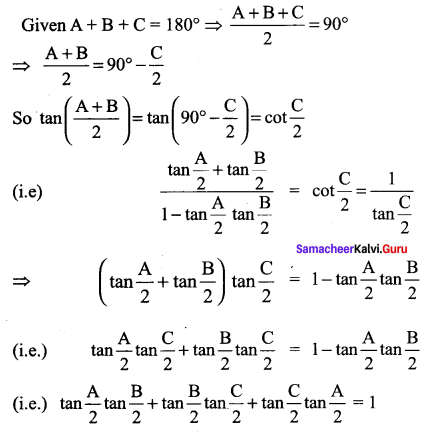
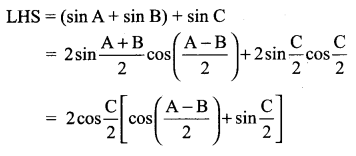
Samacheer Kalvi 11th Maths Solutions Chapter 3 Trigonometry Ex 3.7 2
(vii) sin(B + C – A) + sin(C + A – B) + sin(A + B – C) = 4 sin A sin B sin C.
Solution:
(i)
LHS = (sin 2A + sin 2B) + sin 2C
= 2 sin (A + B) cos (A – B) + 2 sin C cos C
[sin (A + B) = sin (180° – C) = sin C]
= 2 sin C cos (A – B) + 2 sin C cos C
= 2 sin C [ cos (A – B) + cos C]
{cos C = cos [180° – (A + B)] = – cos (A + B)}
= 2 sin C [cos (A – B) – cos (A + B)]
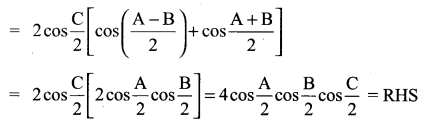
Samacheer Kalvi 11th Maths Solutions Chapter 3 Trigonometry Ex 3.7 3

(ii)
Samacheer Kalvi 11th Maths Solutions Chapter 3 Trigonometry Ex 3.7 4

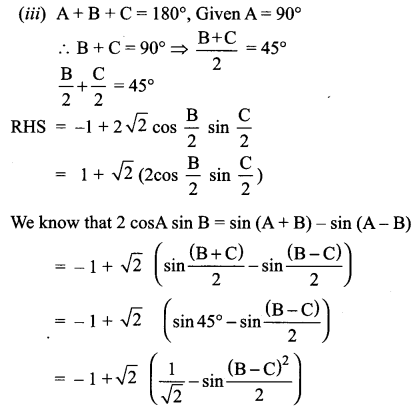
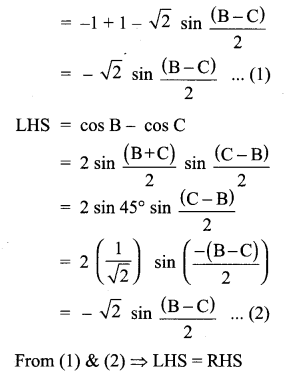
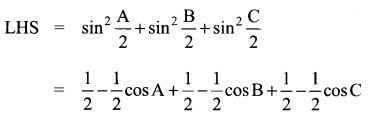
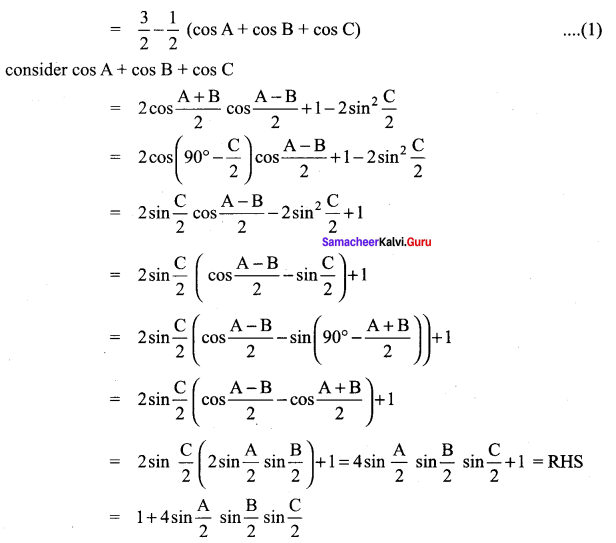
(iii)
Samacheer Kalvi 11th Maths Solutions Chapter 3 Trigonometry Ex 3.7 5
[cos (180° –  C) – cos C – cos C]
= 2 + cos C [cos (A – B) + cos (A + B)]
= 2+ cos C[2 cos A cos B]
= 2 + 2 cos A cos B cos C = RHS

(iv)
Samacheer Kalvi 11th Maths Solutions Chapter 3 Trigonometry Ex 3.7 7

(v)
Samacheer Kalvi 11th Maths Solutions Chapter 3 Trigonometry Ex 3.7 8

(vi)
Samacheer Kalvi 11th Maths Solutions Chapter 3 Trigonometry Ex 3.7 9
Samacheer Kalvi 11th Maths Solutions Chapter 3 Trigonometry Ex 3.7 10

(vii)
Now A + B + C = 180°
So B + C = 180° – A
sin (B + C – A) = sin (180° – A – A)
= sin(180° – 2A) = sin 2A
Now LHS = sin 2A + sin 2B + sin 2C
= 4 sin A sin B sin C (from (i) ans) = RHS

Samacheer Kalvi 11th Maths Solutions Chapter 3 Trigonometry Ex 3.7

Question 2.
If A + B + C = 2s, then prove that sin(s – A) sin(s – B) + sin s sin(s – C) = sin A sin B.
Solution:
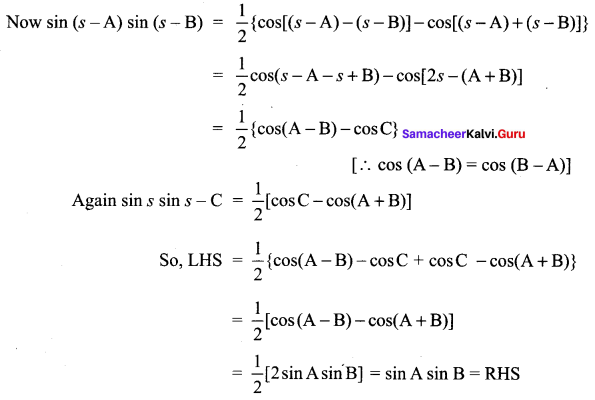
Samacheer Kalvi 11th Maths Solutions Chapter 3 Trigonometry Ex 3.7 11

Question 3.
Samacheer Kalvi 11th Maths Solutions Chapter 3 Trigonometry Ex 3.7 111
Solution:
Samacheer Kalvi 11th Maths Solutions Chapter 3 Trigonometry Ex 3.7 12
⇒ A+B+C = 180°
⇒ A + B = 180° – C
multiply 2 on both sides ⇒ 2A + 2B = 360° – 2C
2(A + B) =360° – 2C
⇒ tan(2A + 2B) = tan(360° – 2C) = – tan 2C
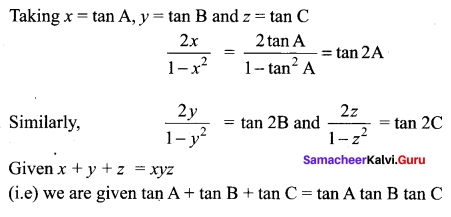
Samacheer Kalvi 11th Maths Solutions Chapter 3 Trigonometry Ex 3.7 13
⇒ tan 2A + tan 2B = -tan2C[1 – tan 2A tan 2B]
⇒ tan 2A + tan 2B = -tan 2C + tan 2A tan 2B tan 2C
⇒ tan 2A + tan 2B + tan 2C = tan 2A tan 2B tan 2C
Samacheer Kalvi 11th Maths Solutions Chapter 3 Trigonometry Ex 3.7 112

Question 4.
If A + B + C = \(\frac{\pi}{2}\), prove the following
(i) sin 2A + sin 2B + sin 2C = 4 cos A cos B cos C
(ii) COS 2A + cos 2B + cos 2C = 1 + 4 sin A sin B sin C.
Solution:
(i) LHS = (sin 2A + sin 2B) + sin 2C
= 2 sin (A + B) cos (A – B) + 2 sin C cos C = 2 sin (90° – C) cos (A – B) + 2 sin C cos C
= 2 cos C [cos (A – B) + sin C] + cos (A + B) ( ∴ A + B = π/2 – C)
= 2 cos C [cos (A – B) + cos (A + B)]
= 2 cos C [2 cos A cos B]
= 4 cos A cos B cos C = RHS

Samacheer Kalvi 11th Maths Solutions Chapter 3 Trigonometry Ex 3.7

(ii) LHS = (cos 2A + cos 2B) + cos 2C
= 2 cos (A + B) cos (A – B) + 1 – 2 sin2 C
= 1 + 2 sin C (cos (A – B) – 2 sin2 C)
{∴ cos (A + B) = cos (90° – C) = sin C}
= 1 + 2 sin C [cos (A- B) – sin C]
= 1 + 2 sin C [cos (A – B) – cos (A + B)]
= 1 + 2 sin C [2 sin A sin B]
= 1 + 4 sin A sin B sin C = RHS

Question 5.
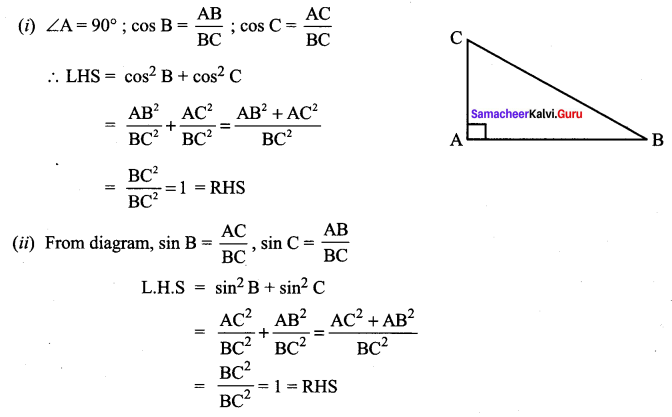
If ∆ABC is a right triangle and if ∠A = \(\frac{\pi}{2}\), then prove that
(i) cos2 B + cos2 C = 1
(ii) sin2 B + sin2 C = 1
Samacheer Kalvi 11th Maths Solutions Chapter 3 Trigonometry Ex 3.7 14
Solution:
Samacheer Kalvi 11th Maths Solutions Chapter 3 Trigonometry Ex 3.7 15
Samacheer Kalvi 11th Maths Solutions Chapter 3 Trigonometry Ex 3.7 16
Samacheer Kalvi 11th Maths Solutions Chapter 3 Trigonometry Ex 3.7 17

Samacheer Kalvi 11th Maths Solutions Chapter 3 Trigonometry Ex 3.7 Additional Questions

Question 1.
A + B + C = π, prove that sin 2A – sin 2B + sin 2C = 4 cos A sin B cos C
Solution:
LHS = sin 2A – sin 2B + sin 2C
= sin 2A + sin 2C – sin 2B
Samacheer Kalvi 11th Maths Solutions Chapter 3 Trigonometry Ex 3.7 18
= 2 sin (A + C) cos (A – C) – 2 sin B cos B
= 2 sin (180° – B) cos (A-C) – 2 sin B cos B
= 2 sin B cos (A – C) – 2 sin B cos B
= 2 sin B [cos (A – C) – cos B]
= 2 sin B [cos (A – C) – cos (180° – (A + C))]
= 2 sin B [cos (A – C) + cos (A + C)]
= 2 sin B [2 cos A cos C]
= 4 cos A sin B cos C = RHS

Samacheer Kalvi 11th Maths Solutions Chapter 3 Trigonometry Ex 3.7

Question 2.
Samacheer Kalvi 11th Maths Solutions Chapter 3 Trigonometry Ex 3.7 19
Solution:
Samacheer Kalvi 11th Maths Solutions Chapter 3 Trigonometry Ex 3.7 20
Samacheer Kalvi 11th Maths Solutions Chapter 3 Trigonometry Ex 3.7 21
substitute in (1) we get,
Samacheer Kalvi 11th Maths Solutions Chapter 3 Trigonometry Ex 3.7 22

Samacheer Kalvi 12th Maths Solutions Chapter 1 Applications of Matrices and Determinants Ex 1.2

You can Download Samacheer Kalvi 12th Maths Book Solutions Guide Pdf, Tamilnadu State Board help you to revise the complete Syllabus and score more marks in your examinations.
Tamilnadu Samacheer Kalvi 12th Maths Solutions Chapter 1 Applications of Matrices and Determinants Ex 1.2

Question 1.
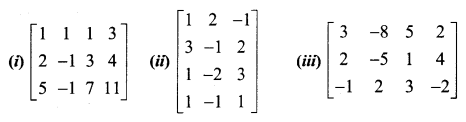
Find the rank of the following matrices by the minor method:
Samacheer Kalvi 12th Maths Solutions Chapter 1 Applications of Matrices and Determinants Ex 1.2 Q1
Samacheer Kalvi 12th Maths Solutions Chapter 1 Applications of Matrices and Determinants Ex 1.2 Q1.1
Solution:
Samacheer Kalvi 12th Maths Solutions Chapter 1 Applications of Matrices and Determinants Ex 1.2 Q1.2
Samacheer Kalvi 12th Maths Solutions Chapter 1 Applications of Matrices and Determinants Ex 1.2 Q1.3
Samacheer Kalvi 12th Maths Solutions Chapter 1 Applications of Matrices and Determinants Ex 1.2 Q1.4

Samacheer Kalvi 12th Maths Solutions Chapter 1 Applications of Matrices and Determinants Ex 1.2

Question 2.
Find the rank of the folowing matrices by row reduction method:
Samacheer Kalvi 12th Maths Solutions Chapter 1 Applications of Matrices and Determinants Ex 1.2 Q2
Solution:
(i) Let
Samacheer Kalvi 12th Maths Solutions Chapter 1 Applications of Matrices and Determinants Ex 1.2 Q2.1
The last equivalent matrix is in row-echelon form. It has three non zero rows. So ρ(A) = 3
(ii) Let
Samacheer Kalvi 12th Maths Solutions Chapter 1 Applications of Matrices and Determinants Ex 1.2 Q2.2
The last equivalent matrix is in row-echelon form. It has three non zero rows. ρ(A) = 3
(iii) Let
Samacheer Kalvi 12th Maths Solutions Chapter 1 Applications of Matrices and Determinants Ex 1.2 Q2.3
The last equivalent matrix is in row-echelon form. It has three non zero rows. ρ(A) = 3

Question 3.
Find the inverse of each of the following by Gauss-Jordan method:
Samacheer Kalvi 12th Maths Solutions Chapter 1 Applications of Matrices and Determinants Ex 1.2 Q3
Solution:
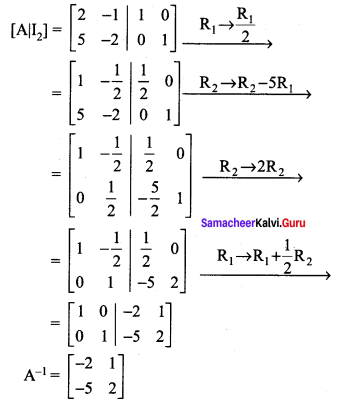
(i) Let \(A=\left(\begin{array}{cc}{2} & {-1} \\ {5} & {-2}\end{array}\right)\)
Applying Gauss-Jordan method we get
Samacheer Kalvi 12th Maths Solutions Chapter 1 Applications of Matrices and Determinants Ex 1.2 Q3.1
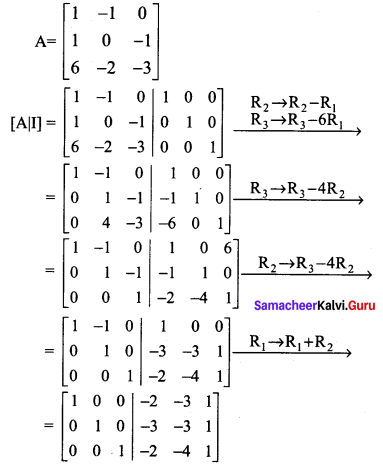
(ii) Let
Samacheer Kalvi 12th Maths Solutions Chapter 1 Applications of Matrices and Determinants Ex 1.2 Q3.2
Samacheer Kalvi 12th Maths Solutions Chapter 1 Applications of Matrices and Determinants Ex 1.2 Q3.3
(iii) Let
Samacheer Kalvi 12th Maths Solutions Chapter 1 Applications of Matrices and Determinants Ex 1.2 Q3.4
Samacheer Kalvi 12th Maths Solutions Chapter 1 Applications of Matrices and Determinants Ex 1.2 Q3.5

Samacheer Kalvi 12th Maths Solutions Chapter 1 Applications of Matrices and Determinants Ex 1.2

Samacheer Kalvi 12th Maths Solutions Chapter 1 Applications of Matrices and Determinants Ex 1.2 Additional Problems

Question 1.
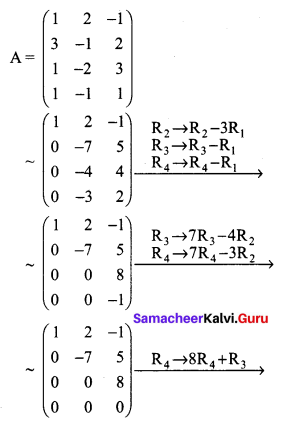
Find the rank of the following matrices. Samacheer Kalvi 12th Maths Solutions Chapter 1 Applications of Matrices and Determinants Ex 1.2 1
Solution:
Samacheer Kalvi 12th Maths Solutions Chapter 1 Applications of Matrices and Determinants Ex 1.2 2
A has at least one non-zero minor of order 2. \(\rho(\mathrm{A})\) = 2

Question 2.
Find the rank of the following matrices. Samacheer Kalvi 12th Maths Solutions Chapter 1 Applications of Matrices and Determinants Ex 1.2 225
Solution:
Samacheer Kalvi 12th Maths Solutions Chapter 1 Applications of Matrices and Determinants Ex 1.2 3
The last equivalent matrix is in the echelon form. It has three non-zero rows.
∴ \(\rho(\mathrm{A})\) = 3; Here A is of order 3 × 4

Question 3.
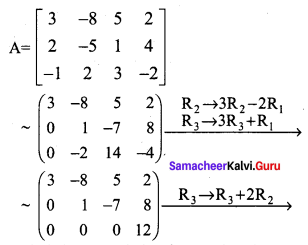
Find the rank of the following matrices. Samacheer Kalvi 12th Maths Solutions Chapter 1 Applications of Matrices and Determinants Ex 1.2 4
Solution:
Samacheer Kalvi 12th Maths Solutions Chapter 1 Applications of Matrices and Determinants Ex 1.2 452
Samacheer Kalvi 12th Maths Solutions Chapter 1 Applications of Matrices and Determinants Ex 1.2 5
The last equivalent matrix is in the echelon form. The number of non-zero rows in this matrix is two. A is a matrix of order 3 × 4. ∴ \(\rho(\mathrm{A})\) = 2

Question 4.
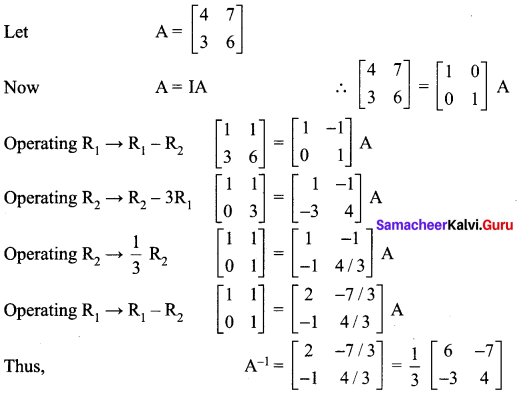
Using elementary transformations find the inverse of the following matrix Samacheer Kalvi 12th Maths Solutions Chapter 1 Applications of Matrices and Determinants Ex 1.2 7
Solution:
Samacheer Kalvi 12th Maths Solutions Chapter 1 Applications of Matrices and Determinants Ex 1.2 77

Samacheer Kalvi 12th Maths Solutions Chapter 1 Applications of Matrices and Determinants Ex 1.2

Question 5.
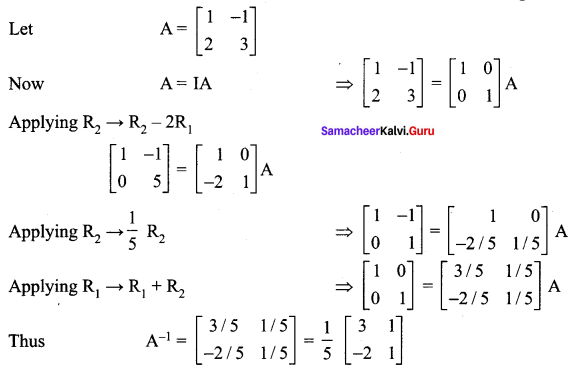
Using elementary transformations find the inverse of the following matrices Samacheer Kalvi 12th Maths Solutions Chapter 1 Applications of Matrices and Determinants Ex 1.2 8
Solution:
Samacheer Kalvi 12th Maths Solutions Chapter 1 Applications of Matrices and Determinants Ex 1.2 9

Question 6.
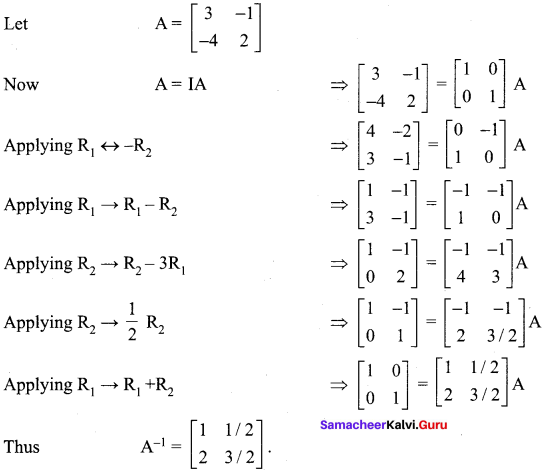
Using elementary transformations find the inverse of the following matrices Samacheer Kalvi 12th Maths Solutions Chapter 1 Applications of Matrices and Determinants Ex 1.2 99
Solution:
Samacheer Kalvi 12th Maths Solutions Chapter 1 Applications of Matrices and Determinants Ex 1.2 10

Question 7.
Using elementary transformations, find the inverse of the following matrices Samacheer Kalvi 12th Maths Solutions Chapter 1 Applications of Matrices and Determinants Ex 1.2 100
Solution:
Samacheer Kalvi 12th Maths Solutions Chapter 1 Applications of Matrices and Determinants Ex 1.2 11
Samacheer Kalvi 12th Maths Solutions Chapter 1 Applications of Matrices and Determinants Ex 1.2 12

Question 8.
Using elementary transformations, find the inverse of the following matrices Samacheer Kalvi 12th Maths Solutions Chapter 1 Applications of Matrices and Determinants Ex 1.2 13
Solution:
Samacheer Kalvi 12th Maths Solutions Chapter 1 Applications of Matrices and Determinants Ex 1.2 133
Samacheer Kalvi 12th Maths Solutions Chapter 1 Applications of Matrices and Determinants Ex 1.2 14

Samacheer Kalvi 12th Maths Solutions Chapter 1 Applications of Matrices and Determinants Ex 1.2

Question 9.
Using elementary transformations, find the inverse of the following matrices Samacheer Kalvi 12th Maths Solutions Chapter 1 Applications of Matrices and Determinants Ex 1.2 144
Solution:
Samacheer Kalvi 12th Maths Solutions Chapter 1 Applications of Matrices and Determinants Ex 1.2 15
Samacheer Kalvi 12th Maths Solutions Chapter 1 Applications of Matrices and Determinants Ex 1.2 16

Question 10.
Using elementary transformations, find the inverse of the following matrices Samacheer Kalvi 12th Maths Solutions Chapter 1 Applications of Matrices and Determinants Ex 1.2 17
Solution:
Samacheer Kalvi 12th Maths Solutions Chapter 1 Applications of Matrices and Determinants Ex 1.2 177
Since R2 has all numbers zero, Thus inverse of matrix A does not exist.

Samacheer Kalvi 11th Maths Solutions Chapter 3 Trigonometry Ex 3.6

You can Download Samacheer Kalvi 11th Maths Book Solutions Guide Pdf, Tamilnadu State Board help you to revise the complete Syllabus and score more marks in your examinations.
Tamilnadu Samacheer Kalvi 11th Maths Solutions Chapter 3 Trigonometry Ex 3.6

Question 1.
Express each of the following as a sum or difference
(i) sin 35° cos 28°
(ii) sin 4x cos 2x
(iii) 2 sin 10θ cos 2θ
(iv) cos 5θ cos 2θ
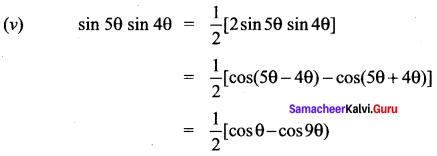
(v) sin 5θ sin 4θ.
Solution:
Samacheer Kalvi 11th Maths Solutions Chapter 3 Trigonometry Ex 3.6 1
Samacheer Kalvi 11th Maths Solutions Chapter 3 Trigonometry Ex 3.6 2
Samacheer Kalvi 11th Maths Solutions Chapter 3 Trigonometry Ex 3.6 3

Question 2.
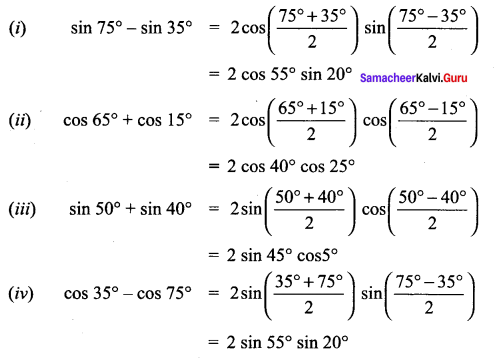
Express each of the following as a product
(i) sin 75° – sin 35°
(ii) cos 65° + cos 15°
(iii) sin 50° + sin 40°
(iv) cos 35° – cos 75°.
Solution:
Samacheer Kalvi 11th Maths Solutions Chapter 3 Trigonometry Ex 3.6 4

Samacheer Kalvi 11th Maths Solutions Chapter 3 Trigonometry Ex 3.6

Question 3.
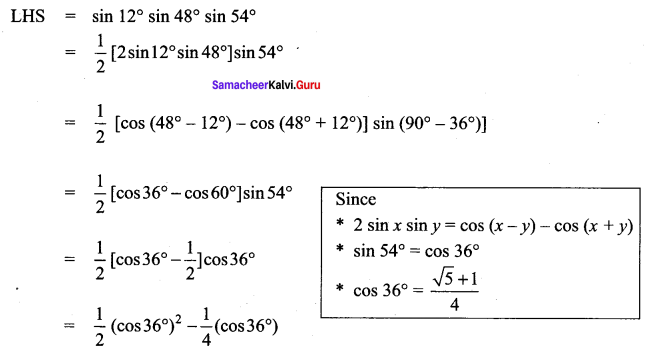
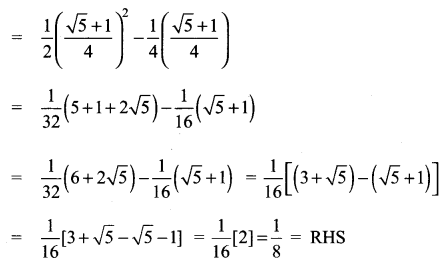
Samacheer Kalvi 11th Maths Solutions Chapter 3 Trigonometry Ex 3.6 5
Solution:
Samacheer Kalvi 11th Maths Solutions Chapter 3 Trigonometry Ex 3.6 6
Samacheer Kalvi 11th Maths Solutions Chapter 3 Trigonometry Ex 3.6 7

Question 4.
Samacheer Kalvi 11th Maths Solutions Chapter 3 Trigonometry Ex 3.6 8
Solution:
Samacheer Kalvi 11th Maths Solutions Chapter 3 Trigonometry Ex 3.6 9
Samacheer Kalvi 11th Maths Solutions Chapter 3 Trigonometry Ex 3.6 10

Question 5.
Samacheer Kalvi 11th Maths Solutions Chapter 3 Trigonometry Ex 3.6 11
Solution:
Samacheer Kalvi 11th Maths Solutions Chapter 3 Trigonometry Ex 3.6 12
Samacheer Kalvi 11th Maths Solutions Chapter 3 Trigonometry Ex 3.6 13
Samacheer Kalvi 11th Maths Solutions Chapter 3 Trigonometry Ex 3.6 14

Samacheer Kalvi 11th Maths Solutions Chapter 3 Trigonometry Ex 3.6

Question 6.
Samacheer Kalvi 11th Maths Solutions Chapter 3 Trigonometry Ex 3.6 15
Solution:
Samacheer Kalvi 11th Maths Solutions Chapter 3 Trigonometry Ex 3.6 16

Question 7.
Prove that sin x + sin 2x + sin 3x = sin 2x (1 + 2 cos x).
Solution:
Samacheer Kalvi 11th Maths Solutions Chapter 3 Trigonometry Ex 3.6 17

Question 8.
Samacheer Kalvi 11th Maths Solutions Chapter 3 Trigonometry Ex 3.6 18
Solution:
Samacheer Kalvi 11th Maths Solutions Chapter 3 Trigonometry Ex 3.6 19

Question 9.
Prove that 1 + cos 2x + cos 4x + cos 6x = 4 cos x cos 2x cos 3x.
Solution:
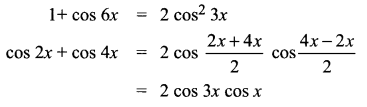
Samacheer Kalvi 11th Maths Solutions Chapter 3 Trigonometry Ex 3.6 20
LHS = 1 + cos 2x + cos 4x + cos 6x
= (1 + cos 6x) + (cos 2x + cos 4x)
= 2cos2 3x + 2cos 3x cos x
= 2 cos 3x (cos 3x + cos x)
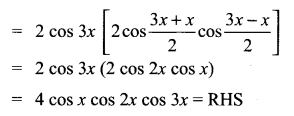
Samacheer Kalvi 11th Maths Solutions Chapter 3 Trigonometry Ex 3.6 21

Question 10.
Samacheer Kalvi 11th Maths Solutions Chapter 3 Trigonometry Ex 3.6 22
Solution:
Samacheer Kalvi 11th Maths Solutions Chapter 3 Trigonometry Ex 3.6 23
Samacheer Kalvi 11th Maths Solutions Chapter 3 Trigonometry Ex 3.6 24

Samacheer Kalvi 11th Maths Solutions Chapter 3 Trigonometry Ex 3.6

Question 11.
Samacheer Kalvi 11th Maths Solutions Chapter 3 Trigonometry Ex 3.6 25
Solution:
Samacheer Kalvi 11th Maths Solutions Chapter 3 Trigonometry Ex 3.6 26
Samacheer Kalvi 11th Maths Solutions Chapter 3 Trigonometry Ex 3.6 27

Question 12.
Samacheer Kalvi 11th Maths Solutions Chapter 3 Trigonometry Ex 3.6 28
Solution:
Samacheer Kalvi 11th Maths Solutions Chapter 3 Trigonometry Ex 3.6 29
Question 13.
Samacheer Kalvi 11th Maths Solutions Chapter 3 Trigonometry Ex 3.6 30
Solution:
Samacheer Kalvi 11th Maths Solutions Chapter 3 Trigonometry Ex 3.6 31

Question 14.
Samacheer Kalvi 11th Maths Solutions Chapter 3 Trigonometry Ex 3.6 32
Solution:
Samacheer Kalvi 11th Maths Solutions Chapter 3 Trigonometry Ex 3.6 33

Samacheer Kalvi 11th Maths Solutions Chapter 3 Trigonometry Ex 3.6 Additional Questions

Question 1.
Samacheer Kalvi 11th Maths Solutions Chapter 3 Trigonometry Ex 3.6 40
Solution:
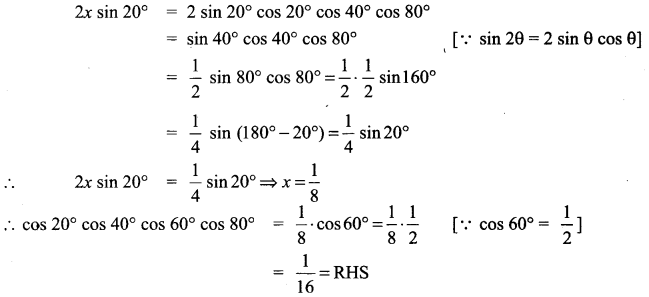
Let cos 20° cos 40° cos 60° cos 80° = x
Multiply by 2 sin 20° on both sides.
Samacheer Kalvi 11th Maths Solutions Chapter 3 Trigonometry Ex 3.6 41

Question 2.
Samacheer Kalvi 11th Maths Solutions Chapter 3 Trigonometry Ex 3.6 42
Solution:
Samacheer Kalvi 11th Maths Solutions Chapter 3 Trigonometry Ex 3.6 43
Question 3.
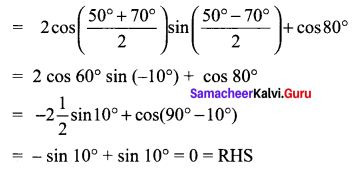
Prove that sin 50° – sin 70° + cos 80° = 0.
Solution:
LHS = sin 50° – sin 70° + cos 80°
Samacheer Kalvi 11th Maths Solutions Chapter 3 Trigonometry Ex 3.6 44
Samacheer Kalvi 11th Maths Solutions Chapter 3 Trigonometry Ex 3.6
Question 4.
Samacheer Kalvi 11th Maths Solutions Chapter 3 Trigonometry Ex 3.6 45

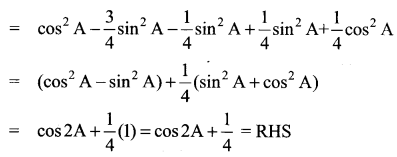
Solution:
Samacheer Kalvi 11th Maths Solutions Chapter 3 Trigonometry Ex 3.6 46

Question 5.
Samacheer Kalvi 11th Maths Solutions Chapter 3 Trigonometry Ex 3.6 47
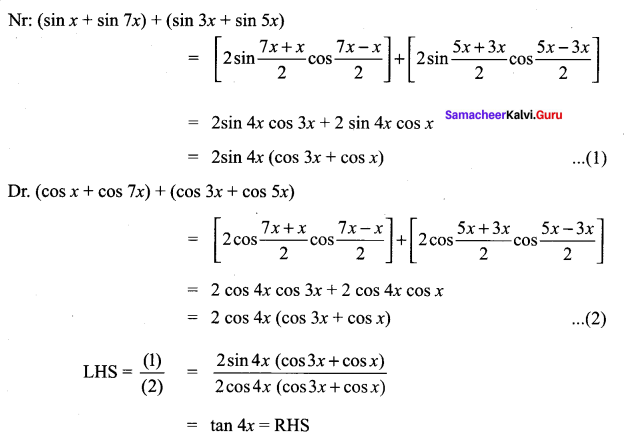
Solution:
Samacheer Kalvi 11th Maths Solutions Chapter 3 Trigonometry Ex 3.6 48

Question 6.
Samacheer Kalvi 11th Maths Solutions Chapter 3 Trigonometry Ex 3.6 49
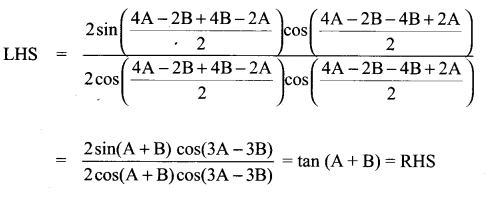
Solution:
Samacheer Kalvi 11th Maths Solutions Chapter 3 Trigonometry Ex 3.6 50

Question 7.
Samacheer Kalvi 11th Maths Solutions Chapter 3 Trigonometry Ex 3.6 51
Solution:
Samacheer Kalvi 11th Maths Solutions Chapter 3 Trigonometry Ex 3.6 52
Samacheer Kalvi 11th Maths Solutions Chapter 3 Trigonometry Ex 3.6 53

Samacheer Kalvi 11th Maths Solutions Chapter 3 Trigonometry Ex 3.6

Question 8.
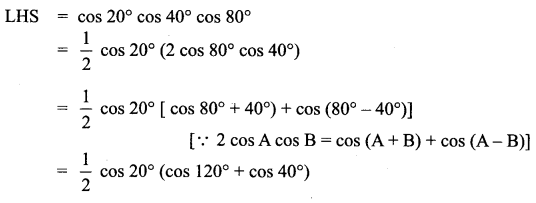
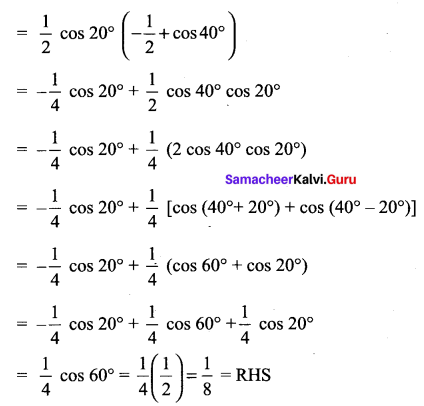
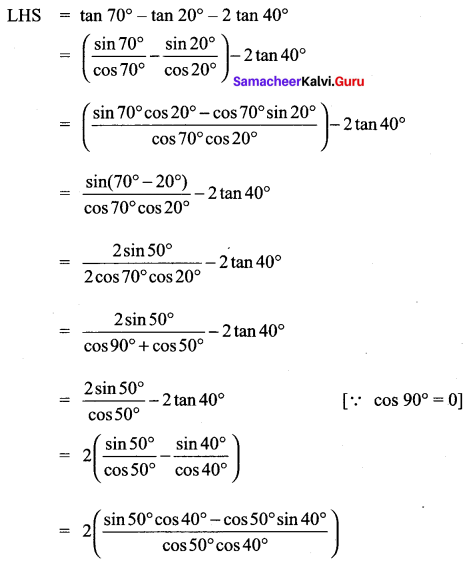
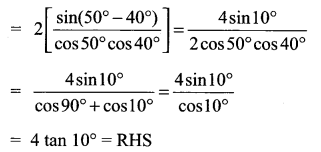
Prove that tan 70° – tan 20° – 2 tan 40° = 4 tan 10°
Solution:
Samacheer Kalvi 11th Maths Solutions Chapter 3 Trigonometry Ex 3.6 55
Samacheer Kalvi 11th Maths Solutions Chapter 3 Trigonometry Ex 3.6 56

Question 9.
Samacheer Kalvi 11th Maths Solutions Chapter 3 Trigonometry Ex 3.6 57
Solution:
Samacheer Kalvi 11th Maths Solutions Chapter 3 Trigonometry Ex 3.6 58

Question 10.
Samacheer Kalvi 11th Maths Solutions Chapter 3 Trigonometry Ex 3.6 59
Solution:
Multiplying numerator and denominator by 2, we have
Samacheer Kalvi 11th Maths Solutions Chapter 3 Trigonometry Ex 3.6 60

Samacheer Kalvi 11th Maths Solutions Chapter 3 Trigonometry Ex 3.5

You can Download Samacheer Kalvi 11th Maths Book Solutions Guide Pdf, Tamilnadu State Board help you to revise the complete Syllabus and score more marks in your examinations.

Tamilnadu Samacheer Kalvi 11th Maths Solutions Chapter 3 Trigonometry Ex 3.5

Question 1.
Find the value of cos 2A, A lies in the first quadrant, when
Samacheer Kalvi 11th Maths Solutions Chapter 3 Trigonometry Ex 3.5 1
Solution:
Samacheer Kalvi 11th Maths Solutions Chapter 3 Trigonometry Ex 3.5 2

Question 2.
If θ is an acute angle, then find
Samacheer Kalvi 11th Maths Solutions Chapter 3 Trigonometry Ex 3.5 3
Solution:
Samacheer Kalvi 11th Maths Solutions Chapter 3 Trigonometry Ex 3.5 4
Samacheer Kalvi 11th Maths Solutions Chapter 3 Trigonometry Ex 3.5 5

Samacheer Kalvi 11th Maths Solutions Chapter 3 Trigonometry Ex 3.5

Question 3.
Samacheer Kalvi 11th Maths Solutions Chapter 3 Trigonometry Ex 3.5 6
Solution:
Samacheer Kalvi 11th Maths Solutions Chapter 3 Trigonometry Ex 3.5 7
Samacheer Kalvi 11th Maths Solutions Chapter 3 Trigonometry Ex 3.5 8

Question 4.
Prove that cos 5 θ = 16 cos5 θ – 20 cos3 θ + 5 cos θ.
Solution:
cos 5 θ = cos(2θ + 3θ) = cos 2θ cos 3θ – sin 2θ sin 3θ
= (2 cos2 θ – 1) (4 cos3 θ – 3 cos θ) – 2 sin θ cos θ (3 sin θ – 4 sin3 θ)
= 8cos5 θ – 6 cos3 θ – 4 cos3 θ + 3 cos θ – 6 sin2 θ cos θ + 8 cos θ sin4 θ
= 8 cos5 θ – 6 cos3 θ – 4 cos3 θ + 3 cos θ – 6(1 – cos2 θ) cos θ + 8 cos θ (1 – cos2 θ)2
= 8 cos5 θ – 6 cos3 θ – 4 cos3 θ + 3 cos θ – 6 cos θ + 6 cos3 θ + 8 cos 0(1+ cos4 θ – 2 cos2 θ)
= 8 cos5 θ – 6 cos3 θ – 4 cos3 θ + 3 cos θ – 6 cos θ + 6 cos3 θ + 8 cos θ + 8 cos5 θ – 16 cos3 θ
= 16 cos5 θ – 20 cos3 θ + 5 cos θ = RHS

Question 5.
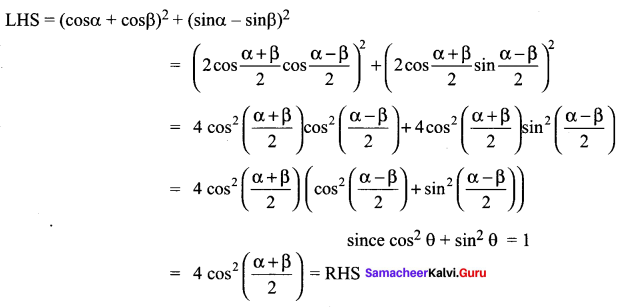
Samacheer Kalvi 11th Maths Solutions Chapter 3 Trigonometry Ex 3.5 20
Solution:
Samacheer Kalvi 11th Maths Solutions Chapter 3 Trigonometry Ex 3.5 21

Question 6.
If A + B = 45°, show that (1 + tanA) (1 + tanB) = 2.
Solution:
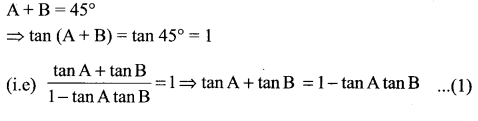
Samacheer Kalvi 11th Maths Solutions Chapter 3 Trigonometry Ex 3.5 22
Now LHS = (1 + tan A) (1 + tan B)
= tan A + tan B + tan A tan B + 1
= (1 – tan A tan B) + (tan A tan B + 1) from (1)
= 2 = RHS

Question 7.
Prove that (1 + tan 1°)(1 + tan 2°)(1 + tan 3°)… (1 + tan 44°) is a multiple of 4.
Solution:
1 + tan 44° = 1 + tan (45° – 1°)
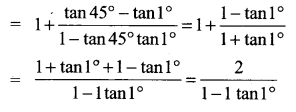
Samacheer Kalvi 11th Maths Solutions Chapter 3 Trigonometry Ex 3.5 23
(1 + tan 1°)(1 + tan 44°) = 2
Similarly (1 + tan 2°) (1 + tan 43°) = 2
(1 + tan 3°) (1 + tan 42°) = 2
(1 + tan 22°) (1 + tan 23°) = 2
= (1 + tan 1°) (1 + tan 2°)… (1 + tan 44°) = 2 × 2 × … 22 times
It is a multiple of 4.

Question 8.
Samacheer Kalvi 11th Maths Solutions Chapter 3 Trigonometry Ex 3.5 25
Solution:
Samacheer Kalvi 11th Maths Solutions Chapter 3 Trigonometry Ex 3.5 26

Question 9.
Samacheer Kalvi 11th Maths Solutions Chapter 3 Trigonometry Ex 3.5 27
Solution:
Samacheer Kalvi 11th Maths Solutions Chapter 3 Trigonometry Ex 3.5 28
Samacheer Kalvi 11th Maths Solutions Chapter 3 Trigonometry Ex 3.5 29

Samacheer Kalvi 11th Maths Solutions Chapter 3 Trigonometry Ex 3.5

Question 10.
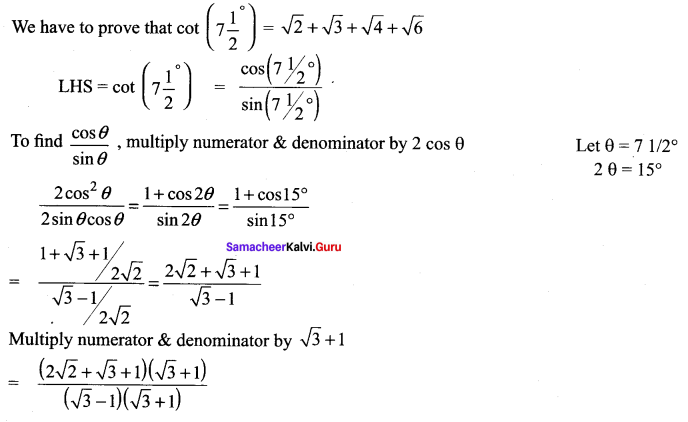
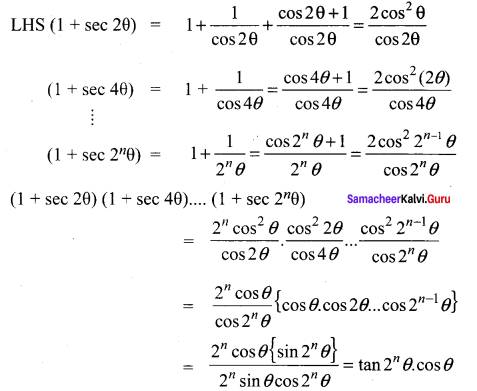
Prove that (1 + sec 2θ)(1 + sec 4θ)….. (1 + sec 2nθ) = tan 2nθ
Solution:
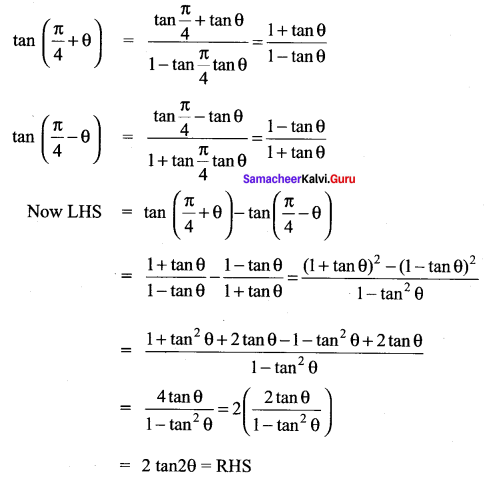
Samacheer Kalvi 11th Maths Solutions Chapter 3 Trigonometry Ex 3.5 30

Question 11.
Samacheer Kalvi 11th Maths Solutions Chapter 3 Trigonometry Ex 3.5 31
Solution:
Samacheer Kalvi 11th Maths Solutions Chapter 3 Trigonometry Ex 3.5 32
Samacheer Kalvi 11th Maths Solutions Chapter 3 Trigonometry Ex 3.5 33

Samacheer Kalvi 11th Maths Solutions Chapter 3 Trigonometry Ex 3.5 Additional Questions

Question 1.
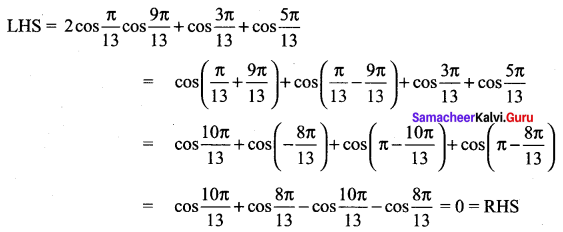
Samacheer Kalvi 11th Maths Solutions Chapter 3 Trigonometry Ex 3.5 34
Solution:
Samacheer Kalvi 11th Maths Solutions Chapter 3 Trigonometry Ex 3.5 35

Question 2.
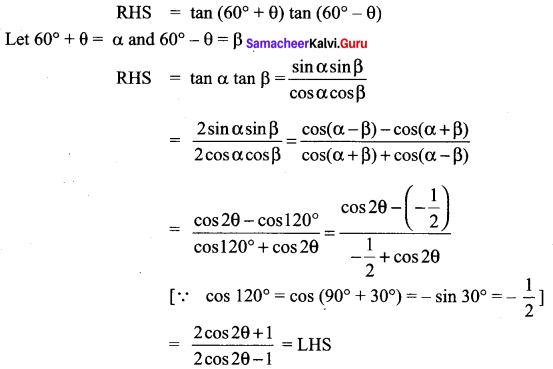
Samacheer Kalvi 11th Maths Solutions Chapter 3 Trigonometry Ex 3.5 36
Solution:
Samacheer Kalvi 11th Maths Solutions Chapter 3 Trigonometry Ex 3.5 37

Samacheer Kalvi 11th Maths Solutions Chapter 3 Trigonometry Ex 3.5

Question 3.
Samacheer Kalvi 11th Maths Solutions Chapter 3 Trigonometry Ex 3.5 38
Solution:
Samacheer Kalvi 11th Maths Solutions Chapter 3 Trigonometry Ex 3.5 39
Samacheer Kalvi 11th Maths Solutions Chapter 3 Trigonometry Ex 3.5 40

Question 4.
Show that 4 sin A sin (60° + A). sin(60° – A) = sin 3A
Solution:
LHS = 4sinAsin(60° + A). sin(60° – A)
= 4 sin A{sin (60° + A). sin (60° – A)}
= 4 sin A {sin2 60° – sin2 A)}
Samacheer Kalvi 11th Maths Solutions Chapter 3 Trigonometry Ex 3.5 41

Samacheer Kalvi 11th Maths Solutions Chapter 12 Introduction to Probability Theory Ex 12.4

You can Download Samacheer Kalvi 11th Maths Book Solutions Guide Pdf, Tamilnadu State Board help you to revise the complete Syllabus and score more marks in your examinations.

Tamilnadu Samacheer Kalvi 11th Maths Solutions Chapter 12 Introduction to Probability Theory Ex 12.4

Question 1.
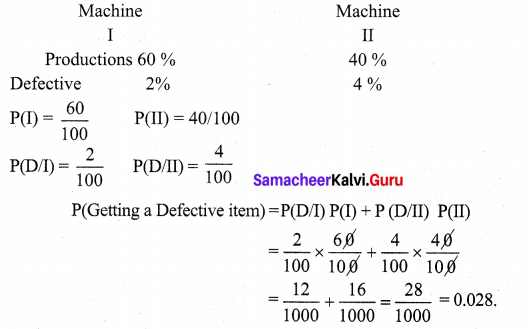
A factory has two Machines-I and II. Machine-I produces 60% of items and Machine-II produces 40% of the items of the total output. Further, 2% of the items produced by Machine-I are defective whereas 4% produced by Machine-II are defective. If an item is drawn at random what is the probability that it is defective?
Solution:
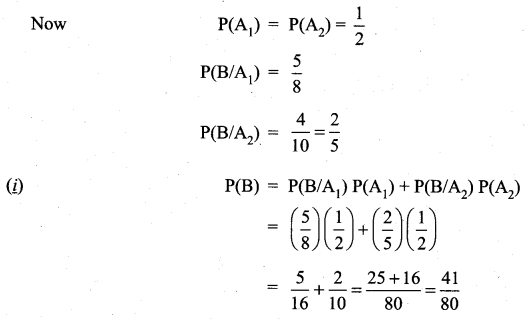
Samacheer Kalvi 11th Maths Solutions Chapter 12 Introduction to Probability Theory Ex 12.4 1
Samacheer Kalvi 11th Maths Solutions Chapter 12 Introduction to Probability Theory Ex 12.4

Question 2.
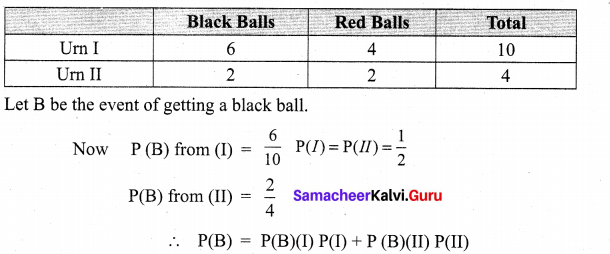
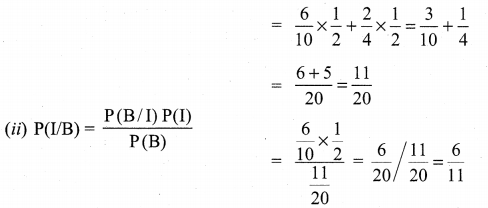
There are two identical urns containing respectively 6 black and 4 red balls, 2 black and 2 red balls. An urn is chosen at random and a ball is drawn from it, (z) find the probability that the ball is black (ii) if the ball is black, what is the probability that it is from the first urn?
Solution:
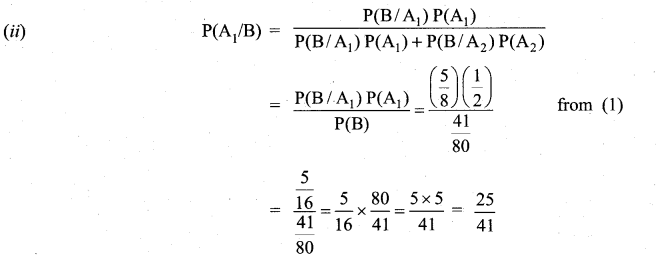
Samacheer Kalvi 11th Maths Solutions Chapter 12 Introduction to Probability Theory Ex 12.4 2
Samacheer Kalvi 11th Maths Solutions Chapter 12 Introduction to Probability Theory Ex 12.4 3

Question 3.
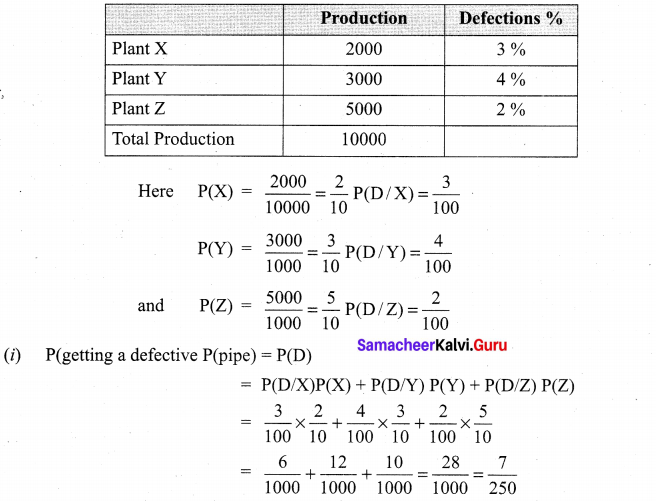
A firm manufactures PVC pipes in three plants viz, X, Y and Z. The daily production volumes from the three firms X, Y and Z are respectively 2000 units, 3000 units and 5000 units. It is known from the past experience that 3% of the output from plant X, 4% from plant Y and 2% from plant Z are defective. A pipe is selected at random from a day’s total production,
(i) find the probability that the selected pipe is a defective one.
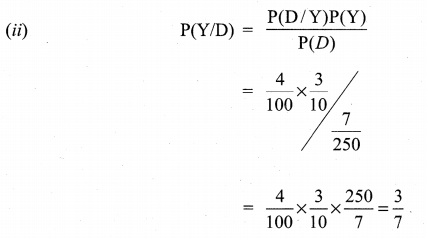
(ii) if the selected pipe is a defective, then what is the probability that it was produced by plant Y?
Solution:
Samacheer Kalvi 11th Maths Solutions Chapter 12 Introduction to Probability Theory Ex 12.4 4
Samacheer Kalvi 11th Maths Solutions Chapter 12 Introduction to Probability Theory Ex 12.4 5

Question 4.
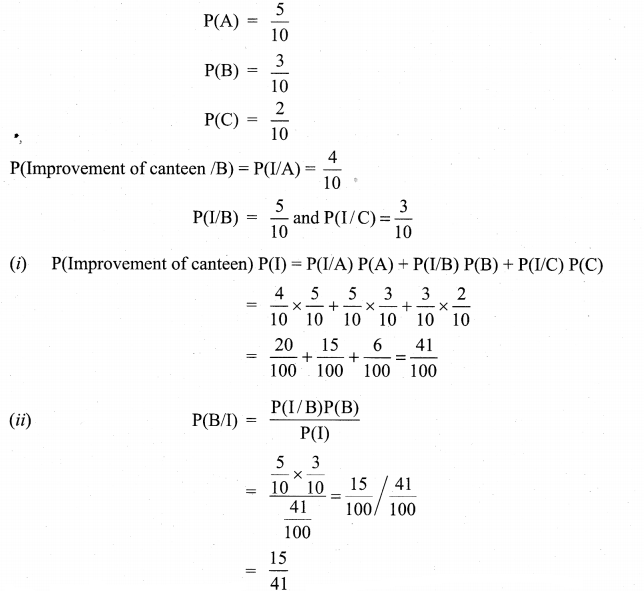
The changes of A, B and C becoming manager of a certain company are 5 : 3 : 2. The probabilities that the office canteen will be improved if A, B, and C become managers are 0.4, 0.5 and 0.3 respectively. If the office canteen has been improved, what is the probability that B was appointed as the manager?
Solution:
Given A : B : C = 5 : 3 : 2
Samacheer Kalvi 11th Maths Solutions Chapter 12 Introduction to Probability Theory Ex 12.4 6

Samacheer Kalvi 11th Maths Solutions Chapter 12 Introduction to Probability Theory Ex 12.4

Question 5.
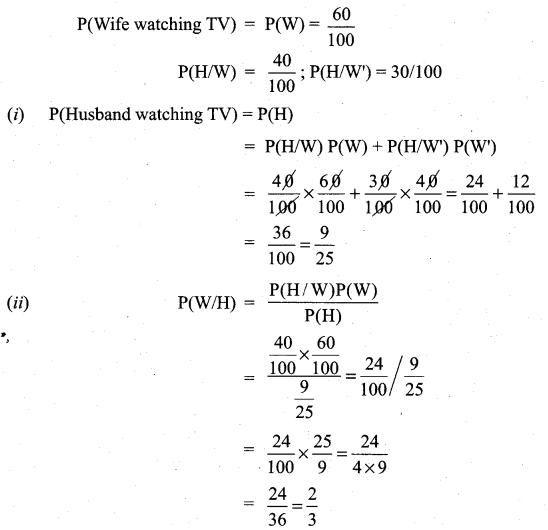
An advertising executive is studying television viewing habits of married men and women during prime time hours. Based on the past viewing records he has determined that during prime time wives are watching television 60% of the time. It has also been determined that when the wife is watching television, 40% of the time the husband is also watching. When the wife is not watching the television, 30% of the time husband is watching the television. Find the probability that (i) the husband is watching the television during the prime time of television (ii) if the husband is watching the television, the wife is also watching the television.
Solution:
Samacheer Kalvi 11th Maths Solutions Chapter 12 Introduction to Probability Theory Ex 12.4 7

Samacheer Kalvi 11th Maths Solutions Chapter 12 Introduction to Probability Theory Ex 12.4 Additional Problems

Question 1.
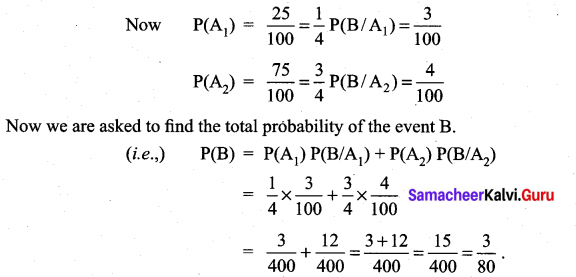
A factory has two Machines-I and II. Machines-I produces 25% of items and Machine-II produces 75% of the items of the total output. Further 3% of the items produces by Machine-I are defective whereas 4% produced by Machine-II are defective. If an item is drawn at random what is the probability that it is defective?
Solution:
Let A1 be the event that the items are produced by Machine-I and A2 be the event that the items are produced by Machine-II.
Let B the event of drawing a defective item
Samacheer Kalvi 11th Maths Solutions Chapter 12 Introduction to Probability Theory Ex 12.4 8

Question 2.
There are two identical boxes containing respectively 5 white and 3 red balls, 4 white and 6 rpd balls. A box is chosen at random and a ball is drawn from it (i) find the probability that the ball is white (ii) if the ball is white, what is the probability that it from the first box?
Solution:
Let A1 be the event of selecting the first box and A2 be the event of selecting the second box. Let B be the event of selecting a white ball.
Samacheer Kalvi 11th Maths Solutions Chapter 12 Introduction to Probability Theory Ex 12.4 9
Samacheer Kalvi 11th Maths Solutions Chapter 12 Introduction to Probability Theory Ex 12.4 10

Samacheer Kalvi 11th Maths Solutions Chapter 12 Introduction to Probability Theory Ex 12.4

Question 3.
In a factory, Machine-I produces 45% of the output and Machine-II produces 55% of the output. On the average 10% items produced by I and 5% of the items produced by II are defective. An item is drawn at random from a day’s output, (i) Find the probability that it is a defective item (ii) If it is defective, what is the probability that it was produced by Machine-II?
Solution:
Let A1 and A2 be the events that the items produced by Machine-I and II respectively.
Let B be the event of selecting a defective item
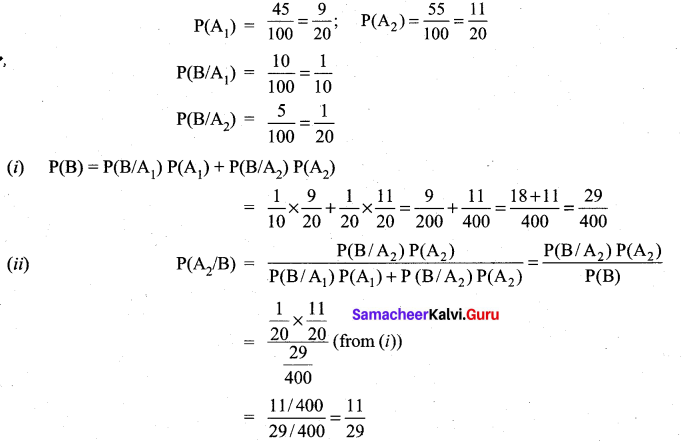
Samacheer Kalvi 11th Maths Solutions Chapter 12 Introduction to Probability Theory Ex 12.4 11