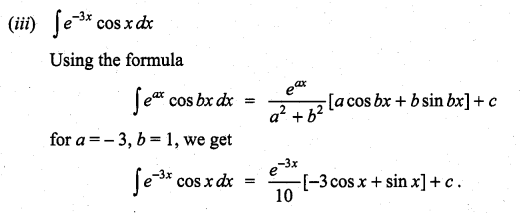
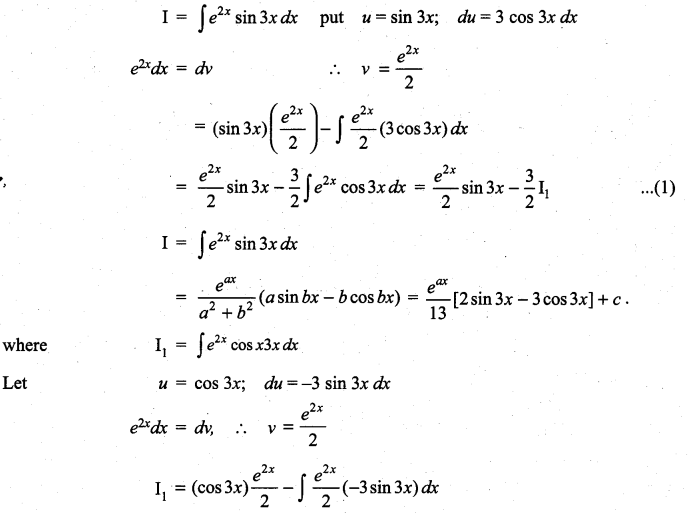
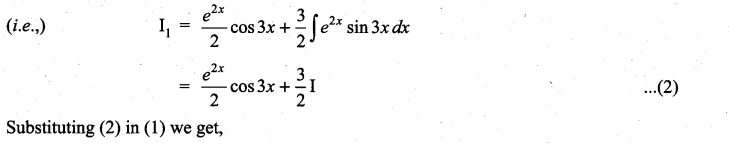
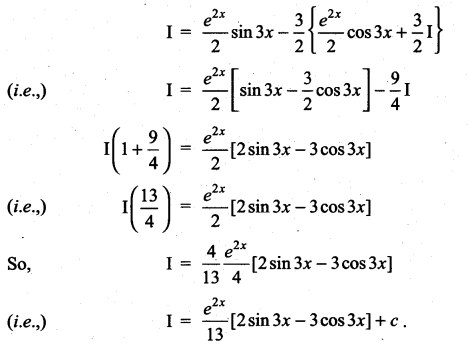
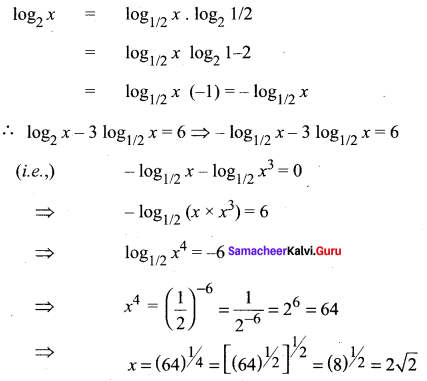
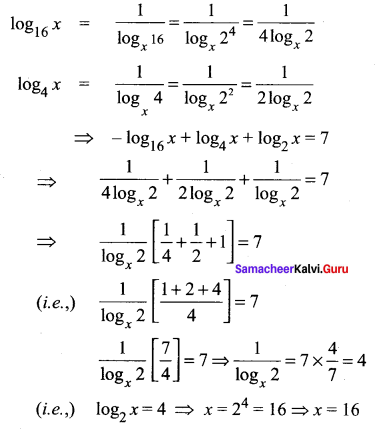
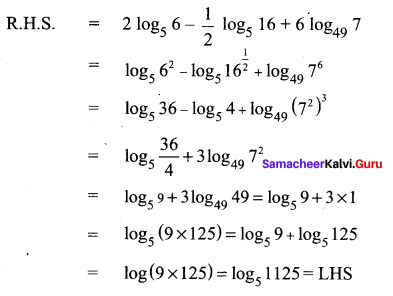
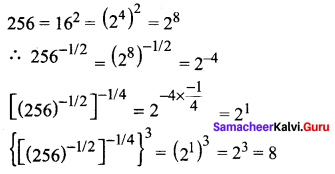
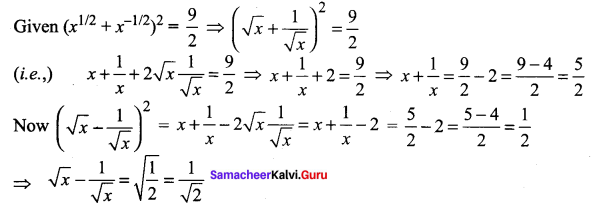
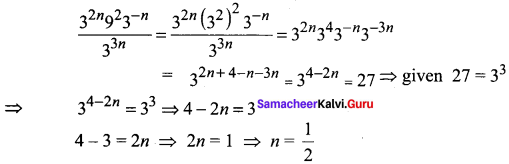
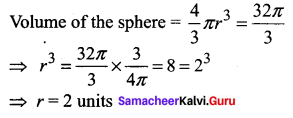
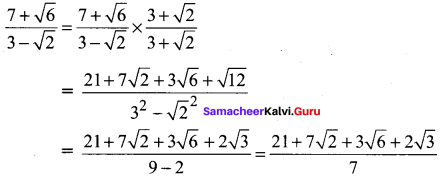
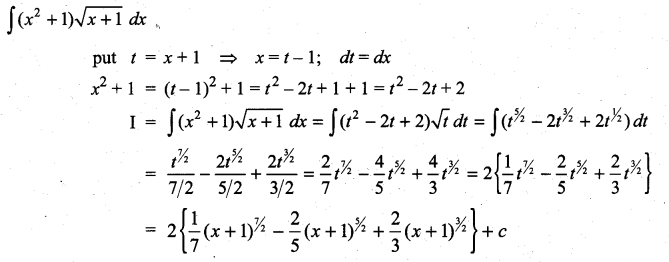
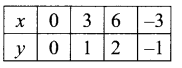
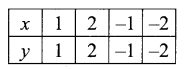
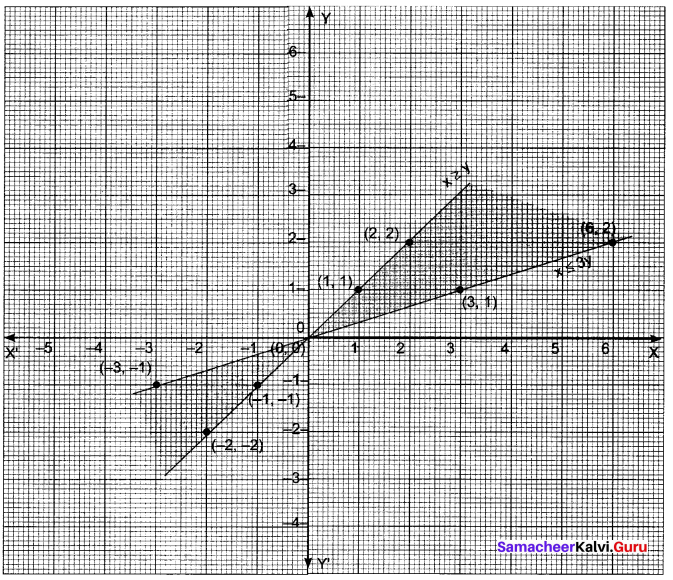
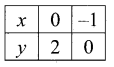
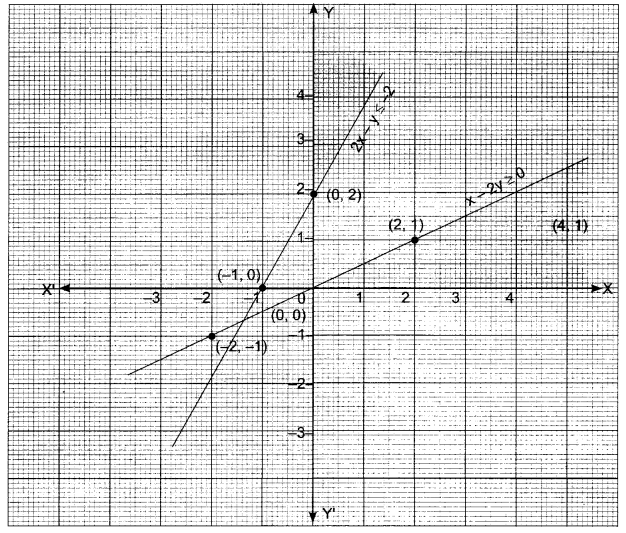
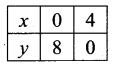
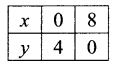
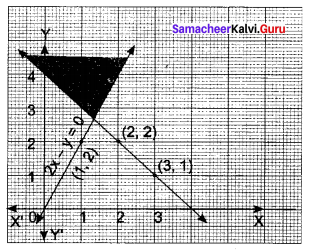
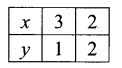
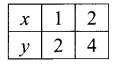
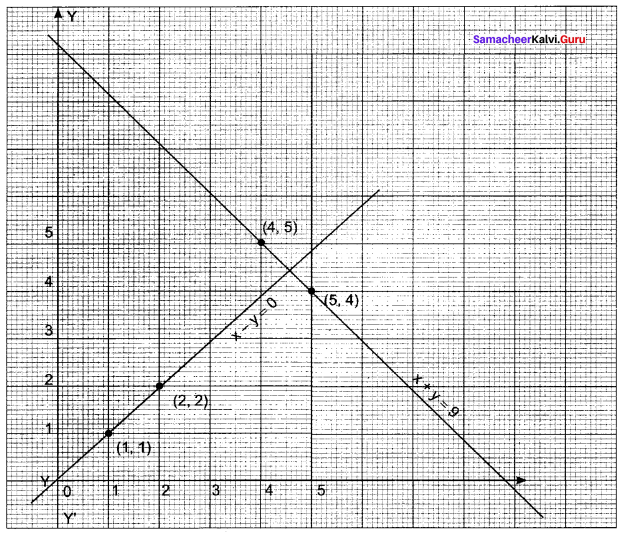
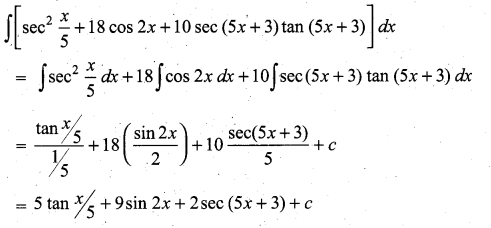
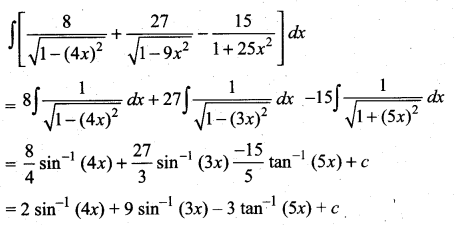
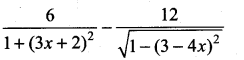
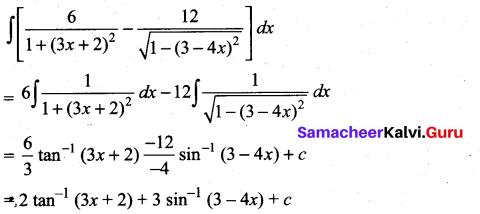
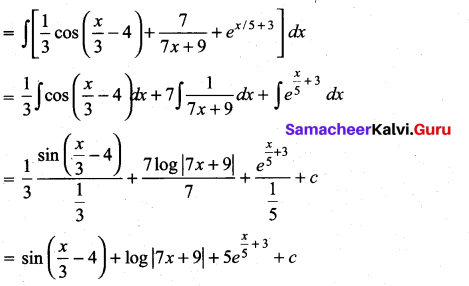
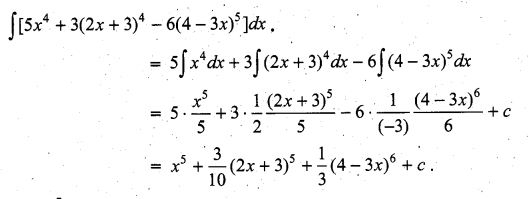
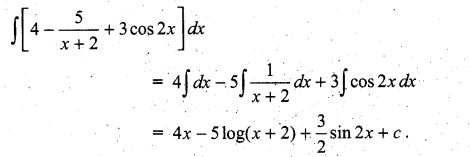
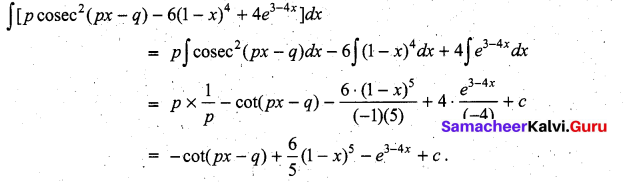
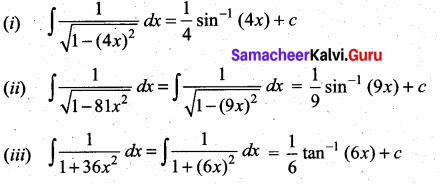
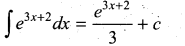
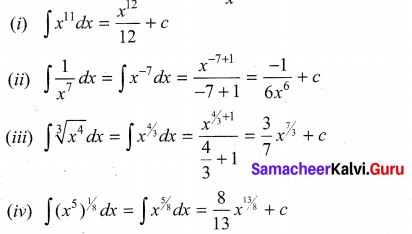
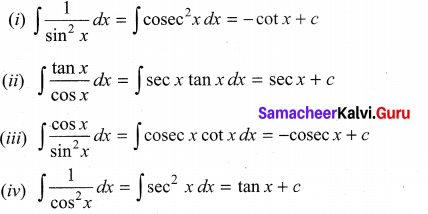
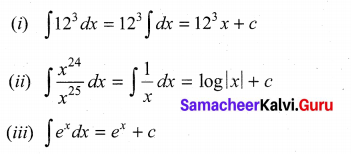
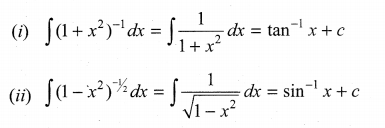
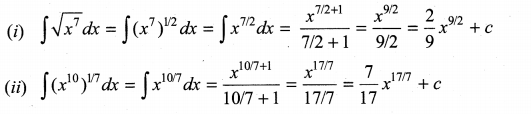
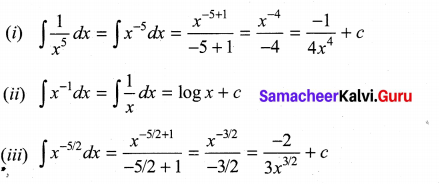
Samacheer Kalvi 11th Maths Solutions Chapter 2 Basic Algebra Ex 2.1

You can Download Samacheer Kalvi 11th Maths Book Solutions Guide Pdf, Tamilnadu State Board help you to revise the complete Syllabus and score more marks in your examinations.

Tamilnadu Samacheer Kalvi 11th Maths Solutions Chapter 2 Basic Algebra Ex 2.1

Question 1.
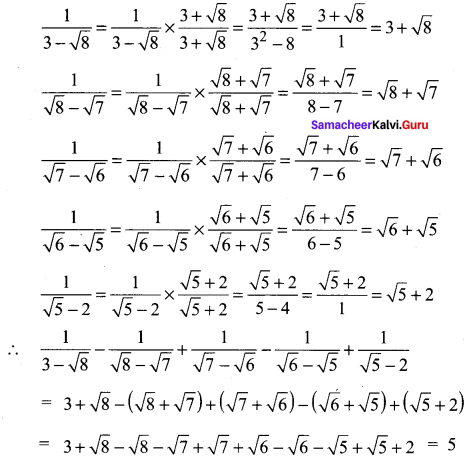
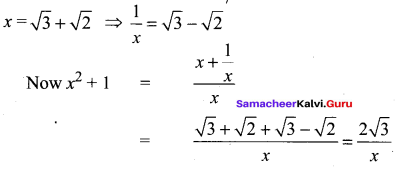
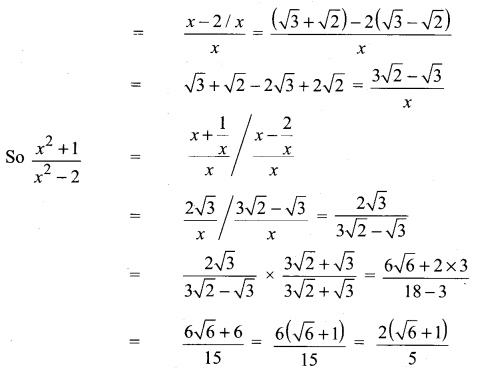
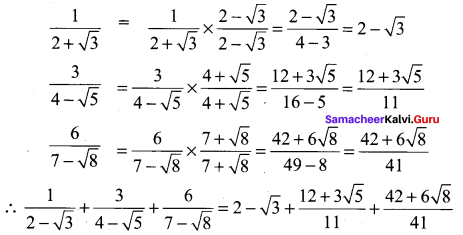
Samacheer Kalvi 11th Maths Solutions Chapter 2 Basic Algebra Ex 2.1 1
Solution:
Samacheer Kalvi 11th Maths Solutions Chapter 2 Basic Algebra Ex 2.1 2
3.14 ∈ Q
0, 4 are integers and 0 ∈ Z, 4 ∈ N, Z, Q
\(\frac{22}{7} \in \mathrm{Q}\)

Samacheer Kalvi 11th Maths Solutions Chapter 2 Basic Algebra Ex 2.1

Question 2.
Prove that \(\sqrt{3}\) is an irrational number.
(Hint: Follow the method that we have used to prove \(\sqrt{2}\) ∉ Q.
Solution:
Suppose that \(\sqrt{3}\) is rational P
Samacheer Kalvi 11th Maths Solutions Chapter 2 Basic Algebra Ex 2.1 3
⇒ 3 is a factor of q also
so 3 is a factor ofp and q which is a contradiction.
⇒ \(\sqrt{3}\) is not a rational number
⇒ \(\sqrt{3}\) is an irrational number

Question 3.
Are there two distinct irrational numbers such that their difference is a rational number? Justify.
Solution:
Taking two irrational numbers as 3 + \(\sqrt{2}\) and 1 + \(\sqrt{2}\)
Their difference is a rational number. But if we take two irrational numbers as 2 – \(\sqrt{3}\) and 4 + \(\sqrt{7}\).
Their difference is again an irrational number. So unless we know the two irrational numbers we cannot say that their difference is a rational number or irrational number.
Samacheer Kalvi 11th Maths Solutions Chapter 2 Basic Algebra Ex 2.1

Question 4.
Find two irrational numbers such that their sum is a rational number. Can you find two irrational numbers whose product is a rational number.
Solution:
(i) Let the two irrational numbers as 2 + \(\sqrt{3}\) and 3 – \(\sqrt{3}\)
Their sum is 2 + \(\sqrt{3}\) + 3 – 3\(\sqrt{3}\) which is a rational number.
But the sum of 3 + \(\sqrt{5}\) and 4 – \(\sqrt{7}\) is not a rational number. So the sum of two irrational numbers is either rational or irrational.

(ii) Again taking two irrational numbers as π and \(\frac{3}{\pi}\) their product is \(\sqrt{3}\) and \(\sqrt{2}\) = \(\sqrt{3}\) × \(\sqrt{2}\) which is irrational, So the product of two irrational numbers is either rational or irrational.

Question 5.
Find a positive number smaller than \(\frac{1}{2^{1000}}\). Justify.
Solution:
Samacheer Kalvi 11th Maths Solutions Chapter 2 Basic Algebra Ex 2.1 4
There will not be a positive number smaller than 0.
So there will not be a +ve number smaller than \(\frac{1}{2^{1000}}\)

Samacheer Kalvi 11th Maths Solutions Chapter 2 Basic Algebra Ex 2.1 Additional Questions

Question 1.
Prove that \(\sqrt{5}\) is an irrational number.
Solution:
Suppose that \(\sqrt{5}\) is rational
Samacheer Kalvi 11th Maths Solutions Chapter 2 Basic Algebra Ex 2.1 5
So let p = 5c
substitute p = 5c in (1) we get
(5c)2 = 5q2 ⇒ 25c2 = 5q2
Samacheer Kalvi 11th Maths Solutions Chapter 2 Basic Algebra Ex 2.1 6
⇒ 5 is a factor of q also
So 5 is a factor of p and q which is a contradiction.
⇒ \(\sqrt{5}\) is not a rational number
⇒ \(\sqrt{5}\) is an irrational number

Samacheer Kalvi 11th Maths Solutions Chapter 2 Basic Algebra Ex 2.1

Question 2.
Prove that 0.33333 = \(\frac{1}{3}\)
Solution:
Let x = 0.33333….
10x = 3.3333 ….
10x – x = 9x = 3
Samacheer Kalvi 11th Maths Solutions Chapter 2 Basic Algebra Ex 2.1 7

Samacheer Kalvi 11th Maths Solutions Chapter 5 Binomial Theorem, Sequences and Series Ex 5.5

You can Download Samacheer Kalvi 11th Maths Book Solutions Guide Pdf, Tamilnadu State Board help you to revise the complete Syllabus and score more marks in your examinations.

Tamilnadu Samacheer Kalvi 11th Maths Solutions Chapter 5 Binomial Theorem, Sequences and Series Ex 5.5

Choose the correct or the most suitable answer:

Question 1.
The value of 2 + 4 + 6 + … + 2n is …..
Samacheer Kalvi 11th Maths Solutions Chapter 5 Binomial Theorem, Sequences and Series Ex 5.5 1
Solution:
(d) n(n + 1)
Samacheer Kalvi 11th Maths Solutions Chapter 5 Binomial Theorem, Sequences and Series Ex 5.5 2

Question 2.
The coefficient of x6 in (2 + 2x)10 is ……….
(a) 10C6
(b) 26
(c) 10C626
(d) 10C6210
Solution:
(d) 10C6210
Hint.
tr + 1 = 210(nCr)
To find coefficient of x6 put r = 6
∴ coefficient of x6 = 210 [10C6]

Question 3.
The coefficient of x8y12 in the expansion of (2x + 3y)20 is …….
(a) 0
(b) 28312
(c) 28312 + 21238
(d) 20C828312
Solution:
(d) 20C828312
Samacheer Kalvi 11th Maths Solutions Chapter 5 Binomial Theorem, Sequences and Series Ex 5.5 3

Samacheer Kalvi 11th Maths Solutions Chapter 5 Binomial Theorem, Sequences and Series Ex 5.5

Question 4.
If nC10 > nCr for all possible r, then a value of n is ……..
(a) 10
(b) 21
(c) 19
(d) 20
Solution:
(d) 20
Hint.
Out of 10C10, 21C10, 19C10 and 20C10, 20C10 is larger.

Question 5.
If a is the arithmetic mean and g is the geometric mean of two numbers, then ……..
(a) a ≤ g
(b) a ≥ g
(c) a = g
(d) a > g
Solution:
(b) a ≥ g
Hint. AM ≥ GM
∴ a ≥ g

Question 6.
If (1 + x2)2 (1 + x)n = a0 + a1x + a2x2 + …. + xn + 4 and if a0, a1, a2 are in AP, then n is ……
(a) 1
(b) 2
(c) 3
(d) 4
Solution:
(b or c)n = 2 or 3
Samacheer Kalvi 11th Maths Solutions Chapter 5 Binomial Theorem, Sequences and Series Ex 5.5 20

Question 7.
If a, 8, b are in A.P, a, 4, b are in G.P, if a, x, b are in HP then x is ……
(a) 2
(b) 1
(c) 4
(d) 16
Solution:
(a) 2
Samacheer Kalvi 11th Maths Solutions Chapter 5 Binomial Theorem, Sequences and Series Ex 5.5 21

Question 8.
Samacheer Kalvi 11th Maths Solutions Chapter 5 Binomial Theorem, Sequences and Series Ex 5.5 22
(a) AP
(b) GP
(c) HP
(d) AGP
Solution:
(c) HP

Samacheer Kalvi 11th Maths Solutions Chapter 5 Binomial Theorem, Sequences and Series Ex 5.5

Question 9.
The HM of two positive numbers whose AM and GM are 16, 8 respectively is ………
(a) 10
(b) 6
(c) 5
(d) 4
Solution:
(d) 4
Hint.
Let the two numbers be a and b
Samacheer Kalvi 11th Maths Solutions Chapter 5 Binomial Theorem, Sequences and Series Ex 5.5 23

Question 10.
If Sn denotes the sum of n terms of an AP whose common difference is d, the value of \(\mathrm{S}_{n}-2 \mathrm{S}_{n-1}+S_{n-2}\) is ……
(a) d
(b) 2d
(c) 4d
(d) d2
Solution:
(a) d
Samacheer Kalvi 11th Maths Solutions Chapter 5 Binomial Theorem, Sequences and Series Ex 5.5 24

Samacheer Kalvi 11th Maths Solutions Chapter 5 Binomial Theorem, Sequences and Series Ex 5.5

Question 11.
The remainder when 3815 is divided by 13 is …….
(a) 12
(b) 1
(c) 11
(d) 5
Solution:
(a) 12
Hint.
3815 = (39 – 1)15 = 3915 – 15C1 3914(1) + 15C2 (39)13(1)2 – 15C3 (39)12(1)3 ….. + 15C14 (39)1(1) – 15C15(1)
Except -1 all other terms are divisible by 13.
∴ When 1 is added to it the number is divisible by 13. So the remainder is 13 – 1 = 12.

Question 12.
The nth term of the sequence 1, 2, 4, 7, 11, …… is
Samacheer Kalvi 11th Maths Solutions Chapter 5 Binomial Theorem, Sequences and Series Ex 5.5 25
Solution:
(d) \(\frac{n^{2}-n+2}{2}\)

Question 13.
Samacheer Kalvi 11th Maths Solutions Chapter 5 Binomial Theorem, Sequences and Series Ex 5.5 26
Solution:
Samacheer Kalvi 11th Maths Solutions Chapter 5 Binomial Theorem, Sequences and Series Ex 5.5 27
Solution:
(d) \(\frac{\sqrt{2 n+1}-1}{2}\)
Samacheer Kalvi 11th Maths Solutions Chapter 5 Binomial Theorem, Sequences and Series Ex 5.5 277

Question 14.
Samacheer Kalvi 11th Maths Solutions Chapter 5 Binomial Theorem, Sequences and Series Ex 5.5 28
Samacheer Kalvi 11th Maths Solutions Chapter 5 Binomial Theorem, Sequences and Series Ex 5.5 299
Solution:
Samacheer Kalvi 11th Maths Solutions Chapter 5 Binomial Theorem, Sequences and Series Ex 5.5 29

Samacheer Kalvi 11th Maths Solutions Chapter 5 Binomial Theorem, Sequences and Series Ex 5.5

Question 15.
Samacheer Kalvi 11th Maths Solutions Chapter 5 Binomial Theorem, Sequences and Series Ex 5.5 30
Samacheer Kalvi 11th Maths Solutions Chapter 5 Binomial Theorem, Sequences and Series Ex 5.5 31
Solution:
(c) \(\frac{n(n+1)}{\sqrt{2}}\)
Samacheer Kalvi 11th Maths Solutions Chapter 5 Binomial Theorem, Sequences and Series Ex 5.5 32

Question 16.
Samacheer Kalvi 11th Maths Solutions Chapter 5 Binomial Theorem, Sequences and Series Ex 5.5 33
(a) 14
(b) 7
(c) 4
(d) 6
Solution:
(a) 14
Samacheer Kalvi 11th Maths Solutions Chapter 5 Binomial Theorem, Sequences and Series Ex 5.5 34

Question 17.
The sum of an infinite GP is 18. If the first term is 6, the common ratio is ………
(a) \(\frac{1}{3}\)
(b) \(\frac{2}{3}\)
(c) \(\frac{1}{6}\)
(d) \(\frac{3}{4}\)
Solution:
(b) \(\frac{2}{3}\)
Hint:
Samacheer Kalvi 11th Maths Solutions Chapter 5 Binomial Theorem, Sequences and Series Ex 5.5 35
18r = 18 – 6 = 12
r = 12/18 = 2/3

Question 18.
The coefficient of x5 in the series e-2x is ………
(a) \(\frac{2}{3}\)
(b) \(\frac{3}{2}\)
(c) \(\frac{-4}{15}\)
(d) \(\frac{4}{15}\)
Answer:
(c) \(\frac{-4}{15}\)
Samacheer Kalvi 11th Maths Solutions Chapter 5 Binomial Theorem, Sequences and Series Ex 5.5 50

Samacheer Kalvi 11th Maths Solutions Chapter 5 Binomial Theorem, Sequences and Series Ex 5.5

Question 19.
Samacheer Kalvi 11th Maths Solutions Chapter 5 Binomial Theorem, Sequences and Series Ex 5.5 51
Answer:
(c) \(\frac{(e-1)^{2}}{2 e}\)
Samacheer Kalvi 11th Maths Solutions Chapter 5 Binomial Theorem, Sequences and Series Ex 5.5 52

Question 20.
Samacheer Kalvi 11th Maths Solutions Chapter 5 Binomial Theorem, Sequences and Series Ex 5.5 53
Samacheer Kalvi 11th Maths Solutions Chapter 5 Binomial Theorem, Sequences and Series Ex 5.5 54
Solution:
(b) \(\frac{3}{2} \log \left(\frac{5}{3}\right)\)
Samacheer Kalvi 11th Maths Solutions Chapter 5 Binomial Theorem, Sequences and Series Ex 5.5 55

Samacheer Kalvi 11th Maths Solutions Chapter 8 Vector Algebra – I Ex 8.4

You can Download Samacheer Kalvi 11th Maths Book Solutions Guide Pdf, Tamilnadu State Board help you to revise the complete Syllabus and score more marks in your examinations.

Tamilnadu Samacheer Kalvi 11th Maths Solutions Chapter 8 Vector Algebra – I Ex 8.4

Question 1.
Find the magnitude of Samacheer Kalvi 11th Maths Solutions Chapter 8 Vector Algebra - I Ex 8.4 1
Solution:
Samacheer Kalvi 11th Maths Solutions Chapter 8 Vector Algebra - I Ex 8.4 2

Question 2.
Show that Samacheer Kalvi 11th Maths Solutions Chapter 8 Vector Algebra - I Ex 8.4 3
Solution:
Samacheer Kalvi 11th Maths Solutions Chapter 8 Vector Algebra - I Ex 8.4 4

Question 3.
Find the vectors of magnitude \(10 \sqrt{3}\) that are perpendicular to the plane which contains \(\hat{i}+2 \hat{j}+\hat{k}\) and \(\hat{i}+3 \hat{j}+4 \hat{k}\)
Solution:
Samacheer Kalvi 11th Maths Solutions Chapter 8 Vector Algebra - I Ex 8.4 5
Samacheer Kalvi 11th Maths Solutions Chapter 8 Vector Algebra - I Ex 8.4 6

Samacheer Kalvi 11th Maths Solutions Chapter 8 Vector Algebra - I Ex 8.4

Question 4.
Find the unit vectors perpendicular to each of the vectors
Samacheer Kalvi 11th Maths Solutions Chapter 8 Vector Algebra - I Ex 8.4 7
Solution:
Samacheer Kalvi 11th Maths Solutions Chapter 8 Vector Algebra - I Ex 8.4 8

Question 5.
Find the area of the parallelogram whose two adjacent sides are determined by the vectors \(\hat{i}+2 \hat{j}+3 \hat{k}\) and \(3 \hat{i}-2 \hat{j}+\hat{k}\)
Solution:
Samacheer Kalvi 11th Maths Solutions Chapter 8 Vector Algebra - I Ex 8.4 9

Question 6.
Find the area of the triangle whose vertices are A(3, -1, 2), B(1, -1, -3) and C(4, -3, 1)
Solution:
A = (3, -1, 2); B = (1, -1, -3) and C = (4, -3, 1)
Samacheer Kalvi 11th Maths Solutions Chapter 8 Vector Algebra - I Ex 8.4 10

Question 7.
If \(\vec{a}, \vec{b}, \vec{c}\) are position vectors of the vertices A, B, C of a triangle ABC, show that the area of the triangle ABC is \(\frac{1}{2}|\vec{a} \times \vec{b}+\vec{b} \times \vec{c}+\vec{c} \times \vec{a}|\). Also deduce the condition for collinearity of the points A, B, C
Solution:
Samacheer Kalvi 11th Maths Solutions Chapter 8 Vector Algebra - I Ex 8.4 11
If the points A, B, C are collinear, then the area of ∆ABC = 0.
Samacheer Kalvi 11th Maths Solutions Chapter 8 Vector Algebra - I Ex 8.4 12

Question 8.
For any vector \(\vec{a}\) prove that Samacheer Kalvi 11th Maths Solutions Chapter 8 Vector Algebra - I Ex 8.4 13
Solution:
Samacheer Kalvi 11th Maths Solutions Chapter 8 Vector Algebra - I Ex 8.4 14
Samacheer Kalvi 11th Maths Solutions Chapter 8 Vector Algebra - I Ex 8.4 15

Samacheer Kalvi 11th Maths Solutions Chapter 8 Vector Algebra - I Ex 8.4

Question 9.
Let \(\vec{a}, \vec{b}, \vec{c}\) be unit vectors such that \(\overrightarrow{\boldsymbol{a}} \cdot \overrightarrow{\boldsymbol{b}}=\overrightarrow{\boldsymbol{a}} \cdot \overrightarrow{\boldsymbol{c}}=\mathbf{0}\) and the angle between \(\vec{b} \text { and } \vec{c} \text { is } \frac{\pi}{3}\). Prove that \(\vec{a}=\pm \frac{2}{\sqrt{3}}(\vec{b} \times \vec{c})\)
Solution:
Given \(|\vec{a}|=|\vec{b}|=|\vec{c}|\) = 1
Samacheer Kalvi 11th Maths Solutions Chapter 8 Vector Algebra - I Ex 8.4 16

Question 10.
Find the angle between the vectors Samacheer Kalvi 11th Maths Solutions Chapter 8 Vector Algebra - I Ex 8.4 17 using vector product
Solution:
The angle between \(\vec{a}\) and \(\vec{b}\) using vector product is given by
Samacheer Kalvi 11th Maths Solutions Chapter 8 Vector Algebra - I Ex 8.4 18

Samacheer Kalvi 11th Maths Solutions Chapter 8 Vector Algebra – I Ex 8.4 Additional Problems

Question 1.
Samacheer Kalvi 11th Maths Solutions Chapter 8 Vector Algebra - I Ex 8.4 19
Solution:
Samacheer Kalvi 11th Maths Solutions Chapter 8 Vector Algebra - I Ex 8.4 20

Question 2.
If \(\vec{a}\), \(\vec{b}\) are any two vectors, then prove that Samacheer Kalvi 11th Maths Solutions Chapter 8 Vector Algebra - I Ex 8.4 21
Solution:
Samacheer Kalvi 11th Maths Solutions Chapter 8 Vector Algebra - I Ex 8.4 22

Question 3.
Find the angle between the vectors Samacheer Kalvi 11th Maths Solutions Chapter 8 Vector Algebra - I Ex 8.4 23 by using cross product.
Solution:
Samacheer Kalvi 11th Maths Solutions Chapter 8 Vector Algebra - I Ex 8.4 24
Samacheer Kalvi 11th Maths Solutions Chapter 8 Vector Algebra - I Ex 8.4 25

Question 4.
Find the vector of magnitude 6 which are perpendicular to both the vectors Samacheer Kalvi 11th Maths Solutions Chapter 8 Vector Algebra - I Ex 8.4 26
Solution:
Samacheer Kalvi 11th Maths Solutions Chapter 8 Vector Algebra - I Ex 8.4 27

Question 5.
Find the vectors whose length 5 which are perpendicular to the vectors Samacheer Kalvi 11th Maths Solutions Chapter 8 Vector Algebra - I Ex 8.4 28
Solution:
Samacheer Kalvi 11th Maths Solutions Chapter 8 Vector Algebra - I Ex 8.4 29

Samacheer Kalvi 11th Maths Solutions Chapter 8 Vector Algebra - I Ex 8.4

Question 6.
Samacheer Kalvi 11th Maths Solutions Chapter 8 Vector Algebra - I Ex 8.4 30
Solution:
Given \(\vec{a} \times \vec{b}=\vec{c} \times \vec{d}\) and \(\vec{a} \times \vec{c}=\vec{b} \times \vec{d}\)
Samacheer Kalvi 11th Maths Solutions Chapter 8 Vector Algebra - I Ex 8.4 31

Question 7.
Find the angle between two vectors \(\vec{a}\) and \(\vec{b}\) if \(|\overrightarrow{\boldsymbol{a}} \times \overrightarrow{\boldsymbol{b}}|=\overrightarrow{\boldsymbol{a}} \cdot \overrightarrow{\boldsymbol{b}}\)
Solution:
Samacheer Kalvi 11th Maths Solutions Chapter 8 Vector Algebra - I Ex 8.4 32

Question 8.
Samacheer Kalvi 11th Maths Solutions Chapter 8 Vector Algebra - I Ex 8.4 33
Solution:
Samacheer Kalvi 11th Maths Solutions Chapter 8 Vector Algebra - I Ex 8.4 34

Question 9.
If Samacheer Kalvi 11th Maths Solutions Chapter 8 Vector Algebra - I Ex 8.4 35 find the angle between \(\vec{a}\) and \(\vec{b}\)
Solution:
Samacheer Kalvi 11th Maths Solutions Chapter 8 Vector Algebra - I Ex 8.4 36

Samacheer Kalvi 11th Maths Solutions Chapter 8 Vector Algebra – I Ex 8.3

You can Download Samacheer Kalvi 11th Maths Book Solutions Guide Pdf, Tamilnadu State Board help you to revise the complete Syllabus and score more marks in your examinations.

Tamilnadu Samacheer Kalvi 11th Maths Solutions Chapter 8 Vector Algebra – I Ex 8.3

Question 1.
Find \(\vec{a} \cdot \vec{b}\) when
Samacheer Kalvi 11th Maths Solutions Chapter 8 Vector Algebra - I Ex 8.3 1
Solution:
Samacheer Kalvi 11th Maths Solutions Chapter 8 Vector Algebra - I Ex 8.3 2

Question 2.
Find the value of λ for which the vectors \(\vec{a}\) and \(\vec{b}\) are perpendicular, where
Samacheer Kalvi 11th Maths Solutions Chapter 8 Vector Algebra - I Ex 8.3 3
Solution:
When \(\vec{a}\) and \(\vec{b}\) are ⊥r then \(\vec{a} \cdot \vec{b}\) = 0
\(\vec{a}\) ⊥r \(\vec{b}\) ⇒ \(\vec{a} \cdot \vec{b}\) = 0
(i) (2) (1) + (λ) (-2) + (1) (3) = 0 ⇒ λ = 5/2
(ii) (2) (3) + (4) (-2) + (-1) (λ) = 0
6 – 8 – λ = 0
-λ – 2 = 0 ⇒ -λ = 2 ⇒ λ = -2

Question 3.
If \(\vec{a}\) and \(\vec{b}\) are two vectors such that |\(\vec{a}\)| = 10, |\(\vec{b}\)| = 15 and \(\vec{a} \cdot \vec{b}\) = 75\(\sqrt{2}\) , find the angle between \(\vec{a}\) and \(\vec{a}\) .
Solution:
Samacheer Kalvi 11th Maths Solutions Chapter 8 Vector Algebra - I Ex 8.3 4

Samacheer Kalvi 11th Maths Solutions Chapter 8 Vector Algebra - I Ex 8.3

Question 4.
Find the angle between the vectors
Samacheer Kalvi 11th Maths Solutions Chapter 8 Vector Algebra - I Ex 8.3 5
Solution:
Samacheer Kalvi 11th Maths Solutions Chapter 8 Vector Algebra - I Ex 8.3 6

Question 5.
If \(\overrightarrow{\boldsymbol{a}}, \overrightarrow{\boldsymbol{b}}, \overrightarrow{\boldsymbol{c}}\) are three vectors such that \(\vec{a}+2 \vec{b}+\vec{c}=\overrightarrow{0}\) and \(|\vec{a}|=3,|\vec{b}|=4,|\vec{c}|=7\) find the angle between \(\vec{a}\) and \(\vec{b}\)
Solution:
Samacheer Kalvi 11th Maths Solutions Chapter 8 Vector Algebra - I Ex 8.3 7

Question 6.
Show that the vectors Samacheer Kalvi 11th Maths Solutions Chapter 8 Vector Algebra - I Ex 8.3 8 are mutually orthogonal.
Solution:
Samacheer Kalvi 11th Maths Solutions Chapter 8 Vector Algebra - I Ex 8.3 9

Question 7.
Show that the vectors Samacheer Kalvi 11th Maths Solutions Chapter 8 Vector Algebra - I Ex 8.3 10 form a right angled triangle.
Solution:
Samacheer Kalvi 11th Maths Solutions Chapter 8 Vector Algebra - I Ex 8.3 11
So, the given vectors form the sides of a right angled triangle

Question 8.
Samacheer Kalvi 11th Maths Solutions Chapter 8 Vector Algebra - I Ex 8.3 12
Solution:
Samacheer Kalvi 11th Maths Solutions Chapter 8 Vector Algebra - I Ex 8.3 13

Question 9.
Show that the points (2, -1, 3) (4, 3, 1) and (3, 1, 2) are collinear
Solution:
Let the given points be A, B, C
Samacheer Kalvi 11th Maths Solutions Chapter 8 Vector Algebra - I Ex 8.3 14

Samacheer Kalvi 11th Maths Solutions Chapter 8 Vector Algebra - I Ex 8.3

Question 10.
If \(\vec{a}, \vec{b}\) are unit vectors and θ is the angle between them, show that
Samacheer Kalvi 11th Maths Solutions Chapter 8 Vector Algebra - I Ex 8.3 15
Solution:
Samacheer Kalvi 11th Maths Solutions Chapter 8 Vector Algebra - I Ex 8.3 16

Question 11.
Let \(\vec{a}, \vec{b}, \vec{c}\) be the three vectors such that \(|\vec{a}|=3,|\vec{b}|=4,|\vec{c}|=5\) and each one of them being perpendicular to the sum of the other two, find \(|\vec{a}+\vec{b}+\vec{c}|\)
Solution:
Samacheer Kalvi 11th Maths Solutions Chapter 8 Vector Algebra - I Ex 8.3 17

Question 12.
Find the projection of the vector \(\hat{i}+3 \hat{j}+7 \hat{k}\) on the vector \(2 \hat{i}+6 \hat{j}+3 \hat{k}\)
Solution:
Samacheer Kalvi 11th Maths Solutions Chapter 8 Vector Algebra - I Ex 8.3 18

Question 13.
Find λ, when the projection of Samacheer Kalvi 11th Maths Solutions Chapter 8 Vector Algebra - I Ex 8.3 19 is 5 units.
Solution:
Samacheer Kalvi 11th Maths Solutions Chapter 8 Vector Algebra - I Ex 8.3 20

Question 14.
Samacheer Kalvi 11th Maths Solutions Chapter 8 Vector Algebra - I Ex 8.3 21
Solution:
Samacheer Kalvi 11th Maths Solutions Chapter 8 Vector Algebra - I Ex 8.3 22
Samacheer Kalvi 11th Maths Solutions Chapter 8 Vector Algebra - I Ex 8.3 23

Samacheer Kalvi 11th Maths Solutions Chapter 8 Vector Algebra – I Ex 8.3 Additional Problems

Question 1.
Find λ so that the vectors Samacheer Kalvi 11th Maths Solutions Chapter 8 Vector Algebra - I Ex 8.3 24 are perpendicular to each other.
Solution:
Samacheer Kalvi 11th Maths Solutions Chapter 8 Vector Algebra - I Ex 8.3 25

Samacheer Kalvi 11th Maths Solutions Chapter 8 Vector Algebra - I Ex 8.3

Question 2.
Samacheer Kalvi 11th Maths Solutions Chapter 8 Vector Algebra - I Ex 8.3 26
Solution:
Samacheer Kalvi 11th Maths Solutions Chapter 8 Vector Algebra - I Ex 8.3 27
Samacheer Kalvi 11th Maths Solutions Chapter 8 Vector Algebra - I Ex 8.3 28

Question 3.
If the sum of two unit vectors is a unit vector prove that the magnitude of their difference is \(\sqrt{3}\)
Solution:
Samacheer Kalvi 11th Maths Solutions Chapter 8 Vector Algebra - I Ex 8.3 29

Question 4.
Show that the vectors Samacheer Kalvi 11th Maths Solutions Chapter 8 Vector Algebra - I Ex 8.3 30 form a right angled triangle.
Solution:
Samacheer Kalvi 11th Maths Solutions Chapter 8 Vector Algebra - I Ex 8.3 31
⇒ The given vectors form the sides of a right of a right angled triangle.

Samacheer Kalvi 11th Maths Solutions Chapter 8 Vector Algebra - I Ex 8.3

Question 5.
Find the projection of
Samacheer Kalvi 11th Maths Solutions Chapter 8 Vector Algebra - I Ex 8.3 32
Solution:
Samacheer Kalvi 11th Maths Solutions Chapter 8 Vector Algebra - I Ex 8.3 33
Samacheer Kalvi 11th Maths Solutions Chapter 8 Vector Algebra - I Ex 8.3 34

Question 6.
Show that the vector \(\hat{i}+\hat{j}+\hat{k}\) is equally inclined with the coordinate axes.
Solution:
Samacheer Kalvi 11th Maths Solutions Chapter 8 Vector Algebra - I Ex 8.3 35

Question 7.
If \(\vec{a}, \vec{b}, \vec{c}\) are three mutually perpendicular unit vectors, then prove that \(|\vec{a}+\vec{b}+\vec{c}|=\sqrt{3}\)
Solution:
Samacheer Kalvi 11th Maths Solutions Chapter 8 Vector Algebra - I Ex 8.3 36

Question 8.
Show that the points whose positions vectors Samacheer Kalvi 11th Maths Solutions Chapter 8 Vector Algebra - I Ex 8.3 37 from a right angled triangle.
Solution:
Samacheer Kalvi 11th Maths Solutions Chapter 8 Vector Algebra - I Ex 8.3 38
⇒ The given points form a right angled triangle.

Question 9.
Samacheer Kalvi 11th Maths Solutions Chapter 8 Vector Algebra - I Ex 8.3 39
Solution:
Samacheer Kalvi 11th Maths Solutions Chapter 8 Vector Algebra - I Ex 8.3 40

Samacheer Kalvi 11th Maths Solutions Chapter 5 Binomial Theorem, Sequences and Series Ex 5.4

You can Download Samacheer Kalvi 11th Maths Book Solutions Guide Pdf, Tamilnadu State Board help you to revise the complete Syllabus and score more marks in your examinations.

Tamilnadu Samacheer Kalvi 11th Maths Solutions Chapter 5 Binomial Theorem, Sequences and Series Ex 5.4

Question 1.
Expand the following in ascending powers of x and find the condition on x for which the binomial expansion is valid.
Solution:
Samacheer Kalvi 11th Maths Solutions Chapter 5 Binomial Theorem, Sequences and Series Ex 5.4 1
Samacheer Kalvi 11th Maths Solutions Chapter 5 Binomial Theorem, Sequences and Series Ex 5.4 2
Samacheer Kalvi 11th Maths Solutions Chapter 5 Binomial Theorem, Sequences and Series Ex 5.4 3

Question 2.
Find \(\sqrt[3]{1001}\) approximately (two decimal places).
Solution:
Samacheer Kalvi 11th Maths Solutions Chapter 5 Binomial Theorem, Sequences and Series Ex 5.4 4

Question 3.
Samacheer Kalvi 11th Maths Solutions Chapter 5 Binomial Theorem, Sequences and Series Ex 5.4 5
Solution:
Samacheer Kalvi 11th Maths Solutions Chapter 5 Binomial Theorem, Sequences and Series Ex 5.4 6

Question 4.
Samacheer Kalvi 11th Maths Solutions Chapter 5 Binomial Theorem, Sequences and Series Ex 5.4 7
Solution:
Samacheer Kalvi 11th Maths Solutions Chapter 5 Binomial Theorem, Sequences and Series Ex 5.4 8
Samacheer Kalvi 11th Maths Solutions Chapter 5 Binomial Theorem, Sequences and Series Ex 5.4 9

Question 5.
Write the first 6 terms of the exponential series
(i) e5x
(ii) e-2x
(iii) \(e^{\frac{x}{2}}\)
Solution:
Samacheer Kalvi 11th Maths Solutions Chapter 5 Binomial Theorem, Sequences and Series Ex 5.4 10
Samacheer Kalvi 11th Maths Solutions Chapter 5 Binomial Theorem, Sequences and Series Ex 5.4 11

Samacheer Kalvi 11th Maths Solutions Chapter 5 Binomial Theorem, Sequences and Series Ex 5.4

Question 6.
Write the first 4 terms of the logarithmic series
(i) log(1 + 4x),
(ii) log(1 – 2x),
(iii) \(\log \left(\frac{1+3 x}{1-3 x}\right)\)
(iv) \(\log \left(\frac{1-2 x}{1+2 x}\right)\).
Find the intervals on which the expansions are valid.
Solution:
Samacheer Kalvi 11th Maths Solutions Chapter 5 Binomial Theorem, Sequences and Series Ex 5.4 111
Samacheer Kalvi 11th Maths Solutions Chapter 5 Binomial Theorem, Sequences and Series Ex 5.4 12
Samacheer Kalvi 11th Maths Solutions Chapter 5 Binomial Theorem, Sequences and Series Ex 5.4 13

Question 7.
Samacheer Kalvi 11th Maths Solutions Chapter 5 Binomial Theorem, Sequences and Series Ex 5.4 17
Solution:
Samacheer Kalvi 11th Maths Solutions Chapter 5 Binomial Theorem, Sequences and Series Ex 5.4 18

Question 8.
Samacheer Kalvi 11th Maths Solutions Chapter 5 Binomial Theorem, Sequences and Series Ex 5.4 19
Solution:
Samacheer Kalvi 11th Maths Solutions Chapter 5 Binomial Theorem, Sequences and Series Ex 5.4 20

Samacheer Kalvi 11th Maths Solutions Chapter 5 Binomial Theorem, Sequences and Series Ex 5.4

Question 9.
Samacheer Kalvi 11th Maths Solutions Chapter 5 Binomial Theorem, Sequences and Series Ex 5.4 21
Solution:
Samacheer Kalvi 11th Maths Solutions Chapter 5 Binomial Theorem, Sequences and Series Ex 5.4 22

Question 10.
Samacheer Kalvi 11th Maths Solutions Chapter 5 Binomial Theorem, Sequences and Series Ex 5.4 23
Solution:
Samacheer Kalvi 11th Maths Solutions Chapter 5 Binomial Theorem, Sequences and Series Ex 5.4 24
Samacheer Kalvi 11th Maths Solutions Chapter 5 Binomial Theorem, Sequences and Series Ex 5.4 25

Samacheer Kalvi 11th Maths Solutions Chapter 5 Binomial Theorem, Sequences and Series Ex 5.4 Additional Questions

Question 1.
Samacheer Kalvi 11th Maths Solutions Chapter 5 Binomial Theorem, Sequences and Series Ex 5.4 26
Solution:
Samacheer Kalvi 11th Maths Solutions Chapter 5 Binomial Theorem, Sequences and Series Ex 5.4 27

Samacheer Kalvi 11th Maths Solutions Chapter 5 Binomial Theorem, Sequences and Series Ex 5.4

Question 2.
Write the four terms in the expansions of the following:
Samacheer Kalvi 11th Maths Solutions Chapter 5 Binomial Theorem, Sequences and Series Ex 5.4 28
Solution:
Samacheer Kalvi 11th Maths Solutions Chapter 5 Binomial Theorem, Sequences and Series Ex 5.4 29
Samacheer Kalvi 11th Maths Solutions Chapter 5 Binomial Theorem, Sequences and Series Ex 5.4 30

Question 3.
Evaluate the following:
Samacheer Kalvi 11th Maths Solutions Chapter 5 Binomial Theorem, Sequences and Series Ex 5.4 31
Solution:
Samacheer Kalvi 11th Maths Solutions Chapter 5 Binomial Theorem, Sequences and Series Ex 5.4 32

Samacheer Kalvi 11th Maths Solutions Chapter 5 Binomial Theorem, Sequences and Series Ex 5.4

Question 4.
Samacheer Kalvi 11th Maths Solutions Chapter 5 Binomial Theorem, Sequences and Series Ex 5.4 33
Solution:
Samacheer Kalvi 11th Maths Solutions Chapter 5 Binomial Theorem, Sequences and Series Ex 5.4 34

Question 5.
Samacheer Kalvi 11th Maths Solutions Chapter 5 Binomial Theorem, Sequences and Series Ex 5.4 35
Solution:
Samacheer Kalvi 11th Maths Solutions Chapter 5 Binomial Theorem, Sequences and Series Ex 5.4 36

Samacheer Kalvi 11th Maths Solutions Chapter 5 Binomial Theorem, Sequences and Series Ex 5.3

You can Download Samacheer Kalvi 11th Maths Book Solutions Guide Pdf, Tamilnadu State Board help you to revise the complete Syllabus and score more marks in your examinations.

Tamilnadu Samacheer Kalvi 11th Maths Solutions Chapter 5 Binomial Theorem, Sequences and Series Ex 5.3

Question 1.
Find the sum of the first 20-terms of the arithmetic progression having the sum of first 10 terms as 52 and the sum of the first 15 terms as 77.
Solution:
Let ‘a’ be the first term and d be the common difference of A.P.
Samacheer Kalvi 11th Maths Solutions Chapter 5 Binomial Theorem, Sequences and Series Ex 5.3 1 1
Samacheer Kalvi 11th Maths Solutions Chapter 5 Binomial Theorem, Sequences and Series Ex 5.3 2

Question 2.
Samacheer Kalvi 11th Maths Solutions Chapter 5 Binomial Theorem, Sequences and Series Ex 5.3 233
Solution:
Samacheer Kalvi 11th Maths Solutions Chapter 5 Binomial Theorem, Sequences and Series Ex 5.3 234
Samacheer Kalvi 11th Maths Solutions Chapter 5 Binomial Theorem, Sequences and Series Ex 5.3 235

Question 3.
Compute the sum of first n terms of the following series:
(i) 8 + 88 + 888 + 8888 + ……
(i) 6 + 66 + 666 + 6666 + …..
Solution:
Samacheer Kalvi 11th Maths Solutions Chapter 5 Binomial Theorem, Sequences and Series Ex 5.3 7
Samacheer Kalvi 11th Maths Solutions Chapter 5 Binomial Theorem, Sequences and Series Ex 5.3 8

Question 4.
Compute the sum of first n terms of 1 + (1 + 4) + (1 + 4 + 42) + (1 + 4 + 42 + 43) + ……..
Solution:
Samacheer Kalvi 11th Maths Solutions Chapter 5 Binomial Theorem, Sequences and Series Ex 5.3 9

Samacheer Kalvi 11th Maths Solutions Chapter 5 Binomial Theorem, Sequences and Series Ex 5.3

Question 5.
Find the general term and sum to n terms of the sequence \(1, \frac{4}{3}, \frac{7}{9}, \frac{10}{27}, \ldots \ldots \ldots\)
Solution:
Samacheer Kalvi 11th Maths Solutions Chapter 5 Binomial Theorem, Sequences and Series Ex 5.3 10
Denominator 1, 3, 9, 27, which is a G.P. a = 1, r = 3
Samacheer Kalvi 11th Maths Solutions Chapter 5 Binomial Theorem, Sequences and Series Ex 5.3 11
It is an arithmetico Geometric series. Here the nth term is tn = [a + (n – 1)d]rn – 1 where a = 1, d = 3 and r = 1/3
Now the sum to n terms is
Samacheer Kalvi 11th Maths Solutions Chapter 5 Binomial Theorem, Sequences and Series Ex 5.3 12

Question 6.
Samacheer Kalvi 11th Maths Solutions Chapter 5 Binomial Theorem, Sequences and Series Ex 5.3 13
Solution:
Samacheer Kalvi 11th Maths Solutions Chapter 5 Binomial Theorem, Sequences and Series Ex 5.3 14

Question 7.
Show that the sum of (m + n)th and (m – n)th term of an A.P. is equal to twice the mth term.
Solution:
Let the A.P. be a, a + d, a + 2d, ……..
tm + n = a + (m + n – 1)d
tm – n = a + (m – n – 1)d
tm = a + (m – 1)d
2tm = 2[a + (m – 1)d]
To prove tm + n + tm – n = 2tm
LHS tm + n + tm – n = a + (m + n – 1)d + a + (m – n – 1)d
Samacheer Kalvi 11th Maths Solutions Chapter 5 Binomial Theorem, Sequences and Series Ex 5.3 15
= 2a + d [2m – 2]
= 2[a + (m – 1)d) = 2 tm = RHS

Question 8.
A man repays an amount of ₹ 3250 by paying ₹ 20 in the first month and then increases the payment by ₹ 15 per month. How long will it take him to clear the amount?
Solution:
a = 20, d = 15, Sn = 3250 to find n.
Samacheer Kalvi 11th Maths Solutions Chapter 5 Binomial Theorem, Sequences and Series Ex 5.3 16
3n2 + 5n – 1300 = 0
3n2 – 60n + 65n – 1300 = 0
3n (n – 20) + 65 (n – 20) = 0
(3n + 65) (n – 20) = 0
n = – 65/3 or 20
n = – 65/3 is not possible
∴ n = 20
So he will take 20 months to clear the amount.

Samacheer Kalvi 11th Maths Solutions Chapter 5 Binomial Theorem, Sequences and Series Ex 5.3

Question 9.
In a race, 20 balls are placed in a line at intervals of 4 meters with the first ball 24 meters away from the starting point. A contestant is required to bring the balls back to the starting place one at a time. How far would the contestant run to bring back all balls?
Solution:
t1 = 24 × 2 = 48, t2 =48 + 8 = 56 or (24 + 4)2, t3 =(28 + 4)2 = 64 which is an A.P.
Here a = 48,
d = 56 – 48 = 8
Samacheer Kalvi 11th Maths Solutions Chapter 5 Binomial Theorem, Sequences and Series Ex 5.3 20
The contestant has to run 2480 m to bring all the balls.

Question 10.
The number of bacteria in a certain culture doubles every hour. If there were 30 bacteria present in the culture originally, how many bacteria will be present at the end of 2nd hour, 4th hour and nth hour?
Solution:
Number of bacteria at the beginning = 30
Number of bacteria after 1 hour = 30 × 2 = 60
Number of bacteria after 2 hours = 30 × 22 = 120
Number of bacteria after 4 hours = 30 × 24 = 30 × 16 = 480
∴ Number of bacteria after nth hour = 30 × 2n

Question 11.
What will ₹ 500 amounts to in 10 years after its deposit in a bank which pays annual interest rate of 10% compounded annually?
Solution:
Samacheer Kalvi 11th Maths Solutions Chapter 5 Binomial Theorem, Sequences and Series Ex 5.3 21

Samacheer Kalvi 11th Maths Solutions Chapter 5 Binomial Theorem, Sequences and Series Ex 5.3

Question 12.
In a certain town, a viral disease caused severe health hazards upon its people disturbing their normal life. It was found that on each day, the virus which caused the disease spread in Geometric Progression. The amount of infectious virus particle gets doubled each day, being 5 particles on the first day. Find the day when the infectious virus particles just grow over 1,50,000 units?
Solution:
a = 5, r = 2, tn >150000, To find ‘n’
Samacheer Kalvi 11th Maths Solutions Chapter 5 Binomial Theorem, Sequences and Series Ex 5.3 22
On the 15th day it will grow over 150000 units.

Samacheer Kalvi 11th Maths Solutions Chapter 5 Binomial Theorem, Sequences and Series Ex 5.3 Additional Questions

Question 1.
If the ratio of the sums of m terms and n terms of an A.P. be m2 : n2, prove that the ratio of its mth and nth terms is (2m – 1) : (2n – 1).
Solution:
Let ‘a’ be the first term and d be the common difference of A.P.
Samacheer Kalvi 11th Maths Solutions Chapter 5 Binomial Theorem, Sequences and Series Ex 5.3 23
⇒ 2an + (mn – n)d = 2am + (mn – m)d
⇒ 2an – 2am = (mn – m – mn + n)d
⇒ 2a(n – m) = (n – m)d ⇒ d = 2a, [n – m ≠ 0, as n ≠ m]
Samacheer Kalvi 11th Maths Solutions Chapter 5 Binomial Theorem, Sequences and Series Ex 5.3 232
Hence, the required ratio is (2m – 1) : (2n – 1)

Question 2.
Determine the number of terms of geometric progression {an} if a1 = 3, an = 96, Sn = 189.
Solution:
Samacheer Kalvi 11th Maths Solutions Chapter 5 Binomial Theorem, Sequences and Series Ex 5.3 222
Samacheer Kalvi 11th Maths Solutions Chapter 5 Binomial Theorem, Sequences and Series Ex 5.3 25

Question 3.
The sum of first three terms of a G.P. is to the sum of the first six terms as 125 : 152. Find the common ratio of the G.P.
Solution:
Samacheer Kalvi 11th Maths Solutions Chapter 5 Binomial Theorem, Sequences and Series Ex 5.3 26
Hence, the common ratio of the G.P. is \(\frac{3}{5}\)

Question 4.
Find the sum to n terms the series: (x + y) + (x2 + xy + y2) + (x3 + x2y + xy2 + y3) + …
Solution:
(x + y) + (x2 + xy + y2) + (x3 + x2y + xy2 + y3) + … to n terms
Samacheer Kalvi 11th Maths Solutions Chapter 5 Binomial Theorem, Sequences and Series Ex 5.3 27
Samacheer Kalvi 11th Maths Solutions Chapter 5 Binomial Theorem, Sequences and Series Ex 5.3 28

Question 5.
Sum the series: (1 + x) + (1 + x + x2) + (1 + x + x2 + x3) + … up to n terms
Solution:
Samacheer Kalvi 11th Maths Solutions Chapter 5 Binomial Theorem, Sequences and Series Ex 5.3 29

Samacheer Kalvi 11th Maths Solutions Chapter 5 Binomial Theorem, Sequences and Series Ex 5.3

Question 6.
Sum up to n terms the series: 7 + 77 + 777 + 7777 + …
Solution:
S = 1 + 77 + 777 + 7777 + … to n terms
Samacheer Kalvi 11th Maths Solutions Chapter 5 Binomial Theorem, Sequences and Series Ex 5.3 30

Question 7.
If S1, S2, S3 be respectively the sums of n, 2n, 3n, terms of a G.P. , then prove that S1(S3 – S2) = (S2 – S1)2.
Solution:
Let a be the first term and r be the common ratio of G.P.
Samacheer Kalvi 11th Maths Solutions Chapter 5 Binomial Theorem, Sequences and Series Ex 5.3 31
Samacheer Kalvi 11th Maths Solutions Chapter 5 Binomial Theorem, Sequences and Series Ex 5.3 32

Question 8.
If sum of the n terms of a G.P be S, their product P and the sum of their reciprocals R, the prove that \(P^{2}=\left(\frac{S}{R}\right)^{n}\)
Solution:
Let a be the first term and r be the common ratio of the G.P.
Samacheer Kalvi 11th Maths Solutions Chapter 5 Binomial Theorem, Sequences and Series Ex 5.3 33

Samacheer Kalvi 11th Maths Solutions Chapter 8 Vector Algebra – I Ex 8.1

You can Download Samacheer Kalvi 11th Maths Book Solutions Guide Pdf, Tamilnadu State Board help you to revise the complete Syllabus and score more marks in your examinations.

Tamilnadu Samacheer Kalvi 11th Maths Solutions Chapter 8 Vector Algebra – I Ex 8.1

Question 1.
Represent graphically the displacement of
(i) 45 cm 30 ° north of east
(ii) 80 km, 60° south of west
Solution:
(i) 45 cm 30 0 north of east
Samacheer Kalvi 11th Maths Solutions Chapter 8 Vector Algebra - I Ex 8.1 1
(ii) 80 km 60° south of west
Samacheer Kalvi 11th Maths Solutions Chapter 8 Vector Algebra - I Ex 8.1 2

Question 2.
Prove that the relation R defined on the set V of all vectors by \(\vec{a}\) R \(\vec{b}\) if \(\vec{a}=\vec{b}\) is an equivalence relation on V.
Solution:
\(\vec{a}\) R \(\vec{b}\) is given as \(\vec{a}=\vec{b}\).
(i) \(\vec{a}\) = \(\vec{a}\) ⇒ \(\vec{a}\) R \(\vec{a}\)
(i.e.,) the relation is reflexive.

(ii) \(\vec{a}=\vec{b}\) ⇒ \(\vec{b}\) = \(\vec{a}\)
(i.e.,) \(\vec{a}\) R \(\vec{b}\) – \(\vec{b}\) R \(\vec{a}\)
So, the relation is symmetric.

(iii) \(\vec{a}=\vec{b} ; \vec{b}=\vec{c} \Rightarrow \vec{a}=\vec{c}\)
(i.e„) \(\vec{a}\) R \(\vec{b}\) ; \(\vec{b}\) R \(\vec{c}\) ⇒ \(\vec{a}\) R \(\vec{c}\)
So the given relation is transitive
So, it is an equivalence relation.

Question 3.
Let \(\vec{a}\) and \(\vec{a}\) be the position vectors of the points A and B. Prove that the position vectors of the points which trisects the line segment AB are Samacheer Kalvi 11th Maths Solutions Chapter 8 Vector Algebra - I Ex 8.1 3
Solution:
Samacheer Kalvi 11th Maths Solutions Chapter 8 Vector Algebra - I Ex 8.1 4
Samacheer Kalvi 11th Maths Solutions Chapter 8 Vector Algebra - I Ex 8.1 5

Samacheer Kalvi 11th Maths Solutions Chapter 8 Vector Algebra - I Ex 8.1

Question 4.
If D and E are the midpoints of the sides AB and AC of a triangle ABC, prove that
Samacheer Kalvi 11th Maths Solutions Chapter 8 Vector Algebra - I Ex 8.1 6
Solution:
Samacheer Kalvi 11th Maths Solutions Chapter 8 Vector Algebra - I Ex 8.1 7

Question 5.
Prove that the line segment joining the midpoints of two sides of a triangle is parallel to the third side whose length is half of the length of the third side.
Solution:
Samacheer Kalvi 11th Maths Solutions Chapter 8 Vector Algebra - I Ex 8.1 8
Samacheer Kalvi 11th Maths Solutions Chapter 8 Vector Algebra - I Ex 8.1 9

Question 6.
Prove that the line segments joining the midpoints of the adjacent sides of a quadrilateral form a parallelogram.
Solution:
Samacheer Kalvi 11th Maths Solutions Chapter 8 Vector Algebra - I Ex 8.1 10
In a quadrilateral when opposite sides are equal and parallel it is a parallelogram So, PQRS is a parallelogram, from (1) and (2).

Question 7.
If \(\vec{a}\) and \(\vec{b}\) represent a side and a diagonal of a parallelogram, find the other sides and the other diagonal.
Solution:
OABC is a parallelogram where
Samacheer Kalvi 11th Maths Solutions Chapter 8 Vector Algebra - I Ex 8.1 11

Samacheer Kalvi 11th Maths Solutions Chapter 8 Vector Algebra - I Ex 8.1

Question 8.
If \(\overrightarrow{\mathrm{PO}}+\overrightarrow{\mathrm{OQ}}=\overrightarrow{\mathrm{QO}}+\overrightarrow{\mathrm{OR}}\), prove that the points P, Q, R are collinear.
Solution:
Samacheer Kalvi 11th Maths Solutions Chapter 8 Vector Algebra - I Ex 8.1 12
But Q is a common point.
⇒ P, Q, R are collinear.

Question 9.
If D is the midpoint of the side BC of a triangle ABC, prove that \(\overrightarrow{\mathbf{A B}}+\overrightarrow{\mathbf{A C}}=2 \overrightarrow{\mathbf{A D}}\)
Solution:
D is the midpoint of ∆ ABC.
Samacheer Kalvi 11th Maths Solutions Chapter 8 Vector Algebra - I Ex 8.1 13

Question 10.
If G is the centroid of a triangle ABC, prove that \(\overrightarrow{\mathrm{GA}}+\overrightarrow{\mathrm{GB}}+\overrightarrow{\mathrm{GC}}=0\)
Solution:
For any triangle ABC,
\(\overrightarrow{\mathrm{GA}}+\overrightarrow{\mathrm{GB}}+\overrightarrow{\mathrm{GC}}=0\)
Now G is the centroid of ∆ABC, which divides the medians (AD, BE and CF) in the ratio 2 : 1.
Samacheer Kalvi 11th Maths Solutions Chapter 8 Vector Algebra - I Ex 8.1 14
Samacheer Kalvi 11th Maths Solutions Chapter 8 Vector Algebra - I Ex 8.1 15

Question 11.
Let A, B and C be the vertices of a triangle. Let D, E and F be the midpoints of the sides BC, CA, and AB respectively. Show that \(\overrightarrow{\mathrm{AD}}+\overrightarrow{\mathrm{BE}}+\overrightarrow{\mathrm{CF}}=\overrightarrow{0}\)
Solution:
In ∆ABC, D, E, F are the midpoints of BC, CA and AB respectively.
Samacheer Kalvi 11th Maths Solutions Chapter 8 Vector Algebra - I Ex 8.1 16
Samacheer Kalvi 11th Maths Solutions Chapter 8 Vector Algebra - I Ex 8.1 17

Question 12.
If ABCD is a quadrilateral and E and F are the midpoints of AC and BD respectively, then prove that \(\overrightarrow{\mathbf{A B}}+\overrightarrow{\mathbf{A D}}+\overrightarrow{\mathbf{C B}}+\overrightarrow{\mathbf{C D}}=4 \overrightarrow{\mathrm{EF}}\)
Solution:
ABCD is a quadrilateral in which E and F are the midpoints of AC and BD respectively.
Samacheer Kalvi 11th Maths Solutions Chapter 8 Vector Algebra - I Ex 8.1 18

Samacheer Kalvi 11th Maths Solutions Chapter 8 Vector Algebra – I Ex 8.1 Additional Problems

Question 1.
Shown that the points with position vectors Samacheer Kalvi 11th Maths Solutions Chapter 8 Vector Algebra - I Ex 8.1 22 are collinear.
Solution:
To prove the points P, Q, R are collinear we have to prove that
\(\overrightarrow{\mathrm{PQ}}\) = t \(\overrightarrow{\mathrm{PR}}\) where t is a scalar.
Let the given points be P, Q, R.
Samacheer Kalvi 11th Maths Solutions Chapter 8 Vector Algebra - I Ex 8.1 19
So, the points P, Q, R are collinear (i.e,) the given points are collinear.

Question 2.
If ABC and A’B’C’ are two triangles and G, G’ be their corresponding centroids, prove that \(\overrightarrow{\mathrm{AA}^{\prime}}+\overrightarrow{\mathrm{BB}^{\prime}}+\overrightarrow{\mathrm{CC}^{\prime}}=3 \overrightarrow{\mathrm{GG}}\)
Solution:
Let O be the origin.
We know when G is the centroid of ∆ ABC,
Samacheer Kalvi 11th Maths Solutions Chapter 8 Vector Algebra - I Ex 8.1 20

Samacheer Kalvi 11th Maths Solutions Chapter 8 Vector Algebra - I Ex 8.1

Question 3.
Prove using vectors the mid-points of two opposite sides of a quadrilateral and the mid-points of the diagonals are the vertices of a parallelogram.
Solution:
ABCD is a quadrilateral with position vectors
OA = \(\vec{a}\), OB = \(\vec{b}\), OC = \(\vec{c}\) and OD = \(\vec{d}\)
P is the midpoint of BC and R is the midpoint of AD.
Q is the midpoint of AC and S is the midpoint of BD.
To prove PQRS is a parallelogram. We have to prove that \(\overrightarrow{\mathrm{PQ}}=\overrightarrow{\mathrm{SR}}\)
Samacheer Kalvi 11th Maths Solutions Chapter 8 Vector Algebra - I Ex 8.1 21

Samacheer Kalvi 11th Maths Solutions Chapter 7 Matrices and Determinants Ex 7.5

You can Download Samacheer Kalvi 11th Maths Book Solutions Guide Pdf, Tamilnadu State Board help you to revise the complete Syllabus and score more marks in your examinations.

Tamilnadu Samacheer Kalvi 11th Maths Solutions Chapter 7 Matrices and Determinants Ex 7.5

Choose the correct or the most suitable answer from the given four alternatives.

Question 1.
If aij = \(\frac{1}{2}\) (3i – 2j) and A = [aij]2×2 is
Samacheer Kalvi 11th Maths Solutions Chapter 7 Matrices and Determinants Ex 7.5 1
Solution:
Samacheer Kalvi 11th Maths Solutions Chapter 7 Matrices and Determinants Ex 7.5 2

Question 2.
What must be the matrix X, if 2X + \(\left[\begin{array}{ll}{1} & {2} \\ {3} & {4}\end{array}\right]=\left[\begin{array}{ll}{3} & {8} \\ {7} & {2}\end{array}\right]\) ?
Samacheer Kalvi 11th Maths Solutions Chapter 7 Matrices and Determinants Ex 7.5 3
Solution:
Samacheer Kalvi 11th Maths Solutions Chapter 7 Matrices and Determinants Ex 7.5 4
Samacheer Kalvi 11th Maths Solutions Chapter 7 Matrices and Determinants Ex 7.5 5

Question 3.
Which one of the following is not true about the matrix \(\left[\begin{array}{lll}{1} & {0} & {0} \\ {0} & {0} & {0} \\ {0} & {0} & {5}\end{array}\right]\)?
(a) a scalar matrix
(b) a diagonal matrix
(c) an upper triangular matrix
(d) A lower triangular matrix
Solution:

(b) a diagonal matrix

Samacheer Kalvi 11th Maths Solutions Chapter 7 Matrices and Determinants Ex 7.5

Question 4.
If A and B are two matrices such that A + B and AB are both defined, then …………
(a) A and B are two matrices not necessarily of same order.
(b) A and B are square matrices of same order.
(c) Number of columns of a is equal to the number of rows of B.
(d) A = B.
Solution:
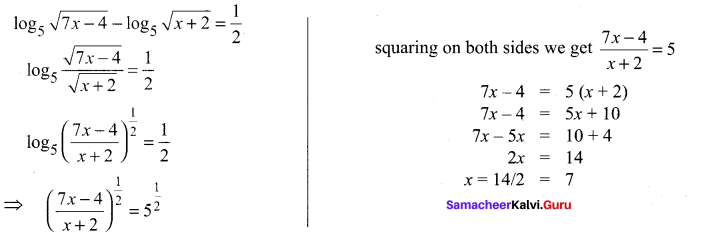
(b) A and B are square matrices of same order.

Question 5.
If A = \(\left[\begin{array}{rr}{\lambda} & {1} \\ {-1} & {-\lambda}\end{array}\right]\), then for what value of λ, A2 = 0?
(a) 0
(b) ±1
(c) -1
(d) 1
Solution:

Samacheer Kalvi 11th Maths Solutions Chapter 7 Matrices and Determinants Ex 7.5 6

Question 6.
If Samacheer Kalvi 11th Maths Solutions Chapter 7 Matrices and Determinants Ex 7.5 7 and (A + B)2 = A2 + B2, then the values of a and b are ……………….
(a) a = 4, b = 1
(b) a = 1, b = 4
(c) a = 0, b = 4
(d) a = 2, b = 4
Solution:
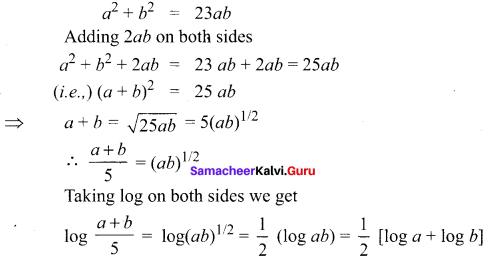
Samacheer Kalvi 11th Maths Solutions Chapter 7 Matrices and Determinants Ex 7.5 8
Samacheer Kalvi 11th Maths Solutions Chapter 7 Matrices and Determinants Ex 7.5 9

Question 7.
If Samacheer Kalvi 11th Maths Solutions Chapter 7 Matrices and Determinants Ex 7.5 10 is a matrix satisfying the equation AAT = 9I, where I is 3 × 3 identity matrix, then the ordered pair (a, b) is equal to ………….
(a) (2, -1)
(b) (-2, 1)
(c) (2, 1)
(d) (-2, -1)
Solution:

Samacheer Kalvi 11th Maths Solutions Chapter 7 Matrices and Determinants Ex 7.5 11
Samacheer Kalvi 11th Maths Solutions Chapter 7 Matrices and Determinants Ex 7.5 12

Question 8.
If A is a square matrix, then which of the following is not symmetric?
(a) A + AT
(b) AAT
(c) ATA
(d)A – AT
Solution:
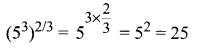
(b)

Question 9.
If A and B are symmetric matrices of order n, where (A ≠ B), then …………….
(a) A + B is skew-symmetric
(b) A + B is symmetric
(c) A + B is a diagonal matrix
(d) A + B is a zero matrix
Solution:
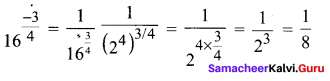
(b)

Samacheer Kalvi 11th Maths Solutions Chapter 7 Matrices and Determinants Ex 7.5

Question 10.
If Samacheer Kalvi 11th Maths Solutions Chapter 7 Matrices and Determinants Ex 7.5 13 and if xy = 1, then det (AAT) is equal to …………..
(a) (a – 1)2
(b) (a2 + 1)2
(c) a2 – 1
(d) (a2 – 1)2
Solution:

Samacheer Kalvi 11th Maths Solutions Chapter 7 Matrices and Determinants Ex 7.5 14

Question 11.
The value of x, for which the matrix Samacheer Kalvi 11th Maths Solutions Chapter 7 Matrices and Determinants Ex 7.5 15is singular is ………….
(a) 9
(b) 8
(c) 7
(d) 6
Solution:
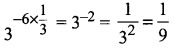
(b) Hint: Given A is a singular matrix ⇒ |A| = 0
Samacheer Kalvi 11th Maths Solutions Chapter 7 Matrices and Determinants Ex 7.5 16
⇒ ex-2.e2x+3 – e2+x.e7+x = 0
⇒ e3x+1 – e9+2x = 0 ⇒ e3x+1 = e9+2x
⇒ 3x + 1 = 9 + 2x
3x – 2x = 9 – 1 ⇒ x = 8

Question 12.
If the points (x, -2), (5, 2), (8, 8) are collinear, then x is equal to …………
(a) -3
(b) \(\frac{1}{3}\)
(c) 1
(d) 3
Solution:

(d) Hint: Given that the points are collinear
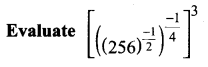
So, area of the triangle formed by the points = 0
Samacheer Kalvi 11th Maths Solutions Chapter 7 Matrices and Determinants Ex 7.5 17

Question 13.
Samacheer Kalvi 11th Maths Solutions Chapter 7 Matrices and Determinants Ex 7.5 18
Solution:
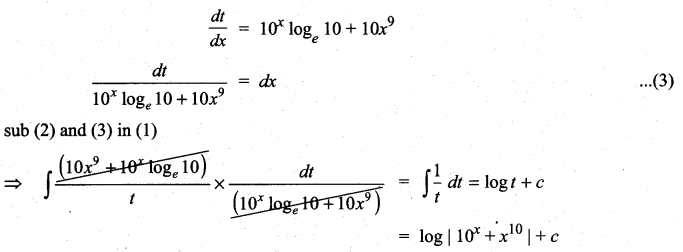
Samacheer Kalvi 11th Maths Solutions Chapter 7 Matrices and Determinants Ex 7.5 19
Samacheer Kalvi 11th Maths Solutions Chapter 7 Matrices and Determinants Ex 7.5 20

Question 14.
If the square of the matrix Samacheer Kalvi 11th Maths Solutions Chapter 7 Matrices and Determinants Ex 7.5 21 is the unit matrix of order 2, then α, β and γ should satisfy the relation.
(a) 1 + α2 + βγ = 0
(b) 1 – α2 – βγ = 0
(c) 1 – α2 + βγ = 0
(d) 1 + α2 – βγ = 0
Solution:
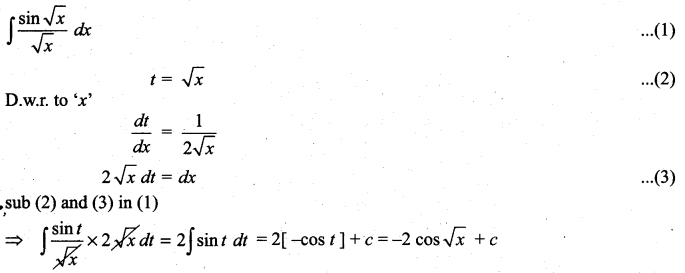
Samacheer Kalvi 11th Maths Solutions Chapter 7 Matrices and Determinants Ex 7.5 22

Samacheer Kalvi 11th Maths Solutions Chapter 7 Matrices and Determinants Ex 7.5

Question 15.
Samacheer Kalvi 11th Maths Solutions Chapter 7 Matrices and Determinants Ex 7.5 23
(a) Δ
(b) kΔ
(c) 3kΔ
(d) k3Δ
Solution:
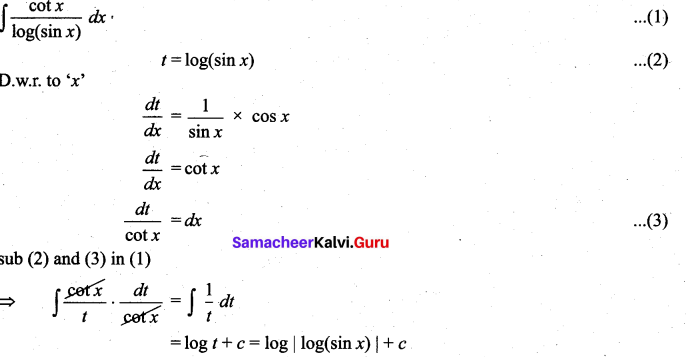
Samacheer Kalvi 11th Maths Solutions Chapter 7 Matrices and Determinants Ex 7.5 24

Question 16.
A root of the equation Samacheer Kalvi 11th Maths Solutions Chapter 7 Matrices and Determinants Ex 7.5 25 is …………….
(a) 6
(b) 3
(c) 0
(d) -6
Solution:
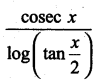
Samacheer Kalvi 11th Maths Solutions Chapter 7 Matrices and Determinants Ex 7.5 26

Question 17.
The value of the determinant of Samacheer Kalvi 11th Maths Solutions Chapter 7 Matrices and Determinants Ex 7.5 27is ……………
(a) -2abc
(b) abc
(c) 0
(d) a2 + b2 + c2
Solution:
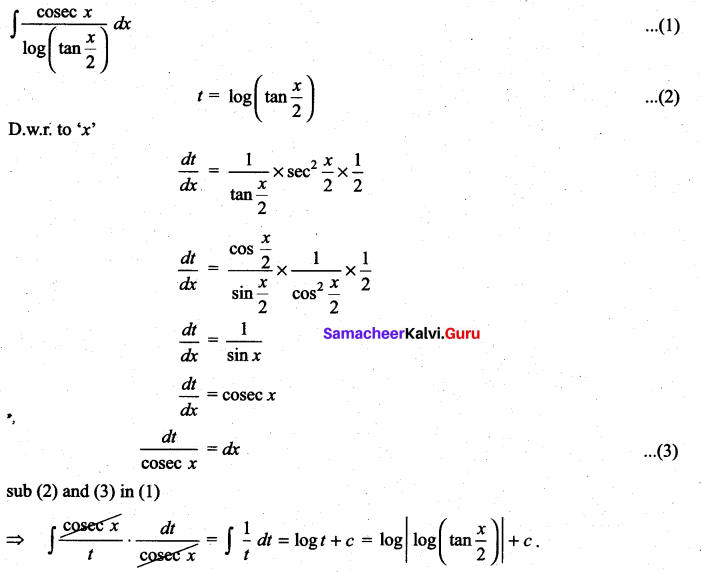
Samacheer Kalvi 11th Maths Solutions Chapter 7 Matrices and Determinants Ex 7.5 28

Question 18.
If x1, x2, x3 as well as y1, y2, y3 are in geometric progression with the same common ratio, then the points (x1, y1), (x2, y2), (x3, y3) are
(a) vertices of an equilateral triangle
(b) vertices of a right angled triangle
(c) vertices of a right angled isosceles triangle
(d) collinear
Solution:
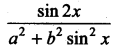
(d)

Question 19.
If \(\lfloor.\rfloor\) denotes the greatest integer less than or equal to the real number under consideration and -1 ≤ x < 0, 0 ≤ y < 1, 1 ≤ z ≤ 2, then the value of the determinant Samacheer Kalvi 11th Maths Solutions Chapter 7 Matrices and Determinants Ex 7.5 29 is …………..
(a) \(\lfloor z\rfloor\)
(b) \(\lfloor y\rfloor\)
(c) \(\lfloor x\rfloor\)
(d) \(\lfloor x\rfloor+ 1\)
Solution:
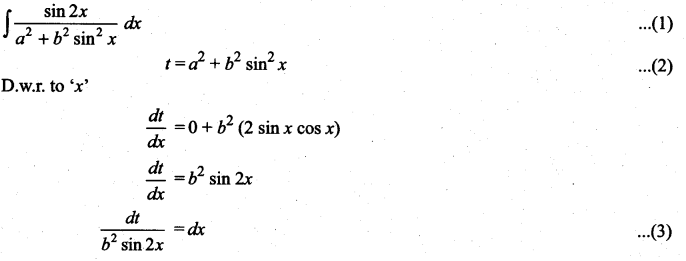
(a) Hint: From the given values
Samacheer Kalvi 11th Maths Solutions Chapter 7 Matrices and Determinants Ex 7.5 30>

Samacheer Kalvi 11th Maths Solutions Chapter 7 Matrices and Determinants Ex 7.5

Question 20.
If a ≠ b, b, c satisfy Samacheer Kalvi 11th Maths Solutions Chapter 7 Matrices and Determinants Ex 7.5 31 then abc = ……………..
(a) a + b + c
(b) 0
(c) b3
(d) ab + bc
Solution:
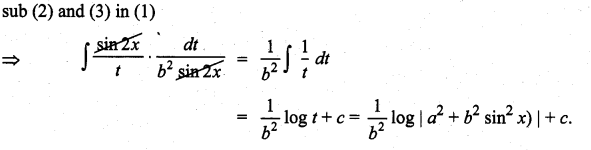
(c) Hint: Expanding along R1,
a(b2 – ac) – 2b (3b – 4c) + 2c (3a – 4b) = 0
(b2 – ac) (a – b) = 0
b2 = ac (or) a = b
⇒ abc = b(b2) = b3

Question 21.
If Samacheer Kalvi 11th Maths Solutions Chapter 7 Matrices and Determinants Ex 7.5 32 then B is given by ………………..
(a) B = 4A
(b) B = -4A
(c) B = -A
(d) B = 6A
Solution:
Samacheer Kalvi 11th Maths Solutions Chapter 7 Matrices and Determinants Ex 7.5 33
Samacheer Kalvi 11th Maths Solutions Chapter 7 Matrices and Determinants Ex 7.5 34

Samacheer Kalvi 11th Maths Solutions Chapter 7 Matrices and Determinants Ex 7.5

Question 22.
IfA is skew-symmetric of order n and C ¡s a column matrix of order n × 1, then CT AC is ……………..
(a) an identity matrix of order n
(b) an identity matrix of order 1
(e) a zero matrix of order I
(d) an Identity matrix of order 2
Solution:
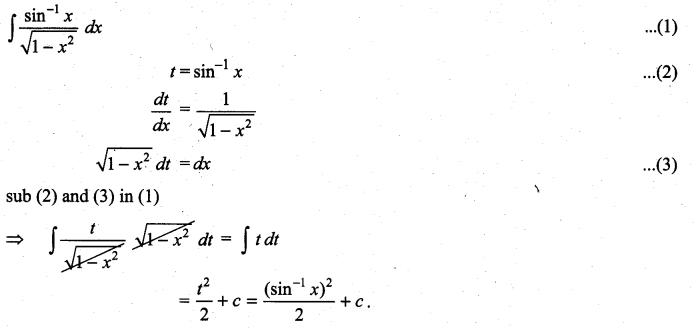
(c) Hint : Given A is of order n × n
C is of order n × 1
so, CT is of order 1 × n
Samacheer Kalvi 11th Maths Solutions Chapter 7 Matrices and Determinants Ex 7.5 35
Let it be equal to (x) say
Taking transpose on either sides
(CT, AC)T (x)T .
(i.e.) CT(AT)(C) = x
CT(-A)(C) = x
⇒ CTAC = -x
⇒ x = -x ⇒ 2x = 0 ⇒ x = 0

Question 23.
The matrix A satisfying the equation Samacheer Kalvi 11th Maths Solutions Chapter 7 Matrices and Determinants Ex 7.5 36 is ……………
Samacheer Kalvi 11th Maths Solutions Chapter 7 Matrices and Determinants Ex 7.5 37
Solution:
Samacheer Kalvi 11th Maths Solutions Chapter 7 Matrices and Determinants Ex 7.5 38

Samacheer Kalvi 11th Maths Solutions Chapter 7 Matrices and Determinants Ex 7.5 39

Question 24.
If A + I = Samacheer Kalvi 11th Maths Solutions Chapter 7 Matrices and Determinants Ex 7.5 40, then (A + I) (A – I) is equal to …………….
Samacheer Kalvi 11th Maths Solutions Chapter 7 Matrices and Determinants Ex 7.5 41
Solution:
Samacheer Kalvi 11th Maths Solutions Chapter 7 Matrices and Determinants Ex 7.5 42

Question 25.
Let A and B be two symmetric matrices of same order. Then which one of the following statement is not true?
(a) A + B ¡s a symmetric matrix
(b) AB ¡s a symmetric matrix
(c) AB = (BA)T
(d) ATB = ABT
Solution:
(b)

Samacheer Kalvi 11th Maths Solutions Chapter 6 Two Dimensional Analytical Geometry Ex 6.3

You can Download Samacheer Kalvi 11th Maths Book Solutions Guide Pdf, Tamilnadu State Board help you to revise the complete Syllabus and score more marks in your examinations.

Tamilnadu Samacheer Kalvi 11th Maths Solutions Chapter 6 Two Dimensional Analytical Geometry Ex 6.3

Question 1.
Show that the lines are 3x + 2y + 9 = 0 and 12x + 8y – 15 = 0 are parallel lines.
Solution:
Samacheer Kalvi 11th Maths Solutions Chapter 6 Two Dimensional Analytical Geometry Ex 6.3 1
Here m1 = m2 ⇒ the two lines are parallel.

Question 2.
Find the equation of the straight line parallel to 5x – 4y + 3 = 0 and having x – intercept 3.
Solution:
Equation of a line parallel to ax + by + c = 0 will be of the form ax + by + k = 0
So equation of a line parallel to 5x – 4y + 3 = 0 will be of the form 5x – 4y = k
Samacheer Kalvi 11th Maths Solutions Chapter 6 Two Dimensional Analytical Geometry Ex 6.3 2

Samacheer Kalvi 11th Maths Solutions Chapter 6 Two Dimensional Analytical Geometry Ex 6.3

Question 3.
Find the distance between the line 4x + 3y + 4 = 0 and a point
(i) (-2, 4)
(ii) (7, -3)
Solution:
The distance between the line ax + by + c = 0 and the point(x1, y1) is given by
Samacheer Kalvi 11th Maths Solutions Chapter 6 Two Dimensional Analytical Geometry Ex 6.3 3

(i) Now the distance between the line 4x + 3y + 4 = 0 and (-2, 4) is
Samacheer Kalvi 11th Maths Solutions Chapter 6 Two Dimensional Analytical Geometry Ex 6.3 4

(ii) The distance between the line 4x + 3y + 4 = 0 and (7, -3) is
Samacheer Kalvi 11th Maths Solutions Chapter 6 Two Dimensional Analytical Geometry Ex 6.3 5

Question 4.
Write the equation of the lines through the point (1, -1)
(i) Parallel to x + 3y – 4 = 0
(ii) Perpendicular to 3x + 4y = 6
Solution:
(i) Any line parallel to x + 3y – 4 = 0 will be of the form x + 3y + k = 0.
It passes through (1,-1) ⇒ 1 – 3 + k = 0 ⇒k = 2
So the required line is x + 3y + 2 = 0

(ii) Any line perpendicular to 3x + 4y – 6 = 0 will be of the form 4x – 3y + k = 0.
It passes through (1, -1) ⇒ 4 + 3 + k = 0 ⇒ k = -7.
So the required line is 4x – 3y – 7 = 0

Question 5.
If (- 4, 7) is one vertex of a rhombus and if the equation of one diagonal is 5x – y + 7 = 0, then find the equation of another diagonal.
Solution:
In a rhombus, the diagonal cut at right angles.
The given diagonal is 5x – y + 7 = 0 and (- 4, 7) is not a point on the diagonal.
So it will be a point on the other diagonal which is perpendicular to 5x – y + 7 = 0.
The equation of a line perpendicular to 5x – y + 7 = 0 will be of the form x + 5y + k = 0. It passes through (-4, 7) ⇒ -4 + 5(7) + k = 0 ⇒ k = -31
So the equation of the other diagonal is x + 5y – 31 = 0

Question 6.
Find the equation of the lines passing through the point of intersection lines 4x – y + 3 = 0 and 5x + 2y +7 = 0, and
(i) Through the point (-1, 2)
(ii) Parallel to x – y + 5 = 0
(iii) Perpendicular to x – 2y + 1 = 0.
Solution:
To find the point of intersection of the lines we have to solve them
Samacheer Kalvi 11th Maths Solutions Chapter 6 Two Dimensional Analytical Geometry Ex 6.3 80
Substituting x = -1 in equation (2) we get
-5 + 2y = -7
⇒ 2y = – 7 + 5 = -2
⇒ y = -1
So the point of intersection is (-1, -1)
Samacheer Kalvi 11th Maths Solutions Chapter 6 Two Dimensional Analytical Geometry Ex 6.3 81

(ii) Equation of a line parallel to x – y + 5 = 0 will be of the form x – y + k= 0.
It passes through (-1, -1) ⇒ -1 + 1 + k = 0 ⇒ k = 0.
So the required line is x – y = 0 ⇒ x = y.

(iii) Equation of a line perpendicular to x – 2y+ 1 =0 will be of the form 2x + y + k = 0. It passes through (-1, -1) ⇒ -2 – 1 + k = 0 ⇒ k = 3.
So the required line is 2x + y + 3 = 0

Samacheer Kalvi 11th Maths Solutions Chapter 6 Two Dimensional Analytical Geometry Ex 6.3

Question 7.
Find the equations of two straight lines which are parallel to the line 12x + 5y + 2 = 0 and at a unit distance from the point (1, -1).
Solution:
Equation of a line parallel to 12x + 5y + 2 = 0 will be of the form 12x + 5y + k = 0.
We are given that the perpendicular distance form (1, -1) to the line 12x + 5y + k = 0 is 1 unit.
Samacheer Kalvi 11th Maths Solutions Chapter 6 Two Dimensional Analytical Geometry Ex 6.3 85
So the required line will be 12x + 5y + 6 = 0 or 12x + 5y – 20 = 0

Question 8.
Find the equations of straight lines which are perpendicular to the line 3x + 4y – 6 = 0 and are at a distance of 4 units from (2, 1).
Solution:
Given equation of line is 3x + 4y – 6 = 0.
Any line perpendicular to 3x + 4y – 6 = 0 will be of the form 4x – 3y + k = 0
Given perpendicular distance is 4 units from (2, 1) to line (1)
Samacheer Kalvi 11th Maths Solutions Chapter 6 Two Dimensional Analytical Geometry Ex 6.3 86
∴ 20 = + (5 + k) or 20 = – (5 + k)
⇒ k = 20 – 5 or k = -(20 + 5)
k = 15 or k : = -25
∴ Required equation of the lines are 4x – 3y + 15 = 0 and 4x – 3y – 25 = 0

Question 9.
Find the equation of a straight line parallel to 2x + 3y = 10 and which is such that the sum of its intercepts on the axes is 15.
Solution:
The equation of the line parallel to 2x + 3y = 10 will be of the form 2x + 3y = k .
Samacheer Kalvi 11th Maths Solutions Chapter 6 Two Dimensional Analytical Geometry Ex 6.3 87

Question 10.
Find the length of the perpendicular and the co-ordinates of the foot of the perpendicular from (-10, -2) to the line x + y – 2 = 0.
Solution:
Length of the perpendicular from (-10, -2) to x + y – 2 = 0 is
Samacheer Kalvi 11th Maths Solutions Chapter 6 Two Dimensional Analytical Geometry Ex 6.3 88

Question 11.
If p1 and p2 are the lengths of the perpendiculars from the origin to the straight lines. sec θ +y cosec θ = 2a and x cos θ – y sin θ = a cos 2θ, then prove that p_{1}^{2}+p_{2}^{2}=a^{2}
Solution:
p1 = length of perpendicular from (0, 0) to x sec θ + y cosec θ = 2a
Samacheer Kalvi 11th Maths Solutions Chapter 6 Two Dimensional Analytical Geometry Ex 6.3 89
Samacheer Kalvi 11th Maths Solutions Chapter 6 Two Dimensional Analytical Geometry Ex 6.3 90

Question 12.
Find the distance between the parallel lines
(i) 12x + 5y = 7 and 12x + 5y + 7 = 0
(ii) 3x – 4y + 5 = 0 and 6x – 8y – 15 = 0.
Solution:
Samacheer Kalvi 11th Maths Solutions Chapter 6 Two Dimensional Analytical Geometry Ex 6.3 91

Question 13.
Find the family of straight lines
(i) Perpendicular
(ii) Parallel to 3x + 4y – 12 = 0.
Solution:
Equation of lines perpendicular to 3x + 4y – 12 = 0 will be of the form 4x – 3y + k = 0, k ∈ R Equation of lines parallel to 3x + 4y – 12 = 0 will be of the form 3x + 4y + k = 0, k ∈ R

Question 14.
If the line joining two points A (2, 0) and B (3, 1) is rotated about A in anti-clockwise direction through an angle of 15°, then find the equation of the line in new position.
Solution:
Samacheer Kalvi 11th Maths Solutions Chapter 6 Two Dimensional Analytical Geometry Ex 6.3 92
This line is rotated about 15° in anti clockwise direction
⇒ New slope = tan (45° + 15°) = tan 60° = \(\sqrt{3}\) (i.e) m = \(\sqrt{3}\).
Point A = (2, 0)
Samacheer Kalvi 11th Maths Solutions Chapter 6 Two Dimensional Analytical Geometry Ex 6.3 93

Samacheer Kalvi 11th Maths Solutions Chapter 6 Two Dimensional Analytical Geometry Ex 6.3

Question 15.
A ray of light coming from the point (1, 2) is reflected at a point A on the x-axis and it passes through the point (5,3). Find the co-ordinates of the point A.
Solution:
The image of the point P (1, 2) will be P’ (1, -2).
Since ∠OAP = ∠XAQ (angle of inches = angle of reflection) So ∠OAP’ = ∠XAQ = a (Vertically opposite angles)
⇒ P’, A, Q lie on a same line.
Samacheer Kalvi 11th Maths Solutions Chapter 6 Two Dimensional Analytical Geometry Ex 6.3 94
Now equation of the line P’, Q is [where P’ = (1, -2), Q = (5, 3)]
Samacheer Kalvi 11th Maths Solutions Chapter 6 Two Dimensional Analytical Geometry Ex 6.3 95
Since we find point of intersection with x axis we put y = 0.
Samacheer Kalvi 11th Maths Solutions Chapter 6 Two Dimensional Analytical Geometry Ex 6.3 96

Question 16.
A line is drawn perpendicular to 5x = y + 7. Find the equation of the line if the area of the triangle formed by this line with co-ordinate axes is 10 sq. units.
Solution:
Equation of the given lines 5x = y+ 7 ⇒ 5x – y = 7.
So its perpendicular will be of the form x + 5y = 7
Samacheer Kalvi 11th Maths Solutions Chapter 6 Two Dimensional Analytical Geometry Ex 6.3 97

Question 17.
Find the image of the point (-2, 3) about the line x + 2y – 9 = 0.
Solution:
The coordinates of image of the point (x1, y1) with respect to the line ax + by + c = 0 can be
Samacheer Kalvi 11th Maths Solutions Chapter 6 Two Dimensional Analytical Geometry Ex 6.3 98

Question 18.
A photocopy store charges Rs. 1.50 per copy for the first 10 copies and Rs. 1.00 per copy after the 10th copy. Let x be the number of copies, and let y be the total cost of photocopying.
(i) Draw graph of the cost as x goes from 0 to 50 copies.
(ii) Find the cost of making 40 copies
Solution:
Samacheer Kalvi 11th Maths Solutions Chapter 6 Two Dimensional Analytical Geometry Ex 6.3 99

Samacheer Kalvi 11th Maths Solutions Chapter 6 Two Dimensional Analytical Geometry Ex 6.3

Question 19.
Find atleast two equations of the straight lines in the family of the lines y = 5x + b, for which b and the x-coordinate of the point of intersection of the lines with 3x – 4y = 6 are integers.
Solution:
y = 5x + b …….. (1)
3x-4y = 6 …….. (2)
Solving (1) and (2)
Substituting y value from (1) in (2) we get
Samacheer Kalvi 11th Maths Solutions Chapter 6 Two Dimensional Analytical Geometry Ex 6.3 100
Samacheer Kalvi 11th Maths Solutions Chapter 6 Two Dimensional Analytical Geometry Ex 6.3 50
Since, x coordinate and 6 are integers 6 + 46 must be multiple of 17
Samacheer Kalvi 11th Maths Solutions Chapter 6 Two Dimensional Analytical Geometry Ex 6.3 51

Question 20.
Find all the equations of the straight lines in the family of the lines y = mx – 3, for which m and the x-coordinate of the point of intersection of the lines with x – y = 6 are integers.
Solution:
Equation of the given lines are
y= mx – 3 …….. (1)
and x – y = 6 ……. (2)
Solving (1) and (2)
x – (mx – 3) = 6
Samacheer Kalvi 11th Maths Solutions Chapter 6 Two Dimensional Analytical Geometry Ex 6.3 52
Since m and x coordinates are integers
1 – m is the divisor of 3 (i.e) ± 1, ± 3
Samacheer Kalvi 11th Maths Solutions Chapter 6 Two Dimensional Analytical Geometry Ex 6.3 53
So equation of lines are (y = mx – 3) ,y = mx – 3
(i) When m = 0, y = -3
(ii) When m = 2, y = 2x – 3
(iii) When m = -2, y = -2x – 3 or 2x + y + 3 = 0
(iv) When m = 4, y = 4x – 3

Samacheer Kalvi 11th Maths Solutions Chapter 6 Two Dimensional Analytical Geometry Ex 6.3 Additional Questions

Question 1.
Find the equation of the line passing through the point (5, 2) and perpendicular to the line joining the points (2, 3) and (3, -1).
Solution:
Slope of the line joining the points (2, 3) and (3, -1) is
Samacheer Kalvi 11th Maths Solutions Chapter 6 Two Dimensional Analytical Geometry Ex 6.3 54
Slope of the required line which is perpendicular to it
Samacheer Kalvi 11th Maths Solutions Chapter 6 Two Dimensional Analytical Geometry Ex 6.3 55
Equation of the line passing through the point (5, 2) is
Samacheer Kalvi 11th Maths Solutions Chapter 6 Two Dimensional Analytical Geometry Ex 6.3 56
Hence, the required equation is x – 4y + 3 = 0.

Question 2.
Find the points on the line x + y = 4 which lie at a unit distance from the line 4x + 3y = 10. Solution:
Samacheer Kalvi 11th Maths Solutions Chapter 6 Two Dimensional Analytical Geometry Ex 6.3 57
So, the required point is (3, 1)
Now taking(-) sign, we have
Samacheer Kalvi 11th Maths Solutions Chapter 6 Two Dimensional Analytical Geometry Ex 6.3 59
So, the required point is (- 7, 11)
Hence, the required points on the given line are (3, 1) and (-7, 11).

Samacheer Kalvi 11th Maths Solutions Chapter 6 Two Dimensional Analytical Geometry Ex 6.3

Question 3.
Find the equation of the line passing through the point of intersection 2x + y = 5 and x + 3y + 8 = 0 and parallel to the line 3x +4y = 7.
Solution:
Samacheer Kalvi 11th Maths Solutions Chapter 6 Two Dimensional Analytical Geometry Ex 6.3 30
On putting the value of λ in equation (iv) we get
(2x + y – 5) + 1 (x + 3y + 8) = 0
⇒ 2x + y – 5 + x + 3y + 8 = 0
⇒ 3x + 4y + 3 = 0
Hence, the required equation is 3x + 4y + 3 = 0

Question 4.
A line passing through the points (a, 2a) and (-2, 3) is perpendicular to the line 4 x + 3y + 5 = 0, find the value of a.
Solution:
Samacheer Kalvi 11th Maths Solutions Chapter 6 Two Dimensional Analytical Geometry Ex 6.3 31

Samacheer Kalvi 11th Maths Solutions Chapter 6 Two Dimensional Analytical Geometry Ex 6.3

Question 5.
Find the equation of the straight line which passes through the intersection of the straight lines 2x + y = 8 and 3x – 2y + 7 = 0 and is parallel to the straight line 4x + y – 11 = 0.
Solution:
Equation of line through the intersection of straight lines
2x + y = 8 and 3x – 2y + 7 = 0 is
2x + y – 8 + k (3x – 2y + 7) = 0
x(2 + 3k) + y (1 – 2k) +(-8 + 7k) = 0
Samacheer Kalvi 11th Maths Solutions Chapter 6 Two Dimensional Analytical Geometry Ex 6.3 32
⇒ 28x + 7y – 74 = 0

Question 6.
Find the equation of the straight line passing through intersection of the straight lines 5x – 6y = 1 and 3x + 2y + 5 = 0 and perpendicular to the straight line 3x – 5y + 11 = 0.
Solution:
Equation of line through the intersection of straight lines 5x – 6y = 1 and 3x + 2y + 5 = 0 is
5x – 6y – 1 + k (3x + 2y + 5) = 0
x (5 + 3k) + y (-6 + 2k) + (-1 + 5k) = 0
This is perpendicular to 3x – 5y + 11 = 0
That is, the product of their slopes is -1
Samacheer Kalvi 11th Maths Solutions Chapter 6 Two Dimensional Analytical Geometry Ex 6.3 34

Samacheer Kalvi 11th Maths Solutions Chapter 6 Two Dimensional Analytical Geometry Ex 6.2

You can Download Samacheer Kalvi 11th Maths Book Solutions Guide Pdf, Tamilnadu State Board help you to revise the complete Syllabus and score more marks in your examinations.

Tamilnadu Samacheer Kalvi 11th Maths Solutions Chapter 6 Two Dimensional Analytical Geometry Ex 6.2

Question 1.
Find the equation of the lines passing through the point (1, 1)
(i) With y-intercept (- 4)
(ii) With slope 3
(iii) And (-2, 3)
(iv) And the perpendicular from the origin makes an angle 60° with x-axis.
Solution:
(i) Given y intercept = – 4,
Let x intercept be a
Samacheer Kalvi 11th Maths Solutions Chapter 6 Two Dimensional Analytical Geometry Ex 6.2 1

(ii) Slope m = 3, passing through (x1, y1) = (1, 1)
Equation of the line is y – y1 = m(x – x1)
(i.e) y- 1 = 3(x – 1) ⇒ y – 1 = 3x – 3 ⇒ 3x – y = 2

(iii) Passing through (1, 1) and (-2, 3)
Samacheer Kalvi 11th Maths Solutions Chapter 6 Two Dimensional Analytical Geometry Ex 6.2 2

Samacheer Kalvi 11th Maths Solutions Chapter 6 Two Dimensional Analytical Geometry Ex 6.2

Question 2.
If P (r, c) is mid point of a line segment between the axes, then show that \(\frac{x}{r}+\frac{y}{c}=\) 2.
Solution:
P (r, c) is the mid point of AB.
⇒ A = (2r, 0) and B = (0, 2c)
(i.e) x intercept = 2r and
y intercept = 2c .
Samacheer Kalvi 11th Maths Solutions Chapter 6 Two Dimensional Analytical Geometry Ex 6.2 3
Samacheer Kalvi 11th Maths Solutions Chapter 6 Two Dimensional Analytical Geometry Ex 6.2 4

Question 3.
Find the equation of the line passing through the point (1, 5) and also divides the co-ordinate axes in the ratio 3 : 10.
Solution:
Let x intercept be 3a and y intercept be 10a
Samacheer Kalvi 11th Maths Solutions Chapter 6 Two Dimensional Analytical Geometry Ex 6.2 5

Question 4.
If p is length of perpendicular from origin to the line whose intercepts on the axes are a and b, then show that \(\frac{1}{p^{2}}=\frac{1}{a^{2}}+\frac{1}{b^{2}}\)
Solution:
Samacheer Kalvi 11th Maths Solutions Chapter 6 Two Dimensional Analytical Geometry Ex 6.2 6
Samacheer Kalvi 11th Maths Solutions Chapter 6 Two Dimensional Analytical Geometry Ex 6.2 7

Question 5.
The normal boiling point of water is 100°C or 212°F and the freezing point of water is 0°C or 32°F.
(i) Find the linear relationship between C and F
(ii) Find the value of C for 98.6° F and
(iii) The value of F for 38°C .
Solution:
Given when C = 100, F = 212 and when C = 0, F = 32
Samacheer Kalvi 11th Maths Solutions Chapter 6 Two Dimensional Analytical Geometry Ex 6.2 8
Samacheer Kalvi 11th Maths Solutions Chapter 6 Two Dimensional Analytical Geometry Ex 6.2 9
Samacheer Kalvi 11th Maths Solutions Chapter 6 Two Dimensional Analytical Geometry Ex 6.2 10

Question 6.
An object was launched from a place P in constant speed to hit a target. At the 15th second it was 1400m away from the target and at the 18th second 800m away. Find
(i) The distance between the place and the target
(ii) The distance covered by it in 15 seconds,
(iii) Time taken to hit the target.
Solution:
Taking time = x and distance = y
We are given at x = 15, y = 1400 and at x = 18, y = 800
Samacheer Kalvi 11th Maths Solutions Chapter 6 Two Dimensional Analytical Geometry Ex 6.2 60
Samacheer Kalvi 11th Maths Solutions Chapter 6 Two Dimensional Analytical Geometry Ex 6.2 61

Samacheer Kalvi 11th Maths Solutions Chapter 6 Two Dimensional Analytical Geometry Ex 6.2

Question 7.
Population of a city in the years 2005 and 2010 are 1,35,000 and 1,45,000 respectively. Find the approximate population in the year 2015. (assuming that the growth of population is constant).
Solution:
Taking year as x and population as y
We are given when x = 2005,
y = 1,35,000 and
when x = 2010,
y = 1,45,000
Samacheer Kalvi 11th Maths Solutions Chapter 6 Two Dimensional Analytical Geometry Ex 6.2 68
y – 135000 = 2000 (x – 2005)
y = 2000(x – 2005) + 135000
At x = 2015, y = 2000 (2015 – 2005) + 135000
(i.e) y = 2000 (10) + 135000 = 20000 + 135000 = 1,55,000
The approximate population in the year 2015 is 1,55,000

Question 8.
Find the equation of the line, if the perpendicular drawn from the origin makes an angle 30° with x – axis and its length is 12.
Solution:
The equation of the line is x cos α + y sin α = p
Samacheer Kalvi 11th Maths Solutions Chapter 6 Two Dimensional Analytical Geometry Ex 6.2 65

Question 9.
Find the equation of the straight lines passing through (8, 3) and having intercepts whose sum is 1.
Solution:
Given sum of the intercepts = 1 ⇒ when x intercept = a then y intercept = 1 – a
Samacheer Kalvi 11th Maths Solutions Chapter 6 Two Dimensional Analytical Geometry Ex 6.2 66
8 (1 – a) + 3a = a (1 – a)
8 – 8a + 3a = a – a2
Samacheer Kalvi 11th Maths Solutions Chapter 6 Two Dimensional Analytical Geometry Ex 6.2 67

Question 10.
Samacheer Kalvi 11th Maths Solutions Chapter 6 Two Dimensional Analytical Geometry Ex 6.2 688
Solution:
Samacheer Kalvi 11th Maths Solutions Chapter 6 Two Dimensional Analytical Geometry Ex 6.2 69
⇒ The points A, B, C lie on a line
⇒ The points A, B, C are collinear
Samacheer Kalvi 11th Maths Solutions Chapter 6 Two Dimensional Analytical Geometry Ex 6.2 70

Question 11.
A straight line is passing through the point A (1, 2) with slope \(\frac{5}{12}\). Find points on the line which are 13 units away from A.
Solution:
Samacheer Kalvi 11th Maths Solutions Chapter 6 Two Dimensional Analytical Geometry Ex 6.2 71

Question 12.
A 150m long train is moving with constant velocity of 12.5 m/s. Find
(i) The equation of the motion of the train,
(ii) Time taken to cross a pole,
(iii) The time taken to cross the bridge of length 850 m is?
Solution:
(i) Now m = \(\frac{y}{x}\) = 12.5m / second,
The equation of the line is y = mx + c ….(1)
Put c = -150, m = 12.5 m,
The equation of motion of the train is y = 12.5x – 150

(ii) To find the time taken to cross a pole we take y = 0 in (1)
⇒ 0 = 12.5x – 150 ⇒ 12.5x = 150
Samacheer Kalvi 11th Maths Solutions Chapter 6 Two Dimensional Analytical Geometry Ex 6.2 72

(iii) When y = 850 in (1)
850 = 12.5 x – 150 ⇒ 12.5x = 850 + 150 = 1000
Samacheer Kalvi 11th Maths Solutions Chapter 6 Two Dimensional Analytical Geometry Ex 6.2 73

Samacheer Kalvi 11th Maths Solutions Chapter 6 Two Dimensional Analytical Geometry Ex 6.2

Question 13.
A spring was hung from a hook in the ceiling. A number of different weights were attached to the spring to make it stretch, and the total length of the spring was measured each time shown in the following table.
Samacheer Kalvi 11th Maths Solutions Chapter 6 Two Dimensional Analytical Geometry Ex 6.2 74
(i) Draw a graph showing the results.
(ii) Find the equation relating the length of the spring to the weight on it.
(iii) What is the actual length of the spring.
(iv) If the spring has to stretch to 9 cm long, how much weight should be added?
(v) How long will the spring be when 6 kilograms of weight on it?
Solution:
Taking weight (kg) as x values and length (cm) as y values we get (x1, y1) = (2, 3), (x2, y2) = (4, 4)
Samacheer Kalvi 11th Maths Solutions Chapter 6 Two Dimensional Analytical Geometry Ex 6.2 75
The equation of the line passing through the above two points is
Samacheer Kalvi 11th Maths Solutions Chapter 6 Two Dimensional Analytical Geometry Ex 6.2 76

(iii) When x = 0, 2y = 4 ⇒ y = 2 cm

(iv) When y = 9 cm, x – 18 = – 4
x = -4 + 18 = 14 kg

(v) When x = 6 (kg), 6 – 2y = – 4, -2y = -4 – 6 = -10
⇒ 2y = 10 ⇒ y = 10/2 = 5 cm.

Question 14.
A family is using Liquefied petroleum gas (LPG) of weight 14.2 kg for consumption. (Full weight 29.5 kg includes the empty cylinders tare weight of 15.3 kg.). If it is use with constant rate then it lasts for 24 days. Then the new cylinder is replaced
(i) Find the equation relating the quantity of gas in the cylinder to the days.
(ii) Draw the graph for first 96 days.
Solution:
Samacheer Kalvi 11th Maths Solutions Chapter 6 Two Dimensional Analytical Geometry Ex 6.2 77
Samacheer Kalvi 11th Maths Solutions Chapter 6 Two Dimensional Analytical Geometry Ex 6.2 777

Question 15.
In a shopping mall there is a hall of cuboid shape with dimension 800 × 800 × 720 units, which needs to be added the facility of an escalator in the path as shown by the dotted line in the figure. Find
(i) The minimum total length of the escalator,
(ii) The heights at which the escalator changes its direction,
(iii) The slopes of the escalator at the turning points.
Samacheer Kalvi 11th Maths Solutions Chapter 6 Two Dimensional Analytical Geometry Ex 6.2 78
Solution:
(i) the minimum total length of the escalator.
Shape of the hall in the shopping mall is cuboid. When you open out the cuboid, the not of the cuboid will be as shown in the following diagram.
Samacheer Kalvi 11th Maths Solutions Chapter 6 Two Dimensional Analytical Geometry Ex 6.2 80
The path of the escalator is from OA to AB to BC to CD
Samacheer Kalvi 11th Maths Solutions Chapter 6 Two Dimensional Analytical Geometry Ex 6.2 81
The minimum length = 3280 units

(ii) The height at which the escalator changes its direction.
Samacheer Kalvi 11th Maths Solutions Chapter 6 Two Dimensional Analytical Geometry Ex 6.2 82

(iii) Slope of the escalator at the turning points
Samacheer Kalvi 11th Maths Solutions Chapter 6 Two Dimensional Analytical Geometry Ex 6.2 83
Since ∆OAE = ∆ABB’ = ∆BCC’ = ∆CAD
Slope at the points B, C will be \(\frac{9}{40}\)

Samacheer Kalvi 11th Maths Solutions Chapter 6 Two Dimensional Analytical Geometry Ex 6.2 Additional Questions Solved

Question 1.
Find the equation of a straight line on which length of perpendicular from the origin is four units and the line makes an angle of 120° with the positive direction of x – axis.
Solution:
Samacheer Kalvi 11th Maths Solutions Chapter 6 Two Dimensional Analytical Geometry Ex 6.2 50
Samacheer Kalvi 11th Maths Solutions Chapter 6 Two Dimensional Analytical Geometry Ex 6.2 51

Samacheer Kalvi 11th Maths Solutions Chapter 6 Two Dimensional Analytical Geometry Ex 6.2

Question 2.
Find the equation of the line which passes through the point (- 4, 3) and the portion of the line intercepted between the axes is divided internally in the ratio 5 : 3 by this point.
Solution:
Let AB be a line passing through a point (-4, 3) and meets x-axis at A (a, 0) and y-axis at B (0, b).
Samacheer Kalvi 11th Maths Solutions Chapter 6 Two Dimensional Analytical Geometry Ex 6.2 778

Question 3.
If the intercept of a line between the coordinate axes is divided by the point (-5, 4) in the ratio 1 : 2, then find the equation of the line.
Solution:
Let a and b be the intercepts on the given line.
Samacheer Kalvi 11th Maths Solutions Chapter 6 Two Dimensional Analytical Geometry Ex 6.2 53
Samacheer Kalvi 11th Maths Solutions Chapter 6 Two Dimensional Analytical Geometry Ex 6.2 54
Hence, the required equation is 8x – 5y + 60 = 0

Question 4.
Find the equation of the straight line which passes through the point (1, -2) and cuts off equal intercepts from axes.
Solution:
Intercept form of a straight line is \(\frac{x}{a}+\frac{y}{b}\) = 1, where a and b are the intercepts on the axis
Samacheer Kalvi 11th Maths Solutions Chapter 6 Two Dimensional Analytical Geometry Ex 6.2 55
If equation (1) passes through the point (1, -2) we get
Samacheer Kalvi 11th Maths Solutions Chapter 6 Two Dimensional Analytical Geometry Ex 6.2 56
So, equation of the straight line is x v
Samacheer Kalvi 11th Maths Solutions Chapter 6 Two Dimensional Analytical Geometry Ex 6.2 57
Hence, the required equation x + y + 1 = 0

Question 5.
Find the distance of the line 4x – y = 0 from the point P(4, 1) measured along the line making an angle 135° with the positive x-axis
Solution:
The equation in distance form of the line passing through P(4, 1) and making an angle of 135° with the positive x-axis
Samacheer Kalvi 11th Maths Solutions Chapter 6 Two Dimensional Analytical Geometry Ex 6.2 58
Samacheer Kalvi 11th Maths Solutions Chapter 6 Two Dimensional Analytical Geometry Ex 6.2 59

Samacheer Kalvi 11th Maths Solutions Chapter 6 Two Dimensional Analytical Geometry Ex 6.2

Question 6.
The line 2x – y = 5 turns about the point on it, whose ordinate and abscissa are equal, through an angle of 45° in the anti-clockwise direction, find the equation of the line in the new position.
Solution:
If the line 2x – y = 5 makes an angle θ with x – axis. Then, tan θ = 2. Let P (α, α) be a point on the line 2x – y = 5.
Then, 2 α – α = 5 ⇒ α = 5
Samacheer Kalvi 11th Maths Solutions Chapter 6 Two Dimensional Analytical Geometry Ex 6.2 779
So, the coordinates of P are (5, 5). If the line 2x – y – 5 = 0 is rotated about point
P through 45° in anti clockwise direction, then the line in its new position makes angle θ + 45° with x – axis. Let m’ be the slope of the line in its new position. Then,
Samacheer Kalvi 11th Maths Solutions Chapter 6 Two Dimensional Analytical Geometry Ex 6.2 611
Thus, the line in its new pdsition passes through P (5, 5) and has slope m’ = -3
So, its equation y – 5 = m’ (x – 5) or, y – 5 = -3 (x – 5) or, 3x + y – 20 = 0
Samacheer Kalvi 11th Maths Solutions Chapter 6 Two Dimensional Analytical Geometry Ex 6.2 780