Samacheer Kalvi 11th English Solutions Supplementary Chapter 2 A Shot In the Dark

Students who are interested in learning of 11th English Supplementary Chapter 2 A Shot In the Dark Questions and Answers can use Tamilnadu State Board Solutions of 11th English Chapter Wise Pdf. First check in which chapter you are lagging and then Download Samacheer Kalvi 11th English Book Solutions Questions and Answers Summary, Activity, Notes Chapter Wise. Students can build self confidence by solving the solutions with the help of Tamilnadu State Board English Solutions. English is the scoring subject if you improve your grammar skills. Because most of the students will lose marks by writing grammar mistakes. So, we suggest you to Download Tamilnadu State Board 11th English Solutions according to the chapters.

Tamilnadu Samacheer Kalvi 11th English Solutions Supplementary Chapter 2 A Shot In the Dark

Check out the topics covered in Supplementary Chapter 2 A Shot In the Dark Questions and Answers before you start your preparation. Improve your grammar skills with the help of Samacheer Kalvi 11th English Book Solutions Questions and Answers pdf links. The solutions for Tamilnadu State Board 11th English Textbook are prepared by the English experts. So, if you follow Tamilnadu State Board Solutions 11th English Textbook Solutions you can cover all the topics in Supplementary Chapter 2 A Shot In the Dark Questons and Answers. This helps to improve your communication skills.

11th English Supplementary A Shot In The Dark Warm up
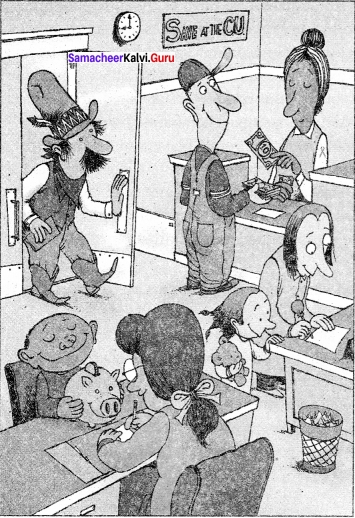
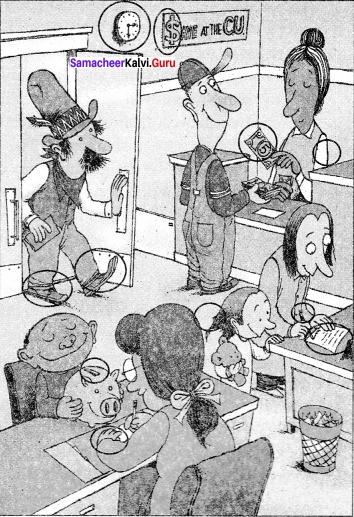
Can you spot 10 differences between these pictures?
How observant are you? Individually, try to spot as many differences as possible in five minutes. If you have spotted less than five, then you really need to improve your observation skill just to save yourself from being misled.

11th English Supplementary A Shot In The Dark Solutions Supplementary Chapter 2 Samacheer Kalvi

Answer:

A Shot In The Dark Question Answers Samacheer Kalvi 11th English Solutions Supplementary Chapter 2

Samacheer Kalvi 11th English Solutions Confessions of A Born Spectator Textual Questions

1. Answer the following questions in about 30-50 words each:

A Shot In The Dark Question Answers Question (a)
Why did Philip Sletherby visit Brill Manor?
Answer:
Philip Sletherby visited Brill Manor because he had been invited by Mrs. Honorio Saltpen Jago for a luncheon at Brill Manor.

Shot In The Dark Questions And Answers Question (b)
How would Sletherby gain from his friendship with Honoria Saltpen-Jago?
Answer:
Mr. Philip Sletherby’s hostess was a person of social importance in London, especially of considerable importance in the Chalkshire. He pinned his hopes on her recommendations to get a ticket to contest the MP election in the eastern division of Chalkshire. One of his club acquaintance assured him that Mrs.Saltpen-Jago had a reputation of being an excellent hostess. ‘

A Shot In The Dark Summary In Tamil Question (c)
Why did his travel companion curse and mutter?
Answer:
Mr. Sletherby’s travel companion was a young man of about twenty-two. He cursed and muttered because he had lost his valet along with the family crest. He claimed that he did so foolishly to seal a letter. He had forgotten to collect the valet.

11th English Unit 2 Supplementary Question (d)
Describe Bertie’s problem.
Answer:
Bertie was returning ffomyachting experience for about six months. He had done a damn awkward thing. He left behind his sovereign purse with four quid in it. It was all his worldly wealth at the moment. He must have left the purse on the table. He was stopping at a little country in a near Brondquay for three days’ fishing. As none knows him there, he needed money for his week-end bill and tips and cab to and from the station. In short, he desperately needed three pounds to manage the crisis.

A Shot In The Dark Supplementary Question (e)
‘There was a tinge of coldness in his voice.’ Why?
Answer:
Bertie claimed that he had not seen his mom Mrs. Saltpen-Jago for about six months , because he had gone for yachting. As he had overheard Mr. Sletherby’s intention of visiting Mrs. Saltpen-Jago at Brill Manor he introduced himself as Bertie, Mrs. Saltpen’s younger son. He had lost his sovereign purse. He needed to borrow three quid. As Mr. Sletherby had some suspicion he asked him what was the crest-like? He immediately replied it was demi-lion holding a cross-crosslet. Disbelieving his words, with a tinge of coldness in his voice, Mr. Sletherby said that Mrs. Saltpen-Jago had a grey hound courant on her note paper.


Question (f)
Compare the two crests.
Answer:
The Saltpen crest was “a demi-lion holding a cross-crosslet in its paw.” The Jago crest was a grey hound. Both were used in the family. Bertie could use either of the crests. Bertie had a feeling that he belonged to Saltpens, who used demi-lion crest always.

Question (g)
What was Sletherby’s response to Bertie’s request?
Answer:
Sletherby initially agreed to lend three pounds. But he wanted to ensure that he was not taken for a ride. He asked him if his mother had a close resemblance with him. Bertie claimed that his mom had dark brown hair like himself. Mr. Sletherby was already biased against lending the money as he believed that Grey hound was the crest found on Mrs. Saltpen-Jago’s note book paper. So, he refused to lend the promised loan to Bertie.

Question (h)
What caught his attention about the car door?
Answer:
The car door had two crests along. One was the demi-lion holding a cross-crosslet in its paw and the other was a greyhound.

Question (i)
Describe Honario Saltpen-Jago.
Answer:
Honario Saltpen-Jago was a brilliant and influential woman. She knew exactly when to take up an individual or drop him. She had very fine looks but she spoiled it. She had k beautiful dark brown hair but applied some dye and changed it into blonde.

Question (j)
Why did K.C.’s words shock Sletherby?
Answer:
Mr. Sletherby had left Mr. Bertie, Mrs. Honario Saltpen-Jago’s younger son on his way to Brill Manor in a railway station penniless and frustrated. He had not believed Bertie’s. description of his mom’s dark brown hair and the family’s double crest. When the footman Mr. KC commented on Mrs. Saltpen’s changed Looks, Mr. Sletherby was alarmed and he realized that he had behaved in a mean way. He had mistaken Bertie to be fraud. Thus K.C.’s words had shocked Mr. Sletherby.

2. Rearrange the sentences given below and write a summary of the story in a paragraph. Begin with:

Philip Sletherby was travelling by train to Brill Manor.
(a) The young man introduced himself as Bertie, the son of Saltpen Jago.
(b) Bertie needed three pounds desperately and asked Sletherby to lend it to him.
(c) All the time Sletherby was gazing at the door panel of the car, on which were the two crests – a demi-lion and a grey hound courant.
(d) He was received by Claude People. K.C.,who had kept on talking about various things.
(e) Bertie had left his purse behind, after sealing an envelope with the crest on the purse.
(f) Bertie stated that it was the Jago crest. He further added that his mother’s hair was dark brown similar to his.
(g) While describing the appearance of Honario Saltpen-Jago, K.C. referred to her altered’ hairstyle.
(h) Sletherby realized that Bertie had not lied to him, but that he had mistaken him for a fraud.
(i) He explained that the Saltpen crest was that of a demi-lion.
(j) Sletherby sat dumbstruck on learning that Mrs. Honario Saltpen Jago had changed her dark brown hair to a blonde, just five weeks ago.
(k) Sletherby pointed out to him that his mother’s letter had a greyhound courant crest.
(l) His companion in the train was a yOungman who was searching for something frantically.
(m) Suspecting foul play, Sletherby did not give him any money, as he knew Mrs.Saltpen- Jago was a blonde.

Answers:

(l) His companion in the train was a young man who was searching for something frantically.
(a) The young man introduced himself as Bertie, the son of Saltpen Jago.
(e) Bertie had left his purse behind, after sealing an envelope with the crest on the purse.
(b) Bertie needed three pounds desperately and asked Sletherby to lend it to him.
(i) He explained that the Saltpen crest was that of a demi-lion.
(k) Sletherby pointed out to him that his mother’s letter had a greyhound courant crest.
(J) Bertie stated that it was the Jago crest. He further added that his mother ’s hair was dark brown similar to his. .
(m) Suspecting foul play, Sletherby did not give him any money, as he knew Mrs. Saltpen- Jago was a blonde.
(d) He was received by Claude People. K.C.,who had kept on talking about various things.
(c) All the time Sletherby was gazing at the door panel of the car, on which were the two crests – a demi-lion and a grey hound courant.
(g) While describing the appearance of Honario Saltpen-Jago, K.C. referred to her altered hairstyle.
(j) Sletherby sat dumbstruck on learning that Mrs. Honario Saltpen Jago had changed her dark brown hair to a blonde, just five weeks ago.
(h) Sletherby realized that Bertie had not lied to him, but that he had mistaken him for a fraud.

Answer (for summary of the story in a paragraph)

Philip Sletherby was travelling by train to Brill Manor. His companion was a young man named Bertie, the son of Saltpen Jago. Bertie had left his purse behind after sealing an envelope with the crest on the purse. He asked Sletherby to lend three pounds to him. He also explained that the Saltpen crest was that of a.demi-lion. Sletherby said that his mother’s letter had a greyhound courant crest. Bertie said that his mother’s hair was dark brown similar to his. Suspecting foul play, Sletherby did not give him any money, as he knew Mrs. Saltpen-Jago was a blonde. He was received by Claude People, K.C., who had kept on talking about various things. While describing the appearance of Honario Saltpen-Jago, K.C. referred to her altered hairstyle and said that she had changed her dark brown hair to a blonde, just five weeks ago. Sletherby realized that Bertie had not lied to him, but that he had mistaken him for a fraud.

Additional Questions

1. Rearrange the sentences given below:

(a) Unable to arrest Bob himself, he sends a plainclothed man to do it.
(b) Bob kept his words and reached the spot before 10 p.m. and waited anxiously.
(c) A patrolman (Jimmy wells) finds a notorious criminal wanted by Chicago police is Bob.
(d) Both promised to meet at the same spot at 10 pm 20 years later.
(e) Jimmy wells and Bob had dinner at Big Joe’ Brady’s restaurant.

Answer:

(e) Jimmy wells and Bob had dinner at Big Joe’ Brady’s restaurant.
(d) Both promised to meet at the same spot at 10 pm 20 years later.
(b) Bob kept his words and reached the spot before 10 p.m. and waited anxiously.
(c) A patrolman (Jimmy wells) finds a notorious criminal wanted by Chicago police is Bob.
(a) Unable to arrest Bob himself, he sends a plainclothes man to do it.


2. Rearrange the sentences given below:

(a) While describing the appearance of Mrs. Saltpen-Jago, K.C. described her altered hairstyle but Sletherby was in a daze after seeing the double crest on the door of the car.
(b) Sletherby realized that Bertie had not lied, but that he had mistaken him for a fraud.
(c) Suspecting foul play, Sletherby did not give him any money, as he knew Mrs. Saltpen- Jago was a blonde.
(d) When Sletherby referred to a greyhound courant, Bertie stated that it was Jago crest. He further added that his mom had dark brown hair similar to his.
(e) Bertie having lost his purse wanted a loan of three pound, from Mr. Sletherby.

Answers:

(e) Bertie having lost his purse wanted a loan of three pound, from Mr. Sletherby.
(d) When Sletherby referred to a greyhound courant, Bertie stated that it was Jago crest. He further added that his mom had dark brown hair similar to his.
(c) Suspecting foul play, Sletherby did not give him any money, as he knew Mrs. Saltpen-Jago was a blonde.
(a) While describing the appearance of Mrs. Saltpen-Jago, K.C. described her altered hairstyle but Sletherby was in a daze after seeing the double crest on the door of the car.
(b) Sletherby realized that Bertie had not lied, but that he had mistaken him for a fraud..

3 Explain the following phrases selected from the story in your own words and work with a partner to make sentences using these phrases:

Question (a)
on approval – on acceptance
Answer:
Seetha went abroad on her dad’s approval.

Question (b)
a rustic holiday – a vacation to be spent in a village
Answer:
The students who went on a rustic holiday to Kurangani forest were caught in a forest fire accident.

Question (c)
a double-distilled idiot – very stupid person
Answer:
Some double – distilled idiots ill-treat their parents in old age.

Question (d)
a tinge of coldness – a shade of hostility lack of friendliness
Answer:
The manager turned down the worker’s plea for a pay hike with a tinge of coldness.

Question (e)
making up for lost time – compensate
Answer:
The boy had to study two hours more everyday to make up for the lost time.

(4) Answer the following questions in a paragraph of about 100-150 words each.

Question (a)
Describe the youth’s strange behaviour when he was in the train.
Answer:
The young man who entered the coach gave out a smothered curse. He was engaged in searching something elusive angrily and uselessly. From time to time, he dug a six penny bit out of a waist coat pocket and stared at it sadly, then resumed his search. He voluntarily broke the silence. He exclaimed that Mr. Sletherby was-going to Bill Manor. He introduced himself as Bertie, the younger son of Mrs. Saltpen-Jago. He admitted that he was away for about six months and had not seen his own mother. Making use of the lucky coincidence that he was going to Brill Manor, he asked for a loan of three pounds as he had lost his sovereign purse and was desperately in need of help. He promised to meet him on the subsequent Monday.
“There is no need to suffer silently and there is no shame in seeking help.”


Question (b)
One has to be cautious and not be carried away by stories. How did Sletherby exhibit caution?
Answer:
Sletherby is a very cautious person. From the beginning he had decided not to be carried away by the ‘stories’ of the young man. He laid the trap for the young man by feigning absolute ignorance about his mom’s looks. He asked him if his mom resembled him. Bertie replied that his mom had dark brown hair like himself. Besides, in his mental eye, Sletherby compared the crest he found in the invitation received from Mrs. Saltpen-Jago “a grey hound” with the young man’s description of the royal crest “demi-lion holding a cross-crosslet in its paw”. The two details contradicted Mr. Sletherby’s knowledge of Mrs. Saltpen-Jago’s royal family. There is something basically inhuman not to be interested in the affairs of a fellow human being “in distress”. .
“The truth is a beautiful and terrible thing and hence should be treated with caution.”

Question (c)
How did Sletherby’s judgement of Bertie turn out to be a wrong one?
Answer:
Sletherby concluded that Bertie was a fraud. He compared his looks with that of his mom. The footman of Mrs.Saltpen-Jago while describing her appearance, said that she had altered her looks only five weeks ago. She had changed her dark brown hair to a blonde. Sletherby also saw the double crest of the royal family on the door panel of the car which displayed a demi-lion and a greyhound courant. The evidences which made Mr. Sletherby believe that Bertie must have been a fraud turned out to be solid evidences ‘ indicating Bertie’s genuineness as a legal heir of Mrs. Saltpen-Jago. Sletherby realized

with alarm that Bertie had not lied to him, but he had mistaken an honest man in trouble to be an impostor. Sletherby’s political future was heading to a disaster simply because he refused to lend three pounds to a young man in trouble. He was penny wise and pound foolish.

“Before you assume, learn the facts. Before you judge, understand why. ”

Question (d)
As Sletherby, would you apologise to Bertie for your rude behaviour? Give reasons.-
Answer:
Of course, yes. I would earnestly apologise for mistaking Bertie to be a fraud. I would explain the circumstantial evidences which really worked against him. The crest of a grey hound I had found in his mom’s letter and the present altered colour of his mom’s hair had clouded my judgement against him. I would admit that I could have offered at least two pounds to help him overcome the problem caused by his carelessness. I would express my regrets for leaving him behind furious and disappointed.
“Life becomes easier when you learn to accept the apology you never got. ”

Question (e)
‘Seeing is believing’. How is this humorously disproved in this story? Bring out the irony in the situation. .
Answer:
“Seeing is believing” is an age old adage which is also contradicted by Plato’s saying Appearance is always deceptive because it appears to appear”. Some times truth is not quite impressive. She needs the support of limping old maid called time to prove herself. Being a cynic and skeptic, Mr. Sletherby takes up a stand right at the beginning of the encounter, not to show any interest in the young man’s fussy outbursts. He carefully lays the trap by telling a lie that he had not seen his mom. He further asks him cleverly if his mom resembled him.

Both Bertie himself and Mr. Sletherby are unaware of the altered looks of Mrs. Saltpen-Jago. There is a dramatic irony when the son himself gives a different version of his mom’s appearance. This influences the decision of Mr. Sletherby in refusing to lend Bertie a loan of three pounds. Thus the adage “Seeing is believing” is humorously disproved in this story. Enquiring thoroughly and compassionately one can find the truth.
“Everything we hear is an opinion, not a fact.
Everything we see is a perspective, not the truth.

Additional Questions

Question (a)
Attempt a character sketch of Mr. Philip Sletherby.
Answer:
Mr. Philip Sletherby was a politician but much known to the people of Chalkshire. He wishes to contest for a MP seat in Chalkshire with the recommendation of a level-headed woman namely Mrs. Saltpen-Jago. Fortunately he had been invited to spend the weekend with her at Brill Manor. He believes that his political pilgrimage would turn out to be a blessing. There is something mean about his unwillingness to show any interest in the affairs of an angry young travelling companion. Mr. Philip Sletherby loves things and uses people to advance his career prospects. At the very beginning, he doubts the credentials of Bertie who introduces himself as the younger son of Bertie. He is quick to judge people. Though the young man wanted only three pounds, he quizzes him with many questions about his royal crest and contradicts him with his ice-cold logic. He is proud of having laid a trap saying he had never seen his mother.

He offers to assist the young man in distress. But when Bertie wants to leave, he refuses to part with money saying that his mom was a pronounced blonde. He prided himself for his cleverness. But he is shocked to see the double crest on the car’s door panel, demi-lion holding a cross-crosslet in his paw and a greyhound. He is petrified to leam from K.C.’ that Mrs. Saltpen-Jago had recently dyed her beautiful dark brown hair blonde. Mr. Sletherby realized that his cleverness has, in reality, turned out to be his meanness. He becomes troubled that his political future may be lost due to his three pound de-buckle. He has proved himself penny wise and pound foolish.
“You must make the choice, to take the chance if you want anything, in life to change. ”


Question (b)
Attempt a character sketch of Mrs. Saltpen-Jago.
Answer:
Mrs. Saltpen is a brilliant woman. She is level headed. She is a clear thinker. She knows exactly when to take up an individual or a social cause. Being a lady of discernment, she may choose to drop a person if she finds him unworthy of her attention. She is an influential woman. But occasionally, she is eccentric. She spoils herself and her chance by being too restless. No wonder Bertie too is restless like his mom. She is never calm and composed. She used to have beautiful dark brown hair which jelled well with her fresh complexion.

Recently she has electrified people by dying it blonde. It has in-fact ruined her looks. K.C. unravels many details about Mrs. Saltpen-Jago. It is obvious that her influence in Chalkshire is more due to her affluence and large estate than her personality traits. Her inconstant nature is obvious in her ability to raise someone from the gutters to the top or drop someone she does not like. The only thing charming about her is that she treats her guests well as a good hostess.

I. Choose the right option.

Question 1.
Philip Sletherby was on a profitable pilgrimage to ______
(a) Mecca
(b) Israel
(c) Velankanni
(d) Brill Manor
Answer:
(d) Brill Manor

Question 2.
Mrs ______ was a person of some social importance in London.
(a) Thatcher
(b) Victoria
(c) Williams
(d) Saltpen-Jago
Answer:
(d) Saltpen-Jago

Question 3.
Sletherby hostess had considerable influence in the country of ______
(a) Cannibals
(b) Yorkshire
(c) Chalkshire
(d) Scotland
Answer:
(c) Chalkshire

Question 4.
______ was the second son of Mrs. Saltpen-Jago.
(a) Bob
(b) Jimmy Wells
(c) Bertie
(d) James
Answer:
(c) Bertie


Question 5.
Mr. ______ was invited to spend the weekend with Mrs. Saltpen-Jago.
(a) Bertie
(b) Claude
(c) KC
(d) Philip Sletherby
Answer:
(d) Philip Sletherby

Question 6.
Bertie claimed that he had not seen his mother for a period of ______ months.
(a) three
(b) six
(c) four
(d) two
Answer:
(b) six

Question 7.
Bertie was ______ when his mom was in town.
(a) fishing
(b) yachting
(c) travelling
(d) skiing
Answer:
(b) yachting

Question 8.
The young man confessed that he had done an ______ thing.
(a) ugly
(b) awkward
(c) embarrassing
(d) efficient
Answer:
(b) awkward

Question 9.
Bertie claims to have lost his sovereign purse with ______ quid in it.
(a) ten
(b) six
(c) four
(d) five
Answer:
(c) four

Question 10.
Bertie compared himself to a double distilled ______ for leaving his purse behind.
(a) genius
(b) fool
(c) idiot
(d) clown
Answer:
(c) idiot


Question 11.
Bertie planned to spend three days at ______
(a) Brazil
(b) Brondquay
(c) Mumbai
(d) Ceylon
Answer:
(b) Brondquay

Question 12.
Bertie wanted to go for ______ for three days.
(a) trekking
(b) fishing
(c) reading
(d) bungee jumping
Answer:
(b) fishing

Question 13.
Initially Sletherby gave Bertie hopes by agreeing to lend him ______ pounds.
(a) one
(b) two
(c) three
(d) four
Answer:
(c) three

Question 14.
As suspicion crept into Sletherby’s mind about the genuineness of the boy’s claim there was a tinge of ______ in his voice.
(a) pity
(b) anger
(c) coldness
(d) love
Answer:
(c) coldness

Question 15.
Bertie said that his mom had dark ______ hair.
(a) red
(b) brown
(c) black
(d) blond
Answer:
(b) brown


Question 16.
Slether by found Bertie’s mother having ______ hair.
(a) brown
(b) red
(c) black
(d) blond
Answer:
(d) blond

Question 17.
Sletherby congratulated himself on his ______
(a) meanness
(b) judgement
(c) astuteness
(d) cautiousness
Answer:
(c) astuteness

Question 18
______ wanted to play a round of golf with Sletherby.
(a) Mrs. Saltpen-Jago
(b) Peter
(c) Claude People
(d) Bertie
Answer:
(c) Claude People

Question 19.
Sletherby’s eyes were fixed on the ______ on which were displayed two crests: a greyhound courant and a demi-lion holding in its paw a cross-crosslet.
(a) tyre
(b) mirror
(c) door panel
(d) bonnet
Answer:
(c) door panel


Question 20.
The idiotic change Mrs. Saltpen-Jago had made five weeks ago was ______
(a) plastic surgery of her nose
(b) dying her dark brown hair blonde
(c) dying her brown hair white
(d) cutting her long curly hair like a school girl
Answer:
(b) dying her dark brown hair blonde

II. Identify the speaker.

Question 1.
“Oh, you’re staying with Mrs. Saltpen-Jago for the week-end.
Answer:
Club acquaintance of Mrs. Sletherby.

Question 2.
“Didn’t I hear you say you were going down to stay with Mrs. Saltpen-Jago at Brill Manor?
Answer:
Bertie to Philip Sletherby.

Question 3.
“I’ve done a damned awkward thing.”
Answer:
Bertie

Question 4.
“What’s your crest by the way?”
Answer:
Sletherby to Bertie.

Question 5.
“I think I can manage that.”
Answer:
Philip Sletherby.

Question 6.
“Thanks awfully. It’s jolly good of you.”
Answer:
Bertie to Sletherby

Question 7.
“The demi-lion is the Saltpen crest.”
Answer:
Bertie to Sletherby


Question 8.
“My station is the next one.”
Answer:
Bertie to Sletherby

Question 9.
“Does she resemble you at all in feature?”
Answer:
Sletherby to Sletherby

Question 10.
“She has the same dark brown hair.”
Answer:
Bertie about his mom to Sletherby

Question 11.
“You’ve forgotten the three quid.”
Answer:
Bertie to Sletherby

Question 12.
“I’ve no intention of lending you three pounds, or three shillings.”
Answer:
Sletherby to Bertie

Question 13.
“She is a pronounced blonde.”
Answer:
Sletherby about Mrs. Saltpen-Jago to Bertie

Question 14.
“Hullo, Sletherby! You spending the week-end at Brill?”
Answer:
Claude People K.C.

Question 15.
“We’ll have a round of golf together.”
Answer:
Claude People K.C,

Question 16.
“Good appearance, until she made that idiotic change.”
Answer:
Claude People K.C.


Question 17.
“Change?…. What change?”
Answer:
Sletherby to K.C.

Question 18.
“She used to have beautiful dark brown hair, which went very well with her fresh complexion” ,
Answer:
Claude People K.C. to Sletherby

Question 19.
“Five weeks ago, she electrified everybody by appearing as a brilliant blonde.”
Answer:
Claude People K.C. to Sletherby

Question 20.
“I say, what’s the matter with you? You look rather ill.”
Answer:
Claude People K.C. to Sletherby.

III. Reading Comprehension.

Question 1.
He had scarcely glanced at a couple of pages, however,, when a smothered curse caused him to glance hastily at the only other occupant of the carriage. His travelling companion was a young man of about two-and-twenty, with dark hair, fresh complexion, and the blend of smartness and disarray that marks the costume of a ‘nut’ who is bound on a rustic holiday. He was engaged in searching furiously and ineffectually for some elusive or non-existent object; from time to time he dug a sixpenny bit out of a waistcoat pocket and stared at it ruefully, then recommenced the futile searching operations. A cigarette-case, matchbox, latchkey, silver pencil case, and railway ticket were turned out on to the seat beside him, but none of these articles seemed to afford him satisfaction; he cursed again, rather louder than before. The vigorous pantomime did not draw forth any remark from Sletherby, who resumed his scrutiny of the magazine.

Question (a)
What made Sletherby look at his fellow traveller?
Answer:
The young travelling companion let out a smothered curse. This made him look at the young travelling companion.

Question (b)
What, did Mr. Sletherby deduce from the looks of the young man?
Answer:
The young man must be around twenty two. He was bound for a rustic holiday.

Question (c)
What was the young man doing inefficiently?
Answer:
The young man was furiously searching for some elusive or non-existent object.

Question (d)
What did the young man’s rueful stare at the six penny imply?
Answer:
The young man’s rueful stare at the six penny implied the young man was in a financial . trouble.

Question (e)
Did the vigorous pantomime get the young man any help? Why?
Answer:
The vigorous pantomime turned out to be useless. Mr. Sletherby did not evince any interest in knowing the young man’s trouble.

2. “Not exactly, but left behind, which is almost as bad; just as inconvenient, anyway. I’ve come away .without my sovereign-purse, with four quid in it, all my worldly wealth for the moment. It was in my pocket all right, just before I was starting, and then I wanted to seal a letter, and
the sovereign-purse happens to have my crest on it, so I whipped it out to stamp the seal with, and, like a double-distilled idiot, I must have left it on the table. I had some silver loose in my pocket, but after I’d paid for a taxi and my ticket I’d only got this forlorn little six pence left. I’m stopping at a little country inn near Brondquay for three days’ fishing; not a soul knows me there, and my week-end bill, and tips, and cab to and from the station, and my ticket on to

Brill, that will mount up to two or three quid, won’t it? If you wouldn’t mind lending me two pound ten, or three for preference, I shall be awfully obliged. It will pull me out of no end of a hole.”

Question (a)
What was left behind?
Answer:
The young man’s sovereign purse was left behind.

Question (b)
What according to the young man, was in the purse?
Answer:
There was four quid in the purse.

Question (c)
What was the need to open his purse?
Answer:
He had to take out his crest to seal a letter.

Question (d)
Why did the young man call himself a distilled idiot?
Answer:
The young man had left his purse on the table while sealing the letter. So, he called himself a double distilled idiot.

Question (e)
“Haste makes waste.” Relate this saying to the young man’s loss.
Answer:
The young man was probably in a hurry to hire a cab and reach the railway station. In a haste he forgot to collect the purse he had kept on the table. Thus, it is true that haste makes waste.

3. “Thanks awfully. It’s jolly good of you. What a lucky thing for me that I should have chanced across one of the mater’s friends. It will be a lesson to me not to leave my exchequer lying about anywhere, when it ought to be in my pocket. I suppose the moral of the whole thing is don’t try and convert things to purposes for which they weren’t intended. Still, when a sovereign-purse has your crest on it-”
“What is your crest, by the way?” Sletherby asked, carelessly.

“Not a very common one,” said the youth; “a demi-lion holding a cross-crosslet in its paw.” “When your mother wrote to me, giving me a list of trains, she had, if I remember rightly, a greyhound *courant on her notepaper,” observed Sletherby. There was a tinge of coldness in his voice.

“That is the Jago crest,” responded the youth promptly; “the demi-lion is the Saltpen crest. We have the right to use both, but I always use the demi-lion, because, after all, we are really Saltpens.”

Question (a)
Why did Bertie thank Mr. Sletherby?
Answer:
He thanked Bertie hoping that he would extend him a loan of three pounds.

Question (b)
What was uncommon about the crest Bertie described?
Answer:
It was a demi-lion holding a cross-crosslet in his paw. Thus, it was an uncommon crest.

Question (c)
How did Mr. Sletherby’s observation drive Bertie to defend the genuineness of his crest?
Answer:
Mr. Sletherby observed that in the note paper he had received from Mrs. Saltpen-Jago, he had seen “Greyhound courant” crest printed. This drove Bertie to defend his crest saying his mom used Jago crest whereas he used Saltpen’s crest.

Question (d)
How did Bertie happen to use a different crest?
Answer:
Bertie used Saltpen’s crest. His mom used Jago crest i.e., Greyhound. Children had the option to use either Saltpen’s or Jago crests.

4. “Good-bye,” said Sletherby.

“You’ve forgotten the three quid,” said the young man, opening the carriage-door and pitching his suit-case on to the platform.

“I’ve no intention of lending you three pounds, or three shillings,” said Sletherby severely. “But you said-”
“I know I did. My suspicions hadn’t been roused then, though I hadn’t necessarily swallowed your story. The discrepancy about the crests put me on my guard, not withstanding the really brilliant way in which you accounted for it. Then I laid a trap for you; I told you that I had never met Mrs. Saltpen-Jago. As a matter of fact I met her at lunch on Monday last. She is a pronounced blonde.”

The train moved on, leaving the soi-disant cadet of the Saltpen-Jago family cursing furiously on the platform.

Question (a)
Did Mr, Sletherby really forget three quids. How?
Answer:
No, Sletherby did not forget three quid loan demanded by the young man. He simply took him to be a fraud and refused to lend him even three penny.

Question (b)
What had put Mr. Sletherby on guard?
Answer:
The information the boy disclosed about the family crest of Saltpen-Jago put Mr. Sletherby on guard.

Question (c)
What lie did Mr. Sletherby use to trap the young man?
Answer:
He had never seen Bertie’s mom Mrs. Saltpen-Jago.


Question (d)
Which claim of Bertie about his mom’s looks worked against him?
Answer:
The claim that his mom had dark brown hair similar to him worked against him. This . statement made Mr. Sletherby conclude that Bertie was a fraud.

Question (e)
What did Bertie do to express his feelings on the disappointment caused by Mr. Sletherby?
Answer:
Bertie cursed Sletherby furiously stamping his feet on the platform.

5. Sletherby heard not a single word, noted not one of the details that were being expounded to him. His eyes were fixed on the door panel, on which were displayed two crests: a greyhound courant and a demi-lion holding in its paw a cross-crosslet. “Brilliant woman, level-headed, a clear thinker, knows exactly when to take up an individual or a cause, exactly when to let him or it drop. Influential woman, but spoils herself and her chances by being too restless. No repose. Good appearance, too, till she made that idiotic change.”

“Change?” queried Sletherby, “what change?”

“What change? You don’t mean to say- Oh, of course, you’ve only known her just lately. She used to have beautiful dark brown hair, which went very well with her fresh complexion; then one day, about five weeks ago, she electrified everybody by appearing as a brilliant blonde. Quite ruined her looks. Here we are. I say, what’s the matter with you? You look rather ill.”

Question (a)
Why was Mr. Sletherby speechless?
Answer:
Mr. Sletherby saw two crests on the car’s door panel. One was a grey bound and the other was what Bertie had described, a demi-lion holding in its paw a cross, crosslet. This made him speechless.

Question (b)
Who described Mrs. Saltpen-Jago as a brilliant and influential woman?
Answer:
Mr. K. C. described Mrs. Saltpen-Jago as a brilliant and influential woman.

Question (c)
How did Mrs. Saltpen-Jago spoil her chances?
Answer:
She spoiled her chances by being too restless.

Question (d)
What idiotic change had Mrs. Saltpen-Jago made in her good appearance?
Answer:
She dyed her beautiful dark brown hair into blonde. This idiotic change ruined her looks.

Question (e)
Why did Mr. Sletherby look very ill suddenly?
Answer:
Mr. Sletherby had doubted Bertie’s crest and his claim of brown hair of his mom. But he realized with alarm that Bertie had told the truth about the crest and about his mom’s hair. He looked ill as he had been too mean to Mrs. Salt-pen’s son.

A Shot In the Dark About the Author

Shot In The Dark Questions And Answers Samacheer Kalvi 11th English Solutions Supplementary Chapter 2

Hector Hugh Munro (1870-1916) better known by his pen name Saki was a brilliant British writer. His witty, mischievous and sometimes macabre stories, satirize Edwardian society and culture. He is considered a master of short story and often compared to Q, Henry. His stories also tend to end with a twist like those of O. Henry’s.


A Shot In the Dark Summary

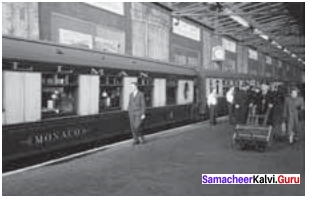
Philip Sletherby travels in a train to meet Mrs. Saltpen Jago. He decided to gain some political mileage by getting her acquaintance. Sletherby wanted to be a candidate for the MP election in the eastern division of Chalkshire. As she had invited him on a friendly luncheon-party at her country house he counted on her for nominating him. The silence in the compartment was spoiled by the smothered cries of a young man who was obviously looking for something. As Mr, Philip Sletherby did not show any interest in his despair, he himself explained his situation. He was glad that the narrator was going to spend his week-end with his mother Mrs. Saltpen – Jago at Brill Manor. The boy said that he hadn’t seen his mom for almost six months. He was Bertie and he had lost his royal seal and the money purse. He needed three quid for his brief stay and ticket fare to his home. He was on a fishing expedition.

A Shot In The Dark Summary In Tamil Samacheer Kalvi 11th English Solutions Supplementary Chapter 2

Mr. Sletherby agreed to lend but asked him, what was his crest? The young man said it was the demi-lion holding a eross-crosslet in its paw, With a tinge of coldness in his voice, Sletherby said that his mom had written a grey hound courant on her notepaper. The young man said they could use both. Demi-lion was Saltpen crest and Grey Hound was Jago-crest. The young man said that he always used the demi-lion. He also added that he was getting down in the next station. Sletherby asked him if his mom resembled him. The boy said that she had the same dark brown hair like him. When the boy was about to get out, he reminded him of the loan of three quid. Sletherby said that he had met his mom who was a pronounced blonde. The young man stamps his. feet furiously. A tall footman had arrived at the railway station to receive him.

11th English Unit 2 Supplementary Solutions A Shot In The Dark Samacheer Kalvi

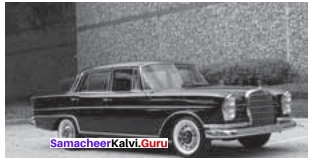
A luxury vehicle was parked. The footman Mr. K.C. explained a lot about the car. But nothing entered his brain as he saw two crests on the car “s door panel-a grey hound courant and a demi-lion holding in its paw a cross-erosslet. The second blow follows when KC said that Mrs. Saltpen-Jago used to have beautiful dark brown hair which agreed well with her complexion. She shocked everybody bv changing her looks as a brilliant blonde. She had ruined her looks. Suddenly Mr. Sletherby turned pale. Mr. K.C. asked if he was ill.

A Shot In The Dark Supplementary Samacheer Kalvi 11th English Solutions Chapter 2

1. Rearrange the sentences given below:

astuteness – cleverness
blonde – pale yellow hair
chaise – horse-drawn carriage
*courant -/ko ra:nt/ – animal represented in the act Of running
crest -a symbol representing a family, reproduced on writing paper
discrepancy – difference
embarked – boarded
espied – caught sight of
exchequer – national treasury
expounded – explained
Honoria /hD ‘ na:na/ – (Latin) honour, a woman of reputation
ineffectually – In vam
mater / ‘ melta/ – (Latin) mother
pantomime – exaggerated behaviour
quid – (British) one pound Sterling
ruefully – regretfully, sorrowfully
sedately – in a dignified manner
soi- disant -self styled
sumptuous – expensive looking
tackle – equipment required for a task or sport
volubility – fluency, talkativeness

Additional:
apologise – seek forgiveness
alarmed – afraid of danger
dumb struck – shocked
exactly – correctly, accurately
frantically – quickly in a disorderly manner

The main aim is to share the knowledge and help the students of 11th English to secure the best score in their final exams. Use the concepts of Samacheer Kalvi 11th English Book Solutions Supplementary Chapter 2 A Shot In the Dark Questions and Answers in Real time to enhance your skills. If you have any doubts you can post your comments in the comment section, We will clarify your doubts as soon as possible without any delay.

Samacheer Kalvi 11th Computer Science Solutions Chapter 7 Composition and Decomposition

Students can Download Computer Science Chapter 7 Composition and Decomposition Questions and Answers, Notes Pdf, Samacheer Kalvi 11th Computer Science Book Solutions Guide Pdf helps you to revise the complete Tamilnadu State Board New Syllabus and score more marks in your examinations.

Tamilnadu Samacheer Kalvi 11th Computer Science Solutions Chapter 7 Composition and Decomposition

Samacheer Kalvi 11th Computer Science Composition and Decomposition Text Book Back Questions and Answers

PART – 1
I. Choose The Correct Answer

11th Computer Science Chapter 7 Book Back Answers Question 1.
Suppose u, v = 10, 5 before the assignment. What are the values of u and v after the sequence of assignments?
1. u : = v
2. v : = u
(a) u, v = 5, 5
(b) u, v = 10, 5
(c) u, v = 5, 10
(d) u, v = 10, 10
Answer:
(a) u, v = 5, 5

Composition And Decomposition In Computer Science Question 2.
Which of the following properties is true after the assignment (at line 3?
1. – – i + j = 0
2. i, j : = i + 1, j – 1
3. – – ?
(a) i + j > 0
(b) i + j < 0
(c) i + j = 0
(d) i = j
Answer:
(c) i + j = 0

Class 11 Computer Science Chapter 7 Solutions Question 3.
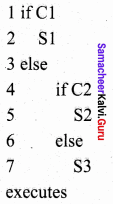
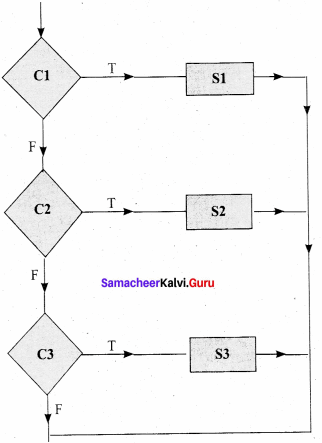
If C1 is false and C2 is true, the compound statement
11th Computer Science Chapter 7 Book Back Answers Composition And Decomposition Samacheer Kalvi
(a) S1
(b) S2
(c) S3
(d) none
Answer:
(b) S2

Computer Science Samacheer Kalvi Question 4.
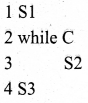
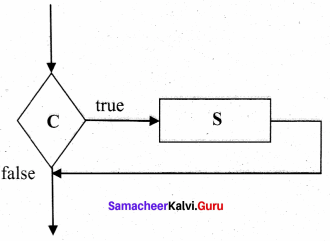
If C is false just before the loop, the control flows through
Composition And Decomposition In Computer Science Samacheer Kalvi 11th Solutions Chapter 7
(a) S1 ; S3
(b) S1 ; S2 ; S3
(c) S1 ; S2 ; S2 ; S2 ; S3
(d) S1 ; S2 ; S2 ; S2 ; S3
Answer:
(a) S1 ; S3

Samacheer Kalvi Computer Science Question 5.
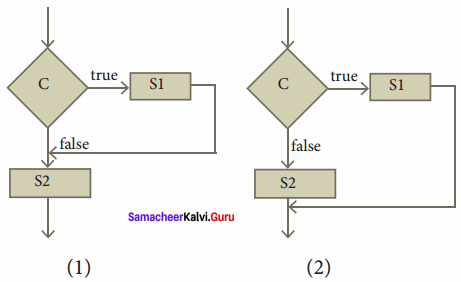
If C is true, S1 is executed in both the flowcharts, but S2 is executed in
Class 11 Computer Science Chapter 7 Solutions Composition And Decomposition Samacheer Kalvi
(a) (1) only
(b) (2) only
(c) both (1) and (2)
(d) neither (1) nor (2)
Answer:
(a) (1) only

Samacheer Kalvi Guru 7th Computer Science Question 6.
How many times the loop is iterated?
i : = 0
while i ≠ 5
i : = i + 1
(a) 4
(b) 5
(c) 6
(d) 0
Answer:
(b) 5

PART – 2
II. Short Answers

Samacheer Kalvi Guru 11th Computer Science Question 1.
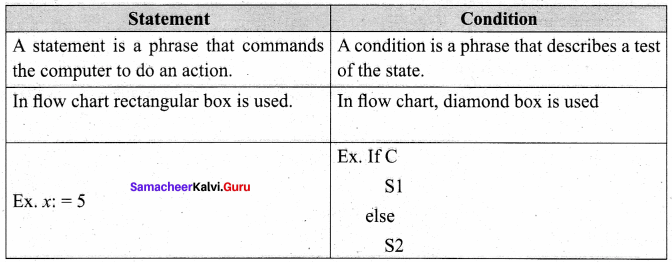
Distinguish between a condition and a statement.
Answer:
Computer Science Samacheer Kalvi 11th Solutions Chapter 7 Composition And Decomposition

Samacheer Kalvi Computer Science Book Question 2.
Draw a flowchart for conditional statement.
Answer:
Samacheer Kalvi Computer Science 11th Solutions Chapter 7 Composition And Decomposition

11 Computer Science Samacheer Kalvi Question 3.
Both conditional statement and iterative statement have a condition and a statement. How do they differ?
Answer:
Conditional Statement:

  • Statements are executed only once when the condition is true.
  • If condition statement.

Iterative Statement:

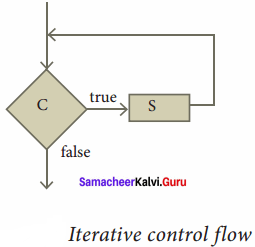
  • Iterative statement repeatedly evaluates a condition and executes a statement until it becomes false.
  • While condition statement.

Samacheer Kalvi Guru Computer Science Question 4.
What is the difference between an algorithm and a program?
Answer:
Algorithm:

  • Algorithm is for human readers to understand.
  • Knowledge of English is needed.
  • Easy to understand.

Program:

  • Program is for the computers to execute directly.
  • Knowledge of programming language is required.
  • It is difficult to understand.

Computer Science Textbook Solutions Question 5.
Why is function an abstraction?
Answer:
Once a function is defined, it can be used over and over and over again. Reusability of a single function several times is known as an abstraction.

Computer Chart For 11th Class Question 6.
How do we refine a statement?
Answer:
In refinement, each statement is repeatedly expanded into more detailed statements in the subsequent levels.

PART – 3
Explain in Brief

Computer Charts For Class 11 Question 1.
For the given two flowcharts write the pseudo code.
Answer:

  1. Enter A,B
  2. Initialise Q = 0, r = A
  3. If r > B, then do Q = Q + 1; r = r – B else r, q
  4. Exit

Samacheer Kalvi Guru 11 Computer Science Question 2.
If C is false in line 2, trace the control flow in this algorithm.

  1. S1
  2. – – C is false
  3. if C
  4. S2
  5. else
  6. S3
  7. S4

Answer:
S1 ; S2 ; S4

Statement Meaning In Computer Question 3.
What is case analysis?
Answer:
Case Analysis statement generalizes the problem into multiple cases. Case Analysis splits the problem into an exhaustive set of disjoint cases.

Question 4.
Draw a flowchart for -3 case analysis using alternative statements.
Answer:
Samacheer Kalvi Guru 7th Computer Science Composition And Decomposition Solutions

Question 5.
Define a function to double a number in two different ways:

  1. n + n
  2. 2 x n

Answer:
1. Double (n)
– – inputs: n is a real number or an integer, n > 0
– – Outputs: y is a real number or an integer such that y = n + n

2. Double (n)
– – inputs: n is a real number or an integer, n > 0
– – Outputs: y is a real number or an integer such that y = 2 x n

PART – 4
IV. Explain in Detail

Question 1.
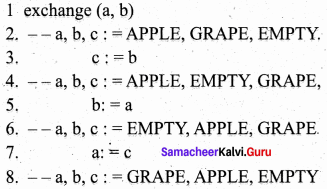
Exchange the contents: Given two glasses marked A and B. Glass A is full of apple drink and glass B is full of grape drink. Write the specification for exchanging the contents of glasses A and B, and write a sequence of assignments to satisfy the specification.
Answer:
Let the variables a, b, c represent Glass A, Glass B and Glass C and a, b, c can store values APPLE, GRAPE or EMPTY.
Specification:

  1. exchange (a, b)
  2. – – inputs: a, b : = APPLE, GRAPE
  3. – – outputs: a, b : = GRAPE, APPLE

Algorithm:
Samacheer Kalvi Guru 11th Computer Science Solutions Chapter 7 Composition And Decomposition

Question 2.
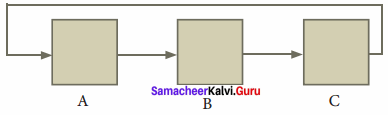
Circulate the contents: Write the specification and construct an algorithm to circulate the contents of the variables A, B and C as shown below: The arrows indicate that B gets the value of A, C gets the value of B and A gets the value of C.
Samacheer Kalvi Computer Science Book 11th Solutions Chapter 7 Composition And Decomposition
Specifications:

  1. circulate
  2. – – inputs: a, b, c: = A, B, C
  3. – – outputs: a, b, c: = C, A, B

Algorithm:

  1. circulate (a, b, c)
  2. – – a, b, c: = A, B, C
  3. temp : = c
  4. c : = b
  5. b : = a
  6. a : = temp
  7. – – a, b, c: = C, A, B

Question 3.
Decanting problem. You are given three bottles of capacities 5, 8, and 3 litres. The 8L bottle is filled with oil, while the other two are empty. Divide the oil in 8L bottle into two equal quantities. Represent the state of the process by appropriate variables. What are the initial and final states of the process? Model the decanting of oil from one bottle to another by assignment. Write a sequence of assignments to achieve the final state.
Answer:
(a)
Let a, b, c be the variables whose maximum value are 8L, 5L and 3L respectively.
Initial State:
11 Computer Science Samacheer Kalvi Science Solutions Chapter 7 Composition And Decomposition
a, b, c: = 8, 0, 0

Final State:
Samacheer Kalvi Guru Computer Science 11th Solutions Chapter 7 Composition And Decomposition
a, b, c: = 4, 4, 0

Specifications:

  1. decant
  2. – – inputs: a, b, c : = 8, 0, 0
  3. – – outputs: a, b, c : = 4, 4, 0

Algorithm:
Let us assume that a: = b denote oil in b is poured into a bottle until either “a” is full or “b” becomes empty.

  1. decant (a, b, c)
  2. – – a, b, c : = 8, 0, 0
  3. b : = a
  4. – – a, b, c : = 3, 5, 0
  5. c : = b
  6. – – a, b, c : = 3, 2, 3
  7. a : = c
  8. – – a, b, c : = 6, 2, 0
  9. c : = b
  10. – – a, b, c : = 6, 0, 2
  11. b : = a
  12. – – a, b, c : = 1, 5, 2
  13. c : = b
  14. – – a, b, c : = 1, 4, 3
  15. a : = c
  16. – – a, b, c: = 4, 4, 0

Question 4.
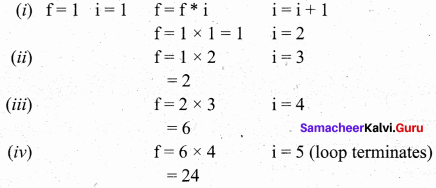
Trace the step – by – step execution of the algorithm for factorial(4).
factorial(n)
– – inputs : n is an integer , n ≥ 0
– – outputs : f = n!
f, i : = 1,1
while i ≤ n
f, i : = f x i, i + 1
Answer:
Computer Science Textbook Solutions Chapter 7 Composition And Decomposition Samacheer Kalvi 11th

Samacheer kalvi 11th Computer Science Composition and Decomposition Additional Questions and Answers

PART – 1
I. Choose the correct answer

Question 1.
Which one of the following is odd?
(a) Python
(b) C++
(c) C
(d) Ctrl + S
Answer:
(d) Ctrl + S

Question 2.
………………. is a diagrammatic notation for representing algorithms.
(a) Pseudo code
(b) Flowchart
(c) Program
(d) Languages
Answer:
(b) Flowchart

Question 3.
There are important control flow statements.
(a) four
(b) three
(c) two
(d) five
Answer:
(b) three

Question 4.
A ………………. statement is composed of a sequence of statements.
(a) iterative
(b) conditional
(c) sequential
(d) alternative
Answer:
(c) sequential

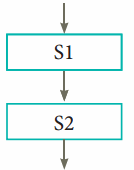
Question 5.
A ………………. is contained in a rectangular box with a single outgoing arrow, which points to the box to be executed next.
(a) statement
(b) composition
(c) notation
(d) condition
Answer:
(a) statement

Question 6.
The triangle is right – angled, if ……………….
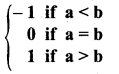
(a) C = a – b
(b) C2 = a2 + b2
(c) C2 = (a + b)2
(d) c2 = a2 – b2
Answer:
(b) C2 = a2 + b2

Question 7.
The algorithm can be specified as ……………….
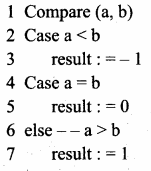
(a) monochromatize (a, b, c)
(b) a = b = 0
(c) C = A + B + C
(d) none
Answer:
(a) monochromatize (a, b, c)

Question 8.
After an algorithmic problem is decomposed into subproblems, we can abstract the subproblems as ……………….
(a) refinement
(b) pseudo – code
(c) decomposition
(d) functions
Answer:
(d) functions

Question 9.
Which one of the following is the elementary problem solving techniques?
(a) Specification
(b) Abstraction
(c) Composition
(d) decomposition
Answer:
(d) decomposition

Question 10.
Which one of the following have only high level details?
(a) Flow chart
(b) Algorithm
(c) Programs
(d) Pseudocode
Answer:
(b) Algorithm

Question 11.
How many different notations are there for representing algorithms?
(a) 2
(b) 3
(c) 4
(d) 5
Answer:
(b) 3

Question 12.
Which one of the following notations will be executed by computers?
(a) Flow chart
(b) Pseudocode
(c) Programming languages
(d) Compiler
Answer:
(c) Programming languages

Question 13.
Which one of the following algorithmic notation is used for communication among people?
(a) Flow chart
(b) Pseudo code
(c) PL
(d) Interpreter
Answer:
(b) Pseudo code

Question 14.
Which one of the following algorithmic notation is used for giving visual intuition of control flow?
(a) Flow chart
(b) Programming languages
(c) Pseudo code
(d) Compiler
Answer:
(a) Flow chart

Question 15.
The algorithmic notation similar to Programming language is ……………….
(a) Flow chart
(b) Pseudo code
(c) C ++
(d) C
Answer:
(b) Pseudo code

Question 16.
Identify the statement which is wrong ……………….
(a) Programs must obey the grammar of the Programming language exactly.
(b) The punctuations in Programming language must be exactly.
(c) The Programming language is informal.
(d) Translator translates the programs into instructions.
Answer:
(c) The Programming language is informal.

Question 17.
Which one is used for converting programs into computer executable instructions?
(a) Converter
(b) Apps
(c) Translator
(d) exe files
Answer:
(c) Translator

Question 18.
Identify the correct statement from the following?
(a) Pseudo code can be executed by the computer directly.
(b) Pseudo code cannot be executed by the computer directly.
(c) Algorithm cannot be expressed in Pseudo code
(d) Algorithm are written only for python language
Answer:
(b) Pseudo code cannot be executed by the computer directly.

Question 19.
The notation which is not formal nor exact is ……………….
(a) Flow chart
(b) Pseudo code
(c) Compiler
(d) Translator
Answer:
(b) Pseudo code

Question 20.
Identify the correct statements.
(i) Pseudo code uses natural English for statements and conditions..
(ii) Pseudo code notation is formal one.
(iii) There is no need to follow the rules of the Programming language grammer
(iv) It must be rigorous and correct.
(a) (i) (ii) (iii)
(b) (ii) (iii) (iv)
(c) (i) (iii) (iv)
(d) (i) (ii) (iii) (iv)
Answer:
(c) (i) (iii) (iv)

Question 21.
Find the pair which is wrongly matched.
(a) Rectangular boxes – Statements
(b) Diamond boxes – Output
(c) Arrow – Control flow
(d) Parallelogram – Input
Answer:
(b) Diamond boxes – Output

Question 22.
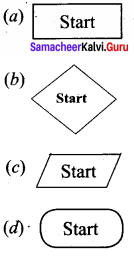
Find the correct flow chart diagram from the following.
Computer Chart For 11th Class Science Solutions Chapter 7 Composition And Decomposition Samacheer Kalvi
Answer:
Computer Charts For Class 11 Science Solutions Chapter 7 Composition And Decomposition Samacheer Kalvi

Question 23.
The inputs and outputs are drawn using ……………….. boxes.
(a) rectangular
(b) diamond
(c) Parallelogram
(d) Oval
Answer:
(c) Parallelogram

Question 24.
The symbol used for representing the box to be executed next is ………………..
(a) ⇒
(b) ⇓
(c) ↓
(d) ++
Answer:
(c) ↓

Question 25.
The flow of control is represented in the flowchart by ………………..
(a) arrow
(b) dot
(c) box
(d) plus
Answer:
(a) arrow

Question 26.
In flow chart, rectangular boxes represents ………………..
(a) statements
(b) condition
(c) Input
(d) End
Answer:
(a) statements

Question 27.
A condition is contained in a diamond shaped box with ……………….. outgoing arrows.
(a) 2
(b) 3
(c) 4
(d) 5
Answer:
(a) 2

Question 28.
A collection of boxes containing statements and conditions connected by arrow are ………………..
(a) compiler
(b) Flow chart
(c) Pseudo code
(d) Algorithm
Answer:
(b) Flow chart

Question 29.
Match the following:
Samacheer Kalvi Guru 11 Computer Science Solutions Chapter 7 Composition And Decomposition
(a) (i) -4 (ii) 0 – 1 (iii) – 2 (iv) – 3
(b) (i) – 1 (ii) – 2 (iii) – 3 (iv) – 4
(c) (i) – 4 (ii) – 2 (iii) – 1 (iv) – 3
(d) (i) – 3 (ii) – 2 (iii) – 1 (iv) – 4
Answer:
(a) (i) -4 (ii) 0 – 1 (iii) – 2 (iv) – 3

Question 30.
How many outgoing arrows are needed for rectangular boxes in flow chart?
(a) 0
(b) 1
(c) 2
(d) 3
Answer:
(b) 1

Question 31.
Statements composed of other statements are known as:
(a) Simple Statements
(b) Compound Statements
(c) Conditional
(d) Control flow
Answer:
(b) Compound Statements

Question 32.
Which one of the following is not a control flow statements?
(a) Sequential
(b) Assignment
(c) Iterative
(d) Alternative
Answer:
(b) Assignment

Question 33.
Which one of the following statement is used to alter the normal flow of control of the program?
(a) Assignments
(b) Control flow
(c) Compound
(d) both b & c
Answer:
(d) both b & c

Question 34.
Which one of the following statements are executed one after the other as written in the algorithm?
(a) Sequential
(b) Iterative
(c) Conditional
(d) Decisive
Answer:
(a) Sequential

Question 35.
Alternative statements analyses the problem into ……………….. cases.
(a) 2
(b) 3
(c) 4
(d) 5
Answer:
(a) 2

Question 36.
Case analysis statement generalizes the statement into ……………….. cases.
(a) 2
(b) 3
(c) 5
(d) multiple
Answer:
(d) multiple

Question 37.
If sC is a ……………….. statement.
(a) Conditional
(b) Alternative
(c) Case Analysis
(d) Iterative
Answer:
(a) Conditional

Question 38.
Which one of the following process executes the same action repeatedly?
(a) Conditional
(b) Alternative
(c) Iterative
(d) None of these
Answer:
(c) Iterative

Question 39.
The iterative statement is commonly known as a ………………..
(a) loop
(b) Case Analysis
(c) Alternative
(d) Conditional
Answer:
(a) loop

Question 40.
Testing the loop condition and executing the loop body once is called ………………..
(a) alternative
(b) conditional
(c) Iteration
(d) Decomposition
Answer:
(c) Iteration

PART – 2
II. Short Answers

Question 1.
What is a Programming Language?
Answer:

  1. A programming language is a notation for expressing algorithms to be executed by computers.
  2. Programs must obey the grammar of the programming language exactly. Ex. C, C++, python.

Question 2.
What is a Pseudo code?
Answer:
Pseudo code is a mix of programming language like constructs and plain English. Algorithms expressed in Pseudo code are not intended to be executed by computers but for human readers to understand.

Question 3.
What is a Flow – chart?
Answer:
Flow chart is a diagrammatic notation for representing algorithms. A flow chart is a collection of boxes containing statements and conditions which are connected by arrows showing the order in which the boxes are to be executed.

Question 4.
What is a control flow statement. Classify it.
Answer:
Control flow statements are compound statements. They are used to alter the control flow of the process depending on the state of the process. They are classified as:

  1. Sequential
  2. Alternative
  3. Iterative

Question 5.
What is meant by Decomposition?
Answer:
Decomposition is one of the elementary problem-solving techniques. An algorithm may be broken into parts, expressing only high level details. Then, each part may be refined into smaller parts, expressing finer details or each part may be abstracted as a function.

Question 6.
When a condition statement will be executed?
Answer:
It will be executed only when the condition statement is true.

Question 7.
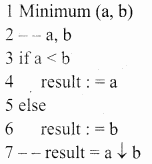
Write the algorithm specification to find minimum of 2 numbers.
Answer:
Minimum (a, b)
– – inputs : a, b
– – outputs : result = a >1 b

Question 8.
Draw the flowchart for alternative control flow.
Answer:
Statement Meaning In Computer Samacheer Kalvi 11th Science Solutions Chapter 7 Composition And Decomposition

PART – 3
III. Explain in Brief

Question 1.
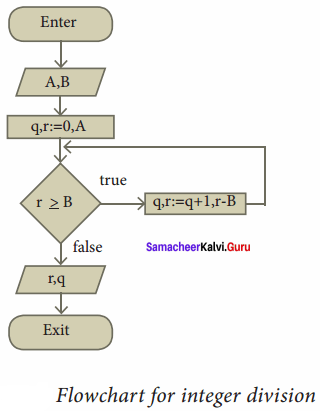
Draw the diagram flowchart for integer division.
Answer:
Samacheer Kalvi 11th Computer Science Solutions Chapter 7 Composition and Decomposition 17

Question 2.
Explain conditional statement.
Answer:
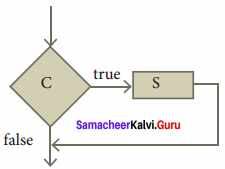
Conditional statement: Sometimes we need to execute a statement only if a condition is true and do nothing if the condition is false. This is equivalent to the alternative statement in which the else clause is empty. This variant of alternative statement is called a conditional statement. If C is a condition and S is a statement, then
Samacheer Kalvi 11th Computer Science Solutions Chapter 7 Composition and Decomposition 18
is a statement, called a conditional statement, that describes the following action:

  1. Test whether C is true or false.
  2. If C is true then do S; otherwise do nothing.

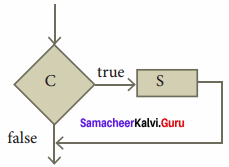
The conditional control flow is depicted in the flowchart.
Samacheer Kalvi 11th Computer Science Solutions Chapter 7 Composition and Decomposition 20

Question 3.
Write a note on refinement.
Answer:
After decomposing a problem into smaller subproblems, the next step is either to refine the subproblem or to abstract the subproblem.
1. Each subproblem can be expanded into more detailed steps. Each step can be further expanded to still finer steps, and so on. This is known as refinement.

2. We can also abstract the subproblem. We specify each subproblem by its input property and the input – output relation. While solving the main problem, we only need to know the specification of the subproblems. We do not need to know how the subproblems are solved.

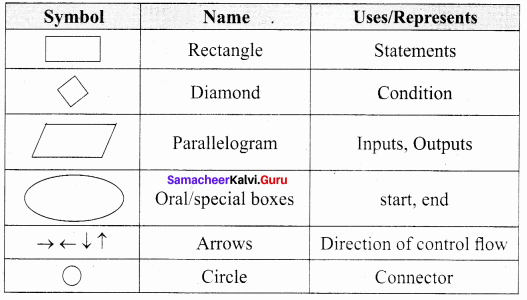
Question 4.
Draw various symbols used in flowchart with their usage.
Answer:
Samacheer Kalvi 11th Computer Science Solutions Chapter 7 Composition and Decomposition 19

Question 5.
Write a Algorithm to find minimum of 2 numbers.
Answer:
Samacheer Kalvi 11th Computer Science Solutions Chapter 7 Composition and Decomposition 21

Question 6.
Samacheer Kalvi 11th Computer Science Solutions Chapter 7 Composition and Decomposition 22
Answer:
Samacheer Kalvi 11th Computer Science Solutions Chapter 7 Composition and Decomposition 23

Question 7.
Construct an iterative algorithm to compute the quotient and remainder after dividing an integer A by another integer B.
Answer:
divide (A, B)
– – inputs: A is an integer and B ≠ 0
– – Outputs: q and r such that A = q x B + r and 0 < r < B
q : = 0, A
While r ≥ B
q, r : = q + 1, r – B

PART – 4
IV. Explain in Detail

Question 1.
Write the disadvantages of flowcharts.
Answer:
Disadvantages of flowcharts:

  1. Flowcharts are less compact than representation of algorithms in programming language or pseudo code.
  2. They obscure the basic hierarchical structure of the algorithms.
  3. Alternative statements and loops are disciplined control flow structures.

Question 2.
Explain the sequential statement in detail with the diagram.
Answer:
A sequential statement is composed of a sequence of statements. The statements in the sequence are executed one after another, in the same order as they are written in the algorithm, and the control flow is said to be sequential. Let S1 and S2 be statements. A sequential statement composed of S1 and S2 is written as
S1
S2
In order to execute the sequential statement, first do S1 and then do S2. The sequential statement given above can be represented in a flowchart. The arrow from S1 to S2 indicates that S1 is
Samacheer Kalvi 11th Computer Science Solutions Chapter 7 Composition and Decomposition 24
Let the input property be P, and the input-output relation be Q, for a problem. If statement S solves the problem, it is written as

  1. – – p
  2. S
  3. – – Q

If we decompose the problem into two components, we need to compose S as a sequence of two statements S1 and S2 such that the input-output relation of S1, say R, is the input property of S2.

  1. – – P
  2. S1
  3. – – R
  4. S2
  5. – – Q

Question 3.
Write a note on case analysis.
Answer:
Alternative statement analyses the problem into two cases. Case analysis statement generalizes it to multiple cases. Case analysis splits the problem into an exhaustive set of disjoint cases. For each case, the problem is solved independently. If Cl, C2, and C3 are conditions, and S1, S2, S3 and S4 are statements, a 4 – case analysis statement has the form,

  1. case C1
  2. S1
  3. case C2
  4. S2
  5. case C3
  6. S3
  7. else
  8. S4

The conditions C1, C2, and C3 are evaluated in turn. For the first condition that evaluates to true, the corresponding sttement is executed, and the case analysis statement ends. If none of the conditions evaluates to true, then the default case S4 is executed.

  1. The cases are exhaustive: at least one of the cases is true. If all conditions are false, the default case is true.
  2. The cases are disjoint: only one of the cases is true. Though it is possible for more than one condition to be true, the case analysis always executes only one case, the first one that is true. If the three conditions are disjoint, then the four cases are (1) C1, (2) C2, (3) C3, (4) (not C1) and (not C2) and (not C3).

Question 4.
What is a function? Explain in detail.
Answer:
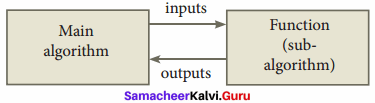
After an algorithmic problem is decomposed into subproblems, we can abstract the subproblems as functions. A function is like a sub-algorithm. Similar to an algorithm, a function is specified by the input property, and the desired input – output relation.
Samacheer Kalvi 11th Computer Science Solutions Chapter 7 Composition and Decomposition 25
To use a function in the main algorithm, the user need to know only the specification of the function – the function name, the input property, and the input – output relation. The user must ensure that the inputs passed to the function will satisfy the specified property and can assume that the outputs from the function satisfy the input – output relation. Thus, users of the function need only to know what the function does, and not how it is done by the function. The function can be used a “black box” in solving other problems.

Ultimately, someone implements the function using an algorithm. However, users of the function need not know about the algorithm used to implement the function. It is hidden from the users. There is no need for the users to know how the function is implemented in order to use it.

An algorithm used to implement a function may maintain its own variables. These variables are local to the function in the sense that they are not visible to the user of the function. Consequently, the user has fewer variables to maintain in the main algorithm, reducing the clutter of the main algorithm.

Question 5.
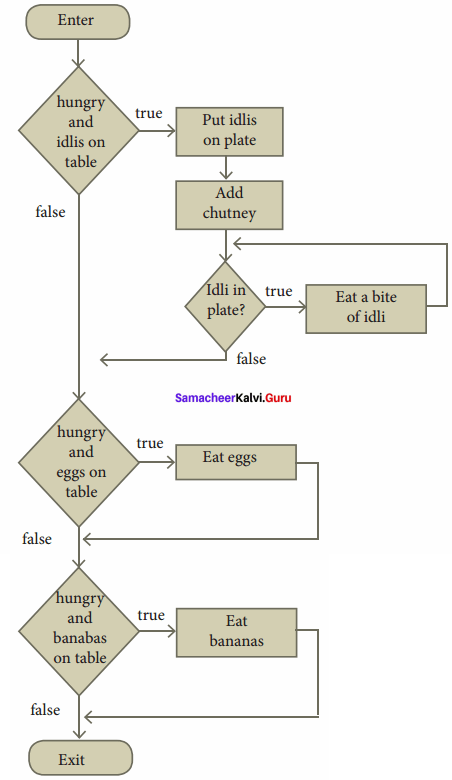
Draw the flowchart for Eat breakfast.
Answer:
Samacheer Kalvi 11th Computer Science Solutions Chapter 7 Composition and Decomposition 26

Question 6.
Explain Alternative statement.
Answer:
Alternative statement:
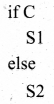
A condition is a phrase that describes a test of the state. If C is a condition and both S1 and S2 are statements, then
Samacheer Kalvi 11th Computer Science Solutions Chapter 7 Composition and Decomposition 31
is a statement, called an alternative statement, that describes the following action:
Samacheer Kalvi 11th Computer Science Solutions Chapter 7 Composition and Decomposition 27

  1. Test whether C is true or false.
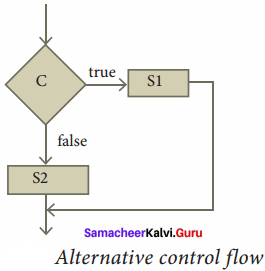
  2. If C is true, then do S1; otherwise do S2.

In pseudo code, the two alternatives S1 and S2 are indicated by indenting them from the keywords if and else, respectively. Alternative control flow is depicted in the flowchart. Condition C has two outgoing arrows, labeled true and false. The true arrow points to the S1 box. The false arrow points to the S2 box. Arrows out of S1 and S2 point to the same box, the box after the alternative statement.

Conditional statement:
Sometimes we need to execute a statement only if a condition is true and do nothing if the condition is false. This is equivalent to the alternative statement in which the else clause is empty. This variant of alternative statement is called a conditional statement.
Samacheer Kalvi 11th Computer Science Solutions Chapter 7 Composition and Decomposition 28
If C is a condition and S is a statement, then
Samacheer Kalvi 11th Computer Science Solutions Chapter 7 Composition and Decomposition 32

  1. Test whether C is true or false.
  2. If C is true then do S; otherwise do nothing.

The conditional control flow is depicted in the flowchart.

Question 7.
Explain various symbols in Flow chart.
Answer:
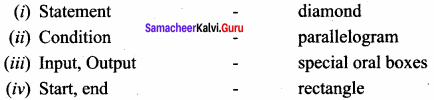
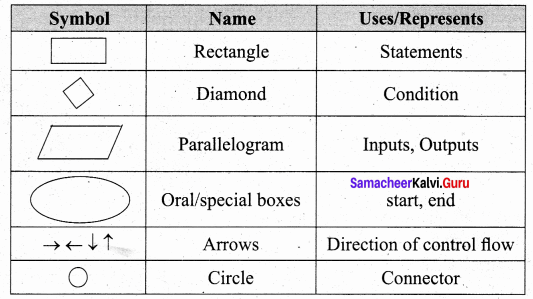
Flowchart is a diagrammatic notation for representing algorithms. They show the control flow of algorithms using diagrams in a visual manner. In flowcharts, rectangular boxes represent simple statements, diamond-shaped box represent conditions, and arrows describe how the control flows during the execution of the algorithm. A flowchart is a collection of boxes containing statements and conditions which are connected by arrows showing the order in which.the boxes are to be executed.
Samacheer Kalvi 11th Computer Science Solutions Chapter 7 Composition and Decomposition 29

  1. A statement is contained in a rectangular box with a single outgoing arrow,which points to the box to be executed next.
  2. A condition is contained in a diamond shaped box with two outgoing arrows, labeled true and false. The true arrow points to the box to be executed next if the condition is true, and the false arrow points to the box to be executed next if the condition is false.
  3. Parallelogram boxes represent inputs given and outputs produced.
  4. Special boxes marked Start and the End are used to indicate the start and the end of an execution:

The flowchart of an algorithm to compute the quotient and remainder after dividing an integer A by another integer B is shown below, illustrating the different boxes such as input, output, condition, and assignment, and the control flow between the boxes.

Flowcharts also have disadvantages.

  1. Flowcharts are less compact than representation of algorithms in programming language or pseudo code.
  2. They obscure the basic hierarchical structure of the algorithms.
  3. Alternative statements and loops are disciplined control flow structures. Flowcharts do not . restrict us to disciplined control flow structures.

Samacheer Kalvi 12th Chemistry Solutions Chapter 8 Ionic Equilibrium

Are you searching for the Samacheer Kalvi 12th Chemistry Chapter Wise Solutions PDF? Then, get your Samacheer Kalvi 12th Chapter Wise Solutions PDF for free on our website. Students can Download Chemistry Chapter 8 Ionic Equilibrium Questions and Answers, Notes Pdf, Samacheer Kalvi 12th Chemistry Solutions Guide Pdf helps you to revise the complete Tamilnadu State Board New Syllabus and score more marks in your examinations.

Tamilnadu Samacheer Kalvi 12th Chemistry Solutions Chapter 8 Ionic Equilibrium

All concepts are explained in an easy way on our website. So, students can easily learn and practice Tamilnadu State Board 12th Chemistry Chapter 8 Ionic Equilibrium Question and Answers. You can enjoy the digitized learning with the help of the Tamilnadu State Board Chemistry Online Material.

Samacheer Kalvi 12th Chemistry Chapter 8 Ionic Equilibrium Textual Evaluation Solved

Samacheer Kalvi 12th Chemistry Ionic Equilibrium Multiple Choice Questions

I. Choose the correct answer.

12th Chemistry Ionic Equilibrium Question 1.
Concentration of the Ag+ ions in a saturated solution of Ag2C2O4 is 2.24 x 10⁻⁴ mol L-1 solubility product of Ag2C2O4 is ………………
(a) 2.42 x 10⁻⁸ mol3 L-3
(b) 2.66 x 10⁻¹² 12 mol3 L-3
(c) 45 x 10-11 mol3 L-3
(d) 5.619 x 10⁻¹² mol3 L-3
Answer:
(d) 5.619 x 10⁻¹² mol3 L-3
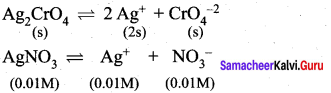
Ag2C2O4 2Ag+ + C2 O42-
[Ag+] = 2.24 x 10⁻⁴ mol L-1
12th Chemistry Ionic Equilibrium Samacheer Kalvi Solutions Chapter 8
= 1.12 x 10⁻⁴ mol L-1
Ksp = [Ag+]2 [C2O42-]
=(2.24 x 10⁻⁴ mol L-1)2 (1.12 x 10⁻⁴ mol L-1)
=5.619 x 10⁻¹² mol3 L-3

12th Chemistry Chapter 8 Book Back Answers Question 2.
Following solutions were prepared by mixing different volumes of NaOH of HCl different concentrations.
(i) 60 mL \(\frac { M }{ 10 }\) HCI + 40 mL \(\frac { M }{ 10 }\) NaOH
(ii) 55 mL \(\frac { M }{ 10 }\) HCl + 45 mL \(\frac { M }{ 10 }\) NaOH
(iii) 75 mL \(\frac { M }{ 5 }\) HCI +25 mL \(\frac { M }{ 5 }\) MNaOH
(iv) 100 mL \(\frac { M }{ 10 }\) HCI+ 100 mL \(\frac { M }{ 10 }\) NaOH

pH of which one of them wilt be equal to 1?
(a) (iv)
(b) (i)
(c) (ii)
(d) (iii)
Answer:
(d) (iii) 75 mL \(\frac { M }{ 5 }\) HCI + 25 mL \(\frac { M }{ 5 }\) NaOH
No of moles of HCl = 0.2 x 75 x 10-3 = 15 x 10-3
No of moles of NaOH = 0.2 x 25 x 10-3 = 5 x 1o-3
No of moles of HCl after mixing = 15 x 10-3 – 5 x 10⁻³
∴ Concentration of HCl
12th Chemistry Chapter 8 Book Back Answers Ionic Equilibrium Samacheer Kalvi
for (iii) solution, pH of 0.1 M HCI = – 1og10 (0.1) = 1.

12th Chemistry 8th Lesson Book Back Answers Question 3.
The solubility of BaSO4 in water is 2.42 x 10⁻³ gL-1 at 298K. The value of its solubility product
(Ksp) will be …………………..
(Given molar mass of BaSO4 = 233g mol-1)
(a) 1.08 x 10⁻¹⁴ mol2L2
(b) 1.08 x 10⁻¹² mol2L2
(c) 1.08 x 10⁻¹⁰ mol2 L2
(d) 1.08 x 10⁻⁸ mol2L-2
Answer:
(c) 1.08 x 10⁻¹⁰ mol2 L2
BaSO4 \(\rightleftharpoons\) Ba2+ + SO42-
Ksp = (s) (s)
Ksp = (s)2
12th Chemistry 8th Lesson Book Back Answers Samacheer Kalvi Ionic Equilibrium

Ionic Equilibrium Questions And Answers Pdf Question 4.
pH of a saturated solution of Ca(OH)2 is 9. The Solubility product (K) of Ca(OH)2 ………………..
(a) 0.5 x 10⁻¹⁵
(b) 0.25 x 10⁻¹⁰
(c) 0.125 x 10⁻¹⁵
(d) 0.5 x 10⁻¹⁰
Answer:
(a) 0.5 x 10⁻¹⁵
Ca(OH)2 \(\rightleftharpoons\) Ca2+ + 2OH
Given that pH = 9
pOH = 14 – 9 = 5
[p0K = – 1og10[OH]]
[OH] = 10-pOH
[OH] =10-5M
Ksp = [Ca2+] [OH]2
Samacheer Kalvi 12th Chemistry Solutions Chapter 8 Ionic Equilibrium-4
=0.5

Class 12 Ionic Equilibrium Question 5.
Conjugate base for bronsted acids H2O and HF are ………………
(a) OH and H2FH+, respectively
(b) H3O+ and F, respectively
(c) OH and F, respectively
(d) H3O+ and H2F+, respectively
Answer:
(c) OH and F, respectively
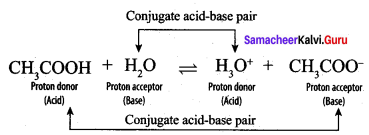
Ionic Equilibrium Questions And Answers Pdf Samacheer Kalvi 12th Chemistry Solutions Chapter 8
∴ Conjugate bases are OH and F respectively

Ionic Equilibrium Notes Pdf Question 6.
Which will make basic buffer?
(a) 50 mL of 0.1M NaOH + 25mL of 01M CH3COOH
(b) 100 mL of 0.1M CH3COOH + 100 mL of 0.1M NH4OH
(c) 100 mL of 0.1M HCI + 200 mL of 0.1M NH4OH
(d) 100 mL of 0.1M HCI + 100 mL of O.1 M NaOH
Answer:
(c) 100 mL of 0.1M HCI + 200 mL of 0.1M NH4OH
Basic buffer is the solution which has weak base and its salt
Samacheer Kalvi 12th Chemistry Solutions Chapter 8 Ionic Equilibrium-6

Samacheer Kalvi Guru 12th Chemistry Question 7.
Which of the following fluro – compounds is most likely to behave as a Lewis base?
(a) BF3
(b) PF3
(c) CF4
(d) SiF4
Answer:
(b) PF3
BF3 → electron deficient → Lewis acid
PF3 → electron rich → Lewis base
CF4 → neutral → neither lewis acid nor base
SiF4 → neutral → neither lewis acid nor base

Samacheer Kalvi Class 12 Chemistry Solutions Question 8.
Which of these is not likely to act as lewis base?
(a) BF3
(b) PF3
(c) CO
(d) F
Answer:
(a) BF3
BF3 → electron deficient → Lewis acid
PF3 → electron rich → Lewis base
CO → having lone pair of electron → Lewis base
F → unshared pair of electron → lewis base

Ionic Equilibrium Notes Question 9.
What is the decreasing order of strength of bases?
OH, NH2, H – C = C and CH3 – CH2
(a) OH > NH2 > H – C = C > CH3 – CH2
(b) NH2 > OH > CH3 – CH2 > H – C = C
(c) CH3 – CH2, > NH2 > H – C = C > OH
(d) OH > H – C = C > CH3 – CH2 > NH2
Answer:
(c) CH3 – CH2, > NH2 > H – C = C > OH
Acid strength decreases in the order
HOH > CH = CH > NH3 > CH3CH3
Its conjucate bases arc in the reverse order
CH3 – CH2 > NH2 > H – C = C > OH

Ionic Equilibrium Question 10.
The aqueous solutions of sodium formate, anilinium chloride and potassium cyanide are respectively
(a) acidic, acidic, basic
(b) basic, acidic, basic
(c) basic, neutral, basic
(d) none of these
Answer:
(b) basic, acidic, basic
Class 12 Ionic Equilibrium Samacheer Kalvi Chemistry Solutions Chapter 8

Class 12 Chemistry Chapter 8 Notes Question 11.
The percentage of pyridine (C5H5N) that forms pyridinium ion (C5H5NH) in a 0.10M aqueous pyridine solution (Kb for C5H5N = 1.7 x 10⁻⁹) iS ……………..
(a) 0.006%
(b) 0.013%
(c) 0.77%
(d) 1.6%
Answer:
(b) 0.013%
Ionic Equilibrium Notes Pdf Samacheer Kalvi 12th Chemistry Solutions Chapter 8
Percentage of dissociation
= \(\sqrt { 1.7 }\) x 10-4 x 100 = 1.3 x 10-2 = 0.013%

Question 12.
Equal volumes of three acid solutions of pH 1,2 and 3 are mixed in a vessel. What will be the H+ ion concentration in the mixture?
(a) 37 x 10-2
(b) 10-6
(c) 0.111
(d) none of these
Answer:
(a) 3.7 x 10⁻²
pH = – log10 [H+]
[H+] = 10-pH
Let the volume be x mL
V1M1 + V2M2 + V3M3 = VM
x mL of 10-1M + x mL of 10-2M + x mL of 10-3 M
= 3 x mL of [H+]
= 3 x mL of [H+]
[H+] =
Samacheer Kalvi 12th Chemistry Solutions Chapter 8 Ionic Equilibrium-9
= 0.037 = 3.7 x 10⁻²

Question 13.
The solubility of AgCl (s) with solubility product 1.6 x 10⁻¹⁰ in 0. 1 M NaCl solution would be ………….
(a) 1.26 x 10⁻⁵ M
(b) 1.6 x 10⁻⁹ M
(c) 1.6 x 10⁻¹¹ M
(d) Zero
Answer:
(b) 1.6 x 10⁻⁹ M
AgCl (s) \(\rightleftharpoons\) Ag+(aq) + Cl(aq)
Samacheer Kalvi Guru 12th Chemistry Solutions Chapter 8 Ionic Equilibrium
Ksp = 1.6 x 10⁻¹⁰
Ksp = [Ag+][Cl]
K = (s) (s+0.1)
0.1 >>s
Samacheer Kalvi Class 12 Chemistry Solutions Chapter 8 Ionic Equilibrium

Question 14.
If the solubility product of lead iodide is 3.2 x 10⁻⁸, its solubility will be …………..
(a) 2 x 10⁻³M
(b) 4 x 10⁻⁴ M
(c) l.6 x 10-5 M
(d) 1.8 x 10⁻⁵ M
Answer:
(a) 2 x 10⁻³M
PbI2 (s) → Pb2+ (aq) + 2I (aq)
Ksp = (s) (2s)2
3.2 x 10-8 = 4s3
Samacheer Kalvi 12th Chemistry Solutions Chapter 8 Ionic Equilibrium-12

Question 15.
Using Gibb’s free energy change, ∆G0 = 57.34 KJ mol-1, for the reaction, X2Y(g) \(\rightleftharpoons\) 2X+ + Y2-(aq), calculate the solubility product of X2Y in water at 300K (R = 8.3 J K-1 Mol-1) ……………….
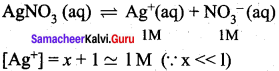
(a) 10-10
(b) 10-12
(c) 10-14
(d) can not be calculated from the given data
Answer:
(a) 10-10
57.34 KJ mol-1 = – 2.303 x 8.3 JK-1 mol-1 x 300K log Ksp
Ionic Equilibrium Notes Samacheer Kalvi 12th Chemistry Solutions Chapter 8
log10Ksp = -10
∴ Ksp = 10-10
∆G0 = – 2.303 RT log Keq
X2Y(s) \(\rightleftharpoons\) 2X+(aq) +Y2-(aq)
Ionic Equilibrium Samacheer Kalvi 12th Chemistry Solutions Chapter 8
Keq = [x+]2[Y2-] ( X2Y(s) = 1)
Keq = K
Question 16.
MY and NY3, are insoluble salts and have the same Ksp values of 6.2 x 10⁻¹³ at room temperature. Which statement would be true with regard to MY and NY3?
(a) The salts MY and NY3 are more soluble in O.5 M KY than in pure water
(b) The addition of the salt of KY to the suspension of MY and NY3 will have no effect on
(c) The molar solubities of MY and NY3 in water are identical
(d) The molar solubility of MY in water is less than that of NY3
Answer:
(d) The molar solubility of MY in water is less than that of NY3
Addition of salt KY (having a common ion Y) decreases the solubility of MY and NY3 due to common ion effect. Option (a) and (b) are wrong.
For salt MY, MY \(\rightleftharpoons\) M+ + Y
Ksp = (s) (s)
6.2 x 10-13 = s2
Class 12 Chemistry Chapter 8 Notes Ionic Equilibrium Samacheer Kalvi
The molar solubility of MY in water is less than of NY3

Question 17.
What is the pH of the resulting solution when equal volumes of 0.1M NaOH and 0.01M HCl are mixed?
(a) 2.0
(b) 3
(c) 7.0
(d) 12.65
Answer:
(d) 12.65
x ml of 0.1 m NaOH + x ml of 0.01 M HCI
No. of moles of NaOH = 0.1 x x x 10-3 = 0.l x x 10-3
No. of moles of HCl = 0.01 x x x 10-3 = 0.01 x x 10-3
No. of moles of NaOH after mixing = 0.1x x 10-3 – 0.01x  x 10-3
= 0.09x x 10-3
Concentration of NaOH =
Samacheer Kalvi 12th Chemistry Solutions Chapter 8 Ionic Equilibrium-166
[OH] = 0.045
pOH = – log (4.5 x 10⁻²)
= 2 – log 4.5
= 2 – 0.65 = 1.35
pH = 14 – 1.35 = 12.65

Question 18.
The dissociation constant of a weak acid is 1 x 10⁻³ . In order to prepare a buffer solution with a pH =4, the [Acid] / [Salt] ratio should be ………………..
(a) 4:3
(b) 3:4
(c) 10:1
(d) 1:10
Answer:
(d) 1:10
Ka = 1 x 10⁻³ ; pH = 4
Samacheer Kalvi 12th Chemistry Solutions Chapter 8 Ionic Equilibrium-16

Question 19.
The pH of 10-5 M KOH solution will be …………..
(a) 9
(b) 5
(c)19
(d) none of these
Answer:
(a) 9
Samacheer Kalvi 12th Chemistry Solutions Chapter 8 Ionic Equilibrium-17
[OH] = 10-5M.
pH = 14 – pOH .
pH = 14 – ( – log [OH])
= 14 + log [OH] = 14 + log 10-5
= 14 – 5 = 9

Question 20.
H2PO4 the conjugate base of …………….

(a) PO4
(b) P2O5
(c) H3PO4
(d) HPO42-
Answer:
(c) H3PO4
Samacheer Kalvi 12th Chemistry Solutions Chapter 8 Ionic Equilibrium-55
H2PO4 is the conjugate base of H3PO4

Question 21.
Which of the following can act as lowery – Bronsted acid well as base?
(a) HCl
(b) SO42-
(c) HPO42-
(d) Br
Answer:
(c) HPO42-
HPO42- can have the ability to accept a proton to form H2PO4.
It can also have the ability to donate a proton to form PO4-3.

Question 22.
The pH of an aqueous solution is Zero. The solution is ……………..
(a) slightly acidic
(b) strongly acidic
(c) neutral
(d) basic
Answer:
(b) strongly acidic
pH = – log10[H+]
[H+] =10-pH
= 100 = 1
[H+] = 1 M
The, solution is strongly acidic

Question 23.
The hydrogen ion concentration of a buffer solution consisting of a weak acid and its salts is given by ………………
Samacheer Kalvi 12th Chemistry Solutions Chapter 8 Ionic Equilibrium-18
Answer:
According to Henderson equation
Samacheer Kalvi 12th Chemistry Solutions Chapter 8 Ionic Equilibrium-19
According to Henderson equation
Samacheer Kalvi 12th Chemistry Solutions Chapter 8 Ionic Equilibrium-20

Question 24.
Which of the following relation is correct for degree of hydrolysis of ammonium acetate?
Samacheer Kalvi 12th Chemistry Solutions Chapter 8 Ionic Equilibrium-21
Answer:
Samacheer Kalvi 12th Chemistry Solutions Chapter 8 Ionic Equilibrium-22

Question 25.
Dissociation constant of NH4OH is 1.8 x 10⁻⁵ the hydrolysis constant of NH4Cl would be …………….

(a) 1.8 x 10⁻¹⁹
(b) 5.55 x 10⁻¹⁰
(c) 5.55 x 10⁻⁵
(d) 1.80 x 10⁻⁵
Answer:
(b) 5.55 x 10¹⁰
Samacheer Kalvi 12th Chemistry Solutions Chapter 8 Ionic Equilibrium-23

II. Answer the following questions.

Question 1.
What are lewis acids and bases? Give two example for each.
Answer:
1. Lewis acids:

  • Lewis acid is a species that accepts an electron pair.
  • Lewis acid is a positive ion (or) an electron deficient molecule.
  • Example, Fe2+, CO2, BF3, SiF4 etc…

2. Lewis bases:

  • Lewis base is a species that donates an electron pair.
  • Lewis base is an anion (or) neutral molecule with atleast one lone pair of electrons.
  • Example, NH3, F, CH2 = CH2, CaO etc….

Question 2.
Discuss the Lowry – Bronsted concept of acids and bases.
Answer:
According to Lowry – Bronsted concept, an acid is defined as a substance that has a tendency to donate a proton to another substance and base is a substance that has a tendency to accept a proton from other substance. When hydrogen chloride is dissolved in water, it donates a proton to the later. Thus, HCl behaves as an acid and H2O is base. The proton transfer from the acid to base can be represented as
HCl + H2O \(\rightleftharpoons\) H3O+ + Cl

When ammonia is dissolved in water, it accepts a proton from water. In. this case, ammonia (NH3) acts as a base and H2O is acid. The reaction is represented as
H2O + NH3 \(\rightleftharpoons\) NH4+ + OH
Let us consider the reverse reaction in the following equilibrium
Samacheer Kalvi 12th Chemistry Solutions Chapter 8 Ionic Equilibrium-24
H3O+ donates a proton to Cl to form HCI i.e., the products also behave as acid and base. In general, Lowry – Bronsted (acid – base) reaction is represented as
Acid1 + Base2 \(\rightleftharpoons\) Acid2 + Base1
The species that remains after the donation of a proton is a base (Base1)and is called the conjugate base of the Bronsted acid (Acid1). In other words, chemical species that differ only by a proton are called conjugate acid – base pairs. Conjugate acid – base pair
Samacheer Kalvi 12th Chemistry Solutions Chapter 8 Ionic Equilibrium-25
HCl and Cl, H2O and H3O are two conjugate acid – base pairs. i.e., Cl is the conjugate base of the acid HCl (or) HCl is conjugate acid of Cl Similarly H3O is the conjugate acid of H2O. Limitations of Lowry – Bronsted theory. Substances like BF3 , AICl3 etc., that do not donate protons are known to behave as acids.

Question 3.
Indentify the conjugate acid base pair for the following reaction in aqueous solution.

  1. HS (aq) + HF \(\rightleftharpoons\) F (aq) + H2S (aq)
  2. HPO42- + SO32- \(\rightleftharpoons\) PO43- + HSO3
  3. NH4+ + CO32- \(\rightleftharpoons\) NH3 + HCO3

Answer:
1.
Samacheer Kalvi 12th Chemistry Solutions Chapter 8 Ionic Equilibrium-26
• HF and F , HS and H2S are two conjugate acid – base pairs.
• F is the conjugate base of the acid HF (or) HF is the conjugate acid of F
• H2S is the conjugate acid of HS (or) HS is the conjugate base of H2S.

2.
Samacheer Kalvi 12th Chemistry Solutions Chapter 8 Ionic Equilibrium-27
• HPO42- and PO43-, SO32- and HSO3 are two conjugate acid – base pairs.
.PO43- is the conjugate base of the acid HPO42- (or) HPO42- is the conjugate acid of PO4.
•HSO3 is the conjugate acid of SO32- (or) SO32- is the conjugate base of HSO3.

3.
Samacheer Kalvi 12th Chemistry Solutions Chapter 8 Ionic Equilibrium-28
• NH+ and NH3, CO32- and HCO3 are two conjugate acid – base pairs.
• HCO3 is the conjugate of acid CO32- (or) CO32- is the conjugate bases of HCO3.
• NH3 is the conjugate base of NH4+ (or) NH4+ is the conjugate acid of NH3.

Question 4.
Account for the acidic nature of HCIO4. In terms of Bronsted – Lowry theory, identify its conjugate base.
Answer:
HClO4 \(\rightleftharpoons\) H+ + ClO4
1. According to Lowry – Bronsted concept, a strong acid has weak conjugate base and a weak acid has a strong conjugate base.

2. Let us consider the stabilities of the conjugate bases ClO4 , ClO3, CIO2 and ClO formed from these acid HClO4, HClO3, HCIO2, HOCI respectively.

These anions are stabilized to greater extent, it has lesser attraction for proton and therefore, will behave as weak base. Consequently the corresponding acid will be strongest because weak conjugate base has strong acid and strong conjugate base has weak acid.

3. The charge stabilization mercases in the order, ClO < ClO2 < ClO3 < ClO4 .

This means ClO4 will have maximum stability and therefore will have minimum attraction for W. Thus CIO4 will be weakest base and its conjugate acid HCIO4 is the strongest acid.

4. CIO4 is the conjugate base of the acid HClO4.

Question 5.
When aqueous ammonia is added to CuSO4 solution, the solution turns deep blue due to the formation of tetrammine copper (II) complex, [Cu(H2O)6]2+(aq) + 4NH3 (aq) \(\rightleftharpoons\) [Cu(NH3)4]2+ (aq), among H2O and NH3 which is stronger Lewis base.
Answer:
Copper (II) sulphate solution, for example contains the blue hexaaqua copper (II) complex ion. In the first stage of the reaction, the ammonia acts as a Bronsted – Lowry base. With a small amount of ammonia solution, hydrogen ions are pulled off two water molecules in the hexaaqua ion. This produces a neutral complex, one carrying no charge.

If you remove two positively charged hydrogen ions from a 2+ ion, then obviously there isn’t going to be any charge left on the ion. Because of the lack of charge, the neutral complex isn’t soluble in water and so you get a pale blue precipitate. [Cu(H2O)6]2+ + 2NH3 [Cu(H2O)4OH] + 2NH4+

This precipitate is often written as Cu(OH)2 and called copper (II) hydroxide. The reaction is reversible because ammonia is only a weak base. That precipitate dissolves if you add an excess of ammonia solution, giving a deep blue solution. The ammonia replaces four of the water molecules around the copper to give tetramminc diaqua copper (II) ions. The ammonia
uses its lone pair to form a coordinate covalent bond with the copper. It is acting as an electron pair donor – a Lewis base.
Samacheer Kalvi 12th Chemistry Solutions Chapter 8 Ionic Equilibrium-29

Question 6.
The concentration of hydroxide ion in a water sample is found to be 2.5 x 10⁻⁶ M. Identify the nature of the solution.
Answer:
The concentration of OH ion in a water sample is found to be 2.5 x 10 M
pOH = – log10 [OH ]
pOH = – 1og10 [2.5 x 10⁻⁶]
= – log10 [2.5] – log10 [10-6]
= – 0.3979 – ( – 6)
= – 0.3979 + 6
pOH = 5.6

We know that,
pH + pOH = 14
pH + 5.6 = 14
pH = 14 – 5.6
pH = 8.4
pH = 8.4, shows the nature of the solution is basic.

Question 7.
A lab assistant prepared a solution by adding a calculated quantity of HCl gas 25°C to get a solution with [H3O+] = 4 x 10⁵ M. Is the solution neutral (or) acidic (or) basic.
Answer:
[H3O+] = 4 x M
pH = – log10 [H3O+]
pH = – 1og10[4 x 10⁵]
pH = – log10 [4] – log10 [10-5]
pH = – 0.6020 – ( – 5) = – 0.6020 + 5
pH = 4.398
Therefore, the solution is acidic.

Question 8.
Calculate the pH of 0.04 M HNO3 Solution.
Answer:
Concentration of HNO3 = 0.04M
[H3O+] = 0.04 mol dm-3
pH = – 1og[H3O+]
= – log (0.04)
= – log(4 x 10⁻²)
= 2 – log4 = 2 – 0.6021
= 1.3979 = 1.40

Question 9.
Define solubility product.
Answer:
Solubility product:
It is defined as the product of the molar concentration of the constituent ions, each raised to the power of its stoichiometric coefficient in a balanced equilibrium equation.
Samacheer Kalvi 12th Chemistry Solutions Chapter 8 Ionic Equilibrium-30

Question 10.
Define ionic product of water. Give its value at room temperature.
Answer:
1. The product of concentration of H+ and OH ions in water at a particular temperature is known as ionic product.
2. The ionic product of water at room temperature (25°C) is,
Kw = [H+] [OH+] (or)
Kw= [H3O+] [OH+]
Kw =(1 x 10⁻⁷) (1 x 10⁻⁷)
Kw= 1 x 10-14 mol2 dm-6

Question 11.
Explain common ion effect with an example.
Answer:
Common ion Effect:
When a salt of a weak acid is added to the acid itself, the dissociation of the weak acid is suppressed further. Acetic acid is a weak acid. It is not completely dissociated in aqueous solution and hence the following equilibrium exists.
CH3COOH (aq) \(\rightleftharpoons\) H+(aq)+ CH3COO (aq)

However, the added salt, sodium acetate, completely dissociates to produce Na+ and CH3COO ion.
CH3COONa (aq) → Na+ (aq) + CH3COO (aq) Hence, the overall concentration ofCH3COO is increased, and the acid dissociation equilibrium is disturbed.

We know from Le chatelier’s priñciple that when a stress is applied to a system at equilibrium, the system adjusts itself to nullify the effect produced by that stress. So, in order to maintain the equilibrium, the excess CH3COO ions combines with H ions to produce much more unionized CH3COOH i.e.,

the equilibrium will shift towards the left. In other words, the dissociation of CH3COOH is suppressed. Thus, the dissociation of a weak acid (CH3COOH) is suppressed in the presence of a salt (CH3COONa) containing an ion common to the weak electrolyte. It is called the common ion effect.

Question 12.
Derive an expression for Ostwald’s dilution law.
Answer:
Ostwald’s dflution law:
It relates the dissociation constant of the weak acid (Ka) with its degree of dissociation (α) and the concentration (c). Considering a weak acid, acetic acid. The dissociation of acetic acid can be represented as,
CH3COOH \(\rightleftharpoons\) CH3COO + H+
The dissociation constant of acetic acid is,
Samacheer Kalvi 12th Chemistry Solutions Chapter 8 Ionic Equilibrium-31
Samacheer Kalvi 12th Chemistry Solutions Chapter 8 Ionic Equilibrium-32
Substituting the equilibrium concentration in equation
Samacheer Kalvi 12th Chemistry Solutions Chapter 8 Ionic Equilibrium-33
We know that weak acid dissociates only to a very small extent compared to one, a is so small.
equation (1) becomes,
Samacheer Kalvi 12th Chemistry Solutions Chapter 8 Ionic Equilibrium-34
Similarly, for a weak base,
Samacheer Kalvi 12th Chemistry Solutions Chapter 8 Ionic Equilibrium-35
The concentration of H can be calculated using the Ka value as below,
Samacheer Kalvi 12th Chemistry Solutions Chapter 8 Ionic Equilibrium-36
Substituting a value in equation (2),
Samacheer Kalvi 12th Chemistry Solutions Chapter 8 Ionic Equilibrium-37
For weak base
Samacheer Kalvi 12th Chemistry Solutions Chapter 8 Ionic Equilibrium-38

Question 13.
Define pH.
Answer:
pH of a solution is defined as the negative logarithm of base 10 of the molar concentration of the hydronium ions present in the solution.
pH = – log10 [H3O] (or) pH = – log10 [H+]

Question 14.
Calculate the pH of 1.5 x 10⁻³ M solution of Ba(OH)2
Answer:
Samacheer Kalvi 12th Chemistry Solutions Chapter 8 Ionic Equilibrium-39
[OH] = 3 x 10³M.
[pH + pOH = 14]
pH = 14 – pOH
pH = 14 – ( – log [OH])
= 14 + log [OH]
= 14 + log (3 x 10⁻³)
= 14 + log 3 + log 10-3
= 11 + 0.4771
pH = 11.48

Question 15.
50 ml of 0.05 M HNO3 is added to 50 ml of 0.025 M KOH. Calculate the pH of the resultant solution.
Solution.
Number of moles of HNO3 = 0.05 x 50 x = 2.5 x 10⁻³
Number of moles of KOH = 0.025 x 50 x 10-3 = 1.25 x 10⁻³
Number of moles of HNO3 after mixing = 2.5 x 10⁻³ – 1.5 x 10-3
= 1.25 x 10⁻³
Samacheer Kalvi 12th Chemistry Solutions Chapter 8 Ionic Equilibrium-40
After mixing, total volume = 100 ml = 100 x 10-3 L
Samacheer Kalvi 12th Chemistry Solutions Chapter 8 Ionic Equilibrium-41
pH = – log [H+]
pH = – log (1.25 x 10⁻²) = 2 – 0.0969
= 1.9031

Question 16.
The Ka value for HCN is 10-9. What is the pH of 0.4 M HCN solution?
Answer:
Ka =10-9
c = O.4M
pH = – log [H+]
Samacheer Kalvi 12th Chemistry Solutions Chapter 8 Ionic Equilibrium-42
∴ pH = – log(2 x 10⁻⁵)
= – log 2 – log (10-5)
= – 0.3010 + 5
pH = 4.699

Question17.
Calculate the extent of hydrolysis and the pH of 0.1 M ammonium acetate Given that.
Ka = Kb = 1.8 x 10⁻⁵
Solution.
Samacheer Kalvi 12th Chemistry Solutions Chapter 8 Ionic Equilibrium-43
= 0.7453 x 10⁻²
pH = \(\frac { 1 }{ 2 }\) pKw + \(\frac { 1 }{ 2 }\) pKa – \(\frac { 1 }{ 2 }\) pKb
Given that Ka = Kb = 1.8 x 10⁻⁵
if Ka = Kb, then. pKa = pKb
pH = \(\frac { 1 }{ 2 }\) pKw = \(\frac { 1 }{ 2 }\) (14) = 7

Question 18.
Derive an expression for the hydrolysis constant and degree of hydrolysis of salt of strong acid and weak base.
Answer:
Let us consider the reactions between a strong acid, HCl, and a weak base, NH4OH, to produce a salt, NH4Cl, and water.
HCl (aq) + NH4OH (aq) \(\rightleftharpoons\) NH4Cl (aq) + H2O (I)
NH4CI(aq) → NH4+ + Cl (aq)

NH4+ is a strong conjugate acid of the weak base NH4OH and it has a tendency to react with OH from water to produce unionised NH4OH shown below.
NH4+ (aq) + H2O (1) \(\rightleftharpoons\) NH4OH (aq) + H+(aq)

There is no such tendency shown by Ct and therefore [H+] > [OH] the solution is acidic and the pH is less than 7.
As discussed in the salt hydrolysis of strong base and weak acid. In this case also, we can establish a relationship between the Ka and Kb as
Kh.Kb = Kw
Let us calculate the Kb value in terms of degree of hydrolysis (h) and the concentration of salt
Kh = h2 C and
Samacheer Kalvi 12th Chemistry Solutions Chapter 8 Ionic Equilibrium-44
Samacheer Kalvi 12th Chemistry Solutions Chapter 8 Ionic Equilibrium-45

Question 19.
Solubility product of Ag2CrO4 is 1 x 10-12. What is the solubility of Ag2CrO4 in 0.01 M AgNO3 solution?
Answer:
Solubility product of Ag2CrO4,
Ksp = 1 x 10⁻²
Samacheer Kalvi 12th Chemistry Solutions Chapter 8 Ionic Equilibrium-46
Ksp = [Ag+]2 [ CrO42-]
[Ag+] = 2s +0.01
0.01 >> 2s
[Ag+]  = 0.01M
[CrO4-2] = s
Ksp = (0.01)2. (s)
Samacheer Kalvi 12th Chemistry Solutions Chapter 8 Ionic Equilibrium-47

Question 20.
Write the expression for the solubility product of Ca3(PO4)2
Answer:
Ca3(PO4)2 (s) \(\rightleftharpoons\) 3Ca2+ (3s) + 2PO43- (2s)
Solubility of Ca3(PO4)2 is,
Ksp = [Ca2+]3 . [PO43-]2
Ksp = (3s)3 . (2s)2
Ksp= (27 s3) . (4s2)
Ksp = 108s5.

Question 21.
A saturated solution, prepared by dissolving CaF2(s) in water, has [Ca2+] = 3.3 x 10⁻⁴ M. What is the Kspof CaF2?
Answer:
CaF2 (s) \(\rightleftharpoons\) Ca2+(aq) + 2F(aq)
[F] = 2 [Ca2+] = 2 x 33 x 10-4 M
= 6.6 x 10⁻⁴ M
= [Ca2+] [F]2
= (3.3 x 10⁻⁴) (6.6 x 10⁻⁴)2
= 1.44 x 10⁻¹⁰

Question 22.
Ksp of AgCI is 1.8 x 10⁻¹⁰. Calculate molar solubility in 1 M AgNO3
Answer:
AgCI(s) Ag+(aq) + Cl(aq)
x = solubility of AgCI in 1M AgNO3
Samacheer Kalvi 12th Chemistry Solutions Chapter 8 Ionic Equilibrium-49
[Cl] = x
Ksp = [Ag+] [Cl]
1.8 x 10-10 = (1) (x)
x = 1.8 x 10⁻¹⁰M

Question 23.
A particular saturated solution of silver chromate Ag2CrO4 has [Ag+] = 5 x 10⁻⁵ and [CrO4]2- = 4.4 x 10 M. What is the value of for Ag2CrO4?
Answer:
Ag2CrO4 (s) \(\rightleftharpoons\) 2Ag+(aq) + CrO42-(aq)
Ksp = [Ag+]2 [CrO42-]
= (5 x 10⁻⁵)2 (4.4 x 10⁻⁴)
= 1.1 x 10⁻¹²

Question 24.
Write the expression for the solubility product of Hg2CI2.
Answer:
Samacheer Kalvi 12th Chemistry Solutions Chapter 8 Ionic Equilibrium-50

Question 25.
Ksp of Ag2CrO4 is 1.1 x 10⁻¹² What is solubility of Ag2CrO4 in 0.1M K2CrO4.
Answer:
Samacheer Kalvi 12th Chemistry Solutions Chapter 8 Ionic Equilibrium-51
x is the solubility of Ag2CrO4 in 0.1 M K2CrO4
Samacheer Kalvi 12th Chemistry Solutions Chapter 8 Ionic Equilibrium-52

Question 26.
Will a precipitate be formed when 0.150 L of 0.1 M Pb(NO3)2 and 0.100 L of 0.2 M NaCl are mixed? (PbCI2) = 1.2 x 10⁻⁵.
Answer:
When two or more solution are mixed, the resulting concentrations are differnet from the original.
Total volume 0.250L
Samacheer Kalvi 12th Chemistry Solutions Chapter 8 Ionic Equilibrium-53
Precipitation of PbCI2 (s) occurs if [Pb2+][Cl]2 > Ksp
[Pb2+][Cl]2 = (0.06)(0.08)2
= 3.84 x 10⁻⁴
Since ionic product [Pb2+][Cl]2 > Ksp PbCl2 is precipitated.

Question 27.
of Al(OH)3 is 1 x 10-15 M. At what pH does 1.0 x 10⁻¹³ M AI3+ precipitate on the addition of buffer of NH4CI and NH4OH solution?
Answer:
Al(OH)3 Al3+ (aq) + 3OH (aq)
Ksp = [Al3+] [OH]3
Al(OH)3 precipitates when
[Al3+] [OH]3 > Ksp
(1 x 10⁻³)[OH]3 > Ksp
[OH]3 > 1 x 10-12
[OH] > 1 x 10⁻⁴M
[OH] = l x 10-4 M
pOH = – 1og10[OH] = – log (1 x 10⁻⁴) = 4
pH = 14 – 4 = 10
Thus, Al (OH)3 precipitates at a pH of 10

Samacheer Kalvi 12th Chemistry Ionic Equilibrium Evaluate Yourself

Question 1.
Classify the following as acid (or) base using Arrhenius concept

  1. HNO3
  2. Ba(OH)2
  3. HlPO4
  4. CH3COOH

Answer:
1. HNO3:
Nitric acid, dissociates to give hydrogen ions in water.
HNO3 is acid.

2. Ba(OH)2:
Barium hydroxide, dissociates to give hydroxyl ions in water.
Ba(OH)2 is base.

3. H3PO4:
Orthophosphoric acid, dissociates to give hydrogen ions in water.
H3PO4 is acid.

4. CH3COOH:
Acetic acid, dissociates to give hydrogen ions in water.
CH3COOH is acid.

Question 2.
Write a balanced equation for the dissociation of the following in water and identify the conjugate acid base pairs.

  1. NH4
  2. H2SO4
  3. CH3COOH.

Answer:
1. NH4 + Conjugate acid-base pair
Samacheer Kalvi 12th Chemistry Solutions Chapter 8 Ionic Equilibrium-56
NH4+ and NH3, H2O and H3O+ are two conjugate acid – base pairs.

H2SO4 and CH3COO, H2O and H3O+ are two conjugate acid-base pairs.

2. H2SO4:
Samacheer Kalvi 12th Chemistry Solutions Chapter 8 Ionic Equilibrium-57
H2SO4 and HSO4, H2O and H3O+ are two conjugate acid-base pairs.

3. CH3COOH:
Samacheer Kalvi 12th Chemistry Solutions Chapter 8 Ionic Equilibrium-58
CH3COOH and CH3COO, H2O and H3O+ are two conjugate acid-base pairs.

Question 3.
Identify the Lewis acid and the Lewis base in the following reactions.
Samacheer Kalvi 12th Chemistry Solutions Chapter 8 Ionic Equilibrium-59

Answer:
(i). CaO + CO2 → CaCO3

  • CaO – Lewis base – All metals oxides are Lewis bases
  • CO2 – Lewis acid – CO2 contains a polar double bond.

Samacheer Kalvi 12th Chemistry Solutions Chapter 8 Ionic Equilibrium-60

  • CH3 – O – CH3 – Lewis base – Electron rich species
  • AlCl3 – Lewis acid – AICI3 is electron deficient molecule.

Question 4.
H3BO3 accepts hydroxide ion from water as shown below
Answer:
H3BO3 (aq) + H2O(l) = B(OH)4 + H+
Predict the nature of H3BO3 using Lewis concept. Boric acid is also called as hydrogen borate or orthoboric acid. It is a weak mono basic Lewis acid of boron and it is written as B(OH)3. It accepts hydroxyl (OH) ion from water. It does not dissociate to give hydronium (H3O+) ion rather forms metaborate ion and this ions in turn give H3O ion.
B(OH)3 + H2O [B(OH)4] + H3O+ Hence it is considered as weak acid.

Question 5.
At a particular temperature, the Kw of a neutral solution was equal to 4 x 10-14. Calculate the concentration of [H3O+] and [OH].
Answer:
Given solution is neutral
[H3O+] = [OH]
Let [H3O+] = x ; then [OH] = x
Kw = [H3O+] [OH]
4 x 10-14 = x . x
x2 = 4 x 10-14
Samacheer Kalvi 12th Chemistry Solutions Chapter 8 Ionic Equilibrium-61

Question 6.

  1. Calculate pH of 10-8 M H2SO4
  2. Calculate the concentration of hydrogen ion in moles per litre of a solution whose pH is 5.4
  3. Calculate the pH of an aqueous solution obtained by mixing 50 ml of 0.2 M HCI with 50 ml 0.1 M NaOH

Answer:
1.
Samacheer Kalvi 12th Chemistry Solutions Chapter 8 Ionic Equilibrium-62
In this case the concentration of H2SO4 is very low and hence [H3O] from water cannot be neglected
[H3O+] = 2 x 10⁻⁸ (from H2SO4) + 10-7 (from water)
= 10-8(2+ 10)
= 12 x 10-8 = 1.2 x 10⁻⁷
pH = – log10[H3O+]
= – log10( 1.2 x 10⁻⁷)
= 7 – log101.2
= 7 – 0.0791 = 6.9209

2.
pH of the solution = 5.4
[H3O+] = antilog of (- pH)
= antilog of (- 5.4)
= antilog of (-6 + 0.6) = \(\overline{6} .6\)
= 3.981 x 10⁻⁶
i.e., 3.98 x 10⁻⁶ mol dm-3

3.
No. of moles of HCl = 0.2 x 50 x 10-3 = 10 x 10-3
No. of moles of NaOH =0.1 x 50 x 10-3 = 5 x 10⁻³
No. of moles of HCl after mixing = 10 x 10-3 – 5 x 10-3
= 5 x 10⁻³
after mixing total volume = 100 mL
Samacheer Kalvi 12th Chemistry Solutions Chapter 8 Ionic Equilibrium-63
[H3O+] = 5 x 10⁻² M
pH = – log ( 5 x 10⁻²)
= 2 – log 5
= 2 – 0.6990
= 1.30

Question 7.
Kb for NH4OH is 1.8 x 10⁻⁵ Calculate the percentage of ionisation of 0.06 M ammonium hydroxide solution.
Answer:
Samacheer Kalvi 12th Chemistry Solutions Chapter 8 Ionic Equilibrium-64

Question 8.
1. Explain the buffer action in a basic buffer containing equimolar ammonium hydroxide and ammonium chloride.

2. Calculate the pH of a buffer solution consisting of 0.4M CH3COOH and 0.4 M CH3COONa . What is the change in the pH after adding 0.01 mol of HCI to 500m1 of the above buffer solution.

Assume that the addition of HCI causes negligible change In the volume. Given: (K = 1.8 x 10⁵).
Answer:
1. Dissociation of buffer components
NH4OH (aq) \(\rightleftharpoons\) NH4+ (aq) + OH (aq)
NH4CI → NH4+ + Cl
Addition of OH
The added H+ ions are neutralized by NH4OH and there is no appreciable decrease in pH.
NH4OH(aq) + H+ \(\rightleftharpoons\) NH4+(aq) + H2O (1)
Addition of
NH4 (aq) + OH (aq) → NH4OH (aq)
The added OH ions react with NH4 to produce unionized NH4OH . Since NH4OH is a weak base, there is no appreciable increase in pH.

2. pH of buffer
Samacheer Kalvi 12th Chemistry Solutions Chapter 8 Ionic Equilibrium-65
Addition of 0.01 mol HCI to 500 ml of buffer
Added [H+]
Samacheer Kalvi 12th Chemistry Solutions Chapter 8 Ionic Equilibrium-66
∴ pH = – log (1.8 x 10⁻⁵) = 4.74
Addition of 0.01 mol HCl to 500ml of buffer
Samacheer Kalvi 12th Chemistry Solutions Chapter 8 Ionic Equilibrium-67

Question 9.
1. How can you prepare a buffer solution of pH9. You are provided with 0.1 M NH4OH solution and ammonium chloride crystals. (Given: pKb for NH4OH is 4.7 at 25°C)

2. What volume of 0.6 M sodium formate solution is required to prepare a buffer solution of pH 4.0 by mixing it with 100 ml of 0.8 M formic acid. (Given: pKa for formic acid is 3.75.)
Answer:
1.
SamacSamacheer Kalvi 12th Chemistry Solutions Chapter 8 Ionic Equilibrium-68heer Kalvi 12th Chemistry Solutions Chapter 8 Ionic Equilibrium-15
We know that pH + pOH = 14
9 + pOH = 14
= pOH = 14 – 9 = 5
Samacheer Kalvi 12th Chemistry Solutions Chapter 8 Ionic Equilibrium-69
Samacheer Kalvi 12th Chemistry Solutions Chapter 8 Ionic Equilibrium-70
[NH4Cl] = 0.1 M x 1.995
= 0. 1995 M
=0.2 M
Amount of NH4CI required to prepare 1 litre 0.2 M solution = Strength of NH4CI x molar
mass of NH4CI
= 0.2 x 535
= 10.70 g
10.70 g ammonium chloride is dissolved in water and the solution is made up to one litre to get 0.2 M solution. On mixing equal volume of the given NH4OH solution and the prepared NH4CI solution will give a buffer solution with required pH value (pH = 9).

2.
Samacheer Kalvi 12th Chemistry Solutions Chapter 8 Ionic Equilibrium-71
[Sodium formate] = number of moles of HCOONa
= 0.6 x V x 10-3
[formic acid] = number of moles of HCOOH
= 0.8 x 100 x 10-3
[formic acid] = number of moles of HCOOH
= 0.8 x 100 x 10-3
= 80 x 10-3
4 = 3.75 + log \(\frac { 0.6V }{ 80 }\)
0.25 = log \(\frac { 0.6V }{ 80 }\)
antilog of 0.25 = \(\frac { 0.6V }{ 80 }\)
0.6V = 1.778 x 80
= 1.78 x 80
= 142.4
V = \(\frac { 142.4 mL }{ 0.6 }\) = 237.33 mL

Question 10.
Calculate the

  1. hydrolysis constant
  2. degree of hydrolysis and
  3. pH of 0.05M sodium carbonate solution pKa for HCO3 is 10.26.

Answer:
1. Hydrolysis constant
Samacheer Kalvi 12th Chemistry Solutions Chapter 8 Ionic Equilibrium-72
Given
Kw = 1 x 10-14
c = 0.05 M
PKa = 10.26
Ka = – log Ka
Ka = antilog of (- pKa)
Ka = antilog of (- 10.26)
Ka = 5.49 x 10⁻¹¹
Samacheer Kalvi 12th Chemistry Solutions Chapter 8 Ionic Equilibrium-73
h = 6.034 x 10⁻²

2. Degree of hydrolysis
Samacheer Kalvi 12th Chemistry Solutions Chapter 8 Ionic Equilibrium-74

3.
Samacheer Kalvi 12th Chemistry Solutions Chapter 8 Ionic Equilibrium-75

Samacheer Kalvi 12th Chemistry Ionic Equilibrium Textbook Example problems solved

Question 1.
Identify the Lewis acid and the Lewis base in the following reactions.
Cr3+ + 6H2O → [Cr(H2O)6]3+
In the hydration of ion, each of six water molecules donates a pair of electron to Cr3+ to form the hydrated cation, hexaaquachromium (III) ion, thus, the lewis acid is Cr and the Lewis base H2O.

Question 2.
Calculate the concentration of OH in a fruit juice which contains 2 x 10 M, H3O+ Ion. Identify the nature of the solution.
Answer:
Given that H3O+ = 2 x 10⁻³ M
Kw = [H3O+] [OH]
Samacheer Kalvi 12th Chemistry Solutions Chapter 8 Ionic Equilibrium-76
2 x 10⁻³ >> 0.5 x 10⁻¹¹
i.e., [H3O+] >> [OH], hence the juice is acidic in nature

Question 3.
Calculate the pH of 0.001M HCI solution
Answer:
Samacheer Kalvi 12th Chemistry Solutions Chapter 8 Ionic Equilibrium-77
H3O from the auto ionisation of H2O (10-7 M) is negligible when compared to the H3O from 10-3 M HCI.
Hence [H3O+] = 0.001 mol dm-3
pH = – log10 [H3O+]
= – log10 (0.001)
= – log10 (10-3) = 3

Question 4.
Calculate pH of 10-7 M HCI
Answer:
If we do not consider [H3O+] from the ionisation of H2O, then [H3O+] = [HCl] = 107M i.e., pH =7, which is a pH of a neutral solution. We know that HCI solution is acidic whatever may be the concentration of HCI i.e, the pH value should be less than 7. In this case the concentration of the acid is very low (10-7M). Hence, the H3O+ (10-7M) formed due to the auto ionisation of water cannot be neglected. So, in this case we should consider [H3O+] from ionisation of H2O
Answer:
[H3O+] = 10-7 (from HCl) + 10-7(from water)
= 10-7 (1+1)
= 2 x 10
pH = – log10 [H3O]
= – log10(2 x 10⁷) = – [log2 + log 10-7]
= – log 2 – ( – 7). 1og10
= 7 – log 2
= 7 – 0.3010 = 6.6990
= 6.70

Question 5.
A solution of 0.10 M of a weak electrolyte is found to be dissociated to the extent of 1.20% at 25°C. Find the dissociation constant of the acid.
Answer:
Given that α = 1.20% = \(\frac { 1.20 }{ 100 }\) = 1.2 x 10⁻²
Ka = α2c = (1.2 X 10⁻²)2 (0.1)
= 1.44 x 10-4 x 10-1 = 1.44 x 10⁻⁵

Question 6.
Calculate the pH of 0.1M CH3COOH solution. Dissociation constant of acetic acid is 1.8 x 10⁻⁵.
Answer:
pH = – log[H+]
For weak acids,
Samacheer Kalvi 12th Chemistry Solutions Chapter 8 Ionic Equilibrium-78

Question 7.
Find the pH of a buffer solution containing 0.20 mole per litre sodium acetate and 0.18 mole per litre acetic acid. Ka for acetic acid is 1.8 x 10⁻⁵
Samacheer Kalvi 12th Chemistry Solutions Chapter 8 Ionic Equilibrium-79
Given that Ka = 1.8 x 10⁻⁵
pKa = – log (1.8 x 10⁻⁵)
= 5 – log 1.8
= 5 – 0.26 = 4.74
pH = 4.74 + log \(\frac { 0.20 }{ 0.18 }\)
= 4.74 + log \(\frac { 10 }{ 9 }\)
= 4.74 + log 10 – log 9
= 4.74 + 1 – 0.95
= 5.74 – 0.95
= 4.79

Question 8.
What is the pH of an aqueous solution obtained by mixing 6 gram of acetic acid and 8.2 gram of sodium acetate and making the volume equal to 500 ml. (Given: K for acetic acid is 8 x 10)
Answer:
According to Henderson – Hessalbalch equation,
Samacheer Kalvi 12th Chemistry Solutions Chapter 8 Ionic Equilibrium-80
Given that Ka = 1.8 x 10⁻⁵
Samacheer Kalvi 12th Chemistry Solutions Chapter 8 Ionic Equilibrium-81
pH = 4.74 + log 1
pH = 4.74 + 0 = 4.74

Question 9.
Calculate

  • the hydrolysis constant,
  • degree of hydrolysis and
  • pH of O.1 M CH3COONa solution (pKa for CH3COOH is 4.74).

Answer:
CH3COONa is a salt of weak acid (CH3COOH) and a strong base (NaOH). Hence, the solutions is alkaline due to hydrolysis.
CH3COO (aq) + H2O (aq) \(\rightleftharpoons\) CH3COOH (aq) + OH (aq)
Give that pKa = 4.74
pKa = – log Ka
i.e., Ka = antilog of ( – PKa)
= antilog of ( – 4.74)
= antilog of( – 5 + 0.26)
10-5 x 1.8
Samacheer Kalvi 12th Chemistry Solutions Chapter 8 Ionic Equilibrium-82
Samacheer Kalvi 12th Chemistry Solutions Chapter 8 Ionic Equilibrium-83

Question 10.
Establish a relationship between the solubility product and molar solubility for the following

  1. BaSO4
  2. Ag2(CrO4)

Answer:
Samacheer Kalvi 12th Chemistry Solutions Chapter 8 Ionic Equilibrium-84

Samacheer Kalvi 12th Chemistry Ionic Equilibrium Multiple Additional Questions

Samacheer Kalvi 12th Chemistry Ionic Equilibrium 1 Marks Questions and Answers

I. Choose the best answer.

Question 1.
Which one of the following buffer is present in blood?
(a) CH3COOH + CH3COONa
(b) NH4OH + NH4Cl
(c) H2CO3 + NaHCO3
(d) HCI + NaCl
Answer:
(c) H2CO3 + NaHCO3

Question 2.
Which of the following is mostly used in fertilizer industry?
(a) Lactic acid
(b) Sulphuric acid
(c) Tannic acid
(d) Carbonic acid
Answer:
(b) Sulphuric acid

Question 3.
Which of the following is present in an antacid tablet?
(a) NaOH
(b) Mg(OH)2
(c) Al(OH)3
(d) either (b) or (c)
Answer:
(d) either (b) or (c)

Question 4.
The acid present in milk is …………..
(a) Lactic acid
(b) Tannic acid
(c) Tartaric acid
(a) Acetic acid
Answer:
(a) Lactic acid

Question 5.
Consider the following statements.
(i) Acid tastes sour
(ii) Acid turns red litmus to blue
(iii) Acid reacts with metals and liberates hydrogen gas

Which of the above statement is I are correct?
(a) (i) only
(b) (i) & (ii)
(c) (i) & (iii)
(d) (ii) only
Answer:
(c) (i) & (iii)

Question 6.
Consider the following statements.
(i) Acid tastes sour.
(ii) Acid turns blue litmus to red
(iii) Acid has a tendency to accept a proton from other substances.

Which of the above statement is I are not correct?
(a) (i) & (ii)
(b) (ii) & (iii)
(c) (iii) only
(a) (ii) only
Answer:
(c) (iii) only

Question 7.
Which of the following can act as an acid as well as base by Lowry – Bronsted theory?
(a) H2O
(b) NH3
(c) NH4OH
(d) Ca(OH)2
Answer:
(a) H2O

Question 8.
In the reaction HCI + H2O \(\rightleftharpoons\) H3O + Cl which one of the acid-base pair?
(a) HCl + H3O+
(b) HCI + CI
(c) H3O + Cl
(d) H2O + Cl
Answer:
(b) HCI + CI

Question 9.
Which of the following is considered as Lewis acid?
(a) NH3
(b) BF3
(c) HF
(d) HCl
Answer:
(b) BF3

Question 10.
Which of the following is considered as Lewis base?
(a) BF3
(b) AICI3
(c) HCI
(d) NH3
Answer:
(d) NH3

Question 11.
Consider the following statements.
(i) A Lewis acid is a species that accepts an electron pair.
(ii) A Lewis acid is a species that donates an electron pair.
(iii) The ligand act as Lewis base.
Which of the above statement is / are not correct?
(a) (i) only
(b) (ii) only
(c) (I) & (ii)
(d) (ii) & (iii)
Answer:
(b) (ii) only

Question 12.
In [Cr(H2O)6]3+ which one of the following acts as Lewis acid?
(a) Cr
(b) Cr3+
(c) (HO)6
(d) Cr3-
Answer:
(b) Cr3+

Question 13.
In [Cr(H2O)6]3+ which one of the following acts as Lewis base?
(a) H2O
(b) H3O+
(c) Cr3+
(d) Cr
Answer:
(a) H2O

Question 14.
Among the following which is the strongest acid?
(a) Formic acid
(b) Acetic acid
(c) Hydrochloric acid
(d) Lactic acid
Answer:
(c) Hydrochloric acid

Question 15.
Which of the following is the weak acid?
(a) HCl
(b) H2SO4
(c) HNO3
(d) CH3COOH
Answer:
(d) CH3COOH

Question 16.
Identify the weakest acid?
(a) H3O+
(b) H2 SO4
(c) OH
(d) CH3COOH
Answer:
(c) OH

Question 17.
Which one of the following is the very weak base?
(a) NO2
(b) NO3
(c) NH2
(d) O2-
Answer:
(b) NO3

Question 18.
Which one of the following is the strong base?
(a) ClO4
(b) HSO4
(c) O2-
(d) F
Answer:
(c) O2-

Question 19.
Which of the following is the weak base?
(a) H
(b) OH
(c) HSO4
(d) F
Answer:
(d) F

Question 20.
The value of ionic product of water at 25°C is ………………..
(a) 1 x 10⁻⁷
(b) 1 x 10⁷
(c) 1 x 10-14
(d) 1 x 10¹⁴
Answer:
(c) 1 x 10-14

Question 21.
Consider the following statements.
(i) The dissociation of water is an exothermic reaction.
(ii) With the increase in temperature, the ionic product of water value decreases.
(iii) With the increase in temperature, the ionic product of water value increases.
Which of the above statement is / are correct?
(a) (i) and (ii)
(b) (ii) only
(c) (iii) only
(d) (ii) & (iii)

Question 22.
Which of the following is a neutral solution?
(a) Aqueous NaCl solution
(b) Aqueous NaOH solution
(c) Aqueous HCl solution
(d) Aqueous NH3
Answer:
(a) Aqueous NaCl solution

Question 23.
The pH of a neutral solution is ………..
(a) less than 7
(b) more than 7
(c) equal to 7
(d) 14
Answer:
(a) less than 7

Question 24.
If the pH of a solution is less than 7, it is called ………………… solution.
(a) Basic
(b) Acidic
(c) Neutral
(d) Amphoteric
Answer:
(b) Acidic

Question 25.
If the pH of a solution is more than 7, it is called ……………. solution.
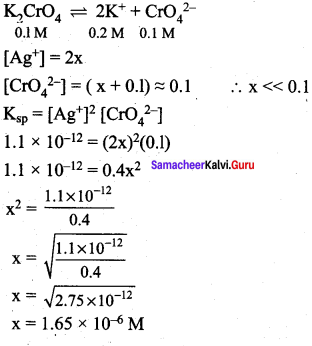
(a) Basic
(b) Acidic
(c) Neutral
(d) Amphoteric
Answer:
(a) Basic

Question 26.
The pH value of water is …………..
(a) 14
(b) 7
(c) 3
(d) 1
Answer:
(b) 7

Question 27.
The pH of drain cleaner is ………..
(a) 7
(b) 1
(c) 14
(d) 0
Answer:
(c) 14

Question 28.
The pH of the battery acid is ………….
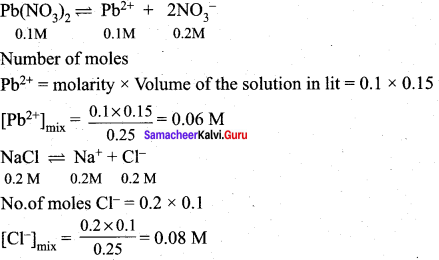
(a) 7
(b) 1
(c) 14
(d) 0
Answer:
(d) 0

Question 29.
The pH of 0.001 M HCI solution is ………
(a) 3
(b) 2
(c) 1
(d) 11
Answer:
(a) 3
Solution:
[H3O+] = 0.001 mol dm-3
pH = – log10 [H3O+] = – log10 [0.001]
= – 1og10 [10-3] = 3
pH = 3

Question 30.
The pH of 0.01 M HCl solution is …………..
(a) 3
(b) 2
(c) 1
(d) 10
Answer:
(b) 2
Solution:
[H3O+] = 0.01 M
pH = – 1og10 [H3O+] = – log10 [0.01]
= – 1og10[10-3] = 3
pH = 3

Question 31.
What is the pH of 0.1 M HCI solution?
(a) 1
(b) 2
(c) 13
(d) 3
Answer:
(a) 1
Solution:
[H3O+] = 0.1 M
pH = – log10[H3O+] = – log10[0.1]
= – log10[10-1]
pH = l

Question 32.
Consider the following statements.
(i) Degree of dissociation (a) is the fraction of the total number of moles of a substance that dissociates at equilibrium.
(ii) When the dilution increases by 100 times, the dissociation increases by 100 times.
(iii) When the dilution increases by 100 times, the dissociation increases by 10 times.
Which of the above statement is I are correct?
(a) (ii) only
(b) (i) & (iii)
(c) (iii) only
(d) (I) only
Answer:
(a) (ii) only

Question 33.
Which of the following is not a buffer solution?
(a) CH3COOH + CH3COONa
(b) NH4OH + NH4Cl
(c) H2CO3 + NaHCO3
(d) NaOH + NaCI
Answer:
(d) NaOH + NaCI

Question 34.
The mathematical expression of buffer capacity is …………
Samacheer Kalvi 12th Chemistry Solutions Chapter 8 Ionic Equilibrium-85
Answer:
Samacheer Kalvi 12th Chemistry Solutions Chapter 8 Ionic Equilibrium-158

Question 35.
Which one of the following is not correct?
(a) pH+pOH = 14
(b) pH = 7 +\(\frac { 1 }{ 2 }\) pKa – \(\frac { 1 }{ 2 }\) pKb
(c) pH x pOH = 1 x 10¹⁴
(d) pH = – log10 [H3O+]
Answer:
(c) pH x pOH = 1 x 10¹⁴

Question 36.
The chemical present in kidney as stones is …………..
(a) CaCl2
(b) Ca(CO3)2
(c) Calcium nitrate
(d) Calcium oxalate
Answer:
(d) Calcium oxalate

Question 37.
If the pH of an aqueous solution is 7, the solution is …………..
(a) slightly acidic
(b) strongly acidic
(c) neutral
(d) basic
Answer:
(c) neutral

Question 38.
Cl is the conjugate base of …………..
(a) HClO4
(b) HCI
(c) ClO4
(d) HClO3
Answer:
(b) HCI

Question 39.
The conjugate base of H2O and H2SO4 are …………..
(a) OH and HSO4
(b) H4O and SO42-
(c) OH and SO42-
(d) H3O and HSO4
Answer:
(a) OH and HSO4

Question 40.
The Ksp of AgI is 1.5 x 10⁻¹⁶. On mixing equal volume of the following solutions, precipitation will occur only with ………….
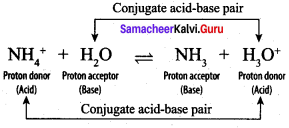
(a) 10-7MAg+ and 10-19M I
(b) 10-8MAg+ and 10-8M I
(c) 10-16 M Ag+ and 10-16 M I
(d) 10-9 M Ag+ and 10-9 M I
Answer:
(b) 10-8MAg+ and 10-8M I
Ksp of AgI = 1.5 x 10⁻¹⁶
10-8 M Ag+ and 10-8 M I
Ionic product = 10-16 = Ksp

Question 41.
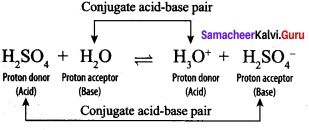
The strongest Bronsted base in the following anion is ……………
(a) ClO
(b) ClO2-
(c) ClO3-
(d) ClO4-
Answer:
(a) ClO
Solution:
HClO is the weakest acid and its conjugate base ClO is the strongest base.

Question 42.
Calculate the hydrolysis constant of the salt containing NO2.
Given the Ka for HNO2 = 4.5 x 10⁻¹⁰
(a) 2.22 x 10⁻⁵
(b) 2.02 x 10⁵
(c) 4.33 x 10⁴
(d) 3.03 x 10⁻⁵
Answer:
(a) 2.22 x 10⁻⁵
Solution:
Samacheer Kalvi 12th Chemistry Solutions Chapter 8 Ionic Equilibrium-86

Question 43.
Electrophiles are usually ……….
(a) Lewis acid
(b) Lewis base
(c) Bronsted acid
(d) Bronted base
Answer:
(a) Lewis acid
Solution:
Lewis acid are electrophile because they accept electron pair.

Question 44.
Which one is a Lewis acid?
(a) CIF3
(b) H2O
(c) NH3
(d) OH
Answer:
(a) CIF3
Solution:
CIF3 have vacant d-orbital in central atom.

Question 45.
An aqueous solution of ammonium acetate is …………….
(a) faintly acidic
(b) faintly basic
(c) fairly acidic
(d) Almost neutral
Answer:
(d) Almost neutral
Solution:
It is a salt of weak acid and weak base.

Question 46.
The dissociation constant of a weak acid is 1.0 x 10⁻¹⁰. The equilibrium constant for the reaction with strong base is …………
(a) 1.0 x 10⁻⁵
(b) 1.0 x 10⁻⁹
(c) 1.0 x 10⁹
(d) 1.0 x 10¹⁴
Answer:
(c) 1.0 x 10⁹
Solution:
Samacheer Kalvi 12th Chemistry Solutions Chapter 8 Ionic Equilibrium-87

Question 47.
Arrange the acids
(i) H2SO3
(ii) H3PO3 and
(iii) HClO3in the decreasing order of acidity.
(a) (i) > (iii) > (ii)
(b) (i) > (ii) > (iii)
(c) (ii) > (iii) > (I)
(d) (iii) > (i)> (ii)
Answer:
(d) (iii) > (i)> (ii)
Solution:
Acidity is directly proportional to oxidation number. As the oxidation number of S, P and Cl in H2SO3, H3PO3 and HCIO3 is +4, +3, +5 respectively. So decreasing order of acidity will
be (iii) > (I) > (ii)

Question 48.
The pH of 0.1 M solution of a weak monoprotic acid 1% ionised is ………..
(a) 1
(b) 2
(c) 3
(d) 4
Answer:
(c) 3
Solution:
Conc = 0.1 M
α = 1
= 0.1 x \(\frac { 1 }{ 100 }\) = 10-3
[H+] = 10-3
∴ pH = 3

Question 49.
Ksp for Cr(OH)3 is 2.7 x 10⁻³. What is the solubility in moles / litre?
(a) 1 x 10⁻⁸
(b) 8 x 10⁻⁸
(c) 1.1 x 10⁻⁸
(d) 0.18 x 10⁻⁸
Answer:
(b) 8 x 10⁻⁸
Solution:
Samacheer Kalvi 12th Chemistry Solutions Chapter 8 Ionic Equilibrium-88

Question 50.
pKa of acetic acid is 4.74. The concenttation of CH3COONa is 0.01 M. The pH of CH3COONa
is …………..
(a) 3.37
(b) 4.37
(c) 4.74
(d) 0.474
Answer:
(a) 3.37
Solultion:
[H+] = c.α = \(\sqrt{\mathrm{K}_{\mathrm{a}} \cdot \mathrm{C}}\)
pH = – log \(\left(\mathrm{K}_{\mathrm{a}} \cdot \mathrm{C}\right)^{1 / 2}\)
= \(\frac { 1 }{ 2 }\) [-1ogKa – log c]
= \(\frac { 1 }{ 2 }\) [4.74 – log 10-2]
= \(\frac { 1 }{ 2 }\) [4.74 + 2] = 3.37
pH = 3.37

Question 51.
One litre of water contains 10 mol hydrogen ions. The degree of ionisation in water will be …………….
(a) 8 x 10⁻⁷
(b) 0.8 x 10⁻⁹
(c) 3.6 x 10⁻⁷
(d) 3.6 x 10⁻⁹
Answer:
(a) 8 x 10⁻⁷
Solution:
1 litre of water contains 1000/18 mole.
So, degree of ionisation = \(\frac{10^{-7} \times 18}{1000}\) = 1.8 x 10⁻⁷

Question 52.
If the solubility product of lead iodide (PbI2) is 3.2 x 10⁻⁸. Then its solubility in moles / litre will be ………….
(a) 2 x 10⁻³.
(b) 4 x 10⁻⁴
(c) 1.6 x 10⁻⁵
(d) 1.8 x 10⁻⁵
Solution:
Ksp = 4s3
4s3 = 3.2 x 10⁻⁸
s = 2 x 10⁻³M

Question 53.
The pH of a soft drink is 3.82. Its hydrogen ion concentration will be ……………
(a) 1.96 x 10⁻²mol / L
(b) 1.96 x 1o-3 mol / L
(c) 1.5 x 10⁻⁴ mol / L
(d) 1.96 x 10⁻¹ mol / L
Answer:
(c) 1.5 x 10⁻⁴ mol / L
Solution:
pH = 3.82 = – log10[H+]
∴ [H+] = 1.5 x 10⁻⁴ mol / litre

Question 54.
The pH of a solution at 25°C containing 0.10 M sodium acetate and 0.03 M acetic acid is …………..
(pKa for CH3COOH = 4.57)
(a) 4.09
(b) 5.09
(c) 6.10
(d) 7.09
Answer:
(b) 5.09
Solution:
pH = pKa + log \(\frac { [salt] }{ [acid] }\)
= 4.57 + log \(\frac { 0.10 }{ 0.03 }\) = 5.09

Question 55.
A weak acid is 0.1% ionised in 0.1 M solution. Its pH is …………..
(a) 2
(b) 3
(c) 4
(d) 1
Answer:
(c) 4
Solution:
For a monobasic acid [H+] = c.α
= \(\frac { 1 }{ 2 }\) x 0.001 = 10-4
pH = – log10[10-4] = 4

Question 56.
Which one of the following is not a buffer solution?
(a) 0.8 M H2S + 0.8 M KHS.
(b) 2 M C6H5NH2 + 2 M C6H5N
(c) 3 M H2CO3 + 3 M KHCO3
(d) 0.05 M KCIO4 + 0.05 M HCIO
Answer:
(d) 0.05 M KCIO4 + 0.05 M HCIO
Hint. HClO4 is a strong acid while buffer is a mixture of weak acid and its salt.

Question 57.
The pH of pure water or neutral solution at 50°C is …………… (pKw = 13.2613 at 50°C)
(a) 7.0
(b) 7.13
(c) 6.0
(d) 6.63
Answer:
(d) 6.63
Solution:
[H+] [OH] = 10-13.26
[H+] = [OH]
[H+] = \(\frac { { 10 }^{ \frac { -13.26 }{ 2 } } }{ 2 }\)
∴ pH = 6.63

Question 58.
Increasing order of acidic character would be ……………..
(a) CH3COOH < H2SO4 < HCO3
(b) CH3COOH < H2CO3 < H2SO
(c) H2CO3 < CH3COOH < H2SO4
(d) H2SO4 < H2CO3 < CH3COOH
Answer:
(d) H2SO4 < H2CO3 < CH3COOH

Question 59.
What is the pH of 1 M CH3COOH solution?. Ka of acetic acid is 1.8 x 10⁻⁵. K = 10-14 mol2 litre2.
(a) 9.4
(b) 4.8
(c) 3.6
(d) 2.4
Answer:
(a) 9.4
Solution:
CH3COO + H2O \(\rightleftharpoons\) CH3COOH + OH
[OH] = c x h
Samacheer Kalvi 12th Chemistry Solutions Chapter 8 Ionic Equilibrium-93
= 2.35 x 10⁻⁵
pOH = 4.62
pH + pOH = 14
pH = 14 – 4.62 = 9.38

Question 60.
4Na + O2 → 2Na2O
Na2O + H2O → 2NaOH
In the given reaction, the oxide of sodium is …………..
(a) Acidic
(b) Basic
(c) Amphoteric
(d) Neutral
Answer:
(b) Basic
Solution.
Na2O form NaOH so that it is basic oxide.

Question 61.
The pH of 0.001 M NaOH will be ………….
(a) 3
(b) 2
(c) 11
(d) 12
Answer:
(c) 11
Solution:
0.001 M NaOH means [OH] 0.001 .
10-3 pOH = 3
pH + pOH = 14
pH = 14 – 3 = 11

Question 62.
The addition of pure solid sodium carbonate to pure water causes …………….
(a) an increase in hydronium ion concentration
(b) an increase in alkalinity
(c) No change in acidity
(d) A decrease in hydroxide ion
Answer:
(b) an increase in alkalinity
Hint.
Adding Na2CO3 to water makes the solution basic and hence pH increases from 7.

Question 63.
When solid potassium cyanide is added in water then ……………
(a) pH will increase
(b) pH will decrease
(c) pH will remain the same
(d) electrical conductivity will not change
Answer:
(a) pH will increase
Hint:
KCN + H2O \(\rightleftharpoons\) KOH + HCN.
KOH is a strong base and HCN is a weak acid. So pH will increase.

Question 64.
pH of a solution is 5. Its hydroxyl ion concentration is …………..
(a) 5
(b) 10
(c) 10-5
(d) 10-9
Answer:
(d) 10-9
Solution:
pH = 5 means [H+] = 10-5
pOH = 14 – pH = 14 – 5 = 9
[OH] = 10-pOH = 10-9

Question 65.
Which one of the following is a buffer?
(a) CH3COOH + CH3COONa
(b) CH3COOH + CH3COONH4
(c) NaOH + NaCI
(d) CH3COOH + NH4CI
Answer:
(a) CH3COOH + CH3COONa

Question 66.
Which will have maximum pH?
(a) Distilled water
(b) 1 M NH3
(c) 1 M NaOH
(d) Water saturated by chlorine
Answer:
(c) 1 M NaOH
Hint:
NaOH has maximum [OH] and minimum of [H+ ] and so maximum pH value.

Question 67.
pH of a solution is 9.5. The solution is …………..
(a) Neutral
(b) Acidic
(c) Basic
(d) Amphoteric
Answer:
(c) Basic
Solution:
If pH = 7 solution is neutral
pH < 7 solution is acidic
pH > 7 solution is basic

Question 68.
A solution has pH = 5, it is diluted 100 times, then it will become ……………….
(a) Neutral
(b) Basic
(c) unaffected
(d) more acidic
Answer:
(a) Neutral
Solution:
pH = 5 means [H+] = 10-5
After dilution [H+] = 10-5 / 100 = 10-7 M
[H+] from H2O cannot be neglected.
Total [H+] = 10-7 + 10-7 = 2 x 10⁻⁷
pH = 7 – 0.3010 = 6.6990 = 7
pH = 7 (Neutral)

Question 69.
By adding a strong acid to the buffer solution, the pH of the buffer solution ……………..
(a) remains constant
(b) increases
(c) decreases
(d) becomes zero
Answer:
(a) remains constant

Question 70.
pH of human blood is 7.4. Then H+ concentration will be ……………..
(a) 4 x 10⁻⁸
(b) 2 X 10⁻⁸
(c) 4 x 10⁻⁴
(d) 2 x 10⁻⁴
Answer:
(a) 4 x 10⁻⁸
pH = – log [H+]
7.4 = – log [H+]
7.4 = log 1 – log [H+]
log [H+] = log 1 – 7.4
log [H+] = 8.6
[H+] Antilog of 8.6
= 4 x 10⁻⁸

Question 71.
The highest pH 14 is given by ……………….
(a) 0.1 M H2SO4
(b) 0.1 M NaOH
(c) 1 N NaOH
(d) 1 N HCl
Answer:
(a) 0.1 M H2SO4
Solution:
[OH] = 1
pOH = 0
pH + pOH = 14
pH = 14 – 0 = 14

Question 72.
Which of the following is not a Bronsted acid?
(a) CH3NH4
(b) CH3COO
(c) H2O
(d) HSO4
Answer:
(b) CH3COO
Hint:
Those substances which give a proton is called Bronsted acid, while CH3COO doesn’t have a proton. So it is not a Bronsted acid.

Question 73.
Pure water is kept in a vessel and it remains exposed to atmospheric CO2 which is absorbed, then its pH will be
(a) greater than 7
(b) less than 7
(c) equal to 7
(d) depends on ionic production of water
Hint:
CO2 is acidic oxide which on dissolution in water develops acidic nature.

Question 74.
As the temperature increases, the pH of KOH solution ……………..
(a) will decrease
(b) will increase
(c) remains constant
(d) depends upon concentration of KOH solution
Answer:
(a) will decrease

Question 75.
The pH of millimolar HCl is ………….
(a) 1
(b) 3
(c) 2
(d) 4
Answer:
(b) 3
Solution:
pH = – log [H+]
[H+] = 10-3
pH = log 1 – log [H+]
= log 1 – log 10-3 = 3

Question 76.
The unit of ionic product of water K is ……………
(a) mol-1 L-1
(b) mol-2 L-2
(c) mol-2 L-1
(d) mol2 L-2
Answer:
(d) mol2 L-2

Question 77.
Review the equilibrium and choose the correct statement.
HClO4 + H2O \(\rightleftharpoons\) H3O+ + ClO4+
(a) HClO4 is the conjugate acid of H2O
(b) H3O is the conjugate base of H2O
(c) H2O is the conjugate acid of H3O
(d) ClO4 is the conjugate base of HCIO4
Answer:
(d) ClO4 is the conjugate base of HCIO4

Question 78.
Which of the following is the strongest conjugate base?
(a) CI
(b) CH3COO
(c) SO42-
(d) NO2
Hint:
CH3COO is a conjugate base of a weak acid.
CH3COOH \(\rightleftharpoons\) CH3COO + H+

Question 79.
Which one of the following substance has the highest proton affinity?
(a) H2O
(b) H2S
(c) NH3
(d) PH3
Answer:
(c) NH3

Question 80.
Which of the following is the strongest Lewis acid?
(a) BI3
(b) BBr3
(c) BCI3
(d) BF3
Hint:
Larger the size of the halogen atom less is the back donation of electrons into empty 2p orbital of B.

Question 81.
Which of the following is the weakest acid?
(a) HF
(b) HCI
(c) HBr
(d) HI
Answer:
(a) HF
Hint:
HF does not give proton easily.

Question 82.
Among the following, the weakest Lewis base is …………
(a) H
(b) OH
(c) CI
(d) HClO3
Hint:
CI is a conjugate base of strong acid HCI.

Question 83.
Which of the following is not a Lewis acid?
(a) BF3
(b) AlCI3
(c) HCl
(d) LiAIH4
Hint:
It is a nucleophile and capable of donating electron pair and so it can act as Lewis base.

Question 84.
Which one of the following is called amphoteric solvent?
(a) Ammonium hydroxide
(b) Chloroform
(c) Benzene
(d) Water
Answer:
(d) Water
Hint:
Samacheer Kalvi 12th Chemistry Solutions Chapter 8 Ionic Equilibrium-163

Question 85.
Which of the following is non – electrolyte?
(a) NaCl
(b) CaCl2
(c) C12H22O11
(d) CH3COOH
Hint:
C12H22O11 is a sugar and non-electrolyte.

Question 86.
At infinite dilution, the percentage ionisation for both strong and weak electrolyte is ………….
(a) 1%
(b) 20%
(c) 50%
(d) 100%
Answer:
(d) 100%
Hint:
According to Ostwald’s dilution law, degree of ionisation is directly proportional to the dilution.

Question 87.
An acid HA ionises as HA \(\rightleftharpoons\) H+ + A The pH of 1.0 M solution is 5. its dissociation constant would be …………..
(a) 1 x 10⁻⁵
(b) 1 x 10⁻¹⁰
(c) 5
(d) 5 x 10⁸
Answer:
(b) 1 x 10⁻¹⁰

Question 88.
Three reactions involving H2PO4 are given below.
(i) H3PO4 + H2O → H3O+ + H2PO4
(ii) H2PO4 + H2O → HPO42 + H3O+
(iii) H2PO4 + OH → H3PO4 + O2

In which of the above does H2PO4 act as an acid.
(a) (i) only
(b) (ii) only
(c) (i) & (iii)
(d) (iii) only
Answer:
(b) (ii) only

Question 89.
Which of the following is not a Lewis acid?
(a) CO
(b) SiCl4
(c) SO3
(d) Zn2+
Answer:
(c) SO3
CO does not contain vacant d-orbital.

Question 90.
A chemist dissolves an excess of BaSO4 in pure water at 25°C if its Ksp = 1 x 10⁻¹⁰ What is the concentration of Barium in the water?
(a) 10-14 M
(b) 10-5 M
(c) 10-15 M
(d) 10-6 M
Answer:
(d) 10-6 M

Question 91.
On addition of ammonium chloride to a solution of ammonium hydroxide ……………
(a) dissociation of NH4OH increases
(b) concentration of OH increases
(c) concentration of OH decreases
(d) concentration of NH4 and OH increases
Hint:
Due to common ion effect.

Question 92.
The solubility product of a salt having a general formula MX2 in water is 4 x 10⁻². The concentration of M2+ ions in the aqueous solution of the salt is ………………….
(a) 2.0 x 10⁻⁶ M
(b) 1.0 X 10⁻⁴ M
(c) 1.6 x 10⁻⁴ M
(d) 4.0 x 10⁻² M
Answer:
(b) 1.0 X 10⁻⁴ M
Solution:
MX2 \(\rightleftharpoons\) M2++ 2X
Ksp = (2s)2 (s) = 4s3
Samacheer Kalvi 12th Chemistry Solutions Chapter 8 Ionic Equilibrium-94
= 1.0 x 10⁻⁴M

Question 93.
The solubility of an aqueous solution of Mg(OH)2 be x then its Ksp is ……………
(a) 4 x3
(b) 108 x5
(c) 27 x4
(d) 9 x
Answer:
(a) 4 x3
Samacheer Kalvi 12th Chemistry Solutions Chapter 8 Ionic Equilibrium-95

Question 94.
What is the correct representation of the solubility product constant of Ag2CrO4?
(a) [Ag+]2 [CrO4-2]
(b) [Ag+] [CrO4-2]
(c) [2Ag+] [CrO4-2]
(d) [2Ag+]2 [CrO4-2]
Answer:
(a) [Ag+]2 [CrO4-2]
Ag2CrO4 \(\rightleftharpoons\) [2 Ag+] [CrO4-2]
Hence, Ksp = [Ag+]2 + [CrO4-2]

Question 95.
What is the pH value of \(\frac { N }{ 100 }\) KOH solution?
(a) 10
(b) 3
(c) 2
(d) 11
Answer:
(d) 11
Solution.
10-3 N KOH will give [OH] = 10-3 M
pOH = 3
pH + pOH = 14
pH = 14 – 3 = 11

Question 96.
Which pair will show common ion effect?
(a) BaCI2 + Ba(NO3)2
(b) NaCI + HCI
(c) NH4OH + NH4CI
(d) AgCN + KCN
Answer:
(c) NH4OH + NH4CI

Question 97.
The sotubility of AgCI will be minimum in ………….
(a) 0.00 1 M AgNO3
(b) pure water
(c) 0.01 M CaCI2
(d) 0.01 M NaCl
Answer:
(c) 0.01 M CaCI2
Solution.
0.01 M CaCI2 gives maximum CI ions to keep Ksp of AgCl constant, decrease in [Ag+] will be maximum.

Question 98.
Ionic product of water increases if ………….
(a) pressure is reduced
(b) H+ is added
(c) OH is added
(d) temperature increases
Answer:
(d) temperature increases
Solution:
Kw increases with increase ¡n temperature.

Question 99.
pH of water is 7. When a substance Y is added in water, the pH becomes 13. The substance Y is a salt of …………..
(a) strong acid and strong base
(b) weak acid and weak base
(c) strong acid and weak base
(d) weak acid and strong base
Answer:
(d) weak acid and strong base

Question 100.
Sodium chloride is purified by passing HCl gas in a impure solution of sodium chloride. It is based on ………………
(a) Buffer action
(b) Common ion effect
(c) Association of salt
(d) Hydrolysis of salt
Answer:
(b) Common ion effect

II. Fill in the blanks.

  1. …………. theory does not explain the behaviour of acids and base in non aqueous solvents.
  2. According to Lowry Bronsted theory, an acid is defined as a substance that has a tendency to …………. a proton and base is a substance that has a tendency to …………. a proton.
  3. HCI and Cl are called …………. pairs.
  4. A …………. acid is a positive ion or an electron deficient molecule.
  5. …………. is an anion or neutral molecule that donates one lone pair of electrons.
  6. The ligands act as …………. and the central metal atoms that accepts a pair of electrons behave as a ………….
  7. Carbonium ion act as …………. and carbanion act as ………….
  8. Acids with …………. greater than ten are considered as strong acids and less than one are called weak acids.
  9. OH and H2 are considered as ………….
  10. ClO4, Cl, HSO4, NO3 are considered as ………….
  11. …………. can act as an acid as well as base.
  12. At 25°C, the value of Kw is equal to ………….
  13. With the increase in temperature, Kw value is ………….
  14. The dissociation of water is an …………. reaction.
  15. Aqueous solution of HCl is …………. whereas aqueous solution of NH3 is ………….
  16. For neutral solutions, the concentration of [H3O+] as well as [OH] is equal to at 25°C.
  17. The pH of battery acid is equal to ………….
  18. The pH of drain cleaner is equal to ………….
  19. …………. is the fraction of the total number of moles of a substance that dissociates at equilibrium.
  20. When the dilution increases by 100 times, the dissociation increases by ………….
  21. When dilution…………., the degree of dissociation of weak electrolyte also increases.
  22. The buffer present in the blood is ………….
  23. …………. introduced a quantity called buffer index ? as a quantitative measure of the
  24. When an acid reacts with a base, a salt and water are formed and the reaction is called ………….
  25. …………. is the conjugate base of the weak acid CH3COOH.
  26. Kidney stones are developed over a period of time due to the precipitation of ………….
  27. The pH of sea water is …………. than 7.
  28.  O2- and H are ………….
  29. All metal ions (or) atoms are ………….
  30. All anions are ………….

Answers:

  1. Arrhenius
  2. donate, accept
  3. Conjugate acid-base
  4. Lewis
  5. Lewis base
  6. Lewis base, Lewis acid
  7. Lewis acid, Lewis base
  8. Ka value
  9. very weak acids
  10. very weak base
  11. Water
  12. 1 x 10-14
  13. increases
  14. endothermic
  15. acidic, basic
  16. 1 x 10-17
  17. zero
  18. 14
  19. degree of dissociation ?
  20. 10 times
  21. increases
  22. H2CO3 and NaHCO3
  23. Vanslyke, buffer capacity
  24. Neutralization
  25. CH3COO
  26. Calcium oxalate
  27. greater
  28. strong base
  29. Lewis acids
  30. Lewis bases

III. Match the following column – I & II using the correct code given below that.

Question 1.
Samacheer Kalvi 12th Chemistry Solutions Chapter 8 Ionic Equilibrium-96
Answer:
(a) 4 3 1 2

Question 2.
Samacheer Kalvi 12th Chemistry Solutions Chapter 8 Ionic Equilibrium-97
Answer:
(b) 3 1 4 2

Question 3.
Samacheer Kalvi 12th Chemistry Solutions Chapter 8 Ionic Equilibrium-98
Answer:
(c) 2 3 4 1

Question 4.
Samacheer Kalvi 12th Chemistry Solutions Chapter 8 Ionic Equilibrium-99
Answer:
(d) 4 3 2 1

Question 5.
Samacheer Kalvi 12th Chemistry Solutions Chapter 8 Ionic Equilibrium-100
Answer:
(a) 3 1 4 2

Question 6.
Samacheer Kalvi 12th Chemistry Solutions Chapter 8 Ionic Equilibrium-101
Answer:
(a) 2 3 4 1

Question 7.
Samacheer Kalvi 12th Chemistry Solutions Chapter 8 Ionic Equilibrium-102
Answer:
(b) 2 4 1 3

Question 8.
Samacheer Kalvi 12th Chemistry Solutions Chapter 8 Ionic Equilibrium-103
Answer:
(c) 3 1 4 2

Question 9.
Samacheer Kalvi 12th Chemistry Solutions Chapter 8 Ionic Equilibrium-104
Answer:
(d) 3 4 1 2

Question 10.
Samacheer Kalvi 12th Chemistry Solutions Chapter 8 Ionic Equilibrium-105
Answer:
(a) 2 1 4 3

Question 11.
Samacheer Kalvi 12th Chemistry Solutions Chapter 8 Ionic Equilibrium-106
Answer:
(a) 3 4 2 1

IV. Assertion and reasons.

Question 1.
Assertion(A): In the process of dissolution of HCl in water, HCl act as acid and H2O act as base.
Reason (R): When HCl is dissolved in water, it donates a proton to water.
(a) Both A and R are correct and R explains A
(b) Both A and R are wrong
(c) A is correct but R is not the correct explanation of A.
(d) A is wrong but R is correct.
Answer:
(a) Both A and R are correct and R explains A

Question 2.
Assertion(A): When ammonia dissolved in water, H20 acts as an acid.
Reason (R): When ammonia is dissolved in water, it accepts a proton from water. According to Lowry – Bronsted theory, proton donor is acid and so water act as an acid.
(a) Both A and R are correct and R is the correct explanation of A
(b) Both A and R are wrong
(c) A is correct but R is not the correct explanation of A.
(d) A is wrong but R is correct. .
Answer:
(a) Both A and R are correct and R is the correct explanation of A

Question 3.
Assertion (A): In the reaction HCl + H2O \(\rightleftharpoons\) H3O+ + Cl, HCl and Cl are conjugate acid – base pair.
Reason (R): By Lowry – Bronsted theory, chemical species that differ only by a proton are called conjugate acid – base pair.
(a) Both A and R are correct and R is the correct explanation of A
(b) Both A and R are wrong
(c) A is correct but R is not the correct explanation of A
(d) A is wrong but R is correct.
Answer:
(a) Both A and R are correct and R is the correct explanation of A

Question 4.
Assertion(A): BF3 is a Lewis acid.
Reason (R): Boron has a vacant 2p orbital to accept the lone pair of electrons donated by any substance to form a new coordinate covalent bond.
(a) Both A and R are correct and R is the correct explanation of A
(b) Both A and R are wrong .
(c) A is correct but R is not the correct explanation of A.
(d) A is wrong but R is correct.
Answer:
(a) Both A and R are correct and R is the correct explanation of A

Question 5.
Assertion(A): in coordination compounds, the ligands acts as Lewis acid aid the central metal atom or ion act as Lewis base.
Reason (R): Ligands are capable of accepting of a pair of electrons donated by the central metal atom or ion.
(a) Both A and R are correct and R is the correct explanation of A
(b) Both A and R are wrong
(c) A is correct but R is not the correct explanation of A.
(d) A is wrong but R is correct.
Answer:
(b) Both A and R are wrong

Question 6.
Assertion(A): SiF4 can act as Lewis acid.
Reason (R): In SiF4, the central atom can expand its octet due to the availability of empty d – orbitais and can accept a pair of electrons.
(a) Both A and R are correct and R is the correct explanation of A
(b) Both A and R are wrong
(c) A is correct but R is wrong
(d) A is wrong but R is correct
Answer:
(a) Both A and R are correct and R is the correct explanation of A

Question 7.
Assertion(A): NH3, H2O, ROH all are examples of Lewis bases.
Reason (R): Molecules with one or more lone pairs of electrons act as Lewis bases.
(a) Both A and R are wrong
(b) A is correct and R is the correct explanation of A.
(c) A is wrong but R is correct.
(d) A is correct but R is wrong
Answer:
(b) A is correct and R is the correct explanation of A.

Question 8.
Assertlon(A): HCl is an strong acid while HCOOH is a weak acid.
Reason (R): HCI is completely ionised in water whereas HCOOH is paritally ionised in water.
(a) Both A and R are wrong
(b) A is wrong but R is correct
(c) A is correct but R is wrong
(d) Both A and R are correct and R is the correct explanation of A
Answer:
(d) Both A and R are correct and R is the correct explanation of A

Question 9.
Assertion(A): With the increase in temperature, the ionic product of water also increases.
Reason (R): The dissociation of water is an endothermic reaction.
(a) Both A and R are correct and R is the correct explanation of A
(b) A is correct but R is wrong
(c) A is wrong but R is correct
(d) Both A and R are wrong
Answer:
(a) Both A and R are correct and R is the correct explanation of A

Question 10.
Assertion(A): When dilution increases, the degree of dissociation of weak electrolyte also increases.
Reason (R): The degree of dissociation a is inversely proportional to concentration c. When the dilution increases by 100 times, the dissociation increases by 10 times.
(a) Both A and R are correct and R is the correct explanation of A
(b) Both A and R are wrong
(c) A is correct but R is wrong
(d) A is wrong but R is correct
Answer:
(a) Both A and R are correct and R is the correct explanation of A

Question 11.
Assertion(A): The addition of sodium acetate to acetic acid solution leads to the suppression in the dissociation of acetic acid.
Reason (R): This is due to common ion effect. i.e., CH3COOH and CH3COONa both contains CH3COO ion as common.
(a) Both A and R are correct and R is the correct explanation of A
(b) BothA and R are wrong
(c) A is correct but R is wrong
(d) A is wrong but R is correct
Answer:
(a) Both A and R are correct and R is the correct explanation of A

Question 12.
Assertion(A): The solution of NH4CI has pH value less than 7.
Reason (R): The salt of weak base (NH4OH) and strong acid (HCl) is acidic in nature, when dissolved in water. So pH value is less than 7.
(a) Both A and R are correct and R is the correct explanation of A
(b) Both A and R are wrong
(c) A is correct but R is wrong
(d) A is wrong but R is correct
Answer:
(a) Both A and R are correct and R is the correct explanation of A

Question 13.
Assertion(A): pH = 7 signifies pure water.
Reason (R): pH = 7 means it is a neutral solution where [H3O+] [OH]
(a) A is correct but R is wrong
(b) A is wrong but R is correct
(c) Both A and R are wrong
(d) A is correct and R does not explain A
Answer:
(b) A is wrong but R is correct

Question 14.
Assertion(A): A mixture of CH3COOH and CH3COONH4 is an acidic buffer.
Reason (R): An acidic buffer contains a weak acid and the salt of weak acid with strong base.
(a) A is correct but R is wrong.
(b) A is wrong but R is correct.
(c) Both A and R are correct and R is the correct explanation of A
(d) Both A and R are wrong
Answer:
(b) A is wrong but R is correct.

Question 15.
Assertion(A): Buffer mixture is the one whose pH remains constant even by addition of strong acid or strong base.
Reason (R): To resist changes in its pH on the addition of an acid or base, the buffer solution should contain both acidic as well as basic components so as to neutralise the effect of added acid or base.
(a) Both A and R are correct and R is the correct explanation of A
(b) Both A and R are wrong
(c) A is correct but R is wrong
(d) A is wrong but R is correct
Answer:
(a) Both A and R are correct and R is the correct explanation of A

V. Find the odd one out and give the reasons.

Question 1.
(a) HNO3
(b) Ba(OH)2
(c) H3PO4
(d) CH3COOH
Answer:
(b) Ba(OH)2
Reason: Ba(OH)2 is the base whereas the others are acids.

Question 2.
(a) NH3
(b) H2O
(c) RNH2
(d) BF3
Answer:
(d) BF3
Reason: BF3 is a Lewis acid whereas others are Lewis base.

Question 3.
(a) SiF4
(b) SF4
(c) FeCl3
(d) NH3
Answer:
(d) NH3
Reason: NH3 is a Lewis base whereas others are Lewis acid.

Question 4.
(a) HCl
(b) H2SO4
(c) CH3COOH
(d) HNO3
Answer:
(c) CH3COOH
Reason: CH3COOH is a weak acid whereas others are strong acids.

Question 5.
(a) HCOOH
(b) CH3COOH
(c) Lactic acid
(d) HCI
Answer:
(d)HCI
Reason: HCl is a strong acid whereas others are weak acids.

Question 6.
(a) HClO4
(b) HCI
(c) HSO4
(d) H2SO4
Answer:
(c) HSO4.
Reason: HSO4 is a very weak base whereas others are strong acid.

Question 7.
(a) NH2
(b) O2
(c) H
(d) OH
Answer:
(d) OH
Reason: OH is a very weak acid whereas others are strong bases.

Question 8.
(a) HNO2
(b) HF
(c) H2SO4
(d) CH3COOH
Answer:
(c) H2SO4
Reason: H2SO4 is a strong acid whereas others are weak acids.

Question 9.
(a) F
(b) CH3COO
(c) O2
(d) NO2
Answer:
(c) O2-
Reason: O2- is a strong base whereas others are weak bases.

Question 10.
(a) Vinegar
(b) Black coffee
(c) Sea water
(d) Orange juice
Answer:
(c) Sea water
Reason: Sea water is basic and has pH > 7 whereas others are acidic and have pH < 7.

Question 11.
(a) Baking soda
(b) Tomato
(c) Soapy water
(d) Drain cleaner
Answer:
(b) Tomato
Reason: Tomato has pH less than 7 and it is acidic whereas others have pH greater than 7 and they are basic.

Question 12.
(a) CH3COOH + CH3COONa
(b) NH4OH + NH4CI
(c) H2CO3 + NaHCO3
(d) NaOH + NaCl
Answer:
(d) NaOH + NaCl
Reason: NaOH + NaCl is not a buffer mixture whereas others are buffer mixtures.

VI. Find out the incorrect pair.

Question 1.
(a) HNO3, H2SO4
(b) Al(OH)3 , Mg (OH)2
(c) CH3COOH, HCOOH
(d) H2O, OH
Answer:
(d) H2O, OH

Question 2.
(a) HCl , Cl
(b) H2O, H3O+
(c) HNO3 , HNO2
(d) H2SO4, HSO4
Answer:
(c) HNO3 , HNO2

Question 3.
(a) NH3, H2O
(b) ROH, ROR
(c) CN, SCN
(d) BF3, H2O
Answer:
(d) BF3, H2O

Question 4.
(a) BF3 , BF2
(b) Fe2, Fe3
(c) CaO, Mg(OH)2
(d) SiF4, SF4
Answer:
(c) CaO, Mg(OH)2

Question 5.
(a) Orange juice, Tomato juice
(b) Soapy water, Sea water
(c) Water, H3O
(d) Bleach , Ammonia solution
Answer:
(c) Water, H3O

VII. Find out the correct pair.

Question 1.
(a) HNO3, Ba(OH)2
(b) CH3COOH , HCI
(c) H3O+, Cl
(d) HCl + H2SO4
Answer:
(d) HCl + H2SO4.

Question 2.
(a) BF3, NH4+
(b) CH2 , CH3+
(c) Fe2+, Fe3+
(d) (CH3)3C+ , CH2 = CH2
Answer:
(c) Fe2+, Fe3+

Question 3.
(a) H3O+, HCI
(b) HSO4, NO2
(c) HNO2, H2
(d) HCl, Cl
Answer:
(d) HCI, CI

Question 4.
(a) Orange, Black coffee
(b) Baking soda,, Water
(c) Ammonia, Stomach acid
(d) Bleach , Tomato
Answer:
(a) Orange , Black coffee

Question 5.
(a) NH4OH + NaOH
(b) NaOH + NaCl
(c) CH3COOH + CH3COONa
(d) CH3COOH + CH3COONH4
Answer:
(c) CH3COOH + CH3COONa

VIII. Answer the following.

Question 1.
What are the general characteristics of acid and base?
Answer:

  1. Acid tastes sour, turns the blue litmus to red and reacts with metals such as zinc and produces hydrogen gas.
  2. Base tastes bitter, turns the red litmus to blue and soapy to touch.

Question 2.
Explain the Arrhenius concept of acid and base with example.
Answer:
1. According to Arrhenius concept, an acid is a substance that dissociates to give hydrogen ions in water. For example,
Samacheer Kalvi 12th Chemistry Solutions Chapter 8 Ionic Equilibrium-107

2. Similarly a base is a substance that dissociates to give hydroxyl ions in water. For example,
Samacheer Kalvi 12th Chemistry Solutions Chapter 8 Ionic Equilibrium-108

Question 3.
What are the limitations of Arrhenius concept?
Answer:
1. Arrhenius theory does not explain the behaviour of acids and base in non-aqueous solvents such as acetone, tetrahydro furan.

2. This theory does not account for the basicity of the substances like ammonia which do not possess hydroxyl group.

Question 4.
What is meant by strong acid and weak acid? Explain with example.
Answer:
1. A strong acid is the one that is almost completely dissociated in water.
HCl + H2O → H3O+ + Cl

2. A weak acid is the one that is partially dissociated in water.
CH3COOH +H2O \(\rightleftharpoons\) H3O + CH3COO

Question 5.
Give two examples for

  1. Strong acid
  2. Strong base

Answer:

  1. Strong acid: HCIO4, H2SO4
  2. Strong base: NH2, O2-

Question 6.
Give two examples for

  1. Very weak acid
  2. Very weak base

Answer:

  1. Very weak acid: OH,H2
  2. Very weak base: Cl, ClO4

Question 7.
Give two examples for

  1. Weak acid
  2. Weak base

Answer:

  1. Weak acid: HF, CH3COOH
  2. Weak base: F, CH3COO

Question 8.
What is meant by auto ionisation of water?
Answer:
Pure water has a little tendency to dissociate. i:e., one water molecule donates a proton to another water molecule. This is known as auto ionisation of water.
Samacheer Kalvi 12th Chemistry Solutions Chapter 8 Ionic Equilibrium-109

Question 9.
Define – ionic product of water.
Answer:
H2O + H2O \(\rightleftharpoons\) H3O + OH
The dissociation constant for the above ionisation is given as,
Samacheer Kalvi 12th Chemistry Solutions Chapter 8 Ionic Equilibrium-110
The concentration of pure water is one.
i.e., [H2O]2 = 1
K = [H3O+] [OH]
Kw = ionic product of water.
Kw = 1 x 10-14 at 25°C

Question 10.
Kw = 1 x 10-14 at 25°C. Justify this statement.
Answer:
1. Experimentally found that the concentration of H3O in pure water is 1 x 10⁻⁷ at 25°C.

2. Since the dissociation of water produces equal number of H3O4 and OH, the concentration of OH is also equal to 1 x 10 at 25°C. The ionic product of water at 25°C is
Kw = [H3O+] [OH]
= [1 x 10⁻⁷] [1 x 10⁻⁷]
Kw = [1 x 10-14]

Question 11.
With increase in temperature, Kw also increases. Why?
Answer:

  1. All equilibrium constant Kw. is also a constant at a particular temperature.
  2. The dissociation of water is an endothermic reaction.
  3. With the increase in temperature, the concentration of H3O+ and OH also increases and hence the ionic product also increases.

Question 12.
Aqueous HCl is an acidic solution whereas aqueous NH3 is a basic solution. Justify this statement.
Answer:
HCI + H2O \(\rightleftharpoons\) H3O+ + Cl in this case, in addition to auto ionisation of water, HCI molecule also produces H3O ion by donating a proton to water and hence [H3OJ> [OH]. It means that the aqueous HCI solution is acidic. Similarly in basic solution such as aqueous NH3, [OH] > [H3O+] and it is basic.

Question 13.
What is the statement of Ostwald’s dilution law.
Answer:
When dilution increases, the degree of dissociation of weak electrolyte also increases.
Samacheer Kalvi 12th Chemistry Solutions Chapter 8 Ionic Equilibrium-111
This statement is known as Ostwald’s dilution law.

Question 14.
Define – Salt hydrolysis.
Answer:
Salts completely dissociate in aqueous solution to give their constituent ions. The ions so produced are hydrated in water. ¡n certain cases, the cation, anion ?r both react with water and the reaction is called salt hydrolysis. e.g.,
NaOH(aq) + HNO3(aq) → NaNO3(aq) + H2O(1)

Question 15.
What is meant by conjugate acid-base pair? Find the conjugate acid / base for the following species
Answer:
HNO2, CH, HCIO4, OH, CO32-, S2-
An acid-base pair which differs by a proton only (HA \(\rightleftharpoons\) A + H+) is known as conjugate acid-base pair.
Conjugate acid: HCN, H2O, HCO3, HS.
Conjugate base: NO2, ClO4, O2.

Question 16.
Which of the following are Lewis Acids?
H2O, BF3, H+ and NH4+
Answer:
BF3, H+ ions are Lewis acids.

Question 17.
What will be the conjugate bases for the Bronsted acids? HF, H2SO4 and H2CO3?
Answer:
Conjugate bases: F, HSO4, HCO3.

Question 18.
Write the conjugate acids for the following Bronsted bases:
NH2, NH3 and HCOO
Answer:
NH3, NH4 and HCOOH

Question 19.
The species H2O, HCO3, HSO4 and NH3 can act both as Bronsted acid and base. For each case, give the corresponding conjugate acid and base.
Answer:
Samacheer Kalvi 12th Chemistry Solutions Chapter 8 Ionic Equilibrium-112

Question 20.
Classify the following species into Lewis acids and Lewis bases and show how these can act as Lewis acid I Lewis base?
(a) OH ions
(b) F
(c) H+
(d) BCI3
Answer:
(a) OH ions can donate an electron pair and act as Lewis base.
(b) F ions can donate an electron pair and act as Lewis base.
(a) H+ ions can accept an electron pair and act as Lewis base.
(b) BCl3 can accept an electron pair since Boron atom is electron deficient. It is a Lewis acid.

Question 21.
Predict the acidic, basic or neutral nature of the solutions of the following salts:
NaCI, KBr, NaCN, NH4NO3, NaNO2, KF.
Answer:
NaCN, NaNO2, KF solutions are basic, as they are salts of strong base, weak acid.
NaCl, KBr solutions are neutral, as they are salts, of strong acid, strong base.
NH4NO3 solution is acidic, as it is a salt of strong acid, weak base.

Question 22.
Ionic product of water at 310 K is 2.7 x 10⁻¹⁴ What Is the pH of neutral water at this temperature?
Answer:
Samacheer Kalvi 12th Chemistry Solutions Chapter 8 Ionic Equilibrium-113

Question 23.
The aqueous solution of sugar does not conduct electricity whereas when sodium chloride is added to water, it conducts electricity. Justify this statement.
Answer:
1. Sugar is a non electrolyte and when it dissolves in water, there will be no ionisation takes place. If there is no free ions, it does not conduct electricity.

2. When sodium chloride is added to water, it is completely ionised to give Na ions and Cl ions. Due to the presence of ions, they will be possibility of electhcal conductance. Because ions are carriers of electric current.

Question 24.
A reaction betwen ammonia and boron trifluoride is given below
Samacheer Kalvi 12th Chemistry Solutions Chapter 8 Ionic Equilibrium-114
Identify the acid and base in the reaction. Which theory explain it?
Answer:
Samacheer Kalvi 12th Chemistry Solutions Chapter 8 Ionic Equilibrium-115
1. In the above reaction BF3 is an acid and NH3 is the base.

2. Lewis concept explain it as follows
Samacheer Kalvi 12th Chemistry Solutions Chapter 8 Ionic Equilibrium-116

3. A Lewis acid is an electron deficient molecule and capable of accepting a pair of electrons and a Lewis base is electron rich molecule and capable of donating a pair of electrons.

Question 25.
The salt of strong acid and strong base does not undergo hydrolysis. Explain.
Answer:
1. In this case, neither the cations nor the anions undergo hydrolysis. Therefore the solution remains neutral.

2. For example, in the aqueous solution of NaCl, its ions Na+ and Cl ions have no tendency to react with H+ or OH ions of water.

This is because the possible products of such reaction are NaOH and HCI which are completely dissociated. As a result, there is no change in the concentration of W and OH ions and hence the solution continues to remain neutral.

Samacheer Kalvi 12th Chemistry Ionic Equilibrium 3 Mark Questions ans Answers

Question 1.
Explain Lowry – Bronsted theory of acid and base.
Answer:
1. According to Lowry-Bronsted theory, an acid is defined as a substance that has a tendency to donate a proton to another substance and base is a substance that has a tendency to accept a proton from other substance.

2. An acid is a proton donor and a base is a proton acceptor.

3. When HCI is dissolved in H2O, HCI donates a proton to H2O. Thus HCI behaves as an acid and H2O is a base.
HCI + H2O \(\rightleftharpoons\) H3O+ + Cl

Question 2.
Explain the reaction of water with ammonia by proton theory.
Answer:
1. When ammonia dissolved in water, it accepts a proton from water. In this case, ammonia (NH3) acts as a base and H2O is acid.

2. The reaction is represented as
Samacheer Kalvi 12th Chemistry Solutions Chapter 8 Ionic Equilibrium-117

3. The species that remains after the donation of a proton is a base (Base1) and is called the conjugate base of Bronsted acid (Acid1). In other words, chemical species that differ only by a proton are called conjugate acid base pairs Conjugate acid – base pair
Samacheer Kalvi 12th Chemistry Solutions Chapter 8 Ionic Equilibrium-118

Question 3.
Explain about the strength of acids on the basis of Ka value.
Answer:
1. Ka is called the ionisation constant or dissociation constant of the acid. It measures the strength of an acid.

2. Acids such as HCI, HNO3 are almost completely? onised and hence they have high Ka value i.e., Ka for HCI at 25°C is 2 x 10⁶.

3. Acids such as formic acid and acetic acid are partially ionised in solution and have low Ka value. i.e., Ka for acetic acid 1.8 x 10⁻⁵ at 25°C

4. Acids with Ka value greater than ten are considered as strong acids and less than one considered as weak acids.

Question 4.
Write 3 formulas of strong acids, strong bases and weak acids.
Answer:

  1. HClO4, HCI, H2SO4 – are strong acids
  2. NH2, O2-, H – are strong bases
  3. HNO2, HF, CH3COOH are weak acids

Question 5.
pH of a neutral solution is equal to 7. Prove it.
Answer:
1. in neutral solutions, the concentration of [H3O+] as well as [OH] are equal to 1 x 10⁻⁷M at 25°C.

2. The pH of a neutral solution can be calculated by substituting this [H3O+] çoncentration in the expression
pH = – log10 [H3O+]
= – log10 [1 x 10⁻⁷]
= – ( – 7)log \(\frac { 1 }{ 2 }\) = + 7 (l) = 7

3. pH = 7 for a neutral solution

Question 6.
Derive the relation between pH and pOH
Answer:
pH = – log10 [H3O] ………………(1)
pOH = – log10 [OH] ……………(2)
Adding equations (1) and (2),
pH + pOH = (- log10 [H3O+) + ( – log10[OH])
= – [(log10[H3O]) + (log10 [OH)]
pH + pOH = – log10[H3O+] [OH]
[H3O] [OH] = Kw
pH + pOH = – log Kw
pH + pOH = pKw
[pKw = – 1og10Kw]
At 25°C, the ionic product of water Kw = 1 x 10-14.
pKw = – 1og1010-14 = 14 log1010 = 14
pKw = 14
pH + pOH = 14 at 25°C.

Question 7.
When the dilution increases by 100 times, the dissociation increases by 10 times. Justify this statement.
Answer:
(i). Let us consideran acid with Ka value 4 x 10⁴. We are calculating the degree of dissociation of that acid at two different concentration 1 x 10⁻² M and 1 x 10⁻⁴ M using Ostwalds dilution law
Samacheer Kalvi 12th Chemistry Solutions Chapter 8 Ionic Equilibrium-119

(iv) i.e., when the dilution increases by 100 times (concentration decreases from 1 x 10⁻²M to 1 x 10⁻⁴M), the dissociation increases by 10 times.

(v) When dilution increases, the degree of dissociation of weak electrolyte also increase. (Ostwalsd’s dilution law).

Question 8.
What Is buffer solution? Give an example for an acidic buffer and a basic buffer.
Answer:

  1. Buffer is a solution which consists of a mixture of weak acid and its conjugate base (or) a weak base and its conjugate acid.
  2. This buffer solution resists drastic changes in its pH upon addition of a small quantities of acids (or) bases and this ability is called buffer action.
  3. Acidic buffer solution, Solution containing acetic acid and sodium acetate. Basic buffer solution, Solution containing NH4O and NH4Cl.

Question 9.
Define buffer capacity and buffer index.
Answer:

  1. The buffering ability of a solution can be measured in terms of buffer capacity.
  2. Buffer index ?, as a quantitative measure of the buffer capacity.
  3. It is defined as the number of gram equivalents of acid or base added to 1 litre of the buffer solution to change its pH by unity.
  4. β = \(\frac { dB }{ d(pH) }\). dB = number of gram equivalents of acid / base added to one litre of buffer solution. d(pH) = The change in the pH after the addition of acid / base.

Question 10.
How is solubility product is used to decide the precipitation of ions?
Answer:
1. When the product of molar concentration of the constituent ions i.e., ionic product exceeds the solubility product then the compound gets precipitated.

2. When the
ionic Product > Ksp precipitation will occur and the solution is super saturated. ionic Product < Ksp no precipitation and the solution is unsaturated. ionic Product = Ksp equilibrium exist and the solution ¡s saturated.

3. By this way, the solubility product finds useful to decide whether an ionic compound gets precipitated when solution that contain the constituent ions are mixed.

Question 11.
Derive the value of solubility product from molar solubility.
Answer:
1. Solubility can be calculated from molar solubility.i.e., the maximum number of moles of the solute that can be dissolved in one litre of the
solution.

2. For a solute XmYn
Xm Yn(s) \(\rightleftharpoons\) mXn+(aq) + n Ym-(aq)

3. From the above stoichiometrically balanced equation, it is clear that I mole of Xm Yn(s) dissociated to furnish ‘m’ moles of x and ‘n’ moles of Y. If’s’ is the molar solubility of Xm Ynthen
Answer:
[Xn+] = ms and [Ym-] = ns
Ksp = [Xn+]m [Ym-]n
Ksp = (ms)m (ns)n
Ksp = (m)m (n)n (s)m+n

Question 12.
The concentration of hydrogen ions ¡n a sample of soft drink is 3.8 x 10⁻³m. What is the. pH value? Whether the soft drink is acidic (or) basic?
Answer:
pH = – log10 [H3O+]
= – log10 [3.8 x 10]
= – log 3.8 + 3
= 3 – 0.5798 = 2.4202
pH = 2.42
When pH < 7, the soft drink is acidic.

Question 13.
The pH of a sample of vinegar is 3.76. Calculate the concentration of hydrogen ion in it.
Answer:
pH = – log10 [H3O+]
= – log10 = – pH = – 3.76
= \(\overline{4}\).24
[H3O+] = antilog \(\overline{4}\).24
= l.738 x 10-4
[H3O+] = 1.74.x 10-4M

Question 14.
The ionisation constant of HF, HCOOH, HCN at 298 K are 6.8 x 10⁻⁴, 1.8 x 10⁻⁴ and 4.8 x 10⁻⁹ respectively. Calculate the ionisation constant of the corresponding conjugate base.
Answer:
1. HF, conjugate base is F
Kb = Kw/Ka = \(\frac{1 \times 10^{-4}}{6.8 \times 10^{-4}}\) = l.47 x 10-11 = l.5 x 10-11

2. for HCOO
Kb = \(\frac{1 \times 10^{-14}}{1.8 \times 10^{-4}}\) = 5.6 x 10⁻¹¹

3. for CN
Kb = \(\frac{1 \times 10^{-14}}{4.8 \times 10^{-4}}\) = 2.8 x 10 -6

Question 15.
The pH of 0.1 M solution of cyanic acid (HCNO) is 2.34. Calculate the ionization constant of the acid and its degree of ionization in the solution.
HCNO \(\rightleftharpoons\) H+ + CNO
pH = 2.34 means – log [H+] = 2.34 or log [H+] = – 2.34 = 3.86
or
[H+] = Antilog 3.86 = 4.57 x 10⁻³ M
[CNO] = [H+] = 4.57 x 10⁻³ M
Samacheer Kalvi 12th Chemistry Solutions Chapter 8 Ionic Equilibrium-123

Question 16.
The Ionization constant of nitrous acid is 4.5 x 10⁻⁴. Calculate the pH of 0.04 M sodium nitrite solution and also its degree of hydrolysis.
Answer:
Sodium mtrite is a salt of weak acid, strong base. Hence,
Kh = 2.22 x 10⁻¹¹ Kw/Kb = 10-14/(4.5x 10-4)
Samacheer Kalvi 12th Chemistry Solutions Chapter 8 Ionic Equilibrium-124
[OH] = ch = 0.04 x 2.36 x 10-5 = 944 x 10-7
pOH = – log (9.44 x 10⁻⁷) = 7 – 0.9750 = 6.03
pH = 14 – pOH = 14 – 6.03 = 7.97

Question 17.
What is the minimum volume of water required to dissolve 1 g of calcium sulphate at 298K. For calcium sulphate, Ksp = 9.1 x 10⁻⁶.
Answer:
CaSO4(s) Ca2(aq) + SO2-4(aq)
If ‘s’ is the solubility of CaSO4 in moles L, then Ksp = [Ca2+] x [SO42-] = s2
or
Samacheer Kalvi 12th Chemistry Solutions Chapter 8 Ionic Equilibrium-125
= 3.02 x 10-3 x 136gL-1 = 0.411 gL-1
(Molar mass of CaSO4 = 136 g mol-1)
Thus, for dissolving 0.441 g, water required = I L
For dissolving 1g, water required = \(\frac { 1 }{ 0.411 }\)L = 2.43L

Question 18.

  1. Point out the differences between ionic product and solubility product.
  2. The solubllity of AgCI in water at 298 K is 1.06 x 10⁻⁵ mole per litre. Calculate is solubility product at this temperature.

Answer:
1. Ionic product

  1. It is applicable to all types of solutions.
  2. Its value changes with the change in con centration of the ions.

Solubility product

  1. It is applicable to the saturated solutions.
  2. It has a definite value for an electrolyte at a constant temperature.

2. The solubility equilibrium in the saturated solution is
AgCl (s) \(\rightleftharpoons\) Ag+(aq) + Cl (aq)
The solubility of AgCl is 1.06 x 10⁻⁵ mole per litre.
[Ag+(aq)] = 1.06 x 10⁻⁵ mol L-1
[Cl (aq)] = 1.06 x 10⁻⁵ mol L-1
Ksp = [Ag+(aq)] [Cl (aq)]
= (1.06 x 10⁻⁵ mol L-1) x (1.06 x 10-5 mol L-1)
= 1.12 x 10⁻² moI2 L-2

Question 19.
The value of K of two sparingly soluble salts Ni(OH)2 and AgCN are 2.0 x 10⁻¹⁵ and 6 x 10-17 respectively. Which salt is more soluble? Explain.
Answer:
Samacheer Kalvi 12th Chemistry Solutions Chapter 8 Ionic Equilibrium-126
Ni(OH)2 is more soluble than AgCN.

Question 20.
If 0.561 g KOH is dossolved in water to give 200 mL of solution at 298 K, calculate the concentration of potassium, hydrogen and hydroxyl ions. What is its pH?
Answer:
Samacheer Kalvi 12th Chemistry Solutions Chapter 8 Ionic Equilibrium-159

Samacheer Kalvi 12th Chemistry Ionic Equilibrium 5 Marks Questions and Answers

Question 1.
Differentiate Lewis acids and Lewis bases.
Answer:
Lewis Acids

  1. Lewis acids are substances that can accept one or more lone pair of electrons.
  2. All metal ions (or) atoms can act as Lewis acids. Examples: Fe2+, Fe3+, Cu2+, Cr3+
  3. Molecules that contain a polar double bond can act as Lewis acids. Examples: SO2, CO2, SO3
  4. Molecules in which the central atom can expand its act due to the availability of empty d-orbitais can act as Lewis acid. Example: SiF4, SF4, FeCI3
  5. Carbonium ion (CH3)3C+ can act as Lewis acid
  6. Electron deficient molecules such as BF3, AlCl3, BeF2 act as Lewis acid (electron pair acceptors)

Lewis Bases

  1. Lewis bases are substances that can donate one or more lone pair of electrons.
  2. All anions can act as Lewis bases. Examples: F, Cl, CN, SO42-
  3. Molecules that contain carbon-carbon multiple bond. Example: CH2 = CH2, CH = CH
  4. All metal oxides can act as Lewis bases. Examples : CaO, MgO, Na2O
  5. CH2 carbanion cari act as Lewis acid
  6. Electron rich molecules such as NH3, H2O, ROH, R – O – R, R – NH2 act as Lewis base (Electron pair donors)

Question 2.
Explain about the ionisation of weak acid and how K2 is derived?
Answer:
1. Weak acids are partially dissociated ¡n water and there is an equilibrium between the undissociated acid and its dissociated ions.

2. Consider the ionisation of weak monobasic acid HA in water
HA + H2O \(\rightleftharpoons\) H3O+ + A …………….(1)

3. Applying law of chemical equilibrium, the equilibrium constant Kc is given by the expression
Samacheer Kalvi 12th Chemistry Solutions Chapter 8 Ionic Equilibrium-127

4. In dilute solutions, water is present in large excess, hence its concentration may be taken as constant say K. Further H3O+ indicates hydrated hydrogen ions, for simplicity, it may be replaced by H+. So the equation (2) becomes
Samacheer Kalvi 12th Chemistry Solutions Chapter 8 Ionic Equilibrium-128

5. The product of two constants K and K gives another constant. Let is be K2
Samacheer Kalvi 12th Chemistry Solutions Chapter 8 Ionic Equilibrium-129
The constant Ka is called dissociation constant of weak acid.

Question 3.
Explain Buffer action with suitable example.
Answer:
Buffer action:
1. Let us consider buffer solution containing CH3COOH and CH3COO Na. The dissociation the buffer components occur as below.
Samacheer Kalvi 12th Chemistry Solutions Chapter 8 Ionic Equilibrium-130

2. If an acid is added to this mixture, it will be consumed by the conjugate base CH3COO to form undissociated weak acid. i.e., the increase in the concentration of H+ does not reduce the pH significantly.
CH3COO(aq) + H+(aq) → CH3COOH(aq)

3. If a base is added, it will be neutralised by H3O and the acetic acid is dissociated to maintain the equilibrium. Hence the pH is not altered.
Samacheer Kalvi 12th Chemistry Solutions Chapter 8 Ionic Equilibrium-131

4. On the addition of an acid (or) base to a buffer solution, there will be no change in its pH value. Because the buffer solution should contain both acidic as well as basic components so as to neutralise the effect of added acid (or) base at the same time, these components should not consume each other.

Question 4.
Prove the buffer action of acetic acid and sodium acetate by the addition of 0.01 mol of solid sodium hydroxide.
Answer:
1. Consider one litre of buffer solution containing 0.8 m CH3COOH and O.8m CH3COONa. Assume that the volume change due to the addition of 0.01 mol of solid NaOH is negligible. Ka for CH3COOH is l.8 x 10-5.

2.
Samacheer Kalvi 12th Chemistry Solutions Chapter 8 Ionic Equilibrium-132

3. The dissociation constant for CH3COOH is given by
Samacheer Kalvi 12th Chemistry Solutions Chapter 8 Ionic Equilibrium-133
The above expression shows that the concentration of H+ is directly proportional to
Samacheer Kalvi 12th Chemistry Solutions Chapter 8 Ionic Equilibrium-134
degree of dissociation of CH3COOH = α

4.
Samacheer Kalvi 12th Chemistry Solutions Chapter 8 Ionic Equilibrium-135

5. Given that Ka for CH3COOH is 1.8 x 10⁻⁵
[H+] = 1.8 x 10⁻⁵
pH = – log [H+]
= – log [ 1.8 x 10⁻⁵]
= 5 – log 1.8
= 5 – 0.26
pH = 4.74

6. After adding 0.01 moI NaOH to I litre of buffer. Given that volume change due to the addition of NaOH is negligible. [OH] = 0.01 M. The consumption of OH are expressed by the following equation.
Samacheer Kalvi 12th Chemistry Solutions Chapter 8 Ionic Equilibrium-136
Samacheer Kalvi 12th Chemistry Solutions Chapter 8 Ionic Equilibrium-137

7. The addition of a strong base (0.01 M NaOH) increased the pH only slightly i.e., from 4.74 to 4.75. So the buffer action is verified.

Question 5.
DerIve Henderson – Hasselbalch equation
Answer:
1. The concentration of hydronium ion in acidic buffer solution depends on the ratio of concentration of the weak acid to the concentration of its conjugate base present in the solution. i.e.,
Samacheer Kalvi 12th Chemistry Solutions Chapter 8 Ionic Equilibrium-138

2. The weak acid is dissociated only to a small extent. Moreover due to common ion effect, the dissociation is further suppressed and hence the equilibrium concentration of the acid is nearly equal to the initial concentration of the unionised acid. Similarly the concentration of the conjugate base is nearly equal to the initial concentration of the added salt.
Samacheer Kalvi 12th Chemistry Solutions Chapter 8 Ionic Equilibrium-139

3. [Acid] and [Salt] represent the initial concentration of the acid and salt, respectively used to prepare the buffer solution.

4. Taking logarithm on both sides of the equation
Samacheer Kalvi 12th Chemistry Solutions Chapter 8 Ionic Equilibrium-140

5. reverse the sign on both sides
Samacheer Kalvi 12th Chemistry Solutions Chapter 8 Ionic Equilibrium-141
Eqaution (6) & (7) are called Henderson – Hasselbalch equations.

Question 6.
Explain about the hydrolysis of salt of strong acid and a strong base with a suitable example.
Answer:
1. Let us consider the neutralisation reaction between NaOH and HNO3 to give NaNO3 and water.
NaOH(aq) + HNO3(aq) → NaNO3(aq) + H2O(1)

2. The salt NaNO3 completely dissociates in water to produce Na+ and NO3 ions
Samacheer Kalvi 12th Chemistry Solutions Chapter 8 Ionic Equilibrium-142

3. Water dissociates to a small extent as
H2O(1) H+(aq) + OH(aq)
Since [H+] = [OH], water is neutral.

4. NO3 ion is the conjugate base of strong acid HNO3 and hence it has no tendency to react withH+,

5. Similarly Na is the conjugate acid of the strong base NaOH and it has no tendency to react with OH

6. It means that there is no hydrolysis. In such cases [H+] (OH), pH is maintained and there fore the solution is neutral.

Question 7.
Explain about the hydrolysis of salt of strong base and weak acid. Derive the value of Kh for that reaction.
Answer:
1. Let us consider the reaction between sodium hydroxide and acetic acid to give sodium acetate and water.
NaOH(aq) + CH3COOH(aq) \(\rightleftharpoons\) CH3COONa(aq) + H2O(1)

2. In aqueous solution, CH3COONa is completely dissociated as follows.
CH3COONa(aq) CH3COO(aq) + Na+(aq)

3. CH3COO is a conjugate base of the weak acid CH3COOH and it has a tendency to react with H+ from water to produce unionised acid. But there is no such tendency for Na+ to react with OH

4. CH3COO(aq) + H2O(1) CH3COOH(aq) + OH3 and therefore [OH] > [H+], in such cases, the solution is basic due to the hydrolysis and pH is greater than 7.

5. Relationship between equilibrium constant, hydrolysis constant and the dissociation constant of acid is derived as follows:
Samacheer Kalvi 12th Chemistry Solutions Chapter 8 Ionic Equilibrium-143
Equation (1) x (2)
Kh.Ka = [H+] [OH]
[H+] [OH] = Kw
Kh.Ka = Kw
Kh value in terms of degree of hydrolysis (h) and the concentration of salt (c) for the equilibrium can be obtained as in the case of Ostwald’s dilution law Kh = h2C and [OH] =Samacheer Kalvi 12th Chemistry Solutions Chapter 8 Ionic Equilibrium-144

Question 8.
DerIve the value of pH of salt solution in terms of Ka and concentration of electrolyte.
Answer:
Samacheer Kalvi 12th Chemistry Solutions Chapter 8 Ionic Equilibrium-145

Question 9.
Explain about the hydrolysis of salt of strong acid and weak base. Derive Kh and pH for that solution.
Answer:
1. Consider a reaction between strong acid HCl and a weak base NH4OH to produce a salt NH4CI and water
Samacheer Kalvi 12th Chemistry Solutions Chapter 8 Ionic Equilibrium-160

2. NH4 is a strong conjugate acid of the weak base NH4OH and it has a tendency to react with OH- from water to produce unionised NH4 as below,
Samacheer Kalvi 12th Chemistry Solutions Chapter 8 Ionic Equilibrium-161

3. There is no such tendency shown by Cl and therefore [H+] > [OH] the solution is acidic and the pH is less than 7.

4. In the salt hydrolysis of strong base and weak acid, we have to derive a relationship between Kh and Kb as
Kh . Kb = Kw

5.
Samacheer Kalvi 12th Chemistry Solutions Chapter 8 Ionic Equilibrium-146

Question 10.
Discuss about the hydrolysis of salt of weak acid and weak base and derive pH value for the solution.
Answer:
1. Consider the hydrolysis of ammonium acetate
CH3COONH4(aq) → CH3COO(aq) + NH+4(aq)

2. In this case both the cation (NH4+) and (CH3COO) anion have the tendency to react with water.
CH3COO + H2O \(\rightleftharpoons\) CH3COOH + OH
NH4+ + H2O \(\rightleftharpoons\) NH4OH + H3

3. The nature of the solution depends on the strength of acid (or) base i.e., if Ka > Kb, then the solution is acidic and pH < 7, if Ka < Kb then the solution is basic and pH > 7. If Ka = Kb, then the solution is neutral.

4. The relation between the dissociation constant Ka, Kb and hydrolysis constant is given by the following expression.
Ka . Kb. Kh = Kw

5. pH of the solution
pH = 7 + \(\frac { 1 }{ 2 }\)pKa – \(\frac { 1 }{ 2 }\)pKb

Question 11.
It has been found that the pH of a 0.01 M solution of an organic acid Is 4.15. Calculate the concentration of the anion, the Ionization constant of the acid and its pKa.
Answer:
HA \(\rightleftharpoons\) H+
pH = log [H+] or log [H+] = – 4.15 = 5.85
[H+] = 7.08 x 10⁻⁵ M = 7.08 x 10⁻⁵ M
[A] = [H+] = 7.08 x 10⁻⁵M
Samacheer Kalvi 12th Chemistry Solutions Chapter 8 Ionic Equilibrium-162
pKa = – logKa = – log (5.0 x 10⁻⁷) = 7 – 0.699 = 6.301

Question 12.
Assuming complete dissociation, calculate the pH of the following solutions.
(i) 0.003 M HCl
(ii) 0.005 M NaOH
(iii) 0.002 M HBr
(iv) 0.002 M KOH
Answer:
Samacheer Kalvi 12th Chemistry Solutions Chapter 8 Ionic Equilibrium-148

Question 13.
What ¡s the pH of 0.001 M aniline solution? The ionisation constant of aniline is 4.27 x 10⁻¹⁰. Calculate degree of ionization of aniline in the solution. Also calculate the ionisation constant of the conjugate acid of anile.
Answer:
1. C6H5NH2 + H2O \(\rightleftharpoons\) C6H5NH3 + OH
Samacheer Kalvi 12th Chemistry Solutions Chapter 8 Ionic Equilibrium-149

2. Also
Samacheer Kalvi 12th Chemistry Solutions Chapter 8 Ionic Equilibrium-150

3. pKa + pKb = 14 (for a pair of conjugate acid and base)
pKb = – log (4.27 x 10⁻¹⁰) = 10 – 0.62 = 9.38
pKa = 14 – 9.38 = 4.62
i.e., – log Ka 4.62 or log Ka = – 4.62 =
Samacheer Kalvi 12th Chemistry Solutions Chapter 8 Ionic Equilibrium-151

Question 14.
Calculate the degree of ionization of 0.05 M acetic acid If its pKa value is 4.74. How is the degree of dissociation affected when its solution also contains

  1. 0.01 M
  2. 0.1 M HCI

Answer:
PKa = i.e., – log Ka = 4.74
or log Ka = 4 . 74 = 5.26
Ka = 1.82 x 10⁻⁵
Samacheer Kalvi 12th Chemistry Solutions Chapter 8 Ionic Equilibrium-152
In presence of HCI, due to high concentration of H+ ion, dissociation equilibrium will shift backward, Le., dissociation of acetic acid will decrease.
1. In presence of 0.01 M HCI, if x is the amount dissociated, then
Samacheer Kalvi 12th Chemistry Solutions Chapter 8 Ionic Equilibrium-153

2. In the presence of 0.1 M HCl, if y is the amount of acetic acid dissociated, then at equilibrium
Samacheer Kalvi 12th Chemistry Solutions Chapter 8 Ionic Equilibrium-154
Samacheer Kalvi 12th Chemistry Solutions Chapter 8 Ionic Equilibrium-155

Question 15.
The ionization constant of acetic acid is 1.74 x 10⁻⁵. Calculate the degree of dissociation of acetic acid in its 0.05 M solution. Calculate the concentration of acetate ions in the solution and its pH.
Answer:
Samacheer Kalvi 12th Chemistry Solutions Chapter 8 Ionic Equilibrium-156

Common Errors

  1. Acid and Base – Definiton
  2. pH value
  3. Buffer mixture
  4. Conjugate Acid base pair

Rectifications

  1. Samacheer Kalvi 12th Chemistry Solutions Chapter 8 Ionic Equilibrium-157
  2. pH neutral
  3. pH less than 7 – Acid
  4. pH more than 7 – Base
  5. Always either weak acid and its salt (or) weak base and its salt.
  6. They differ by H+. For e.g., CH3COOH. Its conjugate base is CH3COO. H2O – Acid and its conjugate base is OH

Hope you love the Samacheer Kalvi 12th Chemistry Chapter Wise Material. Clearly understand the deep concept of Chemistry learning with the help of Tamilnadu State Board 12th Chemistry Chapter 8 Ionic Equilibrium Questions and AnswersPDF. Refer your friends to and bookmark our website for instant updates. Also, keep in touch with us using the comment section.

Samacheer Kalvi 11th Accountancy Solutions Chapter 9 Rectification of Errors

Students can Download Accountancy Chapter 9 Rectification of Errors Questions and Answers, Notes Pdf, Samacheer Kalvi 11th Accountancy Book Solutions Guide Pdf helps you to revise the complete Tamilnadu State Board New Syllabus and score more marks in your examinations.

Tamilnadu Samacheer Kalvi 11th Accountancy Solutions Chapter 9 Rectification of Errors

Samacheer Kalvi 11th Accountancy Rectification of Errors Text Book Back Questions and Answers

I. Multiple Choice Questions
Choose the Correct Answer

Rectification Of Errors Questions With Answers Pdf Question 1.
Error of principle arises when ………………
(a) There is complete omission of a transaction
(b) There is partial omission of a transaction
(c) Distinction is not made between capital and revenue items
(d) There are wrong postings and wrong castings
Answer:
(c) Distinction is not made between capital and revenue items

Class 11 Accountancy Chapter 9 Solutions Question 2.
Errors not affecting the agreement of trial balance are ………………
(a) Errors of principle
(b) Errors of overcasting
(c) Errors of undercasting
(d) Errors of partial omission
Answer:
(a) Errors of principle

11th Accountancy Chapter 9 Book Back Answers Question 3.
The difference in trial balance is taken to ………………
(a) The capital account
(b) The trading account
(c) The suspense account
(d) The profit and loss account
Answer:
(c) The suspense account

Rectification Of Errors Questions With Solutions Class 11 Pdf Question 4.
A transaction not recorded at all is known as an error of ………………
(a) Principle
(b) Complete omission
(c) Partial omission
(d) Duplication
Answer:
(b) Complete omission

Rectification Of Errors Questions With Answers Question 5.
Wages paid for installation of machinery wrongly debited to wages account is an errs of ………………
(a) Partial omission
(b) Principle
(c) Complete omission
(d) Duplication
Answer:
(b) Principle

Accountancy Class 11 Chapter 9 Solutions Question 6.
Which of the following errors will not affect the trial balance?
(a) Wrong balancing of an account
(b) Posting an amount in the wrong account but on the correct side
(c) Wrong totalling of an account
(d) Carried forward wrong amount in a ledger account
Answer:
(b) Posting an amount in the wrong account but on the correct side

Rectification Of Errors Problems With Solutions Pdf Question 7.
Goods returned by Senguttuvan were taken into stock, but no entry was passed in the books. While rectifying this error, which of the following accounts should be debited?
(a) Senguttuvan account
(b) Sales returns account
(c) Returns outward account
(d) Purchases returns account
Answer:
(b) Sales returns account

Rectification Of Errors Questions With Solutions Class 11 Question 8.
A credit purchase of furniture from Athiyaman was debited to purchases account. Which of the following accounts should be debited while rectifying this error?
(a) Purchases account
(b) Athiyaman account
(c) Furniture account
(d) None of these
Answer:
(c) Furniture account

Rectification Of Errors In Tamil Question 9.
The total of purchases book was overcast. Which of the following accounts should be debited in the rectifying journal entry?
(a) Purchases account
(b) Suspense account
(c) Creditor account
(d) None of the above
Answer:
(b) Suspense account

Samacheer Kalvi 11th Accountancy Solutions Question 10.
Which of the following errors will be rectified using suspense account?
(a) Purchases returns book was undercast by ₹ 100
(b) Goods returned by Narendran was not recorded in the books
(c) Goods returned by Akila ₹ 900 was recorded in the sales returns book as ₹ 90
(d) A credit sale of goods to Ravivarman was not entered in the sales book
Answer:
(a) Purchases returns book was undercast by ₹ 100

II. Very Short Answer Questions

Samacheer Kalvi Guru 11th Accountancy Question 1.
What is meant by rectification of errors?
Answer:
Correction of errors in the books of accounts is not done by erasing, rewriting or striking the figures which are incorrect. Correcting the errors that has occured is called Rectification.

Chapter 9 Accountancy Class 11 Solutions Question 2.
What is meant by error of principle?
Answer:
It means the mistake committed in the application of fundamental accounting principles in recording a transaction in the books of accounts.

Rectification Of Errors Meaning In Tamil Question 3.
What is meant by error of partial omission?
Answer:
When the accountant has failed to record a part of the transaction, it is known as error of partial omission. This error usually occurs in posting. This error affects only one account.

Class 11th Accounts Chapter 9 Solutions Question 4.
What is meant by error of complete omission?
Answer:
It means the failure to record a transaction in the journal or subsidiary book or failure to post both the aspects in ledger. This error affects two or more accounts.

Accountancy Chapter 9 Class 11 Question 5.
What are compensating errors?
Answer:
The errors that make up for each other or neutralize each other are known as compensating errors. These errors may occur in related or unrelated accounts. Thus, excess debit or credit in one account may be compensated by excess credit or debit in some other account. These are also known as offsetting errors.

III. Short Answer Questions

Rectification Of Errors Class 11 Solutions Question 1.
Write a note on error of principle by giving an example.
Answer:
It means the mistake committed in the application of fundamental accounting principles in recording a transaction in the books of accounts.
Example:
Entering the purchase of an asset in the purchases book. Machinery purchased on credit for ₹ 10,000 by M/s. Anbarasi garments manufacturing company entered in the purchases book.

Question 2.
Write a note on suspense account.
Answer:
When the trial balance does not tally, the amount of difference is placed to the debit (when the total of the credit column is higher than the debit column) or credit (when the total of the debit column is higher than the credit column) to a temporary account is known as ‘suspense account’.

Question 3.
What are the errors not disclosed by a trial balance?
Answer:
Certain errors will not affect the agreement of trial balance. Though such errors occur in the books of accounts, the total of debit and credit balance will be the same. The trial balance will tally. Errors of complete omission, error of principle, compensating error, wrong entry in the subsidiary books are not disclosed by the trial balance.

Question 4.
What are the errors disclosed by a trial balance?
Answer:
Certain errors affect the agreement of trial balance. If such errors have occurred in the books of accounts, the total of debit and credit balances will not be the same. The trial balance will not tally. Error of partial omission and error of commission affect the agreement of trial balance.

Question 5.
Write a note on one – sided errors and two – sided errors.
Answer:

  1. One – sided errors: When preparing the trial’balance, if the total of debit balances and credit balances are not the same, there is disagreement of trial balance.
  2. Two – sided errors: Rectification of two – sided errors at the time of preparing the trial balance is just similar to that of their rectification before preparation of trial balance.

IV. Exercises

Question 1.
State the account/s affected in each of the following errors: (2 marks)
(a) Goods purchased on credit from Saranya for ₹ 150 was posted to the debit side of her account.
(b) The total of purchases book ₹ 4,500 was posted twice.
Answer:
(a) Purchases from Saranya should have been posted to the credit of Saranya’s A/c, but it has been debited. Hence, credit Saranya’s A/c with double the amount i.e., Rs. 300.
(b) Credit the Purchases A/c.

Question 2.
State the account/s affected in each of the following errors: (2 marks)
(a) Goods sold to Vasu on credit for ₹ 1,000 was not recorded in the sales book.
(b) The total of sales book ₹ 2,500 was posted twice.
Answer:
(a)
Rectification Of Errors Questions With Answers Pdf Samacheer Kalvi 11th Accountancy Solutions Chapter 9
(b) Debit the Sales A/c

Question 3.
Rectify the following errors discovered before the preparation of the trial balance: (2 marks)
(a) Sales book was undercast by ₹ 100
(b) Purchases returns book was overcast by ₹ 200
Answer:
(a) Sales account should be credited with ₹ 100
(b) Purchases returns account should be debited with ₹ 200

Question 4.
Rectify the following errors before the preparation of trial balance: (3 marks)
(a) Returns outward book was undercast by ₹ 2,000
(b) Returns inward book total was taken as ₹ 15,000 instead of ₹ 14,000
(c) The total of the purchases account was carried forward ₹ 100 less.
Answer:
(a) Returns outward Account should be credited with ₹ 2,000
(b) Sales returns account should be credited with ₹ 1,000
(c) Purchases account should be debited with ₹ 100

Question 5.
Rectify the following errors assuming that the trial balance is yet to be prepared: (5 marks)
(a) Sales book was undercast by ₹ 400
(b) Sales returns book was overcast by ₹ 500
(c) Purchases book was undercast by ₹ 600
(d) Purchases returns book was overcast by ₹ 700
(e) Bills receivable book was undercast by ₹ 800
Answer:
(a) Sales account should be credited with ₹ 400
(b) Sales returns account should be credited with ₹ 500
(c) Purchases account should be debited with ₹ 600
(d) Purchases returns account should be debited with ₹ 700
(e) Bills receivable account should be debited with ₹ 800

Question 6.
Rectify the following errors before preparing trial balance: (5 marks)
(a) The total of purchases book was carried forward ₹ 90 less.
(b) The total of purchases book was carried forward ₹ 180 more
(c) The total of sales book was carried forward ₹ 270 less.
(d) The total of sales returns book was carried forward ₹ 360 more.
(e) The total of purchases returns book was carried forward ₹ 450 less.
Answer:
(a) Purchases account should be debited ₹ 90
(b) Purchases account should be credited ₹ 180
(c) Sales account should be credited ₹ 270
(d) Sales returns account should be credited with ₹ 360
(e) Purchases returns account should be credited with ₹ 450

Question 7.
The following errors were located by the accountant before preparation of trial balance. Rectify them. (5 marks)
(a) The total of the discount column of ₹ 1,100 on the debit side of the cash book was not yet posted.
(b) The total of the discount column on the credit side of the cash book was undercast by ₹ 500.
(c) Purchased goods from Anbuchelvan on credit for ₹ 700 was posted to the debit side of his account.
(d) Sale of goods to Ponmukil on credit for ₹ 78 was posted to her account as ₹ 87.
(e) The total of sales returns book of ₹ 550 was posted twice.
Answer:
Class 11 Accountancy Chapter 9 Solutions Rectification Of Errors Samacheer Kalvi

Question 8.
The accountant of a firm located the following errors before preparing the trial balance. Rectify them. (5 marks)
(a) Machinery purchased for ₹ 3,000 was debited to purchases account.
(b) Interest received ₹ 200 was credited to commission account.
(c) An amount of ₹ 1,000 paid to Tamilselvan as salary was debited to his personal account.
(d) Old furniture sold for ₹ 300 was credited to sales account.
(e) Goods worth ₹ 800 purchased from Soundarapandian on credit was not recorded in the books of accounts.
Answer:
Rectifying Journal
11th Accountancy Chapter 9 Book Back Answers Rectification Of Errors Samacheer Kalvi

Question 9.
Rectify the following errors which were located before preparing the trial balance. (5 marks)
(a) Wages paid ₹ 2,000 for the erection of machinery was debited to wages account.
(b) Sales returns book was short totalled by ₹ 1,000.
(c) Goods purchased for ₹ 200 was posted as ₹ 2,000 to purchases account.
(d) The sales book was overcast by ₹ 1,500.
(e) Cash paid to Mukil ₹ 2,800 which was debited to Akhil’s account as ? 2,000.
Answer:
Rectifying Journal
Rectification Of Errors Questions With Solutions Class 11 Pdf Accountancy Solutions Chapter 9 Samacheer Kalvi

Question 10.
Rectify the following errors which were located at the time of preparing the trial balance: (5 marks)
(a) The total of the discount column on the debit side of the cash book of ₹ 225 was posted twice.
(b) Goods of the value of ₹ 75 returned by Ponnarasan was not posted to his account.
(c) Cash received from Yazhini ₹ 1,000 was not posted.
(d) Interest received ₹ 300 has not been posted.
(e) Rent paid ₹ 100 was posted to rent account as ₹ 10.
Answer:
Rectification Of Errors Questions With Answers Samacheer Kalvi 11th Accountancy Solutions Chapter 9

Question 11.
The following errors were located at the time of preparing trial balance. Rectify them. (5 marks)
(a) A personal expense of the proprietor ₹ 200 was debited to travelling expenses account.
(b) Goods of ₹ 400 purchased from Ramesh on credit was wrongly credited to Ganesh’s account.
(c) An amount of ₹ 500 paid as salaries to Mathi was debited to his personal account.
(d) An amount of ₹ 2,700 paid for extension of the building was debited to repairs account.
(e) A credit sale of goods of ₹ 700 on credit to Mekala was posted to Krishnan’s account.
Answer:
Accountancy Class 11 Chapter 9 Solutions Rectification Of Errors Samacheer Kalvi

Question 12.
Rectify the following journal entries. (5 marks)
Rectification Of Errors Problems With Solutions Pdf Samacheer Kalvi 11th Accountancy Solutions Chapter 9
Answer:
Rectification Of Errors Questions With Solutions Class 11 Chapter 9 Samacheer Kalvi

Question 13.
Rectify the following errors discovered after the preparation of the trial balance: (5 marks)
(a) Rent paid was carried forward to the next page ₹ 500 short.
(b) Wages paid was carried forward ₹ 250 excess.
Answer:
(a) Rent account is to be debited with ₹ 500.
(b) Wages account is to be credited with ₹ 250.

Question 14.
Rectify the following errors after preparation of trial balance: (5 marks)
(a) Salary paid to Ram ₹ 1,000 was wrongly debited to his personal account.
(b) A credit sale of goods to Balu for ₹ 450 was debited to Balan.
Answer:
Rectification Of Errors In Tamil Samacheer Kalvi 11th Accountancy Solutions Chapter 9

Question 15.
Pass necessary journal entries to rectify the following errors located after the preparation of trial balance: (5 marks)
(a) Sales book was undercast by ₹ 1,000.
(b) An amount of ₹ 500 paid for wages was wrongly posted to machinery Account.
Answer:
(a) Sales account should be credited ₹ 1,000.
(b)
Samacheer Kalvi 11th Accountancy Solutions Chapter 9 Rectification Of Errors

Question 16.
Give journal entries to rectify the following errors discovered after the preparation of trial balance: (5 marks)
(a) Purchases book was overcast by ₹ 10,000.
(b) Repairs to furniture of ₹ 500 was debited to furniture account.
(c) A credit sale of goods to Akilnilavan for ₹ 456 was credited to his account as ₹ 654.
Answer:
(a) Purchases account should be credited ₹ 10,000.
Samacheer Kalvi Guru 11th Accountancy Solutions Chapter 9 Rectification Of Errors

Question 17.
Rectify the following errors located after the preparation of trial balance: (5 marks)
(a) Purchases book was undercast by ₹ 900.
(b) Sale of old furniture for ₹ 1,000 was credited to sales account.
(c) Purchase of goods from Arul for ₹ 1,500 on credit was not recorded in the books.
Answer:
(a) Purchases account should be debited with ₹ 900.
Chapter 9 Accountancy Class 11 Solutions Samacheer Kalvi Rectification Of Errors

Question 18.
The following errors were located after the preparation of trial balance. Pass journal entries to rectify them. Assume that there exists a suspense account. (5 marks)
(a) The total of sales book was undercast by ₹ 350.
(b) The total of the discount column on the debit side of cash book ₹ 420 was not posted.
(c) The total of one page of the purchases book of ₹ 5,353 was carried forward to the next page as ₹ 5,533.
(d) Salaries ₹ 2,400 was posted as ₹ 24,000.
(e) Purchase of goods from Sembiyanmadevi on credit for ₹ 180 was posted to her account as ₹ 1,800.
Answer:
Rectifying Journals
Rectification Of Errors Meaning In Tamil Samacheer Kalvi 11th Accountancy Solutions Chapter 9

Question 19.
Rectify the following errors assuming that, the trial balance is already prepared and the difference was placed to suspense account: (5 marks)
(a) Sales book was undercast by ₹ 250.
(b) Purchases book was undercast by ₹ 120.
(c) Sales book was overcast by ₹ 130.
(d) Bills receivable book was undercast by ₹ 75.
(e) Purchases book was overcast by ₹ 35.
Answer:
(a) Sales account should be credited ₹ 250.
(b) Purchases account should be debited ₹ 120.
(c) Sales account should be debited ₹ 130.
(d) Bills receivable account should be debited ₹ 75.
(e) Purchases account should be credited ₹ 35.

Question 20.
The following errors were located after the preparation of trial balance. The difference in trial balance has been taken to suspense account. Rectify them. (5 marks)
(a) The total of purchases book was carried forward ₹ 70 less.
(b) The total of sales book was carried forward ₹ 340 more.
(c) The total of purchases book was carried forward ₹ 150 more.
(d) The total of sales book was carried forward ₹ 200 less.
(e) The total of purchases returns book was carried forward ₹ 350 less.
Answer:
Rectifying Journals
Class 11th Accounts Chapter 9 Solutions Rectification Of Errors Samacheer Kalvi

Question 21.
The following errors were located by the accountant after the preparation of trial balance. There exists a suspense account. Rectify them. (5 marks)
(a) The total of the discount column of ₹ 1,180 on the debit side of the cash book was not posted.
(b) Purchase of goods from Arivuchelvan on credit for ₹ 600 was posted to the debit side of his account.
(c) The total of the discount column on the credit side of the cash book was undercast by ₹ 400.
(d) The total of sales returns book of ₹ 570 was posted twice.
(e) Sold goods to Mukil on credit for ₹ 87 was posted to her account as ₹ 78.
Answer:
Accountancy Chapter 9 Class 11 Solutions Samacheer Kalvi Rectification Of Errors

Question 22.
The accountant of a firm located the following errors after preparing the trial balance. Rectify them assuming that there is a suspense account. (5 marks)
(a) Machinery purchased for ₹ 3,500 was debited to purchases account.
(b) ₹ 1,800 paid to Raina as salary was debited to his personal account.
(c) Interest received ₹ 200 was credited to commission account.
(d) Goods worth ₹ 1,800 purchased from Amudhanila on credit was not recorded in the books of accounts.
(e) Used furniture sold for ₹ 350 was credited to sales account.
Answer:
Rectification Of Errors Class 11 Solutions Samacheer Kalvi Accountancy Solutions Chapter 9

Question 23.
The book – keeper of a firm found that the trial balance was out by ₹ 922 (excess credit). He placed the amount in the suspense account and subsequently found the following errors: (5 marks)
(a) The total of discount column on the credit side of the cash book ₹ 78 was not posted in the ledger.
(b) The total of purchases book was short by ₹ 1,000.
(c) A credit sale of goods to Natarajan for ₹ 375 was entered in the sales book as ₹ 735.
(d) A credit sale of goods to Mekala for ₹ 700 was entered in the purchases book. You are required to give rectification entries and prepare suspense account.
Answer:
Samacheer Kalvi 11th Accountancy Solutions Chapter 9 Rectification of Errors
Suspense Account
Samacheer Kalvi 11th Accountancy Solutions Chapter 9 Rectification of Errors

Question 24.
The books of Raman did not agree. The accountant placed the difference of ₹ 1,270 to the debit of suspense account. Rectify the following errors and prepare the suspense account:
(a) Goods taken by the proprietor for his personal use ₹ 75 was not entered in the books.
(b) A credit sale of goods to Shanmugam for ₹ 430 was credited to his account as ₹ 340.
(c) A purchase of goods on credit for ₹ 400 from Vivek was entered in the sales book. However, Vivek’s account was correctly credited.
(d) The total of the purchases returns book ₹ 300 was not posted.
Answer:
Samacheer Kalvi 11th Accountancy Solutions Chapter 9 Rectification of Errors
Suspense Account
Samacheer Kalvi 11th Accountancy Solutions Chapter 9 Rectification of Errors

Textbook Case Study Solved

Question 1.
Rameela, a class 11 student, visited one of her relative’s furniture shop. She met the accountant of the shop. He was busy with preparing final accounts. At that time, one of the staff approached the accountant with a list of errors found in ledger postings. Rameela asked the accountant, in a surprised tone, “Is it possible to rectify the errors before preparing the final accounts?” The accountant replied, “Yes, it is!” final accounts?” The accountant replied,
“Yes, it is!”
Rameela was curious to analyse the errors. She found the following:

  1. Furniture sold on credit to Siva and company for ₹ 12,000 was debited to Sam and company;
  2. Rent paid ₹ 2,500, was debited to rent account as ₹ 250.
  3. The total of purchase journal was undercast by ₹ 1,000.
  4. A sales invoice for ₹ 2,000, completely omitted from the books.
  5. Stationery bought for ₹ 250, was posted to purchases account.

Can you help Rameela to identify and rectify the errors?
Answer:
Samacheer Kalvi 11th Accountancy Solutions Chapter 9 Rectification of Errors

Samacheer Kalvi 11th Accountancy Rectification of Errors Additional Questions and Answers

I. Multiple Choice Questions
Choose the correct answer

Question 1.
The errors can be classified into ……………… types.
(a) One
(b) Two
(c) Three
(d) Four
Answer:
(d) Four

Question 2.
When the accountant has failed to record a part of the transaction is known as ………………
(a) Error of partial omission
(b) Error of commission
(c) Compensating errors
(d) Error of principle
Answer:
(a) Error of partial omission

Question 3.
The errors that make up for each other or neutralise each other are known as ………………
(a) Errors of commission
(b) Errors of principle
(c) Errors of omission
(d) Compensating errors
Answer:
(d) Compensating errors

Question 4.
The total of salary account is carried forward ₹ 1200 excess ……………….
(a) Errors in carry forward
(b) Errors in posting
(c) Errors in casting
(d) Errors of commission
Answer:
(a) Errors in carry forward

Question 5.
Sales book is undercast by ₹ 100, classify the error
(a) Errors of principle
(b) Errors of commission
(c) Errors in casting
(d) Errors of omission
Answer:
(c) Errors in casting

II. Very Short Answer Questions

Question 1.
What is error of omission?
Answer:
The failure of the accountant to record a transaction or an item in the books of accounts is known as an error of omission. It can be complete omission or partial omission.

Question 2.
What is error of commission?
Answer:
When a transaction is incorrectly recorded, it is known as error of commission. It usually occurs due to lack of concentration or carelessness of the accountant.

Question 3.
What do you mean by errors?
Answer:
Errors means recording or classifying or summarising the accounting transactions wrongly or omissions to record them by a clerk or an accountant unintentionally.

III. Short Answer Questions

Question 1.
What are the types of errors at the stage of journalising?
Answer:

  1. Error of omission
  2. Error of commission
  3. Error of principle

Question 2.
What are the types of errors at the stage of posting?
Answer:
(i) Errors of Omission:
(a) Error of complete omission
(b) Error of partial omission

(ii) Errors of Commission:
(a) Posting to wrong account
(b) Posting of wrong account
(c) Posting to the wrong side

Question 3.
What are the types of errors at the stage of preparing trial balance?
Answer:
(i) Error of Omission
(ii) Error of Commission:

(a) Entering to wrong account
(b) Entering wrong amount
(c) Entering to the wrong side of trial balance, etc.

Samacheer Kalvi 10th Tamil Model Question Paper 2

Students can Download Samacheer Kalvi 10th Tamil Model Question Paper 2 Pdf, Samacheer Kalvi 10th Tamil Model Question Papers helps you to revise the complete Tamilnadu State Board New Syllabus and score more marks in your examinations.

Tamil Nadu Samacheer Kalvi 10th Tamil Model Question Paper 2

நேரம்: 3.00 மணி
மதிப்பெண்கள்: 100

(குறிப்புகள்:

  • இவ்வினாத்தாள் ஐந்து பகுதிகளைக் கொண்டது. அனைத்து பகுதிகளுக்கும் விடையளிக்க – வேண்டும். தேவையான இடங்களில் உள் தேர்வு வினாக்கள் கொடுக்கப்பட்டுள்ளது. காக
  • பகுதி I, II, III, IV மற்றும் Vல் உள்ள அனைத்து வினாக்களுக்குத் தனித்தனியே விடையளிக்க வேண்டும்.
  • வினா எண். 1 முதல் 15 வரை பகுதி-1ல் தேர்வு செய்யும் வினாக்கள் தரப்பட்டுள்ளன. ஒவ்வொரு வினாவிற்கும் ஒரு மதிப்பெண். சரியான விடையைத் தேர்ந்தெடுத்து குறியீட்டுடன் எழுதவும்.
  • வினா எண் 16 முதல் 28 வரை பகுதி-IIல் இரண்டு மதிப்பெண் வினாக்கள் தரப்பட்டுள்ளன: ஏதேனும் 9 வினாக்களுக்கு மட்டும் விடையளிக்கவும்.
  • வினா எண் 29 முதல் 37 வரை பகுதி-IIIல் மூன்று மதிப்பெண் வினாக்கள் தரப்பட்டுள்ளன. –
    ஏதேனும் 6 வினாக்களுக்கு மட்டும் விடையளிக்கவும்.
  • வினா எண் 38 முதல் 42 வரை பகுதி-IVல் ஐந்து மதிப்பெண் வினாக்கள் தரப்பட்டுள்ளன. ஏதேனும் 5 வினாக்களுக்கு மட்டும் விடையளிக்கவும்.
  • வினா எண் 43 முதல் 45 வரை பகுதி-Vல் எட்டு மதிப்பெண் வினாக்கள் தரப்பட்டுள்ளன. அனைத்து வினாவிற்கும் விடையளிக்கவும்.

பகுதி – 1 (மதிப்பெண்கள்: 15)

(i) அனைத்து வினாக்களுக்கும் விடையளிக்கவும்.
(ii) கொடுக்கப்பட்ட நான்கு விடைகளில் சரியான விடையினைத் தேர்ந்தெடுத்துக் குறியீட்டுடன் விடையினையும் சேர்த்து எழுதுக. [15 x 1 = 15]

(குறிப்பு: விடைகள் தடித்த எழுத்தில் உள்ளன.)

Question 1.
மரஞ்செடியினின்று பூ கீழே விழுந்த நிலையைக் குறிக்கும் சொல் எது?
(அ) அரும்புஆ
(ஆ) மலர்
(இ) வீ
(ஈ) செம்மல்
Answer:
(இ) வீ

Question 2.
கூத்தராற்றுப்படை என்ற நூலில் ……………….. அடிகள் உள்ளன.
(அ) 383
(ஆ) 483
(இ) 583
(ஈ) 683
Answer:
(இ) 583

Question 3.
தொகைநிலைத் தொடர்……………. வகைப்படும்.
(அ ) மூன்று
ஆ) நான்கு
(இ) ஐந்து
(ஈ) ஆறு
Answer:
(ஈ) ஆறு

Question 4.
”மாபாரதம் தமிழ்ப்படுத்தும் மதுராபுரிச் சங்கம் வைத்தும் என்று குறிப்பிடும் செப்பேட்டுக் குறிப்பு
(அ) உத்திரமேரூர்
(ஆ) மண்டகப்பட்டு
(இ) சின்னமனூர்
(ஈ) ஆதிச்சநல்லூர்
Answer:
(இ) சின்னமனூர்

Question 5.
“தர்க்கத்திற்கு அப்பால் ” சிறுகதை அமைந்த தொகுப்பு…….
(அ) ரிஷிமூலம்
(ஆ) யுகசந்தி
(இ) குருபீடம்
(ஈ) ஒரு பிடி சோறு
Answer:
(ஆ) யுகசந்தி

Question 6.
மணிப்பால் பொறியியல் கல்லூரியில் பேராசிரியர்…….
(அ) ஜெயச்சந்திரன்
(ஆ) வேணுகோபாலன்
(இ முத்தையா
(ஈ) சாத்தப்பன்
Answer:
(ஆ) வேணுகோபாலன்

Question 7.
வேற்றுமைத் தொகையில் வேற்றுமை உருபு……………….. வரும்.
(அ) வெளிப்படையாக
(ஆ) மறைவாக
(இ முதலில்
(ஈ) கடைசியில்
Answer:
(ஆ) மறைவாக

Question 8.
செய்குதம்பிப் பாவலரின் அனைத்து நூல்களும்………… ஆக்கப்பட்டுள்ளது.
(அ) அரசுடைமை
(ஆ) மக்களுடைமை
(இ) நாட்டுடைமை
(ஈ) பொதுவுடைமை
Answer:
(ஈ) பொதுவுடைமை

Question 9.
‘மலர்க்கை என்பதனை உருவகமாக்கினால் …….. ………. என வரும்.
(அ) பண்புத்தொகை
(ஆ) உம்மைத்தொகை
(இ) வினைத்தொகை
(ஈ) அன்மொழித்தொகை
Answer:
(இ) வினைத்தொகை

Question 10.
மூன்று காலங்களுக்கும் பொருந்துமாறு அமைவது…… …..ஆகும்.
(அ) பண்புத்தொகை
(ஆ) உம்மைத்தொகை
(இ) வினைத்தொகை
(ஈ) அன்மொழித்தொகை
Answer:
(இ) வினைத்தொகை

Question 11.
முல்லைப்பாட்டு ………. பாவால் இயற்றப்பட்டது.
(அ) வெண்பா
(ஆ) ஆசிரியப்பா
(இ) வஞ்சிப்பா
(ஈ) கலிப்பா
Answer:
(ஆ) ஆசிரியப்பா

பாடலைப் படித்துப் பின்வரும் வினாக்களுக்கு (12, 13, 14, 15) விடை தருக.
நின்று காவல் நெறி பூண்டு நெறியல்லது நினையாது தந்தையில்லோர் தந்தையாகியுந் தாயரில்லோர் தாயராகியும் மைந்தரில்லொரு மைந்தராகியும் மன்னுயிர் கட்குயிராகியும் விழிபெற்ற பயனென்னவும் மெய்பெற்ற அருளென்னவும்

12. இப்பாடலில் வந்துள்ள எதுகையை குறிப்பிடுக.
(அ) தந்தை , மைந்தர்
(ஆ) நின்று, நினையாது
(இ) மைந்தரில், மைந்தரால்
(ஈ) தயாரிகி, கட்குயிராகி
Answer:
(அ) தந்தை , மைந்தர்

Question 13.
இப்பாடலில் இடம் பெற்ற உறவு முறை யாது?
(அ) மாமன், அத்தை
(ஆ) சித்தன், சித்தி
(இ தந்தை, தாய்
(ஈ) பாட்டி, தாத்தா
Answer:
(இ தந்தை, தாய்

Question 14.
மைந்தரில்லாத – பிரித்து எழுதுக.
(அ) மை + தரி + இல்லாத
(ஆ) மைந்து + இல்லாத
(இ) மைந்தர் + இல்லாத
(ஈ) மைந்தரி + இல்லாத
Answer:
(இ) மைந்தர் + இல்லாத

Question 15.
இப்பாடல் இடம் பெற்ற நூல் எது?
(அ) மெய்க்கீர்த்தி
(ஆ) சிலப்பதிகாரம்
(இ) காலக்கணிதம்
(ஈ) நீதி வெண்பா
Answer:
(அ) மெய்க்கீர்த்தி

பகுதி – II (மதிப்பெண்க ள்: 18)

பிரிவு – 1

எவையேனும் நான்கு வினாக்களுக்கு மட்டும் குறுகிய விடையளிக்க.
21 ஆவது வினாவிற்குக் கட்டாயமாக விடையளிக்க வேண்டும். [4×2 = 8]

Question 16.
விடைக்கேற்ற வினா அமைக்க.
(அ) கண்ணதாசனின் கவிதைத் தொகுப்பில் இடம் பெற்ற பகுதியின் பெயர் காலக்கணிதம் ஆகும்.
(ஆ) நூலின் பயன். அறம், பொருள், இன்பம், வீடு என்ற நான்கு பயனுக்காக இருத்தல் வேண்டும்.
Answer:
விடை:
(அ) கண்ணதாசனின் கவிதைத் தொகுப்பில் இடம் பெற்ற பகுதியின் பெயர் என்ன?
(ஆ) நூலின் பயன் எத்தகையது?

Question 17.
கவிஞர் சச்சிதானந்தனின் தமிழ்ப்பசியை எழுதுக.
Answer:
‘சாகும் போதும் தமிழ் படித்துச் சாக வேண்டும்” என்றார். “சாம்பலும் தமிழ்மணந்து வேகவேண்டும்” என்பதே கவிஞர் சச்சிதானந்தனின் தமிழ்ப்பசி ஆகும்.

Question 18.
பாரதியார் எவ்வாறெல்லாம் பாராட்டப்பட்டார்?
Answer:
பாரதியார் ‘நீடுதுயில் நீக்கப் பாடிவந்த நிலா’, ‘சிந்துக்குத் தந்தை’ ‘பாட்டுக்கொரு புலவன்’
எனப் பாராட்டப்பட்டார்.

Question 19.
“கழிந்த பெரும் கேள்வியினான் எனக் கேட்டு முழுது உணர்ந்த கபிலன் தன் பால்
Answer:
பொழிந்த பெரும் காதல் மிகு கேண்மையினான் இடைக்காட்டுப் புலவன் தென் சொல்” – இவ்வடிகளில் கழிந்த பெரும் கேள்வியினான் யார்? காதல்மிகு கேண்மையினான் யார்? இவ்வடியில் கழிந்த பெரும் கேள்வியினான். குசேல பாண்டியன் காதல்மிகு கேண்மையினான். இடைக்காடனார்.

Question 20.
தோற்பாவைக் கூத்தின் வேறு பெயர்கள் யாவை?
Answer:
தோற்பாவைக் கூத்தின் வேறு பெயர்கள்

  • கையுறைப் பாவைக் கூத்து
  • பொம்மலாட்டம் ஆகும்.

Question 21.
‘இன்மையின்’ எனத் தொடங்கும் குறள் எழுதுக.
Answer:
இன்மையின் இன்னாத தியாதெனின் இன்மையின் இன்மையே இன்னா தது

பிரிவு – 2

எவையேனும் ஐந்து வினாக்களுக்கு மட்டும் குறுகிய விடையளிக்க. [5×2 = 10]

Question 22.
உவமையைப் பயன்படுத்தி சொற்றொடர் அமைக்க
கண்ணினைக் காக்கும் இமை போல?
Answer:
என் தாயைக் கண்ணினைக் காக்கும் இமை போல பாதுகாத்தேன்.

Question 23.
பாடலில் இடம் பெற்றுள்ள தமிழ்ப் புலவர்களின் பெயர்களைக் கண்டறிந்து எழுதுக.
Answer:
”கம்பனும் கண்டேத்தும் உமறுப் புலவரை எந்தக்
கொம்பனும் பணியும் அறம்பாடுஞ் ஜவாது ஆசுகவியை
காசிம் புலவரை, குணங் குடியாரை சேகனாப் புலவரை
செய்குதம்பிப் பாவலரைச் சீர்தமிழ் மறக்காதன்றோ ”

  • கம்பன்
  • உமறுப்புலவர்
  • ஆசுகவி
  • காசிம் புலவர்
  • குணங்குடியார்
  • செய்குதம்பிப்புலவர்

Question 24.
அறுசுவை – தொகைச் சொல்லைப் விரித்து எழுதி தமிழ் எண்ணுரு தருக.
Answer:
இனிப்பு, புளிப்பு, கசப்பு, உவர்ப்பு, துவர்ப்பு, கார்ப்பு – (சா)

Question 25.
கலைச்சொற்கள் தருக.
Answer:

  • Devotional Literature – பக்தி இலக்கியம்
  • Folk Literature – நாட்டுப்புற இலக்கியம்

Question 26.
கீழ்க்காணும் மரபுத் தொடருக்கான பொருளறிந்து தொடர் அமைத்து எழுதுக.
Answer:
ஆறப்போடுதல் எந்த ஒரு பிரச்சனை வந்தாலும் முடிவுகளை உடனே எடுக்கக்கூடாது. ஆறப்போடுதல் வேண்டும்.

Question 27.
பொருத்தமான நிறுத்தக்குறிகளை இடுக.
Answer:
கடுகைத் துளைத்து ஏழ்கடலைப் புகட்டிக் குறுகத்தறித்த குறள் என இடைக்காடனார் கூறினார் போலும்.

விடை : ”கடுகைத் துளைத்து ஏழ்கடலைப் புகட்டிக் குறுகத்தறித்த குறள்’ என இடைக்காடனார் கூறினார் போலும்.

Question 28.
உரைத்த – பகுபத உறுப்பிலக்கணம் தருக.
Answer:
உரைத்த = உரை + த் + த் + அ
உரை – பகுதி
த் – சந்தி
த் – இறந்த கால இடைநிலை
அ – பெயரெச்ச விகுதி

பகுதி – III (மதிப்பெண்கள்: 18)

பிரிவு – 1

எவையேனும் இரண்டு வினாக்களுக்கு மட்டும் சுருக்கமாக விடையளிக்க. [2×3 = 6]

Question 29.
படங்கள் வெளிப்படுத்தும் நிகழ்த்துக்கலை குறித்து இரண்டு வினாக்களையும் அவற்றுக்கான விடைகளையும் எழுதுக.
Samacheer Kalvi 10th Tamil Model Question Paper 2 image - 1
Answer:
பரதநாட்டியம் :
1. பரதநாட்டிய வளர்ச்சிப் பற்றி எழுதுக.
பழமையான கலைகளுள் ஒன்றாகும் பெண்கள் மட்டும் ஆடும் கலையாக இருந்தது. இன்று ஆண்களும், பெண்களும் ஆடும் கலையாக வளர்ச்சி அடைந்துள்ளது.

2. பரத நாட்டியம் எவ்வகை கலையாகக் கருதப்படுகிறது?
இறைவனுக்கு உகந்த கலையாகப் பரதநாட்டியம் கருதப்படுகிறது.

கரகம் :
1. கரகம் என்பது எத்தகைய நடனம்?
கரகாட்டம் என்பது கிராமிய நடனம் ஆகும். ஆணும், பெண்ணும் சேர்ந்து ஆடும் ஆட்டம் ஆகும்.

2. கரகாட்டத்தின் வேறு பெயர் என்ன?
கரகாட்டம் கரகம், கும்பாட்டம் என்றும் அழைக்கப்படுகிறது.

Question 30.
பல்துறை வளர்ச்சியின் மொழிபெயர்ப்பின் பங்கு என்ன?
Answer:

  • மொழிபெயர்ப்பு இல்லை எனில் உலகை எல்லாம் வலையாகப் பிடித்திருக்கிற ஊடகத்தின் வளர்ச்சி இல்லை.
  • தொலைக்காட்சி, வானொலி, திரைப்படம், இதழ்கள் போன்ற ஊடகங்கள் மொழிபெயர்ப்பால் தான் வளர்ச்சி பெறுகின்றன.
  • விளம்பர மொழிக்கு மொழிபெயர்ப்பு தேவைப்படுகிறது.
  • திரைப்படங்கள் தொலைக்காட்சித் தொடர்கள் ஆகியன வேற்று மொழிமாற்றம் செய்யப்பட்டு அனைத்து மொழி பேசும் மக்களையும் அடைகின்றன.
  • இதனால் புதுவகையான சிந்தனைகள் மொழிக்கூறுகள் பரவுகின்றன.

Question 31.
உரைப்பத்தியைப் படித்து வினாக்களுக்கு விடை தருக.
Answer:
செயற்கை நுண்ணறிவு என்பது ஒரு மென்பொருள் அல்லது கணினிச் செயல்திட்ட வரைவு எனலாம். அது தானாகக் கற்றுக் கொள்ளக்கூடியது. இந்த அறிவைக் கொண்டு தனக்கு வரும் புதிய புதிய சூழ்நிலைகளில் மனிதரைப்போல, தானே முடிவெடுக்கும் திறனுடையது.

ஒளிப்படங்கள், எழுத்துக்கள், காணொலிகள், ஒலிகள் போன்றவற்றிலிருந்து கற்றுக்கொள்ளும் இயல்புடைய கனகா கானை மென்பொருளை ஆராய்ச்சியாளர் வடிவமைக்கிறார். அவ்வாறு கற்றுக் கொண்டதை அந்த இயந்திரம் தேவைப்படும் இடங்களில், தேவைப்படும் நேரங்களில் செயல்படுத்தும்.

செயற்கை நுண்ணறிவு பொதிந்த இயந்திரங்களுக்கு ஓய்வு தேவையில்லை; செயற்கை நுண்ணறிவால் பார்க்கவும், கேட்கவும், புரிந்துக்கொள்ளவும் முடியும் என்பதே அதன் சிறப்பு. மனிதனால் முடியும் செயல்களையும் அவன் கடினம் என்று கருதும் செயல்களையும் செய்யக்கூடியது செயற்கை நுண்ணறிவு.

(அ) செயற்கை நுண்ணறிவு என்பது யாது?
Answer:
செயற்கை நுண்ணறிவு என்பது ஒரு மென்பொருள் அல்லது கணினிச் செயல்திட்ட வரைவு எனலாம்.

(ஆ) மென்பொருளை ஆராய்ச்சியாளர்கள் எவ்வாறு வடிவமைக்கின்றனர்?
ஒளிப்படங்கள், எழுத்துக்கள், காணொலிகள், ஒலிகள் போன்றவற்றிலிருந்து கற்றுக்கொள்ளும் வண்ணம் வடிவமைக்கின்றனர்.

(இ) செயற்கை நுண்ணறிவின் சிறப்பு யாது?
Answer:
பார்க்கவும், கேட்கவும், புரிந்துக் கொள்ளவும் முடியும்.

பிரிவு – 2

எவையேனும் இரண்டு வினாக்களுக்கு மட்டும் சுருக்கமாக விடையளிக்க.
34 ஆவது வினாவிற்குக் கட்டாயமாக விடையளிக்க வேண்டும். [2 x 3 = 6]

Question 32.
மாளாத காதல் நோயாளன் போல் என்னும் தொடரிலுள்ள உவமை சுட்டும் செய்தியை விளக்குக.
Answer:
மருத்துவர் உடலில் ஏற்பட்ட புண்ணைக் கத்தியால் அறுத்துச் சுட்டாலும் அது நன்மைக்கே என்று உணர்ந்து நோயாளி அவரை நேசிப்பார் வித்துவக் கோட்டில் எழுந்தருளியிருக்கும் அன்னையே! அதுபோன்று நீ உனது விளையாட்டால் நீங்காத துன்பத்தை எனக்குத் தந்தாலும் உன் அடியவனாகிய நான் உன் அருளையே எப்பொழுதும் எதிர்பார்த்து வாழ்கின்றேன்.

உன் காற்றே உடலுக்கு நல்லது. தூய்மையானது. அதை மனிதர்கள் புரிந்து கொள்ள வேண்டும்.

Question 33.
முகம்மதுரஃபி ஆசிரியர் குறிப்பு வரைக?
Answer:

  • முகம்மது ரஃபி என்னும் இயற்பெயரைக் கொண்ட நாகூர் ரூமி தஞ்சை மாவட்டத்தில் பிறந்தவர்.
  • இவர் எண்பதுகளில் கணையாழி இதழில் எழுதத் தொடங்கியவர்.
  • கவிதை, குறுநாவல், சிறுகதை, மொழிபெயர்ப்பு எனப் பலதளங்களில் இவர் தொடர்ந்து இயங்கி வருபவர்.
  • மீட்சி, சுபமங்களா, புதிய பார்வை, குங்குமம், கொல்லிப்பாவை, இலக்கிய வெளிவட்டம், குமுதம் ஆகிய இதழ்களில் இவரது படைப்புகள் வெளியாகியுள்ளன.
  • இதுவரை நதியின் கால்கள், ஏழாவது சுவை, சொல்லாத சொல் ஆகிய மூன்று கவிதைத் தொகுதிகள் வெளியாகியுள்ளன.
  • மொழிபெயர்ப்புக் கவிதைகள், சிறுகதைத்தொகுதிகள் ஆகியவற்றுடன் கப்பலுக்குப் போன மச்சான்’ என்னும் நாவலையும் படைத்துள்ளார்.

Question 34.
அடிபிறழாமல் எழுதுக.
(அ) “அருளைப் பெருக்கி ” எனத் தொடங்கும் ‘நீதிவெண்பா ‘ பாடல்.
Answer:
அருளைப் பெருக்கி அறிவைத் திருத்தி
மருளை அகற்றி மதிக்கும் தெருளை
அருத்துவதும் ஆவிக்கு அருத்துணையாய்
இன்பம் பொருத்துவதும் கல்வியென்றே போற்று
– கா.ப. செய்குதம்பிப் பாவலர்

(அல்லது)

(ஆ ) “அன்னை மொழியே” எனத் தொடங்கும் பாடல்.
Answer:
அன்னை மொழியே ! அழகார்ந்த செந்தமிழே!
முன்னைக்கும் முன்னை முகிழ்த்த நறுங்கனியே!
கன்னிக் குமரிக் கடல் கொண்ட நாட்டிடையில்
மன்னி அரசிருந்த மண்ணுலகப் பேரரசே!
தென்னன் மகளே ! திருக்குறளின் மாண்புகழே!
இன்னறும் பாப்பத்தே! எண்தொகையே நற்கணக்கே!
மன்னுஞ் சிலம்பே! மணிமே கலைவடிவே!
முன்னும் நினைவால் முடிதாழ வாழ்த்துவமே!
– பாவலரேறு பெருஞ்சித்திரனார்

பிரிவு – 3

எவையேனும் இரண்டு வினாக்களுக்கு மட்டும் சுருக்கமாக விடையளிக்க. [283 = 6]

Question 35.
சிறுபொழுது ஆறு கூறுகள் யாவை?
Answer:

  • காலை – காலை 6 மணி முதல் 10 மணி வரை
  • நண்பகல் – காலை 10 மணி முதல் 2 மணி வரை
  • எற்பாடு – பிற்பகல் 2 மணி முதல் 6 மணி வரை
  • லை மாலை 6 மணி முதல் இரவு 10 மணி வரை
  • யாமம் – இரவு 10 மணி முதல் 2 மணி வரை
  • வைகறை – இரவு 2 மணி முதல் காலை 6 மணி வரை

Question 36.
‘பல்லார் பகைகொளலின் பத்தடுத்த தீமைத்தே நல்லார் தொடர்கை விடல்’ இக்குறட்பாவினை அலகிட்டு வாய்பாடு தருக.
Answer:
Samacheer Kalvi 10th Tamil Model Question Paper 2 image - 2

Question 37.
நிரல்நிறை அணி என்றால் என்ன? சான்றுடன் விளக்குக.
Answer:
நிரல் = வரிசை ; நிறை = நிறுத்துதல் பார்த்த சொல்லையும் பொருளையும் வரிசையாக நிறுத்தி அவ்வரிசைப்படியே இணைத்துப் பொருள் கொள்வது நிரல்நிறை அணி எனப்படும்.

(எ.கா.) அன்பும் அறனும் உடைத்தாயின் இல்வாழ்க்கை
பண்பும் பயனும் அது.

பாடலின் பொருள்: இல்வாழ்க்கை அன்பும், அறமும் உடையதாக விளங்குமானால், அந்த வாழ்க்கையின் பண்பும் பயனும் அதுவே ஆகும். அணிப்பொருத்தம். இக்குறளில் அன்பும் அறனும் என்ற சொற்களை வரிசையாக நிறுத்தி, பண்பும் பயனும் என்ற சொற்களை முறைப்படக் கூறியுள்ளமையால், இது நிரல் நிறை அணி ஆகும்.

பகுதி – IV (மதிப்பெண்கள்: 25)

அனைத்து வினாக்களுக்கும் விடையளிக்க. [5 x 5 = 25]

Question 38.
(அ) முல்லைப் பாட்டில் உள்ள கார்காலச் செய்திகளை விவரித்து எழுதுக.
Answer:
முன்னுரை:
தமிழர்கள் இயற்கையோடு இயைந்த வாழ்வைக் கொண்டிருந்தனர் மழைக்காலத்தில் அவர்கள் வாழ்வை எதிர்கொள்கிற இயல்பு இலக்கியத்தில் பதிவு செய்யப்பட்டிருக்கிறது.

மழை பொழியும் காட்சி :
வலம்புரிச்சங்கு பொறித்த கைகளையுடைய திருமால், குறுகிய வடிவம் கொண்டு மாவலி மன்னன் நீர் வார்த்துத் தரும்பொழுது, மண்ணுக்கும் விண்ணுக்குமாகப் பேருருவம் எடுத்து உயர்ந்து நிற்பது போன்றுள்ளது மழைமேகம். அம்மேகம், ஒலிக்கும் கடலின் குளிர்நீரைப் பருகிப் பெருந்தோ கொண்டு , வலமாய் எழுந்து, மலையைச் சூழ்ந்து, விரைந்த வேகத்துடன் பெருமழையைப் பொழிகிறது.

முதிய பெண்கள் நற்சொல் கேட்டு நின்ற காட்சி:
முதிய பெண்கள் மிகுந்த காவலையுடைய ஊர்ப்பக்கம் சென்றனர். யாழிசை போன்று ஒலிக்கும் வண்டுகள் சூழ்ந்து ஆரவாரிக்கும் நறுமணம் கொண்ட அரும்புகள், அந்த மலர்ந்த முல்லைப் பூக்களோடு நாழியில் கொண்டு வந்த நெல்லையும் சேர்த்துத் தெய்வத்தின் முன் தூவினர். பிறகு தெய்வத்தைத் தொழுது தலைவிக்காக நற்சொல் கேட்டு நின்றனர்.

முதுபெண்டிர் விரிச்சி கேட்டு நின்ற காட்சி:
சிறு தாம்புக் கயிற்றால் கட்டப்பட்ட இளங்கன்று பசியால் வாடிக்கொண்டிருந்தது. அதன் வருத்தத்தை ஓர் இடைமகள் கண்டாள். குளிர் தாங்காமல் கைகளைக் கட்டியபடி நின்ற அவள் புல்லை மேய்ந்து உன் தாய்மார் வளைந்த கத்தியை உடைய கம்பைக் கொண்ட எம் இடையர் ஓட்டிவர இப்போது வந்துவிடுவர், வருந்தாதே என்றாள்.

இது நல்ல சொல் எனக்கொண்டு முதுபெண்கள் தலைவியிடம் நற்சொல்லை நாங்கள் கேட்டோம் என்று கூறினர். இவ்வாறு தலைவன் வருகை குறித்து முதுபெண்டிர் விரிச்சி கேட்டு நின்றனர்.

முடிவுரை:
முல்லை நிலத்தின் மழைப்பொழிவையும், முல்லை மலரும் நெல்லும் தூவி முதுபெண்டிர் தெய்வத்தை வழிபட்டதையும், விரிச்சி கேட்டதையும் முல்லைப்பாட்டில் நப்பூதனார் படம் பிடித்துக் காட்டியுள்ளார்.

(அல்லது)

(ஆ) காலக்கணிதம் கவிதையில் பொதிந்துள்ள நயங்களைப் பாராட்டி எழுதுக
Answer:
கவிஞன் யானோர் காலக் கணிதம்
கருப்படு பொருளை உருப்பட வைப்பேன்!
புவியில் நானோர் புகழுடைத் தெய்வம்
பொன்னினும் விலைமிகு பொருளென் செல்வம்!
இவைசரி யென்றால் இயம்புவதென் தொழில்
இவைதவ றாயின் எதிர்ப்பதென் வேலை!
ஆக்கல் அளித்தல் அழித்தல் இம் மூன்றும்
அவனும் யானுமே அறிந்தவை, அறிக!

– கண்ணதாசன்

கருத்து:
நான் தான் காலக் கணிதன் கருப்படும் பொருளை உருப்பட வைப்பேன்! புவியில் நல்லவர்கள் பலபேர் இருக்கின்றனர். பொன்னும் விலைமிகு பொருளும் இருக்கிறது. அது செல்வம், இதுசரி, இது தவறு என்று சொல்வது என் வேலை செய்வது தவறாயின் எதிர்ப்பது என் வேலை சரி என்றால் புகழ்வது என் தொழில். ஆக்கல் காத்தல், அழித்தல் இம்மூன்றும் இறைவனும் நானும் மட்டுமே அறிந்த தொழில்களாகும்.

எதுகை: செய்யுளின் இரண்டாம் எழுத்து ஒன்றிவரத் தொடுப்பது எதுகை
கவிஞன், புவியில்

மோனை: செய்யுளில் முதல் எழுத்து ஒன்றிவரத் தொடுப்பது மோனை.
கவிஞன், காலம், கணிதம், கருப்படு

முரண் : சரி தவறு x ஆக்கல் x அழித்தல்

சொல் நயம்: கவிஞன் யானோர் காலக்
கணிதம் கருப்படு பொருளை உருப்பட வைப்பேன்

என்ற சொற்றொடர்களை அமைத்துப் பாடலுக்குச் சிறப்புச் சேர்த்துள்ளார்.

(எ.கா.) தெய்வம் எனத் தன்னைக் கூறும் கவிஞர் புகழுடைத் தெய்வம் என்ற சொற்றொடரைக் கையாளும் நயம் படித்து இன்புறத்தக்கது. பொருள் நயம்: ஆக்கல் அளித்தல் அழித்தல் இம்மூன்றும் அவனும் யானுமே அறிந்தவை என்றும் ஆழ்ந்த பொருள் சுவை உடையது (எ.கா) தன் செல்வம் எது எனக் கூற வந்த கவிஞர் பொன் விலை உயர்ந்தது. அதைக் காட்டிலும் விலை உயர்ந்த கவிதைப்பொருளே என் செல்வம் எனக் கூறியிருக்கும்.

இக்கவிதையின் பொருள் நயம் போற்றுதற்குரியது.

Question 39.
(அ) உங்கள் தெருவில் மின்விளக்குகள் பழுதடைந்துள்ளன. அதனால் இரவில் சாலையில் நடந்து சொல்வோருக்கும் வாகன ஓட்டிகளுக்கும் ஏற்படும் இடையூறுகளைக் குறிப்பிட்டு, புதிய மின்விளக்குகள் பொருத்தும்படி மின்வாரிய அலுவலருக்குக் கடிதம் எழுதுக.
Answer:

விழுப்புரம்,
18.05.2019.

அனுப்புநர்
பொது மக்கள்,
பூந்தோட்டம்,
விழுப்புரம் – 05.

பெறுநர்
மின்வாரிய இயக்குநர்,
மின்வாரிய அலுவலகம்,
பூந்தோட்டம்,
விழுப்புரம்-05.
ஐயா,

பொருள்: தெரு விளக்கு பழுதுநீக்கித் தருமாறு விண்ணப்பம் அளித்தல் – சார்பு. வணக்கம். எங்கள் பகுதியில் ஏறக்குறைய மூவாயிரம் பேர் வாழ்கிறார்கள். தெருக்களில் விளக்குகள் ஒளி வழங்குவது இல்லை. அதனால் தெருக்களில் நாய்கள் படுத்து உறங்குவது தெரியாமல் மிதித்து விடுகின்றனர். அதனால் நாய்கள் தெரு வழியே செல்வோரைக் கடித்துவிடுகின்றன. நாய் கடியினால் வருந்துவோர்களின் எண்ணிக்கை மிகுதியாக உள்ளது.

தெரு விளக்குகள் இயங்காமையால் தெருவில் நடந்து செல்வோர், விபத்துக்கும் ஆளாகின்றனர். தவிர முகமூடிக் கொள்ளையர் தொடர்ச்சியாக வீடுகளில் புகுந்து திருடிச் செல்கின்றனர். உயிர்க் கொலையும் செய்கின்றனர். தெரு விளக்குகளை விரைவாகச் சீர்செய்து எங்கள் துன்பத்தைப் போக்க ஆவன செய்யுமாறு அன்புடன் வேண்டுகிறோம்.

நன்றி

இங்ஙனம்,
உங்கள் உண்மையுள்ள,
பொதுமக்கள்.

பூந்தோட்டம்,
4.4.2019.
உறைமேல் முகவரி

பெறுநர்
மின்வாரிய இயக்குநர்,
மின்வாரிய அலுவலகம்,
பூந்தோட்டம்,
விழுப்புரம்-05.

அல்லது)

(ஆ) நாளிதழ் ஒன்றின் பொங்கல் மலரில், உழவுத் தொழிலுக்கு வந்தனை செய்வோம்’ என்ற உங்கள் கட்டுரையை வெளியிட வேண்டி, அந்நாளிதழ் ஆசிரியருக்குக் கடிதம் எழுதுக.
Answer:
அனுப்புநர் –
தெ. தண்டபாணி,
35, மேற்கு மாடவீதி,
மதுரை – 625001.

பெறுநர்
தினமணி ஆசிரியர்,
தினமணி அலுவலகம்,
எக்ஸ்பிரஸ் எஸ்டேட்,
மதுரை – 625003.

பொருள்: எனது கட்டுரையை வெளியிட வேண்டி விண்ணப்பம். ஐயா,

வணக்கம்.

இந்த ஆண்டு பொங்கல் விழா எங்கள் ஊரில் மிகச்சிறப்பாக நடைப்பெற்றது. நான்கு நாட்கள் நடைபெற்ற நிகழ்வுகள் அனைவரையும் மிகவும் கவர்ந்தன. அதன் தொடர்பாக நான் “உழவுக்கும் தொழிலுக்கும் வந்தனை செய்வோம்” என்னும் தலைப்பில் ஒரு கட்டுரை எழுதி இருக்கிறேன். அந்தக் கட்டுரையைத் தங்களின் நாளிதழில் வெளியிடுமாறு கேட்டுக் கொள்கிறேன்.

நன்றி,
இடம் : மதுரை
தேதி 2.04.2019

இங்ஙனம்,
தங்கள் உண்மையுள்ள,
தெ. தண்டபாணி

குறிப்பு
இத்துடன் கட்டுரை இணைக்கப்பட்டுள்ளது.
உறைமேல் முகவரி

பெறுநர்
தினமணி ஆசிரியர்,
தினமணி அலுவலகம்,
எக்ஸ்பிரஸ் எஸ்டேட்,
மதுரை – 625003.

Question 40.
படம் உணர்த்தும் கருத்தை நயமுற நான்கு தொடர்களில் எழுதுக.
Samacheer Kalvi 10th Tamil Model Question Paper 2 image - 3
Answer:
வறியவர்க்கு ஒன்று ஈவது ஈகை
மறித்துக் கொடுக்காமல் தடுப்பது தீமை
முடிந்ததைக் கொடுப்பது மேதை
முடிந்ததைத் தடுப்பது பேதை
வாடி நிற்கும் வறியவர்க்குக் கொடுப்பது புகழ்
கொடுப்பதைத் தடுத்து நிறுத்துவது இகழ்
பாத்தாள் –

Question 41.
கீழ்க்காணும் படிவத்தை நிரப்புக.
Answer:

நூலக உறுப்பினர் படிவம்

மதுரை மாவட்ட நூலக ஆணைக்குழு
மைய / கிளை / ஊர்ப்புற நூலகம் மைய நூலகம்.

உறுப்பினர் சேர்க்கை அட்டை)
அட்டை எண் – உறுப்பினர் எண் 567

  • பெயர் – கந்தன்
  • தந்தை பெயர் – ஆறுமுகம்
  • பிறந்த தேதி – 06.06.2005
  • வயது – 14
  • படிப்பு – பத்தாம் வகுப்பு
  • தொலைபேசி எண் – 98678 64590
  • முகவரி – 35 அம்மன் கோயில் தெரு

(அஞ்சல் குறியீட்டு எண்ணுடன்) 5 வது தெரு, மேலவீதி, மதுரை – 625002.

அ. கந்தன் நூலகத்தில் உறுப்பினராகப் பதிவு செய்ய இத்துடன் காப்புத்தொகை ரூ 100 சந்தா தொகை ரூ. 100 ஆக மொத்தம் ரூ 200 ரொக்கமாகச் செலுத்துகிறேன். நூலக நடைமுறை மற்றும் விதிகளுக்குக் கட்டுப்படுகிறேன் என உறுதியளிக்கிறேன்.

இடம் : மதுரை
நாள் : 24.5.2019

தங்கள் உண்மையுள்ள
அ. கந்தன்

திரு திருமதி செல்வி / செல்வன் அ. கந்தன் அவர்களை எனக்கு நன்கு தெரியும் எனச் சான்று அளிக்கிறேன்.

அலுவலக முத்திரை

தீபா
பிணைப்பாளர் கையொப்பம்
(பதவி மற்றும் அலுவலகம்)
(மாநில மைய அரசு அதிகாரிகள், கல்லூரி முதல்வர்கள் பேராசிரியர்கள், உயர் / மேல்நிலைப்பள்ளி தலைமை ஆசிரியர்கள், சட்டமன்ற / நாடாளுமன்ற
உறுப்பினர்கள், நகராட்சி/மாநகராட்சி ஒன்றிய பேரூராட்சி உறுப்பினர்கள்)

Question 42.
அ நாம் எப்போதும் ஒரே மனநிலையில் இருப்பதில்லை. நம்மைச் சுற்றி நிகழும் செயல்களால் நாம் அலைக்கழிக்கப்படுகிறோம். உடன்பயில்பவருடனோ, உடன் பிறந்தவருடனோ எதிர்பாராமல் சச்சரவு ஏற்படுகிறது……. இந்தச் சமயத்தில் சினம் கொள்ளத் தக்க சொற்களைப் பேசுகிறோம்; கேட்கிறோம், கைகலப்பில் ஈடுபடுகிறோம். இதுகாறும் கற்ற அறங்கள் நமக்குக் கைகொடுக்க வேண்டாமா? மாணவ நிலையில் நாம் பின்பற்ற வேண்டிய அறங்களும் அதனால் ஏற்படும் நன்மைகளையும் வரிசைப்படுத்தி எழுதுக.
Answer:
Samacheer Kalvi 10th Tamil Model Question Paper 2 image - 4 Samacheer Kalvi 10th Tamil Model Question Paper 2 image - 5

(அல்ல து)
மொழிபெயர்க்க.
Among the five geographical divisions of the Tamil country in Sangam literature, the Marutam region was the fit for cultivation, as it had the most fertile lands. The property of a farmer depended on getting the necessary sunlight, seasonal rains and the fertility of the soil. Among these elements of nature, sunlight was considered indispensable by the ancient Tamils.

விடை: சங்க இலக்கியங்களில் இடம் பெற்ற தமிழ்நாட்டின் 5 புவியியல் பாகுபாட்டின்படி, மருத நிலப் பகுதியே பயிரிடுவதற்குச் செழுமையான பகுதியாகக் கருதப்பட்டது. விவசாயியின் சொத்து அங்கு கிடைக்கும் வெயில், பருவ மழை மற்றும் நிலத்தின் செழுமையைச் சார்ந்திருந்தது. இயற்கையில் கிடைக்கும் மூலக்கூறுகளில் சூரிய ஒளியே இன்றியமையாததாகப் பழந்தமிழர்களால் கருதப்பட்டது.

பகுதி – V (மதிப்பெண்கள் : 24) 

அனைத்து வினாக்களுக்கும் விரிவாக விடையளிக்க. [3 x 8 = 24]

Question 43.
(அ) மலர்ந்தும் மலராத பாதிமலர் போல
Answer:
வளரும் விழி வண்ணமே – வந்து
விடிந்தும் விடியாத காலைப் பொழுதாக
விளைந்த கலை அன்னமே
நதியில் விளையாடி கொடியில் தலைசீவி
நடந்த இளந் தென்றலே – வளர்
பொதிகை மலை தோன்றி மதுரை நகர் கண்டு
பொலிந்த தமிழ் மன்றமே –
கவிஞர் கண்ணதாசனின் இப்பாடலில் தவழும் காற்றையும் கவிதை நயத்தையும் பாராட்டி உரைசெய்க.

முன்னுரை:
இயற்கையின் கூறுகளில் காற்றின் பங்கு கூடுதலானது எங்கும் நிறைந்திருப்பது உயிர்களின் உயிர் மூச்சுக் காற்றைக் கண்களால் காண முடியாது. மெய்யால் மட்டுமே உணரக்கூடியது காற்று நம்மை மெல்லத் தொட்டுச் சென்றால் தென்றல் எனப்படுகிறது. கோவா மக்களை கரைக்கதை மாதிரி வினாத்தாள் -4 – 71

தென்றல் காற்று :
தெற்கிலிருந்து வீசுவதால் தென்றல் காற்று எனப்படுகிறது. மரம், செடி, கொடி, ஆறு, மலை, பள்ளத்தாக்கு எனப் பல தடைகளைத் தாண்டி வருவதால் வேகம் குறைந்து இதமான இயல்பு கொள்கிறது. இந்த மென்காற்றை இளந்தென்றல் என்பர்.

இலக்கியத்தில் தென்றல்:
தென்றல் காற்று பலவித மலர்களின் நறுமணத்தை அள்ளி வரும் பொழுது கூடவே வண்டுகளையும் அழைத்து வருவதால் இளங்கோவடிகள் ” வண்டொடு புக்க மணவாய்த் தென்றல்” என நயம்பட உரைக்கிறார். பலபட்டடைச் சொக்கநாதப் புலவர் எழுதிய பத்மகிரிநாதர் தென்றல் விடு தூது என்னும் சிற்றிலக்கியத்தில்.

“நந்தமிழும் தண்பொருநை நன்னதியும் சேர் பொருப்பிற்
செந்தமிழின் பின்னுதித்த தென்றலே”

என தென்றலை பெண்ணொருத்தி அன்போடு அழைக்கிறாள்.

கண்ணதாசனின் கவிதை நயம்:
முழுவதும் மலராத மலர் மணத்தையும் அழகையும் கூட்டி வைத்திருக்கும். அம்மலரைப்போல வளரும் கண்ணின் வண்ணமே எனவும் விடிந்தும் விடியாத குளிர்ந்த காலை நேரத்தில் தோன்றிய கலை அன்னமே எனவும், நதியில் விளையாடி கொடிகளில் பாய்ந்து தலை சீவி தவழ்ந்து நடந்து வருகின்ற இளம் தென்றலே எனவும், பொதிகை மலையில் அகத்தியரால் வளர்க்கப்பட்டு மதுரை தமிழ் சங்கங்களில் அழகாய் வளர்ந்த தமிழே எனவும் குழந்தையைக் கண்ணதாசன் பாடுகிறார்.

முடிவுரை:
இவ்வாறாக இலக்கியப் படைப்புகளிலும் திரையிசைப் பாடல்களிலும் தென்றல் காற்று இன்றளவும் நீங்கா இடம் பெற்றுள்ளது. மென்துகிலாய் உடல் வருடி மாயங்கள் செய்வது தென்றல் காற்றேயாகும்.

(அல்லது)

(ஆ) நிகழ்கலை வடிவங்கள் – அவை நிகழும் இடங்கள் – அவற்றின் ஒப்பனைகள் – சிறப்பும் பழைமையும் – இத்தகைய மக்கள் கலைகள் அருகிவருவதற்கான காரணங்கள் – அவற்றை வளர்த்தெடுக்க நாம் செய்ய வேண்டுவன – இவை குறித்து நாளிதழுக்கான தலையங்கம் எழுதுக. நிகழ்கலை வடிவங்கள் நிலைக்குமா?!
Answer:
கண்ணுக்குக் காட்சியையும் சிந்தைக்குக் கருத்தினையும் தருவன. கருத்துடன் கலைத்திறனை நோக்காகக் கொண்டு காலவெள்ளத்தைக் கடந்து நிற்பன ஆடல், பாடல், இசை , நடிப்பு ஒப்பனை உரையாடல் வழியாக மக்களை மகிழ்வடையச் செய்வன. சமூகப் பண்பாட்டுத்தளத்தின் கருத்துக் கருவூலமாக விளங்குவன. நுட்பமான உணர்வுகளின் உறைவிடமாக இருப்பன. அவை யாவை? அவை தாம் மக்கள் பண்பாட்டின் பதிவுகளான நிகழ்கலைகள்.

சிற்றூர் மக்களின் வாழ்வியல் நிகழ்வுகளில் பிரித்துப் பார்க்க இயலாக் கூறுகளாகத் திகழ்வை நிகழ்கலைகள். இவை மக்களுக்கு மகிழ்ச்சியெனும் கனி கொடுத்துக் கவலையைப் போக்குகின்றன. சமுதாய நிகழ்வுகளின் ஆவணங்களாகவும் செய்திகளைத் தரும் ஊடகங்களாகவும் திகழ்கின்றன. பழந்தமிழ் மக்களின் கலை, அழகியல், புதுமை ஆகியவற்றின் எச்சங்களை அறிவதற்குத் தற்காலத்தில் நிகழ்த்தப்படும் கலைகள் துணை செய்கின்றன.

நிகழ்கலைகள் ஊரக மக்களின் வாழ்வில் இரண்டறக் கலந்திருக்கின்றன. இவை கற்றோராலும் மற்றோராலும் விரும்பப்படும் கலைகளாக உள்ளன. உழைப்பாளிகளின் உணர்வுகளாக உள்ளன. மக்களின் எண்ண வெளிப்பாடாக, வாழ்க்கையைக் காட்டும் கண்ணாடியாக, மக்களின் சமய வழிபாட்டிலும் வாழ்வியல் நிகழ்வுகளிலும் பிரிக்க முடியாத பண்பாட்டுக் கூறுகளாக விளங்குகின்றன.

நிகழ்கலைகளை வளரச் செய்வோம். என்றும் அழியாமல் நிலைக்கச் செய்வோம்.

Question 44.
(அ) அன்னமய்யா என்னும் பெயருக்கும் அவரின் செயலுக்கும் உள்ள பொருத்தப்பாட்டினைக் கோபல்லபுரத்து மக்கள் கதைப்பகுதி கொண்டு விவரிக்க. கதைக்கரு : கிராமத்து மனிதர்கள் காட்டும் விருந்தோம்பல், பகிர்ந்து கொடுக்கிற நேயம்.
Answer:
கதைமாந்தர்கள் :

  • சுப்பையா
  • கிராமத்து மக்கள்
  • அன்னமய்யா
  • மணி

முன்னுரை: கிராமத்து வெள்ளந்தி மனிதர்கள் காட்டும் விருந்தோம்பல் இயல்பான வரவேற்பும் எளிமையான உணவும் பசித்த வேளையில் வந்தவர்களுக்குத் தம்மிடம் இருப்பதைப் பகிர்ந்து கொடுக்கிற மனித நேயம் ஆகியவற்றை இக்கதைப்பகுதி எடுத்துக் கூறுகிறது.

கிராமத்து காட்சி :
அதிகாலை நேரத்தில் பாச்சல் அருகு எடுத்து முடித்துவிட்டுக் காலைக் கஞ்சியைக் குடிக்க உட்காரும் வேளையில் அன்னமய்யா யாரோ ஒரு சன்னியாசியைக் கூட்டிக் கொண்டு வருவதைக் கண்டான் சுப்பையா வரட்டும் வரட்டும். ஒரு வயிற்றுக்குக் கஞ்சி ஊற்றி நாமும் குடிப்போம் என்றார். கொத்தாளி அந்தப் புஞ்சை சாலையோரத்தில் இருந்ததால் தேசாந்திரிகள் வந்து இவர்களிடம் தண்ணீரோ, கஞ்சியோ சாப்பிட்டு விட்டுப் போவது வழக்கம்.

அன்னமய்யா கண்ட காட்சி :
நடக்க முடியாமல் உட்கார்ந்து உட்கார்ந்து எழுந்திருந்து ஆயாசமாக மெதுவாக நடந்து வந்து தாடியும் அழுக்கு ஆடையும் தள்ளாட்டமுமாக நடந்து வந்து கொண்டிருந்தவனைப் பார்க்கும் போது வயோதிகனாகவும் சாமியாரைப்போலவும் எண்ண வைத்தது. தற்செயலாக இவனைக்கண்ட அன்னமய்யா அவன் அருகில் சென்று பார்த்த பிறகுதான் தெரிந்தது அவன் ஒரு வாலிபன் என்று, கால்களை நீட்டி புளிய மரத்தில் சாய்ந்து உட்கார்ந்திருந்த அவனை நெருங்கிப் பார்த்தபோது பசியால் அவன் முகம் வாடிப்போயிருந்தது.

அன்னமய்யாவின் செயல்:
பசியால் வாடிப்போயிருந்த அவன் முகத்தில் தீட்சணியம் தெரிந்தது தன்னைப் பார்த்து ஒரு நேசப்புன்னகை காட்டிய அந்த வாலிப மனிதனைப் பார்த்துக்கொண்டே நின்றான் அன்னமய்யா. குடிக்கக் கொஞ்சம் தண்ணீர் கிடைக்குமா? என்ற அவனைத் தன்னோடு மெதுவாக நடக்க வைத்து அழைத்துச் சென்றான் அன்னமய்யா.

அன்னமய்யாவின் விருந்தோம்பல் :
வேப்பமரத்தின் அடியில் ஏகப்பட்ட மண் கலயங்கள் இருந்தன. அதில் அன்னமய்யா ஒரு கலயத்தின் மேல் வைக்கப்பட்ட கல்லை அகற்றிச் சிரட்டையைத் துடைத்துச் சுத்தப்படுத்தி அந்த கலயத்தில் பதனமான வடித்த நீரை அவனிடம், உறிஞ்சி குடிங்க எனக் கொடுத்தான். உட்கார்ந்து குடிங்க என்று உபசரித்தான்.

பிறகு கலயத்தைச் சுற்றி ஆட்டியதும் தெளிவு மறைந்து சோற்றின் மகுளி மேலே வந்ததும் வார்த்துக் கொடுத்தான். பிறகு அன்னமய்யா அந்த புது ஆளைச் சுப்பையாவின் வயலுக்கு அழைத்துச் சென்று கம்மஞ்சோற்றைச் சாப்பிட வைத்தான். அந்த வாலிபன் அன்னமய்யா என்ற பெயரை மனசுக்குத் திருப்பித் திருப்பிச் சொல்லிப் பார்த்துக் கொண்டான். எவ்வளவு பொருத்தம் என்று நினைத்துக் கொண்டான்.

முடிவுரை:
வந்தவனுக்கு எப்படி ஒரு நிறைவு ஏற்பட்டதோ அதை விட மேலான ஒரு நிறைவு அன்னமய்யாவுக்கு ஏற்பட்டது. வயிறு நிறைந்ததும் தூங்கிவிடும் குழந்தையைப் பார்ப்பது போல அவனை ஒரு பிரியத்தோடு பார்த்துக் கொண்டிருந்தான் அன்னமய்யா

(அல்லது)

(ஆ) மங்கையராய்ப் பிறப்பதற்கே….. எனும் தலைப்பில் எம்.எஸ்.சுப்புலெட்சுமி பற்றிய உனது கருத்தை சுருக்கமாக எழுதுக.
Answer:
முகில் நாச்சி (எம். எஸ். சுப்புலட்சுமி):
எம். எஸ். சுப்புலட்சுமி தமிழரின் பெருமையை உலக அரங்கான ஐ.நா. அவையில் பரப்பும் வகையில் அங்குத் தமிழ்நாட்டின் செவ்வியல் இசையைப் பாடியவர், காற்றினிலே வரும் கீதமாய் மக்கள் மனதில் நீங்கா இடம் பெற்றவர், இசைப்பேரரசி என்று நேரு பெருமகனாரால் அழைக்கப்பட்டவர் எம். எஸ். சுப்புலட்சுமி.

தாழம்பூ குங்குமமிட்ட மலர்ச்சியான முகம், புன்னகை தவழ… நீலப்பட்டுப்புடவையின் ஒளியில் … வெள்ளிக்கம்பிகள் மின்னுவதுபோல் தலைமுடியில் இடையிடையே வெள்ளை முடி… கையில் ஒலி வாங்கி…. தம்புரா சுருதி கூட்ட ராகமாலிகாவில் குறையொன்று மில்லை மறைமூர்த்தி கண்ணா குறையொன்று மில்லை கோவிந்தா…. என்று இசைத்தார்.

வீணைக் கலைஞரான அவரின் தாயே அவருக்கு முதல் குரு. பத்து வயதில் இசைத்தட்டுக்காகப் பாடலைப் பாடிப் பதிவு செய்தவர். இசை மேதைகளின் வழிகாட்டுதல்களில் தன்னை வளர்த்துக் கொண்டவர். ஐந்தாம் வகுப்பு வரைதான் கல்வி பயில வாய்ப்புக் கிட்டியது. பதினேழு வயதில் சென்னை மியூசிக் அகாதெமியில் மேதைகள் பலர் முன்பு கச்சேரி செய்து பாராட்டைப் பெற்றவர்.

அவருக்கு மீரா திரைப்படம் மிகப்பெரிய வெற்றியைத் தந்தது. அது அவரது கடைசித் திரைப்படமாகவும் அமைந்தது. இந்தியா முழுவதிலும் உள்ள பலரின் பாராட்டுகளையும் பெற்றார். காற்றினிலே வரும் கீதம், பிருந்தாவனத்தில் கண்ணன் முதலிய பாடல்களுக்கு மிகப்பெரிய வரவேற்புக் கிடைத்தது. ஜவஹர்லால் நேரு , சரோஜினி நாயுடு போன்ற பெரியோர்களால் பாராட்டப்பட்டவர்.

ஒருமுறை காந்தியடிகளைத் தில்லியில் சந்தித்தபோது ‘இரகுபதி இராகவ இராஜாராம்’ என்ற பாடலைப் பாடினார். அவரைப் பாராட்டிய அண்ணல், மீரா எழுதிய பாடல் ஒன்றைக் குறிப்பிட்டுப் பாடச் சொன்னார். பின் சிறிது நாள்களில் முனைந்து அந்தப் பாடலைக் கற்றுப் பயிற்சி செய்தார். சென்னை வானொலி, 1947 இல் காந்தியடிகளின் பிறந்த நாளன்று அப்பாடலை ஒலிபரப்பியது. அப்பாடல் ஹரிதும் ஹரோ’ என்னும் மீரா பஜன்.

1954 இல் அவர் தாமரையணி விருது பெற்றபோது, தன்னைத் தொட்டுத் தடவிப் பாராட்டிய பார்வையிழந்த ஹெலன் கெல்லரை தன்னால் மறக்கமுடியாது என்கிறார். 1963இல் இங்கிலாந்திலும் 1966இல் ஐ.நா. அவையிலும் பாடினார். இதே ஆண்டில் அவரின் குரலில் பதிவு செய்யப்பட்ட வெங்கடேச சுப்ரபாதம் திருப்பதியில் ஒலிக்கத்தொடங்கியது.

1974 இல் நோபல் பரிசுக்கு இணையான மகசேசே விருது அவர் இசைக்குக் கிடைத்த மகுடம். இவ்விருது பெறும் முதல் இசைக்கலைஞராகவும் ஆனார். தமிழ், தெலுங்கு, கன்னடம், சமஸ்கிருதம், மலையாளம், இந்தி, மராத்தி, குஜராத்தி ஆகிய இந்திய மொழிகளிலும் ஆங்கிலத்திலும் கூடப் பாடியுள்ளார். இந்தியா, மிக உயரிய விருதான இந்திய மாமணி’ விருதளித்து அவரைச் சிறப்பித்தது.

அவருடைய பல இசைக் கக்சேரிகள் ஏதாவது ஒரு அமைப்பின் நன்கொடைக்காக நடந்தவை என்பது பெரும் மகிழ்வை அளிக்கிறது.

Question 45.
(அ) குமரிக் கடல் முனையையும் வேங்கட மலைமுகட்டையும் எல்லையாகக் கொண்ட
தென்னவர் திருநாட்டிற்குப் புகழ் தேடித்தந்த பெருமை தகைசால் தமிழன்னையைச் சாரும்.
Answer:
எழில்சேர் கன்னியாய் என்றும் திகழும் அவ்வன்னைக்கு பிள்ளைத் தமிழ் பேசி, சதகம் சமைத்து, பரணி பாடி, கலம்பகம் கண்டு, உலா தந்து, அந்தாதி கூறி, கோவை யாத்து இவற்றையெல்லாம் அணியாகப் பூட்டி, அழகூட்டி அகம்மிக மகிழ்ந்தனர் செந்நாப் புலவர்கள். இக்கருத்துகளைக் கருவாகக் கொண்டு சான்றோர் வளர்த்த தமிழ்’ என்னும் தலைப்பில் கட்டுரை எழுதுக.

சான்றோர் வளர்த்த தமிழ்

முன்னுரை:
கல் தோன்றி மண் தோன்றாக் காலத்தே முன்தோன்றி மூத்த தமிழ்’ என்னும் பழைமையுடைய செந்தமிழ் மொழியை உயர்தனிச் செம்மொழி’ என்று வரையறுத்தவர் பரிதிமாற் கலைஞர் என்று பலராலும் போற்றப்படும் வி. கோ.

சூரிய நாராயண சாஸ்திரியார் ஆவார். அகத்தியர் வளர்த்த தமிழ்’ பொதியமலைத் தமிழ் போன்ற தொடர்கள் தமிழின் பழைமையை விளக்கும் சான்றுகளாகும். உயர் தனி, செம்மை என்ற மூன்று அடைமொழிகள் கொண்டு தமிழ் விளங்கக் காரணம் என்ன என்பதைக் காண்பதே இக்கட்டுரையின் நோக்கம்.

பொருளுரை தொன்மை :
குமரிக்கண்டம் எனப்பட்ட லெமூரியாக் கண்டத்திலுள்ள மக்கள் பேசிய மொழி தமிழ் என்பது எலியர் கருத்து. மனித இனம் எப்போது தோன்றியதோ அப்போது தோன்றியது தமிழ் உலக மொழிகளுள் பழைமையும் இலக்கிய இலக்கண வளமும் உடையவை கிரேக்கம், இலத்தீன், சீனம், அரபு, சமஸ்கிருதம், தமிழ் என்பன. பிற மொழிகள் காலவெள்ளத்தில் சிதைந்து மாறுபட்டு விளங்குகின்றன. பத்தாயிரம் ஆண்டு கட்டு முன்பே பேசப்பட்டும், இன்றும் அழியாமல் நிலைத்து நிற்கும் சிறப்பான தன்மை தமிழ் மொழிக்கு அமைந்த பண்பு எனலாம்.

உயர்மொழி :
தான் பேசப்படும் நாட்டிலுள்ள பலமொழிகளுக்கும் தலைமையும், அவற்றைவிட மேன்மைத்தன்மையும் உள்ள மொழியே, உயர்மொழி எனப்படும் என்று கூறுவார் பரிதிமாற்மலைஞர். இதன்படி பார்த்தால் திராவிட மொழிகளாகிய தெலுங்கு, கன்னடம், மலையாளம், துளு ஆகிய மொழிகளுக்கு எல்லாம் தலைமையும் மேன்மையும் பெற்றிருப்பதால் தமிழ் உயர்மொழியே ஆகும்.

தமிழ் – தனிமொழி:
தான் வழங்கும் நாட்டிலுள்ள மற்றைய மொழிகளின் உதவியில்லாமல் தனித்தியங்க வல்ல ஆற்றலுடைய மொழி ‘தனிமொழி’ எனப்படும். பிறமொழிகளுக்குச் செய்யும் உதவி மிகுந்தும், பிற மொழிகள் தனக்குச் செய்யும் உதவி குறைந்தும் காணப்படுவது நம் தமிழ்மொழியில் மட்டுமே. பிற மொழிகளின் உதவி இல்லாமல் தனித்தியங்கும் ஆற்றல் பெற்றிருப்பதால் தமிழ் மொழி ‘த எனப்படும்.

தமிழ் – செம்மொழி :
‘திருந்திய பண்பும், சீர்த்த நாகரிகம் பெற்ற தூய்மொழி புகல் செம்மொழியாகும்’ என்பது செம்மொழியின் இலக்கணம். இவ்வரையறை தமிழ் மொழிக்கும் பொருந்துகிறது. தமிழ் மொழியினுள் இடர்ப்பட்ட சொல் முடிவுகளும், தெளிவற்ற பொருள் முடிவுகளும் இல்லை. சொல்லையும் சொல்லுபவன் கருதிய பொருளைக் கேட்பவன் தெளிவாக உணர முடியும் பழையன கழிதலும் புதியன புகுதலும் என்பதைத் தமிழ்மொழி இன்றளவும் ஏற்றிருப்பதால் ‘தமிழ் செம்மொழி

ஆகும். தமிழின் பொதுப்பண்பு:
மேலநாட்டு அறிஞர்களான போப், கால்டுவெல், வீரமாமுனிவர் போன்றவர் தமிழினைக்கற்று இலக்கியத்திற்கு வளம் சேர்த்தனர். மதம், மொழி, இனம், நிறம், கடந்து ‘யாதும் ஊரே யாவரும் கேளிர்’ என்று முதல் முழக்கமிட்டது தமிழ் மொழியே ஆகும். உண்பது அமிழ்தமே ஆயினும் தனியராய் உண்ணோம் என்று உணர்த்தினவர் தமிழர்.

“தீதும் நன்றும் பிறர்தர வாரா” பிறப்பொக்கும் எல்லா உயிர்க்கும்; உண்பது நாழி ; உடுப்பவை இரண்டே போன்ற உயர்ந்த சிந்தனைகளை உலகுக்கு உணர்த்தியது தமிழ் இல்வாழ்வையும், புறவாழ்வையும் அகம், புறம் என்று பிரித்து குறிஞ்சி, முல்லை மருதம், நெய்தல், பாலை என்று ஐவகை நிலம் வகுத்து, முதல், கரு, உரிப்பொருள் வகுத்து இலக்கியம் கண்டு இலக்கணம் இயம்பியது நம் செந்தமிழ் மொழியாகும்.

அரசின் கடமை :
மூவாயிரம் ஆண்டுகள் பழைமை வாய்ந்த தமிழைச் செம்மொழியாக அறிவித்தால் பிற நாட்டவர் தமிழ்மொழியைப் பயில்வர். நம் செந்தமிழ் இலக்கியம், இலக்கணம் பிற மொழியாளர்களால் ஆராயப்படும். தமிழ் உலகம் முழுவதும் ஏற்றம் பெற்று புதிய நூல்கள் ஆக்கம் பெறும். உலக அளவில் உயரிய மதிப்பு கூடும். மொழிக் களஞ்சியங்களில் தமிழ்க்கலை வெளிப்படும். முடிவுரை.

தமிழைச் செம்மொழி ஆக்கியதோடு மட்டுமன்றி வணிகத் துறையை எட்டிப்பிடித்துச் செல்வ மொழியாகவும் மாற்றிட வழிவகை செய்ய வேண்டும்.

(அல்லது)

(ஆ) குறிப்புகளைப் பயன்படுத்தி சாரணர் இயக்கம் குறித்து கட்டுரை எழுதுக. முன்னுரை – இயக்கம் – சின்னம் – பழக்கம் – பயிற்சிகளும் வழிமுறைகளும் – ஆக்கம் முடிவுரை.

முன்னுரை:
குருவியின் தலையில் பனம் பழமா! என்று எண்ணாது சின்னஞ்சிறு மீன்கள் கூட்டம் நினைத்தால் ஒரு கப்பலையே மூழ்கடித்து விடும் என்பதே சாரண இயக்கத் தத்துவமாகும். இவ்வியக்கத்தை இங்கிலாந்து நாட்டைச் சேர்ந்த பேடன் பவுல் (1857 – 1941) என்பவர் தோற்றுவித்தார்.

ஒரு சமயம் தென்னாப்பிரிக்காவுக்கும் போயருக்கும் இடையிலான போரில் லெப்டினண்ட்டாக விளங்கினார். போர்க்காலத்தில் சின்னஞ்சிறுவர்களுக்கு (12-17) பயிற்சி கொடுத்தால் முதலுதவி போன்றவை செய்யலாமே என்று எண்ணி சிந்தனையோடு நில்லாமல் செயலிலும் இறங்கினார்.

சிறுவர்களைப் பல குழுக்களாகப் பிரித்து, குழுக்களுக்குப் பறவை, விலங்கு இவற்றின் பெயர்களிட்டு போர்க்களத்தில் செல்லும் முறை, முதலுதவி செய்தல், ஒற்றாடல் போன்ற பயிற்சியளித்தார். பயிற்சிகளுக்குப்பின் சிறுவர்களின் விரைவான செயலாக்கமும், கூர்த்த மதியும் பெருமளவு பயனைத் தந்தது.

போருக்குப் பின்பு தன்னுடைய பதவியைத் துறந்து ‘சிறுவர் சாரணியம்’ என்றும் நூலை எழுதினார். 1908ல் மாணவர்களுக்கான சாரண இயக்கத்தையும், 1910ல் மாணவியருக்கான சாரணிய இயக்கத்தையும் தோற்றுவித்தார்.

இயக்கம் :
இந்தியாவில் இதனைக் கொண்டுவரும் பொருட்டு அன்னி பெசண்ட் அம்மையார் (1847 – 1933) அவர்கள் 1917ல் சாரண – சாரணிய இயக்கத்தைக் கொண்டு வந்தார். மாணவர்களுக்கு இவ்வியக்கமானது ஒற்றுமையை, கடமை தவறாமையை, உதவி செய்தலை வளர்க்கும் என உறுதியாக நம்பினார். அந்நம்பிக்கை வீண்போகாது. இன்று சாரண இயக்கமானது உயரிய அளவில் விளங்குகிறது.

சின்னம் :
ஒவ்வொரு இயக்கமும் தமக்கென ஒரு சின்னத்தோடு திகழும். சாரண இயக்கத்திற்கும் தனி சின்னம் உள்ளது. ஒவ்வொரு சாரண-சாரணியரும் அதனை அணிந்திருத்தல் அவசியமாகும். காக்கிச் சீருடையில் கழுத்தில் நீலநிற ஸ்கார்ஃப் அணிவர். ஸ்கார்ஃப்பானது கீழே விழாவண்ணம் பேட்ஜ் சொருகி வைத்திடுவர். மேலும் பெல்ட்டும், தொப்பியும், கேன்வாஸ் ஷூவும் அணிவது அவசியமாகும்.

பழக்கம் :
சாரணர் ஒருவரையொருவர் காணும் போது வலது கையால் வணக்கத்தைத் தெரிவிப்பர். அதுவும் சிறு விரலைப் பெரு விரலால் பிடித்து மூவிரலை நெற்றியில் வைத்து வணக்கம் தெரிவிப்பது வழக்கம். மேலும் கை குலுக்கும் போது இதயத்தின் பிரதிபலிப்பாய் இடது கை கொண்டே கை குலுக்க வேண்டும்.

பயிற்சிகளும் வழிமுறைகளும்:
மாணவர்களுக்கு விடுமுறை நாட்களில் பயிற்சி தரப்படுகிறது. வெளியூர்களில் முகாமிட்டு பயிற்சிகளும் அளிக்கப்படுவதுண்டு. பயிற்சி பல்வேறு விதங்களில் அமைந்திருக்கும். முதலுதவி செய்தல், கயிறு ஏறுதல், மரம் நடுதல், வளாகங்களைச் சீர்படுத்துதல், சாலை விதிகளை அறிதல் எனப் பயனுள்ள வகைகளில் பயிற்சி பெறுவர். பல்வேறு நட்புகளை முகாம்களின் போது பெறுவர்.

பயிற்சியின் முடிவில் விளையாட்டுப் போட்டிகள், கலை நிகழ்ச்சிகள் இவை நடத்தப்படும். போட்டிகளில் முதலில் வரும் மூவர்களுக்கு சான்றிதழ்களும், பரிசுகளும் வழங்கப்படுகிறது.

ஆக்கம் :
பயிற்சி முடித்த சாரணர்கள் பயிற்சியுடன் நில்லாது தொண்டுகளும் புரிவர். விழாக்களில் மக்களை வழிநடத்தும் பணியிலும், சாலைகளைச் சீரமைக்கும் பணியிலும், ஊர்களில் மரங்களை நடுதலிலும், வளாகங்களைச் சுத்தப்படுத்துதலிலும் குழுவாகச் செயல்படும் இவர்களது பணியை அடுக்கிக் கொண்டே போகலாம்.

குழுவாக இல்லாமல் வீடுகளில் தனியாக இருந்தாலும் பிறருக்கு பாம்பு, தீ, தண்ணீர் இவற்றால் துன்பம் ஏற்படும்போது முதலுதவி செய்து காப்பாற்றவும் செய்கின்றனர்.

முடிவுரை:
சாரணர் இயக்கம் சிறுவர்களுக்கான இயக்கமாக இருந்தாலும், அவர்களைச் சிகரங்களுக்கு அழைத்துச் செல்பவையாகும். ஒற்றுமையின் விளைநிலமாகத் திகழ்கின்றனர். இங்கு தூவப்படும் விதைகள் சமுதாய எழுச்சிக்கு வழிகாட்டும் என்பதில் ஐயமில்லை . வளரட்டும் சாரணர் இயக்கம். தொடரட்டும் அவர்களது பணிகள்.

Samacheer Kalvi 8th Social Science Economics Solutions Term 3 Chapter 1 Public and Private Sectors

Students can Download Social Science Civics Term 3 Chapter 1 Public and Private Sectors Questions and Answers, Notes Pdf, Samacheer Kalvi 8th Social Science Book Solutions Guide Pdf helps you to revise the complete Tamilnadu State Board New Syllabus and score more marks in your examinations.

Tamilnadu Samacheer Kalvi 8th Social Science Economics Solutions Term 3 Chapter 1 Public and Private Sectors

Samacheer Kalvi 8th Social Science Economics Public and Private Sectors Textual Evaluation

I. Choose the best answer:

Public Sector Is On Dash Motive Question 1.
The public sector in India owes its origin in the ………… Industrial policy resolution of the Government of India.
(a) 1957
(b) 1958
(c) 1966
(d) 1956
Answer:
(d) 1956

The Private Sector Is On Dash Motive Question 2.
Mixed economy is the mixture of merits of both …………
(a) Capitalism
(b) Socialism
(c) a & b are correct
(d) A & B are incorrect
Answer:
(c) a & b are correct

The Private Sector Is On Motive Question 3.
………… is governed by a company law and controlled by the Government as principal major share holders.
(a) Private Sector
(b) Joint Sector
(c) Public Sector
(d) None of these
Answer:
(b) Joint Sector

Private Sector Is On Dash Motive Question 4.
Steel Authority of India Ltd (SAIL) is a ………… Industry.
(a) Miniratna Industry
(b) Maharatna Industry
(c) Navaratna Industry
(d) None of these
Answer:
(b) Maharatna Industry

Public Sector Is On Motive Question 5.
Public sector is on ………… motive.
(a) Profit Motive
(b) Service Motive
(c) Speculative Motive
(d) None of these
Answer:
(b) Service

II. Fill in the Blanks:

  1. The ………… and are allotted their respective roles in promoting the economic welfare of all sections of the community.
  2. The private sector is on ………… motive.
  3. ………… is the process of social and economic development in a society.
  4. The main function of private sector is to create ………… and …………
  5. The government is committed to strengthening ………… and co-operation among the citizens.

Answer:

  1. Public sector and Private sector
  2. profit
  3. Socio Economic Development
  4. Innovation and Moderisation
  5. understanding

III. Match the following:

  1. Think Tank – Primary Sector
  2. Agriculture – Gross Domestic Product
  3. Industries – NITI Aayog
  4. GDP – Navaratna Industry
  5. BHEL – Secondary Sector

Answer:

  1. Think Tank – NITI Aayog
  2. Agriculture – Primary Sector
  3. Industries – Secondary Sector
  4. GDP – Gross Domestic Product
  5. BHEL – Navaratna Industry

IV. Which is the Odd one:

Public Sector Is An Dash Motive Question 1.
Which one of the following is not the indicator of the Socio Economic Development.
(a) Black Money
(b) Life Expectancy
(c) Gross Domestic Product (GDP)
(d) Employment
Answer:
(a) Black Money

V. Which of the following is a correct answer:

Question 1.
(i) The Industries which would be exclusively owned by the state are referred to as Schedule-A
(ii) The industries in which the private sector could supplement the efforts of the state sector, with the state taking the sole responsibility for starting new units which are specific in Schedule-B.
(iii) The remaining industries which were in the private sector are not mentioned in Schedule,

(a) All are Correct
(b) (i) and (iii) are correct
(c) (i) and (ii) are correct
(d) None of these
Answer:
(c) (i) and (ii) are correct

VI. Short Answer:

Question 1.
Write short note on public sectors.
Answer:

  1. The sector, which is engaged in the activities of providing government goods and services to the general public is known as Public Sector.
  2. The enterprises, agencies, and bodies are fully owned, controlled and run by the government whether it is central government, state government or a local government.

Question 2.
What does the society want?
Answer:
The society wants rapid industrialization of the economy as the main key to economic development, improving living standards and
economic sovereignty.

Question 3.
Write the objectives of Public sector.
Answer:
The objectives of Public Sector:

  1. To promote rapid economic development through creation and expansion of infrastructure
  2. To generate financial resources for development
  3. To promote redistribution of income and wealth
  4. To create employment opportunities

Question 4.
What are the three organs of public sectors?
Answer:
The three organs of public sector are:

  1. Administration by a Government Department
  2. The Joint sector companies
  3. Public Corporation

Question 5.
Name some indicators that measure socioeconomic development.
Answer:
Socioeconomic development is measured with indicators, such as GDP, life expectancy, literacy and levels of employment.

Question 6.
Write short note on Private sector.
Answer:

  1. The segment of a national economy that is owned, controlled and managed by private individuals or enterprises is known as Private sector.
  2. The private sector companies are divided on the basis of sizes.
  3. They can be created in two ways, i.e. either by the formation of a new enterprise or by the privatization of any public sector enterprise.

Question 7.
Name any three Maratha Industries.
Answer:

  1. National Thermal Power Corporation (NTPC)
  2. Oil and Natural Gas Commission (ONGC)
  3. Steel Authority of India Limited (SAIL)

Question 8.
Name any three Major Private Sector industries.
Answer:

  1. Infernos
  2. Aditya Birla Company
  3. Tata Group of Companies

VII. Brief Answer:

Question 1.
Explain the organs of public sector.
Answer:
1. Administration by a Government Department:

  • It is very common almost in all countries.
  • Example: Post and Telegraph, Railways, Port Trust, Irrigation Projects on India etc.,

2. The Joint sector companies:

  • It is governed by a company law and controlled by the Government as principal major share holders.
  • Example – Indian Oil Personas pvt ltd, Indian Oil Sky tanking Limited. Ratting Gas and Power Private Limited Indian Synthetic Rubber Limited.

3. Public Corporation:

  • This type of organization is the establishment of public corporation by the state of the parliament of legislature.
  • Example – LIC, Air India, The Reserve bank of India, Electricity Board.

Question 2.
Write briefly explain the history of public sector.
Answer:
History of Public Sector:

  1. When India achieved independence in 1947, it was primarily an agricultural country with a weak industrial base. It is established for their own economic interest and rule the subcontinent with brute force.
  2. The first Industrial Policy Resolution announced in 1948 laid down broad contours of the strategy of industrial development.
  3. The Planning Commission was formed in March 1950 and the Industrial Act was enacted in 1951.
  4. Pandit Jawaharlal Nehru believed that the establishment of basic and heavy industry was fundamental to the development and modernisation of the Indian economy.
  5. His vision was carried forward by Dr. V. Krishnamurthy and the Indian statistician Mahalanobis.
  6. The 1991 industrial policy allowed greater freedom to the private sector and foreign direct investment was invited from business houses outside india.
  7. Thus, multinational corporations gained entry into the Indian economy.
  8. Thus, we have public sector units, private sector enterprises and multinational Coexisting in Indian economy.

Question 3.
Explain any five measured indicators of socioeconomic development.
Answer:
1. Gross Domestic Product (GDP):

  • GDP supports in developing socio – Economic Development.
  • The proportion of GDP by the industrial sector both private and public sector has been increased.
  • It results increasing government funds and increase public spending.

2. Life Expectancy:

  • The life expectancy in India is 65.80 years for men and 68.33 years for women.
  • Government provides high degree of health measures through National Health Production Scheme and serves poor and vulnerable families.

3. Literacy:

  • Sarva Siksha Abhiyan(SSA) implemented for making free and Compulsory Education to the children of 6-14 years with life skills.
  • The Government also introduced RMSA, Smart class, Fleming, free computer skill classes and Digital India for increasing the level of quality in education.

4. Employment:

  • A growing number of people moved urban areas in search of employment.
  • Hence Government started the Smart city with many facilities to encourage people to take up employment in these places.
  • The Government encourages private sectors to start an industry in backward areas by providing tax benefit electricity at a lower tariff, etc.,
  • Provision of House, Clean Drinking Water and Sanitation – Government sector provides housing facilities, clean drinking water facilities and sanitary facilities under clean India Planning.

Question 4.
What are the importance of public sector?
Answer:
Public sector plays a major role in the development of any economy. It has following importance:
1. Public Sector and Capital Formation:

  • The role of public sector in collecting, saving and investing them during the planning period has been very important.

2. Economic Development:

  • Economic development mainly depends upon industrial development.
  • Heavy and basic industries like Iron and steel, shipping, mining, etc. are required for supplying raw materials to small industries.

3. Balanced Regional Development:

  • Public enterprises have developed the backward areas thereby bringing about complete transformation in the socio-economic life of the people in these regions.

4. Employment generation:

  • Public sector has created millions of jobs to tackle the unemployment problem in the country.
  • The number of persons employed during the year 2011 was 150 lake.

5. Export Promotion and Foreign Exchange Earnings:

  • Some public enterprises have done much to promote India’s export.
  • The State Trading Corporation (STC). The Minerals and Metals Trading Corporation (MMTC) have done very well in export promotion.

6. Protection to Sick Industries:

  • Public sector takes over the sick industries and prevent many people from getting unemployed.
  • It also prevents unnecessary locking of capital, land, building, machinery,etc.

7. Import Substitution:

  • Some public sector enterprises were started specifically to save foreign exchange.
  • The ONGC, the Indian Oil Corporation Ltd., the Bharat Electronics Ltd., etc., have saved foreign exchange by way of import substitution.

Question 5.
Write the Differences between public and private sector.
Answer:
Public Sector:

  1. Ownership of industries is with government
  2. Public Revenue Depends upon levy of taxes, on income and commodities and services
  3. Public sector ensures the proper wage
  4. It does not allow to concentrate huge wealth in few hands or rich people Eg – NLC, SAIL, BSNL.
  5. No tax evasion
  6. It is service oriented
  7. Reservations are implemented. Priority is given to the socially backward people

Private Sector:

  1. Ownership of industries is with private individuals
  2. Issuing shares and debentures or by taking loan
  3. Private sector exploits the workers.
  4. It allows concentrate of huge wealth in few hands or rich people Eg-TVS Motors, Ashok Leyland, TATA Steel.
  5. Tax evasion is possible
  6. It is purely profit oriented
  7. It does not care the socially backward class, Reservation is not followed.

Question 6.
Write the functions of private sector.
Answer:
Functions of Private Sector are given below:

  1. The main function of private sector is to create innovation and modernization.
  2. Develop and maintain infrastructure and services.
  3. Promote and expand existing businesses.
  4. Promote human capital development, to help vulnerable groups.
  5. Promote small, micro and medium enterprises (SMME) through supply side measures, and demand side measures and attract investment in the city.
  6. The Government has fixed a specific role to the private sector in the field of industries, trade and services sector.

VIII. Activity:
Question 1.
Life expenctancy – ability to lead a long and health life. Explain your reasons for the classification.
Answer:
Activity to be done by the students themselves
Public Sector Is On Dash Motive Samacheer Kalvi 8th Social Science Economics Solutions Term 3 Chapter 1

IX. Life Skills:

Question 1.
Teacher and students are discuss about the Socio – Economic Development and industrial growth and development in that locality.
Answer:
Activity to be done by the students themselves

Samacheer Kalvi 8th Social Science Economics Public and Private Sectors Additional Questions

I. Choose the correct answer:

Question 1.
The public sector enables the full growth in ………………..
(a) Politics
(b) Education
(c) An Economy
(d) None of the above
Answer:
(c) An Economy

Question 2.
The planning Commission was formed in ………………..
(a) 1950
(b) 1947
(c) 1951
(d) 1949
Answer:
(a) 1950

Question 3.
‘The Father of Public sector undertakings in India’ denotes to ………………..
(a) Dr. V. Krishnamurthy
(b) Jawaharlal Nehru
(c) Rajaji
(d) None of the above
Answer:
(a) Dr. V. Krishnamurthy

Question 4.
Which of the following does / do come under administration by a Government Department?
(a) Port and Telegraph
(b) Railways
(c) Irrigation projects
(d) All of the above
Answer:
(d) All of the above

Question 5.
Indian Synthetic Rubber Ltd comes under …………………
(a) Joint sector
(b) Private sector
(c) Public sector
(d) Public Corporation
Answer:
(a) Joint sector

Question 6.
National Health Production Scheme serves ………………..
(a) poor
(b) vulnerable families, none of the above
(c) both (a) and (b)
(d) none of the above
Answer:
(c) both (a) and (b)

Question 7.
The life cycle of the people increases due to ………………..
(a) Housing facilities
(b) Clean drinking water facilities
(c) Sanitary facilities
(d) All of the above
Answer:
(d) All of the above

Question 8.
Heavy and basic industries refer to ………………..
(a) Iron and Steel
(b) Shipping
(c) Mining
(d) All of the above
Answer:
(d) All of the above

II. Fill in the blanks:

  1. Mixture of capitation and socialism is called …………….
  2. The sector, which is engaged in the activities of providing government goods and services to the general public is …………….
  3. In 1947, India was primarily an ……………. country.
  4. The first Industrial Policy resolution was announced in …………….
  5. Indian statistician ……………. was instrumental to the formulation of public sector undertakings in India.
  6. The 1991 industrial policy gave more freedom to the ……………. sector.
  7. LIC, Air India, The Reserve Bank of India, Electricity Board come under the ……………. type of organisation.
  8. NITI Aayog refers to …………….
  9.  ……………. is government of India’s flagship programme.
  10. National Gas Commission (ONGC) has saved foreign exchange by way of …………….
  11. The largest public sector employer in India is …………….
  12. Though the public sector and private sector work together for developing the country, they have ……………. goals and motives.
  13. Tata group of companies come under ……………. sector.

Answer:

  1. Mixed economy
  2. Public sector
  3. Agricultural
  4. 1948
  5. P.C. Mahalanobis
  6. Private
  7. Public Corporation
  8. National Institution for Transforming India
  9. Sarva Siksha Abhivan(SSA)
  10. Import Substitution
  11. Indian Railways
  12. different
  13. Private

III. Match the following:

  1. FCI – (a) Sarva Siksha Abhiyan
  2. NHPS – (b) State Trading Corporation
  3. SSA – (c) National Aluminium Company
  4. STC – (d) Food Corporation of India
  5. NALCO – (e) National Health Production Scheme

Answer:

  1. d
  2. e
  3. a
  4. b
  5. c

IV. Which is the Odd one:

Question 1.
(a) SAIL
(b) BHEL
(c) GAIL
(d) EIL
Answer:
(d) EIL

V. Which of the following is a correct answers:

(i) Public sector and capital formation is very important during the planning period.
(ii) Public sector undertaking have located their plants in well developed areas.
(iii) Public sector has created millions of jobs to tackle the unemployment problem in the country.

(a) All are Correct
(b) (i) and (iii) are Correct
(c) (i) and (ii) are Correct
(d) None of these
Answer:
(b) (i) and (iii) are Correct]Answer in one or two sentences:

VI. Answer in one or two sentences:

Question 1.
What type of economy was promoted by Jawaharlal Nehru?
Answer:
Prime Minister Jawaharlal Nehru promoted an economic policy based on import substitution industrialisation and advocated a mixed economic system.

Question 2.
What is Schedule – A?
Answer:

  1. The public sector in India owes its origin in the 1956 Industrial policy resolution of the Government of India.
  2. It classified the industries into three categories.
  3. The Industries which would be exclusively owned by the state are referred to as Schedule-A.

Question 3.
What is Schedule – B?
Answer:

  1. The industries in which the private sector could supplement the efforts of the state sector.
  2. The state taking the sole responsibility for starting new units which are specific in Schedule-B.

Question 4.
Explain Term NITI Aayog.
Answer:

  1. NITI Aayog (National Institution for Transforming India) replaced 65 years old planning commission.
  2. NITI Aayog is essentially a“Think Tank” and a truly advisory body.

Question 5.
What do you meant by the term ‘Smart City’?
Answer:

  1. A growing number of people moved urban areas in search of employment.
  2. Hence Government started the ‘ Smart city’ Scheme which provides the city with many facilities like hospitals, schools, housing facilities and shopping centers.

Question 6.
Explain the term ‘Navaratna’.
Answer:

  1. The term Navaratna meant a talisman composed of nine precious gems.
  2. Later, this term was adopted in the courts of Gupta emperor Vikramaditya and Mughal emperor Akbar as the collective name for nine extraordinary courtiers at their respective courts.

VII. Answer the following in detail:

Qustion 1.
Write about the categories of the public sector.
Answer.
Public Sector is divided into the following nine categories:

  1. Public sector enterprises must supply essential infrastructure for economic development which are known as primary public utilities which include the following : Airlines, Shipping, Railways, Power Generation, Tele communication etc.
  2. Public sector enterprises also to have control of the commanding heights of the economy e.g. Defence, Banks, Coalmines, Oil, Steel etc.
  3. They are to play an entrepreneurial role called capital intensive industries such as Iron ore, Petro-Chemicals, Fertilizer, Mining etc.
  4. Public sector enterprises under Government monopoly which includes: Telecommunication equipment, Defence production etc.
  5. Public sector enterprises exclusively meant for High Technology like Atomic energy.
  6. Consumer oriented public sector undertakings like Drug, Paper, Hotels etc. Public Sector enterprise which is set up in order to take sick private units like Textile, Engineering etc.
  7. Public sector enterprises set up as Trade Corporation such as FCI, CCI etc.
  8. Public sector enterprises which serve as a consultancy and engineering service etc. Eg. MECON.

Samacheer Kalvi 8th Science Solutions Term 3 Chapter 2 Magnetism

Students can Download Science Term 3 Chapter 2 Magnetism Questions and Answers, Notes Pdf, Samacheer Kalvi 8th Science Book Solutions Guide Pdf helps you to revise the complete Tamilnadu State Board New Syllabus and score more marks in your examinations.

Tamilnadu Samacheer Kalvi 8th Science Solutions Term 3 Chapter 2 Magnetism

Samacheer Kalvi 8th Science Magnetism Text Book Exercises

I. Choose the best answer:

8th Science Magnetism Question 1.
A magnet attracts ………………
(a) wooden materials
(b) any metal
(c) copper
(d) iron and steel
Answer:
(d) iron and steel

Magnetism 8th Class Question 2.
One of the following is an example for a permanent magnet.
(a) Electromagnet
(b) Mumetal
(c) Soft iron
(d) Neodymium
Answer:
(d) Neodymium

A Magnet Attracts Answer Question 3.
The south pole of a bar magnet and the north pole of a U-shaped magnet will ……………….
(a) attract each other
(b) repel each other
(c) neither attract nor repel each other
(d) None of the above
Answer:
(a) attract each other

Samacheer Kalvi 8th Science Book Solutions Question 4.
The shape of the Earth’s magnetic field resembles that of an imaginary ………………
(a) U-shaped magnet
(b) straight conductor carrying current
(c) solenoid coil
(d) bar magnet
Answer:
(d) bar magnet

Samacheer Kalvi Guru 8th Question 5.
MRI stands for………………
(a) Magnetic Running Image
(b) detection of magnetic field
(c) navigation
(d) Magnetic Radar Imaging
Answer:
(a) Magnetic Resonance Imaging

Magnetising Magnets Question 6.
A compass is used for ………………
(a) plotting magnetic lines
(b) detection of magnetic field
(c) navigation
(d) All of these
Answer:
(d) All of these

II. Fill in the blanks:

  1. The magnetic strength is …………… at the poles.
  2. A magnet has …………… magnetic poles.
  3. Magnets are used in …………… for generating electricity.
  4. …………… are used to lift heavy iron pieces.
  5. A freely suspended bar magnet is always pointing along the …………… north-south direction.

Answer:

  1. maximum
  2. two
  3. dynamos
  4. Electromagnets
  5. geographic

III. Match the following:

  1. Magnetite – Magnetic lines Natural
  2. A tiny pivoted magnet – magnet
  3. Cobalt – Compass box
  4. Closed curves – Ferromagnetic material
  5. Bismuth – Diamagnetic material

Answer:

  1. Magnetite – Natural magnet
  2. A tiny pivoted magnet – Compass box
  3. Cobalt – Ferromagnetic material
  4. Closed curves – Magnetic lines
  5. Bismuth – Diamagnetic material

IV. Choose the correct option:

(a) If both assertion and reason are true and reason is the correct explanation of the assertion.
(b) If both assertion and reason are true but reason is not the correct explanation of assertion.
(c) If the assertion is true, but the reason is false.
(d) If the assertion is false, but the reason is true.

Question 1.
Assertion: Iron filings are concentrated more at the magnetic poles.
Reason: The magnets are so sharp.
Answer:
(b) Both assertion and reason are true but reason is not the correct explanation of assertion.

Question 2.
Assertion: The Earth’s magnetic field is due to iron present in its core.
Reason: At a high temperature, a magnet loses its magnetic property or magnetism.
Answer:
(d) Assertion is false but the reason is true.

Correct statement:
The Earth’s magnetic field is due to the molten charged metallic fluid inside the Earth’s surface.

V. Answer briefly:

Question 1.
What is magnetic field?
Answer:
The space around a magnet in which its magnetic effect or influence is observed.

Question 2.
What is artificial magnet? Give examples.
Answer:
Magnets that are made by people in a laboratory or a factory are called artificial magnets.
Example:
Horse shoe magnet, bar magnet, U-shaped magnet, cylindrical magnets, disc magnets, ring magnets and electromagnets.

Question 3.
Distinguish between natural and artificial magnets.
Answer:
1. Natural Magnets:

  • These are found in nature.
  • Have irregular shapes and dimensions.
  • The strength of a natural magnet is well determined and difficult to change.
  • These are permanent magnets.
  • They have a less usage.

2. Artificial Magnets:

  • These are man-made magnets.
  • They can be made in different shapes and dimensions.
  • Artificial magnets can be made with required and specific strength.
  • Their properties are time bound.
    They have a vast usage in day-to-day life.

Question 4.
Earth acts as a huge bar magnet. Why? Give reasons.
Answer:

  1. A freely suspended magnetic needle at a point on the Earth comes to rest approximately along the geographical north – south direction.
  2. This shows that the Earth behaves like a huge magnetic dipole with its magnetic poles located near its geographical poles.
  3. The north pole of a magnetic needle approximately points towards the geographic north (NG).
  4. The magnetic north pole of the needle is attracted by the magnetic south pole of the Earth (Sm), which is located at the geographic north NG.
  5. Also, the magnetic south pole of the needle is attracted by the magnetic north pole of the Earth (Nm), which is located at the geographic south SG.

Question 5.
How can you identify non-magnetic materials? Give an example of a non- magnetic material.
Answer:

  1. Materials which are not attracted by magnets are called non-magnetic materials.
  2. Example: Wood, Glass, Rubber, Plastic, Aluminium.

VI. Answer in detail:

Question 1.
List out the uses of magnets in day-to-day life.
Answer:

  1. In ancient times, the magnet in the form of ‘direction stone’ helped seamen to find the directions during a voyage.
  2. Nowadays, magnets are used to generate electricity in dynamos.
  3. Electromagnets are used in our day-to-day life.
  4. They are used in electric bells and electric motors.
  5. They are used in loudspeakers and microphones.
  6. An extremely powerful electromagnet is used in the fast moving Maglev train to remain floating above the tracks.
  7. In industries, magnetic conveyor belts are used to sort out magnetic substances from scraps mixed with non-magnetic substances.
  8. Magnets are used in computer in its storing devices such as hard disks.
  9. In banks, the magnets enable the computers to read the MICR numbers printed on a cheque.
  10. The tip of the screw drivers are made slightly magnetic so that the screws remain attached to the tip.
  11. At hospitals, extremely strong electro magnets are used in the MRI (Magnetic Resonance Imaging) to scan the specified internal organ.

Question 2.
How will you convert a ‘nail’ into a temporary magnet?
Answer:

  1. Spread some steel pins on a wooden board and bring an iron nail near them.
  2. Now, make one of the magnetic poles of the bar magnet touch one end of the iron nail.
  3. Slide it along its length in one direction slowly till the other end is reached.
  4. Repeat the process, as shown in the diagram, 20 to 30 times.
  5. The magnet has to be moved in one direction only.
  6. Avoid the swiping of the magnet back and forth.
  7. Now, bring the iron nail near the steel pins.
  8. The steel pins stick to the iron nail because nail has become a temporary magnet.

Question 3.
Write a note on Earth’s magnetism.
Answer:

  1. Earth has been assumed or imagined by the scientists as a huge magnetic dipole.
  2. The south pole of the imaginary magnet inside the Earth is located near the geographic north pole and the north pole of the Earth’s magnet is located near the geographic south pole.
  3. The line joining these magnetic poles is called the magnetic axis.
  4. The magnetic axis intersects the geographic north pole at a point called the north geomagnetic pole or northern magnetic pole.
  5. It intersects the geographic south pole at a point called the south geomagnetic pole or southern magnetic pole.
  6. The magnetic axis and the geographical axis (axis of rotation) do not coincide with each other.
  7. The cause of the Earth’s magnetism, are as follows.
    • Masses of magnetic substances in the Earth
    • Radiations from the Sun
    • Action of the Moon

VII. Higher Order Thinking Questions:

Question 1.
Though Earth is acting as a huge bar magnet it is not attracting other ferromagnetic materials. Why? Give reasons.
Answer:
Earth is not attracting other ferromagnetic materials because the magnetic character of ferromagnetic materials is affected by the external temperature. When they are heated, they become paramagnetic at curie temperature.

Question 2.
Why it is not advisable to slide a magnet on an iron bar back and forth during magnetising it?
Answer:
It is not advisable to slide a magnet on an iron bar back and forth because moving it in opposite directions will work to cancel each other out.

Question 3.
Thalami Dharaga and Sangamithirai were playing with a bar magnet. They put the magnet down and it broke into four pieces. How many poles will be there?
Answer:
Each broken piece behaves like a separate magnet. Therefore, four pieces will have eight poles.

Conclusion:
Thus, we can conclude that unlike poles of a magnet attract each other, i.e., the north pole and the south pole of a magnet attract each other.

Samacheer Kalvi 8th Science Magnetism Additional Questions

I. Choose the correct answer:

Question 1.
It is believed that the had known the property of magnet even before 200 BC.
(a) Indians
(b) Japanese
(c) Chinese
(d) Americans
Answer:
(c) Chinese

Question 2.
is the ore of iron which is the strongest natural magnet.
(a) Iron oxide
(b) Iron sulphide
(c) Ferrite
(d) Columbine
Answer:
(a) Iron oxide

Question 3.
Who laid the foundation for magnetism and suggested that the Earth has a giant bar magnet?
(a) Einstein
(b) Newton
(c) Galileo
(d) William Gilbert
Answer:
(d) William Gilbert

Question 4.
Attractive property of a magnet is more at the………
(a) North pole
(b) South pole
(c) both a & b
(d) middle
Answer:
(d) both a & b

IV. Match the following:

  1. Directive property – (a) Never intersect
  2. Magnetic poles – (b) Magnetic compass
  3. Lines of force – (c) Attract
  4. Unlike poles – (d) Exist in pairs

Answer:

  1. b
  2. d
  3. a
  4. c

V. Very short answer questions:

Question 1.
What is the other name of lodestone?
Answer:
Magnetite. (Iron oxide)

Question 2.
Convert 1 tesla into gauss.
Answer:
1 tesla = 10, 000 gauss.

Question 3.
Name a few paramagnetic substances.
Answer:
Aluminium, Platinum, Chromium, Oxygen and Manganese.

Question 4.
How artificial magnets are produced?
Answer:
Artificial magnets are produced by stroking a magnetic material with magnetite or with other artificial magnets.

Question 5.
What is the diameter of the magnetar?
Answer:
The diameter of the magnetar is 20 km.

Question 6.
Name the strongest and the most powerful magnets on the Earth.
Answer:
Neodymium magnets.

Question 7.
Name the most commonly used permanent magnet.
Answer:
ALNICO. (An alloy of aluminium, nickel and cobalt)

Question 8.
What is meant by magnetic axis?
Answer:
The line joining the magnetic poles is called the magnetic axis.

Question 9.
What type of magnet used in Mangle train?
Answer:
An extremely powerful electromagnet is used in Mangle train.

Question 10.
What is meant by a mag-stripe?
Answer:
The strip on the back of a credit card / debit card is a magnetic strip, often called mag-stripe.

VI. Short Answer type Questions:

Question 1.
Write a note on magneto – reception.
Answer:

  1. Pigeons have extraordinary navigational abilities.
  2. It enables them to find their way back home even if you take them to a place where they have never been before.
  3. The presence of magnetite in their beaks enables them to sense the magnetic field of the Earth.
  4. Such a magnetic sense is called magneto-reception.

Question 2.
Mention any two uses of magnets.
Answer:

  1. In ancient times, the magnet in the form of ‘direction stone helped seamen to find the directions during a voyage.
  2. Magnets are used in computer in its storing devices such as hard disks.

Question 3.
Write a note on Mangle train.
Answer:

  1. Mangle train (Magnetic levitation train) has no wheels.
  2. It floats above its tracks due to strong magnetic forces applied by computer controlled electromagnets.
  3. It is the fastest train in the world. The speed attained by this train is around 500 km/hr.

Question 4.
What is magnetization?
Answer:

  1. Magnetization is a process in which a substance is made a permanent or temporary magnet by exposing it to an external magnetic field.
  2. This is one of the methods to produce artificial magnets.

Question 5.
Write a note on Magnetar.
Answer:
The most powerful magnet in the Universe is actually a neutron star called Magnetar:

  1. Located in the Milky Way Galaxy.
  2. The diameter of the magnetar is 20 kilometer and its mass is 2 to 3 times than that of the Sun.
  3. Its magnetic field is so enormous and lethal that it is capable of absorbing all the iron atoms from the bloodstream (hemoglobin) of a living body even if it is positioned at a distance of 1000 km from it.

Question 6.
Mention the properties of a magnet.
Answer:
Repulsive:

  1. Attractive property a magnet always attracts materials like iron, cobalt and nickel
  2. Property another property of a magnet that like poles repel each other i.e., a north pole repels another north pole and a south pole repels another south pole.
  3. Directive property the property of a magnet, by which it aligns itself along the geographic north-south direction, when it is freely suspended, is known as the directive property of a magnet.

Question 7.
Give some examples of artificial magnets.
Answer:
Bar magnets, U-shaped magnets, horseshoe magnets, cylindrical magnets, disc magnets, ring magnets and electromagnets are some examples of artificial magnets.

Question 8.
Mention the three types of iron ores.
Answer:
Hematite (69% of Iron), Magnetite (72.4% of Iron) and Side-rite (48.2% of Iron). Magnetite is an oxide ore of iron with the formula Fe 304. Among these ores, Magnetite has more magnetic property.

VII. Long answer questions:

Question 1.
Write a note on:

  1. Compass needle
  2. Mag-stripe.

Answer:
1. Compass needle:

  • A compass needle, also known as plotting compass or magnetic needle, consists of a tiny pivoted magnet in the form of a pointer, which can rotate freely in the horizontal plane.
  • The ends of the compass needle point approximately towards the geographic north and south direction.

2. Magstripe:

  • A strip on the back of a credit card/debit card is a magnetic strip, often called a magstripe.
  • The magstripe is made up of tiny iron-based magnetic particles in a thin plastic film.

Samacheer Kalvi 8th Science Magnetism Intext Activities

Activity -1

Take some iron filings in a paper and place a magnet near them. Do you see the iron filings being attracted by the magnet? In which part of the magnet they are attracted?
Answer:
The iron filings are attracted near the ends of the magnet. These ends are called poles of a magnet.
8th Science Magnetism Samacheer Kalvi Solutions Term 3 Chapter 2
Conclusion:
This shows that the attractive property of a magnetis more at the poles.

Activity – 2

Take a bar magnet and suspend it from a support. Hold another bar magnet in your hand. Bring the north pole of this magnet close to the north pole of the suspended magnet. What do you see? The north pole of the suspended magnet will move away.
Magnetism 8th Class Samacheer Kalvi Science Solutions Term 3 Chapter 2
Answer:
Inference:
This activity explains repulsive property of a magnet that like poles repel each other i.e., a north pole repels another north pole and a south pole repels another south pole. If you bring the south pole of the magnet close to the north pole of the suspended magnet you can see that the south pole of the suspended magnet is immediately attracted.

Activity – 3

Suspend a bar magnet from a rigid support using a thread. Ensure that there are no magnetic substances placed near it. Gently disturb the suspended magnet. Wait for a moment, let it oscillate. In a short time, it will come to rest. You can see that the north pole of the magnet is directed towards the geographic north. Repeat the procedure a number of times. You will observe that the magnet is oriented in the same direction.
A Magnet Attracts Answer Samacheer Kalvi 8th Science Solutions Term 3 Chapter 2
Answer:
The magnet is oriented in the same direction. This experiment shows that a freely suspended bar magnet always aligns itself in the geographic north-south direction.

Conclusion:
The property of a magnet, by which it aligns itself along the geographic north- south direction, when it is freely suspended, is known as the directive property of a magnet.

Activity – 4

Spread some iron filings which are collected from the sand uniformly on a sheet of white paper placed on a table. Place a bar magnet below the white sheet. Gently tap the table. What do you see? You can see the pattern as shown in the figure.
Samacheer Kalvi 8th Science Book Solutions Term 3 Chapter 2 Magnetism
Answer:
I can see the iron filings are arranged in the form of curved patterns around the magnet. The space around the bar magnet where the arrangement of iron filings exists, represents the field of influence of the bar magnet. It is called the magnetic field.

Activity – 5

Spread some iron pins, stapler pins, iron nails, small pieces of paper, a scale, an eraser and a plastic cloth hanger on a wooden table. Place a magnet nearby these materials. What do you observe? List out which of these things are attracted by the magnet? Which objects are not attracted? Tabulate your observations.
Answer:
Aim:
To understand the behavior of magnetic and non-magnetic materials.
1. Materials attracted by magnet:

  • Iron pins
  • Stapler pins
  • Iron nails

2. Materials not attracted by magnet:

  • Small pieces of paper
  • Scale
  • Eraser
  • Plastic cloth hanger

Samacheer Kalvi 8th Science Solutions Term 3 Chapter 5 Acids and Bases

Students can Download Science Term 3 Chapter 5 Acids and Bases Questions and Answers, Notes Pdf, Samacheer Kalvi 8th Science Book Solutions Guide Pdf helps you to revise the complete Tamilnadu State Board New Syllabus and score more marks in your examinations.

Tamilnadu Samacheer Kalvi 8th Science Solutions Term 3 Chapter 5 Acids and Bases

Samacheer Kalvi 8th Science Acids and Bases Text Book Exercise

I. Choose the best answer:

8th Science Acid And Base Question 1.
Acids are ……………. in taste.
(a) sour
(b) sweet
(c) bitter
(d) salty
Answer:
(a) sour

Acids Bases And Salts Samacheer Kalvi Question 2.
Aqueous solutions of ……………. conduct electricity.
(a) acid
(b) base
(c) salt
(d) salt and base
Answer:
(d) salt and base

Acids, Bases And Salts Samacheer Kalvi Question 3.
In acidic solution, blue litmus changes into ……………. colour.
(a) blue
(b) green
(c) red
(d) white
Answer:
(c) red

Samacheer Kalvi Guru 8th Science Question 4.
Base is a substance that gives ……………. on dissolving in water.
(a) OH
(b) H+
(c) OH
(d) H
Answer:
(a) OH

8th Grade Science Acids And Bases Question 5.
Sodium hydroxide is a …………….
(a) acid
(b) base
(c) oxide
(d) alkali
Answer:
(d) alkali

Question 6.
Red ant sting contains …………….
(a) acetic acid
(b sulphuric acid
(c) oxalic acid
(d) formic acid
Answer:
(d) formic acid

Question 7.
Magnesium oxides are used for treating …………….
(a) acidity
(b) head pain
(c) teeth decay
(d) None of these
Answer:
(a) acidity

Question 8.
Acid mixed with base forms …………….
(a) salt and water
(b) salt
(c) water
(d) no reaction
Answer:
(a) salt and water

Question 9.
We brush our teeth with tooth paste because it is …………….
(a) basic
(b) acidic
(c) both a and b
(d) none of these
Answer:
(a) basic

Question 10.
In basic solution turmeric indicator paper changes from yellow to …………….
(a) blue
(b) green
(c) yellow
(d) red
Answer:
(d) red

II. Fill in the blanks:

  1. Benzoic acids are used for …………
  2. The word sour refers to ………… in Latin.
  3. Bases are ………… in taste.
  4. Chemical formulae of calcium oxide is …………
  5. Wasp sting contains …………
  6. Turmeric is used as a …………
  7. In acidic solution, the colour of the hibiscus indicator paper will change to …………

Answer:

  1. preservation of food
  2. acidus
  3. bitter
  4. CaO
  5. alkaline substance
  6. indicator
  7. deep pink or deep red

III. State True or False. If false, correct the statement:

Question 1.
Most of the acids are not soluble in water.
Answer:
True.

Question 2.
Acids are bitter in taste.
Answer:
False
Correct statement:
Acids are sour in taste. Bases are bitter in taste.

Question 3.
Bases are soapy to touch when they are dry.
Answer:
False
Correct statement:
Bases are soapy to touch only in aqueous media, not in dry nature.

Question 4.
Acids are corrosive in nature.
Answer:
True

Question 5.
All bases are alkalis.
Answer:
False
Correct statement:
All alkalis are base, but all bases are not alkalis.

Question 6.
Hibiscus flower is an example for natural indicator.
Answer:
True

IV. Answer briefly:

Question 1.
Define acid.
Answer:
A substance which contains one or more replaceable hydrogen atoms.

Question 2.
Write any four physical properties of acids.
Answer:

  1. Acids are sour in taste.
  2. They are corrosive in nature. Strong acids can spoil substances like human skin, clothes and paper.
  3. Generally acids exist in liquid state but few acids exist in solid state too. E.g. Benzoic acid.
  4. Acids are colourless.
  5. Acids change the colour of the indicators. Blue litmus paper turns red and methyl orange turns pink when treated with acids.

Question 3.
What are the similarities between acids and bases?
Answer:

  1. They are corrosive in nature.
  2. They undergo ionization in aqueous solution.
  3. They conduct electricity in aqueous solution.
  4. They undergo neutralization reaction.

Question 4.
State the difference between acids and bases.
Answer:
Difference between acids and bases:
Acids:

  1. They produce H+ ions in water.
  2. They are sour in taste.
  3. Few acids are in solid state.
  4. Acids turn blue litmus paper red.

Bases:

  1. They produce OH ions in water.
  2. They are bitter in taste.
  3. Most of the bases are in solid state.
  4. Bases turn red litmus paper blue.

Question 5.
What is an indicator?
Answer:
An indicator or acid – base indicator is a chemical substance which indicates the acidic or basic nature of a solution by suitable colour change.

Question 6.
What is a neutralization reaction?
Answer:
Neutralization is a chemical reaction in which an acid and a base react with each other to form water and salt.

Question 7.
Write any four physical properties of base.
Answer:

  1. Bases generally exist in solid state but some bases exist in liquid state also. E.g. Ammonium hydroxide, calcium hydroxide.
  2. Bases give soapy touch only in aqueous media not in dry nature.
  3. Bases are bitter in taste.
  4. Bases are corrosive in nature. When come in contact with the skin frequently they form painful blisters.
  5. Bases also change the colour of the indicators. Red litmus paper turns blue when . treated with bases. Similarly, they turn methyl orange yellow and phenolphthalein pink.

V. Answer in detail:

Question 1.
What are the uses of acids?
Answer:

  1. Hydrochloric acid present in our stomach helps in the digestion of foodstuff.
  2. Vinegar (acetic acid) is used to preserve food materials.
  3. Benzoic acid is also used to preserve food materials like pickles.
  4. Sodium or potassium salts of higher fatty acids are used to make washing and bathing soaps.
  5. Sulphuric acid is called the king of chemicals. It is an effective dehydrating agent. It is used in various industries to make detergents, paints, fertilizers and many more chemicals.
  6. Hydrochloric acid, Nitric acid and Sulphuric acid are important laboratory reagents.
  7. Cells of all living organisms contain the fundamental nuclear material called nucleic acids. Animals have deoxyribo nucleic acid (DNA) whereas plants contain ribo nucleic acid (RNA).

Question 2.
What are the uses of bases?
Answer:

  1. Potassium hydroxide is used to make bathing soaps.
  2. Sodium hydroxide is used to make washing soaps.
  3. Sodium hydroxide is also used in paper industries, textile industries and in the preparation of medicines.
  4. Calcium hydroxide is used for white washing.
  5. Aluminum hydroxide and magnesium hydroxides are used in antacids to cure acidity problems.
  6. Ammonium hydroxide is used to manufacture fertilizers, nylon, plastics and rubber.

Question 3.
Explain the neutralization reaction in our daily life.
Answer:
1. Ant bite:

  • Whenever bees or red ants bite they inject an acid called formic acid.
  • These acids cause burning sensation and pain.
  • To suppress the pain, a suitable base in the form of calcium hydroxide (readily available at home) is applied to neutralise the formic acid.

2. Wasp bite:

  • When we are bitten by wasp, we feel the burning sensation and pain. It is due to an alkaline substance injected by the insect.
  • To neutralise the alkalinity, we use vinegar which is an acid.

3. Tooth decay:

  • The bacteria present in our mouth decompose the food particles stuck in the gaps between our teeth thereby causing acid formation which leads to tooth decay.
  • When we brush with tooth powder or tooth paste containing weak bases, the acid gets neutralized.

4. Acidity:

  • Excessive production of hydrochloric acid in our stomach causes ulcer in stomach and food pipe.
  • In order to neutralize, antacids which are nothing but weak bases like aluminum and magnesium hydroxides are used.

5. Agriculture:
Farmers add lime fertilisers such as powdered lime (CaO), limestone (CaCO3) or ashes of
burnt wood to the soil to neutralise the acidity.

6. Industries:
Effluents from the industries contain acids such as sulphuric acid. It is treated by adding lime to neutralise it before it is discharged into rivers and streams.

Question 4.
How will you prepare natural indicator from turmeric powder?
Answer:

  1. Turmeric indicator is one of the natural indicator.
  2. By adding small amount of water to turmeric powder, a paste is prepared.
  3. This is applied on a blotting paper or filter paper and dried.
  4. These strips are used as indicators to find the nature of the solution.
  5. In acidic solution, turmeric indicator paper has no change in colour.
  6. That means, it remains yellow. In basic solution, the colour changes from yellow to red.

VI. Higher Order Thinking Questions:

Question 1.
Vinu and Priyan take their lunch at school. Vinu eats lemon rice and Priyan eats curd rice. Both lemon rice and curd rice are sour in taste. What is the reason?
Answer:

  1. Curd contains lactic acid. The lactic acid makes curd rice sour in taste.
  2. Lemon juice contains citric acid. The citric acid makes lemon rice sour in taste.
  3. Generally acids are sour in taste.

Question 2.
Heshna and Keerthi are friends. Keerthi’s teeth are white without caries, but Heshna has teeth with caries. Why? How is it formed?
Answer:

  1. Caries is caused by the action of acids on the enamel surface.
  2. The acid is produced when sugar in foods or drinks react with bacteria present on the tooth surface.
  3. Heshna has not cleaned her teeth well after sipping sugary drinks and snacking.
  4. She has to brush after meals and before bed.

Samacheer Kalvi 8th Science Acids and Bases Additional Questions

I. Choose the correct answer:

Question 1.
Acids present in fruits and vegetables are called ……………… acids.
(a) organic
(b) strong
(c) mineral
(d) fruit
Answer:
(a) organic

Question 2.
Vinegar is ……………… in taste.
(a) bitter
(b) sour
(c) sweet
(d) sweetless
Answer:
(b) sour

Question 3.
Citric acid is present in ………………
(a) curd
(b) milk
(c) lemon
(d) spinach
Answer:
(c) lemon

Question 4.
Which of the following is not a natural indicator?
(a) Litmus
(d) Turmeric
(c) Methyl orange
(d) Hibiscus
Answer:
(c) Methyl orange

Question 5.
An acid is ………………
(a) bitter is taste
(d) soapy to touch
(c) corrosive in nature
(d) all the above
Answer:
(c) corrosive in nature

Question 6.
The common salt is ………………
(a) sodium carbonate
(b) sodium bicarbonate
(c) sodium nitrate
(d) sodium chloride
Answer:
(d) sodium chloride

Question 7.
Add few drops of hibiscus indicator in soap solution. What do you observe?
(a) It turns green
(b) It turns magenta
(c) It turns yellow
(d) It turns red
Answer:
(a) It turns green

Question 8.
Acids and bases can be identified in the laboratory by ………………
(a) an indicator
(b) tasting
(c) touching
(d) smelling
Answer:
(a) an indicator

Question 9.
Lemon juice will turn ……………….
(a) phenolphthalein pink
(b) red litmus blue
(c) turmeric indicator red
(d) methyl orange red
Answer:
(d) methyl orange red

Question 10.
A salt may be ………………
(a) acidic only
(b) basic only
(c) neutral only
(d) acidic, basic or neutral
Answer:
(d) acidic, basic or neutral

II. Fill in the blanks:

  1. Acids are ……………… in taste.
  2. Solutions of acids conduct ………………
  3. ……………… change the colour of the indicators
  4. ……………… is used to preserve food materials
  5. ……………… is called the king of chemicals.
  6. Bases are chemical substances that are corrosive and ……………… in nature
  7. Water soluble bases are called ………………
  8. Sodium carbonate is commercially called as ………………
  9. Acidity or indigestion in stomach is due to excessive secretion of ………………
  10. Methyl orange gives ……………… colour in an acidic solution.

Answer:

  1. sour
  2. electricity
  3. Acids
  4. Vinegar
  5. Sulphuric acid
  6. bitter
  7. alkalis
  8. Baking soda
  9. hydrochloric acid
  10. majenta

III. Match the following:

Question 1.

  1. Wasp sting – (a) Milk of magnesia
  2. Common salt – (b) Acetic acid
  3. Organic acid – (c) Sodium chloride
  4. Antacid – (d) Vinegar

Answer:

  1. d
  2. c
  3. b
  4. a

Question 2.

  1. Sulphuric acid – (a) Weak base
  2. Sodium hydroxide – (b) Strong acid
  3. Acetic acid – (c) Strong base
  4. Ammonium hydroxide – (d) Weak acid

Answer:

  1. b
  2. c
  3. d
  4. a

Question 3.

  1. Sodium chloride – (a) Detergents
  2. Sodium carbonate – (b) Purification of water
  3. Sodium bicarbonate – (c) Taste to food
  4. Potash alum – (d) Antacids

Answer:

  1. c
  2. a
  3. d
  4. b

IV. True or False – if false, give the correct statement:

Question 1.
Acids have a sour taste and they are soapy to touch.
Answer:
False

Correct statement:
Bases have a sour taste and they are soapy to touch.

Question 2.
Neutral substances do not bring about any change in colour of indicators.
Answer:
True

Question 3.
All bases are alkalis but all alkalis are not bases.
Answer:
False

Correct statement:
All alkalis are bases but all bases are not alkalis.

Question 4.
When an acid reacts with a base, neutralisation reaction takes place to give salt and water.
Answer:
True

Question 5.
Acids are corrosive in nature. They corrode metals hence are not stored in metal containers.
Answer:
True.

V. Assertion and Reason:

Mark the correct choice as:
(a) If both assertion and reason are true and the reason is the correct explanation of assertion.
(b) If both assertion and reason are true, but reason is not the correct explanation of assertion.
(c) If the assertion is true, but reason is false.
(d) If the assertion is false, but reason is true.
(e) If both assertion and reason are false.

Question 1.
Assertion: To neutralise the excess acid formed in the stomach, milk of magnesia is taken.
Reason: Milk of magnesia contains a base called magnesium hydroxide.
Answer:
(a) Both assertion and reason are true and the reason is the correct explanation of assertion.

Question 2.
Assertion: A salt is produced when an acid is neutralised by a base.
Reason: A salt can be acidic, basic or neutral.
Answer:
(c) Both assertion and reason are true, but reason is not the correct explanation of assertion.

Question 3.
Assertion: With some samples of acids and bases, turmeric paper turns red.
Reason: Such samples are acidic in nature.
Answer:
(c) Assertion is true, but reason is false.

Correct Reason:
Such samples are basic in natural.

Question 4.
Assertion: Methyl orange and phenolphthalein are natural indicators.
Reason: Methyl orange is yellow in colour while phenolphthalein is pink.
Answer:
(d) Both assertion and reason are false.

VI. Very short answer questions:

Question 1.
Write the chemical name and formula of baking soda.
Answer:
Chemical name:
Sodium hydrogencarbonate
Formula: NaHCO3.

Question 2.
What is the colour of phenolphthalein in basic solution?
Answer:
Phenolphthalein is pink in basic solution.

Question 3.
Give names of any two natural indicators.
Answer:
Turmeric and Litmus.

Question 4.
Name the acid present in vinegar.
Answer:
Acetic acid.

Question 5.
Name any two synthetic acid-base indicators.
Answer:
Methyl orange, Phenolphthalein.

Question 6.
Which acid is present in milk?
Answer:
Lactic acid.

Question 7.
What is the reaction between an acid and a base called?
Answer:
Neutralisation reaction.

Question 8.
Name the base which is present in a window cleaner.
Answer:
Ammonium hydroxide.

Question 9.
Which chemical is used to neutralise the acidic soil?
Answer:
Quicklime.

Question 10.
Can we taste acids and bases to identify them?
Answer:
No, acids and bases are corrosive in nature.

VII. Short Answer Questions:

Question 1.
Are all acids corrosive in nature? Name few acids which are non-corrosive and may be part of our food.
Answer:
No, all acids are not corrosive in nature. Certain acids like acetic acid present in vinegar, citric acid present in citrus fruits, lactic acid present in curd, oxalic acid present in tomatoes, etc, are part of our food and non-corrosive in nature.

Question 2.
Write the important uses of hydrochloric acid and sulphuric acids.
Answer:

  1. Uses of hydrochloric acid – Cleaning agent for toilets, important laboratory agents.
  2. Uses of sulphuric acid –
    • Used in car batteries.
    • Used to prepare a large number of compounds.

Question 3.
How will you prepare china rose indicator?
Answer:

  1. Collect some china rose petals and place them in a beaker.
  2. Add some warm water, keep the mixture for some time till water becomes coloured.
  3. This coloured water is used as an indicator.

Question 4.
Give an important use of neutralisation reaction in daily life.
Answer:

  1. In our daily life, neutralisation reaction is used to cure indigestion.
  2. Too much acid in the stomach causes indigestion.
  3. An antacid such as milk of magnesia is used to neutralise the excessive acid.

Question 5.
What is the role of toothpaste in prevention of tooth decay?
Answer:
When we brush with tooth powder or tooth paste containing weak bases, the acid gets neutralized. So our teeth will be strong and healthy and can be protected from caries.

Question 6.
How to treat effluents from the industries?
Answer:

  1. Effluents from the industries contain acids such as sulphuric acid.
  2. It is treated by adding lime to neutralise it before it is discharged into rivers and streams.

Question 7.
Write the chemical equation for the reaction of bases with metal oxides.
Answer:

  1. All bases react with non-metallic oxides to form salt and water.
  2. Eg: Sodium hydroxide reacts with carbon dioxide to form sodium carbonate.
  3. Sodium hydroxide + Carbon dioxide —> Sodium carbonate + Water
    NaOH + CO —> Na2CO3 + H2O

Question 8.
Write the reaction between sulphuric acid and water.
Answer:
Sulphuric acid + Water → Hydrogen ion + Sulphate ion
H2SO4 + H2O → 2H+ + \({ SO }_{ 4 }^{ 2- }\)

Question 9.
Complete the table
8th Science Acid And Base Solutions Term 3 Chapter 5 Samacheer Kalvi
Answer:
Acids Bases And Salts Samacheer Kalvi 8th Science Solutions Term 3 Chapter 5

VIII. Long answer questions:

Question 1.
Write a note on:

  1. Ant bite
  2. Wasp bite.

Answer:
1. Ant bite:

  • Whenever bees or red ants bite they inject an acid called formic acid.
  • These acids cause burning sensation and pain.
  • To suppress the pain, a suitable base in the form of calcium hydroxide (readily available at home) is applied to neutralise the formic acid.

2. Wasp bite:

  • When we are bitten by wasp, we feel the burning sensation and pain.
  • It is due to an alkaline substance injected by the insect.
  • To neutralize the alkalinity we use vinegar which is an acid to neutralise.

Question 2.
Write a note on:

  1. Litmus
  2. Phenolphthalein
  3. Methyl orange

Answer:
1. Litmus:

  • Litmus is the most common indicators used in the laboratories.
  • Litmus is a natural indicator which is extracted from lichens.
  • It is available in the form of solution or in the form of strips prepared by absorbing litmus solution on filter paper.
  • It is either red or blue in colour.
  • Blue litmus paper turns red in acidic solution and red litmus paper turns blue in the basic solution.

2. Phenolphthalein:

  • Phenolphthalein is a colourless compound.
  • Its alcoholic solution is used as an indicator.
  • It is colourless in acidic solution but turns pink in basic solution.

3. Methyl orange:

  • Solid methyl orange dissolved in hot water and its filtrate is used as an indicator.
  • It turns red in acidic solution and yellow in basic solution.

IX. Higher Order Thinking Questions:

Question 1.
What is the difference between an ant sting and a wasp sting?
Answer:
1. Ant sting:
An ant sting is acidic as it contains formic acid while the wasp sting is basic in nature.

2. Wasp sting:
Ant sting can be neutralised by a base like baking soda while wasp sting is neutralised by an acid like vinegar (acetic acid).

Question 2.
Copper or brass cooking vessels are coated with tin metal. Why?
Answer:

  1. Copper or brass cooking vessels are coated with tin metal (eyam).
  2. If it is not coated, the organic acids present in the food materials will react with copper and make the food poisonous.
  3. The tin isolates the vessel from the action of acids and prevents food poisoning.

X. Solve the crossword by using the clues that below:

Across:
1. The acid found in apples.
3. The ion formed when an acid is dissolved in water.
5. An indicator that remains colourless in an acid.
7. The gas liberated when dilute hydrochloric acid reacts with limestone.
9. A gas that dissolved in water to form ammonium hydroxide.

Down:
2. An acid used for cooking.
4. An acid that has three hydrogen atoms in its moelcule.
6. A reaction in which an acid reacts w’ith a base to form salt and water only.
8. A base that is soluble in water.
10. The chemical name of this compound is calcium hydroxide.

Answer:

Acids, Bases And Salts Samacheer Kalvi 8th Science Solutions Term 3 Chapter 5

Samacheer Kalvi 8th Science Acids and Bases Intext Activities

Activity – 1

Question 1.
Take a clean test tube with holder and pour some dilute hydrochloric acid. Add few pieces of magnesium ribbon pieces slowly. What do you observe? Now show a burning match stick near the mouth of the test tube. Do you hear any sound? The gas burns with a pop sound. From this it is observed that hydrogen gas has been formed due to the reaction between acid and metal.
Answer:
The gas bums with a pop sound. From this it is observed that hydrogen gas has been formed due to the reaction between acid and metal.

Activity – 2

Take some lemon juice in a tumbler and add baking soda slowly. What do you see? I What do you infer from this?
Answer:
Inference:
When lemon juice is mixed with baking soda, the new product CO2 is formed with water and salt.

Activity- 3

Classify the following substances. Sodium oxide, Potassium hydroxide, Calcium oxide, Copper oxide, Calcium hydroxide, Ammonium hydroxide, Ferric hydroxide, Zinc oxide
Answer:
Samacheer Kalvi Guru 8th Science Solutions Term 3 Chapter 5 Acids And Bases

Activity – 4

Question 1.
Take a shirt with turmeric powder strain. Wash the shirt with soap. Do you observe any change in the colour? Why?
Answer:
Yes, the colour changes from yellow to red, because soapy solution is a base.

Activity – 5

Question 1.
Take a small beet root vegetable and cut it into pieces. Boil them in hot water and filter the extract. Take two test tubes. Take sodium hydroxide solution in one test tube and vinegar or lemon juice in another test tube. Add beet root extract slowly. Observe the colour change. What do you infer?
Answer:

  1. Observation – When beetroot juice is added with sodium hydroxide solution it turns into greenish yellow shows that NaOH is a base.
  2. When it is added with lemon juice, the colour of beetroot juice remains same shows that lemon juice is acidic.

Activity – 6

Find out the nature of the solution
8th Grade Science Acids And Bases Solutions Term 3 Chapter 5 Samacheer Kalvi

Samacheer Kalvi 12th English Solutions Prose Chapter 2 A Nice Cup of Tea

Students can Download English Lesson 2 A Nice Cup of Tea Questions and Answers, Summary, Activity, Notes, Samacheer Kalvi 12th English Book Solutions Guide Pdf helps you to revise the complete Tamilnadu State Board New Syllabus and score more marks in your examinations.

Tamilnadu Samacheer Kalvi 12th English Solutions Prose Chapter 2 A Nice Cup of Tea

A Nice Cup Of Tea Questions And Answers Warm Up

Question (a)
Here are a few varieties of tea. How many of these have you tasted? Tick the boxes.

A Nice Cup Of Tea Questions And Answers Samacheer Kalvi 12th English Solutions Prose Chapter 2

Answer:

12th English A Nice Cup Of Tea Paragraph Solutions Prose Chapter 2 Samacheer Kalvi

12th English A Nice Cup Of Tea Paragraph Question (b)
You would have seen lovely packets of tea on the shelves in supermarkets and shops. Have you ever wondered how tea powder is obtained from the plants? Look at the pictures and describe the process.

12th English A Nice Cup Of Tea Solutions Prose Chapter 2 Samacheer Kalvi
Answer:

  • The selected young Leaves are Plucked manually. Nowadays machines are avalible
  • It is then left for drying.
  • The dried leaves are then powdered and packed.

Samacheer Kalvi 12th English A Nice Cup of Tea Textual Questions

1.Based on your understanding of the text, answer each of the following questions in one or two sentences.

12th English A Nice Cup Of Tea Question (a)
What seems ‘curious’ to the author?
Answer:
The absence of “Tea” in the recipes of cookery book is curious to the author.

A Nice Cup Of Tea Summary In English Question (b)
Why does the author say that it is important to include a tea recipe in cookery books?
Answer:
It is important to include tea in the cookery book because tea is one of the mainstays of civilisation in England, Eire, Australia and New Zealand. Besides, the nicest manner of making tea is a subject of violent disputes among tea-loving nations.

A Nice Cup Of Tea Summary Question (c)
Mention the countries in which tea is a part of civilization.
Answer:
It is one of the mainstays of civilization in UK, Australia, Eire and New Zealand.

A Nice Cup Of Tea Notes Of Lesson Question (d)
Which tea does the author prefer-China tea or Indian tea?
Answer:
The author prefers Indian tea to Chinese tea.

A Cup Of Tea Questions And Answers Question (e)
According to the author, what does the phrase ‘a nice cup of tea’ refer to?
Answer:
Nice cup of tea means Indian tea which makes one feel wiser, optimistic and wiser.

A Nice Cup Of Tea Summary In Tamil Question (f)
What is the second golden rule in the preparation of tea?
Answer:
Second golden rule is that tea should be made in small quantities (i.e.) in a teapot.

A Nice Cup Of Tea Question (g)
How does army tea taste?
Answer:
Army tea tastes of grease and whitewash.

The Tea Should Be Put Straight In The Pot Question (h)
Do tea lqvers generally like strong tea or weak tea?
Answer:
Tea lovers generally love strong tea.

A Nice Cup Of Tea Paragraph Question (i)
Why should tea be directly added to the pot?
Answer:
Tea should be added directly to the pot because imprisoning tea leaves in strainers, muslin bags or other devices can be really harmful.

A Cup Of Tea Questions And Answers Pdf Question (j)
Why does the author prefer the cylindrical cup to a flat cup?
Answer:
Cylindrical cups (i.e.) breakfast cup holds more tea. But in the shallow and flat cup, tea turns half cold before one starts drinking it.

A Nice Cup Of Tea Short Summary Question (k)
What should be poured into the cup first-tea or milk?
Answer:
One should pour tea first into the cup and then add milk to the desired level. Thus one can regulate the amount of milk added to tea.

Nice Cup Of Tea Summary Question (l)
Why does the author advise removing cream from the milk?
Answer:
Cream should be removed before adding the milk to tea because creamy milk gives a sickly taste to tea.

Question (m)
Does the author like drinking tea with sugar? Give reasons.
Answer:
Adding sugar to tea will deprive tea of its real taste. Misguided people who take tea do it because of the sweetness and not because of the taste of tea.

Question (n)
Why does the author refer to himself as being in ‘a minority’?
Answer:
The author takes tea without sugar to relish the real taste of tea. But majority of people take it with sugar. So, the author refers to himself as a minority.

Question (o)
Whom does the author call ‘misguided people’? What is his advice to them?
Answer:
Some misguided people admit that they drink tea for stimulation and warmth. They are not interested in tea. So, they add sugar to take the taste away. He advises them to drink tea without adding sugar for a fortnight. They would never again ruin the real taste of tea by adding sugar.

Additional Questions

Question (a)
What does the author find in his own recipe for the perfect cup of tea?
Answer:
The author finds eleven outstanding points in his own recipe for the perfect cup of tea.

Question (b)
How does the author value tea out of an urn?
Answer:
According to the author, Tea out of an urn is always tasteless.

Question (c)
What is the ‘third golden rule’?
Answer:
The pot should be warmed beforehand.

Question (d)
What is the author’s opinion about strainers or filters in the preparation of tea?
Answer:
Tea should be put straight into the pot. No strainer muslin bags or other devices must be used to imprison the tea.

Question (e)
What is seventh golden rule?
Answer:
After making tea, one should stir it or better give the pot a good shake. Afterwards, the tea leaves may be allowed to settle down.

Question (f)
What is cited as a mysterious social etiquette surrounding the tea pot?
Answer:
It is considered vulgar to drink tea out of your saucer.

Question (g)
What are the subsidiary uses of tea leaves?
Answer:
Telling fortunes, predicting the arrival of visitors, feeding rabbits, healing bums and sweeping the carpet are some of the subsidiary uses of tea leaves.

2. Based on your understanding of the text, answer each of the following questions in four or five sentences.

Question (a)
What are the author’s views on China tea?
Answer:
China tea has virtues which are not to be despised, it is economic. One can drink it without milk, but there is not much stimulation in it. One does not feel wiser, braver or more optimistic after drinking it.

Question (b)
How does adding sugar affect the taste of tea?
Answer:
The author raises a pertinent question, “How can you call yourself a true tea lover if you destroy the flavour of your tea by putting sugar in it?” He mocks such people that they could add even salt and pepper in tea. Adding sugar to hot water would give them an eqaul drink. So, the author disapproves of adding sugar to tea to retain its flavour and taste.

Question (c)
Elucidate the author’s ideas about teapots.
Answer:
The teapot should be made of China or earthen ware. Silver or Britannia ware teapot produce inferior quality tea. Enamel pots are worse. Though curiously enough a pewter teapot, a rarity nowadays, is not so bad.

Additional Questions

Question (а)
How does A.G. Gardiner explode the myth about the harmfulness of tea leaves?
Answer:
In some countries, tea pots are fitted with little dangling baskets under the spout to catch the stray leaves which are supposed to be harmful. The author asserts that one can swallow tea- leaves in considerable quantities without ill-effect. He claims that if the tea is not loose in the pot it never infuses properly with the hot beverage (i.e.) tea.

Question (b)
what are the two schools of thought in tea making which fight against one another in England? Why?
Answer:
In every family in England, two schools of thoughts persist on tea making. One group insists that milk should be poured first and tea should be added to it. But the author seconds the second school which claims tea must be powered first and milk must be added later because one could easily regulate the amount of milk to taste.

3. Answer each of the following questions in a paragraph of 100-150 words.

Question (а)
Summarise George Orwell’s distinctive ideas in “A Nice Cup of Tea”.
Answer:
Tea is one of the mainstays of civilizations of UK, New Zealand, Australia and Eire. But, it is not found in the recipes of cookery books. The nicest manner in which tea must be prepared has become a subject matter of violent disputes among tea loving persons even within a family. Indian tea fits in with the author’s description of “nicest cup of tea” as it rejuvenates the drinker with wisdom, stimulation, bravery and optimism. One cup of strong tea is equal to twenty weak ones. Best tea is prepared by boiling tea leaves first and then adding milk to taste.

Milk first schools and tea first schools still fight. Tea prepared in earthen pot or china ware is good. The real flavour of tea should never be imprisoned by strainers. Consuming tea leaves will not harm one’s health. Adding sugar to tea will naturally ruin its real flavour and taste. The author advises misguided people who drink sweet tea to desist from the practice for a fortnight. He guarantees them that they would like the natural taste of tea and would never again add sugar to tea. Tea should be taken in a cylindrical or breakfast cup to enjoy it. Shallow and flat cups don’t retain warmth and taste for a long time.

Question (b)
Discuss how the essay reveals the factual points and the author’s personal opinions on the preparation of tea.
Answer:
Facts found in the essay: There is no mention of tea in the recipes cookery books except some sketchy ideas on the process of preparation. Tea is one of the mainstays of civilization of UK, Australia, New Zealand and Eire. The process of tea making is a subject matter of violent disputes. The author has come up with eleven golden rules for preparation of a nice tea. Tea pot should be made of china or earthen ware. In some countries, teapots are fitted with little dangling baskets under the spout to catch stray tea leaves, which are supposed to be harmful. One should use water that has been freshly boiled. After making tea, one should stir it or better give the pot a good shake, afterwards allowing the leaves to settle down. Some people don’t like tea in itself. They only drink it in order to be warmed and stimulated and they need sugar to take away the taste of tea.

The author’s opinion: The maimer of making the nicest cup of tea is the subject matter of violent disputes. China tea doesn’t give stimulation, wisdom, bravery or optimism. Indian tea means ‘a nice cup of tea’. The army tea tastes of grease and white wash. The method of swilling tea out with hot water is not a good practice. One strong cup of tea is better than twenty weak ones. One can swallow considerable quantities of tea. One should take the teapot to the kettle and not the otherway about. If you use already boiled water or freshly brought to boil does not make any difference in the taste of tea. One should remove cream off before adding the milk to tea. By putting tea leaves in first and stirring it as one pours milk one can regulate the amount of milk. Tea must be drunk without sugar for enjoying the real flavour and taste.

Question (c)
What are the aspects that contribute to humour in the essay?
Answer:
The author claims the best manner of making tea is the subject matter of violent disputes. He compliments china tea for being economical but also says one does not feel rejuvenated after drinking it. One doesn’t feel braver, wiser, more optimistic or stimulated after drinking the Chinese tea. He says army tea tastes of grease and white wash. In Britain there are two schools of thought (i.e.) milk first school and tea first school (i.e.) one school claiming that milk must be poured first and tea added later and another school claiming that tea must be poured first and milk to be added next.

He says those who take tea with sugar for its sweetness alone as misguided people. He says that they could veiy well add salt and pepper to tea and drink it. He claims that there are some mysterious social etiquette surrounding teapot. It is vulgar to drink tea out of one’s saucer. There are some subsidiary uses of tea leaves such as telling fortunes, predicting the arrival of visitors, feeding rabbits, healing bums and sweeping the carpet.

4. Based on your understanding of the text, complete the chart given below by choosing the appropriate words or phrases given in brackets.

(add sugar, shaken, milk, infused properly, strainers, without cream, taken to the kettle, small quantities, China or earthenware, stirred, warmed)

A Nice Cup Of Tea Summary In English Samacheer Kalvi 12th Solutions Prose Chapter 2

Answers

  1. small quantities
  2. China or earthenware,
  3. warmed
  4. strainers
  5. taken to the kettle
  6. infused properly
  7. stirred
  8. shaken
  9. without cream
  10. add sugar

Vocabulary

(a) Find out the synonym of the underlined word in each of the following sentences.

Question 1.
But because the best manner of making it is the subject of violent disputes.
(a) agreements
(b) applauses
(c) conflicts
(d) discussions
Answer:
(c) conflicts

Question 2.
________ tea is one of the mainstays of civilization in the country.
(a) a society in an advanced state of social development
(b) a society that has slow progress
(c) a society that has no progress
(d) a society in an average state of social development
Answer:
(a) a society in an advanced state of social development

Question 3
________ that they only drink it in order to be warmed and stimulated.
(a) motivated
(b) discouraged
(c) passive
(d) admired
Answer:
(a) motivated

Question 4
________ under the spout to catch the stray leaves.
(a) fresh
(b) loose
(c) gathered
(d) harmful
Answer:
(b) loose

Question 5.
One is liable to put in too much milk.
(a) likely
(b) certain
(c) eager
(d) responsible
Answer:
(d) responsible

Additional

Question 1.
At least four others are controversial.
(a) harmonious
(b) disputable
(c) agreeable
(d) comprehensive
Answer:
(b) disputable

Question 2.
One does not feel more optimistic after drinking it.
(a) dejected
(b) despaired
(c) positive
(d) disdainful
Answer:
(c) positive

Question 3.
China tea has virtues.
(a) vices
(b) admirable qualities
(c) despicable traits
(d) alarming wickedness
Answer:
(b) admirable qualities

Question 4.
They are not to be despised.
(a) loved
(b) yearned
(c) hated
(d) doted
Answer:
(c) hated

Question 5.
Army tea is made in cauldron.
(a) stove
(b) mini cooker
(c) boiler
(d) cup
Answer:
(c) boiler

Question 6.
It is not to be done with the usual method of swilling it with hot water.
(a) rinsing
(b) drenching
(c) chirping
(d) cutting
Answer:
(a) rinsing

Question 7.
In a time of rationing, this is not an idea.
(a) liberal supply
(b) confiscating
(c) blocking
(d) restricting supply
Answer:
(d) restricting supply

Question 8.
In some countries teapots are fitted with little dangling baskets.
(a) dancing freely
(b) hanging freely
(c) severed
(d) tied tightly
Answer:
(b) hanging freely

Question 9.
No, strainers, muslin bags or other devices to imprison the tea.
(a) discharge
(b) release
(c) acquit
(d) detain
Answer:
(d) detain

Question 10.
One should stir it well.
(a) mix thoroughly
(b) drain fully
(c) soak completely
(d) dried fully
Answer:
(a) mix thoroughly

Question 11.
You can prepare a very similar drink.
(a) unidentical
(b) almost the same
(c) unique
(d) distinct
Answer:
(b) almost the same

Question 12.
You could make a drink by dissolving sugar in hot water.
(a) segregating
(b) filter
(c) strain
(d) making a solution
Answer:
(d) making a solution

Question 13.
Shallow type cup doesn’t hold much.
(a) deep
(b) profound
(c) cylindrical
(d) of little depth
Answer:
(d) of little depth

Question 14.
Milk that is too creamy always gives tea a sickly taste.
(a) rich
(b) flavoured
(c) unpleasant
(d) un healthy
Answer:
(c) unpleasant

Question 15.
There is also a mysterious social etiquette.
(a) clear
(b) comprehensible
(c) lucid
(d) incompressible
Answer:
(d) incompressible

Question 16.
A social etiquette surrounds teapot.
(a) evils
(b) goods and services
(c) vices
(d) socially accepted behaviour
Answer:
(d) socially accepted behaviour

Question 17.
There are some subidiarv.
(a) major
(b) crucial
(c) vital
(d) supplementary
Answer:
(d) supplementary

Question 18.
Such as telling fortune…
(a) evil
(b) wisdom
(c) luck
(d) omen
Answer:
(c) luck

Question 19.
predicting the arrival of visitors.
(a) cautioning
(b) addressing
(c) foretelling
(d) doubting
Answer:
(c) foretelling

Question 20.
Be quite sure of wringing out of one’s ration the twenty good, strong cups of tea.
(a) smothering
(b) squeezing out
(c) making out
(d) breathing out
Answer:
(b) squeezing out

(b) Find out the antonym of the underlined word in each of the following sentences.

Question 1.
which are not to be despised.
(a) hated
(b) liked
(c) respected
(d) defeated
Answer:
(b) liked

Question 2.
One does not feel wise, braver or more optimistic.
(a) opportunistic
(b) cheerful
(c) realistic
(d) pessimistic
Answer:
(d) pessimistic

Question 3.
Not the flat, shallow type…
(a) narrow
(b) wide
(c) deep
(d) direct
Answer:
(c) deep

Question 4.
Predicting the arrival of visitors…
(a) journey
(b) departure
(c) migration
(d) perusal
Answer:
(b) departure

Question 5.
but they are sufficient to show how subtilized the whole business has become,
(a) enough
(b) suffocative
(c) inadequate
(d) submissive
Answer:
(c) inadequate

Additional

Question 1.
They give no ruling on several of the most important points.
(a) many
(b) plentiful
(c) a few
(d) a large number of
Answer:
(c) a few

Question 2.
It is a subject of violent disputes.
(a) brutal
(b) reckless
(c) vicious
(d) gentle
Answer:
(d) gentle

Question 3.
China tea has virtues.
(a) attributes
(b) vices
(c) injuries
(d) problems
Answer:
(b) vices

Question 4.
It is economical.
(a) frugal
(b) expensive
(c) mean
(d) niggardly
Answer:
(b) expensive

Question 5.
One can swallow considerable quanities without ill-effects.
(a) large
(b) significant
(c) sizeable
(d) paltry
Answer:
(d) paltry

Question 6.
I find no fewer than eleven outstanding points.
(a) exceptional
(b) excellent
(c) exclusive
(d) mediocre
Answer:
(d) mediocre

Question 7.
At least four others are acutely controversial.
(a) disagreeable
(b) contentious
(c) agreeable
(d) disputable
Answer:
(c) agreeable

Question 8.
You will probably find that it is unmentioned.
(a) improbably
(b) apparently
(c) plausibly
(d) tied perhaps
Answer:
(a) improbably

Question 9.
Britannia teapots produce inferior tea.
(a) junior
(b) superior
(c) senior
(d) circular
Answer:
(b) superior

Question 10.
If the tea is not loose in the pot, it never infuses properly.
(a) pervades
(b) permeates
(c) imbues
(d) drains
Answer:
(d) drains

Question 11.
Stray leaves are supposed to be harmful.
(a) hurtful
(b) damaging
(c) evil
(d) harless/safe
Answer:
(d) harless/safe

Question 12.
I am in a minority.
(a) popularity
(b) scarcity
(c) paucity
(d) majority
Answer:
(d) majority

Question 13.
One can exactly regulate the amount of milk.
(a) correctly
(b) inaccurately
(c) precisely
(d) fully
Answer:
(b) inaccurately

Question 14.
Some drink it only to be stimulated.
(a) motivated
(b) encouraged
(c) discouraged
(d) rejuvenated
Answer:
(c) discouraged

Question 15.
The milk-first school can bring forward some fairly strong arguments.
(a) progressive
(b) leeward
(c) backward
(d) onward
Answer:
(c) backward

(c) Fill in the boxes with the correct answers. The first one has been done for you.

SI.

No.

Word with meaning and part of speechSentenceNoun/Verb/ Adj. formSentence
1Word : wise meaning : clever part of speech : adjectiveMy brother is wise.wisdomMy brother showed great wisdom in business.
2harm
3stimulate
4argue
5strong
6destroy

Answer:

SI.

No.

Word with meaning and part of speechSentenceNoun/Verb/ Adj. formSentence
1Word : wise meaning : clever part of speech : adjectiveMy brother is wise.wisdomMy brother showed great wisdom in business.
2harmToo much sugar can harm one’s health in the longer run.harmHon’ble primie minister vowed that the harm (n) done to the fibre of democracy through Pulwama attack will not go unpunished.
3stimulateTea stimulates (v) one’s brain.stimulatePopulation explosion is a major stimulant (n) to the industrial development in China.
4argueMy brother is an argumentative (adj) scholar.argueYou may win an argument (n) but lose a friend
5strongLoyal and patriotic citizens alone make a country strong (adj)strongThe strength (n) of Mary Kom amazed fellow boxers.
6destroyProlonged conflict at the border could be destructive (adj) for both the sides.destroyPakistan continues to down play the destruction (n)caused by India’s preemptive attack on Balakot camp.

Listening Activity

Listen to the passage about the ‘Significance of Tea’ and answer the questions.

The Significance of Tea

Tea has been an important beverage for thousands of years. It is consumed by two-thirds of the world’s population. India is the second largest tea producer in the world after China, although over 70 per cent of its tea is consumed within India. Tea has been proved to offer numerous health benefits. Scientists and researchers have found that drinking tea could reduce the risk of heart diseases. The antioxidants in tea might prevent cancer. Regular tea drinking might help one in lowering blood sugar and blood pressure. Tea might be an effective agent in the prevention and treatment of neurological disorders. The consumption of tea results in the strengthening of one’s teeth, bones and immune system. However, drinking too much tea may prove to be harmful to one’s health. So, drinking tea moderately could make one healthier. Researchers have confirmed the significant overall health benefits of drinking tea.

Questions:

Question 1.
Which country is the largest tea producer in the world?
Answer:
China is the largest producer of tea in the world.

Question 2.
________ percent of the tea produced in India is exported.
Answer:
30

Question 3.
What is the role of antioxidants in tea?
Answer:
The antioxidants in tea might prevent cancer.

Question 4.
Drinking tea strengthens one’s ______ , and _____
Answer:
teeth, bones, immune system

Question 5.
How does drinking tea help a diabetic?
Answer:
Regular tea drinking lowers blood sugar and thus helps a diabetic.

Speaking Activity

Read the story silently.

Once upon a time a daughter complained to her father that her life was miserable and that she didn’t know how she was going to make it. She was tired of fighting and struggling all the ( time. It seemed that just as one problem was solved, another one soon followed. Her father,a chef, took her to the kitchen. He filled three pots with water and placed each on high flame. Once the three pots began to boil, he placed potatoes in one pot, eggs in the second pot, and .ground coffee beans in the third pot. He then let them boil, without saying a word to his daughter. The daughter moaned and impatiently waited, wondering what he was doing.‘

After twenty minutes he turned off the burners. He took the potatoes out of the pot and placed them in a bowl. He pulled the boiled eggs out and placed them in a bowl. He then ladled the coffee out and poured it in a cup. Turning to her he asked. “Daughter, what do you see?”

“Potatoes, eggs, and coffee,” she hastily replied, “Look closer,” he said, “and touch the potatoes.” She did and noted that they were soft. He then asked her to take an egg and break it. After peeling off the shell, she observed the hard-boiled egg.

Finally, he asked her to sip the coffee. Its rich aroma brought a smile to her face. “Father, what does this mean?” she asked. He then explained that the potatoes, the eggs and coffee beans had each faced the same adversity – the boiling water. However, each one reacted differently. The potato was strong, hard, and unrelenting, but in boiling water, it became soft and weak. The egg was fragile, with the thin outer shell protecting its liquid interior until it was put in the boiling water. Then the inside of the eggs became hard. However, the ground coffee beans were unique.

After they were exposed to the boiling water, they changed the water and created something new. “Which are you?” he asked his daughter. “When adversity knocks on your door, how do you respond? Are you a potato, an egg, or a coffee bean? Things happen around us, things happen to us, but the only thing that truly matters is what happens within us. Which one are you?

This story shows how people react to different situations in life. Some become weak and soft like the potatoes and some others harden like the egg. The best way to face difficulties is illustrated by the coffee beans which change their colour and add flavour.

Now use these ideas and prepare a speech on the topic ‘The importance of developing a positive attitude’ and deliver the speech in the school assembly.

A Nice Cup Of Tea Summary Samacheer Kalvi 12th English Solutions Prose Chapter 2

The importance of developing a positive attitude:

Respected Chief Guest, dignitaries on the dias, teachers and my dear friends. I would like to say a few words on the importance of developing a positive attitude.

Positive attitude is necessary to succeed in life. A person with positive attitude has self confidence and empathy. To highlight this I would like to quote some incidents in the life of Amelia Earhart, the first woman pilot. She watched a pilot taking off in his small plane. On the runway, he wanted to scare her, he drove the small plane very close to her, she didn’t panic or run away. The plane which whizzed past her seemed to invite her. She worked at various jobs such as photographer, truck driver and stenographer. She managed to save 1000 dollars for her flying lessons. In order to reach the air-field Amelia had to take a bus to the end of line and walk 6 km. Earhart’s commitment to flying required her to accept frequent hardwork. After proving her professional skills as a lady pilot, she popularized flying and encouraged many girls to take pilot training. She proved that women can also shine in the field which was till then dominated by men.

The next best example is the positive attitude of Abinandan, the pilot whose parachute drifted into Pakistan and was taken a prisoner. Even while in the custody of Pak military, he did not lose his confidence. He conducted himself bravely. He did not fear, he believed in himself and in his country. He is back home as a living legend spreading the message that positive attitude can help one overcome any obstacle in life.

Reading

Non-verbal Representations.
Look at the following non-verbal representation. Based on your understanding and inference, write a paragraph on career trends in the next decade.

A Nice Cup Of Tea Notes Of Lesson Samacheer Kalvi 12th English Solutions Prose Chapter 2

Fastest growing occupations:

It is true that most of us were not aware of the current demands in the job market 10 years ago. As the emerging jobs and the required skill sets change all the professional qualifications become irrelevant. In addition to the basic degree, it is necessary to foresee the emerging trends in the job market. This paragraph shows that the topmost opportunity to grow is in the field of wind and solar energy. Technicians are needed in this sector. There is 100% chances of placement for those who qualify themselves in operating wind mills, designing, installing and maintenance of solar panels. Paramedical profession is likely to grow exponentially.

It means that those who pursue nursing, lab technician courses would get placed soon. Strikingly, Mathematicians and Statisticians wall be next in huge demand as 70% growth is for them only. As there is a boom in media services, T.V., radio, newspapers and periodicals, there is a rising demand for media persons and journalists. Against the common beleif, only 50% growth opportunity is there for professionals qualified in software development. It is heartening to note that cycle repairers and two wheeler mechanics will get opportunities next to software engineers. Though lakhs of graduates do B.Ed. course the growth opportunity in teaching jobs in colleges and schools is only 30%. The dismal picture for sportsmen and coaches is discouraging. Only 20% growth is predicted in placements for coaches and sportsmen. Finally only 10% growth is possible for those who specialise in food analysis and working in hotels.

Task
Now read the following article on the emerging career options in the modern era and answer the questions that follow.

The students at the higher secondary level in schools start thinking of suitable courses to take up at the university level based on their aptitude, ability and interests. While considering the higher education options, they should also plan the career path they wish to take. In today’s complex job scenario, there is a mismatch between demand and supply on one hand we have qualified professionals desperately trying to find a job, while on the other hand, there are many professions that need suitable talented employees. But such skilled employees are unavailable. Therefore, the need of the hour is that students have an understanding of the emerging career options.

Schools should take the initiative to organise career guidance and counselling sessions for students. However, students need to remember that to build a strong career, they must understand the prospective field and their primary interest. It is also important for students to focus on overall personality development and hone their communication skills as these are important for the success of their career. Students are also advised that in order to build a solid career foundation, they need to qualify suitably by pursuing a degree course in the chosen area of interest and also consider post graduate education. Diploma/Short-term courses may help one find a job in the short run but may not promise career progression. Rapid advancement in science and technology and globalisation has widened the scope of career options in the twenty-first century. Let us consider some popular careers.

Fashion Designing:
The current cosmopolitan and fashion-conscious wave that has taken over our country has .opened up a huge arena for careers in fashion. These careers encompass designing clothes, costumes, jewellery, footwear, wardrobe, costumes, accessories and the like.

Culinary Arts:
With food and cookery shows being a major trend across the world, culinary arts, a sub-domain of the hospitality sector, has now become the most sought after career.

Paramedical sciences:
In recent times, there has been a great demand in the health care industry. Paramedical professionals who support medical practitioners in areas such as optometry, pathology, nursing, physiotherapy, and dentistry are much sought after.

Media, Journalism and Advertising:
In this information era, print and entertainment media have become a force to reckon with. This arena has become a huge career playground because youngsters are attracted to it as the exposure and reach is greater through such mass media. We notice that radio and TV channels, internet companies and advertising agencies are increasingly recruiting qualified professionals.

Hotel Management:
The hotel industry is the fastest growing industry in India. The number of international travellers (both for business and leisure) is increasing. The hospitality and service industry offers career options such as house keeping, front-desk executives, tourism management, etc.
76 English-12

Sports Management:
With multinational companies supporting sports, careers in sports offer enormous scope. One need not be a player or an athlete to shine in a sports career because the field of sports offers various career options such as technical trainers, commentators, sports journalists, dieticians, referees, etc. Conducting sports events successfully, organizing the event laudably, preparing the ground for the event are all part of sports management.

Questions:

Question (a)
When do students start thinking about their career path?
Answer:
At the end of plus two exams students start thinking about their career path.

Question (b)
How can students build a strong career?
Answer:
To build a strong career, students must understand the prospective field and their primary interest. They need to qualify suitably by pursuing a degree course in their chosen area of interest.

Question (c)
What are the integral aspects of a successful career?
Answer:
Personality development, communicative competence, required skill sets, keeping abreast of technological advancements in addition to qualification in the respective field are the integral aspects of a successful career.

Question (d)
What is meant by ‘culinary art’?
Answer:
Cooking is called culinary art.

Question (e)
Why is media a popular career option?
Answer:
Media is a popular carrer option because print and entertainment media have become a force to reckon with. Radio, TV channels, internet companies and advertisement companies are increasingly recruiting qualified professionals.

Question (f)
Name some paramedical courses mentioned in the passage.
Answer:
Optometry, pathology, nursing, physiotherapy and dentistry are some popular paramedical courses.

Question (g)
Why is the hotel industry seen as the fastest growing in India?
Answer:
The number of international travellers visiting India is rapidly growing. This has resulted in the exponential growth of hospitality and service industry. A lot of career options such as house keeping, front-desk executives, tourism management etc. are now open.

Question (h)
Does one have to be a player to opt for a career in the field of sports? Answer giving reasons.
Answer:
No. Sports journalists, dieticians, technical trainers and commentators need not be sports persons.

Question (i)
Pick one word from the passage which is the opposite of ‘modern’.
Answer:
Traditional

Question (j)
Which word in the passage means ‘composed of people from many parts of the country’?
Answer:
International travellers

Grammar

Prepositions
Task 1
Recall your learning of basic prepositions and complete the sentences using the prepositions given in brackets.

overunderonbetween
amongintowithsince
in front ofnear/beside

(a) The boy jumped ______ a narrow stream.
(b) Afsar will meet me ______ Friday morning.
(c) The temple is ______ the bank.
(d) My friend will meet me ______ his brother tomorrow.
(e) There is usually a garden ______ a bungalow.
(f) Yuvan has been studying well ______ childhood.
(g) A trekker climbed ______ a mountain meticulously.
(h) There was a skirmish ______ my brother and sister.
(i) The laudable thoughts were apparent ______ many scholars in a conference.
(j) It is easy to work ______ vthe aegis of visionary leader.

Answers:

(a) into
(b) on
(c) near/beside
(d) with
(e) in front of
(f) since
(g) over
(h) between
(i) among
(j) under

Task 2
Complete the following passages using the prepositions given in brackets.
(among, for, at, to, in,)

Question (i)
______ When Lakshmi was (1) ______ school, she practised music from Monday (2) ______ Friday. She involved herself (3) ______ the school orchestra. She was responsible (4) ______ conducting many programmes. She was very popular (5) ______ her schoolmates, as she was kind, friendly and helpful.
Answers:

  1. at
  2. to
  3. in
  4. for
  5. among

Question (ii)
(after, with, on, before, of, in, for)
(1) _____ the interview, Solomon was confident (2) _____ getting the job. He knew that he was qualified (3) _____ the job. He was interested (4) _____ discharging his duty perfectly. The interview panel was impressed (5) _____ his attitude and skills. So (6) _____ the interview, he was (7) _____ cloud nine.
Answers:

  1. Before
  2. of
  3. for
  4. in
  5. with
  6. after
  7. on

Prepositional Phrases
Task 1
Underline the prepositional phrases. The first two examples have been done for you.

(a) With reference to your advertisement in a local newspaper, I am applying for the post of a salesman.
(b) The assignment will be completed in a few weeks.

Question (c)
Ravi was appreciated by his teachers.
Answer:
Ravi was appreciated by his teachers.

Question (d)
We feel sorry for our mistakes.
Answer:
We feel sorry for our mistakes.

Question (e)
The boy studied well in spite of many obstacles.
Answer:
The boy studied well in spite of many obstacles.

Question (f)
Our nation is famous for its glorious culture.
Answer:
Our nation is famous for its glorious culture.

Question (g)
We are proud of our children.
Answer:
We are proud of our children.

Question (h)
My brother will return home in the evening.
Answer:
My brother will return home in the evening.

Task 2
Fill in the blanks with suitable prepositional phrase given in brackets.

(in favour of, in case of, according to, on the whole, on account of, on behalf of, in spite of, instead of)

(a) ______ Kiran, Rajesh may attend a programme.
(b) Many tourists visited Ooty ______ heavy rains.
(c) Expressing gratitude ______ others is common in a vote of thanks.
(d) ______ I had a happy childhood.
(e) Our teacher always acts ______ her students.
(f) ______ his laziness, the boy remained passive for a long time.
(g) ______ Gandhiji, ahimsa means infinite love.
(h) ______ rain, take an umbrella.

Answers:

(a) instead of
(b) in spite of
(c) on behalf of
(d) on the whole
(e) in favour of
(J) On account of
(g) According to
(h) In case of

Connectives or Linkers

A Cup Of Tea Questions And Answers Samacheer Kalvi 12th English Solutions Prose Chapter 2

Task 1
Choose the appropriate linker from within the brackets and complete the sentences.

(a) I could not complete my paper in the examination ______ (because, but) I was slow in answering the questions.
(b) It started raining, ______ (yet, so) we could not play.
(c) ______ (As, If) I got up early, I managed to reach school on time.
(d) ______ (Though/Whereas) he committed a mistake, he apologised (and/since) promised that he would not repeat it.
(e) This is ______ (how/what) it must be done.
(f) The vendor saw the train moving slowly from the platform, ______ (therefore/until) he got
(g) I was not well, ______ (but/so) I did not attend the class.
(h) (If, Although) ______ she can drive , she travels by bus.
(i) (If/Unless) ______ you register your name, you cannot participate in the competitions.
(j) (As soon as/Besides) ______ my father arrived home, I narrated the incident.
(k) Be quick to hear ______ (then/ and) slow to speak.
(l) lam ______ (neither/either) an ascetic in theory (nor/or) in practice.
(m) We fail to harness the rain water, ______ (consequently, nevertheless) we suffer.
(n) My brother will certainly clear GRE; ______ (yet/for) he works very hard.

Answers:

(a) because
(b) so
(c) As
(d) Though, and
(e) how
(f) therefore
(g) so
(h) Although
(i) Unless
(j) As soon as
(k) and
(l) neither, nor
(m) consequently
(n) for

Task 2
Combine the sentences and rewrite them using the words given in the brackets.

Question (a)
The well was deep. Therefore, the fox could not get out of the well, (because)
Answer:
The fox could not get out of the well because the well was deep.

Question (b)
The work was over. We went home, (when)
Answer:
When the work was over, we went home.

Question (c)
A library is a public place. We see a number of books kept there for reading, (where)
Answer:
A library is a public place where we see a number of books kept for reading.

Question (d)
The culprit was caught. Immediately, he was taken to the police station, (as soon as)
Answer:
As soon as the culprit was caught, he was taken to the police station.

Question (e)
The boys were stealing mangoes from a grove. At that time, the owner of the grove came in.(while)
Answer:
While the boys were stealing mangoes, the owner of the grove came in.

Question (J)
Artificially flavoured juices are hazardous to health. Moreover, they lead to kidney problems, (and)
Answer:
Artificially flavoured juices are hazardous to health and they lead to kidney problems.

Question (g)
Adit has been promoted. Ranjan has been promoted, (as well as)
Answer:
Adit as well as Ranjan have been promoted.

Question (h)
Caesar was declared emperor. The conspirators killed him. (After)
Answer:
After Caesar was declared the emperor, the conspirators killed him.

Task 3
Fill in the blanks with appropriate correlative conjunctions.

(a) She is _____ an understanding person _____ everybody likes to be with her.
(b) Suraj owns _____ a typewriter _____ a computer.
(c) Vani is _____ a good singer _____ a good dancer.
(d) Amit did not know _____ his father met his class teacher _____ not.
(e) I would _____ starve _____ beg.

Answers:

(a) such, that
(b) not only, but also
(c) not only, but also
(d) whether, or
(e) neither, nor

Writing

Article Writing
Task 1

The Government of Tamil nadu has imposed a ban on the use of plastic. Effective implementation of this ban depends on public awareness and individual responsibility.

Write an article of 150 words for your school magazine to create an awareness of the dangers posed by indiscriminate use of plastic. Expand the ideas given below as notes.

Notes:

a. Introduction:

  1. Plastic – synthetic material – doesn’t decompose in soil
  2. Inevitable role of plastic – man’s day-to-day life

b. Human Health Hazard:

  1. Leeching of plastic into food – micro plastic entering food chain
  2. Human body’s inability to deal with this unnatural substance
  3. Reaction of micro plastic in human body and ill effects

c. Adverse effects on plants and animals:

  1. Plastic particles choking waterways – affect aquatic animals
  2. Ingestion by aquatic and terrestrial animals -blocking of intestines and respiratory passages

d. Environmental Degradation:

  1. Manufacturing process and burning of plastics – pollute atmosphere
  2. Plastic-non-biodegradable – interferes with soil microorganisms – affects soil fertility

e. Conclusion:

  1. Suggestions for restricted use – alternatives for one-time use of plastics
  2. Segregation of plastic waste – for recycling

Use of Plastic in Daily Life

Introduction:
One of the greatest threats to the sustainability of living environment is plastics. It is a synthetic material. It is not biodegradable, it takes hundreds of years to break down into small particles. Without knowing the long term harm plastic can cause to the environment, plastic has entered all walks of life.

Human health Hazard:
AS hot food items are packed in polythene bags, microplastic enters food chain. Besides, the plastic waste that is scattered is eaten by stray animals and even huge whales and they die eventually unable to digest them. The microplastic that goes into the human body blocks intestine and also causes respiratory disorders. Reaction to microplastic in human body leads to a lot of disorders and diseases.

Adverse Effects:
Plastic particles choke the arteries of water ways and affect the lives of marine organisms as well. Ingestion caused by plastic congestion leads to blocks in the intestine, lungs and eventually death in animals.

Environmental Degradation:
Both the processing involved in production of plastics and burning of broken plastic items result in air pollution. The plastic fragments interfere with soil microorganisms and accelerate infertility of the soil.

Conclusion:
People need to be sensitized on the uses of safe disposal of plastic waste and not mix it with organic waste. Besides, people must be encouraged to reduce, recycle and reuse plastic instead of throwing them away.

Task 2
Urban living brings with it a possibility of various communicable diseases.
Now write an article of about 150 words for a leading newspaper on the various ways of maintaining personal hygiene and sanitation in order to ensure a healthy living. Make use of the hints given below.
Hints:

(a) Introduction – ‘Cleanliness is next to Godliness’ – brief explanation

(b) Personal hygiene:

  1. Frequent washing of hands and regular bathing
  2. Brushing of teeth, trimming of nails and hair
  3. Wearing clean clothes

(c) Keeping diseases at bay:

  1. Avoid street food
  2. Keep food containers covered
  3. Drink boiled water
  4. Wash fruits and vegetables in flowing water

(d) Keeping living areas, surroundings and the environment clean:

  1. Disposal of domestic organic waste on a daily basis and hazardous waste in designated places
  2. Regular sweeping, mopping and dusting
  3. Disinfection of toilets and bathing areas
  4. Avoid littering of public places
  5. Avoid spitting, urinating and defecating in public places

(e) Conclusion – hygiene – a collective exercise – everyone’s involvement and practice, a must – ensure community health and happiness – celebrate life

Cleanliness is next to Godliness

Introduction:
“Cleanliness is next to Godliness”. Those who keep themselves and their surroundings clean and green live safely without the threat of infectious or contagious diseases.

Personal hygiene:
Regular bathing and hand washing, brushing of teeth, combing the hair, paring the nails and wearing neat dresses are indispensable for ensuring personal hygiene.

Keeping diseases at bay:
People who take street food must avoid them because, the food items are exposed to dust and disease spreading germs. Even at home we must ensure that the vessels containing food items are well-covered with plates or lids. As water-borne diseases are prevalent in cities and villages, one must drink only boiled water. Farmers use pesticides and hence we should always wash the vegetables and fruits in flowing water before using them for cooking or eating.

Keeping living areas, surroundings and the environment clean:
We must dispose organic waste on a daily basis. Hazardous waste must be disposed in the designated places only. Littering in public places must be avoided. One must have the civic sense and refrain from spitting, urinating and defecating in public places.

Conclusion:
Hygeine is a collective responsibilty of all people. For ensuring the health and happiness of the community, everyone must get involved in maintaining cleanliness in their surroundings.

Suggested Topics:
Importance of Physical Exercises / Sports and Games

Introduction:
A sound mind in a sound body goes the old saying. It holds good in modem times. Physical exercises play a vital role in keeping the body strong.

Kinds of exercises:
The simplest form of exercise is walking. Today people use two wheelers powered by petrol and biologists fear that after a hundred years babies maybe bom without legs using the theory of selection. As free bus pass is given, students have stopped cycling or walking even a kilometer a day.

Some do cycling on a regular basis and keep fit. Some go to the gym and do body building exercises. But everyone’s body’ constitution may not permit long hours of work out in a gym.

By playing traditional games like kho-kho, kabbadi, etc. also can maintain good health. In villages, climbing a huge tall oiled smooth pole is a contest during festivals. People stand in circles on whose shoulders young ones climb up to take the prize money kept on the top of the pole. Playing various games such as Tennis, cricket, basket ball, volleyball, foot ball can also give sufficient physical exercises. Students can partake in athletic events and sports to get enough exercise.

Conclusion:
Students should avoid playing games in the phone and watching domestic poison (i.e.) TV serials. Playing and doing physical exercises in the open air will tone up their muscles and build their immune system against diseases.

Travel and its Benefits

Introduction:
Travelling is a great teacher. Augustine says, “the world is a great book of which those who don’t travel read only a page.” Reading about Kashmir or Kodaikanal may not be as fascinating as travelling by car or train and drink and appreciate the beauty of nature.

Heresay vs first hand experience:
Reading about Ooty is less interesting than visiting Ooty in person. Seeing the flower show when Ooty is in full bloom is equal to seeing it in hundred movies. Walking around Botanical gardens, gazing at the valley below from Doddabetta peak, enjoying the boat ride dipping the hands into the chill waters and looking at the Pykara hydel power project are all scenic beauties one etches in one’s memories for long.

Advantages of travelling:
Life is a book full of surprises. As we travel we meet many new and interesting people. We learn about new cultures, life styles, superstitions and rituals followed in different communities across the globe.

Travelling-testing ground of skills:
During travels, one may face unforeseen emergencies. One’s latent skills of problem-solving come to limelight during such emergencies. One would also be amazed to learn how total strangers bestow kindness he/she may not have expected in crises.

Conclusion:
Travel broadens one’s outlook of life. It is also a means of education. It is one of the precious gifts of life. One must travel far and wide to enjoy life-transforming experiences which can never be had inside the four walss of classrooms or home.

Water Conservation

Introduction:
Water is the elixir of life. Earth is the only lonely planet having life-supporting water in abundance. The earth is covered with 71% water. But potable water is only around 1%.

Need to conserve water:
Due to erratic rainfall caused by deforestation, water tables are fast drying up. Global warming is adding to the problem. Even underground water is sucked up by sunlight. Tamil Nadu Government is very strict about water harvesting. Permission to build is given only after ensuring water harvesting facility is added in the blue print.

War for water:
In olden days, wars were waged on rare beauties and gold. But in modem times, the countries which possess large amount of drinking water will become envious target of water hungry nations. Abdul Kalam, the rocket scientist, predicted, for a water can, people would go to the extent of murdering fellow humans. Already interstate quarrels have started over sharing of river waters. On the one hand, the surplus rain water goes to ocean and during summer, there is scarcity of water. There are no check dams on the path of rivers. There is greedy robbery of sand. River beds are becoming moist-free desert-like plains.

Water conservation:
When Israel is able to do agriculture profitably with very little rains, we struggle to ensure lucrative prices for farm products. Many states in India have failed to conserve rain water where surplus rain water rushes to ocean through flood canals.

Conclusion:
Unwise use of water is rampant across the country. Through leaky pipes good water goes down the drain. It is the collective responsibility of citizens and municipal authorities to conserve water and sustain life on the earth.

Child Labour

Introduction:
Child labour has emerged as a major issue in India. To address this social issue, NGOs, parents, social activists and society have to join hands to attack this issue. There is a legal provision to safeguard exploited persons beyond the age of 16. But young children don’t get the advantage of legal cover.

Causes of child labour:
In many developing countries, child labour is rampant. The prominent reasons are sibling care, poverty and lack of schooling opportunities. In developing countries 50% of school aged population (in the age group of 5-14) are engaged in child labour.

Distribution of child labour:
In farming industry, child labour is rampant. In labour intensive cotton industries, brick laying industries and in the informal sector we find a large number of children employed. In small scale industries like weaving, match works, fire crackers, children are engaged as bond labourers to lessen the financial burden of parents.

Conclusion:
It is a cruel paradox that instead of eliminating child labour, we have NCLP, non-formal schools to give education to child labourers. Main streaming is not a success due to inadequate monitoring. It is comforting to learn that international organization have taken up the cause of fighting against child labour. All must realize that healthy children are the real future of India. Child labour is retarding the progress of the children and the nation.

Mobile Phone – Advantages and Disadvantages

Introduction:
Mobile phone is a palm held device which has revolutionised the world of communication. A mobile phone does not require fixed landline and makes two way communication easy and affordable. Telegram department had to be closed due to the lightning speed with which messages could be sent orally or through SMS.

Mobile functions and advantages:
A mobile phone can be used for watching cricket, movie or just listen to news. Students now google for collecting information for their assignments and projects. A recent survey says 50% of youth read newspapers only through their android phones. The habit of reading books or dictionaries is falling due to quick access to information via mobile and internet services. Through Ola and Uber apps one can summon a call taxi or even order food from Uber eats or Ola food through these apps for a cheap cost. Railway and flight tickets can be booked online.
’ Memorable events can be frozen in photos or videos and saved in the phone itself. Money transfer is now possible through using PayTM, Bhim app or google money app. As many online newspapers are freely available, people save money.
Big Bazaar sells even vegetables through phone. Flipkart and Amazon apps help one to place order for any home appliances at competitive prices.

Disadvantages:
Social websites such as whatsapp, twitter and facebook keep young ones continuously engaged and crazy for likes. Sometimes evil doers access valuable information and exploit women and children. Sharing vital information, photos, videos, etc. with total strangers can jeopardize one’s honour and life too. Students who get addicted to video games and watching explicit content waste their time and energy and dropout of schools.

Conclusion:
Mobile phone is a technological marvel. Similar to any new technology, it has its fascinating traps. One must use mobile phones judiciously and stay out of harm and disgrace.

Consumerism – Wants and Needs

Introduction:
Consumer has the right to decide what he needs and what he wants to buy. But due to the explosive non-stop advertisements in the television, theatres, print media and in hand bills, the consumer is often influenced to buy what he actually does not need.

Problem of plenty:
A good trader needs to find a balance between both the need and want of the consumer. As many malls have sprung up in big cities and departmental stores in small towns, the consumer’s rights to choose what he needs are eroded. There’s a problem of plenty.

Astute traders Vs gullible customers:
As seasons change, consumers want to change the design of their jewels, wardrobes, etc. Astute traders dump a lot of varieties and under the pretext of discount and offers sub-standard commodities are sold to the consumers.

Conclusion:
The rules of business have changed widely now. Each consumer is different. Traders who are able to recognize the need of the consumer and supply custom-made or tailored commodities can only satisfy their wants and stabilize their business in the competitive market.

Value of Education

Introduction:
Education helps young ones acquire essential knowledge and skills. In modem times, teacher alone is not the dispenser of knowledge. School alone is not the abode of learning. There are many avenues from where students can learn freely.

Value of education:
Education teaches students to understand the fast changing world and problems of modem society and also evolve solutions in unconventional ways. Education shapes the destiny of a nation. It enables young ones to become a productive member of the civilized society and equips them with the required skill sets to seek jobs and shine in them too.

Education teaches us how to meet day to day challenges and overcome obstacles. It helps us leam how to become a well-rounded personality and perpetuate Indian culture. Education teaches young citizens non-negotiable rules in life and manners too. It lays the foundation stone for the future of children. It guides young ones to lead disciplined life and gives them with skills to earn jobs which would pay them well.

Conclusion:
India has to invest more in quality education in our country because education is the prerequisite to the nation’s prosperity and modernization of the country.

Value based Education

Introduction:
Education needs to ennoble human beings. It should teach sensitivity to the social issues which affect the progress of the nation. Education must sensitize students of the sweeping changes occuring around them in modem times.

Importance of value-based Education:
Education without values seems rather to make man a mere clever devil. Nelson Mandela once rightly said, “Education is the most powerful weapon through which you can change the world.” The aim of education should not be confined only to impart knowledge but to inculcate values in young and impressionable minds.

Rote memory vs value based education:
Currently, rote memorization is largely emphasized. Factual information needs to be mastered and not memorised and regurgitated during examinations. This system fails to give any opportunity to think outside the box. As we are moving towards becoming a knowledge economy, moral values have taken a back seat. Juvenile delinquency is threatening the value system of the country. The students may be intelligent and smart but they lack empathy. The schooling system has failed to inculcate the right values among children. It is unfortunate that neither teachers nor the students focus on values for it is not graded. Virtue should never ask for a reward because it is a reward in itself. India would regain its glory when students inculcate values like honesty, patriotism, compassion and hardwork.

Conclusion:
Education is a life long process. In real life, it is to be translated into qualities of truthfulness, self-confidence, compassion to all living things, and integration of mind, body and brain. In short, value based education has the capacity to transform the corrupt mind into a very innocent, healthy, natural, fresh mind embellished with agape love.

Essay Writing

Task 1
Write an essay of about 200 words each.

1. The profession you would like to choose

Introduction:
People do have dreams right from their childhood days about their career. Albert Einstein was asked in his death bed, “what did you want to become in your life?” Tears trickled down his eyes and he said, “I wanted to be a plumber. But my vocational instructor drove me out saying . That I don’t have the required skills.

Changing ambitions of children:
Children keep changing their ambitions as their role models change as they grow older and wiser. But I have decided to become a pilot in Indian force. I want to conquer the skies and fly faster than sound. I know it is a challenging career. After the Pulwama attack, the heroic role played by the twelve pilots of Indian Air force that struck at the hearts of terrorists in Pakistan . destroying the hideouts and training schools of terror impressed me. I do foresee the threat to life. Abinandhan, wing commander was released after India’s persistant diplomatic efforts across the world. I was overwhelmed by the united voice of India seeking Abinandhan, every Indian citizen was praying for the safe return of the sky warrior who had shot down F-16 with MiG 21 Bison, an ageing aircraft.

His composure under the custody of Pak army really motivated young people to stay calm during crisis. In Tamil Nadu two soldiers who died in Pulwama attack were mourned by the whole state. Transcending barriers of caste, religion and political alliances, all came to console the family members. Unkown people started donating their life-time savings. So, I have made up my mind to serve the Indian Airforce. I want to live and die as a jawan with legitimate pride. Only in the armed forces, I find dignity in both service and in death.

Conclusion:
People pursue various kinds of careers for the sake of monetary aspects. But I choose airman’s career so that I will become a part of the pride of Indian armed forces.

2. The importance of a balanced diet

Introduction:
This is a pertinent topic when the young children are becoming early victims of obesity. Most of the children in cities have got addicted to fat-saturated foods such as pizza, burger, and other fast foods which cause cholesterol. Eating balanced diet (i.e.) nutritious food is crucial if one wants to lead a healthy life style.

Balanced diet:
Balanced food is not about having the right kind of foods alone, but eating them at the right time in the right proportions. Millets and nutritious food items are available in plenty even in rural areas.

Intake of liquids:
Fluids are quite indispensable for the human body to lead a healthy life style. Scientists claim that 80% of the human body is filled with water. It is also a co-factor in many of the metabolic activities in the body leading to metabolic changes. At least two to three litres of water is essential for everyone. This can be achieved by restricting the intake of coffee and tea and consuming water as frequently as possible.

Fresh vegetables and fruits:
Regular intake of fruits and vegetables will invariably avoid many health disorders. It is believed that a balanced diet must contain all five tastes (i.e.) bitter, pungent, sour, sweet and salt. The avoidance of processed or tinned food is good because processed foods are deprived of their nutritional values. Transfat substances in processed and junk foods is harmful to us.

How to eat:
One must chew the food one consumes to ensure easy digestion. One must eat only what is required. Over eating will result in obesity and over weight. One can start diet as per the directions of one’s family doctor or dietician.

Conclusion:
If one does not take balanced diet with green vegetables and fibre, one may have to spend a lot to recover the lost health.

3. A memorable journey

Introduction:
One learns a lot about the world and life during travels. One gets to meet new people and find new cultures. I had an opportunity to visit Daijeeling along with my uncle who is working . there.

Darjeeling, the Queen of hill stations:
Daijeeling is a mesmerising hill station located in West Bengal. While travelling in the amazing toy train I was transported to heaven. The lush green hills, beautiful serene monasteries, tea plantations and the clouds that played hide and seek with the Sun really dazzled me.

I spoke to the natives. They understood Hindi and Bengali. Fortunately my uncle knew Bengali and he could translate what people said in English and Tamil which broke the barrier of language. There were frequent mild rainfalls which ran chills down my spine. I can never forget the travel in toy train from Jalpaiguri to Daijeeling. The tracks rise from sea level to 7500 ft in just about 70 km. In order to overcome the gradients, the train used zig zag reverses and loops. Batasia loop is the most famous loop with the figure of eight. As the train slowly went for seven hours, I could drink the beauty of nature and take in the fresh air of the green forests.

I went to Kangchenjunga the third highest mountain in the world with an altitude of 8586 metres above sea. I felt like standing on top of the World. Sunrise from the tiger hill was the most fascinating scenes I can never forget in my life.

Conclusion:
I strongly recommend that all my friends must visit Daijeeling once in their life.

A Nice Cup of Tea About The Author

A Nice Cup Of Tea Summary In Tamil Samacheer Kalvi 12th English Solutions Prose Chapter 2

Eric Arthur Blair (25 June 1903-21 January 1950), better known by his pen name George Orwell, was an English novelist, essayist, journalist and critic whose work is marked by clear prose, awareness of social iniquity, opposition to totalitarianism and candid support of democratic socialism.
Orwell wrote literary criticism, poetry, fiction and polemical journalism. He is best known for the allegorical novella Animal Farm (1945) and the dystopian novel Nineteen Eighty-Four (1949). In 2008, The Times ranked him second on a list of “The 50 greatest British writers since 1945”.

A Nice Cup of Tea Summary in English

About Nice Cup of Tea
Tea is one of the mainstays of civilization in India, China, U.K., Japan, Australia and New Zealand. It is curious because the best manner of making it is the subject of violent diputes. For George Orwell it is a national issue. Orwell himself went through a great deal of trouble in importing tea to drink personally. This essay is probably a reflection of his passion of preparing and drinking tea. It is a discussion on the craft of making a cup of tea.

Another view is that Orwell wrote the essay with political undertones. He used a cup of tea as the instrument for airing his political views.

Missing entry in the cookery book
‘Tea’ is not mentioned in the cookery book. There may be sketchy references on the instructions about the process of making tea.

Tea-making – A subject of controversies
The author admits that tea is a mainstay of civilization of UK, Australia, New Zealand and in Eire. What is the best manner of making a nice cup of tea is the subject of violent disputes between tea lovers.

Eleven tips for making tea Indian tea – the nicest tea
Firstly, the author prefers Indian to Chinese tea. The Chinese tea is economical in the sen e one can drink it without milk. But Chinese tea doesn’t give the stimulation, wisdom or bravery one expects after the intake of a nice cup of tea. The author associates “nice cup of tea” only with Indian tea.

Quantity vs Quality
Tea ought to be made in small quantities (i.e) in a tea pot. Tea made in urn is tasteless. Army tea made in Cauldron tastes of grease and whitewash. Tea pot should be made of China clay or earthen ware. The tea produced with silver or Britannia ware and enamel pots is always inferior in quality. However he agrees that tea made in pewter teapots is not so bad.

Method
Thirdly the pot should be warmed beforehand. This could be done better by placing the tea pot on the hob than by swilling it out with hot water.

Strong vs weak tea
Fourthly, tea must be strong. Six heaped tea spoons of leaves would be right if quart holding pot is to be filled with water to the brim. May be it is ideal when rationing of tea leaves is done. But one cup of strong tea is better than twenty weak ones. True tea lovers, as they age, want to take stronger tea and hence extra rationing of tea is done in ration shops for old age pensioners.

Indicator of quality of tea
Fifthly tea should be put straight into the pot. Muslin bags and strainers or other devices imprison tea. Baskets meant for filtering tea leaves are harmful. One can swallow tea leaves in considerable quantities. Loose tea in the pot is an indicator of quality.

Boiled or Bioling teapot
Sixthly, one should take the teapot to the kettle. The water should be boiled at the moment of impact (i.e.) while pouring it. Some maintain that tea should be poured from freshly boiled water which makes no difference.

Shake well
Seventhly, after making the tea, one must stir well and allow the tea leaves to settle down.

Drink from breakfast cup
One should drink from big breakfast cup which is cylindrical in shape. The flat shallow cup starts cooling off quickly thereby the quality gets lost.

Creamless milk
One should throw away the cream of the milk before mixing it with tea. The cream gives a sickly taste to the tea.

Milk first vs Tea first schools

A Nice Cup Of Tea Samacheer Kalvi 12th English Solutions Prose Chapter 2

Tenthly, the author believes strongly that tea must be poured and stirred. Then the milk must be added. This would exactly regulate the amount of milk poured. If milk is already poured and tea is added the quantity and impact of tea will not be optimum.

Sugarless tea- the nicest tea
Lastly the author disapproves of Russian tea or tea that is taken with sugar. He doubts the sanity of the choice of tea with sugar as it would really spoil the taste of tea. He recommends misguided individuals who take tea with sugar to switch over to sugarless tea for a fortnight. He guarantees that they would not go back to sweet tea as they would realize the real taste of tea.

Mysterious social etiquette
Some claim that it is vulgar to take tea from the saucer. There are other advantages of tea leaves such as telling fortunes, predicting the arrival of guests, feeding rabbits, healing bums and sweeping the carpets.

Conclusion
The author tries to reiterate the point only by using boiling water one can get twenty strong cups of tea from two ounces of tea leaves given in ration. The point that sugarless tea is good is endorsed by doctors also as a good practice.

A Nice Cup of Tea Summary in Tamil

முன்னுரை
| இந்தியா, சீனா, இங்கிலாந்து. ஜப்பான், ஆஸ்திரேலியா மற்றும் நியூசிலாந்து நாட்டு சமுதாயத்தினரிடம் முக்கியமானவையாகக் கருதப்பட்டவைகளுள் தேயிலையும் ஒன்றாகும். இதன் மேல் பேரார்வம் கொண்டதன் காரணம் இதன் செய்முறை குறித்து தீவிர சர்ச்சை நிலவுவதே. ஜியார்ஜ் ஆர்வெல்லுக்கோ தேசிய அளவிலான பிரச்சனையாக அது இருந்தது. போர் தன் சுயதேவைக்கு தேயிலையை இறக்குமதி செய்வதில் பெருத்த சங்கடத்திற்கு அவர் உள்ளாக வேண்டியிருந்தது. இந்தக் கட்டுரை அநேகமாக அவர் தேனீர் தயார் செய்வதிலும் அதை அருந்துவதிலும் கொண்ட ஆர்வத்தின் பிரதிபலிப்பே ஆகும். ஆக, இது தேனீர் தயாரிப்பின் கைப்பக்குவத்தை விவாதிக்கக் கூடிய ஒன்றே ஆகும். ஆர்வெல் இந்தக் கட்டுரையை அரசியல் அடித்தளத்துடன் எழுதியுள்ளார் என்ற மற்றொரு கருத்தும் நிலவுகிறது. அவர் தன் அரசியல் கருத்துக்களை வெளிப்படுத்த ஒரு கோப்பை தேனீர் அருந்துவதைக் கருவியாகக் கையாண்டுள்ளார்.

சமையற்குறிப்பில் விடுபட்ட பதிவு:

A Nice Cup Of Tea Paragraph Samacheer Kalvi 12th English Solutions Prose Chapter 2

தேனீர் பெரும்பாலான சமையற்குறிப்புப் புத்தகங்களில் குறிப்பிடப்படுவதில்லை. தேனீர் தயாரிப்பு மேலோட்டமாக சில சமையல் குறிப்புகளில் காணப்படலாம்.

தேனீர் தயாரிப்பு-சர்ச்சைக்குரிய விஷயம்:
இங்கிலாந்து, ஆஸ்திரேலியா, நியூசிலாந்து மற்றும் ஐயரில் நாடுகளில் முக்கியமான ஒன்று தேநீர் என்பதை ஒப்புக்கொள்கிறார். எந்த விதத்தில் நல்ல சுவையுள்ள தேனீர் தயாரிப்பது என்பதே தேனீர் பிரியர்களிடத்தே உண்டாகும் தீவிர சர்ச்சை ஆகும்.

தேனீர் தயாரிப்பில் 11 குறிப்புகள்:
இந்தியத் தேனீர் இன்பகரமான தேனீர். முதலாவதாக சிக்கனம் எனப் பார்த்தால் பால் சேர்க்காமல் சீனத் | தேயிலையைப் பருகலாம் என்றாலும் ஆசிரியர் இந்தியத் | தேயிலையே சாலச் சிறந்தது எனக் கூறுகிறார். ஆனால், | நல்ல தேனீர் அருந்திய பின் ஒருவர் எதிர்பார்க்கக்கூடிய ஊக்கம், விவேகம் அல்லது வீரம் சீனத் தேனீர் கொடுப்பதில்லை. இன்பகரமான தேனீருடன் ஆசிரியர் தொடர்புபடுத்துவது இந்தியத் தேயிலையையே.

அளவு மற்றும் தரம்:
இரண்டாவதாக தேனீர் சிறிய அளவிலேயே தயாரிக்கப்பட வேண்டும். கெண்டியில் தயாரிக்கப்படும் தேனீர் சுவைமிக்கதாக இருப்பதில்லை. இராணுவத்தினருக்கு பெரிய அண்டாக்களில் தயாரிக்கப்படும் தேனீர் எண்ணெய் பிசிர் மற்றும் சுண்ணாம்புக் கரைசலின் சுவையைக் கொடுக்கும். தேனீர் தயாரிக்கும் பாத்திரம் சீனக் களிமண் அல்லது களிமண்ணால் செய்யப்பட்டிருக்க வேண்டும், வெள்ளி, பிரிட்டானியா சாமான்கள் மற்றும் எனாமல் பூசப்பட்ட பாத்திரங்களில் தயாரிக்கப்படும் தேனீர் தரம் குறைந்ததே. ஆனால் காரீயத் தேனீர் கெண்டியில் தயாரிக்கப்படும் தேனீர் அவ்வளவு மோசமாக இருப்பதில்லை என்பதை ஆசிரியர் ஆமோதிக்கிறார்.

செய்முறை:
மூன்றாவதாக, தேனீர் பாத்திரத்தை தேனீர் போடுவதற்கு முன்னதாக சூடுபடுத்திக் கொள்ளவேண்டும். இதை அடுப்பின் அருகில் உள்ள மேடை மீது சிறிது நேரம் வைத்து பிறகு கொதிக்கும் நீரை விட்டு அலச வேண்டும்.

கசாயம் அதிகமுள்ள மற்றும் கசாயம் குறைந்த தேனீர்:
நான்காவதாக, தேயிலை கசாயம் நிறைந்ததாக | இருக்கவேண்டும். கால் கேலன் (3.785 லிட்டர்) (Quarter | Cup) அளவு கொண்ட கெண்டியில் விளிம்பு வரை நீரை நிறைத்து அதில் ஆறு தேக்கரண்டி நிறைய | தேயிலைத்தூள் போதுமான அளவாகும். இதுவே
போதுமான அளவுகோல் எனக் கொள்ளலாம். ஆனால், | 20 கோப்பை கசாயம் குறைந்த தேனீரைக் காட்டிலும் ஒரு கோப்பை கசாயம் நிறைந்த தேனீர் சிறந்தது. உண்மையான | தேனீர் பிரியர்கள் வயதாக ஆக அதிக கசாயம் மிகுந்த | தேனீரை உட்கொள்ள விரும்புவதால் நியாய விலைக் | கடைகளில் கூடுதல் தேயிலை ஓய்வூதியம் பெறுபவருக்கு கொடுக்கப்படுகிறது.

தேயிலையின் தரத்தைப் பாதிக்கும் கூறுகள் யாவை?
ஐந்தாவதாக தேயிலையைக் கெண்டியில் போட | வேண்டும். மஸ்லின் பை மற்ற வடிகட்டிகள் மூலம் | தேயிலையை வடிகட்ட உதவும் தேயிலை பைகள் ஆபத்தானவை. அளவுக்கு அதிகமான தேயிலையை ஒருவர் விழுங்கிவிட வாய்ப்புள்ளது. ஆனால் அது உடல்நலத்துக்கு ஒரு போதும் கேடு விளைவிக்காது. அது உடல்நலத்துக்கு நன்று. கெண்டியில் (kettle) போட்டுத் தயாரிக்கும் தேயிலை உயர்தர வகைக்கு சான்று.

கொதித்த அல்லது கொதிக்கும் கெண்டி:
ஆறாவதாக, கொதித்த தேநீரை கெண்டியில் ஊற்ற வேண்டும். ஊற்றும் போது நீர் கொதிக்க வைக்கப்பட வேண்டும். சிலர் தேனீரை கொதித்த நீரில் | போட வேண்டும் என்பர். அதனால் எந்த வித்தியாசமும் இல்லை. நன்றாகக் கெண்டியை குலுக்கினால் போதும்.

நன்றாக கிளறுங்கள்
ஏழாவதாக தேனீர் தயாரித்த பிறகு நன்றாக கிளறி தேயிலைத் தூள் கீழே தங்குமாறு செய்யவேண்டும்.

பசியாறும் கோப்பையில் ஊற்றி குடிக்கவேண்டும்:
எட்டாவதாக கோள (Cylinderical) வடிவிலான பெரிய பசியாற்றும் கோப்பையில் ஊற்றிப் பருகவேண்டும். தட்டையான கோப்பைகளில் ஊற்றுவதால் எளிதில் சூடு ஆறி அதன் சுவை பருகும்போதே தொலைந்துவிடுகிறது.

வெண்ணைய் இல்லாத பால்:
ஒன்பதாவதாக தேனீருடன் கலப்பதுக்கு | முன் பாலில் உள்ள வெண்ணையை அப்புறப்படுத்த வேண்டும். அந்த வெண்ணைய் நுரை தேனீரில் கலந்து பிசுபிசுப்புத் தன்மையைக் கொடுக்கிறது.

முதலில் பால் மற்றும் முதலில் தேனீர்:
பத்தாவதாக, கதையாசிரியர் தேயிலை நீரை முதலில் ஊற்றி கலக்கவேண்டும் என நம்புகிறார். அதன் பின் பால் சேர்க்கப்பட வேண்டும். இது நாம் எவ்வளவு பால் உபயோகிக்கிறோம் என்பதைத் திட்டமிடச் செய்யும், பாலை முதலில் எடுத்துக்கொண்டு தேனீரை ஊற்றுவது ஏற்ற வகையான அனுகூலத்தைத் தராது.

சர்க்கரை இல்லாத தேனீர்-இனிமையான தேனீர்:
கடைசியாக ஆசிரியர் ரஸ்யன் வகை தேயிலை அல்லது சர்க்கரை சேர்த்த தேனீரை ஆட்சேபிக்கிறார். சர்க்கரை சேர்த்த தேனீரின் தன்மையை அவர் சந்தேகிக்கிறார். ஏனெனில், அது தேனீரின் சுவையைக் கெடுத்து விடுகிறது. வழிநடத்தப்பட்டவர்களே தவறுதலாக தேனீருடன் சர்க்கரை சேர்த்துக் கொள்கிறார்கள். அவர்களை சர்க்கரை சேர்க்காத தேனீருக்கு மாறும்படி சிபாரிசு செய்கிறார். அவர்கள் மறுபடியும் சர்க்கரை சேர்த்த தேனீருக்கு திரும்ப மாட்டார்கள் என உத்திரவாதம் அளிக்கிறார். ஏனெனில், அவர்கள் இரு வார காலத்தில் தேனீரின் மெய்யான சுவையை அறிந்திருப்பார்கள்.

மர்மமான சமூக ஆசாரம்:
சிலர் பீங்கான் தட்டில் தேனீரை ஊற்றி அருந்துவது அருவெறுப்பு உடையது என ஏன் கருதுகிறார்கள்? என்றும் மற்றும் தேயிலை உபயோகத்தின் இரண்டாம் பட்சமான உபயோகமான குறி சொல்வது, விருந்தினர் வருகையை அறிவிப்பது, முயலுக்கு ஆகாரமாகக் கொடுப்பது, தீப்புண்ணை ஆற்றுவது மற்றும் சமுக்காளத்தைக் கூட்டுவது என மர்மமான சமூகச் சடங்குகளும் தேனீர் கெண்டியைச் சூழ்ந்துள்ளது.

முடிவுரை:
நியாய விலைக் கடைகளில் கொடுக்கும் 2 அவுன்ஸ் தேயிலையைக் கொதிக்கும் நீரில் இட்டால் 20 கோப்பை நிறைந்த கசாயம் கூடிய தேனீர் கிடைக்கும் என்று அறிவுறுத்துகிறார். சர்க்கரை இல்லாத தேனீர் நல்ல பழக்கம் என்னும் கருத்தை மருத்துவர்களும் வலியுறுத்துகிறார்கள்.

A Nice Cup of Tea Glossary

Textual:

A Cup Of Tea Questions And Answers Pdf Samacheer Kalvi 12th English Solutions Prose Chapter 2

Additional:

A Nice Cup Of Tea Short Summary Samacheer Kalvi 12th English Solutions Prose Chapter 2

Samacheer Kalvi 9th English Grammar Tenses

You can Download Samacheer Kalvi 9th English Book Solutions Guide Pdf, Tamilnadu State Board help you to revise the complete Syllabus and score more marks in your examinations.

Tamilnadu Samacheer Kalvi 9th English Grammar Tenses

Tenses of verbs are used to express time. They indicate the time and state of the action.

SingularPlural
Verb +’s’Verb
e.g. WritesWrite

Verbs end with ‘s’ when subject is singular and do not end with ‘s’ when subject is plural in the present tense.

Present Tense

Simple Present : (verb+s/es)

  • True in, the present :
  • He works in a studio.
  • She is sixty years old.
  • We live in Chennai.

Habits :

  • I always drink coffee at work.
  • He wakes up at 7 a.m. every day.
  • They usually eat dinner at home.

General facts/truths :

  • The Earth revolves around the Sun.
  • The Sun rises in the East.
  • Water boils at 100°C.

Future timetables/schedules :

  • My train arrives tomorrow.
  • We fi y to Paris on Monday.
  • Classes begin next week.

Present Continuous: (am/is/are+verb+ing)

Happening now :
It is raining.
I’m eating lunch now.

Fixed plans :
I am meeting my friends after work.’

Temporary actions :
I’m working in New York this week.

Trends :
More and more people arc using cell phones to access the Internet.

Longer actions in progress now :
She is studying to become a doctor.
He is training for a marathon.

PRESENT PERFECT : (haslhave+past participle)
Action completed in tue immediate past :
We have planned the meeting for next week.
I have joined the duty.
She has completed the home work.

Event in the past at an unspecified time :
She has been to Paris.
I’ve seen that movie.

Duration from the past until now :
He has been a teacher since 2002.

Change over time :
Your English has improved since the last time we met.
My niece has grown a lot in the past year.

Repeated events in the past until now :
We have had four exams so far in this semester.
I’ve been to this restaurant many times since I moved next door.

Past Tense
Simple Past

Series of completed actions :
He sat down, took out a notebook and pen, and started writing.
He entered the room, turned in my direction, and smiled at me.

Habits ¡n the past :
John played the piano when he was a child.
I was good at dancing when I was a teenager.

Complete action in the past :
Sarah baked a cake yesterday.
I went to bed at 10 last night.
We ordered pizza on Friday.

Duration in the past :
He stayed up all night.
We lived in Chicago for a year.
We played baseball all day.

Past Continuous (was/were+verb+ing)
Action before and after a specific time : Yesterday at noon, I was eating lunch.
Interrupted continuous past action : I was watching a movie when she called.
To start a story / create an atmosphere : While I was driving to work yesterday.
Repeated action (often with “always”) : Mutest roommate was always leaving dirty dishes in the sink.
Parallel actions : I was reading while my brother was playing guitar.

Past Perfect (had + past participle)
An action completed before a past action : When we arrived, the class had already begun.
Reported speech : My student said that he hadn’t done his homework.
In the Third Conditional of “if” : If it had rained, I would have bought an umbrella.
A period of time before an event in the : We had owned our house for twenty years before we sold it

Past Perfect Continuous (had+been+verb+ing)
Continued action in the past. before an : He had been waiting for an hour when she finally action in the past arrived.
Cause of something in the past : He went on a diet because he had been eating too much.
“If”- impossible condition : If I had been paying attention, I wouldn’t have got into an accident.
Reported speech : She said that John had been helping her study for months.

Future Tense
Simple Future (shall/will + verb)
wilIingness: (will + verb) :
Someone is at the door. I’ll see who it is. (at the present moment)
I will help you with your homework tonight. (prom Lye/offer)
She won’t tell me her password. (refusal)

Future Fact: (will + verb) : My Mother will get a Foot BaLl today
Plan or Intention (be going to + verb) (Immediate future / Decided future) :
I’m going to watch a movie tonight.
He’s going to have a party this weekend.

Prediction :
It is cloudy. It’s going to rain. (evidence)
You’ll go abroad someday. (opinion)

Future Perfect (shall/will + have been + verb+ing)
Action in progr0ess at a time in the future : She will be taking an exam at 2 p.m. tomorrow, so don’t call her then.
Emphasis of future plans and intentions : They’ll be coming to visit us next week.
interrupted action in the future : I will be waiting for you when you arrive tonight.
Parallel actions ¡n the future :
She will be watching TV, and he will be cooking dinner.
While he cooks dinner, she will be watching TV.

Atmosphere in the future :
When I enter the class, the teacher will be teaching, some students will be taking notes, and my best friend will be trying to stay awake.

Future Perfect (shaHIwiII+ have + past participle)
A completed action before something :
By the time you arrive, I will have finished the in the future project.
By next summer, she will have graduated from college.

Duration before something in the future :
By Friday, she will have had my car for a whole week!
She will have been in Paris for six months by the time she leaves.

Question form :
Do you think you will have finished the project before 1 arrive?
Will she have graduated from college by then?
What will you have done by the end of your time here?

Negati’e statcrnents :
By this time tomorrow, she won’t have had enough time to finish the essay.
By 2020, I won’t have completed my PhD.

Future Perfect Continuous (shaLIJwill + have been + verb+ing)
Cause of something in the future :
Her English will be excellent by the time she visits the U.S. because she will have been studying it for five years.
He will be tired by the time he arrives because he will have been travelling all day.

Duration before something in the future :
He will have been waiting for an hour when she finally arrives.
She will have been working at the company for ten years by the time I retire.

Thus, in English we have twelve different Tenses.
They are —
1. Present Simple – She writes letters.
2. Past Simple – She wrote letters.
3. Future Simple – She will write letters.
4. Present Continuous – She is writing letters.
5. Past Continuous – She was writing letters.
6. Future Continuous – She will be writing letters.
7. Present Perfect – She has written letters.
8. Past Perfect – She had written letters.
9. Future Perfect – She will have written letters.
10. Present Perfect Continuous – She has been writing letters.
11. Past Perfect Continuous – She had been writing letters.
12. Future Perfect Continuous – She will have been writing letters.

List Of Irregular Verbs:
Samacheer Kalvi 9th English Grammar Tenses9th English Grammar Tenses Samacheer Kalvi

1. Simple Present Tense
The Simple Present Tense is used to express a universal truth or habitual action; as —
1. I like bread.
2. We do our duty.
3. Rahul speaks the truth.
4. The sun rises in the east.
The underlined verbs are all in the Present Simple Tense.

Positive Statements In This Tense :
We use V1 for I, You and a Plural subject; as—
1. We learn our lessons.
2. You pray to God daily. ,
3. They buy milk from this dairy.

We use V1 + s/es for a Singular subject; as—
1. She tells lies.
2. Meena cooks delicious food.
3. Ms Madhu teaches us English.

Negative Statements – do not / does not + V1 verb
You do not obey the rules.
He does not attend the meeting.
She does not dance well.
They do not play now.
Hint: I, we, you, they – do not
He, she, it, singular – does not

Positive Questions – Do / Does + Sub + verb

Do you ask your doubts?
Does he recommend you?
Do they speak English?
Does she prepare meals?

Negative Questions–Do/Does + Sub + not+ V1 verb

Do you not know him?
Do they not participate the program?
Does he not read correctly?
Does she not go to temple today?

2. Past Simple Tense
Past Simple Tense is used to express an action which took place in the past or was completed before the time of speaking; as —
1. Simi liked ice cream.
2. Rohan went to the market.
We use V2 with all subjects (singular as well as plural); as—
1. He worked honestly.
2. They took milk for breakfast.
3. I bought this book last month.

Negative Statement–Did not + V2 verb
1. He did not play Yesterday.
2. They did not buy fruits.
3. She did not go to school.
4. You did not tell the correct answer.

Positive Questions – Did + Sub + V1 Verb
1. Did you attend the meeting?
2. Did they arrange the tour?
3. Did he draw the picture?
4. Did she take part in the fancy dress competition?

Negative Questions–Did + Sub + not+ V2 Verb
1. Did you not sleep well yesterday?
2. Did they not go to their native place?
3. Did she not speak to him?
4. Did he not bring the flowers?

3. Present Continuous Tense
Present Continuous Tense is used to express an action that is going on at the time of speaking; as–
1. Radha is doing her homework.
2. Mona is cooking food in the kitchen.

The underlined words denote an action that is going on at present.
So we can say these sentences are in the Present Continuous Tense.

Positive Statements

In this tense, we use is/am/are + Vj–ing :
1. I am going there.
2. He is doing his work.
3. They are digging a well.

Negative Statements,
We use is/am/are + not + Vj–ing :
1. I am not going there.
2. He is not doing his work.
3. They are not digging a well.

Positive Questions,
We put the helping verb before the Subject; as —
1. Am I going there?
2. Is he doing his work?
3. Are they digging a well?

Negative Questions,
we can put ‘not’ before the main verb or in short form after the helping verb, as—
1. Is he not doing his work?
Isn’t he doing his work?
2. Am I not going there?
Ain’t I going there?
(We use ain’t in spoken language only.)
3. Are they not digging a well?
Aren’t they digging a well?

4. Past Continuous Tense
The Past Continuous Tense is used to express an action which was actually taking place at some particular moment in the past.

Positive Statements,
We use was/were + V1–ing; as —
1. He was reading a book.
2. They were going to the market.

Negative Statements,
We use was/were + not + V1–ing; as —
1. He was not reading a book.
2. They were not going to the market.

Positive Questions,
We put the helping verb before the subject; as —
1. Was he reading a book?
2. Were they going to the market?

Negative Questions,
we can put ‘not’ before the main verb or in short form after the helping verb; as —
1. Was he not reading a book?
Wasn’t he reading a book?
2. Were they not going to the market?
Weren’t they going to the market?

Exercises
(i) Rewrite each sentence using the Past form of the given verbs :

1. Rahul ______________ (want) a shirt.
Answer:
Rahul wanted a shirt.

2. Deepa ______________ (eat) an ice cream.
Answer:
Deepa ate ice cream.

3. Nancy ______________ (wear) simple clothes.
Answer:
Nancy wore simple clothes.

4. Raj ______________ (come) to India in March.
Answer:
Raj came to India in March.

5. They ______________ (build) a house in Delhi.
Answer:
They built a house in Delhi.

6. The boys ______________ (laugh) at the beggar.
Answer:
The boys laughed at the beggar.

7. I ______________ (go) to the market with my friend.
Answer:
I went to the market with ni find.

8. My mother ______________ (buy) a new dress for me.
Answer:
Ms mother bought a new dress for ‘NC.

(ii) Rewrite each sentence as a Negative

1. Misha told the truth.
Answer:
Aisha did not tell the truth.

2. He took my pen.
Answer:
He did not take ms pen.

3. Tony polished his shoes’’
Answer:
Tony did not polish his shoes,

4. She cooked food for me.
Answer:
She did not cook food for me,

5. Rohan respected his friends.
Answer:
Rohan did not respect his friends.

6. They finished their work in time.
Answer:
They did not finish their work in time.

7. The naughty boys broke the glass.
Answer:
The naughty boys did not break the glass.

8. Ranjan and his friends went for a picnic.
Answer:
Ranjan and his friends did not go for a picnic.

(iii) Use the Present Continuous Tense to complete each sentence :

1. Mona ______________ (take) a test.
Answer:
Mona is taking a test

2. I ______________ (have) my breakfast.
Answer:
I am having my breakfast.

3. The hunter ______________ (kill) the lion.
Answer:
The hunter is killing the lion.

4. The trees ________ (shed) their leaves.
Answer:
The trees are shedding their lines.

5. The farmers ______________ (water) their fields.
Answer:
The farmers are wtering their fields.

6. The pain in my arm ________ (get) worse.
Answer:
The pain in an arm is getting worse.

7. The tailors (not stitch) the uniforms.
Answer:
The tailors are not stitching the uniforms.

(iv) Complete each sentence using the Past Continuous Tense :
1. Children ______________ (hide) in the bushes.
Answer:
Children were hiding in the bushes.

2. They ______________ (walk) through the zoo.
Answer:
They were walking through the zoo.

3. The waiter ______________ (server) the people.
Answer:
The waiter was serving the people.

4. Meera ______________ (not play) with her friends.
Answer:
Meera was not playing with her friends.

5. The baby ______________ (not cry) all the morning.
Answer:
The baby was not crying all the morning.

6. The dancers ______________ (not perform) on the stage.
Answer:
The dancers were not performing on the stage.

(v) Use Simple Past form of the given verb to complete each sentence:

1. Did you ______________ (enjoy) this film?
Answer:
Did you enjoy this film?

2. Did Rama ______________ (paint) this picture?
Answer:
Did Rama paint this picture?

3. Columbus ______________ (discover) America in 1492.
Answer:
Columbus discovered America in 1492.

4. She ______________ (go) to her village last month.
Answer:
She went to her village last month.

5. The peon ______________ (not ring) the bell in time.
Answer:
The peon did not ring the bell in time.

6. The fool didn’t (learn) from experience.
Answer:
The fool didn’t learn from experience.

(vi) Use Simple Present form of the given verbs to complete each sentence :

1. I ______________ (go) for a walk daily.
Answer:
I go for a walk daily.

2. The sun ______________ (rise) in the east.
Answer:
The sun rises in the east.

3. They ______________ (not like) bad workers.
Answer:
They don’t like bad workers.

4. Kusha ______________ (not obey) her parents.
Answer:
Kusha doesn’t obey her parents.

5. Teachers ______________ (love) good students.
Answer:
Teachers love good students.

6. We ______________ (take) milk and eggs for breakfast.
Answer:
We take milk and eggs for breakfast.

(vii) Rewrite each sentence in Simple Past Tense :

1. The bird flies to its nest.
Answer:
The bird flew to its nest.

2. They drink coffee every day.
Answer:
They drank coffee every day.

3. Does he pay his fees regularly?
Answer:
Did he pay his fees regularly?

4. Do you have milk for breakfast?
Answer:
Did you have milk for breakfast?

5. Do we not fall ill by over–eating?
Answer:
Did we not fall ill by over–eating?

6. You do not finish your work in time.
Answer:
You did not finish your work in time.

7. Kusha does not wear simple clothes.
Answer:
Kusha did not wear simple clothes.

8. poes he not help his friends in need?
Answer:
Did he not help his friends in need?

(viii) Rewrite each sentence in Past Continuous Tense :

1. Isn’t it raining heavily?
Answer:
Wasn’t it raining heavily?

2. We are waiting for the bus.
Answer:
We were waiting for the –bus.

3. The teacher is teaching the children.
Answer:
The teacher was teaching ‘ the children.

4. I am not living with my aunt these days.
Answer:
I was not living with my aunt these days.

5. They are not going home in the evening.
Answer:
They were not going home in the evening.

6. Is the lady knitting a sweater for her son?
Answer:
Was the lady knitting a sweater for her son?

7. Aren’t Anu and Manu playing in the street?
Answer:
Weren’t Anu and Manu playing in the street?

8. Am I wasting my time in watching Discovery Channel?
Answer:
Was I wasting my time in watching Discovery Channel?

(ix) Rewrite each sentence in Present Continuous Tense :

1. Do you not speak the truth?
Answer:
Are you not speaking the truth?

2. The students ask many questions.
Answer:
The students are asking many questions.

3. I sit on the front bench in my class.
Answer:
I am sitting on the front bench in my class.

4. Does Kamala teach dance and music?
Answer:
Is Kamala teaching dance and music?

5. These boys do not respect their elders.
Answer:
These boys are not respecting their elders.

6. She does not. play with the poor children.
Answer:
She is not playing with the poor children.

(x) Rewrite each sentence in Past Continuous Tense :

1. The girls did not pluck flowers.
Answer:
The girls were not plucking flowers.

2. Did the peon not ring the bell?
Answer:
Was the peon not ringing the bell?

3. Did Ram break the windowpanes?
Answer:
Was Rain breaking the windowpanes?

4. My friends talked to me in English.
Answer:
My friends were talking to me in English.

5. The watchman did not open the gate.
Answer:
The watchman was not opening the gate.

6. He spent all his money in good deeds.
Answer:
He was spending all his money in good deeds