Samacheer Kalvi 8th English Solutions Term 3 Supplementary Chapter 2 The Mystery of the Cyber Friend

Students can Download English Lesson 2 The Mystery of the Cyber Friend Questions and Answers, Summary, Activity, Notes, Samacheer Kalvi 8th English Book Solutions Guide Pdf helps you to revise the complete Tamilnadu State Board New Syllabus and score more marks in your examinations.

Tamilnadu Samacheer Kalvi 8th English Solutions Term 3 Supplementary Chapter 2 The Mystery of the Cyber Friend

The Mystery Of The Cyber Friend Summary Read And Understand

A. Say whether the following are ‘True’ or ‘False’.

  1. Shree spends most of the time on T.V.
  2. Shrees aunt stays with them.
  3. Chaitra is Shrees school friend.
  4. Chaitra gifted Shree a new camera phone.
  5. Shree went alone to the train station to meet Chaitra.
  6. A fraud middle aged man pretended to be Chaitra. Name the speaker.

Answer:

  1. False
  2. True
  3. False
  4. False
  5. False
  6. True

B. Name the speaker.
Answer:

S. No.Lines from the lessonSpeaker
1.“Do you do anything other than eating?”Shree’s friend
2.“Are you feeling unwell?”Shree’s aunt
3.“I don’t have a camera phone”Shree
4.“I told you I am thirteen, the same age as you”.Chaitra
5.“You are a brave pair!”Policewoman

C. Answer the following questions

The Mystery Of The Cyber Friend Questions And Answers Question 1.
Why did Shree’s parents buy her a computer?
Answer:
Shrees parents bought her a computer because they wanted her to learn computers.

The Mystery Of The Cyber Friend Question 2.
How did Shree make friends through computer?
Answer:
Two months ago, on her thirteenth birthday, Shree joined “Friends Net”. Through this net, she made friends.

The Mystery Of Cyber Friend Question 3.
What were the online activities given in this story?
Answer:
Chaitra tells lies to Shree, saying that she is studying in a school near to Shree’s school. She used a film stars picture as her profile. She asked Shree to come to the raiway station all alone.

The Mystery Of The Cyber Friend Book Back Answers Question 4.
How did Shree’s aunt save Shree from the man who pretended to be Chaitra?
Answer:
Shrees aunt accompanied her to the railway station. She informed the station manager about the new friend and asked him to help them. When she saw the man talking to Shree, she hit him with her handbag. He ran away into the crowded train.

Summary Of The Mystery Of The Cyber Friend Question 5.
How did the police find the man who pretended to be Chaitra?
Answer:
A Cyber crime officer went through Shrees computer within hours he found the man, who pretended to be Chaitra.

D. Based on your reading of the text, list out the merits and demerits of using a computer.
Answer:

S. No.MeritsDemerits
1.Multitasking1. Virus and Cyber attacks
2.Speed2. Online cyber crimes
3.Stores huge amount of data3. Destroys social life
4.Accuracy4. Too much of sitting
5.Data security5. Eye strain

The Mystery Of The Cyber Friend Story Step To Success

8th English The Mystery Of The Cyber Friend Question 1.
The following series is provided and you need to answer the question accordingly.
ABCDEFGHIJKLMN| |OPRSTUVWXYZ
In this series find the letter which is fifth to the left from the thirteenth letter from your right.
(a) M
(b) I
(c) H
(d) J
Answer:
(c) H

The Mystery Of The Cyber Friend Summary In English Question 2.
Based on the above series of English alphabets, if every alternate alphabet starting from C is deleted than which of the following alphabet will seventh from the left side of the series?
(a) H
(b) K
(c) I
(d) G
Answer:
(b) K

The Mystery Of The Cyber Friend Mind Map Question 3.
If the above series is written in reverse order than what is the eleventh letter of the fifteenth letter from your left?
(a) V
(b) W
(c) D
(d) X
Answer:
(b) W

The Mystery of the Cyber Friend Additional Questions

I. Choose the correct answer.

The Mystery Of The Cyber Friend Lesson Plan Question 1.
Shree lives in an apartment in a small town called ___________ Junction.
(a) Thirupathi
(b) Katpadi
(c) Gudur
(d) Thiruvallur
Answer:
(b) Katpadi

Mystery Of The Cyber Friend Question 2.
They want her to learn ___________
(a) arts
(b) singing
(c) music
(d) computers

The Mystery Of The Cyber Friend Pdf Question 3.
After tiffin, shree likes to ___________
(a) read books
(b) watch TV
(c) play
(d) sleep
Answer:
(c) play

The Mystery Of The Cyber Friend In Tamil Question 4.
The computer also has ___________ net.
(a) Friends
(b) Visitors
(c) Chat
(d) Vice
Answer:
(a) Friends

Question 5.
Shree says that she got extra sugar with her ___________
(a) coffee
(b) milk
(c) tea
(d) juice
Answer:
(c) tea

Question 6.
She chats with her ___________ friends through Friends Net.
(a) school
(b) college
(c) office
(d) best
Answer:
(a) school

Question 7.
Chaitra ___________ Shree to accept her as a new friend.
(a) pleaded
(b) begged
(c) requested
(d) ordered
Answer:
(c) requested

Question 8.
Soon Shree gets a ___________ from Chaitra.
(a) message
(b) warning
(c) threatening
(d) gift
Answer:
(a) message

Question 9.
Chaitra offers to give Shree her old ___________
(a) photos
(b) phone
(c) paintings
(d) laptop
Answer:
(b) phone

Question 10.
Best friends should be of the same ___________
(a) size
(b) race
(c) age
(d) status
Answer:
(c) age

II. dentify the character and speaker:

  1. “Do you have many friends?”
  2. “I lost a few friends today”
  3. “Are you feeling unwell”.
  4. “Too much of school work”
  5. “Hello, Friend. How are you today?”
  6. “Great. Now can you send me a selfie?”
  7. “I have a new friend, Akka!”
  8. “But that’s the film actress I like so much, Madhoo.”
  9. “Don’t you dare come near my niece”
  10. “You are clever to confide in a trusted adult.”

Answer:

  1. Chaitra
  2. Shree
  3. Shree’s aunt
  4. Shree
  5. Chaitra
  6. Chaitra
  7. Shree
  8. Shree’s aunt
  9. Shree’s aunt
  10. Policewoman

III. Give Very Short Answers :

Question 1.
Who was Shree’s best friend?
Answer:
The computer was Shree’s best friend.

Question 2.
What does Shree like to play on the computer?
Answer:
Shree likes to play games on the computer.

Question 3.
When did Shree join the Friends Net?
Answer:
She joined the friends Net two months ago on her thirteenth birthday.

Question 4.
How was Chaitra’s profile?
Answer:
Chaitra’s profile was very pretty. She looked like a film star.

Question 5.
Did Shree see Chaitra’s school? Why?
Answer:
No, Shree couldn’t see Chaitra’s school because it was not there.

Question 6.
Why didn’t Shree eat her tiffin?
Answer:
She couldn’t eat her tiffin because she was eagerly waiting to talk to Chaitra.

Question 7.
Where did Chaitra want to meet Shree ?
Answer:
Chaitra wanted to meet Shree at the Railway Station.

Question 8.
What did chaitra promise to give Shree?
Answer:
Chaitra promised to give her an old camera phone.

Question 9.
Who came to meet Shree at the Railway Station?
Answer:
A man, who was her father’s age, came to meet Shree.

IV. Write Short Answers :

Question 1.
Where did Shree live and what were his parents?
Answer:
Shree lived in an apartment in a small town called Katpadi Junction. Her mother works in a jewelery shop. Her father works as a taxi driver.

Question 2.
What does Shree do everyday?
Answer:
After snacks and tea, Shree chats with her school friends through Friend Net. They tell each other what they did everyday.

Question 3.
Who stays with Shree’s Family? What do everyone calls her?
Answer:
Shree’s aunt stays with their family. Everyone calls her “Akka”. Most of the time, she sleeps in front of the TV.

Question 4.
What did Shree’s aunt tell about Chaitra?
Answer:
Shree’s aunt tells Shree that Chaitra’s profile is not her. It is the picture of her favourite actress Madhoo.

Question 5.
What happend to the imposter at the Railway Station?
Answer:
Shree’s aunt hit the imposter with her handbag. The Station Manager rushed to catch the man. But he disappeared into the crowded train.

V. Answer in Detail:

Question 1.
How was the Cyber friend of Shree caught by the police?
Answer:
Shree went to meet her friend Chaitra at the railway station. Her aunt accompanied her. She informed about the imposter to the Station Manager and requested him to help them. When they were waiting at the station, a man came towards Shree. He was of Shree’s father’s age. He tried to convince Shree and requested her to be his friend. Seeing him talking to her neice, Shree’s aunt hit him with her handbag. The Station Manager also rushed forward to catch him. But he disappeared in the crowded train. Later the Cyber Crime officer went through Shree’s computer. He found the man and nabbed him in Bengaluru.

VI. Rearrange the jumbled sentences :

Question A.
1. So they are pleased that she likes to use it.
2. Appa works as a taxi driver.
3. They want her to learn computers.
4. Shree lives in an apartment in a small town called Katpadi Junction.
5. Amma works in a jewellery shop.
Answer:
4. Shree lives in an apartment in a small town called Katpadi Junction.
5. Amma works in a jewellery shop.
2. Appa works as a taxi driver.
3. They want her to learn computers.
1. So they are pleased that she likes to use it.

Question B.
1. She watched her favourite old films.
2. Shrees aunt also stays with them.
3. She gives Shree hot dosas stuffed with spicy noodles.
4. Everyone calls her Akka.
5. Most of the time, she naps in the front of the TV.
Answer:
2. Shrees aunt also stays with them.
4. Everyone calls her Akka.
5. Most of the time, she naps in the front of the TV.
1. She watched her favourite old films.
3. She gives Shree hot dosas stuffed with spicy noodles.

Question C.
1. Within hours, the police find the man who pretended to be Chaitra.
2. They nab him from his office in Bengaluru.
3. They find out that he has been trying to befriend many young girls and boys on social media.
4. Shree decides to only have friends from her own school.
5. The next day, a cyber crime officer goes through Shrees computer.
Answer:
5. The next day, a cyber crime officer goes through Shrees computer.
1. Within hours, the police find the man who pretended to be Chaitra.
2. They nab him from his office in Bengaluru.
3. They find out that he has been trying to befriend many young girls and boys on social media.
4. Shree decides to only have friends from her own school.

VII. Comprehension.

Question 1.
The next morning, Shree looks for school near hers. But she cannot see one. It is a little strange that she hasn’t heard of any other school nearby. But Chaitra is nicer than all her other friends. She is Shrees special friend and nobody else’s friend.

(a) What did Shree look for?
Answer:
Shree looked for Chaitra’s School.

(b) Did she see the school?
Answer:
No, She did not see the school.

(c) What did Shree think about Chaitra?
Answer:
She thought that Chaitra was nicer than all her other friends.

(d) Whose friend is Chaitra?
Answer:
Chaitra is Shrees special friend.

Question 2.
But Shree doesn’t do her homework. Instead, she starts the computer, goes online and waits for her new friend to ping her. Soon she gets a message from Chaitra.
“Hello, friend. How are you today?”

(a) Does Shree do her homework?
Answer:
No, Shree doesn’t do her homework.

(b) What does Shree do, instead doing of her homework?
Answer:
Shree starts the computer, goes online and waits for her new friend to ping her.

(c) What does Shree get from Chaitra?
Answer:
Shree gets a message from Chaitra.

(d) What was the message?
Answer:
The message was “Hello Friend. How are you today?”

The Mystery of the Cyber Friend Summary

Section – I

Shree lived in an apartment with her father, mother and aunt. Her parents wanted her to learn computers. So they were pleased with her, when she used it. She used to find information for school projects and send e-mails. Two months ago, on her thirteenth birthday, she joined the “Friend Net” on the computer. She used to chat with her friends everyday. One day, a new friend requested her to accept her. Shree accepted her and chatted with her. Her name was Chaitra. She told Shree that she was studying in a school, which was near to her school. Shree considered her to be her special friend. On a Sunday, Ghaitra asked her to meet her at the railway station.

Her aunt saw Chaitra’s profile picture. She told Shree that it was actually the picture of her favourite heroine Madhoo. It was not the picture of Chaitra. Shree could not find any school near her school. Chaitra had also asked Shree to come to the Railway Station all alone. All these things, created suspicion in Shree about Chaitra.

Section – II

Shree was very confused and couldn’t focus on her homework. Shree informed about Chaitra to her aunt. The next day Shree’s aunt accompanied Shree to the railway station. She informed the station manager and waited to see who would come to see Shree. A man who was of her father’s age met her. He tried to convince Shree that he was an uncle and he would like to be her friend. Shree’s aunt hit the man with her handbag. The station manager tried to catch him, but he disappeared into the crowded train. They went to the police station. The policewoman praised them and told Shree to put up a poster about cycber security in her school.

Next day, a cyber crime officer went through Shree’s computer. Within hours, the police found the man, who pretended to be Chaitra. They nabbed him from his office in Bengaluru. They found that he had been trying to befriend many young girls and boys on social media. Shree waited eagerly to tell her friends about her frightening adventure with her cyber friend.

Samacheer Kalvi 11th Economics Solutions Chapter 3 Production Analysis

Immediately get Chapter Wise Tamilnadu State Board Solutions for 11th Economics to gain more marks and start Quick Revision of all Chapters. All Chapters Pdf is provided along with the Questions and Answers. You Can Dowload Samacheer Kalvi 11th Economics Book Solutions Questions and Answers for Chapter wise are given with a clear explanation. Tamilnadu State Board Solutions for 11th Economics Chapter 3 Production Analysis Questions and Answers is for free of cost.

Tamilnadu Samacheer Kalvi 11th Economics Solutions Chapter 3 Production Analysis

Tamilnadu State Board Solutions for 11th Economics Chapter 3 Production Analysis Questions and Answers PDF has all given in Chapter Wise Section. Check Out daily basis with Tamilnadu State Board Solutions 11th Economics PDF will help to improve your score. Improve your level of accuracy to answer a question by reading with Samacheer Kalvi 11th Economics Book Solutions Questions and Answers PDF.

Samacheer Kalvi 11th Economics Production Analysis Text Book Back Questions and Answers

Part – A

11th Economics Chapter 3 Book Back Answers Multiple Choice Questions

Samacheer Kalvi Guru 11th Economics Question 1.
The primary factors of production are:
(a) Labour and Organisation
(b) Labour and Capital
(c) Land and Capital
(d) Land and Labour.
Answer:
(d) Land and Labour.

Samacheer Kalvi Guru 11 Economics Question 2.
The man-made physical goods used to produce other goods and services are referred to as …………………………
(a) Land
(b) Labour
(c) Capital
(d) Organization
Answer:
(c) Capital

Samacheer Kalvi 11th Economics Solutions Question 4.
Which factor is called the changing agent of society?
(a) Labourer
(b) Land
(c) Organizer
(d) Capital
Answer:
(c) Organizer

Economics Samacheer Kalvi Question 5.
Who said, that one of the key of an entrepreneur is “uncertainty-bearing”.
(a) J.B.Clark
(b) Schumpeter
(c) Knight
(d) Adam Smith
Answer:
(c) Knight

Economics Class 11 Samacheer Kalvi Question 6.
The functional relationship between “inputs” and “outputs” is called………………………..
(a) Consumption Function
(b) Production Function
(c) Savings Function
(d) Investment Function
Answer:
(b) Production Function

Samacheer Kalvi Economics 11th Question 7.
In a firm 5 units of factors produce 24 units of the product. When the number of factor increases by one, the production increases to 30 units. Calculate the Average Product.
(a) 30
(b) 6
(c) 5
(d) 24
Answer:
(c) 5

Samacheer Kalvi 11th Solutions Question 8.
The short-run production is studied through ………………………
(a) The Laws of Returns to Scale
(b) The Law of Variable Proportions
(c) Iso – quants
(d) Law of Demand
Answer:
(b) The Law of Variable Proportions

11th Economics Samacheer Kalvi Question 9.
The long-run production function is explained by
(a) Law of Demand
(b) Law of Supply
(c) Returns to Scale
(d) Law of Variable Proportions
Answer:
(c) Returns to Scale

Economics Class 11 Chapter 3 Notes Question 10.
An Iso – quant curve is also known as …………………………
(a) Inelastic Supply curve
(b) Inelastic Demand Curve
(c) Equi – marginal Utility
(d) Equal Product Curve
Answer:
(d) Equal Product Curve

11 Th Samacheer Kalvi Economics Question 11.
Mention the economies reaped from inside the firm
(a) Financial
(b) Technical
(c) Managerial
(d) All of the above
Answer:
(d) All of the above

11th Economics Solutions Samacheer Kalvi Question 12.
Cobb – Douglas production function assumes ………………………….
(a) Increasing returns to scale
(b) Diminishing returns to scale
(c) Constant returns to scale
(d) All of the above
Answer:
(c) Constant returns to scale

Economics Class 11 Chapter 3 Question Answers Question 13.
Name the returns to scale when the output increases by more than 5%, for a 5% increase in the inputs,
(a) Increasing returns to scale
(b) Decreasing returns to scale
(c) Constant returns to scale
(d) All of the above
Answer:
(a) Increasing returns to scale

Question 14.
Which of the following is not a characteristic of land?
(a) It’s a limited supply
(b) It is mobile
(c) Heterogeneous
(d) Gift of Nature
Answer:
(b) It is mobile

Question 15.
Product obtained from additional factors of production is termed as
(a) Marginal product
(b) Total product
(c) Average product
(d) Annual product
Answer:
(a) Marginal product

Question 16.
Modem economists have propounded the law of ………………………
(a) Increasing returns
(b) decreasing returns
(c) Constant returns
(d) variable proportions
Answer:
(a) Increasing returns

Question 17.
Producer’s equilibrium is achieved at the point where:
(a) The marginal rate of technical substitution(MRTS) is greater than the price ratio
(b) MRTS is lesser than the price ratio
(c) MRTS and price ratio are equal to each other
(d) The slopes of Iso-quant and Iso-cost lines are different.
Answer:
(c) MRTS and price ratio are equal to each other

Question 18.
The relationship between the price of a commodity and the supply of a commodity is ……………………….
(a) Negative
(b) Positive
(c) Zero
(d) Increase
Answer:
(b) Positive

Question 19.
If average product is decreasing, then marginal product
(a) Must be greater than average product
(b) Must be less than average product
(c) Must be increasing
(d) Both a and c
Answer:
(b) Must be less than average product

Question 20.
A production function measures the relation between ……………………….
(a) Input prices and output prices
(b) Input prices and the quantity of output
(c) The number of inputs and the quantity of output
(d) The number of inputs and input prices.
Answer:
(c) The number of inputs and the quantity of output

Part – B

Answer the following questions in one or two sentences

Question 21.
Classify the factors of production.
Answer:
Factors of production are classified as land, labour, capital and organisation.

  1. Land and Labour – Primary factors
  2. Capital and organisation – Secondary factors.

Question 22.
Define labour?
Answer:

  1. Labour is the active factor of production.
  2. In common parlance, labour means manual labour or unskilled work. But in Economics the term ‘labour’ has a wider meaning.
  3. It refers to any work undertaken for securing an income or reward. Such work may be manual or intellectual. For example, the work done by an agricultural worker or a cook or rickshaw puller or a mason is manual.
  4. The work of a doctor or teacher or an engineer is intellectual.
  5. In short, labour in economics refers to any type of work performed by a labourer for earning an income.

Question 23.
State the production function.
Answer:
Production function is the relationship between inputs of productive services and .outputs of product per unit of time.

Question 24.
Define Marginal Product of a factor?
Answer:
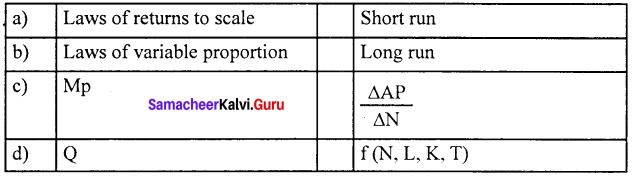
It is the addition or the increment made to the total product when one more unit of the variable input is employed. In other words, it is the ratio of the change in the total product to the change in the units of the input. It is expressed as
MP = ∆TP/∆N
Where MP = Marginal Product
∆TP = Change in total product
∆N = Change in units of input
It is also expressed as MP = TP [n] – TP [n-1]
MP = Marginal product
TP [n] = Total product of employing nth unit of a factor.
TP [n – 1] = Total product of employing the previous unit of a factor, that is, [n – 1]th unit of a factor.

Question 25.
What is the Iso-cost line?
Answer:
An Iso-cost line represents different combinations of inputs which shows the same amount of cost.

Question 26.
What are the conditions for the producer’s equilibrium?
Answer:
The two conditions that are to be fulfilled for the attainment of producer equilibrium are:

  1. The isocost line must be tangent to the isoquant curve.
  2. At the point of tangency, the isoquant curve must be convex to the origin or MRTSLk must be declining.

Question 27.
What are the reasons for the upward-sloping supply curve?
Answer:
As the price of the commodity increases the quantum supplied also increases. So the supply curve has a positive slope.

Part – C

Answer the following questions in One Paragraph

Question 28.
What are the characteristics of land?
Answer:

  1. Land is a primary factor of production
  2. Land is a passive factor of production
  3. Land is the free gift of nature
  4. Land has no cost of production
  5. Land is fixed in supply. It is inelastic in supply
  6. Land is permanent
  7. Land is immovable
  8. Land is heterogeneous as it differs infertility
  9. Land has alternative uses
  10. Land is subject to Law of Diminishing Returns.

Question 29.
What are the factors governing elasticity of supply?
Answer:
1. Nature of the commodity:
The elasticity of supply of durable goods are high but perishables have low elasticity of supply.

2. Cost of production:
Under constant or increasing returns the elasticity of supply is greater, under diminishing returns elasticity is less.

3. Technical condition:
In large scale production supply cannot be adjusted easily. So elasticity of supply is lesser and vice versa.

4. Time factor:
During very short period, supply cannot be adjusted. In short period, variable factors can be changed so elasticity is more and in long period, supply is highly elastic.

Question 30.
What are the functions of entrepreneurs?
Answer:
Functions of an Entrepreneur:

  • Initiation:
    An organizer is the initiator of the business, by considering the situation and availability of resources and planning the entire process of business of production.
  • Innovation:
    A successful entrepreneur is always an innovator. He introduces new methods in the production process.
  • Coordination:
    An organizer applies a particular combination of the factor of production to start and run the business or production.
  • Control, Direction, and Supervision: An organizer controls so that nothing prevents the organization from achieving its goal. He directs the factors to get better results and supervises for the efficient functioning of all the factors involved in the process of production.
  • Risk-taking and uncertainty-bearing: There are risk-taking and uncertainty-bearing obstacles. Risks may be insured but uncertainties cannot be insured. They reduce the profit.

Question 31.
State and explain the elasticity of supply.
Answer:
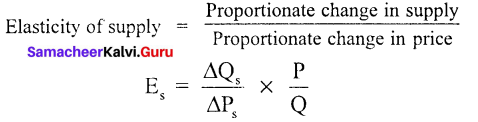
The elasticity of supply may be defined as the degree of responsiveness of change in supply to change in price on the part of sellers.
Mathematically:
11th Economics Chapter 3 Book Back Answers Production Analysis Samacheer Kalvi
Q – Supply, p – price, ∆ – change.

Question 32.
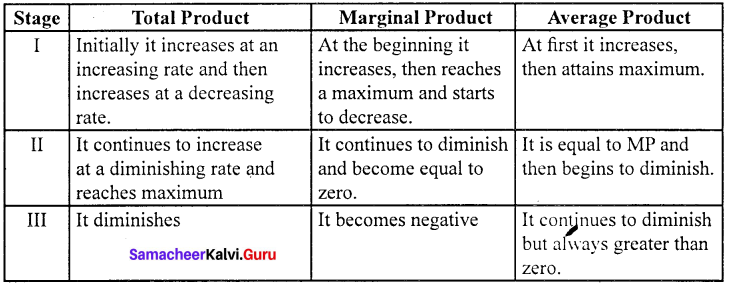
Bring out the Relationship among Total, Average and Marginal Products.
Answer:
Samacheer Kalvi Guru 11th Economics Solutions Chapter 3 Production Analysis

Question 33.
Illustrate the concept of Producer’s Equilibrium.
Answer:
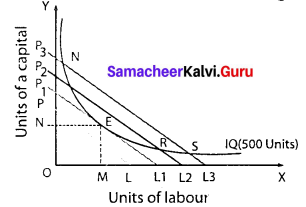
Producer equilibrium is the situation where the producer maximizes his output. It is also known as the optimum combination of the factors of production.
(Eg.) Maximum output at minimum cost.
Producer attains equilibrium where the Iso-cost line is tangent to the Iso-quant.
Samacheer Kalvi Guru 11 Economics Solutions Chapter 3 Production Analysis
In the figure profit of the firm is maximised at the point of equilibrium.
At the point of equilibrium slope of the Iso-cost line = Slope of Iso-product curve At the point E, the firm employs OM units of labour and ON units of capital which is the least cost combination.

Question 34.
State the Cobb – Douglas Production Function?
Answer:
The Cobb – Douglas Production Function was developed by Charles W. Cobb and Paul H. Douglas, based on their empirical study of the American manufacturing industry. It is a linear homogeneous production function which implies that the factors of production can be substituted for one another up to a certain extent only.

The Cobb – Douglas production function can be expressed as follows.
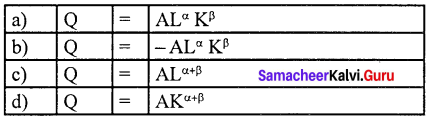
Q = AL2K2
Where, Q = output; A = positive constant;
K = capital;
L = Labor α and β are positive fractions showing, the elasticity coefficients of outputs for the inputs labor and capital, respectively.
P = (1 – a) since a + p = 1. denoting constant returns to scale.
Factor intensity can be measured by the ratio β / α.

The sum of α + β shows the returns to scale.

  1. (α + β) = 1, constant returns to scale.
  2. (α + β) < 1, diminishing returns to scale.
  3. (α + β) >1, increasing returns to scale.
  • The production function explains that with the proportionate increase in the factors, the output also increases in the same proportion.
  • Cobb – Douglas production function implies constant returns to scale.
    Cobb – Douglas Production Function is a specific standard equation applied to describe how much output can be made with capital and labour inputs.

Part – D

Answer the following questions in about a page

Question 35.
Examine the Law of Variable Proportions with the help of a diagram.
Answer:
According to G. Stigler, “As equal increments of one input are added, the inputs of other productive services being held constant, beyond a certain point the resulting increments of the product will decrease (ie) the marginal product will diminish”.
Assumptions:

  1. Only one factor is variable.
  2. All units of the variable factor are homogeneous
  3. The product is measured in physical units.
  4. There is no change in the state of technology and the price of the product.

Stage of production:
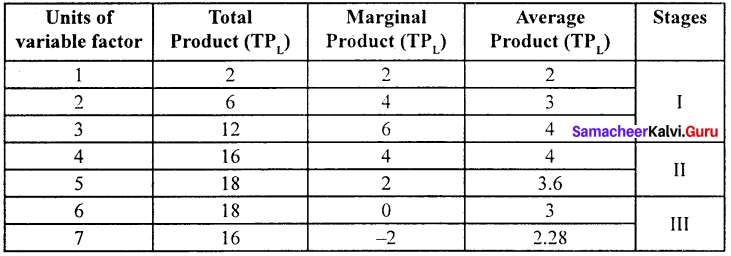
Samacheer Kalvi 11th Economics Solutions Chapter 3 Production Analysis
Units of variable factor (labour) are employed along with other fixed factors. There are three stages of production.
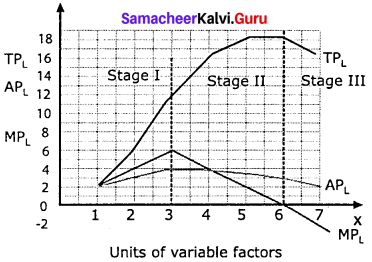
Economics Samacheer Kalvi 11th Solutions Chapter 3 Production Analysis
Stage I:

  1. In the first stage MPL increases upto third labourer and is higher than the average product.
  2. So that total produt is increasing at an increasing rate.

Stage II:

  1. MPL decreases up to sixth unit of labour where MPL curve intersects the x axis.
  2. At fourth unit of labour MPL = APL
  3. After this, MPL curve is lower than the APL. TPL increases at a decreasing rate.

Stage III:

  1. The seventh unit of labour is marked by negative MPL the APL continues to fall but positive.
  2. TPL declines with the employment of more units of labour.

Question 36.
List out the properties of Iso-quants with the help of diagrams.
Answer:
Iso-quant:
“An Iso-quant is a curve showing all possible combinations of inputs physically capable of producing a given level of output” – Ferguson.

Properties of Iso-quant curve:
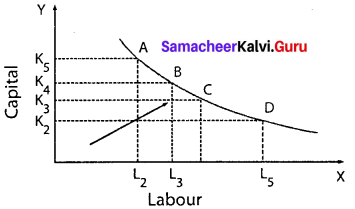
1. The Iso-quant curve has negative slope:

  1. It slopes downwards from left to right indicating that the factors are substitutable.
  2. In the diagram combination A refers to more of capital K5 and less of labour L2
  3. As the producer moves to B, C and D more labour and less capital are used.Economics Class 11 Samacheer Kalvi Solutions Chapter 3 Production Analysis

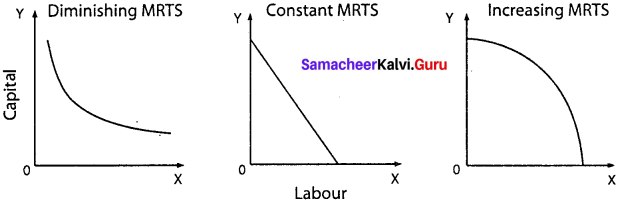
2. Convex to the origin:

  1. In production, the capital substituted by 1 unit of labour goes on decreasing. It is called diminishing marginal rate of technical substitution.
  2. If the marginal rate of technical substitution diminishes the Iso-quants will be convex to the origin.
  3. Constant MRTS (straight line) and increasing MRTS (concave).Samacheer Kalvi Economics 11th Solutions Chapter 3 Production Analysis

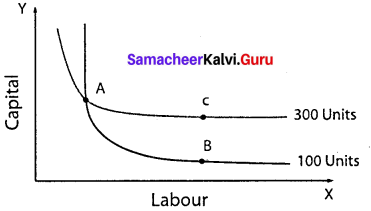
3. Non-inter-section of Iso-Quant curves:

  1. Point A lie on the Iso-quants IQ1 and IQ2
  2. But the point C shows a higher output and point B shows a lower level of output IQ1
  3. If C = A, B = A, then C – B. But C > B which is illogical.
    Samacheer Kalvi 11th Solutions Economics Chapter 3 Production Analysis

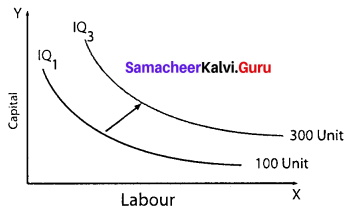
4. An upper Iso-quant curve represents a higher level of output:

  1. Higher IQs show higher outputs and lower IQs show lower output.
  2. The arrow in the figure shows an increase in the output with a right and upward shift of an Iso-quant curve.11th Economics Samacheer Kalvi Solutions Chapter 3 Production Analysis

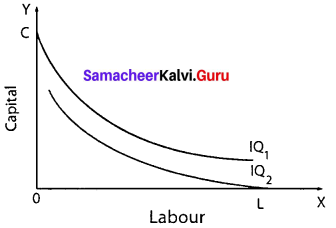
5. Iso-quant curve does not touch either X axis or Y axis:
No Iso-quant curve touches the X – axis or Y – axis because in IQ(, only capital is used and in IQ2 only labour is used.

Economics Class 11 Chapter 3 Notes Production Analysis Samacheer Kalvi

Question 37.
Elucidate the Laws of Returns to Scale. Illustrate.
Answer:
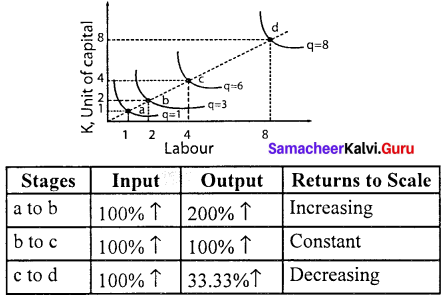
In the long-run all factors are variable. The laws of returns to scale explain the relationship between output and the scale of inputs in the long-run when all the inputs are increased in the same proportion.
Assumptions :

  1. All the factors are variable except the organization.
  2. There is no change in technology.
  3. There is perfect competition in the market.
  4. Outputs or returns are increased in physical quantities.

Three phases of returns to scale:
1. Increasing returns to scale:
If all inputs are increased by one percent, output increase by more than one percent.

2. Constant returns to scale:
In this case, if all inputs are increased by one percent, output increases by one percent.
Diagrammatic Illustration:
11 Th Samacheer Kalvi Economics Solutions Chapter 3 Production Analysis
In the diagram, the movement from point a to point b represents increasing returns to scale. Between these two points, input has doubled but the output was tripled.

The law of constant returns is implied by the movement from point b to point c. Between these two points inputs have doubled and output also has doubled.

Decreasing returns to scale are denoted by the movement from the point c to point d since doubling the factors from 4 units to 8 units produce less than the increase in inputs, that is by only 33.33%.

Question 38.
Explain the internal and external economies of scale.
Answer:
The scale of production is an important factor affecting production. Every producer wishes to reduce the costs of production by using economies of scale.
Marshall classified economies into two.
1. Internal economies of scale: Internal economies refer to the reduction in the cost of production of the commodity. They are of various types.

  • Technical economies: When the size and capital of the firm is large, up-to-date technologies can be used to improve the productivity of the firm. Here research and development strategies can be applied easily.
  • Financial economies: Big firms can float shares in the market for capital expansion, while small firms cannot do so.
  • Managerial economies: Large scale production facilitates specialization and delegation.
  • Labour economies: Large scale production implies greater and minute division of labour. This leads to specialization which enhances the quality. This increases the productivity of the firm.
  • Marketing economies: The producers can both buy raw-materials in bulk at a cheaper cost and can take the products to distant markets.
  • Economies of survival: Product diversification is possible and it reduces the risk in production. Even if the market for one product collapses, the market for other commodities offsets it.

Question 39.
External economies of scale:
Answer:
External economies of scale refer to changes in any factor outside the firm or industry causing an improvement in the production process.
Important external economies are:

  1. Increased transport facilities.
  2. Banking facilities
  3. Development of townships
  4. Development of information and communication

Samacheer Kalvi 11th Economics Production Analysis Additional Questions and Answers

Question 1.
Production refers to …………………….
(a) Destruction of utility
(b) Creation of utilities
(c) Exchange value
(d) None
Answer:
(b) Creation of utilities

Question 2.
_______ is a person who combines the factors of production in the production process to earn profit.
(a) Producer
(b) Entrepreneur
(c) Consumer
(d) Labours
Answer:
(b) Entrepreneur

Question 3.
Division of labour is introduced by ………………………
(a) Adam Smith
(b) Marshall
(c) Schumpeter
(d) Hawley
Answer:
(a) Adam Smith

Question 4.
Total product is
(a) TP = ∑AP
(b) TP = ∑MP
(c) TP = ∆N
(d) TP = TP / N
Answer:
(b) TP = ∑MP

Question 5.
The Initial supply price of land is ……………………..
(a) Zero
(b) Greater than one
(c) Less than one
(d) Equal to one
Answer:
(a) Zero

Question 6.
Cobb – Douglas production function depends on ______
(a) Land, Labour
(b) Land, Capital
(c) Labour, capital
(d) Labour, organisation
Answer:
(c) Labour, capital

Question 7.
Who is the primary factor of production?
(a) Organizer
(b) Capital
(c) Machine
(d) Man
Answer:
(a) Organizer

Question 8.
_______ is the man-made factor of production.
(a) Labour
(b) Capital
(c) Savings
(d) Land
Answer:
(c) Savings

Question 9.
Technological relationship between inputs and output is called ……………………….
(a) Production function
(b) Technical function
(c) Capital function
(d) Organiser function
Answer:
(a) Production function

Question 10.
In the production process _______ bears incertainity.
(a) Manager
(b) Labour
(c) Entrepreneur
(d) None
Answer:
(c) Entrepreneur

Question 11.
α + β = 1 refers _______
(a) Increasing returns to scale
(b) Constant return to scale
(c) Diminishing returns to scale
(d) None
Answer:
(b) Constant return to scale

Choose the correct statement

Question 1.
(a) Production refers to the creation of utility
(b) Production means the transformation of inputs into output
(c) Production creates economic well-being.
(d) The scale of production influences the revenue.
Answer:
(d) The scale of production influences the revenue.

Question 2.
(a) An entrepreneur is a risk-taker – Walker.
(b) Capital consists of all kinds of wealth other than the free gift of nature -Marshall.
(c) An entrepreneur innovates – Schumpeter.
(d) An entrepreneur is an uncertainty bearer – Walker.
Answer:
a. An entrepreneur is a risk-taker – Walker.

Match the following and choose the answer using the codes given below

Question 3.
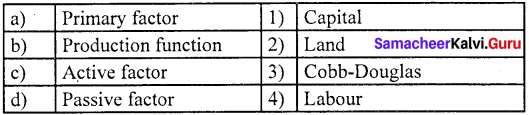
11th Economics Solutions Samacheer Kalvi Chapter 3 Production Analysis
a. 3 4 1 2
b. 1 2 3 4
c. 4 1 2 3
d. 2 1 3 4
Answer:
(c) Active factor – (3) Cobb-Douglas

Question 4.
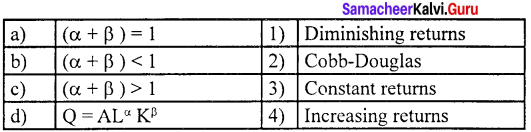
Economics Class 11 Chapter 3 Question Answers Production Analysis Samacheer Kalvi
a. 2 4 1 3
b. 1 2 3 4
c. 3 4 1 2
d. 4 1 2 3
Answer:
(a) (α + β) =1 – (1) Diminishing returns.

Question 5.
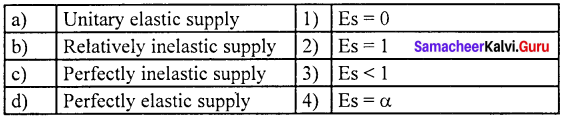
Samacheer Kalvi 11th Economics Solutions Chapter 3 Production Analysis 14
Answer:
a. 1 2 3 4
b. 4 1 2 3
c. 3 1 2 4
d. 2 3 1 4
Answer:
(c) Perfectly inelastic supply = (3) Es < 1

Question 6.
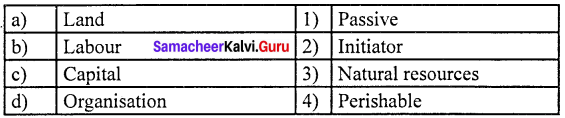
Samacheer Kalvi 11th Economics Solutions Chapter 3 Production Analysis 15
a. 2 3 1 4
b. 3 4 1 2
c. 4 1 2 3
d. 3 4 2 1
Answer:
(b) Labour = (2) Initiator

Choose the odd one out

Question 7.
(a) Land
(b) Labour
(c) Production
(d) Organisation
Answer:
(c) Production

Question 8.
(a) Technical economics
(b) Financial economics
(c) Economics of survival
(d) Banking facility
Answer:
(d) Banking facility

Choose the correct statement

Question 9.
(a) Iso-quant has a positive slope.
(b) Iso-quants never intersect each other
(c) Iso-quants are concave to the origin
(d) Iso-quant curve touch either X or Y-axis.
Answer:
(b) Iso-quants never intersect each other

Question 10.
Cobb-Douglas production function.
(a) Implies constant returns to scale
(b) It considers all the factors of production.
(c) The elasticity of substitution between the factors is less than one.
(d) Is a non-linear homogeneous production function.
Answer:
(a) Implies constant returns to scale

Analyze the reason for the following

Question 11.
Assertion (A) : Labour is the human input into the production process.
Reason (R) : Labour cannot be separated from the labourer.
a. Both (A) and (R) are true, (R) is the correct explanation of (A)
b. Both (A) and (R) are true, (R) is not the correct explanation of (A)
c. Both (A) and (R) are false.
d. (A) is true but, (R) is false.
Answer:
b. Both (A) and (R) are true, (R) is not the correct explanation of (A)

Question 12.
Assertion (A) : Perishables have a low elasticity of supply.
Reason (R) : Perishables cannot be stored for a long time.
a. Both (A) and (R) are true, (R) is the correct explanation of (A)
b. Both (A) and (R) are true, (R) is not the correct explanation of (A)
c. (A) is true but (R) is false.
d. (A) is false but (R) is true.
Answer:
a. Both (A) and (R) are true, (R) is the correct explanation of (A)

Choose the incorrect pair

Question 13.
Samacheer Kalvi 11th Economics Solutions Chapter 3 Production Analysis 16
Answer:
(a) Q = ALα Kβ

Question 14.
Samacheer Kalvi 11th Economics Solutions Chapter 3 Production Analysis 17
Answer:
(d) Q = f (N,L,K,T)

Fill in the blanks with the suitable option given below

Question 15.
Cobb-Douglas production function depends on _____
(a) Land, labour
(b) Land, capital
(c) Labour, capital
(d) Labour, organisation
Answer:
(c) Labour, capital

Question 16.
Total product is _____
(a) TP = ∑AP
(b) TP = ∆N
(c) TP = ∑MP
(d) TP = \(\frac { TP }{ N } \)
Answer:
(c) TP = ∑MP

Question 17.
In the production process __________ bears uncertainty.
(a) Manager
(b) Labour
(c) Worker
(d) Entrepreneur
Answer:
(d) Entrepreneur

Choose the best option

Question 18.
is the man-made factor of production.
(a) Labour
(b) Capital
(c) Savings
(d) Land
Answer:
(b) Capital

Question 19.
The labour exercised without expecting income is __________
(a) Service
(b) Physical labour
(c) Mental labour
(d) None of the above
Answer:
(a) Service

Question 20.
Marginal product is ________
(a) MP = \(\frac { AP }{ N } \)
(b) MP = \(\frac { TP }{ N } \)
(c) MP = \(\frac { ∆AP }{ ∆N } \)
(d) MP = \(\frac { ∆TP }{ ∆N } \)
Answer:
(d) MP = \(\frac { ∆TP }{ ∆N } \)

Part – B

Answer the following questions in one or two sentences

Question 1.
What are the characteristics of capital?
Answer:

  1. Capital is a man-made factor
  2. Capital is mobile between places and persons
  3. Capital is a passive factor of production
  4. Capital’s supply is elastic
  5. Capital’s demand is a derived demand
  6. Capital is durable

Question 2.
What is the land?
Answer:
Land means all gifts of nature owned and controlled by human beings which yield an income.

Question 3.
Explain the law of variable proportions assumptions?
Answer:

  1. The Law of Variable Proportions is based on the following assumptions.
  2. Only one factor is variable while others are held constant.
  3. All units of the variable factor are homogeneous.
  4. The product is measured in physical units.
  5. There is no change in the state of technology.
  6. There is no change in the price of the product.

Question 4.
What is the total product?
Answer:
Total product is the summation of marginal products.
TP = ∑MP

Question 5.
What is average product ?
Answer:
Average product refers to the output per unit of the input.

Question 6.
What is diseconomies of scale ?
Answer:
Diseconomies of scale are a disadvantage to a firm or industry or organisation. This necessarily increases the cost of production.

Question 7.
What are Iso-quants ?
Answer:
An Iso-quant curve can be defined as the locus of points representing various combinations of two inputs yielding the same output.

Part – C

Answer the following questions in One Paragraph

Question 1.
State the characteristics of labour.
Answer:

  1. Labour is an active factor of production.
  2. Labour may be manual or intellectual.
  3. Labour is perishable.
  4. Labour is inseparable from the labourer.
  5. Labour is less mobile.
  6. Labour is a means as well as an end.
  7. Labour units are heterogeneous.
  8. Labour has weak bargaining power.

Question 2.
Define Iso – quant, and Iso – quants Assumptions?
Answer:
Definition of Iso – quant:
According to Ferguson, “An Iso – quant is a curve showing all possible combinations of inputs physically capable of producing a given level of output”.

Assumptions:

  1. It is assumed that only two factors are used to produce a commodity.
  2. Factors of production can be divided into small parts.
  3. The technique of production is constant.
  4. The substitution between the two factors is technically possible. That is, the production function is of “variable proportion” type rather than a fixed proportion.
  5. Under the given technique, factors of production can be used with maximum efficiency.

Question 3.
Who is an entrepreneur?
Answer:
An entrepreneur is a person who combines land, labour and capital in the production process to earn a profit. He not only runs the business but bears the risk of the business.

Question 4.
Differentiate the short period and long period.
Answer:
The short-run is the period where some inputs are variable. Another feature is that firms do not enter or exit the industry. The long-run is the period where all the inputs are variable. It is featured by the entry of new firms and the exit of existing firms from the industry.

Question 5.
Name the classification of a production function.
Answer:
Production function may be classified into two.

  1. Short-run production function as illustrated by the law of variable proportions.
  2. Long-run production function as explained by the laws of returns to scale.

Question 6.
What is an Iso-quant map?
Answer:
An Iso-quant map has different Iso-quant curves representing the different combinations of factors of production, yielding the different levels of output. An Iso-quant map is a family of Iso-quants..

Part – D

Answer the following questions in about a page

Question 1.
What are the characteristics of labour?
Answer:

  1. Labour is the animate factor of production.
  2. Labour is an active factor of production.
  3. Labour implies several types: It may be manual [farmer] or intellectual [teacher, lawyer, etc]
  4. Labour is perishable.
  5. Labour is inseparable from the labourer.
  6. Labour is less mobile between places and occupations.
  7. Labour is a means as well as an end. It is both the cause of production and consumer of the product.
  8. Labour units are heterogeneous.
  9. Labour differs in ability.
  10. Labour – supply determines its reward [wage]
  11. Labour has weak bargaining power.

Question 2.
Explain the law of supply with a diagram.
Answer:
1. Law of supply:
The Law of supply describes a direct relationship between the price of a good and the supply of that good.

2. Definition:
“Other things remaining the same, if the price of a commodity increases its quantity supplied increases and if the price of a commodity decreases, quantity supplied also decreases”.

3. Supply function:
Q = f (Px, Pr, Pr T, O, E)
Qs – Quantity supplied of x commodity
Px – Price of x commodity
Pr – Price of related goods
Pf – Price of factors of production.
T – Technology
O – Objective of the producer.
E – Expected price of the commodity

Assumptions:

  1. There is no change in the prices of factors of production and capital goods.
  2. Natural resources, technology, climate, political situations and tax policy remain unchanged.
  3. Prices of substitutes are constant.

Supply schedule :
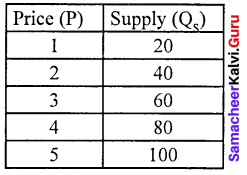
A supply schedule shows the different quantities of supply at different prices

Samacheer Kalvi 11th Economics Solutions Chapter 3 Production Analysis 18

Supply curve:
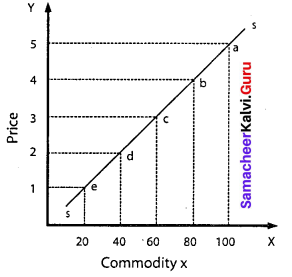
The quantum supplied is represented on X axis. And the price of the commodity is represent on the Y axis

Samacheer Kalvi 11th Economics Solutions Chapter 3 Production Analysis 19

As the price of the commodity increases, the quantum supplied of the commodity also increases. Thus the supply curve has a positive slope. The points such as e, d, c, b and a on the supply curve SS, represent various quantities of different prices.

Question 3.
Explain the factors determining supply.
Answer:
1. Price of the commodity:
Higher the price larger the supply Price is the incentive for the producers and sellers to supply more.

2. Price of other commodities:
The supply of a commodity not only depends upon its price but also prices of other commodities. For instance if the price of commercial crops increases, the supply of food crops may decrease.

3. Price of factors:
When the input prices go up, this results in rise in cost and so supply will be affected.

4. Price expectations:
The expectation over future prices determines present supply.

5. Technology:
With advancement in technology, production level improves, average cost declines and as a result supply level increases.

6. Natural factors:
In agriculture, natural factors like a monsoon, climate, etc., play a vital role in determining the production level.

7. Discovery of new raw materials:
The discovery of cheaper and high-quality raw materials tends to increase the supply of the product.

8. Taxes and subsidies:
Subsidies encourage the producers to produce more whereas taxes kill the ability and willingness to produce more.

9. The objective of the firm:
When the goal of the firm is sales maximization or improving market share, the supply of the product is likely to be higher.

Question 4.
Explain the characteristics of labour.
Answer:
According to Marshall, labour represents services provided by the factor labour, which helps in yielding an income to the owner of the labour-power.
Characteristics of labour:

  1. Labour is the animate factor of production.
  2. Labour is an active factor of production.
  3. Labour implies several types it may be manual or intellectual.
  4. Labour is perishable.
  5. Labour is inseparable from the labourer.
  6. Labour is less mobile between places and occupations.
  7. Labour is a means as well as an end.
  8. Labour units are heterogenous.
  9. Labour-supply determines its reward.
  10. Labour has weak bargaining power.

If you need some more information about Tamilnadu State Board Solutions for 11th Economics Chapter 3 Production Analysis Questions and Answers then visit our site frequently and get all the resources that you look for. Also, share this page with your friends and make them learn all the concepts thoroughly before the exams.

Samacheer Kalvi 12th Bio Botany Solutions Chapter 1 Asexual and Sexual Reproduction in Plants

If you are looking for the best material to read Bio Botany Chapter 1 Asexual and Sexual Reproduction in Plants Questions and Answers, Notes then Download Samacheer Kalvi 12th Bio Botany Book Solutions Guide Pdf. You can learn all the topics and subtopics by referring to the Tamilnadu State Board 12th Bio Botany Chapter 1 Asexual and Sexual Reproduction in Plants Questions and Answers. Samacheer Kalvi12th Bio Botany Subject Material is the notes that you are looking for. Majority of students love to use Samacheer Kalvi Bio Botany Material while preparing for the exam.

Tamilnadu Samacheer Kalvi 12th Bio Botany Solutions Chapter 1 Asexual and Sexual Reproduction in Plants

Every concept of Tamilnadu State Board 12th Bio Botany Subject PDF is explained clearly in an understandable way. Make sure to answer all the Samacheer Kalvi 12th Questions on your own then look for our explanations to make it more easy. We have included all the topics and subtopics to help students for better learning. Best learning comes when you practice with Samacheer Kalvi Board Solutions for 12th Bio Botany Chapter 1 Asexual and Sexual Reproduction in Plants Questions and Answers.

Samacheer Kalvi 12th Bio Botany Asexual and Sexual Reproduction in Plants Text Book Back Questions and Answers

12th Bio Botany 1st Lesson Question 1.
Choose the correct statement from the following
(a) Gametes are involved in asexual reproduction
(b) Bacteria reproduce asexually by budding
(c) Conidia formation is a method of sexual reproduction
(d) Yeast reproduce by budding
Answer:
(c) Conidia formation is a method of sexual reproduction

Samacheer Kalvi Guru 12th Bio Botany Question 2.
An eminent Indian embryologist is ____________
(a) S.R. Kashyap
(b) P. Maheswari
(c) M.S. Swaminathan
(d) K.C. Mehta
Answer:
(b) P. Maheswari

12th Bio Botany Chapter 1 Question 3.
Identity the correctly matched pair ____________
(a) Tuber – Allium cepa
(b) Sucker – Pistia
(c) Rhizome – Musa
(d) Stolon – Zingiber
Answer:
(c) Rhizome – Musa

12th Botany 1st Lesson Question 4.
Pollen tube was discovered by ____________
(a) J.G. Kolreuter
(b) G.B. Amici
(c) E. Strasburger
(d) E. Hanning
Answer:
(b) G.B. Amici

Samacheer Kalvi Guru 12th Botany Question 5.
Size of pollen grain in Myosotis ____________
(a) 10 micrometer
(b) 20 micrometer
(c) 200 micrometer
(d) 2000 micrometer
Answer:
(a) 10 micrometer

Botany Class 12 Chapter 1 Question 6.
First cell of male gametophyte in angiosperm is ____________
(a) Microspore
(b) Megaspore
(c) Nucleus
(d) Primary Endosperm Nucleus
Answer:
(a) Microspore

Botany Chapter 1 Class 12 Question 7.
Match the following ____________
(I) External fertilization – (i) pollen grain
(II) Androecium – (ii) anther wall
(III) Male gametophyte – (iii) algae
(IV) Primary parietal layer – (iv) stamens
(a) I-(iv); II-(i); III-(ii); IV-(iii)
(b) I-(iii); II-(iv); III-(ii); IV-(i)
(c) l-(iii); II-(iv); III-(ii); IV-(i)
(d) I-(iii); II-(i); III-(iv); IV-(ii)
Answer:
(b) I-(iii); II-(iv); III-(ii); IV-(i)

Samacheer Kalvi 12 Bio Botany Solutions Question 8.
Arrange the layers of anther wall from locus to periphery
(a) Epidermis,middle layers, tapetum, endothecium
(b) Tapetum, middle layers, epidermis, endothecium
(c) Endothecium, epidermis, middle layers, tapetum
(d) Tapetum, middle layers endothecium epidermis
Answer:
(d) Tapetum, middle layers endothecium epidermis

Samacheer Kalvi 12th Botany Book Back Answers Question 9.
Identify the incorrect pair
(a) sporopollenin – exine of pollen grain
(b) tapetum – nutritive tissue for developing microspores
(c) Nucellus – nutritive tissue for developing embryo
(d) obturator – directs the pollen tube into micropyle
Answer:
(c) Nucellus – nutritive tissue for developing embryo

Samacheer Kalvi 12th Bio Botany Solutions Question 10.
Assertion : Sporopollenin preserves pollen in fossil deposits
Reason : Sporopollenin is resistant to physical and biological decomposition
(a) assertion is true; reason is false
(b) assertion is false; reason is true
(c) Both Assertion and reason are not true
(d) Both Assertion and reason are true.
Answer:
(b) assertion is false; reason is true

Samacheer Kalvi Guru 12th Biology Question 11.
Choose the correct statement(s) about tenuinucellate ovule
(a) Sporogenous cell is hypodermal
(b) Ovules have fairly large nucellus
(c) sporogenous cell is epidermal
(d) ovules have single layer of nucellus tissue
Answer:
(a) Sporogenous cell is hypodermal

Samacheer Kalvi 12th Bio Botany Guide Question 12.
Which of the following represent megagametophyte ____________
(a) Ovule
(b) Embryo sac
(c) Nucellus
(d) Endosperm
Answer:
(b) Embryo sac

12th Botany Samacheer Kalvi Question 13.
In Haplopappus gracilis, number of chromosomes in cells of nucellus is 4. What will be the chromosome number in Primary endosperm cell?
(a) 8
(b) 12
(c) 6
(d) 2
Answer:
(b) 12

Question 14.
Transmitting tissue is found in
(a) Micropylar region of ovule
(b) Pollen tube wall
(c) Stylar region of gynoecium
(d) Integument
Answer:
(c) Stylar region of gynoecium

Question 15.
The scar left by funiculus in the seed is ____________
(a) tegmen
(b) radicle
(c) epicotyl
(d) hilum
Answer:
(d) hilum

Question 16.
A Plant called X possesses small flower with reduced perianth and versatile anther. The probable agent for pollination would be ____________
(a) water
(b) air
(c) butterflies
(d) beetles
Answer:
(b) air

Question 17.
Consider the following statement(s)

  1. In Protandrous flowers pistil matures earlier
  2. In Protogynous flowers pistil matures earlier
  3. Herkogamy is noticed in unisexual flowers
  4. Distyly is present in Primula

(a) i and ii are correct
(b) ii and iv are correct
(c) ii and Hi are correct
(d) i and iv are correct
Answer:
(b) ii and iv are correct

Question 18.
Coelorhiza is found in ____________
(a) Paddy
(b) Bean
(c) Pea
(d) Tridax
Answer:
(a) Paddy

Question 19.
Parthenocarpic fruits lack ____________
(a) Endocarp
(b) Epicarp
(c) Mesocarp
(d) seed
Answer:
(d) seed

Question 20.
In majority of plants pollen is liberated at ____________
(a) 1 celled stage
(b) 2 celled stage
(c) 3 celled stage
(d) 4 celled stage
Answer:
(b) 2 celled stage

Question 21.
What is reproduction?
Answer:
Reproduction is the biological process of producing young ones of their own kind. It is a vital process for the existence of a species and it also brings suitable changes through variation in tlie offsprings for their survival on earth.

Question 22.
Mention the contribution of Hofmeister towards Embryology.
Answer:
Hofmeister described the structure of pollen tetrad

Question 23.
List out two sub-aerial stem modifications with example.
Answer:

  1. Stolon – E.g.: Fragaria
  2. Sucker – E.g.: Chrysanthemum

Question 24.
What is layering?
Answer:
Layering is a conventional propagation method, where the stem of a parent plant is allowed to develop roots while still intact. When the root develops, the rooted part is cut and planted to grow as a raw individual. E.g.: Jasminum.

Question 25.
What are clones?
Answer:
Individuals developed by asexual reproduction are morphologically and genetically identical. Such individuals are called as clones.

Question 26.
A detached leaf of Bryophyllum produces new plants. How?
Answer:
In Bryophyllum, the leaf is succulent and notched on its margin. Adventious buds develop at these notches and are called epiphyllous buds. They develop into new plants forming a root system and become independent plants when the leaf gets decayed.

Question 27.
Differentiate Grafting and Layering.
Answer:
Grafting:

  1. In grafting, two different plants (stock & scion) are used to develop new plant.
  2. The new plant will support to possess the characters of both the parents or new variation can be noticed.

Layering:

  1. In layering, only one plant is used to develop new plant.
  2. Variation cannot be expected. The new individual is exactly similar to parent plant.

Question 28.
Tissue culture is the best method for propagating rare and endangered plant species”- Discuss.
Answer:
Micropropagation of plants invitro through tissue culturing is a modem and alternative tool to conserve and safeguard rare plant species. Since the basic principle behind PTC is totipotency. With the help of a single explant it is possible to generate a huge population of plantlets within a short span of time. Conservation through micropropagation offers the possibility to rescue endangered and endemic species.

Question 29.
Distinguish mound layering and air layering
Answer:
Mound Layering:
In mound layering, lower flexible branch with leaves is bent to ground and a part of the stem is buried in the soil and the tip of branch is exposed above the soil. After the roots emerge from the buried stem, a cut is made in parent plant so that the buried plant grows into a new plant.

Air Layering:
In air layering, the stem is girdled at nodal part and hormones are applied and covered with moist soil using polythene sheet. Roots emerge in these branches after 2-4 months. Such branches are removed from parent plant and grown separately.

Question 30.
Explain the conventional methods adopted in vegetative propagation of higher plants.
Answer:
The common methods of conventional propagation are cutting, grafting and layering.
a. Cutting: It is the method of producing a new plant by cutting the plant parts such as root, stem and leaf from the parent plant. The cut part is placed in a suitable medium for growth. It produces root and grows into a new plant. Depending upon the part used it is called as root cutting (Malus), stem cutting (Hibiscus, Bougainvillea and Moringa) and leaf cutting (Begonia, Bryophyllum). Stem cutting is widely used for propagation.

b. Grafting: In this, parts of two different plants are joined so that they continue to grow as one plant. Of the two plants, the plant which is in contact with the soil is called stock and the plant used for grafting is called scion. Examples are Citrus, Mango and Apple. There are different types of grafting based on the method of uniting the scion and stock. They are bud grafting, approach grafting, tongue grafting, crown grafting and wedge grafting.

(i) Bud grafting: AT- shaped incision is made in the stock and the bark is lifted. The scion bud with little wood is placed in the incision beneath the bark and properly bandaged with a tape.

(ii) Approach grafting: In this method both the scion and stock remain rooted. The stock is grown in a pot and it is brought close to the scion. Both of them should have the same thickness. A small slice is cut from both and the cut surfaces are brought near and tied together and held by a tape. After 1-4 weeks the tip of the stock and base of the scion are cut off and detached and grown in a separate pot.

(iii) Tongue grafting: A scion and stock having the same thickness is cut obliquely and the scion is fit into the stock and bound with a tape.

(iv) Crown grafting: When the stock is large in size scions are cut into wedge shape and are
inserted on the slits or clefts of the stock and fixed in position using graft wax.

(v) Wedge grafting: In this method a slit is made in the stock or the bark is cut. A twig of scion is inserted and tightly bound so that the cambium of the two is joined.

c. Layering: In this method, the stem of a parent plant is allowed to develop roots while still intact. When the root develops, the rooted part is cut and planted to grow as a new plant.
Examples: Ixora mdJasminum Mound layering and Air layering are few types of layering.

(i) Mound layering: This method is applied for the plants having flexible branches. The lower branch with leaves is bent to the ground and part of the stem is buried in the soil and tip of ( the branch is exposed above the soil. After the roots emerge from the part of the stem buried in the soil, a cut is made in parent plant so that the buried part grow into a new plant.

(ii) Air layering: In this method the stem is girdled at nodal region and hormones are applied to this region which promotes rooting. This portion is covered with damp or moist soil using a ; polythene sheet. Roots emerge in these branches after 2-4 months. Such branches are removed-from the parent plant and grown in a separate pot or ground.

Question 31.
Highlight the milestones from the history of plant embryology.
Milestones in Plant Embryology
Answer:

  1. 1682 – Nehemiah Grew mentioned stamens as the male organ of a flower.
  2. 1694 – R.J. Camerarius described the structure of a flower, anther, pollen and ovule
  3. 1761 – J.G. Kolreuter gave a detailed account on the importance of insects in pollination.
  4. 1824 – G.B. Amici discovered the pollen tube.
  5. 1848 – Hofmeister described the structure of pollen tetrad.
  6. 1870 – Hanstein described the development of embryo in Capsella and Alisma.
  7. 1878 – E. Strasburger reported polyembryony.
  8. 1884 – E. Strasburger discovered the process of Syngamy.
  9. 1899 – S.G. Nawaschin and L. Guignard independently discovered Double fertilization.
  10. 1904- E. Hanning initiated embryo culture.
  11. 1950 – D.A. Johansen proposed classification for embryo development.
  12. 1964 – S. Guha and S.C. Maheswari raised haploids from Datura pollen grains
  13. 1991 – E.S. Coen and E.M. Meyerowitz proposed the ABC model to describe the genetics of initiation and development of floral parts
  14. 2015 – K.V. Krishnamurthy summarized the molecular aspects of pre and post fertilization reproductive development in flowering plants

Question 32.
Discuss the importance of Modern methods in reproduction of plants.
Answer:
Advantages of modern methods

  1. Plants with desired characteristics can be multiplied rapidly in a short duration.
  2. Plants produced are genetically identical.
  3. Tissue culture can be carried out in any season to produce plants.
  4. Plants which do not produce viable seeds and seeds that are difficult to germinate can be propagated by tissue culture.
  5. Rare and endangered plants can be propagated.
  6. Disease free plants can be produced by meristem culture.
  7. Cells can be genetically modified and transformed using tissue culture.

Question 33.
What is Cantharophily?
Answer:
Pollination carried out by beetles is said to be cantharophily.

Question 34.
List any two strategy adopted by bisexual flowers to prevent self-pollination.
Answer:
(a) Protandry or protogyny
(b) Herkogamy

Question 35.
What is endothelium?
Answer:
In Asteraceae species, the inner layer of integument get specialized for nourishing the embryosac and this is called integumentary tapetum or endothelium.

Question 36.
“The endosperm of angiosperm is different from gymnosperm”. Do you agree. Justify your answer.
Answer:
Endosperm of Angiosperm:

  1. Develops as a s result of double fertilization.
  2. Endosperm is generally triploid (polyploid).

Endosperm of Gymnosperm:

  1. Develops before the fertilization process.
  2. Endosperm is haploid.

Question 37.
Define the term Diplospory.
Answer:
Diplospory is a condition where a diploid embryosac is formed from megaspore mother cells without a regular meiotic division.
E.g: Eupatorium.

Question 38.
What is polyembryony. How it can commercially exploited.
Answer:
Occurrence of more than one embryo in a seed is called polyembryony.

  1. Embryos developed through polyembryony are found virus free.
  2. The seedlings formed from nuclear tissue in citrus are found on better clones for orchards.

Question 39.
Why does the zygote divides only after the division of Primary endosperm cell.
Answer:
The primary endosperm nuclear (PEN) divides prior to zygotic division and form endosperm. Endosperm acts as a nutritive tissue and nourishes the developing embryo.

Question 40.
What is Mellitophily?
Answer:
Pollination carried out by Bees is said to be mellitophily.

Question 41.
“Endothecium is associated with dehiscence of anther” Justify the statement.
Answer:
The inner tangential wall develops bands (sometimes radial walls also) of a cellulose (sometimes also slightly lignified). The cells are hygroscopic. The cells along the junction of the two sporangia of an anther lobe lack these thickenings. This region is called stomium. This region along with the hygroscopic nature of endothecium helps in the dehiscence of anther at maturity.

Question 42.
List out the functions of tapetum.
Answer:

  1. It supplies nutrition to the developing microspores.
  2. It contributes sporopollenin through ubisch bodies thus plays an important role in pollen wall formation.
  3. The pollenkitt material is contributed by tapetal cells and is later transferred to the pollen surface.
  4. Exine proteins responsible for ‘rejection reaction’ of the stigma are present in the cavities of the exine. These proteins are derived from tapetal cells.

Question 43.
Write short note on Pollenkitt.
Answer:
Pollenkitt is contributed by the tapetum and coloured yellow or orange and is chiefly made of carotenoids or flavonoids. It is an oily layer forming a thick viscous coating over pollen surface. It attracts insects and protects damage from UV radiation.

Question 44.
Distinguish tenuinucellate and crassinucellate ovules.
Answer:
Tenuinucellate Ovule:

  1.  Ovules with hypodermal sporogerous cell with unilayerd nucellus tissue is called tenuinucellate type.
  2. They have very small nucellus

Crassinucellate Ovule:

  1. Ovule with subhypodermal sporogenous cell is called crassinucellate type.
  2. They have large nucellus

Question 45.
‘Pollination in Gymnosperms is different from Angiosperms’ – Give reasons.
Answer:
In gymnosperms, the ovules are exposed and the pollens are deposited directly on it. Hence the pollution is direct in gymnosperm. Whereas in angiosperms it is said to be indirect, as the pollens are deposited on stigma or the pistil.

Question 46.
Write short note on Heterostyly.
Answer:
Heterostyly: Some plants produce two or three different forms of flowers that are different in their length of stamens and style. Pollination will take place only between organs of the same lepgth.
E.g: Primula.

Question 47.
Enumerate the characteristic features of Entomophilous flowers.
Answer:
The characteristic features of entomophilous flowers are as follows:

  1. Flowers are generally large or if small they are aggregated in dense inflorescence. Example: Asteraceae flowers.
  2. Flowers are brightly coloured. The adjacent parts of the flowers may also be brightly coloured to attract insect. For example in Poinsettia and Bougainvillea the bracts become coloured.
  3. Flowers are scented and produce nectar.
  4. Flowers in which there is no secretion of nectar, the pollen is either consumed as food or used in building up of its hive by the honeybees. Pollen and nectar are the floral rewards for the visitors.
  5. Flowers pollinated by flies and beetles produce foul odour to attract pollinators.
  6. In some flowers juicy cells are present which are pierced and the contents are sucked by the insects.

Question 48.
Discuss the steps involved in Microsporogenesis.
Answer:
Microsporogenesis: The stages involved in the formation of haploid microspores from diploid microspore mother cell through meiosis is called Microsporogenesis. The primary sporogeneous cells directly, or may undergo a few mitotic divisions to form sporogenous tissue. The last generation of sporogenous tissue functions as microspore mother cells.

Each microspore mother cell divides meiotically to form a tetrad of four haploid microspores (microspore tetrad). Microspores soon separate from one another and remain free in the anther locule and develop into pollen grains.

Question 49.
With a suitable diagram explain the structure of an ovule.
Answer:
Structure of ovule(Megasporangium):
12th Bio Botany 1st Lesson Asexual And Sexual Reproduction In Plants Samacheer Kalvi
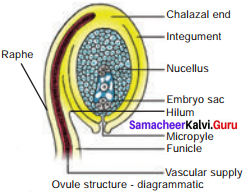
Ovule is also called megasporangium and is protected by one or two covering called integuments. A mature ovule consists of a Raphe stalk and a body. The stalk or the funiculus (also called funicle) is present at the base and it attaches the ovule to the placenta. The point of attachment of funicle to the body of the ovule is known as hilum. It represents the junction ovule and funicle. In an inverted ovule, the funicle is adnate to the body of the ovule forming a ridge called raphe. The body of the ovule is made up of a central mass of parenchymatous tissue called nucellus which has large reserve food materials. The nucellus is enveloped by one or two protective coverings called integuments. Integument encloses the nucellus completely except at the top where it is free and forms a pore called micropyle.

The ovule with one or two integuments are said to be unitegmic or bitegmic ovules respectively. The basal region of the body of the ovule where the nucellus, the integument and the funicle meet or merge is called chalaza. There is a large, oval, sac-like structure in the nucellus toward the micropylar end called embryo sac or female gametophyte. It develops from the functional megaspore formed within the nucellus. In some species(unitegmic tenuinucellate) the inner layer of the integument may become specialized to perform the nutritive function for the embryo sac and is called as endothelium or integumentary tapetum (Example : Asteraceae).

Question 50.
Give a concise account on steps involved in fertilization of an angiosperm plant.
Answer:
Steps involved in fertilization of angiospermic plant:

  1. Germination of pollen grain on stigma.
  2. Formation of pollen tube in stigma.
  3. Growth of pollen tube inside the style.
  4. Direction of pollen tube towards the micropyle of ovule.
  5. Entry of pollen tube into the synergid of embryo sac.
  6. Discharge of male gametes from the pollen tube.
  7. Fusion of male gamete with egg cell (syngany)
  8. Fusion of second male gamete with polar nuclei (triple fusion/double

Question 51.
What is endosperm? Explain the types.
Answer:
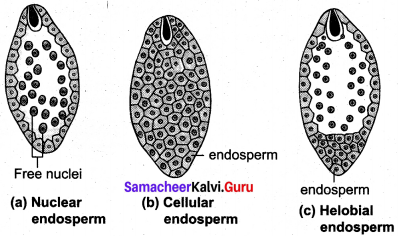
1. Endosperm: The primary endosperm nucleus (PEN) divides immediately after fertilization but before the zygote starts to divide, into an endosperm. The primary endosperm nucleus is the result of triple fusion (two polar nuclei and one sperm nucleus) and thus has 3n number of chromosomes. It is a nutritive tissue and regulatory structure that nourishes the developing embryo. Depending upon the mode of development three types of endosperm are recognized in angiosperms. They are nuclear endosperm, cellular endosperm and helobial endosperm.
Samacheer Kalvi Guru 12th Bio Botany Solutions Chapter 1 Asexual And Sexual Reproduction In Plants

2. Nuclear endosperm: Primary Endosperm Nucleus undergoes several mitotic divisions without cell As, wall formation thus a free nuclear condition exists in the endosperm.
Examples: Coccinia, Capsella and Arachis.

3. Cellular endosperm: Primary endosperm nucleus divides into 2 nuclei and it is immediately followed by wall formation. Subsequent divisions also follow cell wall formation.
Examples: Adoxa, Helianthus and Scoparia.

4. Helobial endosperm: Primary Endosperm Nucleus moves towards base of embryo sac and divides into two nuclei. Cell wall formation takes place leading to the formation of a large micropylar and small chalazal chamber. The nucleus of the micropylar chamber undergoes several free nuclear division whereas that of chalazal chamber may or may not divide.
Examples : Hydrilla and Vallisneria.

5. Ruminate endosperm: The endosperm with irregularity and unevenness in its surface forms ruminate endosperm. Examples : Areca catechu, Passiflora and Myristica

Question 52.
Differentiate the structure of Dicot and Monocot seed
Answer:
Dicot Seed:

  1. Possess two cotyledons
  2. Absence of coleoptile and coleorhiza
  3. Endosperm is scarce or absent

Monocot Seed:

  1. Possess only one cotyledon
  2. Presence of coleoptile and colerhiza surrounding plumule and radicle respectively.
  3. Endosperm from the major storage tissue.

Question 53.
Give a detailed account on parthenocarpy. Add a note on its significance.
Answer:
In some plants, fruit like structures may develop from the ovary without the act of fertilization. Such fruits are called parthenocarpic fruits. Invariably they will not have true seeds. Many commercial fruits are made seedless.
Examples: Banana, Grapes and Papaya.Nitsch in 1963 classified the parthenocarpy into following types:

  1. Genetic Parthenocarpy: Parthenocarpy arises due to hybridization or mutation.
    Examples: Citrus,Cucurbita.
  2. Environmental Parthenocarpy: Environmental conditions like frost, fog, low temperature, high temperature etc., induce Parthenocarpy. For example, low temperature for 3-19 hours induces parthenocarpy in Pear. Chemically
  3. induced Parthenocarpy: Application of growth promoting substances like Auxins and Gibberellins induces parthenocarpy.
  4. Significance: The seedless fruits have great significance in horticulture.
    • The seedless fruits have great commercial importance.
    • Seedless fruits are useful for the preparation of jams, jellies, sauces, fruit drinks etc.
    • High proportion of edible part is available in parthenocarpic fruits due to the absence of seeds.

Samacheer Kalvi 12th Bio Botany Asexual and Sexual Reproduction in Plants Additional Questions and Answers

1 – Mark Questions

Question 1.
Match the following:
(1) Conidia – (i) Yeast
(2) Budding – (ii) Bacteria
(3) Gemma cups – (iii) Aspergilus
(4) Binary fission – (iv) Marchantia
(a) 1 – (iii), 2 – (i), 3 – (iv), 4 – (ii)
(b) 1 – (ii), 2 – (iv), 3 – (iii), 4 – (i)
(c) 1 – (iv), 2 – (ii), 3 – (i), 4 – (iii)
(d) 1 – (i), 2 – (iii), 3 – (ii), 4 – (iv)
Answer:
(a) 1 – (iii), 2 – (i), 3 – (iv), 4 – (ii)

Question 2.
The unit of reproductive structure used in vegetative propagation is called as
(a) Diplospores
(b) Aplanospores
(c) Diaspores
(d) Condiospores
Answer:
(c) Diaspores

Question 3.
Which of the following aquatic plant is popularly known as the “Terror of Bengal”?
(a) Eichornia crassipes
(b) Vallisneria spiralis
(c) Pistia stratiotes
(d) Zostera marina
Answer:
(a) Eichornia crassipes

Question 4.
Identify the incorrect statement regarding vegetative reproduction.
Answer:
(a) Only one parent is required for propagation.
(b) New individuals are genetically dissimilar.
(c) Easy mode of reproduction.
(d) Variation does not exist.
Answer:
(b) New individuals are genetically dissimilar.

Question 5.
The genetic ability of a plant cell to produce the entire plant is said to be
(a) Multipotency
(b) Totipotency
(c) Pleuripotency
(d) Differentiation
Answer:
(b) Totipotency

Question 6.
A typical anther is
(a) Bisporangiate
(b) Tetrasporangiate
(c) Unisporangiate
(d) Multisporangiate
Answer:
(b) Tetrasporangiate

Question 7.
Match the following:
Vegetative Reproductive structures
12th Bio Botany Chapter 1 Asexual And Sexual Reproduction In Plants Samacheer Kalvi
(a) 1 – (ii), 2 – (i), 3 – (iv), 4 – (iii)
(b) 1 – (ii), 2 – (iv), 3 – (iii), 4 – (i)
(c) 1 – (iv), 2 – (ii), 3 – (i), 4 – (iii)
(d) 1 – (i), 2 – (iii), 3 – (ii), 4 – (iv)
Answer:
(a) 1 – (ii), 2 – (i), 3 – (iv), 4 – (iii)

Question 8.
Innermost layer of anther wall is
(a) Endothecium
(b) Endothecum
(c) Endothelium
(d) Tapetum
Answer:
(d) Tapetum

Question 9.
Identify the mismatched pair:
(a) Epidermal layer – Protective infunction
(b) Endothecium layer – Helps in dehiscence of anther
(c) Middle layer – Persistent layer
(d) Tapetum – Nutritive in function
Answer:
(c) Middle layer – Persistent layer

Question 10.
Name the person who discovered the pollen tube?
(a) E.Strasburger
(b) Hofineister
(c) Nehemiah Grew
(d) G.B.Amici
Answer:
(d) G.B.Amici

Question 11.
Identify the mismatched pair
(i) Sucker – Chrysanthemum
(ii) Bulbils – Agave
(iii) Stolon – Fragaria
(iv) Runner – Lilium
(a) i only (b) ii only (c) iii only (d) iv only
Answer:
(d) iv only

Question 12.
Assertion (A): Epidermis is protective in function.
Reason (R): Epidermis is outermost unilayer of anther wall.
(a) A is correct R is incorrect.
(b) R explains A.
(c) Both A and R are incorrect.
(d) Both A and R are correct. R does not explain A.
(b) R explains A.
Answer:
(b) R explains A.

Question 13.
Assertion (A) : Microspores are the first cell of male gametophyte.
Reason (R) : Microspores undergo development and forms pollen grains.
(a) A is correct R is incorrect.
(b) R explains A.
(c) Both A and R are incorrect.
(d) Both A and R are correct. R does not explain A.
Answer:
(b) R explains A.

Question 14.
Assertion (A) : Carica papaya is a dioecious plant.
Reason (R): Both male and female flowers are borne on same plant.
(a) A is correct R is incorrect.
(b) R explains A.
(c) Both A and R are incorrect.
(d) Both A and R are correct. R does not explain A.
Answer:
(a) A is correct R is incorrect.

Question 15.
Assertion (A) : Anemophilous pollination occurs by animals.
Reason (R) : Pollen grains are sticky for easy attachment on animals.
(a) A is correct R is incorrect.
(b) R explains A.
(c) Both A and R are incorrect.
(d) Both A and R are correct. R does not explain A.
Answer:
(c) Both A and R are incorrect.

Question 16.
Assertion (A) : Fusion of male and female gametes results in zygote.
Reason (R): Product of triple fusion is PEN.
(a) A is correct R is incorrect.
(b) R explains A.
(c) Both A and R are incorrect.
(d) Both A and R are correct. R does not explain A.
Answer:
(d) Both A and R are correct. R does not explain A.

Question 17.
Assertion (A) : Zea mays is a monocotyledonous plant.
Reason (R) : Shield shaped cotyledon is called scutellum.
(a) A is correct R is incorrect.
(b) R explains A.
(c) Both A and R are incorrect.
(d) Both A and R are correct. R does not explain A.
Answer:
(b) R explain A.

Question 18.
Assertion (A) : In Bryophyllum, vegetative propagation occurs through leaf.
Reason (R) : Epiphyllous buds are noticed in Bryophyllum.
(a) A is correct R is incorrect.
(b) R explains A.
(c) Both A and R are incorrect.
(d) Both A and R are correct. R does not explain A.
Answer:
(b) R explain A.

Question 19.
Assertion (A): Androecium and Gynoecium are essential whorls of flower
Reason (R) : Androecium and Gynoecium assist the reproduction.
(a) A is correct R is incorrect
(b) R explains A
(c) Both A and R are incorrect
(d) Both A and R are correct. R does not explain A
Answer:
(a) A is correct R is incorrect

Question 20.
Identify the correct statement.
(a) Grafting is a modem method of artificial propagation.
(b) The plant which is used for graft is scion.
(c) In tongue grafting, the scion bud is placed inside the incision beneath bark.
(d) Grafting is usually carried out in monocot plants.
Answer:
(b) The plant which is used for graft is scion.

Question 21.
Statement 1: Flower is a highly condensed shoot for reproductive purpose.
Statement 2: A complete flower possess four whorls.
(a) Both the statements are incorrect.
(b) Statement 1 is correct and Statement 2 is incorrect.
(c) Both the statements are correct.
(d) Statement 1 is incorrect and statement 2 is correct.
Answer:
(c) Both the statements are correct.

Question 22.
Identify the incorrect statement.
(a) One seeded fruit of paddy is caryopsis.
(b) Primitive root is called coleorhiza.
(c) Sctellum is a part of monocot seed.
(d) Embryonic axis above the cotyledon is epicotyl.
Answer:
(b) Primitive root is called coleorhiza.

Question 23.
Cleavage polyembryony is noticed in
(a) Orchids
(b) Casuarina
(c) Balanophora
(d) Syzygium
Answer:
(a) Orchids

Question 24.
Pick out the non-spermous seed
(a) Wheat
(b) Sunflower
(c) Bean
(d) Orchids
Answer:
(c) Bean

Question 25.
The type of endosperm noticed in Hydrilla seed
(a) Ruminate endosperm
(b) Nuclear endosperm
(c) Cellular endosperm
(d) Helobial endosperm
Answer:
(b) Nuclear endosperm

Question 26.
Which is note a part of mature seed?
(a) Funiculus
(b) Testa and tegma
(c) hilm
(d) Chalaza
Answer:
(d) Chalaza

Question 27.
Select the wrong statement(s) regarding cross pollination.
(a) Pollination depends on external agent and so it is certain.
(b) New varieties are produced.
(c) Continuous cross pollination leads to weaker progeny.
(d) Germination capacity is highly declined.
(i) a and d
(ii) b and c
(iii) a, b and d
(iv) a, c and d
(iv) a, c and d
Answer:
(iv) a, c and d

Question 28.
Which of the following characters does not exist in Omithophilous flowers?
(a) Huge sized flowers
(b) Bright coloured
(c) Scented flowers
(d) Nectar is secreted in large
Answer:
(c) Scented flowers

Question 29.
Which of the following plant was introduced as a contaminant into India along with wheat?
(a) Parthenium hysterophorus
(b) Zea mays
(c) Rosaindica
(d) Mangifera indica
Answer:
(a) Parthenium hysterophorus

Question 30.
_____ is a carotenoid derivative of exine layer which provides resistance to pollen grains.
Answer:
Sporopollenin

Question 31.
The most common type of ovule noticed in dicots and monocots is ______
(a) Orthotropus
(b) Anatropous
(c) Campylotropus
(d) Amphitropous
Answer:
(b) Anatropous

Question 32.
Identity the incorrect statement.
(а) The stalk of the ovule is funiculus.
(b) Nucellus is composed of sclerenchymatous tissue.
(c) Basal region of the ovule is chalaza end.
(d) Micropyle is always oriented opposite to chalaza.
Answer:
(b) Nucellus is composed of sclerenchymatous tissue.

Question 33.
Generally the pollen grains are liberated from anther at
(a) 2-celled stage
(b) 4-celled stage
(c) 6-celled stage
(d) 8-celled stage
Answer:
(a) 2-celled stage

Question 34.
Assertion (A) : Self – pollination is certain in cleistogamous flowers.
Reason (R) : Flowers never open and do not expose reproductive organs.
(a) Both A and R are incorrect.
(b) A is correct R is incorrect.
(c) R explains A.
(d) Both A and R are correct. R is not correct explanation for A.
Answer:
(c) R explains A.

Question 35.
Assertion (A): Entamophily is the most common type of pollination.
Reason (R) : Birds and animals brings out effective pollination.
(a) Both A and R are incorrect.
(b) A is correct R is incorrect.
(c) R explains A.
(d) Both A and R are correct. R is not a correct explanation for A.
Answer:
(d) Both A and R are correct. R is not a correct explanation for A.

Question 36.
Statement 1: Primary sporogenous cell functions as megaspore mother cell.
Statement 2: Megaspore mother cell undergoes mitotic division producing megaspores.
(a) Statement 1 is correct and statement 2 is incorrect.
(b) Statement 1 is incorrect and statement 2 is correct.
(c) Both the statements 1 and 2 are correct.
(d) Both the statements 1 and 2 are incorrect.
Answer:
(a) Statement 1 is correct and statement 2 is incorrect.

Question 37.
Statement 1: Apomixis does not involve meiosis and syngamy.
Statement 2: The term Apomixis was introduced by Winkler.
(a) Statement 1 is correct and statement 2 is incorrect.
(b) Statement 1 is incorrect and statement 2 is correct.
(c) Both the statements 1 and 2 are correct.
(d) Both the statements 1 and 2 are incorrect.
Answer:
(c) Both the statements 1 and 2 are correct.

Question 38.
Statement 1: The pollen grains are deposited on the receptive surface of style.
Statement 2: After landing, the first visible change in pollen is hydration.
(a) Statement 1 is correct and statement 2 is incorrect.
(b) Statement 1 is incorrect and statement 2 is correct.
(c) Both the statements 1 and 2 are correct.
(d) Both the statements 1 and 2 are incorrect.
Answer:
(b) Statement 1 is incorrect and statement 2 is correct.

Question 39.
Which of the following post fertilization change is incorrectly matched?
(a) Secondary nucellus – Endosperms
(b) Antipodals – Degenerates
(c) Nucellus – Testa and tegma
(d) Funicle – Seed stalk
Answer:
(c) Nucellus – Testa and tegma Identify the parthenocarpic fruit

Question 40.
Identify the parthenocarpic
(a) Banana
(b) Pear
(c) Papaya
(d) More than one option is correct
Answer:
(d) More than one option is correct

Question 41.
A mature angiospermic embryo sac is
(a) 8 celled and 8 nucleated
(b) 7 celled and 8 nucleated
(c) 8 celled and 7 nucleated
(d) 7 celled and 8 nucleated
Answer:
(A) 7 celled and 8 nucleated

Question 42.
Identify the type of ovule, where the nucellus acquires a horse-shoe shaped structure.
(a) Anatropus
(b) Hemianatropus
(c) Campylotropus
(d) Amphitropus
Answer:
(d) Amphitropus

Question 43
(a) 1 egg cell and 2 anti
(b) 1 egg cell and 2 polar nuclei
(c) 1 egg cell and 1 secondary nuycleus
(d) 1 egg cell and 2 synergids
Answer:
(d) 1 egg cell and 2 synergids

Question 44.
Match the following :
(1) Hemianatropous
(2) Circinotropus
(3) Campylotropus
(4) Anatropous

Question 45.
Product of triple fusion is
(a) PEN
(b) PEG
(c) PVC
(d) PPT
Answer:
(a) PEN

Question 46.
Ex-albuminous seeds are
(a) Pea, castor, paddy
(b) Paddy, Coconut, Groundnut
(c) Beans, coconut, castor
(d) Groundnut, pea, beans
Answer:
(d) Groundnut, pea, beans

Question 47.
The white edible part of coconut is…
(a) Epicarp
(b) Endosperm
(c) Embryo
(d) Mesocarp
Answer:
(b) Endosperm

Question 48.
Observe the diagram and select the correct option mentioning the parts A,B,C and D.
12th Botany 1st Lesson Asexual And Sexual Reproduction In Plants Samacheer Kalvi
Samacheer Kalvi Guru 12th Botany Solutions Chapter 1 Asexual And Sexual Reproduction In Plants
Answer:
(b) (A) Plumule, (B) Cotyledon, (C) Testa, (D) Radicle

Question 49.
Botany Class 12 Chapter 1 Asexual And Sexual Reproduction In Plants Samacheer Kalvi
Botany Chapter 1 Class 12 Asexual And Sexual Reproduction In Plants Samacheer Kalvi
Answer:
(d) (A) Hemiamphitropus, (B) Campylotropus, (c) Amphitropus, (d) Circinotropus

Question 50.
Attractants and rewards are required for.
(а) Anemophily
(b) Entamophily
(c) Malacophily
(d) Cheiropterophily
Answer:
(b) Entamophily

Question 51.
Filiform apparatus is a special cellular thickening which is seen in
(a) Antipodals
(b) Polar nuclei
(c) Nucellus
(d) Synergids
Answer:
(d) Synergids

Question 52.
In anatropous ovule, the micropyle faces
(a) Right side
(b) Leftside
(c) Upward
(d) Downward
Answer:
(d) Downward

Question 53.
Observe the diagram and select the correct option mentioning the parts A,B,C and D.
Samacheer Kalvi 12 Bio Botany Solutions Chapter 1 Asexual And Sexual Reproduction In Plants

Samacheer Kalvi 12th Botany Book Back Answers Chapter 1 Asexual And Sexual Reproduction In Plants
Answer:
(A) Synergid, (B) Egg, (C) polar nuclei, (D) Antipodals

Question 54.
Identify the correct adaptation that checks autogamy
(a) Homogamy
(b) Cleistogamy
(c) Herkogamy
(d) None of the above
Answer:
(c) Herkogamy

Question 55.
In monoecious plants,
(a) Both autogamy and geitonogamy are prevented
(b) Both autogamy and geitonogamy are takes place
(c) Autogamy takes place preventing geitonogamy
(d) Autogamy is prevented whereas geitonogamy takes place
Answer:
(d) Autogamy is prevented whereas geitonogamy takes place

Question 56.
Antipodals are located at of embryo sac.
Answer:
Chalazal end

Question 57.
Identify the correct sequence of anther wall layers from periphery towards core part.
(a) Epidermis → endothelium → stomium → tapetum
(b) Epidermis → middle layer → endothecium → endothelium
(c) Epidermis → endothelium → middle layers → tapetum
(d) Epidermis → endothelium → endothecium → tapetum
Answer:
(c) Epidermis → endothelium → middle layers → tapetum

Question 58.
The proteins responsible for rejection reaction present in exine cavities of pollen is a- derivative of.
(a) Stomium
(b) Endothecium
(c) Tapetum
(d) Ubisch bodies
Answer:
(c) Tapetum

Question 59.
Pick out the mismatched pair:
(a) Entamophily – Insects
(b) Malacophily – Mammals
(c) Cheiropterophily – Bats
(d) Omithophily – Birds
Answer:
(b) Malacophily – Mammals

Question 60.
Which is the most common type of style seen in monocots?
(a) Open type
(b) Closed type
(c) Solid type
(d) Half closed type
Answer:
(a) Open type

2 – Mark Questions

Question 1.
Write the names of organisms that undergo the following types of asexual reproduction.
(a) Budding
(b) fragmentation
(c) Regeneration
(d) Gemma cup formation.
Answer:
(a) Budding – Hydra
(b) Fragmentation – Spirogyra
(c) Regeneration – Planaria
(d) Gemma cup formation – Marchantia

Question 2.
What are diaspores?
Answer:
The unit of reproductive structures used in vegetative propagation is called diaspore or reproductive propagules.

Question 3.
Name the vegetative propagules of the following plants.
(a) Allium cepa
(b) Zingiber officinalis
(c) Agave
(d) Colocasia
Answer:
(a) Allium cepa – Bulb
(b) Zingiber officinalis – Rhizome
(c) Agave – Bulbils
(d) Colocasia – Corm

Question 4.
Point out the advantages of natural vegetative reproduction.
Answer:
(a) Only one parent is required.
(b) New individuals are genetically similar
(c) Rapid spreading
(d) Large scale production

Question 5.
Mention any two conventional propagation techniques.
Answer:
(a) Cutting
(b) Grafting.

Question 6.
What do you mean by terms‘stock’and‘scion’in grafting technique?
Answer:
In Grafting, parts of two different plants are joined so that they continue to grow as one plant. Of the two plants, the plant which is in contact with the soil is called stock and the plant used for grafting is called scion.

Question 7.
Name any four types of grafting.
Answer:
(a) Bud grafting
(b) Tongue grafting
(c) Crown grafting
(d) Wedge grafting

Question 8.
Define totipotency.
Answer:
The genetic ability of a plant cell to produce the entire plant under suitable conditions is said to be totipotency.

Question 9.
What are the term micropropogation refers to?
Answer:
The regeneration of a whole plant from single cell, tissue or small pieces of vegetative structures through tissue culture is called micropropagation. It is one of the modem methods used to propagate plants.

Question 10.
Name the four whorls of a typical flower.
Answer:
(a) Calyx
(b) Corolla
(c) Androecium
(d) Gynoecium

Question 11.
Write any four valid points on Androecium
Answer:
(a) Androecium is the male part of a flower
(b) It is made up of stamens
(c) Each stamen possess anther and a filament
(d) Anthers bear pollen grains (male gametophyte)

Question 12.
What is poilinium? Give example.
Answer:
In some plants, all the microspores in a microsporangium remain held together called poilinium.
Example: Calotropis.

Question 13.
Name the four anther wall layers.
Answer:
(a) Epidermis
(b) Endothecium
(c) Middle layers
(d) Tapetum

Question 14.
Tapetum is dual in origin – Justify.
Answer:
Tapetum is derived partly from peripheral anther wall layer and partly from the connective tissue of anther lining the anther locule. Hence it is said to dual in origin.

Question 15.
Name the two types of tapetum. Mention any one function of tapetum.
Answer:
Tapetum are of two types. Secretory tapetum and Invasive tapetum. Tapetum nourishes the pollen grains.

Question 16.
Differentiate between Exine and Intine layers of pollen grain.
Answer:
Exine:

  1. Thick outer layers
  2. It is made of cellulose, sporopollenin and pollenkitt.
  3. Ununiform layer

Intine:

  1. Thin inner layer
  2. It is made up of pectin, hemicellulose, cellulose and callose
  3. Uniform layer

Question 17.
What are the chemical components that make up the wall layers of pollen grains?
Answer:
Pectin, cellulose, hemicellulose, callose, sporopollenin, pollenkitt and other proteins.

Question 18.
Draw and label the structure of a typical pollen grain
Answer:
Samacheer Kalvi 12th Bio Botany Solutions Chapter 1 Asexual And Sexual Reproduction In Plants

Question 19.
At which cellular stage, does the pollen grains are usually liberated from anther? What happens to the generative cell if the pollen reaches the stigma?
Answer:
In general, the pollen grains are liberated at 2 – celled stage. On reaching the stigma at this stage, the generative cell divides meiotically and form two male gametes (male cells)

Question 20.
Write the equivalent botanical terms for the following words / sentences.
(a) Landing platform of pollen
(b) Ovarian cavity
(c) Megasporangium
(d) Basal swollen part of pistil
Answer:
(a) Stigma
(b) Locule
(c) Ovule
(d) Ovary

Question 21.
What is Nucellus?
Answer:
The body of the ovule is made up of a central mass of parenchymatous tissue called nucellus which has large reserve food materials.

Question 22.
What is integumentary tapetum?
Answer:
In Asteraceae species, the inner layer of integument get specialized for nourishing the embryosac and this is called integumentary tapetum or endothelium.

Question 23.
Mention the types of ovule seen in the members of
Answer:
(a) Cactaceae
(b) Leguminosae
(c) Polygonaceae
(d) Primulaceae.
Answer:
(a) Cactaceae – Circinotropous ovule
(b) Leguminosae – Campylotropous ovule
(c) Polygonaceae – Orthotropous ovule
(d) Primulaceae. – Hemianatropous ovule

Question 24.
What does the term ‘Bisporic development of embryo sac’ refers to? Give example.
Answer:
In gynoecium, out of four megaspores formed, if two are involved in embryo sac formation then it is said to be bisporic embryo sac. E.g. Peperomia

Question 25.
State the role of filiform apparatus found in embryo sac of angiosperm.
Answer:
(a) Filiform apparatus helps in absorption conduction of nutrients from nucellus to embryo sac
(b) It guides the pollen tube into the egg.

Question 26.
What is pollination? Mention its types.
Answer:
The process of transfer of pollen grains from the anther to a stigma of a flower is called pollination. The pollination is classified into two kinds, namely, self-pollination (Autogamy) and cross pollination(Allogamy).

Question 27.
Why pollination in gymnosperm is said to be direct?
Answer:
Pollination in gymnosperms is said to be direct as the pollens are deposited directly on the exposed ovules.

Question 28.
Define Homogamy with an example
Answer:
When the stamens and stigma of a flower mature at the same time it is said to be homogamy. It favours self-pollination to occur. Example: Mirabilis jalapa.

Question 29.
What is cross – pollination? What are its types?
Answer:
Cross – pollination refers to the transfer of pollens on the stigma of another flower.
The cross-pollination is of two types:

  1. Geitonogamy
  2. Xenogamy.

Question 30.
Distinguish between monoecious and dioecious plants.
Answer:
Monoecious:
Male & Female flowers develop on the same plant.
E.g: Maize

Dioecious:
Male and Female flowers develop on different plants.
E.g: Papaya

Question 31.
Define the following terms.
(a) Protandry
(b) Protogyny
Answer:
(a) Protandry: The stamens mature earlier than stigma. E.g: Helianthus
(b) Protogyny: The stigma mature earlier than stamens. E.g: Aristolochia bracteata

Question 32.
What is Heterostyly? Give example.
Answer:
Heterostyly: Some plants produce two or three different forms of flowers that are different in their length of stamens and style. Pollination will take place only between organs of the same length. E.g: Primula.

Question 33.
How self-pollination is avoided in Abutilon?
Answer:
In Abutilon, the self-pollination is avoided by self sterility or self-incompatibility, in which if the pollen grain reaches the stigma of the same flower, it will be prevented from germination. It is a genetic mechanism.

Question 34.
Name the agents of the following types of pollination
(a) Anemophily
(b) Ornithophily
(c) Cheiropterophily
(d) Malacophily
Answer:
(a) Winds
(b) Birds
(c) Bats
(d) Snails and slugs

Question 35.
Give any four unique characters exhibited by anemophilous flowers.
Answer:
(a) Flowers are small and inconspicuous
(b) Colourless
(c) Non-scented
(d) No nectar secretion

Question 36.
How the pollen grains of Vallisneria protect themselves?
Answer:
Vallisneria is an aquatic plant. Pollen grains of vallisneria are covered by mucilage coating which protects them from wetting.

Question 37.
Point out the differences between anemophilous flowers and ornithophilous flowers.
Answer:

Anemophilous FlowersOrnithophilous Flowers
(a) Small sized flowersLarge sized flowers
(b) ColourlessBrightly coloured
(c) Donor produce nectarProduce large quantity of nectar
E.g: GrassesBombax

Question 38.
Mention any two disadvantages of self-pollination.
Answer:

  • Continuous self-pollination, generation after generation results in weaker progeny.
  • Chances of producing new species and varieties are meager.

Question 39.
What is pollen-pistil interaction?
Answer:
The events from pollen deposition on the stigma to the entry of pollen tube in to the ovule is called pollen – pistil interaction. It is a dynamic process which involves recognition of pollen and to promote or inhibit its germination and growth.

Question 40.
What are the major post fertilization events in a flower?
Answer:
Endosperm development, embryo development, seed formation and fruit formation.

Question 41.
What is perisperm? Give example.
Answer:
In some plants, the nucellar tissue is not utilized by the embryo completely, a small portion will remain as a storage tissue in the seed, which is called as perisperm.
E.g: Black Pepper.

Question 42.
What happens to the following floral parts, after the fertilization process?
(a) Ovary
(b) Secondary nucleus
(c) Outer integument of ovule
(d) Funicle
Answer:
(a) Ovary → Fruit
(b) Secondary nucleus → Endosperm
(c) Outer integument of ovule → Outer seed coat (Testa)
(d) Funicle → Stalk of the seed

Question 43.
What is the product of triple fusion? Mention its ploidy.
Answer:
The product of triple fusion is Primary Endosperm Nucleus (PEN). It is triploid (3n) in condition.

Question 44.
Coconut is an albmunious seed. Why?
Answer:
Since coconut seed possess endosperm, it is called as albmunious seed. Endosperm nourishes the embryo during seed germination.

Question 45.
Name the various types of endosperms.
Answer:
(a) Nuclear Endosperm
(b) Helobial Endosperm
(c) Cellular Endosperm
(d) Ruminate Endosperm

Question 46.
What is scutellum?
Answer:
In monocot seeds, the embryo is small and consists of single shield-shaped cotyledon known as scutellum present towards lateral side of embryonal axis.

Question 47.
What is coleoptile and coleorhiza?
Answer:
In monocot embryo, the plumule is covered by a protective sheath called coleoptile and the radicle along with root cap is covered by a protective sheath called coleorhiza.

Question 48.
Who coined the term Apomixis? Define it.
Answer:
The term Apomixis was introduced by Winkler in the year 1908. It is defined as the substitution of the usual sexual system (Amphimixis) by a form of reproduction which does not involve meiosis and syngamy.

Question 49.
What are parthenocarpic fruits?
Answer:
In some plants, fruits develop from ovary without fertilization process. Such fruits are called parthenocarpic fruits. They lack true seeds.
E.g: Grapes.

3 – Mark Questions

Question 50.
How tongue grafting differs from wedge grafting?
Answer:
Tongue grafting:
In tongue grafting A scion and stock having the same thickness is cut obliquely and the scion is fit into the stock and bound with a tape.

Wedge grafting:
In wedge grafting a slit is made in the stock or the bark is cut. A twig of scion is inserted and tightly bound so that the cambium of the two is joined.

Question 51.
List any three advantages of micropropagation.
Answer:

  1. Tissue culture can be carried out in any season to produce plants.
  2. Plants which do not produce viable seeds and seeds that are difficult to germinate can be propagated by tissue culture.
  3. Cells can be genetically modified and transformed using tissue culture.

Question 52.
Where the stomium is located? What is its role?
Answer:
In a mature anther, the cells along with junction or the two sporangia of an anther lobe lack cellulose and lignin thickening. This region is called stomium. Stomium along with hygroncopic nature of Endothecium helps in the dehiscence of anther at maturity.

Question 53.
Briefly explain about the types of tapetum.
Answer:
There are two types of tapetum based on its behaviour.
They are:
Secretory tapetum (parietal/glandular/ cellular): The tapetum retains the original position hnd cellular integrity and nourishes the developing microspores.

Invasive tapetum (periplasmodial): The cells loose their inner tangential and radial walls and the protoplast of all tapetal cells coalesces to form a periplasmodium.

Question 54.
Enumerate the functions of tapetum.
Answer:

  1. It supplies nutrition to the developing microspores.
  2. It contributes sporopollenin through ubisch bodies thus plays an important role in pollen wall formation.
  3. The pollenkitt material is contributed by tapetal cells and is later transferred to the pollen surface.
  4. Exine proteins responsible for ‘rejection reaction’ of the stigma are present in the cavities of the exine. These proteins are derived from tapetal cells.

Question 55.
State the significance of sporopollenin.
Answer:
The wall material sporopollenin is contributed by both pollen cytoplasm and tapetum. It is derived from carotenoids. It is resistant to physical and biological decomposition. It helps to withstand high temperature and is resistant to strong acid, alkali and enzyme action. Hence, it preserves the pollen for long periods in fossil deposits, and it also protects pollen during its journey from anther to stigma.

Question 56.
What do you know about bee pollen?
Answer:

  1. Bee pollen is a natural substance with high proteins, carbohydrate and trace amount of vitamins and minerals.
  2. It is used as dietary supplement as tablets.
  3. It increases performance of athletes, race horses and also heals bum wounds.

Question 57.
Write a note on pollenkitt.
Answer:
Pollenkitt is contributed by the tapetum and coloured yellow or orange and is chiefly made of carotenoids or flavonoids. It is an oily layer forming a thick viscous coating over pollen surface. It attracts insects and protects damage from UV radiation.

Question 58.
Draw and label the structure of a mature embryo sac of angiosperm.
Answer:
Samacheer Kalvi Guru 12th Biology Solutions Chapter 1 Asexual And Sexual Reproduction In Plants

Question 59.
How many synergid cells are there in an mature embryo sac. Mention any two major role of synergids.
Answer:
The egg apparatus possess two synergids.
Synergids secrete chemotropic substances that attracts the pollen tube.
Synergids also guides the pollen tube into the egg.

Question 60.
A mature female gametophyte (embryo sac / egg apparatus) of angiosperms is 7 celled with 8 nucleus. Name the individual cells and mention their count.
Answer:
(a) Egg – 1
(b) Secondary nucleus – 1
(c) Synergids – 2
(d) Antipodalcells – 3

Question 61.
Differentiate between chasmogamy and cleistogamy
Answer:
Chasmogamy:

  1. In chasmogamy, the flowers opens and express its mature anthers and stigma for pollination.
  2. Self-pollination is uncertain
  3. Depend on pollinating agents
  4. Example: Hibiscus

Cleistogamy:

  1. In cleistogamy the pollination occurs without opening of flowers and exposing their sex organs.
  2. Self pollination is certain.
  3. No need of pollinating agents.
  4. Example: Commelina

Question 62.
Geitonogamy is similar to autogamy. Justify the statement.
Answer:
When the pollen deposits on another flower of the same individual plant, it is said to be geitonogamy. It usually occurs in plants which show monoecious condition. It is functionally cross-pollination but is similar to autogamy because the pollen comes from same plant.

Question 63.
Explain the Herkogamy mechanism with suitable examples.
Answer:
In bisexual flowers the essential organs, the stamens and stigmas, are arranged in such a way that self-pollination becomes impossible. For example in Gloriosa superba, the style is reflexed away from the stamens and in Hibiscus the stigmas project far above the stamens.

Question 64.
Give a brief account on pollination process in Zea mays.
Answer:
The maize is monoecious and unisexual. The male inflorescence (tassel) is borne terminally and female inflorescence (cob) laterally at lower levels. Maize pollens are large and heavy and cannot be carried by light breeze. However, the mild wind shakes the male inflorescence to release the pollen which falls vertically below. The female inflorescence has long stigma (silk) measuring upto 23 cm in length, which projects beyond leaves. The pollens drop from the tassel is caught by the stigma.

Question 65.
Explain the role of water as a pollinating agent in Vallisneria spiralis.
Answer:
Pollination in Vallisneria spiralis: It is a dioecious, submerged and rooted hydrophyte. The female plant bears solitary flowers which rise to the surface of water level using a long coiled stalk at the time of pollination. A small cup shaped depression is formed around the female flower on the surface of the water.
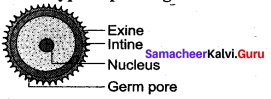
The male plant produces male flowers which get detached and float on the surface of the water. As soon as a male flower comes in closer to a female flower, it gets settled in the depression and contacts with the stigma thus bringing out pollination. Later the stalk of the female flower coils and brings back the flower from surface to under water where fruits are produced.
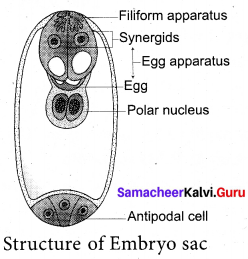
Question 66.
Enumerate the characters of ornithophilous flowers.
Answer:
The ornithophilous flowers have the following characteristic features:

  1. The flowers are usually large in size.
  2. The flowers are tubular, cup shaped or um- shaped.
  3. The flowers are brightly coloured, red, scarlet, pink, orange, blue and yellow which attracts the birds.
  4. The flowers are scentless and produce nectar in large quantities. Pollen and nectar form the floral rewards for the birds visiting the flowers.
  5. The floral parts are tough and leathery to withstand the powerful impact of the visitors.

Question 67.
How the flowers of salvia are adopted for mellitophily?
Answer:
Pollination in Salvia (Lever mechanism): The flower of Salvia is adapted for Bee pollination. The flower is protandrous and the corolla is bilabiate with 2 stamens. A lever mechanism helps in pollination. Each anther has an upper fertile lobe and lower sterile lobe which is separated by a long connective which helps the anthers to swing freely. When a bee visits a flower, it sits on the lower lip which acts as a platform. It enters the flower to suck the nectar by pushing its head into the corolla.

During the entry of the bee into the flower the body strikes against the sterile end of the connective. This makes the fertile part of the stamen to descend and strike at the back of the bee. The pollen gets deposited on the back of the bee. When it visits another flower, the pollen gets rubbed against the stigma and completes the act of pollination in Salvia.

Question 68.
Mention any three advantages of cross pollination.
Answer:

  1. It always results in bringing out much healthier off springs.
  2. Germination capacity is much better.
  3. New varieties may be produced.
  4. The adaptability of the plants to their environment is better.

Question 69.
Why pollination has to occur?
Answer:

  1. Pollination is a pre-requisite for the process of fertilisation. Fertilisation helps in the formation of fruits and seeds.
  2. It brings the male and female gametes closer for the process of fertilisation.
  3. Cross-pollination introduces variations in plants due to the mixing up of different genes. These variations help the plants to adapt to the environment and results in speciation.

Question 70.
How the pollen germination and compatability is regulated by stigma of Gynoecium?
Answer:
The receptive surface of the stigma receives the pollen. If the pollen is compatible with the stigma it germinates to form a tube. This is facilitated by the stigmatic fluid in wet stigma and pellicle in dry stigma. These two also decide the incompatibility and compatibility of the pollen through recognition-rejection protein reaction between the pollen and stigma surface.

Question 71.
Give a brief account on solid style.
Answer:
It is common among dicots. It is characterized by the presence of central core of elongated, highly specialised cells called transmitting tissue.This is equivalent to the lining cells of hollow style and does the same function. Its contents are also similar to the content of those cells. The pollen tube grows through the intercellular spaces of the transmitting tissue.

Question 72.
What are the ways through which the pollen tube enters into ovule? Explain.
Answer:
Entry of pollen tube into the ovule: There are three types of pollen tube entry into the ovule.
Porogamy: when the pollen tube enters through the micropyle.
Chalazogamy: when the pollen tube enters through the chalaza.
Mesogamy: when the pollen tube enters through the integument.
Samacheer Kalvi 12th Bio Botany Guide Solutions Chapter 1 Asexual And Sexual Reproduction In Plants

Question 73.
What is the fate of pollen tube after reaching the embryo sac?
Answer:
After reaching the embryo sac, a pore is formed in pollen tube wall at its apex or just behind the apex. The content of the pollen tube (two male gametes, vegetative nucleus and cytoplasm) are discharged into the synergids into which pollen tube enters. The pollen tube does not grow beyond it, in the embryo sac. The tube nucleus disorganizes.

Question 74.
Double fertilization and triple fusion are correlated terms. Comment.
Answer:
The two male gametes released from a male gametophyte are involved in the fertilization. They fertilize two different components of the embryo sac. Since both the male gametes are involved in fertilization, the phenomenon is called double fertilization and is unique to angiosperms. One of the male gametes fuses with the egg nucleus (syngamy) to form , Zygote.

The second gamete migrates to the central cell where it fuses with the polar nuclei or their fusion product, the secondary nucleus and forms the primary endosperm nucleus (PEN). Since this involves the fusion of three nuclei, this phenomenon is called triple fusion. This
act results in endosperm formation which forms the nutritive tissue for the embryo.

Question 75.
Write a short note on endosperm.
Answer:
The primary endosperm nucleus (PEN) divides immediately after fertilization but before 1 the zygote starts to divide, into an endosperm. The primary endosperm nucleus is the result of triple fusion (two polar nuclei and one sperm nucleus) and thus has 3n number of chromosomes. It is a nutritive tissue and regulatory structure that nourishes the developing embryo. Depending upon the mode of development three types of endosperm are recognized in angiosperms. They are nuclear endosperm, cellular endosperm and helobial endosperm.

Question 76.
How nuclear endosperm is different from cellular endosperm.
Answer:
Nuclear endosperm:
Nuclear endosperm: Primary Endosperm Nucleus undergoes several mitotic divisions without cell wall formation thus a free nuclear condition exists in the endosperm.
Examples: Coccinia, Capsella and Arachis.

Cellular endosperm:
Cellular endosperm: Primary endosperm nucleus divides into 2 nuclei and it is immediately followed by wall formation. Subsequent divisions also follow cell wall formation.
Examples: Adoxa, Helianthus and Scoparia.

Question 77.
Give an account on Helobial endosperm.
Answer:
Helobial endosperm: Primary Endosperm Nucleus moves towards base of embryo sac and divides into two nuclei. Cell wall formation takes place leading to the formation of a large micropylar and small chalazal chamber. The nucleus of the micropylar chamber undergoes several free nuclear division whereas that of chalazal chamber may or may not divide.
Examples : Hydrilla and Vallisneria.

Question 78.
Differentiate between albuminous seed and ex-albuminous seed.
Answer:
Albuminous Seed:
The seeds with endosperm are called albuminous seed of endospermous seeds.
E.g: Coconut

Ex-albuminous Seed:
The seeds without endosperm are called ex-albuminous seeds or non-endospermous seeds.
E.g: Beans

Question 79.
Draw and label the structure of nuclear endosperm and Helobial endosperm
Answer:
12th Botany Samacheer Kalvi Solutions Chapter 1 Asexual And Sexual Reproduction In Plants

Question 80.
Point out the function of endosperm.
Answer:
Functions of endosperm:

  1. It is the nutritive tissue for the developing embryo.
  2. In majority of angiosperms, the zygote divides only after the development of endosperm.
  3. Endosperm regulates the precise mode of embryo development.

Question 81.
What are the components of mature dicot embryo.
Answer:
The mature dicot embryo has a radicle, two cotyledons and a plumule.

Question 82.
What is apospory?
Answer:
Megaspore mother cell undergoes the normal meiosis and four megaspores formed gradually disappear. A nucellar cell becomes activated and develops into a diploid embryo sac. This type of apospory is also called somatic apospory. Examples Hieracium and Parthenium.

5 – Mark Questions

Question 83.
Give a comperative account on Anther wall layers.
Answer:
Anther wall : The mature anther wall consists of the following layers
a. Epidermis
b. Endothecium
c. Middle layers
d. Tapetum.
a. Epidermis: It is single layered and protective in function. The cells undergo repeated anticlinal divisions to cope up with the rapidly enlarging internal tissues.

b. Endothecium: It is generally a single layer of radially elongated cells found below the epidermis. The inner tangential wall develops bands (sometimes radial walls also) of a cellulose (sometimes also slightly lignified). The cells are hygroscopic. In the anthers of aquatic plants, saprophytes, cleistogamous flowers and extreme parasites endothecial differentiation is absent. The cells along the junction of the two sporangia of an anther lobe lack these thickenings. This region is called stomium. This region along with the hygroscopic nature of endothecium helps in the dehiscence of anther at maturity.

c. Middle layers: Two to three layers of cells next to endothecium constitute middle layers. They are generally ephemeral. They disintegrate or get crushed during maturity.

d. Tapetum: It is the innermost layer of anther wall and attains its maximum development at the tetrad stage of microsporogenesis. It is derived partly from the peripheral wall layer and partly from the connective tissue of the anther lining the anther locule. Thus, the tapetum is dual in origin. It nourishes the developing sporogenous tissue, microspore mother cells andmicrospores.

The cells of the tapetum may remain uninucleate or may contain more than one nucleus or the nucleus may become polyploid. It also contributes to the wall materials, sporopollenin, pollenkitt, tryphine and number of proteins that control incompatibility reaction .Tapetum also controls the fertility of sterility of the microspores or pollen grains.

Question 84.
Explain the development process of male gametophyte.
Answer:
Samacheer Kalvi 12th Bio Botany Solutions Chapter 1 Asexual and Sexual Reproduction in Plants img 9
The microspore is the first cell of the male gametophyte and is haploid. The development of male gametophyte takes place while they are still in the microsporangium.

The nucleus of the microspore divides to form a vegetative and a generative nucleus. A wall is laid around the generative nucleus resulting in the formation of two unequal cells, a large irregular nucleus bearing with abundant food reserve called vegetative cell and a small generative cell. At this 2 celled stage, the pollens are liberated from the anther. In some plants the generative cell again undergoes a division to form two male gametes. In these plants,

the pollen is liberated at 3 celled stage. In 60% of the angiosperms pollen is liberated in 2 celled stage. Further, the growth of the male gametophyte occurs only if the pollen reaches the right stigma. The pollen on reaching the stigma absorbs moisture and swells.

The inline grows as pollen tube through the germ pore. Incase the pollen is liberated at 2 celled stage the generative cell divides in the pollen into 2 male cells (sperms) after reaching the stigma or in the pollen tube before reaching the embryo sac.

Question 85.
Explain any five types of angiospermic ovules.
Answer:
Orthotropous: In this type of ovule, the micropyle is at the distal end and the micropyle, the funicle and the chalaza lie in one straight vertical line. Examples: Piperaceae, Polygonaceae

Anatropous: The body of the ovule becomes completely inverted so that the micropyle and funiculus come to lie very close to each other. This is the common type of ovules found in dicots and monocots.

Samacheer Kalvi 12th Bio Botany Solutions Chapter 1 Asexual and Sexual Reproduction in Plants img 10
Hemianatropous: In this, the body of the ovule is placed transversely and at right angles to the funicle. Example: Primulaceae.

Campylotropous: The body of the ovule at the micropylar end is curved and more or less bean shaped. The embryo sac is slightly curved. All the three:, hilum, micropyle and chalaza are adjacent to one another, with the micropyle oriented towards the placenta.
Example: Leguminosae.

Amphitropous: The distance between hilum and chalaza is less. The curvature of the ovule leads to horse-shoe shaped nucellus.
Example: some Alismataceae.

Question 86.
Describe the development of monrosporic embryo sac.
Answer:
The functional megaspore is the first cell of the embryo sac or female gametophyte. The megaspore elongates along micropylar- chalazal axis. The nucleus undergoes a mitotic division. Wall formation does not follow the nuclear division. A large central vacuole now appears between the two daughter nuclei.

The vacuole expands and pushes the nuclei towards the opposite poles of the embryo sac. Both the nuclei divide twice mitotically, forming four nuclei at each pole. At this stage all the eight nuclei are present in a common cytoplasm (free nuclear division). After the last nuclear division the cell undergoes appreciable elongation, assuming a sac-like appearance. This is followed by cellular organization of the embryo sac. Of the four nuclei at the micropylar end of the embryo sac, three organize into an egg apparatus, the fourth one is left free in the cytoplasm of the central cell as the upper polar nucleus.

Three nuclei of the chalazal end form three antipodal cells whereas the fourth one functions atk the lower polar nucleus. Depending on the plant the 2 polar nuclei may remain free or iftiay fuse to form a secondary nucleus , (central cell). The egg apparatus is made up of a central egg celkand two synergids, one on each side of the egg cell. Synergids secrete chemotropic substances that help to attract the pollen tube. The special cellular thickening called filiform apparatus of synergids help in the absorption, conduction of nutrients from the nucellus to embryo sac. It also guides the pollen tube into the egg. Thus, a 7 celled with 8 nucleated embryo sac is formed.

Question 87.
Enumerate the characters of anemophilous flowers Anemophilous plants have the following characteristic features:
Answer:

  1. The flowers are produced in pendulous, catkin-like or spike inflorescence.
  2. The axis of inflorescence elongates so that the flowers are brought well above the leaves.
  3. The perianth is absent or highly reduced.
  4. The flowers are small, inconspicuous, colourless, not scented, do not secrete nectar.
  5. The stamens are numerous, filaments are long, exerted and versatile.
  6. Anthers produce enormous quantities of pollen grains compared to number of ovules available for pollination. They are minute, light and dry so that they can be carried to long distances by wind.
  7. In some plants anthers burst violently and release the pollen into the air. Example: Urtica.
  8. Stigmas are comparatively large, protruding, sometimes branched and feathery, adapted to catch the pollen grains. Generally single ovule is present.
  9. Plant produces flowers before the new leaves appear, so the pollen can be carried without hindrance of leaves.

Question 88.
Describe the structure of a dicot seed.
Answer:
Structure of a Cicer seed as an example for Dicot seed The mature seeds are attached to the fruit wall by a stalk called funiculus. The funiculus disappears leaving a scar called hilum. Below the hilum a small pore called micropyle is present. It facilitates entry of oxygen and water into the seeds during germination. Each seed has a thick outer covering called seed coat. The seed coat is developed from integuments of the ovule. The outer coat is called testa and is hard whereas the inner coat is thin, membranous and is called tegmen.
Samacheer Kalvi 12th Bio Botany Solutions Chapter 1 Asexual and Sexual Reproduction in Plants img 11
In Pea plant the tegmen and testa are fused. Two cotyledons laterally attached to the embryonic axis are present. It stores the food materials in pea whereas in other seeds like castor the endosperm contains reserve food and the cotyledons are thin. The portion of embryonal axis projecting beyond the cotyledons is called radicle or embryonic root. The other end of the axis called embryonic shoot is the plumule.

Embryonal axis above the level of cotyledon is called epicotyl whereas the cylindrical region between the level of cotyledon is called hypocotyl. The epicotyl terminates in plumule whereas the hypocotyl ends in radicle.

Higher Order Thinking Skills (HOTs) Questions

Question 1.
Cleistogamous flower and chasmogamous flower. In which type does the autogamy is certain? Why?
Answer:
Autogamy is certain in cleistogamous flowers since they never open and expose the reproductive organs.

Question 2.
Position of essential whorls and inhibition of autogamy in Gloriosa superba – comment.
Answer:
In the bisexual flowers of Gloriosa superba, the style of the gynoecium is reflexed away from the stamens assuring that self-pollination (autogamy) is impossible.

Question 3.
Anemophilous flowers produce abundant pollen grains. Give reason.
Answer:
Anemophily is a chance event. The liberated pollen may or may not reach the target flower and are wasted during the transmission from one flower to another. Hence enormous pollen grains are produced to assure pollination.

Question 4.
Observe the picture and answer the questions.
Samacheer Kalvi 12th Bio Botany Solutions Chapter 1 Asexual and Sexual Reproduction in Plants img 12
(а) Label the part – A
(b) Name the types of vegetative propagule
(c) Give one example for such type of vegetative propagule.
Answer:
(a) A – Bud from eye
(b) Tuber
(c) Solanum tuberosum

Question 5.
Arrange the following events in a proper sequence.
Embryogenesis, Zygote formation, Syngamy, Gametogenesis
Answer:
Gametogenesis → Syngamy → Zygote formation → Embryogenesis

Question 6.
Name the process through which microspore tetrads are formed. What would be the ploidy of the cells of terad?
Answer:
Microspores are formed by the process of microsporogenesis. The cells of microspore tetrad are haploid(n).

Question 7.
Anemophilous flowers are colourless and non-scented. What may be the reason?
Answer:
Production of coloured and scented flowers are to attract the pollinating agents. Where as wind acts as a pollinating agent for anemophilous flowers. Hence it is unnecessory to produce coloured and scented flowers.

Question 8.
If you break open the coconut fruit, we can observe a fluid part and the white kernel.What does those parts represent?
Answer:
The fluid part of the coconut represents free-nuclear endosperm and the white kernel represents cellular endosperm.

Question 9.
Cite one common feature and one contrast feature shared between apomixis and parthenocarpy
Answer:
Common features : Fertilization (Syngamy) is absent in both apomixis and parthenocarpy.
Contrast features : Parthenocarpic fruits does not develop seeds, whereas in apomixis seeds are developed.

Samacheer Kalvi 12th Bio Botany Chapter Wise Solutions PDF will help you to clear all doubts. Learn perfectly by using Samacheer Kalvi 12th Chapter 1 Asexual and Sexual Reproduction in Plants Questions and Answers Bio Botany Solutions PDF.

Hope you love the Samacheer Kalvi 12th Chapter Wise Material. Clearly understand the deep concept of Bio Botany learning with the help of Samacheer Kalvi 12th Chapter 1 Asexual and Sexual Reproduction in Plants Questions and Answers PDF. Refer your friends to and bookmark our website for instant updates. Also, keep in touch with us using the comment section.

Samacheer Kalvi 7th Social Science History Solutions Term 1 Chapter 4 The Delhi Sultanate

Students can Download Social Science History Chapter 4 The Delhi Sultanate India Questions and Answers, Notes Pdf, Samacheer Kalvi 7th Social Science Book Solutions Guide Pdf helps you to revise the complete Tamilnadu State Board New Syllabus and score more marks in your examinations.

Tamilnadu Samacheer Kalvi 7th Social Science History Solutions Term 1 Chapter 4 The Delhi Sultanate

Samacheer Kalvi 7th Social Science The Delhi Sultanate Textual Evaluation

I. Choose the correct answers

The Delhi Sultanate Class 7 In Tamil Question 1.
______ laid the foundation of ‘ Mamluk’ dynasty.
(a) Mohammad Ghori
(b) Jalal-ud-din
(c) Qutb-ud-dinAibak
(d) Iltutmish
Answer:
(c) Qutb-ud-din Aibak

Delhi Sultanate In Samacheer Book Question 2.
Qutb-ud-in shifted his capital to Delhi from .
(a) Lahore
(b) Poona
(c) Daulatabad
(d) Agra
Answer:
(a) Lahore

Delhi Sultanate Questions And Answers Question 3.
completed the construction of the Qutb-Minar.
(a) Razia
(b) Qutb-ud-din -Aibak
(c) Iltutmish
(d) Balban
Answer:
(c) Iltutmish

The Delhi Sultanate Class 7 Question 4.
laid the foundation of the city Tughluqabad near Delhi.
(a) Muhammad-bin -Tughluq
(b) Firoz shah Tughluq
(c) Jalal -ud-din
(d) Ghiyas -ud-din
Answer:
(d) Ghiyas -ud-din

II. Fill in the Blanks

  1. was the founder, of Tughluq dynasty.
  2. Muhammad-bin-Tughluq shifted his capital from Delhi to .
  3. patronized the famous Persian poet Amir Khusru.
  4. Quwwat-ul-Islam Masjid in Delhi was built by .
  5. The threat of Mongols under Chengizkhan to India was during the reign of

Answer:

  1. Ghiyas-ud-din
  2. Devagiri or Daulatabad
  3. Balban
  4. Qutb-ud-din -Aibak
  5. Iltutmish

III. Match the following

                AB
Tughril Khani.Governor of Kara
Ala-ud-dinii.Jalal-ud-din Yakut
Bahlol Lodi .iii.Governor of Bengal
Raziaiv.Governor of Sirhind

Answer:

  1. iii
  2. iiv
  3. ii

IV. State True or False :

Question 1.
Qutb-ud-din Aibak died of mysterious fever.
Answer:
(False) Correct statement: Qutb-ud-din Aibak died of mysterious injuries received during an accidental fall from a horse, while playing polo.

Question 2.
Razia was an able and brave fighter.
Answer:
True

Question 3.
The Turkish nobles chose Iltutmish, son of Aibak, as Sultan after the death of Aibak.
Answer:
(False) Correct statement: The Turkish nobles chose Iltutmish, son-in-law of Aibak, as Sultan after the death of Aibak.

Question 4.
FirozShah Tughluq refused to accept an invitation from a Bahmani Prince to intervene in the affairs of the Deccan.
Answer:
True

V. Match the statement with the reason.
Tick (✓) the appropriate answer.

Question 1.
Assertion (A): Balban maintained cordial relationship with Mongols
Reason (R): The Mongol ruler, a grandson of Chengiz Khan, assured that Mongols
would not advance beyond Sutlej.
(a) R is the correct explanation of A.
(b) R is not the correct explanation of A.
(c) A and R are wrong.
(d) A is wrong and R is the correct.
Answer:
(a) R is the correct explanation of A

(b) Find out the correct pair

  1. Hoysala – Devagiri
  2. Yadavas – Dwarasamudra
  3. Kakatias – Warrangal
  4. Pallavas – Madurai

Answer:
3. Kakatias – Warrangal

(c) Find out the wrong statement /statements

  1. After Ghori’s death in 1206, his slave Qutbud- din Aibak proclaimed him self the ruler of the Turkish territories in India.
  2. Razia established the department of spies to gather intelligence about the conspirators and the trouble makers against her rule.
  3. Balban built forts to guard his empire against the Mongol attack.
  4. Ibrahim Lodi was defeated by Babur in 1526.

Answer:
2. Razia established the department of spies to gather intelligence about the conspirators and the trouble makers against her rule.

VI. Answer the following in one or two sentences

Question 1.
Name the land granted to army officials in lieu of a regular wage.
Answer:
Iqta is the land granted to army officials in lieu of a regular wage

Question 2.
Who founded the city of Agra?
Answer:
Sikandar Lodi founded the city of Agra.

Question 3.
Name the ruler who established Muslim rule in India in 12th century A.D (CE).
Answer:
Muslim rule in India was established by Muhammad Ghori in 12th century A.D. (CE).

Question 4.
Write a note on chahalgani.
Answer:
In order to counter the possible attack of the Mongols, Iltutmish organised Turkish nobility into a select group of 40 nobles known as chahalgani or The Forty.

Question 5.
How did Ala-ud-din Khalji consolidate the Delhi Sultanate?
Answer:

  1. The range of Khalji conquests is impressive: in the Punjab (against the Mongols), in Rajasthan and in Gujarat. With his northern frontiers secure, he sent his chief lieutenant Malik Kafur into the southern parts who took even the distant Madurai.
  2. Thus Ala-ud-din Khalji consolidated the Delhi Sultanate.

Question 6.
List out the contributions of Firoz Shah Tughluq.
Answer:

  1. Firoz rewarded Sufis and other religious leaders generously and listened to their advice.
  2. He also created charities to aid poor Muslims
  3. He built colleges, mosques, and hospitals.
  4. He banned inhuman punishments and abolished taxes not recognised by Muslim law.
  5. He promoted agriculture by waiving off the debts of the agriculturalists and constructing many canals for irrigation.
  6. He built new towns such as Firozabad, Jaunpur, Hissar and Firozpur.

VII. Answer the following :

Question 1.
Write about the invasion of Timur in 1398.
Answer:

  1. The sacking and massacre by Tamerlane or Timur of Delhi came a decade after Firuz ME Shah Tughluq died.
  2. Timur had occupied some parts in the north-west of India.
  3. Taking advantage of India’s weakness, he entered India in December 1398 and plundered Delhi.
  4. Punjab, besides the Delhi city, was the province that suffered most by Timur’s raid.
  5. Apart from carrying huge wealth in the form of gold, silver, jewels, also took along Indian artisans like carpenters and masons to work on monuments in Samarkand.

VIII. HOTS :

Question 1.
How would you evaluate Muhammad-bin- Tughluq as Sultan of Delhi?
Answer:
Muhammaad – bin – Tughlug was a learned but cruel man. He was a poor decision maker. There was chaos in the social, economic and political condition of the empire because of his ambiguous decisions. The first and foremost was changing the capital from Delhi to Devagiri or Daulatabad and vice versa which led to loss of money and human lives. He also ordered the revenue to be collected in money instead of grains. This move led to bankruptcy and famine. Though he was wise and learned his hasty decisions led to his downfall.

IX. Map Work
On the river map of India draw the extent of Tughluq Dynasty and mark the following places.

  1. Delhi
  2. Devagiri
  3. Lahore
  4. Madurai.

The Delhi Sultanate Class 7 In Tamil Social Science History Solutions Term 1 Chapter 4 Samacheer Kalvi

X. Student Activity :

Question 1.
Match the Father with Son

AB
1.Qutb-ud-din Aibaki.Rukn-ud-din-Firuz
2.Iltutmishii.Kaiqubad
3.Balbaniii.Ala-ud-din
4.Ghiyas-ud-diniv.Sikandar Lodi
5.Bahlol LodiV.Aram Shah

Answer:

  1. v
  2. i
  3. ii
  4. iii
  5. iv

Samacheer Kalvi 7th Social Science The Delhi Sultanate Additional Questions

I. Choose the correct answer:

Question 1.
___________ is a persian term used for slaves purchased for military service.
(a) Aibak
(b) bandagan
(c) Mamluk
(d) Lodi
Answer:
(b) bandagan

Question 2.
Iltutmish granted ___________ to members of his army.
(a) iqtas
(b) coins
(c) gold
(d) dirams
Answer:
(a) iqtas

Question 3.
___________ was a custom of the Rajputs, in which man would go out and die in the battle field and women would burn themselves on a pyre.
(a) Sati
(b) Devadasi
(c) Janhar
(d) Kaali
Answer:
(c) Janhar

II. Fill in the blanks:

  1. _____ is an Arabic word meaning slave.
  2. Iltutmish refused to provide shelter to _____ who had been driven out by chengiz khan.
  3. One significant military expedition of Ala-ud-din was against, the Deccan Kingdom _____
  4. _____ was proclaimed a separate sultanate in 1334.

Answer:

  1. Mamluk
  2. Kwarezm Shah Jalalud – din
  3. Devagiri
  4. Madurai

III. True or False :

Question 1.
Balban abolished ‘The Forty’ as it was hostile to him.
Answer:
True

Question 2.
Qutb-ud-din-Aibak shifted his capital from Delhi to Lahore.
Answer:
(False) Correct statement: Qutb-ud-din-Aibak shifted his capital from Delhi to the centre of the kingdom, namely Devagiri.

Question 3.
Ala-ud-din khalfi was the nephew of Jalal-ud-din Khalji.
Answer:
True

IV. Match the statement with the reason. Tick (✓) the appropriate answer:

Question 1.
Statement : Iltutmish nominated his daughter Razia sultan as his successor to the throne of Delhi.
Reason : His most capable son, Rukn-ud-din-Firaz was dead.
(a) Statement and Reason are wrong.
(b) Statement is correct, but Reason is wrong.
(c) Both Statement and Reason are correct.
(d) Statement is wrong but Reason is correct.
Answer:
(c) Both Statement and Reason are correct.

Question 2.
Statement : Ala-ud-din khalji employed spies to report to him directly.
Reason : He wanted to be informed about the movement of the enemy’s army.
(a) Both Statement and Reason are correct.
(b) Statement and Reason are wrong.
(c) Statement is correct and Reason is wrong.
(d) Statement is wrong and Reason is correct.
Answer:
(c) Statement is correct and Reason is wrong.

Question 3.
Find out the wrong statement
(a) Razia made an Ethiopian slave nmed Jalal-ud-din Yakut, her personal attendant.
(b) Hulagu Khan, was the grandson of chengiz khan.
(c) Jalal-ud-din khalji built forts to guard his empire.
(d) Ghiyas-ud-din Tughluq sent his Jauna khan to fight against Warangal.
Answer:
(c) Jalal-ud-din khalji built forts to guard his empire

VI. Answer the following.

Question 1.
Write a short note on the Sack of Chittor.
Answer:
Sack of Chittor :When Ala-ud-din’s army overwhelmed the Rajput army in Chittor and in the context of threat of defeat, the men and women of the fortress, in accordance with their old custom, performed the rite of jauhar.

Question 2.
What is Indo-Saracenic architecture? Name a few structures constructed in this style.
Answer:

  1. A combination of Persian and Indian architecture is called Indo-Saracenic architecture.
  2. Mosques and Madrasas were built in this style during the Mughal rule.
  3. The shape of these buildings were persian while the decoration was Indian.
    Eg. QutbMinar, Alai-Darwaza, tombs of Iltutmish.

VII. HOTS :

Question 1.
Alaud – din Khalgi was an able administrator.- Justify.
Answer:

  1. Ala-ud-din’s political and administrative reforms were as impressive.
  2. Ala-ud-din undertook a survey of the agrarian resources around his capital and fixed a standard revenue demand.
  3. He entrusted the task of collecting the revenue to the military officers.
  4. Ala-ud-din established a system of forced procurement of food grains for Delhi and other garrison centres.
  5. The procurement prices were fixed and grain collected as tax was stored in state granaries.
  6. To ensure the enforcement of his new regulations.
  7. He employed spies who were responsible to report to him directly.

Samacheer Kalvi 8th English Solutions Term 1 Supplementary Chapter 2 Homeless Man and his Friends: A true story

Students can Download English Lesson 2 Homeless Man and his Friends: A true story Questions and Answers, Summary, Activity, Notes, Samacheer Kalvi 8th English Book 2Solutions Guide Pdf  helps you to revise the complete Tamilnadu State Board New Syllabus and score more marks in your examinations.

Tamilnadu Samacheer Kalvi 8th English Solutions Term 1 Supplementary Chapter 2 Homeless Man and his Friends: A true story

A. Comprehension Questions.

Homeless Man And His Friends A True Story Question 1.
What is the name of the hero of this story ?
Answer
“The name of the hero of this story is Cesar

Homeless Man And His Friends Summary Question 2.
Where did this story happen?
Answer:
This story happened on the street in Rio do Sul in South Brazil.

Homeless Man And His Friends A True Story Questions And Answers Question 3.
When was he admitted in the hospital?
Answer:
Cesar was admitted at the emergency room of the hospital at about 3 a.m.

Homeless Man And His Friends Question 4.
Where is the hospital?
Answer:
The hospital is in Rio do Sul, in South Brazil.

Homeless Man And His Friends A True Story Summary Question 5.
Who accompanied him to the hospital?
Answer:
A gang of dogs accompanied him to the hospital.

B. Write the answers for the following questions in 100 words.

Homeless Man And His Friends Lesson Plan Question 1.
Where did the nurse post this story?
Answer:
The nurse posted the story on Facebook.

Homeless Man And His Friends: A True Story Samacheer Kalvi Question 2.
What did Cesar do when he was offered food by the nurses?
Answer:
When Cesar was offered food by the nurses, he ate some and saved a bit to give the dogs later. Though Cesar was a homeless man in Rio do Sul in South Brazil, he often sacrificed his own food to feed the stray dogs around him. When he suddenly required emergency treatment, his kindness came back to him like a boomerang, for the faithful dogs he had been feeding made sure he was not alone.
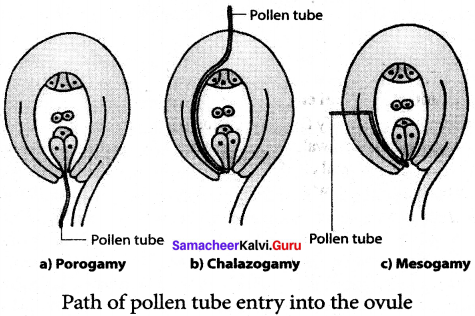
Homeless Man And His Friend A True Story Mind Map Question 3.
How many dogs accompanied him when left the hospital?
Answer:
Four dogs accompanied him when he left the hospital.

Homeless Man And His Friend A True Story In Tamil Meaning Question 4.
How many people followed Mamprim’s post?
Answer:
1,36,000 people followed Mamprim’s post.

C. Can you guess the meaning of following words after understanding the story?

  1. homeless – without any house or people to care
  2. boomerang – come back to the person threw it
  3. canine – dog – due to its teeth it is named so
  4. stray – dogs found in the streets without owners
  5. health facility – health care
  6. colleague – co-worker
  7. accompany – go along with
  8. trailing – following
  9. wagging – moving the tail swiftly
  10. reciprocal – in return
  11. possession – own
  12. mistreatment – ill treatment, wrong behaviour

Step To Success

Coding – Decoding

Number the alphabet according to their position to decode the following.

Homeless Man And His Friends A True Story Samacheer Kalvi 8th English Solutions Term 1 Supplementary Chapter 2

8th Standard English Friendship Lesson Question Answer Question 1.
In a certain code language, if BUG = 30 and ALMS = 45 then CADET =?
(a) 70
(b) 24
(c) 33
(d) 37
Answer:
(c) 33

8th Standard Friendship Lesson Question Answer Question 2.
In a certain code language, if INFER = 25 and JERSEY = 28, then CHOICE =?
(a) 43
(b) 34
(c) 89
(d) 52
Answer:
(b) 34

Friends Story In English Question 3.
In a certain code language, EGG is 577 and ICE is 935 then what is 8945?
(a) HIDE
(b) FEAR
(c) DEED
(d) HIGH
Answer:
(a) HIDE

Question 4.
In a certain code language, YSMIR is TNHDM and VPJHN is QKECI then GKTZO is ?
(a) TEFMD
(b) BFOUJ
(c) IPBVR
(d) ZOAFQ
Answer:
(b) BFOU

Connecting To Self

Tick the boxes that you have done and check yourself whether you are a good friend.
Question 1.
Homeless Man And His Friends Summary Samacheer Kalvi 8th English Solutions Term 1 Supplementary Chapter 2
Answer:

Homeless Man And His Friends A True Story Questions And Answers Samacheer Kalvi 8th English Solutions Term 1 Supplementary Chapter 2

Homeless Man and his Friends: A true story Additional Questions

I. Choose the Correct Answers (MCQ).

Question 1.
The homeless man was called _____
(a) Peter
(b) Cris
(c) Cesar
(d) Charles
Answer:
(c) Cesar

Question 2.
He was admitted in a hospital at _____
(a) Berlin
(b) Brazil
(c) Germany
(d) India
Answer:
(b) Brazil

Question 3.
He took care of _____canines.
(a) 2
(b) 3
(c) 4
(d) 5
Answer:
(c) 4

Question 4.
He was a simple person _____ luxury.
(a) with
(b) with excess
(c) without
(d) The street
Answer:

Question 5.
The homeless man lived on ______
(a) The hills
(b) The vally
(c) The river bank
(d) the street
Answer:
(d) the street

II. Identify the character/speaker:

  1. “I came across this today”
  2. “A simple person, who depends on help to overcome the hunger”
  3. “They are all well taken care of and chubby”
  4. “I do not know what his life is like”
  5. He suddenly required emergency treatment.

Answer:

  1. Mamprim
  2. Mamprim about Cesai
  3. Mamprim about dogs
  4. Mamprim about Cesai
  5. Cesai

III. Write True or False against each statement.

  1. The stray dogs’ loyalty was witnessed by a doctor.
  2. Three stray dogs showed up at the entrance.
  3. Cesar was a simple person without luxury.
  4. The animals reunited with their owner.
  5. The staff let the dogs inside the hospital.

Answer:

  1. False
  2. False
  3. True
  4. True
  5. True

IV. Very Short Questions with Answers.

Question 1.
Who sacrifices his own food to feed the stray dogs?
Answer:
Cesar sacrifices his own food to feed the stray dogs.

Question 2.
Who witnessed the dog’s incredible loyalty?
Answer:
The nurse Cris Mamprim and her colleagues witnessed the dog’s loyalty.

Question 3.
Where does Cesar normally go?
Answer:
Cesar normally goes to another health facility in town.

Question 4.
Who were anxiously anticipating Cesar’s safe return?
Answer:
The faithful dogs were anxiously anticipating Cesar’s safe return.

Question 5.
When did Cesar leave the hospital?
Answer:
Cesar left the hospital after an hour.

V. Short Questions with Answers.

Question 1.
Why did the staff let the dogs inside?
Answer:
The staff let the dogs inside after giving Cesar the medication because they did not want to keep Cesar and his companions apart.

Question 2.
Did Cesar have any kin and material possession?
Answer:
No, he did not have any kin to turn to, and had little material possessions.

Question 3.
Why was he never alone?
Answer:
He was never alone because he had his warm and loving companions.

VI. Paragraph Questions with Answers.

Question 1.
Describe the activities of the homeless person and his companions.
Answer:
The homeless person Cesar, sacrifices his own food to feed the stray dogs around him. When he required emergency treatment, his kindness came back to him, like a boomerang. Four concerned dogs showed up at the entrance of the hospital and were waiting for Cesar. They were anxious about their homeless master’s health. Their master is a simple person, who depends on help to overcome the hunger, the cold, the pain, the evils of the world. He had by his side the best companions and the exchange is reciprocal. An exchange of love, affection, warmth and understanding

VII. Mind Map

Question 1.
Homeless Man And His Friends Samacheer Kalvi 8th English Solutions Term 1 Supplementary Chapter 2
Answer:

  1. Rio de Sul
  2. The stray dogs
  3. emergency
  4. boomerang
  5. the nurse

VIII. Rearrange the Jumbled Sentences.

A.
1. He often sacrificed his food to feed the dogs.
2. There is a homeless man in South Brazil.
3. His faithful dogs made sure he wasn’t alone.
4. He suddenly required emergency treatment.
5. The loyalty of the dogs were witnessed by a nurse.
Answer:
2,1,4,3,5
2. There is a homeless man in South Brazil.
1. He often sacrificed his food to feed the dogs.
4. He suddenly required emergency treatment.
3. His faithful dogs made sure he wasn’t alone.
5. The loyalty of the dogs were witnessed by a nurse.

B
1. The staff let the dogs inside.
2. The faithful canines waited anxiously.
3. The man ate some and saved a bit for the dogs.
4. They even offered food.
5. They are all well taken care of and chubby.
Answer:
5, 2,1,4,3
5. They are all well taken care of and chubby.
2. The faithful canines waited anxiously.
1. The staff let the dogs inside.
4. They even offered food.
3. The man ate some and saved a bit for the dogs.

IX. Read the passage and answer the questions.

A
The stray dogs’ incredible loyalty was witnessed by nurse Cris Mamprim and her colleagues shortly after the homeless man, Cesar, arrived at the emergency room of the hospital in Rio do Sul, in South Brazil at about 3 a.m. to seek treatment and medication for a pre-existing health condition he had been battling.

Question 1.
Who witnessed the dogs’ loyalty?
Answer:
The nurse Cris Mamprim and her colleagues witnessed the dogs’ loyalty.

Question 2.
Who was the man who came to the hospital?
Answer:
Cesar came to the hospital.

Question 3.
Where was the hospital?
Answer:
The hospital was in Rio do Sul, South Brazil.

Question 4.
Why did he come to the emergency room?
Answer:
He came to seek treatment and medication for a pre-existing health condition he had been battling.

Question 5.
What is the name of the nurse?
Answer:
The name of the nurse was Crim Mamprim.

B.
An hour later, Cesar left the hospital with the four dogs trailing behind, happily wagging their tails. “I do not know what his life is like, or why he’s on the street, but I admire the respect arid love he has for his little friends.” Mamprim concluded. “Seeing them like this, waiting at the door, just shows how much they are well cared for and loved”.

Question 1.
What is the meaning of the word trailing?
Answer:
‘Trailing’ means following behind.

Question 2.
To whom does T refer to?
Answer:
refers to Mamprim, the nurse.

Question 3.
Whd are they? What does Tike this’ indicate?
Answer:
They are dogs. ‘Like this’ indicates ‘the waiting of the dogs at the door of the hospital’.

Question 4.
Give the antonyms for ‘conclude’ and ‘like’
Answer:
The antonyms for ‘conclude’ and ‘like’ are ‘commence’ and ‘dislike’.

Question 5.
What is the title of this story?
Answer:
“Homeless Man and his Friends: A true story”.

Homeless Man and his Friends: A true story Summary

Life takes us on some interesting journey and having wonderful friends with us on the long ride can make both the best and worst periods enjoyable.

There is a homeless man called Cesar in South Brazil. He often sacrifices his own food to feed the stray dogs around him. One day he falls very sick and his kindness towards the animals comes back to him as they accompany him to the emergency room at a hospital in Brazil. The nurses are surprised to see Cesar who was new to the hospital. They did not know his previous condition.

They were surprised to see four canines waiting at the entrance to see Cesar. Watching them, the nurse is impressed and posts the picture of the scene in the Facebook, stating a simple person without luxury depends on help to overcome pain and other evils has the best companions and that the exchange is mutual.

They wait and Mamprin, the nurse, watches them reunite with their master in no time. When Cesar was offered food, he ate some and saved the rest for the dogs. Cesar has little material possessions and does not have any kin But he has his warm and loving companions.

Samacheer Kalvi 11th English Solutions Supplementary Chapter 3 The First Patient

Students who are interested in learning of 11th English Supplementary Chapter 3 The First Patient Questions and Answers can use Tamilnadu State Board Solutions of 11th English Chapter Wise Pdf. First check in which chapter you are lagging and then Download Samacheer Kalvi 11th English Book Solutions Questions and Answers Summary, Activity, Notes Chapter Wise. Students can build self confidence by solving the solutions with the help of Tamilnadu State Board English Solutions. English is the scoring subject if you improve your grammar skills. Because most of the students will lose marks by writing grammar mistakes. So, we suggest you to Download Tamilnadu State Board 11th English Solutions according to the chapters.

Tamilnadu Samacheer Kalvi 11th English Solutions Supplementary Chapter 3 The First Patient

Check out the topics covered in Supplementary Chapter 3 The First Patient Questions and Answers before you start your preparation. Improve your grammar skills with the help of Samacheer Kalvi 11th English Book Solutions Questions and Answers pdf links. The solutions for Tamilnadu State Board 11th English Textbook are prepared by the English experts. So, if you follow Tamilnadu State Board Solutions 11th English Textbook Solutions you can cover all the topics in Supplementary Chapter 3 The First Patient Questons and Answers. This helps to improve your communication skills.

Warm Up

Given below is a list of tools and equipment. Associate them with the relevant field and complete the table.

Plough, hammer, oven thermometer, volt meter, wood chisel, seed drill, voltage detector, cutting boards, stone picker, digital kitchen scale, cultivator, nail puller, wire strippers, framing square, fork, flashlight

FarmerCarpenterElectricianChef
ploughhammer

Answer:

FarmerCarpenterElectricianChef
ploughhammerthermometeroven
seed drillwoodvolt metercutting boards
cultivatorchieselvoltage detectorfork
stone pickerframing squarenail puller/flashlightspatula

Samacheer Kalvi 11th English The First Patient Textual Questions

1. Complete the summary of the play, choosing the appropriate words from the list given below the passage.

(hammer, patient, hacksaw, cabinet, frightened, queue, worried, waiting room, pliers,tooth, photographs, clinic, toothache, sawing, appointment)

A number of patients wait at the (1) _________ of a dentist’s clinic. Every body is tensed at the thought of a painful (2) _________ being extracted. One of the women is bent on showing everyone her (3) _________ After the arrival of the dentist, Joe, the first (4) _________ is called in. Some time later, the nurse comes out and goes in with a (5) _________ Every one is (6) _________ at this, imagining Joe being subjected to a lot of hammering in the process (7) _________ of his and later on she takes in a (8) _________ A little boy confesses that he pretended to have because he did not wish to go to school. The loud (10) _________ and screeching from within the room makes everyone leave the (11) _________ , one by one. Finally there are only two women in the waiting room, one of them being Joe’s wife. She weeps (12) _________ about her husband. But Joe comes out and explains that he had shifted his (13) _________ to the evening and had been given some pills for the pain. After they leave, the dentist comes out and locates the key of his tool (14) _________ He had been hying to open it using the hammer, the pliers and the hacksaw only in vain. The woman with the photographs is surprised to see that the (15) _________ had moved quickly and she was the next patient to go in.
Answer:

  1. Waiting room
  2. tooth
  3. photographs
  4. patient
  5. hammer
  6. frightened
  7. pliers
  8. hacksaw
  9. tooth ache
  10. sawing
  11. clinic
  12. worried
  13. appointment
  14. cabinet
  15. queue

2. Based on your understanding of the play, complete the Graphic Organiser (GO) suitably.

The First Patient Supplementary Summary Samacheer Kalvi 11th English Solutions Supplementary Chapter 3

Answer:

11th English The First Patient Summary Samacheer Kalvi Solutions Supplementary Chapter 3

3. Based on your understanding of the play, answer the following questions in about three or four sentences each.

11th English The First Patient Samacheer Kalvi Solutions Supplementary Chapter 3

The First Patient Supplementary Summary Question (a)
Who were the patients waiting for?
Answer:
The patients were waiting for the arrival of the dentist. They were issued token. The Doctor would see the patients one by one.

11th English The First Patient Summary Question (b)
How did Woman 5 spend her time in the waiting hall?
Answer:
Woman 5 spent her time by showing her photos to some of the patients. She went on describing the place when the photo was taken. She explained the persons found in the photos and about their qualities and frailities.

11th English The First Patient Question (c)
How did the other Women react to Woman 5?
Answer:
Woman 6 looks at the photos when woman 5 keeps explaining the location and incidents connected to that woman’s photo and looks at them without interest. Woman 1 could not look at the photos as she was worried about her husband Joe.

The First Patient Supplementary Question (d)
Are children afraid of visiting the dentist? Give reasons.
Answer:
Yes, children are afraid of visiting the dentist. This is evident from the screams of the little girl Maurice and the confession of the little boy that he had no tooth ache. He was willing to go back to school. He had told a lie to bunk the school that day.

The First Patient Supplementary Paragraph Question (e)
What were the strange instruments the nurse carried to the surgery? How did the waiting patients interpret her act?
Answer:
The nurse carried pliers, hammer and hacksaw to the Dentists’s room. The patients thought the dentist was using those tools to extract bad tooth from patient one. Lady 1 couldn’t resist going to the surgical room as to know what was exactly happening to Joe who was the first patient. Woman restrained her all the time. Unable to bear the groans, two men left the waiting room. They were getting late for work.

The First Patient Supplementary Summary Ppt Question (f)
Bring out the people’s reaction to the noises from the surgery.
Answer:
The men who disliked the moan from inside the surgical room of the dentist made different interpretation. One man claimed that he would ask for gas to dull the pain of tooth extraction. But another man alarmed him saying he knew some one who never recovered from the effect of gas. Two men left the waiting room because it was getting late for their offices. The first patient’s wife was very upset. She cried and tried to go to the surgical room to see if her husband Joe was okay.

The First Patient Supplementary Ppt Question (g)
Why did they sympathize with the first patient?
Answer:
The first patient was seated inside the surgical room of the dentist for a long time. His devoted wife was anxiously waiting out for a long time. Whenever a noisy groan escaped the dentist’s surgical room,she cried. She wanted to rush to the room but was often restrained by the second person. Every adult who watched the lady in distress sympathized with her.

The First Patient Supplementary Moral Question (h)
Why did Woman 1 panic more than the others?
Answer:
Woman 1 panicked more than the rest of the visitors because her husband Joe was the first male patient of the day. He was with the dentist. The groans emerging from the surgical room really panicked her more than others. The large carpentry tools being taken to the surgical room annoyed her.

The First Patient Paragraph Question (i)
Woman 5 was not aware of what was happening. Why?
Answer:
Women 5 was busy showing her family album of photos: She was describing each photo with woman 6 who pathetically listened to her. So, she was not aware of what was happening.

The First Patient Supplementary Theme Question (j)
How did Woman 5 move ahead in the w aiting list of patients?
Answer:
Man 6 and man 5 left the clinic as it was late for work. Man 2 and 3 left the clinic unable to stand the howling of Dorothea. Women 3, 4 and 6 left seeing tools like pliers being taken into the surgical room. Man 7 who was very heroic and stoical about the pain on a dentist’s chair also left. Then women 2 and 7 also left. Now only woman 1 was left who was waiting for Joe. When woman 5 started looking for an amusing photograph, Joe came out. As all had left, woman 5 was told to go into the dentist’s room.

The First Patient Summary Question (k)
Why do patients leave the clinic without meeting the dentist?
Answer:
Some of them couldn’t wait as they had to rush to work. Some were upset by Dorothea’s howling. Some were scared by the groans made inside the surgical room and the hammer, pliers and jacksaw being taken inside the dentist’s room. So, patients left the clinic without meeting the dentist.

The First Patient Story Question (l)
What had really happened in the dentist’s room?
Answer:
The dentist had misplaced the key of the tool cabinet. He tried various carpentry tools like hammer, pliers, and hacksaw to open the cabinet without success for a long time. The groans were literally made by the dentist himself who was trying to break open the tool cabinet with out key.

4. Now, read the descriptions given under Column A and match them with their correct (-ist words) describing specialists in the various fields of medicine given under column B.

No.AB
1.one who specializes in lung problemsgynaecologist
2.one who specializes in skin problemsgastroenterologist
3.one who treats diseases specific to womendermatologist
4.one who treats kidney diseasesneurologist
5.one who treats diseases and disorders of the nervous systempulmonologist
6.one who treats stomach disorderscardiologist
7.one who treats vision problemsnephrologist
8.one who specializes in critical infantsotolaryngologist
9.one who treats heart problemsophthalmologist
10.one who treats the problems of ear, nose, tongueneonatologist

Answer:

  1. pulmonologist
  2. dermatologist
  3. gynaecologist
  4. nephrologist
  5. neurologist
  6. gastroenterologist
  7. ophthalmologist
  8. neonatologist
  9. cardiologist
  10. otolaryngologist

Summary Of The First Patient listening Activity

Read the following statements. Now, listen to the talk on the importance of humour and laughter for good physical and mental health. You may listen to the text again if required. to help you choose the correct option.

(For listening to the passage refer to our website www.fullcircleeducation.iri)
Humour and laughter are used in a variety of therapeutic situations. Therapeutic humour has the power to motivate and lessen stress and pain. Laughter improves one’s sense of well being. The benefits of a good “belly laugh” are being discovered by empirical research. You can feel relaxed and good after laughing at a funny movie, television program, or humorous event.

It seems generally accepted that our bodies respond in a positive way to a hearty laugh. It is reported that laughter, like exercise, can reduce stress, improve tolerance to pain, and alter bodily functions such as blood pressure, heart rate, muscle activity, and stomach acidity. In business, managers are learning the advantages of using humour. Happier, healthier employees work better. Humour improves employee creativity, so employees are sometimes trained how to introduce humour into their personal/professional life.
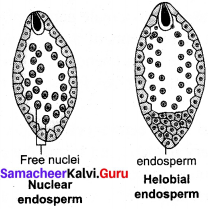
A number of hospitals and related institutions have created humour rooms. The humour room is stocked with books, comics, funny posters, audiotapes, and videos. Humour is a therapeutic tool that demands energy for its creation, yet its rich rewards include a closer therapeutic bond through shared laughter. The best humour comes from what is going on “at the moment.” Therefore one can plan to use humour yet rely on spontaneous opportunities to employ it. Humour is something positive that should bring mutually shared enjoyment and pleasure. Above all, humour is called a way of living not a part of living.
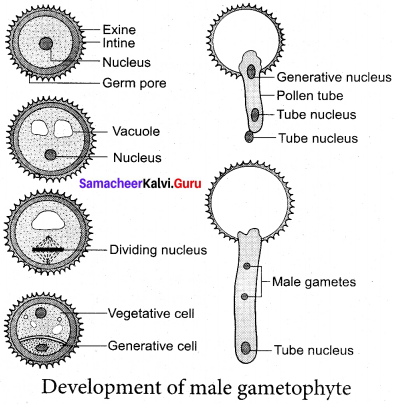
The First Patient Supplementary In Tamil Question (i)
Humour has the power to motivate and _________ stress and pain.
(a) improve
(b) intensify
(c) reduce
(d) increase
Answer:
(c) reduce

The First Patient Question (ii)
It seems generally _________ that our bodies respond in a positive way to a hearty laugh.
(a) accepted
(b) denied
(c) improved
(d) confused
Answer:
(a) accepted

The First Patient Supplementary Summary Moral Question (iii)
The _________ is stocked with books,comics, funny posters, audiotapes, and videos.
(a) waiting room
(b) humour room
(c) ICU
(d) reception
Answer:
(b) humour room

The First Patient Moral Question (iv)
One can plan to use humour yet rely on _________ opportunities to employ it.
(a) late
(b) better
(c) future
(d) spontaneous
Answer:
(d) spontaneous

Summary Of The First Patient By Cv Burgess Question (v)
Humour is called a way of _________ ,not a part of living.
(a) living
(b) playing
(c) nourishing
(d) developing
Answers
(a) living

First Patient Summary Speaking Activity

Complete the following dialogue between a doctor and a patient with ten sets of utterances for the following situation in which a person goes to a doctor for treatment. The doctor wishes to give him/her an injection. The person is scared. The doctor convinces the patient and administers the injection. Now, in pairs, enact the dialogue in the classroom.

Doctor : Good evening. Please come in.
Patient : Good evening, Doctor.
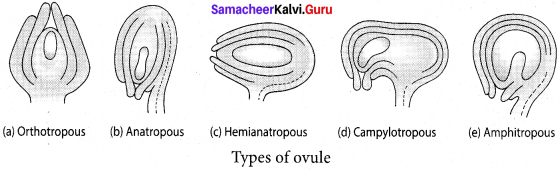
Doctor : Tell me what ails you?
Patient : I have severe stomach pain and mild fever too.
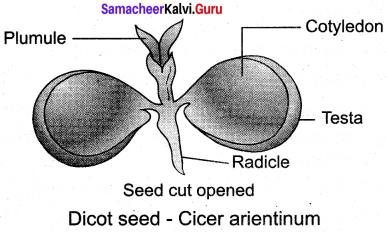
Doctor : Show me your tongue.
Patient : (Shows the tongue) Is it dengue?
Doctor : Don’t jump to conclusions.
Patient : I’m worried, Sir.
Doctor : Don’t worry. Tell me. What did you eat last evening?
Patient : I took KFC chicken one full bucket.
Doctor : I doubt some food poisoning.
Patient : What should I do, Sir?.
Doctor : Take an injection to stem the effect of food poisoning, and we will give you bottles of glucose.
Patient : Can you avoid injection, Sir?
Doctor : Young man don’t worry. My muse Sarala will give you an injection where you won’t feel any pain.
Patient : Thank you, Doctor.

5. Answer the following questions in a paragraph of about 80-100 words each.

The First Patient By Cv Burgess Ppt Question (i)
Based on your understanding of the play, explain how a mistaken understanding of events can lead to confusion. How has the author used this unexpected combination of events in the situation to create humour?
Answer:
Author C.V. Burgess is a master craftsman. He reveals only a few names. The first patient Joe and his wife Emily are the most dominant characters. Joe is inside the surgical room. Emily is apprehensive about the husband. Among two children the dramatist uses only the girl’s name Dorothea and the Dentist hospital becomes a play area for Dorothea and the little boy who claim the same magazine for reading. The snobbish woman who goes on showing her

photo album gives us an impression if she came to see the doctor or to show her photos. The whole play resolves around the dramatic irony of patients’ guess as to what happened inside the dentists’ room and what really happened. The pliers, hack saw and the huge hammer were taken inside the dentist’s room only for opening the tool cabinet. But the patients wondered how these tools would be used in surgery. The groaning noise from inside the dentist’s rooms and the vexation of Emily Joe add to the dramatic irony. A few women patients leave the waiting room scared of subjecting themselves to the torture of having their bad teeth extracted with carpentry tools. The nurse moves about with all feigned seriousness without disclosing the fact of the misplacement of key which adds to the comic situation

11th English Unit 3 Supplementary Question (ii)
Have you ever found yourself in such a situation? Discuss in groups and act out such a situation.
Answer:
Once I was watching a thriller movie inside my room. I had locked the room from with in. But I had foolishly not reduced the volume of the T. V. There was a blood curdling scream of a little boy seeing a ghost. My parents banged the door thinking that I may have had a nightmarish dream or something was wrong. I opened the door and I had to convince them that it was just the movie and I was absolutely normal.

Additional Questions

I. Rearrange the sentences in a logical sequence.

Question 1.
(a) A fashionable lady patient showed her photos to fellow patients.
(b) The first patient Joe was called in.
(c) It was a dentist’s clinic.
(d) A number of patients were waiting for their turn.
(e) Everybody was tensed at the painful prospect of their bad tooth being extracted.
Answers:
(c) It was a dentist’s clinic.
(d) A number of patients were waiting for their turn.
(e) Everybody was tensed at the painful prospect of their bad tooth being extracted.
(b) The first patient Joe was called in.
(a) A fashionable lady patient showed her photos to fellow patients.

Question 2.
(a) Seeing all these, a little boy confesses that he feigned tooth ache to bunk classes.
(b) Every one is frightened to see the nurse moving in with a pair of pliers and a hack saw. Patients find a nurse going in and out of the surgical room with a big hammer.
(c) Emily, wife of Joe, is worried.
(d) They hear groaning sound from within the surgical lab.
Answers:
(c) Patients find a nurse going in and out of the surgical room with a big hammer.
(e) They hear groaning sound from within the surgical lab.
(d) Emily, wife of Joe, is worried.
(b) Every one is frightened to see the nurse moving in with a pair of pliers and a hack saw.
(a) Seeing all these, a little boy confesses that he feigned tooth ache to bunk classes.


Question 3.
(a) Emily heaves a sign of relief that the carpentry tools were for opening the tool cabinet.
(b) Emily weeps worried about her husband (Joe’s) safety.
(c) The loud sawing and screeching from within the clinic makes everyone leave the clinic.
(d) Finally only two women remain in the waiting room.
(e) Joe informs Emily that the Dentist shifted his appointment to the evening.
Answers:
(c) The loud sawing and screeching from within the clinic makes everyone leav
(d) Finally only two women remain in the waiting room.
(b) Emily weeps worried about her husband (Joe’s) safety.
(e) Joe informs Emily that the Dentist shifted his appointment to the evening.
(a) Emily heaves a sign of relief that the carpentry tools were for opening the tool cabinet.

II. Choose the best option and fill in the blanks.

Question 1.
A number ___________ of were waiting at a dentist’s clinic.
(a) fans
(b) debtors
(c) players
(d) patients
Answer:
(d) patients

Question 2.
Everybody is ___________ at the prospect of painful tooth extraction.
(a) happy
(b) frightened
(c) delighted
(d) awaiting
Answer:
(b) frightened

Question 3.
___________ is the first patient.
(a) Emily
(b) Maurice
(c) Dorothea
(d) Joe
Answer:
(d) Joe

Question 4.
It was startling to the patients to find the nurse carrying a ___________ into the surgical room.
(a) injection
(b) tray
(c) cap
(d) hammer
Answer:
(d) hammer


Question 5.
Mrs. Joe was restless because she was frightened that her husband’s tooth was being extracted with ___________ and hacksaw.
(a) injection
(b) cotton
(c) hammer
(d) anaesthesia
Answer:
(c) hammer

Question 6.
It was funny to notice a woman patient showing her ___________ to everyone.
(a) case file
(b) prescription
(c) photos
(d) drawings
Answer:
(c) photos

Question 7.
Mrs. Joe was ___________ by the second woman because she tried to open the surgical room.
(a) motivated
(b) appreciated
(c) restrained
(d) persuaded
Answer:
(c) restrained

Question 8.
The ___________ sawing and screeching frightened most of the patients.
(a) quiet
(b) inaudible
(c) mild
(d) loud
Answer:
(d) loud

Question 9.
Except ___________ women all the patients left the dental clinic.
(a) one
(b) two
(c) three
(d) four
Answer:
(b) two

Question 10.
Joe’s appointment was shifted to ___________
(a) afternoon
(b) morning
(c) evening
(d) the following Sunday
Answer:
(b) morning


Question 11.
The missing key of the ___________ was found under the telephone directory.
(a) cashbox
(b) tool cabinet
(c) Almirah
(d) surgical room
Answer:
(c) Almirah

Question 12.
The woman with the ___________ was surprised to see the queue had moved quickly.
(a) little girl
(b) little boy
(c) a hunch back
(d) photos
Answer:
(d) photos

Question 13.
Mr. Joe had been given some ___________ to dull the pain. did not care when the lady threatened her that she wouldn’t bring her anymore to the
Dentist’s.
(a) Maurice
(b) Lalitha
(c) Hema
(d) Dorothea
Answer:
(c) Hema

Question 14.
The ___________ from the surgical room was mistaken as painful reaction of Mr. Joe.
(a) music
(b) song
(c) news
(d) groan
Answer:
(d) groan

Question 15.
___________ did not care when the lady threatened her that she wouldn’t bring her anymore to the Dentist’s.
(a) Maurice
(b) Lalitha
(c) Hema
(d) Dorothea
Answer:
(d) Dorothea

Question 16.
A little girl and a small boy fought over ___________ a both wanted.
(a) photo
(b) doll
(c) ball
(d) magazine
Answer:
(d) magazine

Question 17.
Woman 5 is found to be ___________ because she gladly shares her photos with everyone.
(a) eccentric
(b) wise
(c) conventional
(d) unusual
Answer:
(a) eccentric

Question 18.
___________ was asking awkward questions.
(a) Lady 5
(b) Joe
(c) Emily
(d) Maurice
Answer:
(d) Maurice


Question 19.
Man attributed the noise from surgical room was of a man whose ___________ was being taken out.
(a) tonsil
(b) bad tooth
(c) kidney
(d) abrasives
Answer:
(b) bad tooth

Question 20.
Man said that there must be a special waiting room for ___________
(a) women
(b) children
(c) patients
(d) pets
Answer:
(d) pets

Question 21.
The boy who had feigned tooth ache was threatened by his mom that she would ask the ___________
to thrash him.
(a) daddy
(b) grandma
(c) headmaster
(d) dean
Answer:
(c) headmaster

Question 22
___________ claimed to have lied about tooth ache though her teeth appeared as black as kitche range.
(a) Emily
(b) Jane
(c) Dorothea
(d) Lucy
Answer:
(d) Lucy

III. Identify the speakers.

  1. A bit big, wasn’t it? – Man 3 to Man 4
  2. There, there, don’t upset yourself, dear. There’s nothing to worry about – Woman 2 to Woman 1.
  3. I heard a chap once the roots of whose teeth were wrapped around his jawbone. He was fine hours in the chair – Man 4 to Man 3
  4. It’s mine! It’s mine! – Little girl to Small boy
  5. “Really, it’s the last time I’ll bring you anywhere” – Woman 7 to Dorothea.
  6. “I wish some people would keep their children under control” – Woman 6 to Woman 7
  7. I can’t stand it oh, Joe! Joe! Joe! – Emily
  8. What was the noise, mummy? – Small boy to Woman 8
  9. “That noise was a man having having a tooth out. That’s how it’s going to sound when your’s out” – Man 7 to Little boy
  10. What a thing to tell a small boy!” – Woman 6
  11. Disgusting – Man 6 about Man 7’s explanation of noise.
  12. I haven’t got tooth ache at all. I was only joking. I just wanted to get off school – Little boy to Mummy (Woman 8)
  13. I’ll get the headmaster to give you a good thrashing – Woman 8 to her son
  14. “A little discipline, that’s what he wants” – Man 5 about truant boy
  15. This one would make a good impression on you dear – Woman 5 to Woman 6 about her photo
  16. Do hurry, Nurse or we’ll never get this thing shift. – Dentist to Nurse
  17. Neither can I. I’ll be late for work – Man 5 to Man 6
  18. Cowards everyone of them. They can’t take it. – Man 5 and Man 6
  19. I can’t stand howling children. I’m off – Man 2
  20. “This time the saw will be on the edge of his teeth” – Man 7
  21. What ever is the matter my dear? – Woman 5 to Woman 1
  22. It’s Joe! Poor Joe! Goodness knows what state he’s in now – Woman 1 to Woman 5
  23. Well I suppose he hasn’t come to any harm – Woman 5 to Woman 1
  24. Oh! dear me! Where’s that very amusing one? – Woman 5
  25. 25. Why, What ever is the matter, Emily? – Joe .
  26. Of course I’m alright. Why shouldn’t I be all right? – Joe to Emily
  27. But Joe, all that hammering and sawing – Emily to Joe
  28. Oh, that! That was only the dentist trying to force open his instrument cabinet – Joe to Emily
  29. So, he hasn’t done anything to you, Joe – Emily to Joe
  30. Dear me, that long queue did move quickly, didn’t it? – Woman 5 to Nurse

IV. Read the following paragraph and answer the questions given below.

Question 1.
There is a sudden screech of metal from the surgery. Woman 1 gasps with horror and is about to make a dash for the surgery door when she is dragged back by Woman 2. Man 4 groans loudly. The Small Boy and the Little Girl at the table start a fight about a magazine they both want. Woman 8 and Woman 7 attempt to separate them. Through all this noise Woman 5 is still trying to show her photographs.
Little Girl: It’s mine! It’s mine!
Small Boy: No, it’s mine! I saw it first.
Woman 7: Sit down, Dorothea. Sit down and be quiet. I’ll tell your daddy about this. Then there’ll be trouble. Really, it’s the last time I’ll bring you anywhere.
Little Girl: See if I care.


Question (a)
Who is called “woman 1”?
Answer:
Emily is called woman 1.

Question (b)
Why does woman 1 gasp with horror?
Answer:
Woman 1 hears groaning sound from the surgery room. Besides patients waiting for the dentist, tell horrifying tales about the extraction of teeth. Nurse also carries Hammer and Hack saw to the surgery room. So, she gasps with horror.

Question (c)
Why does Woman 1 try to dash to the surgery door?
Answer:
Woman 1 tries to dash to the surgery door to find out if her husband Joe was alright.

Question (d)
What is the cause of fight between the two children?
Answer:
Both the children want the same magazine. So, they fight.

Question (e)
How does woman 7 threaten Dorothea? What is her reaction to the threat?
Answer:
Dorothea quarrels with another boy over a magazine. Her mom threatens her that she would tell her dad and she would never bring her again anywhere. The little girl just does not care about the double threat.

2. I can’t stand it. Oh, Joe! Joe! Joe!
(Man 4 groans.)
Small Boy: What was that noise, Mummy?
Woman 8: Don’t ask awkward questions, Maurice.
Man 7: I’ll tell you, little boy. That noise was a man having a tooth out. That’s how it’s going to sound when you have yours out, only much, much louder, because then it’ll be inside your head.
Woman 6: What a thing to tell a small boy!
Man 6: Disgusting!
Man 7: It’ll do the lad good. Bring‘em up natural, I always say.

Question (a)
What is unbearable for woman 1?
Answer:
The sawing, screeching sound accompanied by a loud groan from the surgery room upsets woman 1. She thinks that her husband Joe, the first patient is subjected to torture.

Question (b)
Who asked awkward questions?
Answer:
Maurice asked awkward questions.

Question (c)
Why does the woman think that the question was awkward?
Answer:
Screeching sound and groaning sound are quite common in the surgery room of a Dentist when he is extracting a bad teeth. So, the question about the groan is said to be awkward.

Question (d)
Why was the answer to the boy’s question considered “disgusting”?
Answer:
The man 7 answered that the noise was from a man whose tooth was being extracted. He added when the little boy’s tooth is extracted there would be louder noise. So, this owner is deemed ‘disgusting’.


Question (e)
How did man 7 justify his answer? .
Man 7 justified his answer that it would help the lady to raise her son in a natural way.

3. Woman 6: But surely, they can’t really be using those tools to take out a tooth.
Woman 4: You heard what the Man said.
Woman 6: And those men have gone, too.
Man 7: Cowards, every one of them. They can’t take it.
Little Girl: Mummy, I was only joking about my toothache, too. I haven’t really got one. I was only trying to get off school.
Woman 7: Nonsense, Dorothea, you know your tooth is as black as the kitchen range. You’re only trying to get out of it.(The Little Girl breaks into a howl.)

Question (a)
What tools are talked about here?
Answer:
The carpentry tools like hammer, pliers and hacksaw are talked about here.

Question (b)
Why does the woman feel that the tools are inappropriate there?
Answer:
The woman believed that the carpentry tools may not be needed by a dentist to remove tooth. So, she feels they are inappropriate there.

Question (c)
Why does man 7 call his fellow patients as cowards?
Answer:
Some of the male patients left the clinic without meeting the dentists. Man 7 thought that they were scared of the tools of tooth extraction and left the clinic. So, he described them as “cowards”.

Question (d)
How did the little girl try to outsmart her mom?
Answer:
The little girl said that she was only joking about her tooth ache.

Question (e)
How did Dorothea’s mom find out the truth?
Dorothea’s teeth was black. The bad tooth had to be extracted. But Dorothea claimed that she was only joking about her tooth ache. So, mom found out Dorothea’s lies to escape the torture of the dentist.

4. Man 1: Why, whatever is the matter, Emily?
Woman 1: Joe, Joe, are you all right? Let me look at you, Joe! ,
Man 1: Of course I’m all right. Why shouldn’t I be all right?
Woman 1: But, Joe, all that hammering and sawing.
Man 1: Oh, that! That was only the dentist trying to force open his instrument cabinet. Woman 1: His cabinet?
Man 1: Yes, you see he lost the key.
Woman 1: So he hasn’t done anything to you, Joe!
Man 1: Not a thing, and I can’t wait any longer this morning. I’ve made an appointment with him for this evening instead. The nurse gave me some pills to deaden the pain in the meantime. Woman 1: Oh, Joe, I was so upset.
Man 1: Well, it’s all right now, Emily, so let’s go.

Question(a)
Why was Joe perturbed?
Answer:
Emily’s face was swollen and obviously she had cried. So, Joe was perturbed.

Question (b)
What did Emily want to look chosely at Joe?
Answer:
Emily was frightened that her husband Joe was subjected to some torture by the dentist. She wanted to find out if there were traces of pain or injury on his face. So, she wanted to look closely at Joe’s face.

Question (c)
Why did Emily think that her husband must have suffered much?
Answer:
Emily connected the sawing, hammering and groaning to the extraction of bad tooth. When noises came from the surgery room, Joe was inside it. So, Emily figured out that her husband must have suffered much.

Question (d)
How did Joe justify the loud noises and groan inside the dentist’s surgery room?
Answer:
The Dentist was trying to open his instrument key. He had lost his key somewhere. The sawing and screeching were the noises related to it.


Question (e)
How did the nurse help Joe?
Answer:
The nurse had given him some pills to dull the pain till the evening.

The First Patient About the Author

The First Patient Supplementary Samacheer Kalvi 11th English Solutions Supplementary Chapter 3

Christopher Victor Burgess is known as C. V. Burgess. He is a humorous playwright, His situational humour intensifies the emotions of the characters in the play. His plays ! usually accommodate a number of characters. His famous works are ‘Short Plays for Large Classes’, ‘Teach yourself Speech Training’ and ‘Classroom Playhouse Verse in Action’

The First Patient Summary

The story happens in a dentist’s clinic. The first patient Joe is called in by the dentist. For a long time all the waiting men, women and children hear loud groaning noise emerging from the surgical room of the dentist. Joe’s wife is obviously disturbed. She tries to barge into the surgical room to see for herself what is being done to Joe. Her curiosity turns into a traumatic experience as unusual tools like pliers, hammer and hacksaw add to the anxiety of Mrs. Joe. A girl namely Dorothea howls so hard that some men patients leave the clinic. A little boy confesses to his mom that he had faked tooth ache just for bunking his classes. His mom takes him back to school with a rebuke and threat that she would inform his teacher about it. The boy prefers punishment at school to surgery at the dentist’s room.

The First Patient Supplementary Paragraph Samacheer Kalvi 11th English Solutions Supplementary Chapter 3

The little girl tries to persuade her mom to leave the waiting room. She says she has no bad tooth. The mother blackmails her that she wouldn’t give her ice-lollies if she doesn’t take the treatment. She also tells her sternly that if she howls again she wouldn’t bring her again to the dentist. The girl says that she would care less about it. Menfolks unable to wait for a longtime leave the clinic one by one. The boastful and snobbish lady who went on showing her photos to the waiting women is in for a surprise.

The First Patient Supplementary Summary Ppt Samacheer Kalvi 11th English Solutions Supplementary Chapter 3

She is called in as the second patient. She wonders how, quickly the queue has moved on. Joe walks out of the surgical room with a beaming face. He admits that nothing happened to him. His appointment has been shifted to evening. Joe explains that the doctor has forgotten where he has left the tool cabin key. So, he was trying to open it so far with tools of carpentry. Mrs. Joe smiles understanding her

Textual:
agony – severe pain
blurred – hazy, not clear
dreadful – extremely bad
ferrying – carrying
gas – anesthesia
groaning – crying in pain
ice-lollies – flavoured ice or ice cream on a stick
queer – strange
scream – a very funny thing
sulking weeny tug – being sad and silent
wenny – small pull
writhing – twisting the body from side to side

Additional:
apprehension – worry
boastful – proud
extraction – removal
frightened – got afraid
groan – murmur in pain
restrained – detained
snobbish – thinking high of self
sympathized – felt sorry

The main aim is to share the knowledge and help the students of 11th English to secure the best score in their final exams. Use the concepts of Samacheer Kalvi 11th English Book Solutions Supplementary Chapter 3 The First Patient Questions and Answers in Real time to enhance your skills. If you have any doubts you can post your comments in the comment section, We will clarify your doubts as soon as possible without any delay.

Samacheer Kalvi 7th Social Science Civics Solutions Term 1 Chapter 2 Political Parties

Students can Download Social Science Civics Chapter 2 Political Parties Questions and Answers, Notes Pdf, Samacheer Kalvi 7th Social Science Book Solutions Guide Pdf helps you to revise the complete Tamilnadu State Board New Syllabus and score more marks in your examinations.

Tamilnadu Samacheer Kalvi 7th Social Science Civics Solutions Term 1 Chapter 2 Political Parties

Samacheer Kalvi 7th Social Science Political Parties Textual Evaluation

I. Choose the correct answer:

Question 1.
What is meant by Bl-party system?
(a) Two parties run the government.
(b) Two members run a party.
(c) Two major political parties contest election.
(d) None of these.
Answer:
(a) Two parties run the government

Question 2.
Which system of government does India have?
(a) Single-party system
(b) Bl-party system
(c) Multi-party system
(d) None of these
Answer:
(c) Multi-party system

Question 3.
Recognition of a political party is accorded by .
(a) The Election commission
(b) The president
(c) The supreme court
(d) A committee
Answer:
(a) The Election commission

Question 4.
Political parties are generally formed on the basic Of
(a) Religious principles
(b) Common interest
(c) Economic principles
(d) caste
Answer:
(b) Common interest

Question 5.
Single-party system is found in
(a) India
(b) US.A
(c) France
(d) China
Answer:
(d) China

II. Fill in the Blanks

  1. ______ form the back bone of democracy.
  2. Every party in our country has to register with ______
  3. Political parties serve as intermediaries between the ______ and ______
  4. A registered but ______ political party cannot contest election on its own symbol.
  5. The leader of the opposition party enjoys the rank of ______

Answer:

  1. Political parties
  2. Election Commission
  3. citizen, the policy makers
  4. unrecognised
  5. Cabinet minister

III. Match the following

AB
Democracyicriticize the government policies
Election commissioniiforms the government
Majority partyiiirule of the people
Opposition partyivfree and fair election

Answer:

  1. iii
  2. iv
  3. ii
  4. i

IV. Consider the following statements:
Tick (✓) the appropriate answer.

Question 1.
Which of the following statement is/are correct?
(a) Every party in the country has to register with the election commission.
(b) The commission treats all the parties equally.
(c) Election commission allots a separate symbol for recognized parties.
(d) All the above.
Answer:
d) All the above.

Question 2.
Assertion: Majority party plays a decisive role in making laws for the country.
Reason: The number of candidates elected is more than the others in the election.
(a) R is the correct explanation of A.
(b) R is not the correct explanation of A.
(c) R is wrong A is correct.
(d) A and R are wrong.
Answer:
(a) R is the correct explanation of A

V. Answer in one or two sentences

Question 1.
What are the basic components of a political party?
Answer:
Any political party has three basic components

  1. the leader
  2. the active members
  3. the followers

Question 2.
Name the three major types of party system.
Answer:
Single party system, Bi-party system, and multi-party system.

Question 3.
Name the countries which follow Bi – party system.
Answer:
UK, USA

Question 4.
Write a note on Coalition Government.
Answer:
In a Multiparty system a single party sometimes may not secure the majority required to form the government. In such a case, some parties join together to form the government. Such government is called Coalition Government.

VI. Answer the following :

Question 1.
Write any four functions of political party?
Answer:
Functions of the Political parties:

  1. Provide: Loyal opposition, accountability & stability.
  2. Nominate: Select and nominate individuals to elected office.
  3. Organize: Organize political campaign, rallies and announcement of Manifesto to win public office.
  4. Inspire: Put forward different policies and programmes for the welfare of the people.
  5. Co -ordinate: Connect the society and the state. Co-ordinate among members elected to office.
  6. Govern: Form and run the government and develop public policy.

Question 2.
When is a political party recognized as a National Party?
Answer:
Criteria for A political party to be recognised as a National Party

  1. The party that secures should atleast 6% of the valid votes in Lok sabha election or assembly elections in four states.
  2. They must win 4 seats in Lok sabha from any State/States
  3. It has to win 2% of seats in Lok sabha from atleast 3 different states in the latest general election.

VII. HOTS :

Question 1.
Is political party necessary for a democratic country?
Answer:
Yes political parties are necessary for a democratic country because

  1. They are the backbone of democracy.
  2. They are essential elements to form the government.
  3. Citizens can elect their representatives.
  4. Citizens also vote for the party of their choice and thus influence Government formation.

Question 2.
Give any three names of National party, Regional party, and Registered but unrecognized party.
Answer:

  1. National Party: Indian National Congress, Bharatiya Janata Party, Communist party of India.
  2. Regional Party: All India Anna Dravida Munnetra Kazhagam, Dravida Munnatra Kazhagam, Desiya Murpokku Dravidar Kazhagam, Pattali Makkal Katchi
  3. Registered but unrecognized party: Labour party of India, Bhartiya Panchayat party, Indian Indira Congress.

VIII. Activity:

Question 1.
Write an election manifesto (if you were a party leader).
Answer:
If our party comes to power, we would

  1. Take measures to give a corruption free Government.
  2. Agriculture sector would be given prior importance.
  3. Students will be taught technical skills at school which would enhance their scope for employment.
  4. Free and quality medical care would be made available to all the needy people.

Samacheer Kalvi 7th Social Science Political Parties Additional Questions

I. Choose the correct answer:

Question 1.
In earlier times, the ______ was the supreme head of the Legislative, Executive and Judiciary branches.
(a) Governor
(b) Viceroy
(c) King
(d) Minister
Answer:
(c) King

Question 2.
In ______ India became a democratic country.
(a) 1947
(b) 1950
(c) 1948
(d) 1952
Answer:
(b) 1950

Question 3.
The head quarters of Election commission is located in
(a) Chennai
(b) Mumbai
(c) New Delhi
(d) Kolkatta
Answer:
(c) New Delhi

Question 4.
A registered but unrecognised political party has to choose any symbol from .
(a) free symbols poll panel
(b) a list of their own choice
(c) ones which other parties have been given
(d) none of the above
Answer:
(a) free symbols poll panel

II. Fill in the blanks:

  1. The _____ of India is an autonomous constitutional authority to administer elections.
  2. A reserved symbol is meant for a ______
  3. Shiv Sena in Maharashtra and Jharkhand Mukti Morcha in Jharkand use _____ as their symbol.

Answer:

  1. Election Commission
  2. recognised political party
  3. bow and arrow

III. Match the following:

Single party– i.India
Bi – party– ii.North Korea
Multi – party– iii.USA

Answer:

  1. ii
  2. iii
  3. i

IV. (Consider the following statements:
Tick (✓) the appropriate answer.

Question 1.
Assertion (A): The role of the opposition party is as important as that of ruling party.
Reason (R) : They check the autocratic tendencies of the ruling party.
(a) R is not the correct explanation of A.
(b) R is the correct explanation of A.
(c) A and R are wrong.
(d) R is wrong A is correct.
Answer:
(b) R is the correct explanation of A

Question 2.
Which of the following statement/s is /are true?
(a) Political parties capture power only for constitutional means.
(b) They have their own ideology and Program.
(c) Political parties are recognized if they are engaged in political activity for 1 year.
(d) Political Parties provide legal opposition, accountability and stability.
Answer:
(a), (b) and (d)

V. Answer the following in one or two sentences

Question 1.
What is party ‘manifesto’?
Answer:
During the campaign before election, the candidates announce the programmes and policies that their party will undertake if voted to power.

Question 2.
Mention the steps involved in forming a political party?
Answer:

  1. Must get registered with Election Commission of India
  2. Must have atleast 100 members. Each member needs to hold a voting card.
  3. Must write a Party Constitution.

Question 3.
What is a regional/State party?
Answer:

  1. A party that secures 6% of the votes in the state legislative assembly election.
  2. It should win one Lok sabha seat for every 25 seats or at least 2 seats in Legislative assembly.
  3. Should win a minimum of 3% of the total seats in Legislative assembly.

Question 4.
What is a Majority party?
Answer:

  1. The Political Party whose number of candidates elected is more than the others is called the majority party.
  2. The Majority Party forms and runs the government.

Question 5.
What is a Minority party?
Answer:
The Political Party with lesser number of elected candidates are called the Minority party.

Question 6.
What is an opposition party?
Answer:
The party which gets second largest number of seats next to the majority party in the election is called the Opposition party.

Question 7.
What is an Electroal symbol?
Answer:
An electoral symbol is a standardised symbol allocated to a political party. They play an important role in elections.

Question 8.
Distinguish between National party and Regional/State party?
Answer:

National PartyRegional /State Party
National parties are political parties which participate in different elections all over India.Regional parties are political parties which participate in different elections but only within one state.
It should be strong enough in at least four states.It should be strong enough in at least one or two states.

VI. Answer the following in Detail

Question 1.
Describe the major types of party system.
Answer:
There are three major types of party system.

  1. Single Party System: a system in which a single political party has the right to form the government. Single party existed in China, North Korea and Cuba.
  2. Bi – Party System: In Bi -Party system the power is usually shared between two parties. Of the two parties one becomes the ruling party and the other becomes opposition, eg Bi-Party system can be seen in U.K, U.S.A
  3. Multi – Party System: When the competition for power is among three or more parties, the system is known as multi party system. This type of party system is in existence in India, France, Sweden and Norway etc.

Samacheer Kalvi 8th Science Solutions Term 2 Chapter 6 Reaching the Age of Adolescence

You can Download Samacheer Kalvi 8th Science Book Solutions Guide Pdf, Tamilnadu State Board help you to revise the complete Syllabus and score more marks in your examinations.

Tamilnadu Samacheer Kalvi 8th Science Solutions Term 2 Chapter 6 Reaching the Age of Adolescence

Samacheer Kalvi 8th Science Reaching the Age of Adolescence Text Book Exercises

I. Choose the best answer.

Reaching The Age Of Adolescence Class 8 Book Back Answers Question 1.
Adolescence is the period of life between ……………… years of age.
(a) 10 to 16
(b) 11 to 17
(c) 11 to 19
(d) 11 to 20
Answer:
(c) 11 to 19

Reaching The Age Of Adolescence Class 8 In Tamil Question 2.
The period at which an organism attains sexual maturity is called ………………
(a) puberty
(b) adolescence
(c) growth
(d) maturity
Answer:
(a) puberty

8th Standard Science Reaching The Age Of Adolescence Question 3.
During puberty, the region below the waist become wider in ………………
(a) boys
(b) girls
(c) Both a and b
(d) None of these
Answer:
(c) Both a and b

8th Science Reaching The Age Of Adolescence Question 4.
Adam’s apple is the growth of the ………………
(a) pharynx
(b) thyroid
(c) larynx
(d) parathyroid
Answer:
(c) larynx

8th Std Science Reaching The Age Of Adolescence Question 5.
Many adolescent boys and girls get pimples on face, due to the secretions of ……………… gland.
(a) sweat
(b) sebaceous
(c) sweat and sebaceous
(d) None of these
Answer:
(b) sebaceous

Reaching The Age Of Adolescence In Tamil Meaning Question 6.
The sperm is produced by ………………
(a) penis
(b) ovary
(c) uterus
(d) testes
Answer:
(d) testes

Reaching The Age Of Adolescence In Tamil Question 7.
are the chemical substances, secreted by endocrine glands.
(a) Hormones
(b) Enzymes
(c) Proteins
(d) Fatty acids
Answer:
(a) Hormones

Reaching The Age Of Adolescence Class 8 Question 8.
Androgen production is regulated by ………………
(a) GH hormone
(b) LH hormone
(c) TSH hormone
(d) ACTH hormone
Answer:
(b) LH hormone

Reaching The Age Of Adolescence Question 9.
During menstruation, the progesterone level is ………………
(a) decreased
(b) increased
(C) ceased
(d) normal
Answer:
(a) ceased

Class 8 Science Reaching The Age Of Adolescence Question 10.
……………… intake needs to be increased to prevent osteoporosis in later life.
(a) Potassium
(b) Phosphorus
(c) Iron
(d) Calcium
Answer:
(d) Calcium

II. Fill in the blanks

  1. ……………… is secreted by the ovaries of female.
  2. The hormones secreted by the gonads are controlled by ………………
  3. Milk secretion during lactation is controlled by ……………… hormone.
  4. The male and the female gamete fuse together and form ……………….
  5. The first menstrual flow begins at puberty and it is termed as ………………
  6. ……………… usually occurs 14 days after ovulation.
  7. ……………… includes protein, carbohydrates, fats and vitamins in requisite proportion.
  8. ……………… helps to prevent thyroid gland related diseases.
  9. Iron deficiency leads to ………………
  10. In women, fertilization takes place at ……………….

Answer:

  1. Estrogen
  2. Anterior pituitary
  3. prolactin
  4. zygote
  5. menarche
  6. Menstruation
  7. Balanced diet
  8. iodine
  9. Anaemia
  10. Fallopian tube

III. State True or False. If false, correct the statement

Class 8 Chapter Reaching The Age Of Adolescence Question 1.
There is a sudden increase in the height of both boys and girls during puberty.
Answer:
True.

Questions On Reaching The Age Of Adolescence Question 2.
The release of ovum from the uterus is called ovulation.
Answer:
False

Question And Answer Of Reaching The Age Of Adolescence Question 3.
During pregnancy, the corpus luteum continues to grow and produces large amount of estrogen and progesterone.
Answer:
True

Reaching The Age Of Adolescence Questions And Answers Question 4.
Making use of disposable napkins or tampons may increase the chances of infections.
Answer:
False
Correct statement:
Making use of disposable napkins or tampons may reduce the chances of infections.

Reaching The Age Of Adolescence Class 8 Pdf Question 5.
Using clean toilets for defecation is a good practice.
Answer:
True

IV. Match the following

Question 1.

  1. Puberty – Testosterone
  2. Adam’s apple – Muscle development
  3. Androgen – at 45 to 50 years of age
  4. ICSH – Sexual maturity
  5. Menopause – Change in voice

Answer:

  1. Puberty – Sexual maturity
  2. Adam’s apple – Change in voice
  3. Androgen – Muscle development
  4. ICSH – Testosterone
  5. Menopause – at 45 to 50 years of age

V. Answer briefly

Question 1.
What is adolescence?
Answer:

  1. The term adolescence is derived from the Latin word ‘adolescere’ meaning ‘to grow’ or ‘grow to maturity’.
  2. Biologically it is a physical transition marked by the onset of puberty and termination of physical growth in an individual.

Question 2.
List out the changes which occur during puberty.
Answer:
Puberty transform the body of a child into that of an adult. These changes are:

  1. Changes in body size
  2. Changes in body proportion
  3. Development of primary sex characteristics
  4. Development of secondary sex characteristics.

Question 3.
What is secondary sex characteristics?
Answer:
Secondary sex characteristics are the physical features which distinguish male from female.

Question 4.
What is fertilization?
Answer:
The fusion of the sperm and egg is called fertilization.

Question 5.
Explain Menarche.
Answer:

  1. The first menstrual flow begins at puberty and is termed menarche.
  2. It is the beginning of adolescence, during which mental and emotional maturation occurs and physical growth becomes pronounced.

Question 6.
Explain the process of pregnancy.
Answer:

  1. After ovulation, the ovum reaches the fallopian tube and fertilization takes place.
  2. The fertilized egg undergoes development and it is implanted in the uterus.
  3. The corpus luteum continues to grow and produces large amount of progesterone.
  4. This results in pregnancy. Normally, it lasts for 280 days, at the end of which parturition (child birth) takes place.

Question 7.
Explain the importance of cleanliness during the time of menstrual cycle in girls.
Answer:

  1. Girls should take special care of cleanliness during the time of menstrual cycle.
  2. Making use of disposable napkins or tampons may reduce chances of infections. It should be changed frequently depending upon the menstrual flow.

Question 8.
How is adolescence different from childhood?
Answer:

  1. The period of life from birth till 12 years is also childhood. Adolescence begins from age of 12 -13 years.
  2. Lot of changes in height, weight, sex organs, muscle mass etc, occur in adolescence.

VI. Answer in detail

Question 1.
What are the physical changes that occur in boys and girls during adolescence?
Answer:
Secondary sex characteristics are the physical features which distinguish male from female. The Physical changes that occur is boys and girls during adolescence are:

Girls:

  1. Height and weight increase.
  2. Fatty and subcutaneous tissues develop.
  3. Hip broadens.
  4. Hair grows in arm pits and pubic area.
  5. Voice becomes shrill.
  6. Breast develops.

Boys

  1. Height and weight increase.
  2. Muscles develop.
  3. Shoulder broadens.
  4. Hair grows in the arm pits and pubic area, and facial hair also appears.
  5. Voice break takes place due to lengthening of vocal cord and enlarging of larynx.
  6. Size of the penis increases.

Question 2.
Explain the role of hormones in reproduction.
Answer:

  1. The primary hormones that regulate reproduction are the steroids such as androgens, estrogens and progesterone. which have masculinizing, feminizing and gestational effects respectively.
  2. These hormones are secreted from the gonads which are regulated by the anterior pituitary (adenohypophysis).

Follicle Stimulating Hormone (FSH):
FSH in a female influences the development of the Graafian follicle and secretion of estrogens. In a male, it is necessary for the development of seminiferous tubules, and for spermatogenesis.

Luteinizing Hormone (LH):
In a female, it is the hormone necessary for ovulation, and the secretion of the luteal hormone progesterone, and for the final maturation of the Graafian follicle. In a male, it stimulates the interstitial (Leydig) cells of testes and the secretion of testosterone, and is referred to as the Interstitial Cell Stimulating Hormone (ICSH).

Prolactin (PRL) or Lactogenic Hormone:
The main function of this hormone is milk secretion during lactation.

Oxytocin Hormone:
Oxytocin causes expulsion of milk from the breast and it is also involved in the contraction of smooth muscles of uterus during child birth.

Question 3.
Briefly describe the menstrual cycle.
Answer:
The beginning of the menstrual cycle marks the onset of puberty in human females. Menstruation occurs if an ovum released by the ovary of a woman is not fertilized during ovulation. This is described below.

1. When a girl reaches puberty at the age of about 10, the sex hormones released into her blood cause some of the ova (or egg cells) in her ovaries to become mature (or ripe).

2. Usually one mature ovum (or egg) is released ff(jm one of the ovaries into the oviduct once in every 28 days. This is called ovulation.

3. Before ovulation (or release of ovum), the inner wall of uterus becomes thick and spongy, and full of tiny blood vessels to receive the fertilized ovum.

4. If the ovum does not get fertilized then the thick and soft inner lining of uterus breaks. So, the thick and soft inner lining of uterus along with the blood vessels and the dead ovum comes out of the vagina in the form of a bleeding called menstruation.

5. Menstruation usually occurs 14 days after ovulation and usually lasts for about 3 to 5 days.

6. After menstruation is over, the inner lining of the uterus starts building up again so that it may become ready to receive the next ovum.

7. If the ovum does not get fertilized even now, then menstruation takes place again. This cycle of menstruation is repeated again and again in women after every 28 days. The menstrual cycle is controlled by hormones.

Menstruation stops temporarily when the ovum gets fertilized and the women gets pregnant. Menstruation also stops due to nutritional deficiencies, low body weight, stress, eating disorder, excessive weight gain etc.

Question 4.
Briefly explain the nutritional needs of adolescence.
Answer:

  1. Adolescence is a stage of rapid growth and development.
  2. Balanced diet is very much important during adolescence. Balanced diet includes proteins, carbohydrates, fats and vitamins in requisite proportions.
  3. A very good amount of proteins and carbohydrates is necessary during this growth period. Apart from that, adolescents need the following dietary components.

Minerals:

  1. Since there is an increase in skeletal mass and blood volume during adolescence, the body needs calcium, phosphorus and iron.

Calcium:

  1. Calcium intake needs to be increased to prevent osteoporosis in later life.
  2. It is present in milk and milk products or other equivalents.

Iodine:

  1. It helps to prevent thyroid gland related diseases.

Iron:

  1. Iron builds blood and iron-rich foods such as green leafy vegetables, jaggery, meat, dates, fish, chicken, citrus, Indian gooseberry (Nelli) and whole pulses are good for adolescents.
  2. Lack of iron in the diet results in anemia.
  3. In boys, iron deficiency occurs due to muscle spurt whereas in girls it occurs due to menstruation in addition to the muscular growth.

VII. Higher Order Thinking Questions.

Question 1.
What can you suggest to your classmates to keep himself / herself clean and healthy?
Answer:

  1. Shower or bath daily.
  2. Always wash your hands before and after meals.
  3. Keep fingernails clean and dipped.
  4. Wash your teeth and mouth before and after each meal.
  5. Avoid touching your face, nose or mouth while preparing food.
  6. Avoid coughing or sneezing around food and close your mouth by using hand kerchief while you cough in public places.
  7. If you want to taste the food, use a clean spoon.
  8. Change your clothes regularly and wash them cleanly, especially undergarments.
  9. Do not defecate in open field. Use clean toilets for defecation.
  10. If you are not well, avoid self-medication, consult a doctor.
  11. In case of girls, menstrual hygiene can be explained to them.

Question 2.
Adolescence is the energistic stage. What health and good habits you want to develop?
Answer:
Healthy and good habits that we should develop during adolescence are:

  1. Eat balanced diet and avoid junk food to prevent obesity.
  2. Regular physical exercise which helps to build our body.
  3. Keep ourselves clean by bathing twice a day, cutting hair, trimming nails, wearing clean cloths.
  4. Keep away from abusive substances, drugs smoking and any other bad habits.
  5. Observe menstrual hygiene.
  6. Be aware of problems related to adolescence and take care of one’s physical and mental health.

Samacheer Kalvi 8th Science Reaching the Age of Adolescence Additional Questions

I. Choose the correct answer

Question 1.
………………. is not a source of iron.
(a) Gooseberry
(b) Fish
(c) Milk
(d) Jaggery
Answer:
(c) Milk

Question 2.
FSH is produced by ………………..
(a) pituitary gland
(b) thyroid gland N
(c) uterus
(d) testes
Answer:
(a) pituitary gland

Question 3.
ICSH refers to ………………..
(a) FSH
(b) LH
(c) oxytocin
(d) testosterone
Answer:
(b) LH

Question 4.
Menstruation normally occurs once in ……………….
(a) 25 days
(b) 35 days
(c) 28 days
(d) 19 days
Answer:
(c) 28 days

Question 5.
Normally pregnancy lasts for ………………. days.
(a) 300
(b) 280
(c) 320
(d) 260
Answer:
(b) 280

II. Fill in the Blanks

  1. Oil glands are called ………………. glands.
  2. The primary sex organs of the male and female are called ………………. and ………………. respectively.
  3. ………………. hormone stimulates the testes to produce androgens.
  4. ……………….. is the male sex hormone.
  5. The hormone ………………. is involved in the contraction of uterine muscles during child birth.
  6. The release of ovum from the ovary is called ………………..
  7. The wall of ………………. becomes thick to receive the fertilized egg.
  8. Fertilization takes place in the ………………..
  9. ………………. is a temporary endocrine gland formed during pregnancy.
  10. Stoppage of menstruation is called ………………..

Answer:

  1. sebaceous
  2. Testes, ovary
  3. Leutinizing
  4. Androgen
  5. oxytocin
  6. ovulation
  7. uterus
  8. Fallopian tube
  9. Corpus luteum
  10. menopause

III. True or False – if false give the correct statement.

Question 1.
The male sex hormone is called estrogen.
Answer:
False.
Correct statement:
The male sex hormone is called androgen.

Question 2.
Prolactin is also known as lactogenic hormone.
Answer:
True.

Question 3.
The FSH is required for spermatogenesis in males.
Answer:
True.

Question 4.
Milk is rich in calcium.
Answer:
True.

Question 5.
In take of iodine is necessary to prevent anemia.
Answer:
False.
Correct statement:
In take of iron is necessary to prevent anemia.

Question 6.
Corpus luteum grows during menstruation.
False.
Correct statement:
Corpus luteum degenerates during menstruation.

Question 7.
Egg is released from fallopian tube.
Falsw.
Correct statement:
Egg is released from ovary.

IV. Match the following

Question 1.

1.Calcium(a)Salt
2.Iron(b)Fruits
3.Iodine(c)Jaggery
4.Minerals(d)Pulses
5.Protein(e)Milk

Answer:

  1. e
  2. e
  3. a
  4. b
  5. d

V. Answer briefly

Question 1.
Name the sex organs and their hormones.
Answer:
The male sex glands testes release the testosterone and the female sex gland, the ovaries release the estrogen.

Question 2.
Name the pituitary hormones which influence the gonads (sex organs).
Answer:
Follicle stimulating hormone, Luteinizing hormone and oxytocin.

Question 3.
Define ovulation.
Answer:
The release of ovum from the ovary is called ovulation.

Question 4.
When does the corpus luteum degenerate?
Answer:
If the ovum is not fertilized the corpus luteum begins to degenerate.

Question 5.
What is menopause?
Answer:
Menopause marks the end of the reproductive phase of a woman’s life. At 45 to 50 years of age, the menstrual cycle stops.

Question 6.
What is menstruation?
Answer:

  1. If the ovum is not fertilized, the corpus luteum begins to degenerate and the production of hormones progesterone and estrogen ceases.
  2. The unfertilized egg and the thickened lining of the uterus along with its blood vessels are shed off.
  3. This causes bleeding in woman’s reproductive tract which is called menstruation.

VI. Answer in detail.

Question 1.
Explain the Secondary sex characteristics of Boys.
Answer:
the following are the secondary sex characteristics of boys.

  1. Hair – Immediately after the development of primary sex characteristics, pubic hair appears followed by axillary and facial hair.
  2. Skin – The skin becomes coarse and the pores in the skin enlarge.
  3. Glands – The oil producing glands in the skin enlarge and due to this acne may appear of the faces.
  4. Muscle – The strength of the muscle increases and it gives shape to arms, legs and shoulders.
  5. Voice – During this period voice changes occur and the voice becomes husky. Then its pitch drops and the volume increases.

Question 2.
Explain the Secondary sex characteristics of Girls.
Answer:
Girls show the following secondary sex characteristics at the time of puberty.

  1. Hips – Due to the enlargement of the pelvic bone and the development of subcutaneous fat, the hip becomes wider and rounder.
  2. Breast – After the enlargement of hips, the breasts begin to develop during this time.
  3. Hair – Pubic hair appears followed by axillary and body hair on the limbs.
  4. Skin – The skin becomes coarser and the pores enlarge as in the case of boys.
  5. Gland – Oil producing glands become active causing acne on the face.
  6. Muscles – Increase in muscles takes place which gives shape to shoulders, arms and legs.
  7. Voice – Voice becomes shrill and voice breaks are rare among girls.

Samacheer Kalvi 11th English Solutions Prose Chapter 5 Convocation Address

Students who are interested in learning of 11th English Prose Chapter 5 Convocation Address Questions and Answers can use Tamilnadu State Board Solutions of 11th English Chapter Wise Pdf. First check in which chapter you are lagging and then Download Samacheer Kalvi 11th English Book Solutions Questions and Answers Summary, Activity, Notes Chapter Wise. Students can build self confidence by solving the solutions with the help of Tamilnadu State Board English Solutions. English is the scoring subject if you improve your grammar skills. Because most of the students will lose marks by writing grammar mistakes. So, we suggest you to Download Tamilnadu State Board 11th English Solutions according to the chapters.

Tamilnadu Samacheer Kalvi 11th English Solutions Prose Chapter 5 Convocation Address

Check out the topics covered in Prose Chapter 5 Convocation Address Questions and Answers before you start your preparation. Improve your grammar skills with the help of Samacheer Kalvi 11th English Book Solutions Questions and Answers pdf links. The solutions for Tamilnadu State Board 11th English Textbook are prepared by the English experts. So, if you follow Tamilnadu State Board Solutions 11th English Textbook Solutions you can cover all the topics in Prose Chapter 5 Convocation Address Questons and Answers. This helps to improve your communication skills.

The Convocation Address Warm up

A. Work in pairs. Look at the mind map below and add a few other features of democracy you can think of. Share your answers with the class.

  • e.g. sharing and caring
  • Protecting nature
  • Cleaning environment
  • Doing one’s duties
  • Enjoying freedom of speech

Answer:

The Convocation Address Samacheer Kalvi 11th English Solutions Prose Chapter 5

  • People
  • Rights
  • Majority
  • Voting
  • Individualism
  • Politics

B. Given below is a list of items or features you find in a good school. Study the list and classify the items as individual and common.

(textbooks – uniform – smart class room – laboratory – competent teachers – library – mid-day meals – blackboard – stationery – play ground – sports equipment-washrooms)

IndividualCommon
e.g. textbooksplay ground

Answer:

IndividualCommon
e.g. textbooksplay ground
uniformsmart classroom
stationerylibrary
teacherslaboratory
mid-day mealswashroom
sports equipmentblackboard

C. Who provides these common facilities? Tick the appropriate source.

  • Parents
  • Educational institutions
  • The Department of Education
  • Social Service Organizations
  • Other agencies

Answer:
The Department of Education provides these common facilities.

D. Discuss this aspect with your partner and share your views on how students can give back to society.

Students can do a lot in generating ideas which could be helpful to the society. Many illiterate people and young children succumb to dengue, malaria and other diseases as they don’t keep their surroundings clean. NSS, Red cross, National Green Corps cadets can run successful campaigns to present the spread of such diseases. Water is the most precious wealth of the nation. People tend to waste it without realizing the sordid and potential threat of “zero water day” in Tamil Nadu if we don’t prevent sand mafia’s from looting river bed sand.

Besides, farmers do not use advanced scientific method to make judicious use of water or water harvesting. As a result, their crops fail along with rainfall. More than double, the quantity of water, we beg from Karnataka goes and ends up in Bay of Bengal. So, students could cite Kajender Singh, a water specialist who made parts of Rajasthan bloom due to water conservation techniques. To popularize water harvesting, judicious use of water and reduce pollution and enhance recycling practices, student community can interact with a community, conduct rallies or campaigns and be proud to be the part of development of the nation.

Samacheer Kalvi 11th English Convocation Address Textual Questions

A. Based on your reading of the speech, answer the following questions briefly in a sentence or two.

Convocation Address Summary Question 1.
Who does the speaker claim to represent?
Answer:
The speaker wishes to represent some of the cardinal principles enunciated by those who offered to graduates in the past. He remarks that his speech would bear the layman’s point of view to the findings of experts in various fields of education. He promises to annotate the speeches of great educationists for the benefit of the graduates.

The Convocation Address Summary Question 2.
Why are universities necessary for a society?
Answer:
Universities, as the repositories of knowledge and nursing ground for the emissaries of thought wisdom and service, have got a prominent role to play (i.e) to equip graduates to better the society. Universities are necessary to trim, train, guide and lead the youth to the development task. It kindles sweet hopes but demands patience, perseverance, faith and confidence. He should have faith in himself and others. The faith should also be in his inherent ability to shoulder the responsibilities. The universities today have the responsibility to fashion out of the graduate an individual fitted and equipped for the task of making democracy fruitful and effective. So, universities are essential.

The Convocation Address Question And Answer Question 3.
What was the role of scholars and poets in olden days?
Answer:
Scholar and poets adorned the chambers of royalty or the gilded mansions of lords and nobles. Their wisdom was meant for the mansion, not for the market place. Poets and scholars were content to work in secluded spheres. Their work was to weave the costly fabric of philosophy or poetry which, is turn, was to be converted into dazzling garments for the select and the privileged royalty.

Convocation Address Paragraph Question 4.
In what ways have universities improved the society?
Answer:
Universities are the repositories of knowledge and the nursing ground for emissaries of thought, wisdom and service. They equip individuals in the task of bettering society. Universities have infact eschewed monarchy and autocracy and have initiated the era of democracy. Thus universities have helped the society.

Convocation Address By Annadurai Summary Question 5.
Universities develop broad-mindedness. How does Dr. Radhakrishnan drive home this idea?
Answer:
True spirit of democracy can be developed only in universities. A broad – minded person alone can appreciate other’s point of view and adjust ideological differences through discussions. In universities, a lot of opportunities are made available for debates. Friendly discussions provide ample scope for nurturing broad-mindedness of the youth.

Convocation Address Question 6.
What should the youngsters aim in life after their graduation?
Answer:
The youngsters should aim in life after graduation for an aristocracy of achievements arising out of a democracy of opportunities. As youngsters they should aim at toning up the society, bringing light into dark alleys sunshine into dingy places, solace into the afflicted, hope unto the despondent and a new life into every one.

Convocation Address By Annadurai In Tamil Question 7.
How can a graduate give back to his/her society?
Answer:
The graduates are indebted to the society for the higher education. They need to replenish the social chest on which they have drawn largely as students. They can contribute to the society not in terms of material goods. But in terms of quality services, through services the graduates, can confer rich benefit to the humanity.

B. Based on your understanding, answer the following questions in three or four sentences each.

The Convocation Address Theme Question 1.
‘Wisdom was meant for the mansion, not for the market place’ What does this statement signify?
Answer:
During the monarchical or feudal days, universities had to train scholars and poets to adorn the chambers of royalty or the gilded mansions of the lords and nobles. Those were the days when eminent scholars were not asked to confront the problems of the masses. They were content to work in secluded places. So, the speaker says that their wisdom was meant for the mansion and not for the market place.

Convocation Address In Tamil Question 2.
According to the speaker, how should Universities mould the students of the present day?
Answer:
Before asking graduates to do the duties as citizen of a democracy, the university must trim, train, guide and lead him to a task which kindles sweet hopes. It should also demand patience and perseverance from them. Universities should inculcate faith and confidence. Faith should be in the graduates and others to shoulder the responsibilities. The universities today should fashion out of them individuals fitted and equipped for the task of making democracy fruitful and effective.

Samacheer Kalvi Guru 11th English Question 3.
How does Arignar Anna highlight the duties and responsibilities of graduates to the society?
Answer:
The graduates must acquire the means of a decent living. But it should be the only objective. As their education is funded by the tax from poor people, they have on obligation to pay back to the society if not in cash in terms of service. They must bring light into the dark alleys, sunshine into dingy places, solace into the affiliated hope unto the despondent and a new life into every one.

The Convocation Address Meaning In Tamil Question 4.
Students are instilled with some of the essential values and skills by the universities. Enumerate them.
Answer:
Universities instill the values of robust optimism, respect for democracy and appreciation of others point of view. It also develops adjustment of differences through discussion; develop patience, perseverance, confidence, faith in themselves and others. They also instill confidence in their ability to shoulder responsibilities.

Samacheer Kalvi Class 11 English Solutions Question 5.
What are the hindrances a graduate faces in his/her way?
Answer:
The world sometimes dim the hopes of graduates and disturbs their determination. They come face to face with unpleasant kind of practices contrary to their principles. Tyranny of all sorts stare at them. Self-seekers are enthroned and patient workers are decried. People with robust optimism are discouraged. These hindrances are faced by graduates on their way.

C. Answer the following questions, based on your understanding of the speech of Dr. Arignar Annadurai, adding your own ideas, in a paragraph of about 100-150 words.

Class 11 English Prose Chapter 5 Question 1.
How do Universities mould students apart from imparting academic education to them?
Answer:
Universities mould students by providing various opportunities to develop their soft skills and to develop values which would contribute to the process of nation building. They enable graduates to develop patience and perseverance. They help them develop faith in their own inherent ability to shoulder responsibilities. The are oriented to become citizens of democracy and repay to the society quality services which would reform the lives of the poor people.

They develop true spirit of democracy among young graduates. They enable appreciation of others point of view. The graduates are also provided opportunities to adjust with difference through amicable discussions. The universities, apart from imparting education mould the students’ character and personality too.

“The quality of a university is measured more by the kind of student it turns out than the kind it takes in.”

Question 2.
The common men contribute to the maintenance of institutions of higher education. Explain this statement.
Answer:
Higher institutes of learning like universities require a lot of funds for their maintenance. These funds often come from the community’s taxes, through the Government students should remember the fact a good proportion of these funds come from farmers, peasants and coolies who did not enjoy even schooling facilities. These illiterates but cultured men willingly face discomforts to ensure better life for the younger generation. These common men contribute to the development and maintenance of institutes of higher education.

“Every child should have the opportunity to receive a quality education.”

Question 3.
How does the speaker highlight the importance of giving back to the society?
Answer:
The graduates have drawn largely from the social chest. The largest taken from the society needs to be replenished. If graduates fail to pay back, ordinary people’s coffer will be empty. The supervisor’s education enjoins greater responsibility to society. Apart from their own individual advancement, society has got a right to expect an adequate return from the graduates.

The society does not expect them to payback in cash. But they must pay back in terms of service. They should tone up the society by bringing a light into the dark alleys. They should herald sunshine into dingy places. They must give solace to the affiliated people. They should also give hope unto the despondent and thus ensure a new life unto every one.

“We Must stop thinking of the individual and start thinking about what’s best for society. ”

Question 4.
You were one of the fresh graduates at the convocation function of the University. You had the rare privilege of listening to the enlightening speech of Dr. Arignar Anna. Write a letter to your friend describing the core ideas of his speech and the impact of the speech
on you.
Answer:

3rd March, 20xx
My Dear Tim,

I was lucky to be present when Dr. Annadurai gave the convocation Address. Very rarely one gets such a lifetime opportunity. His genius was explicit in his talk. I could see a great leader and his concern for both the educated and unsung heroes fighting to eke out a living. At the out set, he greeted the graduates and thanked Annamalai University for the unique opportunity. His modesty was evident when he admitted that he was not adequately prepared to offer them appropriate guidelines to succeed but, as a layman he could quote and annotate the ideas of experts connected to the field of education. He showered rich encomiums on the universities for being the repositories of thought, wisdom and service. He admired the universities for its role in equipping the youth to better the society.

He compared the universities of feudal days which turned scholars into adornments of the royalty but modem universities which are surely for the market and not for mansions. He explained that universities have a role in preparing the graduates to serve the society apart from earning a decent living for themselves. He advises the graduates not to be daunted by the adverse and demotivating environment but to draw inspiration from Purananooru, our ancient classic and overcome societal obstacles to serve the society in an exemplary manner. He completed his convocation address with the wish ‘May your life be a bright one and may its lustre brighten the entire land’. The words of the great leader is still ringing in my memory.

With love
Your sincere friend
Joe

To
Tim Smith,
12, Sterling Road,
Chennai

Vocabulary

A. Based on your understanding of paragraphs 6 and 7, complete the mind map.

Convocation Address Summary Samacheer Kalvi 11th English Solutions Prose Chapter 5

Answer:

The Convocation Address Summary Samacheer Kalvi 11th English Solutions Prose Chapter 5

B. Words belonging to different semantic field.

Question 1.
Now, read the following statements taken from Arignar Anna’s address:
Answer:
‘The role of the universities today is not cloistered and confined as in the past.
The highlighted word ‘universities’ is used in the field of education. Find other words pertaining to the field of education from the speech of Anna.
Graduate, convocation, theories, principles, annotations, point of view, experts, finding, knowledge, thought, wisdom, service, higher education, guide, lead.

C. Look at the following words and classify them according to their fields.

Clinical, orthopaedic, dividend, operations, fertile, Carnatic, diagnostics, industries, keyboard, hacker, desktop, vocal, cultivation, organic, unplugged, disease, harvest, livestock, mother board, investment, internet, proxy, recycle bin, orchestra, trade, hip-hop, uprooting, guitar, cure, contracts

Music
Agriculture
Computer
Commerce
Medicine

Answer:

MusicCaranatic OrchestraKey board Hip hopVocal Guitar
AgricultureFertile LivestockCultivation HarvestingOrganic Up rooting
ComputerInternet MotherboardRecycle bin HackerDesktop Proxy
CommerceTrade contractsInvestment DividedIndustries
MedicineCure DignosticsOrthopaedic ClinicalOpetations Disease

D. Words with different functions

Now, choose the appropriate words to complete the sentences. The first one is done for you.

(frame, guide, book, play, print, plan)

Question 1.
a. We usually _____ tickets for movies in advance.
b. Thirukkural is my favourite _____
Answer:
(a) book
(b) book

Question 2.
a. The _____ of the photo is broken.
b.We _____ questions on all topics.
Answer:
(a) frame
(b) frame

Question 3.
a. My teachers _____ me towards the path of success.
b. The tourist _____ explained the historical importance of the site.
Answer:
(a) guide
(b) guide

Question 4.
a. We enacted a humorous _____ in our school function.
b. The children _____ in the ground every afternoon.
Answer:
(a) play
(b) play

Question 5.
a. My _____ worked out well.
b. We should _____ our work well in advance.
Answer:
(a) plan
(b) plan

Question 6.
a. The _____ is not clear; we cannot read the sentences.
b.We _____ wedding cards here.
Answer:
(a) print
(b) print

E. A belief, attitude, theory, etc. that is referred to by a word ends with the suffix ‘-ism’. Here is a sentence from the speech of Dr. Annadurai: ‘I admit that the environment is such that even people with robust optimism will be discouraged and forced to take to the path of ease and comfort’.

The meaning of the word ‘optimism’ is the hopeful feeling that all is going to turn out well’. Match the ‘ism’ words with the appropriate meanings.

S.No.MeaningsWords
I.e.g. love of country and willingness to sacrifice for itpatriotism
2.a brutal barbarous, savage actnationalism
3.the doctrine that your country’s interests are superioregocentrism
4.participating in sports as a hobby rather than for moneyfeminism
5.belief that the best possible concepts should be pursuedcriticism
6.a serious examination and judgment of somethingamateurism
7.habitual failure to be present at workbarbarism
8.a doctrine that advocates equal rights for womenidealism
9.concern for your own interests and welfareheroism
10.exceptional courage when facing dangerabsenteeism

Answer:

  1. patriotism
  2. barbarism
  3. nationalism
  4. amateurism
  5. idealism
  6. criticism
  7. absenteeism
  8. feminism
  9. egocentrism
  10. heroism

Listening Activity

Listen to the information about Vishalini and complete her profile with suitable words/ phrases.

(For listening to the passage refer to our website www.fullcircleeducation.in)

Born in Tirunelveli, a small city of Tamil Nadu, in a middle class family, Vishalini is no different from other children of her age who love watching cartoons, riding bicycles and playing games; however, her IQ and intelligence is not of an average 11 -year-old girl. She is a child prodigy blessed with exceptional computer and analytical skills. According to reports, her IQ stands at 225, which is considerably higher than the previous Guinness World Record holder, Kim Ung-Yong, whose IQ is approximately 210. Vishalini’s wonderful accomplishments include the Microsoft Certified Professional and Cisco Certified Network Associate.

Vishalini holds the unique pride of addressing various International conferences as a Chief Guest and Key note Speaker in the presence of delegates from various countries when she was an 11 year old child. At the Google India Summit held in New Delhi, the international delegates from about 75 countries were astonished and astounded at Vishalini’s keynote address on ‘Cloud Computing in Google Apps for Education’. There she was also honoured as “The Youngest Google Speaker”. She is the recipient of five International awards. Vishalini, the pride of Tamil nadu, is undoubtedly a wonder girl.

Vishalini, hailing from (1) ________ in Tamilnadu is (2) ________ years old. She is endowed with an outstanding (3) ________ and (4) ________ skills. Her IQ is (5) ________ higher than the previous score of (6) ________ She has been the (7) ________ speaker in International conferences. At the Google India Summit, she was honoured as the youngest (8) ________ She is the recipient of (9) ________ international awards. This child prodigy is considered a (10) ________ girl.
Answer:

  1. Tirunelveli
  2. 11
  3. computer
  4. analytical
  5. 225
  6. Kim-ungyoug
  7. keynote
  8. Google speaker
  9. five
  10. wonder

Speaking Activity

Prepare a formal five minute speech on the topic ‘The Importance of Education’ and deliver it at your School Assembly.

The Convocation Address Question And Answer Samacheer Kalvi 11th English Solutions Prose Chapter 5

The importance of Education:

Good morning to one and all. Respected principal, teachers and my dear friends, I stand before you to speak my views on “The importance of education”. Education gives people the capacity to reason out and choose the best course of action for themselves. It gives them the necessary skills to earn a living. They often can invest the capital gained in schools and colleges to start industries or farms which can offer employment opportunities to their less fortunate kinsmen. Only educated folks can generate awareness among the masses against population explosion, pollution, and promote water harvesting practices to sustain life on earth. Those who are educated in the real sense have a passion for the upliftment of the society. They always look for ways to repay the society which invested in their education.

They employ various strategies to enhance the quality or standard of living of laymen. Education teaches young men and women to accept different points of view without coming to blows. It provides them the capacity to appreciate the points of views of others and tolerate differences. Education develops the values of democracy, patience and perseverance and also the soft skills required to face challenges in life. Immortal poet Thiruvalluvar said, “Those who are educated have vision and the rest have two sores in the place of eyes. So, I conclude, education is important for all of us. I thank you all for the unique opportunity given to me to share my ideas on the importance of education.

Reading

Have you heard of Open Letters?
An open letter is a letter that is intended to be read by a wide audience, or a letter intended for ‘ an individual, but that is nonetheless widely distributed intentionally through newspapers and other media, such as a letter to the editor or a blog.

Sociologists, scholars, anthropologists and historians have written open letters. Letters patent are another form of open letter in which a legal document is both mailed to a person by the government and publicized so that all are made aware of it. Open letters can also be addressed directly to a group rather than any individual.

Reading such letters will also help to improve your vocabulary. Here are some easy ways to improve and expand your vocabulary.

  • Read as much as you can. As you read, try to understand the meaning of new words from the context or by referring to a dictionary.
  • When you refer to a dictionary, leam the pronunciation, meaning, synonyms, antonyms and derivatives of the word.
  • Note down the new words you leam for future reference.
  • Make it a habit to leam one new word a day.
  • Play word games such as word search, crossword, scrabble etc. to expand your vocabulary.
  • Listen to conversations, leam and discover new words and then start using them.

The following is a letter by Nobel Laureate Rabindranath Tagore to Mahatma Gandhi. Follow the diction, fluency and style of the great Indian writer who has contributed excellent writings to Indian Literature. You can improve your vocabulary by familiarising some of the words used in the letter using a dictionary.

Gandhi Letter 23A: From Rabindranath Tagore
Shanti Niketan,

April 12, 1919.

Dear Mahatmaji,
Power in all its forms is irrational – it is like the horse that drags the carriage blindfolded. The moral element in it is only represented in the man who drives the horse. Passive resistance, a force which is not necessarily moral in itself, can be used against truth as well as for it. The danger inherent in all force grows stronger when it is likely to gain success, for then it becomes temptation. I know your teaching is to fight against evil by the help of the good. But such a fight is for heroes and not for men led by impulses of the moment. Evil on one side naturally begets evil on the other, injustice leading to violence and insult to vengefulness.

Unfortunately, such a force has already been started, and either through panic or through wrath our authorities have shown us the claws, whose sure effect is to drive some of us into the secret path of resentment and others into utter demoralization. In this crisis you, as a great leader of men, have stood among us to proclaim your faith in the ideal which you know to be that of India, the ideal which is both against the cowardliness of hidden revenge and the cowed submissiveness of the terror-stricken…

I have always felt, and said accordingly, that the great gift of freedom can never come to a people through charity. We must win it before we can own it. And India’s opportunity for winning it will come to her when she can prove that she is morally superior to the people who rule her by their right of conquest. Armed with her utter faith in goodness she must stand unabashed before the arrogance that scoffs at the power of spirit. And you have come to your motherland in the time of her need to remind her of her mission, to lead her in the true path of conquest, to purge her present day politics of its feebleness which imagines that it has gained its purpose when it struts in the borrowed feathers of diplomatic dishonesty.

This is why I pray most fervently that nothing that tends to weaken our spiritual freedom may intrude into your marching line, that martyrdom for the cause of truth may never degenerate into fanaticism for mere verbal forms, descending into the self-deception that hides itself behind sacred names. With these few words for an introduction allow me to offer the following as a poet’s contribution to your noble work:

Give me the supreme courage of love,
this is my prayer,
the courage to speak,
to do, to suffer at thy will,
to leave all things or be left alone.

Give me the supreme faith of love,
this is my prayer,
the faith of the life in death,
of the victory in defeat,
of the power hidden in the frailness of beauty,
of the dignity of pain that accepts hurt,
but disdains to return it.

Very sincerely yours,
Rabindranath Tagore

A. Answer the following questions.

Question 1.
Who according to Gandhi, can light against evil and how?
Answer:
One can fight against evil with the help of good. Such a fight is led by heroes like Gandhi himself.


Question 2.
What is Gandhiji’s ideal?
Answer:
Gandhi’s ideal is to observe passive resistence against the cowardlines of hidden revenge and the cowed submissiveness of terror.

Question 3.
According to Tagore, when will India get the opportunity to win the gift of freedom?
Answer:
According to Tagore, India’s opportunity of winning freedom will come to her when she can prove that she is morally superior to the people who rule by the right of conquest.

Question 4.
How does Tagore acknowledge Gandhi’s noble work?
Answer:
Tagore acknowledges the noble work of Gandhi in his poem. He appreciates the moral courage he had instilled in Indians to suffer at his will. He appreciates the faith of love, faith of life in death, of the victory in defeat, of the power hidden in the frailness of beauty, and of the dignity of pain that accepts hurt but disdains to return it.

Question 5.
Find words from the passage which mean the same as the following.
(a) a malevolent desire for revenge (para 1)
(b) tactful (para 2)
(c) despise (para 3)
Answer:
(a) vengefulness
(b) diplomatic
(c) disdain

Question 6.
Find words from the passage which are antonyms of the following.
(a) artificially (para 1)
(b) strength (para 2)
Answer:
(a) naturally
(b) feebleness

Grammar

A. Report the following dialogue.

Prabhu : What are you doing here, Kiran? I haven’t seen you for a few months.
Kiran : I have just come back from my native town Virudhunagar.
Prabhu : Did you enjoy your vacation?
Kiran : Yes. I love the place. It is a clean and busy town.
Prabhu : Where did you go and what did you see?
Kiran : I went to Courtallam falls in Tenkasi.
Prabhu : Share some pictures of your trip.
Kiran : Sure. See you later.

Answer:

Prabhu asked Kiran what she was’doing there and said that he hadn’t seen her for a few months. Kiran replied that she had just come back from her native town Virudhunagar. Prabhu asked her if she had enjoyed her vacation. Kiran, replied affirmatively and added that she loved the place and it was a clean and busy town. Prabhu further required her where she had gone and what she had seen. Kiran replied that she had gone to Courtallam falls in Tenkasi. Prabhu requested her to share some of the pictures of her trip. Kiran agreed and bade farewell to him.

B. Virat Kohli, the Man of the match and Man of the Series in the one-day International series between India and South Africa February 2018 had this to say during the post match presentation. India won the match by 8 wickets and won the series by 5 – 1, a historic win against South Africa in their home soil.

Rewrite his words in Reported Speech.


Question 1.
“It was a day I felt really good. Last game, I was not in the right kind of mindset. This is a beautiful place to bat under lights. That’s the idea behind bowling first. I like setting up for the short ball. It was a blessing in disguise, and they kept bowling short. I think the pitch got better to bat on under lights! It has been a roller coaster till now. People who are close to me deserve a lot of credit. Obviously, you want to lead from the front, and that’s a wonderful feeling.

I have got eight or nine years left in my career and I want to make the most of every day. It’s a blessing that I am healthy and getting to captain my country. They have shown great character – especially the two young spinners. The way the series went augurs well for us. We’re looking forward to the T20s. The tour is not over yet. After losing the Test series, I am talking to you. I am here talking to you after winning the ODI series.”

Answer:

lt was a day Kohli had felt really good. The previous game he was not in the right mindset. It was a beautiful place to bat under lights. That was the idea behind bowling first. He liked setting up for a short ball. It had been a blessing in disguise and they had kept bowling short. He thought that the pitch got better to bat on under lights. It had been a roller coaster till then. People who were close to him deserved a lot of credit. Obviously one would want to lead from the front and that was a wonderful feeling.

He had got eight or nine years left in his career and he wanted to make the most of it. It was a blessing that he was healthy and got to captain his country. They had shown great character, especially the two young spinners. The way the series had gone augured well for them. They were looking forward to the T20s. The tour was, not over yet. After having lost the test series, he had been talking to them. He was there talking to them after winning the ODI series.

C. Read the given passages and rewrite them in direct speech.

Question 1.
The cyclist warned the driver not to move his car till the police arrived. The driver pleaded that it was not his fault; he was ready to pay a hundred rupees to repair the damaged cycle. The cyclist refused the money and insisted that the police be called.
Answer:
The cyclist : Don’t move your car till the police arrives.
Car driver : Sir, it is not my fault. I’m ready to pay hundred rupees for repairing the damaged cycle.
The cyclist: I don’t want the money. I want to call the police

Question 2.
The striking workers demanded an increase in salary and asked for the withdrawal of all cases. They threatened to continue the strike if the demands were not met. The manager insisted on them calling off the strike and invited them for a discussion. He agreed to listen to their demands
Answer:
Workers : We demanded an increase in salary to withdraw all the cases.
Manager : Call off the strike
Workers : If our demands are not met, we will continue the strike.
Manager : I am willing to look into your demands, please come for a discussion.

Writing

Convocation Address Paragraph Samacheer Kalvi 11th English Solutions Prose Chapter 5

Question 1.

Question (a)
Write an e-mail to your uncle thanking him for the gift that he had sent from abroad.
Answer:

From: [email protected]
To: [email protected]
Sub: Thanks a lot for the gift!
Dear uncle,

I’m fine and I hope my e-mail finds you in robust health. Your gift exactly on my birthday was a bolt from the blue. You had remembered the promise you had made three months ago and sent a marvellous Lap Top. It is light but very cool. I am really proud of you. I pray God that you get more success in your business venture abroad and help other helpless ’

children too.
Yours lovingly
S. Philip

Question (b)
Write an e-mail to a charitable trust requesting for a scholarship.
Answer:

From: [email protected]
To: [email protected]
Sub: Seeking scholarship

Dear Sir,
I am Ritika about to complete my Std XI in Government Higher Secondary School, Nandhivaran. My father, the only bread winner, got hurt in an accident. He was working in a private firm. My mom is a home maker. I am at cross roads now. My mom has taken my dad to Nagerkoil. I need to stay in a ladies’s hostel to continue my studies. Could you please consider my request favourably and release a scholarship till I complete my XII public exam – successfully. I hope to avail a Bank loan after I get my results.
Awaiting your favourable reply,

Yours sincerely,
S. Ritika
XI-BGGHSS,
Nandhivaran
Kanchipuram Dt.

Formal Letters

1. Write a letter to the editor of a newspaper about the need to wear seat belts while driving. 18.03.2019 Virudhu Nagar

From
M. Kamaraj,
18, Anna Street,
Kabilan avenue,
Virudhu Nagar

To
The Editor in Chief,
The Hindu, .
Mount Road Chennai Dear sir,

Sub: Importance of seat belts
I’m M. Kamaraj living in Virudhunagar. I have been reading everyday about road accidents. Though the law enforcing officers are making appeals to all car drivers to wear seat-belt, very few do it. It is because cheap car engines start even when the driver has not attached the seat belt. Technically, advanced cars which are above 10 lakhs are better designed and wouldn’t budge if the driver doesn’t wear the seat-belt. Such cars have additional safety mechanism such as air-pillows that prevent serious injuries in case of accidents. But the cheap cars crash and kill not only the drivers but also their loved ones.

Thrill kills! Government of India should insists on air-bags and technical viability of connecting seat belt to ignition point in a car to ensure safety of all drivers of cars irrespective of the cost of the cars. I request you to publish this in all your city editions including that of Delhi. This may influence the Transport Minister of Government of India to take positive action on this.

Thank you,
Yours sincerely,
M. Kamaraj

To
The Editor in Chief
The Hindu
Mount Road, Chennai

2. Write a letter to the commissioner of the corporation complaining about the sanitary conditions of the street in your locality.

18.03.2019
Madurai

From
K. Lavanya MIG 14, Anna St,
Amma Colony, Shanthi nagar Madurai

To
The Commissioner
Corporation of Madurai
Madurai -2
Sir,

Sub: Deteriorating sanitary conditions – complaint I wish to submit the following painful facts for your consideration and immediate action. There are four big garbage bins kept in my street. For the past three weeks, your corporation vehicles have not come to clear the garbage. Now dust bins are overflowing. People are throwing garbage around the garbage bins. But the stench arising out of the accumulated garbage is nauseating. I’m really worried that some serious diseases may break out. Dengue is still causing anxiety among the residents of Madurai as it has already taken a toll of seven babies, two young boys and three old men. Please instruct your officers to send vehicles immediately to collect the garbage and send your sanitary inspectors to sprinkle/spray disinfectants to ensure the prevention of infectious diseases like cholera too.

Thanking you in anticipation
Yours truly,
K. Lavanya

To
The Commissioner ,
Corporation of Madurai
Madurai -2

3. Write a letter to a sports company ordering sports items for the Physical Education Department of your school.

15.7.2018
Alanganallur
From

M. Jothi,
Sports Secretary,
Government Girl HSS,
Alanganallur-625501

To
The Manager,
M.J. Sports Company,
Goodshed Street,
Trichy-1
Sir,
Sub: Ordering sports goods
We propose to organize Inter-school sports contest in November. We like to buy the following sports materials from you. Please send us the price of the items with the discount, you usually give for school. On delivery, we shall send the money by RTGS. Kindly send your bank account details and reply by e.mail to [email protected] Materials required

Convocation Address By Annadurai Summary Samacheer Kalvi 11th English Solutions Prose Chapter 5

Kindly send the mail with your estimated price inclusive of transportation and GST. Looking forward to your prompt response.
With warm regards Yours sincerely
M. Jothi

To
The Manager,
M.J. Sports Company,
Goodshed Street,
Trichy-1

4. Write a letter to the Chief Reservation supervisor of Railways requesting him to grant concession for your educational tour.

10.07.2018
Nanguneri
From

M. Prabu,
SPL.GHSS.
Nanguneri.

To
The Chief Reservation Supervisor,
Southern Railways,
Thirunelveli.

Sir,
Sub: GHSS- Educational tour to Bangalore requesting to grant concession – Reg.
I am M. Prabu studying in XI-D section. I am the school pupil leader. I’ve been asked by my school Headmaster to work out the cost for our educational tour to Bangalore. A team of eighty students intend to go the Bangalore in the month November. Could I request you to consider extending us concession? Please let us know either through a reply letter or by mail what would be the cost of all 80 tickets (to and fro) and the dates ideal for us to travel. We intend to stay in Bangalore for two days. Kindly check the availability in the 3rd week. If possible could you please request authorities to allot two bogies for us exclusively both ways. I have enclosed the name list of the students for your kind consideration. My e.mail id is [email protected]. An early reply will help me collect the money and meet you to book our onward and return journey.

Thank you,
Yours sincerely,
M. Prabu

To
The Chief Reservation Supervisor,
Southern Railways,
Thirunelveli.

5. Write a letter to the curator of the museum seeking permission for a school visit.

17.06.2018
Thindivanam

From
M. Padmavathy Class leader,
XI-C section,
GGHSS,
Thindivanam

To
The curator,
Museum
Egmore
Chennai

Sir,
Sub: GGHSS – Thindivanam seeking permission to visit museum – Reg.
A team of SO students wish to visit your museum on 17.08.2018. We will be coming in two buses. Kindly arrange a guide who can detail each exhibit with its relevance to Indian culture and Tamil History. I leam that curators can help children understand the importance of every exhibit in the museum and effortlessly relate it to the age it belongs to and its relevance to modem times. Could I request you to grant us permission to visit the museum on 17.08.2018 and get the benefit of your expert guidance and a well-experienced guide who can explain things well in Tamil.

Thank you,
Yours sincerely,
M. Padmavathy.

To
The curator,
Museum, Egmore
Chennai

Task:

(a) Respond to the following advertisements.

Classified Advertisement

WANTED 100 part-time Graphic Artists
Experienced in Photoshop and Indesign-
Salary negotiable. Apply to: MM Graphics,
Triplicane, Chennai – 5 or Mail your Resume to [email protected]
Answer:
From: [email protected]
To: [email protected]
Sub: Applying for part – time graphic artist
Dear Sir,

With reference to your advertisement in The Hindu for the post of 100 – part time Graphic Artist with experience in Photoshop and Indesign. I hereby wish to apply for the same.

I am doing my second year B.Sc. (Computer science) in SIEVT college as a part time student from 4 to 9 p.m. Thereby I am free in the morning from 9 a.m. to 3 p.m. I have a working knowledge too of Photoshop and Indesign. I have also completed a crash course CSC. Please find enclosed my resume for your kind perusal.

Resume

Name : A. Parveen
Father’s Name : K. Akbar
Date of birth : 02.04.1988
Language known : English, Hindi, Urdu & Tamil
Qualification : BSC II year, CSC (Doing) SSLC : 450/500 in Nirmala Girls Hr. Sec School, Triplicane in 2014 HSC : 1100/1200 in Nirmala Girls Hr. Sec school Triplicane in 2016
Technical Qualification : 3 months crash course Indesign in 2015-16 3 months crash course in Photoshop in 2016-17
Salary Expected : Rs. 12000/- P.M
Address For communication : A. Parveen D/o. Akbar No. 18, Pallivasal Street, Triplicane Chennai. Email Id: [email protected]

Awaiting your e-mail
Yours sincerely,
A. Parveen


b. Block Advertisement

Female IELTS Teachers Required
Postgraduates in English with a minimum
of 3 years experience.
Must be bold and confident
Good salary, transport and food allowance
provided, Apply to:
Arv Institute of Languages,
149B, Bose Road, Coimbatore
Ph: 98400 XXXXX
Email: [email protected]
Convocation Address Samacheer Kalvi 11th English Solutions Prose Chapter 5

From: [email protected]
To: [email protected]
Sub: Applying for the post of IELTS teachers- Reg.

Sir

I am glad to learn that you have a position to handle IELTS Class. I got through IELT courses way back in 2015. I’ve been working as a language teacher in Millennium school near Airport. Though I am getting a decent salary, I wish to switch over to training. Training youngsters whose ambitions are sky high is thrilling. Teaching English to adults is my forte. I’ve already been a trainer in British council for a year. I’ve enclosed photo copies of my credentials for your reference. Send you call letter to [email protected]. Looking forward to meeting you.

Yours sincerely,
K. Suguna.

Encl:
1. Resume
2. Photo copies of certificates

Resume

Name : K. Suguna
Date of birth : 03.03.1990
Address : No. 18, Kamban Street,
Ambattur,
Chennai.
Qualification : B.Ed -Teacher Education University 2015-2016 – 55%
MA English – University of Madras 2013-2014 – 60%
B.A. English – Women’s Christian College
Nungambakkam 2012-2013-58%
HSC – Presidency girls HSS Egmore 2008-09 – 80%
SSLC – Presidency girls HSS Egmore 2005-06 — 88%
Experience : Millennium school Alandur since June 2016
Salary drawn : Rs.20,000/- PM
Salary Expected : Rs. 30,000/-PM
Address For communication : [email protected]

Declaration
The details furnished above is true letter.to my knowledge. Looking forward to receiving your call letter
Date: 14.04.20xx
Location: XYZ

x x x x
Signature of the Candidate

Convocation Address About the Author

Convocation Address By Annadurai In Tamil Samacheer Kalvi 11th English Solutions Prose Chapter 5

Dr. Conjccvaram Natarajan Annadurai (15 September 1909 – 3 February 1969), popularly called Arignar Anna was an Indian politician who served as the Chief Minister of Tamil Nadu (1967 – 69). He was a great orator and an acclaimed writer in Tamil. Jawaharlal Nehru hailed him as one of the greatest parliamentarians. He has published several novels, short stories and plays whicli incorporate political and social themes. C.N. Annadurai was awarded the C’hubb Fellowship at Yale University, the first non-American to receive this honour. The same year he was awarded an honorary doctorate from Annamalai University.

Convocation Address Summary

Societal development happens only through the hard work of many unsung heroes. Those who develop their potential by drawing on the resources of the society need to pay back after they graduate. Dr. C. M. Annadurai conveyed his gratitude for inviting him to deliver the Convocation Address at Annamalai University in 1967. He wished the fresh graduates a prosperous future. He accepted that is was difficult to provide them with appropriate guidelines to success in life. However, he shared cardinal principles enunciated by those eminent scholars who had done so earlier. He chose to replay those ideas as a common man as he interpreted them without any sophistication of language. Universities in the past gave access to scholars and poets to adorn the chambers of royalty.

The Convocation Address Theme Samacheer Kalvi 11th English Solutions Prose Chapter 5

They were for royal mansion and not for market place. Today universities have the responsibility to fashion out of every individual fitted and equipped for the task of making democracy fruitful and effective. According to Dr. Radhakrishnan, “Universities ensure the democratic way of life for the future generations.” Though earning a decent living is an important objective, it shouldn’t be the only objective. The university graduate should feel indebted to the community. Universities are sustained by the revenue paid by peasants and poor people. Unless graduates replenish the social chest, it will become an empty offer.

The speaker was quite aware of the social challenges the graduates might face. He advised them to emulate men and woman endowed with the spirit of service and carry on the crusade against poverty and other social ills. He was hopeful that Tamils, being the inheritors of a great culture will have the strength to over come social challenges and serve the society to the best of their abilities. He wished that they were bound to win and brighten the entire land.

Convocation Address Glossary

Textual:
autocracy – government by one ruler
cloistered – restricted
conferred – granted a title, degree, benefit or right
confronting – aggressively resisting
crusade – campaign for a good cause/holy war
despondent – depressed, frustrated
emissaries – deputies
endowed – gifted
enunciated – spoke clearly
eschewed – have nothing to do with
feudal – having to do with the Middle Ages, old
indebted – obliged to repay
inherent – inborn
inheritors – successors
lustre – glow of reflected light
perils – dangers and risks
perseverance – continued effort, steadfastness
reiterate – say or do again
replenish – refill
repositories – storehouses
ruggedness – strength, toughness
secluded spheres – isolated areas
sermons – speeches on moral subjects
tillers – persons who produce crops / raise animals, cultivators
toilers – workers, people who perform


Additional:
appropriate – suitable
cardinal (adj) – most important
concern -worry
eminent – famous
emulate – follow
gratitude – thanks
indebted – bound
peasant – poor farmers
prosperous -rich
responsibility – obligation
sophistication – refinement

Convocation Address Synonyms

Choose the correct synonyms from the options given below. (Exam model)

Question 1.
A student embarks on a career after graduation.
(a) rupture
(b) begins
(c) completes
(d) summons
Answer:
(b) begins

Question 2.
The society has cradled and nurtured every graduate.
(a) sowed
(b) protected
(c) irrigated
(d) annoyed
Answer:
(b) protected

Question 3.
Graduation is the apt time to give back to the society.
(a) misfit
(b) appropriate
(c) irrelevant
(d) ineligible
Answer:
(b) appropriate

Question 4.
I am thankful for the unique honour.
(a) common
(b) special/unusual
(c) drab
(d) conventional
Answer:
(b) special/unusual

Question 5.
This Institution has conferred on me honour.
(a) fielded
(b) granted
(c) defied
(d) withdraw
Answer:
(b) granted

Question 6.
I shall only reiterate some of the cardinal principles.
(a) repeat/say or do again
(b) suspend
(c) reexamine
(d) reciprocate
Answer:
(a) repeat/say or do again


Question 7.
Wise men have enunciated those principles in the past.
(a) beat about the bush
(b) confused
(c) asserted
(d) spoke harshly
Answer:
(c) asserted

Question 8.
I do claim to represent him in all his ruggedness.
(a) meekness
(b) weakness
(c) toughness
(d) feebleness
Answer:
(c) toughness

Question 9.
Universities are repositories of knowledge.
(a) rented houses
(b) own houses
(c) storehouses
(d) leased houses
Answer:
(c) storehouses

Question 10.
Universities are the nursing ground for the emissaries of thought.
(a) admirably
(b) adversary
(c) foe
(d) ambassador/deputies
Answer:
(d) ambassador/deputies

Question 11.
We have eschewed monarchy.
(a) embraced
(b) accepted
(c) avoided
(d) relinquished
Answer:
(c) avoided

Question 12.
We have stayed away from autocracy.
(a) dictatorship
(b) militarism
(c) mobs
(d) royalist
Answer:
(a) dictatorship

Question 13.
We have inaugurated the era of democracy.
(a) Self-government
(b) Monarchy
(c) Bureaucracy
(d) Autocracy
Answer:
(a) Self-government

Question 14.
During the feudal days, universities were different.
(a) old/middle ages
(b) recent
(c) future
(d) modem
Answer:
(a) old/middle ages

Question 15.
Eminent scholars were not asked to confront problems of the masses.
(a) face/resist
(b) accept
(c) cowed down
(d) brow beaten
Answer:
(a) face/resist

Question 16.
They were content to work in secluded spheres.
(a) isolated
(b) swarmed
(c) crowded
(d) mobbed/congested
Answer:
(a) isolated

Question 17.
University today is not cloistered.
(a) liberated
(b) restricted
(c) limitless
(d) infinite
Answer:
(b) restricted

Question 18.
The task demands patience and perseverance.
(a) low effort
(b) persistence
(c) high loss
(d) heavy loss
Answer:
(b) persistence


Question 19.
Graduates should have faith in their inherent ability to shoulder responsibility.
(a) cultivated
(b) artificial
(c) inborn
(d) nurtured
Answer:
(c) inborn

Question 20.
Their philosophy was turned into dazzling garment for the privileged.
(a) lack luster
(b) gloomy
(c) glaring
(d) dim
Answer:
(c) glaring

Question 21.
The immediate concern of every individual is to acquire the means for a decent living.
(a) kindness
(b) worry
(c) indifference
(d) love
Answer:
(b) worry

Question 22.
You are deeply indebted to the community.
(a) thankless
(b) grateful
(c) loud
(d) quiet
Answer:
(b) grateful

Question 23.
That revenue comes from tillers of the soil.
(a) manufactures
(b) farmers
(c) pollutants
(d) wasters
Answer:
(b) farmers

Question 24.
The toilers did not enjoy this privilege.
(a) bosses
(b) workers
(c) kings
(d) leaders
Answer:
(b) workers

Question 25.
You should replenish it.
(a) exhaust
(b) refill
(c) consume
(d) deplete
Answer:
(b) refill

Question 26.
You must return hope unto the despondent.
(a) empowered
(b) rejoiced
(c) depressed/frustrated
(d) energized
Answer:
(c) depressed/frustrated

Question 27.
The world will disturb your determination.
(a) instability
(b) laziness
(c) uncertainty
(d) firmness
Answer:
(d) firmness

Question 28.
The sermons would become sweet nothings. .
(a) doctrines
(b) poems
(c) dramas
(d) debates
Answer:
(a) doctrines

Question 29.
Tvranny of all sorts may stare at you.
(a) kindness
(b) autocracy
(c) love
(d) happiness
Answer:
(b) autocracy


Question 30.
A continuous stream of men and women are endowed with the spirit of service.
(a) narrated
(b) gifted
(c) withdrew
(d) submitted
Answer:
(b) gifted

Question 31.
These service-minded people have been carrying on the crusade successfully.
(a) campaign fight
(b) killing
(c) campaign
(d) strike
Answer:
(c) campaign

Question 32.
Tamil are the inheritors of the rich legacy of culture.
(a) proprietors
(b) owners
(c) successors/heirs
(d) legacy
Answer:
(c) successors/heirs

Question 33.
The legacy of culture enables us to overcome even the adverse environment.
(a) bequest
(b) curse
(c) bane
(d) perdition
Answer:
(a) bequest

Question 34.
You are adequately equipped.
(a) legitimately
(b) aptly
(c) sufficiently
(d) legibility
Answer:
(c) sufficiently

Question 35.
I am confident that you are being sent into the wide world.
(a) despondent
(b) hopeful
(c) desperate
(d) annoyed
Answer:
(b) hopeful

Convocation Address Antonyms

Choose the most appropriate antonyms for the underlined words. (Exam model)

Question 1.
A qualified student embarks on his career.
(a) boards
(b) lands/disembarks
(c) climbs
(d) takes off
Answer:
(b) lands/disembarks

Question 2.
The society has nurtured the graduates.
(a) caned
(b) protected
(c) contemplated
(d) neglected
Answer:
(d) neglected

Question 3.
I intend to reiterate some of the cardinal principles enunciated by educational experts.
(a) spoken vividly
(b) faltered
(c) delivered
(d) articulated
Answer:
(b) faltered

Question 4.
I do represent him in all ruggedness.
(a) toughness
(b) tenderness
(c) strength
(d) might
Answer:
(b) tenderness

Question 5.
We have eschewed monarchy.
(a) avoided
(b) disturbed
(c) embraced
(d) dodge
Answer:
(c) embraced


Question 6.
It requires individual responsibility.
(a) personal
(b) modem
(c) classical
(d) empty
Answer:
(d) empty

Question 7.
It is the immediate concern of every individual.
(a) worry
(b) apprehension
(c) indifference
(d) anxiety
Answer:
(c) indifference

Question 8.
You are deeply indebted to the society.
(a) grateful
(b) thankful
(c) obliged
(d) unbliged
Answer:
(d) unbliged

Question 9.
You need to replenish the social chest.
(a) fill
(b) refill
(c) require
(d) empty
Answer:
(d) empty

Question 10.
Turn the despondent into optimistic citizens.
(a) desperate
(b) frustrated
(c) hopeless
(d) hopeless
Answer:
(d) hopeless

Question 11.
You are adequately equipped.
(a) sufficiently
(b) inadequately / insufficiently
(c) enough
(d) required
Answer:
(b) inadequately / insufficiently

Question 12.
They were content to work in secluded spheres.
(a) isolated
(b) congested
(c) interior
(d) inaccessible
Answer:
(b) congested

Question 13.
It is not just material advancement.
(a) progress
(b) backwardness
(c) development
(d) refinement
Answer:
(b) backwardness

Question 14.
In feudal days universities were different.
(a) old
(b) middle
(c) ancient
(d) modem
Answer:
(d) modem

Question 15.
Their wisdom meant for the selected was privileged.
(a) knowledge
(b) information
(c) intelligence
(d) foolishness
Answer:
(d) foolishness

The main aim is to share the knowledge and help the students of 11th English to secure the best score in their final exams. Use the concepts of Samacheer Kalvi 11th English Book Solutions Prose Chapter 5 Convocation Address Questions and Answers in Real time to enhance your skills. If you have any doubts you can post your comments in the comment section, We will clarify your doubts as soon as possible without any delay.

Samacheer Kalvi 7th Social Science Geography Solutions Term 1 Chapter 3 Population and Settlement

Students can Download Social Science Geography Chapter 3 Population And Settlement Questions and Answers, Notes Pdf, Samacheer Kalvi 7th Social Science Book Solutions Guide Pdf helps you to revise the complete Tamilnadu State Board New Syllabus and score more marks in your examinations.

Tamilnadu Samacheer Kalvi 7th Social Science Geography Solutions Term 1 Chapter 3 Population and Settlement

Samacheer Kalvi 7th Social Science Population and Settlement Textual Evaluation

I. Choose the correct answer:

Population And Settlement Book Back Answers Question 1.
Caucasoid race is also known as ________ race
(a) European
(b) Negroid
(c) Mangoloid
(d) Australoid
Answer:
(a) European

Samacheer Kalvi Guru 7th Social Science Question 2.
_______ Race is Known as Asian – American Race
(a) Caucasoid
(b) Negroid
(c) Mongoloid
(d) Australoid
Answer:
(c) Mongoloid

Samacheer Kalvi Guru 7th Social Question 3.
The official language of India is _______
(a) Marathi
(b) Tamil
(c) English
(d) Hindi
Answer:
(d) Hindi

Samacheer Kalvi 7th Social Science Question 4.
Rural settlements are located near _______
(a) Water bodies
(b) Hilly areas
(c) coastal areas
(d) desert areas
Answer:
(a) Water bodies

Samacheer Kalvi.Guru 7th Social Question 5.
Arrange the following in terms of size
1.City
2.Megalopolis
3.Metropolis
4.Conurbation
(a) 4,1,3,2
(b) 1,3,4,2
(c) 2,1,3,4
(d) 3,1,2,4
Answer:
(b) 1,3.4,2

II. Fill in the Blanks

  1. The Bushmen is found mainly in _____ desert in South Africa.
  2. Lingustic stock is a group of _____ family sharing features and its origin.
  3. In _____ Settlement, where most of the people are engaged in secondary and tertiary
  4. _____ towns are generally located outside the rural Urban fringe.
  5. _____ Settlement Come up around a place of Worship.

Answer:

  1. Kalahari
  2. language
  3. Urban
  4. Satellite
  5. pilgrim

III. A) Match the following

1.Caucasoid(i)Asian – American
2.Negroid(ii)Australia
3.Mongoloid(iii)European
4.Australoid(iv)African

Answer:

  1. iii
  2. iv
  3. i
  4. ii

B) Match the following

Sutlej-Ganga plain(i)Dispersed settlement
Nilgris(ii)Star like pattern
South India(iii)Rectangular pattern
Seacoast(iv)Compact settlement
Haryana(v)Circular settlement

Answer:

  1. iii
  2. i
  3. iv
  4. v
  5. ii

IV. Consider the following statement and (✓) Tick the appropriate answer.

Samacheer Kalvi 7th Social Question 1.
Assertion (A): There are numerous languages spoken in the world
Reason (R): The linguistic diversity in the world is vast.
(a) A and R are correct and A explains R.
(b) A and R are correct but A does not explain R.
(c) A is incorrect but R is correct.
(d) Both A and R are incorrect.
Answer:
(a) A and R are correct and A explains R.

Samacheerkalvi.Guru 7th Social Question 2.
Assertion (A): Thiruverkadu in Tamil Nadu is an example for pilgrim settlement
Reason (R): Iron and steel industry is located there
(a) R is the correct explanation of A
(b) R is not the correct explanation of A
(c) A is wrong and R is correct
(d) A and R are wrong
Answer:
(b) R is not the correct explanation of A

V. Circle the odd one

  1. Fishing, lumbering, agriculture, banking
  2. Himalayas, Alps, Rocky, Ganga
  3. Chennai, Madurai, Tirunelveli, Kanchipuram

Answer:

  1. banking
  2. Ganga
  3. Kanchipuram

VI. Answer the following.

7th Social Guide Samacheer Kalvi Question 1.
What are the classification of Races?
Answer:
The major world Human races are

  1. Caucasoid (European)
  2. Negroid (African)
  3. Mongoloid (Asiatic)
  4. Australoid (Australian)

Samacheer Kalvi 7th Social Books Answers Question 2.
What is language?
Answer:
Language is a great force of socialization. Language, either in the written or oral form, is the most common type of communication.

7th Social Science Samacheer Kalvi Question 3.
Describe the classification of religion.
Answer:
Religion is classified as follows

  1. Universalizing Religions
  2. Ethnic Religions
  3. Tribal or Traditional Religions

7th Samacheer Kalvi Social Question 4.
Define settlement.
Answer:
Settlement is a place where people live and interact through activities such as agriculture, trading and entertainment.

Question 5.
On what basis Urban settlements are classified?
Answer:
Urban settlements are classified on the basis of

  1. Size of population
  2. Occupational structure
  3. Administration

Question 6.
Write a note on smart city.
Answer:
In an urban region, a city which is very much advanced in terms of infrastructure, real estate, communication and market availability is called a Smart City. E.g. Bhubaneshwar, Pune, Jaipur, Surat.

VII. Give reason

Question1.
India has a huge crucible racial mixing races since pre historic times.
Answer:

  1. India is said to be one of the cradle lands of human civilization.
  2. The ancient Indus valley civilization in India was believed to have been of Dravidian origin in northern India.
  3. The Dravidian people were pushed south when the Indo-Aryan came in later.

Question 2.
Mumbai is a mega city.
Answer:
A mega city is a very large city typically with a population of more than 10 million people. Mumbai has these specifications and so it is a mega city.

Question 3.
Himalayas have dispersed settlement.
Answer:
Dispersed settlements are found in areas of extreme climate, hilly tracts, thick forests etc., In these settlements, houses are spaced far apart and after interspersed with fields. So Himalayas have dispersed settlements.

VIII. Distinguish between

Question 1.
It Physical Geography and Human Geography
Answer:

S.NoPhysical GeographyHuman Geography
1.Physical Geography is concerned with non human aspects of the earth.Human geography is concerned with the relations of humans and other living beings to the earth and their spatial distribution in the planet.
2.Eg. Geology, topography, hydrologyEg. Natality, morality, growth rates etc

Question 2.
Language and Religion
Answer:

S.NoLanguageReligion
1.Language is a great force of socialization.Religion is a symbol of group identity and a cultural rallying point.
2.Most common type of communication either in written or oral form.System of faith and worship.
3.Eg. Tamil, English, HindiEg. Hinduism, Christianity, Islam

Question 3.
Vegroid and Mongoloid
Answer:

S.NoNegroidMongoloid
1.Negroid have dark eyes, black skin, black wooly hair, wide nose, long head, and thick lips.Mongoloid light yellow to brown skin, straight hair, flat face, broad head and medium nose.
2.Found in different parts of Africa.Found in Asia and Arctic region.

Question 4.
City and town
Answer:

S.NoCityTown
1.Large urban placeUrban place
2.Population more than 1 lakhPopulation more than 5,000 people

Question 5.
Urban settlement and rural settlement
Answer:

S.NoUrban settlementRural settlement
1.Urban areas have domination of secondary and tertiary activities (Industries)Rural areas have predominantly primary activities (agriculture)
2.Densely populatedSparsely populated
3.Cities and townsVillages and hamlet
4.Non Agricultural worksAgriculture works
5.Fast and complicated lifeSimple and relaxed life

IX. Answer the following in a paragraph

Question 1.
Write about the four major classification of races.
Answer:

  1. Race is a biological grouping within the human species
  2. Most widely found human racial types are based on traits such as head shape, nose shape, eye shape and colour, skin colour, stature, blood groups etc.,
  3. The major world Human races are

(a) Caucasoid (European)
(b) Negroid (African)
(c) Mongoloid (Asiatic)
(d) Australoid (Australian)

(a) Caucasoid: Fair skin and dark brown eyes, wavy hair and narrow nose. The Caucasoid are also found in Eurasia.
(b) Negroid: Dark eyes, Black skin, Black wooly hair, wide nose, long head, and thick lips. They are living in different parts of Africa.
(c) Mongoloids: Light yellow to brown skin, straight hair, flat face, broad head and medium nose. Such people are found in Asia and Arctic region.
(d) Australoid: Wide nose, curly hair dark skin, and short in height. They are living in Australia and Asia.

Question 2.
Write about the main features of religious life.
Answer:
Religion means a particular system of faith and worship, which brings human being with human society. Religion, is a symbol of group identity and a cultural rallying point.
it is classified as follows:

  1. Universalizing Religions: Christianity, Islam and Buddhism.
  2. Ethnic Religions: Judaism, Hinduism and Japanese Shintoism.
  3. Tribal or Traditional Religions: Animism, Shamanism and Shaman.

Question 3.
What are the factors influencing rural settlement?
Answer:

  1. Rural settlements are predominantly located near water bodies such as rivers, lakes, and springs where water can be easily available.
  2. People choose to settle near fertile lands suitable for agriculture, along with the provision of other basic needs.
  3. Factors Influencing Rural Settlement

(a) Nature of topography
(b) Local weather Condition
(c) Soil and water resources
(d) Social organisation
(e) Economic condition

Question 4.
What are types of rural settlement? Explain any three.
Answer:
A rural settlement pattern is a function of relief, climate, water supply and socio-economic factor. It is broadly classified under the following patterns, such as Linear, Rectangular, Circular, Star like pattern etc.,

  1. In a Linear settlement, houses are arranged along the either side of a road, railway line, river (or) canal,the edge of a valley,etc., E.g. the Himalayas the Alps, the Rockies.
  2. The rectangular settlements are almost straight, meeting each other at right angles. Such a settlement is found in plain areas (or) inter montane plain. E.g.,Sutlej.
  3. Houses built around a central area are known as Circular pattern of settlements. Such settlement develop around lakes and tanks.

X. Activity
Analyze
Answer:

1.Where do you live?Rural / Urban
2.Name the pattern of settlement
3.Sources of water available in your areaBore well, Lakes (Corporation water supply)
4.What is the important activity of your locality?Non-Agricultural
5.Name the types of transport availableBuses, Train, Aeroplanes

Samacheer Kalvi 7th Social Science Population and Settlement Additional Questions

I. Choose the correct answer:

Question 1.
South India was dominated by the three kingdoms.
(a) Mughal
(b) Aryan
(c) Dravidian
(d) Rajput
Answer:
(c) Dr a vidian

Question 2.
promotes the transmission of ideas and the functioning of political, social
and religious systems.
(a) Language
(b) Caste
(c) Nationality
(d) Race
Answer:
(a) Language

Question 3.
have really brought the world closer.
(a) Religions
(b) Languages
(c) Settlements
(d) Technologies
Answer:
(d) Technologies

Question 4.
settlements are found in the Thar desert of Rajasthan.
(a) Compact
(b) Dispersed
(c) Rural
(d) Wet point
Answer:
(b) Dispersed

II. Consider the following statements and choose the right option given below.

Question 1.
Assertion (A): People choose to settle near fertile lands.
Reason (R): They prefer to live near low lying river valleys and coastal plains suited
for cultivation.
(a) Both A and R are correct
(b) Both A and R are wrong
(c) A is correct but R does not explain A
(d) A and R are correct and R explains A.
Answer:
(d) A and R are correct and R explains A.

Question 2.
Assertion (A): Sate and situation refers to the location of the actual settlements.
Reason (R): Choice of site depends on the Industries located around the locality.
(a) A and R are correct, R explains A
(b) A and R are correct, R does not explain A
(c) Both (A) and (R) are wrong
(d) A is correct and R is wrong.
Answer:
(d) A is correct and R is wrong.

III. A) Match the following

11th July(i)The world cultural diversity day
21st February(ii)World Religious day
21st May(iii)World population day
Third Sunday in January every year(iv)International mother language day

Answer:

  1. iii
  2. iv
  3. i
  4. ii

B) Match the following

AB
Buddhism(i)Synagogue
Jainism(ii)Agiyari
Judaism(iii)Vihara
Zoroastrianism(iv)Basadi

Answer:

  1. iii
  2. iv
  3. i
  4. ii

IV. Answer In brief.

Question 1.
What is migration?
Answer:
The study of movements and mobility of population is called migration.

Question 2.
Name some Dravidian Languages.
Answer:
The Dravidian languages are Tamil, Telugu, Kannada, Malayalam and Tulu

Question 3.
Why is understanding of different languages very easy now-a-days?
Answer:
The different means of communication and fast moving world advancement in technology understanding of different languages has became very easy.

Question 4.
What is the hierarchy of settlements?
Answer:
A hierarchy of settlements

Population And Settlement Book Back Answers Samacheer Kalvi 7th Social Science Geography Solutions Term 1 Chapter 3

Question 5.
What are Megalopolis? Give examples.
Answer:
The word megalopolis is given for a large conurbation, when two or more large cities whose total population exceeds ten million. Eg., Washington D.C, Kolkata

Question 6.
What is a satellite town? Give examples.
Answer:
A satellite town is a town designed to house the over population of a major city, but is located well beyond the limits of that city. Eg., Patna, Barauni, Varanasi and Hajipur

V. Answer in a Detail

Question 1.
Write a paragraph about the form and type of house in early periods of settlement
Answer:
Old House Types

  1. In the early periods of human settlement, houses were built using local materials.
  2. In the agricultural regions, houses were built with mud walls and the roof was made of stalks of paddy (or) other crops of grass (or) thatch.
  3. Local wood was used to provide frame for the roof.
  4. Such old houses had wide verandahs and an open air circulation.
  5. The size of the house depended on the economic status of its inhabitants.