Samacheer Kalvi 8th Science Solutions Term 3 Chapter 5 Acids and Bases

Students can Download Science Term 3 Chapter 5 Acids and Bases Questions and Answers, Notes Pdf, Samacheer Kalvi 8th Science Book Solutions Guide Pdf helps you to revise the complete Tamilnadu State Board New Syllabus and score more marks in your examinations.

Tamilnadu Samacheer Kalvi 8th Science Solutions Term 3 Chapter 5 Acids and Bases

Samacheer Kalvi 8th Science Acids and Bases Text Book Exercise

I. Choose the best answer:

8th Science Acid And Base Question 1.
Acids are ……………. in taste.
(a) sour
(b) sweet
(c) bitter
(d) salty
Answer:
(a) sour

Acids Bases And Salts Samacheer Kalvi Question 2.
Aqueous solutions of ……………. conduct electricity.
(a) acid
(b) base
(c) salt
(d) salt and base
Answer:
(d) salt and base

Acids, Bases And Salts Samacheer Kalvi Question 3.
In acidic solution, blue litmus changes into ……………. colour.
(a) blue
(b) green
(c) red
(d) white
Answer:
(c) red

Samacheer Kalvi Guru 8th Science Question 4.
Base is a substance that gives ……………. on dissolving in water.
(a) OH
(b) H+
(c) OH
(d) H
Answer:
(a) OH

8th Grade Science Acids And Bases Question 5.
Sodium hydroxide is a …………….
(a) acid
(b) base
(c) oxide
(d) alkali
Answer:
(d) alkali

Question 6.
Red ant sting contains …………….
(a) acetic acid
(b sulphuric acid
(c) oxalic acid
(d) formic acid
Answer:
(d) formic acid

Question 7.
Magnesium oxides are used for treating …………….
(a) acidity
(b) head pain
(c) teeth decay
(d) None of these
Answer:
(a) acidity

Question 8.
Acid mixed with base forms …………….
(a) salt and water
(b) salt
(c) water
(d) no reaction
Answer:
(a) salt and water

Question 9.
We brush our teeth with tooth paste because it is …………….
(a) basic
(b) acidic
(c) both a and b
(d) none of these
Answer:
(a) basic

Question 10.
In basic solution turmeric indicator paper changes from yellow to …………….
(a) blue
(b) green
(c) yellow
(d) red
Answer:
(d) red

II. Fill in the blanks:

  1. Benzoic acids are used for …………
  2. The word sour refers to ………… in Latin.
  3. Bases are ………… in taste.
  4. Chemical formulae of calcium oxide is …………
  5. Wasp sting contains …………
  6. Turmeric is used as a …………
  7. In acidic solution, the colour of the hibiscus indicator paper will change to …………

Answer:

  1. preservation of food
  2. acidus
  3. bitter
  4. CaO
  5. alkaline substance
  6. indicator
  7. deep pink or deep red

III. State True or False. If false, correct the statement:

Question 1.
Most of the acids are not soluble in water.
Answer:
True.

Question 2.
Acids are bitter in taste.
Answer:
False
Correct statement:
Acids are sour in taste. Bases are bitter in taste.

Question 3.
Bases are soapy to touch when they are dry.
Answer:
False
Correct statement:
Bases are soapy to touch only in aqueous media, not in dry nature.

Question 4.
Acids are corrosive in nature.
Answer:
True

Question 5.
All bases are alkalis.
Answer:
False
Correct statement:
All alkalis are base, but all bases are not alkalis.

Question 6.
Hibiscus flower is an example for natural indicator.
Answer:
True

IV. Answer briefly:

Question 1.
Define acid.
Answer:
A substance which contains one or more replaceable hydrogen atoms.

Question 2.
Write any four physical properties of acids.
Answer:

  1. Acids are sour in taste.
  2. They are corrosive in nature. Strong acids can spoil substances like human skin, clothes and paper.
  3. Generally acids exist in liquid state but few acids exist in solid state too. E.g. Benzoic acid.
  4. Acids are colourless.
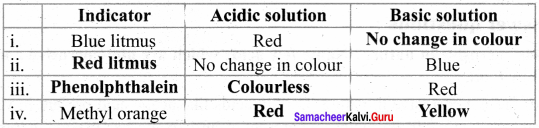
  5. Acids change the colour of the indicators. Blue litmus paper turns red and methyl orange turns pink when treated with acids.

Question 3.
What are the similarities between acids and bases?
Answer:

  1. They are corrosive in nature.
  2. They undergo ionization in aqueous solution.
  3. They conduct electricity in aqueous solution.
  4. They undergo neutralization reaction.

Question 4.
State the difference between acids and bases.
Answer:
Difference between acids and bases:
Acids:

  1. They produce H+ ions in water.
  2. They are sour in taste.
  3. Few acids are in solid state.
  4. Acids turn blue litmus paper red.

Bases:

  1. They produce OH ions in water.
  2. They are bitter in taste.
  3. Most of the bases are in solid state.
  4. Bases turn red litmus paper blue.

Question 5.
What is an indicator?
Answer:
An indicator or acid – base indicator is a chemical substance which indicates the acidic or basic nature of a solution by suitable colour change.

Question 6.
What is a neutralization reaction?
Answer:
Neutralization is a chemical reaction in which an acid and a base react with each other to form water and salt.

Question 7.
Write any four physical properties of base.
Answer:

  1. Bases generally exist in solid state but some bases exist in liquid state also. E.g. Ammonium hydroxide, calcium hydroxide.
  2. Bases give soapy touch only in aqueous media not in dry nature.
  3. Bases are bitter in taste.
  4. Bases are corrosive in nature. When come in contact with the skin frequently they form painful blisters.
  5. Bases also change the colour of the indicators. Red litmus paper turns blue when . treated with bases. Similarly, they turn methyl orange yellow and phenolphthalein pink.

V. Answer in detail:

Question 1.
What are the uses of acids?
Answer:

  1. Hydrochloric acid present in our stomach helps in the digestion of foodstuff.
  2. Vinegar (acetic acid) is used to preserve food materials.
  3. Benzoic acid is also used to preserve food materials like pickles.
  4. Sodium or potassium salts of higher fatty acids are used to make washing and bathing soaps.
  5. Sulphuric acid is called the king of chemicals. It is an effective dehydrating agent. It is used in various industries to make detergents, paints, fertilizers and many more chemicals.
  6. Hydrochloric acid, Nitric acid and Sulphuric acid are important laboratory reagents.
  7. Cells of all living organisms contain the fundamental nuclear material called nucleic acids. Animals have deoxyribo nucleic acid (DNA) whereas plants contain ribo nucleic acid (RNA).

Question 2.
What are the uses of bases?
Answer:

  1. Potassium hydroxide is used to make bathing soaps.
  2. Sodium hydroxide is used to make washing soaps.
  3. Sodium hydroxide is also used in paper industries, textile industries and in the preparation of medicines.
  4. Calcium hydroxide is used for white washing.
  5. Aluminum hydroxide and magnesium hydroxides are used in antacids to cure acidity problems.
  6. Ammonium hydroxide is used to manufacture fertilizers, nylon, plastics and rubber.

Question 3.
Explain the neutralization reaction in our daily life.
Answer:
1. Ant bite:

  • Whenever bees or red ants bite they inject an acid called formic acid.
  • These acids cause burning sensation and pain.
  • To suppress the pain, a suitable base in the form of calcium hydroxide (readily available at home) is applied to neutralise the formic acid.

2. Wasp bite:

  • When we are bitten by wasp, we feel the burning sensation and pain. It is due to an alkaline substance injected by the insect.
  • To neutralise the alkalinity, we use vinegar which is an acid.

3. Tooth decay:

  • The bacteria present in our mouth decompose the food particles stuck in the gaps between our teeth thereby causing acid formation which leads to tooth decay.
  • When we brush with tooth powder or tooth paste containing weak bases, the acid gets neutralized.

4. Acidity:

  • Excessive production of hydrochloric acid in our stomach causes ulcer in stomach and food pipe.
  • In order to neutralize, antacids which are nothing but weak bases like aluminum and magnesium hydroxides are used.

5. Agriculture:
Farmers add lime fertilisers such as powdered lime (CaO), limestone (CaCO3) or ashes of
burnt wood to the soil to neutralise the acidity.

6. Industries:
Effluents from the industries contain acids such as sulphuric acid. It is treated by adding lime to neutralise it before it is discharged into rivers and streams.

Question 4.
How will you prepare natural indicator from turmeric powder?
Answer:

  1. Turmeric indicator is one of the natural indicator.
  2. By adding small amount of water to turmeric powder, a paste is prepared.
  3. This is applied on a blotting paper or filter paper and dried.
  4. These strips are used as indicators to find the nature of the solution.
  5. In acidic solution, turmeric indicator paper has no change in colour.
  6. That means, it remains yellow. In basic solution, the colour changes from yellow to red.

VI. Higher Order Thinking Questions:

Question 1.
Vinu and Priyan take their lunch at school. Vinu eats lemon rice and Priyan eats curd rice. Both lemon rice and curd rice are sour in taste. What is the reason?
Answer:

  1. Curd contains lactic acid. The lactic acid makes curd rice sour in taste.
  2. Lemon juice contains citric acid. The citric acid makes lemon rice sour in taste.
  3. Generally acids are sour in taste.

Question 2.
Heshna and Keerthi are friends. Keerthi’s teeth are white without caries, but Heshna has teeth with caries. Why? How is it formed?
Answer:

  1. Caries is caused by the action of acids on the enamel surface.
  2. The acid is produced when sugar in foods or drinks react with bacteria present on the tooth surface.
  3. Heshna has not cleaned her teeth well after sipping sugary drinks and snacking.
  4. She has to brush after meals and before bed.

Samacheer Kalvi 8th Science Acids and Bases Additional Questions

I. Choose the correct answer:

Question 1.
Acids present in fruits and vegetables are called ……………… acids.
(a) organic
(b) strong
(c) mineral
(d) fruit
Answer:
(a) organic

Question 2.
Vinegar is ……………… in taste.
(a) bitter
(b) sour
(c) sweet
(d) sweetless
Answer:
(b) sour

Question 3.
Citric acid is present in ………………
(a) curd
(b) milk
(c) lemon
(d) spinach
Answer:
(c) lemon

Question 4.
Which of the following is not a natural indicator?
(a) Litmus
(d) Turmeric
(c) Methyl orange
(d) Hibiscus
Answer:
(c) Methyl orange

Question 5.
An acid is ………………
(a) bitter is taste
(d) soapy to touch
(c) corrosive in nature
(d) all the above
Answer:
(c) corrosive in nature

Question 6.
The common salt is ………………
(a) sodium carbonate
(b) sodium bicarbonate
(c) sodium nitrate
(d) sodium chloride
Answer:
(d) sodium chloride

Question 7.
Add few drops of hibiscus indicator in soap solution. What do you observe?
(a) It turns green
(b) It turns magenta
(c) It turns yellow
(d) It turns red
Answer:
(a) It turns green

Question 8.
Acids and bases can be identified in the laboratory by ………………
(a) an indicator
(b) tasting
(c) touching
(d) smelling
Answer:
(a) an indicator

Question 9.
Lemon juice will turn ……………….
(a) phenolphthalein pink
(b) red litmus blue
(c) turmeric indicator red
(d) methyl orange red
Answer:
(d) methyl orange red

Question 10.
A salt may be ………………
(a) acidic only
(b) basic only
(c) neutral only
(d) acidic, basic or neutral
Answer:
(d) acidic, basic or neutral

II. Fill in the blanks:

  1. Acids are ……………… in taste.
  2. Solutions of acids conduct ………………
  3. ……………… change the colour of the indicators
  4. ……………… is used to preserve food materials
  5. ……………… is called the king of chemicals.
  6. Bases are chemical substances that are corrosive and ……………… in nature
  7. Water soluble bases are called ………………
  8. Sodium carbonate is commercially called as ………………
  9. Acidity or indigestion in stomach is due to excessive secretion of ………………
  10. Methyl orange gives ……………… colour in an acidic solution.

Answer:

  1. sour
  2. electricity
  3. Acids
  4. Vinegar
  5. Sulphuric acid
  6. bitter
  7. alkalis
  8. Baking soda
  9. hydrochloric acid
  10. majenta

III. Match the following:

Question 1.

  1. Wasp sting – (a) Milk of magnesia
  2. Common salt – (b) Acetic acid
  3. Organic acid – (c) Sodium chloride
  4. Antacid – (d) Vinegar

Answer:

  1. d
  2. c
  3. b
  4. a

Question 2.

  1. Sulphuric acid – (a) Weak base
  2. Sodium hydroxide – (b) Strong acid
  3. Acetic acid – (c) Strong base
  4. Ammonium hydroxide – (d) Weak acid

Answer:

  1. b
  2. c
  3. d
  4. a

Question 3.

  1. Sodium chloride – (a) Detergents
  2. Sodium carbonate – (b) Purification of water
  3. Sodium bicarbonate – (c) Taste to food
  4. Potash alum – (d) Antacids

Answer:

  1. c
  2. a
  3. d
  4. b

IV. True or False – if false, give the correct statement:

Question 1.
Acids have a sour taste and they are soapy to touch.
Answer:
False

Correct statement:
Bases have a sour taste and they are soapy to touch.

Question 2.
Neutral substances do not bring about any change in colour of indicators.
Answer:
True

Question 3.
All bases are alkalis but all alkalis are not bases.
Answer:
False

Correct statement:
All alkalis are bases but all bases are not alkalis.

Question 4.
When an acid reacts with a base, neutralisation reaction takes place to give salt and water.
Answer:
True

Question 5.
Acids are corrosive in nature. They corrode metals hence are not stored in metal containers.
Answer:
True.

V. Assertion and Reason:

Mark the correct choice as:
(a) If both assertion and reason are true and the reason is the correct explanation of assertion.
(b) If both assertion and reason are true, but reason is not the correct explanation of assertion.
(c) If the assertion is true, but reason is false.
(d) If the assertion is false, but reason is true.
(e) If both assertion and reason are false.

Question 1.
Assertion: To neutralise the excess acid formed in the stomach, milk of magnesia is taken.
Reason: Milk of magnesia contains a base called magnesium hydroxide.
Answer:
(a) Both assertion and reason are true and the reason is the correct explanation of assertion.

Question 2.
Assertion: A salt is produced when an acid is neutralised by a base.
Reason: A salt can be acidic, basic or neutral.
Answer:
(c) Both assertion and reason are true, but reason is not the correct explanation of assertion.

Question 3.
Assertion: With some samples of acids and bases, turmeric paper turns red.
Reason: Such samples are acidic in nature.
Answer:
(c) Assertion is true, but reason is false.

Correct Reason:
Such samples are basic in natural.

Question 4.
Assertion: Methyl orange and phenolphthalein are natural indicators.
Reason: Methyl orange is yellow in colour while phenolphthalein is pink.
Answer:
(d) Both assertion and reason are false.

VI. Very short answer questions:

Question 1.
Write the chemical name and formula of baking soda.
Answer:
Chemical name:
Sodium hydrogencarbonate
Formula: NaHCO3.

Question 2.
What is the colour of phenolphthalein in basic solution?
Answer:
Phenolphthalein is pink in basic solution.

Question 3.
Give names of any two natural indicators.
Answer:
Turmeric and Litmus.

Question 4.
Name the acid present in vinegar.
Answer:
Acetic acid.

Question 5.
Name any two synthetic acid-base indicators.
Answer:
Methyl orange, Phenolphthalein.

Question 6.
Which acid is present in milk?
Answer:
Lactic acid.

Question 7.
What is the reaction between an acid and a base called?
Answer:
Neutralisation reaction.

Question 8.
Name the base which is present in a window cleaner.
Answer:
Ammonium hydroxide.

Question 9.
Which chemical is used to neutralise the acidic soil?
Answer:
Quicklime.

Question 10.
Can we taste acids and bases to identify them?
Answer:
No, acids and bases are corrosive in nature.

VII. Short Answer Questions:

Question 1.
Are all acids corrosive in nature? Name few acids which are non-corrosive and may be part of our food.
Answer:
No, all acids are not corrosive in nature. Certain acids like acetic acid present in vinegar, citric acid present in citrus fruits, lactic acid present in curd, oxalic acid present in tomatoes, etc, are part of our food and non-corrosive in nature.

Question 2.
Write the important uses of hydrochloric acid and sulphuric acids.
Answer:

  1. Uses of hydrochloric acid – Cleaning agent for toilets, important laboratory agents.
  2. Uses of sulphuric acid –
    • Used in car batteries.
    • Used to prepare a large number of compounds.

Question 3.
How will you prepare china rose indicator?
Answer:

  1. Collect some china rose petals and place them in a beaker.
  2. Add some warm water, keep the mixture for some time till water becomes coloured.
  3. This coloured water is used as an indicator.

Question 4.
Give an important use of neutralisation reaction in daily life.
Answer:

  1. In our daily life, neutralisation reaction is used to cure indigestion.
  2. Too much acid in the stomach causes indigestion.
  3. An antacid such as milk of magnesia is used to neutralise the excessive acid.

Question 5.
What is the role of toothpaste in prevention of tooth decay?
Answer:
When we brush with tooth powder or tooth paste containing weak bases, the acid gets neutralized. So our teeth will be strong and healthy and can be protected from caries.

Question 6.
How to treat effluents from the industries?
Answer:

  1. Effluents from the industries contain acids such as sulphuric acid.
  2. It is treated by adding lime to neutralise it before it is discharged into rivers and streams.

Question 7.
Write the chemical equation for the reaction of bases with metal oxides.
Answer:

  1. All bases react with non-metallic oxides to form salt and water.
  2. Eg: Sodium hydroxide reacts with carbon dioxide to form sodium carbonate.
  3. Sodium hydroxide + Carbon dioxide —> Sodium carbonate + Water
    NaOH + CO —> Na2CO3 + H2O

Question 8.
Write the reaction between sulphuric acid and water.
Answer:
Sulphuric acid + Water → Hydrogen ion + Sulphate ion
H2SO4 + H2O → 2H+ + \({ SO }_{ 4 }^{ 2- }\)

Question 9.
Complete the table
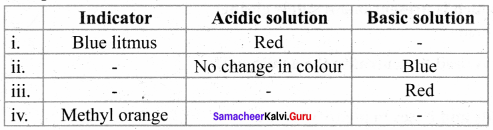
8th Science Acid And Base Solutions Term 3 Chapter 5 Samacheer Kalvi
Answer:
Acids Bases And Salts Samacheer Kalvi 8th Science Solutions Term 3 Chapter 5

VIII. Long answer questions:

Question 1.
Write a note on:

  1. Ant bite
  2. Wasp bite.

Answer:
1. Ant bite:

  • Whenever bees or red ants bite they inject an acid called formic acid.
  • These acids cause burning sensation and pain.
  • To suppress the pain, a suitable base in the form of calcium hydroxide (readily available at home) is applied to neutralise the formic acid.

2. Wasp bite:

  • When we are bitten by wasp, we feel the burning sensation and pain.
  • It is due to an alkaline substance injected by the insect.
  • To neutralize the alkalinity we use vinegar which is an acid to neutralise.

Question 2.
Write a note on:

  1. Litmus
  2. Phenolphthalein
  3. Methyl orange

Answer:
1. Litmus:

  • Litmus is the most common indicators used in the laboratories.
  • Litmus is a natural indicator which is extracted from lichens.
  • It is available in the form of solution or in the form of strips prepared by absorbing litmus solution on filter paper.
  • It is either red or blue in colour.
  • Blue litmus paper turns red in acidic solution and red litmus paper turns blue in the basic solution.

2. Phenolphthalein:

  • Phenolphthalein is a colourless compound.
  • Its alcoholic solution is used as an indicator.
  • It is colourless in acidic solution but turns pink in basic solution.

3. Methyl orange:

  • Solid methyl orange dissolved in hot water and its filtrate is used as an indicator.
  • It turns red in acidic solution and yellow in basic solution.

IX. Higher Order Thinking Questions:

Question 1.
What is the difference between an ant sting and a wasp sting?
Answer:
1. Ant sting:
An ant sting is acidic as it contains formic acid while the wasp sting is basic in nature.

2. Wasp sting:
Ant sting can be neutralised by a base like baking soda while wasp sting is neutralised by an acid like vinegar (acetic acid).

Question 2.
Copper or brass cooking vessels are coated with tin metal. Why?
Answer:

  1. Copper or brass cooking vessels are coated with tin metal (eyam).
  2. If it is not coated, the organic acids present in the food materials will react with copper and make the food poisonous.
  3. The tin isolates the vessel from the action of acids and prevents food poisoning.

X. Solve the crossword by using the clues that below:

Across:
1. The acid found in apples.
3. The ion formed when an acid is dissolved in water.
5. An indicator that remains colourless in an acid.
7. The gas liberated when dilute hydrochloric acid reacts with limestone.
9. A gas that dissolved in water to form ammonium hydroxide.

Down:
2. An acid used for cooking.
4. An acid that has three hydrogen atoms in its moelcule.
6. A reaction in which an acid reacts w’ith a base to form salt and water only.
8. A base that is soluble in water.
10. The chemical name of this compound is calcium hydroxide.

Answer:
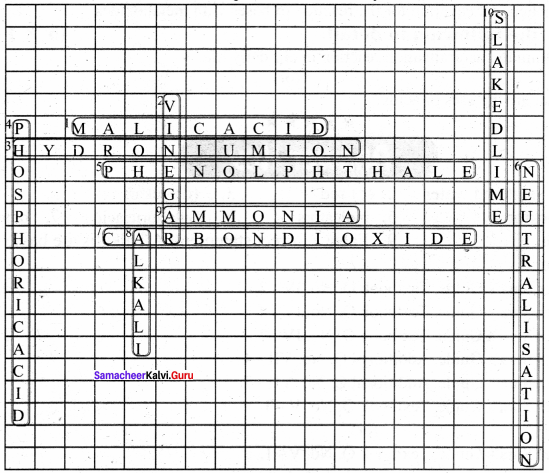
Acids, Bases And Salts Samacheer Kalvi 8th Science Solutions Term 3 Chapter 5

Samacheer Kalvi 8th Science Acids and Bases Intext Activities

Activity – 1

Question 1.
Take a clean test tube with holder and pour some dilute hydrochloric acid. Add few pieces of magnesium ribbon pieces slowly. What do you observe? Now show a burning match stick near the mouth of the test tube. Do you hear any sound? The gas burns with a pop sound. From this it is observed that hydrogen gas has been formed due to the reaction between acid and metal.
Answer:
The gas bums with a pop sound. From this it is observed that hydrogen gas has been formed due to the reaction between acid and metal.

Activity – 2

Take some lemon juice in a tumbler and add baking soda slowly. What do you see? I What do you infer from this?
Answer:
Inference:
When lemon juice is mixed with baking soda, the new product CO2 is formed with water and salt.

Activity- 3

Classify the following substances. Sodium oxide, Potassium hydroxide, Calcium oxide, Copper oxide, Calcium hydroxide, Ammonium hydroxide, Ferric hydroxide, Zinc oxide
Answer:

Samacheer Kalvi Guru 8th Science Solutions Term 3 Chapter 5 Acids And Bases

Activity – 4

Question 1.
Take a shirt with turmeric powder strain. Wash the shirt with soap. Do you observe any change in the colour? Why?
Answer:
Yes, the colour changes from yellow to red, because soapy solution is a base.

Activity – 5

Question 1.
Take a small beet root vegetable and cut it into pieces. Boil them in hot water and filter the extract. Take two test tubes. Take sodium hydroxide solution in one test tube and vinegar or lemon juice in another test tube. Add beet root extract slowly. Observe the colour change. What do you infer?
Answer:

  1. Observation – When beetroot juice is added with sodium hydroxide solution it turns into greenish yellow shows that NaOH is a base.
  2. When it is added with lemon juice, the colour of beetroot juice remains same shows that lemon juice is acidic.

Activity – 6

Find out the nature of the solution
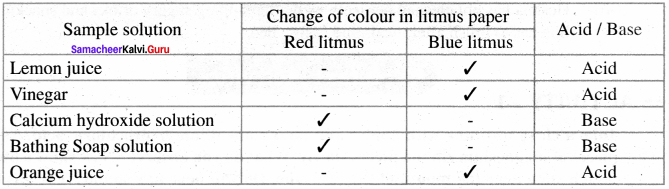
8th Grade Science Acids And Bases Solutions Term 3 Chapter 5 Samacheer Kalvi

Samacheer Kalvi 12th English Solutions Prose Chapter 2 A Nice Cup of Tea

Students can Download English Lesson 2 A Nice Cup of Tea Questions and Answers, Summary, Activity, Notes, Samacheer Kalvi 12th English Book Solutions Guide Pdf helps you to revise the complete Tamilnadu State Board New Syllabus and score more marks in your examinations.

Tamilnadu Samacheer Kalvi 12th English Solutions Prose Chapter 2 A Nice Cup of Tea

A Nice Cup Of Tea Questions And Answers Warm Up

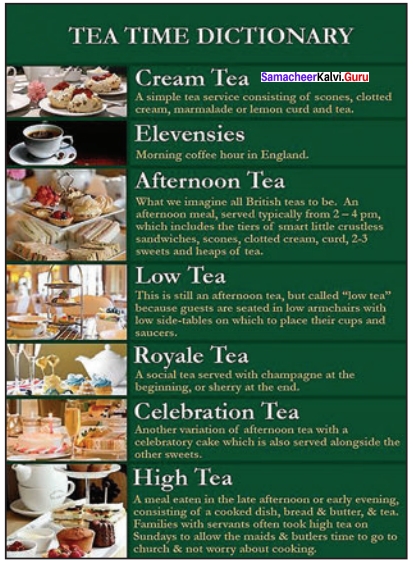
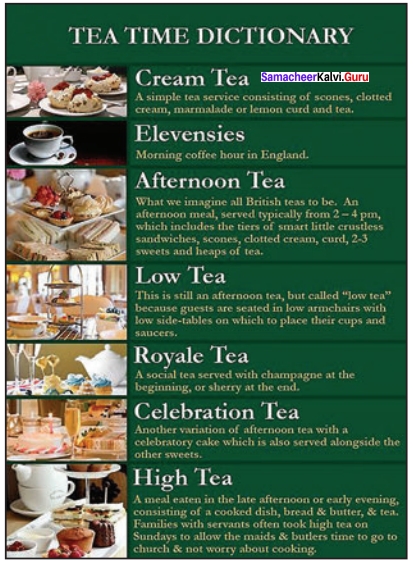
Question (a)
Here are a few varieties of tea. How many of these have you tasted? Tick the boxes.

A Nice Cup Of Tea Questions And Answers Samacheer Kalvi 12th English Solutions Prose Chapter 2

Answer:

12th English A Nice Cup Of Tea Paragraph Solutions Prose Chapter 2 Samacheer Kalvi

12th English A Nice Cup Of Tea Paragraph Question (b)
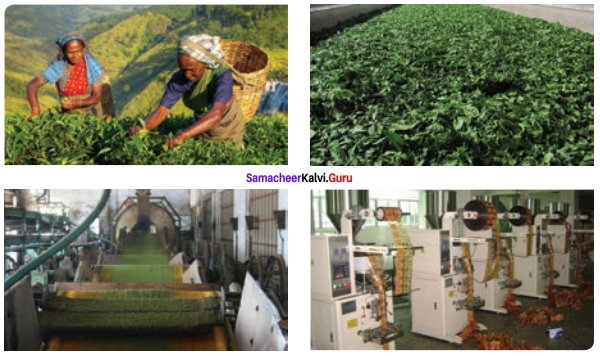
You would have seen lovely packets of tea on the shelves in supermarkets and shops. Have you ever wondered how tea powder is obtained from the plants? Look at the pictures and describe the process.

12th English A Nice Cup Of Tea Solutions Prose Chapter 2 Samacheer Kalvi
Answer:

  • The selected young Leaves are Plucked manually. Nowadays machines are avalible
  • It is then left for drying.
  • The dried leaves are then powdered and packed.

Samacheer Kalvi 12th English A Nice Cup of Tea Textual Questions

1.Based on your understanding of the text, answer each of the following questions in one or two sentences.

12th English A Nice Cup Of Tea Question (a)
What seems ‘curious’ to the author?
Answer:
The absence of “Tea” in the recipes of cookery book is curious to the author.

A Nice Cup Of Tea Summary In English Question (b)
Why does the author say that it is important to include a tea recipe in cookery books?
Answer:
It is important to include tea in the cookery book because tea is one of the mainstays of civilisation in England, Eire, Australia and New Zealand. Besides, the nicest manner of making tea is a subject of violent disputes among tea-loving nations.

A Nice Cup Of Tea Summary Question (c)
Mention the countries in which tea is a part of civilization.
Answer:
It is one of the mainstays of civilization in UK, Australia, Eire and New Zealand.

A Nice Cup Of Tea Notes Of Lesson Question (d)
Which tea does the author prefer-China tea or Indian tea?
Answer:
The author prefers Indian tea to Chinese tea.

A Cup Of Tea Questions And Answers Question (e)
According to the author, what does the phrase ‘a nice cup of tea’ refer to?
Answer:
Nice cup of tea means Indian tea which makes one feel wiser, optimistic and wiser.

A Nice Cup Of Tea Summary In Tamil Question (f)
What is the second golden rule in the preparation of tea?
Answer:
Second golden rule is that tea should be made in small quantities (i.e.) in a teapot.

A Nice Cup Of Tea Question (g)
How does army tea taste?
Answer:
Army tea tastes of grease and whitewash.

The Tea Should Be Put Straight In The Pot Question (h)
Do tea lqvers generally like strong tea or weak tea?
Answer:
Tea lovers generally love strong tea.

A Nice Cup Of Tea Paragraph Question (i)
Why should tea be directly added to the pot?
Answer:
Tea should be added directly to the pot because imprisoning tea leaves in strainers, muslin bags or other devices can be really harmful.

A Cup Of Tea Questions And Answers Pdf Question (j)
Why does the author prefer the cylindrical cup to a flat cup?
Answer:
Cylindrical cups (i.e.) breakfast cup holds more tea. But in the shallow and flat cup, tea turns half cold before one starts drinking it.

A Nice Cup Of Tea Short Summary Question (k)
What should be poured into the cup first-tea or milk?
Answer:
One should pour tea first into the cup and then add milk to the desired level. Thus one can regulate the amount of milk added to tea.

Nice Cup Of Tea Summary Question (l)
Why does the author advise removing cream from the milk?
Answer:
Cream should be removed before adding the milk to tea because creamy milk gives a sickly taste to tea.

Question (m)
Does the author like drinking tea with sugar? Give reasons.
Answer:
Adding sugar to tea will deprive tea of its real taste. Misguided people who take tea do it because of the sweetness and not because of the taste of tea.

Question (n)
Why does the author refer to himself as being in ‘a minority’?
Answer:
The author takes tea without sugar to relish the real taste of tea. But majority of people take it with sugar. So, the author refers to himself as a minority.

Question (o)
Whom does the author call ‘misguided people’? What is his advice to them?
Answer:
Some misguided people admit that they drink tea for stimulation and warmth. They are not interested in tea. So, they add sugar to take the taste away. He advises them to drink tea without adding sugar for a fortnight. They would never again ruin the real taste of tea by adding sugar.

Additional Questions

Question (a)
What does the author find in his own recipe for the perfect cup of tea?
Answer:
The author finds eleven outstanding points in his own recipe for the perfect cup of tea.

Question (b)
How does the author value tea out of an urn?
Answer:
According to the author, Tea out of an urn is always tasteless.

Question (c)
What is the ‘third golden rule’?
Answer:
The pot should be warmed beforehand.

Question (d)
What is the author’s opinion about strainers or filters in the preparation of tea?
Answer:
Tea should be put straight into the pot. No strainer muslin bags or other devices must be used to imprison the tea.

Question (e)
What is seventh golden rule?
Answer:
After making tea, one should stir it or better give the pot a good shake. Afterwards, the tea leaves may be allowed to settle down.

Question (f)
What is cited as a mysterious social etiquette surrounding the tea pot?
Answer:
It is considered vulgar to drink tea out of your saucer.

Question (g)
What are the subsidiary uses of tea leaves?
Answer:
Telling fortunes, predicting the arrival of visitors, feeding rabbits, healing bums and sweeping the carpet are some of the subsidiary uses of tea leaves.

2. Based on your understanding of the text, answer each of the following questions in four or five sentences.

Question (a)
What are the author’s views on China tea?
Answer:
China tea has virtues which are not to be despised, it is economic. One can drink it without milk, but there is not much stimulation in it. One does not feel wiser, braver or more optimistic after drinking it.

Question (b)
How does adding sugar affect the taste of tea?
Answer:
The author raises a pertinent question, “How can you call yourself a true tea lover if you destroy the flavour of your tea by putting sugar in it?” He mocks such people that they could add even salt and pepper in tea. Adding sugar to hot water would give them an eqaul drink. So, the author disapproves of adding sugar to tea to retain its flavour and taste.

Question (c)
Elucidate the author’s ideas about teapots.
Answer:
The teapot should be made of China or earthen ware. Silver or Britannia ware teapot produce inferior quality tea. Enamel pots are worse. Though curiously enough a pewter teapot, a rarity nowadays, is not so bad.

Additional Questions

Question (а)
How does A.G. Gardiner explode the myth about the harmfulness of tea leaves?
Answer:
In some countries, tea pots are fitted with little dangling baskets under the spout to catch the stray leaves which are supposed to be harmful. The author asserts that one can swallow tea- leaves in considerable quantities without ill-effect. He claims that if the tea is not loose in the pot it never infuses properly with the hot beverage (i.e.) tea.

Question (b)
what are the two schools of thought in tea making which fight against one another in England? Why?
Answer:
In every family in England, two schools of thoughts persist on tea making. One group insists that milk should be poured first and tea should be added to it. But the author seconds the second school which claims tea must be powered first and milk must be added later because one could easily regulate the amount of milk to taste.

3. Answer each of the following questions in a paragraph of 100-150 words.

Question (а)
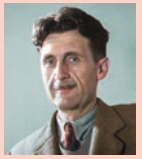
Summarise George Orwell’s distinctive ideas in “A Nice Cup of Tea”.
Answer:
Tea is one of the mainstays of civilizations of UK, New Zealand, Australia and Eire. But, it is not found in the recipes of cookery books. The nicest manner in which tea must be prepared has become a subject matter of violent disputes among tea loving persons even within a family. Indian tea fits in with the author’s description of “nicest cup of tea” as it rejuvenates the drinker with wisdom, stimulation, bravery and optimism. One cup of strong tea is equal to twenty weak ones. Best tea is prepared by boiling tea leaves first and then adding milk to taste.

Milk first schools and tea first schools still fight. Tea prepared in earthen pot or china ware is good. The real flavour of tea should never be imprisoned by strainers. Consuming tea leaves will not harm one’s health. Adding sugar to tea will naturally ruin its real flavour and taste. The author advises misguided people who drink sweet tea to desist from the practice for a fortnight. He guarantees them that they would like the natural taste of tea and would never again add sugar to tea. Tea should be taken in a cylindrical or breakfast cup to enjoy it. Shallow and flat cups don’t retain warmth and taste for a long time.

Question (b)
Discuss how the essay reveals the factual points and the author’s personal opinions on the preparation of tea.
Answer:
Facts found in the essay: There is no mention of tea in the recipes cookery books except some sketchy ideas on the process of preparation. Tea is one of the mainstays of civilization of UK, Australia, New Zealand and Eire. The process of tea making is a subject matter of violent disputes. The author has come up with eleven golden rules for preparation of a nice tea. Tea pot should be made of china or earthen ware. In some countries, teapots are fitted with little dangling baskets under the spout to catch stray tea leaves, which are supposed to be harmful. One should use water that has been freshly boiled. After making tea, one should stir it or better give the pot a good shake, afterwards allowing the leaves to settle down. Some people don’t like tea in itself. They only drink it in order to be warmed and stimulated and they need sugar to take away the taste of tea.

The author’s opinion: The maimer of making the nicest cup of tea is the subject matter of violent disputes. China tea doesn’t give stimulation, wisdom, bravery or optimism. Indian tea means ‘a nice cup of tea’. The army tea tastes of grease and white wash. The method of swilling tea out with hot water is not a good practice. One strong cup of tea is better than twenty weak ones. One can swallow considerable quantities of tea. One should take the teapot to the kettle and not the otherway about. If you use already boiled water or freshly brought to boil does not make any difference in the taste of tea. One should remove cream off before adding the milk to tea. By putting tea leaves in first and stirring it as one pours milk one can regulate the amount of milk. Tea must be drunk without sugar for enjoying the real flavour and taste.

Question (c)
What are the aspects that contribute to humour in the essay?
Answer:
The author claims the best manner of making tea is the subject matter of violent disputes. He compliments china tea for being economical but also says one does not feel rejuvenated after drinking it. One doesn’t feel braver, wiser, more optimistic or stimulated after drinking the Chinese tea. He says army tea tastes of grease and white wash. In Britain there are two schools of thought (i.e.) milk first school and tea first school (i.e.) one school claiming that milk must be poured first and tea added later and another school claiming that tea must be poured first and milk to be added next.

He says those who take tea with sugar for its sweetness alone as misguided people. He says that they could veiy well add salt and pepper to tea and drink it. He claims that there are some mysterious social etiquette surrounding teapot. It is vulgar to drink tea out of one’s saucer. There are some subsidiary uses of tea leaves such as telling fortunes, predicting the arrival of visitors, feeding rabbits, healing bums and sweeping the carpet.

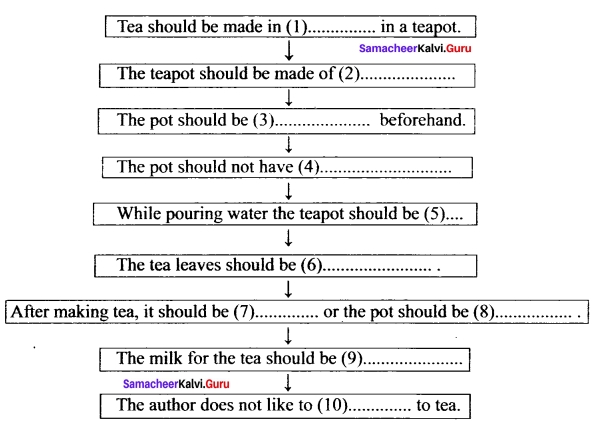
4. Based on your understanding of the text, complete the chart given below by choosing the appropriate words or phrases given in brackets.

(add sugar, shaken, milk, infused properly, strainers, without cream, taken to the kettle, small quantities, China or earthenware, stirred, warmed)

A Nice Cup Of Tea Summary In English Samacheer Kalvi 12th Solutions Prose Chapter 2

Answers

  1. small quantities
  2. China or earthenware,
  3. warmed
  4. strainers
  5. taken to the kettle
  6. infused properly
  7. stirred
  8. shaken
  9. without cream
  10. add sugar

Vocabulary

(a) Find out the synonym of the underlined word in each of the following sentences.

Question 1.
But because the best manner of making it is the subject of violent disputes.
(a) agreements
(b) applauses
(c) conflicts
(d) discussions
Answer:
(c) conflicts

Question 2.
________ tea is one of the mainstays of civilization in the country.
(a) a society in an advanced state of social development
(b) a society that has slow progress
(c) a society that has no progress
(d) a society in an average state of social development
Answer:
(a) a society in an advanced state of social development

Question 3
________ that they only drink it in order to be warmed and stimulated.
(a) motivated
(b) discouraged
(c) passive
(d) admired
Answer:
(a) motivated

Question 4
________ under the spout to catch the stray leaves.
(a) fresh
(b) loose
(c) gathered
(d) harmful
Answer:
(b) loose

Question 5.
One is liable to put in too much milk.
(a) likely
(b) certain
(c) eager
(d) responsible
Answer:
(d) responsible

Additional

Question 1.
At least four others are controversial.
(a) harmonious
(b) disputable
(c) agreeable
(d) comprehensive
Answer:
(b) disputable

Question 2.
One does not feel more optimistic after drinking it.
(a) dejected
(b) despaired
(c) positive
(d) disdainful
Answer:
(c) positive

Question 3.
China tea has virtues.
(a) vices
(b) admirable qualities
(c) despicable traits
(d) alarming wickedness
Answer:
(b) admirable qualities

Question 4.
They are not to be despised.
(a) loved
(b) yearned
(c) hated
(d) doted
Answer:
(c) hated

Question 5.
Army tea is made in cauldron.
(a) stove
(b) mini cooker
(c) boiler
(d) cup
Answer:
(c) boiler

Question 6.
It is not to be done with the usual method of swilling it with hot water.
(a) rinsing
(b) drenching
(c) chirping
(d) cutting
Answer:
(a) rinsing

Question 7.
In a time of rationing, this is not an idea.
(a) liberal supply
(b) confiscating
(c) blocking
(d) restricting supply
Answer:
(d) restricting supply

Question 8.
In some countries teapots are fitted with little dangling baskets.
(a) dancing freely
(b) hanging freely
(c) severed
(d) tied tightly
Answer:
(b) hanging freely

Question 9.
No, strainers, muslin bags or other devices to imprison the tea.
(a) discharge
(b) release
(c) acquit
(d) detain
Answer:
(d) detain

Question 10.
One should stir it well.
(a) mix thoroughly
(b) drain fully
(c) soak completely
(d) dried fully
Answer:
(a) mix thoroughly

Question 11.
You can prepare a very similar drink.
(a) unidentical
(b) almost the same
(c) unique
(d) distinct
Answer:
(b) almost the same

Question 12.
You could make a drink by dissolving sugar in hot water.
(a) segregating
(b) filter
(c) strain
(d) making a solution
Answer:
(d) making a solution

Question 13.
Shallow type cup doesn’t hold much.
(a) deep
(b) profound
(c) cylindrical
(d) of little depth
Answer:
(d) of little depth

Question 14.
Milk that is too creamy always gives tea a sickly taste.
(a) rich
(b) flavoured
(c) unpleasant
(d) un healthy
Answer:
(c) unpleasant

Question 15.
There is also a mysterious social etiquette.
(a) clear
(b) comprehensible
(c) lucid
(d) incompressible
Answer:
(d) incompressible

Question 16.
A social etiquette surrounds teapot.
(a) evils
(b) goods and services
(c) vices
(d) socially accepted behaviour
Answer:
(d) socially accepted behaviour

Question 17.
There are some subidiarv.
(a) major
(b) crucial
(c) vital
(d) supplementary
Answer:
(d) supplementary

Question 18.
Such as telling fortune…
(a) evil
(b) wisdom
(c) luck
(d) omen
Answer:
(c) luck

Question 19.
predicting the arrival of visitors.
(a) cautioning
(b) addressing
(c) foretelling
(d) doubting
Answer:
(c) foretelling

Question 20.
Be quite sure of wringing out of one’s ration the twenty good, strong cups of tea.
(a) smothering
(b) squeezing out
(c) making out
(d) breathing out
Answer:
(b) squeezing out

(b) Find out the antonym of the underlined word in each of the following sentences.

Question 1.
which are not to be despised.
(a) hated
(b) liked
(c) respected
(d) defeated
Answer:
(b) liked

Question 2.
One does not feel wise, braver or more optimistic.
(a) opportunistic
(b) cheerful
(c) realistic
(d) pessimistic
Answer:
(d) pessimistic

Question 3.
Not the flat, shallow type…
(a) narrow
(b) wide
(c) deep
(d) direct
Answer:
(c) deep

Question 4.
Predicting the arrival of visitors…
(a) journey
(b) departure
(c) migration
(d) perusal
Answer:
(b) departure

Question 5.
but they are sufficient to show how subtilized the whole business has become,
(a) enough
(b) suffocative
(c) inadequate
(d) submissive
Answer:
(c) inadequate

Additional

Question 1.
They give no ruling on several of the most important points.
(a) many
(b) plentiful
(c) a few
(d) a large number of
Answer:
(c) a few

Question 2.
It is a subject of violent disputes.
(a) brutal
(b) reckless
(c) vicious
(d) gentle
Answer:
(d) gentle

Question 3.
China tea has virtues.
(a) attributes
(b) vices
(c) injuries
(d) problems
Answer:
(b) vices

Question 4.
It is economical.
(a) frugal
(b) expensive
(c) mean
(d) niggardly
Answer:
(b) expensive

Question 5.
One can swallow considerable quanities without ill-effects.
(a) large
(b) significant
(c) sizeable
(d) paltry
Answer:
(d) paltry

Question 6.
I find no fewer than eleven outstanding points.
(a) exceptional
(b) excellent
(c) exclusive
(d) mediocre
Answer:
(d) mediocre

Question 7.
At least four others are acutely controversial.
(a) disagreeable
(b) contentious
(c) agreeable
(d) disputable
Answer:
(c) agreeable

Question 8.
You will probably find that it is unmentioned.
(a) improbably
(b) apparently
(c) plausibly
(d) tied perhaps
Answer:
(a) improbably

Question 9.
Britannia teapots produce inferior tea.
(a) junior
(b) superior
(c) senior
(d) circular
Answer:
(b) superior

Question 10.
If the tea is not loose in the pot, it never infuses properly.
(a) pervades
(b) permeates
(c) imbues
(d) drains
Answer:
(d) drains

Question 11.
Stray leaves are supposed to be harmful.
(a) hurtful
(b) damaging
(c) evil
(d) harless/safe
Answer:
(d) harless/safe

Question 12.
I am in a minority.
(a) popularity
(b) scarcity
(c) paucity
(d) majority
Answer:
(d) majority

Question 13.
One can exactly regulate the amount of milk.
(a) correctly
(b) inaccurately
(c) precisely
(d) fully
Answer:
(b) inaccurately

Question 14.
Some drink it only to be stimulated.
(a) motivated
(b) encouraged
(c) discouraged
(d) rejuvenated
Answer:
(c) discouraged

Question 15.
The milk-first school can bring forward some fairly strong arguments.
(a) progressive
(b) leeward
(c) backward
(d) onward
Answer:
(c) backward

(c) Fill in the boxes with the correct answers. The first one has been done for you.

SI.

No.

Word with meaning and part of speechSentenceNoun/Verb/ Adj. formSentence
1Word : wise meaning : clever part of speech : adjectiveMy brother is wise.wisdomMy brother showed great wisdom in business.
2harm
3stimulate
4argue
5strong
6destroy

Answer:

SI.

No.

Word with meaning and part of speechSentenceNoun/Verb/ Adj. formSentence
1Word : wise meaning : clever part of speech : adjectiveMy brother is wise.wisdomMy brother showed great wisdom in business.
2harmToo much sugar can harm one’s health in the longer run.harmHon’ble primie minister vowed that the harm (n) done to the fibre of democracy through Pulwama attack will not go unpunished.
3stimulateTea stimulates (v) one’s brain.stimulatePopulation explosion is a major stimulant (n) to the industrial development in China.
4argueMy brother is an argumentative (adj) scholar.argueYou may win an argument (n) but lose a friend
5strongLoyal and patriotic citizens alone make a country strong (adj)strongThe strength (n) of Mary Kom amazed fellow boxers.
6destroyProlonged conflict at the border could be destructive (adj) for both the sides.destroyPakistan continues to down play the destruction (n)caused by India’s preemptive attack on Balakot camp.

Listening Activity

Listen to the passage about the ‘Significance of Tea’ and answer the questions.

The Significance of Tea

Tea has been an important beverage for thousands of years. It is consumed by two-thirds of the world’s population. India is the second largest tea producer in the world after China, although over 70 per cent of its tea is consumed within India. Tea has been proved to offer numerous health benefits. Scientists and researchers have found that drinking tea could reduce the risk of heart diseases. The antioxidants in tea might prevent cancer. Regular tea drinking might help one in lowering blood sugar and blood pressure. Tea might be an effective agent in the prevention and treatment of neurological disorders. The consumption of tea results in the strengthening of one’s teeth, bones and immune system. However, drinking too much tea may prove to be harmful to one’s health. So, drinking tea moderately could make one healthier. Researchers have confirmed the significant overall health benefits of drinking tea.

Questions:

Question 1.
Which country is the largest tea producer in the world?
Answer:
China is the largest producer of tea in the world.

Question 2.
________ percent of the tea produced in India is exported.
Answer:
30

Question 3.
What is the role of antioxidants in tea?
Answer:
The antioxidants in tea might prevent cancer.

Question 4.
Drinking tea strengthens one’s ______ , and _____
Answer:
teeth, bones, immune system

Question 5.
How does drinking tea help a diabetic?
Answer:
Regular tea drinking lowers blood sugar and thus helps a diabetic.

Speaking Activity

Read the story silently.

Once upon a time a daughter complained to her father that her life was miserable and that she didn’t know how she was going to make it. She was tired of fighting and struggling all the ( time. It seemed that just as one problem was solved, another one soon followed. Her father,a chef, took her to the kitchen. He filled three pots with water and placed each on high flame. Once the three pots began to boil, he placed potatoes in one pot, eggs in the second pot, and .ground coffee beans in the third pot. He then let them boil, without saying a word to his daughter. The daughter moaned and impatiently waited, wondering what he was doing.‘

After twenty minutes he turned off the burners. He took the potatoes out of the pot and placed them in a bowl. He pulled the boiled eggs out and placed them in a bowl. He then ladled the coffee out and poured it in a cup. Turning to her he asked. “Daughter, what do you see?”

“Potatoes, eggs, and coffee,” she hastily replied, “Look closer,” he said, “and touch the potatoes.” She did and noted that they were soft. He then asked her to take an egg and break it. After peeling off the shell, she observed the hard-boiled egg.

Finally, he asked her to sip the coffee. Its rich aroma brought a smile to her face. “Father, what does this mean?” she asked. He then explained that the potatoes, the eggs and coffee beans had each faced the same adversity – the boiling water. However, each one reacted differently. The potato was strong, hard, and unrelenting, but in boiling water, it became soft and weak. The egg was fragile, with the thin outer shell protecting its liquid interior until it was put in the boiling water. Then the inside of the eggs became hard. However, the ground coffee beans were unique.

After they were exposed to the boiling water, they changed the water and created something new. “Which are you?” he asked his daughter. “When adversity knocks on your door, how do you respond? Are you a potato, an egg, or a coffee bean? Things happen around us, things happen to us, but the only thing that truly matters is what happens within us. Which one are you?

This story shows how people react to different situations in life. Some become weak and soft like the potatoes and some others harden like the egg. The best way to face difficulties is illustrated by the coffee beans which change their colour and add flavour.

Now use these ideas and prepare a speech on the topic ‘The importance of developing a positive attitude’ and deliver the speech in the school assembly.

A Nice Cup Of Tea Summary Samacheer Kalvi 12th English Solutions Prose Chapter 2

The importance of developing a positive attitude:

Respected Chief Guest, dignitaries on the dias, teachers and my dear friends. I would like to say a few words on the importance of developing a positive attitude.

Positive attitude is necessary to succeed in life. A person with positive attitude has self confidence and empathy. To highlight this I would like to quote some incidents in the life of Amelia Earhart, the first woman pilot. She watched a pilot taking off in his small plane. On the runway, he wanted to scare her, he drove the small plane very close to her, she didn’t panic or run away. The plane which whizzed past her seemed to invite her. She worked at various jobs such as photographer, truck driver and stenographer. She managed to save 1000 dollars for her flying lessons. In order to reach the air-field Amelia had to take a bus to the end of line and walk 6 km. Earhart’s commitment to flying required her to accept frequent hardwork. After proving her professional skills as a lady pilot, she popularized flying and encouraged many girls to take pilot training. She proved that women can also shine in the field which was till then dominated by men.

The next best example is the positive attitude of Abinandan, the pilot whose parachute drifted into Pakistan and was taken a prisoner. Even while in the custody of Pak military, he did not lose his confidence. He conducted himself bravely. He did not fear, he believed in himself and in his country. He is back home as a living legend spreading the message that positive attitude can help one overcome any obstacle in life.

Reading

Non-verbal Representations.
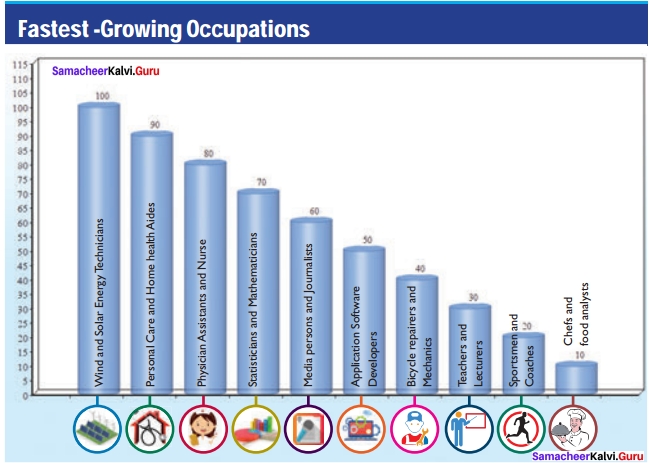
Look at the following non-verbal representation. Based on your understanding and inference, write a paragraph on career trends in the next decade.

A Nice Cup Of Tea Notes Of Lesson Samacheer Kalvi 12th English Solutions Prose Chapter 2

Fastest growing occupations:

It is true that most of us were not aware of the current demands in the job market 10 years ago. As the emerging jobs and the required skill sets change all the professional qualifications become irrelevant. In addition to the basic degree, it is necessary to foresee the emerging trends in the job market. This paragraph shows that the topmost opportunity to grow is in the field of wind and solar energy. Technicians are needed in this sector. There is 100% chances of placement for those who qualify themselves in operating wind mills, designing, installing and maintenance of solar panels. Paramedical profession is likely to grow exponentially.

It means that those who pursue nursing, lab technician courses would get placed soon. Strikingly, Mathematicians and Statisticians wall be next in huge demand as 70% growth is for them only. As there is a boom in media services, T.V., radio, newspapers and periodicals, there is a rising demand for media persons and journalists. Against the common beleif, only 50% growth opportunity is there for professionals qualified in software development. It is heartening to note that cycle repairers and two wheeler mechanics will get opportunities next to software engineers. Though lakhs of graduates do B.Ed. course the growth opportunity in teaching jobs in colleges and schools is only 30%. The dismal picture for sportsmen and coaches is discouraging. Only 20% growth is predicted in placements for coaches and sportsmen. Finally only 10% growth is possible for those who specialise in food analysis and working in hotels.

Task
Now read the following article on the emerging career options in the modern era and answer the questions that follow.

The students at the higher secondary level in schools start thinking of suitable courses to take up at the university level based on their aptitude, ability and interests. While considering the higher education options, they should also plan the career path they wish to take. In today’s complex job scenario, there is a mismatch between demand and supply on one hand we have qualified professionals desperately trying to find a job, while on the other hand, there are many professions that need suitable talented employees. But such skilled employees are unavailable. Therefore, the need of the hour is that students have an understanding of the emerging career options.

Schools should take the initiative to organise career guidance and counselling sessions for students. However, students need to remember that to build a strong career, they must understand the prospective field and their primary interest. It is also important for students to focus on overall personality development and hone their communication skills as these are important for the success of their career. Students are also advised that in order to build a solid career foundation, they need to qualify suitably by pursuing a degree course in the chosen area of interest and also consider post graduate education. Diploma/Short-term courses may help one find a job in the short run but may not promise career progression. Rapid advancement in science and technology and globalisation has widened the scope of career options in the twenty-first century. Let us consider some popular careers.

Fashion Designing:
The current cosmopolitan and fashion-conscious wave that has taken over our country has .opened up a huge arena for careers in fashion. These careers encompass designing clothes, costumes, jewellery, footwear, wardrobe, costumes, accessories and the like.

Culinary Arts:
With food and cookery shows being a major trend across the world, culinary arts, a sub-domain of the hospitality sector, has now become the most sought after career.

Paramedical sciences:
In recent times, there has been a great demand in the health care industry. Paramedical professionals who support medical practitioners in areas such as optometry, pathology, nursing, physiotherapy, and dentistry are much sought after.

Media, Journalism and Advertising:
In this information era, print and entertainment media have become a force to reckon with. This arena has become a huge career playground because youngsters are attracted to it as the exposure and reach is greater through such mass media. We notice that radio and TV channels, internet companies and advertising agencies are increasingly recruiting qualified professionals.

Hotel Management:
The hotel industry is the fastest growing industry in India. The number of international travellers (both for business and leisure) is increasing. The hospitality and service industry offers career options such as house keeping, front-desk executives, tourism management, etc.
76 English-12

Sports Management:
With multinational companies supporting sports, careers in sports offer enormous scope. One need not be a player or an athlete to shine in a sports career because the field of sports offers various career options such as technical trainers, commentators, sports journalists, dieticians, referees, etc. Conducting sports events successfully, organizing the event laudably, preparing the ground for the event are all part of sports management.

Questions:

Question (a)
When do students start thinking about their career path?
Answer:
At the end of plus two exams students start thinking about their career path.

Question (b)
How can students build a strong career?
Answer:
To build a strong career, students must understand the prospective field and their primary interest. They need to qualify suitably by pursuing a degree course in their chosen area of interest.

Question (c)
What are the integral aspects of a successful career?
Answer:
Personality development, communicative competence, required skill sets, keeping abreast of technological advancements in addition to qualification in the respective field are the integral aspects of a successful career.

Question (d)
What is meant by ‘culinary art’?
Answer:
Cooking is called culinary art.

Question (e)
Why is media a popular career option?
Answer:
Media is a popular carrer option because print and entertainment media have become a force to reckon with. Radio, TV channels, internet companies and advertisement companies are increasingly recruiting qualified professionals.

Question (f)
Name some paramedical courses mentioned in the passage.
Answer:
Optometry, pathology, nursing, physiotherapy and dentistry are some popular paramedical courses.

Question (g)
Why is the hotel industry seen as the fastest growing in India?
Answer:
The number of international travellers visiting India is rapidly growing. This has resulted in the exponential growth of hospitality and service industry. A lot of career options such as house keeping, front-desk executives, tourism management etc. are now open.

Question (h)
Does one have to be a player to opt for a career in the field of sports? Answer giving reasons.
Answer:
No. Sports journalists, dieticians, technical trainers and commentators need not be sports persons.

Question (i)
Pick one word from the passage which is the opposite of ‘modern’.
Answer:
Traditional

Question (j)
Which word in the passage means ‘composed of people from many parts of the country’?
Answer:
International travellers

Grammar

Prepositions
Task 1
Recall your learning of basic prepositions and complete the sentences using the prepositions given in brackets.

overunderonbetween
amongintowithsince
in front ofnear/beside

(a) The boy jumped ______ a narrow stream.
(b) Afsar will meet me ______ Friday morning.
(c) The temple is ______ the bank.
(d) My friend will meet me ______ his brother tomorrow.
(e) There is usually a garden ______ a bungalow.
(f) Yuvan has been studying well ______ childhood.
(g) A trekker climbed ______ a mountain meticulously.
(h) There was a skirmish ______ my brother and sister.
(i) The laudable thoughts were apparent ______ many scholars in a conference.
(j) It is easy to work ______ vthe aegis of visionary leader.

Answers:

(a) into
(b) on
(c) near/beside
(d) with
(e) in front of
(f) since
(g) over
(h) between
(i) among
(j) under

Task 2
Complete the following passages using the prepositions given in brackets.
(among, for, at, to, in,)

Question (i)
______ When Lakshmi was (1) ______ school, she practised music from Monday (2) ______ Friday. She involved herself (3) ______ the school orchestra. She was responsible (4) ______ conducting many programmes. She was very popular (5) ______ her schoolmates, as she was kind, friendly and helpful.
Answers:

  1. at
  2. to
  3. in
  4. for
  5. among

Question (ii)
(after, with, on, before, of, in, for)
(1) _____ the interview, Solomon was confident (2) _____ getting the job. He knew that he was qualified (3) _____ the job. He was interested (4) _____ discharging his duty perfectly. The interview panel was impressed (5) _____ his attitude and skills. So (6) _____ the interview, he was (7) _____ cloud nine.
Answers:

  1. Before
  2. of
  3. for
  4. in
  5. with
  6. after
  7. on

Prepositional Phrases
Task 1
Underline the prepositional phrases. The first two examples have been done for you.

(a) With reference to your advertisement in a local newspaper, I am applying for the post of a salesman.
(b) The assignment will be completed in a few weeks.

Question (c)
Ravi was appreciated by his teachers.
Answer:
Ravi was appreciated by his teachers.

Question (d)
We feel sorry for our mistakes.
Answer:
We feel sorry for our mistakes.

Question (e)
The boy studied well in spite of many obstacles.
Answer:
The boy studied well in spite of many obstacles.

Question (f)
Our nation is famous for its glorious culture.
Answer:
Our nation is famous for its glorious culture.

Question (g)
We are proud of our children.
Answer:
We are proud of our children.

Question (h)
My brother will return home in the evening.
Answer:
My brother will return home in the evening.

Task 2
Fill in the blanks with suitable prepositional phrase given in brackets.

(in favour of, in case of, according to, on the whole, on account of, on behalf of, in spite of, instead of)

(a) ______ Kiran, Rajesh may attend a programme.
(b) Many tourists visited Ooty ______ heavy rains.
(c) Expressing gratitude ______ others is common in a vote of thanks.
(d) ______ I had a happy childhood.
(e) Our teacher always acts ______ her students.
(f) ______ his laziness, the boy remained passive for a long time.
(g) ______ Gandhiji, ahimsa means infinite love.
(h) ______ rain, take an umbrella.

Answers:

(a) instead of
(b) in spite of
(c) on behalf of
(d) on the whole
(e) in favour of
(J) On account of
(g) According to
(h) In case of

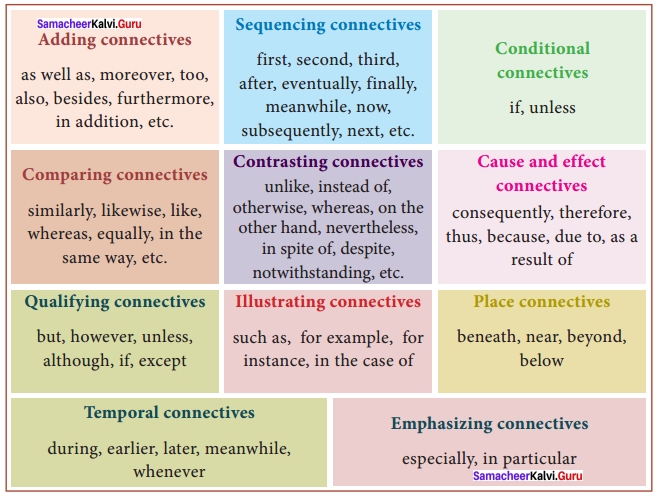
Connectives or Linkers

A Cup Of Tea Questions And Answers Samacheer Kalvi 12th English Solutions Prose Chapter 2

Task 1
Choose the appropriate linker from within the brackets and complete the sentences.

(a) I could not complete my paper in the examination ______ (because, but) I was slow in answering the questions.
(b) It started raining, ______ (yet, so) we could not play.
(c) ______ (As, If) I got up early, I managed to reach school on time.
(d) ______ (Though/Whereas) he committed a mistake, he apologised (and/since) promised that he would not repeat it.
(e) This is ______ (how/what) it must be done.
(f) The vendor saw the train moving slowly from the platform, ______ (therefore/until) he got
(g) I was not well, ______ (but/so) I did not attend the class.
(h) (If, Although) ______ she can drive , she travels by bus.
(i) (If/Unless) ______ you register your name, you cannot participate in the competitions.
(j) (As soon as/Besides) ______ my father arrived home, I narrated the incident.
(k) Be quick to hear ______ (then/ and) slow to speak.
(l) lam ______ (neither/either) an ascetic in theory (nor/or) in practice.
(m) We fail to harness the rain water, ______ (consequently, nevertheless) we suffer.
(n) My brother will certainly clear GRE; ______ (yet/for) he works very hard.

Answers:

(a) because
(b) so
(c) As
(d) Though, and
(e) how
(f) therefore
(g) so
(h) Although
(i) Unless
(j) As soon as
(k) and
(l) neither, nor
(m) consequently
(n) for

Task 2
Combine the sentences and rewrite them using the words given in the brackets.

Question (a)
The well was deep. Therefore, the fox could not get out of the well, (because)
Answer:
The fox could not get out of the well because the well was deep.

Question (b)
The work was over. We went home, (when)
Answer:
When the work was over, we went home.

Question (c)
A library is a public place. We see a number of books kept there for reading, (where)
Answer:
A library is a public place where we see a number of books kept for reading.

Question (d)
The culprit was caught. Immediately, he was taken to the police station, (as soon as)
Answer:
As soon as the culprit was caught, he was taken to the police station.

Question (e)
The boys were stealing mangoes from a grove. At that time, the owner of the grove came in.(while)
Answer:
While the boys were stealing mangoes, the owner of the grove came in.

Question (J)
Artificially flavoured juices are hazardous to health. Moreover, they lead to kidney problems, (and)
Answer:
Artificially flavoured juices are hazardous to health and they lead to kidney problems.

Question (g)
Adit has been promoted. Ranjan has been promoted, (as well as)
Answer:
Adit as well as Ranjan have been promoted.

Question (h)
Caesar was declared emperor. The conspirators killed him. (After)
Answer:
After Caesar was declared the emperor, the conspirators killed him.

Task 3
Fill in the blanks with appropriate correlative conjunctions.

(a) She is _____ an understanding person _____ everybody likes to be with her.
(b) Suraj owns _____ a typewriter _____ a computer.
(c) Vani is _____ a good singer _____ a good dancer.
(d) Amit did not know _____ his father met his class teacher _____ not.
(e) I would _____ starve _____ beg.

Answers:

(a) such, that
(b) not only, but also
(c) not only, but also
(d) whether, or
(e) neither, nor

Writing

Article Writing
Task 1

The Government of Tamil nadu has imposed a ban on the use of plastic. Effective implementation of this ban depends on public awareness and individual responsibility.

Write an article of 150 words for your school magazine to create an awareness of the dangers posed by indiscriminate use of plastic. Expand the ideas given below as notes.

Notes:

a. Introduction:

  1. Plastic – synthetic material – doesn’t decompose in soil
  2. Inevitable role of plastic – man’s day-to-day life

b. Human Health Hazard:

  1. Leeching of plastic into food – micro plastic entering food chain
  2. Human body’s inability to deal with this unnatural substance
  3. Reaction of micro plastic in human body and ill effects

c. Adverse effects on plants and animals:

  1. Plastic particles choking waterways – affect aquatic animals
  2. Ingestion by aquatic and terrestrial animals -blocking of intestines and respiratory passages

d. Environmental Degradation:

  1. Manufacturing process and burning of plastics – pollute atmosphere
  2. Plastic-non-biodegradable – interferes with soil microorganisms – affects soil fertility

e. Conclusion:

  1. Suggestions for restricted use – alternatives for one-time use of plastics
  2. Segregation of plastic waste – for recycling

Use of Plastic in Daily Life

Introduction:
One of the greatest threats to the sustainability of living environment is plastics. It is a synthetic material. It is not biodegradable, it takes hundreds of years to break down into small particles. Without knowing the long term harm plastic can cause to the environment, plastic has entered all walks of life.

Human health Hazard:
AS hot food items are packed in polythene bags, microplastic enters food chain. Besides, the plastic waste that is scattered is eaten by stray animals and even huge whales and they die eventually unable to digest them. The microplastic that goes into the human body blocks intestine and also causes respiratory disorders. Reaction to microplastic in human body leads to a lot of disorders and diseases.

Adverse Effects:
Plastic particles choke the arteries of water ways and affect the lives of marine organisms as well. Ingestion caused by plastic congestion leads to blocks in the intestine, lungs and eventually death in animals.

Environmental Degradation:
Both the processing involved in production of plastics and burning of broken plastic items result in air pollution. The plastic fragments interfere with soil microorganisms and accelerate infertility of the soil.

Conclusion:
People need to be sensitized on the uses of safe disposal of plastic waste and not mix it with organic waste. Besides, people must be encouraged to reduce, recycle and reuse plastic instead of throwing them away.

Task 2
Urban living brings with it a possibility of various communicable diseases.
Now write an article of about 150 words for a leading newspaper on the various ways of maintaining personal hygiene and sanitation in order to ensure a healthy living. Make use of the hints given below.
Hints:

(a) Introduction – ‘Cleanliness is next to Godliness’ – brief explanation

(b) Personal hygiene:

  1. Frequent washing of hands and regular bathing
  2. Brushing of teeth, trimming of nails and hair
  3. Wearing clean clothes

(c) Keeping diseases at bay:

  1. Avoid street food
  2. Keep food containers covered
  3. Drink boiled water
  4. Wash fruits and vegetables in flowing water

(d) Keeping living areas, surroundings and the environment clean:

  1. Disposal of domestic organic waste on a daily basis and hazardous waste in designated places
  2. Regular sweeping, mopping and dusting
  3. Disinfection of toilets and bathing areas
  4. Avoid littering of public places
  5. Avoid spitting, urinating and defecating in public places

(e) Conclusion – hygiene – a collective exercise – everyone’s involvement and practice, a must – ensure community health and happiness – celebrate life

Cleanliness is next to Godliness

Introduction:
“Cleanliness is next to Godliness”. Those who keep themselves and their surroundings clean and green live safely without the threat of infectious or contagious diseases.

Personal hygiene:
Regular bathing and hand washing, brushing of teeth, combing the hair, paring the nails and wearing neat dresses are indispensable for ensuring personal hygiene.

Keeping diseases at bay:
People who take street food must avoid them because, the food items are exposed to dust and disease spreading germs. Even at home we must ensure that the vessels containing food items are well-covered with plates or lids. As water-borne diseases are prevalent in cities and villages, one must drink only boiled water. Farmers use pesticides and hence we should always wash the vegetables and fruits in flowing water before using them for cooking or eating.

Keeping living areas, surroundings and the environment clean:
We must dispose organic waste on a daily basis. Hazardous waste must be disposed in the designated places only. Littering in public places must be avoided. One must have the civic sense and refrain from spitting, urinating and defecating in public places.

Conclusion:
Hygeine is a collective responsibilty of all people. For ensuring the health and happiness of the community, everyone must get involved in maintaining cleanliness in their surroundings.

Suggested Topics:
Importance of Physical Exercises / Sports and Games

Introduction:
A sound mind in a sound body goes the old saying. It holds good in modem times. Physical exercises play a vital role in keeping the body strong.

Kinds of exercises:
The simplest form of exercise is walking. Today people use two wheelers powered by petrol and biologists fear that after a hundred years babies maybe bom without legs using the theory of selection. As free bus pass is given, students have stopped cycling or walking even a kilometer a day.

Some do cycling on a regular basis and keep fit. Some go to the gym and do body building exercises. But everyone’s body’ constitution may not permit long hours of work out in a gym.

By playing traditional games like kho-kho, kabbadi, etc. also can maintain good health. In villages, climbing a huge tall oiled smooth pole is a contest during festivals. People stand in circles on whose shoulders young ones climb up to take the prize money kept on the top of the pole. Playing various games such as Tennis, cricket, basket ball, volleyball, foot ball can also give sufficient physical exercises. Students can partake in athletic events and sports to get enough exercise.

Conclusion:
Students should avoid playing games in the phone and watching domestic poison (i.e.) TV serials. Playing and doing physical exercises in the open air will tone up their muscles and build their immune system against diseases.

Travel and its Benefits

Introduction:
Travelling is a great teacher. Augustine says, “the world is a great book of which those who don’t travel read only a page.” Reading about Kashmir or Kodaikanal may not be as fascinating as travelling by car or train and drink and appreciate the beauty of nature.

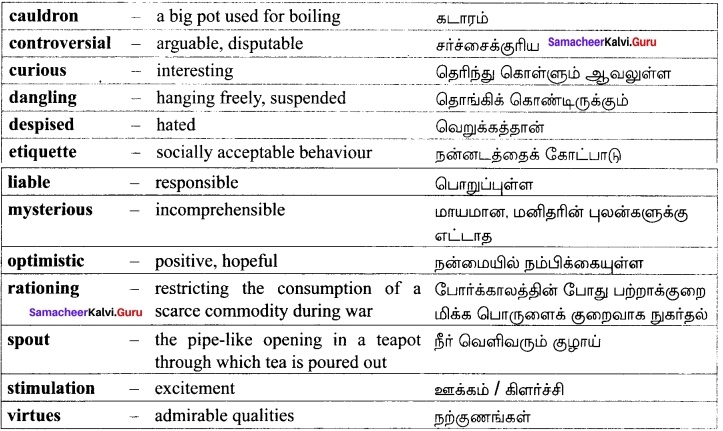
Heresay vs first hand experience:
Reading about Ooty is less interesting than visiting Ooty in person. Seeing the flower show when Ooty is in full bloom is equal to seeing it in hundred movies. Walking around Botanical gardens, gazing at the valley below from Doddabetta peak, enjoying the boat ride dipping the hands into the chill waters and looking at the Pykara hydel power project are all scenic beauties one etches in one’s memories for long.

Advantages of travelling:
Life is a book full of surprises. As we travel we meet many new and interesting people. We learn about new cultures, life styles, superstitions and rituals followed in different communities across the globe.

Travelling-testing ground of skills:
During travels, one may face unforeseen emergencies. One’s latent skills of problem-solving come to limelight during such emergencies. One would also be amazed to learn how total strangers bestow kindness he/she may not have expected in crises.

Conclusion:
Travel broadens one’s outlook of life. It is also a means of education. It is one of the precious gifts of life. One must travel far and wide to enjoy life-transforming experiences which can never be had inside the four walss of classrooms or home.

Water Conservation

Introduction:
Water is the elixir of life. Earth is the only lonely planet having life-supporting water in abundance. The earth is covered with 71% water. But potable water is only around 1%.

Need to conserve water:
Due to erratic rainfall caused by deforestation, water tables are fast drying up. Global warming is adding to the problem. Even underground water is sucked up by sunlight. Tamil Nadu Government is very strict about water harvesting. Permission to build is given only after ensuring water harvesting facility is added in the blue print.

War for water:
In olden days, wars were waged on rare beauties and gold. But in modem times, the countries which possess large amount of drinking water will become envious target of water hungry nations. Abdul Kalam, the rocket scientist, predicted, for a water can, people would go to the extent of murdering fellow humans. Already interstate quarrels have started over sharing of river waters. On the one hand, the surplus rain water goes to ocean and during summer, there is scarcity of water. There are no check dams on the path of rivers. There is greedy robbery of sand. River beds are becoming moist-free desert-like plains.

Water conservation:
When Israel is able to do agriculture profitably with very little rains, we struggle to ensure lucrative prices for farm products. Many states in India have failed to conserve rain water where surplus rain water rushes to ocean through flood canals.

Conclusion:
Unwise use of water is rampant across the country. Through leaky pipes good water goes down the drain. It is the collective responsibility of citizens and municipal authorities to conserve water and sustain life on the earth.

Child Labour

Introduction:
Child labour has emerged as a major issue in India. To address this social issue, NGOs, parents, social activists and society have to join hands to attack this issue. There is a legal provision to safeguard exploited persons beyond the age of 16. But young children don’t get the advantage of legal cover.

Causes of child labour:
In many developing countries, child labour is rampant. The prominent reasons are sibling care, poverty and lack of schooling opportunities. In developing countries 50% of school aged population (in the age group of 5-14) are engaged in child labour.

Distribution of child labour:
In farming industry, child labour is rampant. In labour intensive cotton industries, brick laying industries and in the informal sector we find a large number of children employed. In small scale industries like weaving, match works, fire crackers, children are engaged as bond labourers to lessen the financial burden of parents.

Conclusion:
It is a cruel paradox that instead of eliminating child labour, we have NCLP, non-formal schools to give education to child labourers. Main streaming is not a success due to inadequate monitoring. It is comforting to learn that international organization have taken up the cause of fighting against child labour. All must realize that healthy children are the real future of India. Child labour is retarding the progress of the children and the nation.

Mobile Phone – Advantages and Disadvantages

Introduction:
Mobile phone is a palm held device which has revolutionised the world of communication. A mobile phone does not require fixed landline and makes two way communication easy and affordable. Telegram department had to be closed due to the lightning speed with which messages could be sent orally or through SMS.

Mobile functions and advantages:
A mobile phone can be used for watching cricket, movie or just listen to news. Students now google for collecting information for their assignments and projects. A recent survey says 50% of youth read newspapers only through their android phones. The habit of reading books or dictionaries is falling due to quick access to information via mobile and internet services. Through Ola and Uber apps one can summon a call taxi or even order food from Uber eats or Ola food through these apps for a cheap cost. Railway and flight tickets can be booked online.
’ Memorable events can be frozen in photos or videos and saved in the phone itself. Money transfer is now possible through using PayTM, Bhim app or google money app. As many online newspapers are freely available, people save money.
Big Bazaar sells even vegetables through phone. Flipkart and Amazon apps help one to place order for any home appliances at competitive prices.

Disadvantages:
Social websites such as whatsapp, twitter and facebook keep young ones continuously engaged and crazy for likes. Sometimes evil doers access valuable information and exploit women and children. Sharing vital information, photos, videos, etc. with total strangers can jeopardize one’s honour and life too. Students who get addicted to video games and watching explicit content waste their time and energy and dropout of schools.

Conclusion:
Mobile phone is a technological marvel. Similar to any new technology, it has its fascinating traps. One must use mobile phones judiciously and stay out of harm and disgrace.

Consumerism – Wants and Needs

Introduction:
Consumer has the right to decide what he needs and what he wants to buy. But due to the explosive non-stop advertisements in the television, theatres, print media and in hand bills, the consumer is often influenced to buy what he actually does not need.

Problem of plenty:
A good trader needs to find a balance between both the need and want of the consumer. As many malls have sprung up in big cities and departmental stores in small towns, the consumer’s rights to choose what he needs are eroded. There’s a problem of plenty.

Astute traders Vs gullible customers:
As seasons change, consumers want to change the design of their jewels, wardrobes, etc. Astute traders dump a lot of varieties and under the pretext of discount and offers sub-standard commodities are sold to the consumers.

Conclusion:
The rules of business have changed widely now. Each consumer is different. Traders who are able to recognize the need of the consumer and supply custom-made or tailored commodities can only satisfy their wants and stabilize their business in the competitive market.

Value of Education

Introduction:
Education helps young ones acquire essential knowledge and skills. In modem times, teacher alone is not the dispenser of knowledge. School alone is not the abode of learning. There are many avenues from where students can learn freely.

Value of education:
Education teaches students to understand the fast changing world and problems of modem society and also evolve solutions in unconventional ways. Education shapes the destiny of a nation. It enables young ones to become a productive member of the civilized society and equips them with the required skill sets to seek jobs and shine in them too.

Education teaches us how to meet day to day challenges and overcome obstacles. It helps us leam how to become a well-rounded personality and perpetuate Indian culture. Education teaches young citizens non-negotiable rules in life and manners too. It lays the foundation stone for the future of children. It guides young ones to lead disciplined life and gives them with skills to earn jobs which would pay them well.

Conclusion:
India has to invest more in quality education in our country because education is the prerequisite to the nation’s prosperity and modernization of the country.

Value based Education

Introduction:
Education needs to ennoble human beings. It should teach sensitivity to the social issues which affect the progress of the nation. Education must sensitize students of the sweeping changes occuring around them in modem times.

Importance of value-based Education:
Education without values seems rather to make man a mere clever devil. Nelson Mandela once rightly said, “Education is the most powerful weapon through which you can change the world.” The aim of education should not be confined only to impart knowledge but to inculcate values in young and impressionable minds.

Rote memory vs value based education:
Currently, rote memorization is largely emphasized. Factual information needs to be mastered and not memorised and regurgitated during examinations. This system fails to give any opportunity to think outside the box. As we are moving towards becoming a knowledge economy, moral values have taken a back seat. Juvenile delinquency is threatening the value system of the country. The students may be intelligent and smart but they lack empathy. The schooling system has failed to inculcate the right values among children. It is unfortunate that neither teachers nor the students focus on values for it is not graded. Virtue should never ask for a reward because it is a reward in itself. India would regain its glory when students inculcate values like honesty, patriotism, compassion and hardwork.

Conclusion:
Education is a life long process. In real life, it is to be translated into qualities of truthfulness, self-confidence, compassion to all living things, and integration of mind, body and brain. In short, value based education has the capacity to transform the corrupt mind into a very innocent, healthy, natural, fresh mind embellished with agape love.

Essay Writing

Task 1
Write an essay of about 200 words each.

1. The profession you would like to choose

Introduction:
People do have dreams right from their childhood days about their career. Albert Einstein was asked in his death bed, “what did you want to become in your life?” Tears trickled down his eyes and he said, “I wanted to be a plumber. But my vocational instructor drove me out saying . That I don’t have the required skills.

Changing ambitions of children:
Children keep changing their ambitions as their role models change as they grow older and wiser. But I have decided to become a pilot in Indian force. I want to conquer the skies and fly faster than sound. I know it is a challenging career. After the Pulwama attack, the heroic role played by the twelve pilots of Indian Air force that struck at the hearts of terrorists in Pakistan . destroying the hideouts and training schools of terror impressed me. I do foresee the threat to life. Abinandhan, wing commander was released after India’s persistant diplomatic efforts across the world. I was overwhelmed by the united voice of India seeking Abinandhan, every Indian citizen was praying for the safe return of the sky warrior who had shot down F-16 with MiG 21 Bison, an ageing aircraft.

His composure under the custody of Pak army really motivated young people to stay calm during crisis. In Tamil Nadu two soldiers who died in Pulwama attack were mourned by the whole state. Transcending barriers of caste, religion and political alliances, all came to console the family members. Unkown people started donating their life-time savings. So, I have made up my mind to serve the Indian Airforce. I want to live and die as a jawan with legitimate pride. Only in the armed forces, I find dignity in both service and in death.

Conclusion:
People pursue various kinds of careers for the sake of monetary aspects. But I choose airman’s career so that I will become a part of the pride of Indian armed forces.

2. The importance of a balanced diet

Introduction:
This is a pertinent topic when the young children are becoming early victims of obesity. Most of the children in cities have got addicted to fat-saturated foods such as pizza, burger, and other fast foods which cause cholesterol. Eating balanced diet (i.e.) nutritious food is crucial if one wants to lead a healthy life style.

Balanced diet:
Balanced food is not about having the right kind of foods alone, but eating them at the right time in the right proportions. Millets and nutritious food items are available in plenty even in rural areas.

Intake of liquids:
Fluids are quite indispensable for the human body to lead a healthy life style. Scientists claim that 80% of the human body is filled with water. It is also a co-factor in many of the metabolic activities in the body leading to metabolic changes. At least two to three litres of water is essential for everyone. This can be achieved by restricting the intake of coffee and tea and consuming water as frequently as possible.

Fresh vegetables and fruits:
Regular intake of fruits and vegetables will invariably avoid many health disorders. It is believed that a balanced diet must contain all five tastes (i.e.) bitter, pungent, sour, sweet and salt. The avoidance of processed or tinned food is good because processed foods are deprived of their nutritional values. Transfat substances in processed and junk foods is harmful to us.

How to eat:
One must chew the food one consumes to ensure easy digestion. One must eat only what is required. Over eating will result in obesity and over weight. One can start diet as per the directions of one’s family doctor or dietician.

Conclusion:
If one does not take balanced diet with green vegetables and fibre, one may have to spend a lot to recover the lost health.

3. A memorable journey

Introduction:
One learns a lot about the world and life during travels. One gets to meet new people and find new cultures. I had an opportunity to visit Daijeeling along with my uncle who is working . there.

Darjeeling, the Queen of hill stations:
Daijeeling is a mesmerising hill station located in West Bengal. While travelling in the amazing toy train I was transported to heaven. The lush green hills, beautiful serene monasteries, tea plantations and the clouds that played hide and seek with the Sun really dazzled me.

I spoke to the natives. They understood Hindi and Bengali. Fortunately my uncle knew Bengali and he could translate what people said in English and Tamil which broke the barrier of language. There were frequent mild rainfalls which ran chills down my spine. I can never forget the travel in toy train from Jalpaiguri to Daijeeling. The tracks rise from sea level to 7500 ft in just about 70 km. In order to overcome the gradients, the train used zig zag reverses and loops. Batasia loop is the most famous loop with the figure of eight. As the train slowly went for seven hours, I could drink the beauty of nature and take in the fresh air of the green forests.

I went to Kangchenjunga the third highest mountain in the world with an altitude of 8586 metres above sea. I felt like standing on top of the World. Sunrise from the tiger hill was the most fascinating scenes I can never forget in my life.

Conclusion:
I strongly recommend that all my friends must visit Daijeeling once in their life.

A Nice Cup of Tea About The Author

A Nice Cup Of Tea Summary In Tamil Samacheer Kalvi 12th English Solutions Prose Chapter 2

Eric Arthur Blair (25 June 1903-21 January 1950), better known by his pen name George Orwell, was an English novelist, essayist, journalist and critic whose work is marked by clear prose, awareness of social iniquity, opposition to totalitarianism and candid support of democratic socialism.
Orwell wrote literary criticism, poetry, fiction and polemical journalism. He is best known for the allegorical novella Animal Farm (1945) and the dystopian novel Nineteen Eighty-Four (1949). In 2008, The Times ranked him second on a list of “The 50 greatest British writers since 1945”.

A Nice Cup of Tea Summary in English

About Nice Cup of Tea
Tea is one of the mainstays of civilization in India, China, U.K., Japan, Australia and New Zealand. It is curious because the best manner of making it is the subject of violent diputes. For George Orwell it is a national issue. Orwell himself went through a great deal of trouble in importing tea to drink personally. This essay is probably a reflection of his passion of preparing and drinking tea. It is a discussion on the craft of making a cup of tea.

Another view is that Orwell wrote the essay with political undertones. He used a cup of tea as the instrument for airing his political views.

Missing entry in the cookery book
‘Tea’ is not mentioned in the cookery book. There may be sketchy references on the instructions about the process of making tea.

Tea-making – A subject of controversies
The author admits that tea is a mainstay of civilization of UK, Australia, New Zealand and in Eire. What is the best manner of making a nice cup of tea is the subject of violent disputes between tea lovers.

Eleven tips for making tea Indian tea – the nicest tea
Firstly, the author prefers Indian to Chinese tea. The Chinese tea is economical in the sen e one can drink it without milk. But Chinese tea doesn’t give the stimulation, wisdom or bravery one expects after the intake of a nice cup of tea. The author associates “nice cup of tea” only with Indian tea.

Quantity vs Quality
Tea ought to be made in small quantities (i.e) in a tea pot. Tea made in urn is tasteless. Army tea made in Cauldron tastes of grease and whitewash. Tea pot should be made of China clay or earthen ware. The tea produced with silver or Britannia ware and enamel pots is always inferior in quality. However he agrees that tea made in pewter teapots is not so bad.

Method
Thirdly the pot should be warmed beforehand. This could be done better by placing the tea pot on the hob than by swilling it out with hot water.

Strong vs weak tea
Fourthly, tea must be strong. Six heaped tea spoons of leaves would be right if quart holding pot is to be filled with water to the brim. May be it is ideal when rationing of tea leaves is done. But one cup of strong tea is better than twenty weak ones. True tea lovers, as they age, want to take stronger tea and hence extra rationing of tea is done in ration shops for old age pensioners.

Indicator of quality of tea
Fifthly tea should be put straight into the pot. Muslin bags and strainers or other devices imprison tea. Baskets meant for filtering tea leaves are harmful. One can swallow tea leaves in considerable quantities. Loose tea in the pot is an indicator of quality.

Boiled or Bioling teapot
Sixthly, one should take the teapot to the kettle. The water should be boiled at the moment of impact (i.e.) while pouring it. Some maintain that tea should be poured from freshly boiled water which makes no difference.

Shake well
Seventhly, after making the tea, one must stir well and allow the tea leaves to settle down.

Drink from breakfast cup
One should drink from big breakfast cup which is cylindrical in shape. The flat shallow cup starts cooling off quickly thereby the quality gets lost.

Creamless milk
One should throw away the cream of the milk before mixing it with tea. The cream gives a sickly taste to the tea.

Milk first vs Tea first schools

A Nice Cup Of Tea Samacheer Kalvi 12th English Solutions Prose Chapter 2

Tenthly, the author believes strongly that tea must be poured and stirred. Then the milk must be added. This would exactly regulate the amount of milk poured. If milk is already poured and tea is added the quantity and impact of tea will not be optimum.

Sugarless tea- the nicest tea
Lastly the author disapproves of Russian tea or tea that is taken with sugar. He doubts the sanity of the choice of tea with sugar as it would really spoil the taste of tea. He recommends misguided individuals who take tea with sugar to switch over to sugarless tea for a fortnight. He guarantees that they would not go back to sweet tea as they would realize the real taste of tea.

Mysterious social etiquette
Some claim that it is vulgar to take tea from the saucer. There are other advantages of tea leaves such as telling fortunes, predicting the arrival of guests, feeding rabbits, healing bums and sweeping the carpets.

Conclusion
The author tries to reiterate the point only by using boiling water one can get twenty strong cups of tea from two ounces of tea leaves given in ration. The point that sugarless tea is good is endorsed by doctors also as a good practice.

A Nice Cup of Tea Summary in Tamil

முன்னுரை
| இந்தியா, சீனா, இங்கிலாந்து. ஜப்பான், ஆஸ்திரேலியா மற்றும் நியூசிலாந்து நாட்டு சமுதாயத்தினரிடம் முக்கியமானவையாகக் கருதப்பட்டவைகளுள் தேயிலையும் ஒன்றாகும். இதன் மேல் பேரார்வம் கொண்டதன் காரணம் இதன் செய்முறை குறித்து தீவிர சர்ச்சை நிலவுவதே. ஜியார்ஜ் ஆர்வெல்லுக்கோ தேசிய அளவிலான பிரச்சனையாக அது இருந்தது. போர் தன் சுயதேவைக்கு தேயிலையை இறக்குமதி செய்வதில் பெருத்த சங்கடத்திற்கு அவர் உள்ளாக வேண்டியிருந்தது. இந்தக் கட்டுரை அநேகமாக அவர் தேனீர் தயார் செய்வதிலும் அதை அருந்துவதிலும் கொண்ட ஆர்வத்தின் பிரதிபலிப்பே ஆகும். ஆக, இது தேனீர் தயாரிப்பின் கைப்பக்குவத்தை விவாதிக்கக் கூடிய ஒன்றே ஆகும். ஆர்வெல் இந்தக் கட்டுரையை அரசியல் அடித்தளத்துடன் எழுதியுள்ளார் என்ற மற்றொரு கருத்தும் நிலவுகிறது. அவர் தன் அரசியல் கருத்துக்களை வெளிப்படுத்த ஒரு கோப்பை தேனீர் அருந்துவதைக் கருவியாகக் கையாண்டுள்ளார்.

சமையற்குறிப்பில் விடுபட்ட பதிவு:

A Nice Cup Of Tea Paragraph Samacheer Kalvi 12th English Solutions Prose Chapter 2

தேனீர் பெரும்பாலான சமையற்குறிப்புப் புத்தகங்களில் குறிப்பிடப்படுவதில்லை. தேனீர் தயாரிப்பு மேலோட்டமாக சில சமையல் குறிப்புகளில் காணப்படலாம்.

தேனீர் தயாரிப்பு-சர்ச்சைக்குரிய விஷயம்:
இங்கிலாந்து, ஆஸ்திரேலியா, நியூசிலாந்து மற்றும் ஐயரில் நாடுகளில் முக்கியமான ஒன்று தேநீர் என்பதை ஒப்புக்கொள்கிறார். எந்த விதத்தில் நல்ல சுவையுள்ள தேனீர் தயாரிப்பது என்பதே தேனீர் பிரியர்களிடத்தே உண்டாகும் தீவிர சர்ச்சை ஆகும்.

தேனீர் தயாரிப்பில் 11 குறிப்புகள்:
இந்தியத் தேனீர் இன்பகரமான தேனீர். முதலாவதாக சிக்கனம் எனப் பார்த்தால் பால் சேர்க்காமல் சீனத் | தேயிலையைப் பருகலாம் என்றாலும் ஆசிரியர் இந்தியத் | தேயிலையே சாலச் சிறந்தது எனக் கூறுகிறார். ஆனால், | நல்ல தேனீர் அருந்திய பின் ஒருவர் எதிர்பார்க்கக்கூடிய ஊக்கம், விவேகம் அல்லது வீரம் சீனத் தேனீர் கொடுப்பதில்லை. இன்பகரமான தேனீருடன் ஆசிரியர் தொடர்புபடுத்துவது இந்தியத் தேயிலையையே.

அளவு மற்றும் தரம்:
இரண்டாவதாக தேனீர் சிறிய அளவிலேயே தயாரிக்கப்பட வேண்டும். கெண்டியில் தயாரிக்கப்படும் தேனீர் சுவைமிக்கதாக இருப்பதில்லை. இராணுவத்தினருக்கு பெரிய அண்டாக்களில் தயாரிக்கப்படும் தேனீர் எண்ணெய் பிசிர் மற்றும் சுண்ணாம்புக் கரைசலின் சுவையைக் கொடுக்கும். தேனீர் தயாரிக்கும் பாத்திரம் சீனக் களிமண் அல்லது களிமண்ணால் செய்யப்பட்டிருக்க வேண்டும், வெள்ளி, பிரிட்டானியா சாமான்கள் மற்றும் எனாமல் பூசப்பட்ட பாத்திரங்களில் தயாரிக்கப்படும் தேனீர் தரம் குறைந்ததே. ஆனால் காரீயத் தேனீர் கெண்டியில் தயாரிக்கப்படும் தேனீர் அவ்வளவு மோசமாக இருப்பதில்லை என்பதை ஆசிரியர் ஆமோதிக்கிறார்.

செய்முறை:
மூன்றாவதாக, தேனீர் பாத்திரத்தை தேனீர் போடுவதற்கு முன்னதாக சூடுபடுத்திக் கொள்ளவேண்டும். இதை அடுப்பின் அருகில் உள்ள மேடை மீது சிறிது நேரம் வைத்து பிறகு கொதிக்கும் நீரை விட்டு அலச வேண்டும்.

கசாயம் அதிகமுள்ள மற்றும் கசாயம் குறைந்த தேனீர்:
நான்காவதாக, தேயிலை கசாயம் நிறைந்ததாக | இருக்கவேண்டும். கால் கேலன் (3.785 லிட்டர்) (Quarter | Cup) அளவு கொண்ட கெண்டியில் விளிம்பு வரை நீரை நிறைத்து அதில் ஆறு தேக்கரண்டி நிறைய | தேயிலைத்தூள் போதுமான அளவாகும். இதுவே
போதுமான அளவுகோல் எனக் கொள்ளலாம். ஆனால், | 20 கோப்பை கசாயம் குறைந்த தேனீரைக் காட்டிலும் ஒரு கோப்பை கசாயம் நிறைந்த தேனீர் சிறந்தது. உண்மையான | தேனீர் பிரியர்கள் வயதாக ஆக அதிக கசாயம் மிகுந்த | தேனீரை உட்கொள்ள விரும்புவதால் நியாய விலைக் | கடைகளில் கூடுதல் தேயிலை ஓய்வூதியம் பெறுபவருக்கு கொடுக்கப்படுகிறது.

தேயிலையின் தரத்தைப் பாதிக்கும் கூறுகள் யாவை?
ஐந்தாவதாக தேயிலையைக் கெண்டியில் போட | வேண்டும். மஸ்லின் பை மற்ற வடிகட்டிகள் மூலம் | தேயிலையை வடிகட்ட உதவும் தேயிலை பைகள் ஆபத்தானவை. அளவுக்கு அதிகமான தேயிலையை ஒருவர் விழுங்கிவிட வாய்ப்புள்ளது. ஆனால் அது உடல்நலத்துக்கு ஒரு போதும் கேடு விளைவிக்காது. அது உடல்நலத்துக்கு நன்று. கெண்டியில் (kettle) போட்டுத் தயாரிக்கும் தேயிலை உயர்தர வகைக்கு சான்று.

கொதித்த அல்லது கொதிக்கும் கெண்டி:
ஆறாவதாக, கொதித்த தேநீரை கெண்டியில் ஊற்ற வேண்டும். ஊற்றும் போது நீர் கொதிக்க வைக்கப்பட வேண்டும். சிலர் தேனீரை கொதித்த நீரில் | போட வேண்டும் என்பர். அதனால் எந்த வித்தியாசமும் இல்லை. நன்றாகக் கெண்டியை குலுக்கினால் போதும்.

நன்றாக கிளறுங்கள்
ஏழாவதாக தேனீர் தயாரித்த பிறகு நன்றாக கிளறி தேயிலைத் தூள் கீழே தங்குமாறு செய்யவேண்டும்.

பசியாறும் கோப்பையில் ஊற்றி குடிக்கவேண்டும்:
எட்டாவதாக கோள (Cylinderical) வடிவிலான பெரிய பசியாற்றும் கோப்பையில் ஊற்றிப் பருகவேண்டும். தட்டையான கோப்பைகளில் ஊற்றுவதால் எளிதில் சூடு ஆறி அதன் சுவை பருகும்போதே தொலைந்துவிடுகிறது.

வெண்ணைய் இல்லாத பால்:
ஒன்பதாவதாக தேனீருடன் கலப்பதுக்கு | முன் பாலில் உள்ள வெண்ணையை அப்புறப்படுத்த வேண்டும். அந்த வெண்ணைய் நுரை தேனீரில் கலந்து பிசுபிசுப்புத் தன்மையைக் கொடுக்கிறது.

முதலில் பால் மற்றும் முதலில் தேனீர்:
பத்தாவதாக, கதையாசிரியர் தேயிலை நீரை முதலில் ஊற்றி கலக்கவேண்டும் என நம்புகிறார். அதன் பின் பால் சேர்க்கப்பட வேண்டும். இது நாம் எவ்வளவு பால் உபயோகிக்கிறோம் என்பதைத் திட்டமிடச் செய்யும், பாலை முதலில் எடுத்துக்கொண்டு தேனீரை ஊற்றுவது ஏற்ற வகையான அனுகூலத்தைத் தராது.

சர்க்கரை இல்லாத தேனீர்-இனிமையான தேனீர்:
கடைசியாக ஆசிரியர் ரஸ்யன் வகை தேயிலை அல்லது சர்க்கரை சேர்த்த தேனீரை ஆட்சேபிக்கிறார். சர்க்கரை சேர்த்த தேனீரின் தன்மையை அவர் சந்தேகிக்கிறார். ஏனெனில், அது தேனீரின் சுவையைக் கெடுத்து விடுகிறது. வழிநடத்தப்பட்டவர்களே தவறுதலாக தேனீருடன் சர்க்கரை சேர்த்துக் கொள்கிறார்கள். அவர்களை சர்க்கரை சேர்க்காத தேனீருக்கு மாறும்படி சிபாரிசு செய்கிறார். அவர்கள் மறுபடியும் சர்க்கரை சேர்த்த தேனீருக்கு திரும்ப மாட்டார்கள் என உத்திரவாதம் அளிக்கிறார். ஏனெனில், அவர்கள் இரு வார காலத்தில் தேனீரின் மெய்யான சுவையை அறிந்திருப்பார்கள்.

மர்மமான சமூக ஆசாரம்:
சிலர் பீங்கான் தட்டில் தேனீரை ஊற்றி அருந்துவது அருவெறுப்பு உடையது என ஏன் கருதுகிறார்கள்? என்றும் மற்றும் தேயிலை உபயோகத்தின் இரண்டாம் பட்சமான உபயோகமான குறி சொல்வது, விருந்தினர் வருகையை அறிவிப்பது, முயலுக்கு ஆகாரமாகக் கொடுப்பது, தீப்புண்ணை ஆற்றுவது மற்றும் சமுக்காளத்தைக் கூட்டுவது என மர்மமான சமூகச் சடங்குகளும் தேனீர் கெண்டியைச் சூழ்ந்துள்ளது.

முடிவுரை:
நியாய விலைக் கடைகளில் கொடுக்கும் 2 அவுன்ஸ் தேயிலையைக் கொதிக்கும் நீரில் இட்டால் 20 கோப்பை நிறைந்த கசாயம் கூடிய தேனீர் கிடைக்கும் என்று அறிவுறுத்துகிறார். சர்க்கரை இல்லாத தேனீர் நல்ல பழக்கம் என்னும் கருத்தை மருத்துவர்களும் வலியுறுத்துகிறார்கள்.

A Nice Cup of Tea Glossary

Textual:

A Cup Of Tea Questions And Answers Pdf Samacheer Kalvi 12th English Solutions Prose Chapter 2

Additional:

A Nice Cup Of Tea Short Summary Samacheer Kalvi 12th English Solutions Prose Chapter 2

Samacheer Kalvi 9th English Grammar Tenses

You can Download Samacheer Kalvi 9th English Book Solutions Guide Pdf, Tamilnadu State Board help you to revise the complete Syllabus and score more marks in your examinations.

Tamilnadu Samacheer Kalvi 9th English Grammar Tenses

Tenses of verbs are used to express time. They indicate the time and state of the action.

SingularPlural
Verb +’s’Verb
e.g. WritesWrite

Verbs end with ‘s’ when subject is singular and do not end with ‘s’ when subject is plural in the present tense.

Present Tense

Simple Present : (verb+s/es)

  • True in, the present :
  • He works in a studio.
  • She is sixty years old.
  • We live in Chennai.

Habits :

  • I always drink coffee at work.
  • He wakes up at 7 a.m. every day.
  • They usually eat dinner at home.

General facts/truths :

  • The Earth revolves around the Sun.
  • The Sun rises in the East.
  • Water boils at 100°C.

Future timetables/schedules :

  • My train arrives tomorrow.
  • We fi y to Paris on Monday.
  • Classes begin next week.

Present Continuous: (am/is/are+verb+ing)

Happening now :
It is raining.
I’m eating lunch now.

Fixed plans :
I am meeting my friends after work.’

Temporary actions :
I’m working in New York this week.

Trends :
More and more people arc using cell phones to access the Internet.

Longer actions in progress now :
She is studying to become a doctor.
He is training for a marathon.

PRESENT PERFECT : (haslhave+past participle)
Action completed in tue immediate past :
We have planned the meeting for next week.
I have joined the duty.
She has completed the home work.

Event in the past at an unspecified time :
She has been to Paris.
I’ve seen that movie.

Duration from the past until now :
He has been a teacher since 2002.

Change over time :
Your English has improved since the last time we met.
My niece has grown a lot in the past year.

Repeated events in the past until now :
We have had four exams so far in this semester.
I’ve been to this restaurant many times since I moved next door.

Past Tense
Simple Past

Series of completed actions :
He sat down, took out a notebook and pen, and started writing.
He entered the room, turned in my direction, and smiled at me.

Habits ¡n the past :
John played the piano when he was a child.
I was good at dancing when I was a teenager.

Complete action in the past :
Sarah baked a cake yesterday.
I went to bed at 10 last night.
We ordered pizza on Friday.

Duration in the past :
He stayed up all night.
We lived in Chicago for a year.
We played baseball all day.

Past Continuous (was/were+verb+ing)
Action before and after a specific time : Yesterday at noon, I was eating lunch.
Interrupted continuous past action : I was watching a movie when she called.
To start a story / create an atmosphere : While I was driving to work yesterday.
Repeated action (often with “always”) : Mutest roommate was always leaving dirty dishes in the sink.
Parallel actions : I was reading while my brother was playing guitar.

Past Perfect (had + past participle)
An action completed before a past action : When we arrived, the class had already begun.
Reported speech : My student said that he hadn’t done his homework.
In the Third Conditional of “if” : If it had rained, I would have bought an umbrella.
A period of time before an event in the : We had owned our house for twenty years before we sold it

Past Perfect Continuous (had+been+verb+ing)
Continued action in the past. before an : He had been waiting for an hour when she finally action in the past arrived.
Cause of something in the past : He went on a diet because he had been eating too much.
“If”- impossible condition : If I had been paying attention, I wouldn’t have got into an accident.
Reported speech : She said that John had been helping her study for months.

Future Tense
Simple Future (shall/will + verb)
wilIingness: (will + verb) :
Someone is at the door. I’ll see who it is. (at the present moment)
I will help you with your homework tonight. (prom Lye/offer)
She won’t tell me her password. (refusal)

Future Fact: (will + verb) : My Mother will get a Foot BaLl today
Plan or Intention (be going to + verb) (Immediate future / Decided future) :
I’m going to watch a movie tonight.
He’s going to have a party this weekend.

Prediction :
It is cloudy. It’s going to rain. (evidence)
You’ll go abroad someday. (opinion)

Future Perfect (shall/will + have been + verb+ing)
Action in progr0ess at a time in the future : She will be taking an exam at 2 p.m. tomorrow, so don’t call her then.
Emphasis of future plans and intentions : They’ll be coming to visit us next week.
interrupted action in the future : I will be waiting for you when you arrive tonight.
Parallel actions ¡n the future :
She will be watching TV, and he will be cooking dinner.
While he cooks dinner, she will be watching TV.

Atmosphere in the future :
When I enter the class, the teacher will be teaching, some students will be taking notes, and my best friend will be trying to stay awake.

Future Perfect (shaHIwiII+ have + past participle)
A completed action before something :
By the time you arrive, I will have finished the in the future project.
By next summer, she will have graduated from college.

Duration before something in the future :
By Friday, she will have had my car for a whole week!
She will have been in Paris for six months by the time she leaves.

Question form :
Do you think you will have finished the project before 1 arrive?
Will she have graduated from college by then?
What will you have done by the end of your time here?

Negati’e statcrnents :
By this time tomorrow, she won’t have had enough time to finish the essay.
By 2020, I won’t have completed my PhD.

Future Perfect Continuous (shaLIJwill + have been + verb+ing)
Cause of something in the future :
Her English will be excellent by the time she visits the U.S. because she will have been studying it for five years.
He will be tired by the time he arrives because he will have been travelling all day.

Duration before something in the future :
He will have been waiting for an hour when she finally arrives.
She will have been working at the company for ten years by the time I retire.

Thus, in English we have twelve different Tenses.
They are —
1. Present Simple – She writes letters.
2. Past Simple – She wrote letters.
3. Future Simple – She will write letters.
4. Present Continuous – She is writing letters.
5. Past Continuous – She was writing letters.
6. Future Continuous – She will be writing letters.
7. Present Perfect – She has written letters.
8. Past Perfect – She had written letters.
9. Future Perfect – She will have written letters.
10. Present Perfect Continuous – She has been writing letters.
11. Past Perfect Continuous – She had been writing letters.
12. Future Perfect Continuous – She will have been writing letters.

List Of Irregular Verbs:
Samacheer Kalvi 9th English Grammar Tenses9th English Grammar Tenses Samacheer Kalvi

1. Simple Present Tense
The Simple Present Tense is used to express a universal truth or habitual action; as —
1. I like bread.
2. We do our duty.
3. Rahul speaks the truth.
4. The sun rises in the east.
The underlined verbs are all in the Present Simple Tense.

Positive Statements In This Tense :
We use V1 for I, You and a Plural subject; as—
1. We learn our lessons.
2. You pray to God daily. ,
3. They buy milk from this dairy.

We use V1 + s/es for a Singular subject; as—
1. She tells lies.
2. Meena cooks delicious food.
3. Ms Madhu teaches us English.

Negative Statements – do not / does not + V1 verb
You do not obey the rules.
He does not attend the meeting.
She does not dance well.
They do not play now.
Hint: I, we, you, they – do not
He, she, it, singular – does not

Positive Questions – Do / Does + Sub + verb

Do you ask your doubts?
Does he recommend you?
Do they speak English?
Does she prepare meals?

Negative Questions–Do/Does + Sub + not+ V1 verb

Do you not know him?
Do they not participate the program?
Does he not read correctly?
Does she not go to temple today?

2. Past Simple Tense
Past Simple Tense is used to express an action which took place in the past or was completed before the time of speaking; as —
1. Simi liked ice cream.
2. Rohan went to the market.
We use V2 with all subjects (singular as well as plural); as—
1. He worked honestly.
2. They took milk for breakfast.
3. I bought this book last month.

Negative Statement–Did not + V2 verb
1. He did not play Yesterday.
2. They did not buy fruits.
3. She did not go to school.
4. You did not tell the correct answer.

Positive Questions – Did + Sub + V1 Verb
1. Did you attend the meeting?
2. Did they arrange the tour?
3. Did he draw the picture?
4. Did she take part in the fancy dress competition?

Negative Questions–Did + Sub + not+ V2 Verb
1. Did you not sleep well yesterday?
2. Did they not go to their native place?
3. Did she not speak to him?
4. Did he not bring the flowers?

3. Present Continuous Tense
Present Continuous Tense is used to express an action that is going on at the time of speaking; as–
1. Radha is doing her homework.
2. Mona is cooking food in the kitchen.

The underlined words denote an action that is going on at present.
So we can say these sentences are in the Present Continuous Tense.

Positive Statements

In this tense, we use is/am/are + Vj–ing :
1. I am going there.
2. He is doing his work.
3. They are digging a well.

Negative Statements,
We use is/am/are + not + Vj–ing :
1. I am not going there.
2. He is not doing his work.
3. They are not digging a well.

Positive Questions,
We put the helping verb before the Subject; as —
1. Am I going there?
2. Is he doing his work?
3. Are they digging a well?

Negative Questions,
we can put ‘not’ before the main verb or in short form after the helping verb, as—
1. Is he not doing his work?
Isn’t he doing his work?
2. Am I not going there?
Ain’t I going there?
(We use ain’t in spoken language only.)
3. Are they not digging a well?
Aren’t they digging a well?

4. Past Continuous Tense
The Past Continuous Tense is used to express an action which was actually taking place at some particular moment in the past.

Positive Statements,
We use was/were + V1–ing; as —
1. He was reading a book.
2. They were going to the market.

Negative Statements,
We use was/were + not + V1–ing; as —
1. He was not reading a book.
2. They were not going to the market.

Positive Questions,
We put the helping verb before the subject; as —
1. Was he reading a book?
2. Were they going to the market?

Negative Questions,
we can put ‘not’ before the main verb or in short form after the helping verb; as —
1. Was he not reading a book?
Wasn’t he reading a book?
2. Were they not going to the market?
Weren’t they going to the market?

Exercises
(i) Rewrite each sentence using the Past form of the given verbs :

1. Rahul ______________ (want) a shirt.
Answer:
Rahul wanted a shirt.

2. Deepa ______________ (eat) an ice cream.
Answer:
Deepa ate ice cream.

3. Nancy ______________ (wear) simple clothes.
Answer:
Nancy wore simple clothes.

4. Raj ______________ (come) to India in March.
Answer:
Raj came to India in March.

5. They ______________ (build) a house in Delhi.
Answer:
They built a house in Delhi.

6. The boys ______________ (laugh) at the beggar.
Answer:
The boys laughed at the beggar.

7. I ______________ (go) to the market with my friend.
Answer:
I went to the market with ni find.

8. My mother ______________ (buy) a new dress for me.
Answer:
Ms mother bought a new dress for ‘NC.

(ii) Rewrite each sentence as a Negative

1. Misha told the truth.
Answer:
Aisha did not tell the truth.

2. He took my pen.
Answer:
He did not take ms pen.

3. Tony polished his shoes’’
Answer:
Tony did not polish his shoes,

4. She cooked food for me.
Answer:
She did not cook food for me,

5. Rohan respected his friends.
Answer:
Rohan did not respect his friends.

6. They finished their work in time.
Answer:
They did not finish their work in time.

7. The naughty boys broke the glass.
Answer:
The naughty boys did not break the glass.

8. Ranjan and his friends went for a picnic.
Answer:
Ranjan and his friends did not go for a picnic.

(iii) Use the Present Continuous Tense to complete each sentence :

1. Mona ______________ (take) a test.
Answer:
Mona is taking a test

2. I ______________ (have) my breakfast.
Answer:
I am having my breakfast.

3. The hunter ______________ (kill) the lion.
Answer:
The hunter is killing the lion.

4. The trees ________ (shed) their leaves.
Answer:
The trees are shedding their lines.

5. The farmers ______________ (water) their fields.
Answer:
The farmers are wtering their fields.

6. The pain in my arm ________ (get) worse.
Answer:
The pain in an arm is getting worse.

7. The tailors (not stitch) the uniforms.
Answer:
The tailors are not stitching the uniforms.

(iv) Complete each sentence using the Past Continuous Tense :
1. Children ______________ (hide) in the bushes.
Answer:
Children were hiding in the bushes.

2. They ______________ (walk) through the zoo.
Answer:
They were walking through the zoo.

3. The waiter ______________ (server) the people.
Answer:
The waiter was serving the people.

4. Meera ______________ (not play) with her friends.
Answer:
Meera was not playing with her friends.

5. The baby ______________ (not cry) all the morning.
Answer:
The baby was not crying all the morning.

6. The dancers ______________ (not perform) on the stage.
Answer:
The dancers were not performing on the stage.

(v) Use Simple Past form of the given verb to complete each sentence:

1. Did you ______________ (enjoy) this film?
Answer:
Did you enjoy this film?

2. Did Rama ______________ (paint) this picture?
Answer:
Did Rama paint this picture?

3. Columbus ______________ (discover) America in 1492.
Answer:
Columbus discovered America in 1492.

4. She ______________ (go) to her village last month.
Answer:
She went to her village last month.

5. The peon ______________ (not ring) the bell in time.
Answer:
The peon did not ring the bell in time.

6. The fool didn’t (learn) from experience.
Answer:
The fool didn’t learn from experience.

(vi) Use Simple Present form of the given verbs to complete each sentence :

1. I ______________ (go) for a walk daily.
Answer:
I go for a walk daily.

2. The sun ______________ (rise) in the east.
Answer:
The sun rises in the east.

3. They ______________ (not like) bad workers.
Answer:
They don’t like bad workers.

4. Kusha ______________ (not obey) her parents.
Answer:
Kusha doesn’t obey her parents.

5. Teachers ______________ (love) good students.
Answer:
Teachers love good students.

6. We ______________ (take) milk and eggs for breakfast.
Answer:
We take milk and eggs for breakfast.

(vii) Rewrite each sentence in Simple Past Tense :

1. The bird flies to its nest.
Answer:
The bird flew to its nest.

2. They drink coffee every day.
Answer:
They drank coffee every day.

3. Does he pay his fees regularly?
Answer:
Did he pay his fees regularly?

4. Do you have milk for breakfast?
Answer:
Did you have milk for breakfast?

5. Do we not fall ill by over–eating?
Answer:
Did we not fall ill by over–eating?

6. You do not finish your work in time.
Answer:
You did not finish your work in time.

7. Kusha does not wear simple clothes.
Answer:
Kusha did not wear simple clothes.

8. poes he not help his friends in need?
Answer:
Did he not help his friends in need?

(viii) Rewrite each sentence in Past Continuous Tense :

1. Isn’t it raining heavily?
Answer:
Wasn’t it raining heavily?

2. We are waiting for the bus.
Answer:
We were waiting for the –bus.

3. The teacher is teaching the children.
Answer:
The teacher was teaching ‘ the children.

4. I am not living with my aunt these days.
Answer:
I was not living with my aunt these days.

5. They are not going home in the evening.
Answer:
They were not going home in the evening.

6. Is the lady knitting a sweater for her son?
Answer:
Was the lady knitting a sweater for her son?

7. Aren’t Anu and Manu playing in the street?
Answer:
Weren’t Anu and Manu playing in the street?

8. Am I wasting my time in watching Discovery Channel?
Answer:
Was I wasting my time in watching Discovery Channel?

(ix) Rewrite each sentence in Present Continuous Tense :

1. Do you not speak the truth?
Answer:
Are you not speaking the truth?

2. The students ask many questions.
Answer:
The students are asking many questions.

3. I sit on the front bench in my class.
Answer:
I am sitting on the front bench in my class.

4. Does Kamala teach dance and music?
Answer:
Is Kamala teaching dance and music?

5. These boys do not respect their elders.
Answer:
These boys are not respecting their elders.

6. She does not. play with the poor children.
Answer:
She is not playing with the poor children.

(x) Rewrite each sentence in Past Continuous Tense :

1. The girls did not pluck flowers.
Answer:
The girls were not plucking flowers.

2. Did the peon not ring the bell?
Answer:
Was the peon not ringing the bell?

3. Did Ram break the windowpanes?
Answer:
Was Rain breaking the windowpanes?

4. My friends talked to me in English.
Answer:
My friends were talking to me in English.

5. The watchman did not open the gate.
Answer:
The watchman was not opening the gate.

6. He spent all his money in good deeds.
Answer:
He was spending all his money in good deeds

Samacheer Kalvi 11th Commerce Solutions Chapter 3 Classification of Business Activities

Students can find the most related topics which helps them to analyse the concepts if they practice according to the chapter-wise page. It is necessary for the students to practice more Questions and Answers for Tamilnadu State Board Solutions of 11th Commerce are given in the pdf format in chapter 3 Classification of Business Activities Questions and Answers so that students can prepare in both online and offline modes. So, Download Samacheer Kalvi 11th Commerce Book Solutions Questions and Answers, Notes Pdf, to score good marks.

Samacheer Kalvi 11th Commerce Solutions Chapter 3 Classification of Business Activities

Get the Questions and Answers, in Tamilnadu State Board 11th Commerce Solutions for Chapter 3 Classification of Business Activities. Learn the concepts of 11th Commerce Chapter-Wise by referring to the Tamilnadu State Board Solutions for Chapter 3 Classification of Business Activities Questions and Answers. Hence we suggest the students to Download Samacheer Kalvi 11th Commerce Book Solutions Questions and Answers pdf to enhance your knowledge.

Samacheer Kalvi 11th Commerce Classification of Business Activities Textbook Exercise Questions and Answers

I. Choose the Correct Answer

11th Commerce Chapter 3 Book Back Answers Question 1.
The industries engaged in extraction of iron ore are known as
(a) Construction industries
(b) Manufacturing Industries
(c) Extraction industries
(d) Genetic Industries
Answer:
(c) Extraction industries

Samacheer Kalvi Guru 11th Commerce Question 2.
Auxiliaries to trade is also called as
(a) Trade
(b) Advertisement
(c) Warehousing
(d) Aids to trade
Answer:
(d) Aids to trade

Samacheer Kalvi Commerce 11th Question 3.
Production which involves several stages for manufacturing finished products is known as
(a) Analytical industry
(b) Synthetic Industry
(c) Processing industry
(d) None of the above
Answer:
(c) Processing industry

Samacheer Kalvi 11th Commerce Solutions Question 4.
Normally high level risk is involved in
(a) Industry
(b) Commerce
(c) Trade
(d) All the above
Answer:
(a) Industry

11th Commerce Answer Question 5.
Commerce is mainly concerned with
(a) Connecting producer and consumer
(b) Pricing of goods
(c) Buying and selling of goods
(d) Manufacturing of goods
Answer:
(a) Connecting producer and consumer

II. Very Short Answer Questions

Class 11 Commerce Chapter 3 Question 1.
Define Commerce.
Answer:
According to Evelyn Thomas, “Commercial operations deal with the buying and selling of goods, the exchange of commodities and the contribution of finished products”.

11th Commerce Samacheer Kalvi Question 2.
What do you mean by industry?
Answer:
Industry refers to economic activities, which are connected with conversion of resources into useful goods. The production side of business activity is referred as industry.

11th Commerce Solutions Samacheer Kalvi Question 3.
What is trade?
Answer:
The term ‘trade’ is used to denote buying and selling. It is an essential part of commerce.

Samacheer Kalvi 11th Commerce Guide Question 4.
Write a short note on transportation.
Answer:
The medium which moves men and materials from one place to another is called transport. Selling all the goods produced at or near the production places is not possible. Hence, goods are to be sent to different places where they are demanded.

III. Short Answer Questions

Classification Of Business Activities Question 1.
Distinguish between Extractive industries and genetic industries.
Answer:
Extractive industries :

  • These industries extract or draw out products from natural sources.
  • Extractive industries supply some basic raw materials that are mostly products of geographical or natural environment.

Genetic industries:

  • These industries remain engaged in breeding plants and animals for their use in further reproduction.
  • The seeds, nursery companies poultry, diary, piggery, hatcheries, nursery, fisheries, apiary etc.

Classification Of Business Question 2.
What do you mean by tertiary industries?
Answer:
They do not produce goods. These industries produce utility services and sell them at a profit. They help trade, industry and commerce. This term also includes auxiliaries to trade like banking, insurance, warehouse, advertisement etc.

Classification Of Business Activity Question 3.
Write any three characteristics of commerce.
Answer:
1. Economic Activity : Commerce is an economic activity because it consists of activities which are undertaken for earning profits. A trader buys goods with the aim of selling them at a profit.

2. Exchange of Goods and Services : Commerce involves exchange and distribution of goods and services. Goods may be purchased or produced for sale. Commerce comprises both trade and aids to trade.

3. Profit Motive : The motive of commercial activities is to earn profits. Any activity which does not have the aim of profit will not be a part of commerce.

Samacheer Kalvi 11th Commerce Question 4.
Narrate commerce with an example.
Answer:
Commerce refers to all those activities which are necessary for bringing goods from the place of production to the place of their consumption. Commerce includes not only trade but also services such as transport, warehousing, packaging, insurance, banking and sales promotion which are incidental or auxiliaries to trade.

IV. Long Answer Questions

Samacheer Kalvi 11 Commerce Question 1.
Explain the various kinds of industries on the basis of size.
Answer:
1. Micro Units: A unit wherein investment in plant and machinery is upto Rs. 25 lakhs in case of manufacturing and upto Rs. 10 lakhs in case of service enterprises.

2. Small Units: A manufacturing unit wherein investment in plant and machinery is more than Rs. 25 lakhs but does not exceed Rs.5 crore. In case of service enterprises these limits are Rs. 10 lakhs and Rs. 2 crore respectively.

3. Medium Units: A manufacturing unit wherein investment in plant and machinery is more than Rs.5 crore but does not exceed Rs. 10 crore. In case of service enterprises, these limits are Rs.2 crore and Rs.5 crore respectively.

4. Large Units: A manufacturing unit wherein, investment in plant and machinery exceeds Rs.10 crore. In case of a service unit investment in equipment exceeds Rs.5 crore.

Classify Business Activities Question 2.
Compare industry, commerce and trade.
Answer:
11th Commerce Chapter 3 Book Back Answers Classification Of Business Activities Samacheer Kalvi

Samacheer Kalvi 11th Accountancy Chapter 3 Question 3.
What are the characteristics of Commerce?
Answer:
1. Economic Activity:
Commerce is an economic activity because it consists of activities which are undertaken for earning profits. A trader buys goods with the aim of selling them at a profit.

2. Exchange of Goods and Services:
Commerce involves exchange and distribution of goods and services. Goods may be purchased or produced for sale. Commerce comprises both trade and aids to trade.

3. Profit Motive:
The motive of commercial activities is to earn profits. Any activity which does not have the aim of profit will not be a part of commerce.

4. Regularity of Transaction:
An isolated transaction does not imply commerce.

5. Creation of Utilities:
Commerce creates several types of utilities. It creates place utility by carrying goods to the place where they are needed. It makes goods available as and when demanded thereby creating time utility. By creating these utilities commerce helps to increase the volume of trade.

Samacheer Kalvi 11th Commerce Book Question 4.
Write short notes on:

  1. Analytical industry
  2. Genetic industry and
  3. Construction industry.

Answer:
1. Analytical Industry: It analyses and separates different elements from the same materials, as in the case of oil refinery.

2. Genetic Industries: These industries remain engaged in breeding plants and animals for their use in further reproduction. The seeds, nursery companies, poultry, diary, piggeiy, hatcheries, nursery, fisheries, apiary etc are classic examples of genetic industries.

3. Construction Industries: These industries are involved in the construction of building, dams, bridges, roads, as well as tunnels and canals.

Commerce Samacheer Kalvi Question 5.
Briefly explain the auxiliaries of trade.
Answer:
Auxiliaries of trade may be classified into five categories:
1. Transportation:
Selling all the goods produced at or near the production place is not possible. Hence, goods are to be sent to different places where they are demanded.

2. Banking and Finance:
Now – a – days we cannot think of business without bank. A bank is an organization which accepts deposits of money from the public, withdrawals on demand or otherwise, and lends the same to those who need it. Necessary funds can be obtained by businessmen from a bank. Thus, banking helps business activities to overcome the v problem of finance.

3. Insurance:
Business involves various types of risks. Materials and goods held in stock or in transit are subject to the risk of loss or damage. Insurance provides protection in all such cases. On payment of a nominal premium, the amount of loss or damage and compensation for injury, if any, can be recovered from the insurance company.

4. Warehousing:
Goods are held in stock to make them available as and when required. Special arrangement must be made for storage of goods to prevent loss or damage. Warehousing helps business firms to overcome the problem of storage and facilities the availability of goods when needed.

5. Advertising:
Advertising is one of the most important methods of promoting the sale of products, particularly, consumers goods like electronic goods, automobiles, soaps, detergents etc. Advertising helps in providing information about available goods and services and inducing customers to buy particular items.

Samacheer Kalvi 11th Commerce Classification of Business Activities Additional Questions and Answers

I. Choose the Correct Answer:

Question 1.
All business activities can be classified into ……………. broad categories.
(a) Two
(b) Three
(c) Four
(d) Five
Answer:
(a) Two

Question 2.
Where is the mechanical appliances and technical skills used?
(a) Industry
(b) Commerce
(c) Business
(d) Trade
Answer:
(a) Industry

Question 3.
Horticulture is an example for …………….
(a) Primary industry
(b) Secondary industry
(c) Tertiary industry
(d) Local industry
Answer:
(a) Primary industry

Question 4.
……………. industry assembles different component parts to make a new product, as in the case of television, car, computer, etc.
(a) Assembling
(b) Processing
(c) Analytical
(d) Construction
Answer:
(a) Assembling

Question 5.
Professional or specialized skills and high technology are used to provide ……………. type of services.
(a) Personalised
(b) Public
(c) Distributive
(d) Quaternary
Answer:
(d) Quaternary

Question 6.
Banking, factoring, accounting and insurance come under ……………. type of service.
(a) Mechanical
(b) Financial
(c) Personal
(d) Quinary
Answer:
(b) Financial

Question 7.
Commerce represents ……………. side of goods and services.
(a) Demand
(b) Profit
(c) Supply
(d) Cost
Answer:
(a) Demand

Question 8.
Special arrangement must be made for of goods to prevent loss or damage.
(a) Transportation
(b) Pricing
(c) Storage
(d) Advertising
Answer:
(c) Storage

II. Very Short Answer Questions

Question 1.
What is Extractive industry?
Answer:
Extractive industries extract or draw out products from natural sources. Extractive industries supply some basic raw materials that are mostly products of geographical or natural environment.

Question 2.
What is Primary industry?
Answer:
Primary industry is concerned with production of goods with the help of nature. It is a nature – oriented industry, which requires very little human effort.

Question 3.
What is Secondary industry?
Answer:
Secondary Industries are concerned with using the materials which have already been extracted at the primary stage. These industries process such materials to produce goods for final consumption or for further processing by other industrial units.

Question 4.
What is tertiary industry?
Answer:
They do not produce goods. These industries produce utility services and sell them at a profit. They help trade, industry and commerce. This term also includes auxiliaries to trade like banking, insurance, warehouse, advertisement etc.

Question 5.
What are the auxiliaries to trade?
Answer:

  1. Transportation
  2. Banking and Finance
  3. Insurance
  4. Warehousing
  5. Advertising

III. Short Answer Questions

Question 1.
Write any three categories of Manufacturing industries.
Answer:

  1. Analytical Industry which analyses and separates different elements from the same materials, as in the case of oil refinery.
  2. Synthetic Industry which combines various ingredients into a new product, as in the case of cement.
  3. Processing Industry which involves successive stages for manufacturing finished products, as in the case of sugar and paper.

Share this Tamilnadu State Board Solutions for 11th Commerce Chapter 3 Classification of Business Activities Questions and Answers with your friends to help them to overcome the issues in exams. Keep visiting this site Tamilnadu State Board Solutions frequently to get the latest information on different subjects. Clarify your doubts by posting the comments and get the answers in an easy manner.

Samacheer Kalvi 6th Science Solutions Term 2 Chapter 4 Air

You can Download Samacheer Kalvi 6th Science Book Solutions Guide Pdf, Tamilnadu State Board help you to revise the complete Syllabus and score more marks in your examinations.

Tamilnadu Samacheer Kalvi 6th Science Solutions Term 2 Chapter 4 Air

Samacheer Kalvi 6th Science Air Textual Evaluation

I. Choose the appropriate answer:

Samacheer Kalvi 6th Science Term 2 Question 1.
_______ is the percentage of nitrogen in air
(a) 78%
(b) 21%
(c) 0.03%
(d) 1%
Answer:
(a) 78%

Samacheer Kalvi Guru 6th Science Question 2.
Gas exchange takes place in plants using …………
(a) Stomata
(b) Chlorophyll
(c) Leaves
(d) Flowers
Answer:
(a) Stomata

Samacheer Kalvi Guru 6th Standard Science Question 3.
The constituent of air that supports combustion is _______
(a) Nitrogen
(b) carbon-di-oxide
(c) Oxygen
(d) water vapour
Answer:
(c) Oxygen

Samacheer Kalvi 6th Standard Science Question 4.
Nitrogen is used in the food packaging industry because of it …………
(a) provides colour to the food
(b) provides oxygen to the food
(c) adds proteins and minerals to the food
(d) keeps the food fresh
Answer:
(d) keeps the food fresh

Samacheerkalvi.Guru 6th Science Question 5.
_______ and _______ are the two gases, which when taken together, make up about 99 percentage of air.
I. Nitrogen
II. carbon-di-oxide
III. Noble gases
IV. Oxygen
(a) I and II
(b) I and III
(c) I and II
(d) I and IV
Answer:
(d) I and IV

II. Fill in the blanks:

  1.  _______ is the active component of air.
  2. The gas given out during photosynthesis is _______
  3. _______ gas is given to the patients having breathing problems.
  4. _______ can be seen moving in a beam of sunlight in a dark room.
  5. _______ gas turns lime water milky.

Answers:

  1. Oxygen
  2. Oxygen
  3. Oxygen
  4. Dust particles
  5. Carbon-di-oxide

III. True or False. If False, give the correct statement:

Samacheer Kalvi Guru 6 Science Question 1.
Inhaled air contains a large amount of carbon-di-oxide.
Answer:
False, Inhaled air contains a large amount of Oxygen.

Samacheer Kalvi Term 2 Question 2.
Planting trees help in decreasing global warming.
Answer:
True

Samacheer Kalvi 6th Science Question 3.
The composition of air is always exactly the same.
Answer:
False, The composition of air changes slightly place to place.

Samacheer Kalvi.Guru 6th Science Question 4.
Whales come up to the water surface to breathe in oxygen.
Answer:
True

Samacheer Kalvi Books 6th Science Question 5.
The balance of oxygen in atmosphere is maintained through photosynthesis in animals and respiration in plants.
Answer:
False. The balance of oxygen in atmosphere is maintained through photosynthesis in plants and respiration in animals.SamacheerKalvi.Guru

IV. Match the following:

6th Samacheer Kalvi Science Question 1.

1. Moving AirPhotosynthesis
2. Layer in which we liveTroposphere
3. StratosphereWind
4. OxygenOzone layer
5. carbon-di-oxideCombustion

Answer:

1. Moving AirWind
2. Layer in which we liveTroposphere
3. StratosphereOzone layer
4. OxygenCombustion
5. carbon-di-oxidePhotosynthesis

V. Arrange the following statements in correct sequence

Samacheer Kalvi Guru 6th Science Term 2 Question 1.

  1. Plants manufacture food by a process called photosynthesis.
  2. Plants require energy for their growth.
  3. Plants take in oxygen and release carbon-di-oxide just as animals.
  4. Plants take carbon-di-oxide from the atmosphere, use chlorophyll in the presence of sunlight and prepare food.
  5. Such oxygen is available to animals and human beings for breathing.
  6. During this process, oxygen is released by plants.

Answers:

  1. Plants manufacture food by a process called photosynthesis.
  2. Plants require energy for their growth.
  3. Plants take in oxygen and release carbon di oxide just as animals.
  4. Plant take carbon di oxide from the atmosphere use chlorophyll in the presence of sunlight and prepare food.
  5. Such oxygen is available to animals and human beings for breathing.
  6. During this process oxygen is released by plants.

VI. Analogy:

6th Science Samacheer Kalvi Question 1.
Photosynthesis : _______ :: Respiration : Oxygen.
Answer:
Carbon – dioxide.

6th Standard Samacheer Kalvi Science Question 2.
78% of air : Does not support combustion :: ________ : Supports combustion
Answer:
21% of air.

VII. Observe the given figure carefully and answer the questions:

Samacheer Kalvi Guru Science 6th Question 1.
What will happen if we remove plants from the aquarium?
Answer:
If we remove the plants from the aquarium, oxygen percentage will be decreased. So fishes would die.

Question 2.
What will happen if we remove the fish from the aquarium and keep it (with green plants) in a dark place?
Samacheer Kalvi 6th Science Term 2 Chapter 4 Air
Answer:
If the aquarium is kept in the dark place, the green plants will not prepare their food due to lack of sunlight and carbon di oxide. So the plants get spoiled.

VIII. Give very short answer:

Question 1.
What is the atmosphere? Name the five layers of the atmosphere.
Answer:
Our earth is surrounded by a huge envelope of air called the atmosphere.
The atmosphere is made of five different layers – the Troposphere, the Stratosphere, the Mesosphere, the Ionosphere and the Exosphere.

Question 2.
How do the roots of land plants get oxygen for breathing?
Answer:
The roots can absorb oxygen from the small air spaces in soil.

Question 3.
What should be done if the clothes of a person catch fire accidentally? Why?
Answer:

  1. Cover the person in a rug or blanket and Roll him on the floor.
  2. This will cut off the air and put out the flames.
  3. Suitable fire extinguisher can also be chosen.

Question 4.
What will happen if you breathe through mouth?
Answer:
Anyone can develop a habit of breathing through their mouth, but certain conditions increase your risk. These include:-

  1. Chronic allergies
  2. Hay fever
  3. Chronic or recurring Sinus infections
  4. Asthma
  5. Chronic Stress and Anxiety.

IX. Give short answer:

Question 1.
Biscuits kept open on a plate during monsoon days lose it’s crispness. Why?
Answer:
Air also contains more water vapour in rainy season (monsoon days). So, Biscuits kept open on a plate during monsoon days loses its crispness.

Question 2.
Why do traffic assistants wear a mask on duty?
Answer:
Traffic assistants are continually exposed to smoke emitted out from the vehicles. Inhaling the pollutants in the smoke may cause breathing and lung problems. So they wear a mask on duty.

X. Answer in detail:

Question 1.
How do plants and animals maintain the balance of oxygen and carbon-di-oxide in air?
Answer:
Respiration in plants:
During respiration, plants take in oxygen and release carbon-di-oxide, just as animal also do. Gaseous exchange with air in atmosphere takes place in plants with stomata.

Photosynthesis:
During photosynthesis, carbon-di-oxide from the air and water from the soil react in the presence of sunlight to produce food. Plants release oxygen during photosynthesis which is much more than the oxygen consumed by the plants during respiration.

Respiration in animats:
When we breath in air, the oxygen present in the air reacts chemically with digested food within the body to produce carbon-di-oxide gas. The inhaled air contains more oxygen while the exhaled air contains more carbon-di-oxide.

So plants sent out more oxygen during the photosynthesis. Animals sent out more carbon-di-oxide during respiration. Plants take carbon-di-oxide for photosynthesis. Animals take oxygen during respiration. So plants and animals maintain the balance of oxygen and carbon-di-oxide in air.

Question 2.
Why is atmosphere essential for life on earth?
Answer:
The atmosphere is essential for life because it maintains an appropriate climate for the maintenance of life by carrying out the following activities:

  1. The atmosphere keeps the average temperature of the Earth fairly constant during the day time.
  2. It prevents a sudden increase in temperature during the day time.
  3. It also slows down the escape of heat from the surface of the Earth into outer space during the night time.

XI. Questions Based on Higher Order Thinking Skills:

Question 1.
Can you guess why fire extinguishers throw a stream of carbon-di-oxide while putting – off fire?
Answer:
The reasons behind fire extinguishers throw a stream of CO, while putting-off fire:-

  1. CO2 is a colourless and in normal concentrations, odourless gas. It doesn’t react with burning materials, so it doesn’t create any toxic or other by products while putting-off fire.
  2. Carbon dioxide doesn’t conduct electricity, making it an ideal fire suppressant for use in the places where a large amount of electricity may be present.
  3. CO2 acts on fires in two ways: The release of the gas under pressure has a cooling effect, as can be seen by the resulting mist cloud and ice particles; the gas also displaces the oxygen that’s necessary to maintain combustion.

Samacheer Kalvi 6th Science Air Intext Activities

Activity 1

Air is everywhere
Let us take an empty glass bottle. Is it really empty or does it have something inside?
Samacheer Kalvi Guru 6th Science Solutions Term 2 Chapter 4 Air
Now, shall we turn the glass bottle upside down? Can you agree that there is still something inside the empty glass bottle? Let us do the following activity to find what is there inside an empty glass bottle.
Dip the open mouth of the bottle into the trough filled with water as shown in Fig 1. Observe the bottle. Does water enter the bottle? _______
Now tilt the bottle slightly. Now again dip the open mouth of the bottle as shown in
Fig 2. Do you think that water will enter the bottle? _______
Kindly observe the Fig 2 carefully. You can see bubbles coming out of the bottle.
When you perform the experiment, can you hear the bubbly sound? can you now guess what was inside the bottle? _______
Yes, you are right. It is “air” that was present in the bottle.
The bottle was not empty at all. In fact, it was filled completely with air even when you turned it upside down. That is why we notice that water does not enter the bottle when it is pushed in an inverted position, as there was no space for air to escape.
When the bottle was tilted, the air was able to come out in the form of bubbles, and water filled up the empty space that the air has occupied.
Hence we can see that air fills all the space inside the bottle.
Answer:
Fig. – 1 – No.
Fig – 2 – Yes.
Yes, I can hear a bubbly sound. Yes the bottle has a full of ‘Air’.

Activity 2

Samacheer Kalvi Guru 6th Standard Science Term 2 Chapter 4 Air
Take a healthy branch of Hydrilla and place it in a funnel. Invert the funnel in a beaker of water as shown in the figure. Invert a test tube over the stem of the funnel. The stem of the funnel should be kept immersed inside the water Leave the beaker in sunlight for some time. You will notice some bubbles rising in the test tube. The bubbles contain oxygen released by the plant during photosynthesis. If we show a glowing splinter to the collected air, it burns brightly. This shows that the collected gas is oxygen.

Activity 3

We know that iron undergoes rusting with oxygen and forms iron oxide. This process can be used to estimate the percentage of oxygen in air, which has been removed by the rusting reaction.

Samacheer Kalvi 6th Standard Science Solutions Term 2 Chapter 4 Air

Take a small portion of iron wool, press it into a 20 ml graduated test tube and wet it with water. Tip away excess of water. Take a 500ml beaker and fill half of the beaker with water. Invert the test tube and place it in air. Leave the arrangement at least for a week without making any disturbance to the test tube.

Observe the changes that had happened in the iron wool and to the level of water inside the test tube. We could see that the water level has increased inside the test tube. The rise in water is because of oxygen in air which has been removed by the rusting reaction. This will be about 20% which is approximately the percentage of oxygen in the air.

Activity 4

Oxygen is necessary for burning

Place two candles on a table. Ensure that both the candles are of same size and height. Mark them as candle 1 and candle 2 using a chalkpiece. Light both the candles. Now, cover candle 2 with glass tumbler as shown in the figure. Observe the happenings at both the candles.

What does happen to candle 1?
_________________________
What does happen to candle 2?
_________________________
Can you guess why did the covered candle extinguish?
_________________________

Let us summarize the happenings.

The candle 1 continues to bum, unless it is blown – off by strong moving air or any other external force. This is because fresh air is continuously available to the candle for its burning process.

Candle 2 glows for a while and then gets put – off. When the burning candle is covered with a glass tumbler, the candle can use the oxygen available in the air inside the glass tumbler. Since only a small amount of air is present inside the glass tumbler – only a small portion of oxygen is available for the candle to continue glowing. When all the oxygen of the air inside the gas jar is used up, then the burning candle gets extinguished.

Samacheerkalvi.Guru 6th Science Solutions Term 2 Chapter 4 Air

Now, repeat the candle – glowing experiment taking four containers of different sizes. Lor example, you can take a 250ml conical flask, a 500ml bottle, a one – litre jar, a two – litre jar. Cover the burning candle one by one with these containers and find out how long it takes for the candle to extinguish in each case. Record your observations in the following table.
Answer:

S.No.

Volume of the container (ml)

Time taken for candle to extinguish (second)

1.2506 seconds
2.50012 seconds
3.100024 seconds
4.200048 seconds

The time taken for the candle to extinguish depends upon the volume of the containers. Lor less volume, the time taken is less. Lor more volume, the time taken is more.

Samacheer Kalvi 6th Science Additional Questions

I. Choose the correct answer:

Question 1.
Movement of wind takes place in _______ layer
(a) Troposphere
(b) ozone
(c) stratosphere
(d) ionosphere
Answer:
(a) Troposphere

Question 2.
A component of air used by green plants to prepare their food is
(a) N2
(b) O2
(c) He
(d) CO2
Answer:
(d) CO2

Question 3.
_______ layer contain ozone layer.
(a) Trophosphere
(b) Stratosphere
(c) Mesosphere
(d) Exosphere
Answer:
(b) Stratosphere

Question 4.
The percentage of oxygen in exhaled air of respiration is
(a) 78%
(b) 16%
(c) 4%
(d) 21%
Answer:
(b) 16%

Question 5.
During respiration carbon-di-oxide is exhaled out of the body through the _______
(a) Lungs
(b) Heart
(c) Kidney
(d) Skin
Answer:
(a) Lungs

Question 6.
_______ respire using their skin.
(a) Fish
(b) Frogs
(c) Rats
(d) Human beings
Ans:
(b)Frogs

Question 7.
_______ gas cylinders are used for breathing purpose for a diver going deep into the sea
(a) Hydrogen
(b) Carbon-di-oxide
(c) Oxygen
(d) Nitrogen
Answer:
(c) Oxygen

II. Fill in the blanks:

  1. Atmosphere is held in place by the earth’s _______
  2. The atmosphere is made of _______ different layers.
  3. A _______ shows the direction in which the air is moving at a particular place.
  4. The ozone layer protects all life on earth from the harmful _______ rays of the sun.
  5. Highly reactive gas was later names ‘oxygen’ by _______
  6. _______ discovered nitrogen.
  7. Air contains small amount of CO2, Water vapour and some other gases like _______ etc.
  8. Air contains more _______ in rainy season

Answers:

  1. gravity
  2. five
  3. weathercock
  4. ultraviolet
  5. Lavoisier
  6. Daniel Rutherford
  7. argon,helium
  8. water vapour

III. Find whether the following sentences are true or false. If false Correct the statement:

Question 1.
When air is moving with cool and soothing, it is called as cyclone.
Answer:
False. When air is moving with cool and soothing is called as breeze.

Question 2.
Exosphere has high temperature.
Answer:
False. Exosphere has low temperature.

Question 3.
Jan Ingenhousz showed that chlorophyll is essential to the plant to carry out photosynthesis.
Answer:
False. Jan Ingenhousz showed that sunlight is essential to the plant to carry out photosynthesis.

Question 4.
The second major component of air is oxygen.
Answer:
True.

Question 5.
Air also contains small amount of carbon-di-oxide, water vapour and some other gases like argon, helium etc.
Answer:
True.

Question 6.
The amount of water vapour in the air is more in windy places than other areas.
Answer:
False. The amount of dust in the air is more in windy places then other areas.

IV. Match the following:

1. More industrial cities(a)dust particles
2. Coastal areasb)Humidity
3. Rainy seasonc)Carbon di oxide
4. Windy places(d)water vapour

Answer:

  1. – c
  2. – d
  3. – b
  4. – a

V. Analogy:

Question 1.
Cool and soothing wind : Breeze.
uproot trees wind : ________
Answer:
Cyclone

Question 2.
Weather changes : Trophosphere.
Ozone layer: ________
Answer:
Stratosphere

Question 3.
Oxygen : Joseph Priestley.
Nitrogen : ________
Answer:
Daniel Rutherford

Question 4.
Respire through skin: ________
Respire through gills: Fish
Answer:
Frogs

VI. Give Short Answer:

Question 1.
Define – Atmosphere.
Answer:
Our earth is surrounded by a huge envelope of air. It is called atmosphere.

Question 2.
The air envelope is thicker near the earth’s surface and we go higher the density and availability of air gradually decreases. Why?
Answer:
When altitude increases, number of gas molecules will be decreased. Therefore, the density is also decreased when we go higher. Gravity pulls most of the atmosphere’s gas molecules close to the Earth’s surface. Air rises as it is heated because it becomes less dense.

Question 3.
Define troposphere.
Answer:

  1. This layer is closest to the earth.
  2. It is the layer in which we live.
  3. Movement of wind takes place in this layer.
  4. It also contains water vapour, which is responsible for making clouds.
  5. It is responsible for the weather we experience on earth.

Question 4.
Why aircraft usually fly above the troposphere layer?
Answer:
Aircrafts usually fly above the troposphere to avoid strong winds and bad weather.

Question 5.
How to show that the presence of carbon-di-oxide in air?
Answer:
Pour some lime water in a glass tumbler Bubble some air using a straw through the litne water. After a few minutes, lime water will produce a white precipitate and that the lime water will turn to a milky white solution. This shows the presence of Carbon- di-oxide in air.

Question 6.
Write the composition of air.
Answer:
The major component of air is nitrogen. Almost four – fifth of air is nitrogen. The second major component of air is oxygen. Air also contains small amount of Carbon-di- oxide, water vapour and some other gases like argon, helium etc. The air may also contain some dust particles.

Question 7.
The composition of air changes slightly from place to place. Give examples.
Answer:

  1. Air over industrial cities has a higher amount of carbon-di-oxide in it.
  2. Air in coastal areas may have more water vapour than inland areas.
  3. Air also contains more water vapour in rainy season.
  4. The amount of dust in the air is more in windy places.

Question 8.
What is meant by burning?
Answer:
The process of burning of a substance in the presence of oxygen and releasing a large amount of light and heat is called burning.

Question 9.
In Rockets, along with fuel, oxygen is also carried for combustion – why?
Answer:
In Rockets, as they go high in the atmosphere, the availability of oxygen is considerably reduced. So rockets along with the fuel, oxygen is also carried for combustion.

Question 10.
Write the equation of photosynthesis.
Answer:
Samacheer Kalvi Guru 6 Science Solutions Term 2 Chapter 4 Air

Question 11.
What is dry ice? What is its use?
Answer:

  1. When carbon-di-oxide is cooled to -57°C, it directly becomes a solid, without changing to its liquid state. It is called dry ice.
  2. Dry ice is used in trucks or freight cars for refrigerating meat and fish while transporting them.

Question 12.
Write the uses of wind mills.
Answer:
The wind mills are used

  1. to draw water by running pumps
  2. run flour mills
  3. to generate electricity.

Question 13.
Give the components present in the air with percentage?
Answer:
The components present in the air with percentage Nitrogen – 78%, Oxygen – 21%, Carbon di oxide, Argon, Water vapour and other gases – 1%.

VII. Answer in detail:

Question 1.
Prove by an experiment that Oxygen is released during photosynthesis.
Answer:

  1. Take a healthy branch of Hydrilla and place it in a funnel. Invert the funnel in a beaker of water as shown in the figure.
  2. Invert a test tube over the stem of the funnel.
  3. The stem of the funnel should be kept immersed inside the water Leave the beaker in sunlight for some time.
  4. You will notice some bubbles rising in the test tube.
    Samacheer Kalvi Term 2 6th Science Solutions Chapter 4 Air
  5. The bubbles contain oxygen released by the plant during photosynthesis.
  6. If we show a glowing splinter to the collected air, it bums brightly.
  7. This shows that the collected gas is oxygen.

Question 2.
Prove by an experiment that oxygen is necessary for burning.
Answer:

  1. Place two candles on a table.
  2. Ensure that both the candles are of same size and height.
  3. Mark them as candle 1 and candle 2 using a chalkpiece.
  4. Light both the candles. Now, cover candle 2 with glass tumbler as shown in the figure.
  5. Observe the happenings at both the candle.
    Samacheer Kalvi 6th Science Solutions Term 2 Chapter 4 Air
  6. The candle 1 continues to bum, unless it is blown – off by strong moving air or any other external force.
  7. This is because fresh air is continuously available to the candle for its burning process.
  8. Candle 2 glows for a while and then gets put – off.
  9. When the burning candle is covered with a glass tumbler, the candle can use the oxygen available in the air inside the glass tumbler.
  10. Since only a small amount of air is present inside the glass tumbler – only a small portion of oxygen is available for the candle to continue glowing.
  11. When all the oxygen of the air inside the gas jar is used up, then the burning candle gets extinguished.

Question 3.
Compare the composition of inhaled air and exhaled air.
Answer:

ComponentInhaled airExhaled air
Nitrogen78%78%
Oxygen21%16%
Carbon-di -oxide0.03%4%
Water vapourVariable amountamount increases in exhaled air
Noble gases0.95%0.95%
DustVariable amountnone
TemperatureRoom temperatureBody temperature

Question 4.
Write the uses of air.
Answer:

  1. Air is used by plants and animals for breathing.
  2. Air is used for burning fuels like wood, coal, kerosene, LPG etc.
  3. Compressed air is used to fill tyres of various kinds of vehicles.
  4. Ozone layer, present in the atmosphere, helps in preventing harmful radiations of the sun from reaching the earth’s surface.
  5. Under extra – ordinary conditions such as:
    • (a) a patient having breathing difficulties,
    • (b) a mountaineer climbing a high mountain,
    • (c) a diver going deep into the sea, oxygen gas cylinders are used for breathing purposes.
  6. Blowing air is used to turn the blades of wind mills. The wind mills are used to draw water by running pumps, run flour mills and to generate electricity.

Samacheer Kalvi 7th English Solutions Term 1 Supplementary Chapter 3 Taking the Bully by the Horns

Students can Download English Lesson 3 Taking the Bully by the Horns Questions and Answers, Summary, Notes Pdf, Activity, Samacheer Kalvi 7th English Book Solutions Guide Pdf helps you to revise the complete Tamilnadu State Board New Syllabus and score more marks in your examinations.

Tamilnadu Samacheer Kalvi 7th English Solutions Term 1 Supplementary Chapter 3 Taking the Bully by the Horns

A. Choose the correct answer.

Taking The Bully By The Horns Question 1.
What is bullying?
(a) When you and a friend get into a fight.
(b) When someone accidently bumps into you on the playground.
(c) When someone is hurt by others either by words or actions, feels bad because of it, and finds it hard to stop what’s happening to them.
(d) Rolling a ball to knock over pins.
Answer:
(c) When someone is hurt by others either by words or actions, feels bad because of it, and finds it hard to stop what’s happening to them.

Taking The Bully By The Horns Summary 7th Standard Question 2.
What should you do if you are being bullied?
(a) Speak up.
(b) Tell an adult.
(c) Know that you have the right to be safe.
(d) All of the above.
Answer:
(d) All of the above.

Taking The Bully By The Horns Summary Question 3.
How do you recognise someone who bullies?
(a) Size – The person bullying is bigger than the person being bullied.
(b) Gender – Girls don’t bully, only boys do.
(c) Behaviour – They do something that hurts or harms another person.
(d) Age – It is always the older kids picking on the younger ones.
Answer:
(c) Behaviour – They do something that hurts or harms another person.]

Taking The Bully By The Horns Question Answer Question 4.
What should you do if you see bullying?
(a) Help get them away from the situation.
(b) Tell an adult.
(c) Let them know that no one deserves to be bullied.
(d) All of the above.
Answer:
(d) All of the above.

B. Answer the following questions.

Taking The Bully By The Horns Meaning In Tamil Question 1.
What could be the reasons for bullying?
Answer:
Bullying is done for fun, to get a feeling of control and the attention of others, to feel strong and better about their shortcomings.

Take The Bully By The Horns Question 2.
Why do some children bully others?
Answer:
Some children bully to make fun, enjoy seeing others suffer, to get a feeling of bossing, strength over others and get others attention.

Taking The Bully By The Horns Meaning Question 3.
What does Ajay enjoy about bullying?
Answer:
Ajay enjoys the attention he is getting from others who laugh instead of telling him to stop bullying.

Question 4.
What is empathy?
Answer:
Empathy means the ability to experience the feelings of a person in a situation, not as an onlooker, but as someone who is also experiencing the situation.

Question 5.
How does bullying affect one?
Answer:
Bullying makes a person feel dejected, lose their self confidence, feel lonely, affect their health and daily routine, they don’t eat properly, fall sick often, get nightmares, sleeplessness, not interested to study, get physical injury sometimes, become withdrawn, show sudden anger or they may bully someone just to feel better

C. Think and answer.

Question 1.
Suppose the person bullying is one of your friends.
Answer:
I will advice my friend not to bully.

Question 2.
Would you keep quiet?
Answer:
No. I will release the bully victim from my friend.

Question 3.
At what point would you do something?
Answer:
In the beginning of the bully itself I would separate them.

Question 4.
What would you do?
Answer:
I would bring my friend away from the spot.

D. Take the Pledge

l ama kid against bullying!
And I will Speak up
When I see bullying Reach out
To others who are bullied Be a friend
Whenever I see bullying

Project

Here is a list of classroom rules that you can follow. Create posters for each rule as shown in the images. Collect all posters and paste it in your class room.
Classroom rules:

  1. We all belong to same world
  2. We don’t give up
  3. We try our best
  4. We encourage others
  5. We take turns
  6. We work as a team
  7. We learn together
  8. We smile always
  9. We love each and every creature
  10. We forgive others
  11. We say ‘please’ to request
  12. We say ‘thank’ you for help
  13. We listen to each other
  14. We listen to our teacher
  15. We respect each other
  16. We respect our school

Answer:
Project to be done by the students themselves.

Connecting To Self

Paste the photographs and write down the values which you learn from them
Answer:

Taking The Bully By The Horns Samacheer Kalvi 7th English Solutions Term 1 Supplementary Chapter 3
Step To Success
Change the codes into letters with the sign codes given below and tell the sentence to your friend.

Taking The Bully By The Horns Summary 7th Standard Samacheer Kalvi English Solutions Term 1 Supplementary Chapter 3
Answer:
Do Not Fear For I Am With You Do Not Be Afraid For I Am Your God

Taking The Bully By The Horns Summary Samacheer Kalvi 7th English Solutions Term 1 Supplementary Chapter 3

Taking the Bully by the Horns Additional Questions

I. Choose the Correct Answers (MCQ).

Question 1.
The other name for bullying is ______
(a) abusing
(b) ragging
(c) teasing
Answer:
(b) ragging

Question 2.
The pressure we get from people like us is called ______
(a) peer pressure
(b) bully .
(c) intervention
Answer:
(a) peer pressure

Question 3.
The key word of stopping bullying is ______
(a) sympathy
(b) getting attention
(c) empathy
Answer:
(c) empathy

Question 4.
Children hesitate to speak up about bullies because of a sense of ______
(a) loyalty
(b) friendship
(c) fear
Answer:
(a) loyalty

Question 5.
Children who are bullied feel ______
(a) happy
(b) dejected
(c) feeling of control
Answer:
(b) dejected

Question 6.
The bullied person may get ______ due to the hurting comments of billies.
(a) thirsty
(b) nightmares
(c) rich
Answer:
(b) nightmares

Question 7.
Ajay continuously bullies Anu because it gives him a feeling of ______
(a) insult
(b) dejection
(c) control
Answer:
(c) control

Question 8.
Bullies who have a low opinion about themselves, ______ or put another person
down in order to feel better about them.
(a) humiliate
(b) control
(c) abuse
Answer:
(a) humiliate

II. Identify the Character / Speaker.

  1. She is the shortest student in their class.
  2. She does not want to say anything because she is Ajay s friend.
  3. He is unhappy with his performance in the exams.
  4. She doesn’t like her big ears and doesn’t want anyone to notice them.
  5. He enjoys the attention he is getting from others.
  6. She is Ajay’s friend and does not want to upset him.
  7. She is self conscious, feels hurt but she doesn’t say anything.

Answer:

  1. Anu
  2. Meena
  3. Ajay
  4. Meena
  5. Ajay
  6. Meena
  7. Anu

III. Write True or False against each statement

  1. We like to have fun together with friends.
  2. Bullying needn’t always be violent like hitting someone.
  3. Your classmates, friends and teachers are your peers.
  4. The bullied person often focus on his targets appearance.
  5. Many schools, colleges and work places have strict rules to prevent bullying.
  6. If you know someone who is getting bullied, the best way to stop it is to inform the police.

Answer:

  1. True
  2. True
  3. False
  4. False
  5. True
  6. False

IV. Short Questions with Answers.

Question 1.
What did Ajay do to bully Anu?
Answer:
Ajay called Anu by nick names, and patted on her head to bully her.

Question 2.
Meena did not say anything when Ajay teased Anu. Why?
Answer:
Meena did not say anything because Ajay was her friend and so she did not want to upset him.

Question 3.
Meena felt better about her own problem. What was her problem? How did she feel better?
Answer:
Meena does not like her big ears. She does not want anybody to notice them. When she turns her attention to Anu being bullied, she forgets her ‘big ear’ problem

Question 4.
Why do people silently support the bullies?
Answer:
People silently suppbrt the bullies because they want to be part of the group.

Question 5.
What is ‘Tulir’?
Answer:
Tulir is the Centre for the Prevention and Healing of Child Sexual Abuse in Chennai.

Question 6.
What does bullying mean?
Answer:
If someone purposely makes fun of another, tease, mock or forces them to do things, even if they don’t want to, is called bullying.

Question 7.
What is the other word for bullying?
Answer:
Ragging.

Question 8.
Who are our peers?
Answer:
Our peers are people like ourselves by age and common interests. Our classmates and friends are our peers.

Question 9.
Suggest some ways to stop bullying.
Answer:
The best way to stop bullying is to inform a responsible adult, it may be the parent, teacher or anyone who can handle the problem. The adult would intervene and make the person who bullies to understand their inappropriate and unacceptable », behaviour. Feeling empathy also stops bullying.

Question 10.
How will you support a child who is being bullied?
Answer:
I will support the bullied person by including him while playing games, share my things with them, speak to them for more time and make them feel one among us.

Question 11.
Think that you are watching someone being bullied. Take a diary and write down your experience.
Answer:
Thursday, 25 July 2019
Today I saw Anu being bullied by Ajay in front of my eyes. I did not laugh but felt sorry for her. I asked Ajay to stop though he was my friend and it upset him. I did not like Meena supporting Ajay bullying Anu. Poor Anu felt hurt but did not say anything.
I informed my class teacher about the bullying. She spoke to Ajay and counselled him and made him feel empathy. Ajay could now feel the pain of Anu and felt bad about his actions.

V. Paragraph Questions with Answers.

Question 1.
What are the different ways by which people are bullied ?
Answer:
The different ways by which people are bullied are- making fun of their height and size and body appearance, calling by nick names, patting on the head, mocking, violent hitting, verbally abusing, making fun of others, asking them to do things even if they don’t want to, not including a child in their games, spreading stories about someone and causing sadness, targeting someone repeatedly to hurt them by our actions, for the dress they wear, lack of abilities, family or social circle, etc.

Question 2.
Why do people bully others?
Answer:
People bully to have fun together with friends, bullying gives them a feeling of control, they enjoy the attention they get from others, they feel it as a strength, children bully because of low opinion about themselves. While bullying they feel better about their shortcomings, like Ajay was unhappy about his low performance in the exams and Meena not happy of her big ears.

VI. Read the passage and answer the questions.

1. Sometimes, we may even want to do somethings only because our friends are doing them, even if we know it will get us into trouble or wrong. For example, Meena knows that Anu feels hurt when Ajay teases her. But she does not want to say anything because she is Ajay’s friend and does not want to upset him.

Question 1.
Why do we do somethings even though we know it will get us into trouble?
Answer:
We do them only because our friends are doing them. We like our friends so we wish to identify with them.

Question 2.
How does Anu feel when Ajay teases her?
Answer:
Anu feels hurt when Ajay teases her.

Question 3.
Why doesn’t Meena stop Ajay from teasing Anu?
Answer:
Meena doesn’t say anything to stop Ajay teasing Anu because she is Ajay’s friend and does not want to upset him.

2. Byllying needn’t always be violent like hitting someone or verbally abusing them. If a group of children always refuse to include a particular child in their games, that’s bullying too! Or if you spread stories about someone and it is causing them sadness.

Question 1.
Give an example of violent bullying.
Answer:
Hitting someone.

Question 2.
Is hatred and bullying the same?
Answer:
No. Hatred actions are done when we do not like someone. But bullying is not done because we hate a person but to have fun, tease and enjoy.

Question 3.
What do you mean by spreading stories?
Answer:
Spreading a false information about a person that beings shame to him is called spreading stories or spreading rumours.

Question 4.
How would you feel if your friends keep you away from their games?
Answer:
I would feel hurt, cry and complain to my teacher.

3. Many schools and colleges and even work places have strict rules to prevent bullying but it can still happen. If you notice it taking place around you, make sure you report it so it is stopped. You would have then contributed to a safer and more peaceful world.

Question 1.
Name three places where bullying commonly occurs.
Answer:
Schools, colleges and work places.

Question 2.
What will you do if you notice bullying taking place around you?
Answer:
would report about it to the people concerned and stop it.

Question 3.
What does prevention of bullying contribute to?
Answer:
Prevention of bullying contributes to a safer and more peaceful world.

VII. Rearrange the jumbled sentence.

A.
1. He calls her by nick names which draw attention to her size.
2. Anu is the shortest in their class.
3. Meena sometimes laughs with Ajay when he is mocking Anu.
4. Ajay always makes fun of her height.
5. Meena, Anu and Ajay are in class 7.
6. Anu is already self conscious and feels hurt.
Answer:
5. Meena, Anu and Ajay are in class 7.
2. Anu is the shortest in their class.
4. Ajay always makes fun of her height.
1. He calls her by nick names which draw attention to her size.
6. Anu is already self conscious and feels hurt.
3. Meena sometimes laughs with Ajay when he is mocking Anu.

B.
1. This can be a parent, a teacher, or anyone who can do something.
2. Is there something you can do to stop bullying?
3. You can also show your support for the targeted person.
4. If someone is getting bullied, the best way to stop it is inform a responsible adult.
5. The adult can intervene and help the child who is bullying to understand his unacceptable behaviour.
Answer:
2. Is there something you can do to stop bullying?
4. If someone is getting bullied, the best way to stop it is inform a responsible adult.
1. This can be a parent, a teacher, or anyone who can do something.
5. The adult can intervene and help the child who is bullying to understand his unacceptable behaviour.
3. You can also show your support for the targeted person.

VIII. Match the following.

Taking The Bully By The Horns Question Answer Samacheer Kalvi 7th English Solutions Term 1 Supplementary Chapter 3

Answer:

  1. (i)
  2. (d)
  3. (b)
  4. (g)
  5. (c)
  6. (h)
  7. (a)
  8. (j)
  9. (f)
  10. (e)

Taking the Bully by the Horns Summary

Anu is bullied by her classmate Ajay for her height by nickname and by patting her. Anu is hurt and silent. Meena laughs but doesn’t speak against Ajay though she feels sorry for Anu. Ajay enjoys the attention he gets from others. No one stops him.

Boys like Ajay have a low opinion about themselves so they humiliate others in order to feel better who they are. Bullying is not only violent actions like hitting or abusing, it is also isolating a person, spreading stories about a person and hurting repeatedly bullying or ragging.

The bullies are avoided out of fear or silently supported, wanting to be part of a group. Peer pressure is when we disagree with something that everyone is doing but we end up doing it because we don’t want to be the odd one and isolated from the group.

Children who are bullied feel dejected, singled out, insulted before others, lose their confidence, feel lonely and isolated.
By bullying, a person’s health and daily routine are affected. They do not eat well, fall sick often, get nightmares, sleeplessness, lack of concentration on studies, physical hurt, get withdrawn, stop talking to people, display sudden extreme anger or may even start bullying others even horsely.

We can stop bullying by informing it to a responsible person like parent or teacher or anyone who can handle the problem. Proper counselling will make them understand their unacceptable behaviour. The best way is empathy. When you feel for others, the less you will want to bully.

Children hesitate to complain about bullying because of a sense of loyalty. They feel that complaining to an adult about peers would get them into trouble. Some feel they would lose the friendship of the bullying person. Situation like bullying requires intervention because the bullying person also needs help to come out of it.

Many schools, colleges and job spots have strict rules to prevent bullying but it can still happen. We have to stop bullying for a safer a more peaceful world.

Samacheer Kalvi 11th Economics Solutions Chapter 5 Market Structure and Pricing

Immediately get Chapter Wise Tamilnadu State Board Solutions for 11th Economics to gain more marks and start Quick Revision of all Chapters. All Chapters Pdf is provided along with the Questions and Answers. You Can Dowload Samacheer Kalvi 11th Economics Book Solutions Questions and Answers for Chapter wise are given with a clear explanation. Tamilnadu State Board Solutions for 11th Economics Chapter 5 Market Structure and Pricing Questions and Answers is for free of cost.

Tamilnadu Samacheer Kalvi 11th Economics Solutions Chapter 5 Market Structure and Pricing

Tamilnadu State Board Solutions for 11th Economics Chapter 5 Market Structure and Pricing Questions and Answers PDF has all given in Chapter Wise Section. Check Out daily basis with Tamilnadu State Board Solutions 11th Economics PDF will help to improve your score. Improve your level of accuracy to answer a question by reading with Samacheer Kalvi 11th Economics Book Solutions Questions and Answers PDF.

Samacheer Kalvi 11th Economics Market Structure and Pricing Text Book Back Questions and Answers

Part – A
11th Economics Chapter 5 Book Back Answers Multiple Choice Questions

Economics Class 11 Chapter 5 Question 1.
In which of the following is not a type of market structure Price will be very high?
(a) Perfect competition
(b) Monopoly
(c) Duopoly
(d) Oligopoly
Answer:
(a) Perfect competition

Samacheer Kalvi Guru 11 Economics Question 2.
Equilibrium condition of a firm is …………………….
(a) MC = MR
(b) MC > MR
(c) MC < MR
(d) MR = Price
Answer:
(a) MC = MR

Class 11 Economics Chapter 5 Solutions Question 3.
Which of the following is a feature of monopolistic competition?
(a) One seller
(b) Few sellers
(c) Product differentiation
(d) No entry
Answer:
(c) Product differentiation

11th Economics Chapter 5 Exercise Question 4.
A firm under monopoly can earn ………………… in the short run.
(a) Normal profit
(b) Loss
(c) Supernormal profit
(d) More loss
Answer:
(c) Supernormal profit

Economics Chapter 5 Class 11 Question 5.
There is no excess capacity under ______
(a) Monopoly
(b) Monopolistic competition
(c) Oligopoly
(d) Perfect competition
Answer:
(d) Perfect competition

Economics Class 11 Question 6.
Profit of a firm is obtained when ……………………
(a) TR < TC (b) TR – MC (c) TR > TC
(d) TR = TC
Answer:
(c) TR > TC

Samacheer Kalvi Guru 11th Economics Question 7.
Another name of price is ______
(a) Average Revenue
(b) Marginal Revenue
(c) Total Revenue
(d) Average Cost
Answer:
(a) Average Revenue

11th Economics Book Price Question 8.
In which type of market, AR and MR are equal ………………………
(a) Duopoly
(b) Perfect competition
(c) Monopolistic competition
(d) Oligopoly
Answer:
(b) Perfect competition

Chapter 5 Economics Class 11 Question 9.
In monopoly, MR curve lies below ______
(a) TR
(b) MC
(c) AR
(d) AC
Answer:
(c) AR

Question 10.
Perfect competition assumes ……………………..
(a) Luxury goods
(b) Producer goods
(c) Differentiated goods
(d) Homogeneous goods
Answer:
(d) Homogeneous goods

Question 11.
Group equilibrium is analysed in ______
(a) Monopolistic competition
(b) Monopoly
(c) Duopoly
(d) Pure competition
Answer:
(a) Monopolistic competition

Question 12.
In monopolistic competition, the essential feature is …………………….
(a) Same product
(b) Selling cost
(c) Single seller
(d) Single buyer
Answer:
(b) Selling cost

Question 13.
Monopolistic competition is a form of ______
(a) Oligopoly
(b) Duopoly
(c) Imperfect competition
(d) Monopoly
Answer:
(c) Imperfect competition

Question 14.
Price leadership is the attribute of ………………………
(a) Perfect competition
(b) Monopoly
(c) Oligopoly
(d) Monopolistic competition
Answer:
(c) Oligopoly

Question 15.
Price discrimination will always lead to ______
(a) Increase in output
(b) Increase in profit
(c) Different prices
(d) b and c
Answer:
(d) b and c

Question 16.
The average revenue curve under monopolistic competition will be …………………….
(a) Perfectly inelastic
(b) Perfectly elastic
(c) Relatively elastic
(d) Unitary elastic
Answer:
(c) Relatively elastic

Question 17.
Under perfect competition, the shape of demand curve of a firm is ______
(a) Vertical
(b) Horizontal
(c) Negatively sloped
(d) Positively sloped
Answer:
(b) Horizontal

Question 18.
In which market form, does absence of competition prevail?
(a) Perfect competition
(b) Monopoly
(c) Duopoly
(d) Oligopoly
Answer:
(b) Monopoly

Question 19.
Which of the following involves maximum exploitation of consumers?
(a) Perfect competition
(b) Monopoly
(c) Monopolistic competition
(d) Oligopoly
Answer:
(b) Monopoly

Question 20.
An example of selling cost is ………………………
(a) Raw material cost
(b) Transport cost
(c) Advertisement cost
(d) Purchasing cost
Answer:
(c) Advertisement cost

Part – B

Answer the following questions in one or two sentences

Question 21.
Define Market.
Answer:
In economics, the term ‘Market’ refers to a system of exchange between the buyers and the sellers of a commodity. Exchange may be direct or indirect.

Question 22.
Who is price – taker?
Answer:
A large number of buyers’ implies that each individual buyer buys a very, very small quantum of a product as compared to that found in the market. This means that he has no power to fix the price of the product. He is only a price taker and not a price-maker.

Question 23.
Point out the essential features of pure competition.
Answer:

  1. The absence of any monopoly element.
  2. There is a large buyers and sellers.
  3. Homogenous product and uniform price.
  4. Free entry and exit.

Question 24.
What is selling costs?
Answer:

  1. Selling Cost is the discussion of “ Product differentiation”.
  2. We can infer that the producer under monopolistic competition has to incur expenses to popularize his brand.
  3. This involved in selling the product is called selling cost.
  4. According to Prof. Chamberlin, selling cost is “ The cost incurred in order to alter the position or shape of the demand curve for a product”.

Question 25.
Draw demand curve of a firm for the following:
Answer:
(a) Perfect Competition
(b) Monopoly

11th Economics Chapter 5 Book Back Answers Market Structure And Pricing Samacheer Kalvi
Under perfect competition, as uniform price prevails AR = MR and the demand curve (AR) is horizontal to X-axis.
A monopoly firm faces a downward-sloping demand curve.

Question 26.
Mention any two type of price discrimination?
Answer:

  1. Personal: Different prices are charged for different individuals. For example, the railways give tickets at concessional rate to the ‘Senior citizens’ for the same journey.
  2. Geographical: Different prices are charged at different places for the same product. For example, a book sold within India at a price is sold in a foreign country at lower price.

Question 27.
Define “Excess capacity”.
Answer:
Excess capacity is the difference between the optimum output that can be produced and the actual output produced by the firm.

Part – C

Answer the following questions in One Paragraph

Question 28.
What are the features of a market?
Answer:
A market has the following characteristic features:

  1. Buyers and sellers of a commodity or a service.
  2. A commodity to be bought and sold.
  3. Price agreeable to buyer and seller.
  4. Direct or indirect exchange.

Question 29.
Specify the nature of entry of competitors in perfect competition and monopoly.
Answer:
Perfect competition :
Under perfect competition, there is the possibility of free entry and exit of the firm. In the short run, if an efficient producer produces supernormal profits, it attracts new firms to enter the industry. When a large number of firms enter, the supply would increase, resulting in lower price. An inefficient producer, disturbed by the loss, quit the market. It results in a decrease in supply so the price will go up.

Monopoly :
In a monopoly, there is a strict barrier for entry of any new firm.

Question 30.
Describe the degree of price discrimination?
Answer:
Degrees of Price Discrimination:
Price discrimination has become widespread in almost all monopoly markets. According to A.C.Pigou, there are three degrees of price discrimination.

1. First degree price discrimination:
A monopolist charges the maximum price that a buyer is willing to pay. This is called as perfect price discrimination. This price wipes out the entire consumer’s surplus. This is maximum exploitation of consumers. Joan Robinson named it as “Perfect Discriminating Monopoly”.

2. Second degree price discrimination:
Under this degree, buyers are charged prices in such a way that a part of their consumer’s surplus is taken away by the sellers. This is called as imperfect price discrimination. Joan Robinson named it as “Imperfect Discriminating Monopoly”.

Under this degree, buyers are divided into different groups and a different price is charged for each group. For example, in cinema theatres, prices are charged for same film show from viewers of different classes. In a theatre the difference between the first row of first class and the last row in the second class is smaller as compared to the differences in charges.

3. Third degree price discrimination:
The monopolist splits the entire market into a few sub-market and charges different price in each sub-market. The groups are divided on the basis of age, sex and location. For example, railways charge lower fares from senior citizens. Students get discounts in museums, and exhibitions.

Question 31.
State the meaning of selling cost with an example.
Answer:
Under monopolistic competition as the products are differentiated, the producer has to incur expenses to make his brand popular. The expenditure involved in selling the product is called “selling cost”.

According to Prof.Chamberlin, selling cost is the cost incurred in order to alter the position or shape of the demand curve for a product.
Under perfect competition and monopoly there is soiling COM.
(Eg.) Advertisements, Free services, Home delivery etc.,

Question 32.
Mention the similarities between perfect competition and monopolistic competition,
Answer:

  1. In both perfect competition and monopolistic competition number of firms are large.
  2. Competition exists between the firms.
  3. There are no barriers for entry and exit in both the markets.
  4. Equilibrium occurs at the point where MC curve intersects MR curve.
  5. In short run there is supernormal profit or loss and in long run there is only normal profits in both market structures.

Question 33.
Differentiate between ‘firm’ and ‘industry’.
Answer:
Firm :
A firm refers to a single production unit in an industry, producing a large or a small quantity of a commodity or service, and selling it at a price in the market. Its main objective is to earn a profit.

Industry :
An industry refers to a group of firms producing the same product or service in an economy.
(Eg.) A group of firms producing cement is called a cement industry.

Question 34.
State the features of duopoly.
Answer:

  1. Each seller is fully aware of his rival’s motive and actions.
  2. Both sellers may collude (they agree on all matters regarding the sale of . commodity)
  3. They may enter into cut-throat competition.
  4. There is no product differentiation.
  5. They fix the price for their product with a view to maximising their profit.

Part – D

Answer the following questions in about a page

Question 35.
Bring out the features of perfect competition.
Answer:
According to Joan Robinson, “Perfect competition prevails when the demand for the output of each producer is perfectly elastic. It is an ideal but imaginary market. 100% of perfect competition cannot be seen.
Features of the perfect competition :

(a) Large number of buyers and sellers :
Each individual buyer buys a very very small quantum of a product as compared to that found in the market. This means that he has no power to fix the price of the product. He is only a price-taker and not a price-maker. As the number of sellers is large the seller is also a price – taker.

(b) Homogenous product and uniform price :
The. products are homogenous in nature and are perfectly substitutable. All the units of the product are identical. Therefore a uniform price prevails in the market.

(c) Free entry and exit:
In the short run, if the very efficient producer earns super normal profits, new firms enter into the industry. When large number of firms enter, the supply would increase, resulting in lower price. If a inefficient producer incurs loss, the loss incuring firms quit the market. So the existing firms could earn more profit as supply decreases.

(d) Absence of transport cost:
The prevalence of the uniform price is also due to the absence of the transport cost. . e) Perfect mobility of factors of production :
As there is perfect mobility of the factors of production, uniform price exists. As they enjoy perfect freedom of mobility the price gets adjusted.

(f) Perfect knowledge of the market:
All buyers and sellers have a thorough knowledge of the quality of the product, prevailing price etc.

(g) No government intervention :
There is no government regulation on supply of raw materials and in the determination of price etc.

Question 36.
How price and output are determined under the perfect competition?
Answer:
In the short run at least a few factors of production are fixed. The firms under perfect .competition take the price (10) from the industry and start adjusting their quantities produced.
For example
Qd = 100 -5P and
Qs = 5p
At equilibrium Qd = Qs
100 – 5p = 5p
100 = 5p + 5p
p = 10
Qd = 100 – 5(10)
= 50
Qs = 5(10) = 50
Qd = Qs
50 = 50

Economics Class 11 Chapter 5 Market Structure And Pricing Samacheer Kalvi

SS – market supply, DD – market demand, AR – Average Revenue, AC – Average Cost, MR – Marginal Revenue, MC – Marginal Cost This diagram consists of three panels.
First part:
The equilibrium of an industry is explained. The demand and supply forces of the firms interact and the price is fixed as Rs.10. The equilibrium of an industry is obtained at 50 units of output.

Second part:
AC curve is lower than the price line. Equilibrium is achieved where
MC = MR. Equilibrium quantity is 50. With price Rs. 10, it experiences supernormal profit
AC = Rs. 8
AR = Rs. 10
TR – 50 x 10 = 500
TC = 50 x 8 = 400
Profit = 500-400= 100.

Third part:
Firm’s cost curve is above the price line. Equilibrium MC = MR. Quantity is 50 with price Rs. 10, it experiences loss (AC > AR)
TR = 50 x 10 = 500
TC = 50 x 12 = 600
Loss = 600-500= 100
If profit prevails in the market, new firms emerge results in declining price and if loss occurs the existing loss making firm exits results in increasing price consequent upon the entry and exit of new firms into the industry, firms always earn ‘normal profit’ in the long run.

Price and output determination in long run :
Long run equilibrium of the firm is illustrated in the diagram. Under perfect competition, long run equilibrium is only at minimum point of LAC. At point E,
LMC = MR = AR = LAC
Samacheer Kalvi Guru 11 Economics Solutions Chapter 5 Market Structure And Pricing

In the diagram AR = AC. Equilibrium is at point E where price is 8 and output is 500. At this point, the profit of the firm is only normal. Thus condition for long run equilibrium of the firm is
Price = AR = MR = Minimum AC

At equilibrium SAC > LAC. Hence in the long run equilibrium price is lower and quantity is larger compared to the short run equilibrium price and quantity.

Question 37.
Describe the features oligopoly.
Answer:
1. Few large firms :
Very few big firms own the major control of the whole market by producing major portion of the market demand.

2. Interdependence among firms :
The price and quality decisions of a particular firm are dependent on the price and . quality decisions of the rival firms.

3. Group behaviour :
The firms under oligopoly realise the importance of mutual co-operation.

4. Advertisement cost :
The oligopolist could raise sales either by advertising or improving the quality of the product.

5. Nature of the product:
Perfect oligopoly means homogeneous products and imperfect oligopoly deals with heterogenous products.

6. Price rigidity :
It implies that prices are difficult to be changed. The oligopolist firms do not change their prices due to the fear of rival’s reaction.

Question 38.
Illustrate price and output determination under monopoly.
Answer:
Monopoly is a market structure characterized by a single seller, selling the unique product with the restriction for a new firm to enter the market.

Price and Output Determination under Monopoly :
Nature of cost and revenue curves :
A monopoly is a one-firm industry. Therefore, a monopolist firm faces a downward-sloping demand curve. Since AR falls, MR lies below the AR curve (MR < AR)
The monopolist will continue to sell his product as long as his MR > MC
Class 11 Economics Chapter 5 Solutions Market Structure And Pricing Samacheer Kalvi

Condition for equilibrium :
Monopolists attain equilibrium at the level of output when MC = MR.
From the diagram, till he sells 3 units output, MR is greater than MC, and when he exceeds this output level, MR is less than MC. At equilibrium where MR = MC, price (AR) is Rs. 88. To know the profit of monopolists at equilibrium output, the average revenue curves and the average cost curves are used at equilibrium Output 3
AR= 88
AC = 50
Profit per unit = 88-50
= 38
= (AR – AC) × Total output
= (88 – 50) × 3
= 38 × 3
= 114

Question 39.
Explain price and output determined under monopolistic competition with help of diagram.
Answer:
Monopolistic competition refers to a market situation where there are many firms selling a differentiated product.

Price and output determination :
Nature of cost and revenue curves :
The monopolistic firm sell large quantity at less price. So, it faces a downward sloping demand curve. AR curve is fairly elastic. MR curve falls below AR. AC curve will be ‘U’ shaped.

Condition for equilibrium :
MC = MR, MC curve should cut MR from below. If MC is less than MR, the sellers will find it profitable to expand their output.

Short – run equilibrium :
11th Economics Chapter 5 Exercise Market Structure And Pricing Samacheer Kalvi

Profit is maximised when MC = MR. From the diagram.
OM – Equilibrium output OP – Equilibrium price
TR – OMQP TC – OMRS
Profit = OMQP-OMRS
= PQRS
This is super normal profit under short-run.
A monopolistic competitive firm may also incur loss in the short-run.
Economics Chapter 5 Class 11 Market Structure And Pricing Samacheer Kalvi

As shown in the diagram, the AR and MR curves are fairly elastic.
At equilibrium output is OM , price is OP
TR – OMQP
TC-OMLK
Total loss = TR-TC
= OMQP – OMLK
= PQLK

Long – run equilibrium :
In the long run AR curve is more elastic or flatter. Hence, the firms will only earn normal profit.
Economics Class 11 Solutions Chapter 5 Market Structure And Pricing Samacheer Kalvi

Samacheer Kalvi 11th Economics Market Structure and Pricing Additional Questions and Answers

Part -A

Choose the best options

Question 1.
In the real world what type of market we see?
(a) Imperfect
(b) Perfect
(c) Monopoly
(d) Oligopoly
Answer:
(a) Imperfect

Question 2.
First condition for equilibrium of the firm _______
(a) AC = AR
(b) AC = MC
(c) MC = MR
(d) AR = MR
Answer:
(c) MC = MR

Question 3.
How many types of price discrimination under monopoly?
(a) Three
(b) Two
(c) Five
(d) Seven
Answer:
(a) Three

Question 4.
Indian railways is an example of _______ competition.
(a) Perfect competition
(b) Monopoly
(c) Monopolistic competition
(d) Oligopoly
Answer:
(b) Monopoly

Question 5.
Monopoly power achieved through patent right is called ………………………..
(a) Duopoly
(b) Oligopoly
(c) Legal monopoly
(d) Monopolistic competition
Answer:
(c) Legal monopoly

Question 6.
Differentiated products are seen in _______
(a) Perfect competition
(b) Monopoly
(c) Monopolistic
(d) Monopsony
Answer:
(c) Monopolistic

Question 7.
Under perfect competition, the firms are producing …………………………
(a) Firm
(b) Sales
(c) Public sector
(d) Homogeneous
Answer:
(d) Homogeneous

Question 8.
In perfect competition, short run equilibrium is determined by
(a) MC = MR
(b) MC = AC
(c) MR = AR
(d) AR = AC
Answer:
(a) MC = MR

Question 9.
A firm and Industry are one and the same under ……………………
(a) Perfect competition
(b) Duopoly
(c) Oligopoly
(d) Monopoly
Answer:
(d) Monopoly

Question 10.
Group behaviour is seen in _______
(a) Perfect competition
(b) Monopoly
(c) Monopolistic competition
(d) Oligopoly
Answer:
(d) Oligopoly

Question 11.
When the monopoly will be an equilibrium?
(a) MC = MR
(b) AC = AR
(c) AC = MR
(d) MC = AR
Answer:
(a) MC = MR

Question 12.
_______ degree of price discrimination wipes out the entire consumer’s surplus.
(a) First
(b) Second
(c) Third
(d) None
Answer:
(a) First

Question 13.
In monopolistic competition, the demand curve is
(a) More elastic
(b) Inelastic
(c) Less elastic
(d) None
Answer:
(a) More elastic

Question 14.
Government controls monopoly by _______
(a) Taxation
(b) Legal methods
(c) Both
(d) None
Answer:
(c) Both

Question 15.
The important feature of non-price competition is _______
(a) Product differentiation
(b) Advertisement
(c) Sales promotion
(d) All the above
Answer:
(d) All the above

Question 16.
The concept of Imperfect Competition was
(a) J.M. Keynes
(b) Irving Fisher
(c) Marshall propounded by
(d) Joan Robinson
Answer:
(d) Joan Robinson

Question 17.
Identify the wrong statement about the features of Duopoly.
(a) There is product differentiation
(b) They fix the price for their product to maximise their profit
(c) Each seller is fully aware of his rival’s motive and actions
(d) Both sellers may collude regarding the sale of commodity.
Answer:
(a) There is product differentiation

Match the following and choose the answer using the codes given below

Question 1.
Samacheer Kalvi Guru 11th Economics Solutions Chapter 5 Market Structure And Pricing
(a) 1 2 3 4
(b) 2 4 1 3
(c) 4 3 2 1
(d) 3 4 1 2
Answer:
(b) 2 4 1 3

Question 2.
11th Economics Book Price Solutions Chapter 5 Market Structure And Pricing Samacheer Kalvi
(a) 2 4 1 3
(b) 3 1 4 2
(c) 3 4 1 2
(d) 1 2 3 4
Answer:
(d) 1 2 3 4

Choose the incorrect pair

Question 3.
Chapter 5 Economics Class 11 Market Structure And Pricing Samacheer Kalvi
Answer:
(d) Sub-market (iv) Fourth degree price discrimination

Question 4.
Samacheer Kalvi 11th Economics Solutions Chapter 5 Market Structure and Pricing 11
Answer:
(b) Artificial monopoly (ii) Gold mines (Africa)

Choose the odd one out

Question 5.
(a) Personal
(b) Geographical
(c) On the basis of use
(d) Price taker
Answer:
(c) On the basis of use

Question 6.
(a) Individual behaviour
(b) Few large firms
(c) Group behaviour
(d) Price rigidity
Answer:
(a) Individual behaviour

Question 7.
(a) Market period
(b) Short period market
(c) Very long period market
(d) Whole sale market
Answer:
(d) Whole sale market

Choose the incorrect statement

Question 8.
In perfect competition
(a) There are large number of buyers and sellers
(b) Free entry and exit of firm
(c) Price competition is essential
(d) Independent price policy
Answer:
(c) Price competition is essential

Question 9.
(a) In a market there is no exchange of goods.
(b) Commodities will be bought and sold in market.
(c) In market prices are agreeable to buyer and seller.
(d) In market there are buyer and seller of a commodity.
Answer:
(a) In a market there is no exchange of goods.

Analyse the reason for the following

Question 10.
Assertion (A) : Perfect competition is that no one is big enough to have any appreciable
influence over market price.
Reason (R) : Perfect competition is a market situation where there are infinite number of sellers.
(a) Both (A) and (R) are true, (R) is the correct explanation of (A)
(b) Both (A) and (R) are true, (R) is not the correct explanation of (A)
(c) Both (A) and (R) are false.
(d) (A) is true but (R) is false.
Answer:
(a) Both (A) and (R) are true, (R) is the correct explanation of (A)

Question 11.
Assertion (A) : At equilibrium MC cuts MR from below.
Reason (R) : MC cuts MR at two points.
(a) Both (A) and (R) are true, (R) is the correct explanation of (A)
(b) Both (A) and (R) are true, (R) is not the correct explanation of (A)
(c) (A) is true but (R) is false.
(d) (A) is false but (R) is true.
Answer:
(b) Both (A) and (R) are true, (R) is not the correct explanation of (A)

Question 12.
Assertion (A) : In monopoly there exist price discrimination.
Reason (R) : A monopolist is a price maker.
(a) Both (A) and (R) are true, (R) is the correct explanation of (A)
(b) Both (A) and (R) are false
(c) (A) is true but (R) is false.
(d) (A) is false but (R) is true.
Answer:
(a) Both (A) and (R) are true, (R) is the correct explanation of (A)

Choose the incorrect pair

Question 13.
Samacheer Kalvi 11th Economics Solutions Chapter 5 Market Structure and Pricing 12
Answer:
(c) Monopolistic competition (iii) Non – price discrimination

Question 14.
Samacheer Kalvi 11th Economics Solutions Chapter 5 Market Structure and Pricing 13
Answer:
(b) Oligopoly (ii) Group behaviour

Fill in the blanks with suitable option given below

Question 15.
Supply curve in the very short period is ________
(a) Horizontal
(b) Slopes downward
(c) Slopes upward
(d) Vertical
Answer:
(d) Vertical

Question 16.
Differentiated products are seen in ________
(a) Perfect competition
(b) Monopoly
(c) Monopolistic competition
(d) Monopsony
Answer:
(c) Monopolistic competition

Question 17.
Government controls monopoly by ________
(a) Taxation
(b) Legal method
(c) Both
(d) None
Answer:
(c) Both

Choose the best option

Question 18.
________ classified market based on time
(a) Marshall
(b) Adam smith
(c) Chamberlin
(d) Hicks
Answer:
(a) Marshall

Question 19.
In monopolistic competition the demand curve is
(a) Inelastic
(b) More elastic
(c) Less elastic
(d) None
Answer:
(b) More elastic

Question 20.
The important feature of non-price competition is ________
(a) Product differentiation
(b) Advertisement
(c) Sales promotion
(d) All the above
Answer:
(d) All the above

Part – B

Answer the following questions in one or two sentences

Question 1.
Define duopoly?
Answer:
In a duopoly, there are only two sellers who are completely independent and no agreement exists between them.

Question 2.
Define “ Imperfect competition”?
Answer:
Imperfect competition is a competitive market situation where there are many sellers, but they are selling heterogeneous (dissimilar) goods as opposed to the perfect competitive market scenario. As the name suggests, competitive markets are imperfect in nature.

Question 3.
Classify market based on time.
Answer:

  1. Very short period market (or) Market period.
  2. Short period market
  3. Long period market
  4. Very long period market (or) Secular period market.

Question 4.
How is market classified based on the quantify of a commodity?
Answer:

  1. Whole-sale market
  2. Retail market

Question 5.
How can you classify market based on competition ?
Answer:

  1. Perfect competition market.
  2. Imperfect competition market which comprises monopoly, monopolistic competition, duopoly, oligopoly etc.

Question 6.
Define long run average cost curve.
Answer:
In the long run all the factors are variable. The LAC curve is an envelope curve as it contains a few average cost curves. It is a flatter ‘U’ shaped one. It is also called as planning curve.

Question 7.
Write a note imperfect competition.
Answer:
This concept was introduced by Joan Robinson and E.H.Chamberlin. Imperfect competition is a competitive market situation where there are many sellers, but they are selling heterogeneous goods. Competitive markets are imperfect in nature.

Question 8.
Explain monopoly.
Answer:
‘Mono’ refers to a single and ‘poly’ to seller. In this way, monopoly refers to a market situation in which there is only one seller of a commodity. There is no scope for competition.

Question 9.
What is dumping ?
Answer:
Dumping refers to practice of the monopolist charging higher price for his product in the local market and lower price in the foreign market. It is called as ‘International price discrimination’.

Question 10.
What is monopsony ?
Answer:
Monopsony is a market structure in which there is only one buyer of a good or service.

Question 11.
What is Bilateral monopoly ?
Answer:
If a single producer of a product faces a single buyer of that product, then it is called as bilateral monopoly.

Question 12.
What are the conditions for short, run and long-run equilibrium in the monopolistic competition ?
Answer:
Short – run equilibrium : MC = MR
Long – run equilibrium has two conditions : MC = MR and AC = AR

Question 13.
Give example for perfect competition.
Answer:

  1. Online ticket auctions.
  2. Truck farming
  3. Salt
  4. Gravel
  5. Garage sales
  6. Online sales in general

Question 14.
What is oligopoly ?
Answer:
Oligopoly is a market situation in which there are a few firms selling homogeneous or differentiated products.

Part – C

Answer the following questions in One Paragraph

Question 1.
Explain the types of markets based on area.
Answer:
The market is classified not only on its geographical spread but also on the nature of the goods exchanged.
1. Local market:
It refers to the products or services which are sold and bought in the place of their production. (Eg.) Fruits, Vegetables etc.

2. Provincial market:
It arises when products or services are sold and bought in a restricted circle. (Eg.) : Provincial newspaper.

3. National market:
It arises when products and services are sold and bought throughout a country. (Eg.) Tea, Coffee, Cement etc.

4. International market:
It arises when products and services are sold and bought at the world level. (Eg.) Petrol, Gold etc.

Question 2.
What is the Duopoly and the characteristics of Duopoly?
Answer:
Duopoly is a special case of the theory of oligopoly in which there are only two sellers. Both the sellers are completely independent and no agreement exists between them. Even though they are independent, a change in the price and output of one will affect the other, and may set a chain of reactions. A seller may, however, assume that his rival is unaffected by what he does, in that case he takes only his own direct influence on the price.

Characteristics of Duopoly:

  1. Each seller is fully aware of his rival’s motive and actions.
  2. Both sellers may collude (they agree on all matters regarding the sale of the commodity).
  3. They may enter into cut-throat competition.
  4. There is no product differentiation.
  5. They fix the price for their product with a view to maximising their profit.
  6. Describe the features of monopolistic competition.

Features of monopolistic competition:

  1. There are large number of buyers and many sellers.
  2. Firms under monopolistic competition are price makers. They set their own prices.
  3. Firms produce differentiated products. It is the key element of monopolistic competition.
  4. There is a free entry and exit of firms.
  5. Firms compete with each other by incurring selling cost or expenditure on sales promotion of their products.
  6. Non – price competition is an essential part of monopolistic competition.
  7. A firm can follow an independent price policy.

Question 3.
Classify markets based on quantity of the commodity.
Answer:
1. Whole-sale market:
It is for bulk selling and buying of goods. The price is likely to be low compared to retail market. (Eg.) Clothing, Grocery etc.

2. Retail market:
It is the market for commodities in small quantities .(Eg.) Clothing, Vegetable etc.

Question 4.
Explain total cost curve approach.
Answer:
In the TC – TR approach, profit is obtained by a firm, through the difference between the TC and the TR.
Equilibrium is obtained at the point where maximum difference between the TC and TR occurs.
Samacheer Kalvi 11th Economics Solutions Chapter 5 Market Structure and Pricing 14

Question 5.
State the hvo conditions for equilibrium using marginal curve approach.
Answer:
Samacheer Kalvi 11th Economics Solutions Chapter 5 Market Structure and Pricing 15
1. MC = MR
A rational seller will not be in equilibrium at output level 1, though MC = MR at that point. He continues his production till 5 units where MC < MR. Beyond 5 units of Q, MC > MR where the seller incurs loss. So condition for equilibrium MC – MR. It is a necessary but not a sufficient condition.

2. MC cuts MR curve from below (Sufficient conditions):
MC curve is ‘U’ shaped. MR cuts MC both from above (at point A) and also from below (at point B). Only at point B the equilibrium condition is fulfilled.

Thus for equilibrium under all market situations the two conditions are MC = MR and MC cuts MR from below.

Question 6.
Explain the features of monopoly.
Answer:

  1. There is a single producer / seller of a product.
  2. The product of a monopolist is unique and has no close substitute. There is strict barrier for entry of any new firm.
  3. The monopolist is a price – maker.
  4. The monopolist earns maximum profit / abnormal profit.

Question 7.
Explain the sources of monopoly power.
Answer:
1. Natural monopoly :
Ownership of the natural raw materials. (Eg.) Gold mines (Africa)

2. State monopoly :
Single supplier of some special services. (Eg.) Railways in India

3. Legal monopoly :
A monopoly firm can get its monopoly power by getting patent rights, trade mark from
the government.

Question 8.
Explain the features of monopolistic competition.
Answer:

  1. There are large number of buyers and sellers.
  2. Firms under monopolistic competition are price makers.
  3. They produce differentiated products.
  4. There is a free entry and exit of firms.
  5. Finns compete with each other by incurring selling cost or expenditure on sales promotion.
  6. Non-price competition is an essential part of monopolistic competition.
  7. A firm can follow an independent price policy.

Question 9.
Explain the types of price discrimination.
Answer:
1. Personal :
Different prices are charged for different individuals.
(Eg.) Tickets at concessional rate to the senior citizens in railways.

2. Geographical:
Different prices are charged at different places for the same product.
(Eg.) A book sold within India at a price is sold in a foreign country at lower price.

3. On the basis of use :
Different prices are charged according to the use of a product.
(Eg.) TNEB charges lower rate for domestic use of electricity and higher rate for commercial uses.

Part – D

Answer the following questions in about a page

Question 1.
Explain long-run equilibrium in perfect competition.
Answer:
In the long run, all the factors are variable.
The LAC curve is an envelope curve as it contains a few average cost curves.
It is a flatter ‘U’ shaped one. It is also known as planning curve.

  1. The firms will earn only normal profit.
  2. All the firms in the market are in equilibrium. So entry and exit of a firm is not possible.
    Samacheer Kalvi 11th Economics Solutions Chapter 5 Market Structure and Pricing 16

A firm under perfect competition in the long run is a price-taker. It takes the price of the product from the industry. And it superimposes its cost curves on the revenue curves.

Long run equilibrium is at minimum point of LAC. In the diagram AC = AR, at equilibrium E price is 8 and output is 500. At this point, the profit of the firm is only normal.

The condition for long run equilibrium of the price is.
Price = AR = MR = Minimum AC. At this equilibrium.

  1. SAC > LAC
  2. Long run equilibrium price is lower than short run equilibrium price.
  3. Long run equilibrium quantity is larger than short run equilibrium quantity.

Question 2.
Describe the wastes of monopolistic competition?
Answer:
Wastes of Monopolistic Competition:
Generally there are five kinds of wastages under monopolistic competition.
1. Excess capacity:

  • Un-utilized capacity is the difference between the optimum output that can be produced and the actual output produced by the firm.
  • In the long run, a monopolistic firm produces delibourately output which is less than the optimum output that is the output corresponding to the minimum average cost.
  • This leads to excess capacity which is actually as waste in monopolistic competition.

2. Unemployment:

  • Under monopolistic competition, the firms produce less than optimum output.
  • As a result, the productive capacity is not used to the fullest extent.
  • This will lead to unemployment of human resources also.

3. Advertisement:

  • There is a lot of waste in competitive advertisements under monopolistic competition.
  • The wasteful and competitive advertisements lead to high cost to consumers.

4. Too many varieties of Goods:

  • The goods differ in size, shape, style and colour. A reasonable number of varieties would be sufficient.

5. Inefficient firms:
Under monopolistic competition, inefficient firms charge prices higher than their marginal cost. Efficient firms cannot drive out inefficient firms.

Question 3.
Explain long-run equilibrium in perfect competition.
Answer:
Similarities :

  1. The motive of both the type of market is profit maximisation.
  2. Condition for equilibrium is MC = MR

Dissimilarities :

Perfect Competition:

  1. Price taker. As the contribution of a single seller is less he cannot determine the price
  2. At equilibrium MC = MR = AR (Price)
  3. AR curve is perfectly elastic and horizontal to X – axis. MR curve is equal to AR and coincides with AR. AR = MR
  4. Equilibrium is attained at increasing marginal cost condition.
  5. In the short – run the firm earns super normal profit. In the long run, attracted by super-normal profit new firms enter the industry, which results in normal profit.
  6. The firms produce optimum quantity of output.
  7. Price discrimination is not possible, because of the perfectly elastic demand curve.
  8. Output is maximum and price is minimum.
  9. Possibility for consumer’s surplus.

Monopoly:

  1. Price maker. As the firm and industry remains the same, producer fix price for his product.
  2. At equilibrium MC = MR < AR (Price)
  3. AR curve is a downward sloping curve. MR falls below AR.
  4. Equilibrium can be attained during increasing, decreasing and constant marginal cost condition.
  5. In both short-run and long-run the firm earns super-normal profit because of the barrier to entry.
  6. The firm produces less than optimum quantity of output.
  7. Price discrimination is possible.
  8. Output is minimum and price is maximum.
  9. As the price is high there is no possibility for consumer’s surplus.

Question 4.
Explain long-run equilibrium of the firm and the group equilibrium in monopolistic competition.
Answer:
In the short run, the firm may earn super normal profit or incur loss. But in the long run, the entry of the new firms in the industry will wipe out the super normal profit earned by the existing firms. The entry of new firms and exit of loss making firms will result in normal profit for the firms in the industry.

In the long run AR curve is more elastic or flatter. Because plenty of substitutes are available.
Samacheer Kalvi 11th Economics Solutions Chapter 5 Market Structure and Pricing 17

In the diagram, equilibrium is achieved at point E The equilibrium output is ‘OM’ and the equilibrium price is ‘OP’. AR is ‘MQ’ and MC is also ‘MQ’.

In the long run, the condition for equilibrium is AR = AC And MC = MR. It means that a firm earns normal profit. AR is tangent to the Long run Average Cost (LAC) curve at point ‘Q’.

If you need some more information about Tamilnadu State Board Solutions for 11th Economics Chapter 5 Market Structure and Pricing Questions and Answers then visit our site frequently and get all the resources that you look for. Also, share this page with your friends and make them learn all the concepts thoroughly before the exams.

Samacheer Kalvi 6th Social Science Civics Solutions Term 1 Chapter 2 Achieving Equality

You can Download Samacheer Kalvi 6th Social Science Book Solutions Guide Pdf, Tamilnadu State Board help you to revise the complete Syllabus and score more marks in your examinations.

Tamilnadu Samacheer Kalvi 6th Social Science Civics Solutions Term 1 Chapter 2 Achieving Equality

Samacheer Kalvi 6th Social Science Achieving Equality Textual Evaluation

I. Choose the correct answer :

Achieving Equality For Class 6 Question 1.
Which one of the following is not the reason for Prejudice?
(a) Socialization
(b) Economic Benefits
(c) Authoritarian personality
(d) Geography
Answer:
(d) Geography

Samacheer Kalvi Guru 6th Social Science Question 2.
Discrimination done on the basis of gender is referred to as …………….
(a) gender discrimination
(b) caste discrimination
(c) religious discrimination
(d) inequality
Answer:
(a) gender discrimination

Samacheer Kalvi 6th Social Guide Question 3.
Gender-based stereotypes are often portrayed in
(a) films
(b) advertisements
(c) TV serials
(d) All of these
Answer:
(d) AH of these

Social Samacheer Kalvi 6th Question 4.
Name the book/s written by A.P.J. Abdul Kalam …………….
(a) India 2020
(b) Wings of Fire
(c) Ignited Minds
(d) All of these
Answer:
(d) All of these

Social Samacheer Kalvi Question 5.
A.P.J. Abdul Kalam was conferred Bharat Ratna in the year
(a) 1997
(b) 1996
(c) 1995
(d) 1994
Answer:
(a) 1997

Samacheer Kalvi Guru 6th Social Question 6.
Viswanathan Anand became India’s first grandmaster in the year.
(a) 1985
(b) 1986
(c) 1987
(d) 1988
Answer:
(d) 1988

Samacheer Kalvi Social 6th Standard Question 7.
In which sport Ilavazhagi excels
(a) Chess
(b) Wrestling
(c) Carrom
(d) Tennis
Answer:
(c) Carrom

6th Standard Samacheer Kalvi Social Science Question 8.
Which article of the Constitution says discrimination against any citizen on grounds only of religion, race, caste, sex, place of birth or any of them is not …………….
(a) 14(1)
(b) 15(1)
(c) 16(1)
(d) 17(1)
Answer:
(b) 15(1)

Social Science Samacheer Kalvi 6th Question 9.
B.R. Ambedkar was conferred Bharat Ratna in the year
(a) 1990
(b) 1989
(c) 1988
(d) 1987
Answer :
(a) 1990

Samacheer Kalvi 6th Social Question 10.
As per the 2011 census the highest literate district in Tamil Nadu …………….
(a) Namakkal
(b) Salem
(c) Kanyakumari
(d) Sivagangai
Answer:
(c) Kanyakumari

II. Fill in the blanks :

Samacheer Kalvi 6th Social Science Book Back Answers Question 1.

  1. People have false belief and ideas on others is called _______.
  2. A.P.J. Abdul Kalam was born in _______.
  3.  _______was the first recipient of Rajiv Gandhi Khel Ratna award, India’s highest Sport honour
  4. _______was independent India’s first Law Minister
  5. As per the 2011 Census, the lowest Sex ratio was in _______.

Answers:

  1. Prejudices
  2. Rameswaram
  3. Viswanathan Anand
  4. Dr. B.R. Ambedkar
  5. Dharmapuri Dist

III. Match the following

Samacheer Kalvi 6th Social Science Question 1.

  1. Prejudice – (i) abolition of untouchability
  2. Stereotype – (ii) treating someone less fairly than others
  3. Discrimination – (iii) equality before law
  4. Article 14 – (iv) false view or idea about something
  5. Article 17 – (v) judge other people negatively

Answer:

  1. – v
  2. – iv
  3. – ii
  4. – iii
  5. – ii

IV. Answer the following questions:

Samacheer Kalvi 6 Social Science Question 1.
What is Prejudice?
Answer:

  1. Prejudice means to judge other people in a negative or inferior manner, without knowing much about them.
  2. It happens when people have false belief and ideas.

6th Standard Samacheer Kalvi Social Question 2.
What is a stereotype?
Answer:
When prejudice gets stronger, it develops into a stereotype. Stereotype is a false view or idea about something. For example, girls are not good at sports.

Samacheer Kalvi Social Science 6th Question 3.
What is discrimination?
Answer:

  1. Discrimination can be defined as negative actions towards people.
  2. Discrimination can happen on the basis of colour, class, religion and gender etc.

Samacheerkalvi.Guru 6th Social Question 4.
What are the articles that are discussing the equality in the Indian Constitution?
Answer:

  1. Article 14 of the Indian constitution provides equality before the law or equal protection within the territory of India.
  2. Article 15 (1) of the Constitution states that the State shall not to discriminate against any citizen on grounds only of religion, race, caste, sex, place of birth or any of them.
  3. Article 17 of the Indian consitution, untouchability is totally abolished.

V. Answer the following in detail:

Samacheer Kalvi 6th Social Science Guide Question 1.
What are the causes of Prejudice?
Answer:
Some common social factors that contributes to the rise of prejudice are-

  1. Socialisation
  2. Conforming behaviours
  3. Economic benefits
  4. Authoritarian personality
  5. Ethno – centrism
  6. Group closure
  7. Conflicts

Social Guide For Class 6 Samacheer Kalvi Question 2.
Write any two types of discrimination?
Answer:
Caste discrimination:

  1. Caste system is the most dominant reason for inequality and discrimination in India.
  2. In the beginning the society was divided into different groups on the basis of occupation, known as varnas.
  3. Leaders like Ambedkar was against caste discrimination.
  4. He fought actively for equality among the citizens of India

Gender discrimination:

  1. Gender discrimination refers to health, education, economic and political inequalities between men and women in India.
  2. For example: A girl is not allowed to go to college after finishing her schooling.
  3. Most of the girls are not allowed to select a career of their choice.
  4. In some families girls are not allowed to wear modern dresses while boys in such families wear modern dresses.

Samacheer Kalvi 6th Standard Social Question 3.
Explain the solution to the removal of inequality and discrimination in Indian society?

Answer:
The remedial measures for abolishing inequality and discrimination in Indian society are as follows.

  1. Wider access to quality based services like healthcare and education for all.
  2. Be aware of current gender bias.
  3. Make women more visible in public life and institution to eradicate gender disparity.
  4. Be open to learning about other religions.
  5. Promoting community dining in the classroom may help the students to sit together without any bias of caste, religion or gender.
  6. Socialise with people of all types outside home.
  7. Effective implementation of laws.

VI. Projects and Activities:

Samacheer Kalvi 6th Standard Social Science Question 2.
Collect information about any two famous personalities who faced prejudice and discrimination.
Dr. B.R. Ambedkar :

(i) Ambedkar was born on 14 April 1891 in the town and military cantonment of Mhow in the Central Provinces (now in Madhya Pradesh).

(ii) He was the 14th and last child of Ramji Maloji Sakpal, an army officer who held the rank of Subedar, and Bhimabai Sakpal, daughter of Laxman Murbadkar.

(iii) His family was of Marathi background from the town of Ambadawe (Mandangad taluka) in Ratnagiri district of modem-day Maharashtra.

(iv) Ambedkar was bom into a poor low Mahar (dalit) caste, who were treated as untouchables and subjected to socio-economic discrimination.

(v) Ambedkar’s ancestors had long worked for the army of the British East India Company, and his father served in the British Indian Army at the Mhow cantonment.

(vi) Although they attended school, Ambedkar and other untouchable children were segregated and given little attention or help by teachers. They were not allowed to sit inside the class. When they needed to drink water, someone from a higher caste had to pour that water from a height as they were not allowed to touch either the water or the vessel that contained it.

(vii) This task was usually performed for the young Ambedkar by the school peon, and if the peon was not available then he had to go without water; he described the situation later in his writings as “No peon, No Water”. He was required to sit on a gunny sack which he had to take home with him.

Dr. Nelson Mandela :

(i) Mandela was bom on 18 July 1918 in the village of Mvezo in Umtata, then part of South Africa’s Cape Province.

(ii) He spent the first 18 of his 27 years in jail at the brutal Robben Island Prison, a former leper colony off the coast of Cape Town.

(iii) He was confined to a small cell without a bed or plumbing and compelled to do hard labor in a lime quarry. ,

(iv) As a black political prisoner, he received scantier rations and fewer privileges than other inmates. He was only allowed to see his wife, Winnie Madikizela-Mandela once every six months.

(v) Mandela and his fellow prisoners were routinely subjected to inhumane punishments for the slightest of offenses; among other atrocities, there were reports of guards burying inmates in the ground up to their necks and urinating on them.

(vi) Despite his forced retreat from the spotlight, Mandela remained the symbolic leader of the antiapartheid movement.

(vii) In 1980 Oliver Tambo introduced a “Free Nelson Mandela” campaign that made the jailed leader a household name and fueled the growing international outcry against South Africa’s racist regime.

(viii) As pressure mounted, the government offered Mandela his freedom in exchange for various political compromises, including the renouncement of violence and recognition of the “independent” Transkei Bantustan, but he categorically rejected these deals.

(ix) In 1982 Mandela was moved to Pollsmoor Prison on the mainland, and in 1988 he was placed under house arrest on the grounds of a minimum-security correctional facility.

(x) The following year, newly elected president F. W. de Klerk lifted the ban and called for a nonracist South Africa, breaking with the conservatives in his party. On February 11, 1990, he ordered Mandela’s release.

(xi) Mandela helped bring an end to apartheid and has been a global advocate for human rights.

(xii) He was a leader of both peaceful protests and armed resistance against the white minority’s oppressive regime in a racially divided South Africa.

(xiii) His actions landed him in prison for nearly three decades and made him the face of the antiapartheid movement both within his country and internationally.

(xiv) Released in 1990, he participated in the eradication of apartheid and in 1994 became the first black president of South Africa, forming a multiethnic government to oversee the country’s transition.

VII. HOTS:

Class 6 Social Science Samacheer Kalvi Question 1.
Various discrimination in India. Discuss.
Answer:

  1. The different forms of inequalities such as caste inequality, religious inequality, race inequality or gender inequality give rise to discrimination.
  2. Discrimination can happen on the basis of colour, class, religion gender etc.
  3. Treating dark-skinned people differently from fair-skinned people, giving more importance to people of higher than to those of lower caste and thinking boys are smarter than girls are all thoughts of discrimination.
  4. Article 15(1) of the consitution states that the State not to discriminate against any citizen on grounds only of religion, race, caste, sex, place of birth or any of them.

VIII Life Skill:

Samacheer Kalvi Social Question 1.
How can you fight against prejudice and discrimination in your village?
Answer:
Fighting against prejudice and discrimination :

  1. First we should assess our own biases. We should understand what they are.
  2. Keep ourselves accountable. Prejudice is a kind of handicap to our perspective. We are forbidden to think beyond our assumptions. A virtual wall gets built around our objective thinking.
  3. Acknowledge our own biases and prejudices and actively replace them with more! reasonable alternative.

Samacheer Kalvi 6th Social Science Achieving Equality Additional Questions

I. Choose the correct answer

Samacheer Kalvi 6th Social Science Books Answers Question 1.
The eleventh President of India was _______
(a) Narasimha Rao
(b) Man mohan singh
(c) Dr. APJ Abdul Kalam
(d) lal bahadur sastri
Answer:
(c) Dr. APJ Abdul Kalam

6th Samacheer Kalvi Social Guide Question 2.
Apartheid was abolished in ……………
(a) 1985
(b) 1990
(c) 1995
(d) 2005
Answer:
(b) 1990

Question 3.
Baba Saheb refers to ______
(a) Patel
(b) Tilak
(c) Ambedkar
(d) Gandhiji
Answer:
(c) Ambedkar

Question 4.
As per the 2011 census the lowest literate district in Tamil Nadu.
(a) Chennai
(b) Thoothukudi
(c) Nilgiris
(d) Dharmapuri
Answer:
(d) Dharmapuri

II. Fill in the blanks

  1. Urban people are more civilised than rural people in _______ and _______.
  2. When prejudice gets stronger, it develops into a _______.
  3. In 1988, India’s first grandmaster was _______.
  4. The Indian National carrom championship in 2008 was won by _______.
  5. At the Rio Paralympics (2016) _______ won the gold medal in men’s high jump T-42 event.
  6. The Father of the Indian Constitution is _______.
  7. The most dominant reason for inequality and discrimination is _______.

Answer:

  1. Attitudes,behaviour
  2. stereotype
  3. Viswanathan Anand
  4. Ilavazhagi
  5. Mariyappan
  6. Dr. Ambedkar
  7. caste system

II. Match the following
(a) Abdul Kaiam – (i) Padma Vibushan
(b) Viswanathan Anand – (ii) India’s first law minister
(c) Ambedkar – (iii) Closed
(d) Varrias – (iv) Missile Man of India
Answer:
(a – iv)
(b – i)
(c – ii)
(d – iii)

IV. Answer the following questions :

Question 1.
What is meant by Stereotype?
Answer:

  1. When prejudice gets stronger in develops into a stereotype.
  2. Stereotype is a false view or idea about something.
  3. Stereotype is learned at a very early age, and children grow to have very strong ideas or opinions about things, groups or ideologies.
  4. As children grow up, the lines of like and hate for others things, people, cultures, beliefs, languages become sharper.

Question 2.
Mention the different forms of inequalities
Answer:

  1. Caste inequality
  2. Religious inequality
  3. Race inequality
  4. Gender inequality

Question 3.
How many times did Viswanathan Anand win World Chess Championship?
Answer:
Viswanathan Anand won the World Chess Championships five times in 2000, 2007,2008, 2010 and 2012.

V. Answer the following in detail:

Question 1.
Write a short note op Dr. APJ Abdul Kaiam. ,
Answer:
Avul Pakir Jainulabdeen Abdul Kaiam was bom in a Muslim family in Rameswaram.He was the 11th President of India and who is fondly remembered as People’s President.He completed his schooling at Ramnad, graduation from St. Joseph’s College, Trichy, and went on to study aerospace engineering at the Madras Institute of Technology (MIT) after he joined the Defence Research Development Organisation (DRDO).

Kalam’s family had become poor at his early age; he sold newspapers to supplement )his family income.Kaiam has written many books. Among them, very famous books are India 2020, Wings of Fire, Ignited Minds, The Luminous Sparks and Mission India.He was a recipient of several prestigious awards, including the Bharat Ratna. India’s v highest civilian honour in 1997.His outstanding work earned him the title of the ‘Missile Man of India’.

Samacheer Kalvi 11th English Solutions Supplementary Chapter 4 With the Photographer

Students who are interested in learning of 11th English Supplementary Chapter 4 With the Photographer Questions and Answers can use Tamilnadu State Board Solutions of 11th English Chapter Wise Pdf. First check in which chapter you are lagging and then Download Samacheer Kalvi 11th English Book Solutions Questions and Answers Summary, Activity, Notes Chapter Wise. Students can build self confidence by solving the solutions with the help of Tamilnadu State Board English Solutions. English is the scoring subject if you improve your grammar skills. Because most of the students will lose marks by writing grammar mistakes. So, we suggest you to Download Tamilnadu State Board 11th English Solutions according to the chapters.

Tamilnadu Samacheer Kalvi 11th English Solutions Supplementary Chapter 4 With the Photographer

Check out the topics covered in Supplementary Chapter 4 With the Photographer Questions and Answers before you start your preparation. Improve your grammar skills with the help of Samacheer Kalvi 11th English Book Solutions Questions and Answers pdf links. The solutions for Tamilnadu State Board 11th English Textbook are prepared by the English experts. So, if you follow Tamilnadu State Board Solutions 11th English Textbook Solutions you can cover all the topics in Supplementary Chapter 4 With the Photographer Questons and Answers. This helps to improve your communication skills.

With The Photographer Question Answer Warm Up

Photographs capture memorable moments. They fill us with nostalgia. Discuss the following questions.

With The Photographer By Stephen Leacock Question And Answers Question 1.
What are the occasions when photographs are taken?

e.g. birthday parties

Answer:

e.g. birthday partiesWeddings
ConvocationFunctions
Annual daySports day
TourMeetings

With The Photographer Question Answer Samacheer Kalvi 11th English Solutions Supplementary Chapter 4

With The Photographer Summary Question 2.
Why are photographs taken?

e.g. to freeze our favourite moments

Answer:

e.g. to freeze our favourite momentsto cherish memorable moments
To record best thingsto freeze beauty
To document functionto lodge complaints with evidence

Samacheer Kalvi 11th English With the Photographer Textual Questions

1. Based on your understanding of the story, answer the following questions in two or three sentences each.

With The Photographer Essay In English Question (a)
Why did the author go to the photo studio?
Answer:
The author wanted his photograph taken. He wanted to leave it behind with his friends and relatives after his death. So, he went to a photographer.

With The Photographer Paragraph Question (b)
Describe the photographer.
Answer:
The photographer was a drooping’man in a gray suit. He had dim eyes as a natural scientist.

With The Photographer Question (c)
Bring out the significance of what Leacock was reading at the photographer’s.
Answer:
The poet had to wait. To kill the time, he read Ladies companion for 1912 and the girls’ magazine for 1902 and the infants’journal for 1888. He read the old magazines which were meant for people who lived long ago.

Question (d)
Why did Leacock assume that the photographer was praying?
Answer:
The photographer hid himself behind the camera under a cloth. He did not move or say anything for quile’sometime. So, the author assumed that the photographer was praying.

Question (e)
How did the inner room get light?
Answer:
There was a frosted window. A sheet of factory cotton hung against it. A beam of sunlight filtered through it. Thus the studio got the needed light.

Question (f)
Why did the photographer take a longtime to photograph Leacock?
Answer:
The photographer wanted to prove his skills in photography. Somehow, the author’s face didn’t appear to be good enough for a photo. So, he gave many instructions like “open the mouth, close it, droop your ear, roll your eyes, turn your face up” and went on correcting the pose. This took a lot of time.

Question (g)
What angered the author?
Answer:
The author’s facial features and body was severely criticized by the photographer. He gave plenty of instructions. He himself held the author’s face and twisted it. He said, “I don’t like the head … The ears are bad”. He was asked to expand the lungs, contract the waist, turn the face upward. All this added to the author’s annoyance. He became really angry.

Question (h)
Why did the photographer feel happy after taking the photograph?
Answer:
The photographer felt happy after taking the photograph. The author was angry and was about to get up from his place. The animation on his face was caught in the photograph.

Question (i)
Why did Leacock visit the studio on Saturday?
Answer:
The photographer had asked the author to come and collect the proof on Saturday. So, the author went to the studio on Saturday.

Question (J)
How did the author react on seeing his photograph?
Answer:
The author was upset to see his photo. It carried little likeness of him. He even asked the photographer if it was himself on the photo.

Question (k)
What changes had the photographer effected on Leacock’s face in the picture?
Answer:
The photographer had retouched the author’s eyes. His eyebrows were removed and put in new ones. The mouth was adjusted a little. The author had a consolation that his ears were recognizable. The photographer declared his intention of removing it and fixing them anew.

Question (l)
What was the human side to the photographer?
Answer:
The photographer stated, “I think the face would be better three – quarters full. The author was glad to find that he had such a human side to him.


Question (m)
Why was the photographer proud to receive Leacock on Saturday?
Answer:
While handing over the proof of the photo, there was a certain pride in the photographer’s manner. He believed that with his technical expertise, he had corrected all the ugly features and made the photo presentable. So, he was naturally proud.

Question (n)
What was the only similarity between Leacock’s face and his photograph?
Answer:
The author’s ears were almost the same in the photograph.

2. Based on your understanding of the lesson, complete the sentences given below to make a summary of the story ‘With the Photographer’ in a paragraph.

(a) The narrator went to the photographer to
(b) The photographer made the author wait for
(c) While waiting in the studio the narrator kept reading
(d) The photographer told him to
(e) The narrator got angry because
(f) The photographer was pleased after
(g) He was called on Saturday to
(h) On seeing the photograph the narrator
(i) The photographer had made changes
(j) The photograph did not look like
(k) The narrator was frustrated as
(l) He left the studio saying

Answers:

(a) take a photograph of himself
(b) an hour
(c) old useless magazines
(d) sit down
(e) the photographer repeatedly said his face was wrong
(f) developing the negative
(g) see the proof
(h) was annoyed
(i) in the author’s face
(j) himself
(k) he could not share it with his friends
(l) that it was a worthless bauble for him

3. Answer the following questions in a paragraph of 100 -150 words each:

Question (a)
Stephen Leacock’s visit to the photo studio turns out to be an annoying experience for him. Discuss citing relevant instances from the story.
Answer:
The author had to wait for an hour and read the magazines like “The Ladies Companion, Girls’ Magazine and the Infants’ Journal. He had a disturbing feeling that he had done an unwarrantable thing in breaking in on the photographer’s privacy and his scientific pursuits with a face like his. After studying his face for sometime from behind the camera, he said, the face was wrong. He commented that the face would be better three quarters full. Then he held the author’s face making him believe that he was going to kiss it. He twisted the author’s face as far as it would go. He said that he didn’t like the head. He asked him to open the mouth a little and then close it. Then he said that the ears was bad. He suggested that he should droop them a little more. He asked him to roll his eyes under the lids.

He asked him to turn his face upward a little and keep his hand on the knee. He instructed the author to hump the neck and contract the waist and also twist the hip. It was the last straw when he said that he didn’t quite like his face for, it was just a trifle too full. These numerous instructions and cynical comments about the features of his face annoyed him. He exploded with anger saying that he had lived with the same face for forty years. He even wanted to leave the place without taking the photograph. When he was about to get up, the photographer clicked the button. The photographer looked pleased. He said that he had caught the author in a moment of animation. Thus the experience with the photographer was really annoying.

“Once you start to dislike someone, Everything they do begins to annoy you. ”

Question (b)
“To me it is but a worthless bauble.”Why did the photographer’s touch of technical expertise appear a worthless bauble to Leacock?
Answer:
The author wanted to have himself photographed. The purpose was to leave behind the image or picture of his likeness to his family and relatives. It would remind them of him after he is dead. The photo could reconcile his absence or loss to them. But the phototgrapher had retouched the eyebrows, eyes, mouth etc. All these features did n6t resemble the author. In a depressed mood, the author said his ears were almost the same.

But the photographer said he could completely replace his ears using a new technique. When the author saw the photo it was technically sound but when it came to likeness, it was a disaster. The purpose of taking the photo was lost. The poet asked the photographer to do all sorts of corrections and keep it with himself and for his friends as a technically sound photo. But for himself it was a worthless bauble. The author broke into tears and left the studio.

“God spent a long time crafting you, and God doesn’t make worthless things. ”

Additional Questions

Question (a)
Attempt a character sketch of the photographer.
Answer:
The photographer was a drooping man in gray coat. He appeared to be a scientist making a study on the faces of people who visit his studio. He wore a serious face all the time. He always looked at the faces of people through his camera. He disapproved of the features of people which did not conform to his estimate of perfect looks. He was proud of his expertise in using various editing skills. He boasted of his skill of removing eyebrows and refixing them artistically. He could correct the mouth, nose and eyes of photos.

Infact, he had corrected every feature of the author’s face except his ears which carried some resemblance to the original. Even that he offered to replace with better looking ears using sophisticated technique.

“To a photographer, photography is to place Head, Heart and Eye along the same line of sight. ”

I. Choose the correct answer from the following:

Question 1.
The photographer was a ____ man in gray suit.
(a) cheerful
(b) drooping
(c) drowsy
(d) flamboyant
Answer:
(b) drooping

Question 2.
The author has to wait for ____ to have his photo taken.
(a) two hours
(b) 15 minutes
(c) 45 minutes
(d) an hour
Answer:
(a) two hours

Question 3.
The author visited a ____ to have his photo taken.
(a) Jeweller’s
(b) dentist
(c) X-ray centre
(d) Studio
Answer:
(d) Studio

Question 4.
Stephen Leacock wanted a ____ taken to leave behind with his friends and relatives.
(a) portrait
(b) photo
(c) will
(d) video
Answer:
(b) photo

Question 5.
The photographer rolled a machine into the centre of the room. The machine was an old ____
(a) megaphone
(b) Radio
(c) TV
(d) camera
Answer:
(d) camera

Question 6.
The cameraman was apparently ____ for light and air.
(a) calm
(b) composed
(c) frantic
(d) foolish
Answer:
(c) frantic


Question 7.
The author believed that he had eroded into the ____ of the photographer.
(a) life
(b) business
(c) privacy
(d) publicity
Answer:
(c) privacy

Question 8.
Initially the photographer spent just a ____ behind the camera.
(a) minute
(b) second
(c) rupee
(d) pound
Answer:
(b) second

Question 9.
The photographer said “The face is quite ____ ”.
(a) right
(b) impressive
(c) wrong
(d) handsome
Answer:
(c) wrong

Question 10.
The photographer commented, “The face would be better ____ full”.
(a) one quarter
(b) three – quarter
(c) two quarter
(d) four quarter
Answer:
(b) three – quarter

Question 11.
The author closed his eyes when the photographer held his head in his hands. He thought the photographer was going to ____ him.
(a) touch
(b) kiss
(c) kick
(d) hug
Answer:
(b) kiss

Question 12.
The photographer twisted the author’s ____ as far as it would go.
(a) hand
(b) face
(c) leg
(d) ear
Answer:
(b) face

Question 13.
The photographer asked the author to drop his ____ a little.
(a) shoulders
(b) hands
(c) ears
(d) eyes
Answer:
(c) ears

Question 14.
The photographer instructed the author to expand his ____
(a) eyes
(b) ears
(c) hands
(d) lungs
Answer:
(d) lungs

Question 15.
Inspite of making many corrections in the position, the photographer found author’s face just a ____ too full.
(a) little
(b) lot
(c) a trifle
(d) a lot
Answers
(c) a trifle

II. Identify the speakers.

1. “I want my photograph taken.” – Stephen Leacock
2. “Sit there, and wait”. – The photographer
3. “The face is quite wrong”. – The photographer
4. “I know….. I have always known it”. – Stephen Leacock

III. Spoken by Stephen Leacock to photographer.

  1. I’m sure it would.
  2. Stop….. This is my face. It is not yours.
  3. I’ve lived with it for forty years
  4. I know its faults.
  5. I know’ tis my face. I know it wasn’t made for me, but it’s my face, the only one I have.
  6. Is it me?
  7. The eyes don’t look very much like mine.
  8. Fine…. but my eyebrows are not like that?
  9. Oh, you don’t, don’t you?
  10. What about the mouth?
  11. The ears though strike me as a good likeness they’re like mine.
  12. Heaven gave it to me, humble thought the gift may have been.
  13. “To me it is, but a worthless bauble”,
  14. What I wanted is no longer done.
  15. “Go on, then with your brutal work”

IV. Spoken by the photographer to Stephen Leacock:

  1. I don’t like the head.
  2. Open the mouth a little.
  3. Close it.
  4. The ears are bad drop them a little more.
  5. Put the hands on the knees.
  6. “I think… that I caught the features just in a moment of animation.”
  7. No I don’t care for it. I like to get the hair clear back’to the superficies and make out a new brow line.
  8. It’s adjusted a little, yours is too low. I found I couldn’t use it.
  9. “But I can fix that all right in the print. We have a process now – the sulphide for removing ears entirely. I’ll see if
  10. Yes,…. it’s you.
  11. Oh, no, “ I’ve retouched them. They came out splendidly, don’t they?
  12. The eye brows are removed. We have a process now – the delphide for putting in new ones.
  13. I don’t like the hair low on the skull. .

V. Rearrange the sentences logically:

Question 1.
(a) The photographer told him to sit.
(b) The photographer repeatedly said that his face was wrong.
(c) The author went to the photographer to have his photo taken.
(d) The photographer made him wait for an hour.
(e) While waiting in the studio, the narrator kept reading old magazines.

Answer:

(c) The author went to the photographer to have his photo taken.
(d) The photographer made him wait for an hour.
(e) While waiting in the studio, the narrator kept reading old magazines.
(a) The photographer told him to sit.
(b) The photographer repeatedly said that his face was wrong.

Question 2.
(a) He said that he didn’t like the head.
(b) He gave several instructions and kept on commenting about the author’s ears, eyes and face.
(c) The photographer said that the author’s face would be better three quarters full.
(d) The author got angry and said he had lived with the same face for forty years and knew its fault.
(e) He took the author’s face in his hand and twisted it sideways.

Answers:

(c) The photographer said that the author’s face would be better three quarter full.
(e) He took the author’s face in his hands and twisted it sideways.
(a) He said that he didn’t like the head.
(b) He gave several instructions and kept on commenting about the author’s ears, eyes and the face.
(d) The author got angry and said he lived with the same face for forty years and knew its faults.

Question 3.
(a) The photographer offered to remove the ears and fix them anew with a new teclmique.
(b) The ears alone resembled those of the author.
(c) The photographer asked the author to come on Saturday to see the proof.
(d) On seeing the photograph, the author was annoyed.
(e) The photographer had made several changes in the author’s face.

Answers:

(c) The photographer asked the author to come on Saturday to see the proof.
(d) On seeing the photograph, the author was annoyed.
(e) The photographer had made several changes in the author’s face.
(b) The ears alone in the photo resembled those of the author.
(a) The photographer offered to remove the ears and fix them anew with a new technique

Question 4.
(a) Calling it a worthless bauble, he left the studio in tears.
(b) As the photographer had made several changes, he could not share it with his friends.
(c) Stephen Leacock wanted to have his photo taken.
(d) He wanted his family and friends to remember him with the photo.
(e) The photographer, after making him wait for an hour and criticising his looks, took his photo.

Answers:

(c) Stephen Leacock wanted to have his photo taken.
(d) He wanted his family and friends to remember him with the photo after his death.
(e) The photographer, after making him wait for an hour and criticising his looks took his photo.
(b) As the photographer had made several changes, he could not share it with his friends.
(a) Calling it a worthless bauble, he left the studio in tears.

VI. Read the following paragraph and answer the questions given below.

1. “I want my photograph taken,” I said. The photographer looked at me without enthusiasm. He was a drooping man in a gray suit, with the dim eye of a natural scientist. But there is no need, to describe him. Everybody knows what a photographer is like.
“Sit there,” he said, “and wait.”

I waited an hour. I read the Ladies Companion for 1912, the Girls Magazine for 1902 and the Infants Journal for 1888. I began to see that I had done an unwarrantable thing in breaking in on the privacy of this man’s scientific pursuits with a face like mine. After an hour the photographer opened the inner door.
Come in,” he said severely.

I went into the studio.
“Sit down,” said the photographer.

Question (a)
Who wanted to have his photograph taken?
Answer:
Stephen Leacock wanted to have his photo taken.

Question (b)
What was the reaction of the photographer when the speaker disclosed his intention of visiting the studio?
Answer:
The photographer looked at the speaker without any enthusiasm and asked him to sit and wait.

Question (c)
How long did the author wait?
Answer:
He waited for an hour.

Question (d)
What did the author realized while waiting at the studio?
Answer:
The author realized that he had done an unnarratable thing in breaking in on the privacy of the photographer’s scientific pursuits with a face like his.

Question (e)
Why did the photographer make people wait for a long time before taking a photograph?
Answer:
In older times, it took enormous time to load a negative into the big camera. They needed time to fix the camera in the right angle and ensured the appropriate lighting for taking the photo. So, the photographers made people wait for a long time.

2. “The face is quite wrong,” he said. “I know,” I answered quietly; “I have always known it.” He sighed. “I think,” he said, “the face would be better three-quarters full.” “I’m sure it would,” I said enthusiastically, for I was glad to find that the man had such a human side to him. “So would yours. In fact,” I continued, “how many faces one sees that are apparently hard, narrow, limited, but the minute you get them three-quarters full they get wide, large, almost boundless in-”

But the photographer had ceased to listen. He came over and took my head in his hands and twisted it sideways. I thought he meant to kiss me, and I closed my eyes. But I was wrong.

Question (a)
What statement disturbed the author?
Answer:
The photographer said, “The face is quite wrong”. This statement disturbed the author.

Question (b)
What observation cheered up the author?
Answer:
The photographer said, “The face would be better three quarters full”. This cheered up the author.

Question (c)
How did the author respond to the photographer’s observation?
Answer:
The author, in a bid to please the photographer said that one comes across hard, narrow limited faces which become all right when they are three quarters full.

Question (d)
Why did the photographer sigh?
Answer:
The photographer had a feeling that the author’s face was not good for a photo. So, he 1 sighed.

Question (e)
How was the author wrong?
Answer:
When the photographer held the author’s head in his hand, he thought that he was going to kiss him. But he was wrong.

3. “I don’t like the head,” he said. Then he went back to the machine and took another look. “Open the mouth a little,” he said. I started to do so. “Close it,” he added quickly. Then he looked again.“The ears are bad,” he said; “droop them a little more. Thank you. Now the eyes. Roll them in under the lids. Put the hands on the knees, please, and turn the face just a little upward. Yes, that’s better. Now just expand the lungs! So! And hump the neck-that’s it-and just contract ! the waist-ha!-and twist the hip up toward the elbow-now! I still don’t quite like the face, it’s just a trifle too full, but-” I swung myself round on the stool. “Stop,” I said with emotion but, ‘ I think, with dignity.

Question (a)
What did the photographer not like?
Answer:
The photographer did not like the author’s head.

Question (b)
What did the photographer do after going back the machine?
Answer:
He asked the author to open the mouth a little and close it.

Question (c)
What did the photographer tell about the ears?
Answer:
The photographer told the author that the ears were bad.

Question (d)
What did the photographer ask the author to do with?
Answer:
The photographer asked the author to roll his eyes under the lids.

Question (e)
What was the photographer’s final comment comments after suggesting various changes in the posture?
Answer:
The photographer said, “I still don’t like the face. Its just a trifle too full.

4. “This face is my face. It is not yours, it is mine. I’ve lived with it for forty years and I know its faults. I know it’s out of drawing. I know it wasn’t made for me, but it’s my face, the only one I have-” I was conscious of a break in my voice but I went on-”such as it is, I’ve learned

( to love it. And this is my mouth, not yours. These ears are mine, and if your machine is too narrow-” Here I started to rise from the seat.)

Snick! The photographer had pulled a string. The photograph was taken. I could see the machine still staggering from the shock. “I think,” said the photographer, pursing his lips in a pleased smile, “that I caught the features just in a moment of animation.” “So!” I said bitingly,- “features, eh? You didn’t think I could animate them, I suppose? But let me see the picture.’’ “Oh, there’s nothing to see yet,” he said, “I have to develop the negative first. Come back on Saturday and I’ll let you see a proof of it.”


Question (a)
Why was there a break in the author’s voice?
Answer:
The photographer had given a lot of instructions and made insulting remarks about his face. He could not possibly allow a photographer to insult a face with which the author had lived for forty years. So, there was a break in his voice protesting against his rude remarks.

Question (b)
How did the author retaliate the photographer’s rudeness?
Answer:
The author said his camera was too narrow to take a proper photograph.

Question (c)
Why did the photographer take the snap when author refused to be photographed?
Answer:
The photographer found the author animated and caught his features in animation.

Question (d)
How did the author reveal his ignorance of the art of photography?
Answer:
Soon after the photo was taken, the author asked for the printout of the photo. In those days, developing a photo involved a long and cumbersome process.

Question (e)
When did the photographer ask the author to see a proof of the photo?
Answer:
The photographer wanted the author to come to collect the proof on Saturday.

5. “Fine,” I said, “but surely my eyebrows are not like that?” “No,” said the photographer, with a momentary glance at my face, “the eyebrows are removed. We have a process now-the Delphide-for putting in new ones. You’ll notice here where we’ve applied it to carry the hair away from the brow. I don’t like the hair low on the skull.”

“Oh, you don’t, don’t you?” I said. “No,” he went on, “I don’t care for it. I like to get the hair clear back to the superficies and make out a new brow line.” “What about the mouth?” I said with a bitterness that was lost on the photographer, “is that mine?” “It’s adjusted a little,” he said, “yours is too low. I found I couldn’t use it.”

Question (a)
What was the only consolation to the author in the proof given to him?
Answer:
The ears in the photo appeared to be like the author’s own. The rest of the facial features had been edited by the photographer. It was the only consolation.

Question (b)
Why did the author express scorn while talking to the proud photographer?
Answer:
The photographer could not accept the ears resembling those of the author. He offered to remove them completely and fix them anew with the process called sulphide. This infuriated the author so much that he expressed scorn in the words he spoke to the photographer.

Question (c)
What was the purpose of the author’s visit to the studio?
Answer:
The author visited with the purpose of taking a photo, a picture which would look like him.

Question (d)
What did the author want to do with the photograph he wanted?
Answer:
The author wanted to leave his photo with his friends who might keep it after his death to reconcile them to his loss.

Question (e)
Why did the author treat the photograph as a bauble?
Answer:
The photographer had used all his craftsmanship to correct the eyebrows, mouth and all the. facial features except the ears. The author was shocked to see the photo dissimilar to his look. Except his ears all looked different. The photographer offered to replace his ears using sulphide process. So, the author treated the photo as a worthless bauble and asked the photographer to retain it.

With the Photographer About the author.

With The Photographer By Stephen Leacock Question And Answers Samacheer Kalvi 11th English Solutions Supplementary Chapter 4

Stephen Leacocok (1869-1944) was a Canadian teacher, political scientist, writer and a humorist. He was the best known English- speaking humorist in the world in the years 1915-1925. He is popular for his light humour and criticism of people’s follies. In his honour “The Stephen Leacock Memorial Medal for Humour’ has been named. His stories and novels earned him a world wide reputation. He was awarded the “Royal Society of Canada’s Lome Pierce Medal in 1937. He is still remembered for his satire and witty criticism in his prose writings.

With the Photographer Summary

Leacock goes to a photographer to get himself photographed. He waits for an hour. He is called into the inner room. The photographer is a serious man. He is obviously not satisfied with Leacock’s face. He says his face is wrong. He says it should be three quarters full. Leacock talks about different kinds of faces and agrees with the photgrapher’s view. Meanwhile, the photographer withdraws himself behind the camera under a covered cloth. He comes close to Leacock. He holds his face tenderly. Leacock closes his eyes thinking he is going to kiss his face. But the photographer turns his face in many directions to suit the angle from which he is going to shoot him with his static camera. He gives many directions to Leacock as to how he should pose.

With The Photographer Summary Samacheer Kalvi 11th English Solutions Supplementary Chapter 4

Infact his instructiohs, “close your mouth, droop your ears, turn your face, expand you lungs, raise your hip” annoy Leacock. He is really confused and frightened. He becomes impatient and scolds him for finding fault with his face. It was after all the only face he had lived with for forty years. He is photographed when he is angry and about to get up. The photographer is pleased because he took the photo-when he was animated.

He asks Leacock to come again on Saturday to see the proof of his photograph. To the great annoyance of the author, the photographer claimed to have edited his eyebrows and mouth and wanted to edit his ears using some sophisticated techniques. Leacock tells the photographer that he wanted a photo of his likeness so that family members and friends could see the photo and remember him after his death. He is so angry that he asks the photographer to keep the corrected photo and left the studio in tears of humiliation.

With the Photographer Glossary

Textual:
animation – excitement
bauble – a thing of no value / trifle
beckoned – called
boundless – limitless
ceased – stopped
depict – show, give a picture of
drooping – bending
emboss – cause to bulge out
frantic – mad, desperate
grave – serious
pursuits – quest
reconcile – to comfort and heal
staggering – shaking or vibrating
super ficies – surface / outer face
trifle – bit
unwarrantable – illegal, wrongful
withering scorn – disapproving hatred


Additional:
animated – lively
annoyance – irritation
apparently – obviously
beam – a line of light
conscious – be aware of
contract (u) – shrink
dim – dull
droop – bend
expand – stretch / widen
frightened – got afraid
frosted – dimmed by frost
hooked – bent
humiliation – feeling of being hurt
likeness – similarity
quietly – silently
sophisticated – modem
tenderly – gently
unfolded – opened

The main aim is to share the knowledge and help the students of 11th English to secure the best score in their final exams. Use the concepts of Samacheer Kalvi 11th English Book Solutions Supplementary Chapter 4 With the Photographer Questions and Answers in Real time to enhance your skills. If you have any doubts you can post your comments in the comment section, We will clarify your doubts as soon as possible without any delay.

Samacheer Kalvi 12th Accountancy Solutions Chapter 9 Ratio Analysis

Students can Download Accountancy Chapter 9 Ratio Analysis Questions and Answers, Notes Pdf, Samacheer Kalvi 12th Accountancy Book Solutions Guide Pdf helps you to revise the complete Tamilnadu State Board New Syllabus and score more marks in your examinations.

Tamilnadu Samacheer Kalvi 12th Accountancy Solutions Chapter 9 Ratio Analysis

Samacheer Kalvi 12th Accountancy Ratio Analysis Text Book Back Questions and Answers

I. Choose the Correct Answer

12th Accountancy 9th Chapter Question 1.
The mathematical expression that provides a measure of the relationship between two figures is called ……………..
(a) Conclusion
(b) Ratio
(c) Model
(d) Decision
Answer:
(b) Ratio

Class 12 Accountancy Chapter 9 Solutions Question 2.
Current ratio indicates ……………..
(a) Ability to meet short term obligations
(b) Efficiency of management
(c) Profitability
(d) Long term solvency
Answer:
(a) Ability to meet short term obligations

12th Accountancy Chapter 9 Solutions Question 3.
Current assets excluding inventory and prepaid expenses is called ……………..
(a) Reserves
(b) Tangible assets
(c) Funds
(d) Quick assets
Answer:
(d) Quick assets

12th Accountancy Chapter 9 Question 4.
Debt equity ratio is a measure of ……………..
(a) Short term solvency
(b) Long term solvency
(c) Profitability
(d) Efficiency
Answer:
(b) Long term solvency

12th Accountancy 9th Chapter Solutions Question 5.
Match List I with List II and select the correct answer using the codes given below:
12th Accountancy 9th Chapter Solutions Ratio Analysis Samacheer Kalvi
Answer:
(a) 1 4 3 2

Class 12 Accounts Chapter 9 Solutions Question 6.
To test the liquidity of a concern, which of the following ratios are useful?
(i) Quick ratio
(ii) Net profit ratio
(iii) Debt – equity ratio
(iv) Current ratio
Select the correct answer using the codes given below:
(a) (i) and (ii)
(b) (i) and (iv)
(c) (ii) and (iii)
(d) (ii) and (iv)
Answer:
(b) (i) and (iv)

Samacheer Kalvi 12th Accountancy Solutions Question 7.
Proportion of share holder’s funds to total assets is called ……………..
(a) Proprietary ratio
(b) Capital gearing ratio
(c) Debt equity ratio
(d) Current ratio
Answer:
(a) Proprietary ratio

Ratio Analysis Chapter 9 Pdf Question 8.
Which one of the following is not correctly matched?
(a) Liquid ratio – Proportion
(b) Gross profit ratio – Percentage
(c) Fixed assets turnover ratio – Percentage
(d) Debt – equity ratio – Proportion
Answer:
(c) Fixed assets turnover ratio – Percentage

Samacheer Kalvi Guru 12th Accountancy Question 9.
Current liabilities ₹ 40,000; Current assets ₹ 1,00,000 ; Inventory ₹ 20,000 . Quick ratio is ……………..
(a) 1:1
(b) 2.5:1
(c) 2:1
(d) 1:2
Answer:
(c) 2:1

Samacheer Kalvi 12th Accountancy Book Question 10.
Cost of revenue from operations ₹ 3,00,000; Inventory in the beginning of the year ₹ 60,000; Inventory at the close of the year ₹ 40,000. Inventory turnover ratio is
(a) 2 times
(b) 3 times
(c) 6 times
(d) 8 times
Answer:
(c) 6 times

II. Very short answer questions

12th Accountancy Samacheer Kalvi Question 1.
What is meant by accounting ratios?
Answer:
Ratio is a mathematical expression of relationship between two related or interdependent items. It is the numerical or quantitative relationship between two items. It is calculated by dividing one item by the other related item. When ratios are calculated on the basis of accounting information, these are called ‘accounting ratios’.

Ratio Analysis Class 12 Question 2.
What is quick ratio?
Answer:
Quick ratio gives the proportion of quick assets to current liabilities. It indicates whether the business concern is in a position to pay its current liabilities as and when they become due, out of its quick assets. Quick assets are current assets excluding inventories and prepaid expenses. It is otherwise called “liquid ratio” or “acid test ratio”.
Quick ratio = \(\frac{\text { Quick assets }}{\text { Current liabilities }}\)
Quick assets = Current assets – Inventories – Prepaid expenses.
Higher the quick ratio, better is the short – term financial position of an enterprise.

Accounting Chapter 9 Answer Key Question 3.
What is meant by debt equity ratio?
Answer:
It is calculated to assess the long term solvency position of a business concern. Debt equity ratio expresses the relationship between long term debt and shareholder’s funds.
Debt equity ratio = \(\frac{\text { Long term debt }}{\text { Shareholders funds }}\)
Capital employed = Shareholder’s funds + Non current liabilities
Greater the return on investment better is the profitability of a business and vice versa.

Samacheer Kalvi Accountancy Question 4.
What does return on investment ratio indicate?
Answer:
It shows the proportion of net profit before interest and tax to capital employed (shareholder’s fund and long term debts). It is an overall measure of profitability of a business concern.
Class 12 Accountancy Chapter 9 Solutions Ratio Analysis Samacheer Kalvi
Capital employed = Shareholder’s funds + Non current liabilities
Greater the return on investment better is the profitability of a business and vice versa.

12th Samacheer Kalvi Accountancy Solution Book Question 5.
State any two limitations of ratio analysis.
Answer:
Ratios are only means: Ratios are not end in themselves but they are only means to achieve a particular purpose. Analysis of related items must be done by the management or experts with the help of ratios. Change in price level: Ratio analysis may not reflect price level changes and current values as they are calculated based on historical data given in financial statement.

III. Short answer questions

Ratio Analysis Questions And Answers Pdf Question 1.
Explain the objectives of ratio analysis.
Answer:
The objectives of ratio analysis:

  1. To simplify accounting figures
  2. To facilitate analysis of financial statements
  3. To analysis the operational efficiency of a business
  4. To help in budgeting and forecasting
  5. To facilitate intra firm and inter firm comparison of performance

Ratio Analysis Questions And Answers Question 2.
What is inventory conversion period? How is it calculated?
Answer:
It is the time taken to sell the inventory. A shorter inventory conversion period indicates more efficiency in the management of inventory. It is computed as follows:
12th Accountancy Chapter 9 Solutions Ratio Analysis Samacheer Kalvi
(in days)
12th Accountancy Chapter 9 Solutions Ratio Analysis Samacheer Kalvi
(in months)

12th Accountancy Solutions Samacheer Kalvi Question 3.
How is operating profit ascertained?
Answer:
It gives the proportion of operating profit to revenue from operations. Operating profit ratio is an indicator of operational efficiency of an organisation. It may be computed as follows:
12th Accountancy 9th Chapter Solutions Ratio Analysis Samacheer Kalvi
Alternatively, it is calculated as under:
Operating profit ratio = 100 – Operating cost ratio
Operating profit = Revenue from operations – Operating cost

Samacheer Kalvi 12th Accountancy Book Pdf Question 4.
State any three advantages of ratio analysis.
Answer:
1. Measuring operational efficiency: Ratio analysis helps to know operational efficiency of a business by finding the relationship between operating cost and revenues and also by comparison of present ratios with those of the past ratios.

2. Intra firm comparison: Comparison of efficiency of different divisions of an organisation is possible by comparing the relevant ratios.

3. Inter firm comparison: Ratio analysis helps the firm to compare its performance with other firms.

Ratio Analysis Sums With Solution Pdf Question 5.
Bring out the limitations of ratio analysis.
Answer:
Following are the limitations of ratio analysis:
1. Ratios are only means: Ratios are not end in themselves but they are only means to achieve a particular purpose. Analysis of related items must be done by the management or experts with the help of ratios.

2. Accuracy of financial information: The accuracy of a ratio depends on the accuracy of information taken from financial statements. If the statements are inaccurate, ratios computed based on that will also be inaccurate.

3. Consistency in preparation of financial statements: Inter firm comparisons with the help of ratio analysis will be meaningful only if the firms follow uniform accounting procedures consistently.

4. Non – availability of standards or norms: Ratios will be meaningful only if they are compared with accepted standards or norms. Only few financial ratios have universally recognised standards. For other ratios, comparison with standards is not possible.

5. Change in price level: Ratio analysis may not reflect price level changes and current values as they are calculated based on historical data given in financial statements.

IV. Exercises

Accounting Ratios Formula Class 12 Question 1.
Calculate the current ratio from the following information.
Class 12 Accounts Chapter 9 Solutions Ratio Analysis Samacheer Kalvi
Solution:
Current ratio = Samacheer Kalvi 12th Accountancy Solutions Chapter 9 Ratio Analysis
Current assets = current investment + Inventories + Trade debtors + Bills receivable + Cash and cash equivalents
C. A = 40,000 + 2,00,000 + 1,20,000 + 80,000 + 10,000 = 4,50,000
Current liablities = Trade crditors + Bills payable + Expenses payable
C.L = 80,000 + 50,000 + 20,000
= 1,50,000
Current ratio = \(\frac { 4,50,000 }{ 1,50,000 }\)
Current ratio = 3:1

Question 2.
Calculate quick ratio: Total current liabilities ₹ 2,40,000; Total current assets ₹ 4,50,000; Inventories ₹ 70,000; Prepaid expenses ₹ 20,000
Solution:
Quick ratio = Ratio Analysis Chapter 9 Pdf Samacheer Kalvi 12th Accountancy Solutions
Quick ratio = Current assets – Inventory – Prepaid expenses = 4,50,000 – 70,000 – 20,000
= 3,60,000
Quick ratio = \(\frac { 3,60,000 }{ 2,40,000 }\) = 1.5 : 1

Question 3.
Following is the balance sheet of Lakshmi Ltd. as on 31st March, 2019:
Samacheer Kalvi Guru 12th Accountancy Solutions Chapter 9 Ratio Analysis
Calculate:
(i) Current ratio (ii) Quick ratio
Solution:
(i) Current ratio = Samacheer Kalvi 12th Accountancy Book Chapter 9 Ratio Analysis
= \(\frac { 6,00,000 }{ 4,00,000 }\)
Current ratio = 1.5:1
Current assets = Inventories + Trade debtors + Cash and cash equivalents + other current assets prepaid expenses.
= 40,000 + 1,60,000 + 3,20,000 + 80,000
= 6,00,000
Current Liabilities = short-term loans + trade payables + Expenses payable + short term provision.
= 50,000 + 3,10,000 + 15,000 + 25,000
= 4,00,000
Quick ratio = \(\frac{\text { Quick assets }}{\text { Current liabilities }}\)
Quick assets = Current assets – Inventory – Prepaid expenses
= 6,00,000 – 1,60,000 – 40,000 = 4,00,000
Quick ratio = \(\frac { 4,00,000 }{ 4,00,000 }\) = 1 : 1

Question 4.
From the following information calculate debt equity ratio.
Balance sheet (Extract) as on 31st March, 2019:
12th Accountancy Samacheer Kalvi Solutions Chapter 9 Ratio Analysis
Solution:
Debt equity ratio = \(\frac{\text { Long term debt }}{\text { Shareholders funds }}\)
Debentures = 6,00,000
Shareholders’ funds = Equity share capital + Reserves and surplus
= 6,00,000 + 2,00,000
= 8,00,000
Debt Equity ratio = \(\frac { 6,00,000 }{ 8,00,000 }\) = 0.75 : 1

Question 5.
From the following Balance Sheet of Pioneer Ltd. calculate proprietary ratio:
Balance sheet of Pioneer Ltd. as on 31.3.2019
Ratio Analysis Class 12 Samacheer Kalvi Accountancy Solutions Chapter 9
Solution:
Accounting Chapter 9 Answer Key Ratio Analysis Solutions Samacheer Kalvi 12th
Shareholders’ funds = Equity share capital + Preference share capital + Reserves and surplus
= 2,50,000 + 1,50,000 + 50,000
= 4,50,000
Total tanginle assets = Fixed assets capital + preference share capital + Reserves and surplus
= 2,50,000 + 1,00,000 + 40,000
=6,00,000
Proprietary Ratio = \(\frac { 4,50,000 }{ 6,00,000 }\) = 0.75 : 1

Question 6.
From the following information calculate capital gearing ratio:
Balance Sheet (Extract) as on 31.03.2018
Samacheer Kalvi Accountancy 12th Solutions Chapter 9 Ratio Analysis
Solution:
12th Samacheer Kalvi Accountancy Solution Book Chapter 9 Ratio Analysis
Capital gearing ratio =0.5 : 1
= \(\frac { 4,00,000 }{ 8,00,000 }\)
Funds bearing fixed interest and dividend Preference share capital + Debentures
= 1,00,000 + 3,00,000 = 4,00,000
Equity shareholder’s funds = Equity share capital + General reserve + Surplus
= 4,00,000 + 2,50,000 + 1,5,000 = 8,00,000

Question 7.
From the following Balance Sheet of Arunan Ltd. as on 31.03.2019 calculate

  1. Debt – equity ratio
  2. Proprietary ratio
  3. Capital gearing ratio

Balance Sheet of Arunan Ltd. as on 31.03.2019
Ratio Analysis Questions And Answers Pdf Samacheer Kalvi 12th Accountancy Solutions Chapter 9
Solution:
1. Debt Equity Ratio = \(\frac{\text { Long term debt }}{\text { Shareholders funds }}\)
Long term debt = Debentures = 3,00,000
Shareholders’ funds = Equity share capital + Preference share capital + Reserves and surplus
= 2,50,000 + 2,00,000 + 1 ,50,000
= 6,00,000
Debt Equity Ratio = \(\frac { 3,00,000 }{ 6,00,000 }\) = 0.5 : 1
Debt – equity ratio : 0.5 : 1

2. Proprietary ratio = Ratio Analysis Questions And Answers Samacheer Kalvi 12th Accountancy Solutions Chapter 9
Total Tangible assets = 12,00,000
Proprietary ratio = \(\frac { 6,00,000 }{ 12,00,000 }\) = 0.5 : 1

3. Capital geanng ratio = 12th Accountancy Solutions Samacheer Kalvi Chapter 9 Ratio Analysis
Funds bearing fixed interest or dividend = Preference share capital + Debentures + Long term borrowings.
= 2,00,000 + 4,00,000 = 5,00,000
Equity shareholders’ funds = Equity share capital + Reserves and surplus
= 2,50,000 + 1,50,000 = 4,00,000
Capital gearing ratio = \(\frac { 5,00,000 }{ 4,00,000 }\) = 1.25 : 1

Question 8.
From the given information calculate the inventory turnover ratio and inventory conversion period (in months) of Sania Ltd.

Samacheer Kalvi 12th Accountancy Book Pdf Solutions Chapter 9 Ratio Analysis
Solution:
Inventory turnover ratio = Ratio Analysis Sums With Solution Pdf Samacheer Kalvi 12th Accountancy Solutions Chapter 9
Cost of revenue from operations = Opening inventory + Net Purchases + Direct expenses (carriage inwards) – Closing inventory
= 1,70,000 + 6,90,000 + 20,000 – 1,30,000
= 7,50,000
Average inventory = Accounting Ratios Formula Class 12 Samacheer Kalvi 12th Solutions Chapter 9
= 1,50,000
Inventory Turnover ratio = \(\frac { 7,50,000 }{ 1,50,000 }\) = 5 times
Inventory conversion period = Samacheer Kalvi 12th Accountancy Solutions Chapter 9 Ratio Analysis 18
= \(\frac { 12 }{ 5 }\) 2.4 months

Question 9.
The credit revenue from operations of Harini Ltd. amounted to ₹ 9,60,000. Its debtors and bills receivable at the end of the accounting period amounted to ₹ 1,00,000 and ₹ 60,000, respectively. Calculate trade receivable turnover ratio and also collection period in months.
Solution:
Trade receivables turnover ratio = Samacheer Kalvi 12th Accountancy Solutions Chapter 9 Ratio Analysis 19
Average trade Receivables = Debtors + Bills receivable
Average Trade Receivables = \(\frac{1,10,000+1,40,000}{2}\) = 2,50,000
Trade receivable turnover ratio = \(\frac{ 10,00,000}{2,50,000}\) = 4 times
Debt collection period = Samacheer Kalvi 12th Accountancy Solutions Chapter 9 Ratio Analysis 20 = 3 months.

Question 10.
From the following figures obtained from Kalpana Ltd, calculate the trade payables turnover ratio and credit payment period (in days).
Samacheer Kalvi 12th Accountancy Solutions Chapter 9 Ratio Analysis 21
Solution:
Trade payable turnover ratio = Samacheer Kalvi 12th Accountancy Solutions Chapter 9 Ratio Analysis 22
Average trade payable = Samacheer Kalvi 12th Accountancy Solutions Chapter 9 Ratio Analysis 23
= \(\frac{60,000+50,000+45,000+35,000}{2}\)
= 95,000
Trade payable turnover ratio = \(\frac{9,50,000}{95,000}\) = 10 times
Credit payment period = Samacheer Kalvi 12th Accountancy Solutions Chapter 9 Ratio Analysis 24 = \(\frac{365}{10}\) = 36.5 days

Question 11.
From the following information of Ashika Ltd., calculate fixed assets turnover ratio:

  1. Revenue from operations during the year were ₹ 60,00,000.
  2. Fixed assets at the end of the year was ₹ 6,00,000.

Solution:
Fixed assets turnover ratio = Samacheer Kalvi 12th Accountancy Solutions Chapter 9 Ratio Analysis 25 = \(\frac{ 55,00,000}{ 5,00,000}\) = 11 times

Question 12.
Calculate:

  1. Inventory turnover ratio
  2. Trade receivable turnover ratio
  3. Trade payable turnover ratio and
  4. Fixed assets turnover ratio from the following information obtained from Delphi Ltd.

Samacheer Kalvi 12th Accountancy Solutions Chapter 9 Ratio Analysis 26
Additional information:

  1. Revenue from operations for the year ₹ 10,50,000
  2. Purchases for the year ₹ 4,50,000
  3. Cost of revenue from operations ₹ 6,00,000. Assume that sales and purchases are for credit.

Solution:
1. Inventory turnover ratio = Samacheer Kalvi 12th Accountancy Solutions Chapter 9 Ratio Analysis 16
Average inventory = Samacheer Kalvi 12th Accountancy Solutions Chapter 9 Ratio Analysis 27
= \(\frac{3,60,000+4,40,000}{2}\) = 4,00,000
Inventory turnover ratio = \(\frac{ 16,00,000}{4,00,000}\) = 4 times

2. Trade receivables turnover ratio =
Average trade receivable = \(\frac{ 7,40,000 + 6,60,000 }{2}\) = 7,00,000

Trade receivables turnover ratio = \(\frac{ 35,00,000 }{ 7,00,000}\) = 5 times

3. Trade payable turnover ratio = Samacheer Kalvi 12th Accountancy Solutions Chapter 9 Ratio Analysis 22
Average trade receivable = \(\frac{ 1,90,000 + 2,30,000 }{2}\) = 21,00,000
Trade payable turnover ratio = \(\frac{ 21,00,000}{2,10,000}\) = 10 times

4. Fixed assets turnover ratio = Samacheer Kalvi 12th Accountancy Solutions Chapter 9 Ratio Analysis 25
Average fixed assets = \(\frac{ 6,00,000 + 8,00,000 }{2}\) = 7,00,000
Fixed assets turnover ratio = \(\frac{ 35,00,000}{7,00,000}\) = 5 times

Question 13.
Calculate gross profit ratio from the following:
Revenue from operations ₹ 1,00,000, Cost of revenue from operations ₹ 80,000 and purchases ₹ 62,500.
Solution:
Gross profit ratio = Samacheer Kalvi 12th Accountancy Solutions Chapter 9 Ratio Analysis 28
Gross profit = Revenue from operations – Cost of revenue from operations
= 2,50,000 – 2,10,000
= 40,000
Greater profit ratio = \(\frac{40,000}{2,50,000}\) x 100 = 16%

Question 14.
Following is the statement of profit and loss of Maria Ltd. for the year ended 31st March, 2018. Calculate the operating cost ratio.
Statement of Profit and Loss
Samacheer Kalvi 12th Accountancy Solutions Chapter 9 Ratio Analysis 29
Notes to Accounts
Samacheer Kalvi 12th Accountancy Solutions Chapter 9 Ratio Analysis 30
Solution:
Operating cost ratio = Samacheer Kalvi 12th Accountancy Solutions Chapter 9 Ratio Analysis 31
Cost of revenue from operations = Purchases of stock-in-trade + Change in inventories of stock
= 8,60,000 + 40,000 = 9,00,000
Operating expenses = office and administrative expenses + Selling and distribution expenses + Employee benefits expenses salaries
= 50,000 + 90,000 + 1,60,000 = 3,00,000
Operating cost = Cost of revenue from operations + Operating expenses
= 9,00,000 + 3,00,000
= 12,00,000
Operating cost ratio = \(\frac{12,00,000}{15,00,000}\) x 100 = 80%

Question 15.
Calculate operating profit ratio under the following cases.
Case 1: Revenue from operations ₹ 10,00,000, Operating profit ₹ 1,50,000.
Case 2: Revenue from operations ₹ 15,00,000, Operating cost ₹ 12,00,000.
Case 3: Revenue from operations ₹ 20,00,000, Gross profit 30% on revenue from operations, Operating expenses ₹ 4,00,000
Solution:
Operating ratio = Samacheer Kalvi 12th Accountancy Solutions Chapter 9 Ratio Analysis 41
Case I :
Operating ratio = \(\frac{2,00,000}{8,00,000}\) x 100 = 25%

Case II.
Operating profit = Revenue from operation – Operating Cost
= 20,00,000 – 14,00,000 = 6,00,000
Operating ratio = \(\frac{6,00,000}{20,00,000}\) x 100 = 30%

Case III.
Operating profit = Gross profit – Operating expenses
Gross profit = 10,00,000 x \(\frac{ 25 }{ 100 }\) = 2,50,000
Operating profit = 2,50,000 – 1,00,000 = 1,50,000
Operating ratio = \(\frac{1,50,000}{10,00,000}\) x 100 = 1.5%

Question 16.
From the following details of a business concern calculate net profit ratio.
Samacheer Kalvi 12th Accountancy Solutions Chapter 9 Ratio Analysis 32
Solution:
Net Profit Ratio = Samacheer Kalvi 12th Accountancy Solutions Chapter 9 Ratio Analysis 33
Net profit = Revenue from operations – Cost of revenue from operation – office and administrative expenses – selling and distribution expenses
=9,60,000 – 5,50,000 – 1,45,000 – 1,25,000 = 2,40,000
Net profit ratio = \(\frac{2,40,000}{9,60,000}\) x 100 = 25%

Question 17.
From the following statement of profit and loss of Mukesh Ltd. calculate

  1. Gross profit ratio
  2. Net profit ratio.

Statement of Profit and Loss
Samacheer Kalvi 12th Accountancy Solutions Chapter 9 Ratio Analysis 34
Solution:
1. Gross Profit = Samacheer Kalvi 12th Accountancy Solutions Chapter 9 Ratio Analysis 28
Gross profit = Revenue from operations – Purchase of stock in trade – Changes in inventories
= 24,00,000 – 18,80,000 – ( – 80,000)
= 6,00,000
Greater profit ratio = \(\frac{6,00,000}{24,00,000}\) x 100 = 10%

2. Net Profit Ratio = Samacheer Kalvi 12th Accountancy Solutions Chapter 9 Ratio Analysis 43
Net profit ratio = \(\frac{2,40,000}{24,00,000}\) x 100 = 10%

Question 18.
From the following trading activities of Naveen Ltd. calculate

  1. Gross profit ratio
  2. Net profit ratio
  3. Operating cost ratio
  4. Operating profit ratio

Statement of Profit and loss
Samacheer Kalvi 12th Accountancy Solutions Chapter 9 Ratio Analysis 35
Solution:
1. Gross profit ratio = Samacheer Kalvi 12th Accountancy Solutions Chapter 9 Ratio Analysis 28
Gross profit = Revenue from operations – Purchase of stock in trade – Changes in inventories
= 44,00,000 – 21,00,000 – 30,000
= 16,00,000
Greater profit ratio = \(\frac{1,60,000}{4,00,000}\) x 100 = 40%

2. Net Profit Ratio = Samacheer Kalvi 12th Accountancy Solutions Chapter 9 Ratio Analysis 43
Net profit ratio = \(\frac{80,000}{4,00,000}\) x 100 = 20%

3. Operating cost ratio = Samacheer Kalvi 12th Accountancy Solutions Chapter 9 Ratio Analysis 31
Cost of revenue from operations = Purchases of stock-in-trade + Change in inventories of stock
= 2,10,000 + 30,000 = 2,40,000
Operating expenses = Administrative expenses + Selling and expenses = 60,000
Operating cost = 2,40,000 + 60,000 = 3,00,000
Operating cost ratio = \(\frac{3,00,000}{4,00,000}\) x 100 = 75%

4. Operating profit ratio = Samacheer Kalvi 12th Accountancy Solutions Chapter 9 Ratio Analysis
Operating profit = Gross profit – Operating expenses
= 1,60,000 – 60,000 = 1,00,000
Operating profit ratio = \(\frac{10,00,00}{4,00,000}\) x 100 = 25%

Question 19.
Following is the extract of the balance sheet of Babu Ltd., as on 31st March, 2018:
Samacheer Kalvi 12th Accountancy Solutions Chapter 9 Ratio Analysis 36
Net profit before interest and tax for the year was ₹ 25,000. Calculate the return on capital employed for the year.
Solution:
Samacheer Kalvi 12th Accountancy Solutions Chapter 9 Ratio Analysis 37
Capital employed = Share capital + Reserves and surplus + Long term borrowings
= 2,00,000 + 50,000 + 1,50,000 = 4,00,000
Return on Capital employed = \(\frac{60,000}{4,00,000}\) x 100 = 15%

Samacheer Kalvi 12th Accountancy Ratio Analysis Additional Questions and Answers

Very Short Answer Questions

Question 1.
What are liquidity ratios?
Answer:
Liquidity ratios are the ratios meant for testing short term solvency position of the firm, i.e., Whether a company is able to repay the short-term loans their due dates. They include

  1. Current ratio and
  2. Liquid ratio.

Question 2.
What are activity ratio?
Answer:
Activity ratios measure the effectiveness with which assets are used for generating revenue from operations.They include

  1. Inventory turnover ratio and
  2. Trade receivable turnover ratio and
  3. Working capital turnover ratio, etc.

II. Exercise

Question 1.
From the following complete (i) current ratio, (ii) Quick ratio.
Samacheer Kalvi 12th Accountancy Solutions Chapter 9 Ratio Analysis 38
Solution:
Samacheer Kalvi 12th Accountancy Solutions Chapter 9 Ratio Analysis 39
Current assets = Current investments + Inventories + Trade receivables + Cash and cash + short – term loans and Advances
= ₹ 40,000 + 5,000 + 2,000 + 10,000 + 4,000 = ₹ 61,000
Current liabilities = Short – term borrowings + Trade payable + short-term provisions + other current liabilities
= ₹ 20,000 + 2,500 + 3,000 + 5,000 = ₹ 30,500
Current Ratio = \(\frac{61,000}{30,500}\) = 2 : 1

(ii) Quick ratio
Quick ratio = Samacheer Kalvi 12th Accountancy Solutions Chapter 9 Ratio Analysis 40
Quick assets = Current assets – Inventories – Prepaid expenses
= ₹ 61,000 – 5,000 – Nil = ₹ 56,000
Quick Ratio = \(\frac{56,000}{30,500}\) = 1.8 : 1

Question 2.
Current ratio = 2:1. State and give reason which of the following would improve, reduce or does not change the ratio
(a) Repayment of current liabilities
(b) Purchasing goods on credit
(c) Sale of office equipments for ₹ 4000 (book value ₹ 5000)
(d) Sale of goods ₹ 11,000 (cost ₹ 10,000)
(e) Payment of dividend
Answer:
Current ratio of a company is 2:1. In other words, it may be assumed that the current assets are ₹ 2,00,000 and current liabilities are ₹ 1,00,000.
(a) Repayment of current liabilities say ₹ 50,000
Samacheer Kalvi 12th Accountancy Solutions Chapter 9 Ratio Analysis 45
Ratio is improved

(b) Purchasing goods on credit say ₹ 60,000

Ratio reduced.

(c) Sale of office equipment for ₹ 4,000 (book value ₹ 5,000)

Ratio is improved.

(d) Sale of goods ₹ 11,000 [Cost value is ₹ 10,000]

Ratio is improved.

(e) Payment of dividend say ₹ 50,000
Samacheer Kalvi 12th Accountancy Solutions Chapter 9 Ratio Analysis 59
= 3 : 1 Ratio is Improved

Question 3.
Calculate current ratio of a company from the following information
Inventory turnover ratio = 4 times
Inventory in the end was ₹ 20,000 more than inventory in the beginning. Revenue from operations ₹ 3,00,000 Gross profit ratio = 25%
Current liabilities ₹ 40,000; Quick ratio 0.75:1
Cost of revenue from operations
Answer:
Inventory turnover ratio = Samacheer Kalvi 12th Accountancy Solutions Chapter 9 Ratio Analysis 16
4(Given) =
Average Inventory =
Average inventory = \(\frac{2,25,000}{4}\) = ₹ 56,250
Closing inventory = 56,250 + \(\frac{1}{2}\) (20,000)
₹ 56,250 + 10,000 = ₹ 66,250
Current assets = Liquid assets + Closing inventory with the help of quick ratio. We can findout liquid assets.
Quick ratio = Samacheer Kalvi 12th Accountancy Solutions Chapter 9 Ratio Analysis 51
0.75(given) =\(\frac{\text { Liquid assets }}{40,000}\)
Liquid assets = ₹ 40,000 x 0.75 = ₹ 30,000
Current assets = Liquid assets + Inventory
= ₹ 30,000 + ₹ 66,250 = ₹ 96,250
Current ratio = Samacheer Kalvi 12th Accountancy Solutions Chapter 9 Ratio Analysis 39
= \(\frac{96,250}{40,000}\) = 2.41:1

Question 4.
From the given balance sheet of Mr. A, calculate the activity (turnover) ratios.
Balance sheet as on 31.12.2004
Samacheer Kalvi 12th Accountancy Solutions Chapter 9 Ratio Analysis
Additional Information: Credit purchase ₹ 5,00,000; credit sales ₹ 9,00,000
Answer:
(a) Capital Turnover Ratio = Samacheer Kalvi 12th Accountancy Solutions Chapter 9 Ratio Analysis
Capital employed = Share capital + Profit and loss A/c + Reserve and surplus + debentures
= ₹ 2,00,000 + 1,00,000 + 1,00,000 + ₹ 50,000 = ₹ 4,50,000
Capital turnover ratio = \(\frac{9,00,000}{4,50,000}\) = 2 times

(b) Fixed assets turnover ratio = Samacheer Kalvi 12th Accountancy Solutions Chapter 9 Ratio Analysis
Fixed assets = Land + Buildings + Equipments + Furniture = ₹ 50,000 + 1,00,000 + 1,75,000 + 75,000
= ₹ 3,00,000
Fixed assets turnover ratio = \(\frac{9,00,000}{4,50,000}\)

(c) Debtors Turnover ratio = Samacheer Kalvi 12th Accountancy Solutions Chapter 9 Ratio Analysis
Credit ₹ 9,00,000.
Average debtors = Closing debtors = ₹ 60,000
Debtors Turnover Ratio = \(\frac{9,00,000}{60,000}\) = 15 times

(d) Creditors turnover ratio = Samacheer Kalvi 12th Accountancy Solutions Chapter 9 Ratio Analysis
Credit purchases = ₹ 5,00,000
Average creditors = closing creditors ₹ 1,25,000
Creditors turnover ratio = \(\frac{5,00,000}{1,25,00}\) = 4 times

Question 5.
From the following particulars ascertain gross profit ratio:
Cash sales – ₹ 30,000
Gross profit – ₹ 1,58,500
Credit sales – ₹ 1,70,000
Return inward – ₹ 5,000
Answer:
Gross profit = \(\frac{\text { Gross profit }}{\text { Sales }}\) x 100
Sales = Cash sales + Credit sales – Sales return
= ₹ 30,000 + 1,70,000 – 5,000
= ₹ 1,95,000
Gross profit ratio = \(\frac{58,500}{1,95,000}\) x 100 = 30%

Question 6.
Calculate current ratio
Cash ₹ 2,00,000; Sundry debtors ₹ 80,000
Stock ₹ 1,20,000; Sundry Creditors ₹ 1,50,000
Bills payable ₹ 50,000
Answer:
Current ratio = Samacheer Kalvi 12th Accountancy Solutions Chapter 9 Ratio Analysis 39
Current Assets = Cash + Sundry debitor + Stock
= ₹ 2,00,000 + 80,000 + 1,20,000
= ₹ 4,00,000
= ₹ 1,50,000 + 50,000 = ₹ 2,00,000
Current ratio = \(\frac{4,00,000}{2,00,000}\) = 2:1

Question 7.
Calculate Liquidity ratio
Current assets – ₹ 20,000
Prepaid expenses – ₹ 1,000
Stock – ₹ 3,000
Current liabilities – ₹ 8,000
Answer:
Liquidity ratio = Samacheer Kalvi 12th Accountancy Solutions Chapter 9 Ratio Analysis 51
Liquid assets = Current assets – (stock + Prepaid exp)
= ₹ 20,000 – (3000+ 1000)
= ₹ 20,000 – 4000 = ₹ 16,000 Current liabilities = ₹ 8,000
Liquid Ratio = \(\frac{16,000}{8,000}\) = 2:1

Question 8.
Calculate Debt – Equity ratio.
Equity share capital ₹ 2,00,000; General reserve ₹ 1,50,000; Long term loan Debt – Equity ₹ 50,000; Debenture ₹ 1,00,000.
Answer:
Debt – Equity ratio = Samacheer Kalvi 12th Accountancy Solutions Chapter 9 Ratio Analysis 57
Total long term debt = debentures + long term loan = ₹ 1,00,000 + ₹ 50,000 = ₹ 1,50,000
Shareholders fund = Equity share capital + General reserve
= ₹ 2,00,000 + ₹ 1,50,000
= ₹ 3,50,000
Debt – equity ratio = \(\frac{1,50,000}{3,50,000}\) = 0.43 : 1

Question 9.
From the following calculate gross profit ratio:
Gross profit ₹ 50,000 Sales ₹ 5,50,000
Sales return = ₹ 50,000
Answer:
= \(\frac{\text { Gross profit }}{\text { Sales }}\) x 100
Sales = Sales – sales returns
= ₹ 5,50,000 – ₹ 50,000
= ₹ 5,00,000
Gross profit ratio = \(\frac{50,000}{5,00,000}\) = 10%

Question 10.
Calculate gross profit ratio:
Sales ₹ 6,50,000; Cost of goods sold ₹ 4,80,000; Sales returns ₹ 50,000.
Answer:
Gross profit ratio = \(\frac{\text { Gross profit }}{\text { Sales }}\) x 100
Sales = Sales – Sales returns
= ₹ 6,50,000 – ₹ 50,000
= ₹ 6,00,000
Gross profit = Sales – Cost of goods sold
= ₹ 6,00,000 – 4,80,000
= ₹ 1,20,000
Gross profit ratio = \(\frac { 1,20,000 }{ 6,00,000 }\) x 100 = 20%

Question 11.
Calculate capital turnover ratio:
Sales ₹ 20,40,000; Equity share capital ₹ 2,00,000
Preference share capital ₹ 1,00,000; Sales return ₹ 40,000
Loan ₹ 50,000; Reserve ₹ 50,000.
Answer:
Capital turnover ratio = Samacheer Kalvi 12th Accountancy Solutions Chapter 9 Ratio Analysis 53
Sales = Sales – Sales returns
= ₹ 20,40,000 – ₹ 40,000
= ₹ 20,00,000
Capital employed = Equity share capitals + Preference share capital + Reserve + Loans
= ₹ 2,00,000 + 1,00,000 + 50,000 + 50,000
= ₹ 4,00,000
Capital turnover ratio = \(\frac { 20,00,000 }{ 4,00,000 }\) = 5 times

Question 12.
From the following data, calculate the fixed assets turnover ratio: ₹ 6,00,000; fixed assets depreciation ₹ 2,00,000 Total sales ₹ 17,00,000; Sales returns ₹ 1,00,000.
Answer:
Fixed assets turnover ratio =Samacheer Kalvi 12th Accountancy Solutions Chapter 9 Ratio Analysis 54
Sales = Total sales – Sales returns
= ₹ 17,00,000 – 1,00,000
= ₹ 16,00,0000
Fixed assets = Fixed assets – depreciation
= ₹ 6,00,000 – ₹ 2,00,000
= ₹ 4,00,000
Fixed assets turnover ratio = \(\frac { 16,00,000 }{ 4,00,000 }\) = 4 times

Question 13.
Calculate Stock – Turnover ratio:
Opening stock = ₹ 80,000; Closing stock ₹ 60,000; Purchases ₹ 1,90,000.
Answer:
Inventory turnover ratio = Samacheer Kalvi 12th Accountancy Solutions Chapter 9 Ratio Analysis 16
Cost of revenue from operation = Opening stock + Purchase – Closing stock
= ₹ 80,000 + 1,90,000 – 60,000 = ₹ 2,10,000
Average Inventory = Samacheer Kalvi 12th Accountancy Solutions Chapter 9 Ratio Analysis 58
= \(\frac{80,000+60,000}{2}\) = \(\frac{1,40,000}{2}\) = ₹ 70,000
Inventory Turnover Ratio = \(\frac{ 2,10,000 }{ 70,000 }\) = 3 times