Samacheer Kalvi 9th Science Solutions Chapter 1 Measurement

You can Download Samacheer Kalvi 9th Science Book Solutions Guide Pdf, Tamilnadu State Board help you to revise the complete Syllabus and score more marks in your examinations.

Tamilnadu Samacheer Kalvi 9th Science Solutions Chapter 1 Measurement

Samacheer Kalvi 9th Science Measurement Textbook Exercises

I. Choose the correct answer.

9th Science Guide Question 1.
Choose the correct one
(a) mm < cm < m < km
(b) mm > cm > m > km
(c) km < m < cm < mm
(d) mm > m > cm > km
Answer:
(a) mm < cm < m < km

Samacheer Kalvi 9th Science Solution Chapter 1 Measurement Question 2.
Rulers, measuring tapes and metre scales are used to measure
(a) Mass
(b) Weight
(c) Time
(d) Length
Answer:
(d) Length

Samacheer Kalvi 9th Science Guide Free Download Pdf Question 3.
1 metric ton is equal to
(a) 100 quintals
(b) 10 quintals
(c) 1/10 quintals
(d) 1/100 quintals
Answer:
(b) 10 quintals

9th Science Measurement Question 4.
Which among the following is not a device to measure mass?
(a) Spring balance
(b) Beam balance
(c) Physical balance
(d) Digital balance
Answer:
(a) Spring balance

II. Fill in the blanks.

  1. Metre is the unit of …………..
  2. 1 kg of rice is weighed by …………
  3. The thickness of a cricket ball is measured by ………….
  4. The radius of a thin wire is measured by ………….
  5. A physical balance measures small differences in mass up to …………….

Answer:

  1. Length
  2. Beam balance
  3. Vernier Caliper
  4. Screw Gauge
  5. 1 mg

III. True or False.

Chapter 1 Measurement Question 1.
The SI unit of electric current is kilogram.
Answer:
False
Correct Statement: The SI unit of electric current is ampere. Kilogram is the unit of mass.

9th Standard Measurement Lesson Question 2.
Kilometre is one of the SI units of measurement.
Answer:
False
Correct.Statement: Metre only SI unit. Kilometre is multiple of metre.

9th Science Lesson 1 Measurement Question 3.
In everyday life, we use the term weight instead of mass.
Answer:
True

Samacheer Kalvi 9th Science Book Answers Question 4.
A physical balance is more sensitive than a beam balance.
Answer:
True

9th Standard Science Measurement Question 5.
One Celsius degree is an interval of IK and zero degree Celsius is 273.15 K.
Answer:
False
Correct Statement: One Celsius degree is an interval 1K is true, but zero degree Celsius is equal to -273.15K.

9th Science Guide Pdf Download Question 6.
With the help of vernier caliper we can have an accuracy of 0.1 mm and with screw gauge we can have an accuracy of 0.01 mm.
Answer:
False
Correct Statement: With the help of vernier caliper we can have an accuracy of 0.01 cm and with screw gauge we can have an accuracy of 0.01 mm.

IV. Match the following.

1. 

Column – IColumn – II
(a) Length(i) Kelvin
(b) Mass(ii) meter
(c) Time(iii) Kilogram
(d) Tempature(iv) second

Answer:
(a) (ii)
(b) (iii)
(c) (iv)
(d) (i)

2.

Column – IColumn – II
(a) Screw gauge (i) Vegetables
(b) Vernier Caliper (ii) Coins
(c) Beam balance (iii) Gold ornaments
(d) Digital balance (iv) Cricket ball

Answer:
(a) (ii)
(b) (iv)
(c) (i)
(d) (iii)

V. Assertion and Reason Type.

In the following questions, statement is given, followed by reason. Answer the questions as below.
(a) Both A and R are true but R is not the correct reason.
(b) Both A and R are true and R is the correct reason.
(c) A is true but R is false.
(d) A is false but R is true.

Samacheer Kalvi Guru 9th Science Question 1.
Assertion(A): The scientifically correct expression is “ The mass of the bag is 10 kg”
Reason (R): In everyday life, we use the term weight instead of mass.
Answer:
(a) Both A and R are true but R is not the correct reason.

9th Standard Science Guide Pdf Free Download Question 2.
Assertion (A): 0°C = 273.16 K. For our convenience, we take it as 273 K after rounding off the decimal.
Reason (R): To convert a temperature on the Celsius scale we have to add 273 to the given temperature.
Answer:
(b) Both A and R are true and R is the correct reason.

Measurement Lesson 9th Standard Question 3.
Assertion (A): The distance between two celestial bodies is measured in terms of a light-year.
Reason (R): The distance traveled by the light in one year is one light year.
Answer:
(b) Both A and R are true and R is the correct reason.

VI. Very Short Answer Type.

9th Standard Science Measurement Lesson Question 1.
Define measurement.
Answer:
Measurement is the process of comparison of the given physical quantity with the known standard quantity of the same nature.

Class 9 Science Measurement Question 2.
Define standard unit.
Answer:
Unit is the quantity of a constant magnitude which is used to measure the magnitudes of other quantities of the same nature.

9th Science Measurement Book Back Answers Question 3.
What is the full form of SI system?
Answer:
The full form of S.I. system is International System of Units.

Science Guide For Class 9 Question 4.
Define least count of any device.
Answer:
Least count is the least distance measured in a given device by it.

9th Standard Science Guide Question 5.
What do you know about pitch of screw gauge?
Answer:
Pitch of the screw gauge is the distance between two successive screw threads. It is measured by the ratio of distance travelled on the pitch scale to the number of rotations of the head scale.

9th Std Science Book Answers Question 6.
Can you find the diameter of a thin wire of length 2 m using the ruler from your instrument box?
Answer:
Yes, first you have to wound the wire around the scale for 10 cm and count the number of turns in it. Then if you divide 10 cm by number of turns which gives the thickness of the wire.

VII. Short Answer Type.

9th Std Science Guide Pdf Question 1.
Write the rules that are followed in writing the symbols of units in SI system.
Answer:

  1.  The units named after scientists are not written with a capital initial letter.
    E.g. newton, henry, ampere, and watt.
  2. The symbols of the units named after scientists should be written by the initial capital letter.
    E.g. N for newton, H for henry, A for ampere and W for watt.
  3. Small letters are used as symbols for units not derived from a proper noun.
    E.g. m for metre, kg for kilogram.
  4.  No lull stop or other punctuation marks should be used within or at the end of symbols.
    E.g. 50 m and not as 50 m.
  5.  The symbols of the units are not expressed in plural form.
    E.g. 10 kg not as kgs.

9th Standard Science Guide Free Download Question 2.
Write the need of a standard unit.
Answer:
Many of the ancient systems of measurement were based on the dimensions of human body. As a result, unit of measurement varied from person to person and also from location to location. In earlier time, different unit systems were used by people from different countries.
But, at the end of the Second World War there was a necessity to use worldwide system of measurement. Hence, SI (International System of Units) system of units was developed and recommended by General Conference on Weights and Measures in 1960 for international usage.

Class 9 Science Chapter 1 Measurement Question 3.
Differentiate mass and weight.
Answer:

S.No.MassWeight
1.Fundamental quantityDerived quantity
2.Has magnitude alone – scalar quantityHas magnitude and direction – vector quantity
3.It is the amount of matter contained in a bodyIt is the normal force exerted by the surface on the object against gravitational pull
4.Remains the sameVaries from place to place
5.It is measured using physical balanceIt is measured using spring balance
6.Its unit is kilogramIts unit is newton

Measurement 9th Standard Question 4.
How will you measure the least count of Vernier Caliper?
Answer:
Least count of Vernier Caliper is the ratio of value of one smallest main scale division to total
number of Vernier scale division.
i.e., L.C. = 0.1mm = 0.01cm
(or) L.C. = 1MD – 1VSD = 1.0 mm – 0.9 mm
= 0. 1mm = 0.01 cm

VIII. Long Answer Type.

9th Standard Measurement Lesson Book Back Answers Question 1.
Explain a method to find the thickness of a hollow tea cup.
Answer:
To find the thickness of a hollow teacup,

(i)Determine the pitch, of the least count and zero error of the screw gauge.

  • Pitch of the screw = \(\frac{\text { Distance moved by the pitch }}{\text { No. of rotations by Head scale }}\)
  • Least count (LC) = 0.01 mm
  • Zero error:
    Positive zero error (ZE) = + (n × LC)mm = + (n × 0.01) mm
    ∴ Zero correction (ZC) = – (n × 0.01) mm
    Negative zero error (ZE) = – (100 – n) × LC mm
    ∴ Zero correction (ZC) = (100 – n) × LC mm

(ii) Place the teacup between the two studs.

(iii) Rotate the head until the tea cup is held firmly but not tightly, with the help of ratchat.

(iv) Note the reading of the pitch scale crossed by the head scale (PSR) and the head scale
the division that coincides with the pitch scale axis (HSC).

(v) The thickness of the teacup is given by PSR + CHSR (Corrected HSR). Repeat the experiment for different positions of the teacup.

(vi) Tabulate the readings.

(vii) The average of the last column reading gives the thickness of the tea cup.

S.No.P.S.R

(mm)

H.S.C

(division)

CHSC = HSC ± ZC (Division)CHSR = CHSC x LC (mm)Total reading = PSR + CHSR (mm)
1.

2.

mean = mm

Thickness of the teacup = ……….. mm

Question 2.
How will you find the thickness of a one rupee coin?

  1. Determine the pitch, the least count and the zero error of the screw gauge
  2.  Place the coin between the two studs
  3.  Rotate the head until the coin is held firmly but not tightly, with the help of the ratchat
  4.  Note the reading of the pitch scale crossed by the head scale (PSR) and the head scale division that coincides with the pitch scale axis (HSC)
  5.  The width of the coin is given by PSR + CHSR (Corrected HSR). Repeat the experiment for different positions of the coin
  6.  Tabulate the readings
  7.  The average of the last column readings gives the width of the coin
S.No.P.S.R

(mm)

H.S.C

(division)

CHSC = HSC ± ZC (Division)CHSR = CHSC x LC (mm)Total reading = PSR + CHSR (mm)
1.

2.

mean = mm

Thickness of the coin = …….. mm

IX. Numerical problem.

Question 1.
Inian and Ezhilan argue about the light year. Inian tells that it is 9.46 × 10<sup>15</sup>? m and Ezhilan argues that it is 9.46 × 10<sup>12</sup> km. Who is right? Justify your answer.
Answer:
The magnitude of light year = 9.46 × 10<sup>15</sup> m. So Inian gave a correct answer.

Question 2.
The main scale reading while measuring the thickness of a rubber ball using Vernier Caliper is 7 cm and the Vernier scale coincidence is 6. Find the radius of the ball.
Answer:
Given: The main scale reading = 7 cm
Vernier scale coincidence = 6
we know that least count of vernier = 0.01 cm
The radius of the ball = MSR + VC × LC
= 7 cm + 6 × 0.01 cm
= 7 cm + 0.06 cm = 7.06 cm

Question 3.
Find the thickness of a five rupee coin with the screw gauge, if the pitch scale reading is 1 mm and its head scale coincidence is 68.
Answer:
Given Pitch scale reading = 1 mm
Head scale coincidence = 68
The thickness of a fire rupee coin = PSR + HSC × L.C ± ZE
= 1 mm + 68 × 0.01 mm
= 1 mm + 0.68 mm
= 1.68 mm

ACTIVITY

Question 1.
Using Vernier caliper find the outer diameter of your pen cap.
9th Science Guide Samacheer Kalvi Chapter 1 Measurement
Answer:

S.No.P.S.R.H.S.C.C.H.S.C × L.CTotal reading
1.1mm6868 × 0.01 mm P.S.R. + (H.S.C. × L.C) ± ZE
= 1 mm + (68 × 0.01 mm)
= 1 mm + 0.68 mm = 1.68 mm

Question 2.
Determine the thickness of a single sheet of your science textbook with the help of a Screw gauge.
Answer:
Pitch scale reading = 0.05 mm L.C. = 0.1 mm
Head scale coincidence = 02
The thickness of a single sheet of science text book = PSR + HSC × L.C. + ZE
= 0.05 mm+ (02 × 0.1)
= 0.05 mm + 0.2 mm
= 0.07 mm

Question 3.
With the resources such as paper plates, teacups, thread, and sticks available at home make a model of an ordinary balance. Using standard masses find the mass of some objects.
Answer:

Resource availDevicemass of objects
Paper PlatesCommon balance10g
Tea CupsCommon balance5g
ThreadPhysical balance10 ms
stickstwo par balance15g

Samacheer Kalvi 8th English Solutions Term 3 Prose Chapter 1 The Nose-Jewel

Students can Download English Lesson 1 The Nose-Jewel Questions and Answers, Summary, Activity, Notes, Samacheer Kalvi 8th English Book Solutions Guide Pdf helps you to revise the complete Tamilnadu State Board New Syllabus and score more marks in your examinations.

Tamilnadu Samacheer Kalvi 8th English Solutions Term 3 Prose Chapter 1 The Nose-Jewel

The Nose Jewel Lesson Plan Read And Understand

A. Choose the correct synonyms for the italicized words

The Nose Jewel Question Answer Question 1.
Nice fun indeed.
(a) infact
(b) doubtedly
(c) fine
Answer:
(a) infact

The Nose Jewel Question 2.
The poor woman is in a panic.
(a) fear
(b) grid
(c) crash
Answer:
(a) fear

The Nose Jewel Fill In The Blanks Answers Question 3.
The mother consoled her little girl.
(a) pretended
(b) comforted
(c) left
Answer:
(b) comforted

The Nose Jewel Book Back Answers Question 4.
You are always self-centred.
(a) egoistic
(b) generous
(c) heroic
Answer:
(a) egoistic

8th English The Nose Jewel Question Answer Question 5.
What is the secret you are whispering?
(a) rumour
(b) murmur
(c) louder
Answer:
(b) murmur

B. Find the antonym for the following words.

  1. Delight × displease
  2. Disgrace × glory
  3. Careless × careful
  4. Secret × public
  5. confine × release

C. The Nose Jewel Question Answer

8th English Guide The Nose Jewel Question 1.
Where did the sparrows build the nest?
Answer:
The sparrows built the nest in a nice spot in the roof of Ramayya’s house.

The Nose Jewel Lesson Summary Question 2.
Why did the bird drop diamond stud?
Answer:
The wife bird shouted at the male bird to go in search of food. So it dropped the diamond stud.

The Nose Jewel Questions And Answers Question 3.
What were the words of Meenakshi Ammal to her daughter?
Answer:
Meenakshi Ammal told her daughter not to tell her father about the lost diamond nose-stud.

The Nose Jewel Fill In The Blanks Question 4.
Who was suspected of stealing the diamond nose stud?
Answer:
The maid-servant Kuppayi was suspected of stealing the diamond nose stud.

The Nose Jewel Lesson Question Answers Question 5.
What did Ramayya’s wife do with the stud?
Answer:
Ramayya’s wife put the stud away in her box.

The Nose Jewel 8th Standard Question 6.
What happened to Ramayya’s wife at the end?
Answer:
Ramayya’s wife developed a severe fever and was confined to her bed.

D. Answer the following in about 100 words.

The Nose Jewel Lesson Answers Question 1.
Why did the sparrow throw the nose jewel into Ramayya’s house?
Answer:
One day, the male sparrow found a diamond nose-jewel in a heap. He picked it up and came to the nest with the shining stud in his beak and informed his wife about it. The female bird shouted at him and told him that the diamond jewel was not of any use to her. She asked the male sparrow to search food for their young ones. So the bird dropped the diamond stud on the floor and went out in search of little worms for the young ones.

The Nose Jewel Story Summary Question 2.
Explain how Ramayya’s wife reacted when she saw the nose jewel?
Answer:
When Ramayya’s wife was sweeping the floor she found the diamond nose stud. She picked it up with delight and wore it. Her husband told her that it was a mistake to keep the jewel. She did not bother about it. She knew that the jewel belonged to her neighbour’s daughter. Yet she did not reveal about it to anyone. The maid servent of the neighbour was suspected. The police searched her hut, but could not find it. Ramayya’s wife put the stud away in her box. She soon developed a server fever and was confined to her bed.

The Nose-Jewel Additional Questions

I. Choose the correct Synonyms for the Italicized words :

The Nose Jewel Summary In English Question 1.
The female sparrow said with disdain, “Let me see what help you can do for him”.
(a) respect
(b) scorn
(c) value
(d) admire
Answer:
(b) scorn

8th Standard English The Nose Jewel Question 2.
Find some grub; the young ones are hungry.
(a) food
(b) smoothen
(c) poison
(d) task
Answer:
(a) food

The Nose Jewel Summary Question 3.
She is very careless and ignorant,
(a) educated
(b) unaware
(c) polite
(d) humble
Answer:
(b) unaware

The Nose Jewel Lesson Fill In The Blanks Question 4.
If tomorrow the police should come and search our house, it will be disgrace to us.
(a) honour
(b) glory
(c) praise
(d) dishonour
Answer:
(d) dishonour

The Nose Jewel Answers Question 5.
The maid-servant Kuppayi was suspected by everyone to have stolen it.
(a) knew
(b) doubted
(c) amazed
(d) believed
Answer:
(b) doubted

Samacheer Kalvi 8th English Book Solutions The Nose Jewel Question 6.
Ramayya’s heart was in aflutter.
(a) calm
(b) still
(c) steady
(d) flap
Answer:
(d) flap

Thenosejewel Question 7.
She was confined to her bed.
(a) invasive
(b) restricted
(c) released
(d) freed
Answer:
(b) restricted

8th English The Nose Jewel Question 8.
The loss of the jewel had to be admitted.
(a) dismissed
(b) excluded
(c) accepted
(d) refused
Answer:
(c) accepted

Question 9.
“And a good thing too”, said the cruel male sparrow.
(a) merciful
(b) kind
(c) merciless
(d) compassionate
Answer:
(c) merciless

Question 10.
The male bird answered gravely, “Did I tell her to steal the thing?”
(a) seriously
(b) cheerfully
(c) joyfully
(d) happily
Answer:
(a) seriously

II. Choose the correct antonyms for the Italicized words,

Question 1.
“Why does the lady of this house always quarrel with her husband?”
(a) fight
(b) argue
(c) agree
(d) shout
Answer:
(c) agree

Question 2.
“Please do not talk about what does not concern us.”

(a) anxiety
(b) worry
(c) uneasiness
(d) disregard
Answer:
(d) disregard

Question 3.
The male bird went out in search of little worms for the young ones.
(a) ignore
(b) seek
(c) find
(d) quest
Answer:
(a) ignore

Question 4.
We should go and deliver it to the village magistrate.
(a) bring
(b) hand over
(c) collect
(d) give
Answer:
(c) collect

Question 5.
He would go into a rage if he knew that you had lost the diamond nose-stud.
(a) anger
(b) fury
(c) passion
(d) peace
Answer:
(d) peace

Question 6.
The loss of the jewel had to be admitted.
(a) confessed
(b) denied
(c) allowed
(d) entered
Answer:
(b) denied

Question 7.
Everyone thought that Kuppayi had stolen it.
(a) sacked
(b) swiped
(c) donated
(d) robbed
Answer:
(c) donated

Question 8.
She soon developed a severe fever and was confined to her bed.
(a) minor
(b) great
(c) intense
(d) harsh
Answer:
(a) minor

Question 9.
The lady of the house is scared and is down with fever.
(a) afraid
(b) frightened
(c) confident
(d) timid
Answer:
(c) confident

Question 10.
This is bound to happen when human are beings greedy.
(a) generous
(b) self-centred
(c) grabby
(d) miserly
Answer:
(a) generous

III. Choose the right answer (MCQ):

Question 1.
He was not rich but could take care of his _________
(a) wife
(b) children
(c) mother
(d) family
Answer:
(d) family

Question 2.
_________ sparrows built a nest in a nice spot in the roof of Ramayyas house.
(a) Four
(b) Five
(c) Two
(d) Three rerca
Answer:
(c) Two

Question 3.
The female sparrow said with _________ , “Let me see what help you can do for him”.
(a) disdain
(b) contempt
(c) hatred
(d) love
Answer:
(a) disdain

Question 4.
The bird dropped the _________ stud on the floor.
(a) gold
(b) diamond
(c) silver
(d) metal
Answer:
(b) diamond

Question 5.
_________ questioned her angrilv.
(a) Meenakshi Ammal
(b) Ramayyas wife
(c) Ramayya
(b) Kuppayi
Answer:
(c) Ramayya

Question 6.
She is verv careless and _________ .
(a) silly
(b) ignorant
(c) innocent
(d) foolish
Answer:
(b) ignorant

Question 7.
She picked it up with _________
(a) joy
(b) sorrow
(c) delight
(d) disgrace
Answer:
(c) delight

Question 8.
The loss of the jewel had to be _________
(a) accepted
(b) announced
(c) told
(d) admitted
Answer:
(d) admitted

Question 9.
The _________ came and searched her hut.
(a) thief
(b) Ramayya
(c) Meenakshi Ammal
(d) police
Answer:
(d) police

Question 10.
Ramayya’s wife put the _________ away in her box.
(a) ring
(b) stud
(c) chain
(d) bangle
Answer:
(b) stud

IV. Very Short Questions and Answers :

Question 1.
Wh ere did Ramayya live?
Answer:
Ramayya was a simple man who lived in a town.

Question 2.
What did the male-bird find?
Answer:
The male-bird found a diamond stud in a heap.

Question 3.
What did Ramavva’s wife notice?
Answer:
Ramayya’s wife noticed the diamond stud, as she was sweeping the floor.

Question 4.
Who was Kuppavi?
Answer:
Kuppayi was the maid-servant of Meenakshi Ammal.

Question 5.
Did the police find anything?
Answer:
The police could not find anything

V. Short Questions and Answers :

Question 1.
What did the male-bird say to the female-bird about Ramayya’s wife?
Answer:
The male-bird complained to his wife that Ramayya’s wife always quarrelled with his wife.

Question 2.
What was the state of Ramayya, when the police was searching the stud?
Answer:
Ramayya’s heart was in a flutter. He was frightened that the police would come to his house and search for the stud.

VI. Paragraph Question and Answer :

Question 1.
What is the moral of the story ‘The Nose-Jewel’?
Answer:
The moral of the The Nose Jewel Story In English is that ‘we should never be greedy for what belongs to others’. Greediness will cause pain. Mrs. Ramayya found the diamond nose stud, when she was sweeping the floor. It didn’t belong to her. But she was delighted to find it and wore it. She did not feel guilty, that she was wearing someone else’s jewel. He husband warned her not to take it. But she did not pay heed to his words. After some time, she developed a severe fever and was confined to her bed. The couple spent the rest of their life in fear.

Vocabulary

Eponymous Words

E. Fill in the blanks with correct Meaning and Eponym for the given words.
Answer:

WordMeaningEponym
saxophoneA woodwind instrument made of brass and played with a single-reed mouthpiece.Adolphe Sax, Belgian – born inventor, was the designer of the saxophone.
volcanoA rupture in the crust of a planetary mass object.Vulcan, the God of fire in Roman mythology.
Eiffel TowerIt is a wrought-iron lattice tower on the champ de Mars in Paris, France.Gustave Eiffel, an Engineer. His company designed and built the tower.
BoycottAt act of voluntary absence from using, buying or dealing with a person or organization.Captain Charles C. Boycott, an Irish land agent.
Mount EverestThe world’s highest mountain above sea-level.Sir George Everest the surveyor General of India.

Euphemistic Words

F. Fill in the blanks with correct Euphemisms for the given words.
Answer:

Deaf, or hard of hearingHearing-impaired
Mentally illIntellectually impaired
FatBig-boned
BlindVisually impaired
liarSpinning a yarn

Grammar Additional

Eponymous Words

An eponym refers to a person or thing after which something else is named. Words whose origin is traced to individuals are known as eponymous words.

A. Fill in the blanks with correct Meaning and Eponym for the given words

WordMeaningEponym
Atlas
Braille
Celsius
Fahrenheit

Answer:

WordMeaningEponym
AtlasA book of mapsIn Greek mythology, Atlas was the God of astronomy. He was forced to support the heavens upon his shoulders.
BrailleA writing system which allows blind or visually impaired people to read.Louis Braille (1809-1852) suffered an eye injury as a small child and went blind. He developed his own writing system of raised dots.
Celsiusa temperature scale (0°C – 100°C)Anders Celsius (1701-1744), a Swedish professor, developed the idea behind the temperature scale. The Celsius temperature scale was named after him.
FahrenheitOne method of measuring temperature.Gabriel Daniel Fahrenheit (1686-1736) was a German physicist. The Fahrenheit temperature scale was named after him.

Euphemistic Words
Euphemisms are polite, mild phrases which substitute unpleasant ways of saying something sad or uncomfortable.

B. Fill in the blanks with correct Euphemisms for the given words.

WordEuphemisms
Housewife
Old people
Short
Prison
Toilet
Homeless
Lazy
Lunatic asylums

Answer:

WordEuphemisms
Housewifehomemaker
Old peoplesenior citizen
Shortvertically challenged
Prisoncorrectional facility
Toiletrestroom
Homelesson the street
Lazycouch potato
Lunatic asylumsmental institutions

Greetings In Informal Conversations

Practising Dialogue

C. complete the following dialogue

Amala: Sanjay,_____(i)_____
Sanjay: Hi Amala_____(ii)_____I’m just hanging out. What’s up with you?
Amala: It’s a good day. I’m feeling fine.
Sanjay: How is your sister?
Amala: Oh, fine. Not much has changed.
Sanjay: Well, I have to go _____(iii)_____
Amala: Later!
Answer:
(i) what’s up
(ii) Nothing much
(iii) Nice seeing you!

Greetings In Formal Conversations

Practising Dialogue

C. Complete the following dialogue :

Cecily : Good morning.
Prabu : Good morning _____(i)_____
Cecily : I’m very well thank you. And you?
Prabu : _____(ii)_____Thank you for asking.
Cecily : Do you have a meeting this morning?
Prabu : Yes, I do. Do you have a meeting as well?
Cecily: Yes. Well. It was _____(iii)_____
Prabu : Goodbye.
Answer:
(i) How are you?
(ii) I’m fine
(iii) a pleasure seeing you

Listening

G. Listen to the passage carefully and choose the right answer.

“Why Do Birds Sing?”

Why do birds sing? You might assume that birds sing because they are happy. While birds might be happy, they sing in order to communicate. One reason they sing is to stake a claim on territory. Birds sing to warn other birds to stay off their property. For example, a robin might stake a claim on a piece of land which measures about 200 feet wide by 200 feet long. This amount of land provides enough worms for the robin to feed its family. A bird maintains singing perches around the outside edges of its territory. The perches are high in the trees, so other birds can see and hear it. Birds also sing to find a mate. The length and complexity of the mating song gives information about the fitness of the bird. Healthy birds can sing longer, more complicated songs. Birds call to one another in shorter vocalizations in order to warn of danger and to locate one another. Birds sing instinctively. Young birds learn to perfect their songs by listening to adult birds and interacting with other birds. Birds in a local area might learn variations in the basic song which help them recognize other members of their group.

Question 1.
Why do birds sing?
(A) To locate one another
(B) To warn other birds
(C) To find a mate
(D) All of the above
Answer:
(D) All of the above

Question 2.
Birds perch very high so _____ ?
(A) other birds can hear them
(B) other birds can see them
(C) they can hide there
(D) Both A and B are correct.
Answer:
(D) Both A and B are correct.

Question 3.
health Of a bird can be determined _____
(A) by the length of its song
(B) by the complexity
(C) by the volume of its Song
(D) Both A and B are correct
Answer:
(D) Both A and B are correct

Question 4.
Shorter bird vocalizations are _____
(A) territorial songs
(B) mating songs
(C) warnings
(D) None of the above
Answer:
(C) warnings

Question 5.
Young birds perfect their songs by _____
(A) natural instinct
(B) by the complexity of its song.
(C) practice
(D) Both A and B are correct.
Answer:
(B) by the complexity of its song.

Question 6.
Fitness is _____
(A) health
(B) danger
(C) a song
(D) a warning.
Answer:
(A) health

Question 7.
What help does a basic song do?
(A) recognize other members
(B) Maintain health
(C) Increase the length of their song
(D) Communicate with one another.
Answer:
(A) recognize other members

Writing

Forms

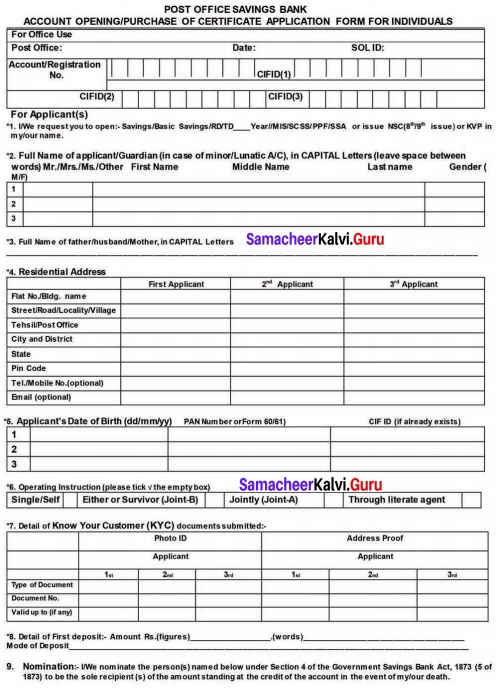
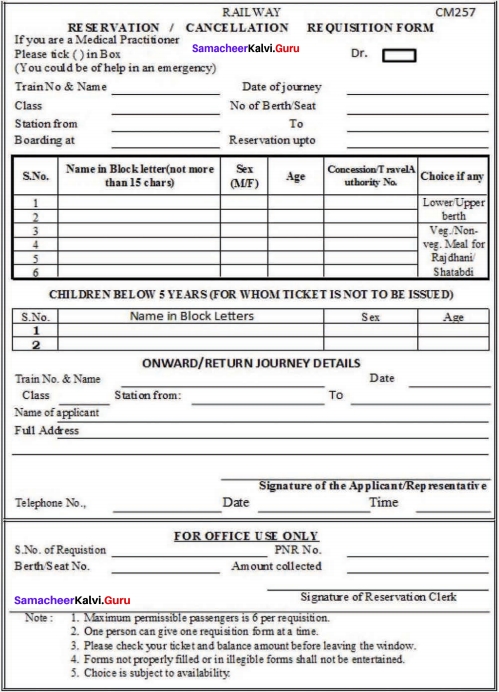
H. Fill in the Form given below.
Samacheer Kalvi 8th English Solutions Term 3 Prose Chapter 1 The Nose-Jewel
Answer:
Samacheer Kalvi 8th English Solutions Term 3 Prose Chapter 1 The Nose-Jewel

I. Fill in the Form given below.

Samacheer Kalvi 8th English Solutions Term 3 Prose Chapter 1 The Nose-Jewel
Answer:

Samacheer Kalvi 8th English Solutions Term 3 Prose Chapter 1 The Nose-Jewel

Grammar

Direct And Indirect Speech

A. Change the following into Indirect Speech :

Question 1.
“What do you want?” he said to her.
Answer:
He asked her what she wanted.

Question 2.
He said, “How’s your father?”
Answer:
He enquired how his father was.

Question 3.
“Are you coming home with me?” he asked.
Answer:
He asked him whether he was coming home with him.

Question 4.
The poor man exclaimed, “Will none of you help me?”
Answer:
The poor man asked in despair whether none of them would help him.

Question 5.
“Don’t you know the way home?” asked I.
Answer:
I asked whether he knew the way home.

B. Change the following into Indirect Speech :

Question 1.
“Bring me a glass of milk,” said the swami to the villagers.
Answer:
The swami commanded the villages to bring him a glass of milk.

Question 2.
Sit down, boys,” said the teacher.
Answer:
The teacher ordered the boys to sit down.

Question 3.
“Halt!” shouted the officer to his men.
Answer:
The officer shouted to his men to halt.

Question 4.
“Take off your hat,” the king said to the Hatter.
Answer:
The king ordered the Hatter to take off his hat.

Question 5.
The teacher said to him, “Do not read so fast.”
Answer:
The teacher commanded him not to read very fast.

Question 6.
He said to me, “Wait until I come.”
Answer:
He urged me to wait until he came.

Question 7.
“Hurry up,” he said to his servant, “do not waste time.”
Answer:
He ordered his servant to hurry up and not to waste time.

Question 8.
“Run away, children,” said their mother.
Answer:
Their mother urged the children to run away.

Question 9.
He said, “Daughter, take my golden jug, and fetch me some water from the Well.”
Answer:
He requested his daughter to take his golden jug and fetch him some water from the well.

Question 10.
“Go down to the bazaar. Bring me some oil and a lump of ice,” ordered his master.
Answer:
His master ordered him to go down to the bazaar and bring him some oil and a lump of ice.

C. Change the following into Indirect Speech :

Question 1.
He said, “My God! I am ruined.”
Answer:
He exclaimed sadly that he was ruined.

Question 2.
He said, “Alas! our foes are too strong.”
Answer:
He exclaimed sorrowfully that their foes were too strong.

Question 3.
“How smart you are!” she said.
Answer:
She exclaimed that he was very smart.

Question 4.
He said. “Oh ! that’s a nuisance.”
Answer:
He exclaimed with disgust that it was a nuisance.

Question 5.
He said, “What a pity you did not come!”
Answer:
He exclaimed with sorrow that he did not come.

D. What were the actual words used in each instance below? The sentences containing the actual words are listed afterwards in the wrong order. Write them out in the same order as the others.

  1. Punitha asked Pushpa what she was reading.
  2. Pushpa told her that he was reading Robinson Crusoe.
  3. Punitha asked her what it was all about.
  4. Pushpa said it was about a man wrecked on an island.
  5. Punitha then asked her friend who gave her the book.
  6. Pushpa answered that her uncle gave it to her at Christmas.
  7. Finally Punitha inquired if she could borrow it.
  8. Pushpa replied that she would certainly lend it to her.

(a) “May I borrow it?” inquired Punitha.
(b) “What are you reading, Pushpa?” asked Punitha.
(c) “It is about a man wrecked on an island,” Pushpa said.
(d) “Of course I will lend it to you,” replied Pushpa.
(e) “Uncle gave it to me at Christmas,’ answered Pushpa.
(f) “What is it all about?” Punitha asked.
(g) “I am reading Robinson Crusoe, Pushpa told her.
(h) “Who gave you the book, Pushpa?” Punitha then asked.
Answer:
(b) “What are you reading, Pushpa?” asked Punitha.
(g) “I am reading Robinson Crusoe”, Pushpa told her.
(f) “What is it all about?” Punitha asked.
(c) “It is about a man wrecked on an island,” Pushpa said.
(h) “Who gave you the book, Pushpa?” Punitha then asked.
(e) “Uncle gave it to me at Christmas,’ answered Pushpa.
(a) “May I borrow it?” inquired Punitha.
(d) “Of course I will lend it to you,” replied Pushpa.

E. Change the following into Direct Speech :

Question 1.
Nevin asked his father when the next letter would come.
Answer:
Nevin asked his father, “When will the next letter come?”

Question 2.
I wrote that I would visit him next day.
Answer:
I wrote, “I will visit you tomorrow”.

Question 3.
I told them to be quiet.
Answer:
I said to them, “Be quiet”.

Question 4.
Lakshan asked me if I had anything to say.
Answer:
He asked me, “Do you have anything to say”.

Question 5.
An old mouse asked who would bell the cat.
Answer:
An old mouse asked, “Who will bell the cat?”

Question 6.
Mervin said that he wanted to be a soldier.
Answer:
Mervin said, “I want to be a soldier”.

Question 7.
Elwin asked me what I wanted.
Answer:
He asked me, “What do you want?”

Question 8.
Bhagya said that she had seen that picture.
Answer:
Bhagya said, “I have seen this picture”.

Question 9.
The stranger asked Nasrin where she lived.
Answer:
The stranger asked Nasrin, “Where do you live?”

Question 10.
I asked Mary if she would lend me a pencil.
Answer:
I asked Mary, “Will you lend me a pencil?”.

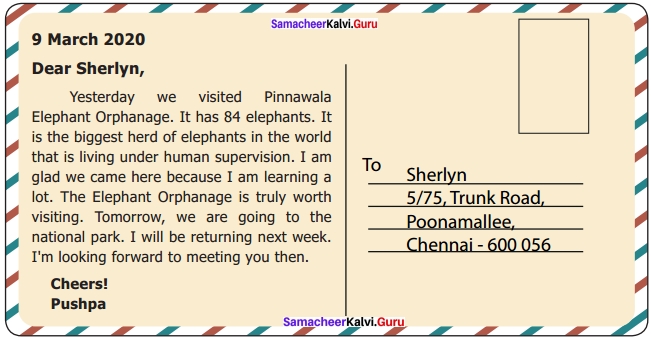
F. Sherlyn receives a postcard from her friend Pushpa who is holidaying in Sri Lanka. She calls her friend Galen and tells him what Pushpa has written. Help her by filling in the blanks, using reported speech.

Samacheer Kalvi 8th English Solutions Term 3 Prose Chapter 1 The Nose-Jewel
Answer:
Hello, Galen Today I received a postcard from Pushpa. Remember I had told you that She has gone to Sri Lanka on a holiday? Well, she has written from Colombo. She has written that she had visited Pinnawala Elephant Orphanage. It had 84 elephants. She said that it is the biggest herd of elephants in the world that is living under human supervision. She also added that she was glad that they had come there because she was learning a lot. The Elephant Orphanage was truly worth visiting. She said that next day, they are going to the national park. She would be returning next week and added that she was looking forward to meeting me then.

G. Convert the following into indirect speech.

a. Sharun said to me, ‘Are you coming to school tomorrow?’
Answer:
Sharun asked me if I am coming to school, the next day.

b. “We must visit the historical buildings of Delhi since we are here,’ said Ashok.
Answer:
Ashok said that they had to visit the historical building of Delhi, since they were there.

c. ‘Have you read The Wind in the Willows?’ asked Amutha.
Answer:
run Amutha asked whether he had read ‘The Wind in the Willows’.

d. Teacher said to us, ‘You must conduct the experiment very carefully.’
Answer:
The teacher told us that we had to conduct the experiment very carefully.

e. ‘Wow! That is great news!’ said Tejeswar.
Answer:
Tejaswar exclaimed happily that it was a great news.

The Nose-Jewel Grammar Additional

Direct And Indirect Speech

A. Change the following into indirect speech :

Question 1.
Ramu says, “I am busy”.
Answer:
Ramu says that he is busy.

Question 2.
Suresh said, “I like dancing”.
Answer:
Suresh said that he liked dancing.

Question 3.
He said, “I am going to the cinema”.
Answer:
He said that he was going to the cinema.

Question 4.
Ravi said, “I have bought a cycle”.
Answer:
Ravi said that he had bought a cycle.

Question 5.
Ram said, “Visu came at night”.
Answer:
Ram said that Visu had come at night. I

Question 6.
He said, “Honesty is the best policy”.
Answer:
He said that honesty is the best policy.

Question 7.
She said, “I have done my homework”.
Answer:
She said that she had done her homework.

Question 8.
He says, “I am happy”.
Answer:
He says that he is happy.

Question 9.
The teacher said, “Hari will definitely pass”.
Answer:
The teacher said that Hari would definitely pass.

Question 10.
Raju said, “I shall be here this evening”.
Answer:
Raju said that he would be there that evening.

B. Change the following into direct speech :

Question 1.
The teacher ordered the boys to leave that place.
Answer:
The teacher said to the boys, “Leave this place”.

Question 2.
I requested him to give me a glass of water.
Answer:
I said to him, “Please give me a glass of water”.

Question 3.
The captain ordered the soldiers to stand at ease.
Answer:
The captain said, “Stand at ease”.

Question 4.
My brother said that he might go to Kolkata.
Answer:
My brother said, “I may go to Kolkata”.

Question 5.
He said that the earth moves around the sun.
Answer:
He said, “The earth moves around the sun”.

Question 6.
Ravi asked Ganesh when he was going to the library.
Answer:
Ravi said to Ganesh, “When are you going to the library?”

Question 7.
The policeman ordered the.boy to show him his licence.
Answer:
The policeman said to the boy, “Show me your licence”.

Question 8.
She told him that she was going to the market then.
Answer:
She said to him, “I am going to the market now”.

Question 9.
He said that he was buying a cell phone that day.
Answer:
He said, “I am buying a cell phone today”.

Question 10.
He asked who I was.
Answer:
He said, “Who are you?”

Warm Up

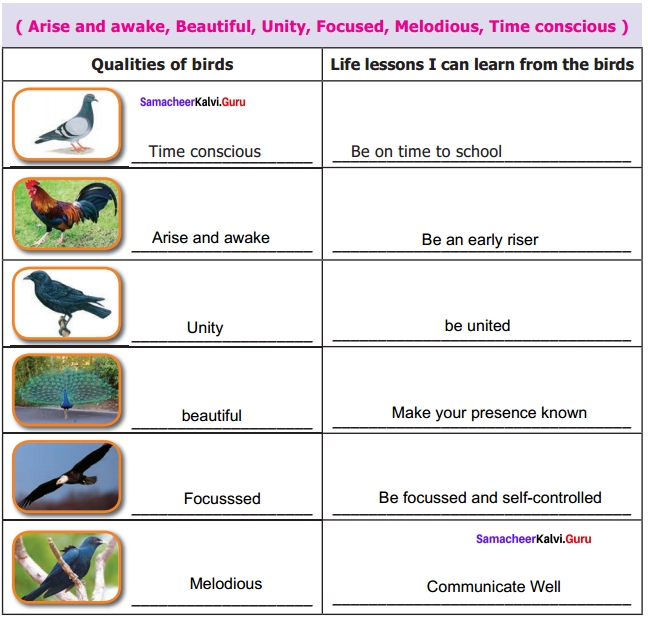
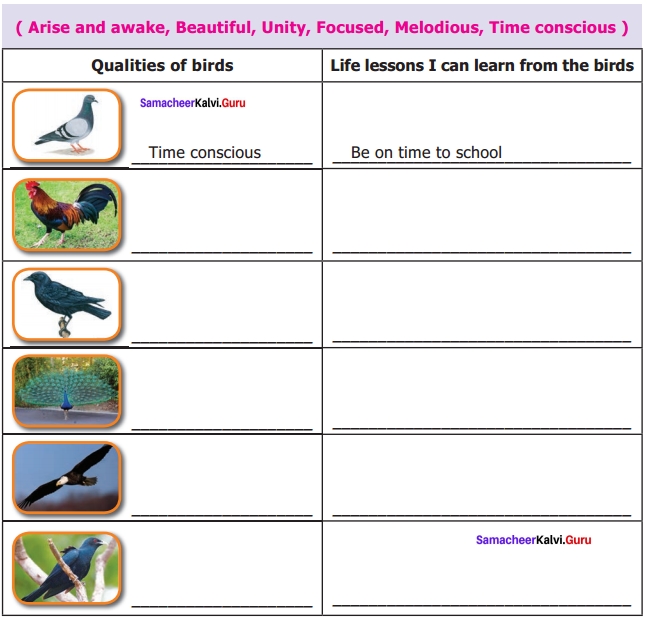
What are the life lessons that you can learn form the birds? Match the birds with the characters given in the box and fill in the blanks.

Samacheer Kalvi 8th English Solutions Term 3 Prose Chapter 1 The Nose-Jewel
Answer:
Samacheer Kalvi 8th English Solutions Term 3 Prose Chapter 1 The Nose-Jewel

The Nose Jewel Summary By C Rajagopalachari

Ramayya was a simple man, who lived in a town. His house was made of tiled roots He lived with ‘made his wife. He was not rich. But took good care of his family. On the roof of his house, two sparrows built a nest. The mother-bird laid her eggs in it. The male-bird wanted to help Ramavya, as he noticed Ramayyas wife always quarrelling with him. But the female bird advised her male bird not to bother about-others. But to mind their own business.

One day, the male-bird found a diamond nose-jewel in a heap. When he showed it to his wife, she replied that it was of no use to her. So she asked him to find some food for the young ones. The bird dropped the diamond stud on the floor and went out in search of food.

Ramayyas wife noticed the jewel as she was sweeping the floor. She picked it with delight and wore it. Her husband shouted at her and told her that they should go and deliver it to the magistrate. But his wife wouldn’t want to part with it.

This nose-stud belonged to their neighbour, Meenakshi Ammal’s daughter. She forgot and left it in the bathroom. Kuppayi, their servant woman would have swept it out. Meenakshi Ammal consoled her daughter. She also advised her not to inform her father Ramanatham about the lost stud. He would become very angry. But her husband Ramanatham and the whole village knew about it. The maid servant was suspected to have stolen it. The police came and searched her hut. But they could not find it.

Ramayyas wife put the stud away in her box. She soon developed a severe fever and was always in her bed. The two birds witnessed all this and thought that “we should never be greedy for what belongs to others.” Ramayya and his wife spent the rest of their lives in fear of being caught.

Samacheer Kalvi 9th English Solutions Prose Chapter 1 Learning the Game

You can Download Learning the Game Questions and Answers, Summary, Activity, Notes, Samacheer Kalvi 9th English Book Solutions Guide Pdf Prose Chapter 1 help you to revise complete Tamilnadu State Board New Syllabus and score more marks in your examinations.

Tamilnadu Samacheer Kalvi 9th English Solutions Prose Chapter 1 Learning the Game

Learning the Game Warm Up:

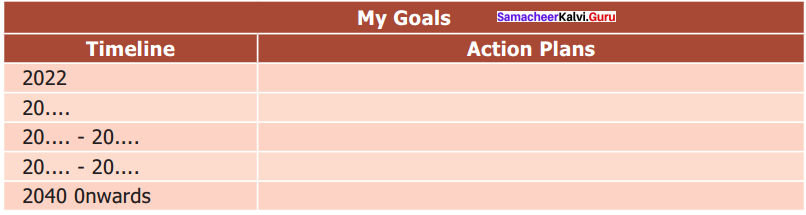
1. Think of what you would like to do in future. Fill in the spaces.
9th English Guide Samacheer Kalvi Prose Chapter 1 Learning The Game
Answer:
2022 – To score 75% marks in the HS Board Examination; 2022-2026 – To complete any chosen Degree course; 2026-2029 – To take up Higher Degrees in the chosen field; 2030-2039 – Into job (professional and personal uplift); 2040 Onwards – To do some social service besides the regular job.

Learning the Game Intext Questions

9th English Guide Question 1.
Who were Sachin’s favourite players?
Answer:
Sunil Gavaskar and the West Indian legend Viv Richards were Sachin’s favourite players.

Learning The Game 9th Standard Question 2.
What was special about Shardashram Vidyamandir in Mumbai?
Answer:
Compared to many other schools in Mumbai, Shardashram Vidyamandir gave due importance to the game of cricket. Mr. Ramakant Achrekar was the cricket coach there and he regularly conducted summer camps.

Learning The Game Question Answer Question 3.
What was the opportunity that transformed the life of Sachin?
Answer:
The opportunity to join Achrekar Sir’s camp involving a session in the morning and evening at Shivaji Park transformed the life of Sachin.

Learning The Game 9th Standard Question Answer Question 4.
What sort of converstions did Ajit and Sachin have while travelling?
Answer:
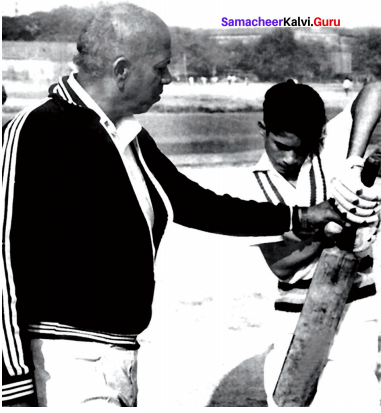
While travelling in the bus, Ajit would talk to Sachin about the nuances of batting a lot.

9th English Learning The Game Question Answer Question 5.
What routine did Sachin follow in washing his clothes?
Answer:
Sachin had only one set of cricket clothes and the routine was to wash them as soon as he’d return from the morning session. While he had his lunch, the clothes would dry out in the sun and he would wear them again in the afternoon. The pattern was repeated in the evening so that he could use the same set of clothes the following morning.
9th Learning The Game Question Answer Question 6.
What did Achrekar inform Ajit?
Answer:
Achrekar informed Ajit that Sachin had the potential to be a good cricketer if he practiced all year round.

Learning The Game Book Back Answers Question 7.
What was the suggestion given by Achrekar to Sachin’s father?
Answer:
Achrekar suggested that Sachin should change schools if he wanted to pursue cricket seriously, since the New English School in Bandra, where Sachin was studying, did not have cricket facilities.

9th Standard English Learning The Game Pdf Question 8.
What acted as a safety valve?
Answer:
At Shardashram Vidyamandir, where Achrekar Sir was the cricket coach, all his excess energies were getting channeled into cricket, which acted as a kind of safety valve for Sachin.

Learning The Game 9th Standard Pdf Question 9.
What did Sachin do during the thirty-minute break?
Answer:
During the thirty-minute break, Sachin would often have a vadapav, a popular Mumbai fast food, with the money that Achrekar sir would give him.

9th Standard English Guide Question 10.
What is the intense ‘fifteen minutes’ mentioned?
Answer:
Between 5 pm and 7 pm, Sachin would have five more net sessions. Towards the last 15 minutes, Achrekar Sir would place a one rupee coin on top of the stumps and if Sachin managed to avoid getting out, the coin was his. In this session every bowler in the camp would come and bowl to him, with some sixty to seventy boys fielding. It meant he had to hit every ball along the ground to survive and win the one rupee coin. This period was the intense fifteen minutes.

Learning The Game Question 11.
What did Sachin’s father do just to make Sachin happy?
Answer:
Occasionally, Sachin’s father took him home. Sachin would always ask his father to treat him to a special fruit cocktail at a juice centre near the club. Though it was a little unreasonable, his father would give him what he wanted, just to see him happy.

Learning The Game Lesson Question Answer Question 12.
What did embarrass Sachin in the bus?
Answer:
Sometimes Sachin had to travel home from Shivaji Park by bus. In the crowded buses, it was a challenge to stand with his kitbag. The conductors were often rude and would inevitably complain that Sachin was taking the place of two passengers and even asked him to buy ticket for two. As he never had extra money it embarrassed him. His dirty clothes added to the same.

9th English Guide Pdf Question 13.
What made Sachin forget to go to the nets?
Answer:
Occasionally, while playing with his friends at home, Sachin would conveniently forget to go to the nets amidst all the fun.

Learning The Game Sachin Tendulkar Pdf Question 14.
What did Achrekar advise Sachin?
Answer:
Achrekar advised Sachin not to waste his time playing insane games with kids. He would say that Cricket was waiting for him at the nets and that he should practice hard to see what magic can transpire.

Learning the Game Textual Questions

A. Answer the following questions in one or two sentences.

Learning The Game Sachin Tendulkar Question Answer Question 1.
What was coach Achrekar’s first impression on Sachin?
Answer:
Coach Achrekar’s first impression on Sachin was that he was too young to make the camp.

Learning The Game Questions And Answers Question 2.
Why did Sachin feel that the schedule of the camp was ‘rigorous’?
Answer:
Sachin had to practice between 7.30 am and 10.30 am and again he would practice from afternoon to the evening. By the end of the day he would feel exhausted and hence Sachin felt the schedule to be rigorous.

Learning The Game By Sachin Tendulkar Question 3.
What did serve as a very personal cocaching manual to Sachin?
Answer:
Initially, Ajit accompanied Sachin for the practice sessions by bus and he would talk to him about the nuances of batting. The note that Ajit gave Sachin containing some thoughts about batting served as a very personal coaching manual to him.

Learning The Game Summary Question 4.
Why was Sachin asked to change the school?
Answer:
Sachin was asked to change the school because he wanted to pursue cricket as his career.

Samacheer Kalvi 9th English Book Answers Question 5.
What was the condition laid down by Sachin’s father for changing the school?
Answer:
Sachin’s father made Sachin understand that he could change school only if he was serious about playing cricket.

Question 6.
How did the act with the one rupee coin help Sachin become a good cricketer?
Answer:
Winning the one-rupee coin used to give him immense satisfaction and taught him how to concentrate even when physically drained. The drive to get the one rupee for himself surely helped Sachin to survive the last fifteen minutes of his rigorous training and strive hard to survive all the bowlers and sixty to seventy boys who fielded him.

Question 7.
What did help Sachin to build his physical and mental stamina?
Answer:
The final part of the training for a day would be running two full circuits at Shivaji Park with his pads and gloves on. It was a routine he would repeat right through his summer holidays and it helped him to build his physical and mental stamina.

Question 8.
Which incident triggered the coach to be angry on Sachin?
Answer:
Achrekar, the coach was indeed angry on Sachin when he played with his friends at home having fun and not turning up for cricket coaching giving lame excuses.

Question 9.
Why do you think Achrekar punised Sachin?
Answer:
Achrekar knew that Sachin was a promising cricketer the world would one day look at with awe. Therefore, he punished Sachin.

Question 10.
‘I owe myself to him ’ – What does Sachin mean by this?
Answer:
All the fame, popularity, wealth and recognition that Sachin gets today is because of his coach Achrekar. Hence he says, ‘I owe myself to him.’

Additional Questions

Question 1.
How old was Sachin when he started to train under Achrekar?
Answer:
Sachin was eleven when he started to train under Achrekar.

Question 2.
What was the similarity between Sachin and his coach?
Answer:
Achrekar was eleven when he started playing cricket in 1943 and Sachin was also eleven when he went to Achrekar for the first time. ,

Question 3.
Quote a couple of instances from the text that show Sachin’s love for cricket from early childhood.
Answer:
From a very early age, I played tennis-ball cricket with my colony friends. I loved watching cricket on television and, I often tried to emulate the mannerisms of my favourite players. These lines from the text show Sachin’s love for cricket from early childhood.

Question 4.
How did the school Shardashram Vidyamandir differ from other schools in Mumbai?
Answer:
Compared to many other schools in Mumbai, Shardashram Vidyamandir gave importance to the game of cricket. It was all the more different since Achrekar Sir was the cricket coach too.

Question 5.
In which year was Sachin Tendulkar a part of the World Cup-winning team for India?
Answer:
Sachin Tendulkar was a part of the World Cup-winning team for India in 2011.

Question 6.
What was the suggestion given by Ajit to Coach Achrekar that helped Sachin to overcome his nervousness?
Answer:
Ajit suggested that Sir Achrekar, the coach should go away while Sachin was batting and then watch him from a distance since he was confident of his brother’s talent.

Question 7.
“The system worked well – apart from my pockets.” What is the ‘system’ referred to here by Sachin?
Answer:
Sachin had only one set of cricket clothes. So he had to wash them as soon as he returned from the morning session. He repeated the same process in the evening so that he could use the same set of clothes the next day. This was the ‘system’ referred to here.

Question 8.
This regular demand was “a little unreasonable.” What was the unreasonable demand? Why?
Answer:
Sachin would ask his father to treat him with a special fruit cocktail. He did not realize that his parents also had to take care of the needs of his brothers and sisters. Hence this was an unreasonable demand.

Question 9.
Why was Sachin asked by the bus conductor to buy two tickets?
Answer:
When Sachin had to stand in the bus with his kitbag, the conductors would complain about his , kitbag taking up the space of another passenger. So they would ask him to buy two tickets.

Question 10.
What would Achrekar do if Sachin did not turn up for coaching?
Answer:
If Sachin did not turn up for coaching, Achrekar would jump on his scooter to find him having fun with his friends at home. He would drag him out of the house and together head towards Shivaji Park to pursue practice. .
B. Answer the following in a paragraph of 120 – 150 words:

1. ‘Achrekar was a sincere coach’. Substantiate.
Answer:
Ramakant Achrekar started playing Cricket in the year 1943 when he was eleven. His most famous student is undoubtedly Sachin Ramesh Tendulkar, India’s Highest run scorer in both Tests and ODIs and also the current record holder for multiple records! He has been instrumental in grooming some of the country’s most renowned cricketers like Vinod Kambli, Ajit Agarkar and Romesh Powar.

Achrekar coached young cricketers at Shivaji Park, Dadar in Mumbai. Sachin trained under him when he too was just eleven, while he was a student at the New English School, Mumbai. Later Sachin was asked to change to Shardashram Vidyamandir, Mumbai where he coached. When he was young, Tendulkar would practice for hours and hours in the nets. If he became exhausted, Achrekar would put a one-rupee-coin on the top of the stumps, and the bowler who dismissed Tendulkar would get the coin.

If Tendulkar passed the whole session without getting dismissed, the coach would give him the coin. Such a motivational reward from the coach made Tendulkar strive and survive to win the coin. Tendulkar recalled an incident when his coach told him to play for ‘B’ team of his School. Instead of batting, he preferred sitting in the gallery and cheering for his schoolmates. In the evening, when he came across Achrekar, he was asked how many runs he had scored. Taken aback, Tendulkar told him that he was clapping and cheering up. Then came a slap which shattered his myth. He realized what a mistake he had committed. Achrekar told him firmly that he was not born to just clap for others but for others to watch him and clap for him.

Question 2.
Narrate in your own words the hardships underwent by Sachin to become a great cricketer.
Answer:
Ajit, one day, took his brother Sachin to the Achrekar Sir’s camp to get trained. Sachin was nervous and failed miserably in front of him. Ajit asked the coach to give him another chance and observe him unawares. This time, Sir agreed to let him join the camp. The camp involved a session every morning and evening at Shivaji Park. He would practice between 7.30 a.m. and 10.30 a.m. in the morning. Then he would come back in the afternoon and practice till late evening. The schedule was rigorous and he would be exhausted by the end of the day. Travelling to Shivaji Park took forty minutes from his house in Bandra and he had to catch an early morning bus to make it on time.

As a child, he had only one set of cricket clothes and the routine was to wash them as soon as he returned to wear it for the next session. By the middle of the summer camp, Sir had started taking an active interest in his batting and at the end of the two months, informed Ajit that he had the potential to be a good cricketer if he practiced all year round. In his first year at Shardashram, he played fifty five practice matches during the summer break of sixty days. His summer sessions used to start at 7.30 am and end at 4.30 pm.

His evening session would start at 5 pm after a thirty-minute break. Between 5 pm and 7 pm he would have five more net sessions. Towards the last 15 minutes, every bowler in the camp would come and bowl to him, with some sixty to seventy boys fielding. At the end of it all., Sir would tell hi to run two full circuits of Shivaji Park with his pads and gloves on. That was the last part of his training and he would be completely exhausted by the end of it all. It was a routine he would repeat right through his summer holidays.

Question 3.
Quote the sentences which you find most inspiring from ‘Learning the Game’. How do they inspire you? Explain.
Answer:
Sachin Ramesh Tendulkar, the world famous cricketer has set many records in his career and is considered as one of the greatest Batsman of all times. ‘I often tried to emulate the mannerisms of my favorite players, Sunil Gavaskar and the West Indian legend Viv Richards.’ – This is one of the inspiring sentences to me.

If Sachin can emulate and have a role model, how important it is for me to find my role model to pursue my career, ‘Winning the one-rupee coin used to give me immense satisfaction and taught me how to concentrate even when physically drained. ’ – Rewards are surely a big motivational factor. Hence, it is quite important that we fix a target and strive hard even during dire circumstances that we should be focused to achieve in life.

‘I didn’t have the money for a second ticket and I had to learn to take these remarks in my stride. ’ – Life is full of ups and downs. We should never yield to any kind of pressure and give up easily. Life is a mixture of success and failure and the road to success is never a bed of roses. We should be ready to tread on a rough path with many pitfalls. However, we need to be determined and perseverant in our journey. Above all the words from the coach is the most inspiring. It penetrates into your heart to know the purpose of your life. It pierces your heart and makes you be focused and chase your dream. ‘Cricket is waiting for you at the nets. Practice hard and see what magic can transpire.’

Additional Questions:

Question 1.
The child in Sachin is indeed clear in the lesson, ‘Learning the Game’ – Substantiate.
answer:
The nervousness in a child is vivid in Sachin. He has never batted in the nets and feels somewhat overawed with so many people around him when Aj it takes him to be trained under Achrekar Sir. When he is asked to bat, he is not at all comfortable since he is very childish and not career oriented. With Sir watching him so closely, he fails to make an impact in his future coach. His nervousness takes a sixer, with his coach pretending to be engaged with other things and manages to impress Achrekar sir.

Even though Sachin loved cricket, there were occasions when playing with his friends at home was more fun for him than going for practice. He would conveniently forget going to the nets. He would be engrossed in a melee with his friends. Just as a kid would give excuses, he too would give umpteen number of lame excuses. He would sometimes bunk his daily evening practice to just watch an inter-school cricket match not realizing that he needs to practice for the whole world to watch him play

Vocabulary:

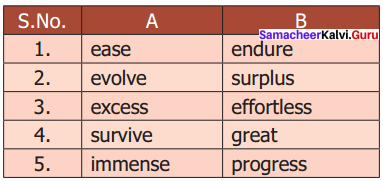
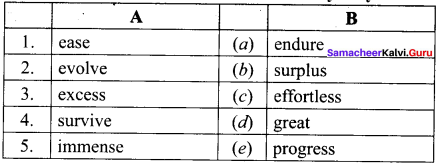
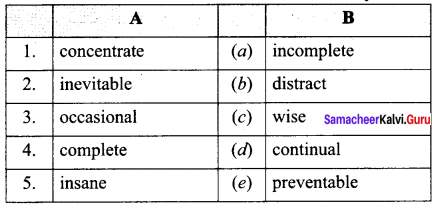
C. Match the words in column A with their synonym in column B.

Learning The Game 9th Standard Samacheer Kalvi Prose Chapter 1 Learning The GameLearning The Game Question Answer Samacheer Kalvi 9th English Solutions Prose Chapter 1
Answers:

  1. (c)
  2. (e)
  3. (b)
  4. (a)
  5. (d)

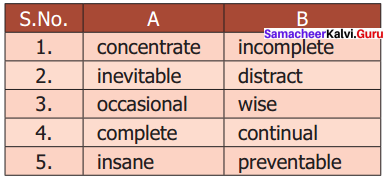
D. Match the words in column A with their antonym in column B.

Learning The Game 9th Standard Question Answer Samacheer Kalvi Prose Chapter 1 Learning The Game9th English Learning The Game Question Answer Samacheer Kalvi Prose Chapter 1 Learning The Game

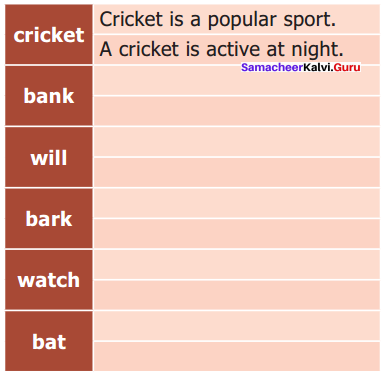
E. Homonyms

Homonyms are words with similar sound and spelling, but with a different meaning.
Use the words given below in your own sentences so as to get different meanings. One is done for you.

9th Learning The Game Question Answer Samacheer Kalvi Prose Chapter 1 Learning The Game
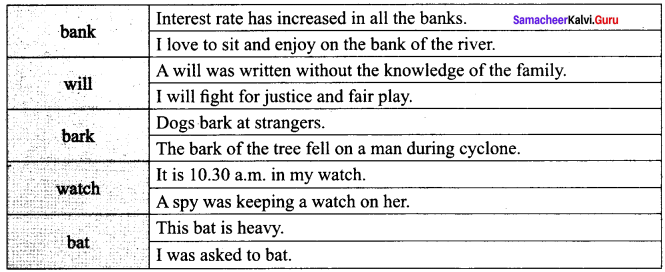
Answer:
Learning The Game Book Back Answers Samacheer Kalvi Prose Chapter 1 Learning The Game

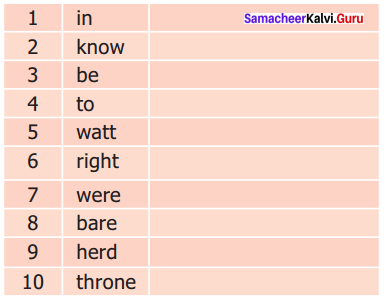
F. Homophones

Homophones are words with similar sound but different spelling and meaning.
Consult a dictionary, to find the homophones for the given words.

9th Standard English Learning The Game Pdf Samacheer Kalvi Prose Chapter 1 Learning The Game
Answers:

  1. inn
  2. no
  3. bee
  4. two
  5. what
  6. write
  7. where
  8. bear
  9. heard
  10. thrown

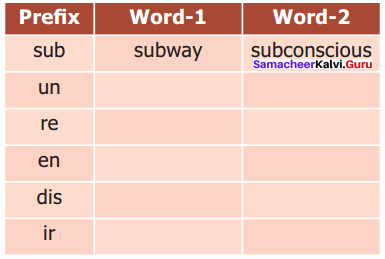
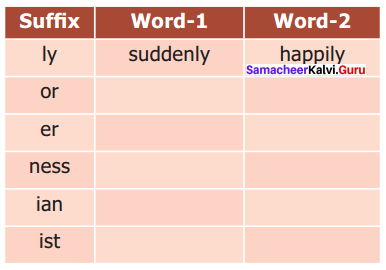
G. Prefix and Suffix

Prefixes are added to the beginning of a root word while suffixes are added to the end.
Look at the prefixes given and frame two new words for each prefix and suffix. One is done for you.
Learning The Game 9th Standard Pdf Samacheer Kalvi Prose Chapter 1 Learning The Game
Answers:
2. untold, unwise
3. reunion, rewind
4. enrol, enroute
5. disorganised, disoriented
6. irregular, irresponsible

9th Standard English Guide Samacheer Kalvi Prose Chapter 1 Learning The Game
Answers:
2. distributor, accelerator
3. typewriter, malpractitioner
4. kindness, unpleasantness
5. electrician, academician
6. economist, nutritionist

Listening:

H. Listen to the passage on Paralympics and choose the correct answer.

(For listening to the passage refer to our website www.fullcircleeducation.in) The Olympic Games began in Greece about three thousand years ago. All wars stopped for the Olympics in those days. The discus and the Pentathlon began in these early Olympic Games. In 394 the Romans stopped the Greek Olympic Games, because they didn’t like them. In 1896, Frenchman – Pierre de Coubertin began the Olympic Games again. These days the Olympic Games usually happen every four years.

But how did the Paralympics for disabled begin? In the 1940s Sir Ludwig Guttmann was a doctor at the Stoke Mandeville hospital in England. At the hospital there were many disabled soldiers from World War II and Guttmann wanted these soldiers to get better by doing sports. The Paralympics are younger than the Olympics, but they are getting bigger all the time. The first true Paralympic Games happened in Rome in 1960.

Four hundred disabled athletes from twenty-three different countries came to these Games. At the Beijing Paralympics in 2008, there were 4,000 disabled athletes from 144 countries! These days there are Paralympic Games every four years, and because it’s easier for Paralympic athletes to stay in Olympic hotels and to run in Olympic stadiums, the Paralympics usually happen in the Olympic cities, too. Think of swimming with only one leg against people with two legs. Think of running with artificial legs. Think of playing basketball in a wheelchair. Disabled people can do some wonderful things!

1. The Paralympic games are for ……………….. .
(a) children
(b) disabled people
(c) women
Answer:
(b) disabled people

2. The Paralympic games usually happen ………………… .
(a) in Greece
(b) every four years
(c) after the Olympic Games
Answer:
(c) after the Olympic Games

3. The first true Paralympic Games happened in Rome in ……………… .
(a) 1960
(b) 1952
(c) 1848
Answer:
(a) 1960

4. In 394 BCE, the ………………. stopped the Greek Olympic Games, because they didn’t like them.
(a) Romans
(b) Greeks
(c) British
Answer:
(a) Romans

5. ……………… was a doctor at the Stoke Mandeville hospital in England.
(a) Pierre de Coubertin
(b) Sir Ludwig Guttmann
(c) Natalie du Toit
Answer:
(b) Sir Ludwig Guttmann

Speaking:

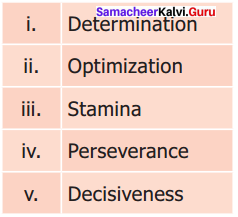
I. Given below are five main qualities for true sportsmanship.

Learning The Game Samacheer Kalvi 9th English Solutions Prose Chapter 1

Get into groups of four. Each group will choose one quality to talk about to the whole class for about one minute. But before you talk, you have two minutes to think about it. You can make notes if you wish.

Group A: Determination
It is said that desire is the key to motivation, but it is determination and commitment to an unrelenting pursuit, a commitment to excellence, that will help in attaining the success. Being determined gives strength to push. Even when you don’t want to, just knowing you should will give you that extra bump in right direction.

All great achievers in life have made it where they are today due to their hard work, commitment and determination. Everything is work in progress at some point and with the strength of determination it becomes an achievement in time. Prioritizing your life helps you keep your goals in check and likewise makes them easier to accomplish.

Michael Jordon’s high school basketball coach refused to take him in the team. Jordan did not agree or accept what his coach said. Everyday after school he practiced and practiced and practiced. He did not give up until he sunk one thousand successful shots. His determination drove him to achieve ultimate success in life. With the help of a good set of priorities to overcome and conquer the reflection he faced, when his coach told him he was not good enough, he succeeded over all.

Group B: Optimization
Optimization is the process of adjusting a trading system in an attempt to make it effective. Some people think that the best kind of life is one that is filled with family. Some may think that it is concerning living life without any regrets and being prosperous, healthy and having someone to share it all with.

Making choices can affect any and everything in life. According to George Terry, “Decision making is the selection based on some criteria from two or more possible alternatives.” It is . part of problem solving. Optimization is making the maximum use or benefit of that right decision taken. Schooling is imperative in ones early period of life. Where to study has always been a choice that parents take for giving quality education. To tap the maximum, the parent try to optimize the sources available.

No one in this world wants less. Everything must be perfect. From the household machines to stationeries, tools, equipment, furniture, house, etc., its output must be maximum.

True optimization is the revolutionary contribution of modem research to decision processes.

Group C: Stamina
“Champions aren’t made in gyms. Champions are made from something they have deep inside them – a desire, a dream, a vision. They have to have last-minute stamina, they have to be a little faster, they have to have the skill and the will. But the will must be stronger than the skill.” – Muhammad Ali.

Stamina not only refers to physical strength but mental strength too -the grit. It is the ability to sustain over time, to call from ourselves renewed commitment and effort when we are confronted with challenges or hardship. Stamina helps in tolerating discomfort and reach for resources we are not certain we possess. Stamina means that we remain steadfast even through criticism, monotony, and discouraging odds.

When a person is able to accomplish or withstand a higher amount of effort than their original capabilities, their endurance is increasing which to many personnel indicates progress in looking to improve ones stamina. If higher repetitions are taken rapidly muscle strength improves. A gain in stamina decreases anxiety, depression and stress. Stamina is the ability of a force to sustain high levels of combat potential relative to its opponent. Thus stamina refers to keep going through a tough situation involving hardship, stress, etc.

Group D: Perseverance
A patient person with strong determination can achieve his goal by perseverance. Perseverance is the secret of success. Without it, no great achievement is possible. Every action has its reaction. So hard labour has no alternative. It must yield results. “Rome was not built in a day;” likewise monuments, palaces, forts, etc., were built only by long and hard labour. It is through perseverance of thousands of diligent men that such magnificent structures can be erected.

Perseverance means the constant or persistent dedication of efforts, time and mind in doing some activity irrespective of difficulties and delays in achieving the ultimate goal or success. In the ecosystem, survival of fittest also relates to the perseverance mechanism. Success need not always be in the bags of intelligent people. There are some intelligent people who are reluctant and lethargic; so they don’t use their ideas, skills or even labour in the right way. On the other hand, one who is determined, focused and does not give up by facing failures achieves the final goal. “Great works are performed not by strength but by perseverance.”

Group E: Decisiveness
The core quality of a leader is decisiveness. When decisions need to be made effective leaders gather facts, analyse the situation, consider alternatives and decide the best course of action. Decisiveness is a great quality that does not allow you to procrastinate or stand around wringing the hands. They move on. Decisive leaders understand that their decisions may not be perfect and therefore modifications . may be needed. They don’t hesitate to modify or alter their decisions. Making good decision is too important to be left to chance. Emotions have a huge influence over the quality of decision making, preventing from making sound judgements.

Decisiveness is the willingness to make decisions, even in the face of complexity or uncertainty. When we are decisive, we weigh the information that is available to us and we use our judgement to choose among the possibilities. It is easier to be decisive when we are clear about our values and goals. Perfect clarity will never be available and indecision can be costly. So taking decision and going ahead in the plan is important. Decisiveness is dare to do with right motive, which is an essential quality every person must acquire.

J. Prepare a speech in about 80-100 words for the morning assembly, stressing on the importance of games and sports in ensuring a healthy body and mind.

Life is a game and the world is a playground. We have to play the game of life with all our energy and courage. Games and sports help us to learn how to overcome the challenges of life. A sound mind lives only in a sound body. Sports and games are useful for the students who must have a balanced development of the body as well as the mind.

Education is incomplete without games. Games are necessary to keep the body fit and trim. Moreover, they provide recreation. Students feel happier in a playground than in a classroom. Games also teach us that we should play a game for game’s sake, not for victory or defeat. Games and sports also produce a sense of equality, co-operation and fraternity.

Writing:

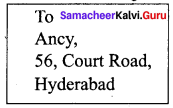
K. Your friend who lives in another town/city has won his/her championship trophy in the recent sports meet. Write a letter congratulating him/her.
27 May 2019 Chennai
Dear Ancy,
Congratulations on winning the Championship Trophy in the sports meet held in Gachibowli Athletic Stadium in Hyderabad. We knew you will rock. You are bom to win. I heard you received gold medals in 100 m and 200 m dash, a silver medal in 4 x 100 m relay, and another silver in 100 m hurdles. That’s great. You have got such medals here in our school. Even in the State meet you have kept up your standard. Very good! Hats off to you!!! We are waiting here to hear from you the experience that you underwent and who was your tough competitor. Awaiting eagerly to listen from you. I hope you will be back soon. Bye.
Yours friendly
Kanmani

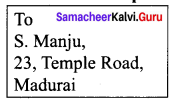
Address on the envelope:
Learning The Game Lesson Question Answer Samacheer Kalvi 9th English Solutions Prose Chapter 1

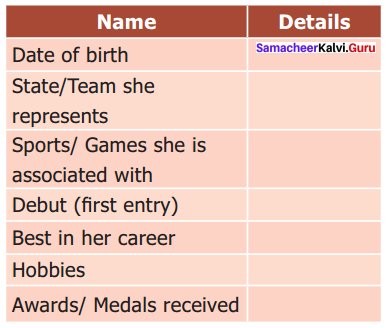
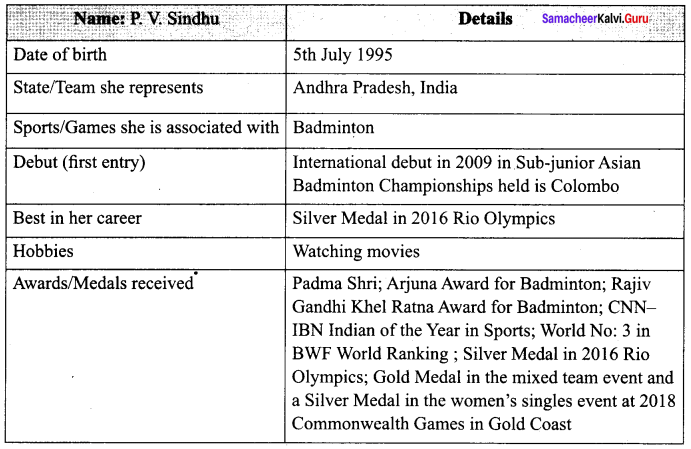
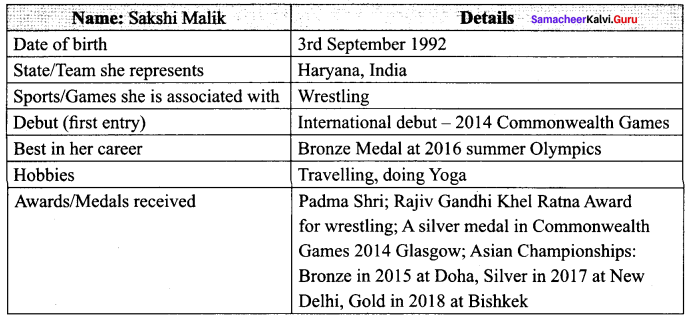
L. Collect information from newspapers, magazines, periodicals and books about any two famous sportswomen. Prepare their profiles. Use the following format:

9th English Guide Pdf Samacheer Kalvi Prose Chapter 1 Learning The Game
Answer:
Learning The Game Sachin Tendulkar Pdf Samacheer Kalvi 9th English Solutions Prose Chapter 1
Learning The Game Sachin Tendulkar Question Answer Samacheer Kalvi 9th English Solutions Prose Chapter 1

Creative Writing:

M. Write a newspaper article in about 100 words, comparing the achievements of the two sportswomen based on the information you have already collected.
Two Sports Women
Sakshi Malik, an Indian wrestler from Haryana was bom on 3rd September 1992. P.V. Sindhu the Indian Badminton player was bom on 5 th July 1995. Both of them have given their presence in International Debut in the year 2009 and 2014 respectively. Both of them participated and won medals in 2016 Rio Olympics, after which they were awarded Padma Shri, the fourth highest civilian award in India. They hold innumerable records both National and International. . Sakshi has been incredible as she comes from a land where they kill daughters in the womb itself. From such a setting, she came up taking a masculine sport, broke all odds and finally made the country proud. From Sindhu the country can learn the importance of being a good student of the game, and also about what you can do when you have the best coaches around.

Reading:

N. Answer the following questions briefly.

Question 1.
What do Tamil Nadu folk dances and folk arts represent?
Answer:
Tamil Nadu is deeply rooted in a great tradition of folk arts and crafts, which display the customs and skills that have come down from generations. The folk music and dances of Tamil Nadu represent the ethos, aesthetics, values and melody of the region.

Question 2.
When are folk dances and folk music usually performed?
Answer:
Traditionally, folk dances and music are performed during festivals and community functions.

Question 3.
How is Karagattam performed?
Answer:
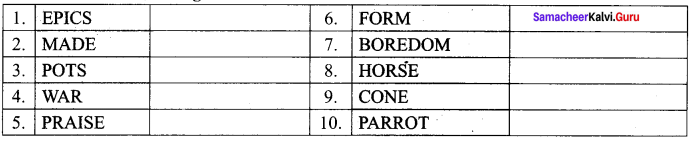
Karagattam is a popular folk dance of Tamil Nadu, which involves balancing a pot on the head to musical accompaniment. The Karagam pots are decorated with a cone of flower arrangements, topped by a paper parrot. The parrot swings as the dancer swings along.

Question 4.
How were offerings carried during the ancient period?
Answer:
Kavadi Aattam is one of the predominant folk dances of Tamil Nadu. A Kavadi is made of bamboo strips and a light pole. When the ancient Tamils went on pilgrimages, they used to carry offerings tied on either end of a long stick, balanced on their shoulders. To lessen the boredom of the long travel, they sang and danced in praise of God. Kavadi Aattam traces its origin to this practice. This led to the composition of special songs for carrying the Kavadi.

Question 5.
Bring out a few differences between the two art forms Therukoothu and Bommalattam.
Answer:
Bommalattam or Puppetry is held in rural areas of Tamil Nadu during festivals and fairs. Skilled puppeteers manipulate the puppets with strings or wires. They stand behind a screen and the puppets are held in front. The puppetry depicts stories mainly from the Puranas, epics and folklore. Even during Indian freedom struggle, the awareness programmes for the common people were conducted through puppet shows to instill patriotism among the people. Therukoothu is usually conducted during village festivals in the months of Aadi and Panguni. In this dance form, make-up and costumes are considered very important. It is performed on the streets and in open air. The performance involves storytelling, songs, dance and dialogue rendering.

Anagrams:

O. An anagram is a word or a phrase formed by rearranging the letters of a different word or phrase, typically using all the original letters exactly once.

Learning The Game Questions And Answers Samacheer Kalvi 9th English Solutions Prose Chapter 1
Answers:

  1. Bowel
  2. Notices
  3. Review
  4. Slipper
  5. Lessened

P. Work with a partner

Pick out two words from the article on folk culture and folklore of Tamil Nadu with which you can form anagrams. Take turns and ask your partner to solve the anagram and come out with the right words.

Learning The Game By Sachin Tendulkar Samacheer Kalvi 9th English Solutions Prose Chapter 1
Answers:

  1. Spice
  2. Dame
  3. Stop
  4. Raw
  5. Aspire
  6. From
  7. Bedroom
  8. Shore
  9. Once
  10. Raptor

A Talk Show:

Q. Work in groups of 4-6. Choose one folk art form, that is rarely or no longer performed.

Find out the reasons for this and suggest practical solutions/steps that can be taken to prevent this. After discussion and research, conduct a talk show in the class on the topic FOLK ARTS -AREVIVAL. The following inputs will help you.

Each group will consist of the following members.
1. The host
2. A folk artist
3. A representative from an NGO engaged in reviving some of the dying folk arts
4. A student
5. A citizen from the city
NOTE: Your teacher will distribute role cards with cues to each member of the group to help . you play your roles.
A suggestive article is given here. Students can arrange the Talk Show under the guidance of their teacher.

Dhokhra Handicraft:
Dhokra handicraft is a wax casting technique which has been in India for more than 4,000 years. One of the earliest known artifacts is the ‘Dancing Girl’ of Mohenjo-daro. In modem times, this rare art form is the speciality of the Bastar region, a district in Chhattisgarh. The native tribes of the region are practicing the art and their products are in great demand in domestic and foreign markets because of primitive simplicity, enchanting folk motifs and forceful form. However, the art is dying and no one has been able to come up with a technology to save it.

Grammar:

A. Choose the most appropriate preposition from the brackets.

  1. We have been living in Chennai ……………. eight years, (for / since)
  2. Abdul has taken his ……………… father, (after / at)
  3. Vimal generally goes to his workplace ………….. bus. (by / on)
  4. The cricket ball was hidden …………. the leaves, (among / between)
  5. Mani divided his toys ………………. his brothers and sisters, (among / between)

Answers :

  1. for
  2. after
  3. by
  4. among
  5. among

B. Identify the prepositions in the given sentences and underline them.

  1. Riya borrowed a dress from me and lent it to her friend, Mary.
  2. When I moved back to the city, things had changed considerably.
  3. The burglar found the keys under the pot in the balcony.
  4. Prabhu was hiding behind the door when his sister came looking for him.
  5. My dog sat on my hat and squashed it.

Answers:

  1. Riya borrowed a dress from me and lent it to her friend, Mary.
  2. When I moved back to the city, things had changed considerably.
  3. The burglar found the keys under the pot m the balcony.
  4. Prabhu was hiding behind the door when his sister came looking for him.
  5. My dog sat on my hat and squashed it.

C. Complete the passage by filling in appropriate prepositions from the list- (with, out, to, in, from, during, of, for, by). Some prepositions may be used more than once.

In Tamil Nadu, a very interesting form of recitation named Villupattu developed (a) …………… the 15th century. Villupattu means bow-song because a bow-shaped musical instrument (b) ……………….. strong high tension string is used (c) ……………… placing it (d) …………….. an earthen pitcher. It is believed that this narrative form was an invention (e) ……………….. Arasa Pulavar. The troupe gives its performance mostly (f) ……………….. temple festivals. There are seven to eight persons in a troupe who form a kind (g) ………………… chorus that supports the main singer-narrator. When the chief narrator sings, the chorus takes (h) ……………… the refrain (i) ………………. the song and repeats it in unison. The whole party sits (j) ………………… the ground and performs (k) ……………… a lot (l) ……………. gesticulation and facial expression to suit the narrative they have taken. The ballad style songs are composed (m) …………………… the rural dialect which appeals (n) ………………… the audience who sometimes join the troupe (o) …………….. suitable notes or words.
Answers
(a) during (b) with (c) for (d) in (e) by (f) during (g) of (h) out (i) from (j) on (k) with (l) of (m) in (n) to (o) with

D. Frame sentences using the prepositional phrases given in the box.

Learning The Game Summary Samacheer Kalvi 9th English Solutions Prose Chapter 1
Samacheer Kalvi 9th English Book Answers Prose Chapter 1 Learning The Game

  1. Students can benefit from knowing the basic parts of a sentence.
  2. When Ram was away from home, his brother had to stand in his place to take over all his responsibilities.
  3. An overnight stay at a luxury hotel was a cherished experience for Naanika.
  4. My daughter has decided to go into freelance computer programming.
  5. Santosh prepared for the NEET exam as his ambition was to become doctor.
  6. Teachers make students pay for their mistakes.
  7. Don’t rely on local weather reports.
  8. Students like to joke about their friends.
  9. A crew consisting of ten members was appointed for rescuing the victims.
  10. A nurse is attending to him after surgery.

E. Given below is a picture of a carnival. Complete the factual description by filling in the blanks with appropriate prepositions.
Samacheer Kalvi 9th English Solutions Prose Chapter 1 Learning the Game 20

a festive look, as the open spaces are cleaned, spruced up and decorated (a) ……………. colourful streamers. People throng the premises (b) ……………… catch a glimpse (c) …………….. their village deity (d) ………………. a magnificently decorated chariot, and pay their respects. There is a big crowd (e) …………….. the food stalls that serve free piping hot sakkaraipongal (sweet pongal), lemon rice and curd rice. People (f) ………………. nearby villages and towns display their wares attractively, and call out loudly (g) ……………….. the people (h) ……………….. buy their wares. Cotton candy, cut raw mangoes smothered (i) ……………. salt and chilly powder, boiled groundnuts, murukku, sweets, buttermilk, etc., are sold. Men, women, grandmas, grandpas and little children dressed (j) …………………… their best clothes, enjoy the Thiruvizha greatly. You can hear the shrieks (k) ……………… happy children enjoying the rides on ferris wheels and carousels, elders looking (l) ……………………. each other with smiles on their faces. The entire day is spent (m) …………… fun and gaiety. All the village people irrespective of their age, look forward (n) ………………. the thiruvizha every year.
Answers
(a) with (b) to (c) of (d) in (e) near (f) from (g) to (h) to (i) with (j) up in (k) of (l) at (m) with (n) to

Writing:

You stayed with your grandparents at your native village during Pongal. You had an unforgettable time with them. You visited the village fair and enjoyed the simple pleasures of life like bathing in the river, strolling in the fields, eating food cooked in earthen utensils over firewood, sleeping on a cot on the terrace under the star-lit sky, visiting temple fairs and watching Karagattam presentation.

F. Write a letter to your friend, describing the joy of celebrating festivals in a village, with the inputs given above.
21 Jan 2019 Chennai
Dear Manju,
Hope you celebrated the Pongal festival with great joy. I went to my village for the festival holidays this time. It was the most joyous and memorable period of my life. I shall never forget this. You live in city and for you a festival means a holiday and you can wake up late. Then eat all the delicacies prepared by your mum and go for a new released movie or watch television at home. Here in village, they gather in a common place and celebrate. All of them rise early and actively participate in the rituals. All the ladies make pongal and offer it to Sun God as a
mark of thanksgiving. On the third day of festival, we went to fair and played on giant wheel and merry-go-round. We ate lots of fresh made native delicacies like raw mango with chilli powder and salt, palmyra sprout, vada of different varieties, appam, etc. Then we watched the dancers performing folk dances. We also went to the river, to swim and then bathe in the water. Since I didn’t know swimming, I just took a bath. Time was spent observing and being with nature. It was full of fun! The joy of celebrating festivals in a village is truly unforgettable.
Yours friendly, Deepa
Address on the envelope:
Samacheer Kalvi 9th English Solutions Prose Chapter 1 Learning the Game 21

Project:

G. Your class has to stage a Puppet Show in the Assembly Open Forum on the topic ‘Child Labour’. Divide yourselves into groups and discuss the requirements for the presentation like storyline, characters, dialogues, choice of puppets and music for the interlude: Now complete the dialogues given below.

Ramesh : Let us, present a Puppet Show on CHILD LABOUR for our Assembly Open Forum.
Mohammed : That is a very good idea! Let us start planning right away.
Geetha : (1) ……………………………………………………………………………. ?
Leema : I suggest we begin with the storyline first.
Mani : How (2) ………………………………………………………………..?
Ramesh : We can have around five characters.
Mohammed : What (3) ………………………………………………………… ?
Meena : We can focus on the problems of poverty and illiteracy as the major reasons for child labour.
Ramesh : Can (4) …………………………………………………………………… ?
Leema : I am good at making stick puppets. I will make them myself. But I require some help.
Mani : I (5) ………………………………………………………. Tell me, (6) ……………………………………………. .
Leema : Thank you, Mani. Let us stay back after the meeting and discuss.
Ramesh : Have (7) ………………………………………………………………………………… ?
Meena : I think we should have some music for the interlude.
Geetha : That would make it really interesting. I will get my music group to start working on the tunes for our puppet show.
Answers

  1. We need to discuss about storyline, characters, dialogues, choice of puppets and music for the interlude.
  2. How many characters do we need then?
  3. What is the ideal topic for puppet show of ours?
  4. Can I explore the market for buying some good stick puppets?
  5. I can help out.
  6. Tell me, how and when to begin.
  7. Have we arranged some musical instruments for background music?

Learning the Game by Sachin Ramesh Tendulkar About The Author:

Sachin Ramesh Tendulkar (bom 24 April 1973) is a former Indian international cricketer, acknowledged worldwide as one of the greatest batsmen of all time. A prodigy, Tendulkar took up cricket at the age of eleven. He made his Test debut at the age of sixteen, and went on to captain the Indian national team. Popularly known as the Master Blaster, he is the first batsman to score a double century in a One Day International. Indian cricket followers often call him the God of Cricket. He was a part of the Indian team that won the 2011 World Cup, his first win in six World Cup appearances for India. In 2012, Tendulkar was nominated to the Rajya Sabha. He retired from cricket on 16 November 2013. ‘Learning the Game’ is an extract from his autobiography Playing it My Way.

Learning the Game Summary:

Samacheer Kalvi 9th English Solutions Prose Chapter 1 Learning the Game 22

This prose is a tribute by the maestro of cricket, Sachin Tendulkar, to his coach Ramakant Achrekar. It was Achrekar who moulded Sachin towards a proper career in the field of his interest. Sachin’s elder brother Ajit was instrumental in helping him evolve as a great cricketer. Right from his childhood, Sachin tried to copy the batting and bowling styles of his favourite cricketers. He was studying in the New English School, Mumbai. When Sachin was 11, Ajit introduced him to the famous cricketer Ramakant Achrekar, who was coach at the Shardashram Vidyamandir High School.

In the first meeting, the young Sachin could not impress Achrekar. Ajit realised that Sachin , was not able to display his natural gameunder the pressure of being observed. tlponihe insistence of Ajit, Achrekar gave Sachin another chance at playing. This time, Achrekar watched while hiding behind a tree. Sachin played much better and was accented at Achrekar’scamp.

The training was rigorous as it involved sessions every morning and evening at Shivaji Park. In between the sessions, Sachin would attend his school. He had only one set of cricket clothes, which he washed after each session to wear for the next But the clothes would hardly dry and he had to play with wet pockets always. Sachin had a potential to be a good cricketer but his school did not have cricket facilities. Upon Achrekar’s advice, Sachin joined Shardashram Vidyamandir, which had produced many notable cricketers.

In the first year at Shardashram, Sachin played fifty-five practice matches during the summer break of sixty days. Every day, towards the last 15 minutes of the net sessions, Achrekar would place a one rupee coin on top of the stumps. Sachin would get . the coin if he managed to avoid getting out. Winning die coin taught him how to concentrate even when extremely tired. The routine helped him build up physical and mental stamina.

Travelling back home was another challenge. On some days, when his father came to pick him, he demanded for special fruit cocktail and his loving father would oblige. On other days, if he managed to get a seat in the bus, he would fall asleep. If not, he would just stand with the kitbag. The rude conductors would sometimes ask him to buy two tickets, complaining that he took up the space of another passenger. To avoid further embarrassment, Sachin would hide his dirty clothes by wrapping the kitbag around him.

There were times when Sachin missed the camp to play with his friends. Achrekar would find him out and drag him to practice, refusing to listen to his excuses. At that time, Sachin hated being dragged off, but later he felt sheepish about his actions and admired Achrekar’s farsightedness. Had it not been for Achrekar, Sachin would not be the cricketer he turned out to be.

Learning the Game Glossary:

Textual:
bunked – to make one self absent from a class or session.
cocktail – a mixed frink which is a combination of ongredients such as fruit juice, lemonade, flavored syrup or cream.
deteriorated – became worse
emulate – to match or surpass typically by imitation.
embarrassment – a feeling of self – conscious, shame or awkwardness
farsightedness – showing a prudent awamess of future possibilities
induction – the action or process of including someone to an organization
influence – the capacity to have an effect on the character development
kitbag – a long cylindrical canvas bag, (here) used to carry cricket access
melee – a confused crowd of people
nuances – subtle changes in or shades of meaning, expression, or sound
overawed – impressed so much that they are silent or inhibited
passion – strong desire
peer – person of same age, status or ability
pursue – follow or chase
rigorous – extremely thorough and careful
stamina – the ability to sustain or prolonged physical and mental effort
stride – a step or stage in progress towards an aim
transpire – come to be known, revealed
ultimately – being the best or most extreme example

Additional:
anticipating – expecting
inevitably – in an essential manner
occasionally – at times
potential – the inherent capacity of a person
sheepish – showing a sense of shame

Synonyms:

bunked – escaped
pretend – make-believe
channelled – transmitted
rigorous – strict
impact – affect
suggested – advised
invariably – constantly
scrutinizing – inspecting
nervous – anxious
unreasonable – excessive

Antonyms:

accept × reject
exhausted × unexhausted
asleep × awake
forget × remember
conveniently × inconveniently
insane × sane
difficult × easy
rude × polite
embarrassment × disembarrassment, relief
waste × conserve

Samacheer Kalvi 6th English Solutions Term 2 Prose Chapter 1 Sports Stars

Students can Download English Lesson 1 Sports Stars Questions and Answers, Summary, Activity, Notes, Samacheer Kalvi 6th English Book Solutions Guide Pdf  helps you to revise the complete Tamilnadu State Board New Syllabus and score more marks in your examinations.

Tamilnadu Samacheer Kalvi 6th English Solutions Term 2 Prose Chapter 1 Sports Stars

Read and Understand

I. Identify the sports and the sports personalities from the lesson and fill in the table.
Sports Stars 6th English Samacheer Kalvi Term 2 Prose Chapter 1
Answer:
Sports Stars 6th English Questions And Answers Samacheer Kalvi Term 2 Prose Chapter 1

II. Read the questions related to the three sports stars you have read about and tick the appropriate boxes.

Sports Star Lesson In 6th Standard Samacheer Kalvi Term 2 Prose Chapter 1

III. Think and answer.

Sports Stars 6th English Question 1.
Women/ Men can achieve anything, provided they put their heart and soul into it. Discuss in the class. Do you think being a man or a woman makes a difference?
Answer:
In this world of competition, everyone can achieve success, if they put their heart and soul into their task. Every person who achieves success in life, has to work hard with dedication and determination. It’s no matter, whether they are men or women. That makes no difference. All that matters is only hard work, determination and the willingness to achieve something big. One can always leam something from another person’s story. Each one of us should believe in ourselves and follow our passion to win with devotion and dedication. Success will surely embrace us one day.

Sports Stars 6th English Questions And Answers Question 2.
How can you balance your academic goals and your passion for sports or arts?
Answer:
A person’s determination and readiness to cross the obstacles in life, can make him / her to balance his / her academic goals and the passion for sports or arts. P.V. Sindhu is a good example for this. Despite being busy with her training schedules and International tournaments, she managed to attend regular school until class 9, after which all her classes were through correspondence. She did balance both her passion as well as her academics and she holds a Bachelor’s degree in Commerce (B.Com.). The other sports stars who balanced their passion for sports and academics are Rahul Dravid, Anil Kumble, V.V.S. Laxman, K. Srikkanth, M.S. Dhoni, Murali Vijay and Suresh Raina. All these stars excelled in Cricket. There are also others, who have excelled in the field of sports and academics. Therefore, the determination to surpass both in academics and sports and the ability in balancing both are the prime factors to achieve success in both the fields.

Vocabulary

A. Match the sport and the equipment.
Chapter 1 Sports Stars Samacheer Kalvi 6th English Term 2 Prose
Answer:

  1. (v)
  2. (iv)
  3. (ii)
  4. (iii)
  5. (i)

B. Find the names of twelve sports and games from the grid.
Sports Stars 6th English Book Back Answers Samacheer Kalvi Term 2 Prose Chapter 1
Answer:
6th Standard English Sports Stars Samacheer Kalvi Term 2 Prose Chapter 1

C. Tide the meaning of the italicised word.

Sports Star Lesson In 6th Standard Question 1.
Being compared to Sachin is an absolute privilege.
(a) Honour
(b) Right
(c) Favour
(d) Disadvantage
Answer:
(a) Honour

Chapter 1 Sports Stars Question 2.
The boy was taken by surprise when he learnt about Mithali Dorai Raj.
(a) Affected
(b) Moved
(c) Amazed
(d) Upset
Answer:
(c) Amazed

Sports Stars 6th English Book Back Answers Question 3.
Usha Rani had to struggle all through her life.
(a) Fight
(b) Duel
(c) Fun
(d) Work hard
Answer:
(d) Work hard

6th Standard English Sports Stars Question 4.
Usha Rani is expert at giving leads.
(a) Clumsy
(b) Sharp
(c) Skilled
(d) Bad
Answer:
(c) Skilled

Sports Star 6th Standard Summary Question 5.
No opponent is too big to defeat.
(a) Competitor
(b) Rival
(c) Helper
(d) Enemy
Answer:
(a) Competitor

D. Fit in the blanks with the opposites of the words given in brockets.

  1. We should learn from our _______ (success).
  2. Children don’t like to read _______ (interesting) books.
  3. Be _______ (general) when you’are telling us what you need.
  4. The teacher asked the children to _______ (start) talking.
  5. The new boss decided to _______ (appoint) the lazy workers.

Answers:

  1. failure
  2. uninteresting
  3. specific
  4. stop
  5. dismiss

Listening

E. Listen to your teacher and number the pictures accordingly.

Sports Star 6th Standard Summary Samacheer Kalvi Term 2 Prose Chapter 1
Answer:
Sports Stars 6th English Summary Samacheer Kalvi Term 2 Prose Chapter 1

Write ‘T’ if the statement is True and ‘F’ if the statement is False.

  1. Himachal Pradesh is an ideal place for paragliding.
  2. Skiing offers opportunities to delve into oceans.
  3. Paragliding is also a recreational adventure sport.
  4. Scuba Diving has a huge following all over the world.
  5. The most suitable period for Skiing is from March to June.

Answers:

  1. True
  2. False
  3. True
  4. False
  5. False

Speaking

F. Look at these images of different kinds of sports. Identify and name as many as you can with your partner.Sports Stars 6th English In Tamil Samacheer Kalvi Term 2 Prose Chapter 1
Answers:

  1. Football
  2. Weight Lifting
  3. Cycling
  4. Swimming
  5. Skiing
  6. Horse Riding
  7. Basket Ball
  8. Running
  9. Gymnastics
  10. Tennis
  11. Boat race
  12. Hockey

Describe any one of them to four partner.

Sports Stars 6th English Summary Question 1.
Name of the sport.
Answer:
Cricket
I love to play cricket with my friends. I often watch cricket matches with my father and my brother.

Sports Stars 6th English In Tamil Question 2.
What equipment is used to play the sport?
Answer:
The equipments used for this sport are pads, chest guard, elbow guard, helmet, abdominal guard, gloves, cricket bat and cricket ball.

6th Standard Sports Star Question 3.
What kind of area/ground/field it is played in?
Answer:
It is played on a field, where there is a rectangular 22-yard long pitch.

6th English Sports Stars Question 4.
How is it played?
Answer:
It is played between two teams of eleven players. Each team attempts to score runs, while the other team will defend by fielding. I enjoy playing this game whenever I get free time.

  • I like to play cricket.
  • I play cricket regularly with my friends.
  • Cricket is an outdoor game.
  • This game requires eleven players.
  • The cricket sport has a bat, ball, leg pads, chest guards, elbow guards, gloves and , an abdominal guard.
  • It is generally played in a ground.
  • I enjoy playing this game

Grammar

G. Look sat the picture awl fill in the foiante with suitable words.

  1. There is a play ground in my school.
    6th Standard Sports Star Samacheer Kalvi Term 2 Prose Chapter 1
  2. The starry sky looks beautiful at night.
    6th English Sports Stars Samacheer Kalvi Term 2 Prose Chapter 1
  3. The tray has fresh vegetables.
    Samacheer Kalvi Guru 6th English Term 2 Prose Chapter 1 Sports Stars
  4. It is a hot day.
    6th Standard Sports Stars Samacheer Kalvi Term 2 Prose Chapter 1
  5. The girl gave her friend a pleasant smile.
    6th Standard English Sports Stars Book Back Answers Samacheer Kalvi Term 2 Prose Chapter 1

H. Put the words in correct order and rewrite each sentence.

Samacheer Kalvi Guru 6th English Question 1.
They have a post-box. (Red, Small, Rectangular)
Answer:
They have a small rectangular red post-box.

6th Standard Sports Stars Question 2.
I have sticks. (Long, Two, Brown)
Answer:
I have two long brown sticks.

6th Standard English Sports Stars Book Back Answers Question 3.
Find me the brushes. (New, Five, Yellow)
Answer:
Find me five new yellow brushes.

Question 4.
Mahesh is a boy. (Thin, Tall, Clever)
Answer::
Mahesh is a tell thin clever boy.

Question 5.
It is a plate. (Round, Pink, Small)
Answer:
It is a small round pink plate.

I. Refer to a dictionary for the meanings and circle the odd one.
Answer:
Samacheer Kalvi 6th English Solutions Term 2 Prose Chapter 1 Sports Stars 19

Writing

J.
Question 1.
Imagine that you are the School Pupil Leader, Write a formal letter inviting the chief,guest for the school’s Annual Day. Give details of the time and place of the event.
Answer:
From
Ravi Teja, School Pupil Leader,
R. R. K. Hr. Sec. School,
No. 610, Ram Ngar,
Villivakkam, Chennai – 600 038.
November 15th 2018.

To
Mrs. G. Shoba Ranganathan
(Retired Police Officer)
3A, First Main Road,
Adyar, Chennai – 600 020.

Respected Madam,

I am writing this letter on behalf of R.R. K. Hr. Sec. School. Our school is going to conduct its Annual Day on 10th of November. In this connection, we cordially invite you to our 23rd Annual Day to be as the chief guest and to address the gathering. We are sure the students will benefit from your ideas and words. We will be privileged to have you in our school on this special day.

We look forward to receiving your acceptance.

Yours sincerely,
Ravi Teja
School Pupil Leader

Question 2.
Imagine that you are the sports captain of your school. Write a formal letter to the sports captain of another school inviting her/ his team for a friendly match. You may choose any sport. Give details of time and place.
Answer:
From
V. Raghav, Sports Captain,
Aditya Senior Secondary School,
Kolathur, Chennai – 600 099.
24th October 2018.

To
Master Ravi Varma,
Sports Captain,
VRC Higher Secondary School,
Athipattu, Ambattur,
Chennai – 600 053.

Dear Friend,

I am writing this letter on behalf of my school ‘Aditya Senior Secondary School’ at Kolathur. I am the sports captain of this school. Our school is going to conduct a friendly match on 27th October 2018 in our school premises. As the sports captain of my school, I would like to invite your school team for a friendly basketball match on 27th October 2018 at 10 a.m. Tea and Lunch will be provided to all the students and the teachers, who accompany them.

We look forward to receiving your acceptance.

Yours sincerely,
V. Raghav
School Sports Captain

Creative Writing

K. Make a diary entry on the impact of a sports personality who is an inspiration to you.
Answer:

Diary Entry

Place: XYZ
Date : 22nd October, 20xx.
Day & Time : Sunday, 8.00 p.m.

Today I read the biography of P.V. Sindhu, the Badminton player. She was one of the two Indian badminton players to ever win a silver friedai in 2017 Olympics. I have watched her playing Badminton with my family members. Now after reading her biography, I am inspired by her hard work and dedication. Despite of her busy training schedules, she managed to attend regular school until class 9. After that, she did her studies through correspondence and now she holds a Bachelor’s Degree in Commerce (B.Com.). How well has she balanced her passion to play Badminton, as well as her academics! Really very great! She has become my role model and I will strive to become a sports star like her and also excel in my academics.

Sports Stars Additional Questions

I. Select The Suitable Synonyms.

Question 1.
co-ordinate
(a) organize
(b) disturb
(c) scatter
Answer:
(a) organize

Question 2.
unfold
(a) open
(b) close
(c) bring
Answer:
(a) open

Question 3.
surprised
(a) unmoved
(b) raged
(c) amazed
Answer:
(c) amazed

Questions 4.
introduced
(a) acquainted with
(b) ignored
(c) withheld
Answer:
(a) acquainted with

Question 5.
formats
(a) chapters
(b) documents
(c) patterns
Answer:
(c) patterns

Questions 6.
complimented
(a) scorned
(b) despised
(c) praised
Answer:
(c) praised

Question 7.
quote
(a) repeat
(b) speak
(c) warn
Answer:
(a) repeat

Question 8.
achieved
(a) scared
(b) reached
(c) retrieved
Answer:
(b) reached

Question 9.
recognised
(a) unknown
(b) known
(c) identified
Answer:
(b) known

Question 10.
barriers
(a) preventions
(b) hurdles
(c) movements
Answer:
(b) hurdles

Question 11.
secure
(a) react
(b) spread
(c) obtain
Ans:
(c) obtain

Questions 12.
humble
(a) high
(b) low
(c) proud
Answer:
(b) low

Question 13.
mention
(a) refer
(b) narrate
(c) notice
Answer:
(a) refer

Question 14.
anchored
(a) fixed
(b) unbound
(c) unconfined
Answer:
(a) fixed

Question 15.
passion
(a) dream
(b) methods
(c) desire
Answer:
(c) desire

Question 16.
prominent
(a) unnoticed
(b) noticeable
(c) hideous
Answer:
(b) noticeable

Question 17.
determined
(a) will powered
(b) upset
(c) strong
Answer:
(a) will powered

Question 18.
unfulfilled
(a) unfashioned
(b) unrealised
(c) unrefined
Answer:
(b) unrealised

Question 19.
events
(a) gatherings
(b) occasions
(c) meetings
Answer:
(b) occasions

Question 20.
instantly
(a) immediately
(b) abruptly
(c) slowly
Ans:
(a)immediately

Question 21.
Profiling
(a) collecting information
(b) going through
(c) analyzing
Ans:
(a) collecting information

Question 22.
reflection
(a) study
(b) reason
(c) result
Answer:
(c) result

Question 23.
schedules
(a) plans
(b) activities
(c) appointments
Answer:
(a) plans

Question 24.
commitment
(a) appointment
(b) dedication
(c) betrayal
Answer:
(b) dedication

Question 25.
privilege
(a) honour
(b) disgrace
(c) insult
Answer:
(a) honour

II. Select The Suitable Antonyms.

Question 1.
beginning
(a) starting
(b) heralding
(c) ending
Answer:
(c) ending

Question 2
same
(a) correct
(b) different
(c) immediate
Answer:
(b) different

Questions 3.
batting
(a) bowling
(b) hitting
(c) scoring
Answer::
(a) bowling

Questions 4.
today
(a) last Monday
(b) the same day
(c) yesterday
Answer:
(c) yesterday

Question 5.
success
(a) outcome
(b) failure
(c) victory
Answer:
(b) failure

Question 6.
many
(a) several
(b) few
(c) countless
Answer:
(b) few

Question 7.
proud
(a) humble
(b) sad
(c) merry
Answer:
(a) humble

Question 8.
first
(a) last
(b) least
(c) prime
Answer:
(a) last

Question 9.
highest
(a) best
(b) utmost
(c) lowest
Answer:
(c) lowest

Question 10.
forgot
(a) thought
(b) remembered
(c) liked
Answer:
(d) remembered

Question 11.
interesting
(a) exciting
(b) uninteresting
(c) pleasing
Answer:
(b) uninteresting

Question 12.
comfortable
(a) uncomfortable
(b) safe
(c) cosy
Answer:
(a) uncomfortable

Question 13.
follows
(a) plans
(b) implements
(c) chases
Answer:
(c) chases

Question 14.
general
(a) specific
(b) overall
(c) universal
Answer:
(a) specifi

Question 15.
soon
(a) early
(b) late
(c) instantly
Answer:
(b) late

Question 16.
started
(a) commenced
(b) began
(c) stopped
Answer:
(c) stopped

Question 17.
something
(a) everything
(b) nothing
(c) more
Answer:
(b) nothing

Question 18.
defeat
(a) avoid
(b) lose
(c) win
Answer:
(c) win

Question 19.
most
(a) highest
(b) least
(c) lowest
Answer:
(b) least

Question 20.
regular
(a) irregular
(b) orderly
(c) planned
Ans:
(c) irregular

Question 20.
several
(a) few
(b) many
(c) most
Answer:
(a) few

III. Match The Following.

  1. Tennis – (a) Club
  2. Golf – (b) Bow and Arrow
  3. Archery – (c) Racquets

Answer:

  1. (c) Racquets
  2. (a) Club
  3. (b) Bow and Arrow

IV. Choose The Correct Answers (MCQ).

Question 1.
It has so much to ________
(a) cover
(b) show
(c) open
(d) unfold
Answer:
(d) unfold

Question 2.
She indeed is an ________ to all of us.
(a) motivation
(b) inspiration
(c) example
(d) role model
Answer:
(b) inspiration

Question 3.
I was interested to learn that her mother tongue is ________
(a) Telugu
(b) Hindi
(c) Urdu
(d) Tamil
Answer:
(d) Tamil

Question 4.
Mithali anchored the innings to ________ with an unbeaten 76.
(a) perfection
(b) excellence
(c) achievement
(d) a completion
Answer:
(a) perfection

Question 5.
She was just 29 years old, when she won a ________ in Kabbadi.
(a) Silver Medal
(b) Gold Medal
(c) merit
(d) Cheque
Answer:
(b) Gold Medal

Question 6.
She has also become ________ to her brothers and sisters at home and other fellow sports persons.
(a) an example
(b) an opponent
(c) a role model
(d) a player
Answer:
(c) a role model

Question 7.
Believe in yourself and follow your ________
(a) passion
(b) aim
(c) will power
(d) goal
Answer:
(a) passion

Question 8.
Sindhu started playing badminton at the age of ________
(a) nine
(b) ten
(c) twelve
(d) eight
Answer:
(d) eight

Question 9.
Sindhu first learned the basics of the sport with the ________ of Mehboob Ali.
(a) help
(b) support
(c) coaching
(d) guidance
Answer:
(d) guidance

Question 10.
After joining Gopichand’s badminton academy, Sindhu won several ________
(a) awards
(b) merits
(c) titles
(d) honours
Answer:
(c) titles

V. Very Short Answer Questions

Question 1.
What did the teacher read?
Answer:
The teacher read a diary account of a school boy.

Question 2.
Who is Mithaii Dorai Raj?
Answer:
She is the captain of the Indian Women’s Cricket Team.

Question 3.
Who is the first player to score seven consecutive 50s?
Answer:
Mithaii Dorai Raj was the first player to score seven consecutive 50s.

Question 4.
When did Usha Rani won a Gold Medal?
Answer:
When Usha Rani was just 29 years old, she won a Gold Medal.

Question 5.
From which town did Usha Rani come?
Answer:
Usha Rani came from the town of Subedarpalaya in Yeshwanthpur.

Question 6.
Can one learn something from another person’s story?
Answer:
Yes, one can learn something from other person’s story.

Question 7.
From where does P.V. Sindhu drew inspiration?
Answer:
She drew inspiration from the success of Pullela Gopichand.

Question 8.
What did Gopichand observe in P.V. Sindhu?
Answer:
He observed ‘a never say die spirit’ in her.

Question 9.
Who is one of the top five shuttlers in the women’s singles category?
Answer:
P.V. Sindhu is one of the top shuttlers in the women’s singles.

Question 10.
Who was the sports officer at Karnataka State Police Sports Promotion Board?
Answer:
E.S. Sumanth was the sports officer at Karnataka State Police Sports Promotion Board.

VI. Short Answer Questions.

Question 1.
Why did the school boy not allow his sister to play cricket?
Answer:
He never thought that a woman could play cricket so well. That’s why he had never allowed his sister to play cricket.

Question 2.
What was the nick name given to Mithaii? Why?
Answer:
Mithaii was nick named as Tendulkar of Indian women’s cricket, as she is presently the all-time leading run scorer for India, in all formats, including Tests, ODIs and T20s.

Question 3.
What does Mithali want people to know about her?
Answer:
As a woman cricketer, she wanted people to know her for her own identity.

Question 4.
What did the government of India confer on her?
Answer:
The Government of India in recognition of her contribution to cricket conferred on her the Padma Shri Award.

Question 5.
What was Usha Rani’s mother’s unfulfilled dream?
Answer:
Her mother’s unfulfilled dream was to become an athlete. So Usha Rani became determined and practised Kabbadi thoroughly.

Question 6.
What did the sports officer E.S. Sumath say about Usha Rani?
Answer:
‘Despite a well paid job, Usha participated in national events every year without a miss. She is an expert in giving leads, raiding opponents and consistently playing a prominent role in the Indian Kabbadi team.’

Question 7.
For what is Usha Rani working hard now?
Answer:
She is now working hard and practising Kabbadi everyday to win the Gold Medal at the Asian Games in 2018.

Question 8.
What should a person do to achieve success?
Answer:
Every person has to work hard with dedication and determination to achieve success in life. He / she should believe in himself / herself and follow his / her passion.

Question 9.
Who won the Silver and the bronze medals in 2017 and 2012 Olympics respectively?
Answer:
P. V. Sindhu won the silver medal in 2017 Olympics. Saina Nehwal won the bronze medal in 2012 Olympics.

Question 10.
How did Gopichand supported a correspondent’s opinion about P.V. Sindhu?
Answer:
He seconded the correspondent’s opinion by saying ‘The most striking feature in Sindhu’s game is her attitude and the ‘never say die spirit’.

VII. Paragraph Questions and Answers.

Question 1.
When and how did Mithali Dorai Raj start her career as a cricketer?
Answer:
Mithali Dorai Raj actually started playing Cricket with her brother. When she was young, she used to go with her father to the grounds, where he practised. She used to stand outside the ground, and returned the ball when it came her way. Though it was a humble start, she managed to secure a name and a place for herself. She broke the traditional barriers that cricket is for men and proved that women are on par with men in every field.

Question 2.
Given an account of Mithali Dorai Raj’s contribution to cricket?
Answer:
Mithali Dorai Raj was the captain of the Indian women’s cricket team in Tests and One Day Internationals. She started to play cricket at the age of 10 and was selected for the Indian team at the age of 17. She was widely recognized and acknowledged as one of the best cricketers. She was the highest run scorer in Women’s International Cricket and the only woman cricketer to surpass the 6,000 run mark in ODI’s. She was also the first player to score seven consecutive 50s. She is nick named as ‘Tendulkar of Indian women’s cricket, as she is presently the all time leading run scorer for India in all formats, including Tests, ODIs and T20s.

Question 3.
How did Usha Rani become a role model to her brothers and sisters at home and to other sports persons?
Answer:
Usha Rani, Cop-cum-Kabbadi champion rose from a poor town of Subedarpalaya in Yeshwanthpur near Bengaluru in Karnataka. As she was determined to become a Kabbadi player, she practised Kabbadi every morning whether it rained or shined. As a school child, she grew up watching Kabbadi at a club in front of her house. She joined the club and started playing Kabbadi at National level in Sub-Junior category.

She used to sell flowers for her daily living and was a source of support for her family. She got a job as a police person for her excellence in sports and was the youngest in the Karnataka State Police Women Kabbadi team. She won a Gold medal at the age of 29 years. Now, she is working hard to win the Gold Medal at the Asian Games in 2018. She has also become a role model to her brothers, sisters and other fellow sports persons. All this was achieved by her, through her dedication and her consistency in playing a prominent role in the Indian Kabbadi team.

Question 4.
Write any 3 points about your favourite sports.
Answer:
My favourite sports : Cricket

  1. I love to play cricket with my friends.
  2. It is an outdoor game.
  3. It is played between two teams of eleven players.

Question 5.
How did P.V. Sindhu managed to balance her passion as well as her academics?
Answer:
P. V. Sindhu started playing badminton at the age of eight. Though her parents were professional volleyball players, Sindhu chose badminton over volleyball because she drew inspiration from the success of Pullela Gopichand, the 2001 All England Open Badminton Champion. Despite her busy training schedules and international tournaments, she managed to attend regular school until class 9, after which all her classes were through correspondence.

She balanced both her passion as well as her academics. Now, she holds a Bachelor’s degree in Commerce (B.Com.). Her commitment and the required hard work has fulfilled her desire to be a good badminton player.

Grammar – Additional

Adjectives

Adjectives describe nouns and pronouns. They may be classified as :

(a) Proper Adjectives :
Russian, American, Chinese, Japanese.

(b) Adjectives of quality :
little, huge (garden), nice (colour), kind (lady), good (man), beautiful (house).

(c) Adjectives of quantity :
same, little, much, enough.

(d) Adjectives of number:
first, second, third, all, a few, several, many, some.

(e) Demonstrative Adjectives :
This (dog), that (box), those (pencils), these (girls), such (men).

(f) Distributive Adjectives :
each (boy), every (girl), either, neither.

(g) Interrogative Adjectives:
Which (child), what (task), whose (book).

(h) Possessive Adjectives:
my (watch), his (pen), our (child), their (buffallo), your (cow).

(i) Present and Past Participles functioning as adjectives.
burnt (hut), running (water)

I. Fill in the blanks with suitable adjectives.

  1. He is a _______ boy.
  2. She bought a _______ watch.
  3. Raju likes to have a _______ tea.
  4. My father is _______ man.
  5. My family doctor is a _______ gentleman.
  6. Latha is a _______ girl.
  7. I like _______ chocolates.
  8. We saw a _______ bear.
  9. There is a _______ hole here.
  10. Our school has a _______ play ground.
  11. He is an _______ painter.
  12. _______ work leads to success.
  13. She is a _______ model.
  14. Listen to his _______ story.
  15. He is the _______ ranker.

Answers:

  1. smart
  2. lovely
  3. hot
  4. sturdy
  5. kind
  6. good
  7. milk
  8. big
  9. tiny
  10. large
  11. excellent
  12. Hard
  13. role
  14. sad
  15. top

II. Refer to dictionary for the meanings and circle the odd one.
Samacheer Kalvi 6th English Solutions Term 2 Prose Chapter 1 Sports Stars 20

III. Put the words in correct order and rewrite each sentence.

Question 1.
She has pens, (six, black, good)
Answer:
She has six good black pens.

Question 2.
Get me water, (cool, some, pine)
Answer:
Get me some cool pure water.

Question 3.
This is an book, (old, interesting, big)
Answer:
This is an interesting big old book.

Question 4.
It is a table, (brown, big, one)
Answer:
It is one big brown table.

Question 5.
I saw elephants in this jungle (great, old, six)
Answer:
I saw six great old elephants in this jungle.

Question 6.
They went to temples, (big, Amazing, two)
Answer:
They went to two Amazing big temples.

Question 7.
Buy me dress, (green, one, attractive)
Answer:
Buy me one attractive green dress.

Question 8.
Look at the birds, (colourful, tree, young)
Answer:
Look at the three colourful young birds.

Question 9.
Here is the book, (brown, great, big)
Answer:
Here is the great big brown book.

Question 10.
I love ice-creams, (two, creamy, chocolate)
Answer:
I love two creamy chocolate ice-creams.

IV. Choose the correct adjectives.

  1. Latha stays ________ than Rani, (farther / further)
  2. He is ________ than his friend, (popular / more popular)
  3. My father is six feet ________ (tall / high)
  4. Raju is ________ than Ravi, (more stronger / stronger)
  5. This school has many trees that are ________ (tall / high)
  6. He is ________ than his neighbour, (richer / more rich)
  7. The brides were much ________ than the grooms, (young / younger)
  8. Shakespeare is the ________ playwright in English, (great / greatest)
  9. Jane was the ________ player of all. (good / best)
  10. We saw ________ animals at the zoo. (many / much)
  11. I don’t have ________ friends, (more / many)
  12. The ________ turtle swims slowly, (big / bigger)
  13. I love the ________ cat. (blacker / black)
  14. She runs ________ than him. (fast / faster)
  15. Her dress looks ________ than Latha’s dress, (prettier / pretty)

Answers:

  1. further
  2. more popular
  3. tall
  4. stronger
  5. high
  6. richer
  7. younger
  8. greatest
  9. best
  10. many
  11. many
  12. big
  13. black
  14. faster
  15. prettier

Sports Stars Summary

Section I

This lesson is about sports stars of our country. They have been widely recognised and acknowledged. They have received awards and medals for their excellence in sports. In this section, the teacher reads a diary account of a school boy. This school boy loves Cricket. One day, his teacher tells him about Mithali Dorai Raj, who is the captain of the Indian women’s cricket team in Tests and One Day Internationals [ODIs]. He was surprised to hear from his teacher that Mithali, started to play cricket from the age of 10, and she was selected for the Indian team at the age of 17 years. The boy had never let his sister play cricket.

Though Mithali lived in Hyderabad, her mother tongue was Tamil. She was the highest run scorer and the only woman cricketer to surpass the 6,000 run mark in ODIs. She was also the first player to score seven consecutive 50s. She is nick named as ‘Tendulkar of Indian Women’s Cricket’. But she says that women should not be compared with men in Cricket. She broke the traditional barriers of many people, who think cricket is only for men. She proved that women are equal to men in every field. The government conferred on her the ‘Padma Shri’ Award. Recently, in the second women’s T20 International, Mithali led her side to a comfortable nine-wicket victory with an unbeaten 76 runs.

The boy was so inspired by Mithali and he changes his attitude. He felt happy and allowed his little sister to play cricket.

Put a (✓) for the correct and (×) for the incorrect statements.

  1. A school-going girl writes the diary account. (×)
  2. The boy was so inspired by Mithali that he was happy for his sister to play cricket. (✓)
  3. Mithali Raj is happy to be recognised as Tendulkar of Indian Women’s Cricket. (×)
  4. Women should not be compared with men in cricket, says Mithali. (✓)
  5. Mithali Raj was not encouraged to play cricket by her family members. (×)
  6. Mithali is one of the women players to score seven consecutive 50s. (×)
  7. Mithali’s mother tongue is Telugu. (×)

Section II

This is a report on Usha Rani, cop-cum Kabbadi champion. She was from a poor town of Subedarpalaya in Yeshwanthpur near Bengaluru in Karnataka. To fulfill her mother’s dream, she became determined and practised Kabbadi from a young age. Soon she started playing Kabbadi at National level in sub-junior category. She used to sell flowers for her daily living and to support her family. She had to struggle hard all through her life, until she became the youngest cop in the Karnataka State Police Force.

At the age of 29 years, she won a Gold Medal in Kabbadi. She is now working hard and practising every day to win the Gold Medal at the Asian Games in 2018. She has also become the role model to her brothers, sisters and other fellow sports persons.

Answer the following briefly.

Question 1.
When did Usha Rani start playing Kabaddi?
Answer:
As a school child, Usha Rani started playing Kabbadi.

Question 2.
What did she sell to support her family?
Answer:
She sold flowers to support her family.

Question 3.
Find out the idiom that relates to ‘whatever the circumstances’, from the first paragraph.
Answer:
‘Armed with her mother’s unfulfilled dream’, is the idiom related to ‘whatever the circumstances’.

Identify and write the sport’s name respectively.
Samacheer Kalvi 6th English Solutions Term 2 Prose Chapter 1 Sports Stars 1
Samacheer Kalvi 6th English Solutions Term 2 Prose Chapter 1 Sports Stars 2
Answer:

  1. Kabbadi
  2. Badminton
  3. Cricket
  4. Relay race

Section III.

This section deals with the biography of RV. Sindhu, the Badminton player. Pusarla Venkata Sindhu is one of the two Indian badminton players to ever win a silver medal in 2017 Olympics. She is one of the top five shuttlers in the women’s singles category. She drew inspiration from the success of Pullela Gopichand, the 2001 All England Open Badminton Champion. Sindhu joined Gopicharid’s Academy and practised her training schedules earnestly. She balanced both her passion as well as her academics. Now, she holds a Bachelor’s degree in Commerce (B.Com).

P.V. Sindhu won several titles, awards and cash grants for her contribution. The Government of India has also conferred three awards on her. They are Rajiv Gandhi Khel Ratna award in 2016, Padma Shri in 2015 and Arjuna Award in 2013.

Complete the mind map given

Samacheer Kalvi 6th English Solutions Term 2 Prose Chapter 1 Sports Stars 3
Answer:
Samacheer Kalvi 6th English Solutions Term 2 Prose Chapter 1 Sports Stars 4

Samacheer Kalvi 10th English Vocabulary Compound Words

Looking to improve English skills and gain more subject knowledge then the best resources that you can use here is Samacheer Kalvi 10th English Solutions for Vocabulary Compound Words Questions and Answers.

In the Samacheer Kalvi 10th English Guide for textbook solutions, subject experts covered all types of questions and answers related to the topics, quick notes, summary, solved & unsolved exercises, etc. If you are planning to prepare Chapter via textbook, then you’re suggested to go with this Samacheer Kalvi 10th English Book Solutions Questions and Answers PDF for better understanding and preparation.

Tamilnadu Samacheer Kalvi 10th English Vocabulary Compound Words

English Subject experts who are having max years of experience prepared this Tamilnadu State Board Solutions for 10th English Vocabulary Compound Words Questions and Answers. They have explained all the topics covered in the board prescribed latest syllabus in a simple way to understand easily. So, students can prepare English from this Samacheer Kalvi 10th English Book Questions and Answers PDF. Download the Tamilnadu State Board 10th English Workbook Answers PDF by accessing the below links and learn properly for the final exams to score well.

Question 1.
Choose the word from the options given to form a compound word with “flash”.
(a) table (b) post (c) back (d) pen
Answer:
(c) back

Question 2.
Choose the word from the options given to form a compound word with “make”.
(a) late (b) plaza (c) life (d) over
Answer:
(d) over

Question 3.
Choose the word from the options given to form a compound word with “soft”.
(a) hand (b) ware (c) head (d) back
Answer:
(b) ware

Question 4.
Choose the word from the options given to form a compound word with “deep”.
(a) road (b) fry (c) wind (d) thick
Answer:
(b) fry

Question 5.
Choose the word from the options given to form a compound word with “down”.
(a) Low (b) slope (c) safe (d) cast
Answer:
(d) cast

Question 6.
Choose the w&d from the options given to form a compound word with “light”.
(a) glare (b) low (c) sensitive (d) land
Answer:
(c) sensitive

Question 7.
Choose the word from the options given to form a compound word with “fast”.
(a) food (b) slow (c) mode (d) pace
Answer:
(a) food

Question 8.
Choose the word from the options given to form a compound word with “good”.
(a) person (b) will (c) rid (d) call
Answer:
(b) will

Question 9.
Choose the word from the options given to form a compound word with “sea”.
(a) food (b) space (c) snare (d) cast
Answer:
(a) food

Question 10.
Choose the word from the options given to form a compound word with ‘radio”.
(a) street (b) active (c) park (d) top
Answer:
(b) active

Question 11.
Choose the word from the options given to form a compound word with ‘out’.
(a) field (b) sourcing (c) ground (d) area
Answer:
(b) sourcing

Question 12.
Choose the word from the options given to form a compound word with “welt”.
(a) done (b) light (c) defined (d) fine
Answer:
(c) defined

Question 13.
Choose the word from the options given to form a compound word with “walking”.
(a) stick (b) post (c) park (d) fast
Answer:
(a) stick

Question 14.
Choose the word from the options given to form a compound word with “river”.
(a) drive (b) flowing (c) bed (d) nice
Answer:
(c) bed

Question 15.
Choose the word from the options given to form a compound word with “safe”.
(a) role (b) guard’ (c) mat (d) mate
Answer:
(b) guard

Question 16.
Choose the word from the options given to form a compound word with “hand”.
(a) machine (b) beaten (c) written (d) will
Answer:
(c) written

Question 17.
Choose the word from the options given to form a compound word with “gazing”.
(a) goat (b) boy (c) land (d) star
Answer:
(d) star

Question 18.
Choose the word from the options given to form a compound word with “head”.
(a) leader (b) master (c) manager (d) up
Answer:
(b) master

Question 19.
Choose the word from the options given to form a compound word with “walk”.
(a) man (b) sat (c) milk (d) load
Answer:
(a) man

Question 20.
Choose the word from the options given to form a compound word with “back”.
(a) box (b) rest (c) tin (d) on
Answer:
(b) rest

Question 21.
Choose the word from the options given to form a compound word with ‘Grass’.
(a) rest (b) green (c) garden (d) hopper
Answer:
(d) hopper

Question 22.
Choose the word from the options given to form a compound word with “skate”.
(a) stake (b) blank (c) board (d) road
Answer:
(c) board

Question 23.
Choose the word from the options given to form a compound word with ‘Sun”.
(a) flower (b) drive (c) gaze (d) glare
Answer:
(a) flower

Question 24.
Choose the word from the options given to form a compound word with “grand”.
(a) gear (b) rose (c) mother (d) car
Answer:
(c) mother

Question 25.
Choose the word from the options given to form a compound word with “base”.
(a) post (b) boast (c) ball (d) long
Answer:
(c) ball

Question 26.
Choose the word from the options given to form a compound word with “night”.
(a) right (b) fame (c) mare (d) mire
Answer:
(c) mare

Question 27.
Choose the word from the options given to form a compound word with “doer”.
(a) step (b) more (c) look (d) up
Answer:
(a) step

Question 28.
Choose the word from the options given to form a compound word with “cycle”.
(a) river (b) more (c) motor (d) bike
Answer:
(c) motor

Question 29.
Choose the word from the options given to form a compound word with “band”.
(a) rag (b) width (c) bog (d) up
Answer:
(b) width

Question 30.
Choose the word from the options given to form a compound word with “match”.
(a) right (b) box (c) hatch (d) mixing
Answer:
(b) box

We hope the data given here will benefit you to the fullest extent at the time of preparation. For better understanding of English subject this Samacheer Kalvi 10th English Answers for Class 10th English Vocabulary Compound Words PDF is the best resource. Download & ace up your preparation. Keep in touch with us and get the latest information on Tamilnadu State board Textbook Answers PDF.

Samacheer Kalvi 10th English Solutions Poem Chapter 7 The House on Elm Street

Looking to improve English skills and gain more subject knowledge then the best resources that you can use here is Samacheer Kalvi 10th English Solutions for Poem Chapter 7 The House on Elm Street Questions and Answers.

In the Samacheer Kalvi 10th English Guide for Chapter 7 The House on Elm Street textbook solutions, subject experts covered all types of questions and answers related to the topics, quick notes, summary, solved & unsolved exercises, etc. If you are planning to prepare Chapter 7 The House on Elm Street via textbook, then you’re suggested to go with this Samacheer Kalvi 10th English Book Solutions Questions and Answers PDF for better understanding and preparation.

Tamilnadu Samacheer Kalvi 10th English Solutions Poem Chapter 7 The House on Elm Street

English Subject experts who are having max years of experience prepared this Tamilnadu State Board Solutions for 10th English Poem Chapter 7 The House on Elm Street Questions and Answers. They have explained all the topics covered in the board prescribed latest syllabus in a simple way to understand easily. So, students can prepare Chapter 7 English from this Samacheer Kalvi 10th English Book Questions and Answers PDF. Download the Tamilnadu State Board 10th English Chapter 7 The House on Elm Street Workbook Solutions PDF by accessing the below links and learn properly for the final exams to score well.

The House on Elm Street Textual Questions

A. Read the given lines and answer the questions given below.

(i) It sat alone.
What happened there is still today unknown.
It is a very mysterious place,
And inside you can tell it has a ton of space,
But at the same time it is bare to the bone.
(a) What does ‘It’ refer to?
(b) Pick out the line that indicates the size of the house?
Answer:
(a) ‘It’ refers to the mysterious house.
(b) And inside you can tell it has a ton of space, – this line indicates the size of the house.

The House On Elm Street Figure Of Speech Additional:
(a) Do you know what happened inside that house?
(b) What is meant by ‘bare to the bone’?
(c) Which adjective is used to describe the house?
(d) Mention the figure of speech in the last line.
(e) Give the rhyming word for place and bone.
It Sat Alone What Is The Figure Of Speech Answer:
(a) No, I don’t know what happened inside the house.
(b) ‘Bare to the bone’ means there isn’t anything in the house.
(c) The adjective ‘mysterious’ is used to describe the house.
(d) The figure of speech is alliteration in the last line. (eg. bare bone)
(e) The rhyming word for place is space and for bone, it is unknown and alone,

(ii) I drive past the house almost every day.
The house seems to be a bit brighter.
On this warm summer day in May.
It plays with your mind.
(a) To whom does ‘I’ refer to?
(b) Pick out the alliterated words in the 2nd line.
Answer:
(a) ‘I’ refers to the poetess, Nadia Bush.
(b) The alliterated words in the second line are bit brighter.

I Sat Alone Figure Of SpeechAdditional:
(a) How does the house appear in May?
(b) How is the day in Summer?
(c) Pick out the rhyming words in the above stanza.
(d) What is the rhyme scheme followed in this stanza?
(e) What plays with your mind?
(f) How often does the poetess see this house?
Answer:
(a) The house appears a bit brighter in May.
(b) The day is warm and bright in summer.
(c) The rhyming words are day and May in the above stanza.
(d) The rhyme scheme followed in this stanza is ‘abac’.
(e) The thought about the house plays with your mind.
(f) The poetess sees this house almost every day.

(iii) It never grows leaves,
Not in the winter, spring, summer or fall.
It just sits there never getting small or ever growing tall
(a) What does ‘it’ refer to?
(b) In what way the tree is a mystery?
Answer:
(a) ‘It’ refers to the tree that is beside the house.
(b) The tree is a mystery because no leaves grow in it during any one of the season. It neither grow tall nor does it become short.

Additional:
(a) Why is the poet using the word ‘fall’?
(b) What do you understand by the word, ‘fall’?
(c) Which are the four seasons mentioned here?
(d) What sits there without getting small nor growing tall?
(e) What is the rhyming word for ‘fall’?
(f) Give the American English word for autumn.
Answer:
(a) The poet is using the word ‘fall’ because the poetess is an American.
(b) Autumn is the season which represents the season ‘fall’.
(c) The four seasons mentioned here are winter, spring, summer and fall.
(d) The tree which never grows leaves beside the mysterious house sits there without getting small nor growing tall.
(e) Tall is the rhyming word for fall.
(f) The American English word for autumn is fall.

(iv) Rumors are constantly being made,
And each day the house just begins to fade.
What happened inside that house?
(a) Does the house remain the same every day?
(b) How does the poet consider the house to be a mystery?
Answer:
(a) No the house doesn’t remain the same as it has started to fade away.
(b) There are many rumours about the house and hence the poetess considers the house to be a mystery.

Words That Rhyme With Fade Additional:
(a) Give the rhyming word for ‘fade’.
(b) Give the British English spelling for ‘Rumor’.
(c) What do you understand by the word, ‘constantly’?
(d) Which line indicates the mysterious nature?
Answer:
(a) The rhyming word for fade is made.
(b) The British English spelling for Rumor is Rumour.
(c) Here ‘constantly’ means regularly.
(d) ‘What happened inside that house?’ is the line that indicates that the house is mysterious,

(v) What happened inside that house?
I really don’t know I guess it will always be a mystery
(a) Does the poet know what happened in the house?
(b) What is the mystery about the house?
Answer:
(a) No, the poetess doesn’t know what happened in the house.
(b) The mystery about the house is nothing but the fact that no one will know what is happening inside the house.

Additional:
(a) Who does ‘I’ refer to?
(b) What is the guess made by the poetess, Nadia Bush?
Answer:
(a) ‘I’ refers to the poetess, Nadia Bush.
(b) The guess made by the poetess, Nadia Bush is that the house will be a mystery forever.

Additional Questions

(i) At night the house seems to be alive,
Lights flicker on and off.
I am often tempted to go to the house,
To just take a look and see what it is really about,
But fear takes over me.
(а) When is the house filled with life?
(b) How does one know that there is life in the house?
(c) What is the temptation of the poetess?
(d) Does the poetess go inside the house?
(e) Why doesn’t the poetess go inside the house?
(f) What is ‘flicker’?
Answer:
(a) The house is filled with life at night.
(b) One knows that there is life in the house when you see the lights switched on and switched off.
(c) The temptation of the poetess is to enter the house and see what is inside.
(d) The poetess doesn’t go inside the house.
(e) The poetess doesn’t go inside the house because she is frightened because of the mystery behind the house.
(f) ‘Flicker’ is flash or glimmer.

The House On The Elm Street Textual Questions

B. Answer the following in a paragraph.

Question 1.
Where is the house located? Why is it a mysterious place?
Answer:
The house is located on Elm Street. There aren’t any house around it. It stood all alone in an isolated place on Elm Street. Next to the house, is a tree. The tree too is mysterious like the house since no leaves sprout in any of the seasons. It is said to be a mysterious place ’ since no one knows who lives there or what is inside. No one knows what happens inside that house and hence it is very mysterious. It is for sure a big house with vast space inside the house. Generally, at night, the house looks like it is alive with people in it.

Lights are switched on and off. Every day the poetess, drives past the house. The house seems to look a bit brighter on a fine warm summer day in the month of May. The very thought of this mysterious house plays with your mind since it is just one house of this kind in the areas known around. Likewise, the tree too is barren during winter, spring, summer and autumn. The poetess says that the tree just stays there and never grows tall nor becomes short. She wonders how a tree could survive without any leaves or without any growth and hence feels it is a mysterious place.
‘The mysteiy of existence will always remain a mystery and secret.”

Question 2.
How is the mystery depicted in the poem?
Answer:
Nadia Bush the poetess talks about a house that stood alone in an isolated place on Elm Street. No one knows what happens inside that house and it is very mysterious. Even by looking from outside, one can easily say that it has a vast space but at the same time it is bare to the bone meaning there is no one living inside the mysterious house or no basic necessities inside the house on Elm Street. Generally at night, the house looks like it is alive with people in it. Lights are switched on and off.

It gives a feel that someone is inside the house. When Nadia sees such a situation, she is tempted to go inside the house to just take a look and see what is actually happening inside the house. However, Nadia the poetess is frightened and never dares to do so. Every day the poetess, drives past the house. The house seems to look a bit brighter. The very thought of this mysterious house plays with your mind since it is just one house of this kind in the area around.

Next to the house, is also a tree with no leaves the entire year. It doesn’t grow tall nor does it shrink in size. The tree too is mysterious like the house since it has no leaves in any of the seasons to make one wonder how a tree could survive without any leaves or without any growth. Every day, the house also begins to fade making it all the more mysterious.
‘ The best secrets are the most twisted. ’

The House On Elm Street Additional Questions

Question 1.
Describe the tree which adds to the mystery of the house.
Answer:
The poem, ‘The House on Elm Street’ by Nadia Bush is a dark poem. The house and the tree depict darkness and also a mysterious feel. Trees generally grow green. It is a representation of fertility and robust nature. Unlike a tree’s characteristic features the tree beside the mysterious house is also mysterious. The tree stands erect with no leaves in them. There is no fall of leaves during autumn and there is no leaves sprouting during spring. There aren’t any leaves on the tree for the leaves to dry during summer nor for the snow to cover the leaves with snow during winter. This tree doesn’t grow tall nor does it get small. It is quite a mystery to see a living tree appearing lifeless!
‘Mystery creates wonder and wonder is the basis of man s desire to understand.’

The House on Elm Street Poem Figure Of Speech Textual Questions

C. Read the poem and write the rhyming words and rhyme scheme for the given stanzas.

Samacheer Kalvi 10th English Solutions Poem Chapter 7 The House on Elm Street 1
Samacheer Kalvi 10th English Solutions Poem Chapter 7 The House on Elm Street 2
Answers:

  1. unknown
  2. bone
  3. face
  4. day
  5. kind
  6. be
  7. fall

D. Identify the poetic lines where the following figures of speech are employed and complete the tabular column.

Samacheer Kalvi 10th English Solutions Poem Chapter 7 The House on Elm Street 3 Samacheer Kalvi 10th English Solutions Poem Chapter 7 The House on Elm Street 4

The House on Elm Street (.Nadia Bush)
Literary Devices At A Glance (Figures of Speech)
Samacheer Kalvi 10th English Solutions Poem Chapter 7 The House on Elm Street 5

The House on Elm Street by Nadia Bush About the Poet and Biography
The House on Elm Street was published by Nadia Bush a budding poetess in April 2017. Born on‘September 24th, she lives in Somerset, Pennsylvania. She loves the movie Paranormal Activity. TRVL channel’s Ghost Adventures is one of her favorite programmes. She has a pet cat and perhaps her life style makes her pen such a mysterious poem about the dark when it was given as an assignment.

The House On Elm Street Poem Summary By Nadia Bush

The House On Elm Street Poem Summary By Nadia Bush 1

Introduction:
Nadia Bush wasn’t really sure what to write at first. She wrote this poem for her English class because they were told to write a “dark” poem. She decided to write about a house that no one knows what happened inside, but they did know something is definitely not right about it.
Samacheer Kalvi 10th English Solutions Poem Chapter 7 The House on Elm Street 6

A strange house:
Nadia Bush the poetess talks about a house that stood alone in an isolated place on Elm street. No one knows what happens inside that house and it is very mysterious. Even by looking from outside, one can easily say that it has a vast space but at the same time it is bare to the bone meaning there is no one living inside the mysterious house or no basic necessities inside the house on Elm Street.
Samacheer Kalvi 10th English Solutions Poem Chapter 7 The House on Elm Street 7

Nadia’s curiosit:
Generally at night, the house looks like it is alive with people in it. Lights are switched on and off. When Nadia sees such a situation, she is tempted to go inside the house to just take a look and see what is actually happening inside the house. However, Nadia the poetess is frightened and never dares to do so.
Samacheer Kalvi 10th English Solutions Poem Chapter 7 The House on Elm Street 8

Thoughts on the mysterious house
Every day the poetess, drives past the house. The house seemed to look a bit brighter on one fine warm summer day in the month of May. The very thought of this mysterious house plays with your mind since it is just one house of this kind in the areas known to her.
Samacheer Kalvi 10th English Solutions Poem Chapter 7 The House on Elm Street 9

Strange barren tree:
Next’to the house, is a tree. The tree too is mysterious like the house since it has no leaves in any of the seasons. The tree is barren during winter, spring, summer and autumn. The poetess says that the tree just stays there and never grows tall nor becomes short. She wonders how a tree could survive without any leaves or without any growth.
Samacheer Kalvi 10th English Solutions Poem Chapter 7 The House on Elm Street 10

Rumours spread:
There are rumours always spreading regularly about this house on Elm Street. Every day, the house begins to fade. No one knows what happens inside the house just as she is unaware of the same. The poetess guesses that it will always be a mystery about this house on Elm street.
Samacheer Kalvi 10th English Solutions Poem Chapter 7 The House on Elm Street 11

Conclusion:
Though it is fictional, the poet creates an impression that such a house exists and stimulates a crave in us to visit the house. This is the highlight of the poem.
Samacheer Kalvi 10th English Solutions Poem Chapter 7 The House on Elm Street 12

The House on Elm Street Glossary:
Textual:
Samacheer Kalvi 10th English Solutions Poem Chapter 7 The House on Elm Street 13

We hope the data given here will benefit you to the fullest extent at the time of preparation. For better understanding of English subject this Samacheer Kalvi 10th English Solutions for Class 10th English Poem Chapter 7 The House on Elm Street PDF is the best resource. Download & ace up your preparation. Keep in touch with us and get the latest information on Tamilnadu State board Textbook Solutions PDF.

Samacheer Kalvi 10th English Vocabulary Singular & Plural Forms

Looking to improve English skills and gain more subject knowledge then the best resources that you can use here is Samacheer Kalvi 10th English Solutions for Vocabulary Singular & Plural Forms Questions and Answers.

In the Samacheer Kalvi 10th English Guide for textbook solutions, subject experts covered all types of questions and answers related to the topics, quick notes, summary, solved & unsolved exercises, etc. If you are planning to prepare Chapter via textbook, then you’re suggested to go with this Samacheer Kalvi 10th English Book Solutions Questions and Answers PDF for better understanding and preparation.

Tamilnadu Samacheer Kalvi 10th English Vocabulary Singular & Plural Forms

English Subject experts who are having max years of experience prepared this Tamilnadu State Board Solutions for 10th English Vocabulary Singular & Plural Forms Questions and Answers. They have explained all the topics covered in the board prescribed latest syllabus in a simple way to understand easily. So, students can prepare English from this Samacheer Kalvi 10th English Book Questions and Answers PDF. Download the Tamilnadu State Board 10th English Workbook Answers PDF by accessing the below links and learn properly for the final exams to score well.

Question 1.
The plural form of ‘matrix’ is ………………………………. .
Answer:
matrices

Question 2.
The plural form of “criterion” is ………………………………. .
Answer:
criteria

Question 3.
The plural form of “series” is ………………………………. .
Answer:
series

Question 4.
The plural form of ‘lady’ ………………………………. .
Answer:
ladies

Question 5.
The plural form of ‘erratum’ is ………………………………. .
Answer:
errata

Question 6.
The plural form of ‘cupful’ ………………………………. .
Answer:
cupfuls/cupsful

Question 7.
The plural form of ‘deer’ is ………………………………. .
Answer:
deer/deers

Question 8.
The plural form of ‘innings’ ………………………………. .
Answer:
innings

Question 9.
The plural form of ‘curriculum’ ………………………………. .
Answer:
curricula

Question 10.
The plural form of ‘medium’ ………………………………. .
Answer:
media

Question 11.
The plural form of ‘abyss’ ………………………………. .
Answer:
abysses

Question 12.
The plural form of ‘sister-in-law’ ………………………………. .
Answer:
sisters-in-law

Question 13.
The plural form of ‘ aquarium’ ………………………………. .
Answer:
aquaria

Question 14.
The plural form of ‘ arch ’ ………………………………. .
Answer:
arches

Question 15.
The plural form of ‘chateau’ ………………………………. .
Answer:
chateaux

Question 16.
The plural form of ‘cod’ ………………………………. .
Answer:
cod

Question 17.
The plural form of ‘crisis’ ………………………………. .
Answer:
crises

Question 18.
The plural form of ‘hoax’ ………………………………. .
Answer:
hoaxes

Question 19.
The plural form of ‘foot’? ………………………………. .
Answer:
feet

Question 20.
The plural form of ‘oasis’ ………………………………. .
Answer:
oases

We hope the data given here will benefit you to the fullest extent at the time of preparation. For better understanding of English subject this Samacheer Kalvi 10th English Answers for Class 10th English Vocabulary Singular & Plural Forms PDF is the best resource. Download & ace up your preparation. Keep in touch with us and get the latest information on Tamilnadu State board Textbook Answers PDF.

Samacheer Kalvi 10th English Solutions Supplementary Chapter 6 The Little Hero of Holland

Looking to improve English skills and gain more subject knowledge then the best resources that you can use here is Samacheer Kalvi 10th English Solutions for Supplementary Chapter 6 The Little Hero of Holland Questions and Answers.

In the Samacheer Kalvi 10th English Guide for Chapter 6 The Little Hero of Holland textbook solutions, subject experts covered all types of questions and answers related to the topics, quick notes, summary, solved & unsolved exercises, etc. If you are planning to prepare Chapter 6 The Little Hero of Holland via textbook, then you’re suggested to go with this Samacheer Kalvi 10th English Book Solutions Questions and Answers PDF for better understanding and preparation.

Tamilnadu Samacheer Kalvi 10th English Solutions Supplementary Chapter 6 The Little Hero of Holland

English Subject experts who are having max years of experience prepared this Tamilnadu State Board Solutions for 10th English Supplementary Chapter 6 The Little Hero of Holland Questions and Answers. They have explained all the topics covered in the board prescribed latest syllabus in a simple way to understand easily. So, students can prepare Chapter 6 English from this Samacheer Kalvi 10th English Book Questions and Answers PDF. Download the Tamilnadu State Board 10th English Chapter 6 The Little Hero of Holland Workbook Solutions PDF by accessing the below links and learn properly for the final exams to score well.

The Little Hero of Holland Textual Questions

A. Based on the understanding of the story, complete the Graphic Organiser suitably.

Samacheer Kalvi 10th English Solutions Supplementary Chapter 6 The Little Hero of Holland 1 Samacheer Kalvi 10th English Solutions Supplementary Chapter 6 The Little Hero of Holland 2

B. Based on the understanding of the story answer the following questions in one or two sentences:

Question 1.
What are the little children of Holland, aware of?
Answer:
The little children of Holland are aware the dikes must be watched every moment and that even a small hole can be very dangerous. It would bring the sea into Holland.

Question 2.
What was the work assigned to Peter’s father?
Answer:
The work assigned to Peter’s father was tending the sluice. Opening and closing the gates when ships entered the sea from Holland.

Question 3.
Why did Peter’s mother call him?
Answer:
Peter’s mother called him to go and give cakes to his friend who was blind.

Question 4.
How did Peter spend his time with his blind friend?
Answer:
Peter stayed with the poor blind man a little while to tell him about his walk along the dike and about the sun and the flowers and the ships far out at sea.

Question 5.
Why did the father always say ‘angry waters’?
Answer:
The father always said angry waters because the sea water lashed on the dikes always.

Question 6.
What did Peter see when he stopped near the dikes?
Answer:
When Peter stopped near the dikes he noticed that there was a sound of trickling water and saw a small hole in the dike, through which a tiny stream was flowing.

Question 7.
What were the thoughts of the mother when Peter didn’t return home?
Answer:
Peter’s mother thought that he was spending that night with his friend and that she would scold him next morning for staying away from home without permission.

Question 8.
How did Peter spend his night at the dikes?
Answer:
Holding his finger in the hole on the dike Peter crouched on a stone, bending his head. He closed his eyes but did not sleep. He rubbed his hand and thought he would manage to stay throughout the night, though no one came to his rescue until morning.

Question 9.
Who found Peter in the dikes and what did he do?
Answer:
A man who went for his work heard Peter moaning and found him clinging to the side of the great wall.

Question 10.
How did the villagers mend the hole?
Answer:
The villagers brought shovels and mended the hole after hearing the alarm.

Additional Questions 

Question 1.
How did Peter try to get the attention of someone to come to his aid?
Answer:
Peter shouted and screamed for help from someone. He later called for his mother. Peter tried to whistle but his teeth chattered with the cold.

Question 2.
Who were the reasons for him to hold on in spite of his hand grow numb with cold?
Answer:
Peter thought of his mother, father, his brother and sister who would be fast asleep and didn’t want them to be drowned in sleep. They were the reasons for him to hold on.

Question 3.
What did Peter tell the man?
Answer:
Peter told the man that he was keeping the water back and asked him to bring people soon for mending the hole.

Question 4.
What did he do while returning back from meeting his blind friend?
Answer:
While returning back, he admired the pretty field and stopped to pick the pretty blue flowers that grew beside the road. He also stopped and listened to the rabbits’soft tread as they rustled through the grass. Often, he smiled thinking about his chat with his blind friend.

Question 5.
What did Peter do when he saw a hole in the dike?
Answer:
When Peter saw a hole in the dike, he immediately, threw away his flowers and he climbed down the side of the dike and thrust his finger into the tiny hole.

C. Based on your understanding of the story answer the following question in about 100-150 words.

Question 1.
Narrate in your own words the circumstances that led Peter to be a brave little hero.
Answer:
One day Peter’s mother asked him to give cakes to his blind friend. He crossed the dikes that 1 guarded Holland from the great sea. After he spent some time with his friend, he decided to leave early to his house. On his way, he noticed that he heard a noise of a stream through a hole in the dike. He felt the danger behind the hole. He wanted to save Holland. So he used his finger to close the hole and the water stopped leaking.

He stayed outside in the cold night without sleeping. His mother thought he was spending his night with his friend and would scold him, when he returned in the morning. But Peter suffered a lot in the biting cold weather. He shouted for help, no one heard.

Next morning a passer-by, who was going to work, heard his groan and found Peter clinging to the side of the dike. He immediately tried to save him and spread the alarm in the village about the hole in the dike. The villagers came running with shovels and mended the dike. Thus Peter became a great hero who saved Holland from the great sea.

D. Identify the character / Speaker:

1. “I want you to go across the dike and take these cakes to your friend,the blind man.”
Answer:
Peter’s mother

2. “I am glad there are so strong.”
Answer:
Peter

3. “Holland shall not be drowned while I am here.”
Answer:
Peter

4. “What’s the matter?” he called. “Are you hurt?”
Answer:
A man going to work /The passer by

5. “Tell them to come quickly.”
Answer:
Peter

Additional:

Question 1.
He tended the gates in the dikes, called sluices.
Answer:
Peter’s father

Question 2.
Come, Peter,I want you to go across the dike.
Answer:
Peter’s mom

Question 3.
He thought of his father’s gates.
Answer:
Peter

Question 4.
He opened and closed the sluices.
Answer:
Peter’s father

Question 5.
Take these cakes to your friend, the blind man.
Answer:
Peter’s mom

Question 6.
The little boy was glad to go on such an errand.
Answer:
Peter

Question 7.
Peter told him about his walk.
Answer:
The blind friend

Question 8.
If you go quickly, you will be home again before dark.
Answer:
Peter’s mom

Question 9.
He noticed how the rains had swollen the waters.
Answer:
Peter

Question 10.
These pretty fields would be covered with water.
Answer:
Peter

Question 11.
He always calls them the ‘angry waters.
Answer:
Peter’s father

Question 12.
Mother will be watching for me.
Answer:
Peter

Question 13.
They were frightened at the thought of a leak in the dike.
Answer:
Any child in Holland

Question 14.
He understood the danger at once.
Answer:
Peter

Question 15.
The angry waters must stay back now.
Answer:
Peter

Question 16.
I can keep them back with my finger.
Answer:
Peter

Question 17.
Come here; come here!’
Answer:
Peter

Question 18.
Will no one come? Mother! Mother!
Answer:
Peter

Question 19.
I must not let them be drowned.
Answer:
Peter

Question 20.
I’ll stand it somehow, he thought.
Answer:
Peter

Question 21.
So he stayed there all night keeping the sea out.
Answer:
Peter

Question 22.
If they gave way what would become of us?
Answer:
Peter

Question 23.
What’s the matter?
Answer:
The man going to work

Question 24.
I’m keeping the water back!
Answer:
Peter

Question 25.
They came running with shovels.
Answer:
The people of Holland

A. Rearrange the following sentences in coherent order.

1. a. Peter’s father was one of the men who tended the gates in the dikes.
b. Many years ago there lived in Holland a boy named Peter.
c. In Holland, dikes keep the North Sea from rushing in and flooding the land.
d. He opened and closed the sluices for ships to pass out of Holland’s canals into the great sea.
e. Even the little children know the dikes must be watched every moment.
Answers:
c, e, b, a ,d
c. In Holland, dikes keep the North Sea from rushing in and flooding the land, e. Even the little children know the dikes must be watched every moment.
b. Many years ago there lived in Holland a boy named Peter.
a. Peter’s father was one of the men who tended the gates in the dikes.
d. He opened and closed the sluices for ships to pass out of Holland’s canals into the great sea.

2. a. The little boy was glad and started off with a light heart.
b. She wanted him to go across the dike and take cakes to his blind friend.
c. One afternoon, when Peter was eight years old, his mother called him from his play.
d. His mother wanted him to return before dark and hence bid his friend goodbye.
e. After sometime, when he was speaking with his friend, he remembered his mother’s wish.
Answers:
c, b, a, e ,d
c. One afternoon, when Peter was eight years old, his mother called him from his play, b. She wanted him to go across the dike and take cakes to his blind friend.
a. The little boy was glad and started off with a light heart.
e. After sometime, when he was speaking with his friend, he remembered his mother’s wish.
d. His mother wanted him to return before dark and hence bid his friend goodbye.

B. Fill in the blanks with the appropriate phrases given below to form a complete meaningful paragraph.

1. (who had so few pleasures / As he walked along / of trickling water / Suddenly/ a noise)

(i) ………………. he sometimes stopped to pick the pretty blue flowers that grew beside the road. But often, he smiled as he thought of his visit to the poor blind man (ii) ……………………… and was always so glad to see him. (iii) ……………….. he noticed that the sun was setting, and that it was growing dark. Just then he heard (iv) …………………. It was the sound (v) ………………………….. ! He stopped and looked down.
Answers:
(i) As he walked along
(ii) who had so few pleasures
(iii) Suddenly
(iv) a noise
(v) of trickling water

2. (In a moment / at once / in the dike / make a larger one / at the thought of a leak)

There was a small hole (i) ……………………, through which a tiny stream was flowing. Any child in Holland is frightened (ii) ………………………… in the dike. Peter understood the danger (iii) ………………… If the water ran through a little hole it would soon (iv) ………………………, and the whole country would be flooded, (v) ……………………… he saw what he must do.
Answers:
(i) in the dike
(ii) at the thought of a leak
(iii) at once
(iv) make a larger one
(v) In a moment

C. Choose the Correct answer.

1. Holland is a country where much of the land lies ……………. sea level.
(a) above
(b) below
(c) near
(d) under
Answer:
(b) below

2. The dikes kept the ………………. from rushing in and flooding the land.
(a) South Sea
(b) East Sea
(c) West Sea
(d) North Sea
Answer:
(d) North Sea

3. Peter’s ……………….. tended the gates in the dikes, called sluices.
(a) friend
(b) brother
(c) father
(d) uncle
Answer:
(c) father

4. One afternoon in the early ……………………, Peter’s mother called him from his play.
(a) summer
(b) autumn
(c) winter
(d) spring
Answer:
(b) autumn

5. Peter told the blind friend about the ………………….. far out at sea.
(a) sun, flowers and the ships
(b) sun and the ships
(c) flowers and the ships
(d) pretty blue flowers and the ships
Answer:
(a) sun, flowers and the ships

6. Father always calls them the …………………. .
(a) angry waters
(b) back waters
(c) swollen waters
(d) saving waters
Answer:
(a) angry waters

7. He listened to the rabbits’soft tread as they ………………. through the grass.
(a) walked
(b) braved
(c) contoured
(d) rustled
Answer:
(d) rustled

8. He heard the sound of ………………… water!
(a) tingling
(b) tickling
(c) trickling
(d) gushing
Answer:
(c) trickling

9. …………………. shall not be drowned while I am here.
(a) My parents
(b) Holland
(c) My siblings
(d) Harvard
Answer:
(b) Holland

10. The ……………….. looked down on the child crouching on a stone.
(a) dikes
(b) angry waters
(c) passer-by
(d) moon and stars
Answer:
(d) moon and stars

D. Match the following appropriately:

1. Samacheer Kalvi 10th English Solutions Supplementary Chapter 6 The Little Hero of Holland 3
Answer:
(i)(d), (ii)(e), (iii)(b), (iv)(c), (v)(a).

2. Samacheer Kalvi 10th English Solutions Supplementary Chapter 6 The Little Hero of Holland 4
Answer:
(i)(e), (ii)(c), (iii)(d), (iv)(a), (v)(b).

E. Read the passage given below and answer the questions that follow:

1. Holland is a country where much of the land lies below sea level. Only great walls called dikes keep the North Sea from rushing in and flooding the land. For centuries the people of Holland have worked to keep the walls strong so that their country will be safe and dry. Even the little children know the dikes must be watched every moment, and that a hole no longer than your finger can be a very dangerous thing. Many years ago there lived in Holland a boy named Peter. Peter’s father was one of the men who tended the gates in the dikes, called sluices. He opened and closed the sluices so that ships could pass out of Holland’s canals into the great sea.

(a) What keeps the North Sea from flooding Holland?
Answer:
The great walls called dikes keep the North Sea from flooding Holland.

(b) Why is there more chances for Holland to be flooded?
Answer:
There are more chances for Holland to be flooded since much of the land lies below sea level.

(c) What is the precaution taken by the people of Holland to save the country?
Answer:
The people of Holland continuously work to keep the walls strong so that Holland will be safe and dry.

(d) What is the knowledge that the children of Holland have?
Answer:
The children of Holland know that the dikes must be watched every moment and that a hole no longer than a finger can be very dangerous.

(e) Who tended the gates in the dikes? What are they called?
Answer:
The gates of the dikes called Sluices were tended by Peter’s father.

2. Many years ago there lived in Holland a boy named Peter. Peter’s father was one of the men who tended the gates in the dikes, called sluices. He opened and closed the sluices so that ships could pass out of Holland’s canals into the great sea. One afternoon in the early fall, when Peter was eight years old, his mother called him from his play. “Come, Peter,” she said. “I want you to go across the dike and take these cakes to your friend, the blind man.

If you go quickly, and do not stop to play, you will be home again before dark.” The little boy was glad to go on such an errand, and started off with a light heart. He stayed with the poor blind man a little while to tell him about his walk along the dike and about the sun and the flowers and the ships far out at sea. Then he remembered his mother’s wish that he should return before dark and, bidding his friend goodbye, he set out for home.

(a) What was the work done by Peter’s father?
Answer:
Peter’s father tended the gates in the dikes, called sluices. He opened and closed the sluices so that ships could pass out of Holland’s canals into the great sea.

(b) How old is Peter and who is his friend?
Answer:
Peter is eight years old and his friend is a visually challenged person.

(c) What was the job given to Peter by his mother?
Answer:
Peter’s mother wanted him to take cakes across the dikes to his blind friend that she had made.

(d) How did Peter spend his time with his blind friend?
Answer:
Peter stayed with his blind friend and told him about his walk across the dikes. He described to his blind friend about the sun, the flowers and
the ships which were far out in the sea.

(e) What did Peter remember while talking with his friend?
Answer:
While talking with his friend, Peter remembered his mother’s wish that he should return home before dark.

The Little Hero of Holland by Mary Elizabeth Mapes About the Author:

Mary Elizabeth Mapes was born in 1831 to Prof. James Jay Mapes and Sophia Furman in New York City. She acquired a good education under private tutors. In 1851 she married the lawyer William Dodge. Within the next four years she gave birth to two1 sons, James and Harrington. In 1859 Mary Mapes, a widow then, began writing and editing, working with her father to publish two magazines, the Working Farmer and the United States Journal. Within a few years she had great success with a collection of short stories, The Irvington Stories (1864), and a novel was solicited. Dodge then wrote & Hans Brinker, or the Silver Skates, which became an instant bestseller. Dodge died at her summer cottage in Tannersville, New York, in 1905 and is buried in the Evergreen Cemetery.

The Little Hero of Holland Summary:

Samacheer Kalvi 10th English Solutions Supplementary Chapter 6 The Little Hero of Holland 5

Introduction:
The author narrates a true story of a young boy who with a passionate love for his village saved it. This made him famous and he is remembered to this day in Holland.
Samacheer Kalvi 10th English Solutions Supplementary Chapter 6 The Little Hero of Holland 6

Peter’s friend
Peter is a little boy who lived in Holland. His father took care of the dikes called sluices so that ships could pass out of Holland’s canals into the sea. On a beautiful day in Autumn this boy, Peter who was eight years old, was asked to go and give cakes to his blind friend who lived on the other side of the dike by his mother. After about an hour when he was returning home, the climate had changed; it was raining and the water in the channel was rising.
Samacheer Kalvi 10th English Solutions Supplementary Chapter 6 The Little Hero of Holland 7

Peter’s courage
All of a sudden he heard the sound of dribbling water and he wondered from where the sound came. Then he saw a very small hole in the dike! Now every child in Holland knew what that meant! Due to the pressure of the water the hole would not stay the same for long and that meant flood! He knew what to do. He c1imbed onto the dike and put his finger in the hole. Now he hoped for someone to come to his help and cried out aloud. His mother mistook him to have stayed back with his blind friend and retired to bed. The boy was sure that he had to stay awake the entire night and keep his finger in the hole to arrest the water from flooding Holland. The water in the canal was rising and if he would remove his finger from the hole in the sluice, the water would gush through and make the hole bigger and bigger. The town would obviously flood.
Samacheer Kalvi 10th English Solutions Supplementary Chapter 6 The Little Hero of Holland 8

People praise Peter for his bravery
When dawn broke, a man going to work heard the sound of Peter groaning. He wondered what the little boy was up to and was shocked at his reply. He understood the danger and called for help. People came in with shovel and mended the hole. Peter was carried home and they all hailed him as the brave boy who saved Holland from drowning.
Samacheer Kalvi 10th English Solutions Supplementary Chapter 6 The Little Hero of Holland 9

Conclusion:
So we understand that no one should forsake the duty towards their nation when one comes to know that it is in danger. One must not hesitate to take a bold decision to save one’s country.
Samacheer Kalvi 10th English Solutions Supplementary Chapter 6 The Little Hero of Holland 10

The Little Hero of Holland Glossary:

Textual:
Samacheer Kalvi 10th English Solutions Supplementary Chapter 6 The Little Hero of Holland 11

Additional:
Samacheer Kalvi 10th English Solutions Supplementary Chapter 6 The Little Hero of Holland 12Samacheer Kalvi 10th English Solutions Supplementary Chapter 6 The Little Hero of Holland 13

We hope the data given here will benefit you to the fullest extent at the time of preparation. For better understanding of English subject this Samacheer Kalvi 10th English Solutions for Class 10th English Supplementary Chapter 6 The Little Hero of Holland PDF is the best resource. Download & ace up your preparation. Keep in touch with us and get the latest information on Tamilnadu State board Textbook Solutions PDF.

Samacheer Kalvi 10th English Vocabulary Affixes (Prefix & Suffix)

Looking to improve English skills and gain more subject knowledge then the best resources that you can use here is Samacheer Kalvi 10th English Solutions for Vocabulary Affixes (Prefix & Suffix) Questions and Answers.

In the Samacheer Kalvi 10th English Guide for textbook solutions, subject experts covered all types of questions and answers related to the topics, quick notes, summary, solved & unsolved exercises, etc. If you are planning to prepare Chapter via textbook, then you’re suggested to go with this Samacheer Kalvi 10th English Book Solutions Questions and Answers PDF for better understanding and preparation.

Tamilnadu Samacheer Kalvi 10th English Vocabulary Affixes (Prefix & Suffix)

English Subject experts who are having max years of experience prepared this Tamilnadu State Board Solutions for 10th English Vocabulary Affixes (Prefix & Suffix) Questions and Answers. They have explained all the topics covered in the board prescribed latest syllabus in a simple way to understand easily. So, students can prepare English from this Samacheer Kalvi 10th English Book Questions and Answers PDF. Download the Tamilnadu State Board 10th English Workbook Answers PDF by accessing the below links and learn properly for the final exams to score well.

Question 1.
Form a new word by adding a suitable prefix to the root word “vision”.
(a) in ______ (b) un ______ (c) dis ______ (d) en ______
Answer:
(d) envision

Question 2.
Form a new word by adding a prefix to the root word “noble”.
(a) in ______ (b) ig ______ (c) dis ______ (d) mis ______
Answer:
(b) ignoble

Question 3.
Form a new word by adding a suitable prefix to the root word “compass”.
(a) in ______ (b) un ______ (c) en ______ (d) mis ______
Answer:
(c) encompass

Question 4.
Form a new word by adding a suitable suffix to the root word “miser”.
(a) ______al (b) ______ic (c) ______ly (d) ______ness
Answer:
(c) miserly

Question 5.
Form a new word by adding a suitable suffix to the root word “music”.
(a) ______s (b) ______ian (c) ______ir (d) ______ion
Answer:
(b) musician

Question 6.
Form a new word by adding a suitable suffix to the root word “announce”.
(a) ______al (b) ______ic (c) ______r (d) ______ment
Answer:
(d) announcement

Question 7.
Form a new word by adding a suitable suffix to the root word ‘secure’.
(a) ______ity (6) ______ic (c) ______ile (d) ______ion
Answer:
(a) security

Question 8.
Form a new word by adding a suitable suffix to the root word “bright”.
(a) ______al (b) ______ic (c) ______ness (d) ______ion
Answer:
(c) brightness

Question 9.
Form a new word by adding a suitable suffix to the root word “colour”.
(a) ______al (b) ______ic (c) ______ile (d) ______ful
Answer:
(d) colourful

Question 10.
Form a new word by adding a suitable suffix to the root word “human”.
(a) ______al (b) ______ity (c) ______ile (d) ______ion
Answer:
(b) humanity

Question 11.
Form a new word by adding a suitable prefix to the root word “secure”.
(a) in ______ (b) un ______ (c) dis ______ (d) mis ______
Answer:
(a) insecure

Question 12.
Form a new word by adding a prefix to the root word “fair”.
(a) in______ (b) un______ (c) re______ (d) mis______
Answer:
(b) unfair

Question 13.
Form a new word by adding a suitable prefix to the root word “standard”.
(a) in______ (b) un______ (c) dis______ (d) sub______
Answer:
(d) substandard

Question 14.
Form a new word by adding a suitable prefix to the root word “violet”.
(a) ultra______ (b) un______ (c) dis______ (d) mis______
Answer:
(a) ultraviolet

Question 15.
Form a new word by adding a suitable prefix to the root word “power”.
(a) in______ (b) em______ (c) dis______ (d) mis______
Answer:
(b) empower

Question 16.
Form a new word by adding a suitable prefix to the root word “lock”.
(a) in______ (b) un______ (c) dis______ (d) inter______
Answer:
(d) interlock

Question 17.
Form a new word by adding a suitable suffix to the root word “need”.
(a) ______al (b) ______y (c) ______ile (d) ______ion
Answer:
(b) needy

Question 18.
Form a new word by adding a suitable suffix to the root word “danger”.
(a) ______ous (b) ______ic (c) ______ile (d) ______ion
Answer:
(a) dangerous

Question 19.
Form a new word by adding a suitable suffix to the root word “narrate”.
(a) ______al (b) ______ive (c) ______ile (d) ______ion
Answer:
(b) narrative

Question 20.
form a new word by adding a suitable suffix to the root word “kind”.
(a) ______al (b) ______ic (c) ______ile (d) ______ness
Answer:
(d) kindness

Question 21.
Form a new word by adding a suitable prefix to the root word “lap”.
(a) in______ (b) un______ (c) over______ (d) mis______
Answer:
(c) overlap

Question 22.
Form a new word by adding a prefix to the root word “visible”.
(a) in______ (b) un______ (c) dis______ (d) mis______
Answer:
(a) invisible

Question 23.
Form a new word by adding a suitable prefix to the root word “national”.
(a) in______ (b) ir______ (c) multi______ (d) mis______
Answer:
(c) multinational

Question 24.
Form a new word by adding a suitable suffix to the root word “harm”.
(a) ______al (b) ______ic (c) ______ile (d) ______ful
Answer:
(d) harmful

Question 25.
Form a new word by adding a suitable suffix to the root word “neighbour”.
(a) ______al (b) ______ic (c) ______hood (d) ______ion
Answer:
(c) neighbourhood

Question 26.
Form a new word by adding a suitable suffix to the root word “exception”.
(a) ______al (b) ______ic (c) ______ile (d) ______ion
Answer:
(a) exceptional

Question 27.
Form a new word by adding a suitable suffix to the root word ‘national’.
Answer:
(a) ______al (b) ______ic (c) ______ity (d) ______ion
Answer:
(c) nationality

Question 28.
Form a new word by adding a suitable suffix to the root word “champion”.
(a) ______al (b) ______ship (c) ______ile (d) ______ion
Answer:
(b) championship

Question 29.
Form a new word by adding a suitable suffix to the root word “wilder”.
(a) ______al (b) ______ic (c) ______ness (d) ______ion
Answer:
(c) wilderness

Question 30.
Form a new word by adding a suitable suffix to the root word “tradition”.
(a) ______al (b) ______ic (c) ______ile (d) ______ion
Answer:
(a) traditional

We hope the data given here will benefit you to the fullest extent at the time of preparation. For better understanding of English subject this Samacheer Kalvi 10th English Answers for Class 10th English Vocabulary Affixes (Prefix & Suffix) PDF is the best resource. Download & ace up your preparation. Keep in touch with us and get the latest information on Tamilnadu State board Textbook Answers PDF.

Samacheer Kalvi 10th English Grammar Simple, Compound and Complex Sentences

Looking to improve English skills and gain more subject knowledge then the best resources that you can use here is Samacheer Kalvi 10th English Solutions for Grammar Simple, Compound and Complex Sentences Questions and Answers.

In the Samacheer Kalvi 10th English Guide for textbook solutions, subject experts covered all types of questions and answers related to the topics, quick notes, summary, solved & unsolved exercises, etc. If you are planning to prepare Chapter via textbook, then you’re suggested to go with this Samacheer Kalvi 10th English Book Solutions Questions and Answers PDF for better understanding and preparation.

Tamilnadu Samacheer Kalvi 10th English Grammar Simple, Compound and Complex Sentences

English Subject experts who are having max years of experience prepared this Tamilnadu State Board Solutions for 10th English Grammar Simple, Compound and Complex Sentences Questions and Answers. They have explained all the topics covered in the board prescribed latest syllabus in a simple way to understand easily. So, students can prepare English from this Samacheer Kalvi 10th English Book Questions and Answers PDF. Download the Tamilnadu State Board 10th English Workbook Answers PDF by accessing the below links and learn properly for the final exams to score well.

The table given below contains the basic principles to transform the sentences:

S.NoSIMPLECOMPLEX
(subordinating conjunction)
COMPOUND
(coordinating conjunction)
1.too ………………….. toso ………………….. thatvery ………………….. and so
2.In case of / In the event of On account ofIf/Unless….. (not)
SamacheerKalvi.Guru
or, or else, otherwise
3.In spite of/ Despite+Noun phraseThough/although/even thoughbut, yet, still
4.Being, Having On+verb+ing (gerund)
Till, after, before+ ‘v’ ing
As/since/because All ‘Wh’ words like when, who, where, why, what, which, etc. Till, after, before+v (ed)and, and so, and then, and therefore

A. Transform the sentences according to the instructions given in the bracket:

1. He was sick and didn’t attend the party, (change into a simple sentence)
Being sick, he didn’t attend the party.

2. Climbing up the tree, he plucked some apple. (change into a compound sentence)
He climbed up the tree and plucked some apple.

3. I have informed him of his success. (Change into complex sentence)
I have informed him that he has succeeded.

4. It is said that Malini is a good doctor. (Change into a simple sentence)
Malini is a said to be a good doctor.

5. What he advised did not prove successful. (Change into complex sentence)
His advice did not prove successful.

6. She was too poor to educate her child, (change into a compound sentence)
She was so poor that she could not educate her child.

7. When Shyam was challenged they ran away. (Change into a simple sentence)
On being challenged Shyam ran away.

8. His looks proclaim his guilt. (Change into complex sentence)
His looks proclaim that he is guilty.

9. He liked what I suggested. (Change into a simple sentence)
He liked my suggestion.

10. Getting up, he walked away. (Change into compound sentence)
He got up and walked away.

B. Change or combine into a compound sentence
1. Being guilty he went into hiding.
He was guilty and went into hiding.

2. Being innocent, he never thought of running away.
He was innocent and never thought of running away.

3. Besides being sent to prison, he was heavily fined for smoking in the campus.
He was not only sent to prison but also heavily fined.

4. The old man stood in a corner, drinking.
The old man stood in a comer and drank.

5. He must run fast to catch the train.
He must run fast or he will not catch the train.

6. Besides being pretty, she is clever.
She is not only pretty but also clever.

7. Coming home she had lunch.
She came home and had lunch.

8. In spite of his illness, he attended all the classes.
He was ill, but he attended all the classes.

9. If you come late again, you will be punished.
You must not come late again otherwise you will be punished.

10. Going to the office I will write the article.
I will go to the office and will write the article.

C. Combine into a single sentence using ‘though” or ‘although’.

1. Ramasamy is very old. But he enjoys good health.
Though Ramasamy is very old he enjoys good health.

2. Ramu was very tired. Yet he completed the work.
Though Ramu was very tired, he completed the work.

3. The doctors gave her the best medical care. Still they could not save her.
Although the doctors gave her the best medical care, they could not save her.

4. Rajasekar left home early. But he was late for the seminar.
Though Rajasekar left home early, he was late for school.

5. Mala had the required qualifications. Still she did not get her dream job.
Although Mala had the required qualifications, she did not get the job.

6. I had some money on me. But I didn’t buy anything.
Although I had some money on me, I didn’t buy anything.

7. Our hockey team played well. But they lost the match.
Though our hockey team played well, they lost the match. ,

8. Mohan was annoyed. He didn’t say anything.
Although Mohan was annoyed, he didn’t say anything./Mohan didn’t say anything though he was annoyed.

9. The constable ran as fast as he could. Still he could not catch the thief.
Though the constable ran as fast as he could, he could not catch the thief.

10. Savitha is rich and famous. Still she is unhappy.
Though Savitha is rich and famous she is unhappy./She is unhappy though she is rich and famous.

D. Change into a simple sentence

1. Besides a house, he gave them some land also.
He gave them not only a house but some land also.

2. The storm subsided and we continued our journey.
The storm having subsided, we continued our journey.

3. Bharathi types quickly. Bharathi types correctly.
Besides typing quickly, Bharathi types correctly.

4. Not only the crops, but cattle and sheep also were destroyed by the flood.
Besides the crops, cattle and sheep were also destroyed by the flood.

5. You must take your medicine, otherwise you cannot get well.
You must take your medicine in order to get well.

6. He is rich, yet he is not happy.
In spite of being rich he is not happy.

7. He completed his work but it was not up to standard.
In spite of completing his work, it was not up to standard.

8. Tell me when the meeting will be held.
Tell me the time of the meeting.

9. I completed my homework. I set out to play.
On completing my homework, I set out to play,
(or)
After completing my homework, I set out to play.

10. I have no money that I can lend you.
I have no money to lend you.

E. Rewrite as Directed

1. We won’t miss the train if we leave now. (Use ‘unless’)
Unless we leave now, we will miss the train.

2. Sheela didn’t want to tell me the truth, but I found it out anyway. (Begin with ‘although’)
Although Sheela didn’t want to tell me the truth, I found it out anyway.

3. I have never seen such a mess. (Begin with ‘never’)
Never have I seen such a mess.

4. If you should need any help, just give me a ring. (Begin with ‘should’)
Should you need any money, just give me a ring.

5. You are obliged to obey your parents. (Use a quasimodal)
You ought to obey your parents.

6. You are sleepy in the morning because you are always late to bed. (Begin with ‘If’)
If you are always late to bed you will be sleepy in the morning.

7. If we do not finish our work a little early today we will not be able to attend the lecture, (unless)
Unless we finish our work a little early today we will not be able to attend the lecture.

8. If you are late once again, you will lose your job. (Begin the sentence with ‘should’)
Should you be late once again, you will lose your job.

9. I trust him but others think that he is lying. (Use ‘Though’)
I trust him though others think that he is lying.

10. If she should tell me the truth, she would not be punished. (Begin with ‘Should’)
Should she tell me the truth, she would not be punished.

We hope the data given here will benefit you to the fullest extent at the time of preparation. For better understanding of English subject this Samacheer Kalvi 10th English Answers for Class 10th English Grammar Simple, Compound and Complex Sentences PDF is the best resource. Download & ace up your preparation. Keep in touch with us and get the latest information on Tamilnadu State board Textbook Answers PDF.

శ్రీ సత్యనారాయణ స్వామి వ్రత కథ చతుర్థ అధ్యాయం