Samacheer Kalvi 9th English Solutions Prose Chapter 3 Old Man River

You can Download Old Man River Questions and Answers, Summary, Activity, Notes, Samacheer Kalvi 9th English Book Solutions Guide Pdf Prose Chapter 3 help you to revise complete Tamilnadu State Board New Syllabus and score more marks in your examinations.

Tamilnadu Samacheer Kalvi 9th English Solutions Prose Chapter 3 Old Man River

Old Man River Warm Up:

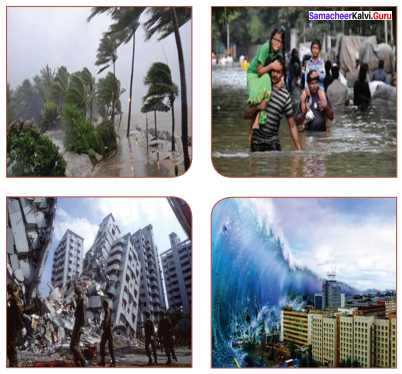
Look at these pictures of cyclone, floods, earthquake and tsunami.
Old Man River Summary Samacheer Kalvi 9th English Chapter 3

A. Discuss in pairs for two minutes on any one of these natural disasters. You may use the following points.

  • Causes
  • Damages
  • Precautions

Floods:
Floods are an overabundance of water in an otherwise dry area. A flood can be caused by large quantities of water gushing from a water body, such as ocean, rivers, lakes or ponds, which can swell due to heavy rainfall or mountain snowmelt. If the rivers and lakes receive too much rain then the water will not be confined within their banks. It will flow into the drylands, causing huge destruction.

Flash floods are short-term, intense and quickly-developing floods. Sudden thunderstorms create temporary puddles of water everywhere and cause small rivers and lakes to swell. In coastal areas, cyclones often cause upheavals in the water level. This creates a giant wall of water heading toward land. Depending on the size of the tide and how hard it hits land, it can often be a dangerous phenomenon, literally washing away buildings and structures along the coast.
In the flood prone areas, the following actions need to be taken:

  1. Protect your home – elevate the electric appliances, install check valves in sewer traps, seal
    walls in basements to avoid seepage, store adequate food, candles and drinking water.
  2. Listen to radio/TV emergency alerts and instructions.
  3. Seek higher grounds and be ready to evacuate if instructed.
  4. Do not try to drive through a flooded road. If your vehicle stalls, abandon it and seek an alternate route.
  5. After a flood, stay away from floodwater.
  6. Be aware of areas where water has receded. Roads may have weakened or power lines may have fallen.
  7. Do not drink tap water until hygiene standards are guaranteed by the health department.
  8. Clean the home, especially kitchen with safe chemical cleansers.

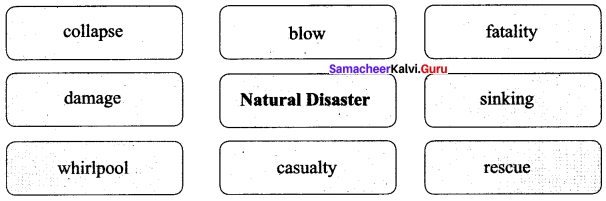
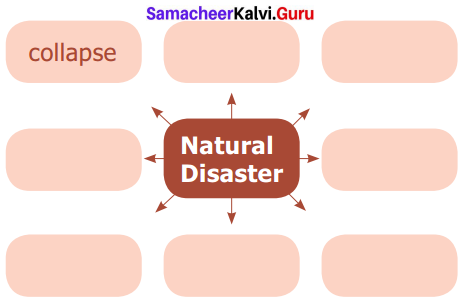
B. Fill the word web with words related to natural disasters. One example is done for you.
Old Man River Book Back Answers Samacheer Kalvi 9th English Chapter 3
Answer:
Old Man River Question And Answer Samacheer Kalvi 9th English Chapter 3

C. Imagine a situation where your house is surrounded by water and answer the following.

Old Man River Summary Question (i).
What health hazards caused when water stagnates around your place?
Answer:
Dangerous diseases, stench smell, mosquitoes breeding, etc.

Old Man River Book Back Answers Question (ii).
When there is a power shutdown for long hours during floods, what will you do?
Answer:
I will collect rainwater for drinking and other purposes and will try to finish the daily chores before dusk.

Old Man River Question And Answer Question (iii).
What precautions would you take if there is an announcement about flooding in your area?
Answer:
I will move to a safer place, on a higher altitude.

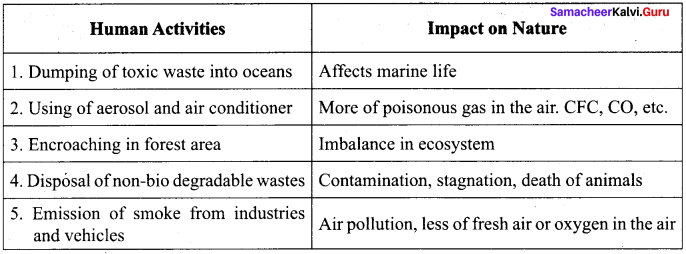
D. List out the Human activities which have an impact on nature. Complete the tabular column. One is done for you.
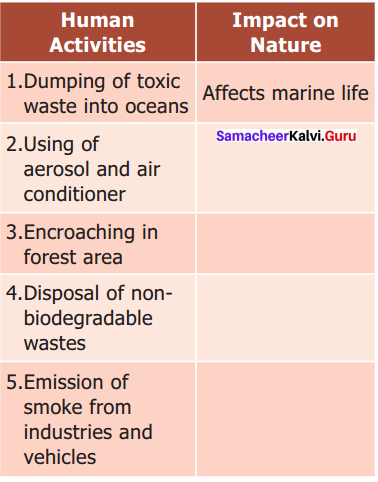
Old Man River Summary Pdf Samacheer Kalvi 9th English Chapter 3
Answer:
Old Man River Summary In English Samacheer Kalvi 9th English Chapter 3

Old Man River Intext Questions

E. Discuss with your partner and answer the following questions:

Old Man River Summary Pdf Question 1.
What were the girls doing in the living room?
Answer:
Amy and Rose were knitting. Betty was looking at a magazine.

Old Man River Summary In English Question 2.
Why was Mother not able to come home?
Answer:
Mother couldn’t get home from Mrs. Brant’s as the bridges between Mrs. Brant’s house and town are underwater.

The Old Man River Summary Question 3.
How did Jim want the girls to ‘get organised’?
Answer:
Jim asked the girls to be organized. He asked Betty to search and bring flashlight, candles, lamps and lanterns; Rose to fill the tubs and pails; Amy to check on food, blankets and coats. Jim also asked them to be ready with first-aid kit.

9th English Old Man River Question 4.
Which two important things did Jim want the girls to do to avoid getting scared?
Answer:
Jim instructed the girls not to show off to others how much each one was afraid of the situation and cause fear in others. Next to get all the things together like water, food, blankets, coats, lights and to climb into the attic and on to the roof.

Old Man River 9th Standard Question 5.
Where did Jim want the girls to climb up? How’ was it going to help them?
Answer:
Jim wanted the girls to climb up to the roof. It would help them as they could wave the flashlight and someone would see it and come for their rescue.

Narrate The Story Of The Old Man River Question 6.
Who went to get Sara? Where was she?
Answer:
Jim went to get Sara. Sara was on the playhouse porch.

F. Discuss with your partner and answer the following questions:

The Old Man River Question And Answer Question 1.
What were the important objects that the girls and Jim try to move to the attic? Why?
Answer:
Flashlight, candles, lamps, lanterns, food, blankets, coats, books and jewels were some of the articles that the girls and Jim tried to move to the attic. By night, they were expecting the water to enter into the house. To be safe until the rescue arrived, they planned to stay in the attic.

Narrate The Story Of “ The Old Man River’. Question 2.
Who came to rescue the children?
Answer:
Mr. Peters and Miss Marsh came to rescue the children.

Old Man River Question Answer Question 3.
What happened to Sara?
Answer:
Sara’s right leg just below the knee was hurt as she climbed down the ladder from the playhouse.

Old Man River Essay In English Question 4.
Who is Miss Marsh? How does she help Sara?
Answer:
Miss Marsh is the Red Cross Nurse. She understands that Sara has broken her right leg just below the knee. She splints it up with pillows and umbrella and lifts her safely into the boat. She also decides to take her to the emergency Red Cross hospital in Armoury.

Question 5.
Who were taken in the boat? Who were left behind?
Answer:
Left behind in the house are Amy and Jim. Others were in the boat – Betty, Sara, Rose, along with Mr. Peter and Miss Marsh.

Question 6.
How does Red Cross help the children?
Answer:
Red Cross helps the children by rescuing them from the flooded area and by saving their lives. ‘

Old Man River Textual Questions

A. Based on your understanding of the play, choose the correct answer and fill in the blanks.

1. The radio announced that …………….. .
(i) the river was above the flood stage.
(ii) the Bumet Dam had given way.
(iii) there will be a cloud burst.
(iv) they will be a cyclone.
Answer:
(i) the river was above the flood stage.

2. Mother couldn’t get home from Mrs. Brant’s because ……………… .
(i) it was raining heavily.
(ii) the bridges between home and the town were under water.
(iii) there was an emergency at Mrs. Brant’s house.
(iv) she had broken her leg.
Answer:
(ii) the bridges between home and the town were under water.

3. The Burnett Dam gave away as ……………….. .
(i) it rained for days.
(ii) the dam was weak.
(iii) it rained heavily and the snow was melting.
(iv) the maintenance was poor.
Answer:
(iii) it rained heavily and the snow was melting.

4. There was no power because ………………. .
(i) the power house was out of commission.
(ii) the power house was flooded.
(iii) the dam gave away.
(iv) there was fire.
Answer:
(ii) the power house was flooded.

5. Why did they splint up Sara’s leg with pillows?
(i) She was unconscious out of fear.
(ii) She had broken her leg below the knee.
(iii) She was too lazy to walk.
(iv) She was making a fuss.
Answer:
(ii) She had broken her leg below the knee.

B. Based on your reading, answer the following in two or three sentences each.

Question 1.
Why did Jim run from school?
Answer:
As the river was rising fast, Jim had to run every step of the way from school. The Burnett Dam gave way an hour ago and its condition was very bad.

Question 2.
Where was Amy’s mother?
Answer:
Amy’s mother took Dick to the dentist and was going to stop at Mrs. Brant’s for a recipe before reaching home.

Question 3.
Why did Amy ask Betty to fill in the water tubs?
Answer:
Amy asked Betty to fill the bowls, tubs, pails and pitchers with fresh water because town supply might be cut of or could become unsafe to drink.

Question 4.
According to Jim what are the two things that a person should remember in times of emergency?
Answer:
First thing, we must not let the others see how scared we are. Next to get all the things together in one place like water, food, blankets, coats, light, etc.

Question 5.
Why is Jim climbing on the roof?
Answer:
Jim wanted to be on top of the roof thinking that he would signal for help from the roof. Coast Guard would send a boat to rescue them.

Question 6.
Who were there in the living room? What were they doing?
Answer:
Amy, Betty and Rose were sitting in the living room. Amy and Rose were knitting while Betty was looking at pictures in a magazine.

Question 7.
Why were they going to sleep in the attic?
Answer:
To save themselves from getting floated along with the rising water, they decided to climb into attic and on to the roof because they were living in a bungalow instead of a two- storey house.

Question 8.
Who came in the boat?
Answer:
Tom Peter and Miss Marsh came in the rescue boat. (Tom Peter is member of the Red Cross Disaster Committee and Penny Marsh is the Red Cross nurse.)

Question 9.
Who is the founder of Junior Red Cross?
Answer:
Jean Henry Dunant

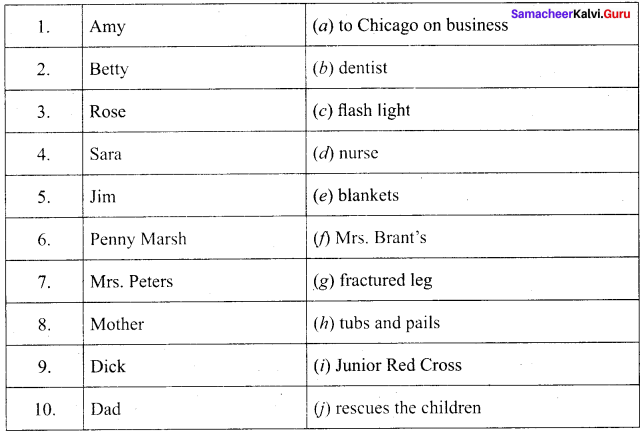
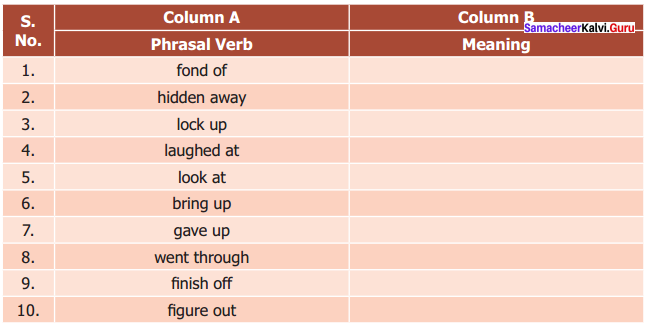
C. Match the following by ‘drawing a line across column A and B.
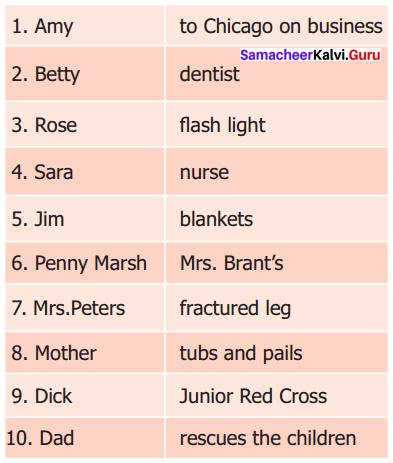
The Old Man River Summary Samacheer Kalvi 9th English Chapter 3

9th English Old Man River Samacheer Kalvi 9th English Chapter 3
Answers:
1. (e), 2. (c), 3. (h), 4. (g), 5. (i), 6. (d), 7. (j), 8. (f), 9. (b), 10. (a).

D. Based on your understanding of the text, answer the following in about three to four sentences each:

1. Describe the ‘home alone’ experience of the children.
Answer:
Amy Marshall and Betty Marshall were left alone in the home and due to cyclone, the water level was rising around their house. They were lucky enough to have their friends cum neighbour Rose field. Sara Field and Jim Hall in their house to fight against the disastrous moment. Amy’s mother had taken Dick to dentist and on her way back she was supposed to meet Mrs. Brant for a recipe. Amy’s father was in Chicago on some business matters.

2. Elaborate the rescue operation undertaken by Mr. Peter.
Answer:
Tom Peters and Miss. Marsh, member of the Red Cross Disaster Committee and Red Cross nurse respectively, were on a boat calling out for Mr. Marshall’s family to know whether they were safe. Jim responded and guided the rescue team to know where they were. Mr. Peter’s was shocked to know’ that there were children and no adults inside the house. When they were climbing down the ladder Sara fell and got hurt. She was wrapped in blanket. Mr. Peter suggested that more than pain it is the fear that is not making them function well and asked them to be composed. Sara has broken her right leg just below the knee. They splint it up with pillows and umbrella to lift her safely into the boat. They took her to the emergency Red Cross hospital in the Armoury.

3. How did Jim prove himself as a good rescuer in the flood situation?
Answer:
Jim Hall a neighbour, came to the rescue of all three girls luckily during the crisis time. Mr. Marshall and Mrs. Marshall were away due to valid reasons – one on business at Chicago and the other on a visit to the dentist along with Dick. Jim Hall acted very wisely by giving all the three girls directions to collect flashlight, fill water, candles and first-aid kit. Jim advised them to climb into the attic and on to the roof, because the house they were staying was a bungalow and not a two-storey house. It was dangerous as water might have entered the house anytime.

4. Briefly narrate the happenings of the play in Scene II.

(a) How did Amy manage the situation at home?
Answer:
Amy, Rose and Betty had three candles on the table. Sara was asleep covered with the blanket in a big chair. Betty was trying to read with the help of candle-light. Amy would suggest them to sleep.

(b) How did the Marshall save the children?
Answer:
Mr. Peters was carrying Sara and gave her confidence by stating that she was more frightened then hurt. Miss Marsh splint right leg of Sara up with pillows and umbrella just below the knee to lift her safely into the boat. Then they took her to the emergency Red Cross hospital in the Armoury.

Think and answer:
You are one of the survivors of an earthquake that has effected your city a lot. Share the trauma you underwent and what helped you to sail through it. Give a talk for two minutes.

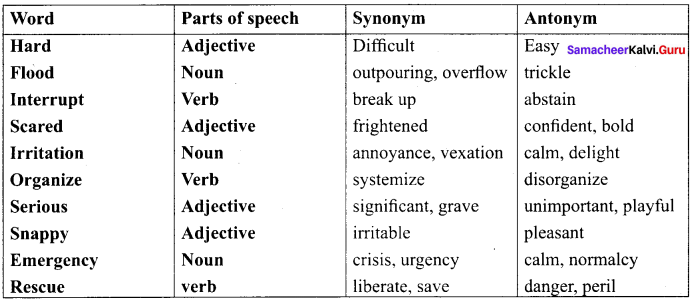
E. Using a dictionary, find out the synonyms and the antonyms of the words given below. One has been done for you.
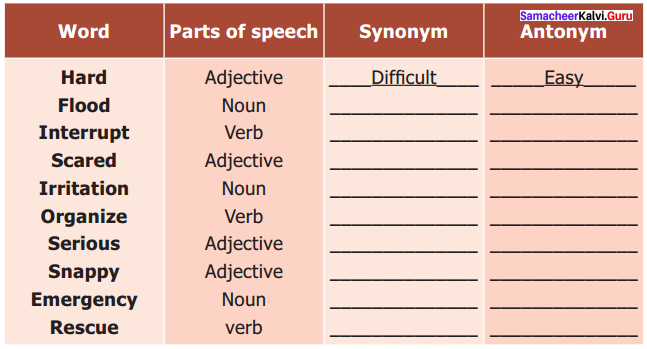
Old Man River 9th Standard Samacheer Kalvi 9th English Chapter 3
Answer:
Narrate The Story Of The Old Man River Samacheer Kalvi 9th English Chapter 3

Listening:

F. Listen to the paragraph and fill in the blanks.

The 2015 South Indian floods resulted from heavy rainfall generated by the annual north east monsoon in November- December 2015. They affected the Coromandel Coast region of the South Indian states of Tamil Nadu and Andhra Pradesh, and the union territory of Puducherry, with Tamil Nadu and the city of Chennai particularly hard- hit. More than 500 people were killed and over 18 lakh people were displaced. With estimates of damages and losses ranging from nearly 200 billion rupees to over 1 trillion rupees, the floods were the costliest to have occurred in 2015, and were among the costliest natural , disasters of the year. The flooding has been attributed to the2014-16 El-Nino event.
(For listening to the script refer to our website www.fullcircleeducation. in)

The (1) ……………… South Indian floods resulted from heavy rainfall generated by the
annual north east monsoon in (2) ……………… 2015. They affected the (3) …………….. region of the South Indian states of (4) …………….., and the Union Territory of (5) ……………….., with Tamil Nadu and the city of (6) ………………. particularly hard-hit. More than (7) ………………. people were killed and over 18 lakh people were (8) ………………….With estimates of damages and losses ranging from nearly 200 billion rupees to over 1 trillion rupees, the (9) ………………… were the costliest to have occurred in 2015, and were among the costliest natural disasters of the year. The flooding has been attributed to the 2014-16 (10) ………………. .
Answers

  1. 2015
  2. November
  3. Coromandel Coast
  4. Tamil Nadu and Andhra Pradesh
  5. Puducherry
  6. Chennai
  7. 500
  8. displaced
  9. floods
  10. El-Nino event

Writing:

G. As a local government official working in the flood affected area you are talking to an old lady who has lost her belongings. Write a dialogue between you and the old woman. Complete the conversation.

You : Good morning Madam.
Old lady : Good morning.
You : I am from the Fire and Rescue department. How can I help you?
Old lady : (i) ……………………………………………..
You : (ii) ………………………………………………
Old lady : (iii) ………………………………………….
You : (iv) …………………………………………………
Old lady : (v) ……………………………………………
You : (vi) ………………………………………………..
Old lady : (vii) ……………………………………..
You : (viii) …………………………………………..
Old lady : (ix) …………………………………………
Answers:
(i) I have left a very important casket in my closet, can you please bring if for me?
(ii) The water level is rising. It would be really life threating to go to that place.
(iii) Yeah, I do understand that. To me, yes it is impossible, can you try for my sake please.
(iv) One person cannot do that, we may have to work as a team.
(v) Then do so please. I can’t live without that casket.
(vi) Madam please understand the human power/resource must/can be used to rescue mankind. Amma, life is more important than casket.
(vii) Yes, I don’t deny that. Can you please take that after you finish this work or when you go to my house or nearby places.
(viii) OK amma, I shall surely try. Take rest. Health is more important for us.
(ix) Thank you child; May God bless you!! Please try for my sake.

Creative Writing:

H. Write a letter to your friend about your experiences during the recent ‘Gaja’ cyclone.

29 May 2018
xxxx

Dear Malathi,
Hope this letter finds you in the best of health and spirits. Here, I am fine. But recently I have had the worst experience of my wife which I want to share with you. You must have heard about the cyclone ‘Gaja’ that devastated parts of Sri Lanka and India. It was the most intense tropical cyclone in the Arabian Sea since Cyclone Megh in 2015. It started as an area of low pressure in the eastern Andaman Sea on November 21 and within a few days grew into a deep depression. Ockhi intensified into a Cyclonic Storm on November 30 and caused huge damage to property and life in my city. Hundreds of people died and so many were injured. Thousands of trees were uprooted. We had no power supply for a couple of days. Food, drinking water and medicines were out of reach. Even after the cyclone subsided our area was cut off from

Writing:

G. As a local government official working in the flood affected area you are talking to an old lady who has lost her belongings. Write a dialogue between you and the old woman. Complete the conversation.

You : Good morning Madam.
Old lady : Good morning.
You : I am from the Fire and Rescue department. How can I help you?
Old lady : (i) …………………………………………….
You : (ii) ……………………………………………………
Old lady : (iii) ……………………………………………
You : (iv) …………………………………………………..
Old lady : (v) …………………………………………….
You : (vi) …………………………………………………..
Old lady : (vii) …………………………………………..
You : (viii) ………………………………………………..
Old lady : (ix) …………………………………………..
Answers:
(i) I have left a very important casket in my closet, can you please bring if for me?
(ii) The water level is rising. It would be really life threating to go to that place.
(iii) Yeah, I do understand that. To me, yes it is impossible, can you try for my sake please.
(iv) One person cannot do that, we may have to work as a team.
(v) Then do so please. I can’t live without that casket.
(vi) Madam please understand the human power/resource must/can be used to rescue mankind. Amma, life is more important than casket.
(vii) Yes, I don’t deny that. Can you please take that after you finish this work or when you go to my house or nearby places.
(viii) OK amma, I shall surely try. Take rest. Health is more important for us.
(ix) Thank you child; May God bless you!! Please try for my sake.

Creative Writing

H. Write a letter to your friend about your experiences during the recent ‘Gaja’ cyclone.

29 May 2018
xxxx

Dear Malathi,
Hope this letter finds you in the best of health and spirits. Here, 1 am fine. But recently I have had the worst experience of my wife which I want to share with you. You must have heard about the cyclone ‘Gaja’ that devastated parts of Sri Lanka and India. It was the most intense tropical cyclone in the Arabian Sea since Cyclone Megh in 2015. It started as an area of low pressure in the eastern Andaman Sea on November 21 and within a few days grew into a deep depression. Ockhi intensified into a Cyclonic Storm on November 30 and caused huge damage to property and life in my city. Hundreds of people died and so many were injured. Thousands of trees were uprooted. We had no power supply for a couple of days. Food, drinking water and medicines were out of reach. Even after the cyclone subsided our area was cut off from the main market due to blocked roads. It was a terrible experience for me. I wish not to have any such experience again. Life has started to get norma!now. I feel better after writing to you regarding this. Awaiting eagerly to listen from you.

Yours friendly,
Shivani

Address on the envelope:
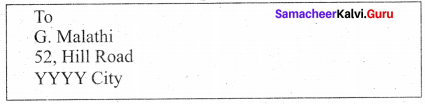
The Old Man River Question And Answer Samacheer Kalvi 9th English Chapter 3

I. Make a poster of any natural disaster, giving details about the devastations caused.
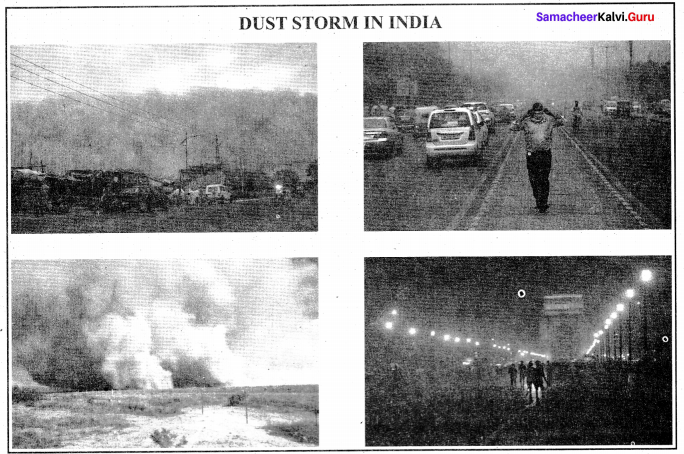
Narrate The Story Of “ The Old Man River’. Samacheer Kalvi 9th English Chapter 3

The recent dust storm that swept through India was one of its deadliest. The scale and intensity of this storm stretched from the western state of Rajasthan to the eastern state of Uttar Pradesh and hit Delhi, which lies between them. The dust storm caused more than 100 reported fatalities. Most of the fatalities occurred when intense wind knocked over large structures, killing or injuring those in its way.
J. You are a volunteer in your locality to serve people who are affected by floods. How will you caution them to move to a safer place taking only their bare necessities? Describe.
If I am a volunteer serving people affected by floods, I will first ask them to remain calm and have patience. Then, in a gentle voice I will give them the following instructions:

  • Be prepared! We may need to move to a safer place as the floods are getting worse.
  • Pack a bag with only your important items.
  • Take a few clothes, a pair of bedsheets and a blanket.
  • Keep your official documents, like degrees, license, PAN card, etc.
  • Pack some eatables that can last long.
  • Take some medicines.
  • Turn off utilities at the main switches or valves.
  • Disconnect all electrical appliances.
  • If you have to walk in water, wherever possible, walk where the water is not moving.
  • Take a stick to check the firmness of the ground in front of you.
  • While moving out, please be together with your family and take care of each other.
  • Do not panic. It is going to be alright soon. We will return home when authorities indicate it is safe.

Think and Do

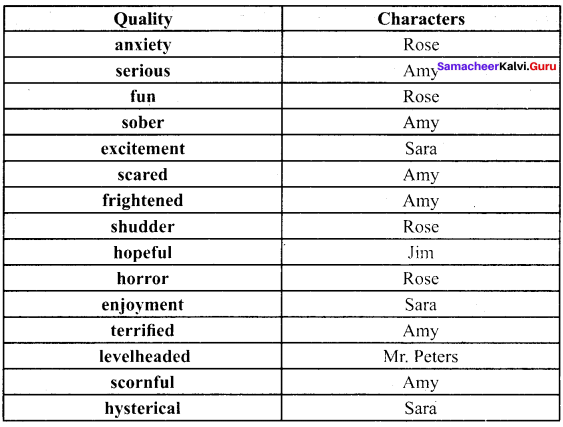
K. Given below are some qualities that the characters in the play displayed during the floods for survival. Identify and write the character with the qualities.
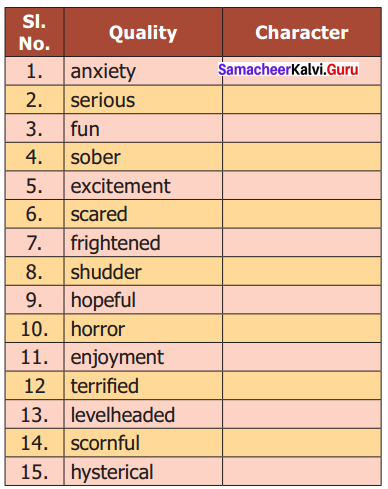
Old Man River Question Answer Samacheer Kalvi 9th English Chapter 3
Answers:
Old Man River Essay In English Samacheer Kalvi 9th English Chapter 3

Read the following passage about mountaineering.

Scaling Heights

1. Mountains have a great fascination for men and people. Mountain climbing, however, is not without risks. Is is a challenge to the unconquerable spirit of man and his love of adventure. That is is a dangerous sport cannot be denied. As one climbs higher and higher, breathing becomes more and more difficult. Some climbers, therefore, carry a heavy apparatus from which they inhale oxygen.

2. Mountain climbing is dangerous in the extreme. There are snow storms and bizzards. It is difficult to walk through the snow. It is still more difficult to climb on ice because it is difficult to keep foothold and cut steps with axes in order to make progress. The cold is so severe that the climber’s skin, feet, toes, fingers and tissues freeze, become numb and they may suffer frostbite. The most serious difficult is the climber at a high altitude gets exhausted with a little effort.

3. Mountain climbling requires proper training, skill and knowledge. The climbers must be well- equipped. They must be in good physical condition and should possess courage, perseverance and power of endurance. They should carry with them maps, compasses and other equipment so that they are able to find out where they are in the absence of any tracks. They must travel through dense woods as they approach a mountain and then climb steep rocks. Near the summit of a peak, the climbers have to move over snow fields and glaciers. In dangerous areas they use ropes to tie themselves in groups.

4. The climbers carry with them packs loaded with first-aid supplies, food and extra clothing for sudden changes of weather. They display spirit of sportsmanship and fellow-feeling and face the severe risks of life undaunted. Mountain climbing is a common sport in Europe. There are mountaineering clubs where training in mountaineering is imparted.

5. There are high peaks in India and there have been successful expeditions to scale these highest peaks. After the conquest of the Everest by Tensing and Hillary in 1953, the Mountaineering Institute ar Darjeeling was established to develop interest in mountain- climbling among the Indians. Expeditions have been sent to climb the highest peaks in the country.

6. Mountain climbing is a thrilling adventure. It brings into play the heroic qualities of humankind. Mountaineers deserve all praise for their courage and heroism. In recent years. Mt. Everest has been scaled several times by foreign climbers. India too has organized several expeditions to Everest. Lately an Indian Sherpa scaled the Everest without the use of oxygen. Mrs. Bachchendri pal also succeeded in scaling the Everest. She is the first Indian woman to do it.

L. Based on your reading answer the following questions in a sentence or two.

  1. Is mountaineering a dangerous sport? Why? (para 1)
  2. What is frostbite? (para 2) .
  3. What are the qualities of a good climber? (para 3)
  4. What do climbers carry with them? (para 4)
  5. Where is the Mountaineering Institute situated in India? (para 5)
  6. What qualities of humankind are brought out by this adventurous sport? (para 6)
  7. Why do mountaineers deserve praise? (para 6)
  8. What kind of visitors does Mt. Everest get (para 6)

Grammar:

A. Identify the dependent clauses or phrases in the following sentences and underline them.

  1. Texting on his phone, the man swerved into a ditch.
  2. It isn’t necessary to cram all night if you have studied a little each day.
  3. We climbed up the hill to enjoy the view.
  4. I enjoy painting during my holidays.
  5. Whether he attends the party or not, I have decided to go.
  6. I will stop playing the drums when you go to sleep.

Answers:

  1. Texting on his phone
  2. if you have studied a little each day
  3. to enjoy the view
  4. during my holidays
  5. when you go to sleep

B. Complete the following sentences using appropriate prepositional phrases.

1. I would like to order coffee …………….. tea.
(a) instead of
(b) instead from
(c) instead to
Answer:
(a) instead of

2. …………….. the rains, we went out.
(a) In spite of
(b) In spite
(c) In spite on
Answer:
(a) In spite of

3 fire, break the glass to escape.
(a) In case of
(b) In case
(c) In case with
Answer:
(a) In case of

4. I am standing here my friends.
(a) In behalf of
(b) on behalf of
(c) on behalf
Answer:
(b) on behalf of

5. We solved the problem a new device developed by our engineers.
(a) by means of
(b) by means
(c) by means to
Answer:
(a) by means of

6 we are impressed with their performance.
(a) In general
(b) On general
(c) In generally
Answer:
(a) In general

C. Look at the action words in bold. Identify whether they are either finite or non-finite verb.
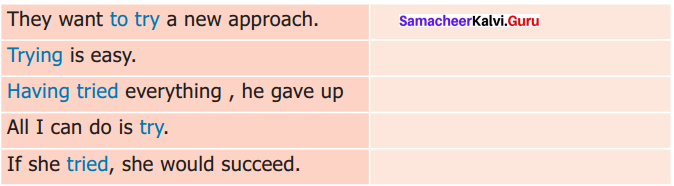
Samacheer Kalvi 9th English Solutions Prose Chapter 3 Old Man River 14
Answers:

  1. non finite
  2. finite
  3. finite
  4. finite
  5. finite
  6. finite

D. Read the following pairs of sentences:

1. Travelling might satisfy your desire for new experiences.
The study abroad program might satisfy your desire for new experiences.
Identify the subject in the first sentence …………………..
Answer:
Travelling

2. They do not appreciate my singing.
They do not appreciate my assistance.
Identify the direct object in the first sentence ………………..
Answer:
my singing

3. My cat’s favourite activity is sleeping.
My cat’s favourite food is salmon.
Identify the subject complement in the first sentence …………………
Answer:
sleeping

4. The police arrested him for speeding.
The police arrested him for criminal activity.
Identify the object of the preposition in the first sentence ……………..
Answer:
speeding

E. You may role-play the conversation.

Teacher:This is Mr. Gerund, you may have seen him after these verbs ‘enjoy’, ‘finish’, ‘keep’, ‘mind’, ‘suggest’, forgive, ‘excuse’, ‘postpone’, ‘go’
Gerund: I come after a preposition too.
Teacher: Mr. Gerund comes in handy to describe a real action.
Infinittive: Hello friends, I am Infinitive. Words such as ‘like’, ‘refuse’ are followed by me.
Dinesh: I know you. I take your help to describe a general or future action.
(I think I need to get up early tomorrow to complete my grammer exercise.)
Divya: you have helped me to express ‘reason’, ‘intention’, ‘purpose’.
(I wish to finish my assigment by to night.)
Gerund: Do you know, after verbs like ‘begin’, ‘love’, ‘continue’, ‘try’, Team’, ‘start’, ‘neglect’ you can use either of us?
Infinitive: But remember we mean different things when used after ‘stop’.
Dinesh: Divya, when we saw Rajesh at the mall, I stopped to talk to him. why didn’t you wait?
Divya: Don’t you know I stopped talking to him?
Gemnd: I am also used after these phrases- ‘It’s no use’, ‘It’s no good’
Dinesh and divya: Thank you, mam. bye Mr. Gemnd and Ms. Infinitive.

F. Now, work in pairs and help Dinesh and Divya complete the exercise given below.

Write the gerund / infinitive form of the verbs in the blanks.

  1. The astronauts managed ……………… (complete) their training in record time.
  2. They learned how ……………….. (survive) in space without gravity.
  3. The best astronaut almost quit …………….. (try) to leam the complex information.
  4. Their mission appeared ……………….. (be) in jeopardy.
  5. Then Marina encouraged him by saying, “It’s no good ………………….(quit) the project right at the end.”
  6. Being an astronaut will enable you …………….. (achieve) great success in life.
  7. If you give up ………………….. (study) now, our mission will be scrubbed.
  8. Think of your fellow astronauts who wouldn’t hesitate …………….. (help) youin time of treble.
  9. We astronauts must keep on ………………. (prepare) for our space launch.
  10. some say it’s no use …………………… (travel) to distant planets, because it takes too long.
  11. But we really want ………………….. (visit) other planets and find out if life exists on them.
  12. Can you imagine ………………. (walk) up to a Martian and shaking hands and ………………… (say), “Hello, how are you?”
  13. We really look forward ………………….. (meet) alien creatures and ………………… (find) out what they are really like.
  14. Many scientists have warned us not ……………… (take) this dangerous journey, but we are not discouraged.
  15. Travelling to far away planets involves …………………… (risk) our lives for the thrill of discovery.
  16. However we won’t delay blast off into space.
  17. Would you like ………………… (accompany) us on our journey if you could?
  18. During our training we have got used to ……………….. (be) weightless and ……………………. (live) under difficult conditions.
  19. Scientists admit to ……………………… (be) intensely curious about life on other planets.
  20. I’m sure they would also enjoy ……………….. (travel) with our crew.
  21. We told them …………………… (come) with us on our trip, but some of them think it is a waste of time ……………… (search) for life that doesn’t exist.
  22. We have been taught how ……………… (endure) hardships during our training and now we can’t afford ………………….(waste) money. We’re on our way!

Answers:

  1. to complete
  2. to survive
  3. trying
  4. to be
  5. quitting
  6. to achieve
  7. studying
  8. to help
  9. preparing
  10. travelling
  11. to visit
  12. walking, saying
  13. to meet, finding
  14. to take
  15. risking
  16. blasting
  17. to accompany
  18. being, living
  19. being
  20. travelling
  21. to come, searching
  22. to endure, to waste

Old Man River Summary:
Samacheer Kalvi 9th English Solutions Prose Chapter 3 Old Man River 15

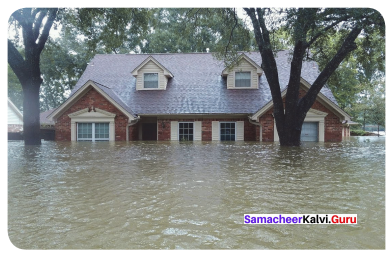
In this drama, the author pictures life in times of crisis. Its purpose is to highlight the central idea of security. Though in fear and confusion, the characters deal bravely with flood. The scene opens on a late afternoon in March. A group of children find themselves alone at home during heavy rains. The bridges seem to be under water. Amy gets a call from her mother that she wouldn’t be able to return home since the routes are flooded. Amy’s father is in Chicago. Amy’s friend Rose is asked to stay back for the night. The children soon realise that the river is swelling.

They advise each other to be calm and brave. They arrange food, water, flashlights and other necessary things. Each one of them takes responsibility for cooking, safety, etc. Amy tries to save her parents’ valuable articles. In the night, a rescue boat arrives. Rose’s sister Sara gets hurt by chance. The rescue team takes Sara to the emergency Red Cross Hospital. The play focuses on the importance of acting during a crisis and first-aid awareness. We can take a lesson from the children how they help one another and stay calm till help arrives.

Old Man River Glossary:

cloudburst – a sudden violent rainstorm.
gasp – catch one’s breath with an open mouth, owing to pain or astonishment.
hark – listen, pay attention.
lantern – a lamp with a transparent case protecting the flame or electric bulb, and typically having a handle by which it may be carried or hung.
pickaback – a piggyback ride, on the back and shoulders of another person.
pitcher – a large jug.
shudder – shiver typically as a result of fear or revulsion.
splint – a long flat object used as a support for a broken bone so that the bone stays in a particular position while it heals.
stamping – bring down (one’s foot) heavily on the ground.
thumping – hitting or striking heavily, especially with fist or a blunt instrument.
wink – close and open one eye quickly, shine or flash intermittently.
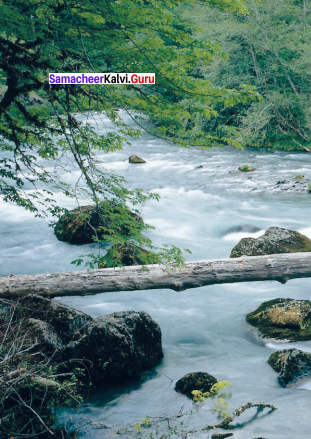
Samacheer Kalvi 9th English Solutions Poem Chapter 5 The River

You can Download The River Poem Questions and Answers, Summary, Activity, Notes, Samacheer Kalvi 9th English Book Solutions Guide Pdf Poem Chapter 5 help you to revise complete Tamilnadu State Board New Syllabus and score more marks in your examinations.

Tamilnadu Samacheer Kalvi 9th English Solutions Poem Chapter 5 The River

The River Poem Questions and Answers

The River Warm Up:

The River Poem Questions And Answers Question 1.
Have you ever been to a river?
Answer:
Yes, I have been to a river.

The River Poem Summary Question 2.
Describe the beauty of the river you have seen?
Answer:
The river I have seen is shallow and the water is clear. It is a natural stream of water meandering. It looks beautiful.

The River Poem 9th Class Question 3.
Do you think rivers have life like human beings?
Answer:
Yes, I think rivers have life like human beings.

The River 9th Class Poem Questions and Answers

B. Read the following lines and answer the River Poem 9th Standard questions given below.

1. O’re the yellow pebbles dancing,
Through the flowers and foliage glancing.

The River 9th Class Poem Questions And Answers Question (а).
How does the river flow?
Answer:
The river flows over the yellow pebbles dancing through the flowers and leaves in a playful manner.

The River Poem Question (b).
What is meant by ‘foliage’?
Answer:
Foliage is a cluster of leaves, flowers and branches.

Additional:

The River Poem Figure Of Speech Question (a).
What is a pebble?
Answer:
A Pebble is usually a small rounded stone found in water bodies like river.

River Poem By Caroline Ann Bowles Question (b).
What is the poetic device employed in the first line.
Answer:
Imagery is the poetic device employed in the first line.

9th Class The River Poem Summary Question (c).
What is the poetic device employed in the second line.
Answer:
Alliteration is the poetic device employed in the second line.

The River Poem Summary By Caroline Ann Bowles Question (d).
Give the rhyming word for ‘dancing’.
Answer:
The rhyming word for ‘dancing’ is glancing.

A River Poem Questions And Answers Question (e).
Is the river like a child? Why?
Answer:
Yes the river is like a child. The river like a child is bright and sparkling on its way. It dances and plays behind flowers and leaves of trees like a child playing hide and seek.

2. River, river! Swelling river!
On you rush through rough and smooth;

9th English River Poem Question (a).
Why does the poet mention the river to be swelling?
Answer:
The poet mentions the river to be swelling because the river is like a reckless youth.

River Poem 9th Class Question (b).
What are the surfaces the river flows through?
Answer:
The surfaces the river flows through are the rough rocks and smooth places like rose banks where the roses grow.

Additional:

The River Poem Explanation Question (a).
What does the word ‘swelling’ indicate?
Answer:
The word ‘swelling’ indicates the ebb and flow of the river.

The River Poem By Caroline Ann Bowles Question (b).
Which word is the antonym for ‘rough’?
Answer:
The antonym for the word rough is smooth.

3. Over rocks, by rose-banks, sweeping Like impetuous youth.

9th English Poem The River Question (a).
Where does the rose grow?
Answer:
The rose grows by rose-banks

9th English The River Poem Question (b).
Which stage of man is compared here?
Answer:
The period of youth is compared here.

Additional:

The River Questions And Answers Question (a).
Where does it spend its y lounger days?
Answer:
It spends younger days through rocks and woods.

Question (b).
What is sweeping?
Answer:
The river is sweeping.

Question (c).
Identify the figure of speech.
Answer:
Simile is the figure of speech.

Question (d).
What is meant by ‘impetuous’?
Answer:
‘Impetuous’ means reckless or hasty.

Question (e).
Why is the river compared to an ‘impetuous youth’?
Answer:
The river is compared to an impetuous youth because of its reckless and hasty movements over rocks and rose-banks.

4. Broad and deep, and still as time;
Seeming still, yet still in motion,

Question (a).
What is broad and deep?
Answer:
The river is broad and deep.

Question (b).
Is the time still?
Answer:
No the time is not still, yet it seems to be still.

Additional:
(a) Which words describe the river?
Answer:
Broad, deep and still describe the river.

Question (b).
What is the figure of speech in the second line?
Answer:
The figure of speech is alliteration.

Question (c).
Explain ‘still in motion’.
Answer:
Though the river seems to be quiet and motionless, it is always in motion.

5. Tending onward to the ocean,
Just like mortal prime.

(a) Where is the river flowing to?
Answer:
The river is flowing to the ocean.

Question (b).
What does the poet mean by ‘ mortal Prime’?
Answer:
By the term ‘Mortal prime’, the poet means the man is in the best age of his life.

Additional:

Question (a).
Explain ‘Tending’.
Answer:
‘Tending’ here means inclining towards a habitual action.

Question (b).
What is the figure of speech employed here?
Answer:
The figure of speech is simile.

The River Poem 9th Class  Additional Questions

1. River, river, little river!
Bright you sparkle on your way;

Question (i).
What is a river?
Answer:
A river is a small little stream.

Question (ii).
Where is the river born?
Answer:
The river is born in the mountains.

Question (iii).
Why is it called ‘little river’?
Answer:
It is called a Tittle river’ because of its size.

Question (iv).
Give the example for epithet in the above lines.
Answer:
Tittle river’ is the example for epithet in the above lines.

2. Louder, faster, brawling, leaping,

Question (i).
What is meant by ‘brawling’?
Answer:
‘Brawling’ is a noisy quarrel.

Question (ii).
What is louder and faster?
Answer:
The river’s movement is louder and faster.

3. River, river! Headlong river!
Down you dash into the sea,

Question (i).
Why is the river said to be ‘headlong’?
Answer:
The river is said to be ‘headlong’ because of its reckless movement.

Question (ii).
Pick out the alliterated words.
Answer:
The alliterated words are ‘down’ and ‘dash’.

Question (iii).
Where does the headlong river rush to?
Answer:
The headlong river rush towards the sea.

4. Sea that line hath never sounded,
Sea that sail hath never rounded,
Like eternity.

Question (i).
What is the figure of speech in the above lines?
Answer:
Anaphora is the figure of speech in the above lines.

Question (ii).
Pick out the rhyming words.
Answer:
The rhyming words are sounded and rounded

Question (iii).
What is the figure of speech in the second line?
Answer:
The figure of speech is alliteration.

Question (iv).
Explain ‘hath never rounded’.
Answer:
No ship has completely gone around the sea to be compared to eternity.

Question (v).
What is meant by ‘hath’?
Answer:
‘hath’ is the old English word for ‘has’.

Question (vi).
What do the river and the sea remind the poet of?
Answer:
The river is like the transient human life. The sea reminds the poet of eternity.

Question (vii).
How does the sea remind you of eternity?
Answer:
Sea is endless and hence it cannot be measured. We do not know where it begins from and where it would end. Hence it reminds me of eternity.

Question (viii).
What happens to the river when it approaches the ocean?
Answer:
It seems wider and seems even slower when it approaches the ocean.

Question (iv).
When does a river grow and vanish?
Answer:
As it approaches to the ocean the river grows and then vanishes into the ocean.

C. Read the following lines and answer the questions.

1. Bright you sparkle on your way;
O’er the yellow pebbles dancing,
Through the flowers and foliage glancing,
Like a child at play.
Pick out the rhyming words.
Answer:
Dancing and glancing; way and play are the rhyming words.

2. Mention the rhyme scheme of the poem.
The rhyme scheme of the poem is a b c c b.
River, river, little river! a
Bright you sparkle on your way; b
O’er the yellow pebbles dancing, c
Through the flowers and foliage glancing, c
Like a child at play. b

River, river! swelling river! a
On you rush through rough and smooth; b
Louder, faster, brawling, leaping, c
Over rocks, by rose-banks, sweeping c
Like impetuous youth. b

River, river! Brimming river! a
Broad and deep, and still as time; b
Seeming still, yet still in motion, c
Tending onward to the ocean, c
Just like mortal prime. b

River, river! Headlong river! a
Down you dash into the sea, b
Sea that line hath never sounded, c
Sea that sail hath never rounded, c
Like eternity. b

3. Through the flowers and foliage glancing,
Like a child at play.
Mention the figure of speech used in the above lines. Give various other examples from the poem.
Alliteration is the figure of speech used in the above line.
Various other examples from the poem are:-

  1. On you rush through rough and smooth
  2. Over rocks, by rose-banks
  3. Seeming still, yet still in motion
  4. Tending onward to the ocean
  5. Down you dash into the sea
  6. Sea that line hath never sounded
  7. Sea that sail hath never rounded

4. Seeming still, yet still in motion
(a) Pick out the words in alliteration from the above line.
Seeming still

(b) Identify other examples from the poem for alliteraion.
Other examples from the poem are:-

  1. On you rush through rough and smooth
  2. Over rocks, by rose-banks
  3. Seeming still, yet still in motion
  4. Tending onward to the ocean
  5. Down you dash into the sea
  6. Sea that line hath never sounded
  7. Sea that sail hath never rounded

5. Pick out the examples for epithet from the poem.

Little river!
Swelling river!
Brimming river!
Headlong river!

6. Pick out the examples for imagery from the poem.

Yellow pebbles
dancing Brawling, leaping
dash into the sea

D. Answer the following in a paragraph of about 120-150 words.

1. How does the poet bring about the comparison of life with the river? Explain it with reference to the poem.
Answer:
‘The River’ is a poem describing the beauty of a river, in all its glory. Caroline Ann Bowles says that the river is a dynamic and vital symbol of nature. The poem has philosophical undertones also. The flow of the river shows the journey of life to eternity. The different stages of life are brought in through the imagery used in the poem. Initially the river is compared to the yellow pebbles dancing.

This indicates the childhood. The river then rushes through rough and smooth paths, brawling and leaping referring to the stage of a reckless youth. When the river ebbs and flows, appearing to be broad and deep, inclining towards the ocean, one can see the prime phase of a human being. The flow of the river shows the journey of life to eternity.

As the human life passes through childhood, youth, old age and eternity, likewise the river also undergoes changes in its course of action. The gentle, sparkling dancing river, faster, brawling, leaping river, its stillness and the merging with the sea towards the end of the poem, indicate the different stages of river like the stages of human life.

2. Describe how the poem clearly describes about the features, functions and destructive power of the river.
Answer:
The River is little. It is sprightly and it sparkles on its way. It dances over the yellow pebbles and plays hide and seek through the flowers and foliage. This poem describes the beauty of a river, in all its glory.

The river swells and rushes through rough and smooth paths. It moves with speed and fights and jumps over rocks and rose banks as they sweep across like the reckless youth. When the river brims, it appears broad and deep yet still as time. It seems to be still but it is always in motion. The final stage is the headlong river that dashes into the sea. Thus, the flow of the river shows the journey of life to eternity.

The different stages of life are brought in through the various imageries used in the poem. As the human life passes through childhood, youth, old age and eternity, likewise the river also undergoes changes in its own way. At first it is gentle, sparkling and dancing, moves faster, fights and leaps showing the destructive power of the river. However it gets subdued, becomes still and merges with the sea.

E. Based on your understanding of the poem, complete the summary of the poem by choosing the words/phrases given below.
prime phase, the yellow pebbles, motionless, stages of human life, sweeping, child, journey, reckless youth.

In the poem ‘The River’, the poet compares the flow of the river with different (1) ……………………… The first stanza explains how the sparkling river goes dancing over (2) …………………… and glancing through the flowers and leaves. These acts of the river is compared to a curious and innocent (3) …………………. at play. The second stanza compares the river to a (4) ……………………. who goes through rough and smooth patches of life. Like a youth, here the river becomes louder, faster and (5) ……………………. everything all along the way. In the third stanza, the river becomes like a hard working man who is at the (6) …………………… of the life. Here the deep and broad river seems (7) ………………… but it keeps moving towards the sea like a matured man who silently marches towards the goal. In the last stanza the long (8) ……………………. of the river reaches the endless sea like a human life attains eternity.
Answers:

  1. stages of human life
  2. the yellow pebbles
  3. child
  4. reckless youth
  5. sweeping
  6. prime phase
  7. motionless
  8. journey

The River by About Caroline Ann Bowles The Poet:

Caroline Ann Bowles (1786-1854), the British poet and writer was married to Robert Southey who was the poet laureate of Britain. She wrote various other works including Chapter On Churchyard and Tales Of The Factories. The River is a poem which describes a river in all its vitality and splendour.

The Little River Poem Summary By Caroline Ann Bowles

The River Poem Questions And Answers Samacheer Kalvi 9th English Chapter 5

Oh! Little River – you sparkle bright as you move along your way. As you move on, you go dancing over the yellow pebbles. You glance through the flowers and leaves of trees, dancing throughout like a child who is at play.
Oh! river that ebbs and flows – you rush through rough and smooth pathways. You are louder, faster, clashing and hurdling. You go past rough rocks and banks where roses grow. This movement of yours is very similar to a hasty youth.
Oh! River, which is overflowing – you are broad and deep and silent as time. Though you seem motionless, you are inclining towards the ocean just like a man a man in the best age of his lifespan.
Oh! River, you are so reckless and you rush down into the sea. That sea’s depth has never been measured by a weighted line. None has gone by the ship completely around the sea to-be compared to eternity.

The River Glossary:

Textual:
eternity – life continuing without end after death foliage – a cluster of leaves, flowers and branches
glancing – touching or hitting something lightly from the side, without causing much damage
hath – in the past, the third person singular form of the word ‘have’
headlong – with the head first and the rest of the body following
impetuous – acting quickly and without thought or care
rose-banks – riverbanks where roses (flowers) appear along
swelling – becoming greater in intensity or volume
tending – going in a particular way

Samacheer Kalvi 9th Science Solutions Chapter 18 Organization of Tissues

You can Download Samacheer Kalvi 9th Science Book Solutions Guide Pdf, Tamilnadu State Board help you to revise the complete Syllabus and score more marks in your examinations.

Tamilnadu Samacheer Kalvi 9th Science Solutions Chapter 18 Organization of Tissues

Samacheer Kalvi 9th Science Organization of Tissues Textbook Exercises

I. Choose the correct answer.

Chapter 18 Organization Of Tissues Question 1.
The tissue composed of a living thin-walled polyhedral cell is …………………
(a) Parenchyma
(b) Collenchyma
(c) Sclerenchyma
(d) None of the above
Answer:
(a) Parenchyma

Organisation Of Tissues Class 9 Question 2.
The fibers consists of ……………………
(a) Parenchyma
(b) Sclerenchyma
(c) Collenchyma
(d) None of the above
Answer:
(b) Sclerenchyma

9th Science Organisation Of Tissues Question 3.
Companion cells are closely associated with ……………………..
(a) sieve elements
(b) vessel elements
(c) trichomes
(d) guard cells
Answer:
(a) sieve elements

Organisation Of Tissues Question 4.
Which of the following is a complex tissue?
(a) parenchyma
(b) collenchyma
(c) xylem
(d) Sclerenchyma
Answer:
(c) xylem

Organization Of Tissues Question 5.
Aerenchyma is found in ………………………
(a) epiphytes
(b) hydrophytes
(c) halophytes
(d) Xerophytes
Answer:
(b) hydrophytes

Organisation Of Tissues 9th Standard Question 6.
Smooth muscles occur in ……………………..
(a) uterus
(b) artery
(c) vein
(d) All of the above
Answer:
(a) uterus

Organisation Of Tissue Question 7.
Nerve cell does not contain ………………………
(a) axon
(b) nerve endings
(c) tendons
(d) dendrites
Answer:
(c) Tendons

II. Match the Following:

S. No.Column AS. No.Column B
1.SclereidsaChlorenchyma
2.ChloroplastbSclerenchyma
3.Simple tissuecCollenchyma
4.Companion celldXylem
5.TracheidsePhloem

Answer:

  1. b. Sclerenchyma
  2. a. Chlorenchyma
  3. c. Collenchyma
  4. e. Phloem
  5. d. Xylem

III. Fill in the blanks.

  1. …………… tissues provides mechanical support to organs.
  2. Parenchyma, collenchyma, Sclerenchyma are …………….. type of tissue.
  3. ……….. and …………. are complex tissues.
  4. Epithelial cells with cilia are found in …………….. of our body.
  5. Lining of small intestine is made up of ………………

Answer:

  1. Permanent
  2. simple
  3. xylem, phloem
  4. trachea of wind-pipe
  5. columnar epithelium

IV. State whether True or false. If false, write the correct statement

  1. Epithelial tissue is protective tissue in animal body – True
  2. Bone and cartilage are two types of areolar connective tissue – False
    Correct statement: Bone and cartilage are two types of supportive connective tissue.
  3. Parenchyma is a simple tissue – True
  4. Phloem is made up of Tracheids – False
    Correct Statement: Phloem is a complex tissue and constitutes: Sieve elements, Companion cells,
  5. Companion cells and Phloem parenchyma.
  6. Vessels are found in collenchyma – False
    Correct Statement: Vessels are found in xylem.

V. Answer briefly:

Tissues Class 9 Pdf Question 1.
What are intercalary meristems? How do they differ from other meristems?
Answer:
Intercalary meristem lies between the region of permanent tissues and is part of primary meristem which is detached due to formation of intermittent permanent tissues. It is found either at the base of leaf e.g. Pinus or at the base of intemodes e.g. grasses.

Transverse Tubules Question 2.
What is complex tissue? Name the various kinds of complex tissues.
Answer:
Complex tissues are made of more than one type of cells that work together as a unit. Complex tissues consist of parenchyma and sclerenchyma cells. Common examples are xylem and phloem.

Phloem Definition Biology Question 3.
Mention the most abundant muscular tissue found in our body. State its function.
Answer:
Connective tissue is the most abundant and widely distributed tissue. It provides structural framework and gives support to different tissues forming organs.

Question 4.
What is skeletal connective tissue? How is it helpful in the functioning of our body?
Answer:
The supporting or skeletal connective tissues form the endoskeleton of the vertebrate body. They support the body, protect various organs and help in locomotion. This system is composed of connective tissues including bone, cartilage, tendons, and ligaments.

Question 5.
Why should gametes be produced by meiosis during sexual reproduction?
Answer:
Meiosis is important as it produces gametes i.e., male or female germ cells. During meiosis a germ cell or gamete divides to make four new sex cells. As a result of fertilization two gamates join together to form an egg or zygote. Therefore only if gametes are produced, fertilization can take place

Question 6.
In which stage of mitosis the chromosomes align in an equatorial plate? How?+
Answer:
The chromosomes align in an equatorial plate during metaphase stage of mitosis. Each chromosome gets attached to a spindle fibre by its centromere which is known as the chromosomal fibre. During metaphase the sister chromatids are pulled back and forth until they align along the equator of the cell called equatorial plane.

VI. Answer in detail.

Question 1.
What are the permanent tissues? Describe the different types of simple permanent tissue.
Answer:
Permanent tissues are those in which, growth has stopped either completely or for the time being. At times, they become meristematic partially or wholly. Permanent tissues are of two types namely

  1. simple tissue and
  2. complex tissue.

Simple Tissues:
Simple tissue are homogeneous-composed of structurally and functionally similar cells eg., Parenchyma, Collenchyma, and Sclerenchyma.
(i) Parenchyma
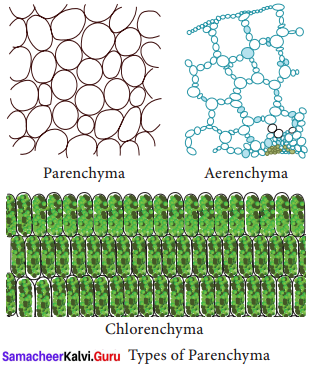
Samacheer Kalvi 9th Science Solutions Chapter 18 Organization of Tissues 1
Parenchyma are simple permanent tissue composed of living cells. Parenchyma cells are thin-walled, oval, rounded or polygonal in shape with well-developed spaces among them. In aquatic plants. Parenchyma possesses intercellular air spaces and is named as Aerenchyma. When exposed to light, parenchyma cells may develop chloroplasts and are known as Chlorenchyma.
Functions: Parenchyma may store water in many succulent and xerophytic plants. It also serves the functions of storage of food reserves, absorption, buoyancy, secretion etc.

(ii) Collenchyma
Organisation Of Tissues Class 9 Samacheer Kalvi 9th Science Solutions
Collenchyma is a living tissue found beneath the epidermis.
Cells are elongated with unevenly thickened non-lignified walls.
Cells have rectangular oblique or tapering ends and persistent protoplasts. They possess thick primary non-lignified walls.
Functions: They provide mechanical support for growing organs.

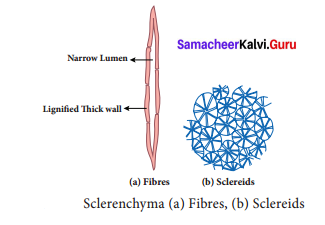
(iii) Sclerenchyma
9th Science Organisation Of Tissues Samacheer Kalvi 9th Science Solutions
Sclerenchyma consists of thick-walled cells which are often lignified. Sclerenchyma cells do not possess living protoplasts at maturity.
Sclerenchyma cells are grouped into

  1. fibres and
  2. Sclereids.
  • Fibres are elongated sclerenchymatous cells, usually with pointed ends. Their walls are lignified. Fibres are abundantly found in many plants. The average length of fibres is 1 to 3 mm, however in plants like Linum usitatissimum (flax), Cannabis sativa (hemp) and Corchorus capsularis (jute), fibres are extensively longer ranging from 20 mm to 550 mm.
  • Sclereids are widely distributed in plant body. They are usually broad, may occur in single or in groups. Sclereids are isodiametric, with liginified walls. Pits are prominent and seen along the walls. Lumen is filled with wall materials. Sclereids are also common in fruits and seeds.

Question 2.
Write about the elements of Xylem.
Answer:
Xylem is a conducting tissue which conducts water, mineral nutrients upward from root to leaves. Xylem is also meant for mechanical support to the plant body. Xylem is composed of different kinds of elements. They are

  1. xylem tracheids
  2. xylem fibres
  3. xylem vessels and
  4. xylem parenchyma.

(i) Xylem tracheids: They are elongated or tube-like dead cells with hard, thick and lignified walls. Their ends are tapering, blunt or chisel-like. These cells are devoid of protoplast. They have large lumen without any content. Their function is conduction of water and providing mechanical support to the plant.

(ii) Xylem fibers: These cells are elongated, lignified and pointed at both the ends. Xylem fibres help in conduction of water and nutrients from root to the leaf and also provide mechanical support to the plant.

(iii) Xylem vessels: They are long cylindrical, tube like structures with lignified walls and wide central lumen. These cells are dead as these do not have protoplast. They are arranged in longitudinal series in which the partitioned walls (transverse walls) are perforated, and so the entire structure looks-like a water pipe. Their main function is transport of water and minerals from root to leaf, and also to provide mechanical strength.

(iv) Xylem parenchyma: Its cells are living and thin walled. The main function of xylem parenchyma is to store starch and fatty substances.

Question 3.
List out the differences between mitosis and meiosis.
Answer:

MitosisMeiosis
Occurs in somatic cellsOccurs in reproductive cells
Involved in growth and occurs continuously throughout lifeInvolved in gamete formation only during the reproductively active age
Consists of a single divisionConsists of two divisions
Two diploid daughter cells are formedFour haploid daughter cells are formed
The chromosome number in the daughter cell is similar to the parent cell (2n)The chromosome number in the daughter cell is just half (n) of the parent cell
Identical daughter cells are formedDaughter cells are not similar to the parent cell and are randomly assorted

VII. Higher Order Thinking Skills.

Question 1.
What is the consequence that occur if all blood platelets are removed from the blood?
Answer:
If platelets are absent, this important defense reaction cannot occur, and protracted bleeding from small wounds (prolonged bleeding time) results.

Question 2.
Which are not true cells in the blood? Why?
Answer:
Platelets are actually not true cells but merely circulating fragments of cells. But even though platelets are merely cell fragments, they contain many structures that are critical to stop bleeding. They contain proteins on their surface that allow then! to stick to breaks in the blood vessel wall and also to stick to each other. They contain granules that can secrete other proteins required for creating a firm plug to seal blood vessel breaks.

Samacheer Kalvi 9th Science Organization of Tissues Additional Questions

I. Short answers questions.

Question 1.
Name the elements present in phloem.
Answer:
Phloem like xylem is a complex tissue and consists of the following elements.

  1. Sieve elements
  2. Companion cells.
  3. Phloem fibres
  4. Phloem parenchyma

Question 2.
What is histology?
Answer:
The study of tissues is known as histology.

Question 3.
Describe amitosis.
Answer:
It is the simplest mode of cell division and occurs in unicellular animals, aging cells and in foetal membranes. During amitosis, nucleus elongates first, and a constriction appears in it which deepens and divides the nucleus into two, followed by this cytoplasm divides resulting in the formation of two daughter cells.

Question 4.
Give reasons why the meristematic cells have a large nucleus and dense cytoplasm.
Answer:
Meristematic cells are continuously dividing cells so they have a prominent nucleus and dense cytoplasm. But since these cells do not store food or waste material, they lack vacuole.

II. Long answers questions.

Question 1.
Give notes on:

  1. squamous epithelium,
  2. cuboidal epithelium,
  3. columnar epithelium,
  4. ciliated epithelium and
  5. glandular epithelium.

Answer:

  1. Squamous Epithelium is made up of thin, flat cells with prominent nuclei. It forms delicate lining of the buccal cavity, alveoli of lungs, proximal tubule of kidneys, blood vessels and covering of the skin and tongue. It protects the body from mechanical injury, drying and invasion of germs. It also helps in filtration by forming a selectively permeable membrane surface.
  2. Cuboidal Epithelium is composed of single layer of cubical cells. The nucleus is round and lies in the centre. This tissue is present in the thyroid vesicles, salivary glands, sweat glands and exocrine pancreas. It is also found in the intestine and tubular part of the nephron (kidney tubules) as microvilli that increase the absorptive surface area. Their main function is secretion and absorption.
  3. Columnar Epithelium is composed of a single layer of slender, elongated and pillar like cells. Their nuclei are located at the base. It is found lining the stomach, gall bladder, bile duct, small intestine, colon, oviducts and also forms the mucous membrane. They are mainly involved in secretion and absorption.
  4. Ciliated Epithelium Certain columnar cells bear numerous delicate hair-like outgrowths called cilia and are called ciliated epithelium. Their function is to move particles or mucus in a specific direction over the epithelium. It is seen in the trachea of wind-pipe, bronchioles of the respiratory tract, kidney tubules and fallopian tubes of oviducts.
  5. Glandular Epithelium Epithelial cells are often modified to form specialized gland cells that secrete chemical substances at the epithelial surface. Sometimes a portion of the epithelial tissue folds inward to form a multicellular gland, which lines the gastric glands, pancreatic tubules and intestinal glands.

Question 2.
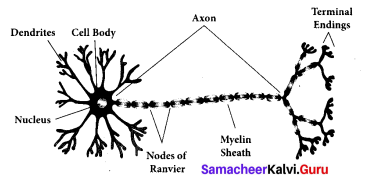
Write a note on the nervous tissue using a diagram.
Answer:
Organisation Of Tissues Samacheer Kalvi 9th Science Solutions
Nervous tissue comprises of the nerve cells or neurons. They are the longest cells of the body. Neurons are the structural and functional units of the nervous tissue. The elongated and slender processes of the neurons are the nerve fibres. Each neuron consists of a cell body or cyton with nucleus and cytoplasm. The dendrons are short and highly branched protoplasmic processes of cyton. The axon is a single, long fibre like process that develops from the cyton and end up with fine terminal branches. They have the ability to receive stimuli from within or outside the body and send signals to different parts of the body. Many nerve fibres are bound together by the connective tissue.

Question 3.
Describe fluid connective tissue.
Answer:
The blood and the lymph are the fluid connective tissues which link different parts of the body. The cells of the connective tissue are loosely spaced and are embedded in an intercellular matrix.
(a) Blood: contains corpuscles which are red blood cells (erythrocytes), white blood cells (leucocytes) and platelets. In this fluid connective tissue, the blood cells move in a fluid matrix called plasma. The plasma contains inorganic salts and organic substances. It is a main circulating fluid that helps in the transport of substances.

  1. Red blood corpuscles (Erythrocytes): The red blood corpuscles are oval-shaped, circular, biconcave disc-like and lack nucleus when mature (mammalian RBC). They contain a respiratory pigment called hemoglobin which is involved in the transport of oxygen to tissues.
  2. White blood corpuscles (Leucocytes): They are larger in size, contain a distinct nucleus and are colorless. They are capable of amoeboid movement and play an important role in body’s defense mechanism. WBC’s are of two types
    • Granulocytes (with granules in the cytoplasm): have irregular shaped nuclei and cytoplasmic granules. They include neutrophils, basophils, and eosinophils.
    • Agranulocytes (without granules in the cytoplasm): lack cytoplasmic granules and include the lymphocytes which have a spherical nucleus and the monocytes which have a large nucleus indented on one side. They engulf or destroy foreign bodies and neutralize their harmful effects.
    • Blood platelets: They are minute, anucleated, fragile fragments of giant bone marrow called megakaryocytes. They play an important role in the blood clotting mechanism.

(b) Lymph: Lymph is a colorless fluid filtered out of the blood capillaries. It consists of plasma and white blood cells. It mainly helps in the exchange of materials between blood and tissue fluids.

Question 4.
Differentiate between the following:

  1. Sieve cells and Sieve tubes
  2. Sclereids and fibres
  3. Tracheids and vessels
  4. Sclerenchyma and parenchyma

Answer:
1.

Sieve cellsSieve tubes
Sieve cells have no companion cellsSieve tubes always have companion cells
Sieve areas do not form sieve platesSieve areas are confined to Sieve plates
Cells are elongated and are unique long with tapering end wallsCells consist of vertical cells placed one above the other forming long tubes connected at the walls by sieve pores
Sieve pores are smaller and numerousSieve pores are larger and fewer in number
Sieve cells are found in pteridophytes and gymnospermsSieve tubes are found in angiosperms

2.

SclereidsFibre
Usually broadElongated narrow thread like
End walls bluntEnd walls tapering
Occur singlyOccur in bundles
Deep pitNarrow pits

3.

TracheidsVessels
Formed from single cellsMade up of number of cells
Ends are oblique and taperEnds are round and transverse
Fraction of a cm in lengthSeveral cms in length
Walls are thick, lumen-narrowWalls are less thick, lumen- wide

4.

SclerenchymaParenchyma
Cells are thick walled and lignified.Cells are thin-walled and unspecialised.
Tissues are made up of dead cells.These are living cells.
No intercellular spaces between the cells are found.Cells are usually loosely packed with large intercellular space.
Provides strength to the plant parts.Stores nutrients and water in stem and roots.
The cells are long and narrow, making the plant hard and stiff. The tissue is present in the stem around vascular bundles in the veins of leaves and the hard covering of seeds and nuts.Some cells contain chlorophyll called chlorechyma and perform photosynthesis. Other cells have larger air cavities called arenchyma which provide buoyancy to the hydrophytic plants.

Samacheer Kalvi 6th Social Science History Solutions Term 1 Chapter 1 What is History

You can Download Samacheer Kalvi 6th Social Science Book Solutions Guide Pdf, Tamilnadu State Board help you to revise the complete Syllabus and score more marks in your examinations.

Tamilnadu Samacheer Kalvi 6th Social Science History Solutions Term 1 Chapter 1 What is History

Samacheer Kalvi 6th Social Science What is History Textual Evaluation

I. Choose the correct answer:

Samacheer Kalvi Guru 6th Social Science Question 1.
What was the step taken by the early man to collect his food?
(a) Trade
(b) Hunting
(c) Painting
(d) Rearing of animals
Answer:
(b) Hunting

II. Match the statement with the Reason, tick the appropriate answer:

Samacheer Kalvi 6th Social Guide Question 1.
Statement: Pre historic men went along with the dog for hunting.
Reason: Dogs with its sniffing power would find out other animals.
(a) Statement is true, but reason is wrong.
(b) Statement and reason are correct.
(c) Statement is wrong and reason is correct.
(d) Both statements and reasons are wrong.
Answer:
(b) Statement and reason are correct.

Samacheer Kalvi 6th Social Science Book Back Answers Question 2.
Statement : The objects used by the early man are excavated. They are
preserved to know the lifestyle of the people.
Find out which of the following is related to the statement:
(a) Museum
(b) Burial materials
(c) Stone tools
(d) Bones
Answer:
(a) Museum

Samacheer Kalvi 6th History Book Question 3.
Find out the wrong pair:
(a) Old stone age – (i) Stone tools
(b) Rock paintings – (ii) Walls of the caves
(c) Copper plates – (iii) A source of history
(d) Cats – (iv) First domesticated
Answer:
(d) Cats – (iv) First domesticated

Samacheer Kalvi 6th Social Question 4.
Find the odd one:
(a) Paintings were drawn on rocks and caves.
(b) There were paintings depicting hunting scenes.
(c) It was drawn to show his family members about hunting.
(d) The paintings were painted by using many colours.
Answer:
(d) The paintings were painted by using many colours

III. Fill in the blanks :

Social Science 6th Guide Question 1.

  1. The Old Stone Age man lived mostly in _______ .
  2. _______ is the father of history.
  3. _______ was the first animal tamed by Old Stone Age man.
  4. Inscriptions are _______ sources.
  5. Dharma Chakra has _______ spokes.

Answer:

  1. caves
  2. Herodotus
  3. Dog
  4. archaeological
  5. 24

IV. State True or False:

Samacheer Kalvi 6th Social Science Question 1.

  1. 1.Stone tools belonging to Old Stone Age have been excavatad at Athtirampakkam near Chennai.
  2. 2.The materials used by the ancient people are preserved in the museums by the Archaelogical Department.
  3. 3.During the period of Ashoka, Buddhism spread across the country.

Answer:

  1. True
  2. True
  3. True

V. Match the following :

(a) Rock paintings – (i) copper plates
(b) Written records – (ii) the most famous king
(c) Ashoka – (iii) Devaram
(d) Religious Literature – (iv) to understand the life style
Answer:
(a) – iv
(b) – i
(c) – ii
(d) – iii

VI. Answer in one word :

6th Social Guide Question 1.
Can you say any two advantages of writing a diary?
Answer:

  1. Diary writing helps to record the events.
  2. It reveals the lifestyle of people of that period.

Samacheer Kalvi 6th Standard Social Science Question 2.
How do we know the people’s lifestyle of the Old Stone age?
Answer:
From used stone tools, rock paintings, fossils and other excavated materials.

6th Standard Social Science Guide Pdf Free Download Question 3.
Is inscription a written record?
Answer:
Yes. Inscription is a written record. .

Samacheer Kalvi 6 Social Science Question 4.
What is proto history?
Answer:
Protohistory is the period between prehistory and history.

Samacheer Kalvi 6th Social Science Guide Question 5.
Name an epic.
Answer:
Ramayana/ Mahabharatha/ Manimegalai

VII. Answer the following :

Samacheer Kalvi Guru 6th Question 1.
What is history?
Answer:

  1. History is a record of past events in chronological order.
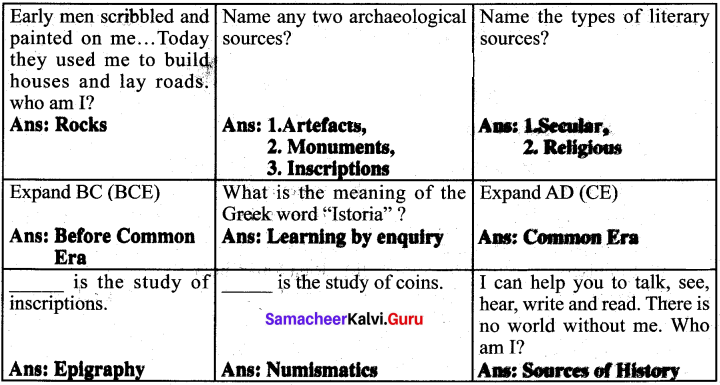
  2. The term History has been derived from the Greek word Istoria which means learning by enquiry.

6th Samacheer Social Guide Question 2.
What do you know about the prehistoric period?
Answer:

  1. The period between the use of first stone tools and the invention of writing systems is called the prehistoric period.
  2. Stone tools, excavated materials, fossils and rock paintings are the major sources of the pre-historic period.

6th History Guide Question 3.
What are the sources available to know about the pre-historic period?
Answer:
Paintings on the rocks and the walls of the caves, stone tools, excavated materials are the sources available to know about the pre-historic period.

6th Standard Social Science Guide Pdf Question 4.
Mention the places from where we got prehistoric tools?
Answer:

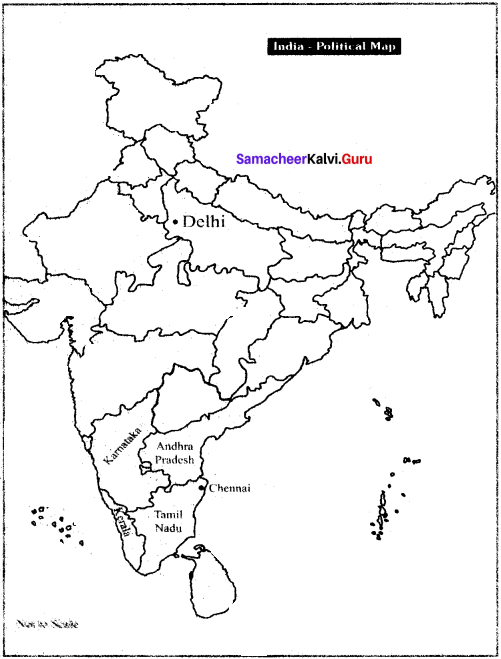
  1. Adichanallur
  2. Athirampakkam
  3. Brahmagiri
  4. Hallur
  5. Lothal
  6. Bimbetka

Samacheer Kalvi Class 6 Social Science Solutions Question 5.
What are the benefits of a museum?
Answer:

  1. Museums are community centres designed to inform and teach the public.
  2. The educational benefit of a museum is academic learning.
  3. Museums are the caretakers of history as much as they offer connections to history.
  4. Museums are full of stories, and it is interesting for students to hear these stories.
  5. Museums offer opportunities for children to compare and contrast leading to critical thinking skills.
  6. Children’s curiosity comes out in the form of questions.
  7. Students are exposed to new ideas and concepts.
  8. Museums inspire students to wonder, imagine and dream Of possibilities that are beyond what they know.
  9. Students are exposed to opportunities that spark creative moments.

6th Standard Social Samacheer Kalvi Question 6.
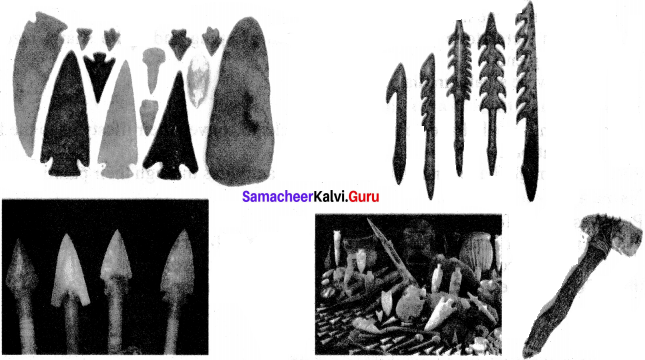
Name some tools used by early man to hunt animals.
Answer:

  1. Weapons made of stones.
  2. Bones.
  3. Homs of animals.
  4. Weapons made of branches of trees.

6th Standard Social Science History Question 7.
Why were paintings drawn on rocks?
Answer:

  1. Paintings could have been drawn or rocks to convey their lifestyles to the future generations.
  2. They might have wished to record their activities through their paintings.

Samacheer 6th Social Guide Question 8.
Name any two artefacts.
Answer:

  1. Toys
  2. Ornaments

VIII. HOTS :

Question 1.
How dogs were useful to pre-historic men?
Answer:

  1. There might have been chances of wild animals entering their caves.
  2. But, they realised that dogs could help them prevent the entry of such dangerous animals.
  3. They thought that dog by its sniffing skill would help them in such situations.

Question 2.
Compare the lifestyle of Old Stone age man with present-day lifestyle.
Answer:
Old Stone age man

  1. He was a nomad.
  2. Took shelter on branches of trees, in holes and caves.
  3. Wore dresses made out of leaves, skin of animals and barks of trees.
  4. Ate vegetables, fruits and roots which he gathered from jungles.
  5. Not civilized.

Present day man:

  1. Settled in villages and towns.
  2. Lives in well built houses.
  3. Wears dresses made out of cotton and other materials.
  4. Eats all kinds of food grains.
  5. Well civilized.

IX. Student Activity :
Question 1.
Identify the category of the following sources of history.

  1. Ums excavated from Adhichanallur
  2. Copper plates of Yelvikudi.
  3. Mahabharatha.
  4. Sanchi Stupa.
  5. Pattinappaalai.
  6. The earthemwares from Keezhadi.
  7. Toys of Indus Civilisation.
  8. Big Temple of Thanjavur.

Answer:

  1. Artefact (Archaeological)
  2. Inscriptions (Archaeological)
  3. Religions Literature – Literary sources
  4. Monuments (Archaeological)
  5. Literary sources Artefact (Archaeological)
  6. Artefact (Archaeological)
  7. Monuments (Archaeological sources)

X. Life Skill
Question 1.
Make some weapon models used by the Old Stone Age man using clay. Hints:
Answer:
Samacheer Kalvi Guru 6th Social Science Term 1 Chapter 1 What Is History

Question 2.
Discuss with your grandpa, grandma, neighbours and teachers and collect information about your street, village, town or school. With that collected data, try to write its history titling your Writing as “I am a Historian”.
Answer:
Am I am living at Mylapore. I have collected information about it from my grandparents, neighbours and teacher and internet. It is given below:
I am a Historian

(i) Mylapore is located a few kilometres to the south of the British-built Chennai city.

(ii) It lies between Tiruvallikkeni and Teynampet in the west then across to the coast in the east.

(iii) The word Mylapore is derived from Mayil Arparikum Oor, which means “Land

(iv) Historically, peacocks have been known to thrive in the area, which is evident from the several statues in the Kapaleeshwarar Temple towers and in the emblem of the San Thome Basilica.

(v) Thirugnanasambandar has also mentioned about mayil (peacock) in his songs in Tevaram.

(vi) Mylapore was historically known as Vedapuri.

(vii) As the available historical and archaeological evidence show, it could well be the oldest part of Chennai, with written records of early settlements going back to the first century BC.

(viii) It was known for its ancient port with a flourishing trade with the Roman Empire, receiving gold in exchange for its products like pepper and fine cloth.

(ix) St. Thomas the Apostle allegedly died at Mylapore in 72 AD.

(x) Ptolemy had recorded in the 2nd century AD that the port of Mylapore was known to the Greeks and the Romans. The Saivite Saints of the 7th Century, Saint Sambandar and Saint Appar, have sung about the Shrine in their hymns.

(xi) Mention has been made of the early settlement of Santhome (currently known),by Arab travelers and merchants of the 9th and 10th centuries AD.

(xii) Marco Polo visited the place in the late 13th century and left a detailed description of the land, the people along with their customs and religion.

(xiii) It was considerable maritime time and the ancient German and Greek maps refer to the town as ‘Maliarpha’.

(xiv) Mylapore was occupied by the Portuguese in 1523. Their rule lasted until 1749, except for a brief interregnum between 1662 and 1687, when the town was occupied by the Dutch.

(xv) After 1749, the British East India Company took possession of the settlement in . the name of Muhammad Ali Khan Wallaj ah, the Nawab of Arcot. In that same year, Mylapore was incorporated into the administration of the Presidency of Madras.

(xvi) In the late 19th and early 20th centuries the town became the commercial and intellectual hub of Madras city and home to British-educated lawyers and statesmen.

XI. Answer Grid

Samacheer Kalvi 6th Social Guide Term 1 Chapter 1 What Is History

XII. Map work

Question 1.
Mark the following places in the political map of India.
a. Delhi
b. Chennai
c. Tamil Nadu
d. Andhra Pradesh
e. Kerala
f. Karnataka
Answer:
Samacheer Kalvi 6th Social Science Book Back Answers Term 1 Chapter 1 What Is History

Samacheer Kalvi 6th Social Science What is History Additional Questions

I. Choose the correct answer:

Question 1.
Where did early man live?
(a) mud house
(b) under tree
(c) caves
(d) river banks
Answer:
(c) caves

Question 2.
Who was the first ruler to give up war after victory?
(a) Bimbisara
(b) Raja Raja Chola
(c) Akbar
(d) Ashoka
Answer:
(d) Ashoka

II. Match the statement with the Reason. Tick the appropriate answer:

Question 1.
(a) Statement: Charles Allen wrote a book titled. The search for the India’s Lost Emperor.
Reason: It provided a comprehensive account of Ashoka.
(a) Statement is true, but reason is wrong.
(b) Statement and reason are correct.
(c) Statement is wrong, and reason is correct.
(d) Both statement and reason are wrong.
Answer:
(b) Statement and reason are correct.

(b) Statement: Early man used stone tools.
Reason: He knew only stones as tools.
(a) Statement is true, but reason is wrong.
(b) Statement and reason are correct.
(c) Statement is wrong, and reason is correct.
(d) Both statement and reason are wrong.
Answer:
(b) Statement and reason are correct

Question 2.
Statement: ‘Dhamma’ is the Prakrit word for the Sanskrit term ‘Dharma’
Find out which of the following is related to the statement.
(a) Helping the poor
(b) Obedience to God
(c) Religious duty
(d) Tolerance
Answer:
(c) Religious duty

(b) Statement: Raja Raja Chola built the Big Temple. Find out which of the following is related of the statement
(a) Kumbakonam
(b) Tiruchi
(c) Madurai
(d) Thanjavur
Answer:
(d) Thanjavur

Question 3.
Find out the wrong pair.
(a)
(a) Stone tools – Prehistory
(b) Writing system – History
(c) Epigraphy – Study of inscription
(d) Numismatics – Study of tools

(b)
(a) Dharma – Righteousness
(b) Chakra – 24 spokes
(c) Lion pillar – Sanchi
(d) Ashoka – Buddhism
Answer:
(d) Numismatics – Study of tools

Question 4.
(a) Find the odd one:
(a) History is a record of past events.
(b) In History the past events are given in chronological order.
(c) History is derived from Istoria meaning learning by enquiry.
(d) History is a mere collection of stories.
Answer:
(d) History is a mere collection of stories.

4 (b) Find the odd one:
(a) We have lion pillar in Saranath.
(b) This pillar was built by Ashoka.
(c) There is a Dharmachakra in this pillar.
(d) This Chakra has uncountable spokes.
Answer:
(d) This Chakra has uncountable spokes.

III. Fill in the blanks:

  1. In history, BCE stands for _______
  2. The first historian of India was _______
  3. Fossil remains belongs to _______ sources.
  4. The most famous ruler of ancient India was
  5. Sanchi is situated in the Raisen district of _______

Answer:

  1. Before Common Era
  2. Kalhana
  3. Archaeological
  4. Ashoka
  5. Madhya Pradesh

IV. Sate True or False:

  1. Pre-historic period people led an advanced style of life.
  2. The greatness of Ashoka had been unknown till 20th century.
  3. Artifacts form one of the important archaeological sources.
  4. Bimbetka is in Andhra Pradesh.

Answer:

  1. False
  2. True
  3. True
  4. False

V. Match the followings:

Question 1.

  1. History – (i) Learning by enquiry
  2. Istoria – (ii) Father of History
  3. Edicts – (iii) Record of the past
  4. Herodoturs – (iv) Archaeological source

Answer:

  1. iii
  2. i
  3. iv
  4. ii

Question 2.

  1. BCE – (i) Hunting activities
  2. Dogs – (ii) Search for India’s Lost Emperor
  3. Allen – (iii) Study of inscription
  4. Epigraphy – (iv) Before common Era.

Answer:

  1. iv
  2. i
  3. ii
  4. iii

VI. Answer in one word :

Question 1.
What is meant by Numismatics?
Answer:
The study of Coins.

Question 2.
Mention the names of Archaeological sources.
Answer:

  1. Inscription
  2. Monuments
  3. Artefacts
  4. Coins.

Question 3.
What do literary sources include?
Answer:

  1. Religious literature and
  2. Secular literature.

VII. Answer the following :

Question 1.
What is the importance of Sarnath pillar?
Answer:

  1. Lion captial of Sarnath has been adopted as the Natural Emblem of the Republic of India.
  2. The Ashoka Chakra is a depiction of the Buddhist Darmachakra represented with 24 spokes.

Question 2.
By whom was the material evidence provided revealing the greatness of Emperor Ashoka?
Answer:
The material evidence provided by William Jones, James Princep and Alexander Cunningham revealed the greatness of Emperor Ashoka.

Question 3.
What is meant by artefact?
Answer:
Art fact means an object that is made by a person, such as tool or a decoration, especially one that is of historical interest, on The museum’s collections include artefacts dating back to historic times.

Question 4.
Name any three devotional literature.
Answer:

  1. Devaram,
  2. Thiuvasagam,
  3. Nalayira Divya prabhandam

VIII. HOTS:

Question 1.
Why should we study History?
Answer :

  1. History helps us understand changes, and how the society, we live in came to be. j tin The study of history helps us to understand our present.
  2. Historical research involves studying, understanding and interpreting past events.
  3. Historical data are categorised into primary and secondary sources.
  4. Study of history will increase the cultural awareness and moral understanding of the world we live in.

IX. Who am I?

Question 1.
I reveal the lifestyle of the stone age people.
Answer:
Paintings

Question 2.
lam in between the use of forest stone tools and the invention of writing system.
Answer:
Prehistoric period

Question 3.
lam titled as numismatics and serve as one of the archaeological sources.
Answer:
coins

Question 4.
gave protection and helped in hunting activities.
Answer:
dog

Question 5.
People say my service for the cause of public good was exemplary.
Answer:
Ashoka

Samacheer Kalvi 8th English Solutions Term 3 Supplementary Chapter 1 The Woman on Platform 8

Students can Download English Lesson 1 The Woman on Platform 8 Questions and Answers, Summary, Activity, Notes, Samacheer Kalvi 8th English Book Solutions Guide Pdf helps you to revise the complete Tamilnadu State Board New Syllabus and score more marks in your examinations.

Tamilnadu Samacheer Kalvi 8th English Solutions Term 3 Supplementary Chapter 1 The Woman on Platform 8

Read And Understand

Answer the following questions.

The Woman On Platform 8 Questions And Answers Question 1.
Where was Arun sitting?
Answer:
Arun was sitting on platform no. 8 at Ambala station.

The Woman On Platform 8 Book Back Answers Question 2.
What was the expected time of train’s arrival?
Answer:
The expected time of the trains arrival was at twelve o’clock midnight.

The Woman On Platform 8 Question 3.
What were the sight Arun had seen on the platform?
Answer:
Arun saw a tide of people, the cries of various vendors and the newspaper boy.

The Woman On Platform 8 Question Answer Question 4.
What did the vendors sell?
Answer:
The vendor sold curds, lemons, sweet meat and newspapers.

The Woman On Platform 8 Answer Question 5.
How did the woman appear?
Answer:
The woman had a pale face and dark kind eyes. She wore no jewels and was dressed very simple in a white saree.

8th English The Woman On Platform 8 Question 6.
Where was Arun travelling to?
Answer:
Arun was travelling to his boarding school.

The Woman On Platform 8 One Word Answer Question 7.
What did the woman buy for him?
Answer:
The woman bought samosas and jalebies. She also ordered tea for Arun.

The Woman On Platform No 8 Question Answer Question 8.
What was the advise of Sathish’s mother?
Answer:
Sathish’s mother advised Arun not to talk to strangers and to be very careful of them.

8th English The Woman On Platform 8 Question Answer Question 9.
What were the Arun’s last words?
Answer:
Aruns last words were “Goodbye – mother”.

Supplementary The Woman On Platform 8 Question 10.
What was the reaction of the woman at the end?
Answer:
When Satish’s mother was talking, she did not listen to her. But she was looking at Arun, as the train moved.

Step To Success

Sentence Rearrangement Common Example.

A. Miss Sullivan arrived at the Keller home when Helen was seven.
B. The deaf and blind Helen learned to communicate verbally.
C. But, eventually, Miss Sullivan’s effort was rewarded.
D. Before Helen Keller was two years old, she lost her sight and her hearing.
E. Miss Sullivan worked closely with Helen, her new student.
F. At times the teacher became frustrated.
1. DEFACB
2. DAEFCB
3. ACFDEB
4. CFDABE
5. FDACEB
Answer:
2. DAEFCB

Connecting To Self
Think you are in the following situation and write what would you do and why?
Answer:

The Woman On Platform 8 Questions And Answers Samacheer Kalvi 8th English Solutions Term 3 Supplementary Chapter 1

The Woman on Platform 8 Additional Questions

I. Choose the right answer (MCQ):

The Woman On Platform 8 Pdf Question 1.
I think I was about ______ at the time.
(a) ten
(b) eleven
(c) twelve
(d) thirteen
Answer:
(c) twelve

The Woman On Platform 8 Notes Question 2.
Trolleys rolled past me and I was conscious of the cries of the various ______
(a) vendors
(b) people
(c) children
(d) sellers
Answer:
(a) vendors

The Woman On Platform 8 Choose The Best Answer Question 3.
She wore no jewels and was dressed very ______ in a white saree.
(a) plain
(b) grandly
(c) elegantly
(d) simply
Answer:
(d) simply

The Woman On Platform 8 Summary Question 4.
She took me into the station ______ and ordered tea.
(a) dinini-room
(b) cafe
(c) stall
(d) counter
Answer:
(a) dinini-room

The Woman On Platform 8 Match The Following Question 5.
The strange encounter had little effect on my ______
(a) hunger
(b) appetite
(c) desire
(d) anxiety
Answer:
(b) appetite

The Woman On Platform 8 Mind Map Question 6.
I began to talk quite ______
(a) elaborately
(b) softly
(c) simply
(d) freely
Answer:
(d) freely

The Women On Platform 8 Question 7.
I did not ask her where she ______
(a) stayed
(b) landed
(c) lived
(d) started
Answer:
(c) lived

Question 8.
I caught her fingers and ______ up at her
(a) stared
(b) glanced
(c) looked
(d) glared
Answer:
(c) looked

Question 9.
I was unable to ______ a word.
(a) tall
(b) utter
(c) pronounce
(d) speak
Answer:
(d) speak

Question 10.
Satish’s mother did most of the ______
(a) talking
(b)work
(c) task
(d) acting
Answer:
(a) talking

II. Identify the character / speaker:

  1. “Are you all alone, my son”.
  2. “Yes, I am going to school”.
  3. “I had to change trains Anyway, I can travel alone”.
  4. “And how long do you have to wait for your train?”
  5. “Hello Arun! The train’s coming in late, as usual”.
  6. “I am glad to know that”
  7. “Yes I am Aron’s mother”
  8. “These days one has to be very careful of strangers”.
  9. “Here it comes”.
  10. “Goodbye – mother……”

Answer:

  1. The woman
  2. Arun
  3. Arun
  4. The woman
  5. Satish
  6. Satish’s mother
  7. The woman
  8. Satish’s mother
  9. Satish
  10. Arun

III. Give Very Short Answers :

Question 1.
How old was Arun?
Answer:
Arun was twelve years old.

Question 2.
When did-Arun arrive at-Ambala?
Answer:
Arun arrived early in the evening at Ambala.

Question 3.
On what did Arun sit down?
Answer:
Arun sat down on his suitcase.

Question 4.
How was the woman dressed? ”
Answer:
The woman was dressed in simple White saree

Question 5.
Why did Arun like tier?
Answer:
Arun liked her for the simplicity of her dress, for her deep soft voifce and calmness of her face.

Question 6.
How old was the woman?
Answer:
The woman was over thirty years.

Question 7.
What strengthened the bond between Arun and the woman?
Answer:
The food she bought for him, srengthened the bond between them,

Question 8.
Who ran across the rails?
Answer:
A boy leapt off the platform and ran across the rails.

Question 9.
Who was Satish?
Answer:
Satish was one of Aran’s friends.

Question 10.
Who accompanied Satish?
Answer:
Satish’s mother accompanied him.

IV. Short Answers:

Question 1.
What did Satish tel! about Arun to his mother?
Answer:
Satish told her that Aran was one of his friends and die best bowler in the dass.

Question 2.
Describe Satish’s mother.
Answer:
Satish’s mother was a large grand and impressive woman who wore spectades.

Question 3.
How did Arun contradict Satish’s mother?
Answer:
When Satish’s mother warned Aran to be careful of strangers, he said that he liked strangers.

Question 4.
What did Satish’s mother give to her son?
Answer:
Satish’s mother gaveTrim a bag of fruits, a cricketbat, and a big box of chocolates.

Question 5.
Where did Arun and Satish place themselves in the train?
Answer:
They picked up their suitcase and placed themselves at the open windows.

V. Rearrange the fumbled sentences :

Question A.
1. She ordered tea, samosas and jalebies.
2. I was a hungry school boy and ate as much as I could.
3. She took me into the station dining-room.
4. Atonce I began to thaw and takea new interest in this kind woman.
5. The strange encounter had little effect on my appetite.
Answer:
3. She took me into the station dining-room.
1. She ordered tea, samosas and jalebies.
4. At once I began to thaw and take a new interest in this kind woman.
5. The strange encounter had little effect on my appetite.
2. I was a hungry school boy and ate as much as I could.

Question B.
1. An engine was shunting up and down beside platform No.8.
2. As it approached, a boy leapt off the platform.
3. We began walking back along the platform.
4. He ran across the rails, taking a short cut to the next platform.
5. After about half-an-hour, we left the dining-room.
Answer:
5. After about half-an-hour, we left the dining-room.
3. We began walking back along the platform.
1. An engine was shunting up and down beside platform No.8.
2. As it approached, a boy leapt off the platform.
4. He ran across the rails, taking a short cut to the next platform

VI. Comprehension.

Read the following paragraph and answer the questions.

Question 1
Trolleys rolled past me and I was conscious ofthe cries ofthe various vendors-the men who ,sold curds and lemon, the sweet meat, seller, the newspaper boy- but I had lost interest in a that went on along the busy platform, and continued to stare across the railway tracks, feeling bored and a little lonely.

(a) What passed Aran?
Answer:
Trolleys passed Arun.

(b) What did the vendors sell?
Answer:
The vendors sold curd, lemons and sweet meat.

(c) What did Aran continue to do?
Answer:
Arun continued to stare across the railway tracks.

(d) How did he feel?
Answer:
He felt bored and lonely.

(e) What was Aran conscious of?
Answer:
Arun was conscious ofthe cries ofthe vendors.

Question 2.
she smiled gratefully at me and pressed my hand. We walked together in silence until we reached the place where I had left my suitcase, one of my school fellows, Satish, a boy of about my age, had turned up with his mother.

(a) Who smiled gratefully at Aran?
Answer:
The woman in white sari smiled gratefully at Arun.

(b) How did they walk?
Answer:
They walked together in silence.

(c) Who was Satish?
Answer:
Satish was one of Arun’s schoolfellows.

(d) Who came with Satish?
Answer:
Satish’s mother came along with him.

(e) Where did they leave the suitcase?
Answer:
They left the suitcase on the platform.

Question 3.
The train mowed slowly into the station, the engine hissing and sending out waves of steam. As it came to a stop, Satish jumped on the footboard ofa lighted cpmpartment and shouted,‘Come on, Arun, this one’s empty!’ and I picked up my suitcase and made a dash for the open door.

(a) How did the train move?
Answer:
The train moved slowly into the station.

(b) How did the engine enter the station?
Answer:
The engine was hissing and sending out waves of steam.

(c) What did Satish do?
Answer:
Satish jumped on the footboard of a lighted compartment.

(d) Who called out to Arun?
Answer:
Satish called out to Arun.

(e) What did Arun do?
Answer:
Arun picked up his suitcase and made a dash for the open door.

VII. Answer in Detail:

Question 1.
Describe the platform No. 8 at Ambala Station.
Answer:
Arun was waiting for his train on platform no. 8. He was browsing at the bookstall. When the train arrived, the platform looked like a hell. The people were shouting and agitating. As the carriage doors opened, a tide of people would sweep down upon the nervous little ticket collector at the gate. Arun would be caught in this rush and would be swept outside the statioil. There were trolleys, vendors selling various things like curd, lemon and sweet meat. There was also a boy selling newspapers on that busy platform.

The Woman on Platform 8 Summary

Section -I

The story starts with Arun of 12, waiting for his train scheduled at midnight at Ambala station on platform no. 8. He was travelling alone, as his parents considered him to be big enough to travel alone.

He was early at the station feeling bored, suddenly, a soft voice asked him if he is alone. He saw a woman with pale face and dark kind eyes, simply dressed in a white sari. He observed that she was poor, but had a dignity in her appearance.

She asked whether his parents have come to see him off. He replied he can travel alone. The woman agreed which made Arun instantly like her. She was simple and her deep voice and serenity was liked by Arun.

The woman asked about his name and his train. Then she took him to the canteen. She ordered tea, samosas and jalebies for him. Arun could not refuse. She questioned many things, but listened to him intently. All her kind and generous behavior made Arun forget that she was a stranger.
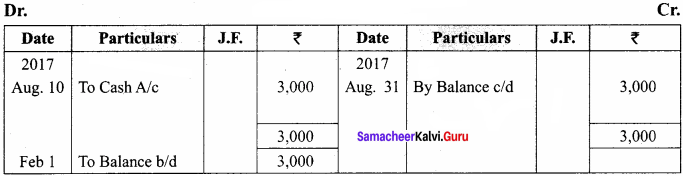
Sathish, one of Aruns school fellows, came to the station with his mother.

Section – II

They introduced each other. The woman addressed herself as Aruns mother without any hesitation. Sathish’s mother warned Arun to be careful of strangers. But Arun replied that he liked strangers which staggered her.

When the train came, they boarded. The woman took Aruns hand in her hands and smiled gently in an understanding way. Arun bade goodbye calling her “mother”. He gazed at the woman, till she got lost in the crowd.

Samacheer Kalvi 8th English Solutions Term 1 Prose Chapter 1 Hobby – Turns A Successful Career

Students can Download English lesson 1 Hobby – Turns A Successful Career Questions and Answers, Summary, Activity, Notes, Samacheer Kalvi 8th English Book Solutions Guide Pdf  helps you to revise the complete Tamilnadu State Board New Syllabus and score more marks in your examinations.

Tamilnadu Samacheer Kalvi 8th English Solutions Term 1 Prose Chapter 1 Hobby – Turns A Successful Career

Section – I

Read And Understand

A. Say true or false.

  1. Mani’s hobby is playing cricket.
  2. Hobbies are unique to people.
  3. People have hobbies only to pass time.

Answer:

  1. False
  2. True
  3. False

B. Choose the correct answer.

Hobby Turns Into A Successful Career Question 1.
Mani imagined a world with_______
(a) music and musicians
(b) Building and sculptures
(c) magic and magicians
Answer:
(c) magic and magicians

Hobby Turns A Successful Career Question 2.
When Mani started writing things, he was unable to_______
(a) describe them accurately
(b) describe them fluently
(c) describe them imaginatively
Answer:
(a) describe them accurately

Hobby Turns A Successful Career Question And Answer Question 3.
Mani feels writing is like_______
(a) painting the voice
(b) engraving the voice
(c) designing the voice
Answer:
(a) painting the voice

Section – II
Read And Understand

A. Say true or false.

  1. Ajay Garg is an artist.
  2. Asha Devi taught Ajay the miniature painting.
  3. Ajay displayed 150 paintings.
  4. Ajay was awarded by the Indian president Dr. A. P. J. Abdul Kalam.

Answer:

  1. True
  2. True
  3. True
  4. True

B. Answer the following questions.

Hobby Turns Into A Successful Career Question And Answer Question 1.
What was Ajay gifted with?
Answer:
Ajay was gifted with a skill of painting.

Hobby Turns A Successful Career Book Back Answers Question 2.
How was he honoured?
Answer:
He was honoured by the Indian President Dr. A.P.J. Abdul Kalam with a national award of accomplishment.

Hobby Turns A Successful Career Question Answer Question 3.
What did Ajay’s current goal?
Answer:
Ajay current goal was to re-energies the dying art of traditional Miniature Indian paintings.

8th English Hobby Turns A Successful Career Question 4.
Is Ajay’s hobby become a successful career? How?
Answer:
Yes, Ajay’s hobby has become a successful career because his work became popular all throughout India, the United States and the United Kingdom. He has also become the executive member of the ‘Deaf and Dumb’ Association in Rajasthan

Section – III

Read And Understand

A. Fill in the blanks.

  1. Mani feels writing is like
  2. Ajay mastered the techniques of
  3. Ilavazhagi won her first match against

Answer:

  1. Paintaing the voice
  2. Prepare colours and brushes
  3. Her father

B. Choose correct synonyms for the italic word.

Hobby Turns A Successful Career Summary Question 1.
Writing is a unique hobby.
(a) common
(b) beneficial
(c) uncommon
Answer:
(c) uncommon

Question 2.
Ajay started to paint happily.
(a) depressed
(b) joyfully
(c) unhappily
Answer:
(b) joy fully

Question 3.
Miniature paintings depict Indian culture.
(a) warp
(b) portray
(c) twist
Answer:
(b) portray

C. Choose correct antonyms for the italic word.

Question 1.
Ajay suffered an injury.
(a) sorrow
(b) endure
(c) hurt
Answer:
(b) endure

Question 2.
Ajay mastered the techniques of painting.
(a) skilled
(b) proficient
(c) unskilled
Answer:
(c) unskilled

Question 3.
Ilavazhagi won world championship in
(a) win
(b) succeed
(c) defeat
Answer:
(c) defeat

D. Answer the following questions in one or two sentences.

Question 1.
What happened to Ajay at the age of three?
Answer:
Ajay suffered an injury at the age of three. He was treated, but that treatment left him permanently deaf.

Question 2.
What did Asha Devi teach Ajay?
Answer:
Asha Devi taught Ajay the old and dying technique of ‘Traditional Indian Miniature Painting’.

Question 3.
Why writing is beneficial according to Mani?
Answer:
According to Mani, writing opens his mind to think beyond the little things with a broader mind. It makes him more passionate about his life, and learn new things.

E. Answer the following questions in 100 words.

Question 1.
How did Ajay’s father find his son’s talent?
Answer:
Ajay Kumar Garg’s childhood was going well, until he suffered an injury at the age of three. Ajay was treated, but that treatment left him permanently deaf. His parents tried many hospitals to cure his disability but it was useless. One day, his father bought him a paint set to play. Ajay started painting happily on the walls and floors. He looked happy, while using the paint set. Soon Ajay father realised that Ajay was talented in painting. When Ajay was five years, a court artist of Dholpur, Shri Sua Lai was impressed with Ajay’s work. He took Ajay with him and started training him.

Question 2.
Write note on Ilavazhagi.
Answer:
Ilavazhagi was one among the many to achieve their dream amidst all odds. Her father was a district level champion in carom. He used to put her on the Carom board to listen to the sound of strikers and coins. Her father took her to the local clubs frequently. When Ilavazhagi won her first match against her father, she gained confidence. This confidence led her to win the Asia Cup, SAARC Cup and the world championship. She won a lot of trophies. She won the 2008 Indian National Carom Championship and became a world champion in the women’s singles. Her passion for Carom made her succeed in life.
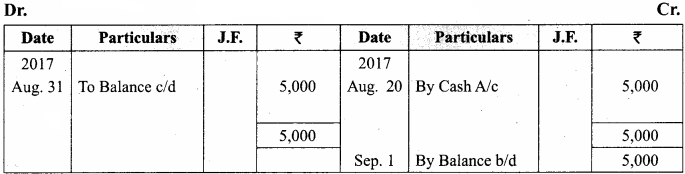
Vocabulary

Homophone

a. Pick out the correct homophone.

  1. I am not ____ to drink soda, (aloud, allowed)
  2. The wind _____ the leaves, (blue, blew)
  3. I will _____ my friend, (meat, meet)
  4. He will play the _____ in the second play, (role, roll)
  5. I have_______movie before.(scene,seen)

Answer:

  1. allowed
  2. blew
  3. meet
  4. role
  5. seen

b. Choose the correct homophone.

Question 1.
Every morning my father likes to look at the ______ on the grass
(a) due
(b) dew
Answer:
(b) dew

Question 2.
Chennai is the____ of Tamilnadu
(a) capitol
(b) capital
Answer:
(b) capital

Question 3.
Their words had a negative
(a) affect
(b) effect
Answer:
(b) effect

Question 4.
I was very last weekend because my friends made plans that
(a) bored
(b) board
Answer:
(a) bored

Question 5.
The cat caught the
(a) scent
(b) cent
Answer:
(a) scent

Abbreviation And Acronyms

(a) & (b) Expand the following:
Answer:

1.

GST

Goods and Services Tax.

2.

ECG

Electrocardiography

3.

ILO

International Labour Organization

4.

SCERT

State Council of Educational Research and Training

5.

IIT

Indian Institute of Technology

6.

ISRO

Indian Space Research Organisation

7.

FIR

First Information Report

8.

UNESCO

United Nations Educational, Scientific and Cultural Organization

9.

UNICEF

United Nations International Children’s Emergency Fund

10

NASA

National Aeronautics and Space Administration

Listening

Questions on passage. (*Listening passage is given at the end of the third unit.)

Question 1.
What is philately?
Answer:
Stamp collecting hobby is known as philately.

Question 2.
What is numismatics?
Answer:
The hobby of collecting coins from different countries is known as numismatics.

Question 3.
Do you know where the rarest and the most beautiful shells are found?
Answer:
The rarest and the most beautiful shells are found in the Indo-Pacific, Caribbean and Mediterranean regions.

Question 4.
Painting can help unleash your creative side. How?
Answer:
Painting allows you to tap into the thoughts, desires and feelings in your head and translate them into something beautiful. It relaxes our mind and helps us to focus better.

Question 5.
What is your friend’s hobby? How does it differ from yours? Discuss and write.
Answer:
My friend’s hobby is web-browsing. It is different from my hobby of gardening. His hobby is an amazing hobby. We can learn about things that are thousands of kilometres away with just a few clicks. We can also share all the wonderful information with our friends.

Speaking

Role-play the conversation in the class.
Continue this conversation with your friends atleast five to ten dialogues each.
Answer:
Naveen : Hi Ajay! How are you?
Ajay : I am Fine, and what about you?
Naveen : I am fine too. What are you doing in this early morning?
Ajay : I am taking care of my garden. The garden is running to weeds.
Naveen : oh! What a beautiful garden it is !
Ajay : It is beautiful as I work every day in it.
Naveen : Who helps you in your work?
Ajay : Myself have done this. It is my and who I have cultivated vegetables hobby.
Naveen : oh ! thats nice. How long have you been doing this?
Ajay : I have been doing this for three years.
Naveen : What vegetables are grown here?
Ajaj : Tomatoes, Chillies, Brinjals, Lady’s fingers and some greens.
Naveen : Wonderful! You have a mini vegetable market here.
Ajaj : Of course, My mother uses these vegetables for cooking
Naveen : It is a very good idea.
Ajay : Yes it is! You benefit a lot by this.
Naveen : It is good for our health because we don’t use any chemicals here.
Ajaj : Exactly! Gardening also develops green atmosphere and the environment.
Naveen : It’s interesting. Let me also do this.

Reading (Tongue Twisters)

  • I Scream. I scream you scream, let’s all scream, for ice cream!
  • No need to light a night-light on a light night like tonight.
  • Green glass globes glow greenly.
  • She sells seashells on the seashore.
  • He would chuck, he would, as much as he could.

Writing

Using the given letter as a model, write a complaining letter on any one of the topics given below.

a) To the Police commissioner about the noise caused by the loudspeaker in a music shop near your school.
Answer:

Chennai,
3rd March 2019.

From
Adiya
VIII Std ‘A’,
Government Higher Secondary School,
Chennai – 600 Oil.

To
The Police Commissioner,
Perambur, Chennai – 600 Oil.

Sir,
Sub : Complaint about the noise caused by the loudspeaker regarding.
We, the students of Government Higher Secondary School, are getting distracted by the noise caused by the loudspeaker in a music shop near our school. We are unable to listen to the lessons taught and concentrate on our studies. The noise from loud speaker is unbearable.

We request you to look into the matter immediately and take necessary action to stop this problem.

Thank you,
Yours faithfully,

Aditya
VIII Std ‘A’ Section.
Address on the Cover:

To
The Police Commissioner, Perambur,
Chennai – 600 Oil.

b) To the Postmaster General on non – receipt of book parcel.
Answer:
Tiruchirappalli,
10th May 2019.

From
G. Alex
School Pupil Leader,
SSR Higher Secondary School,
Tiruchirappalli – 620 001

To
The Postmaster General
Sangiliyandapuram,
Tiruchirappalli – 620 001.

Sir,
Sub : Complaint on the non-receipt of a book parcel – reg.

I had ordered some books from a publishing company, two weeks back. When I contacted the publishing company, they told us that they had sent us the books in a registered parcel two days back. But so far, we have not received the parcel.

You are requested to enquire into the matter and do the needful.

Thank you,
Yours faithfully,
G. Alex.

Address on the Cover:

To
The Postmaster General
Sangiliyandapuram,
Tiruchirappalli – 620 001,

c) To the Transport Manager, TNSTC on non- stopping of buses near your school bus stop.
Answer:
Chennai,
4th June 2019.

From
Manisha. K VIII Std ‘B’,
Anitha Hr. Sec. School,
Vepery, Chennai – 600 007.

To
The Transport Manager,
TNSTC,
Chennai – 600 002.

Sir,
Sub: Non-stopping of buses near the school bus stop – reg.

This is to bring to your notice that TNSTC buses do not stop near our school bus stop. The students are finding it difficult to commute to school. They had to walk a long distance to come to school and then go home from school. It takes a lot of time for all of us.

We request you to kindly look ‘ into this matter and take necessary action for the benefit of our school students.

Thank you,

Yours faithfully,
Manisha. K

Address on the Cover:

To
The Transport Manager, TNSTC,
Chennai – 600 002.

Grammar

A. NOUN
a. Pick out the words from the list and put them appropriately in the table.

David, Madurai, parrot, happiness, book, thought, green, tiger, Trichy, computer,Narayanan, fan, sister, Kalam, woman, pencil, Bharthi, problem, brother, Mumbai,swan, elephant, Vijay, solution, success, school, convent.
Answer:

Person

PlaceAnimalsThings

Ideas/feelings

DavidMaduraiparrotbookhappiness
NarayananTrichytigercomputerthought
sisterMumbaiswanfangreen
Kalamschoolelephantpencilproblem
womanconventsolution
Bharthisuccess
brother
Vijay

b. Write the common noun for the following proper nouns.
Answer:

No.Proper NounCommon Noun
1.Priyagirl
2.Saranboy
3.Tigeranimal
4.Indiacountry
5.PeacockBird
6.Coimbatoreplace
7.Lionanimal
8.Dovebird
9.Kabilanboy
10.Saleemagirl

c. Read the following paragraph and pick out the different types of nouns and put them in the table.
Hobby is an activity we enjoy doing in our free time. It keeps us busy in our leisure time. People choose their hobby on the basis of their interests and personality. Do you know what Dr. A. P. J. Abdul Kalam’s hobby was?
Answer:

Proper NounCommon NounCollective NounAbstract Noun
Dr. A.P.J. Abdul KalamHobbyactivitypersonality
peopleleisureinterests
time
busy

d. Fill in the blanks.
( flock, swarm, bunch, herd)

  1. a______ of cows.
  2. a______ of birds.
  3. a______ of ants.
  4. a______ of grapes.

Answer:

  1. herd
  2. flock
  3. swarm
  4. bunch

B.pronoun

a. Complete with the subject personal pronoun.

  1. My name is Preethi. (Preethi)______ am a student and this is my family.
  2. My mom’s name is princy a house wife.
  3. Albert is my dad. (My dad)
  4. Benjamin is my brother. (Benjamin)
  5. (Preethi and Benjamin) are twins.

Answer:

  1. I
  2. She
  3. He
  4. He
  5. They

b. Change the underlined words with correct pronoun.

(they, he, him, it, she )
Question 1.
I saw Mr. Balu this morning and gave Mr. Balu my homework.
Answer:
I saw Mr. Balu this morning and gave him my homework.

Question 2.
Muthu likes computer games but he doesn’t play computer games very often.
Answer:
Muthu likes computer games but he doesn’t play it very often.

Question 3.
My aunt lives in Trichy but, my aunt often comes to visit my family.
Answer:
My aunt lives in Trichy but, she often comes to visit my family.

Question 4.
Neil Armstrong was born in 1930. Neil Armstrong landed on the moon in 1969.
Answer:
Neil Armstrong was born in 1930. He landed on the moon in 1969.

C. Change the possessive adjective into possessive pronoun.

  1. This is my pen.
  2. She missed her purse.
  3. Her speech is nice.
  4. My book is new.
  5. My bike is costly.

Answer:

  1. This pen is mine.
  2. The missed purse is hers.
  3. The nice speech is hers.
  4. The new book is mine.
  5. The costly bike is mine.

C- VERB
List out the transitive and intransitive verbs in following words.
(come, buy, teach, learn, arrive, sing, run, draw, jump, write )
Answer:

Transitive

Intransitive

buy

come

teach

arrive

learn

run

sing

jump

draw

write

Hobby – Turns A Successful Career Additional Questions

I. Choose the correct Synonyms for the italic word.

Question 1.
We do it in our spare time.
(a) busy time
(b) down time
(c) free time
(d) work time
Answer:
(c) free time

Question 2.
Writing is just a hobby for me, yet it is very beneficial.
(a) useful
(b) harmful
(c) wonderful
(d) frightful
Answer:
(a) useful

Question 3.
He was very impressed with Ajay’s work.
(a) disappointed
(b) bored
(c) lazy
(d) amazed
Answer:
(d) amazed

Question 4.
I was unable to describe them accurately.
(a) exactly
(b) definitely
(c) commonly
(d) suddenly
Answer:
(a) exactly

Question 5.
Soon he became an accomplished artist.
(a) finished
(b) unskilled
(c) fulfilled
(d) worked
Answer:
(a) finished

Question 6.
Ajay exhibited his work and sold 144 paintings.
(a) closed
(b) showed
(c) hid
(d) conceded
Answer:
(b) showed

Question 7.
Her passion for carom took her to the level of world champion.
(a) desire
(b) dread
(c) enmity
(d) honour
Answer:
(a) desire

Question 8.
Her father’s dream shattered.
(a) combined
(b) built
(c) destroyed
(d) fulfilled
Answer:
(c) destroyed

Question 9.
The confidence led her to win the Asia Cup.
(a) peace
(b) love
(c) hatred
(d) hope
Answer:
(d) hope

Question 10.
His parents tried several hospitals to cure his impairment.
(a) ability
(b) disability
(c) failure
(d) destruction
Answer:
(b) disability

II. Choose the correct Antonyms for the italic word.

Question 1.
Mani found it difficult to read and write.
(a) hard
(b) easy
(c) sharp
(d) bad
Answer:
(b) easy

Question 2.
Same is the case with me.
(a) fair
(b) Identical
(c) different
(d) ordinary
Answer:
(c) different

Question 3.
I sit with small children and entertain them.
(a) amuse
(b) cheer
(c) fascinate
(d) Annoy
Answer:
(d) Annoy

Question 4.
It opens my mind to think with a broader mind,
(a) narrower
(b) outer
(c) wider
(d) smother
Answer:
(a) narrower

Question 5.
But that treatment left Ajay permanently deaf.
(a) temporarily
(b) abruptly
(c) suddenly
(d) accurately
Answer:
(a) temporarily

Question 6.
Asha Devi taught Ajay the old and dying technique of Traditional Indian Miniature Painting’
(a) conventional
(b) modern
(c) standard
(d) normal
Answer:
(b) modern

Question 7.
His family did not encourage and support him.
(a) support
(b) motivate
(c) entertain
(d) discourage
Answer:
(d) discourage

Question 8.
The hard working people always chase their dream.
(a) follow
(b) run
(c) walk
(d) retreat
Answer:
(d) retreat

Question 9.
Her victories included the Asia Cup and SAARC Cup.
(a) added
(b) excluded
(c) existed
(d) outcast
Answer:
(b) excluded

Question 10.
She won the Championship beating a former world champion Rashmi kumari in the final,
(a) previous
(b) first
(c) future
(d) beginner
Answer:
(c) future

III. Choose the Correct Answer (MCQ)

Question 1.
Mani found it difficult to read and ______
(a) learn
(b) write
(c) speak
(d) talk
Answer:
(b) write

Question 2.
Hobbies are the_____that we do in our spare time.
(a) projects
(b) tasks
(c) activities
(d) assignments
Answer:
(c) activities

Question 3.
When I write thines. my_____is at its best.
(a) handwriting
(b) creations
(c) work
(d) imagination
Answer:
(d) imagination

Question 4.
It makes me more_____about mv life.
(a) passionate
(b) pleasant
(c) inquisitive
(d) accurate
Answer:
(a) passionate

Question 5.
Aiay started to paint_____
(a) sorrowful
(b) vaguely
(c) happily
(d) regretful
Answer:
(C) happily

Question 6.
Ajay turned his hobby into a _____career.
(a) medical
(b) successful
(c) vocational
(d)good
Answer:
(b) successful

Question 7.
Irudavarai was determined to achieve his_____
(a) preference
(b) request
(c) dream
(d) fancy
Answer:
(c) dream

Question 8.
The confidence led Ilavazhaki to win her_____
(a) victories
(b) demands
(c) claims
(d) conditions
Answer:
(a) victories

Question 9.
Ilavazhaki’s father was a_____level champion in carom
(a) world
(b) state
(c) International
(d) district
Answer:
(d) district

Question 10.
Her passion for_____took her to the level of world champion.
(a) carom
(b) cricket
(c) hockey
(d) kabaddi
Answer:
(a) carom

IV. Very Short Questions with Answers.

Question 1.
What is a hobby?
Answer:
Hobby is an activity we enjoy doing in our free time.

Question 2.
What is your hobby?
Answer:
My hobbies are Reading and Singing.

Question 3.
What does the term ‘pastime’ mean?
Answer:
The term ‘pastime’ means, an activity regularly done for enjoying rather than work. To pass the leisure time relaxingly.

Question 4.
Who is the best friend for a reader while travelling in a train?
Answer:
Books are the best friends for a reader while travelling alone in a train.

Question 5.
Name any two socially useful hobbies.
Answer:
Cooking and Painting.

V. Short Questions with Answers.

Question 1.
What was Mani’s problem?
Answer:
Mani had difficulty in reading and writing.

Question 2.
What did his Grandfather do?
Answer:
His grandfather helped him by reading bedtime stories.

Question 3.
Why does Mani say that writing is a unique hobby?
Answer:
Mani says that writing is unique because most people don’t want to exhaust themselves in their spare time.

Question 4.
What did Ajay’s father buy him?
Answer:
Ajay’s father bought him a paint set to play.

Question 5.
What was Ajay gifted with?
Answer:
Ajay was gifted with the practice of creating images on a grain of rice.

Question 6.
What was Irudayaraj?
Answer:
Irudayaraj was a fish-cart driver, who used to transport materials like pipes to make a living.

Question 7.
Who did Ilavazhagi beat in the women’s singles?
Answer:
Ilavazhagi beat P. Nirmala in the finals of Carom World Championship with 25-11, 25-11 victory.

VI. Paragraph Question with Answer.

Question 1.
How beneficial was the hobby of writing to Mani?
Answer:
Mani felt the hobby of writing very beneficial to him. He felt writing is like painting his voice’. When he got free time, he picked a pen and a notebook. He started writing stories, poems and sometimes about his feelings. His mind used to relax, when he poured his thoughts as words. His imagination is at its best, when he writes things. Writing opened his mind to think beyond the little things with a broader mind. It made him more passionate about his life and learn new things. It also helped him in school too and made him a good writer.

Hobby – Turns A Successful Career Grammar Additional

I. Guide proper names for the common nouns :

Eg: Butter – Amul

  1. Pencil – ________
  2. Ball Pen – ________
  3. Hospital – ________
  4. Soft Drink – ________
  5. Car – ________

Answer:

  1. Apsara
  2. Reynolds
  3. Apollo
  4. Pepsi
  5. Toyota

II. Collective nouns:

  1. ______ of bees.
  2. ______ of keys.
  3. ______ of cards.
  4. ______ of players
  5. ______ of books.

Answer:

  1. Swarm
  2. Bunch
  3. Pack
  4. Team
  5. Libary

III.Form abstract nouns from these adjectives:

Eg: Soft – Softness

  1. Cruel – ________
  2. Polite – ________
  3. Honest – ________
  4. Beautiful – ________
  5. Lazy – ________

Answer:

  1. Cruelty
  2. Politeness
  3. Honesty
  4. Beauty
  5. Laziness

IV. Use singular pronouns and fill in the blanks :

  1. _____gave_____a gift.
  2. _____went out when_____rained.
  3. _____do not want_____to steal things.
  4. When he met_____I gave_____an advice.

Answer:

  1. He, her
  2. She, it
  3. I, you
  4. me, him

V. Use Plural pronouns and fill in the blanks:

  1. Raj and Rahul are brothers and live in the same house.
  2. They are my friends, I meet in the park.
  3. My father and I went to the mall, but it was closed.
  4. We won the match. Everybody congratulated

Answer:

  1. They
  2. Them
  3. we
  4. us

VI. Fill in the blanks with possessive pronouns:

  1. The travellers brought a lot of goods. The goods were _______
  2. A man was riding a motor bike. The bike was _______
  3. She stitched the torn dresses from her cupboard. The dresses were _______
  4. The certificates belong to me. They are _______
  5. This classroom belongs to us. It is certainly _______
  6. The photos look so good. They are _______
  7. The dog has a puppy. It is _______

Answer:

  1. theirs
  2. his
  3. hers
  4. mine
  5. ours
  6. yours
  7. its

VII. Use simple present tense of verb in the bracket and fill the blanks:

  1. Look! He (fly)______the kite high
  2. Yesterday he went by car, but today he (go)on a cycle.
  3. If he (pass)the exam, he will get a good job.
  4. Mohan will jump in joy if he (see) you coming.
  5. If Vijay (run)fast, he will be able to catch the train.

Answer:

  1. Flies
  2. goes
  3. passes
  4. sees
  5. runs

VIII. Use simple past tense of verb in the bracket and fill the blanks:

  1. I (buy) this coat from the boutique.
  2. Dad (leave)for office an hour ago.
  3. My sister (write) an essay that was published in the magazine.
  4. We (come)home, (take) some rest and (spend)time playing cards.

Answer:

  1. bought
  2. left
  3. wrote
  4. came / took /spent

IX. Use simple future tense of verb in the bracket and fill the blanks:

  1. I (leave)_______for Paris next week.
  2. We (party)_______at the Taj on my birthday.
  3. You (move)_______to Delhi next month on promotion.
  4. Ten students failed in the exam. They (write)_______their exams again from Monday.
  5. The sun rise was at 6 a.m. It (set)_______at 5.45 p.m this evening.

Answer:

  1. will leave
  2. will party
  3. will move
  4. will write
  5. will set

X. Insert the correct form of infinitive using the given verbs in the brackets:

  1. It would be nice to______(meet) Dr. Abdul Kalam again.
  2. To______(cook) this recipe, you will need 500 grams of minced meet
  3. Ravi wants to______(take) raji to the amusement park
  4. I need to______(wash) my hands before I have my food.
  5. We discussed whether to______(invite) Rajiv or not.

Answer:

  1. meet
  2. cook
  3. take
  4. wash
  5. invite

XI. Fill in the blanks with suitable Gerund (verb+ing):

  1. ______(meet) is a periodic event.
  2. She loves______(eat) ice creams.
  3. I like______(celebrate) festivals.
  4. ______(wait) is torturing.
  5. He was awarded for______(run) fast
  6. I achieve by______(work)
  7. I don’t like______(play) cards
  8. ______(cook) is my hobby.
  9. Do you enjoy______(swim)
  10. He loves______(sing) songs.

Answera:

  1. Meeting
  2. eating
  3. celebrating
  4. Waiting
  5. running
  6. working
  7. playing
  8. Cooking
  9. swimming
  10. singing

Section – I

Hobby – Turns A Successful Career Summary

A boy named Mani had difficulty in reading and writing. His grandfather noticed this and helped  him by reading bedtime stories. Gradually, Mani started reading on his own. After some days, he also  started writing his own stories. In this section, he wrote an essay on hobbies.

Hobbies are the activities done during our free time. They are special to people. Some people  like gardening, a few like photography and many have book reading as their hobby. Hobbies help people to learn new things, relax after a tiring day and energies our body and mind. Mani’s hobby was writing. Though many people feel writing is tough, he felt ‘writing’ was like ‘painting our voice’. When he wrote things, he imagined a world with magic and magicians. Writing opened his mind to
think beyond the little things with a broader mind. It made him learn new things and enjoy every moment of his life. His hobby of writing helped him in school too. He could describe things better in  his stories. He had no problem in writing English essays or stories, as it was his hobby.

Thus it is important to always learn and improve Our hobbies.

Section – II

Ajay Kumar Garg, a very talented young artist lived in Jaipur, India. He suffered an injury at the age of three and became deaf. His parents tried many hospitals to cure his disability. But it was useless. Ajay used to paint on the walls and floors. Realizing his interest in painting, a court artist of Dholpur, Shri Sua Lai started educating him in painting. After completing his education, Ajay became an apprentice of Asha Devi, who taught him the ‘Miniature Painting’. Soon, Ajay became an ‘accomplished artist’ in the miniature style. He was gifted in the practice of creating images on a grain of rice.

Ajay exhibited his work and sold 144 out of 150 paintings displayed in the exhibition. His work became famous throughout India, the United States and the United Kingdom. In 2004, he was awarded a national award of accomplishment from the Indian President, Dr. A.P.J. Abdul Kalam.

Ajay also involved in the welfare of people with hearing disability and gave them free training. He has been the executive member of’Deaf and Dumb’ Association in Rajasthan. One of Ajay’s current goals is to re-energize the dying art of traditional miniature Indian paintings. Thus, Ajay’s life shows us that we can turn our hobby into a successful career, if we are ready to learn and develop our skills.

Section – III

Ilavazhagi achieved her dream amidst all odds. Her father, A. Irudayaraj, was a district level champion in Carom. His dream of achieving success in it, shattered, as he was not encouraged and supported by his family members. He determined to achieve his dream through his daughter. So he began coaching her and carried her to the local clubs frequently. She won the match against her father and that gave her the confidence in achieving success. Later she won the Asia Cup, SAARC cup and the world championship.
She lived with her family in a small one-room apartment in Vysarpadi, Chennai. This was not enough to accommodate her family and to preserve her trophies. She has been playing for the state for almost 14 years yet, she found it difficult to finance her trips for the matches.

Ilavazhagi is a member of the Thiruvallur District Carom Association. She also represented India at the Carom World Championships. She won the 2008 Indian National Carom Championship and became a world champion in the women’s singles after beating P. Nirmala in the finals with 25-11, 25-11 victory. Thus her passion for Carom took her to the level of world champion.

Samacheer Kalvi 8th English Solutions Term 2 Prose Chapter 2 My Reminiscence

Students can Download English Lesson 2 My Reminiscence Questions and Answers, Summary, Activity, Notes, Samacheer Kalvi 8th English Book Solutions Guide Pdf helps you to revise the complete Tamilnadu State Board New Syllabus and score more marks in your examinations.

Tamilnadu Samacheer Kalvi 8th English Solutions Term 2 Prose Chapter 2 My Reminiscence

Read and Understand

I. Fill in the blanks.

  1. The author speaks about the river _______
  2. The author s brother’s name is _______
  3. The _______ glimmered over the smooth flowing stream.
  4. The beauty of Bengal and the Ganges served as _______ and _______ to the author.
  5. The afternoons were spent by _______ and _______

Answers:

  1. Ganges
  2. Jyotirindra
  3. moonlight
  4. food and drink
  5. boating and singing

II. Answer the following in one or two sentences.

My Reminiscence Question 1.
Quote the expressions from the text when the author sees the Ganges again.
Answer:
“The Ganges again! Again those ineffable days and nights, languid with joy, sad with longing, attuned to the plaintive babbling of the river along the cool shade of its wooded banks”.

8th English My Reminiscence Question 2.
In what ways the river and its bank have changed?
Answer:
The river banks are thickly surrounded by green trees and plants. From them hung bunches of nests at the riverside, where the birds would have chirped, leaves rustled, and the wind rushed. Now it has been replaced by huge dragon-like mills making a hissing noise and letting out black smoke.

My Reminiscences Prose Summary Question 3.
How were the rooms arranged in his house?
Answer:
A flight of stone-flagged steps led to a long broad verandah. The rooms were not regularly arranged. All the rooms were not on the same level. Some rooms had to be reached by short flights of stairs. The big sitting room faced the landing steps.

III. Answer the following in a paragraph.

My Reminiscence Question And Answer Question 1.
How does the author spend his afternoon ? Explain.
Answer:
The author spent the rainy afternoons in an exciting frenzy way. He played the harmonium as he sang the old Vaishnava songs set to his times. On other afternoons, he sailed slowly in a boat singing Puravi accompanied by his brother Jyotirindra with his violin. They kept on varying the mode of their music with the declining day.

My Reminiscences Questions And Answers Question 2.
Describe how the river looks when he rows back
Answer:
On the west side of the river, the sun rays declined. On the east side of the river, the moon rises over the fringe of trees. A silver streak was formed where the land and water met. Boats were hardly seen. The trees bordering the river banks appeared like a dark shadow and the moonlight glowed over the smooth flowing stream.

My Reminiscences 8th Standard Question 3.
Draw the images in the box after reading the text carefully.
Activity done by the students

Vocabulary

Clipping Words

Clipping is the word formation process which consists in the reduction of a word to one of its parts. These words are called clipped words.

Samacheer Kalvi 8th English Solutions Term 2 Prose Chapter 2 My Reminiscence 1

a. Find out the clipped words for the following.

  1. aeroplane
  2. microphone
  3. exhibition
  4. kilogram
  5. cafeteria

Answers:

  1. plane
  2. mike
  3. expo
  4. kilo
  5. cafe

b. Find and use the clipped words in your own sentence.
8th English My Reminiscence Samacheer Kalvi Term 2 Prose Chapter 2

Blends

A blend word or a blend is a word formed from parts of two or more other words.

bit= binary + digit
brunch= breakfast + lunch
camcorder= camera + recorder
electrocute= electro + execute
email= electronic + mail
mechatronics= mechanics + electronics
moped= motor + pedals
motel= motor + hotel
newscast= news + broadcast
smog= smoke + fog
Spanglish= Spanish + English
vitamin= vital + amine

a. Find out the blended words for the following.

  1. international + police
  2. helicopter + pad
  3. motor + hotel
  4. education + satellite
  5. electronic + commerce

Answers:

  1. interpol
  2. helipad
  3. motel
  4. edusat
  5. E-commerce

b. Use the blended words in your own sentence.

1. electrocute
Answer:
Don’t touch that wire or else you will electrocute yourself.

2. Spanglish
Answer:
She speaks spanglish well.

3. moped
Answer:
He nioped about in the house all day.

4. brunch
Answer:
I had my brunch at 12 noon.

5. smog
Answer:
The thick smog caused many problems to the people of this area.

Idioms – Additional Exercises

Food Idioms.

1. A hard nut to crack – a difficult problem to deal with.
Example: This problem is a hard nut to crack.

2. In the soup – to be in a difficult situation.
Example: When Harry lost his job, he was really in the soup.

3. Bread and butter – basic things needed to survive.
Example: Teaching is my bread and butter.

4. To bring home the bacon – to earn a salary.
Example: I’m looking for a job and so I need to do something to bring home the bacon.

5. have bigger fish to fry – have more important thing to fry.
Example: I have bigger fish to fry than this silly matters.

Sport Idioms.

1. Get the ball rolling – Do something to begin a process.
Example: As we are going to get the ball rolling now, please be seated.

2. Ball park figure – A rough estimate.
Example: Do you have a ball park figure for the cost of the renovations?

3. Heavy Hitter – a powerful, influential person.
Example: Tendulkar is a heavy hitter.

Number Idioms.

1. A million and one – very many.
Example: There are no answers for a million and one questions asked by these people.

2. Be in seventh heaven – Extremely happy.
Example: she was in seventh heaven, where she watched her favourite band play live.

3. Six feet under – Dead and buried.
Example: You can’t get my property, until I am six feet under.

Colours Idioms.

1. Beet red – dark red.
Example: My sister’s face turned beet red when I caught her singing in front of a mirror.

2. Black and Blue – bruised and beaten.
Example: We found the poor guy black and blue, near the train tracks.

3. Golden opportunity – The perfect chance.
Example : The model’s conference was a golden opportunity for me to sell my beauty products.

Animal Idioms.

1. Cat nap – a short sleep.
Example: I am going to have a cat nap while you’re cooking dinner.

2. Dog’s days – very hot days.
Example : We sleep in the basement during the dog days of August.

3. Horse around – play roughly
Example ; if you are going to horse around, please go outside.

Listening

Your teacher will read the text aloud. Listen carefully and answer the questions given below.

Ruskin Bond, short story writer, novelist and poet, the favourite writer of Indian children, was born on 19 May, 1934 at Kasauli in Himachal Pradesh. He had his early education at Bishop Cotton School, Shimla. Writing was in his blood. He was still at school when a story penned by him was published in the Illustrated Weekly of India.

His first novel, Room on the Roof, was published when he was still in his teens. This novel won him the John Rhys Memorial Award in 1957. Environment conservation is one of the major concerns of Ruskin Bond. He also writes about children and the simple hill folk of Uttarakhand. Simplicity and fluency of language and an insight into human nature are hallmarks of his style. His major writings include An Island of Trees, A Bond with the Mountains and The India I Love. He has also been honoured with the Sahitya Akademi Award for his contribution to Indian literature.

Complete the sentences:

My Reminiscences 8th English Question 1.
Ruskin Bond was born on at ________ in ________
Answer:
19 pay 1934, Kasauli, Himachal Pradesh

My Reminiscences By Rabindranath Tagore Summary Question 2.
His first novel was ________
Answer:
“Room on the Roof”

My Reminiscences By Rabindranath Tagore Summary In English Question 3.
________ is one of the major concerns of Ruskin Bond.
Answer:
Environment conservation

My Reminiscence Summary Question 4.
Mention some of his major works.
Answer:
His major writings include An Island of Trees, A Bond with the Mountains and The India I Love.

8th English My Reminiscence Book Back Answers Question 5.
How was he honoured for the contribution of Indian literature?
Answer:
He has been honoured with the Sahitya Akademi Award for his contribution to Indian literature.

Speaking

Take a few minutes and Make hints of the picture. Arrange your thoughts. Using the points you write, deliever a small speech focusing the issue picturised here. Give an interesting and informative speech, your speech should include the cause and the solution.

My Reminiscences Prose Summary Samacheer Kalvi Term 2 Prose Chapter 2

Tips for effective speaking

  • Organise your points and ideas well.
  • Don’t memorise the speech. If you forget a point, it will make you nervous.
  • Avoid the things that are of no value or interest to the audience.
  • Before you speak, take a deep breath,smile, greet the audience.
  • Don’t be nervous about making a mistake.
  • Interesting speak makes your mistakes nothing.

Answer:
I am Megna of class VIII A. I am going to deliver a speech on “Environmental Pollution”. One of the major problems of today in our country is ‘Pollution’. Environmental pollution refers to the presence of harmful and poisonous substances into our environment. It is not only limited to air pollution, but can also affect water bodies, soil, forests, aquatic life and all the land-living species as well. The main factors leading to environmental pollution are human-generated.

Since ages, we have been interfering with the environment in order to expand our habitat and to make living easy. Humans have invented automobiles, set up factories, cut down forests to make way for roads and cities all compromising the environmental health. Inadequate waste disposal and its littering have resulted in polluting our oceans and water bodies, rendering them useless and threatening the life of the species which depend on them. So I conclude my speech by saying that the government should take some precautionary measures to stop this major issue in our country.

Writing

My Reminiscences Summary Question 1.
Your school is going to organize an inter-school dance competition. Write a notice for your school notice board inviting names of all the interested students.
Answer:
Notice

RKR Govt higher Secondary School

Trichy

August 17th, 2019

Inter-school Dance Competition

Our school is going to organize an inter-school dance competition for classes 6 to 12 on September.8th at the school auditorium. We invite all the students, who are interested in dancing to register your names inthe school office by 25* of this month. For further details, contact the undersigned.

Vasanthi,

Secretary (Cultural in-charge).

My Reminiscences By Rabindranath Tagore Summary In Tamil Question 2.
Water supply will be suspended for ten hours (1Q am to 8 pm) on 5th of October for cleaning of the water tank. Write a notice in about 50 wdrils advising the residents to store water for a day. You are Santhosh, Secretary, Housing board, Officer’s colony, Thiruvarur.
Answer:
Notice

Housing Board Officer’s Colony

Thiruvarur

October 4th, 2019

This is to inform all the residents, of Shastri Nagar in Ihiruvarur to store water for a day as the water supply will be suspended for ten hours from 10 a.m. to 8 p.m. on 5* October 2019 for the cleaning of the water tank.

Santhosh,
(Secretary)

Question 3.
You are the head girl/boy Govt High School. Your school is soon going to publish the annual magazine next month. Write a notice for the notice board of your school inviting students to submit write-ups.
Answer:
Notice

Govt High School

Porur

October 19th, 2019

Our school is going to publish the annual magazine next month. All the students are invited to submit their write-ups for the magazine on or before 30th October 2019. You should mention your name and dass in the articles and write-ups.
Shalini,
(Head Girl)

Grammar

Conditional Sentences With ‘if’

My Reminiscence Question And Answer Samacheer Kalvi 8th English Chapter 2

1. Complete the Conditional Sentences. Decide whether to use Type I, II or III.

  1. If I had time, I _______ (go) shopping with you.
  2. If you _______ (speak) English, you will get along with them perfectly.
  3. If they had gone for a walk, they _______ (turn) the lights off.
  4. If she _______ (come) to see us, we will go to the zoo.
  5. I would have told you, if I _______ (see) him.

Answers:

  1. would go
  2. speak
  3. would have turned
  4. comes
  5. had seen

2. Choose the best answer:

Question 1.
I will come if I _______ time.
(a) have
(b) had
(c) will have
Answer:
(a) have

Question 2.
If he is late, we _______ without him.
(a) would start
(b) would have started
(c) will start
Answer:
(c) will start

Question 3.
If you _______ me, I would tell you.
(a) will ask
(b) asked
(c) had asked
Answer:
(b) asked

Question 4.
Will it be all right if I _______ a friend tonight?
(a) had brought
(b) bring
(c) brought
Answer:
(b) bring

Question 5.
If you _______ to learn a musical instrument, you have to practice.
(a) wants
(b) wanted
(c) want
Answer:
(c) want

3. Match the following.

  1. If they worked hard – (a) She will come to our party.
  2. If I invite Shalini – (b) I would have bought these shoes.
  3. If I had got enough money – (c) They would win.

Answers:

  1. (c)
  2. (a)
  3. (b)

4. Fill in the blanks with correct verb forms.

Question 1.
If you _______ out with your friends tonight, I _______ the football match on TV.
(a) go, would watch
(b) go, will watch
(c) go, have watched
Answer:
(b) go, will watch

Question 2.
If he _______ harder, he _______his goals.
(a) tries, would reach
(b) tried, will reach
(c) tried, would reach
Answer:
(c) tried, would reach

Question 3.
If we _______ to the radio, we _______ the news.
(a) listen, would hear
(b) had listen, will hear
(c) listen, would hear
The correct Answer:
listened, would have heard

Sentence Pattern

1. Choose the right pattern.

Question 1.
The wall collapsed.
(a) SV
(b) SVO
(c) SVIODO
Answer:
(a) SV

Question 2.
During the war, many people lost their homes.
(a) SV
(b) SVIODO
(c) ASVDO
Answer:
(c) ASVDO

Question 3.
I promised the children a trip to the zoo.
(a) SVO
(b) SVDOIO
(c) SVIODO
Answer:
(c) SVIODO

Question 4.
In 1998, Frank moved to London.
(a) ASVA
(b) ASVO
(c) SVIODO
Answer:
(a) ASVA

Question 5.
Pooja hired a bicycle.
(a) SV
(b) SVO
(c) SVA
Answer:
(b) SVO

2. Write two sentences for each pattern.

1. SV
Answer:
They walked.
We studied.

2. SVO
Answer:
She ate the food.
Ravi kicked the ball.

3. SVC
Answer:
He is a surgeon.
My father is a painter.

4. SVA
Answer:
We stay in Chennai.
They danced gracefully.
5. SVOC
Answer:
John made Jane angry.
He made him the captain.
6. SVIODO
Answer:
My mother gave me a beautiful frock.
He presented my dad a watch.

7. ASV
Answer:
Yesterday, we arrived.
In 2019 they succeeded.

8. SVAA
Answer:
They came by bus yesterday.
The bank opens at 10 a.m. tomorrow.

My Reminiscence Additional Questions

I. Choose the correct synonyms for the italicized words.

Question 1.
… attuned to the plaintive babbling of the river…
(a) happy
(b) sounding sad
(c) thankful
(d) jocular
Answer:
(b) sounding sad

Question 2.
Even our hours of mental siesta have been narrowed down.
(a) study
(b) deep sleep
(c) afternoon nap
(d) wake
Answer:
(c) afternoon nap

Question 3.
Some rainy afternoons I spent in a veritable frenzy.
(a) harmony
(b) uncontrolled excitement
(c) agony
(d) peace
Answer:
(b) uncontrolled excitement

Question 4.
Again those ineffable days and nights, languid with joy.
(a) moving slowly
(b) active
(c) lively
(d) alert
Solution:
(a) moving slowly

Question 5.
And yet time has wrought many changes.
(a) foiled
(b) retarded
(c) caused
(d) prevented
Solution:
(c) caused

Question 6.
Men and women in festive garb were going and coming.
(a) mood
(b) feast
(c) jewellery
(d) clothes
Answer:
(d) clothes

II. Choose the correct antonyms for the italicized words.

Question 1.
Our little riverside nests, clustering under their surrounding greenery.
(a) grouping
(b) combination
(c) scattering
(d) crowding
Answer:
(c) scattering

Question 2.
I spent in a veritable frenzy, singing away old Vaishnava songs.
(a) more exciting
(b) boring
(c) absolute
(d) proper
Answer:
(b) boring

Question 3.
Many dedicated lotus blossoms/loafing down the sacred stream.
(a) drifting
(b) wafting
(c) fluttering
(d) sinking
Answer:
(d) sinking

Question 4.
The moonlight glimmered over the smooth flowing stream.
(a) sleek
(b) rough
(c) lustrous
(d) mild
Answer:
(b) rough

Question 5.
Mental siesta have been narrowed down to the lowest limit.
(a) restricted
(b) widened
(c) constricted
(d) tapering
Answer:
(b) widened

Question 6.
I was then busy with the Evening Songs
(a) active
(b) hectic
(c) idle
(d) restless
Answer:
(c) idle

III. Choose the correct answer and write (MCQ) :

Question 1.
My _______ Jyotirindra was living in a river-side villa.
(a) uncle
(b) father
(c) son
(d) brother
Answer:
(d) brother

Question 2.
Some rainy _______ I spent in a veritable frenzy.
(a) nights
(b) afternoons
(c) evenings
(d) mornings
Answer:
(b) afternoons

Question 3.
The dragon-like mills made hissing sound and let out black _______
(a) powder
(b) smoke
(c) liquid
(d) dirt
Answer:
(b) smoke

Question 4.
Tagore’s brother Jyotirindra accompanied him with his _______
(a) harmonium
(b) guitar
(c) violin
(d) shruti
Answer:
(c) violin

Question 5.
The big sitting room had stained glass _______ with pictures.
(a) doors
(b) partition
(c) windows
(d) shelves
Answer:
(c) windows

Question 6.
Tagore used his topmost round tower room for writing
(a) essays
(b) stories
(c) reports
(d) poetry
Answer:
(d) poetry

Question 7.
Tagore and his brother lived in a called Moran’s Garden.
(a) villa
(b) lane
(c) apartment
(d) cottage
Answer:
(a) villa

Question 8.
At night the fringe of on the river bank, was reduced to a deep shadow.
(a) pots
(b) waters
(c) trees
(d) steps
Answer:
(c) trees

Question 9.
Jagore sang old _______ songs set to his own tunes.
(a) Vaishnava
(b) Shiva
(c) Krishna
(d) Durga
Answer:
(a) Vaishnava

Question 10.
Tagore heard the babbling of the along its cool wooded banks.
(a) lake
(b) sea
(c) river
(d) pond
Answer:
(c) river

IV. Give very short answers :

Question 1.
Where was Jyotirindra’s villa?
Answer:
Jyotirindra’s villa was at Chandernagore.

Question 2.
How was the Bengal sky?
Answer:
The Bengal sky was full of light.

Question 3.
What was replaced by the mill?
Answer:
The little riverside nests were replaced by the mill.

Question 4.
To what does Tagore compare his lovely riverside days?
Answer:
Tagore compares his lovely riverside days to lotus blossoms floating down the stream.

Question 5.
“Western sky close the doors of its factory of golden toys” What are ‘golden toys’?
Answer:
‘Golden toys’are the golden rays of the sun.

Question 6.
What can. Tagore see from his round tower room?
Answer:
Tagore can only see the treetops and the open sky from his round tower room.

Question 7.
Where did the flight of stone-flagged steps lead to in the villa?
Answer:
The flight of stone-flagged steps led to the long, broad verandah in the villa.

Question 8.
What happened when the moonlight fell on the stained glass windows?
Answer:
When the moonlight fell on the stained glass windows, the pictures bn them shone wonderfully.

Question 9.
Tagore says, “Here it felt indeed like home” Where?
Answer:
Along the cool, shaded, wooded banks of the river Ganges.

Question 10.
‘Hydra-headed unrest has invaded every department of life”. What does it mean?
Answer:
This means that many multiple unrests have entered every part of our life.

V. Give short answers :

Question 1.
How does Tagore describe the atmosphere at the river Ganges?
Answer:
Tagore says that thegentle, pleasant flow of the river Ganges makes a sad mourning sound. Its wooded banks give cool shade. The sky above the river is bright, as the river flows slowly, the breeze is pleasant. At the horizon of the broad river, the green earth and blue sky meet.

Question 2.
What changes has modern lifehrought at the riverside?
Answer:
The thick greenery and nests at the riverside have been replaced by dragon-like, noisy mills giving black smoke. This has removed not only the physical rest but also the mental rest during the dull afternoons. Many problems have entered into every part of our life.

Question 3.
Tagore mentions about pictures on two stained glass windows. Describe them separately.
Answer:
Picture I: A couple were swinging in the swing hanging from a branch half-hidden in dense foliage under the shade of the trees. When the moonlight fell on the picture it made alive the love thrills of the swinging couple in the serene woodlands of the river bank.

Picture II: Men and women were climbing up and down in grand dresses on the flight of steps leading to a castle-like a palace. When the moonlight fell on this picture, it revealed the grand festive celebrations of early days in silence but more powerfully without words.

Question 4.
What was food and drink for Tagore?
Answer:
The plaintive babbling of the river Ganges along with the cool shade of its wooden banks, the Bengal sky-full of light, south breeze, the flow of the river, the broad stretch of the river from one horizon to the other, were like food and drink for the hungry and thirsty soul of Tagore.

VI. Answer in detail:

Question 1.
Give a clear sketch of‘Moran’s Garden’.
Answer:
‘Moran’s Garden’ was a riverside villa at Chandernagore in Hoogly district, West Bengal. Tagore’s brother Jyotirindra and his sister-in-law lived there. Tagore stayed with them. The boats came till the landing steps of the villa. In the late evenings, the family sat on the terrace facing the river.

A flight of stone embedded steps lead from the riverside water to a long, broad verandah of the house The rooms were not regularly arranged and all were not the same level Some rooms had to be reached by short flights of stairs. The big sitting room overlooking the landings steps had stained glass windows with coloured pictures.

The topmost room of the house was in a round tower with windows opening to every side. Nothing can be seen from the windows except the treetops and the open sky. Tagore used this room for writing poetry.

Vocabulary – Additional

Clipped Words

Choose the dipped form of the word for ………….

Question 1.
Choose the clipped form of the word for ‘bicycle’.
(a) byke
(b) bike
(c) cycle
(d) bicy
Answer:
(a) byke

Question 2.
Choose the clipped form of the word for ’advertisement’.
(a) advertise
(b) ad
(c) ads
(d) advert
Answer:
(b) ad

Question 3.
Choose the clipped form of the word for ‘demonstration’.
(a) demo
(b) demon
(c) station
(d) demons
Answer:
(a) demo

Question 4.
Choose the clipped from of the word for ‘motorbike’.
(a) motor
(b) moto
(c) bikes
(d) bike
Answer:
(d) bike

Question 5.
Choose the clipped from of the word for ‘pressure cooker’.
(a) cooker
(b) pressure
(c) sure
(d) cook
Answer:
(a) cooker

Question 6.
Choose the dipped from of the word for ‘handkerchief’.
(a) hand
(b) chief
(c) kerchief
(d) handker
Answer:
(c) kerchief

Question 7.
Choose the dipped from of the word for ‘newscast’.
(a) cast
(b) new
(c) casts
(d) news
Answer:
(d) news

Question 8.
Choose the dipped from of the word for ‘public house’.
(a) pub
(b) pubhc
(c) house
(d) use
Answer:
(a) pub

Blended Words

Choose the blended form of ……………..

Question 1.
Choose the right combination for the blended word ‘interpol’.
(a) international + policy
(b) interstate + police
(c) international + politics
(d) international + police
Answer:
(d) international + police

Question 2.
Choose the right combination for the blended word ‘lecdem’.
(a) lector + demarcate
(b) lecture + demand
(c) lecture + demonstration
(d) lecture + demonstrator
Answer:
(c) lecture + demonstration

Question 3.
Choose the right combination for the blended word ‘brunch’.
(a) brief + lunch
(b) breakfast + lunch
(c) break + crunch
(d) break + lunch
Answer:
(b) breakfast + lunch

Question 4.
Choose the right combination for the blended word ‘medicare’.
(a) medical + scare
(b) medicine + care
(c) medical + care
(d) medical + daycare
Answer:
(c) medical + care

Question 5.
Choose the right combination for the blended word ‘edutainment’.
(a) education + department
(b) education + entertainment
(c) educational + entertainment
(d) educate + entertain
Answer:
(b) education + entertainment

Question 6.
Choose the right combination for the blended word ‘infotech’.
(a) information + technological
(b) inform + technical
(c) information + technology
(d) information + technique
Answer:
(c) information + technology

Question 7.
Choose the right combination for the blended word ‘bit’.
(a) biotic + digit
(b) billion + digit
(c) binary + bitt
(d) binary + digit
Answer:
(d) binary + digit

Question 8.
Choose the right combination for the blended word ‘byte’.
(a) binary + table
(b) binary + template
(c) byline + tech
(d) bypass + technique
Answer:
(a) binary + table

Grammar – Additional

Conditional Clauses

I. Choose the best answer:

Question 1.
If I play well, I _______ the match.
(a) would win
(b) will win
(c) would have won
Answer:
(b) will win

Question 2.
If you wrote neatly, you _______ get a prize.
(a) would
(b) will
(c) would have
Answer:
(a) would

Question 3.
If my friend gets the afternoon off, he _______ meet me at the station.
(a) would
(b) would have
(c) will
Answer:
(c) will

Question 4.
Would you mind, if I _______ the window?
(a) open
(b) opened
(c) would open
Answer:
(b) opened

Question 5.
If my father don’t pick me up, I _______ take the bus home.
(a) will
(b) would
(c) would have
Answer:
(a) will

Question 6.
If they had invited me, I _______ have said no.
(a) will
(b) will not
(c) wouldn’t
Answer:
(c) wouldn’t

Question 7.
If I did it, nobody _______ do it.
(a) would
(b) will
(c) will not
Answer:
(a) would

Question 8.
I ________ buy these, ifthey fitted me.
(a) will
(b) would have
(c) would
Answer:
(c) would

Question 9.
If he did not know the answer, it ________ surprise me.
(a) would not
(b) will
(c) would have
Answer:
(a) would not

Question 10.
If you had switched on the lights, you ________ fallen over the chair.
(a) would have
(b) would not have
(c) would
Answer:
(b) would not have

II. Match the following :

  1. If you like me, – (a) I wouldn’t be here.
  2. If you want to make friends, – (b) open the door.
  3. If opportunity knocks, – (c) I will get detention.
  4. If I had never met you, – (d) you can’t be shy
  5. If I am late to school, – (e) let me go

Answer:

  1. e
  2. d
  3. b
  4. a
  5. c

III. Fill in the blanks with the correct verb forms :

Question 1.
If you _______, I _______ With you to the store
(a) wanted, may come
(b) want, can come
(c) want, can not come
Answer:
(b) want, can come

Question 2.
If I _______ late to school, I _______ Punished
(a) am, will be
(b) Was, would be
(c) was, will be
Answer:
(a) am, will be

Question 3.
If I _______ so much candy, I _______ hungry.
(a) hasn’t eaten, may be
(b) hadn’t eaten, might be
(c) had eaten, may be
Answer:
(b) hadn’t eaten, might be

Question 4.
If you _______ happy, I _______ happy.
(a) are, am
(b) were, was
(c) are, was
Answer:
(a) are, am

Question 5.
If there _______ snow, we _______ snowman
(a) was, made
(b) was, make
(c) is, make
Answer:
(c) is, make

Sentence Pattern

Identify the pattern of the following sentence :

Question 1.
This shoe is large.
(a) S V O
(b) S V C
(c) S V A
(d) S V O C
Answer:
(b) S V C

Question 2.
His father gave him his school bag.
(a) S V C
(b) S V O C
(c) S V O
(d) S V IO DO
Answer:
(d) S V IO DO

Question 3.
The player entered the room.
(a) S V O
(b) S V A
(c) S V C
(d) SVAC
Answer:
(b) S V A

Question 4.
Eve – Teasers must be punished severely.
(a) S V A C
(b) S V C
(c) S V O
(d) S V A
Answer:
(d) S V A

Question 5.
We wear woolen clothes in winter season.
(a) S V O C
(b) S V IO DO
(c) S V O A
(d) S V O
Answer:
(c) S V O A

Question 6.
I shall meet you tomorrow.
(a) S V O
(b) S V IO DO
(c) S V O A
(d) S V O C
Answer:
(c) S V O A

Question 7.
He answered my question instantly.
(a) S V O C
(b) S V C A
(c) S V IO DO
(d) S V O A
Answer:
(d) S V O A

Question 8.
They named the child Prem.
(a) S V A C
(b) S V O C
(c) S V C A
(d) S V IO DO
Answer:
(c) S V C A

Question 9.
We completed the work on time.
(a) S V O C
(b) S V A C
(c) S V O A
(d) S V C
Answer:
(c) S V O A

Question 10.
The meeting ended with a vote of thanks.
(a) S V A
(b) S V C
(c) S V O
(d) S V O A
Answer:
(a) S V A

My Reminiscence Summary

Tagore returned home : from the outset of his second voyage to England. His brother Jyotirindra lived in a river-side villa at Chandannagar, in West Bengal. Tagore went there to stay with him.

With a sad longing, Tagore recaptured his incredible days spent joyfully along the wooded banks of the river Ganges. The bright sky, breeze, flow of the river, it’s stretch from horizon to horizon, greenery, all were the food and drink for the hungry and thirsty soul of the author.

The author noticed many changes when he visited the Ganges after a long time. The greenery had been replaced by huge noisy mills emitting smoke. This might be for good, but the author could not agree on it.

The author spent his afternoons at the riverside singing songs, to his own tunes and playing the harmonium. Sometimes he sailed in the boat singing songs with his brother playing the violin, till the evening.

At night Tagore sat on the terrace facing the river. He viewed the river reflecting the moonlight, dark trees bordering the river banks and a silver streak separating the land and water.

Tagore described his villa, ‘Moran’s Garden’. It had stone stairs leading to a broad verandah. The rooms were not on the same level and not regularly arranged. The big sitting room facing the landing steps had staired glass windows with coloured pictures.

One picture had a swing hanging from a dense branch with a couple on it. The other picture had people walking on a stair-case leading to a castle like palace in grand dresses. When the light fell on the glass pictures, it made the scene alive.

Tagore’s room was in a round tower, on the top, with windows around viewing the treetops and sky. Tagore wrote his famous poem from this room.

Samacheer Kalvi 11th Accountancy Solutions Chapter 4 Ledger

Students can Download Accountancy Chapter 4 Ledger Questions and Answers, Notes Pdf, Samacheer Kalvi 11th Accountancy Book Solutions Guide Pdf helps you to revise the complete Tamilnadu State Board New Syllabus and score more marks in your examinations.

Tamilnadu Samacheer Kalvi 11th Accountancy Solutions Chapter 4 Ledger

Samacheer Kalvi 11th Accountancy Ledger Text Book Back Questions and Answers

I. Multiple Choice Questions
Choose the Correct Answer

11th Accountancy Chapter 4 Book Back Answers Question 1.
Main objective of preparing ledger account is to ……………..
(a) Ascertain the financial position
(b) Ascertain the profit or loss
(c) Ascertain the profit or loss and the financial position
(d) Know the balance of each ledger account
Answer:
(d) Know the balance of each ledger account

11th Accountancy 4th Chapter Solutions Question 2.
The process of transferring the debit and credit items from journal to ledger accounts is called ……………..
(a) Casting
(b) Posting
(c) Journalising
(d) Balancing
Answer:
(b) Posting

Ledger Questions And Answers For Class 11 Pdf Question 3.
J.F means ……………..
(a) Ledger page number
(b) Journal page number
(c) Voucher number
(d) Order number
Answer:
(b) Journal page number

Samacheer Kalvi 11th Accountancy Chapter 4 Question 4.
The process of finding the net amount from the totals of debit and credit columns in a ledger is known as ……………..
(a) Casting
(b) Posting
(c) Journalising
(d) Balancing
Answer:
(d) Balancing

11th Accountancy Chapter 4 Question 5.
If the total of the debit side of an account exceeds the total of its credit side, it means
(a) Credit balance
(b) Debit balance
(c) Nil balance
(d) Debit and credit balance
Answer:
(b) Debit balance

11th Accounts Ledger Sums Question 6.
The amount brought into the business by the proprietor should be credited to ……………..
(a) Cash account
(b) Drawings account
(c) Capital account
(d) Suspense account
Answer:
(c) Capital account

II. Very Short Answer Questions

11th Accountancy Ledger Question 1.
What is a ledger?
Answer:
Ledger account is a summary statement of all the transactions relating to a person, asset, liability, expense or income which has taken place during a given period of time and it shows their net effect. From the transactions recorded in the journal, the ledger account is prepared. Ledger is known as principal book of accounts.

Accountancy Class 11 Chapter 4 Solutions Question 2.
What is meant by posting?
Answer:
The process of transferring the debit and credit items from the journal to the ledger accounts is called posting.

11th Accountancy Book Back Answers Question 3.
What is debit balance?
Answer:
When the total of the debit side is more than the total of credit side the difference is debit balance and is placed on the credit side as ‘By Balance c/d’.

Samacheer Kalvi 11th Accountancy Guide Question 4.
What is credit balance?
Answer:
If the credit side total is more than the total of debit side, the difference is credit balance and is placed on the debit side as ‘To Balance c/d’.

Class 11 Accountancy Chapter 4 Solutions Question 5.
What is balancing of an account?
Answer:
Balancing means that the debit side and credit side amounts are totalled and the difference between the total of the two sides is placed in the amount column as ‘Balance c/d’ on the side having lesser total, so that the total of both debit and credit columns are equal.

III. Short Answer Questions

11th Accounts Chapter 4 Solutions Question 1.
Distinguish between journal ad ledger.
Answer:
Following are the differences between journal and ledger:
11th Accountancy Chapter 4 Book Back Answers Ledger

Samacheer Kalvi Guru 11th Accountancy Question 2.
What is ledger? Explain its utilities.
Answer:
1. Quick information about a particular account: Ledger account helps to get all information about a particular account like sales, purchases, machinery, etc., at a glance. For example, where there are several transactions with a debtor, the net amount due from a debtor can be known from the ledger account.

2. Control over business transactions: From the ledger balances extracted, a thorough analysis of account balances can be made which helps to have control over the business transactions.

3. Trial balance can be prepared: With the balances of ledger accounts, trial balance can be prepared to check the arithmetical accuracy of entries made in the journal and ledger.

4. Helps to prepare financial statements: From the ledger balances extracted, financial statements can be prepared for ascertaining net profit or loss and the financial position.

Ledger Questions And Answers For Class 11 Pdf State Board Question 3.
How is posting made from the journal to the ledger?
Answer:
The process of transferring the debit and credit items from the journal to the ledger accounts is called posting. The procedure of posting from journal to ledger is as follows:
1. Locate the ledger account that is debited in the journal entry. Open the respective account in the ledger, if already not opened. Write the name of the account in the top middle. If already opened, locate the account from the ledger index. Now entries are to be made on the debit side of the account.

2. Record the date of the transaction in the date column on the debit side of that account.

3. Record the name of the account credited in the journal with the prefix ‘To’ in particulars column.

4. Record the amount of the debit in the ‘amount column’.

5. Locate the ledger account that is credited in the journal entry. Open the respective account in the ledger, if already not opened. Write the name of the account in the top middle. If already opened, locate the account from the ledger index. Now entries are to be made on the credit side of the account. Record the date of the transaction in the date column. Record the name of the account debited in the journal entry in the particulars column with the prefix ‘By’ and write the amount in the amount column.

11th Accountancy – Book Back Answers Question 4.
Explain the procedure for balancing a ledger account.
Answer:
Following is the procedure for balancing an account:
1. The debit and credit columns of an account are to be totalled separately.

2. The difference between the two totals is to be ascertained.

3. The difference is to be placed in the amount column of the side having lesser total. ‘Balance c/d’ is to be entered in the particulars column against the difference and in the date column the last day of the accounting period is entered.

4. Now both the debit and credit columns are to be totalled and the totals will be equal. The totals of both sides are to be recorded in the same line horizontally. The total is to be distinguished from other figures by drawing lines above and below the amount.

5. The difference has to be brought down to the opposite side below the total. ‘Balance b/d’ is to be entered in the particulars column against the difference brought down and in the date column, the first day of the next accounting period is entered.

6. If the total on the debit side of an account is higher, the balancing figure is debit balance and if the credit side of an account has higher total, the balancing figure is credit balance. If the two sides are equal, that account will show nil balance.

IV. Exercises

Ledger Questions And Answers For Class 11 Pdf Download Question 1.
Journalise the following transactions and post them to ledger. (3 Marks)
Answer:
11th Accountancy 4th Chapter Solutions Ledger
Journal
Ledger Questions And Answers For Class 11 Pdf
Ledger Cash Account
Samacheer Kalvi 11th Accountancy Chapter 4 Ledger
Capital Account
11th Accountancy Chapter 4 Ledger Samacheer Kalvi
Bank Account
11th Accounts Ledger Sums Samacheer Kalvi
Purchase Account
11th Accountancy Ledger Samacheer Kalvi

11th Accounts Ledger Question 2.
Give journal entries for the following transactions and post them to ledger. (3 Marks)
Accountancy Class 11 Chapter 4 Solutions Ledger Samacheer Kalvi
Journal Entries
11th Accountancy Book Back Answers Ledger Samacheer Kalvi
Ledger Cash Account
Samacheer Kalvi 11th Accountancy Guide Ledger
Somu Account
Class 11 Accountancy Chapter 4 Solutions Ledger Samacheer Kalvi
Sales Account
11th Accounts Chapter 4 Solutions Ledger Samacheer Kalvi
Furniture Account
Samacheer Kalvi Guru 11th Accountancy Ledger
Interest Received Account
Ledger Questions And Answers For Class 11 Pdf State Board Samacheer Kalvi

11 Accountancy Book Back Answers Question 3.
Pass journal entries for the following transactions and post them to ledger. (3 Marks)
11th Accountancy - Book Back Answers Ledger Samacheer Kalvi
Answer:
Journal Entries
Ledger Questions And Answers For Class 11 Pd f Download Samacheer Kalvi
Ledger in the Books of Dharma
Cash Account
11th Accounts Ledger Samacheer Kalvi Chapter 4 Ledger
Capital Account
11 Accountancy Book Back Answers Ledger Samacheer Kalvi Chapter 4
Ganesan Account
11th Accounts Book Samacheer Kalvi Ledger Chapter 4
Rent Account
11th Accounts Book Answers Ledger Chapter 4 Samacheer Kalvi
Received Commission Account
Samacheer Kalvi 11th Accountancy Solutions Chapter 4 Ledger 21

11th Accounts Book Samacheer Kalvi Question 4.
Record the following transactions in the journal of Banu and post them to the ledger.
Samacheer Kalvi 11th Accountancy Solutions Chapter 4 Ledger 22
Answer:
Journal Entries in the Book of Banu
Samacheer Kalvi 11th Accountancy Solutions Chapter 4 Ledger 23
Cash Account
Samacheer Kalvi 11th Accountancy Solutions Chapter 4 Ledger 24
Capital Account
Samacheer Kalvi 11th Accountancy Solutions Chapter 4 Ledger 25
Rent Received Account
Samacheer Kalvi 11th Accountancy Solutions Chapter 4 Ledger 26
Furniture Account
Samacheer Kalvi 11th Accountancy Solutions Chapter 4 Ledger 27

11th Accounts Book Answers Question 5.
The following balances appeared in the books of Vinoth on Jan 1, 2018
Assets: Cash ₹ 40,000; Stock ₹ 50,000; Amount due from Ram ₹ 20,000;
Machinery ₹ 40,000 Liabilities: Amount due to Vijay ₹ 10,000
Pass the opening journal entry and post them to Vinoth’s Capital account. (2 Marks)
Answer:
Opening Entry in the Books of Vinoth
Samacheer Kalvi 11th Accountancy Solutions Chapter 4 Ledger 28
Vinoth’s Capital Account
Samacheer Kalvi 11th Accountancy Solutions Chapter 4 Ledger 29

Question 6.
Prepare Furniture A/c from the following transactions (2 Marks)
Samacheer Kalvi 11th Accountancy Solutions Chapter 4 Ledger 30
Answer:
Samacheer Kalvi 11th Accountancy Solutions Chapter 4 Ledger 31

Question 7.
The following balances appeared in the books of Kumaran on April 1, 2017. (5 Marks)
Assets: Cash ₹ 1,00,000; Stock ₹ 40,000; Amount due from Rohit ₹ 10,000,
Furniture ₹ 10,000; Liabilities: Amount due to Anush ₹ 40,000;
Kumaran’s capital ₹ 1,20,000
Find the capital and show the ledger posting for the above opening balances.
Answer:
Opening Entry
Samacheer Kalvi 11th Accountancy Solutions Chapter 4 Ledger 32
Cash Account
Samacheer Kalvi 11th Accountancy Solutions Chapter 4 Ledger 33
Stock Account
Samacheer Kalvi 11th Accountancy Solutions Chapter 4 Ledger 34
Rohit (Debtors) Account
Samacheer Kalvi 11th Accountancy Solutions Chapter 4 Ledger 35
Furniture Account
Samacheer Kalvi 11th Accountancy Solutions Chapter 4 Ledger 36
Creditors Account
Samacheer Kalvi 11th Accountancy Solutions Chapter 4 Ledger 37
Kumaran’s Capital Account
Samacheer Kalvi 11th Accountancy Solutions Chapter 4 Ledger 38

Question 8.
Give journal entries and post them to cash account. (3 Marks)
Samacheer Kalvi 11th Accountancy Solutions Chapter 4 Ledger 81
Answer:
Journal Entry
Samacheer Kalvi 11th Accountancy Solutions Chapter 4 Ledger 39
Cash Account
Samacheer Kalvi 11th Accountancy Solutions Chapter 4 Ledger 40

Question 9.
Give journal entries from the following transactions of Mohit, dealing in Textiles and post them to ledger: (3 Marks)
Samacheer Kalvi 11th Accountancy Solutions Chapter 4 Ledger 80
Answer:
Journal Entries in the Book of Mohit
Samacheer Kalvi 11th Accountancy Solutions Chapter 4 Ledger 41
Ledger Cash Account
Samacheer Kalvi 11th Accountancy Solutions Chapter 4 Ledger 42
Mohit’s Capital Account
Samacheer Kalvi 11th Accountancy Solutions Chapter 4 Ledger 43
SBI Account
Samacheer Kalvi 11th Accountancy Solutions Chapter 4 Ledger 44
Furniture Account
Samacheer Kalvi 11th Accountancy Solutions Chapter 4 Ledger 45
Question 10.
Give journal entries from the following transactions and post them to ledger: (3 Marks)
Samacheer Kalvi 11th Accountancy Solutions Chapter 4 Ledger 46
Answer:
Journal Entries
Samacheer Kalvi 11th Accountancy Solutions Chapter 4 Ledger 47
Ledger Cash Account
Samacheer Kalvi 11th Accountancy Solutions Chapter 4 Ledger 48
Purchase Account
Samacheer Kalvi 11th Accountancy Solutions Chapter 4 Ledger 49
Capital Account
Samacheer Kalvi 11th Accountancy Solutions Chapter 4 Ledger 50
Hema Account
Samacheer Kalvi 11th Accountancy Solutions Chapter 4 Ledger 51
Purchase Returns Account
Samacheer Kalvi 11th Accountancy Solutions Chapter 4 Ledger 52

Question 11.
Give journal entries from the following transactions and post them to Cash A/c and Sales A/c: (3 Marks)
Samacheer Kalvi 11th Accountancy Solutions Chapter 4 Ledger 82
Answer:
Journal Entries
Samacheer Kalvi 11th Accountancy Solutions Chapter 4 Ledger 53
Cash Account
Samacheer Kalvi 11th Accountancy Solutions Chapter 4 Ledger 54
Sales Account
Samacheer Kalvi 11th Accountancy Solutions Chapter 4 Ledger 55

Question 12.
Journalise the transactions given below and post them to ledger. (5 Marks)
Samacheer Kalvi 11th Accountancy Solutions Chapter 4 Ledger 83
Answer:
Journal Entries
Samacheer Kalvi 11th Accountancy Solutions Chapter 4 Ledger 56
Trade Expenses Account
Samacheer Kalvi 11th Accountancy Solutions Chapter 4 Ledger 57
Stationary (Postage Stamps) Account
Samacheer Kalvi 11th Accountancy Solutions Chapter 4 Ledger 58
Commission Received Account
Samacheer Kalvi 11th Accountancy Solutions Chapter 4 Ledger 59
Rent Account
Samacheer Kalvi 11th Accountancy Solutions Chapter 4 Ledger 60
Cash Account
Samacheer Kalvi 11th Accountancy Solutions Chapter 4 Ledger 61

Question 13.
Journalise the transactions given below and post them to ledger. (5 Marks)
Samacheer Kalvi 11th Accountancy Solutions Chapter 4 Ledger 62
Answer:
Journal Entries
Samacheer Kalvi 11th Accountancy Solutions Chapter 4 Ledger 63
Cash Account
Samacheer Kalvi 11th Accountancy Solutions Chapter 4 Ledger 64
Sales Account
Samacheer Kalvi 11th Accountancy Solutions Chapter 4 Ledger 65
Purchase Account
Samacheer Kalvi 11th Accountancy Solutions Chapter 4 Ledger 66
Kumar Account
Samacheer Kalvi 11th Accountancy Solutions Chapter 4 Ledger 67
Prabu Account
Samacheer Kalvi 11th Accountancy Solutions Chapter 4 Ledger 68
Salary Account
Samacheer Kalvi 11th Accountancy Solutions Chapter 4 Ledger 69

Question 14.
Enter the following transactions in the books of Ganesan and post them into ledger. (5 Marks)
Samacheer Kalvi 11th Accountancy Solutions Chapter 4 Ledger 70
Answer:
Journal Entries in the Books of Ganesan
Samacheer Kalvi 11th Accountancy Solutions Chapter 4 Ledger 71
Cash Account
Samacheer Kalvi 11th Accountancy Solutions Chapter 4 Ledger 72
Ganesan’s Capital Account
Samacheer Kalvi 11th Accountancy Solutions Chapter 4 Ledger 73
Bank Account
Samacheer Kalvi 11th Accountancy Solutions Chapter 4 Ledger 74
Furniture Account
Samacheer Kalvi 11th Accountancy Solutions Chapter 4 Ledger 75
Purchase Account
Samacheer Kalvi 11th Accountancy Solutions Chapter 4 Ledger 76
Sales Account
Samacheer Kalvi 11th Accountancy Solutions Chapter 4 Ledger 77
Vasu Account
Samacheer Kalvi 11th Accountancy Solutions Chapter 4 Ledger 78
Drawing Account
Samacheer Kalvi 11th Accountancy Solutions Chapter 4 Ledger 79

Question 15.
Journalise the following transactions in the books of Aran and post them to ledger accounts. (5 Marks)
Samacheer Kalvi 11th Accountancy Solutions Chapter 4 Ledger 84
Answer:
Journal Entries in the Books of Arun
Samacheer Kalvi 11th Accountancy Solutions Chapter 4 Ledger 85
Cash Account
Samacheer Kalvi 11th Accountancy Solutions Chapter 4 Ledger 86
Arun’s Capital Account
Samacheer Kalvi 11th Accountancy Solutions Chapter 4 Ledger 87
Purchase Account
Samacheer Kalvi 11th Accountancy Solutions Chapter 4 Ledger 88
Sales Account
Samacheer Kalvi 11th Accountancy Solutions Chapter 4 Ledger 89
Krishna Account
Samacheer Kalvi 11th Accountancy Solutions Chapter 4 Ledger 90
Govind Account
Samacheer Kalvi 11th Accountancy Solutions Chapter 4 Ledger 91

Question 16.
Journalise the following transactions and post them to ledger in the books of Raja. (5 Marks)
Samacheer Kalvi 11th Accountancy Solutions Chapter 4 Ledger 92
Answer:
Journal Entries in the Books of Raja
Samacheer Kalvi 11th Accountancy Solutions Chapter 4 Ledger 93
Cash Account
Samacheer Kalvi 11th Accountancy Solutions Chapter 4 Ledger 94
Sales Account
Samacheer Kalvi 11th Accountancy Solutions Chapter 4 Ledger 95
Murali Account
Samacheer Kalvi 11th Accountancy Solutions Chapter 4 Ledger 96
Purchase Account
Samacheer Kalvi 11th Accountancy Solutions Chapter 4 Ledger 97
Mani Account
Samacheer Kalvi 11th Accountancy Solutions Chapter 4 Ledger 98
Discount Allowed Account
Samacheer Kalvi 11th Accountancy Solutions Chapter 4 Ledger 99

Question 17.
Journalise the following transactions and post them to ledger. (5 Marks)
Samacheer Kalvi 11th Accountancy Solutions Chapter 4 Ledger 100
Answer:
Journal Entries in the Books of Raja
Samacheer Kalvi 11th Accountancy Solutions Chapter 4 Ledger 101
Cash Account
Samacheer Kalvi 11th Accountancy Solutions Chapter 4 Ledger 102
Capital Account
Samacheer Kalvi 11th Accountancy Solutions Chapter 4 Ledger 103
Purchase Account
Samacheer Kalvi 11th Accountancy Solutions Chapter 4 Ledger 104
Insurance Account
Samacheer Kalvi 11th Accountancy Solutions Chapter 4 Ledger 105
Machinery Account
Samacheer Kalvi 11th Accountancy Solutions Chapter 4 Ledger 106
Interest Received Account
Samacheer Kalvi 11th Accountancy Solutions Chapter 4 Ledger 107
Sales Account
Samacheer Kalvi 11th Accountancy Solutions Chapter 4 Ledger 108

Question 18.
Journalise the following transactions in the books of Vasu and post them to ledger accounts. (5 Marks)
2017 November:

1 – Cash in hand ₹ 1,00,000; Cash at bank: ₹ 30,000.
2 – Vasu sold goods to Jothi for ₹ 25,000 against a cheque and deposited the same in the bank.
4 – Received as commission ₹ 5,000.
8 – Bank paid ₹ 15,000 directly for insurance premium of Vasu.
15 – Cash deposited into bank ₹ 30,000.
18 – Cash withdrawn from bank for personal use ₹ 45,000.

Answer:
Journal entries in the Books of Vasu
Samacheer Kalvi 11th Accountancy Solutions Chapter 4 Ledger 109
Cash Account
Samacheer Kalvi 11th Accountancy Solutions Chapter 4 Ledger 110
Bank Account
Samacheer Kalvi 11th Accountancy Solutions Chapter 4 Ledger 111
Sales Account
Samacheer Kalvi 11th Accountancy Solutions Chapter 4 Ledger 112
Commission Received Account
Samacheer Kalvi 11th Accountancy Solutions Chapter 4 Ledger 113
Insurance Account
Samacheer Kalvi 11th Accountancy Solutions Chapter 4 Ledger 114
Drawings Account
Samacheer Kalvi 11th Accountancy Solutions Chapter 4 Ledger

Question 19.
Prepare Anand’s account from the following details. (3 Marks)
Samacheer Kalvi 11th Accountancy Solutions Chapter 4 Ledger
Answer:
Anand’s A/c
Samacheer Kalvi 11th Accountancy Solutions Chapter 4 Ledger

Question 20.
Prepare a Sales account from the following transactions
Samacheer Kalvi 11th Accountancy Solutions Chapter 4 Ledger
Sales Account
Answer:
Samacheer Kalvi 11th Accountancy Solutions Chapter 4 Ledger

Question 21.
Show the direct ledger postings for the following transactions: (5 Marks)
2017 June:

1 Raja commenced business with cash ₹ 50,000.
6 Sold goods for cash ₹ 8,000.
8 Sold goods to Devi on credit ₹ 9,000.
15 Goods purchased for cash ₹ 4,000.
20 Goods purchased from Shanthi on credit ₹ 5,000.

Answer:
Cash Account
Samacheer Kalvi 11th Accountancy Solutions Chapter 4 Ledger
Capital Account
Samacheer Kalvi 11th Accountancy Solutions Chapter 4 Ledger
Sales Account
Samacheer Kalvi 11th Accountancy Solutions Chapter 4 Ledger
Devi Account
Samacheer Kalvi 11th Accountancy Solutions Chapter 4 Ledger
Purchase Account
Samacheer Kalvi 11th Accountancy Solutions Chapter 4 Ledger
Shanthi Account
Samacheer Kalvi 11th Accountancy Solutions Chapter 4 Ledger

Question 22.
Show the direct ledger postings for the following transactions: (5 Marks)
2017 July:

1 – Shankar commenced business with cash ₹ 1,00,000.
6 – Sold goods for cash ₹ 10,000.
9 – Wages paid ₹ 6,000.
19 – Salaries paid ₹ 8,000.
20 – Advertisement expenses paid ₹ 4,000.

Answer:
Cash Account
Samacheer Kalvi 11th Accountancy Solutions Chapter 4 Ledger
Shankar’s Capital Account
Samacheer Kalvi 11th Accountancy Solutions Chapter 4 Ledger
Sales Account
Samacheer Kalvi 11th Accountancy Solutions Chapter 4 Ledger
Wages Account
Samacheer Kalvi 11th Accountancy Solutions Chapter 4 Ledger
Salaries Account
Samacheer Kalvi 11th Accountancy Solutions Chapter 4 Ledger
Advertisement Account
Samacheer Kalvi 11th Accountancy Solutions Chapter 4 Ledger

Textbook Case Study Solved

Imagine you have been called for an interview with an auditor. The auditor shows you the following ledger account of Mr. Raheem, a dealer in food products.
Sita A/c
Samacheer Kalvi 11th Accountancy Solutions Chapter 4 Ledger

The auditor wants you to explain each posting in the above account and also to state where will the double entry for each posting be found.
Here Sita is a debtor of Mr. Reheem. So in Raheem ledger Sita A/c shows the balances.

  1. April 1. The opening balance of Sita A/c ₹ 7,000
  2. April 12. She deposited ₹ 5,000
  3. May 2 Cash received from Sita ₹ 2,000
  4. Sept. 25 Credit sales for Sita ₹ 10,000
  5. Oct. 3 Goods returned by Sita ₹ 1,000
  6. Nov. 17 Cash paid by Sita ₹ 3,000
  7. Dec. 21 Sita deposited ₹ 4,000
  8. Dec. 29 Credit sales to Sita ₹ 10,000
  9. Dec. 31 Closing debtors ₹ 12,000

So from the Sita ledger the owner of the business Raheem can find out the closing balance of debtor (Sita) ₹ 12,000.

Samacheer Kalvi 11th Accountancy Ledger Additional Questions and Answers

I. Multiple Choice Questions
Choose the correct answer

Question 1.
………………. is known as principal book of accounts.
(a) Journal
(b) Ledger
(c) Trial balance
(d) Transaction
Answer:
(b) Ledger

Question 2.
………………. accounts show the values of assets.
(a) Real
(b) Personal
(c) Nominal
(d) Journal
Answer:
(a) Real

Question 3.
………………. accounts give the net amount due to creditor and the net amount due from debtors.
(a) Real
(b) Personal
(c) Nominal
(d) Ledger
Answer:
(b) Personal

Question 4.
Net position of an account cannot be ascertained from ……………….
(a) Journal
(b) Ledger
(c) Trial balance
(d) Balance sheet
Answer:
(a) Journal

Question 5.
Net position of an account can be ascertained from ……………….
(a) Journal
(b) Ledger
(c) Trial balance
(d) Balance sheet
Answer:
(b) Ledger

Question 6.
The term balance brought down is used in the name of ……………….
(a) balance b/d
(b) balanced c/d
(c) debit balance
(d) credit balance
Answer:
(a) balance b/d

Question 7.
When a journal entry has more than one debit or more than one credit or both, it is called ……………….
(a) Compound entry
(b) Single entry
(c) Journal entry
(d) Ledger entry
Answer:
(a) Compound entry

Question 8.
Total of credit > Total of debit =
(a) Debit balance
(b) Credit balance
(c) Nil balance
(d) Trial balance
Answer:
(b) Credit balance

Question 9.
Total of debit > Total of credit =
(a) Debit balance
(b) Credit balance
(c) Nil balance
(d) Trial balance
Answer:
(a) Debit balance

Samacheer Kalvi 8th English Solutions Term 2 Prose Chapter 1 Sir Isaac Newton – The Ingenious Scientist

Students can Download English Lesson 1 Sir Isaac Newton – The Ingenious Scientist Questions and Answers, Summary, Activity, Notes, Samacheer Kalvi 8th English Book Solutions Guide  helps you to revise the complete Tamilnadu State Board New Syllabus and score more marks in your examinations.

Tamilnadu Samacheer Kalvi 8th English Solutions Term 2 Prose Chapter 1 Sir Isaac Newton – The Ingenious Scientist

Read and Understand

A. Choose the correct antonym for the italicized word.

Sir Isaac Newton The Ingenious Scientist Question 1.
His Grandmother was very kind to him.
(a) affectionate
(b) loving
(c) disrespectful
(d) cruel
Answer:
(d) cruel

Sir Isaac Newton The Ingenious Scientist Questions And Answers Question 2.
The boy seemed to have a taste for mathematics.
(a) delicious
(b) sweet
(c) distaste
(d) against
Answer:
(c) distaste

Sir Isaac Newton The Ingenious Scientist Summary Question 3.
Isaac possessed a wonderful faculty of acquiring knowledge.
(a) owned
(b) controlled
(c) lacks
(d) have
Answer:
(c) lacks

The Ingenious Scientist Questions And Answers Question 4.
He was observed to be usually busy with his tools.
(a) Common
(b) rarely
(c) unwantedly
(d) usually
Answer:
(b) rarely

B. Answer the following questions in a sentence or two.

8th English Sir Isaac Newton Question 1.
Who was taking care of Newton after his father’s death?
Answer:
His grandmother was taking care of Newton after his father’s death.

Sir Isaac Newton The Ingenious Scientist Book Back Answers Question 2.
What did Isaac manufacture at his young age?
Answer:
Isaac manufactured a set of little tools and saws of various sizes.

Sir Isaac Newton – The Ingenious Scientist Question 3.
How did the young boy find the strength of the wind?
Answer:
The young boy found the strength of the wind by first jumping against the wind. According to the length of his jump, he could calculate the force of a gentle breeze, a brisk gale or a tempest.

Sir Isaac Newton 8th Standard Question 4.
Why were his friends attracted by the windmill?
Answer:
His friends were attracted by the windmill because they thought that they had not seen anything so pretty and wonderful in the whole world.

Isaac Was Chiefly Remarkable For His Ingenuity Answers Question 5.
How was he honoured by the king?
Answer:
Newton was made a Member of the Parliament and received the honour of knighthood from the king.

C. Answer the following in about 100 words.

Isaac Newton The Ingenious Scientist Question 1.
Why did some of Newton’s friends advice his grand mother to apprentice him to a clock maker?
Answer:
In his early years, Newton was chiefly remarkable in his ability to invent things. He had manufactured a set of little tools and saws of various sizes. With the help of these things, he invented curious articles, at which he worked with so much skill. His friends and neighbours admired at the things manufactured by him. Some of his friends advised his grandmother to apprentice him to a clock maker because, besides his mechanical skill, Newton seemed to have a taste for mathematics, which would be very useful to him in that profession. After sometimes he could set up one for himself.

Sir Isaac Newton Questions And Answers Question 2.
How did Newton learn about the way a windmill operated?
Answer:
Newton frequently went to the windmill that operated on a new plan. He spent hours in examining the various parts of the windmill. When the mill was not working, he examined its internal machinery. When the windmill’s broad sails were in motion by the wind, Newton examined the process by which the mill-stones revolved and crushed the grains, put into its hopper. Thus Newton gained a thorough knowledge of the construction and operation of the windmill.

8th English Sir Isaac Newton Questions And Answers Question 3.
Mention some of Newton’s inventions.
Answer:
Sir Isaac Newton is best known for his laws of motion. In mathematics, his inventions included laying the groundwork for differential and integral calculus. His inventions in mechanics and gravitation were summarised in ‘The Principia’.

The reflecting telescope and Binomial Theorem were also some of his best inventions. He was the first to find out the nature of light. He invented the reflecting telescope which was used to view and map out the orbits of the planets. He also used his theory of gravity to calculate the elliptical orbits of planets around the sun accurately.

Vocabulary

Homonyms

Two or more having the same spelling but different meanings and origins
Sir Isaac Newton The Ingenious Scientist Samacheer Kalvi Term 2 Prose Chapter 1

Write a sentence of your own for each homonyms.

Isaac Newton Questions And Answers Question 1.
(a) Bright – very smart or intelligent
Answer:
He was a bright student

(b) Bright – filled with light
Answer:
The hall was bright with colourful lights

Question 2.
(a) Express – something done fast
Answer:
Please send it by express mail.

(b) Express – convey
Answer:
She expressed her sorrow to her friends

Question 3.
(a) Kind – type
Answer:
Please show us this kind of material.

(b) Kind – caring
Answer:
Her teacher was kind to her.

Question 4.
(a) Well – in good health
Answer:
I did surprisingly well in my history test.

(b) Well – water
Answer:
There is a big well at back of this building.

Phrasal Verbs

A phrase that consists of a verb with a preposition or adverb or both, the meaning of which is different from the meaning of its separate parts :
“Catch on” is a phrasal verb which means to understand
Sir Isaac Newton The Ingenious Scientist Questions And Answers Term 2 Prose Chapter 1 Samacheer Kalvi

Write the meaning for the phrasal verbs.

  1. look into
  2. give up
  3. put off
  4. get on
  5. take off

Answers:

  1. to examine
  2. surrender
  3. postpone
  4. manage
  5. depart

Use the following phrasal verbs in your own sentence.

  1. put up with : I can’t put up with it any longer.
  2. keep on : Keep on going and never give up.
  3. look after : She looked after her old grandmother.
  4. take over : Who will take over the leadership of the club?
  5. go through : I apologize for what you had to go through.

Listening

Listen to the passage carefully and write the answer:

Fleming’s thought at breakfast

Sir Alexander Fleming, who discovered penicillin, was once forced into an interview in New York by two journalists just as he was about to have breakfast. One of them asked him, ‘Sir, what are you thinking about right now? We wish to know what a great scientist think while getting ready for breakfast’.

Fleming mused a while on the question and he replied, ‘I am thinking of something very special.’ The journalist, who were all ears, drew themselves forward. ‘I am thinking, whether to have one egg or two’.

Question 1.
Name the scientist.
Answer:
Alexander Fleming.

Question 2.
What did he discover?
Answer:
He discovered Penicillin

Question 3.
Who approached the scientist?
Answer:
Two journalists approached the scientist.

Question 4.
What was the question asked by the journalist?
Answer:
The journalist asked what Alexander Fleming was thinking then while getting ready for breakfast.

Question 5.
When did they meet the scientist?
Answer:
They met the scientist when he was about to have his breakfast.

Speaking

The intelligence of animals was being discussed in the court of king Krishna devaraya. “Cats are most intelligent,” said one minister. Others in the court agreed with the minister. They started describing how clever their own cats were. Each one claimed his own cat was the smartest.

The king wanted to hold a competition for cats. “The cat that does something which no other cat can do will be declared the winner,” announced the king.

The following week, the courtiers came with their cats. Raman of Tenali also brought his cat to the court. The king wanted to give a treat to the cats first. Milk was served to the cats in golden plates.

The moment they saw the milk, all cats rushed towards it. Only one cat ran in the opposite direction— away from the milk. The king was surprised to see this strange behavior. Raman said with a smile, “Maharaj, all cats ran towards milk. My cat ran away from milk. My cat has done what no other cat has done.” Krishnadevaraya agreed and declared Raman’s cat as the winner.

When Raman came to collect the prize, the king asked him how he trained his cat to do what no other cat could do. Raman smiled. “I wanted to make sure that my cat gets the best milk. So, I boiled the milk and poured it in a plate to cool it. The moment he saw milk, my cat came running to lick it up. Before I could stop him, he had the first lick and burnt his tongue. Since that day, whenever he sees milk in a plate he runs away.” The king and Raman had a hearty laugh.

Join in any group. Pick and support or oppose any one of the characters. Say some sentences for the oneybu suppdrt and say some sentences against the other one, to win.
Answer:
Tenali Raman:

King Krishnadevaraya’s minister Tenali Raman. He is generally known for his wit and humour. He manages to outwit everybody. He cleverly manages to win the competition for cats. The explanation he gives for his victory is witty and apt. He had an answer to any question thrown at him. His way of solving the problems faced by the king is amazing.

King Krishnadevaraya:

He has a well-organised administration system. He is the most feared and perfect king. But I would like to oppose his deeds in his court. Instead of spending his time for the welfare of his subjects, he has held a competition for cats to decide that the cats are the most intelligent animals. So I strongly oppose his act.

Writing

E-mail

Write a formal email to the young scientist Mr Sundar Pitchai CEO, Google requesting him for an appointment to interview .him.
Answer:
To: [email protected]
Subject: An appointment for an interview.

Dear sir,

I am working in the news channel NDTV. I would like you to spare your precious time for us. We would like to interview you. We would be happy to know all about you and your achievements in Google. If you could give us an appointment to interview you, we would be extremely happy. Kindly let us know your acceptance date and timings for this interview.

Thank you,
Regards,
Ganesh Malhotra.

Grammar

Conjunctions

1. Fill in the blanks in the following sentences with suitable conjunctions from the box:

If, after, unless, until, and, till, although, so, because, but.

  1. I returned home the bus had started.
  2. I respect him he is very strict.
  3. Sudharshan will succeed he works hard.
  4. Aravinth Arun are classmates from their childhood.
  5. You can’t have your fruits you take your food.

Answers:

  1. after
  2. although
  3. because
  4. and
  5. unless

2. Choose the correct conjunctions from the options given in the brackets.

  1. Everyone likes him _______ he is very helpful, (because/for)
  2. _______ it was cloudy, we decided to take an umbrella, (so/as)
  3. Rathi found her watch _______ she left it. (wherever/where)
  4. I don’t know _______ I can afford to buy a new dress, (whether/why)
  5. _______ he was ill, he went to the doctor, (as / though)

Answers:

  1. because
  2. so
  3. where
  4. whether
  5. as

3. Underline the conjunctions in the following sentences.

Question 1.
Revathy and Rohini are friends.
Answer:
Revathy and Rohini are friends.

Question 2.
If you say so, I will believe it.
Answer:
If you say so, I will believe it.

Question 3.
Shekar is intelligent but careless.
Answer:
Shekar is intelligent but careless.

Question 4.
The bus was overcrowded so Arun avoided travelling in it.
Answer:
The bus was overcrowded so Arun avoided travelling in it.

Question 5.
Though Vinay is ill, he doesn’t skip the class.
Answer:
Though Vinay is ill, he doesn’t skip the class.

Sir Isaac Newton – The Ingenious Scientist Additional Questions

I. Choose the correct Synonyms for the Italicized words :

Question 1.
A ship is seen tossing up and down on the waves.
(a) moving
(b) rotating
(c) spinning
(d) circulating
Answer:
(a) moving

Question 2.
His grandmother was never weary of talking about him.
(a) fresh
(b) energetic
(c) tired
(d) active
Answer:
(c) tired

Question 3.
He could calculate the force of a tempest.
(a) gale
(b) breeze
(c) flood
(d) violent storm
Answer:
(d) violent storm

Question 4.
He looked up with reverential curiosity at the stars.
(a) unconcern
(b) eagerness
(c) disregard
(d) normality
Answer:
(b) eagerness

Question 5.
He might have made the miniature figure of a man.
(a) giant
(b) enormous
(c) very small model
(d) jumbo
Answer:
(c) very small model

Question 6.
He pried into its internal machinery.
(a) ignored
(b) failed
(c) neglected
(d) investigated
Answer:
(d) investigated

II. Choose the correct antonyms for the Italicized words.

Question 1.
Isaac contrived to make many curious articles.
(a) created
(b) uncontrived
(c) invented
(d) planned
Answer:
(b) uncontrived

Question 2.
– or rather Newton ceased to live on earth.
(a) stopped
(b) closed
(c) quit
(d) continued
Answer:
(d) continued

Question 3.
Newton lived to be a very old man, renowned thinker.
(a) unknown
(b) celebrated
(c) notorious
(d) notable
Answer:
(a) unknown

Question 4.
Isaac’s playmates were enchanted with his new windmill.
(a) delighted
(b) spellbound
(c) bored
(d) charmed
Answer:
(c) bored

Question 5.
His mother’s second husband being now dead.
(a) deceased
(b) alive
(c) departed
(d) lifeless
Answer:
(b) alive

Question 6.
He was the first to find out the nature of Light.
(a) primary
(b) second
(c) last
(d) ahead
Answer:
(c) last

III. Choose the right answer (MCQ):

Question 1.
Isaac Newton was born on _______ day, in the year 1642.
(a) New year
(b) Christmas
(c) Republic
(d) Independence
Answer:
(b) Christmas

Question 2.
Isaac seemed to have born with a saw and _______ in his hand.
(a) chisel
(b) nail
(c) hammer
(d) knife
Answer:
(a) chisel

Question 3.
The windmill crushed the grains that was put into the _______
(a) mouth
(b) sails
(c) hopper
(d) box
Answer:
(c) hopper

Question 4.
The windmill’s broad sails were set in motion by the _______
(a) wind
(b) fan
(c) electricity
(d) water
Answer:
(a) wind

Question 5.
Isaac’s playmates were _______ with his new windmill.
(a) fancied
(b) enchanted
(c) admired
(d) bored
Answer:
(b) enchanted

Question 6.
Isaac engaged in Some books of _______ and philosophy.
(a) science
(b) mathematics
(c) accounts
(d) economics
Answer:
(b) mathematics

Question 7.
Isaac’s mind was so bent on becoming a _______
(a) teacher
(b) farmer
(c) scholar
(d) pilot
Answer:
(c) scholar

Question 8.
The story of an _______ falling on his head, led him to discover the force of gravitation.
(a) orange
(b) apple
(c) apricot
(d) coconut
Answer:
(b) apple

Question 9.
Isaac cared little for earthly
(a) fame
(b) riches
(c) positions
(d) degrees
Answer:
(a) fame

IV. Circle the Odd word :

  1. Windmill, sun dial (steam engine), water clock
  2. (lightening), gentle breeze, brisk gale, tempest

V. Very Short Questions and Answers :

Question 1.
How did Newton create many curious articles?
Answer:
Newton created many curious articles with the help of his little tools and saws of various sizes.

Question 2.
Which object made by Newton was of a great wonderment to all the people?
Answer:
The water-clock made by Newton was a wonderment to all the people.

Question 3.
How did Newton’s grandmother know the time in shade and in the sunlight?
Answer:
The water-clock told the time in the shade and the sun-dial in the sunlight.

Question 4.
Why did Isaac visit the windmill frequently?
Answer:
Isaac went to the windmill frequently to examine its various parts.

Question 5.
What was the size of the windmill made by Newton?
Answer:
The windmill made by the Isaac was of the size of the box-traps which boys set to catch squirrels. ‘

Question 6.
What had Newton forgotten while making the windmill?
Answer:
Newton had forgotten to make a miller for the windmill.

Question 7.
Sir Isaac Newton died in 1727. Express it in another way.
Answer:
Sir Isac Newton ceased to live on earth.

Question 8.
Name another astronomer besides Newton who was gifted with mechanical genius.
Answer:
David Rittenhouse.

VI. Give Short Answers :

Question 1.
What do you know about Newton’s grandmother?
Answer:
Newton’s old grandmother was kind and good to him. She sent him to school and never weary of talking pride words about him. She always believed that Issac would be a capital workman, do well in the world and be a rich man before he died. Grandma lived near a windmill. She used the sun-dial and water-dock made by Newton to know the time.

Question 2.
Describe the clock made by Newton.
Answer:
Newton made a clock which nobody had ever heard of before. It was set going, not by wheels and weights, like other clocks, but by the dropping of water. It was an object of wonderment to all the people around.

Question 3.
How did Newton gain a thorough knowledge of the windmill and why?
Answer:
Newton gained thorough knowledge of the windmill by frequently visiting the windmill near his grandma’s house. He spent many hours examining its parts, studied its internal machines, when the windmill was not working. When the sails were moving by the wind, he observed the process by which the mill-stones were made to revolve and crush the grains that was put into the hopper.

Newton gained a thorough knowledge of the windmill to construct a similar model of the windmill on his own.

Question 4.
Describe the sails of the windmill which Newton made.
Answer:
The little sails of the windmill constructed by Newton were made of linen. They whirled round very swiftly when the mill was placed before a current of air. Even a little puff of air was sufficient to set the sails in motion.

Question 5.
What truth does Newton reveal when he speaks about the Miller?
Answer:
Newton reveals that few two-legged fnen are dishonest like the small four legged animals. Newton did not make a miller for his windmill. He could have made a miniature figure of a man, but it would not operate the windmill. Hence the author writes that some human is dishonest.

Question 6.
Why did Newton’s mother send him back to school?
Answer:
After Newton’s stepfather died, his mother made him leave school and assist her in managing the farm at Woolsthorpe. Newton tried to put his attention on farming but couldn’t, as his mind was bent on becoming a scholar. So his mother sent him back to school.

Question 7.
What is the comment of the author Nathaniel Hawthorne about Sir Isaac Newton after his death?
Answer:
The author Nathaniel Hawthorne says that even after the spirit of Isaac Newton left his mortal body, it is still searching the endless wisdom and goodness of God and Creator even more sincerely. He also says that the fame of Isaac would stay forever as , his name is written in letters of light, formed by the stars in the mid sky.

VII. Answer in detail:

Question 1.
Explain the hard work put by Isaac Newton while he contrived various things?
Answer:
Isaac put great and different ways of hard work. To find the strength of wind, he jumped against the wind. He often walked to the windmill near his grandmother’s house. He spent many hours examining, observing, gaining knowledge and unusually busy working with his tools.

As Isaac grew older, he isolated himself, thought deeply, read books. At right, he looked at the stars for hours. He never permitted his mind to rest, until he searched all the laws about the sky, stars and planets. While doing researches on these, he spent night after night in a lofty tower, gazing at the heavenly bodies through the telescope without sleeping.

Question 2.
What were the queries Isaac had in his mind about the ‘heavenly bodies’?
Answer:
Isaac wondered if the stars were worlds like our own, how great was their distance from the earth and what was the power that kept the stars in their courses. When the apple fell on his head, it made him think what made it fall down.

When he had once got hold of this idea, he never permitted his mind to rest until he had searched and made his findings. He felt he knew very little in comparison to what remained to be known by him.

Vocabulary – Additional

Homonyms

Write a sentence of your own for each homonyms

Question 1.
(a) park – to leave a vehicle temporarily
Answer:
Don’t park your car near my house.

(b) park – public land for recreation
Answer:
I go the park regularly.

Question 2.
(a) rose – a flower
Answer:
He has a rose garden.

(b) rose – past tense of ‘rise’
Answer:
Sales rose by 30% in the last month.

Question 3.
(a) letter – to write letters on a paper
Answer:
I wrote a letter to my friend.

(b) letter – a written symbol/character
Answer:
‘A’ is the first letter of alphabet.

Question 4.
(a) nail – the claw of a mammal
Answer:
I have broken my nail.

(b) nail – a pointed piece of a metal
Answer:
I hanged the key on a nail.

Phrasal Verbs

I. Write the meaning for the phrasal verbs:

  1. bear with
  2. carry out
  3. give away
  4. put out
  5. step down
  6. passed away
  7. in vain
  8. inferior to
  9. thirst for
  10. endowed with

Answers:

  1. tolerate
  2. perform
  3. distribute
  4. extinguish
  5. resign
  6. died
  7. in failure
  8. of a lower level
  9. yearn
  10. naturally to have a particular quality

II. Use the following phrasal verbs in your own sentence:

  1. passed away : The old man passed away yesterday.
  2. in vain : The attempts of the police to trace the dacoits were in vain.
  3. inferior to : Junk foods are inferior to home-made dishes.
  4. thirst for : Today’s youth thirst for challenging tasks.
  5. endowed with : My grandmother is endowed with a healing touch.

Writing Skills – E-Mail

Last week you were caught in a sudden shower of Rain. Write an e-mail to your friend describing the experience.
Answer:
E-mail

Date: Monday, 16 March 2019
From: [email protected]
Jo: [email protected]
Sub: showers of rain

Dear Shamini,

Hi!

Thanks for the lovely birthday gift you gave me. On my return from the movie show and after you left for your home, I got caught in a sudden shower of rain. The sky darkened and the heaven opened and I was caught in a heavy downpour. I have no umbrella or raincoat. I was completely drenched. Luckily, I saw a street vendor nearby selling umbrellas. I hastily bought one. I think I used it just for five minutes. When the rain stopped and the sun started shining, my wet cloth got dried immediately. When I reached home. I looked fresh as I was before the rain.

With Love.
Padmini

Grammar Additional

Conjunctions

A conjunction is a joining word that joins words, groups of words or sentences.

Question 1.
Co-ordinating conjunctions join sentences of equal rank.
Eg: Ravi is singing and Raj is playing the guitar.

Question 2.
Subordinating conjunctions join sentences of unequal rank.
Eg: I rang up my mother because she was not at home.

Question 3.
Correlative conjunctions are used in pairs.
Eg: Produce your hall ticket so that you may write the exam.

I. Join the pair of sentences using – and, but, or.

Question 1.
Our English teacher is fair. Our science teacher is dark.
Answer:
Our Englislyteacher is fair but-our science teacher is dark.

Question 2.
My brother has a motor bike. He has a car, too.
Answer:
My brother has a motor bik& an&a-car.

Question 3.
The cup fell. It did not break.
Answer:
The cup fell but it did not break.

Question 4.
Keep quiet. Go away.
Answer:
Keep quiet or go away.

Question 5.
He is honest. He is hard working.
Answer:
He is honest and hard working.

II. Complete these sentences by adding suitable endings.

  1. He is old and _______
  2. They were punished because _______
  3. Mother telephoned at ten O’clock but _______
  4. Finish your homework quickly or _______
  5. Give me the keys and _______
  6. They returned early because _______
  7. Come back soon or _______
  8. Neha is clever but _______

Answers:

  1. can’t walk fast
  2. they were absent
  3. I did not pick
  4. I will not take you to the fair
  5. I will open the door
  6. the programme got over soon
  7. cancel the order
  8. not shrewd

III.
(a) Fill in the blanks with Co-ordinating conjunctions :

  1. Eat the cake with a spoon _______ fork, (but, so, or, for)
  2. Priya refuses to eat eggs _______ will she touch mutton, (for, nor, so, or)
  3. Brinda will be late to school _______ she has a doctor appointment, (but, or, for,’nor)
  4. I am a man _______ I don’t wear sari, (so, yet, nor, but)
  5. Iam a diabetic _______ I eat sweets often, (or, for, so, yet)

Answers:

  1. or
  2. nor
  3. for
  4. so
  5. yet

(b) Fill in the blanks with Subordinating conjunctions :

  1. ______ you see them, you will recognise them. (Once, For, And, After)
  2. Did he inform you ______ he left? (unless, before, once, If)
  3. ______ it rain, the school will work (When, Once, Even if, Unless)
  4. I met him ______ I was in Delhi, (after, when, because, if)
  5. I will never be the same ______ I joined this school, (since, yet, inspite of, if)

Answers:

  1. Once
  2. before
  3. Even if
  4. when
  5. since

(c) Fill in the blanks with Correlative conjunctions :

  1. I will eat sandwich _______ noodles for breakfast, (either, or / neither, nor / such, that)
  2. The company deals in _______ hardware _______ software (whether, or / both, and / not only, but also)
  3. Prabhu likes _______ cricket _______ hockey (either, or / neither, nor / both, and)
  4. I didn’t know _______ you will come _______ not (neither, nor / either, or / whether, or)
  5. I can drive a bike a car (neither, nor / either, or / not only, but also)

Answers:

  1. either, or
  2. both, an
  3. neither, nor
  4. wheather, or
  5. not only, but also

Sir Isaac Newton – The Ingenious Scientist Summary

Section – I

Isaac Newton was born in 1642 in a village in England.

He was brought up by his kind grandmother. During his school days, he was remarkable for his ingenuity. He invented curious articles with his tools. His neighbours and grandmother admired his inventions and believed he would be a capital workman in future.

Sir Isaac Newton The Ingenious Scientist Summary Term 2 Prose Chapter 1 Samacheer Kalvi

His friends wanted him to be an apprentice for a clockmaker. Newton was good in mechanical and maths skills. He made curious clocks like the dancing figures, the sailing ship as the pendulum vibrates and the clock that worked by the dropping of water.

Newton also made a sun-dial which is still in his house at Woolsthorpe. He could acquire knowledge in simple ways. Like, to find the strength of the wind, he jumped against the wind and by the length of his jump, he calculated the force of the wind.

The Ingenious Scientist Questions And Answers Term 2 Prose Chapter 1 Samacheer Kalvi

Newton frequently went to the new windmill near his house and examined its parts and internal machines for many hours. When the windmill was working, he watched the process by which the mill-stones revolved and crushed the grains. Thus he learnt about the construction of the windmill and he made his own small windmill with available materials like box-traps, linen for sails. When this windmill was placed in the air, even a puff of wind from Newton’s mouth made the windmill work and the handful of grains put into it turned to snow-white flour.

Read and Understand

A. Fill iii the blanks.

  1. Issac Newton was born at _______
  2. Grand mother was advised to apprentice him to a _______
  3. Isaac made a clock, by the dropping of _______
  4. The sun-dial made by Isaac is still in existence at _______
  5. Isaac constructed a model of the _______

Answers:

  1. Small village of Woolsthorpe in England
  2. clockmaker
  3. water
  4. woolsthorpe
  5. windwill

B. Choose the correct synonyms for the italicized words.

Question 1.
Isaac was chiefly remarkable for his ingenuity.
(a) common
(b) notable
(c) neglected
(d) unknown
Answer:
(b) notable

Question 2.
He will make a capital workman.
(a) wealth
(b) excellent
(c) profitable
(d) head
Answer:
(a) wealth

Question 3.
Nobody could tell what the sunshine was composed of.
(a) made
(b) known
(c) full
(d) felt
Answer:
(a) made

Question 4.
But he cared little for earthly fame and honors.
(a) disrespect
(b) attraction
(c) proud
(d) popularity
Answer:
(d) popularity

Section – II

Isaac Newtons playmates always admired his toys, particularly the windmills. But one of his friends said that he had forgotten something in the making of the windmill, when Isaac was sure that it lacked nothing. It lacked a miller.

As Isaac grew older, he started thinking beyond making toys. He isolated himself, thought deeply, read some book of mathematics or philosophy and at nights he observed the stars. He asked himself many curious questions about the world of stars, their distance from earth, their orbits, hold force and so on.
8th English Sir Isaac Newton Term 2 Prose Chapter 1 Samacheer Kalvi
After fourteen years he helped his widow mother, but his mind was bent to become a scholar. So his mother sent him to the University of Cambridge.

Isaac was the first to find the nature of Light. When an apple fell on his head, he discovered the force of gravitation. He tracked the orbits of the planets and stars on the sky. When he was doing his researches, he spent all nights on a tower, gazing the heavenly bodies through a telescope. His mind was above this world. He spent most of his life in the world that lie millions of miles away.

Sir Isaac Newton died in 1727 when he was 85 years old. He was a Member of Parliament and received the honour of knighthood from the king. But he was not proud of his earthly fame or knowledge. His name is written in letters of light, formed by the stars in mid sky.

Mr. George and Mr. Temple remark that if Isaac had lived longer, he would have found all the other inventions of today too.

Samacheer Kalvi 9th English Solutions Prose Chapter 4 Seventeen Oranges

You can Download Seventeen Oranges Questions and Answers, Summary, Activity, Notes, Samacheer Kalvi 9th English Book Solutions Guide Pdf Prose Chapter 4 help you to revise complete Tamilnadu State Board New Syllabus and score more marks in your examinations.

Tamilnadu Samacheer Kalvi 9th English Solutions Prose Chapter 4 Seventeen Oranges

Seventeen Oranges Warm Up:

Share with your classmates.
Imagine you are caught while sneakily eating something without your parent’s permission.

Seventeen Oranges Questions And Answers Question 1.
What would be your reaction at that moment?
Answer:
I would be frightened and thinking of what to tell them.

Seventeen Oranges Question 2.
How would you manage that situation?
Answer:
I would quickly run from that place and when my parents ask me about it I would tell them that I was very hungry and the smell tempted me.

Seventeen Oranges Intext Questions

Seventeen Oranges Book Back Answers Question 1.
Where did the narrator work?
Answer:
The narrator worked in Swift Delivery Company.

Seventeen Oranges Questions And Answers Pdf Question 2.
What was the narrator’s job in the docks?
Answer:
The narrator’s job was to drive a little pony-and-cart in and out of the docks.

Seventeen Oranges Summary Question 3.
What was Clem Jones carrying in the box?
Answer:
Clem Jones was carrying a ship’s cat in the box.

9th English Seventeen Oranges Question 4.
What happened when the box was opened?
Answer:
When the box was opened, a ship’s cat jumped out and ran into the docks.

Seventeen Oranges Summary And Question Answers Question 5.
Did the narrator believe Clem’s story?
Answer:
No, the narrator did not believe Clem’s story because he knew that Clem was planning for a theft.

Seventeen Oranges Samacheer Kalvi Question 6.
What was the narrator carrying in his pockets?
Answer:
The narrator was carrying seventeen oranges in his pockets.

9th Standard English Seventeen Oranges Question 7.
Who is Pongo?
Answer:
Pongo is a policeman.

Seventeen Oranges 9th Standard Question 8.
Why did Pongo want to bring another policeman?
Answer:
Pongo wanted to bring another policeman to be a witness against the narrator in the court because the narrator was not answering to his questions regarding the oranges found in his pocket.

Seventeen Oranges Question Answer Question 9.
What did the voice in the narrator’s head tell him to do?
Answer:
The voice in the narrator’s head asked him to eat all the oranges so that there will be no evidence of his theft.

Question 10.
Why did the policemen arrive a little late to the cabin?
Answer:
The policemen arrived a little late to the cabin because they were talking to some cart drivers near the dock gate.

Question 11.
What did the narrator do with the pips and peels?
Answer:
The narrator swallowed the pips and peels too.

Seventeen Oranges Textual Questions

A. From your reading of the text, choose the correct answers from the options given below.

Question 1.
The narrator was very fond of ____________.
(a) reading detective stories.
(b) driving a pony-and-cart.
(c) eating oranges
(d) munching away at something.
Answer:
(c) eating oranges

Question 2.
The narrator was searched by the policeman, because ____________.
(a) the oranges could be smelt
(b) he was singing songs
(c) he was carrying a box
(d) his pockets were bulging
Answer:
(d) his pockets were bulging

Question 3.
The narrator kept his mouth shut when questioned by Pongo, because ____________ .
(a) anything said would be held as evidence against him
(b) the oranges would fall out
(c) he did not steal the oranges
(d) he was scared of Pongo
Answer:
(a) anything said would be held as evidence against him

Question 4.
The voice in the narrator’s head advised him to _____________ .
(a) confess the truth to Pongo
(b) eat all the oranges
(c) deny his guilt
(d) hide all the oranges
Answer:
(b) eat all the oranges

Question 5.
Pongo found no trace of the oranges on the table, because ____________ .
(a) Pongo’s mate had stolen them
(b) all the oranges were sold
(c) the narrator had eaten them all
(d) they disappeared mysteriously.
Answer:
(c) the narrator had eaten them all

B. Answer the following questions briefly in one or two sentences.

Question 1.
Why did the narrator call Clem Jones a careful planner?
Answer:
Clem Jones planned a theft carefully and executed it well.

Question 2.
What was Clem Jones carrying in the box during his second attempt?
Answer:
Clem Jones was carrying a large Dutch cheese in the box during his second attempt.

Question 3.
Why did the policeman suspect the narrator?
Answer:
The police man caught the narrator red-handed because the string of the narrator’s apron broke and the cop noticed that the narrator’s pockets were bulging.

Question 4.
What did Pongo consider as evidence against the narrator?
Answer:
The policeman considered the seventeen oranges as evidence against the narrator.

Question 5.
How did the narrator feel when he was alone in Pongo’s cabin?
Answer:
When the narrator was locked in the cabin, he lost hope in life and felt afraid that he would lose his job.

Question 6.
What did the narrator do to get rid of the evidence?
Answer:
The narrator ate all the oranges to get rid of the evidence.

Question 7.
What did Pongo do when he found no oranges on the table?
Answer:
Pongo looked everywhere for the oranges. He looked in the narrator’s pockets and in his apron. He became angry and shouted at the narrator.

Question 8.
Why were the policemen not able to bring any charges against the narrator?
Answer:
As there was no evidence left against the narrator, the policemen were not able to bring any charges against the narrator.

Question 9.
How did the narrator feel after eating seventeen oranges?
Answer:
The narrator felt sick for a week and the oranges kept working away in his stomach.

Question 10.
What happened to the narrator’s love for oranges after the incident?
Answer:
He was never crazy for oranges after that incident.

Additional Questions

Question 1.
Why did the narrator make his own big apron?
Answer:
The narrator made a big apron so that he could hide from the policeman the things which he used to take from the docks.

Question 2.
Does the narrator steal?
Answer:
No the narrator does not steal; he only picks up some fallen items or his friends would throw him a bunch of fruits.

Question 3.
According to the narrator why was Clem holding the lid down tightly?
Answer:
According to the narrator, Clem was holding the lid down tightly because he was hiding a large Dutch cheese inside it.

Question 4.
Why was Pongo able to easily notice the bulging pockets of the narrator?
Answer:
Pongo was able to easily notice the narrator’s bulging pockets because the strings of his apron broke. .

Question 5.
Why did the narrator not answer to Pongo’s questions?
Answer:
The narrator had read many detective stories from which he had leamt that if he had said anything, it would be used against him. So he did not answer to any questions asked by Pongo.

C. Answer the following in about 80-100 words.

Question 1.
Narrate the clever strategy followed by Clem Jones to deceive Pongo.
Answer:
Clem Jones was one of the narrator’s friends who worked with him at the dock. Clem was amazingly smart about stealing things from the docks and boats that he easily fooled the policemen with his great cunningness. Once, he carried a box and came out of the docks. The cop Pongo stopped him and investigated about the box. Clem told that it had a cat. The cop insisted on opening it.

When Clem did so, a ship’s cat jumped off and escaped into the docks. When Clem Jones returned with the box of cheese, he looked angrily at the policeman Pongo to make the policeman feel guilty of his previous act of opening the box, in which the cat was kept inside. By making Pongo feel guilty, Clem was able to avoid any more security check and thus was able to steal a large Dutch Cheese.

Question 2.
Describe the confrontation between the narrator and Pongo.
Answer:
The narrator used to work at a shipyard, carrying fruits and other goods to the docks in his pony cart. The narrator loved oranges so much that he could eat a number of oranges without a break for hours. The narrator was once caught with his seventeen oranges because his apron string broke and a policeman Pongo noticed that the narrator’s pockets were somewhat bulged.

So, the policeman looked into the narrator’s pockets and found there were seventeen oranges. Pongo wanted to set an example for the rest of the employees at the dock of the necessity of being honest and of the dire consequences of stealing anything from the dock. When the narrator was locked in the cabin, he lost hope in life, felt afraid that he would lose his job. The narrator ate all the oranges to get rid of the evidence. Pongo looked everywhere for the oranges. He looked in the narrator’s pockets and in his apron.

As there was no evidence left against the narrator, the policemen were not able to bring any charges against the narrator. He felt sick for a week and those oranges kept working away in his stomach.

Additional Questions:

Question 1.
Even after being caught red-handed, how did the narrator escape the punishment?
Answer:
The narrator had read a lot of detective stories and he knew the importance of evidence in proving the crime. His inner mind prompted him to clear the evidence in order to get away with the situation. But there were not one but seventeen evidences. And clearing them up seemed to be quite a task. Nevertheless, the narrator prepared himself for the task and one- by-one ate all the seventeen oranges – swallowing the pips and peels too.

When Pongo and the other policeman came there, they could not find any evidence against the narrator. Though confused by the smell of the oranges, they could not prove the narrator guilty. Due to lack of evidence, the narrator was set free. Thus he escaped the punishment even after being caught red-handed.

Question 2.
How did the narrator manage to clear the evidence?
Answer:
After catching the narrator red-handed, Pongo left him in a room and went to bring a witness. The narrator knew he was in trouble. A voice in his head told him to eat the oranges and destroy the evidence. So he took an orange, peeled it and put it in his mouth. But the pips were left. The voice in his head asked him to swallow the pips and the peel. He took a small knife from his pocket and cut the oranges into large chunks.

He swallowed the pieces as fast as he could. His stomach was nearly full but there were still three oranges on the table. Pongo and the other policeman were about to arrive when they saw some carts at the dock gate and went to talk to the drivers. This gave the narrator a few more minutes. He swallowed the remaining oranges with a great deal of struggle and thus managed to clear the evidence.

Question 3.
Describe the narrator’s thoughts when he was locked inside the cabin.
Answer:
The narrator was caught red-handed by Pongo, the policeman. However, upon being questioned by Pongo, he did not say a word. So Pongo left the cabin to bring another policeman who would be a witness in the case. He locked the door from outside leaving the narrator alone in the cabin.

The narrator was worried. He looked at the walls and at the door and then at the seventeen oranges kept on the table. Thoughts of fear and deep remorse filled his mind. He would lose his job and might have to go to prison. What would his father say? What would his father do? He almost gave up the hope of escaping from the trouble. He cursed himself for his foolish act.

Vocabulary:

D. Find the synonyms for the underlined words.

Question 1.
The voice in his head asked the narrator to eat the evidence.
(a) proof
(b) contradict
(c) disprove
(d) refute
Answer:
(a) proof

Question 2.
Clem looked at Pongo furiously.
(a) politely
(b) gently
(c) angrily
(d) calmly
Answer:
(c) angrily

Question 3.
When Pongo caught the narrator with the oranges, he was very frightened.
(a) undaunted
(b) afraid
(c) valiant
(d) brave
Answer:
(b) afraid

Question 4.
The narrator was quiet when Pongo questioned him.
(a) calm
(b) noisy
(c) silent
(d) agitated
Answer:
(c) silent

Question 5.
The narrator was in trouble because he took the oranges.
(a) peace
(b) difficulty
(c) harmony
(d) comfort
Answer:
(b) difficulty

E. Find the antonyms for the underlined words in the following sentences.

1. Seventeen oranges were hidden in the narrator’s pockets.
(a) exposed
(b) masked
(c) concealed
(d) buried
Answer:
(a) exposed

2. Clem Jones was ordered to open the box.
(a) prepared
(b) arranged
(c) forced
(d) requested
Answer:
(d) requested

3. Pongo locked the narrator inside the cabin.
(a) closed
(b) sealed
(c) released
(d) chocked
Answer:
(c) released

4. Pongo carefully searched the narrator’s pockets.
(a) attentively
(b) carelessly
(c) cautiously
(d) strictly
Answer:
(b) carelessly

5. The narrator of the story felt very sick for a week.
(a) healthy
(b) disordered
(c) feeble
(d) unhealthy
Answer:
(a) healthy

Listening:
Listen to the play “The Red Peacock”. The incidents described in the one act play happen as a result of people’s responses and actions.

F. Complete the table with suitable responses.

Seventeen Oranges Questions And Answers Samacheer Kalvi 9th English Chapter 4

(For listening to the passage refer to our website www.fullcircleeducation.iri) ‘ Krishna Deva Raya’s greedy minister, Chatur Pandit, arrives at the court with a red peacock.

Krishna Deva Raya : I have never seen such a creature!
Courtiers Chatur : We agree.
Pandit : Please accept this gift, Your Majesty! My servants searched the jungles to find this creature.
Tenali Raman (thinks) : How can a bird so bright survive in the jungle? It will be easily spotted by other animals.
Krishna Deva Raya : Thank you, Chatur Pandit! How can we reward you?
Chatur Pandit : Your Majesty, 1000 gold coins will be enough, as I spent that to get the bird.
Tenali Raman : Your Majesty, I think we should observe this peacock for a while before we give Chatur Pandit his reward. I will go to the jungles and get more birds like these.
Krishna Deva Raya : Alright, Tenali. You have two weeks.
(Tenali Raman did not go to the jungles.)
Tenali Raman (to his attendants): Look for the person who has painted that peacock red.
Attendants : Yes, sir!
(The attendants found the painter.)
Tenali Raman (to the painter) : Don’t worry, I won’t punish you. Just paint another four
peacocks the same colour.
Painter : Yes sir.
(Tenali Raman takes the peacocks to the court, two weeks later.)
Krishna Deva Raya : Bravo, Tenali. Treasurer, give him 1000 gold coins.
Tenali Raman : That is not what they cost, Your Majesty.
Krishna Deva Raya : What is your price then, Tenali Raman?
Tenali Raman : A bucket of water, a bag of red paint, and a gold coin for this artist.
Krishna Deva Raya (angrily) : Chatur Pandit, I sentence you to.
Tenali Raman : Your Majesty, your desire for fame led you to believe a red peacock
could exist. For a long time, there has been needless spending on such curiosities. It is better that your subjects are prosperous, rather than a display of wealth. I request you to let Chatur Pandit go and reward the artist for highlighting this matter.
Krishna Deva Raya : You’re right, Tenali.
Chatur Pandit (falls at the king’s feet): Your Majesty, please forgive me.
Krishna Deva Raya : I will do so, but you are banished from the court for a month. And you must return the gifts you got earlier.
(It starts to rain and the peacocks dance. The rain washes off their red colour.)
Krishna Deva Raya (laughs): Look, Tenali!
(Tenali smiles.)
(The people of the kingdom dance in the rain.)
The people (to each other) : We are lucky to have a king who is not afraid to admit his mistake. (Chatur Pandit walks home alone in the rain.)
Answers:

  1. Tenali Raman wants the king to realise his desire for fame and needless spending.
  2. He presents a red peacock before the king.
  3. Tenali Raman wants to prove to the king that Chatur Pandit was fooling the king.

G. Answer the following questions based on your listening.

Question 1.
Why did Chatur Pandit ask the king for 1000 gold coins?
Answer:
Chatur Pandit said that he had spent 1000 gold coins to catch the red peacock.

Question 2.
Where did Chatur Pandit find the red peacock?
Answer:
He said that his servants found the red peacock in the jungle.

Question 3.
What sort of a person was Chatur Pandit?
Answer:
He was a greedy minister.

Question 4.
State whether the statement is true or false.
Tenali was given three weeks to bring more red peacocks.
Answer:
False

Question 5.
Why the people feel that they were lucky to have Krishna Deva Raya as their king?
Answer:
The people felt that they were lucky to have a king who would not afraid to admit his mistake.

Speaking:

H. Work in groups of four. Choose one of the situations given below. Discuss how the story would have been different if.

Pongo had pardoned the narrator after scolding him.
Pongo had arrived on the scene before the last orange was eaten.
Pongo had forgotten to lock the door properly but the narrator only discovered it just before Pongo returned.
Share your ideas with the rest of the class.
Answer:

  1. If Pongo had pardoned the narrator after scolding him, the narrator would have felt guilty. He would never steal anything in the docks and he would have been a completely changed man. His love for oranges would have remained the same.
  2. If Pongo had arrived on the scene before the last orange was eaten, he would have caught the narrator redhanded and would have evidence before the other cop. The narrator would have been punished for his mistake.
  3. If Pongo had forgotten to lock the door properly but the narrator discovered that just before Pongo returned, the narrator would have felt bad of the lost opportunity.

Writing:

I. Work in groups and discuss. Then write a diary entry in about 60-80 words describing your feelings and emotions for the given situations.
Imagine, you are Pongo.

Question 1.
Your feelings when you caught the boy.
Answer:

Place: XYZ
Date: 20th June, 20xx.
Day & Time: Friday, 8.00 p.m.

Dear Diary,

Today, while I was on duty at the security gate, I saw a little boy with his apron string broke. I also noticed that his pockets were somewhat bulged. I took him into my cabin and found that seventeen oranges were hidden in his pocket. I wanted to set an example for the rest of the employees at the dock of the necessity of being honest and of the dire consequences of stealing anything from the dock.

I was angry at him and went to bring another policeman, who would be a witness and evidence, to file a case in the court.

pansa

Question 2.
Your feelings and emotions when you came back and found the oranges gone.
Answer:

Place: XYZ
Date: 20th June, 20xx.
Day & Time: Friday, 9.00 p.m.

Dear Diary,

Today, I saw a poor little boy who tried to steal the oranges from the ship. His apron string broke and his pant pockets were bulging with oranges. I caught him red handed and locked him in the cabin. He had seventeen oranges with him and I wanted to punish him so that other employees would dare not do so. But unfortunately, I couldn’t gather any evidence as that little fellow ate all the seventeen oranges along with the pips and chunks.

pansa

Reading:

Now, read this hilarious anecdote from the life of a journalist and enjoy.
In 1977, Mr. Nicholas Scotti, a journalist from San Francisco, flew America to Italy to visit some cousins. The plane stopped for ab hour in JFK Airport in New York. Mr. Scotti thought he was at Rome Airport and got off the plane. Of course his cousins were not there to meet him.
Mr. Scotti spent two days in New York believing he was in Rome. In their letters his cousins always talked about the traffic problems and the famous building in Rome. Mr. Scotti decided to find their home without their help. On his journey round the city, Mr. Scotti asked a policeman to tell him the way to the bus station Mr. Scotti asked him in Italian. Luckily, the policeman was an Italian from Naples, Italy and could reply in the same language.

On the next day, after 12 hours of travelling round by buses, Mr. Scotti was surprised that the policeman and drives speak in English. A policeman tried to tell him that he was in New york, but Mr Scotti didn’t believe it and even got angry.

J. Complete the following table with information from the anecdote about Mr. Scotti’s

Seventeen Oranges Samacheer Kalvi 9th English Solutions Prose Chapter 4

Seventeen Oranges Book Back Answers Samacheer Kalvi 9th English Chapter 4
Answers:

  1. Journalist
  2. to visit some cousins
  3. Aeroplane
  4. Italy

K. Circle the best option.

Question 1.
In New York Mr Scotti left the plane because he thought he
(a) had to change the plane
(b) was in Rome
(c) had to phone his cousins
(d) had to look at the airport.
Answer:
(b) was in Rome

Question 2.
He decided to find his cousins’ home without their help. He asked the policeman for information in Italian because he
(a) thought he was in Italy.
(b) knew the policeman.
(c) didn’t speak any other language
(d) liked the language.
Answer:
(a) thought he was in Italy

Question 3.
On the next day, Mr. Scotti was …………….. at how the local people responded to his queries.
(a) surprised
(b) unhappy
(c) glad
(d) upset
Answer:
(a) surprised

Question 4.
Circle three words that best describe Mr. Scotti
clever / unlucky / stupid / successful / miserable / happy
Answer:
unlucky / stupid / miserable

L. Have you experienced any unexpected turn of events in your life? What happened? How did you feel about it at that moment? How do you feel about it now? Write an article for your school magazine describing your experience in about 150 words.
Answer:
An accident on a lake – By Arun
Last year my friends and myself went boating in a small lake. In spite of the boatman’s warning, two of my friends jumped up and down in excitement, causing the boat to rock violently. One of my friends fell into the water. We all started screaming hysterically. Luckily, two patrol-boats were nearby. Our boatman waved to them and they rushed to us very speedily, caught hold of my friend and managed to lift him into their boat very quickly. After first-aid, my friend who had fainted, regained his consciousness. He was advised to take rest and we came back to the shore, thanking the boatman and the patrol boatman.
Grammar:

A. Given below in Column A are some phrasal verbs taken from the text. Find the meanings by using a dictionary and complete Column B.

Seventeen Oranges Questions And Answers Pdf Samacheer Kalvi 9th English Chapter 4
Answers:

  1. having an affection towards
  2. to store in a secret location
  3. shut and secure / prison
  4. made fun of to bring to
  5. to direct your eyes towards something
  6. notice
  7. lost hope
  8. to experience something difficult and unpleasant
  9. to complete

B. Can You Do It.

Talking about the abilities of your class members is a great way to review the use of the modal can.
Work in pairs and discuss things a person might be able to do. Include things that some people can do and others cannot do, and make a list on the board
Seventeen Oranges Summary Samacheer Kalvi 9th English Solutions Prose Chapter 4
Answers:
1. read Spanish, 2. bake cakes, 3. dance, 4. draw a scenery, 5. sing, 6. play tennis, 7. climb a tree, 8. write a poem, 9. cook, 10. stitch, 11. do yoga, 12. operate a computer, 13. make bangles, 14. bind a book, 15. act, 16. perform mimicry, 17. do embroidery, 18. type fast, 19. dig a well, 20. memorize things fast, 21. do face painting, 22. design a book, 23. playveena, 24. comb hair on your own, 25. knit, 26. skip, 27. teach, 28. write an essay, 29. play cricket, 30. play hockey, 31. skate, 32. operate a calculator, 33. repair a bicycle, 34. ride a bicycle, 35. speak French, 36. perform somersaulting.

F. Match the Squares to Form Proper Sentences.

9th English Seventeen Oranges Chapter 4 Samacheer Kalvi
Answer:
Advice: I shouldn’t take some pills. She should wear warm clothes. They shouldn’t go home. Sam and Jai should see a doctor.
Obligation /Prohibition: I mustn’t take some pills. She must wear warm clothes. They mustn’t go home Sam and Jai must see a doctor.

G. Fill in the blanks with appropriate modals.
(Will / Shall, Would / Should, Can / Could, May / Might, Ought to)

Milk is a nutritious food enriched with vitamins and proteins. We (1)……………….. take milk regularly so that we (2) …………….. not develop deficiencies in our body. Aged persons, children and patients (3) ………………. take milk in sufficient quantities as it provides strength to their body. We (4) …………………….. supplement it with fruits, vegetables and pulses for proper growth of the body. But we (5) ……………….. consume milk of good quality. Otherwise it (6) …………………… cause harm to the body. We (7) …………………… be very careful while selecting our food items because there are chances that these (8) …………………… be adulterated. We (9) …………………… protect our health.
Answers:

  1. should
  2. would
  3. can
  4. will
  5. could
  6. might
  7. shall
  8. may
  9. ought to

Seventeen Oranges by Bill Naughton About the author:

William John Francis Naughton, or Bill Naughton (12 June 1910 – 9 January 1992) was an Irish-born British playwright and author, best known for his plays and short stories. He attended Saint Peter and Paul’s School, and worked as a weaver, coal-bagger and lorry- driver before he started writing.

Naughton was a prolific writer of plays, novels, short stories and children’s books. His preferred environment was working class society, which is reflected in much of his written work.

His work also includes the novel One Small Boy (1957), and the collection of short stories The Goalkeeper’s Revenge: And Other Stories (1961). His 1977 children’s novel My Pal Spadger is an account of his childhood in 1920s.

Seventeen Oranges Summary:

Seventeen Oranges Summary And Question Answers Chapter 4 Samacheer Kalvi 9th English

The narrator used to work at a shipyard, carrying shipments to docks. He had an irresistible love for oranges. He stole them from the boats and ships and chewed them for hours.

However, once he was caught by security police guard, Pongo. Pongo wanted to make his case an example for all the other workers and frighten them of the consequences of dishonesty and stealing. So, he locked the narrator up in a room.

When the police officer locked him in a room and went out for getting another police officer to be a witness, the narrator ate up all the seventeen oranges, with their seeds and peel, and vanished the last of the evidence against him. That was a bitter experience for him. Well, thereafter he was never crazy about oranges.

Seventeen Oranges Glossary:

Seventeen Oranges Samacheer Kalvi 9th English Chapter 4