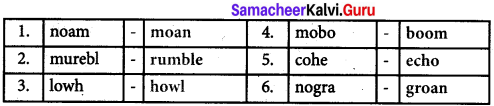
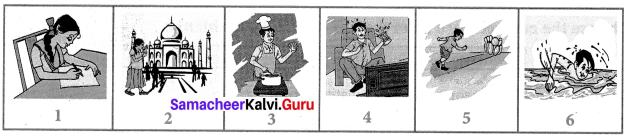
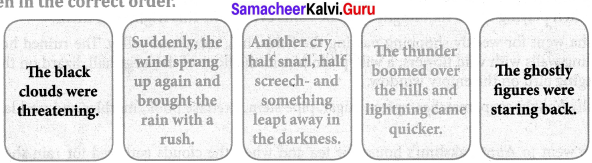
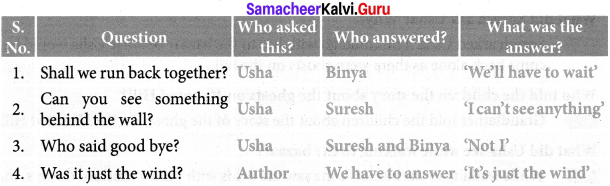
Samacheer Kalvi 10th English Solutions Poem Chapter 3 I am Every Woman

Looking to improve English skills and gain more subject knowledge then the best resources that you can use here is Samacheer Kalvi 10th English Solutions for Poem Chapter 3 I am Every Woman Questions and Answers.

In the Samacheer Kalvi 10th English Guide for Chapter 3 I am Every Woman textbook solutions, subject experts covered all types of questions and answers related to the topics, quick notes, summary, solved & unsolved exercises, etc. If you are planning to prepare Chapter 3 I am Every Woman via textbook, then you’re suggested to go with this Samacheer Kalvi 10th English Book Solutions Questions and Answers PDF for better understanding and preparation.

Tamilnadu Samacheer Kalvi 10th English Solutions Poem Chapter 3 I am Every Woman

English Subject experts who are having max years of experience prepared this Tamilnadu State Board Solutions for 10th English Poem Chapter 3 I am Every Woman Questions and Answers. They have explained all the topics covered in the board prescribed latest syllabus in a simple way to understand easily. So, students can prepare Chapter 3 English from this Samacheer Kalvi 10th English Book Questions and Answers PDF. Download the Tamilnadu State Board 10th English Chapter 3 I am Every Woman Workbook Solutions PDF by accessing the below links and learn properly for the final exams to score well.

I am Every Woman Textual Questions

A. Read the lines and answer the questions.

(i) The summer of life she’s ready to see in spring.
She says, “Spring will come again, my dear Let me care for the ones who ’re near.”
(a) What does the word summer mean here?
(b) How does she take life?
(c) What does she mean by “spring will come again”?
Answer:
(a) Summer here means development.
(b) She takes life optimistically.
(c) By the phrase ‘spring will come again’, the poet means that the future will be better.

(ii) Strong is she in her faith and belief.
“Persistence is the key to everything, ” says she.
(a) What is she strong about?
(b) How does she deal with the adversities in life?
Answer:
(a) She is strong about her faith and belief.
(b) She is strong in her faith and belief and is determined while dealing with the adversities in life.

(iii) Despite the sighs and groans and moans,
She’s strong in her faith, firm in her belief!.
(a) Is she complaining about the problems of life?
(b) Pick out the words that show her grit.
Answer:
(a) No she is not complaining about the problems of life.
(b) The words that show her grit are strong and firm.

(iv) Don’t ever try to saw her pride, her self-respect.
She knows how to thaw you, saw you – so beware!
(a) What do the words thaw and saw mean here?
(b) What is the tone of the author?
Answer:
(a) Thaw and saw means that she will reduce you to nothing.
(b) The tone of the poetess is a caution about careful intervention.

(v) She’s today’s woman. Today’s woman dear.
Love her, respect her, keep her near…
(a) Describe today’s woman according to the poet.
(b) How should a woman be treated?
Answer:
(a) Today’s woman is a woman born with determination, ready to take risks in life and is strong in her faith and beliefs.
(b) A woman should be treated with love and respect.

Additional Questions

(i) “A woman is beauty innate,
A symbol of power and strength.
She puts her life at stake,
She’s real, she’s not fake!”
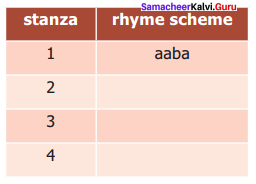
(a) What is the rhyme scheme of the above stanza?
(b) Pick out the rhyming words.
(c) What is meant by ‘innate’?
(d) Explain the line, ‘She puts her life at stake’.
(e) What do you understand by the term, ‘not a fake’?
Answer:
(a) ‘abcc’ is the rhyme scheme of the above stanza.
(b) The rhyming words are stake and fake.
(c) ‘Innate’ means inborn.
(d) The line is an indication that a woman is willing to take risks in life.
(e) By ‘not a fake’ one can understand that a woman is genuine and real.

(ii) “Let me care for the ones who ’re near.
She’s The Woman – she has no fear!”
(a) What kind of a woman do you see in the above lines?
(b) Pick out the rhyming words.
(c) What is her immediate duty that she wants to concentrate on?
Answer:
(a) I see a fearless woman in the above line,
(b) The rhyming words are near and dear.
(c) She wants to concentrate on the thought of caring for the near and dear ones.

(iii) “She’s a lioness; don’t mess with her.
She ’ll not spare you if you ’re a prankster.
Don’t ever try to saw her pride, her self-respect.
She knows how to thaw you, saw you – so beware!”
(a) Who is a prankster?
(b) What is the rhyme scheme?
(c) To whom is the poem addressed?
(d) What is the warning given by the poetess?
(e) What is the woman capable of?
Answer:
(a) A prankster is one who pretends to be mischievous.
(b) ‘aaba’ is the rhyme scheme in the above lines.
(c) The poem is addressed to the male readers who generally underestimate a woman.
(d) The poetess warns the male readers to refrain from sawing a woman’s pride and self-respect.
(e) The woman is capable of thawing and slicing down a person’s underestimated thoughts.

B. Read the lines and identify the figure of speech.
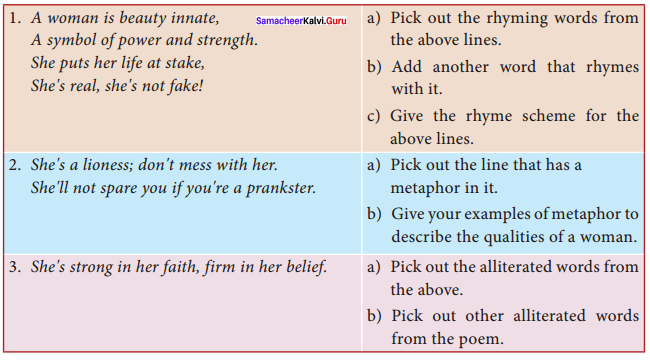
I Am Every Woman Poem Samacheer Kalvi 10th English Chapter 3 I Am Every Woman Poem Questions And Answers Samacheer Kalvi 10th English Chapter 3
Answers:
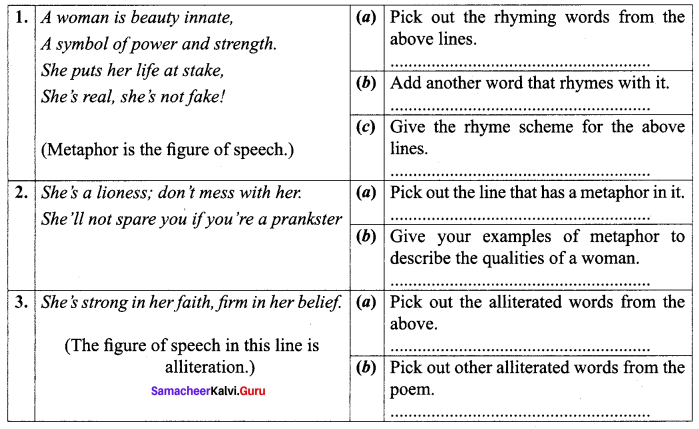
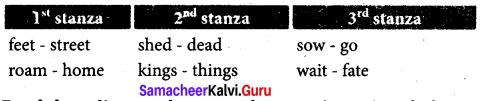
1. (a) The rhyming words are stake and fake.
(b) innate-checkmate, strength-length, stake-spake, fake-make
(c) The rhyme scheme for the above lines is ‘abcc’.

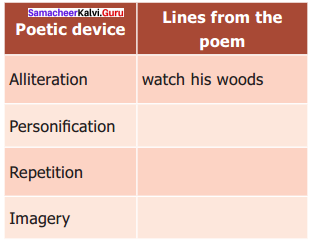
2. (a) She’s a lioness.
(b) She is a dynamite. She is a rock.
She is a bubbly personality. She is a roller coaster of emotions.

3. (a) Faith, firm is the alliterated words in the given line.
(b) The other alliterated words from the poem are symbol/strength; summer/see and saw/self-respect.

C. Fill in with a word in each blanks to complete the summary of the poem. Use the help box given below.

I Am Every Woman Poem Paragraph Samacheer Kalvi 10th English Chapter 3

Every woman is beautiful …………….(1) …………….. She is the……………… (2) ………….. of power and ………….. (3) …………….. She is prone to put her ………….(4) ………….. at risk. Every woman is true in expressing her love and she is never ……………… (5) …………….. She is very ……….. (6) ………………. in her approach even at times of ………… (7) …………… she finds a ray of ……………. (8) ………….. and she continues to …………. (9) ………….or her ……….. (10) …………….. ones. She is the ………………. (11) ………….. and she has no …………… (12) ……………. She is forceful in her ……………. (13) ………… and …………….(14) …………….. She is never a…………… (15) ………………..and she is ……………. (16) ……………. She is ferocious like a …………….(17)…………………..It’s better for the …………… (18) ……………… to stay away from her. Never should one try to bring ……………….(19) …………………to her pride and ……………. (20) ………………for she knows how to ………………… (21) …………… and …………….. (22) ………….. them. She is …………….. (23) ………………. woman. It is ……………….. (24) ………………….. to love her …………… (25) ……………. her and to keep her ………………. (26) …………… .
Answers:

  1. innate
  2. symbol
  3. strength
  4. life
  5. fake
  6. optimistic
  7. adversity
  8. hope
  9. care
  10. dignified
  11. woman
  12. fear
  13. faith
  14. belief
  15. quitter
  16. persistent
  17. lioness
  18. prankster
  19. disgrace
  20. self-respect
  21. thaw
  22. saw
  23. today’s
  24. healthier
  25. respect
  26. near

D. Answer the following in a paragraph of about 80 to 100 words.

I Am Every Woman Poem Question 1.
How are today’s women portrayed by the poet?
Answer:
Rakhi Nariani Shirke is an academician with a passion for writing poems as a medium of self-expression. This poem talks about the multifaceted nature of women. A woman is born beautiful and beauty is an inborn trait. She is a symbol of supremacy and strength. She takes risks in life for she is real and always genuine. Today’s women are empowered, brave, strong and resolute.

They are always ready to take up new ventures. They are persistent and work tirelessly to prove what they are capable of. Women have to be treated respectfully for the growth of a nation. As stated earlier, she is the symbol of strength as she is strong in her faith and beliefs. In spite of all the outbreaks and cries and laments, she is strong in her hope and firm in her trust. She is a lioness, brave and daring. She is a disciplinarian and will not tolerate your pranks with her. She is a woman of today smart and brave.

“Each time a woman stands up for herself, she stands up for all women.”

I Am Every Woman Poem Questions And Answers Question 2.
What qualities have made women powerful?
Answer:
The woman is made powerful due to her multifaceted personality. Today’s women are empowered, brave, strong and resolute. They love to explore and venture into new horizons. – They are persistent and work tirelessly to prove what they are capable of. Her inner beauty, her supremacy and strength makes her all-powerful. She exhibits her power by showcasing her fearless nature. She is the symbol of strength as she is strong in her faith and beliefs. She is seen as all-powerful because of her determined nature.

She may sigh, cry and moan but is strong in her hope and firm in her trust. She is a lioness, brave and daring and one dare not muddle with her. If anyone is a mischief maker, she will not spare them. The woman should be feared cautiously since she would thaw or saw you for your deeds against her.

“A Woman believes in being strong, even when things seem to go wrong.”

I am Every Woman (Rakhi Nariani Shirke)
Literary Devices At A Glance (Figures of Speech)
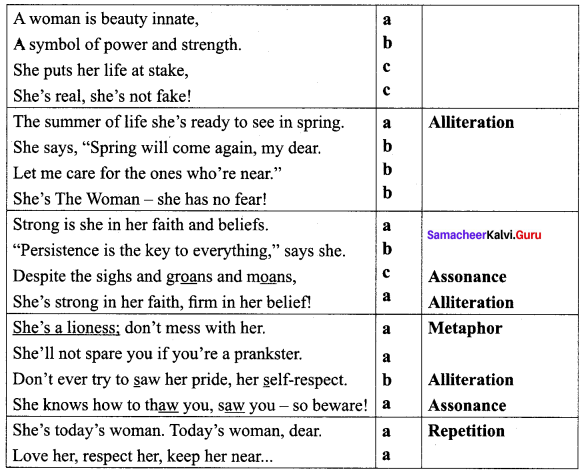
I'm Every Woman Poem Samacheer Kalvi 10th English Chapter 3

I am Every Woman by Rakhi Nariani Shirke About the Poet:
Rakhi Nariani Shirke is an academician with a passion for writing poems as a medium of self-expression. She is a post graduate, with a Bachelor’s degree in Education. She graduated from Jai Hind College, Mumbai and lives in Navi Mumbai. She is a teacher at -Ryan International School at Raigarh, Maharashtra, India.

I am Every Woman Summary:

10th English Poem I Am Every Woman Samacheer Kalvi 10th English Chapter 3

Introduction:
This poem talks about the multifaceted nature of women. Today’s women are empowered, brave, strong and resolute. They are always ready to take up new ventures. They are persistent and work tirelessly to prove what they are capable of. Women have to be treated respectfully for the growth of a nation.
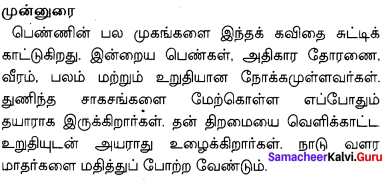
I Am Every Woman Poem Figure Of Speech Samacheer Kalvi 10th English Chapter 3

Inborn trait:
A woman is born beautiful and beauty is an inborn trait. She is a symbol of supremacy and strength. She takes risks in life for she is real and always genuine.
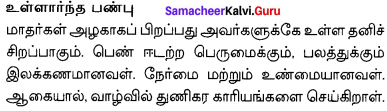
I Am Every Woman Poem Line By Line Explanation Samacheer Kalvi 10th English Chapter 3

Fearless by Nature:
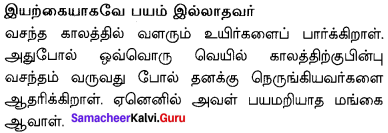
The development of life a woman is ready to see in spring. She says that there will always be spring after summer and so she cares for the ones who are near for she is the fearless woman.
I Am Every Woman Poem Summary Samacheer Kalvi 10th English Chapter 3

Women of Strength:
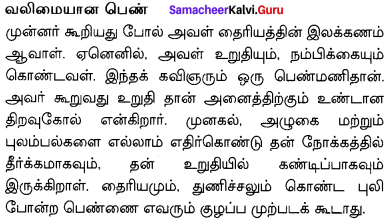
As stated earlier, she is the symbol of strength as she is strong in her faith and beliefs. The poetess who is also a woman insists that persistence is the key to everything. In spite of all the out breaths, cries and laments, she is strong in her hope and firm in her trust. She is a lioness, brave and daring and one should not muddle with her.
10th English I Am Every Woman Poem Samacheer Kalvi 10th English Chapter 3

Dare to be a Mischief Maker?
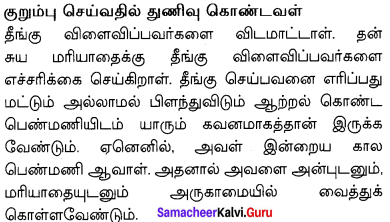
If anyone is a mischief maker, trying to play with her, the woman will not spare her. One should be careful and not saw her conceit or her self-respect. One should beware of such a woman for she would not only thaw you but also saw you for she is the modem day woman, the woman of the Present. Therefore, she should be loved, respected and kept at close quarters.
I Am Every Woman Paragraph Samacheer Kalvi 10th English Chapter 3

Conclusion:
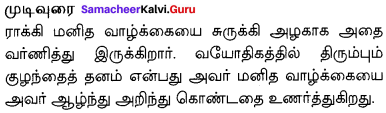
The poet Rakhi Nariani Shirke dares at those who make a mockery of women. Being today’s woman she warns those who are ruthless towards women. She states that today’s women are bold and smart, ready to take up new ventures and achieve the goals.
I Am Every Woman Poem Rhyme Scheme Samacheer Kalvi 10th English Chapter 3

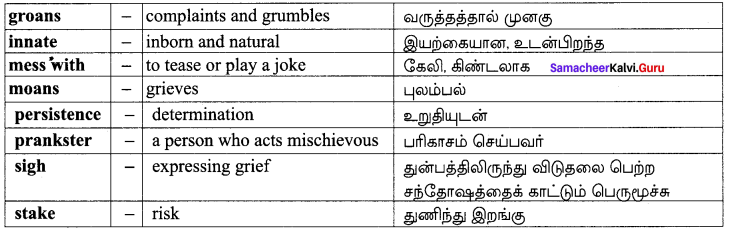
I am Every Woman Glossary:

Textual:
10th I Am Every Woman Poem  Samacheer Kalvi 10th English Chapter 3
Additional:
I Am Every Woman Poem Appreciation Samacheer Kalvi 10th English Chapter 3

We hope the data given here will benefit you to the fullest extent at the time of preparation. For better understanding of English subject this Samacheer Kalvi 10th English Solutions for Class 10th English Poem Chapter 3 I am Every Woman PDF is the best resource. Download & ace up your preparation. Keep in touch with us and get the latest information on Tamilnadu State board Textbook Solutions PDF.
Samacheer Kalvi 9th Science Solutions Chapter 10 Matter Around Us

You can Download Samacheer Kalvi 9th Science Book Solutions Guide Pdf, Tamilnadu State Board help you to revise the complete Syllabus and score more marks in your examinations.

Tamilnadu Samacheer Kalvi 9th Science Solutions Chapter 10 Matter Around Us

Samacheer Kalvi 9th Science Matter Around Us Textbook Exercises

I. Choose the correct answer.

Matter Around Us Class 9 Samacheer Kalvi Question 1.
The separation of denser particles from lighter particles done by rotation at high speed is called ………………..
(a) Filtration
(b) sedimentation
(c) decantation
(d) centrifugation
Answer:
(d) centrifugation

9th Science Matter Around Us Question 2.
Among the following ………………… is a mixture.
(a) Common salt
(b) Juice
(c) Carbon dioxide
(d) Pure silver
Answer:
(b) Juice

9th Science Matter Around Us Book Back Answers Question 3.
When we mix a drop of ink in water we get a …………………..
(a) Heterogeneous Mixture
(b) Homogeneous Mixture
(c) Compound
(d) Suspension
Answer:
(b) Homogeneous Mixture

9th Matter Around Us Answers Question 4.
…………… is essential to perform separation by solvent extraction method.
(a) Separating funnel
(b) Centrifuge machine
(c) Filter paper
(d) Sieves
Answer:
(a) Separating funnel

9th Science Matter Around Us Answers Question 5
…………… has the same properties throughout the sample.
(a) Pure substance
(b) Mixture
(c) Colloid
(d) Suspension
Answer:
(a) Pure substance

II. State whether the following statements are true or false. If false give the correct statement.

  1. Oil and water immiscible in each other – True
  2. A compound cannot be broken, into simpler substances chemically – False.
    Correct Statement: A compound can be broken into simpler substances chemically.
  3. Liquid – liquid colloids are called gels – False
    Correct Statement: Liquid – solid colloids are called gels.
  4. Buttermilk is an example of heterogeneous mixture – True
  5. Aspirin is composed of 60% Carbon, 4.5% Hydrogen and 35.5% Oxygen by mass. Aspirin is a mixture – False.
    Correct Statement: The constituents of Aspirin are present in a fixed ratio by mass. So it is a Compound.

III. Match the following.

S.No. AB
1.Element(a) Settles down on standing
2.Compound(b) Impure substance
3.Colloid(c) Made up of molecules
4.Suspension(d) Pure substances
5.Mixture(e) Made up of atoms

(e) Made up of atomsAnswer:

  1. (c) Made up of molecules
  2. (b) Impure substance
  3. (a) Settles down on standing
  4. (d) Pure substances

IV. Fill in the blanks.

  1. A mixture has no distinguishable boundary between its components.
  2. An example of a substance that sublimes is
  3. Alcohol can be separated from water by
  4. In petroleum refining, the method of separation used is
  5. Chromatography is based on the principle of

Answer:

  1. homogeneous
  2. Naphthalene
  3. distillation
  4. fractional distillation
  5. absorptions

V. Very short answers.

Samacheer Kalvi 9th Science Solution Chapter 10 Matter Around Us Question 1.
Differentiate between absorption and adsorption.

AbsorptionAdsorption
It is the process by which atoms, molecules, or ions enter a bulk phase (liquid, gas, solid)It is the adhesion of atoms, ions or molecules from a gas, liquid or dissolved solid to a surface

Answer:
Absorption Adsorption
It is the process by which atoms, molecules, or ions enter a bulk phase (liquid, gas, solid) It is the adhesion of atoms, ions or molecules from a gas, liquid or dissolved solid to a surface

Matter Around Us Book Back Answers Question 2.
Define sublimation.
Answer:
Certain solids change directly to a gas without passing through the liquid is called sublimation.

Samacheer Kalvi 9th Science Solutions Chapter 10 Matter Question 3.
A few drops of ‘Dettol’ when added to water the mixture turns turbid. Why?
Answer:
The mixture turns turbid, because of emulsion,
(Disperse phase and Dispersion medium are liquid).

9th Class Matter Around Us Lesson Question 4.
Name the apparatus that you will use of separate the components of mixtures containing two,

  1. Miscible liquids,
  2. Immiscible liquids

Answer:

  1. Miscible liquids – Fractional distillation (Fractionating column and Liebig) Condenser
  2. Immiscible liquids – Separating funnel

Matter Around Us 9th Class Question 5.
Name the components in each of the following mixtures.

  1. Ice cream
  2. Lemonade
  3. Air
  4. Soil

Answer:

  1. The main constituents of ice cream are fat, milk solids (skim-milk powder), sugar, gelatin, egg and flavouring.
  2. Lemonade is a mixture of lemon juice, sugar and water.
  3. Air is a mixture of nitrogen, oxygen, carbon dioxide, water vapour and other gases.
  4. Soil is a mixture of clay, sand and various salts.

VI. Short answers.

Matter Around Us Class 9 Book Back Answers Question 1.
Which of the following are pure substances? Ice, Milk, Iron, Hydrochloric acid, Mercury, Brick and Water.
Answer:
Ice, Iron, Hydrochloric acid, Mercury and water are pure substances.

Chapter 10 Matter Around Us Question 2.
Oxygen is very essential for us to live. It forms 21% of air by volume. Is it an element or compound?
Answer:
Oxygen is an element. It contains the atoms of oxygen of the same kind.

Samacheerkalvi.Guru Science 9th Question 3.
You have just won a medal made of 22-carat gold. Have you just procured a pure substance or impure substance?
Answer:
I have procured an impure substance. It is made of 22 parts of pure gold and 2 parts of copper or silver.

Matter Around Us Lesson Question 4.
How will you separate a mixture containing saw dust, naphthalene and iron filings?
Answer:
When a magnet is brought near the mixture containing saw dust naphthalene and iron filings, it attracts the iron filings. Thus iron filings are separated.

The mixture of naphthalene and saw dust are put in a china dish and covered with a perforated asbestos sheet. An inverted funnel is placed over the asbestos sheet.

The open end of the stem of the funnel is closed, using cotton wool. The china dish is heated. The pure vapours of naphthalene solid pass through the holes in the asbestos sheet and condense on the inner side of the funnel. The saw dust is left in the china dish.

Matter Around Us Class 9 Question 5.
How are homogenous solutions different from heterogeneous solution? Explain with examples.
Answer:

S.No.Homogeneous solutionsHeterogeneous solutions
1.Components are uniformly mixed.Components arc not uniformly mixed.
2.It has single phase.It has two or more distinct phases.
3.No boundaries of separation between the components.There are visible boundaries between the components.
4.Components are invisible to naked eye.Components are visible to naked eye.
5.Examples of Homogeneous solutions are salt solution, lemonade, petrol etc.Examples of Heterogeneous solutions are chalk in water, petrol in water, and sand in water.

VII. Long Answer.

Question 1.
Write the differences between elements and compounds and give an example for each.
Answer:

S.No.ElementsCompounds
1.Contains only one kind of atoms.Contains more than one kind of atoms.
2.It is a pure substance.It is not a pure substance.
3Elements cannot be broken down further into simpler substances by chemical methods.Compounds can be broken down further into simpler substances by chemical methods.
4Elements have definite physical and chemical properties.Compounds have definite physical and chemical properties.
5Examples for elements: oxygen 07, hydrogen H7, sodium Na.Examples for compounds, water H70, cane sugar Cp

Question 2.
Explain Tyndall effect and Brownian movement with suitable diagram.
A. Tyndall Effect:
Matter Around Us Class 9 Samacheer Kalvi Chapter 10
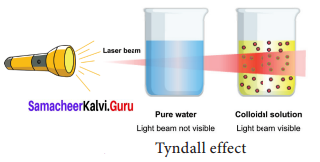
When a strong beam of light is focused on a colloidal solution the path of the beam becomes visible.
This phenomenon is called as Tyndall effect. The illuminated path is called Tyndall cone. This phenomenon is due to scattering of light by colloidal particles.

B. Brownian movement:
9th Science Matter Around Us Chapter 10 Samacheer Kalvi
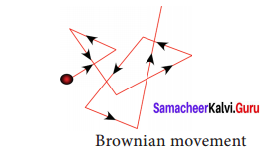
It is a kinetic property. When colloidal solution are viewed under powerful microscope, it can be seen that colloidal particles are moving constantly and rapidly in zig-zag directions. The Brownian movement of particles is due to the unbalanced bombardment of the particles by the molecules of dispersion medium.

Question 3.
How is a mixture of common salt, oil and water separated?
You can use a combination of different methods.
Answer:
The mixture of common salt, oil and water are taken in a beaker. The salt dissolves in water. Allow it to stand for a few minutes. The mixture of two immiscible liquids is separated by a separating funnel. The oil floats on top. The water can carefully be separated by opening the stopcock in the separating funnel. The oil is left behind in the separating funnel.

The salt water is heated slowly, in a distillation flask with a water condenser. The pure water vapour passes through the inner tube of the condenser.

The vapours on cooling condense into pure water and are collected in a receiver. The salt is left behind in the flask as a residue.

Activity

Question 1.
Make models of the molecules of compounds by using match sticks and clay balls as shown below,

Items for identificationMattersNon matters
Flowers, bee, cloud, rainbow, leaf, fire, baby, torchlight, sky, smoke, heat coming from glowing coals, fog, the sound coming from a drum, a laser beam

Answer:

Items for identificationMattersNon matters
Flowers, bee, cloud, rainbow, leaf, fire, baby, torch light, sky, smoke, heat coming from glowing coals, fog, sound coming from a drum, laser beamFlowersrainbow
beetorch light
cloud,sound coming from a drum
leaflaser beam
babyheat coming from glowing coals
fog
fire

Question 2.
Take some powdered iron filings and mix it with sulphur.

  1. Divide the mixture into two equal halves.
  2. Keep the first half of the mixture as it is, but heat the second half of the mixture.
  3. You will get a grey brittle compound.

Answer:
Iron + Sulphur \(\stackrel{\Delta}{\longrightarrow}\) Iron sulphide
We cannot separate iron from iron sulphide. So, it is a compound, whereas Iron and Sulphur are mixtures. We can separate it by magnetic separation method.

Question 3.
Identify whether the given substance is mixture or compound and justify your answer.

S.No.SubstanceMixture / Compound
1.Sand and water
2.Sand and iron filings
3.Concrete
4.Water and oil
5.Salad
6.Water
7.Carbon dioxide
8.Cement
9.Alcohol

Answer:

S.No.SubstanceMixture / CompoundJustification
1.Sand and waterMixtureCan be separated by filtration.
2.Sand and iron filingsMixtureCan be separated by a magnet.
3.ConcreteMixtureIngredients are mixed together and it can be separated.
4.Water and oilMixtureOil is less dense. So floats in water and it can be separated.
5.SaladMixtureVegetable are mixed. Can be separated easily.
6.WaterCompoundHydrogen and oxygen are combined chemically in a fixed proportion.
7.Carbon dioxideCompoundTwo oxygen atoms are bonded or chemically combine with carbon atom.
8.CementCompoundDifferent elements are combined together in a fixed proportion.
9.AlcoholMixtureTwo or more liquids, whose proportion can be altered by distillation.

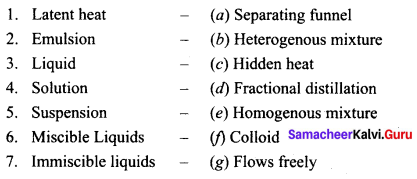
II. Match the following.

9th Science Matter Around Us Book Back Answers Chapter 10 Samacheer Kalvi
Answer:

  1. (c) Hidden heat
  2. (f) Colloid
  3. (g) Flows freely
  4. (e) Homogenous mixture
  5. (b) Heterogeneous mixture
  6. (d) Fractional distillation
  7. (a) Separating funnel

III. State which the following statements are true or false. If false give the correct statement.

  1. Supernatant denotes the heterogeneous mixture, lying above a solid residue, after crystallization, precipitation, centrifugation or other process – False.
    Correct Statement: Supernatant denotes the liquid lying above a solid residue after crystallization, precipitation, centrifugation or other process.
  2. Liquids cannot be compressed and they have fixed volume – True
  3. The intensity of scattered light depends on the type of colloidal solution and the size of the colloidal particles – True
  4. In Aerosol the dispersed phase is liquid and the dispersion medium is gas – False.
    Correct Statement: In Aerosol, The dispersed phase is solid and the dispersion medium is gas.
  5. When the solid (Solute) dissolves in a liquid (Solvent), it become a solution – True
  6. Solids possess very high kinetic energy – False.
    Correct Statement: Gases possess very high kinetic energy.
  7. Celsius scale is a scale of temperature in which zero represents the melting point of ice and 100 represents the boiling point of water – True

IV. Answer very shortly.

Question 1.
What is a matter?
Answer:
Anything which has mass and occupies space (volume) is called matter.

Question 2.
What is dry ice or cardice?
Answer:
Frozen carbon dioxide, is dry ice or cardice.

Question 3.
What are the uses of dry ice?
Answer:

  1. Act as a cooling agent
  2. Industrial refrigeration
  3. Transporting frozen food.
  4. It does not leave any liquid behind, as it directly changes into gas.

Question 4.
When does the pressure of the gas increase?
Answer:
When the volume of the gas decreases, the gas gets compressed. The particles of the gas have only lesser space to move around. So the particles start hitting on the walls of the container and the pressure of the gas increases.

Question 5.
Complete the following table:

S.No.CELSIUSKELVIN
1.90°C363 K
2.?283 K
3.63 °C?
4.250°C?
5.?303 K

Solution:

S.No.CELSIUSKELVIN
1.90°C363 K
2.9.85°C283 K
3.63 °C336.15K
4.250°C523.15 K
5.29.85°C303 K

Question 6.
What does the LPG (Liquefied petroleum gas) contain?
Answer:
LPG is a highly inflammable hydrocarbon. It contains a mixture of butane and propane gases.

Question 7.
What are pure substances? Give examples.
Answer:
Pure substances contain only one kind of particles.
Eg: 1. Element (Sodium, Bromine, and Hydrogen)
2. Compound (Sodium chloride, water, carbon dioxide)

Question 8.
What are impure substances? Give examples.
Answer:
Impure substances contain more than one kind of particles.
Eg: Mixtures (Gun powder, which is a mixture of sulphur potassium nitrate and charcoal)

Question 9.
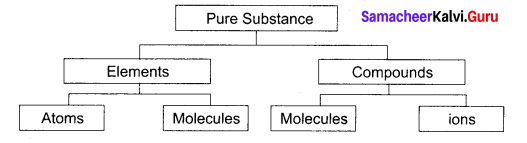
Classify the pure substance on the basis of chemical composition.
Answer:
9th Matter Around Us Answers Chapter 10 Samacheer Kalvi

Question 10.
Classify the types of mixtures.
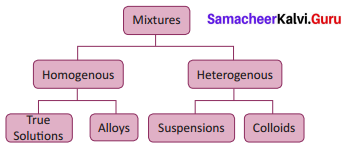
Answer:
9th Science Matter Around Us Answers Chapter 10 Samacheer Kalvi

Question 11.
Write a few examples for the following colloids.
Answer:

  1. Gels – Hair cream, tooth paste
  2. Foam – Soap bubbles, carbonated beverages.
  3. Solid foam – Bread, Mattresses
  4. Emulsion – Milk, butter, paints, facial cream, pesticides

Question 12.
Name the two phases in separation of the mixtures in chromatography.
Answer:

  1. Mobile phase
  2. Stationary phase

Question 13.
What is absorption? Give example.
Answer:
Absorption is the process in which the substance is dissolved throughout the bulk of another substance.
Eg: Paper soaks up or absorbs water.

Question 14.
What is adsorption? Give example.
Answer:
Adsorption is the process in which particles of a substances, adhere to a surface of another substance.
Eg: Charcoal adsorbs gases on its surface.

V. Answer the following in detail.

Question 1.
Explain the factors, which will affect the rate of evaporation, taking examples from our daily life experiences.
Answer:

  1. Temperature: Warmer the evaporation surface, the higher the rate of evaporation. In ponds, lakes and rivers, the rate of evaporation is more in sunny days.
  2. Surface area: The evaporation increase, with the increase of surface area. Eg: The water kept in a saucer evaporates faster than the water kept in a glass.
  3. Humidity: The amount of water vapour is high during rainy season. The air can hold little water. So it slows down the evaporation. So we sweat and perspire.
  4. Wind: The evaporation is slow at low wind. Evaporation is faster at high wind. The particles of water move away, along with the particles of air at high wind. So the wet clothes dry faster on a windy day.

Question 2.
Compare boiling and evaporation.
Answer:

S.No.BoilingEvaporation
1.Vaporization process.Natural process.
2.Turns liquid into gas when it is heated.The liquid changes into gas without heating.
3.Fast process.Slow process.
4.Occurs only at boiling point.Occurs at any temperature.
5.It forms bubbles.It does not form bubbles.
6.Energy is required.Energy is supplied by surrounding.
7.Temperature of the liquid remains constant.Temperature of liquid decreases.

Question 3.
Classify colloids based on physical state of dispersed phase and dispersion medium.
Answer:

S.No.Dispersed
Phase
Dispersion
Medium
NameExamples
1.SolidSolidSolid SolAlloys, gems, coloured glass
2.SolidLiquid•SolPaints, inks, eggs white
3.SolidGasAerosolSmoke, dust
4.LiquidSolidGelCurd, Cheese, Jelly
5.LiquidLiquidEmulsionMilk, Butter, oil in water
6.LiquidGasAerosolMist, fog, clouds
7.GasSolidSolid foamCake, bread
8.GasLiquidFoam ‘Soap lather, Aerated water

Question 4.
Write the methods of separation for the following:
Answer:

  • Separation of insoluble solids from liquids
    Filtration and Decantation
  • The separation of fine and tiny particles of solid which do not settle at the bottom.
    Centrifugation
  • Separation of soluble solids from liquids
    Evaporation and crystallization
  • Separation of miscible liquids which do not differ much in their boiling points
    Fractional distillation
  • Separation of two immiscible liquids
    Separating funnel
  • Separation of different fractions of petroleum
    Fractional distillation with fractionating column
  • Separation of mixture containing volatile and non-volatile solids.
    Sublimation.

Question 5.
Write the differences between mixture and compounds.
Answer:

S. No.MIXTURECOMPOUNDNameExamples
1.Mixture can be separated into its constituents by physical process.Compounds can be separated into its constituents by chemical process.Solid SolAlloys, gems, coloured glass
2.Mixture shows the properties of its constituents.The properties of a compound are entirely different from its constituent elements .SolPaints, inks, eggs white
3.Energy in the form of heat and light is neither given out nor absorbed in.Energy in the form of heat and light is given out or absorbed.AerosolSmoke, dust
4.The composition or proportion of a mixture does not have a definite formula.The composition of a compound is fixed. The constituents have a fixed ratio by mass.Gel

.

Curd, Cheese, Jelly
5.A mixture does not have fixed boiling point or melting point.A compound has a fixed boiling or melting point.EmulsionMilk, Butter, oil in water

Samacheer Kalvi 8th Science Solutions Term 1 Chapter 2 Forces and Pressure

You can Download Samacheer Kalvi 8th Science Book Solutions Guide Pdf, Tamilnadu State Board help you to revise the complete Syllabus and score more marks in your examinations.

Tamilnadu Samacheer Kalvi 8th Science Solutions Term 1 Chapter 2 Forces and Pressure

Samacheer Kalvi 8th Science Forces and Pressure Text Book Exercises

I. Choose the best answer

Define One Atmosphere Class 8 Question 1.
If we apply a force against the direction of motion of a body, then the body will –
(a) Stop moving
(b) Move with an increased speed
(c) Move with a decreased speed
(d) Move in a different direction
Answer:
(a) stop moving

Force And Pressure Class 8 Book Back Answers Question 2.
Pressure exerted by a liquid is increased by –
(a) The density of the liquid
(b) The height of the liquid column
(c) Both (a) & (b)
(d) None of the above
Answer:
(c) Both (a) & (b)

Force And Pressure Class 8 Samacheer Question 3.
Unit of pressure is –
(a) Pascal
(b) N m-2
(c) Poise
(d) Both (a) & (b)
Answer:
(d) Both (a) & (b)]

Force And Pressure Class 8 Samacheer Kalvi Question 4.
The value of the atmospheric pressure at sea level is –
(a) 76 cm of mercury column
(b) 760 cm of mercury column
(c) 176 cm of mercury column
(d) 7.6 cm of mercury column
Answer:
(a) 76 cm of mercury column

Samacheer Kalvi Guru 8th Science Question 5.
Pascal’s law is used in –
(a) Hydraulic lift
(b) Brake system
(c) Pressing heavy bundles
(d) All the above
Answer:
(d) All the above

Define One Atmosphere Answer Question 6.
Which of the following liquids has more viscosity?
(a) Grease
(b) Water
(c) Coconut oil
(d) Ghee
Answer:
(a) Grease

8th Standard Science Force And Pressure Question 7.
The unit of viscosity is –
(a) N m2
(b) Poise
(c) kg m s-1
(d) No unit
Answer:
(b) poise

II. Fill in the blanks

  1. The pressure of a liquid column …………….. with the depth of the column.
  2. Hydraulic lift works under the principle of ………………
  3. The property of …………… of a liquid surface enables the water droplets to move upward in plants. [Ans. surface tension]
  4. A simple barometer was first constructed by ……………..

Answer:

  1. Increases
  2. Pascal’s Law
  3. Surface tension
  4. Torricelli

III. State whether the following statements are true or false

Samacheer Kalvi Question 1.
Force acting on a given area is called pressure.
Answer:
True

Define Force Class 8 Question 2.
A moving body comes to rest due to friction alone.
Answer:
True

Force And Pressure For Class 8 Question 3.
A body will sink if the weight of the body is greater than the buoyant force.
Answer:
True

Question 4.
One atmosphere is equivalent to 1,00,000 newton force acting on one square metre.
Answer:
True

Question 5.
Rolling friction is slightly greater than the sliding friction.
Answer:
False
Correct statement:
Rolling friction is slightly lesser than the sliding friction.

Question 6.
Friction is the only reason for the loss of energy.
Answer:
True

Question 7.
Liquid pressure decreases with the decrease of depth.
Answer:
True

Question 8.
Using barometers, one can measure the height of a building.
Answer:
False
Correct statement:
Using barometers, one can measure the atmospheric pressure.

Question 9.
Surface tension causes the spherical nature of a water drop.
Answer:
True

Question 10.
Viscosity depends on the pressure of a liquid.
Answer:
True

IV. Arrange the following in the increasing order

Question 1.
Rolling friction, static friction, sliding friction
Answer:
Static friction, Rolling friction, Sliding friction.

Question 2.
Let a marble roll on the following surfaces. Arrange the choice of the material such that a marble moving over it covers a greater distance.
Cotton cloth, glass plate, paper, card board, silver plate
Answer:
Glass plate, silver plate, paper, cotton cloth, card board.

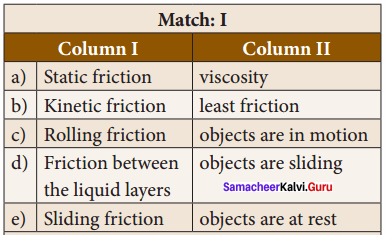
V. Match the following

Question 1.
Define One Atmosphere Class 8 Samacheer Kalvi Term 1 Chapter 2 Forces And Pressure
Answer:

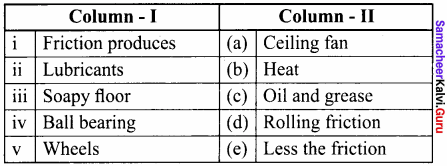
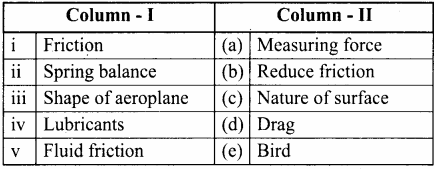
i. e
ii. c
iii. b
iv. a
v. d

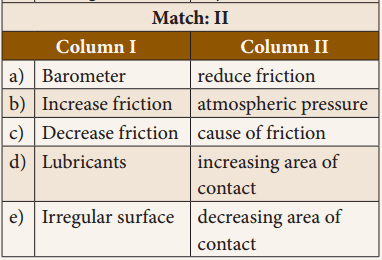
Question 2.
Force And Pressure Class 8 Book Back Answers Samacheer Kalvi Term 1 Chapter 2
Answer:

i. b
ii. d
iii. e
iv. a
v. c

VI. Analogy

Question 1.
Knot in a thread : ______ friction :: ball bearing : friction ______
Answer:
Rolling, Static.

Question 2.
Downward force : weight :: Upward force offered by liquid : ______
Answer:
Buoyant force.

VII. Problems

Question 1.
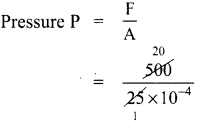
A stone weighs 500 N. Calculate the pressure exerted by it if it makes a contact with a surface of area 25 cm2.
Answer:
Given : Weight of a stone F = 500 No
Area A = 25 cm2 = 25 x 10-4 m2
To find : Pressure P = ?
Formula :
Force And Pressure Class 8 Samacheer Kalvi Term 1 Chapter 2
Solution:
Pressure P = 20 x 104N/m2 (or) 20 x 104 Pa

Question 2.
In a hydraulic lift, the surface area of the input piston is 10 cm2. The surface area of the output piston is 3000 cm2. A 100 N force applied to the input piston raises the output piston. Calculate the force required to raise the output piston.
Answer:
Solution:
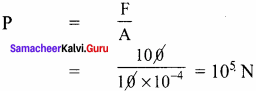
Pressure input on piston,
Force And Pressure Class 8 Samacheer Kalvi Term 1 Chapter 2
According to Pascal’s law
P =\(\frac { F }{ A}\)
P = \(\frac { F}{ A }\)
105 = \(\frac { F }{ 3000 x 10-4}\) = \(\frac { F x 10-4}{ 3000 }\)
l0-4 x F = 105 x 30OO
F = 3000×101
= 3 x 10⁴ N

VIII. Assertion & Reason

Mark the correct choice as :
(a) If both assertion and reason are true and the reason is the correct explanation of the assertion.
(b) If both assertion and reason are true, but the reason is not the correct explanation of the assertion.
(c) If the assertion is true, but the reason is false.
(d) If the assertion is false, but the reason is true.

Question 1.
Assertion : Sharp knives are used to cut the vegetables.
Reason : Sharp edges exert more pressure.
Answer:
(a) Both assertion and reason are true and the reason is the correct explanation of the assertion

Question 2.
Assertion : Broad straps are used in bags.
Reason : Broad straps last for long life.
Answer:
(b) Both assertion and reason are true, but the reason is not the correct explanation of the assertion
Correct explanation:
The weight of the bags falls on larger area of shoulder. So lesser pressure is produced.

Question 3.
Assertion : Water strider slides easily on the surface of water.
Reason : Water strider experiences less buoyant force.
Answer:
(b) If both assertion and reason are true, but reason is not the correct explanation of assertion
Correct explanation :
It is due to the surface tension of water.

IX. Answer the following in one or two sentences (LOT)

Question 1.
Give two examples to verify that a force changes the shape of a body.
Answer:
Force can change the static condition of a body.

  1. If you squeeze a sponge, its shape changes.
  2. If you pull a rubber band, it becomes longer.

Question 2.
Give two examples to verify that a force tends to change the static condition of a body.
Answer:
Force can change the static condition of a body.

  1. A rest rubber ball begins to move, when a force applied on it.
  2. Player applies a force on the stationary football while taking a penalty kick is football match. The force applied by player makes the football move towards the goal.

Question 3.
Taking out paste from a tooth paste tube is an example to highlight which physical property?
Answer:
Pascal’s law.

Question 4.
What do you feel when you touch a nail immediately after it is hammered into a wooden plank? Why?
Answer:
The nail becomes hot due to friction. Friction changes kinetic energy to heat.

Question 5.
How does the friction arise between the surfaces of two bodies in relative motion?
Answer:
The force of friction is arised by the interlocking of the irregularities of the two surfaces.

Question 6.
Name two instruments, which help to measure the pressure of a fluid.
Answer:

  1. Manometer
  2. Pressure gauge.

Question 7.
Define one atmosphere.
Answer:
The pressure exerted by this mercury column is considered as the pressure of magnitude ‘one atmosphere’ (1 atm).

Question 8.
Why are heavy bags provided with broad straps?
Answer:
Broader straps are provided on a back – pack for giving less pressure on the shoulders by providing a larger area of contact with the shoulder.

Question 9.
How does surface tension help a plant?
Answer:
Water molecules rise up due to surface tension. Xylem tissues are very narrow vessels present in plants. Water molecules are absorbed by the roots and these vessels help the water to rise upward due to “capillarity action” which is caused by the surface tension of water.

Question 10.
Which has greater viscosity, oil or honey? Why?
Answer:
Honey has greater viscosity.
Reason : Thicker liquids are more viscous than thinner liquids. As honey has greater viscosity, more frictional force will be acting on it.

X. Answer the following questions with a few sentences (MOT)

Question 1.
Define friction. Give two examples of the utility of friction in day to day life.
Answer:
Friction : Friction is a force that shows down moving objects or prevents stationary objects from moving.
Examples of the utility of friction in day to day life.

  • Cars and buses are able to move safely on the road because of friction between the treaded tyres and the surface of the road.
  • We are able to write on paper only with the help of friction between the pencil or pen and paper.

Question 2.
Write down three ways of minimising friction.
Answer:
1. By using lubricants:
These are applied to surfaces to reduce the friction between the surfaces. Example Oil, wax, grease and castor oil.

2. With the help of polishing the surface:
We sprinkle fine powder on the carrom board and then we polish its surface to make smooth so that the striker slides easily on the surface.

3. By using ball bearing:
We use leadshots in bearing of a cycle hub because rolling friction is smaller than sliding friction.

Question 3.
How do sailors protect their ship during a heavy storm?
Answer:
During a heavy storm, sailors pour soap powder or oil into the sea near their ship to decrease the surface tension of sea water. This process reduces the impact of the violent water current against the wall of ship.

Question 4.
Write down three applications of Pascal’s law.
Answer:

  1. In an automobile service station, the vehicles are lifted upward using the hydraulic lift, which works as per Pascal’s law.
  2. The automobile brake system works according to Pascal’s law.
  3. The hydraulic press is used to make the compressed bundles of cotton or cloth so as to occupy less space.

Question 5.
Why is a ball bearing used in a cycle hub?
Answer:
The rolling friction is smaller than sliding friction, sliding is replaced by rolling with the usage of ball bearings. So lead shots are used in the bearing of a cycle hub.

XI. Answer the following questions in detail

Question 1.
“Friction is a necessary evil”- explain.
Answer:
Friction is a necessity in most of our day to day activities. It is desirable in most situations of our daily life.

  1. We can hold any object in our hand due to friction.
  2. We can walk on the road because of friction. The footwear and the ground help us to walk without slipping.
  3. Writing easily with a pen on paper is due to friction.
  4. Automobiles can move safely due to friction between the tyres and the road. Brakes can be applied due to frictional resistance on brake shoes.
  5. We are able to light a matchstick, sew clothes, tie a knot or fix a nail in the wall because of friction.

Though it is giving a negative effect, in most of our day to day life friction helps us to make our life easy. So, it is called as “necessary evil”.

Disadvantages of friction:

  1. Friction wears out the surfaces rubbing with each other, like screws and gears in machines or soles of shoes.
  2. To overcome the friction an excess amount of effort has to be given to operate a machine. This leads to wastage of energy.

Question 2.
Give the different types of friction and explain each with an example.
Answer:
Friction can be classified into two basic types:

  1. Static friction
  2. Kinetic friction.

1. Static friction : The friction experienced by the bodies, which are at rest is called static friction. (E.g : All the objects rigidly placed to be at rest on the Earth, a knot in a thread.

2. Kinetic friction : Friction existing during the motion of bodies is called kinetic friction.

Further, kinetic friction can be classified into two:

  • Sliding friction
  • Rolling friction.

1. Sliding friction : When a body slides over the surface of another body, the friction acting between the surfaces in contact is called sliding friction.

2. Rolling friction : When a body rolls over another surface, the friction acting between the surfaces in contact is called rolling friction. Rolling friction is less than sliding friction. That is why wheels are provided in vehicles, trolleys, suitcases etc.

Question 3.
Describe an experiment to prove that friction depends on the nature of a surface.
Answer:
To understand about the frictional force between the layers of liquid in motion.
Materials required : Different kinds of liquid (coconut oil, honey, water, ghee), glass plates – 4 nos.
Procedure :

  • Take a small quantity of different kinds of liquid like coconut oil, honey, water and ghee etc., in a cup.
  • Place one drop of each liquid on a separate glass plate.
  • Next, gently raise one end of the glass plate, one by one, so as to allow the liquid to slide down the smooth surface of the plate.
  • Observe the speed of each liquid.

Observation:
Each liquid moves with a different speed. Water flows faster than other liquids. Coconut oil flows with a moderate speed. Ghee flows very slowly.

Inference:
Between the layers of each liquid, in motion, there is a frictional force parallel to the layers of the liquid. This frictional force opposes the motion of the liquid layers while they are in motion.

Question 4.
Explain how friction can be minimised.
Answer:
1. Using lubricants:

  • A substance, which reduces the frictional force, is called a lubricant. Example: Grease, coconut oil, graphite, castor oil, etc.
  • The lubricants fill up the gaps in the irregular surfaces between the bodies in contact. This provides a smooth layer thus preventing a direct contact between their rough surfaces.

2. Using ball bearing:
Since, the rolling friction is smaller than sliding friction, sliding is replaced by rolling with the usage of ball bearings. We can see lead shots in the bearing of a cycle hub.

Question 5.
Describe an experiment to prove that the pressure in a liquid increases with depth.
Answer:
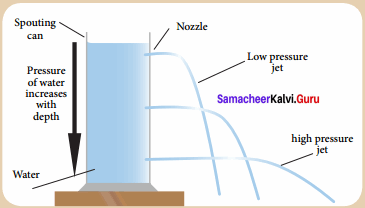
Take a plastic bottle. Punch three holes on its side in the same direction, but at different heights. Now pour some water into it and let it flow through the holes. Observe the flow of water.

Inference:
The water comes out from all the holes with a different force and falls on the table at points that are at variable distances from the bottle. Water from the lowest hole comes out with the greatest force and falls at a point that is at the maximum distance from the bottle. Water from the topmost hole comes out with the least force and falls at the point that is at the minimum distance from the bottle.
Samacheer Kalvi Guru 8th Science Term 1 Chapter 2 Forces And Pressure
Reason:
This activity confirms that the pressure in a liquid varies with the depth of the point of observation in it.

XII. Hot Corner

Question 1.
Why is it not advisable to take a fountain pen while travelling in an aeroplane?
Answer:
Fountain pens are built in such a way that the pressure inside them balances the atmospheric pressure at sea level. Since atmospheric pressure decreases with an increase in height above sea level, the pressure inside the pen turns out to be much greater than the air pressure in an aeroplane and the pen starts leaking.

Question 2.
Is there any possibility of making a special device to measure the magnitude of friction directly?
Answer:
Yes. Tribometer is a special device to measure the magnitude of friction directly.

Question 3.
Vidhya posts a question: Mercury is costly. So, instead of mercury can we use water as a barometric liquid? Answer to Vidhya and explain, the difficulty of constructing a water barometer.
Answer:

  1. Mercury is commonly used in barometers because of its high density means the height of the column can be a reasonable size to measure atmospheric pressure.
  2. A barometer using water, for instance, would need to be 13.6 times taller than a mercury barometer to obtain the same pressure difference.
  3. This is because mercury is 13.6 times more dense than water.

Question 4.
A bubble rises from the bottom of a pond to its surface by increasing its radius by 3 times its value when it was at the bottom. Calculate the depth of the pond. (Hint: Pressure depends on the depth of the pond. Volume is inversely related to pressure.)[Science Olympiad]
Answer:
Solution:
From Boyle’s law P x \(\frac { 1 }{ v}\) (Pressure is inversely proportional to volume)
Initial pressure P1 = Atmospheric pressure + Pressure of liquid column
∴ p1 = hpg + Hpg
h = depth of the pond
H = 10 m of water
V1 \(\frac { 4 }{ 3}\) πr3
P2 = Hpg
V2 = \(\frac { 4 }{ 3}\) π(3r)3 = \(\frac { 4 }{ 3}\) x 27 r3 x π
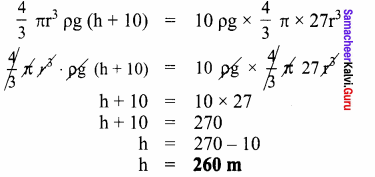
Hence by substituting these values,
P1 V1 = P2 V2
Define One Atmosphere Answer Samacheer Kalvi 8th Science Term 1 Chapter 2 Forces And Pressure

Samacheer Kalvi 8th Science Solutions Forces and Pressure Additional Questions

I. Choose the correct answer

Question 1.
The SI unit of pressure is ……………..
(a) \(\frac { kg }{ { m }^{ 3 } } \)
(b) \(\frac { kg }{ { m }^{ 2 } } \)
(c) Pascal
(d) Newton
Answer:
(c) Pascal

Question 2.
The wear and tear in the machine part is due to …………….
(a) Electrostatic force
(b) Frictional force
(c) Muscular force
(d) Gravitational force
Answer:
(b) frictional force

Question 3.
Which of the following increases friction?
(a) Lubricant
(b) Treads on a tyre
(c) Streamlining
(d) Polishing
Answer:
(b) Treads on a tyre

Question 4.
The total force exerted by a body normal to the surface is called …………….
(a) Pressure
(b) Thrust
(c) force of gravity
(d) None of these
Answer:
(b) Thrust

Question 5.
The atmospheric pressure on the surface of the earth is about ………………
(a) 10<sup-5 Nm-2
(b) 104Nm-2
(c) 105 Nm-2
(d) 103Nm-2
Answer:
(c) 105 Nm-2

Question 6.
The SI unit of force is ……………
(a) Dyne
(b) Newton
(c) Pascal
(d) Newton second
Answer:
(b) Newton

II. Fill in the Blanks

  1. If the same force is made to act on a larger area, the pressure …………….
  2. At the given depth, a liquid exerts 1 pressure in all directions.
  3. The pressure exerted by the air around us is called …………… pressure.
  4. At higher altitudes, atmospheric pressure is …………….
  5. Friction depends on the ……………… of two surfaces in contact.

Answer:

  1. Decreases
  2. Equal
  3. Atmospheric
  4. Less
  5. Nature

III. True or False – if false give the correct statement:

Question 1.
A push or pull on an object is called force.
Answer:
True.

Question 2.
Pressure can be increased by decreasing the force.
Answer:
False
Correct statement:
Pressure can be increased by increasing the force.

Question 3.
All flowing substances such as liquids or gases are called fluids.
Answer:
True

Question 4.
The pressure exerted by air is called atmospheric pressure.
Answer:
True

Question 5.
Pressure is directly proportional to the area of contact.
Answer:
False
Correct statement:
Pressure is inversely proportional to the area of contact.

Question 6.
The pressure in a liquid is the same at all depths.
Answer:
False
Correct statement:
The pressure in a liquid increases with depth.

IV. Match the following

Question 1.
8th Standard Science Force And Pressure Samacheer Kalvi
Answer:

i. b,
ii. c
iii. e
iv. a
v. d

Question 2.
Samacheer Kalvi 8th Science Solutions Term 1 Chapter 2 Forces And Pressure
Answer:

i. c
ii. a
iii. e
iv. b
v. d

V. Analogy

Question 1.
Liquid pressure : ______ :: Atmospheric Pressure :______.
Answer:
Manometer, Barometer.

Question 2.
Broader straps : ______ :: Thin needles : ______.
Answer:
Lowers pressure, High pressure.

Question 3.
Pascal’s law : ______:: Surface tensin : ______.
Answer:
Hydraulic brake, Capillary action.

Question 4.
Viscous force : ______ :: Buoyant force : ______.
Answer:
Viscosity, Buoyancy.

Question 5.
Objects placed at rest on earth : ______ :: Bodies slide over the surface on other body : ______.
Answer:
Static friction, Sliding friction.

VI. Assertion and Reason

Mark the correct choice as :
(a) If both assertion and reason are true and the reason is the correct explanation of the assertion.
(b) If both assertion and reason are true, but the reason is not the correct explanation of the assertion.
(c) If the assertion is true, but the reason is false.
(d) If the assertion is false, but the reason is true.

Question 1.
Assertion : Force is defined as a push or pull acting on a body.
Reason : CGS unit of force is newton.
Answer:
(c) The assertion is true, but the reason is false

Question 2.
Assertion : Friction always opposes the motion.
Reason : Whenever one surface moves or tries to move over another surface, the force of friction starts acting on the surfaces.
Answer:
(d) The assertion is false, but the reason is true

Question 3.
Assertion : The pressure at the bottom of the sea is lesser than that near the surface.
Reason : The pressure exerted by a liquid depends upon the depth of the liquid and density of the liquid.
Answer:
(d) The assertion is false, but the reason is true

Question 4.
Assertion : We can live very happily if friction is not present in nature.
Reason : Aeroplane shape is streamlined to reduce the effort of frictional force.
Answer:
(d) The assertion is false, but the reason is true

Question 5.
Assertion : There is danger of a vehicle skidding on a wet road.
Reason : The tyres of the vehicle lose their grip on the road due to increase in friction due to presence of water on the road.
Answer:
(c) The assertion is true, but the reason is false

VII. Very short Answers

Question 1.
Write the SI unit of force.
Answer:
Newton (N).

Question 2.
Write the SI unit of pressure.
Answer:
Pascal (Pa).

Question 3.
Mention the factors that the effect of a force depend.
Answer:

  1. Magnitude of the force
  2. The area over which it acts.

Question 4.
Name the material which is used to reduce friction.
Answer:
Lubricant.

Question 5.
What is lateral pressure?
Answer:
Liquid exerts pressure on the walls of the container also. This is called lateral pressure.

Question 6.
What is thrust?
Answer:
The force acting normally on a surface is called thrust.

Question 7.
Name an instrument used to measure the difference in the liquid pressure.
Answer:
Barometer.

Question 8.
Mention the two types of forces.
Answer:

  1. Contact force
  2. Non – contact force.

Question 9.
State whether the liquids and gases also exerts pressure.
Answer:
Yes, both the liquids and gases also exerts pressure.

Question 10.
In ‘tug of war’ when two teams pull equally hard, then what happens?
Answer:
In ‘tug of war’ when two teams pull equally hard, then the rope does not move in any direction.

VIII. Short Answer

Question 1.
Define force. Mention its SI unit.
Answer:
Force is that which changes or tends to change:

  1. The state of rest or
  2. The state of uniform motion of a body or
  3. The direction of a moving body or
  4. The shape of a body.

Question 2.
Does the palm apply any force on the ball, when we place our palm in front of a moving ball?
Answer:
Yes, when we place our palm in front of a moving ball, then the palm apply a force on the moving ball and stop it.

Question 3.
Briefly explain how do we experience force in our daily life.
Answer:
Since, there are many actions which give us the feeling of force like we hit or catch many objects in our regular routine. Most of the times, we see that the moving ball stops after sometime and it changes the direction of motion when it is hit by a bat also, when we compress a spring, its shape and size changes.

Question 4.
Can you lift or push a book lying on a table without touching it?
Answer:
No, we cannot lift or push a book lying on a table without touching it, because it is a type of contact forces.

Question 5.
Explain the effect on the pressure when area on which it is applied, decreases.
Answer:
As, we know that pressure is defined as the force acting on a unit area of a surface, then,
Force
Pressure = \(\frac { Force }{ Area}\)
P = \(\frac { F }{ A}\)
p ∝ \(\frac { 1 }{ A}\)
So, pressure is inversely proportional to the area on which force is applied. Therefore with the decrease in area the pressure increases.

Question 6.
Explain the variation of the pressure exerted by liquid with respect to following factors.

  1. Amount of liquid
  2. Depth
  3. Shape and size of container

Answer:
The variation of pressure exerted by liquid with respect to the above factors can be given by,

  1. Pressure in a liquid increases with the amount of liquid.
  2. Pressure in a liquid increases with depth.
  3. Pressure of liquid is independent of shape and size of container.

Question 7.
Give two examples to reduce friction.
Answer:

  1. Drops of oil are poured on the hinges of a door to move the door smoothly,
  2. Fine powder are sprinkled on the carrom board to reduce friction.

Question 8.
Explain why the cutting instruments are sharpened.
Answer:
Cutting instruments have very small area of cross – section, which lead to the increase in pressure. So they can easily penetrate the surface (pressure is inversely proportional to area). That’s why cutting instruments are usually very much sharpened.

Question 9.
Cooking in a place located at a higher attitude is difficult. Why?
Answer:
At a higher altitude, due to the lack of atmospheric pressure the boiling point of a substance reduces. So, the water boils even at 80° C. At this temperature, the thermal energy that is produced is not sufficient enough for baking or cooking. So, cooking is difficult at higher altitude.

Question 10.
Write about buoyant force.
Answer:

  1. An upward force is exerted by water on a floating or a partly submerged body. This upward force is called buoyant force. The phenomenon is known as “buoyancy”.
  2. This force is not only exerted by liquids, but also by gases. Liquids and gases together are called fluids.
  3. This upward force decides whether an object will sink or float. If the weight of the object is less than the upward force, then the object will float. If not, it will sink.

IX. Long Answer

Question 1.
Explain the advantages and disadvantages of friction.
Answer:
Advantages of friction : Friction is a necessity in most of our day to day activities. It is desirable in most situations of our daily life.

  1. We can hold any object in our hand due to friction.
  2. We can walk on the road because of friction. The footwear and the ground help us to walk without slipping.
  3. Writing easily with a pen on paper is due to friction.
  4. Automobiles can move safely due to friction between the tyres and the road. Brakes can be applied due to frictional resistance on brake shoes.
  5. We are able to light a matchstick, sew clothes, tie a knot or fix a nail in the wall because of friction. Though it is giving a negative effect, in most of our day to day life friction helps us to make our life easy. So, it is called as “necessary evil”.

Disadvantages of friction:

  1. Friction wears out the surfaces rubbing with each other, like screws and gears in machines or soles of shoes.
  2. To overcome the friction an excess amount of effort has to be given to operate a machine. This leads to wastage of energy.
  3. Friction produces heat, which causes physical damage to the machines.

Question 2.
Define Pascal’s law. Explain the applications of Pascal’s law in our daily life.
Answer:
Pascal’s law : The pressure applied at any point of a liquid at rest, in a closed system, will be distributed equally through all regions of the liquid.
Application of Pascal’s law : Some of the following examples highlight their working according to Pascal’s law.

  1. In an automobile service station, the vehicles are lifted upward using the hydraulic lift, which works as per Pascal’s law.
  2. The automobile brake system works according to Pascal’s law.
  3. The hydraulic press is used to make the compressed bundles of cotton or cloth so as to occupy less space.

Question 3.
What is surface tension? Explain the applications of surface tension.
Answer:
Surface tension is the property of a liquid. The molecules of a liquid experience a force, which contracts the extent of their surface area as much as possible, so as to have the minimum value. Thus, the amount of force acting per unit length, on the surface of a liquid is called surface tension.

Application of surface tension:

1. Water molecules rise up due to surface tension. Xylem tissues are very narrow vessels present in plants. Water molecules are absorbed by the roots and these vessels help the water to rise upward due to “capillarity action” which is caused by the surface tension of water.

2. For a given volume, the surface area of a sphere is the minimum. This is the reason for the liquid drops to acquire a spherical shape.

3. Water strider insect slides on the water surface easily due to the surface tension of water.

4. During a heavy storm, sailors pour soap powder or oil into the sea near their ship to decrease the surface tension of sea water. This process reduces the impact of the violent water current against the all of ship.

Question 4.
Briefly explain the concept of variation of atmospheric pressure.
Answer:

  1. Atmospheric pressure vary from place to place and from time to time due to variation in temperature. Even, the density of air decreases with the increase in temperature.
  2. So, as a result, the atmospheric pressure also decreases. The atmospheric pressure at a place is because of the weight of air above it.
  3. So, if we go higher above the earth surface, the atmospheric pressure decreases, thus at mountain top the pressure is less. The atmospheric pressure at sea level is considered as standard pressure.

X. Thinking Comer : HOTS

Question 1.
Why dams are made stronger and thicker at the bottom that at the top?
Answer:
This is because the pressure of the water is much greater deeper down and the damneeds to be thick at the bottom so that is strong enough to withstand this larger pressure.

Question 2.
Why do scuba divers wear a special suit while they go into deep sea levels?
Answer:
Pressure deep under the sea is so high that if the divers don’t wear specially designed suits, the water pressure will crush their body.

Question 3.
Why are rain drop spherical in nature?
Answer:

  1. Surface tension is responsible for the shape of liquid droplets. Although easily deformed, droplets of water tend to be pulled into a spherical shape by the cohesive force of the surface layer.
  2. In the absence of other force including gravity drops of virtually all liquids would be approximately spherical.

Question 4.
A liquid flowing out of a very small opening of a tube or tap comes out in the form of fine drops and not as a continuous stream. Why?
Answer:
For a given volume, the surface area of a sphere is the minimum. This is the reason for the liquid drops to acquire a spherical shape.

Question 5.
Trees are greenish. They are greenish at the tip too. How does the water rise upward in a tree or plant against the force of gravity?
Answer:

  1. Water can travel to great heights inside plants. Water moves up the xylem through a process called capillary action.
  2. During transpiration, water evaporates from holes in the surface of leaves into the air. As water molecules evaporate from plant leaves, they attract the water molecules still in the plant, helping to pull water up through the stems from the roots.

XI. Problems for practice

Question 1.
Determine the pressure when a force of 200 N acts on area

  1. 20 m2
  2. 8 m2

Answer:
1. Pressure P = \(\frac { F }{ A}\)
F = 200 N, A = 20 m2
P = \(\frac { 200}{ 20}\)= 10N/m2or 10 Pa

2. A = 8 m2
P = \(\frac { 200}{ 8}\) = 25 N/m2 or 25 Pa

Question 2.
A force of 20 N acts over an area of 4 cm2 Find the value of pressure? (in Nm-2)
Answer:
Given:
Pressure = \(\frac { F }{ A}\)
F = 20 N
A = 4 cm2 = 4 x 10⁻²m
Solution:
P = \(\frac { F }{ A}\) = \(\frac { 20 }{ 4 x 10⁻² }\)
= 5 x 102
= 500 Nm-2 (or) 500 pack

Question 3.
What will be the force required to exert a pressure of 20,000 Pa on an area of 1 cm2.
Answer:
Given:
P = 20,000 Pa
A = 1 cm2 = 1 x 10⁻⁴ m2
Formula:
p = \(\frac { F }{ A}\)
F =P x A
Solution:
= 20,000 x 10-4
= 2 x 10-4 x 10-4
= 2 N.

Question 4.
Calculate the area of a 1500 N object that exerts a pressure of 500 Pa.
Answer:
Given:
P = 500 Pa
F = 1500N
Formula:
p = \(\frac { F }{ A}\)
A = \(\frac { F }{ P}\)
Solution:
= \(\frac { 1500}{ 500}\)
= 3m2

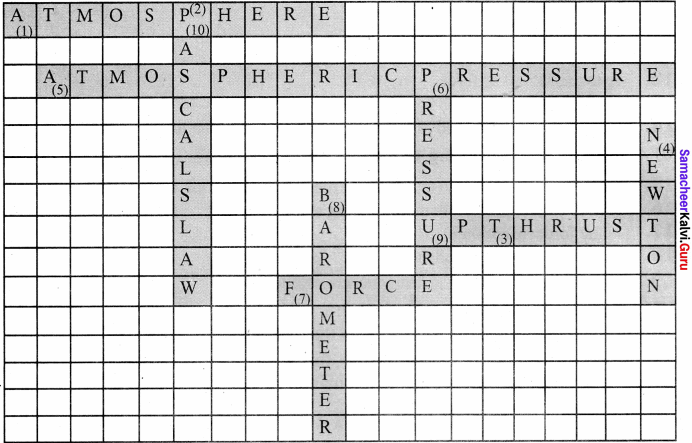
XII. Cross word puzzle

Across:
1. The mixture of gases that surrounds the Earth or some other celestial body.
3. A force acting normal to a surface.
5. The pressure exerted by air.
7. Something that causes a body to move, change its speed or direction, or distorts its shape.
9. The upward force that fluids exert on all matter.

Down:
2. A unit used to measure pressure.
4. A unit used to measure force.
6. Amount of force applied per unit area.
8. An instrument for measuring atmospheric pressure.
10. The pressure exerted at any point on a enclosed liquid is transmitted equally and undiminished in all directions.

Answer:

1. Atmosphere
3. Thrust
5. Atmospheric Pressure
7. Force
9. Upthrust

Down:
2. Pascal
4. Newton
6. Pressure
8. Barometer
10. Pascals Law

Define Force Class 8 Samacheer Kalvi Term 1 Chapter 2 Forces And Pressure

Samacheer Kalvi 7th English Solutions Term 3 Prose Chapter 1 Journey by Train

Students can Download English Lesson 1 Journey by Train Questions and Answers, Summary, Notes Pdf, Activity, Samacheer Kalvi 7th English Book Solutions Guide Pdf helps you to revise the complete Tamilnadu State Board New Syllabus and score more marks in your examinations.

Tamilnadu Samacheer Kalvi 7th English Solutions Term 3 Prose Chapter 1 Journey by Train

Read And Understand

A. Fill in the table
Answer:

Problems Faced By Mr. Fogg  And His TeamSolution
The train stopped in the middle of the forest.The passengers must provide themselves a means of transport from Kholby to Allahabad.
They couldn’t hire the elephant.Mr. Fogg purchased it for 2000 pounds.
They were in need Of an elephant driver.A young man offered his service as a guide.

B. Answer the questions briefly

Journey By Train 7th Standard Question 1.
Who inhabited the jungles that the train passed through?
Answer:
Snakes, tigers and elephants inhabited the jungles that the train passed through.

Journey By Train Summary Question 2.
What was the reaction of the inhabitants?
Answer:
Snakes and tigers fled at the noise Of the train. The elephants stood gazing with sad eyes at the train, as it passed.

Journey By Train Question Answer Question 3.
What did Mr. Fogg mean by, ‘it was foreseen’?
Answer:
Mr. Fogg meant that some difficulty or the other would sooner or later arise on his route.

Journey By Train 7th Standard Summary Question 4.
Describe the elephant driver in your own words.
Answer:
The elephant driver was intelligent and a skilled young man. He covered the elephant’s back with saddle-cloth. He attached seats on each of its side. He sat on the neck of the elephant and set out from the village with the three passengers.

C. Think and Answer.

Journey By Train Book Back Answer Question 1.
What qualities of Mr. Phileas Fogg are highlighted in this extract? Support your answer with suitable examples.
Answer:
Mr. Phileas Fogg was a rich, English man. He was a member of the Reform Club of London. He orders his life precisely by the clock and makes a bet with fellow club members that he can travel around the world in 80 days. He travels with his French servant Passepartout. He is a precise and intelligent man. He is perfect in his manners and is very punctual as well as particular about what he wants. This is evident in this extract, when he is determined to travel to Allahabad as planned. He even goes to the extent of purchasing an elephant for 2000 pounds to continue his travel to Allahabad. These qualities of Mr: Fogg are highlighted in his extract.

Vocabulary

D. Fill in the blanks with correct travel words.

(schedule,reach,book,railway,pack,board)
Answer:
To make travel convenient, we must book tickets well in advance. Then we have to Pack our things and schedule our trip. We have to reach the railway station in time and board the train in order to reach our destination.

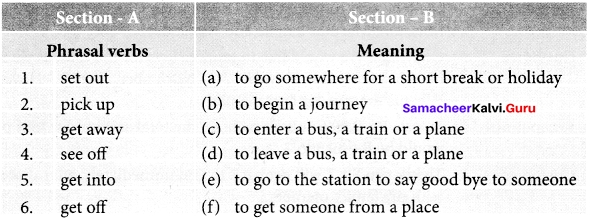
E. Match the phrasal verbs with their meanings

Journey By Train 7th Standard Samacheer Kalvi Term 3 Prose Chapter 1

Answer:

  1. b
  2. f
  3. a
  4. e
  5. c
  6. d

F. Dictionary Task
Refer to a dictionary. Find the meaning of the following words and write them down.
Answer:

  1. journey – The act of travelling from one place to another.
  2. picnic – a trip or excursion to the country, seaside etc, on which people bring food to be eaten in the open air
  3. pilgrimaga – a religious journey.
  4. tour – a journey for pleasure in which several places are visited
  5. vacation – holiday.
  6. excursion – a short journey or trip.

Listening

G. Listen to the teacher reading the Weather forecast and complete the report.
Answer:
Name of the Cyclone is Gaja it may affect the places North Tamil Nadu and Puducherry Heavy rains are expected on November 14th and 15th It is 880 km away from Nagapatinam.

Speaking

H. Your family has decided to go on a tour during the vacation. You are calling a travel agency and seeking information regarding package, places of visit, cost etc. Work in pairs and role play as a receptionist and a customer.
Answer:
Receptionist: Good morning. This is Sai Dwaraka Mai Travel Agency. How can I help you?
Customer: We would like to go to a tour to Shirdi temple. Can you give us the information regarding the package, places of visit and the cost for it.
Receptionist: Yes, Madam. We offer flight packages from Chennai to Shirdi at affordable prices.
Customer: Okay Sir, what are the places of visit over there?
Receptionist: We take you to places like Dwarkamai, Chavadi, Gurusthan, Sai Museum, Maruthi temple and Nandadeep.
Customer: Okay fine. We would like to book tickets for the tour, as we would like to go any day between 23rd November and 27th November. What is the cost for four people?
Receptionist: It costs Rs. 9,9991- per person. So the total amount for four people would be Rs. 39,996/-
Customer: Thank you Sir, I will get back to you immediately, after discussing with my family members.
Receptionist: Thank you for calling, Madam. Have a nice day.

Grammar

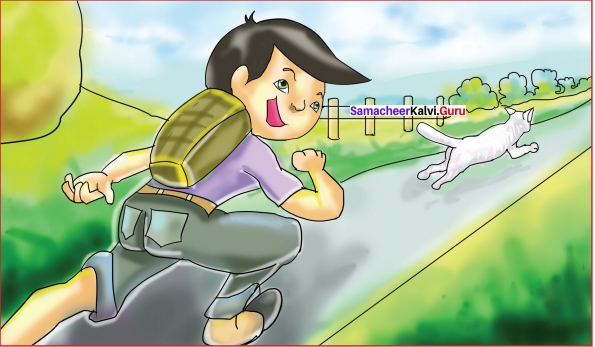
I. Rewrite the story in the past tense.
Answer:

Journey By Train Summary Samacheer Kalvi 7th English Solutions Term 3 Prose Chapter 1

The boy chased a cat. The cat climbed up the tree and purred from the branch of the tree. The cat jumped to another tree. The boy who was chasing the cat noticed a snake under the tree. He left his attempt to catch the cat and he ran home screaming for help

J. Look at the picture and complete the following

Journey By Train Question Answer Samacheer Kalvi 7th English Solutions Term 3 Prose Chapter 1
Answer:
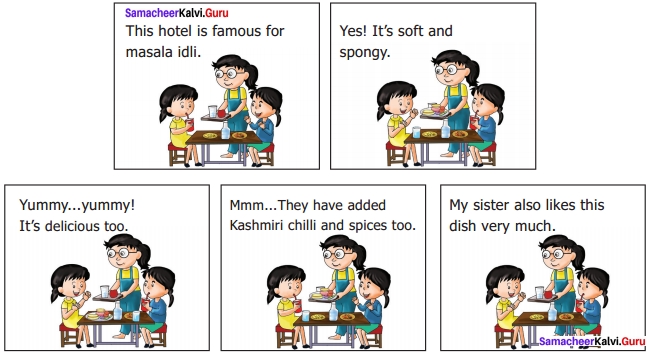
Nila told Miruthula that that hotel was famous for masala idli Miruthula said that the idly was soft and spongy Nila said that it was delicious too. She also said that they had added Kashmiri chilli. Miruthula said very much.

Writing

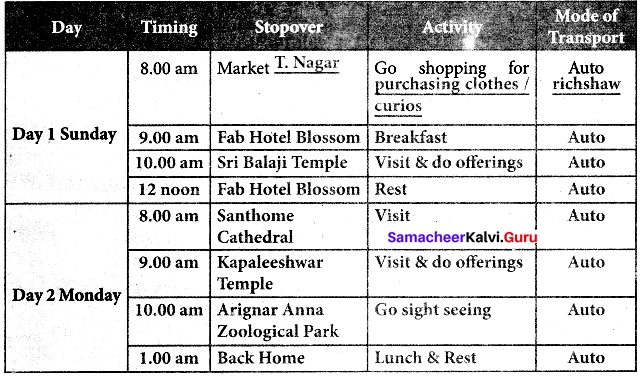
K. Your friend is coming to your city / town to spend a week with you. He /she wants to visit some tourist places, and enjoy the special food items of the place. Prepare a two day itinerary for the visit.
Answer:

Journey By Train 7th Standard Summary Samacheer Kalvi Term 3 Prose Chapter 1

Creative Writing

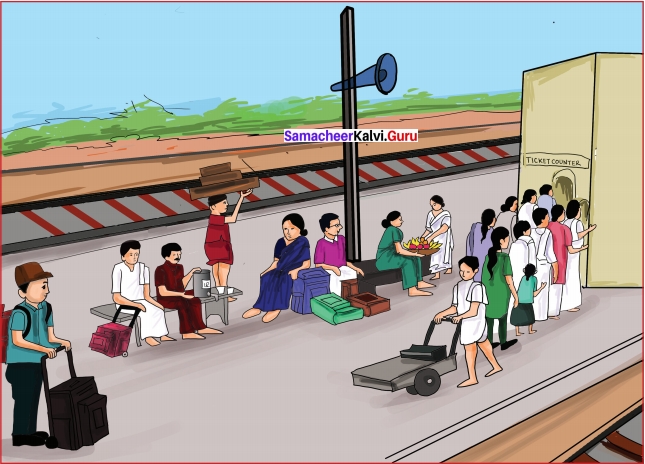
L. You are waiting to board a train in a railway station. The train is delayed by an hour. Write a paragraph about the crowded scene in the railway station based on your observation.
Journey By Train Book Back Answer Samacheer Kalvi 7th English Solutions Term 3 Prose Chapter 1

7th Standard 3rd Term Journey By Train Samacheer Kalvi Chapter 1 Journey By Train

Answer:
I was waiting to board a train at a railway station. The train was delayed by an hour. A lot of families were waiting eagerly for the announcement of the arrival of the train. Some of the porters were carrying the luggage of the passengers. Piles of luggage were seen all over. There were fruit vendors, tea vendors and other shops selling water, milk and snacks. By the ticket counter, there was a queue, waiting to buy tickets. The scroll board was displaying the necessary information for the passengers. The porters were also using trolleys to carry the luggage.

Journey by Train Additional Questions

I. Choose the correct Synonyms from the options below.

7th Standard 3rd Term Journey By Train Question 1.
proceeded
(a) stopped
(b) halted
(c) moved
(d) passed
Answer:
(c) moved

7th Std English Journey By Train Question 2.
fertile
(a) vast
(b) productive
(c) barren
(d) incapable
Answer:
(b) productive

Journey By Train 7th Standard In Tamil Question 3.
territory
(a) barrier
(b) border
(c) Limit
(d) region
Answer:
(d) region

The Train Would Come At Answer Question 4.
gazing
(a) look steadily
(b) looking away
(c) scanning
(d) blinking
Answer:
(a) look steadily

7th Standard 3rd Term English Journey By Train Question 5.
hasty
(a) slow
(b) wise
(c) quickly
(d) lazy
Answer:
(c) quick

7th English Journey By Train Question 6.
curled
(a) straightened
(b) erected
(c) evened
(d) twined
Answer:
(d) twined

Journey By Train 7th Std Lesson Question 7.
obstacle
(a) assist
(b) aid
(c) support
(d) difficulty
Answer:
(d) difficulty

Journey By Train 7th English Question 8.
halt
(a) start
(b) stop
(c) go
(d) continue
Answer:
(b) stop

Question 9.
foreseen
(a) predicted
(b) neglected
(c) disregarded
(d) failed
Answer:
(a) predicted

Question 10.
rapidly
(a) slowly
(b) suddenly
(c) quickly
(d) easily
Answer:
(c) quickly

II. Choose the correct Antonyms from the options below.

Question 1.
different
(a) same
(b) unlike
(c) dissimilar
(d) contrast
Answer:
(a) same

Question 2.
punctually
(a) promptly
(b) timely
(c) regularly
(d) early
Answer:
(d) early

Question 3.
straggling
(a) few
(b) rare
(c) abundant
(d) irregular
Answer:
(c) abundant

Question 4.
waking
(a) sleeping
(b) arousing
(c) raising
(d) getting up
Answer:
(a) sleeping

Question 5.
abandoned
(a) deserted
(b) forsakened
(c) casted
(d) inhabited
Answer:
(d) inhabited

Question 6.
skilled
(a) trained
(b) qualified
(c) inexperienced
(d) practised
Answer:
(c) inexperienced

Question 7.
announced
(a) reported
(b) declared
(c) notified
(d) suppressed
Answer:
(d) suppressed

Question 8.
snapped
(a) became happy
(b) broke
(c) crackled
(d) fractured
Answer:
(a) became happy

Question 9.
disadvantage
(a) effectiveness
(b) unfavourable
(c) drawback
(d) advantage
Answer:
(d) advantage

Question 10.
hesitation
(a) fluctuation
(b) unwillingness
(c) willingness
(d) stutter
Answer:
(c) willingness

III. Choose the Correct Answer (MCQ).

Question 1.
The train had started _________
(a) delayedly
(b) punctually
(c) late
(d) after an hour
Answer:
(b) punctually

Question 2.
An hour after leaving _________ the train had passed the bridges and the island of salcette.
(a) Allahabad
(b) Calcutta
(c) Lucknow
(d) Bombay
Answer:
(d) Bombay

Question 3.
At half-past _________ the train stopped at Burhampoor.
(a) ten
(b) twelve
(c) six (d) eight
Answer:
(b) twelve

Question 4.
The _________ at once stepped out.
(a) General
(b) attendant
(c) club member
(d) driver
Answer:
(a) General

Question 5.
Sir Francis was _________
(a) happy
(b) furious
(c) cool
(d) cheerful
Answer:
(b) furious

Question 6.
A steamer leaves Calcutta for _________ at noon on the 25th.
(a) Hongkong
(b) Persia
(c) Norway
(d) Burhampoor
Answer:
(a) Hongkong

Question 7.
‘Good Heavens’, what a price for an _________
(a) eagle
(b) ox
(c) elephant
(d) ostrich
Answer:
(c) elephant

Question 8.
The driver _________ himself on the elephant’s neck.
(a) lost
(b) perched
(c) unsettled
(d) lowered
Answer:
(b) perched

Question 9.
A young man, with an _________ face, offered his services as a guide.
(a) averse
(b) ugly
(c) intelligent
(d) inapt
Answer:
(c) intelligent

Question 10.
The travellers made a hasty _________
(a) lunch
(b) dinner
(c) moment
(d) breakfast
Answer:
(d) breakfast

7th Standard Journey By Train  Short Questions with Answers.

Question 1.
Who is the author of this novel’Around the world in Eighty Days’?
Answer:
The author of this novel is Jules Verna.

Question 2.
Who were there among the passengers?
Answer:
There were a number of officers, Government officials and merchants.

Question 3.
Who occupied a seat opposite to Mr. Fogg?
Answer:
Sir Francis Cromarty occupied a seat opposite to him.

Question 4.
Who was Sir Francis?
Answer:
Sir Francis was one of the friends of Mr. Fogg.

Question 5.
Where did he meet him?
Answer:
He met him on the ship Mongolia that brought him to Bombay.

Question 6.
When will the steamer leave Calcutta for Hong Kong?
Answer:
The steamer would leave Calcutta for Hong Kong at noon on the 25th.

Question 7.
What was Mr. Fogg resolved to hire?
Answer:
He was resolved to hire an Indian elephant for his journey to Allahabad.

Question 8.
How much did Mr. Fogg offer to hire the Elephant at first?
Answer:
He offered ten pounds per hour to hire the elephant.

Question 9.
Where did the train stop at half-past twelve?
Answer:
It stopped at Burhampoor at half-past twelve.

Question 10.
Which mountains separated the Khandesh from Bundelcund?
Answer:
The Sutpour mountains separated the Khandesh from Bundelcund.

V. Paragraph Questions with Answers.

Question 1.
What did Passepartout see, when he was crossing India in a railway train?
Answer:
Passepartout on waking looked out. He could not believe that he was actually crossing India. The locomotive, guided by an English engineer and fed with coal, threw out its smoke upon cotton, coffee, nutmeg, clove and pepper plantations. The steam curled in spirals around groups of palm-trees. In the midst of these trees were attractive bungalows, viharas and marvellous temples, decorated by the rich work of Indian architecture. There were vast areas extending to the horizon with jungles and forests. There he saw snakes, tigers and elephants.

Question 2.
Who served as a guide to Mr. Fogg and others? How did he manage to take all the three to Allahabad?
Answer:
A young intelligent man offered his services as a guide. The elephant was led out and equipped. The skilled driver covered the elephant’s back with a sort of saddle-cloth and attached to each of its side some uncomfortable howdahs. While Sir Francis and Mr. Fogg took the howdahs on either side, Passepartout got on to the saddle-cloth between them. The driver positioned himself on the elephant’s neck and they set out from the village at nine o’clock by short cuts through the dense forests of palms.

Journey by Train Grammar Additional

Reported Speech

The actual words spoken by a person is Direct speech. They are enclosed within quotation marks.
When we later report this, making changes to the words the speaker originally said, it is Reported Speech. (Indirect Speech)

SentenceDirect SpeechIndirect Speech
I want an ice creamRam said to Rakesh, “I want i an ice cream ”Ram told Rakesh that he wanted an ice cream.
I am coming to

Chennai tomorrow.

My uncle said to me, “I am coming to Chennai tomorrow.”My uncle told me that he was coming to Chennai the next day
I want to become a doctor.Monica said, “I want to i become a doctor.”Monica said that she wanted to become a doctor.
The comic books are kept on the second shelf.The librarian said, “The comic books are kept on the second shelf”The librarian said that the comic books were kept on the second shelf.
The monument is beautiful.Sidharthan said, “The monument is beautiful.”Sidharthan said that the monument was beautiful.

I. Change into Indirect Speech.

Question 1.
He said, “I live in the city centre”.
Answer:
He said that he lived in the city centre.

Question 2.
Radha said, “I am going out”.
Answer:
Radha said that she was going out.

Question 3.
Ravi said, “I can swim”
Answer:
Ravi said that he could swim.

Question 4.
He said, “I arrived before you”.
Answer:
He said that he had arrived before him.

Question 5.
My father said, “I will be in Pairs on Monday”.
Answer:
My father said that he would be in Paris on Monday.

Warm Up

Work in pairs. Choose six items which are essential for a camp. Rank their priority and justify your answer.

7th Std English Journey By Train Samacheer Kalvi Chapter 1 Journey By Train
Answer:

  1. Torch Light
  2. Tent
  3. Cell Phone
  4. Rope
  5. Hammer
  6. Stove

These things are essential for a camp because without these things, we cannot enjoy our camp. Camping is an amazing experience. So we should prepare ourselves properly with the essential items taken along with us. This will avoid frustration and stress.

Journey by Train Summary

Section – I

This story tells us of an amazing journey by an Englishman Mr. Phileas Fogg. He is a ruthless perfectionist who cares more about the bet than
the native places, he sees on his travels. He will do anything, even lie and cheat, to get what he wants.
Mr. Phileas Fogg along with his French attendant, Passepartout, attempts to go round the world in eighty days by taking a bet for $ 20,000. They travel through some parts of India. That was the time, when the railways were being built in the country. The train started at the scheduled time from Bombay. There were a number of passengers like officers, government officials and merchants in the train. Sir Francis Cromarty, one of Mr. Fogg’s friends, occupied a seat opposite to them. The train passed the bridges, the Island of Salcette, mountains, jungles, forests and the fertile territory of Khandesh.
Passepartout couldn’t believe that he was actually crossing India in a railway train. Tigers and snakes fled at the noise of the train. Elephants stood gazing at the train with sad eyes. At half-past twelve, the train stopped at Burhampoor. The travellers had a hasty breakfast. The train entered the valleys of Sutpour Mountains at three in the morning.

Question 1.
Give a picturesque view through which the train travels.
Answer:

Journey By Train 7th Standard In Tamil Samacheer Kalvi Chapter 1 Journey By Train

Section – II

The train stopped at 8 o’clock some fifteen miles beyond Rothal. Phileas Fogg and others were annoyed. They were wondering why there was a halt of the train in the midst of the forest. When they enquired, the conductor informed them that the railroad lines ends at Kholby, 50 miles short of Allahabad. The line begins again from there in Allahabad. Sir Francis got angry because they sold the tickets from Bombay to Calcutta, without confirming about the railroad lines.

The passengers had to provide means of transportation for themselves from Kholby to Allahabad. So, Mr. Fogg, his attendant and Sir. Francis planned to reach Allahabad in time by some means of transport, as a steamer was ready to leave Calcutta for Hongkong on the 25th. They had two days left to reach Calcutta.

Discuss and answer – Intext Questions.

Question 1.
Why did the train stop in the middle of the forest?
Answer:
The train stopped in the middle of the forest as there were no railroad lines beyond that place.

Question 2.
Why was Sir Francis angry?
Answer:
There were no railroad lines from Kholby to Allahabad. But the tickets were sold from Bombay to Calcutta. So Sir Francis was angry.

Section – III

After searching the village from end to end, Mr. Fogg and Sir. Francis came back without finding any means of transport. But Passepartout suggested that they can travel on an Indian elephant. As it could travel rapidly for a long time, Mr. Fogg determined to hire it. Even though Mr. Fogg offered excessive amount to hire the elephant, the elephant’s owner refused to hire it. So Mr. Fogg finally purchased the elephant for two thousand pounds. A young man offered his services as a guide to them.

While Mr. Fogg and Sir Francis took the howdahs on either side, Passepartout got on to the saddle-cloth between them. The driver sat on the elephant’s neck and at 9 o’clock set out from the village to Allahabad.

Discuss and answer.

Question 1.
Which mode of transport did Fogg choose?
Answer:
At first, Fogg chose to go on foot to Allahabad. Then he purchased an elephant to take them to Allahabad.

Question 2.
Did he hire Kiouni? Why?
Answer:
No, he did not hire Kiouni, but purchased it for 2000 pounds, because the owner of the elephant intended to make a big bargain and so refused to hire him.

Question 3.
Why was the elephant owner happy with the deal?
Answer:
The elephant owner was happy with the deal because Mr. Fogg offered him 2000 pounds to purchase the elephant.

Samacheer Kalvi 7th English Solutions Term 2 Poem Chapter 2 Wandering Singer

Students can Download Wandering Singer Questions and Answers, Summary, Activity, Notes, Samacheer Kalvi 7th English Book Solutions Guide Pdf  helps you to revise the complete Tamilnadu State Board New Syllabus and score more marks in your examinations.

Tamilnadu Samacheer Kalvi 7th English Solutions Term 2 Poem Chapter 2 Wandering Singer

B. Pick out the rhyming pairs from the poem and fill in the table.

Samacheer Kalvi 7th English Solutions Term 2 Poem Chapter 2 Wandering Singer img 1

C. Read these lines and answer the questions given below.

Wandering Singers Poem Question 1.
Where the voice of the wind calls our wandering feet Whose ‘Wandering feet’ is referred to here?
Answer:
The wandering feet of the band of folk singers.
With lutes in our hands ever-singing we roam,
All men are our kindred, the world is our home.

(a) Who does ‘we’ refer to? What do they have in their hands? What is its name?
Answer:
‘We’ refers to the wandering singers. They have a musical instrument in their hands. Its name is ‘lute’.
(b) How are the men in the world related to the singers?
Answer:
All the men in the world are their extended family and the world is their home.

Wandering Singers Question 3.
Our lays are of cities whose lustre is shed,
Here ‘Lays’ means ________
(a) lying down
(b) stories
(c) to keep
Answer:
(b) stories

Wandering Singers Summary Question 4.
The laughter and beauty of women long dead
Explain the meaning of the above line.
Answer:
The songs sung by the wandering singers are about the laughter and beauty of women who were dead long ago.

Writing

D. Answer in a paragraph.
What does Sarojini Naidu say about the Wandering Singers? Write in your own words. (in about 60 words)
Answer:
Sarojini Naidu in this poem tells us about the wandering singers, their life and their activities as well as their experiences. The wandering singers stroll here and there. They count the world as their home and all the people around are their inborn family and relatives. They hold ‘lutes’ in their hands and sing songs about ancient battles, old kings and the beauty and laughter of women of the past.

E. Think and answer.

Wandering Singers Poem Line By Line Explanation Question 1.
Are the singers homeless travellers? Why do you think so?
Answer:
Yes, they are homeless travellers because they wander from town to town and from village to village to spread the message of love through their singing.

Wandering Singers Poem Question Answers Question 2.
Do the singers have hopes and dreams? if not, why?
Answer:
The wandering singers have no dreams or hopes of their own. They go wherever the wind calls them.

Wandering Singer Additional Questions

I. Poem Comprehension:

Wandering Singers Poem Summary Question 1.
Our lays are of cities whose lustre is shed,
The laughter and beauty of women long dead;
The sword of old battles, the crown of old kings,
And happy and simple and sorrowful things.

(a) Whose lustre is shed?
Answer:
The cities lustre (glory) is shed (lost).

(b) Whose laughter and beauty had the poet mentioned here?
Answer:
She had mentioned the laughter and beauty of the women in the past.

(c) What do you mean by the word ‘lustre’?
Answer:
It means ‘the glory’ of the cities.

(d) Do they also sing of sorrowful things?
Answer:
Yes, they do sing of sorrowful things.

II. Poetic Devices:

Wandering Singers Poem 7th Standard Question 1.
Where the voice of the wind calls our wandering feet,
Through echoing forest and echoing street,
Pick out rhyming words in these lines.
Answer:
The rhyming words are ‘feet – street’.

Wandering Singers Questions And Answers Question 2.
And happy and simple and sorrowful things.
Pick out the alliterated words.
Answer:
‘Simple – sorrowful’ are the alliterated words.

III. Short Questions and Answers.

Summary Of Wandering Singers Question 1.
What is wandering singers about?
Answer:
Wandering singers are a band of folk singers who wander from place to place according to the call of the wind. It can either be town, village or forest.

Poem Wandering Singers Question 2.
How do the singers sing?
Answer:
The singers sing songs with lutes, in their hands and travelling from place to place.

Wandering Singers Line By Line Explanation Question 3.
What has happened to the cities?
Answer:
It has been seized by wars, famine etc., so the beauty is gone.

Wandering Singers Poem In English Question 4.
What does, “The laughter and beauty of women long dead” mean?
Answer:
The laughter and the beauty has died because of wars or because of famine.

Wandering Singers By Sarojini Naidu Question 5.
What songs do the singers sing about the sword of old battles?
Answer:
They sing about the brave warriors who fought bravely with the sword.

7th English Poem Wandering Singers Question 6.
Why do the singers feel nostalgic of the crown of old kings?
Answer:
They feel nostalgic because during the king’s period, these singers used to get rewards, which made them lead a comfortable life.

Summary Of Poem Wandering Singers Question 7.
‘What hope shall we gather, what dreams shall we sow’? Explain these lines.
Answer:
The poetess tells us that the wandering singers cannot have any hope or dream of bright future because of their wandering nature.

Wandering Singers Poem Explanation Question 8.
Do the singers stay at one place or do it they?
Answer:
They wander about from one place to the other. The call of the wind determines where they go.

IV. Paragraph Questions with Answers.

7th Standard English Poem Wandering Singers Question 1.
What is the song of the wandering singers about?
Answer:
The song is about the band of folk singers who wander from town to town and from village to village to spread the message of love through their singing. They play the lute, a musical instrument as they roam from place to place.
The theme of the song is about the swords of old battles and the crowns of old kings. They are also of the laughter and beauty of women in the past.

Wandering Singers Book Back Answers Question 2.
‘What hope shall we gather, what dreams shall we sow’ Explain this line in detail.
Answer:
Here the poetess seems to tell us about their sadness and about their future. They do not stay at one place. So they cannot gather hope and have dreams about their bright future. Their movements depend on the call of the wind. No love can make them go slow or no joy can bade them to wait.

Warm up

Discuss in pairs, circle the names of musical instruments from the grid. One is done for you.

Wandering Singers Poem Samacheer Kalvi 7th Term 2 Poem Chapter 2

Wandering Singer Summary

The poem “Wandering singers” by Sarojini Naidu is about the band of Folk singers who wander from town to town and from village to village to spread the message of love through their singing. They play the lute (a musical instrument) as they roam from place to place. The voice of the wind symbolizes the welcoming tone of the song that echoes through the forests and streets. To the wandering singers, all mankind are like their extended family and the world is their home. The theme of the songs that they sing goes back to stories of ancient battles or of old kings. They also have songs about the beauty of women and about happy and sad things.

The wandering singers have no dreams or hopes of their own; they go wherever the wind calls them. No love can make them go slow or no joy can bade them to wait. The voice of the wind is the voice of their life and also their destiny.

Samacheer Kalvi 7th English Solutions Term 2 Poem Chapter 1 The Poem of Adventure

Students can Download English Poem 1 The Poem of Adventure Questions and Answers, Summary, Notes Pdf, Activity, Samacheer Kalvi 7th English Book Solutions Guide Pdf helps you to revise the complete Tamilnadu State Board New Syllabus and score more marks in your examinations.

Tamilnadu Samacheer Kalvi 7th English Solutions Term 2 Poem Chapter 1 The Poem of Adventure

Read And Understand

A. Read the lines and answer the questions.

The Poem Of Adventure Question And Answer Question 1.
Deep inside the mountain
the adventures hide themselves.
(a) Where do adventures hide?
Answer:
Adventures hide deep inside the mountain.

The Poem Of Adventure Question 2.
They are of all forms and shapes They all have an excellent ending
(a) What do have an excellent ending?
Answer:
Adventures have an excellent ending.

The Poem Of Adventure Summary Question 3.
when to fight for a righteous cause one did gain considerable applause.
(a) When will one get an applause?
Answer:
If one fights for a righteous cause, one will get an applause.

The Poem Of Adventure 7th Standard Question 4.
And in fighting for their country, faith and king
noble impressions on peoples minds would ring
(a) What does ‘noble impression’ mean?
Answer:
‘Noble impression’ is good opinion’.

(b) Who can leave a noble impression?
Answer:
Knights fighting for their country, faith and the king can leave a noble impression on people’s minds.

The Poem Of Adventure Book Back Answers Question 5.
There are many legends based on their heroic exploits a legacy of tales which have been told with much adroit
(a) What does ‘heroic exploits’ mean?
Answer:
‘Heroic exploits’ means ‘daring adventures’.

(b) What are legends?
Answer:
Legends are traditional stories.

B. Answer briefly.

Poem Of Adventure 7th Standard Question 1.
What is adventure?
Answer:
An Adventure is an unusual, exciting and daring deed.

The Poem Of Adventure 7th Standard Summary Question 2.
Describe the appearance of a knight.
Answer:
A knight is bold and daring. He rides on a horse with a sword or spear in armours seeking romance.

Poem Of Adventure Question 3.
What are the characteristics of an adventure?
Answer:
Adventures hide deep inside the mountains. They have an excellent- ending. They are all forms and shapes.

C. Think and Answer.

The Poem Of Adventure 7th Standard English Question 1.
Why does the poet ask us to imagine that we have tiny wings on our back?
Answer:
The poet asks us to imagine that we have tiny wings on our back, so that we can bounce a bit with joy, when we take a new step towards our adventurous life. He also wants us to imagine that we are clear in mind and feel the wind passing . through us, instead of going against us. You just have to close your eyes and ask them to embrace you. Thus, they would be attracted to be our patterns of habit.

7th English The Poem Of Adventure Question 2.
Why should we fight for righteous cause?
Answer:
Long ago during the age of chivalry, knights used to fight for a righteous cause. They gained a considerable applause for their chivalrous acts. Likewise, we should also fight for a noble cause, so that we could get a good applause from the people of our country. If you fight for your country, people will have good impression about you in their minds. They will hold you in high esteem.

D. Literary Appreciation.

The Poem Of Adventure Line By Line Explanation Question 1.
Pick out the rhyming words. –
Answer:
“Old – bold” lance – romance; cause – applause; chivalry – history; maiden – laden; blows – foes; death – breath; yore – fore; struggle – juggle; king – ring; esteem – seem; exploits – adroit; vice – sacrifice; cause – pause are the rhyming words in this poem.

Summary Of The Poem Of Adventure Question 2.
Write down the alliterated words
Answer:
those-that-their
they – themselves
fighting – for – faith
lessons-learnt
time – take
defying – death
held – high
bounce – bit
virtue – vice

Creative Writing
Concrete Poems
Concrete poems are made up ofwords that have been placed in such a way that they make the shape of an object and also use words to describe the object.

The Poem Of Adventure Question And Answer Samacheer Kalvi 7th English Term 2 Poem Chapter 1
Star,t by making a simple outline of the shape or object (an animal, a football, a fruit etc.) large enough to fill a piece of paper.
Then brainstorm a minimum of ten words and phrases that describe the shape. List action and feeling words as well.
Next, place a piece of paper over the shape and decide where your words are going to be placed so that they outline your shape but also fit well together.
Separate words and phrases with commas.

E. Now read the poem and pick out the nouns. Then write your own concrete poem
Answer:
Nouns

  1. Bird
  2. Beak
  3. Claws
  4. Prey
  5. Barrell
  6. Dragon fly
  7. Grip
  8. Cat
  9. Feline
  10. Roll

Hot Air Balloon

From down
below I wave hello
to a man standing in
a basket, a basket hang-
ing from a balloon, a ball-
oon filled with hot air
that keeps it pre
cariously,
scario
us
ly
al
oft

The Poem of Adventure Additional Questions

I. Poem Comprehension:

The Poem Of Adventure Full Poem Question 1.
To attract the adventures into the patterns of habit
you only need to close your eyes
and ask them to embrace you.

(a) What can be taken into the patterns of habit?
Answer:
Adventures can be taken into the patterns of habit.

(b) What should you do to make adventures to embrace you?
Answer:
You should close your eyes and ask them to embrace you.

The Poem Of Adventure Poem Question 2.
Back in the days of old
when knights were bold
who with a sword or lance
in armour sought romance.

(a) When were the knights bold?
Answer:
In olden days, the knights were bold.

(b) How do they go on a horse?
Answer:
Vuiva They go on with a sword or a lance.

(c) What did they seek?
Answer:
They sought romance.

(d) What does the word ‘lance’ mean?
Answer:
It means ‘a long weapon with a wooden shaft and pointed steelhead.

II. Poetic Devices:

The Poem Of Adventure Lines Question 1.
in a one to one combat defying death as crowds watched with abated breath.

a) Pick out the rhyming words in the lines.
Answer:
death – breath are the rhyming words.

b) Pick out the alliterated words.
Answer:
defying – death are the alliterated words.

7th Standard The Poem Of Adventure Question 2.
Back in the days of old when knights were bold
a) Pick out the rhyming words in the lines.
Answer:
old – bold are the rhyming words..

b) Pick out the alliterated words.
Answer:
when – were are the alliterated words.

III. Short Questions and Answers.

Question 1.
On whom do the knights strike heavy blows?
Answer:
Knights strike heavy blows on all their opponents and foes.

Question 2.
How do the crowds watch the knights combating their opponents?
Answer:
The crowds watch them with abated breath.

Question 3.
How was the legacy of tales told by the people?
Answer:
The legacy of tales were told with much skill and cleverness.

Question 4.
Should we pause, when we are acting with chivalry?
Answer:
No, we should not pause when we are acting with chivalry.

IV. Paragraph Question with Answer.

Question 1.
Describe the knights daring activities according to the poet?
Answer:
In olden days, knights were bold. They used to ride on their horses with a sword ora lance in armour. During their age of chivalry, knights fought their opponents for a righteous cause and gained considerable applause. Knights regarded themselves as being worthy of capturing the hearts of some fair lady, which was the most desired prize. They would strike heavy blows on all their opponents, as the crowds watched them in suspense. They were held in high esteem by the people.

Warm up

Look at the picture. Name the activities.
The Poem Of Adventure Samacheer Kalvi 7th English Term 2 Poem Chapter 1
Discuss and Answer.

Question 1.
What are the adventure activities of NCC?
Answer:
Mountain Treks, Parasailing, Scuba diving, Kayaking.

Question 2.
When can you join the NCC?
Answer:
I can join the NCC after completing 12 years.

Question 3.
What is the motto of NCC?
Answer:
The motto of NCC is to provide a suitable environment to motivate the youth to take up a career in the Armed forces.

Think and Answer.

Question 1.
Why do we need adventure in life?
Answer:
We need adventure to be confident, decisive and self-aware.

Question 2.
Do you like adventures? Why?
Answer:
Yes, I like adventures because they are thrilling.

Question 3.
Why does the NCC conduct adventure activities?
Answer:
NCC conducts activities to tone leadership skills and to enhance their character qualities.

The Poem of Adventure Summary

In this poem, the poet George Krokos relates to the Adventures of the knights. Adventures are hidden deep inside the mountains in all types of forms and shapes. The adventures have an excellent ending. People, who take up adventures in their life, see the world in an extraordinary special way. They feel that they have little wings on their back and whenever they take a new step, they bounce in joy.
In the olden days, knights were daring and chivalrous. They rode on their horses with a sword or spear and fought their opponents for a just cause. They regarded themselves as worthy of winning the hands of their fair ladies as a valuable prize for their valour. They impressed the crowd by fighting with their opponents. Even today, people talk with much applause about the brave adventures, deeds of the knights.

Samacheer Kalvi 7th English Solutions Term 2 Prose Chapter 2 The Last Stone Carver

Students can Download English Lesson 2 The Last Stone Carver Questions and Answers, Summary, Notes Pdf, Activity, Samacheer Kalvi 7th English Book Solutions Guide Pdf helps you to revise the complete Tamilnadu State Board New Syllabus and score more marks in your examinations.

Tamilnadu Samacheer Kalvi 7th English Solutions Term 2 Prose Chapter 2 The Last Stone Carver

Work in pairs.

A. Arrange the words in alphabetical order, find the meaning of the words from the dictionary and fill in the blanks.
( Ikebana Applique Origami Calligraphy Tapestry )

  1. Applique – Ornamental needle work
  2. Calligraphy – The art of producing decorative handworking.
  3. Ikebana – The art of Japanese flower arrangement.
  4. Origami – The Japanese art of folder paper into decorative shapes and forms.
  5. Tapestry – A form of Textile art.

B. Match the tools with art forms.

The Last Stone Carver Question And Answer Samacheer Kalvi 7th English Term 2 Prose Chapter 2
Answer:

  1. b
  2. a
  3. d
  4. e
  5. c

Listening

C. Listen to the teacher reading the passage. Read the questions given below, then listen to passage again and complete the responses.

The Last Stone Carver Samacheer Kalvi 7th English Term 2 Prose Chapter 2

Speaking
D. Work in pairs. Find answers to these questions and present it to the class.

The Last Stone Carver Question And Answer Question 1.
Do you have art / craft session in your school?
Answer:
Yes, we do have art and craft session in our school.

The Last Stone Carver Question 2.
Which session do you like – art / craft?
Answer:
I like the craft session.

The Last Stone Carver Summary Question 3.
What do you do in that session?
Answer:
We make a lot of new models.

The Last Stone Carver 7th Standard Question 4.
Do you work individually or in pairs?
Answer:
We work in pairs and groups.

The Last Stone Carver Book Back Answer Question 5.
Can you do an art work or a craft work on your own?
Answer:
I can do a craft on my down. I can do a model of a house.

The Last Stone Carver Lesson Question 6.
What qualities do you gain by doing art or craft?
Answer:

  1. We can develop fine Motor skills.
  2. Art and craft improves Hand – Eye coordination.
  3. It boosts self-esteem and helps in socializing.
  4. It also promotes innovation and creativity in an individual.

Grammar

E. Construct meaningful sentences from the table given below

The Last Stone Carver Summary Samacheer Kalvi 7th English Term 2 Prose Chapter 2
Answer:

  1. Silence should be maintained in libraries, hospitals etc.
  2. Cars should not be parked in ’No Parking’ area.
  3. Cleanliness should be practised at homes as well as in public places.
  4. Cell phones should not be used in petrol bunks.
  5. Junk food should be avoided as it is bad for health.
  6. Sweets should be avoided as they cause cavities and toothache.

F. Read the news report given below and underline the passive form of verbs.

7th English The Last Stone Carver Question 1.
The police had announced that the State Bank of India was robbed yesterday. Two men entered the bank at 4.30 pm with guns in their hands. Customers and bank clerks were asked to lie down on the floor, and one of the bank clerks was made to fill robbers’ bags with money.After that the two men left the bank quickly. The police officer said that more thgn pqe lakh of rupees was stolen from the bank but nobody was injured. He also added that the robbers would be found soon.
Answer:
The police had announced that the State Bank of India was robbed yesterday. Two men entered the bank at 4.30 pm with guns in their hands. Customers and bank clerks were asked to lie down on the floor, and one of the bank clerks was made to fill robbers’ bags with money. After that the two men left the bank quickly. The police officer said that more than one lakh of rupees was stolen from the bank but nobody was injured. He also added that the robbers would be found soon.

Work in pairs

G. Rani’s teacher narrates to her students about the production of paper. Read the following narration and fill in the blanks with the verbs using their passive form.

People of China produced paper from wood. They mixed water with the fibres of wood and dried it, until they became a soft wet pulp. They used this pulp to make paper. The Chinese invented this method of paper making in 2nd century BCE. Later Egyptians used papyrus plants to make paper.

  1. Paper (produce) from wood.
  2. The fibres of wood from trees (mix) with water to make a soft wet pulp.
  3. Later, it (dry) to make paper.
  4. This method (invent) in 2nd BCE in China.
  5. Papyrus plants (use) by Egyptians to make paper.

Answer:

  1. was produced
  2. was mixed
  3. was dried
  4. was invented!
  5. were used

H. Read the process of making soup. Use suitable passive form of verbs and complete the paragraph.

The Last Stone Carver 7th Standard Samacheer Kalvi 7th English Term 2 Prose Chapter 2

The packet is opened and the contents

  1. are mixed with 750 ml of water, without allowing it to form lumps. The mixture
  2. is poured into a heavy-bottomed vessel. It
  3. is boiled in low flame for five minutes. The soup
  4. is transferred into soup bowls and
  5. is garnished with fried corns.

Writing
I. If you are asked to choose from any one of these toys which one do you choose? Give reasons, (plastic toys, wooden toys, clay toys, metallic toys)
Answer:
I would choose wooden toys because they are much more special that the latest educational technology. Wooden toys bring a certain amount of nostalgia with them. It is also a durable material for toys. The more contact, we have With the plastic toys, the higher are the chances of health issues like asthma. So the wooden toys are better for safety and also good for the child’s brain. The quality and life span of wooden toys are much better than plastic toys and metallic toys.

J. Your friend has presented a beautiful art piece on your birthday. Write a letter to her appreciating her art work.
Answer:

5 th August 2019
Salem

Dear Lathika,

I am extremely happy to write this letter to you, as I am very happy after receiving your present on my birthday. It is an excellent piece of art. The art piece called “Glow of Hope” is also referred to as the “Woman with the lamp”. It is a master piece from
S.L. Haldankar, produced in 1945-1946. Water colours are used deliberately. The effect of this painting is heightened with the shadow behind the subject. It is such a wonderful art by him. I thank you so much for this excellent art piece as a gift to me.

Your loving friend
Amritha.

Creative Writing

K. You have prepared some eco-friendly craft materials like paper mache dolls, greeting cards, book marks, festoons, garlands, quilling jewellery etc for an Art Mela to be conducted in you school premises. Describe in a few sentences how you made the craft work. Include the following details in your writing.

  • Name of the craft work
  • Materials used
  • Nature (handy / eco-friendly, longlasting / affordable price)
  • Use (place / person / time)

Answer:
We have made eco-friendly craft materials like paper mache dolls, greeting cards, book marks, festoons, garlands, quilling Jewellery for the Art Mela conducted in your school premises. The paper mache dolls were Russian Nesting Dolls. Paper – mache is a composite material consisting of paper pieces or pulp, reinforced with textiles and bound with glue. The beautiful hand made Birthday cards were excellent. They were made with cardboard, glue, colour pencils, glitter papers and some paper flowers. Festoons, garlands made out of crepe paper and quilling jewellery made out of quilled paper and flowers were excellent exhibits in the Mela. They were also sold to the students at affordable prices. They were safe to be used by everyone, as they are handy and eco-friendly.

The Last Stone Carver Additional Questions

I. Choose The correct Synonyms from the option below.

The Last Stone Carver Short Summary Question 1.
heaps
(a) things
(b) piles
(c) toys
(d) bits
Answer:
(b) piles

The Last Stone Carver Story Question 2.
offered
(a) gave
(b) bought
(b) ordered
(d) begged
Answer:
(a) gave

The Last Stone Carver Lesson Plan Question 3.
ache
(a) worry
(b) pain
(c) hurt
(d) relief
Answer:
(b) pain

Summary Of The Last Stone Carver Question 4.
tourists
(a) guests
(b) people
(c) travellers
(d) local
Answer:
(c) travellers

Question 5.
admiration
(a) hate
(b) praise
(c) wonder
(d) dislike
Answer:
(b) praise

Question 6.
stunned
(a)shocked
(b) wondered
(c) wounded
(d) active
Answer:
(a) shocked

Question 7.
startled
(a) surprised
(b) worried
(c) walked
(d) bold
Answer:
(a) surprised

Question 8.
stumbled
(a) gain confidence
(b) lost balance
(c) found lost
(d) induced
Answer:
(b) lost balance

Question 9.
serene
(a) calm
(b) swoon
(c) pale
(d) wild
Answer:
(a) calm

Question 10.
congested
(a) confused
(b) returned
(c) overcrowded
(d) deserted
Answer:
(c) overcrowded

II. Pick the correct Antonyms,

1. flung
(a) throw
(b) held
(c) send
(d) focus
Answer:
(b) held

Question 2.
indifferently
(a) concerned
(b) not interested
(c) unconcern
(b) apathetic
Answer:
(a) concerned

Question 3.
determination
(a) firmness
(b) weak mindedness
(c) fixedness
(d) will power
Answer:
(b) weak mindedness

Question 4.
waning
(a) decreasing
(b) increasing
(c) fading
(d) shrinking
Answer:
(b) increasing

Question 5.
confidence
(a) trust
(b) belief
(c) distrust
(d) hope
Answer:
(c) distrust

Question 6.
drenched
(a) dried
(b)soaked
(c) wet
(d) doused
Answer:
(a) dried

Question 7.
whispered
(a) spoke softly
(b) murmured
(c) shouted
(d) muttered
Answer:
(c) shouted

Question 8.
deceived
(a) fooled
(b) enlightened
(c) cheated
(d) tricked
Answer:
(b) enlightened

Question 9.
clumsily
(a) gracefully
(b) awkwardly
(c) crudely
(d) ineptly
Answer:
(a) gracefully

Question 10.
arching
(a) bending
(b) curving
(c) bowing
(d) straight
Answer:
(d) straight

III. Choose the Correct Answer (MCQ).

Question 1.
The young man flung the hammer and the _______
(a) file
(b) knife
(c) chisel
(d) hacksaw
Answer:
(c) chisel

Question 2.
The windows opened into a tiny _______
(a) backyard
(b) garden
(c) portico
(d) hall
Answer:
(a) backyard

Question 3.
The old man a lot these days _______
(a) worked
(b) prayed
(c) suffered
(d) enjoyed
Answer:
(b) prayed

Question 4.
It was the features and _______
(a) legs
(b) face
(c) hands
(d) eyes
Answer:
(c) hands

Question 5.
There was something missing in his _______
(a) figures
(b) statues
(c) carvings
(d) drawing
Answer:
(a) figures

IV. Very Short Questions with Answers.

Question 1.
How did the old man work on the sculpture.
Answer:
He worked tirelessly on the sculpture.

Question 2.
When did Salim join the workshop of the old man?
Answer:
Salim joined the workshop of the old man five years ago.

Question 3.
What was the name of his son?
Answer:
His son’s name was Gopal.

Question 4.
What filled the old man with happiness and confidence?
Answer:
The cool metal of the tools filled him with happiness and confidence.

Question 5.
What did the old man have for his breakfast?
Answer:
The old man had a glass of milk for breakfast.

Question 6.
Who was chiselling the statue after the old man opened his eyes?
Answer:
Salim was chiselling the statue.

Question 7.
What did Salim want to become?
Answer:
He wanted to become a stone carver.

Question 8.
What statue did the old man carve?
Answer:
The old man carved the statue of Lord Krishna.

V. Short Questions with Answers.

Question 1.
Why was Gopal indifferent to his father’s profession?
Answer:
Gopal was more practical than his father. Gopal believed that being traditional, sculptors wouldn’t pay them for a decent life. He believed that making candle- stands, paper-weights and ashtrays would bring them good revenue.

Question 2.
Why was the master sculptor not able to understand his son’s stance?
Answer:
The master mason loved his work and didn’t want to change it for any other work in the world. He told his son that it was the work he had learnt from his father and had kept up the traditions for hundreds of years.

Question 3.
How did the master mason’s love for his work ruin his life?
Answer:
The man worked continuously without taking any rest for many days. His one desire was to finish the sculpture, which would be his last. He worked till his hands began to tremble and his shoulders started to ache. His arms grew heavy and his eyes grew tired then he couldn’t see anymore.

VI. Paragraph Questions with Answers.

Question 1.
What was wrong with masterjee?
Answer:
Masterjee, as he was known in his little village was a traditionalist. He was superstitious. He believed that Gods have entrusted the work of idol-making to his ancestors. So he, his sons and daughters should do the same work. For him, choosing another work – however profitable it was – was a sin. He was so much blind that he didn’t see the poverty that his family was suffering and had no commonsense to see that Gods would never want a group of people to starve and die.

Question 2.
Why did masterjee tell Salim that he was going to be the last stone-mason in his village?
Answer:
“Masterjee, Masterjee” Salim, the servant boy entered the workshop. His voice was filled with concern. He held a cup of tea in his hand. The old man lifted his head. He had a pale face and looked old and tired. He said, “Salim, soon I’ll be the last stone mason here, as everyone has gone to Agra. Look, Gopal my son has gone too. Now I’ll have to finish this sculpture all by myself. I can’t work with the chisel the way I used to do. But I have to finish the work and I will”.

The Last Stone Carver Grammer Additional

Passive Form

A. Rewrite the sentences using the passive forms of the verbs underlined.

Question 1.
He took the book.
Answer:
The book was taken by him.

Question 2.
She is writing the exam.
Answer:
The exam is being written by her.

Question 3.
The children sang a song
Answer:
A song was sung by the children.

Question 4.
She has submitted her work book
Answer:
Her work book has been submitted by her.

Question 5.
The carpenter will make a table for me.
Answer:
A table will be made by the Carpenter for me.

B. Fill in the blanks using the verbs in their passive form.

The young man flung the hammer and the chisel to the ground and cried “I’m leaving Father. I’m leaving you and this work. Look what it’s brought us!” He spread out his arms and glanced indifferently at the small congested workroom. The monsoons stained the white washed walls.
The hammer and chisel (i) ________ (flung) to the ground by the young man. He cried that he (ii) ________ (leave). His arms (iii) ________ (spread) out. The congested workroom (iv) ________ (glanced) indiferently by him. The white washed walls (v) ________ (stained) by monsoons.
Answer:

  1. were flung
  2. was leaving
  3. were spread
  4. was glanced
  5. were stained

C. Fill in the blanks using the passive form of verbs.

Today, a provision store (i) ______ (rob) by a group of people who (ii) ______ (catch) red-hand by the shop authorities. They (iii)_______ (hand over) to the police immediatly The culprits (iv) ______ (arrest) and (v) ______ (take) into the custody . the shop owners
(vi) ______ (request) by the police to fix a CCTV in the shop.
Answer:

  1. was robbed
  2. were caught
  3. were handed over
  4. were arrested
  5. were taken
  6. were requested

Warm up
Work in pairs.

Read the instructions given below, draw and name the picture

1. Draw a Letter A
2. Just below draw a letter B. So A is a cap for B.
3. Give B one eye, a round nose and a big mouth.
Answer:
The Last Stone Carver Book Back Answer Samacheer Kalvi 7th English Term 2 Prose Chapter 2

Write step by step instructions for the following picture.

 The Last Stone Carver Lesson Samacheer Kalvi 7th English Term 2 Prose Chapter 2
Answer:
1. Draw a letter ‘D’.
2. Draw a semi circle starting from the middle of ‘D’.
3. Draw a tail and four legs.
4. Draw an ear at the top of ‘D’.
5. Give a round nose and a big mouth.

The Last Stone Carver Summary

Section – I

An old man was a traditional sculptor. He made a living by making statues for temples. He did this work because he believed in traditions. His father was a sculptor, too. But his son Gopal was different. He used to argue with his father about the stupidity of not changing his profession for good. One day, Gopal went off home for Agra to be a more successful man in life. The old man knew that his son’s decision was good but he was helpless. He loved his traditions and his sculptures. After his son’s departure, he continued his work. He had a servant by named Salim who was very dedicated to him. He came to work there five years ago.

Which of the two sentences given below convey the following meaning?

Question 1.
stained by – mark made on clothe or materials
The white washed walls were stained by many monsoons.
(a) The walls were made dirty by rains.
(b) The Monsoon removed the dirt from the walls.
Answer:
(a) The walls were made dirty by rains.

Question 2.
working for a pittance – working for very little money I am tired of working for a pittance.
(a) He didn’t want to work because he was tired.
(b) He didn’t want to work as he gets low income for his work.
Answer:
(b) He didn’t want to work as he gets low income for his work.

Question 3.
ashen-pale
His face was ashen.
(a) He looked pale and dull.
(b) He looked bright and cheerful.
Answer:
(a) He looked pale and dull.

Question 4.
drenched – thoroughly wet
He is drenched to the skin.
(a) He is thin and skinny.
(b) He is thoroughly wet.
Answer:
(a) He is thin and skinny.

Section – II

The old man struggled hard for a month to complete the statue of Radha and Krishna. His hands were weak and his mind was weak. He didn’t feel hunger and thirst. His chisel was striking the stone / again and again. He had a strong desire to complete his work. He prayed and cried. He wanted his son to help him. Finally, in the wake of the day, the old man fainted.

Read the sentences and number them in correct order.

  1. The old man worked tirelessly on the sculpture.
  2. He had a strong wish to finish it in time.
  3. Over days, he felt very weak.
  4. He thought he wouldn’t be able to finish it.
  5. He wished to have Gopal with him.
  6. He realized that Gopal must learn to carve the finer details.
  7. Salim felt that it should come from within.

Section – III

Next day, when he opened his eyes, the old man saw someone completing the statue that! he had left unfinished. ‘Was it Gopal’, he thought. No, it was his servant boy, an orphan Salim. { Salim was sculpting Krishna’s statue in a wonderful way.

The old man watched everything with shock. The first wave of shock, fear and anger passed to give way to a feeling of great relief and happiness. Salim said that he had practised sculpting secretly for almost two years in the quarry. He wanted to become a sculptor like his master. He begged his master to teach him ‘Stone carving’. The old man told that there was nothing to teach him, as he already has it in his hands and heart. He has found his successor.

Read Section – III (para 1 and 4) and answer the following questions.
Paragraph 1

  1. Who listened to the chipping sound of the chisel? The old man
  2. Who was working with the hammer and chisel? Salim

Paragraph 4

  1. Who was staring? The old man
  2. Who was the young stone carver? Salim
  3. What was he working on? The face of the statue.

Samacheer Kalvi 9th English Solutions Poem Chapter 1 Stopping by Woods on a Snowy Evening

You can Download Stopping by Woods on a Snowy Evening Questions and Answers, Summary, Activity, Notes, Samacheer Kalvi 9th English Book Solutions Guide Pdf Poem Chapter 1 help you to revise complete Tamilnadu State Board New Syllabus and score more marks in your examinations.

Tamilnadu Samacheer Kalvi 9th English Solutions Poem Chapter 1 Stopping by Woods on a Snowy Evening

Stopping by Woods on a Snowy Evening Warm Up:

Stopping By Woods On A Snowy Evening Questions And Answers Class 9 Question 1.
Have you ever travelled through a forest? How did you feel?
Answer:
Yes. Recently, I had an opportunity to pass by a dense forest at the outskirts of my native place. I wanted to have a feel of it and so I entered a few meters into the forest. The silence and the darkness was both comforting and disturbing at the same time.

9th English Poem Question 2.
Did you have any time to stop and enjoy the beauty of the forest?
Answer:
I was on my way to hometown. Even though, I didn’t have much time to stop by the forest, I enjoyed the limitless beauty for a moment. When I entered into the forest, the long grown trees made a canopy over my head. The leaves almost covered the sky. The gentle breeze spread the refreshing smell of damp soil. Every now and then there was a sound of birds chirping. I left the forest soon but it was an unforgettable experience.

Stopping by Woods on a Snowy Evening Textual Questions

B. Read the following lines and answer the following questions.

1. He will not see me stopping here
To watch his woods fill up with snow.

9th English Unit 1 Poem Question Answer Question (a).
Who does ‘he refer to?
Answer:
‘He’ refers to the owner of the woods.

Stopping By Woods On A Snowy Evening Book Back Answers Question (b).
Identify the season with these lines.
Answer:
It is winter season.

2. My little horse must think it queer
To stop without a farmhouse near

Stopping By Woods On A Snowy Evening Samacheer Kalvi Question(a).
Who Is the speaker?
Question:
The poet Robert Frost is the speaker.

9th English Memory Poem Question (b).
Why should the horse think It queer?
Answer:
There is no farm house near and it is night time, the woods are dark. So the horse might think it strange to stop there.

9th English Guide Poem Question (c).
Pick out the rhyming words.
Answer:
queer – near

3. He gives his harness bells a shake
To ask if there is some mistake.

9th English Stopping By Woods On A Snowy Evening Question (a).
Whom does ‘he’ refer to in these lines?
Answer:
‘He’ refers to the horse.

9th English Poem Stopping By Woods On A Snowy Evening Question (b).
Why does ‘he’ give his harness bells a shake?
Answer:
He shakes the harness bells as if he is asking the poet whether there was any mistake in stopping at the wrong place.

9th Standard English Poem Stopping By Woods On A Snowy Evening Question (c).
How does the horse communicate with the poet?
Answer:
The horse communicates with the poet by shaking his harness bells.

4. The woods are lovely, dark and deep,
But I have promises to keep,

Stopping By Woods On A Snowy Evening Questions And Answers Question (a).
How are the woods?
Answer:
The woods are lovely, dark and dense.

Stopping By Woods On A Snowy Evening Question Answer Question (b).
Who does ‘I’ refer to?
Answer:
I refers to the poet, Robert Frost.

9th English Memory Poem Stopping By Woods On A Snowy Evening Question (c).
What are the promises the speaker is talking about?
Answer:
Duties and responsibilities in life are referred to as promises.

5. And miles to go before I sleep,
And miles to go before I sleep.

9th Standard English Memory Poem New Syllabus Question (a).
Why the poet has used the same line twice?
Answer:
In order to emphasize the fact that he has to fulfill his duties and responsibilities before his death, the poet has used the same line twice.

9th Standard English Poem Question (b).
Explain miles to go before I sleep.
Question:
Miles to go refers to leading the rest of his life until his death.

Additional Questions

1. Whose woods these are I think I know.
His house is in the village though;

(i) Is the poet familiar about the ownership of the woods?
(ii) Where is the owner’s house?
(iii) Pick out the rhyming words.
Answers:
(i) Yes
(ii) The owner’s house is in the village.
(iii) know; though

2. Between the woods and frozen lake The darkest evening of the year.

(i) Which night is referred here as the darkest evening of the year?
(ii) What were the two sides of the road filled with?
(iii) Identify the rhyme scheme.
Answers:
(i) December 21 is referred to as the darkest evening of the year.
(ii) The two sides of the road were filled with woods and frozen lake.
(ii) a, b

3. The only other sound’s the sweep Of easy wind and downy flake.

(i) Was the place noisy?
(ii) Which were the sounds he could hear?
Answers:
(i) No
(ii) The only sounds that the poet could hear were of wind and fall of snowflakes.

C. Complete the summary of the poem by filling in the blanks.

After a long travel the poet entered a (1) …………………. He wondered to whom the wood (2) …………………. ! He realized that the owner of the wood lived in a (3) ………………….. He thought that the owner would not be able to (4) ……………….. him stopping in his woods to watch (5) ……………… fill the woods. The poet felt that the horse would think it very (6) ……………….. to stop near the woods as he had never (7) …………… He was actually standing between the woods and (8) …………………. The time was (9) ……………. The horse indicated that the poet has made a (10) ………………… by shaking its head. The poet felt that the woods are lovely, (11) ………………. and (12) …………….. He suddenly realized that he had worldly (13) ……………………. which would not allow him to (14) …………………….. in the woods for a long time.
Answers:

  1. wood
  2. belonged
  3. village
  4. see
  5. snow
  6. strange
  7. done
  8. frozen lake
  9. late evening
  10. mistake
  11. dark
  12. deep
  13. commitments
  14. stay

D. Answer the questions in two or three sentences.

9th Stopping By Woods On A Snowy Evening Question 1.
What information does the poet highlight about the season and the time of the day in the poem?
Answer:
The darkest evening of the year refers to December 21, the longest night of the year, when there is biting cold. The winter season had its spell on Nature. By using the symbol of darkness in the second stanza, the poet brings forth a sense of sadness and peace.

9th Memory Poem In English Question 2.
In which way is the reaction of the speaker different from that of the horse? What does it convey?
Answer:
The speaker is spellbound by the beauty of the place. He forgets his purpose and dwells deep into Nature’s beauty. Completely mesmerised, the speaker who stops for a while, fails to return to his duties. On the other hand, the horse seems to be responsible and more duty-conscious. The horse does not get attracted to the beauty but wants to complete the task. The difference in the attitude displayed by the man and his horse conveys the struggle between human responsibility and one’s pull towards the worldly desires.

9th Poem Question 3.
What are the sounds heard by the poet?
Answer:
Shaking of harness bells and sound of the wind are heard by the poet.

9th English Book Poem Question 4.
The poet is aware of two choices. What are they? What choice does he make ultimately?
Answer:
The two choices are – either to stop and enjoy the nature standing between the woods and frozen in the darkest evening of a winter season or get back to work. Though the poet is attracted by the beauty, he understands his responsibilities and so continues his journey.

9th Poem English Question 5.
Answer:
Pick out words from the poem that bring to mind peace and quiet. Some words that bring to mind peace and quiet are: deep; easy wind; woods; snow; frozen lake; And miles to go before I sleep.

E. Identify the rhyme scheme used in each stanza. One example has been done for you.

Stopping By Woods On A Snowy Evening Questions And Answers Class 9 Samacheer Kalvi

Answers:
2. b b c a
3. c c d c
4. d d d d

F. Complete the table b identifying lines, against the poetic deices from the poem. One example is done for you.

9th English Poem Samacheer Kalvi Chapter 1 Stopping By Woods On A Snowy Evening
Answers:

  1. sound’s the sweep;
  2. My little horse must think it queer To stop without a farmhouse near;
  3. And miles to go before I sleep;
  4. dark and beautiful

Writing:

G. Answer the following questions in a paragraph about 80-100 words.

(a) It is said that, “the choices made by one, shapes one’s destiny”. Ponder on the thought and write a paragraph.
Answer:
The choices made by one, shapes one’s destiny. This is the theme of the poem ‘Stopping by Woods on a Snowy Evening’ by Robert Frost. The biggest choice that he wrestles with is whether to return to the warmth and safety of the village or to stay and watch the woods fill up with snow. The poet finds it hard to decide. He ultimately decides to return home, but it seems to take all of his will power.

H. Work in pairs and discuss the factors that contribute towards making a choice and make a presentation to the class.
Answer:
Choices are tough and there can be many factors that contribute towards making a choice. Some choices can be based on emotion, while others can be well thought-of and taken with our mind and wisdom. Some choices can even be based on our instinct rather than logic. Say for example an opportunity is brought upon us and we have to make an instant choice. We might decide by just thinking what is right at that moment. But that choice could have the power of deciding the future course of our life. So we must think carefully before making our choices.

The following factors may contribute towards making a choice:

    1. Personal likes or dislikes
    2. Good or bad experiences of our past
    3. Social customs and beliefs
    4. Individual level of intellect and wisdom
    5. Differences in age and education
    6. Conscience and sincerity

Stopping by Woods on a Snowy Evening by Robert Lee Frost About The Poet:

Robert Lee Frost (1874 – 1968) was an American poet famous for his realistic depictions of rural life and his command of American colloquial speech. He frequently wrote about settings from rural life in New England in the early twentieth century, using them to examine complex social and philosophical themes. During his lifetime, he received four Pulitzer Prizes for Poetry and was awarded the Congressional Gold Medal in 1960 for his poetic works. Some of his famous works are The Road Not Taken, Fire and Ice, The Oven Bird, West Running Brook, Mending Wall, After Apple-Picking, etc.

Stopping by Woods on a Snowy Evening Summary:

9th English Unit 1 Poem Question Answer Samacheer Kalvi Stopping By Woods On A Snowy Evening

The poet Robert Frost stopped by some woods on a snowy evening. He knew the owner of the woods and where he resided. He knew the owner lived in the village and so he won’t worry about the poet stopping there. He continued watching the natural beauty of the snow covered woods. The horse must have thought it as a strange act to stop there between the woods and the frozen lake in the dark evening. The horse was puzzled that there was no farmhouse nearby so the journey is not complete.

The horse was shaking its head, ringing the bell attached to its harness, as if he was asking his master whether there was any problem as it was unusual for him to stop by the woods in the darkness. Frost enjoyed the woods and wanted to stay there for a long time. But he had other responsibilities in life. He had to go a long way before he slept. So, he could not admire the lovely, dark and deep woods.

He had to move on. The last line of the poem is repeated to attract the attention of the readers. In the very last line lies the allegorical interpretation – sleep may refer to death. We in our real life have many things to look at with awe, many things to enjoy, but in most cases we cannot, simply because we have other things to do in our short lifespan. So we have to move on.

Stopping by Woods on a Snowy Evening Glossary:

Textual:
downy – soft and fluffy
flake – a small piece of snowflake
frozen – in ice form
harness – straps and fittings by which a horse is fastened to a cart or carriage
queer – strange, odd
sweep – to move swiftly and smoothly
woods – an area of land covered with a thick growth of trees.

Additional:
farmhouse – a house attached to a farm
lovely – beautiful
miles – a measurement equal to 1,760 yards
promise – a verbal commitment by one person to another agreeing to do (or not to do) something in the future
snow – soft hail

Samacheer Kalvi 7th English Solutions Term 1 Prose Chapter 2 The Wind on Haunted Hill

Students can Download English Lesson 2 The Wind on Haunted Hill Questions and Answers, Summary, Notes Pdf, Activity, Samacheer Kalvi 7th English Book Solutions Guide Pdf helps you to revise the complete Tamilnadu State Board New Syllabus and score more marks in your examinations.

Tamilnadu Samacheer Kalvi 7th English Solutions Term 1 Prose Chapter 2 The Wind on Haunted Hill

Read And Understand

A. Choose the most appropriate option.

The Wind On Haunted Hill Question Answer Question 1.
The wind hurried and passed through the
(a) apples and mangoes
(b) pines and deodars
(c) berries and cherries
Answer:
(b) pines and deodars

The Wind On Haunted Hill Question 2.
The market was
(a) 3 miles
(b) 7 miles
(c) 11 miles
Answer:
(a) 3 miles

The Wind On Haunted Hill Pdf Question 3
Usha went to visit her.
(a) Grand father
(b) aunt’s
(c) Cousin’s
Answer:
(b) aunt’s

The Wind On Haunted Hill Question Answers Question 4.
Usha took shelter in the
(a) ruins
(b) caves
(c) dens
Answer:
(a) ruins

The Wind On Haunted Hill 7th Std Prose Question 5.
At dawn, the
(a) cuckoo
(b) linnet
(c) thrush
Answer:
(c) thrush

B. Think and answer

The Wind On Haunted Hill Book Back Answers Question 1.
Why was it a struggle for the children to dry their clothes?
Answer:
It was a struggle for the children to dry their clothes because there was always a wind – which blew away the clothes.

The Wind On Haunted Hill Questions And Answers Question 2.
What story did grandfather tell them about the haunted hill?
Answer:
Grandfather told Usha and Suresh about the English people who lived on the hill a hundred years ago. During a terrible storm one of the houses was hit by lightning and all the English people in it were killed, including the children – a brother and sister. Grandfather had seen the ghosts many times playing in the moonlight.

The Wind On Haunted Hill Summary Question 3.
What did Usha buy in the market? List them.
Answer:
Usha bought soap, matches, spices, sugar, a new pipe stem for grandfather’s hookah, an exercise book and marbles for Suresh and a necklace for herself.

The Wind On Haunted Hill 7th Std Prose Question 4.
What scared Usha during the dark rainy night?
Answer:
The black clouds, the howling wind, the heavy rain, sudden flash of lightning, the wild cat, the storm, the booming thunder and the ghosts scared Usha during the dark rainy night.

7th Standard The Wind On Haunted Hill Question 5.
How did the children react when they met each other at the ruins?
Answer:
When the children met each other at the ruins they fell into each other’s arms, they were surprised and relieved, that all they could do was laugh and giggle and repeat each others names.

C. Discuss in class.

The Wind On Haunted Hill Explanation Question 1.
“Was it just the wind?”- What do you think Usha thought it was? Why?
Answer:
Usha thought it was the two ghostly creatures that she had seen in the night at the old fireplace. When the top of the plum tree swayed, it looked like a hand waving. Even the voices of the wind seemed like someone saying goodbye.

Vocabulary

D. Unscramble the sound – describing words from the text. One has been done for you.
Eg : igeglg – giggle
Answer:
The Wind On Haunted Hill Question Answer Samacheer Kalvi 7th English Term 1 Prose Chapter 2

E. The Detective’s Dictionary!
Choose the correct word from the box and fill in the blanks
(evidence,clue,detective,suspect,Victum)

  1. A _______ is someone who investigates a crime.
  2. A _______ is someone who suffers the effect of a crime
  3. Someone who might have committed a crime is a .
  4. A is an idea or fact that helps us solve a mystery.
  5. An ______ proves us that something is true

Answer:

  1. detective
  2. Victum
  3. suspect
  4. clue
  5. evidence

Listening

F. Listen to the news report carefully and complete the following.

Question 1.
Name of the place.
Answer:
Gollamudi in Andhra Pradesh.

Question 2.
What happened?
Answer:
There was a ‘rain of fish’.

Question 3.
What time of day did it happen?
Answer:
It happened in the early hours of the morning.

Question 4.
What did the people say?
Answer:
The people said that it was a fish not usually found there.

Question 5.
What do strong winds and gales carry?
Answer:
Strong winds and gales sometimes carry fish and sea animals along with the water from rivers and canals.

Speaking

G. Work in pairs.

Question 1.
Have you ever been scared?
Answer:
Yes, when I happen to go in the dark at night alone on the road.

Question 2.
What happened?
Answer:
Suddenly a black car came fast and flashed the head lights on my face.

Question 3.
How did you feel?
Answer:
I felt shocked and was shaken.

Question 4.
Talk about it in one or two sentences with your friend. Repeat it to the class.
Answer:
Once I had to go to get an emergency medicine for my dad which was not available any where nearby. I walked more than one kilometer through the dark streets with fear in my heart. Unexpectedly a car came in front of me and flashed its head lights on my face. I started running to escape from being crashed under its wheels. The driver applied the brakes and apologized.

Grammar

H. Frame five questions using the picture clues. Begin with “Have you ever”.

The Wind On Haunted Hill Samacheer Kalvi 7th English Term 1 Prose Chapter 2

Question 1.
Write a story
Answer:
Have you ever written a story?

Question 2.
Visit the Tajmahal
Answer:
Have you ever visited the Tajmahal?

Question 3.
Cook briyani
Answer:
Have you ever cooked biryani?

Question 4.
Watch a horror film
Answer:
Have you ever watched a horror film?

Question 5.
Play Ten pin bowling
Answer:
Have you ever played Ten pin bowling?

Question 6.
Go swimming
Answer:
Have you ever gone for swimming?

I. Fill in the blanks with the past perfect tense with the help of the words given in the bracket

  1. When Usha looked out of the window dark clouds _______ (gather) over the mountains.
  2. She had no umbrella with her; the weather _______ (seem) so fine just a few hours ago.
  3. All was dark again. Night _______ (fall)
  4. She ran toyvards the big gap in the wall through which she (enter).
  5. Usha looked back at the ruins. The sun _______ (come) up and was touching the top of the

Answer

  1. had gathered
  2. had seemed
  3. had fallen
  4. had entered
  5. had come

J. Read this text and fill in the blanks with future tense.

Iniya moves to Chennai to join an IAS coaching class. Tomorrow by this time, she ___(i)___ (join) the class. She ___(ii)___ (undergo) training till next year. She ___(iii)___ (work) very hard by the time she comes home. Her parents ___(iv)___ (worry) about her health all the time. They___ (v)___ (write) many letters by the time she comes home. They will be very happy when Iniya becomes an IAS officer.
Answer:

  1. would have joined
  2. will have to undergo
  3. would have worked
  4. would be worried
  5. would have written

Writing

K. Nalan’s grandfather showed him an old treasure trunk. A road map was stuck on the trunk. It showed the spot where a key was hidden. Look at the road map and write five directions to reach the spot where the key is hidden Discuss with your partner and compare your directions with those of your classmates.
The Wind On Haunted Hill Pdf Samacheer Kalvi 7th English Term 1 Prose Chapter 2

Answer:

  1. Walk straight and turn to the left at the end of the bend.
  2. Again reach the end and turn to the right, walking along the foot hills.
  3. At the bend near the pond now turn to the right again and then to the left
  4. Walk straight passing the single coconut tree at the end of the path.
  5. Finally turn the curve to reach the rocky area where the key is kept behind the first rock.

Creative Writing

Venba was walking along the beach. When she saw a beautiful green perfume bottle that had been washed up on the shore she bent down and picked it up. There was something inside the bottle and it was calling her. When she opened the bottle….?!!!

N. Imagine you are Venba and act the situations in the class. Then conclude this mysterious story in your own words. Write at least five or six sentences with the help of the words given in the box.
(Tiny,Sing,Talk,Bird,Free,Flay,Gift,Thanks)
Answer:
When I picked the green perfume bottle on the sea-shore the tiny creature inside the bottle pleaded me to open the lid. When I opened the bottle it was free to fly out and started to sing like a happy bird. It came near me and started to talk to me and I was surprised. It told its story of how it went into the bottle and said, “Thank You!” to me for setting it free. It gave me a bunch of golden feathers as gift before it left.

The Wind on Haunted Hill Additional Questions

I. Choose the correct Synonyms from the options below.

Question 1.
hummed
(a) sing with closed lips in a low voice
(b) sing without words
(c) make sound
Answer:
(a) sing with closed lips in a low voice

Question 2.
rattled
(a) thunder
(b) horn sound
(c) moving with quick light steps
Answer:
(c) moving with quick light steps

Question 3.
fluttered
(a) fly unsteadily by flapping
(b) move the wings
(c) getting ready to fly
Answer:
(a) fly unsteadily by flapping

Question 4.
plumage
(a) colorful feathers
(b) birds feathers
(c) feathers on the head of a bird
Answer:
(b) birds feathers

Question 5.
tripped
(a) run
(b) jog
(c) moving with quick light steps
Answer:
(c) moving with quick light steps

Question 6.
pellets
(a) a piece of shot
(b) small long bits
(c) long slender pieces
Answer:
(a) a piece of shot

Question 7.
trinkets
(a) neck jewel
(b) a small inexpensive ornament
(c) leg ornament
Answer:
(b) a small inexpensive ornament

Question 8.
slung
(a) hang
(b) cling
(c) clipped
Answer:
(a) hang

Question 9.
rumble
(a) clashing of stones
(b) rolling noise
(c) low continuous sound
Answer:
(c) low continuous sound

Question 10.
pace
(a) measure
(b) step
(c) Walk
Answer:
(b) step

Question 11.
leapt
(a) to jump high suddenly
(b) Pounce
(c) leap high
Answer:
(a) to jump high suddenly

Question 12.
venturing
(a) involving in a risky activity
(b) adventure
(c) taking up a new activity
Answer:
(a) involving in a risky activity

Question 13.
stinging
(a) to bite
(b) hurting with a pointed thing
(c) a sharp tingling sensation
Answer:
(c) a sharp tingling sensation

Question 14.
boomed
(a) sudden explosion
(b) make a loud deep sound
(c) unexpected burst
Answer:
(b) make a loud deep sound

Question 15.
chattering
(a) informal talk
(b) talk unnecessarily
(c) talking to pass time
Answer:
(a) informal talk

II. Pick the correct Antonyms.

  1. Stunted × _______ (rapid, fast growth, tall)
  2. staring × _______ (gentle look, peep, glancing)
  3. chop × _______ (chaining, join, link)
  4. glistening × _______ (sober, dull, dusty)
  5. peal × _______ (whisper, speak softly, dumb)
  6. steeply × _______ (slope,slanting)
  7. brow × _______ (valley, foot hill, bottom)
  8. snarl × _______ (creek, sob, mewed)
  9. straggling × _______ (rooted, deep foundation, firm)
  10. crouching × _______ [EM standing]
  11. instantly × _______ (gradually, pause, slowly)

Answer:

  1. rapid
  2. glancing
  3. join
  4. dull
  5. whisper
  6. foot hill
  7. mewed
  8. rooted
  9. slowly

III. Choose the Correct Answers (MCQ).

Question 1.
Binya was not able to go with Usha to the bazaar as she had to __________
(a) help grandfather to cut wood
(b) help with the cows
(c) pick dry clothes
Answer:
(b) help with the cows

Question 2.
Usha bought for herself a necklace of amber coloured beads from an __________ old lady.
(a) Nepali
(b) Pakisthan
(c) Tibetan
Answer:
(c) Tibetan

Question 3.
Usha knew that it was __________ the month of storms.
(a) May
(b) April
(c) March
Answer:
(c) March

Question 4.
When they left the ruins, the ______ had come up and was touching the top of the walls.
(a) tree
(b) bird
(c) sun
Answer:
(c) sun

IV. Very Short Questions with Answers.

Question 1.
Who was Binya?
Answer:
Binya was Usha’s friend and neighbour slightly older to her.

Question 2.
What did Aunt Lakshmi talk to Usha?
Answer:
Aunt Lakshmi spoke to Usha about her left shoulder ache and the stiffness in her joints.

Question 3.
What did Usha have in her hand while returning home? How did she hold it?
Answer:
Usha had her shopping bag in her hand . She was holding it close to her body.

Question 4.
What was holding the tin sheet from sailing away at any moment?
Answer:
The tin sheet was held down by the solid branch of a straggling old oak tree.

Question 5.
How did Usha, Suresh and Binya react when they saw each other in the ruins?
Answer:
They were surprised, relieved, laughed and giggled repeating each others names.

V. Short Questions with Answers.

Question 1.
What do you know about Suresh?
Answer:
Suresh was the younger brother of Usha. He was eight years old, chubby and almond eyed. His father was in the army. He helped his grandfather in chopping the wood. He was always ready to visit the bazaar on the other side of the haunted hill.

Question 2.
Write about the path taken by Usha to reach the bazaar.
Answer:
Usha first went through the fields, then along the saddle of the hill, from there she took the path straight through the ruins. Later the path dipped steeply down to the valley to reach the little town.

Question 3.
Describe the changes in nature before it started raining.
Answer:
Before it started raining, the wind dropped. The trees were still and not a leaf moved. The crickets were silent in the grass. The crows flow round in circles and then setded on an oak tree for the night. The sky was darkening. The black clouds threatened. A deep rumble echoed over the hills.

Question 4.
Explain the appearance of Usha when she was running in the rain towards the ruins.
Answer:
Usha was tying an old scarf on her head and had pulled her shawl tight across her shoulders. She had no umbrella. She was holding her shopping bag close to her body and was walking fast keeping large steps.

Question 5.
How was the nature in the morning on the brow of the hill after the storms of the previous
night?
Answer:
In the morning the rain had stopped. The thrush began to sing. The plum tree stood upright again. The sky grew pink and there was a light breeze.

VI. Paragraph Questions with Answers.

Question 1.
Narrate Usha’s encounter with the ghostly figures.
Answer:
In the background of the thunder and lightning, there was a bigger flash and the entire ruin was lit up for more than a second. When the wall opposite Usha was lit up, she saw crouching in the disused fireplace, two small figures who could have been children. Usha starred straight and the ghostly figures also looked up starring back at Usha.

Question 2.
How did Usha, Suresh and Binya meet in the ruins? What was their reaction?
Answer:
Usha came to the ruins to take shelter from the storm. At the same time, Suresh and Binya came looking for Usha, as it grew dark. When the storm broke they too came into the ruins.

When Usha was running out of the ruins on seeing the ghostly creatures, on her way something fell against her. When she stumbled and got up, she again bumped into something and gave a frightened scream. As a reply there was a familiar boys shout which Usha immediately understood it was Suresh.

The three fell into each other’s arms. They were surprised and relieved as they laughed, giggled and repeated each others names. Usha thought that Binya and Suresh were ghosts and they thought that she was a ghost. Usha called them to the shelter of the ruins and they huddled together in the corner chattering excitedly. They gave each other warmth and confidence. They were not afraid now.

The Wind on Haunted Hill Grammar Additional

Tenses

TenseSample SentenceExercise
Simple Present tense:

Tells about things which ai;e true in the present

You live in IndiaMy name is………

I study in class…….

Present Continuous TenseI am driving car.I am climbing Mount Everest
Present perfect tenseI have completed.I have voted
Present perfect Continuous tenseI have been collecting taxes.I have been writing books
Simple Past TenseWe reached Agra in the morning.You came home yesterday
Past Continuous TenseI was sleeping at 2.00 a.m.Mom was cooking in the morning
Past Perfect tenseShe had not come to school for two days.Tom had not visited Aunt for many days
Past Perfect Continuous tenseI had been playing for 3 hours.The boy had been attending school for four years.
Simple Future TenseI will see you Monday.I will come back tomorrow.
Future Continuous TenseI will be flying at 10 pm tonight.I will be lecturing at 9 am today
Future Perfect TenseI will have completed by 5 pm today.I will have done by evening
Future Perfect Continuous tense:I may be hungry when I see you because I will have been fasting.I may be penniless when I meet you because I will have been spending

I. The following sentences contain direct speech. Rewrite them using correct punctuation.

Question 1.
I must go to the bazaar today said Usha,
Answer:
“I must go to the bazaar today,” said Usha

Question 2.
No old people don’t mind seeing ghost.
Answer:
“No. Old people don’t mind seeing ghosts.”

Question 3.
I must go home before dark Usha said to herself.
Answer:
“I must go home before dark,” said Usha to herself.

Question 4.
Come on said Suresh I m hungry
Answer:
“Come on,” said Suresh. “I’m hungry”

Question 5.
Are there many ghosts in the ruins asked Binya.
Answer:
“Are there many ghosts in the ruins?” asked Binya.

II. A group of words that makes sense but not complete sense is called a ‘phrase’. Complete the sentences using suitable phrases from the box

during the dayin these partsup before herin a circleout of the floor
  1. Ghosts dont’t appear _____
  2. There was nearly always a wind in _____
  3. The crows flew round _____
  4. A wild plum tree grew straight _____
  5. The ruins looked _____, grim and forbidding.

Answer:

  1. during the day
  2. in these parts
  3. in a circle
  4. out of the floor
  5. up before her

Warm up

Find the hidden words in the pictures. One has been done for you.

The Wind On Haunted Hill Question Answers Samacheer Kalvi 7th English Term 1 Prose Chapter 2
Answer:

  1. Cat
  2. Cord
  3. Couch
  4. Tiles
  5. Mirror

Question 2.
Solve these riddles.
Answer:
Question (who am I?)

  1. I have a face but no eyes, hands but no arms.
  2. I sit in a corner while travelling around the world.
  3. I go up when rain comes down.
  4. I have a head and a tail but no body

Answer:

  1. Clock
  2. Stamp
  3. Umbrella
  4. Coin

The Wind on Haunted Hill Summary

Section – I

Usha goes for shopping

The wooing wind blew from the Himalayas over the hills and trees. It passed the haunted hill and reached the village, on the slope of the next hill. It tried to blow away the tin roofs, doors, windows, chimneys and clothes even on sunny days.

Usha, her brother Suresh and her friend Binya spread their clothes out to dry, firmly holding them by rocks. They rested awhile there. Usha planned to go for weekly shopping. Binya could not go with her. Suresh was willing but he had to help Grandpa. He was worried about how she would return alone in the dark passing the Haunted hill.

Grandfather told a story about an English family which lived on the Haunted hill a hundred years ago and the family members were killed by lightning. Grandfather had seen the two children of the family often playing in the moonlight near the ruins even now. This frightened them.Usha went for weekly shopping passing the fields, hill, ruins and valley. The ruined house had crumbling walls with wild flowers, a wild plum tree in the floor of the large hall, lizard on the stones and singing bird on the empty window.

Usha bought soap, matches, spices, sugar, pipe stem, exercise book, marbles and necklace at the bazaar.

She went to Aunt Lakshmis house for tea and when the clouds gathered for rain she hurried home after collecting her mother’s slippers from the cobbler.

Reading

Listen to the teacher read this section.
As you listen,

a. Underline the words or phrases that tell you what the wind does to the village.
Answer:
Blew the tin roofs, rattled the doors and windows, choked the chimneys and blew the clothes.

b. Write the names of the characters in this story.
Answer:

  1. Usha
  2. Suresh
  3. Binya
  4. Grandfather
  5. Aunt Lakshmi

Work in pairs. Read the story above and find the answers to these questions.

Question 1.
What were the children doing beside the stone wall?
Answer:
The children were spreading the clothes out to dry, beside the stone wall.

Question 2.
What did Suresh ask Usha? Why?
Answer:
Suresh asked Usha if he could go with her to the bazaar because Usha would be afraid to come back alone as there were ghosts on the hill.

Question 3.
Who told the children the story about the ghosts on Haunted Hill?
Answer:
Grandfather told the children about the story of the ghosts on the Haunted Hill.

Section – II

Storm on the haunted hill

The clouds and thunder were threatening to rain. So Usha hurried to reach home before dark. She did not have an umbrella but only a shawl and a scarf. Now the raindrops came faster. It was dark and lightning. Usha ran to the ruins to take shelter from the heavy winds and rain. She moved sideways to reach the corner of the old roof for shelter but touched a wild cat and was frightened. It was dry and more sheltered at the old fireplace opposite, but she did not know the way in the darkness. Her clothes and long black hair were soaked. The sound of the tin sheets and the storm blotted out all other sounds.

The lightning and thunder were often, Usha remembered grandpas story about lightning killing the English family and prayed it would not strike her. Suddenly when the lightning flashed again, Usha saw two small figures at the opposite wall near the disused fireplace – they could have been the children.

Two scary events from this section are listed here. Write the events that take place in between in the correct order.
Answer:
The Wind On Haunted Hill 7th Std Prose Samacheer Kalvi Term 1 Prose Chapter 2

Section – III
A night at the haunted hill

Usha wanted to leave the ruined building after seeing the two ghostly creatures. As she rushed out she bumped on something and screamed. There were reply screams and it was of Suresh and Binya. They had come looking for Usha in the stormy night. They were surprised, relieved and happy. They decided not to go home in the dark, thunder, lightning and rainy night when the paths also had fallen. Together they had warmth and confidence and stayed in the ruins all night, till the morning. They left the ruins on the top of the hill as the rain had stopped, birds began to sing, the sky was pink and bright and Suresh was hungry. As they were climbing down home, Usha saw a hand waving at them from the brow. Binya said it was the sway of the plum tree. But Usha also heard voices on the wind saying ‘Good Bye’. Usha wondered if it was just the wind.

Discuss with your partner and complete the table
Answer:

The Wind On Haunted Hill Book Back Answers Samacheer Kalvi 7th English Term 1 Prose Chapter 2

Samacheer Kalvi 7th Science Solutions Term 1 Chapter 1 Measurement

Students can Download Science Chapter 1 Measurement Questions and Answers, Notes Pdf, Samacheer Kalvi 7th Science Book Solutions Guide Pdf helps you to revise the complete Tamilnadu State Board New Syllabus and score more marks in your examinations.

Tamilnadu Samacheer Kalvi 7th Science Solutions Term 1 Chapter 1 Measurement

Samacheer Kalvi 7th Science Measurement Textual Evaluation

I. Choose the appropriate answer:

Samacheer Kalvi Guru 7th Science Question 1.
Which of the following is a derived unit?
(a) mass
(b) time
(c) area
(d) length
Answer:
(c) area

Measurement 7th Standard Science Question 2.
Which of the following is correct?
(a) 1L=lcc
(b) 1L= l0cc
(c) 1L= l00cc
(d) 1L= l000cc
Answer:
(d) 1L = 1000cc

Measurement Lesson 7th Standard Question 3.
SI unit of density is
(a) kg/m2
(b) kg/m3
(c) kg/m
(d) g/m3
Answer:
(b) kg/m3

7th Science Measurement Question 4.
Two spheres have equal mass and volume in the ratio 2:1. The ratio of their density is
(a) 1:2
(b) 2:1
(c) 4:1
(d) 1:4
Answer:
(b) 2:1

Samacheer Kalvi 7th Science Solutions Term 1 Chapter 1 Measurement Question 5.
Light year is the unit of
(a) Distance
(b) time
(c) density
(d) both length and time
Answer:
(a) Distance

II. Fill in the blanks:

  1. Volume of irregularly shaped objects are measured using the law of ___________
  2. One cubic metre is equal to ___________ cubic centimetre.
  3. Density of mercury is ___________
  4. One astronomical unit is equal to ___________
  5. The area of a leaf can be measured using a ___________

Answer:

  1. Archimedes
  2. 10,00,000 or 1066
  3. 13,600 kg/m3
  4. 1.496×10¹¹m
  5. graph sheet

III. State whether the following statements are true or false.

7th Standard Science Measurement Question 1.
The region covered by the boundary of the plane figure is called its volume.
Answer:
(False) Correct statement: The region covered by the boundary of plane figure is called its area.

7th Standard Measurement Question 2.
Volume of liquids can be found using measuring containers.
Answer:
True

Science Measurement Lesson Question Answer Question 3.
Water is denser than kerosene.
Answer:
True

Unit 1 Measurement Question 4.
A ball of iron floats in mercury.
Answer:
True

Measurement Lesson Question Answer Question 5.
A substance which contains less number of molecules per unit volume is said to be denser.
Answer:
False. Correct statement: A substance which contains more number of molecules per unit volume is said to be denser.

IV. Match the items in column – I to the items in column – II :

Samacheer Guru 7th Science Question 1.

Column -1Column – II
i.Area(a)light year
ii.Distance(b)m3
iii.Density(c)m2
iv.Volume(d)kg
V.Mass(e)kg/ m3

Answer:

  1. i
  2. ii
  3. iii
  4. iv
  5. v

7th Standard Measurement Lesson Question 2.

Column -1Column – II
i.Area(a)g / cm3
ii.Length(b)measuring jar
iii.Density(c)amount of a substance
iv.Volume(d)rope
V.Mass(e)plane figures

Answer:

  1. i
  2. ii
  3. iii
  4. iv
  5. v

V. Arrange the following in correct sequence :

Samacheer Kalvi 7th Science Guide Question 1.
1L, 100 cc, 10 L, 10 cc
Answer:
10 cc, 100 cc, 1L, 10L

Samacheer Kalvi 7th Science Question 2.
Copper, Aluminium, Gold, Iron
Answer:
Aluminium, Iron, Copper, Gold

VI. Use the analogy to fill in the blank:

Samacheer Kalvi 7th Science Solution Question 1.
Area: M2 :: Volume : _________
Answer:
M3

Samacheer Kalvi 7th Science Answers Question 2.
Liquid : Litre :: Solid : _________
Answer:
cm3

7th Standard Science Unit 1 Measurement Question 3.
Water: Kerosene :: ______ : Aluminium
Answer:
Iron

VII. Assertion and reason type questions:
Mark the correct choice as

(a) Both assertion and reason are true and reason is the correct explanation of assertion
(b) Both assertion and reason are true, but reason is not the correct explanation of assertion
(c) If assertion is true but reason is false
(d) Assertion is false but reason is true.

7th Measurements Question 1.
Assertion (A) : Volume of a stone is found using a measuring cylinder.
Reason (R) : Stone is an irregularly shaped object.
Answer:
(a) If both assertion and reason are true and reason is the correct explanation of assertion

Class 7 Science Measurement Question 2.
Assertion (A) : Wood floats in water.
Reason (R) : Water is a transparent liquid.
Answer:
(b) If both assertion and reason are true, but reason is not the correct explanation of assertion
Correct explanation: Density of water is more than the density of wood.

Samacheer Kalvi.Guru 7th Science Question 3.
Assertion (A) : Iron ball sinks in water.
Reason (R) : Water is denser than iron.
Answer:
(b) If both assertion and reason are true, but reason is not the correct explanation of assertion
Correct explanation : Density of iron is more than that of water.

VIII. Give very short answer:

Samacheer Kalvi Guru 7th Science Book Back Answers Question 1.
Name some of the derived quantities.
Answer:
Area, volume, density.

Samacheer Kalvi Guru 7th Standard Science Question 2.
Give the value of one light year.
Answer:
One light year = 9.46 x 10¹⁵m

Samacheer Kalvi Guru Science 7th Question 3.
Write down the formula used to find the volume of a cylinder.
Answer:
Volume of a cylinder = πr2 h

Question 4.
Give the formula to find the density of objects.
Answer:
Samacheer Kalvi Guru 7th Science Term 1 Chapter 1 Measurement

Question 5.
Name the liquid in which an iron ball sinks.
Answer:
Iron ball sinks in water. The density of an iron ball is more than that of water so it sinks in water.

Question 6.
Name the unit used to measure the distance between celestial objects.
Answer:
Astronomical unit and light year are the units used to measure the distance between celestial objects.

Question 7.
What is the density of gold?
Answer:
Density of gold is 19,300 kg/m3

IX. Give Short Answer.

Question 1.
What are derived quantities?
Answer:
The physical quantities which can be obtained by multiplying, dividing or by mathematically combining the fundamental quantities are known as derived quantities.
(or)
The physical quantities which are expressed is terms of fundamental quantities are called

Question 2.
Distinguish between the volume of liquid and capacity of a container.
Answer:

S.NoVolume of liquidCapacity of a container
1.Volume is the amount of space taken up by a liquidCapacity is the measure of an objects ability to hold a substance like solid, liquid or gas
2.


It is measured in cubic units.It is measured in litres, gallons, pounds, etc.
3.It is calculated by multiplying the length, width and height of an object.It’s measurement is cc or ml.

Question 3.
Define the density of objects.
Answer:
Density of a substance is defined as the mass of the substance contained in unit volume
Measurement 7th Standard Science Term 1 Chapter 1 Measurement

Question 4.
What is one light year?
Answer:
One light year is the distance travelled by light in vacuum during the period of one year.
1 Light year = 9.46 x 10¹⁵m.

Question 5.
Define one astronomical unit?
Answer:
One astronomical unit is defined as the average distance between the earth and the sun.
1 AU = 1.496 5 106km = 1.496 × 10¹¹m.

X. Answer In detail.

Question 1.
Describe the graphical method to find the area of an irregularly shaped plane figure.
Answer:
To find the area of an irregularly shaped plane figure, we have to use graph paper.

  1. Place a piece of paper with an irregular shape on a graph paper and draw its outline.
  2. To find the area enclosed by the outline, count the number of squares inside it (M).
  3. You will find that some squares lie partially inside the outline.
  4. Count a square only if half (p) or more of it (N) lies inside the outline.
  5. Finally count the number of squares, that are less than half. Let it be

For the shape in figure we have the following:
M = 50
N = 7
P = 4
Q = 4
Now, the approximate area of the can be calculated using the following formula.
Measurement Lesson 7th Standard Term 1 Chapter 1 Measurement

Area of the leaf = M+(\(\frac { 3 }{ 4 }\)) N + (\(\frac { 1 }{ 2 }\)) P+\(\frac { 1 }{ 4 }\) Qsq.cm
= 52 + 5.25 = 58.25 sq.mm = 0.5825 sq.cm

Question 2.
How will you determine the density of a stone using a measuring jar?
Answer:
Determination of density of a stone using a measuring cylinder.

7th Science Measurement Term 1 Chapter 1 Measurement

  1. In order to determine the density of a solid, we must know the mass and volume of the stone.
  2. The mass of the stone is determined by a physical balance very accurately. Let it be ‘m’ grams.
  3. In order to find the volume, take a measuring cylinder and pour in it some water.
  4. Record the volume of water from the graduations marked on measuring cylinder. Let it be 40 cm3.
  5. Now tie the given stone to a fine thread and lower it gently in the measuring cylinder, such that it is completely immersed in water.
  6. Record the new level of water. Let it be 60 cm3

∴Volume of the solid = (60-40) cm3
= 20 cm3 = V cm3 (assume)
Knowing the mass and the volume of the stone, the density can be calculate by the formula:
Samacheer Kalvi 7th Science Solutions Term 1 Chapter 1 Measurement

XI. Questions based on Higher er Thinking skills:

Question 1.
There are three spheres A, B, C as shown below :
Answer:

7th Standard Science Measurement Term 1 Chapter 1 Measurement

Sphere A and B are made of the same material. Sphere C is made of a different material. Spheres A and C have equal radii. The radius of sphere B is half that of A. Density of A is double that of C.

Question 2.
Now answer the following questions:

  1. Find the ratio of masses of spheres A and B.
  2. Find the ratio of volumes of spheres A and B.
  3. Find the ratio of masses of spheres A and C.

Answer:
i. Ratio of masses of spheres A and B
MA : MB
D × VA : D × VB
Let the mass of sphere A = MA
Let the mass of sphere B = MB
Mass = Density × Volume
MA = DA × VA
MB = DB × VB (Density is same)
Volume of Sphere A =\(\frac { 4 }{ 3 }\)πr3
Science Measurement Lesson Question Answer Term 1 Chapter 1 Measurement

ii. Ratio of volumes of spheres A and B
VA : VB
8 : 1 (As mass is directly proportional to volume)

iii. Ratio of masses of spheres A and C.
Unit 1 Measurement Samacheer Kalvi 7th Science Solutions Term 1
[∴ Density of A is double that of C ]

XII. Numerical problems:

Question 1.
A circular disc has a radius 10 cm. Find the area of the disc in m2. (Use n = 3.14)
Answer:
Given radius = 10 cm = 0.1m
π= 3.14
Area of a circular disc A = ?
Formula : Area of a circle A = πr2
= 3.14 × 0.1 × 0.1
Solution : A = 0.0314 m2

Question 2.
The dimension of a school playground is 800 m x 500 m. Find the area of the ground.
Answer:
Given :The dimension of a school
Playground = l x b = 800 m x 500 m

Formula :Area of the ground A = l x b
= 800 x 500 = 4,00,000
A = 4,00,000 m2

Question 3.
Two spheres of same size are made from copper and iron respectively. Find the ratio between their masses. Density of copper 8,900 kg/m and iron 7,800 kg/m3
Answer:
Given : Density Copper Dc = 8900 kg/m3
Density of Iron D1 = 7800 kg/m3
Volume of Copper sphere = Volume of Iron sphere
To find : Ratio of Masses of Copper (MC) and Iron (MI)
Solution: Mass = Density x Volume
MC = DC x V, M1 = D1 x V
MC = 8900 V, M1 = 7,800 V
MC = M1
8900 V : 7800 V
= 1.14: 1

Question 4.
A liquid having a mass of 250 g fills a space of lOOOcc. Find the density of the liquid.
Answer:
Given : Mass of a liquid M = 250 g
Volume V = l000cc
Density of the liquid D = ?
Measurement Lesson Question Answer Samacheer Kalvi 7th Science Solutions Term 1
Solution: Density of the liquid = 0.25 g/cc

Question 5.
A sphere of radius 1cm is made from silver. If the mass of the sphere is 33 g, find the density of silver (Take π = 3.14)
Answer:
Given : radius of a sphere r = 1cm
Volume of the sphere V = ?
Mass of the sphere M = 33 g
Density of silver D = ?
Samacheer Guru 7th Science Term 1 Chapter 1 Measurement
Solution: Density of silver sphere = 7.889 g/cc.

XIII. Cross word puzzle:

Clues – Across
1. SI unit of temperature
2. A derived quantity
3. Mass per unit volume
4. Maximum volume of liquid a container can hold

Clues – Down
a. A derived quantity
b. SI unit of volume
c. A liquid denser than iron
d. A unit of length used to measure very long distances
Answer:

7th Standard Measurement Lesson Term 1 Chapter 1 Measurement Samacheer Kalvi

Clues – Across
1. KELVIN
2. VOLUME
3. DENSITY
4. CAPACITY

Clues – Down
a. VELOCITY
b. CUBIC METRE
c. MERCURY
d. LIGHT YEAR

Samacheer Kalvi 7th Science Measurement lntext Activities

Activity -1

Take a leaf from any one of trees in your neighborhood.
Place the leaf on a graph sheet and draw the outline of the leaf with a pencil. Remove the leaf. You can see the outline of the leaf on the graph sheet.

Samacheer Kalvi 7th Science Guide Term 1 Chapter 1 Measurement

  1. Now, count the number of whole squares enclosed within the outline of the leaf. Take it to be M.
  2. Then, count the number of squares that are more than half. Take it as N.
  3. Next, count the number of squares which are half of a whole square. Note it to be P.
  4. Finally, count the number of squares that are less than half. Let it be Q.
  5. M = _______;N = _______; P = _______; Q = _______

Now, the approximate area of the leaf can be calculated using the following formula:
Approximate area of the leaf = M +(\(\frac { 3 }{ 4 }\)) N+(\(\frac { 1 }{ 2 }\)) P+(\(\frac { 1 }{ 4 }\)) Q square cm
Area of the leaf =________.
This formula can be used to calculate the area of any irregularly shaped plane figures.
Answer:
M = 50
N = 7
P = 4
Q = 4
Samacheer Kalvi 7th Science Term 1 Chapter 1 Measurement

Activity – 2

Draw the following regularly shaped figures on a graph sheet and find their area by the graphical method. Also, find their area using appropriate formula. Compare the results obtained in two methods by tabulating them.
(a) A rectangle whose length is 12 cm and breadth is 4 cm.
(b) A square whose side is 6 cm.
(c) A circle whose radius is 7 cm.
(d) A triangle whose base is 6 cm and height is 8 cm.
Answer:
Samacheer Kalvi 7th Science Solution Term 1 Chapter 1 Measurement

Activity – 3

Take a measuring cylinder and pour some water into it (Do not fill the cylinder completely). Note down the volume of water from the readings of the measuring cylinder. Take it as V . Now take a small stone and tie it with a thread. Immerse the stone inside the water by holding the thread. This has to be done such that the stone does not touch the walls of the measuring cylinder. Now, the level of water has raised. Note down the volume of water and take it to be V . The volume of the stone is equal to the raise in the volume of water.

Samacheer Kalvi 7th Science Answers Term 1 Chapter 1 Measurement

V1= _______
V2=_______
Volume of stone = v2 – v1 =_______.
Answer:
V1 = 30 cc, V2 = 40 cc; Volume of stone =v2 – v1 = 40cc – 30cc = 10cc

Activity – 4
(a) Take an iron block and a wooden block of same mass (say 1 kg each). Measure their volume. Which one of them has more volume and occupies more volume?
(b) Take an iron block and a wooden block of same size. Weigh them and measure their mass. Which one of them has more mass?
Answer:
(a) Wooden block has more volume and occupies more volume. (As the molecules of wood are loosely packed)
(b) Iron block has more mass. (In iron block, molecules are closely packed).

Samacheer Kalvi 7th Science Measurement Additional Questions

I. Choose the correct answer.

Question 1.
The unit of volume is _____
(a) m3
(b) m3
(c) cm3
(d) km
Answer:
(a) m3

Question 2.
Physical quantities are classified into _____ type
(a) three
(b) two
(c) four
(d) none of the above
Answer:
(b) two

Question 3.
The SI unit of speed is _____
(a) m/s2
(b) m/s
(c) km/h
(d) m2/s
Answer:
(a) m/s2

Question 4.
1 litre = ______ cc
(a) 100
(b) 1000
(c) 10
(d) 0.1
Answer:
1000

Question 5.
The formula to calculate area of a rectangle is _____
(a) length × breadth
(b) side × side
(c) π × radius × radius
(d) none of the above
Answer:
(a) length × breadth

Question 6.
_____ is a derived quantity.
(a) length
(b) mass
(c) time
(d) area
Answer:
(d) area

Question 7.
The amount of space occupied by a three dimensional object is known as its _____
(a) density
(b) volume
(c) Area
(d) mass
Answer:
(b) volume

Question 8.
The maximum volume of liquid that a continer can hold is _____
(a) area
(b) volume
(c) capacity
(d) density
Answer:
(c) capacity

Question 9.
The shortest distance between the earth and the sun is called as _____ position.
(a) Light year
(b) normal
(c) perihelion
(d) aphelion
Answer:
(c) Perihelion

Question 10.
The largest distance between the earth and the sun is called as _____ position.
(a) normal
(b) perihelion
(c) aphelion
(d) none of the above
Answer:
(c) aphelion

II. Fill in the Blanks.

  1. The materials with higher density are called ______
  2. The materials with lower density are called ______
  3. The area of irregularly shaped figures can be calculated with the help of a ______
  4. The SI unit of volume is ______
  5. The SI unit of density is ______
  6. The CGS unit of density is ______
  7. If the density of a solid is lower than that of a liquid it ______ is that liquid
  8. If the density of a solid is higher than that of a liquid, it ______ is that liquid.
  9. The total number of seconds in one year = ______
  10. The average distance between the earth and the sun is about ______ million kilometre.

Answer:

  1. denser
  2. rarer
  3. graph sheet
  4. cubic metre or m3
  5. kg/m3
  6. g/cm3
  7. floats
  8. sinks
  9. 3.15 3 x 10⁷ second
  10. 149.6

III. True or False – if false give the correct statement.

Question 1.
One square metre is the area enclosed inside a square of side 2 metre.
Answer:
(False) Correct Statement: One square metre is the area enclosed inside a square of side 1 metre.

Question 2.
Area is a derived quantity as we obtain by multiplying twice of the fundamental physical quantity length.
Answer:
True.

Question 3.
Density of water is 100 kg/m3
Answer:
(False) Correct statement: Density of water is 1000 kg/m3

Question 4.
Density is defined as the mass of the substance contained in unit volume.
Answer:
True.

Question 5.
The lightness or heaviness of a body is due to volume
Answer:
(False) Correct statement: The lightness or heaviness of a body is due to density.

Question 6.
Neptune is 30 AU away from sun.
Answer:
True.

Question 7.
The nearest star to our solar system is proxima centauri.
Answer:
True.

Question 8.
The volume of a figure is the region covered by the boundary of the figure.
Answer:
(False) Correct statement: The area of a figure is the region covered by the boundary of the figure.

Question 9.
1 Light year = 9.46 x 10⁵ m.
Answer:
True.

Question 10.
One light year is defined as the distance travelled by light inW vacuum during the period of one year.
Answer:
True.

IV. Match the following :
Question 1.

1.Length(a)ampere (A)
2.time(b)kelvin (K)
3.Mass(c)metre (M)
4.Temperature(d)second (S)
5.Electric current(e)kilogram (K)

Answer:

  1. c
  2. d
  3. e
  4. b
  5. a

Question 2.
7th Standard Science Unit 1 Measurement Term 1 Samacheer Kalvi
Answer:

  1. c
  2. d
  3. a
  4. b

V. Assertion and Reason.

Mark the correct choice as
(a) Both A and R are true but R is not the correct reason.
(b) Both A and R are true and R is the correct reason.
(c) A is true but R is false.
(d) A is false but R is true

Question 1.
Assertion (A): The distance between two celestial bodies is measured by the unit of light year.
Reason (R) : The distance travelled by the light in one year in vacuum is called one light year.
Answer:
(a) Both A and R are true but R is not the correct reason.

Question 2.
Assertion (A): It is easier to swim in sea water than in river water.
Reason (R) : Density of sea water is more than that of river water
(a) Both A and R are true but R is not the correct reason.
(b) Both A and R are true and R is the correct reason.
(c) A is true but R is false.
(d) A is false but R is true.
Answer:
(b) Both A and R are true and R is the correct reason.

VI. Very short Answers:

Question 1.
Write the SI unit of speed.
Answer:
m/s

Question 2.
What is the fundamental unit of amount of substance?
Answer:
mole (mol)

Question 3.
What are the types of physical quantity?
Answer:

  1. Fundamental quantity
  2. Derived quantity.

Question 4.
What is the SI unit of electric charge?
Answer:
Coulomb (C)

Question 5.
Mention the formula to calculate area of a circle?
Answer:
n × r2 = πr2.

Question 6.
How do you find the area of irregularly shaped figures?
Answer:
Graphical method.

Question 7.
How will you determine the volume of a liquid?
Answer:
By using measuring cylinder.

Question 8.
What are the other units used to measure the volume of liquids?
Answer:
Gallon, ounce and quart.

Question 9.
Which one of the following has more volume. Iron block or a wooden block of same mass.
Answer:
Wooden block.

Question 10.
Which one of the following has more density. Water or cooking oil.
Answer:
Water

VII. Short Answer.

Question 1.
What is fundamental quantity? Give examples.
Answer:
A set of physical quantities which cannot be expressed in terms of any other quantities are known as fundamental quantities. Ex: Length, mass, time.

Question 2.
Define mass Mention its unit.
Answer:
Mass is the amount of matter contained in a body. It’s unit is kilogram (kg).

Question 3.
What are the multiples and sub multiples of mass?
Answer:
The multiples of mass are quintal and metric tonne.
The sub-multiples of mass are gram and milligrams.

Question 4.
What is physical quantity? give example.
Answer:
A quantity that can be measured is called a physical quantity. For example, the length of a piece of cloth, the time at which school begins.

Question 5.
What do you mean by ‘unit’?
Answer:
The known measure of a physical quantity is called the unit of measurement.

Question 6.
What is measurement?
Answer:
Comparison of an unknown quantity with a standard quantity is called measurement.

Question 7.
What is meant by area?
Answer:
Area is the measure of the region inside a closed line.

Question 8.
What is capacity of a container?
Answer:
The volume of liquid which a container can hold is called its capacity.

Question 9.
What is the relation between density, volume and mass?
Answer:
7th Measurements Term 1 Chapter 1 Measurement Samacheer Kalvi

Question 10.
Define astronomical unit.
Answer:
One astronomical unit is defined as the average distance between the earth and the sun. 1AU = 1.496 x 10¹¹ m or 149.6 x 10⁶ m

VIII. Long Answer

Question 1.
How will you find the volume of an irregularly shaped object (stone) by using measuring cylinder?
Answer:
Class 7 Science Measurement Term 1 Chapter 1 Measurement Samacheer Kalvi

  1. Take a measuring cylinder and pour some water into it.
  2. Note down the volume of water from the readings of the measuring cylinder.
  3. Take it as V1
  4. Now take Q small stone and tie it with a thread.
  5. Immerse the stone inside the water by holding the thread.
  6. This has to be done such that the stone does not touch the walls of the measuring cylinder.
  7. Now the level of water has raised.
  8. Note down the volume of water and take it to be V2

The volume of the stone is equal to the raise in the volume of water.
V1 = 30cc, V2 = 40cc
Volume of stone = V2 – Vj = 40 – 30 = 10cc

IX. Problems for practice:

Question 1.
A piece of iron weighs 230 g and has a volume of 20 cm3. Find the density of iron.
Solution:
Mass of iron (m) = 230 g
Volume of iron (v) = 20 cm3
Samacheer Kalvi.Guru 7th Science Term 1 Chapter 1 Measurement

Question 2.
Find the mass of silver of volume 50 cm3 and density 10.5 g / cm3
Solution:
Mass of silver (M) = ?
Volume of silver (V) =50 cm3
Density of silver D = 10.5 g/cm3
Samacheer Kalvi Guru 7th Science Book Back Answers Term 1 Chapter 1 Measurement
mass (M) = Density × Volume
= 10.5 x 50 = 525 g

X. Creative questions: HOTS

Question 1.
Why does an iron needle sink in water, but not an iron ship?
Answer:
Iron needle is compact and its density is 7.6 g/cm3 Thus, as the density of iron needle is more than 1 g/cm3 therefore, it sinks in water. However, the iron ship is constructed in such a way that it is mostly hollow from within, thus, the volume of iron ship becomes very large as compared to its mass and hence its density is less than lg/cm3 . As the density of iron ship is less than 1g/cm3, therefore it floats in water.