Samacheer Kalvi 10th English Solutions Supplementary Chapter 5 A Day in 2889 of an American Journalist

Looking to improve English skills and gain more subject knowledge then the best resources that you can use here is Samacheer Kalvi 10th English Solutions for Supplementary Chapter 5 A Day in 2889 of an American Journalist Questions and Answers.

In the Samacheer Kalvi 10th English Guide for Chapter 5 A Day in 2889 of an American Journalist textbook solutions, subject experts covered all types of questions and answers related to the topics, quick notes, summary, solved & unsolved exercises, etc. If you are planning to prepare Chapter 5 A Day in 2889 of an American Journalist via textbook, then you’re suggested to go with this Samacheer Kalvi 10th English Book Solutions Questions and Answers PDF for better understanding and preparation.

Tamilnadu Samacheer Kalvi 10th English Solutions Supplementary Chapter 5 A Day in 2889 of an American Journalist

English Subject experts who are having max years of experience prepared this Tamilnadu State Board Solutions for 10th English Supplementary Chapter 5 A Day in 2889 of an American Journalist Questions and Answers. They have explained all the topics covered in the board prescribed latest syllabus in a simple way to understand easily. So, students can prepare Chapter 5 English from this Samacheer Kalvi 10th English Book Questions and Answers PDF. Download the Tamilnadu State Board 10th English Chapter 5 A Day in 2889 of an American Journalist Workbook Solutions PDF by accessing the below links and learn properly for the final exams to score well.

A Day in 2889 of an American Journalist Textual Questions

A. Answer the following questions in two or three lines.

Question 1.
Why did Francis Bennett wake up with a bad temper?
Answer:
Francis Bennett woke up with a bad temper because he was feeling lonely and bored. It was eight days, since his wife had gone to France.

Question 2.
What was a mechanized dressing room?
Answer:
The machine in the mechanised dressing room washes a person, shaves him, dresses him and buttons him from top to toe on the threshold of his office.

Question 3.
How was food served to him?
Answer:
Food was served to him through a network of pneumatic tubes. It was an expensive system, but cooking was better.

Question 4.
Why was Bennett curious about astronomy?
Answer:
Bennett was curious about astronomy because one of the astronomers had just determined the
elements of the new planet ‘Gandini’. He was delighted to know about the accuracy of it.

Question 5.
Why did he visit Niagara?
Answer:
He visited Niagara to see his accumulator works. There after using the force of the cataracts to produce energy, he sold or hired it out to the consumers.

Question 6.
How did Bennett travel?
Answer:
Bennett travelled by aero-car which shot across space at a speed of about four hundred miles ‘ an hour. Within half an hour, he reached his works at Niagara.

Question 7.
Give three instances of how mechanization has changed life at home in 2889?
Answer:
At home through phonotelephote, vision and speech are transmitted. In two minutes, without the help of an attendant, the machine gets a person to be ready, to his office. Food can be served through pneumatic tubes.

Question 8.
How is advertising in this age different from what we have today?
Answer:
The gigantic advertisement signs are reflected on the clouds, so large that they can be seen all over the country. From that gallery, a thousand projectors were unendingly employed in sending to the clouds, on which they were reproduced in colour, these exorbitant advertisements.

Additional Questions

Question 1.
What is the story Jules Verne talks about?
Answer:
Jules Verne talks about the people of twenty-ninth century who live in fairyland.

Question 2.
Who is the central character and what is his role?
Answer:
The central character is an American Journalist, Francis Bennett who is the Managing Editor of the Earth Herald, the world’s largest newspaper.

Question 3.
What does Jules Verne visualize?
Answer:
Jules Verne visualizes in 1889 the world in 2889, a thousand years later where the world is filled with technological advancements.

Question 4.
What changed the mood of Bennett?
Answer:
The device, Phonotelephote when switched on changed the mood of Bennett since he could speak and see his wife Edith.

Question 5.
What was the latest advancement in Technology which was a boon to Bennett when his wife was in France?
Answer:
The latest advancement was the transmission of vision along with speech. This was indeed a boon since Bennett missed seeing his wife Edith.

Question 6.
How many reporters did Bennett have and what was their job?
Answer:
Bennett had fifteen hundred reporters who passed on to subscribers the news which had come in during the night from the four quarters of the earth.

Question 7.
Were the subscribers able to hear only the news?
Answer:
No, the subscribers besides hearing the news reported directly over telephones also had the sight of these events through commutators.

Question 8.
Who did Francis Bennett question about the recent discoveries in the Stellar world?
Answer:
Cash, one of the ten astronomical reporters was questioned by Bennett about the recent discoveries in the stellar world.

Question 9.
Which news by Cash made Bennett curious about the stellar world?
Answer:
The news about Phototelegrams from Mercury, Venus and Mars stated by Cash made Bennett curious to know more about the stellar world.

Question 10.
What was determined by one of the Earth Herald’s astronomers?
Answer:
One of the Earth Herald’s astronomers had determined Gandini a new planet.

Question 11.
What was determined by one of the Earth Herald’s astronomers?
Answer:
One of Earth Herald’s astronomers had determined Gandini a new planet.

Question 12.
Describe the elements of the new planet, Gandini.
Answer:
The new planet, Gandini is at a distance of 12,841,348,284,623 metres and 7 decimetres. This planet orbits round the sun in 572 years, 194 days, 12 hours, 43 minutes and 9.8 seconds.

Question 13.
What did Bennett do when the clock struck twelve?
Answer:
When the clock struck twelve, Bennett, the director of the Earth Herald left the hall and sat down in a rolling armchair. In a few minutes he reached his dining room half a mile away, at the far end of the office where he had arranged to have lunch at the same time with Edith.

Question 14.
Why did Bennett abandon domestic cooking?
Answer:
Francis Bennett abandoned domestic cooking because he was served with thousand types of dishes through a network of pneumatic tubes by the Society for Supplying Food to the Home. Though it was expensive, cooking was better.

Question 15.
What was the work awaiting Bennett at the waiting room of the Earth Herald?
Answer:
Bennett had to choose among the different proposals the right choice he gave to his petitioners among his daily audience.

Question 16.
What was the second inventor hoping to do?
Answer:
A second inventor, using as a basis some old experiments that dated from the 19th century, had the idea of moving a whole city in a single block. He suggested, as a demonstration, the town of Saaf, situated fifteen miles from the sea into a seaside resort.

B. Identify the character/speaker.

Question 1.
As soon as he woke up, he switched on his phonotelephote.
Answer:
Francis Bennett

Question 2.
Well, Cash, what have you got?
Answer:
Francis Bennett

Question 3.
‘Phototelegrams from Mercury, Venus and Mars, Sir.’
Answer:
Cash

Question 4.
‘Interesting! And Jupiter?’
Answer:
Francis Bennett

Question 5.
‘Not yet, Mr.Bennett.’
Answer:
Cash

Question 6.
‘No, it’s the inhabitants.’
Answer:
Corley

Question 7.
‘Where are we going, Sir?’
Answer:
Aero-coachman

Question 8.
‘Then, Sir, I shall really have discovered the absolute.’
Answer:
A young man/petitioner

Question 9.
‘Are you saying you’re going to be able to construct a human being?’
Answer:
Francis Bennett

Question 10.
‘I’m going to start this moment.’
Answer:
Edith

Additional:

Question 1.
Francis … dear Francis!…
Answer:
Edith

Question 2.
Well, Cash, what have you got?
Answer:
Bennett

Question 3.
Phototelegrams from Mercury, Venus and Mars, Sir.
Answer:
Cash

Question 4.
Interesting! And Jupiter?
Answer:
Bennett

Question 5.
Nothing so far!
Answer:
Cash

Question 6.
We cannot understand the signals the Jovian’s make.
Answer:
Cash

Question 7.
Perhaps ours haven’t reached them?
Answer:
Bennett

Question 8.
Aren’t you getting some result from the moon?
Answer:
Bennett

Question 9.
No it’s the inhabitants.
Answer:
Corley

Question 10.
On the face it turns towards us, at any rate.
Answer:
Corley

Question 11.
Who knows whether on the other side…’
Answer:
Corley

Question 12.
‘Well, there’s a very simple method of finding out.’
Answer:
Bennett

Question 13.
To turn the moon round!
Answer:
Bennett

Question 14.
Good! Hurry up and tell the reportage service about it.
Answer:
Bennett

Question 15.
I’m anxious for the news to appear in today’s issue!
Answer:
Bennett

Question 16.
‘I’m going to start this moment.
Answer:
Edith

Question 17.
‘By tube or aero-train?’
Answer:
Bennett

Question 18.
‘By tube’.
Answer:
Edith

Question 19.
‘Then you’ll be here? At eleven fifty-nine this evening.’
Answer:
Bennett

Question 20.
‘Paris time?’
Answer:
Edith

Question 21.
‘No, no! … Centropolis time’
Answer:
Bennett

Question 22.
‘Goodbye then, and above all don’t miss the tube!’
Answer:
Bennett

Question 23.
Then, Sir, I shall really have discovered the absolute’
Answer:
Bennett

Question 24.
When do you expect to get back to Centropolis?
Answer:
Francis Bennett

Question 25.
Well, Sir, I’m on the point of reducing the three to one.
Answer:
Bennett

Question 26.
He was lunching in solitude.
Answer:
Francis Bennett

Question 27.
Where are we going, Sir?
Answer:
Aero-coachman

Question 28.
Let’s see. I’ve got time…
Answer:
Francis Bennett

Question 29.
Take me to my accumulator works at Niagara.
Answer:
Francis Bennett

Question 30.
It travels at a speed of about 400 miles an hour.
Answer:
Aero Car

Question 31.
Within half an hour, he reached Niagara.
Answer:
Francis Bennett

Question 32.
Sir, elements were estimated at seventy five, it has now been reduced to three, as no doubt you are aware.
Answer:
The young man with broad brow

Question 33.
And the results of that discovery?
Answer:
The young man with broad brow

Question 34.
Are you saying you’re going to construct a human being?
Answer:
The young man with broad brow

Question 35.
He is one of the subscribers to the Society for Supplying Food to the Home.
Answer:
Francis Bennett

Question 36.
At twelve, he left the hail and sat down In a rolling armchair.
Answer:
The director of the Earth Herald, Mr. Bennett

Question 37.
The table was laid and he took his place at it.
Answer:
The director of the Earth Herald

Question 38.
Within reach of his hand was placed a series of taps.
Answer:
The director of the Earth Herald

Question 39.
They started working out some mechanical means of turning the satellite right round.
Answer:
The scientists of the Bennett factory

Question 40.
Well, this time, you can’t blame optical science!
Answer:
The director of the Earth Herald, Mr. Bennett

Question 41.
He woke in rather a bad temper.
Answer:
Bennett

Question 42.
Eight days ago, she had gone to Champs Elysees.
Answer:
Edith

C. Choose the best answer.

1. Bennette’s wife was in ……………….. .
(i) Germany
(ii) Australia
(iii) France
(iv) Holland
Answer:
(iii) France

2. The data from the stellar world was gathered by ……………….. .
(i) Bennette
(ii) astronomical
(iii) the computer
(iv) telephote
Answer:
(ii) astronomical reporters

3. The food was being delivered through ……………. tubes.
(i) pneumatic
(ii) shallow
(iii) hollow
(iv) virtual
Answer:
(i) pneumatic

4. The wayfarers were carried to one place to another by the.
(i) bullet train
(ii) jet
(iii) moving pavement
(iv) heli-taxi
Answer:
(iii) moving pavement

Additional:

1. A day in 2889 of an American Journalist is written by ……………… .
(a) Asha Nehemiah
(b) Matsuo Basho
(c) Jules Verne
Answer:
(c) Jules Verne

2. The story, ‘A Day IN 2889’ speaks about the people of the ……………….. .
(a) twenty-ninth century
(b) twentieth century
(c) twenty-fifth century
Answer:
(a) twenty-ninth century

3. The year is 2889 and the date is ………………… .
(a) 12th November
(b) 25th July
(c) 5th October
Answer:
(b) 25th July

4. Bennett is the Managing Editor of the …………………….. .
(a) Earth Herald, the world’s largest newspaper
(b) Herald Earth, the world’s futuristic story
(c) The Universe
Answer:
(a) Earth Herald, the world’s largest newspaper

5. As soon as Bennett woke up, he switched on his …………………….. .
(a) phonotelephote
(b) telephone
(c) electricity
Answer:
(a) phonotelephote

6. The wires led to the house he owned in the ……………………….. .
(a) Champs – Burtey
(b) Champs – Falcon
(c) Champs-Elysees
Answer:
(c) Champs-Elysees

7. Bennett had …………………. reporters.
(a) 1500
(b) 15000
(c)500
Answer:
(a) 1500

8. In addition to his telephone, each reporter has a series of ………………….. .
(a) commutators
(b) telephones
(c) Jovians
Answer:
(a) commutators

9. Francis Bennett questioned one of the ……………… astronomical reporters.
(a) Fifty
(b) ten
(c) fifteen
Answer:
(b) ten

10. We haven’t been able to understand the signals the ……………… make.
(a) Astronomers
(b) Jovians
(c) Mercurians
Answer:
(b) Jovians

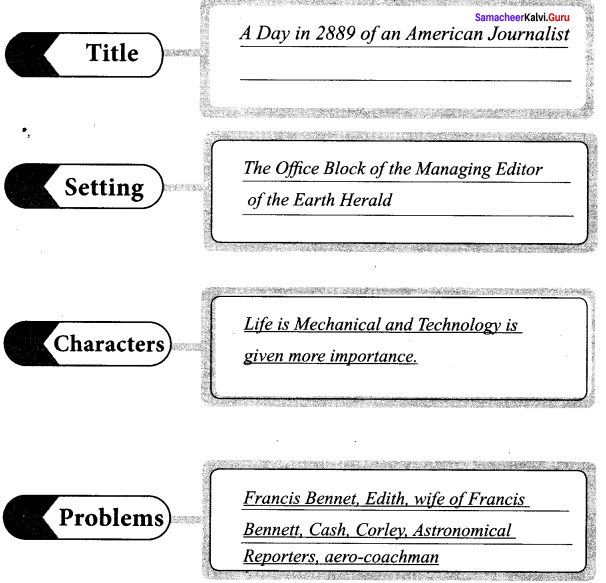
D. Fill in the story map given below.

Samacheer Kalvi 10th English Solutions Supplementary Chapter 5 A Day in 2889 of an American Journalist 1

Samacheer Kalvi 10th English Solutions Supplementary Chapter 5 A Day in 2889 of an American Journalist 2
Samacheer Kalvi 10th English Solutions Supplementary Chapter 5 A Day in 2889 of an American Journalist 3

Additional:

A. Rearrange the following sentences in coherent order.

1. a. In this world of technological advancements newspapers are not printed but ‘spoken’.
b. Francis Bennett is the Managing Editor of the Earth Herald.
c. This story speaks about the people of the twenty-ninth century.
d. Earth Herald is the world’s largest newspaper.
e. The year is 2889, the date 25th July and the place is the office block.
Answers:
c, e, b, d, a
c. This story speaks about the people of the twenty-ninth century.
e. The year is 2889, the date 25th July and the place is the office block.
b. Francis Bennett is the Managing Editor of the Earth Herald.
d. Earth Herald is the world’s largest newspaper.
a. In this world of technological advancements newspapers are not printed but ‘spoken’.

2. a. As soon as he awoke, Francis Bennett switched on his phonotelephote.
b. Eight days ago his wife had been to France and he was feeling a little lonely.
c. Francis Bennett was in a bad temper.
d. The reason was the absence of his wife with him.
e. The wires of his Phonotelephote led to the house he owned in the Champs-Elysees.
Answers:
c, d, b, a, e
c. Francis Bennett was in a bad temper.
d. The reason was the absence of his wife with him.
b. Eight days ago his wife had been to France and he was feeling a little lonely.
a. As soon as he awoke, Francis Bennett switched on his phonotelephote.
e. The wires of his Phonotelephote led to the house he owned in the Champs-Elysees.

B. Fill in the blanks with the appropriate phrases given below to form a complete meaningful paragraph.

1. (by the electric current /to the house /could also be transmitted / completed by the telephote / As soon as)

(i) ………………… Francis Bennett woke up, he switched on his phonotelephote. The wires led (ii) ……………… he owned in the Champs-Elysees.The telephone, (iii) …………………….,is another of our time’s conquests! Though the transmission of speech (iv) …………………….. was already very old, it was only since yesterday that vision (v) ………………. was possible.
Answers:
(i) As soon as
(ii) to the house
(iii) completed by the telephote
(iv) by the electric current
(v) in the stellar world

2. (a series of taps /of his home in Paris / took his place/in spite of the distance/at the same time)

The table was laid and he (i) …………………. at it. Within reach of his hand was placed (ii) …………….. and before him was the curved surface of a phonotelephote, on which appeared the dining room (iii) …………….. Mr. and Mrs. Bennett had arranged to have lunch (iv) ……………….. nothing could be more pleasant than to be face to face (v) ……………….. to see one another and talk by means of the phonotelephotic apparatus.
Answers:
(i) took his place
(ii) a series of taps
(iii) of his home in Paris
(iv) at the same time
(v) in spite of the distance

C. Match the following appropriately:

1. Samacheer Kalvi 10th English Solutions Supplementary Chapter 5 A Day in 2889 of an American Journalist 4
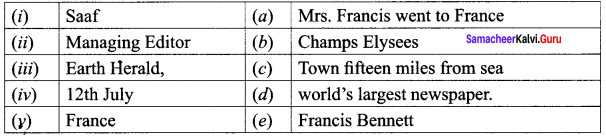
Answers:
(i)(c), (ii)(e), (iii)(d), (iv)(a), (v)(b)

2. Samacheer Kalvi 10th English Solutions Supplementary Chapter 5 A Day in 2889 of an American Journalist 5
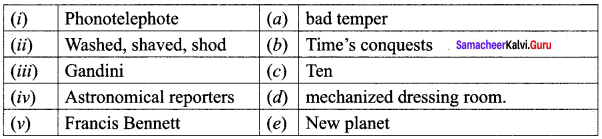
Answers:
(i)(b), (ii)(d), (iii)(e), (iv)(c), (v)(a)

D. Read the passage given below and answer the questions that follow:

1. That morning Francis Bennett awoke in rather a bad temper. This was eight days since his wife had been in France and he was feeling a little lonely. As soon as he awoke, Francis Bennett switched on his phonotelephote whose wires led to the house he owned in the Champs-Elysees. The telephone, completed by the telephote, is another of our time’s conquests! Though the transmission of speech by the electric current was already very old, it was only since yesterday that vision could also be transmitted.

A valuable discovery, and Francis Bennett was by no means the only one to bless its inventor when, in spite of the enormous distance between them, he saw his wife appear in the telephotic mirror. ‘Francis … dear FtancisL.’His name, spoken by that sweet voice, gave a happier turn to Francis Bennett’s mood. He quickly jumped out of bed and went into his mechanized dressing room.

(а) Why was Francis Bennett in a bad temper?
Answer:
Francis Bennett was feeling lonely as his wife had been to France eight days ago and so he was in a bad temper.

(b) What did he do as soon as he woke up?
Answer:
As soon as Francis woke up, he switched on the phonotelephote whose wires connected to his house in Champs Elysees where his wife was staying.

(c) What was the valuable discovery made just a day before 25th July?
Answer:
The valuable discovery was the telephotic mirror where Francis could see his wife appear on screen apart from hearing his voice.

(d) What changed the mood of Francis Bennett?
Answer:
When Francis heard his wife’s sweet voice say, ‘Francis…Francis’, his mood changed into a happy feel.

(e) What is considered a Time’s conquest?
Answer:
Telephone completed by telephote, resulting in phonotelephote is a Time’s conquest.

2. His name, spoken by that sweet voice, gave a happier turn to Francis Bennett’s mood. He quickly jumped out of bed and went into his mechanized dressing room.
Two minutes later, without needing the help of a valet, the machine deposited him, washed, shaved, shod, dressed and buttoned from top to toe, on the threshold of his office. The day’s work was going to begin. Francis Bennett went on into the reporters’ room.

His fifteen hundred reporters, placed before an equal number of telephones, were passing on to subscribers the news which had come in during the night from the four quarters of the earth. In addition to his telephone, each reporter has in front of him a series of commutators, which allow him to get into communication with this or that telephotic line. Thus the subscribers have not only the story but the sight of these events.

(a) What did Francis Bennett do when he became happy hearing wife’s sweet voice?
Answer:
As soon as Francis Bennett heard his wife’s voice he quickly jumped out of bed and went into his mechanized dressing room.

(b) What happened two minutes later?
Answer:
Two minutes later, without needing the help of a valet, the machine deposited Francis, washed, shaved, shod, dressed and buttoned him from top to toe, on the threshold of his office.

(c) How many reporters were there in the reporters’ room?
Answer:
There were about fifteen hundred reporters in the reporters’ room.

(d) What were the reporters doing when Francis entered the reporters’ room?
Answer:
The reporters were placed before an equal number of telephones and were passing on to subscribers the news which had come in during the night from the four quarters of the earth.

(e) What was the additional benefit that the subscribers were enjoying in recent times?
Answer:
In addition to a telephone, each reporter had in front of him a series of commutators, which allow him to get into communication with any onetelephotic line. Thus the subscribers had not only the story but the sight of all the events.

A Day in 2889 of an American Journalist by Jules Verne About the Author:

Jules Verne was bom in the city of Nantes, France on February 8th, 1828. His father was a lawyer, and at the beginning, Veme wanted to study law as well. When he was nineteen, – he started writing long pieces of literature, but his father wanted him to earn money as a lawyer, not as a writer. He decided to give up being a lawyer, and become a full-time professional writer instead. Veme married Aimee du Fraysse de Viane in January 1857 with his father’s blessing and continued to write until his death. On 24th of March 1905, Veme, who was sick with diabetes, died at his home in Amiens, France.

A Day in 2889 of an American Journalist Summary:
Samacheer Kalvi 10th English Solutions Supplementary Chapter 5 A Day in 2889 of an American Journalist 6

Introduction:
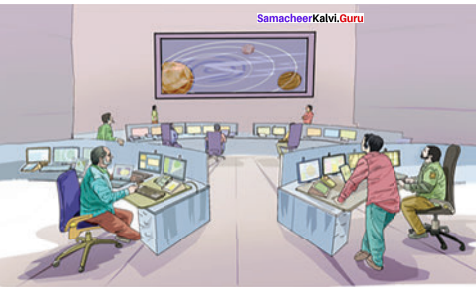
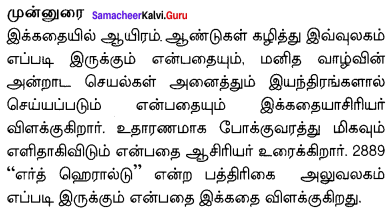
The author explains the life on earth after thousand years and that the daily activities of a normal human will be assisted by machines. For example the author envisions that travelling will be made easy. In this story the office block of the Earth Herald, the world’s largest newspaper, is illustrated during the year 2889.
Samacheer Kalvi 10th English Solutions Supplementary Chapter 5 A Day in 2889 of an American Journalist 7

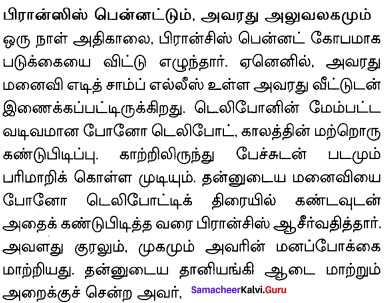
Francis Bennett and his office One early morning, Francis Bennett woke up bad tempered because his wife Edith had gone to Champs Elysees eight days ago. He switched on his phonotelephote whose wires led to the house he owned in the Champs-Elysees. The telephone, completed by the telephote, was another of their time’s conquests! From yesterday,vision could also be transmitted along with speech. Bennett blessed its inventor as he saw his wife appear in the telephotic mirror. Her voice and face changed his mood.
Samacheer Kalvi 10th English Solutions Supplementary Chapter 5 A Day in 2889 of an American Journalist 8

He went into his mechanized dressing room within two minutes, washed, shaved, shod, dressed and buttoned from top to toe, on the threshold of his office. The day’s work started at the reporters’ room. His fifteen hundred reporters, with their telephones, were speaking the news received from the four quarters of the earth to subscribers. Besides telephone, all reporters have commutators, which allow communication on telephotic line with visual sights.

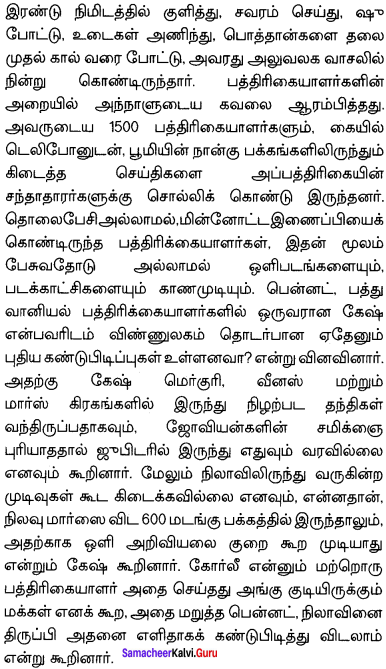
Bennett questioned one of the ten astronomical reporters Cash about the recent discoveries in the stellar world. Cash replied that it was Phototelegrams from Mercury, Venus and Mars, and nothing from Jupiter since the Jovians signal could not be understood. He added that even results from the Moon wasn’t possible and one can’t blame optical science though moon was six hundred times nearer than Mars. Corley another reporter said it was the inhabitants which was refuted by Bennett who said the simplest way was to turn the moon round and find out.
Samacheer Kalvi 10th English Solutions Supplementary Chapter 5 A Day in 2889 of an American Journalist 9

Bennett’s scientific lab
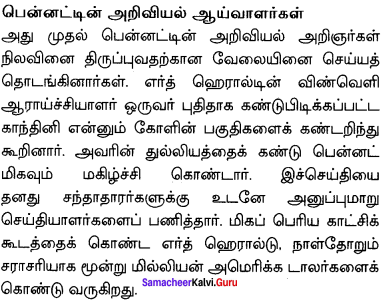
From then on, the scientists of the Bennett factory started working on turning satellite. One of the Earth Herald’s astronomers had just determined the elements of the new planet Gandini and Bennett was delighted at his accuracy. He wanted the reporters to pass on the news to the subscribers immediately. The broad gallery for such a journal as the Earth Herald brought in an average of three million dollars daily.
Samacheer Kalvi 10th English Solutions Supplementary Chapter 5 A Day in 2889 of an American Journalist 10

Luxury life of Bennett
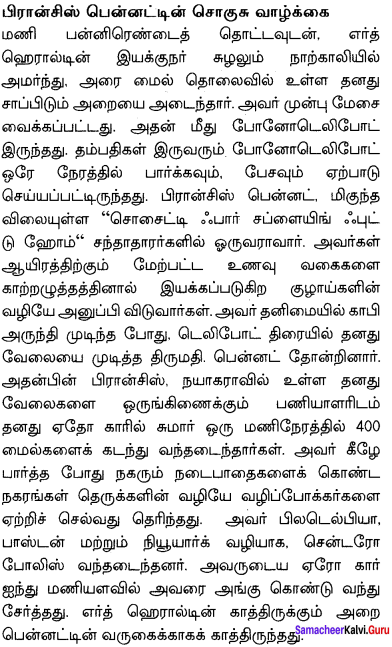
When the clock struck twelve, the director of the Earth Herald sat in a rolling armchair and reached his dining room half a mile away. The table was laid before him and in front of him was the phonotelephote. The couple had arranged to have lunch at the same time, see and talk by phonotelephote. Francis Bennett was one of the subscribers to the expensive, Society for Supplying Food to the Home with thousand varieties through pneumatic tubes. He was finishing his coffee in solitude when Mrs. Bennett appeared in the telephote screen after work.

He then sped past to his accumulator works at Niagara by the aero-car at a speed of about four hundred miles an hour. Below him were the towns with moving pavements which carry the wayfarers along the streets. He returned, by way of Philadelphia, Boston and New York, to Centropolis, where his aero-car put him down about five o’clock. The waiting- room of the Earth Herald was crowded awaiting Bennett to return.
Samacheer Kalvi 10th English Solutions Supplementary Chapter 5 A Day in 2889 of an American Journalist 11

New Researches of Bennet
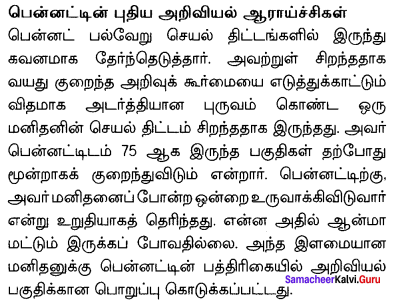
He chose carefully among the different proposals. The best was a young man whose broad brow indicated intelligence. He told Bennett about the elements estimated at seventy five now reduced to three to which Bennett told him that it would reduce to one in three weeks if he had money. He knew for sure that he would have discovered absolute, and the resultant, a human-being without a soul was confirmed by Bennett. The young fellow was assigned to the scientific editorial department of Bennett’s journal.
Samacheer Kalvi 10th English Solutions Supplementary Chapter 5 A Day in 2889 of an American Journalist 12

A second inventor, had the idea of moving a whole city in a single block. As a demonstration, the town of Saaf, situated fifteen miles from the sea would be transformed into a seaside resort. Francis Bennett, attracted by this project, agreed to take a half-share in it. Francis Bennett sat in an easy-chair in the audition-room to hear the proposal. Pressing a button, he communicated with the Central Concert. Re was charmed on a series of delicious harmonico-algebraic formulae.
Samacheer Kalvi 10th English Solutions Supplementary Chapter 5 A Day in 2889 of an American Journalist 13

Time for family
During his meal, phonotelephotic communication was tuned to speak to Edith. Edith told him that she was leaving to Centropolis the very moment by tube. He confirmed her arrival at Centropolis at 11:59 p.m. according to Centropolis time. These submarine tubes, travels from Paris in two hundred and ninety-five minutes than the aero-trains travelling at six hundred miles an hour. Francis Bennett, felt tired and went for a bath before going to bed. He touched the button and got ready for bath.
Samacheer Kalvi 10th English Solutions Supplementary Chapter 5 A Day in 2889 of an American Journalist 14

Conclusion:
This story brings out the fact that as long as humans aspire and work hard, there will be developments and innovations in this world. Smoke-free vehicles and machines that would instantly do what you desire will come forth. Therefore humans will achieve maximum heights in the field of Science and Technology.
Samacheer Kalvi 10th English Solutions Supplementary Chapter 5 A Day in 2889 of an American Journalist 15

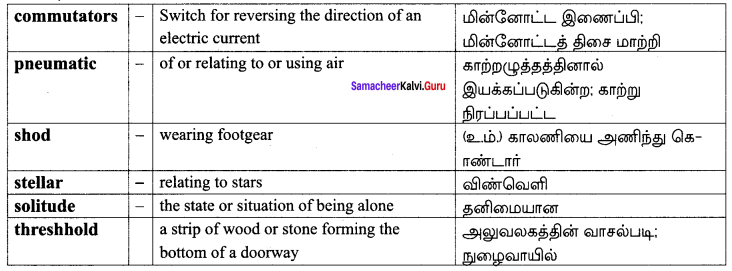
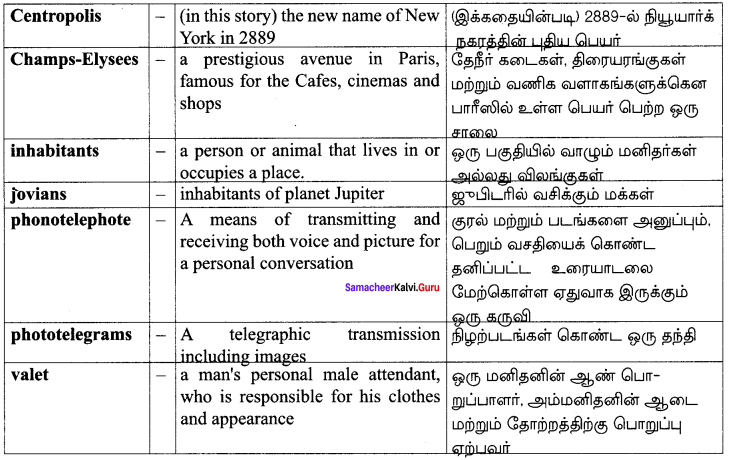
A Day in 2889 of an American Journalist Glossary:

Textual:
Samacheer Kalvi 10th English Solutions Supplementary Chapter 5 A Day in 2889 of an American Journalist 16

Additional:
Samacheer Kalvi 10th English Solutions Supplementary Chapter 5 A Day in 2889 of an American Journalist 17

We hope the data given here will benefit you to the fullest extent at the time of preparation. For better understanding of English subject this Samacheer Kalvi 10th English Solutions for Class 10th English Supplementary Chapter 5 A Day in 2889 of an American Journalist PDF is the best resource. Download & ace up your preparation. Keep in touch with us and get the latest information on Tamilnadu State board Textbook Solutions PDF.
Samacheer Kalvi 10th English Vocabulary Confusables & Homophones

Looking to improve English skills and gain more subject knowledge then the best resources that you can use here is Samacheer Kalvi 10th English Solutions for Vocabulary Confusables & Homophones Questions and Answers.

In the Samacheer Kalvi 10th English Guide for textbook solutions, subject experts covered all types of questions and answers related to the topics, quick notes, summary, solved & unsolved exercises, etc. If you are planning to prepare Chapter via textbook, then you’re suggested to go with this Samacheer Kalvi 10th English Book Solutions Questions and Answers PDF for better understanding and preparation.

Tamilnadu Samacheer Kalvi 10th English Vocabulary Confusables & Homophones

English Subject experts who are having max years of experience prepared this Tamilnadu State Board Solutions for 10th English Vocabulary Confusables & Homophones Questions and Answers. They have explained all the topics covered in the board prescribed latest syllabus in a simple way to understand easily. So, students can prepare English from this Samacheer Kalvi 10th English Book Questions and Answers PDF. Download the Tamilnadu State Board 10th English Workbook Answers PDF by accessing the below links and learn properly for the final exams to score well.

Homophones are one of the groups of words pronounced alike but differ in meaning and spelling or both. (e.g.) carat,
carrot; week, weak and hear, here.
Rewrite the following sentences by using the correct homophones for the underlined words:

Question 1.
He did not here any foot steps.
Answer:
He did not hear any foot steps.

Question 2.
Gita met her old classmate on her weigh to the ATM.
Answer:
Gita met her teacher on her wav to the ATM.

Question 3.
Ice cream with brownie was served as desert.
Answer:
Ice cream was served as dessert.

Question 4.
The old lady took wrest for an hour.
Answer:
The old lady took rest for an hour.

Question 5.
Tirupathi is a grate pilgrim spot.
Answer:
Tirupathi is a great pilgrim spot.

Question 6.
Never pause unhealthy comments.
Answer:
Never pass unhealthy comments.

Question 7.
My mom wood be pleased to help you during this festival time.
Answer:
My mom would be pleased to help you during this festival time.

Question 8.
You are not aloud inside the room.
Answer:
You are not allowed inside the room.

Question 9.
There was a cheque dam in Holland.
Answer:
There was a check dam in Holland.

Question 10.
If Himalayan eves disappear, few states will suffer.
Answer:
If Himalayan ice disappears, few states will suffer.

Question 11.
Her shoes are two small.
Answer:
Her shoes are too small.

Question 12.
Time may heel some wounds.
Answer:
Time may heal some wounds.

Question 13.
Mom advised me to prey regularly.
Answer:
Mom advised me to pray regularly.

Question 14.
Don’t loose your temper.
Answer:
Don’t lose your temper.

Question 15.
Some believe, “Mite is right”.
Answer:
Some believe, “Might is right”.

Question 16.
She new the way to the supermarket.
Answer:
She knew the way to the supermarket.

Question 17.
King Solomon was always faring in his judgment.
Answer:
King Solomon was always fair in his judgment.

Question 18.
Marina beach is the longest in Asia.
Answer:
Marina beach is the longest in Asia.

Question 19.
An engineer was arrested who had hordes of 2000 rupee notes.
Answer:
An engineer was arrested who had hoards of 2000 rupee notes.

Question 20.
The due seated on the top of a grass sparkled like a diamond.
Answer:
The dew seated on the top of a grass sparkled like a diamond.

Fill in with the right confusable to make a meaningful sentence
1. ……………………………. is a big clock, (ours/hours)
2. The colour of your ……………………………. is black, (hare/hair)
3. Gold is measured in ……………………………. (carrot/carat)
4. I sent a ……………………………. to my friend, (mail/male)
5. The ……………………………. seated on the top of the flowers and made the flower look more beatiful. (due/dew)
6. Sparrows were ……………………………. here long ago. (scene/seen)
7. Give me a ……………………………. when you reach home, (wring/ring)
8. How the youngest bird flies across the ……………………………. is a puzzle! (see/sea)
9. Last ……………………………. he did not attend school since he was ……………………………. (weak/week)
10. Those who are ……………………………. of their ……………………………. dare not do mistakes.(conscience/conscious)
11. Nivedha’s ……………………………. son ……………………………. himself to the new environment, (adapted/adopted)
12. The book which has been ……………………………. for the BA class has been ……………………………. for containing some
marks against a particular religion, (proscribed/prescribed)
13. Tommy was walking around the forest with his ……………………………. feet when he was attacked by the ……………………………. (bear/bare).
14. In the story, St.Michael, a ……………………………. was seated in a ……………………………. (ferry/fairy).
15. I wanted to buy a ……………………………. of bangles but I ended buying ……………………………. (pair/pears)
16. Every ……………………………. my grandmother would tell be a story about a ……………………………. to help me grow courageous, (knight/night)
17. We had to ……………………………. patiently, in spite of carrying a heavy ……………………………. (weight/wait)
18. The ……………………………. of the ……………………………. is always soft and silky, (hare/hair)
19. When teaching my son how to drive, I told him if he didn’t hit the ……………………………. in time he would ……………………………. the car’s side mirror, (break/brake)
20. If you ……………………………. drugs, you will get arrested and end up in a prison ……………………………. (cell/sell)
21. Karthik won’t spend one ……………………………. on a bottle of perfume until he knows that he loves the ……………………………. (sent/scent/cent)
22. If you accidentally drink a bottle of fabric ……………………………. you might ……………………………. (die/dye)
23. To bake a ……………………………. shaped cake, you’ll need some all-purpose ……………………………. (flour/flower)
24. If the ……………………………. breaks on your sandal, you might fall. However, your injuries will ……………………………. in a week’s time, (heal/heel)
25. I wanted to sit ……………………………. so I could ……………………………. the mimicry performance without any distractions, (hear/here)
Answer:
1. ours
2. hair
3. carat
4. nail
5. dew
6. seen
7. ring
8. sea
9. week/weak
10. conscious/conscience
11. adopted/adapted
12. prescribed/proscribed
13. bare/bear
14. fairy/ferry
15. pair/pears
16. knight/night
17. wait/weight
18. hair/hare
19. brake/break
20. sell/cell
21. cent/scent
22. dye/die
23. flower/flour
24. heel/heal
25. here/hear

We hope the data given here will benefit you to the fullest extent at the time of preparation. For better understanding of English subject this Samacheer Kalvi 10th English Answers for Class 10th English Vocabulary Confusables & Homophones PDF is the best resource. Download & ace up your preparation. Keep in touch with us and get the latest information on Tamilnadu State board Textbook Answers PDF.

Samacheer Kalvi 11th Chemistry Notes Chapter 9 Solutions

Tamilnadu Samacheer Kalvi 11th Chemistry Notes Chapter 9 Solutions Notes

Solution – It is a homogeneous mixture of two or more substances consisting of atoms, ions or molecules.

Solvent – The compound that is present in large amount in a homogeneous mixture is called solvent.

Solute – The compound that is present in small amount in a homogeneous mixture is called solute.

Aqueous solution – If the water is used as the solvent the resultant solution is called an aqueous solution.

Non-aqueous solution – If solvent other than water is used, then the resultant solution is called non-aqueous solution.

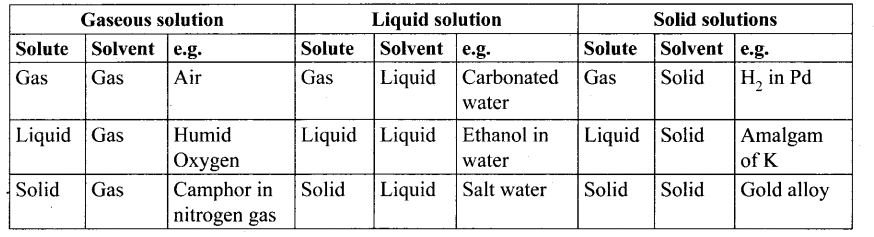
Types and examples of solution
Samacheer Kalvi 11th Chemistry Notes Chapter 9 Solutions Notes 3

Molality (m) – It is defined as the number of moles of solute present in 1 kg of the solution.

Molarity (M) – It is defined as the number of moles of solute present in 1 L of the solution.

Normality (N) – It is defined as the number of gram equivalents of solute present in 1 L of the solution.

Formality (F) – It is defined as the number of formula weight of the solute present in 1 L of the solution.

Mole fraction – It is defined as the ratio of the number of moles of the component to the total number of moles of all components present in the solution.

Mass percentage – It is the ratio of percentage of the mass of the solute to the mass of solution in grams.

Volume percentage – It is the ratio of percentage of volume of the solute to the volume of the solution in ml.

Mass by volume – It is the ratio of percentage of mass of the solute in g to the volume of the solution in ml.

Parts per million (ppm) – One ppm is equivalent to 1 milligram of the component per litre of solution.

Standard solution – A standard solution is a solution whose concentration is accurately known.

Solubility of a substance – The solubility of a substance is defined as the amount of the solute that can be dissolved in lOOg of the solvent at a given temperature to form a saturated solution.

Factors influencing the solubility – (i) Nature of solute and solvent, effect of temperature, effect of pressure.

Henry’s law – This law states that “the partial pressure of the gas in vapour phase (vapour pressure of the solute) is directly proportional to the mole fraction (x) of the gaseous solute in the solution at low concentration.
PSolute ∝ x solute in solution (or) Psolute = KH .x solute in solution.

KH – ft is the empirical constant with dimensions of pressure.

Evaporation – The process in which the liquid in converted to vapour.

Condensation – The process in which the vapour is converted to liquid.

Vapour pressure – It is defined as the pressure of vapour in equilibrium with its liquid at a given temperature.

Binary solution – The solution which contains only two components is called binary solution.

Raoult’s law – This law states that “in the case of a solution of volatile liquids, the partial pressure of each component (A & B) of the solution is directly proportional to its mole fraction.
PA = K . XA

Dalton’s law of partial pressure – This law states that the total pressure in a closed vessel will be equal to the sum of the partial pressures of the individual components.
pTotal = PA + PB

Ideal solution – It is a solution in which each component i.e., the solute as well as the solvent obeys the Raoult’s law over the entire range of concentration.

Non-ideal solutions – The solutions which do not obey Raoult’s law over the entire range of concentration are called non-ideal solution.

Factors responsible for deviation from Raoult’s law – Solute-solvent interaction, dissociation of solute, association of solute, temperature, pressure, concentration.

Colligative properties – The properties of the solution which do not depend on the chemical nature of the solute particles but depends only on the number of solute particles present in the solution are called colligative properties.

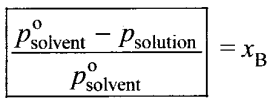
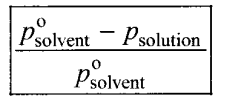
Relative lowering of vapour pressure – It is defined as the ratio of lowering of vapour pressure to vapour pressure of the solvent. Mathematically,
Samacheer Kalvi 11th Chemistry Notes Chapter 9 Solutions Notes 1

Samacheer Kalvi 11th Chemistry Notes Chapter 9 Solutions Notes 2
Relative lowering of vapour pressure = Moles fraction of solute

Boiling point – It is the temperature at which the vapour pressure of the solution becomes equal to the atmospheric pressure (1 atm).

Elevation of boiling point – ΔTb – Tb – T0b
ΔTb = kb . m where kb = molal boiling point elevation constant.

kb Ebullioscopic constant
\(k_{b}=\frac{\mathrm{RT}_{b}^{2} \mathbf{M}_{\text {solvent }}}{\Delta \mathrm{H}_{\text {vaporisation }}}\)

Freezing point – It is defined as the temperature at which the solid and the liquid states of the substances have the same vapour pressure.

Depression in freezing point ΔTf – ΔTf = kf. m where kf = molal freezing point depression constant.

kf Cryoscopic constant.

Osmosis – It is a spontaneous process by which the solvent molecules pass through a semipermeable membrane from a solution of low concentration to a solution of higher concentration.

Osmotic pressure – The pressure that must be applied to the solution to stop the influx of the solvent (to stop osmosis) through a semipermeable membrane is called osmotic pressure.
π = CRT

Isotonic solutions – Two solutions having same osmotic pressure at a given temperature are called isotonic solutions.

Reverse osmosis (RO) – It can be defined as a process in which a solvent passes through a semipermeable membrane in the opposite direction of osmosis, when subjected to a hydrostatic pressure greater than the osmotic pressure.

van’t Hoff factor (i) – It is defined as the ratio of the actual molar mass to the abnormal molar mass of the solute.

αdissociation = \(\frac{i-1}{n-1}\)

αassociation = \(\frac{(1-i) n}{n-1}\)

Samacheer Kalvi 11th Chemistry Notes

Samacheer Kalvi 11th Chemistry Notes Chapter 10 Chemical Bonding

Tamilnadu Samacheer Kalvi 11th Chemistry Notes Chapter 10 Chemical Bonding Notes

Chemical bonds – The interatomic forces which holds the constituent atoms/ions together in a molecule are called chemical bonds.

Kossel-Lewis approach – Elements other than noble gases, try to attain the completely filled electronic configuration by losing, gaining or sharing one or more electrons from their outer shell.

Octet rule – The atoms transfer or share electrons so that all atoms involved in chemical bonding obtain 8 electrons in their outer shell.

Covalent bond – This type of mutual sharing of one or more pairs of electrons between two combining or more pairs of electrons between two combining atoms results in the formation of a chemical bond called a covalent bond.

Formal charge – Formal charge of an atom in a molecule is the electrical charge difference between the valence electron in an isolated atom and the number of electrons assigned to that atom in the lewis structure.
Formal charge –
\(\mathrm{N}_{\mathrm{V}}-\left[\mathrm{N}_{l}+\frac{\mathrm{N}_{b}}{2}\right]\)

Ionic bond (or) electrovalent bond – The bond formed by the complete transfer of electrons leads to the formation of cation and an anion which are held together by the electrostatic attractive force.

Coordinate covalent bond – In the bond formation, one of the combining atoms donates a pair of electrons and these electrons are shared by both the combining atoms. These type of bonds are called coordinate covalent bond.

Bond length – The distance between the nuclei of the two covalently bonded atoms is called bond length.

Bond order – The number of bonds formed between the two bonded atoms in a molecule is called the bond order.

Bond angle – A fixed angle created by the directional nature of the two covalent bonds which is between the two bonds in a molecule is called bond angle.

Bond enthalpy – It is defined as the minimum amount of energy required to break one mole of a particular bond in the molecule in their gaseous state.

Resonance – The lewis structures which differ only in the position of bonding and lone pair of electrons are called resonance structures and this phenomenon is called resonance.

Dipole moment – µ = q x 2d, where q = charge, 2d= distance between the two charges.

Unit of dipole moment – Debye unit (D), 1 Debye = 3.336 x 10⁻³⁰ C m (C m = coulomb metre).

Non polar molecules – Molecules that have zero dipole moment are called non polar molecules. For example, H2, O2, F2.

Polar molecules – Molecules that have dipole moment value are called polar molecules. For example, HF, HCl, NO, CO.

Electronegativity difference

If XA – XB = 1.7, the bond A – B has 50% ionic character
IF XA -XB > 1.7, the bond A – B > 50% ionic character
IF XA – XB < 1.7, the bond A – B < 50% ionic character

Polarisation – A distortion in the electron cloud of the anion and its electron density drift towards the cation which results in some sharing of the valence electrons between these ions. Thus, a partial covalent character is developed between them. This phenomenon is called polarisation.

Fajan’s rule – The extent of polarisation in an ionic compound is given by Fajan’s rule.

  • To show greater covalent character, both the cation and anion should have high charge on them.
  • The smaller cation and larger anion show greater covalent character due to the greater extent of polarisation.
  • Cation having ns2 np6 nd10 configuration show greater polarising power than the cations with ns2np(> configuration. Hence, they show great covalent character.

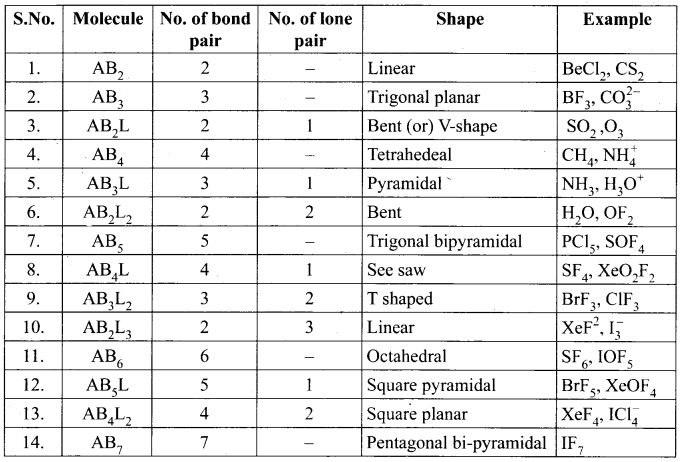
VSEPR theory – Valence Shell Electron Pair Repulsion Theory: It is useful in predicting the shape of the molecules.

The repulsive interaction between the electron pairs – lp – lp > lp – bp > bp – bp lp = long pair, bp = bond pair

Shapes of molecules predicted by VSEPR theory –
Samacheer Kalvi 11th Chemistry Notes Chapter 10 Chemical Bonding Notes 1

Sigma bond (σ) – When two atomic orbitals overlap linearly along the axis, the resultant bond is called a bond.

Pi bond (π) – When two atomic orbitals overlap sideways, the resultant covalent bond is called pi bond (n bond).

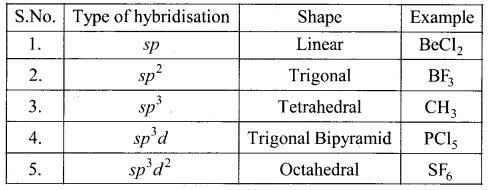
Hybridisation – It is a process of mixing of atomic orbitals of the same atom with comparable energy to form equal number of new equivalent orbitals with same energy.

Types of hybridisation with shape and examples
Samacheer Kalvi 11th Chemistry Notes Chapter 10 Chemical Bonding Notes 2

Bond order – It is the half difference of number of electrons present in bonding molecular orbitals and the number of electrons present in antibonding molecular orbitals.
Bond order = \(\frac{\mathrm{N}_{b}-\mathrm{N}_{a}}{2}\)

LCAO – Linear combination of atomic orbitals.

ψ bonding – ψA + ψB

ψ antibonding – ψA ψB

Metallic bonding – The forces that keep the atoms of the metal so closely in a metallic crystal constitute is known as metallic bond (or) electronic bond.

Samacheer Kalvi 11th Chemistry Notes

Samacheer Kalvi 11th Chemistry Notes Chapter 11 Fundamentals of Organic Chemistry

Tamilnadu Samacheer Kalvi 11th Chemistry Notes Chapter 11 Fundamentals of Organic Chemistry Notes

Organic chemistry – It is the study of compounds of carbon.

Catenation – The tendency of an atom to form a chain of bonds with the atoms of the same element is called catenation.

Functional group – It is an atom or a specific combination of bonded atoms that react in a irrespective of the organic molecule in which it is present.

Homologous series – A series of organic compounds each containing a characteristic functional group and the successive members differ from each other in a molecular formula by a CH2 group is called homologous series.

Alkanes – CnH2n + 2

Alkenes – CnH2n

Alkynes- CnH2n-2

IUPAC – International Union of Pure and Applied Chemistry.

Nuclear substituted aromatic compound – These are the compounds in which the functional group is directly attached to the benzene ring. These are derivatives of benzene.

Molecular formula of an organic compound – It is the simplest, least informative representation, showing the ratio of atoms present.

Structural formula of an organic compound – It is the formula that shows the way of atoms in a compound comiected to each other.

Molecular models – These are physical devices that are used for a better visualisation and perception of three dimensional shapes of organic molecules.

Three dimensional representation of organic molecule – The simplest convention is solid and dashed wedge formula in which 3-D image of a molecule can be perceived from two dimensional picture.

Fisher projection formula – This s a method of representing three dimensional structures in two dimension.

Saw horse projection formula – The bond between two carbon atoms is drawn diagonally and slightly elongated. The lower left hand carbon is considered lying towards the front and the upper right hand carbon is considered lying towards the back.

Newman projection formula – In this formula, the molecules are viewed from the front along the carbon-carbon bond axis.

Isomerism – It is a phenomenon in which two or more compounds with the same molecular formula but different structures and properties are there.

Isomers – Compounds exhibiting the isomerism are called isomers.

Constitutional isomers – These isomers have same molecular formula but differ in their bonding sequence.

Chain (or) nuclear (or) skeletal isomerism – These isomers differ in the way in which the carbon atoms are bonded to each other in a carbon chain.

Position isomerism – Compounds with the same molecular formula and carbon skeleton but differ in the position of substituent are said to exhibit position isomerism.

Functional isomerism – Different compounds having the same molecular formula but different functional groups are said to exhibit functional isomerism.

Metamerism – It is a special kind of structural isomerism arises due to the unequal distribution of carbon atoms on either side of the functional group or different alkyl groups attached to the either side of the same functional group and having the same molecular formula.

Tautomerism – It is a special type of functional isomerism in which a single compound exists in two readily interconvertible structures that differ markedly in the relative position of atleast one atomic nucleus, generally hydrogen.

Stereoisomerism – The phenomenon in which the isomers which have same bond connectivity but different arrangement of groups or atoms in space in known as stereoisomerism.

Geometrical isomerism – The phenomenon in which the stereoisomers which have different arrangement of groups or atoms around a rigid framework of double bonds.

Cis isomer – It is the one in which two similar groups are on the same side of the double bond.

Trans isomer – It is the one in which two similar groups are on the opposite side of the double bond.

Optical isomerism – Compounds having same physical and chemical property but differ only in the rotation of plane of the polarised light are known as optical isomers and the phenomenon is known as optical isomerism.

Dextro rotatory – The optical isomer which rotates the plane polarised light to the right or in clockwise direction is said to be dextro rotatory.

Leavo rotatory – The optical isomer which rotates the plane polarised light to the left or in . anti-clockwise direction is said to be leavo rotatory.

Enantiomers – The optical isomers which rotate the plane polarised light with equal angle but in opposite direction are known as enantiomers.

Chiral carbon – A carbon atom whose tetravalency is satisfied by four different substituents is called asymmetric carbon or chiral carbon.

Sublimation – The process in which the substances on heaving converted directly from solid to vapour without melting is known as sublimation.

Azeotropes – Compounds which are constant boiling mixtures.

Extraction – The process of removing a substance from its aqueous solution by shaking with a suitable organic solvent is termed extraction.

Chromatography – It is selective distribution of the mixture of organic substances between a stationary phase and a moving phase (or) chromatography is defined as a technique for the separation of a mixture brought about by differential movement of the individual compound through porous medium under the influence of moving solvent.

\(R_{f}=\frac{\text { Distance moved by the substance from base line }(X)}{\text { Distance moved by the solvent from base line }(Y)}\)

Samacheer Kalvi 11th Chemistry Notes

Samacheer Kalvi 11th Chemistry Notes Chapter 12 Basic Concepts of Organic Reactions

Tamilnadu Samacheer Kalvi 11th Chemistry Notes Chapter 12 Basic Concepts of Organic Reactions Notes

Organic reactions – Substrate is an organic molecule reacts with reagent, which may be an organic, inorganic or any agent like heat, photon etc that brings about the chemical change to form a product. This is known as organic reactions.

Mechanism of the reaction – The series of simple steps which collectively represent the chemical change, from substrate to product is called as the mechanism of the reaction.

Type of fission of a covalent bonds – (i) Homolytic fission, and (ii) Heterolytic fission.

Homolytic cleavage –

  • Homolytic cleavage is the process in which a covalent bond breaks symmetrically in such way that each of the bonded atoms retains one electron.
  • This type of cleavage occurs under high temperature or in the presence of UV-light.
  • In such molecules, the cleavage of bonds results into free radicals.
  • Free radicals are short lived and highly reactive species.

Free radical initiators – The type of reagents that promote homolytic cleavage in substrate are called as free radical initiators.

Examples for free radical initiators –

  • Azobisisobutyronitrile (AIBN)
  • Benzoyl peroxide

Heterolytic cleavage –

  • Heterolytic cleavage is the process in which a covalent bond breaks unsymmetrically such that one of the bonded atoms retains the bonded pair of electrons.
  • It results in the formation of a cation and an anion.

Carbocation – In a carbocation, the carbon atom bearing positive charge. It is sp2 hybridised and hence it has a planar structure.

Carbanion – In a carbanion,, the carbon atom bearing negative charge. It is sp3 hybridised and hence it is pyramidal in shape.

Nucleophiles – Nucleophiles are reagents that has high affinity for electropositive centers. They possess an atom has an unshared pair of electrons. They are usually negatively charged ions or electron rich neutral molecules.

Nucleophilic reagents – Ammonia, amines, water, alcohols, ethers, hydrogen sulphide, thiols.

Electrophiles – Electrophiles are reagents that are attracted towards negative charge or electron rich center. They are either positively charged ions or electron deficient neutral molecules.

Electrophilic reagents – Carbon dioxide, Aluminium chloride, borontrifluoriuc and ferric chloride.

Electron movement in organic reactions – There are three types of electron movement,

  1. Lone pair becomes a bonding pair.
  2. Bonding pair becomes a lone pair.
  3. a bond breaks and becomes another bond.

Electron displacement effects in covalent bonds – Electron displacement effects in covalent bonds occurs due to the presence of an atom or group of different electronegativity or under the influence of some outside attaching group. The electron displacements are categorized into, Inductive effects, Resonance effect, electromeric effect and hyper conjugation.

Inductive effect (I) – It is defined as the change in the polarization of a covalent bond due to the presence of adjacent bonded atoms or groups in the molecule.

+1 effect – Atoms or groups which lose electron towards a carbon atoms are said to have a +1 effect. Example, (CH3)3C-, (CH3)2CH-, CH3-CH2-, CH3

-I effect – Atoms or groups which draw electrons away from a carbon atom one said to have a -I effect. Example, -NO2, F, Cl, Br, I , -OH, C6H5

Electromeric effect – The electromeric effect refers to the polarity produced in a multiple bonded compound when it is attacked by a reagent when a double or a triple bond is exposed to an attack by an electrophile the two n electrons which from the 7t bond are completely transferred to one atom or the other.

Resonance or mesomeric effect – Certain organic compounds can be represented by more than one structure and they differ only in the position of bonding and lone pair of electrons. Such structure are called resonance (or) canonical structure. This phenomenon is also called resonance effect.

Positive resonance effect – Those atoms or groups which lose electrons towards a carbon atom are said to have a + M or + R effect.

Example, -Cl, -Br, -I, -NH2, -NR2, -OH, -OCH2

Negative resonance effect – Those atoms or groups which draw electrons away from a carbon atom are said to have a -M or -R effect.

Example:
Samacheer Kalvi 11th Chemistry Notes Chapter 12 Basic Concepts of Organic Reactions Notes 1

Hyper conjugation – The delocalization of electron of a-bond is called as hyper conjugation.

Substitution reaction – In this reaction an atom or a group of atoms attached to a carbon atom is replaced by a new atom or a groups of atoms.

Addition reaction – It is a characteristic reaction of an unsaturated compound. In this reaction two molecules combine to give a single product.

Elimination reaction – In this reaction two substituents are eliminated from the molecule, and a new C-C double bond is formed between the carbon atoms to which the eliminated atoms\groups are previously attached.

Oxidation and reduction reactions – Most of the oxidation reaction of organic compounds involves gain of oxygen or loss of hydrogen. Reduction involves gain of hydrogen and loss of oxygen.

Functional group inter conversion – Organic synthesis involves functional group inter conversions. A particular functional group can be converted into other functional group by reacting it with suitable reagents.

Samacheer Kalvi 11th Chemistry Notes

Samacheer Kalvi 11th Chemistry Notes Chapter 13 Hydrocarbons

Tamilnadu Samacheer Kalvi 11th Chemistry Notes Chapter 13 Hydrocarbons Notes

Alkenes – Alkenes are unsaturated hydrocarbons that contain carbon-carbon double bond. They are represented by the general formulae CnH2n where n stands for the number of carbon atoms in the molecule. Alkenes are also known as olefins.

Geometrical isomerism – It is a type of stereoisomerism and it is also called cis-trans isomerism or geometrical isomerism. Such type of isomerism results due to the restricted rotation of doubly bonded carbon atoms.

MarkovnikofFs rule – When an unsymmetrical alkene reacts with hydrogen halide, the hydrogen atom adds to the carbon that has more number of hydrogen atoms and halogen adds to the carbon atom having fewer hydrogen atoms.

Kharasch addition – Metal catalysed free radical addition of CXCl3 compounds to alkenes is called Kharasch addition.

Polymerisation – A polymer is a large molecule formed by the combination of large number of small molecules. The process is known as polymerisation.

Alkynes – Alkynes are unsaturated hydrocarbons that contain carbon-carbon triple bond in their molecules. Their general molecular formula is CnH2n-2.

Ozonolysis – Ozone adds to carbon-carbon triple bond of alkynes to form ozonides. This process is known as ozonolysis.

Aromaticity – A compound may be aromatic, if it obey the following rules,
The molecule must be co-planar.
Complete delocalisation of π electrons in the ring.
Presence of (An + 2)π electrons in the ring, where n is an integer (n = 0,1,2 …). This is known as Huckel’s rule.

Ortho and para directing groups – OH, – NH2, – NHR, – CH3 – OCH3 etc.

Meta directing groups NO2, – CN, – CHO, – COOH etc.

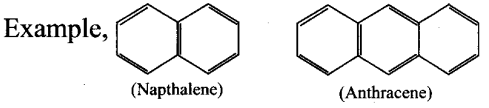
Polynuclear aromatic hydrocarbons – Two or more benzene rings fused to form polynuclear aromatic hydrocarbons.
Samacheer Kalvi 11th Chemistry Notes Chapter 13 Hydrocarbons Notes 1

Samacheer Kalvi 11th Chemistry Notes

Samacheer Kalvi 11th Chemistry Notes Chapter 14 Haloalkanes and Haloarenes

Tamilnadu Samacheer Kalvi 11th Chemistry Notes Chapter 14 Haloalkanes and Haloarenes Notes

Haloalkanes – When one or more hydrogen atoms of aliphatic hydrocarbons are replaced by a halogen atom, the resultant compounds are called Haloalkanes.

Haloarene – When one or more hydrogen atoms of aromatic hydrocarbons are replaced by a halogen atom , the resultant compounds are called Haloarenes.

R-X – Mono halogen derivatives of alkanes are called haloalkanes. They are classified as 1° (Primary), 2° (secondary) and 3° (Tertiary) haloalkanes.

Nature of C-X bond in haloalkanes – Carbon halogen bond is a polar bond as halogens are more electronegative than carbon.

Ammonolysis – Reaction with alcoholic ammonia:

Ambident Nucleophile – Nucleophiles such as cyanide and nitrite ion which can attack the nucleophilic centre from two sides are called ambident nucleophiles..

SN2 Bimolecular nucleophilic substitution reactions.

SN1 Unimolecular nucleophilic substitution reactions.

E2 reaction – Bimolecular elimination reactions.

E1 reaction – Unimolecular elimination reactions.

Organometallic compounds – They are organic compounds in which there is a direct carbon-metal bond, e.g., CH3MgI Methyl magnesium iodide.

Haloarene – C6H5-X: In this type of compounds atoms is directly attached to benzene ring.

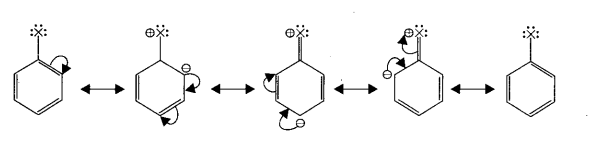
Resonance Structure of Halobenzene –
Samacheer Kalvi 11th Chemistry Notes Chapter 14 Haloalkanes and Haloarenes Notes 1

Polyhalogen compounds – Carbon compounds containing more than one halogen atoms are called polyhalogen compounds.

Gemdihalide – If two halogen atoms are attached to one carbon atom, it is called gem dihalide, eg., CH3CHCl2-Ethylidene chloride.

Vicinal dihalide – If two halogen atoms are attached to first two carbon atoms, it is called vicinal dihalide.

CHCl3 It is chloroform.

CCl4 It is tetrachloromethane (or) Carbontetrachloride.

Freops – (CFC’s) The chlorofluoro derivatives of methane and ethane are called freons.

DDT – It stands for p,p’ – dichloro diphenyl trichloroethane. It is an organic pesticide.

Samacheer Kalvi 11th Chemistry Notes

Samacheer Kalvi 11th Chemistry Notes Chapter 15 Environmental Chemistry

Tamilnadu Samacheer Kalvi 11th Chemistry Notes Chapter 15 Environmental Chemistry Notes

Environment – It includes the air we breathe, the water that covers most of the earth’s surface, the plants and animals around us and much more.

Environmental chemistry – It is the study of chemicals and chemical processes.

Environmental pollution – Any desirable change in our environment that has harmful effects on plants, animals and human beings is called environmental pollution.

Pollutants – The substances which cause pollution of the environment are called pollutants.

Bio-degradable pollutants – The pollutants which can be easily decomposed by the natural biological processes are called biodegradable pollutants.

Non-biodegradable pollutants – The pollutants which cannot be decomposed by the natural biological processes are called non-biodegradable pollutants.

Air – It is a mixture of 78% nitrogen, 21% oxygen, 0.93% argon, 0.04% carbon dioxide, trace amount of other gases and a little amount of water vapour.

Troposphere – The lowest layer of the atmosphere is called the troposphere and it extends from 0-10 km from the earth’s surface.

Hydrosphere – It includes all types of water sources like oceans, seas, rivers, lakes, streams, underground water, polar ice-caps, clouds and it covers about 75% of the earth’s surface.

Lithosphere – It includes soil, rocks and mountains which are the solid components of earth.

Biosphere – It includes hydrosphere, atmosphere and lithosphere.

Air pollution – Any undesirable change in air which adversely affects living organisms is called air pollution.

Gaseous air pollutants – Oxides of sulphur, oxides of nitrogen, oxides of carbon and hydrocarbons are the.gaseous air pollutants.

Greenhouse effect – It is defined as the heating up of the earth surface due to trapping of infrared radiations reflected by earth’s surface by C02 layer in the atmosphere.

Global warming – The heating up of the earth through greenhouse effect is called global warming.

Acid rain – Oxides of sulphur and nitrogen in the atmosphere are absorbed by droplets of water that make up clouds and chemically converted into sulphuric acid nitric acid and it results in the pH of rain water to become 5.6. It is called acid rain.

Stone leprosy – The extensive damage on marble by acid rain is called stone leprosy.

Particulate pollutants – They are small size biotic and aboitic solid particles and liquid droplets suspended in air. e.g., dust, pollen, smoke. Many of them are hazardous.

Viable Particulates – They are small size living organisms such as bacteria, fungi, moulds, algae which are dispersed in air.

Non-viable particulates – They are small size solid particles and liquid droplets suspended in air e.g., smoke, dust, mist, fumes.

Pneumoconiosis – The condition in which there is irritation of lungs which causes cancer and asthma by particulate pollutants is called pneumoconiosis.

Smog – It is a combination of smoke and fog which form droplets that remains suspended in air.

Classical smog on London smog – It consists of coal-smoke and fog.

Photochemical smog or Los Angeles smog – This is formed by the combination of smoke, dust and fog along with air pollutants like oxides of nitrogen and hydrocarbons in the presences of sunlight.

PAN – It stands for peroxy acetyl nitrate

Depletion of ozone – Loss of ozone molecules in the upper atmosphere is termed as depletion of stratospheric ozone.

Freons – The chlorofluro derivates of methane and ethane are called freons.

Water pollution – It is defined as the addition of foreign substances or factors like heat which degrades the quality of water, so that it becomes health hazardous or unfit for use.

Water pollutants – Microorganisms like bacteria, Viruses and protozoa acts as water pollutants.

Algal bloom – The enhanced plant growth in water bodies is called algal bloom.

Eutrophication – The process in which the nutrient rich water bodies supports a dense plant population kills animal life by depriving it of oxygen and results in loss of biodiversity is known as eutrophication.

Biochemical oxygen demand (BOD) – The total amount of oxygen in milligrams consumed by microorganisms in decomposing the waste in one litre of water at 20°C for a period of 5 days is called biochemical oxygen demand (BOD) and its value is expressed in ppm.

Chemical oxygen demand (COD) – It is defined as the amount of oxygen required by the organic matter in a sample of water for its oxidation by a strong oxidising agent like K2Cr207 in acidic medium for a period of 2 hours.

Total dissolved solids (TDS) – It includes cations like cadmium, magnesium, sodium, potassium, iron and anions like carbonate, bicarbonate, chloride, sulphate, phosphate and nitrate.

Soil – It is a thin layer of organic and inorganic material that covers the earth’s rocky surface.

Soil pollution – It is defined as the build up of persistent toxic compounds, radioactive materials, chemical salts and disease causing agents in soils which have harmful effects on plant and animal growth.

Essential Nutrients for soil – Nitrogen, Phosphorous, Potassium. (N, P, K).

Pesticides – These are the chemicals that are used to kill or stop the growth of unwanted organisms.

Irtsectides – These are the chemicals that are used to kill the insects, e.g., DDT, BLTC, Aldrin.

Fungicides – These are used to destroy fungus, e.g., Organic mercury compounds.

Herbicides – These are the chemicals used to control the growth of unwanted plants. They are also called “weedkillers” e.g., Sodium chlorate, sodium arsenite.

Industrial wastes – It may include cyanides, chromates, acids, alkalis, and metals like Hg, Cu, Zn, Cd and Pb.

Green chemistry – It is a chemical philosophy encouraging the design of products and processes that reduce or eliminates the use and generation of hazardous substances.

World environmental day – June 5

Ozone layer protection day – 16th September

Samacheer Kalvi 11th Chemistry Notes

Samacheer Kalvi 11th Chemistry Notes Chapter 8 Physical and Chemical Equilibrium

Tamilnadu Samacheer Kalvi 11th Chemistry Notes Chapter 8 Physical and Chemical Equilibrium Notes

Physical equilibrium: A system in which the amount of matter constituting different phases does not change with time is said to be in physical equilibrium.

Solid-liquid equilibrium: H2O(s) ⇌ H2O(l)
At equilibrium, Rate of melting of ice = Rate of freezing of water

Liquid-vapour equilibrium: H2O(l) ⇌ H2O(g)
At equilibrium, Rate of evaporation = Rate of condensation

Solid-Vapour equilibrium: I2(s) ⇌ I2(g)

At equilibrium, Rate of sublimation = Rate of deposition

Equilibrium involving dissolution of solid in liquid: Sugar (solid) ⇌ Sugar (solution) At equilibrium, Rate of dissolution of solute = Rate of crystallisation of solute

Gas in liquid equilibrium: C2 (g) ⇌ CO2 (solution)

At equilibrium, Rate of vaporisation = Rate of condensation

Chemical equilibrium: In a chemical reaction, chemical equilibrium is the state in which both reactants and products are present in concentration which have no further tendency to change with time.

At chemical equilibrium,
Rate of forward reaction (Rf) = Rate of reverse reaction (Rr)

Dynamic equilibrium: At equilibrium, the forward and the backward reactions are proceeding at the same rate and no macroscopic change is observed. So chemical equilibrium is in a state of dynamic equilibrium.

Homogeneous equilibrium: In this equilibrium, all the reactants and products are in the same phase.
H2(g) + I2(g) ⇌ 2HI(g)

Heterogeneous equilibrium: If the reactants and products of a reaction in equilibrium are in different phases, then it is called as heterogeneous equilibrium.
CaCO3(s) ⇌ CaO (s) + CO2(g)

Law of mass action: This law states that “At any instant, the rate of a chemical reaction at a given temperature is directly proportional to the product of the active masses of the reactants at that instant.

Active mass: [n/V]mol dm-3 (or) mol L-1 where “w” is the number of moles of substance and V is the volume of the substance in dm3 or L.

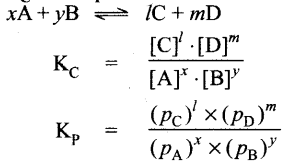
Equilibrium constants Kc and Kp
Samacheer Kalvi 11th Chemistry Notes Chapter 8 Physical and Chemical Equilibrium Notes 1

Relation between Kp and KC : KP = KC (RT)Δng

Equilibrium constant for heterogeneous equilibrium:
CaCO3(s) ⇌ CaO(s) + CO2(g)
KC – [CO2], Kp – pCo2

Application of equilibrium constant: It is used to predict the direction in which the net reaction will take place, predict the extent of the reaction, calculate the equilibrium concentrations of reactants and products.

Reaction quotient, Q: Under non equilibrium conditions it is defined as the ratio of the product of active masses of reaction products raised to the respective stoichiometric coefficients in the balanced chemical equation to that of the reactants.
\(\frac{[\mathrm{C}]^{l}[\mathrm{D}]^{m}}{[\mathrm{~A}]^{x}[\mathrm{~B}]^{y}}\)
Under non equilibrium conditions.

If Q = KC, the reaction is in equilibrium state. If Q > KC, the reaction will proceed in the reverse direction, i.e., formation of reactants. If Q < KC, the reaction will proceed in the forward direction, i.e., formation of products.

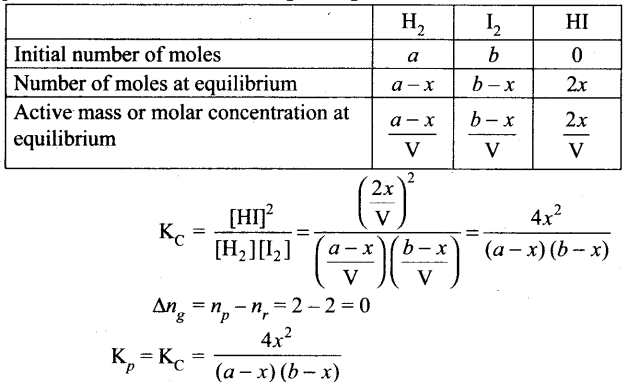
Kp and Kc values for synthesis of HI: H2(g) + I2(g) ⇌ 2HI(g)
Samacheer Kalvi 11th Chemistry Notes Chapter 8 Physical and Chemical Equilibrium Notes 2

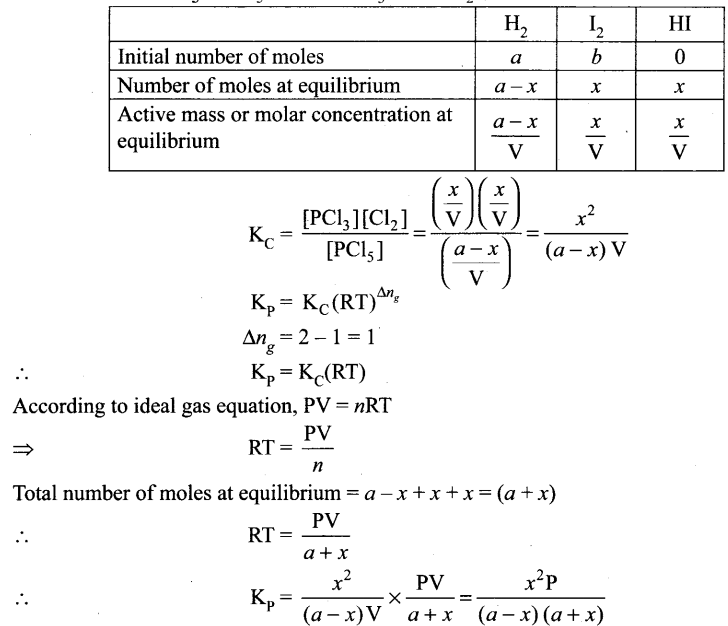
Dissolution of PCl: PCl(g) ⇌ PCl3(g) + Cl2
Samacheer Kalvi 11th Chemistry Notes Chapter 8 Physical and Chemical Equilibrium Notes 3

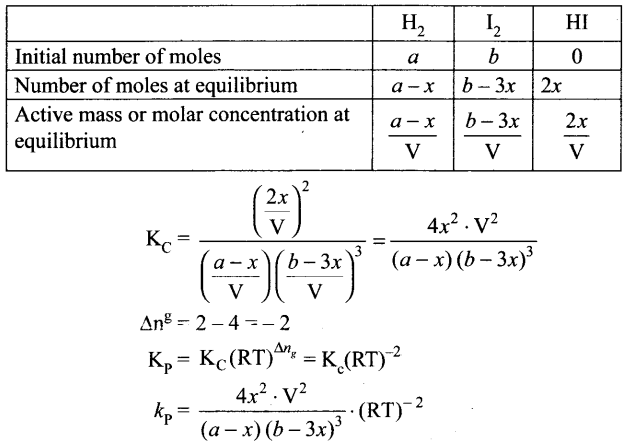
Synthesis of amonia: N2(g) + 3H3(g) ⇌ 2NH3
Samacheer Kalvi 11th Chemistry Notes Chapter 8 Physical and Chemical Equilibrium Notes 4

Le-Chatlier’s principle: “If a system at equilibrium is disturbed, then the system shifts itself in a direction that nullifies that effect of that disturbance.”

Effect of concentration : Increase in concentration of a substance is to shift the equilibrium in a direction that consumes the added substance and vice-versa.

Effect of pressure: When pressure of an equilibrium system having gaseous components is increased then the equilibrium shift in the direction that has fewer moles of gaseous components and vice-versa.

Effect of temperature: If the temperature of an equilibrium system increases then the equilibrium shift in the direction that consumes heat and vice-versa.

Effect of catalyst: It does not affect the state of equilibrium. However, it speed up the attainment of equilibrium by lowering activation energy.

Effect of inert gas: When an inert gas is added to an equilibrium system at constant volume then it has no effect on equilibrium.

Van’t Hoff equation: ∆G° = – RT/wK and ∆G° = ∆H° – T∆S° ⇒ – RTlnK = ∆H° – T∆S° where K = equilibrium constant , ∆G° = free energy change, ∆H° = Enthalpy change, AS° = Entropy change

Differential form of van’t Hoff equation: \(\frac{d(\ln \mathrm{K})}{d \mathrm{~T}}=\frac{\Delta \mathrm{H}^{\circ}}{\mathrm{RT}^{2}}\)

Integrated form of van’t Hoff equation: \(\log \frac{\mathrm{K}_{2}}{\mathrm{~K}_{1}}=\frac{\Delta \mathrm{H}^{\circ}}{2.303 \mathrm{R}}\left[\frac{\mathrm{T}_{2}-\mathrm{T}_{1}}{\mathrm{~T}_{2} \mathrm{~T}_{1}}\right]\)

Samacheer Kalvi 11th Chemistry Notes