Samacheer Kalvi 9th Science Solutions Chapter 11 Atomic Structure

You can Download Samacheer Kalvi 9th Science Book Solutions Guide Pdf, Tamilnadu State Board help you to revise the complete Syllabus and score more marks in your examinations.

Tamilnadu Samacheer Kalvi 9th Science Solutions Chapter 11 Atomic Structure

Samacheer Kalvi 9th Science Atomic Structure Textbook Exercises

I. Choice the correct answer.

9th Science Atomic Structure Question 1.
Among the following the odd pair is ………………
(a) \(_{8}^{18} \mathrm{O},^{37}_{7} \mathrm{Cl}\)
(b) \(_{18}^{40} \mathrm{Ar}, \stackrel{14}{7} \mathrm{N}\)
(c) \(\frac{30}{14} \mathrm{Si}, \frac{31}{15} \mathrm{P}\)
(d) \(_{24}^{54} \mathrm{Cr},_{19}^{39} \mathrm{K}\)
Answer:
(b) \(_{18}^{40} \mathrm{Ar}, \stackrel{14}{7} \mathrm{N}\)

Atomic Structure Class 9 Samacheer Kalvi Question 2.
Change in the number of neutrons in an atom changes it to
(a) an ion
(b) an isotope
(c) an isobar
(d) another element
Answer:
(b) an isotope

Chapter 11 Atomic Structure Question 3.
The term nucleons refer to
(a) Protons and electrons
(b) Only Neutrons
(c) Electrons and neutrons
(d) Protons and neutrons
Answer:
(d) Protons and neutrons

9th Science Atomic Structure Answers Question 4.
The number of protons, neutrons and electrons present respectively in 35Br
(a) 80, 80, 35
(b) 35, 55, 80
(c) 35, 35, 80
(d) 35, 45, 35
Answer:
(d) 35, 45, 35

Atomic Structure Book Back Answers Question 5.
The correct electronic configuration of potassium is
(a) 2,8,9
(b) 2,8,1
(c) 2,8,8,1
(d) 2,8,8,3
Answer:
(c) 2,8,8,1

II. True or false / if false give the correct answer.

  1. In an atom, electrons revolve around the nucleus in fixed orbits – True
  2. Isotopes of an element have the different atomic numbers – False.
    Correct Statement: Isotopes are atoms of the same element, which have same atomic number but different mass numbers.
  3. Electrons have negligible mass and charge – False.
    Correct Statement: Electrons have negligible mass and have negative charge.
  4. Smaller the size of the orbit, lower is the energy of the orbit – True
  5. The maximum number of electrons in L shell is 10 – False.
    Correct Statement: The maximum number of electron in L shell is 8

III. Fill in the Blanks.

  1. Calcium and Argon are examples of a pair of ………………
  2. Total Number of electrons that can be accommodated in an orbit is given by ………………..
  3. …………… isotope is used in the nuclear reactors.
  4. The number of neutrons present in \(_{3}^{7} \mathrm{Li}\) is ……………….
  5. The valency of Argon is

Answer:

  1. Isobars
  2. 2n2
  3. Radio
  4. 4
  5. 0

IV. Match the following.

1.Dalton(a)Hydrogen atom model
2.Thomson(b)Planetary model
3.Rutherford(c)First atomic theory
4.Neils Bohr(d)Plum pudding model
(e)Discovery of neutrons

Answer:

  1. (c)
  2. (d)
  3. (b)
  4. (a)

V. Complete the following table.

9th Atomic Structure Book Back Answers Question 1.

Atomic
number

Mass
number
Numbers of NeutronsNumbers of ProtonsNumber of ElectronsName of the Element
910
1616
24 –12Magnesium
21
11011

Answer:

Atomic
number

Mass
number
Numbers of NeutronsNumbers of ProtonsNumber of ElectronsName of the
Element
9191099Potassium
1632161616Sulphur
1224121212Magnesium
12111Deuterium
11011Hydrogen


VI. Answer very briefly.
9th Science Atomic Structure Book Back Answers Question 1.

Name an element which has the same number of electrons in its first and second shell.
Answer:
Beryllium

9th Science Guide Atomic Structure Question 2.
Write the electronic configuration of K and Cl
Answer:
Electronic configuration of
K+ – 2, 8, 8
Cl – 2, 8, 8

Atomic Structure Answers Question 3.
Compare the charge and mass of protons and electrons.
Answer:

MassCharge
Proton1.672 × 10<sup>- 24</sup>gPositive
Electron9.108 × 10<sup>- 28</sup>gNegative

Atomic Structure In Tamil Question 4.
For an atom ‘X’, K, L and M shells are completely filled. How many electrons will be present in it?
Answer:
K – 2, L – 8, M – 18, 28 electrons – Nickel

Structure Of Atom Exercise Solution Class 9 Question 5.
Ca2+ has completely filled outer shell. Justify your answer.
Answer:
Ca2+ – K – 2, L – 8, M – 8, N – 2
Calcium loses two electrons and they become Ca2+ ions. Electronic configuration: 2, 8, 8

VII. Answer briefly.

Atomic Structure 9th Class Question 1.
State the law of multiple proportion.
Answer:
When two elements combine together to form more than one compound, the mass of two elements combines with a fixed mass in simple ratio.

Question 2.
List the uses of isotopes.
Answer:
The uses of radioactive isotopes are as follows.

Radioactive isotopesUses
Uranium 235fuel in, nuclear reactors
Cobalt 60Treatment of cancer
Iodine 131Treatment of goiter
Carbon 14Find the age of plants and animals

Question 3.
What is Isotone? Give an example.
Answer:
Atoms of different elements with different atomic number and different mass number, but with the same number of neutrons are called isotones.
Eg. Boron and carbon.
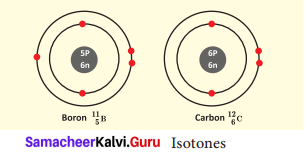
9th Science Atomic Structure Samacheer Kalvi Chapter 11

Question 4.
Draw the structure of oxygen and sulphur atoms.
Answer:
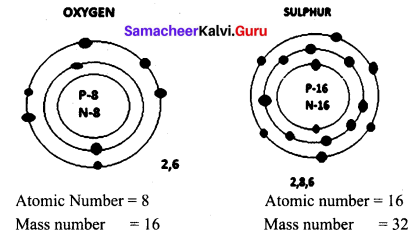
Atomic Structure Class 9 Samacheer Kalvi Chapter 11

Question 5.
Calculate the number of neutrons, protons and electrons

  1. atomic number 3 and mass number 7
  2. atomic number 92 and mass number 238

Answer:

  1. Number of neutrons – 4
    Number of protons – 3
    Number of electrons – 3
  2. Number of neutrons – 146
    Number of protons – 92
    Number of electrons – 92

VIII. Long answer.

Question 1.
What conclusions were made from the observations of Gold foil experiment?
Answer:
In Rutherford’s Alpha ray scattering experiment, the following conclusions were made from the observations.

  • Atom has a very small nucleus at the centre.
  • There is a large empty space around the nucleus.
  • The entire mass of an atom is concentrated in a very small positively charged region, which is called Nucleus.
  • The electrons are distributed in the vacant space around the nucleus.
  • The electrons move in circular paths around the nucleus.

Question 2.
Explain the postulates of Bohr’s atomic model.
Answer:
The main postulates of Neil’s Bohr are as follows.

  1. In atoms, electrons revolve around the nucleus in special orbits called discrete orbits or shells or energy levels.
  2. While the electrons revolve, they do not radiate energy.
  3. The circular orbits are numbered as 1,2,3,4 or designated as K, L, M, N shells. These numbers are referred as principal quantum numbers (n).
  4. K shell (n = 1) is closer to the nucleus and is associated with lowest energy. L, M, N are the next higher energy levels. As the distance from the nucleus increases, the energy of the shells also increase.
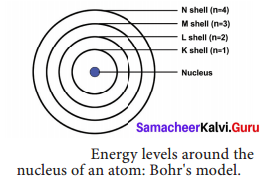
    Chapter 11 Atomic Structure Samacheer Kalvi Chapter 11
  5. The energy of each orbit or shell is a fixed quantity.
  6. As the distance from the nucleus increases, the size of the orbits also increases.
  7. The maximum number of electrons that can be accommodated in an energy level is 2n2 (n = quantum number of its orbit).
  8. When an electron absorbs energy, it jumps from lower energy level to higher energy level.
  9. When an electron returns from higher energy level to lower energy level, it gives off energy.

Question 3.
State the Gay Lussac’s law of combining volumes, explain with an illustration.
Answer:
Whenever gases react together, the volumes of the reacting gases and the products bear a simple whole number ratio, provided all the volumes are measured under similar conditions of temperature and pressure.
Steps:
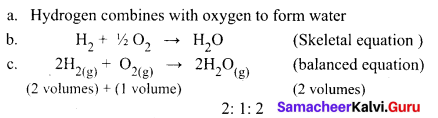
9th Science Atomic Structure Answers Samacheer Kalvi Chapter 11
Two volumes of hydrogen react with one volume of oxygen to form two volumes of water vapour that is the ratio by volume, which gases bears is
2:1:2, which is a simple whole number ratio.

Activity

Question 1.
Symbolically represent the following atoms using atomic number and mass number,

  1. Carbon
  2. Oxygen
  3. Silicon
  4. Beryllium

Answer:

  1. Carbon = \(_{6}^{12} \mathrm{C}\)
  2. Oxygen = \(\begin{array}{c}{16} \\ {8}\end{array}\)
  3. silicon = \(_{14}^{28} \mathrm{S}\)
  4. Beryllium = \(_{4}^{9} \mathrm{Be}\)

Test Yourself

Question 2.
Calculate the number of neutrons in the following atoms:

  1. \(\begin{array}{l}{27} \\ {13}\end{array} \mathbf{A} \mathbf{I}\)
  2. \(\begin{array}{l}{31} \\ {15}\end{array}\)
  3. \(\begin{array}{l}{190} \\ {76}\end{array}\)
  4. \(_{24}^{54} C_{1}\)

Answer:
Number of neutrons (n) = Mass number (A) – Atomic number (z)

  1. \(\begin{array}{l}{27} \\ {13}\end{array} \mathbf{A} \mathbf{I}\) Number of neutrons (n) = 27 (A) – 13 (Z) = 14
  2. \(\begin{array}{l}{31} \\ {15}\end{array}\) Number of neutrons (n) = 31 (A) – 15 (Z) =16
  3. \(\begin{array}{l}{190} \\ {76}\end{array}\) Number of neutrons (n) = 190 (A) – 76 (Z) = 114
  4. \(_{24}^{54} C_{1}\) Number of neutrons (n) = 54 (A) – 24 (Z) = 30

Samacheer Kalvi 9th Science Atomic Structure In Text Problems

Question 1.
Calculate the atomic number of an element whose mass number is 39 and number of neutrons is 20. Also find the name of the element.
Solution:
Mass Number = Atomic number + Number of neutrons
Atomic Number = Mass number – Number of neutrons
= 39 – 20
Atomic Number = 19
Element having atomic number 19 is Potassium (K)

Question 2.
What is the Electronic configuration of Aluminium?
Electronic configuration of Aluminium atom: (Z = 13) K shell = 2 , L shell = 8 and M shell = 3 electron. So its electronic configuration is 2, 8, 3

Question 3.
Find the valency of Magnesium and Sulphur.
Answer:
Electronic configuration of magnesium is 2, 8, 2. So valency is 2.
Electronic configuration of sulphur is 2, 8, 6. So valency is 2 i.e.(8 – 6)

Samacheer Kalvi 8th English Solutions Term 1 Prose Chapter 3 Being Safe

Students can Download English Lesson 3 Being Safe Questions and Answers, Summary, Activity, Notes, Samacheer Kalvi 8th English Book Solutions Guide Pdf helps you to revise the complete Tamilnadu State Board New Syllabus and score more marks in your examinations.

Tamilnadu Samacheer Kalvi 8th English Solutions Term 1 Prose Chapter 3 Being Safe

Read And Understand

A. Choose the best answer.

Being Safe Summary Question 1.
Grandpa got a call from
(a) his son
(b) wife
(c) his old friend
Answer:
(c) his old friend

Being Safe Question Answer Question 2.
Medicine should be kept in
(a) fridge
(b) kitchen table
(c) locked cabinet
Answer:
(c) locked cabinet

Being Safe Lesson Question 3.
automotive and gardening products should be secured.
(a) gardening products
(c) hazardous
(c) medicine
Answer:
(c) hazardous

Being Safe 8th Std Prose Summary Question 4.
We should have in our home itself to give medical treatment.
(a) first aid kit
(b) injection
(c) hospital
Answer:
(a) first aid kit

8th English Being Safe Question 5.
Some house and are poisonous.
(a) used food and plants
(b) plants and dog
(c) plants and used button cell batteries
Answer:
(c) plants and used button cell batterie

B. Choose the correct synonyms for the Italic word.

Samacheer Kalvi 8th English Book Solutions Question 1.
Dixie was feeling very exhausted.
(a) joy
(b) wounded
(c) tired
(d) rejoiced
Answer:
(c) tired

Being Safe 8th Std Prose Question 2.
The neem tree was a big antique in his garden.
(a) modern
(b) ancient
(c) updated
(d) out dated
Answer:
(b) ancient

8th English Being Safe Question Answer Question 3.
Praveen got sun stroke.
(a) fever
(b) nerves
(c) unconscious
(d) tired
Answer:
(c) unconscious

Being Safe 8th Prose Question 4.
Heat exhaustion prevails.
(a) widespread
(b) not visible
(c) exposive
(d) hidden
Answer:
(a) widespread

C. Choose the correct antonyms for the Italic word.

8th Standard English Being Safe Question 1.
Karan visited his ancestral village.
(a) offspring
(b) family
(c) house
(d) relative
Answer:
Correct Answer: non-hereditar

Being Safe Prose Summary Question 2.
We should use our mobile safely.
(a) unsafe
(b) secure
(c) protect
(d) save
Answer:
(a) unsafe

Question 3.
Medicine should be stored.
(a) consumed
(b) deleted
(c) preserved
(d) registered
Answer:
(a) consumee

Question 4.
The neem tree provided shelter to many birds.
(a) residence
(b) un protection
(c) home
(d) security
Answer:
(b) un protection

Question 5.
It is a latest mobile.
(a) updated
(b) outdated
(c) new
(d) modern
Answer:
(b) outdated

D. Answer the following in one or two sentences.

Question 1.
What is STREET SMART?
Answer:
‘Street smart’ is the experience and knowledge necessary to deal with the potential difficulties or dangers of life in an urban environment.

Question 2.
Which should be used with adults supervision?
Answer:
Mobile phones should be used by kids only with adult supervision.

Question 3.
What according to grandpa is the most serious illness?
Answer:
According to grandpa, sunstroke is the most serious illness.

Question 4.
What is the must in every household?
Answer:
A first aid kit is a must in every household. It should also have an emergency instruction inside.

E. Answer the following questions in 100 words.

Question 1.
How can you make yourself cyber safe?
Answer:
We should make ourselves cyber safe by not posting our personal information, photos, vacation plans, etc, in the social media. We should use a unique password with a combination of upper and lower case letters and numbers. Our operating systems (computer or mobile) should be updated regularly. When not in active use, turn off Wi-Fi, Bluetooth, camera, and location services. These functions of our mobile can be misused by others who want to invade our privacy. Don’t download from questionable sites. They can infect your device with viruses and compromise your privacy and safety.

Question 2.
What are the safety measures to be followed for sunstroke?
Answer:
We may get heat sunstroke when the body cannot cool itself fast enough. If you feel hot, have a headache, feel giddy or nauseated, you should tell an adult. During a heat wave, stay out of the sun and the heat during the hottest hours of the day, between 10 a.m. and 3 p.m. Drink about two litres of water per day. It is good to drink buttermilk, coconut water, fruit juices, etc. Wear lightweight, comfortable dress made of cotton that let air circulate your body. Also, always remember to protect your head by wearing a cap.

Question 3.
Write about road safety rules?
Answer:
‘Road Safety Rules’ ought to be followed very strictly whenever we are on the road. The three important rules to be followed on the road are :

  1. When we see the red light, it is an indication to stop.
  2. The green light gives us the instruction to go.
  3. Orange light insists us to get ready to go.
    While crossing the road, we have to be careful in crossing the road at the zebra crossing. We should walk on our right-hand side, against the traffic, so that we can see the vehicles coming.

Vocabulary

Prefix And Suffix

Underline the prefix in each word in the boxes.
Answer:
Being Safe Summary Samacheer Kalvi 8th English Term 1 Prose Chapter 3

Pick a suitable Prefix and suffix from the given box and complete the following words

(able, ful, ly, sub, ion, un, tri, re, im, mis)
Answer:

recallcomfortable
subcategorymisunderstand
impropersuccessful
equallytricolour
constructionnewly

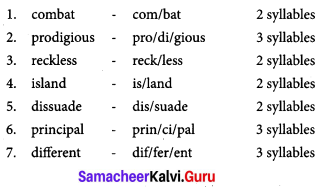
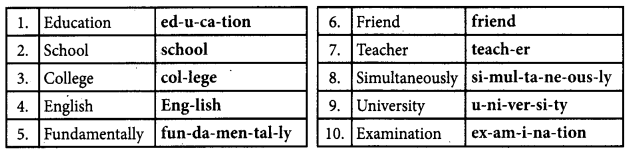
Syllabification

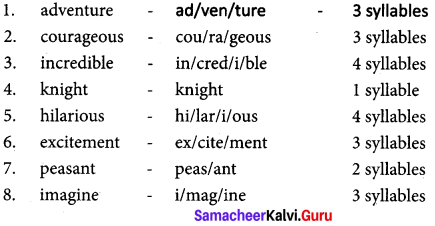
Syllabify the words.
Answer:
Being Safe Question Answer Samacheer Kalvi 8th English Term 1 Prose Chapter 3

Listening

Listen to the teacher and answer the questions.

  1. The ‘net’ in internet really stands for ______
  2. A network is two or more computers connected together so that______ can be shared sent from one computer to another.
  3. ______is accessed through web pages that companies, organizations and individuals create and post.
  4. ______ may enjoy using it to do research for a school project, downloading your favorite songs or communicating with friends and family.
  5. ______like a giant bulletin board that the whole world.

Answer:

  1. network
  2. Information
  3. Information
  4. You
  5. It’s kind of

Writing
Develop the following hints:

Question 1.
Tortoise – hare – forest – Tortoise walking- seen by a hare- hare laughs – tortoise speed – Tortoise sad – bet – race – Tortoise moving- slow speed – Hare moves – fast – sleeps- tortoise – reaches winning point – first – Wins the bet.
Answer:
The Tortoise and the hare
A tortoise and a hare lived in a forest. Once, the hare saw the tortoise walking slowly with a heavy shell on his back. The hare laughed at the speed of the tortoise. The tortoise felt sad. The hare was very proud of himself and challenged the tortoise for a race. The tortoise agreed. They started the running race. The hare ran very fast. But the tortoise walked very slowly. The proud hare rested under a tree and soon slept off. But the tortoise walked slowly and steadily and reached the winning point. At last, the tortoise won the bet.

Question 2.
Akbar – Birbal – courtiers jealous of Birbal – ask Akbar – test Birbal wiseness – Courtier puts a question – How many crows in Agra – Birbal asks for a week – every day sitting on the terrace – looking at the crows- after a week – courtier asks – Birbal says 156757 crows – asks the courtier to check- Akbar laughs.
Answer:
Akbar and Birbal
Akbar was a great Mughal emperor. Birbal was his Minister. He was a wise man and Akbar always praised his wit and intelligence. His courtiers were jealous of Birbal. One day, Akbar asked his courtiers to test Birbal’s wiseness. A courtier puts a question to him. He asked him ‘how many crows were there in Agra. Birbal asked time for a week. Birbal used to sit on the terrace everyday, looking at the crows. After a week, the courtier asked him to tell the answer. He answered that there were 156757 crows in Agra. He asked the courtier to check, if he is right. Hearing this, the King laughed heartily admiring his wit.

Question 3.
A woodcutter – cutting wood – dropped his axe in the pond – started weeping – angel ap¬peared – asked what the matter was – brought a golden axe – from the pond – woodcutter did not accept – brought a silver axe – not accepted – brought an iron axe – accepted – pleased with the honesty – offered all the axes to him.
Answer:
The woodcutter and the axe
Long ago, there lived a woodcutter in a small village. One day, while cutting wood, he dropped his axe in the pond. He tried hard to get it back, but he was unable to do so. He started weeping. An angel appeared before him and asked him what was the matter. She brought a golden axe from the pond and gave it to him. The woodcutter did not accept it. Next, she brought a silver axe and gave it to him. The woodcutter did not even . accept this. At last, she brought him an iron axe and gave it to him. The woodcutter accepted that it was his axe. The Angel was pleased with his honesty and offered all the three axes to him.

Grammar
Modal Verbs

Circle the modal verbs in the list given in the box.
Being Safe Lesson Samacheer Kalvi 8th English Term 1 Prose Chapter 3
Answer:
Modal Verbs
Being Safe 8th Std Prose Summary Samacheer Kalvi 8th English Term 1 Prose Chapter 3

I. Use polite request when we seek help from others.
a) Fill in the blanks using would you or could you.

  1. please close the door?
  2. please open the window?
  3. mind going to the back bench?
  4. please bring some water for me?

Answer:

  1. Could you
  2. Could you
  3. Could you
  4. Could you

(b) Use the phrases could you or would you in the following situations with your friend.

Question 1.
Ask the policeman for directions.
Answer:
Could you please tell me the way to the railway station?

Question 2.
You need to borrow your friend’s bike.
Answer:
Would you lend me your bike?

Question 3.
You would need to exchange the book purchased.
Answer:
Could you exchange this book

Question 4.
You want to open your classroom window.
Answer:
Could you please open our classroom window?

II. Prepositions.
(a) Fill in the blanks by using correct preposition.

  1. We go to school ______ Mondays, but not on Sunday.
  2. Christmas is ______ December 25th.
  3. Buy me a present ______ my birthday.
  4. Families often argue ______ Christmas time.
  5. I work faster night ______ night
  6. Her shift finished_______ 7 pm

Answer:

  1. on
  2. on
  3. for
  4. during
  5. at
  6. at

Being Safe Additional Question

I. Choose the correct Synonyms for the italic word.

Question 1.
The river Vatar bifurcates into two and merges again.
(a) divides
(b) separates
(c) joins
(d) mixes
Answer:
(c) joins

Question 2.
His knowledge always amuses him.
(a) entertains
(b) bores
(c) annoys
(d) guides
Answer:
(a) entertains

Question 3.
He always spends his vacation here.
(a) leave
(b) holiday
(c) journey
(d) tour
Answer:
(b) holiday

Question 4.
“Grandpa! I’m feeling exhausted’
(a) energetic
(b) refreshed
(c) replenished
(d) very tired
Answer:
(d) very tired

Question 5.
Medicines should be kept a locked cabinet.
(a) room
(b) box
(c) cupboard
(d) trunks
Answer:
(c) cupboard

Question 6.
You need to be very careful as the Sun is scorching.
(a) freezing
(b) mild
(c) burning
(d) cold
Answer:
(c) burning

Question 7.
Pills and syrups should be kept in their original containers.
(a) tanks
(b) chambers
(c) boxes
(d) cradles
Answer:
(c) boxes

Question 8.
Hazardous automotive should be secured and kept locked.
(a) safe
(b) dangerous
(c) secure
(d) certain
Answer:
(b) dangerous

Question 9.
Tell an adult if you’re feeling giddy or nauseated.
(a) healthy
(b) charmed
(c) settled
(d) sickening
Answer:
(d) sickening

Question 10.
A first aid kit should have an emergency instruction inside it.
(a) question
(b) confusion
(c) information
(d) desire
Answer:
(c) information

II. Choose the correct Antonyms for the italic word.

Question 1.
The Grandfather is very concerned.
(a) worried
(b) anxious
(c) unconcerned
(d) troubled
Answer:
(c) unconcerned

Question 2.
We should always follow road safety rules strictly.
(a) sternly
(b) severely
(c) harshly
(d) leniently
Answer:
(d) leniently

Question 3.
Take breaks by going indoors or moving to places with shade.
(a) inside
(b) outdoors
(c) upcountry
(d) interiror
Answer:
(b) outdoors

Question 4.
We shall protect ourselves from dangerous
(a) save
(b) damage
(c) guard
(d) keep
Answer:
(b) damage

Question 5.
Do not post your personal information in the social media.
(a) general
(b) intimate
(c) private
(d) secret
Answer:
(a) general

Question 6.
We should store all medicines out of the reach of children.
(a) accumulate
(b) reserve
(c) keep
(d) discard
Answer:
(d) discard

Question 7.
Pills and syrups should be kept in their original containers.
(a) fake
(b) beginning
(c) primary
(d) new
Answer:
(a) fake

Question 8.
Hazardous products should be secured and kept locked.
(a) gained
(b) found
(c) lost
(d) succeed
Answer:
(c) lost

Question 9.
Medicines should be kept in a locked cabinet.
(a) closed
(b) sealed
(c) open
(d) fastened
Answer:
(c) open

Question 10.
You should use it in the presence of an adult.
(a) attendance
(b) absence
(c) appearance
(d) existance
Answer:
(b) absence

III. Choose the Correct Answer (MCQ)

Question 1.
Prasanth lives with his parents in ______
(a) Thanjavur
(b) Tiruchirapalli
(c) Salem
(d) Erode
Answer:
(b) Tiruchirapalli

Question 2.
His grandfather was a retired ______ employee.
(a) state government
(b)bank
(c) central government
(d) private company
Answer:
(c) central government

Question 3.
We can take him out to play in the______
(a) garden
(b) park
(c) fields
(d) beach
Answer:
(C) fields

Question 4.
We always them strictly______
(a) chase
(b) follow
(c) ignore
(d) disagree
Answer:
(b) follow

Question 5.
Road safety rules are for our ______
(a) good
(b) welfare
(c) care
(d) safety
Answer:
(d) safety

Question 6.
Grandpa bought it last week in______
(a) Mumbai
(b) Salem
(c) Chennai
(d) Delhi
Answer:
(c) Chennai

Question 7.
I heard it works like a______ computer.
(a) super
(b) real
(c) good
(d) modern
Answer:
(a) super

Question 8.
It is verv useful for my______ too.
(a) work
(b) project
(c) service
Answer:
(b) project

Question 9.
Medicines should be kept in a cabinet.
(a) locked
(b) closed
(c) opened
(d) enclosed
Answer:
(a) locked

Question 10.
We can talk more
(a) next week
(b) next month
(c) evening
(d) tommorrow
Answer:
(d) tommorrow

IV. Short Questions with Answers.

Question 1.
Point out two safety measures to be followed at home?
Answer:
We should learn to put things back in their respective places after using them. Care should be taken not to play with scissors, knives, etc.

Question 2.
According to Mani’s mother when is the temperature of the Sun very hot?
Answer:
According to Mani’s mother, the temperature of the Sun is very hot between 10 a.m. and 3 p.m.

Question 3.
Which should be followed very strictly?
Answer:
“The rules of the Road Safety’ should be followed very strictly by everyone.

Question 4.
What is meant by ‘Sunstroke’?
Answer:
Sunstroke is the heatstroke brought about by excessive exposure to the Sun.

Question 5.
How could we use medicines safely?
Answer:
We should store all medicines out of sight and reach of children. They should be stored in their original containers.

V. Paragraph Question with Answer.

Question 1.
What did grandfather tell about the safety measures, to be followed at home?
Answer:
Grandfather told that the children should learn to put things back in their respective places after using them. They should not play with knives and scissors. He also told them about the safety measures to be followed while using the internet. He asked them not to post their personal information, photos, vacation plans etc., in the social media. All the medicines should be stored out of sight and reach of children. Medicines, dangerous automotive and gardening products should be secured and kept locked. A first aid kit is a must in every household.

Being Safe Grammar Additional

Modal Verbs

I. Use suitable modals.

  1. ______ you nlease lend me vour book?
  2. ______ you mind closing the window?
  3. ______ I leave the room?
  4. ______ we 20 for a movie?
  5. ______ you please give me the window seat?
  6. ______ you mind moving a little?
  7. ______ you buy this medicine for me?
  8. ______ you spare a little time for me?
  9. ______ I come in?
  10. ______ you mind taking care of my pet for sometime?

Answer:

  1. Could
  2. Would
  3. May
  4. Shall
  5. Could
  6. Would
  7. Could
  8. Could
  9. May
  10. Would

II. Frame questions with modals like shall, can, would, could, should, may for the following situations.

Question 1.
Ask your friend for an address.
Answer:
Could you guide me to this address?

Question 2.
Permission to borrow your friend’s car.
Answer:
May I borrow your car?

Question 3.
Permission to enter the classroom.
Answer:
May I come in ?

Question 4.
Offer a drink or beverage.
Answer:
Would you like a cup of coffee ?

Question 5.
Express a possibility.
Answer:
I may be late by half an hour.

Prepositions

I. Fill in the blanks with the correct Prepositions.

  1. Get me a cup _______ coffee.
  2. She ran _______ the finals and won the first prize.
  3. Ravi liked _______ paint cartoons.
  4. If s alwavs dark _______ this room.
  5. We visit our relatives _____ the weekends.
  6. All of them stayed for the function ______ 9 p.m.
  7. I met mv old friend ________ the party.

Answer:

  1. of
  2. in
  3. to
  4. in
  5. during
  6. till
  7. at

Warm up
8th English Being Safe Samacheer Kalvi 8th English Term 1 Prose Chapter 3

Being Safe Summary

Section – I
This lesson is about ‘Safety Awareness’. Prasanth lived with his parents in Tiruchirappalli. In the summer he visits his grandparents in Nagathi, a river island in Thanjavur District. The village is always evergreen with mighty trees and landscapes. Prasanth always spends his vacation there, with his grandfather and his friends.

His grandfather was a retired central government employee. As he travelled to many parts of India, his knowledge amused Prasanth. He came to visit his grandfather just then. His friends came home to play with him. Grandfather gave them some tips, for their safety. He told how careful they should be while crossing the road. They should walk on the right hand side of the road against the traffic. While crossing the road, they should first look right, left and then again right. They should never use a cell phone, while walking on the road. Road safety rules are for our safety. We should follow it strictly.

A. State whether the following statements are true or false.

  1. Prasanth had gone to bring coffee to his friends.
  2. Grandpa was so angry seeing Prasanths friends.
  3. Prasanths friend came on by walk.
  4. Teacher had taught about the rules of road saftety.

Answer:

  1. False
  2. False
  3. True
  4. True

Section – II
Prasanths friends told him that they have come to play under the shade of the big Neem Tree. Grandfather warned them to be careful, as the sun is extremely hot. Mani informed Grandfather that his mother had told him not to roam in the sunlight between 10 a.m. and 3 p.m., as it was very hot. Prasanth’s Grandfather also instructed them to put on the sunscreen 15 to 20 minutes, before going out to avoid sunburn. They may also get sunstroke, when the body cannot cool itself fast. They should tell an adult if they’re feeling hot, have a headache, feeling giddy or nauseated. He also
advised them to be ‘street smart’, when they go out to play.

A. Fill in the blanks.

  1. They had come to play under the shade of big _______
  2. We should put on _______ to avoid sun burn.
  3.  _______ is a more serious health related illness.
  4. Mani’s mother had instructed him not to roam in sunlight between _______ and _______
  5. Street smart means _______

Answer:

  1. Neem tree
  2. the sunscreen
  3. Sun stroke
  4. 10 a.m. and 3 p.m.
  5. the knowledge to be with difficulties and dangers

Section – III

Ravi asked grandfather about the safety measures to be practised at home. So grandfather told them that they should learn to put things back in their respective places after using them. They should not play with knives and scissors. He also told them about the safety.measures to be followed while using the internet. He asked them not to post their personal information, photos, vacation plans etc., in the social media. the medicines should be stored out of sight and reach of children. Medicines,
dangerous automotive and gardening products should be secured and kept locked. A first aid kit is a must in every household. The children thanked grandfather for guiding them and giving his valuable advice on “Safety Awareness”.

Samacheer Kalvi 10th English Solutions Poem Chapter 1 Life

Looking to improve English skills and gain more subject knowledge then the best resources that you can use here is Samacheer Kalvi 10th English Solutions for Poem Chapter 1 Life Questions and Answers.

In the Samacheer Kalvi 10th English Guide for Chapter 1 Life textbook solutions, subject experts covered all types of questions and answers related to the topics, quick notes, summary, solved & unsolved exercises, etc. If you are planning to prepare Chapter 1 Life via textbook, then you’re suggested to go with this Samacheer Kalvi 10th English Book Solutions Questions and Answers PDF for better understanding and preparation.

Tamilnadu Samacheer Kalvi 10th English Solutions Poem Chapter 1 Life

English Subject experts who are having max years of experience prepared this Tamilnadu State Board Solutions for 10th English Poem Chapter 1 Life Questions and Answers. They have explained all the topics covered in the board prescribed latest syllabus in a simple way to understand easily. So, students can prepare Chapter 1 English from this Samacheer Kalvi 10th English Book Questions and Answers PDF. Download the Tamilnadu State Board 10th English Chapter 1 Life Workbook Solutions PDF by accessing the below links and learn properly for the final exams to score well.

Life Textual Questions

A. Read the following lines from the poem and answer the questions that follow:

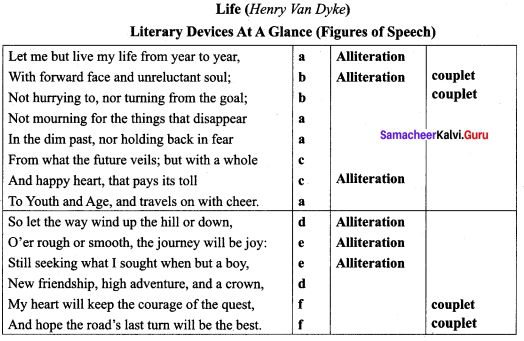
1. Let me but live my life from year to year,
With forward face and unreluctant soul;
(a) Whom does the word ‘me’ refer to?
(b) What kind of life does the poet want to lead?
Answer:
(a) ‘Me’ refers to the poet, Henry Van Dyke.
(b) The poet wants to lead a life facing every year with courage and willingness to do anything.

Additional:
(a) Pick out the alliterated words in the first line.
(b) What is the figure of speech used in the second line?
(c) What do you understand by the words, ‘forward face’?
(d) With what kind of attitude does the speaker wish to lead his life in the poem, ‘Life’ by Henry Van Dyke?
Answer:
(a) ‘Let, live, life’ are the alliterated words in the first line.
(b) The figure of speech is alliteration, (e.g. forward face)
(c) The words, ‘forward face’ indicates the courage with which one is ready to face anything in life.
(d) ’In the poem, ‘Life’ the speaker wishes to lead his life with a forward face and unreluctant soul. Hence the speaker’s attitude is optimistic.

2. Not hurrying to, nor turning from the goal;
Not mourning for the things that disappear
(a) Why do you think the poet is not in a hurry?
(b) What should one not mourn for?
Answer:
(a) The poet does not want to do anything in haste as he is determined to work towards reaching his goal.
(b) One should not mourn for the things that disappear.

Additional:
(a) Give the synonym for ‘mourn’.
(b) What is ‘goal’?
(c) Why do things disappear?
Answer:
(a) ‘Lament’ is the synonym for ‘mourn’.
(b) Goal is nothing but the aim or objective in this context.
(c) Things disappear because they are inconsistent and keep changing.

3. In the dim past, nor holding back in fear
From what the future veils; but with a whole
And happy heart, that pays its toll
To Youth and Age, and travels on with cheer.
(а) What does the poet mean by the phrase ‘in the dim past’?
(b) Is the poet afraid of future?
(c) How can one travel on with cheer?
Answer:
(a) The poet means that the past was very dull and glum.
(b) No, the poet isn’t afraid of the future.
(c) One can travel cheerfully with a happy heart.

Additional:
(a) What is meant by ‘veil’?
(b) Mention the figure of speech in the third line.
(c) Pick out the contrasting words in the above lines.
(d) Pick out the rhyming words.
(e) What is the rhyme scheme of the above lines?
Answer:
(a) A veil is a cover that is used to partially hide something.
(b) Alliteration – happy heart
(c) The contrasting words are ‘youth’ and ‘age’.
(d) The rhyming words are fear and cheer; whole and toll.
(e) The rhyme scheme is ‘abba’.

4. So let the way wind up the hill or down,
O ’er rough or smooth, the journey will be joy:
Still seeking what I sought when but a boy,
New friendship, high adventure, and a crown,
(a) How is the way of life?
(b) How should be the journey of life?
(c) What did the poet seek as a boy?
Answer:
(a) The way of life is rough or smooth.
(b) The journey of life should be joyful.
(c) The poet as a boy sought new friendships, high adventure and a crown.

Additional:
(a) Give the rhyme scheme.
(b) What is the rhyming word for down and boy?
(c) Pick out the alliterated words in the third line.
(d) When is new friendship needed?
(e) What is rough and smooth?
Answer:
(a) ‘abba’ is the rhyme scheme.
(b) The rhyming word for down is ‘crown’ and the rhyming word for boy is ‘joy’.
(c) The alliterated words are ‘still seeking’.
(d) New friendship is needed during boyhood.
(e) The way of life is rough and smooth.

5. My heart will keep the courage of the quest,
And hope the road’s last turn will be the best.
(a) What kind of quest does the poet seek here?
(b) What is the poet’s hope?
Answer:
(a) The quest sought here by the poet is a courageous heart.
(b) The poet hopes that the end journey in life will be the best to cherish.

Additional:
(a) Pick out the rhyming words.
(b) What is meant by ‘road’s last turn’?
(c) Which word in the above lines indicate ‘life’?
Answer:
(a) ‘Quest and best’ are the rhyming words.
(b) Life’s last phase is the road’s last turn.
(c) ‘Road’ indicates life.

(vi) In the dim past, nor holding back in fear
From what the future veils; but with a whole
And happy heart, that pays its toll – To Youth and Age, and travels on with cheer.
(a) Identify the rhyming words of the given lines.
Answer:
(a) Fear and cheer; whole and toll are the rhyming words.

Additional:
(a) Mention the two main stages of life.
(b) Pick out the alliterated words in the third line.
Answer:
(a) The two main stages of life are youth and old age.
(b) ‘Happy, Heart’ is the alliterated words in the third line.

(vii) Let me but live my life from year to year,
With forward face and unreluctant soul;
Not hurrying to, nor turning from the goal;
Not mourning for the things that disappear

(a) Identify the rhyme scheme of the given lines.
(b) What kind of life does the poet want to lead?
Answer:
(a) ‘abba’ is the rhyme scheme.
(b) The poet wants to lead a life without haste and steadfast in its target.

Additional:
(a) Pick out the couplet in the above lines.
With forward face and unreluctant soul;
Not hurrying to, nor turning from the goal;

B. Answer the following question in about 80-100 words:

10th Life Poem Paragraph Question 1.
Describe the journey of life as depicted in the poem by Henry Van Dyke.
Answer:
Henry Van Dyke, one of the greatest American short story writers and poets, has surpassed the act of writing skillfully. ‘Life’ is no doubt one of his priced literary pieces. This poem is a pinnacle of expressive embarkment on the quest of self-revival from the glum beats of monotony. It has a very deep and farsighted meaning held within it and this is evident from the very beginning of the poem. The poem is the poet’s own reflection on his life and tells his point of view on the more important things in life.

The poet advises the readers from his life experiences. We feel that he is now an older man reflecting on his younger days. Through his words he is explaining to us what he is taking away as most important to live is the best life possible. Life is too short to get caught up in the moment or worry about the past. On the other hand, it suggests that we look forward to what the future holds. We sometimes find ourselves brooding on the bad times and we forget about how much good there is in the future. The poet is making us understand this concept and be more aware of reality.

“Life is short and if we enjoy every moment of everyday,
We will be happy no matter what happens or changes our way! ”

C. Based on your understanding of the poem, complete the following passage by the using the phrases given in the box.

10th Life Poem Paragraph Samacheer Kalvi Chapter 1

The poet wants to live his life …………… (a) ……………., willing to do something. He neither wants ………….. (b) …………. from his goal. He does not want to …………… (c) ………….. the things he has lost, not hold back for fear of the future. He instead prefers to live his life with a whole and happy heart which cheerfully travels from ………….. (d) …………. Therefore, it does not matter to him whether the path goes ……………. (e) ……………., rough or smooth, the journey will be …………… (f) …………. He will continue to seek what he wanted as a boy – new friendship, ……………. (g) ……………. and a crown (prize). His heart will remain courageous and pursue his desires. He hopes that every turn in his life’s journey will be the best.
Answers :
(a) looking ahead
(b) to hurry nor move away
(c) mourn
(d) youth to old age
(e) up or down the hill
(f) joyful
(g) high adventure

10th English Life Poem Paragraph Samacheer Kalvi Chapter 1

Life by Henry Van Dyke About the Poet :
Henry Van Dyke (1852 – 1933) was born in Pennsylvania. A nature lover and avid reader, he earned degrees from Princeton and served as a Presbyterian minister for more than 20 years. He eventually returned to Princeton and nearly for 20 years worked as a professor of English with a bit of service as the U.S. ambassador to Luxembourg and the Netherlands in between. Henry is well known for his works, “ Joyful, Joyful, We Adore Thee” and the Christmas stories,
“The Story of the Other Wise Man” and “The First Christmas Tree.”

Life Summary: 

10th English Poem Samacheer Kalvi Chapter 1 Life

Introduction :
Life is an experience. No matter whatever it brings, it should be approached with courage, dedication and a cool mind. One should learn to be neutral in success or failure. One must stand together in facing challenges. To be optimistic is the solution to set; the end result of success.
10th English Poem Life Samacheer Kalvi Chapter 1

Will power the most needed trait In this poem, life is described not as an object but as an experience, one that should be lived with courage, dedication, without urgency and with a clear sense of purpose that drives the mind and soul. For mankind, failure or disaster is something that often makes our path incomprehensible and morose. But all it needs is a strong willpower and dedicated commitment to make that path easier appeasing the dubious notes.
Life Poem Questions And Answers Samacheer Kalvi Chapter 1

Cheerful efforts :
So here the central character is cheerful about his efforts that will see him through with an eagerly pace in search of his goal. Standing at the edge of dilemma, it isn’t easy to challenge the odds and negativism all alone. So here the poet has urged his supporters to stand by his unanimity among all disparages.
10th Life Poem Question Answer Samacheer Kalvi Chapter 1

Optimistic determination He knows that a persistent effort is the need of the hour to see every obstacle removed. So no matter what happens he should be prepared to go along the journey to his goal while facing many adventures. No matter what happens optimism is the ultimate solution that makes him stand up after every fall. Upon staying erect he hopes the end result will bring him all the fortune that he has ever looked for.
Life Poem 10th Standard English Samacheer Kalvi Chapter 1

Conclusion:
One should not feel saddened by what life unfolds before him/her. One should stand up to fight and achieve his/her utmost goal.
10th Life Poem Samacheer Kalvi Chapter 1

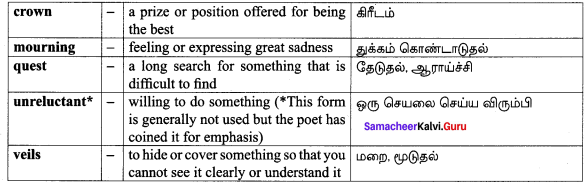
Life Glossary:

Textual :
10th English Life Poem Question Answer Samacheer Kalvi Chapter 1

Additional :
Samacheer Kalvi 10th English Solutions Poem Chapter 1 Life 9
10th English Life Poem Samacheer Kalvi Chapter 1

We hope the data given here will benefit you to the fullest extent at the time of preparation. For better understanding of English subject this Samacheer Kalvi 10th English Solutions for Class 10th English Poem Chapter 1 Life PDF is the best resource. Download & ace up your preparation. Keep in touch with us and get the latest information on Tamilnadu State board Textbook Solutions PDF.

Samacheer Kalvi 9th English Solutions Prose Chapter 2 I Can’t Climb Trees Anymore

You can Download I Can’t Climb Trees Anymore Questions and Answers, Summary, Activity, Notes, Samacheer Kalvi 9th English Book Solutions Guide Pdf Prose Chapter 2 help you to revise complete Tamilnadu State Board New Syllabus and score more marks in your examinations.

Tamilnadu Samacheer Kalvi 9th English Solutions Prose Chapter 2 I Can’t Climb Trees Anymore

I Can’t Climb Trees Anymore Warm Up:

I Can’t Climb Trees Anymore Question (a).
Have you ever tried swinging from a tree?
Answer:
I love swinging from a tree. It is a good sport. It reduces stress and rejuvenates us to face tomorrow stress free.

I Can’t Climb Trees Anymore Questions And Answers Question (b).
Have you ever climbed up a tree to pluck fruits?
Answer:
Yes, I have done it. During summer holidays, when I return to my native place, once I had climbed up a mango tree and plucked the fruits stealthily.

I Can’t Climb Trees Anymore Summary Question (c).
Think of other occasions when you have climbed up trees, either near your homes or outside. Share your reasons with the class.
Answer:
Tree climbing is a recreational or functional activity consisting of ascending and moving around in the crown of trees. Climbing up a tree was a very popular activity when I was an elementary school student. I was a tomboy and preferred to go outside everyday playing with some friends. One day, during a break between classes, I was as usual trying to climb up a tree. It was quite thin and not very tall; also the tree which I chose was located in front of a park. In the park, there were many people who were almost all students of the same school.

I climbed up steadily and finally arrived at the top of the tree. I could feel the fresh wind and survey the view. The weather was warm and sunny. After I was satisfied I tried to climb down quickly because it was time to get back to class. I got caught in one of the branches and couldn’t move further. It was so embarrassing because all my friends were watching. A couple of minutes later, my teacher ran to the bottom part of the tree with a worried face and helped me to climb’ down safely.

I Can’t Climb Trees Anymore Intext Questions

I Can’t Climb Trees Anymore Book Back Answers Question 1.
What was the old house built with?
Answer:
The old house was built with solid block of granite.

I Can’t Climb Trees Anymore Questions And Answers Pdf Question 2.
Does the visitor still live in the house?
Answer:
No, the visitor does not live in the beautiful old house.

9th English I Can’t Climb Trees Anymore Question 3.
What did the visitor hide in the jackfruit tree?
Answer:
The visitor hid some marbles, a book, a few old coins and an Iron Cross in the jackfruit tree.

Can’t Climb Trees Anymore Questions Answers Question 4.
When did the visitor actually hide the Iron Cross?
Answer:
The visitor hid the Iron Cross twenty-five years ago.

I Can’t Climb Trees Anymore Textual Questions

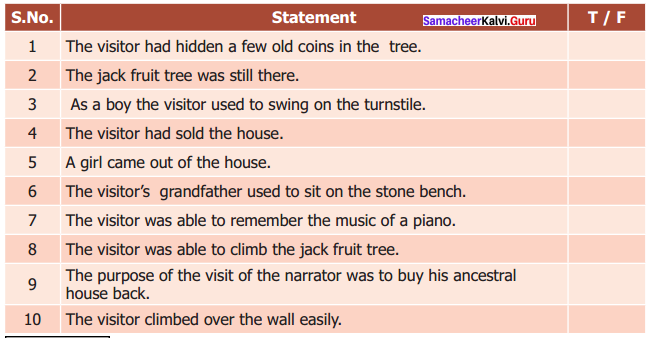
A. Based on your understanding of the story, indicate either ‘T’ (True) or ‘F’( False) against the columns.

I Can't Climb Trees Anymore Samacheer Kalvi 9th English Solutions Prose Chapter 2
Answers:

  1. True
  2. True
  3. True
  4. True
  5. True
  6. False
  7. True
  8. False
  9. False
  10. False

B. Based on your understanding of the story, answer the following questions by choosing the correct answer.

1. The story I Can’t Climb Trees Anymore highlights the importance of ………………….. .
(a) old age
(b) youth
(c) adulthood
(d) middle age
Answer:
(b) youth

2. The house which was visited by the man ………………….. .
(a) remained unchanged.
(b) was totally changed.
(c) was slightly repaired.
(d) was given a facelift.
Answer:
(a) remained unchanged.

3. Who said, “A blessing rests on the house where the shadow of a tree falls”?
(a) Grandmother
(b) Uncle
(c) Grandfather
(d) The visitor
Answer:
(a) Grandmother

4. The visitor came back to the house because he …………………. .
(a) wanted to see the jackfruit tree.
(b) was looking for his lost youth.
(c) wanted to look again at his old house
(d) wanted to buy the house.
Answer:
(b) was looking for his lost youth.

5. The visitor gifted the …………….. to the little girl.
(a) iron cross
(b) marbles
(c) bronze medal
(d) old coins
Answers
(a) iron cross

C. Answer the following questions in a sentence or two.

Can’t Climb Trees Anymore Summary Question 1.
Explain: “Blessings rest on the house where the shadow of a tree falls”.
Answer:
We humans treat Nature as God. Nature’s gifts have always been thanked and taken. If a house has the shadow of a tree falling on it, then the inmates of the house have a feeling of being protected, guarded and blessed under the bowers of God.

9th Class Can’t Climb Trees Anymore Question 2.
What did the writer observe about the house?
Answer:
Ruskin Bond stood on the grass verge by the side of the road and looked over the garden wall at the old house. The old house was built with solid blocks of granite. There was a new outhouse and lesser trees. The jackfruit tree was at the side of the building casting its shade on the wall. There used to be a turnstile which he, as a boy, would swing round until he got dizzy. In its place now was a wall with tall hollyhocks on the side of the wall.

Question 3.
What was the local superstition about trees?
Answer:
The belief the local people had about trees was that when the shadow of the tree falls on a house that house is blessed by God.

Question 4.
What did the visitor do with the turnstile when he was a boy?
Answer:
When he was a boy, Bond used to swing round and round the turnstile until he was dizzy.

Question 5.
Who is the owner of the house now?
Answer:
Colonel is the owner of the house now.

Question 6.
Why did the visitor return to his old house?
Answer:
The visitor returned to his old house searching for his memories of old days by going back to the places of his youth and childhood.

Question 7.
How did he get back the Iron Cross?
Answer:
The girl who lived in the house where Bond had spent his early days climbed up the tree and got for him the old Iron Cross from the hollow space. Bond kept it there approximately twenty-five years before.

Question 8.
How did the grandfather get the iron cross?
Answer:
The grandfather fought in France in the First World War. The Iron Cross was a German decoration awarded for bravery during the War. The grandfather got the Cross from a German soldier.

Question 9.
What did he do with the old Iron Cross?
Answer:
He returned the old Iron Cross to the girl because Bond did not go there in search of the Cross but for his youth.

Question 10.
Where had he left his childhood treasures?
Answer:
He had left his childhood treasures in jackfruit tree’s hollow.

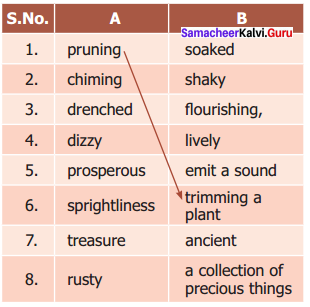
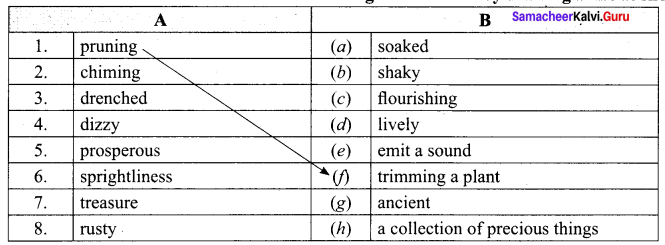
D. Match the words in column A with the meanings in column B by drawing a line as shown.

I Can't Climb Trees Anymore Questions And Answers Samacheer Kalvi Prose Chapter 2 I Can't Climb Trees Anymore Summary Samacheer Kalvi Prose Chapter 2
Answers:
1.(f) 2.(e) 3.(a) 4.(b) 5.(c) 6.(d) 7. (h) 8.(g)

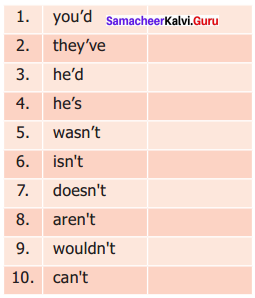
E. Read these shortened forms of words and write the full form for the remaining words and complete the table given below.
won’t : will not
I’d : I had / I would
I’ll : I will

I Can't Climb Trees Anymore Book Back Answers Samacheer Kalvi Prose Chapter 2
Answers:

  1. you had/would
  2. they have
  3. he had/would
  4. he is/was
  5. was not
  6. is not
  7. does not
  8. are not
  9. would not
  10. cannot

Speaking:

F. You are visiting the primary school where you studied classes I to IV, after six years. You get a chance to go to your standard two classroom and you are permitted to sit at the same place where you used to sit.

Question 1.
What would you remember?
Answer:
I would remember about the happy times spent in my classroom with my friends. My place in the classroom and learn writing again in the four lines on the board etc.

Question 2.
Describe your feelings at that time.
Answer:
In ecstasy, as the cherished moments are relived and though it can’t come back in our life again, we do get a sense of satisfaction.

Question 3.
Who do you miss very badly, your friends or teachers?
Answer:
Of course friends, we cannot deny the very important role played by the teachers in shaping us what we are today. Missing only the friends because every second of the school timings was made a memorable one by them only.

Question 4.
Share your thoughts with the class.
Answer:
Apart from home, school is the single most important place in the lives of most children. The experience of school will play a vital part in their lives and will determine their academic, social and probably their occupational future. The desks, the rooms, the entire ambience remained the same. The minute I saw the school. I recalled several moments, spent some time in the place where I was seated in class 1 and then went to each and every place and cherished the recalled moments. I shall never forget them. It was like a time machine which helped relive my moments.

Writing:

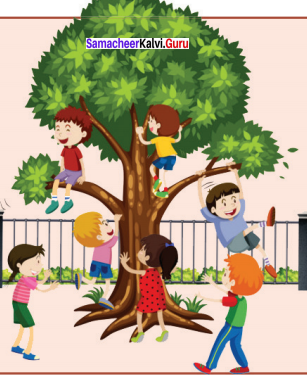
G. On seeing these pictures, you would have gone down your memory lane. Write a paragraph in about 50 words describing your favourite sport when you were young.

I Can't Climb Trees Anymore Questions And Answers Pdf Samacheer Kalvi 9th English Prose Chapter 2

My favorite sport – Gilli Danda
It is an amateur sport. The game is played with two sticks; one large called danda and the other one-fourth of the size of large stick called gilli with tapered ends. The players are divided in two teams to play this game, the hitter team and the opponent team. The danda is used to flick the short gilli into the air, and hit again to make it travel to a maximum distance. In case the hitter is unable to flick the gilli. their turn gets over after three chances. The hitter’s score is measured by the distance from the place where he hit the gilli while it is up in the air. If the opposing team catches the gilli, then the hitter ends his him.

Think and Write

H. Based on the story and your own ideas write your answers in about 80 to 100 words each.

Question 1.
Imagine yourself as the writer. Narrate the story of your visit to your ancestral house.
Answer:
I decided in the middle of my age to relive some of the moments by practically visiting the spot. So, I went to Dehra where I spent my childhood days with my grandparents. I observed from far and noticed that the house has not changed much. I was happy to see the blocks of granite building and the jackfruit tree. Turnstile where I swung round and round was missing. Tall hollyhocks grew on one side of wall that was built in that place.

When the girl invited me inside the house I climbed over the wall but couldn’t land safe. I didn’t enter the house but spent sometime sitting on the stone bench under a mango tree. I recalled the music of a piano, the chiming of a grandfather clock, the cranking up of the old car of my grandfather, constant twitter of budgerigars on the veranda, and my treasure stacked in a hollow space of the jackfruit tree. All this memories relived gave me a lot of strength, happiness and boosted me too.

Question 2.
The man who came to the house gave the cross as a gift to the girl. Why did he do this? What do you think would have happened if he had taken back the cross with him?
Answer:
The man gave the cross to the girl because his purpose of visit was not to collect it from his old house. The girl also may not have any particular use with that iron cross but would have taught her a lesson how each moment is precious in our life. Suppose, the man had taken the cross with him, he would not be able to treasure it as she would due to her age. It is young, teenage period where such innocent, sweet nothings are loved and enjoyed.

Creative Writing:

I. Write a letter to your friend describing your ancestral house.

22 May 2019
Chennai

Hi Vijay,
After a long period, I had the opportunity to revisit my ancestral house. Each and every moment was very valuable in my life. My maternal grandparents’ house in the midst of widespread greenery, a big house with unending halls and large rooms, scent of love, pleasure, moist imprint of kisses of my relatives. The house painted white with ample car parking area. My ancestral house was an antique piece due to its magnificence and splendor. The house also had the magnetic Rolls Royce car which was the most attractive commodity bought by my grandfather. I liked the view on the first floor near the balcony from which I could grasp the beautiful scenery of fields at the rear side while the market at the other side. The furniture was all one of its kind. What is said is one-tenth of these marvel, untold is innumerable. Rest in next letter as I am bit too emotionally disturbed. If there is any matter of concern do write to me. Bye. Meet you soon.

Yours friendly,
Bala

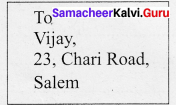
Address on the envelope:
9th English I Can't Climb Trees Anymore Samacheer Kalvi Prose Chapter 2

Grammar:

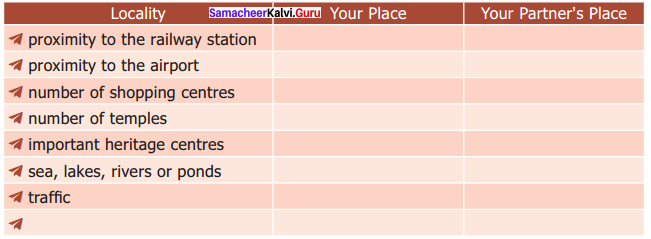
A. Work with a partner and fill in the table with information about your locality. You may add more information, if necessary. When you finish filling the table, write a short paragraph comparing the two places.

Can't Climb Trees Anymore Questions Answers Samacheer Kalvi 9th English Prose Chapter 2
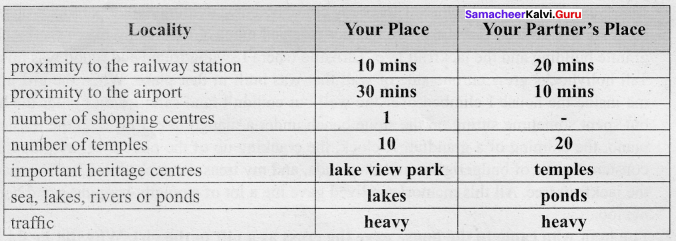
Answer:
Can't Climb Trees Anymore Summary Samacheer Kalvi 9th English Prose Chapter 2

I stay in Madipakkam. My partner lives in Nanganallur. My house is very close to Velachery railway station. But it is quite far from Chennai airport. Whereas Nanganallur is close to airport. Grand Mall is at a walkable distance from my house. But in case of my partner there are no malls as it is renowned as temple city. It is one of the important heritage centres of Chennai. Madipakkam is surrounded by lakes. It is a water logging area. There are no drainage and water connection. Media shows my place during raining season as the boats come to rescue and the food supply is from the air through helicopters.

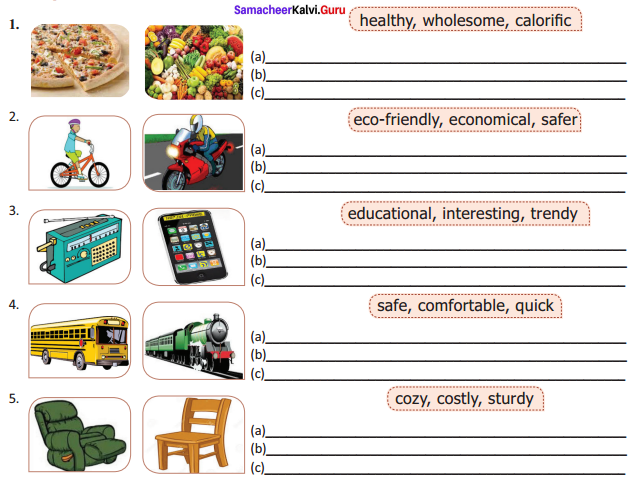
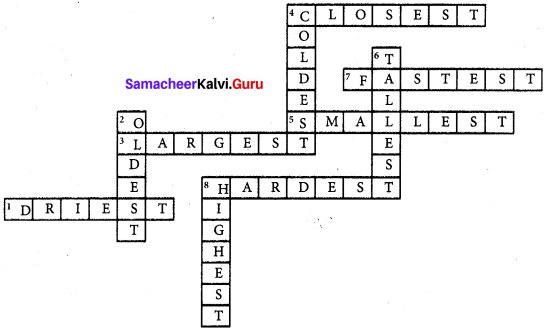
B. Give your opinion and compare the items in each picture using -er, more, less, or an irregular form. Use the words. You may form your sentences in more than one way.

9th Class Can't Climb Trees Anymore Samacheer Kalvi Prose Chapter 2
Answers:
1. (a) Indian food is healthier than Italian food.
(b) No other food is as healthy as Indian food.
(c) Indian food is more calorific then junk food.

2. (a) Motor bikes are not safer than cycles.
(b) Bicycle is the most eco-friendly vehicle.
(c) Bicycle is economical.

3. (a) Android phones are trendy.
(b) Android phone sare more interesting than radio.
(c) Android phones also act as one of the best education tools.

4. (a) Train journey is safe.
(.b) Train journey is quicker than bus.
(c) Train journey is one of the most comfortable forms of transport.

5. (a) Wooden chain is sturdy.
(b) Cushion chair is cozier then wooden chain.
(c) Cushion chair is the costliest of all chairs available in the market.

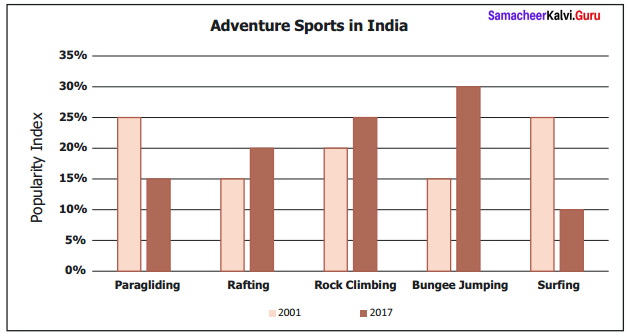
C. Look at the bar-graph. Write five sentences using the appropriate degrees of comparison.

Samacheer Kalvi 9th English Solutions Prose Chapter 2 I Can't Climb Trees Anymore 10

  1. Paragliding was more popular in the year 2001 than 2017.
  2. Bungee Jumping was the most favourite adventure sports in India in the year 2017.
  3. Surfing was only liked by 10% of people in the year 2017.
  4. Bungee Jumping was more popular than Rock Climbing in the year 2017.
  5. 20% of the people loved rafting as adventure sport in the year 2017.

Listening

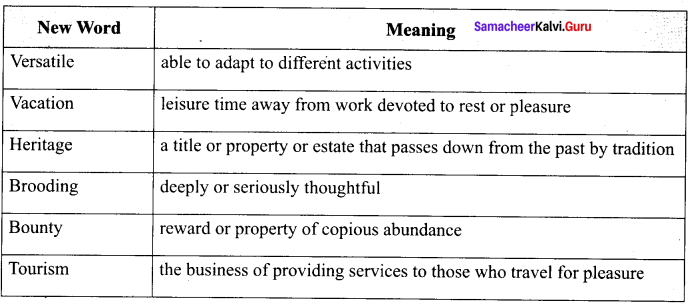
D. Listen to the conversation between Leena and her mother and list down a few new words. Using a dictionary find out the meaning for those words.
(For listening to the passage refer to our website www.fullcircleeducatiori. in)

Mother : Leena, what are your plans for the winter vacation? I thought we could go to a heritage site in India.
Leena : No Mom. This time, I wish to take up an adventure sport which I have been planning for long. But I am not sure whether we have good options for adventure sports in India.
Mother : Why not! India is a versatile and multifaceted country and every part of it offers some new adventure to see, some new place to visit. Ranging from the wonderful treks on the powerful and the bold mountain ranges of Himalayas, sky diving adventures in the west, hill stations of the south, proclaiming beauty of the Karst caves to the desert trips in Thar, all the varieties are found in one nation.
Leena : That’s great to know that with the brooding modem nation, you can savour all the adventures either in the.midst of towns or surrounded with the nature’s bounty.
Mother : But we must carefully choose the organizations that offer such programmes. We should go for ones that are registered with Adventure Tour Operators Association of India and Ministry of Tourism.
Leena : Ok, Mom. Let us see if any of those places have bungee jumping. I have been dreaming of doing this dare-devil jump for the past two years.
Mother : If you are really ready for bungee-jumping, I suggest we go to Rishikesh. Apart from leaping off a cliff, you can do white-water rafting too. What do you say? Let’s talk to your father and ask him to do some enquiries.
Leena : Yaayyy!!! I am so excited. I can’t wait for Dad to come back from office.

Samacheer Kalvi 9th English Solutions Prose Chapter 2 I Can't Climb Trees Anymore 11
Answer:
Samacheer Kalvi 9th English Solutions Prose Chapter 2 I Can't Climb Trees Anymore 12

E. Just a Minute:

The class will be divided into groups of five. Each one of you will get a topic to speak on, which will be related to the theme of the unit. A preparation time of one minute will be given. Then, you have to speak for one minute continuously. The teacher will ring the bell to signal the end of a minute. Next person in the team will take over.
The challenges of the one minute speech are to speak without

  • hesitation, stuttering and stammering
  • pauses, gesticulations and repetitions
  • deviating from the topic

Social Networking:

A social networking service is a platform to build social networks or social relations among people who share interests, activities, backgrounds or real-life connections. A social networks service consists of a representation of each user, his social links and a variety of additional services. Social networks are web based services that allow individuals to create a public profile, to create a list of users with whom to share connections, and view and cross the connection within the system. Most social network services are web bases and provide means to interact over the internet, such as e-mail and instant messaging. Online community services are sometimes considered as a social network service.

I Can’t Climb Trees Anymore by Ruskin Bond About The Author:

Ruskin Bond (born 1934) is an award winning Indian author of British descent, much renowned for his role in promoting children’s literature in India. A prolific writer, sought solace in reading and writing. He was awarded the Padma Shri in 1999 and Padma Bhushan in 2014. Ruskin Bond’s writing career spans over five decades over the course of which he experimented with different genres including fiction, essays, autobiographical, non-fiction, romance and books for children. Some of his works have been adapted for the television and films. ‘The Blue Umbrella’ novel was made as a film for children which won the National Award for Best Children’s Film.

I Can’t Climb Trees Anymore Summary:

Samacheer Kalvi 9th English Solutions Prose Chapter 2 I Can't Climb Trees Anymore 13

I Can’t Climb Trees Anymore is an e×citing short story by Ruskin Bond. The story underlines a very basic feature of our lives: searching the memories of old days by going back to the places of childhood and finding those people who once were part of our everyday life. It brings back the nostalgia that has been forgotten with the passage of time. Bond comes down to the city of Dehra from Mussoorie. He understands that many of his friends might have moved to other cities in the pursuit of career or otherwise. He moves to his grandmother’s bungalow.

He had spent a lot of time with her, especially during summer vacation. After her death, the bungalow was sold to someone else. Bond doesn’t know who owns it now but he still remember the trees. Some of them were planted by him. He observes the familiar trees and other things while losing himself in the flood of memories. Soon a girl aged around twelve comes to the gate and asks him the reason for staring at his home. Bond says that once this house belonged to him. The girl, understanding his feelings, invites him inside. Bond comes in by climbing the wall in remembrance of his childhood days.

They both sit on a bench beneath the mango tree. Bond says that he loves the Jackfruit tree and around forty years ago, he placed a cross on it which was brought by his grandfather from Germany who fought the World War II. The girl insists him to climb the tree to look for it but Bond knows that he is no more a kid of that era. So, he refuses to climb the tree. The girl brimming with energy of growing years climbs up the tree and brings down a rusted iron cross. It was the same cross Bond had placed there. The girl gives it to him but Bond refuses to take and says before leaving that he came here to find the lost youth, not the cross.

I Can’t Climb Trees Anymore Glossary:

Textual:
bougainvillea – an ornamental shrubby climbing plant that is widely cultivated in tropics
brigadier – a rank of officer in the British army, above Colonel
budgerigars – a small Australian bird of the parrot family, often kept in a cage as a pet
chiming – make melodious ringing sounds typically to indicate the time
colonel – a rank of officer in the army
cranking – the act of turning a handle to start an engine
hollyhocks – a tall Eurasian plant of the mallow family, with large showy flowers
muttered – to utter words in a low tone
pruning – the act of trimming a plant
slithered – slide or slip unsteadily on a loose or slippery surface
sprightliness – lively and full of energy
trapeze – a horizontal bar hanging by two ropes and free to swing, used by acrobats in a circus.
turnstile – a mechanical gate consisting of revolving horizontal arms fixed to a vertical post, allowing only one person at a time to pass through

Additional:
Brisk – Confident and practical, wanting to get things done quickly
Hollow – With a hole or empty space, not sincere, hollow promise
Information – Knowledge, fact
Remember – To not to forget to do, remind
Understand – Believe, to know or realize the meaning

Synonyms:
glad – happy
valuable – useful
prove – evidence
constant – existing

Antonyms:
friend × foe
smiled × frowned
silent × violent
brisk × shy
elder × younger

Samacheer Kalvi 7th English Solutions Term 2 Prose Chapter 1 Adventures of Don Quixote

You can Download Adventures of Don Quixote Questions and Answers, Summary, Activity, Notes, Samacheer Kalvi 7th English Book Solutions Guide Pdf Prose Chapter 1 helps you to revise the complete Tamilnadu State Board New Syllabus and score more marks in your examinations.

Tamilnadu Samacheer Kalvi 7th English Solutions Term 2 Prose Chapter 1 Adventures of Don Quixote

Read And Understand

Answer the following questions.

Adventures Of Don Quixote Questions And Answers Question 1.
What kinds of books did Don Quixote like to read? What were these books like?
Answer:
Don Quixote liked to read books about courageous knights and their unbelievable
adventures.

Adventures Of Don Quixote 7th English Question 2.
What effect do the things Don Quixote reads have on him?
Answer:
He was so absorbed in these stories that he never remembered to eat or sleep.

Adventures Of Don Quixote Questions And Answers Pdf Question 3.
Why didn’t Don Quixote believe Sancho Panza when Sancho told him the ogres were actually windmills?
Answer:
As Don Quixote imagined himself placed in the world of knights, he didn’t believe Sancho.

Adventures Of Don Quixote Book Back Answers Question 4.
Why do you think Sancho continued to journey on with Don Quixote after the windmill incident?
Answer:
Sancho continued his journey with Don Quixote after the windmill incident because he wanted to prevent Don Quixote from attempting anything careless.

7th Standard Adventures Of Don Quixote Questions And Answers Question 5.
When Don Quixote sees the cloud of dust on the plain in the distance, what does he think causes it?
Answer:
As Don Quixote and Sancho pass a farm, they see a thick cloud of dust. Don Quixote thinks it to be a great army marching towards them.

7th English Adventures Of Don Quixote Question 6.
Sancho sees two clouds of dust, leading him to conclude that there are two armies. What does Don Quixote think will happen next?
Answer:
He thinks that the neighing of horses, the sound of trumpets and the rattling of drums would lead to a battle between the two armies.

Adventures Of Don Quixote 7th Standard Question 7.
What is the reaction of the shepherds when they see that Don Quixote is attacking their sheep?
Answer:
The shepherds pelted stones at Don Quixote and soon, he fell wounded to the ground.

Think and Do.

Don Quixote Questions And Answers Question 1.
Most people associate windmills with Holland, rather than Spain. Use the encyclopaedia and any other sources you might have to find out more about windmills and their traditional and modern uses. Then, make a model of a windmill to display with the results of your research.
Answer:
Windmill in Holland
Historically, windmills in Holland served many purposes. The most important was pumping water out of the lowlands and back into the rivers beyond the dikes, so that the land could be farmed. In the fourteenth century, hollow-post mills were used to drive scoop wheels to drain the wetlands. In Amsterdam, we can see the “Molen de Otter”, the only wind-powered sawmill left in operation. Today, the 250-year-old windmill park is a fascinating open-air museum. The five biggest windmills in the world are located in the centre of schiedam. “Kinderdijk”

one of the best-known places for ‘windmill watching’. Its 19 windmills, almost all “grondzeilers” are on the UNESCO world heritage list. These mills, which pumped up the polder water, played an important part in shaping the Netherlands.

(Students can make a model of a windmill to display the results of their research.)

7th Standard Adventures Of Don Quixote Question 2.
Draw a design of a boat that skims trash off the surface of a river, lake, or ocean. Label the parts and give your invention a catchy name.

  • What kind of vessel could do the job?
  • What parts would it have?
  • How would it move?
  • How could it tell the difference between trash and other objects, such as animals and seaweed?
  • How would it store and dump the trash?
  • Could your machine double as a beach sweeper, sifting trash from sand?

Students design (draw) a boat that skims trash.

Discuss and Answer.

Adventures Of Don Quixote In Tamil Question 1.
To Dream the Impossible Dream
Don Quixote might be seen as not simply crazy in his refusal to see things as they really are but more like a person who wants to accomplish a greater good and so refuses to compromise his ideals. Examples of such people include Nelson Mandela, Mahatma Gandhi, and Martin Luther King Jr.
Discuss (with examples and other evidence) whether or not they think Quixote deserves to be put in the company of real-world idealists or is merely delusional.
Answer:
Don Quixote is a delusional romantic, who has read too many chivalric adventures. He assumes being a knight in the story and with the transforming power of illusion, makes monsters out of windmills and court-subjects out of ordinary people. This implies that the character of Don Quixote adds significant value on ordinary insignificant objects and people to suit to his perfect world of imagination.

Vocabulary
Homophones
(Homophones are two words that are spelled differently but have the same sound.)

A. Explain the difference between these words by making sentences. One is done for you.

  1. see/sea – Can you see the birds flying over the sea?
  2. knight/night – Yesterday night, I saw a knight riding on a horse.
  3. right/write – Write the address on the right side of the page.
  4. arms/alms – She stretched her arms to receive alms
  5. fair/fare – The auto fare was not fair.
  6. here/hear – I can hear the roaring sound of a lion from here.
  7. heard/herd – The herd of cattle heard the ratting sound of the branches.
  8. our/hour – It takes one hour to reach our destination.
  9. no/know – No one knows about this matter.
  10. not/knot – The knot is not tight.

Homonyms

(Homonyms are spelled the same way but differ in meaning.)

B. Read the following sentences and write the meaning of the italicised words. One is done for you.

7th Standard English Adventures Of Don Quixote Question 1.
The bandage was wound around the wound.
wound – injury
wound – past tense of wind

Question 2.
There is a fair Arts and Craft fair this weekend,
fair – good
fair – competition exhibition.

Question 3.
The woodcutter saw a huge saw in his dream,
saw – past tense of see.
saw – tool for cutting wood.

Question 4.
Write the right answers on the right side,
right – correct
right – direction

Question 5.
The well was dug by a well-known king.
well – a deep hole that is dug to get water.
well – famous

Question 6.
We have march past in March.
march – Walking in a military manner.
March – 3rd month of the year.

Question 7.
Can you get me a can?
can – A modal verb requesting permission.
can – a vessel

Question 8.
How long will the live fish live without food?
live – living and not dead.
live – remain alive.

Question 9.
She has tears in her eyes as she tears old photos.
tears – drops of liquid that come from your eyes.
tears – pull apart pr to pieces with force.

Question 10.
I will be second in line iflwait for one more second. second second
second – number a sequence.
second – duration offime.

C. Divide each word by putting a slash (/) symbol between each syllable. In the space provided, write how many syllables each word has. Use a dictionary if you’re not sure where to divide the syllables.
Syllable is a unit of pronunciation having one vowel sound, with or without surrounding consonants, forming the whole or a part of a word; for example, there are two syllables in water. Wa/ter
Answer:

Adventures Of Don Quixote Questions And Answers Samacheer Kalvi 7th English Term 2 Prose Chapter 1

Listening

D. Listen to your teacher reading a passage on Adventure Trips. Visualize the activities. Draw the scenes in the given boxes.

There is a very famous quote by Helen Keller, “Life is either a daring adventure or nothing.” Adventure trips are all about making memories, gaining more knowledge, learning new things about the surroundings and about one’s own self and making lots of great stories. Going for an adventure camp is the best way to get all of these as it forces one to get out of their ordinary lives and try new things.
Adventure camp basically means spending the nights in tents and doing various activities at the camp-site. There are many activities included in camping to make it more exciting and interesting. Some of these are mentioned below:
Water Activities : If your camp site is near a water body then one can do aqua zorbing, water skiing, fishing, swimming, playing water volleyball and other such fun games.
Bonfire : This can be done during winter camping. Campers are made to sit surrounding the bonfire and talk about their stories or perform some acts, such as playing some instrument or singing songs.
Rock Climbing : This activity is meant to provide both physical and mental challenges to the climbers and help them in learning new skills.
Mountain biking : Just a few scratches and the trip can be memorable with new experience of driving bicycles on forest roads.
Answer:
Adventures Of Don Quixote 7th English Samacheer Kalvi Term 2 Prose Chapter 1

Speaking

E. Read the conversation of the simple machines. Take roles to play. Then discuss in pairs to describe any simple machine. Create your own storyboard and take roles to play.

Jack : Don’t you know how simple machines make your life easy?
Jimmy : Um I don’t know what simple machines are.
Jack : Simple machines are mechanical devices for applying force like a wedge or ramp.
Jimmy : Oh! wow! How did I not know this?
Jack : Like the wheels on hospital bed and IV pole. They help you move people faster by reducing the friction.
Jimmy : Is the stick over there that the TV is attached to, is that a simple machine too?
Jack : Yes it is, its a lever. ‘Ihe wheels on the bus are simple machines, they make the bus move.
Jimmy :What about the doors?
Jack : Yeah the driver pulls a lever and the doors open and you climb up the inclined plane also known as the stairs. The cable in the elevator is wrapped around a groove in the wheel and axle, an electric motor pulls the cable, lifting the car between floors.
Jimmy : So the wheels on the rolling chair are too by rolling the chair back instead of lifting the chair back.
Jack : Yes theyare, they move the chair and reduce the friction.
Answer:
Tom : Simple machines are tools that make our work easier.
Sam : Yes, I do know that. But, do you know that simple Machines can be broken down into six different categories.
Tom : Is it so? What are these different categories?
Sam : They are pulley, lever, wedge, wheel and axle, inclined plane and screw. Wow! What is a pulley?
Tom : It uses grooved wheels and ropes or chains to raise, lower or move a load. I know that a wedge is an object with a sharp slanted.
Sam : Yes. Can you give an example of a wedge?
Tom : Scissors and knives. We use them at home everyday. To what category does a see-saw belong?
Sam : It is a lever.

F. Ask the students to tell a story. It may be a true story or an imaginative story. Choose one of the titles from the following.

  • A time l was very late
  • A funny story about my friend
  • met someone very Interesting
  • An unusual event
  • A funny story about my life

Answer:
A funny story about my friend.
In the year 2018 my friend had a severe eye pain. He consulted many physicians, but none could treat his ache. At last, he approached a wise monk who carefully observed his eyes and offered a very peculiar solution. The monk told him to concentrate only on green colour for a few weeks and avoid any other colour. My friend was very desperate to get rid of the pain. So he was determined to go to any extent. He appointed a group of painters and directed them to paint every thing in green colour. As I was working in his office, I was surprised to see all this.

After a few weeks, the monk came to visit him to follow up on his progress. As the monk was walking towards the man’s room, the appointed painter poured a bucket of green pain on the monk. The monk enquired about the reason for painting everything green. My friend told him that he was only following the monk’s advice to look at only green. At this, the monk laughed and said, ‘If only you had purchased a pair of green spectacles, you could have saved a large share of your fortune. You cannot paint the world green? .
Moral: So let us change our vision and the world will appear accordingly.

Think about your story

  • When did It happen?
  • Where were yon?
  • Who was there?
  • What happened?

Answer:
Adventures Of Don Quixote Questions And Answers Pdf Samacheer Kalvi 7th English Term 2 Prose Chapter 1

Picto Grammer

G.Solve the crossword puzzle using superlative adjectives.
Adventures Of Don Quixote Book Back Answers Samacheer Kalvi 7th English Term 2 Prose Chapter 1

7th Standard Adventures Of Don Quixote Questions And Answers Samacheer Kalvi Term 2 Prose Chapter 1

H. Put students in pairs and tell them to interview their partner. To do this they must make questions, e.g. What’s the worst storm you’ve ever seen? They can also ask follow-up questions to find out more information. Do feedback on this as a whole class. Other thematic questionnaires of this kind could be:

Emotional experiences

  • The most frightened I’ve ever been …
  • The happiest moment I’ve ever had …
  • The most nervous I’ve ever been …

Musical experiences

  • The best song I’ve ever heard …
  • The worst song I’ve ever heard …
  • The longest time I’ve ever danced …

Places in your life

  • The most dangerous place I’ve been in ..
  • The cheapest restaurant I’ve eaten in …
  • The most boring town I’ve ever visited ..

Answer:
Student 1 : What was the happiest moment your’ve ever had?
Student 2 : The happiest moment was when I received the best award for the Elocution competition in the national level.
Student 1 : How did you feel about that award?
Student 2 : I felt very proud to receive the award in front of all the dignitaries.
Student 1 : Were you nervous to be on the stage?
Student 2 : Yes, at first I was nervous to speak to the audience. But then, after some time, I became normal.
Student 1 : Did you ever dance on the stage?
Student 2 : Yes, I had danced on the stage for the Annual School day celebration.
Student 1 : Excellent! You had a very good opportunity to exhibit your talents and you had utilized the opportunity successfully.

Writing

I. Write a paragraph comparing Don Quixote and Sancho Panza. The following words will help you to write a compare and contrast paragraph
7th English Adventures Of Don Quixote Samacheer Kalvi Term 2 Prose Chapter 1
Answer:
The relationship between Don Duixote and Sancho Panza is an important one. Readers can easily understand that the two characters stand for different things. Don Quixote represents illusion. On the other hand Sancho Panza represents reality. They complement each other in a dualistic way
Sancho Panza was a peasant labourer. He was greedy, but kind and faithful. He was also a coward. He is a foil to Don Quixote and virtually to every other character in the story. Don Quixote sees what his mind and imagination create, not which is actually
there. He retreats to a world that holds meaning for him. He wants to be a knight in search of his own adventures, winning fame and honour. Unlike Don, Sancho is more practical. He seeks fortune and has a lot of common sense. But he consistently defers with his master and assents to dangerous schemes. However, Don Quixote despite his folly, Superior to the real world he has to deal with

Creative Writing

j. Local Historians

  • Ask students to collect stories about their town from older people.
  • Ask them to find out how the streets were named.
  • Are there any interesting people or legends to which the street names refer?
  • Are there any local places in town about which people tell stories?
  • Any haunted house?
  • Let students find out when the town was founded and by whom.
  • Visit a local historical society to see old photographs or artefacts.

Let student create an original historical fiction :
Describe the town from the point of view of a fictitious citizen who might have lived in the town long ago. Include local issues of the time in the story. Write the story of the town from the fictionalized point of view of a resident who actually lived there.

Activity done by the Students.

Adventures of Don Quixote Additional Questions

I. Choose the correct Synonyms from the options below.

Question 1.
courageous
(a) daring
(b) timid
(c) coward
(d) fearsome
Answer:
(a) daring

Question 2.
exciting
(a) depressing
(b) annoying
(c) thrilling
(d) arousing
Answer:
(c) thrilling

Question 3.
incredible
(a) believable
(b) unbelievable
(c) fact
(d) truth
Answer:
(b) unbelievable

Question 4.
hilarious
(a) frightening
(b) boring
(c) amusing
(d) fascinating
Answer:
(c) amusing

Question 5.
sparkle
(a) shine
(b) glimmer
(c) shade
(d) dark
Answer:
(a) shine

Question 6.
hideous
(a) beautiful
(b) pleasant
(c) oily
(d) ugly
Answer:
(d) ugly

Question 7.
combat
(a) peace
(b) fight
(c) retreat
(d) accord
Answer:
(b) fight

Question 8.
exploits
(a) achievements
(b) devastation
(c) failure
(d) waste
Answer:
(a) achievements

Question 9.
dissuade
(a) permit
(b) prevent
(c) encourage
(d) attract
Answer:
(b) prevent

II. Pick the correct Antonyms

Question 1.
same
(a) different
(b) alike
(c) real
(d) true
Answer:
(a) different

Question 2.
serious
(a) trivial
(b) severe
(c) funny
(d) silly
Answer:
(c) funny

Question 3.
faithful
(a) loyal
(b) dedicated
(c) unfaithful
(d) devoted
Answer:
(c) unfaithful

Question 4.
collided
(a) clashed
(b) missed
(c) agreed
(d) ascended
Answer:
(d) ascended

Question 5.
charged
(a) retreated
(b) denied
(c) attacked
(d) bored
Answer:
(a) retreated

Question 6.
defeated
(a) won
(b) beaten
(c) surrendered
(d) destroyed
Answer:
(a) won

Question 7.
reckless
(a) careless
(b) careful
(c) headless
(d) thoughtless
Answer:
(b) careful

Question 8.
disorder
(a) order
(b) mess
(c) chaos
(d) confusion
Answer:
(a) order

Question 9.
taunted
(a) insulted
(b) teased
(c) ridiculed
(d) praised
Answer:
(d) praised

Question 10.
embarrassed
(a) unsettled
(b) ashamed
(c) proud
(d) shameless
Answer:
(c) proud

III. Choose the Correct Answer (MCQ).

Question 1.
As years passed, Don Quixote imagines himself placed in the world of _____
(a) kings
(b) princes
(c) knights
(d) soldiers
Answer:
(c) knights

Question 2.
He convinces Sancho Panza, a _____from the same village to be his sauire.
(a) woodcutter
(b) well wisher
(c) attendant
(d) peasant
Answer:
(d) peasant

Question3.
Don sets on a _____ in search of a sauire.
(a) journey
(b) voyage
(c) trip
(d)tour
Answer:
(a) journey

Question 4.
Sancho’s shouts and warnings Passed _____
(a) heedless
(b) unheard
(c) untold
(d) careless
Answer:
(b) unheard

Question 5.
Don Quixote’s eyes began to _____
(a) shine
(b) brighten
(c) sparkle
(d) dazzle
Answer:
(c) sparkle

VI. Very Short Questions with Answers.

Question 1.
Where did Don Quixote live?
Answer:
He lived in a village called La Mancha in Spain.

Question 2.
What comes alive in the hilarious account of Don Quixote’s travels?
Answer:
The days of knight and squires of exciting adventures come alive in Don Quixote travels.

Question 3.
Who does he convince to be his squire?
Answer:
He convinces Sancho Panza, a poor peasant to be his squire.

Question 4.
How does he convince Sancho?
Answer:
He convinces him by rewarding him with an island, if he serves him faithfully.

Question 5.
Where did they see a large windmill?
Answer:
They saw a large windmill on the hill in front of them.

V. Short Questions with Answers.

Question 1.
Were Sancho’s warnings heard by Don Quixote? What did he do?
Answer:
Sancho’s shouts and warnings were not heard by Don Quixote. He flew towards the windmill and collided with it.

Question 2.
What did Don Quixote tell Sancho about the windmill, after his attack on it?
Answer:
He told his squire Sancho that the ogre (windmill) was more seriously wounded than him.

Question 3.
What did Sancho do to prevent Don Quixote from attempting anything reckless?
Answer:
Sancho did his best to prevent Don Quixote from attempting anything else reckless. Even though the windmill was working perfectly, he supported Don’s deeds.

Question 4.
What did Don do, when he saw a thick cloud of dust?
Answer:
He thought that they were a great army marching towards them. So he started to name the leaders and the principal knights in each army and described different nations.

Question 5.
What did Don Quixote do to his horse?
Answer :
He set spurs to his horse Rozinante, and charged into the midst of the sheep.

VI. Paragraph Questions with Answers.

Question 1.
How did Don Quixote brush aside the warnings given by his squire?
Answer:
Don Quixote and Sancho Panza set out on a journey together. They saw a large old windmill on a hill. When Don imagined it to be an ogre, Sancho warned him saying that it was only a windmill. But Don brushed aside his warnings asking him to go aside and say his prayers, if he was afraid of them. Again when they saw a dust of cloud, Don thought they were two armies marching towards them. Sancho told him that they were only sheep and lambs. Don paid no heed to him and told him that his fears prevent him from hearing or seeing right.

Question 2.
What did Don Quixote do to the sheep and lambs? How did the animals and the peasants react?
Answer:
Don Quixote set spurs to his horse Rozinante and charged into the midst of the sheep and lambs. At this, the frightened animals fled helter-skelter. The shepherds seeing the cause of their disorder, pelted stones at Don Quixote. He soon fell  wounded to the ground. All the local peasants thought that Don Quixote was crazy. As he passed, they laughed and insulted him. Don thought that they were praising him. But Sancho told him that they were only mocking at him.

Adventures of Don Quixote Vocabulary Additional

Homophones

A. Explain the difference between these words by making sentences.

1. no/know : Do you know the answer? No. I don’t.
2. wear/where : Where do you wear woollen clothes?
3. hare/hair : The colour of your hair is the same as that of the hare.
4. steel/steal : He tried to steal the jewels from the steel almirah.
5. by/buy : He wants to buy a flat by selling his old house.

Homonym
B. Read the following sentences and write the meaning of the italicised words.

1. He hit the bat with his bat.
bat – a mammal
bat – sport equipment (cricket bat)

2. I did not object to the object
object – protest
object – aim (or) purpose

3. I was content to write the whole content of the book,
content – willing to accept
content – the subjects or topics covered in a book

4. They were too close to the door to close it.
close – being near
close – to shut

5. Don’t park your car near the park.
park – to leave a vehicle
park – a public land for recreation

C. Divide each word by putting a slash (/) symbol between each syllable and write how many syllables each word has..

Adventures Of Don Quixote 7th Standard Samacheer Kalvi Term 2 Prose Chapter 1

Adventures of Don Quixote Grammer Additional

Degrees of Comparision

PositiveComparativeSuperlative
badworseworst
clevercleverercleverest
darkdarkerdarkest
deliciousmore deliciousmost delicious
easyeasiereasiest
goodbetterbest
muchmoremost
wisewiserwisest

A. Choose the Correct Answer.

Question 1.
He is the _____ musician.
(a) good
(b) better
(c) best
Answer:
(c) best

Question 2.
Ravi s handwriting is _____ than that of Muthu.
(a) good
(b) better
(c) best
Answer:
(b) better

Question 3.
He is a _____ person.
(a) good
(b) better
(c) best
Answer:
(a) good

Question 4.
Your answer is the _____ relevent.
(a) more
(b) more than
(c) most
Answer:
(c) most

Question 5.
The Ganges is the _____ river of India.
(a) long
(b) longer
(c) longest
Answer:
(c) longest

Question 6.
Rajasthan is the India’s _____ state by area.
(a) large
(b) largest
(c) larger
Answer:
(c) larger

Question 7.
Goa is the _____ state of India by area.
(a) smallest
(b) smaller
(c) small
Answer:
(a) smallest

Question 8.
Ganesh is the _____ boy in the class.
(a) tall
(b) taller
(c) tallest

Question 9.
He is the _____ player in the team.
(a) good
(b) better
(c) best
Answer:
(c) best

Question 10.
Jupiter is the _____ of all planets.
(a) big
(b) bigger
(c) biggest
Answer:
(c) biggest
Warm up

My Hand of Imagination :

  1. Trace around your hand on a white paper.
  2. Make a list of your five choices.
  3. Draw a picture to indicate what your finger would become.
  4. Erase one finger at a time and draw your choice in its place.
  5. Write and share in the class.

Don Quixote Questions And Answers Samacheer Kalvi Term 2 Prose Chapter 1
Answer:

  1. Pencil
  2. Spoon
  3. Scale
  4. Pen
  5. Writing Pad

Adventures of Don Quixote Summary

There lived a middle aged man in a village called La Mancha in Spain. He loved to read books about courageous knights and the unbelievable adventures they had experienced. He involved himself so much in these adventurous stories that he imagined himself to be one of them. He convinced a poor farmer Sancho Panza to be his squire. The two men set out on a journey together. On the way, they saw a large windmill. Don Quixote imagined it to be an ogre, who was blocking their path. Though his squire tried to convince him that it was only a windmill, he didn’t believe him. He fought with the windmill and got knocked off his horse. Sancho did his best to dissuade Don Quixote from attempting anything reckless.

As they were passing a farm, they saw a thick cloud of dust. Don Quixote thought it to be a great army, marching in their direction. But Sancho knew that they were only sheep and lambs. Paying no heed to his squire, he charged at them with his horse Rozinante. The local farmers thought that he was crazy. They laughed and insulted him. Don Quixote did not understand them. He thought that the people were cheering him. He returned to his estate and realized that all his adventures were simply a product of his imagination. So he never embarrassed himself by going on any more quests. But he lived happily imagining and narrating the most fantastic stories about knights and squires to all the children.

Samacheer Kalvi 8th English Solutions Term 3 Poem Chapter 1 Special Hero

Students can Download English Poem 1 Special Hero Questions and Answers, Summary, Activity, Notes, Samacheer Kalvi 8th English Book Solutions Guide Pdf helps you to revise the complete Tamilnadu State Board New Syllabus and score more marks in your examinations.

Tamilnadu Samacheer Kalvi 8th English Solutions Term 3 Poem Chapter 1 Special Hero

Special Hero Poem 8th Standard Read And Understand

B. Find a line from the poem to match the statements given below and write it in the blank.

  1. He always saves me from harm ________
  2. I am so lucky to get you ________
  3. The affection between us has no end ________

Answer:

  1. “keeping me safe from harm”
  2. “How did I get so lucky. You were the Dad chosen for me”.
  3. “Our love is everlasting”

C. Answer the following questions.

Special Hero Poem Question 1.
Who is the speaker?
Answer:
The poet Christina M. Kerschen is the speaker.

Special Hero Poem Questions And Answers Question 2.
Who is the special hero mentioned in the poem?
Answer:
The poet’s father is the special hero mentioned in the poem.

Special Hero Question Answer Question 3.
How did the child feel when it was hold by its dad?
Answer:
The child felt the love and kindness of her father. She felt that she was safe from harm. Seems it was sent to me From someplace up above.

Special Hero Poem Lines In English Question 4.
What do the above lines mean?
Answer:
The above lines means that the poet’s father is sent to her from heaven.

Special Hero Poem Summary Question 5.
What did the child want to tell its dad?
Answer:
The child wanted to tell her dad that he was her special hero.

D. Work in pairs and answer the questions below.

8th English Poem Question 1.
“There is something special about a father’s love”.
Identify the alliteration in the given lines.
Answer:
something – special are the alliterated words in the given lines.

Special Hero Question 2.
Pick out the rhyming word from the poem.
Answer:
see – me; love – above; know – so are the rhyming words.

Writing

E. Write a paragraph on the father’s love as described in the poem.
Answer:
The poet describes her father’s love in this poem. When she was a baby, he held her in his arms. She felt his love and kindness. He always kept her safe from harm. She saw his love for her in his eyes. She said that she was lucky that he was the dad chosen for her. There was something special about her father’s love. He was sent to her from heaven. She wanted him to know that their love lasts forever. She also wanted to tell him that he was her special hero.

Special Hero Additional Questions

I. Poem Comprehension – Additional

8th Standard English Poem Question 1.
I felt the love and tenderness
keeping me safe from harm

(a) Who felt the love and tenderness?
Answer:
The poet felt the love and tenderness of her father.

(b) What did he keep her safe?
Answer:
He kept her safe from harm.

(c) What do you mean by‘tenderness’?
Answer:
‘Tenderness’ means “Gentleness and kindness”.

Special Hero Poem Rhyming Words Question 2.
How did I get so lucky,
You were the dad chosen for me

(a) Who was lucky?
Answer:
The poet was lucky.

(b) Why was she lucky?
Answer:
She was lucky because he was the dad chosen for her.

(c) Is the poet excited about her father’s love?
Answer:
Yes, she is excited and feels lucky to get a Dad like him.

II. Poetic Devices.

8th English Special Hero Question Answer Question 1.
Seems it was sent to me from someplace up above
Pick out the alliterated words?
Answer:
Seems – sent are alliterated words.

Special Hero Poem Question Answer Question 2.
I just wanted you to know
That you’re my special hero
and I wanted to tell you so.
Pick out the rhyming words.
Answer:
know – so are the rhyming words.

Warm Up

What are the sacrifices made by your father for your family.

Special Hero Poem Samacheer Kalvi 8th English Solutions Term 3 Chapter 1

Special Hero Poem Summary In English By Christina M Kerschen

The poem is about the father’s love towards a child. The poet describes her father’s love and care towards her. When she was a baby, he held her in his arms. She felt his love and kindness. He always kept her safe from harm. She was able to experience his love for her in his eyes. She felt that she was lucky that he was the dad chosen for her. There was something special about the father’s love. She thought that he was sent to her from heaven. She just wanted him to know that their love lasts forever. She wanted to tell him that he was her special hero.

Samacheer Kalvi 8th Science Solutions Term 1 Chapter 1 Measurement

You can Download Samacheer Kalvi 8th Science Book Solutions Guide Pdf, Tamilnadu State Board help you to revise the complete Syllabus and score more marks in your examinations.

Tamilnadu Samacheer Kalvi 8th Science Solutions Term 1 Chapter 1 Measurement

Samacheer Kalvi 8th Science Measurement Text Book Exercises

I. Choose the best answer

8th Standard Science Measurement Lesson Question Answer Question 1.
Which one the following system of units is the British System of unit?
(a) CGS
(b) MKS
(c) FPS
(d) SI
Answer:
(c) FPS

Samacheer Kalvi 8th Science Solutions Term 1 Chapter 1 Measurement Question 2.
Electric current belongs to …………… quantities
(a) Base
(b) Supplementary
(c) Derived
(d) professional
Answer:
(a) Base

Measurement Lesson 8th Standard Question 3.
SI unit of temperature is
(a) Celsius
(b) Fahrenheit
(c) kelvin
(d) Ampere
Answer:
(c) kelvin

UP

8th Science Measurement Question 4.
Amount of substance is
(a) Directly proportional to the number of atoms
(b) Inversely proportional to the number of atoms
(c) Directly proportional to the square of number of atoms
(d) Inversely proportional to the square of number of atoms
Answer:
(a) directly proportional to the number of atoms

8th Standard Science Measurement Question 5.
Luminous intensity is the intensity of
(a) Laser light
(b) UV light
(c) Visible light
(d) IR light
Answer:
(c) visible light

Measurement 8th Science Question 6.
Which one of the following devices is used to measure electric current
Answer:
8th Standard Science Measurement Lesson Question Answer Samacheer Kalvi
8th Science Measurement Question Answer Question 7.
SI unit stands for
(a) International system of units
(b) Integrated System of units
(c) International symbol of units
(d) Integrated symbol of units
Answer:
(a) International system of units

Measurement Book Back Answer Question 8.
Closeness of two or more measured values is called as
(a) Accuracy
(b) Precision
(c) Error
(d) Approximation
Answer:
(b) Precision

UP

Science Measurement Lesson Question Answer Question 9.
Quantities other than base quantities are called as
(a) Supplementary quantities
(b) Derived quantities
(c) Professional quantities
(d) Energy quantities
Answer:
(b) Derived quantities

8th Standard Measurement Lesson Question Answer Question 10.
Which of the following statements about approximation is wrong?
(a) Approximation gives accurate value.
(b) Approximation simplifies the calculation.
(c) Approximation is very useful when little information is available.
(d) Approximation gives the nearest value only.
Answer:
(a) Approximation gives accurate value.

II. Fill in the blanks

  1. The solid angle is measured in ……………
  2. …………….. recognized the need of ‘Standard Units’ for physical quantities.
  3. The coldness or hotness of a substance is expressed by ……………..
  4. …………….. is used to measure electric current.
  5. ……………… of substance, contains 6.023 x 10+23 atoms or molecules.
  6. Luminous Intensity is the amount of visible light, that is emitted in unit area per unit …………….
  7. Quartz clock uses …………….. oscillations.
  8. The uncertainty in measurement is called as …………….
  9. ……………… is the closeness of the measured value to the original value.
  10. The intersection of two straight lines gives us ……………….

Answer:

  1. Steradian
  2. Scientists
  3. Temperature
  4. Ammeter
  5. One mole
  6. Solid angle
  7. Electronic
  8. Error
  9. Accuracy
  10. plane angle

III. True or False

8th Standard Measurement Lesson Question 1.
SI units are metric system of units.
Answer:
True

Samacheer Kalvi 8th Science Book Solutions Question 2.
Temperature is a measure of total kinetic energy of the particles in a system.
Answer:
False
Correct statement:
Temperature is a measure of average kinetic energy of the particles in a system.

8th Standard Science Measurement Lesson Question 3.
In thermometers, freezing point of water is taken as the Upper Fixed Point.
Answer:
False
Correct statement:
In thermometers, boiling point of water is taken as the Upper Fixed Point.

Measurement Question Answer Question 4.
One coulomb of charge flowing per minute is called ‘ampere’.
Answer:
False
Correct statement:
One coulomb of charge flowing per second is called ‘ampere’.

UP

Measurement 8th Class Question 5.
Amount of substance gives the number of particles present in the substance.
Answer:
True

Measurement Question And Answer Question 6.
Intensity of light from a candle is approximately equal to one ‘candela’.
Answer:
True

Class 8 Science Chapter 1 Measurement Question 7.
Angle formed at the top of a cone is an example of ‘Plane Angle’.
Answer:
True

8th Measurement Question 8.
Quartz clocks are used in GPS Devices.
Answer:
False
Correct statement:
Atomic clocks are used in GPS Devices.

8th Science Measurement Book Back Answers Question 9.
Candela is used to express electric field intensity.
Answer:
False
Correct statement:
Candela is used to express luminous intensity.

Measurement Lesson Question Answer Question 10.
The number 4.582 can be rounded off as 4.58.
Answer:
True

IV. Match the following

Samacheer Kalvi 8th Science Solutions Term 1 Chapter 1 Measurement

Answer:

  1. b
  2. e
  3. d
  4. a
  5. c

V. Assertion & Reason

Question 1.
Direction: Mark the correct choice as

(a) If both assertion and reason are true and reason is the correct explanation of the assertion.
(b) If both assertion and reason are true but reason is not the correct explanation of the assertion.
(c) Assertion is true, but reason is false.
(d) Assertion is false, but reason is true.

Question 1.
Assertion : The SI system of units is the suitable system for measurements.
Reason : The SI unit of temperature is kelvin.
Answer:
(b) Both assertion and reason are true but reason is not the correct explanation of the assertion
Correct explanation :
In SI system the units are precisely defined and have the same value everywhere.

UP

Question 2.
Assertion : Electric current, amount of substance, Luminous Intensity are the fundamental physical quantities.
Reason : They are independent of each other.
Answer:
(a) Both assertion and reason are true and reason is the correct explanation of the assertion

Question 3.
Assertion : The seconds hand of a clock is having least count of one second.
Reason : Least count is the maximum measurement that can be measured accurately by an instrument.
Answer:
(c) Assertion is true, but reason is false
Correct explanation :
Least count is the minimum measurement that can be measured accurately by an instrument.

Question 4.
Assertion : Avogadro’s number is the number of atoms in one mole of substance.
Reason : Avogadro’s number is a constant.
Answer:
(a) Both assertion and reason are true and reason is the correct explanation of the assertion

Question 5.
Assertion : Radian is the unit of solid angle.
Reason : One radian is the angle subtended at the centre of a circle by an arc of length equal to its radius.
Answer:
(d) Assertion is false, but reason is true]
Correct explanation :
Radian is the unit of plane angle.

VI. Answer in a word or two (Very Short Answer)

Question 1.
What is the unit of mass in FPS system?
Answer:
Pound.

Question 2.
How many base quantities are included in SI system?
Answer:
Seven.

Question 3.
Give the name of the instrument used for the measurement of temperature.
Answer:
Thermometer.

UP

Question 4.
What is the ‘Lower Fixed Point’ of the Fahrenheit scale?
Answer:
32°F.

Question 5.
What is the SI unit of Luminous Intensity?
Answer:
Candela (cd).

Question 6.
What is the value of Avogadro’s number?
Answer:
6.023 x 10²³.

Question 7.
What type of oscillations are used in atomic clocks?
Answer:
Periodic vibrations.

Question 8.
Mention the types of clocks based on their display.
Answer:
Analog clock and digital clock.

Question 9.
How many times will the ‘minute hand’ rotate in one hour?
Answer:
One time.

Question 10.
How many hours are there in a minute?
Answer:
60 minutes = 1 hr
1 minute = \(\frac { 1 }{ 60 }\) = 0.0167 hours.

VII. Answer the Questions given below (Short Answer)

Question 1.
What is measurement?
Answer:
Measurement is the process of finding an unknown physical quantity by using a standard quantity.

Question 2.
Name some common systems of measurement.
Answer:
Some common systems of units are:

  1. FPS – System (Foot for length, Pound for mass and Second for time)
  2. CGS – System (Centimetre for length, Gram for mass and Second for time)
  3. MKS – System (Metre for length, Kilogram for mass and Second for time)

Question 3.
Define – Temperature.
Answer:
Temperature is a measure of the average kinetic energy of the particles in a system.

Question 4.
Define – ampere.
Answer:
One ampere is defined as one ‘coulomb’ of charge moving in a conductor in one second.

UP

Question 5.
What is electric current?
Answer:
The magnitude of an electric current is the amount of electric charges flowing through a conductor in one second.

Question 6.
What is luminous Intensity?
Answer:
The measure of the power of the emitted light, by a light source in a particular direction, per unit solid angle is called as luminous intensity.

Question 7.
Define – mole.
Answer:
Mole is defined as the amount of substance, which contains 6.023 x 10²³ entities.

Question 8.
What are the differences between Plane angle and solid angle?
Answer:
Difference between Plane Angle and Solid Angle:
Plane Angle:

  • Angle between the intersection of two lines or planes.
  • It is two dimensional
  • Unit is radian.

Solid Angle:

  • Angle between the intersection of three or more planes at a common point.
  • It is three dimensional.
  • Unit is steradian.

Question 9.
What are errors?
Answer:
The value of every measurement contains some uncertainty. These uncertainties are called as ‘Errors’.

VIII. Answer in detail

Question 1.
List out the base quantities with their units.
Answer:
Base Quantities and Units:
Measurement Lesson 8th Standard Samacheer Kalvi Chapter 1

Question 2.
Write a short note on different types of clocks.
Answer:
Types of clocks based on display:

  1. Analog clocks
  2. Digital clocks

1. Analog clocks:
It looks like a classic clock. It has three hands to show the time.

  • Hours Hand : It is short and thick. It shows ‘hour’.
  • Minutes Hand : It is long and thin. It shows ‘minute’.
  • Seconds Hand : It is long and very thin. It shows ‘second’. It makes one rotation in one minute and 60 rotations in one hour.
    Analog clocks can be driven either mechanically or electronically.

8th Science Measurement Samacheer Kalvi Term 1 Chapter 1

2. Digital clocks:

  • A digital clock displays the time directly. It shows the time in numerals or other
    symbols. It may have a 12 hours or 24 hours display.
  • Recent clocks are showing Date, Day, Month, Year, Temperature etc.
  • Digital clocks are often called as Electronic Clocks.

Différent types of clocks based on working mechanism:

1. Quartz Clock:

  • These clocks are activated by ‘electronic oscillations’, which are controlled by a ‘quartz crystal’.
  • The frequency of a vibrating crystal is very precise. So, the quartz clock is more accurate than the mechanical clock.
  • These clocks have an accuracy of one second in every 109 seconds.

8th Standard Science Measurement Samacheer Kalvi Term 1 Chapter 1

2. Atomic Clock:

  • These clocks are making use of periodic vibrations occurring within the atom.
  • These clocks have an accuracy of one second in every 10b seconds.
  • Atomic clocks are used in Global Positioning System (GPS), Global Navigation Satellite System (GLONASS) and International time distribution services.

Measurement 8th Science Samacheer Kalvi Term 1 Chapter 1

IX. Higher Order Thinking Question

Question 1.
Your friend was absent yesterday. You are enquiring about his absence. He told, he was affected by a fever of 100°C and went to a hospital for treatment. Is it possible of 100°C fever? If it is wrong, try to make him to understand his mistake.
Answer:

  • No. It is not possible of 100°C fever. The normal temperature of human body is between 98.4°F and 98.6°F.
  • So, he should say that, he was affected by a fever of 100°F and it is not 100°C.

Samacheer Kalvi 8th Science Solutions Measurement Additional Questions

I. Choose the correct answer

Question 1.
The SI unit of length is the ……………….
(a) Millimetre
(b) Centimetre
(c) Metre
(d) kilometre
Answer:
(c) Metre

Question 2.
The magnitude of a physical quantity consists of ……………..
(a) A unit
(b) A number and a unit
(c) A number
(d) Unit and its symbol
Answer:
(b) A number and a unit

Question 3.
The SI unit of mass is ……………..
(a) Milligram
(b) Gram
(c) Quintal
(d) kilogram
Answer:
(d) kilogram

UP

Question 4.
Among the following, which is not an metric system?
(a) CGS
(b) MKS
(c) FPS
(d) SI
Answer:
(c) FPS

Question 5.
……………. is a physical quantity that expresses the degree of hotness or coldness of a substance.
(a) Electric current
(b) Luminous intensity
(c) Temperature
(d) None of the above
Answer:
(c) Temperature

II. Fill in the Blanks

  1. ……………… is the process of finding an unknown physical quantity by using a standard quantity.
  2. The CGS, MKS and SI units are system of units.
  3. FPS is a …………… system of units.
  4. Temperature is a measure of the average ……………. of the particles in a system
  5. Melting point of pure ice (0° C) is taken as ……………… fixed point.

Answer:

  1. Measurement
  2. Metric
  3. British
  4. kinetic energy
  5. Lower

III. True or False – if false give the correct statement

Question 1.
The unit of length in FPS system is foot.
Answer:
True.

Question 2.
The unit of mass in CGS system is kilogram.
Answer:
False
Correct statement:
The unit of mass in CGS system is gram.

Question 3.
Heat is a physical quantity that expresses the degree of hotness or coldness of a substance.
Answer:
False
Correct statement:
Temperature is a physical quantity that expresses the degree of hotness or coldness of a substance.

Question 4.
Heat removed from a substance will lower its temperature.
Answer:
True

Question 5.
In thermometers, boiling point of water (100° C) is taken as upper fixed point.
Answer:
True.

UP

Question 6.
Normal temperature of the human body is between 98.4° C and 98.6° C.
Answer:
False
Correct statement:
Normal temperature of the human body is between 98.4° F and 98.6° F.

Question 7.
Voltmeter is a device used to measure electric current.
Answer:
False
Correct statement:
Ammeter is a device used to measure electric current.

Question 8.
The super conductors are used to levitate trains from the track.
Answer:
True

IV. Match the following

Question 1.
8th Science Measurement Question Answer Samacheer Kalvi Term 1 Chapter 1
Answer:

  1. c
  2. e
  3. d
  4. b
  5. a

Question 2.
Measurement Book Back Answer Samacheer Kalvi Term 1 Chapter 1
Answer:

  1. c
  2. e
  3. b
  4. a
  5. d

V. Assertion and Reason.

Question 1.
Mark the correct choice as:
(a) If both assertion and reason are true and the reason is the correct explanation of the assertion.
(b) If both assertion and reason are true, but the reason is not the correct explanation of the assertion.
(c) If the assertion is true, but the reason is false.
(d) If the assertion is false, but the reason is true.

Question 1.
Assertion : The SI unit of temperature is kelvin.
Reason : Thermometers are calibrated with some standard scales like Celsius, fahrenheit and kelvin.
Answer:
(b) Both assertion and reason are true, but the reason is not the correct explanation of the assertion

Question 2.
Assertion : Temperature is a physical quantity.
Reason : Temperature is the degree of hotness or coldness of a body.
Answer:
(a) Both assertion and reason are true and the reason is the correct explanation of the assertion

Question 3.
Assertion : Radian is the angle subtended at the centre of a circle by an arc whose length is equal to the radius of the circle.
Reason : 1 radian = \(\frac { 180 }{ π }\)
Answer:
(a) Both assertion and reason are true and the reason is the correct explanation of the assertion

VII. Very short Answers

Question 1.
What is physics?
Answer:
Physics is the study of nature and natural phenomena.

Question 2.
Name the British system of units.
Answer:
FPS system.

Question 3.
How many base quantities are there?
Answer:
Seven.

UP

Question 4.
What is the symbol for unit of electric current?
Answer:
A (ampere).

Question 5.
Mention the SI unit of luminous flux.
Answer:
Lumen.

VII. Short Answers

Question 1.
Mention the SI unit & symbol of temperature.
Answer:

  1. The SI unit of Temperature is kelvin.
  2. It’s symbol is ‘K’.

Question 2.
Write any 2 applications of various thermometric scales.
Answer:

  1. Physicians use ‘clinical thermometers’. It is graduated in ‘Fahrenheit Scale’
  2. Scientists are using thermometers with kelvin scale.

UP

Question 3.
Define electric current. Write its formula and unit.
Answer:
1. The magnitude of an electric current is the amount of electric charges flowing through a conductor in one second.
Electric current = \(\frac { Amount of electric charges (Q) }{ time (t) }\)
I = \(\frac { Q }{ t}\)

2. SI unit of electric current is ‘ampere’ and it is denoted as A.

Question 4.
Define super conductors.
Answer:
At very low temperature, around 30 K (-243.2° C), some conductors conduct electric current without any loss. These conductors are known as ‘SUPER CONDUCTORS’.

Question 5.
Define amount of substance. Mention its SI unit and symbol.
Answer:

  1. Amount of substance is a measure of the number of entities (particles) present in a substance.
  2. The SI unit of amount of substance is mole and it is denoted as ‘mol’.

Question 6.
What is luminous intensity? Mention its SI unit and symbol.
Answer:

  1. The measure of the power of the emitted light, by a light source in a particular direction, per unit solid angle is called as luminous intensity.
  2. The SI unit of luminous intensity is candela and is denoted as ‘cd’.

UP

Question 7.
What are the rules for rounding off a number?
Answer:
Rules for rounding off:

  1. Decide which is the last digit to keep.
  2. Leave it the same, if the next digit is less than 5.
  3. Increase it by one, if the next digit is 5 or greater than 5.

Question 8.
Define one light year.
Answer:
One light year is defined as the distance travelled by light in vacuum during the period of one year. 1 light year = 9.46 x 10¹⁵m

VIII. Long Answers

Question 1.
Write a note on accuracy and precision.
Answer:
Accuracy in Measurements:

1. Measurement is the base of all experiments in science and technology. The value of every measurement contains some uncertainty. These uncertainties are called as ‘Errors’.

2. The difference between the real value and the observed value is called an error.

  • Accuracy : Accuracy is the closeness of a measured value to the actual value or true value.
  • Precision : Precision is the closeness of two or more measurements to each other.

Science Measurement Lesson Question Answer Samacheer Kalvi Term 1 Chapter 1

Question 2.
Explain the Greenwich mean time.
Answer:

  1. Greenwich Mean Time (GMT) is the mean solar time at the Royal Observatory, located at Greenwich in London.
  2. It is measured at the longitude of zero degree.
  3. The Earth is divided into 24 zones, each of a width of 15 degree longitude.
  4. These regions are called as ‘Time Zones’. Time difference between two adjacent time zones is 1 hour.

Question 3.
Write a note on approximation.
Answer:

  1. Approximation is the process of finding a number, which is acceptably close to the exact value of the measurement of a physical quantity.
  2. It is an estimation of a number obtained by rounding off a number to its nearest place value.
  3. When the data are inadequate, physicists are in need of an approximation to find the solution for problems.
  4. Approximations are usually based on certain assumptions having a scientific background and they can be modified whenever accuracy is needed.

IX. Complete the given table

8th Standard Measurement Lesson Question Answer Term 1 Chapter 1Answer:

(i) 0° C
(ii) 100
(iii) 212° F
(iv) 373 K
(v) 100

X. Problems for practice

Question 1.
Convert 36° C into kelvin.
Solution:
K = C + 273
= 36 + 273
= 309 K

Question 2.
Convert 100 K into Celsius.
Solution:
C = K – 273
C = 100 – 273
= -173° C

UP

Question 3.
When 5 coulomb of charge, flows through a circuit for 20 seconds. Calculate the current?
Given: Charge Q = 5 C
Time t = 20 s

Solution:
I = \(\frac { Q }{ t }\) = \(\frac { 5}{ 20 }\) = 0.25 A
I = 0.25 A

Question 4.
Convert 90° C into radian.
Given: i = \(\frac { π }{ 180° }\)
8th Standard Measurement Lesson Samacheer Kalvi Term 1 Chapter 1

Question 5.
Round off the number 5.323 to two decimal places.
Answer:
Step : 1 Identify the last digit to be kept. 2 is the last digit to be kept.
Step : 2 The following digit, (i.e.) 3 is less than 5. SI retain 2 as 2.
∴ The answer is 5.32.

11th English 1st Lesson Questions And Answers

Students who are interested in learning of 11th English Prose Chapter 1 The Portrait of a Lady Questions and Answers can use Tamilnadu State Board Solutions of 11th English Chapter Wise Pdf. First check in which chapter you are lagging and then Download Samacheer Kalvi 11th English Book Solutions Questions and Answers Summary, Activity, Notes Chapter Wise. Students can build self confidence by solving the solutions with the help of Tamilnadu State Board English Solutions. English is the scoring subject if you improve your grammar skills. Because most of the students will lose marks by writing grammar mistakes. So, we suggest you to Download Tamilnadu State Board 11th English Solutions according to the chapters.

Tamilnadu Samacheer Kalvi 11th English Solutions Prose Chapter 1 The Portrait of a Lady

Check out the topics covered in Prose Chapter 1 The Portrait of a Lady Questions and Answers before you start your preparation. Improve your grammar skills with the help of Samacheer Kalvi 11th English Book Solutions Questions and Answers pdf links. The solutions for Tamilnadu State Board 11th English Textbook are prepared by the English experts. So, if you follow Tamilnadu State Board Solutions 11th English Textbook Solutions you can cover all the topics in Prose Chapter 1 The Portrait of a Lady Questons and Answers. This helps to improve your communication skills.

Warm up

Nuclear Family or Joint Family

11th English 1st Lesson Questions And Answers Samacheer Kalvi The Portrait Of A Lady

Based on the visuals given above, give five words/phrases each to describe these two family

Nuclear familyJoint family

Answer:

Nuclear familyJoint family
smallcontentedcongestedless privacy
happyrichcompete for needssharing more
more spacekindpeer learningmore fun
caringlovingless richesmore joy
joyfulmore lovewait for turnno immediate gratification
good educationneeds metmutual carebondage great

Samacheer Kalvi 11th English The Portrait of a Lady Textual Questions

(1) Answer the following questions in one or two sentences based on your understanding of the story:

11th English 1st Lesson Questions And Answers Question (а)
Describe the grandfather as seen in the portrait.
Answer:
The author’s grandfather looked as if he were hundred years old with lots of grandchildren. He had loose fitting garments. He looked too old to have had a wife and children.

11th English Guide Pdf Download Question (b)
Why was the author left with his grandmother in the village?
Answer:
The author’s parents went to the city to make a living. The young author was left with his grandma till his parent’s settled well in the city.

11th English Unit 1 Prose Paragraph Question (c)
Where did the author study in his childhood?
Answer:
The author studied in the veranda of a village temple. He learnt letters of the alphabet from the priest.

11th English Unit 1 Prose Question Answer Question (d)
Why did the grandmother accompany the author to school?
Answer:
Grandma was a pious lady. The school was attached to the temple. So, the grandmother accompanied the author to his school. While he learnt letters of alphabets, she spent her time inside the temple reciting prayers and telling the beads of her rosary.

The Portrait Of A Lady Book Back Answers Question (e)
What made the dogs follow the grandmother after school hours?
Answer:
Grandmother brought a bundle of stale chapattis with her to the temple. The village dogs followed her. On return, she went on throwing the chapattis to the dogs who growled and fought with each other to have a piece of chapatti.

11th English Prose Paragraph Question (f)
Why didn’t the grandmother feel sentimental when the author went abroad for higher education?
Answer:
Grandmother got alienated from her grandson the time he went to the English medium school in the city. The reduction of focus in spiritual education and value education and increase in the importance of science perturbed grandma a great deal. She knew that she can’t help the changes. So, she did not show any sentimentality when the grandson went abroad.

11th English 1st Lesson Paragraph Question (g)
What was the happiest time of the day for grandmother?
Answer
Half an hour in the afternoon, grandma devoted her time for feeding sparrows. That half- an-hour was the happiest time of the day for grandmother.

2 . Answer the following questions in three or four sentences each:

11th English Guide Pdf Free Download Question (a)
Describe the author’s grandmother.
Answer:
Grandma was bent with age. She was deeply religious. She did not approve of modem science, music and entertainment. However she had the wisdom to accept changes ‘ gracefully and retain her values till her death.

11 English Guide Question (b)
What was the daily routine of the grandmother at home?
Answer:
Grandma started the mornings with a sing-song prayer. She woke up the author bathed and dressed him up and wanted him to learn the prayers by heart. Both would march to the school which was attached to a temple. She would stay inside chanting prayers and telling beads. In the evening, she would throw the stale chapattis to village dogs as they returned home.

11th English Book Back Answers Question (c)
How is school education in the village different from that in the city?
Answer:
Village school is easily accessible on foot. Values and letters of the alphabet are given utmost importance. Children carried wooden slate and ink-pot. These was no subject specialization in the village school. One teacher taught all. City school has huge buildings. Subject-wise teachers are there. School is remote. Children have to travel to long distance to reach school.

Samacheer Kalvi 11th English Guide Question (d)
The grandmother appreciated the value of education. Give instances in support of your answer.
Answer:
Grandma did have respect for education and that is why she personally monitored the village education of the author. She insisted on good manners and love for all living things. She demonstrated this by feeding village dogs and sparrows. She didn’t object to ; the author going abroad.

Samacheer Kalvi 11th English Guide Pdf Question (e)
The grandmother was strong-minded. Justify.
Answer:
Grandmother had strong values and had zest for life. She lived the life the way she wanted it. She spun the wheel, told her beads, fed the dog in the village and sparrows in the city unmindful of changes around her. She played the drum with joy when she realized her impending death. She died a peaceful death after predicting it to all her family members. She is really a strong lady.

11th English The Portrait Of A Lady Paragraph Question (f)
How did the grandmother spend the last few hours of her life?
Answer:
She suspended her prayer for a while. She called the women from neighbourhood, sang and played the drum along with them. The next morning she had fever. She told the family that she was about to die! She died in bed telling her beads and lisping her last prayer.

Additional Questions

11th English Chapter 1 Question Answers Question 1.
What was hard to believe? Why?
Answer:
People said that grandma was once pretty and she even had a husband. This was hard to believe as the author had seen her old right from his boyhood days.

11th Std English Guide Question 2.
How long had the author known his old grandma?
Answer:
The author had seen his old grandma for twenty long years. She had the same wrinkles and hunchback.

Samacheer Kalvi 11th English Chapter 1 Question 3.
What appeared to be fables of the prophets?
Answer:
Grandma often told the author and his friends about various games she had played as a young girl. This appeared absurd and hence the author and his friends treated her games as fables of prophet.

11 Std English Guide Question 4.
What was odd about the author’s acceptance of grandma’s beauty and not her pretty looks?
Answer:
Young girls are pretty like the buds of a flower. The author had never seen his grandma young. The author thought she could never have been pretty but full bloomed flower like beauty.

11th Standard English Guide Question 5.
Which thought was revolting to the author?
Answer:
The sheer thought of grandma having been pretty once was really revolting to the author.

11th English 1st Lesson Question Answer Question 6.
How did grandma move about the house?
Answer:
Grandma hobbled about the house in spotless white saree. She had one hand resting on her waist to balance her stoop and the other telling the beads of her rosary.

English Guide For Class 11 Question 7.
How was grandma beautiful?
Answer:
She was beautiful like the winter landscape in the mountains, an expanse of pure white serenity breathing peace and contentment. Her lips constantly moved in inaudible prayer.

Question 8.
How did grandma perform her morning prayer? (or) What was grandma’s purpose in singing her morning prayer in a sing-song voice?
Answer:
Grandma said her morning prayer in a sing-song voice while she bathed and dressed the boy author. She wanted her grandson to learn the prayers by heart.

Question 9.
How did grandma help the boy author to get ready to school?
Answer:
She would fetch his wooden slate already plastered with yellow chalk, a tiny earthen, ink -pot and a red pen. She would bundle them all and hand it to the boy author.

Question 10.
What was the turning point in the relationship between the boy author and his grandma?
Answer:
The boy author’s parents got settled in the city. They sent for them. That was a turning point in their friendship.

Question 11.
Why could grandma not accompany the author to his school?
Answer:
The boy author went to school in a motor car. So, she could not accompany him to school.

Question 12.
Why did grandma change her habit of feeding dogs?
Answer:
In the city, there were no dogs. So grandma started feeding the sparrows.

Question 13.
What made grandma unhappy? (or) What was grandma’s reaction to narrator’s education in English school?
Answer:
The boy author’s learning material included new English words, principles of science such as Archimedes Principle and law of gravity and the round shape of the earth. Shifting of gear from traditional and value-based education to modem English and science education made grandma unhappy.

Question 14.
Why didn’t grandma walk straight?
Answer:
Grandma was bent with age. So, she could not walk straight. She could only hobble about the house.

Question 15.
What distanced grandma from the author?
As years rolled by, the author grew up. He had a room of his own. English education did not cover scriptures and God. These distanced her from her grandson.

Question 16.
Why did grandma disapprove of ‘music lessons’ in school?
Answer:
Grandma belonged to an older generation in which moral values, scriptures and literacy dominated education. Even music was meant to only accompany hymns and devotional songs. Professional musicians and dancers were treated with contempt. So, grandma disapproved of “music lessons” at school.

Question 17.
Which incident almost snapped the friendship of the author with grandma?
Answer:
As the narrator moved on to university, he was given a separate room at home. This almost snapped the friendship between grandma and the author.

Question 18.
How did grandma spend her time when the author went to university?
Answer:
Grandma accepted her seclusion gracefully. She spun and recited prayers the whole day. She took half an hour break to feed the sparrows happily.

Question 19.
What occasion did the author believe, unwisely to be the ‘last sign’ of physical contact with grandma?
Answer:
The author was going abroad for a five years study. Grandma kissed Khushwant Singh on his forehead. He mistook it to be the last sign of physical contact with grandma.

Question 20.
How did grandma disprove the author’s judgement about her longevity?
Answer:
The author thought his grandma was getting very old. He believed that before he returned from foreign study, she may have kicked her bucket. But she came to receive him in a cool headed way on his return from abroad.


Question 21.
How did grandma celebrate the joy of grandson’s return? (or) What turned out to be grandma’s “swan song”? (or) Why did grandma suspend her prayers for a few hours?
Answer:
It appeared that grandma was holding on to see her grandson back home. She sensed her impending death and shocked her family members with the prediction. She drummed and sang along with neighbours with great zest as if she were celebrating her grandson’s return. In reality, she was enjoying the last moments of her life with absolute abandon even suspending her prayers for a while

3. Answer the following in a paragraph of 100 – 150 words each.

Question (a)
The grandmother played a vital role in the author’s formative years. Give your own example of how elders have a positive influence on the younger generation. Include examples from the story also.
Answer:
Elders who have deep love for young ones do leave a life time impression in the minds of children. I had seen my grandpa when I was very young. He was not rich. But he had deep- seated love for me. He used to walk three kilometers to just spend a few hours with me. He would not use the money my dad gave him for bus. He would walk back and save the money to buy either toys or books for me. The first book he presented me while I was in Std. VII hooked me on to the joy of reading. The book had short stories of endearing value.

For the first time, I realized, that printed book can transport one to a world of fantasy and indefinable joy. The thrill of identifying myself with warriors, pilgrims, fishermen and great souls of the past kindled a spark in me. Now, I go to the book fair every year and buy books. I have started reading for specific purposes. I owe my reading habit to my grandpa. In the life  of Mahatma Gandhi also, his mom’s influence was great. She told him many moral stories.

Dr. Ambedkar who shared a small room with his dad, learnt to lead a simple life all through his life. Unnikrishnan’s daughter Uthra Unnikrishnan has got influenced by her father and taken to singing even for films at a very young age. Her singing of “Kaiveesum Katrai” in the movie ‘Straberry’ and Azhage in “Saivam” Tamil movies has got her national level reputation. In this story also grandma’s influence on Khushwant Singh was so great that he made her immortal in his biographical story “The Portrait of a Lady”. Her love for simple life, street dogs and sparrows made an indelible mark in Khushwant Singh’s boyhood memories.
“Grandmothers create memories that the heart holds forever. ”

Question (b)
As young Khushwant Singh, write a letter to your parents describing your daily routine along with your thoughts and feelings about staying in the village.
Answer:
15 Jan 20XX
As young Khushwant Singh, write a letter to your parents describing your daily routine
along with your thoughts and feelings about staying in the village.
15 Jan 20XX
Dear Mom and Dad,
l am fine. Grandma is also fine. She wakes me up every day and prepares me for school. She sings her morning prayers in a sing-song voice to my great delight. But she wants me to leam; and repeat them. She washes my slate clean and bundles up ink pot, pen and slate and gives it to me.

We walk together to the temple. While the village priest is teaching us letters of the alphabet and some religious songs in the verandah of the temple, grandma stays inside the temple and joins group of devotees in singing or telling beads. I am touched by her extreme interest in my academics. She feeds me with butter-smeared chapattis with great love. She is quite’ thoughtful of village dogs which wait at the temple gate till my school is over. When we walk back home, the village dogs follow us growling and barking as grandma throws chapattis to those dogs.

Everyday, she enquires what I leam. Though her hunch back and wrinkles show her old age, the serenity, contentment in her face and the winter landscape of her hair make me believe that she is the most beautiful lady. Dad, I am unable to believe she was ever young or pretty because as far as my memory goes, I have always seen her old and wrinkled. Though grandma’s love is immense, I must admit I miss you both. Why don’t you take us both to the ; city? I want to see the city and study in a city school as the education I get in the village school has no variety. Everyday I have to leam only songs and letters of alphabet. Don’t you know,” ‘variety is the spice of life? I also want to leam different subjects, wear fashionable clothes. and go in a motor car to an English school. Dad and Mom don’t you miss me as I miss you?
Your loving son,
Khushwant Singh

Question (c)
Animals are capable of empathy. Substantiate this statement with examples from the story as well as your own experiences.
Answer:
A middle-aged lady in Australia had a heart attack. She was in great pain. Her pet pig saw i mistress in distress. It ran to the street and pulled the shirt sleeve of a man and brought him

home. He called an ambulance. The lady was saved. We had a pet dog. It was extremely fond of grandpa. He used to take him for long walks. One day grandpa died. The dog refused to eat any food. It went to the burial yard. It starved for a few days and died in front of grandpa’s grave. Even in this story, the sparrows in thousands sat in silence. Mom thought they were hungry. She broke the bread into pieces and threw them. But not a single sparrow touched them. Once grandma’s dead body was taken to the graveyard, the birds flew away. These instances prove beyond doubt that animals are capable of empathy.

Additional Questions

Question 1.
The author’s grandmother was a religious person. What are the different ways in which we come to know this?
Answer:
The author’s grandmother was a very religious lady. We come to know this through the different habitual actions. She visited the temple every morning and read scriptures. At home she always mumbled inaudible prayers and kept telling the beads of rosary. She would repeat prayer songs in a sing-song manner while getting the writer ready for school. She hoped that he would learn them by heart. She didn’t like English school as there was no teaching of God and scriptures. Even while spinning at her spinning wheel she would recite prayers.

Perhaps it was only once that she suspended her prayers. It was on the evening prior to her death when she felt over excited while celebrating the arrival of her grandson with songs and drumming. She continued praying and telling beads of her rosary till her last breath. The family members realized that her antic behaviour was a celebration of her contented life.
“Grandma s prayers are the reason a lot of us are still here. ”


Question 2.
Would you agree that the author’s grandmother was a person strong in character? If yes, give instances that show this.
Answer:
Yes, I agree that the author’s grandmother was a person strong in character. She was a strong woman with strong beliefs. Although she was not formally educated, she was serious about. the author’s education. She could not adjust herself to the western way of life, Science and English education. She hated music and disapproved of its teaching in school. She was a deeply religious lady. Her lips were always saying a silent prayer. She was always telling the beads of her rosary. She went to the temple daily and read the scriptures. She was distressed to know that there was no teaching about God and holy books at Khushwant’s new English school. She was a kind lady.

She used to feed dogs in the village. In the city, she took to feeding the sparrows. Although old in years and weak in body, she had great strength of mind. Knowing her impending death, she played a drum and sang with full-throated ease along with her neighbours. Just before her death, she refused to talk to the members of the family as she did not want to waste her time. She wanted to make up for the time lost when she had not prayed to God. She lay peacefully in bed saying prayers and telling the beads of her rosary till she breathed her last.
“She made broken look beautiful; strong look invincible. She walked with the universe on her shoulders as an inspiration. ”

Question 3.
Describe the friendship between Khushwant Singh and grandmother.
Answer:
Khushwant Singh’s grandmother was closely involved in bringing him up when the author lived with her in the village during his early life. She used to wake him up early in the morning.

While bathing and dressing him, she sang her prayers. She hoped that the young boy would learn it by heart. She then gave him breakfast – a stale chapatti with butter and sugar. Then they would go together to the temple school. While the author learnt his lessons, the grandmother would read holy books. They returned home together. A turning point came in their friendship when his parents called them to the city. Although they shared a room, she could not help him much. She hated music, Science and Western education. The common link of their friendship was gradually snapped. ,
“The greatest gift of life is friendship and one should cherish it. ”

Question 4.
Write a character sketch of the author’s grandmother.
Answer:
Khushwant Singh’s grandmother was a very old lady. She was short, fat and slightly bent. Her face was wrinkled. She had white hair. She was very affectionate. She was closely involved in bringing up the author. The two lived in the village. She was a caring grandmother. She ‘ would wake him early in the morning and get him ready for school. She served him breakfast and took him to school. She waited for him in the temple. She prayed while he studied. She returned with him.

She was kind and benevolent. She used to feed dogs in the village. In the city, she took to feeding the sparrows. She was a deeply religious lady. Her lips were always moving in a silent prayer. She was always telling the beads of her rosary. She went to the temple and read the scriptures.

She was a strong woman with strong beliefs. Although she was not formally educated, she was,serious about the author’s education. She could not adjust herself to the western way of life,Science and English education. She hated music. She was distressed to know that there was no teaching about God and holy books at Khushwant Singh’s new English school. On the whole she was a nice, affectionate, kindhearted and religious lady.
“Who can find a virtuous woman? For her price is far above Rubies.” .


Question 5.
The grandmother herself was not formally educated but was serious about the author’s education. How does the text support this?
Answer:
The grandmother Was quite serious about the author’s education. She woke him up in the morning and got him ready for school. She washed his wooden slate. She plastered it with yellow chalk. She tied his earthen ink-pot and red pen into a bundle. She took him to school, i He studied in school. She waited for him in the temple reading scriptures. In the city, the author went to an English school in a motor bus. When he came back, she would ask him what the teacher had taught him. She could not help him with his lessons. She did not believe in the things taught at the English school. She was distressed to learn that her grandson was being taught music. She considered it unfit for gentle folks.
“Education is the passport to the future. ”

Vocabulary

(a) Read the following words and choose the correct antonyms from the options given

11th English Guide Pdf Download Samacheer Kalvi Chapter 1 The Portrait Of A Lady

Answer:
1. (b) arid
2. (a) serious
3. (d) included
4. (c) accept
5. (b) anxiety
6. (c) gathered
7. (a) interesting

(b) Fill in the blanks choosing the appropriate compound words from those given in the box:

singsongoverstrainingspotless
gentlefolkgrand mothercourtyard
sunsethalf-hourhomecoming

Reeta hurried along the road, dressed in her (1) ______ new dress towards the bus stop. Before (2) ______ , she had to reach the house of her (3) ______ But the first (4) ______ of her travel was slow due to traffic jam. Her (5) ______ would be regarded with joy. She was (6) ______ herself to reach the place. When she finally stepped into the (7) ______ , she was received with a big hug by her kind aunt. She was in time to join the (8) ______ at the village, for a (9) ______
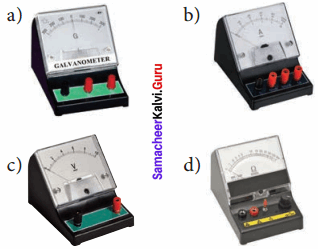
Answer:

  1. spotless
  2. sunset
  3. grandmother
  4. half-hour
  5. singsong
  6. over-straining
  7. courtyard
  8. gentle folk
  9. homecoming

(c) Match the words in Column A with their pairs in Column B to form compound words and write them in Column C:

Column AColumn BColumn C
1.mantel(a)lashes
2. .eye(b)wheel
3.water(c)gate
4.bee(d)knob
5.toll(e)piece
6.door(f)proof
7.spinning(g)hive

Answer:
1. (e) piece (mantelpiece)
2. (a) lashes (eyelashes)
3. (f) proof (waterproof)
4. (g) hive (beehive)
5. (c) gate (tailgate)
6. (d) knob (doorknob)
7. (b) wheel (spinning wheel)

(d) Frame meaningful sentences of your own using the following expressions from the story. Use a dictionary if required.

Question (i)
the thought was almost revolting
Answer:
The thought that a 27-year-old man could murder a college girl in daylight was revolting.

Question (ii)
an expanse of pure white serenity
Answer:
Nammalvar had a long white beard like an expanse of pure white serenity.

Question (iii)
a turning point
Answer:
Gandhiji’s encounter with an ill-clad poor woman in Madurai was a turning point in his political life.

Question (iv)
accepted her seclusion with resignation
Answer:
Grandma accepted her seclusion with resignation.


Question (v)
frivolous rebukes
Answer:
My mom bathed my younger brother with frivolous rebukes.

Prefixes And Suffixes

(e) Form two derivatives from each of the following words: e.g. honest – dishonest, honesty

managedifferbeauty
peacearrangecollect
approvenarrateclass

Answer:

  1. manage – manager, management
  2. differ – different, difference
  3. beauty – beautiful, beautious
  4. peace – peaceful, placemaker
  5. arrange – arranged, arrangement
  6. collect – collector, collective
  7. approve – approval, disapprove
  8. narrate – narration, narrator
  9. class – classic, classify

Homophones

(f) Fill in the blanks with suitable homophones:

(i) brake/break
(a) We have a short _______ between the sessions.
(b) The car skidded to a halt when I applied the _______

(ii) waste/waist
(a) Shivani wears a belt around her _______
(b) We should never misuse or _______ natural resources.

(iii) principle/principal
(a) Oxygen is the _______ element present in earth’s crust.
(b) Both these machines work on the same _______

(iv) bread/bred
(a) Turtles should be _______ in a healthy environment.
(b) I like to have toasted _______ for breakfast.

(v) lesson/lessen
(a) This medicine will _______ your pain.
(b) Finally, the manager learnt a _______ the hard way.

(vi) pale/pail
(a) The child looks very sick and _______
(b) I need a _______ of water to wash these cups.

(vii) through/threw
(a) Ravi picked the banana peel and _______ it in the dustbin. ,
(b) The soldiers had to pass _______ a dark tunnel.

(viii) corps/corpse
(a) The _______ was covered with a shroud.
(b) A five-day annual training camp for the senior cadets of the National Cadet _______ been organised.
Answers:
(i) (a) break (b) brake
(ii) (a) waist (b) waste
(iii) (a) principal (b) principle
(iv) (a) bred (b) bread
(v) (a) lessen (b) lesson
(vi) (a) pale (b) pail
(vii) (a) threw (b) through
(viii) (a) corpse (b) corps

Listening Activity

Read the following statements and the given options. Now, listen to your teacher read aloud a passage or play it on a recorder. You may listen to it again if required, to help you choose the right options.

(For listening to the passage refer to our website www.fullcircleeducation.in) The hand that rocks the cradle rules the world. It is the mother who rocks the cradle. It is she who exercises her influence over the mind of her children. She moulds the character of her children with her noble qualities. Napoleon said, “Give me good mothers, I will give you a good nation”. Mothers play an important role in building nations. The love of our mother is usually the first and deepest love that we come across. For many people their mother’s love becomes the pattern of love in later life.

A mother’s love is unconditional. No matter what you do, you know that your mother will always love you. The phrase ‘mother’s love’ derives from the love traditionally shown by a biological mother to her child. But indeed any love that is deeply caring and unconditional can be described as a motherly love, Adoptive mothers show this type of love to the children they adopt. It is important in life to be cherished and loved for who you are and to be supported in all you do! Love is the most important thing in the world. Why not exhibit love to creatures and all those around you?

Question 1.
According to Napoleon ‘Good mothers make good _______
(a) housewives
(b) jobs
(c) nations
(d) ideas
Answer:
(c) nations

Question 2.
Mothers exhibit _______ love.
(a) unauthorized
(b) unapproved
(c) unacceptable
(d) unconditional
Answer:
(d) unconditional

Question 3.
_______ mothers care much for their children.
(a) Adapted
(b) Adopted
(c) Adoptive
(d) Influence
Answer:
(c) Adoptive

Question 4.
_______ is the most important thing in the world.
(a) Wealth
(b) Power
(c) Love
(d) Influence

Question 5.
Love should be extended to _______ too.
(a) friends
(b) relatives
(c) countrymen
(d) creatures
Answer:
(d) creatures

Speaking Activity

(a) Work in pairs and arrive at five points that bring out the benefits and challenges of living in either a nuclear family or a joint family. Share your views with your class.
In a nuclear family:

  • A child gets a lot of attention.
  • Child need not wait for anything he wants.
  • Both the parents shower love and protect him/her from any harm.
  • There is no scope for disappointments as parents are anxious to fulfill the needs of children.
  • Child wants parent to solve all his/her problems and never learns self-reliance.

In a joint family:

  • Child has to wait for what he wants to get.
  • There will be many to play with.
  • There is plenty of scope for caring and sharing.
  • Learn to cope with disappointments and failures in a healthy way.
  • Learn to adjust with others and tend to be empathetic.

(b) Build a conversation of eight to ten sets of exchanges, with your grandmother discussing the incidents that happened in your school that day.

Myself : Grandma, I am back home.
Grandma : Please go and wash your face, hands and legs.
Myself : Why should I, grandma?
Grandma : I have prepared some sweets and pakora for you.
Myself : That’s really lovely grandma.
Grandma : What did you lean today?
Myself : I learnt about bees.
Grandma : How do bees communicate among themselves?
Myself : Grandma, when a bee discovers honey, he performs a kind of dance which conveys the availability of honey, type of flower and distance from the bee hive to the farm.
Grandma : That’s excellent. I never knew it.
Myself : Give me sweets and pakora.
Grandma : Stay here, I will bring them for you.


(c) Every member contributes to forming a happy family. Share your views for a minute or two with your class.

Father works hard and brings money home. Mom does all domestic chores. She cooks food, washes clothes and cleans the floor. Brother takes me to school in his scooter. My grandma combs my hair. She has all the time in the world to tell me tales and listen to all my experiences and stories. On Sunday we all join hands and clean the house. Then we all dine together and share what happened to each of us. I do agree that everyone contributes to a happy family.

Reading

Now, read the following passage on“Laughter Therapy” and answer the questions that follow.

1. Laughing is an excellent way to reduce stress in our lives; it can help you to cope with and survive a ’ stressful life. Laughter provides full-scale support for your muscles and unleashes a rush of stress busting endorphins. Since our body cannot distinguish between real and fake laughter, anything that makes you giggle will have a positive impact.

11th English Unit 1 Prose Paragraph Samacheer Kalvi The Portrait Of A Lady

2. Laughter Therapy aims to get people laughing, in groups and individual sessions and can help reduce stress, make people and employees happier and more committed, as well as improve their interpersonal skills. This laughter, comes from the body and not the mind.

3. Laughter Yoga (Hasya yoga) is a practice involving prolonged voluntary laughter. It aims to get people laughing in groups. It is practised in the early mornings in open-parks. It has been made popular as an exercise routine developed by Indian physician Madan Kataria, who writes about the practice in his 2002 book ‘Laugh for no reason’. Laughter Yoga is based on the belief that voluntary laughter provides the same physiological as well as psychological benefits as spontaneous laughter.

4. Laughter yoga session may start with gentle warm up techniques which include stretching, chanting, clapping, eye contact and body movements to help break down inhibitions and encourage a sense of playfulness. Moreover, laughter is the best medicine. Breathing exercises are used to prepare the lungs for laughter followed by a series of laughter exercises that combine a method of acting and visualization techniques. Twenty minutes of laughter is sufficient to augment physiological development.

11th English Unit 1 Prose Question Answer Samacheer Kalvi The Portrait Of A Lady

5. A handM of small scale scientific studies have indicated that laughter yoga has some medically beneficial effects, including cardiovascular health and mood. This therapy has proved to be good for depressed patients. This laughter therapy also plays a crucial role in social bonding.

Answer the following:

Question (a)
How does laughter help one to cope with stress?
Answer:
Laughter provides full scale support for one’s muscles and unleashes a rush of stress busting endorphins. Thus it helps one to cope with stress.

Question (b)
Which word in the text (para 2) means the same as ‘dedicated’?
Answer:
‘Committed’ means dedicated.

Question (c)
Why do you think voluntary laughter provides the same physiological as well as psychological benefits as spontaneous laughter?
Answer:
Human body cannot distinguish between real and fake laughter. Anything that makes a person giggle has a positive impact on one’s health. That is why I think voluntary laughter provides the same psychological and physiological benefits as spontaneous laughter.

Question (d)
‘Laughter is the best medicine’. Explain.
Answer:
Twenty minutes of laughter is sufficient to augment physiological development. Laughter has some medical benefits such as cardiovascular health and mood. Hence, “Laughter is the best medicine”.

Question (e)
Given below is a set of activities. Which of these are followed in the ‘Laughter Yoga’ technique?
Answer:

  • Body movements
  • Clapping
  • Breathing exercises
  • Stretching of arms and legs
  • Bending backwards

Question (f)
‘Laughter therapy also plays a crucial role in social bonding’. How?
Answer
Man is a social animal. Laughing breaks the ice and enables friendly conversations. A person endowed with spontaneous laughter naturally attracts large number of friends. In his company, even distressed relatives feel relieved and happy. Thus, laughter plays a crucial role in social bonding.

Grammar

Articles and Determiners
Determiners are words placed in front of a noun to clarify what the noun refers to.
Look at this sentence.
‘This laughter therapy also plays a crucial role in social bonding.’
Here the word ‘this’ refers to a particular noun – ‘laughter therapy’.
Types of Determiners

ArticlesDemonstrativePossessive adjectives
athismy, your
anthathis, her
thetheseits, our
thoseyour, their
QuantifiersNumbersOrdinals
– some, any
few, little
more, much
any, every
one, two
three, four
twenty,
hundred
first, second
third, last next

(a) Read the paragraph below and fill in the blanks using ‘a, an’, or ‘the’.

It is said that (1) _____ computer is (2) _____ electronic extension of the human brain. Therefore, in principle, (3) _____ computer can do all those activities which (4) _____ human brain can do. Today computers are found to be (5) _____ most useful devices as knowledge providers. Another important field of application of computers is (6) _____ development of robots. (7) _____ internet has brought (8) _____ drastic change in communication systems.
Answer:

  1. the
  2. an
  3. the
  4. the
  5. the
  6. the
  7. The
  8. a

(b) In the following paragraph, insert ‘a, an’,or ‘the’ wherever necessary and rewrite the sentences.

In our family, we have planned to take children to zoo next Sunday. Van has been arranged and we are sure to have comfortable journey. Zoo is interesting place for children who enjoy watching animals and want to know more about them. Even youngsters love to visit zoo.
Answer:
In our family, we have planned to take children to the zoo next Sunday. A Van has been arranged and we are sure to have a comfortable journey. The Zoo is interesting place for children who enjoy watching the animals and want to know more about them. Even the youngsters love to visit the zoo.

(c) Fill in the blanks with appropriate determiners. (Articles have been included)

Once the emperor gave a bag of seeds to his council of ministers and said that he would give them six months time to grow the seeds. Whoever does a good job will be made the (1) _____ emperor of that empire. (2) _____ the ministers took their task seriously. After six months (3) _____ ministers had small plants in their pots. A (4) _____ had very large plants. (5) _____ had medium sized plants. The emperor entered the hall. He was (6) _____ amused to see (7) _____ plants. He called the (8) _____ minister and asked him what he did with the seed. (9) _____ minister explained the process he adopted to make (10) _____ plant grow. (11) _____ the emperor called the other ministers to explain what they did. Only (12) _____ minister had come with an empty pot.They laughed loudly at the foolishness of this minister. But the Emperor applauded him and made him the (13) _____ Emperor. Do you know why? He had given them boiled seeds which will not grow. Only (14) _____ minister was honest.
Answer:

  1. next
  2. All
  3. many
  4. few
  5. Some
  6. very much
  7. the
  8. first
  9. The
  10. the
  11. Next
  12. one
  13. next
  14. one

(d) Fill in the blanks with appropriate determiners.

  1. They came early but there was (little/ a little) work to do.
  2. Anand invited (few/a few) friends for the birthday party.
  3. The teacher gave (all /every) student a separate topic for the assignment.
  4. (Most of/Many) the water overflowed from the tank.
  5. Each one of my (friend/fiiends) wished me on my birthday.
  6. Vijay had (no/ any) idea about the problem.
  7. Adhi had taken (much /many) photos during the programme,
  8. (Some/Few) girls who attended the class informed the others about the test.

Answers:

  1. little
  2. a few
  3. every
  4. Most of
  5. friends
  6. no
  7. many
  8. some

Tenses

(a) Fill in the blanks with the correct form of the verbs in brackets and read the completed passage aloud.

The people of India, as a whole, (1) _______ (be) warm-hearted and hospitable. Any calamity in any part of the world immediately (2) _______ (arise) their charity and generosity and a. committee (3). _______ (be) promptly (4) _______ (set ) up to collect funds to help the distressed. The most endearing quality in them (5) _______ (be) the respect they show for the work done in any capacity. They (6) _______ (believe) in what we (7) _______ (call) the dignity of labour.
Answers:

  1. are
  2. arouses
  3. is
  4. set
  5. is
  6. believe
  7. call

(b) Now, use the verbs given in brackets in the following sentences in their correct forms.

Question 1.
I (like) to spend time with my friend,whenever I (be) free.
Answer:
I like to spend time with my friend, whenever I am free.

Question 2.
He (is) likely to miss the train. He (run) to the station.
Answer:
He is likely to miss the train. He is running to the station.

Question 3.
At the moment, they (wait) at the bus-stop. But I (not know) their plans for the journey.
Answer:
At the moment, they are waiting at the bus-stop. But I do not know their plans for the journey.

Question 4.
They firmly (believe) in the existence of God.
Answer:
They firmly believe in the existence of God.

Question 5.
We (hear) a lot of noise because the new buildings (transmit) sound waves.
Answer:
We hear a lot of noise because the new buildings are transmitting sound waves.

Question 6.
She always (make) excuses for coming late.
Answer:
She always makes excuses for coming late.


Question 7.
The Prime Minister (leave) for America to meet the delegates tomorrow.
Answer:
The Prime Minister leaves for America to meet the delegates tomorrow.

(c) You are a commentator for a 5000 metre running race. Use simple present and present continuous tenses and complete the commentary from the beginning to the end of the race. Read the completed passage aloud.

The 5000 metre race is about to begin. Lined up at the starting point, from left to right, are John of Great Britain, Peter of Nigeria and Jeeva of India. The runners are warming up for the great event. Now they. (1) _______ (take) their positions on the track. They (2) _______ (be) all ready for the start. There (3) _______ (go) the starter’s gun! Yes, the race has begun. John (4) _______ . (lead) with Jeeva (5) _______ (close) behind him.
Answer:

  1. are taking
  2. are
  3. goes
  4. is leading
  5. closing

(d) Read the extract from Kayal’s diary entry regarding her Nepal Trek, and fill in the blanks with the correct tense form of the verbs given in brackets.

DAY 1: We (1) _______ (leave) Anna International Airport in Chennai two days ago catching a direct flight to Kathmandu in Nepal. We (2) _______ (spend) a day sightseeing. Kathmandu is full of people, rickshaws and the smell of sandalwood. I’ve never (3) _______ (be) on a trip like this before. So I’m really excited.

DAY 2: It (1) _______ (rain) when we reached Pokhara, Nepal’s second largest city, and saw the snowy peaks of the Himalayas for the first time. We. (2) _______ (reach) Pokhara after a hair-raising six-hour bus journey along very narrow roads with a lot of hairpin bends. The bus (3) _______ (be) so full that one person had to share the driver’s seat.

DAY 3: We (1) _______ (begin) our trek at last. We are at about 900 metres and the weather is warm and humid. For lunch we had chips and yak cheese sandwiches. I didn’t like them very much. I’m thrilled that we (2) _______ (pitch) tents for our camps in the dense forests.

DAY 4: Yesterday a landslide (1) _______ (block) our path and we had to use ropes to get over it. This morning we walked along the river Kali Gandaki through dense forests of oak trees and we pitched our camp at Tukuche below the Annapurna mountain range. The main danger in addition to landslides, is ‘yak attack’. Yaks (3) _______ (be) not dangerous but you have to be careful if you meet a herd of them because they can push you off the sides of the mountain.

DAY 5: We met a lot of children on our trek through the villages. They (1) _______ (play) in the pool of muddy rain water as we left the place. We have already climbed 2,400 metres. Up here, it never (2) _______ (rain) and there are no trees. It (3) _______ (be) windy and dusty and I am always thirsty.

DAY 6: Yesterday we (1) _______ (go) up to the mountainside of the township of Mukthinath, at 3,600 metres. The thin air with less oxygen there (2) _______ (leave) us breathless. We (3) _______ (feel) that we couldn’t go any further. We (4) _______ (drink) a lot of extra fluids to prevent altitude sickness.

DAY 7: We turned around today and started to descend to Jomosom. As we went down, the oxygen filled our blood again and we seemed to (1) _______ (fly) instead of walking.

DAY 8: We went back to Pokhara in a small plane yesterday. It (1) _______ (excite) when we flew between the mountain peaks. We arrived in Kathmandu this afternoon and we

(2) (spend) our last few hours in shopping. We leave for Chennai tomorrow. We’ve had a trip of a lifetime.
Answers:
Day-1
1. left
2. spent
3. been

Day-2
1. was raining
2. reached
3. was

Day-3
1. began
2. pitched

Day-4
1. blocked
2. are

Day-5
1. were playing
2. rains
3. is

Day-6
1. went
2. left
3. felt
4. drank

Day-7
1. be flying

Day-8
1. was exciting
2. spent

(e) In the following passage, circle the verbs in simple present tense and underline the verbs in simple past. The first one has been done for you.

(i) Unless one upright there (is) no use in being a charming fellow. Sometimes it (Is) better to be honest than attractive. These are the great truths of modem life which Shyam never realised. He never said an ill-natured word in his life. He was always polite and spoke softly to everybody.

(ii) That night he strolled into the Palette Club about eleven o’clock, and found Trevor sitting by himself in the long room. “Well, Alan, did you get the picture finished all right? “he said, as he lit his cigarette. “Finished and framed, my boy!’’ answered Trevor, “and by- the-bye, you have made a conquest. That old model you saw (is) quite devoted to you. I had to(tell) him all about you – who you (are) where you (fivt), what your income(is) what prospects youljiave).”

(iii) “And now (tell) me how Laura (is) The old model was quite interested in her.” “You (jlorYt) mean to say you talked to him about her?” said Hughie. “Certainly I did. He ((mows) all about the relentless colonel, the lovely Laura, and the £10,000.” “You told that old beggar all my private affairs?” cried Hughie. looking very red and angry. “My dear Alan,” cried Hughie, “I shall probably find him waiting for me when I(go) home.”

(f) Fill in the blanks using Past tense forms of the verbs:

  1. I never (see) _______ such a beautiful sunrise before I came here.
  2. We were not able to stay overnight as we _______ not (reserve) the tickets in advance.
  3. Nirmala _______ (be) to the concert several times.
  4. Mariappan knew Pudukottai so well because he _______ (live) there for five years.
  5. Yusuf understood the problem because he _______ (experience) the situation earlier.
  6. Catherine did not have any cash because he _______ (lose) her purse.
  7. My father _______ (be) to Mumbai once before.
  8. The cat _______ (chase) the bird before it flew out of the yard.
  9. Edith _______ (visit) several doctors before she found out what the problem was with her knee.
  10. If we _______ (call) the manager ahead,we would not have needed to wait so long for a table.

Answers:

  1. had never seen
  2. did not reserve
  3. had been
  4. had lived
  5. had experienced
  6. had lost
  7. had been
  8. had chased
  9. visited
  10. had called

(g) Read the following news report and underline the past perfect tense form of the verb and circle the simple past tense form of the verb.

India Beat Pakistan To Win Blind Cricket World Cup:

Chasing a huge target of 308 runs, India (romped) home in the penufrimateover of the match to defeat Pakistan and win the Blind Cricket World Cup. India (started off) their chase in a cracking manner, but had lost two quick wickets. Sunil RameslKrbsepto the occasion as he (jflayetf) a great knock to help India beat Pakistan and had scored 93 runs. Earlier India (won) the toss and had decided to bowl first. Pakistan (amassed)a huge score of 307 for eight in 40 overs. Their openers had given them a brisk start which the later batsmen (capitalize) on.


(h) Read the following extract and fill in the spaces with the right form of verbs and complete the passage. The first one is done for you.

Question (i)
The poet stops to hear the maiden singing while she (1) _____ (cut) and (2) _____ (bind) the grain. The song of the lady (3) _____ (fascinate) the poet, who (4) _____ (stand) there to listen to the song. The girl (5) _____ (sing) a sad song.
Answer:

  1. cuts
  2. binds
  3. fascinates
  4. stands
  5. sings

Question (ii)
During the monsoon, a tender slightly warm breeze (1) _____ (blow) on a cloudless afternoon. A sort of fragrance (2) _____ (rise) from the wet grass and trees in the sunlight. It (3) _____ (seem) as if the warm breath of the exhausted earth (4) _____ (fall) against one’s skin. A sweet voiced bird somewhere (5) _____ (chirp) repeatedly.
Answer:

  1. blows
  2. rises
  3. seems
  4. falls
  5. chirps

(i) Read the news item that appeared in a daily and fill in the blanks with suitable forms of the verbs given in brackets.

Ever since social networking sites entered our lives, they (1) _____ (serve) as platform.s where users could use the virtual space offered by these social media. However, recent incidents (2) _____ (cause) many to question the freedom to express views on various issues and in some cases, it (3) _____ (become) a dangerous platform. Social Contact (4) _____ (transform) people. They (5) _____ (develop) an addiction to it.
Answers:

  1. have been serving
  2. have caused
  3. has become
  4. has transformed
  5. have developed

(j) Read the following passage and correct the errors you come across.

Question 1.
Rajan slowly settle down in his retired life. His pension plus what his wife bring from the household work she does, helped them to meet their requirements. Life is easy until one Sunday. His granddaughter Madhu come crying. The clay doll in her hand had broken into two. Rajan pacify her and promise to mend it. This small repair work become the founding stone of a very prosperous venture into making clay dolls which earn him great respect.
Answer:
Rajan slowly settled down in his retired life. His pension plus what his wife brought from the household work she did, helped them to meet their requirements. Life was easy until one Sunday his granddaughter Madhu came crying. The clay doll in her hand had broken into two. Rajan pacified her and promised to mend it. This small repair work became the founding stone of a very prosperous venture into making clay dolls which earned him great respect.


Question 2.
Games and sports helps in recreation. Soccer, cricket, lawn tennis or wrestling is eagerly watched by millions of fans all over a world. It helps one got a temporary relief from the tensions of a day. The dedication displayed by all player in the field indicates the mental and spiritual development of the player.
Answer:
Games and sports help in recreation. Soccer, cricket, lawn tennis or wrestling are eagerly watched by millions of fans all over the world. It helps one get a temporary relief from the tensions of a day. The dedication displayed by all players in the field indicates the mental and spiritual development of the players.

Writing

(a) Notice:

The Portrait Of A Lady Book Back Answers Samacheer Kalvi 11th English Solutions Prose Chapter 1

(i) Prepare a notice to be displayed on the notice-board of your school for the students of Class 11, informing them about the educational tour that has been arranged for them the next month.

11th English Prose Paragraph Samacheer Kalvi Chapter 1 The Portrait Of A Lady

(ii) Write a notice about the inauguration of a laughter club in your school.

11th English 1st Lesson Paragraph Samacheer Kalvi The Portrait Of A Lady

(b) Message:
You are the Sports Captain of your school. Write a message to the Physical Director, requesting him to be present during the football team selection scheduled for tomorrow.
11th English Guide Pdf Free Download Samacheer Kalvi The Portrait Of A Lady

(c) Do you exercise regularly? If you do, which of these following activities do you prefer? Discuss and share with your partner a few lines about your preference.

(A) Walking
(B) Working out in a gym
(C) Swimming
(D) Cycling

A : I prefer walking. It is a wholesome exercise. Regular walk helps blood circulation very well. A brisk walk for an hour a day keeps one perfectly fit.
B : I love swimming. I admire Michael Phelps for his achievement in swimming. When schools disowned him, his mom found out his interest in swimming. He turned out to be an Olympian of all times with 28 medals. One day I will win gold in swimming for India.
C : Well, after seeing Dipa Karmakar perform ‘pordunova’ vault at the summer Olympics in 2016,1 wish to become an expert in gymnastics
D : Well, I love cycling because it is pollution free. I feel it gives a complete exercise.

Task

You are Mani/Megalai of Class XI, President of the English Club of your school. Draft a speech on the topic ‘Reading Maketh a Complete Man’ to be delivered in the school assembly.

Reading Maketh a Complete Man:

Respected Headmaster, teachers and my dear friends. I am Kaman / Kamala of class XI. I am before you to share my ideas on the topic “Reading Maketh a Complete Man”. Francis Bacon said, “Reading maketh a full man, conference a ready man and writing an exact man.” But the question concerns only reading here.

Extensive and intensive reading builds the mind with valuable ideas and information. A full mind is better than ill-informed or uninformed mind. Reading nourishes the intellect and nurtures one’s imagination. Researches prove that reading good books, can reduce stress levels by half. These is nothing more relaxing and soothing than reading a good book. Without travelling, a sensitive and sensible reader travels around the world. The reader is exposed to new culture and innovative ideas. Reading is a gift. It can be cultivated. It is sad that many students squander their time in playing games in mobile phone or watching useless film music or comic scenes when they must be spending their purple hours of life in reading books. They also waste their time in social websites like Facebook, Twitter and WhatsApp. This addiction in digital technology and browsing harmful websites distracts the young ones.

To dissuade young ones from social media and mass media and help them read books is equal to climbing Everest under hostile weather. So, teachers and parents should share their own joy of reading good books by sharing the best of what they read with student community. Reading makes a man complete. To lead holistic and meaningful lives, I request all my friends to develop a love for reading great classics under the guidance of dedicated teachers and with the help of libraries. –
The more you read, the more you will know.
The more you learn, the more places you’ll go.
So Read and Grow!
Thank you

The Portrait of a Lady About the Author

11 English Guide Samacheer Kalvi Chapter 1 The Portrait Of A Lady

Khushwant Singh was an Indian novelist and a lawyer. He joined IKS in 1947. He had a calling to be a writer. He served as the editor of many literary and news magazines. As a writer, he is best known for his secularism, sarcasm and love lor poetry. The Mark of Vishnu, A History of Sikhs, The Train to Pakislan. Success Mantra. We Indians, and Death at My Doorstep are some of his masterpieces. I le was awarded Padma Bhushan in 1974 and Padrna Vibhushan by the Government of India. He also received the most coveted Sahitya Academy fellowship. The present story, “The Portrait of a Lady” seems to have been inspired by the novel, “The Portrait of a Lady” by Henry James. It. revolves around the author’s grandmother whose milk of human kindness sustained birds, animals and children. Her unconditional love for all gives her a beauty beyond her age.

The Portrait of a Lady Summary

The author’s grandma was old and wrinkled for about twenty years. The author was told that his grandma was once young and pretty. She had a husband. But the author could not bring himself to believe it as he had seen her old right from his childhood. The picture of author’s grandpa was hung in the drawing room above the mantelpiece. He wore a big turban and loose-fitting garment. His long beard ran down to his chest. He appeared at least 100 years old. He did not look like a family man who could have had a wife and children. He only appeared like an pld man with many grand children.

Grandma was bent with age and had been so for a long time. Her entire body was wrinkled crisscross. She hobbled about the house with one hand on her waist to balance and another hand telling the beads of her rosary. She was always found whispering some inaudible prayer. Her silver locks were scattered on her face untidily. She was beautiful like the winter landscape in the mountains. She was an expansion of pure white serenity breathing peace and contentment.

11th English Book Back Answers Samacheer Kalvi Chapter 1 The Portrait Of A Lady

The author and his grandma were great friends. As his parents had left him under her care and went to live in the city, he spent most of his time with her. She used to wake up the author early in the morning and helped him to get ready for school. She would sing morning prayers in a sing-song voice to enable the young author to remember the prayer by hearing. She would feed him with a stale chapatti smeared with a little butter and sugar. She would fetch his wooden slate and she accompanied him to school everyday. She would bring a lot of stale chapattis for the village dogs back home. She loved temple which was a place of worship and learning.

While the priest taught the children letters of the alphabet, grandma sat inside the temple reading scriptures. When her reading of scriptures and the author’s learning of letters got over for the day both would return home. While returning home grandma would feed the dogs with stale chapattis. The animals would fight among themselves as each chapatti was thrown.

In the village the author spent a lot of time with grandma. But after moving over to the city, he went to an English medium school in a bus. There were no dogs. She started feeding the sparrows. Grandma and the author were in the same room but the time they spent together got reduced considerably.

The author was happy to share the new English words he learn and Science theories like Archimedes’ principles, law of gravity and the shape of the earth. This upset her. She could no more help him with his lessons. The new school did not teach about God or scriptures. The day the author said that he was taking music lessons in school, she became uncomfortably silent.

When the author left for university, grandma was resigned to the fate or a secluded life. She continued her spinning work and chanting. The spinning wheel and prayer kept her busy all day. She rarely spoke to humans nowadays. She relaxed for half an hour in the afternoon.

This was the happiest time of her day as she broke the bread into small bits to feed the sparrows. It was literally a bedlam of chirruppings. Some would perch on her legs and some on her head. She never shooed them away. Instead, there was an angelic smile on her face, She relished those moments.

Samacheer Kalvi 11th English Guide Chapter 1 The Portrait Of A Lady

The author had the opportunity to go abroad. Grandma came to the railway station to farewell. She did not show any emotion or sentiment. Her moist lip imprint on his forehead, j made him wonder if it was her last physical contact with him.

I After five years, when the author returned, she met him at the railway station. She did not j appear to be older. She just hugged the author but continued telling the rosary. She did not i try to show interest in knowing what happened abroad in his life. Instead, she continued to evince keen interest in feeding the sparrows. She fed them longer.

One evening grandma did not pray. Instead, she got an old drum and started singing. She sang of the home-coming of warriors. Everyone got anxious that grandma might strain her nerves. Perhaps it was her swan song.

Grandma ran a temperature. Doctor said that it was a mild fever. But grandma predicted that i her end was near. She didn’t want to waste her time talking to the family members. Grandma lay in bed telling the rosary. Before sunset, her lips stopped chanting and the rosary i fell from her hands. The peaceful pallor on her face conveyed her soul’s departure from the ! body.

She was lifted from bed. She was covered with a red shroud. After a few hours, the body was | left alone to make funeral arrangements. They brought a crude stretcher to take her to the cremation ground.

The sun was setting. Grandma’s room was lit with a blaze of golden light. The room where ! the body was kept, thousands of sparrows sat scattered on the floor. There was no chirruping, i The family was sorry for the birds. Mom broke the bread into crumbs, the way grandma used I to do, and threw it to them. But not a single sparrow took notice. When grandma’s corpse was carried off, they flew away quietly.

Khushwant Singh’s The Portrait of a Lady, in short, gives a splendid pen-picture of his own j grandmother who had steadfast graceful values and philosophy of life. She lived and died gracefully.

The Portrait of a Lady Glossary

Textual:
absurd – inconsistent/ illogical bedlam – noisy confusion dilapidated -damaged expanse -widespread
fables -tales/stories hobbled – walked unsteadily mantelpiece – shelf projecting from the wall above a fireplace
monotonous – unchanging /boring
pallor – an unhealthy pale appearance
perched – sat/rested
pucker – to contract the face into wrinkles
rebukes – scoldings
seclusion – isolation
shroud – cloth used to wrap a dead person
snapped – broke / cut.

Additional:
cherished – retained in memory
contentment – satisfaction
distressed – upset
inaudible – unable to be heard
sentimental – emotional
spotless – clean
untidily – disorderly

The Portrait of a Lady Synonyms

Choose the most appropriate synonym of the underlined word.

Question 1.
The thought was almost revolting.
(a) planning
(b) inspiring
(c) disgusting
(d) appealing
Answer:
(c) disgusting


Question 2.
Once she had been young and pretty.
(a) old
(b) ugly
(c) attractive
(d) unpleasant
Answer:
(c) attractive

Question 3.
That seemed quite absurd.
(a) logical
(b) serene
(c) sincere
(d) silky
Answer:
(d) silky

Question 4.
We treated it like the fables of the prophets.
(a) realists
(b) surrealists
(c) magicians
(d) seers
Answer:
(d) seers

Question 5.
She wore spotless white saree.
(a) dull
(b) dirty
(c) pale
(d) clean
Answer:
(d) clean

Question 6.
Her lips moved in inaudible prayer.
(a) unseen
(b) unheard
(c) distasteful
(d) unidentified
Answer:
(b) unheard

Question 7.
She hobbled about the house with her human back.
(a) walked
(b) staggered
(c) hopped
(d) danced
Answer:
(b) staggered

Question 8.
Her silver locks were scattered untidily.
(a) orderly
(b) neatly
(c) hygienically
(d) disorderly
Answer:
(d) disorderly

Question 9.
She was breathing serenity and contentment.
(a) dissatisfaction
(b) malcontent
(c) satisfaction
(d) contenment
Answer:
(c) satisfaction

Question 10.
The fables from the lives of people are really fascinating.
(a) jokes
(b) anecdotes
(c) stories
(d) songs
Answer:
(c) stories

Question 11.
She was like an expanse of pure white serenity.
(a) widespread
(b) narrow
(c) squeezed
(d) expatriate
Answer:
(a) widespread


Question 12.
She was distressed that there was no teaching about God or scriptures.
(a) pleased
(b) overwhelmed
(c) upset
(d) delighted
Answer:
(c) upset

Question 13.
Her silence meant disapproval.
(a) acceptance
(b) consent
(c) rejection
(d) consent
Answer:
(c) rejection

Question 14.
The common link of friendship got snapped.
(a) cut
(b) united
(c) linked
(d) conjoined
Answer:
(a) cut

Question 15.
My grandmother accented her seclusion.
(a) company
(b) recognition
(c) inclusion
(d) isolated
Answer:
(d) isolated

Question 16.
Only in the afternoon she relaxed for a while.
(a) rested
(b) slept
(c) read
(d) worked
Answer:
(a) rested

Question 17.
Hundreds of birds created a veritable bedlam of chirruping.
(a) serenity
(b) speed
(c) confusion
(d) quieted
Answer:
(c) confusion

Question 18.
She fed the birds with frivolous rebukes.
(a) blessings
(b) scoldings
(c) praises
(d) Adornment
Answer:
(b) scoldings

Question 19.
The birds perched on her head or legs.
(a) slept
(b) danced
(c) flew
(d) sat
Answer:
(d) sat


Question 20.
She never shooed them away.
(a) chased
(b) invited
(c) let
(d) reanounced
Answer:
(a) chased

Question 21.
She was not even sentimental.
(a) emotionless
(b) emotional
(c) cool
(d) hateful
Answer:
(b) emotional

Question 22.
When I left I cherished the moist imprint on my forehead on the last sign of physical contact.
(a) forgot
(b) retained
(c) loitered
(d) wandered
Answer:
(b) retained

Question 23.
For several hours she thumped the sagging skins of the dilapidated drum.
(a) perfect
(b) solid
(c) met
(d) damaged
Answer:
(d) damaged

Question 24.
A peaceful pallor spread on her face.
(a) sickliness
(b) healthiness
(c) freshness
(d) rejuvenation
Answer:
(a) sickliness

Question 25.
We laid her on the ground and covered her with a rose shroud.
(a) saree
(b) chudidhar
(c) pant
(d) veil
Answer:
(d) veil

The Portrait of a Lady Antonyms

Question 1.
She had been old and her skin wrinkled for the twenty years I had known her.
(a) lined
(b) smooth
(c) marked
(d) folded
Answer:
(b) smooth

Question 2.
She had once been pretty.
(a) beautiful.
(b) plain / ugly
(c) graceful
(d) attractive
Answer:
(b) plain / ugly

Question 3.
He wore a loose fitting garment.
(a) free
(b) detached
(c) tight
(d) slim
Answer:
(c) tight


Question 4.
The thought was revolting.
(a) distasteful
(b) horrible
(c) nasty
(d) pleasing
Answer:
(d) pleasing

Question 5.
That seemed quite absurd.
(a) wise / logical
(b) silly
(c) illogical
(d) incongruous
Answer:
(a) wise / logical

Question 6.
She was alwavs spotless white.
(a) neat
(b) clean
(c) pine
(d) dirty
Answer:
(d) dirty

Question 7.
One hand was resting on her waist to balance her stoop
(a) hunch
(b) bent
(c) upright
(d) curved
Answer:
(c) upright

Question 8.
Her silver hair lav scattered.
(a) sprinkled
(b) untidy
(c) gathered
(d) divided
Answer:
(c) gathered

Question 9.
Her lips were moving constantly in inaudible naver.
(a) always
(b) persistently
(c) regularly
(d) inconstantly
Answer:
(d) inconstantly

Question 10.
She was an expanse of white serenitv.
(a) harmony
(b) peace
(c) equilibrium
(d) anxiety
Answer:
(d) anxiety

Question 11.
There was contentment in her face?
(a) satisfaction
(b) widespread
(c) dissatisfaction/discontentment
(b) pleasure
Answer:
(b) widespread

Question 12.
She was distressed.
(a) upset
(b) frightened
(c) anxious
(d) pleased
Answer:
(a) upset

Question 13.
She was not sentimental.
(a) emotional
(b) dispassionate / practical
(c) tender
(d) sad
Answer:
(b) dispassionate / practical

Question 14.
Grandma accepted her seclusion.
(a) loneliness
(b) segregation
(c) solitude
(d) association
Answer:
(d) association

Question 15.
We had to persuade her to avoid overstraining.
(a) accept
(b) dissuade
(c) motivate
(d) inspire
Answer:
(b) dissuade

Question 16.
She said her morning prayers in a monotonous sing-song voice.
(a) tiresome
(b) fragrant
(c) satisfying
(d) interesting
Answer:
(d) interesting


Question 17.
She rarely spoke to me after that.
(a) scarcely
(b) hardly
(c) always
(d) occasionally
Answer:
(c) always

Question 18.
They flew away quietly.
(a) noiselessly
(b) calmly
(c) composedly
(d) noisily
Answer:
(a) noiselessly

Question 19.
I cherished the moist imprint as the last sign of physical contact.
(a) marshy
(b) arid
(c) slimy
(d) sultry
Answer:
(b) arid

Question 20.
She fed the birds for a long time with frivolous rebukes.
(a) serious
(b) sad
(c) furious
(d) happy
Answer:
(a) serious

Question 21.
Only a few hours before the last chapter of her life she had omitted to pray
(a) isolated
(b) rejected
(c) contracted
(d) included
Answer:
(d) included

Question 22.
We protested.
(a) promoted
(b) apprehended
(c) accepted
(d) projected
Answers:
(c) accepted4>

The main aim is to share the knowledge and help the students of 11th English to secure the best score in their final exams. Use the concepts of Samacheer Kalvi 11th English Book Solutions Prose Chapter 1 The Portrait of a Lady Questions and Answers in Real time to enhance your skills. If you have any doubts you can post your comments in the comment section, We will clarify your doubts as soon as possible without any delay.

Samacheer Kalvi 11th English Solutions Poem Chapter 2 Confessions of A Born Spectator

Students who are interested in learning of 11th English Poem Chapter 2 Confessions of A Born Spectator Questions and Answers can use Tamilnadu State Board Solutions of 11th English Chapter Wise Pdf. First check in which chapter you are lagging and then Download Samacheer Kalvi 11th English Book Solutions Questions and Answers Summary, Activity, Notes Chapter Wise. Students can build self confidence by solving the solutions with the help of Tamilnadu State Board English Solutions. English is the scoring subject if you improve your grammar skills. Because most of the students will lose marks by writing grammar mistakes. So, we suggest you to Download Tamilnadu State Board 11th English Solutions according to the chapters.

Tamilnadu Samacheer Kalvi 11th English Solutions Poem Chapter 2 Confessions of A Born Spectator

Check out the topics covered in Poem Chapter 2 Confessions of A Born Spectator Questions and Answers before you start your preparation. Improve your grammar skills with the help of Samacheer Kalvi 11th English Book Solutions Questions and Answers pdf links. The solutions for Tamilnadu State Board 11th English Textbook are prepared by the English experts. So, if you follow Tamilnadu State Board Solutions 11th English Textbook Solutions you can cover all the topics in Poem Chapter 2 Confessions of A Born Spectator Questons and Answers. This helps to improve your communication skills.

Warm Up:

Not everybody loves to play and participate in games, sports and other extra-curricular activities. Some of us wish to be mere spectators. List out the activities in which you like to be either a performer or a spectator. Share your views with the class.

Activities
performer / playerspectator / audience
e.g.cricketmagician
(a)
(b)
(c)
(d)
(e)

Answer:

Activities
performer / playerspectator / audience
e.g.cricketmagician
(a)Footballhockey
(b)volley ballkabbadi
(c)moviechess
(d)music concertdance
(e)karatesinging

Samacheer Kalvi 11th English Confessions of A Born Spectator Textual Questions

1. Based on your understanding of the poem, answer the following questions in a sentence or two.

One infant grows up and becomes a jockey,
Another plays basketball or hockey,
This one the prize ring hates to enter
That one becomes a tackle or center,
I am just glad as glad can be
That I am not them, that they are not me.

With all my heart I do admire
Athletes who sweat for fun or hire,
Who take the field in gaudy pomp,
And maim each other as they romp,
My limp and bashful spirit feeds
On other people’s heroic deeds.

Now A runs ninety yards to score,
B knocks the champion to the floor,
Cracking vertebrae and spines,
Lashes his steed across the line,
You’d think my ego it would please
To swap positions with one of these.

Well, ego it might be pleased enough,
But zealous athletes play so rough
They do not ever in their dealings
Consider one another’s feelings.
I’m glad that when my struggle begins
‘Twixt prudence and ego, prudence wins.

When swollen eye meets gnarled fist
When snaps the knee, and cracks the wrist,
When officialdom demands,
Is there a doctor in the stands?
My soul in true thanksgiving speaks
For this modest of physiques.

“Athletes, I’ll drink to you
Or eat with you,
Or anything except compete with you,
Buy tickets worth their radium,
To watch you gambol in the stadium,
And reassure myself anew
That you are not me and I’m not you

Confessions Of A Born Spectator Question (a)
Why does the poet feel glad that he does not play any game?
Answer:
The poet feels glad that he was not a player but only a spectator. He is glad because the risk of injuring himself and others is more if he becomes a player.

Confessions Of A Born Spectator Summary Question (b)
Do you think the narrator is heroic? Why?
Answer:
I don’t think the narrator/poet is heroic. A Hero is one who confronts any challenge and acts on it and fights to the end. The narrator is happy as a non-participant observer of heroic and rough games.

Confessions Of A Born Spectator Questions And Answers Question (c)
The poet is satisfied just watching the heroic deeds of others. What could be the reason?
Answer:
The poet is very sensitive. He derives vicarious pleasure on seeing the play of all the players. He is not after glory, medals and not interested in inflicting injury on any opponent. So, he is happy staying out of all rough games.

11th English Unit 2 Poem Question (d)
The poet does not wish to exchange position with the runners. Why?
Answer:
The poet does not wish to break any world record in running. He knows that athletes have no feelings for their fellow players. So, the poet does not want to exchange positions with the runners.

Confessions Of A Born Spectator Meaning In Tamil Question (e)
Are the athletes conscious of the feelings of others? Why do you say so?
Answer:
No, the athletes are zealous in their endeavour to win. In the process they go to the extent of maiming fellow players. The player’s focus is mostly on winning and he is naturally not conscious of the feelings of others.

Confessions Of A Born Spectator Poem Line By Line Explanation Question (f)
Why would the referee ask whether there was a doctor in the stands? What stands is he referring to?
Answer:
When boxing contests go on, one tries to crack the wrist or snap the knee of the other boxer. When such an event takes place, a referee asks for a doctor to provide First Aid to the fatally wounded wrestler/boxer. The stands refers to the boxing ring.

11th English Confessions Of A Born Spectator Question (g)
Why does the poet prefer to buy tickets worth their weight in radium? Bring out the significance of the metal referred to here.
Answer:
Radium is more expensive than diamonds. It is a rare metal discovered by Madam Curie. The poet was ready to buy tickets as expensive as radium just to stay as a spectator.

2. Read the poem again and complete the summary using the words given in the box.
(thanksgiving, exchange, glad, confesses, physiques, zealous, satisfied, aims, admires)

In the poem ‘Confessions of a Born Spectator,’ Ogden Nash talks about how people choose different sports in their lives or decide to become athletes. While admiring the talents of athletes and sportsmen, the poet (i) ________ that he is glad that he is neither a sportsman nor an athlete. Children have different (ii) ________ and wish to play various games. Each child has in mind something in particular, but the narrator is (iii) ________ he is not one of the players. Though the narrator (iv) ________ the talents of all athletes, he derives satisfaction from watching them,’ but does not wish to (v) ________ places with them. He also sometimes regrets that (vi) ________ athletes play rough games without caring for the feelings of their sporting rivals. He feels that good sense and caution win over ego. The narrator wholeheartedly offers (vii) ________ the modest (viii) ________ of athletes. Ultimately the narrator is (ix) ________ that he himself is not an athlete.
Answer:

  1. confesses
  2. aims
  3. glad
  4. admires
  5. exchange
  6. zealous
  7. thanksgiving
  8. physiques
  9. satisfied

3. Read the poem and answer the following in a short paragraph of 8-10 sentences each.

Confession Of A Born Spectator Question (a)
Row does the poet establish the victory of common sense over ego?
Answer:
The poet is sure of his limitations. He had only modest of physiques. He can’t imagine receiving blows in a boxer’s ring. He has seen zealous athletes playing so rough that they never consider the feelings of fellow players. They are insensitive to the cracking wrist and snapping knees of fellows players. When his ego and prudence clashed, ego told him to seek glory in sports, but his pmdence always ignored it. Thus common sense prevailed. He remained a cheerful life-time fan. He was contented as a spectator of all kinds of games and sports and world famous athletes.

Summary Of Confessions Of A Born Spectator Question (b)
The poet does not wish to exchange places with the athletes. How does he justify his view?
Answer:
In the very first stanza, the poet admits that right from his boyhood days, he was glad to watch others play all kinds of games including boxing. He was glad that he was not one of them. His limp and bashful spirit feeds on the heroism of other players. He watches with a palpitating heart when ‘A’ runs ninety yards to bag a medal. He watches with obvious alarm when ‘B’ knocks another boxer down cracking his vertebrae and spines. The players maim each other. His ego would never be pleased to swap places with such popular players. He listens to the mention of prudence/common sense and refrains from hurting himself or others by not participating in any game whatsoever. Thus he justifies his view to continue as spectator.

Confessions Of A Born Spectator Stanza Wise Explanation Question (c)
According to the poet what contributes most to the injuries sustained by the athletes?
Answer:
According to the poet, zealous athletes play so rough that they do not even consider one another’s feelings in their dealings with other players. The players are mostly goaded by prize money or glory from the media’s light on them. They maim each other as they romp. Cracking vertebrae and spines don’t stop the rough players. Most of the players don’t have sportsmanship. They don’t treat success and failure equally.

In order to get the light of fame on their face, they are ready to permanently disable a rival player too. The crazy desire for championship titles, the light of fame on them, leads them to ignore swollen eyes, snapping of knee joints or cracking of wrists. In short, the poet believes the apathy of zealous players and obvious indifference to the pain and debilitating injury contributes most to the injuries sustained by athletes.

4. Read the given lines and answer the questions that follow in a sentence or two.

(a) With all my heart I do admire
Athletes who sweat for fun or hire

Confessions Of A Born Spectator Summary Pdf Question (i)
Whom does the poet admire?
Answer:
The poet admires athletes who play games.

Confessions Of A Born Spectator Poem Paragraph Question (ii)
For what reasons do the athletes sweat?
Answer:
The athletes play and sweat for fun or money.

(b) Well, ego it might be pleased enough
But zealous athletes play so rough..

Confessions Of A Born Spectator Appreciation Questions Question (i)
What pleases the ego?
When players outsmart their opponents and crack their vertebrae and spine, the ego is pleased.

Confessions Of A Born Spectator Poem Summary Question (ii)
Why are athletes often rough during play?
Enthusiastic athletes, in a bid to impress umpires and the spectators play roughly. Besides, they have no feelings for their opponents in the ring/playground.

(c) When officialdom demands
Is there a doctor in the stands?

Confessions Of A Born Spectator Poem Question (i)
Why are doctors called from stands by the sponsors?
Answer:
The doctors are called from the stands by the sponsors to attend to a badly hurt and bleeding athlete.

Question (ii)
Why does the poet make such an observation?
The poet does not wish to swap place with either heroes or victims of brutal sports. So, he makes this remark. ,

(d) When snaps the knee and cracks the wrist….
Identify and explain the use of the literary device in this line.
Answer:
Onomatopoeia is used here.

5. A. Explain the following with reference to the context in about 50-60 words each.

Question (i)
I am just glad as glad can be
That I am not them, that they are not me…
Answer:
Reference: The poet Ogden Nash says these words in the poem “Confession of a Bom Spectator’
Context: While discussing about the athletes he admires, the poet says these words. Explanation: The poet was a bom spectator. Right from his boyhood, he had seen boys aspire for sports championships. He had wondered at their ability to specialize in horse riding, to play hockey or basketball. He had seen young ones trying to play center in the football or be a tackle or offender in a game like kabaddi. But he has been absolutely glad that he is not them and they are not him.
Comment: Ogden Nash shows his contentment to be a spectator.


Question (ii)
They do not ever in their dealings
Consider one another’s feelings…
Answer:
Reference: The poet Ogden Nash says these words in the poem “Confessions of a Bom Spectator”.
Context: The poet says these words, while highlighting the callous indifference of players to the pain and injuries of fellow players.
Explanation: Every player considers the player in the opposite team as a deadly rival. He looks for an opportunity. We do find hockey players hitting good players on the ankle with the stick to prevent them from playing great shots. Bowlers try to hit the body of batsman with the ball. They don’t seem to notice cracking wrists and snapping knees as their focus is only on victory and glory! In short, the players do not have feelings for the fellow players.
Comment: The poet brings out the attitude of zealous players.

Question (iii)
Athletes, I’ll drink to you,
Or eat with you,
Or anything except compete with you…
Answer:
Reference: These words are from the poem “Confessions of a Bom Spectator” written by Ogden Nash.
Context: The poet says these while contemplating the probability of swapping places with them.
Explanation: The poet has limp and bashful spirit which feeds on other people’s heroic deeds. The zealous players maim one another to win laurels. The thrill and excitement of all kinds of sports and games pleases the poet but he is wise enough to stay out and be a spectator because he has modest of physiques. He admits he would rather share a drink with them in a pub or dine with them in a restaurant. He is even ready to buy the most expensive tickets, as expensive as radium, to see them play the rough games but never compete with them.
Comment: The poet shows his happiness to treat them with a costly drink since he enjoys being a spectator.

B. Read the poem and complete the table with suitable rhyming words.

e.g. entercenter
 ___________ (1)hockey
admire ___________ (2)
 ___________ (3)romp
……………….. (4)deeds
score ___________ (5)
please ___________ (6)
 ___________ (7)wrist
demands ___________ (8)
 ___________ (9)stadium

Answer:

  1. jockey
  2. hire
  3. pomp
  4. feeds
  5. floor
  6. these
  7. fist
  8. stands
  9. radium

C. Underline the alliterated words in the following lines.

Question (i)
For this most modest physiques…
Answer:
most, modest


Question (ii)
They do not ever in their dealings…
Answer:
do, dealings

D. Find out the rhyme scheme of the given stanza.

One infant grows up and becomes a jockey
Another plays basketball or hockey .
This one the prize ring hates to enter
That one becomes a tackle or center…
Answer:
aa;bb

listening Activity

6. First, read the following statements. Then, listen to the passage read aloud by your teacher or played on the recorder and answer the questions that follow. You may listen to it again, if required.

(For listening to the passage refer to our website www.fullcircleeducation.iri)

Tejaswini Sawant is an Indian shooter from the Maharashtrian city of Kolhapur. Her father Ravinder Sawant was an officer in the Indian Navy. Tejaswini represented India in 2004 at the 9th South Asian Sports Federation Games. She, in the 2006 Commonwealth Games, won one gold medal in Women’s 10m Air Rifle Singles and Women’s 10m Air Rifle pairs. In 2009, in the 50m Rifle 3 positions, she won a bronze and in 2010 she became a world champion in 50m Rifle Prone game held in Germany. In the 2010 Commonwealth Games, she won one bronze and two silver medals in the women’s 50m Rifle Prone Pairs, the Women’s 50m Rifle Prone Singles and the Women’s 50m Rifle 3 positions respectively. Tejaswini was the first Indian shooter to win a Gold medal at the world championship in 50m Rifle Prone Game.

Choose the most appropriate option and complete the sentences.

Question 1.
Tejaswini Sawant is an Indian _________
(a) shooter
(b) boxer
(c) cricketer
Answer:
(a) shooter

Question 2.
She represented India at the 9th Squth Asian Sports Federation Games in _________
(a) 2001
(b)2002
(c) 2004
Answer:
(c) 2004


Question 3.
In 2006, she won a Gold medal in the _________ Games.
(a) Commonwealth Games
(b) Olympic
(c) Asian
Answer:
(a) Commonwealth Games

Question 4.
She became a world champion in the 50 m Rifle Prone game held in _________
(a) Germany
(b) Russia
(c) India
Answer:
(a) Germany

Question 5.
Tejaswini was the first Indian woman shooter to win a _________ medal at the World Championship in the 50m rifle prone game.
(a) gold
(b) silver
(c) bronze
Answer:
(a) gold

Speaking Activity

7. Work with your partner. Discuss and share your ideas with the class.

Question (a)
Tell the class about your ambition in life and the way you are working towards achieving your goal.
Answer:
Respected teacher and my dear friends.

“If music be the food of love play on” says Orsino in Shakespeare’s most famous play, “Twelfth Night”. I heard the melodious lullaby my mom used to sing when I was a baby in the cradle. I am told I had stayed awake long hours to listen to my mom’s charming voice. Most of my family members are passionately in love with music. They keep murmuring some classical song or Gajal even while mopping the floor or cutting vegetables. Unlike other parents, my parents never asked me if I wanted to become a doctor or engineer. They just let me be.

Just like thirsty people gravitating towards water cooler in summer, I just listened to songs and enjoyed them. I can never recall which point of time I decided to make a career in music. It just happened like falling in love. I started practising music first with my family members. Then I wanted to learn from a master. My mom took me to uncle Varadhacharya for my classical music lessons. He initiated me into the dream world of ragas and helped me identify the names of ragas. He took me to music concerts where world’s best musicians sang and played both classical and western music. As music has no language, I listen to all kinds of songs. I’ve decided to become a musician by profession. I am now lemming to play keyboard

A.R. Rahman master’s music school for free. I love to pursue music because it would be nice to do what you love most and be paid fabulously for it. Dear friends, listen to the call of your heart and pursue your career. Please wish me good luck for my career. I wish you all great careers in your life after school.

I thank the Headmaster, Principal for giving me this opportunity to share my dream career with you all.

Question b.
Your friend competes with you in academics and sports. Think of the situation wherein you would not be affected by his/her victory and the ways in which you would encourage your friend to succeed.
Answer:
My friend Tharun and myself Kavin are in the same class from Std II. We have many things in common which naturally brought us together. He is good in Mathematics but I am good at languages. He is an all-rounder in cricket. But I can bat well and do some fielding too. My Mathematics teacher Mr. Selvaraj always remembers to compliment Tharun and snub me whenever test papers are distributed. But my English teacher Miss Sangeetha is a balanced person. She does appreciate creative writing but never snubs anyone. She has something nice to say to everyone. It was in one such classes she gave me and Tharun a joint project.

We were asked to interview people living at the border struggling to eke out a living. This joint project eradicated the ego in us. We saw life afresh. We, for the first time, felt grateful to our parents for taking care of us and meeting our needs much above their capacity. Afterwards, I derived pleasure in the centuries hit. He raved over the catches I had made in the field or the occasional sixes I had hit. Now we have become family friends. I go to his home to learn my math and he comes to my home when a difficult English assignment is there. As we celebrate one another’s success in both academics and sports, the occasional jealousy that used to crop between us is buried once for all. When you enjoy others’ success and share their joy and when you have a friend who is happy for you, there is a feeling that life is wonderful.

8. Answer the following questions in a short paragraph of about 100-150 words each. You may add your own ideas to support your point of view.

Question a.
Why do accidents usually happen in the playground? Give your own examples and explain.
Answer:
Accidents happen in the field. Once a pole vault champion was in the mid-air. The pole he was ‘ using to jump suddenly snapped. More than 3.5 million children in the age group .of 5-14 years get hurt annually playing sports or participating in some recreating activity. In rough games such as football, children even get brain injuries. Such accidents happen because athletes who involve in brave acts throw caution to winds and do dare-devil adventure like skiing in deadly valleys and mountain tops.

Fencing causes sword injury. In Tamil Nadu, a boy lost his eye sight, due to an accident in fencing. Boxing is the worst game which evinces the damages to chin, skull, jaws, etc. Muhammad Ali the legendary boxer, made holes in the skull of an opponent boxer with his technical hits. Jallikattu sports, causes fatal injuries. I have seen young men gored to death by charging bulls. Ankle gets sprained when a long jumper lands on sand in an awkward manner. Chronic injuries are caused when sportsman over stretch their muscles. Some athletes in my class went for 400 m dash without any practice. Just before the finish line, they had cramps and fell down with great pain. If one decides to become a sport person he must do regular practice to avoid or overcome sports injuries.


Question b.
Everybody is special and everybody is a hero. Each one has a story to tell. In the light of this observation, present your views.
Answer:
God creates everyone to become ‘somebody’. Each scar can be turned into a star. Human beings are unique. Each has a talent which is unique. Like billions of snow flakes, we have children with diverse capacities and abilities. Anita was bom in a poor family. Her parents did not want her to continue her studies. She went on a fast for three days and made her parents agree to her high school education. She attended some training sessions on bee keeping. She found swarms of bees approaching litchi trees. She gave private tuition to village children and started her bee keeping business. Within a few years, there was a huge demand for honey from Anitha. She not only made money for her family, she taught girls of her village to learn to do bee keeping. Initially it was not an easy job. She was stung many times. She went to school with swollen faces and was mocked at for doing a man’s job. But she did succeed. Later on she became the Panchayat president and did many good things.

Now Anitha’s life story is in NCERT textbooks. Similarly Sakshi Malik won the first medal in a wrestling match for medal-hungry India. It was Sindhu who brought laurels to India by winning the world title in badminton. Even Mary Kom who got five times gold medal for boxing was not bom with a silver spoon in her mouth. Recently, Prime Minister Narendra Modi has opened “Mary Kom Regional Boxing Foundation” in Imphal, Manipur. She did not even have enough money to attend her first international boxing contest in USA; Lai Bahadur Shastri, who was our former Prime Minister, had no money to travel by boat to his school. It cost one rupee those days. He used to keep all his school uniform and the books in a bag, keep it above his head and swim with one hand across Ganga everyday to school. He was very short in appearance. When a foreign delegate asked him if he was not embarrassed as he was puny in size.

He laughed and said, “Why should I? Every other leader has to bow and talk to me. It is honouring me in fact.” People irrespective of their economic backgrounds do succeed. Stephen Hawkins after being declared that he suffered from a debilitating paralytic attack asked his doctors if his brain was okay. That feeling made him the most powerful scientist in the world. He was called the living Einstein. He wrote the book, “the Brief history of time”. Contrary to the predictions of doctors, he lived upto 73 and died. He is a role model to all differently-abled persons in the world. When everything is lost hope remains. I agree that every body is special and a hero. This applies to rickshaw pullers and the Prime Minister of the country, to the Pakora salesman and IT giants. All are humans and each one has a special skill. Let us respect everyone.

Question c.
Would you like to exchange your place with someone else? Why / why not?
Answer:
Yes, I would like to exchange my place with Donald Trump, the American President. After he won the presidency he has created a cold war between many ethnic minorities and Americans. His policies against emigrants have made him. very unpopular. His stand against Muslims seeking visa for studies or even Short stay draw a lot of criticism among Americans who believe in liberty, equality and justice. If I were permitted to swap places with Trump, I will

liberate the laws that permit Indian citizens to enter America to pursue post graduate studies or seek jobs corresponding to their skill sets. I could also liberalise the emigration policy without. hurting the harmonious co-existence of many races.

I would not exchange my position with the RBI Governor. His position now is the most worrisome. On the one hand, media is persuading the poorest of the poor to do all transactions through Rupay or BHIM App. Middle class people pay their taxes very honestly. But Business magnets take loans to the tune of 5000 crores and just escape to foreign countries. If the centralised monitoring of nationalized banks is not done effectively, why should the large hardworking middle class trust nationalized banks: we can’t trust RBI which has failed in restoring, the faith of common man.

Question d.
What sort of encouragement should an athlete in India be given? Give a few suggestions.
Answer:
An athlete should get flexible schooling hours. He must be given free Boarding and lodging. The food he gets should be free but not free from quality. He must be given opportunities to attend meetings or listen to the videos of world’s best players in games and sports in which. he wishes to specialize. Those who hail from poor socio-economic background must be given sports shoes and uniforms and their travel expenses must be borne by either government or government approved sponsors.

Rural sports centre must be established at the district headquarters in every district. National level and international champions should interact with budding players once in six months. This would motivate young players to a great extent. A sports village could be designed in every district headquarter to nurture talents identified at a young age. “Many a flower is bom to blush unseen and waste its fragrance in the desert air”. To avoid such a thing, government must spend 2% of its GDP for developing sports culture among all children. Every school must have a playground and a skilled physical education teacher too.


Question e.
You are the School Pupil Leader. Mention some qualities that can be drawn from the field of sports to improve your leadership skills.
Answer:
A school pupil leader should be a role model. He should coach and lead his team. He should give appropriate counsel to the weak members. He should appreciate genuine efforts even if it doesn’t fetch results. He should encourage enjoyment of the work rather than success. Victory and failure should be treated with composure and equanimity mind.

He must nurture positive thoughts among young ones. He should inform the young ones, “No battle is lost until it is fought”. If one has courage, persistence and team spirit, one can definitely succeed. One has to fix realistic goals for the team and offer support for the team to achieve it.

Confessions of A Born Spectator About the Poet

Confessions Of A Born Spectator Samacheer Kalvi 11th English Solutions Poem Chapter 2

Ogden Nash was an American poet well known for his Sight verse. He wrote 500 poems. His first collection of poems. Hard Lines was published in 1931 It was a tremendous success. Ogden Nash was a keen observer of American social life and mocked religious moralizing and conservative politicians. The unconventional rhyme schemes he employed in his poems earned him nation-wide reputation. His face was given a space in postage stamp. The humour interwoven in his poems has endeared him to the masses. ‘Confessions of a Bom Spectator’ is spiced with light humour

Confessions of A Born Spectator Summary

Different children have different aspirations. One becomes a jockey and trains race horses. Another becomes a football/liockey player. But the poet hates to enter the ring as a boxer. One can be defender or tackier or center. The poet is glad he is not one of the players and they are not him. Though he admires the pomp and show, he detests the brutality evident in the injuries inflicted on the players. The poet admires athletes who maim each other as they romp. Zealous admirers play rough and beat one another. In a bid to win laurels they are least bothered about others’ pain. When an athlete is badly hurt, the voice seeking a doctor is respected by the poet. The poet admits his readiness to share a drink with the players and buy tickets as expensive as radium just to ensure he is just a spectator and not players.


Confessions of A Born Spectator Glossary

Textual:
bashful – shy and reluctant
drink to you. – drink to wish good luck or celebrate success
gaudy pomp – showy dress
gambol – run or jump happily
gnarled – rough and twisted
jockey -horse rider
lashes – beats with a whip
limp – weak
maim – injure
physique -body
prize ring – enclosed area in which boxing matches are fought
prudence – wisdom
romp – play in a rough and noisy way
steed – a large, strong horse
swap – exchange
tackle – approach
zealous – enthusiastic

Additional:
admire – praise
athletes -players
bashful – shy
demands – expects
ego – over estimate of one self
modest – humble
snaps -breaks
worth – value

The main aim is to share the knowledge and help the students of 11th English to secure the best score in their final exams. Use the concepts of Samacheer Kalvi 11th English Book Solutions Poem Chapter 2 Confessions of A Born Spectator Questions and Answers in Real time to enhance your skills. If you have any doubts you can post your comments in the comment section, We will clarify your doubts as soon as possible without any delay.

Samacheer Kalvi 9th Science Solutions Chapter 17 Animal Kingdom

You can Download Samacheer Kalvi 9th Science Book Solutions Guide Pdf, Tamilnadu State Board help you to revise the complete Syllabus and score more marks in your examinations.

Tamilnadu Samacheer Kalvi 9th Science Solutions Chapter 17 Animal Kingdom

Samacheer Kalvi 9th Science Animal Kingdom Textbook Exercises

I. Choose the correct answer.

Animal Kingdom Class 9 Pdf Samacheer Kalvi Question 1.
Find the group having only marine members.
(a) Mollusca
(b) Coelenterata
(c) Echinodermata
(d) Porifera
Answer:
(c) Echinodermata

Chapter 17 Animal Kingdom Question 2.
Mesoglea is present in …………………
(a) Porifera
(b) Coelenterata
(c) Annelida
(d) Arthropoda
Answer:
(b) Coelenterata

9th Science Animal Kingdom Question 3.
Which one of the following pairs is not a poikilothermic animal?
(a) Fishes and Amphibians
(b) Amphibians and Aves
(c) Ayes and Mammals
(d) Reptiles and mammals
Answer:
(a) Fishes and Amphibians

9th Science Guide Animal Kingdom Question 4.
Identify the animal having a four-chambered heart ………………..
(a) Lizard
(b) Snake
(c) Crocodile
(d) Calotes
Answer:
(c) Crocodile

Animal Kingdom Questions And Answers Class 9 Question 5.
The animal without skull is …………………….
(a) Acrania
(b) Acephalia
(c) Apteria
(d) Acoelomate
Answer:
(a) Acrania

9th Science Animal Kingdom Answer Key Question 6.
Hermaphrodite organisms are …………………….
(a) Hydra, Tapeworm, Earthworm, Amphioxus
(b) Hydra, Tapeworm, Earthworm, Ascidian
(c) Hydra, Tapeworm, Earthworm, Balanoglossus
(d) Hydra, Tapeworm, Ascaris, Earthworm
Answer:
(d) Hydra, Tape worm, Ascaris, Earthworm

9th Science Unit 17 Animal Kingdom Question 7.
Poikilothermic organisms are ……………………….
(a) Fish, Frog, Lizard, Man
(b) Fish, Frog, Lizard, Cow
(c) Fish, Frog, Lizard, Snake
(d) Fish, Frog, Lizard, Crow
Answer:
(c) Fish, Frog, Lizard, Snake

9th Standard Science Animal Kingdom Question 8.
Air sacs and pneumatic bones are seen in ……………………….
(a) fish
(b) frog
(c) bird
(d) bat
Answer:
(c) bird

Animal Kingdom Lesson For 9th Class Question 9.
An excretory organ of tapeworm is ………………………
(a) Flame cells
(b) Nephridia
(c) Body surface
(d) Solenocytes
Answer:
(a) Flame cells

Animal Kingdom 9th Class Question 10.
Water vascular system is found in ……………………….
(a) hydra
(b) earthworm
(c) starfish
(d) Ascaris
Answer:
(c) starfish

II. Fill in the blanks.

  1. The skeletal framework of Porifera is ……………………….
  2. Ctenidia are respiratory organs in ……………………
  3. Skates are ……………… fishes.
  4. The larvae of an amphibian is …………………..
  5. …………….. are jawless vertebrates.
  6. ………………… is the unique characteristic feature of mammal.
  7. Spiny anteater is an example for ………………  mammal.

Answer:

  1. spicules
  2. Octopus
  3. Cartilaginous
  4. tadpole
  5. Cyclostomes
  6. Placenta
  7. egg-laying

III. State whether true or false. If false write the correct statement.

  1. Canal system is seen in coelenterates – False
    Correct statement: Canal system is seen in Porifera.
  2. Hermaphrodite animals have both male and female sex organs – True
  3. Trachea are the respiratory organ of Annelida – False
    Correct Statement: Trachea are the respiratory organ of Arthropoda.
  4. Bipinnaria is the larva of Mollusca – False
    Correct statement: Bipinnaria is the larva of Echinodermata
  5. Balanoglossus is a ciliary feeder – True
  6. Fishes have two chambered heart – True
  7. Skin of reptilians are smooth and moist – False
    Correct statement: Their body is covered with homy epidermal scales.
  8. Wings of birds are the modified forelimbs – True
  9. Female mammals have mammary glands True.

IV. Match the following.

PhylumExamples
1. Coelenterata(a) Snail
2. Platyhelminthes(b) selfish
3. Echinodermata(c) Tapeworm
4. Mollusca(d) Hydra

Answer:

  1. (d) Hydra
  2. (c) Tapeworm
  3. (b) selfish
  4. (a) Snail

V. Answers in brief.

9th Animal Kingdom Book Back Answers Question 1.
Define taxonomy.
Answer:
The theoretical study of classification which includes its basic principles, procedures and rules.

9th Science Chapter 17 Question 2.
What is a nematocyst?
The stinging cells present at tentacles of aquatic animals like jelly fish, hydra, etc in phylum coelenterata is called nematocyst (cnidoblast)

9th Animal Kingdom Question 3.
Why coelenterates are called diploblastic animals?
Answer:
The animals in phylum coelenterates have two layers the outer ectoderm and the inner endoderm in the body wall. So they are called diploblastic animals.

Samacheer Kalvi 9th Science Animal Kingdom Question 4.
List the respiratory organs of amphibians.
Answer:
The respiratory organs of amphibians are gills, lungs, skin and pharyngeal region.

Animal Kingdom Lesson For 9th Standard Question 5.
How does locomotion take place in starfish?
Answer:
Locomotion is affected by tube feet.

Animal Kingdom Class 9 Question 6.
Are Jelly fish and star fish similar to fishes? Give reasons.
Answer:
No. Jelly fish and starfish are not similar to fishes because jelly fish belongs to Cnidarians. Star fish belongs to Echinodermata. Fishes belongs to class Pisces.

Animal Kingdom Class 9 Pdf Question 7.
Why are frogs said to be amphibians?
Answer:
The frogs have dual adaptation in land and aquatic environments. So they are called amphibians.

VI. Short answer questions.

9th Science Chapter 17 Question Answer Question 1.
Give an account on phylum Annelida.
Answer:

  1. The animals in phylum annelida are segmented worms.
  2. Example: Earth worms, Leeches and a group of marine worms.
  3. Segmented body shows metamerism which means the property of having repeated homologous organs in each segment.
  4. The animals possess body cavity called coelom.
  5. Some organisms show movable bristles called setae.
  6. They have no legs and no hard skeleton.
  7. The body is covered by moist outer cuticle.
  8. A thick multi-layered structure, outside the epidermis provides protection.
  9. They have a central nervous system with a brain.
  10. Metabolic wastes are removed by Nephridia.

Animal Kingdom Science Class 9 Question 2.
Differentiate between flatworms and roundworms.
Answer:

FlatwormsRoundworms
The flatworms come under phylum Platyhelminthes.The roundworms come under phylum Nematoda
Flatworms have a dorsoventrally flattened body.Roundworms have cylindrical body with tapering at one end.
Flatworms do not have cuticle.Roundworms have an outer covering called cuticle.
Flatworms are parasitic in nature.Roundworms live either on water or in soil.

Animal Kingdom 9th Book Back Answers Question 3.
Outline the flow charts of Phylum Chordata.
Answer:
Animal Kingdom Class 9 Pdf Samacheer Kalvi Chapter 17

Class 9 Science Chapter 17 Question 4.
List five characteristic features of fishes.
Answer:

  1. Fishes are poikilothermic, whose internal temperature varies, considerably.
  2. The body has a covering of scales.
  3. Body muscles are arranged into segments called myotomes.
  4. The body is differentiated into head, trunk and tail.
  5. Respiration is done by 5 to7 pairs of gills, which are covered by an operculum or sometimes maybe naked.

Question 5.
Comment on the aquatic and terrestrial habits of amphibians.
Answer:

  1. The transition from aquatic to terrestrial living is clearly indicated in Amphibian.
  2. They are the first vertebrates to live on land.
  3. Amphibians have dual adaptation to living in aquatic and land environments.
  4. The double life is called amphibious.
  5. In frogs, the hind limbs have webbed feet.
  6. The skin is moist and glandular usually without scale.
  7. Respiration is by gills, lungs, skin and pharyngeal region.
  8. The heart has three chambers, with two auricles and a single ventricle.
  9. Fertilization is external.
  10. The larva is a tadpole, which is metamorphoses into an adult.

Question 6.
How are the limbs of the birds adapted for avian life?
Answer:

  1. Birds have spindle-shaped body.
  2. The forelimbs are modified as wings for aerial locomotion.
  3. The air sacs present in the birds, make the bird lightweight.
  4. The body is covered with feathers.

VII. Long answer questions.

Question 1.
Describe the characteristic features of different Prochordates.
Answer:
Prochordates are the forerunners of Vertebrates. They do not have a cranium or skull. So they are called Acrania. The classification is based on the nature of the notochord. The following are the three subphyla of prochordata.
(a) Hemichordates:
Chapter 17 Animal Kingdom Samacheer Kalvi 9th Science Solutions
Eg- Balanoglossus.
The organism lack notochord and are without backbones. They are tuberculous forms. The body is soft, vermiform, unsegmented, bilaterally symmetrical and triploblastic. The notochord is persistent as the stomochord in the anterior region.

(b) Cephalochordates:
9th Science Animal Kingdom Samacheer Kalvi 9th Science Solutions
Eg- Amphioxus
The notochord extends forward beyond the brain. Small fish like marine chordates with i unpaired dorsal fins.

(c) Urochordates:
9th Science Guide Animal Kingdom Samacheer Kalvi Science Solutions
Eg- Ascidians
The notochord is confined to the tail region of the larva. In adults, they degenerate and are in sessile forms. The body is enveloped by a tunic or test.

Question 2.
Give an account on phylum Arthropoda.

  1. Arthropoda is the largest phylum.
  2. The organisms have jointed legs.
  3. The body is segmented into head, thorax and abdomen.
  4. The exoskeleton is made up of chitin.
  5. The coelomic cavity is filled with haemolymph (blood).
  6. They do not have defined blood vessels. This is called open circulatory system.
  7. The insects shed the exoskeleton and this process is called moulting.
  8. Small Arthropods absorb oxygen through the body and larger aquatic species breathe through book gills.
  9. Land Arthropods breathe through a system of tiny body tubes called tracheae.
  10. Excretion occurs through malphigian tubules and through green glands in crabs and prawns. .
  11. Insects, spiders, crabs, shrimps, butterflies, millipedes, centipedes, and scorpions are some arthropods.

Samacheer Kalvi 9th Science Animal Kingdom Additional Questions

I. Fill in the blanks.

  1. In binomial classification of animal and plant, the first name is ………… and the second is ……………..
  2. The bacteria cells have no …………….
  3. The two major category of life are …………. and ……………
  4. ……….. refers to a fluid filled cavity inside the body.
  5. Kingdom animals is classified into two sub kingdom namely ………….. and ……………
  6. In phylum Porifera, the organisms have many pores in their body called ………….. and for circulation of water.
  7. In Phylum Coelenterate, the organisms exist in two different body namely a ………….. and a ……………..
  8. The most common larva in phylum Mollusca is ……………….
  9. The most common larva in phylum Echinodermata is ……………….
  10. Dairy farming is referred to as ……………….

Answer:

  1. Genus, Species
  2. Nucleus
  3. Prokaryotes, Eukaryotes
  4. Coelom
  5. Invertebrata, Vertebrata
  6. Ostia, Osculum
  7. Polyp, Medusa
  8. Trochophore
  9. Bipinnaria Larva
  10. White Revolution

II. Write true or false for the following statement and write the correct statement for the false statements.

  1. Amoebic dysentery is caused by plasmodium – False.
    Correct Statement: Amoebic dysentery is caused by protozoa entamoeba histolytica.
  2. The first systematic approach to the classification of living organisms was done by Carl Linnaeus – True
  3. Sponges do not have any true tissues – True
  4. In phylum Arthropoda, the organisms have jointed legs – True
  5. In phylum Mollusca, the body of organisms is divided into head, thorax and abdomen – False.
    Correct Statement: In phylum Mollusca the body of organisms is divided into head, muscular foot and the visceral mass.

III. Write any three common characteristic features of the following phyla of invertebrates and classes of vertebrates.

  1. Protozoa :
    • Single-celled eukaryotes.
    • Locomotion is done by pseudopodia.
    • The nutrition is either autotrophic or heterotrophic.
  2. Platyhelminthes:
    • This Phylum includes flatworms.
    • Excretion and osmoregulation occur through flame cells.
    • These worms are hermaphrodites having both male and female reproductive organs in a single individual.
  3. Mollusca:
    • Soft-bodied animals without segmentation.
    • The body is covered by a mantle and a shell.
    • Respiration is carried through gills or lungs or both.
  4. Class Reptilia:
    • The body is covered by an exoskeleton of homy epidermal scales.
    • The respiration is by lungs.
    • The heart is three-chambered, except crocodile, which has four chambers.-
  5. Class Mammalia:
    • They have epidermal hairs, sweat, sebaceous and scent glands.
    • The mammary glands are the modified integumentary glands.
    • The external ear or pinna is present in most of the mammals.

IV. Write the binomial name for the following common names of animals.

S. No.Common NameBinomial Name
1.AmoebaAmoeba proteus
2.CockroachPeriplaneta americana
3.RoundwormAscaris lumbricoides
4.FrogRana hexadactyla
5.CrowCorvus splendens
6.DogCanis familiaris
7.CatFelis felis
8.ManHomo sapiens

V. Write the names of any two organisms for the following each phylum and the classes.

S. No.Phylum ClassesTwo Organisms
1ProtozoaAmoeba, Euglena
2PoriferaSpongilla, Sea sponge
3CoelenterataJellyfish, Hydra
4PlatyhelminthesLiver fluke, Tapeworm
5NematodaAscaris lumbricoides, wuchereria boncrofti
6AnnelidaEarthworm, Leech.
7ArthropodaCockroach, Centipede
8MolluscaOctopus, Snail
9EchinodermataStarfish, Sea urchin
10PiscesFishes, Sharks
11AmphibiaFrogs, Toads
12ReptiliaLizard, Crocodile
13AvesDove, Duck
14MammaliaElephant, Goat

VI. Write the number of chambers of heart in the following classes of vertebrates.

S. No.Classes of VertebratesNumber of Chambers
1Class PiscesTwo chambers
2Class AmphibiaThree chambers
3Class ReptiliaThree chambers, except crocodile (4 chambers)
4Class AvesFour chambers
5Class MammaliaFour chambers