Samacheer Kalvi 10th English Solutions Prose Chapter 7 The Dying Detective

Looking to improve English skills and gain more subject knowledge then the best resources that you can use here is Samacheer Kalvi 10th English Solutions for Prose Chapter 7 The Dying Detective Questions and Answers.

In the Samacheer Kalvi 10th English Guide for Chapter 7 The Dying Detective textbook solutions, subject experts covered all types of questions and answers related to the topics, quick notes, summary, solved & unsolved exercises, etc. If you are planning to prepare Chapter 7 The Dying Detective via textbook, then you’re suggested to go with this Samacheer Kalvi 10th English Book Solutions Questions and Answers PDF for better understanding and preparation.

Tamilnadu Samacheer Kalvi 10th English Solutions Prose Chapter 7 The Dying Detective

English Subject experts who are having max years of experience prepared this Tamilnadu State Board Solutions for 10th English Prose Chapter 7 The Dying Detective Questions and Answers. They have explained all the topics covered in the board prescribed latest syllabus in a simple way to understand easily. So, students can prepare Chapter 7 English from this Samacheer Kalvi 10th English Book Questions and Answers PDF. Download the Tamilnadu State Board 10th English Chapter 7 The Dying Detective Workbook Solutions PDF by accessing the below links and learn properly for the final exams to score well.

The Dying Detective Warm up:

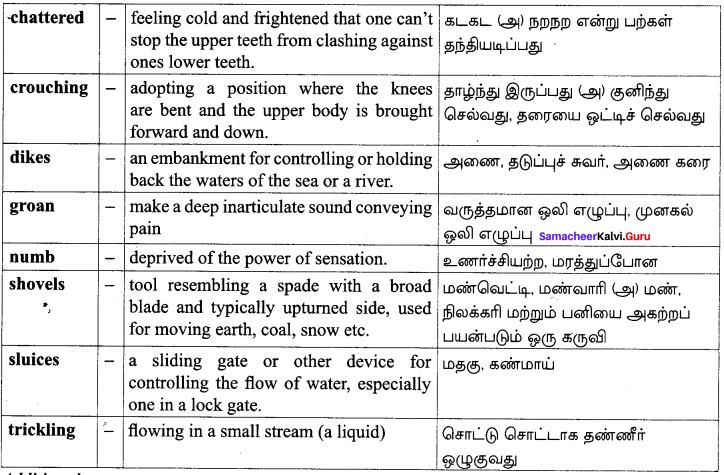
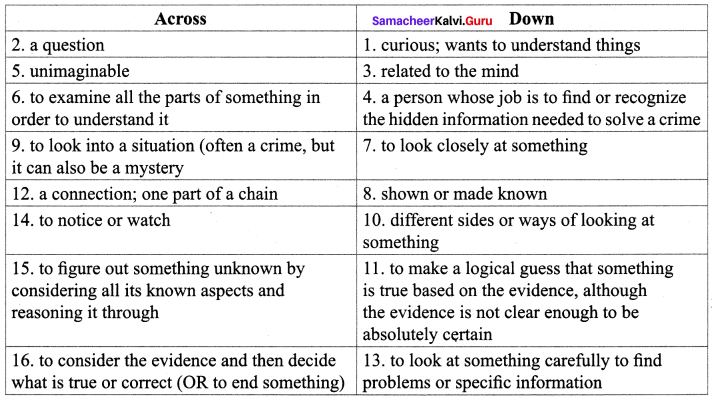
1. Solve the crossword using the list of words and the clues.Samacheer Kalvi 10th English Solutions Prose Chapter 7 The Dying Detective 1
Answer:
Samacheer Kalvi 10th English Solutions Prose Chapter 7 The Dying Detective 2

Samacheer Kalvi 10th English Solutions Prose Chapter 7 The Dying Detective 3

The Dying Detective Intext Questions

Question a.
How did Watson feel when he heard of Holmes illness?
Answer:
Watson felt horrified when he heard of Holmes illness because he had hot heard about it before.

Question b.
Why didn’t the landlady call the doctor?
Answer:
The landlady didn’t call the doctor because Holmes would not allow her to bring one.

Question c.
What was the condition of Holmes when Watson saw him?
Answer:
Holmes had a gaunt face. His eyes had a brightness of fever, his cheeks were flushed and his hand twitched all the time. He lay listless.

Question d.
According to Holmes what was the disease he was suffering from?
Answer:
Holmes was suffering from Tarpaunli fever or black Formosa plague.

Question e.
Who did Watson see when he entered the room?
Answer:
Watson saw Culverton Smiths butler at the doorway. On entering the room, he saw a thin man with bald head, Mr. Culverton Smith.

Question f.
What were the instructions given by Holmes to Watson?
Answer:
Holmes did not want Watson to go before six. He asked Watson to persuade Smith to come, to tell Smith that Holmes was dying and force Smith to come. Watson should return to Holmes’ house, before Smith’s arrival. He asked Watson to light the gas and keep it half-on.

Question g.
Why did Holmes plead with Smith?
Answer:
Holmes pleaded with Smith to cure him of his disease.

Question h.
Who was responsible for Victor Savage’s death? What was the evidence for it?
Answer:
Culverton Smith was responsible for Victor Savage’s death. The ivory box was the last piece of evidence of it.

Question i.
What explanation did Holmes give for speaking rudely to Watson?
Answer:
Holmes explained that he spoke rudely to Watson because he wanted to bring Smith there and he didn’t want Watson to know that he wasn’t ill.

Question j.
How was Holmes able to look sick?
Answer:
Holmes starved for three days without food and water to look really sick.

The Dying Detective Textual Questions

A. Answer the following questions in one or two sentences.

Question 1.
Who was Mrs. Hudson? Why was she worried?
Answer:
Mrs. Hudson was the landlady of Sherlock Holmes. She was worried because Holmes was very sick.

Question 2.
Why didn’t Holmes let Watson examine him?
Answer:
Holmes didn’t let Watson examine him by telling that he was suffering from a deadly and contagious disease. In fact Holmes was acting as if he was a sick person. If Watson examined him, he would know that Holmes was not ill.

Question 3.
Why did Holmes warn Watson against touching his things? What was Watson’s reaction?
Answer:
Holmes warned Watson against touching his things because he disliked others touching his things and the box was an important evidence. Watson sat down silently.

Question 4.
What did Watson find on the table near the mantelpiece?
Answer:
Watson found a small black and white ivory box with sliding lid, on the mantelpiece.

Question 5.
Who is Mr. Culverton Smith?
Answer:
Mr. Culverton Smith is the man who has the knowledge of the disease, Holmes was suffering from. He is a planter. He lives in Sumatra, now visiting London.

Question 6.
What did Holmes ask Watson to do before leaving his room?
Answer:
Holmes asked Watson to put the money in his pockets, light the gas lamp half on, and place some letters and paper on the table. He also asked him to place the ivory box within his reach.

Question 7.
What instructions did Holmes give Watson to get Mr. Smith?
Answer:
Holmes asked Watson to persuade Mr. Culverton Smith of 13, Lower Burke Street to come and to tell him that Holmes was dying. He asked him to plead with Smith to save him.

Question 8.
Why did Holmes want Smith to treat him?
Answer:
Holmes wanted Smith, to treat him because he was the only man with the knowledge of the disease Holmes was suffering from.

Question 9.
According to Smith how did Holmes get the disease?
Answer:
According to Smith, Holmes got the disease from the spring in the ivory box, that drew blood.

Question 10.
Who arrested Smith? What were the charges against him?
Answer:
Inspector Morton arrested Smith on charges of murder of Victor Savage.

Additional Questions

Question 1.
How did Holmes show his madness to Dr. Watson?
Answer:
When Dr. Watson offered to examine symptoms and treat him Holmes said he would have a doctor in whom he had confidence. This was really very rude of Holmes and showed his madness.

Question 2.
Why was Smith startled?
Answer:
Smith was startled to know that Holmes was seriously ill. He had sent for him pleading to cure him.

Question 3.
How did Dr. Watson manage to avoid accompanying Smith during his visit to Holmes?
Answer:
Dr. Watson pretended to have some other appointment. Thus he avoided accompanying Mr. Smith during his visit to Holmes.

Question 4.
Who came to visit Holmes when Dr. Watson was waiting for his cab?
Answer:
Mr. Morton Inspector of Scotland Yard in plain clothes had come to visit Holmes.

Question 5.
What was shocking to Dr. Watson?
Answer:
The dying Holmes had the boldness to bolt the door and order him to stay indoors till six p.m.

Question 6.
Who is Victor Savage?
Answer:
Victor Savage is Smith’s nephew. He was murdered by Culverton Smith but was believed to be dead on the fourth day in spite of being a strong and healthy man because of an Eastern disease.

Question 7.
Why didn’t Holmes want Dr. Watson to go before six?
Answer:
Holmes did not want Watson to go and meet Smith before six since he would not be able to find Smith in his study.

Question 8.
Who stopped Dr. Watson at Smith’s house?
Answer:
Dr. Watson was stopped by the butler who appeared at the doorway to Smith’s room.

B. Answer the following questions in about 80 – 100 words.

Question 1.
How did Holmes trap Mr. Culverton Smith to confess the murder?
Answer:
Holmes did not eat or drink anything for three days which created the impact on his looks. He had become gaunt and pale. His voice had become just a groan. The landlady’s initial efforts to get a doctor were forbidden. On the third day evening, he allowed her to call Dr. Watson. When Dr. Watson arrived, there was a high drama disallowing him to examine the symptoms and snubbing him that he could allow a doctor in whom he can have confidence.

He claimed to have been affected by an eastern disease known as the Tarpaunli fever or black plague. When Dr. Watson offered to bring some other experts, Holmes got so annoyed. In a delirium like state, he instructed Dr. Watson to keep some letters and papers on a table within his reach. He wanted the ivory box to be kept on the table. He instructed to slide it open using tongs. He had Smith invited. He described all the symptoms of his illness. Smith asked Holmes if he received any parcel on Wednesday.

Holmes replied affirmatively and brushed it aside saying that it had a sharp blade and drew his blood. Hearing this Smith was overjoyed. He openly told him his end was near. Victor, a young person died on the fourth day. The more Holmes pleaded, the more Smith elaborated on his crime. He said that he knew too much about Victor’s death. He should not have crossed his path. He happily said that he would pocket the evidence of his crime (i.e.) the ivory box and get away. Suddenly Morton, Inspector, arrived and arrested him on charges of murder.
‘Murderers will be trapped.’

Question 2.
How did Watson help his friend to arrest the criminal?
Answer:
Dr. Watson is called to tend Holmes, who is apparently dying of a rare tropical disease, Tarpaunli fever, contracted while he was on a case at Rotherhithe. Mrs. Hudson says that Holmes has neither eaten nor taken any liquids in the last three days. Holmes forbids Watson to go near him because the illness is highly infectious. In fact, he refutes Watson and insults his abilities. Although Watson wishes to examine Holmes himself or send for a specialist, Holmes demands that Watson wait several hours before seeking help.

While Watson waits, he examines several objects in Holmes’s room. Holmes is angered when Watson touches things on his table stating his dislike for people fidgeting his things. At six o’clock, Holmes asks Watson to turn the gaslight on, but only half-full. He then instructs Watson to bring Mr. Culverton Smith from 13 Lower Burke Street to see Holmes but to make sure that Watson returns to Baker Street before Smith arrives. Watson goes to Smith’s address. Although Smith refuses to see anyone, Watson forces his way in.

Once Watson explains his duty on behalf of Sherlock Holmes, Smith’s assertiveness changes significantly. Smith agrees to come to Baker Street within half an hour. Watson excuses himself, saying that he has another appointment, and returns to Baker Street before Smith’s arrival. Believing that they are alone, Smith is frank with Holmes. It soon appears, to the hiding Watson’s horror, that Holmes has been sickened by the same illness that killed Smith’s nephew Victor.

At the end, Holmes calls for Watson to come out from behind the screen, to present himself as another witness to the conversation. Holmes explains his illness was feigned as a trick to induce Smith to confess to his nephew’s murder. Starving himself for three days and claiming to be suffering from a deadly infectious disease was to keep Watson from examining him and discovering the ruse, since, as he clarifies, he has every respect for his friend’s medical skills.
‘A detective’s perspective traps the criminal.’

Additional Questions

Question 1.
What makes Culverton Smith fall a prey to Holmes’s trap?
Answer:
Watson goes to Mr. Culverton Smith at 13 Lower Burke Street. He finds it difficult to see his friend dying. Although Smith refuses to see anyone, Watson forces his way in. As soon as Watson explains his errand, Smith’s attitude changes drastically. He persuades him to see Holmes as he is in a dying state. Smith agrees to come to Baker Street within half an hour.

Watson excuses himself, saying that he has another appointment and returns to Baker Street before Smith’s arrival as instructed by Holmes. Believing that they are alone, Smith is frank with Holmes. Holmes tells Smith that he will forget the happenings of Victor Savage and pleads with him to cure him. Smith denies and tells Holmes that he should have never crossed his path. Smith sees the little ivory box, which he had sent to Holmes by post containing a sharp spring infected with the illness.

Smith pockets it thinking to have removed the only evidence of his crime. He then resolves to stay there and watch Holmes die. However, Holmes asks Smith to turn the gas up full, which Smith does. Inspector Morton enters and Holmes tells Morton to arrest Culverton Smith for the murder of his nephew and also for the attempted murder of Sherlock Holmes.
‘You cannot escape from a detective’s eye.’

Vocabulary

C. Complete the following sentences by choosing the correct options given.

  1. Niteesh bought a ………………. (knew/new) cricket bat.
  2. The shepherd ………………… (herd/heard) the cry of his sheep.
  3. Lakshmi completed her baking ……………….. (course/coarse) successfully.
  4. Priya has broken her …………….. (four/fore) limbs.
  5. Leaders of the world must work towards the ……………… (peace/piece) of human race.

Answers

  1. new
  2. heard
  3. course
  4. fore
  5. peace

Use the given examples and make sentences of your own.
Commonly confused words
brought – past participle of bring. E.g. Anitha had brought a book from the library.
Kavitha brought sweets on her birthday.
bought – past participle of buy. E.g. Lalitha had bought a new dress last week.
Avinash bought a new Hero cycle.
affect – to have an effect on. E.g. The pet’s death affected his master.
The fever affected Dhanush’s studies.
effect – anything brought about by a cause or agent; result. E.g. Both El Nino and La Nina are opposite effects of the same phenomenon.
The effect of ozone layer depletion is catastrophic.

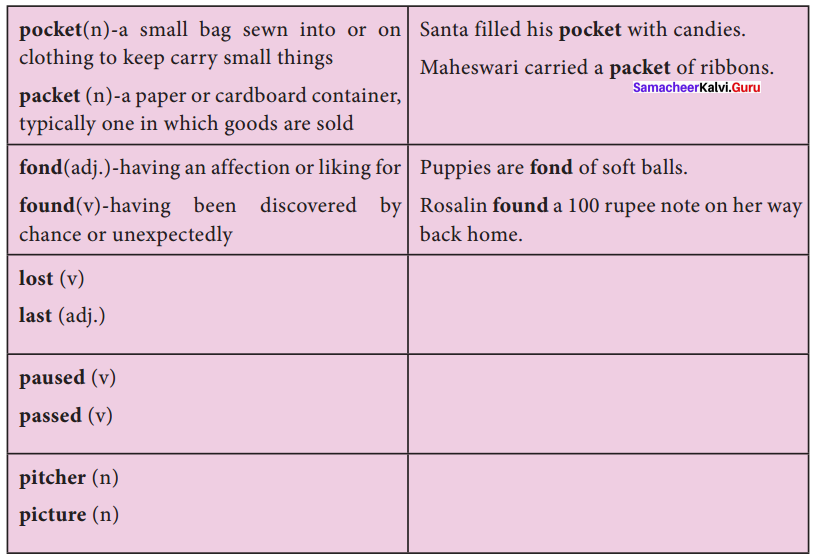
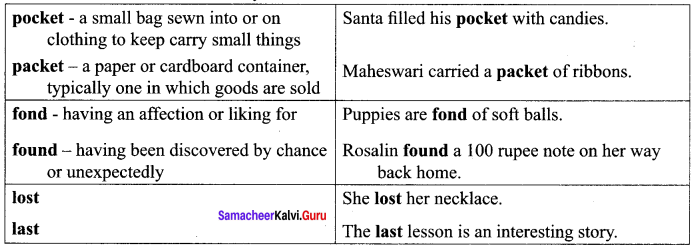
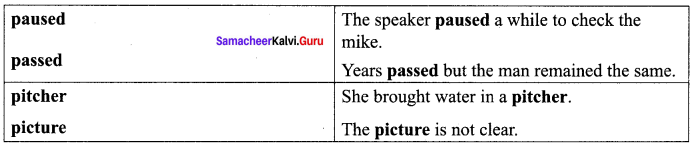
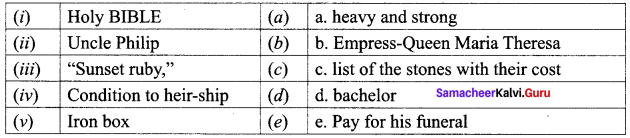
D. Complete the tabular column by finding the meaning of both the words given in the boxes. Use them in sentences of your own.

Samacheer Kalvi 10th English Solutions Prose Chapter 7 The Dying Detective 4
Answer:
Samacheer Kalvi 10th English Solutions Prose Chapter 7 The Dying Detective 5Samacheer Kalvi 10th English Solutions Prose Chapter 7 The Dying Detective 6

Listening Activity:

E. Listen to the story and answer the question given below.

“Something is very wrong,” says the detective.
“I know!” says Ms. Gervis. “It is wrong that someone has stolen from me!”
The detective looks around Ms. Gervis’ apartment. “ at is not what I am talking about, ma’am. What is wrong is that I do not understand how the robber got in and out.”
Ms. Gervis and the detective stand in silence. Ms. Gervis’ eyes are full of tears. Her hands are shaking.
“The robber did not come through the window,” says the detective. “These windows have not been opened or shut in months.”
The detective looks at the fireplace. “The robber did not squeeze down here.”
The detective walks to the front door. He examines the latch. “And since there are no marks or scratches, the robber definitely did not try to break the lock.”
“I have no idea how he did it,” says a bothered Ms. Gervis. “It is a big mystery.”
“And you say the robber stole nothing else?” asks the detective. “No money, no jewelry, no crystal?”
“That’s right, detective. He took only what was important to me,” Ms. Gervis says with a sigh. “There is only one thing I can do now.”
“And what is that?” the detective asks with surprise.
“I will stop baking cakes,” Ms. Gervis says. “They are mine to give away. They are not for someone to steal.”
“You can’t do that!” says the detective with alarm. “Who will bake those delicious cakes?”
“I am sorry. I do not know,” says Ms. Gervis.
“I must solve this case immediately!” says the detective.

1. Where does this story take place?
(a) in a bakery
(b) at the police station
(c) in Ms. Gervis’ house
(d) in Ms. Gervis’ apartment
Answer:
(d) in Ms. Gervis’ apartment

2. Near the beginning of the story, “Ms. Gervis’ eyes are full of tears. Her hands are shaking.” How does Ms. Gervis probably feel?
(a) She is upset
(b) She is tired
(c) She is hungry
(d) She is confused
Answer:
(d) She is confused

3. What makes the detective sure that the robber did not come through the windows?
(a) The windows are locked
(b) The windows face the police station
(c) The windows have not been used in months
(d) The windows are too small for a person to fit through
Answer:
(c) The windows have not been used in months

4. What else was stolen from the apartment?
(a) crystal
(b) jewelry
(c) money
(d) nothing
Answer:
(d) nothing

5. “And the robber definitely did not use the front door.” Which is the best way to rewrite this sentence?
(a) “And the robber may not have used the front door.”
(b) “And the robber probably did not use the front door.”
(c) “And the robber was not able to use the front door.”
(d) “And the robber certainly did not use the front door.”
Answer:
(d) “And the robber certainly did not use the front door.”

6. What does Ms. Gervis do with her cakes?
(a) She eats them
(b) She sells them
(c) She hides them
(d) She gives them away
Answer:
(d) She gives them away

7. What does the detective seem to think will happen if he solves the mystery?
(a) Ms. Gervis will start baking cakes again
(b) Ms. Gervis will bake him extra cakes
(c) Ms. Gervis will give him her secret recipe
(d) Ms. Gervis will give him money and jewels
Answer:
(a) Ms. Gervis will start baking cakes again

8. Do you like mysteries? What is your favorite kind of story? Explain.
Answer:
Yes, I do.
I like detective stories. Lena Tamilvanan and Rajesh Kumar are good detective story writers.
The novels written by them are gripping and sustain the readers interest till the last page.

Speaking Activity

F. Exercise

1. Present the review of a movie that you have watched recently.
Review of Super Deluxe Movie I saw
Thiagarajan Kumararaja’s Super Deluxe opens with a shot of Vaembu (Samantha) lying beside someone on a bed. The camera slowly moves around the room, pulling you in the direction it travels. Soon you realise that it’s not the camera, but the director Thiagarajan Kumararaja who has lured you into his world.

And this world has eccentric characters like Arputham (Mysskin), who believes that he is god’s right hand because he was the only one who survived the Tsunami when millions died. Kumararaja doesn’t stop there. His thoughts are out-of-the- world (literally), outlandish, and outstanding.

There are 4 parallel plots taking place at the same time, involving the lives of Shilpa (Vijay Sethupathi), Leela (Ramya Krishnan) and Arputham (Mysskin), Vaembu (Samantha) and Mugil (Fahadh Faasil), and another one involving four boys. The best part about the writing is that these plotlines don’t merge at one point.

One sub-plot becomes an influencing factor in another, but after that, they part ways. The way the events unfold is interesting and makes the movie more engrossing. The trademark qualities NalanKumarasamy and Mysskin’s writing is seen at a lot of places. A lot of humourous portions belong to Nalan’s ‘crazy’ world. Who else can write a scene where a man dies while having sex? On the other hand, towards the end, there a sequence involving Mysskin, set in a subway, with green lighting.

What more do we need to figure out that this has been written by Mysskin himself?
PS Vinod and Nirav Shah’s visuals have an ever-lasting effect on us. The wise usage of ffame- within-frame shots through doors, windows, and alleys creates a sense of being trapped, and this has been used for all major characters. The wise usage of vintage tracks of Ilayaraja falls on point.

Yuvan Shankar Raja makes sure we feel the heat and soul of the scenes through his brilliant background scores and apt silences. The walls on all the houses and a police station, “the make-shift flower pot on one of the apartments, the borders of sarees, the costumes of the characters, are all blue in colour. While this is supposed to create a stable feel, the characters are all unstable. This irony has been effectively used to elevate our cinematic experience. Vaembu and Mugil’s story become melodramatic after a point of time.

And the biggest issue with the film is that they have the maximum screentime. Even the way their conflict gets resolved looks implausible. But, the way the terrific FahadhFaasil and Samantha act, these issues are covered up. Shilpa’s characterization brings out the best in Vijay Sethupathi, but not Vijay Sethupathi. Apart from the main leads, BhagavathiPerumal and Master Aswanth, have done their job well and scored in their plot points. On the flipside, the second half could have been a bit more crisp, due to the three hours runtime.

2. Give the review of a book that has interested you a lot.
’ Review of the most interesting book I read The noodle Maker by Ma Jian The pace of change in China over the last fifteen years has been extraordinarily fast; the pace at which its literature reaches us in translation shamefully slow. Chinese dissident writer Ma Jian is already known in the English-speaking world for his award-winning travel memoir of rural China in the 1980s, Red Dust. Since the Chinese takeover of Hong Kong in 1997, he has been living with his partner and translator in London.

The Noodle Maker, the first of Jian’s novels to appear in English, is set soon after the events of Tiananmen Square in 1989, already ancient history to today’s young entrepreneurs, artists, and university students. Reading The Noodle Maker now has some of the blurred effects of a time-lapsed photograph- -it is a hard-hitting satire of a cultural moment that has already come and gone. Only a reviewer intimate with today’s China could judge to what extent its critique is still sharp. Perhaps this question of timeliness should be irrelevant.

The Noodle Maker is fiction, after all, constructed with a good deal of artfulness on the frame of a drunken evening shared between a professional writer and his best friend, a professional blood donor. The professional blood donor considers himself a practical man; he boasts of the excellent pay and perks he receives as rewards for being bled for the benefit of the nation.

Each Sunday he brings good food and drinks to the writer, who is, of course, a poverty-stricken idealist. Their discussion is interwoven with the stories the professional writer is crafting based on people he has known: an actress who stages her own suicide; her boyfriend, a painter with a talking three-legged dog

(the novel’s most reliable narrator); a literary editor humiliated by the success of his wife, an acclaimed novelist; a father trying to abandon his retarded daughter; an entrepreneur whose success with a musically-enhanced crematorium gives him the confidence to bum his own mother alive. Each of these characters is manipulated not only by the noodle-making hands of the professional writer, but by a ruthless society, which with its new “Open Door Policy” has imported some superficial commercial elements of Westemness, yet still maintains a stranglehold on personal freedom.

(“Imported” products as symbols of moral weakness, hypocrisy, and corruption are a satiric mantra throughout the book.) Fans of the absurdity and dark humour of Milan Kundera’s portraits of life behind the Iron Curtain will appreciate these same elements in Ma Jian’s work-though Kundera is a good deal lighter on his feet, and the clever and humorous aspects of The Noodle Makerstruck this reviewer as heavy-handed.

As fiction that comments on social and political reality, The Noodle Maker is far less emotionally engaging than Yu Hua’s Chronicle of a Blood Merchant, which tells the life of another professional blood donor, and is a character-driven social realist novel in the old nineteenth-century Dickensian mode, though written in a crisp contemporary style.

It tells us about China, but something convincing about people, too. For all its postmodern strands, the heart of The Noodle Maker (like all satire?) is in a kind of journalism, so that ultimately its success depends on whether or not it still tells a timely truth.

3. Review an event which your school has hosted recently.
A school is a place where we get to know about different activities for the first time. Participating in these activities is always memorable and exciting. My favourite school event is “Mental Maths Competition”. This event is held once a year. One student is selected from each section of a class. Then they are teamed up with other students to form three teams.

This competition is basically to enhance mental skills. Students have to answer these questions in a time span of seconds. Questions are not repeated at all and students have to be very quick in understanding the questions, in calculations and then answering it. Last year I was also selected as one of the finalists. Our team A and team C reached the final rounds. The winning round lasted for thirty questions as both teams were not ready to give up. In the end, team C couldn’t answer a question and we answered it to win the event.

We were highly appreciated and were given certificates and shields. Winning is always exciting and encouraging. I would always like to participate in this event again because this event helps me in enhancing my mental skills and to speed up my mental calculations.

Reading:

Read the story carefully and answer the questions asked below

A Mystery Case:
For a man of ease, John Mathew kept an arduous schedule. On Wednesdays, for example, he was awakened at 9.00 and served breakfast in bed by Emanuel, his chef. Next came a quick fitness session with Basky, his personal trainer. Then, at 10.30, John Mathew answered his mail, returned phone calls and rearranged his social calendar helped by Louise, his secretary.

At noon, John Mathew drove his Jaguar to the station and took a commuter train into Guindy for his weekly lunch with Lalli and Lolly, his two oldest and dearest friends. Then, on to a little shopping. The 4:05 nonstop would bring him back to Tambaram. As John Mathew drove up to the house at 5:00, Basky would have already set up the massage table and warmed the scented oils for a soothing herbal wrap. It was a gruelling life but John seemed to thrive on it. On this Wednesday, however, there was an unexpected change of plans.

Today John’s shopping errand involved taking his diamond bracelet into the jeweller’s for cleaning. He threw the expensive jewel into his purse and proceeded on to lunch. As John waved his friends good-bye and exited the restaurant, he sensed he was being followed. The feeling continued until he reached Tenth Avenue. Then, as he joined the throng of shoppers, John felt a hug. Within a split-second, a man riding pillion on a bike rode past him, grabbing his purse. He couldn’t guess who the culprit was?

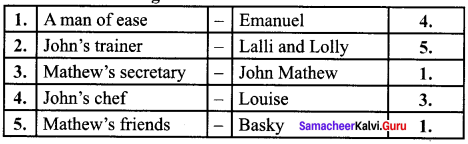
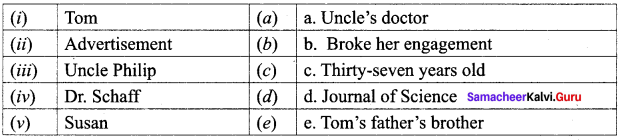
G. Match the following.

1. A man of ease – Emanuel
2. John’s trainer – Lalli and Lolly
3. Mathew’s secretary – John Mathew
4. John’s chef – Louise
5. Mathews friends – Basky
Answer:
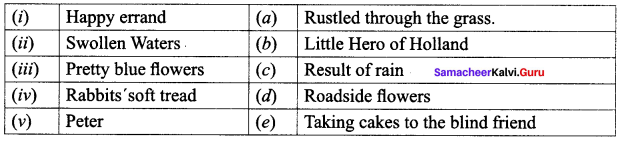
Samacheer Kalvi 10th English Solutions Prose Chapter 7 The Dying Detective 7

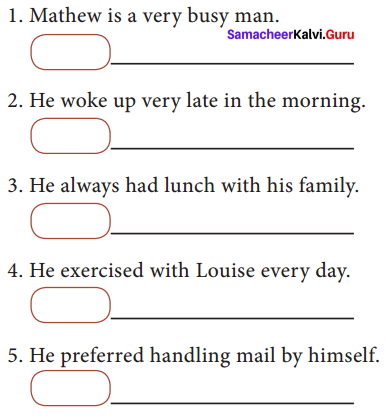
H. State whether the given statements are true or false. If false correct the statements.

Samacheer Kalvi 10th English Solutions Prose Chapter 7 The Dying Detective 8
Answer:
1. Mathew is a very busy man
[true]

2. He woke up very late in the morning
[True]

3. He always had lunch with his family
[False] He always had lunch with Lalli and Lolly, his two oldest and dearest friends.

4. He exercised with Louise every day.
[True]

5. He preferred handling mail by himself
[True]

Writing

Pamphlet

I. Create a pamphlet for the following:

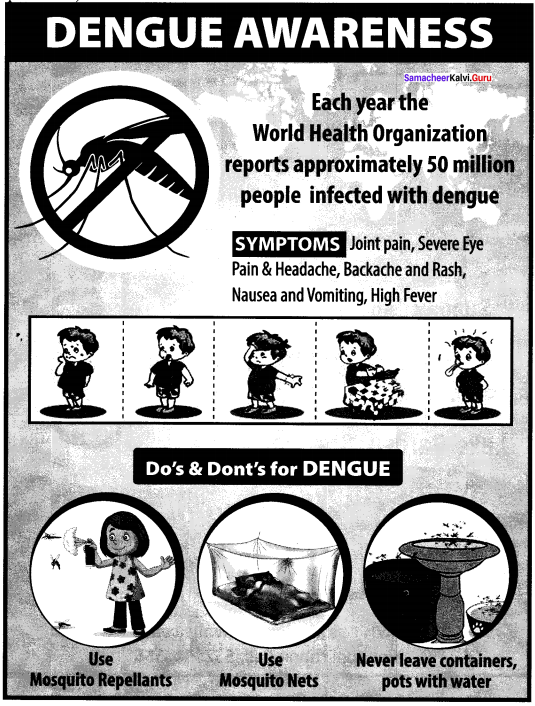
1. Make a pamphlet on ‘Dengue Awareness’ (Focus on its causes, preventions, symptoms and precautions).
Samacheer Kalvi 10th English Solutions Prose Chapter 7 The Dying Detective 9

2. Make an attractive pamphlet for your school’s Fair organised for raising funds for (any) relief (Specify the date, time, types of stalls and the reasons for the fair).
Samacheer Kalvi 10th English Solutions Prose Chapter 7 The Dying Detective 10

3. Make a pamphlet on the latest gadgets (Mention the variety of models, uses, need and availability).
Samacheer Kalvi 10th English Solutions Prose Chapter 7 The Dying Detective 11

J. Write a letter of enquiry for the following

1. You’re a librarian in a newly established school. Write a letter to the book dealer inquiring about the list of newly arrived English children’s story books and various subject books relevant to 10 – 14 age groups.
From
S. Sangeetha
Librarian
ABC School
XXXX
23.04.2019

To
Sales Manager
Higginbothams Books dealers
Mount Road
Chennai 2
Sir,
Sub: Enquiry about children’s story book-Reg.
I would like to know about the new arrivals in English children’s story books and subject books appropriate to the children in the age group of 10-14. Kindly send the list/catalogue with price and the details of discount offered to schools.
Thank you
Yours sincerely
S. Sangeetha
Sales Manager
Higginbothams Books dealers
Mount Road
Chennai 2

2. Venkat hails from a remote village of Kancheepuram District, Tamil Nadu who aspires to become an IAS officer. Currently, he is in class X. He notices an advertisement on free classes for the IAS aspirants by a trust in a newspaper. He writes a letter to the coordinator of the trust inquiring for further details.
From
R Venkat
14, Velakkadi Koil St
Kancheepuram 2
[email protected]
13.08.2018

To
The Liasion Officer
Manitha Neyam Trust
CITNagar
Chennai 17
Sir,
Sub: Enquiry about IAS orientation programme – Reg.
I saw your advertisement in The Hindu Tamil newspaper dated 12th August, about a free seminar, in Pallavaram Govt. Hr. Sec. School.
I am doing my Std. X, I cherish the dream of becoming an IAS officer. I heard the entry is free for graduates. Will you please allow me also to attend the seminar? I wish to listen to achievers and subject experts. Kindly communicate your consent through my email venkat2002@gmail. com.
Thank you
Yours sincerely
P. Venkat

To
The Liasion Officer
Manitha Neyam Trust
CIT Nagar
Chennai 17

3. Write a letter to the head of the BSNL office enquiring regarding the internet broadband scheme launched recently.
From
K.Joseph
18, Akilan St
Kalpakkam
jose2000@gmail. com
20.03.2019

To
Manager
BSNL Office
head Office
Chengalpattu
Kancheepuram 10
Sir,
Sub: Enquiry about internet broadband scheme launched recently – Reg.
I heard that you have recently launched an attractive scheme for students to promote use of high speed Broadband connectivity. I would like to know the details of cost involved, bandwidth, usage limit (i.e.) GB per day, details about speed, type of modem and warranty details. As a representative of my school, I would like to share this with my school also for the upcoming ICT lab in the school. Kindly mention the scheme for Institute and individuals separately.
Thank you
Yours sincerely
K. Joseph

To
Manager
BSNL Office
Head Office
Chengalpattu
Kancheepuram 10

Grammar

A. Transform the following sentences as instructed.

1. On seeing the teacher, the children stood up. (into Complex)
As soon as the children saw the teacher, they stood up.

2. At the age of six, Varsha started learning music, (into Complex)
When Varsha was six, she started learning music.

3. As Vanin is a voracious reader, he buys a lot of books, (into Simple)
Being a voracious reader, Varun buys a lot of books.

4. Walk carefully lest you will fall down, (into Complex)
If you don’t walk carefully, you will fall down.

5. Besides being a dancer, she is a singer, (into Compound)
She is not only a dancer but also a singer.

6. He is sick but he attends the rehearsal, (into Simple)
In spite of being sick, he attends the rehearsal.

7. If Meena reads more, she will become proficient in the language, (into Compound) Meena should read more or she will not become proficient in English.

8. He confessed that he was guilty, (into Simple)
He confessed his guilt.

9. The boy could not attend the special classes due to his mother’s illness, (into Compound)
The boy’s mother was ill and so he did not attend the special classes.

10. He followed my suggestion, (into Complex)
He followed what I suggested.

B. Combine the pairs of sentences below into simple, complex and compound

1. Radha was ill. She was not hospitalised
In spite of being ill, Radha was not hospitalised, (simple)
Radha was ill but she was not hospitalised, (compound)
Though Radha was ill, she was not hospitalised, (complex)

2. The students were intelligent. They could answer the questions correctly
Being intelligent, the students were able to answer the questions correctly, (simple)
The students were intelligent and so they were able to answer the questions correctly, (compound)
As the students were intelligent, they were able to answer the questions correctly, (complex)

3. I must get a visa. I can travel abroad
I must get a visa to travel abroad, (simple) .
I must get a visa or else I can’t travel abroad, (compound)
If I don’t get a visa, I can’t travel abroad, (complex)

4. I saw a tiger it was wounded
I saw a wounded tiger, (simple)
I saw a tiger and it was wounded, (compound)
I saw a tiger which was wounded, (complex)

5. There was a bandh. The shops remained closed
The shops were closed due to Bandh. (simple)
There was a bandh and so the shops were closed, (compound)
As there was a bandh, the shops were closed, (complex)

The Dying Detective by About the Author:

Sir Arthur Ignatius Conan Doyle (1859-1930) was a British writer popularly known world over for his detective stories involving Sherlock Holmes stories, which are generally considered milestones in the field of fiction. Doyle wrote forty-six short stories featuring the famous detective. His notable works included “Stories of Sherlock Holmes and the Lost World”.

The Dying Detective summary:

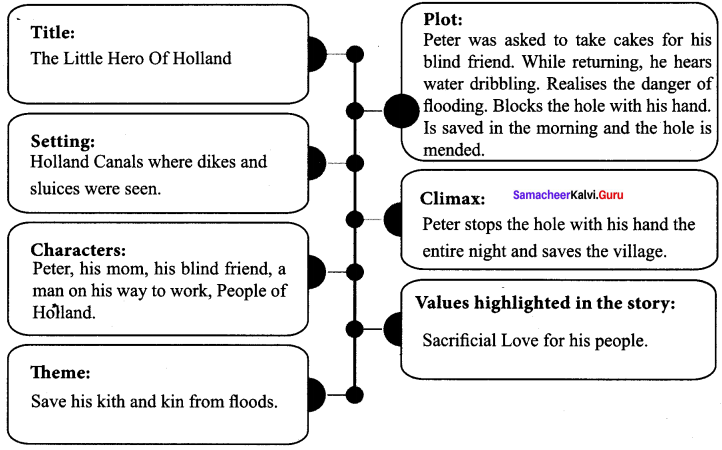
Samacheer Kalvi 10th English Solutions Prose Chapter 7 The Dying Detective 12

Introduction:
The author has given an interesting accord of how the detective outsmarted the culprit to zero in on him.
Samacheer Kalvi 10th English Solutions Prose Chapter 7 The Dying Detective 13

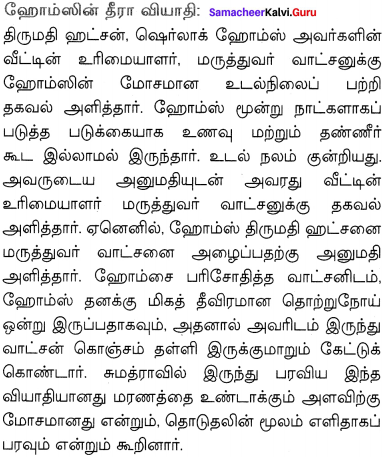
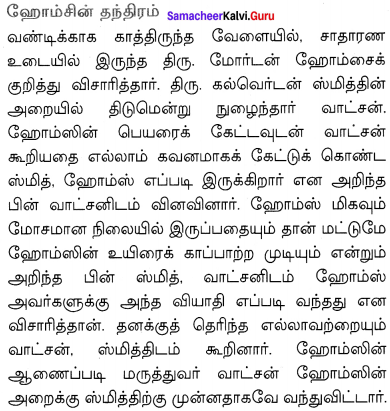
Home’s incurable disease Dr. Watson was informed by Mrs. Hudson, the landlady of Sherlock Holmes that Mr. Holmes was dying. He was bedridden for three days. He had neither taken food nor drinks. He was sinking. The landlady was permitted to inform only Dr. Watson about his ill health. She could not call for a doctor because Sherlock Holmes had prevented her from doing so. When Dr. Watson reached Holmes, he cautioned him to stay away from him as he was suffering from some contagious disease that he had picked up from Rotherhithe. The disease from Sumatra was deadly and could spread even with a touch.
Samacheer Kalvi 10th English Solutions Prose Chapter 7 The Dying Detective 14

Home’s peculiar behaviour
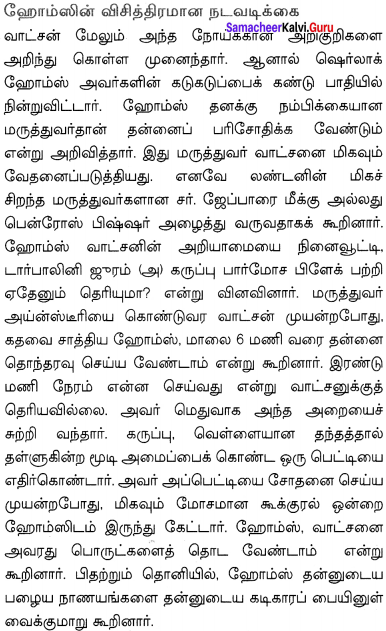
Watson advanced to examine symptoms but was stopped midway by the stem warning from Holmes. Sherlock Holmes declared that he wanted a doctor in whom he would have confidence. This really upset Dr. Watson. He offered to bring the best doctors of London viz. Sir Jasper Meek or Penrose Fisher.

Holmes reprimanded Dr. Watson’s ignorance and asked him what he knew about Tarpaunli fever or black Formosa plague. When Dr. Watson offered to bring Dr. Ainstree, Holmes bolted the door and ordered him not to move till six in the evening. Dr. Watson did not know what to do for two hours. He just walked around the room slowly. He came across a small black and white ivory box with a sliding lid.

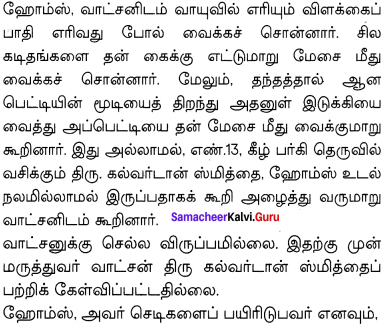
When he was about to examine its contents, he heard a dreadful cry from Holmes. He forbade him from touching his things. In a kind of delirium, Holmes ordered to take out his coins and keep all the half-crowns in his watch pocket. He was instructed to light the gas lamp and keep it half on. He requested him to place some letters on the table within his reach.

He instructed him to slide the lid of the ivory box with Tongs and put the Tongs and the ivory box on the table. He instructed Dr. Watson to bring Mr. Culverton Smith from 13, Lower Burke Street, as Holmes was serious. Dr. Watson was hesitant to go.

Holmes clarified that he was not a doctor but a plantation man with a deep knowledge of the disease. Holmes asked Watson to plead with him to come and save Holmes who was seriously ill. Dr. Watson offered to bring him in a cab. However, Holmes instructed that he should plead with him and reach Holmes before him.
Samacheer Kalvi 10th English Solutions Prose Chapter 7 The Dying Detective 15
Samacheer Kalvi 10th English Solutions Prose Chapter 7 The Dying Detective 16
Samacheer Kalvi 10th English Solutions Prose Chapter 7 The Dying Detective 17

Holmes’ plan
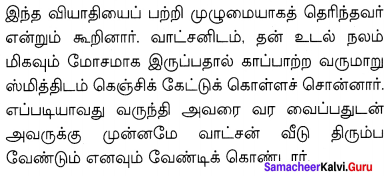
While waiting for the cab, Mr. Morton, in civil dress asked after Holmes. Dr. Watson entered Mr. Culverton Smith’s room by force. On hearing Mr. Holmes’s name, he enquired how Holmes was doing. When he learnt that he was very ill and believed that only he could save his life, he enquired how Holmes got the eastern disease. Dr. Watson told him all he knew. Dr. Watson, on the pretext of an appointment, returned to Holmes earlier and stayed in a room there as per Holmes’s order.
Samacheer Kalvi 10th English Solutions Prose Chapter 7 The Dying Detective 18

Smith’s careless attitude
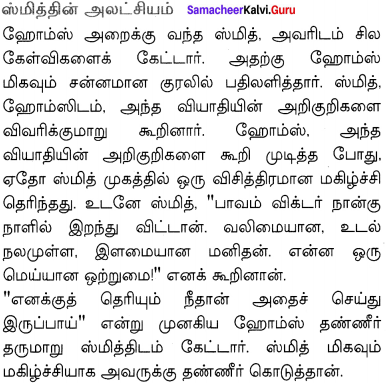
Smith arrived and called out for Holmes. Holmes responded to his questions in a feeble voice. He asked Holmes to describe the symptoms. When Holmes completed describing the symptoms Smith was strangely happy. He blurted out, “Poor victor Savage was a dead man on the fourth day. A strong and healthy young man. What a coincidence indeed!” Holmes said, “I know that you did it”. Holmes groaned and asked for water. Smith gladly gave him water. He requested Smith to cure him and offered to forget his hand in the murder of Victor.
Samacheer Kalvi 10th English Solutions Prose Chapter 7 The Dying Detective 19

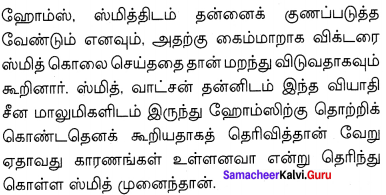
Smith said that Watson shared the information that Holmes got the fever from Chinese sailors. He wanted to know seriously if there could be any other reason.
Samacheer Kalvi 10th English Solutions Prose Chapter 7 The Dying Detective 20

Holmes outsmarts Smith
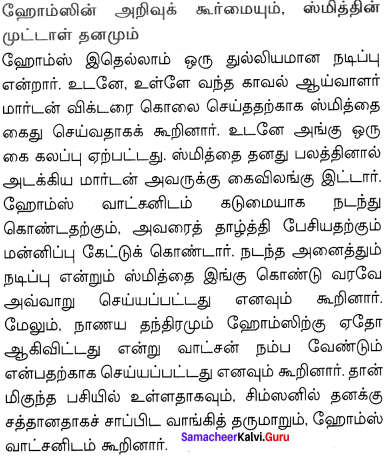
Holmes said, ‘successful acting’. Just then Inspector Morton said to Smith that he was arrested on a charge of murder. There was a scuffle. Inspector Morton overpowered Smith and handcuffed him. Holmes apologized to Dr. Watson for being rude to him and undermining his capability as a doctor. All the acting was done just to bring Smith there. Even the coin trick was to make Watson believe that Holmes was really delirious. Holmes asked Dr.Watson to take him for eating something nutritious at Simpsons.
Samacheer Kalvi 10th English Solutions Prose Chapter 7 The Dying Detective 21

Conclusion
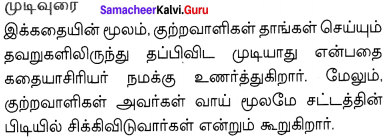
The author has made us understand a criminal cannot get away for long. Criminal may also be caught by his own words.
Samacheer Kalvi 10th English Solutions Prose Chapter 7 The Dying Detective 22

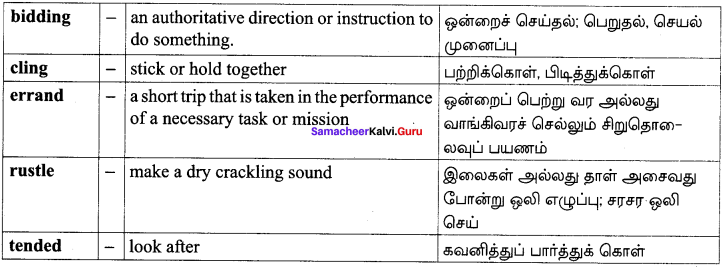
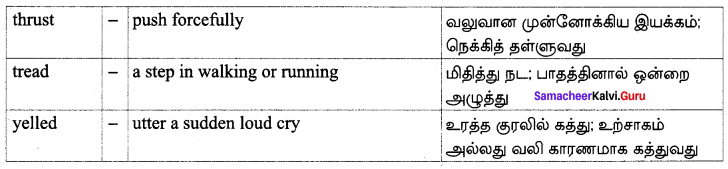
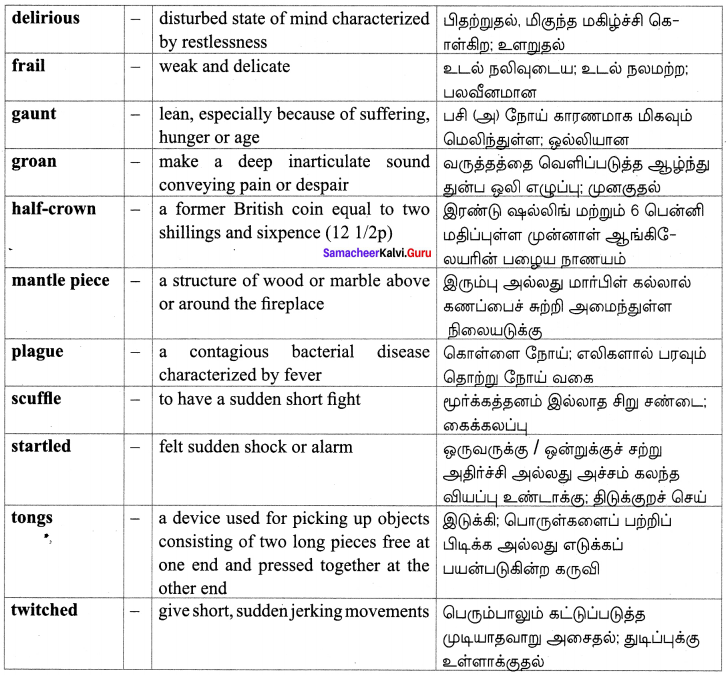
The Dying Detective Glossary:

Textual:
Samacheer Kalvi 10th English Solutions Prose Chapter 7 The Dying Detective 23
Samacheer Kalvi 10th English Solutions Prose Chapter 7 The Dying Detective 24

Additional:
Samacheer Kalvi 10th English Solutions Prose Chapter 7 The Dying Detective 25

Synonyms

Choose the most appropriate synonym of the underlined word.

1. He has been sinking.
(a) rising
(b) deteriorating
(c) improving
(d) dreaming
Answer:
(b) deteriorating

2. The sick room was a gloomy spot.
(a) spotless
(b) illuminated
(c) dim
(d) bright
Answer:
(c) dim

3. The gaunt face was staring at the ceiling
(a) stout
(b) strong
(c) thick
(d) lean
Answer:
(d) lean

4. The dying man bolted the door.
(a) closed
(b) opened
(c) broke
(d) slithered
Answer:
(a) closed

5. It was a contagious disease.
(a) impregnable
(b) crisp
(c) cussed
(d) infectious
Answer:
(d) infectious

6 His hand twitched.
(a) trembled
(b) got crushed
(c) shivered
(d) jerked
Answer:
(d) jerked

7. How ignorant you are!
(a) knowledgeable
(b) uninformed
(c) well informed
(d) wise
Answer:
(b) uninformed

8. I heard a dreadful cry.
(a) loud
(b) mild
(c) frightening
(d) sweet
Answer:
(c) frightening

9. I sat in silent dejection.
(a) optimism
(b) depression
(c) hope
(d) delight
Answer:
(b) depression

10. You will persuade him to come.
(a) deny
(b) urge
(c) order
(d) request
Answer:
(b) urge

11. He was delirious.
(a) relaxed
(b) calm
(c) composed
(d) incoherent
Answer:
(d) incoherent

12. He was frail.
(a) plump
(b) weak
(c) strong and tall
(d) well-built
Answer:
(b) weak

13. The little man was startled.
(a) reassured
(b) alarmed
(c) annoyed
(d) agreed
Answer:
(b) alarmed

14. I left him pretending that I had an appointment.
(a) feigning
(b) imagining
(c) lending
(d) receiving
Answer:
(a) feigning

15. Go and fetch Smith.
(a) see off
(b) summon
(C) bring
(d) send
Answer:
(C) bring

16. “My mind is gone. help me”, pleaded Holmes.
(a) ordered
(b) begged
(c) urged
(d) commanded
Answer:
(b) begged

17. “I arrest you on charge of murder’ he said.
(a) fees
(b) rate
(c) indictment
(d) appreciation
Answer:
(c) indictment

18. What a coincidence indeed.
(a) actually
(b) in pursuit
(c) in charge
(d) in spate
Answer:
(a) actually

19. You can only cure me.
(a) inflict pain
(b) alleviate pain
(c) heal
(d) curse
Answer:
(c) heal

20. Holmes groaned.
(a) whispered
(b) whined
(c) sang in joy
(d) grounded
Answer:
(b) whined

Antonyms

Choose the most appropriate antonym of the underlined word.

1. He has been sinking.
(a) drowning
(b) floating
(c) running
(d) sleeping
Answer:
(b) floating

2. I don’t dare disobey him.
(a) rebel
(b) defy
(c) challenge
(d) obey
Answer:
(d) obey

3. He brought this illness back with him.
(a) sickness
(b) ailment
(c) disease
(d) health
Answer:
(d) health

4. It is deadly and contagious.
(a) safe
(b) unsafe
(c) dangerous
(d) lethal
Answer:
(a) safe

5. I said advancing towards him.
(a) going forward
(b) retreating
(c) regurgitating
(d) belching
Answer:
(b) retreating

6. How ignorant you are!
(a) tacking in know ledge
(b) well- informed
(c) uninformed
(d) unaware
Answer:
(b) well- informed

7. You will persuade him to come.
(a) dissuade
(b) urge
(c) distract
(d) disembark
Answer:
(a) dissuade

8. He was a frail man.
(a) weak
(b) feeble
(c) strong
(d) thin
Answer:
(c) strong

9. The man was startled.
(a) reassured
(b) amused
(c) alarmed
(d) annoyed
Answer:
(a) reassured

10. You will tell him exactly how you have left one.
(a) accurately
(b) carefully
(c) adequately
(d) superficially
Answer:
(d) superficially

11. You disappear to the next room.
(a) vanish
(b) distress
(c) distinct
(d) appear
Answer:
(d) appear

12. He pleaded to cure him.
(a) requested
(b) beseeched
(c) ordered
(d) begged
Answer:
(c) ordered

13. It was successful acting.
(a) victorious
(b) unsuccessful
(c) joyful
(d) triumphant
Answer:
(b) unsuccessful

14. James at last talked in his natural voice.
(a) innate
(b) native
(c) nature
(d) unnatural
Answer:
(d) unnatural

15. There was silence.
(a) solemnity
(b) noise
(c) contempt
(d) concept
Answer:
(b) noise

We hope the data given here will benefit you to the fullest extent at the time of preparation. For better understanding of English subject this Samacheer Kalvi 10th English Solutions for Class 10th English Prose Chapter 7 The Dying Detective PDF is the best resource. Download & ace up your preparation. Keep in touch with us and get the latest information on Tamilnadu State board Textbook Solutions PDF.

Samacheer Kalvi 10th English Vocabulary Idioms

Looking to improve English skills and gain more subject knowledge then the best resources that you can use here is Samacheer Kalvi 10th English Solutions for Vocabulary Idioms Questions and Answers.

In the Samacheer Kalvi 10th English Guide for textbook solutions, subject experts covered all types of questions and answers related to the topics, quick notes, summary, solved & unsolved exercises, etc. If you are planning to prepare Chapter via textbook, then you’re suggested to go with this Samacheer Kalvi 10th English Book Solutions Questions and Answers PDF for better understanding and preparation.

Tamilnadu Samacheer Kalvi 10th English Vocabulary Idioms

English Subject experts who are having max years of experience prepared this Tamilnadu State Board Solutions for 10th English Vocabulary Idioms Questions and Answers. They have explained all the topics covered in the board prescribed latest syllabus in a simple way to understand easily. So, students can prepare English from this Samacheer Kalvi 10th English Book Questions and Answers PDF. Download the Tamilnadu State Board 10th English Workbook Answers PDF by accessing the below links and learn properly for the final exams to score well.

Match the following idioms with suitable meanings:
1.

(i)Add fuel to fire(a)A secret advantage
(ii)Ace up one’s sleeve(b)Create confusion
(iii)Stir up a hornet’s nest(c)Caught between two great dangers
(iv)Pour oil on troubled waters(d)Calm down a difficult situation
(v)Between the devil and the deep blue sea(e)Make a bad situation worse.

Answer:
(i) – (c),
(ii) – (a),
(iii) – (d),
(iv) – (b),
(v) – (c)

2.

(i)A bleeding heart(a)To praise oneself
(ii)To blow one’s own horn(b)Return to the beginning because of failure
(iii)To beat around the bush(c)Either partner in marriage
(iv)Back to square one(d)A soft-hearted person
(v)Better half(e)To talk about things in a round about way

Answer:
(i) – (d),
(ii) – (a),
(iii) – (c),
(iv) – (b),
(v) – (c)

3.

(i)Birds of the same feather flock together(a)It proved to be the only but a dangerous weakness
(ii)Don’t beat around the bush(b)Start. I’m listening
(iii)Go ahead!  I’m all ears(c)Come to the point. Be precise
(iv)The king’s blind love for his wife(d)Come totally unexpected. It caught us unaware
(v)The announcement of the special test came as a bolt from the blue(d)People with a common interest join together

Answer:
(i) – (c),
(ii) – (c),
(iii) – (b),
(iv) – (a),
(v) – (d)

Choose the correct meaning for the following idioms:

Question 1.
Atthedropofahat
(a) To hear rumors about someone
(b) Do or say something exactly right
(c) To go to bed
(d) Without any hesitation; instantly
Answer:
(d) Without any hesitation; instantly

Question 2.
Barking at the wrong tree
(a) To hear rumors about someone
(b) Accusing the wrong person
(c) To go to bed
(d) A rare happening
Answer:
(b) Accusing the wrong person

Question 3.
Best of both worlds
(a) All the advantages
(b) Dislike to choose or make a decision
(c) Accusing the wrong person
(d) To take on a task that is way too big
Answer:
(a) All the advantages

Question 4.
Bite more than you can chew
(a) Do not put all the resources in one.
(b) To take on a task that is way too big
(c) Some good that isn’t recognized at first
(d) Accomplish two things at the same time
Answer:
(b) To take on a task that is way too big

Question 5.
Burn the midnight oil
(a) Dislike to choose or make a decision
(b) All the advantages
(c) To take on a task that is way too big
(d) To work late into the night
Answer:
(d) To work late into the night

Question 6.
Wouldn’t be caught dead
(a) Dislike to choose or make a decision
(b) All the advantages
(c) To deceive someone into thinking well of them
(d) Would never like to do something
Answer:
(d) Would never like to do something

Question 7.
Costs an arm and a leg
(a) Come to the point – leave out details
(b) Something is very expensive
(c) Be optimistic, even difficult times will lead to better days
(d) Asking what someone is thinking
Answer:
(b) Something is very expensive

Question 8.
Cry over spilt milk.
(a) Complaining a loss from the past
(b) Cannot judge based on appearance
(c) Believe someone’s statement, without proof
(d) An activity that is easy or simple
Answer:
(a) Complaining a loss from the past

Question 9.
Curiosity killed the cat
(a) Inquisitiveness leads to unpleasantness
(b) The final problem in a series of problems
(c) Failure leads to a time to start all over
(d) Everything about the case
Answer:
(a) Inquisitiveness leads to unpleasantness

Question 10.
Cut corners
(a) Hear from the authoritative source
(b) Do something to save money
(c) Feeling slightly ill
(d) Everything about the case
Answer:
(b) Do something to save money

Question 11.
Devil’s Advocate
(a) Some good that isn’t recognized at first
(b) Indirectly talking about an issue
(c) To present a counter-argument
(d) Hear from the authoritative source
Answer:
(c) To present a counter-argument

Question 12.
Elvis has left the building
(a) Would never like to do something
(b) To work late into the night
(c) The show has ended. It’s all over
(d) Not to be serious about others talk
Answer:
(c) The show has ended. It’s all over

Question 13.
Straight from the horse’s mouth
(a) Overwhelmed by the happening
(b) Hear from the authoritative source
(c) Take the credit for something you don’t deserve
(d) Someone who lacks intelligence
Answer:
(b) Hear from the authoritative source

Question 14.
Far cry from
(a) Very different from
(b) Take the credit for something you don’t deserve
(c) Something is very expensive
(d) Not to be serious about others talk
Answer:
(a) Very different from

Question 15.
Feel a bit under the weather
(a) Feeling slightly ill
(b) Would never like to do something
(c) To deceive someone into thinking well of them
(d) The show has ended. It’s all over
Answer:
(a) Feeling slightly ill
Use Of Some Common Idioms

1.A hot potatoCurrent issues spoke by many people
2.A penny for your thoughtsAsking what someone is thinking
3.At the drop of a hatWithout any hesitation; instantly
4.Back to the drawing boardFailure leads to a time to start all over
5.Ball is in your courtUp to you to make the decision
6.Barking up the wrong treeAccusing the wrong person
7.Beat around the bushIndirectly talking about an issue
8.Best of both worldsAll the advantages
9.Bite more than you can chewTo take on a task that is way too big
10.Blessing in disguiseSome good that isn’t recognized at first
11.Bum the midnight oilTo work late into the night
12.Wouldn’t be caught dead.dislike something very much
13.Caught between two stoolsDifficulty in choosing
14.Costs an arm and a legSomething very expensive
15.Cry over spilt milkComplaining a loss from the past
16.Curiosity killed the catInquisitiveness leads to unpleasantness
17.Cut comersDo something to save money
18.Devil’s AdvocateTo present a counter argument
19.Don’t put all eggs in one basketDo not put all resources in one
20.Whole nine yardsEverything about the case
21.Elvis has left the buildingThe show has ended. It’s all over
22.Straight from the horse’s mouthHear from the authoritative source
23.Far cry fromVery different from
24.Feel a bit under the weatherFeeling slightly ill
25.Take with a grain of saltNot to be serious about others talk
26.Hear it on the grapevineTo hear rumors about someone
27.Hit the nail on the headDo or say something exactly right
28.Hit the sack sheets hayTo go to bed
29.In the heat of the momentOverwhelmed by the happening
30.Jump on the bandwagonJoin a popular trend or activity
31.Keep something at bayKeep something away
32.Kill two birds with one stoneAccomplish two things at the same time
33.Last strawThe final problem in a series of problems
34.Steal someone’s thunderTake the credit for something you don’t deserve
35.Let the cat out of the bagShare information that was hidden
36.Make a long story shortCome to the point – leave out details
37.Miss the boatTo miss an opportunity
38.Not a spark of decencyNo manners
39.Not playing with a lull deckSomeone who lacks intelligence
40.On the ballTo understand the situation well
41.Piece of cakeAn activity that is easy or simple
42.Put wool over other’s eyesTo deceive someone into thinking well of them
43.Add insult to injuryTo make a situation worse
44.Sit on the fenceDislike to choose or make a decision
45.Speak of the devilThe person you are talking about arrives
46.Back to the wallHard-pressed situation with no escape
47.Don’t judge a book by its coverCannot judge based on appearance
48.Give the benefit of the doubtBelieve someone’s statement, without proof
49.Below the beltUnfair or unsupporting behavior
50.Have cold feetBe afraid or frightened

We hope the data given here will benefit you to the fullest extent at the time of preparation. For better understanding of English subject this Samacheer Kalvi 10th English Answers for Class 10th English Vocabulary Idioms PDF is the best resource. Download & ace up your preparation. Keep in touch with us and get the latest information on Tamilnadu State board Textbook Answers PDF.

Samacheer Kalvi 10th English Vocabulary Abbreviations and Acronyms

Looking to improve English skills and gain more subject knowledge then the best resources that you can use here is Samacheer Kalvi 10th English Solutions for Vocabulary Abbreviations and Acronyms Questions and Answers.

In the Samacheer Kalvi 10th English Guide for textbook solutions, subject experts covered all types of questions and answers related to the topics, quick notes, summary, solved & unsolved exercises, etc. If you are planning to prepare Chapter via textbook, then you’re suggested to go with this Samacheer Kalvi 10th English Book Solutions Questions and Answers PDF for better understanding and preparation.

Tamilnadu Samacheer Kalvi 10th English Vocabulary Abbreviations and Acronyms

English Subject experts who are having max years of experience prepared this Tamilnadu State Board Solutions for 10th English Vocabulary Abbreviations and Acronyms Questions and Answers. They have explained all the topics covered in the board prescribed latest syllabus in a simple way to understand easily. So, students can prepare English from this Samacheer Kalvi 10th English Book Questions and Answers PDF. Download the Tamilnadu State Board 10th English Workbook Answers PDF by accessing the below links and learn properly for the final exams to score well.

1.AAAAmateur Athletic Association
2.AAFIAmateur Athletic Federation of India
3.ACRAnnual Confidential Report
4.ADCAide-de-camp (Assistant)
5.AFIAthletics Federation of India
6.AFMCArmed Forces Medical College
7.AICTEAll India Council for Technical Education
8.AIFFAll India Football Federation
9.AITUCAll India Trade Union Congress
10.ANCAfrican National Congress
11.AOCAir Officer Commanding
12.ASAPAs Soon As Possible
13.ASEANAssociation of South East Asian Nations
14.ASLVAugmented Satellite Launch Vehicle
15ASSOCHAM

Samacheer Kalvi 10th English Vocabulary Abbreviations and Acronyms

Associated Chambers of Commerce and Industry of India
16.ATCAir Traffic Control
17.ATMAutomated Teller Machine
18.ATRAction Taken Report
19.ATSAnti Tetanus Serum
20.AWACSAirborne Warning and Control Systems
21.AMIEAssociate Member of the Institute of Engineers
22.AIRAll India Radio
23.AIDSAcquired Immuno Deficiency Syndrome
24.AIIMSAll India Institute of Medical Sciences
25.BABachelor of Arts
26.BARCBhabha Atomic Research Centre
27.BBCBritish Broadcasting Corporation
28.BCCIBoard of Cricket Control in India
29.B.Ed.Bachelor of Education
30.BHELBharat Heavy Electricals Limited
31.BIOSBasic Input Output System
32.BMABritish Medical Association
33.BPCLBharat Petroleum Corporation Limited
34.BSBachelor of Science
35.BSBritish Standard
36.BSNLBharat Sanchar Nigam Limited
37.CAD
Samacheer Kalvi 10th English Vocabulary Abbreviations and Acronyms
Computer-Aided Design
38.CAGComptroller and Auditor General of India
39.CATCommon Aptitude Test
40.CBICentral Bureau of Investigation
41.CDACCentre for the Development of Advanced Computing
42.CEO(a)Chief Educational Officer (b)Chief Executive Officer
43.CFCChlorofluorocarbon
44.CFLCompact Fluorescent Lamps
45.CFOChief Financial Officer
46.CGSTCentral Goods and Services Tax
47.CIACentral Intelligence Agency
48.CIDCriminal Investigation Department
49.CISCommonwealth of Independent States
50.CISFCentral Industrial Security Force
51.CLRICentral Leather Research Institute
52.CNNCable News Network
53.CODCash On Delivery
54.COPRAConsumer Protection Act
55CPICommunist Party of India
56.CPUCentral Processing Unit
57.CPWDCentral Public Works Department
58.CRPFCentral Reserve Police Force
59.CRYChild Relief and You
60.CSIRCouncil of Scientific and Industrial Research
61.CSOCentral Statistical Organisation
62.CTBTComprehensive Test Ban Treaty
63.CVCCentral Vigilance Commission
64.DA
Samacheer Kalvi 10th English Vocabulary Abbreviations and Acronyms
Dearness Allowance
65.DAREDocumentation Automatic Retrieval Equipment
66.DCDeputy Commissioner
67.DIGDeputy Inspector General
68.DNADeoxyribo Nucleic Acid
69.DoTDepartment of Telecommunications
70.DPEPDistrict Primary Education Programme
71.DRDODefence Research and Development Organisation
72.DSLRDigital Single Lens Reflex
73.DTHDirect-to-Home
74.DTPDesk Top Publishing
75.DVDDigital Video Disc
76.ELISAEnzyme-Linked Immuno-Sorbent Assay
77.EMIEquated Monthly Installment
78.EPABXElectronic Private Automatic Branch Exchange
79.ESAEuropean Space Agency
80.ESMAEssential Services Maintenance Act
81.EWSEconomically Weaker Section
82.FAOFood and Agricultural Organisation
83.FBIFederal Bureau of Investigation
84.FDIForeign Direct Investment
85.FERAForeign Exchange Regulation Act
86.FIFAFederation International de Football Association
87.FIRFirst Information Report
88.FRCSFellow of the Royal College of Surgeons
89.FRSFellow of the Royal Society
.90.FTCLFellowship Trinity College of London
91.GAMEGlobal Energy Water Cycle Asian Monsoon Experiment
92.GATEGraduate Aptitude Test in Engineering
93.GATTGeneral Agreement on Tariffs and Trade
94.GMTGreenwich Mean Time
95.GPOGeneral Post Office
96.GPSGlobal Positioning System
97.GREGraduate Record Examination
98.GSIGeological Survey of India
99.GSLVGeo-Synchronous Satellite Launch Vehicle
100.GSTGoods and Services Tax
101.HIVHuman Immunodeficiency Virus
102.HRD
Samacheer Kalvi 10th English Vocabulary Abbreviations and Acronyms
Human Resource Development
103.HTMLHyper Text Mark-up Language
104.HTTPHyper Text Transfer Protocol
105.IAAIInternational Airport Authority of India
106.IAEAInternational Atomic Energy Agency
107.IASIndian Administrative Service
108.ICARIndian Council for Agricultural Research
109.ICBMInter Continental Ballistic Missile
110.ICMRIndian Council of Medical Research
111.ICSIndian Civil Service
112.ICSEIndian Certificate of Secondary Education
113.ICTInformation and Communication Technology
114.IDBIIndustrial Development Bank of India
115.IELTSInternational English Language Testing System
116.IFSIndian Forest Service
117.IFSCIndian Financial System Code
118.IIMIndian Institute of Management
119.IITIndian Institute of Technology
120.IMDIndia Meteorological Department
121.IMFInternational Monetary Fund
122.INAIndian National Army
123.INSATIndian National Satellite
124.IPKFIndian Peace Keeping Force
125.IPLIndian Premier League
126.IPSIndian Police Service
127.IREPThe Integrated Rural Energy Programme
128.IRSIndian Revenue Service/ Indian Remote Sensing Satellite
129.ISPInternet Service Provider
130.ISROIndian Space Research Organisation
131.1STIndian Standard Time
132.IVPIntravenous Push
133.JDJuris Doctor
134.JRFJunior Research Fellowship
135.KVICKhadi and Village Industries Commission
136.LBWLeg Before Wicket
137.LCMLowest Common Multiple
138.LoCLine of Control
139.LPGLiquefied Petroleum Gas
140.LTCLLicentiateship Trinity College of London
141.MAMaster of Arts
142.MCAMaster of Computer Applications
143.MDManaging Director
144.M.EdMaster of Education
145.MLAMember of the Legislative Assembly
146.MLCMember of the Legislative Council
147.MLFMulti-Lateral Funding
148.M.Phil.Master of Philosophy
149.MRTSMass Rapid Transit System
150.MSMaster of Surgery
151.MTCMetro Transport Corporation
152.NASANational Aeronautics and Space Administration
153.NAToNorth Atlantic Treaty Organization
154.NBTNational Book Trust
155.NCERTNational Council of Educational Research and Training
156.NCONon-Commissioned Officer
157.NCTENational Council for Teacher Education
158.NDDB
Samacheer Kalvi 10th English Vocabulary Abbreviations and Acronyms
National Dairy Development Board
159.NEETNational Eligibility-cum-Entrance Test
160.NGONon-Governmental Organisation
161.NICNational Informatics Centre
162.NIFTNational Institute of Fashion Technology
163.NLCNeyveli Lignite Corporation
164.NOCNo Objection Certificate
165.NPCILNuclear Power Corporation of India Limited
166.NPTNuclear Non-Proliferation Treaty
167.NSCNational Savings Certificate
168.NSENational Stock Exchange
169.NTANational Testing Agency
170.NTPCNational Thermal Power Corporation
171.NTSENational Talent Search Examination
172.ODIOne Day International / Open Datalink Interface
173.ODSOzone Deleting Substances
174.OIGSOn India Government Service
175.ONGCOil and Natural Gas Corporation
176.OPACOnline Public Access Catalogue
177.OPECOrganisation of Petroleum Exporting Countries
178.PAPersonal Assistant
179.PACPublic Accounts Committee
180.PANPermanent Account Number
181.PDAPersonal Digital Assistant
182.PERTProject Evaluation and Review Technique
183.PETAPeople for Ethical Treatment of Animals
184.PILPublic Interest Litigation
185.PINPostal Index Number
186.POTAPrevention of Terrorism Act
187.POWPrisoner of War
188.PROPublic Relations Officer
189.PSLVPolar Satellite Launch Vehicle
190.PSUPublic Sector Units
191.PTAParents Teachers Association
192.PTIPress Trust of India
193.PTOPlease Turn Over
194.PWDPublic Works Department
195.RACReservation Against Cancellation
196.RAMRandom Access Memory
197.RAWResearch and Analysis Wing
198.RLWLRemote Location Wait List
199.RTERight To Education
200.RTIRight To Information
201.RTORegional Transport Officer
202.SAARCSouth Asian Association for Regional Cooperation
203.SAILSteel Authority of India Limited
204.SAMSurface to Air Missile
205.SARSSevere Acute Respiratory Syndrome
206.SASESelf Addressed Stamped Envelope
207.SBIState Bank of India
208.SEZSpecial Economic Zone
209.SGSTState Goods and Services Tax
210.SIMSubscriber Identity Module
211.SMSShort Message Service
212.‘SPCASociety for the Prevention of Cruelty to Animals
213.SSCStaff Selection Commission
214.STARTStrategic Arms Reduction Treaty
215.SWOTStrength, Weakness, Opportunity, and Threat
216.TADATerrorist and Disruptive Activities
217.TAPS
Samacheer Kalvi 10th English Vocabulary Abbreviations and Acronyms
Tarapur Atomic Power Station
218.TELCOTata Engineering and Locomotive Company
219.TESMATamilnadu Essential Services Maintenance Act
220.TISCOTata Iron and Steel Company
221.TLCTotal Literacy Campaign
222TNEBTamil Nadu Electricity Board
223TNPSCTamil Nadu Public Service Commission
224.TOEFLTest of English as a Foreign Language
225.TPSThermal Power Station
226.TQMTotal Quality Management
227.TT(E)ITraveling Ticket Examiner/ Inspector
228.TTTITechnical Teachers Training Institute
229.UDCUpper Division Clerk
230.UFOUnidentified Flying Objects
231.UGCUniversity Grants Commission (India)
232.ULFAUnited Liberation Front of Asom/Assam
233.UNICEFUnited Nations International Children’s Emergency Fund
234.UNOUnited Nations Organisation
235.UPSCUnion Public Service Commission
236.uvUltra Violet
237.VAOVillage Administrative Officer
238.VATValue Added Tax
239.VHFVery High Frequency
240.VHSVideo Home System / Voluntary Health Services
241.VIPVery Important Person
242.VPPValue Payable Post
243.VSNLVidesh Sanchar Nigam Limited
244.WHOWorld Health Organisation
245.Wi-FiWireless Fidelity
246.WTOWorld Trade Organisation
247.WWWWorld Wide Web
248.YMCAYoung Men’s Christian Association
249.YWCAYoung Women’s Christian Association
250.ZIPZone Improvement Plan

Contractions

“Am/Are”Samacheer Kalvi 10th English Vocabulary Abbreviations and Acronyms“Here is/has”Here’sWho would/hadWho’d
I amI’mOne is/hasOne’sThat would/hadThat’d
You areYou’re“Will (Or Shall)”“Us”Samacheer Kalvi 10th English Vocabulary Abbreviations and Acronyms
We areWe’reI willI’llLet usLet’s
They areThey’reYou willYou’ll“Not”
Who areWho’reShe willShe’llCannotCan’t
“Have”He willHe’llDo notDon’t
I haveI’veIt willIt’llIs notIsn’t
You haveYou’veWe willWe’llWill notWon’t
We haveWe’veThey willThey’llShould notShouldn’t
They haveThey’veThat willThat’llCould notCouldn’t
Could haveCould’veThere willThere’llWould notWouldn’t
Would haveWould’veThis willThis’llAre notAren’t
Should haveShould’veWhat willWhat’llDoes notDoesn’t
Might haveMight’veWho willWho’llWas notWasn’t
Who haveWho’ve“Would, Had”Were notWeren’t
There haveThere’veI would/had – I’dHas notHasn’t
“Is, Has”Samacheer Kalvi 10th English Vocabulary Abbreviations and AcronymsYou would/hadYou’dHave notHaven’t
He is/hasHe’sHe would/hadHe’dHad notHadn’t
She is/hasShe’sShe would/hadShe’dMust notMustn’t
It is/hasIt’sWe would/hadWe’dDid notDidn’t
What is/hasWhat’sThey would/hadThey’dMight notMightn’t
That is/HasThat’sIt would/hadIt’dNeed notNeedn’t
Who is/hasWho’sThere would/hadThere’d
There is/hasThere’sWhat would/hadWhat’dSamacheer Kalvi 10th English Vocabulary Abbreviations and Acronyms

We hope the data given here will benefit you to the fullest extent at the time of preparation. For better understanding of English subject this Samacheer Kalvi 10th English Answers for Class 10th English Vocabulary Abbreviations and Acronyms PDF is the best resource. Download & ace up your preparation. Keep in touch with us and get the latest information on Tamilnadu State board Textbook Answers PDF.

Samacheer Kalvi 10th English Vocabulary Antonyms

Looking to improve English skills and gain more subject knowledge then the best resources that you can use here is Samacheer Kalvi 10th English Solutions for Vocabulary Antonyms Questions and Answers.

In the Samacheer Kalvi 10th English Guide for textbook solutions, subject experts covered all types of questions and answers related to the topics, quick notes, summary, solved & unsolved exercises, etc. If you are planning to prepare Chapter via textbook, then you’re suggested to go with this Samacheer Kalvi 10th English Book Solutions Questions and Answers PDF for better understanding and preparation.

Tamilnadu Samacheer Kalvi 10th English Vocabulary Antonyms

English Subject experts who are having max years of experience prepared this Tamilnadu State Board Solutions for 10th English Vocabulary Antonyms Questions and Answers. They have explained all the topics covered in the board prescribed latest syllabus in a simple way to understand easily. So, students can prepare English from this Samacheer Kalvi 10th English Book Questions and Answers PDF. Download the Tamilnadu State Board 10th English Workbook Answers PDF by accessing the below links and learn properly for the final exams to score well.

Choose the most appropriate antonym of the underlined word.
Question 1.
Technology impacts the environment, people and the society as a whole.
(a) partial (b) entire (c) unabridged (d) hollow
Answer:
(a) partial

Question 2.
They continue to grapple with the challenges of inclusion.
(a) seclusion (b) enclosure (c) addition (d) exclusion
Answer:
(d) exclusion

Question 3.
Your entire energy management can be taken care by automating.
(a) complete (b) perfect (c) partial (d) whole
Answer:
(c) partial

Question 4.
Well, anything which is a certain threshold, can be self-ordered.
(a) unsure (b) sure (c) convinced (d) ascertain
Answer:
(a) unsure

Question 5.
Your refrigerator can directly link to the e-commerce site.
(a) unswervingly (b) openly (c) indirectly (d) straightly
Answer:
(c) indirectly

Question 6.
India Meteorological Department collected data for monitoring marine pollution.
(a) distributed (b) cancelled (c) threshold (d) bridge
Answer:
(a) distributed

Question 7.
It is a great boost to women in the country.
(a) broaden (b) increase (c) knock (d) brew
Answer:
(c) knock

Question 8.
You don’t have to use any auxiliary means of repulsion.
(a) disgust (b) revolution (c) repercussions (d) attraction
Answer:
(d) attraction

Question 9.
It is about a hurricane force of wind on land.
(a) farce (b) vigour (c) weakness (d) potency
Answer:
(c) weakness

Question 10.
I wanted to make sure that I complete this journey with ultimate honesty.
(a) honourable (b) dishonesty (c) rectitude (d) scrupulousness
Answer:
(b) dishonesty

Question 11.
So my contention was to go by the rules of circumnavigation.
(a) disagreement (b) agreement (c) dispute (d) deputation
Answer:
(b) agreement

Question 12.
The ghost raised such a hullabaloo of misunderstandings.
(a) misinterpretation (b) calculations (c) silence (d) tumult
Answer:
(c) silence

Question 13.
They were the steps of a man walking rapidly.
(a) forcibly (b) speedily (c) hurriedly (d) leisurely
Answer:
(d) leisurely

Question 14.
The cops were reluctant to leave.
(a) indisposed (b) settle (c) keen (d) lazy
Answer:
(c) keen

Question 15.
The police were on hand in a commendably short time.
(a) laudably (b) outrageously (c) committedly (d) admirably
Answer:
(b) outrageously

Question 16.
He believed that General Meade’s men, were beginning to retreat.
(a) rejoice (b) advance (c) evacuation (d) withdrawal
Answer:
(b) advance

Question 17.
The steps had ceased.
(a) stopped (b) seized (c) begun (d) terminated
Answer:
(c) begun

Question 18.
Then, as I hurried by as fast as I could go.
(a) hassled (b) released (c) relaxed (d) warmed
Answer:
(c) relaxed

Question 19.
The oppressors dominated over the language and culture of the Germans.
(a) liberated (b) released (c) conquered (d) controlled
Answer:
(a) liberated

Question 20.
The Prussians defeated the French.
(a) aimed (b) brought (c) triumphed (d) drained
Answer:
(c) triumphed

Question 21.
He has been sinking.
(a) drowning (b) foaling (c) running (d) sleeping
Answer:
(b) foaling

Question 22.
The man was startled.
(a) reassured (b) amused (c) alarmed (ð) annoyed
Answer:
(a) reassured

Question 23.
He was a frail man.
(a) weak (b) feeble (c) strong (d) thin
Answer:
(c) strong

Question 24.
How ignorant you are!
(a) lacking in knowledge (b) well- informed (c) uninformed (d) unaware
Answer:
(b) well- informed

Question 25.
You will Persuade him to come.
(a) dissuade (b) urge (c) distract
Answer:
(a) dissuade

Question 26.
He failed to muster up courage to take that plunge.
(a) dive (b) climb (c) fall (d) plume
Answer:
(b) climb

Question 27.
He even gnawed at the dried pieces of eggshell.
(a) parched (b) dehydrated (c) fresh (d) new
Answer:
(c) fresh

Question 28.
He then trotted back and forth from one end of the ledge to the other.
(a) scurried (b) sauntered (c) tracked (d) rolled
Answer:
(b) sauntered

Question 29.
The precipice was sheer.
(a) steep (b) gradual (c) effervescence (d) recap
Answer:
(b) gradual

Question 30.
They were beckoning to him, calling shrilly.
(a) summoning (b) signaling (c) dismissing (d) requesting
Answer:
(c) dismissing

We hope the data given here will benefit you to the fullest extent at the time of preparation. For better understanding of English subject this Samacheer Kalvi 10th English Answers for Class 10th English Vocabulary Antonyms PDF is the best resource. Download & ace up your preparation. Keep in touch with us and get the latest information on Tamilnadu State board Textbook Answers PDF.

Samacheer Kalvi 10th English Solutions Supplementary Chapter 7 A Dilemma

Looking to improve English skills and gain more subject knowledge then the best resources that you can use here is Samacheer Kalvi 10th English Solutions for Supplementary Chapter 7 A Dilemma Questions and Answers.

In the Samacheer Kalvi 10th English Guide for Chapter 7 A Dilemma textbook solutions, subject experts covered all types of questions and answers related to the topics, quick notes, summary, solved & unsolved exercises, etc. If you are planning to prepare Chapter 7 A Dilemma via textbook, then you’re suggested to go with this Samacheer Kalvi 10th English Book Solutions Questions and Answers PDF for better understanding and preparation.

Tamilnadu Samacheer Kalvi 10th English Solutions Supplementary Chapter 7 A Dilemma

English Subject experts who are having max years of experience prepared this Tamilnadu State Board Solutions for 10th English Supplementary Chapter 7 A Dilemma Questions and Answers. They have explained all the topics covered in the board prescribed latest syllabus in a simple way to understand easily. So, students can prepare Chapter 7 English from this Samacheer Kalvi 10th English Book Questions and Answers PDF. Download the Tamilnadu State Board 10th English Chapter 7 A Dilemma Workbook Solutions PDF by accessing the below links and learn properly for the final exams to score well.

A Dilemma Textual Questions

A. Read the given lines carefully and identify the character / speaker:

Question 1.
I suppose you think me queer. I will explain.
Answer:
Uncle Philip

Question 2.
Don’t come back. It won’t hasten things.
Answer:
Uncle Philip

Question 3.
He thought it simply a cruel jest.
Answer:
Tom’s father

Question 4.
He did not desire to do so.
Answer:
Professor Clinch

Question 5.
He would think it over and come back later.
Answer:
The collector

Additional Questions

Uncle Jim:

  1. He was a bachelor who cooked his own meals.
  2. I suppose you think me queer. I will explain.
  3. He hated my mother but I do not know why.
  4. He was an inventor, an able and ingenious mechanical engineer.
  5. I have been living on an annuity into which I put my fortune.
  6. Now I repent of my wickedness to you all.
  7. You think I am poor and have only my annuity.
  8. You will be profitably surprised.
  9. I have never parted with my precious stones; they will be yours.
  10. You are my sole heir.
  11. No doubt you have always had expectations.
  12. I desire that you should continue to expect.
  13. My jewels are in my safe.
  14. There is nothing else left.
  15. You will have to pay for my funeral.
  16. The rubies are valuable. They are in my safe at the trust company.
  17. Be very careful to read a letter which lies on top of it.
  18. Don’t come back. It won’t hasten things.
  19. He was a skilled workman and very ingenious.
  20. Tom, remembered the old man’s oddity and his malice.

The narrator, Silas Weir Mitchell / Tom:

  1. I was just thirty-seven when my Uncle Philip died.
  2. He never looked forward to any expenditure with more pleasure.
  3. I opened the safe and found in it nothing but an iron box.
  4. I stood appalled, the key in my hand.
  5. Was it true? Was it a lie?
  6. I thought of Susan.
  7. I saw that marriage was out of the question.
  8. I spent all my spare hours at one of the great libraries reading about dynamite.
  9. I found in my uncle’s Bible, a numbered list of the stones.
  10. He had spent all his savings on the funeral.

The Narrator’s Mom:
1. She told Tom that he need expect nothing from his father’s brother.

Professor Clinch:

  1. If your uncle had not lied, there’s nothing that would not ruin the stones.
  2. It was a silly tale and altogether incredible.

Dr. Schaff:

  1. He believed the old man’s letter.
  2. He begged Tom to give up all thought of the matter.

Government officials:
1. They were reasonably desired to collect the succession tax on my uncle’s estate.

The Collector:
1. Tom offered him the key and asked for time to get half a mile away.

B. Based on your understanding of the story, answer the following briefly.

Question 1.
What did the uncle do as soon as he bought a stone?
Answer:
He carried it in his pocket for a month, looked at it now and then and then added to the collection in his safe.

Question 2.
What did the uncle bequeath to the narrator?
Answer:
The Uncle bequeathed an iron safe that contained precious gems and a dynamite that would explode when opened.

Question 3.
What was the condition laid by the uncle to inherit his property?
Answer:
The uncle asked Tom to open the box with relief and trust to increase his expectation and desire. If he doubted and opened the dynamite would explode.

Question 4.
Why do you think Tom happily looked forward to the expenditure for his uncle’s funeral?
Answer:
Tom thought he would become a very rich man after his uncle died when he inherited the box of gems.

Question 5.
Write a few words about the mechanism used in the iron box.
Answer:
The box contained an interesting mechanism. It will act with certainty as one unlocks it, and explode 9 Vi ounces of his improved, super sensitive dynamite. One must open without » doubting to desire a fortune. If they doubt, the person will be blown to atoms.

Question 6.
What was the counsel offered to the narrator?
Answer:
The counsel offered was to quit thinking about the box and its contents.

Question 7.
Why and when was the narrator shocked?
Answer:
The narrator was shocked when he opened the safe and found nothing but an iron box wondering whether it contained gems or it was a lie.

Question 8.
What was the doctor’s warning to Tom?
Answer:
The doctor warned him that he would lose his mind thinking a lot about the rubies.

Question 9.
Why didn’t Tom dare to assign the task of unlocking the box to someone?
Answer:
Tom felt a stranger had no right to be subjected to the trial that he dared not face. So he did not want a stranger to open the box.

Additional:

Question 1.
What was told by Uncle Jim to Tom about his property?
Answer:
Uncle Jim told him that the rubies were valuable and they were kept in the safe at the Trust company. He told Tom that he should read the letter which lies on top of the box before unlocking the box and be sure not to shake the box.

Question 2.
What did Tom find inside the safe?
Answer:
Tom found inside the safe an iron box which was heavy and strong, about ten inches long, eight inches wide and ten inches high, evidently made by Uncle Jim.

Question 3.
What did Tom know about his father’s brother?
Answer:
Tom knew that his uncle was an inventor, an able and ingenious mechanical engineer. He knew that he was a bachelor who lived alone and cooked his own meals and collected precious stones, especially rubies and pearls.

Question 4.
When did the craze for collecting precious stones start for Uncle Jim?
Answer:
From the time Uncle Jim made his first money he had this mania to collect precious stones. As he grew richer, the desire to possess rare and costly gems became stronger.

Question 5.
What did Uncle Jim tell Tom when Tom thanked him seated by his death bed?
Answer:
Jim told him that the rubies were valuable. They were in his safe at the trust company. He asked him to be very careful with the box and read a letter which was kept on top of the box and be sure not to shake the box.

C. Answer the questions given below in a paragraph of 150 words.

Question 1.
Describe briefly the contents of the letter written by Tom’s uncle.
Answer:
Tom’s uncle wrote that the box contained a large number of fine pigeon blood rubies and a lot of diamonds, one blue diamond, hundred of pearls, a famous green pearl and a necklace of blue pearls. Thinking of Susan, he insisted Tom to continue to have expectations and remember his dear uncle.

Instead of leaving the stones to a charity he gave it to Tom. The letter instructed Tom about the mechanism of unlocking it. It would explode 9U ounces of improved, super sensitive dynamite. If he opened it doubtfully it would turn him to atoms. With faith if he opened it carefully, he would nourish hopes and expectations. He asks Tom to be very careful.

Question 2.
Explain the efforts taken by Tom to open the iron box. Did he succeed? Why?
Answer:
Tom went on thinking about it, finding people to advise, ransacked libraries, imagined wild plans like throwing it from a far off place to open it, after the explosion he could get the gems, but was sure he wouldn’t succeed. He thinks very hard in vain for weeks and months. His father dismisses it that it is a dirty joke by his deceptive uncle.

His doctor advises him to stop thinking about the iron box with precious gems, as it would make him mad, he tries to put it in the bank, but withdraws because he is afraid of the burglary. He consults Professor Clinch about his dilemma who dismissed it as an altogether incredible tale. Thus Tom had to leave the box to the Society for the Preservation of Human Vivisection.

Additional:

Question 1.
According to the list kept in the Bible, what can you infer of Uncle Jim’s collection of stones?
Answer:
One fine day when Tom was already groping in fear that the iron box may explode with careless handling by someone, found between the leaves of his uncle’s Bible, a numbered list of the stones with their cost. It was dated two years before his uncle’s death. Many of the stones were well known, and their enormous value was also mentioned. Several of the rubies were described with care and curious histories of them were given in detail.

One was said to be the famous “Sunset ruby,” which had belonged to the Empress-Queen Maria Theresa. One was called the “Blood ruby,” not because of the colour but on account of the murders it had occasioned. The pearls were described with care as an unequaled collection. Concerning two of them, they seemed to have done much evil and some good. One, a black pearl, was mentioned in an old bill of sale which seemed queer.
‘Genius like precious stones is chiefly prized because of its rarity. ’

Question 2.
What did Uncle Jim tell his nephew a week before his death?
Answer:
Tom was just thirty-seven when his Uncle Philip died. A week before that event Jim sent for him and it was the first day Tom had ever seen his uncle. At that time Tom was a poor clerk. When Tom sat down by his bedside, he began, with a malicious grin and told him that he must be thinking about this strange meet. He told him that he would explain why it was strange too. He told him that he had been living on an annuity into which he put his fortune.

In other words, he, has been, as to money, concentric half of his life to enable him to be as eccentric as he pleased the rest of it. He added that now he repented of his wickedness to all of them and desire to live in the memory of at least one of his family. Jim also told Tom that he might think he was poor and had only his annuity but said that he would be surprised to know how profitable he was. He said that he had never parted with his precious stones and that they would be Tom’s after his death since he has accepted him to be his sole heir.

He said that he should carry with him to the other world the satisfaction of making one man happy. Uncle Jim also told Tom that there wasn’t any doubt about his expectations and that he should continue to expect. He told Tom about his jewels in the safe and that he should pay for his funeral.
‘Man is an idea, and a precious small idea once he turns his back.’

Question 3.
What information do you have of Uncle Jim?
Answer:
Uncle Jim was the narrator’s father’s only brother. He hated the narrator’s mother. Tom’s mother too had told him long before Uncle Jim’s last illness that he need not expect anything from his father’s brother. Uncle Jim was an inventor, an able and ingenious mechanical engineer, and had much money by his improvement in turbine-wheels. He was a bachelor; lived alone, cooked his own meals, and collected precious stones, especially rubies and pearls.

From the time he made his first money he had this mania. As he grew richer, the desire to possess rare and costly gems became stronger. He was malicious. He was an odd man who couldn’t be understood. He was extremely clever in mechanic arts. He had a patent for the explosive which helped him to become rich.
‘No one is perfect – absolutely no one.’

D. Fill in the blanks with the right option and write down the summary of the story ‘A dilemma’.

Question 1.
The narrator was sent for, by his uncle when he was ______ . (on his deathbed / on his travels/ in his workplace)
Answer:
on his deathbed

Question 2.
The uncle had collected precious _______. (jewels / stones /articles)
Answer:
stones

Question 3.
His uncle announced Tom as his heir and wanted* him to pay for his _______. (rented house / marriage / funeral)
Answer:
funeral

Question 4.
Leaving an iron box for Tom, his uncle instructed him not to the box. (throw / carry / shake)
Answer:
shake

Question 5.
The letter read that the box contained _______ . (a sensitive dynamite / jewels / money)
Answer:
a sensitive dynamite

Question 6.
He started thinking of all possible ways to open the box without being ______ . (wounded / killed / maimed)
Answer:
killed

Question 7.
He planned to explode the box at ________ but dropped the plan ______in fear of losing the rubies. (home / a safe distance / a waste land)
Answer:
a safe distance

Question 8.
His consultation with did ______ not yield him any fruitful solution. (Uncle Philip / Professor Clinch / Susan)
Answer:
Professor Clinch

Question 9.
He failed in his attempts to open the box. His efforts to read about explosives led to_____(hopes / confusions / suspicions) and he had to change his ______ . (name and occupation /lodgings / appearance)
Answer:
confusions, name and occupation

Question 10.
At last, he bequeathed the box to______ . (his offspring / his friends / the Society)
Answer:
the Society.

Additional:

1. The author was just ………………. when Uncle Philip died.
(a) thirty-one
(b) forty-seven
(c) thirty-seven
Answer:
(c) thirty-seven

2. Uncle Philip hated the author’s …………………. .
(a) mother
(b) father
(c) sister
Answer:
(a) mother

3. ……………… before Uncle Philip’s death, the author got to see him.
(a) two weeks
(b) a week
(c) a month
Answer:
(b) a week

4. Uncle Jim was an inventor, an able and ingenious ……………… engineer.
(a) civil
(b) electrical
(c) mechanical
Answer:
(c) mechanical

5. Uncle Jim had much money by his improvement in …………… .
(a) turbine-wheels
(b) cargo-wheels
(c) construction sites
Answer:
(a) turbine-wheels

6. Jim collected precious stones, especially ………………….. .
(a) pearls and emeralds
(b) rubies and pearls
(c) jades
Answer:
(b) rubies and pearls

7. From the time Jim made his first money he had this ………………….. .
(a) desire
(b) sickness
(c) mania
Answer:
(c) mania

8. When Jim bought a new stone, he carried it in his ……………… for a month.
(a) pocket
(b) wallet
(c) suitcase
Answer:
(a) pocket

9. After a month, Jim added it to the collection in his safe at …………………. .
(a) state treasury
(b) the trust company
(c) the Bank of Lorraine
Answer:
(b) the trust company

10. When the author met Uncle Jim, he was a ………………… .
(a) Banker
(b) Physician
(c) Clerk
Answer:
(c) Clerk

11. When I sat down by his bedside, the author noticed his ……………….. grin.
(a) malicious
(b) benevolent
(c) deathly
Answer:
(a) malicious

12. Did Tom think that his Uncle was poor and had only his for his …………………. living?
(a) pearls and gems
(b) annuity
(c) iron-box
Answer:
(b) annuity

13. As the author rose to leave, Jim said: “The …………………….. are valuable”.
(a) Rubies
(b) Pearls
(c) Emeralds
Answer:
(a) Rubies

14. The box was heavy and strong, about ten inches long; ………………. inches wide and ten inches high.
(a) ten
(b) nine
(c) eight
Answer:
(c) eight

15. The author carried the iron box away, set it down with care in a ………………… .
(a) cupboard
(b) wooden case
(c) closet
Answer:
(c) closet

16. According to the letter, the box contains very fine ……………… .
(a) pigeon-blood rubies and a fair lot of diamonds
(b) blue pearls and rubies
(c) pigeon-blood rubies and a green jade and emerald
Answer:
(a) pigeon-blood rubies and a fair lot of diamonds

17. Any woman would sell her soul-or her affections for ……………….. .
(a) the famous green pearl and a necklace of blue pearls
(b) the famous antique turquoise shell comb with pearls embedded
(c) the blue coloured large diamond
Answer:
(a) the famous green pearl and a necklace of blue pearls

18. Worst of all, his …………….. was reduced, and marriage cancelled.
(a) fame
(b) peace
(c) salary
Answer:
(c) salary

19. In despair, the author consulted ………………. .
(a) Professor Clinch
(b) Professor Gems
(c) Physician Schaff
Answer:
(a) Professor Clinch

20. ………………… was the author’s uncle’s doctor.
(a) Dr. Clinch
(b) Dr. Schaff
(c) Dr. Gems
Answer:
(b) Dr. Schaff

21. He spent all his spare hours at one of the greatest libraries reading about …………………. .
(a) rubies
(b) diamonds
(c) dynamite
Answer:
(c) dynamite

22. The library attendants, mistook him to be a dynamite fiend, alerted the ……………… .
(a) crime department
(b) library manager
(c) police
Answer:
(c) police

23. Between the leaves of Jim’s Bible, a numbered list of the stones was kept.
(a) Bible
(b) Quran
(c) Encyclopedia of Dynamites
Answer:
(a) Bible

24. The list in the Bible was dated ……………… before my uncle’s death.
(a) two weeks
(b) two months
(c) two years
Answer:
(c) two years

25. The “…………………..,” belonged to the Empress-Queen Maria Theresa.
(a) Sunset Ruby
(b) Blood Sapphire
(c) Precious Jades
Answer:
(a) Sunset Ruby

Additional:

A. Rearrange the following sentences in coherent order.

1. a. As he grew richer, the desire to possess rare and costly gems became stronger,
b. From the time he made his first money he had this mania.
c. He had much money by his improvement in turbine-wheels. .
d. He was a bachelor; lived alone, and collected precious stones.
e. Uncle Philip was an inventor, an able and ingenious mechanical engineer.
Answers:
e, c, d, b, a
e. Uncle Philip was an inventor, an able and ingenious mechanical engineer.
c. He had much money by his improvement in turbine-wheels.
d. He was a bachelor; lived alone, and collected precious stones,
b. From the time he made his first money he had this mania.
a. As he grew richer, the desire to possess rare and costly gems became stronger.

2. a. Finally, when I thanked him he grinned and wanted me to pay for his funeral.
b. Later, it was added to the collection in his safe at the trust company.
c. Now and then, he took it out and looked at it.
d. When Uncle Philip bought a new stone, he carried it in his pocket for a month.
e. When Uncle Philip sent for Tom, he was a clerk, and poor enough.
Answers:
d, c, b, e, a
d. When Uncle Philip bought a new stone, he carried it in his pocket for a month,
c. Now and then, he took it out and looked at it.
b. Later, it was added to the collection in his safe at the trust company.
e. When Uncle Philip sent for Tom, he was a clerk, and poor enough.
a. Finally, when I thanked him he grinned and wanted me to pay for his funeral.

B. Fill in the blanks with the appropriate phrases given below to form a complete meaningful paragraph.

1. (heavy and strong/ ten inches high/was found/ but an iron box/ was handsomely buried)

Uncle Philip died that day next week, and (i) …………………. The day after, his will (ii) ……………….., leaving me his heir. I opened his safe and found in it nothing (iii) ………………., evidently of his own making, for he was a skilled workman and very ingenious. The box was (iv) ………………………. about ten inches long, eight inches wide and (v) ……………………. .
Answers:
(i) was handsomely buried
(ii) was found
(iii) but an iron box
(iv) heavy and strong
(v) ten inches high

2. (in the house with that box / to withdraw it/ In my despair / in a safe / by the dozen)

(i) …………….. I advertised in the Journal of Science, and have had absurd schemes sent me (ii) ……………………. At last, as I talked too much about it, the thing became so well known that when I put the horror (iii) ……………………, in a bank, I was promptly desired (iv) …………………. I was in constant fear of burglars, and my landlady gave me notice to leave, because no one would stay (v) ……………… .
Answers:
(i) In my despair
(ii) by the dozen
(iii) in a safe
(iv) to withdraw it
(v) in the house with that box

C. Match the following appropriately:

1. Samacheer Kalvi 10th English Solutions Supplementary Chapter 7 A Dilemma 1
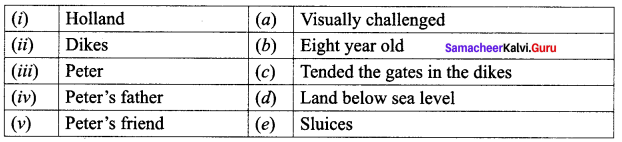
Answers:
(i)(c), (ii)(d), (iii)(e), (iv)(a), (v)(b).

2. Samacheer Kalvi 10th English Solutions Supplementary Chapter 7 A Dilemma 2
Answers:
(i)(c), (ii)(d), (iii)(b), (iv)(e), (v)(a).

D. Read the passage given below and answer the questions that follow:

1. I was just thirty-seven when my Uncle Philip died. A week before that event he sent for me; and here let me say that I had never set eyes on him. He hated my mother, but I do not know why. She told me long before his last illness that I need expect nothing from my father’s brother. He was an inventor, an able and ingenious mechanical engineer, and had much money by his improvement in turbine-wheels. He was a bachelor; lived alone, cooked his own meals, and collected precious stones, especially rubies and pearls.

From the time he made his first money he had this mania. As he grewricher, the desire to possess rare and costly gems became stronger. When he bought a new stone, he carried it in his pocket for a month and now and then took it out and looked at it. Then it was added to the collection in his safe at the trust company.

(a) How old was Uncle Philip’s nephew when he died?
Answer:
Uncle Philip’s nephew was thirty-seven years old when Philip died.

(b) How was the narrator related to Philip?
Answer:
The narrator was Philip’s nephew as Philip was his father’s brother.

(c) What was Philip doing and how did his earnings improve?
Answer:
Philip was an inventor and an ingenious mechanical engineer. His earnings improved in turbine-wheels.

(d) What did Philip do when he bought a new stone?
Answer:
For a month, Philip carried his new stone that he had purchased in his pocket and looked at it now and then. Later he would add it to his collections in his safe at the trust company.

(e) What was Philip’s mania?
Answer:
Philip’s mania was to collect precious stones, especially rubies and pearls.

2. At the time he sent for me I was a clerk, and poor enough. Remembering my mother’s words, his message gave me, his sole relative, no new hopes; but I thought it best to go. When I sat down by his bedside, he began, with a malicious grin: “I suppose you think me queer. I will explain.” What he said was certainly queer enough. “I have been living on an annuity into which I put my fortune. In other words, I have been, as to money, concentric half of my life to enable me to be as eccentric as I pleased the rest of it.

Now I repent of my wickedness to you all, and desire to live in the memory of at least one of my family. You think I am poor and have only my annuity. You will be profitably surprised. I have never parted with my precious stones; they will be yours. You are my sole heir. I shall carry with me to the other world the satisfaction of making one man happy. “No doubt you have always had expectations, and I . desire that you should continue to expect. My jewels are in my safe. There is nothing else left”. When I thanked him he grinned all over his lean face, and said: “You will have to pay for my funeral.”

(a) What did Tom recall when Uncle Philip had sent for him?
Answer:
When Uncle Philip had sent for Tom, he recalled his mother’s words that he should not expect anything from his uncle, though he was the sole relative.

(b) What was Tom working as when Uncle Philip called for him?
Answer:
Tom was a poor clerk when Uncle Philip called for him.

(c) What was the repentance that Uncle Philip said he had in his heart?
Answer:
Uncle Philip said that he repented for his wickedness to his family members.

(d) How was Uncle Philip‘s desire?
Answer:
Uncle Philip’s desire was to live in the memory of at least one of his family members.

(e) flow did Uncle Philip want to compensate for his wickedness?
Answer:
Uncle Philip wanted to compensate his wickedness by making one man happy as he wanted to give all his precious stones to him, who was his sole heir.

A Dilemma by Silas Weir Mitchell About the Author:

Silas Weir Mitchell was born on February 15, 1829, in Philadelphia, Pennsylvania, to John Kearsley Mitchell and Sarah Henry Mitchell. A prominent Philadelphia physician and graduate of Jefferson Medical College, Silas Weir Mitchell, M.D., developed the rest cure for neurasthenia in the 1870’s. In 1866, he published a short story in the Atlantic Monthly resting upon both somatic and psychological insights entitled “The Case of George Dedlow”. He wrote juvenile stories and prose fiction of varying merit which earned him a leading place among American authors at the close of the 19th century. He died on January 4, 1914 in Philadelphia and is interred at The Woodlands Cemetery.

A Dilemma Summary:

Samacheer Kalvi 10th English Solutions Supplementary Chapter 7 A Dilemma 3

Introduction:
A Dilemma written by Silas Weir Mitchell is an interesting short story of mystery. In this story the character receives from his uncle a box that contains a large number of valuables. However this box will explode to pieces when unlocked. So saying he dies.
Samacheer Kalvi 10th English Solutions Supplementary Chapter 7 A Dilemma 4

Tom is confused:
The narrator is informed of this by a letter which was left by his uncle on his bedside, shortly before his passing. He also informs all this to his only heir Tom on condition that he will agree to do a decent funeral for him.
Samacheer Kalvi 10th English Solutions Supplementary Chapter 7 A Dilemma 5

Confusion Intensifies:
The conflict of the story is entirely internal and results in a huge dilemma of anxiety and self-doubt as the protagonist Tom who is the sole heir to Uncle Philip decides and contemplates whether to attempt to open the box or not. In addition, he fears that someone else may try to open the box with the key and be blown to shreds. He confronts a doctor about his dilemma and eventually moves away to a new place, changes his name, and hides the box.
Samacheer Kalvi 10th English Solutions Supplementary Chapter 7 A Dilemma 6

Tom’s dilemma:
It’s incredibly fascinating to see how a small box and curiosity can drive a human being to so much trouble of anxiety and reluctance. We too are challenged with this thought as he tries to open the box. When,Tom sat down, as yet hopeful, and began to exert his ingenuity upon ways of opening the box without being killed, he is in a dilemma and is anxious of the pros and cons wanting to know the way to open the box unhurt.
He again gains anxiety and hence the doctor warns him that he was in danger of losing his mind is a pure representation of human curiosity and how it can drive us to anxiety and mental instability.
Samacheer Kalvi 10th English Solutions Supplementary Chapter 7 A Dilemma 7

Conclusion:
We conclude from this story that a man craves for riches and keeps running after it. He bothers least to face any difficulties and pain to live a rich and luxurious life. So one must understand that one will certainly attain the prize for which he undergoes hardships and does hard work.
Samacheer Kalvi 10th English Solutions Supplementary Chapter 7 A Dilemma 8

A Dilemma Glossary:

Textual:
Samacheer Kalvi 10th English Solutions Supplementary Chapter 7 A Dilemma 9
Samacheer Kalvi 10th English Solutions Supplementary Chapter 7 A Dilemma 10

Additional:
Samacheer Kalvi 10th English Solutions Supplementary Chapter 7 A Dilemma 11

We hope the data given here will benefit you to the fullest extent at the time of preparation. For better understanding of English subject this Samacheer Kalvi 10th English Solutions for Class 10th English Supplementary Chapter 7 A Dilemma PDF is the best resource. Download & ace up your preparation. Keep in touch with us and get the latest information on Tamilnadu State board Textbook Solutions PDF.

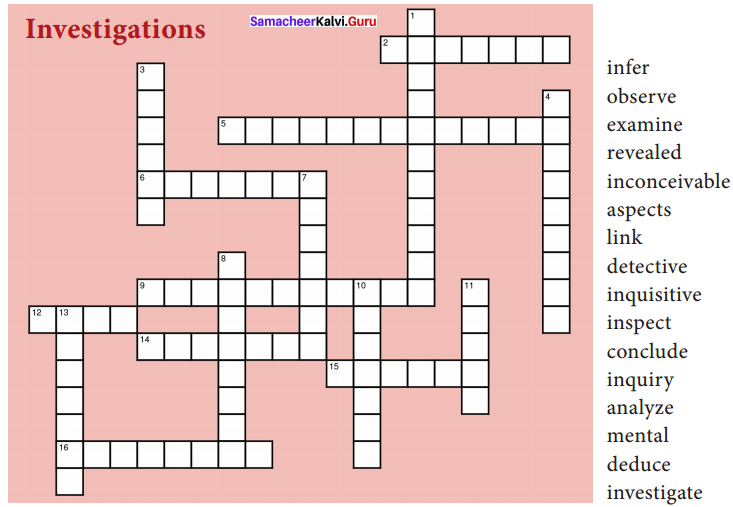
Samacheer Kalvi 10th English Solutions Supplementary Chapter 5 A Day in 2889 of an American Journalist

Looking to improve English skills and gain more subject knowledge then the best resources that you can use here is Samacheer Kalvi 10th English Solutions for Supplementary Chapter 5 A Day in 2889 of an American Journalist Questions and Answers.

In the Samacheer Kalvi 10th English Guide for Chapter 5 A Day in 2889 of an American Journalist textbook solutions, subject experts covered all types of questions and answers related to the topics, quick notes, summary, solved & unsolved exercises, etc. If you are planning to prepare Chapter 5 A Day in 2889 of an American Journalist via textbook, then you’re suggested to go with this Samacheer Kalvi 10th English Book Solutions Questions and Answers PDF for better understanding and preparation.

Tamilnadu Samacheer Kalvi 10th English Solutions Supplementary Chapter 5 A Day in 2889 of an American Journalist

English Subject experts who are having max years of experience prepared this Tamilnadu State Board Solutions for 10th English Supplementary Chapter 5 A Day in 2889 of an American Journalist Questions and Answers. They have explained all the topics covered in the board prescribed latest syllabus in a simple way to understand easily. So, students can prepare Chapter 5 English from this Samacheer Kalvi 10th English Book Questions and Answers PDF. Download the Tamilnadu State Board 10th English Chapter 5 A Day in 2889 of an American Journalist Workbook Solutions PDF by accessing the below links and learn properly for the final exams to score well.

A Day in 2889 of an American Journalist Textual Questions

A. Answer the following questions in two or three lines.

Question 1.
Why did Francis Bennett wake up with a bad temper?
Answer:
Francis Bennett woke up with a bad temper because he was feeling lonely and bored. It was eight days, since his wife had gone to France.

Question 2.
What was a mechanized dressing room?
Answer:
The machine in the mechanised dressing room washes a person, shaves him, dresses him and buttons him from top to toe on the threshold of his office.

Question 3.
How was food served to him?
Answer:
Food was served to him through a network of pneumatic tubes. It was an expensive system, but cooking was better.

Question 4.
Why was Bennett curious about astronomy?
Answer:
Bennett was curious about astronomy because one of the astronomers had just determined the
elements of the new planet ‘Gandini’. He was delighted to know about the accuracy of it.

Question 5.
Why did he visit Niagara?
Answer:
He visited Niagara to see his accumulator works. There after using the force of the cataracts to produce energy, he sold or hired it out to the consumers.

Question 6.
How did Bennett travel?
Answer:
Bennett travelled by aero-car which shot across space at a speed of about four hundred miles ‘ an hour. Within half an hour, he reached his works at Niagara.

Question 7.
Give three instances of how mechanization has changed life at home in 2889?
Answer:
At home through phonotelephote, vision and speech are transmitted. In two minutes, without the help of an attendant, the machine gets a person to be ready, to his office. Food can be served through pneumatic tubes.

Question 8.
How is advertising in this age different from what we have today?
Answer:
The gigantic advertisement signs are reflected on the clouds, so large that they can be seen all over the country. From that gallery, a thousand projectors were unendingly employed in sending to the clouds, on which they were reproduced in colour, these exorbitant advertisements.

Additional Questions

Question 1.
What is the story Jules Verne talks about?
Answer:
Jules Verne talks about the people of twenty-ninth century who live in fairyland.

Question 2.
Who is the central character and what is his role?
Answer:
The central character is an American Journalist, Francis Bennett who is the Managing Editor of the Earth Herald, the world’s largest newspaper.

Question 3.
What does Jules Verne visualize?
Answer:
Jules Verne visualizes in 1889 the world in 2889, a thousand years later where the world is filled with technological advancements.

Question 4.
What changed the mood of Bennett?
Answer:
The device, Phonotelephote when switched on changed the mood of Bennett since he could speak and see his wife Edith.

Question 5.
What was the latest advancement in Technology which was a boon to Bennett when his wife was in France?
Answer:
The latest advancement was the transmission of vision along with speech. This was indeed a boon since Bennett missed seeing his wife Edith.

Question 6.
How many reporters did Bennett have and what was their job?
Answer:
Bennett had fifteen hundred reporters who passed on to subscribers the news which had come in during the night from the four quarters of the earth.

Question 7.
Were the subscribers able to hear only the news?
Answer:
No, the subscribers besides hearing the news reported directly over telephones also had the sight of these events through commutators.

Question 8.
Who did Francis Bennett question about the recent discoveries in the Stellar world?
Answer:
Cash, one of the ten astronomical reporters was questioned by Bennett about the recent discoveries in the stellar world.

Question 9.
Which news by Cash made Bennett curious about the stellar world?
Answer:
The news about Phototelegrams from Mercury, Venus and Mars stated by Cash made Bennett curious to know more about the stellar world.

Question 10.
What was determined by one of the Earth Herald’s astronomers?
Answer:
One of the Earth Herald’s astronomers had determined Gandini a new planet.

Question 11.
What was determined by one of the Earth Herald’s astronomers?
Answer:
One of Earth Herald’s astronomers had determined Gandini a new planet.

Question 12.
Describe the elements of the new planet, Gandini.
Answer:
The new planet, Gandini is at a distance of 12,841,348,284,623 metres and 7 decimetres. This planet orbits round the sun in 572 years, 194 days, 12 hours, 43 minutes and 9.8 seconds.

Question 13.
What did Bennett do when the clock struck twelve?
Answer:
When the clock struck twelve, Bennett, the director of the Earth Herald left the hall and sat down in a rolling armchair. In a few minutes he reached his dining room half a mile away, at the far end of the office where he had arranged to have lunch at the same time with Edith.

Question 14.
Why did Bennett abandon domestic cooking?
Answer:
Francis Bennett abandoned domestic cooking because he was served with thousand types of dishes through a network of pneumatic tubes by the Society for Supplying Food to the Home. Though it was expensive, cooking was better.

Question 15.
What was the work awaiting Bennett at the waiting room of the Earth Herald?
Answer:
Bennett had to choose among the different proposals the right choice he gave to his petitioners among his daily audience.

Question 16.
What was the second inventor hoping to do?
Answer:
A second inventor, using as a basis some old experiments that dated from the 19th century, had the idea of moving a whole city in a single block. He suggested, as a demonstration, the town of Saaf, situated fifteen miles from the sea into a seaside resort.

B. Identify the character/speaker.

Question 1.
As soon as he woke up, he switched on his phonotelephote.
Answer:
Francis Bennett

Question 2.
Well, Cash, what have you got?
Answer:
Francis Bennett

Question 3.
‘Phototelegrams from Mercury, Venus and Mars, Sir.’
Answer:
Cash

Question 4.
‘Interesting! And Jupiter?’
Answer:
Francis Bennett

Question 5.
‘Not yet, Mr.Bennett.’
Answer:
Cash

Question 6.
‘No, it’s the inhabitants.’
Answer:
Corley

Question 7.
‘Where are we going, Sir?’
Answer:
Aero-coachman

Question 8.
‘Then, Sir, I shall really have discovered the absolute.’
Answer:
A young man/petitioner

Question 9.
‘Are you saying you’re going to be able to construct a human being?’
Answer:
Francis Bennett

Question 10.
‘I’m going to start this moment.’
Answer:
Edith

Additional:

Question 1.
Francis … dear Francis!…
Answer:
Edith

Question 2.
Well, Cash, what have you got?
Answer:
Bennett

Question 3.
Phototelegrams from Mercury, Venus and Mars, Sir.
Answer:
Cash

Question 4.
Interesting! And Jupiter?
Answer:
Bennett

Question 5.
Nothing so far!
Answer:
Cash

Question 6.
We cannot understand the signals the Jovian’s make.
Answer:
Cash

Question 7.
Perhaps ours haven’t reached them?
Answer:
Bennett

Question 8.
Aren’t you getting some result from the moon?
Answer:
Bennett

Question 9.
No it’s the inhabitants.
Answer:
Corley

Question 10.
On the face it turns towards us, at any rate.
Answer:
Corley

Question 11.
Who knows whether on the other side…’
Answer:
Corley

Question 12.
‘Well, there’s a very simple method of finding out.’
Answer:
Bennett

Question 13.
To turn the moon round!
Answer:
Bennett

Question 14.
Good! Hurry up and tell the reportage service about it.
Answer:
Bennett

Question 15.
I’m anxious for the news to appear in today’s issue!
Answer:
Bennett

Question 16.
‘I’m going to start this moment.
Answer:
Edith

Question 17.
‘By tube or aero-train?’
Answer:
Bennett

Question 18.
‘By tube’.
Answer:
Edith

Question 19.
‘Then you’ll be here? At eleven fifty-nine this evening.’
Answer:
Bennett

Question 20.
‘Paris time?’
Answer:
Edith

Question 21.
‘No, no! … Centropolis time’
Answer:
Bennett

Question 22.
‘Goodbye then, and above all don’t miss the tube!’
Answer:
Bennett

Question 23.
Then, Sir, I shall really have discovered the absolute’
Answer:
Bennett

Question 24.
When do you expect to get back to Centropolis?
Answer:
Francis Bennett

Question 25.
Well, Sir, I’m on the point of reducing the three to one.
Answer:
Bennett

Question 26.
He was lunching in solitude.
Answer:
Francis Bennett

Question 27.
Where are we going, Sir?
Answer:
Aero-coachman

Question 28.
Let’s see. I’ve got time…
Answer:
Francis Bennett

Question 29.
Take me to my accumulator works at Niagara.
Answer:
Francis Bennett

Question 30.
It travels at a speed of about 400 miles an hour.
Answer:
Aero Car

Question 31.
Within half an hour, he reached Niagara.
Answer:
Francis Bennett

Question 32.
Sir, elements were estimated at seventy five, it has now been reduced to three, as no doubt you are aware.
Answer:
The young man with broad brow

Question 33.
And the results of that discovery?
Answer:
The young man with broad brow

Question 34.
Are you saying you’re going to construct a human being?
Answer:
The young man with broad brow

Question 35.
He is one of the subscribers to the Society for Supplying Food to the Home.
Answer:
Francis Bennett

Question 36.
At twelve, he left the hail and sat down In a rolling armchair.
Answer:
The director of the Earth Herald, Mr. Bennett

Question 37.
The table was laid and he took his place at it.
Answer:
The director of the Earth Herald

Question 38.
Within reach of his hand was placed a series of taps.
Answer:
The director of the Earth Herald

Question 39.
They started working out some mechanical means of turning the satellite right round.
Answer:
The scientists of the Bennett factory

Question 40.
Well, this time, you can’t blame optical science!
Answer:
The director of the Earth Herald, Mr. Bennett

Question 41.
He woke in rather a bad temper.
Answer:
Bennett

Question 42.
Eight days ago, she had gone to Champs Elysees.
Answer:
Edith

C. Choose the best answer.

1. Bennette’s wife was in ……………….. .
(i) Germany
(ii) Australia
(iii) France
(iv) Holland
Answer:
(iii) France

2. The data from the stellar world was gathered by ……………….. .
(i) Bennette
(ii) astronomical
(iii) the computer
(iv) telephote
Answer:
(ii) astronomical reporters

3. The food was being delivered through ……………. tubes.
(i) pneumatic
(ii) shallow
(iii) hollow
(iv) virtual
Answer:
(i) pneumatic

4. The wayfarers were carried to one place to another by the.
(i) bullet train
(ii) jet
(iii) moving pavement
(iv) heli-taxi
Answer:
(iii) moving pavement

Additional:

1. A day in 2889 of an American Journalist is written by ……………… .
(a) Asha Nehemiah
(b) Matsuo Basho
(c) Jules Verne
Answer:
(c) Jules Verne

2. The story, ‘A Day IN 2889’ speaks about the people of the ……………….. .
(a) twenty-ninth century
(b) twentieth century
(c) twenty-fifth century
Answer:
(a) twenty-ninth century

3. The year is 2889 and the date is ………………… .
(a) 12th November
(b) 25th July
(c) 5th October
Answer:
(b) 25th July

4. Bennett is the Managing Editor of the …………………….. .
(a) Earth Herald, the world’s largest newspaper
(b) Herald Earth, the world’s futuristic story
(c) The Universe
Answer:
(a) Earth Herald, the world’s largest newspaper

5. As soon as Bennett woke up, he switched on his …………………….. .
(a) phonotelephote
(b) telephone
(c) electricity
Answer:
(a) phonotelephote

6. The wires led to the house he owned in the ……………………….. .
(a) Champs – Burtey
(b) Champs – Falcon
(c) Champs-Elysees
Answer:
(c) Champs-Elysees

7. Bennett had …………………. reporters.
(a) 1500
(b) 15000
(c)500
Answer:
(a) 1500

8. In addition to his telephone, each reporter has a series of ………………….. .
(a) commutators
(b) telephones
(c) Jovians
Answer:
(a) commutators

9. Francis Bennett questioned one of the ……………… astronomical reporters.
(a) Fifty
(b) ten
(c) fifteen
Answer:
(b) ten

10. We haven’t been able to understand the signals the ……………… make.
(a) Astronomers
(b) Jovians
(c) Mercurians
Answer:
(b) Jovians

D. Fill in the story map given below.

Samacheer Kalvi 10th English Solutions Supplementary Chapter 5 A Day in 2889 of an American Journalist 1

Samacheer Kalvi 10th English Solutions Supplementary Chapter 5 A Day in 2889 of an American Journalist 2
Samacheer Kalvi 10th English Solutions Supplementary Chapter 5 A Day in 2889 of an American Journalist 3

Additional:

A. Rearrange the following sentences in coherent order.

1. a. In this world of technological advancements newspapers are not printed but ‘spoken’.
b. Francis Bennett is the Managing Editor of the Earth Herald.
c. This story speaks about the people of the twenty-ninth century.
d. Earth Herald is the world’s largest newspaper.
e. The year is 2889, the date 25th July and the place is the office block.
Answers:
c, e, b, d, a
c. This story speaks about the people of the twenty-ninth century.
e. The year is 2889, the date 25th July and the place is the office block.
b. Francis Bennett is the Managing Editor of the Earth Herald.
d. Earth Herald is the world’s largest newspaper.
a. In this world of technological advancements newspapers are not printed but ‘spoken’.

2. a. As soon as he awoke, Francis Bennett switched on his phonotelephote.
b. Eight days ago his wife had been to France and he was feeling a little lonely.
c. Francis Bennett was in a bad temper.
d. The reason was the absence of his wife with him.
e. The wires of his Phonotelephote led to the house he owned in the Champs-Elysees.
Answers:
c, d, b, a, e
c. Francis Bennett was in a bad temper.
d. The reason was the absence of his wife with him.
b. Eight days ago his wife had been to France and he was feeling a little lonely.
a. As soon as he awoke, Francis Bennett switched on his phonotelephote.
e. The wires of his Phonotelephote led to the house he owned in the Champs-Elysees.

B. Fill in the blanks with the appropriate phrases given below to form a complete meaningful paragraph.

1. (by the electric current /to the house /could also be transmitted / completed by the telephote / As soon as)

(i) ………………… Francis Bennett woke up, he switched on his phonotelephote. The wires led (ii) ……………… he owned in the Champs-Elysees.The telephone, (iii) …………………….,is another of our time’s conquests! Though the transmission of speech (iv) …………………….. was already very old, it was only since yesterday that vision (v) ………………. was possible.
Answers:
(i) As soon as
(ii) to the house
(iii) completed by the telephote
(iv) by the electric current
(v) in the stellar world

2. (a series of taps /of his home in Paris / took his place/in spite of the distance/at the same time)

The table was laid and he (i) …………………. at it. Within reach of his hand was placed (ii) …………….. and before him was the curved surface of a phonotelephote, on which appeared the dining room (iii) …………….. Mr. and Mrs. Bennett had arranged to have lunch (iv) ……………….. nothing could be more pleasant than to be face to face (v) ……………….. to see one another and talk by means of the phonotelephotic apparatus.
Answers:
(i) took his place
(ii) a series of taps
(iii) of his home in Paris
(iv) at the same time
(v) in spite of the distance

C. Match the following appropriately:

1. Samacheer Kalvi 10th English Solutions Supplementary Chapter 5 A Day in 2889 of an American Journalist 4
Answers:
(i)(c), (ii)(e), (iii)(d), (iv)(a), (v)(b)

2. Samacheer Kalvi 10th English Solutions Supplementary Chapter 5 A Day in 2889 of an American Journalist 5
Answers:
(i)(b), (ii)(d), (iii)(e), (iv)(c), (v)(a)

D. Read the passage given below and answer the questions that follow:

1. That morning Francis Bennett awoke in rather a bad temper. This was eight days since his wife had been in France and he was feeling a little lonely. As soon as he awoke, Francis Bennett switched on his phonotelephote whose wires led to the house he owned in the Champs-Elysees. The telephone, completed by the telephote, is another of our time’s conquests! Though the transmission of speech by the electric current was already very old, it was only since yesterday that vision could also be transmitted.

A valuable discovery, and Francis Bennett was by no means the only one to bless its inventor when, in spite of the enormous distance between them, he saw his wife appear in the telephotic mirror. ‘Francis … dear FtancisL.’His name, spoken by that sweet voice, gave a happier turn to Francis Bennett’s mood. He quickly jumped out of bed and went into his mechanized dressing room.

(а) Why was Francis Bennett in a bad temper?
Answer:
Francis Bennett was feeling lonely as his wife had been to France eight days ago and so he was in a bad temper.

(b) What did he do as soon as he woke up?
Answer:
As soon as Francis woke up, he switched on the phonotelephote whose wires connected to his house in Champs Elysees where his wife was staying.

(c) What was the valuable discovery made just a day before 25th July?
Answer:
The valuable discovery was the telephotic mirror where Francis could see his wife appear on screen apart from hearing his voice.

(d) What changed the mood of Francis Bennett?
Answer:
When Francis heard his wife’s sweet voice say, ‘Francis…Francis’, his mood changed into a happy feel.

(e) What is considered a Time’s conquest?
Answer:
Telephone completed by telephote, resulting in phonotelephote is a Time’s conquest.

2. His name, spoken by that sweet voice, gave a happier turn to Francis Bennett’s mood. He quickly jumped out of bed and went into his mechanized dressing room.
Two minutes later, without needing the help of a valet, the machine deposited him, washed, shaved, shod, dressed and buttoned from top to toe, on the threshold of his office. The day’s work was going to begin. Francis Bennett went on into the reporters’ room.

His fifteen hundred reporters, placed before an equal number of telephones, were passing on to subscribers the news which had come in during the night from the four quarters of the earth. In addition to his telephone, each reporter has in front of him a series of commutators, which allow him to get into communication with this or that telephotic line. Thus the subscribers have not only the story but the sight of these events.

(a) What did Francis Bennett do when he became happy hearing wife’s sweet voice?
Answer:
As soon as Francis Bennett heard his wife’s voice he quickly jumped out of bed and went into his mechanized dressing room.

(b) What happened two minutes later?
Answer:
Two minutes later, without needing the help of a valet, the machine deposited Francis, washed, shaved, shod, dressed and buttoned him from top to toe, on the threshold of his office.

(c) How many reporters were there in the reporters’ room?
Answer:
There were about fifteen hundred reporters in the reporters’ room.

(d) What were the reporters doing when Francis entered the reporters’ room?
Answer:
The reporters were placed before an equal number of telephones and were passing on to subscribers the news which had come in during the night from the four quarters of the earth.

(e) What was the additional benefit that the subscribers were enjoying in recent times?
Answer:
In addition to a telephone, each reporter had in front of him a series of commutators, which allow him to get into communication with any onetelephotic line. Thus the subscribers had not only the story but the sight of all the events.

A Day in 2889 of an American Journalist by Jules Verne About the Author:

Jules Verne was bom in the city of Nantes, France on February 8th, 1828. His father was a lawyer, and at the beginning, Veme wanted to study law as well. When he was nineteen, – he started writing long pieces of literature, but his father wanted him to earn money as a lawyer, not as a writer. He decided to give up being a lawyer, and become a full-time professional writer instead. Veme married Aimee du Fraysse de Viane in January 1857 with his father’s blessing and continued to write until his death. On 24th of March 1905, Veme, who was sick with diabetes, died at his home in Amiens, France.

A Day in 2889 of an American Journalist Summary:

Samacheer Kalvi 10th English Solutions Supplementary Chapter 5 A Day in 2889 of an American Journalist 6

Introduction:
The author explains the life on earth after thousand years and that the daily activities of a normal human will be assisted by machines. For example the author envisions that travelling will be made easy. In this story the office block of the Earth Herald, the world’s largest newspaper, is illustrated during the year 2889.
Samacheer Kalvi 10th English Solutions Supplementary Chapter 5 A Day in 2889 of an American Journalist 7

Francis Bennett and his office One early morning, Francis Bennett woke up bad tempered because his wife Edith had gone to Champs Elysees eight days ago. He switched on his phonotelephote whose wires led to the house he owned in the Champs-Elysees. The telephone, completed by the telephote, was another of their time’s conquests! From yesterday,vision could also be transmitted along with speech. Bennett blessed its inventor as he saw his wife appear in the telephotic mirror. Her voice and face changed his mood.
Samacheer Kalvi 10th English Solutions Supplementary Chapter 5 A Day in 2889 of an American Journalist 8

He went into his mechanized dressing room within two minutes, washed, shaved, shod, dressed and buttoned from top to toe, on the threshold of his office. The day’s work started at the reporters’ room. His fifteen hundred reporters, with their telephones, were speaking the news received from the four quarters of the earth to subscribers. Besides telephone, all reporters have commutators, which allow communication on telephotic line with visual sights.

Bennett questioned one of the ten astronomical reporters Cash about the recent discoveries in the stellar world. Cash replied that it was Phototelegrams from Mercury, Venus and Mars, and nothing from Jupiter since the Jovians signal could not be understood. He added that even results from the Moon wasn’t possible and one can’t blame optical science though moon was six hundred times nearer than Mars. Corley another reporter said it was the inhabitants which was refuted by Bennett who said the simplest way was to turn the moon round and find out.
Samacheer Kalvi 10th English Solutions Supplementary Chapter 5 A Day in 2889 of an American Journalist 9

Bennett’s scientific lab
From then on, the scientists of the Bennett factory started working on turning satellite. One of the Earth Herald’s astronomers had just determined the elements of the new planet Gandini and Bennett was delighted at his accuracy. He wanted the reporters to pass on the news to the subscribers immediately. The broad gallery for such a journal as the Earth Herald brought in an average of three million dollars daily.
Samacheer Kalvi 10th English Solutions Supplementary Chapter 5 A Day in 2889 of an American Journalist 10

Luxury life of Bennett
When the clock struck twelve, the director of the Earth Herald sat in a rolling armchair and reached his dining room half a mile away. The table was laid before him and in front of him was the phonotelephote. The couple had arranged to have lunch at the same time, see and talk by phonotelephote. Francis Bennett was one of the subscribers to the expensive, Society for Supplying Food to the Home with thousand varieties through pneumatic tubes. He was finishing his coffee in solitude when Mrs. Bennett appeared in the telephote screen after work.

He then sped past to his accumulator works at Niagara by the aero-car at a speed of about four hundred miles an hour. Below him were the towns with moving pavements which carry the wayfarers along the streets. He returned, by way of Philadelphia, Boston and New York, to Centropolis, where his aero-car put him down about five o’clock. The waiting- room of the Earth Herald was crowded awaiting Bennett to return.
Samacheer Kalvi 10th English Solutions Supplementary Chapter 5 A Day in 2889 of an American Journalist 11

New Researches of Bennet
He chose carefully among the different proposals. The best was a young man whose broad brow indicated intelligence. He told Bennett about the elements estimated at seventy five now reduced to three to which Bennett told him that it would reduce to one in three weeks if he had money. He knew for sure that he would have discovered absolute, and the resultant, a human-being without a soul was confirmed by Bennett. The young fellow was assigned to the scientific editorial department of Bennett’s journal.
Samacheer Kalvi 10th English Solutions Supplementary Chapter 5 A Day in 2889 of an American Journalist 12

A second inventor, had the idea of moving a whole city in a single block. As a demonstration, the town of Saaf, situated fifteen miles from the sea would be transformed into a seaside resort. Francis Bennett, attracted by this project, agreed to take a half-share in it. Francis Bennett sat in an easy-chair in the audition-room to hear the proposal. Pressing a button, he communicated with the Central Concert. Re was charmed on a series of delicious harmonico-algebraic formulae.
Samacheer Kalvi 10th English Solutions Supplementary Chapter 5 A Day in 2889 of an American Journalist 13

Time for family
During his meal, phonotelephotic communication was tuned to speak to Edith. Edith told him that she was leaving to Centropolis the very moment by tube. He confirmed her arrival at Centropolis at 11:59 p.m. according to Centropolis time. These submarine tubes, travels from Paris in two hundred and ninety-five minutes than the aero-trains travelling at six hundred miles an hour. Francis Bennett, felt tired and went for a bath before going to bed. He touched the button and got ready for bath.
Samacheer Kalvi 10th English Solutions Supplementary Chapter 5 A Day in 2889 of an American Journalist 14

Conclusion:
This story brings out the fact that as long as humans aspire and work hard, there will be developments and innovations in this world. Smoke-free vehicles and machines that would instantly do what you desire will come forth. Therefore humans will achieve maximum heights in the field of Science and Technology.
Samacheer Kalvi 10th English Solutions Supplementary Chapter 5 A Day in 2889 of an American Journalist 15

A Day in 2889 of an American Journalist Glossary:

Textual:
Samacheer Kalvi 10th English Solutions Supplementary Chapter 5 A Day in 2889 of an American Journalist 16

Additional:
Samacheer Kalvi 10th English Solutions Supplementary Chapter 5 A Day in 2889 of an American Journalist 17

We hope the data given here will benefit you to the fullest extent at the time of preparation. For better understanding of English subject this Samacheer Kalvi 10th English Solutions for Class 10th English Supplementary Chapter 5 A Day in 2889 of an American Journalist PDF is the best resource. Download & ace up your preparation. Keep in touch with us and get the latest information on Tamilnadu State board Textbook Solutions PDF.
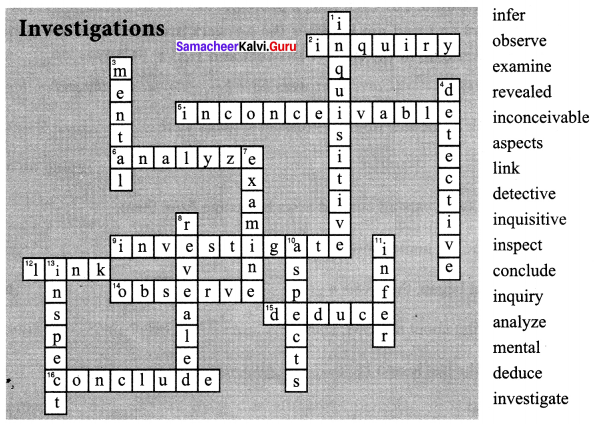
Samacheer Kalvi 10th English Vocabulary Slang Expressions

Looking to improve English skills and gain more subject knowledge then the best resources that you can use here is Samacheer Kalvi 10th English Solutions for Vocabulary Slang Expressions Questions and Answers.

In the Samacheer Kalvi 10th English Guide for textbook solutions, subject experts covered all types of questions and answers related to the topics, quick notes, summary, solved & unsolved exercises, etc. If you are planning to prepare Chapter via textbook, then you’re suggested to go with this Samacheer Kalvi 10th English Book Solutions Questions and Answers PDF for better understanding and preparation.

Tamilnadu Samacheer Kalvi 10th English Vocabulary Slang Expressions

English Subject experts who are having max years of experience prepared this Tamilnadu State Board Solutions for 10th English Vocabulary Slang Expressions Questions and Answers. They have explained all the topics covered in the board prescribed latest syllabus in a simple way to understand easily. So, students can prepare English from this Samacheer Kalvi 10th English Book Questions and Answers PDF. Download the Tamilnadu State Board 10th English Workbook Answers PDF by accessing the below links and learn properly for the final exams to score well.
Give the correct expression for the highlighted slang like expression:
1. I am gonna speed up my work.
2. Do you wanna join us to Ooty next week?
3. Whatcha going to do?
4. D’ya wanna come?
5. Can you gimme a hand?
6. She hasn’t gotta penny.
7. She’s kinda cute.
8. Please lemme be informed without fail.
9. Who saw ya?
10. You ain’t my boss.
11. I ain’t your boss.
12. He ain’t your boss.
13. I ain’t done it.
14. She is sorta tired.
15. We hafta go immediately.
16. I dunno if its all that good.
17. Dontcha know it?
18. I’m outta country next month.
19. Ya needa know ‘bout it.
20. I coulda come.
Answer:
1. going to 2. want to 3. What are you 4. Do you want to 5. give me
6. got a 7. kind of 8. let me 9. you 10. aren’t
11. am not 12. isn’t 13. haven’t 14. sort of 15. have to 16. don’t know
17. Don’t you 18. out of 19. You need to, about 20. could have

Observe the following Slang expressions and fill in the blanks given below.

1. Bee’s knees (someone who loves themselves)
2. dough (related to money)
3. telly (television)
4. Beeb (British Broadcasting Corporation)
5. Skiving (avoiding work or school)
6. dossing (lazing around doing nothing)
7. Killing me (really hurting)
8. Chap (a man) Samacheer Kalvi 10th English Vocabulary Slang Expressions
9. Bits and bobs (collection of small things/bits and pieces)
10. Nicked (stolen)
11. Dodgy (unreliable)
12. Chuffed (well pleased)
13. Ace (excellent)
14. Veg (vegetables)
15. Sarnie (food-related slang word/sandwich)
16. bickie (a biscuit or a chocolate biscuit)
17. Miffed (annoyed)
18. Kip (short sleep or nap)
19. Arm and a leg (extremely expensive)
20. Stuffed (unable to eat more) Samacheer Kalvi 10th English Vocabulary Slang Expressions

1. “Oh no! They have …………………….. petrol from my motorbike!”
2. All this routine work is ……………………..
3. Almost every day, my mom gives us …………………….. for breakfast.
4. Beverley and Sharon are …………………….. today to watch the IPL match.
5. Chandan is a bit of a …………………….. character.
6. Come on, Beno, stop …………………….. around and get some work done.
7. He thinks he’s the ……………………..
8. I am broke and not one …………………….. I have in hand.
9. Iam not too sure if I met this …………………….. the other day.
10. I don’t think I can have the dessert, I’m already ……………………..
11. I have only had an hour’s ……………………..
12. I need to keep track of the updates on ……………………..
13. Mithwin was really …………………….. at his birthday present.
14. My friend gave me a …………………….. when I was really hungry.
15. Our family counts on …………………….. for more accurate weather forecast.
16. Select your favorite fruit or …………………….. and pickle them while they are still fresh.
17. Silvi is an …………………….. singer.
18. There was a large collection of tools and other to …………………….. look at.
19. These shoes cost me ……………………..
20. We were a bit …………………….. about the news report on bombing at Srilanka.
Answer:
1. nicked 2. killing me 3. sarnie 4. skiving 5. dodgy
6. dossing 7. Bee’s knee 8. dough 9. chap 10. stuffed
11. kip 12. telly 13. chuffed 14. bickie 15. beep 16. veg
17. ace 18. bits and bobs 19. arm and a leg 20. miffed

We hope the data given here will benefit you to the fullest extent at the time of preparation. For better understanding of English subject this Samacheer Kalvi 10th English Answers for Class 10th English Vocabulary Slang Expressions PDF is the best resource. Download & ace up your preparation. Keep in touch with us and get the latest information on Tamilnadu State board Textbook Answers PDF.
Samacheer Kalvi 10th English Vocabulary Phrasal Verb

Looking to improve English skills and gain more subject knowledge then the best resources that you can use here is Samacheer Kalvi 10th English Solutions for Vocabulary Phrasal Verb Questions and Answers.

In the Samacheer Kalvi 10th English Guide for textbook solutions, subject experts covered all types of questions and answers related to the topics, quick notes, summary, solved & unsolved exercises, etc. If you are planning to prepare Chapter via textbook, then you’re suggested to go with this Samacheer Kalvi 10th English Book Solutions Questions and Answers PDF for better understanding and preparation.

Tamilnadu Samacheer Kalvi 10th English Vocabulary Phrasal Verb

English Subject experts who are having max years of experience prepared this Tamilnadu State Board Solutions for 10th English Vocabulary Phrasal Verb Questions and Answers. They have explained all the topics covered in the board prescribed latest syllabus in a simple way to understand easily. So, students can prepare English from this Samacheer Kalvi 10th English Book Questions and Answers PDF. Download the Tamilnadu State Board 10th English Workbook Answers PDF by accessing the below links and learn properly for the final exams to score well.
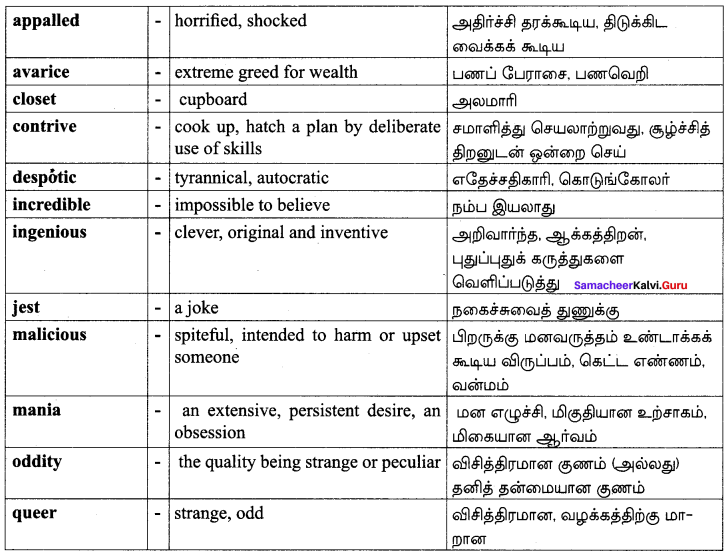
Replace the underlined phrasal verb with a single word or vice versa in the following sentences.
Question 1.
The jailor could not make out who was trying to scale the compound wall as there was pitch darkness.
(a) to make (b) understand (c) to patch up (d) organise
Answer:
(b) understand

Question 2.
She put on her rain coat and went out in her scooter.
(a) weighed (b) took (c) wore (d) designed
Answer:
(c) wore

Question 3.
It is the duty of sons/daughters to take care of parents in old age.
(a) right (b) box (c) hatch (d) safeguard
Answer:
(d) safeguard

Question 4.
Raja and Chandran finally saw eye to eye on the new business venture.
(a) agreement (b) faced each other (c) scorned (d) met
Answer:
(a) agreement

Question 5.
The party candidates got through with a thumping majority in the recent by-elections.
(a) had a tough time (b) escaped (c) succeed (d) illegal entry
Answer:
(c) succeed

Question 6.
The NGOs and Disaster management force pulled together to reach the relief supplies to the stranded people.
(a) pulled each other (b) managed (c) negotiated (d) worked harmoniously
Answer:
(b) managed

Question 7.
Drinking tells upon one’s health.
(a) is good for (b) ruins (c) advises (d) boosts
Answer:
(b) ruins

Question 8.
The Government pleader wanted the will in black and white and refused to accept the spoken words of the deceased.
(a) carbon paper (b) black pen (c) proof (d) photocopy
Answer:
(c) proof

Question 9.
The Prime Minister announced that the financial position will turn around within 50 days.
(a) become worse (b) diminish (c) change (d) improve/recover
Answer:
(d) improve/recover

Question 10.
The sons and son-in-law fell out over sharing the company’s profit.
(a) quarreled (b) fell down (c) fainted (d) were anxious
Answer:
(a) quarreled

Question 11.
Nirmala was at sea as Government buses did not operate in the whole city.
(a) making sand castle (b) ashore (c) confused (d) playful
Answer:
(c) confused

Question 12.
Kumar spoke pointlessly irritating his fans.
(a) beat about the bush (b) blew his own trumpet (c) told a cock and bull story (d) moved heaven and earth
Answer:
(a) beat about the bush

Question 13.
Chasing wealth has become a common trait among many politicians now.
(a) run on (b) run down (c) running after (d) run around
Answer:
(c) running after

Question 14.
Socrates persuaded people to believe that those who knew what they did not know were wise.
(a) brought the people round (b) brought them home (c) drove home (d) ate their humble pie
Answer:
(a) brought the people round

Question 15.
It was difficult to restrain my tears on seeing the natural calamity in Japan devastating the lives of people.
(a) hold on (b) hold back (c) hold off (d) hold away
Answer:
(a) hold on

Question 16.
The boss turned down the union leaders’ demand for 11% bonus.
(a) dismissed (b) rejected (c) considered (d) fired
Answer:
(b) rejected

Question 17.
Priya complied with the instructions of the company.
(a) modified (b) neglected (c) was angered (d) agreed to
Answer:
(d) agreed to

Question 18.
Under the influence of magic mushroom, the college student talked through his hat.
(a) discussed (b) Spoke carelessly (c) talk nonsense (d) spoke looking above
Answer:
(c) talk nonsense

Question 19.
Rajalingam is a man of letters.
(a) thoughtful person (b) writes letters (c) scholar (d) reads letters
Answer:
(c) scholar

Question 20.
There is no hard and fast instructions to leave the slippers outside a library.
(a) proper (b) strict (c) necessary (d) advice
Answer:
(b) strict

Question 21.
Laymen should never meddle with law.
(a) interfere with (b) play with (c) use (d) make
Answer:
(a) interfere with

Question 22.
Mistry burnt his fingers in the meger of two sinking steel plants in Africa.
(a) pointed his fingers (b) hurt his fingers (c) caught fire (d) incurred loss
Answer:
(d) incurred loss

Question 23.
Students are expected to discharge their duties towards themselves and to their parents.
(a) carry on (h) carry off (c) carry out (d) carry away
Answer:
(c) carry out

Question 24.
You must resist continuously to defend your right views.
(a) stand off (b) stand out (c) stand in (d) stand by
Answer:
(b) stand out

Question 25.
Students should know how to have a friendly relationship with their class.
(a) get up (b) get back (c) get on (d) get into
Answer:
(c) get on

Question 26.
I will discard these letters.
(a) throw out (b) throw off (c) take off (d) take up
Answer:
(a) throw out

Question 27.
The champion yielded to the strength of his opponent.
(a) gave on (b) gave back (c) gave in (d) gave up
Answer:
(c) gave in

Question 28.
He renounced his wealth and became a social worker.
(a) gave in (b) gave on (c) gave up (d) gave out
Answer:
(c) gave up

Question 29.
Naresh wishes to die working.
(a) die in harness (b) die eating his words (c) laugh in his sleeves (d) take the cues
Answer:
(a) die in harness

Question 30.
Kabeer was rescued at the eleventh hour.
(a) initially (b) last-minute (c) on the cards (d) bolt from the blue
Answer:
(b) last minute

We hope the data given here will benefit you to the fullest extent at the time of preparation. For better understanding of English subject this Samacheer Kalvi 10th English Answers for Class 10th English Vocabulary Phrasal Verb PDF is the best resource. Download & ace up your preparation. Keep in touch with us and get the latest information on Tamilnadu State board Textbook Answers PDF.

Samacheer Kalvi 10th English Vocabulary Confusables & Homophones

Looking to improve English skills and gain more subject knowledge then the best resources that you can use here is Samacheer Kalvi 10th English Solutions for Vocabulary Confusables & Homophones Questions and Answers.

In the Samacheer Kalvi 10th English Guide for textbook solutions, subject experts covered all types of questions and answers related to the topics, quick notes, summary, solved & unsolved exercises, etc. If you are planning to prepare Chapter via textbook, then you’re suggested to go with this Samacheer Kalvi 10th English Book Solutions Questions and Answers PDF for better understanding and preparation.

Tamilnadu Samacheer Kalvi 10th English Vocabulary Confusables & Homophones

English Subject experts who are having max years of experience prepared this Tamilnadu State Board Solutions for 10th English Vocabulary Confusables & Homophones Questions and Answers. They have explained all the topics covered in the board prescribed latest syllabus in a simple way to understand easily. So, students can prepare English from this Samacheer Kalvi 10th English Book Questions and Answers PDF. Download the Tamilnadu State Board 10th English Workbook Answers PDF by accessing the below links and learn properly for the final exams to score well.
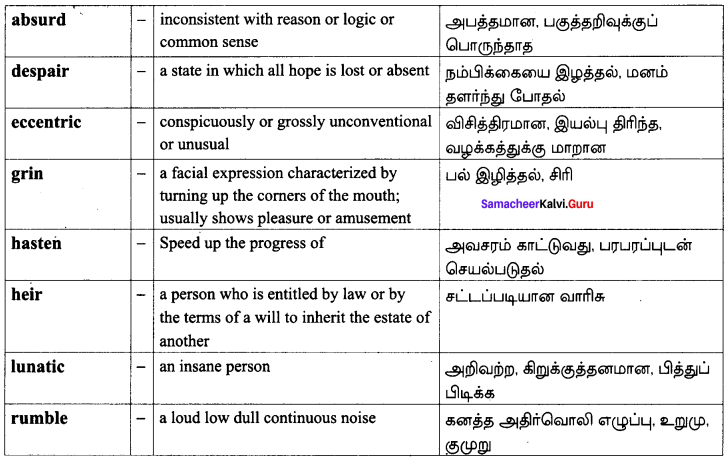
Homophones are one of the groups of words pronounced alike but differ in meaning and spelling or both. (e.g.) carat,
carrot; week, weak and hear, here.
Rewrite the following sentences by using the correct homophones for the underlined words:

Question 1.
He did not here any foot steps.
Answer:
He did not hear any foot steps.

Question 2.
Gita met her old classmate on her weigh to the ATM.
Answer:
Gita met her teacher on her wav to the ATM.

Question 3.
Ice cream with brownie was served as desert.
Answer:
Ice cream was served as dessert.

Question 4.
The old lady took wrest for an hour.
Answer:
The old lady took rest for an hour.

Question 5.
Tirupathi is a grate pilgrim spot.
Answer:
Tirupathi is a great pilgrim spot.

Question 6.
Never pause unhealthy comments.
Answer:
Never pass unhealthy comments.

Question 7.
My mom wood be pleased to help you during this festival time.
Answer:
My mom would be pleased to help you during this festival time.

Question 8.
You are not aloud inside the room.
Answer:
You are not allowed inside the room.

Question 9.
There was a cheque dam in Holland.
Answer:
There was a check dam in Holland.

Question 10.
If Himalayan eves disappear, few states will suffer.
Answer:
If Himalayan ice disappears, few states will suffer.

Question 11.
Her shoes are two small.
Answer:
Her shoes are too small.

Question 12.
Time may heel some wounds.
Answer:
Time may heal some wounds.

Question 13.
Mom advised me to prey regularly.
Answer:
Mom advised me to pray regularly.

Question 14.
Don’t loose your temper.
Answer:
Don’t lose your temper.

Question 15.
Some believe, “Mite is right”.
Answer:
Some believe, “Might is right”.

Question 16.
She new the way to the supermarket.
Answer:
She knew the way to the supermarket.

Question 17.
King Solomon was always faring in his judgment.
Answer:
King Solomon was always fair in his judgment.

Question 18.
Marina beach is the longest in Asia.
Answer:
Marina beach is the longest in Asia.

Question 19.
An engineer was arrested who had hordes of 2000 rupee notes.
Answer:
An engineer was arrested who had hoards of 2000 rupee notes.

Question 20.
The due seated on the top of a grass sparkled like a diamond.
Answer:
The dew seated on the top of a grass sparkled like a diamond.

Fill in with the right confusable to make a meaningful sentence
1. ……………………………. is a big clock, (ours/hours)
2. The colour of your ……………………………. is black, (hare/hair)
3. Gold is measured in ……………………………. (carrot/carat)
4. I sent a ……………………………. to my friend, (mail/male)
5. The ……………………………. seated on the top of the flowers and made the flower look more beatiful. (due/dew)
6. Sparrows were ……………………………. here long ago. (scene/seen)
7. Give me a ……………………………. when you reach home, (wring/ring)
8. How the youngest bird flies across the ……………………………. is a puzzle! (see/sea)
9. Last ……………………………. he did not attend school since he was ……………………………. (weak/week)
10. Those who are ……………………………. of their ……………………………. dare not do mistakes.(conscience/conscious)
11. Nivedha’s ……………………………. son ……………………………. himself to the new environment, (adapted/adopted)
12. The book which has been ……………………………. for the BA class has been ……………………………. for containing some
marks against a particular religion, (proscribed/prescribed)
13. Tommy was walking around the forest with his ……………………………. feet when he was attacked by the ……………………………. (bear/bare).
14. In the story, St.Michael, a ……………………………. was seated in a ……………………………. (ferry/fairy).
15. I wanted to buy a ……………………………. of bangles but I ended buying ……………………………. (pair/pears)
16. Every ……………………………. my grandmother would tell be a story about a ……………………………. to help me grow courageous, (knight/night)
17. We had to ……………………………. patiently, in spite of carrying a heavy ……………………………. (weight/wait)
18. The ……………………………. of the ……………………………. is always soft and silky, (hare/hair)
19. When teaching my son how to drive, I told him if he didn’t hit the ……………………………. in time he would ……………………………. the car’s side mirror, (break/brake)
20. If you ……………………………. drugs, you will get arrested and end up in a prison ……………………………. (cell/sell)
21. Karthik won’t spend one ……………………………. on a bottle of perfume until he knows that he loves the ……………………………. (sent/scent/cent)
22. If you accidentally drink a bottle of fabric ……………………………. you might ……………………………. (die/dye)
23. To bake a ……………………………. shaped cake, you’ll need some all-purpose ……………………………. (flour/flower)
24. If the ……………………………. breaks on your sandal, you might fall. However, your injuries will ……………………………. in a week’s time, (heal/heel)
25. I wanted to sit ……………………………. so I could ……………………………. the mimicry performance without any distractions, (hear/here)
Answer:
1. ours
2. hair
3. carat
4. nail
5. dew
6. seen
7. ring
8. sea
9. week/weak
10. conscious/conscience
11. adopted/adapted
12. prescribed/proscribed
13. bare/bear
14. fairy/ferry
15. pair/pears
16. knight/night
17. wait/weight
18. hair/hare
19. brake/break
20. sell/cell
21. cent/scent
22. dye/die
23. flower/flour
24. heel/heal
25. here/hear

We hope the data given here will benefit you to the fullest extent at the time of preparation. For better understanding of English subject this Samacheer Kalvi 10th English Answers for Class 10th English Vocabulary Confusables & Homophones PDF is the best resource. Download & ace up your preparation. Keep in touch with us and get the latest information on Tamilnadu State board Textbook Answers PDF.

Samacheer Kalvi 11th Chemistry Notes Chapter 9 Solutions

Tamilnadu Samacheer Kalvi 11th Chemistry Notes Chapter 9 Solutions Notes

Solution – It is a homogeneous mixture of two or more substances consisting of atoms, ions or molecules.

Solvent – The compound that is present in large amount in a homogeneous mixture is called solvent.

Solute – The compound that is present in small amount in a homogeneous mixture is called solute.

Aqueous solution – If the water is used as the solvent the resultant solution is called an aqueous solution.

Non-aqueous solution – If solvent other than water is used, then the resultant solution is called non-aqueous solution.

Types and examples of solution
Samacheer Kalvi 11th Chemistry Notes Chapter 9 Solutions Notes 3

Molality (m) – It is defined as the number of moles of solute present in 1 kg of the solution.

Molarity (M) – It is defined as the number of moles of solute present in 1 L of the solution.

Normality (N) – It is defined as the number of gram equivalents of solute present in 1 L of the solution.

Formality (F) – It is defined as the number of formula weight of the solute present in 1 L of the solution.

Mole fraction – It is defined as the ratio of the number of moles of the component to the total number of moles of all components present in the solution.

Mass percentage – It is the ratio of percentage of the mass of the solute to the mass of solution in grams.

Volume percentage – It is the ratio of percentage of volume of the solute to the volume of the solution in ml.

Mass by volume – It is the ratio of percentage of mass of the solute in g to the volume of the solution in ml.

Parts per million (ppm) – One ppm is equivalent to 1 milligram of the component per litre of solution.

Standard solution – A standard solution is a solution whose concentration is accurately known.

Solubility of a substance – The solubility of a substance is defined as the amount of the solute that can be dissolved in lOOg of the solvent at a given temperature to form a saturated solution.

Factors influencing the solubility – (i) Nature of solute and solvent, effect of temperature, effect of pressure.

Henry’s law – This law states that “the partial pressure of the gas in vapour phase (vapour pressure of the solute) is directly proportional to the mole fraction (x) of the gaseous solute in the solution at low concentration.
PSolute ∝ x solute in solution (or) Psolute = KH .x solute in solution.

KH – ft is the empirical constant with dimensions of pressure.

Evaporation – The process in which the liquid in converted to vapour.

Condensation – The process in which the vapour is converted to liquid.

Vapour pressure – It is defined as the pressure of vapour in equilibrium with its liquid at a given temperature.

Binary solution – The solution which contains only two components is called binary solution.

Raoult’s law – This law states that “in the case of a solution of volatile liquids, the partial pressure of each component (A & B) of the solution is directly proportional to its mole fraction.
PA = K . XA

Dalton’s law of partial pressure – This law states that the total pressure in a closed vessel will be equal to the sum of the partial pressures of the individual components.
pTotal = PA + PB

Ideal solution – It is a solution in which each component i.e., the solute as well as the solvent obeys the Raoult’s law over the entire range of concentration.

Non-ideal solutions – The solutions which do not obey Raoult’s law over the entire range of concentration are called non-ideal solution.

Factors responsible for deviation from Raoult’s law – Solute-solvent interaction, dissociation of solute, association of solute, temperature, pressure, concentration.

Colligative properties – The properties of the solution which do not depend on the chemical nature of the solute particles but depends only on the number of solute particles present in the solution are called colligative properties.

Relative lowering of vapour pressure – It is defined as the ratio of lowering of vapour pressure to vapour pressure of the solvent. Mathematically,
Samacheer Kalvi 11th Chemistry Notes Chapter 9 Solutions Notes 1

Samacheer Kalvi 11th Chemistry Notes Chapter 9 Solutions Notes 2
Relative lowering of vapour pressure = Moles fraction of solute

Boiling point – It is the temperature at which the vapour pressure of the solution becomes equal to the atmospheric pressure (1 atm).

Elevation of boiling point – ΔTb – Tb – T0b
ΔTb = kb . m where kb = molal boiling point elevation constant.

kb Ebullioscopic constant
\(k_{b}=\frac{\mathrm{RT}_{b}^{2} \mathbf{M}_{\text {solvent }}}{\Delta \mathrm{H}_{\text {vaporisation }}}\)

Freezing point – It is defined as the temperature at which the solid and the liquid states of the substances have the same vapour pressure.

Depression in freezing point ΔTf – ΔTf = kf. m where kf = molal freezing point depression constant.

kf Cryoscopic constant.

Osmosis – It is a spontaneous process by which the solvent molecules pass through a semipermeable membrane from a solution of low concentration to a solution of higher concentration.

Osmotic pressure – The pressure that must be applied to the solution to stop the influx of the solvent (to stop osmosis) through a semipermeable membrane is called osmotic pressure.
π = CRT

Isotonic solutions – Two solutions having same osmotic pressure at a given temperature are called isotonic solutions.

Reverse osmosis (RO) – It can be defined as a process in which a solvent passes through a semipermeable membrane in the opposite direction of osmosis, when subjected to a hydrostatic pressure greater than the osmotic pressure.

van’t Hoff factor (i) – It is defined as the ratio of the actual molar mass to the abnormal molar mass of the solute.

αdissociation = \(\frac{i-1}{n-1}\)

αassociation = \(\frac{(1-i) n}{n-1}\)

Samacheer Kalvi 11th Chemistry Notes