Samacheer Kalvi 11th Chemistry Notes Chapter 7 Thermodynamics

Tamilnadu Samacheer Kalvi 11th Chemistry Notes Chapter 7 Thermodynamics Notes

Thermodynamics – It means flow of heat. It is a branch of science which deals the relation between energy, heat, work and accompanying changes in the nature and behaviour of various substances around us.

Macroscopic properties – Heat and work.

First law of Thermodynamics – It states that “The total energy of an isolated system remains constant though it may change from one form to another”.

ΔU = q + w
ΔU – Change in the internal energy
q – Amount of heat supplied to the system
w – Amount of work done on the system

System – It is defined as any portion of matter under thermodynamic consideration, which is separated from the rest of the universe by real or imaginary boundaries.

Homogeneous system – If the physical states of all its matter are uniform, it is called homogeneous system.

Heterogeneous system – If the physical states of all its matter are not uniform, it is called heterogeneous system.

Surroundings – Everything in the universe that is not the part of system is called surroundings.

Boundary – Anything which separates the system from its surrounding is called boundary.

Isolated system – A system which can exchange neither matter nor energy with its surroundings is called an isolated system, e.g., Hot water contained in a thermos flask.

Closed system – A system which can exchange only energy but not matter with its surroundings is called a closed system, e.g., Hot water contained in a closed beaker.

Open system – A system which can exchange both matter and energy with its surroundings is called an open system, e.g., Hot water contained in an open beaker.

Intensive properties – The properties that are independent of the mass or size of the system is called as intensive property, e.g., Refractive index, surface tension, density, temperature, boiling point and freezing point etc.

Extensive properties – The properties that are depended on the mass or size Of the system is called as extensive property, e.g., Volume, number of moles, mass and internal energy etc.

Thermodynamic process – The method of operation which can bring about the change in the system is called thermodynamic process, e.g., Heating, cooling and fusion.

Reversible process – The process in which the system and surroundings can be restored to the initial state from the final state without producing any changes in the thermodynamic properties of the universe is called a reversible process.

Irreversible process – The process in which the system and surroundings cannot be restored to the initial state from the final state is called an irreversible process.

Adiabatic process – It is defined as one in which there is no exchange of heat (q) between the system and surrounding during process, [q = 0]
304 Chemistry-11 :

Isothermal process – It is defined as one in which the temperature of the system remains constant, during the change from its initial to final state. [dT = 0]

Isobaric process – It is defined as one in which the pressure of the system remains constant during its change from the initial to final state. [dP = 0]

Isochoric process – It is defined as one in which the volume of system remains constant during its change from initial to final state. [dV= 0]

Cyclic process – When a system returns to its original state after completing a series of changes the process is known as a cyclic process. For a cyclic process dU = 0, dH = 0, dP = 0, dV= 0 and dT= 0.

State functions – The properties of P, V, T and ‘n’ that are used to describe the state of a system are called as state functions.

Path functions – A path function is a thermodynamic property of the system whose value depends on the path by which the system goes from its initial to final states, e.g., Work and heat.

Internal energy – Internal energy of a system is equal to the energy possessed by all its constituents namely atoms, ions and molecules.
U = Internal energy = Ut + Uv + Ur + Ub + Ue + Ui.

ΔU – Change in internal energy = Uf– Ui.

Heat (q) – It is regarded as an energy in transit across the boundary separating a system from its surrounding. It is a path function.

Units of heat – SI unit of heat is joule (J).The other unit is calories (cal).

Calories (cal) – It is defined as the quantity of heat required to raise the temperature of 1 gram of water by 1 °C in the vicinity of 15°C.

Work (w) – It is defined as the force (F) multiplied by the displacement (x). [- w = F. x ]

Unit of work – SI unit of work is joule (J) or kilojoule (kJ).

Joule – It is defined as the work done by a force of one Newton through a displacement of one meter (J = Nm).

Gravitational work – When an object is raised to a certain height against the gravitational field, gravitational work is done on the object, [w = m.g.h]

Electrical work – When a charged body moves from one potential region to another, electrical work is done, [w = QV]

Mechanical work – It is defined as force multiplied by the displacement through which the force acts, [w = F. x]

Pressure – Volume work – The work done in expansion or compression of a gas. PV work (or) expansion work.

Work involved in expansion and compression process – [w = -PΔV]

Expansion – During expansion, work is done by the system. Since Vf > Vi., the sign obtained for work will be negative.

Compression – During compression, work is done on the system. Since Vf < Vi the sign obtained for work will be positive.

For Reveresible process wrev = 2.303 nRT log \(\left(\frac{\mathrm{V}_{f}}{\mathrm{~V}_{i}}\right)\)

Zeroth law of thermodynamics – This law states that ‘If two systems are separately in thermal equilibrium with a third one, then they tend to be in thermal equilibrium with themselves’.

First law of thermodynamics – “Energy can neither be created nor destroyed, but may be converted from one form to another”.
(or)
The total energy of a system and surroundings remains constant (or conserved).
ΔU = q + w

Mathematical statement of first law –

ΔU = q + w
Cyclic processΔU = 0∴ q = -w
Isochoric processΔV = 0
w = 0
∴ ΔU = qv
Adiabatic processQ = 0∴ ΔU = w
Isobaric processΔU = q + wΔU = q – p ΔV

Enthalpy (H) – It is defined as the sum of the internal energy (U) of a system and the product of pressure and volume of the system.
H = U + PV
ΔH = ΔU + PΔV

Relation between enthalpy ‘H’ and internal energy ‘U’ –
ΔH — ΔU + Δn(g)RT

Standard heat of formation – It is defined as “the change in enthalpy that takes place when one mole of a compound is formed from its elements, present in their standard states (298K and 1 bar pressure).

Thermochemical equations – It is a balanced stoichiometric chemical equation that includes the enthalpy change (ΔH).

Standard enthalpy of reaction (ΔH0r) – It is the enthalpy change for a reaction when all the reactants and products are present in their standard states.
\(\Delta \mathrm{H}_{r}^{0}=\Sigma \Delta \mathrm{H}_{r}^{0} \text { (products) }-\Sigma \Delta \mathrm{H}_{r}^{\theta} \text { (reactants) }\)

Heat of combustion (ΔHc) – It is defined as the change in enthalpy of a system when one mole of the substance is completely burnt in excess of air or oxygen.

Specific heat capacity (C) – It is defined as the heat absorbed by one kilogram of a substance in raising its temperature by one Kelvin at a specified temperature.
\(\mathrm{C}=\left[\frac{q}{m\left(\mathrm{~T}_{2}-\mathrm{T}_{1}\right)}\right]\)

Molar heat capacity – It is defined as the amount of heat absorbed by one mole of the substance to raise its temperature by 1 Kelvin.
cm = q/ΔT

Unit of heat capacity – JK-1 mol-1

Cv : (Molar heat capacity at constant volume) – It is defined as the rate of change of internal energy with respect to temperature at constant volume.
\(C_{V}=\left(\frac{d U}{d T}\right)_{V}\)

Cp: (Molar heat capacity at constant pressure) – It is defined as the rate of change of enthalpy with respect to temperature at constant pressure.
\(C_{P}=\left(\frac{d H}{d T}\right)_{P}\)

Relation between Cp and Cv for an ideal gas –
Cp – Cv = nR

Calorimetry – It is the science associated with determining the changes in energy of a system by measuring the heat exchanged with the surroundings. ,

Exothermic reaction – The reaction in which heat is evolved and system loses heat to the surroundings. [ΔHr = -ve]

Endothermic reaction – The reaction in which heat is absorbed and system gains heat from the surroundings. [ΔHr= +ve] .

Calorific value – It is defined as the amount of heaf produced in calories (or joules) when one gram of a substance is completely burnt. The SI unit is J kg-1.

Heat of solution – It is defined as the change in enthalpy of the system when one mole of a substance is dissolved in a specified quantity of a solvent at a given temperature.

Heat of neutralisation – It is defined as the change in enthalpy of the system when one gram equivalent of an acid is completely neutralised by one gram equivalent of a base in dilute solution.

Molar heat of fusion – It is defined as the change in enthalpy when one mole of a solid substance is converted into the liquid state at its melting point.

Molar heat of vapourisation – It is defined as the change in enthalpy when one mole of a liquid is converted into vapour or gaseous state at its boiling point.

Molar heat of sublimation – It is defined as the change in enthalpy when one mole of a solid is directly converted into the gaseous state at its sublimation temperature.

Heat of transition – It is defined as the change in enthalpy when one mole of an element changes from one allotropic form to another.

Hess’s law of constant heat summation – It states that “the enthalpy change of a reaction either at constant volume or constant pressure is the same whether it takes place in a single step or multiple steps provided the initial and final states are same”.

Lattice energy – It is defined as the amount of energy required to completely remove the constituent ions from its crystal lattice to an infinite distance.

Born Haber’s cycle – It applies Hess’s law to calculate lattice enthalpy.

Second law of thermodynamics –
(i) Entropy statement: “Whenever a spontaneous process takes place, it is accompanied by an increase in the total entropy of the Universe”.
ΔSUniverse > ΔSsystem + ΔSsurroundings

(ii) Kelvin-Planck statement – It is impossible to take heat from a hotter reservoir and convert it completely into work by a cyclic process without transferring a part of heat to a cooler reservoir.

% Efficiency – \(\left[\frac{\mathrm{T}_{1}-\mathrm{T}_{2}}{\mathrm{~T}_{1}}\right] \times 100\)

Clausius statement – It states that heat flows spontaneously from hot objects to cold objects and to get it flow in the opposite direction, we have to expend some work.

Spontaneous process – A reaction that does occur under the given set of conditions without any external driving force is called a spontaneous reaction.

Non-spontaneous process – A reaction that does not occur under given set of conditions without any external driving force is called a non-spontaneous reaction.

Entropy (S) – It is defined as “for a reversible change taking place at a constant temperature (T), the change in entropy (AS) of the system is equal to heat energy absorbed or evolved (q) by the system divided by the constant temperature (T)”. \(\Delta S_{\text {sys }}=\frac{q_{\text {rev }}}{T}\)

Unit of entropy – JK-1(SI unit).

Standard entropy of formation – It is defined as the entropy of formation of 1 mole of a compound from the elements under standard conditions. It is denoted as \(\Delta \mathrm{S}_{f}^{0}\)

Standard entropy change AS0
\(\Delta \mathrm{S}_{r}^{0}=\Sigma \mathrm{S}_{\text {products }}^{0}-\Sigma \mathrm{S}_{\text {reactants }}^{0}\)

Entropy of fusion – When one mole of the solid melts at its melting point reversibly, the heat absorbed is called molar heat of fusion.
\(\Delta \mathrm{S}_{f}=\frac{\Delta \mathrm{H}_{f}}{\mathrm{~T}_{f}}\)
ΔHf = Molar heat of fusion
Tf= Melting point

Entropy of vapourisation – When one mole of liquid is boiled at its boiling point reversibly, the heat absorbed is called molar heat of vapourisation.
\(\Delta \mathrm{S}_{v}=\frac{\Delta \mathrm{H}_{v}}{\mathrm{~T}_{b}}\)

ΔHv = Molar heat of vapourisation
Tb = Boiling point

Entropy of transition – The heat change, when one mole of a solid changes reversibly from one allotropic form to another at its transition temperature.
\(\Delta \mathrm{S}_{t}=\frac{\Delta \mathrm{H}_{t}}{\mathrm{~T}_{t}}\)
ΔHt = Molar heat of transition .
Tt = Transition temperature

Gibbs free energy – It is the available energy to do the work. It is defined as the part of total energy of a system that can be converted (or) available for conversion into work.
G = H – TS
ΔG = ΔH – TΔS
ΔG = -w- PΔV

Spontaneous
(irreversible)
Equilibrium
(reversible)

Non-spontaneous
(non-feasible)

ΔH < 0ΔH = TΔSΔH > 0
ΔS > 0ΔS = ΔH/TΔS < 0
ΔG < 0ΔG = 0ΔG > 0

Reaction quotient (Q) – It is defined as the ratio of concentration of the products to the concentrations of the reactants under non equilibrium conditions.

ΔG° = Standard free energy change of the reaction.
ΔG = ΔG° + RT In Q
ΔG0 = – RT In Keq
ΔG0 = – 2.303 RT log Keq
ΔG0 = ΔH0 – TΔS0 = – RT In Keq

Third law of thermodynamics – It states that the entropy of pure crystalline substance at absolute zero is zero (or) it is impossible to lower the temperature of an object to absolute zero in a finite number of steps, \(\lim _{T \rightarrow 0} S=0\)
Samacheer Kalvi 11th Chemistry Notes

Samacheer Kalvi 11th Chemistry Notes Chapter 6 Gaseous State

Tamilnadu Samacheer Kalvi 11th Chemistry Notes Chapter 6 Gaseous State Notes

Gases at STP – H2, N2, O2, F2, Cl2, O3, He, Ne, Ar, Kr, Xe and Rn (Only 11 elements).

The Earth – The Earth is surrounded by a atmosphere of air whose composition is 78% Nitrogen, 21% Oxygen and 1% other gases.

Oxygen – It is highly essential for our survival.

Hydrogen cyanide (HCN) – Deadly poison

Carbon monoxide (CO) – Highly toxic

NO2 and SO2 less toxic

Chemically inert gases – He, Ne, Ar, Kr, Xe and Rn.

Gas – A substance is normally in a gaseous state at ordinary temperature and pressure.

Vapour – The gaseous form of any substance that is a liquid or solid at NTP. Gaseous State

Pressure – It is defined as the force exerted by a gas on unit area of the wall.
Pressure = \(\frac{\text { Force }}{\text { area }}=\frac{\mathrm{F}}{\mathrm{a}}\)

Unit of pressure (Pascal) – 1 Pascal = 1 Nm-2,where 1 N = 1 Kg m s-2. Other units of pressure are Bar, atmosphere, Torr, mm of Hg.

Atmospheric pressure – The force exerted on a unit area of earth by the column of air above it is called atmospheric pressure.

1 atm – 760 mm Hg

Boyle’s law – At a given temperature, the volume occupied by a fixed mass of a gas is inversely proportional to its pressure.
V ∝ 1/p at constant T (or)
PV = K1 at constant T (or)
P1V1 = P2V2 = K1

Charles’ law – For a fixed mass of a gas at constant pressure, the volume is directly proportional to temperature (K).
V ∝ T and constant P and n : V/T = Constant

Absolute zero : -273.15°C.

Gay-Lussac’s law – At constant volume, the pressure of a fixed mass of gas is directly proportional to temperature. P ∝ T at constant V ; P/T = Constant.

Avogadro’s hypothesis – Equal volumes of all gases under the same condition of temperature
and pressure contain equal number of molecules.
V ∝ n (or) \(\frac{\mathrm{V}_{1}}{n_{1}}=\frac{\mathrm{V}_{2}}{n_{2}}=\text { Constant }\)

Ideal gas equation – PV = nRT where R is universal gas constant.

Values of R –
R = 0.082057 dm3 atm mol-1 K-1
R = 8.314 × Pa m3 K-1mol-1
R = 8.314 × 10⁻² bar dm3 K-1mol-1
R = 8.314 JK-1mol-1

Dalton’s law of partial pressures – It states that the total pressure of a mixture of gases is the sum of partial pressures of the gases present.
Ptotal = p1+P2 + P3 ……………..

Graham’s law of Diffusion – The rate of effusion or diffusion is inversely proportional to the square of molecular mass of a gas through an orifice.
\(\frac{r_{A}}{r_{B}}=\sqrt{\frac{M_{B}}{M_{A}}}\)

Ideal gases – Gases that obey ideal gas equation PV = nRT are ideal gases.

Real gases – Gases that do not obey the ideal gas equation PV = nRT are real gases. For them either PV > nRT or PV < nRT

Van der Waals equation of state –
\(\left(\mathrm{P}+\frac{\mathrm{an}^{2}}{\mathrm{~V}^{2}}\right)(\mathrm{V}-\mathrm{nb})=\mathrm{nRT}\)
Where a and b are Van der Waals constant.

Critical constants –
Critical Volume Vc = 3b
Critical Pressure Pc = \(\frac{a}{27 b^{2}}\)
Critical Temperature Tc = \(\frac{8 \mathrm{a}}{27 \mathrm{Rb}}\)

Critical temperature of CO2 303.98 K

Critical Temperature – Tc is defined as the temperature below which a gas can be liquefied by the application of pressure.

Critical Pressure – Pc is the pressure required to liquefy a gas at its critical temperature.

Critical Volume – Vc is the volume occupied by one mole of a gas at its critical temperature aftd critical pressure.

Joule Thomson effect – The phenomenon of producing lowering of temperature when a gas is made to expand adiabatically from a region of high pressure into a region of low pressure.

Inversion temperature ( Ti) – The temperature below which a gas obey Joule Thomson effect is called inversion temperature. \(\mathrm{T}_{\mathrm{i}}=\frac{2 \mathrm{a}}{\mathrm{Rb}}\)

Samacheer Kalvi 11th Chemistry Notes

Samacheer Kalvi 11th Chemistry Notes Chapter 5 Alkali and Alkaline Earth Metals

Tamilnadu Samacheer Kalvi 11th Chemistry Notes Chapter 5 Alkali and Alkaline Earth Metals Notes

s-block elements – Group 1 and 2 elements are those in which the last electron enters the outermost s-orbital.

Group 1 elements – Alkali metals Li, Na, K, Rb, Cs and Fr with electronic configuration as noble gas [ns1].

Occurrence of Alkali metals

ElementOccurrence
1. LithiumSpodume and lepidolite (Silicate minerals)
2. SodiumRock salt (NaCl)
3. PotassiumNitre and camallite
4. Rubidium and cesiumMinerals with other alkali metals
5. FranciumRadioactive. It does not occur in nature

Half-life of francium – 21 minutes.

Oxidation state of alkali metals – +1.

Atomic radii and ionic radii of alkali metals – On moving down the group increases and across the period decreases.

Periodic trends in alkali group – Reactivity, atomic radius, formation of electropositive ion and density increases down the group. Melting point and boiling point decreases down the group.

Distinctive behaviour of lithium – Extremely small size, greater polarizing power of ion, least electropositive character and non-availability of d-orbitals.

Chemical properties – Alkali metals are highly reactive and reacts with oxygen, hydrogen, halogen and liquid ammonia.

Uses of alkali metals – Oxidizing agents (oxide of alkali metals), strong bases (hydroxides of alkali metals), sodium and potassium ions perform important biological functions such as ion balance and nerve impulse conduction.

Fruits rich in potassium – Avocadoes, potatoes and bananas.

Group 2 elements – Alkaline earth elements with general electronic configuration as [noble gases] ns2. They are Be, Mg, Ca, Sr, Ba and Ra.

Alkaline earth metals – Except Be, all other oxides and hydroxides are alkaline in nature.

Occurrence of alkaline earth metals –

ElementOccurrence
1. BerylliumRare
2. RadiumThe rarest
3. Magnesium and calciumRocks and minerals
4. Magnesium8th most abundant element and occur as camallite, magnesite and dolomite
5. Calcium5th most abundant element and occur as chalk, limestone and gypsum
6. StrontiumCelestite and strontianite
7. BariumLess common and occur as barite

Pyrotechnics – Alkaline earth metals are used to produce colours in firework shows.

Oxidation state of alkaline earth metals – +2.

Trends in periodic properties –

  • Atomic and ionic radii increases down the group.
  • Ionization enthalpy and hydration enthalpy decreases down the group.

Anomalous behavior of beryllium – (i) Small size (ii) high polarizing power (iii) high electronegativity (iv) absence of vacant d-orbital (v) high ionization enthalpy.

Chemical properties – Alkali metals react with H., and halogens.

Uses of beryllium –

  • Used as radiation windows for X-ray tube and X-ray detectors.
  • As sample holder in X-ray emission studies.
  • Used to build the beam pipe in accelerators.
  • Used in detectors.

Uses of magnesium –

  • For the removal of sulfur from iron and steel.
  • For the refining of titanium.
  • Used as photoengrave plates in printing industry.
  • Magnesium alloys are used in airplanes and missile construction.
  • Mg ribbon is used in Grignard reagent synthesis.
  • As desiccant.
  • As sacrificial anode in controlling galvanic corrosion.
  • As a reducing agent.
  • Mg + A1 alloy used in fabrication and welding.

Uses of calcium –

  • Used as a reducing agent in the metallurgy of uranium, zirconium and thorium.
  • As a deoxidizer, desulfurizer or decarbonizer for ferrous and non-ferrous alloys.
  • As a getter in vacuum tubes.
  • In making of cements and mortars.
  • In dehydrating oils.
  • In fertilizers, concrete and making Plaster of Paris.

Uses of strontium –

  • 90Sr is used in cancer therapy.
  • 87Sr / 86Sr ratio is used in marine investigations as well as in teeth, tracking animal migrations or in criminal forensics.
  • Used in dating of rocks.
  • Used as a radioactive tracer.

Uses of barium –

  • Used in metallurgy, pyrotechnics, petroleum mining and radiology.
  • Deoxidizer in copper refining.
  • Ba + Ni alloy is used in electron tubes and in spark plug electrodes.
  • As a scavenger to remove oxygen and other gases in television and electronic tubes.
  • 133Ba is used as a source in the calibration of gamma ray detector.

Uses of radium – Used in self-luminous paints for watches, nuclear panels, aircraft switches, clocks and instrument dials.

Chemical properties of alkaline earth metals –

  • They form monoxides and peroxide with oxygen.
  • The oxides of alkaline earth metals react with water to give hydroxides.
  • They form halides when react with halogens.
  • Alkaline earth metals form salts of oxo-acids such as carbonates, sulphates and nitrates.

Important compounds of calcium –

Quick lime – CaO

Slaking of lime – The process of addition of limited amount of water breaks the lump of lime is called slaking of lime.

Uses of quick lime –

  • To manufacture cement, mortar and glass.
  • To manufacture sodium carbonate and slaked lime.
  • In the purification of sugar.
  • As drying agent.

Slaked lime – Ca(OH)2

Bleaching powder – Ca(OCl)2

Uses of slaked lime –

  • In the preparation of mortar, a building material.
  • In white wash.
  • In glass making and in tanning industry.
  • For the preparation of bleaching powder and in purification of sugar.

Gypsum – CaSO4.2H2O

Desert Rose – Gypsum crystals are found to occur in a form that resembles the petals of a flower and this occur in desert terrains.

Alabaster – A variety of gypsum and valued as an ornamental stone.

Plaster of Paris – CaSO4.1/2 H2O

Uses of gypsum –

  • It has been used by the sculptors.
  • To prepare Plaster of Paris.
  • Used in making dry walls or plaster boards.
  • It is used in making surgical and orthopedic casts, casting molds and surgical splints.
  • It is used in agriculture as a soil additive, conditioner and fertilizer.
  • It is used in toothpaste, shampoo and hair products.

Calcium sulfate – Acts as a coagulator in making tofu. It is used in baking, as a dough conditioner. It is used to treat upset stomach and eczema.

Gypsum – It is used as a hardening retarder to control the speed at which concrete sets.

Satin spar – It is a variety of gypsum, used as an ornamental stone, while alabaster is used for sculpting.

Gypsum – It is used to give colour to cosmetics and drugs. It can be found in canned vegetables, flour, ice cream, blue cheese and white bread. It is mainly used in wine making.

Uses of Plaster of Paris –

  • It is used in building industry as well as plasters.
  • It is used for immobilizing the affected part of organ, where there is a bone fracture or sprain.
  • It is also used in dentistry, making casts of statues and busts.

Biological importance of magnesium and calcium –

  • An adult body contains about 25 g of Mg and 1200 g of Ca. The daily requirement in the human body has been estimated to be 200 – 300 mg.
  • All enzymes transfer requires magnesium as the co-factor. The main pigment of chlorophyll is magnesium.
  • 99% of body calcium is present in bones and teeth. It also play important roles in neuromuscular function, intemeuronal transmission, cell membrane integrity and blood coagulation.
  • The calcium concentration is maintained by two hormones – calcitonin and parathyroid hormones.

Samacheer Kalvi 11th Chemistry Notes

Samacheer Kalvi 11th Chemistry Notes Chapter 4 Hydrogen

Tamilnadu Samacheer Kalvi 11th Chemistry Notes Chapter 4 Hydrogen Notes

Occurrence of Hydrogen – the sun and stars are composed of 85—95% Hydrogen. It is present in the form of water, organic compounds and in all lIving matter.

Occurrence of Hydrogen – the sun and stars are composed of 85—95% Hydrogen. It is present in the form of water, organic compounds and in all lIving matter.

H → f electrically neutral
H+ → Proton
H → Hydride
H2 → diatomic gaseous molecule.

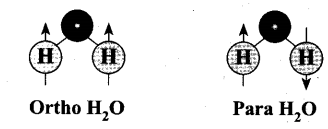
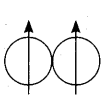
Ortho hydrogen – The hydrogen molecule in which the nuclear spins of the two hydrogen atoms are in the same side. Magnetic moment of it is twice.
Samacheer Kalvi 11th Chemistry Notes Chapter 4 Hydrogen Notes 1

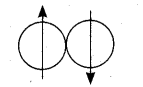
Para hydrogen – The hydrogen molecule in which the nuclear spins of the two hydrogen atoms are in the opposite side. Magnetic moment of it is zero.
Samacheer Kalvi 11th Chemistry Notes Chapter 4 Hydrogen Notes 2

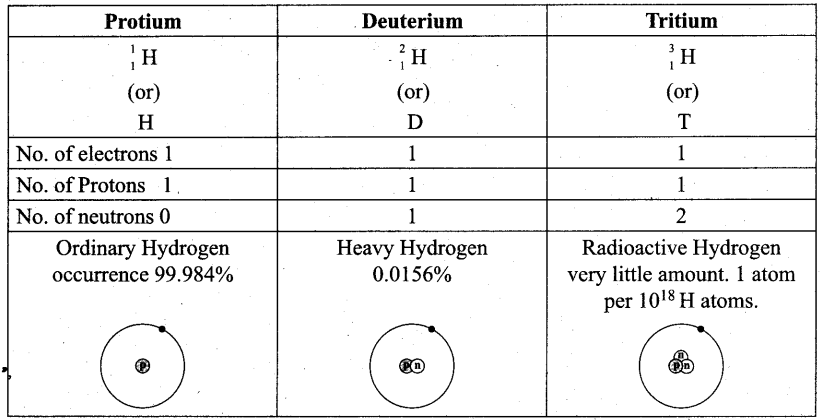
Isotopes of hydrogen – Protium \({ }_{1}^{1} \mathrm{H}\), Deuterium ,\({ }_{1}^{2} \mathrm{H}\) and Tritium \({ }_{1}^{3} \mathrm{H}\).
Samacheer Kalvi 11th Chemistry Notes Chapter 4 Hydrogen Notes 3

Half life period of Tritium – 12.33 years.

Isotopic effect – In a chemical reaction, when one of the atoms in the reactants is replaced by one of its isotopes.

Uses of Deuterium – It is used to study the movement of ground water and the hydrogen atom transfer mechanism in chemical reactions.

Uses of Tritium – It is used as a tracer element and it find applications such as emergency exit signs, illumination of wrist watches.

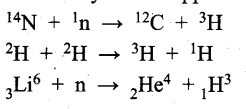
Preparation of Tritium – It occurs naturally as a result of nuclear reactions induced by cosmic rays in the upper atmosphere.

Samacheer Kalvi 11th Chemistry Notes Chapter 4 Hydrogen Notes 4

Preparation of Hydrogen

  • Electrolysis of water.
  • Action of dilute acids with metals like zinc, iron, tin.
  • Steam reforming of hydrocarbons.
  • Reaction of steam with red hot coke.
  • Reaction of carbon monoxide with water.
  • Cracking of long chain hydrocarbons.

Properties of hydrogen – It is a colourless, odourless, tasteless, lightest and inflammable gas.

Uses of hydrogen

  1. In the manufacture of Ammonia and Nitric acid.
  2. In the synthesis of methanol.
  3. As hydrogenating agent.
  4. As reducing agent in metallurgy.
  5. Calcium hydride is used as desiccant (drying agent).
  6. NaBH4, LiAlH4 used as reducing agent in organic chemistry.
  7. Atomic hydrogen and oxyhydrogen torches for cutting and welding.
  8. Liquid hydrogen is used as rocket fuel.
  9. H2 is used in fuel cells for generating electricity.

Water – H2O. It is the universal solvent. It occurs in the form of rivers and oceans (97.33%).

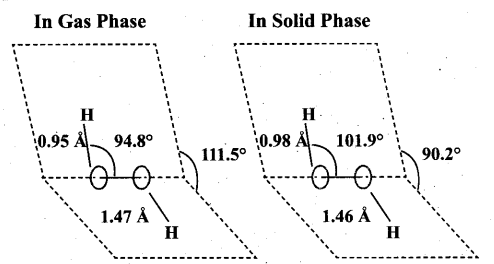
Ortho H2O and Para H2O – At the temperature conditions of the earth (300K), the OPR of H2O is 3. It is known that the OPR of water in interstellar clouds and comets has more para- H2O (OPR = 2.5) than on Earth.

Samacheer Kalvi 11th Chemistry Notes Chapter 4 Hydrogen Notes 5

Physical properties – Water is a colourless and volatile liquid. Hydrogen bonding responsible for high melting and boiling points of water.

Chemical properties – Water reacts with metals, non-metals and compounds.

Hard water – Water containing high amounts of bicarbonate, chloride and sulphate of magnesium and calcium is called hard water.

Soft water – Water containing soluble salts of calcium and magnesium is called soft water.

Soap – Sodium or Potassium salts of long chain fatty acids.

Temporary hardness – It is due to the presence of soluble bicarbonates of magnesium and calcium. It is removed by heating or by treating with lime.

Permanent hardness – It is due to the presence of soluble salts of magnesium and calcium in the form of chlorides and sulphates in water. It can be removed by washing soda or by ion exchange.

Ion exchange – Hardness of water can be removed by passing through an ion exchange bed like zeolites or polymer (resin) containing column.

Zeolites – Hydrated sodium alumino-silicates NaO.Al2O3.xSiO2.yH2O (x = 2-10, y = 2-6).

Premutit (or) zeolite process – The softening of water process by using complex structure represented as Na2 – Z with sodium as exchangeable cations.

Methods used to soften hard water – Chelating method and reverse osmosis.

Chelating method – EDTA is used in this.

Reverse osmosis – High pressure to force water through a semipermeable membrane.

Heavy water – D2O. It is present as one part in 5000 parts of ordinary water.

Preparation of D2O – It is prepared by continuous electrolysis of ordinary water. It undergoes exchange reactions.

Uses of D2O – D2O is used in isotopic effect, used as moderator in nuclear reactors, used to prepare deuterium compounds.

Hydrogen peroxide (H2O2) – It is a pale blue (almost colourless) liquid. It is prepared by the action of dilute acid with metal peroxide.

Uses of H2O2 Oxidising agent, mild antiseptic, as a bleaching agent in textile, paper and hair-care industry and used as reducing agent.

Structure of H2O2
Samacheer Kalvi 11th Chemistry Notes Chapter 4 Hydrogen Notes 6

Hydrides – A binary hydride is a compound formed by hydrogen with other electropositive elements, e.g. LiH, MgH2.

Ternary hydrides – Compounds in which molecule is constituted by hydrogen and two types of elements, e.g. LiBH4, LiAlH4.

Types of hydrides –

Ionic hydridesCovalent hydrideMetallic hydride
Electropositive metal + hydrogenNon-metals + HydrogenMetals + Hydrogen
Formation of hydride by transfer of electrons.Formation of hydride by equal sharing of electrons.Hydrogen occupies voids in metals.
e.g. LiH, CaH2e.g.CH4,SiH4e.g. ZnH2, TiH.

Hydrogen sponge – Metal hydride as (PdH) Palladium hydride. It is formed by a chemical reaction but it behaves like a physical storage method, i.e., it is absorbed and released like a water sponge.

Hydrogen bonding – When a hydrogen atom is covalently bonded to a highly electronegative atom [ N (or) D (or) F], the bond is polarised in such a way that the hydrogen atom is able to form a weak bond between the hydrogen atom and the electronegative atom of a second molecule. This is called a hydrogen bond and denoted as dotted lines (…………….).

Types of hydrogen bonding – Intra molecular hydrogen bonding and inter molecular hydrogen bonding.

Intra molecular hydrogen bonding – These bonds are those which occur within one single molecule. e.g.T ortho-nitrophenol and salicylaldehyde.

Inter molecular hydrogen bonding – These bonds are formed between two separate molecules, e.g., Ammonia, water, hydrogen fluoride, acetic acid.

Gas hydrates – They are a kind of inclusion compounds, where gas molecules are trapped in a crystal lattice having voids of right size, with being chemically bonded, e.g., H3O+ in gas phase similar to methane hydrate.

Clatharate hydrate – Gas hydrates in which guest molecules are not bonded chemically but retained by the structure of host is called Clatharate hydrates, e.g., Methane hydrate CH4.20H2O.

Crystalline hydrates – In this type, hydrogen bonding is present. Water molecules serve to fill in the interstices and bind together structure, e.g., CuSO4.5H2O, Na2CO3.10H2O, FeSO4.7H2O.

The atomic bomb – The hydrogen bomb uses both nuclear fission and fusion is called atom bomb or Thermonuclear bombs.

The future fuel – Hydrogen is considered as a potential fuel as it is a clean burning fuel. This fuel is free from pollutants.

Samacheer Kalvi 11th Chemistry Notes

Samacheer Kalvi 10th English Grammar Prepositions

Looking to improve English skills and gain more subject knowledge then the best resources that you can use here is Samacheer Kalvi 10th English Solutions for Grammar Prepositions Questions and Answers.

In the Samacheer Kalvi 10th English Guide for textbook solutions, subject experts covered all types of questions and answers related to the topics, quick notes, summary, solved & unsolved exercises, etc. If you are planning to prepare Chapter via textbook, then you’re suggested to go with this Samacheer Kalvi 10th English Book Solutions Questions and Answers PDF for better understanding and preparation.

Tamilnadu Samacheer Kalvi 10th English Grammar Prepositions

English Subject experts who are having max years of experience prepared this Tamilnadu State Board Solutions for 10th English Grammar Prepositions Questions and Answers. They have explained all the topics covered in the board prescribed latest syllabus in a simple way to understand easily. So, students can prepare English from this Samacheer Kalvi 10th English Book Questions and Answers PDF. Download the Tamilnadu State Board 10th English Workbook Answers PDF by accessing the below links and learn properly for the final exams to score well.

Choose the appropriate preposition to complete the sentence:

Question 1.
He fell short of one second …………………………. the red ribbon and lost gold.
(a) after crossing (b) of crossing (c) in crossing
Answer:
(c) in crossing

Question 2.
She is close …………………………. her job.
(a) in resigning (b) to resigning (c) from resigning
Answer:
(b) to resigning

Question 3.
He is disqualified …………………………. as a doctor as he was convicted of giving wrong treatment to the minister.
(a) on practicing (b) for practicing (c) from practicing
Answer:
(c) from practicing

Question 4.
She is busy …………………………. her new bom baby.
(a) from feeding (b) with feeding (c) over feeding
Answer:
(b) with feeding

Question 5.
The children went …………………………. ahead unmindful of bad weather.
(a) by planning (b) below planning (c) with planning
Answer:
(c) with planning

Question 6.
He had the authority …………………………. her NOC to go abroad.
(a) of denying (b) under denying (c) over denying
Answer:
(a) of denying

Question 7.
He was boiling …………………………. when his favorite batsman lost his wicket with just two runs.
(a) over anger (b) under anger (c) with anger
Answer:
(c) with anger

Question 8.
He has no …………………………. travel by air.
(a) liking of (b) liking on (c) liking for
Answer:
(c) liking for

Question 9.
It is said that nothing …………………………. the negotiation with the labor union.
(a) emerged down (b) emerged from (c) emerged with
Answer:
(b) emerged from

Question 10.
She …………………………. compiles a French-Tamil dictionary.
(a) intends of (b) intends to (c) intends by
Answer:
(b) intends to

Question 11.
He lacks the skill …………………………. in Painting.
(a) of teaching (b) on teaching (c) for teaching
Answer:
(a) of teaching

Question 12.
She was afraid of …………………………. the police.
(a) of informing (b) on informing (c) for informing
Answer:
(a) of informing

Question 13.
He is intent …………………………. to New Zealand.
(a) for migrating (b) over migrating (c) on migrating
Answer:
(c) on migrating

Question 14.
Sarath was happy …………………………. selected to represent india in Common Wealth games.
(a)on being (b) over being (c) of being
Answer:
(a)on being

Question 15.
Dr. Kumar was susceptible …………………………. .
(a) on flattery (b) to flattery (c) for flattery
Answer:
(b) to flattery

Question 16.
…………………………. the room, he switched on the lights.
(a) Owing to entering (b) On entering (c) In case of entering
Answer:
(b) On entering

Question 17.
He is fond …………………………. with children
(a) for playing (b) in playing (c) of playing
Answer:
(c) of playing

Question 18.
The man got promotion …………………………. hard.
(a) at working (b) by working (c) on working
Answer:
(b) by working

Question 19.
John has …………………………. sign the document.
(a) agreed against (b) agreed with (c) agreed to
Answer:
(c) agreed to

Question 20.
The crowd rushed into the compartments …………………………. the train.
(a) on arriving (b) on the arrival of (c) on being arrived
Answer:
(b) on the arrival of

We hope the data given here will benefit you to the fullest extent at the time of preparation. For better understanding of English subject this Samacheer Kalvi 10th English Answers for Class 10th English Grammar Prepositions PDF is the best resource. Download & ace up your preparation. Keep in touch with us and get the latest information on Tamilnadu State board Textbook Answers PDF.

శ్రీ పద్మావతి అష్టోత్తర శతనామావళి

Samacheer Kalvi 12th English Solutions Supplementary Chapter 1 God Sees the Truth, But Waits

Students can Download English Lesson 1 God Sees the Truth, But Waits Questions and Answers, Summary, Activity, Notes, Samacheer Kalvi 12th English Book Solutions Guide Pdf helps you to revise the complete Tamilnadu State Board New Syllabus and score more marks in your examinations.

Tamilnadu Samacheer Kalvi 12th English Solutions Supplementary Chapter 1 God Sees the Truth, But Waits

Warm Up:

Question 1.
If you are punished for a prank your classmate played, how would you react to the situation?
Answer:
I will not be quick to anger. I will keep quiet and will quietly let my friend know that, I did not relish his act. If he values my friendship, he will certainly apologize. If he doesn’t, I will forgive.

SamacheerKalvi.Guru

Question 2.
While many would seek vengeance or feel sorry for themselves, some may put their trust in God, forgive others for the wrongs done to them and move on in life. What is your take on this? Discuss.
Answer:
I believe anger, self-pity and hatred are negative emotions. Anger is a punishment we give ourselves for others wrong doing. I would not be in a hurry to express my anger or displeasure. I will focus more on the business of living ignoring the pain. If the relationship is really good for me, the person who had hurt me knowingly or unknowingly will come back to me. Otherwise, I will understand that he/she was not destined to be my lifetime friend. So, I will move ahead in life leaving the weight of hurt and disappointment behind.

Samacheer Kalvi 12th English God Sees the Truth, But Waits Textual Questions

1. Answer the following questions in a sentence or two each, based on your understanding of the story.

Question (a)
Why did Aksionov’s wife stop him from going to the fair?
Answer:
Aksionov’s wife had a very bad dream about him. So, she stopped him from going to the fair,

Question (b)
What is the importance of Aksionov’s wife’s dream?
Answer:
She had dreamt that he had returned from the town. When he took off his cap, she saw that his hair was quite grey. This was a bad omen.

Question (c)
What made Aksionov leave the inn before dawn?
Answer:
Aksionov was an early riser. He wanted to travel when the air was cool. So, he left the inn before dawn.

Question (d)
What were the circumstances that led to Aksionov’s imprisonment?
Answer:
Aksionov had left the inn at the dawn. He was intercepted by the police. A blood-stained knife was found in his bag. So, the police arrested him accusing him of murdering the merchant who stayed in the same inn where he had stayed.

Question (e)
Why did Aksionov give up sending petitions?
Answer:
Aksionov’s wife came to visit him. She informed that her petition for clemency had been turned down. She asked him if he had done it. Realizing that his wife also suspected him, Aksionov gave up sending petitions to the Tsar.

Question (f)
Why didn’t Makar disclose that he had killed the merchant?
Answer:
Makar’s disclosure would have given the police the chance to arrest him and convict him. So, he did not disclose his guilt.

SamacheerKalvi.Guru

Question (g)
Did Makar feel guilty when he heard Aksionov’s story?
Answer:
No, Makar did not feel guilty. Instead, he casually said that it must be the person in whose bag the knife was found.

Question (h)
What made Aksionov think that Makar was the real murderer?
Answer:
Makar asked who could put the knife in Aksionov’s bag when it was kept under his head. This made Aksionov understand that it was Makar who had killed the merchant.

Question (i)
What was Aksionov’s realization by the end of the story?
Answer:
Aksionov realized that vengeance will get nothing. God knows the truth and God’s will happen. He forgave Makar and felt light at the end.

SamacheerKalvi.Guru

Question (j)
Why did Aksionov’s wife suspect him of involvement in the murder?
Answer:
Mrs. Aksionov had dreamt that her husband’s hair had turned grey on his return from the fair. As Aksionov used to drink occasionally, she suspected that her husband may have killed the merchant in a drunken brawl which also correlates with the dream she had the same morning.

Additional Questions

Question (a)
What is the story “God sees the truth but waits” about?
Answer:
This story is about faith, forgiveness, freedom and acceptance of a suffering young merchant named Aksionov. He was sent to prison for a murder he had not committed. He spent 26 years in prison in Siberia before he could discover the murderer. After discovery, though pained, he forgave him. He died on the day the pardon was granted.

Question (b)
Write briefly about the early life of Aksionov.
Answer:
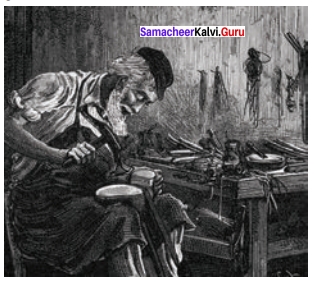
Aksionov was a handsome, fair, haired, curly headed fellow. He was full of fun in his youth. He was very fond of singing. He used to drink in excess and enter into brawls. But after marriage, he became sober.

Question (c)
Why did Aksionov doubt his wife’s statement about a bad dream?
Answer:
Aksionov did not believe in his wife’s dream. He thought his wife must have been afraid that he . might go on a spree after reaching the fair.

SamacheerKalvi.Guru

Question (d)
What prompted Aksionov to ask Semyonich if he knew anything about the merchant Aksionov of Vladimir?
Answer:
Aksionov heard one of the convicts say that he is from Vladimir. He did not know what happened to his family in the last 26 years. So, he asked him about his family.

Question (e)
What information was consoling to Aksionov?
Answer:
The information that Aksionov’s are now rich was consoling to Aksionov.

Question (f)
Why did Aksionov become angry and restless after meeting Semyonich?
Answer:
Aksionov got convinced that it was Semyonich who had murdered the merchant and kept the. blood-stained knife in his bag. So, he longed for vengeance. He kept praying but could not find peace. He was really restless.

Question (g)
What circumstances made Semyonich threaten to kill Aksionov?
Answer:
Semyonich was digging out a hole to escape from jail one night. Aksionov happened to see it ’ accidentally. Fearing exposure, Semyonich threatened to kill Aksionov.

Question (h)
How did Aksionov react to the threat of Semyonich?
Answer:
He said that Semyonich need not kill him as he had already done so long ago. He may tell about his bid to escape or may not. He would do as God directed him.

Question (i)
What was Governor’s opinion of Aksionov in the Siberian Jail?
Answer:
The Governor of the Siberian jail believed that Aksionov was a truthful old man.

Question (j)
Why did the prisoners respect Aksionov?
Answer:
Aksionov’s fellow prisoners respected him and called him “grandfather” and “The saint”. When they wanted to petition to the prison authorities about anything, Aksionov was their spokesman. He settled their quarrels too in a just manner.

Question (k)
What thoughts prevented Aksionov from exposing Semyonich who had ruined his life?
Answer:
Aksionov knew if he tells the authorities, they would probably flog the life out of Semyonich. Besides what good will come out of getting him punished. Let him pay for his sins himself.

SamacheerKalvi.Guru

Question (l)
Why was Semyonich left unpunished for trying to escape from the jail?
Answer:
Nobody else dared to expose him. Aksionov found no point in doing so. As there was no evidence’to nail him, Semyonich went unpunished.

Question (m)
What unexpected thing happened at night?
Answer:
Semyonich knelt before Aksionov and asked for his forgiveness and offered to confess his crime of murdering the merchant.

Question (n)
What made Aksionov feel that the belated confession of Semyonich and his own release would be futile?
Answer:
Aksionov had spent the best part of his lie (i.e.) 26 years in Siberia. His wife was dead and children had forgotten him. He had nowhere to go. So, Aksionov felt that the confession of Semyonich would be futile.

2. Answer the following questions in three or four sentences each.

Question (a)
Did the police officer have sufficient evidence to convict Aksionov?
Answer:
Yes, the blood-stained knife was found in Aksionov’s bag. When interrogated, he turned pale and started shivering. He did not have much to say to prove his innocence. Thus, the circumstantial evidences were sufficient to convict Aksionov.

Question (b)
What impact did the book “The Lives of Saints” have on Aksionov?
Answer:
Aksionov read “The lives of saints” when there was enough light in the prison. He became a religious person. He sang in the choir. He was resigned to his fate. The fellow prisoners realized that he was innocent and unjustly condemned and hence respected him. They called him grandfather.

SamacheerKalvi.Guru

Question (c)
Pick out the clues that convey that Makar Semyonich recognized Aksionov.
Answer:
When Makar Semyonich heard the story as to why Aksionov has been kept in Siberia, he became excited. He said, “It is wonderful that we should meet here.” Aksionov asked anxiously if he knew who had murdered the merchant. He blurted out, “how could anyone put a knife into your bag while it was under your head? It would have surely woken you up.” From this Aksionov got the clue that Makar was the murderer and he recognised him clearly.

3. Answer the following questions in a paragraph of about 150 words each.

Question (a)
Compare and contrast the main characters, Aksionov and Makar Semyonich, in the story.
Answer:
Aksionov, a handsome man, full of life, enjoyed music. He loved his family and did honest business. He is innocent to the core. The very sight of blood-stained knife found in his bag sends chill down his spine. He is deeply sensitive. When he realizes that his wife too suspected him, he gives up petitioning to the Tsar for mercy. He recognized Makar Semyonich the person who had murdered the merchant and had him framed in murder charges and unjustly punished for twenty six long years. When an opportunity presents to wreak vengeance on him, he keeps quiet. He does not show any interest in his belated freedom and restoration of justice. He seeks refuge in God.

Makar Semyonich is a cold-blooded murderer and scoundrel. Knowingly, he hides the blood-stained knife in Aksionov’s bag and tips off the police. He doesn’t confess his guilt on the day he meets Aksionov. It is only when he realizes that Aksionov is a noble soul and does not want to expose his plan to escape from the prison that he changes his attitude to Aksionov. He is haunted by guilt that he had wronged a noble soul. He confesses but it is in vain. The pardon arrives but Aksionov passes away in prison before release.

SamacheerKalvi.Guru

Question (b)
How did Aksionov react when his wife suspected him?
Answer:
Aksionov had deep love for his wife. He wanted to petition to the Tsar for clemency. But his wife said that the petition already sent had been rejected. She asked, “Vanya dearest, tell your wife the truth; was it not you who did it?” It was too much to bear for Aksionov. He was devastated. He buried his face in his hands and sobbed. When he recalled what his wife had said, he was shocked. He said to himself, “It seems that only God can know the truth; it is to Him alone we must appeal, and from Him alone expect mercy.” He gave up all hope. He only prayed to God.

Question (c)
Describe the life of Aksionov in prison.
Answer:
In prison, Aksionov leamt to make boots and earned a little money, with which he bought the book “The lives of saints”. He read the book when there was sufficient light in prison. On Sundays, he read the lessons and sang in the choir. The prison authorities liked him for his meekness. Fellow prisoners, having realized that he was innocent, respected him and called him grandfather. He was made their spokesperson to petition their genuine grievances in the jail. When there were quarrels among the prisoners, they brought their cases to Aksionov for settlement. The jail authorities respected him for his exemplary manners.

Question (d)
Why did Aksionov decide not to reveal the truth about Makar Semyonich?
Answer:
Aksionov was quite aware of the gravity of the offence done by Makar Semyonich. He had tried to make a hole in the prison compound wall and escape. Aksionov found this out accidentally. Makar warned him that he would kill him if he testified against him. Initially, the anger welled up in his heart demanding revenge for the 26 years of prison life. But slowly he made up his mind to keep quiet and let God punish him for the crimes he had committed. He thought, “why should I screen him who ruined my life?” When questioned by the Governor, he kept quiet. He knew deep at heart, if he disclosed the truth, they will flog the life out of him.

Question (e)
Discuss the meaning and importance of the saying “God sees the truth but waits”.
Answer:
Ivan is tongue-tied when the police finds knife in his bag. The moral shock he undergoes as an innocent victim of circumstances allows him to have faith in justice. But the moment his wife expresses her suspicion over his involvement in the murder, he loses all hopes. It is then that he starts believing in God and divine justice. Tsar can’t give him freedom. His judgement is based on evidences given by crooked people.

God need not be given any evidences of innocence. He knows the truth but his mills of justice grind very slow. Ivan loses interest in escaping dr leaving the prison. He had no one to go back to. At this juncture, Semyonich confesses his guilt of murdering the merchant. When the pardon arrives as a cruel joke, Ivan is dead. So, ‘God knows the truth but waits’ is the most appropriate title for this story.

Question (f)
Forgiveness is the best form of revenge. Substantiate the statement with reference to the story.
Answer:
There are two important conflicts which help the reader understand Ivan Aksionov’s character. He is condemned for a murder he had not committed. He is hurt more when his wife also suspects him. He submits himself totally to God and expecting mercy and forgiveness only from him. But when he faces another enquiry within the prison, he is forced to tell the truth about Makar. But instead of exposing the sinner Makar, he allows God to take over and keeps quiet. Remorseful Makar seeks his forgiveness in prison. There is a debate with his conscience

“To forgive or not”. Then he tells Makar, “God will forgive you. May be I am hundred times worse than you. Both Makar and Aksionov come to an understanding that God’s forgiveness and mercy towards humans are incomprehensible. If Aksionov had exposed Makar and got him punished, Makar would never have felt guilty and asked for Ivan’s forgiveness. It is true “Forgiveness is the sweetest form of revenge.”

Additional Questions

Question (a)
What were the nostalgic reminiscences that disturbed Aksionov once he discovered the real murderer of the merchant?
Answer:
Soon after discovering the fact that it was Semyonich who had murdered the merchant, he became terribly unhappy. A kaleidoscope of images of his own past life flooded his mind. In his mind’s eye, he saw the youthful image of his lovely wife. Her face and eyes rose before him. He heard her speak and laugh. He saw his little children, one with his little cloak on suckling at his mother’s breast. Then he remembered his own merry-go lucky life in his youth.

He vividly remembered how happily he was playing the guitar at the inn without any worry. He remembered how he was arrested, flogged in the presence of his villagers. He recalled how shamefully he was chained and convicted. He remembered how he had to spend twenty six long years in Siberia and attain premature old age. He felt so wretched that he wanted to take away his own life.

SamacheerKalvi.Guru

Question (b)
Describe the circumstances leading to Semyonich threatening Aksionov in Siberia?
Answer:
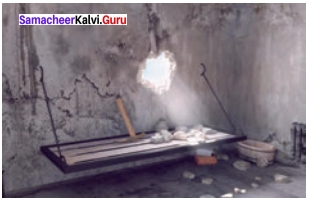
One night, unable to sleep, Aksionov was walking inside the prison. He noticed that soil came out rolling from one of the shelves on which prisoners slept. He found Makar Semyonich creep out of the spot. He looked up at Aksionov with dread. Aksionov ignored him and started ‘ walking ahead. Driven by guilt and fear of exposure, Semyonich ran and caught hold of Aksionov’s hand. He explained how he had dug a hole with his heavy boots to escape from jail. He warned him not to blab. If he did, the authorities will flog the life out of him.

But he would kill him first. He offered the bait that Aksionov also could escape. Aksionov drew his hand away and said he had no desire to escape. He said that Semyonich had already killed him long ago. He added that he may or may not tell about him as per the direction of God.

Question (c)
Why was the Governor forced to seek the witness of Aksionov?
Answer:
Aksionov was meek. He was respected by fellow prisoners. The prison authorities also believed that the religions old man must have been unjustly punished. They knew Aksionov never told lies. The prison authorities found out that someone had been digging the prison shelf to escape. They doubted that newcomer Semyonich could be the culprit. But they could not nail him on the grounds of suspicion alone.

All the prisoners were summoned and enquired including Semyonich. All denied any knowledge of it. Those who knew kept quiet because they knew Semyonich will get flogged if someone betrayed him. As no one was ready to tell the truth, the Governor, who had enormous trust in the nobility and honesty of Aksionov asked him to tell the truth. But Aksionov preferred to stay quiet.

4. Using the mind map given below, write a brief summary of the story in your own words.

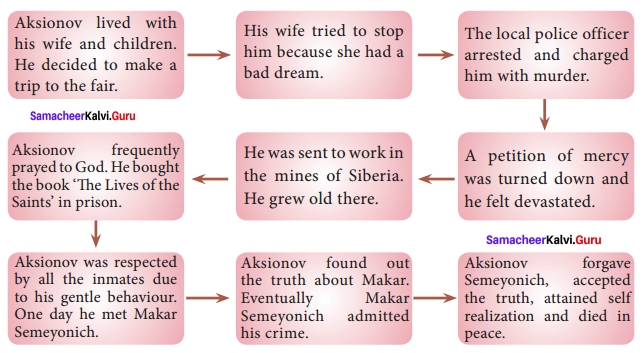
Samacheer Kalvi 12th English Solutions Supplementary Chapter 1 God Sees the Truth, But Waits img-1

Aksionov was a businessman. He lived with his wife and children. He was full of life. He sang and played the Guitar and occasionally drank too. Once he got ready to go to the fair. His wife tried to stop him saying that she had a bad dream. On his return from the fair, his hair had turned grey. It was ominous. But Ivan ignored his wife’s warning and went to the fair. As he liked cool weather, he left the inn early. He was intercepted by the police who searched his belongings. Finding a blood-stained knife in his bag, he was arrested on charges of murder. His wife’s petition for clemency to the Tsar was turned down. His wife’s unwillingness to trust him was more devastating than Tsar’s rejection of mercy petition. He was flogged. After the wounds healed he was sent to work in the mines of Siberia.

Staying 26 years in Siberia he grew a long beard. He became grandfather to the prisoners. He read “The lives of saints” and was found praying and singing in the choir. He was respected both by the fellow prisoners and the jail authorities for his gentle behaviour. Everyone in the jail believed in his innocence and unjust condemnation. One day a new convict namely Makar Semyonich came there. When Makar blurted out how the knife went to his bag kept under his head, Ivan recognized Makar as the real murderer of the merchant. Ivan had a chance to expose Makar to the jail authorities. But he kept quiet. Makar became remorseful and asked Ivan’s forgiveness. He forgave him. Makar confessed to the authorities. The order of pardon came but then Ivan was dead.

God Sees the Truth, But Waits About The Author

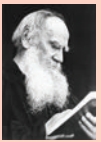
Samacheer Kalvi 12th English Solutions Supplementary Chapter 1 God Sees the Truth, But Waits img-2

Leo Tolstoy was born on September 9, 1828, in Tula Province, Russia. He is best known for the novels War and Peace (1869) and Anna Karenina (1877), often cited as pinnacles of realist fiction. He first achieved literary acclaim in his twenties with his semi- autobiographical trilogy, Childhood, Boyhood, and Youth and Sevastopol Sketches, based upon his experiences in the Crimean War. Tolstoy’s fiction includes dozens of short stories and several novellas such as The Death of Ivan Ilyich (1886), Family Happiness, and Hadji Murad. He also wrote plays and numerous philosophical essays. Tolstoy died on November 20, 1910 in Astapovo, Russia.

God Sees the Truth, But Waits Summary in English

Introduction
In “God sees the truth but waits” the author’s deep seated faith in God and moral values is expressed

Innocent man charged of murder

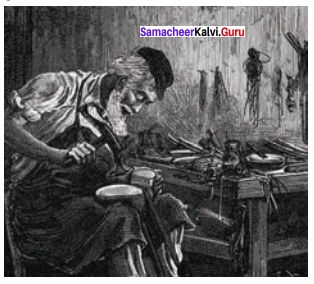
Samacheer Kalvi 12th English Solutions Supplementary Chapter 1 God Sees the Truth, But Waits img-3

In Vladimir, a young, attractive businessman named Ivan Dmitrich Aksionov lived with his wife and children. Although in his youth, he had given in to drinking and living a carefree life, he had now settled down and lived a responsible, productive life. One day he decided to make a trip to a fair where he could sell some of his merchandise. His wife objected to his trip saying that she had a bad dream about this trip. Aksionov ignored her apprehension and proceeded. On the way, he stopped at an inn, where he met another merchant he knew.

They stayed at the inn in rooms next to one another. Being an early bird, he proceeded at dawn. After traveling twenty-five miles, however, he was intercepted by a local police officer. He questioned him closely about the time he had spent at the inn. He claimed that the other merchant had been found with his throat slit. Aksionov seemed a likely suspect since he knew the man and since they shared neighbouring rooms. Aksionov vehemently denied any involvement in the murder. However, when his bag was searched, a blood-stained knife was found.

SamacheerKalvi.Guru

Circumstantial evidences
Although Aksionov protested claiming innocence, he was arrested and charged with the murder. Even his wife wondered if he might have been involved, since the circumstantial evidence was so convincing. A petition to the Czar for clemency was turned down. Aksionov bade his wife and young children farewell, reflecting that only God can know the truth, he waited. As Aksionov’s wife also suspected him, he stopped petitioning to Tar.After being severely flogged, he was sent to work in the mines in Siberia. During his twenty-six years of imprisonment there, his hair had turned grey. His cheerful personality disappeared, and his body began to weaken. He never showed any signs of happiness and frequently prayed to God.

Faith lessens sorrow
While imprisoned, he became a boot maker. He earned enough money to buy a book called The Lives of the Saints. He read this book whenever there was light. On Sundays, he took a prominent role in the religious services, and sang in the choir of the prison church. The wardens and guards appreciated his humility. Other prisoners regarded him with respect, calling him “Grandfather” and “The Saint.” He became their representative when they needed to deal with the authorities. They trusted him so much that they treated him as a kind of judge, who could settle disputes and disagreements amongst them. Meanwhile, he had no information about his family nor any contact with them. He thought that they might all be dead, for all he knew.

Reviving old wounds – a new discovery

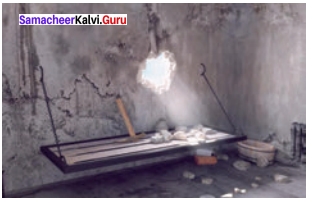
Samacheer Kalvi 12th English Solutions Supplementary Chapter 1 God Sees the Truth, But Waits img-4

When a new shipment of prisoners arrived one day, Aksionov eventually realized that one of the men, Makar Semyonich, was from his own home town. In response to Aksionov’s questions, Maker informed the old man that Aksionov’s family was prosperous. Maker seemed to know Aksionov somehow, leading the latter to wonder if Makar knew, anything about the murder of the merchant. Maker’s reply led Aksionov to begin to suspect that it was Maker who had in fact committed the crime.

Tormented by painful memories and by a sense of all the years he had lost, he eventually accused Makar, privately, of having murdered the merchant. Makar ignored the accusation even though Aksionov had caught Makar trying to dig a tunnel to escape the prison. Aksionov could easily have reported this deed to the authorities. But he chose to keep quiet, even after Makar threatened him with death. When the tunnel was eventually discovered, no one would identify Makar as the culprit who had been doing the digging. Governor believed Aksionov will not tell lies, who was closely questioned by him. He denied knowing who had been digging. He did not want to see Makar harshly punished. He even started wondering if he had wrongly suspected Makar of murdering the merchant.

SamacheerKalvi.Guru

Transformation of a criminal
Later that night, Makar came to Aksionov’s bed and begged the old man for forgiveness. He confessed that he’had indeed killed the merchant and had hidden the blood-stained knife in Aksionov’s bags. He offered to confess to this crime so that Aksionov could be released from prison and go back to his home and family. Makar continued to beg Aksionov for forgiveness, especially since Aksionov had not revealed what he knew about Makar and the tunnel. Both men were soon weeping, and Aksionov said “God will forgive you! Maybe I am a hundred times worse than you.” Having said this, he suddenly felt a load leave him. He no longer cared about leaving the prison. He only desired death. Makar did eventually confess to having killed the merchant. Ironically, by the time Aksionov’s pardon arrived, he was already dead.

Conclusion

Samacheer Kalvi 12th English Solutions Supplementary Chapter 1 God Sees the Truth, But Waits img-5

The story’s essence is that forgiveness is the best sort of revenge in life. The hard core criminal Makar Semyonich undergoes a spiritual transformation because Aksionov had forgiven him in spite of unjust suffering for 26 years. In the end, Aksionov gets peace of mind. It is only after he forgave Makar that he enjoyed serenity and was able to die in peace.

God Sees the Truth, But Waits Summary in Tamil

முன்னுரை:
“கடவுள் உண்மையைக் காண்கிறார். ஆனால் காத்திருக்கிறார்” என்னும் – கதையில் கதாசிரியரின் ஆழ்ந்த கடவுள் பக்தியும் மற்றும் அறத்தைப் பற்றிய முக்கிய கருத்தையும் வெளிப்படுகின்றன.

களங்கமற்றவன் மேல் திணிக்கப்பட்ட கொலைப் பழி:

Samacheer Kalvi 12th English Solutions Supplementary Chapter 1 God Sees the Truth, But Waits img-6

விலாட்மிர் என்னும் நகரத்தில் இவான் டிமிட்ரிச் ஆக்சியோனோ தன் மனைவி மக்களுடன் வாழ்ந்து | வந்தார். சிறு வயது முதலே குடிப்பழக்கத்திற்கு ஆளாகி, கவலையற்ற வாழ்க்கை வாழ்ந்திருந்த போதிலும், | தற்போது பொறுப்புள்ள, ஆக்கப்பூர்வமான வாழ்வை வாழ்ந்து வந்தார். ஒரு நாள் சந்தைக்கு சென்று தன் வியாபார பொருட்களை விற்க முடிவு செய்தார். அவன் மனைவியோ தான் கெட்ட கனவு கண்டதால் போக வேண்டாம் எனத் தடுத்தாள். ஆக்சியோனோ, மனைவியின் கவலையைப் பொருட்படுத்தாது பயணத்தை மேற்கொண்டார். செல்லும் வழியில் விடுதி |

ஒன்றில் தங்க, அங்கு தனக்கு அறிமுகமான ஒரு வியாபாரியைச் சந்தித்தார். அவர்கள் விடுதியின் அருகருகே அமைந்த அறைகளில் தங்கினர். அதிகாலையில் எழும் பழக்கம் உள்ளவராக இருப்பதால் பயணத்தை சூரிய உதயத்துக்கு முன்பே தொடங்கினார். இருபத்தி ஐந்து மைல் தூரம் கடந்து சென்றிருந்த போது, ஒரு காவல்காரர் இடைமறித்தார். அவர் விடுதியில் | எவ்வளவு நேரம் கழித்தார் என்பதைக் குறித்து குறிப்பாக விசாரித்தார். தான் தங்கியிருந்த விடுதியில் அவருக்கு | அறிமுகமான வியாபாரி கழுத்து அறுக்கப்பட்டு கொடூரமான முறையில் கொலை செய்யப்பட்டு இறந்து | கிடந்தார் எனத் தெரிவித்தார். அந்த வியாபாரியை தான் அறிந்திருந்ததாலும் அருகருகே தங்கி | இருந்ததாலும் அநேகமாக சந்தேகத்திற்கு உரியவனாகிறான் என ஆக்சியோனோவிடம் சொன்னார். ஆக்சியோனோ இதை கடுமையாக மறுத்தான். இருப்பினும். அவரது பையை ஆராய்ந்த | போது இரத்தக் கறை படிந்த கத்தி கிடைத்தது.

SamacheerKalvi.Guru

சூழ்நிலை சாட்சியங்கள்:
ஆக்சியோனோமறுத்த போதிலும், அவன் மேல் கொலைப் பழி சுமத்தப்பட்டு கைது செய்யப்படுகிறார். அவரது மனைவியே அவர் கொலை செய்திருக்கக் கூடுமோ என எண்ணும் அளவிற்கு சாட்சியங்கள் அமைந்தன. அரசுக்கு அனுப்பிய கருணை மனுவும் நிராகரிக்கப்பட்டது. சிறையில் கடைசி முறையாக மனைவி, மக்களை சந்தித்து பிரியாவிடை கொடுத்தார். தன் மனைவியே தன்னை சந்தேகித்ததால் அவர் மேலும் அரசுக்கு மனு அனுப்புவதை நிறுத்திக் கொண்டார்.சவுக்கால் கொடூரமாக விளாசப்பட்டு காயம் ஆறிய பின் சைபீரியா நாட்டின் சுரங்கத்திற்கு பணி செய்ய அனுப்பப்பட்டான். அங்கு 26 வருட சிறை வாழ்க்கையால் தலைமுடி நரைத்துப் போனது. அவரது உற்சாகமான தோற்றம் மாறியது. உடல் பலவீனமானது. எந்த ஆரவாரமும் இன்றி கடவுளையே வழிபாடு செய்து கொண்டிருந்தார்.

நம்பிக்கை சோகத்தைக் குறைக்கும்:
சிறைக் கைதியாக இருந்த போது கால் செறுப்புகள் செய்தார். “சாதுக்களின் வாழ்க்கை ” என்ற புத்தகம் வாங்கும் அளவிற்கு போதிய ஊதியம் கிடைத்தது. வெளிச்சம் கிடைத்த போதெல்லாம் இந்த நூலை ஆக்சியோனோ வாசித்தார். ஞாயிற்றுக் கிழமைகளில் கடவுள் சேவையில் முதல் ஆளாக நின்று சேவை புரிந்து, ஆலயப் பாடல் பாடும் குழுவினருடன் சேர்ந்து பாடவும் செய்தார். அதிகாரிகளும், காவலர்களும் | ஆக்சியோனோவின் பணிவைப் பாராட்டினர். இதர கைதிகள் ஆக்சியோனோவை ‘தாத்தா’ என்றும், ‘துறவி’ என்றும் கூறினர். சிறை அதிகாரிகளுடன் தொடர்பு கொள்ளவேண்டி நேர்ந்ததால் ஆக்சியோனோவை பிரதிநிதி ஆக்கினர். ஆக்சியோனோவை கைதிகள் தங்கள் சச்சரவுகள் மற்றும் வேற்று மனப்பான்மையைத் தீர்த்து வைக்கும் நீதிபதியாக மதித்தனர். இது நாள் வரை ஆக்சியோனோவிற்கு தன் குடும்பத்தாரைப் பற்றிய தகவல் ஏதும் தெரியவில்லை . அவர்கள் எல்லோரும் இறந்திருக்கக்கூடும் என ஆக்சியோனோவ் எண்ணினார்

பழைய காயங்களைக் கீறுதல்- புதிய கண்டுபிடிப்பு:

Samacheer Kalvi 12th English Solutions Supplementary Chapter 1 God Sees the Truth, But Waits img-7

புதிய கைதிகளுடன் கப்பல் வந்தது.அதில் மக்கர் என்பவன் தன் ஊரைச் சேர்ந்தவன் என்பதை அறிந்து கொண்டார் ஆக்சியானோவ். தன் குடும்பத்தாரைப் பற்றி விசாரிக்க அனைவரும் வளமாக உள்ளதாக மக்கர் தெரிவித்தான். மக்கர், ஆக்சியோனோவை எப்படியோ அறிந்திருந்தான் என்பது, கொலையைப் பற்றிய விவரம் ஏதேனும் அவனுக்கு தெரிந்திருக்குமோ என்று அறிவும் ஆர்வம் ஆக்சியோனோவிற்கு உண்டாயிற்று. கொலையைப் பற்றிய மக்கரின் பதில், இந்தக் கொலையை மக்கர் செய்திருக்கக்கூடுமோ என்ற சந்தேகத்தை ஆக்சியோனோவிற்கு எழுப்பியது. வலி கொடுக்கும் நினைவுகள் ஒருபுறம் சித்ரவதை செய்ய, மறுபுறம் வீணாகக் கடந்துபோன வாழ்நாட்களை நினைக்க, முடிவாக ஆக்சியோனோ,மக்கரைமனதுக்குள் திட்டிக் கொண்டார். மக்கர் அதை பொருட்படுத்திக் கொள்ளவில்லை.

மக்கர் சிறைச்சாலையில் திருட்டுத்தனமாக சுரங்கம் அமைப்பதை ஆக்சியானோவ் தற்செயலாகப் பார்த்துவிட்டார். அதன் மூலம் மக்கர் தப்பிக்க எண்ணினான். ஆக்சியோனோவ் இதை அதிகாரிகளிடம் முறையிட்டு இருக்கலாம். ஆனால், ஆக்சியோனோவ் மக்கர் கொலை செய்து விடுவதாகக் கூறியும் உண்மையைக் கூறவில்லை. சுரங்கத்தை கடைசியாக கண்டுபிடித்த பிறகு எவரும் மக்கரை குற்றவாளி என்று காட்டிக் கொடுக்கவில்லை. ஆளுநர், ஆக்சியோனோவ் பொய் கூறமாட்டார் என நம்பி அவனிடம் விசாரித்தார். ஆக்சியோனோ சுரங்கம் அமைத்தது யார் என்று தனக்குத் தெரியாது என பதில் அளித்தான். மக்கர் கடுமையான தண்டனைக்கு ஆளாவதை அவர் விரும்பவில்லை. தான் ஒருவேளை தவறாக மக்கரை கொலையாளி எனக்

SamacheerKalvi.Guru

குற்றவாளியின் மன மாற்றம்:
அன்று இரவு மக்கர் ஆக்சியோனோவின் அறையின் படுக்கைக்கு வந்து, தன்னை மன்னிக்குமாறு | வேண்டிக் கொண்டான். வியாபாரியைக் கொன்று இரத்தக் கறை படிந்த கத்தியை தான் ஒளித்து வைத்ததை ஒப்புக் கொண்டான். தான் கொலைக் குற்றத்தை ஒப்புக் கொள்வதன் மூலம் ஆக்சியோனோ விடுதலைப் பெற்று தன் குடும்பத்தாருடன் சேர இயலும் எனக் கூறினான். சுரங்கம் அமைத்தது மக்கர் தான் என்று தெரிந்தும் | ஆக்சியோனோ காட்டிக் கொடுக்காததால் தன்னை |

மன்னித்து விடுமாறு வேண்டிக் கொண்டான். இருவரும் சேர்ந்து அழத் தொடங்கினர். ஆக்சியோனோ ‘கடவுள் உன்னை மன்னிக்கட்டும், ஏன் நான் உன்னை விட நூறு மடங்கு பொல்லாதவனாக இருக்கலாம்’, எனக் கூறினார். இங்ஙனம் கூறியதும் ஏதோ சுமை குறைந்தது போல் ஆக்சியோனோவ் உணர்ந்தார். இதற்கு மேல் சிறையை விட்டு வெளியேற வேண்டும் எண்ணம் அவருக்குத் தோன்றவில்லை. அவர் மரணத்தையே விரும்பினார். முடிவாக வியாபாரியைக் கொலை செய்தது. தான் என்பதை மக்கர் ஒப்புக் கொண்டான். விதிவசமாக ஆக்சியோனோவின் விடுதலை உத்தரவு வந்த போது அவர் உயிரை விட்டிருந்தார்.

முடிவுரை:

Samacheer Kalvi 12th English Solutions Supplementary Chapter 1 God Sees the Truth, But Waits img-8

‘பழிக்குப் பழி’ என்பது ஒருவரை மன்னித்து விடுவதே என்பது தான் இக்கதையின் தத்துவம். மக்கர் சீமோனிச் தெய்வாதீனமாக மாற்றம் அடைகிறான். ஏனெனில், 26 வருடம் தான் பெற்ற அநியாயத்திற்குப் பிறகும் ஆக்சியோனோ மக்கரை மன்னித்து விடுகிறார். இறுதியில் ஆக்சியோனோவிற்கு மன அமைதி கிடைக்கிறது. அந்த அமைதி அவருக்கு மக்கரை மன்னித்த பிறகே கிடைக்கிறது. அதனால் நிம்மதியாக உயிரை விடுகிறார்.

SamacheerKalvi.Guru

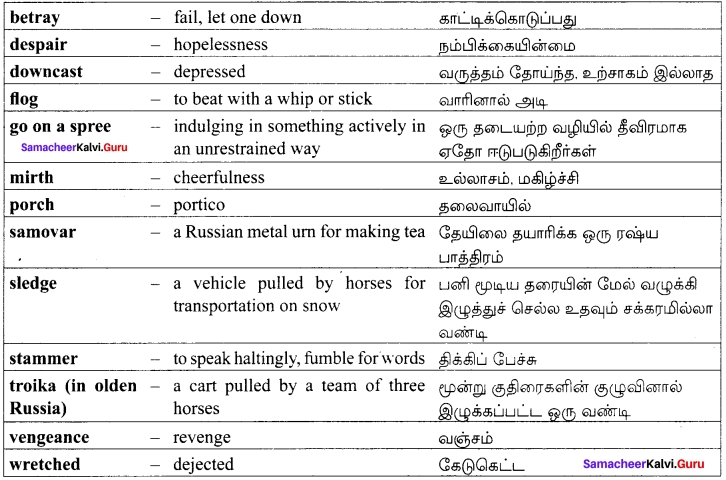
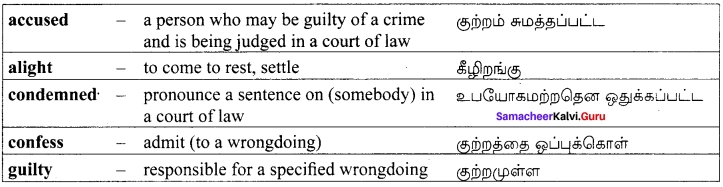
God Sees the Truth, But Waits Glossary

Textual:

Samacheer Kalvi 12th English Solutions Supplementary Chapter 1 God Sees the Truth, But Waits img-9

Additional:

Samacheer Kalvi 12th English Solutions Supplementary Chapter 1 God Sees the Truth, But Waits img-10

శ్రీ కృష్ణ ప్రేమాష్టకమ్

Samacheer Kalvi 11th Chemistry Notes Chapter 2 Quantum Mechanical Model of Atom

Tamilnadu Samacheer Kalvi 11th Chemistry Notes Chapter 2 Quantum Mechanical Model of Atom Notes

Atom – The basic unit that makes up all matter.

Plaqck’s constant (h) – 6.626 x 10⁻³⁴ Js.

Angular momentum – mvr ; mvr = nh/2π

Bohr’s atomic model – The electron is revolving around the nucleus in a certain fixed circular path called stationary orbit. The energies of electrons are quantized. Electron can revolve only in orbits in which the angular momentum (mvr) of the electron must be equal to an integral multiple of h/27r.

Radius of the nth orbit – rn = \(\frac{(0.529) \mathrm{n}^{2}}{\mathrm{Z}} \mathrm{A}\)

Energy of the nth orbit – \(E_{n}=\frac{(-13.6) Z^{2}}{n^{2}} e V \text { atom }^{-1} \text {(or) } \frac{(-1312.8) Z^{2}}{n^{2}} \text { kJ } m o l^{-1}\)

Louis de Broglie – All forms of matter showed dual character such as particle and wave.

de Broglie equation – λ = h/mv

Mass of an electron – 9.11 x 10⁻³¹ kg.

λ – de Broglie wavelength

Quantization of de Broglie concept – 2πr = nh/mv (or) mvr = nh/2π

Heisenberg’s uncertainty principle – Δx. Δp ≥ \(\frac{\mathrm{h}}{4 \pi}\) , where Ax = uncertainty in position.
Δp = uncertainty in momentum.

Bohr’s radius of 1st orbital – 0.529 Å

Schrodinger equation – \(\hat{\mathrm{H}} \psi=\mathrm{E} \psi\)
\(\hat{\mathrm{H}}\) = Hamiltonian operator.
\(\psi\) = wave function
E = Energy of the system

Schrodinger wave equation –
Samacheer Kalvi 11th Chemistry Notes Chapter 2 Quantum Mechanical Model of Atom Notes 1

Quantum numbers – The set of four quantum numbers which can characterize an electron in an atom. They represent the energy level, sub shell, number of electron in an orbit, orientation of orbitals in space and the spin of the electron.

Atomic orbitals – Permitted energy values called eigen values which are known as atomic orbitals.

\(\)[\Psi]^{2}[/latex] – It is the probability of finding the electrons.

Node – The region where the probability density function reduces to zero is called nodal surface (or) a radial node.

Shapes of orbital –
s-orbital – spherical shape
p-orbital – dumb bell shape d-orbital – clover leaf

Effective nuclear charge – The net charge experienced by the electron.

Order of E.N.C – s>p>d>finan orbital.

Energy order in orbital – s<p<d<f.

Aufbau principle – “In the ground state of the atoms, the orbitals are filled in the order of their increasing energies”.

Pauli’s exclusion principle – “No two electrons in an atom can have the same set of values for alf.four quantum numbers.”

Types of quantum numbers – Principal quantum number (n), azimuthal quantum number (i), magnetic quantum number (m) and spin quantum number (s).

Principal quantum number (n):Azimuthal quantum number (l)Magnetic quantum number (m):Spin quantum number (s):
(i)It represents the energy level in which electron is presentIt represents the subshell in which electron is presentIt represents different orientation of orbitals in spaceIt represents the spin of the electron
(ii) Maximum number of electrons that can be accommodated in the shell is 2n2.Maximum number of electrons that can be accommodated in subshell is 2(2l+1).The magnitude of angular momentum is determined.Electron revolves in clockwise and anti-clockwise directions.
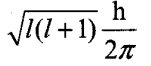
v _-(1312.8) Z2 /n2 kJ mol-1.It is used to calculate the orbital angular momentum by the formula Samacheer Kalvi 11th Chemistry Notes Chapter 2 Quantum Mechanical Model of Atom Notes 2If l= 1, m = -1, 0, +1s values are + 1/2 (or) – 1/2
It represents the distance of the electron from the nucleus.1 = 0, 1,2, 3 Subshell = s, p, d, f No. of electrons = 2, 6, 10, 14
n = 1,2,3,4     . main shell = k, l, m, n
No. of electrons = 2, 8, 18, 32

Hund’s rule of maximum multiplicity – It states that electron pairing in the degenerate orbitals does not take place until all the available orbitals contains one electron each.

Electronic configuration – The distribution of electrons into various orbitals of an atom is called its electronic configuration.

Exchange energy – During the exchanging process of two or more electrons with the same spin present in degenerate orbitals, the amount of energy released is called exchange energy.

Samacheer Kalvi 11th Chemistry Notes

Samacheer Kalvi 12th Chemistry Notes Chapter 12 Carbonyl Compounds

Tamilnadu Samacheer Kalvi 12th Chemistry Notes Chapter 12 Carbonyl Compounds Notes

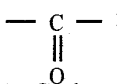
Carbonyl compounds: An organic compounds, which contains Samacheer Kalvi 12th Chemistry Notes Chapter 12 Carbonyl Compounds Notes 1 is called carbonyl compounds. They plays an important role in the metabolic process. Carbonyl compounds are important constituents of fabrics, plastics and drugs.



Ozonolysis: Alkenes or Alkynes reacts with ozone to form ozonide which on subsequent cleavage with zinc and water gives corresponding aldehydes or ketones. This process is known as ozonolysis.

Hydration of alkynes: The hydration of alkynes in the presence of 40% dilute sulphuric acid and 1% H2SO4 to give the corresponding aldehydes or ketones.

Rosenmund reduction: Aldehydes can be prepared by the hydrogenation of acid chloride, in the presence of palladium supported by barium sulphate. This reaction is called Rosenmund reduction.

Stephen’s reaction: When alkylcyanides are reduced using SnCl2 / HCl, imines are formed, which on hydrolysis gives corresponding aldehyde. This reaction is called Stephen’s reaction.

Selective reduction of cyanides: Diisobutyl aluminium hydride (DIBAL -H) selectively reduces the alkyl cyanide to form imines which on hydrolysis gives aldehydes.

Etard reaction: When chromylchloride is used as an oxidising agent, toluene gives benzaldehyde. This reaction is called Etard reaction.

Gattermann – Koch reaction: In this reaction, carbon monoxide and HC1 generate formyl cation intermediate, which attacks the aromatic ring to form corresponding aldehydes.

Urotropine: Formaldehyde reacts with ammonia to form hexa methylene tetramine, which is also known as Urotropine.

Carbonyl compounds: An organic compounds, which contains c is called carbonyl compounds. They plays an important role in the metabolic process. Carbonyl compounds are important constituents of fabrics, plastics and drugs.

Ozonolysis: Alkenes or Alkynes reacts with ozone to form ozonide which on subsequent cleavage with zinc and water gives corresponding aldehydes or ketones. This process is known as ozonolysis.

Hydration of alkynes: The hydration of alkynes in the presence of 40% dilute sulphuric acid and 1% H2SO4 to give the corresponding aldehydes or ketones.

Rosenmund reduction: Aldehydes can be prepared by the hydrogenation of acid chloride, in the presence of palladium supported by barium sulphate. This reaction is called Rosenmund reduction.

Stephen’s reaction: When alkylcyanides are reduced using SnCl2 / HCl, imines are formed, which on hydrolysis gives corresponding aldehyde. This reaction is called Stephen’s reaction.

Selective reduction of cyanides: Diisobutyl aluminium hydride (DIBAL -H) selectively reduces the alkyl cyanide to form imines which on hydrolysis gives aldehydes.

Etard reaction: When chromylchloride is used as an oxidising agent, toluene gives benzaldehyde. This reaction is called Etard reaction.

Gattermann – Koch reaction: In this reaction, carbon monoxide and HCl generate formyl cation intermediate, which attacks the aromatic ring to form corresponding aldehydes.

Urotropine: Formaldehyde reacts with ammonia to form hexa methylene tetramine, which is also known as Urotropine.

Uses of Urotropine:

  • Urotropine is used as a medicine to treat urinary infection.
  • Nitration of Urotropine under controlled condition gives an explosive RDX (Research and development explosive). It is also called cyclonite or cyclotri methylene trinitramine.

Popoff s rule: It states that during the oxidation of an unsymmetrical ketone, a (C-CO) bond is cleaved in such a way that the keto group stays with the smaller alkyl group.

Clemmensen reduction: Aldehydes and Ketones when heated with zinc amalgam and concentrated hydrochloric acid gives hydrocarbons. This reduction is called Clemmensen reduction.

Wolf – Kishner reduction: Aldehydes and Ketones when heated with hydrazine and sodium ethoxide, hydrocarbons are formed. This reduction is called Wolf – Kishner reduction.

Aldol condensation: In the presence of bases like NaOH, or KOH, two molecules of an aldehyde or ketone having α – hydrogen add together to give (β- hydroxyl aldehyde (aldol) or β – hydroxyl ketone (ketol). This reaction is called aldol condensation reaction.

Crossed aldol condensation: Aldol condensation can also take place between two different aldehydes or ketones or between one aldehyde and one ketone such an aldol condensation is called crossed aldol condensation.

Claisen – Schmidt Condensation: Benzaldehyde condenses with aliphatic or methyl ketone in the presence of dil. alkali at room temperature to form unsaturated aldehyde or ketone. This type of reaction is called Claisen – Schmidt condensation.

Cannizaro reaction: In the presence of concentrated aqueous alkali, aldehydes which do not have a – hydrogen atom under of self oxidation and reduction to give a mixture of alcohol and a salt of carboxylic acid. This reaction is called Cannizaro reaction.

Crossed Cannizaro reaction: When Cannizaro reaction takes place between two different aldehydes (neither containing an a – hydrogen atom), the reaction is called as cross cannizaro reaction.

Benzoin condensation: This reaction involves the treatment of an aromatic aldehyde with alcoholic KCN. The products are hydroxyl ketone.

Perkin’s reaction: When an aromatic aldehyde is heated with an aliphatic acid anhydride in the presence of the sodium salt of the acid corresponding to the anhydride, condensation takes place and an a, p unsaturated acid is obtained. This reaction is known as Perkin’s reaction.

Knoevenagal reaction: Benzaldehyde condenses with malonic acid in the presence of pyridine forming cinnamic acid is called Knoevenagal reaction or condensation.

Schiff’s base: Aromatic aldehydes react with primary amines in the presence of an acid to form schiff’s base.

Tollens Reagent Test: Tollens reagent is an ammonical silver nitrate solution. When an aldehyde is warmed with Tollens reagent a bright silver mirror is produced due to the formation of silver metal. This reaction is also called silver mirror test for aldehydes.

Fehlings solution Test: Fehlings solution is prepared by mixing equal volumes of Fehlings solution ‘A’ containing aqueous copper sulphate and Fehlings solution ‘B’ containing alkaline solution of sodium potassium tartarate (Rochelle salt). When aldehyde is warmed with Fehlings solution deep blue colour solution is changed to red precipitate of cuprous oxide.

Benedict’s solution Test: Benedicts solution is a mixture of CuSO4 + sodium citrate + NaOH. Cu2+ is reduced by aldehyde to give red precipitate of cuprous oxide.

Schiffs’ reagent Test: Dilute solution of aldehydes when added to schiffs’ reagent (Rosaniline hydrochloride dissolved in water and its red colour decolourised by passing S02) yields its red colour. This is known as Schiffs’ test for aldehydes. Ketones do not give this test. Acetone however gives a positive test but slowly.

Formalin: 40% aqueous solution of formaldehyde is called formalin. It is used for preserving biological specimens

Uses of Acetaldehyde:

  • Acetaldehyde is used for silvering of mirrors
  • Paraldehyde is used in medicine as a hypnotic
  • Acetaldehyde is used in the commercial preparation of number of organic compounds like ‘ acetic acid, ethyl acetate etc.,

Uses of Acetone:

  • Acetone is used as a solvent, in the manufacture of smokeless powder (cordite).
  • It is used as a nail polish remover.
  • It is used in the preparation of sulphonal, a hypnotic.
  • It is used in the manufacture of thermosoftening plastic Perspex.

Uses of Benzaldehyde:

  • as a flavoring agent
  • in perfumes
  • in dye intermediates
  • as starting material for the synthesis of several other organic compounds like cinnamaldehyde, cinnamic acid, benzoyl chloride etc.

Uses of Aromatic Ketones:

  • Acetophenone has been used in perfumery and as a hypnotic under the name hyphone.
  • Benzophenone is used in perfumery and in the preparation of benzhydrol drop.

Carboxylic acids: An organic compounds containing a carboxylic functional group, – COOH are called carboxylic acids. The Carboxyl group is the combination of carbonyl group and the hydroxyl group.

Vinegar: It is a 6% to 8% solution of acetic acid in water.

Glacial acetic acid: Pure acetic acid is called glacial acetic acid. Because it forms ice like crystal when cooled. When aqueous acetic acid is cooled at 289.5 K, it solidifies and forms ice like crystals, where as water remains in liquid state and removed by filtration. This process is repeated to obtain glacial acetic acid.

Esterification: When carboxylic acids are heated with alcohols in the presence of cone. H2SO4 or dry HCl gas esters are formed. The reaction is reversible and is called esterification.

Decarboxylation: Removal of CO2 from carboxyl group is called as decarboxylation. Carboxylic acids lose carbon-di-oxide to form hydro carbon when their sodium salts are heated with soda lime (NaOH and CaO in the ratio 3:1)

Kolbe’s electrolytic reaction: The aqueous solutions of sodium or potassium salts of carboxylic acid on electrolysis gives alkanes at anode. This reaction is called kolbes electrolysis.

Hell – Volhard – Zelinsky reaction: Carboxylic acids having an a – hydrogen are
halogenated at the α – position on treatment with Cl2 or Br2 in the presence of small amount of red phosphorus to form α – halo carboxylic acids. This reaction is known as  Hell – Volhard – Zelinsky reaction (HVZ reaction)

Tests for carboxylic acid group:

  • In aqueous solution carboxylic acid turn blue litmus red.
  • Carboxylic acids give brisk effervescence with sodium bicarbonate due to the evolution of carbon-di -oxide.
  • When carboxylic acid is warmed with alcohol and Con H2SO4 it forms an ester, which is detected by its fruity odour.

Functional derivatives of carboxylic acids: Compounds such as acid chlorides,amides,esters etc., are called carboxylic acid derivatives because they differ from a carboxylic acid only in the nature of the group or atom that has replaced the – OH group of carboxylic acid.

Relative reactivity of Acid derivatives: The reactivity of the acid derivatives follows the
Samacheer Kalvi 12th Chemistry Notes Chapter 12 Carbonyl Compounds Notes 2

Order of reactivity of the acid derivatives with nucleophilic reagent follows the order:
Acid halide > acid anhydride > esters > acid amides

Transesterification: Ester of an alcohol can react with another alcohol in the presence of a mineral acid to give the ester of second alcohol. The interchange of alcohol portions of the esters is termed transesterification.

Ammonolysis: Esters react slowly with ammonia to form amides and alcohol. This reaction is called ammonolysis.

Claisen Condensation: Esters containing at least one a – hydrogen atom undergo self condensation in the presence of a strong base such as sodium ethoxide to form P – keto ester

Hoff mann’s degradation reaction: Amides reacts with bromine in the presence of caustic potash (KOH) to form a primary amine carrying one carbon less than the parent amide. This is called Hoff mann’s degradation reaction.

Uses of Formic acid:

  • For the dehydration of hides
  • As a coagulating agent for rubber latex
  • In medicine for treatment of gout
  • As an antiseptic in the preservation of fruit juice

Uses of Acetic acid:

  • As table vinegar
  • For coagulating rubber latex
  • For manufacture of cellulose acetate and poly vinylacetate

Uses of Benzoic acid:

  • As food preservative either in the pure form or in the form of sodium benzoate
  • In medicine as an urinary antiseptic
  • For manufacture of dyes

Uses of Acetyl chloride:

  • As acetylating agent in organic synthesis
  • In detection and estimation of – OH, – NH2 groups in organic compounds

Uses of Acetic anhydride:

  • Acetylating agent
  • In the preparation of medicine like asprin and phenacetin
  • For the manufacture plastics like cellulose acetate and poly vinyl acetate.

Uses of Ethyl acetate:

  • In the preparation of artificial fruit essences
  • As a solvent for lacquers.
  • In the preparation of organic synthetic reagent like ethyl acetoacetate.

Uses of Acetamide: Acetamide is used in the preparation of Primary amines.

Flavours of some of the esters are given below:

EsterFlavour
1. Amyl acetateBanana
2. Ethyl butyratePineapple
3. Octyl acetateOrange
4. Isobutyl formateRaspberry
5. Amyl butyrateApricot

Samacheer Kalvi 12th Chemistry Notes

Samacheer Kalvi 12th Chemistry Notes Chapter 13 Organic Nitrogen Compounds

Tamilnadu Samacheer Kalvi 12th Chemistry Notes Chapter 13 Organic Nitrogen Compounds Notes

Nitro Compounds: If one of the hydrogen atom of hydrocarbon is replaced by the -NO-, group, the resultant organic compound is called nitro compound.

Tautomerism: 1° and 2° nitroalkanes, having a-H , also show as equilibrium mixture of two tautomers namely nitro and aci form. Such a isomeric form are collectively called tautomerism.

Nature of Nitro form:

  • Less acidic
  • Dissolves in NaOH slowly
  • Decolourises FeCl3 solution
  • Electrical conductivity is low

Nature of aci form:

  • More acidic and also called pseudoacids (or) nitronic acids
  • Dissolves in NaOH instantly
  • With FeCl3 gives reddish brown colour
  • Electrical conductivity is high

Nef carbonyl synthesis: Nitro alkanes are reacts with potassium hydroxide, followed by hydrolysis they form corresponding aldehyde.

Amine: An organic compound, which containing NH, functional group and they are called amines.

Mendius reaction: The reduction of alkyl or aryl cyanides reaction in which Na / C2H5OH is used as a reducing agent is called Mendius reaction.

Hoffmann’s degradation reaction: When Amides are treated with bromine in the presence of aqueous or ethanolic solution of KOH, primary amines with one carbon atom less than the parent amides are obtained.

Gabriel phthalimide synthesis: Gabriel synthesis is used for the preparation of Aliphatic primary amines. Phthalimide on treatment with ethanolic KOH forms potassium salt of phthalimide which on heating with alkyl halide followed by alkaline hydrolysis gives primary amine.

Hoffmann’s ammonolysis: When Alkyl halides (or) benzylhalides are heated with alcoholic ammonia in a sealed tube, mixtures of 1°, 2° and 3° amines and quaternary ammonium salts are obtained.

The boiling point of various amines follows the order,
Samacheer Kalvi 12th Chemistry Notes Chapter 13 Organic Nitrogen Compounds Notes 1
Order of basic strength in case of alkyl substituted amines in aqueous solution is,
Samacheer Kalvi 12th Chemistry Notes Chapter 13 Organic Nitrogen Compounds Notes 2

The relative basicity of amines follows the below mentioned order
Alkyl amines > Aralkyl amines > Ammonia > N – Aralkyl amines > Aryl amines

Schotten – Baumann reaction: Aniline reacts with benzoylchloride in the presence of NaOH to give N – phenyl benzamide. This reaction is known as Schotten – Baumann reaction.

Libermann’s nitroso test: Alkyl and aryl secondary amines react with nitrous acid to give N – nitroso amine as yellow oily liquid which is insoluble in water. This reaction is known as Libermann’s nitroso test.

Carbylamine reaction: Aliphatic (or) aromatic primary (only) amines react with chloroform and alcoholic KOH to give isocyanides (carbylamines), which has an unpleasant smell. This reaction is known as carbylamines test.

Mustard oil reaction: When primary amines are treated with carbon disulphide, N – alkyldithio carbonic acid is formed which on subsequent treatment with HgCl2, give an alkyl isothiocyanate.

Diazonium Salts: Aromatic amines on treatment with NaN02 and HC1 gives diazonium salts. They are stable only for a short time.

Sandmeyer reaction: On mixing freshly prepared solution of benzene diazonium chloride with cuprous halides, aryl halides are obtained. This reaction is called Sandmeyer reaction.

Gattermann reaction: Conversion of benzene diazonium chloride into chloro / bromo arenes can also be effected using HC1 or HBr and copper powder. This reaction is called Gattermann reaction.

Baltz – schiemann reaction: When benzene diazonium chloride is treated with fluoroboric acid, benzene diazonium tetra fluoroborate is precipitated which on heating decomposes to give fluorobenzene.

Gomberg reaction: Benzene diazonium chloride in the presence of sodium hydroxide to give
biphenyl. This reaction in known as the Gomberg reaction. , .

Coupling reactions: Benzene diazonium chloride reacts with electron rich aromatic compounds like phenol, aniline to form brightly coloured azo compounds. Coupling generally occurs at the para position. If para position is occupied then coupling occurs at the ortho position.

Thrope nitrile condensation: Self condensation of two molecules of alkyl nitrile (containing a-H atom) in the presence of sodium to form iminonitrile.

Levine and hauser acetylation: The nitriles containing a – hydrogen also undergo condensation with esters in the presence of sodamide in ether to form ketonitriles. This reaction is known as “ Levine and hauser” acetylation.

Cyanomethylation reaction: This reaction involves replacement of ethoxy (OC2H5) group by methylnitrile (-CH2 CN) group and it is called as cyanomethylation reaction.

Uses of nitroalkanes:

  • Nitromethane is used as a fuel for cars
  • Chloropicrin (CCl3 NO2) is used as an insecticide
  • Nitroethane is used as a fuel additive and precursor to explosive and they are good solvents for polymers, cellulose ester, synthetic rubber and dyes etc.,
  • 4% solution of ethylnitrite in alcohol is known as sweet spirit of nitre and in used as diuretic.

Uses of nitrobenzene:

  • Nitrobenzene is used to produce lubricating oils in motors and machinery
  • It is used in the manufacture of dyes, drugs, pesticides, synthelic rubber, aniline and explosives like TNT, TNB.

Uses of cyanides and isocyanides:

  • Alkyl cyanides are important intermediates in the organic synthesis of larger number of compounds like acids, amides, esters, amines etc.
  • Nitriles are used in textile industry in the manufacture of nitrile rubber and also as a solvent particularly in perfume industry.

Cancer Drug: Mitomycin C, and anticancer agent used to treat stomach and colon cancer, contains an aziridine ring. The aziridine functional group participates in the drug’s degradation by DNA, resulting in the death of cancerous cells.

Samacheer Kalvi 12th Chemistry Notes

Samacheer Kalvi 12th Chemistry Notes Chapter 14 Biomolecules

Tamilnadu Samacheer Kalvi 12th Chemistry Notes Chapter 14 Biomolecules Notes

Bio chemistry: The field of studying about the chemistry behind the biological processes is called bio chemistry.

Carbohydrates: Carbohydrates are the most abundant organic compounds in every living organism. They are also known as saccharides. In general carbohydrates are hydrates of carbon, containing hydrogen and oxygen in the same ratio as in water. They are also defined as polyhydroxy aldehydes or ketones.

Dextro rotatory: Dextro rotatory compounds rotate the plane of plane polarised light in clockwise direction. Dextro rotatory compounds are represented as D – (+).

Levo rotatory: Levo rotatory compounds rotate the plane of plane polarised light is anticlockwise direction. Levo rotatory compounds are represented as L – (-).

Monosaccharides: Monosaccharides are carbohydrates that cannot be hydrolysed further and are also called simple sugars. Monosaccharides have general formula Cn(H20)n. While there are many monosaccharides known only about 20 of them occur in nature. Some common examples are glucose, fructose, ribose, erythrose.

Glucose: It is a simple sugar. It is present in honey, sweet fruits such as grapes and mangoes etc therefore glucose is also called as grape sugar. Human blood contains about lOOmg/dL of glucose.

Anomers: The conversion of the achiral aldehyde carbon into a chiral one leading the possibility two isomers. These two isomers differ only in the configuration of Cj – carbon. These isomers are called anomers.

Mutarotation: The slow interconversion of a – D glucose and p – D glucose via open chain form untill equilibrium is established giving constant specific rotation (+53°). This phenomenon is called mutarotation.

Epimerisation: Sugar differing in configuration at an asymmetric centre is known as epimers. The process by which one epimer is converted into other is called epimerisation.

Bio chemistry: The field of studying about the chemistry behind the biological processes is called bio chemistry.

Carbohydrates: Carbohydrates are the most abundant organic compounds in every living organism. They are also known as saccharides. In general carbohydrates are hydrates of carbon, containing hydrogen and oxygen in the same ratio as in water. They are also defined as polyhydroxy aldehydes or ketones.

Dextro rotatory: Dextro rotatory compounds rotate the plane of plane polarised light in clockwise direction. Dextro rotatory compounds are represented as D – (+).

Levo rotatory: Levo rotatory compounds rotate the plane of plane polarised light is anticlockwise direction. Levo rotatory compounds are represented as L – (-).

Monosaccharides: Monosaccharides are carbohydrates that cannot be hydrolysed further and are also called simple sugars. Monosaccharides have general formula Cn(H20)n. While there are many monosaccharides known only about 20 of them occur in nature. Some common examples are glucose, fructose, ribose, erythrose.

Glucose: It is a simple sugar. It is present in honey, sweet fruits such as grapes and mangoes etc therefore glucose is also called as grape sugar. Human blood contains about lOOmg/dL of glucose.

Anomers: The conversion of the achiral aldehyde carbon into a chiral one leading the possibility two isomers. These two isomers differ only in the configuration of Cj – carbon. These isomers are called anomers.

Mutarotation: The slow interconversion of a – D glucose and p – D glucose via open chain form untill equilibrium is established giving constant specific rotation (+53°). This phenomenon is called mutarotation.

Epimerisation: Sugar differing in configuration at an asymmetric centre is known as epimers. The process by which one epimer is converted into other is called epimerisation.

Bio chemistry: The field of studying about the chemistry behind the biological processes is called bio chemistry.

Carbohydrates: Carbohydrates are the most abundant organic compounds in every living organism. They are also known as saccharides. In general carbohydrates are hydrates of carbon, containing hydrogen and oxygen in the same ratio as in water. They are also defined as polyhydroxy aldehydes or ketones.

Dextro rotatory: Dextro rotatory compounds rotate the plane of plane polarised light in clockwise direction. Dextro rotatory compounds are represented as D – (+).

Levo rotatory: Levo rotatory compounds rotate the plane of plane polarised light is anticlockwise direction. Levo rotatory compounds are represented as L – (-).

Monosaccharides: Monosaccharides are carbohydrates that cannot be hydrolysed further and are also called simple sugars. Monosaccharides have general formula Cn(H20)n. While there are many monosaccharides known only about 20 of them occur in nature. Some common examples are glucose, fructose, ribose, erythrose.

Glucose: It is a simple sugar. It is present in honey, sweet fruits such as grapes and mangoes etc therefore glucose is also called as grape sugar. Human blood contains about lOOmg/dL of glucose.

Anomers: The conversion of the achiral aldehyde carbon into a chiral one leading the possibility two isomers. These two isomers differ only in the configuration of Cj – carbon. These isomers are called anomers.

Mutarotation: The slow interconversion of a – D glucose and p – D glucose via open chain form untill equilibrium is established giving constant specific rotation (+53°). This phenomenon is called mutarotation.

Epimerisation: Sugar differing in configuration at an asymmetric centre is known as epimers. The process by which one epimer is converted into other is called epimerisation.

Fructose: Fructose is another commonly known monosaccharide having the same molecular formula as glucose. It is laevorotatory and a ketohexose. It is present abundantly in fruits and hence it is also called as fruit sugar.

Disaccharides: They are sugars that yield two molecules of monosaccharides on hydrolysis. This reaction is usually catalysed by dilute acid or enzyme. In disaccharides two monosaccharides are linked by oxide linkage called glycosidic linkage.

Invert sugar: During hydrolysis of sucrose the optical rotation of the reaction mixture changes from dextro to levo. Hence, sucrose is also called invert sugar.

Polysaccharides: Polysaccharides consist of large number of monosaccharide units bonded together by glycosidic bonds and are the most common form of carbohydrates. Since, they do not have sweet taste polysaccharides are called as non-sugars. They form linear and branched chain molecules.

Starch: Starch is used for energy storage in plants. Potatoes, com, wheat and rice are the rich sources of starch. It is a polymer of glucose in which glucose molecules are lined by a(l,4) glycosidic bonds. Starch can be separated into two fractions namely, water soluble amylose and water insoluble amylopectin. Starch contains about 20 % of amylase and about 80% of amylocpectin.

Cellulose : Cellulose is the major constituent of plant cell walls. Cotton is almost pure cellulose. On hydrolysis cellulose yields D-glucose molecules. Cellulose is a straight chain polysaccharide. The glucose molecules are linked by P(l,4) glycosidic bond.

Glycogen: Glycogen is the storage polysaccharide of animals. It is present in the liver and muscles of animals. Glycogen is also called as animal starch. On hydrolysis it gives glucose molecules.

Importance of carbohydrates:

  1. Carbohydrates, widely distributed in plants and animals, acts mainly as energy sources and structural polymers.
  2. Carbohydrate is stored in the body as glycogen and in plant as starch.
  3. Carbohydrates such as cellulose which is the primary components of plant cell wall, is used to make paper, furniture (wood) and cloths (cotton)
  4. Simple sugar glucose serves as an instant source of energy.
  5. Ribose sugars are one of the components of nucleic acids.
  6. Modified carbohydrates such as hyaluronate (glycosaminoglycans) act as shock absorber and lubricant.

Proteins: Proteins are most abundant biomolecules in all living organisms. The term protein is derived from Greek word “proteious” meaning primary or holding first place.

Amino acids: Amino acids are compounds which contain an amino group and a carboxylic acid group.

Isoelectric point: At a specific pH value the net charge of an amino acid is neutral is called isoelectric point.

Peptide bond: The carboxyl group of the first amino acid react with the amino group of the second amino acid to give an amide linkage between these amino acids. This amide linkage is called peptide bond.

Denaturation: The process of protein losing its higher order structure without losing the primary structure is called denaturation.

Importance of proteins:

  1. All biochemical reactions occur in the living systems are catalysed by the catalytic proteins called enzymes.
  2. Proteins such as keratin, collagen acts as structural back bones.
  3. Proteins are used for transporting molecules (Haemoglobin), organelles (Kinesins) in the cell and control the movement of molecules in and out of the cells (Transporters). ‘
  4. Antibodies help the body to fight various diseases
  5. Proteins are used as messengers to coordinate many functions. Insulin & glucagon controls the glucose level in the blood.
  6. Proteins act as receptors that detect presence of certain signal molecules and activate the proper response.
  7. Proteins are also used to store metals such as iron (Ferritin) etc.

Enzymes: There are many biochemical reactions that occur in our living cells. Digestion of food and harvesting the energy from them, and synthesis of necessary molecules required for various cellular functions are examples for such reactions. All these reactions are catalysed by special proteins called enzymes.

Lipids: They are organic molecules that are soluble in organic solvents such as chloroform and methanol and are insoluble in water. The word lipid is derived from the Greek word ‘lipos’ meaning fat.

Biological importance of lipids:

  1. Lipids are the integral component of cell membrane. They are necessary of structural integrity of the cell.
  2. The main function of triglycerides in animals is as an energy reserve. They yield more energy than carbohydrates and proteins.
  3. They act as protective coating in aquatic organisms.
  4. Lipids of connective tissue give protection to internal organs.
  5. Lipids help in the absorption and transport of fat soluble vitamins.
  6. They are essential for activation of enzymes such as lipases.
  7. Lipids act as emulsifier in fat metabolism.

Vitamins: Vitamins are small organic compounds that cannot be synthesised by our body but are essential for certain function.

Fat soluble vitamins: These vitamins absorbed best when taken with fatty food and are stored in fatty tissues and livers. These vitamins do not dissolve in water. Hence they are called fat soluble vitamins. Vitamin A, D, E & K are fat-soluble vitamins.

Water soluble vitamins: Vitamins B and C are readily soluble in water.

Nucleic acids: The inherent characteristics of each and every species are transmitted from one generation to the next. It has been observed that the particles in nucleus of the cell are responsible for the transmission of these characteristics. They are called chromosomes and are made up of proteins and another type of biomolecules called nucleic acids.

Nucleosides and nucleotides: The molecule without the phosphate group (molecule consists of sugar and base only) is called a nucleosides. A nucleotide is derived from a nucleoside by the addition of a molecule of phosphoric acid or phosphate unit.

Types of RNA molecules: RNA molecules are classified according to their structure and function into three major types,

  1. Ribosomal RNA (r-RNA)
  2. Messenger RNA (m-RNA)
  3. Transfer RNA (t-RNA) ‘

DNA finger printing: One of the most accurate methods for placing an individual at the scene of a crime has been a fingerprint. With the advent of recombinant DNA technology, a more powerful tool is now available is called DNA finger printing.

Hormones: Hormone is an organic substance that is secreted by one tissue into the blood system and induces a physiological response in other tissues. It is an intercellular signalling molecule.

Samacheer Kalvi 12th Chemistry Notes