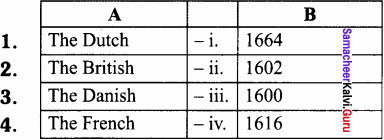
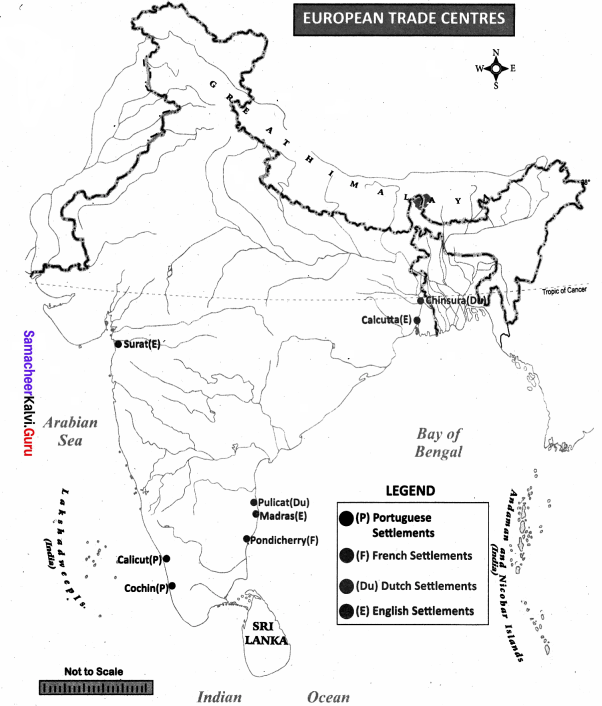
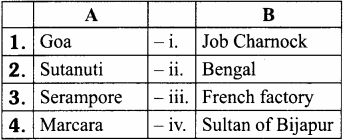
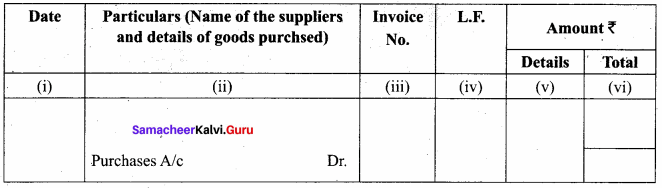
Samacheer Kalvi 6th English Solutions Term 2 Prose Chapter 2 Trip to Ooty

Students can Download English Lesson 2 Trip to Ooty Questions and Answers, Summary, Activity, Notes, Samacheer Kalvi 6th English Book Solutions Guide Pdf  helps you to revise the complete Tamilnadu State Board New Syllabus and score more marks in your examinations.

Tamilnadu Samacheer Kalvi 6th English Solutions Term 2 Prose Chapter 2 Trip to Ooty

Read and Understand

A. Choose the most appropriate option

Trip To Ooty 6th English 1.
Merlin was thrilled when the school arranged the trip because _______
(a) Geetha madam arranged the trip
(b) She had heard about the beautiful journey by the toy train
(c) She wanted to visit Ooty
(d) She loved to go with her friends
Answer:
(b) She had heard about the beautiful journey by the toy train

Trip To Ooty 6th English Question Answer Question 2.
The teacher asked the children to take their seat because .
(a) the children had to take their breakfast
(b) she wanted to check whether all the children were present
(c) the train was about to move
(d) the train was about to stop
Answer:
(c) the train was about to move

Trip To Ooty 6th Lesson Question 3.
Geetha madam couldn’t stop the children running out of the train because they _______
(a) wanted to relax themselves
(b) wanted to see what had happened
(c) were getting bored sitting inside the train
(d) wanted to enjoy the beauty of nature
Answer:
(b) wanted to see what had happened

Trip To Ooty 6th Lesson Summary Question 4.
The people were making all kinds of sounds because _______
(a) they wanted to move the baby elephant out of the track
(b) they were afraid
(c) they were confused
(d) someone stopped the train
Answer.
(a) they wanted to move the baby elephant out of the track

Trip To Ooty Summary Question 5.
We do not really see the landscape from a normal train because the _______
(a) train travels along the city
(b) train never passes through such places
(c) windows are closed
(d) train travels too fast
Answer:
(b) train never passes through such places

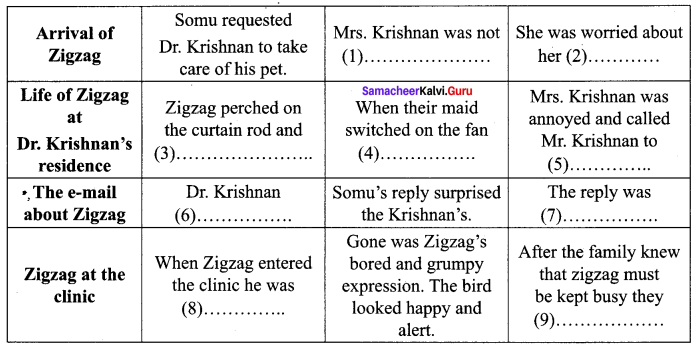
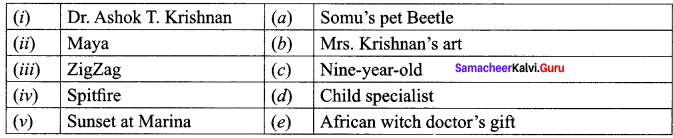
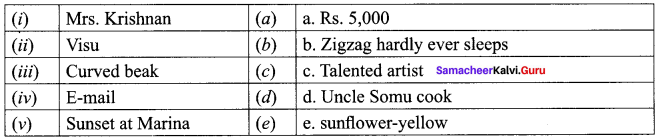
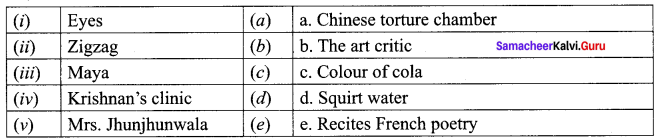
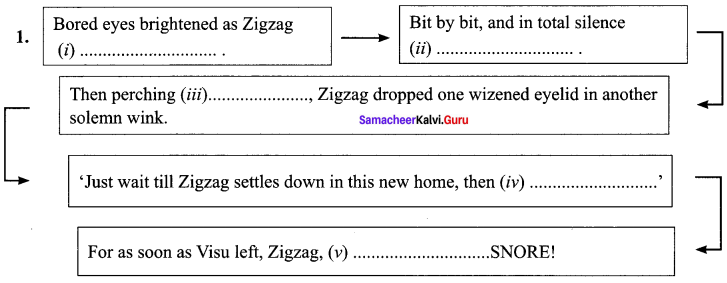
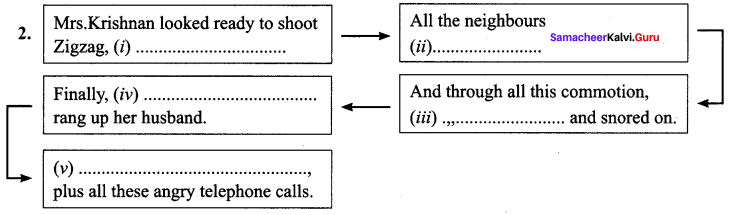
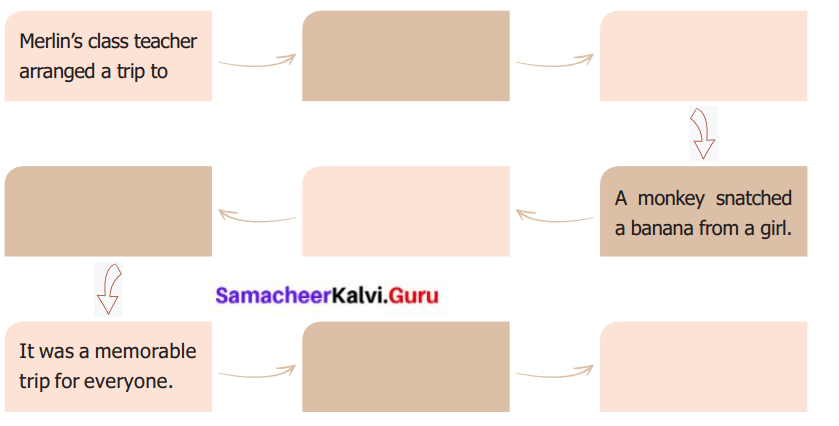
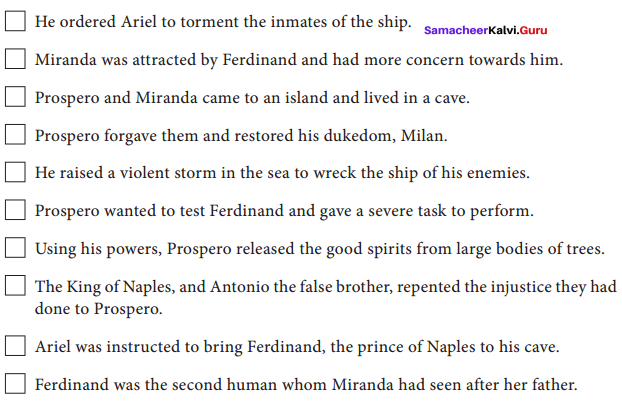
B. Recall Merlin’s memories and complete the story map.
Trip To Ooty 6th English Samacheer Kalvi Term 2 Prose Chapter 2
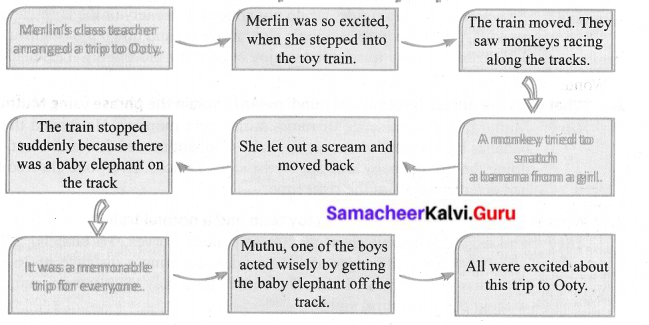
Answer:
Trip To Ooty 6th English Question Answer Term 2 Prose Chapter 2 Trip To Ooty

C Narratette The story based entire story map.
Answer:
Merlin’s class teacher arranged a trip to Ooty. Merlin was so excited, when she stepped into the toy train. The train moved with a jerk. As it moved, they saw monkeys racing along the tracks. A monkey tried to snatch a banana from a girl. She let out a scream and moved back. The train stopped suddenly because there was a baby elephant on the track. It was a memorable trip for everyone. Muthu, one of the boys, acted wisely by getting the baby elephant off the track. All were excited about this trip to Ooty.

D. Write tte story in your own words.
Answer:
Merlin writes a letter to Malli about her trip to Ooty with her friends. Their class teacher Mrs. Geetha arranged this trip. Merlin was so excited when she stepped into the toy train. The train moved slowly allowing the children to have a glimpse of,the beautiful landscape. One of the boys, Muthu wanted to walk along the side of the train. But his teacher scolded him to get back to his seat. The scene outside was beautiful with the purple blue mountains forming a lovely backdrop to the green fields and tea estates. There were monkeys racing along the tracks.

One of the monkeys tried to snatch a banana from a girl. She let out a scream and moved back. Suddenly the train stopped. Everyone got down to see what happened. There was a baby elephant sitting on the track. Everyone tried to persuade the baby off the track with the bunch of bananas. But it was no use. Muthu acted wisely with a presence of mind. He took a bunch of bananas near the baby elephant. As it moved forward to eat the bananas, Muthu moved backwards. He kept doing this, till the baby was on the side of the tracks. Everyone got into the train and the train started to move.

Merlin ended the letter saying that it was a fantastic trip. It was enchanting to hear the sound around them. The whole group was so excited about this trip.

Vocabulary

E. Complete the words by reading their meaning

1. s_e_ta_u_ar – eye catching
2. _x_i_e_ – thrilled
3. d_l_c_ _ _s – tasty
4. s _re_ _ – shout
5. f_i_h_e_ _d – afraid
Answer:
spectacular
excited
delicious
scream
frightened

F. Now, try splitting of these words into syllables.
Answer:

Wonderfulwon-der-ful
BehindBe-hind
BananasBa-na-nas
ExcitementEx-cite-ment
SnatchSnatch (one syllable)
WindowsWin-dows
ThudThud (one syllable)
EveryoneEve-ry-one

Listening

G. Listen to your teacher reading a passage on Udhagamandalam – the Queen of Hill Stations. Tick the appropriate answer.

Trip To Ooty 6th Standard English Question 1.
Udhagamandalam is located in the Western Ghats zone at an altitude of _______
(a) 2045 m
(b) 2240 m
(c) 2234 m
(d) 2040 m
Answer:
(b) 2240 m

6th Standard English Trip To Ooty Question 2.
Centuries ago Udhagamandalam was called _______
(a) Ooty
(b) Otacamund
(c) Oththai-Kal Mandu
(d) Mund
Answer:
(c) Oththai-Kal Mandu

Trip To Ooty Book Back Answers Question 3.
The maximum summer temperature of Udhagamandalam is _______
(a) 10°c
(b) 21°
(c) 5°c
(d) 20°c
Answer:
25°c

6th Standard Trip To Ooty Question 4.
Udhagamandalam was inhibited by tribals called _______
(a) Toda
(b) Irula
(c) Mund
(d) Britons
Answer:
(a) Toda

Trip To Ooty Lesson Question 5.
Ooty was the Summer Capital of the _______ during the British Rule.
(a) British
(b) Todas
(c) Tourists
(d) Madras Presidency
Answer:
(d) Madras Presidency

Speaking

H. Travelling can help a person to understand and appreciate different places. Discuss in groups and talk about the places you have visited recently. Present your experiences to the class.
Answer:
I visited Thanjavur and Madurai with the members of my family. We went to these places to have the Dharshans of Lord Siva and Goddess Meenakshi. The great Brihadeeswarar temple was in Thanjavur and Meenakshi Amman temple was in Madurai. It was such a wonderful trip, I have ever been with my family members. The Brihadeeswarar temple was so great to view with Chola King’s arts and sculptures. It is more than 1000 years old, as it was built in eleventh century. The main temple, dedicated to Lord Shiva, is carved out of a single granite stone.

The temple tower is 66 metres high. Facing the temple is a big statue of Nandhi. We left this place with great memories and a promise of visiting again. Next we went to Madhurai, where we saw Goddess Meenakshi. Madurai was once the home for all Tamil Sangams. This temple has five entrances, four Rajagopurams, five towers out of which two are golden towers. After two days, with a lot of statisfaction and devotion, we started back to our destination.

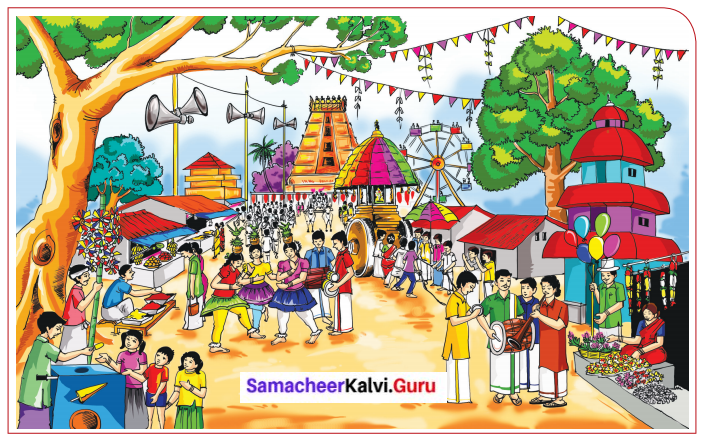
I. Look at the picture of a village festival carefully. Talk about the activities that are going on by using the hints given in the help box.

About the place and the people – what is happening: wThat do the children and the adults do? – kind of shops – performances
Trip To Ooty 6th Lesson Samacheer Kalvi Term 2 Prose Chapter 2
Anwer:
Village Festival
This is a village festival where there is a lot of bustling going around. There is a temple close by. The people are going to the temple and fulfilling their rites. There are loud speakers, from which holy songs are being heard to the public. There are many vendors on the way to the temple. There are people selling fruits, sweets, ice creams, garlands, cocounts, balloons and clothes. Some people are pulling a chariot carrying a God or a Goddess. We can see some girls dancing and others are playing some instruments in front of the chariot.

Everyone is enthusiastic and they are engaged in various activities. Children are enjoying buying ice-creams and playing on their way to the temple. This scenery is a busy place for various activities.

Grammar

J. Read the sentences given below. Does the action happen every day or is it happening at this moment?
Answer:

1.Deepa waters the plants every morning.Every day
2.A triangle has three sides.Every day
3.Sandhya is writing a letter.At this moment
4.The children are playing in the garden.At this moment
5.I go to school regularly.Every day

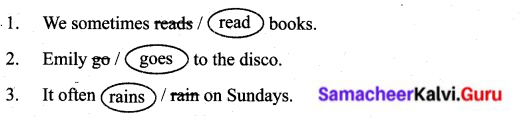
K. Read the sentences given below and circle the verbs appropriately,

  1. Children like/likes ice-creams.
  2. Birds is flying/are flying in the sky.
  3. The doctor is treating/ are treating the patient.
  4. Our school is commencing/commences at 9.00 in the morning.
  5. The florist sell/sells flowers on the street.

Answer:
Trip To Ooty Summary Samacheer Kalvi 6th English Term 2 Prose Chapter 2 Trip To Ooty

L. Vimala and Srinath have met after a long time. Read the conversation given below and complete the dialogue. Role play the situation with your own words.
Answer:
Vimala : Hello Srinath, I haven’t seen you for a long time. Where are you rushing off?
Srinath : I am hurrying to the hospital.
Vimala : Why are you going to hospital? Are you ill?
Srinath : No, I am going to see my friend.
Vimala : Oh! What happened to him?
Srinath : He met with an accident. But he is out of danger.
Vimala : Are you free tomorrow?
Srinath : Yes, I am free.
Vimala : You are in a hurry, meet you tomorrow. Take care.
Srinath : Ok! Bye.

M. Sinduja is getting ready to sleep. She starts writing her diary. Help her complete it by using the verbs given in brackets.
(start eat have finish go reach)

  1. I got up at 7’0 clock.
  2. I _______ breakfast.
  3. I _______ to office by car.
  4. I _______ to work.
  5. I _______ lunch at _______
  6. I _______ my task at 7 p.m.
  7. I _______ home at 8 p.m.

Answers:

  1. 1. I got up at 7’0 clock.
  2. ate
  3. went
  4. started
  5. had; 1.00 p.m.
  6. finished
  7. reached

N. Read the sentences carefully and fill in the blanks with suitable tense form of the verbs given in brackets.

  1. The doorbell rang, while I _______ (do) my homework.
  2. We saw an elephant, while we _______ (go) on a trip to Ooty.
  3. Mary fell asleep while she ________ (read) a book.
  4. The television was on but nobody _______ (watch) it.
  5. Baskaran hurt his hand while he _______ (cut) mangoes.

Answers:

  1. was doing
  2. were going
  3. was reading
  4. was watching
  5. was cutting

Writing

O. Read the informal letter given below and write a reply to Mangai.
Answer:
Informal Letter

Sender’s Address:
20, Arcot Road,
Vadapalani,
Chennai – 600 026.
15th July 2018.

Salutation: Dear Mangai,

Body of the letter :

How are you? I aih fine. I received your letter yesterday. I am very pleased to know about your new home. Have you joined in your new school? How is the atmosphere over there? I miss you a lot. Happy to know that Sundar likes animals like us. He would be a good friend to you. Convey my regards to him. Send me the story, you are writing about Ooty. I would like to read it. Convey my regards to your parents. I am looking forward to read your story in your next letter.

Subscription : Yours lovingly,
Signature : Rosy.

Creative Writing

P. The Pooja holidays are about to start. Prasanth and Deepak are friends. Both their families have planned to go on a trip to Munnar. Develop a conversation on how they plan for their trip.
Answer:
Prashanth : Hai, Deepak, how did you write your exams?
Deepak : I wrote extremely well. What about you?
Prashanth : Yes. I too wrote well. From tomorrow, our Pooja holidays begin. Let us go with our family members to Munnar. We are already planning on it.
Deepak : Yes, Prashanth. I’ll talk to my parents about the trip. We can stay for a week there.
Prashanth : Yes, we have to see a lot of places. We can go by a Van there.
Deepak : Yes, the Van can fit all of us. Which is the shortest route from Chennai ?
Prashanth : We can take GST road NH 38. It will take around 10 to 11 hours and we can stay in Hotel Munnar Central. It is quite comfortable.
Deepak : OK! What are the tourist spots to be visited?
Prashanth : Kalari Kshethra, Anamudi Peak, Tea Gardens, Lock Heart Gap, Kundala Dam Lake, National Parks and Chinnakanal Waterfalls.
Deepak : Wonderful! Let’s pack all our things we need for the tour.
Prashanth : Yes, We have to take with us cotton outfits, hats, sunglasses, sunscreen lotion, blankets and sweaters.
Deepak : Ok! Prashanth. I’ll give the information to my parents and I’ll ask them to talk to your parents about this trip. Bye!

Trip to Ooty Additional Questions

I. Select The Suitable Synonyms.

Trip To Ooty 6th English Summary Question 1.
spectacular
(a) ordinary
(b) wonderful
(c) sorrowful
Answer:
(b) wonderful

Trip To Ooty 6th Lesson Pdf Question 2.
thrilled
(a) excited
(b) bored
(c) uninterested
Answer:
(a) excited

Samacheer Kalvi Guru 6th English Question 3.
mesh
(a) material made of ropes
(b) material made of wires or thread
(c) material made of bamboo
Am :
(b) material made of wires or thread

Question 4.
swaying
(a) swinging
(b) staying
(c) pacing
Answer:
(a) swinging

Question 5.
snaking
(a) moving fast
(b) moving abruptly
(c) moving like a snake
Answer:
(c) moving like a snake

Question 6.
jerk
(a) sudden movement
(b) slow movement
(c) sound
Answer.
(a) sudden movement

Question 7.
delicious
(a) salty
(b) tasty
(c) sweet
Answer:
(b) tasty

Question 8.
bubbling
(a) laughing
(b) following
(c) foaming
Answer:
(c) foamsing

Question 9.
sniggered
(a) laughed in a suppressed way
(b) smiled
(c) sneered
Answer:
(a) laughed in a suppressed way

Question 10.
weaving
(a) turning
(b) making
(c) twisting
Answer:
(c) twisting

Question 11.
scream
(a) loud noise
(b) cry in a high pitch
(c) laugh
Answer:
(b) cry in a high pitch

Question 12.
snatch
(a) seize quickly
(b) take in a polite manner
(c) eat hastily
Answer:
(a) seize quickly

Question 13.
sequence
(a) cycle
(b) order
(c) events
Answer:
(b) order

Question 14.
excitedly
(a) anxiously
(b) sadly
(c) eagerly
Answer:
(c) eagerly

Question 15.
coax
(a) persude
(b) pamper
(c) attract
Answer:
(a) persude

Question 16.
piled
(a) place one on top of the other
(b) kept in a line
(c) arranged vertically
Answer:
(a) place one on top of the other

Question 17.
fantastic
(a) boring
(b) attractive
(c) pleasant

Question 18.
landscape
(a) visible features Of an area
(b) bridges
(c) estates
Answer:
(a) visible features Of an area

Question 19.
trumpeting
(a) whistling
(b) shouting
(c) making a loud noise
Answer:
(c) making a loud noise

Question 20.
chugging
(a) moving with a puffing sound
(b) making an indistinct sound
(c) making a loud noise
Answer:
(a) moving with a puffing sound

II. Select The Suitable Antonyms.

Question 1.
beautiful
(a) wonderful
(b) ugly
(c) attractive
Answer:
(b) ugly

Question 2
close
(a) far
(b) near
(c) adjacent
Answer:
(a) far

Question 3.
never
(a) on no occasion
(b) not once
(c) always
Answer:
(c) always

Question 4.
friend
(a) enemy
(b) relative
(c) companion
Answer:
(a) enemy

Question 5.
everyone
(a) each one
(b) Fathima
(c) no one
Answer:
(c) no one

Question 6.
slowly
(a) gradually
(b) quickly
(c) leisurely
Answer:
(b) quickly

Question 7.
firm
(a) rough
(b) angry
(c) soft
Answer:
(c) soft

Question 8.
outside
(a) external side
(b) inside
(c) exterior
Answer:
(b) inside

Question 9.
cute
(a) pretty
(b) wonderful
(c) ugly
Answer:
(c) ugly

Question 10.
small
(a) big
(b) tiny
(c) puny
Answer:
(a) big

Question 11.
suddenly
(a) abruptly
(b) gradually
(c) rapidly
Answer:
(b) gradually

Question 12.
whole
(a) entire
(b) complete
(c) part
Answer:
(c) part

Question 13.
attraction
(a) appeal
(b) ugliness
(c) charm
Answer:
(b) ugliness

Question 14.
backward
(a) forward
(b) behind
(c) beside
Answer:
(a) forward

Question 15.
normal
(a) simple
(b) usual
(c) abnormal
Answer:
(c) abnormal

Question 16.
wide
(a) narrow
(b) large
(c) huge
Answer:
(a) narrow

Question 17.
listen
(a) hear
(b) observe
(c) speak
Answer:
(c) speak

Question 18.
fast
(a) slow
(b) soon
(c) speedy
Answer:
(a) slow

Question 19.
lucky
(a) fortunate
(b) blessed
(c) unlucky
Answer:
(c) unlucky

Question 20.
wild
(a) untamed
(b) domestic
(c) angry
Answer:
(b) domestic

III. Choose The Correct Answers (MCQ).

Question 1.
She said that it was a _______ trip up and down the slopes.
(a) good
(b) spectacular
(c) wonderful
(d) worst
Answer:
(b) spectacular

Question 2.
_______ girls and boys from class six went on the trip.
(a) Ten
(b) Fifteen
(c) eight
(d) Twenty
Answer:
(d) Twenty

Question 3.
I was bubbling over with _______
(a) amazement
(b) excitement
(c) puzzlement
(d) joy
Answer:
(b) excitement

Question 4.
The girls _______ and Muthu sat down with a long face.
(a) sniggered
(b) giggled
(c) smiled
(d) screamed
Answer:
(a) sniggered

Question 5.
_______ were racing all along the tracks.
(a) Donkeys
(b) Birds
(c) cows
(d) Monkeys
Answer:
(d) Monkeys

Question 6.
Some were in _______ and some had babies clinging onto them.
(a) single
(b) lonely
(c) groups
(d) pairs
Answer:
(c) groups

Question 7.
In the end, the whole compartment _______ out.
(a) came
(b) stepped
(c) jumped
(d) emptied
Answer:
(b) stepped

Question 8.
The mother elephant was nearby _______ loudly.
(a) shouting
(b) screaming
(c) trumpeting
(d) growling
Answer:
(c) trumpeting

Question 9.
It was such a _______ trip.
(a) marvellous
(b) wonderful
(c) fantastic
(d) mind-blowing
Answer:
(c) fantastic

Question 10.
Geetha ma’am had told us that we would see elephants if we were _______
(a) unlucky
(b) lucky
(c) quiet
(d) silent
Answer:
(b) lucky

IV. Very Short Answer Questions.

Question 1.
How many girls and boys went on the trip?
Answer:
Twenty girls and boys from class VI went on the trip.

Question 2.
Where is Ooty?
Answer:
Ooty is close to Coimbatore.

Question 3.
Had Merlin been there before?
Answer:
No, she had never been there before.

Question 4.
Who came and sat next to Merlin in the toy train?
Answer:
Fatima, her friend, came and sat next to Merlin.

Question 5.
What was the colour of the mountains?
Answer:
The mountains were purple-blue.

Question 6.
What did Merlin pointed out to Fathima?
Answer:
She pointed out at a baby monkey holding onto its mother’s stomach.

Question 7.
What did Fatima asked Merlin to see?
Answer:
She pointed to a bubbling stream with a small waterfall.

Question 8.
When the train stopped, who stepped out first to see what had happened?
Answer:
Muthu and his friends were the first to step out to see what had happened.

Question 9.
Who was on the track?
Answer:
A cute baby elephant was sitting on the track.

Question 10.
What did the engine driver do?
Answer:
He tried to persuade the baby gently off the track with a bunch of bananas.

V. Short Answer Questions.

Question 1.
To whom did Merlin write a letter and why?
Answer:
Merlin wrote a letter to Malli, as she had asked her to tell about her trip to Ooty.

Question 2.
What did Merlin’s Grandmother tell her many times?
Answer:
Merlin’s Grandmother had told her about the beautiful journey to Ooty by the toy train. She said that it was a spectacular trip up and down the slopes.

Question 3.
Who was bubbling over with excitement? Why?
Answer:
Merlin was bubbling over with excitement, as she had never been to Ooty or seen the toy train.

Question 4.
What did Merlin see, as she stepped into the toy train?
Answer:
She saw wooden chairs with cushioned seats and oil painted walls. There was also a luggage rack.

Question 5.
Why did her teacher come around?
Answer:
Her teacher came around to see if everyone was seated properly, as the train was about to leave.

Question 6.
What were the monkeys doing?
Answer:
The monkeys were racing all along the tracks. Some were in groups and some had babies clinging on to them.

Question 7.
Why did a monkey try to snatch a banana from a girl?
Answer:
The girl leaned out of the window to look at the train curving behind the track. So a monkey tried to snatch the banana from her hand.

Question 8.
What looked just like a dream sequence in a movie?
Answer:
The misty clouds which covered the mountains and moved in and out of the forests looked just like a dream sequence in a movie.

Question 9.
What did the people do to make the baby elephant move from the track?
Answer:
People stood around trying to make the baby move by making all kinds of sounds.

Question 10.
What was enchanting to listen?
Answer:
It was enchanting to listen to the murmur of streams, waterfalls and musical bird calls.

VI. Paragraph Questions and Answers.

Question 1.
Spot any 3 differences between toy train and normal train.
Answer:
Toy Train:

  1. This rail connects Udhagamandalam and Mettupalayam.
  2. The travellers can enjoy the beauty of the mountain side.
  3. The train will run very slowly.

Normal Train:

  1. These trains run all over the country.
  2. The travellers cannot enjoy the scenery or the landscape.
  3. The train will run very fast.

Question 2.
How did the children enjoy going in the toy train?
Answer:
The children were so thrilled to get into the toy train. There were wooden chairs with cushioned seats and oil pointed walls. Merlin and Fathima sat together and were enjoying the scenery outside. As the train moved slowly, everyone clapped with excitement. One of the boys, Muthu wanted to walk along the train’s side, as it was moving very slowly. As soon as his teacher shouted at him to sit in his place, he sat down with a long face. The train went snaking up the step hill side, weaving its way through forests of tall trees swaying in the breeze. All the children enjoyed looking at the beautiful mountains, waterfalls, monkeys, green fields and tea estates.

Question 3.
How beautiful was the scene outside?
Answer:
The scene outside was beautiful with purple-blue mountains forming a lovely back-drop to the green fields and tea estates. Monkeys were racing all along the tracks. Some were in groups and some had babies clinging on to them. The misty clouds, which covered the mountains and moved in and out of the forests looked wonderful, ft looked just like a dream sequence in a movie. The children saw a bubbling stream with a small waterfall and a pretty blue bird with a lovely crown.

Question 4.
Why did the toy train stop suddenly and what happened after it stopped?
Answer:
The toy train stopped suddenly, as there was a cute baby elephant sitting on the track. The mother elephant was nearby trumpeting loudly. The engine driver tried to persuade the baby off the track with a bunch of bananas. But the mother elephant did not allow anyone near the baby. So, people stood around trying to make all kinds of sounds. Finally, Muthu went up to the baby with a bunch of bananas. Just as it moved to eat it, he moved backwards. He kept doing this, till the baby was out on the side of the tracks. Everyone cheered as the baby started eating the bananas. Everyone got into the train ad it started moving.

Question 5.
Describe the beauty of blue mountain.
Answer:
The purple-blue mountains formed a lovely backdrop to the green fields and tea estates. The misty clouds covered the mountains and moved in and out of the forests. There was a bubbling stream with a small waterfall.

VII. Writing Skill.

1. Conversion:
Develop the Conversation between you and your friend Deepak about the plan for the trip to Ooty.
Answer:
Me: Hi, Ravi, How are you?
Friend: I am fine and you?
Me: I am also fine. By the way, how will you spend your summer holidays?
Friend: I plan to go to some hill area.
Me: Would you like to come with me to Ooty?
Friend: Oh, sure. Where will we stay?
Me: My uncle’s house is there. His company has sent him to New York on deputation for six months.
Friend: Is it vacant now?
Me: No. His servant is there. So, let us start on Sunday evening.
Friend: OK. I will come.

2. Letter Writing:
Write a letter to your friend sharing experience about your trip to Ooty
Answer:
28, Bharathi Street,
Tiruppur – 641 601
October, 2018.

Dear Ramesh,

I hope this letter finds you in good health and spirits. Last Saturday, I went to Ooty along with my parents. We stayed in our uncle’s house. We visited to Pykara falls, but there was no water. Then we left for Mudumalai and saw wild animals. We travelled in the Toy Train also from Ooty to Coonoor. The next day we visited Doddabetta, Botanical garden and the Rose Garden. Then we visited the Ooty lake. Boating is a lot of fun there with different boats, like row, pedal, motor. Totally, the trip was a very nice one.

Convey my regards to your parents.

Your loving friend,
L. Suresh

Address on the envelope

To
M. Ramesh,
53, Sardar Patel Street,
Chennai – 600 014.

Grammar – Additional

Tenses

Simple Present Tense

The Simple Present tense tells us of actions done always or usually.
Example : The Indus is a long river which rises in Tibet.
The Ravi, the Beas and the Sutlej flow through the Punjab Haryana Plains.
A low watershed seperates these plains from the Ganga plains.
The Ganga Plains form the largest lowland drained by the Ganga and its tributaries.
Both the Ganga and the Yamuna originate in the Himalayas.
The Ganga also receives tributaries from the Peninsular plateau.
The Brahmaputra joins the Ganga and flows through Bangladesh.

1. The simple present tense expresses habitual actions.
I brush my teeth every day.

2. General truths.
Sea water is salty.

3. For future actions.
The Eighth standard students go to the ninth in June.

4. If type conditional sentences :
If you write that letter, you may get into trouble.

5. For a dramatic effect:
(a) She walks into the room, sees the headless body and screams.
(b) The singer slips out of captivity, leaps from the balcony and dives into a deep blue pond.

6. In questions and statements containing do, does and did and interrogative sentences.
Do you know the truth?
Does he come?
Did she sing?
Am I wrong? Is it time?

7. In time clauses :
When did this happen?
Adverbs like : occasionally, generally, sometimes, always, never often etc., are usually used with the Present Tense.

Present Progressive Tense

The Present Continuous Tense : is / am / are + Ving
It is used for actions in progress at the time of speaking.
Example : It is raining.
Generally, these verbs should not be used in the present continuous : know, smell, taste, possess, remember, belong, cost, want, derive, detest, understand, forget, etc.
I am loving you (Not correct)
I love you
I am not understanding (Not correct)
I don’t understand.
Thd.present continuous is also used to express an arrangement for the future.

Example : I am flying to France this evening. Vicky is speaking in the meeting tomorrow.
Adverbs like now, still, at present are used with the Present Continuous Tense.

Example:

  1. I am eating.
  2. She is eating banana.
  3. My father is reading the newspaper.
  4. The moon is shining.
  5. They are chanting mantras.
  6. They baby is crying.
  7. Are you watching TV?
  8. What are you going party?
  9. Raman is flying Tokyo.
  10. Are you feeling okay?

Simple Past Tense
The past tense is used to express an action that took place in the past.
Example : India became independent in 1947.
I met Usha Yesterday.

Past Progressive Tense

This tense is used to express an action that continued for sometime in the past. Yesterday, last week etc. are the adverbs used with this tense.

Example : Shiela was washing the clothes when the thief entered the house.

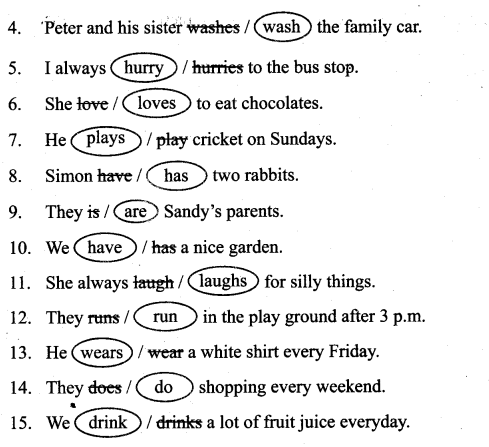
I. Read the sentences given below and circle the verbs appropriately.
Trip To Ooty Summary Samacheer Kalvi 6th English Term 2 Prose Chapter 2 Trip To Ooty
Trip To Ooty 6th Standard English Term 2 Prose Chapter 2 Trip To Ooty

II. Fill in blanks with the simple present or present progressive tense.

  1. Look! They (leave) _______ the house.
  2. Brian (cycle) _______ 30 km everyday.
  3. Samantha (do) _______ her homework at the moment.
  4. My parents (shop) _______ right now.
  5. He usually (get up) _______ early in the morning.
  6. Normally, Jenny (wear) _______ black shoes but today she (wear) _______ red wellies.
  7. Look! Jenny (go) _______ to school.
  8. She (go) _______ for walking everyday.
  9. The sun (rises) _______ in the east.
  10. A square (be) _______ a four sided figure.
  11. Ravi’s mother (prepare) _______ food now.
  12. She (cook) _______ deliciously. [Ans: cooks]
  13. My mother always (take) _______ care of me.
  14. Look! Thev (play) _______ Kabbadi.
  15. She (watch) _______ T. V. now.

Answers:

  1. are leaving
  2. cycles
  3. is doing
  4. are shopping
  5. gets up
  6. wears, is wearing
  7. is going
  8. goes
  9. rises
  10. is
  11. is preparing
  12. takes
  13. are playing
  14. is watching

III. Write the verbs in the present progressive.

  1. speak – I _______
  2. iump – You _______
  3. bake – She _______
  4. play – They _______
  5. run – We _______
  6. laugh – He _______
  7. enact – We _______ a drama.
  8. answer – I _______ the question.
  9. wash – They _______ the clothes.
  10. do – She _______ her homework.
  11. dancing – They _______
  12. scream – She _______
  13. learn – We _______ Tamil.
  14. clap – Everyone _______
  15. listen – Children _______ carefully.

Answers:

  1. am speaking
  2. are jumping
  3. is baking
  4. are playing
  5. are running
  6. is laughing
  7. are enacting
  8. am answering
  9. are washing
  10. is doing
  11. are dancing
  12. is screaming
  13. are learning
  14. is clapping
  15. are listening

IV. Fill in the blanks with suitable tense form of the verbs given brackets.

  1. The phone _______ (ring) while I _______ (sleep).
  2. I _______ (cook) dinner, when Sue _______ (arrive).
  3. When the dog _______ (bark), they _______ (try) to sleep.
  4. While we _______ (dance) the music _______ (stop).
  5. Sam _______ (listen) to music, so he _______ (not hear) you.
  6. While we _______ (talk), someone _______ (steal) my bag.
  7. The prisoner _______ (run) away, while the policeman were _______ (joke).
  8. My boss _______ (call) me, while I _______ (eat).
  9. While I _______ (work), my husband _______ (ask) my help.
  10. When they _______ (come) in, everybody _______ (watch) the movie.
  11. The thief (enter) _______ into their house, while all (watch) _______ T. V.
  12. Rai (walk) _______ to the station, while his friends (chat) _______
  13. When my mother (call) me, when I (have) my dinner.
  14. When he (play) _______ football, he _______ (meet) an accident.
  15. He (stumble) _______, while he (try) _______ to get up.

Answers:

  1. rang ; was sleeping
  2. was cooking ; arrived
  3. was barking : tried
  4. were dancing ; stopped
  5. was listening ; did not hear
  6. were talking : stole
  7. ran ; joking
  8. called ; was eating
  9. worked ; was asking
  10. came ; was watching
  11. entered ; were watching
  12. walked ; were chatting
  13. called ; was having
  14. was playing ; met
  15. stumbled : was trying

Trip to Ooty Summary

Section I

This section deals with the first part of the letter written by Merlin to Malli. She told her about her trip to Ooty with her friends. Their class teacher Mrs. Geetha and two other teachers accompanied a group of twenty girls and boys from Class VI. Merlin had heard from her grandmother about the beautiful journey to Ooty by the toy train. She said that it was a spectacular trip up and down the slopes with birds and trees dancing along the way. Merlin wrote that she was so excited when she stepped into the toy train with her friends. There were wooden chairs with cushioned seats and oil painted walls. She called out her friend Fathima to sit next to her.

They were enjoying the view from the toy train. Their teacher Mrs. Geetha came around to see if everyone was seated properly. The train started with a jerk and moved slowly. Everyone of them clapped joyfully. One of the boys, Muthu wanted to walk along the side of the train, as it was going very slowly. But his teacher scolded him to go to his seat immediately. All the girls laughed at this and Muthu sat down quietly with a long face.

Read the following questions and answer them.

Question 1.
Where did the boys and girls go?
Answer:
The boys and girls of Class VI went on a trip to Ooty.

Question 2.
Why did Muthu say that he could walk along its side?
Answer:
Muthu said that he could walk along its side because the train was moving very slowly.

Question 3.
Why did the girls snigger?
Answer:
The girls sniggered because the teacher shouted at Muthu to go back to his seat immediately.

SamacheerKalvi.Guru

Section II

This section of the letter gives the clear view of the scenes outside the train. The scene was beautiful with the purple blue mountains forming a lovely backdrop to the green fields and the estates. Monkeys with babies clinging onto them were racing all along the tracks. One of the monkeys tried to snatch a banana from a girl, as she leaned out of the window to look at the train curving on the track. She gave a scream and moved back. The misty clouds, which covered the mountains, the bubbling stream with a small waterfall, and a pretty blue bird were marvellous to see. Suddenly, the train stopped with a thud. Boys were so excited to see what happened. So they begged their teacher to allow them to step out of the train.

In the end, the whole compartment stepped out. And what a sight greeted their eyes!

Discuss and answer the following questions.

Question 1.
Why did the girl scream?
Ans:
One of the monkeys tried to snatch a banana from a girl’s hand while she was leaning out of the window. She screamed and moved back.

Question 2.
Why did Muthu and his friends step out of the train?
Answer:
The trained stopped suddenly. So Muthu and his friends stepped out of the train to see what had happened.

Question 3.
Describe the beauty of the blue mountain.
Answer:
The purple-blue mountains formed a lovely backdrop to the green fields and tea estates.

Section III

This section narrates the incident on the track. There was a cute baby elephant sitting on the track. The mother elephant was nearby trumpeting loudly. The engine driver and others tried to persuade the baby off the track with the bunch of bananas. But the mother elephant did not allow anyone near the baby. So they were making all kinds of sounds to make the baby elephant move from there. Just then, Muthu went upf to the baby with a bunch of bananas. Just as it moved to eat it, he moved backwards. He kept doing this, till the baby was out on the side of the tracks. Everyone cheered as the baby and mother started eating the bananas. As they were eating, everyone got into the train and it left after a delay of half an hour.

Merlin ended the letter saying that it was a fantastic trip. It was enchanting to listen to the sounds of streams and waterfalls. She can never forget the wide, wind-swept tea estates, cloud covered mountains, the swaying trees and the birds chirping. The whole group was so excited by the trip.

Think and answer.

Question 1.
What made the trip a memorable one?
Answer:
On a normal fast train ride, we do not notice the scenery or the landscape. It rushes by so fast. But the train making a slow move up and down the beautiful mountain was different. They were able to enjoy everything thoroughly. This made the trip a memorable one.

Question 2.
What does the phrase ‘presence of mind’ mean? Explain the phrase using Muthu’s action.
Answer:
Muthu had the ‘presence of mind’ at the right moment. He moved the bunch of bananas backwards, whenever the baby elephant moved forward to eat it. He kept doing that till the baby was out on the side of tracks. Everyone cheered this, as he had acted correctly at the right time.

Question 3.
What is the difference between this toy train and a normal train?
Answer:
The toy train travels through 208 serpentine curves, 16 tunnels, 250 bridges, waterfall hood, cliff edges and tea estates, covering a distance of 26 km. It is a showcase of heritage of India. The normal train only takes you to your destination without these beautiful sights.

Samacheer Kalvi 7th Social Science History Solutions Term 1 Chapter 1 Sources of Medieval India

Students can Download Social Science History Chapter 1 Sources of Medieval India Questions and Answers, Notes Pdf, Samacheer Kalvi 7th Social Science Book Solutions Guide Pdf helps you to revise the complete Tamilnadu State Board New Syllabus and score more marks in your examinations.

Tamilnadu Samacheer Kalvi 7th Social Science History Solutions Term 1 Chapter 1 Sources of Medieval India

Samacheer Kalvi 7th Social Science Sources of Medieval India Textual Evaluation

I. Choose the correct answer:

Sources Of Medieval India Class 7 Question 1.
are the writings engraved on solid surfaces such as rocks, stones, temple wails and metals.
(a) Chronicles
(b) Travelogues
(c) Coins
(d) Inscriptions
Answer:
(d) Inscriptions

Sources Of Medieval Indian History Class 7 Question 2.
was the land gifted to temples.
(a) Vellanvagai
(b) Shalabhoga
(c) Brahmadeya
(d) Devadana
Answer:
(d) Devadana

Sources Of Medieval India Questions And Answers Question 3.
__________ period was known as the period of devotional literature.
(a) Chola
(b) Pandya
(c) Rajput
(d) Vijayanagara
Answer:
(a) Chola

Sources Of Medieval Indian History Class 7 Question Answer Question 4.
__________ provides information about the first Sultan of Delhi.
(a) Ain-i-Akbari
(b) Taj-ul-Ma’asir
(c) Tuzk-i-Jahangiri
(d) Tarikh-i-Frishta
Answer:
(b) Taj-ul-Ma’asir

Samacheer Kalvi Guru 7th Social Science Question 5.
__________ an Arab-born Morocco scholar, travelled from Morocco to India.
(a) Marco Polo
(b) A1 Beruni
(c) Domingo Paes
(d) Ibn Battuta
Answer:
(d) Ibn Battuta

II. Fill in the Blanks

  1. __________ inscriptions provide details about administration in a Brahmadeya village.
  2. __________ had stamped the figure of Goddess Lakshmi on his gold coins and had his name inscribed on it.
  3. __________ 3.6 grains of silver amounted to a
  4. __________ was patronised by Sultan Nazir-ud-din Mahmud of Slave Dynasty.
  5. __________ An Italian traveller visited Vijayanagar Empire in 1420.

Answer:

  1. Uttiramerur
  2. Muhammad Ghori
  3. Jital
  4. Minhaj-us-Siraj
  5. Nicolo Conti

III. Match the following

AB
Khajurahoi.Odisha
Konarkii.Hampi
Dilwaraiii.Madhya Pradesh
Virupakshaiv.Rajasthan

Answer:

  1. iii
  2. i
  3. iv
  4. ii

IV. State true or false :

Samacheer Kalvi 7th History Book Question 1.
Pallichchandam was the land donated to Jaina institution.
Answer:
True

Samacheer Kalvi Guru 7th Social Question 2.
The composition of metal coins gives us information on the political condition of the empire.
Answer:
False
Correct statement: The composition of metals in the coins gives us information on the economic condition of the empire.

Question 3.
The high cost of copper made palm leaf and paper cheaper alternatives for recording royal orders and events in royal courts.
Answer:
True

Question 4.
Domingo Paes, a Portuguese traveller, visited the Chola Empire in 1522.
Answer:
False
Correct statement: Domingo Paes, a Portuguese traveller, visited the Vijayanagar in 1522.

V. Match the statement with the reason Tick
(a) Tick (✓) the appropriate answer.

Question 1.
Assertion (A) :Muhammad Ghori’s gold coins carried the figure of Goddess Lakshmi.
Reason (R) :The Turkish invader was liberal in his religious outlook.
a) R is the correct explanation of A.
b) R is not the correct explanation of A.
c) A is wrong and R is correct.
d) A and R are wrong.
Answer :
(a) R is the correct explanation of A

(b) Find out the wrong pair

  1. Madhura Vijayam – Gangadevi
  2. Abul Fazal – Ain-i-Akbari
  3. Ibn Battura – Tahquiq-i-Hind
  4. Amuktamalyatha – Krishnadevaraya

Answer:
3. Ibn Battuta – Tahquiq-i-Hind

(c) Find out the odd one
Question 1.
Inscriptions, Travelogues, Monuments, Coins
Answer:
Travelogues

VI. Answer the following in one or two sentences

Question 1.
Who compiled Nalayira Divyaprabhandham ?
Answer:
Nathamuni

Question 2.
What does the word Tuzk mean?
Answer:
Auto biography

Question 3.
Name Jahangir’s memoir.
Tuzk-i-Jahangiri

Question 4.
Name the two different types of sources for the study of history.
Answer:
Primary sources and Secondary sources are the two different types of sources for the study of history.

Question 5.
List out the important mosques and forts constructed during the medieval times.
Answer:

  1. Quwwat-ul Islam Masjid, Moth-ki- Masjid, Jama Masjid, Fatehpur Sikri Dargah (all in and around Delhi) and Charminar (Hyderabad) are the important mosques belonging to the medieval times.
  2. The forts of historical importance are Agra Fort, Chittor Fort, Gwalior Fort and Delhi Red Fort and

Question 6.
Mention the important foreign travellers who visited India during the medieval period.
Answer:
Marco Polo, a Venetian traveller, Al-Beruni, Ibn Battuta Nicolo Conti, Abdur-Razzaq, Domingo Paes.

VII. Answer the following :

Question 1.
Describe the different types of coins introduced by the rulers of Delhi Sultanate.
Answer:

  1. The picture and the legend on the coins convey the names of kings with their titles and portraits, events, places, dates, dynasties and logos.
  2. The composition of metals in the coins gives us information on the economic condition of the empire.
  3. Mention of king’s achievements like military conquests, territorial expansion, trade links and religious faith can also be found in the coins.
  4. Muhammad Ghori had stamped the figure of Goddess Lakshmi on his gold coins and had his name inscribed on it.
  5. This coin tells us that this early Turkish invader was in all likelihood liberal in religious outlook. Copper Jitals are available for the study of the period of the Delhi Sultans.
  6. Silver Tanka introduced by Iltutmish, Ala-ud-din Khalji’s gold coins, Muhammad-bin- Tughluq’s copper token currency are indicative of coinage as well as the economic prosperity or otherwise of the country of the time. A jital contained 3.6 grains of silver. Forty eight jitals were equal to 1 silver tanka.

VIII. Answer Grid

1. _______________ was a courtier of Emperor Aurangazeb.
Answer:
Khafi khan
2. Tiruvalangadu copper plates belong to
Answer :
Rajendra Chola I
3. _______________ was the land for the maintenance of the school.
Answer :
Shalabhoga
4. _______________ compiled Periyapuranam.
Answer :
Sekkizhar
5. _______________ is an Arabic word meaning history.
Answer:
Tariq or Tahquiq.
6. Muhammed bin Tughluq transferred his capital from Delhi to ____________ in the south.
Answer:
Devagiri (Daulatabad).

IX. HOTS :

Question 1.
The composition of metals in coins is indicative of the economic prosperity of the empire-
Substantiate.
Answer:

  1. Metals like Gold and Silver are precious and rare elements.
  2. They are shiny, strong and have high economic value.
  3. If such metals are used in coins in an empire, it indicates its economic prosperity.

X. Student Activity :

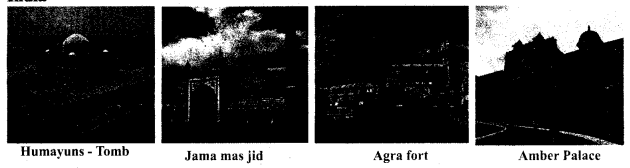
Prepare an album collecting pictures of palaces, tombs, mosques and forts of Medieval India

Sources Of Medieval India Class 7 Samacheer Kalvi History Solutions Term 1 Chapter 1

XI. Life skill :

Question 1.
Find out from the libraries in your town or village and prepare a report about the primary and secondary sources available there.
Answer:
On a visit to a library nearby I found that it had primary and secondary sources.

I found historical documents, statistical data, pieces of creative writing, speeches and art objects. Interviews, surveys, field work also are available here. I also could see and sources like articles in news papers, popular magazines, book a movie views and articles in journals.

Samacheer Kalvi 7th Social Science Sources of Medieval India Additional Questions

I. Choose the correct answer:

Question 1.
Uttiramerur inscriptions in ______ district provide details about Brahmadeya village administration.
(a) Salem
(b) Kanchipuram
(c) Chennai
(d) Vellore
Answer:
(b) Kanchipuram

Question 2.
______ jitals are available for the study Of the period Of the Delhi sultans.
(a) Gold
(b) Silver
(c) Copper
(d) Aluminium
Answer:
(c) Copper

II. Fill in the blanks

  1. ______ grants, which were treated as legal documents, have significant source value.
  2. Palaces in Jaipur, Jaisalmer and Jodhpur signify the greatness of the _____ dynasty.
  3. The ______ period was known as the period of devotional literature in South India
  4. ______ are pictures, images in drawing or painting

Answer:

  1. Copper – Plate
  2. Rajput
  3. Chola
  4. Portraits

III. Match the following:

AB
a.Abul Fazali.King’s achievements
b.Iltutmishii.Akbar nama
c.Coinsiii.Kalhana
d.Rihlaiv.Chahalgani
e.RajataranginiV.The Travels

Answer:
a – ii
b – iv
c – i
d – v
e – iii

IV. State true or false:

Question 1.
Zia – Ud – Bami wrote Tarikh – i – Firoz shahi.
Answer:
True

Question 2.
Tabakat-i- Akbari was authored by Abul Faze.
False
Correct statement: Tabakat-i- Akbari was authored by Nizam-ud-din Ahmad.

Question 3.
Ibn Battuta tells us of caste in India and the practice of Sati.
Answer:
True

V. Match the statement with the reason. Tick the appropriate answer:

Question 1.
Statement : Minhaj – us- siraj, patronised by Sultan Nazir – ud – din Mahmud, wrote Tabakat – i – Nasiri
Reason : The compendium was named after its patron.
(a) Statement is true but Reason is wrong.
(b) Statement and Reason are correct.
(c) Statement is wrong and reason is correct.
(d) Both Statement and reason are wrong.
Answer:
(b) Statement and Reason are correct.

Question 2.
Statement :Accroding to Ibn Battuta, a Morocco scholar, Egypt was rich in the 16th century.
Reason: The whole of Indian trade with the west passed through Egypt
(a) Statement is true but Reason is wrong.
(b) Statement and Reason are correct.
(c) Statement is wrong and reason is correct.
(d) Both Statement and reason are wrong.
Answer:
(c) Statement is wrong and reason is correct.

Question 3.
Statement: Kayal, which was a port city is situated in this district of Tamil Nadu.
Find out which of the following is correct?
(a) Kanyakumari
(b) Tirunelveli
(c) Thoothukudi
(d) Ramanathapuram
Answer:
(c) Thoothukudi

Question 4.
Find out the wrong Pair
(a) Nalayira Divyaprabhandham – 12Azhwars
(b) Devaram – Appar, Sambandar, Sundarar
(c) Thiruvasagam – Manikkavasakar
(d) GitaGovindam – Kabirdas
Answer:
(d) Gita Govindam – Kabir das

Question 5.
pick out the wrong statement.
(a) Al – Beruni accompanied Mahmud of Ghazni in one of his campaigns
(b) He stayed in India for 10 years.
(c) The most accurate accounts of Mahmud’s Somnath expedition is that of Alberuni
(d) He knew only Arabic.
Answer:
(d) He knew only Arabic

VI. Answer in one or two sentences

Question 1.
Who composed Nalayira Divya Prabhandam?
Answer:
Nalayira Divya Prabhandam was composed by 12 Azhwars.

Question 2.
By whom was Devaram composed and compiled?
Answer:

  1. Devaram composed by Appar, Sundarar and Sambandar
  2. Compiled by Nambiyandar Nambi.

Question 3.
How many jitals were equal to 1 siver tanka?
Answer:
Forty – eight

VII. HOTS :

Question 1.
How are sources of history useful to us?
Answer:

  1. Source are the supporting materials, documents or records in the form of evidence that help to reconstruct the past.
  2. They are available in different forms such as Inscriptions, monuments, coins, chronicles, travelogues, biographies etc.,
  3. Through these sources we get to know a lot of information about social, economic and political condition of a country under different rulers.

Who am I ?

  1. I am a person who writes accounts of important historical events.
  2. I am a collection of detailed information about a particular subject.
  3. I am a tall tower, typically part of a mosque.
  4. I am an Arabic word meaning generations or centuries.

Answer:

  1. Chronicles
  2. Compendium
  3. Minaret
  4. Tabakat

Samacheer Kalvi 7th Science Solutions Term 1 Chapter 3 Matter Around Us

Students can Download Science Chapter 3 Matter Around Us Questions and Answers, Notes Pdf, Samacheer Kalvi 7th Science Book Solutions Guide Pdf helps you to revise the complete Tamilnadu State Board New Syllabus and score more marks in your examinations.

Tamilnadu Samacheer Kalvi 7th Science Solutions Term 1 Chapter 3 Matter Around Us

Samacheer Kalvi 7th Science Matter Around Us Textual Evaluation

I. Choose the appropriate answer :

Matter Around Us Class 7 Question 1.
Which of the following is an example of a metal?
(a) Iron
(b) Oxygen
(c) Helium
(d) Water
Answer:
(a) Iron

7th Science Matter Around Us Question 2.
Oxygen, hydrogen, and sulphur are examples of which of the following?
(a) Metals
(b) Non-metals
(c) Metalloids
(d) Inert gases
Answer:
(b) Non-metals

7th Standard Science Matter Around Us Question 3.
Which of the following is a short and scientific way of representing one molecule of an element or compound?
(a) Mathematical formula
(b) Chemical formula
(c) Mathematical symbol
(d) Chemical symbol
Answer:
(d) Chemical symbol

7th Standard Science Matter Around Us Question Answer Question 4.
The metals which is a liquid at room temperature
(a) Chlorine
(b) Sulphur
(c) Mercury
(d) Silver
Answer:
(c) Mercury

Matter Around Us Class 9 Samacheer Kalvi Question 5.
An element which is always lustrous, malleable and ductile
(a) non-metal
(b) metal
(c) Metalloid
(d) gas
Answer:
(b) metal

II. Fill in the blanks :

  1. The smallest particle of matter that can exist by itself ______
  2. A compound containing one atom of carbon and two atoms of oxygen is ______
  3. ______ is the only non-metal conducts electricity.
  4. Elements are made up of ______ kinds of atoms.
  5. ______of some elements are derived from Latin or Greek names of the elements.
  6. There are ______ number of known elements.
  7. Elements are the ______ form of pure substances.
  8. The first letter of an element always written in ______ letter.
  9. Molecule containing more than three atoms are known as ______
  10. ______ is the most abundant gas in the atmosphere.

Answer:

  1. atom
  2. CO2
  3. Graphite
  4. same
  5. Symbol
  6. 118
  7. simplest
  8. capital
  9. polyatomic molecule
  10. Nitrogen

III. Fill in the blanks :

  1. Mercury: liquid at room temperature:: Oxygen: _________
  2. Non metal conducting electricity: _______ :: Metal conducting electricity: Copper
  3. Elements: combine to form compounds:: Compounds: ________
  4. Atoms: fundamental particle of an element:: ________ fundamental particles of a compound

Answer:

  1. Gas at room temperature
  2. Graphite
  3. can be split into elements
  4. elements

IV. True of False. If False, give the correct statement.

Matter Around Us Questions And Answers Question 1.
Two different elements may have similar atoms.
Answer:
True

Samacheer Kalvi Guru 7th Science Question 2.
Compounds and elements are pure substance.
Answer:
True

Samacheer Kalvi 7th Science Books Answers Question 3.
Atoms cannot exist alone; they can only exist as groups called molecules.
Answer:
True

Samacheer Kalvi 7th Guide Science Question 4.
NaCl represents one molecule of sodium chloride.
Answer:
True

Samacheer Kalvi 7th Books Science Question 5.
Argon is mono atomic gas.
Answer:
True

V. Answer in brief.

Samacheer Kalvi 7th Science Solution Question 1.
Write the chemical formula and name the elements present in the following compounds:
a. Sodium chloride
b. Potassium hydroxide
c. Carbon-di-oxide
d. Calcium oxide
e. Sulphur dioxide
Answer:

Chemical fromulaElements present
a.Sodium chlorideNaClSodium (Na), Chlorine (Cl)
b.Potassium hydroxideKOHPotassium (K), Oxygen (O), Hydrogen (H)
c.Carbon-di-oxideCO2Carbon (C), Oxygen (O2)
d.Calcium oxideCaOCalcium (C), Oxygen (O2)
e.Sulphur dioxideSO2Sulphur (S), Oxygen (O2)

Samacheer Kalvi.Guru 7th Science Question 2.
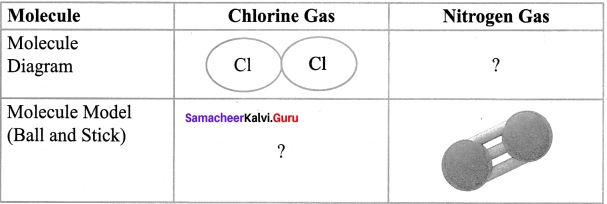
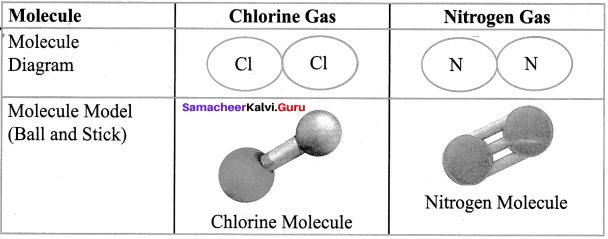
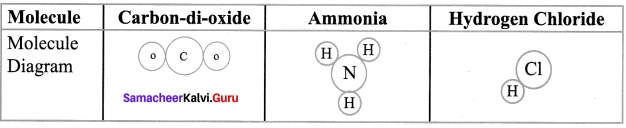
Matter Around Us Class 7 Samacheer Kalvi Term 1 Chapter 3
Answer:

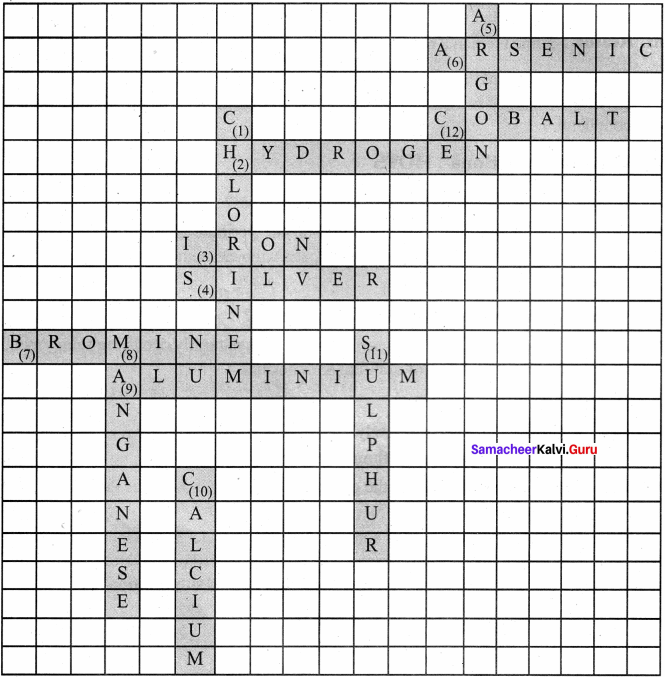
7th Science Matter Around Us Samacheer Kalvi Term 1 Chapter 3

Samacheer Kalvi Guru Science 7th Question 3.
What do you understand by chemical formula of a compound? What is its significance?
Answer:

  1. A chemical formula is a symbolic representation of one molecule of an element or a compound.
  2. It provides information about the elements present in the molecule and the number of atoms of each element. The chemical formula tells us the types of atoms and the number of each type of atom in one molecule of substance.

Samacheer Kalvi Science 7th Standard Question 4.
Define the following terms with an example of each:
a. Element
b. Compound
c. Metal
d. Non-metal
e. Metalloid
Answer:
(a) Element: It is a substance that cannot be broken down into simpler substance by chemical means Ex. : Oxygen, Hydrogen, Gold & Helium.

(b) Compound A compound is a pure substance that is formed when the atoms of two or more elements combine chemically in definite proportions. Ex : H?0, NaCl.

(c) Metal A chemical element that is an effective conductor of electricity and heat can be defined as a metal. Ex.: Copper, Iron, Silver, etc.
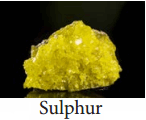
(d) Non-Metal Non-metal is an element that doesn’t have the characteristics of metal including, (i.e.) ability to conduct heat or electricity luster or flexibility. Ex. Carbon Iodine, Sulphur.

(e) Metalloid : Metalloid is a chemical element that exhibits some properties of metals and some of non-metals. Metalloids are generally semi-conductors. Ex. : Silicon. Arsenic, Antimony and Boron.

Samacheer Kalvi Guru 7th Standard Science Question 5.
Write the symbols for the following elements and classify them as solid, liquid and gas.
Aluminum, carbon, chlorine, mercury, hydrogen and helium.
Answer:

ElementSymbolClassification
AluminumAlSolid
CarbonCSolid
Chlorine.ClGas
Mercury.HgLiquid
Hydrogen.HGas
HeliumHeGas

Samacheer Kalvi 7th Science Book Answers Question 6.
Classify the following as metals, non-metals and metalloids
Sodium, Bismuth, Silver, Nitrogen, Silicon, carbon, chlorine, Iron, copper.
Answer:

MetalNon-metalMetalNon-metal
SodiumMetalCarbonNon-metal
BismuthMetalChlorineNon-metal
SilverMetalIronMetal
NitrogenNon-metalCopperMetal
SiliconMetalloid

Samacheer Kalvi 7th Science Books Answers Pdf Question 7.
Classify the following as elements and compounds.
Water, common salt, sugar, carbon dioxide, iodine and lithium
Answer:

ElementsCompounds
WaterCompound
Common saltcompound
SugarCompound
Carbon dioxideCompound
IodineElement
LithiumElement

Samacheer Kalvi 7th Standard Science Question 8.
Write the chemical formula for the following elements.
a. Hydrogen
b. Nitrogen
c. Ozone
d. Sulphur
Answer:

ElementsFormula
HydrogenH
NitrogenN
OzoneO3
SulphurS

Samacheer Kalvi 7th Science Question 9.
What are elements? What are they made of. Give two examples.
Answer:

  1. Elements are chemically the simplest substances and hence cannot be broken down using chemical reactions.
  2. It is made of entirely from one type of atom.
  3. Example : Hydrogen, Oxygen is made from atoms containing a single proton and a single electron.

7th Standard Science Samacheer Kalvi Question 10.
Define molecule.
Answer:

  1. When an atom combines with another atom (or atoms) and forms a compound it is called as molecule.
  2. A molecule is made up of two or more atoms chemically combined.

Samacheer Kalvi 7th Science Book Back Answers Question 11.
What are compounds? Give two examples.
Answer:
A compound is a pure substance that is formed when the atoms of two or more elements combine chemically in definite proportions.
Example : H2O, NaCl,

Question 12.
Give an example for the elements derived from their Latin names.
Answer:

ElementLatin NameSymbol
CopperCuprumCu
LeadPlumbumPb
PotassiumKaliumK
IronFerrumFe
MercuryHydrargyrumHg
SodiumNatriumNa

Question 13.
What is atomicity of elements?
Answer:
Atomicity is the total number of atoms present in one molecule of an element, compound or a substance.

Question 14.
Calculate the atomicity of H2S04.
Answer:
A molecule of sulphuric acid (H2S04) consists of 2 hydrogen atom, 1 Sulphur atom and 4 oxygen atoms. Hence its atomicity 2 + 1 + 4 = 7.

VI. Answer in detail :

Question 1.
Differentiate metals and non metals.
Answer:

MetalsNon-Metals
Metals are lustrous. They have a shinyNon metals are non lustrous. They
surfacehave non- shiny surface
Metals are generally hardNon-metals are generally soft
Most metals are bendableNon-metals are non bendable
Most metals can be bent, beaten into sheets and they can drawn into wiresNon-metals are non ductile
Most metals are good conductors of electricityNon-metals are bad conductors of electricity
Most metals are good conductors of heatNon-metals are bad conductors of heat
Most metals are making ringing sound when struck. Hence, they are used to make objects like bellsNon-metals does not make any sound when they struck
Ex. : Copper, Lead, Tin, NickelEx. : Carbon, Iodine, Sulphur

Question 2.
Explain the characteristics of compounds.
Answer:

  1. A compound is formed only when the constituent elements combine in a fixed proportion.
  2. The properties of a compound are different from those of its constituent elements
  3. A compound cannot be broken down by physical methods.
  4. This is because a compound is made up of different elements that are chemically combined. Sodium chloride cannot be separated by physical methods such as filtration.
  5. A compound can be separated into its constituent elements by chemical methods only.

Question 3.
Describe the different ways in which we can write the symbols of elements. Give appropriate examples.
Answer:
The following rules are followed while assigning symbol to an elements:

  1. Chemical symbols usually consist of one or two letters.
  2. The symbols of most elements correspond to the first letter (which is capitalized) of their English name. For example, the symbol for oxygen is “O” and that for hydrogen is “H”.
  3. When there is more than one element that begins with the same letter, their symbols take two letters.
  4. The first letter is capitalised while the second letter has a lower case.
  5. For example, the names of both hydrogen and helium begin with H. So, hydrogen is represented by the symbol H and Helium by He.

Example:
7th Standard Science Matter Around Us Samacheer Kalvi Term 1 Chapter 3

Question 4.
Differentiate between elements and compounds.
Answer:

ElementsCompounds
An element is the simplest substanceA compound is a chemical substance formed by the combination of two or more elements
Elements combine to form compoundsCompounds can be split into elements
Atoms are the fundamental particle of an elementMolecules are the fundamental particles of a compound

Question 5.
Write any five characteristics of compound.
Characteristics of compound:
Answer:

  1. A compound is formed only when the constituent elements combine in a fixed proportion.
  2. The properties of a compound are different from those of its constituent elements.
  3. A compound cannot be broken down by physical methods.
  4. Compound is made up of different elements that are chemically combined.
  5. A compound can be separated into its constituent elements by chemical methods only.

Question 6.
List comparative properties of metals and non-metals. Give three examples of each.
Answer:

MetalsNon-Metals
Metals are lustrous. They have a shinyNon metals are non lustrous. They
surfacehave non- shiny surface
Metals are generally hardNon-metals are generally soft
Most metals are bendableNon-metals are non bendable
Most metals can be bent, beaten into sheets and they can drawn into wiresNon-metals are non ductile

Question 7.
Write down the properties of metalloids.
Answer:
Properties of metalloids :

  1. Metalloids usually look like metals but behave largely like non-metals.
  2. Physically they are shiny, brittle solids with intermediate to relatively good electrical conductivity.
  3. They can from alloys with metals.
  4. Most of their physical and chemical properties are intermediate in nature, (v) They are semiconductors.
  5. All are solids at room temperature.
  6. Example : Germanium, Boron, Antimony, Silicon.

VII. Rewrite the sentence in correct form :

Question 1.
Elements contains two or more kinds of atoms and compounds contains only one kinds of atoms.
Answer:
Elements contains two or more kinds of atoms and compounds contains two or more kinds of elements.

VIII. Higher Order Thinking questions :

Question 1.
Lists the metals, non-metals and metalloids which you used in your house, schools. Compare their properties.
Answer:
Metals and their uses in our houses & schools :

  1. Magnesium is used in the laboratory as magnesium ribbon.
  2. Copper is used cooking utensils.
  3. Zinc is mainly used as a protective coat for iron is our school and house gates.
  4. Aluminum is used as cooking utensils and electrical cables which are used in our schools and houses.
  5. Iron and steel are widely used is construction of house and school.
  6. Sodium is used as a table salt and for flavoring, preserving food.
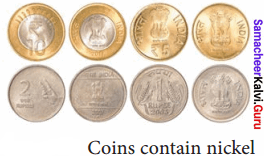
  7. Coins are made up of nickel.
  8. Lead is used in car batteries. Lead based alloys find extensive use in printing

Non-metals and their uses in houses & school:

  1. Oxygen is essential for the breathing. It is used as oxidising agent in laboratory. Chlorine is used for purifying water.
  2. Graphite is used in pencil leads.
  3. Carbon is used as a fuel.
  4. Bromine is used in dyes.
  5. Iodine is used in laboratory to test for starch.

Metalloids and their uses in houses & schools :

  1. Silicon is used in glass items.
  2. Antimony is used in optical discs.
  3. Tellurium is used in solar cells.
  4. Boron is used in washing powders.
  5. Germanium is used to make transistors which is used in laboratory in electrical devices.

Comparsion of properties of metals, non-metals & metalloids

MetalsNon-metalsMetalloids
They have lustreThey are not lustrousIntermediate
Conduct heat and electricityPoor conductors of electricity except graphiteIntermediate (semi­conductors)
They are malleable and ductileThey are neither malleable nor ductile.Intermediate

Question 2.
Aakash noticed that the metal latch on gate was difficult to open during hot sunny days. However, this same latch was not difficult to open at night. Aakash observed that the latch and the gate are exposed to the sun during the day.
a) Formulate a hypothesis based on the information provided.
b) Briefly state how you would test the hypothesis stated in (a).
Answer:
(a) Solids (Iron) expand on heating and contract on cooling. This causes the volume to matter of increase during heating or expansion, the mass of matter does not change.
(b) During heating the distance between the particles of the iron latch change. In an iron latch the distance between the iron particles increases when they gain enough heat. So during hot days the latch on the gate was difficult to open. At night, because of cooling the distance between the particles decreases. So at night it was not difficult to open the latch on the gate.

Question 3.
What changes take place in the movement and arrangement of particles during heating process?
Answer:
When a substance is heated, its internal energy increases.

  1. The movement of its particles increases.
  2. Bonds between particles break when a substance melts evaporates. This causes the volume of matter to increase.
  3. The closeness, arrangement and motion of the particles in a substance change when it changes state. But the size of the particles remain in same size, (i.e.) the mass of matter does not change.

Question 4.
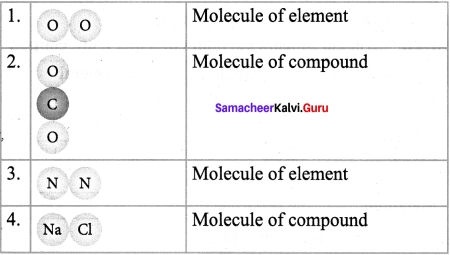
In the diagram given below, the circle, square and triangle represent the atoms of different elements different elements.

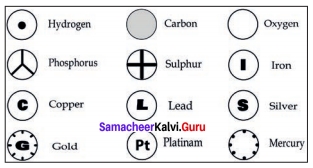
7th Standard Science Matter Around Us Question Answer Samacheer Kalvi Term 1 Chapter 3
Identify all combinations that represent.
a) A molecule of a compound
b) A molecule of an element consisting of two atoms
c) A molecule of an element consisting of three atoms
Answer:

Matter Around Us Class 9 Samacheer Kalvi Term 1 Chapter 3

IX. Assertion-reason questions :

Question 1.
Directions: Please refer to the following instructions:
A. Both statements are true and the 2nd statement is a correct explanation of the 1st statement.
b. Both statements are true but the 2nd statement is NOT a correct explanation of the 1st statement.
C. The 1st statement is false while the 2nd statement is true.
D. Both statements are false.

1st Statement2nd Statement
1.Oxygen is a elementOxygen cannot be broken down into anything simpler
2.Hydrogen is an elementHydrogen cannot be broken down into anything simpler
3.Air is a compoundAir consists of carbon dioxide
4.Air is a mixture of elements onlyOnly nitrogen, oxygen and neon gases exist in air
5.Mercury is solid in room temperatureMercury is a non-metal

Answer

1. (A) Both statements are true and the 2nd statement is a correct explanation of the 1st statement.
2. (A) Both statements are true and the 2nd statement is a correct explanation of the 1 st statement.
3. (D) Both statements are false.
Correct statement:

  1. Air is a mixture of gases.
  2. Air consists of Nitrogen Oxygen, CO,, other noble gases.

4. (A) Both statements are true and the 2nd statement is a correct explanation of the 1 st statement.
5. (D) Both statements are false.
Correct statement:

  1. Mercury is liquid at room temperature.
  2. Mercury is a metal.

Samacheer Kalvi 7th Science Matter Around Us Intext Activities

Activity – 1
Complete the following table by writing compounds of its constituents.
Answer:

Matter Around Us Questions And Answers Samacheer Kalvi 7th Science Solutions Term 1 Chapter 3

Activity – 2
Complete the following table by counting the number of different elements in a compounds and give appropriate name.
Answer:

Samacheer Kalvi Guru 7th Science Term 1 Chapter 3 Matter Around Us

Activity – 3
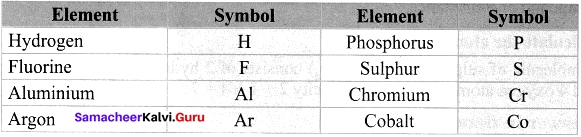
Write down the symbols of the following elements.
Answer:

Samacheer Kalvi 7th Science Books Answers Samacheer Kalvi Term 1 Chapter 3

Activity – 4
Write down atomicity of the following elements and compounds
Answer:

Samacheer Kalvi 7th Guide Science Samacheer Kalvi Term 1 Chapter 3

Samacheer Kalvi 7th Science Matter Around Us Additional Questions

I. Choose the correct answers:

Question 1.
The graphite refill used is pencil is made of element called __________
(a) graphite
(b) carbon
(c) silicon
(d) sodium
Answer:
(b) carbon

Question 2.
The smallest unit of an element is __________
(a) atom
(b) molecule
(c) compound
(d) none
Answer:
(a) atom

Question 3.
The most abundant type of atom is the universe is __________
(a) Helium
(b) Hydrogen
(c) Argon
(d) Argon
Answer:
(b) Hydrogen

Question 4.
__________ can be formed by the same or different kinds of atoms.
(a) Atom
(b) Molecule
(c) Gases
(d) None
Answer:
(b) Molecule

Question 5.
__________ is a substance that is made up of three oxygen atoms chemically combined.
(a) Oxygen
(b) Hydrogen
(b) Ozone
(d) CO2
Answer:
(a) Oxygen

Question 6.
A molecule containing three atoms is called a __________ molecule
(a) monoatomic
(b) diatomic
(c) triatomic
(d) polyatomic
Answer:
(c) triatomic

Question 7.
A molecule which contains only one atom is called __________ molecule
(a) monoatomic
(b) diatomic
(c) triatomic
(d) none
Answer:
(a) monoatomic

Question 8.
An atom of Oxygen (O) and two atoms of hydrogen (H.) combine to form a molecule of __________
(a) hydrogen
(b) ozone
(c) water
(d) none
Answer:
(c) water

Question 9.
__________ is the first scientist who used the term element.
(a) New ton
(b) Einstein
(c) Robertr boyle
(d) Robert hook
Answer:
(c) Robertr boyle

Question 10.
Matter is its simplest form is called __________
(a) molecule
(b) Metals
(c) element
(d) none
Answer:
(c) element

II. Fill in the blanks :

  1. The name copper was taken from ______
  2. The first letter of a symbol of an element is always written as a the second letter as a ______ letter and the second letter as a _____ letter
  3. There are ______ hydrogen atoms in water molecule.
  4. There is ______ oxygen atom is water molecule.
  5. ______ is the total number atoms present in one molecule of an element, compound or a substance.
  6. ______ is a mixture of gases
  7. ______ is the life-giving element is the air
  8. During heating or expansion, the ______
  9. ______ is the smallest particle of an element.
  10. ______ of an element consist of a fixed number of different types of atom.

Answer:

  1. cypress
  2. capital,small
  3. 2
  4. 1
  5. atomicity
  6. Air
  7. Oxygen
  8. mass
  9. Atom
  10. Molecules

III. Write true or false :

Question 1.
Metals are usually solids or gases at room temperature.
Answer:
False. Metals are usually solids at room temperature.

Question 2.
Non-metals are non-malleable.
Answer:
True.

Question 3.
Non-metals are usually good conductors of heat and electricity.
Answer:
(False) Metals are usually good conductors of heat and electricity.

Question 4.
Sodium chloride is used as table salt and for flavoring and preserving food.
Answer:
True.

Question 5.
Lead is also known as plumbum.
Answer:
True

IV. Match the following :

Question 1.

1.Co2(a)Robert Boyle
2.Sulphur(b)Making mobile phones
3.Element(c)triatomic molecule
4.Gallium(d)Polyatomic molecule

Answer:

  1. c
  2. d
  3. a
  4. b

Question 2.

1.Non-metals(a)Silicon
2.Metals(b)fire extinguisher
3.Metalloids(c)dull and soft
4.Oxygen(d)hard and shiny
5.Water(e)supports fire

Answer:

  1. c
  2. d
  3. a
  4. b

V. Give very short answer :

Question 1.
How many elements are known at present?
Answer:
118.

Question 2.
Name the element which is used for making computer chips.
Answer:
Silicon

Question 3.
Name the constituents of water.
Answer:
Hydrogen and Oxygen.

Question 4.
What is the expansion of IUPAC.
Answer:
International Union of Pure and Applied Chemistry.

Question 5.
What is the Latin name of Sodium?
Answer:
Natrium

Question 6.
What is a molecule?
Answer:
Molecule is the smallest unit of compound.

Question 7.
What is the fundamental particle of an element?
Answer:
Atom.

Question 8.
What is a chemical formula?
Answer:
A chemical formula is a symbolic representation of one molecule of an element or a compound.

VI. Give short answer :

Question 1.
What is an atom?
Answer:
The smallest unit of an element that exhibits the properties of the element is called as ‘atom’.

Question 2.
What are the 3 most abundant atoms on the earth?
Answer:
On earth the three most abundant atom are iron, oxygen, and silicon.

Question 3.
Write any two classification of molecule.
Answer:

  1. A molecule which contains only one atom is called monatomic molecule (inert gases)
  2. A molecule which contains two atoms is called diatomic molecule (oxygen, nitric oxide, hydrogen, etc.).

Question 4.
Classify the following as element and compound, (i) Silver (ii) Ammonia (iii) Water (iv) Mercury.
Answer:

  1. Silver – element
  2. Ammonia – compound
  3. Water – compound
  4. Mercury – clement

Question 5.
Give an account of elements known to us.
Answer:
There are 118 known elements till date. 94 of these elements occur naturally while 24 elements have been created artificially in the laboratory.

Question 6.
What are metalloids? Give examples.
Answer:
Metalloids are the elements which have properties intermediate, between those of metals and non-metals. Ex.: Boron, Silicon, Germanium, Arsenic, Antimony.

Question 7.
Give an example of a metal which
(a) is liquid at room temperature.
(b) is the best conductor of heat.
Answer:
a) Mercury
b) Silver, Copper

Question 8.
Write any two properties of a compound.
Answer:

  1. The properties of a compound are different from those of its constituent elements.
  2. A compound cannot be broken down by physical methods. This is because a compound is made up of different elements that are chemically combined. Sodium chloride cannot be separated by physical methods such as filtration.

Question 9.
What happens to matter during heating?
Answer:

  1. SOLID : When solid is heated, the particles gain energy and vibrate more vigorously.
  2. LIQUID : Melting occurs when the melting point is reached. The solid changes to its liquid state.
  3. LIQUID : When a liquid is heated the particles gain energy and vibrate more
  4. GAS : Boiling occurs when the boiling point is reached. The liquid changes to its gaseous State.

Question 10.
How do hot air balloons float?
Answer:
When air inside the hot air balloon is heated with a burner, it expands. The expansion causes the density of the air inside the balloon to decrease. Hence, the air inside the balloon has a lower density that the air outside of the balloon. This difference is density allows the hot-air balloon to float.

VII. Complete the table

Question 1.
Samacheer Kalvi 7th Books Science Term 1 Chapter 3 Matter Around Us
Answer:

Samacheer Kalvi 7th Science Solution Term 1 Chapter 3 Matter Around Us

Question 2.
Samacheer Kalvi.Guru 7th Science Term 1 Chapter 3 Matter Around Us
Answer:

Samacheer Kalvi Guru Science 7th Term 1 Chapter 3 Matter Around Us

Question 3.

CompoundConstituent elements
Sodium carbonateSodium, Carbon. Oxygen
Water(i) ?
Calcium oxide(ii) ?
SugarCarbon, Hydrogen, Oxygen

Answer:

  1. Hydrogen, Oxygen
  2. Calcium, Oxygen.

Question 4.
Complete the table by writing the symbols of the following elements

ElementSymbol
AluminiumAl
Nickel
Bromine
Helium
Magnesium

Answer:

ElementSymbol
AluminiumAl
NickelNi
BromineBr
HeliumHe
MagnesiumMg

Question 5.
Complete the table:

ElementLatin NameSymbol
MercuryHg
LeadPlumbum
IronFe
PotassiumKalium

Answer:

  1. Hydrargyrum
  2. Pb
  3. Ferrum
  4. K

VIII. Long answer questions :

Question 1.

  1. Draw the symbol for some elements as proposed by Dalton.
  2. What are rules to be followed while assigning symbol to element.

Answer:

  1. Symbol for some elements as proposed by Dalton.
  2. The following rules are followed while assigning symbol to an elements:

Samacheer Kalvi Science 7th Standard Term 1 Chapter 3 Matter Around Us
(a) Chemical symbols usually consist of one or two letters
(b) The symbols of most elements correspond to the first letter (which is capitalized) of their English name. For example, the symbol for oxygen is “O” and that for hydrogen is “H”.

Higher Order Thinking questions : (HOTS)

Question 1.
Why is hydrogen considered as an element?
Answer:
Hydrogen is considered as an element because,

  1. Hydrogen cannot be broken into new substance by ordinary physical or chemical means, (i.e) by applying heat, light.
  2. Hydrogen has one kind of atoms.

Question 2.
Why is water considered as compound?
Answer:
Water is considered as compound because,

  1. Water is composed of two elements: H2 and 02
  2. The ratio of Hydrogen and Oxygen by mass in any sample of pure water is the same.
  3. The properties of water are different from its constituent elements : Hydrogen and Oxygen.
  4. Water can be decomposed only by chemical methods into Hydrogen and Oxygen.

Question 3.
Write the difference between a mixture and compound.
Answer:

MixtureCompound
When two or more substances are mixed at random it forms a mixture.A compound is a pure substance that is formed when the atoms of two or more elements combine chemically is definite proportion
The constituents can be separated easily by physical methodsThe constituents can be separated only by chemical methods.

Samacheer Kalvi 8th Social Science History Solutions Term 1 Chapter 1 Advent of the Europeans

You can Download Samacheer Kalvi 8th Social Science Book Solutions Guide Pdf, Tamilnadu State Board help you to revise the complete Syllabus and score more marks in your examinations.

Tamilnadu Samacheer Kalvi 8th Social Science History Solutions Term 1 Chapter 1 Advent of the Europeans

Samacheer Kalvi 8th Social Science Advent of the Europeans Textbook Evaluation

I. Choose the correct answer

Advent Of The European Questions And Answers Question 1.
Who laid the foundation of Portuguese power in India?
(a) Vasco da Gama
(b) Bartholomew Diaz
(c) Alfonso de Albuquerque
(d) Almeida
Answer:
(c) Alfonso de Albuquerque

8th Standard Social Science History Question 2.
Which of the following European Nation was the foremost attempt to discover a sea route to India?
(a) Dutch
(b) Portugal
(c) France
(d) Britain
Answer:
(b) Portugal

Samacheer Kalvi 8th Standard Social Science Solutions Question 3.
In 1453 Constantinople was captured by ……………
(a) The French
(b) The Turks
(c) The Dutch
(d) The British
Answer:
(b) The Turks

Samacheer Kalvi Guru 8th Social Science Question 4.
Sir William Hawkins belonged to …………….
(a) Portugal
(b) Spain
(c) England
(d) France
Answer:
(c) England

Samacheer Kalvi Guru 8th Social Question 5.
The first fort constructed by the British in India was ……………
(a) Fort St. William
(b) Fort St.George
(c) Agra fort
(d) Fort St. David
Answer:
(b) Fort St.George

Samacheer Kalvi 8th Social Science Book Solutions Question 6.
Who among the following Europeans were the last to come India as traders?
(a) The British
(b) The French
(c) The Danish
(d) The Portuguese
Answer:
(b) The French

Samacheer Kalvi 8th Social Science Solutions Question 7.
Tranqueber on the Tamilnadu coast was a trade centre of the ……………
(a) The Portuguese
(b) The British
(c) The French
(d) The Danish
Answer:
(d) The Danish

II. Fill in the Blanks

  1. National Archives of India (NAI) is located in ……………..
  2. Bartholomew Diaz, a Portuguese sailor was patronized by ………………
  3. The printing press in India was set up by …………….. at Goa in 1556.
  4. The Mughal Emperor …………….. permitted the English to trade in India.
  5. The French East India Company was formed by ……………..
  6. …………….. the King of Denmark issued a charter to create Danish East India company.

Answer:

  1. New Delhi
  2. King John II
  3. Portuguese
  4. Jahangir
  5. Colbert
  6. Christian IV

III. Match the following
Advent Of The European Questions And Answers Samacheer Kalvi 8th Social Science History Solutions Term 1 Chapter 1
Answer:

  1. iv
  2. iii
  3. ii
  4. i.

IV. State true or false

Samacheer Kalvi 8th History Book Question 1.
Auto biography is one of the written sources.
Answer:
True

8th Social Science Samacheer Kalvi Question 2.
Coins are one of the material sources.
Answer:
True

8th History Book In Marathi Pdf Question 3.
Ananda Rangam was a translator served under British.
Answer:
False
Correct statement:
Ananda Rangam was a translator served under French.

Samacheer Kalvi Guru 8th Social Science Guide Question 4.
The place where historical documents are preserved is called archives.
Answer:
True

V. Consider the following statements and tick (V) the appropriate answer.

Samacheer Kalvi Class 8 Social Science Solutions Question 1.
(i) Governor Nino de Cunha moved Portuguese capital from Cochin to Goa.
(ii) Portuguese were the last to leave from in India.
(iii) The Dutch founded their first factory at Surat.
(iv) Sir Thomas Roe was sent to Jahangir’s court by King James I of England.

(a) i & ii are Correct.
(b) ii & iv are Correct.
(c) iii is correct
(d) i, ii & iv are correct.

Answer:
(d) i, ii & iv are correct

Samacheer Kalvi Guru 8 Social Science Question 2.

  1. Find out the wrong pair
  2. Francis Day – Denmark
  3. Pedro Cabral – Portugal
  4. Captain Hawkins – Britain
  5. Colbert – France

Answer:
1. Francis Day – Denmark

VI. Answer the following in one or two sentences.

Samacheer Kalvi.Guru 8th Social Question 1.
Give a short note on Archives?
Answer:
Archives is the place where historical documents are preserved. The National Archives of India (NAI) is located in New Delhi. It is the chief storehouse of the records of the government of India.

Question 2.
Write about the importance of Coins.
Answer:
Coins are a good source to know about administrative history. As compared to the literary sources the chances of manipulation is very less in the case of coins. Thus they are an authentic archaelogical source.

Question 3.
Why Prince Henry is called ‘Henry the Navigator’?
Answer:
Prince Henry of Portugal, who is commonly known as the “Navigator”, encouraged his countrymen to take up the adventurous life of exploring the unknown regions of the world.

Question 4.
Name the important factories established by the Dutch in India.
Answer:
After their arrival in India, the Dutch founded their first factory in Masulipatnam, (Andhra Pradesh) in 1605. The other important factories in India were Pulicat, Surat, Chinsura, Kasim bazaar, Patna, Nagapatnam, Balasore and Cochin.

Question 5.
Mention the trading centers of the English in India.
Answer:
The English had established their trading centres at Surat, Agra, Ahmadabad and Broach.

VII. Answer the following

Question 1.
Give an account of the sources of Modern India.
Answer:
1. The sources for the history of modem India help us to know the political, socio – economic and cultural developments in the country.

2. The Portuguese, the Dutch, the French, the Danes, and the English recorded their official transactions in India on state papers.

3. History can be written with the help of written sources and material sources.

4. Written Sources:
After the advent of the printing press, book were published in different languages people began to acquire knowledge easily in the fields like art, literature, history and science.

5. Written sources include Literatures, Travel Accounts, Diaries, Auto Biographies, Pamphlets, Government Documents and Manuscripts.

6. Archives:
It has main source of information for understanding past administrative machinery as well as a guide to the present and future generations related to all matters.

7. Material Sources:
Paintings and statues are the main sources of modem Indian history which provide information about national leaders and historical personalities and their achievements.

8. Historical buildings and museums preserve and promote our cultural heritage,

9. Coins are a good source to know about administrative history.

Question 2.
How did the Portuguese establish their trading centres in India?
Answer:
1. In A.D. 1498, Vasco da Gama reached Calicut, where he was cordially received by King Zamorin, the ruler of Calicut. A second Portuguese navigator, Pedro Alvares Cabral, sailed towards India in 1500.

2. Vasco da Gama came to India for the second time in 1501 with 20 ships and founded a trading centre at Cannanore.

3. One after another, they established factories at Calicut and Cochin.

4. King Zamorin attacked the Portuguese in Cochin, but was defeated.

5. Cochin was the first capital of the Portuguese East India Company.

6. In 1505, Francisco de Almeida was sent as the first Governor for the Portuguese possessions in India.

7. Almeida had the aim of developing the naval power of the Portuguese in India. His policy was known as the “Blue Water Policy”.

8. Sultans of Bijapur and Gujarat were also apprehensive of the expansion of Portuguese control of ports which led to an alliance between Egypt, Turkey and Gujarat against Portuguese invaders.

9. In a naval battle fought near Chaul, the combined Muslim fleet won a victory over the Portuguese fleet under Almeida’s son.

10. Almeida defeated the combined Muslim fleet in a naval battle near Diu, and by the year 1509, Portuguese claimed the naval supremacy in Asia.

11. The real founder of the Portuguese power in India was Alfonso de Albuquerque who captured Goa and established the Portuguese authority over Ormuz in Persian Gulf.

12. Governor Nino de Cunha moved capital from Cochin to Goa in 1530. In 1534, he acquired Bassein from Bahadur Shah of Gujarat, in 1537.

13. During the 16th century, Portuguese succeeded in capturing Goa, Daman, Diu, Salsette, Bassein, Chaul and Bombay on the western coast, Hooghly on the Bengal coast and San Thome on the Madras coast and enjoyed good trade benefits.

Question 3.
How did the British establish their trading centres in India?
Answer:
1. In 1600, Elizabeth, the Queen of England granted a charter to the governor and company of Merchants of London to trade with East Indies.

2. The Company was headed by a Governor and a court of 24 directors.

3. Captain Hawkins visited Jahangir’s court and secured permission to raise a settlement at Surat which was cancelled later.

4. In 1612, the English Captain Thomas Best, inflicted a severe defeat over the Portuguese in a naval battle near Surat.

5. The Mughal Emperor Jahangir permitted the English to establish their factory in 1613 at Surat, which became the headquarters of the English in western India.

6. Captain Nicholas Downton won another decisive victory over the Portuguese in 1614.

7. This enhanced the British prestige at the Mughal court.

8. In 1615, Sir Thomas Roe was sent to Jahangir’s court by King James I of England, who succeeded in concluding a commercial treaty with the emperor

9. Before the departure of Sir Thomas Roe, the English had established their trading centres at Surat, Agra, Ahmadabad and Broach.

VIII. Map skill

Question 1.
On the river map of India, mark the following trading centres of the Europeans.

  1. Calicut
  2. Cochin
  3. Madras
  4. Pondicherry
  5. Surat
  6. Chinsura
  7. Pulicat
  8. Calcutta

Answer:
8th Standard Social Science History Samacheer Kalvi Term 1 Chapter 1 Advent Of The Europeans

IX. HOTs

Question 1.
How did the fall of Constantinople affect the European nations?
Answer:

  1. The fall of Constantinople was the end of an era for Europe as it severely hurt traders in the European region.
  2. The land route between India and Europe was closed. The Turks penetrated into North Africa and the Balkan Peninsula.
  3. It became imperative on the part of the European nations to discover new sea routes to the East.

X. Student Activity

Question 1.
Prepare a chart on the kinds of sources of Modern India.
Answer:
Kinds of Sources of Mordem India.
Hints:
Artifacts from Archeological sites coins, monuments, inscriptions, travelogues and autobiographies are primary sources of information for modem history, it also includes government reports, letter, photographs map diaries, news papers and films.

Samacheer Kalvi 8th Social Science History Advent of the Europeans Additional Questions

I. Choose the correct answer:

Question 1.
The ……………… of India attracted Europeans to this country.
(a) Technology
(b) Machinery
(c) Wealth
(d) River
Answer:
(c) wealth

Question 2.
Ananda Rangan’s ……………… reveal his profound capacity for political judgment.
(a) Diaries
(b) Books
(c) Paintings
(d) Coins
Answer:
(a) Diaries

Question 3.
The first issue of the calendar of Madras records was published in ……………….
(a) 1914
(b) 1917
(c) 1918
(d) 1920
Answer:
(b) 1917

Question 4.
…………….. help to preserve and promote our cultural heritage.
(a) Parks
(b) Books
(c) Beaches
(d) Museums
Answer:
(d) Museums

Question 5.
The national museum in ……………… is the largest museum in India.
(a) Delhi
(b) Chennai
(c) Mumbai
(d) Kolkata
Answer:
(a) Delhi

Question 6.
The Reserve Bank of India was formally set up in ……………..
(a) 1940
(b) 1938
(c) 1935
(d) 1936
Answer:
(c) 1935

Question 7.
The first paper currency was issued by RBI in ……………..
(a) 1940
(b) 1938
(c) 1937
(d) 1936
Answer:
(b) 1938

Question 8.
After the capture of Constantinople by the Turks, the land route between India and ……………. was closed.
(a) Pakistan
(b) Bangladesh
(c) Africa
(d) Europe
Answer:
(d) Europe

Question 9.
Bartholomew Diaz, was patronized by king ……………..
(a) George II
(b) Henry VIII
(c) John II
(d) Edward VII
Answer:
(c) John II

Question 10.
……………… maintained friendly relations with Vijayanagar Empire.
(a) Vasco da Gama
(b) Francisco de Almeida
(c) Alfonso de Albuquerque
(d) Nino de Cunha
Answer:

Question 11.
The ……………. brought the cultivation of tobacco to India.
(a) Portuguese
(b) Dutch
(c) British
(d) French
Answer:
(a) Portuguese

Question 12.
Due to the influence of the Portuguese ……………. religion spread in India’s western and eastern coasts.
(a) Islam
(b) Catholic
(c) Buddhism
(d) Jainism
Answer:
(b) Catholic

Question 13.
The ……………. followed the Portuguese into India.
(a) British
(b) French
(c) Danish
(d) Dutch
Answer:
(d) Dutch

Question 14.
The Dutch shifted their headquarters from Pulicat to …………… in 1690.
(a) Madras
(b) Bangalore
(c) Nagapattinam
(d) Madurai
Answer:
(c) Nagapattinam

Question 15.
The Dutch was completely wiped out by the year ……………..
(a) 1795
(b) 1695
(c) 1780
(d) 1800
Answer:
(a) 1795

II. Fill in the blanks:

  1. The Europeans came to know about the Wealth of India from the accounts of ……………
  2. ……………. was a translator to assist French trade in India.
  3. Tamil Nadu Archives has Dutch records which relate to …………… and coast.
  4. ………….. prepared the first issue of the calendar of Madras records.
  5. The …………… was empowered to issue Government of India notes.
  6. The first paper currency issued by RBI bore the portrait of ……………
  7. Fort ……………. was built by the British in Cuddalore.
  8. ………….. a Portuguese sailor reached the southern most point of Africa in 1487.
  9. Vasco – da Gama sailed from ………….. to India.
  10. In 1548, the Portuguese occupied …………….
  11. The Portuguese were defeated by the English in the battle of …………… in 1759.
  12. In Pulicat, the Dutch built the fort of …………….. in 1613.

Answer:

  1. Marco Polo
  2. Ananda Rangam
  3. Cochin, Coromandal
  4. Dodwell
  5. Reserve Bank of India
  6. King George VI
  7. St. Davids
  8. Bartholomew Diaz
  9. Mozambique
  10. Salsette
  11. Bedera
  12. Geldriaj

III. Match the following:

Samacheer Kalvi 8th Standard Social Science Solutions Term 1 Chapter 1 Advent Of The Europeans
Answer:

  1. iv
  2. i
  3. ii
  4. iii

IV. State True or False

Question 1.
The archives at Lisbon, Goa, Pondicherry and Madras were literally store houses of precious historical information.
Answer:
True

Question 2.
All documents in Tamil Nadu Archives are in English.
Answer:
False
Correct statement: The most of the records in Tamil Nadu Archives are in English.

Question 3.
After his third voyage to India, Vasco da Gama, died in Cochin in 1524.
Answer:
True

Question 4.
The English East India company of established its supremacy in the Spice Islands.
Answer:
False
Correct statement:
United East India company of established its supremacy in the Spice Islands.

V. Consider the following statements and Tick (V) the appropriate answer.

Question 1.
(i) After 1858, India came under the direct administration of the British crown.
(ii) The settlement of Pondicherry was founded by Martin under a grant from Ibrahim Lodi, the ruler of Bijapur.
(iii) France was the last European country to come to India as trader.
(iv) The three Carnatic wars ruined the English.

(a) i & ii are Correct.
(b) ii & iv are Correct.
(c) i and iii are Correct
(d) i, ii and iv are Correct.
Answer:
(c) i and iii are Correct

Find out the wrong pair

Question 2.

  1. Fort St. David – Cuddalore
  2. Fort Geldria – Pulicat
  3. Fort St. Louis – Goa
  4. Fort St. George – Madras

Answer:
(3) Fort St. Louis – Goa

VI. Answer the following one or two sentences.

Question 1.
Name the powers which recorded their official transactions in India on State papers.
Answer:
The Portuguese, the Dutch, the French, the Danes, and the English recorded their official transactions in India on state papers.

Question 2.
What was the impact of the invention of printing press in India?
Answer:
Numerous books were published in different languages. Hence, people began to acquire knowledge easily in the fields like art, literature, history and science.

Question 3.
Name the languages other than English in which the records and documents are found in Tamil Nadu Archives.
Answer:
The collections include series of administrative records in Dutch, Danish, Persian and Marathi. Few documents are in French, Portuguese, Tamil and Urdu.

Question 4.
Write a short note on Dodwell.

  1. Dodwell prepared with great effort and the first issue of the calendar of Madras records was published in 1917.
  2. He was highly interested in encouraging historical researches. He opened a new chapter in the History of Tamil Nadu Archives.

Question 5.
Name a few historical buildings of India which depict styles and techniques of Indian architecture.
Answer:
Historical buildings like St. Francis Church at Cochin, St. Louis Fort at Pondicherry, St. George Fort in Madras, St. David fort in Cuddalore, India Gate, Parliament House, President House in New Delhi, etc are different styles and techniques of Indian architecture.

Question 6.
What does the term ‘audio – visual’ mean?

  1. Audio – visual means possessing both a sound and a visual component, such as slide – tape presentations.
  2. Audio – visual service providers frequently offer web streaming, video conferencing and live broadcast services. Television, films, internet are called ‘Audio – visual media’.

Question 7.
Name the important commodities traded by the Dutch.
Answer:
The most important Indian commodities traded by the Dutch were silk, cotton, indigo, rice and opium. They monopolized the trade in black pepper and other spices.

Question 8.
Why was the English East India Company engaged in rivalry with the Portuguese and the Dutch?

  1. The English East India Company remained engaged in rivalry with the Portuguese and the Dutch throughout the 17th century.
  2. In 1623, the Dutch cruelly killed ten English traders and nine Javanese in Amboyna. This incident accelerated the rivalry between the two Europeans companies.

Question 9.
Who permitted the French to establish a township near Calcutta?
Answer:
In 1673, the French obtained permission from Shaista Khan, the Mughal Subedar (governor) of Bengal to establish a township at Chandranagore, near Calcutta.

Question 10.
Write a short note on the Swedish East India Company.

  1. The Swedish East India Company was founded in Gothenburg, Sweden, in 1731 for the purpose of conducting trade with the Far East.
  2. The venture was inspired by the success of the Dutch East India Company and the British East India Company.

Question 11.
Why was the British Successful when compared to the other powers?
Answer:
The comparative success of the British over the Portuguese, the Dutch, the Danish, and the French was largely due to their commercial competitiveness, spirit of supreme sacrifice, government support, naval superiority, national character and their ascendency in Europe.

Samacheer Kalvi 11th Accountancy Solutions Chapter 6 Subsidiary Books – I

Students can Download Accountancy Chapter 6 Subsidiary Books – I Questions and Answers, Notes Pdf, Samacheer Kalvi 11th Accountancy Book Solutions Guide Pdf helps you to revise the complete Tamilnadu State Board New Syllabus and score more marks in your examinations.

Tamilnadu Samacheer Kalvi 11th Accountancy Solutions Chapter 6 Subsidiary Books – I

Samacheer Kalvi 11th Accountancy Subsidiary Books – I Text Book Back Questions and Answers

I. Multiple Choice Questions
Choose the Correct Answer

Subsidiary Books Questions And Answers Pdf Question 1.
Purchases book is used to record ……………..
(a) all purchases of goods
(b) all credit purchases of assets
(c) all credit purchases of goods
(d) all purchases of assets
Answer:
(c) all credit purchases of goods

11th Accountancy Chapter 6 Book Back Answers Question 2.
A periodic total of the purchases book is posted to the ……………..
(a) debit side of the purchases account
(b) debit side of the sales account
(c) credit side of the purchases account
(d) credit side of the sales account
Answer:
(a) debit side of the purchases account

Samacheer Kalvi 11th Accountancy Chapter 6 Question 3.
Sales book is used to record ……………..
(a) all sales of goods
(b) all credit sales of assets
(c) all credit sales of goods
(d) all sales of assets and goods
Answer:
(c) all credit sales of goods

11th Accountancy 6th Chapter Solutions Question 4.
The total of the sales book is posted periodically to the credit of ……………..
(a) Sales account
(b) Cash account
(c) Purchases account
(d) Journal proper
Answer:
(a) Sales account

Class 11 Accountancy Chapter 6 Solutions Question 5.
Purchase returns book is used to record ……………..
(a) returns of goods to the supplier for which cash is not received immediately
(b) returns of assets to the supplier for which cash is not received immediately
(c) returns of assets to the supplier for which cash is received immediately
(d) None of the above
Answer:
(a) returns of goods to the supplier for which cash is not received immediately

Subsidiary Books Problems And Solutions Pdf Question 6.
Sales return book is used to record ……………..
(a) Returns of goods by the customer for which cash is paid immediately
(b) Returns of goods by the customer for which cash is not paid immediately
(c) Returns of assets by the customer for which cash is not paid immediately
(d) Returns of assets by the customer for which cash is paid immediately
Answer:
(b) Returns of goods by the customer for which cash is not paid immediately

Subsidiary Books 11th Question 7.
Purchases of fixed assets on credit basis is recorded in ……………..
(a) Purchases book
(b) Sales book
(c) Purchases returns book
(d) Journal proper
Answer:
(d) Journal proper

Accountancy Class 11 Chapter 6 Solutions Question 8.
The source document or voucher used for recording entries in sales book is ……………..
(a) Debit note
(b) Credit note
(c) Invoice
(d) Cash receipt
Answer:
(c) Invoice

11th Accountancy Chapter 6 Question 9.
Which of the following statements is not true?
(a) Cash discount is recorded in the books of accounts
(b) Assets purchased on credit are recorded in journal proper
(c) Trade discount is recorded in the books of accounts
(d) 3 grace days are added while determining the due date of the bill
Answer:
(c) Trade discount is recorded in the books of accounts

Subsidiary Books Questions And Answers Question 10.
Closing entries are recorded in ……………..
(a) Cash book
(b) Ledger
(c) Journal proper
(d) Purchases book
Answer:
(c) Journal proper

II. Very Short Answer Questions

Accounting 11 Chapter 6 Answers Question 1.
Mention four types of subsidiary books.
Answer:

  1. Purchase Book
  2. Sales Book
  3. Purchase Return Book
  4. Sales Return Book

Subsidiary Books Of Accounts Class 11 Pdf Question 2.
What is purchases book?
Answer:
Purchases book is a subsidiary book in which only credit purchases of goods are recorded. When business wants to know the information about the credit purchases of goods at a glance, the information can be made available if purchases of goods on credit are separately recorded.

Class 11 Accounts Subsidiary Books Solutions Question 3.
What is purchases returns book?
Answer:
Purchases returns book is a subsidiary book in which transactions relating to return of previously purchased goods to the suppliers, for which cash is not immediately received are recorded. Since goods are going out to the suppliers, they are also known as returns outward and the book is called as ‘returns outward book or returns outward journal’.

Subsidiary Books Problems And Solutions Class 11 Question 4.
What is sales book?
Answer:
Sales book is a subsidiary book maintained to record credit sale of goods. Goods mean the items in which the business is dealing. These are meant for regular sale. Cash sale of goods and sale of property and assets whether for cash or on credit are not recorded in the sales book. This book is also named as sales day book, sold day book, sales journal or sale register.

Samacheer Kalvi Guru 11th Accountancy Question 5.
What is sales returns book?
Answer:
Sales returns book is a subsidiary book, in which, details of return of goods sold for which cash is not immediately paid are recorded. Just as goods may be returned to suppliers, goods may be returned by customers.

Subsidiary Books Sums Question 6.
What is debit note?
Answer:
A ‘debit note’ is a document, bill or statement sent to the person to whom goods are returned. This statement informs that the supplier’s account is debited to the extent of the value of goods returned. It contains the description and details of goods returned, name of the party to whom goods are returned and net value of the goods so returned with reason for return.

11th Accountancy Book Back Answers Question 7.
What is credit note?
Answer:
A credit note is prepared by the seller and sent to the buyer when goods are returned indicating that the buyer’s account is credited in respect of goods returned. Credit note is a statement prepared by a trader who receives back the goods sold from his customer. It contains details such as the description of goods returned by the buyer, quantity returned and also their value.

Class 11 Accounts Chapter 6 Solutions Question 8.
What is journal proper?
Answer:
Journal proper is a residuary book which contains record of transactions, which do not find a place in the subsidiary books such as cash book, purchases book, sales book, purchases returns book, sales returns book, bills receivable book and bills payable book. Thus, journal proper or general journal is a book in which the residual transactions which cannot be entered in any of the sub divisions of journal are entered.

Subsidiary Books Class 11 Solutions Question 9.
Define bill of exchange.
Answer:
According to the Negotiable Instruments Act, 1881, “Bill of exchange is an instrument in writing containing an unconditional order, signed by the maker, directing a certain person to pay a certain sum of money only to, or to the order of a certain person or to the bearer of the instrument”.

Subsidiary Books Class 11 Pdf Question 10.
What is an opening entry?
Answer:
Journal entry made in the beginning of the current year with the balances of assets and liabilities of the previous year is opening journal entry. In this entry, asset accounts are debited, liabilities and capital accounts are credited.

11th Accountancy – Book Back Answers Question 11.
What is an invoice?
Answer:
Entries in the purchases day book are made from invoices which are popularly known as bills. Invoice is a business document or bill or statement, prepared and sent by the seller to the buyer giving the details of goods sold, such as quantity, quality, price, total value, etc. Thus, the invoice is a source document of prime entry both for the buyer and the seller.

III. Short Answer Questions

Subsidiary Books Questions Question 1.
Give the format of purchases book.
Answer:
Format of Purchases book / Purchases Journal
Subsidiary Books Questions And Answers Pdf Samacheer Kalvi 11th Accountancy Solutions Chapter 6

Subsidiary Books Class 11 Question 2.
Mention the subsidiary books in which the following transactions are recorded

  1. Sale of goods for cash
  2. Sale of goods on credit
  3. Purchases of goods on credit
  4. When the proprietor takes goods for personal use
  5. Goods returned to suppliers for which cash is not received immediately
  6. Asset purchased as credit.

Answer:

  1. Cash book
  2. Sales book
  3. Purchase book
  4. Journal proper
  5. Purchase return book
  6. Journal proper

Question 3.
What are the advantages of subsidiary books?
Answer:
The advantages of maintaining subsidiary books are:
1. Proper and systematic record of business transactions: All the business transactions are classified and grouped conveniently as cash and non cash transactions, which are further classified as credit purchases, credit sales, returns, etc. As separate books are used for each type of transactions, individual transactions are properly and systematically recorded in the subsidiary books.

2. Convenient posting: All the transactions of a particular nature are recorded at one place, i.e., in one of the subsidiary books. For example, all credit purchases of goods are recorded in the purchases book and all credit sales of goods are recorded in the sales book. It facilitates posting to purchases account, sales account and concerned personal accounts.

3. Division of work: As journal is sub-divided, the work will be sub – divided and different persons can work on different books at the same time and the work can be speedily completed.

4. Efficiency: The sub – division of work gives the advantage of specialisation. When the same work is done by a person repeatedly the person becomes efficient in handling it. Thus, specialisation leads to efficiency in accounting work.

5. Helpful in decision making: Subsidiary books provide complete details about every type of transactions separately. Hence, the management can use the information as the basis for deciding its future actions. For example, information regarding sales returns from the sales returns book will enable the management to analyse the causes for sales returns and to adopt effective measures to remove deficiencies.

6. Prevents errors and frauds: Internal check becomes more effective as the work can be divided in such a manner that the work of one person is automatically checked by another person. With the use of internal check, the possibility of occurrence of errors or fraud may be avoided or minimised.

7. Availability of requisite information at a glance: When all transactions are entered in one journal, it is difficult to locate information about a particular item. When subsidiary books are maintained, details about a particular type of transaction can be obtained from subsidiary books. The maintenance of subsidiary books helps in obtaining the necessary information at a glance.

8. Detailed information available: As all transactions relating to a particular item are entered in a subsidiary book, it gives detailed information. It is easy to arrive at monthly or quarterly totals.

9. Saving in time: As there are many subsidiary books, work of entering can be done simultaneously by many persons. Thus, it saves time and accounting work can be completed quickly.

10. Labour of posting is reduced: Labour of posting is reduced as posting is made in periodical totals to the impersonal account, for example, Purchases account.

Question 4.
Write short notes on:

  1. Endorsement of a bill and
  2. Discounting of a bill

Answer:
1. Endorsement means signing on the face or back of a bill for the purpose of transferring the title of the bill to another person. The person who endorses is called the “Endorser”. The person to whom a bill is endorsed is called the “Endorsee”. The endorsee is entitled to collect the money.

2. When the holder of a bill is in need of money before the due date of a bill, cash can be received by discounting the bill with the banker. This process is referred to as the discounting of bill. The banker deducts a small amount of the bill which is called discount and pays the balance in cash immediately to the holder of the bill.

IV. Exercises

Question 1.
Enter the following transactions in the Purchases book of M/s. Subhashree Electric Co., which deals in electric goods. (3 Marks)
2017:
April 5 – Purchased from Karthik Electric Co., on credit
10 Electric iron box @ ₹ 2,500 each
5 electric stoves @ ₹ 2,000 each
April 19 – Purchased on credit from Khaitan Electric Co.,
3 electric heaters @ ₹ 6,000 each
April 25 – Purchased from Polar Electric Co., on credit.
10 Fans @ ₹ 2,000 each
April 29 – Purchased from M & Co. for cash
10 electric stoves @ ₹ 3,000 each
Solution:
In the books of M/s Subhashree Electric Co.
Purchases book
11th Accountancy Chapter 6 Book Back Answers Samacheer Kalvi Subsidiary

Question 2.
Enter the following credit transactions in the purchases book of Manoharan, a Provisions Merchant. (5 Marks)
2017:

  1. May 2 – Bought from Vasu 100 bags of rice @ ₹ 800 per bag
  2. May 8 – Bought from Cheyyar Sugar Mills Ltd., 20 bags of sugar @ ₹ 2,600 per bag
  3. May 10 – Bought from Ram Flour Mill, Coimbatore, 10 bags of wheat flour @ ₹ 750 per bag
  4. May 15 – Bought from Nilgiri Tea Co., Nilgiris, 15 cases of tea @ ₹ 900 per case
  5. May 25 – Bought from Sairam Coffee Works Ltd., 100 kgs of Coffee @ ₹ 190 per kg.
  6. May 29 – Bought from X & Co. furniture worth ₹ 2,000

Solution:
In the books of Manoharan, a Provisions Merchant
Purchase book
Samacheer Kalvi 11th Accountancy Chapter 6 Subsidiary Books – I

Question 3.
From the following transactions write up the Sales day book of M/s. Ram & Co., a stationery merchant. (3 Marks)
2017:

  1. Jan. 1 – Sold to Anbu & Co., on credit 20 reams of white paper @ ₹ 150 per ream
  2. Jan. 2 – Sold to Jagadish & Sons on credit 6 dozen pens @ ₹ 360 per dozen
  3. Jan. 10 Sold old newspapers for cash @ ₹ 620
  4. Jan. 15 – Sold on credit M/s. Elango & Co., 10 drawing boards @ ₹ 170 per piece
  5. Jan. 20 – Sold to Kani & Co., 4 writing tables at ₹ 1,520 per table for cash

Solution:
In the books of M/s Ram & Co., Stationery Merchant
Sales book
11th Accountancy 6th Chapter Solutions Samacheer Kalvi Subsidiary Books – I

Question 4.
Enter the following transactions in the Sales book of Kamala Stores, a furniture shop. (3 Marks)
2017:

  1. May 2 – Sold to Naveen Stores, Trichy on credit 5 computer tables @ ₹ 1,750 per table
  2. May 9 – Sold to Deepa & Co., Madurai on credit 6 dining tables @ ₹ 1,900 per dining table
  3. May 15 – Sold to Rajesh 10 dressing tables @ ₹ 2,750 each on credit
  4. May 24 – Sold to Anil 5 wooden tables @ ₹ 1,250 per table on credit
  5. May 27 – Sold to Gopi 3 old computers @ ₹ 3,500 each
  6. May 29 – Sold 50 chairs to Anil @ ₹ 275 each for cash

Solution:
In the books of Kamala Stores, a furniture shop
Sales book
Class 11 Accountancy Chapter 6 Solutions Samacheer Kalvi Subsidiary Books – I

Question 5.
Enter the following transactions in the purchases and sales books of Kannan, an automobile dealer, for the month of December, 2017.
Subsidiary Books Problems And Solutions Pdf Samacheer Kalvi 11th Accountancy
Solution:
In the books of Kannan, an automobile dealer
Purchases book
Subsidiary Books 11th Samacheer Kalvi Chapter 6 Subsidiary Books – I
Sales Book
Accountancy Class 11 Chapter 6 Solutions Samacheer Kalvi Subsidiary Books – I

Question 6.
Prepare Purchases book and Sales book in the books of Santhosh Textiles Ltd., from the following transactions given for April, 2017. (5 Marks)
2017:
April 1 Purchased goods from Prasad, Kancheepuram on credit
100 meters Silk @ ₹ 450 per meter
75 meters Velvet @ ₹ 180 per meter
April 10 Sold goods to Rathinam, Chennai on credit
60 meters Silk @ ₹ 490 per meter
50 meters Velvet @ ₹ 210 per meter
April 18 Nathan & Sons purchased from us on credit
100 meters Silk @ ₹ 510 per meter
April 20 Purchased goods from Hari Ram & Sons, Madurai on credit
50 rolls kada cloth @ ₹ 730 per roll
80 rolls cotton cloth @ ₹ 650 per roll
April 24 Purchased from Mohan, Karur for cash
Shirting cloth @ ₹ 7,000
Sarees @ ₹ 25,000
Solution:
In the books of Santhosh Textiles Ltd.,
Purchase book
 11th Accountancy Chapter 6 Samacheer Kalvi Subsidiary Books – I
Sales book
Samacheer Kalvi 11th Accountancy Solutions Chapter 6 Subsidiary Books – I

Question 7.
From the following information, prepare purchase day book and purchases returns book for the month of June, 2017 and post them into ledger accounts in the books of Robert Furniture Mart. (5 Marks)
2017:

June 1 – Purchased from Balu Traders 20 chairs @ ₹ 150 each on credit

June 13 – Bought from Subash & Co., on credit
2 Almirah @ ₹ 3,100 each
10 tables @ ₹ 1,500 each
15 chairs @ ₹ 200 each
Less: 10 % Trade discount on all items
Add: Freight charges ₹ 220

June 21 – Returned 2 damaged chairs to Balu Traders and cash not received

June 24 – Purchased from Sunrise Furniture Mart on credit
25 Almirahs @ ₹ 1,300 each

June 27 – Purchased from Mouli Traders on credit
10 executive tables @ ₹ 3,275 each

June 29 – Returned 3 Almirahs to Sunrise Furniture Mart and cash not received
Solution:
In the books of Robert Furniture Mart
Purchases book
 Subsidiary Books Questions And Answers Samacheer Kalvi 11th Accountancy Solutions Chapter 6
In the books of Robert Furniture Mart
Purchases Return book
Accounting 11 Chapter 6 Answers Samacheer Kalvi Subsidiary Books – I
Ledger Acconts
Purchase A/c
 Subsidiary Books Of Accounts Class 11 Pdf Samacheer Kalvi Chapter 6
Balu Traders A/c
Class 11 Accounts Subsidiary Books Solutions Samacheer Kalvi Chapter 6
Sunrise Furniture Mart A/c
Subsidiary Books Problems And Solutions Class 11 Samacheer Kalvi Chapter 6 Subsidiary Books – I
Subash & Co.A/c
Samacheer Kalvi 11th Accountancy Solutions Chapter 6 Subsidiary Books – I
Mouli Traders A/c
 Samacheer Kalvi Guru 11th Accountancy Chapter 6 Subsidiary Books – I
Ledger Accounts
Purchase Return A/c
Subsidiary Books Sums Samacheer Kalvi 11th Accountancy Solutions Chapter 6

Question 8.
Enter the following transactions in the proper subsidiary books of Suman who is dealing in electronic goods for the month of January, 2017. (5 Marks)
2017
Jan. 2 – Purchased from M/s. Raj Electronics on credit
20 cell phones @ ₹ 5,500 per piece
10 colour TVs @ ₹ 14,500 per piece

Jan. 5 Purchased from M/s. Ruby Electronics on credit
10 radios @ ₹ 1,650 per piece
8 Tape recorders @ ₹ 2,500 per piece
Trade discount on all items @ 10%

Jan. 10 Returned to M/s. Raj Electronics 4 cell phones damaged and cash not received

Jan. 20 Purchased from M/s. Suganthi Electronics on credit
10 radios @ ₹ 3,700 per piece
2 Sony colour TVs @ ₹ 27,000 per piece
Trade discount @ 5% on all items
Solution:
In the books of Suman
Purchase book
11th Accountancy Book Back Answers Samacheer Kalvi Chapter 6 Subsidiary
In the Books of Suman
Purchase returns book
 Class 11 Accounts Chapter 6 Solutions Samacheer Kalvi Subsidiary Books – I

Question 9.
Enter the following transactions in the sales book and sales returns book of M/s. Guhan & Sons, who is a textile dealer. (5 Marks)
2017
May 2 – Sold to M/s. Karan & Co., on credit
100 pieces towels @ ₹ 280 per piece
200 metres shirtings @ ₹ 270 per metre

May 5 – Sold to M/s. Veeran & Sons on credit
10 pieces ready – made dress @ ₹ 1,500 per piece

May 16 – Sold to M/s. Jain & Sons on credit
50 blankets @ ₹ 240 each

May 20 Damaged 10 pieces towels returned by Karan & Co. and cash not paid

May 25 Sold old furniture to M/s. Saran & Co., on credit ₹ 18,000

May 27 Returned 2 pieces ready-made dresses by M/’s. Veeran&Sons due to inferior qualityand cash not paid
Solution:
In the books of M/s Guhan & Sons, a textile dealer
Sales book
Subsidiary Books Class 11 Solutions Samacheer Kalvi Chapter 6
Sales return book
Subsidiary Books Class 11 Pdf Samacheer Kalvi Chapter 6 Subsidiary Books – I

Question 10.
Record the following transactions in the sales book and sales returns book of M/s. Ponni & Co., and post them to ledger. (5 Marks)
2017:

  1. Aug. 1 – Sold goods to Senthil as per Invoice No. 68 for ₹ 20,500 on credit
  2. Aug. 4 – Sold goods to Madhavan as per Invoice No. 74 for ₹ 12,800 on credit
  3. Aug. 7 – Sold goods to Kanagasabai as per Invoice No. 78 for ₹ 7,500 on credit
  4. Aug. 15 – Returns inward by Senthil as per Credit Note no. 7 for ₹ 1,500 for which cash is not paid
  5. Aug. 20 – Sold goods to Selvam for ₹ 13,300 for cash
  6. Aug. 25 – Sales returns of ₹ 1,800 by Madhavan as per Credit Note No. 11 for which cash is , not paid

Solution:
In the books of M/s Ponni & Co.,
Sales book
Accountancy Class 11 Subsidiary Books Solutions Samacheer Kalvi Chapter 6
Sales returns book
11th Accountancy - Book Back Answers Samacheer Kalvi Chapter 6 Subsidiary Books – I
Ledger Accounts in the books of M/s Ponni & Co.
Sales A/c
Subsidiary Books Questions Samacheer Kalvi 11th Accountancy Solutions Chapter 6
Sales Return A/c
Subsidiary Books Class 11 Samacheer Kalvi Chapter 6 Subsidiary Books – I
Senthil A/c
Samacheer Kalvi 11th Accountancy Solutions Chapter 6 Subsidiary Books – I
Madhavan A/c
Samacheer Kalvi 11th Accountancy Solutions Chapter 6 Subsidiary Books – I
Kanagasabai A/c
Samacheer Kalvi 11th Accountancy Solutions Chapter 6 Subsidiary Books – I

Question 11.
Prepare necessary subsidiary books in the books of Niranjan and also Sachin account and Mukil account from the following transactions for the month of February, 2017.
Samacheer Kalvi 11th Accountancy Solutions Chapter 6 Subsidiary Books – I
In the books of Niranjan
Purchase book
Samacheer Kalvi 11th Accountancy Solutions Chapter 6 Subsidiary Books – I
Sales book
Samacheer Kalvi 11th Accountancy Solutions Chapter 6 Subsidiary Books – I
Purchase return book
Samacheer Kalvi 11th Accountancy Solutions Chapter 6 Subsidiary Books – I
Sales return book
Samacheer Kalvi 11th Accountancy Solutions Chapter 6 Subsidiary Books – I
Sachin A/c
Samacheer Kalvi 11th Accountancy Solutions Chapter 6 Subsidiary Books – I
Mukil A/c
Samacheer Kalvi 11th Accountancy Solutions Chapter 6 Subsidiary Books – I

Question 12.
From the following information, prepare the necessary subsidiary books for Nalanda Book Stores.
2017:
Dec. 1 – Bought from M/s. Umadevi on credit
100 copies of Business Statistics Book @ ₹ 80 each
100 copies of Accountancy Book @ ₹ 150 each

Dec.7 – Sold to Sridevi & Co., on credit
240 copies of Business Statistics @ ₹ 90 each
250 copies of Accountancy books @ ₹ 170 each

Dec. 10 – Bought from Subha & Co.,
40 copies of Economics Books @ ₹ 80 each
Less: 15% Trade Discount

Dec. 15 Returned to M/s. Uma Devi 10 copies of damaged Accountancy book for which cash is not received

Dec. 18 Sold to Gupta Bros., on credit
200 copies of Economics book @ ₹ 95 each

Dec. 26 Returned 6 copies of Economics books to Subha & Co.,
Solution:
In the books of Nalanda Book Store
Purchase book
Samacheer Kalvi 11th Accountancy Solutions Chapter 6 Subsidiary Books – I
Sales book
Samacheer Kalvi 11th Accountancy Solutions Chapter 6 Subsidiary Books – I
Purchase Return book
Samacheer Kalvi 11th Accountancy Solutions Chapter 6 Subsidiary Books – I

Textbook Case Study Solved

Mr. Joseph started a trading business of selling readymade clothes. In the earlier period, he dealt only with cash, because he felt that would be risk-free. But, later on, he had to give credit period for his regular customers in order to retain them. For some customers, when they made bulk purchase, he offered them some discount. That brought him even more customers. But, some of his customers are not prompt in making the payment.

He expanded his business and employed few staff. As the credit transactions were numerous, he found it difficult to maintain properly. One of his friends, who is a Chartered Accountant advised him to maintain subsidiary books.
Discuss on the following points.

Question 1.
What could be the reason for Joseph’s feeling that dealing in cash is risk free?
Answer:
When we sell the goods, immediately we can get cash at once. So no debts had occurred in the business.

Question 2.
What type of discount is offered by Joseph?
Answer:
He offered trade discount.

Question 3.
Suggest some ways to Joseph for making his customers to pay on time.
Answer:
The cash discount may be offered by Joseph to his customers to pay on time.

Question 4.
Do you think that maintaining the subsidiary books will be useful to Joseph?
Answer:
Yes. it is useful.

  1. Sales book
  2. Sales returns book
  3. Purchases book
  4. Purchase returns book

Question 5.
What business documents are needed to maintain the subsidiary books?
Answer:

  1. Invoice
  2. Debit note
  3. Credit note


Samacheer Kalvi 10th English Solutions Supplementary Chapter 1 The Tempest

Looking to improve English skills and gain more subject knowledge then the best resources that you can use here is Samacheer Kalvi 10th English Solutions for Supplementary Chapter 1 The Tempest Questions and Answers.

In the Samacheer Kalvi 10th English Guide for Chapter 1 The Tempest textbook solutions, subject experts covered all types of questions and answers related to the topics, quick notes, summary, solved & unsolved exercises, etc. If you are planning to prepare Chapter 1 The Tempest via textbook, then you’re suggested to go with this Samacheer Kalvi 10th English Book Solutions Questions and Answers PDF for better understanding and preparation.

Tamilnadu Samacheer Kalvi 10th English Solutions Supplementary Chapter 1 The Tempest

English Subject experts who are having max years of experience prepared this Tamilnadu State Board Solutions for 10th English Supplementary Chapter 1 The Tempest Questions and Answers. They have explained all the topics covered in the board prescribed latest syllabus in a simple way to understand easily. So, students can prepare Chapter 1 English from this Samacheer Kalvi 10th English Book Questions and Answers PDF. Download the Tamilnadu State Board 10th English Chapter 1 The Tempest Workbook Solutions PDF by accessing the below links and learn properly for the final exams to score well.

The Tempest Textual Questions

A. Choose the correct answer.

1. ………………. was the chief of all spirits.
(a) Sycorax
(b) Caliban
(c) Ariel
(d) Prospero
Answer:
(c) Ariel

2. ……………….. raised a dreadful storm.
(a) Ariel
(b) Prospero
(c) Miranda
(d) Sycorax
Answer:
(b) Prospero

3. Miranda was brought to the island …………… years ago.
(a) fourteen
(b) ten
(c) twelve
(d) five
Answer:
(c) twelve

4. Prospero ordered Ariel to bring ………………… to his place.
(a) Gonzalo
(b) Ferdinand
(c) King of Naples
(d) Antonio
Answer:
(b) Ferdinand

5. …………….. had provided Prospero formerly with books and provisions.
(a) Antonio
(b) Ferdinand
(c) Gonzalo
(d) Antonio
Answer:
(c) Gonzalo

6. The second human being that Miranda saw on the island was …………. .
(a) Ariel
(b) Prospero
(c) Ferdinand
(d) Gonzalo
Answer:
(c) Ferdinand

Additional Questions

1. Prospero and Miranda lived in a cave divided into several ………….. .
(a) compartments
(b) apartments
(c) vestibules
(d) partitions
Answer:
(b) apartments

2. Prospero released many good spirits like …………….. .
(a) Sycorax
(b) Ariel
(c) Caliban
(d) Ferdinand
Answer:
(a) Sycorax

3. Sycorax, a good spirit imprisoned many in the bodies of large ……………. .
(a) animals
(b) bottles
(c) barrels
(d) trees
Answer:
(d) trees

4. Ariel tormented an ugly monster called …………………….. .
(a) Miranda
(b) Sycorax
(c) Caliban
(d) Prospero
Answer:
(c) Caliban

5. ……………… was the son of Sycorax.
(a) Caliban
(b) smooth
(c) bumpy
(d) blunt
Answer:
(a) Caliban

6. Mirnda was just ………………. years old when she came to this cell.
(a) five
(b) three
(c) seven
(d) twelve
Answer:
(b) three

7. Prospero was the Duke of ……………… .
(a) Naples
(b) Milan
(c) Mulan
(d) Maples
Answer:
(b) Milan

8. Prospero had a younger brother by name …………….. .
(a) Antonio
(b) Caliban
(c) Shylock
(d) Ferdinand
Answer:
(a) Antonio

9. Antonio joined hands with the king of ……………… and betrayed his brother.
(a) Maples
(b) Naples
(c) Milan
(d) Mulan
Answer:
(b) Naples

10. ………………. was a kind lord of Prospero’s court.
(a) Gonzalo
(b) Ferdinand
(c) Ariel
(d) Milan
Answer:
(a) Gonzalo

B. Identify the’character or speaker.

10th English The Tempest Paragraph Question 1.
He imprisoned the spirits in the bodies of large trees.
Answer:
Sycorax

10th English Supplementary The Tempest Summary Question 2.
He was the chief of all spirits.
Answer:
Ariel

The Tempest Hints Development Question 3.
It seems to me like the recollection of a dream.
Answer:
Miranda to Prospero (Not in the textual passage)

10th Std The Tempest Summary Question 4.
I was Duke of Milan, and you were a princess.
Answer:
Prospero to Miranda

The Tempest 10th Supplementary In English Question 5.
What a trouble must I have been to you then!
Answer:
Miranda to Prospero

The Tempest Book Back Answers Question 6.
Now pray tell me, sir, your reason for raising this sea-storm?
Answer:
Miranda to Prospero

The Tempest Questions And Answers Question 7.
I will soon move you.
Answer:
Ariel to Ferdinand

10th English Unit 1 Supplementary Question 8.
I will tie your neck and feet together.
Answer:
Prospero to Ferdinand

The Tempest Questions And Answers Pdf Question 9.
I must finish my task before I take my rest.
Answer:
Ferdinand to Miranda

10th English Supplementary Story In English Question 10.
He repented and implored his brother’s forgiveness.
Answer:
Antonio to Prospero

Additional Questions

The Tempest 10th Supplementary In Tamil Question 1.
She came to this island so young, that she had no memory other than her father.
Answer:
Miranda

10th English The Tempest In Tamil Question 2.
They lived in a cave made out of a rock.
Answer:
Prospero and Miranda

The Tempest Supplementary Question 3.
He kept his books to chiefly create magic.
Answer:
Prospero

10th English Supplementary The Tempest Question 4.
This spirit imprisoned many in the bodies of large trees.
Answer:
Sycorax

10th English Supplementary Paragraph Pdf Question 5.
He was the chief of all the gentle spirits.
Answer:
Ariel

Tempest Questions And Answers Question 6.
He took too much pleasure in tormenting an ugly monster.
Answer:
Ariel

10th English The Tempest Summary Question 7.
He was the son of Sycorax.
Answer:
Caliban

The Tempest Paragraph Question 8.
He was employed like a slave, to fetch wood, and do the most laborious offices.
Answer:
Caliban

10th Supplementary The Tempest Question 9.
He had the charge of compelling Caliban to these services.
Answer:
Ariel

10th English Supplementary Story In Tamil Question 10.
With the help of spirits, he could command the winds, and the waves of the sea.
Answer:
Prospero

10th English Character/Speaker Pdf Question 11.
“Have pity on their sad distress. See! the vessel will be dashed to pieces.
Answer:
Miranda to Prospero

10th English The Tempest Question 12.
Be not so amazed, there is no harm done.
Answer:
Prospero to Miranda

Question 13.
No person in the ship shall receive any hurt.
Answer:
Prospero to Miranda

Question 14.
What I have done has been in care of you.
Answer:
Prospero to Miranda

Question 15.
Can you remember a time before you came to this cell?
Answer:
Prospero to Miranda

Question 16.
You were not then three years of age.
Answer:
Prospero to Miranda

Question 17.
I was Duke of Milan, and you were a princess, and my only heir.
Answer:
Prospero to Miranda

Question 18.
Prospero had a younger brother.
Answer:
Antonio

Question 19.
He began to think himself the duke indeed.
Answer:
Antonio

Question 20.
Wherefore, did they not that hour destroy us?
Answer:
Miranda to Prospero

Question 21.
He forced us into a small boat, without either tackle, sail, or mast.
Answer:
Prospero to Miranda

Question 22.
A kind lord of my court placed water, provisions, apparel, and some books.
Answer:
Gonzalo

Question 23.
What a trouble must I have been!
Answer:
Miranda to Prospero

Question 24.
You were a little angel.
Answer:
Prospero to Miranda

Question 25.
“Well, my brave spirit,” “how have you performed your task?”
Answer:
Prospero to Ariel

Question 26.
Where is the king, and my brother?
Answer:
Prospero to Ariel

Question 27.
Tell me what you are looking at yonder?
Answer:
Prospero to Miranda

Question 28.
Believe me, it is a beautiful creature. Is it not a spirit?
Answer:
Miranda to Prospero

Question 29.
“It eats, and sleeps, and has senses such as we have”.
Answer:
Prospero to Miranda

Question 30.
This young man you see was altered by grief.
Answer:
Prospero about Ferdinand

Question 31.
He has lost his companions, and is wandering about to find them.
Answer:
Prospero about Ferdinand

Question 32.
She was the goddess of the place.
Answer:
Ferdinand about Miranda

Question 33.
He resolved to throw some difficulties to check on Ferdinand’s constancy.
Answer:
Prospero

Question 34.
I will tie your neck and feet together.
Answer:
Prospero to Ferdinand

Question 35.
You shall drink sea-water; shell-fish and withered roots.
Answer:
Prospero to Ferdinand

Question 36.
I will resist this and drew his sword.
Answer:
Ferdinand to Prospero

Question 37.
He fixed Ferdinand to the spot where he stood, so that he had no power to move.
Answer:
Prospero

Question 38.
Why are you so ungentle?
Answer:
Miranda to Prospero

Question 39.
Have pity, sir; I will be his surety.
Answer:
Miranda to Prospero about Ferdinand

Question 40.
This is the second man I ever saw, and to me he seems a true one.
Answer:
Miranda to Prospero about Ferdinand

Question 41.
Silence, one word more will make me chide you!
Answer:
Prospero to Miranda

Question 42.
What! An advocate for an impostor!
Answer:
Prospero to Miranda

Question 43.
My affections are most humble. I have no wish to see a goodlier man.
Answer:
Miranda to Prospero

Question 44.
You have no power to disobey me.
Answer:
Prospero to Ferdinand

Question 45.
“Alas! Do not work so hard; my father is at his studies.”
Answer:
Miranda to Ferdinand

Question 46.
Pray rest yourself.
Answer:
Miranda to Ferdinand

Question 47.
I dare not. I must finish my task before I – take my rest.
Answer:
Ferdinand to Miranda.

Question 48.
I will carry your logs.
Answer:
Miranda to Ferdinand

Question 49.
Fear nothing, I have overheard, and approve of all you have said.
Answer:
Prospero to Ferdinand and Miranda

Question 50.
He soon returned with the king, Antonio, and old Gonzalo.
Answer:
Ariel

Question 51.
Who is this maid?
Answer:
King of Naples about Miranda to Ferdinand

Question 52.
He has made himself to me a second father, giving me this dear lady.
Answer:
Ferdinand about Prospero to the King of Naples.

Question 53.
Let us not remember our troubles past, since they so happily have ended.
Answer:
Prospero

Question 54.
And then Prospero embraced his brother, and again assured him of his forgiveness.
Answer:
Antonio

Question 55.
He dismissed Ariel from his service, to the great joy of that lively little spirit.
Answer:
Prospero

C. Answer the following questions in one or two sentences.

Question 1.
Who were the inhabitants of the island?
Answer:
The inhabitants of the island were an old man named Prospero and his daughter Miranda.

Question 2.
What powers did Prospero possess?
Answer:
Prospero possessed magical powers.

Question 3.
Who was Caliban? What was he employed for?
Answer:
Caliban was the son of a witch named Sycorax. He was employed like a slave to fetch wood and do the most laborious work.

Question 4.
Who were on the ship? How were they related to Prospero?
Answer:
Prospero’s brother Antonio, the King of Naples, the king’s son Ferdinand and an old lord Gonzalo were on the ship. Antonio, with the help of the King of Naples, deprived Prospero of his dukedom.

Question 5.
Why had Prospero raised a violent storm in the sea?
Answer:
Prospero raised a violent storm in the sea to make his enemies repent for the injustice done to him and his daughter.

Question 6.
How did Miranda feel when her father raised the storm to destroy the ship?
Answer:
Miranda felt extremely sad for the distress of the members in the ship. She wanted Prospero to have pity on the poor souls.

Question 7.
What was Ariel ordered to do with the people on the ship?
Answer:
Prospero ordered Ariel to torment the inmates of the ship by raising a violent storm. He also instructed Ariel to bring Ferdinand, the Prince of Naples to his cave.

Question 8.
Give two reasons why Miranda was so concerned about Ferdinand.
Answer:
Ferdinand was the second human whom Miranda had seen after her father. She was attracted by him and had more concern towards him.

Question 9.
Why did Prospero set Ferdinand a severe task to perform?
Answer:
Prospero set Ferdinand a severe task to perform to try his constancy. He resolved to throw some difficulties in his way.

Question 10.
How was Gonzalo helpful to Prospero when he left Milan?
Answer:
Gonzalo had privately placed water, provisions, clothes and some books, which Prospero loved the most in the boat.

D. Answer the questions in a paragraph of about 100 – 150 words.

Question 1.
Write a detailed character sketch of Prospero.
Answer:
Prospero was skilled magically and used his powers to create storms, provide entertainment, manipulate others, exercise power and control over the lives of others. He enjoyed knowledge and learning of spells. He became so entranced by his magic that he did not notice his brother trying to take his title and kill him. Prospero controlled all those who were around him. In the beginning of the play, he got the help of Ariel, the chief of gentle spirits, to create a violent and windy storm to punish his enemies who harmed him and his daughter. Ariel worked for Prospero in exchange for his freedom from a witch, Sycorax. But Caliban was the son of Prospero’s old enemy Sycorax. So, Prospero employed Caliban like a slave, to fetch wood and do the most laborious work.

Question 2.
Narrate how Prospero made his enemies repent to restore his dukedom.
Answer:
Prospero, the Duke of Milan, was more interested in reading books and in the art of magic. He trusted his brother Antonio and asked him to look after his affairs in his kingdom. But Antonio overthrew Prospero out of the kingdom, with the help of the king of Naples.

Prospero reached an island with his daughter and stayed there for twelve years. He released many good spirits from the clutches of the witch Sycorax. With the help of Ariel, he created a violent storm in the sea. He made his enemies travelling in the ship, to suffer for their mistakes done to him. He asked Ariel to bring Ferdinand to the cave. There, Miranda and Ferdinand were attracted to each other.

But Prospero tested Ferdinand to try his constancy. At last, he forgave all of them, as they realized their mistakes and repented. Everyone left the island and Prospero restored his dukedom.

E. Rearrange the following sentences in coherent order.

10th English The Tempest Paragraph Samacheer Kalvi

1. He ordered Ariel to torment the inmates of the ship.
2. Miranda was attracted by Ferdinand and had more concern towards him.
3. Prospero and Miranda came to an island and lived in a cave.
4. Prospero forgave them and restored his dukedom, Milan.
5. He raised a violent storm in the sea to wreck the ship of his enemies.
6. Prospero wanted to test Ferdinand and gave a severe task to perform.
Using his powers, Prospero released the good spirits from large bodies of trees.
8. The King of Naples, and Antonio the false brother, repented the injustice they had done to Prospero.
9. Ariel was instructed to bring Ferdinand, the prince of Naples to his cave.
10. Ferdinand was the second human whom Miranda had seen after her father.
Answer:
3, 7, 5, 1, 9, 10, 2, 6, 8, 4
3. Prospero and Miranda came to an island and lived in a cave.
7. Using his powers, Prospero released the good spirits from large bodies of trees.
5. He raised a violent storm in the sea to wreck the ship of his enemies.
1. He ordered Ariel to torment the inmates of the ship.
9. Ariel was instructed to bring Ferdinand, the prince of Naples to his cave.
10. Ferdinand was the second human whom Miranda had seen after her father.
2. Miranda was attracted by Ferdinand and had more concern towards him.
6. Prospero wanted to test Ferdinand and gave a severe task to perform.
8. The King of Naples, and Antonio the false brother, repented the injustice they had done to Prospero.
4. Prospero forgave them and restored his dukedom, Milan.

Additional Questions:

A. Rearrange the following sentences in coherent order.

1. a. Of these Ariel was the chief.
b. By virtue of his art, he had released many good spirits from a witch called Sycorax.
c. Prospero and his daughter Miranda were the only inhabitants in an island.
d. Ariel took pleasure in tormenting an ugly monster called Caliban.
e. These gentle spirits were ever after obedient to the will of Prospero.
Answers:
c, b, e, a, d
c. Prospero and his daughter Miranda were the only inhabitants in an island.
b. By virtue of his art, he had released many good spirits from a witch called Sycorax.
e. These gentle spirits were ever after obedient to the will of Prospero.
a. Of these Ariel was the chief.
d. Ariel took pleasure in tormenting an ugly monster called Caliban.

2. a. Ariel had the charge of compelling Caliban to these services.
b. Caliban was employed like a slave, to fetch wood, and do the most laborious offices.
c. Miranda was worried about the inmates of a fine large ship which could be shipwrecked.
d. Prospero assured his daughter about the safety of all those who were in the ship.
e. At Prospero’s Commands they raised a violent storm.
Answers:
b, a, e, c, d
b. Caliban was employed like a slave, to fetch wood, and do the most laborious offices.
a. Ariel had the charge of compelling Caliban to these services.
e. At Prospero’s Commands they raised a violent storm.
c. Miranda was worried about the inmates of a fine large ship which could be shipwrecked.
d. Prospero assured his daughter about the safety of all those who were in the ship.

B. Fill in the blanks with the appropriate phrases given below to form a complete meaningful paragraph.

1. (in the bodies of large trees / in the sea / treated of magic / with no memory of / made out of a rock.)
There was an island (i) ………………………. where an old man, named Prospero, and his daughter Miranda lived. She came to this island (ii) ………………. seeing any other human face than her father’s. They lived in a cave (iii) ………………. In his study, Prospero kept his books, which chiefly (iv) ………………… By virtue of his art, he had released many good spirits from a witch called Sycorax who had them imprisoned (v) …………………… .
Answers:
(i) in the sea
(ii) with no memory of
(iii) made out of a rock
(iv) treated of magic
(v) in the bodies of large trees

2. (who was my enemy/1 was Duke of Milan /to think himself / whose name was Antonio / of my dukedom)
“Twelve years ago, Miranda,” continued Prospero,” (i) ………………………., and you were a princess and my only heir. I had a younger brother, (ii) …………………, to whom I trusted everything; My brother Antonio began (iii) ………………. the duke indeed. The opportunity I gave him deprived me (iv) ………………. this he soon effected with the aid of the King of Naples, (v) ……………… .
Answers:
(i) I was Duke of Milan
(ii) whose name was Antonio
(iii) to think himself
(iv) of my dukedom
(v) who was my enemy

C. Match the following appropriately:

1. 10th English Supplementary The Tempest Summary Samacheer Kalvi
Answer:
(i)(e), (ii)(d), (iii) (a), (iv)(c), (v)(b).

2. The Tempest Hints Development Samacheer Kalvi 10th English Solutions Supplementary Chapter 1
Answer:
(i)(e), (ii)(d), (iii)(a), (iv)(b), (v)(c).

3. 10th Std The Tempest Summary Samacheer Kalvi 10th English Solutions Supplementary Chapter 1
Answer:
(i)(b), (ii)(d), (iii)(c), (iv)(a), (v)(c).

D. Read the passage given below and answer the questions that follow:

1. There was an island in the sea, the only inhabitants of which were an old man, named Prospero, and his daughter Miranda, a very beautiful young lady. She came to this island so young, that she had no memory of having seen any other human face than her father’s.

They lived in a cave made out of a rock; it was divided into several apartments, one of which Prospero called his study; there he kept his books, which chiefly treated of magic. By virtue of his art, he had released many good spirits from a witch called Sycorax who had them imprisoned in the bodies of large trees.

These gentle spirits were ever after obedient to the will of Prospero. Of these Ariel was the chief. Ariel took rather too much pleasure in tormenting an ugly monster called Caliban, because he was the son of his old enemy Sycorax.

(а) Who were the only inhabitants of the island in the sea?
Answer:
Prospero an old man and his daughter Miranda were the only inhabitants of the island in the sea.

(b) Where did Prospero and Miranda live?
Answer:
Prospero and Miranda lived in a cave made out of a rock.

(c) Who is Sycorax?
Answer:
Sycorax is a witch who had imprisoned many good spirits in the bodies of large trees.

(d) Who was the chief of all the gentle spirits?
Answer:
Ariel was the chief of all the gentle spirits.

(e) Why did Ariel find pleasure in tormenting Caliban?
Answer:
Ariel found pleasure in tormenting Caliban an ugly monster because he was the son of his old enemy Sycorax.

2. Ariel took rather too much pleasure in tormenting an ugly monster called Caliban, because he was the son of his old enemy Sycorax. Caliban was employed like a slave, to fetch wood, and do the most laborious offices; and Ariel had the charge of compelling him to these services. With the help of these spirits, Prospero could command the winds, and the waves of the sea.

By his orders they raised a violent storm, in the midst of which, he showed his daughter a fine large ship, which he told her was full of living beings like themselves. “Oh my dear father,” said she, “if by your art you have raised this dreadful storm, have pity on their sad distress. See! The vessel will be dashed to pieces. Poor souls! They will all perish.”

“Be not so amazed, daughter Miranda,” said Prospero; “there is no harm done. I have so ordered it, that no person in the ship shall receive any hurt.

(a) Who was Caliban?
Answer:
Caliban, an ugly monster was the son of Ariel’s old enemy Sycorax, the witch.

(b) What was the work given to Caliban by Ariel?
Answer:
Ariel made Caliban fetch wood and do most of the laborious offices.

(c) How did Prospero use the spirits?
Answer:
Prospero with the help of the spirits commanded the winds and the waves of the sea.

(d) What did Prospero show his daughter?
Answer:
Prospero showed a fine large ship in the midst of a violent storm that he had created.

(e) What was the fear of Miranda?
Answer:
Miranda feared that the vessel would be dashed to pieces and that the people in the ship may perish.

E. Study the given mind map and fill in the incomplete details:

The Tempest 10th Supplementary In English Samacheer Kalvi Chapter 1

Answers:
(i) to pfle up some heavy logs of wood.
(ii) is at his studies, pray rest yourself.
(iii) my task before I take my rest.
(iv) I will carry your logs the while.
(v) would by no means agree to.

The Tempest Book Back Answers Samacheer Kalvi 10th English Solutions Supplementary Chapter 1
Answers:
(i) the beauty of young Miranda.
(ii) who is the famous Duke of Milan.
(iii) a second father.
(iv) our troubles past, since they so happily have ended.
(v) embraced his brother.

The Tempest by William Shakespeare About the Author:
William Shakespeare (1564-1616) was born in Stratford-upon-Avon, England. He was an English poet, playwright and actor, widely regarded as the greatest writer in the English language and the world’s greatest dramatist. He is often called England’s national poet and the “Bard of Avon”. His surviving body of work includes 37 plays, 154 sonnets and two narrative poems, the majority of which he penned between 1589 and 1613.

The Tempest Summary:

The Tempest Questions And Answers Samacheer Kalvi 10th English Solutions Supplementary Chapter 1

Introduction:
The Tempest was considered as one of Shakespeare’s well-written plays. It is believed that the play was based on an actual wreck of a ship called the Sea Venture of Bermuda that was headed to Virginia. There is strong evidence that Shakespeare used elements of the story of the wreck.
10th English Unit 1 Supplementary Samacheer Kalvi The Tempest

Tragedy that surrounded Prospero
When the play, The Tempest by William Shakespeare begins, Prospero, the overthrown Duke of Milan, and his teenage daughter, Miranda, live on an isolated island where they have been marooned for the past twelve years. Their only companions are Ariel, a magical spirit and Caliban, enslaved by Prospero. Prospero was originally Duke of Milan, but his position was appropriated by his brother Antonio, possibly with the approval of King of Naples.
The Tempest Questions And Answers Pdf Samacheer Kalvi 10th English Solutions Supplementary Chapter 1

Ariel’s violent storm
A ship with King of Naples, his son Ferdinand, Antonio, and other nobles, is wrecked in a sea storm created by the spirit Ariel, under the magic art of Prospero. Ariel explains that he has carried out Prospero’s orders: He admits that be had destroyed the ship and dispersed its passengers across the island. Prospero instructs Ariel to be invisible and spy on them. Prospero explains to his daughter that the crew members in the ship are all safe and sound when he sees her glum. He puts Miranda to sleep as Ariel comes there to report that the lords are on the island as he had commanded, with Ferdinand separated from the others. Caliban, a vicious native of the island who is also controlled by Prospero, expresses his hatred to Prospero, but is forced to do his command.
10th English Supplementary Story In English Samacheer Kalvi Chapter 1 The Tempest

Ferdinand meets Miranda
Prospero gets Ariel to lead Ferdinand across the island so that he meets Miranda, and fall in love. As planned, Ferdinand stumbles across Miranda and they fall in love and decide to marry. Prospero warns Miranda off and decides to test Ferdinand’s loyalty. To test his worth, Prospero makes Ferdinand carry out menial tasks. Ferdinand finds his labour pleasant because of Miranda. Miranda, thinking that her father is asleep, tells Ferdinand to take a break. They propose marriage and they accept each other. Prospero who has been on stage invisible to Ferdinand and Miranda is pleased with this development.
The Tempest 10th Supplementary In Tamil Samacheer Kalvi Chapter 1

Grieving ship wrecked crew
The rest of the shipwrecked crew are grieving for their lost, loved ones. The search for Ferdinand goes in vain and Antonio and the King of Naples fear him drowned. Gonzalo and the others think that the spellbound men are suffering from the guilt of their past actions and promise to ensure their safety.
10th English The Tempest In Tamil Samacheer Kalvi Chapter 1

King of Naples punished for disloyalty
Ariel places a magical delicious banquet before the lords which vanishes when they crave to eat. Ariel leads the lords to Prospero, and they stand in a trance before him.
The Tempest Supplementary Samacheer Kalvi 10th English Solutions Chapter 1

Prospero pardons Antonio
Ariel rouses them, and they beg forgiveness, which Prospero grants, and he is restored to his dukedom. Ferdinand and Miranda are then revealed to them to their happiness. At the end of the play, Ariel is told to provide good weather to guide the king’s ship back to the royal fleet and then to Naples, where Ferdinand and Miranda will be married.
10th English Supplementary The Tempest Samacheer Kalvi Chapter 1

Conclusion:
Thus the story ends happily. Prospero pardons Antonio for his disloyalty. The Duke regains his Dukedom. His daughter is married to Ferdinand.
10th English Supplementary Paragraph Pdf Samacheer Kalvi Chapter 1 The Tempest

William Shakespeare Glossary:

Textual:
Tempest Questions And Answers Samacheer Kalvi 10th English Solutions Supplementary Chapter 1

Additional:
10th English The Tempest Summary Samacheer Kalvi Chapter 1

We hope the data given here will benefit you to the fullest extent at the time of preparation. For better understanding of English subject this Samacheer Kalvi 10th English Solutions for Class 10th English Supplementary Chapter 1 The Tempest PDF is the best resource. Download & ace up your preparation. Keep in touch with us and get the latest information on Tamilnadu State board Textbook Solutions PDF.

Samacheer Kalvi 6th Social Science History Solutions Term 2 Chapter 1 Vedic Culture In North India and Megalithic Culture in South India

You can Download Samacheer Kalvi 6th Social Science Book Solutions Guide Pdf, Tamilnadu State Board help you to revise the complete Syllabus and score more marks in your examinations.

Tamilnadu Samacheer Kalvi 6th Social Science History Solutions Term 2 Chapter 1 Vedic Culture In North India and Megalithic Culture in South India

Samacheer Kalvi 6th Social Science Vedic Culture In North India and Megalithic Culture in South India Textual Evaluation

I. Choose the correct answer:

Vedic Culture Was Dash In Nature Question 1.
Aryans first settled in __________ region
(a) Punjab
(b) Middle Gangetic
(c) Kashmir
(d) Northeast
Answer:
(a) Punjab

Vedic Culture In North India And Megalithic Culture In South India Question 2.
Aryans came from ……………
(a) China
(b) North Asia
(c) Central Asia
(d) Europe
Answer:
(c) Central Asia

6th Social Guide Question 3.
Our National Motto “Sathyameva Jay ate” is taken from
(a) Brahmana
(c) Aranyaka
(b) Veda
(d) Upanishad
Answer:
(d) Upanishad

6th Standard Social Science Guide Pdf Free Download Question 4.
What was the ratio of land revenue collected during Vedic Age ……………
(a) 1/3
(b) 1/6
(c) 1/8
(d) 1/9
Answer:
(b) 1/6

II. Match the statement with the Reason / Tick the appropriate answer:

6th Standard Social Science Guide Pdf Question 1.
Assertion : The vedic age is evidenced by good number of texts and adequate amount of material evidences.
Reason : Shrutis comprise the Vedas, the Brahmanas, the Aranyakas and the Upanishads.
(a) Both A and R are true and R is the correct explanation of A.
(b) Both A and R are true but R is not the correct explanation of A.
(c) A is true but R is false.
(d) A is false but R is true.
Answer:
(d) A is false but R is true.

6th Standard Social Science Guide In English Medium Pdf Download Question 2.
Statement I : Periplus mentions the steel imported into Rome from peninsular India was subjected to duty in the port of Alexandria.
Statement II : Evidence for iron smelting has come to light at Paiyampalli.
(a) Statement I is wrong
(b) Statement II is wrong
(c) Both the statements are correct
(d) Both the statements are wrong
Answer:
(c) Both the statements are correct

Samacheer Kalvi Guru 6th Social Science Question 3.
Which of the statement is not correct in the Vedic society
(a) A widow could re-marry.
(b) Child marriage was in practice.
(c) Father’s property was inherited by his son.
(d) Sati was unknown.
Answer:
(b) Child marriage was in practice.

Samacheer Kalvi 6th Social Science Book Back Answers Question 4.
Which is the correct ascending order of the Rig Vedic society?
(a) Grama < Kula < Vis < Rashtra < Jana
(b) Kula < Grama < Vis < Jana < Rashtra
(c) Rashtra < Jana < Grama < Kula < Vis
(d) Jana < Grama < Kula < Vis < Rashtra
Answer:
(b) Kula < Grama < Vis < Jana < Rashtra

III. Fill in the blanks :

  1. Vedic culture was in nature.
  2. was a tax collected from the people in Vedic period.
  3. system is an ancient learning method.
  4. Adhichanallur is in district.

Answer:

  1. kinship
  2. Bali
  3. Gurukula
  4. Thoothukudi

IV. True or False:

  1. The Roman artefacts found at various sites provide evidence of Indo – Roman trade relations.
  2. A Hero Stone is a memorial stone raised in remembrance of the honourable death of a hero.
  3. The army chief was called Gramani.
  4. The Black and Red were pottery became the characteristic of the Megalithic period.
  5. Evidence for iron smelting has come to light at Paiyampalii.

Answer:

  1. True
  2. True
  3. False
  4. True
  5. True

V. Match the following

Vedic Culture Was Dash In Nature Samacheer Kalvi 6th Social Science Hitory Solutions Term 2 Chapter 1

Answers:

  1. 1
  2. 2
  3. 3
  4. 4

VI. Answer in one or two sentences:

Samacheer Kalvi 6th Social Guide Question 1.
Name the four Vedas.
Answer:
The four Vedas are Rig, Yajur, Sama and Atharva.

6th Social Science Guide Question 2.
What were the animals domesticated by Vedic people?
Answer:

  1. Elephants
  2. Cow
  3. Goat
  4. Sheep
  5. Horse

6th Social Guide Term 1 Question 3.
What do you know about Megalith?
Answer:
The term ‘Megalith’ is derived from Greek. ‘Megas’ means great and ‘lithos’ means stone. Using big stone slabs built upon the places of burial is known as Megalith.

6th Std Social Science Guide Tamil Medium Pdf Question 4.
What are Dolmens?
Answer:

  1. Dolmens are Megalithic tombs.
  2. They are made of two or more upright stones with a single stone lying across the burial site.

6 Social Guide Question 5.
What are Urns?
Answer:
Urns are large pottery jars used for burying the dead.

6th Standard Social Science Guide Question 6.
Name the coins used for business transactions in the Vedic period.
Answer:

  1. Nishka
  2. Satmana (gold)
  3. Krishnala (silver)

Question 7.
Name some Megalithic monuments found in Tamil Nadu.
Answer:

  1. Dolmens
  2. Menhir

Dolmens are Megalithic tombs. Megalithic Dolmens have been found in Veeraraghavapuram village, Kanchipuram district, Kummalamaruthupatti, Dindigulfc, district, and in Narasingampatti, Madurai district.

VII. Answer the following :

Question 1.
Write briefly about the archaeological site at Kodumanal.
Answer:

  1. Kodumanal is in Erode district.
  2. Kodumanal is identified with the Kodumanam of Pathitrupathu.
  3. More than 300 pottery inscriptions in Tamil Brahmi have been discovered.
  4. Spindles, whorls, piece of cloth, tools, weapons, ornaments and beads have been discovered.
  5. A Menhir was found at the burial site.

Question 2.
Write about the Vedic women in a paragraph.
Answer:

  1. In Rig Vedic society, women relatively enjoyed some freedom.
  2. The wife was respected as the mistress of the household.
  3. She could perform rituals in her house.
  4. In Rig Vedic period widows could remarry.
  5. But they were denied to inherit parental property.
  6. They played no role in public affairs.
  7. In the later Vedic period women’s position declined, demand to perform rituals and marriage rules became more rigid.
  8. Polygamy became common, and women were denied education

VIII. HOTS:
Question 1.
Difference between the Gurukula system of education and the Modern system of education.
Answer:

S.NoGurukula system of educationModern system of education
1.Gurukula system is an ancient learning method.Modern education system has evolved with time and has been influenced by the western system.
2.The shishyas resided with their guru and served them and simultaneously learnt and gained knowledge.Educational centre like schools, colleges are there to give education.
3.No women could have formal education.Men and women both have formal education.
4.The students received education through oral tradition meaning rote learning.The education system has incorporated technologies like ebooks, video lectures, distance learning through video chat, demonstrations through 3-D imagery, etc.
5.The subjects of the study included the four Vedas, Ithihasas, Puranas, grammar, logic, ethics, astrology, maths and military science.Modern education includes subjects of varied interests. Teaching methods are continuously upgraded as per advanced research and developments.

6.

The students were also trained to lead a disciplined life.The emphasis under modern education is on the theoretical part rather than the practical part.

IX. Pride and Joy – Let us find out die fact

Vedic Culture In North India And Megalithic Culture In South India Samacheer Kalvi 6th Social Science Hitory Solutions Term 2 Chapter 1

X. students Activity

Question 1.
Sentence making by using these new words.
(Shruti, Gramani, Rashtras, Iron Age, Semi-nomadic, Barter)
a. Shruti – Shruti works are considered to have been heard and transmitted by earthly sages.
b. Gramani – Gramani was the head of a village called Grama.
c. Rashtras – Rashtras were tribal kingdoms like Bharatas and Matsyas.
d. Iron Age – In India the Vedic period covers both the end of the Bronze Age and the start of the Iron Age.
e. Semi nomadic – Semi nomadic people lived usually in portable or temporary dwellings practicing seasonal migration.
f. Barter – Under barter system people exchanged services and goods for other services and goods in turn.

Question 2.
Word Search

6th Social Guide Samacheer Kalvi Hitory Solutions Term 2 Chapter 1 Vedic Culture In North India And Megalithic Culture In South India

  1. A pass – KHYBER
  2. Text containing teachings on religion – SMRITI
  3. A group of villages – VIS
  4. A tribal assembly – GANA
  5.  Assembly of people – SAMITI
  6. Fire – AGNI
  7. Gold coin – SATMANA
  8. Period of Vedic Age – IRON AGE
  9. Megalithic tomb – DOLMENS

XI. Life Skill

Question 1.
Collect information from Newspapers about archaeological finds with the help your teacher.
Answer:

(i) An archaeological site is a place where evidence of past activity is preserved.

(ii) Archaeological theory is used to interpret the archaeological record for a better understanding of human culture.

(iii) The archaeological record can consist of the earliest ancient findings as well as contemporary artefacts. For example ‘The Hindu’ dated August 10, 2017, published the information about Azhagankulam site. New finds link Azhagankulam site to Sangam Era. 12,000 artefacts unearthed so far; Archaeologists believe excavation could throw up more surprises. The excavation at Azhagankulam in the Vaigai River Valley show that the site could date back to the Sangam Age, quite like the archaeological site at Keezhadi in Sivaganga district.

(iv) Another example: Hindustan Times dated June 28, 2016. Archaeologists and Researchers have unearthed the crumbling remains of an ancient urban centre, equal in size and importance of that of Mohenjodaro. Keezhadi is a small village that lies past an unmanned railway crossing, several stretches of paddy fields and swaying palms in the Sivaganga district of Tamil Nadu, 12 kms from the city of Madurai.

XII. Answer Grid:

6th Standard Social Science Guide Pdf Free Download Term 2 Chapter 1 Vedic Culture In North India And Megalithic Culture In South India Samacheer Kalvi

Samacheer Kalvi 6th Social Science Vedic Culture In North India and Megalithic Culture in South India Intext Questions

HOTS

Question 1.
State the differences between Indus and Vedic civilization.
Answer:

S.NoIndus CivilizationVedic Civilization
1.The sources of information are mainly archaeological.Vedic Culture is mostly known from literary sources.
2.Harappans are said to have been the original inhabitants of India.The Aryans are believed to have come from Central Asia.
3.The Harappan civilization was urban in nature. They had very good Town planning, drainage system.Vedic culture was rural and pastoral. At best the Rig vedic Aryans lived in fortified places protected by mud walls; they cannot be regarded as towns in the Harappan sense.
4.Trade (both internal and external) crafts as well as industries were the main sources of economy.Vedic economy was initially pastoral and later became based upon agriculture and cattle rearing.
5.Indus people did not know the use of iron. It was purly a copper, bronze culture.In vedic culture, in its later phase is replete with references of iron.
6.The Indus valley people did not know about the animal horse.The horse played a decisive role in the Aryan system of warfare.
7.Indus people were basically peace loving.Aryans were warlike people and were conversant with all kinds of traditional arms and armour.

Vedic Culture In North India and Megalithic Culture in South India Additional Questions

I. Choose the correct answer:

Question 1.
The first phase of urbanisation in India came to an end with the decline of ______
(a) Indus civilization
(b) Vedic civilization
(c) Bronze civilization
(d) None of the above
Answer:
(a) Indus civilization

Question 2.
Sapta Sindhu was the land of ……………
(a) Five
(b) Seven
(c) Eight
(d) Ten
Answer:
(b) Seven

Question 3.
Sapta Sindhu means the land of ______
(a) Seven rivers
(b) Seven villages
(c) Seven Tribes
(d) Seven hills
Answer:
(a) Seven rivers

Question 4.
Paiyampalli is in …………… District.
(a) Erode
(b) Vellore
(c) Thoothukudi
(d) Dindigul
Answer:
(b) Vellore

Question 5.
In economic, political and military matters, the king was assisted by the ______
(a) Gramani
(b) Senani
(c) Purohit
(d) Vidhata
Answer:
(b) Senani

Question 6.
Non-Aryans were called ______
(a) Janas
(b) Dasyus
(c) Sabha
(d) Samitha
Answer:
(b) Dasyus

Question 7.
In the Later Vedic Period the role of women in society ______
(a) increased
(b) declined
(c) remained the same as before
(d) became equal with the role of man
Answer:
(b) declined

Question 8.
The staple crop of the Aryans was ______
(a) Rice
(b) Wheat
(c) Millets
(d) Barley
Answer:
(d) Barley

Question 9.
Paiympalli is located in ______ district.
(a) Vellore
(b) Madurai
(c) Sivaganga
(d) Dindigul
Answer:
(a) Vellore

II. Match the statement with the Reason. Tick the appropriate answer:

Question 1.
Assertion (A) : The Megalithic monuments bear witness to a highly advanced
state of civilisation with the knowledge of iron and community living.
Reason (R) : Megalithic Dolmens have been found in Veeraragavapuram village,
Kanchipuram District.
(a) Both A and R are true and R is correct explanation of A.
(b) Both A and R are true but R is not the correct explanation of A.
(c) A is true but R is False.
(d) A is false and R is True.
Answer:
(a) Both A and R are true and R is correct explanation of A.

Question 2.
Statement I : The Aryans were semi-nomadic pastoralists.
Statement II : The Aryans practised slash and burn agriculture.
(a) Statement I is wrong.
(b) Statement II is wrong.
(c) Both the Statements are wrong,
(d) Both the statements are correct.
Answer:
(d) Both Statements are correct.

Question 3.
Which of the statement is not correct in the Vedic economy?
(a) Carpenters and Potters were there
(b) Two crops a year was raised
(c) The staple crop was wheat
(d) Barter system was prevalent
Answer:
(c) The staple crop was wheat

Question 4.
Which of the statement is correct in the Vedic culture?
(a) Bali was tax consisting of % of the agricultural produce or cattle for a person.
(b) Dasyus were Aryans Kshatriyas belonged to the warrior class Polygamy was unknown
(c) Kshatriyas belonged to the warrior class
(d) Polygamy was unknown
Answer:
(c) Kshatriyas belonged to the warrior class

III. Fill lit the blanks:

  1. Vedic Age gets its name from ______
  2. The Aryans moved eastward and settled in ______
  3. Smritis are not ______
  4. The basic unit of the Vedic Polity was ______
  5. Sabha means ______
  6. Samiti means ______
  7. The Vedic family was ______
  8. In the later Vedic period the rules of marriage became ______
  9. Pottery of the vedic period was ______
  10. In the Vedic period the mode of prayer was recitation of ______
  11. The ancient method of learning was ______
  12. Megalithic period in ancient Tamilakam synchronised with ______

Answer:

  1. Four Vedas
  2. Indo Gangetic Plain
  3. eternal
  4. Kula
  5. A Council of Elders
  6. Assembly of People
  7. patriarchal
  8. more rigid
  9. Painted Grey Ware Culture
  10. Vedic Hymns
  11. Gurukula System
  12. Pre sangam period

IV. State True or False

  1. Vedic Age is a period in History of India between 1500 BC (BCE) and – 600 BC (BCE).
  2. Ithihasas come under Shrutis.
  3. Smritis are constantly revised.
  4. Rajan was the head of a Village.
  5. The king performed various rituals to make his position strong.
  6. A rigid four fold vama system emerged under the Rig Vedic society.
  7. Women of Vedic society played a major role in Public Affairs.
  8. Idol worship was practised in the vedic period.
  9. Under Gurukula system the Shishyas resided with their Guru.
  10. The later Vedic culture in North India and the Iron Age in south India belong to the same period.

Answer:

  1. True
  2. False
  3. True
  4. False
  5. True
  6. False
  7. False
  8. False
  9. True
  10. True

V. Match the following:

Question 1.
6th Standard Social Science Guide Pdf Samacheer Kalvi Term 2 Chapter 1 Vedic Culture In North India And Megalithic Culture In South India
Answer:

  1. 3
  2. 1
  3. 4
  4. 2

VI. Answer in one or two sentences:

Question 1.
What is slash and burn agriculture?
Answer:
Slash and bum agriculture is a farming method that involves clearing the land by cutting and burning all the trees and plants on it. Cultivation is done there for a short time.

Question 2.
What were the crops cultivated?
Answer:

  1. Wheat
  2. Rice
  3. Barley

Question 3.
Mention the archaeological sources of the Aryans.
Answer:
Material remains such as iron implements and pottery from the archaeological sites in Punjab, Uttar Pradesh and Rajasthan along the Indus and the Ganges form the archaeologic sources of the Aryans.

Question 4.
Classify the Vedic Age.
Answer:

6th Standard Social Science Guide In English Medium Pdf Download Vedic Culture In North India And Megalithic Culture In South India

Question 5.
By whom were the powers of the Raj an limited?
Answer:

  1. The main responsibility of the Rajan was to protect his tribe.
  2. His powers were limited by tribal assemblies namely Vidhata, Sabha, Samiti and Gana.

Question 6.
When did hereditary kingship begin to emerge?
Answer:

  1. When the Aryans moved east ward- into Ganges-Yamuna-Doab regions, the early settlements were replaced by territorial kingdoms.
  2. Thus the hereditary kingship began to emerge.

Question 7.
How were Janapadas formed?
Answer:
In later Vedic period, many Janas or Tribes were amalgamated to form Janapadas or Rashtras.

Question 8.
Who formed Trevji in the early Vedic society?

  1. Within the early Vedic Society there were three divisions (Trevji) as given below:
  2. The general public were called Vis, the warrior class was called Kshatriyas and the Priestly class was named Brahmanas.

Question 9.
Mention the subject of the study under Gurukula system.
Answer:
The subjects of the study under Gurukula system included the four Vedas, Ithihasas, Puranas, grammar, logic, ethics, astrology, maths and military science.

Question 10.
Mention the four ashramas which emerged during the later vedic period.
Answer:
Towards the end of the later Vedic period, the concept of four stages in life (the four
ashramas) developed.

  1. Brahmacharya (Student Life)
  2. Grihastha (Married Life)
  3. Vanaprastha (Going to the forest to meditate)
  4. Sanyasa (Leading a life of an ascetic)

Question 11.
Define the term Menhir.
Answer:
In Breton Language ‘Men’ means “stone” and ‘hir’ means “long.” They are monolithic pillars planted vertically into the ground in memory of the dead.

Question 12.
Where are herostones found in Tamil Nadu?
Answer:
In Tamil Nadu hero stones are found at Maanur village near Palani, Dindigul district, Vellalankottai, Tuticorin district, and Pulimankombai, Dindigul district.

VII. Answer the following:

Question 1.
What about the Aryans and their home in India?
Answer:

(i) Aryans of the Rig Vedic Period were semi-nomadic. They were basically pastoral people with cattle as their main source of wealth.

(ii) In the Rig Vedic times, the Aryan homeland was Punjab, which was at that time called Sapta Sindhu, the land of seven rivers.

(iii) Around 1000 BC (BCE), Aryans in India moved eastward and settled in Indo- Gangetic Plain.

(iv) Use of iron axes and ploughs became widespread.

Question 2.
By whom was Rajan helped to protect his tribe?
Answer:

  1. The main responsibility of the Rajan was to protect his tribe.
  2. His powers were limited by tribal assemblies namely Vidhata, Sabha, Samiti and Gana.
  3. Of these Vidhata, (the tribal assembly) was the oldest.
  4. The king appointed a purohit (chief priest) to assist him.
  5. In economic, political and military matters, the king was assisted by the Senani (army chief).
  6. Gramani was the leader of the village.

Question 3.
How did trade become extensive under the Vedic age?
Answer:

  1. Under the Vedic age, use of iron plough and axe helped to put more areas of land under cultivation.
  2. Crops of wheat, rice and barley were cultivated.
  3. With the growth of agriculture, the idea of private possession of land came into existence.
  4. New crafts and arts developed leading to production of commodities for sale.
  5. Thus, trade became extensive.
  6. Barter system was prevalent.
  7. They used Nishka, Satmana (gold coins) and Krishnala (silver coins) for business transactions.

Question 4.
State the salient features of the Gurukula system of education.
Answer:

  1. The gurukula system is an ancient learning method.
  2. The word Gurukula is a combination of the Sanskrit Word Guru (teacher or master) and Kula (family or home).
  3. The shishyas resided with their guru and served them and simultaneously learnt L and gained knowledge.
  4. Only Dvijas could be Shishyas. No women could have formal education.
  5. The students received education through oral tradition meaning rote learning, and were required to memorise everything.
  6. The subjects of the study included the four Vedas, Ithihasas, Puranas, grammar, logic, ethics, astrology, maths and military science.
  7. The students were also trained to lead a disciplined life.

Question 5.
Write a note on Keezhadi in Sivaganga district. g ‘
Answer:

(i) The Archaeological Survey of India (ASI) excavated an ancient town dating to Sangam Age in Keezhadi village at Tirupathur taluk.

(ii) Excavations have produced evidence for brick buildings, and well laid – out drainage system.

(iii) Tamil – Brahmi inscription on pottery, beads of glass, camelian and quartz, pearl, gold ornaments and iron objects, shell bangles, ivory dice have been unearthed.

(iv) The Roman artefacts found at the site add to the evidence of ancient Indo -Roman trade relations.

(v) Periplus mentions the steel imported to Rome from Peninsular India was subj ected to duty in the port of Alexandria.

Question 6.
What are Menhirs ? Where are they find in Tamil Nadu?
Answer:

(i) Menhirs are monolithic pillars planted vertically into the ground in memory of the dead.

(ii) Menhir at Singaripalayam in Tirupur District and at Vembur in Theni District points to the existence of an ancient settlement along the banks of River Uppar.

(iii) Menhirs are found at Narasingampatti, Madurai district, Kumarikalpalayam and Kodumanal in Erode district.

VIII. Word search
Question 1.
Sentence making by using these new words.

Samacheer Kalvi Guru 6th Social Science Term 2 Chapter 1 Vedic Culture In North India And Megalithic Culture In South India

  1. Shruti Literature – UPANISHADS
  2. An Archaeological site – RAJASTHAN
  3. A tribal kingdom – PURAS
  4. Three divisions of Early Vedic Society – TREYI
  5. Unknown to Rig vedic women – SATI
  6. Shyama – IRON
  7. Leading of life of an ascetic – SANYASA
  8. The Roman artefacts found here – KEEZHADI
  9. Used for making thread from cotton – WHORLS
  10. The Monolithic pillars planted vertically – MENHIR

IX. Answer Grid.

Samacheer Kalvi 6th Social Science Book Back Answers Vedic Culture In North India And Megalithic Culture In South India Term 2 Chapter 1

Samacheer Kalvi 9th Science Solutions Chapter 4 Electric Charge and Electric Current

You can Download Samacheer Kalvi 9th Science Book Solutions Guide Pdf, Tamilnadu State Board help you to revise the complete Syllabus and score more marks in your examinations.

Tamilnadu Samacheer Kalvi 9th Science Solutions Chapter 4 Electric Charge and Electric Current

Samacheer Kalvi 9th Science Electric Charge and Electric Current Textbook Exercises

I. Choose the correct answer.

Electric Charge And Electric Current Class 9 Question 1.
In current electricity, a positive charge refers to,………………
(a) presence of electron
(b) presence of proton
(c) absence of electron
(d) absence of proton
Answer:
(c) absence of electron

9th Science Electric Charge And Electric Current Question 2.
Rubbing of comb with hair ……………………
(a) creates electric charge
(b) transfers electric charge
(c) either (a) or (b)
(d) neither (a) nor (b)
Answer:
(c) either (a) or (b)

Chapter 4 Electric Charge And Electric Current Question 3.
Electric field lines ………….. from positive charge and ………. in negative charge.
(a) start; start
(b) start; end
(c) start: end
(d) end; end
Answer:
(b) start; end

Electric Charge And Electric Current Question 4.
Potential near a charge is the measure of its ………… to bring a positive charge at that point.
(a) force
(b) ability
(c) tendency
(d) work
Answer:
(d) work

9th Standard Science Electric Charge And Electric Current Question 5.
In an electrolyte the current is due to the flow of …………. .
(a) electrons
(b) positive ions
(c) both (a) and (b)
(d) neither (a) nor (b)
Answer:
(a) electrons

9th Science Chapter 4 Solution Question 6.
Heating effect of current is called
(a) Joule heating
(b) Coulomb heating
(c) Voltage heating
(d) Ampere heating
Answer:
(a) Joule heating

Electric Charge Match The Following Question 7.
Electroplating is an example for
(a) heating effect
(b) chemical effect
(c) flowing effect
(d) magnetic effect
Answer:
(b) chemical effect

Question 8.
Resistance of a wire depends on
(a) temperature
(b) geometry
(c) nature of material
(d) all the above
Answer:
all the above

II. Match the following.

Column-I

Column-II

1. Electric Charge(a) ohm
2. Potential difference(b) ampere
3. Electric field(c) coulomb
4. Resistance(d) newton per coulomb
5. Electric current(e) volt

Answer:

  1. (c)
  2. (e)
  3. (d)
  4. (a)
  5. (b)

III. True or False.

Question 1.
Electrically neutral means it is either zero or equal positive and negative charges
Answer:
True

Question 2.
Ammeter is connected in parallel in any electric circuit
Answer:
False
Correct Statement: An ammeter is connected in series with a device to measure its current.

Question 3.
The anode in electrolyte is negative
Answer:
False
Correct Statement: The anode in electrolyte is positive.

Question 4.
Current can produce magnetic field
Answer:
True

IV. Fill in the blanks.

  1. Electrons move from ………….. potential to …………….. potential.
  2. The direction opposite to the movement of electron is called ……………….. current.
  3. The e.m.f of a cell is analogous to ……………. of a pipe line.
  4. The domestic electricity in India is an ac with a frequency of ………… Hz.
  5. Trip switch is an …………. safety device

Answer:

  1. higher, lower
  2. Conventional
  3. a pump
  4. 50
  5. electromechanical

V. Conceptual questions.

Question 1.
A bird sitting on a high power electric line is still safe. How?
Answer:
Birds don’t get shocked when they sit on electrical wires because they are not good conductors of electricity. Electricity flowing through a single power line at 35,000 volts will continue along the path of least resistance and bypass birds, because there is no difference in electrical potential.

Question 2.
Does a solar cell always maintain the potential across its terminals constant? Discuss.
Answer:
The electro-chemical process inside a battery provides electrons at the negative terminal and draws electrons from the positive terminal to maintain the current being drawn. By providing energy to the electrons, the cell is capable of maintaining an electric potential difference across the two ends of the external circuit.

Question 3.
Can electroplating be possible with alternating current?
Answer:
Electroplating is a process where there is continuous flow of ions for the deposistion of copper, which is not possible in Alternating current. Therefore, electroplating is possible with DC only, for the sake of perfectness and homogeneity of the electroplating.

VI. Answer the following.

Question 1.
On what factors does the electrostatic force between two charges depend?
Answer:
The electrostatic force between two charges depend on the following factors;

  • value of charges on them,
  • distance between them, and
  • nature of medium between them.

Question 2.
What are electric lines of force?
Answer:
The direction of the electric field is the direction of the force that would act on a small positive charge. Therefore the lines representing the electric field are called ‘electric lines of force’.

Question 3.
Define electric field.
Answer:
The electric lines of force are straight or curved paths along which a unit positive charge tends to move in the electric field.

Question 4.
Define electric current and give its unit.
Answer:
Current is the rate at which charges flow past a point on a circuit. Current (I) is represented as, I = \(\frac { q }{ t }\)
The standard SI unit for current is ampere with the symbol A.

Question 5.
State Ohm’s law.
Answer:
Ohm’s law states that electric potential difference across two points in an electrical circuit is directly proportional to the current passing through it. That is,
V~I
The proportionality constant is tne resistance (R) offered between the two points.
Hence, Ohm’s law is written as,
V = RI (or) V = IR
Where, V is the potential difference in volt (V), I is the current flow in ampere (A), R is the resistance in ohm (Ω)

Question 6.
Name any two appliances which work under the principle of heating effect of current.
Answer:
The principle of all electric heating appliances like iron box, water heater, toaster etc. work under the principle of heating effect of current.

Question 7.
How are the home appliances connected in general, in series or parallel. Give reasons.
Answer:
The home appliances are connected in parallel. This is because, when the appliances are connected in parallel, each of them can be switched on and off independently. This is a feature that is essential in a house wiring. Also, if the appliances were wired in series, the potential difference across each appliance would vary depending on the resistance of the appliance.

Question 8.
List the safety features while handling with electricity.
Safety features to be followed are:

  • Ground connection
  • Trip switch
  • Fuse.

VII. Exercises.

Question 1.
Rubbing a comb on hair makes the comb get – 0.4C.
(a) Find which material has lost electron and which one gained it.
Answer:
The material is comb which gained electrons and the hair gained it.

(b) Find how many electrons are transferred in this process.
Answer:
Charge on 1 electron, e = 1.6 × 10– 19C
q = ne or n = \(\frac { q }{ e }\)
n = \(\frac { 0.4 }{ 1.6 }\) × 10– 19 = 0.25 × 1019 = 2.5 × 10¹⁸

Question 2.
Calculate the amount of charge that would flow in 2 hours through an element of an electric bulb drawing a current of 2.5A.
Answer:
Given: Time ‘t’ = 2 hours = 2 × 60 × 60s
t = 7200s
I = 2.5A
Amount of charge, Q = I × t
= 2.5 × 7200
Q = 18000C

Question 3.
The values of current I flowing through a resistor for various potential differences V across the resistor are given below. What is the value of resistor?
Answer:

I (ampere)0.51.02.03.04.0
V (volt)1.63.46.710.213.2

[Hint: plot V-I a graph and take slope].
Electric Charge And Electric Current Class 9 Samacheer Kalvi Chapter 4
Resistance(R) = \(\frac { ∆V }{ ∆I }\)
= 10.2 – \(\frac { 6.7 }{ 3 }\) – 2 = 3.5/1
R = 3.5Ω

Samacheer Kalvi 9th Science Electric Charge and Electric Current In Text Problems

Question 1.
How many electrons will be there in one coulomb of charge?
Solution:
Charge on 1 electron, e = 1.6 × 10– 19C
q = ne or n = \(\frac { q }{ e }\)
number of electrons in 1 coulomb = \(\frac{1}{1.6 \times 10^{-19}}\) = 6.25 × 10¹⁸ electrons

Question 2.
If, 25 C of charge is determined to pass through a wire of any cross-section in 50 s, what is the measure of current?
9th Science Electric Charge And Electric Current Samacheer Kalvi Chapter 4
Solution:
I = \(\frac { q }{ t }\) = \(\frac { (20C) }{50s}\) = 0.5 \(\frac { C }{ s }\) = 0.5 A

Question 3.
The current flowing through a lamp is 0.2A. If the lamp is switched on for one hour, what is the total electric charge that passes through the lamp?
Solution:
I = \(\frac { q }{ t }\);q = I × t
1hr = 1 × 60 × 60 s = 3600 s
q = I × t = 0.2A × 3600s = 720C

Question 4.
The e.m.f of a cell is 1.5 V. What is the energy provided by the cell to drive 0.5 C of charge around the circuit?
Solution:
ℰ = 1.5V and q = 0.5C
ℰ = \(\frac { W }{ q }\); W= ℰ × q ; Therefore W = 1.5 × 0.5 = 0.75J

Question 5.
A charge of 2 × 10⁴ C flows through an electric heater. The amount of electrical energy converted into thermal energy is 5 MJ. Compute the potential difference across the ends of the heater.
Solution:
V = \(\frac { W }{ q }\) that is 5 × 10⁶ \(\frac { J }{ 2 }\) × 104 C = 250 V

Samacheer Kalvi 9th Science Electric Charge and Electric Current Additional Questions

I. Short answers questions.

Question 1.
What is a positive and a negative ion?
Answer:
If an electron is removed from the atom, it becomes positively charged. Hence it is called . a positive ion. When an electron is added to an atom, it becomes negatively charged. Hence it is called a negative ion.

Question 2.
Define Electric potential.
Answer:
Electric potential is a measure of work done on unit positive charge to bring it to that point against all electrical forces. It is represented as ‘V’.

Question 3.
What are the effects of electric current?
Answer:
When current flows in a circuit, it exhibits various effects. The main effects are; heating, chemical and magnetic effects.

Question 4.
What is resistance?
Answer:
The resistance (R) is the measure of opposition offered by the component to the flow of electric current through it.

Question 5.
What is common to both direct and alternating current?
Answer:
Joule’s heating effect of current is common to both direct and alternating current.

Question 6.
What is a trip switch?
Answer:
It is an electromechanical device which does not allow a current beyond a particular value by automatically switching off the connection.

Question 7.
What are the advantages of AC over DC?
Answer:
Advantages of AC over DC are;

  1.  The voltage of an AC can be varied easily using a transformer.
  2.  The AC can be carried over long distances using step up transformers.
  3.  The loss of energy while distributing current in the form of AC is negligible.
  4.  DC cannot be transmitted as such, but AC can be easily converted to DC.
  5.  Generating AC is easier than DC, AC can produce elctromagnetic induction which is useful in several ways.

Question 8.
What is ground connection?
Answer:
A ground connection is a safety feature. The metal bodies of all electrical appliances are connected to the ground by a third wire, apart from the two wires used for electrical connection. The ground connection wire is green in colour, All the ground wires from various electrical sockets are connected together finally to a thick copper wire, hurried deep in the ground, so that excess current flows down instead of entering our body.

Question 9.
Write a short note on different electrical circuit.
Answer:
There are two types of electrical circuits – Series circuit and Parallel circuit.

  • Series circuit – A series circuit has only one path for electricity to flow from one point to another. The amount of electricity in the circuit is constant throughout the circuit. When electricity flows through the circuit, there will be no fluctuation in its speed.
  •  Parallel circuit – A parallel circuit has multiple path for electricity to flow, horizontally and vertically. The components of parallel circuit will have the same voltage across their ends.

Question 10.
What is the difference between electromagnetic force and potential difference?
Answer:
The e.m.f. refers to the voltage developed across the terminals of an electrical source when it does not produce current in the circuit.

Potential difference refers to the voltage developed between any two points in an electric circuit when there is current in the circuit.

II. Long answers questions.

Question 1.
Draw and explain electric circuit diagram.
Answer:
Chapter 4 Electric Charge And Electric Current Samacheer Kalvi 9th Science
To represent an electrical wiring or solve problem involving electric circuits, the circuit diagrams are made. The four main components of any circuits namely the,

  1.  cell,
  2.  connecting wire,
  3.  switch and
  4.  resistor or load are given above. In addition to the above many other electrical components are also used in an actual circuit. A uniform system of symbols has been evolved to describe them. It is like learning a sign language, but useful in understanding circuit diagrams.

Question 2.
What is the magnetic effect of electricity?
Answer:
A wire or a conductor carrying current develops a magnetic field perpendicular to the direction of the flow of current. This is called magnetic effect of current. The discovery of the scientist Oersted and the ‘right hand thumb rule’ are detailed in the chapter on Magnetism and Electromagnetism in this book. Direction of current is shown by the right hand thumb and the direction of magnetic field is shown by other fingers of the same right hand.
Electric Charge And Electric Current Samacheer Kalvi 9th Science Solutions Chapter 4

Question 3.
Explain fuse.
Answer:
9th Standard Science Electric Charge And Electric Current Samacheer Kalvi Chapter 4
A fuse is another safety mechanism which works on joule heating principle. Fuse is a wire made up of a Nickel and Chromium alloy which has a definite melting point. If current passes through the fuse beyond a particular desired value, the excess heat produced melts the fuse wire, thus the electrical connection is cut-off. Fuse has to be kept in tight a ceramic enclosure to avoid the melting heat from producing fire accidents.

Question 4.
Name any ten symbols with diagram.
Answer:
9th Science Chapter 4 Solution Samacheer Kalvi Electric Charge And Electric Current

Samacheer Kalvi 8th Science Solutions Term 1 Chapter 7 Plant Kingdom

You can Download Samacheer Kalvi 8th Science Book Solutions Guide Pdf, Tamilnadu State Board help you to revise the complete Syllabus and score more marks in your examinations.

Tamilnadu Samacheer Kalvi 8th Science Solutions Term 1 Chapter 7 Plant Kingdom

Samacheer Kalvi 8th Science Solutions Plant Kingdom Text Book Exercises

I. Choose the correct answers

Plant Kingdom Class 8 Question 1.
Solanum trilobatum is the binomial name of Thoothuvalai. Here the word ‘Solanum’ refers to …………….
(a) Species
(b) Genus
(c) Class
(d) Orders
Answer:
(b) Genus

8th Science Plant Kingdom Question 2.
…………….. is an example for colonial form of algae.
(a) Oscillatoria
(b) Nostoc
(c) Volvox
(d) Chlorella
Answer:
(c) Volvox

Question 3.
Floridean starch is a reserve food material of …………….
(a) Chloroplyceae
(b) Phaeophyceae
(c) Rhodophyceae
(d) Cyanophyceae
Answer:
(c) Rhodophyceae

Question 4.
The edible mushroom is …………….
(a) Polyporus
(b) Agaricus
(c) Pennicillium
(d) Aspergillus
Answer:
(b) Agaricm

Question 5.
Soil erosion is prevented by …………….. plants.
(a) Algae
(b) Fungi
(c) Bryophytes
(d) Pteridophytes
Answer:
(c) Bryophytes

Question 6.
The first vascular cryptogams in land plants are …………….
(a) Bryophytes
(b) Pteridophytes
(c) Gymnosperm
(d) Angiosperm
Answer:
(b) Pteridophytes

Question 7.
The well – developed sporophytic plant body is seen in ……………..
(a) Bryophytes
(b) Pteridophytes
(c) Gymnosperms
(d) Angiosperms
Answer:
(c) Gymnosperms

Question 8.
Binominal Nomenclature was first introduced in the year of ……………
(a) 1970
(b) 1975
(c) 1978
(d) 1623
Answer:
(d) 1623

Question 9.
Penicillin is an antibiotic, which is extracted from
(a) Algae
(b) Fungi
(c) Bryophytes
(d) Pteridophytes
Answer:
(b) Fungi

II. Fill in the blanks

  1. The word‘Taxonomy’is derived from …………….
  2. Binomial Nomenclature was first introduced by …………….
  3. The book “Genera Plantarum” was written by ……………..
  4. Monocotyledon seeds bear only …………….. cotyledon.
  5. Brown algae belongs to ……………. class.
  6. Agar Agar is obtained from ……………. algae.
  7. The reserve food material of fungi are and …………….
  8. The first true land plant is …………….
  9. Xylem and phloem are absent in ……………. plants.
  10. Reticulate venation is present in ……………. plants.

Answer:

  1. Greek
  2. Gaspard Bauhin
  3. Bentham and Hooker
  4. One
  5. Phaeophyceae
  6. Red
  7. Glycogen, oil
  8. Pteridophyte
  9. Bryophyte
  10. Dicot

III. True or False

Question 1.
In polypetalae, the petals are free.
Answer:
True.

Question 2.
Binomial name should contains more than two words.
Answer:
False.
Correct statement:
Binomial name should contain two words.

Question 3.
Artificial system of classification is based on the vegetative characters of the plant.
Answer:
False.
Correct statement:
Artificial system of classification is based on the morphological characters of the plant.

Question 4.
Cell wall of fungi is made up of chitin.
Answer:
True.

Question 5.
Pinus is a closed seeded plant.
Answer:
False.
Correct statement:
Pinus is a naked seeded plant.

Question 6.
All bryophytes are hydrophytes.
Answer:
False.
Correct statement:
All bryophytes are amphibians.

Question 7.
Dicotyledons have well developed characters than the monocotyledons.
Answer:
False.
Correct statement:
Monocotyledons have well developed characters than the dicotyledons.

Question 8.
Mosses are the well developed plant in bryophytes.
Answer:
True.

Question 9.
The dominant phase of the bryophytes is sporophytes.
Answer:
False.
Correct statement:
The dominant phase of the bryophytes is gametophyte.

Question 10.
The dominant phase of the pteridophytes is diploid(2n).
Answer:
True.

Question 11.
Seeds of angiosperm are produced inside the ovary.
Answer:
True.

Question 12.
In gymnosperms ovules are developed from the flowers.
Answer:
False.
Correct statement:
In gymnosperms, ovules are developed from the seeds.

IV. Match the following

Question 1.
Which of the following pairs are in correct?

(a)LaminariaIodins
(b)NostocN2 fixation
(c)PolysiphoniaGreen algae
(d)RhodophyceaeFucoxanthin

(a) a, b, c
(b) c, d
(c) a, c, d
(d) a ,b ,c, d

Answer:
(b) c, d

Question 2.
Find out the correct pairs:

(a)Phyllanthus amarusEuphorbiaceae
(b)Solanum trilobatumSolanaceae
(c)Acalypha indica .Malvaceae
(d)Aegle marmelosRutaceae

(a) a, b,
(b) c, d
(c) a,b, c,
(d) a,b, d
Answer:
(b) a,b, d

Question 3.
Which of the following characters are not suitable to angiosperm?
(a) Reticulate / parallel venation, closed seeded plants, sieve tubes are present in phloem.
(b) Seeds are open, ovary is not present, gametes are produced in cones.
(c) Tracheids are the conducting cells, companion cells not are present in phloem.
(d) Trimerous or tetramerous, closed seed, seed with seed coat, bears fruit.

(a) a, b
(b) b, c
(c) e, d
(d) a, d
Answer:
(b) b, c

Question 4.
Which of the following sequences are correct
(a) In Bryophytes – Gametophytes – Sex organ – Gamete fusion – Zygote – Spore mother cell – spore – Thallus.
(b) In Angiosperm – pollination – fertilization – zygote – new plant.
(c) In Gymnosperm – male cone, and female cone – microspore and megaspore – Zygote – new sporophytes plant.
(d) In pteridophytes – pollination by wind, fertilization in the presence of water – zygote prothallus, new plant.
(1) a, b, c
(2) a, b
(3) c, d
(4) b, d
Answer:
(2) a, b

Question 5.
Match column I with coloumn II

Column IColumn II
APenicillium chrysogenum1.Blast disease of paddy.
BGingko biloba2.Ornamental plants
CAraucaria bidwilli3.Athlete foot.
DTineapedis4.Penicillin
EPyricularia oryzae5.Living fossil

(a) A – 4, B – 5, C – 2, D – 3, E – 1
(b) A – 4, B – 5, G – 1, D – 2, E – 1
(c) A – 3, B – 2, C – 4, D – 5, E – 1
(d) A – 4, B – 2, C – 1, D – 5, E – 3
Answer:
(a) A – 4, B – 5, C – 2, D – 3, E – 1

V. Answer the following questions shortly

Question 1.
Define Thallus.
Answer:
Thallus refers to a plant body which is not differentiated into roots, stem and leaves. Example: Algae.

Question 2.
What is mean by Binomial Nomenclature? Give example.
Answer:
The naming of an organisms with two words are known as Binomial Nomenclature. For example, the binomial name of mango is Mangifera indica. Here the first word Mangifera refers to the genus name and the second word indica to the species name.

Question 3.
Write any two points of dicotyledons.
Answer:

  1. Seed has two cotyledons.
  2. Plants have tap root system, leaves with reticulate venation.
  3. Flowers are tetramerous or pentamerous. Calyx and corolla are well differentiated.
  4. Pollination occurs mostly by insects.

Question 4.
Seeds of gymnosperm plants are naked. Why?
Answer:
In gymnosperms, ovules are borne on megasporophylls and no flowers are produced. Therefore the seeds are described as naked. They are open seed bearing plants.

Question 5.
Write any two economic importance of fungi.
Answer:

  1. Mushrooms contain rich protein, minerals and are edible. Example: Agaricus.
  2. The antibiotic penicillin is got from the fungus penicillium notatum other antibiotics like gentamycin, erythromycin are also got from fungi.

VI. Answers the following questions in brief

Question 1.
Write short notes about natural system of classification.
Answer:

  1. In this system, plants are classified on the basis of several characters. Bentham and Hooker’s classification is an example of Natural System of Classification.
  2. This system of classification is based on morphological.
  3. This classification is widely used in many Herbaria and botanical gardens all over the world.
  4. Bentham and Hooker published their Natural system of Classification in their book named Genera Plantarum in 3 volumes.

Question 2.
Write any three economic importance of algae.
Answer:
1. Agriculture : Some of the blue green algae are essential for the fixing of atmospheric nitrogen into the soil, which increases the fertility of the soil, example Nostoc, Anabaena.

2. Agar Agar : Agar Agar is extracted from some red algae, namely Gelidium, Gracillaria, etc., which is used to prepare growth medium in laboratories.

3. Iodine : Iodine is obtained from brown algae like Laminaria (kelp).

Question 3.
Write the differences between algae and fungi.
Answer:
Algae:

  • Algae are autotrophs.
  • It has pigments.
  • Reserve food material is starch.
  • Some algae are prokaryotic in nature, example: Cyanobacteria (Nostac, Anabenae)

Fungi:

  • Fungi are heterotrophs.
  • It has no pigments
  • Reserve food materials are glycogen and oil.
  • All are eukaryotic nature, example: Agaricus

Question 4.
How many classes are there in Bryophytes? What are they?
Answer:
Bryophytes are classified into 3 classes.

  • Class I: Hepaticae (Liverworts) Example: Riccia.
  • Class II: Anthocerotae (Homworts) Example : Anthoceros
  • Class III : Musci (Mosses) Example: Funaria

Question 5.
Write any four characters of pteridophytes.
Answer:

  1. The main plant body is sporophytes, which is the dominant phase, differentiated into true root, stem and leaves.
  2. Sporophytes reproduce by means of spores. Spores are produced in sporangium.
  3. The sporangia bearing leaves are called sporophyll.
  4. Most of the plants produce only one type of spore, it may be either microspore or megaspore (homosporous).

VII. Answers the following questions in detail

Question 1.
Draw the outline of Bentham and Hookers system classification.
Answer:
Outline of Bentham and Hooker’s system of classification:
Seeded plants (Division):

(i) Dicotyledonae (Class I)

1. Polypetalae (Sub class I)

  • Thalamiflorae
  • Disciflorae
  • Caliciflorae

2. Synpetalae (Sub class II)

  • Inferae
  • Heteromerae
  • Bicarpellatae

3. Monochlamydeae (Sub class III)

  • Series 8 Family 36)

(ii) Gymnospermae (Class II) (3 families)

(iii) Monocotyledonae (Class III) (Series 8 Family 36)

Question 2.
Write any five differences between monocot and dicot plants.
Answer:
Monocots:

  • Seeds have a single cotyledon.
  • Leaves show parallel venation
  • They have fibrous root system.
  • Flowers are trimerous. Example : Paddy

Dicots:

  • Seeds have two cotyledons.
  • Leaves show reticulate venation.
  • They have tap root system.
  • Flowers are tetra or pentamerous. Example : Mango

Question 3.
Write differences between Gymnosperm and Angiosperm.
Answer:

Gymnosperm:

  • They reproduce by production of cones.
  • Pollination is by wind.
  • They are naked seed bearing plants.
  • The xylem lacks vessels and phloem lacks sieve tubes.
  • They have two phases in its life cycle. (Sporophyte & Gametophyte).

Angiosperm:

  • They produce flowers.
  • Pollination takes place by wind, water, insects etc.
  • They are closed seed bearing plants.
  • Xylem and phloem and well developed.
  • The sporophyte is the dominant phase. Gametophytic phase is much reduced in angiosperms.

Question 4.
Write the economic importance of Gymnosperms.
Answer:

  1. Woods of many conifers are used in the paper industries, example Pinus, Agathis.
  2. Conifers are the sources of soft wood for construction, packing and plywood industry example Cedrus, Agathis.
  3. Turpentine is an essential oil used for paint preparation extracted from the resin of Pinus. It is also used medicinally for relief from pain and bronchitis etc.
  4. Seeds of Pinus gerardiana are edible.
  5. Ephedrine is an alkaloid extracted from Ephedra. It cures asthma and respiratory problems.
  6. Araucaria bidwillii is an ornamental plant.

Question 5.
Write the names of medicinal plants and explain their uses.
Answer:
Medicinal plants and their uses:
1. Acalypha indica (Kuppaimeni):

  • The paste obtained from the leaves of this plant is used to cure the bums on the skin.
  • The juice of this plant leaves is mixed with lemon juice to cure ringworm.

2. Aegle marmelos (Vilvam):

  • The unripe fruit of this tree is used to treat indigestion.
  • It is used to cure chronic, diarrhoea and dysentery.

3. Solanum trilobatum:

  • The leaves and fruits of this plant cure cough and cold.
  • It is widely used in the treatment of tuberculosis and bronchial asthma.

4. Phyllanthus amarus (Keezhanelli):

  • The entire plant is used for the treatment of jaundice.
  • It gives additional strength to human liver and used to treat other liver disorders.

5. Aloe vera (Sothu katrazhai):

  • Leaves of this plant is used to cure piles and inflammations on the skin.
  • It cures peptic ulcer.

VIII. Assertion and Reason

Question 1.
Assertion (A) : Penicillin is an antibiotic extracted from Penicillium notation.
Reason (R) : It can kill (or) inhibits the growth of the other micro organism.
(a) Both A and R True, R explains A
(b) A only correct, R doesn’t explain A
(c) A True, R explains A
(d) Both A and R False.
Answer:
(a) Both A and R True, R explains A

Question 2.
Assertion (A): Artificial system of classification is otherwise called sexual system of classification.
Reason (R) : Artificial system of classification is based on the nature of the vegetative characters.
(a) Both A and R correct
(b) Both A and R incorrect
(c) A is correct R is incorrect
(d) A is incorrect and R is correct
Answer:
(c) A is correct R is incorrect

Question 3.
Assertion (A): Bryophytes are called Amphibians of the plant kingdom.
Reason (R) : Bryophytes are land plants but they need water for the completion of their life cycle.
(a) A correct R correct
(b) A incorrect R correct
(c) A and R correct R explain A
(d) A and R incorrect
Answer:
(c) A and R correct R explains A

Samacheer Kalvi 8th Science Solutions Plant Kingdom Additional Questions

I. Choose the correct answer

Question 1.
……………. is a blue green algae.
(a) Chlorella
(b) Oscillatoria
(c) Chara
(d) Laminaria
Answer:
(d) Laminaria

Question 2.
Polvsiohonia is a …………… alga.
(a) Red
(b) Brown
(c) Green
(d) Blue green
Answer:
(a) Red

Question 3.
…………… is used in space travel.
(a) Chlorella
(b) Chlamydomonas
(c) Volvox
(d) Laminaria
Answer:
(a) Chlorella

Question 4.
……………. is an edible algae.
(a) Spirulina
(b) Gelidium
(c) Nostoc
(d) Volvox
Answer:
(a) Spirulina

Question 5.
Tikka disease is seen in ……………..
(a) paddy
(b) Ground nut
(c) Mango
(d) Maize
Answer:
(b) ground nut

Question 6.
Classification of algae was given by …………….
(a) Martin
(b) Alexopoules
(c) Fritsch
(d) Bentham & Hooker
Answer:
(c) Fritsch

Question 7.
…………… is a hallucinogenic fungus.
(a) Colletotrichum
(b) Claviceps
(c) Cercospora
(d) Albugo
Answer:
(b) Claviceps

Question 8.
…………… is not a fungal disease.
(a) Athlet’s foot
(b) Foot and mouth
(c) Dandruff
(d) Ringworm
Answer:
(b) Foot and mouth

Question 9.
Horse tail refers to …………….
(a) Equisetum
(b) Dryopteris
(c) Lycopodium
(d) Nephrolepis
Answer:
(a) Equisetum

Question 10.
Coralloid roots are seen in …………….
(a) Pimis
(b) Cycas
(c) Gingko
(d) Gnetum
Answer:
(b) Cycas

II. Fill in the blanks

  1. Minute algae floating on the surface of water are called …………..
  2. ……………… is an example of symbiosis between algae & fungi.
  3. The book writtin by Linnaeus is titled …………….
  4. Largest Herbarium of India is in ………………
  5. The root like structure in bryophytes is called ………………
  6. …………….. are the simplest group of land plants.
  7. ……………… is a bryophyte which is commonly used in nurseries.
  8. In bryophytes spore is the first cell of the ……………… generation.
  9. Club moss refers to ……………….
  10. An alkaloid got from gymnosperm is ………………
  11. ……………… is a essential oil got from pinus.
  12. The plant ……………… is used for treatment of jaundice.
  13. Special roots present in parasites are called ……………….
  14. The male and female sex organs in bryophytes are called as ……………… and ……………… respectively.
  15. ……………… got from algae is used to prepare growth medium in laboratories.

Answer:

  1. Phytoplanktons
  2. Lichens
  3. Species Plantarum
  4. Kolkata
  5. Rhizoid
  6. Bryophytes
  7. Sphagnum
  8. Gametophytic
  9. Lycopodium
  10. Ephedrine
  11. Turpentine
  12. Phyllanthus amarus
  13. Haustoria
  14. Antheridium, archegonium
  15. Agar Agar

III. True or False – if false give the correct statement

Question 1.
Monocotyledonae leaves have reticulate venation.
False.
Correct statement:
Dicotyledonae leaves have reticulate venation. Monocotyledonae leaves have parallel venation.

Question 2.
Carolus linnaeus published their Natural System of Classification.
False.
Correct statement:
Bentham and Hooker published their Natural System of Classification.

Question 3.
Biomial name was first introduced by Gaspard Bauhin.
True.

Question 4.
Agar Agar is extracted from red algae.
True.

Question 5.
Blue green algae increases the fertility of the soil.
True.

Question 6.
Cell wall of algae is made up of a chemical substance called chitin.
False.
Correct statement:
Cell wall of fungi is made up of a chemical substance called chitin.

Question 7.
Saprophytes grow up on the dead and decay matters.
True.

Question 8.
Erymothercium ashbyii are used to produce vitamin Br
True.

Question 9.
Button mushroom cause allergy to children.
False.
Correct statement:
Aspergillus species cause allergy to children.

Question 10.
Reserve food materials of fungi is starch.
False.
Correct statement:
Reserve food materials of fungi is glycogen and oil.

IV. Match the following

Question 1.

iSolanum trilobatum(a)Fungi
iiVitamin B2(b)Rhizopus
iiiSaprophyte(c)Laminaria
ivFodder(d)TB

Answer:

i. d
ii. a
iii. b
iv. c

Question 2.

iPyricularia(a)Mosses
iiCercospora(b)Blast disease
iiiProtonema(c)Tikka disease
ivDryopteris(d)Fem

Answer:

i. b
ii. c
iii. a
iv. d

Question 3.

iAraucaria(a)Bryophyte
iiRiccia(b)Fungi
iiiMarsilea(c)Gymnosperm
ivAshbya(d)Pteridophyte

Answer:

i. c
ii. a
iii. d
iv. b

V. Assertion and Reason

Direction:
In each of the following questions, a statement of Assertion is given and a corresponding statement of Reason is given just below it. Of the four statements, given below, mark one as the correct answer.
(a) If both Assertion and Reason are true and Reason is the correct explanation of Assertion.
(b) If both Assertion and Reason are true and Reason is not the correct explanation of Assertion.
(c) If Assertion is true but Reason is false.
(d) If both Assertion and Reason are false.

Question 1.
Assertion : Fungi are considered as thallophytes.
Reason : The plant body is made up of hyphae.
Answer:
(a) Both Assertion and Reason are true and Reason is the correct explanation of Assertion

Question 2.
Assertion : The sporophyte of bryophytes is borne on the gametophyte.
Reason : The sporophyte is the dominant phase.
Answer:
(c) Assertion is true but Reason is false

Question 3.
Assertion : In pteridophytes, gametophyte is the dominant phase.
Reason : They reproduce by spore production.
Answer:
(d) Both Assertion and Reason are false

Question 4.
Assertion : Gymnosperms are more developed than monocots.
They produce closed seeds.
Answer:
(d) Both Assertion and Reason are false

VI. Very short Answers

Question 1.
Name the types of classification.
Answer:
There are four types of classification.

  1. Artificial system of classification
  2. Natural system of classification
  3. Phylogenetic system of classification
  4. Modem system of classification.

Question 2.
What are phytoplankton?
Answer:
Some algae are very minute and float on the surface of the water. These algae are called Phytoplankton.

Question 3.
Mention two forms of algae with examples.
Answer:

  1. Colonial form – Example: Volvolx.
  2. Unicellular form (motile) – Example: Chlamydomonas

Question 4.
Mention two fungal diseases in human beings.
Answer:
Dandruff and ring worm.

Question 5.
Why are byrophytes called as amphibians of the plant kingdom?
Answer:
Water is essential for bryophytes to complete their life cycle. So they are called as amphibians of the plant kingdom.

Question 6.
Write two uses of bryophytes.
Answer:

  1. Bryophytes prevent soil erosion.
  2. Sphagnum can absorb large amount of water. Hence it is used by gardeners in nurseries.

Question 7.
How are gymnosperms classified?
Answer:

  1. Cycadaceae
  2. Coniferae
  3. Gnetaceae

VI. Short Answer

Question 1.
Mention two differences between bryophytes and pteridophytes.
Answer:

S. NoBryophytesPteridophytes
1.Plant body cannot be differentiated into root, stem and leaf.Plant body can be differentiated into root, stem and leaf.
2.Vascular tissues are absent.Vascular tissues are present.

Question 2.
Mention any four fungal diseases in plants
Answer:

  1. Wilt disease of cotton
  2. Tikka disease of ground nut
  3. White rust of radish
  4. Red rot of sugarcane.

Question 3.
Mention two salient features of algae.
Answer:

  1. Algae are chlorophyll bearing simple, primitive plants and are autotrophs.
  2. Algae belongs to thallophyta, and the plant body of algae are called thallus. i.e. the plant body is not differentiated into root, stem and leaf.

Question 4.
What is artificial system of classification.
Answer:
This is the earliest system of classification in plants. Plants are classified on the basis of one or few morphological characters. The most famous artificial system of classification is Linnaeus classification which was proposed by Carolus Linnaeus.

Question 5.
What is taxonomy?
Answer:
Taxonomy is the branch of biology that deals with the study of identification, classification, description and nomenclature of living organisms.

VIII. Long Answer

Question 1.
Write the classification of algae with type of reserve food, pigments and examples for each type.
Answer:

SI. NoClassTypes of PigmentsReserve food materialExample
1.Blue green algae (Cyanophyceae)PhycocyaninCyanophycean StarchOscillatoria
2.Green algae (Chlorophyceae)ChlorophyllStarchChylamydomonas
3.Brown algae (Phaeophyceae)FucoxanthinLaminarian starch and ManitolLaminaria
4.Red algae (Rhodophyceae)PhycoerythirinFloridian StarchPolysiphonia

Question 2.
Answer:
1. Antibiotic :
Penicillin (Penicillium notatum), Neomycin, Gentamycin, Erythromycin are some antibiotics obtained from fungi, which cure variable diseases.
Plant Kingdom Class 8 Samacheer Kalvi Term 1 Chapter 7

2. Food:
Mushroom contains rich protein and minerals. The most common edible mushroom is Agaricus. (Button mushroom).
8th Science Plant Kingdom Term 1 Chapter 7 Samacheer Kalvi

3. Vitamins :
Fungus like Ashbya gospii and Erymothecium ashbyii are used to produce vitamin B? (riboflavin).
Samacheer Kalvi 8th Science Solutions Term 1 Chapter 7 Plant Kingdom 3

4. Alcohol:
Fungus like yeast contain enzymes invertase and zymase, which ferment the sugar molasses into alcohol.

Samacheer Kalvi 8th Science Solutions Term 2 Chapter 1 Heat

You can Download Samacheer Kalvi 8th Science Book Solutions Guide Pdf, Tamilnadu State Board help you to revise the complete Syllabus and score more marks in your examinations.

Tamilnadu Samacheer Kalvi 8th Science Solutions Term 2 Chapter 1 Heat

Samacheer Kalvi 8th Science Heat Text Book Exercises

I. Choose the best answer

Heat Lesson For Class 8 Question 1.
Heat is a form of ………….
(a) electrical energy
(b) gravitational energy
(c) thermal energy
(d) None of these
Answer:
(c) thermal energy

Samacheer Kalvi 8th Science Term 2 Question 2.
If you apply some heat energy to a substance, which of the following can take place in it?
(a) Expansion
(b) Increase in temperature
(c) Change of state
(d) All the above
Answer:
(d) All the above

8th Standard Science Heat Question 3.
Which of the following substances will absorb more heat energy?
(a) Solid
(b) Liquid
(c) Gas
(d) All the above
Answer:
(d) All the above

Science Term 2 Question 4.
If you apply equal amount of heat to a solid, liquid and gas individually, which of the following will have more expansion?
(a) Solid
(b) Liquid
(c) Gas
(d) All of them
Answer:
(c) Gas

Samacheer Kalvi Guru 8th Science Question 5.
The process of converting a liquid into a solid is called ……………
(a) sublimation
(b) condensation
(c) freezing
(d) deposition
Answer:
(c) freezing

8th Science Heat Lesson Question 6.
Conduction is the heat transfer which takes place in a …………….
(a) solid
(b) liquid
(c) gas
(d) All of them

II. Fill in the blanks

  1. A calorimeter is a device used to measure the …………….
  2. …………… is defined as the amount of heat required to raise the temperature of 1 kg of a substance by 1°C.
  3. A thermostat is a device which maintains ……………
  4. The process of converting a substance from gas to solid is called ……………
  5. If you apply heat energy, the temperature of a system will …………….
  6. If the temperature of a liquid in a container is decreased, then the inter atomic distance will ……………

Answer:

  1. heat capacity of water
  2. Specific heat capacity
  3. temperature of an object constant
  4. deposition
  5. increase
  6. decrease

III. State True or False. If false, correct the statement

Samacheer Kalvi 8th Science Guide Term 2 Question 1.
The applied heat energy can be realized as an increase in the average kinetic energy of the molecules.
Answer:
True

Samacheer Kalvi 8th Science Question 2.
The dimensions of a substance are increased if the temperature of the substance is decreased.
Answer:
False
Correct statement:
The dimensions of a substance are increased if the temperature of the substance is increased.

Thermal Expansion Is Always A Nuisance Question 3.
The process of converting a substance from solid to gas is called condensation.
Answer:
False
Correct statement:
The process of converting a substance from solid to gas is called sublimation.
Samacheer Kalvi 8th Science Solution Question 4.
Convection is the process by which the thermal energy flows in solids.
Answer:
False
Correct statement:
Convection is the process by which the thermal energy flows in liquids and gases.

8th Science Samacheer Kalvi Question 5.
The amount of heat gained by a substance is equal to the product of its mass and latent heat.
Answer:
True

Samacheer Kalvi 8th Science Guide Question 6.
In a thermos flask, the silvered walls reflect and radiate the heat to the outside.
Answer:
False
Correct statement:
In a thermos flask, the silvered walls reflect radiated heat back to the liquid in the bottle.

III. Match the following

8th Science Term 2 Question 1.

1. Conduction(a) Liquid
2.Convection(b) Gas to liquid
3. Radiation(c) Solid to gas
4. Sublimation(d) Gas
5. Condensation(e) Solid

Answer:

  1. e
  2. a
  3. d
  4. c
  5. b

V. Read the directions given below and answer the questions.

(a) If both assertion and reason are true and the reason is the correct explanation of the assertion.
(b) If both assertion and reason are true, but reason is not the correct explanation of the assertion.
(c) If the assertion is true, but the reason is false.
(d) If the assertion is false, but the reason is true.

Heat Class 8 Question 1.
Assertion : Radiation is a form of heat transfer which takes place even in vacuum.
Reason : The thermal energy is transferred from one part of a substance to another part without the actual movement of the atoms or molecules.
Answer:
(b) Both assertion and reason are true, but reason is not the correct explanation of the assertion.

Samacheer Kalvi 8th Science Book Solutions Question 2.
Assertion : A system can be converted from one state to another state.
Reason : It takes place when the temperature of the system is constant.
Answer:
(a) Both assertion and reason are true and the reason is the correct explanation of the assertion.

VI. Answer briefly

Samacheer Kalvi 8th Science Book Back Answers Question 1.
What are the applications of conduction in our daily life?
Answer:

  1. We cook food in vessels made up of metals. When the vessel is heated, heat is transferred from the metal to the food.
  2. When we iron dresses heat is transferred from the iron to the cloth.
  3. Handles of cooking utensils are made up of plastic or wood because they are poor conductors of heat.
  4. The temperature inside igloo (snow house) is warm because snow is a poor conductor of heat.

Samacheer Kalvi Guru 8 Science Question 2.
What are the effects of heat?
Answer:

  1. Expansion
  2. Increase in temperature
  3. Change in state

Samacheer Kalvi 8th Science Answers Question 3.
Name three types of heat transfer.
Answer:
Three types of heat transfer are:
Answer:

  1. Conduction
  2. Convection
  3. Radiation

8th Standard Science Term 2 Question 4.
What is conduction?
Answer:
The process of heat transfer in solids from the region of higher temperature to the region of lower temperature without the actual movement of atoms or molecules is called as conduction.

Kalvi Guru 8th Science Question 5.
Write a note on convection.
Answer:
The form of heat transfer from places of high temperature to places of low temperature by the actual movement of molecules is called convection. Convection takes place in liquids and gases.

Heat Samacheer Kalvi Question 6.
Define specific heat capacity.
Answer:
Specific heat capacity of a substance is defined as the amount of heat energy required to raise the temperature of 1 kilogram of a substance by 1°C or 1 K. It is denoted by the symbol C.

Question 7.
Define one calorie.
Answer:
One calorie is the amount of heat energy required to raise the temperature of 1 gram of water through 1°C.

VII. Answer in detail

Question 1.
With the help of a neat diagram explain the working of a calorimeter.
Answer:
1. A calorimeter is a device used to measure the amount of heat gained or lost by a substance.

2. It consists of a vessel made up of metals like copper or aluminium which are good conductors of heat and electricity.

3. The metallic vessel is kept in an insulating jacket to prevent heat loss to the environment.

Samacheer Kalvi 8th Science Term 2 Chapter 1 Heat

4. There are two holes in it. Through one hole a thermometer is inserted to measure the temperature Of the Contents.

5. A stirrer is inserted through another hole for stirring the content in the vessel.

6. The vessel is filled with liquid which is heated by passing current through the hating element.

7. Using this device we can measure the heat capacity of the liquid in the container.

Question 2.
Write a note on thermostat.
Answer:

1. A thermostat is a device which maintains the temperature of a place or an object constant.

2. The word thermostat is derived from two Greek words, ‘thermo’ meaning heat and ‘static’ meaning staying the same.

3. Thermostats are used in any device or system that gets heated or cools down – to a pre – set temperature. It turns an appliance or a circuit on or off when a particular temperature is reached.

4. Devices which use thermostat include building heater, central heater in a room, air conditioner, water heater, as well as kitchen equipment including oven and refrigerators.

5. Sometimes, a thermostat functions both as the sensor and the controller of a thermal 6 system.

Question 3.
Explain the working of thermos flask.
Answer:
Science Term 2 Samacheer Kalvi 8th Science Chapter 1 Heat

  1. A thermos flask has double walls, which are evacuated.
  2. It is silvered on the inside.
  3. The vacuum between the two walls prevents heat being transferred from the inside to the outside by conduction and convection.
  4. With very little air between the walls, there is almost no transfer of heat from the inner wall to the outer wall or vice versa.
  5. Conduction can only occur at the points where the two walls meet, at the top of the bottle and through an insulated support at the bottom.
  6. The silvered walls reflect radiated heat back to the liquid in the bottle.

VIII. Higher Order Thinking Questions

Question 1.
Why does the bottom of a lake not freeze in severe winter even when the surface is all frozen?
Answer:
Lakes don’t completely freeze because the ice (and eventually snow) on the surface acts to insulate die water below. To freeze water into ice, a large quantity of heat is to be withdrawn. This heat cannot be

Question 2.
Which one of the following statements about thermal conductivity is correct? Give reason.
(a) Steel > Wood > Water
(b) Steel > Water > Wood
(c) Water > Steel > Wood
(d) Water > Wood > Steel
Answer:
(b) Steel > Water > Wood
Reason:
Thermal conductivity is defined as the heat flow per unit time.
Steel has a higher thermal conductivity than water and wood.
[Thermal conductivity of steel = 50.2 w/mk
Thermal conductivity of water = 0.6 w/mk Thermal conductivity of wood = 0.12 w/mk]

IX. Problems

Question 1.
An iron ball requires 1000 J of heat to raise its temperature by 20°C. Calculate theheat capacity of the ball.
Solution:
Heat capacity C’ = \(\frac{Q}{∆T}\)
Here, A = 1000 J
T = 20°C – 0°C = 20°C = 20 k
C = \(\frac{1000}{20}\) = 50 JK-1
The heat capacity of the ball = 50 JK-1

Question 2.
The heat capacity of the vessel of mass 100 kg is 8000 J/°C. Find its specific heat capacity.
Solution:
Specific heat capacity, C = \(\frac{Q}{mx∆T}\)
Here, m = 100 kg
Heat capacity = \(\frac{Q}{∆T}\) = 8000 J/°C = 8000 J/K
C = \(\frac{Q}{mx∆T}\) = 100 x 8000 J = 8,00,000 JKg-1 K-1

Samacheer Kalvi 8th Science Heat Intext Activities

Activity – 2

Question 1.
Take a cup of water and note its temperature. Heat the water for few minutes and note the temperature again. What caused the temperature change?

Question (i)
Do you find any increase in the temperature?
Answer:
When the water is heated, water molecules receives heat energy, increases the kinetic energy of the molecules.

Question (ii)
What caused the temperature change?
Answer:

  1. When the molecules receive more energy, the temperature of the water increases.
  2. Heat energy causes increase in temperature.

Activity – 3

Question 1.
Take few ice cubes in a container and heat them for some time. What happens? The ice cubes melt and become water. Now heat the water for some time. What do you observe? The volume of water in the vessel decreases. What do you understand from this Activity?
Answer:

  1. In ice cubes, the force of attraction between the water molecules is more. So they are close together.
  2. When we heat them the force of attraction decreases and the ice cubes become water.
  3. when we heat the water, the force of attraction between the molecules decreases further.
  4. Hence they move away from one another and become vapor.
  5. Since water vapor escape to the surrounding,water level decreases.
  6. From this Activity we understand that heat energy causes change in the state of the substances.

Activity – 4

Question 1.
Take hot water in a cup and put a silver spoon in it. Leave the spoon inside the water for some time. Now touch the end of the spoon. Do you feel the heat?
Answer:

  1. Yes, we feel hot.
  2. It is because heat in the hot water is transferred from one end to other end of the spoon.
  3. In solid substances such as silver spoon, atoms are arranged very closely.
  4. So heat transfer takes place from the higher temperature region to lower temperature region.
  5. This is due to conduction.

Activity – 5

Question 1.
Take some water in a vessel and heat it on a stove. Touch the surface of the water. It will be cold. Touch it after some time. It will be hot now. How did the heat which was supplied at the bottom reach the top?
Answer:

  1. When water in the vessel is heated, water molecules at the bottom receive heat energy and move upward.
  2. Then the molecules at the top comes down and get heated.
  3. This kind of heat transfer is known as convection.

Activity – 6

Question 1.
Take some amount of water and cooking oil in two separate vessels. Heat them till they reach a particular temperature (Caution: Heat the oil under the supervision of your teacher). Which one is heated first? Water will take more time to get heated. Why?
Answer:

  1. Heat transfer depends on the nature of the substance.
  2. Water has high specific heat capacity than that of cooking oil.
  3. A substance with high specific heat capacity absorbs a large quantity of heat.
  4. Thus, it takes long time to heat up.

Samacheer Kalvi 8th Science Heat Additional Questions

I. Choose the correct answer

Question 1.
1 calorie equals ……………….
(a) 0.42 J
(b) 4.2 J
(c) 420 J
(d) 4200 J
Answer:
(b) 4.2 J

Question 2.
The SI unit of heat energy is ………………
(a) joule
(b) calorie
(c) kilo calorie
(d) none of these
Answer:
(a) joule

Question 3.
Which of the following is not a scale of temperature?
(a) Kelvin scale
(b) Celsius scale
(c) Richter scale
(d) Fahrenheit scale
Answer:
(c) Richter scale

Question 4.
Convection of heat takes place in ……………
(a) liquids only
(b) gases only
(c) metals only
(d) liquids and gases
Answer:
(d) liquids and gases

Question 5.
In solid substances, heat is transferred by –
(a) conduction
(b) radiation
(c) convection
(d) only a and b
Answer:
(b) radiation

Question 6.
In conduction, heat flows from ………………
(a) hotter to hotter region
(b) colder to hotter region
(c) hotter to colder region
(d) colder to colder region
Answer:
(c) hotter to colder region

Question 7.
Mud houses are cooler in summer and warmer in winter because –
(a) mud is a bad conductor of heat
(b) mud is a good conductor of heat
(c) mud is a super conductor of heat
(d) none
Answer:
(c) mud is a super conductor of heat

Question 8.
Process of change of state from gaseous state to liquid state is called …………….
(a) freezing
(b) condensation
(c) sublimation
(d) boiling
Answer:
(b) condensation

Question 9.
Substances which allow heat to pass through them are called …………….
(a) conductors
(b) insulators
(c) moderators
(d) none
Answer:
(a) conductors

Question 10.
When two objects are in thermal contact, the heat is transferred by ………………
(a) convection
(b) radiation
(c) conduction
(d) none
Answer:
(c) conduction

II. Fill in the Blanks

  1. In vacuum, heat energy can travel by the process of ……………….
  2. In ice cubes the force of attraction between the water molecules is ……………….
  3. When we heat water, the force of attraction decreases and the ice cubes becomes ……………….
  4. ………………. is the only matter on the Earth that can be found naturally in all three states.
  5. Radiation is defined as the heat transfer from one place to another in the form of ………………..
  6. Heat capacity C’= ……………….
  7. 1 Calorie = …………….. J.
  8. Specific heat capacity C = ………………..
  9. The device which is used to measure the heat capacity of the liquid is …………………
  10. ……………….. is a device which maintains the temperature of a place or an object constant.
  11. The vacuum flask was invented by …………………
  12. Vacuum flask is also called as …………………
  13. The water in the black can becomes ……………….. than that in white can after exposing to the sun.
  14. The handles of cooking utensils are made of …………………
  15. Black color is a ……………….. absorber of heat.

Answer:

  1. radiation
  2. morel
  3. water
  4. Water
  5. electro magnetic waves
  6. \(\frac{Q}{∆T}\)
  7. 4.186 J
  8. \(\frac{Q}{mx∆T}\)
  9. Calorimeter
  10. Thermostat
  11. Sir James Dewar
  12. Dewar flask
  13. hotter
  14. insulators
  15. good

III. True or False – if false give the correct statement

Question 1.
Heat is the transfer of energy between two objects with different temperature.
Answer:
True

Question 2.
When ice changes into a liquid, it absorbs energy.
Answer:
True

Question 3.
Heat energy flows from a body at low temperature to a body at higher temperature.
Answer:
False
Correct statement:
Heat energy flows from a body at high temperature to a body at lower temperature.

Question 4.
J/Kg °C is the unit of specific heat capacity.
Answer:
True

Question 5.
Conductors have generally high specific heat capacities and insulators have low specific heat capacities.
Answer:
False
Correct statement:
Conductors have generally low specific heat capacities and insulators have high specific heat capacities.

Question 6.
Temperature is a measure of average kinetic energy of molecules.
Answer:
True

Question 7.
When a liquid evaporates, it gives off energy.
Answer:
False
Correct statement:
When a liquid evaporates, it absorbs energy.

Question 8.
When a liquid boils, energy is absorbed.
Answer:
True

Question 9.
Water has the lowest specific heat capacity.
Answer:
False
Correct statement:
Water has the very high specific heat capacity.

Question 10.
While a substance is undergoing a change of state, the temperature of the body remains the same.
Answer:
True

Question 11.
In summer, we prefer light – colored clothes and in winter we usually wear dark – colored clothes.
Answer:
True

Question 12.
The transfer of heat by radiation does not require any medium.
Answer:
True

Question 13.
Metals like copper, aluminium are good conductors of heat and electricity.
Answer:
True

Question 14.
In thermos flask, the vacuum between the two walls prevents heat from the inside to the outside by radiation.
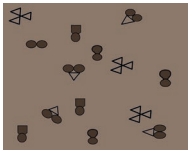
Answer:
False
Correct statement:
In thermos flask, the vacuum between the two walls prevents heat from the inside to the outside by conduction and convection.
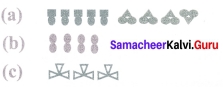
Question 15.
Thermostat is a device can measure the heat capacity of the liquid in the container.
Answer:
False
Correct statement:
Calorimeter is a device can measure the heat capacity of the liquid in the container.

IV. Match the following

Question 1.

1.Heat(a)Good absorber
2.Temperature(b)Form of energy
3.Black surface(c)Insulators
4.Rubber, cork(d)Measure of hotness or coldness

Answer:

  1. b
  2. d
  3. a
  4. c

Question 2.

1.Specific heat capacity(a)Dewar bottle
2.Calorimeter(b)Lavoisier and simon
3.Vacuum flask(c)J Kg-1 K-1
4.Ice – calorimeter(d)Heat capacity

Answer:

  1. c
  2. d
  3. a
  4. b

Question 3.

1.Conduction(a)liquids and gases
2.Convection(b)Poor conductor
3.Radiation(c)Solids
4.Snow(d)Vacuum

Answer:

  1. c
  2. a
  3. d
  4. b

Question 4.

1.Solid to liquid(a)Condensation
2.Liquid to gas(b)Deposition
3.Gas to solid(c)Melting
4.Gas to liquid(d)Vaporization

Answer:

  1. c
  2. d
  3. b
  4. a

V. Assertion and Reason.

Question 1.
Mark the correct choice as:
(a) If both assertion and reason are true and the reason is the correct explanation of the assertion.
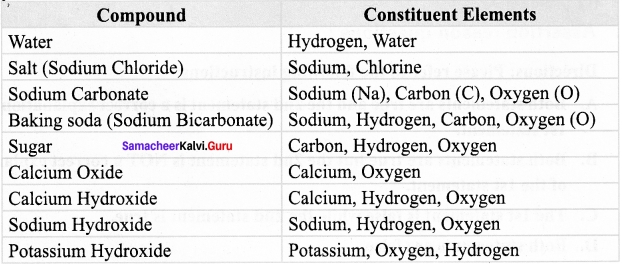
(b) If both assertion and reason are true, but reason is not the correct explanation of the assertion.
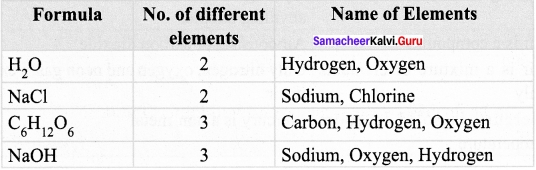
(c) If the assertion is true, but the reason is false.
(d) If the assertion is false, but the reason is true.

Question 1.
Assertion : When a very hot liquid is poured into a thick glass tumbler it cracks.
Reason : Unequal expansion of the inner and outer glass walls causes the glass to crack.
Answer:
(a) Both assertion and reason are true and the reason is the correct explanation of the assertion.
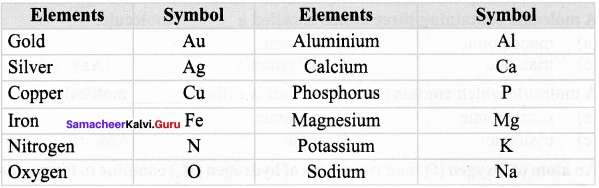
Question 2.
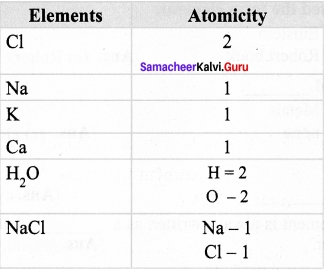
Assertion : Radiation is a process of transfer of heat in which a material medium is not necessary.
Reason : The heat from the sun reaches us through millions of miles of empty space by convection.
Answer:
(c) The assertion is true, but the reason is false.

Question 3.
Assertion : Temperature is the measure of the heat energy.
Reason : Energy is the capacity to do work.
Answer:
Assertion is false, but the reason is true

Question 4.
Assertion : Small gaps left between railway lines.
Reason : It allows for contraction of rails during summer.
Answer:
(c) The assertion is true, but the reason is false.

VI. Answer briefly

Question 1.
Write the relation between joule and calorie.
Answer:
1 Calorie = 4.186 J.
1 K cal = 4186 J = 4.186 KJ.

Question 2.
Mention the factors affecting the flow of heat.
Answer:

  1. Mass and materials of the bodies in contact.
  2. Difference in their temperatures.

Question 3.
What is the principle of calorimetry?
Answer:
Heat lost by the hot body is equal to the heat gained by the cold body.

Question 4.
What are the various modes of transfer of heat?
Answer:

  1. Conduction
  2. Convection
  3. Radiation

Question 5.
Which color absorb heat radiation and which color reflects heat radiation?
Answer:
Black surfaces absorb heat radiation. White color reflects heat radiation.
Question 6.
What is the SI unit of heat capacity?
Answer:
The SI unit of heat capacity is JK-1

Question 7.
Mention the SI unit of specific heat capacity?
Answer:
The SI unit of specific heat capacity is J Kg-1 K-1.

Question 8.
What is the function of a thermostat in a device?
Answer:
Thermostat functions both as the sensor and the controller of a thermal system.

Question 9.
Name some appliances which uses thermostat.
Answer:
Central heater in a room, air conditioner, water heater, oven and refrigerators.

Question 10.
What is the function of silvered wall in a thermos flask?
Answer:
The silvered walls reflect radiated heat back to the liquid in the flask.

Question 11.
You would have noticed some space being left in railway tracks. Why?
Answer:

  1. It is because railway tracks which are made up of iron (metal) expand during summer.
  2. When there is a gap, there will not be any damage in the track due to expansion of the metal rod.

Question 12.
What is transfer of heat?
Answer:
If heat energy is supplied to any substance, it will be transferred from one part of the substance to another part.

Question 13.
Mention the applications of convection in daily life.
Answer:

  1. Formation of land breeze and sea breeze is due to convection of air.
  2. Wind flows from one region to another region by convection.
  3. In hot air balloons heat is transferred by convection and so the balloon raises.
  4. In refrigerators, cool air moves downward and replaces the hot air because of convection.
Question 14.
Define radiation.
Answer:
Radiation is defined as the way of heat transfer from one place to another in the form of electromagnetic waves.
Question 15.
Mention the applications of radiation in daily life.
Answer:

  1. Heat energy from the Sun reaches the Earth by radiation.
  2. While standing near fire we feel the heat which is transferred as radiation.
  3. Black surfaces absorb heat radiation. So that the bottom of the cooking vessels are painted black.
  4. White color reflects heat radiation. That’s why we are advised to wear white cloth during summer.

Question 16.
Why do we wear woolen clothes in winter?
Answer:

  1. The fibers of wool have the property of trapping air in between them.
  2. In trapping the air, woolen clothes do not allow the heat to flow away from the body, which would then become cold.
  3. Besides, wool is poor conductor of heat. So this property further prevents heat from leaving the body.

Question 17.
Can convection take place in solids? Why?
Answer:

  1. No. The molecules in a solid are only free to vibrate about their fixed positions.
  2. For convection to take place, the molecules need to move carrying the heat with them.
  3. Hence convection cannot take place in solids.

Question 18.
Distinguish between heat capacity and specific heat capacity.
Answer:

Heat capacity

Specific heat capacity

1. It is the heat required to raise the temperature of a given mass of a substance through 1°C.1. It is the heat required to raise the temperature of 1 g of a substance through 1°C.
2. It depends on the mass of the body2. It does not depend on the mass of the body.
3. Its unit is J°C-13. Its unit is J Kg-1°C-1

Question 19.
Arrange the following in order of decreasing expansion of heating : Steel, milk, air.
Answer:
Air, milk, steel.

Question 20.
Distinguish between evaporation and vaporization.
Answer:

Evaporation

Vaporization

1. Evaporation takes place at all temperature.1. Vaporization takes place at fixed temperature.
2. Slow and gradual process2. Violent and rapid process.
3. Takes place at the surface of the liquid3. Takes place through the entire liquid.

VII. Answer in detail

Question 1.
Describe an experiment to prove that solids expands on heating and contract on cooling.
Answer:
Samacheer Kalvi Guru 8th Science Term 2 Chapter 1 Heat

  1. Take a metal ball and a metal ring of suitable diameter.
  2. Pass the metal ball through the ring.
  3. You can observe that the metal ball can easily go through it.
  4. Now heat the metal ball and then try to pass it fits through through the ring.
  5. It will not pass through the ring.
  6. Keep the metal ball on the ring for some time.
  7. In few minutes, it will fall through the ring. Expansion in Solids
  8. When the ball is heated the atoms in the ball gain heat energy.
  9. They start vibrating and force each other apart.
  10. As a result an expansion takes place. That’s why the ball did not go through the ring.
  11. After some time, as the ball lost the heat energy to the surrounding it came back to its original size and it went through the ring.
  12. This shows that heat energy causes expansion in solids.

Question 2.
Write a note on radiation.
Answer:
8th Science Heat Lesson Samacheer Kalvi Term 2 Chapter 1

  1. Radiation is the third form of heat transfer.
  2. By conduction, heat is transferred through solids, by convection heat is transferred through liquids and gases, but by radiation heat can be transferred through empty space even through vacuum.
  3. Heat energy from the Sun reaches the Earth by this form of heat transfer.
  4. Radiation is defined as the way of heat transfer from one place to another in the form of electromagnetic waves.

Question 3.
Write the difference between conduction, convection, and radiation.
Answer:

Conduction

Convection

Radiation

Heat is transferred without the actual movement of the moleculesHeat transfer takes place due to the movement of the molecules themselves.Heat is transferred without a medium.
Conduction is possible only in solids with the exception of mercury which is a liquidConvection takes place in liquids and gases only.Radiation requires no medium. It takes place even in vacuum.
Transfer is slowTransfer is fasterTransfer is the fastest
Heat transfer can be in any direction.Heat transfer is mainly upwards.Heat transfer takes place in all direction.

Question 4.
Distinguish between heat and temperature.
Answer:

Heat

Temperature

1. It is a form of energy.1. It is a thermal condition of body.
2. It flows from one object to other object when there is a difference in temperature2. It is a quantity that indicates whether or not and in which direction heat will flow.
3. It is the total amount of internal energy of a body3. It is proportional to average kinetic energy of the molecules of a body.
4. In the transmission of heat, total amount of heat remains unchanged.4. In the transmission of heat, temperature does not remain same.
5. Its SI unit is joule (J)5. Its SI unit is kelvin (K).

VIII. Problems for practice

Question 1.
What is the rise in temperature of 5 kg of water if it is given 84,000 J heat energy? Specific heat capacity of water 4200 J Kg-1 °C-1.
Solution:
Given, m = 5 kg
Q = 84,000 J
C = 4200 J Kg-1 °C-1
Let rise in the temperature be ∆T.
Heat energy (Q) = mC∆T
84,000 = 5 x 4200 x ∆T
Samacheer Kalvi 8th Science Guide Term 2 Chapter 1 Heat
= 4°C

Question 2.
A body of mass 750 g requires 13,500 J of heat energy in order to raise its temperature from 25 °C to 55 °C. Calculate its specific heat capacity.
Solution:
Given
m = 750 g = 0.750 kg
∆T (55 – 25)°C = 30°C
Q = 13,500 J
Q = mC∆T
or
Samacheer Kalvi 8th Science Term 2 Chapter 1 Heat
= 600 JKg-1

Question 3.
An iron ball requires 9000 J heat energy to raise its temperature by 10°C. Calculate the heat capacity of the iron bail.
Solution:
Given, Q = 9000 J
∆T = 10°C
Heat capacity, C = \(\frac{Q}{∆T}\) = \(\frac{9000}{10}\) = 900 J°C-1

IX. Picture based Questions

Question 1.
Samacheer Kalvi 8th Science Solution Term 2 Chapter 1 Heat
Answer:

  1. Freezing
  2. Vaporization
  3. Condensation
  4. Deposition