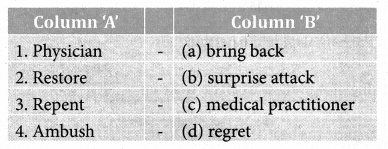
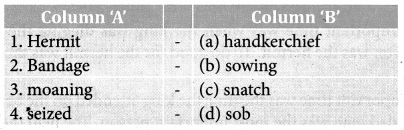
Samacheer Kalvi 9th Science Solutions Chapter 3 Fluids

You can Download Samacheer Kalvi 9th Science Book Solutions Guide Pdf, Tamilnadu State Board help you to revise the complete Syllabus and score more marks in your examinations.

Tamilnadu Samacheer Kalvi 9th Science Solutions Chapter 3 Fluids

Samacheer Kalvi 9th Science Fluids Textbook Exercises

I. Choose the correct answer.

Fluids 9th Science Question 1.
The size of an air bubble rising up in water ……………. .
(a) decreases
(b) increases
(c) remains same
(d) may increase or decrease
Answer:
(a) decreases

Fluids Lesson 9th Class Question 2.
Clouds float in atmosphere because of their low ……………. .
(a) density
(b) pressure
(c) velocity
(d) mass
Answer:
(a) density

9th Science Fluids Question 3.
In a pressure cooker, the food is cooked faster because ……………. .
(a) increased pressure lowers the boiling point
(b) increased pressure raises the boiling point
(c) decreased pressure raises the boiling point
(d) increased pressure lowers the melting point
Answer:
(a) increased pressure lowers the boiling point

9th Science Fluids Book Back Answers Question 4.
An empty plastic bottle closed with an airtight stopper is pushed down into a bucket filled
with water. As the bottle is pushed down, there is an increasing force on the bottom as shown in graph. This is because
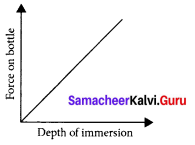
Fluids 9th Science Samacheer Kalvi Chapter 3
(a) more volume of liquid is displaced
(b) more weight of liquid is displaced
(c) pressure increases with depth
(d) all the above
Answer:
(d) all the above

II. Fill in the blanks.

  1.  The weight of the body immersed in a liquid appears to be ………….. than its actual weight
  2.  The instrument used to measure atmospheric pressure is …………….. .
  3.  The magnitude of buoyant force acting on an object immersed in a liquid depends on ………….. of the liquid.
  4.  A drinking straw works on the existence of …………….. .

Answer:

  1.  less
  2.  barometer
  3.  density
  4. Pressure

III. True or False.

Chapter 3 Fluids Question 1.
The weight of fluid displaced determines the buoyant force on an object.
Answer:
True.

Fluids Class 9 Question 2.
The shape of an object helps to determine whether the object will float.
Answer:
True.

Samacheer Kalvi 9th Science Question 3.
The foundations of high-rise buildings are kept wide so that they may exert more pressure on the ground.
Answer:
True.

Samacheer Kalvi Guru 9th Science Solutions Question 4.
Archimedes’ principle can also be applied to gases.
Answer:
False.
Correct statement: Archimedes’ principle is about fluid displacement which does not involve gases.

Samacheer Kalvi 9th Science Solution Question 5.
Hydraulic press is used in the extraction of oil from oil seeds.
Answer:
True.

IV. Match the following.

Column – I

Column – II

(a) Density(i) hpg
(b) 1 gwt(ii) Milk
(c) Pascal’s law(iii) \(\frac { Mass }{ Volume }\)
(d) Pressure exerted by a fluid(iv) Pressure
(e) Lactometer(v) 980 dyne

Answer:
(a) (iii)
(b) (v)
(c) (iv)
(d) (i)
(e) (ii)

V. Answer in brief.

Science Solution Class 9 Samacheer Kalvi Question 1.
On what factors the pressure exerted by the liquid depends on?
Answer:
Pressure exerted by a liquid at a point is determined by,

  •  depth (h)
  •  density of the liquid (p)
  •  acceleration due to gravity (g).

Samacheer Kalvi 9th Science Solutions Question 2.
Why does a helium balloon float in air?
Answer:
Helium is much less denser than ordinary air which gives them buoyancy and thus float in air.

Samacheerkalvi.Guru 9th Science Question 3.
Why it is easy to swim in river water than in sea water?
Answer:
Due to the presence of dissolved salts in sea water is denser than river water which makes floating easier and hence swimming is easier.

Question 4.
What is meant by atmospheric pressure?
Answer:
The pressure exerted by the atmospheric gases on its surroundings and on the surface of the earth is called atmospheric pressure.

Question 5.
State Pascal’s law.
Answer:
Pascal’s law states that an increase in pressure at any point inside a liquid at rest is transmitted equally and without any change, in all directions to every other point in the liquid.

VI. Answer in detail.

Question 1.
With an appropriate illustration prove that the force acting on a smaller area exerts a greater pressure.
Answer:
Consider standing on loose sand. Your feet go deep into the sand. Now, when you lie down on the sand, you will find that your body will not go that deep into the sand. In both the cases the force exerted on the sand is the weight of your body which is the same. This force acting perpendicular to the surface is called thrust. When you stand on loose sand, the force is acting on an area equal to the area of your feet.

When you lie down, the same force acts on an area of your whole body, which is larger than the area of your feet. Therefore the effect of thrust, that is, pressure depends on the area on which it acts. The effect of thrust on sand is larger while ‘ standing than lying.

Question 2.
Describe the construction and working of mercury barometer.
Answer:
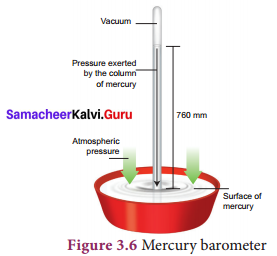
Fluids Lesson 9th Class Samacheer Kalvi Chapter 3
The instrument used to measure atmospheric pressure is called barometer. A mercury barometer, first designed by an Italian Physicist Torricelli, consists of a long glass tube (closed at one end, open at the other) filled with mercury and turned upside down into a container of mercury. This is done by closing the open end of the mercury filled tube with the thumb and then opening it after immersing it in to a trough of mercury. The barometer works by balancing the mercury in the glass tube against the outside air pressure.

If the air pressure increases, it pushes more of the mercury up into the tub and if the air pressure decreases, more of the mercury drains from the tube. As there is no air trapped in the space between mercury and the closed end, there is vacuum in that space. Vacuum cannot exert any pressure. So the level of mercury in the tube provides a precise measure of air pressure which is called atmospheric pressure. This type of instrument can be used in a lab or weather station.

Question 3.
How does an object’s density determine whether the object will sink or float in water?
Answer:
Whether an object will sink or float in a liquid is determined by the density of the object compared to the density of the liquid. If the density of a substance is less than the density of the liquid it will float. For example, a piece of wood which is less dense than water will float on it. Any substance having more density than water (for example, a stone), will sink into water.

Question 4.
Explain the construction and working of a hydrometer with diagram.
Answer:
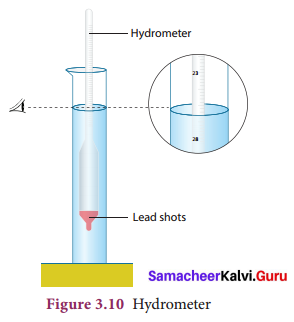
9th Science Fluids Samacheer Kalvi Chapter 3
A direct-reading instrument used for measuring the density or relative density of the liquid is called hydrometer. Hydrometer is based on the principle of flotation, i.e., the weight of the liquid displaced by the immersed portion of the hydrometer is equal to the weight of the hydrometer.

Hydrometer consists of a cylindrical stem having a spherical bulb at its lower end and a narrow tube at its upper end. The lower spherical bulb is partially filled with lead shots or mercury. This helps hydrometer to float or stand vertically in liquids. The narrow tube has markings so that relative density of a liquid can be read directly.

The liquid to be tested is poured into the glass jar. The hydrometer is gently lowered into the liquid until it floats freely. The reading against the level of liquid touching the tube gives the relative density of the liquid.

Question 5.
State the laws of flotation.
Answer:
Laws of flotation are,

  1. The weight of a floating body in a fluid is equal to the weight of the fluid displaced by the body.
  2. The centre of gravity of the floating body and the centre of buoyancy are in the same vertical line.

VII. Assertion and Reason.

Mark the correct answer as
(a) If both assertion and reason are true and reason is the correct explanation of assertion.
(b) If both assertion and reason are true but reason is not the correct explanation of assertion.
(c ) If assertion is true but reason is false.
(d) If assertion is false but reason is true.

Question 1.
Assertion (A): To float, body must displace liquid whose weight is equal to the actual weight.
Reason (R): The body will experience no net downward force in that case.
Answer:
(a) If both assertion and reason are true and reason is the correct explanation of assertion.

Question 2.
Assertion (A): Pascal’s law is the working principle of a hydraulic lift.
Reason (R): Pressure is thrust per unit area.
Answer:
(b) If both assertion and reason are true but reason is not the correct explanation of assertion.

VIII. Numerical problems.

Question 1.
A block of wood of weight 200 g floats on the surface of water. If the volume of block is 300 cm3 calculate the upthrust due to water.
Answer:
Upthrust of floating object = weight of the water displaced
Weight = mg
= 0.200Kg × \(\frac { 10m }{ s2 }\)
= 2N

Question 2.
Density of mercury is 13600 kg m– 3. Calculate the relative density.
Answer:
Relative Density = \(\frac { Density of Mercury }{ Density of water }\) at 4°C
R.D. = 13.6

Question 3.
The density of water is 1 g cm– 3. What is its density in S.I. units?
Answer:
S.I. unit of density of water = \(\frac { 1000kg }{ m3 }\)

Question 4.
Calculate the apparent weight of wood floating on water if it weighs 100g in air.
Answer:
Apparent weight = Weight of the body – Weight of liquid
Since the body is floating the two are equal. So, apparent weight is zero.
100 – 100 = 0

IX. HOTS

Question 1.
How high does the mercury barometer stand on a day when atmospheric pressure is 98.6 kPa?
Answer:
H= \(\frac{P_{\max }}{P_{H_{g}}}\) = 98.6 × 10 × 10 × 10
= \(\frac{(\mathrm{N} / \mathrm{m})^{2}}{13.6 \times 10 \times 10 \times 10 \mathrm{Kg} / \mathrm{m}^{3}}\)
= \(\frac { 9.8m }{ s2 }\) = 740mm

Question 2.
How does a fish manage to rise up and move down in water?
Answer:
Fish has an internal swim bladder which is filled with gas. When it needs to rise or descend, it changes the volume and its density by filling this bladder with oxygen collected from the surrounding water through gills. When the bladder is filled with oxygen gas, the fish has a greater volume, with minimal increase in weight. When the bladder is expanded, it displaces more water and so experiences a greater force of buoyancy.

When the bladder is completely inflated, the fish has maximum volume and is pushed to the surface. When the bladder is completely deflated, the fish has minimum volume and sinks to the ocean floor.

Question 3.
If you put one ice cube in a glass of water and another in a glass of alcohol, what would you observe? Explain your observations.
Answer:
Ice floats in water and not in alcohol. This is because the density of ice is \(\frac { 0.917g}{ cc }\) which is lower than that of water which is 1. Whereas, the density of ethanol (alcohol) is only \(\frac { 0.789g}{ cc }\) which is lesser than ice, hence it floats in alcohol.

Question 4.
Why does a boat with a hole in the bottom would eventually sink?
Answer:
A boat with a hole at the bottom allows water to enter it, thus increasing its weight and hence it sinks. As water starts entering the boat through the hole, the boat starts to get heavier, so it starts to sink, trying to displace more water. But the water keeps coming as the hydrostatic pressure at the hole is always higher than the atmospheric pressure pushing down on the surface of the water in the boat.

ACTIVITY

Question 1.
Take two identical flasks and fill one flask with water to 250 cm3 mark and the other with kerosene to the same 250 cm3 mark. Measure them in a balance. The flask filled with water will be heavier than the one filled with kerosene. Why? The answer is in finding the mass per unit volume of kerosene and water in respective flasks.
Answer:
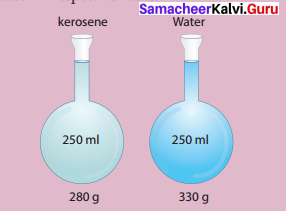
9th Science Fluids Book Back Answers Samacheer Kalvi Chapter 3
To understand density better, let us assume that the mass of the flask be 80 g. So, the mass of the flask filled with water is 330 g and the mass of flask filled with kerosene is 280 g. Mass of water only is 250 g and kerosene only is 200 g.
Mass per unit volume of water = \(\frac { 250 }{ 250 }\) cm3
= \(\frac { 1 g }{ cm3 }\)
Mass per unit volume of kerosene = 200 g/250cm3
= \(\frac { 0.8 g }{ cm3 }\)
The result \(\frac { 1g }{ cm3 }\) and \(\frac { 0.8 g }{ cm3 }\) are the densities of water and kerosene respectively.
Therefore the density of a substance is the mass per unit volume of a given substance.

Samacheer Kalvi 9th Science Fluids In Text Problems

Question 1.
A man whose mass is 90 kg stands on his feet on a floor. The total area of contact of his two feet with the floor is 0.036 m2 (Take, g = 10 ms– 2). How much is the pressure exerted by him on the floor?
Solution:
The weight of the man (thrust),
F = mg = 90 kg × 10 ms– 2 = 900 N
Pressure, P = \(\frac{F}{A}=\frac{900 N}{0.036 m^{2}}\) = 25000 Pa

Question 2.
Calculate the pressure exerted by a column of water of height 0.85 m (density of water, pw = 1000 kg m– 3) and kerosene of same height (density of kerosene, pk = 800 kg m– 3)
Solution:
Pressure due to water = hpwg = 0.85 m × 1000 kg m– 3 × 10 ms– 2 = 8500 Pa.
Pressure due to kerosene = hpkg = 0.85 m × 800 kg m– 3 × 10 ms– 2 = 6800 Pa.

Question 3.
A mercury barometer in a physics laboratory shows a 732 mm vertical column of mercury. Calculate the atmospheric pressure in pascal.
[Given density of mercury, p = 1.36 × 10⁴kg m– 3, g = 9.8 ms– 2]
Solution:
Atmospheric pressure in the laboratory,
P = hpg = 732 × 10– 3 × 1.36 × 1o4 × 9.8
= 9.76 × 10⁴ Pa (or) 0.976 × 10⁵ Pa

Question 4.
A hydraulic system is used to lift a 2000 kg vehicle in an auto garage. If the vehicle sits on a piston of area 0.5 m2, and a force is applied to a piston of area 0.03 m2, what is the minimum force that must be applied to lift the vehicle?
Given: Area covered by the vehicle on the piston A1 = 0.5 m2
Weight of the vehicle, F1 = 2000 kg × 9.8 m s– 2
Area on which force F2 is applied, A2 = 0.03 m2
Solution:
P1 = P2 ;\(\frac{F_{1}}{A_{1}}=\frac{F_{2}}{A_{2}}\)and F2 = \(\frac{F_{1}}{A_{1}}\)A2 ;
F2 = (2000 × 9.8)\(\frac{0.03}{0.5}\) = 1176 N

Question 5.
You have a block of a mystery material, 12 cm long, 11 cm wide and 3.5 cm thick. Its mass is 1155 grams.
(a) What is its density?
(b) Will it float in a tank of water, or sink?
Solution:
(a) Density = \(\frac{\text { Mass }}{\text { Volume }}=\frac{1155 \mathrm{g}}{12 \mathrm{cm} \times 11 \mathrm{cm} \times 3.5 \mathrm{cm}}=\frac{1155 \mathrm{g}}{462 \mathrm{cm}^{3}}\) = 2.5g cm– 3
(b) The mystery material is denser than the water, so it sinks

Samacheer Kalvi 9th Science Fluids Additional Questions

I. Answer the following.

Question 1.
Give reasons why:
a. a single nail pricking the body is painful when compared to lying on a bed of nails.
b. cutting edges of knife and axes are sharpened.
c. heavy trucks are fitted with 6 to 8 wheels
Answer:
a. In a nail bed, the weight is evenly distributed among numerous nails, so that the pressure exerted by each nail is not enough to puncture a person’s skin. If its only a single nail, the entire force created by the weight of the body would be distributed over a very small area presented by the tip of one nail. In this case the force per unit area will be great and can puncture the skin.
b. Knives and axes are sharpened because when the area decreases the pressure increases. Hence a small force is enough to cut an object.
c. As area increases pressure decreases. So weight of the truck exerts less pressure on the road.

Question 2.
Define:

  1. Thrust,
  2. Pressure

Answer:

  1. Force acting on a body perpendicular to the surface is called thrust.
  2. The force per unit area acting on an object concerned is called pressure.

Question 3.
In petrol bunks, in what unit is tyre pressure measured?
Answer:
The tyre pressure is measured in units of psi. it stands for pascal per inch.

Question 4.
Stating Pascal’s law, explain its application in a hydraulic press.
Answer:
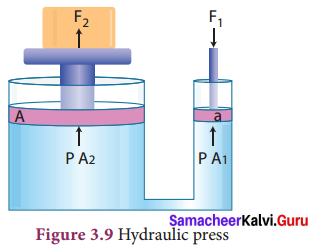
Chapter 3 Fluids Samacheer Kalvi 9th Science
Pascal’s law states that-the external pressure applied on an incompressible liquid is transmitted uniformly throughout the liquid. Pascal’s law became the basis for one of the important machines ever developed, the hydraulic press. It consists of two cylinders of different cross-sectional areas. They are fitted with pistons of cross-sectional areas “a” and “A”. The object to be compressed is placed over the piston of large cross-sectional area A. The force Fj is applied on the piston of small cross-sectional area a.

The pressure P produced by small piston is transmitted equally to large piston and a force F2 acts on A which is much larger than F1 area ‘a’ is given by,
P = \(\frac { F1}{ A1}\) …………………….(1)
Applying Pascal’s law, the pressure on large piston of area A will be the same as that on small piston. Therefore, P = \(\frac { F2 }{ A2 }\) …………… (2)
Comparing equations (1) and (2),we get
\(\frac { F1 }{ A1 }\) = \(\frac { F2 }{ A2 }\) or F2 = F1 × \(\frac { A2 }{ A1 }\)
Since, the ratio \(\frac { A2 }{ A1 }\) is greater than 1, the force F2 that acts on the larger piston is greater than the force F1 acting on the smaller piston. Hydraulic systems working in this way are known as force multipliers.

Question 5.
What is Artisan aquifer?
Answer:
An artesian aquifer is a confined aquifer (an underground water bearing permeable rocks) containing groundwater that will flow upwards out of a well without the need for pumping. In recharging aquifers, this happens because the water table at its recharge zone is at a higher elevation than the head of the well.

Question 6.
What is relative density? Explain it mathematically.
Answer:
Density of any other substance with respect to the density of water at 4°C is called relative density. Mathematically,
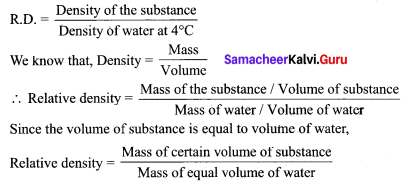
Fluids Class 9 Samacheer Kalvi Chapter 3
Thus, the ratio of mass of a given volume of a substance to the mass of an equal volume of water at 4°C also denotes relative density.

Question 7.
What is lactometer? Explain its principle and working.
Answer:
One form of hydrometer is a lactometer, an instrument used to check the purity of milk. The lactometer works on the principle of gravity of milk. The lactometer consists of a long graduated test tube with a cylindrical bulb with the graduation ranging from 15 at the top to 45 at the bottom. The test tube is filled with air. This air chamber causes the instrument to float. The spherical bulb is filled with mercury to cause the lactometer to sink up to the proper level and to float in an upright position in the milk.

Inside the lactometer there may be a thermometer extending from the bulb up into the upper part of the test tube where the scale is located. The correct lactometer reading is obtained only at the temperature of 60°C. A lactometer measures the cream content of milk.

More the cream, lower the lactometer floats in the milk. The average reading of normal milk is 32. The lactometers are used highly at milk processing units and at dairies.

Question 8.
Why do petroleum based products float on surface of water?
Answer:
Petroleum based products float on water because their specific gravity is low.

Question 9.
State and explain Archimedes principle. Name the devices based on this principle.
Answer:
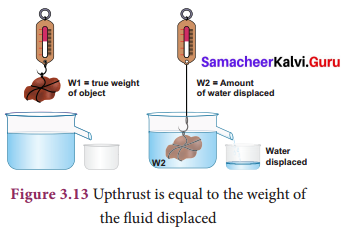
Samacheer Kalvi 9th Science Chapter 3 Fluids
Archimedes principle is the consequence of Pascal’s law. It states that a body immersed in a fluid experiences a vertical upward buoyant force equal to the weight of the liquid it displaces.

When a body is partially or completely immersed in a fluid at rest, it experiences an upthrust which is equal to the weight of the fluid displaced by it. Due to the upthrust acting on the body, it apparently loses a part of its weight and the apparent loss of weight is equal to upthrust.

Thus for a body either partially or completely immersed in a fluid,
upthrust = weight of the fluid displaced
= apparent loss of body weight
Apparent weight of an object = True weight of an object in air – upthrust (weight of water displaced)
Devices based on Archimedes principle are – hydrometers, lactometers, balloons, boats and ships, submarines, etc.
Samacheer Kalvi 6th Science Solutions Term 2 Chapter 1 Heat

You can Download Samacheer Kalvi 6th Science Book Solutions Guide Pdf, Tamilnadu State Board help you to revise the complete Syllabus and score more marks in your examinations.

Tamilnadu Samacheer Kalvi 6th Science Solutions Term 2 Chapter 1 Heat

Samacheer Kalvi 6th Science Heat Textual Evaluation

I. Choose the appropriate answer:

Heat Lesson For Class 6 Question 1.
When an object is heated, the molecules that make up the object
(a) begin to move faster
(b) lose energy
(c) become heavier
(d) become lighter
Answer:
(a) begin to move faster

Samacheer Kalvi 6th Science Term 2 Question 2.
The unit of heat is
(a) newton
(b) joule
(c) volt
(d) Celsius
Answer:
(b) Joule

6th Standard Science Heat Question 3.
One litre of water at 30°C is mixed with one litre of water at 50°C. The temperature of the mixture will be
(a) 80°C
(b) More than 50°C but less than 80°C
(c) 20°C
(d) around 40°C
Answer:
(d) around 40°C

Science Term 2 Question 4.
An iron ball at 50°C is dropped in a mug containing water at 50°C. The heat will
(a) flow from iron ball to water.
(b) not flow from iron ball to water or from water to iron ball.
(c) flow from water to iron ball.
(d) increase the temperature of both.
Answer:
(b) not flow from iron ball to water or from water to iron ball

II. Fill up the blanks:

  1. Heat flows from a ______ body to a ______ body.
  2. The hotness of the object is determined by its ______
  3. The SI unit of temperature is ______
  4. Solids on heating and ______ on cooling.
  5. Two bodies are said to be in the state of thermal ______ if there is no transfer of heat taking place.

Answers:

  1. higher temperature, lower temperature
  2. temperature
  3. kelvin
  4. expand, contract
  5. equilibrium

III. True or False. If False, give the correct statement:

Samacheer Kalvi Guru 6th Science Question 1.
Heat is a kind of energy that flows from a hot body to a cold body.
Answer:
True

6th Science Heat Lesson Question 2.
Steam is formed when heat is released from water.
Answer:
False. Ice is formed when heat is released from water.

Samacheer Kalvi 6th Science Guide Term 2 Question 3.
Thermal expansion is always a nuisance.
Answer:
False. Thermal expansion is always beneficial.

Samacheer Kalvi 6th Science Question 4.
Borosilicate glass do not expand much on being heated.
Answer:
True

Samacheer Kalvi 6th Science Solution Question 5.
The unit of heat and temperature are the same.
Answer:
False. The unit of heat and temperature are different

IV. Give reasons for the following:

6th Science Samacheer Kalvi Question 1.
An ordinary glass bottle cracks when boiling water is poured into it, but a borosilicate glass bottle does not.
Answer:
The reason is that the borosilicate glass do not expand much on being heated and therefore they do not crack.

Samacheer Kalvi 6th Science Guide Question 2.
The electric wire which sag in summer become straight in winter.
Answer:
In summer the electric wire is expanded by high temperature. So it sags in summer. In winter die electric wire is contracted by low temperature. Hence it becomes straight in winter.

6th Science Term 2 Question 3.
|Rivet is heated before fixing in hole to join two metal plates.
Answer:

  1. When we heat rivet expansion takes place and become soft.
  2. One end of the rivet is hammered to form a new head.
  3. When cooled, rivet will contract and hold tightly.

V. Match the following:

1. Heat0°C
2. Temperature100°C
3. Thermal Equilibriumkelvin
4. Ice cubeNo heat flow
5. Boiling waterjoule

Answer:

1. Heat

joule

2. Temperaturekelvin
3. Thermal,EquilibriumNo heat flow
4. Ice cube0°C
5. Boiling water100°C

VI. Analogy:

Heat Class 6 Question 1.
Heat: Joule :: Temperature : _______
Answer:
kelvin

Samacheer Kalvi 6th Science Book Solutions Question 2.
Ice cube : 0°C :: Boiling water : _______
Answer:
100°C

Samacheer Kalvi 6th Science Book Back Answers Question 3.
Total Kinetic Energy of molecules: Heat:: Average Kinetic Energy: _______
Answer:
Temperature

VII. Give Very Short Answer:

Samacheer Kalvi Guru 6 Science Question 1.
Make a list of electrical equipments at home which we get heat from.
Answer:
Water heater, Iron box, Electric kettle, Micro oven.

Samacheer Kalvi 6th Science Answers Question 2.
What is the temperature?
Answer:

  1. The measurement of warmness or coldness of a substance is known as temperature.
  2. SI unit is Kelvin.
  3. Other units : Celsuis, Fahrenheit

6th Standard Science Term 2 Question 3.
What is thermal expansion?
Answer:
The expansion of a substance on heating is called the thermal expansion.

Kalvi Guru 6th Science Question 4.
What do you understand by thermal equilibrium?
Answer:
Thermal equilibrium exists when two objects in thermal contact no longer affect each other’s temperature (or) Both the objects are in same temperature they are in thermal equilibrium.

VIII. Give Short Answer:

Heat Samacheer Kalvi Question 1.
What difference do you think heating the solid will make in their molecules?
Answer:

  1. When we heat solids the vibrations and movement of molecules will increase.
  2. The temperature of the object increases.
  3. The distance between molecules will increase.

Question 2.
Distinguish between heat and temperature.
Answer:

S.No,HeatTemperature

1.

Heat not only depends on the temperature of the substance but also depends on how many molecules are there in the object.Temperature is related to how fast the atoms or molecules move or vibrate within the substance
2.Heat measures the total Kinetic Energy of the molecules in the substance.Temperature measures the average kinetic energy of molecules.
3.SI Unit: JouleSI Unit: Kelvin
4.Unit: Joules, CaloriesUnit: Fahrenheit, Celsius, Kelvin
5.It has the ability to do workIt can be used to measure the degree of heat

IX. Answer in detail:

Question 1.
Explain thermal expansion with suitable examples.
Answer:
Thermal expansion:
The expansion of a substance on heating is called, the thermal expansion of that substance.

Fitting the iron rim on the wooden wheel:

  1. The diameter of the iron ring is slightly less than that of the wooden wheel.
  2. So, it cannot be easily slipped on from the rim of wooden wheel.
  3. The iron ring is, therefore, first heated to a higher temperature so that it expands in size and the hot ring is then easily slipped over to the rim of the wooden wheel.
  4. Coldwater is now poured on the iron ring so that it contracts in size and holds the wooden wheel tightly.

Rivetting:

  1. Rivets are used to join two steel plates together.
  2. Hot rivet is driven through the hole in the plates.
  3. One end of the rivet is hammered to form a new rivet head.
  4. When cooled, the rivet will contract and hold the two plates tightly together.

Cracking of a thick glass tumbler:

  1. Glass is a poor conductor of heat.
  2. When hot liquid is poured into the tumbler, the inner surface of the tumbler becomes hot and expands while the outer surface remains at the room temperature and does not expand.
  3. Due to this unequal expansion, the tumbler cracks.

X. Questions based on Higher Order Thinking Skills:

Question 1.
When a window is accidentally left open on a winter night, will you feel uncomfortable because the cold is getting in, or because the heat is escaping from the room?
Answer:

  1. When a window is left open on winter night I will feel uncomfortable because the heat is escaping from the room.
  2. Heat will transfer from high temperature to low temperature.
  3. During winter cold air enter into room, so room temperature will decrease.

Question 2.
Suppose your normal body temperature were lower than what it is. How would the sensation of hot and cold change?
Answer:
If the normal body temperature, (37°C or 98.6°F) is lower than what it is, then it is called hypothermia.

In such a case, the body feels cold sensation. When we are too cold, our blood vessels narrow. This reduces blood flow to our skin to save body heat. We may start to shiver. When the muscles tremble this way, it helps to make more heat.

Hypothermia can be serious one or even deadly. Low body temperature usually happens from being out in cold weather. But it may also be caused by alcohol or drug use, going into shock, or certain disorders such as diabetes or low thyroid.

A low body temperature may occur with an infection. This is most common in newborns, older adults, or people who are frail. A very bad infection may also cause an abnormal low body temperature.

Question 3.
If you heat a circular disk with a hole, what change do you expect in the diameter of the hole? Remember that the effect of heating increases the separation between any pair of particles.
Answer:

  1. If I heat a circular disk with a hole the diameter of the hole will increase.
  2. Because thermal expansion takes place when we heat the disk.

Samacheer Kalvi 6th Science Heat Intext Activities

Activity 1

Question 1.
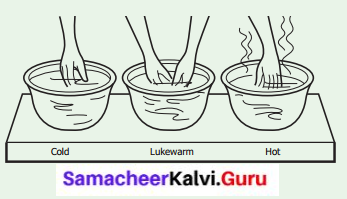
Take three bowls. Pour very cold water in the first bowl. (you can also add ice cube for cooling). Place luke warm water in the second. Half fill the third with hot water (-not hot enough to burn!)
Heat Lesson For Class 6 Samacheer Kalvi Term 2 Chapter 1
Set them in a row on the table, with the lukewarm water in the center. Place your right hand in the cold water, and your left hand in the hot water. Keep them in for a few minutes. Then take them out, shake off the water and put both into the middle bowl. How do they feel?
Answer:
I feel that my right hand’s coldness is changed into warm condition, because my right hand’s temperature is increased.
I feel that my left hand’s heat is decreased and it is also in wann condition. Here, my left hand’s temperature is decreased.

Activity 2

Question 1.
The Temperature of Boiling Water.
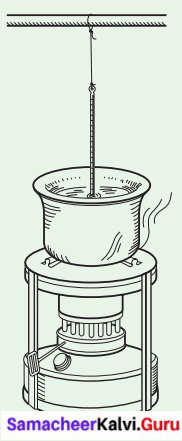
Take water in a vessel and place the vessel on a stove. Fix the thermometer as shown in figure (Caution: The thermometer should not touch the vessel in which the water is being heated. Otherwise the thermometer will be broken at high temperature.)
Samacheer Kalvi 6th Science Term 2 Chapter 1 Heat
All students have to read the temperature of the water and note the reading on the blackboard. Do you notice that the temperature is raising?
What is the temperature of water when it is boiling? _______
Answer:
The temperature of water when boiling is 100°C.

Question 2.
Does the temperature of the boiling water rise further after that?
Answer:
No. the temperature of the boiling water does not rise further after 100°C.

Guess and Write:
(Check your assumption with the help of a thermometer.)
Approximate temperature of the tea when you drink ________
Approximate temperature of cool lemon juice when you drink ________
Answer:
Approximate temperature of the tea when you drink 70°C.
Approximate temperature of cool lemon juice when you drink 20°C.

Question 3.
Is Neela correct?
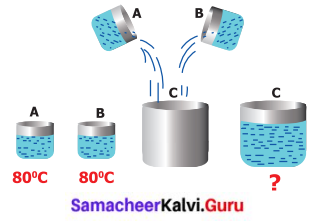
Beaker A and B has water at 80°C. Then pour the water of A and B to an empty beaker C. Now, What is the A temperature of the water in the beaker C? Neela says it will be 160°C.
6th Standard Science Heat Samacheer Kalvi Term 2 Chapter 1
What is your opinion? Does Neela say correctly? Make a guess and verify it experimentally.
Answer:
My opinion is that the temperature will not change. Approximately it will be 80°C only. Neela’s answer is wrong.
Beaker A and Beaker B has water at 80°C. So both beaker has 80°C temperature. Two beakers are in thermal equilibrium. So heat is not transfered to other objects.

Activity 3

Question 1.
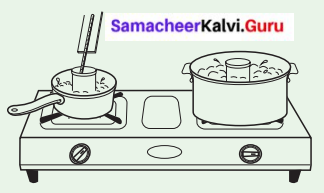
Take one litre water in a pan, and heat it on a stove. Calculate the time taken to start boiling, (i.e. the time taken to thermometer reading goes up to 100°C). Take five litre water in another pan and heat it on the same stove. Calculate the time taken by the water to start boiling.
Science Term 2 Samacheer Kalvi 6th Science Chapter 1 Heat
In which pan the water starts to boil earlier?
[ ] One litre water
[ ] Five litre water.
Answer:
[✓] One litre water

Question 2.
Both, however, show a temperature of 100°C at the boiling point. Five litre water takes more time to boil i.e. more heat is needed to boil the larger amount of water. So, five litre boiling water has more heat energy than one litre water. Place an open can of lukewarm water in each pan. Observe their temperature to find out which can gets hotter.
In which can water shows quick rise in temperature?
[ ] Can in One litre boiled water
[ ] Can in five litre boiled water.
Answer:
[✓] Can in five litre boiled water.

Question 3.
You can see that, five litre water pan will raise the can of water to a higher temperature. Though, both pans of boiling water have the temperature of 100°C the five litre water can give off more heat energy than one litre water. Because it has more heat energy, and gives more energy to the water in the can.
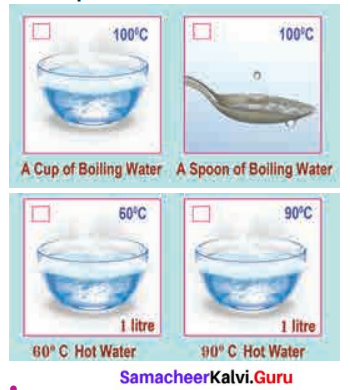
Which has more heat energy in each pair? Put ✓ mark.
Samacheer Kalvi Guru 6th Science Term 2 Chapter 1 Heat
The temperature determines the direction of flow of heat.

Question 1.
You are holding a hot cup of coffee, would the Heat energy transfer from
6th Science Heat Lesson Samacheer Kalvi Term 2 Chapter 1
(a) Your body to the coffee, or
(b) The coffee to your body?
Answer:
(b) The coffee to your body

Question 2.
You are standing outside on a summer day. It is 40°C outside (note that normal body temperature is 37°C). Would the Heat energy transfer from.
Samacheer Kalvi 6th Science Guide Term 2 Chapter 1 Heat
(a) Your body to the air particles, or
(b) The air particles to your body?
Answer:
(b) The air particles to your body

Question 3.
You are standing outside on a winter day. It is 23°C outside. Would the heat’ energy transfer from:
Samacheer Kalvi 6th Science Term 2 Chapter 1 Heat
(a) Your body to the air particles, or
(b) The air particles to your body?
Answer:
(a) Your body to the air particles

Activity 4
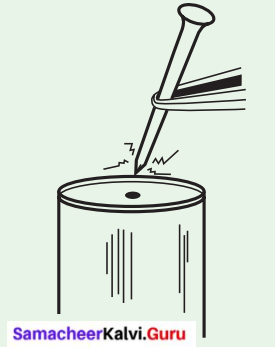
Hammer a nail into a tin can. Ease the nail out. Put it in again to make sure that the hole is large enough for the nail. Then, holding the nail with a pair of pliers, scissors or forceps, heat the nail over a candle, in hot water, or over the stove. Try to put it into the hole in the can.
Samacheer Kalvi 6th Science Solution Term 2 Chapter 1 Heat
I see that: ________________________________
Answer:
I will see that, now it is hard to put the nail into the hole. Heat expands solids.
The molecules in the solid move faster, spread apart and occupy more space.

Activity 5

Question 1.

Linear Expansion
Take a bulb, dry cell, candle, cycle spoke, coin (or broad – headed nail) and two wooden blocks.

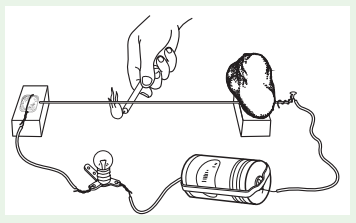
Place one end of the cycle spoke on a wooden block and connect an electric wire to it. Put a stone over the spoke) to hold it firmly in place on the wooden block, as shown in Figure . The spoke should be parallel to the ground. Place the second wooden block under the free end of the spoke. Wrap some electric wire around the coin (or nail) and place it on the block. You may put a stone over the coin to hold it in place.6th Science Samacheer Kalvi Term 2 Chapter 1 Heat
Connect a bulb and dry cell to the free ends of the wires connected to the coin and the spoke and make the circuit shown in the figure.

When the tip of the free end of the spoke touches the coin, the circuit is completed and the bulb lights up. Check to ensure this. If the bulb does not light up, it means the circuit is not complete, so check your connections properly. (Note: We will learn about electric circuit elaborately in electricity lesson.) Now slide a page of your book between the coin and spoke and then slide it out. That way you would get a gap between the coin and spoke equal to the thickness of the sheet of paper,

  1. Does the bulb light up? If it does not, what could be the reason? ___________________
    You saw that the bulb does not light up when the spoke does not touch the coin. Now light the candle and heat the spoke with it.
  2. Did the bulb light up after the spoke was heated for some time?
  3. If it did, then explain how the spoke touched the coin after it was heated.
  4. Why does the bulb go off some time after the candle is taken away from the spoke?
  5. What happens to the length of the spoke when it is heated or cooled?

Answer:

  1. The bulbs is not light up, because, the coin and the spoke do not touch it. The circuit is not completed.
  2. Yes, the bulb is light up, because the spoke is heated the circuit is completed.
  3. When the spoke is heated, it will be expanded. Here, linear expansion takes place. So it touched the coin.
  4. After removing the candle, the spoke does not get the heat. The spoke is returned to its original state. So it does not touch the coin once again and the bulb goes off.
  5. The length of the spoke is expanded when the spoke is heated.

Activity 6

Question 1.
Cubical Expansion
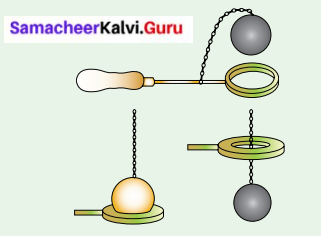
Take a metal ring and metal ball of such size that the ball just passes through the ring.
Heat the ball and check whether it passes through the ring.
Samacheer Kalvi 6th Science Guide Term 2 Chapter 1 Heat
[ ] Passed through
[ ] Not passed through
Answer:
[✓] Not passed through

Question 2.
Now let the ball cool down, and check whether it passes through the ring.
[ ] Passed through
[ ] Not passed through
Answer:
[✓] passed through
Solids expand due to heat and come back to the original state if heat is removed.

Give Reasons for the following

Question 1.
Gaps are left in between rails while laying a railway track.
Answer:
6th Science Term 2 Samacheer Kalvi Chapter 1 Heat
In summer days, the temperature rises and the rails expand. So, in order to allow expansion at the joints of the rails, a small gap is left in between the rails, while laying a railway track. If such a gap is not left at the joints of the rails, the track will get deformed due to thermal expansion. It will cause derailment of trains.

Question 2.
Gaps are left in between two joints of a concrete bridge.
Answer:
Heat Class 6 Samacheer Kalvi Term 2 Chapter 1 Heat
The gaps in the concrete bridges are knows as expansion joints, Expansion joints are basically gaps in the bridge that allow the bridge to expand (during summer) and contract (during winter). Without these gaps, the bridge will fall apart.

Question 3.
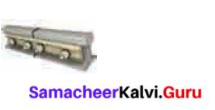
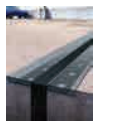
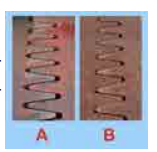
The photographs below show an expansion joint at the end of a bridge in winter and in summer. Which season is shown in each picture? Explain how do you know?
Samacheer Kalvi 6th Science Book Solutions Term 2 Chapter 1 Heat
Answer:
Bridges are made of concrete and steel. These components expand with higher temperature during summer and the gap is minimized in between the joints. So, summer season is shown in Picture B.

During winter, the components (concrete and steel) contract due to lower temperature. Therefore the gap is at maximum in between the joints. So, winter season is shown in Picture A.

Samacheer Kalvi 6th Science Heat Numerical problems

Question 1.
I put a kettle containing 1 litre of cold water on the gas stove, and it takes 5 minutes to reach the boiling point. My friend puts on a small electric kettle, containing 1/2 litre of cold water, and it takes 5 minutes to get up to boiling point. Which gives more heat in 5 minutes?
a. the gas supply; or
b. the electricity supply? Can you say how many times as much?
Answer:
The gas supply, Two times as much.

Question 2.
One calorie heat energy is needed to raise the temperature of the water from 30°C to 31°C. How much heat energy is needed to raise the temperature of the water from 30°C to 35°C.
Answer:
For 1°C change in temperature, heat energy needed = 1 Calorie
∴ For 5°C change in temperature heat energy needed = 5 Calories.

Samacheer Kalvi 6th Science Heat Additional Questions

I. Choose, the appropriate answer:

Question 1.
We reduce the heat by adding ________ while preparing fruit juice.
(a) sugar
(b) lime
(d) ice cubes
(d) salt
Answer:
(c) ice cubes

Question 2.
The SI unit of temperature is ………..
(a) Calorie
(b) Joule
(c) Celsius
(d) Kelvin
Answer:
(d) Kelvin

Question 3.
Our normal body temperature is _______
(a) 34°C
(b) 36°C
(c) 35°C
(d) 37°C
Answer:
(d) 37°C

Question 4.
Two tumblers of A and B have water at 50°C temperature. If the water from A and B is poured into tumbler C. The temperature of C is ………….
(a) 100° C
(b) 0° C
(c) 50° C
(d) between 0° C to 100° C
Answer:
(c) 50°

Question 5.
______ exists when two objects In thermal contact no longer affect each other’s temperature.
(a) Thermal expansion
(b) Thermal equilibrium
(c) average temperature
(d) coolness
Answer:
(b) Thermal equilibrium

SamacheerKalvi.Guru

II. Fill in the blanks:

  1. We feel heat on our body when the _______ shines.
  2. _______ energy can be generated by the burning of fuels like coal, wood, charcoal, gasoline etc.
  3. When _______ flows through a conductor, heat energy is produced.
  4. _______ is a form of energy.
  5. _______ determines the direction of flow of heat.
  6. The coldest temperature in the world was measured in the _______ continent.
  7. Temperature measures the _______ kinetic energy of molecules.

Answers:

  1. Sun
  2. Heat
  3. Electric current
  4. Heat
  5. Temperature
  6. Antarctic
  7. average

III. True or False. If False, give the correct statement:

Question 1.
The sun give us light and heat.
Answer:
True

Question 2.
We can absorb heat by rubbing two surfaces of some substances .
Answer:
False. We can generate heat by rubbing two surfaces of some substances.

Question 3.
In the past people used to rub two wooden pieces together to light fire.
Answer:
False. In the past people used to rub two stones together to light fire.

Question 4.
When we cool the object the temperature of the object will be increased.
Answer:
False. When we heat the object the temperature of the object will be increased.

Question 5.
Two objects are said to be in thermal contact if they can exchange heat energy.
Answer:
True.

Question 6.
The expansion in volume is called linear expansion.
Answer:
False. The expansion in length is called linear expansion.

IV. Match the following:

1. Source of heat(a)heat energy
2. Electric current(b)calorie
3. Gasoline(c)37°C
4. Unit of heat(d)Electric kettle
5. Human body temperature(e)sun

Answer:

  1. – e
  2. – d
  3. – a
  4. – b
  5. – c.

V. Analogy:

Question 1.
Movement of molecules : Heat.
Heat energy: _______
Answer:
calorie

Question 2.
Expansion is length : Linear expansion.
Expansion in volume : _______
Answer:
cubical expansion

Question 3.
Ordinary glass : Glass tumbler.
Pyrex glass: _______
Answer:
Laboratory glassware.

VI. Give Short Answers:

Question 1.
How can heat energy be generated?
Answer:
Heat energy can be generated by the burning of fuels like wood, Kerosene, Coal, charcoal, gasoline/petrol, oil, etc.

Question 2.
What is heat? Give its units.
Answer:

  1. Heat is an energy that raises the temperature of a thing by causing the molecules in that thing to move faster.
  2. Units are Joule, Calorie.

Question 3.
What are the units of heat used?
Answer:
SI unit of heat is Joule. The unit calorie is also used.

Question 4.
Define one calorie.
Answer:

  1. Total heat is measured by calorie.
  2. The amount of heat needed to raise one gram of water by one degree centigrade.

Question 5.
Define – Calorie.
Answer:
The amount of heat needed to raise one gram of water by one degree Centigrade.

Question 6.
What is thermal expansion?
Answer:
The expansion of a substance on heating is called the thermal expansion of that substance.

Question 7.
Differentiate linear expansion and cubical expansion.
Answer:
Linear expansion:

  1. The expansion is in length.
  2. Ex.: Expansion of railway track rod.

Cubical expansion:

  1. The expansion is in volume.
  2. Ex.: Expansion of metal ball.

Question 8.
How solids are expanded on heating?
Answer:
The molecules in the substance move faster when heating, spread apart and occupy more space. So substances expand when heated.

Question 9.
How heat energy is transferred?
Answer:
Heat energy flows from higher temperature to lower temperature.

Question 10.
What type of glassware is used in laboratories? Why?
Answer:
Pyrex glass is used in Laboratory, because pyrex glass (Borosilicate glass) do not expand much on being heated and therefore they do not crack.

VII. Answer in detail.

Question 1.
List and describe the sources of heat.
Answer:

  1. Sun: It is the primary source of light and it gives us light and heat.
  2. Combustion: Heat energy can be generated by the burning of fuels like wood, Kerosene, Coal, Charcoal, Petrol etc.
  3. Friction: We can generate heat by rubbing two surfaces of some substances. In the past people used to rub two stones together to light fire.
  4. Electricity: When Electric current flows through a conductor, heat energy is produced. Ex.: Iron box, Electric kettle.

Samacheer Kalvi 9th English Solutions Poem Chapter 4 The Spider and the Fly

You can Download The Spider and the Fly Questions and Answers, Summary, Activity, Notes, Samacheer Kalvi 9th English Book Solutions Guide Pdf Poem Chapter 4 help you to revise complete Tamilnadu State Board New Syllabus and score more marks in your examinations.

Tamilnadu Samacheer Kalvi 9th English Solutions Poem Chapter 4 The Spider and the Fly

The Spider and the Fly Warm Up:

Samacheer Kalvi 9th English Solutions Poem Chapter 4 The Spider and the Fly

The Spider And The Fly Question Answer Samacheer Kalvi 9th English Solutions Poem Chapter 4

The Spider And The Fly Question Answer Question 1.
How will you make him or her eat them?
Answer:
I will explain the nutritious value of these vegetables and how ii helps in maintaining good health.

The Spider And The Fly Book Back Answers Question 2.
What are all the flattering or tempting words you might use to convince them?
Answer:
I will say that if they eat these vegetables, it will make them healthy and smart. I will convince them by explaining that eating vegetables is a good habit and that they will be called obedient and disciplined children if they listen to good advice.

3. Work in pairs and enact that moment in front of your classmates.

The Spider and the Fly Textual Questions

A. Read the following lines from the poem and answer the questions in a sentence or two.

1. “The way into my parlour is up a winding stair,
And I’ve many curious things to show when you are there ”

Spider And The Fly Question Answer Question (a).
How to reach the spider’s parlour.
Answer:
The spider’s parlour can be reached through a winding stair.

9th English Poem The Spider And The Fly Question (b).
What will the fly get to see in the parlour?
Answer:
The fly will get to see many curious things in the parlour.

2. “Oh no, no, ” said the little Fly, “kind Sir, that cannot be,
I’ve heard what s in your pantry, and I do not wish to see! ”

The Spider And The Fly Samacheer Kalvi Question (a).
Is the fly willing to enter the spider’s pantry?
Answer:
No. The fly is not willing to enter the spider’s pantry.

The Spider And The Fly 9th Std Question (b).
Can you guess what was in the pantry?
Answer:
Only remains of dead flies may be found in the pantry.

3. “Sweet creature! ” said the Spider, “you’re witty and you’re wise,
How handsome are your gauzy wings, how brilliant are your eyes!”

Spider And The Fly Book Back Answers Question (a).
List the words used by the spider to describe the fly.
Answer:
Sweet, witty, wise, handsome, gauzy, brilliant.

The Spider And The Fly Questions And Answers Question (b).
Why does the spider say that the fly is witty?
Answer:
The spider calls the fly witty because the fly is clever to avoid entering the web.

4. The Spider turned him round about, and went into his den,
For well he knew the silly Fly would soon come back again:

The Spider And The Fly Question And Answer Question (a).
Why is the poet using the word ‘den’ to describe the spider’s web?
Answer:
The spider is like a lion in its web. So the poet uses the word.

Spider And The Fly Questions And Answers Question (b).
Why was the spider sure that the fly would come back again?
Answer:
The spider has flattered the fly of its beauty, so he was sure it would come back again.

With buzzy wings, she hung aloft, then near and nearer drew,
Thinking only of her brilliant eyes, and green and purple hue-

The Spider And The Fly Summary In Tamil Question (a).
Who does’she’refer to? ON)
Answer:
She refers to the fly.

The Spider And The Fly Poem Questions And Answers Question (b).
What was’she’thinking of? 0
Answer:
She was thinking of her beautiful eyes and the colours of her wings.

6. And now dear little children, who may this story read,
To idle, silly flattering words, I pray you never give heed:

Question (a).
Who does ‘I’ refer to?
Answer:
I refer to the poet.

Question (b).
What is the advice given to the readers?
Answer:
The poet advises us not to fall a prey to flattery and sweet words.

Additional Questions

1. “I’m sure you must be weary, dear, with soaring up so high;
Will you rest upon my little bed?” said the spider to the fly.

Question (a).
Why is the fly weary?
Answer:
The fly is weary because of the fact that it flies high up in the sky.

Question (b).
What does the spider ask the fly?
Answer:
The spider asks the fly if it will rest on his bed.

2. So he wove a subtle web, in a little corner sly,
And set his table ready to dine upon the fly.

Question (a).
What is meant by subtle?
Answer:
Subtle means delicate or faint or mysterious.

Question (b).
Pick out the rhyming words.
Answer:
The rhyming words are ‘sly’ and ‘fly’.

3. “There are pretty curtains drawn around, the sheets are fine and thin,
And if you like to rest awhile, I’ll snugly tuck you in.”

Question (а).
What do you understand by the term, ‘snugly’?
Answer:
‘Snugly’ means to be secured or have a feel of comfort.

Question (b)
Mention the figure of speech in the above lines.
Answer:
Assonance is the figure of speech employed.

For example:
The sound of ‘aw’ in drawn and around.
The vowel sound in snugly and tuck.

4. I have within my pantry good store of all that’s nice;
I’m sure you’re very welcome; will you please to take a slice?”

Question (a).
What is a pantry?
Answer:
A pantry is a storeroom for foods or wines.

Question (b).
Give the rhyming word for nice.
Answer:
The rhyming word for nice is ‘slice’.

5. Alas, alas! how very soon this silly little fly,
Hearing his wily flattering words, came slowly flitting by;

Question (a).
Why is the little fly silly?
Answer:
The little fly is silly because it came back enticed by the spider’s flattering words.

Question (b).
What is ‘wily’?
Answer:
‘Wily’ is cunning.

B. Complete the summary by filling in the spaces with suitable words.

The poem begins with the spider’s (1) …………………. of the fly. He (2) …………….. to the fly to come into its home. The spider describes his parlor as the (3) …………………. one. The spider kindles the curiosity of the fly so that she may enter his home. Fortunately, the fly was (4) ………………… and refused to get into his home. Now the spider pretends to be a (5) …………………. and asks her to come and rest in his home. He offers her (6) ……………………. and a (7) ………………….. to rest. This time also the fly (8) ………………… the spider’s offer very politely. The next weapon that the spider uses is (9) …………………. The spider praises the (10) ……………….. and (11) …………………. of the fly and also praises her (12) …………………….. He invites her to look at herself in the (13) ………………………. which is in his parlour. The fly is (14) …………….. by the words of the spider and she falls a (15) …………………… to her (16) ………………… .
Answers

  1. welcoming
  2. reaches out
  3. prettiest
  4. wise/intelligent
  5. friend
  6. sheets
  7. bed
  8. declines
  9. flattery
  10. wings
  11. eyes
  12. crest
  13. looking-glass
  14. flattered
  15. prey
  16. enticement/invitation

C. Answer the following questions in about 80-100 words.

Question 1.
Write a character sketch of the spider.
Answer:
This poem takes us through a spider’s ultimately successful attempts in enticing a fly into its web. The spider is cunning in capturing its victim. It ensnares the fly through the use of seduction and flattery. In stanza one, it does its best to trap the fly into its parlour with the promises of pretty things to see. Next, it tries a different tactics, offering the fly a pretty and a comfortable place to sleep, and lovely food. Finally, it tries to flatter the fly by praising its beauty and traps the fly into his den.

Question 2.
What happens if we fall a prey to flattery? Give instances from the poem ‘The Spider and the Fly’.
Answer:
If we fall a prey to flattery, we have to face evil consequences, just like the fly who falls a prey to the spider’s flattery and seduction. The spider uses different tactics to entice the fly into its web. It invites the fly into its parlour with the promises of pretty things to see. When the fly refuses, it entices him by offering a pretty, comfortable bed and lovely food. When the fly refuses again, finally it flatters the fly for its beautiful appearance. The fly gets flattered and gets trapped into its den. This poem teaches us that we should be cautious against those who use flattery and charm to disguise their true evil intentions.

Question 3.
In your own words, give a detailed description of:
(a) The Spider’s Parlour.
Answer:
The Spider’s Parlour had winding stairs. It is the prettiest parlour that had ever been seen by the fly. It has been filled with many pretty things, which would arouse the curiosity of the fly. There are also pretty curtains, whose sheets are fine and thin. It had a pretty and a comfortable bed.

(b) The Fly’s Appearance
Answer:
The fly had gauzy wings and brilliant eyes. But the spider flattered it saying that it had pearl and silver wings, green and purple body and its antenna is like a crown on him.

Additional Questions:

1. What are the four ways by which the spider lures the fly?
There are four ways by which the spider lures the fly:
(i) The spider invites the fly to his home.
(ii) The spider pretends to be concerned over the weary fly and offers his bed.
(iii) He tries to influence the fly to come and have a look into his pantry.
(iv) He compliments the fly’s intelligence, gauzy wings and bright eyes.
At last, the spider is successful in luring the fly.

Appreciate The Poem
Figures of speech

1. Consonance: Repetition of similar consonant sounds in the neighbouring words.
Ex: “T is the prettiest little parlour that ever you did spy;
Pick out one more instance of consonance from the poem.
Hearing his wily, flattering words, came slowly flitting by;
So he wove a subtle web, in a little corner sly.

2. Assonance: Repetition of similar vowel sounds in the neighbouring words.
Ex: “T is the prettiest little parlour that ever you did spy;
Pick out one more instance of consonance from the poem.
The spider tuned him round about and went into his den,
“I’m sure you must be weary, dear, with soaring up so high.”

3. Anaphora: Repetition of a word or a phrase at the beginning of a sequence of sentences, paragraphs and lines.
Ex: How handsome are your gauzy wings, how brilliant are your eyes!
Identify the figures of speech.
“Your eyes are like the diamond bright, but mine are dull as lead! ’’
Simile is the figure of speech.

4. Alliteration: Repetition of consonant sounds at the beginning of words.
Pick out the words in alliteration.
“Sweet creature! ” said the Spider, “you’re witty and you ’re wise,”
Sweet – Spider; and witty – wise are alliterated.

Listening

D. Listen to the passage and fill in the blanks with appropriate answers.

(For listening to the passage refer to our website www.fullcircleeducation.in) Trust is one of the most important things anyone can have in a relationship because trust is what makes the foundation of a relationship. Without trust there is no relationship at all because everything you do or make of the relationship will be based on truth. Trust is a very rare thing to find and if you are able to give it in return, your life is so much better and more fulfilling for everyone involved. Trusting people can hurt sometimes because they betray you, but you learn from the situation and move on to the next adventure in your life. Just don’t let small bumps in the road throw you back to not trusting and being cold. Simply keep moving forward and you will have a wonderfully fulfilling life that will be filled with good people that care and are trustworthy.

  1. Without trust there is no………………
  2. …………….. is a very rare thing to find in life.
  3. When people betray you learn from the………………………
  4. Don’t let ……………….. on the road…………………….
  5. If we keep moving forward you will have a wonderfully……………………..

Answers

  1. relationship
  2. Truth
  3. situation
  4. small bumps; to make you cold
  5. fulfilling life

Speaking:

E. The cunning spider was waiting for a chance to pull the fly into its web and it used all the possible ways to trap her. Have you ever been trapped by flattery to do something you did not want to do? Discuss in pairs and share your experience in the class.

A small token of appreciation definitely rejuvenates our energy. But the escalation of mood which flattery brings is quite different. It makes you land in cloud nine. Sadly one realizes the consequences at the end of all turmoil. As in the poem, it may also go to the level of costing one’s life. This kind of flattery has led me to take a wrong decision in my life once. I was born and brought up in a village. When I completed my 6th standard, my parents got an opportunity of moving to Chennai and I was all excited about it.

My cousin, who was not happy with this, came and persuaded me to stay in the village. She said that I was very brilliant and would be a role model to all other students, but in Chennai I wouldn’t be appreciated so much. She said I would be happier, healthier and would have more fun here rather than in the city since all the village people really liked me. Due to her influence, I asked my parents to leave me and go to Chennai.

Before 1 could realize that it was a trap, my parents had left and I had to stay in the village for another 2 years missing my parents and the luxuries of Chennai city. This poem reminded me of that experience from which I have learned my lesson, not to fall prey to flattery.

Writing:

F. The fly gives into flattery and becomes the spider’s prey. If you are asked to give a happy ending to the poem, how will you save the fly? Write in your own words.

Finally, the fly, mesmerized by the words spoken by the spider about her beauty, flies towards the web. But before she could enter it, the fly’s friend arrives and sees what a dreadful trap she is going .to fall into. She immediately comes in front of her and stops her from entering the web. The fly regaining her consciousness, realizes what a foolish thing she was going to do and thanks her friend for saving her life.

The Spider and the Fly by Mary Botham Howitt About The Poet:

Mary Botham Howitt (1799 – 1888) was an English poet. She was born at Coleford, in Gloucestershire. She was home-schooled and read widely. She commenced writing verses at an early age. In 1821, she married William Howitt and began a career of joint authorship with him. William and Mary were associated with many important literary figures of the day including Charles Dickens, Elizabeth Gaskell and Elizabeth Barrett Browning. In 1837, she started writing her well-known tales for children, a long series of books which met with signal success. She received a silver medal from the Literary Academy of Stockholm. Together with her husband William Howitt she wrote over 180 books.

The Spider and the Fly Summary:

The Spider And The Fly Book Back Answers Samacheer Kalvi 9th English Solutions Poem Chapter 4

‘The Spider and the Fly’ teaches the reader not to be misled by flattery and be trapped. Here a spider lures a fly to enter its web, upon which he can feast upon her. He invites the little fly to enter its pretty parlour using the winding stairs, since there are so many curious things to see there. The fly refuses by saying that whoever enters the parlour can never be freed.

The spider further persuades the fly saying that she must be tired by flying so high and that she can come and take rest in his bed. For this, the fly replies that she has heard that whoever sleeps in his bed never wakes up again. The spider then tries to tempt the fly asking her to come and see his pantry where all nice things are available for her to taste and see.

The fly answers the spider saying 1 have already heard what is available in your pantry and I am not willing to see them. When all the attempts failed, the spider praises the fly saying that she is very witty and wise, with her gauzy wings and brilliant eyes. He asks her to come and have a look in the mirror that he has in his parlour. For this the fly thanks him and says she will come some other day. The spider knowing that the fly has been flattered, and will surely come to his web, makes ready his table to dine upon the fly.

Then the spider comes out and starts to sing merrily describing the beautiful features of the fly once again comparing it with his. After hearing these words, the fly cannot resist herself from thinking about her beauty and falls into the spider’s web. The spider quickly grabs her and traps her in his den from where she never comes out. The poet now asks the little children not to fall a prey to such silly, flattering words and also, never listen to an evil counselor.

The Spider and the Fly Glossary:

Textual:
counsellor – a person who advises
flattering – to praise or compliment insincerely
pantry – a room where beverages, food, dishes are stored
parlour – a tidy room in a house used for entertaining guests
subtle – delicate or faint and mysterious
weary – very tired, especially from hard work
winding – a twisting movement or course

Samacheer Kalvi 7th English Solutions Term 1 Supplementary Chapter 1 On Monday Morning

Students can Download English Lesson 1 On Monday Morning Questions and Answers, Summary, Notes Pdf, Activity, Samacheer Kalvi 7th English Book Solutions Guide Pdf helps you to revise the complete Tamilnadu State Board New Syllabus and score more marks in your examinations.

Tamilnadu Samacheer Kalvi 7th English Solutions Term 1 Supplementary Chapter 1 On Monday Morning

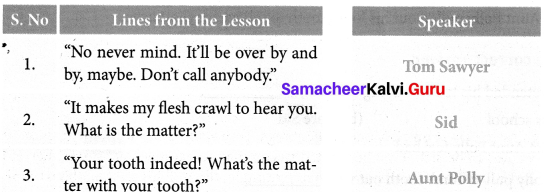
A. Name the speaker.
Answer:

On Monday Morning Samacheer Kalvi 7th English Solutions Term 1 Supplementary Chapter 1

B. Write True or False against each statement.

  1. Tom enjoyed Monday mornings as he had to go to school.
  2. Toms first groan woke up Sid from his sound sleep.
  3. Tom wanted to give his dog with one eye to the new girl who had come to town.
  4. Aunt Polly sent Sid to fetch the dentist.

Answer:

  1. False
  2. False
  3. False
  4. False

C. Read the following passage and answer the questions.

Tom lay thinking. Presently it occurred to him that he wished he was sick; then he could stay home from school. He examined himself. He found no symptoms or sickness, and he investigated again. This time he felt he had a stomach ache, but it soon grew feeble, and presently died wholly away. He reflected further.

Question with Answers:

On Monday Morning Question 1.
Why did Tom wish that he were sick?
Answer:
Tom wished he was sick so that he could stay home from school.

Monday Morning Questions And Answers Question 2.
What was the result of Tom’s self-examination?
Answer:
Tom found no symptoms of sickness after he self-examined himself.

On Monday Morning Supplementary Summary Question 3.
What did he detect?
Answer:
Tom detected that he had a stomach ache.

D. Think and answer.

On Monday Morning Questions And Answers Question 1.
How did Sid show his affection towards Tom?
Answer:
Tom’s groans made Sid’s flesh to crawl. When he thought that Tom was dying, and flew to call Aunt Polly quickly.

On Monday Morning Supplementary Questions And Answers Question 2.
Did Aunt Polly believe Tom’s groaning? Why?
Answer:
No, Aunt Polly did not believe Tom’s groaning because his toe was not sore and he was not in a dying state.

On Monday Morning Question Answer Question 3.
What did Aunt Polly do to relieve Tom’s toothache?
Answer:
Aunt Polly pulled out his loose tooth to relieve his toothache.

E. Choose the correct answer.

On Monday Morning Book Back Answers Question 1.
Tom pretended his toe was dying in order to __________
(a) miss school
(b) scare Sid
(c) make Aunt Polly feel bad
Answer:
(a) miss school

On Monday Morning Supplementary Question 2.
Aunt Polly pulled Tom’s tooth out with __________
(a) her fingers
(b) a pair of pliers
(c) a piece of thread
Answer:
(c) a piece of thread

Monday Morning Questions And Answers Pdf Question 3.
Tom was miserable on Monday morning because __________
(a) he was sick
(b) he hated going to school
(c) Aunt Polly was sick
Answer:
(b) he hated going to school

Project

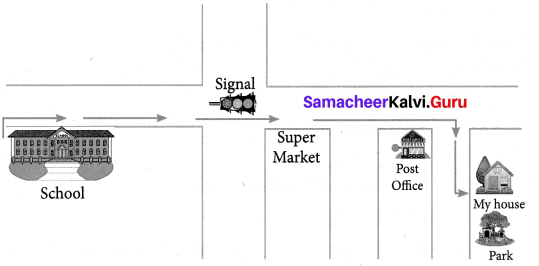
F. Give instructions to your friend to reach your house from school. Mention some landmarks that your friend should lookout for on his way. Draw a road map with landmarks based on the instructions given to your friend.
Answer:
Dear Kiran, Come to my home today after school.
As you step out of the school, turn right and walk till you reach the signal. Cross the road and walk further passing the Reliance Super Market in the corner. Turn the second right next to the Post office. The third house on the left, beside the park with door number 16 is my house.

Monday Morning Questions And Answers Samacheer Kalvi 7th English Solutions Term 1 Supplementary Chapter 1

Connecting To Self

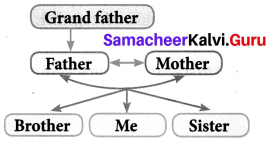
G. Draw a family tree showing the members of your family and write a sentence about the activities that your whole family does together. How does it help others in a family and what do you learn from this?
Answer:

On Monday Morning Supplementary Summary Samacheer Kalvi 7th English Solutions Term 1 Chapter 1

Step To Success

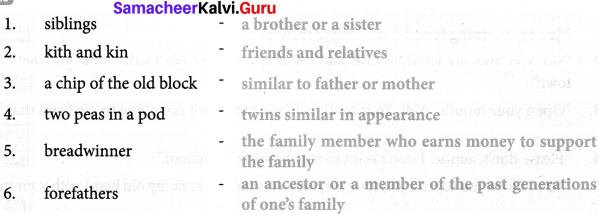
H. Give a relationship term for the clues given
Answer:

On Monday Morning Questions And Answers Samacheer Kalvi 7th English Solutions Term 1 Supplementary Chapter 1

I. Arrange the words according to their degrees of meaning

  1. eager, thrilled, excited
  2. old, aged, senior
  3. small, tiny, minute
  4. worried, panicked, anxious

Answer:

  1. excited, thrilled, eager
  2. fruifar senior, old, aged
  3. small, tiny, minute
  4. anxious, worried, panicked

J. Think and Answer

Monday Morning Summary Question 1.
X and Y are parents to Z. But Z is not the son of X.
Then what is Z to X?
Answer:
Daughter

On Monday Morning Supplementary In Tamil Question 2.
Meera’s brother is the father of Aakash.
Then how is Aakash related to Meera?
Answer:
Aunt

On Monday Morning Additional Questions

I. Choose the Correct Answers (MCQ)

On Monday Morning 7th Standard Question 1.
It occurred to Tom that he was ______; then he could stay home from school
(a) sick
(b) dead
(c) happy
Answer:
(a) sick

Monday Morning Lesson Summary Question 2.
Tom groaned louder, and fancied that he began to feel pain in the ______
(a) tooth
(b) stomach
(c) toe
Answer:
(c) toe

7th Standard English On Monday Morning Question 3.
“Why, what’s the matter, Tom? I must call ______
(a) Mary
(b) auntie
(c) Sid
Answer:
(b) auntie

Question 4.
The old lady laughed a little, then ______ a little, then did both together.
(a) screamed
(b) cried
(c) clapped
Answer:
(b) cried

Question 5.
So all this row was because you thought you’d get to stay home from school and go ______ ?”
(a) fishing
(b) shopping
(c) playing
Answer:
(a) fishing

II. Identify the Character / Speaker.

  1. “Tom, why didn’t you wake me sooner?”
  2. “Tom, what a turn you did give me”.
  3. “I forgive you for everything, Sid”.
  4. “Mary get me a silk thread, and a chunk of fire out of the kitchen”.
  5. “Oh, auntie, my sore toe’s dying!”

Answer:

  1. Tom’s brother Sid
  2. Aunt polly
  3. Tom
  4. Aunt pollyTom
  5. Tom

III. Write True or False against each statement.

  1. Monday morning found Tom Sawyer miserable.
  2. “Sid, you give my window-sash and my dog with one eye to that new girl that’s come to town”.
  3. “Open your mouth. Well. Your tooth is loose, but your’e not going to die from that.”
  4. “Please don’t, auntie. I don’t want to stay home from school.”
  5. “Tom, I love you so, and you try every way you can to break my old hand with your mischief?’

Answer:

  1. True
  2. False
  3. True
  4. True
  5. False

IV. Very Short Questions with Answers.

Question 1.
What did Tom compared his school to?
Answer:
Tom compared his school to a prison.

Question 2.
Was Tom really sick?
Answer:
No, Tom was not actually sick

Question 3.
What did Sid tell Aunt about Tom?
Answer:
Sid told aunt that Tom was dying.

Question 4.
With whom did Aunt go upstairs to see Tom?
Answer:
Aunt went upstairs with Sid and Mary.

Question 5.
What were the dental instruments?
Answer:
A silk thread and a chunk of fire were the dental instruments.

Question 6.
What did Tom want to do by staying home from school?
Answer:
Tom wanted to stay home from school and go for fishing

V. Short Questions with Answers.

Question 1.
What were the three sickness Tom had planned to suffer from?
Answer:
Tom planned to suffer from stomach ache, sore toe and toothache.

Question 2.
How did Tom try to wake up Sid?
Answer:
Tom made successive loud groans, panted with exertions and snored. When this did not wake up Sid, he called Sid and shook him.

Question 3.
Why did Aunt Polly cried and laughed together?
Answer:
Aunt Polly cried with relief that nothing was wrong with Tom. She laughed thinking of the prank played by Tom once again.

VI. Paragraph Questions with Answers.

Question 1.
How did Aunt Polly extract Tom’s tooth?
Answer:
Aunt Polly fastened one end of the silk thread to Tom’s tooth with a loop and tied the other to the bedpost. Then she caught hold of the chunk of fire and suddenly pushed it almost into Tom’s face. The tooth now was hanging loosely by the bedpost.

Question 2.
Did Sid believe that Tom was sick? Justify.
Answer:
Yes, Sid believed that Tom was very sick. Anxious Sid, called Tom and shook him. He felt bad for not helping Tom who was suffering for hours. He assured Tom that he would not die and rushed to call Aunt Polly to save Tom from dying.

VII. Rearrange the Jumbled Sentences.

1.“What is the matter with you child?”.
2.Tom groaned and fancied to feel pain in the toe.
3.“You seem to try every way you can to break my old heart with your mischief’
4.The tooth was hanging loosely by the bedpost.
5.He wished he was sick to stay home from school.
6.Monday morning found Tom Sawyer miserable.
7.”Tom you aren’t dying, are you?”
8.“Oh, Aunt Polly, come! Tom’s dying!”
9.“One of them is loose, and it aches perfectly awful”
10.“I don’t want to stay home from school.”
Answer:
6.Monday morning found Tom Sawyer miserable.
5.He wished he was sick to stay home from school.
2.Tom groaned and fancied to feel pain in the toe.
7.”Tom you aren’t dying, are you?”
8.“Oh, Aunt Polly, come! Tom’s dying!”
1.“What is the matter with you child?”
9.“One of them is loose, and it aches perfectly awful”.
10.“I don’t want to stay home from school.”
3.“You seem to try every way you can to break my old heart with your mischief.”
4.The tooth was hanging loosely by the bedpost.

VIII. Read the passage and answer the questions.

A.
Monday morning found Tom Sawyer miserable. Monday morning always found him so because it began another week’s slow suffering in school. He generally began that day with wishing he had had no holiday in between, he made the going into prison again so much worse.

Question 1.
Why were Monday mornings miserable for Tom?
Answer:
Tom hated to go to school on Monday mornings. So he felt miserable.

Question 2.
How was Tom’s experience about going to school all the week?
Answer:
It was a week long slow suffering in school for Tom.

Question 3.
What was going to school compared to by Tom?
Answer:
Going to school was compared to going into a prison by Tom.

B.
The old lady made one end of the silk thread fast to Tom’s tooth with a loop and tied the other to the bedpost. Then she caught hold of the chunk of fire and suddenly pushed it almost into the boy’s face. The tooth was hanging loosely by the bedpost, now.

1 .The old lady tied one end of the silk thread to Tom’s tooth. Where did she tie the other?
Answer:
She tied the other end to the bedpost.

Question 2.
Did the old lady push the chunk of fire into Tom’s face?
Answer:
No. The old lady almost seem to do it but she did not actually push it.

Question 3.
How was the tooth pulled out?
Answer:
When the old lady went towards Tom with the hot chunk of fire, he feared it would hurt his face and tried to move away. When he moved, his tooth tied to the thread got pulled.

C.
“Tom, why didn’t you wake me sooner? Oh, Tom, DON’T! It makes my flesh crawl to hear you. What is the matter?”
“I forgive you for everything, Sid. (Groan.) Everything you’ve ever done to me. When I’m gone »
“Oh, Tom, you aren’t dying, are you?

Question 1.
Why did Sid feel that Tom should have woken him sooner?
Answer:
Sid felt that if Tom had woken him up earlier, he could had prevented Tom’s condition becoming bad.

Question 2.
Why did Tom ask forgiveness to Sid for everything he had done to him?
Answer:
Tom pretended to ask forgiveness as his death bed confession.

Question 3.
“When I’m gone”. What does Tom mean by these words?
Answer:
Tom’s words mean that he would be dead soon.

On Monday Morning Summary

Tom felt like going to prison on all Monday mornings. Tom wanted to stay home from school so he lay in bed and wished to be sick. First he wanted to complain of stomach ache and later of loose tooth, but he changed his mind as he was afraid that his aunt would pull his teeth and hurt him.

Tom had earlier known that an injured toe can keep one in bed for even three weeks. So he lifted his sore toe up and started to groan loudly in imaginary pain, to wake up Sid sleeping beside him. Finally Sid woke thinking Tom was really suffering for hours. Sid was upset with Toms condition, who started to confess his sins as if he was about to die.

Sid flew down to call Aunt Polly quickly to save Tom. Aunt Polly hurried upstairs trembling. Soon she understood Tom was pretending of‘dying sore toe’. So Tom now told it was awful aching of loose tooth.

When Aunt Polly got ready to pull his tooth with a silk thread and a chunk of fire, Tom panicked and confessed that it doesn’t hurt him anymore and he would go to school and not for fishing.

Old Aunt Polly loved mischievous Tom though he tries to break her heart often. She pulled his tooth in a crude way and relieved his toothache.

Samacheer Kalvi 7th Social Science History Solutions Term 2 Chapter 1 Vijayanagar and Bahmani Kingdoms

You can Download Samacheer Kalvi 7th Social Science Book Solutions Guide Pdf, Tamilnadu State Board help you to revise the complete Syllabus and score more marks in your examinations.

Tamilnadu Samacheer Kalvi 7th Social Science History Solutions Term 2 Chapter 1 Vijayanagar and Bahmani Kingdoms

Samacheer Kalvi 7th Social Science Vijayanagar and Bahmani Kingdoms Textual Evaluation

I. Choose the correct answer:

Vijayanagar And Bahmani Kingdom Question And Answer Question 1.
Who was the greatest ruler of Sangama Dynasty? .
(a) Bukka
(b) Devaraya II
(c) Harihara II
(d) Krishna’Devaraya
Answer:
(b) Devaraya II

Vijayanagar And Bahmani Kingdom Question And Answer Pdf Question 2.
Which was the most common animal depicted on the pillars of Vijayanagara style?
(a) Elephant
(b) Horse
(c) Cow
(d) Deer
Answer:
(b) Horse

Vijayanagar And Bahmani Kingdoms Question And Answer Question 3.
Who was the last ruler of the Sangama Dynasty?
(a) Rama Raya
(b) Tirumaladeva Raya
(c) Devaraya II
(d) Virupaksha Raya II
Answer:
(d) Virupaksha Raya II

Vijayanagar And Bahmani Kingdom Question And Answer Pdf In Tamil Question 4.
Who ended the Sultanate in Madurai?
(a) SaluvaNarasimha
(b) Devarayall
(c) Kumara Kampana
(d) Tirumaladeva Raya
Answer:
(c) Kumara Kampana

The Structure Of Governance In Vijayanagara Kingdom Question 5.
Name the Bahmani King who was a linguist and a poet.
(a) Ala-ud-din Hasan Shah
(b) Muhammad I
(c) Sultan Firoz
(d) Mujahid
Answer:
(c) Sultan Firoz

II. Fill in the Blanks

  1. ___________ was the capital of Aravidu dynasty.
  2. Vijayanagar emperors issued a large number of gold coins called ___________
  3. Mahmud Gawan used ___________chemists to teach the preparation and use of gunpowder.
  4. In Vijayanagara administration ___________ looked after the affairs of villages.

Answers:

  1. Penukonda
  2. Varahas
  3. Persian
  4. Gaudal

III. Match the Following

Vijayanagar And Bahmani Kingdom Class 7 Question 1.

  1. Vijayanagara – Ruler of Odisha
  2. Prataparudra – Astadiggajas
  3. Krishna Devaraya – Pandurangamahatyam
  4. Abdur Razzaq – City of victory
  5. Tenali Ramakrishna – Persian emissary

Answer:

  1. Vijayanagara – City of victory
  2. Prataparudra – Ruler of Odisha
  3. Krishna Devaraya – Astadiggajas
  4. Abdur Razzaq – Persian emissary
  5. Tenali Ramakrishna – Pandurangamahatyam

IV.

Vijayanagara Match The Following Question 1.
Assertion (A): The Vijayanagar army was considered one of the feared armies in India.
Reason (R): Vijayanagar armies used both firearm and cavalry.
(a) R is not the correct explanation of A
(b) R is correct explanation of A
(c) A is correct and R is wrong
(d) (A) and (R) are Correct
Answer:
(b) R is correct explanation of A

In Vijayanagar Administration Looked After The Affairs Of Village Question 2.
Find’out the wrong pair
(a) Silk – China
(b) Spices – Arabia
(c) Precious stone – Burma
(d) Madurai Vijayam – Gangadevi
Answer:
(b) Spices – Arabia

Question 3.
Find the odd one out
Harihara II, Muhammad I, Krishnadeva Raya, Devaraya I
Answer:
Muhammad I

Question 4.
Consider the following statements and find out which is/are correct
I. Turquoise throne is one of the bejewelled royal seats of Persian kings described in Firdausi’s Shah Nama.
II. The fertile regions between the rivers Krishna and Tungabhadra and Krishna-Godavari delta were the zones of conflict among the rulers of Vijayanagar, and Bahmani.
III. Muhammad I was educated at Multan.
IV. Mahmud Gawan served with great distinction as the Prime Minister under Muhammad III.
(a) I, II, are correct
(b) I, II, III are correct
(c) II, III, IV are correct
(d) III, IV, are correct
(e) I, II & IV are correct
Answer:
(e) I, II & IV are correct

V. True or False

  1. Harihara and Bukka were the founder of Bahmani kingdom.
  2. Krishnadeva Raya, who reigned for 20 years, was the most illustrious rulers of Sangama dynasty.
  3. Alasani Peddana was the greatest of all Astadiggajas.
  4. Kingship of Vijayanagar administration was hereditary, based on the principle of primo geniture.
  5. There were 18 monarchs of the Bahmani dynasty.

Answers:

  1. False
  2. False
  3. True
  4. True
  5. True

VI. Answer in one or two sentences

Question 1.
The four dynasties of Vijayanagara kingdom with reference to prominent rulers of each dynasty.
Answer:
Four dynasties, namely

  1. Sangama (1336-1485)
  2. Saluva (1485-1505)
  3. Tuluva (1505-1570)
  4. Aravidu (1570-1646) ruled this kingdom.

Question 2.
Battle of Talikota.
Answer:
The sultans of Deccan kingdoms formed a league to fight the Vijayanagar Empire. The combined forces of the enemies met at Sadasiva Raya Talikota in 1565. In the ensuing battle, known as Rakasa Tangadi (Battle of Talikota), Vijayanagar was defeated.

Question 3.
The structure of governance in Vijayanagar kingdom.
Answer:

  1. The empire was divided into different mandalams (provinces), nadus (districts), sthalas (taluks) and finally into gramas (villages).
  2. Each province was administered by a governor called Mandalesvara.
  3. The lowest unit was the village. Each village had a grama sabha. Gauda, village headman, looked after the affairs of the village.
  4. The army consisted of the infantry, cavalry and elephant corps.

Question 4.
five independent kingdoms of Deccan Sultanate.
Answer:
Bidar, Bijapur, Ahmednagar, Berar and Golconda.

Question 5.
The educational reforms of Ala-ud-din Hasan Shah
Answer:
Alaud-din Hasan Shah on his accession, took special care in founding a school to educate his sons and opened institutions for the purpose of educating the children of noble families in the art of soldiery.

VII. Answer in detail

Question 1.
Discuss the career and achievements of Krishna Devaraya.
Answer:
(i) Krishnadevaraya who reigned for 20 years was the most illustrious rulers of the Tuluva dynasty.

(ii) He brought under control the independent chieftains in the Tungabhadra river basin.

(iii) The Bahmani sultan, Mahmud Shah, had been overthrown and kept in imprisonment by his minister. Krishnadevaraya freed the sultan and restored him to the throne. Prataparudra negotiated for peace and offered to marry off his daughter to him.

(iv) Accepting the offer, Krishnadevaraya returned the territory he had conquered from Prataparudra.

(v) Krishnadevaraya, with the assistance of the Portuguese gunners, could easily defeat the Sultan of Golconda and subsequently take over Raichur from the ruler of Bijapur.

A Great Builder:

(i) Krishnadevaraya built huge irrigation tanks and reservoirs for harvesting rainwater.

(ii) He built the famous temples of.Krishnaswamy, Hazara Ramaswamy and Vithalaswamy in the capital city of Hampi.

(iii) He distributed the wealth he gained in wars to all major temples of South India for the purpose of constructing temple gateways (gopura), called ‘Rayagopuram,’ in his honour.

(iv) He had good friendly relationship with the Portuguese and Arabian traders, which increased the Empire’s income through customs.

Patron of Literature, Art and Architecture:
Krishnadevaraya patronised art and literature. Eight eminent luminaries in literature known as astadiggajas adorned his court.

VIII. HOTs

Question 1.
Discuss the causes for the decline of Vijayanagar rule. To what extent the Bahmani sultans contributed to it?
Answer:
The main causes of the decline of the Vijayanagar empire were
(i) The military ambitions of the Vijayanagar rulers and Deccan sultan resulted in shifting alignment.

(ii) In the battle of Talikota, the Vijayanagar empire was completely defeated. Both the Vijaya nagar and Bahamani kingdoms claimed Raichur doab lying between Krishna and Tungabadhra because of its fertile rich land. Both wanted to conquer Golconda because of its gold mines. Both the powers descried to extend their. Kingdom and had religious jealousy. Each considered the other as a danger to its existence.

IX. Map

Question 1.
Highlight the boundaries of Vijayanagar Empire and Bahmani kingdom.
Answer:
Vijayanagar And Bahmani Kingdom Question And Answer Samacheer Kalvi 7th Social Science History Solutions Term 2 Chapter 1

X. Answer Grid

Question 1.
Name the kingdom ruled by 18 monarchs which lasted for nearly 180 years.
Answer:
Bahmani

Question 2.
Name the Bahmani Sultan who was restored to the throne by Krishna Devaraya
Answer:
Mahmud Shah

Question 3.
Name the book written by Krishnadevaraya in Sanskrit.
Answer:
Jambavati Kalyanam

Question 4.
Where did Hasan Bahman Shah shift his capital.
Answer:
Gulbarga

XI. Student Activity

Question 1.
Collect information about temples in Tamil Nadu with the influence of Vijayanagara style of art and architecture. Also read the stories of Tenali Ramakrishna in the classroom.
Answer:
Temple architecture received a new impetus and reached to new heights under the patronage of the Vijayanagar rulers. About the architecture of the period. Prof. S.K. Saraswati has observed, “The most frequent design is one in which the shaft becomes either a central core or background for a group of statuary, of substantial proportion and carved practically on the ground. Important features of Vijayanagar style of temple and architecture were: monolithic pillars, ornate brackets, decoration on exterior side of the walls, etc.
Vijayanagar And Bahmani Kingdom Question And Answer Pdf Samacheer Kalvi 7th Social Science History Solutions Term 2 Chapter 1
A large number of temples were built during this period. Krishnadevaraya built a temple dedicated to Lord Krishna. He renovated several temples. The most important was the temple of Hazara Rama. The royal family worshipped there. Its most interesting features were the four finely polished black stone pillars which support the ‘Mandapa’.

They have beautiful sculptures carved on them. The deities on the pillars represent Vishnu, Lakshminarayana, Krishna, Brahma and others. Scenes from the lipics are depicted on the outer walls of the shrine.

A number of temples were built during the medieval period in the South cities of Vellore, Kumbhakonam, Kalahsti. Srirangam, Conjeevam and Virinchipuram were dotted with magnificent temples.

The temples of Vithala and Pattabhirama also deserve mention. The most important features of the temple of Vithala are the ‘Mahamandappa’ and the ‘garbhagriha’. The Mahamandappa has 56 pillars. The ceilings above these pillars are highly ornamented. Likewise ‘garbhagriha’ is highly ornate:

A ‘rath’ in stone with finely carved wheels adds beauty to Vitthalaswami temple.

‘Gopurams’ – the entrances to the courts of the temples are a unique feature of the south Indian temples, particularly built during the medieval period. These colossal gateways which lend glamour and prestige to the temples were covered by lofty pyramidal tower rising up in storeys and ultimately crowned by a lofty vault. The ‘gopuram’ in the temple of Ekambaranath having ten storeys rising to the height of 188 feet is the most remarkable one.

Samacheer Kalvi 7th Social Science Vijayanagar and Bahmani Kingdoms Additional Questions

I. Choose the correct

Question 1.
The _______ kingdom spread all over the Maharashtra region and partly over karnataka.
(a) Bahmani
(b) Chola
(c) Chera
(d) Vijayanagar
Answer:
(a) Bahmani

Question 2.
Harihara and Bukka belonged to the _______ dynasty.
(a) Saluva
(b) Sangama
(c) Aravidu
(d) Tuglaq
Answer:
(b) Sangama

Question 3.
After _______, the Vijayanagar empire went through a crisis.
(a) Harihara II
(b) Virupaksha Raja II
(c) Devaraya II
(d) Gajapathi
Answer:
(c) Devaraya II

Question 4.
_______ was the Gajapathi ruler of Odisha.
(a) Saluva Narasimha
(b) Bukka
(c) Naras Nayaka
(d) Prataparudra
Answer:
(d) Prataparudra

Question 5.
_______ was the minor who ascended the throne of Vijayanagar.
(a) Achtyuda Raya
(b) Sadasiva Raya
(c) Venkata I
(d) Rama Raya
Answer:
(b) Sadasiva Raya

Question 6.
The site of the city of Vijayanagar on the bank of the river _______.
(a) Krishna
(b) Narmada
(c) Godavari
(d) Tungabhadra
Answer:
(d) Tungabhadra

Question 7.
_______ of the Aravidu dynasty moved to Chandragiri carrying all the treasures and wealth.
(a) Rama Raya
(b) Sadasiva Raya
(c) Tirumaladeva Raya
(d) Achtyda Deva Raya
Answer:
(c) Tirumaladeva Raya

Question 8.
Vijayanagar’s agricultural production was supplemented by humerous _______ industries.
(a) cottage-scale
(b) large-scale
(c) medium-scale
(d) small-scale
Answer:
(a) cottage-scale

Question 9.
_______ succeeded Bahman shah.
(a) Ala-ud-din Hasan
(b) Muhammad bin Tughluq
(c) Muhammad Shah I
(d) Mujahid
Answer:
(c) Muhammad Shah I

Question 10.
_______ was the noteworthy ruler of the Bahmini kingdom who ruled for 19 years.
(a) Muhammad III
(b) Muhammad II
(c) Maljahid
(d) Muhammad shah
Answer:
(a) Muhammad III

II. Fill in the blanks:

  1. In 1565, the battle of _________, finally the Deccan kingdoms could crush the Vijayanagar empire.
  2. _________, was the head of the Saivitc Sringeri mutt.
  3. _________ was the able commander of the Vijayanagar army.
  4. Battle of Talikota was also known as _________.
  5. Hampi is in ruins and the _________ has declared it a heritage stat
  6. In Vijayanagar administration, each province was administrated by a governor called _________.
  7. Krishna deva Raya wrote _________ an epic in Telugu
  8. _________ was the daughter of Periazhvar.
  9. Ala-ud-din Hasan was also known as _________.
  10. _________ is a semi-precious stone sky blue in colour.
  11. Muhammad shah built two mosques at _________.
  12. In his war against the Vijayanagar kings in _________, Gawan used gunpowder.
  13. The _________ nobles grew jealous of Gawan’s success and considered him as an obstacle to their rise.
  14. _________, son of Alaud-din-Hasan Shah was a patron of learning.
  15. Mahmud Gawan’s world famous madrasa was in _________.

Answer:

  1. Talikota
  2. Vidyaranya
  3. Saluva Naraslmha
  4. Rakasa Tangadi
  5. UNESCO
  6. Mandalesvara
  7. Amuktamalyada
  8. Goda devi (Andal)
  9. Hasan Gangu
  10. Turquoisel
  11. Gulbarga
  12. Belgaum
  13. Deccan
  14. Muhammad I
  15. Bidar

III. Match the following
Vijayanagar And Bahmani Kingdoms Question And Answer Samacheer Kalvi 7th Social Science History Solutions Term 2 Chapter 1
Answer:

  1. – e
  2. – c
  3. – b
  4. – a
  5. – d

IV.

Question 1.
Assertion (A): The already existing rivalry among nobles such as Deccanis and Pradesis further intensified.
Reason (R): Mahmud Gawan curtailed the powers of the Provincial chief who were mostly Deccanis,
(a) R is not the correct explanation of A
(b) A is correct and R is wrong
(c) R is correct explanation of A
(d) A and R are Correct
Answer:
(c) R is correct explanation of A

Question 2.
Find out the wrong pair
(a) Firdausi – Shah Nama
(b) Bala Hissar – Golconda Fort
(c) Daud – Uncle of Muhammad
(d) Zabar khan – Mahmud Gawan
Answer:
(d) Zabar khan – Mahmud Gawan

Question 3.
Find the odd one out
Mandalams, Peshwa, Sthalas, Gramas.
Answer:
Peshwa

Question 4.
Consider the following statements and find out which is/are correct
I. The repressive measures of Muhammad-bin-Tughlaq led to the rise of many independent states.
II. Vijayanagara was called Vidyanagara initially.
III. Saluva Narasimha replaced the Saluva dynasty with Aravidu dynasty.
IV. Muhammad Shah I’s attack on Warangal earned him a large property and wealth,
(a) I, II and III are correct
(b) II and IV ai#€orrect
(c) I, II and IV are correct
(d) II, III and IV are correct
Answer:
(c) I, II and IV are correct

V. True or False

  1. Muhammad II’s reign was peaceful.
  2. Mahmud Gawan was well versed in Islamic theory.
  3. The contribution of Bahmani kings to architecture is evident in Hampi.
  4. The Golconda fort is located in eastern Karnataka.
  5. Shihab-ud-din Mahmud reigned as the sultan until his death.

Answers:

  1. True
  2. True
  3. False
  4. False
  5. True

VI. Answer In one or two sentences

Question 1.
Name the Five sultanates into which the Bahmani kingdom split in the sixteenth century.
Answer:
Bijapur, Ahmednagar, Golconda, Bidar and Berar.

Question 2.
What led to the final collapse or the empire about 1646.
Answer:
Internal dissensions and the intrigues of the sultans of Bijapur and Golconda, however, led to the final collapse of the empire about 1646.

Question 3.
Write a short note on the economic condition of Vijayanagar kingdom.
Answer:

  1. The Vijayanagar Empire was one of the richest states then known to the world.
  2. Several foreign travellers, who visited the empire left behind glowing accounts of its splendour and wealth.
  3. The emperors issued a large number of gold coins called Varahas.

Question 4.
Give an account of the irrigation polices of Vijayanagar empire.
Answer:
Ahuge tank was built with the help of Portuguese masons. Channels were constructed to supply water from the tank to different parts of the city. The city was well stocked with a variety of agricultural goods.

Question 5.
Name the cottage scale industries of the Vijayanagar kingdom.
Answer:
Textile, Mining and Metallurgy.

Question 6.
Describe the growth of trade in the Vijayanagar empire.
Answer:
(i) During the Vijayanagar Empire, inland, coastal and overseas trade flourished in goods such as silks from China, spices from the Malabar region and precious stones from Burma (Myanmar).
(ii) Vijayanagar traded with Persia, South Africa, Portugal, Arabia, China, Southeast Asia and Sri Lanka.

Question 7.
What led to frequent wars during Ala-ud-din Hasan’s rule?
Answer:
Ala-ud-din Hasan’s attempt to exact an annual tribute from the state of Warangal, the Reddi kingdoms of Rajahmundry and Kondavidu, led to frequent wars.

Question 8.
Write a short note on the Golconda Fort.
Answer:
The Golconda Fort is located about 11 kilometres from Hyderabad on a hill 120 meters height. The fort is popular for its acoustic architecture. The highest point of the fort is Bala Hissar. It is believed that there is a secret underground tunnel, which leads from the Turbar Hall to one of the palaces at the foot of the hills.

Question 9.
Why did Mahmud Gawan divide the Bahmani sultanate into eight provinces.
Answer:
Gawan divided the existing four provinces of the Bahmani Sultanate into eight provinces so as to limit the area under the rule of each governor and to make the provincial administration more manageable.

Question 10.
Name the places in which schools were founded by the successors of Sultan Firoz.
Answer:
Gulbarga, Bidar, Daulatabad and Kandahar

Question 11.
Mention the salient features of Mahamed Gawan’s madrasa in Bidar.
Answer:
Mahmud Gawan’s world famous madrasa in Bidar, with a large library, containing a collection of3000 manuscripts, is illustrative of the importance given to scholarship and education by Gawan.

VII. Answer in Detail :

Question 1.
Describe the contribution of Vijayanagar rulers to Architecture.
Answer:
(i) The temple building activity of the Vijayanagar rulers produced a new style called the Vijayanagara style.

(ii) Prominence of pillars and piers, in large numbers, and the manner in which they were sculptured are hallmarks of the Vijayanagara style.

(iii) Horse was the most common animal to be depicted on the pillars. The structures have a mandapam (open pavilion) with a raised platform, generally meant for seating the deity on special occasions.

(iv) These temples also have a marriage hall with elaborately carved pillars.

Question 2.
Give an account of the eight ministers of the Bahmani state.
Answer:

1.Vakil-us-saltana or lieutenantImmediate subordinate authority of the sovereign.
2.PeshwaAssociated with the lieutenant of the kingdom.
3.Waziri-kullSupervised the work of all other ministers.
4.Amir-i-jumlaMinister of finance.
5.NazirAssistant minister for finance.
6.Wasir-i-ashrafMinister of foreign affairs.
7.KotwalChief of police and city magistrate in the capital.
8.Sadr-i-jahanChief justice and minister of religious affairs and endowments.

VIII. HOTS:

Question 1.
Arrange the names of the following rulers in the chronological order.
(1) Mujahid
(2) Muhammad Shah I
(3) Shinab-ud-din Mahmud
(4) Muhammad III
Answer:
(2) Muhammad Shah I
(1) Mujahid
(4) Muhammad III
(3) Shinab-ud-din Mahmud

Samacheer Kalvi 8th English Solutions Term 2 Poem Chapter 1 Making Life Worth While

Students can Download English Poem 1 Making Life Worth While Questions and Answers, Summary, Activity, Notes, Samacheer Kalvi 8th English Book Solutions Guide Pdf helps you to revise the complete Tamilnadu State Board New Syllabus and score more marks in your examinations.

Tamilnadu Samacheer Kalvi 8th English Solutions Term 2 Poem Chapter 1 Making Life Worth While

Making Life Worthwhile Poem Questions And Answers

Making Life Worthwhile Poem Lines and Explanation

Line Nos.Poem LinesExplanation
1-3Every soul that touches yours –
Be it the slightest contact –
Get there from some good;
We should learn the good from every soul that touches our heart. It
may also be the slightest contact.
4-5Some little grace; one kindly thought;
One aspiration yet unfelt;
Some little charm, one kind thought, a hope or an ambition of achieving a desire or a wish.
6-7One bit of courage
For the darkening sky;
We need a bit of bravery to step into the darkening world.
8-9One gleam of faith
To brave the thickening ilk of life;
A faith that shines brightly to face the evils and obstacles of life.
10-12One glimpse of brighter skies
To make this life, worthwhile
And heaven a surer heritage.
A quick look at the brighter side of our life will make our life valuable and then surely heaven would be our inherited property.

Making Life Worthwhile Poem Mind Map Read and Understand

1. Comprehension questions.

Making Life Worthwhile Poem Question 1.
What should we learn from every soul?
Answer:
We should learn the good from every soul.

Making Life Worthwhile Poem Questions And Answers Question 2.
What qualities will help us to brave the thickening ills of life?
Answer:
A little grace, a kind thought, an unfelt aspiration, a bit of courage and a gleam of faith are the qualities that help us to brave the thickening ills of life.

Making Life Worthwhile Question 3.
Why should we make this life worthwhile?
Answer:
We should make this life worthwhile to have a glimpse of the brighter skies.

Making Life Worthwhile Poem Summary Question 4.
What does the poet assure if we make our life worthwhile?
Answer:
Heaven is sure to be our property that may be inherited by us, if we make our life worthwhile.

Making Life Worthwhile Poem Summary In English Question 5.
Pick out any two lines of repetition from the poem.
Answer:
‘One’ is repeated in the poem like in the lines “one aspiration yet unfelt”; “one bit of courage”.

2. Fill in the blanks.

  1. We should have an ______ in life.
  2. A ______ is needed for the darkening sky.
  3. One must have a ______ of brighter skies to make the life worthwhile.

Answers:

  1. aspiration
  2. bit of courage
  3. glimpse

3. Figure of speech.

Repetition:

Repetition is a literary device that repeats the same words of phrases a few times to make an idea clearer and more memorable. It is used to emphasize a feeling or idea, create rhythm, and bring attention to an idea.

“The woods are lovely, dark, and deep,
But I have promises to keep
And miles to go before I sleep,
and miles to go before I sleep.” – Robert Frost

Making Life Worthwhile Poem Lesson Additional Questions

I. Poem Comprehension – Additional

1. Some little grace; one kindly thought;
One aspiration yet unfelt;
One bit of courage
For the darkening sky;

8th English Poem Making Life Worthwhile Question a.
What qualities are mentioned here?
Answer:
Some Grace, a kind thought, hope and courage.

Making Life Worth While Question b.
What do you mean by the word ‘grace’?
Answer:
‘Grace’ means elegance or charm.

2. One gleam of faith
To brave the thickening ills of life;

Making Life Worthwhile Poem Explanation Question a.
How can we brave the thickening ills of life?
Answer:
We can brave them by a gleam of faith.

Worthwhile Poem Explanation Question b.
Why does the poet say thickening ills of life?
Answer:
The evils and obstacles in life are increasing.

II Poetic Devices

1. “Get there some good”.
What is the poetic device used here?
Answer:
Alliteration is used here. The words get – good are alliterated.

2. “And heaven a surer heritage”
Pick out the alliterated words.
Answer:
heaven – heritage are alliterated.

3. One aspiration yet unfelt;
One bit of courage
What is the literary device used here?
Answer:
Repetition. The word one’ is repeated in these two lines.

III. Making Life Worthwhile Poem Short Questions and Answers.

Making Life Worthwhile Poem Lines Question 1.
What does every soul touch?
Answer:
Every soul touches our heart.

8th Poem Making Life Worthwhile Question 2.
How do we look at the brighter skies?
Answer:
We look at one glimpse at the brighter skies.

Worthwhile Poem Summary Question 3.
What do you mean by ‘heritage’?
Answer:
Heritage means ‘inheritance’. The property inherited from our ancestors.

III. Making Life Worthwhile Poem Paragraph Paragraph Question with Answer.

Making Life Worthwhile Question Answer Question 1.
How can we make our life Worthwhile?
Answer:
We should learn the good from every soul that touches our heart. Some little grace, a kind thought, a hope or an ambition of achieving a desire or wish and a bit of courage is needed to step into the darkening world. We need faith that shines brightly to face the evils and obstacles of life. A quick look at the brighter side of our life will make our life valuable. Only then, heaven would surely be our inherited property.

Making Life Worthwhile Poem Summary In English

The poet talks about how to make our life worthwhile. We should learn the good from every soul that touches our heart. It may be the slightest contact with them. But still, we have to get some, good from them. We need a little grace, one kind thought, a hope or an ambition of achieving our desire or wish. We also need a bit of courage to step into our darkening world. We need a shine of faith to face the evils and obstacles in our life. A quick look at the brighter side of life will make our life valuable and surely, heaven would be our inherited property.

Samacheer Kalvi 9th English Solutions Poem Chapter 6 The Comet

You can Download The Comet Questions and Answers, Summary, Activity, Notes, Samacheer Kalvi 9th English Book Solutions Guide Pdf Poem Chapter 6 help you to revise complete Tamilnadu State Board New Syllabus and score more marks in your examinations.

Tamilnadu Samacheer Kalvi 9th English Solutions Poem Chapter 6 The Comet

The Comet Poem Line By Line Explanation

The Comet Warm Up:

Fill in the crossword puzzle using the clues given below.

The Comet Poem Summary Samacheer Kalvi 9th English Solutions Poem Chapter 6

Across:
2. Earth’s only natural satellite
3. Morning star
6. Titan is the largest moon of
9. Smaller bodies in orbit around the Sun
10. The star at the centre of solar system
11. The Blue planet
12. Largest planet in the solar system

Down:
1. Smallest planet in the Solar system
2. Our Galaxy
4. Seventh planet from the sun
5. Distance travelled by light in a vacuum in one tropical year
7. Farthest planet in the Solar system
8. The Red planet
The Comet Poem Stanza Wise Explanation Samacheer Kalvi 9th English Solutions Poem Chapter 6
Answers:
The Comet Poem Samacheer Kalvi 9th English Solutions Poem Chapter 6

The Comet And The Moon Poem Questions And Answers

A. Memories the first three stanzas of the poem.
B. Read the following lines from the poem and answer the questions in a sentence or two.

1. “Rampaging through the heavens Never stopping day or night, ”

The Comet Poem Summary Question (a).
How does the comet travel?
Answer:
The comet travels through the sky, making a lot of noise and causing damage.

The Comet Poem Stanza Wise Explanation Question (b).
Which word could you replace ‘rampaging’ with?
a. charging b. rolling c. speeding d. flying
Answer:
Rampaging can be replaced with charging.

2. “Faster than a cheetah With a tail that’s miles long.”

The Comet Poem Question (a)
Why is the comet compared to a cheetah?
Answer:
Comet is compared with the cheetah due to its speed.

The Comet Poem Questions And Answers Question (b).
Whose tail is compared here?
Answer:
Comet’s tail is compared here.

3. “With shockwave reaching to the ground Causing the land to quake”

Comet Poem 9th Class Question (a).
What is reaching to the ground?
Answer:
The shockwave produced by the comet reaches the ground.

The Comet Poem Line By Line Explanation Question (b).
What is causing the land to quake?
Answer:
The shockwave causes the earth to quake.

4. “In the dust they leave behind,
Could have started life on the earth Which resulted in mankind”

Comet Poem Summary Question (a).
What does the word ‘they’ refer to?
Answer:
They refers to the comet.

The Comet Poem 9th Standard Question (b).
According to scientists, how did life start on earth?
Answer:
According to scientists, life started on earth by the dust left behind by these comets.

5. “But I know no better spectacle Than a comet in full flight”

The Comet Poem Explanation Question (a).
Who does ‘I’ refer to?
Answer:
‘I’ refers to the poet, Norman Little ford.

The Comet Poem Figures Of Speech Question (b).
What is the best spectacle mentioned in the above lines?
Answer:
The best spectacle is the comet in full flight.

The Comet And The Moon Poem Questions And Answers Additional Questions

1. “A spectacle of a lifetime A comet in full flight.”

9th English The Comet Poem Question (a).
Why is it considered a ‘spectacle of a life time’?
Answer:
The word spectacle indicates an unusual event that attracts attention. Hence it is considered a spectacle of a life time.

The Comet Poem Lines Question (b).
Describe a comet?
Answer:
Comets are small, fragile, irregularly shaped bodies composed of a mixture of frozen gases.

2. “The outer ice is melting Causing vapor from the force, ”

The Comet Poem Stanza Wise Summary Question (a).
Why is the outer ice melting?
Answer:
The outer ice is found around the comet and it is melting because it speeds past the sun.

The Comet Poem Summary In English Question (b).
Why is the vapor spelt without an ‘u’?
Answer:
‘Vapor’ is spelt without an ‘u’ since the poet Norman Littleford is an American.

3. “Rampaging through the heavens Never stopping day or night,
A spectacle of a lifetime A comet in full flight. ”

Comet Poem Question (a).
Pick out the rhyming words in the above lines.
Answer:
The rhyming words are night and flight.

9th Std English Poem The Comet Question (b).
Give the rhyme scheme of the above stanza.
Answer:
‘abcb’ is the rhyme scheme of the above stanza.

The Comet Poem Question Answers Question (c).
Mention the poetic device employed in the last line.
Answer:
The poetic device employed in the last line is Alliteration.

4. “If one should come too close to earth
The atmosphere will shake,
With shockwave reaching to the ground .
Causing the land to quake.”

The Comet Poem Figure Of Speech Question (a).
What does ‘one’ refer to?
Answer:
‘One’ refers to the comet in full flight.

The Comet Poem Rhyme Scheme Question (b).
Why shouldn’t a comet come too close to earth?
Answer:
A comet shouldn’t come too close to the earth since it will shake the atmosphere.

The Comet Poem By Norman Littleford Question (c).
Pick out the rhyming words.
Answer:
‘shake’ and ‘quake’ are the rhyming words.

5. “Scientists say the chemicals In the dust they leave behind,
Could have started life on the earth Which resulted in mankind.”

The Comet By Norman Littleford Summary Question (a).
What do the scientist feel?
Answer:
The scientists feel that the mankind started to emerge in this earth only from the chemicals left behind in the dust caused by the comets, when they fell on the earth.

9th English Poem The Comet Question (b)
Give the rhyme scheme of the above stanza.
Answer:
‘abcb’ is the rhyme scheme of the above stanza.

Question (c).
Give the rhyming word for behind.
Answer:
The rhyming word for behind is mankind.

C. Complete the summary by filling in the given spaces with suitable words/phrases given below.

The Comet Poem Questions And Answers Samacheer Kalvi 9th English Solutions Poem Chapter 6
The poet describes a moving comet which speeds through the heavens and never takes a break
by (1) ……………………When a comet is in full flight, it gives a (2) ………………….. which can never be compared to anything else for a lifetime. The comet is compared to (3) …………………….. for its speed and a mountain as it is (4) ………………. The (5) ………………… melts which causes a vapour from the force and leaves behind (6) ………………… as it travels on its way. If it comes very close to the atmosphere, it causes a shake which in turn produces a (7) ………………… that reach the Earth’s surface. According to the (8) ………………. the comets leave behind chemicals in the form of dust which resulted in the (9) ……………….. on earth and mankind came into existence. But the poet is not sure whether this principle is true. or not but he knows for sure that whatever the truth may be, the sight of the comet in full flight is the (10) …………………….. .
Answers

  1. day or night
  2. spectacular scene
  3. a cheetah
  4. powerful and strong
  5. outer ice
  6. a trail
  7. shockwave
  8. scientists
  9. emerging of life
  10. best spectacular

D. Poem appreciation

If one should come too close to earth
The atmosphere will shake,
With shock wave reaching to the ground
Causing the land to quake.

Question 1.

Pick out the rhyming words.
Answer:
Shake and quake are the rhyming words.

Question 2.
Mention the rhyme scheme of the stanza.
Answer:
‘abcb’ is the rhyme scheme of the above stanza.

Question 3.
When you read the poem aloud, you can feel/hear a rhythm. What according to you gives rhythm to the poem- the rhymes or the words in a line. Support your answer with examples from the poem.
Answer:
When I read the poem aloud, I feel a musical rhythm and feel a regular pattern of sound. This is due to the number of syllables in lines 1 and 3 which is similar to the number of syllables in lines 2 and 4.

Additional:

Question 4.
What will happen when a comet will fall on the earth?
Answer:
If the comet were to hit the Earth, it would cause a huge explosion.

E. Answer the following questions in about 80-100 words.

Question 1.
Narrate how the poet describes the comet.
Answer:
According to the poet, Norman Little ford, the comet is a remarkable scene for the generation to see when it is in full speed. It speeds past through the blue skies day and night without stopping. The poet says that the cheetah is not as fast as the comet. He instills the fact that the comet has a long tail which is more than a mile. The poet speaks about the strength of the comet and says that it is like a mountain, strong and powerful. The outer covering of ice melts when the comet goes near the sun.

Question 2.
Give a detailed account of the various effects caused by the comet to the earth.
Answer:
As the comet speeds past, the poet says the outer ice covering melts, causing steam from the energy. It leaves a trail behind it as it travels on its course. If a comet comes close to the earth, the atmosphere will vibrate, sending shockwave to the ground. It will also cause the land on earth to tremor. Scientists feel that the comets leave behind chemicals in the dust. This could have been the reason for life on the earth resulting in mankind.

Listening Activity:

F. Listen to the passage on ‘Comet’ and fill in the blanks by choosing the correct answer.

(For listening to the passage refer to our website www.fullcircleeducation. in) Comets, meteors and asteroids have several things in common. First, they are believed to be remnants of the materials that created the Sun and the planets. Basically, they’re leftovers. Comets, meteors and asteroids are too small to be planets. Some are only a few feet in size, while others are a mile or more long.
Comets are mostly made of ice. They are very old. As comets travel close to the Sun, some of the ice melts off and becomes a gas. This melting process causes bits of dust and debris to trail behind the comet. This tail can be seen in the night sky as a bright, quickly-moving light. Comets orbit at the very edge of the galaxy, past Pluto.

1. Comets are believed to be remnants of the materials created by the ………………….. .
(a) Moon
(b) Sun
(c) Star
(d) Asteroids
Answer:
(b) Sun

2. Comets are mostly made of ………………….. .
(a) dust
(b) ice
(c) sand
(d) snow
Answer:
(b) ice

3. The ………………. can be seen in the night sky as a bright, quickly-moving light.
(a) head
(b) star
(c) tail
(d) wings
Answer:
(c) tail

4. Comets orbit at the very edge of the galaxy, past the …………………… .
(a) Earth
(b) Neptune
(c) Pluto
(d) Saturn
Answer:
(c) Pluto

5. State whether the statement is true or false
The melting process causes bits of dust and debris to trail behind the comet.
Answer:
True

Speaking:

G. Imagine you are interviewing an astronaut about his/her experiences in space. Select a partner to be an astronaut and present the interview as a role-play in front of the class.

Interviewer: How does it feel to be the first Indian to have accomplished this feat?
Astronaut: I feel unfortunate for the scientific community. I feel that my flight was before its time since our country’s space programme was not mature enough at that point to launch a space shuttle.
Interviewer: What was the reaction of your parents at this news?
Astronaut: It is indeed a moment of pride to represent the country, however they too knew the dangers behind it. Hence it was mixed verifications.
Interviewer: Is it different to travel in a space shuttle and an aeroplane?
Astronaut: There is immense difference. The environment of space cannot be duplicated on the earth. Hence training isn’t practical when it comes to the gravitational force. It’s tough to manage but you know you have no other go and your focus is on the achievement.
Interviewer: What are the qualities that you would credit your success to?
Astronaut: When you are in Rome be a Roman is the most important quality you need. Be bold, be optimistic and realize that you are the chosen one to create opportunities and make history.
Interviewer: How did your parents influence your personality and your choice of career?
Astronaut: They never forced me into a career of their choice. They allowed me to go after my passion and stood by my side to explore the unknown world.
Interviewer: Thank you so much for taking time off your busy schedule.

Writing:

H. Imagine that you and your friend get a chance to visit another planet. There you befriend an alien who takes you around the planet. After reaching the earth, write a letter thanking him for all the help he did.

02-01-2019
Earth

Dear Alien,
‘I am glad that Jack and myself met you at Mars. I am sure we would have been lost without you. You were such a great moral and physical strength. Thanks for being a constant support to us. We are so glad to have found a friend in you. You made our journey memorable. We reached Earth safely last week and we felt we should thank you for all that you did for us when we were in Mars. Hope you too miss us just as we keep talking about you often and miss you so much. Do visit us in our planet Earth. Mother Earth is filled with greenery because of the water resources which is more than the land here.
Thank you for taking us around in Mars. It was great learning about the red planet, the fourth planet from the sun. I am surprised that there are high mountains and the deep, long valleys in the solar system.
I hope to come again though it’s impossible. I seem to be dreaming of dwelling there and I keep imagining myself to be in conversation with you. Jack sends his wishes to you and feels the same for your friendship. Hoping to see you soon and take care.

Yours lovingly,
Chandran

The Comet by Norman Littleford About The Poet:

Norman Littleford (18 May 1889 – 20 May 1947) was an American poet, born in Maryland, USA. Most of his works focused on life and nature. His poems are simple but deep in thought and provoke the readers to absorb the ideas beyond the usual.

The Comet Poem Summary In English By Norman Littleford

Comet Poem 9th Class Samacheer Kalvi 9th English Solutions Poem Chapter 6

The poet here speaks about the spectacular sight of a comet in full speed. The poet observes how the comet rampages through heavens continuously day and night. It moves faster than a cheetah with a tail that is miles long. It is as powerful and strong like a mountain. The outer ice melts, whose vapour leaves a long trail on its course. In case a comet approaches the Earth, it will shake the atmosphere and the shockwave will lead to an earthquake. Scientists believe that the chemicals left behind by the comet have given rise to life on Earth. The poet is not sure if that is true. However, he is well aware of the fact, that the passage of a comet is the best spectacular sight ever seen in his life.

The Comet Glossary:

The Comet Poem Line By Line Explanation Samacheer Kalvi 9th English Solutions Poem Chapter 6

Samacheer Kalvi 10th English Solutions Prose Chapter 1 His First Flight

Looking to improve English skills and gain more subject knowledge then the best resources that you can use here is Samacheer Kalvi 10th English Solutions for Prose Chapter 1 His First Flight Questions and Answers.

In the Samacheer Kalvi 10th English Guide for Chapter 1 His First Flight textbook solutions, subject experts covered all types of questions and answers related to the topics, quick notes, summary, solved & unsolved exercises, etc. If you are planning to prepare Chapter 1 His First Flight via textbook, then you’re suggested to go with this Samacheer Kalvi 10th English Book Solutions Questions and Answers PDF for better understanding and preparation.
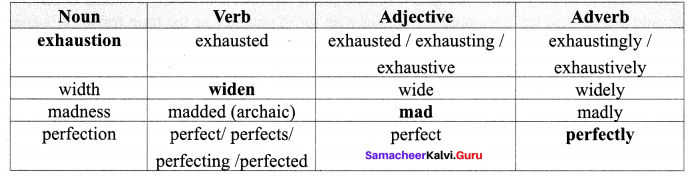
Tamilnadu Samacheer Kalvi 10th English Solutions Prose Chapter 1 His First Flight

English Subject experts who are having max years of experience prepared this Tamilnadu State Board Solutions for 10th English Prose Chapter 1 His First Flight Questions and Answers. They have explained all the topics covered in the board prescribed latest syllabus in a simple way to understand easily. So, students can prepare Chapter 1 English from this Samacheer Kalvi 10th English Book Questions and Answers PDF. Download the Tamilnadu State Board 10th English Chapter 1 His First Flight Workbook Solutions PDF by accessing the below links and learn properly for the final exams to score well.

His first flight Warm up:

1. Marco Polo. Christopher Columbus, Ibis Battuta, Amerigo Vespucci, Xuanzang. Ferdinand Magellan. Bartolomeu Dias, Herodotus. Captain James Cook. Vasco DeGama What is common among these individuals? Browse Internet or refer books and share some information about them.
Answer:
Marco Polo was an Italian merchant, explorer, and writer, bom in the Republic of Venice. Christopher Columbus was an Italian explorer, navigator and colonist, who completed four voyages across the Atlantic Ocean under the auspices of the Catholic Monarchs of Spain. Ibn Battuta was a Muslim Moroccan scholar and explorer, who widely travelled the medieval world.

Amerigo Vespucci was a Florentine merchant and navigator, who made at least two transatlantic trips to the New World, voyages that inspired cartographer Martin Wardseemiiller to label the new continent “America” in 1507. Xuanzang was a Chinese Buddhist monk, scholar, traveller and translator, who travelled to India in the seventh century and described the interaction between Chinese Buddhism and Indian Buddhism during the early Tang Dynasty.

Portuguese explorer Ferdinand Magellan set out from Spain in 1519 to discover a western sea route to the Spice Islands. En route he discovered what is now known as the Strait of Magellan and became the first European to cross the Pacific Ocean. Bartolomeu Dias was a Portugese navigator whose 1487-88 Atlantic voyage around the southern tip of Africa opened sea routes between Europe and Asia.

Herodotus is the ancient writer and reporter called “The Father of History.” He was a colorful writer and commentator; his most famous work, The Histories, remains a widely-read account of ancient facts and legends of the Persian invasion of ancient Greece.

Captain James Cook was an English naval explorer whose expeditions in the 1770s charted much of the lands of the Pacific, including New Zealand, Australia and Hawaii. Naval commander Vasco da Gama’s 1497 expedition from Lisbon opened a route to India and led to Portugese dominance of the Eastern spice trade.

2. Discuss, why it was considered as an adventurous and dangerous thing to travel in those days?
Answer:
Those days it was considered as an adventurous and dangerous thing to travel because there wasn’t any means of instantaneous communication while travelling

3. Mahatma Gandhi. Che Guevera. Guru Nanak and Gauthama Buddha are some of the famous personalities and thinkers who made extensive journeYs to understand life. Do you think journeys can be life changing?
Answer:
Yes, Journeys can be life changing since you gain a lot of experience while travelling and meeting different people who follow different traditions, religious practices, food habits and culture.

4. Share a memorable trip from your life.
Answer:
One of my memorable trip is to Matheran near Navi Mumbai. It is a pollution-free hillstation and you travel up the mountain top either by walk or on horses and ponies. No vehicles are allowed and even your daily needs are brought by wheelbarrows. It is this part that really pains your heart to see men pulling and pushing wheelbarrows. It is a rare sight to see the sunset and the sunrise at different points. The mountain train is also a treat to our eyes apart from the scenic beauty we experience every moment.

5. Have you ever been on an adventurous journey? 1f yes. Share your experience
Answer:
My adventurous journey is to Darjeeling when the sun plays truant most of the time and you are at the mercy of nature. Many a times, the tour plan turned topsy-turvy and we had to pitch tent in the thick forest and pray to stay safe.

6. That’s one small step for a man, one giant leap for mankind Neil Armstrong – Discuss
Answer:
Armstrong personally meant that for being just one man, all that was required was “one small step” from the lowest stair of his spaceship’s ladder, and suddenly he was standing on the Moon. But for humanity as a whole, Armstrong served as a representative: when he stepped onto the Moon, at the same time it was humanity touching the Moon. It was a total advancement for human technology, ambition, and wonder.

7. Have you ever seen a bird making it’s first ever attempt to fly?
Answer:
No, I have not seen it but I surely can imagine the number of failed attempts before it succeeds.

His First Flight InText Questions

10th English His First Flight Question Answer Question (a).
Why did the seagull fail to fly?
Answer:
The young seagull hesitated and feared to fly. He thought that his wings would not support him. Hence the sea gull failed to fly.

10th English Guide Question (b).
What did the parents do, when the young seagull failed to fly?
Answer:
The young sea gull’s parents regularly taunted him for his cowardice and threatened to leave him alone starving at the ledge unless he flew away.

10th English Unit 1 Prose Question Answer Question (c).
What was the first catch of the young seagull’s older brother?
Answer:
The first catch of the young seagull’s older brother was herring, a type of fish.

His First Flight Book Back Answers Question (d).
What did the young seagull manage to find in his search for food on the ledge?
Answer:
The young seagull managed to find a dried piece of mackerel’s tail at the far end of his ledge.

His First Flight Book Back Question And Answer Question (e).
What did the young bird do to seek the attention of his parents?
Answer:
The young bird stepped slowly out to the brink of the ledge and standing on one leg with the other leg hidden under his wing, he closed one eye, then the other, and pretended to be falling asleep. He would trot back and forth from one end of the ledge to the other, his long gray legs stepping daintily to seek the attention of his parents.

His First Flight Samacheer Kalvi Question (f).
What made the young seagull go mad?
Answer:
The young sea gull’s mother tore at a piece of fish that lay at her feet, and then scraped each side of her beak on the rock. The sight of the food on the mother’s beak maddened the young seagull.

His First Flight Questions Answers For Class 10 Samacheer Question (g).
Why did the young bird utter a joyful scream?
Answer:
The seagull was quite hungry and yearned for food. When he saw a piece of fish in the beak of his mother, the sight was quite tempting and suddenly dived at the fish forgetting that he didn’t know how to fly and uttered a joyful scream falling outwards and downwards into space.

10th English Guide Pdf Question (h).
Did the mother bird offer any food to the young bird?
Answer:
Yes, the mother bird offered a piece of fish to the young bird.

10th English His First Flight Paragraph Question (i).
How did the bird feel when it started flying for the first time?
Answer:
The bird was seized with fear for a moment and could feel the tips of his wings cut through the air. The next moment he was fearless, though felt a bit dizzy, flapped his wings to soar up and down with a joyous scream.

10th English 1st Lesson Question (j).
What did the young bird’s family do when he started flying?
Answer:
The family saw the young seagull making his first flight and floating on the ocean. They flew and landed on the water just ahead of him. They were beckoning to him with a shrill voice. They were praising and rewarding him by offering scraps of fish to him.

His First Flight Textual Questions

A. Answer the following questions in a sentence or two.

His First Flight Paragraph Answers Question 1.
How was the young seagull’s first attempt to fly?
Answer:
The young seagull was very hungry. So he dived at the fish that was in his mother’s beak. But he fell into space and became terribly afraid. His heart stood still. He could hear nothing for just a minute. The next moment he felt his wings spread outwards and began to fly up and down fearless into the sky.

English Guide For Class 10 Question 2.
How did the parents support and encourage the young seagull’s brothers and sister?
Answer:
The young seagull’s parents flew about with his brothers and sister perfecting them in the art of flight. They taught them how to skim the waves and how to dive for fish. When his older brother caught his first herring and devoured it, his parents circled around raising a proud cackle.

10th English Book Back Answers Question 3.
Give an instance that shows the pathetic condition of the young bird.
Answer:
The young bird, starving for a day, finds a dried piece of mackerel’s tail at the far end of his ledge. He searches in vain the area where he was hatched and gnaws at the dried pieces of eggshell. He is in a pathetic state calling plaintively when he isn’t unable to reach his mother tearing at a piece of fish.

10th English His First Flight Question 4.
How did the bird try to reach its parents without having to fly?
Answer:
The young bird trotted back and forth from one end of the ledge to the other with his long grey legs stepping daintily, trying to find some means of reaching his parents without having to fly.

10th English Guide Pdf Download Question 5.
Do you think that the young seagull’s parents were harsh to him? Why?
Answer:
No, the young seagull’s parents weren’t harsh to him. They were just teaching him a lifetime learning experience which is vital for his survival.

Samacheer Kalvi 10th English Book Answers Question 6.
What prompted the young seagull to fly finally?
Answer:
The young seagull was extremely hungry and felt the heat because of starvation. His mother was standing on a little high hump on the plateau on the other side and tore at a piece of fish that lay at her feet, and then scraped each side of her beak on the rock and even flew across to him with it. He leaned out eagerly, tapping the rock with his feet, trying to get nearer to her as she flew across. The mother was very near to him with the fish in her beak. Maddened by hunger, he dived at the fish and managed to fly up and down into space with a loud scream.

10th Standard English Guide Question 7.
What happened to the young seagull when it landed on the green sea?
Answer:
When the young seagull landed on the green sea, he completely forgot that he had not always been able to fly and shrieked shrilly, turning his beak sideways and crowed amusedly. He screamed with fright when he dropped his legs to stand on the green sea and sank into it.

Additional Questions

10 Std English Guide Question 1.
Why was the young seagull afraid to fly?
Answer:
The young seagull hesitated and feared to fly. He thought that his wings would not support him.

Question 2.
Do you think all young birds are afraid to make their first flight, or are some birds more timid than others? Do you think a human baby also finds it a challenge to take its first steps?
Answer:
Yes, all young birds are afraid to make their first flight. It is quite possible that some of them may be more timid than the others. A human baby also finds it a challenge to take the first step. Only after trials and errors of many months, the baby learns to take its first step.

Question 3.
“The sight of the food maddened him…” What does this suggest? What compelled the young seagull to finally fly?
Answer:
The seagull was quite hungry and yearned for food. When he saw a piece of fish in the beak of his mother, the sight was quite tempting for him. He was maddened at the sight of the food and suddenly dived at the fish forgetting that he didn’t know how to fly. It compelled the young seagull to finally fly into space.

Question 4.
“They were beckoning to him, calling shrilly.” Why did the seagull’s father and mother threaten him and cajole him to fly?
Answer:
His parents, two brothers and his sister regularly taunted him for his cowardice. The seagull’s father and mother threatened that they would leave him alone starving at the ledge unless he flew away. In this way, they tried to cajole him to fly.

Question 5.
Have you ever had a similar experience, where your parents encouraged you to do something that you were too scared to try? Discuss this in pairs or groups.
Answer:
Everyone has such experience at some time. I too had such an experience when my parents encouraged me when I was learning cycling. I hesitated and feared. I thought that I would not be able to hold and balance it properly. One day, my father made me sit on the bicycle and gave a push from behind. I cried but soon handled it properly and completed a circle without falling down. I learnt how to ride a bicycle on that very day.

Question 6.
In the case of a bird flying, it seems a natural act, and a foregone conclusion that it should succeed. In the examples you have given as answer to the previous question, was your success guaranteed or was it important for you to try, regardless of a possibility of failure?
Answer:
In the case of a bird flying, it seems a natural act. Actually, it is not so. Every young bird has to learn how to fly. After constant efforts, he becomes perfect in flying. Even in my case, success was not a foregone conclusion. Constant encouragement by my parents and my own practice made me a perfect cyclist.

Question 7.
Where did the young seagull sit alone? What did he watch from there?
Answer:
The young seagull was alone on his ledge. In the whole family, he was the only one who didn’t know how to fly. Only the day before, his two brothers and his sister had flown away with their parents. When he tried to flap his wings, he was seized with fear. Hence, he sat alone on the ledge watching his family flying over the sea.

Question 8.
Why didn’t the young seagull take the plunge? What stopped him from doing so?
Answer:
The young seagull was the only one in the family who couldn’t fly in the air. His brothers and sister had far shorter wings than his wings but they had already learnt the art of flying. He felt certain that his wings would never support him. So he was hesitant and afraid of flapping his wings and go deep in the air.

Question 9.
Did upbraiding and threatening of his parents help him in flying?
Answer:
The parents of the young seagull did try to teach his young one the art of flying. He wouldn’t simply move from his ledge. They would fly around him encouraging and challenging him to follow them. When he wouldn’t budge, his parents would fly around calling to him shrilly. They would upbraid and threaten to let him starve unless he flew away.

Question 10.
How were his two brothers and sister different from the young seagull?
Answer:
His two brothers and. his sister had far shorter wings than he had. But still they had flown away only the day before. He would watch his parents perfecting them in the art of flying. They were taught how to skim the waves and dive for the fish. The young seagull had seen his older brother catch his first herring and devour it.

Question 11.
How did the hungry seagull try to pretend to attract his mother’s attraction?
Answer:
The whole family had flown away. Only the young seagull sat alone on the ledge. He had not eaten anything since the previous nightfall. He stepped slowly out to the brink of the ledge. He stood on one leg. He closed his eyes pretending to be falling asleep. But all his tactics failed. Only his mother took notice of him. All others ignored him.

Question 12.
What was the mother doing standing on a little high hump on the plateau?
Answer:
All others ignored the hungry young seagull. Only his mother was looking at him. She was standing on a little high hump. Now and again, she tore a piece of fish. The fish lay at her feet. Then she scrapped each side of her beak on the rock. She loved to tear the food that way.

Question 13.
Why did the young seagull cry “Ga, ga, ga”? Did her mother oblige him?
Answer:
When he saw his mother holding a piece of a fish in her beak, the young seagull became almost mad with hunger. He cried “Ga, ga, ga”. He begged her mother to bring him some food. When he saw his mother flying across to him with a piece of fish, he uttered a joyful scream. He started tapping the rock with his feet impatiently. He was almost within the reach of the fish but failed to get at it.

Question 14.
What did the young seagull do when he was maddened by hunger? Did hunger motivate him to dive at the fish in the air?
Answer:
The young seagull saw his mother flying around him with a piece of fish in her beak. Maddened by hunger, he dived at the fish. With a loud scream, he fell outwards and downwards into space. Then he was seized with fear and his heart stood still. But the fear lasted only for a minute. The very next moment he felt his wings spread outwards. Truly, hunger motivated him to dive at the fish and flap his wings into the space.

Question 15.
How did the young seagull overcome his fear and soared gradually towards the sea during his first flight?
Answer:
The young seagull had taken the final plunge. Maddened by hunger, he dived at the fish which his mother was carrying in her beak. With a loud scream he fell outwards and downwards. He was seized with fear and his heart stood still. But the fear lasted only for a minute. He overcame it. The next moment he felt his wings spread outwards. Now he was soaring downwards over the blue sea.

Question 16.
Describe the seagull’s first flight.
Answer:
The young seagull was very hungry. So he dived at the fish that was in his mother’s beak. But he fell into space and became terribly afraid. His heart stood still. He could hear nothing. But it only lasted for a minute. The next moment he felt his wings spread outwards. He began to fly and was no longer afraid.

Question 17.
How did his parents, two brothers and sister celebrate the first flight of the young seagull?
Answer:
The family saw the young seagull making his first flight. When they saw him floating on the ocean, they flew and landed on the water just ahead of him. They were beckoning to him calling shrilly. They were praising and rewarding him by offering scraps of fish to him.

Question 18.
What is the message that Liam O’ Flaherty wants to give to the readers through the lesson, ‘His first Flight’?
Answer:
Success can’t be taken for granted. One has to struggle to see success. The story of the young seagull is the story of overcoming hesitations, doubts and fears that stand between us and our success. Hunger makes him take the final plunge. This leads him to make his first flight and soar into the space.

B. Answer each of the following questions in a paragraph of about 100 – 150 words.

Question 1.
Describe the struggles underwent by the young seagull to overcome its fear of flying.
Answer:
The Young Seagull was afraid to fly and was alone on his ledge. He was more frightened than his siblings. His attempts failed. He had taken a little run forward and tried to flap his wings. But that was all he could do. He felt that his wings would not support him. He failed to muster up the courage and fly. His parents taunted, scolded and threatened him to leave him starving at the ledge unless he flew away.

But nothing could make him fly. The seagull helplessly watched his parents flying with his brothers and sisters. The whole family went on taunting him for his cowardice. Only his mother was looking at him. She had picked a piece of fish and was flying across to him with it. He leaned out eagerly. The mother was very near to him with the fish in her beak. Maddened by hunger, he dived at the fish. With a loud scream, he fell outwards and downwards into space. A terror seized him.

His heart stood still. His mother swooped past him. He answered her with another scream. He saw his two brothers and sister flying around him. The seagull completely forgot that he was not able to fly. He let himself free to dive, soar and curve at will. He was shrieking shrilly. He saw a green sea beneath him.

He was tired and weak with hunger. His feet sank into the green sea and his belly touched it. He sank no farther. Now, his family was praising him and their beaks were offering him scraps of fish. He had made his first flight.
“Flying is learning how to throw yourself to the ground and miss.”

Question 2.
Your parents sometimes behave like the young bird’s parents. They may seem cruel and unrelenting. Does it mean that they do not care for you? Explain your views about it with reference from the story.
Answer:
There is no doubt that sometimes parents do behave the same way like the young bird’s parents. ‘However all parental acts are for the betterment of the children though they may seem cruel and unrelenting. It doesn’t mean they do not care for us. It is the ardent wish of every parent that they may teach all skills to their young ones so that they may succeed in life. If the young ones don’t act then they also indulge in scolding, taunting and humiliating them to shed off their hesitations and fears.

This is exactly what the parents of the young seagull did when he failed to fly. They were successful in teaching the art of flying to his two brothers and sister. They also tried their best to embolden him to take the plunge. Particularly, the mother-seagull went on flying around him with a piece of fish in her beak. It was her attempt to tempt her starving son to dive at the fish and succeeded in her aim.
“At the end of the day, the most overwhelming key to a child’s success is the positive involvement of parents.”

Additional Questions

Question 1.
Yes the young seagull same at the beginning and at the end of the lesson? Compare and contrast the two kinds of the same seagull in the lesson.
Answer:
No, the young seagull was not the same bird at the beginning and at the end of the lesson. In the beginning, the young seagull used to be all alone on his ledge. His two brothers and his sister had flown away the day before. He had been afraid of flying with them. Whenever he tried to flap his wings, he was seized with fear. He felt certain that his wings would never support him. His father and mother flew around calling to him shrilly. They were constantly scolding and taunting him.

They were threatening to let him starve on his ledge unless he flew away. However, the young seagull was more confident and sure of his success in the end. Maddened by hunger, he dived at the fish. After trials and errors, his wings spread outwards. He was soaring gradually downwards forgetting all his hesitations and fears. He could float on the ocean now. His success was welcomed by his family. They were praising him now and their beaks were offering him their scraps of dog-fish.
“Positivity, confidence and persistence are key in life – so never give up in life.”

Question 2.
‘All parental acts are for the betterment of the children.’ It is true. However, one has to make efforts through trials and errors shedding off one’s early hesitations and fears to succeed in any enterprise. Justify this statement by taking points from the lesson, ‘His First Flight’.
Answer:
There is no doubt about it. All parental acts are for the betterment of the children. It is the ardent wish of every parent that they may teach all skills to their young ones so that they may succeed in life. First of all, they can learn all things which their parents have taught in life. If the young ones don’t act then they also indulge in scolding, taunting and humiliating them to shed off their hesitations and fears. This is exactly what the parents of the young seagull did.

They were successful in teaching the art of flying to his two brothers and sister. They also tried their best to embolden him to take the plunge. Particularly, the mother- seagull went on flying around him with a piece of fish in her beak. It was her attempt – to tempt her starving son to dive at the fish. And she succeeded in her aim. The young seagull did dive at the fish and it led to his success in the end.
“Parenting is not about meeting the needs of the offspring – but preparing them to stand on their own legs”

Question 3.
‘Maddened by hunger, he dived at the fish,’ says the narrator about the young seagull. Do you feel hunger was the main motivating force that made the young seagull take the plunge that taught him how to fly in the air?
Answer:
Food is the most essential ingredient that sustains all life – of humans, animals as well as birds. Hunger motivates many of their actions. The young seagull used to sit all alone on his ledge. Whenever he tried to flap his wings to fly, he was seized with fear. He felt certain that his wings would never support him. He had seen his older brother catch his first herring and devour it. It compounded his helplessness even more. He uttered a joyful scream when he saw his mother holding a piece of fish in her beak and flying quite near him.

He wondered why she didn’t come to him and offer that piece of fish to him. Maddened by hunger, he dived at the fish. With a loud scream he fell outwards and downwards into space. Then a monstrous terror seized him but only for a minute. The next moment he felt his wings spread outwards. He began to soar downwards towards the sea. The fear left him. He began to float on the sea. admiring family offered him pieces of fish flying around him.
“ Your hunger must be absolutely compelling in order to overcome the obstacles that will invariably come your way.”

Question 4.
Describe the humiliation and taunting that the young seagull faced from his family when he used to sit alone on his ledge without mustering his courage to fly in the air.
Answer:
The young seagull used to sit on ledge all alone. He used to see his two brothers and sister flying around him. They had learnt flying only the day before. Not that he didn’t try before. He had come to the edge of the ledge and tried to flap his wings. But he became afraid soon. He felt certain that his wings would never support him. So he bent his head and ran away to the little hole under the ledge. His brothers and sister had far shorter wings than his own. But they succeeded flapping their wings and flew away.

He failed to muster his courage to take the plunge. His father and mother flew around him scolding and taunting him. They also threatened to let him starve on his ledge unless he flew away. The thing that compounded his agony was that his elder brother had caught his first herring and devoured it. His parents circled around his brother raising a proud cackle. On the other hand, the family had walked down the opposite cliff taunting him with his cowardice.
“There is no humiliation more abusive than hunger.”

Question 5.
Hesitations and fears play necessary parts in human life but we get success in any enterprise only when we overcome our doubts, hesitations and fears. Justify this statement in the light of the young seagull’s efforts to muster courage to fly in the air.
Answer:
Nothing in life can be taken for granted. Skills have to be learnt in life with our own efforts. Parents can only help in teaching and encouraging us to learn things. But we have to learn them through our own efforts of trials and errors. Who doesn’t suffer from hesitations and fears in the beginning? It takes time to take the final plunge. So it happened with the young seagull. In spite of constant encouragements and motivations, he couldn’t muster the courage to fly.

He was certain that his wings would not support him. He faced regular taunting and humiliations of his family. They even threatened to let him starve at the ledge unless he flew away. But they say that necessity is the mother of invention. Maddened by hunger, he dived at the fish which his mother was carrying in her beak. He felt his wings spreading outwards. Finally, he soared to come down over the sea. When he floated on the sea, his family celebrated his success by offering pieces of fish to him.
“Life is a balance of fear and overcoming it.”

Vocabulary:

C. Change the parts of speech of the given words in the chart.

10th English His First Flight Paragraph Samacheer Kalvi Chapter 1
Answer:
10th English 1st Lesson Samacheer Kalvi Chapter 1 His First Flight

D. Read the following sentences and change the form of the underlined words as directed.

1. His family was screaming and offering him food, (to adjective)
The screaming family offered him food.

2. ‘The young seagull gave out a loud call, (to adverb)
The young sea gull called out loudly.

3. The bird cackled amusedly while flying, (to noun)
The bird cackled with amusement while flying.

4. The depth of the sea from the ledge scared the seagull, (to adjective)
The deep sea scared the seagull on the ledge.

5. The successful flight of the bird was a proud moment for the seagull’s family, (to verb)
It was a proud moment for the seagull’s family when the bird flew successfully.

E. Use the following words to construct meaningful sentences on your own.

  1. coward – I hate to be a coward for I have always been a bold person.
  2. gradual – There is a gradual increase in the water level at Mettur dam.
  3. praise – Sylvia is worthy of all the praise and honour.
  4. courageous – I hope to be courageous at all circumstances.
  5. starvation – People in Somalia die of starvation almost every day.

Listening Activity:

F. Here is a travelogue by the students of Government Girls Higher Secondary School, Pattukkottai after their trip to Darjeeling. Listen to the travelogue and answer the following questions.

A Trip to Remember Forever:
Our trip to this wonderful city, Darjeeling started with a breath-taking view. We parted the curtains of our hotel room and there it was, Kanchenjunga, the third highest mountain in the world! The entire range was in front of us in lull view, snow-capped and dazzling in the sun. Our trip started early in the morning the next day. We woke up at 4 a.m. and reached Tiger hill at 5 a.m. to view the sunrise as the place has earned international fame for the best sunrise view.

Tiger hill is situated at an altitude of 2590 meters and is 13 kilometers away from the city. Although Kanchenjunga was visible from the window of our hotel room, viewing it from tiger hill was a different experience altogether. It was not a very cloudy day so we were lucky enough to get a glimpse of the Mount Everest. After Tiger hill, we visited Senchal Lake which is another picnic spot nearby. We were told that the lake supplies drinking water to the city.

The next spot on our list was Batasia Loop, a spiral railway near Ghum. The loop is situated 5 kilometer from the city and is a gigantic railway loop where the toy train runs and takes a 360 degree turn. It is a beautiful place with manicured garden, streams and waterfalls. While travelling on the toy train, one gets a breath-taking view of Darjeeling’s scenic beauty.

We would suggest the toy train only for people with lot of patience as the train travels at a speed of 15 kilometers per hour and covers 14 kilometers in three hours which might be an utter disappointment for some. Altogether we had a memorable and enjoyable school trip with our friends and it will linger in our thoughts forever.

(i) Fill in the blanks with suitable words.

1. The students visited …………… city.
2. …………. is the third highest mountain in the world.
3. ………….. hill is 13 km away from Darjeeling.
4. The drinking water is supplied by …………… lake to the city.
5. After Senchal lake, they visited …………… .
Answers:

  1. Darjeeling
  2. Kanchenjunga
  3. Tiger
  4. Senchal
  5. Batasia Loop

(ii) Do you think they had a memorable and enjoyable school trip?
Yes, I am sure they had a memorable and enjoyable school trip.

(iii) Name a few places that you wish to visit with your classmates as a school trip.
I wish to visit Andaman islands, Kashmir and Kathmandu with my classmates as a school trip.

(iv) State whether the following statements are True or False.

  1. As the sky was cloudy, they could get the glimpse of the Mount Everest.
    False
  2. The toy train covers 14 km in three hours.
    True
  3. Tiger hill has earned international fame for the best sunset view.
    True

Speaking Activity:

G. Here is a dialogue between a father and his daughter. Continue the dialogue with at least five utterances and use all the clues given above.

Father: Hi Mary, it has been a very long time since we went on a trip. Let’s plan one.
Mary : Yes, dad. I am also longing to go. Why don’t we plan one for this weekend?
Father: Sure. Tell me, where shall we go?
Mary : Some place nearby but for at least two days.
Father: Hmm… I think we should go to the reserved forest nearby.
Mary : Yeah. I’ve never been to a forest. I have seen a forest only on the TV and movies. The forest is a good choice!
Father : OK. If we are going to the forest, we must list out what we should carry with us for two days.
Mary : I think we should carry suitable clothes like (1) ………………………………………………….. .
Father: What about the food? Do you have any idea, Mary?
Mary : Yeah. For food, I suggest (2) ……………………………………………………… .
Father: (3) ……………………………………………………………………….. .
Mary : (4) ……………………………………………………………………. .
Answers:

  1. moisture wicking garments covering our hands and legs, hand gloves, gaiters, and head wear.
  2. we take dehydrated foods. A packet of instant coffee packets and tea bags, energy bars, chocolates, nuts, sandwich making materials, kaakaras (dry chappathi), cheese and cup noodles will be of great help.
  3. I think we need to wear proper trekking shoes and take our sleeping bags too. Do you think we need to take anything else?
  4. Yes dad, a torch light and mosquito repellent is a must. I think we are all set to go on our journey.

Reading:

H. Read the following passage and answer the questions that follow.

Bungee – Jumping
Bungee jumping is an activity that involves jumping from a tall structure while connected to a long elastic cord. The tall structure is usually a fixed object, such as a building, bridge or crane; but it is also possible to jump from a movable object, such as a hot-air-balloon or helicopter, that has the ability to hover above the ground. The thrill comes from the free- falling and the rebound. When the person jumps, the cord stretches and the jumper flies upwards again as the cord recoils, and continues to oscillate up and down until all the kinetic energy is dissipated.

Jumping Heights, located in Mohan Chatti village, in Rishikesh has been rated as one of the most preferred bungee jumping destinations in India at a height of 83 meters. It is the only place in India where bungee jumping can be done from a fixed platform. This is also India’s only fixed platform Bungee- performed from a professional cantilever, to separate it from entertainment parks, and create instead, an extreme adventure zone. The Bungee has been designed by David Allardice of New Zealand.

The Cantilever platform is built over a rocky cliff over-looking the river Hall, a tributary of River Ganges. Bungee-ing amidst the vastness of nature lends the experience an absolutely breathtaking quality. Jumping heights is well known for its safety measures and experienced staff. It costs around Rs 2500 per jump, a bit expensive, but totally worth the experience. The Bungee jumping experience has been set amidst the astoundingly stunning landscape of Rishikesh. To Bungee jump, one must be at least 12 years and should weigh between 40-110 kg.

Question 1.
What is Bungee Jumping?
Answer:
Bungee jumping is an activity that involves jumping from a tall structure while connected to a long elastic cord.

Question 2.
Can Bungee be performed from a movable object? How?
Answer:
Bungee can be performed from a movable object, such as a hot-air-balloon or helicopter, that has the ability to hover above the ground.

Question 3.
When do you think Bungee becomes thrilling?
Answer:
When the person jumps, the cord stretches and the jumper flies upwards again as the cord recoils, and continues to oscillate up and down until all the kinetic energy is dissipated. Now, Bungee becomes thrilling from the free-falling and the rebound.

Question 4.
What is the experience when one falls off the platform?
Answer:
It is extremely astounding, adventurous, stunning and thrilling.

Question 5.
Where is the Bungee jumping point located in India?
Answer:
Bungee jumping point is located in Mohan Chatti village, in Rishikesh, India at a height of 83 meters.

Question 6.
What is the minimum age to Bungee jump?
Answer:
The minimum age to Bungee jump is 12 years.

Writing:

I. Prepare attractive advertisements using the hints given below.

1. Home appliances – Aadi Sale – 20-50% – Special Combo Offers – Muthusamy & Co., Raja Street, Gingee.
His First Flight Paragraph Answers Samacheer Kalvi 10th English Chapter 1

2. Mobile Galaxy – Smart phones – accessories – SIM cards – Recharge – Free Power banks on Mobile purchase – No.l, Toll gate, Trichy
English Guide For Class 10 Samacheer Kalvi Chapter 1 His First Flight

J. Write a report of the following events in about 100-120 words.

1. ‘Educational Development Day’ was organized in your school on 15th July. The District Collector was the Chief Guest of the event. As part of the event, many competitions were Jield and the prizes were distributed to the winners and participants. It was a grand and successful event. Now, as the member of the organizing committee, write a report on the event in about 120 words.
Answer:
Jawahar Higher Secondary School, Karuvalipat, celebrated the Educational Development Day on the 15th of July, 2019 in the school premises. As part of the event, many competitions were held from the morning for students. Primary School children actively participated in the Drawing Competition depicting Education Development Day. Oratorical contest on the topic, ‘The importance of education’ was held for students of Std VI to VIII.

A Debate on the topic, ‘Development is vivid only with an educated society’ was conducted for Std IX to XII Students. At 2 p.m., The District Collector, Ms. Yasmin Begum presided over the Valedictory function and addressed the students on the importance of being a literate. She encouraged students to pursue higher education and reach great heights. The Chief Guest distributed the trophies to the winners and all the participants were given certificates. It was a grand and successful event and a day to be remembered for ever.
Member Of The Organising Committee
Shanmathy Velayudham

Question 2.
You are the School Pupil Leader. You have been asked to write a report on the Inaugural Ceremony of English Literary Association of your school which was held recently. Write a report on the same in not more than 120 words.
Answer:
Inauguration Of English Literary Association
English Literary Association was inaugurated in the Fathima Hall of St. Joseph’s convent on 19th June, 2019. Mrs. Thomas, the Choir Mistress led the choir to sing a prayer song. Sister Joan, Principal lighted the traditional lamp along with the Head of the English Department Mrs. Judy Enoch, the School Pupil Leader Beverley Shunker and the Secretary of the English Literary Association Vinnie Varghese. The Secretary welcomed the gathering and highlighted the aims and objectives of the association.

Sr.Joan advised the students to improve their communicative skills in English and motivated the students to refrain from using vernacular language in the school campus. The Special Guest for the inaugural ceremony was Mrs. Swamamala, a noted journalist. She was felicitated with a shawl and memento by the Vice Principal Mrs.Shyla Augustine. The keynote address by the special guest insisted in learning English as the universal and official language for communication in any country. The vote of thanks was given by Shanthini, a student of Std X. The event was compeered by Parvathi, a student of Std XL

School Pupil Leader
Beverley Shunker

Question 3.
You are the Coordinator of the Science Forum of your school. An event had been organized on account of National Science Day for the members of the forum. Now, write a report on the observation of “National Science Day” at your school.
Answer:
National Science Day
National Science Day was observed by the students of Violet Matriculation Higher Secondary School on 28th February, 2019 to mark the discovery of the Raman effect in 1928 by Indian physicist Sir C. V. Raman. The Director of the District Science Museum, Mr.Shanthakumar presided over the function. This event, organized on account of National Science Day for the members of the forum was led by Mrs.Leema, Physics teacher of our school.

The celebration included public speeches, watching the night sky, live projects, debates and many more activities. Every year, NSD is celebrated to widely spread a message about the Importance of science used in the daily life of the people. It is also celebrated to discuss all the issues and implement new technologies for the development in the field of science. The theme of the year 2019, “Science for the People, and the People for Science” was extensively discussed.
Coordinator Of The Science Forum
Rajalakshmi Venkataraman

Grammar Modals:

A. Complete these sentences using appropriate modals. The clues in the brackets will help you.

  1. When I was a child, I climb trees easily but now I can’t, (ability in the past)
  2. I …………….. win this singing contest, (determination)
  3. You ……………. buy this book. It is worth buying, (advice or suggestion)
  4. Poongothai ………………. speak several languages, (ability in the present)
  5. I swear I ……………. tell lies again, (promise)
  6. My father …………….. play badminton in the evenings when he was at college, (past habit)
  7. You ……………. do as I say! (command)
  8. ……………….. I have another glass of water? (request)
  9. Sibi has not practised hard but he ……………… win the race, (possibility)
  10. We ………….. preserve our natural resources, (duty)

Answers:

  1. used to/could
  2. will
  3. shall
  4. can
  5. shall
  6. used to
  7. shall/ought to
  8. Could
  9. can/will
  10. should

B. Rewrite the following sentences by rectifying the errors in the use of modals.

1. Would I have your autograph?
Could I have your autograph?

2. I can be fifteen next April.
I will be fifteen next April.

3. Take an umbrella. It should rain later.
Take an umbrella. It may rain later.

4. The magistrate ordered that he might pay the fine.
The magistrate ordered that he must pay the fine.

5. Make me a cup of tea, shall you?
Make me a cup of tea, will you?

6. You may speak politely to the elders.
You must speak politely to the elders.

7. You will get your teeth cleaned at least once a year.
You should get your teeth cleaned at least once a year.

8. We could grow vegetables in our kitchen garden but we don’t do it now.
We used to grow vegetables in our kitchen garden but we don’t do it now.

9. Must I get your jacket? The weather is cold.
Should I get your jacket? The weather is cold.

10. Could the train be on time?
Will the train be on time?

C. Read the dialogue and fill in the blanks with suitable modals.

Dad : ……………. (1) …………. we go out for dinner tonight?
Charan : Yes, Dad. We ……………. (2) ……………….. go to a restaurant where I …………… (3) …………… have some ice cream.
Dad : OK. Then, I (4) be home by 7 p.m. Mom and you …………… (5) ………………… be ready by then.
Charan : Sure. We …………… (6) …………… My friend told me that there is a magic show nearby. …………….. (7) …………….. you please take us there?
Dad : We ……………….. (8) …………….. not have time to go for the magic show, I suppose. If we have enough time left, we ………….. (9) ………….. plan.
Charan : By the way …………….(10) ………….. we inform our gate keeper about our outing?
Dad : Yes, we ……………… (11) …………… so that he …………….. (12) ……………… be aware we aren’t at home.
Charan : ………….. (13) …………… I call up Mom and tell her about our plan today?
Dad : You ………….. (14) ………………. to. Otherwise, we might be in trouble when she returns home.
Charan : Hmm… by the time you come home in the evening, we ……………… (15) …………….. be waiting for you. Hope you ……………. (16) ……………… be late. Bye.
Answers:

  1. Shall
  2. should
  3. can
  4. will
  5. should
  6. will
  7. Could
  8. may
  9. can
  10. should
  11.  should
  12. will
  13.  Shall
  14. ught
  15. will
  16. won’t

D. Read the following dialogues and supply appropriate modals.

10th English Book Back Answers Chapter 1 His First Flight Samacheer Kalvi

Student : Can we leave our bags in the class during the break?
Teacher : Yes, you ………….. (1) ……………. but arrange them neatly.
Passenger : My child is 6 years old. Do I have to buy him a ticket?
Conductor : Yes, you ……………… (2) …………… It costs half of the price of an adult ticket.
Vani : Can we go for coffee after the meeting?
Yoga : No, I ……………… (3) ……………… I have to go home.
Salesman : When ……………. (4) ………….. I receive my order?
Customer : I ……………. (5) …………… assure you sir, the order …………….. (6) …………….. be delivered tomorrow.
Neela : Do you think I should write about my education background in the resume?
Preethi : Yes, you ……………… (7) …………….. You ………….. (8) …………….. get a better job.
Answers:

  1. can
  2. should
  3. can’t
  4. can
  5. can
  6. will
  7. should
  8. will/may

Imagine you have been to Thanjavur recently. Based on your experience and the data given below about Thanjavur, suggest and guide your friend who wishes to visit Thanjavur and places nearby, using modals in your sentences.

10th English His First Flight Samacheer Kalvi Chapter 1

E. Here are a few sentences already done for you. The clues given would be helpful to \make more sentences on your own.

1. I would suggest that you take the Uzhavan Express to Thanjavur from Chennai.
2. You will be more comfortable if you could book 3 tier A/C.
3. You could enjoy …………………………………………………. .
4. You should visit …………………………………………………. .
5. You mustn’t miss ………………………………………………. .
6. You can buy ……………………………………………………….. .
7. …………………………………………………………………………….. .
8. …………………………………………………………………………….. .
9. …………………………………………………………………………….. .
10. …………………………………………………………………………… .
Answers:
3. the Kallanai Dam near Thanjavur
4. the Big Temple
5. the Museum in Thanjavur
6. Art Plates and Dancing dolls
7. Saraswathi Mahal, a library is a must to visit in Thanjavur.
8. You may take the Madurai Express to go to Thanjavur.
9. You should visit the church at Poondi near Thanjavur.
10. Don’t miss Thiruvaiyaru. You ought to experience its grandeur.

Active And Passive:

F. Change the following sentences to the other voice.

1. The manager appointed many office assistants.
Many office assistants were appointed by the manager.

2. You are making a cake now.
Now, a cake is being made by you.

3. That portrait was painted by my grandmother.
My grandmother painted that portrait.

4. Malini had bought a colourful hat for her daughter.
A colourful hat had been bought by Malini for her daughter.

5. They have asked me to pay the fine.
I have been asked to pay the fine by them.

6. The militants were being taken to prison by the police.
The police were taking the militants to prison.

7. His behaviour vexes me.
I am vexed by his behaviour.

8. Rosy will solve the problem.
The problem will be solved by Rosy, v

9. Our army has defeated the enemy.
The enemy has been defeated by our army.

10. The salesman answered all the questions patiently.
All the questions were answered patiently by the salesman.

G. Change the following into Passive voice.

1. Please call him at once.
Request him to be called at once.

2. How did you cross the river?
How was the river crossed by you?

3. No one is borrowing the novels from the library.
The novels from the library are not being borrowed by any one.

4. Will you help me?
Will I be helped by you?

5. Go for a jog early in the morning.
You are advised to go for a jog early in the morning.

6. Why have you left your brother at home?
Why has your brother been left at home by you?

7. Nobody should violate the rules.
Let the rules not be violated by anyone.

8. Someone has to initiate it immediately.
It has to be initiated by someone immediately.

9. Have you invited Raman to the party?
Has Raman been invited by you to the party?

10. Please do not walk on the grass.
You are requested not to walk on the grass.

11. Cross the busy roads carefully.
You are instructed to cross the busy roads carefully.
Let the busy roads be crossed by you carefully.

12. When will you book the tickets to Bengaluru?
When will the tickets to Bengaluru be booked by you?

H. In the following sentences the verbs have two objects namely Direct and Indirect objects. Change each of the following sentences into two passives using direct object as the subject in one and indirect in the other.

1. John gave a bar of chocolate to Jill.
(a): Jill was given ……………………………………………………………………………….. .
(b): A bar of chocolate was given ………………………………………………………. .

2. Pragathi lent a pencil to Keerthana.
(a): ………………………………………………………………………………………………………. .
(b): ………………………………………………………………………………………………………. .

3. Sudha told the truth to her friend.
(a): ……………………………………………………………………………………………………….. .
(b): ……………………………………………………………………………………………………….. .

4. They offered the job to Venkat.
(a): ………………………………………………………………………………………………………… .
(b): ………………………………………………………………………………………………………… .

5. The boss showed the new computer to Kaviya.
(a): …………………………………………………………………………………………………………. .
(b): …………………………………………………………………………………………………………. .
Answers:
1. (a) a bar of chocolate by John
(b) by John to Jill

2. (a) Keerthana was lent a pencil by Pragathi
(b) A pencil was lent by Pragathi to Keerthana

3. (a) Sudha’s friend was told the truth by Sudha
(b) The truth was told by Sudha to her friend

4. (a) Venkat was offered the job by them
(b) The job was offered by them to Venkat

5. (a) Kaviya was shown the new computer by the boss
(b) The new computer was shown by the boss to Kaviya

I. Rewrite the following passage in Passive Voice.

A few days ago, someone stole Ambrose’s motorbike. Ambrose had left it outside his house. He reported the theft to the police. The police told him that they would try to find his motorbike. This morning, they found his motorbike. The police called Ambrose to the police station. The thieves had painted it and then sold it to someone else. The new owner had parked the motorbike outside a mall when the police found it. After an enquiry, the police arrested the thieves.

Ambrose’s motorbike was stolen by someone a few days ago. It had been left outside his house by Ambrose. The theft was reported to the police by him. He was told by the police that they would try to find his motorbike. This morning, his motorbike was found. Ambrose was called to the police station by the police. It had been painted by the thieves and then it was sold to someone else. The motorbike had been parked by the new owner outside a mall when it was found by the police. After an enquiry, the thieves were arrested by the police.

J. Write a recipe of your favorite dish in passive voice. Remember to list out the ingredients . of the dish you have chosen and their quantity. Use Simple Present tense to write your recipe.

Ingredients: A bottle of Mixed Fruit jam, A packet of Cheese slices, A loaf of Sandwich bread A box of sweetened Butter, A nonstick pan
Recipe

  1. A pan with one teaspoon of sweetened butter is taken.
  2. Two slices of sandwich bread is taken and roasted slightly on both sides.
  3. A tablespoon each of Mixed Fruit Jam is spread evenly on one side of the sandwich bread.
  4. A slice of cheese is placed in between the two slices of bread.
  5. The comers of the bread slices are sliced and the bread slice is slit diagonally into two.
  6. The sandwich is ready to be served.

K. Write a report of an event held at your school using Passive voice. Use Simple Past Tense to’narrate the event.

The Annual day was celebrated by Glenmark Global School, on July 17, 2019 at the school premises with pomp and grandeur. The school was decorated elegantly by the staff and students. A stage was set up with a beautiful backdrop depicting the theme of the year. The welcome address was given by the School Pupil Leader.

The Chief Guest Mrs. Indira Janardhanan, CEO was introduced and felicitated by the Principal Mrs. Jeyanthi Radhakrishnan. Many cultural programs viz western dance, traditional dance, English Play, Tamil Pattimandram were all a treat to the eyes of the audience.

The Annual report was presented by the Principal. Prizes were given away to the toppers and many students who had brought laurels to the school in various competitions and contests. The Vote of Thanks was delivered by the Assistant School Pupil Leader.

His First Flight by Liam O’Flaherty About the Author: 

Liam O’Flaherty, born on August 28, 1896, at Aran Islands, Ireland died on September 7, 1984 at Dublin. He is an Irish novelist and short-story writer. He became a popular literary figure with his best-selling novel, The Informer. The next novel Return of the Brute was also a great success. O’ Flaherty will be remembered as a major voice in the Irish literary renaissance and a founding member of the Communist Party of Ireland. He spent most of his time in travelling and lived comfortably and quietly outside the spotlight.

His First Flight Summary:

10th English Guide Pdf Download Samacheer Kalvi Chapter 1 His First Flight Introduction:
‘His First Flight’ is a story of hesitation, trial and error and ultimately succeeding the task. It is an interesting story of a hesitant and timid seagull learning the art of flying. While his two brothers and sistej master the art of flying, his fear and hesitation prevent him from doing so. His diving at the fish due to hunger, proves a blessing in disguise. After a shaky start, he spreads out his wings and starts flying upwards and downwards. That’s his first flight. Thus the message is conveyed by O’Flaherty that no one attains success instantly. Perseverance and continuous striving help one to succeed.
Samacheer Kalvi 10th English Book Answers Chapter 1 His First Flight

Fear to fly
The young seagull was alone on his ledge. His two brothers and his sister had already learnt the art of flying just a day before. He tried in vain because of his fear. He had taken a little run forward and tried to flap his wings but that was all he could do. He feared that his wings would not support him. So he bent his head and ran back to the little hole where he slept the previous night.
10th Standard English Guide Chapter 1 His First Flight Samacheer Kalvi

Threatened by Parents His brothers and his sister had wings far shorter than his own wings. But he failed to muster up courage and fly. His parents criticized, admonished and threatened him to leave him starving at the ledge. However, nothing could make him fly.
10 Std English Guide Chapter 1 His First Flight Samacheer Kalvi

Parents perfected siblings The seagull helplessly watched his parents flying with his brothers and sister. They were perfecting them in the art of flying. They were teaching them how to skim the waves and how to dive for fish. The whole family went on taunting him for his cowardice.
Samacheer Kalvi 10th English Solutions Prose Chapter 1 His First Flight 11

Mother’s trick works His mother was looking at him. She had picked a piece of fish. She was flying across tp him with it. He leaned out eagerly. The mother was very near to him with the fish in her beak. Maddened by hunger, he dived at the fish. With a loud scream he fell outwards and downwards into the space. A terror seized him. His heart stood still. His mother plunged past him. He answered her with another scream. He saw his two brothers and sister flying around him.
Samacheer Kalvi 10th English Solutions Prose Chapter 1 His First Flight 12

Seagull flies!
The seagull completely forgot that he was not able to fly. He let himself free to dive, soar and curve at will. He was squealing shrilly. He saw a green sea beneath him. His parents, his brothers and sister were signaling to him with a shrill voice. He was tired and weak with hunger. His feet sank into the green sea and his belly touched it. He sank no farther. His family were praising him and their beaks were offering him scraps of fish. He had at last made it and it was his first flight.
Samacheer Kalvi 10th English Solutions Prose Chapter 1 His First Flight 13
Samacheer Kalvi 10th English Solutions Prose Chapter 1 His First Flight 14

Conclusion:
The story arrives at a conclusion that nothing is impossible. Fear is the impediment to success. Shed the fears and succeed in whatsoever you desire.
Samacheer Kalvi 10th English Solutions Prose Chapter 1 His First Flight 15

His First Flight Glossary:
Textual:
Samacheer Kalvi 10th English Solutions Prose Chapter 1 His First Flight 16

Additional:
Samacheer Kalvi 10th English Solutions Prose Chapter 1 His First Flight 17

Synonyms:

Choose the most appropriate synonym of the underlined word.

1. The young seagull was alone on his ledge.
(a) sill
(b) window
(c) nest
(d) lift
Answer:
(a) sill

2. The great expanse of sea stretched a long way down.
(a) express
(b) expense
(c) stretch
(d) vision
Answer:
(c) stretch

3. He felt certain that his wings would never support him.
(a) curtain
(b) screen
(c) sure
(d) unsure
Answer:
(c) sure

4. His brothers and his little sister ran to the brink.
(a) bark
(b) sea
(c) water
(d) edge
Answer:
(d) edge

5. He failed to muster up courage to take that plunge.
(a) dust
(b) gather
(c) strength
(d) marvel
Answer:
(b) gather

6. He saw his brothers and sister perfecting in the art of flight.
(a) achieving
(b) trying
(c) finishing
(d) balancing
Answer:
(a) achieving

7. He saw his older brother devour his first catch.
(a) consume
(b) devein
(c) divide
(d) smell
Answer:
(a) consume

8. His parents circled around raising a proud cackle.
(d) cough
(b) screech
(c) walk
(d) tackle
Answer:
(b) screech

9. The whole family walked about on the big plateau.
(a) highland
(b) pinnacle
(c) lake
(d) valley
Answer:
(a) highland

10. All his siblings laughed at his cowardice.
(a) weakness
(b) craze
(c) cooperation
(d) awkwardness
Answer:
(a) weakness

11. He even gnawed at the dried pieces of eggshell.
(a) gasped
(b) annoyed
(c) chewed
(d) devoured
Answer:
(c) chewed

12. He then trotted back and forth from one end of the ledge to the other.
(a) trailed
(b) scurried
(c) jolted
(d) rolled
Answer:
(b) scurried

13. His long gray legs stepped daintily to reach his parents.
(a) elegantly
(b) drearily
(c) dancing
(d) lethargically
Answer:
(a) elegantly

14. The ledge ended in a sheer fall of precipice with the sea beneath.
(a) steep
(b) gentle
(c) clean
(d) distant
Answer:
(a) steep

15. The precipice was sheer.
(a) cliff
(b) precipitation
(c) effervescence
(d) recap
Answer:
(a) cliff

16. His father was preening the feathers on his white back.
(a) picking
(b) cleaning
(c) screening
(d) wilting
Answer:
(b) cleaning

17. She was standing on a little high hump on the plateau.
(a) mound
(b) dip
(c) hollow
(d) table
Answer:
(a) mound

18. Her white breast thrust forward.
(a) shove
(b) burst
(c) backward
(d) thirsted
Answer:
(a) shove

19. The sight of the food maddened him.
(a) light
(b) bring
(c) blight
(d) view
Answer:
(d) view

20. He scraped his beak now and again to whet it!
(a) rubbed
(b) screened
(c) wet
(d) sharpened
Answer:
(a) rubbed

21. He uttered a low cackle.
(a) expressed
(b) screamed
(c) mocked
(d) udder
Answer:
(a) expressed

22. She screamed back mockingly.
(a) admiringly
(b) scornfully
(e) meekly
(d) brightly
Answer:
(b) scornfully

23. He kept calling plaintively.
(a) plainly
(b) blatantly
(c) sadly
(d) palpably
Answer:
(c) sadly

24. She was just opposite to him, abreast of the ledge.
(a) well-informed
(b) tuned
(c) approved
(d) disapproved
Answer:
(a) well-informed

25. His mother had swooped upwards.
(a) swung
(b) leapt
(c) fell
(d) danced
Answer:
(b) leapt

Antonyms

Choose the most appropriate antonym of the underlined word.

1. The sun was now ascending the sky.
(a) soaring
(b) rising
(c) mounting
(d) downhill
Answer:
(d) downhill

2. He ran a little forward to the brink of the ledge.
(a) centre
(b) brim
(c) threshold
(d) bridge
Answer:
(a) centre

3. He waited a moment in surprise.
(a) weighted
(b) sat
(c) began
(d) astonished
Answer:
(c) began

4. He felt the heat because he had not eaten since the previous nightfall.
(a) warmness
(b) coldness
(c) seat
(d) hearth
Answer:
(b) coldness

5. He searched among the rough, dirt-caked straw nest.
(a) coarse
(b) smooth
(c) bumpy
(d) blunt
Answer:
(b) smooth

6. He failed to muster up courage to take that plunge.
(a) dive
(b) climb
(c) fall
(d) plume
Answer:
(b) climb

7. Between them, there was a deep, wide crack.
(a) cavernous
(b) dip
(c) narrow
(d) shallow
Answer:
(d) shallow

8. Maddened by hunger, he dived at the fish.
(a) surfeit
(b) famine
(c) appetite
(d) heat
Answer:
(a) surfeit

9. He even gnawed at the dried pieces of eggshell.
(a) parched
(b) dehydrated
(c) fresh
(d) new other.
Answer:
(c) fresh

10. He then trotted back and forth from one end of the ledge to the
(a) scurried
(b) sauntered
(c) tracked
(d) rolled
Answer:
(b) sauntered

11. As he passed beneath her, he heard the swish of her wings.
(a) underneath
(b) below
(c) above
(d) finite
Answer:
(c) above

12. The next moment, he felt his wings spread outwards.
(a) centrifugally
(b) inwards
(c) beautifully
(d) aloft
Answer:
(b) inwards

13. He flapped his wings and soared upwards.
(a) downwards
(b) inwards
(c) outwards
(d) lethargically
Answer:
(a) downwards

14. The precipice was sheer.
(a) steep
(b) gentle
(c) effervescence
(d) recap
Answer:
(b) gentle

15. The wind rushed against his breast feathers.
(a) gushed
(b) relaxed
(c) flushed
(d) plumes
Answer:
(b) relaxed

16. He completely forgot his inability to fly.
(a) overlooked
(b) remembered
(c) ignored
(d) disregarded
Answer:
(b) remembered

17. His parents had landed in front of him.
(a) visible
(b) detectable
(c) behind
(d) anterior
Answer:
(c) behind

18. They were beckoning to him, calling shrilly.
(a) summoning
(b) signaling
(c) dismissing
(d) requesting
Answer:
(c) dismissing

19. He was tired and weak with hunger.
(a) scrawny
(b) puny
(c) week
(d) view
Answer:
(d) view

20. Hqwas floating on it.
(a) flowing
(b) fluctuating
(c) flinging
(d) strong
Answer:
(d) strong

21. His family was screaming and praising him.
(a) diluting
(b) adulation
(c) exaltation
(d) fixed
Answer:
(d) fixed

22. She was standing on a little high hump on the plateau.
(a) mountain
(b) dip
(c) hollow
(d) highland
Answer:
(c) hollow

23. He scraped his beak now and again to whet it!
(a) rubbed
(b) blunt
(c) wet
(d) sharpened
Answer:
(b) blunt

24. The great expanse of sea stretched down a long way down.
(a) short
(b) lengthy
(c) straight
(d) vision
Answer:
(a) short

25. He felt certain that his wings would never support him.
(a) nearer
(b) forever
(c) surely
(d) always
Answer:
(d) always

We hope the data given here will benefit you to the fullest extent at the time of preparation. For better understanding of English subject this Samacheer Kalvi 10th English Solutions for Class 10th English Prose Chapter 1 His First Flight PDF is the best resource. Download & ace up your preparation. Keep in touch with us and get the latest information on Tamilnadu State board Textbook Solutions PDF.

Samacheer Kalvi 9th Science Solutions Chapter 19 Plant Physiology

You can Download Samacheer Kalvi 9th Science Book Solutions Guide Pdf, Tamilnadu State Board help you to revise the complete Syllabus and score more marks in your examinations.

Tamilnadu Samacheer Kalvi 9th Science Solutions Chapter 19 Plant Physiology

Samacheer Kalvi 9th Science Plant Physiology Textbook Exercises

I. Choose the correct answer.

Plant Physiology Class 9 Question 1.
A big tree falls in a forest but its roots are still in contact with the soil. The branches of this
fallen tree straight up. This happens in response to ……………………
(a) water and light
(b) water and minerals
(c) gravity and water
(d) light and gravity
Answer:
(d) light and gravity

Chapter 19 Plant Physiology Question 2.
The tropic movement that helps the climbing vines to find suitable support is ……………………..
(a) phototropism
(b) geotropism
(c) thigmotropism
(d) chemotropism
Answer:
(c) thigmotropism

9th Science Plant Physiology Question 3.
The chemical reaction occurs during photosynthesis is ……………………….
(a) CO2 is reduced and water is oxidized
(b) water is reduced and CO2 is oxidized
(c) both CO2 and water are oxidized
(d) both CO2 and water are produced
Answer:
(a) CO2 is reduced and water is oxidized

9th Plant Physiology Book Back Answers Question 4.
The bending of root of a plant in response to water is called ……………………….
(a) Thigmonasty
(b) Phototropism
(c) Hydrotropism
(d) Photonasty
Answer:
(c) Hydrotropism

Plant Physiology Class 9 Book Back Answers Question 5.
A growing seedling is kept in the dark room. A burning candle is placed near it for a few days. The tip part of the seedling bends towards the burning candle. This is an example of ……………….
(a) chemotropism
(b) thigmotropism
(c) phototropism
(d) geotropism
Answer:
(c) phototropism

Samacheer Kalvi 9th Science Practical Question 6.
The root of the plant is …………….
(i) positively phototropic but negatively geotropic
(ii) positively geotropic but negatively phototropic
(iii) negatively phototropic but positively hydrotropic
(iv) negatively hydrotropic but positively phototropic
(a) (i) and (ii)
(b) (ii) and (iii)
(c) (iii) and (iv)
(d) (i) and (iv)
Answer:
(b) (ii) and (iii)

Phototropism Diagram Question 7.
The non-directional movement of a plant part in response to temperature is called ………………
(a) thermotropism
(b) term nasty
(c) chemotropism
(d) thigmonasty
Answer:
(b) term nasty

Samacheer Kalvi Guru 9th Science Question 8.
Chlorophyllin a leaf is required for ……………………..
(a) photosynthesis
(b) transpiration
(c) tropic movement
(d) nastic movement
Answer:
(a) photosynthesis

Question 9.
A plant is kept in a dark room for about 24 hours before conducting any experiment on photosynthesis in order to ……………….
(a) remove chlorophyll from the leaf
(b) remove starch from the leaves
(c) ensure that photosynthesis occurred
(d) to prove transpiration
Answer:
(b) remove starch from the leaves

Question 10.
Transpiration takes place through …………….
(a) fruit
(b) seed
(c) flower
(d) stomata
Answer:
(d) stomata

II. State whether the following statements are true or false. If false, write the correct statement.

  1. The response of a plant part to the chemical stimulus is called phototropism – False.
    Correct Statement: The response of a plant part to the chemical stimulus is called chemotropism.
  2. Shoot is positively phototropic and negatively geotropic – True
  3. When the weather is hot water evaporates lesser which is due to opening of stomata – False.
    Correct Statement: When the weather is hot, water evaporates faster which is due to opening of stomata.
  4. Photosynthesis produces glucose and carbon dioxide – False.
    Correct Statement: Photosynthesis produces glucose and oxygen.
  5. Photosynthesis is important in releasing oxygen to keep the atmosphere in balance – True
  6. Plants lose water when the stomata on leaves are closed – False.
    Correct Statement: Plants lose water, when the stomata on leaves are opened.

III. Fill in the blanks.

  1. The shoot system grows upward in response to ……………..
  2. …………….. is positively hydrotropic as well as positively geotropic.
  3. The green pigment present in the plant is ………………
  4. The solar tracking of sunflower in accordance with the path of sun is due to …………………
  5. The response of a plant part towards gravity is ………………..
  6. Plants take in carbon dioxide for photosynthesis but need ……………. for their living.

Answer:

  1. negative geotropism.
  2. Root
  3. chlorophyll
  4. tropism
  5. geotropism
  6. oxygen

IV. (a) Match column A with column B

Column AColumn B
1.Roots growing downwards into soil(a) Positive phototropism
2.Shoots growing towards the light(b) Negative geotropism
3.Shoots growing upward(c) Negative phototropism
4.Roots growing downwards away from light(id) Positive geotropism

Answer:

  1. (d) Positive geotropism
  2. (a) Positive phototropism
  3. (b) Negative geotropism
  4. (c) Negative phototropism

(b)

S.No.Column AColumn BColumn C
1.PhotonastyResponse to temperatureTulipa sp
2.ThigmonastyResponse to lightMimosa pudica
3.ThermonastyResponse to touchMoon flower

Answer:

S.No.Column AColumn BColumn C
1.PhotonastyResponse to lightMoon flower
2.ThigmonastyResponse to touchMimosa pudica
3.ThermonastyResponse to temperatureTulipa sp

V. Answer the following in one or two sentences.

Question 1.
What is nastic movement?
Answer:
Non-directional response to the stimulus is called Nastic movements.

Question 2.
Name the plant part

  1. Which bends in the direction of gravity but away from the light.
  2. Which bends towards light but away from the force of gravity.

Answer:

  1. Roots
  2. Stem.

Question 3.
Differentiate phototropism from photo nasty.
Answer:

PhototropismPhotonasty
The unidirectional movement of a plant part to light stimulus is called phototropism. It is slow and irreversible.The non-directional movement of a plant part in response to light is called photo nasty. It is immediate, temporary and reversible.

Question 4.
Photosynthesis converts energy X into energy Y.
(a) What are X and Y?
Answer:
X is light energy. Y is chemical energy. During photosynthesis, the light energy is converted into chemical energy.

(b) Green plants are autotrophic in their mode of nutrition. Why?
Answer:
Green plants are autotrophic in their mode of nutrition because they prepare their food, through a process called photosynthesis by using water, carbon dioxide, chlorophyll and sunlight.

Question 5.
Define transpiration.
Answer:
The loss of water in the form of water vapour from the aerial parts of the plant body is called Transpiration.

Question 6.
Name the cell that surrounds the stoma.
Answer:
Each stomata is surrounded by guard cells.

VI. Short answer questions.

Question 1.
Give the technical terms for the following:
Answer:
(a) Growth dependent movement in plants.
Trophic movements
(b) Growth independent movement in plants.
Nastic Movements.

Question 2.
Explain the movement seen in Pneumatophores of Avicennia.
Answer:
Negatively Geotropic movement.

Question 3.
Fill in the blanks:
Answer:
Plant Physiology Class 9 Samacheer Kalvi Chapter 19 Plant Physiology

Question 4.
What is chlorophyll?
Answer:
Green pigments present in leaves.

Question 5.
Name the part of plant which shows positive geotropism. Why?
Answer:
Root shows positive geotropism because of the unidirectional movement in response to gravity.

Question 6.
What is the difference between movement of flower in sunflower plant and closing of the leaves in the Mimosa pudical?
Answer:
The stem of sunflower follows the path of sun from dawn to dusk (from east to west) due to light stimulus. But at night, it moves from west to east. The leaves of mimosa pudica closes on touching stimulus.

Question 7.
Suppose you have a rose plant growing in a pot, how will you demonstrate transpiration in it?
Answer:
Tie a plastic bag over leaves of rose plant and place in sunlight. After a few hours, we see water condensing inside the plastic bag. This is due to loss of water in the form of water vapour, which condenses into water. This is due to transpiration.

Question 8.
In the given photosynthetic experiment, what will happen to the leaf closed with black paper in starch test? Why?
Answer:
Chapter 19 Plant Physiology Samacheer Kalvi 9th Science
The part of leaf closed with black paper does not turn blue – black, when it is tested with iodine solution for the presence of starch. The leaf closed with black paper did not receive the sunlight and was unable to manufacture starch.

Question 9.
Mention the differences between stomatal and lenticular transpiration.
Answer:

Stomatal TranspirationLenticular Transpiration
1.Loss of water in the form of water vapour through minute pore called stomata.Loss of water in the form of water vapour through lenticels.
2.Stomata are confined to epidermis of green shoot and leaves.Lenticels are confined in woody stem and fruits.
3.It amounts for 90% to 95% of the water transpired from leaves.It amounts for 1% to 5% of the total water loss by the plants.

Question 10.
To which directional stimuli do (a) roots respond (b) shoots respond?
Answer:

  1. Roots respond positively geostrophic and negatively phototrophic.
  2. Shoots respond negatively geostrophic and positively phototrophic.

VII. Long answer questions:

Question 1.
Differentiate between tropic and nastic movements
Answer:

Trophic MovementsNastic Movements
Unidirectional response to the stimulusNon-directional response to the stimulus
Growth dependent movementsGrowth independent movements
More or less permanent and irreversibleTemporary and reversible
Found in all plantsFound only in a few specialized plants
Slow actionImmediate action

Question 2.
How will you differentiate the different types of transpiration?
Answer:
There are three types of transpiration:
Stomatal transpiration: Loss of water from plants through stomata. It accounts for 90- 95% of the water transpired from leaves.
Cuticular transpiration: Loss of water in plants through the cuticle.
Lenticular transpiration: Loss of water from plants as vapour through the lenticels. The lenticels are tiny openings that protrude from the barks in woody stems and twigs as well as in other plant organs.
But transpiration is necessary for the following reasons.

  1. It creates a pull in leaf and stem.
  2. It creates an absorption force in roots.
  3. It is necessary for continuous supply of minerals.
  4. It regulates the temperature of the plant.

Activity

Question 1.
A glass trough is taken and is filled with sand. A flower pot containing water, plugged at the bottom is kept at the centre of the glass trough. Soaked pea or bean seeds are placed around the pot in the sand. What do you observe aft er 6 or 7 days? Record your observation.
Answer:
Experiment to demonstrate Hydrotropism:
9th Science Plant Physiology Samacheer Kalvi Chapter 19
Take a glass trough and fill it with sand. Keep a Pea seedling at the centre. A porous pot with water is kept at the Trough, as shown in the diagram. Keep it for six or seven days. The Radicle has grown towards the porous pot and moisture, instead of growing vertically downward. It proves that primary root is positively Hydrotrophic and that hydrotropism is stronger than Geotropism.

Question 2.
Take pea seeds soaked in water overnight. Wait for the pea seeds to germinate. Once the seedling has grown put it in a box with an opening for light on one side. After few hours, you can clearly see how the stem has bent and grown towards the light.
Answer:
Take pea seeds soaked in water.overnight. Wait for the pea seeds to germinate. Once the seedling has grown put it in a box with an opening for light on one side. After a few days, we can clearly see that the stem has bent and grown towards the light. This experiment demonstrates Phototropism.

Question 3.
Variegated leaf is plucked from Coleus plant kept in sunlight. It is de-starched by keeping in dark room for 24 hours. The picture of this leaf is draw n and the patches of cholorphyll on the leaf are marked. After immersing the leaf in boiling water follow ed by alcohol it is tested for starch using iodine solution. Record your observation.
9th Plant Physiology Book Back Answers Samacheer Kalvi
Answer:
Experiment to show that Chlorophyll is essential for photosynthesis:
Aim: To show that chlorophyll is essential for photosynthesis.
We need Coleus (croton) plant with variegated leaves, boiling water, alcohol and iodine solution.
Plant Physiology Class 9 Book Back Answers Samacheer Kalvi Chapter 19
Take coleus (croton) plant with variegated leaves. Destarch the leaves of the plant, by keeping the plant in dark room for 24 hours. Then keep the plant in the sunlight for four to six hours for photosynthesis. Pluck a leaf and draw the picture of the leaf. Mark the patches of chlorophyll on the leaf. After immersing the leaf in boiling water and then in alcohol, it is tested for starch with iodine solution. The patches of the leaf with chlorophyll turn blue – black. The other portions remain colourless. This experiment shows that chlorophyll is essential for photosynthesis.

Question 4.
A potted plant is placed in a dark room for about 2 days to de-starch its leaves. One of its leaves is covered with the thin strip of black paper as shown in the picture, make sure that the leaf is covered on both sides.
Samacheer Kalvi 9th Science Practical Chapter 19 Plant Physiology
The potted plant is kept in bright sunlight for 4 to 6 hours. The selected covered leaf is plucked and the black paper is removed.
The leaf is immersed in boiling water for a few minutes and then in alcohol to remove chlorophyll. The leaf is now tested with iodine solution for the presence of starch. The covered part of the leaf does not turn blue-black whereas the uncovered part of the leaf turns blue-black colour.
Why are the changes in colour noted in the covered and uncovered part of the leaf?
Answer:
Experiment to that sunlight is essential for photosynthesis:
Aim: To show that sunlight is necessary’ for photosynthesis.
Material required: potted plant, black paper, boiling water, alcohol and iodine solution.
Procedure:
A potted plant is placed in a darkroom for about 2 days to de-starch its leaves. One of its leaves is covered with the thin strip of black paper as shown in the picture, make sure that the leaf is covered on both sides.

The potted plant is kept in bright sunlight for 4 to 6 hours. The selected covered leaf is plucked and the black paper is removed. The leaf is immersed in boiling water for a few minutes and then in alcohol to remove chlorophyll. The leaf is now tested with iodine solution for the presence of starch. The covered part of the leaf does not turn blue-black whereas the uncovered part of the leaf turns blue-black colour. The covered part of the leaf which did not receive the sunlight was unable to synthesize starch. Hence it does not turn blue-black colour. But the uncovered part of the leaf which received sunlight was able to synthesise starch and so it turns blue-black in colour.

Question 5.
If you tie a plastic bag over a leaf and place the plant in light, you will be able to see water condensing inside the plastic bag. The water is let out by the leaves. Why does this occur?
Phototropism Diagram Samacheer Kalvi 9th Science Solutions Chapter 19 Plant Physiology
Answer:
Experiment:
If you tie a plastic bag over a leaf and place the plant in light, you will be able to see water condensing inside the plastic bag. The water is let out by the leaves.

The leaves have tiny, microscopic holes called stomata. Water evaporates through these stomata. Each stomata is surrounded by guard cells. These guard cells help in regulating the rate of transpiration by opening and closing of stomata.

Typically, only 0.1 percent of water taken up by the plant is used by the plant for producing carbohydrates. That is, if a plant absorbs one litre of water, only one millilitre will be used to produce carbohydrate. The remaining 999 millilitres evaporates from the leaf.
You will be able to see how much water a plant releases in the air.

Samacheer Kalvi 9th Science Plant Physiology Additional Questions

I. Choose the Correct Answer.

Question 1.
In response to light, the Auxin the cells of a stem. So that the plant bends towards
the light.
(a) condenses
(b) solidifies
(c) moves
(d) elongates
Answer:
(d) elongates

Question 2.
The end products of Photosynthesis is ………….. , which will be converted into …………….
(a) Nitrogen, Amino acids
(b) Glucose, Starch
(c) Vitamins, Minerals
(d) Fats, Fatty acids
Answer:
(b) Glucose, Starch

Question 3.
The green leaves, in the presence of light, which manufacture Starch, after removing the
chlorophyll, if Iodine is added, the leaves turn into
(a) Blue-black
(b) Blue orange
(c) Black White
(d) Blue-violet
Answer:
(a) Blue-black

Question 4.
During respiration plants inhale …………. and exhale ……………
(a) Nitrogen and Oxygen
(b) Oxygen and Hydrogen
(c) Oxygen and Carbon dioxide
(d) Carbon dioxide and Oxygen
Answer:
(c) Oxygen and Carbon dioxide

II. Fill in the blanks.

  1. The plants respond to gravity and are termed as ……………..
  2. One of the plant hormones is ………………
  3. ………….. is evolved during photosynthesis.
  4. The dead plants and animals are decomposed by ………………..
  5. The first leaf of monocot plants is called ……………….
  6. The plumule is covered by a protective sheath called …………………
  7. The other name for Geotropism is …………………
  8. The other name for Thigmonasty is …………………
  9. The process of ………….. will not take place in green plants at night.
  10. During fertilization, pollen tube grows down the Style, in response to the sugars, in the style is
    an example of …………………

Answer:

  1. geotropism
  2. Auxin
  3. Oxygen
  4. microorganisms
  5. Cotyledon
  6. Coleoptile
  7. Gravitropism
  8. Seismonasty
  9. Photosynthesis
  10. Chemotropism

III. Match the column “A” with the Column “B”.

Column AColumn B
1. Embryonic shoot(a) Micronutrients
2. Minerals needed in substantial quantities(b) Plants
3. Tiny holes in leaves(c) Plumule
4. Primary producers(d) Macronutrients
5. Minerals needed in minute(e) Stomata quantities.

Answer:

  1. (c) Plumule
  2. (d) Macronutrients
  3. (e) Stomata
  4. (b) Plants
  5. (a) Micronutrients

IV. Answer the following.

Question 1.
Name the four important things needed by plants for photosynthesis.
Answer:

  1. Chlorophyll
  2. Water
  3. Carbon dioxide
  4. Sunlight

Question 2.
Why is transpiration a necessary evil?
Answer:

  1. Creates a pull in leaf.
  2. Creates a pull in stem.
  3. Creates an absorption force in roots to take more water.
    So the minerals are supplied continuously.
  4. Regulates the temperature of the plant.

Question 3.
What is a food chain?
Answer:
The link in the cycle of relationship between plants, animals and micro organisms are called Food chain.

Question 4.
How are Photosynthesis by plants and gas exchange by animals interrelated?
Answer:
The oxygen released by the plants is inhaled by the animals. Animals exhale Carbon dioxide, which is taken up by the green plants for photosynthesis. Thus the photosynthesis by plants and the gas exchanges by animals are interrelated.

Question 5.
What are Nastic movements?
Answer:
When the movements are not directed towards stimuli it is called Nastic movements.

Question 6.
Match the following with the types of Nastic movements in plants
Samacheer Kalvi Guru 9th Science Chapter 19 Plant Physiology
Answer:

  1. (c) Touch
  2. (d) Darkness
  3. (a) Temperature
  4. (b) Change in light intensity

Question 7.
What is Tropism?
Answer:
Tropism is a growth movement and the direction of which is determined by the direction of the
stimulus.

Question 8.
Match the following with the types of Tropisms in plants.
Answer:
Samacheer Kalvi 9th Science Solutions Chapter 19 Plant Physiology 9
Answer:

  1. (d) Phototropism
  2. (e) Geotropism
  3. (a) Hydrotropism
  4. (b) Thigmotropism
  5. (c) Chemotropism

Question 9.
What are the differences between Trophic and Nastic movements?
Answer:

Trophic MovementsNastic Movements
Unidirectional response to the stimulusNon-directional response to the stimulus
Growth dependent movementsGrowth independent movements
More or less permanent and irreversibleTemporary and reversible
Found in all plantsFound only in a few specialized plants
Slow actionImmediate action

Samacheer Kalvi 8th English Solutions Term 2 Supplementary Chapter 1 The Three Questions

Students can Download English Lesson 1 The Three Questions Questions and Answers, Summary, Activity, Notes, Samacheer Kalvi 8th English Book Solutions Guide Pdf helps you to revise the complete Tamilnadu State Board New Syllabus and score more marks in your examinations.

Tamilnadu Samacheer Kalvi 8th English Solutions Term 2 Supplementary Chapter 1 The Three Questions

Section – I

Read and Understand

A. Choose the correct answer from the options given below.

The Three Questions Book Back Answers Question 1.
The king wanted to know the answers for _______ questions.
(a) three
(b) five
(c) nine
Answer:
(a) three

The Three Questions Answers Question 2.
The hermit lived in a _______
(a) cottage
(b) palace
(c) wood
Answer:
(c) wood

The Three Questions 8th Standard Question 3.
_______ was widely renowned for his wisdom.
(a) hermit
(b) messengers
(c) warriors
Answer:
(a) hermit

B. Fill in the blanks.

  1. The answer for the first question was to have a _______ to fix the proper time for everything.
  2. _______ were referred to know the right time for every action.
  3. The king decided to consult a _______

Answers:

  1. counsel of wise men
  2. Magicians
  3. hermit

C. Who said these words?

  1. “They all answered his questions differently”.
  2. How can I learn to do the right thing at the right time?
  3. “Now rest awhile – and let me work a bit”?

Answers:

  1. Leo Tolstoy They → learned men; his → The King’s
  2. The king
  3. The hermit

D. Give short answers for the following in 50 words.

The Three Questions Samacheer Kalvi Question 1.
What were the king’s questions?
Answer:
The king’s questions were :
What was the right time for every action?
Who were the most necessary people?
How to know what was the most important thing to do?

8th English The Three Questions Question 2.
Was the king satisfied with the answers? Why?
Answer:
No, the king was not satisfied with the answers. Because all the answers were different and the king could not agree with none of them.

The Three Questions Question And Answer Question 3.
Why was the king advised to go to the magicians?
Answer:
The king was advised to go to the magicians in order to know the right time for every action.

The Three Questions Question 4.
Whose advice did the people say would be imp’ortant to the king in answer to the second question?
Answer:
In answer to the second question, the advice of the councilors, priests, doctors and warriors would be important to the king.

The Three Questions Additional Questions

I. Fill in the blanks :

  1. Only _______ know beforehand what was going to happen.
  2. The king decided to consult a hermit renowned for his. _______
  3. The hermit received none but only _______
  4. When the king came to meet, the hermit was _______ the ground

Answers:

  1. magicians
  2. wisdom
  3. common folk
  4. digging

II. Read the following passage and answer the questions given below

In reply to the first question, some said that to know the right time for every action, one must draw up in advance a table of days, months, and years, and must live strictly according to it. Only thus, they said, could everything be done at its proper time. Others declared that it was impossible to decide beforehand the right time for every action, but that, not letting oneself be absorbed in idle pastimes, one should always attend to all that was going on, and then do what was most needful.

Three Questions Questions And Answers Pdf Question 1.
To know the right time, what must one draw up in advance?
Answer:
One must draw up in advance a table of days, months and years.

The Three Questions Questions And Answers Question 2.
Since it was impossible to decide the right time, what should we not Jo?
Answer:
We should not be absorbed in idle pastimes.

Question 3.
Why should we attend to all that is going on?
Answer:
We should attend to all that is going on so that we can choose and do what is most needed.

Question 4.
What was the first question?
Answer:
The first question was, “what is the right time for every action?”.

III. Answer the following in one or two words ;

Question 1.
When was ‘The three questions’ written by the Tolstoy .and in what iang<; age:
Answer:
Leo Tolstoy wrote ‘The three questions’ in 1885 in the Russian language.

Question 2.
Why was a council of wise men recommended to find the proper time for every th. in rJ
Answer:
A council of wise men was recommended because it was impossible for one man to decide correctly the proper time.

Question 3.
How did the king go to the woods?
Answer:
The king went to the woods in simple clothes, with his bodyguard on his horse.

Question 4.
Why did the king take the spade to work for the hermit?
Answer:
The king took the spade to work for the hfermit because the hermit was tired.

Question 5.
Until when did the king dig with the spade?
Answer:
The king dig with the spade until the sun began to sink behind the trees.

IV, Identify the character / speaker:

  1. “To know the right time for every action, one must draw in advance the table of days, months and years”.
  2. “Let me take the spade and work awhile for you”.
  3. “Let us see who it is”.

Answers:

  1. learned men
  2. king
  3. The hermit

V. Write True or False against each statement:

  1. All the answers being different, the king agreed with none of them.
  2. The king should have a council of unwise men who would help him.
  3. The hermit lived in a wood which he often quitted.
  4. The hermit listened to the king’s questions but answered nothing.
  5. Each time the hermit stuck his spade into the ground, he turned a lot of earth.

Answers:

  1. True
  2. False
  3. False
  4. True
  5. False

VI. Give Very Short Answers :

Question 1.
According to the answers received, who were the people the king most needed?
Answer:
Councilors, priests, doctors and warriors.

Question 2.
What do you know about the hermit from this lesson?
Answer:
The wise hermit lived in the wood which he never quitted. He met only common folks there. He was frail, weak, tired in a hut and worked hard.

VII. Answer in Detail:

Question 1.
Explain the various answers given by the learned men for the first question of the king.
Answer:
To know the right time for each action, the learned men said,
(a) to draw in advance a table of days, months and years and live according to it.
(b) it is impossible to find the answer for the right time for each action.
(c) not to be absorbed in idle pastimes, but to attend to all that was going on and do what was most-needful.
(d) it was impossible for one man to decide the right time correctly.
(e) the king must have a council of wise men to help him fix the proper time for everything.

Question 2.
What happened between the king and the hermit in the woods?
Answer:
The hermit saw the king and greeted him. Then he continued to dig the ground in front of his hut with great difficulty.

The king told the hermit that he had come to him to ask him the answers for his three questions and narrated the three questions. The hermit did not answer the questions but continued digging. The king offered to help the tired hermit in digging. The hermit accepted his help and sat down. When the king stopped digging and repeated his questions, the hermit again did not answer, he asked for the spade from the king. The king did not give the spade, he continued digging for hours till sunset. At last, the king told the hermit that if he could not answer his questions, he would go back home. At that time, someone came running.

VIII. Rearrange the jumbled sentences :

A.
1. King decided to consult a hermit known for his wisdom.
2. The learned men answered the king’s questions differently.
3. The king put on simple clothes and went alone to the hermit’s cell.
4. The king proclaimed throughout his kingdom to give rewaijd for the correct answers to his questions.
5. The king agreed with none of the learned men and gave the reward to none.
Answers:
4. The king proclaimed throughout his kingdom to give reward for the correct answers to his questions.
2. The learned men answered the kings questions differently.
5. The king agreed with none of the learned men and gave the reward to none.
1. King decided to consult a hermit known for his wisdom.
3. The king put on simple clothes and went alone to the hermit’s cell.

B.
1. The hermit listened to the king, but answered nothing.
2. The king dismounted his horse and went along, leaving his bodyguard behind.
3. The king said, “You are tired, let me take the spade and work for you”.
4. The king said, “Wise hermit, I ask you to answer my three questions”.
5. The hermit greeted the king on seeing him.
Answers:
2. The king dismounted his horse and went along, leaving his bodyguard behind.
5. The hermit greeted the king on seeing him.
4. The king said, “Wise hermit, I ask you to answer my three questions”.
1. The hermit listened to the king, but answered nothing.
3. The king said, “You are tired, let me take the spade and work for you”.

Section – II

Read and Understand

A. Write ‘True or False’ for the following statement.

  1. The bearded man was an enemy of the king.
  2. The king and the hermit refused to help the wounded man.
  3. The wounded man asked for the king’s forgiveness.
  4. The king promised to restore the property of the bearded man.

Answers:

  1. True
  2. False
  3. True
  4. True

B. Match the words in column ‘A’ with their meanings in column ‘B’.
The Three Questions Book Back Answers Samacheer Kalvi 8th English Solutions Term 2 Supplementary Chapter 1
Answers:

  1. (c)
  2. (a)
  3. (d)
  4. (b)

C. Give short answers for the following.

Question 1.
Who came running out of the wood? What happened to-him?
Answer:
A bearded man came running out of the wood. Blood was flowing from the wound in his stomach. The king’s bodyguard attacked him.

Question 2.
How did the king and the hermit restore the life of a wounded man?
Answer:
The king and the hermit unfastened the man’s clothing. The king washed the wound in his stomach and bandaged it with his handkerchief and with a towel the hermit had. When the blood stopped flowing, the king gave fresh water for him to drink. Then the king, with the hermit’s help, carried the wounded man into the hut and laid him on the bed.

Question 3.
Why did the king sleep through the night?
Answer:
The king was so tired from his walk, from the digging work with the spade and from putting all his effort to save the bearded man. So he slept soundly through the night.

Question 4.
What were the changes in the behaviour of the Wounded man at the end?
Answer:
The wounded man was the enemy of the kMg. He wanted to kill the king but the king saved his life. The wounded man asked the kings forgiveness and wanted to serve the king as a very faithful slave.

D. Answer the following in 100 words.

Question 1.
What were the answers to the three questions? What is the message of the hermit?
Answer:
For the first question of the king, “What was the right time for every action?”, the answer was, “The most important time was when the king was digging the beds”.

The answer for the second question, “Who were the most necessary people?” was the hermit was the most important man.

The final question was, “What was the most important thing to do?” The answer was to do good for the hermit was the most important business of the king.

Question 2.
Why did the heart man ask he king’s forgiveness? What did the king do to show his forgiveness?
Answer:
The bearded man actually came to kill the king. But when he was badly wounded and bled to death, the king saved his life by treating his wound. The man whom he wanted to kill, saved his life. This act of the king made the bearded man feel guilty of his sin.

So the bearded man asked for the kings forgiveness. The king was happy to make peace with his enemy and make his friend. He not only forgave him but also sent his servants and his own physician to attend on him. The king promised to restore his property too.

Vocabulary

Commonly Confused Words

Complete the following sentences using appropriate copfusable words.

  1. The sugar had a negative ________ on the science experiment, (effect/affect)
  2. l am going to ________ down for an hour, (lie/lay)
  3. The gas prices continue to ________ (raise/rise).
  4. She always gives me good ________ (advice/advise).
  5. The war had no ________ on oil prices, (affect / effect)

Answers:

  1. effect
  2. lie
  3. rise
  4. advice
  5. effect

Anagram

Example:
The Three Questions Answers Samacheer Kalvi 8th English Solutions Term 2 Supplementary Chapter 1

Exercise:
The Three Questions 8th Standard Samacheer KalviTerm 2 Supplementary Chapter 1

Antigram

Example:
The Three Questions Samacheer Kalvi 8th English Solutions Term 2 Supplementary Chapter 1
Exercise:
8th English The Three Questions Samacheer Kalvi 8Term 2 Supplementary Chapter 1

Step to Succes

Read the English folk tale given below and fill up the blank spaces with si le words.
that, and, and, on, after, where
Answer:
There were once three tortoises – a father, a mother and a baby. On one fine morning during spring, they decided that they would like to go for a picnic. They picked the place where they would go, a nice wood at some distance, and they began to put their things together. They got tins of cheese, vegetable, meat and fruits. They were ready for the picnic. They set out carrying their baskets. After eighteen months they sat down for rest. They enjoyed the picnic very much.

The Three Questions Additional Questions

I. Choose the Right answer:

Question 1.
The bearded man came running out of the _______
(a) wood
(b) beach
(c) hut
(d) Porch
Answer:
(a) wood

Question 2.
The king was tired so he crouched on the _______ and fell asleep.
(a) porch
(b) bed
(c) threshold
(d) field

Question 3.
The king was glad to have made _______ with his enemy.
(a) money
(b) business
(c) peace
(d) healing
Answer:
(c) peace

Question 4.
The hermit was on his knees, outside his hut _______ seeds in the beds dug.
(a) planting
(b) sowing
(c) digging
(d) keeping
Answer:
(b) sowing

Question 5.
The only purpose man was sent into this life was to do _______ for others.
(a) harm
(b) abuse
(c) revenge
(d) good
Answer:
(d) good

II. Fill in the blanks :

  1. The king and the hermit _______the bearded man’s clothes.
  2. The king bandaged the wound with his _______ and the hermit s towel.
  3. The bearded said to the king, “I will serve you as your most faithful _______”
  4. The king said he would send his servants and his own _______ to attend the bearded man.

Answers:

  1. unfastened
  2. handkerchief
  3. slave
  4. Physician

III. Identify the character and speaker:

  1. “Forgive me”.
  2. “I do not know you and have nothing to forgive you for”.
  3. “I resolved to kill you on your way back”.
  4. “You have already been answered”.
  5. “For the last time, I pray you to answer my questions”.

Answers:

  1. Bearded man
  2. The king
  3. Bearded man
  4. Hermit
  5. The king

IV. Write True or False against each statement:

  1. The bearded man fell fainting on the ground, moaning loudly.
  2. The bearded man was lying on the bed, gazing intently at the king with shining eyes.
  3. “Your bodyguard recognized me and wounded me”.
  4. Before going away the king wished not to beg an answer to the questions he had put.
  5. There is only one time that is important – then!

Answers:

  1. False
  2. True
  3. True
  4. False
  5. False

V. Match the following :
The Three Questions Question And Answer Samacheer Kalvi 8th English Solutions Term 2 Supplementary Chapter 1
Answer:

  1. (b)
  2. (a)
  3. (d)
  4. (c)

VI. Give Very Short Answers :

Question 1.
Where was the wound for the bearded man?
Answer:
The bearded man was wounded in his stomach.

Question 2.
What did the king give the bearded man to drink?
Answer:
The king gave fresh water for the bearded man to drink.

Question 3.
Where did the king and the he make the bearded man to lie?
Answer:
The king and the hermit made the bearded man to lie on the bed in the hermits hut.

Question 4.
Who property had the king seized?
Answer:
The king had seized the property of the bearded man’s brother.

Question 5.
Why did the bodyguard w< the bearded
Answer:
The bodyguard knew that the bearded man had come to kill the king. So he wounded to protect the king.

Question 6.
What would have happened if the king had not dressed the wound of the bearded man?
Answer:
If the king had not dressed the wound of the bearded man, he would have heavily bled and died.

Question 7.
Why die he king want to mi the hermit before he left the wood?
Answer:
The king wanted to meet the hermit for the last time before he left, to beg an answer to the questions he had put.

Question 8.
The only time important is “now”. Justify.
Answer:
“Now” is the only time when we have any power to act. So it is important than the past and future.

VII. Write Short Answers :

Question 1.
Describe the bearded man when he met the king.
Answer:
The bearded man came running from the wood. His hands were pressing his stomach, from which blood was flowing. He reached the king and fell fainted on the ground, moaning feebly.

Question 2.
How did the king and the hermit treat the wounded man?
Answer:
The king washed the Targe wound on the stomach and bandaged it with his handkerchief and the hermit’s towel. The king rebandaged the wound repeatedly until the blood stopped. He gave fresh water to the wounded man to drink. The king and the hermit carried the wounded man and laid him on the bed in the hut

Question 3.
The bearded man lying on the bed, gazed at the king with shining eyes. Why?
Answer:
The bearded man cried so his eyes were shining. He gazed at the king as he was recollecting how he came the previous day to kill the king. He felt guilty as the king whom he wanted to kill, had saved his life.

VIII. Answer in Detail:

Question 1.
Explain the three instances by which the hermit answered the king’s questions.
Answer:
Instance I : The most important time was when the king was digging the beds. The most important person was the hermit. To do good for the hermit was the most important action.

Instance IT: The most important time was the time the king attended on the bearded ’ man. The bearded wounded man was the most important person. The help the king did to the wounded man was the most important action.

To conclude, the most important time is “now” because it is the only time over which we have any power. The most important person is the person with whom we are. And the most important action is to do good to that person, because only for that reason man was sent to live this life.

Question 2.
What would have happened if the king did not help the hermit?
Answer:
When the king saw the frail weak hermit digging the ground, he pitied him and dug the beds for him but if he had not pitied the hermit and gone on his way, then the bearded man would have attacked and killed the king. The king would have also repented for not staying with the hermit.

Question 3.
How did the bearded man become the most important person for the king?
Answer:
According to the second question of the king, “who was the most necessary person?”, it was the bearded man. Because when the bearded man ran up to the king, if the king had not attended to him, he would have died. Since the king attended to the man, bandaged his wound and saved him, the king was able to make peace with his enemy and gained him for a friend. God wants us to do good for people and for that purpose alone man was sent into this life.

IX. Rearrange the jumbled sentences:

A.
1. The king washed and bandaged the wound.
2. A bearded man came running out of the wood.
3. The king and the hermit carried the wounded man into the hut and laid him on the bed.
4. He fell fainting on the ground, moaning feebly.
5. The king brought fresh water and gave it to him.
Answers:
2. A bearded man came running out of the wood.
4. He fell fainting on the ground, moaning feebly.
1. The king washed and bandaged the wound.
5. The king brought fresh water and gave it to him.
3. The king and the hermit carried the wounded man into the hut and laid him on the bed.

B.
1. “Forgive me”, said the bearded man in a weak voice.
2. The king was glad to have made peace with his enemy.
3. “I am the enemy of yours who swore to revenge on you”.
4. When the king woke in the morning, the bearded man was gazing at him with shining eyes.
5. “I do not know you”, said the king.
Answer:
4. When the king woke in the morning, the bearded man was gazing at him with shining eyes.
1. “Forgive me”, said the bearded man in a weak voice.
5. “I do not know you”, said the king.
3. “I am the enemy of yours who swore to revenge on you”.
2. The king was glad to have made peace with his enemy.

X. Read the passage and answer the questions :

“You do not know me, but I know you. I am that enemy of yours who swore to revenge on you, because you executed my brother and seized his property. I know you had gone alone to see the hprmit, and I resolved to kill you on your way back”.

Question 1.
Who speaks these words and to whom?
Answer:
The bearded man spoke these words to the king.

Question 2.
Who was the bearded man?
Answer:
The bearded man was the king’s enemy.

Question 3.
What did the bearded man plan to do?
Answer:
The bearded man planned to kill the king.

Question 4.
Why did the bearded man want to kill the king?
Answer:
The bearded man wanted to kill the king as a revenge. Because the king had executed his brother and seized his property.

Vocabulary – Additional

Confused Words

Complete the following sentences using appropriate confusable words.

  1. Can you _______ (here / hear) me?
  2. Last _______ (weak / week) I did not attend the school.
  3. It is a very beautiful _______ (seen / scene)
  4. He tried to _______ (steel / steal) the gold chain.
  5. The hunting dogs tried to _______ (haul / hall) the wolf.

Answers:

  1. hear
  2. week
  3. scene
  4. steal
  5. haul

Anagram

Form another word.

  1. Elbow
  2. State
  3. Cat
  4. Arc
  5. Sale
  6. School master

Answers:

  1. Below
  2. Taste
  3. Act
  4. car
  5. seal
  6. The classroom

Antigram

Create Antigram from the following Anagram.

  1. Indeed
  2. Inferno
  3. Tip
  4. Silent
  5. forty five

Answers:

  1. Denied
  2. Non-fire
  3. Pit
  4. Listen
  5. Over fifty

The Three Questions Summary

Section – I

Once a king was anxious to find the answers to these questions: What was the right time to begin everything? Who was the right person to listen to? and what was the most important thing to do?

The king announced throughout his kingdom that anyone who gave the correct answer for his questions would be rewarded.

To know the right time they said one should have a time plan. Another person said it was impossible to decide the correct time, so one should avoid idle pastime and attend only to the needful. Next, it was told that the king should have a council of wise men to fix the correct time for everything. Finally, it was recommended to consult magicians.

Various answers were given to the second question such as councilors, priests, doctors, warriors being the most needed people.

For the third question on the important action to do, the answers got were science, skill in warfare, religious worship and so on.

The king was not satisfied with any of the answers and he went to the woods to consult a hermit known for his wisdom. The hermit was digging the ground with difficulty when the king met him and asked him the answers for his questions. The hermit did not answer but continued to dig. Seeing the tired hermit, the king offered to dig for him and again asked the same questions. The hermit again did not answer but asked the spade back’to dig. The king did not give the spade but continued to dig till the evening. At that time, someone came running. The king and the hermit went to see who it was.

Section – II

When the king was with the hermit near his hut, a bleeding bearded man fell fainted as he reached the king. The king washed and bandaged the wound in his stomach till bleeding stopped. The king gave water to the thirsty man. The tired king and the bearded man slept in the hermits hut that night.

In the morning, the bearded man asked for the king’s forgiveness. But the king did not know him. The bearded man was the king’s enemy who had come to kill him. The bodyguard found him and attacked. The bearded man escaped being saved by his enemy, the ‘king’. The bearded man promised to serve the king as a faithful slave along with his family.

The happy king forgave and made peace with his enemy. He sent his servants and physician to attend the wounded man and also promised to restore his property.

The king asked the hermit for the answers to his questions before he left him. The hermit told that it had been already answered. Firstly, the most important time was when the king was digging the beds. Secondly, the important man was the hermit. Thirdly, to do good for the hermit was the king’s important business.

Next, the most important three was when the king attended his enemy. The important man was the ‘enemy’ who the king made peace with. The important business was what the king did for the bearded man.