Samacheer Kalvi 12th Accountancy Solutions Chapter 5 Admission of a Partner

Students can Download Accountancy Chapter 5 Admission of a Partner Questions and Answers, Notes Pdf, Samacheer Kalvi 12th Accountancy Book Solutions Guide Pdf helps you to revise the complete Tamilnadu State Board New Syllabus and score more marks in your examinations.

Tamilnadu Samacheer Kalvi 12th Accountancy Solutions Chapter 5 Admission of a Partner

Samacheer Kalvi 12th Accountancy Admission of a Partner Text Book Back Questions and Answers

I. Choose the Correct Answer

12th Accountancy 5th Chapter Solutions Question 1.
Revaluation A/c is a ……………..
(a) Real A/c
(b) Nominal A/c
(c) Personal A/c
(d) Impersonal A/c
Answer:
(b) Nominal A/c

12th Accountancy Chapter 5 Solutions Question 2.
On revaluation, the increase in the value of assets leads to ……………..
(a) Gain
(b) Loss
(c) Expense
(d) None of these
Answer:
(a) Gain

Class 12 Accountancy Chapter 5 Solutions Question 3.
The profit or loss on revaluation of assets and liabilities is transferred to the capital account of ……………..
(a) The old partners
(b) The new partner
(c) All the partners
(d) The Sacrificing partners
Answer:
(a) The old partners

12th Accountancy Chapter 5 Question 4.
If the old profit sharing ratio is more than the new profit sharing ratio of a partner, the difference is called ……………..
(a) Capital ratio
(b) Sacrificing ratio
(c) Gaining ratio
(d) None of these
Answer:
(b) Sacrificing ratio

12th Accounts Chapter 5 Solutions Question 5.
At the time of admission, the goodwill brought by the new partner may be credited to the capital accounts of ……………..
(a) all the partners
(b) the old partners
(c) the new partner
(d) the sacrificing partners
Answer:
(d) the sacrificing partners

Accountancy Class 12 Chapter 5 Solutions Question 6.
Which of the following statements is not true in relation to admission of a partner?
(a) Generally mutual rights of the partners change
(b) The profits and losses of the previous years are distributed to the old partners
(c) The firm is reconstituted under a new agreement
(d) The existing agreement does not come to an end
Answer:
(d) The existing agreement does not come to an end

Accountancy Chapter 5 Class 12 Question 7.
Match List I with List II and select the correct answer using the codes given below:
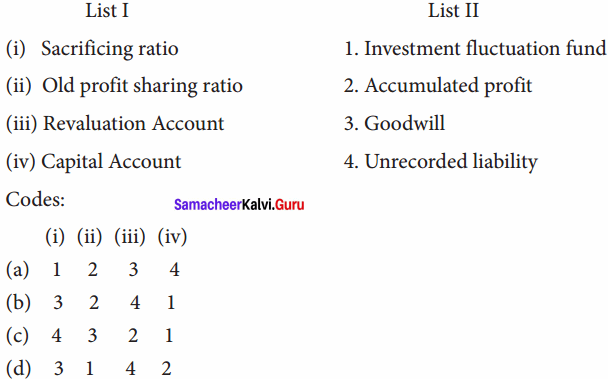
12th Accountancy 5th Chapter Solutions Samacheer Kalvi Admission Of A Partner
Answer:
(b) 3 2 4 1

Class 12th Accounts Chapter 5 Solutions Question 8.
Select the odd one out:
(a) Revaluation profit
(b) Accumulated loss
(c) Goodwill brought by new partner
(d) Investment fluctuation fund
Answer:
(c) Goodwill brought by new partner

12th Accountancy 5th Chapter Solutions Pdf Question 9.
James and Kamal are sharing profits and losses in the ratio of 5:3. They admit Sunil as a partner giving him 1/5 share of profits. Find out the sacrificing ratio.
(a) 1:3
(b) 3:1
(c) 5:3
(d) 3:5
Answer:
(c) 5:3

Accounts Chapter 5 Class 12 Solutions Question 10.
Balaji and Kamalesh are partners sharing profits and losses in the ratio of 2:1. They admit Yogesh into partnership. The new profit sharing ratio between Balaji, Kamalesh and Yogesh is agreed to 3:1:1. Find the sacrificing ratio between Balaji and Kamalesh.
(a) 1:3
(b) 3:1
(c) 2:1
(d) 1:2
Answer:
(d) 1:2

II. Very Short Answer Questions

Samacheer Kalvi Guru 12th Accountancy Question 1.
What is meant by revaluation of assets and liabilities?
Answer:
When a partner is admitted into the partnership the assets and liabilities are revealed as the current value may differ from the book value. Determination of
current values of assets and liabilities is called revaluation of assets and liabilities.

Chapter 5 Accounts Class 12 Question 2.
How are accumulated profits and losses distributed among the partners at the time of admission of a new partner?
Answer:
Profits and losses of previous years which are not distributed to the partners are called accumulated profit and losses. This belong to the old partners and hence these should be distributed to the old partners in the old profit sharing ratio.

Chapter 5 Accounts Class 12 Solutions Question 3.
What is sacrificing ratio?
Answer:
Sacrificing ratio is the proportion of the profit which is sacrificed or foregone by the old partners in favour of the new partner. The purpose of finding the sacrificing ratio is to share the goodwill brought in by the new partner.
Sacrifice Ratio = Old share – New share

Chapter 5 Class 12 Accounts Question 4.
Give the journal entry for writing off existing goodwill at the time of admission of a new partner.
Answer:
Journal Entry

12th Accountancy Chapter 5 Solutions Samacheer Kalvi Admission Of A Partner

Std 12 Account Chapter 5 Question 5.
State whether the following will be debited or credited in the revaluation account.

  1. Depreciation on assets
  2. Unrecorded liability
  3. Provision for outstanding expenses
  4. Appreciation of assets

Answer:

  1. Depreciation on assets – Debited
  2. Unrecorded liability – Debited
  3. Provision for outstanding expenses – Debited
  4. Appreciation of assets – Debited

III. Short Answer Questions

12th Accountancy 3rd Chapter Solutions Question 1.
What are the adjustments required at the time of admission of a partner?
Answer:
The following adjustments are necessary at the time of admission of a partner.

  1. Distribution of accumulated profits, reserves and losses
  2. Revaluation of assets and liabilities
  3. Determination of new profit sharing ratio and sacrificing ratio
  4. Adjustment for goodwill
  5. Adjustment of capital on the basis of new profit sharing ratio

12th Accountancy 6th Chapter Solutions Question 2.
What are the journal entries to be passed on revaluation of assets and liabilities?
Answer:
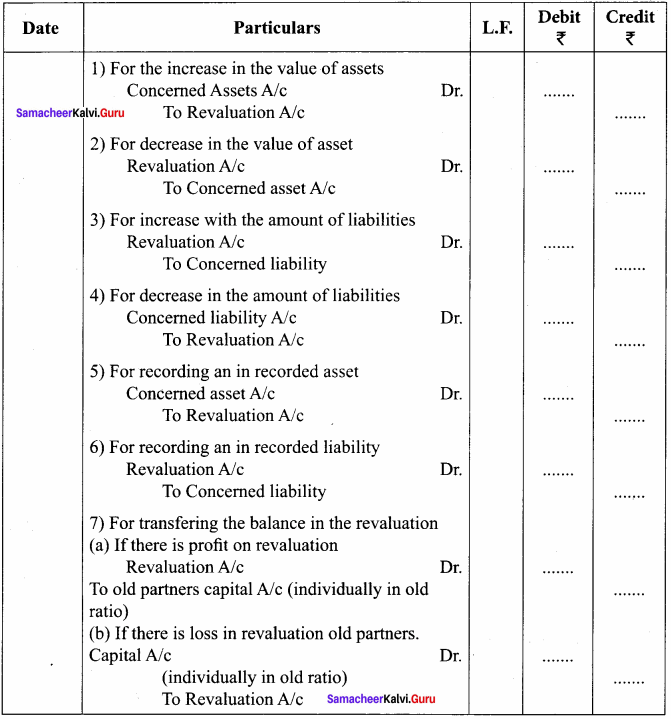
Class 12 Accountancy Chapter 5 Solutions Samacheer Kalvi Admission Of A Partner

Class 12 Accountancy Chapter 5 Question 3.
Write a short note on accounting treatment of goodwill.
Answer:
1. For the goodwill brought in cash credited to old partner’s capital account

12th Accountancy Chapter 5 Samacheer Kalvi Admission Of A Partner

2. For the goodwill brought in kind (in the form of asset) credited to old partner’s capital account

12th Accounts Chapter 5 Solutions Samacheer Kalvi Admission Of A Partner

3. For withdrawal of cash received for goodwill by the old partners

Accountancy Class 12 Chapter 5 Solutions Samacheer Kalvi Admission Of A Partner

III. Exercises

Chapter 5 Admission Of A Partner Question 1.
Arul and Anitha are partners sharing profits and losses in the ratio of 4 : 3. On 31.3.2018, Ajay was admitted as a partner. On the date of admission, the book of the firm showed a general reserve of ₹ 42,000. Pass the journal entry to distribute the general reserve.
Answer:
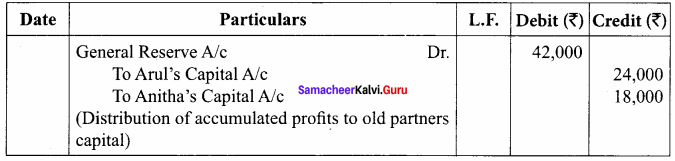
Accountancy Chapter 5 Class 12 Samacheer Kalvi Admission Of A Partner

Ch 5 Accounts Class 12 Question 2.
Anjali and Nithya are partners of a firm sharing profits and losses in the ratio of 5 : 3. They admit Pramila on 1.1.2018. On that date, their balance sheet showed accumulated loss of ₹ 40,000 on the asset side of the balance sheet. Give the journal entry to transfer the accumulated loss on admission.
Answer:
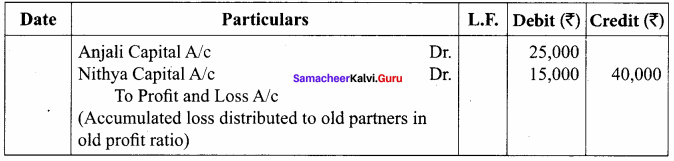
Class 12th Accounts Chapter 5 Solutions Samacheer Kalvi Admission Of A Partner

Samacheer Kalvi 12th Accountancy Solutions Chapter 1 Question 3.
Oviya and Kavya are partners in a firm sharing profits and losses in the ratio of 5:3. They admit Agalya into the partnership. Their balance sheet as on 31st March, 2019 is as follows:
Balance Sheet as on 31st March 2019
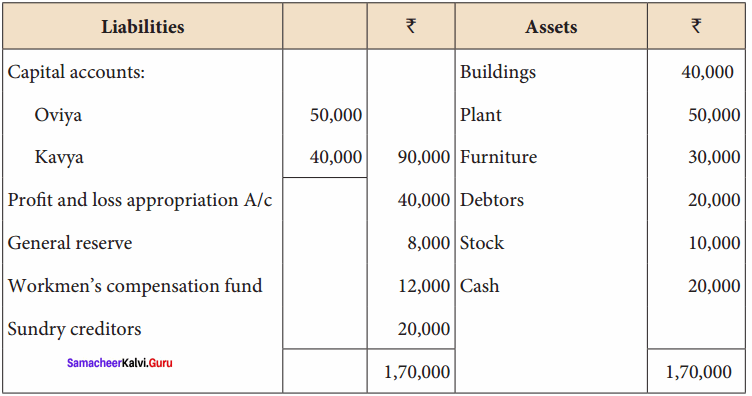
12th Accountancy 5th Chapter Solutions Pdf Samacheer Kalvi Admission Of A Partner
Pass journal entry to transfer the accumulated profits and reserve on admission.
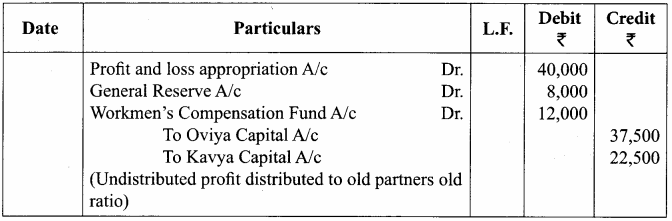
Accounts Chapter 5 Class 12 Solutions Samacheer Kalvi Admission Of A Partner

Question 4.
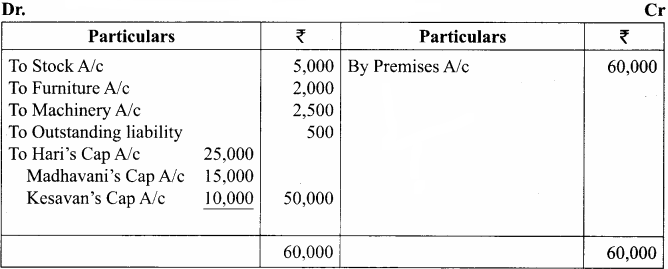
Hari, Madhavan and Kesavan are partners, sharing profits and losses in the ratio of 5:3:2. As from 1st April 2017, Vanmathi is admitted into the partnership and the new profit sharing ratio is decided as 4:3:2:1. The following adjustments are to be made.

  1. Increase the value of premises by ₹ 60,000.
  2. Depreciate stock by ₹ 5,000, furniture by ₹ 2,000 and machinery by ₹ 2,500.
  3. Provide for an outstanding liability of ₹ 500.

Pass journal entries and prepare revaluation account.
Journal Entries
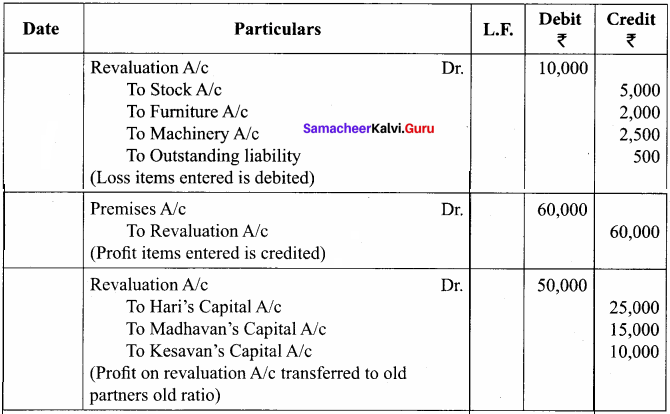
Samacheer Kalvi Guru 12th Accountancy Solutions Chapter 5 Admission Of A Partner
Revaluation Account
Chapter 5 Accounts Class 12 Samacheer Kalvi Chapter 5 Admission Of A Partner

Question 5.
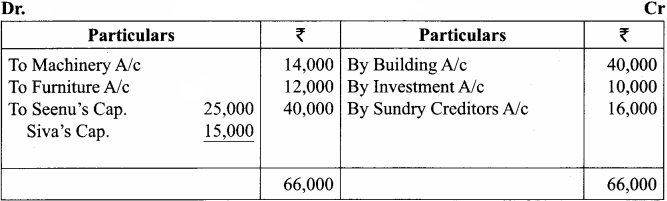
Seenu and Siva are partners sharing profits and losses in the ratio of 5:3. In the view of Kowsalya admission, they decided

  1. To increase the value of building by ₹ 40,000.
  2. To bring into record investments at ₹ 10,000, which have not so far been brought into account.
  3. To decrease the value of machinery by ₹ 14,000 and furniture by ₹ 12,000.
  4. To write off sundry creditors by ₹ 16,000.

Pass journal entries and prepare revaluation account.
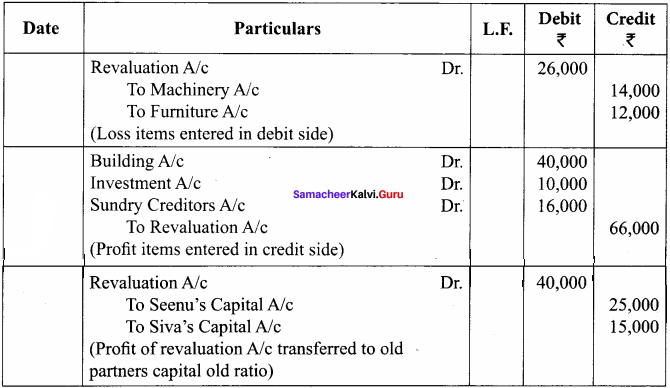
Samacheer Kalvi 12th Accountancy Solutions Chapter 5 Admission of a Partner 13
Revaluation Account
Chapter 5 Accounts Class 12 Solutions Samacheer Kalvi Admission Of A Partner

Question 6.
Sai and Shankar are partners, sharing profits and losses in the ratio of 5 : 3. The firm’s balance sheet as on 31st December, 2017, was as follows:
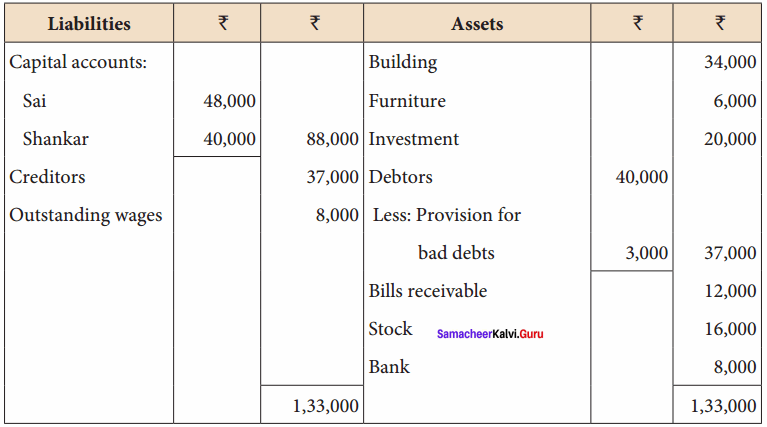
Chapter 5 Class 12 Accounts Samacheer Kalvi Admission Of A Partner
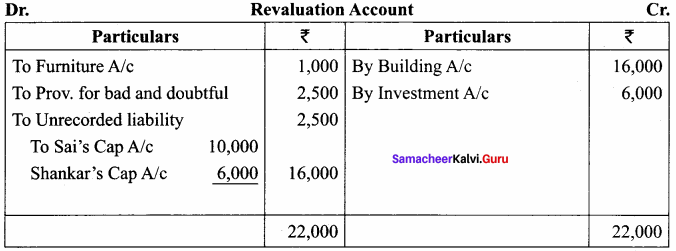
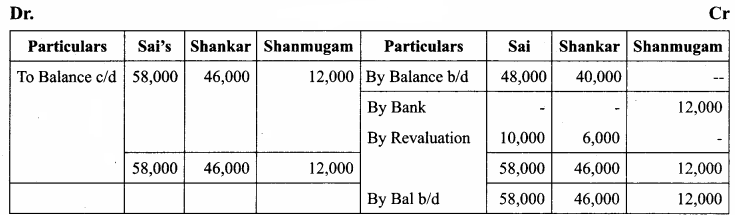
On 31st December, 2017 Shanmugam was admitted into the partnership for 1/4 share of profit with ₹ 12,000 as capital subject to the following adjustments.

  1. Furniture is to be revalued at ₹ 5,000 and building is to be revalued at ₹ 50,000
  2. Provision for doubtful debts is to be increased to ₹ 5,500
  3. An unrecorded investment of ₹ 6,000 is to be brought into account
  4. An unrecorded liability ₹ 2,500 has to be recorded now

Pass journal entries and prepare Revaluation Account and capital account of partners after admission.
Journal Entries
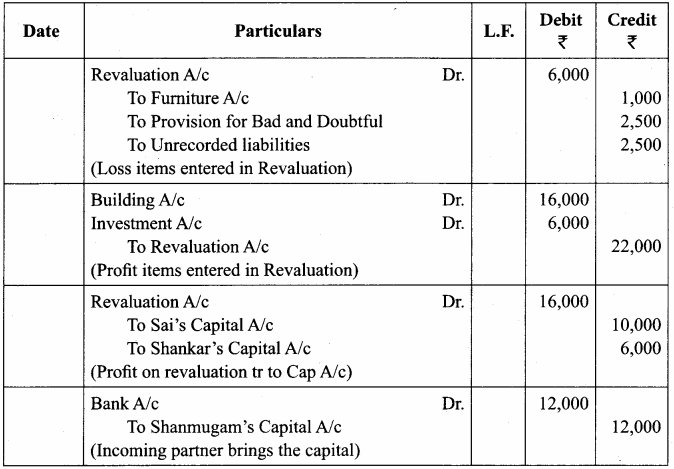
Std 12 Account Chapter 5 Samacheer Kalvi Admission Of A Partner
Revaluation Account
Class 12 Accountancy Chapter 5 Samacheer Kalvi Admission Of A Partner
Capital Account
Chapter 5 Admission Of A Partner Samacheer Kalvi 12th Accountancy Solutions

Question 7.
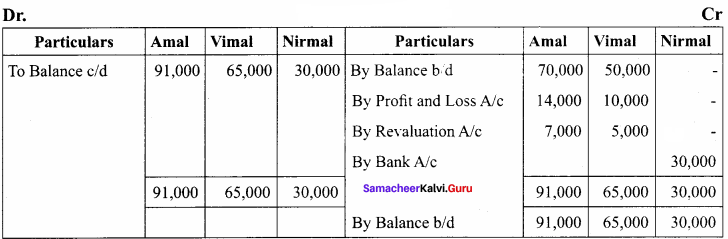
Amal and Vimal are partners in a firm sharing profits and losses in the ratio of 7 : 5. Their balance sheet as on 31st March, 2019, is as follows:
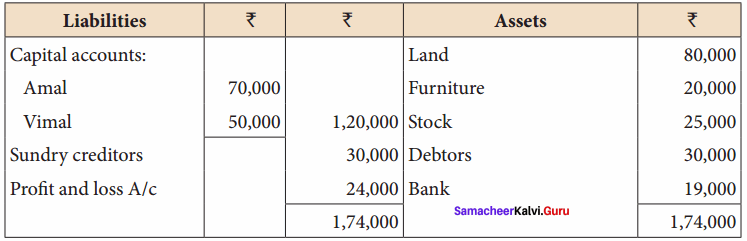
Ch 5 Accounts Class 12 Samacheer Kalvi Admission Of A Partner
Nirmal is admitted as a new partner on 1.4.2018 by introducing a capital of 30,000 for 1/3 share in the future profit subject to the following adjustments.

  1. Stock to be depreciated by ₹ 5,000
  2. Provision for doubtful debts to be created for ₹ 3,000
  3. Land to be appreciated by ₹ 20,000

Prepare revaluation account and capital account of partners after admission.
Answer:
Revaluation Account
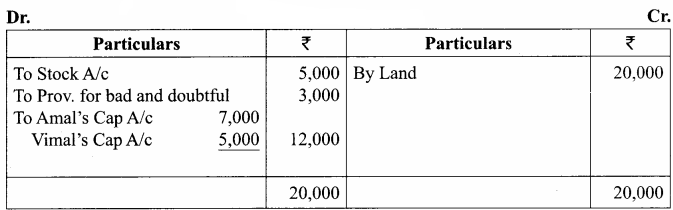
Samacheer Kalvi 12th Accountancy Solutions Chapter 1 Admission Of A Partner
Capital Account
Samacheer Kalvi 12th Accountancy Solutions Chapter 5 Admission of a Partner 21

Question 8.
Praveena and Dhanya are partners sharing profits in the ratio of 7 : 3. They admit Malini into the firm. The new ratio among Praveena, Dhanya and Malini is 5 : 2 : 3. Calculate the sacrificing ratio.
Answer:
Sacrificing Ratio = Old Ratio – New Ratio
Praveena = \(\frac { 7 }{ 10 }\) – \(\frac { 5 }{ 10 }\) = \(\frac { 2 }{ 10 }\)
Dhanya = \(\frac { 3 }{ 10 }\) – \(\frac { 2 }{ 10 }\) = \(\frac { 1 }{ 10 }\)
Sacrificing Ratio = 2 : 1

Question 9.
Ananth and Suman are partners sharing profits and losses in the ratio of 3 : 2. They admit Saran for 1/5 share, which he acquires entirely from Ananth. Find out the new profit sharing ratio and sacrificing ratio.
Answer:
New Profit Sharing Ratio:
Ananth = \(\frac { 3 }{ 5 }\) – \(\frac { 1 }{ 5 }\) = \(\frac { 2 }{ 5 }\)
Suman = \(\frac { 2 }{ 5 }\) – = \(\frac { 2 }{ 5 }\)
Ananth = \(\frac { 1}{ 5 }\) – = \(\frac { 1 }{ 5 }\)
New Profit sharing Ratio = 2 : 2 : 1
Sacrificing Ratio = 1 : 0

Question 10.
Raja and Ravi are partners, sharing profits in the ratio of 3 : 2. They admit Ram for 1/4 share of the profit. He takes 1/20 share from Raja and 4/20 from Ravi. Calculate the new profit sharing ratio and sacrificing ratio.
Answer:
New Profit Sharing Ratio = Old Ratio – Sacrificing Ratio
Raja = \(\frac { 3 }{ 5 }\) – \(\frac { 1 }{ 20 }\) = \(\frac { 12 – 1 }{ 20 }\) = \(\frac { 11 }{ 20 }\)
Ravi = \(\frac { 2 }{ 5 }\) – \(\frac { 4 }{ 20 }\) = \(\frac { 8 – 4 }{ 20 }\) = \(\frac { 4 }{ 20 }\)
Ram = \(\frac { 1 }{ 20 }\) + \(\frac { 4 }{ 20 }\) = \(\frac { 5 }{ 20 }\)
New Profit sharing Ratio = 11 : 4 : 5
Sacrificing Ratio = \(\frac { 1 }{ 20 }\) : \(\frac { 4 }{ 20 }\)

Question 11.
Vimala and Kamala are partners, sharing profits and losses in the ratio of 4:3. Vinitha enters into the partnership and she acquires 1/14 from Vimala and 1/14 from Kamala. Find out the new profit sharing ratio and sacrificing ratio.
Answer:
New Profit Sharing Ratio = Old Ratio – Sacrificing Ratio
Vimala = \(\frac { 4 }{ 7 }\) – \(\frac { 1 }{ 14 }\) = \(\frac { 8 – 1 }{ 14 }\) = \(\frac { 7 }{ 14 }\)
Kamala = \(\frac { 3 }{ 7 }\) – \(\frac { 1 }{ 14 }\) = \(\frac { 6 – 1 }{ 14 }\) = \(\frac { 5 }{ 14 }\)
Vinitha = \(\frac { 1 }{ 14 }\) + \(\frac { 1 }{ 14 }\) = \(\frac { 2 }{ 14 }\)
New Profit Sharing Ratio = 7 : 5 : 2
Sacrificing Ratio = 1 : 1

Question 12.
Govind and Gopal are partners in a firm sharing profits in the ratio of 5 : 4. They admit Rahim as a partner. Govind surrenders 2/9 of his share in favour of Rahim. Gopal surrenders 1/9 of his share in favour of Rahim. Calculate the new profit sharing ratio and sacrificing ratio.
Answer:
New Profit Sharing Ratio:
Govind = \(\frac { 5 }{ 9 }\) x \(\frac { 2 }{ 9 }\) = \(\frac { 10 }{ 81 }\) ; \(\frac { 5 }{ 9 }\) – \(\frac { 10 }{ 81 }\) = \(\frac { 45 – 10 }{ 81 }\) = \(\frac { 35 }{ 81 }\)
Gopal = \(\frac { 4 }{ 9 }\) x \(\frac { 1 }{ 9 }\) = \(\frac { 4 }{ 81 }\) ; \(\frac { 3 }{ 8 }\) – \(\frac { 3 }{ 64 }\) = \(\frac { 24 – 3 }{ 64 }\) = \(\frac { 21 }{ 64 }\)
Rahim = \(\frac { 2 }{ 9 }\) + \(\frac { 1 }{ 9 }\) = \(\frac { 3 }{ 9 }\) ; \(\frac { 10 }{ 81 }\) + \(\frac { 4 }{ 81 }\) = \(\frac { 14 }{ 81 }\)
New Profit Sharing Ratio = 35 : 32 : 14
Sacrificing Ratio = \(\frac { 10 }{ 81 }\) : \(\frac { 4 }{ 81 }\) = 5 : 2

Question 13.
Prema and Chandra share profits in the ratio of 5:3. Hema is admitted as a partner. Prema surrendered 1/8 of her share and Chandra surrendered 1/8 of her share in favour of Hema. Calculate the new profit sharing ratio and sacrificing ratio.
Answer:
New Profit Sharing Ratio:
Prema = \(\frac { 5 }{ 8 }\) x \(\frac { 1 }{ 8 }\) = \(\frac { 5 }{ 64 }\) ; \(\frac { 5 }{ 8 }\) – \(\frac { 5 }{ 64 }\) = \(\frac { 40 – 5 }{ 64 }\) = \(\frac { 35 }{ 64 }\)
Chandra = \(\frac { 3 }{ 8 }\) x \(\frac { 1 }{ 8 }\) = \(\frac { 3 }{ 64 }\) ; \(\frac { 3 }{ 8 }\) – \(\frac { 3 }{ 64 }\) = \(\frac { 24 – 3 }{ 64 }\) = \(\frac { 21 }{ 64 }\)
Hema = \(\frac { 5 }{ 64 }\) + \(\frac { 3 }{ 64 }\) = \(\frac { 8 }{ 64 }\)
New Profit Sharing Ratio = 35 : 21 : 8
Sacrificing Ratio = 5 : 3

Question 14.
Karthik and Kannan are equal partners. They admit Kailash with 1/4 share of the profit. Kailash acquired his share from old partners in the ratio of 7:3. Calculate the new profit sharing ratio and sacrificing ratio.
New Profit Sharing Ratio:
Karthik = \(\frac { 1 }{ 4 }\) x \(\frac { 7 }{ 10 }\) = \(\frac { 7 }{ 40 }\) ; \(\frac { 1 }{ 2 }\) – \(\frac { 7 }{ 40 }\) = \(\frac { 20 – 7 }{ 40 }\) = \(\frac { 13 }{ 40 }\)
Kannan = \(\frac { 1 }{ 4 }\) x \(\frac { 3 }{ 10 }\) = \(\frac { 3 }{ 40 }\) ; \(\frac { 1 }{ 2 }\) – \(\frac { 3 }{ 40 }\) = \(\frac { 20 – 3 }{ 40 }\) = \(\frac { 17 }{ 40 }\)
Kailash = \(\frac { 1 }{ 4 }\) x 10 = \(\frac { 10 }{ 40 }\)
New Profit Sharing Ratio = 13 : 17 : 10
Sacrificing Ratio = 7 : 3

Question 15.
Selvam and Senthil are partners sharing profit in the ratio of 2:3. Siva is admitted into the firm with 1/5 share of profit. Siva acquires equally from Selvam and Senthil. Calculate the new profit sharing ratio and sacrificing ratio.
Answer:
New Profit Sharing Ratio:
Siva’s share = \(\frac { 1 }{ 5 }\) x \(\frac { 1 }{ 2 }\) = \(\frac { 1 }{ 10 }\)
Selvam’s share = \(\frac { 2 }{ 5 }\) – \(\frac { 1 }{ 10 }\) = \(\frac { 4 – 1 }{ 10 }\) = \(\frac { 3 }{ 10 }\)
Senthil’s share = \(\frac { 3 }{ 5 }\) – \(\frac { 1 }{ 10 }\) = \(\frac { 6 – 1 }{ 10 }\) = \(\frac { 5 }{ 10 }\)
Siva’s share = \(\frac { 1 }{ 10 }\) + \(\frac { 1 }{ 10 }\) = \(\frac { 2 }{ 10 }\)
New Profit sharing Ratio = 3 : 5 : 2
Sacrificing Ratio = 1 : 1

Question 16.
Mala and Anitha are partners, sharing profits and losses in the ratio of 3 : 2. Mercy is admitted into the partnership with 1/5 share in the profits. Calculate new profit sharing ratio and sacrificing ratio.
Answer:
Calculate New Profit Sharing Ratio = 1 – \(\frac { 1 }{ 5 }\) = \(\frac { 4 }{ 5 }\)
Mala = \(\frac { 3 }{ 5 }\) x \(\frac { 4 }{ 5 }\) = \(\frac { 12 }{ 25 }\)
Anitha = \(\frac { 2 }{ 5 }\) x \(\frac { 4 }{ 5 }\) = \(\frac { 8 }{ 25 }\)
Mercy = \(\frac { 1 }{ 5 }\) x 5 = \(\frac { 5 }{ 25 }\)
New Profit Sharing Ratio = 12 : 8 : 5
Sacrificing Ratio = Old share – New share
Mala = \(\frac { 3 }{ 5 }\) – \(\frac { 12 }{ 25 }\) = \(\frac { 15 – 12}{ 25 }\) = \(\frac { 3 }{ 25 }\)
Anitha = \(\frac { 2 }{ 5 }\) – \(\frac { 8 }{ 25 }\) = \(\frac { 2 }{ 25 }\)
Sacrificing Ratio = 3 : 2

Question 17.
Ambika, Dharani and Padma are partners in a firm sharing profits in the ratio of 5:3:2. They admit Ramya for 25% profit. Calculate the new profit sharing ratio and sacrificing ratio.
Answer:
Ramya share = 25% = 100% – 25% = 75% = \(\frac { 3 }{ 4 }\)
Ambika’s share = \(\frac { 5 }{ 10 }\) x \(\frac { 3 }{ 4 }\) = \(\frac { 15 }{ 40 }\)
Dharani’s share = \(\frac { 3 }{ 10 }\) x \(\frac { 3 }{ 4 }\) = \(\frac { 9 }{ 40 }\)
Padma’s share = \(\frac { 2 }{ 10 }\) x \(\frac { 3 }{ 4 }\) = \(\frac { 6 }{ 40 }\)
Mercy’s share
New Profit Sharing Ratio
Sacrificing Ratio = Old share – New share
Ambika’s share = \(\frac { 5 }{ 10 }\) – \(\frac { 15 }{ 40 }\) = \(\frac { 20 – 15 }{ 40 }\) = \(\frac { 5 }{ 40 }\)
Dharani’s share = \(\frac { 3 }{ 10 }\) – \(\frac { 9 }{ 40 }\) = \(\frac { 12 – 9 }{ 40 }\) = \(\frac { 3 }{ 40 }\)
Padma’s share = \(\frac { 2 }{ 10 }\) – \(\frac { 6 }{ 40 }\) = \(\frac { 8 – 6 }{ 40 }\) = \(\frac { 2 }{ 40 }\)
Sacrificing Ratio = 5 : 3 : 2

Question 18.
Aparna and Priya are partners who share profits and losses in the ratio of 3 : 2. Brindha joins the firm for 1/5 share of profits and brings in cash for her share of goodwill of ₹ 10,000. Pass necessary journal entry for adjusting goodwill on the assumption that the fluctuating capital method is followed and the partners withdraw the entire amount of their share of goodwill.
Adjustment of goodwill
Journal Entries
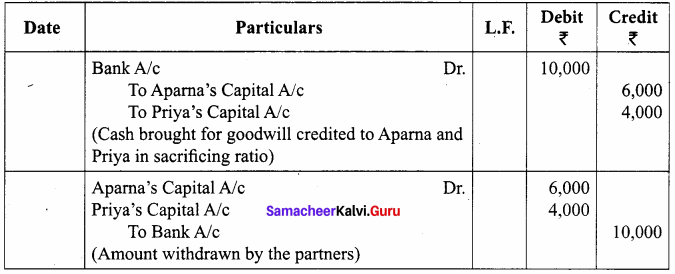
Samacheer Kalvi 12th Accountancy Solutions Chapter 5 Admission of a Partner 22

Question 19.
Deepak, Senthil and Santhosh are partners sharing profits and losses equally. They admit Jerald into partnership for 1/3 share in future profits. The goodwill of the firm is valued at ₹ 45,000 and Jerald brought cash for his share of goodwill. The existing partners withdraw half of the amount of their share of goodwill. Pass necessary journal entries for adjusting goodwill on the assumption that the fluctuating capital method is followed.
Journal Entries
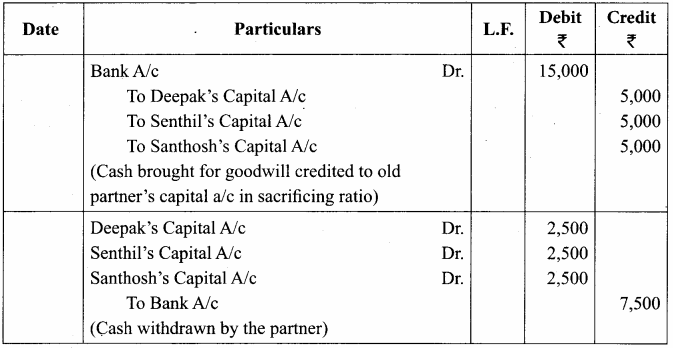
Samacheer Kalvi 12th Accountancy Solutions Chapter 5 Admission of a Partner 23
Jerald’s Share of goodwill = ₹ 45000 x 1/3 = ₹ 1,500
As the sacrifice made by the existing partners is not mentioned. It is assumed that they sacrifice in their old share profit ratio = 1 : 1 : 1.
Therefore, Sacrificing ratio = 1 : 1 : 1.

Question 20.
Malathi and Shobana are partners sharing profits and losses in the ratio of 5 : 4. They admit Jayasri into partnership for 1/3 share of profit. Jayasri pays cash ₹ 6,000 towards her share of goodwill. The new ratio is 3 : 2 : 1. Pass necessary journal entry for adjusting goodwill on the assumption that the fixed capital method is followed.
Adjusting Goodwill: Old share – New Share
Malathi’s share = \(\frac { 5 }{ 9 }\) – \(\frac { 3 }{ 6 }\) = \(\frac { 10 – 9 }{ 18 }\) = \(\frac { 1 }{ 18 }\)
Shobana’s share = \(\frac { 4 }{ 9 }\) – \(\frac { 2 }{ 6 }\) = \(\frac { 8 – 6 }{ 18 }\) = \(\frac { 2 }{ 18 }\)

Question 21.
Anu and Arul were partners in a firm sharing profits and losses in the ratio of 4 : 1. They have decided to admit Mano into the firm for 2/5 share of profits. The goodwill of the firm on the date of admission was valued at ₹ 25,000. Mano is not able to bring in cash for his share of goodwill. Pass necessary journal entry for goodwill on the assumption that the fluctuating capital method is followed.
Answer:
Mano’s shares: 25000 x \(\frac { 2 }{ 5 }\) = Rs 10000
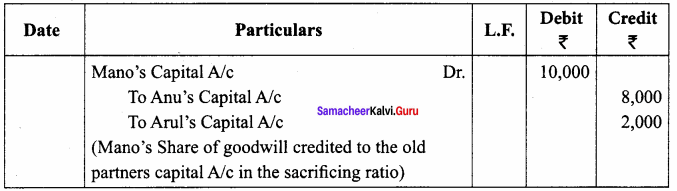
Samacheer Kalvi 12th Accountancy Solutions Chapter 5 Admission of a Partner 24

Question 22.
Varun and Barath are partners sharing profits and losses 5 : 4. They admit Dhamu into partnership. The new profit sharing ratio is agreed at 1 : 1 : 1. Dhamu’s share of goodwill is valued at ₹ 15,000 of which he pays ₹ 10,000 in cash. Pass necessary journal entries for adjustment of goodwill on the assumption that the fluctuating capital method is followed.
Answer:
Dhamu’s share of goodwill against sacrificing ratio:
Sacrificing Ratio = Old share – New share
Varun = \(\frac { 5 }{ 9 }\) – \(\frac { 1 }{ 3 }\) = \(\frac { 5 – 3 }{ 9 }\) = \(\frac { 2 }{ 9 }\)
Barath = \(\frac { 4 }{ 9 }\) – \(\frac { 1 }{ 3 }\) = \(\frac { 4 – 3 }{ 9 }\) = \(\frac { 1 }{ 9 }\)
Goodwill value = \(\frac { 15000 }{ 3 }\) = ₹ 5000.
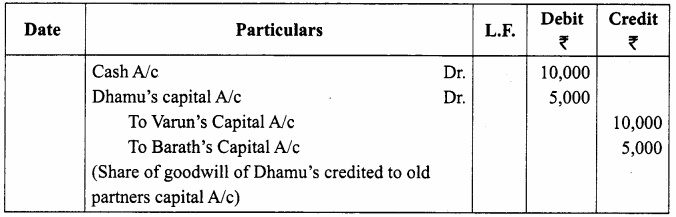
Samacheer Kalvi 12th Accountancy Solutions Chapter 5 Admission of a Partner 25

Question 23.
Sam and Jose are partners in a firm sharing profits and losses in the ratio of 3 : 2. On 1st April 2018, they admitted Joel as a partner. On the date of Joel’s admission, goodwill appeared in the books of the firm at ₹ 30,000. By assuming fluctuating capital method, pass the necessary journal entry if the partners decide to

  1. write off the entire amount of existing goodwill
  2. write off ₹ 20,000 of the existing goodwill.

Answer:
Journal Entries
(a) Write off the entire amount of existing goodwill
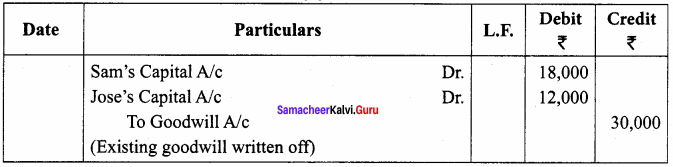
Samacheer Kalvi 12th Accountancy Solutions Chapter 5 Admission of a Partner 26
(b) Write off ₹ 20,000 of the existing goodwill
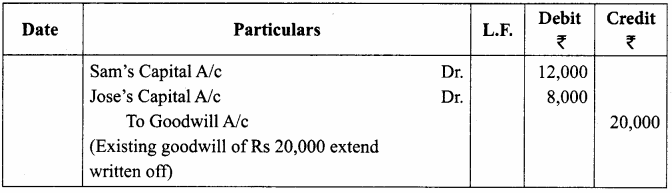
Samacheer Kalvi 12th Accountancy Solutions Chapter 5 Admission of a Partner 27

Question 24.
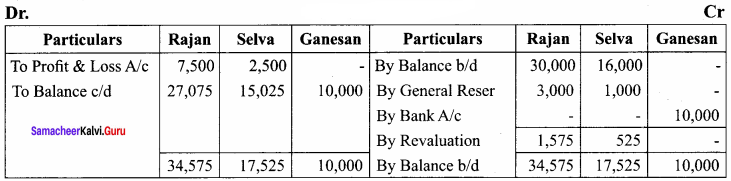
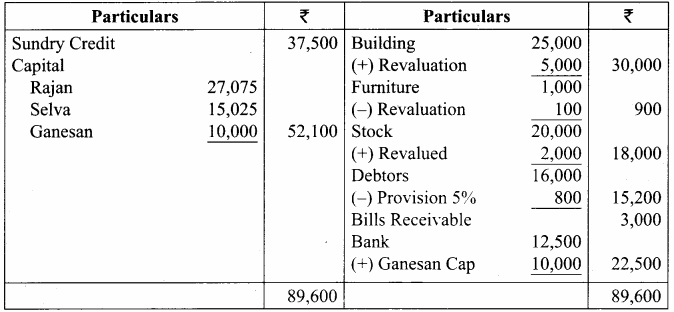
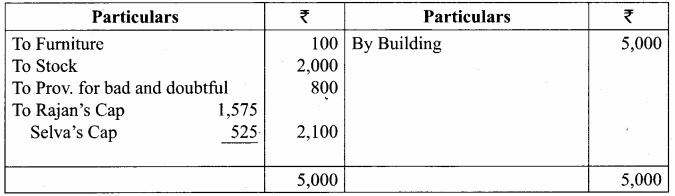
Raj an and Selva are partners sharing profits and losses in the ratio of 3:1. Their balance sheet as on 31st March 2017 is as under:
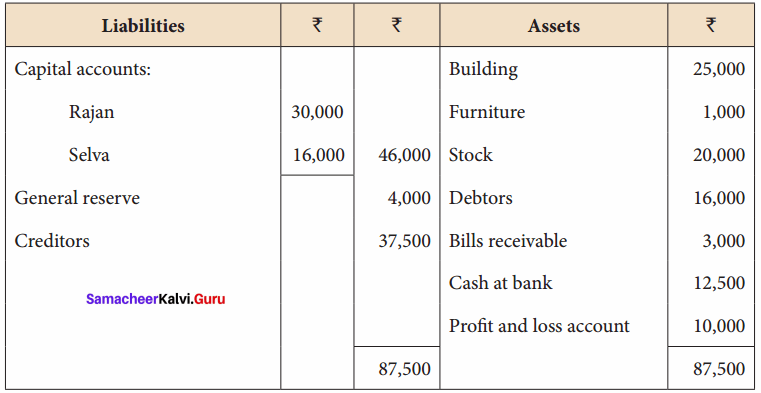
Samacheer Kalvi 12th Accountancy Solutions Chapter 5 Admission of a Partner 28
On 1.4.2017, they admit Ganesan as a new partner on the following arrangements:

  1. Ganesan brings ₹ 10,000 as capital for 1/5 share of profit.
  2. Stock and furniture is to be reduced by 10%, a reserve of 5% on debtors for doubtful debts is to be created.
  3. Appreciate buildings by 20%.

Prepare revaluation account, partners’ capital account and the balance sheet of the firm after admission.
Revaluation Account
Samacheer Kalvi 12th Accountancy Solutions Chapter 5 Admission of a Partner 29
Capital Account
Samacheer Kalvi 12th Accountancy Solutions Chapter 5 Admission of a Partner 30
Balance Sheet
Samacheer Kalvi 12th Accountancy Solutions Chapter 5 Admission of a Partner 31

Question 25.
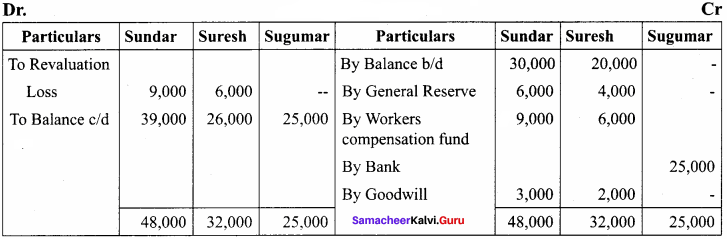
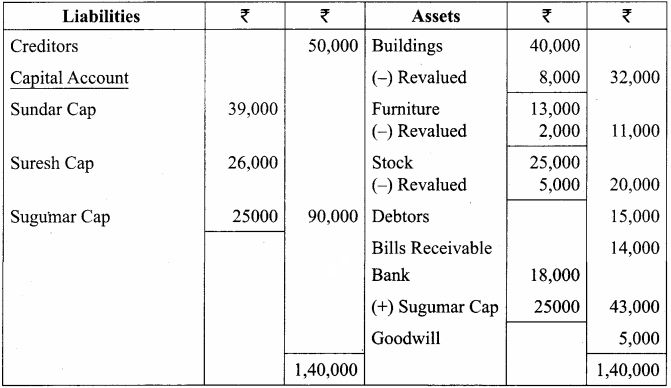
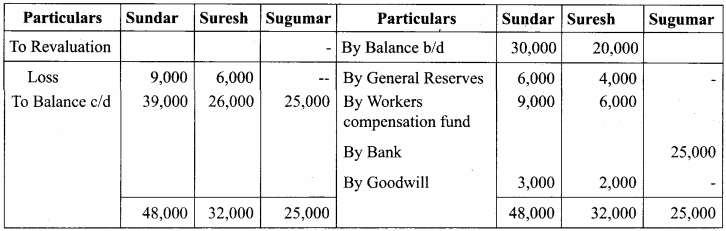
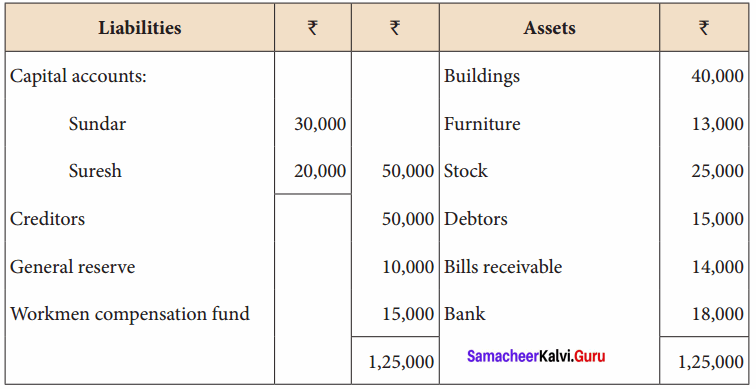
Sundar and Suresh are partners sharing profits in the ratio of 3:2. Their balance sheet as on 1st January, 2017 was as follows:
Samacheer Kalvi 12th Accountancy Solutions Chapter 5 Admission of a Partner 32
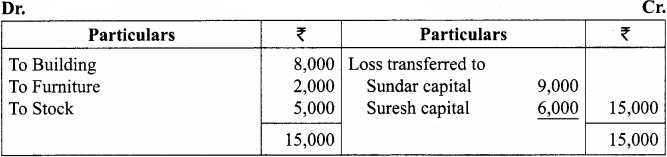
They decided to admit Sugumar into partnership for 1/4 share in the profits on the following terms:

  1. Sugumar has to bring in ₹ 30,000 as capital. His share of goodwill is valued at ₹ 5,000. He could not bring cash towards goodwill.
  2. That the stock be valued at ₹ 20, 000.
  3. That the furniture be depreciated by ₹ 2,000.
  4. That the value of building be depreciated by 20%.

Prepare necessary ledger accounts and the balance sheet after admission.
Answer:
Revaluation Account
Samacheer Kalvi 12th Accountancy Solutions Chapter 5 Admission of a Partner 33
Capital Account
Samacheer Kalvi 12th Accountancy Solutions Chapter 5 Admission of a Partner 34
Balance Sheet as on 31.12.17
Samacheer Kalvi 12th Accountancy Solutions Chapter 5 Admission of a Partner 35

Question 26.
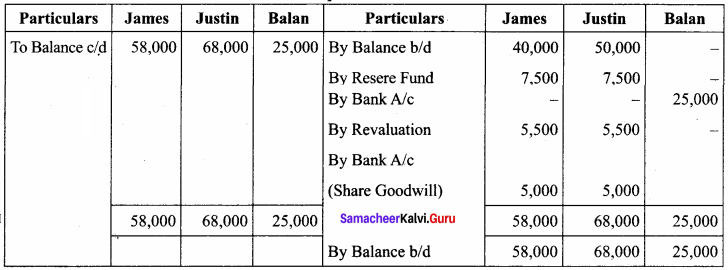
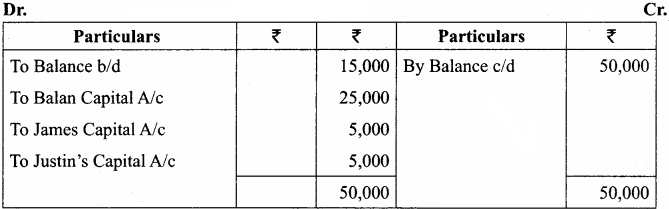
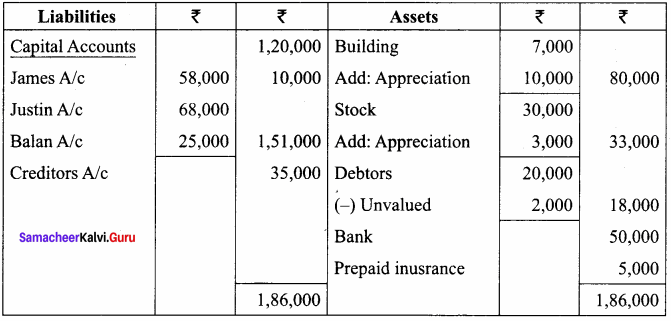
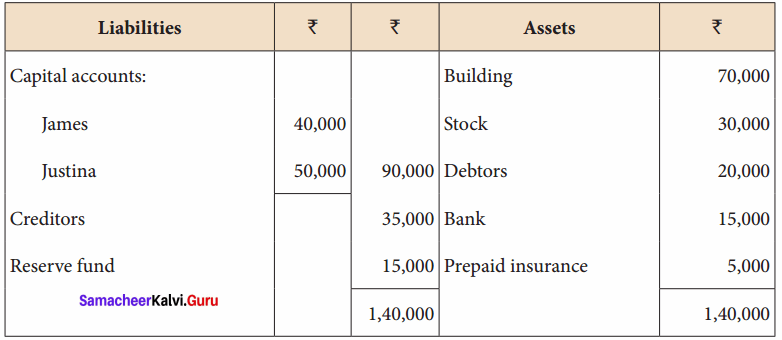
The following is the balance sheet of Janies and Justina as on 1.1.2017. They share the profits and losses equally.
Samacheer Kalvi 12th Accountancy Solutions Chapter 5 Admission of a Partner 36
On the above date, Balan is admitted as a partner with 1/5 share in future profits. Following are the terms for his admission:

  1. Balan brings ₹ 25,000 as capital.
  2. His share of goodwill is ₹ 10,000 and he brings cash for it.
  3. The assets are to be valued as under:

Building ₹ 80,000; Debtors ₹ 18,000; Stock ₹ 33,000 Prepare necessary ledger accounts and the balance sheet after admission.
Answer:
Revaluation Account
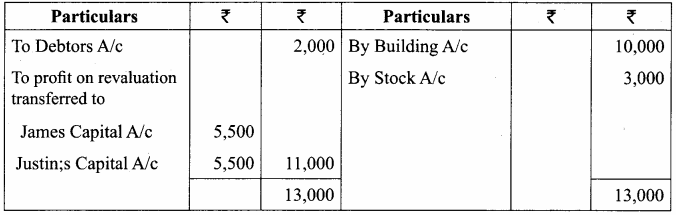
Samacheer Kalvi 12th Accountancy Solutions Chapter 5 Admission of a Partner 37
Capital Account
Samacheer Kalvi 12th Accountancy Solutions Chapter 5 Admission of a Partner 38
Cash Account
Samacheer Kalvi 12th Accountancy Solutions Chapter 5 Admission of a Partner 39
Balance Sheet as on 01.01.2017
Samacheer Kalvi 12th Accountancy Solutions Chapter 5 Admission of a Partner 40

Question 27.
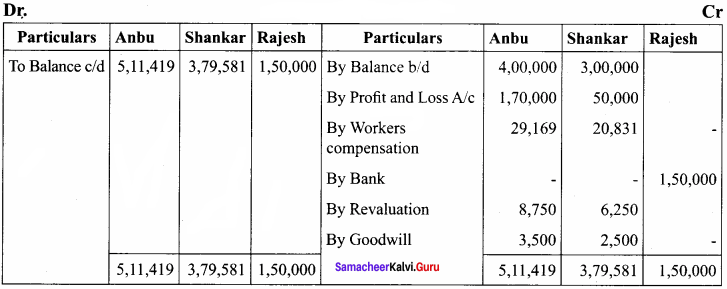
Anbu and Shankar are partners in a business sharing profits and losses in the ratio of 7 : 5. The balance sheet of the partners on 31.03.2018 is as follows:
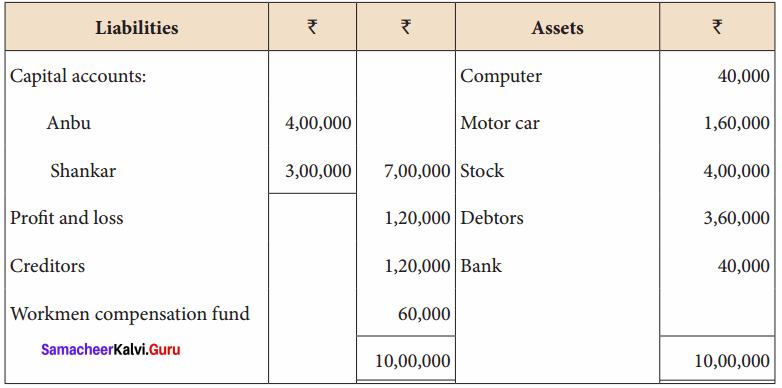
Samacheer Kalvi 12th Accountancy Solutions Chapter 5 Admission of a Partner 41
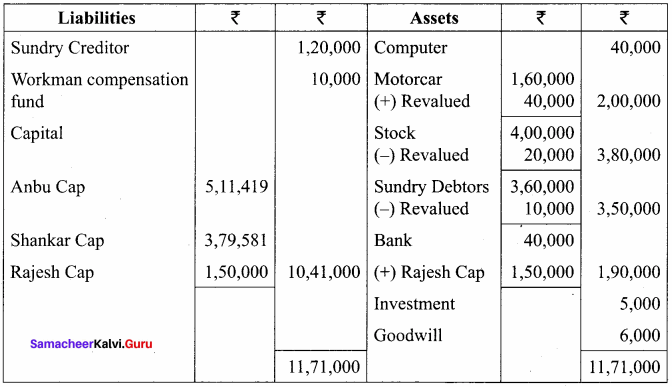
Rajesh is admitted for 1/5 share on the following terms:

  1. Goodwill of the firm is valued at ₹ 80,000 and Rajesh brought cash ₹ 6,000 for his share of goodwill.
  2. Rajesh is to bring ₹ 1,50,000 as his capital.
  3. Motor car is valued at ₹ 2,00,000; stock at ₹ 3,80,000 and debtors at ₹ 3,50,000.
  4. Anticipated claim on workmen compensation fund is ₹ 10,000
  5. Unrecorded investment of ₹ 5,000 has to be brought into account.

Prepare revaluation account, capital accounts and balance sheet after Rajesh’s admission.
Revaluation Account
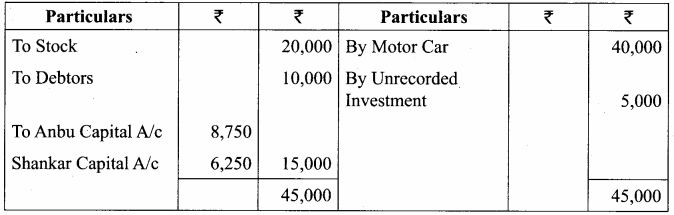
Samacheer Kalvi 12th Accountancy Solutions Chapter 5 Admission of a Partner 42
Capital Account
Samacheer Kalvi 12th Accountancy Solutions Chapter 5 Admission of a Partner 43
Balance Sheet as on 31.03.2018
Samacheer Kalvi 12th Accountancy Solutions Chapter 5 Admission of a Partner 44
Samacheer Kalvi 12th Accountancy Solutions Chapter 5 Admission of a Partner 45

Samacheer Kalvi 12th Accountancy Admission of a Partner Additional Questions and Answers

I. Choose the correct answer

Question 1.
At the time of admission of a partner calculation of new profit ratio is ………………
(a) not necessary
(b) necessary
(c) optional
Answer:
(b) necessary

Question 2.
In admission, undistributed profit or loss transferred to ………………
(a) New Partners only
(b) Old Partners only
(c) All the Partners
Answer:
(b) Old Partners only

Question 3.
To get sacrificing ratio should be deducted from old share ………………
(a) Gaining share
(b) New share
(c) Neither of the two
Answer:
(b) new share

Question 4.
A person who is admitted to the firm is known as ………………
(a) Outgoing partners
(b) Incoming partner
(c) Both
Answer:
(b) incoming partner

Question 5.
At the time of admission of a new partner the following are revalued ………………
(a) Assets
(b) Liabilities
(c) Both
Answer:
(c) Both

Question 6.
New profit ratio is calculated at the time of admission, by deducting ………………
(a) Sacrifice from the old ratio
(b) Old ratio from the sacrifice
(c) Sacrifice from the new ratio
Answer:
(a) Sacrifice from the old ratio

Question 7.
On the admission of a new partner ………………
(a) Old firm has to be dissolved
(b) Old partnership has to be dissolved
(c) Both old firm and partnership have to be dissolved
(d) Neither partnership nor firm has to be dissolved
Answer:
(b) Old partnership has to be dissolved

Question 8.
When a new partner brings his share of goodwill in cash, the amount is debited to ………………
(a) Premium A/c
(b) Cash A/c
(c) Capital A/c of old partner
(d) Capital A/c of new partner
Answer:
(b) Cash A/c

Question 9.
Goodwill already appearing in the Balance sheet at the time of admission of a partner is transferred to ………………
(a) New Partners’ Capital A/c
(b) Old Partners’ Capital A/c
(c) Revaluation A/c
(d) None of the above
Answer:
(b) Old Partners’ Capital A/c
Samacheer Kalvi 8th Social Science History Solutions Term 1 Chapter 4 People’s Revolt

You can Download Samacheer Kalvi 8th Social Science Book Solutions Guide Pdf, Tamilnadu State Board help you to revise the complete Syllabus and score more marks in your examinations.

Tamilnadu Samacheer Kalvi 8th Social Science History Solutions Term 1 Chapter 4 People’s Revolt

Samacheer Kalvi 8th Social Science People’s Revolt Textbook Evaluation

I. Choose the correct answer

People’s Revolt Class 8 Question 1.
The Palayakkarar system was instituted in –
(a) 1519
(b) 1520
(c) 1529
(d) 1530
Answer:
(c) 1529

Question 2.
Which of the following Palayakkarar of Tamil Nadu was the pioneer against the English rule –
(a) Pulitevan
(b) Yusuf Khan
(c) Kattabomman
(d) Marudhu brothers
Answer:
(a) Pulitevan

Question 3.
Colin Jackson was the collector of –
(a) Madurai
(b) Tirunelveli
(c) Ramanathapuram
(d) Tuticorin
Answer:
(c) Ramanathapuram

Question 4.
Veera Pandiya Kattabomman was hanged at the fort of –
(a) Panchalamkurichi
(b) Sivagangai
(c) Tiruppathur
(d) Kayathar
Answer:
(d) Kayathar

Question 5.
Velu Nachiyar was a queen of –
(a) Nagalapuram
(b) Sivagiri
(c) Sivagangai
(d) Virapachi
Answer:
(c) Sivagangai

Question 6.
Tiruchirapalli proclamation was issued by –
(a) Marudhu Pandiyars
(b) Krishnappa Nayak
(c) Velu Nachiyar
(d) Dheeran Chinnamalai
Answer:
(a) Marudhu Pandiyars

Question 7.
Which of the following place was associated with Dheeran chinnamalai –
(a) Dindigul
(b) Nagalapuram
(c) Pudukottai
(d) Odanilai
Answer:
(d) Odanilai

Question 8.
Rani Lakshmi Bai led the revolt at –
(a) Central India
(b) Kanpur
(c) Delhi
(d) Bareilly
Answer:
(a) Central India

II. Fill in the Blanks

  1. The Eastern Palayms were ruled under the control of ………………
  2. Vishwanatha Nayakar instituted the Palayakarar system with the consultation of his minister ……………….
  3. The ancestors of Kattabomman belonged to ……………….
  4. ……………… was known by Tamils as Veera mangai and Jhansi Rani of south india.
  5. ……………… was called as ‘lion’ of sivagangai.
  6. ……………… was described the revolt of 1857 as First War of India Independence.

Answer:

  1. Kattabomman
  2. Ariyanatha Mudaliyar
  3. Andhra
  4. Velu Nachiyar
  5. Chinna Marudu
  6. V.D. Savarkar

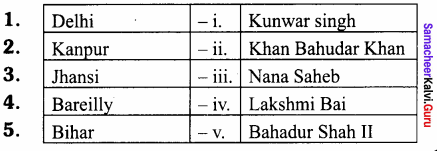
III. Match the following
Samacheer Kalvi 8th Social Science History Term 1 Solutions Chapter 4 People’s Revolt 1
Answer:

  1. v
  2. iii
  3. iv
  4. ii
  5. i.

IV. State true or false

Question 1.
The Vijayanagar rulers appointed Nayaks in their provinces.
Answer:
True

Question 2.
Sivasubramania was the minister of Marudhu pandiyas.
Answer:
False
Correct statement:
Sivasubramania was the minister of Kattabomman.

Question 3.
Kattabomman was hanged on 17th October 1799.
Answer:
True

Question 4.
Fettah Hyder was the elder son of Tippu Sultan.
Answer:
True

V. Consider the following statements and tick (V) the appropriate answer

Question 1.
(i) The Vellore revolt was held in 1801.
(ii) The family members of Tippu were imprisoned at Vellore fort after the fourth Mysore war.
(iii) At the time of Vellore revolt, the Governor of Madras was Lord William Bentinck.
(iv) The victory of revolt of Vellore against British was one of the significant event in the history of India.

(a) i & ii are Correct
(b) ii & iv are Correct
(c) ii &iii are correct
(d) i, ii & iv are correct
Answer:
(c) ii &iii are correct

Question (a)
Find out the wrong pair :

  1. Marudu Pandiyar – Ettayapuram
  2. Gopala Nayak – Dindigul
  3. Kerala Varma – Malabar
  4. Dhoondaji – Mysore

Answer:
1. Marudu Pandiyar – Ettayapuram

Question (b)
Find out the odd one :
Kattabomman, Oomaithurai, Sevathaiah, Tippu Sultan.
Answer:
Tippu Sultan

VI. Answer the following in one or two sentences

Question 1.
What you know about the Palayakarars? Name some of them.
Answer:
1. Palayakkarar was the holder of a territory or a Palayam. These Palayams were held in military tenure and extended their full co – operation to be need of the Nayaks. The Palayakkarars collected taxes, of which one third was given to the Nayak of Madurai another one third for the expenditure of the army and rest was kept for themselves.

2. Kattabomman, Pulithevan, Marudu Brothers, Dheeran Chinnamalai.

Question 2.
What was the part of Velu Nachiyar in the Palayakkarar revolt?
Answer:
1. Velu Nachiyar was a queen of Sivagangai. she was married to Muthu Vaduganathar, the Raja of Sivagangai. In 1772, the Nawab of Arcot and the British troops invaded Sivagangai. They killed Muthu Vaduganathar in Kalaiyar Koil battle. Velu Nachiyar escaped with her daughter and lived under the protection of Gopala Nayaker at Virupachi near Dindigul.

2. During this period she organised an army and employed her intelligent agents to find where the British stored their ammunition.

3. She arranged a suicide attack by a faithfull follower Kuyili, a commander of Velu Nachiar. She recaptured Sivagangai and was again crowned as queen with the help of Marudu brothers.

Question 3.
Who were the leaders of Palayakkarar confederacy in the south Indian rebellion?
Answer:
Marudu Pandiar of Sivaganga, Gopala Nayak of Dindugal, Kerala Varma of Malabar and Krishnappa Nayak and Dhoondaji of Mysore.

Question 4.
What was the importance of Tiruchirappalli proclamation?
Answer:

  1. The Marudu Pandyas issued a proclamation of Independence called Tiruchirappalli Proclamation in June 1801.
  2. It was the first call to the Indians to unite against the British.
  3. A copy of the proclamation was pasted on the walls of the Nawab’s palace in the fort of Tiruchi and another copy was placed on the walls of the Vaishnava temple at Srirangam. Thus Marudu brothers spread the spirit of opposition against the English everywhere.
  4. As a result many Palayakkarars of Tamil Nadu went on a rally to fight against the English.

Question 5.
Bring out the effects of the Vellore revolt.
Answer:
Effects of the Vellore Revolt:

  1. The new methods and uniform regulations were withdrawn.
  2. The family of Tippu as a precautionary measure was sent to Calcutta.
  3. William Cavendish Bentinck was removed from his service.

Question 6.
What was the immediate cause of the Revolt of 1857?
Answer:
1. The immediate cause was the introduction of new Enfield Riffles in the army. The top of the cartridge of this rifle was to be removed by the mouth before loading it in the rifle. The cartridges were greased by the fat of pig and the cow.

2. The Indian sepoys believed that the British were deliberately attempting to spoil the religion of both the Hindus and the Muslims because while the Hindus revered the cow, the Muslims hated the pig.

3. The soldiers, therefore, determined to refuse their service and, ultimately revolted.

4. Thus, the primary and the immediate cause of the revolt was the use of the greased cartridges.

VII. Answer the following in detail

Question 1.
What do you know about the Pulithevar?
Answer:
1. Pulithevar was the pioneer in Tamil Nadu, to protest against the English rule in India. He was the Palayakkarar of the Nerkattumseval, near Tirunelveli.

2. During his tenure he refused to pay the tribute neither to Mohammed Ali, the Nawab of Arcot nor to the English. Further he started opposing them. Hence, the forces of the Nawab of Arcot and the English attacked Pulithevar. But the combined forces were defeated by Pulithevar at Tirunelveli.

3. Pulithevar was the first Indian king to have fought and defeated the British in India. After this victory Pulithevan attempted to form a league of the Palayakkars to oppose the British and the Nawab.

4. In 1759, Nerkattumseval was attacked by the forces of Nawab of Arcot under the leadership of Yusuf Khan.

5. Pulithevar was defeated at Anthanallur and the Nawabs forces captured Nerkattumsevval in 1761.

6. Pulithevar who lived in exile recaptured Nerkattumseval in 1764. Later, he was defeated by Captain Campell in 1767. Pulithevar escaped and died in exile without fulfilling his purpose, although his courageous trail of a struggle for independence in the history of South India.

Question 2.
Explain the events that led to conflict between Dheeran Chinnamalai and the british.
Answer:
1. Dheeran Chinnamalai was bom at Melapalayam in Chennimalai near Erode. His original name was Theerthagiri. He was a palayakkarar of Kongu country who fought the British East India Company.

2. The Kongu country comprising Salem, Coimbatore, Kamr and Dindigul formed a part of the Nayak kingdom of Madurai but had been annexed by the Wodayars of Mysore.

3. After the fall of the Wodayars, these territories along with Mysore were controlled by the Mysore Sultans. After the third and fourth Mysore wars the entire Kongu region passed into the hands of the English.

4. Dheeran Chinnamalai was trained by French military in modem warfare. He was along the side Tippu Sultan to fight against the British East India Company and got victories against the British.

5. After Tippu Sultan’s death Chinnamalai settled down at Odanilai and constructed a fort there to continue his struggle against the British. He sought the help of Marathas and Maruthu Pandiyar to attack the British at Coimbatore in 1800.

6. British forces managed to stop the armies of the allies and hence Chinnamalai was forced to attack Coimbatore on his own. His army was defeated and he escaped from the British forces.

7. Chinnamalai engaged in guerrilla warfare and defeated the British in battles at Cauvery, Odanilai and Arachalur. During the final battle, Chinnamalai was betrayed by his cook Nallapan and was hanged in Sankagiri Fort in 1805.

Question 3.
What were the causes for the Great revolt of 1857?
Answer:
1. The most important cause of revolt 1857 was a popular discontent of the British policy of economically exploiting India. This hurt all sections of society. The peasants suffered due to high revenue demands and the strict revenue collection policy.

2. Policies of doctrine of lapse, subsidiary alliance and policy of Effective Control created discontentment among people. Annexation of Oudh proved that even the grovelling loyalty can’t satisfy British greed for territories.

3. The conversion activities of Christian missionaries were looked upon with suspicion and fear. The priests and the maulavis showed their discontent against the British rule.

4. Abolition of practices like sati, female infanticide, support to widow remarriage and female education were seen by many as interference in their Indian culture by the Europeans.

5. The Indian sepoys were looked upon as inferior beings and treated with contempt by their British officers. They were paid much less than the British soldiers. All avenues of the promotion were closed to them as all the higher army posts were reserved for the British.

Question 4.
What were the causes for the failure of the Revolt of 1857?
Answer:
Various causes were responsible for the failure of the revolt:

1. Lack of organisation, discipline, common plan of action, centralised leadership, modem weapons and techniques.

2. The rebel leaders were no match to the British Generals. Rani Lakshmi Bai, Tantia Tope and Nana Saheb were courageous but they were not good generals.

3. Non – participation of Bengal, Bombay, Madras, western Punjab and Rajputana.

4. The modem educated Indians did not support the Revolts as they believed that only British rule could reform Indian society and modernize it.

5. The British managed to get the loyalty of the Sikhs, Afghans and the Gurkha regiments. The Gurkhas actually helped the British in suppressing the revolt.

6. The British had better weapons, better generals, and good organisation.

VIII. HOTs

Question 1.
Prove that there was no common purpose among the leaders of the Great revolt of 1857.
Answer:

  1. The revolt did not have a clear leader. Bahadur Shah II was old and exhausted. He lacked military leadership.
  2. At kanpur, Nana Sahib was proclaimed a Peshwa, who was he adopted son of the exited Peshwa Baji Rao II.
  3. He believed that he was entitled to a pension from the British.
  4. When he was refused to be given, he was compelled to revolt against them. Rani Lakshmi Bai and Tantia Tope fought for Jhansi and Gwaliar.
  5. Begun of Awadh wanted to safeguard her territory.
  6. Khan Bahadur khan fought against the British when they subjugated his government in Bareiley.
  7. As such, they lacked unity and gave way for the easy victory of the British.

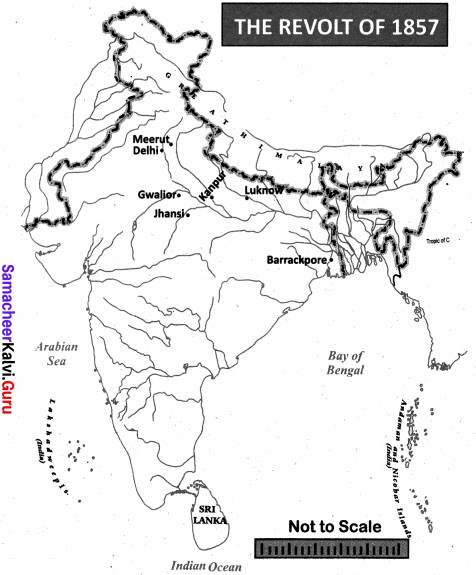
Ix. Map skill

Question 1.
On the Riyer map of India mark the following centres of the revolt of 1857.

  1. Delhi
  2. Lucknow
  3. Meerut
  4. Barrackpore
  5. Jhansi
  6. Gwalior
  7. Kanpur

Answer:
Samacheer Kalvi 8th Social Science History Term 1 Solutions Chapter 4 People’s Revolt 2

Samacheer Kalvi 8th Social Science History People’s Revolt Additional Questions

I. Choose the correct answer

Question 1.
Viswanatha instituted Palayakkarar system in ……………..
(a) 1546
(b) 1529
(c) 1539
(d) 1549
Answer:
(b) 1529

Question 2.
The Eastern Palayams were the ……………..
(a) Nayaks
(b) Maravas
(c) Chalukyas
(d) Pandyas
Answer:

Question 3.
The Western Palayams were the ……………..
(a) Cheras
(b) Cholas
(c) Maravas
(d) Nayaks
Answer:
(c) Maravas

Question 4.
The ancestors of …………… migrated to Tamil country during the 11th Century.
(a) Pulithevan
(b) Sivasubramaniam
(c) Nawab of Arcot
(d) Kattabomman
Answer:
(d) Kattabomman

Question 5.
……………….. became a poligar during the rule of Nayaks.
(a) Jagaveera Pandiya Kattabomman
(b) Pulithevan
(c) Oomathurai
(d) Sevathaiah
Answer:
(a) Jagaveera Pandiya Kattabomman

Question 6.
After the decline of the Vijayanagar empire, the ……………. established their supremacy in the south.
(a) Nizamz
(b) Mughals
(c) Marathas
(d) Pallavas
Answer:
(b) Mughals

Question 7.
…………….. the Governor of Madras council ordered Kattabomman to surrender.
(a) Colin Jackson
(b) S.R. Lushington
(c) Edward Clive
(d) Agnew
Answer:
(c) Edward Clive

Question 8.
In a clash at , SIva subramaniyam was taken as a prisoner.
(a) Pudukottai
(b) Nagalapuram
(c) Kayathar
(d) Kallarpatti
Answer:
(d) Kallarpattil

Question 9.
In 1772 the ………….. laid seige of Sivaganga and captured it.
(a) Velu Nachiyar
(b) Nawab of Arcot
(c) Britian
(d) Palayakkaras
Answer:
(b) Nawab of Arcoti

Question 10.
Umaithurai and other fled to Sivaganga, where ………….. gave protection to them.
(a) Marudu Pandya
(b) Nawabs
(c) Pulithevar
(d) Gopala Nayak
Answer:
(a) Marudu Pandya

Question 11.
…………… was the capital of chinna Marudhu.
(a) Palayamkottai
(b) Sivaganga
(c) Siruvayal
(d) Mysore
Answer:
(c) Siruayal

Question 12.
……………… policy followed by the English split the forces of the Palayakkarars.
(a) Doctrine of Lapse
(b) Divide and Rule
(c) Subsidiary Alliance
(d) Permanent Settlement
Answer:
(b) Divide and Rule

II. Fill in the blanks

  1. ………….. became the Nayak of Madurai in 1529.
  2. The two blocs among the Palayakkarars were the ………….. and the ………….. blocs.
  3. The Western Palayams were ruled under the control of ……………
  4. ………….. was the capital of Virapandiyapuram.
  5. ………….. was appointed collector in the place of Colin Jackson.
  6. ………….. Raj a of pudukottai captured kattabomman and handed him over to the Britian.
  7. Siva Subramania was executed at ……………
  8. ………….. was more popular among the Marudu Brothers.
  9. Penang in Malaya was called the ………….. island.
  10. Chinnamalai was betrayed by his cook …………..

Answer:

  1. Viswanatha
  2. Eastern, Western
  3. Pulithevan
  4. Panchalankurichi
  5. S.R. Lushington
  6. Vijaya Ragunatha Tondaiman
  7. Nagalauram
  8. Chinna Marudu
  9. Prince of Wales
  10. Nallappan]

III. Match the following
Samacheer Kalvi 8th Social Science History Term 1 Solutions Chapter 4 People’s Revolt 3
Answer:

  1. iii
  2. iv
  3. v
  4. i
  5. ii.

IV. State True or False

Question 1.
Oomathurai was the brother of Veerapandya Kattabomman.
Answer:
True

Question 2.
In 1772, the British laid seige of sivaganga and captured it.
Answer:
False
Correct statement:
In 1772, the Nawab of Arcot laid seige of sivaganga and captured it.

Question 3.
V.D. Savarkar calls the Vellore revolt of 1806 as the prelude to the first war of Indian Independence.
Answer:
True

Question 4.
Lord Canning called the British army deputed to Germany by Britain to Calcutta.
Answer:
False
Correct statement:
Lord Canning called the British army deputed to China by Britain to Calcutta.

V. Consider the following statements and tick the appropriate answer

Question 1.
(i) In May 1801, English attacked the rebels in Thanjavur and Tiruchi areas.
(ii) The Maruthu brothers were executed in the fort of vellore.
(iii) Oomathurai and Sevathaiah were captured and beheaded at Panchalankurichi.
(iv) The Karnataka Treaty was signed in 1805.

(a) i and ii are correct
(b) ii and iv are correct
(c) i and iii are correct
(d) i, ii and iv are correct
Answer:
(c) i and iii are correct

Question 2.
Find out the wrong Pair

  1. Periya Marudu – Vella Marudhu
  2. Pulithevan – Nerkattum seval
  3. Tippu sultan – Kanpur
  4. Dheeran Chinnamalai – Erode

Answer:
3. Tippu sultan – Kanpur

VI. Answer the following in one or two sentences

Question 1.
What was the main causes of rivalry between the English and Kattabomman?
Answer:
Based on the Carnatic treaty of 1792, the company gained the right to collect taxesfrom Panchalamkuruchi. The collection of tribute was the main cause for the rivalry between the English and Kattabomman.

Question 2.
Why did the Madras Goverment direct the collector to Summon the Palavakkarar (Kattabomman)
Answer:
In 1798, Colin Jackson, the collector of Ramanathapuram wrote letters to Kattabomman asking him to pay the tribute arrears. But Kattabomman replied that he was not in a position to remit the tribute due to the famine in the country. Colin Jackson got angry and decided to send an expedition to punish Kattabomman. So the Madras government directed the collector to summon the Palayakkarar at Ramanathapuram and hold a discussion.

Question 3.
What action was taken against the collector for his misbehaviour at Ramanathapuram?
Answer:
Kattabomman wrote a letter to the Madras Council narrating the behaviour of the Collector Colin Jackson. Edward Clive, the Governor of Madras dismissed the Collector for his misbehaviour and released SivaSubramania.

Question 4.
Write a note on Tiruchirpalli proclamation.
Answer:
Marudu Pandyan of Sivaganga formed the South Indian Confederacy of rebels against the British, along with the neighbouring Palayakkarars. This confederacy declared a proclamation which came to be known as Tiruchirappalli Proclamation.

Question 5.
Why did the company order the army to march to Panchalamkurchi?
Answer:
Kattabomman tried to establish his influence over Sivagiri,who refused to join with alliance of the rebels. Kattabomman advanced towards Sivagiri. But the Palayakkar of Sivagiri was a tributary to the Company. So the Company considered the expedition of Kattabomman as a challenge to their authority. So the Company ordered the army to march to Panchalamkuruchi.

Question 6.
Why did the company wage war against Sivaganga?
Answer:
Kattabomman was hanged to death and his brother Umaithurai and others fled to Sivaganga, where Marudu Pandya gave protection to them. The merchants of Sivaganga did not like the interference of the company in their internal politics. The company waged war against Sivaganga for these two causes.

Question 7.
How did the Vellore fort become the meeting ground of the rebel forces of South India?
Answer:
The Vellore fort consisted of large majority of Indian troops, a good part of it recently been raised in Tirunelveli after the Palayakarar uprising of 1800. Many of the trained soldiers of the various Palayams were admitted into the English army. Thus the Vellore fort became the meeting ground of the rebel forces of South India.

Question 8.
State the causes for the Vellore revolt.
Answer:
Causes for the revolt:

  1. The strict discipline, new weapons, new methods and uniforms were all new to the sepoys.
  2. The sepoys were asked to shave the beard and to trim the moustache.
  3. The wearing of religious mark on the forehead and the use of earrings were also banned.
  4. The English treated the Indian sepoys as their inferior. There was the racial prejudice.

Question 9.
How did the British regain their lost positions after the 1857 revolt?
Answer:
Lord Canning, the governor-general took immediate steps to suppress the revolt. He collected the forces of Madras, Bombay, Sri Lanka and Burma. On his own initiative, he called the British army which was deputed to China by Britain to Calcutta. He ordered the loyal Sikh army to proceed to Delhi immediately. The British regained their lost positions very soon.

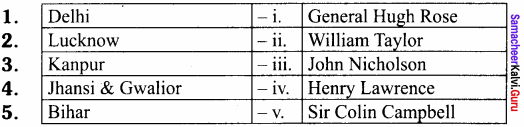
Question 10.
Mention the places of 1853 revolt and the Indian leaders involved.
Answer:
Places of Revolt:

  • Delhi
  • Lucknow
  • Kanpur
  • Jhansi & Gwalior
  • Bareilly
  • Bihar

Indian Leaders:

  • Bahadur Shah II
  • Begum Hazrat Mahal
  • Nana Saheb
  • Lakshmi Bai, Tantia tope
  • Khan Bahadur Khan
  • Kunwar Singh

VII. Answer the following in detail

Question 1.
Narrate the fall of Panchalamkurchi.
Answer:
1. Major Bannerman moved his army to Panchalamkuruchi on 5th September. They cut of all the communications to the Fort. In a clash at Kallarpatti, Siva Subramaniyam was taken as a prisoner. Kattabomman escaped to Pudukottai.

2. Vijaya Ragunatha Tondaiman, Raja of Pudukottai, captured Kattabomman from the jungles of Kalapore and handed over to the Company. After the fall of Panchalamkuruchi, Bannerman brought the prisoners to an assembly of the Palayakkarars and after trial sentenced them to death. Sivasubramania was executed at Nagalapuram.

3. On the 16th October ViraPandya Kattabomman was tried before an assembly of Palayakkarar, summoned at Kayathar. On 17th October 1799, Kattabomman was hanged at the fort of Kayathar. Kattabomman’s heroic deeds were the subject of many folk ballads which kept his memory alive among the people.

Question 2.
Explain the course and suppression of the Vellore Revolt.
Answer:
Course of the Vellore Revolt:

1. The Indian soldiers were waiting for an opportunity to attack the English officers. Tippu’s family also took part. Fettah Hyder, the elder son of Tippu, tried to form an alliance against the English.

2. On July 10th in the early morning the native sepoys of the 1 st and 23rd Regiments started the revolt. Colonel Fancourt, who commanded the garrison, was their first victim. The fort gates were closed. Meantime, the rebels proclaimed Futteh Hyder, as their new ruler. The British flag in the fort was brought down. The tiger-striped flag of Tippu Sultan was hoisted on the fort of Vellore.

Suppression of the Vellore Revolt:

1. Major Cootes who was outside the fort rushed to Ranipet and informed Colonel Gillespie. Col. Gillespie reached Vellore fort. He made an attack on the rebel force. The revolt was completely suppressed and failed. Peace was restored in Vellore.

2. On the whole, 113 Europeans and about 350 sepoys were killed in the uprising. The revolt was suppressed within a short period. It was one of the significant events in the history of Tamil Nadu.

Question 3.
Describe the Course of the 1857 Revolt.
Answer:
On 10 May 1857, the Sepoys of the third cavalry at Meerut openly revolted by swarming the prisons and releasing their comrades. They were immediately joined by the men of the 11th and 20th Native Infantries, and they murdered some English officers and then marched to Delhi. The arrival of Meerut sepoys at Delhi on 11th May and declared of Bahadur Shah II as the Emperor of India. Delhi became the centre of the Great Revolt and Bahadur Shah, its symbol.

The revolt spread quickly. There were mutinies at Lucknow, Kanpur, Jhansi, Bareilly, Bihar, Faizabad, and many other places in north India. Many of them . found that it was a good opportunity to bum the papers of their landlords. Many others whose titles and pensions were abolished by the British who participated in it, inorder to take revenge. The Muslim leaders and Maulvis sought the opportunity of establishing the Muslim rule in India after turning out the British.

Question 4.
What were the consequences of the 1857 Revolt?
Answer:
Consequences of the Revolt:

  1. The Revolt of 1857 marked a turning point in the history of India. It led to changes in the system of administration and the policy of the Government.
  2. The administration of India was transferred from the East India Company to the British Crown through the ‘Queen’s Proclamation’ in 1858.
  3. The governor general was given the title of viceroy.
  4. The Board of Directors and the Board of Control were replaced by the Council of 15 members headed by the Secretary of State to supervise Indian affairs.
  5. The Indian Army was thoroughly reorganised. More Britishers were employed in the army.
  6. The British military policy came to be dominated by the idea of ‘divide and counterpoise’.

Samacheer Kalvi 8th Science Solutions Term 2 Chapter 5 Movements

You can Download Samacheer Kalvi 8th Science Book Solutions Guide Pdf, Tamilnadu State Board help you to revise the complete Syllabus and score more marks in your examinations.

Tamilnadu Samacheer Kalvi 8th Science Solutions Term 2 Chapter 5 Movements

Samacheer Kalvi 8th Science Movements Text Book Exercises

I. Choose the best answer

8th Science Movement In Animals Question 1.
Which of the following parts of our body help us in movement?
(i) Bones
(ii) Skin
(iii) Muscles
(iv) Organs
Choose the correct answer from the options below.
(a) (i) and (iii)
(b) (ii) and (iv)
(c) (i) and (iv)
(d) (iii) and (ii)
Answer: (a) (i) and (iii)

Movement In Animals Class 8 Question 2.
Which one of the following organisms lack muscles and skeleton for movement?
(a) Dog
(b) Snail
(c) Earthworm
(d) Human being
Answer:
(b) Snail

Movements In Animals 8th Standard Question 3.
……………… joints are immovable.
(a) Shoulder and arm
(b) Knee and joint
(c) Upper jaw and skull
(d) Lower jaw and upper jaw
Answer:
(c) Upper jaw and skull

Movements In Animals Class 8 Question 4.
Why do underwater divers wear fin-like flippers on their feet?
(a) To swim easily in water
(b) To look like a fish
(c) To walk on water surface
(d) To walk over the bottom of the sea (sea bed).
Answer:
(a) To swim easily in water

Movements In Animals Class 8 Samacheer Videos Download Question 5.
External ear (pinna) is supported by –
(a) bone
(b) cartilage
(c) tendon
(d) capsule
Answer:
(b) cartilage

Samacheer Kalvi 8th Biology Book Solutions Question 6.
Cockroach moves with the help of its –
(a) leg
(b) bone
(c) muscular foot
(d) whole body
Answer:
(d) whole body

Question 7.
Which one of the following categories of vertebrae are correctly numbered?
(a) Cervical – 7
(b) Thoracic – 10
(c) Lumbar – 4
(d) Sacral – 4
Answer:
(a) Cervical – 7

II. Fill in the blanks

  1. Movement of organisms from place to place is called ………………..
  2. ……………….. refers to change in position of the part of an organisms body.
  3. A structure which provides rigid frame work to the body is called ………………..
  4. Axial skeleton in human consists of ……………….., ……………….., ………………..and …………………
  5. Appendicular skeleton in human consists of ……………….. and …………………
  6. The place where two bones meet is termed as …………………
  7. ……………….. is attached to soft parts of the body like blood vessels, iris, bronchi and the skin
  8. ……………….. muscle makes pupil of eyes wider.

Answer:

  1. locomotion
  2. Movement
  3. skeleton
  4. Skull facial bones. sternum. ribs, vertebral column
  5. Pelvic, Pectoral girdle
  6. Joint
  7. Smooth muscle
  8. Radial

III. State True or False. If false, correct the statement:

Question 1.
Skull in humans consists of 22 bones.
Answer:
True

Question 2.
There are 12 pairs of ribs in human body.
Answer:
True

Question 3.
Pelvic girdle is a part of axial skeleton.
Answer:
False
Correct statement:
Pelvic girdle is a part of appendicular skeleton.

Question 4.
Hinge joint is slightly movable joint.
Answer:
True

Question 5.
Cardiac muscle is a voluntary muscle.
Answer:
False
Correct statement:
Cardiac muscle is a involuntary muscle.

Question 6.
The flexor and extensor muscle of the arm are antagonistic muscles.
Answer:
True

IV. Answer very briefly

Question 1.
What is skeleton?
Answer:

  1. The skeleton system provides the hard structure or framework to the human body which supports and protects the body.
  2. It is composed of connective tissues like bones, cartilage, tendons and ligaments.

Question 2.
What is cranium?
Answer:

  1. Skull has 22 bones of which 8 bones are fixed together to form the cranium.
  2. It is called brain box since it protects the brain.

Question 3.
Why our backbone is slightly movable?
Answer:
In the backbone, vertebrae are joined by gliding points, which allow the body to be bent back, front or side wards.

Question 4.
Differentiate axial and appendicular skeleton.
Answer:
Axial skeleton:
The axial skeleton consists of the bones along the axis, or central line of the human body and consists of the skull, facial bones, sternum, ribs, and vertebral column.

Appendicular skeleton:
The appendicular skeleton contains the bones in the appendages of the body, as well as the structures that connect the appendages to the axial skeleton. It comprises the shoulder girdle; the arm, wrist, and hand bones; the pelvic girdle; and the leg, ankle, and foot bones.

Question 5.
What is ligament?
Answer:
A ligament is a band of strong fibrous tissue which connects a bone to a bone.

Question 6.
Define Muscle.
Answer:
Muscles are long bundles of contractile tissue, which has a fixed end (Origin) and movable end which pulls some other part.

Question 7.
Differentiate tendons and ligament.
Answer:
Tendon:

  1. They are made of elastic tissue.
  2. They attach muscle to a bone

Ligament:

  1. They are short bands of tough fibrous connective tissues.
  2. They connect one bone to another

V. Answer briefly

Question 1.
Differentiate between the following.

  1. Movement and Locomotion.
  2. Endoskeleton and Exoskleton
  3. Pectoral and Pelvic girdle
  4. Ball and socket Joint and Hinge Joint
  5. Voluntary and Involuntary muscle

Answer:
1. Movement and Locomotion

Movement:

  • Movement is the act of changing the place or position by one or more parts of the body.
  • It can either be voluntary or involuntary.
  • A movement takes place at the biological level.
  • Movement requires energy.

Locomotion:

  • Locomotion is the movement of an organism from one place to another.
  • It is always voluntary.
  • Locomotion takes place at the organism level.
  • Locomotion doesn’t necessarily require energy.

2. Endoskeleton and Exoskleton

Endoskeleton:

  • It is the skeleton found inside the body.
  • It originals from mesoderm.
  • Example: Human beings.

Exoskleton:

  • It is the skeleton found on the exterior layer of the body.
  • It originals from embryonic ectoderm or mesoderm.
  • Example: Scales of fish feathers of birds

3. Pectoral and Pelvic girdle

Pectroal girdle:

  • It is situated in the shoulder region.
  • It gives articulation to forelimbs.
  • The shoulder blade and collar bone remain separate.
  • They are comparatively lighter.

Pelvic girdle:

  • It is situated in the hip region.
  • It gives articulation to legs or hind limb.
  • Three bones (ilium, ischium and pubis) are fused to form a single hip bone.
  • They are strong to take upto lot of stress

4. Ball and socket Joint and Hinge Joint

Ball and socket Joint:

  • A ball shaped head of one bone articulates with a cup like socket of j an adjacent bone.
  • Movement can occur in three planes. This joint allows the greatest range of movement.
  • Example: Shoulder, Hip

Hinge Joint:

  • A cylindrical protrusion of one bone articulates with a trough-shaped depression of an adjacent bone.
  • Movement is restricted to one plane. This joint allows bending and straightening only.
  • Example: Elbow Knee Ankle

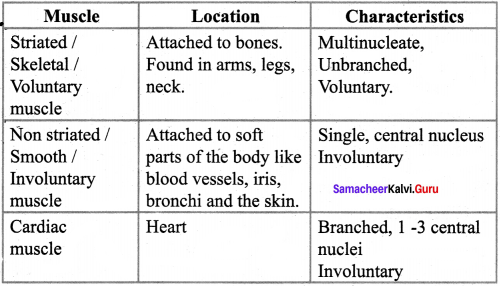
5. Voluntary and Involuntary muscle:

Voluntary muscle:

  • They are striated (Multinucleate muscles and unbranched) muscles.
  • They are attached to bones.
  • Example: found in arms, legs
  • They are used as per our will.

Involuntary muscle:

  • They are non – striated (Single muscle, central nucleus) muscles.
  • They are attached to soft parts of the body like blood vessels, Iris, Skin etc.
  • They are not under our control.

Question 2.
What are antagonistic muscles? Give one example.
Answer:

  1. Muscles often work in pairs which work against each other. These are called antagonistic pairs.
  2. The muscles in the upper arm control the bending and straightening of the arm.
  3. The two muscles, the biceps and triceps are working against each other.
  4. When the biceps contracts the lower arm is raised and the arm bends.
  5. In this position the triceps muscle is relaxed.
  6. To straighten the arm the reverse happens.
  7. The triceps contracts straightening the arm, while the biceps relaxes.

Question 3.
How is the skeleton of a bird well-suited for flying?
Answer:

  1. A bird has streamlined body. Its bones are light and strong.
  2. They are hollow and have air spaces between them.
  3. The hind limbs of birds are modified as claws, which help them to walk and to perch.
  4. The breast bones are modified to hold massive flight muscles which help in moving wings up and down.
  5. Birds have special flight muscles and the forelimbs are modified as wings.
  6. The wings and tail have long feathers, which help in flying. Birds show two types of flight: gliding and flapping.

Question 4.
What are the functions of skeleton in human body?
Answer:
The skeletal system serves five important functions in the human body:

  1. It provides structure and shape to the body.
  2. It supports and surrounds the internal organs of the body.
  3. Calcium and phosphorus, the two minerals that the body needs for important regulatory functions, are stored inside the bones.
  4. Red blood cells are produced in the bone marrow.
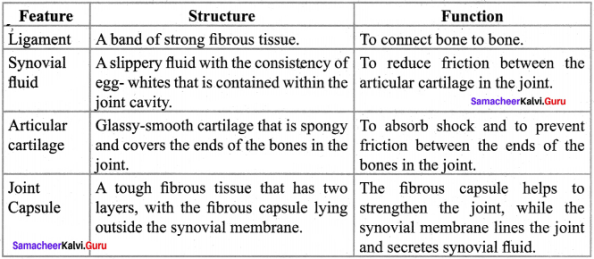
  5. The bones of the skeletal system act as levers for muscular action.

Muscular movement would not be possible without tendons (fibrous cords of tissue that attach muscle to bone) and ligaments (fibrous cords of tissue that attach bone to bone).

VI. Answer in detail

Question 1.
Name the different types of joints? Give one example for each type.
Answer:

JointExamples
Ball and SocketShoulder Hip
HingeElbow Knee Ankle
PivotSpine (Atlas / Axis joint at the top)
CondyloidWrist
GlidingSpine (between the bony processes of the vertebrae)
SaddleThumb, shoulder and inner ear.

Question 2.
Write about the human axial skeleton, giving suitable labelled diagram.
Answer:
The axial skeleton consists of the bones along the axis or central line of the human body. It consists of the skull, facial bones sternum, ribs and vertebral column.

Skull:

  1. It is a hard structure made of 22 bones.
  2. 8 bones are fixed together to form the cranium and 14 hones fuse to form the face.
  3. The lower jaw is the only movable bone of the skull.

Vertebral column:

  1. It is called the backbone and runs of the back of the body.
  2. It is made of 33 individual bones called vertebrae as follows :
    • 7 Cervical vertebrae
    • 12 Thoracic vertebrae
    • 5 Lumbar vertebrae
    • 5 Fused sacral vertebrae
    • 4 Fused coccygeal vertebrae
  3. The hollow tube of the vertebral column contains the spinal cord.
  4. Vertebrae are joined by gliding points which allow the body to be bent back, front or side – wards.

Function of vertebral column:

  1. It protects the spinal cord
  2. It supports the head
  3. It serves as an attachment for ribs
  4. Helps in walking, standing erect and posture.

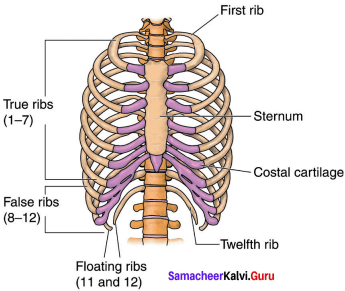
Sternum or Ribcage:
8th Science Movement In Animals Samacheer Kalvi Solutions Term 2 Chapter 5

  1. It is a cone shaped structure in the chest region and made up of 12 pairs of ribs.
  2. The ribs attached to the vertebral column at the back and the breast bone in the front.
  3. There are 12 pairs of ribs.
    • First 10 pairs are attached to breast bone.
    • 2 pairs are called free floating ribs and are free in the front.
  4. Rib cage can contract and expand during breathing.
  5. It protects the lungs, hearts and a part to the liver.

Question 3.
Discuss various types of movements seen in living organisms.
Answer:
There are three types of movements:

1. Amoeboid movement:
It is brought about by pseudopodia which are appendages which move with movement of protoplasm within a cell.

2. Ciliary movement:
This movement is brought about by appendages called as cilia which are the hair-like extensions of the epithelium. Both these kinds of movements are seen with cells of the lymphatic system.

3. Muscular movement:
It is a more complex movement which is brought about by the musculoskeletal system. This type of movement is seen in the higher vertebrates.
Example: Human beings.

The movements brought about by the musculoskeletal system, comprising of the joints, skeleton and types of muscles.

Some of the movements in body parts of human are:

  1. Movement of eyelids.
  2. Movement of the heart muscles.
  3. Movement of teeth and jaw.
  4. Movement of arms and legs.
  5. Movements of head.
  6. Movements of neck.

Question 4.
What is a streamlined body? How does it help in the movement of animals that fly or swim in water?
Answer:
1. A streamlined body is one which is pointed at the ends and broad in the middle. When such a body travels through a fluid or gaseous medium it exhibits minimum friction or resistance. A body shape which is streamlined helps cut against the friction created by the medium around the moving body.

2. Streamlined body lowers the friction drag between a fluid, air or water and an object moving trough that fluid. Drag is a force that slows down motion. Streamlining reduces the surface area of the moving object.

3. Streamlining reduces friction of movement to a minimum thus decreasing overall drag. Fishes can save energy while swimming because of the streamlined body.

Question 5.
Write a short note on different types of muscles.
Answer:
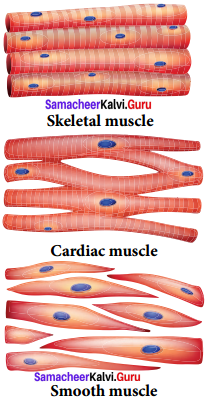
Movement In Animals Class 8 Samacheer Kalvi Science Solutions Term 2 Chapter 5
Muscles found in higher vertebrates are of three types:

  1. Striated or skeletal muscles or voluntary muscles.
  2. Unstriated or smooth muscles or involuntary muscles.
  3. Cardiac muscles.

Movements In Animals 8th Standard Samacheer Kalvi Term 2 Chapter 5

Samacheer Kalvi 8th Science Movements Additional Questions

I. Choose the correct answer

Question 1.
Gliding allows ………………..
(a) movement in two planes
(b) movement in three planes
(c) movement in one plane
(d) no movement
Answer:
(b) movement in three planes

Question 2.
The greatest range of movement is seen in ……………….. joint.
(a) saddle
(b) hinge
(c) ball and socket
(d) pivot
Answer:
(c) Ball and socket

Question 3.
The wrist bones are examples of ……………….. joint.
(a) condyloid
(b) saddle
(c) gliding
(d) hinge
Answer:
(a) condyloid

Question 4.
There are ……………….. types of movable joints.
(a) 4
(b) 3
(c) 5
(d) 6
Answer:
(d) 6

Question 5.
……………….. is a immovable joint.
(a) Skull
(b) Lower jaw
(c) Spine
(d) Inner ear
Answer:
(a) Skull

Question 6.
The ……………….. is the strongest bone of human skeleton.
(a) femur
(b) skull
(c) vertebrae
(d) ribs
Answer:
(a) Femur

Question 7.
Flat bones are seen in …………………
(a) legs
(b) spine
(c) shoulder
(d) wrist ankle
Answer:
(c) shoulder

Question 8.
Irregular bones are seen in ………………..
(a) legs
(b) skull
(c) vertebral column
(d) ribs
Answer:
(e) vertebral column

Question 9.
Phalanges refer to bones of the ………………..
(a) ankle
(b) toes
(c) wrist
(d) knee
Answer:
(b) toes

Question 10.
……………….. is not a characteristic of cardiac muscle.
(a) Branched
(b) Multi nucleate
(c) Involuntary
(d) Smooth muscle
Answer:
(d) Smooth muscle

Question 11.
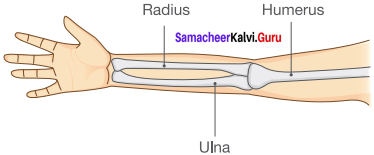
……………….. is not found in arm bone.
(a) Radius
(b) Humerus
(c) Patella
(d) Carpals
Answer:
(c) Patella

Question 12.
The hardest working muscle is found in the …………………
(a) skull
(b) eye
(c) thigh
(d) rib cage
Answer:
(b) Eye

Question 13.
……………….. is a bundle of contractile tissue.
(a) Bone
(b) Skeleton
(c) Muscle
(d) Joint
Answer:
(c) Muscle

II. Fill in the Blanks

  1. The body of cockroach is covered with exoskeleton made of ………………..
  2. Setae are seen in ………………..
  3. The Atlas/Axis joint is an example of ……………….. joint.
  4. A bone is connected to another bone with a …………………
  5. Bones are connected to muscles by …………………
  6. Inflammation of joints can lead to a disease called …………………
  7. The bones need two important minerals which are ……………….. and …………………
  8. The endoskeleton originates from …………………
  9. ……………….. is the smallest and lightest bone of human skeleton.
  10. The ……………….. protects the brain.
  11. ……………….. is the bone of the upper arm.
  12. An immovable joint is found in the …………………

Answer:

  1. chitin
  2. earthworm
  3. pivot
  4. ligamcnt
  5. tendon
  6. Arthritis
  7. calcium, phosphorous
  8. mesoderm
  9. Stapes
  10. cranium
  11. Humerus
  12. upper jaw

III. True or False – if false give the correct statement

Question 1.
Muscles can contract, relax and lengthen.
Answer:
False
Correct statement:
Muscles can only contract and relax but cannot lengthen.

Question 2.
In the Iris, there are two sets of muscles.
Answer:
True

Question 3.
Non-striated muscles are involuntary muscles.
Answer:
True

Question 4.
Cardiac muscles are voluntary muscles.
Answer:
False
Correct statement:
Cardiac muscles are in voluntary muscles.

Question 5.
There are 14 pairs of ribs.
Answer:
False
Correct statement:
There are 12 pairs of ribs.

Question 6.
Bone of upper jaw is a immovable bone.
Answer:
True

Question 7.
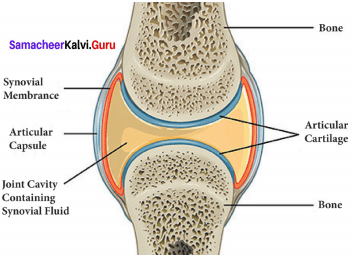
Synovial fluid helps to reduce friction.
Answer:
True

Question 8.
Joint between rib and breast bone is a fixed joint.
Answer:
False
Correct statement:
Joint between rib and breast bone is a slightly movable joint.

IV. Match the following

Question 1.

1.Humerus(a)Fore arm
2.Radius(b)Leg
3.Tarsals(c)Upper arm
4.Atlas(d)vertebral column

Answer:

  1. c
  2. a
  3. b
  4. d

Question 2.

1.Ball & socket(a)Elbow
2.Saddle(b)Spine
3.Hinge(c)Thumb
4.Gliding(d)Hip

Answer:

  1. d
  2. c
  3. a
  4. b

Question 3.

1.Earthworm(a)Flapping
2.Cockroach(b)Setae
3.Birds(c)Slithering
4.Snake(d)Legs

Answer:

  1. b
  2. d
  3. a
  4. c

V. Very short Answers

Question 1.
Define locomotion.
Answer:
The movement of an organism from one place to another is known as locomotion.

Question 2.
How does the fish change direction?
Answer:
The caudal or tail fin helps in changing direction.

Question 3.
Name the types of flight seen in birds.
Answer:
Gliding and flapping.

Question 4.
Why do birds have hollow bones?
Answer:
Hollow bones have air spaces between them and make the body light. This helps the birds in flight.

Question 5.
Name the types of movements seen in animals.
Answer:

  1. Amoeboid movement.
  2. Ciliary movement
  3. Muscular movement

Question 6.
Name two joints with examples.
Answer:

  1. Ball and socket joint – Eg. Hip
  2. Hinge joint – Eg. Elbow.

Question 7.
Name the types of muscles.
Answer:

  1. Striated muscle
  2. Non – striated muscle
  3. Cardiac muscle

Question 8.
Name the regions of vertebral column and number of vertebrae in each.
Answer:

  1. Cervical – 7
  2. Thoracic – 12
  3. Lumbar – 5
  4. Sacral – 5
  5. Coccygeal – 4

VI. Answer briefly

Question 1.
How are joints classified? Explain with example.
Answer:
The point at which two separate bones meet is called a joint Depending on the type of movement they allow, joints can be of three types: fixed, slightly movable and movable joints.

1. Fitted or Immovable joints:
In this type of joint, no movement is possible between the two bones. The structures between the bones of the skull box are examples of immovable joints.

2. Slightly movable joints:
Only very little (partial) movement occurs between the two bones. The joint between a rib and the breast bone or between the vertebrae is the example for slightly movable joint.

3. Freely movable joints:
In this type, varying degree of movements is possible between the two bones forming the joint. There are six major types of movable joints.

Condition:
The different types of movable joints are:

JointExamples
Ball and SocketShoulder Hip
HingeElbow Knee Ankle
PivotSpine (Atlas / Axis joint at the top)
CondyloidWrist
GlidingSpine (between the bony processes of the vertebrae)
SaddleThumb, shoulder and inner ear.

Question 2.
What is a synovial joints?
Answer:
Movements In Animals Class 8 Samacheer Kalvi Science Solutions Term 2 Chapter 5
A synovial joint is a joint which makes connection between two bones consisting of a cartilage lined cavity filled with fluid, which is known as a diarthrosis joint. These are the most flexible type of joint between bones, because the bones are not physically connected and can move more freely in relation to each other. Synovial joints have four main distinguishing features.
Movements In Animals Class 8 Samacheer Videos Download Term 2 Chapter 5

Question 3.
Explain the arrangement of arm bones.
Answer:
Samacheer Kalvi 8th Biology Book Solutions Term 2 Chapter 5 Movements

  1. Arm bone is the upper limb made up of humems, radius, ulna, carpals, metacarpals and phalanges.
  2. All these bones are joined by hinge joints which allow the limb to move only in one direction.
  3. Humems makes up the upper arm.
  4. Fore – arm is made up of radius and ulna.
  5. Wrist is made up of carpals. Palm is made up of metacarpals Fingers are made up of phalanges.

Samacheer Kalvi 7th English Solutions Term 2 Supplementary Chapter 1 Alice in Wonderland

Students can Download English Lesson 1 Alice in Wonderland Questions and Answers, Summary, Notes Pdf, Activity, Samacheer Kalvi 7th English Book Solutions Guide Pdf helps you to revise the complete Tamilnadu State Board New Syllabus and score more marks in your examinations.

Tamilnadu Samacheer Kalvi 7th English Solutions Term 2 Supplementary Chapter 1 Alice in Wonderland

Read And Understand

A. Identify the character / speaker.

1. I must find out why he’s in such a hurry!
2. Go to my cottage and fetch my gloves and fan.
3. Oh no, I’ll never get back to the right size.
4. One side makes you big, the other side makes you small.
5. I’ll see you later at the Queen’s croquet game.
6. You may stay if you answer my riddle.
7. Wake up. You’ve been sleeping for too long.
Answer:
Alice
White Rabbit
Alice
Green Caterpillar
Cheshire Cat
Mad Hatter
Alice’s sister

B. Discuss and Answer.

Alice In Wonderland Book Back Answers Question 1.
Why did Alice follow the rabbit?
Answer
Alice saw a rabbit hurrying down a rabbit’s hole. She wanted to find out why the rabbit was in such a hurry. So she followed him.

Alice In Wonderland Questions And Answers Pdf Question 2.
Do you think this was a good idea?
Answer:
No, it was not a good idea.

Alice In Wonderland 7th Standard Book Question 3.
Why can’t Alice get through the little door into the garden?
Answer:
She couldn’t get into the garden through the little door because she was too big.

Alice In Wonderland 7th Standard Question 4.
Why does Alice drink from the bottle that says ‘DRINK ME’ and why does she eat from the cake that says ‘EAT ME’?
Answer:
Out of curiosity, Alice drank from the bottle that said ‘DRINK Me’. As she was hungry, she ate the cake that said ‘EAT ME’.

Alice In Wonderland Questions And Answers Question 5.
How does Alice feel after all these changes?
Answer:
She felt strange and realized that she would never get back to the right size.

7th Standard Alice In Wonderland Question 6.
What do you think is going to happen next?
Answer:
She may shrink again, after eating or touching anything.

C. Think and Answer.

Alice In Wonderland Supplementary 7th Standard Question 1.
What challenges does Alice face and how does she overcome them?
Answer:
Alice goes through a variety of strange physical changes. The discomfort she feels at never being the right size acts as a symbol for the changes that occur during her adolescence. She continually finds herself in a situation in which she risks death. She gets in trouble because of her curiosity. As Alice progresses through her dream, she loses her sense of identity. At. the beginning of her journey, she was confused, anxious and timid. Finally, she becomes a strong and confident girl, who is able to stand up for her.

Alice In Wonderland Question Answer Question 2.
Have you ever had a strange dream? Share your dream in the class.
Answer:
Yes, I had a strange dream last night. I went to bed late and was fast asleep. Suddenly, I felt that I was in a fairyland. There was a big garden. The flowers were blooming. The fairies were singing beautiful songs. One fairy came to me and offered me a small chair to sit on and enjoy the song. There I saw a little child playing on the flute. He arrived in the midst of the fairies. Some dwarfs and elves were sitting nearby. The child brought fruits for me. Everyone was dancing and singing happily. It was a pleasant and strange sight for me. Suddenly, I could hear my mother shouting at me to get up and to get ready to go to school. I woke up and was surprised to realize that it was only a pleasant and a strange dream.

D. Role play
Put students in pairs to role play a conversation between:

  • Alice and her sister.
  • Alice and White Rabbit

Alice and her sister.
Answer:
Alice : it Alice and White Rabbit.
Sister : Alice and her sister
Alice : What are you doing?
Sister : I am reading a book.
Alice : Let me see the book.
Sister : Here it is.
Alice : Are you reading a book without pictures or conversations in it?
Sister : Yes, I love to read these books.
Alice : What is the use of reading such a book? It is boring to read.
Sister : If it is boring for you, Please stay away from me.
Alice : This hot day makes me feel sleepy. Let me have a nap.

Alice and White Rabbit

Rabbit : Let me check the time. Oh my God. It’s late. I have to hurry.
Alice : Why are you in such a hurry?
Rabbit : I need to hurry for an important work.
Alice : Stop! Don’t run. I will chase you wherever you go.
Rabbit : I will go into my hole. You cannot enter it.
Alice : Why can’t I enter into the hole?
Rabbit : You are too big to enter into this hole.
Alice : Then what should I do?
Rabbit : You have to drink the little bottle on top of the table.
Alice : Oh Yes. I have shrunk in size after drinking from the bottle.
Rabbit : (Mistaking Alice for his maid). Go to my cottage and fetch my gloves and fan.
Alice : (confused) May be I’ll find something at the cottage to help me find my way out. I am hopeful.

E. Activity

It’s fun to help out in the kitchen. You can even practise reading aloud when reading the recipe. And you can learn a little math by figuring out how to measure. Here are a few fun items to make that are “Alice” themed.

Activity to be done by the Students.

F. Learning About Nature

Learn about caterpillars and.butterflies. Read a book about a caterpillar turning into a butterfly. You can get one from the library or go online and find information with pictures.

Students individual work.
Read a book about Caterpillars and Butterfly

Connecting to self

G. Tackling the issues

Ask the class to discuss solutions to an issue that plagues contemporary society at large or just your community for example, homelessness, violence, environmental degradation, hunger.
Half the class should mention idealistic solutions to the chosen issue; the Other half should mention only realistic approaches to solving the problem.
See if, in listening to both sides, someone can come up with a proposal that is both realistic and unconventional an idea that hasn’t been tried yet.
Answer:
Homelessness – Idealistic Solutions

Student No. 1 :
A permanent and sustainable end to homelessness requires four essential components.
1. Housing is the essential foundation to ending homelessness.
2. Housing is essential, but it is not sufficient. Housing alone, without attention to health, behavioural health, employment and education will continue to result in instability and recurrent homelessness for many people.

Student No. 2 :
1. A key to an apartment is great. But we have to stay connected with the society. Staying lonely in an apartment is not advisable.
2.People should be aware of new home loan plans and housing

Student No. 3 :
Proposal that is both realistic and unconventional:
We can end the homelessness crisis by stabilizing people through shelter, moving them into permanent housing and implementing assistance programs to keep them in their housing. Only then we can reduce and eliminate homelessness in India.

PROJECT
H. Imagine you are a marketing executive for a company in a specific industry (toothpaste, soup, hair care products, automobiles, etc) and are developing a product with a brand name that refers to a character from the story.

For example: You want to sell bandages that have little pictures of Don Quixote on them. Your company’s name is Kure-All and you decide to call them “Kure-All Quixote Bandages”.
The slogan might be: “Had a tough day with windmills? When you take a fall, use Kure-All.”
You can use exciting words, a catchy new slogan, and a jingle, among other things, to promote sales of your item.
Answer:
Marketing Products
1. “Are you tired chasing the rabbit for a long time?” Feel energetic, after a chase. Have “Alice Soup” for refreshment”.
2. “Cool your body with Cheshire hair oil and feel fresh”.
3. Want to reach your destination quickly? Go for “Lae March Hare Cars”.

Step To Success

J. Look at the number pattern. Fill the blank in the middle of the series or end of the series.

7th English Alice In Wonderland Question 1.
SCD,TEF,UGH,______,WKL
A) CMN
B) UJI
C) VIJ
D) IJT
Answer:
(C) VIJ

7th Standard English Alice In Wonderland Question 2.
FAG. GAF. HAL IAH,______,
A) JAK
B) HAL
C) HAK
D) JAI
Answer:
(A) JAK

Alice In Wonderland In Tamil 7th Standard Question 3.
F.T.FA. GT.HA. TLTA,______,MLNA
A) OLPA
B) KLMA
C) LLMA
D) KLLA
Answer:
(D) KLLA

Alice In Wonderland Answer Key Question 4.
CMM. F.OO. GOO,______,KUU
A) GRR
B) GSS
C) ISS
D) ITT
Answer:
(C) ISS

7th English Book Alice In Wonderland Question 5.
OPO. NML. KTI,______,EDC
A) HGF
B) CAB
C) JKL
D) GHI
Answer:
(A) HGF

Alice in Wonderland Additional Questions

I. Choose the Correct Answers (MCQ).

Question 1.
Alice was beginning to get_____
(a) upset
(b) tired
(c) irritated
(d) bored
Answer:
(b) tired

Question 2.
The hot day made her feel very ______ and stupid.
(a) sleepy
(b) frustrated
(c) calm
(d) active
Answer:
(a) sleepy

Question 3.
The Rabbit pulled a ______ out of his pocket.
(a) Twig
(b) brush
(c) watch
(d) paper
Answer:
(c) watch

Question 4.
There was nothing on it except a tiny ______ Key
(a) golden
(b) silver
(c) round
(d) iron
Answer:
(a) golden

Question 5.
She opened the door and saw a beautiful ______
(a) sight
(b) room
(c) garden
(d) paper
Answer:
(c) garden

II. dentify the Character / Speaker.

  1. “Why, I’m no bigger than the insects that crawl on these flowers.
  2. “Get out of my way! You’re blocking the door!”.
  3. “I want to be big again”.
  4. “There isn’t any”.
  5. “Why is a raven like a writing desk?”

Answer:

  1. Alice
  2. The White Rabbit
  3. Alice
  4. March Hare
  5. Mad Hatter

III. Write True or False against each statement.

  1. Out of curiosity, Alice followed the rabbit.
  2. Alice was unhappy with her tiny size at first
  3. The magical toy made her small again.
  4. Alice grew to her normal size after eating the mushroom.
  5. The Dormouse smiled at Alice while the Cheshire cat was sleeping.

Answer:

  1. True
  2. False
  3. False
  4. True
  5. False

IV. Very Short Questions with Answers.

Question 1.
Why was Alice tired of sitting by her sister?
Answer:
Alice was doing nothing, as her sister was reading a book.

Question 2.
Why did the rabbit pull out a watch out of his pocket?
Answer:
The rabbit did so to check the time.

Question 3.
What did Alice do at the rabbit’s hole?
Answer:
Alice ran to the rabbit’s hole and peeped through the entrance.

Question 4.
What was there on a three-legged table?
Answer:
There was a tiny golden key on it.

Question 5.
What was the green Caterpillar wearing?
Answer:
The green Caterpillar was wearing a pink jacket.

Question 6.
What did the Cheshire cat tell Alice before disappearing?
Answer:
The Cheshire cat told him that it would see Alice later at the Queen’s croquet game.

Question 7.
What were March Hare and Mad Hatter having?
Answer:
The March Hare and Mad Hatter were having tea.

Question 8.
Where was the Dormouse sitting?
Answer:
The Dormouse was sitting between March Hare and Mad Hatter.

Question 9.
Did Alice solve the riddle?
Answer:
Alice did not solve the riddle.

Question 10.
Why did the trumpet sound?
Answer:
The trumpet sounded in a distance calling the court to session

V. Short Questions with Answers.

Question 1.
What did Alice think of doing when she got bored?
Answer:
She thought that it was a pleasure to make a daisy-chain by getting up and picking the daisies fallen on the ground.

Question 2.
Describe the green Caterpillar.
Answer:
The green Caterpillar was dressed in a pink jacket. He was sitting on the top of a large mushroom, smoking a bubble pipe.

Question 3.
What did a gardener do?
Answer:
One gardener had planted white roses by mistake. He then painted them red, as the Queen hated white roses.

VI. Paragraph Questions with Answers.

Question 1.
What happened to Alice, when she drank from the bottle?
Answer:
Alice finds a tiny key and fits it into the tiny lock of a 15 inch high door. She peers inside and sees a beautiful garden. She wishes she could get through it. But even her head was too big. She then notices a bottle with a printed label that reads ‘Drink me’. She drinks the liquid from the bottle. She realizes that she is shrinking
down. She shrinks down to 10 inches high. She feels happy because she will be able to reach the garden. She is soon reassured that she will not shrink anymore, as she was a bit worried that she could keep shrinking down.

Question 2.
What is the most important literary element and message in ‘Alice in Wonderland’?
Answer:
The most important literary element in ‘Alice in Wonderland’ is fantasy. The message conveyed in this story for children is about the value of questioning our identity. One can question one’s identity at any age, but Alice in particular, questions her identity throughout the story, which marks her transition from childhood to adulthood. It is symbolized by her physical changes in size and shape. As we read the story, we can even see Alice reflecting on how different she was before her adventure began.

VII. Rearrange the following sentences in coherent order.

1. The Dormouse slept and the Cheshire cat smiled at her.
2. “And now you must be punished. Off with her head” yelled the Queen
3. “What’s going on?” asked Alice.
4. “Court is now in session” announced the white rabbit.
5. “How silly”, replied Alice. ‘I did not have the slightest idea what you were talking about. I was only playing croquet.
6. “You are guilty of stealing the delicious heart-shaped tarts” accused the Queen.
7. Everyone rushed into the courtroom.
8. “Will Alice please come to the stand?”
9. Alice felt someone touch her shoulder, ‘wake up’.
10. Alice took the stand and looked at the jury box, where March Hare and the Mad Hatter were making noise.
Answer:
7, 4, 8,10,1, 3, 6, 2, 5, 9.
7. Everyone rushed into the courtroom.
4. “Court is now in session” announced the white rabbit.
8. “Will Alice please come to the stand?”
10. Alice took the stand and looked at the jury box, where March Hare and the Mad Hatter were making noise.
1. The Dormouse slept and the Cheshire cat smiled at her.
3. “What’s going on?” asked Alice.
6. “Your are guilty of stealing the delicious heart-shaped tarts” accused the Queen.
2. “And now you must be punished. Off with her head” yelled the Queen.
5. “How silly”, replied Alice. ‘I did not have the slightest idea what you were talking about. I was only playing croquet.
9. Alice felt someone touch her shoulder, ‘wake up’.

VIII. Read the passage and answer the questions.

A.
When she turned around towards the three-legged table, Alice found a green bottle that said ’ “DRINK ME” magically appeared on it. Out of curiosity, Alice took the bottle and drunk the
entire potion. Then, she began to shrink until she was no bigger than a doll.

Question 1.
What did Alice find on the three legged table?
Answer:
She found a green bottle that said, “DRINK ME”.

Question 2.
Why did Alice take the bottle?
Answer:
Alice took the bottle because she was curious to know about it.

Question 3.
What happened to her, when she drank the entire potion in it?
Answer:
She began to shrink, until she was no bigger than a doll.

B.
There was a table set out under a tree in front of the house, and the March Hare and the Hatter were having tea at it: A Dormouse was sitting between them, fast asleep, and the other two were using it as a cushion, resting their elbows on it, and talking over its head.

Question 1.
What was there in front of the house?
Answer:
There was a table set under a tree in front of the house.

Question 2.
Where was the Dormouse sitting? What was it doing?
Answer:
Dormouse was sitting between Mad Hatter and March Hare. It was fast asleep.

Question 3.
What were Mad Hatter and March Hare doing?
Answer:
They were resting their elbows on the Dormouse, talking over its head and having tea.

C.
Alice felt someone touch her shoulder, “Wake up. You’ve been sleeping for too long,” said her sister softly. “I had a strange dream,” said Alice. She told her sister about the White Rabbit, the mad tea party, the Queen of Hearts and the trial. But her sister wasn’t paying attention.”

Question 1.
Who touched Alice’s shoulder?
Answer:
Alice’s sister touched her shoulder and woke her up.

Question 2.
What did Alice tell her?
Answer:
Alice told her that she had a strange dream. She told her about the white rabbit, the mad tea party, the Queen of Hearts and the trial.

Question 3.
Was her sister paying attention to her?
Answer:
No, her sister was not paying any attention to her.

Alice in Wonderland Summary

Lewis Carroll’s “Alice in Wonderland” opens with a scene of Alice reading over her sister’s shoulder. Alice sees a White Rabbit down a rabbit hole and decides to follow him. In Wonderland, she meets an assortment of strange characters including the Cheshire cat, who advises her to attend to tea party thrown by the March Hare. After the Mad Hatter tries to cut her hair, Alice runs away from the tea party. She soon finds herself in a garden, where servants are painting white roses red to satisfy the Queen of Hearts. Alice is called upon to testify against a bad thief. When Alice says that she knows nothing about the crime, the Queen orders her execution. Alice wakes up at the last minute to realize that was all a dream.

Samacheer Kalvi 7th English Solutions Term 1 Poem Chapter 2 The Listeners

Students can Download English Poem 2 The Listeners Questions and Answers, Summary, Notes Pdf, Activity, Samacheer Kalvi 7th English Book Solutions Guide Pdf helps you to revise the complete Tamilnadu State Board New Syllabus and score more marks in your examinations.

Tamilnadu Samacheer Kalvi 7th English Solutions Term 1 Poem Chapter 2 The Listeners

B. Find a line from the poem to match the pictures given below and write it in the blank.
Answer:

The Listeners Poem 7th Standard Samacheer Kalvi English Solutions Term 1 Chapter 2

C. Read the statements and say True or False. Quote lines from the poem to support your answer
Answer:

The Listeners Poem 7th Standard Question Answer Samacheer Kalvi English Solutions Term 1 Chapter 2

D. Answer the following questions.

The Listeners Poem 7th Standard Question 1.
Who is the speaker?
Answer:
The speaker is a traveller.

The Listeners Poem 7th Standard Question Answer Question 2.
What was the horse doing?
Answer:
The horse was biting and chewing the grass noisily.

The Listeners Poem Questions And Answers Pdf Class 7 Question 3.
Who were the listeners?
Answer:
The listeners were the phantom or ghosts who lived in the lonely house.

The Listeners Questions And Answers Question 4.
How did the Traveller feel when nobody answered?
Answer:
The Traveller felt confused and stood still when nobody answered him.

The Listeners Poem Questions And Answers Pdf Question 5.
What kind of feeling does the poem create?
Answer:
The poem creates a mystical, lonely, strange and eerie feeling.

E. Work in pairs and answer the questions given below.

7th Standard English Memory Poem 2nd Term Question 1.
Of the forest’s ferny floor.
Pick out the words alliterated.
Answer:
The alliterated words : forest’s, ferny, floor.

7th English Poem Question 2.
Pick out the rhyming words from the poem.
Answer:
The rhyming words : head, said; sill, still; then, men; hall, call;

The Listeners Poem Questions And Answers Question 3.
Write the words which are used to create a sense of mystery.
Answer:
Silence, phantom, listeners, lone house, dark stair, empty hall, lonely traveller, no one descended, no head.

Writing

F. Discuss in groups. Draw the haunted house described in the poem and write a paragraph about it in your own words.
Answer:
The haunted house was standing alone in the forest. The moonlight shone on its door, birds lived undisturbed in the small tower on its wall and climbers grew on its window sill. The dark steps lead to the empty hall. No one lived in the house for a long.
The Listeners Poem Questions And Answers Pdf Class 7 Samacheer Kalvi Term 1 Chapter 2

The Listeners Additional Questions

I. Read these lines and answer the questions given below.

Listeners Poem Questions And Answers Question 1.
‘Hearkening in an air stirred and shaken.
What is the figure of speech used here?
Answer:
Metaphor. This poetic device is used when a comparison is made between two different things or ideas. In the above line, air is being compared to something that – could be stirred and shaken but actually air cannot be picked up in order to shake.

Samacheer Kalvi 7th English Memory Poem Question 2.
Stood listening in the quiet of the moonlight To that voice from the world of men:
Stood thronging the faint moonbeams on the dark stair,

(a) What is the figure of speech used here?
Answer:
Anaphora. It is the deliberate repetition of the first part of the sentence in order to achieve an artistic effect.

(b) Who were standing as a crowd and listening?
Answer:
The ghosts were standing as a crowd and listening.

(c) “Voice from the world of men” Whose voice is it?
Answer:
It is the voice of the Traveller.

II. Very Short Questions with Answers.

7th Standard English Memory Poem 1st Term Question 1.
Why did the horse champ the grasses?
Answer:
The horse had travelled a long way to reach the lonely house in the forest and it was tired and hungry. So the horse bit and chewed the grass noisily and hastily.

7th English Memory Poem Question 2.
Name the characters in the poem.
Answer:
The characters mentioned in the poem are, the traveller, the horse, ghosts and ‘they’.

7th Standard English Poem Question 3.
Who were the ‘phantom listeners’?
Answer:
The ‘phantom listeners’ were the ghosts and host of the lonely house who lived there always even before their death.

7th Standard English Poem 1st Term Question 4.
How many times did the Traveller call and knock the door?
Answer:
Three times.

The Listeners Poem Questions Question 5.
What were the ‘ghosts’ doing according to the Traveller?
Answer:
The ghosts who were the hosts of the lonely house, gathered at the steps leading to the empty hall. They were silently listening to the call of the Traveller.

III. Short Questions and Answers.

The Listeners Poem Question Answer Question 1.
When and where does the action of the poem take place?
Answer:
The action of the poem takes place during the night in a lonely house in the middle of the forest.

The Listeners Questions And Answers Class 7 Question 2.
The poem caption is “The Listeners.” Which words in the poem confirm that there were listeners?
Answer:
The phrases – ‘phantom listeners’, ‘stood listening’ and ‘hearkening’ confirm that there were listeners in the house.

7th English Book Poem Question 3.
From the poem “The Listeners” quote three phrases that tells the reader what time of day it is.
Answer:
Line 2 – Moonlit door; Line 14 – quiet of the moonlight; Line 16 – faint moonbeams on the dark stair.

The Listeners Poem Class 7 Question 4.
Justify with the words from the poem that the house was uninhabited.
Answer:
When the traveller knocked the house and called, no one responded. The floor around the house was ferny as no one used the area. Since, there was no one in the house, birds started living in the turret. Creepers grew on the window sill. Host of ghosts dwell in the empty house.

The Listeners Poem Questions And Answers Class 7 Question 5.
State the words that portray greenery in and around the house.
Answer:
Champed the grasses, forest’s ferny floor and leaf-fringed sill.

IV. Paragraph Questions with Answers.

The Listeners Summary Questions And Answers Question 1.
Describe the lonely house in the forest.
Answer:
The lonely house in the forest had a fern plant carpet on the floor around it. There was a small tower that projected from the wall of the lonely house, where birds nested. The window sill of the house was framed with creepers. The moonlight shone on its door, dark stairs and its empty hall.

Question 2.
What do you know about the ‘phantom listeners’ by reading the poem?
Answer:
According to the lines in the poem, the phantom listeners are the ghosts who lived in r the lonely house of the forest. They were the host and the owner of the house while they were alive. But even after their death they continue to live there as a group.
In the dark silent night they listen attentively to the sound of the traveller which vibrates the air, by standing as a crowd under the dull moonlight on the dark stair that leads down to the empty hall.

Warm up
Question 1.
You are walking into a grove at 12 noon. You feel that somebody is following you. When you look behind, nobody is there. How would you feel? What would you do? Share it in the class.
Answer:
Once I was walking through a thick mango grove all alone at mid noon when the scorching sun was right above the head but the close branches of the mango trees formed an umbrella over me. As I walked solitary in the middle of the grove, I could hear only the rustle of the trees, and chirping of the birds. The giant shadows of the huge trees moved in front of me. A strange feeling tickled my stomach as if a powerful alien figure accompanied me. Fear choked my throat and I started walking fast making large paces. Crossing a ruined well I heard the frogs croak that doubled terror in me. But no human soul was seen around. I called all the gods on earth for my rescue. Alas! The discerning spirit within me told it was just an eerie feel in me. Now I realised it was just an impact of the ghost film that I had viewed the previous night. I laughed to myself and continued to walk boldly whistling towards my destination.

The Listeners Summary

A man identified as the ‘Traveller’ arrives on horseback late at night at a lone house in a forest. He knocks on the moonlit door asking if anybody is there. His horse was hungrily biting and chewing the grass noisily amidst the silence of the forest.

The forest ground was covered with ferns. A bird flew from the cylindrical tower on the wall of the house which proved that it lived there undisturbed.

The Traveller knocks thrice on the door asking if anyone is there but no one responds to his call. Nobody peeped from the leaves creeping window sill nor they leaned down and looked into his grey eyes.

When the Traveller was standing confused and still, the host of ghosts that lived in the lonely house stood listening in the silence of the moonlight to the voice of the human. In the dull moonlight they stood crowded on the dark steps which lead to the empty hall in the house. They were attentively listening to the call of the lonely Traveller which disturbed the calm environment.

Samacheer Kalvi 8th English Solutions Term 2 Supplementary Chapter 2 Crossing The River

Students can Download English lesson 2 Crossing The River Questions and Answers, Summary, Activity, Notes, Samacheer Kalvi 8th English Book Solutions Guide Pdf  helps you to revise the complete Tamilnadu State Board New Syllabus and score more marks in your examinations.

Tamilnadu Samacheer Kalvi 8th English Solutions Term 2 Supplementary Chapter 2 Crossing The River

Read And Understand

A. Match the following

Crossing The River 8th Std Samacheer Kalvi English Solutions Term 2 Supplementary Chapter 2
Answer:

  1. e
  2. c
  3. d
  4. f
  5. a
  6. b

B. Fill in the blanks.

  1. Pundit have many _______ and _______
  2. Moti is a poor
  3. The milkmaid discharged her duties _______
  4. Moti feels it as a _______to serve the great pundit
  5. The pundit was an _______speaker
  6. Moti assured to give the milk at the dawn _______

Answer:

  1. disciples, admirers
  2. milkmaid
  3. faithfully
  4. great privilege
  5. eloquent
  6. enthusiastically

C. Answer the following:

Crossing The River 8th Std Question 1.
What was the pundit’s discourse about?
Answer:
The pundits discourse was about God and Truth and similar tough and complex matters.

Crossing The River Questions And Answers Question 2.
Why did Moti, the milkmaid, feel happy?
Answer:
She left happy that she made a humble contribution towards the pundits physical well being by regularly supplying him with pure milk.

Crossing The River Summary 8th Standard Question 3.
What was the resolution of Moti?
Answer:
Moti’s resolution was that even if the landlord failed to pay her for the milk and her labour, she would not fail in her duty.

Crossing The River Book Back Answers Question 4.
Give reason for the pundit to ask for the milk at dawn.
Answer:
The pundit was under a vow for performing a certain ritual for which he needed the milk at down

8th English Crossing The River Question 5.
Why did Moti come late on the first day of-the ritual?
Answer:
She came late on the first day of the ritual because the boatman did not turn up that early even though Moti informed him of the need for her to cross the river.

Crossing The River 8th Standard Supplementary Question 6.
Mention an incident that shows the naivety of Moti.
Answer:
When Moti came late to pundits house, she explained that she couldn’t cross the river without the  of the boatman. When the pundit commented jocularly that one could cross even the ocean of life by uttering the name of Vishnu, she told him that she did not know about it. She thanked him for passing the secret on to her. The pandit laughed at her naivety.

Crossing The River Summary Question 7.
How did the milkmaid cross the river?
Answer:
She just uttered the name of Vishnu and walked across the river.

Crossing The River 8th Std Book Back Answers Question 8.
What was the secret shared by pundit to milkmaid?
Answer:
The secret was that one could cross even the ocean of life by buttering the name of Vishnu. This was shared by the pundit to the milkmaid.

8th Crossing The River Question 9.
How did the pundit appreciate the milk maid? Who else did he convey his thanks for?
Answer:
He appreciated the pain she had taken in getting up early, milking the cow and delivering the milk to him at dawn. He also asked the milkmaid to convey his thanks to the boatman.

Crossing The River Summary Class 8 Question 10.
Why did the pundit faint at the end of the story?
Answer:
When the pundit saw the mlilk maid crossing the river with ease, he was dumbstruck and almost fainted.

D. Identify the speaker:

  1. “But I apply the secret?”
  2. “Tell the boatman how pleased I am with him.”

Answer:

  1. Moti, the milkmaid
  2. The pundit

Step To Success

A. Select correct options to fill in the blanks.

1. As I _______in the rain for the bus to arrive, it appeared as ______ it would not arrive, ______ it took all my patience.
(a) weighted, though, so
(b) wetted, if, so
(c) waited, though, till
Answer:
(c) waited, though, till

B. Select option that correctly forms the 2nd pair similar to the 1st.

Question 1.
Bread : Yeast:: Curd : ?
(a) Germs
(b) Bacteria
(c) Fungi
(d) Virus
Answer:
(b) Bacteria

Question 2.
Fungi: Fungus :: Species : ?
(a) Specey
(b) Specy
(c) Specie
(d) Species
Answer:
(d) Species
[Clue : The singular form of ‘Fungi’ is ‘Fungus’. And for ‘Species’, it is the same in singular, in plural.]

Question 3.
Throw : Worth :: Tide : ?
(a) Water
(b) Ocean
(c) Edit
(d) Sea
Answer:
(c) Edit

Question 4.
Lion: Forest :: Otter : ?
(a) Cage
(b) Water
(c) The Alps
(d) Burrow
Answer:
(b) Water

Connecting To Self

Question 1.
Crossing The River Questions And Answers Samacheer Kalvi 8th English Solutions Term 2 Supplementary Chapter 2
Answer:

Crossing The River Summary 8th Standard Samacheer Kalvi English Solutions Term 2 Supplementary Chapter 2

Crossing The River Additional Questions

I Choose the correct answer.

Question 1.
The _____ was one only admirers of the Pundit.
(a) boatman
(b) landlord
(c) farmer
(d) helper
Answer:
(b) landlord

Question 2.
Moti _____ before the Pundit.
(a) sang
(b) wrote the secret
(c) prostrated
(d) shouted
Answer:
(c) prostrated

Question 3.
The Pundit was speaking about _____ and Truth.
(a) doctrine
(b) Life
(c) philosophy
(d) God
Answer:
(d) God

Question 4.
“One could cross the _____ of life by uttering the name of Vishnu”.
(a) river
(b) bay
(c) ocean
(d) sea
Answer:
(c) ocean

Question 5.
The story draws a _____ between scholarship and innocence.
(a) similarity
(b) analogy
(c) equivalent
(d) contrast
Answer:
(d) contrast

II. Fill in the blanks:

  1. The landlord had _______ a poor milkmaid,Moti,to the Pundit
  2. She crossed the river by the help of a _______
  3. Often the _______ himself received the milk.
  4. What a great privilege it is to ______ a great Pundit?’

Answer:

  1. Commissioned
  2. ferry boat
  3. pundith
  4. serve

III. dentify the character and speaker:

  1. “Well, sir, nobody had told me that!”
  2. “That is secret!”
  3. “Thank you sir, passing it on to me”
  4. “Who then plied the boat for you?”
  5. “You forgot the secret you passed on to me”
  6. “What do you mean?”
  7. “But I apply the secret!”

Answer:

  1. Moti, the milkmaid
  2. The Pundit
  3. Moti, the milkmaid
  4. The Pundit
  5. Moti, the milkmaid
  6. The Pundit
  7. Moti, the milkmaid

IV. Write True or False against each statement:

  1. The milkmaid did not do her duty sincerely.
  2. The boatman did not turn up early morning.
  3. The poor woman would hardly understand the importance of the wise observation of the Pundit.
  4. The water remained knee deep for Moti.
  5. The Pundit almost fainted.

Answer:

  1. False
  2. True
  3. True
  4. False
  5. True

V. Match the following:

Crossing The River Book Back Answers Samacheer Kalvi 8th English Solutions Term 2 Supplementary Chapter 2
Answer:

  1. (c)
  2. (d)
  3. (a)
  4. (e)
  5. (b)

VI. Give Very Short Answers :

Question 1.
Who was the landlord?
Answer:
He was one of the admirers of the Pundit.

Question 2.
What was the name of the milkmaid?
Answer:
The milkmaids name was Moti.

Question 3.
Who helped here to cross the river?
Answer:
The boatman helped her to cross the river.

Question 4.
Did Moti fail in her duty?
Answer:
No, Moti did not fail in her duty.

Question 5.
What did Moti do, when she reached the river-bank?
Answer:
She paid reverence to the river.

VII. Write Short Answers :

Question 1.
How did the milkmaid discharge her duty?
Answer:
The milkmaid discharged her duty faithfully, by delivering milk every morning.

Question 2.
What did the boatman tell to Moti?
Answer:
The boatman told her that it would not be possible for him to fly the boat in darkness as the river was in spate.

Question 3.
How does the story draw a contrast between scholarship and innocence?
Answer:
The story draws a contrast between the scholarship and innocence by demonstrating the miracle of faith.

VIII Answer in Detail:

Question 1.
“The Pundit was an eloquent speaker”.Elucidate.
Answer:
The celebrated Pundit had many disciples and admirers as he was an eloquent speaker. Whenever he gave a discourse, hundreds of people gathered to listen to him. The milkmaid also made it a point to listen to him as she was sure that the Pundit was speaking about God and Truth. The only one who was very near to God and Truth could command such wisdom’, she thought. She was happy that she made a humble contribution to supplying milk to the Pundit.

IX. Rearrange the jumbled sentences :

1. Among them was the landlord of the area who lived on the other side of the river.
2. The milkmaid discharged her duty faithfully day after day.
3. The celebrated Pundit had many disciples and admirers.
4. She crossed the river by the help of a ferry boat.
5. The landlord had commissioned a poor milkmaid Moti to supply milk to the Pundit.
Answer:
3,1,5,2,4
3.The celebrated Pundit had many disciples and admirers.
1. Among them was the landlord of the area who lived on the other side of the river.
5. The landlord had commissioned a poor milkmaid Moti to supply milk to the Pundit.
2. The milkmaid discharged her duty faithfully day after day.
4. She crossed the river by the help of a ferry boat.

X. Read the passage and answer the questions :

Question 1.
One day, while receiving the milk, the Pundit told Moti. “Woman! Can you bring the milk at the least an hour before the sunrise for only a month? I am under a vow for performing a certain ritual for which I need the milk that early.”
(a) Who was Moti?
Answer:
Moti was a milkmaid.

(b) What did the Pundit tell Moti?
Answer:
The Pundit told her to bring milk, an hour before the sunrise for only a month.

(c) Why did he say so?
Answer:
He said so because he was under a vow for performing a certain ritual.

Question 2.
Moti stepped out onto the road. It was a foggy dawn. No doubt the woman was kidding him – concluded the Pundit and he followed her tiptoe. Upon reaching the river-bank, Moti put her empty pot down and folded hands, paid obeisance to the river. Then, picking up the pot, she stepped into The water.

(a) How was the dawn?
Answer:
It was a foggy dawn.

(b) What did the Pundit conclude?
Answer:
The Pundit concluded that the milkmaid was kidding him.

(c) What did she do on reaching the river-bank?
Answer:
She folded her hands and paid reverence to the river.

Crossing The River Summary

The milkmaid, Moti, supplied milk to a celebrated Pundit who had many disciples and admirers. The milkmaid thought that it was a great privilege to serve a great Pundit and discharged her duties sincerely. One day, the Pundit asked her to deliver the milk at least an hour before sunrise, as he was under a vow for performing a certain ritual. The milkmaid agreed but came to deliver the milk long after sunrise. When questioned by the Pundit, she said that she couldn’t cross the river without the boatman. The Pundit commented jocularly that one could cross even the ocean of life by uttering the name of Lord Vishnu. She thanked the Pundit for passing on the secret to her.

Days passed and the period of Pundit’s vow came to an end. The Pundit thanked her and asked her to tell the boatman that he was pleased with him for his task. The milkmaid told him that she crossed the river without the boatman’s help. She just uttered the name of Vishnu and crossed the river. The Pundit was surprised to hear this. He followed her to know the truth. When he saw the milkmaid paying respect to the river and then crossing it with ease, he almost fainted.

While demonstrating the miracle of faith, the story also draws a contrast between scholarship and innocence. It shows the difference between a knowledge of there theory and the knowledge that works through one’s faith in God.

Samacheer Kalvi 9th English Solutions Poem Chapter 2 A Poison Tree

You can Download A Poison Tree Questions and Answers, Summary, Activity, Notes, Samacheer Kalvi 9th English Book Solutions Guide Pdf Poem Chapter 2 help you to revise complete Tamilnadu State Board New Syllabus and score more marks in your examinations.

Tamilnadu Samacheer Kalvi 9th English Solutions Poem Chapter 2 A Poison Tree

A Poison Tree Warm Up:

A. Choose the option that suits your own behaviour in the given situations. Compare your answers with a partner’s answers. (You can do the activity yourself)
1. You overhear a friend talking badly about you. How angry does that make you feel?

  • I don’t feel angry at all.
  • I feel moderately angry.
  • I feel slightly annoyed.
  • I feel very angry.
  • I feel a little angry.
  • I feel furious.

2. Your friend persuades you to take help to prepare for the Maths board examination, from a close friend. That person does not turn up at all, as agreed. How angry does that make you feel?

  • I don’t feel angry at all.
  • I feel moderately angry.
  • I feel slightly annoyed.
  • I feel very angry.
  • I feel a little angry.
  • I feel furious.

3. You have agreed to pick up some friends at the train station. They are coming to stay with you for a few days. You’ve arranged with your elder brother/sister to drive the car for the day. You are about to leave the house when you realise the car is outside but your brother/sister has gone to work, taking the keys! How angry does that make you feel?

  • I don’t feel angry at all.
  • 1 feel moderately angry.
  • I feel slightly annoyed.
  • I feel very angry.
  • I feel a little angry.
  • I feel furious.

4. During a get together, your friend makes fun of your singing in front of your friends. You thought your singing was fine, but your friend thinks you really need to practice much more. How angry does that make you feel?

  • I don’t feel angry at all.
  • I feel moderately angry.
  • I feel slightly annoyed.
  • I feel very angry.
  • I feel a little angry.
  • I feel furious.

B. Answer the following questions. Share your views with the class.

A Poison Tree Book Back Answers Question 1.
Do you argue often with your classmates?
Answer:
I do argue but not regarding personal matters and my arguments get over very soon.

A Poison Tree Question And Answer Question 2.
Do you forgive them or choose to remain enemies forever?
Answer:
Not instant forgiveness; it stays for some time. How long we remain enemies depends on the friend and the issue.

A Poison Tree Questions And Answers Question 3.
How long does your anger last?
Answer:
My anger lasts for an hour roughly.

A Poison Tree Textual Questions

A. Answer the following questions in a sentence or two.

1. I was angry with my friend
I told my wrath ‘my wrath did end.

Poison Tree Question And Answer Question (a).
Who does ‘I’ refer to?
Answer:
‘I’ refers to the poet, William Blake.

The Poison Tree Question And Answer Question (b).
How did the anger of poet come to an end?
Answer:
The poet told the reason of his anger to his friend. The anger came to an end.

Additional:

A Poison Tree Questions Question (c).
Write a synonym for ‘wrath’.
Answer:
A synonym for ‘wrath’ is ‘anger’.

2. And I watered it in fears
Night and morning with my tears;

A Poison Tree 9th Standard Question (a).
What does ‘it’ refer to?
Answer:
‘It’ refers to anger.

A Poison Tree Notes Pdf Question (b).
How is ‘it’ watered?
Answer:
It is watered with fears and tears and tears of the poet.

3. In the morning glad I see
My foe outstretched beneath the tree

A Poison Tree Answer Question (a).
How did the poet feel in the morning?
Answer:
He felt glad in the morning.

A Poison Tree Summary In Tamil Question (b).
Who is the ‘foe’ referred to here?
Answer:
The person on whom the poet is angry with.

A Poison Tree Questions And Answers Pdf Question (c).
Why was the ‘foe’ found lying outstretched beneath the tree?
Answer:
The ‘foe’ ate the apple from the poison tree of anger. So he fell below the tree.

4. And it grew both day and night,
Till it bore an apple bright

The Poison Tree Poem Questions And Answers Question (a).
Who does ‘it’ refer to?
Answer:
It refers to anger, that is personified to the ‘poison tree’.

Poison Tree Poem Questions And Answers Question (b).
What does ‘apple’ signify?
Answer:
Apple indicates anger.

A Poison Tree Notes Question (c).
What grew both day and night?
Answer:
Anger that is personified to the ‘poison tree’ grew both day and night.

B. Complete the summary by filling in the given spaces with suitable words.

Once the poet was angry with his friend. He expressed his _________(i)__________ and it ended. They became friendly but when he grew angry with his foe, he ________(ii)________it and allowed his anger to grow. Day and night he watered it with his tears allowing it to grow. He ____(iii)______ his foe with false smiles and cunning tricks. The tree kept growing and yielded a bright apple which _______(iv)______ his foe to eating it stealthily during the night. The next morning the poet was happy to see his foe lying ______(v)______  under the tree.
Answers:
(i) anger
(ii) suppressed
(iii) faced
(iv) attracted
(v) outstretched

C. Answer the following questions in about 80-100 words.

Poison Tree Notes Question 1.
How did the poet’s anger with his friend end?
Answer:
The poet expressed his anger towards his friend as well as his enemy. But he specified the difference between two types of anger. He told that when he was angry with a friend, he convinced his own heart to forgive his friend. He sorted out the differences with his friend by expressing his anger to him and by discussing his own points of view with him. Even if he was hurt and he knew that his friend had done injustice to him, he would have tried his best to forget the past and end the feeling of vengeance in his heart. In this way, the poet’s anger, with his friend, came to an end.

A Poison Tree Poem Answer Key Question 2.
Describe how his anger kept growing?
Answer:
The poet confessed that when he was angry with his enemy, he did not reveal his anger to his enemy. He feared that if he expressed his anger to him, his enemy would do harm to him. So he suppressed his anger. Day and night he shed tears thinking about the ill or the injustice that had been caused by his enemy to him. Thus, he watered the tree of anger with his tears, allowing the anger to grow. He also aroused his anger with his false smiles and cunning tricks towards his enemy. Since the poet kept his anger within himself and had his own fear and tears, his anger kept growing every day.

Question 3.
Describe the effect of the poisonous fruit on the’enemy’.
Answer:
The poet, William Blake, revealed his anger to his friend and the anger ended. But when the poet concealed his anger from his enemy, the anger grew. It grew like a tree that bore a bright apple. His enemy saw the shining apple. Even though he knew that the apple belonged to the poet, he wanted to have it. So the enemy came secretly into the garden when it was night and ate the apple. In the morning, the ‘ poet’s anger changed into gladness when he found the enemy outstretched under the poison tree. The apple in the tree of anger symbolizes the poisonous effect.

D. Poem Appreciation: Figures of speech.

Question.
Pick out at least two Instances of alliteration from the poem.
Answer:

  1. I was angry with my foe.
  2. Night and morning with my tears.
  3. And I sunned it with smiles.
  4. Till it bore an apple bright.

E. Read the following lines from the poem and answer the questions that follow.

1. I was angry with my friend;
I told my wrath, my wrath did end.
I was angry with my foe:
I told it not, my wrath did grow.

Question 1.
Pick out the rhyming words.
Answer:
friend – end; foe – grow

Question 2.
What is the rhyme scheme of the stanza?
Answer:
a a b b

Question 3.
Identify the figure of speech in the title of the poem.
Answer:
Personification

2. And I watered it in fears
Night and morning with my tears;

Question 1.
What figure of speech is used in ‘watered it in fears’?
Answer:
Personification.

Additional Questions

1. And I sunned it with smiles And with soft deceitful wiles

(i) Explain the phrase deceitful wiles.
(ii) Identify the rhyming words
Answers:
(i) The poet deceived or fooled his enemy by his tricks.
(ii) rhyming words – smiles, wiles

2. And it grew both day and night,
Till it bore an apple bright

(i) What does it mean?
(ii) Identify the rhyme scheme,
Answers:
(i) If refers to ‘A Poison Tree’.
(ii) rhyming scheme – a, a

3. In the morning glad I see
My foe outstretched beneath the tree.

(i) Which scene makes the poet happy?
(ii) When does the poet see his enemy dead?
Answers:
(i) In the morning when he saw the enemy dead under the poison tree.
(ii) In the morning, the next day after the enemy consumed the apple.

Listening Activity:

F. Listen to the passage on ‘anger management’ and match the sentence parts by drawing a line. The recording can be played more than once if needed.
(For listening to the script refer to our website www.fullcircleeducation.in)

A Poison Tree Book Back Answers Samacheer Kalvi 9th English Solutions Poem Chapter 2
Answers:
1. (c), 2. (e), 3. (b), 4. (a), 5. (d).

G. Answer the following in about 80-100 words. Take ideas from the poem and also use your own ideas.

1. Recall a recent situation when you became angry. What were the consequences of your anger? After listening to the guidelines on anger management, find out how well you could have handled the situation. Write your findings.
Answer:
“ When you squeeze an orange, orange juice comes out – because that s what is inside. When you are squeezed, what comes out is what is inside. ” – Wayne Dyer
I don’t remember what the specific dates were of the incident but I do remember it involved my supervisor at the time. I think she had reacted in a way that I didn’t like.

2. What might have caused the conflict which led to the poet becoming angry with his enemy? Think of one such situation that you have experienced. Describe how you felt and how the enmity grew and things became worse.
Answer:
For the poet, it must have been quite personal life changing issue like lover, parents, cousins, etc., than professional conflict. When my father was taken to hospital for jaundice, he was detected of pancreatic cancer. At that time my elder sister who had always projected herself as a decision maker kept silent because of the fear of deadly disease. She did not play her part well. I naturally became very angry with her and stopped talking. When our father died, she did not play her role in the ceremonial practices but brought a whole lot of her friends to be sympathised. I will never forgive her. Anger has grown to a level where both familes have stopped talking to each other.

H. Discuss and Write.

(a) Identify five to six qualities which make an ordinary person, loved and respected by all. Work in groups of five or six. Each group has to take up one quality and discuss the methods for imbibing that quality’ and identify the challenges that need to be faced.
Answer:
Six qualities that make an ordinary person, loved and respected by all are:
(i) Friendliness and congeniality
(ii) Good personality
(iii) Deep knowledge
(iv) Effective communicator
(v) Good listener .
(vi) Sense of humour
(vii) Kindness
My group will now discuss the methods of imbibing the quality ‘kindness’.
“Kindness is the language which the deaf can hear and the blind can see.”

(b) Adolescents are often distracted by feelings like anger, disappointment and general helplessness when they face challenges at school or at home. Suggest way to turn such feelings into positive ones.
Answer:
Adolescents face lots of challenges and stressful time. It is a period when boundaries are tested, doors are slammed, and voices often raised. When they express their frustrations in anger, that anger can be unsettling. Disappointment and general helplessness stems from a teen’s desire to be more independent from his/her parents and the frustration that he/she can’t yet enjoy the freedoms of an adult.

That frustration is sometimes expressed as anger and striking out verbally at parents. They will teeter between being engaged with the family and wanting to retreat by themselves or with friends for several hours at a time. Frustration is unrealized potential. Frustration drives ineffective leaders backward, inward and downward. To turn such negative traits into positive, let us understand that we must respond and not react. Remember the cockroach theory reiterated by Sundar Pichai, CEO, Google.

At a restaurant, a cockroach suddenly flew from somewhere and sat on a lady. She started screaming out of fear. With a panic stricken face and trembling voice, she started jumping with both her hands desperately trying to get rid of cockroach. Her reaction was contagious as everyone in her group started panicking. The lady finally managed to push the cockroach away but… it landed on another lady in the group. Now it was turn of the other lady in the group to continue the drama. The waiter rushed forward to their rescue.

In the relay of throwing, the cockroach next fell upon the waiter. The waiter stood firm, composed himself and observed the behaviour of the cockroach on his shirt. When he was confident enough, he grabbed it with his fingers and threw it out of the restaurant. Sipping my coffee and watching the amusement, the antenna of my mind picked up a few thoughts and started wondering, was the cockroach responsible for their histrionic behaviour? If so then why was the waiter not disturbed? He handled it near to perfection without any chaos.

It is not the cockroach but the inability of those people to handle the disturbance caused by the cockroach. Similarly situation will make us angry, but if we could stop, think and then respond, anger can be controlled.

Additional Questions:

Question 1.
What is the consequence of anger? How is it explained in the poem ‘A Poison Tree’ by Blake?
Answer:
A Poison Tree is a poem that focuses on the emotion of anger and the consequences of it. It deals with the darker side of the human psyche. The poet expressed his anger, everything was fine, but when he kept it inside, it began to grow, eventually becoming a metaphorical tree with poison fruit. The foe ends up under the tree, destroyed by the speaker’s pent up anger. Poet advises the readers to express the anger rather than holding it to oneself. Anger sustained damages both.

Question 2.
What motivated the poet to write on anger?
Answer:
William Blake wrote this poem in 1794 and it first appeared in his book Songs of Experience. Society at that time was encouraged to bottle up emotions and to present a polite and unruffled person to the world. Blake thought this approach unhealthy and advocated a more expressive mode of being, especially with regards to potentially festering emotion. His ideas were against the prevailing attitudes of the church and state. The original title Blake had for this poem, Christian Forbearance, reflects this.

Question 3.
Has the figure of speech been used effectively in the poem? Justify
Answer:
A Poison Tree uses metaphor, antithesis and biblical associations to highlight the self-damage that can proceed from suppressing anger. The emphasis is on letting go on negative emotions and moving on with life before this energy impacts on the health and wellbeing of others.

The worth of the speaker becomes a metaphorical tree bearing a poison apple. This allusion to the book of genesis chapter 3 is a clear one. The tree of knowledge of good and evil is the poem’s tree. The serpent is the speaker, both tempting and deceitful, Adam and Eve are the foe, both guilty of disobedience.

The poem carries with it a potent message, anger management which is the focal issue for many in society. Blakes’s prescient poem hits the nail on the head with its antithetical argument for letting go of negative energy.

A Poison Tree by William Blake About The Poet:

William Blake was an English poet, painter and printmaker. His thoughts and art were a depiction of his bold imagination. He is held in high regard by later critics for his expressiveness and creativity and for the philosophical and mystical undercurrents within his work. Notable works of Blake are ‘Songs of Innocence and of Experience’, ‘The Marriage of heaven and Hell’, ‘The Four Zoas’, ‘Jerusalem’, etc.

In the history of the poetry and visual arts of the Romantic Age, Blake is considered as a seminal figure. Blake lived and worked in the teeming metropolis of London at a time of great social and political change that profoundly influenced his writing. Blake worked to bring about a change both in the social order and in the minds of men.

A Poison Tree Summary:

A Poison Tree Question And Answer Samacheer Kalvi 9th English Solutions Poem Chapter 2

In ‘A Poison Tree’ William Blake describes how to handle anger both with a friend and an enemy. The poet has given the readers a very valuable lesson how to handle conflict. Blake also helps the readers by clearly explaining the ill effects of holding malice inside oneself.

The first stanza speaks about two types of anger. One that was against a friend and one against an enemy. When the anger was against a friend, he took pain to explain his feelings and so the conflict was resolved. The anger ended. The other was against his enemy. He did not like him. He held the anger inside and did not express it. He also did not try to express it to others and find a solution. Resentment began to grow inside.

The second stanza talks about the anger which grew as a poison tree. The poet cultivated his anger, watered his budding tree with fear and tears every day and night. The enemy did not know of this growing fury. Deceptively the poet employed his smiles as though it was sun to this toxic tree.

With charm he cleverly did not allow interjection or awareness of his wrath. Third stanza tells how he nurtured the tree. Anger poisoned the human spirit, furthermore, it endangered the ability to use logical reasoning. Finally the tree bore the fruit of fury in the form of a beautiful, appealing apple. The enemy of the poet planned to stealthily eat the fruit of the tree.

In the final stanza, the enemy was lured by the fruit of that poison tree. Without the knowledge of the poet, the enemy ate the fruit of fury and was found dead the next day under the tree. The poet does not seem to worry about the loss. Blake uses the poem as a warning to those who harbour grudges and allow the feelings of resentment to stay inside without dealing with them. Expressing the feelings is the only Way to avoid the fruit of poison tree.

A Poison Tree Glossary:

deceitful – cunning, treacherous
foe – enemy
veiled – covered
wiles – tricks
wrath – anger

Samacheer Kalvi 8th Science Solutions Term 1 Chapter 5 Changes Around Us

You can Download Samacheer Kalvi 8th Science Book Solutions Guide Pdf, Tamilnadu State Board help you to revise the complete Syllabus and score more marks in your examinations.

Tamilnadu Samacheer Kalvi 8th Science Solutions Term 1 Chapter 5 Changes Around Us

Samacheer Kalvi 8th Science Solutions Changes Around Us Text Book Exercises

I. Multiple choice questions

Changes Around Us Class 8 Question 1.
Burning of paper is a …………….. change.
(a) Physical
(b) Chemical
(c) Physical & chemical
(d) Neutral
Answer:
(b) Chemical

8th Science Changes Around Us Question 2.
The burning of matchstick is an example for chemical reaction based on
(a) Contact
(b) Electricity
(c) Light
(d) Catalyst
Answer:
(c) Light

8th Science Changes Around Us Book Back Answers Question 3.
…………….. metal undergoes rusting.
(a) Tin
(b) Sodium
(c) Copper
(d) Iron
Answer:
(d) Iron

8th Chemistry Guide Question 4.
The pigment responsible for browning of apples is …………….
(a) Hydrated iron (II) oxide
(b) Melanin
(c) Starch
(d) Ozone
Answer:
(b) Melanin

Matter Around Us Class 8 Samacheer Kalvi Question 5.
Brine is a concentrated solution of ………………
(a) Sodium sulphate
(b) Sodium chloride
(c) Calcium chloride
(d) Sodium bromide
Answer:
(b) Sodium chloride

Changes Around Us Class 8 Ppt Question 6.
Limestone contains ………………. mainly.
(a) Calcium chloride
(b) Calcium carbonate
(c) Calcium nitrate
(d) Calcium sulphate
Answer:
(b) Calcium carbonate

Samacheer Kalvi Guru 8th Science Question 7.
Which of the following factor induces electrolysis?
(a) Heat
(b) Light
(c) Electricity
(d) Catalysis
Answer:
(c) Electricity

Samacheer Kalvi Guru 8 Science Question 8.
In Haber’s process of producing ammonia is used as a catalyst.
(a) Nitrogen
(b) Hydrogen
(c) Iron
(d) Nickel
Answer:
(c) Iron

Samacheer Kalvi Guru 8th Standard Science Question 9.
Dissolved gases like sulphur dioxide, nitrogen oxides in rain water causes
(a) Acid rain
(b) Base rain
(c) Heavy rain
(d) Neutral rain
Answer:
(a) Acid rain

Samacheer Kalvi.Guru 8th Science Question 10.
…………….. is responsible for Global warming.
(a) Carbon di oxide
(b) Methane
(c) Chlorofluoro carbons
(d) All the above
Answer:
(a) Carbon di oxide

II. Fill in the blanks

  1. Reactants → ……………….
  2. Photosynthesis is a chemical reaction that takes place in presence of Iron objects undergo rusting when exposed to and ……………..
  3. Iron objects undergo rusting when exposed to …………….. and ……………..
  4. ……………… is the basic material to manufacture urea.
  5. Electrolysis of Brine solution gives gases.
  6. ……………… is a chemical substance which alters the speed of a chemical reaction.
  7. ………………. is the enzyme responsible for browning of vegetables, fruits.

Answer:

  1. Products
  2. Sunlight
  3. Water, oxygen
  4. Ammonia
  5. Chlorine and hydrogen
  6. Catalyst
  7. Poly phenol oxidase or tyrosinase

III. Write True Or False for the following

Samacheer Kalvi Guru 8th Science Book Solutions Question 1.
A chemical reaction is a temporary reaction.
Answer:
False.
Correct statement:
A chemical reaction is permanent.

Samacheer Kalvi Guru Science 8th Standard Question 2.
Change in colour may take place during a chemical reaction.
Answer:
True.

8th Standard Chemistry Guide Question 3.
Formation of slaked lime from quicklime is a endothermic reaction.
Answer:
False.
Correct statement:
Formation of slaked limed from quicklime is a exothermic reaction.

Kalvi Guru 8th Science Question 4.
CFC is a pollutant.
Answer:
True.

Science Solution Class 8 Samacheer Kalvi Question 5.
Browning of some vegetables and fruits is due to tannin formation.
Answer:
False.
Correct statement:
Browning of some vegetables and fruits is due to melanin formation.

IV. Match the following

Samacheer Kalvi Guru 8th Science Guide Question 1.

AB
1.Rusting(a)photosynthesis
2.Electrolysis(b)Haber’s process
3.Thermolysis(c)Iron
4.food(d)Brine
5.Catalysis(e)Decomposition of limestone

Answer:

  1. c
  2. d
  3. e
  4. a
  5. b

Question 2.

AB
1.Rancidity(a)Decomposition
2.Ozone(b)biocatalyst
3.Tarnishing(c)oxygen
4.Yeast(d)chemical reaction
5.Calcium Oxide(e)fish

Answer:

  1. e
  2. c
  3. d
  4. b
  5. a

V. Give Short Answers For The Following Questions

Question 1.
Define a chemical reaction. .
Answer:
Chemical changes are otherwise called as chemical reactions, because one or more substances (Reactants) undergo a reaction to form one or more new substances (Products).
Reactant(s) → Product(s)

Question 2.
Mention the various conditions required for a chemical reaction to occur.
Answer:
The conditions required for a chemical reaction to take place:

  1. Physical contact
  2. Solution of reactants
  3. Electricity
  4. Heat
  5. Light
  6. Catalyst

Question 3.
Define catalysis.
Answer:
Chemical substance used to alters the speed of the reaction is called catalyst and the process is called catalysis.

Question 4.
What happens when an iron nail is placed in copper sulphate solution?
Answer:
When iron nail is dipped in the solution of copper sulphate, copper is displaced by iron and forms ferrous sulphate. Thus, the blue colour of copper sulphate changes into green because of formation of ferrous sulphate.

Question 5.
What is pollution?
Answer:
Unwanted change in physical, chemical and biological properties of the environment. This is termed as pollution.

Question 6.
What is Tarnishing? Give an example.
Answer:
Tarnishing of metal articles:
Shiny metal surfaces and other articles lose their shining appearance due to chemical reactions on the surface. For example, silver articles become black on exposure to atmospheric air.

Similarly, brass vessels which contain copper as one of constituents develop a greenish layer on exposure to air for a long time. This is due to a chemical reaction between copper and moist air to form basic copper carbonate and copper hydroxide.

Question 7.
What happens to the brine during electrolysis?
Answer:
A concentrated solution of sodium chloride called Brine is electrolysed to produce chlorine and hydrogen gases along with sodium hydroxide. This is a very important reaction to produce chlorine industrially.

Question 8.
On heating, calcium carbonate gives calcium oxide and oxygen. Is it exothermic reaction or endothermic reaction?
Answer:
Endothermic reaction.

Question 9.
What is the role of a catalyst in a chemical reaction?
Answer:
Substances used to alter the speed of a chemical reaction, are called catalysts. For example, metallic iron is used as a catalyst in the manufacture of ammonia by Haber’s process.

Question 10.
Why photosynthesis is a chemical reaction?
Answer:
1. Photosynthesis is a process in which light energy from the sun is used by the plants to prepare starch from carbon dioxide and water.

2. The sunlight uses the chemical reaction between carbon dioxide and water, which finally ends up in the production of starch (photo means light and synthesis means production). These chemical reactions in used by light are called as photochemical reactions.

Hot Questions

Question 1.
Explain the role of yeast in making cakes?
Answer:

  1. Yeast is a key ingredient in the production of baked goods.
  2. Yeast is a bio – organic catalyst carbon dioxide is generated by the yeast as a result of the breakdown of fermentable sugars in the dough and makes cakes to rise.

Question 2.
Justify the statement. Burning of fossil fuels is responsible for global warming.
Answer:
The combustion of fossil fuels also releases a large amount of carbon dioxide into the atmosphere. Carbon dioxide is a greenhouse gas which is responsible for global warming. Humans bum fossil fuels, releasing huge amounts of carbon pollution and trapping more and more heat in the atmosphere.

Question 3.
Discuss acid rain occurs due to emission of smoke from vehicles and industries.
Answer:

  1. Rain becomes acidic in nature due to the presence of certain pollutants in the air released by cars and industrial processes.
  2. Acid rain is caused by emissions of sulphur dioxide and nitrogen oxide which react with the water molecules in the atmosphere.

Question 4.
Is rusting good for Iron materials? Explain.
Answer:
No. Rusting is not good for iron materials. Rust is a form of iron oxide. It occurs when iron combines with the oxygen in the air causing it to corrode. Rust can affect iron and its alloys. It makes them weaker, by replacing the strong iron with flaky powder.

Question 5.
Do all the fruits and vegetables undergo browning? Explain.
Answer:
No, not all the fruits. E nzymic browning can be observed in fruits such as apricots, pears, bananas, grapes and avocados and vegetables such as aubergines, potatoes, lettuce. The enzyme polyphenol oxidase or tyrosinase that when in contact with oxygen catalyses a biochemical reaction of plants phenolic compounds to brown pigments known as melanin, which results in the fruit or vegetable turning brown.

Question 6.
Classify the following day to day activities based on chemical reactions by physical contact, solutions of reactants, heat, light, electricity and catalyst.

  1. Burning of crackers during festivals
  2. Addition of water to quicklime to make it slaked lime
  3. Silver ornaments become black on exposure to air for a longtime
  4. Copper vessel kept in open air for long time

Answer:

  1. Chemical reaction.
  2. Exothermic reaction.
  3. Tarnishing.
  4. Rusting.

VI. Answer In Detail

Question 1.
Explain how food items are spoilt due to chemical reactions?
Answer:
1. Spoilage of food and vegetables:
Food spoilage may be defined as any change that causes food unfit for human consumption. The chemical reactions catalyzed by the enzymes result in the degradation of food quality such as development of bad taste and odour, deterioration and loss of nutrients.

Example 1 : Rotten eggs develop a bad smell due to formation of hydrogen sulphide gas.
Example 2 : Decaying of vegetables and fruits due to microbes.

2. Rancidity of fishes and meat:
Fishes and meat containing high levels of polyunsaturated fatty acids that undergo oxidation causes bad odour when exposed to air or light. This process is called rancidity.

3. Apples and fruits turn brown when cut:

  • Apples and some fruits turn brown due to chemical reaction with oxygen in air. This chemical reaction is called browning.
  • The cells of apples, fruits and other vegetables contain an enzyme called polyphenol oxidase or tyrosinase, when come in contact with oxygen catalyses a biochemical reaction of plants, phenolic compounds to brown pigments known as melanins.

Question 2.
Explain the three types of pollution.
Answer:
Generally there are three types of pollutions viz air, water and land pollution. Due to increasing human activities lot of chemical substances are produced artificially which harm all the living and non – living things.
Types of chemical substances and their effects:

S. NoType of pollutionChemical substances responsible for the pollutionEffects
1.Air pollutionCarbon dioxide, Carbon monoxide, oxides of sulphur, oxides of nitrogen, Chlorofluorocarbons, methane etc.Acid rain, Global warming, respiratory problems etc.
2.Water pollutionWaste water containing chemical substances (e.g dyeing industries), detergents, oil spillage etc.Decrease in quality of water, skin diseases etc.
3.Land pollutionFertilizers like urea, various pesticides, herbicides etc.Spoilage of land, cancer, respiratory diseases etc.

Question 3.
Explain any three conditions that is required for a chemical reaction to take place by citing one example each.
Answer:
Conditions required for a chemical reaction to take place:
Chemical reactions can be done through:

  1. Physical contact
  2. Solution of reactants
  3. Electricity
  4. Heat
  5. Light
  6. Catalyst

1. Chemical Reactions Based On Solution Of Reactants:
When we mix two substances (Reactants) in solution form, the chemical reaction takes place to form new substances (Products).
Example:

  • Take small amount of solid silver nitrate and sodium chloride in a test tube. The reactants in solid state have no reactions.
  • Dissolve the same reactants in water in separate test tubes.
  • Mix both the solutions. Silver nitrate solution reacts with sodium chloride solution to form a white precipitate of silver chloride and sodium nitrate solution.
  • From the above reaction, we infer that some chemical reactions proceed only in solution form not in solid form.

2. Chemical Reaction Based On Electricity:

  • When electricity is passed through water containing small amounts of sulphuric acid, hydrogen and oxygen gases are liberated.
  • Similarly, a concentrated solution of sodium chloride called Brine is electrolysed to produce chlorine and hydrogen gases along with sodium hydroxide.
  • This is a very important reaction to produce chlorine industrially.
  • From the above two reactions, we infer that some chemical reactions proceed only by the passage of electricity.
  • Hence, such reactions are called as electrochemical reaction or electrolysis.

3. Chemical Reactions Based On Light:
Sunlight is important not only for us but also for plants as welll. As you know photosynthesis is a process in which light energy from the sun is used by the plants to prepare starch from carbon dioxide and water.
Example:
The sunlight uses the chemical reaction between carbon dioxide and water, which finally ends up in the production of starch (photo means light and synthesis means production). These chemical reactions is used by light are called as photochemical reactions.

VII. Value Based Questions

Question 1.
Kumar is going to build a house. To purchase the iron rods required for construction, he visited an Iron & steel shop nearby. The seller showed him some Iron rods which are fresh and good. He also showed him little older Iron rods which are brownish in appearance. The price of fresh rods are costlier than the older ones* the seller also gave some offer to older ones. Kumar’s friend Ramesh advised him not to buy the cheaper rods.

  1. Is Ramesh right in his suggestion?
  2. Could you explain the reason for his suggestion?
  3. What are the values shown by Ramesh?

Answer::

  1. Yes, Ramesh is right in his suggestion because old iron rods were rusted.
  2. The older rods are brownish and they are rusted. Rusting destroys the quality of the iron rods and harmful for construction.
  3. Responsible behaviour, correct decision, caring and awareness.

Question 2.
Palanikumar is a Lawyer. He lives in a costly flat. Due to high rent, he wants to shift his residence to a place where he has a chemical industry nearby. There the rent is very cheap and the area is less populated also. Rajasekar, his son studying VIII does not like this and likes to go to some other place.

  1. Is Rajasekar right in his attitude?
  2. Why did he refuse to go there?
  3. What are the values shown by Rajasekar?

Answer:

  1. Yes, Rajasekar is more concerned over his family health than saving money.
  2. Rajasekar know that the air pollution from nearby chemical industry would be harmful and affect his family health.
  3. Environmentally sensitive, awareness, caring and correct decision.

Samacheer Kalvi 8th Science Solutions Changes Around Us Additional Questions

I. Choose the correct answer

Question 1.
When carbon dioxide is passed through lime water –
(a) Calcium hydroxide is formed
(b) White precipitate of CaO is formed
(c) Lime water turns milky
(d) Colour of lime water disappears
Answer:
(c) lime water turns milky

Question 2.
When a magnesium ribbon is burnt in air, the ash formed is –
(a) Black
(b) White
(c) Yellow
(d) Pink
Answer:
(b) White

Question 3.
Rancidity can be prevented by –
(a) Adding antioxidants
(b) Storing food away from light
(c) Keeping food in refrigerator
(d) All of these
Answer:
(d) All of these

Question 4.
The reaction of H2 gas with oxygen gas to form water is an example of –
(a) Combination
(b) Redox reaction
(c) Exothermic reaction
(d) All of these
Answer:
(a) Combination

Question 5.
On immersing an iron nail in CuSO4 solution for few minutes, you will observe –
(a) No reaction takes place
(b) The colours of solution fades away
(c) The surface of iron nails acquire a black coating
(d) The colour of solution changes to green
Answer:
(d) the colour of solution changes to green

Question 6.
Chemically rust is –
(a) Hydrated ferrous
(b) Only ferric oxide
(c) Hydrated ferric oxide
(d) None of these
Answer:
(c) Hydrated ferric oxide

Question 7.
Both CO2 and H2 gases are –
(a) Heavier than air
(b) Colourless
(c) Acidic in nature
(d) soluble in water
Answer:
(b) Colourless

Question 8.
Fatty foods become rancid due to the process of –
(a) Oxidation
(b) Corrosion
(c) reduction
(d) hydrogenation
Answer:
(a) Oxidation

II. Fill in the Blanks

  1. ……………… is the chemical name of rust.
  2. ……………… is chemical name of slaked lime
  3. ……………… is chemical name of limestone.
  4. ……………… is a chemical substance is used in white washing.
  5. The head of the matchstick contains ……………… and ………………
  6. The sides of the matchbox contains ………………
  7. The term electrolysis was introduced by ………………
  8. When milk is mixed with coffee decoction, the colour of milk and decoction changes due to ………………
  9. Acid rain is a result of ………………
  10. Fishes and meat containing high levels of ……………….

Answer:

  1. Iron oxide
  2. Calcium hydroxide
  3. Calcium carbonate
  4. Calcium hydroxide (slaked lime)
  5. Potassium chlorate, antimony tri sulphide
  6. Red phrosphorous
  7. Michael Faraday
  8. Chemical reaction
  9. Air pollution
  10. Polyunsaturated fatty acids

III. True or False – if false give the correct statement

Question 1.
The head of a matchstick contains red phosphorous.
Answer:
False.
Correct statement:
The head of a matchstick contains potassium chlorate and antimony tri sulphide.

Question 2.
Lead nitrate produces brown gas on heating.
Answer:
True.

Question 3.
Photochemistry deals with chemical reactions involving light.
Answer:
True.

Question 4.
Ammonia is an important fertilizer in agriculture.
Answer:
False.
Correct statement:
Urea is an important fertilizer in agriculture, but ammonia is the material used for the production of urea.

Question 5.
Decaying of vegetables and fruits due to microbes.
Answer:
True

Question 6.
Catalyst inhibit the chemical reaction.
Answer:
False.
Correct statement:
Catalysts are used to alter the speed of a chemical reaction and increase the reaction rate.

IV. Match the following

Question 1.

iQuick lime(a)Calcium hydroxide
iiSlaked lime(b)Calcium oxide
iiiThermolysis(c)Light
ivPhoto chemical(d)Heat

Answer:

i. b
ii. a
iii. d
iv. c

Question 2.

iAmmonia(a)Nickel
iiDalda(b)Fermentation
iiiAlcoholic beverages(c)Biocatalysts
ivYeast(d)Urea

Answer:

i. d
ii. a
iii. b
iv. c

Question 3.

iApples(a)Oxygen
iiFatty acids(b)Browning
iiiAcid rain(c)Rancidity
ivSolid camphor(d)Air pollution

Answer:

i. b
ii. c
iii. d
iv. a

V. Very short Answers

Question 1.
What are the conditions required for a chemical reaction to take place?
Answer:
Chemical reactions can be done through;

  1. Physical contact
  2. Solution of reactants
  3. Electricity
  4. Heat
  5. Light
  6. Catalyst.

Question 2.
What is electrolysis?
Answer:
Some chemical reactions proceed only by the passage of electricity. Hence, such reactions are called as electrochemical reaction or electrolysis.
Example:
When electricity is passed through water containing small amounts of sulphuric acid, hydrogen and oxygen gases are liberated.

Question 3.
What is brine commonly known as?
Answer:
Brine is a solution of sodium chloride (NaCl) and water (H2O). Brine is a high concentration solution of salt in water.

Question 4.
How is chlorine prepared industrially?
Answer:
A concentrated solution of sodium chloride called BRINE is electrolysed to produce chlorine and hydrogen gases along with sodium hydroxide. This is a very important reaction to produce chlorine industrially.

Question 5.
What is thermo chemical reactions?
Answer:
Some of the chemical reactions can be achieved by the supply of heat only. These reactions are called thermo chemical reactions or thermolysis. In industries limestone rocks are heated to get quicklime (calcium oxide).

Question 6.
What are catalystic reactions?
Answer:
Speed of the certain reactions is influenced by the catalysts and such reactions are called catalytic reactions.

Question 7.
Define the term exothermic and endothermic reactions.
Answer:
Chemical reactions accompanying evolution of heat are called exothermic reactions whereas reactions involving absorbtion of heat are called endothermic reactions.

VI. Short Answer

Question 1.
What is the difference between reactants and products?
Answer:

  1. Reactants are the inputs whereas products are output.
  2. When we mix two substances(Reactants)in solution form, the chemical reaction takes place to form new substances(Products).
  3. There is no existence of products without reactants.

Question 2.
Write the effects of chemical reactions.
Answer:
Chemical reaction requires a specific condition to occur. When chemical reactions take place there will be production of heat, light, sound, pressure etc.

Effects of chemical reactions are:

  1. Biological effects
  2. Environmental effects
  3. Production of heat, light, sound and pressure
  4. Evolution of gas, changes in colour and change in state.

Question 3.
What happens to the steel benches and tables during rainy season?
Answer:
Tarnishing of metal articles:
This is because the iron metal comes into contact with water and oxygen, it undergoes a chemical reaction called Rusting. Shiny metal surfaces and other articles lose their shining appearance due to chemical reactions on the surface.

VII. Long Answer

Question 1.
Explain the process of corrosion and rusting.
Answer:
Corrosion:

  1. Corrosion is the natural process by which a naturally pure metal converts into a more stable form of itself like hydroxide or oxide.
  2. It is an actual degradation of the metal as it renders the metal useless of its usual metallic character.

Rusting:

  1. Rusting is the specific name given to the corrosion of iron. Rust can be termed with the chemical formula of iron oxide with its general formula Fe2O3.
  2. Iron when in contact in the air moisture or water, corrodes and forms rust.

Question 2.
Write a note on catalytic reactions.
Answer:

  1. In industries some chemical substances are used to alter the speed of a chemical reaction. These substances are called catalysts.
  2. For example, metallic iron is used as a catalyst in the manufacture of ammonia using Haber’s process.
  3. This ammonia is the basic material for the production of urea, an important fertilizer in agriculture.
  4. In Vanaspati ghee (dalda) preparation finely divided nickel is used as a catalyst.
  5. Thus, speed of the certain reactions is influenced by the catalysts and such reactions are called catalytic reactions.
  6. Enzymes and yeasts are called biocatalysts.

Changes Around Us Class 8 Samacheer Kalvi Term 1 Chapter 5

8th Science Changes Around Us Samacheer Kalvi Term 1 Chapter 5
Question 3.
Write the effects of chemical reactions.
Answer:
The effects of chemical reactions are:
1. Evolution of gas:
Gas evolution may take place as a result of chemical reactions. Example: When dilute hydrochloric acid is added to a solution of sodium carbonate or sodium bicarbonate carbon dioxide gas is evolved.

2. Change in colour:
Certain chemical changes produce change in colour. Example : When you place a iron nail in a solution of copper sulphate, the blue colour of copper sulphate slowly changes into green due to chemical reaction between iron copper sulphate solution.

3. Change in state:
Certain chemical reaction change of state is observed. Example : When you bum a piece of camphor, smoke comes out as result of chemical reaction between solid camphor and oxygen. Here, there is a change of state from solid to gas.

VIII. Reason out

Question 1.
Speed of the certain reaction is influenced by the catalyst.
Answer:
Reason : Some chemical substances are used to alter the speed of a chemical reaction. Example : metallic iron is used as a catalyst in the manufacture of ammonia.

Question 2.
Chlorine is produced by Brine.
Answer:
Reason : Brine is electrolysed to produce chlorine and hydrogen gases along with sodium hydroxide. Such reactions are called as electrolysis.

Question 3.
Ozone is produced naturally in the stratosphere.
Answer:
Reason : Most of the earth’s ozone is contained in the stratosphere, a layer of the atmosphere 10 – 40 km above the surface of the earth.

Question 4.
Photolysis occurs in the atmosphere.
Answer:
Reason : The UV rays from the sun break ozone (O3 molecules in the stratosphere into oxygen and atomic oxygen.

IX. Creative questions : HOTS

Question 1.
Name the nitrate which does not produce brown gas on heating?
Answer:

  1. The nitrates of alkali metals do not produce reddish brown nitrogen dioxide on heating.
  2. The most common ones are sodium nitrate and potassium nitrate.

Question 2.
What are the chemical reactions occur in everyday life?
Answer:

  1. The rusting of iron.
  2. Combustion (burning) of wood.
  3. The metabolism of food in the body.
  4. Mixing an acid and a base, such as hydrochloric acid and sodium hydroxide.
  5. Cooking an egg.
  6. Digesting sugar with the amylase in saliva.
  7. Mixing baking soda and vinegar to produce carbon dioxide gas.
  8. Using a chemical battery.
  9. The explosion of fire works.
  10. Rotting bananas.
  11. Photosynthesis.

Question 3.
Is rotting fruit a chemical change?
Answer:
The rotting of fruit is a chemical reaction. It’s not a physical change. Because an enzymatic reaction causes molecules to change when rotting.

Question 4.
An element ‘A’ on exposure to moist air turns reddish – brown and a new compound ‘B’ is formed. The substance ‘A’ and ‘B’ are:
Answer:
A = Fe (Iron)
B = Fe2O3 (Iron oxide)

Question 5.
Which substance is flushed in bags of potato chips to prevent rancidity?
Answer:
Nitrogen.

Samacheer Kalvi 9th Science Solutions Chapter 21 Nutrition and Health

You can Download Samacheer Kalvi 9th Science Book Solutions Guide Pdf, Tamilnadu State Board help you to revise the complete Syllabus and score more marks in your examinations.

Tamilnadu Samacheer Kalvi 9th Science Solutions Chapter 21 Nutrition and Health

Samacheer Kalvi 9th Science Nutrition and Health Textbook Exercises

I. Choose the best answer.

Nutrition And Health 9th Class Question 1.
The nutrient required in trace amounts to accomplish various body functions is ………………
(a) Carbohydrate
(b) Protein
(c) Vitamin
(d) Fat
Answer:
(c) Vitamin

Chapter 21 Nutrition And Health Question 2.
The physician who discovered that Scurvy can be cured by ingestion of citrus fruit is …………….
(a) James Lind
(b) Louis Pasteur
(c) Charles Darwin
(d) Isaac Newton
Answer:
(a) James Lind

9th Science Nutrition And Health Question 3.
The sprouting of onion and potatoes can be delayed by the process of ………………
(a) Freezing
(b) Irradiation
(c) Salting
(d) Canning
Answer:
(b) Irradiation

Samacheer Kalvi Guru 9th Science Question 4.
Food and Adulteration Act was enacted by the Government of India in the year ………………..
(a) 1964
(b) 1954
(c) 1950
(d) 1963
Answer:
(b) 1954

Samacheer Kalvi. Guru 9th Question 5.
An internal factor responsible for spoilage of food is ………………..
(a) Wax coating
(b) Contaminated utensils
(c) Moisture content in food
(d) Synthetic preservatives
Answer:
(c) Moisture content in food

II. Fill in the blanks.

  1. Deficiency diseases can be prevented by taking ………………. diet.
  2. The process of affecting the natural composition and the quality of food substance is known as …………………
  3. Vitamin D is called as …………….. vitamin as it can be synthesised by the body from the rays
    of the sunlight.
  4. Dehydration is based on the principle of removal of ………………..
  5. Food should not be purchased beyond the date of ………………..
  6. AGMARK is used to certify ……………. and ……………. products on India.

Answer:

  1. balanced
  2. Food spoilage
  3. Calciferol
  4. water
  5. expiry
  6. Livestock, Agricultural products

III. Mention whether the following statements are true or false. If false, write the correct statement.

  1. Iron is required for the proper functioning of thyroid gland – False.
    Correct Statement: Iodine is required for the proper functioning of thyroid gland.
  2. Vitamins are required in large quantities for normal functioning of the body – False.
    Correct Statement: Vitamins are required in small quantities for normal functioning of the body.
  3. Vitamin C is a water-soluble Vitamin – True
  4. Lack of adequate fats in the diet may result in low body weight – True
  5. ISI mark is mandatory to certify agricultural products – False.
    Correct Statement: AGMARK is mandatory to certify Agricultural products.

IV. Match column A with column B.

Calcium – (a) Muscular fatigue
Sodium – (b) Anaemia
Potassium – (c) Osteoporosis
Iron – (d) Goitre
Iodine – (e) Muscular cramps
Answer:

  1. (c) Osteoporosis
  2. (e) Muscular cramps
  3. (a) Muscular fatigue
  4. (b) Anaemia
  5. (d) Goitre

V. Fill in the blanks with suitable answers.

Class 9 Science Questions And Answers Question 1.

VitaminRich SourceDeficiency Disease
CalciferolRickets
     –papayaNight blindness
Ascorbic acid
whole grainsBeriberi

Answer:

VitaminRich SourceDeficiency Disease
CalciferolliverRickets
RetinolpapayaNight blindness
Ascorbic acidCitrus fruitsScurvy
Thiaminewhole grainsBeriberi

VI. Give abbreviations for the following food standards.

  1. ISI – Indian Standards Institution.
  2. FPO – Fruit Process Order.
  3. AGMARK – Agricultural Marking.
  4. FCI – Food Corporation of India.
  5. FSSAI – Food Safety and Standard Authority of India.

VII. Assertion and reason.

Direction: In the following question, a statement of a Assertion is given and a corresponding Reason is given just below it. Of the statements given below, mark the correct answer as:
(a) If both Assertion and Reason are true and the Reason is the correct explanation of Assertion.
(b) If both Assertion and Reason are true but Reason is not the correct explanation of Assertion.
(c) If Assertion is true but Reason is false.
(d) If both Assertion and Reason is false.
Question 1.
Assertion: Haemoglobin contains iron.
Reason: Iron deficiency leads to anaemia.
Answer:
(a) If both Assertion and Reason are true and the Reason is the correct explanation of Assertion.

Samacheer Kalvi Guru 9th Question 2.
Assertion: AGMARK is a quality control agency.
Reason: ISI is a symbol of quality.
Answer:
(d) If both Assertion and Reason is false.

VIII. Very short answers questions.

Samacheer Kalvi.Guru 9th Question 1.
Differentiate
Answer:
(a) Kwashiorkor from Marasmus

KwashiorkorMarasmus
1.It affects children between 1 to 5 years.It affects infants, below the age of one year.
2.Occurs due to the diet mainly consists of carbohydrates, but poor in proteins.Occurs, when the diet is poor in carbohydrates, fats and proteins.

(b) Macronutrients from micronutrients

MacronutrientsMicronutrients
1.Nutrients required in large amount for the proper functions of the cells.Nutrients required in very amount for the proper functions of the cells.
2.Calcium, potassium, sodium etc, are  some macronutrients.Iron, iodine etc are some micro-nutrients.

Samacheer Kalvi 9th Science Question 2.
Why salt is used as a preservative in food.
Answer:

  1. It removes the moisture content in the food.
  2. Prevents the growth of bacteria.
  3. Reduces the activity of microbial enzymes.+

Samacheerkalvi.Guru 9th Science Question 3.
What is an adulterant?
Answer:
An adulterant is an undesirable substance added to the food against the food safety standards.

Samacheer Kalvi Guru Science 9th Question 4.
A doctor advises an adolescent girl who is suffering from anaemia to include more of leafy vegetables and dates in her diet. Why so?
Answer:
The disease Anaemia occurs due to the deficiency of the mineral iron. Iron is an important component of haemoglobin. Haemoglobin in the blood carries oxygen from the lungs to the body, so the doctor advises the girl to take leafy vegetables as they are the sources of itpn.

9th Science Samacheer Kalvi Question 5.
Name any two naturally occurring toxic substances in food.
Answer:
Alkaloids and Aflatoxin.

Samacheer Kalvi Guru 9th Standard Question 6.
What factors are required for the absorption of Vitamin D from the food by the body?
Answer:
The factor that regulates the absorption of Vitamin D is the presence of dietary fat (Egg, Liver, Dairy products, Fish, etc). When our body absorbs this fat, it also absorbs the dissolved Vitamin D. When the sun rays fall on the skin, the fat is converted into Vitamin D.

IX. Short answers.

Samacheer Kalvi Guru 9th Standard Science Question 1.
Write any one function of of the following minerals.

  1. Calcium
  2. Sodium
  3. Iron
  4. Iodine

Answer:

  1. Calcium: Enamel of teeth.
  2. Sodium: Maintains fluid balance.
  3. Iron: Important component of Haemoglobin, which carries Oxygen from Lungs to body.
  4. Iodine: Formation of Thyroid hormone.

Samacheerkalvi.Guru 9th Question 2.
Explain the two methods of food preservation.
Answer:

  • SMOKING:
    Food products like Meat and Fish are exposed to smoke. The drying action of the smoke tends to preserve the food.
  • Use of Inert gas:
    Nitrogen gas is filled in air tight packets of Potato wafers and other products. It prevents the growth of fungus and insects in them.

Samacheer Kalvi Guru 9th Science Book Back Answers Question 3.
What are the effects of consuming adulterated food?
Answer:

  • Increases the impurity in the food items
  • Lack of Nutritional value
  • Leads to various diseases

X. Give one reason for the following statements.

(a) Salt is added as a preservative in Pickles.
Answer:
Addition of salt removes the moisture content in the food by the process of Osmosis.

(b) We should not eat food items beyond the expiry date.
Answer:
Toxins are produced by the Bacteria (or) by the enzymes.

(c) Deficiency of Calcium in diet leads to poor skeletal growth
Answer:
Deficiency of Calcium in diet leads to poor skeletal growth because of bone deformities and Osteoporosis in adults.

XI. Long answer questions.

Question 1.
How are Vitamins useful to us? Tabulate the source, deficiency diseases and symptoms of fat soluble Vitamins.
Answer:
Vitamins boost the immune system, support normal growth and development.


VitaminsSourcesDeficiency disordersSymptoms
Fat Soluble Vitamins                                                                                        .
Vitamin A (Retinol)Carrot, papaya, leafy vegetables, fish liver oil, egg yolk, liver, dairy productsXerophthalmia Nyctalopia (Night blindness)Dryness of Cornea Unable to see in the night (dim light) Scaly Skin
Vitamin D (Calciferol)Egg, liver, dairy products, fish synthesized by the skin in sunlightRickets (in children)Bowlegs, defective ribs, development of pigeon chest
Vitamin E (Tocopherol)Whole wheat, meat, vegetable oil, milkSterility in rats, reproductive abnormalitiesSterility
Vitamin K (Derivative of Quinone)Leafy vegetables, soya beans, milkBlood clotting is preventedExcessive bleeding due to delayed blood clotting

Question 2.SamacheerKalvi.Guru

Explain the role of food control agencies in India.
Answer:

  1. ISI (Indian Standards Institution) known as Bureau of Indian Standard. It Certifies Industrial products like Electrical appliances like switches, wiring cables, water heater, electric motor, kitchen appliances etc.
  2. AGMARK (Agricultural Marking) certifies Agricultural and Livestock products like cereals/essential oils, pulses, honey, butter etc.
  3. FPO (Fruit Process Order) certifies the Fruit products like Juice, jams, sauce, canned fruits and vegetables, pickles etc.
  4. FSSAI ( Food Safety and Standards Authority of India) responsible for protecting and promoting public health through regulation and supervision of food safety.

XII. Higher Order Thinking Skills.

Question 1.
The doctor advises an adolescent girl who is suffering from anaemia to include more of leafy vegetables and dates in her diet. Why so?
Answer:
Iron deficiency is the most common nutrient deficiency in adolescent girls. Insufficient iron can lead to anaemia. Leafy vegetables and dates are rich in iron and other minerals. So the doctor advises to include more of these in the diet.

Question 2.
Sanjana wants to buy a jam bottle in a grocery shop. What are the things she should observe on the label before purchasing it?
Answer:

  1. Name of the product
  2. Manufacturer’s details, Contents/Ingredients
  3. Net Weight
  4. Maximum Retail Price (MRP)
  5. Date of Manufacture
  6. Date of Expiry
  7. Date of best before use

Activity

Question 1.
Let each of the student bring any food packet (jam, juice, pickle, bread, biscuit, etc). Note down the details like name of the product, manufacturer’s details, contents/ ingredients, net weight, Maximum Retail Price (MRP), date of manufacture, date of expiry/best before twelve months from the date of manufacture and standardized marks like ISI, AGMARK or FPO printed on the label for each of the items to create awareness.
Answer:

  • Name of the product – Thenkuzhal.
  • Manufacturer’s details – Sri Krishna Sweets. Handmade to provide authentic taste.
  • Ingredients – Rice flour, Refined vegetable oil, Urud dhal, Butter, Iodized salt, Cumin, Asafoetida.
  • Net weight – 500 gms.
  • Maximum Retail Prize – (MRP) ? 100.
  • Date of Manufacture – 09.04.2018.
  • Date of Expiry – Best before 30 days from the date of manufacture.

Samacheer Kalvi 9th Science Nutrition and Health Additional Questions

I. Fill in the blanks.

  1. Carbohydrates are the chief source of …………………
  2. …………… also known as Triglycerides are the Esters of free fatty acid chains and Glycerol.
  3. ………………. are the constituents of teeth, bones, tissues, blood, muscle and nerve cells.
  4. Vitamin Bl, B2, B3, B6, B12 and Vitamin C are ……………… soluble vitamins.
  5. In ………………, the food materials are kept inside a cold room in a temperature range of 23°C to 30°C.
  6. …………….. is declared as Global Iodine Deficiency Day.
  7. ………………… regulates the nerve and muscle activity.
  8. ……………. are the enzymes involved in the breakdown of fats in the small intestine during the process of digestion.
  9. ……………….. is found in Honey, Sugarcane and fruits.
  10. ……………… is stored in our liver and muscles.

Answer:

  1. energy
  2. Fats
  3. Calcium
  4. Water
  5. Deep freezing
  6. October 21st
  7. Potassium
  8. Lipase
  9. Sucrose
  10. Glycogen

II. Mention whether the following statements are True or False. If False give the correct statements.

  1. Carbohydrates are inorganic compounds composed of Nitrogen, Sulphur and Potassium – False.
    Correct Statement: Carbohydrates are Organic compounds, composed of Carbon, Hydrogen and Oxygen.
  2. Proteins are polymer chains made of Amino acids linked together by Peptide bonds. – True
  3. Goitre is the swelling of the region below the neck, due to the enlargement of Thyroid gland, due to Calcium deficiency – False.
    Correct Statement: Goitre is the swelling of the region below the neck, due to the enlargement of Thyroid gland, due to Iodine deficiency.
  4. Addition of oil in pickles prevents the contact of air with the pickle – True
  5. The synthetic preservatives do not delay the microbial growth and do not keep the food safe for long duration – False.
    Correct Statement: The synthetic preservatives delay the microbial growth and keep the food safe for long duration.
  6. Dried Neem leaves and turmeric are used to store food grains in our home to protect the grain from insects and Beetles – True
  7. Food should be pure, nutritious and free from any adulteration for proper maintenance of human health – True

III. Answer shortly.

Question 1.
What is Malnutrition?
Answer:
Absence of certain nutrients in our daily diet over a long period of time leads to deficiency diseases. This condition is called Malnutrition.

Question 2.
Name any two Protein Energy Malnutrition (PEM) diseases.
Answer:

  1. Kwashiorkor.
  2. Marasmus.

Question 3.
Define Vitaminosis. Give an example.
Answer:
Any disease caused by the presence of an excess of Vitamin is called as Vitaminosis.
Example. An excess of Vitamin A is called Hyper Vitaminosis A.

Question 4.
What is a balanced diet?
Answer:
A diet containing essential nutrients in right proportion for normal growth and development and to prevent Malnutrition is called Balanced diet.

Question 5.
What are the signs of the food spoilage?
Answer:
Change in the appearance of food, its colour, texture, odour and taste are some of the signs of food spoilage.

Question 6.
Why is food preserved?
Answer:

  1. To increase the shelf life of food.
  2. To retain the colour, texture, flavour and nutritive value.
  3. To increase the food supply.
  4. Decrease the wastage of food.

Question 7.
How does microbial contamination occur?
Answer:
Microbial contamination occurs due to the presence of pathogens like Escherichia coli, Salmonella in fruits, vegetables, and ready-to-eat meat and poultry products.

IV. Match the following.

Question 1.

PotassiumDermatitis
Vitamin B6Pellagra
Omega – 3A vital solvent
Vitamin B3Muscular fatigue
WaterEssential fatty acid

Answer:

  1. (d) Muscular fatigue
  2. (a) Dermatitis
  3. (e) Essential fatty acid
  4. (b) Pellagra
  5. (c) a Vital solvent

V. Answer the following in detail.

Question 1.
What is food spoilage? What are the factors responsible for food spoilage?
Answer:
Food spoilage is an undesirable change in the food’s normal state and is not suitable for eating is called food spoilage. There are two factors responsible for food spoilage.

  1. Internal Factors: Internal factors include enzymatic activities and moisture content of the food.
  2. External Factors: External factors like adulterants in food, lack of storage facilities, Unhygienic cooking area, microorganisms etc are responsible for food spoilage.

Question 2.
Explain the types of adulterants.
Answer:
Nutrition And Health 9th Class Samacheer Kalvi Science Solutions Chapter 21
There are three types of Adulterants. They are as follows.

  1. Natural Adulterants:
    Natural toxic substances occur in poisonous Mushrooms, Prussic acid in seeds of apples, cherry etc, marine toxins, fish oil poisoning etc, Pollutants in air, water and land are also Natural pollutants.
  2. Unintentional Adulterants:
    Some adulterants are added unknowingly by Pesticide residues, Droppings of Rodents, Insects, rodent bites and larva in food during its storage.
  3. Intentional Adulterants:
    • Addition of preservatives like Vinegar, Citric acid, Sodium bicarbonate, Hydrogen peroxide in milk, food flavors, Artificial sweeteners etc,
    • Addition of chemicals like Calcium Carbide to ripen the bananas and Mangoes.
    • Food colour like Metallic Lead is used to give colours for vegetables like Bitter Gourd, Peas etc.
    • Edible synthetic wax like Shellac or Camauba wax is coated on fruits like Apple and pear.

Question 3.
Explain some simple techniques used to detect adulterants at home.
Answer:

  1. Milk:
    Place a drop of milk on a polished surface. Pure milk flows slowly, leaving a trail behind. Milk with water will flow fast, without leaving a trail.
  2. Honey:
    Dip a cotton wick in Honey and light it with a match stick. Pure Honey bums, but adulterated honey gives a cracking sound.
  3. Sugar:
    Dissolve sugar. If chalk powder is added as an adulterant, it will settle down.
  4. Coffee Powder:
    Sprinkle a few pinches of Coffee powder in a glass of water. Coffee powder floats. If it is adulterated with Tamarind powder, it settles down.
  5. Food Grains:
    Foodgrains are mixed with stones, sand grit, marble, etc. They are removed by Sorting, handpicking, and washing.

Samacheer Kalvi 9th English Solutions Poem Chapter 3 On Killing a Tree

You can Download On Killing a Tree Questions and Answers, Summary, Activity, Notes, Samacheer Kalvi 9th English Book Solutions Guide Pdf Poem Chapter 3 help you to revise complete Tamilnadu State Board New Syllabus and score more marks in your examinations.

Tamilnadu Samacheer Kalvi 9th English Solutions Poem Chapter 3 On Killing a Tree

On Killing a Tree Warm Up:

On Killing A Tree Poem Questions And Answers Pdf Question 1.
What is a tree ?
Answer:
A tree is a tall plant that has a wooden trunk with branches, leaves, flowers and fruits.

On Killing A Tree Book Back Answers Question 2.
Why trees are important for our survival ?
Answer:
Trees are important for our survival because it is the primary source of oxygen we breathe. Apart from that, various parts of a tree are used in making things that we use in our day-to-day lives.

On Killing A Tree Question Answers Question 3.
How long does it take a tree to grow to its full size?
Answer:
It takes around seven to ten years and more for a tree to attain its full size.

On Killing A Tree Samacheer Kalvi Question 4.
How much time does it take to cut down a tree?
Answer:
With modem equipments a tree can be cut down within an hour.

On Killing a Tree Textual Questions

A. Memorize the first two stanzas of the poem.

On Killing A Tree Poem Questions And Answers Pdf Samacheer Kalvi 9th English Solutions Poem Chapter 3

B. Read the following lines from the poem and answer the questions in a sentence or two.

1. It takes much time to kill a tree,
Not a simple jab of the knife
Will do it.

On Killing A Tree Questions And Answers Question (i).
Can a ‘simple jab of the knife’ kill a tree?
Answer:
No.

9th English On Killing A Tree Question (ii).
Why does it take much time to kill a tree?
Answer:
It takes much time to kill a tree as it has grown strong all through the years.

2. It has grown
Slowly consuming the earth,
Rising out of it, feeding
Upon its crust, absorbing

On Killing A Tree Poem 9th Standard Question (i).
How has the tree grown?
Answer:
The tree has grown Slowly consuming the earth, rising out of it, feeding upon its crust.

9th English Poem On Killing A Tree Question (ii).
What does the tree feed from the crust?
Answer:
The tree feeds sunlight, air, water from the crust.

3. And out of its leprous hide
Sprouting leaves.

9th Standard English On Killing A Tree Question (i).
What does the phrase ‘leprous hide’ mean?
Answer:
‘Leprous hide’ means the discolored bark of the tree.

On Killing A Tree Poem Book Back Answers Question (ii).
What comes out of the leprous hide?
Answer:
Sprouting leaves come out of the leprous hide.

4. The bleeding bark will heal
And from close to the ground
Will rise curled green twigs,
Miniature boughs

On Killing A Tree Question Answer Question (i).
What will happen to the bleeding bark?
Answer:
The bleeding bark will heal.

9th English Memory Poem On Killing A Tree Question (ii).
What will rise from close to the ground?
Answer:
Curled green twigs and miniature boughs will rise from close to the ground.

5. The root is to be pulled out
One of the anchoring earth;

9th On Killing A Tree Poem Question (i).
Why should the root be pulled out?
Answer:
The root should be pulled out to kill the tree.

9th Standard On Killing A Tree Poem Question (ii).
What does ‘anchoring earth’ mean?
Answer:
Anchoring earth means that the roots fixed to the earth strongly like an anchor.

Additional Questions

1. “ Which if unchecked will expand again To former size”

On Killing A Tree Poem Question (i).
What does ‘which’ refer to? ,
Answer:
Which refers to the bleeding bark.

2. “The root is to be pulled out-One of the anchoring earth”

On Killing A Tree Poem In Tamil Question (i).
What has to be pulled out?
Answer:
The root has to be pulled out.

On Killing A Tree Poem Questions And Answers Question (ii).
What is anchoring earth?
The root is anchoring earth.

3. “Or pulled out entirely,
Out from the earth-cave”

On Killing A Tree Solutions Question (i).
From where should the root be pulled out?
Answer:
The root should be out of the earth-cave.

9th Std English Poem On Killing A Tree Question (ii).
What is an earth-cave?
Answer:
Earth-cave is the surface of the earth where the root is hidden.

4. “The source, white and wet.”

Question (i).
What is the source referred to?
Answer:
The source is referred as ‘white and wet’.

Question (ii).
What does ‘white and wet’ indicate?
Answer:
White and wet indicates life.

5. “Of scorching and choking In sun and air”

Question (i).
How is the source scorched and choked?
Answer:
The source is scorched and choked in sun and air.

Question (ii).
Why is it scorched and choked?
It is scorched and choked to kill.

6. “And then it is done”

Question (i).
Explain ‘it is done’.
Answer:
It is done implies that the tree is dead and that there is no chance of regrowth since its root has been completely pulled out.

C. Based on the understanding of the poem, write down the summary of the poem by filling in the blanks.

The poet explains the process of ______(1)______. A lot of work has to be done in order to ______(2)______ completely. It cannot be accomplished by merely cutting it with ______(3)_____ . The tree has grown strong with the help of ______(4)______for a countless years. Even the ______(5)______ of the tree gives rise to______(6)______. The______(7)______ sprouts new twigs and leaves. In a short period, they grow into a new tree. So, to ______(8)______ completely, one should take out its roots completely from the soil. Then they should be exposed to ______(9)______. Only then the tree will be completely killed.
Answers:

  1. killing a tree
  2. root it out
  3. a knife
  4. sunlight, water and nutrients of the soil
  5. bark
  6. leaves
  7. boughs
  8. kill it
  9. sunlight and heat

D. Based on the understanding of the poem, answer the following questions in a sentence or two.

Question 1.
What is the poem about?
Answer:
The poem is about killing a tree.

Question 2.
What are the lessons to be learnt from the poem?
Answer:
The poet teaches us about nature and the sturdiness and longevity of the tree. To kill the tree or anything else, the heart of the thing has to be destroyed.

Question 3.
What are the life sources needed for a tree to grow?
Answer:
Soil, Water, Oxygen and Sunlight.

Question 4.
What does the poet mean by ‘bleeding bark’?
Answer:
The cut in the bark oozes sap. The poet compares the fluid to blood.

Question 5.
Why the poet says ‘No’ in the beginning of the third stanza?
Answer:
He wants to emphasize that it is not so easy to kill a tree.

Question 6.
How should the root be pulled out?
Answer:
The root must be roped, tied, pulled out, snapped out, and exposed.

Question 7.
What is hidden inside the earth for years?
Answer:
Life and legacy is hidden inside the earth.

Question 8.
What finally happens to the tree in this poem?
Answer:
The tree is killed.

E. Answer the following questions in about 80-100 words.

Question 1.
How well does the post bring out the pain of the tree?
Answer:
Give Patel spins a very visual tale of pain where the reader can almost feel the hacks made at a tree. The ‘bleeding bark’ is the visual representation of the pain, Patel envisions the tree going through. The tone of the poem is sarcastic and filled with caustic remarks. The poet, Gieve Patel, takes this ironic stance to propose his actual view on cutting down trees, which is according to him, not short of committing an act of murder. The cutting down of trees is equated with death. Every time Patel talks of cutting down a tree, he portrays it as killing it. The death the poet incorporates in this poem is both natural and spiritual.

Question 2.
‘A tree doesn’t grow in a day.’ Explain it with reference to the poem.
Answer:
Give Patel tells us that killing a tree is not easy. It is very time-consuming. Ajab of a knife is not enough. A tree grows straight out the earth, nourishing itself on the nutrients found in the earth, along with years of sunlight, water, and air. And even though the bark looks irregular and scaly, leaves and branches sprout of it. The lines

“It has grown
Slowly consuming the earth,
Rising out of it, feeding
Upon its crust, absorbing
Years of sunlight, air, water”

justify the longevity of the tree.

Question 3.
Why do you think the poet describes the act of cutting a tree? What effect does it have on you as a reader?
Answer:
The poet wants to highlight the harmful effects of deforestation in a sarcastic style. Therefore, Deforestation is another major theme of this poem. Deforestation has become a problem, especially in the modem times, where forests are cleared to make roads, or for furniture or for fossil fuel. It is incredibly harmful to the ecosystem and the imminent danger is felt throughout the poem. I feel we should grow more trees.

F. Complete the table by identifying lines, against the poetic devices from the poem.

On Killing A Tree Book Back Answers Samacheer Kalvi 9th English Solutions Poem Chapter 3

Listening:

G. Listen to the passage about Nammazhwar, an environmental crusader from Tamil Nadu. As you listen, answer the following questions. The listening act can be repeated if required. (For listening to the passage refer to our website www.fullcircleeducation.in)
Nammazhwar was born in 1938 in Elangadu, Thanjavur District, and he graduated from Annamalai University with a B.Sc. degree in Agriculture. In 1963, he began working for the Agricultural Regional Research Station, a government organisation in Kovilpatti, as a scientist, conducting trials on spacing and use of various chemical fertilizers in cotton and millet crops. During his tenure there, the government had conducted various experiments in rain-fed land, he left the institute in 1969. should rely only minimally on external inputs.

All inputs using expensive inputs like hybrid seeds, chemical fertilizers and chemical pesticides which Nammazhwar considered futile as the farmers were resource poor. Based on his experience, he felt very-strongly that it was imperative to totally reorient the research work being undertaken. But his peers at the institute paid little attention to his advice. Fmstrated, he left the institute in 1969. For the next 10 years, he was an agronomist for Island of Peace, an organisation founded by the Nobel Laureate Dominique Pire. His focus was on improving the standard of living through agricultural development in the Kalakad block of Tirunelveli District, Tamil Nadu.

It was at this time that he realised that to get optimal results in farming, farmers should rely only minimally on external inputs. All inputs should come from within the farm. So called waste should be recycled and used as input. This revelation was a turning point in his life. He completely lost trust in conventional farming practices and began experimenting with sustainable agricultural methods. Vegetables have a short lifespan compared to fruit crops.

By making use of modem technologies and inputs, their lifespan can perhaps be extended to say about a year. But if there is a simple method of growing vegetables throughout the year, without any costly gadgets, modem technologies, or costly inputs, it is definitely worth a try for the farmers. He advocated the ‘Bread sandwich’ method. In this method once the soil is made ready and the suggested practices followed, one need not work on the soil for the second time. They can go on sowing and reaping, all through the year.

He always said it was no use trying to teach a farmer. Instead, one should make the farmer understand the issue. He never stopped learning from them himself and had become a vast repository of farming practices and knowledge that he shared with whoever was interested. He never pushed ideas down anyone’s throat. Each farm is unique according to the farmers’ understanding and the conditions, Nammazhwar would say. He would keep experimenting with what he learned from the farmers, refi ned this knowledge and then gave it back to them.

He often said “Farming is not a way of producing crops to make money. It is a way of living, and a way of living that is possible even in the 21st century.” He trained hundreds of farm youths as trainers and helped any farmers to be master trainers-all this without the support of the government.

Question 1.
Who is Nammazhwar? What is his contribution to farmers and farming?
Answer:
Nammazhwar was an agricultural scientist. He conducted trials on spacing and use of various fertilizers in cotton and millet crops.

Question 2.
In 1963 he worked for the ______ as _______.
Answer:
Agricultural Regional Research Station in Kovilpatti as a scientist.

Question 3.
What was the turning point in the life of Nammazhwar?
Answer:
During his period as agronomist, he realised that farmers should rely minimally on external inputs. All inputs should come from within the farm. Waste should be recycled and used as input. This revelation was a turning point in his life.

Question 4.
How is the “Bread sandwich method” a boon to the farmers?
Answer:
In this method, once the soil is made ready and the suggested practices followed,
one need not work for the second time. They can go on sowing and reaping all through the year.

Question 5.
Pick out ideas from the passage to show that he learnt first and then shared with farmers.
Answer:
He said that it was no use trying to teach a farmer. He never stopped learning from them and had become a vast repository of farming practices and knowledge that he shared with whoever was interested.

Question 6.
Explain in your own words the meaning of “Farming __________ even in the 21st Century”.
Answer:
Farming is not only for making money. It is necessary to do farming to live even in the 21st century.

Question 7.
Give the synonyms of ‘rely’ and ‘sustainable’.
Answer:
Rely – depend
Sustainable – maintainable

Question 8.
“He never pushed ideas down anyone’s throat” means
(a) favoured
(b) compelled
(c) opposed
Answer:
(b) compelled

Writing:

H. Based on the iding of the poem, complete the web chart given below.

On Killing A Tree Question Answers Samacheer Kalvi 9th English Solutions Poem Chapter 3

Answer:

    1. Killing a tree is killing a life
    2. Trees too feel the pain and bleed
    3. Deforestation is the result of man’s greed

I. Look at the two trees. One is a green flourishing tree and the other, a brown withering tree.

On Killing A Tree Samacheer Kalvi 9th English Solutions Poem Chapter 3

The class will now be divided into two groups. Group A will list down the agents that support a tree’s growth. Group B will list down those that prevent it. Once the groups are ready with their lists, a few representatives from each group will write down the lists on the blackboard.

On Killing A Tree Questions And Answers Samacheer Kalvi 9th English Solutions Poem Chapter 3

Taking clues from the lists on the board, complete the following chart.

9th English On Killing A Tree Samacheer Kalvi Chapter 3
Answers:
On Killing A Tree Poem 9th Standard Samacheer Kalvi Chapter 3

J. Work in par Create three slogans on ‘Saving Trees’

Use catchy, meaningful phrases. Do not write complete sentences. Ensure that the words at the end rhyme. Read this example: Save a Tree
Get Oxygen for free
Answers:
1. If You Don’t Care
Trees Might Become Rare

2. Save Trees, Save Nature
Give Your Kids a Better Future

3. Trees Give Good Look
Don’t Destroy Them from Earth Book

Speaking:

K. Deliver a short speech for about five minutes on the following.

Question 1.
Imagine what will happen if all the trees in the earth disappear. Discuss with your friends and share it with your classmates.
Answer:
Life will not exist on Earth if trees disappear. Trees produce most of the oxygen that humans and wildlife need to live. Trees absorb Carbon dioxide from the atmosphere and release oxygen using the process of photosynthesis. Lack of rain will be a major concern. If there is no rain, there will be no forests. Forests act as giant air filters in the world. They also prevent soil erosion. They break the force of wind and rain on soil helping their roots bind the soil. The decayed, leaves absorbed by the earth enrich the soil.

Question 2.
Think of a situation where all the trees can speak. What will they talk about?
Answer:
If trees talk they will complain to one another about their bitter enemy, man. They will express regret about the countless murders of their friends and relatives. They may even feel angry against the abuse they are faced with every day and the fear they have to survive each day due to road development projects and modem lifestyle. They will discuss mockingly, mankind’s thoughtlessness in cutting them down for more and more houses. I think they will express their sadness. They will also express their anger and their disappointment.

The trees will surely discuss about their forgiving friends and relatives and their sacrificial nature. Trees will cry and express grief when they see their fellow friends being cut down. Surely, they will weep. Perhaps that is what happens during autumn. Perhaps when the trees shed their leaves, they are weeping for all that they have lost during illegal felling and plundering.

They will discuss with one another how people are destroyers at heart. If trees speak, if they move, they will riot and campaign against the atrocities done to them. Broken shrieks of despair and fury will erupt from their throats. They will say that they inhabited the land even before the first man was created. They will create an awareness about the pride and greed which blind human-beings.

They will express and regret about the green monsters dwelling in a man’s brain, demanding for more, more, more. Despite all that a human does the trees will express compassion. Trees speak about their warmth and how they give us shade when human beings feel the heat and weary.

Let us laugh together:

1. How do trees access the internet?
They simply login.

2. What will the tree do, if the banks are closed?
It will start its own branch.

3. What type of tree fits in your hand?
A palm tree.

On Killing a Tree by Gieve Patel About The Poet:

Dr. Gieve Patel is one of the prominent Indian poets. His famous works include Evening, Forensic Medicine, and From Bombay Central. He has also penned three plays. He belongs to the group of writers who have subscribed themselves to the ‘Green Movement’ involving in an effort to protect the environment. His poems address deep concerns for nature and expose man’s cruelty to it. He has been conducting a poetry workshop in Rishi Valley School for more than a decade. This poem is taken from his poetry collection ‘Poems’ published in 1966.

On Killing a Tree Summary:

9th English Poem On Killing A Tree Samacheer Kalvi Chapter 3

The poet observes how much time is required to kill a tree. A simple cut with a knife cannot kill a huge tree. A tree has roots deep down the earth, absorbing nutrients and using the sunlight, water and air around for years, sprouting out leaves from it’s disfigured bark. Although the tree is hacked and chopped, it isn’t enough for killing a tree. The tree can withstand the pain. These injuries will heal and once again the new green twig will rise from the ground which will grow to bigger branches.

If this growth is unchecked, the tree will regain its original size. So in order to kill a tree, the roots which are anchored inside the ground has to be pulled out. To pull out the roots, it has to be roped and forced out of the earth with all the might. This leads to the exposure of the most sensitive region of the tree, which had been hidden and supporting the tree since its birth. Then when the roots are exposed to sunlight and air, it dies slowly by browning, hardening, twisting and withering. Only then the tree is said to have perished.

On Killing a Tree Glossary:

Textual:
crust – the brown, hard outer portion or surface
jab – to poke, or thrust abruptly or sharply with a short, quick blow
hide – the strong thick outer skin
leprous – covered with scales
miniature – very small