Samacheer Kalvi 11th English Solutions Poem Chapter 3 Lines Written in Early Spring

Students who are interested in learning of 11th English Poem Chapter 3 Lines Written in Early Spring Questions and Answers can use Tamilnadu State Board Solutions of 11th English Chapter Wise Pdf. First check in which chapter you are lagging and then Download Samacheer Kalvi 11th English Book Solutions Questions and Answers Summary, Activity, Notes Chapter Wise. Students can build self confidence by solving the solutions with the help of Tamilnadu State Board English Solutions. English is the scoring subject if you improve your grammar skills. Because most of the students will lose marks by writing grammar mistakes. So, we suggest you to Download Tamilnadu State Board 11th English Solutions according to the chapters.

Tamilnadu Samacheer Kalvi 11th English Solutions Poem Chapter 3 Lines Written in Early Spring

Check out the topics covered in Poem Chapter 3 Lines Written in Early Spring Questions and Answers before you start your preparation. Improve your grammar skills with the help of Samacheer Kalvi 11th English Book Solutions Questions and Answers pdf links. The solutions for Tamilnadu State Board 11th English Textbook are prepared by the English experts. So, if you follow Tamilnadu State Board Solutions 11th English Textbook Solutions you can cover all the topics in Poem Chapter 3 Lines Written in Early Spring Questons and Answers. This helps to improve your communication skills.

Warm Up

Lines Written In Early Spring Questions And Answers Question 1.
Do you go for leisurely walks? If you are a city-dweller, what or who would you expect to see on your way?
Answer:
Yes, I do go for morning walks with my classmate Ragu. I live in Chennai. We go to the beach for the walk. We come across policemen, doctors, aged people and some small children too briskly engaged in long walks. They enjoy the morning sun at the back drop of the golden sea. Also I find a host of vendors selling vegetable soups, bittergourd soup and nourishing drinks on the seashore. There are points where pure water is sold in glasses. The spring dug out a few hundred metres near the sea is really sweet. I find one ‘Green volunteer group’ collecting all plastic garbage and cleaning the beach.

Lines Written In Early Spring Questions And Answers Pdf Question 2.
If you go to a village, what scenes would you observe?
Answer:
If I go to a village, I will find Water-thirsty lands and their owners longing for rains. I will also . find some farmers trying to coax their borewell owners to provide necessaiy water for their little vegetable garden to help them eke out a living. I will also find young children getting ready to go to school. There would be hens busy searching for their breakfast or chanticleers announcing their supremacy on the roof-tops.

Samacheer Kalvi 11th English Lines Written in Early Spring Textual Questions

1. Find words from the poem that convey the following ideas.

I heard a thousand blended notes
While in a grove I sate reclined,
In that sweet mood when pleasant thoughts
Bring sad thoughts to the mind.

To her fair works did Nature link
The human soul that through me ran;
And much it grieved my heart to think
What Man has made of Man.


Through primrose tufts, in that sweet bower,
The periwinkle trail’d its wreaths;
And ‘tis my faith that every flower
Enjoys the air it breathes.

The birds around me hopp’d and play’d
Their thoughts I cannot measure,
But the least motion which they made
It seem’d a thrill of pleasure.

The budding twigs spread out their fan
To catch the breezy air;
And I must think, do all I can,
That there was pleasure there.

If this belief from heaven be sent,
If such be Nature’s holy plan,
Have I not reason to lament
What Man has made of Man?

(a) connected together
(b) spread over the surface of the ground in a straggling manner
(c) make out or understand
(d) slender woody shoots growing from branches or stems of trees
Answer:
(a) blended
(b) tailed
(c) reason
(d) twigs

2. Complete the summary of the poem by filling in the blanks with the words given below

bowergrovedistressed
pleasantbreezypeace
sorrownaturecalm

The speaker says that while sitting in a (1) _____ , his mind is filled with both (2) _____ and sad thoughts. He could associate himself with (3) _____ . But he feels (4) _____ at the fact that human beings are exploiting nature. The atmosphere around is (5) _____ and pleasant with flowers in the sweet (6) _____ The air is (7) _____ and everything seems to be happy. When Nature desires such (8) _____ , it is only the irresponsible act of human beings that brings (9) _____ to other human beings and to nature.
Answer:

  1. grove
  2. pleasant
  3. nature
  4. distressed
  5. calm
  6. bower
  7. breezy
  8. peace
  9. sorrow

3. Read the lines given below and answer the questions that follow.

(i) And ‘tis my faith that every flower
Enjoys the air it breathes…

Lines Written In Early Spring Poem Questions And Answers Question (a)
What is the poet’s faith?
Answer:
The poet has faith that nature lives, breathes and enjoys its own presence. Twigs, birds, creepers all live in harmony with each other in absolute bliss and contentment.

Lines Written In Early Spring Question (b)
What trait of Nature do we see here?
Harmonious relationship of birds, brook, plants and creepers and willingness to co-exist with one another is the trait evident in nature.

(ii) And I must think, do all I can,
That there was pleasure there…

11th English Unit 3 Poem Question (a)
What did the poet notice about the twigs?
Answer:
The budding twigs spread out their fan to catch the breezy air.

Lines Written In Early Spring Question Answers Question (b)
What was the poet’s thought about then?
Answer:
The poet thought the twigs were experiencing the joy of their contact with the breezy air.

Lines Written In Early Spring Summary Question (iii)
If this belief from heaven be sent,
If such be Nature’s holy plan.

Lines Written In Early Spring Reference To Context Question (a)
What does ‘heaven’ refer to?
Answer:
Heaven refers to the natural source, the heaven, (i.e) God that created life on the earth.

Question (b)
Why does the poet call it ‘holy’?
Answer:
The poet believes that the harmonious, peaceful and happy co-existence of birds, plants, trees and brooks soothes the troubled mind of man. So, the poet feels as if he were inside a sacred place when he is in the woods. So, he calls the plan ‘holy’.

4. Explain the following lines with reference to the context in about four to five sentences each.

Question (i)
In that sweet mood when pleasant thoughts
Bring sad thoughts to the mind.
Answer:
Reference: These lines are from the poem “Lines Written in Early Spring” written by William Wordsworth.
Context: William Wordsworth was inspired in a small woodland grove, a landscape of beauty. He came upon this spot when walking near Alford village. While sensing the blissful mood and happiness of birds, plants, creepers and the murmuring brook, he juxtaposed what humans did to their kind in Napoleonic wars and amidst happy nature couldn’t help feeling sad. At that occasion, he said these words.

Explanation: The poet was captivated by the celestial beauty of the woodland near Alford village. The chirping of birds, the blooming flowers and the brooks expressed their ecstasy of being alive. But their charm, peace and contentment made Wordsworth compare the lives of war-mongers. Suddenly he became sad.
Comment: The poet beautifully portrays his mixed feelings.


Question (ii)
The birds around me hopp’d and play’d,
Their thoughts I cannot measure. .
Answer:
Reference: These lines are from the poem “Lines Written in Early Spring” written by William Wordsworth.
Context: The poet was quite impressed with the beauty and peace that prevailed in the woodland. The birds were oblivious to the presence of the poet. They hopped and chirped around him in absolute bliss. The poet said these words while trying to fathom their thoughts. Explanation: The poet was overwhelmed with delight in the company of birds, plant kingdom and the brook. He tried hard to understand the thoughts of the birds through the bird’s language. But he couldn’t succeed. He simply inferred that they were thrilled and enjoying the jocund company.
Comment: The. lines bring out the nature of the ‘Nature Poet’. .

Question (iii)
Have I not reason to lament
What Man has made of Man?
Answer:
Reference: These lines are from the poem “Lines Written in Early Spring” written by William Wordsworth.
Context: William Wordsworth was inspired by a small woodland grove, a landscape of beauty. He came upon this spot when walking near Alford village. While sensing the blissful mood and happiness of birds, plants, creepers and the murmuring brook, he juxtaposed what humans did to their kind in Napoleonic wars and amidst happy nature couldn’t help feeling sad. At that occasion, he said these words.

Explanation: William Wordsworth derived extreme pleasure listening to the songs of birds and voiceless communication of joy between plants, twigs and flowers. Though he could not fathom the meaning, he realized the blissful state of nature. But he remembered the depravity of man which was evident in Napoleonic wars. He was fed up with man’s capacity to destroy innocent lives and property. So, he lamented “what man has made of man”.
Comment: The mixed feelings of happiness and sadness is well brought out.

5. A. Read the following sets of lines and identify the figures of speech used in each extract.

Question (i)
To her works did Nature link
Answer:
Personification

Question (ii)
The human soul that through me ran…
Answer:
Metaphor

Question (iii)
And ‘tis my faith that every flower…
Answer:
Personification


Question (iv)
What Man has made of Man?
Answer:
Alliteration man, made, man

B. Read the poem once again. Identify the rhyme scheme and pick out the rhyming pairs of words.

ab, ab is the rhyming scheme of the poem
link – think, wreaths -breathes, measure – pleasure, fan – can, air – there, plan – man, ran – man . are some of the rhyming words found in the poem.

6. Based on your reading of the poem,answer the following questions in a sentence or two each.

Question (a)
How does the poet feel while enjoying the beauty of Nature?
Answer:
The poet was in a sweet mood reclining in a grove. Hearing a thousand blended notes, his mind was filled with pleasant thoughts. He was very happy.


Question (b)
Does Nature affect a person’s thoughts and feelings? Explain.
Answer:
Yes, the beauty, harmony, peace and nature’s pure joy enlivened the poet’s spirits. He couldn’t help comparing the happiness of nature with self-destructive wars of human beings. He was sad remembering humans.

Question (c)
How do people bring grief and sorrow to one another?
Answer:
People are jealous of one another’s wealth and possessions. One tries to harm the other by waging or provoking wars. Thus people bring grief and sorrow to one another.

Question (d)
Why does the poet think that the birds were happy?
Answer:
The poet thinks that the birds were happy because they hopped and played around him. Their least motion displayed their most joy.

Question (e)
The poet finds joy in various objects of Nature. Explain.
Answer:
The poet found joy in the primrose tufts, the sweet bower, the periwinkle and the singing ; birds.

Question (f)
Bring out the poet’s thoughts, while comparing Nature with human behaviour.
Answer:
The poet’s joy of witnessing the soul refreshing joy of plants, flowers and birds did not last long. He remembered the cruelty with which dictators were throwing bombs and taking away the lives of innocent people. He couldn’t bear the destruction of life and property. He lamented, “What man has made of man?”.

7. Complete the following sentences by choosing the best options.

Question (a)
The poet experiences sadness because _________
(i) the blended notes are jarring
(ii) Nature is filled with negativity
(iii) he is worried about the destruction caused to Nature
(iv) natural calamities occur frequently
Answer:
(iii) he is worried about the destruction caused to Nature

Question (b)
The poem is set in a _________
(i) city
(ii) village
(iii) grove
(iv) park
Answer:
(iii) grove

Question (c)
The poem speaks of _________ .
(i) Man’s plan to shape destiny
(ii) Man seeking pleasure and riches
(iii) Man indulging in wars and acts of destruction
(iv) Man’s fear of Nature
Answer:
(iii) Man indulging in wars and acts of destruction

8. Answer in a paragraph of about 100-150 words.

Question 1.
Do you think the poet wants to say that man is unhappy because he has lost his link with nature and forgotten how to enjoy nature or because man is cruel to other men?
Answer:
The poet William Wordsworth wants to convey the readiness of nature to teach the art of ‘living together in harmony, peace and bliss. But man has lost his sensitivity to listen to the joyful lessons of nature. His greed and love for possession of territories and abject cruelty to [ fellow humans and nature has disillusioned the poet. He has almost lost faith in the capacity of humans to love and live in harmony with nature, Man has gone to the extent of denuding

the forest which really sustain life on earth. Rare species in the forests are on the brink of; destruction. Animals and birds in the red list are growing in number to the great distress of nature lovers. So, I believe Wordsworth is unhappy for both (i.e) man’s losing the link with nature and his infinite capacity to be cruel to other men.

Listening Activity

9. Some phrases have been left out in the poem below. First, read the poem. Then, fill in the missing words on listening to the reading or the recording of it in full. You may listen ’ again, if required.

(For listening to the poem refer to our website wwwfullcircleeducation. in)
“To Autumn” by William Blake (1783)

O Autumn, laden with fruit, and stain’d
’With the blood of the grape, pass not, but sit
,Beneath my shady roof; there thou may’st rest,
And tune thy jolly voice to my fresh pipe,
And all the daughters of the year shall dance!
Sing now the lusty song of fruits and flowers.’
“The narrow bud opens her beauties to
The sun, and love runs in her thrilling veins;

Blossoms hang round the brows of Morning,
and Flourish down the bright cheek of modest Eve, .
Till clust’ring Summer breaks forth into singing,
And feather’d clouds strew flowers round her head.
The spirits of the air live in the smells
Of fruit; and joy, with pinions light, roves round
The gardens, or sits singing in the frees.”
Thus sang the jolly Autumn as he sat,
Then rose, girded himself, and o’er the bleak .
Hills fled from our sight; but left his golden load. .

To Autumn:
O Autumn, laden with fruit, and stained
With the blood of the grape, pass not, but sit
Beneath my (1) _____ , there thou may’st rest,
And tune thy jolly voice to my (2) _____ ;
And all the daughters of the year shall dance !
Sing now the (3) _____ of fruits and flowers. “
The (4) _____ opens her beauties to
The sun, and love runs in her (5) _____ v.;

Blossoms hang round the brows of morning, and
Flourish down the . (6) _____ of modest eve,
Till clust’ring Summer breaks forth into singing,
And (7) _____ strew flowers round her head.
The spirits of the air live on the smells
Of fruit; and joy, with (8) _____ , roves round
The gardens, or sits singing in the trees.”
Thus sang the (9) _____ as he sat,
Then rose, girded himself, and o’er the bleak Hills fled from our sight; but left his (10) _____
Answer:

  1. shady roof
  2. fresh pipe
  3. lusty song
  4. narrow bud
  5. thrilling veins
  6. bright cheek
  7. feathered clouds
  8. pinions of light
  9. jolly autumn
  10. golden load

Speaking Activity

10. Answer the following Questions

Question (a)
What scene in nature gives you pleasure? Talk for a minute describing a natural scene that gave you a lot of joy. What did you see, hear, smell or feel that gave you joy?
Answer:
Every morning I take a walk in the Municipality’s park. The landscaping has been done with an aesthetic mind by gardener Kali. During daybreak, the yellow sun embraces the flowers in the park. They face the sun with coyness befitting a bride. They blush and spread their fragrance. I watch the beauty of the roses and some yellow flowers. I feel refreshed. The morning breeze, the pearl – like mist beads crowning the grass, the swallows which chirp and look for grains or crumbs, all the aged couple walking with empathy for one another fills my heart with joy. These everyday scenes makes my day all through the year.

Question (b)
Work in groups of 4-6. Discuss how you would preserve the environment and protect Nature. One or two representatives may share their ideas with the class.
Answer:
Janani : I represent “Green warriors” group. My group is of the strong opinion that . National Green Corps must wage a war against ignorance of people. People do not know that’ by cutting woods, they are perpetuating their own poverty. We believe sustainable lumbering is the only way to help poor people and at the same time turn them into guardian angels of the forest.
Karthick : I represent “Green Earth” group. Could you please throw more light on “Sustainable lumbering”? Do you mean to say that people would use the woods and yet protect them too.

Janani : Thank you for asking a very intelligent question. Poor people who live in forest village do not have money to buy gas cylinders. We don’t have enough forest officers to neither protect the trees nor the poor animals which are kept even inside the most protected National forest in Kazirenga. Haven’t you heard of Jamuna Tudu, the Lady Tarzan of Jharkhand? In Maturkhan village, Jamuna the newly wedded bride, was deeply disturbed by the illegal felling of long tall trees. To her shock, Timber mafias had brow beaten the villagers.

Since 2000, Jamuna spoke to the village women to use dry sticks and twigs for firewood but she made them understand that only if trees survived, there would be rains and villagers will be able to cultivate their lands. She has created 300 forest protection women committees. They protect the forest. About 50 hectares of forests have been reclaimed. Niti Ayog has conferred “Women transforming India award of 2017”. Seeing Women’s determination to conserve the environment, forest officials and State Government have provided water facilities and schooling facilities, to this remote village.

Karthick : We place on records the valuable information provided by Janani. We would like . to supplement her ideas.
We, the student community can go on a campaign against the rising carbon footprint, pollution, global warming and all man-made evils due to the failure of man to protect the environment.

Because of man’s failure to live in harmony with nature the possibility of perpetuation of human race is at stake. Let us love nature and protect the environment for making the earth a safer place to live for future generation. Thank you

11. Answer the following in a paragraph of 100-150 words each.

Question (a)
‘Nature can nurture’. Describe how this process happens.
Answer:
Human beings are able to live on earth simply because earth offers them enough food to live on. The plants, trees, flowers, crops, cereals and greens that grow on earth gives all the nutrients necessary for man to survive inclement weather and other challenges. Where there is still heavy rains, we have forest coverage which supports ‘water cycle’ and periodic rainfall. If forests are well-guarded from timber mafia and stupid people who fell them indiscriminately for fire wood, forests would pay back thousand times by pumping out oxygen and taking in carbon-di-oxide.

All of us know that they are free washermen of the air. Earth tries to grow drought-resistent plants and trees where rainfall is poor. With efficient water management. Nature would grow more food for us and nurture us and ensure the continuity of human race on this planet.


Question (b)
When humanity fails to live in harmony with Nature, its effects are felt around the world. Why and how?
Answer:
Man, the worst predator, kills for no reason. Man has to protect forests and live in harmony with nature. Instead man is callous. He kills elephants for their tusks, Rhinoceros for their hom, and polar bears for their fur. Huge trees, in Rainforests, which have been protecting lives of many

species and insects, are being felled for timber and industrialization. Due to the increase in the denudation of forests, global warming has increased. Water levels in the ocean is increasing. Heat waves are threatening the lives of people. Polar ice is melting. Scientists fear that if this, persists, there will be hostility caused by water-sharing. Like Karnataka and Tamil Nadu, there will be political unrest and community conflicts demanding share in drinking water and water for irrigation purposes. In South Africa, zero waterday is fast approaching.

The scarcity of pottable water is going to be a huge humanitarian crisis. As we have failed to protect the national resources, carbon foot print is expanding to alarming levels. Delhi experiences difficulty as planes struggle to land or take off due to thick smog in and around Delhi. As toxic waste is released by Sterlyte and other industries people in Thoothukudi are becoming victim of cancer and other lung related disorders. Atomic power plants also retain potential hazards like radio-activity. Thus humanity’s failure to live in harmony with nature is threatening to wipe out human race.

Question (c)
Write a letter to the Councillor of your Ward, explaining why a park is necessary in your locality.

XYZ
18.10.2018
From
ABC
18, Mukilan Street,
Nehru Colony,

To
Thiru Mayavan,
Councillor, Ward 1,
Dharmapuri
Sir,
Sub: Request for establishing a Children’s park in Nehru colony in XYZ – reg.
I am living at the above address with my parents. Nehru colony is now fast developing. I am told that the land ear-marked for children’s park is going to be sold for construction of shopping mall. Since all the plots have been sold, we children and the aged, need the park for some morning exercises and evening relaxation. I request you to intervene and advise municipality not to sell the park space for commercial purposes. PleaSe take steps to establish a park for us.
Thanking you in advance for immediate action.
Yours sincerely,
ABC

To
Thiru Mayavan
Councillor, Ward 1
Dharmapuri

Lines Written in Early Spring About the Poet
Lines Written In Early Spring Questions And Answers Samacheer Kalvi 11th English Solutions Poem Chapter 3

William Wordsworth and Samuel Taylor Coleridge published together Lyrical Ballads in 1798. It was Wordworth who broke the myth of writing poetry lor an elite audience. It is nothing but ‘a man speaking to man’. He defined poetry as “spontaneous overflow of powerful feelings” and “emotions recollected in tranquility”. Wordsworth, the nature poet wrote poems easy to be read and enjoyed by common people. His Lucy poems, Michael. Daffodils, The Solitary Reaper, To the cuckoo. Lines composed a few miles above Tintern Abbey have established his reputation as a poet.

Lines Written in Early Spring Summary

Introduction: Wordsworth presents the natural world of birds and flowers as one of calm agreement and pleasure, contrasted with the implied failure of mankind to live up to such a model. What precisely “Man has made of what man” is unstated and that’s probably for the best to explicit about how Wordsworth feels man has failed his fellow men – whether through allowing his fellow humans to starve from poverty and exploitation or through reverting to savage violence. The poem was written against Napoleonic wrars, which followed on the hot heels of the reign of terror.

This poem signals the start of Romantic era and is included in “preface to lyrical ballads”. It also signals the beginning of a platonic relationship between S.T. Coleridge and William Wordsworth. The poem is in a form of a ballad consisting of six quartains. The rhyming scheme is ab ab.

Lines Written In Early Spring Questions And Answers Pdf Samacheer Kalvi 11th English Solutions Poem Chapter 3

In the first quartain, the divinity of nature is revealed in the phrase “a thousand blended notes” implying almost a pervasive presence of nature akin to omnipresence of God.

The second quartain moves briefly away from nature to reminisce on the misery that other humans have caused each other since time immemorial. The poet says man’s state by nature is close to nature “Through primrose tufts, in that green bower. The periwinkle trailed its wreaths; And’tis my faith that every flower enjoys the air it breaths”. The presence of nature as living things strikes. Through out the poem, Wordsworth builds up the idea of a living, breathing world that is only a fraction removed from humanity. “The hopping birds”, “the budding twigs” enjoy their being there. The plants, creepers and birds fulfil nature’s holy plan of living in harmony with one another. But the poet is quick to add “Have I no reason to lament. What man has made of man!”

Through out the poem, there was an attempt made by nature to heal the injured soul of the poet. The world of nature untouched by the miseries of humanity, continues on while human soul, bound in its rigid case of mortality and reason, is left behind to experience the misery of the human world.

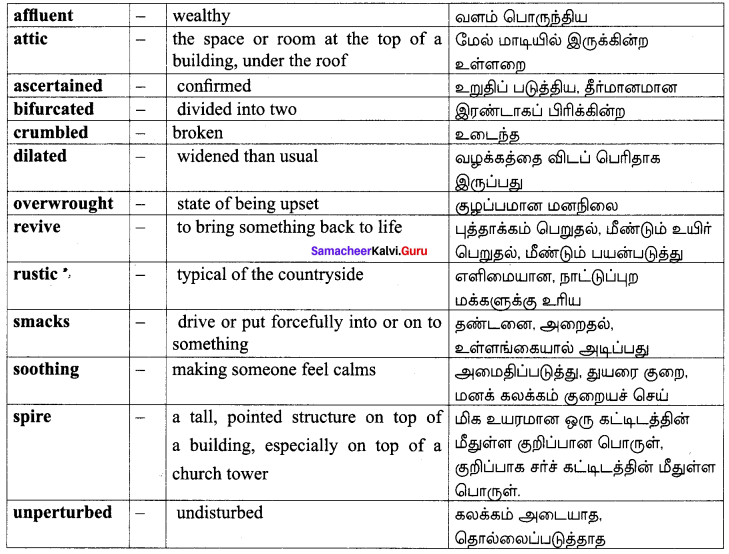
Lines Written in Early Spring Glossary

Textual:

bower – a pleasant shady place under trees
grieve – mourn or to feel intense sorrow
grove – a small area of land with a group of trees
lament – to express sorrow or unhappiness about something
periwinkle – a trailing plant with large blue flowers
primrose – a wild plant with yellow flowers
recline – lean back in a position of rest
sate – old fashioned spelling for sat
tufts – bunches

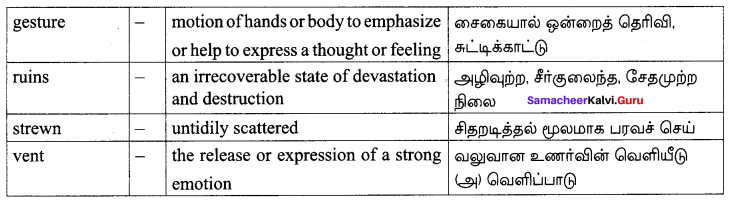
Additional:
attempt – effort
celestial – heavenly
chirping – singing
faith – trust
harmony – everywhere
peaceful co-existence
heal – cure
misery – difficulty
pervasive – prevalent

The main aim is to share the knowledge and help the students of 11th English to secure the best score in their final exams. Use the concepts of Samacheer Kalvi 11th English Book Solutions Poem Chapter 3 Lines Written in Early Spring Questions and Answers in Real time to enhance your skills. If you have any doubts you can post your comments in the comment section, We will clarify your doubts as soon as possible without any delay.
Samacheer Kalvi 7th Science Solutions Term 3 Chapter 1 Light

Students can Download Science Chapter 1 Light Questions and Answers, Notes Pdf, Samacheer Kalvi 7th Science Book Solutions Guide Pdf helps you to revise the complete Tamilnadu State Board New Syllabus and score more marks in your examinations.

Tamilnadu Samacheer Kalvi 7th Science Solutions Term 3 Chapter 1 Light

Samacheer Kalvi 7th Science Light Textual Evaluation

I. Choose the correct option:

Light That Hits A Mirror Gets Question 1.
Light travels only in a ______ .It is because of this property that.
(a) curved line, shadows
(b) straight line, shadows
(c) straight line, reflection
(d) curved line and then straight line, shadows
Answer:
(b) straight line, shadows

Light That Hits A Mirror Gets Answer Question 2.
Light that hits a mirror gets ______
(a) Transmitted
(b) Reflected
(c) Absorbed
(d) Refracted
Answer:
(b) Reflected

Samacheer Kalvi Guru 7th Science Question 3.
______ surface reflects the light well
(a) Water
(b) Compact disc
(c) Mirror
(d) Stone
Answer:
(c) Mirror

Samacheer Kalvi 7th Science Guide Question 4.
Light is a form of ____
(a) matter
(b) energy
(c) medium
(d) partical
Answer:
(b) energy

Light Samacheer Kalvi Question 5.
You can see your image in polished floors, but not in wooden table because ______
(a) regular reflection takes place in wooden table and irregular reflection in polished floor
(b) regular reflection takes place in polished floor and irregular reflection in wooden table
(c) regular reflection takes place in both polished floor and wooden table
(d) irregular reflection takes place in both polished floor and wooden table
Answer:
(b) regular reflection takes place in polished floor and irregular reflection in wooden table

Samacheer Kalvi 7th Science Books Answers Question 6.
Choose the translucent substance from the following
(a) glass
(b) wood
(c) water
(d) Clouds
Answer:
(d) clouds

Samacheer Kalvi 7th Science Question 7.
Reflection occurs , when the light
(a) about to reach a surface
(b) approaches a surface
(c) passes through a surface
(d) None Of these
Answer:
(b) approaches a surface

7th Science Term 3 Question 8.
Which of the following is the best reflector
(a) plastic plate
(b) plane mirror
(c) wall
(d) paper
Answer:
(b) plane mirror

Samacheer Kalvi 7th Science Answers Question 9.
Sivarajan placed a meter stick in the playground at 7.00 am in the morning. How will the shadow of the stick at noon look in comparison to the one in the morning
(a) There will be no shadow
(b) The shadow will be longer and on the opposite side as the sun
(c) The shadow will be shorter and on the same side as the sun
(d) The shadow will be shorter
Answer:
(d) The shadow will be shorter

Samacheer Kalvi 7th Science Book Back Answers Question 10.
The image formed by a pinhole camera is inverted because,
(a) light travels in straight lines
(b) light rays become laterally inverted as they pass through a pinhole camera
(c) light rays pass through the pinhole
(d) light rays get reflected
Answer:
(a) light travels in straight lines

7th Science Samacheer Kalvi Question 11.
Which of the following facts explain how shadows are formed?
(a) Light travels in straight lines
(b) Opaque bodies do not allow light to pass through them
(c) Reflection occurs at a smooth surfaces like mirrors
(d) Lateral inversion happens
(a) both A and B
(b) both A and D
(c) both B and C
(d) only A
Answer:
(a) both A and B

II. Fill in the blanks:

  1. A plane mirror produces a _________ image
  2. A _________ reflection helps us to see the objects.
  3. The light ray gets _________ when it falls on any polisher surface
  4. Sunlight is a blend of _________ colours
  5. The splitting of white light into seven colours is called _________
  6. The moon _________ sun light.
  7. The sunlight can be split into its constituent colours using _________
  8. Reflection of light from rough surface is called _________ reflection

Answer:

  1. virtual and erect
  2. regular
  3. reflected
  4. seven
  5. dispersion
  6. reflects
  7. prism
  8. irregular

III. Say TRUE or FALSE.

Samacheer Kalvi 7th Science Book Question 1.
The image of right hand in a plane mirror looks like a left hand.
Answer:
True

7th Standard Term 3 Science Question 2.
Rainbow is formed by dispersion of which light by water drops.
Answer:
True

Light Chapter Of Class 7 Pdf Question 3.
The image formed by the plane mirror is laterally inverted, hence the image seen through the periscope is also laterally inverted
Answer:
False
Correct statement: The image formed by the plane mirror is laterally inverted, hence the image seen through the periscope is This is because in periscope, image is reflected by two mirrors.

Question 4.
We see planets because they reflect light from the sun
Answer:
True

Question 5.
We see a book because it reflects the light that falls on its surface
Answer:
True

Question 6.
The image formed in a pinhole camera is always inverted
Answer:
True

Question 7.
The image formed in a pinhole camera is always the satne size as the object
Answer:
False

Question 8.
The image formed in a plane mirror is upside down
Answer:
False
Correct statement: The image formed in a plane mirror is erect.

Question 9.
A plane mirror is opaque Ans.
Answer:
True

Question 10.
A shadow is formed on the same side of the object as the source of light.
Answer:
False
Correct statement: A shadow is formed on the side of the object as the source of light.

Question 11.
We are able to see things around us with the help of regular reflection
Answer:
True

Question 12.
After passing through a prism, white light splits into a band of seven colours
Answer:
True

IV. Match the following

1.Rectilinear propagationPrimary source of light
2.Rectilinear propagationNon-luminous object
3.Plane Mirror Fire flyPeriscope
4.The MoonPinhole camera
5.Wide light sourceSpectrum of light
6.Regular reflectionluminous object
7.The sunPenumbra
8.Band of seven colorsGlossy surface

Answer:

1.Rectilinear propagationPinhole camera
2.Rectilinear propagationPeriscope
3.Plane Mirror Fire flyluminous object
4.The MoonNon-luminous object
5.Wide light sourcePenumbra
6.Regular reflectionGlossy surface
7.The sunPrimary source of light
8.Band of seven colorsSpectrum of light

V. Answer the following questions in short:

Question 1.
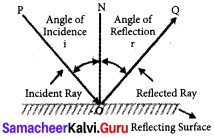
With the help of a diagram, state the laws of reflection
Answer:
Laws of reflection:
Light That Hits A Mirror Gets Samacheer Kalvi 7th Science Solutions Term 3

  1. The angle of incidence is always equal to the angle of reflection li =l*
  2. The incident ray, the reflected ray and the normal at the point of incidence lie on the same plane.

Question 2.
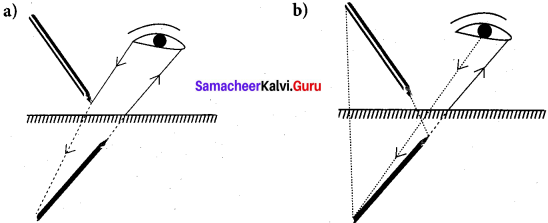
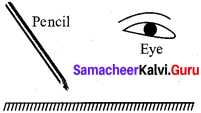
Figure shows a pencil placed above a mirror

Light That Hits A Mirror Gets Answer Samacheer Kalvi 7th Science Solutions Term 3
a) Draw its image formed by the mirror
b) Show how light rays from the object are reflected at the mirror to form the image for the eye.
Answer:

Samacheer Kalvi Guru 7th Science Solutions Term 3 Chapter 1 Light

Question 3.
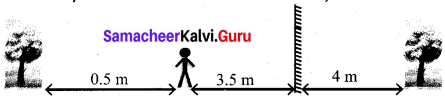
A person is looking at the image of a tree in a mirror placed 3.5 m in front of him. Given that the tree is at 0.5 m behind his eyes. Find the distance between the image of the tree and his eyes. What are needed to see an object?
Answer:
Samacheer Kalvi 7th Science Guide Solutions Term 3 Chapter 1 Light
Distance between the person and the mirror = 3.5 m
Distance between the person and tree (object) = 0.5 m
The image formed in the mirror = 4 m
The distance between the image of the tree and his eyes = 4 + 3.5 = 7.5

Question 4.
What are luminous objects?
Answer:
All objects which emit light energy by themselves are called luminous objects. Ex.: Sun, electric bulb.

Question 5.
Is thr moon a luminous object?
Answer:
No, the moon is non-luminous. The reason is that moon does not produce its own light. Instead, it reflects the light of the sun falling on it.

Question 6.
What are the three types of materials based on the absorption of light?
Answer:

  1. Transparent Material
  2. Translucent Material
  3. Opaque Material

Question 7.
What are the parts of shadow?
Answer:

  1. Umbra
  2. Penumbra

Question 8.
What are the properties of shadow?
Answer:
Properties of shadow:

  1. All objects do not form shadows. Only opaque objects form shadows.
  2. Shadows will be formed in the opposite side of light source.
  3. It cannot be determined the characteristics of an object by its shadow.
  4. The shadow will be always darker, whatever may be the color of light rays.
  5. Light source, opaque object are shadow all are in a straight line.
  6. The size of shadow depends upon the distance between light source and object and the distance between object and the screen.

Question 9.
What is plane mirror?
Answer:
A plane mirror is a mirror with a flat reflective surface. A plane mirror makes an image of objects in front of it.

Question 10.
What is prism?
Answer:
A prism is an object made up of a transparent material, like glass or plastic that has at least two flat surfaces that form an acute angle (less than 90°).

Question 11.
What do you mean by visible light?
Answer:
Visible light is a spectrum of a number of waves with different wavelength range from 400nm to 700nm (lnm = 10″9 meter) each wave has a definite wavelength represents a particular colour.

Question 12.
Write the items given here in the correct column (Stars, brick walls, plants, mirror, planets, electric light bulb, candle)

Sources of LightObjects that reflect light

Answer:

Sources of LightObjects that reflect light
StarsBrick walls
Electric light bulbPlants
CandleMirror
Planets

Question 13.
A boy of height lm 45 cm is standing in front of a long mirror at a distance of 2 m. From this information, fill up the following sentences:
a) The distance between the boy and his image is ______
b) The height of the image is ______
c) When the boy moves 1 m forward, the distance between her and her image is ______
Answer:
(a) The distance between the boy and his image is 4m
(b) The height of the image is same.
(c) When the boy moves 1 m forward, the distance between her and her image is 2m.

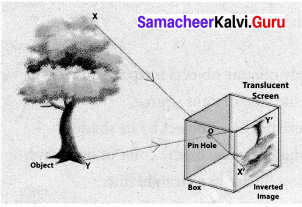
Question 14.
Draw a diagram of a pinhole camera showing the rays of light passing between the Object and its image
Answer:

Light Samacheer Kalvi 7th Science Solutions Term 3 Chapter 1

Question 15.
Why is the writing on the front of an ambulance back to front as shown in the picture
Samacheer Kalvi 7th Science Books Answers Term 3 Chapter 1 Light
Answer:

  1. This is due to lateral inversion.
  2. The phenomenon due to which the left side of an object appears to be right side of the object in its image in a reflecting medium (mirror).
  3. So that drivers see the word the right way around in their rear-view mirror.

Question 16.
Explain with examples, why some capital letters look the same in a mirror but others are reversed.
Answer:
Any letter that has a bilateral symmetry will have its mirror image the same as that of the object.
Example:
Samacheer Kalvi 7th Science Solutions Term 3 Chapter 1 Light

Question 17.
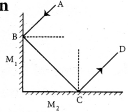
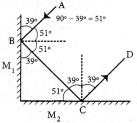
Two plane mirrors M1 and M2 are placed perpendicular with each other, as shown in figure. The ray AB makes an angle 39° with the plane mirror M , then

  1. The reflected rays are _________, ____________
  2. The incident rays are _________, ____________
  3. What is the angle of incident corresponding to the ray BC?
  4. What is the angle of reflection corresponding to the ray CD

7th Science Term 3 Samacheer Kalvi Chapter 1 Light
Answer:

Samacheer Kalvi 7th Science Answers Term 3 Chapter 1 Light

  1. BC, CD
  2. AB, BC
  3. \(\lfloor i\) = 39°
  4. \(\lfloor r\) = 39°

Question 18.
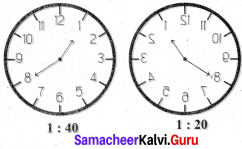
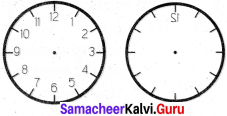
Raj an was playing with the mirror images of a clock. He looked at the clock in his roomIt was showing 1:40. Draw the position of the hands on the real clock and on its mirror reflection .Write below the picture what time each picture

Samacheer Kalvi 7th Science Book Back Answers Term 3 Chapter 1 Light
Answer:

7th Science Samacheer Kalvi Solutions Term 3 Chapter 1 Light

Question 19.
What is reflection of light?
Answer:
The bouncing back of light from a reflecting surface of an object is called as reflection of light

Question 20.
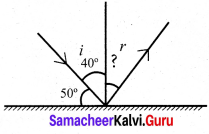
If a ray of light is falling on a plane mirror at an angle of 50° is formed, what will be the angle of reflection?
Answer:

Samacheer Kalvi 7th Science Book Solutions Term 3 Chapter 1 Light
Angle of incidence \(\lfloor i\) = 90° – 50°
\(\lfloor i\) = 40°
According to laws of reflection,
\(\lfloor i\) = \(\lfloor k\)
Angle of incidence = Angle of reflection
\(\lfloor i\) = 40°
∴ \(\lfloor r\) – 40°
Angle of reflection \(\lfloor r\) = 40°

Question 21.
What do you mean by lateral inversion?
Answer:
The phenomenon due to which left hand side of object appears as right hand side and vice versa is called lateral inversion.

Question 22.
How do you obtain a spectrum of light?
Answer:
When white light is made to fall on the surface of a prism, it disperses and we obtain a spectrum of light.

Question 23.
Why do we see white color in Newton’s disc, when we rotate it very fast?
Answer:
When the disc turned quickly, the retina receives the sensation of the spectrum simultaneously and disc appears white.

Question 24
What is a shadow? What things are necessary for the formation of a shadow?
Answer:

  1. Shadows are formed because light travels in straight lines.
  2. Shadow is always against, opposite side of light source.
  3. Shadow is formed by opaque objects that stop high from propagating.
  4. Things necessary for the formation of shadow: source of light,opaque object

VI. Answer the following questions in detail:

Question 1.
What are regular and irregular reflection? Explain with the help of diagrams
Answer:
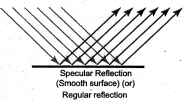
(i) Regular reflection When a parallel beam of light on striking some smooth and polished surface is reflected as a parallel beam of light, such a reflection is called regular reflection.

7th Standard Term 3 Science Samacheer Kalvi Term 3 Chapter 1 Light
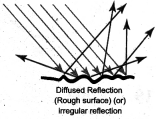
(ii) Irregular reflection : When a parallel beam of light, on striking some rough surface, is reflected in different directions, then such a reflection is called irregular or diffused reflection.

Light Chapter Of Class 7 Pdf Samacheer Kalvi Term 3 Science

Question 2.
What are the difference between luminous and non-luminous objects? Give two examples of each.
Answer:

Luminous objectsNon-luminous objects
1.


All objects which emit light energy by themselves are called luminous objects.All objects which do not emit light energy of their own, but reflect the light energy falling on them and hence, become visible are called non- luminous object.
2.Ex.: Sun, stars, torch light, burning candle etc.Ex.: Metals, trees, houses, stones, moon etc.

Question 3.
Write about two everyday situations that tell you that light travels in a straight line.
Answer:

  1. Formation of shadow: Shadows are formed when some light rays continue its travel in straight lines while other rays are stopped by an object.
  2. When there is a small hole in a room, light travels only in a straight line.

Question 4.
Differentiate between a reflection and a shadow
Answer:

ReflectionShadow
When light falls on a surface, the direction of ray is changed. This change in direction is known as reflection of light.Shadow is an image formed by obstruction of light.
Eg.: You see your reflection in a pool of water or mirror.Eg.: If you place your hand in front of a candle, you will see the image of the hand on the wall. This image will show only the outline of the object placed in front of the light source.

Question 5.
What are the characteristics of an image formed in a plane mirror?
Answer:

  1. Image formed in a plane mirror is upright.
  2. Image formed in a plane mirror is virtual The image is of the same size as the object
  3. The distance of the image from the plane mirror is equal to the distance of the object from the mirror.
  4. Image is laterally inverted.

Question 6.
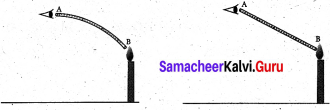
Describe the picture

Samacheer Kalvi 7th Science Solutions Term 3 Chapter 1 Light image - 15
Answer:

  1. When the tube is bent, we cannot see the source of light
  2. When the tube is held straight we can see the flame. The two pictures verify that light travels in straight lines. This is known as rectilinear propagation of light.

Question 7.
Define the following terms
a. Incident ray
b. Reflected ray
c. Normal
d. Angle of incidence
Answer:
(a) Incident tavi The ray of light that falls on the surface of the reflection materials.
(b) Reflected ray: The ray of light that comes from the point when the incident ray falls on the reflection material.
(c) Normal: The perpendicular line drawn from, the point of incidence to the plane of reflecting surface is called normal.
(d) Angl e of incidence The angle formed between the incident ray PO and the normal ‘ON’ is angle of incidence.

Question 8.
Compare the images formed by plane mirror with that by pinhole camera
Answer:
Difference between the images formed in Pinhole camera and Plane mirror:

Image formed by Pin hole cameraImages formed in Plane mirror
The image is real.The image is virtual
The image may not be equal to the size of the objectThe image is equal to the size of the object
The image is invertedThe image is erect

Samacheer Kalvi 7th Science Light Intext Activities

Activity – 4

Let’s categorize transparent material, translucent material and opaque material among f the given materials
(Clear plastic ruler, cellophane paper, some water in a glass jar, tissue paper, drinking glass, beaker, tap water, kerosene, coconut oil, note paper, card board, milk, diluted milk, aluminum foil, thick colored plastic lid, rough glass piece, measuring glass with water, wooden piece) Place all the materials given above in the dark room. Focus a torch light on one side of each material. Inspect the light coming out at the other side of each material and then classify the materials in the table.

S.NoTransparent MaterialTranslucent MaterialOpaque Material
1.Clear plastic rulerKeroseneCard board
2.Drinking glassMilkWooden piece
3.Beakerdiluted milkaluminium foil
4.Tap waterrough glass piecethick coloured plastic lid.
5.Measuring glass with watertissue paper
6.Cell phone paperNote paper

Activity – 6

SurfacesProperty of Image (Clearer / blurred)
GlassBlurred
Metal SheetBlurred
Aluminum foilClearer
WhitepaperClearer

Activity – 7

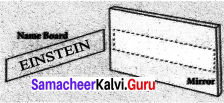
There are eight letters in the word EINSTEIN
Samacheer Kalvi 7th Science Solutions Term 3 Chapter 1 Light image - 16

  1. Write the word in front of a plane mirror shown in diagram
  2. Write down how these letters appear in the mirror
  3. How many of these letters appear to be different, when the word is reflected?
  4. Write down the letters that appear to be the same.

Answer:
(i)Samacheer Kalvi 7th Science Solutions Term 3 Chapter 1 Light image - 17

(ii)Samacheer Kalvi 7th Science Solutions Term 3 Chapter 1 Light image - 18

(iii) 3 letters (E,N,S)
(iv) I,T

Activity – 10
You need Gelatin papers of Red, Blue and Yellow. Fold each gelatin paper three times and look different colour objects listed below through each folded paper. Observe what colour each object has. Write your observations in the table.

ObjectOriginal colour of objectColour through Red gelatin paperColour through Blue gelatin paperColour through Yellow gelatin paper
Blue skyBlue
Orange flowerOrange
Yellow bananaYellow
leavesGreen
Brown trouserBrown
White shirtWhiteRedBlueYellow
Black boardBlack

Samacheer Kalvi 7th Science Light Additional Questions

I. Choose the correct answer.

Question 1.
Which of the following is a natural source of light?
(a) Electric lamp
(b) Electric filament
(c) Torch light
(d) Sunlight
Answer:
(d) Sunlight

Question 2.
Light shows ________
(a) curvilinear propagation
(b) random propagation
(c) rectilinear propagation
(d) none of these
Answer
(c) rectilinear propagation

Question 3.
Rectilinear propagation is ________
(a) mode of travelling in straight lines
(b) mode of travelling in curved lines
(c) ability to bend around obstacles
(d) displaying the phenomenon of diffraction
Answer
(a) made of travelling in straight lines

Question 4.
Plane mirrors are arranged parallel to each other to get ________
(a) a single image
(b) two images
(c) a large number of reflected image
(d) no image
Answer:
(d) two images

Question 5.
Which of the following is not luminous object?
(a) Sun
(b) Moon
(c) Candle
(d) Bulb
Answer
(b) Moon

Question 6.
White light is composed of ________
(a) seven colours
(b) five colours
(c) three colours
(d) only one colours
Answer:
(a) seven colours

Question 7.
The image which can be obtained on screen is called ________
(a) erect
(b) real
(c) virtual
(d) inverted
Answer:
(b) real

Question 8.
If we mix lights of the colours of the rainbow we will get .
(a) pink light
(b) brown light
(c) colourless light
(d) black light
Answer:
(c) colourless light

Question 9.
Which one of the following is involved for the formation of rainbow in the sky?
(a) Expansion of light
(b) Expansion of heat by the Sun
(c) Distance between the Earth and the Moon
(d) Dispersion of light
Answer:
(d) Dispersion of light

Question 10.
A virtual image is
(a) always real
(b) always uncapturable on a screen
(c) always inverted
(d) always caught on a screen
Answer:
(b) always uncapturable on a screen

II. Fill in the Blanks.

  1. Objects which are able to emit light are known as ______
  2. Passing electricity through certain gases at a very low pressure can produce ______
  3. ______ is a simple device which helps us to understand about the rectilinear propagation of light.
  4. The light falling on the mirror is called ______ as and the light reflected is called
  5. The angle formed between the reflected ray and the normal is ______
  6. Light travels ______ km per second in air or vacuum.
  7. Materials that allow light to pass through completely are known as ______ material.
  8. Materials that allow light to pass through partially are called ______ materials.
  9. Materials that are not able to allow light to pass through it are called ______ materials.
  10. ______ is always against, opposite side of light source.
  11. The ______ is the darkest part of a shadow.
  12. The lighter shade of shadow is the ______
  13. Only ______ objects forms shadows.
  14. ______ eclipse occurs, when the moon arrives between the sun and the Earth.
  15. ______ cables are able to carry more signals than traditional copper cable telephone lines.
  16. The images that are obtained on a screen are called ______ and that which cannot be obtained on a screen is ______
  17. When all colours of visible light strikes the retina of our eye at the same time, our brain perceives ______
  18. ______ colour is scattered the least by air molecules.
  19. ______ is the method of creating colour by mixing various proportion of two or three distinct colours of light.
  20. ______ Magenta, Cyan and yellow are called colours.

Answer:

  1. light sources
  2. Light
  3. Pin-hole camera
  4. incident ray, reflected ray
  5. angle of reflection
  6. 3 lakh
  7. transparent
  8. translucent
  9. opaque
  10. Shadow
  11. umbra
  12. penumbra
  13. opaque
  14. Solar
  15. Fibre optic
  16. real image, virtual image
  17. white
  18. Red
  19. Synthesis
  20. secondary

III. True or False – If false give the correct statement.

Question 1.
Angle of incidence is greater than the angle of reflection.
Answer:
False
Correct statement: Angle of incidence is o the angle of reflection.

Question 2.
The image formed by a plane mirror is real.
Answer:
False.
Correct statement: The image formed by a plane mirror is virt ual and erect.

Question 3.
Diffused reflection gives a sharp image.
Answer:
False.
Correct statement: reflection gives a sharp image.

Question 4.
The image formed by a plane mirror is always that far behind the mirror as far the object lies in front of it.
True.
You can see a rainbow only when your back is towards the sun.
True.

Question 5.
You can see a rainbow only when your back is towards the sun.
Answer:
True.

Question 6.
The image of symmetrical letters like A, H, I, M, R, K, T, U are not affected by lateral inversion.
Answer:
Correct statement: The image of symmetrical letters like A, H, I, M, T, U are not affected by lateral inversion.

Question 7.
Plane mirrors are used as looking glass, to reflect light on objects and in periscopes.
Answer:
True

Question 8.
We can not get white light when we mix seven colours.
False
Correct statement: We can get white light when we mix seven colours.

Question 9.
Materials that allow light to pass through completely are known as transparent material
Answer:
True

Question 10.
Solar and lunar eclipses are occuring due to the property of light known as the rectilinear propagation of light.
Answer:
True

IV. Match the following :

Question 1.

1.Rubber(a)Erect
2.Greased paper(b)Inverted
3,Real image(c)Opaque medium
4.Virtual image(d)Translucent medium

Answer:

  1. c
  2. d
  3. b
  4. a

Question 2.

1.Real image(a)Diffuse reflection
2.Virtual image(b)An optical device which produces reflection
3.Mirror(c)Cannot be taken on screen
4.A type of light scattering(d)Can be taken on screen

Answer:

  1. d
  2. c
  3. b
  4. a

V. Assertion and Reason.

Mark the correct choice as
(a) Both A and R are true and R is the correct explanation of assertion.
(b) Both A and R are true but R is not the correct explanation of assertion.
(c) A is true but R is false.
(d) A is false but R is true.

Question 1.
Assertion (A) : A plane mirror produces virtual, erect image for any position of the object.
Reason (R) : Lateral inversion is an important property of image formed by a plane mirror.
Answer:
(b) Both A and R are true but R is not the correct explanation of assertion.
Correct reason: It is because of the property of image formed in a plane mirror.

Question 2.
Assertion (A) : When an object is placed between two plane mirrors; then all the images
found are of unequal intensity.
Reason (R) : In case of plane parallel mirrors, only two images are possible.
Answer:
(c) A is true but R is false
Correct reason: In case of plane parallel mirrors, infinite images are formed.

Question 3.
Assertion (A) : Virtual object can’t be seen by human eye.
Reason (R) : Virtual image is formed by converging rays.
Answer:
(c) A is true but R is false
Correct reason: Virtual image is formed by diverging rays.

Question 4.
Assertion (A) : A ray incident along normal to the mirror retraces its path.
Reason (R) : In reflection, angle of incidence is always equal to angle of reflection.
Answer:
(a) Both A and R are true and R is the correct explanation of assertion

VI. Very short Answers:

Question 1.
What is the composition of sunlight?
Answer:
Sunlight is a mixture of seven colours.

Question 2.
How does light travel?
Answer:
Light travels along a straight line.

Question 3.
What kind of surface reflects light?
Answer:
Smooth and shiny surface reflects light.

Question 4.
Name the triangular piece of glass that splits white light into different colours.
Answer:
Prism.

Question 5.
What is reflection of light?
Answer:
When light falls on smooth surface like mirror then it changes its direction, it is called reflection.

Question 6.
State the size of the image formed by a plane mirror?
Answer:
The size of image formed by a plane mirror is same as that of the object infront of the mirror.

Question 7.
What is Newton’s disc?
Answer:
Newton Disc is a card board disc with seven equal sectors colored red, yellow, orange, green, blue, indigo and violet. When the disc turned quickly, the retina receives the sensation of the spectrum simultaneously and disc appears white.

Question 8.
What is an eclipse?
Answer:
An eclipse is an incident, when any astronomical object is partially or fully obscured due to the placement of another astronomical object in the presence of light.

Question 9.
What is light?
Answer:
Light is type of energy, that helps us to see all the things around us.

VII. Short Answer.

Question 1.
What is natural sources of light? Give example.
Answer:
Sources which emit light naturally are known as natural sources of light. The Sun is the primary and the major source of natural light.

Question 2.
Mention the properties of light.
Answer:
Light has some fundamental properties as mentioned below.

  • Rectilinear propagation of light
  • Reflection
  • Speed
  • Interaction of light with matter.
  1. Types of material according to permeability.
  2. Formation of shadows.
  3. Plane mirror and images.
  4. Spectrum.

Question 3.
State laws of reflection.
Answer:
Laws of reflection:

  1. The angle of incidence is always equal to the angle of reflection. \(\lfloor i\) = \(\lfloor r\)
  2.  The incident ray, the reflected ray and the normal at the point of incidence lie on the same plane.

Question 4.
Define transparent materials. Give example.
Answer:

  1. Materials that allow light to pass through completely are known as transparent material.
  2. Example: Eye glasses, clear drinking glass, clear water, face glasses used in buses.

Question 5.
Define opaque material. Give example.
Answer:

  1. Materials that are not able to allow light to pass through, are called opaque material.
  2. Example: Wall, thick card board, stone, etc.

Question 6.
What is lunar eclipse?
Answer:

  1. Lunar eclipse occurs, when the Earth (E) comes between the Sun (S) and the Moon (M).
  2. The Earth prevents light coming from the Sun and makes shadow on the Moon. This is lunar eclipse.

Question 7.
Why danger lights in vehicles are red in colour?
Answer:

  1. Red color is scattered the least by air molecules.
  2. Red color has the highest wavelength of all the other colors. So red color is able to travel the longest distance through air, fog.

Question 8.
What is meant by synthesis of colour?

  1. Synthesis of colour is the method of creating colour by mixing various proportion of two (or) three distinct colours of light. .
  2. These distinct colours are Red, Green and Blue called as primary colours.

Question 9.
When lighting a bulbs in a dark room, light spreads the whole room quickly. Give reason.
Answer:

  1. When lighting a bulb in a dark room, light spreads the whole room quickly.
  2. This is because the light travels very fast.
  3. Light travels three lakh kilometers per second in air or vacuum.
  4. In theory, nothing can travel faster than light.

VIII. Long Answer:

Question 1.
Write the difference between real image and virtual image.
Answer:

Real imageVirtual image
1.It can be taken on a screen.It cannot be taken on a screen.
2.The rays of light, after reflectionThe rays of light, after reflection appear to
3.It is always invertedIt is always erect but laterally inverted

Question 2.
Explain the importance of optical fiber.
Answer:

  1. Optical fiber is a device that works on the principle of total internal reflection by which light signals (huge data) can be transmitted from one place to another place with a negligible loss of energy in a very short time.
  2. It consists of a cable having one or more thin flexible fibers with a glass core through which light signals can be sent.
  3. Optical fiber can be twisted and bent easily.
  4. When a light a ray of light is incident at one end of the core of optical fiber, it suffers total internal reflection at the many places inside the fiber and emerges at the other end with negligible loss of energy.
  5. The data or information in the form of pulses of light, can be sent through bundles of optical fibers.
  6. Optical fibers have become very important in high-speed communications, such as cable TV and high-speed broadband services.Fiber optic cables are able to carry more signals than traditional copper cable telephone lines.

Question 3.
With help of a diagram, write a note on : a. Solar eclipse, b. Lunar eclipse.
Answer:
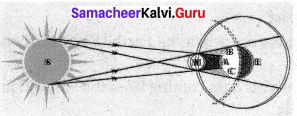
(a) Solar eclipse

Samacheer Kalvi 7th Science Solutions Term 3 Chapter 1 Light image - 20
Solar eclipse occurs, when the Moon arrives between the Sun (S) and the Earth(E). The shadow of the Moon appears on the Earth at A as shown in picture. Hence, those who are at the region A are unable to see the Sun instantly. This is solar eclipse. But, those who are at the region B and C are able to see the sun partially.
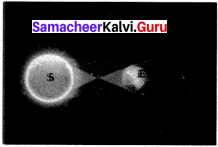
(b) Lunar eclipse

Samacheer Kalvi 7th Science Solutions Term 3 Chapter 1 Light image - 21
Lunar eclipse: Lunar eclipse occurs, when the Earth (E) comes between the Sun (S) and the Moon (M). The Earth prevents light coming from the Sun and makes shadow on the Moon. This is lunar eclipse

IX. Problems for practice:

Question 1.
Calculate the number of images formed by plane mirrors kept at an angle of 10° to each others.
Solution:
Number of image n = \(\frac { 360° }{ θ}\) – 1 = \(\frac { 360° }{ 10°}\) – 1
= 36 – 1
= 35 images

Question 2.
A ray of light fall on a plane surface at an angle of incidence 9° and reflection occurs. Calculate the angle of reflection in degree.
Solution:
By first law of reflection, angle of incidence is always equal to angle of reflection.
\(\lfloor i\) = \(\lfloor r\) . Here, angle of incidence is 9°. So angle of reflection must be equal to 9°.

Question 3.
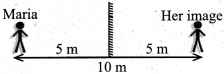
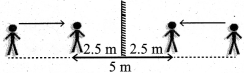
A plane mirror forms a virtual image. The distance between Maria and her image in a plane mirror is 10 m. How much distance should she move in order to get the distance of 5 m between herself and her image?
Solution:
Samacheer Kalvi 7th Science Solutions Term 3 Chapter 1 Light image - 22
The distance between Maria and her image in a plane mirror = 10 m
Samacheer Kalvi 7th Science Solutions Term 3 Chapter 1 Light image - 23
So, she shouuld move a distance of 2.5 m toward the plane mirror

X. Higher order thinking skill (HOTS) :

Question 1.
Why are we able to see the tap water in a glass even though it is colourless?
Answer:
Top water reflects the light into our eyes. As long as an object reflects light into our eyes, we can see it.

Question 2.
Imagine that parallel rays are incident on an irregular surface. Are the rays reflected from this surface parallel to each other?
Answer:
No, the reflected rays from irregular surface are in different directions.

Question 3.
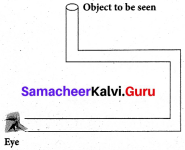
Ram planned an activity to observe an object through pipes as shown in figure, so that he could see objects which he could not directly see.

Samacheer Kalvi 7th Science Solutions Term 3 Chapter 1 Light image - 24
(a) Mention how many mirrors should he use to see the objects.
(b) If any of the mirrors is removed, will he be able to see the objects?
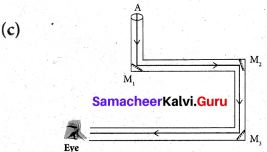
(c) Indicate the positions of the mirrors in the figure.
Answer:
(a) Number of mirrors = 3
(b) He will not be able to see the objects if any of the mirror is removed, since he will not get the rays after removal of mirror.
Samacheer Kalvi 7th Science Solutions Term 3 Chapter 1 Light image - 25

Samacheer Kalvi 12th Accountancy Solutions Chapter 3 Accounts of Partnership Firms-Fundamentals

Students can Download Accountancy Chapter 3 Accounts of Partnership Firms-Fundamentals Questions and Answers, Notes Pdf, Samacheer Kalvi 12th Accountancy Book Solutions Guide Pdf helps you to revise the complete Tamilnadu State Board New Syllabus and score more marks in your examinations.

Tamilnadu Samacheer Kalvi 12th Accountancy Solutions Chapter 3 Accounts of Partnership Firms-Fundamentals

Samacheer Kalvi 12th Accountancy Accounts of Partnership Firms-Fundamentals Text Book Back Questions and Answers

I. Choose the Correct Answer

12th Accountancy 3rd Chapter Solutions Question 1.
In the absence of a partnership deed, profits of the firm will be shared by the partners in …………….
(a) Equal ratio
(b) Capital ratio
(c) Both (a) and (b)
(d) None of these
Answer:
(a) Equal ratio

12th Accountancy Chapter 3 Question 2.
In the absence of an agreement among the partners, interest on capital is …………….
(a) Not allowed
(b) Allowed at bank rate
(c) Allowed @ 5% per annum
(d) Allowed @ 6% per annum
Answer:
(a) Not allowed

Samacheer Kalvi 12th Accountancy Solutions Chapter 3 Question 3.
As per the Indian Partnership Act, 1932, the rate of interest allowed on loans advanced by partners is …………….
(a) 8% per annum
(b) 12% per annum
(c) 5% per annum
(d) 6% per annum
Answer:
(d) 6% per annum

Class 12 Accountancy Chapter 3 Solutions Question 4.
Which of the following is shown in Profit and loss appropriation account?
(a) Office expenses
(b) Salary of staff
(c) Partners’ salary
(d) Interest on bank loan
Answer:
(c) Partners’ salary

Chapter 3 Accountancy Class 12 Solutions Question 5.
When fixed capital method is adopted by a partnership firm, which of the following items will appear in capital account?
(a) Additional capital introduced
(b) Interest on capital
(c) Interest on drawings
(d) Share of profit
Answer:
(a) Additional capital introduced

12th Account Chapter 3 Question 6.
When a partner withdraws regularly a fixed sum of money at the middle of every month, period for which interest is to be calculated on the drawings on an average is …………….
(a) 5.5 months
(b) 6 months
(c) 12 months
(d) 6.5 months
Answer:
(b) 6 months

Class 12th Accounts Chapter 3 Solutions Question 7.
Which of the following is the incorrect pair?
(a) Interest on drawings – Debited to capital account
(b) Interest on capital – Credited to capital account
(c) Interest on loan – Debited to capital account
(d) Share of profit – Credited to capital account
Answer:
(c) Interest on loan – Debited to capital account

Class 12 Accountancy Chapter 3 Question 8.
In the absence of an agreement, partners are entitled to …………….
(a) Salary
(b) Commission
(c) Interest on loan
(d) Interest on capital
Answer:
(c) Interest on loan

12th Accountancy Chapter 3 Solutions Question 9.
Pick the odd one out …………….
(a) Partners share profits and losses equally
(b) Interest on partners’ capital is allowed at 7% per annum
(c) No salary or remuneration is allowed
(d) Interest on loan from partners is allowed at 6% per annum.
Answer:
(b) Interest on partners’ capital is allowed at 7% per annum

Accountancy Chapter 3 Class 12 Question 10.
Profit after interest on drawings, interest on capital and remuneration is ₹ 10,500. Geetha, a partner, is entitled to receive commission @ 5% on profits after charging such commission. Find out commission. …………….
(a) ₹ 50
(b) ₹ 150
(c) ₹ 550
(d) ₹ 500
Answer:
(d) ₹ 500

II. Very short answer questions

Accountancy Class 12 Chapter 3 Solutions Question 1.
Define partnership.
Answer:
According to Section 4 of the Indian Partnership Act, 1932, partnership is defined as, “the relation between person who have agreed to share the profits of a business carried on by all or any of them acting for all.

Samacheer Kalvi Guru 12th Accountancy Question 2.
What is a partnership deed?
Answer:
Partnership deed is a document in writing that contains the terms of the agreement among the partners. It is not compulsory for a partnership to have a partnership deed as per the Indian Partnership Act, 1932. But, it is desirable to have a partnership deed as it serves as an evidence of the terms of the agreement among the partners.

Samacheer Kalvi 12th Accountancy Solutions Chapter 2 Question 3.
What is meant by fixed capital method?
Answer:
Under fixed capital method, the capital of the partners is not altered and it remains generally fixed. Two accounts are maintained for each partner namely:

  1. Capital account and
  2. Current account

The transactions relating to initial capital introduced, additional capital introduced and capital permanently withdrawn are entered in the capital account and all other transactions are recorded in the current account.

Class 12 Account Chapter 3 Solution Question 4.
What is the journal entry to be passed for providing interest on capital to a partner?
Answer:
(a) For providing interest on capital
12th Accountancy 3rd Chapter Solutions Samacheer Kalvi Accounts Of Partnership Firms-Fundamentals

(b) For closing interest on capital account
12th Accountancy Chapter 3 Samacheer Kalvi Accounts Of Partnership Firms-Fundamentals

12th Accountancy Answer Pdf Question 5.
Why is Profit and loss appropriation account prepared?
Answer:
The profit and loss appropriation account is an extension of profit and loss account prepared for the purpose of adjusting the transactions relating to amounts due to and amounts due from partners. It is nominal account in nature. The balance being the profit or loss is transferred to the partners’ capital or current account in the profit sharing ratio.

III. Short answer questions

Class 12 Accountancy Chapter 3 Notes Question 1.
State the features of partnership.
Answer:

  1. Partnership is an association of two or more persons. The maximum number of partners is limited to 50.
  2. There should be an agreement among the persons to share the profit or loss of the business. The agreement may be oral or written or implied.
  3. The agreement must be to carry on a business and to share the profits of the business.
  4. The business may be carried on by all the partners or any of them acting for all.

12th Accountancy Guide Samacheer Kalvi Question 2.
State any six contents of a partnership deed.
Answer:
The contents of partnership deed are:

  1. The name of the firm and nature and place of business.
  2. Date of commencement and duration of business.
  3. Names and address of all partners.
  4. Capital contributed by each partner.
  5. Profit sharing ratio.
  6. Amount of drawings allowed to each partner.

12th Final Accounts Problems With Solutions Pdf Question 3.
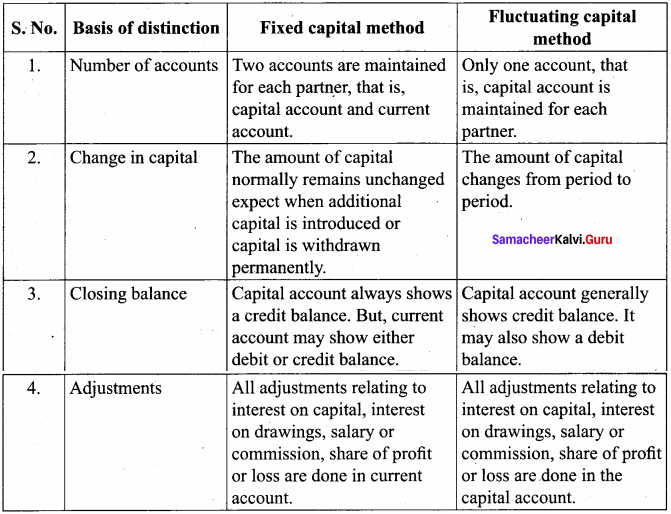
State the differences between fixed capital method and fluctuating capital method.
Answer:
Samacheer Kalvi 12th Accountancy Solutions Chapter 3 Accounts Of Partnership Firms-Fundamentals

Samacheer Kalvi 12th Accountancy Solutions  Question 4.
Write a brief note on the applications of the provisions of the Indian Partnership Act, 1932 in the absence of partnership deed.
Answer:
1. Remuneration to partners : No salary or remuneration is allowed to any partner. [Section 13(a)]

2. Profit sharing ratio : Profit and losses are to be shared by the partners equally. [Section 13(b)]

3. Interest on capital : No interest is allowed on the capital. When a partner is entitled to interest on capital contributed as per partnership deed, such interest on capital will be payable only out of profits [Section 13(c)]

4. Interest on loans advanced by partners to the firm : Interest on loan is to be allowed at the rate of 6 percent per annum. [Section 13(d)]

5. Interest on drawings : No interest is charged on the drawings of the partners.

Question 5.
Jayaraman is a partner who withdrew ₹ 10,000 regularly in the middle of every month. Interest is charged on the drawings at 6% per annum. Calculate interest on drawings for the year ended 31st December, 2018.
Answer:
Jayaraman:
Interest on drawings: 10,000 × \(\frac { 12 }{ 24 }\) × \(\frac { 6 }{ 100 }\) × 12 = ₹ 3600

IV. Exercises

Question 1.
Akash, Bala, Chandru and Daniel are partners in a firm. There is no partnership deed. How will you deal with the following?

  1. Akash has contributed maximum capital. He demands interest on capital at 10% per annum.
  2. Bala has withdrawn ₹ 3,000 per month. Other partners ask Bala to pay interest on drawings @ 8% per annum to the firm. But, Bala did not agree to it.
  3. Akash demands the profit to be shared in the capital ratio. But, others do not agree.
  4. Daniel demands salary at the rate of ₹ 10,000 per month as he spends full time for the business.
  5. Loan advanced by Chandru to the firm is ₹ 50,000. He demands interest on loan @ 12% per annum.

Answer:

  1. No interest on capital is payable to any partner.
  2. No interest is charged on drawing made by the partner.
  3. Profit should be distributed equally.
  4. No remuneration is payable to any partner.
  5. Interest on loan is payable at 6% per annum.

Question 2.
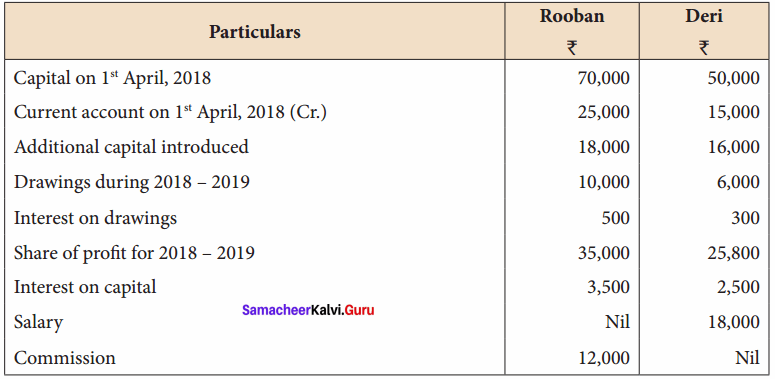
From the following information, prepare capital accounts of partners Rooban and Deri, when their capitals are fixed.
Class 12 Accountancy Chapter 3 Solutions Samacheer Kalvi Accounts Of Partnership Firms-Fundamentals
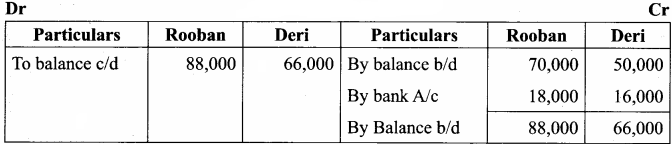
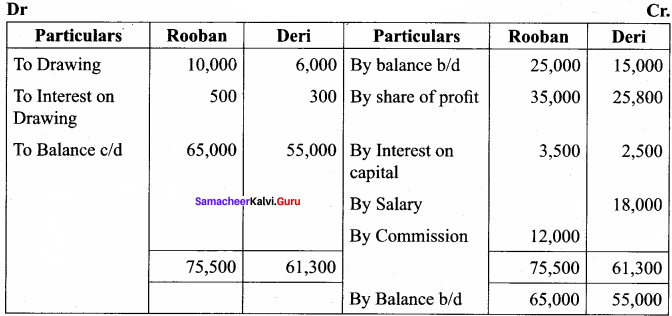
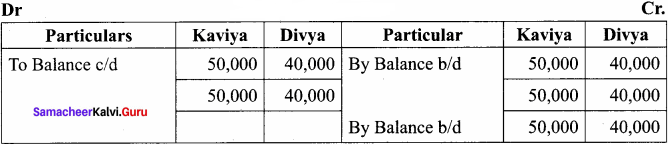
Answer:
Capital Account
Chapter 3 Accountancy Class 12 Solutions Samacheer Kalvi  Accounts Of Partnership Firms-Fundamentals
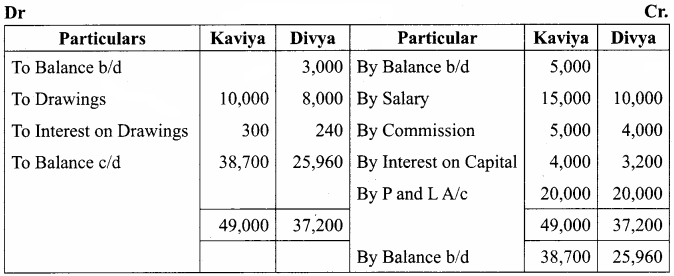
Current Account
12th Account Chapter 3 Samacheer Kalvi Accounts Of Partnership Firms-Fundamentals

Question 3.
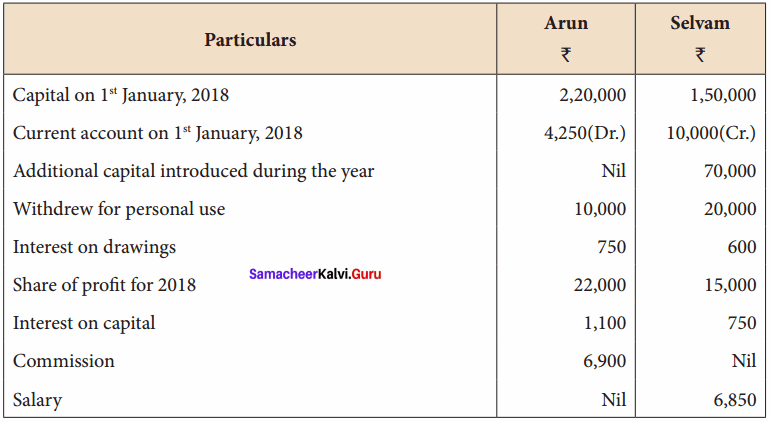
Arun and Selvam are partners who maintain their capital accounts under fixed capital method. From the following particulars, prepare capital accounts of partners.
Class 12th Accounts Chapter 3 Solutions Samacheer Kalvi Accounts Of Partnership Firms-Fundamentals
Answer:
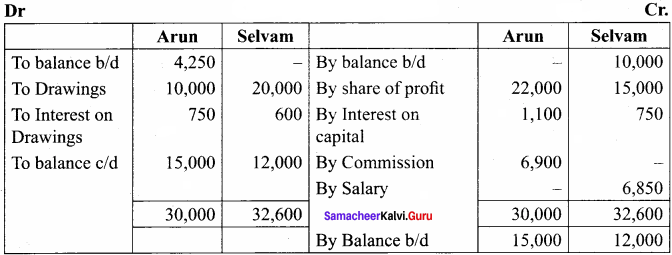
Capital Account
Class 12 Accountancy Chapter 3 Samacheer Kalvi Accounts Of Partnership Firms-Fundamentals
Current Account
12th Accountancy Chapter 3 Solutions Samacheer Kalvi Accounts Of Partnership Firms-Fundamentals

Question 4.
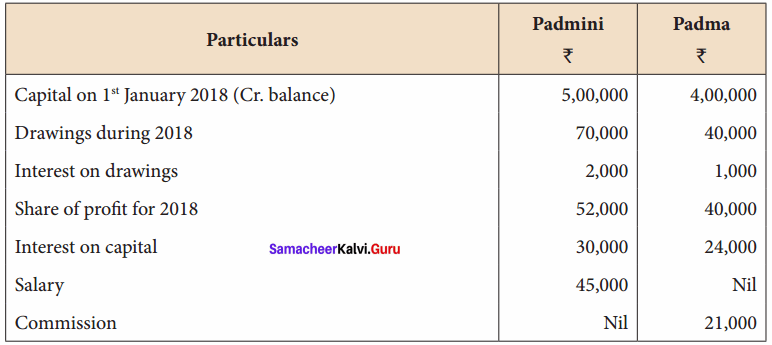
From the following information, prepare capital accounts of partners Padmini and Padma, when their capitals are fluctuating.
Accountancy Chapter 3 Class 12 Samacheer Kalvi Accounts Of Partnership Firms-Fundamentals
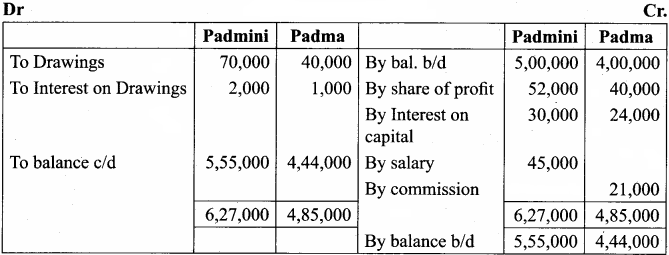
Answer:
Accountancy Class 12 Chapter 3 Solutions Samacheer Kalvi Accounts Of Partnership Firms-Fundamentals

Question 5.
Mannan and Ramesh share profits and losses in the ratio of 3:2 and their capital on 1st April, 2018 was Mannan ₹ 1,50,000 and Ramesh ₹ 1,00,000 respectively and their current accounts show a credit balance of’ 25,000 and ₹ 20,000 respectively. Calculate interest on capital at 6% p.a. for the year ending 31st March, 2019 and show the journal entries.
Answer:
Samacheer Kalvi Guru 12th Accountancy Solutions Chapter 3 Accounts Of Partnership Firms-Fundamentals

Question 6.
Prakash and Supria were partners who share profits and losses in the ratio of 5:3. Balance in their capital account on 1st April, 2018 was Prakash ₹ 3,00,000 and Supria ₹ 2,00,000. On 1st July, 2018 Prakash introduced additional capital of ₹ 60,000. Supria introduced additional capital of ₹ 30,000 during the year. Calculate interest on capital at 6% p.a. for the year ending 31st March, 2019 and show the journal entries.
Answer:
Class 12 Account Chapter 3 Solution Samacheer Kalvi Accounts Of Partnership Firms-Fundamentals
Journal Entries
12th Accountancy Answer Pdf Samacheer Kalvi Chapter 3 Accounts Of Partnership Firms-Fundamentals

Question 7.
The capital account of Begum and Fatima on 1st January, 2018 showed a balance of ₹ 50,000 and ₹ 40,000 respectively. On 1st October, 2018, Begum introduced an additional capital of? 10,000 and on 1st May, 2018 Fatima introduced an additional capital of ₹ 9,000.
Answer:
Calculate interest on capital at 4% p.a. for the year ending 31st December, 2018.
Class 12 Accountancy Chapter 3 Notes Samacheer Kalvi Accounts Of Partnership Firms-Fundamentals

Question 8.
From the following balance sheets of Subha and Sudha who share profits and losses in 2:3, calculate interest on capital at 5% p.a. for the year ending 31st December, 2018.
Balance sheet as on 31st December, 2018
Class 12 Accountancy Chapter 3 Notes Samacheer Kalvi Accounts Of Partnership Firms-Fundamentals
Drawings of Subha and Sudha during the year were ₹ 8,000 and ₹ 10,000, respectively. Profit earned during the year was ₹ 30,000.
Answer:
12th Accountancy Guide Samacheer Kalvi Chapter 3 Accounts Of Partnership Firms-Fundamentals
12th Final Accounts Problems With Solutions Pdf Samacheer Kalvi Accounts Of Partnership Firms-Fundamentals

Question 9.
From the following balance sheets of Rajan and Devan who share profits and losses 2:1, calculate interest on capital at 6% p.a. for the year ending 31st December, 2018.
Balance sheet as on 31st December 2018
Samacheer Kalvi 12th Accountancy Solutions Chapter 3 Accounts of Partnership Firms-Fundamentals 18
On 1st April, 2018, Rajan introduced an additional capital of ₹ 40,000 and on 1st September, 2018, Devan introduced ₹ 30,000. Drawings of Rajan and Devan during the year were ₹ 20,000 and ₹ 10,000 respectively. Profit earned during the year was ₹ 70,000.
Answer:
Samacheer Kalvi 12th Accountancy Solutions Chapter 3 Accounts of Partnership Firms-Fundamentals 19
Samacheer Kalvi 12th Accountancy Solutions Chapter 3 Accounts of Partnership Firms-Fundamentals 20

Question 10.
Ahamad and Basheer contribute ₹ 60,000 and ₹ 40,000 respectively as capital. Their respective share of profit is 2 : 1 and the profit before interest on capital for the year is ₹ 5,000. Compute the amount of interest on capital in each of the following situations:

  1. if the partnership deed is silent as to the interest on capital
  2. if interest on capital @ 4% is allowed as per the partnership deed
  3. if the partnership deed allows interest on capital @ 6% per annum.

Answer:
1. No Interest on capital is allowed.

2. Since the profit is sufficient, Interest on capital will be provided.
Ahamad:
60, 000 × \(\frac { 4 }{ 100 }\) = ₹ 2, 400
Basheer:
40, 000 × \(\frac { 4 }{ 100 }\) = ₹ 1, 600

3. Since the profit is insufficient, Interest on capital will be provided.
Ahamad:
60, 000 × \(\frac { 6 }{ 100 }\) = ₹ 3, 600
Basheer:
40, 000 × \(\frac { 6 }{ 100 }\) = ₹ 2, 400
Profit of 5,000 will be distributed to the partners in their capital ratio of 3:2.

Question 11.
Mani is a partner, who withdrew ₹ 30,000 on 1st September, 2018. Interest on drawings is charged at 6% per annum. Calculate interest on drawings on 31st December, 2018 and show the journal entries by assuming that fluctuating capital method is followed.
Answer:
Mani:
30, 000 × \(\frac { 6 }{ 100 }\) = ₹ 600
Interest on drawings of Mani = ₹ 600.

Question 12.
Santhosh is a partner in a partnership firm. As per the partnership deed, interest on drawings is charged at 6% per annum. During the year ended 31st December, 2018 he withdrew as follows:
Samacheer Kalvi 12th Accountancy Solutions Chapter 3 Accounts of Partnership Firms-Fundamentals 24
Calculate the amount of interest on drawings.
Interest on Drawings = Amount x Rate of Interest x Period
Feb 1 ⇒ 2,000 x \(\frac { 6 }{ 100 }\) = ₹ 600
May 1 ⇒ 10, 000 x \(\frac { 6 }{ 100 }\) x \(\frac { 8 }{ 12 }\) = ₹ 400
July 1 ⇒ 4,000 x \(\frac { 6 }{ 100 }\) x \(\frac { 6 }{ 12 }\) = ₹ 120
Samacheer Kalvi 12th Accountancy Solutions Chapter 3 Accounts of Partnership Firms-Fundamentals 21

Question 13.
Kumar is a partner in a partnership firm. As per the partnership deed, interest on drawings is charged at 6% per annum. During the year ended 31st December, 2018 he withdrew as follows:
Samacheer Kalvi 12th Accountancy Solutions Chapter 3 Accounts of Partnership Firms-Fundamentals 33
Interest on Drawings = Amount x Rate of Interest x Period
March 1 ⇒ 4, 000 x \(\frac { 6 }{ 100 }\) = ₹ 200
June 1 ⇒ 4, 000 x \(\frac { 6 }{ 100 }\) x \(\frac { 7 }{ 12 }\) = ₹ 140
Sep 1 ⇒ 4,000 x \(\frac { 6 }{ 100 }\) x \(\frac { 4 }{ 12 }\) = ₹ 80
Samacheer Kalvi 12th Accountancy Solutions Chapter 3 Accounts of Partnership Firms-Fundamentals 23

Question 14.
Mathew is a partner who withdrew ₹ 20,000 during the year 2018. Interest on drawings is charged at 10% per annum. Calculate interest on drawings on 31st December 2018.
Mathew:
20 000 x \(\frac { 10 }{ 100 }\) x \(\frac { 6 }{ 12 }\) = ₹ 1, 000

Question 15.
Santhosh is a partner in a partnership firm. As per the partnership deed, interest on drawings is charged at 6% per annum. During the year ended 31st December, 2018 he withdrew as follows:
Samacheer Kalvi 12th Accountancy Solutions Chapter 3 Accounts of Partnership Firms-Fundamentals 22
Calculate the amount of interest on drawings by using product method.
Samacheer Kalvi 12th Accountancy Solutions Chapter 3 Accounts of Partnership Firms-Fundamentals 25
Interest on drawings = Product x Rate of interest x \(\frac { 1 }{ 12 }\)
= 1,44,000 x \(\frac { 6 }{ 100 }\) x \(\frac { 1 }{ 12 }\) = ₹ 720

Question 16.
Kavitha is a partner in a firm. She withdraws ₹ 2,500 p.m. regularly. Interest on drawings is charged @ 4% p.a. Calculate the interest on drawings using average period, if she draws

  1. At the beginning of every month
  2. In the middle of every month
  3. At the end of every month

Answer
1. At the beginning of every month:
= 2, 500 x 12 x \(\frac { 4 }{ 100 }\) x \(\frac { 13 }{ 24 }\) = ₹ 650

2. In the middle of every month:
= 2,500 x 12 x \(\frac { 4 }{ 100 }\) x \(\frac { 12 }{ 24 }\) = ₹ 600

3. At the end of every month:
= 2, 500 x 12 x \(\frac { 4 }{ 100 }\) x \(\frac { 11 }{ 24 }\) = ₹ 550

Question 17.
Kevin and Francis are partners. Kevin draws ₹ 5,000 at the end of each quarter. Interest on drawings is chargeable at 6% p.a. Calculate interest on drawings for the year ending 31st March 2019 using average period.
Answer:
Calculation of interest on drawings of Kevin.
Total amount of drawings: 5000 x 4 = 20,000
Samacheer Kalvi 12th Accountancy Solutions Chapter 3 Accounts of Partnership Firms-Fundamentals 34
= 20,000 x \(\frac { 6 }{ 100 }\) x \(\frac { 4.5 }{ 12 }\) = ₹ 450

Question 18.
Ram and Shy am were partners. Ram withdrew ₹ 18,000 at the beginning of each half year. Interest on drawings is chargeable @ 10% p.a. Calculate interest on the drawings for the year ending 31st December 2018 using average period.
Answer:
Total amount of drawing: 18, 000 x 2 = 36,000
Interest on drawings = Amount x Rate of Interest x Samacheer Kalvi 12th Accountancy Solutions Chapter 3 Accounts of Partnership Firms-Fundamentals 34
= 36,000 x \(\frac { 10 }{ 100 }\) x \(\frac { 9 }{ 12 }\) = ₹ 2700

Question 19.
Janani, Kamali and Lakshmi are partners in a firm sharing profits and losses equally. As per the terms of the partnership deed, Kamali is allowed a monthly salary of ₹ 10,000 and Lakshmi is allowed a commission of ₹ 40,000 per annum for their contribution to the business of the firm. You are required to pass the necessary journal entry. Assume that their capitals are fluctuating.
Answer:
Samacheer Kalvi 12th Accountancy Solutions Chapter 3 Accounts of Partnership Firms-Fundamentals 26

Question 20.
Sibi and Manoj are partners in a firm. Sibi is to get a commission of 20% of net profit before charging any commission. Manoj is to get a commission of 20% on net profit after charging all commission. Net profit for the year ended 31st December 2018 before charging any commission was ₹ 60,000. Find the commission of Sibi and Manoj. Also show the distribution of profit.
Answer:
Samacheer Kalvi 12th Accountancy Solutions Chapter 3 Accounts of Partnership Firms-Fundamentals 27

Question 21.
Anand and Narayanan are partners in a firm sharing profits and losses in the ratio of 5 : 3. On 1st January 2018, their capitals were ₹ 50,000 and ₹ 30,000, respectively. The partnership deed specifies the following:

  1. Interest on capital is to be allowed at 6% per annum.
  2. Interest on drawings charged to Anand and Narayanan are ₹ 1,000 and ₹ 800, respectively.
  3. The net profit of the firm before considering interest on capital and interest on drawings amounted to ₹ 35,000.

Give necessary journal entries and prepare profit and loss appropriation account as on 31st December 2018. Assume that the capitals are fluctuating.
Answer:
Profit and Loss Appropriation Account
Samacheer Kalvi 12th Accountancy Solutions Chapter 3 Accounts of Partnership Firms-Fundamentals 28
Journal Entries
Samacheer Kalvi 12th Accountancy Solutions Chapter 3 Accounts of Partnership Firms-Fundamentals 29

Question 22.
Dinesh and Sugumar entered into a partnership agreement on 1st January 2018, Dinesh contributing ₹ 1,50,000 and Sugumar ₹ 1,20,000 as capital. The agreement provided that:

  1. Profits and losses to be shared in the ratio 2 : 1 as between Dinesh and Sugumar.
  2. Partners to be entitled to interest on capital @ 4% p.a.
  3. Interest on drawings to be charged Dinesh: ₹ 3,600 and Sugumar: ₹ 2,200
  4. Dinesh to receive a salary of ₹ 60,000 for the year, and
  5. Sugumar to receive a commission of ₹ 80,000

During the year ended on 31st December 2018, the firm made a profit of ₹ 2,20,000 before adjustment of interest, salary and commission.
Prepare the Profit and loss appropriation account.
Profit and Loss Appropriation Account
Samacheer Kalvi 12th Accountancy Solutions Chapter 3 Accounts of Partnership Firms-Fundamentals 30

Question 23.
Antony and Ranjith started a business on 1st April 2018 with capitals of ₹ 4,00,000 and ₹ 3,00,000 respectively. According to the Partnership Deed, Antony is to get salary of ₹ 90,000 per annum, Ranjith is to get 25% commission on profit after allowing salary to Antony and interest on capital @ 5% p.a. but before charging such commission. Profit – sharing ratio between the two partners is 1:1. During the year, the firm earned a profit of ₹ 3,65,000.
Answer:
Prepare profit and loss appropriation account. The firm closes its accounts on 31st March every year.
Samacheer Kalvi 12th Accountancy Solutions Chapter 3 Accounts of Partnership Firms-Fundamentals 31

Samacheer Kalvi 12th Accountancy Accounts of Partnership Firms-Fundamentals Additional Questions and Answers

I. Choose the correct answer

Question 1.
Under fixed capital system, the capitals of the partners ……………. year after year.
(a) keep changing
(b) remain fixed
(c) Both are possible
Answer:
(b) remain fixed

Question 2.
Under fluctuating capital system, the capitals of the partners year after years …………….
(a) keep changing
(b) Remain fixed
(c) Both are possible
Answer:
(a) keep changing

Question 3.
Under fluctuating capital system, the partners ……………. accounts are opened.
(a) current
(b) drawing
(c) capital
Answer:
(c) capital

Question 4.
Under fixed capital system, the profits and losses of partners will be transferred to their ……………. accounts.
(a) current
(b) drawings
(c) Both
Answer:
(a) current

Question 5.
Interest capital is calculated as the …………….
(a) opening capital
(b) closing capital
(c) Both
Answer:
(a) opening capital

Question 6.
……………. is an extension of profit and loss account
(a) Balance sheet
(b) Profit and loss appropriation account
(c) Both
Answer:
(b) Profit and loss appropriation account

Question 7.
The persons who have entered into partnership are collectively known as …………….
(a) partnership
(b) partners
(c) firm
Answer:
(c) firm

Question 8.
Name the method of calculating interest on drawings of the partner if different amounts are withdrawn are different dates …………….
(a) Direct method
(b) Product method
(c) Average period method
Answer:
(A) Product method

Question 9.
Which of the following items, does not appear in the profit and loss appropriation account?
(a) Salaries to partners
(b) Interest on capital
(c) Interest on drawings
(d) Drawings
Answer:
(d) Drawings

II. Fill in the Blanks

Question 10.
The partners share the ……………. of the business.
Answer:
Profit and losses.

Question 11.
The ……………. accounts of partners may show credit or debit balance.
Answer:
Current.

Question 12.
Interest on partners drawings is changed to their respective …………….
Answer:
Capital A/c.

Question 13.
Salary to the partner will be paid only if it is allowed by the …………….
Answer:
Agreement

Question 14.
The capital accounts of partners may be ……………. or fluctuating.
Answer:
Fixed

Question 15.
Interest Drawings for regular interval is calculated by the formula …………….
Answer:
Total Drawings x \(\frac { Rate }{ 100 }\) x \(\frac { 16 }{ 12 }\)

Question 16.
In the case of fluctuating capital, where will you record drawings, interest on drawing …………….
Answer:
Dr. Side of Capital A/c

III. Match the following

Question 17.
Samacheer Kalvi 12th Accountancy Solutions Chapter 3 Accounts of Partnership Firms-Fundamentals 35
Answer:
(ii) 4 3 2 1

IV. Short answer Questions

Question 1.
What is Current Account?
Answer:
Under fixed capital method, Capital Account and Current accounts are maintained. In current a/c all adjustments relating to partners are recorded on the credit side of current account viz. Interest on capital, share of profits, salary and commission etc., are recorded. On the debit side, drawings, interest on drawings, share of loss are recorded. Current account sometimes show credit balance or debit balance.

Question 2.
Interest on Capital: Mr A and B started a business on 1.4.2014, with capital of Rs. 60,000 and 50,000, respectively. On 1st July 2014. Mr. A withdrew Rs 8,000 from his capital. Mr. B introduced additional capital of Rs 10,000 on 30.9.2014. Calculate interest on capital @ 5% p.a. for year ending 31.3.2015.
Solution:
Samacheer Kalvi 12th Accountancy Solutions Chapter 3 Accounts of Partnership Firms-Fundamentals 36

Question 3.
Prince, Queen and Kings had capital of Rs. 1,60,000, Rs. 1,20,000 and Rs. 80,000 respectively, on 1.4.2010. Queen withdraw Rs. 16,000 on 30.9.2010. King introduced additional capital Rs. 24,000 on 31.12.10. Calculate interest on capital @ 6% p.a. on 31.3.2011.
Solution:
Samacheer Kalvi 12th Accountancy Solutions Chapter 3 Accounts of Partnership Firms-Fundamentals 37

Question 4.
A and B are partners, sharing profits and losses in an equal ratio with Capital of Rs. 50,000 and Rs 40,000 on 1.4.2017. On 1st July 2017, A introduced Rs 10,000 as his additional capital, where B introduced only Rs 1,000. Interest 10% p.a. Calculate interest on capital.
Solution:
Samacheer Kalvi 12th Accountancy Solutions Chapter 3 Accounts of Partnership Firms-Fundamentals 38

Question 5.
Interest on Drawings:
Sundar and Shanmugam are two partners equally. Sundar drew regularly Rs. 4,000 end of every month. Shanmugam draws Rs. 8,000 regularly beginning of every month. Calculate interest on their drawings @10%.
Solution:
Interest on Drawings of Sundar:
Total drawings x \(\frac { Rate }{ 100 }\) x \(\frac { 5.5 }{ 12 }\)
4000 x 12 x \(\frac { 10 }{ 100 }\) x \(\frac { 5.5 }{ 2 }\) = ₹ 2, 200
Interest on Drawings of Shanmugam:
Total drawing x \(\frac { Rate }{ 100 }\) x \(\frac { 6.5 }{ 12 }\)
8000 x 12 x \(\frac { 10 }{ 100 }\) x \(\frac { 6.5 }{ 12 }\) = ₹ 5, 200

Question 6.
Priya and Kala are partners Priya draws Rs. 8,000 at end of each quarter. Interest on drawings @6% p.a. Kala draws Rs. 2000/- per month at the end of the month.
Solution:
Interest of drawings:
Priya: 8,000 x 4 = 32,000
Samacheer Kalvi 12th Accountancy Solutions Chapter 3 Accounts of Partnership Firms-Fundamentals 39

V. Exercise

Question 1.
Arun and Arora were partners sharing profits and losses in the ratio 5:3. Their fixed capitals on 1.4.2016 were Arun Rs. 60,000; Arora Rs. 80,000. Interest on capital @ Rs. 12%. Interest on drawings @15% p.a. Profit for the year ended 31.3.2017 before all above adjustment was Rs. 12,600. Drawings: Arun Rs. 2,000. Arora Rs. 4,000 during the year. Prepare profit and loss appropriation account.
Solution:
Samacheer Kalvi 12th Accountancy Solutions Chapter 3 Accounts of Partnership Firms-Fundamentals 40
Interest on Drawings:
Arun: 2000 x \(\frac { 15 }{ 100 }\) x \(\frac { 6 }{ 12 }\) = ₹ 150
Arora: 4000 x \(\frac { 15 }{ 100 }\) x \(\frac { 6}{ 12 }\) = ₹ 300

Question 2.
Write up the capital accounts and current accounts of the partners Kaviya and Divya from the following:
Samacheer Kalvi 12th Accountancy Solutions Chapter 3 Accounts of Partnership Firms-Fundamentals 41
Solution:
Capital Account
Samacheer Kalvi 12th Accountancy Solutions Chapter 3 Accounts of Partnership Firms-Fundamentals 42
Current Account
Samacheer Kalvi 12th Accountancy Solutions Chapter 3 Accounts of Partnership Firms-Fundamentals 43

Question 3.
Distribution of Profits: Anitha, Ramita were partners sharing profit and losses in the ratio of 7:3. Their capitals were Rs. 80,000 and Rs. 60,000, respectively.

  1. Interest on capital @10% p.a.
  2. Interest on drawings @12% p.a.
  3. Both to get a salary of Rs. 10,000 each per annum.
  4. Anitha to get a commission of 10% on the net profit before charging such commission.

The profit for the year Rs. 60,000. Drawings were Anitha Rs. 12,000 and Ramita Rs. 8,000. Show profit and loss appropriation account and the capital A/c.
Solution:
Profit and Loss Appropriation Account
Samacheer Kalvi 12th Accountancy Solutions Chapter 3 Accounts of Partnership Firms-Fundamentals 44
Capital Accounts
Samacheer Kalvi 12th Accountancy Solutions Chapter 3 Accounts of Partnership Firms-Fundamentals 45

Samacheer Kalvi 12th English Solutions Poem Chapter 2 Our Casuarina Tree

Students can Download English Poem 2 Our Casuarina Tree Questions and Answers, Summary, Activity, Notes, Samacheer Kalvi 12th English Book Solutions Guide Pdf helps you to revise the complete Tamilnadu State Board New Syllabus and score more marks in your examinations.

Tamilnadu Samacheer Kalvi 12th English Solutions Poem Chapter 2 Our Casuarina Tree

Warm Up

12th English Our Casuarina Tree Paragraph Question 1.
You visit your school after several years. As you cross the banyan tree at the entrance, cheerful memories fill your mind. Fill the bubbles with a your memories.

12th English Our Casuarina Tree Paragraph Samacheer Kalvi Chapter 2

Answer:

Our Casuarina Tree Poem Questions Answers Samacheer Kalvi 12th English Chapter 2

Samacheer Kalvi 12th English Our Casuarina Tree Textual Questions

1. Fill in the blanks choosing the words from the box given and complete the summary of the poem.

[python, statue, nature, casement, nostalgic, lamenting, impressive, forgotten, giant, consecrates, springing, sanctified]

The casuarina tree is tall and strong, with a creeper winding around it like a (1) _____ The tree stands like a (2) _____ with a colourful scarf of flowers. Birds surround the garden and the sweet song of the birds is heard. The poet is delighted to see the casuarina tree through her (3) _____ She sees a grey monkey sitting like a (4) _____ on top of the tree, the cows grazing and the water lilies (5) _____ in the pond. The poet feels that the tree is dear to her not for its (6) _____ appearance but for the (7) _____ memories of her happy childhood that it brings to her. She strongly believes that (8) _____ communicates with human beings. The poet could communicate with the tree even when she was in a far-off land as she could hear the tree (9) _____ her absence. The poet (10) _____ the tree’s memory to her loved ones, who are not alive. She immortalizes the tree through her poem like the poet Wordsworth who (11) _____ the yew tree of Borrowdale in verse. She expresses her wish that the tree should be remembered out of love and not just because it cannot be (12) _____
Answer:

  1. python
  2. giant
  3. casement
  4. statue
  5. springing
  6. impressive
  7. nostalgic
  8. nature
  9. lamenting
  10. consecrates
  11. sanctified
  12. forgotten

2. Based on your understanding of the poem, answer the following questions in one or two sentences each.

Our Casuarina Tree Poem Questions Answers Question (a)
What is the creeper compared to?
Answer:
The creeper is compared to a lady love.

Our Casuarina Tree Paragraph Question (b)
How does the creeper appear on the tree?
Answer:
The creeper appears like a huge python.

12th English Our Casuarina Tree Question (c)
Describe the garden during the night.
Answer:
At night, the garden overflows with endless melodious song sung by the dark king from the Casuarina Tree when the men are sleeping.

Our Casuarina Tree Poem Paragraph Question (d)
How does the poet spend her winter?
Answer:
In winter the poet observes a gray baboon that sits in the crust of Casuarina Tree. It looks like a statue sitting and watching the sunrise. At the same time, her young ones leap about and play in the lower branches of the tree.

Our Casuarina Tree Poem Book Back Answers Question (e)
Name the bird that sings in the poet’s garden.
Answer:
Nightingale sings in the poet’s garden.

Our Casuarina Tree Appreciation Questions Question (f)
Why is the casuarina tree dear to poet’s heart?
Answer:
Casuarina tree is dear to the poets’ heart because she and her childhood friends played under that tree.

Our Casuarina Tree Book Back Answers Question (g)
Does nature communicate with human beings?
Answer:
Yes, nature communicates with human beings. William Wordsworth is a strong advocate of this communication.

Our Casuarina Tree Poem 12th English Question (h)
What has Wordsworth sanctified in his poem?
Answer:
Wordsworth has sanctified trees in Borrowdale in his poems.

Our Casuarina Tree Questions Answers Question (i)
To whom does Toru Dutt want to consecrate the tree’s memory?
Answer:
Torn Dutt wants to consecrate the memories of the tree to her loved ones.

Our Casuarina Tree Class 12 Question (J)
The casuarina tree will be remembered for ever. Why?
Answer:
The casuarina tree will be remembered forever because it is immortalized in Toru Dutt’s poem.

Appreciate The Poem

3. Read the lines given below and answer the questions that follow.

(a) “A creeper climbs, in whose embraces bound
No other tree could live.’’

Our Casuarina Tree Poem Figures Of Speech Question (i)
Which tree is referred to in the above lines?
Answer:
Casuarina tree is referred to in the above line.

Casuarina Tree In Tamil Question (ii)
How does the tree survive the tight hold of the creeper?
Answer:
The tree takes the tight hold of the creeper like the embraces of a lady love. So, it doesn’t hurt the tree. It grows stronger bearing the bite marks of love.

Our Casuarina Tree Question And Answer Question (iii)
Why does Toru Dutt use the expression ‘a creeper climbs’?
Answer:
A creeper cannot grow without the support of another tree or a pole. While climbing, it tries to sap the energy from the living tree. If the creeper doesn’t climb, it would die without sunlight. So, the poet says the creeper climbs. It twines its body around the tree and keeps climbing.

(b) “The giant wears the scarf, and flowers are hung
In crimson clusters all the bough among!”

(i) Who is the giant here?
Answer:
Casuarina tree is the giant here.

(ii) Why is the scarf colourful?
Answer:
The scarf is colourful because the tight embrace of the creeper has caused the crimson colour on its outer skin. The poem has a reference to the three young Dutt’s who were affected by tuberculosis and eventually died. The creeper could also refer to TB which sapped the tree’s life.

(c) “Fear, trembling Hope, and Death, the skeleton,
And Time the shadow”, and though weak the verse That would thy beauty fain, oh, fain rehearse,
May Love defend tree from oblivion’s curse.”

Our Casuarina Tree Poem Summary In Tamil Question (i)
What does the poet mean by the expression ‘May love defend thee from oblivion’s curse?’
Answer:
Any living thing will have to meet death. But the poet deeply believes that her love for the tree would ensure its immortality. She will live for ever in her verses.

12th English Unit 2 Poem Question (ii)
What does the expression ‘fain’ convey?
Answer:
Fain means eagerly.

Our Casuarina Tree Summary In Tamil Question (iii)
What does the poet convey through the expression ‘Fear, trembling hope’?
Fear and trembling hope mean the fear of lurking death and trembling hope is that death may not attack in the near future.

Additional Questions

Read the lines given below and answer the questions that follow.

(a) “And oft at nights the garden overflows
With one sweet song that seems to have no close,
Sung darkling from our tree, while men repose ”

Question (i)
What overflows the garden at night?
Answer:
One sweet song overflows in the garden at night.

Question (ii)
What is called the ‘darkling’?
Answer:
Nightingale is called the darkling.

Question (iii)
When does the bird sing her sweet song?
Answer:
The bird sings her sweet song when people sleep at night.

Question (b)
“A gray baboon sits statue-like alone
Watching the sunrise; while on lower boughs
His puny offspring leap about and play; ”

Question (i)
What is called a baboon?
Answer:
Baboon is a type of large monkey.

Question (ii)
What is curious about the baboon?
Answer:
The baboon sits like a statue and watches sunrise from the crest of the Casuarina tree.

Question (iii)
What do the puny offsprings of the monkey do?
Answer:
The puny offsprings of the monkey were leaping and playing at the lower branches of the tree.

(c) “But not because of its magnificence Dear is the Casuarina to my soul:
Beneath it we have played; though years may roll,”

Question (i)
What is not the cause for Toru Dutt’s love for the Casuarina tree?
Answer:
The magnificance or the impressive appearance of the tree is not the cause for Toru Dutt’s love for the Casuarina tree.

Question (ii)
What makes the tree dear to the poet?
Answer:
As children, the poet and her friends had played under the tree. This experience has made the tree dear to the poet.

Question (iii)
What is the poet unable to forget despite the passage of years?
Answer:
The poet is unable to forget the wonderful time she had under the tree with her friends.

(d) “For your sakes, shall the tree be ever dear.
Blent with your images, it shall arise
In memory, till the hot tears blind mine eyes!”

Question (i)
For whose sake the trees will be dear to the poet?
Answer:
For the sake of three younger Dutts who died of Tuberculosis, the tree will be dear to Toru ‘ Dutt.

Question (ii)
Whose images bring out hot tears?
Answer:
The images of siblings who died due to TB bring out hot tears.

Question (iii)
What blinds the poets’ eyes?
Answer:
Tears fill and blind her eyes.

Question (e)
“ What is that dirge-like murmur that I hear Like the sea breaking on a shingle-beach?
Answer:
It is the tree’s lament, an eerie speech, ”

Question (i)
What do you mean by dirge?
Answer:
‘Dirge’ means a lament for the dead.

Question (ii)
Why does the tree lament?
Answer:
The tree laments the absence of the poet.

Question (iii)
What appears to be an “eerie speech”?
The dirge like murmer appears to be an “eerie speech”.
OR
What do you mean by “eerie speech?”
Eerie speech means unearthly or ghostly speech.

(f) “Mine inner vision rose a form sublime,
Thy form, O Tree, as in my happy prime
I saw tbiee, in my own loved native clime.”

Question (i)
What rose in the mind of the poet?
Answer:
A glorious inner vision rose in the mind of the poet.

Question (ii)
What was found in the sublime inner vision?
Answer:
The tree’s youthful and handsome figure was found in the inner vision of the poet.

(iii) What do you mean by native clime?
Answer:
It means natural climate in the home background.

(g) “Therefore I fain rould consecrate a lay
Unto thy honor, Tree, beloved of those
Who now in blessed sleep for aye repose,”

Question (i)
What does the poet want to do?
Answer:
The poet wants to consecrate the tree.

Question (ii)
In whose honour does she want to consecrate the tree?
Answer:
She wants to consecrate the tree to the memory of her beloved siblings.

Question (iii)
What does ‘blessed sleep’ mean?
Answer:
‘Blessed sleep’ means death.

Question (h)
“Maysi thou be numbered when my days are done
With deathless trees – like those in Borrowdale,
Under whose awful branches lingered pale’”

Question (i)
What does the poet predict in the words “when my days are done”?
Answer:
The poet predicts her own death in the words “when my days are done”.

Question (iii)
What were the condition of the trees in Borrowdale?
Answer:
The tree was ageing fast. It looked sickly as if it was waiting for the sickle of death.

Question (iii)
Who made the tree deathless? How?
Answer:
William Wordsworth sang about the trees in Borrowdale and thus the trees became deathless.

4. Explain the following lines with reference to the context.

Question (a)
“Dear is the Casuarina to my soul;”
Answer:
Reference: These words are from the poem ‘Our Casuarina Tree” written by Torn Dutt.
Context and Explanation: The poet says this while highlighting the importance of Casuarina tree in her life. The poet explains that she, her friends and siblings have spent long hours playing and enjoying themselves under the tree’s shade. So, it is dear to her soul.

Question (b)
“It is the tree’s lament, an eerie speech,…”
Answer:
Reference: These words are from the poem ‘Our Casuarina Tree” written by Torn Dutt.
Context and Explanation: The poet says these words while explaining the grief experienced by the Casuarina tree in the long spells of her absence. Even when she was as far as in the coasts of Italy and France she could hear the murmer of grief or lament from her tree. It appeared an eerie speech.

Question (c)
“Unto thy honor, Tree, beloved of those
Who now in blessed sleep for aye repose,”
Answer:
Reference; These lines are from the poem ‘Our Casuarina Tree” written by Torn Dutt.
Context and Explanation: The poet says this while consecrating the memories of the tree to the dear departed. The poet remembers with pain three younger Dutts who succumbed to tuberculosis.

Additional Questions

Explain the following lines with reference to the context.

Question (a)
“A creeper climbs, in whose embraces bound No other tree could live”
Answer:
Reference: These words are from the poem ‘Our Casuarina Tree” written by Torn Dutt.
Context and Explanation: The poet says this while appreciating the strength of her Casuarina tree. The creeper saps the tree for its survival and growth. But the tree treats the creeper’s tight hold as a lover’s embrace. It ignores bite marks oflove.lt allows the creeper to lean on its trunk and live. The tree also grows stout and strong.

Question (b)
“The giant wears the scarf, and flowers are hung”
Answer:
Reference: These words are from the poem ‘Our Casuarina Tree” written by Toru Dutt.
Context and Explanation: The poet says these words while describing the might of the Casuarina tree. The climber has climbed around the tree like a python trying to sap its life out. But the gallant tree wears the creeper like a scarf around its neck. The poet calls the tree a ‘giant’ unmindful of the attempt of the creeper to strangle it.

Question (c)
“Sung darkling from our tree, while men repose”
Answer:
Reference: These lines are from the poem ‘Our Casuarina Tree” written by Toru Dutt.
Context and Explanation: The poet says this while describing Casuarina and its inhabitants at night. When men are sleeping, Darkling (i.e.) Nightingale sings sweetly from the Casuarina tree. It is a kind of a lullaby to sleeping humans.

Question (d)
“When first my casement is wide open thrown
At dawn, my eyes delighted on it rest;”
Answer:
Reference: These lines are from the poem ‘Our Casuarina Tree” written by Toru Dutt.
Context and Explanation: The poet says these words while talking about the early influences of the Casuarina tree in her life. Her day started with seeing the tree with delight. The very first thing she used to see was the Casuarina tree through her casement (i.e.) door like window.

Question (e)
“Unknown, yet well-known to the eye of faith! Ah,
I have heard that wail far, far away”
Reference: These words are from the poem ‘Our Casuarina Tree” written by Toru Dutt.
Context and Explanation: The poet says these words while talking about the faith-fuelled communication between herself and the Casuarina though divided by thousands of kilometers of distance. William Wordsworth also could sense communication of nature similar to Toru Dutt. The tree and the poet shared an emotional bond. Even when she was far away she could hear the ‘wail’ or lament of the tree expressing the grief of missing her presence.

Question (f)
“Thy form, O Tree, as in my happy prime
I saw thee, in my own loved native clime.”
Answer:
Reference: These lines are from the poem ‘Our Casuarina Tree” written by Toru Dutt.
Context and Explanation: The poet says these words recalling the appearance of the lush green giant Casuarina tree when she was a little girl. The image of the giant Casuarina tree is etched in the memory of the poet.

(g) “Dearer than life to me, alas, were they!”
Answer:
Reference: These lines are from the poem ‘Our Casuarina Tree” written by Toru Dutt.
Context and Explanation: The poet says these words while recalling younger Dutts who had succumbed to Tuberculosis. She remembers with poignance the numerous days they had spent under the Casuarina tree.

Question (h)
“May Love defend thee from oblivion’s curse. ”
Answer:
Reference: These lines are from the poem ‘Our Casuarina Tree” written by Tom Dutt.
Context and Explanation: The poet says these words while expressing her wish to ensure the immortality of the tree. Her love for the Casuarina tree frozen in her poem will invariably help the tree to escape the curse of death and death-caused oblivion or forgetfulness.

Question (i)
“Mays/ thou be numbered when my days are done With deathless trees – like those in Borrowdale,”
Answer:
Reference: These lines are from the poem ‘Our Casuarina Tree” written by Tom Dutt.
Context and Explanation: The poet says these words while sharing her obvious concern for the ageing Casuarina tree. She is sure that the tree may meet the fate of humans and all other trees. But her unfathomable love for the tree influences her to make it as immortal as the yew tree in Borrowdale which was immortalized by William Wordsworth.

5. Identify the figure of speech used in each of the extracts given below and write down the answer in the space given below. The first one is done for yon.

Question (а)
“LIKE a huge Python, winding round and round
The rugged trunk, indented deep with scars”,
Answer:
Zoomorphism / Simile

Question (b)
“A creeper climbs, in whose embraces bound
No other tree could live. But gallantly
The giant wears the scarf, and flowers are hung. ”
Answer:
Personification (As the creeper is said to embrace the tree, the tree also gallantly, like a bold lover, accepts the embrace)

Question (c)
“A gray baboon sits statue-like aloner”
Answer:
Simile

Question (d)
“The water-lilies spring, like snow enmassed.”
Answer:
Simile

Question (e)
“ What is that dirge – like murmur that I hear Like the sea breaking on a shingle – beach?”
Answer:
Simile

Additional Questions

Identify the figure of speech used in each of the extracts given below and write down the answer in the space given below. The first one is done for you.

Question (a)
“It is the tree’s lament, ”
Answer:
Personification

Question (b)
“Fear trembling hope. ”
Answer:
Personification

Question (e)
“Time the shadow”
Answer:
Metaphor

Question (d)
“The giant wears the scarf”
Answer:
Personification

Question (e)
“Like snow enmassed”
Answer:
Simile

Question (f)
“The waves gently kissed”
Answer:
Personification

Question (g)
“The earth lay tranced in dreamless…”
Answer:
Personification

Question (h)
“Ah, I have heard that wail far awayn
Answer:
Personification

6. Answer each of the following questions in a paragraph of 100 -150 words.

Question (a)
Describe the reminiscences of the poet, when she sees the casuarina tree.
Answer:
The poet remembers how her days started with the sight of the Casuarina tree from her casement. She remembers how her loving companions played under the giant Casuarina tree. The memory of her beloved companions bring hot tears because they had succumbed to cruel tuberculosis. She remembers how well the tree accomodated birds to sing songs duimg days and nights. The tree had allowed the creeper to embrace it like a lady love. Though it sapped its vitality, like a gallant lover, allowed the creeper to stay around its neck like a scarf. She remembers how a baboon seated at the crest of the tree had watched beautiful sunrise while her young ones were leaping and playing in the lower branches of the giant tree.

Question (b)
How does nature communicate with the poet?
Answer:
Like Wordsworth, Toru Dutt is also a great lover of nature. She has also had mystical experiences in communion with nature. The emotional bonding between herself and the giant Casuarina tree is beyond reason. When she is away on the shores of Italy and France, she could distinctly hear the dirge-like murmer of her beloved tree who obviously missed her. She could perceive it as the tree’s lament and eerie speech expressing its anguish over the long spells of her absence. Ordinary human eyes will fail to perceive the distinct communication of the Casuarina tree. But through the eyes of faith, similar to William Wordsworth’s inward eye in the poem ‘Daffodils’ it is possible. She was able to vividly see in her inner vision the sublime form of the Casuarina tree. The surprising thing is that she was able to see the tree in its prime in her own “loved native clime.”

Question (c)
The poet immortalizes the tree. Elucidate.
Answer:
The poet, Toru Dutt was conscious of the fact that her most endeared Casuarina tree was growing old. The fate that befalls aged humans and trees would ultimately grab the Casuarina tree too. Time, though slow, is ready with its sickle to harvest the lives of all living things. Being a well-read poet, she recalls how William Wordsworth had immortalised his favourite lonely tall yew tree in his poem, “Yew-trees”. Taking inspiration from him, she decides to prevent her favourite tree from dying and passing into the irreversible world of oblivion by writing a poem about the tree. True to her faith the tree lives on in our memories. As long as tongues can speak and eyes can see, the Casuarina tree will live in the hearts of millions of people till the end of the world.

Additional Questions

Question (a)
Give a summary of the poem
“Our casuatina tree”
Answer:
The poet Toru Dutt describes the perpetually young Casuarina tree in this poem. The tree is tall and mighty. A creeper winds around its huge and wide trunk like a python. Birds chirp happily. The poet is ecstatic seeing the tree from her casement / window. In fact, she greets the tree everyday soon after getting up from bed. She finds a baboon sitting like a statue on top of the tree. The cows are grazing in the lush green meadows around the tree. Water lilies add to the charm of the pond. She recalls that the tree is dear not because of its majestic looks but because of the nostalgic memories attached to it.

She remembers the happy times she had spent with her siblings, who are now no more, under the tree. They died of consumption. Their absence makes the tree much more endearing to the poet. Mysteriously she hears the grief-filled lament of the tree when she is on the shores of France and Italy. She consecrates the tree’s memory to her dear departed siblings. Taking inspiration from William Wordsworth’s poem ‘Yew-trees’, she also wishes to immortalize the Cauarina tree. So she sings about it in her poem.

Listening Activity

First read the questions given below, then listen to the poem, read aloud by the teacher or played on an audio player. Then answer the questions based on your listening of the poem.

Midnight Wonders
I was tossing in my bedin the midnight hour, struggling to get a wink of sleep, but my eyes lay on the clock tower.

I looked upon the dark sky; it was adorned with sparkling pearls, which giggled at meand put a shine to my curls.

I gazed at the chubby moon, who was white and glistening like milk. Gave me a lovely, motherly smile through her lips as rosy pink.

All these magnificent objects made my mind calm. My eyelids started drooping. I was grateful for their wonderful charm.

Nature had arrived to aid me when I was trying to catch sleep. She, with her caring palms, lulled me to a slumber, so deep.

Question 1.
The poet was tossing in the bed awake because ________
(a) he was worried
(b) he was struggling to sleep
(c) it was day time
(d) he was tired
Answer:
(b) he was struggling to sleep

Question 2.
The ________ were ‘sparkling as pearls’.
(a) moon
(b) sun
(c) stars
(d) meteoroids
Answer:
(c) stars

Question 3.
The ________ gave the poet a motherly smile.
(a) sun
(b) stars
(c) moon
(d) sky
Answer:
(c) moon

Question 4.
________ made the poet’s eyelids droop.
(a) Nature
(b) Rosy lips
(c) Songs
(d) Tiredness
Answer:
(a) Nature

Question 5.
________ is the title of the poem.
(a) Wonders
(b) Midnight Wonders
(c) Nature
(d) Midnight dreams
Answer:
(b) Midnight Wonders

Our Casuarina Tree About The Poet

Our Casuarina Tree Paragraph Samacheer Kalvi 12th English Solutions Poem Chapter 2

Torn Dutt (1856 – 1877) was a Bengali poet from the Indian subcontinent, who wrote in English and French. She was the third daughter of the family. The Dutt family was a family of distinguished intellectuals and poets. Despite being taught by British tutors, she retained her fondness for Indian culture and sensibilities. ‘Ancient Ballads’ and ‘Legends of Hindustan’ (1882) are her well-known collections of poems in English. She has to her credit a volume of poems in French titled ‘Sheaf Gleaned in French Fields’ (1875). ‘Our Casuarina Tree’, the most well-known of Toru’s poems, was included in her ‘Miscellaneous Poems’.

Our Casuarina Tree Summary in English

Introduction
12th English Our Casuarina Tree Samacheer Kalvi Chapter 2
‘Our Casuarina Tree’ is a most celebrated poem of Torn Dutt. The theme of the poem is about last friendships and lost childhood. The Casuarina Tree is the living symbol of their childhood friendship. So, she writes an ode to it.

Description of the tree
The poet recalls that the Casuarina Tree was almost tall enough to touch the stars. It was strong with scars on its trunk. Though the creeper had cut into its trunk, it had given its support like a gentleman, for the creeper to lean and grow.She remembers that the tree was always in full bloom giving room to bees and birds. Throughout her childhood, the tree was seen not only as a paragon of strength but also as gentle and peaceful asylum loved by birds and bees.

Mornings in the company of the Casuarina Tree
She always used to wake up to the sight of the tree. Whatever be the season (i.e.) winter or summer, her mornings would never be complete without seeing the the Casuarina Tree. She had often seen a baboon sitting at its crest. The poet paints a serene picture of the morning. Kokilas sing, cows graze in the pasture and water lillies smile in the spring. But the tree plays the central role in the mornings and in the life of the poet.

Reasons for the bonding between the tree and the poet

Our Casuarina Tree Poem Paragraph Samacheer Kalvi 12th English Solutions Chapter 2

The poet does not hold the tree dear just because of its gigantic structure. There was an emotional bond between her and the tree. She and her friends played under the tree during their childhood days. As she held her childhood friends dear she couldn’t think the tree apart because it had become a living reminder of her precious friends.

Lament of the friendly tree
Whenever the poet was away far in the coasts of Italy or France, she could hear the lament of the tree conveying its grief of feeling her absence. Strolling under moonlight on the sea coasts she could hear the sad song of the tree.It reminded her of the the Casuarina Tree. In moments of tranquil solitude. She travels down the memory lane to the childhood days which are interlinked with the Casuarina Tree. The tree has become an integral part of her life. She moved on. Her friends also did. But the tree is rooted to the same spot as a monument of her pure childhood friendship with her friends

Immortality conferred
Similar to Shakespeare, the poet believes in the ability of her poem to immortalize the Casuarina Tree. She wishes to add it to the list of deathless trees of Borrowdale. She expresses her wish that her love expressed in her poems would confer immortality on the tree. The tree would live forever.

Conclusion
The Casuarina Tree holds a special place in the heart of Torn Dutt because it was under the same tree she and her friends played. Her own younger siblings also had spent a lot of time under the tree. They had died. The tree had become a symbol of their everlasting friendship. So, the tree is endearing to the poet.

Our Casuarina Tree Summary in Tamil

முன்னுரை:

Our Casuarina Tree Poem Book Back Answers Samacheer Kalvi 12th English Solutions Poem Chapter 2

டோரு தத் அவர்களின் மிகவும் (புகழ் பெற்ற) கவிதை ‘Our Casuarina Tree’ “எங்கள் சவுக்கு மரம்” ஆகும். தொலைந்த நண்பர்கள் மற்றும் தொலைந்த குழந்தை பருவம் என்ற கருவை மையமாகக் கொண்ட கவிதை. சவுக்கு மரம் குழந்தை பருவ நட்பின் நினைவுச் சின்னமாகும். இந்தக் கவிதை அந்த மரத்திற்கு சமர்ப்ப ணம்.

மரத்தின் விளக்கம்:
வானத்து நட்சத்திரத்தைத் தொடும் அளவுக்கு சவுக்கு மரம் உயர்ந்து வளர்ந்திருந்தது எனக் கதையாசிரியர் நினைவு கூர்கிறார். அடிமரத்தில் ஆழமான தழும்புகள் காணப்படும் அளவுக்கு முரடான மரம் அது.
| தன்னைச் சுற்றியக் கொடிகளை பெருந்தன்மையுடன் படரவிட்டு கம்பீரமாக பூக்கள் பூக்க, கொத்தாக குலுங்க பறவைகளுக்கும், தேனீக்களுக்கும் இருப்பிடமாக நின்றது அம்மரம் என நினைவு கூர்கிறார்.

சவுக்கு மரத்தடியில் கழிந்த காலை காலைப் பொழுதுகள்:
அதிகாலை கண்விழித்துப் பார்க்கும் போது முதலில் தெரிவது சவுக்கு மரம்தான். எக்காலமாக இருப்பினும், மழைக் காலமோ அல்லது வெயில் காலமோ சவுக்கு மரத்தைக் காணாமல் தன் பொழுது நிறைவடைவதில்லை என்கிறார். உச்சியில் ஒரு வாலில்லாக் குரங்கு மரத்தில் உட்கார்ந்து இருப்பது அவர் அடிக்கடி காணும் காட்சியாக இருந்தது. கவிஞர் அதிகாலை வேலையின் அமைதியை வர்ணிக்கிறார். குயில்கள் கூவுவதும், மாடுகள் புல்வெளியில் மேய்ந்துக் கொண்டிருப்பதும், இளவேனிற் காலத்தில் அல்லிப் பூக்கள் பூத்துக் குலுங்குவதுமே அந்தக் காட்சி. அந்த மரம் கருத்தில் நின்றது அதிகாலை வேலையிலும் மற்றும் கவிஞரின் வாழ்க்கையிலும் எனலாம்.

மரத்திற்கும், கவிஞருக்கும் ஏற்பட்ட உறவின் காரணம்:

Our Casuarina Tree Appreciation Questions Samacheer Kalvi 12th English Solutions Poem Chapter 2

மரத்தின் பிரம்மாண்டத்திற்காக மட்டும் அவர் அதன்பால், ஈர்க்கப்படவில்லை . இருவருக்கும் | இடையே உணர்ச்சி பூர்வமான நெருக்கம் இருந்தது. | கவிஞரும் அவர் தோழிகளும் அம்மரத்தடியில் குழந்தைப் பருவத்தில் விளையாடி உள்ளனர். தன் சிறு வயது தோழிகள் போலவே அவர் அந்த மரத்திற்கும் தன் இதயத்தில் இடமளித்திருந்தார். அவர் அந்த மரத்தைப் பிரித்து பார்த்ததே இல்லை. ஏனெனில், அது தன் தோழிகளை நினைவூட்டும் அது சின்னமாக அமைந்துவிட்டது.

அன்பார்ந்த மரத்தின் புலம்பல்:
அம்மரத்திடம் இருந்து தூரமாக இத்தாலியிலோ, | பிரான்ஸ் நாட்டிலோ இருந்தால் அந்த மரம் கவிஞரை காணாமல் அழுது புலம்புவது கேட்பதாக கூறுகிறார். நிலவொளியில் கடலோரம் நடக்கும் போது அம்மரம் வேதனையோடு பாடும் பாட்டு சத்தம் கேட்பதாகக் கூறுகிறார். அந்தத் தருணங்கள் சவுக்கு மரத்தை நினைவு கூர்ந்தன. தனிமையில் அங்ஙனம் தோன்றுகிறது என்கிறார். தன் | நினைவுப் பாதையில் கீழிறங்கிச் செல்கையில் சிறு | பருவத்தில் சவுக்கு மரத்துடன் உண்டான நெருக்கத்தை நினைவு கூர்கிறார். இளம் பருவத்தில் காச நோயால் மரணம் அடைந்த தனது

சாகாவரம் பெற்றது:
சேக்ஸ்பியர் போல் தன் கவிதை வாயிலாக சவுக்கு மரம் சாகாவரம் பெறக் கூடும் என நம்புகிறார். வேர்ட்ஸ்வெர்த்தின் பொர்ரோடேலின் (Borrowdale) சாகாவரம் பெற்ற மரங்களின் வரிசையில் இதையும் சேர்க்க விரும்புகிறார். இந்த மரம் சாகாவரம் பெற்று வாழும்.

முடிவுரை:
சவுக்கு மரம் டொரு டத்தின் மனதில் ஓர் அரிய இடத்தைப் பிடிக்கக் காரணம் அவரும் அவர் தம் தோழிகளும் அதன் அடியில் விளையாடியதே எனலாம். அந்த மரம் அவர்களின் நிரந்தரமான தோழமையின் அடையாளமாகத் திகழ்ந்தது. அதனால் தான் அம்மரம் கவிஞரின் அன்புக்குரியதாய்த் திகழ்ந்தது.

Our Casuarina Tree Glossary

Textual:
Our Casuarina Tree Book Back Answers Samacheer Kalvi 12th English Solutions Poem Chapter 2

Additional:

Our Casuarina Tree Poem 12th English Samacheer Kalvi Chapter 2

Samacheer Kalvi 11th Computer Science Solutions Chapter 1 Introduction to Computers

Students can Download Computer Science Chapter 1 Introduction to Computers Questions and Answers, Notes Pdf, Samacheer Kalvi 11th Computer Science Book Solutions Guide Pdf helps you to revise the complete Tamilnadu State Board New Syllabus and score more marks in your examinations.

Tamilnadu Samacheer Kalvi 11th Computer Science Solutions Chapter 1 Introduction to Computers

Samacheer Kalvi 11th Computer Science Introduction to Computers Text Book Back Questions and Answers

PART – 1
I. Choose The Correct Answer

11th Computer Science Chapter 1 Book Back Answers Question 1.
First-generation computers used ………………
(a) Vacuum tubes
(b) Transistors
(c) Integrated circuits
(d) Microprocessors
Answer:
(a) Vacuum tubes

Samacheer Kalvi Guru 11th Computer Science Question 2.
Name the volatile memory.
(a) ROM
(b) PROM
(c) RAM
(d) EPROM
Answer:
(c) RAM

11th Computer Science 1st Lesson Question 3.
Identify the output device ………………
(a) Keyboard
(b) Memory
(c) Monitor
(d) Mouse
Answer:
(c) Monitor

11th Computer Science Question Answer Question 4.
Identify the input device ………………
(a) Printer
(b) Mouse
(c) Plotter
(d) Projector
Answer:
(b) Mouse

11th Computer Science Chapter 1 Question 5.
……………… Output device is used for printing building plan, flex board, etc.
(a) Thermal printer
(b) Plotter
(c) Dot matrix
(d) inkjet printer
Answer:
(b) Plotter

Samacheer Kalvi 11th Computer Science Guide Question 6.
Which one of the following is used in ATM machine?
(a) Touch Screen
(b) speaker
(c) Monitor
(d) Printer
Answer:
(a) Touch Screen

Samacheer Kalvi 11th Computer Science Question 7.
When a system restarts, which type of booting is used.
(a) Warm booting
(b) Cold booting
(c) Touch boot
(d) Real boot
Answer:
(a) Warm booting

Class 11 Computer Science Chapter 1 Question Answer Question 8.
Expand POST ……………….
(a) Post on self Test
(b) Power on Software Test
(c) Power on Self Test
(d) Power on Self Text
Answer:
(c) Power on Self Test

11th Computer Science 1st Lesson Answer Key Question 9.
Which one of the following is the main memory?
(a) ROM
(b) RAM
(c) Flash drive
(d) Hard disk
Answer:
(b) RAM

Samacheer Kalvi 11th Computer Science Book Back Answers Question 10.
Which generation of computer used IC’s?
(a) First
(b) Second
(c) Third
(d) Fourth
Answer:
(c) Third

PART – 2
II. Short Answers

11th Computer Science Answers Question 1.
What is a computer?
Answer:
Computer is an Electronic Machine, capable of performing basic operations like addition, multiplication, division etc. Computer accepts data as input, process it, produce output and stores it for future.

11th Computer Science Answer Question 2.
Distinguish between data and information.
Answer:
Data:

  • Data is a collection of facts from which the information may be derived. It is an unprocessed collection of facts in a manner suitable for communication, interpretation or processing.
  • Example: 134, 16, Kavitha Does not give meaning.

Information:

  • Information is a collection of facts from the conclusions can be drawn. Information is a processed facts, active, Business based and transformed from data.
  • Example: Kavitha is 16 years old. Conveys meaning.

11th Computer Science Book Back Answers Question 3.
What are the components of a CPU?
Answer:
The Components of CPU are:

  1. Control Unit
  2. Arithmetic and Logic Unit (ALU)
  3. Memory Unit.

11th Computer Science Solutions Question 4.
What is the function of an ALU?
Answer:
The ALU is a part of CPU where various computing functions are performed on data. ALU performs arithmetic operations such as addition, subtraction, multiplication, division and logical operations.

11th Computer Science Answer Key Question 5.
Write the functions of control unit.
Answer:
The control unit controls the flow of data between the CPU, memory I/O devices. It also controls the entire operations of a computer.

Class 11 Computer Science Chapter 1 Question 6.
What is the function of memory?
Answer:
Memory enables the computer to store the program. The memory unit is of two types:

  1. Primary memory
  2. Secondary memory

The primary memory is used to store data temporarily and secondary memory stores the data permanently.

Computer Science Samacheer Kalvi Question 7.
Differentiate Input and output unit.
Answer:
Input unit:

  • An input device feeds information to a computer system for processing.
  • Input devices only allow for input of data to a computer.
  • It is a peripheral device used to provide data and control signals to an information processing system such as computer.
  • Example: keyboard, mouse.

Output unit:

  • Output device reproduces or displays the results of that processing.
  • Output devices only receive the output of data from another device.
  • It is a unit which sends data from the computer to another device.
  • Example: printer, monitor.

Samacheer Kalvi 11 Computer Science Guide Question 8.
Distinguish Primary and Secondary memory.
Answer:
Primary Memory:

  • It is directly accessed by CPU.
  • The access of memory is done by making use of addresses or data buses.
  • The Primary memory is embedded with 2 types of technologies. They are RAM and ROM.
  • Volatile in nature.
  • Much faster than the secondary Memory.
  • Costlier than secondary memory.
  • It is temporary memory.

Secondary Memory:

  • It is not directly accessed by CPU.
  • Here the Memory access is done through the input and output channels.
  • The secondary memory are stored in mass storage units like CD ROM, CD, DVD, Floppy disk storage.
  • Non – Volatile in nature.
  • Slower than the Primary Memory.
  • Cheaper than the Primary Memory.
  • Secondary memory is permanent.

PART – 3
III. Explain in Brief

11th Computer Science Record Note Question 1.
What are the characteristics of a computer?
Answer:
The Basic characteristics of the computers are:

  1. High speed
  2. Stores Huge Data
  3. They do millions of different tasks
  4. Very versatile
  5. Accurate
  6. Diligence

11th Computer Science Samacheer Kalvi Question 2.
Write the applications of computer.
Answer:
Applications of Computer: Banking, Insurance, Education, Marketing, Health care, Engineering design, Communication, Government, Weather forecasting.

Computer Science Book For Class 11 Samacheer Kalvi Question 3.
What is an input device? Give two examples.
Answer:
Input Device: It is a peripheral device used to provide data and control signals to an information processing system.
Example: Keyboard, Mouse, Scanners, Digital cameras, Joysticks.

11th Samacheer Kalvi Computer Science Question 4.
Name any three output devices.
Answer:
The three output devices are (a) Plotter (b) Speakers (c) Multimedia Projector.

Question 5.
Differentiate optical and Laser mouse
Answer:
Optical Mouse:

  • It is less sensitive towards the surface
  • Tracking power is less
  • Old technology
  • This uses the light source instead of ball to judge the motion of the pointer
  • Optical mouse has 3 buttons

Laser Mouse:

  • Highly sensitive
  • Tracking power is more
  • Latest technology
  • This uses Laser light
  • No. of buttons will vary from 3 to many

Question 6.
Write short note on impact printer.
Answer:

  1. Impact printer refers to the class of printers that work by banging a head or needle against an ink ribbon to make a mark on the paper.
  2. Impact printers are very noisy.
  3. These printers can print on multi-part.
  4. Example: Dot Matrix, Line printers.

Question 7.
Write the characteristics of sixth generation.
Answer:

  1. Natural Language Processing
  2. Development of Robotics
  3. Parallel and Distributed computing
  4. Artificial Intelligence
  5. Development of Robotics

Question 8.
Write the significant features of monitor.
Answer:

  1. A computer monitor is an output device which displays information in pictorial form.
  2. Monitors can be of monochrome which displays text or images in Black and white (or) in color.
  3. Different types of monitors are CRT, LCD and LED.

PART – IV

Question 1.
Explain the basic components of a computer with a neat diagram.
Answer:
(i) Basic components of Computer:
Samacheer Kalvi 11th Computer Science Solutions Chapter 1 Introduction to Computers
The Basic components are I/O Unit, CPU, ALU, Control Unit, Storage Unit.

Input unit:
Input unit is used to feed any form of data to the computer. It can be stored in the memory unit for further processing.
Ex. Keyboard, Mouse, Scanner, Retinal scanner, Track ball.

Central processing unit:
CPU is the major component and it controls the operation of all other components such as memory, input and output units. The CPU has three components namely control unit, Arithmetic and logic unit (ALU) and memory unit.

Arithmetic and logic unit:
The ALU is a part of the CPU where arithmetic operations like addition, subtraction, multiplication, divisions and logical operations will takes place.

Control unit:
The control unit controls the flow of data between the CPU, memory and I/O devices. It also f controls the entire operation of a computer.

Output unit:
An output device is a hardware component that conveys information to the user in an understandable form.
Example: Monitor, printer, plotter

Memory unit:
The memory stores everything that computer works with. The memory unit is of two types namely primary memory and secondary memory. The primary memory stores the data and instructions temporarily. Whereas the secondary memory stores the data permanently. The primary memory is volatile and secondary memory is non – volatile.

Question 2.
Discuss the various generations of computers.
Answer:
11th Computer Science Chapter 1 Book Back Answers Samacheer Kalvi Introduction To Computers

Question 3.
Explain the following
(a) Inkjet Printer
(b) Multimedia projector
(c) Bar code / QR code Reader
Answer:
(a) Inkjet Printer:

  1. Inkjet printer use colour cartridges which combined magenta, yellow and cyan inks to create colour tones.
  2. A black cartridge is used for monochrome output. Inkjet printer works by spraying ionised ink at a sheet of paper.
  3. The speed of inkjet printers generally range from 1 – 20 ppm (page per minute).
  4. An inkjet printer can spread millions of dots of ink at the paper every single second.
  5. They use the technology of firing ink by heating it so that it explodes towards the paper in bubbles or by using piezo electricity in which tiny electric currents are controlled by electronic circuits.

(b) Multimedia Projector:

  1. Multimedia projectors are used to produce computer output on a big screen.
  2. These are used to display presentations in meeting halls or in class rooms.

(c) Barcode/ QR code Reader:

  1. A Bar code is a pattern printed in lines of different thickness.
  2. The Bar code reader scans the information on the bar codes transmits to the computer for further processing.
  3. The system gives fast and error free entry of information into the computer.

Quick response (QR) code: The QR code is the two dimension bar code which can be read by a camera and processed to interpret the image.

Samacheer kalvi 11th Computer Science Introduction to Computers Additional Questions and Answers

PART – 1
I. Choose the correct answer

Question 1.
Natural language processing is a component of ………………
(a) ULSI
(b) AI
(c) ENIAC
(d) OCR
Answer:
(b) AI

Question 2.
Computer is an ……………… device.
(a) Electrical
(b) Electronic
(c) Digital
(d) Memory
Answer:
(b) Electronic

Question 3.
Main component of second generation ………………
(a) vacuum tubes
(b) microprocessor
(c) integrated circuits
(d) transistor
Answer:
(d) transistor

Question 4.
Microprocessor is the component of ……………… generation.
(a) first
(b) fourth
(c) third
(d) all the above
Answer:
(b) fourth

Question 5.
Period of fourth generation ………………
(a) 1975 – 1980
(b) 1964 – 1975
(c) 1955 – 1964
(d) 1942 – 1955
Answer:
(a) 1975 – 1980

Question 6.
Hardware is the ……………… component of a computer.
(a) physical
(b) electrical
(c) electronic
(d) user
Answer:
(a) physical

Question 7.
Which word can be related to the inkjet printer ………………
(a) Airlines
(b) Piezo – electricity
(c) matrix
(d) plotter
Answer:
(b) Piezo – electricity

Question 8.
The printing speed of Impact printers varies from ………………
(a) 40 to 1540 CPS
(b) 50 to 150 CPS
(c) 90 to 1500 CPS
(d) 30 to 1550 CPS
Answer:
(d) 30 to 1550 CPS

Question 9.
Which printer using the carbon papers ………………
(a) laser printer
(b) non – impact printers
(c) Impact printer
(d) all the above
Answer:
(c) Impact printer

Question 10.
The speed of inkjet printers generally range from ………………
(a) 1 – 20 PPM
(b) 1 – 22 PPM
(c) 10 – 20 PPM
(d) 11 – 20 PPM
Answer:
(a) 1 – 20 PPM

Question 11.
Retinal scanner uses the technique of ………………
(a) GUI
(b) UI
(c) Biometric
(d) None of these
Answer:
(c) Biometric

Question 12.
Biometric technique followed by ………………
(a) printer
(b) plotter
(c) finger print scanner
(d) OCR
Answer:
(c) finger print scanner

Question 13.
The components of CPU ………………
(a) control unit
(b) ALU
(c) Memory unit
(d) all the above
Answer:
(d) all the above

Question 14.
The primary memory is embedded with ……………… types of technologies.
(a) 2
(b) 3
(c) 5
(d) 7
Answer:
(a) 2

Question 15.
Computer monitor displays the information in the form of ……………….
(a) vertical
(b) pictorial
(c) horizontal
(d) numeric
Answer:
(b) pictorial

Question 16.
Processed data is ………………
(a) information
(b) primary data
(c) data
(d) message
Answer:
(a) information

Question 17.
Who invented analytical engine?
(a) Charles Babbage
(b) John von Newman
(c) Blaise pascal
(d) Dennis Richard
Answer:
(a) Charles Babbage

Question 18.
Assembly language was introduced in which computer generation?
(a) First
(b) Second
(c) Third
(d) Fourth
Answer:
(b) Second

Question 19.
In which generation UNIVACI was used?
(a) First
(b) Second
(c) Third
(d) Fourth
Answer:
(a) First

Question 20.
1 BM 1401 belongs to which computer generation?
(a) First
(b) Second
(c) Third
(d) Fourth
Answer:
(b) Second

Question 21.
IBM 1620 belongs to which computer generation of computers?
(a) I
(b) II
(c) III
(d) IV
Answer:
(b) II

Question 22.
UNIVAC 1108 belongs to which generation?
(a) First
(b) Third
(c) Second
(d) Fourth
Answer:
(c) Second

Question 23.
Honeywell 6000 series belongs to ……………… generation.
(a) First
(b) Second
(c) Third
(d) Fourth
Answer:
(c) Third

Question 24.
Which is the first fully functional electronic computer?
(a) EBSAC
(b) ENIAC
(c) EDSAC
(d) EDIAC
Answer:
(b) ENIAC

Question 25.
NLP is a component of ………………
(a) AI
(b) Hardware
(c) Circuit
(d) Electronics
Answer:
(a) AI

Question 26.
Which is a raw fact about an entity?
(a) Information
(b) Processed data
(c) data
(d) record
Answer:
(c) data

Question 27.
Which input device is a pointing device?
(a) Keyboard
(b) Monitor
(c) Mouse
(d) Scanner
Answer:
(c) Mouse

Question 28.
Which controls the entire operation of a computer?
(a) ALU
(b) CU
(c) BUS
(d) I/O unit
Answer:
(b) CU

Question 29.
Arithmetic and logical computation are done by ………………
(a) CU
(b) ALU
(c) BUS
(d) memory
Answer:
(b) ALU

Question 30.
Which of the following stores the instructions and data?
(a) ALU
(b) CU
(c) BUS
(d) memory
Answer:
(d) memory

Question 31.
Which conveys information to the user in an understandable form?
(a) Input unit
(b) CU
(c) Output unit
(d) Bus
Answer:
(c) Output unit

Question 32.
Which is a volatile memory?
(a) Primary memory
(b) Secondary memory
(c) ROM
(d) EPROM
Answer:
(a) Primary memory

Question 33.
CD – ROM, DVD – ROM, DVD – ROM are examples of which of the following memory.
(a) read / write
(b) volatile
(c) primary
(d) non – volatile
Answer:
(d) non – volatile

Question 34.
Hard disk. CD – ROM, DVD – ROM are examples of which of the following memory.
(a) read only
(b) primary
(c) secondary
(d) volatile
Answer:
(c) secondary

Question 35.
Which one of the following is true?
(a) The no. of keys in any keyboard is always the same.
(b) All keyboard have strictly has the same layout.
(c) All keyboards are wired keyboards.
(d) All keyboards have alphabet and numeric keys.
Answer:
(d) All keyboards have alphabet and numeric keys.

Question 36.
Caps lock key, Num lock key are ………………
(a) Functional keys
(b) Lock keys
(c) GUI keys
(d) Direction keys
Answer:
(b) Lock keys

Question 37.
Mechanical, optical and laser are types of which input device.
(a) Keyboard
(b) Mouse
(c) Scanner
(d) Printer
Answer:
(b) Mouse

Question 38.
Who invented mouse?
(a) Douglas Engelbart
(b) Blaise paseal
(c) Bill gates
(d) Eckert
Answer:
(a) Douglas Engelbart

Question 39.
Which one of the following mouse type has more than 3 bottons and can be programmed?
(a) Mechanical
(b) Optical
(c) Laser
(d) 3D
Answer:
(c) Laser

Question 40.
The non – impact printer using similar technology used by photo copier is ……………… printer.
(a) Inkjet
(b) dot matrix
(c) laser
(d) line matrix
Answer:
(c) laser

Question 41.
The device that reads the information directly into the computer’s memory and works like a Xerox machine is ………………
(a) plotter
(b) scanner
(c) touch screen
(d) track ball
Answer:
(b) scanner

Question 42.
The oinput device used to display computer output on big screen is ………………
(a) line matrix printer
(b) dot matrix printer
(c) multimedia projector
(d) monitor
Answer:
(c) multimedia projector

Question 43.
The output device similar to upside-down design of a mouse ………………
(a) laser mouse
(b) optical mouse
(c) mechanical mouse
(d) track ball
Answer:
(d) track ball

Question 44.
Which is false?
(a) Light pen is very easy to use and very accurate input device
(b) Mouse and light pen are pointing devices.
(c) Monochrome monitors do not display multiple colours.
(d) Retinal scanner and finger print scanner are used for security.
Answer:
(a) Light pen is very easy to use and very accurate input device

Question 45.
Which of the following uses biometrics and unique pattern of retinal blood vessels?
(a) Retinal track
(b) Finger print scanner
(c) Optical scanner
(d) Retinal scanner
Answer:
(d) Retinal scanner

Question 46.
Which input device is a pointing device?
(a) Keyboard
(b) Monitor
(c) light pen
(d) Scanner
Answer:
(c) light pen

Question 47.
The input device that detects characters printed or written on paper is ………………
(a) Voice input system
(b) Track ball
(c) Optical character reader
(d) 3D mouse
Answer:
(c) Optical character reader

Question 48.
……………… converts spoken words to machine-readable form.
(a) Voice input system
(b) Speaker
(c) Optical character reader
(d) Scanner
Answer:
(a) Voice input system

Question 49.
CCD stands for ………………
(a) Code Converting Device
(b) Code Change Device
(c) Change Code Device
(d) Charge Coupled Device
Answer:
(d) Charge Coupled Device

Question 50.
The input device in which 4 to 50 keys are arranged in the cluster.
(a) Keyboard
(b) Mouse keys
(c) Keyer
(d) Scanner
Answer:
(c) Keyer

Question 51.
……………… are picture elements.
(a) Picture Point
(b) Monitor
(c) Routers
(d) Pixels
Answer:
(d) Pixels

Question 52.
Match the following
Samacheer Kalvi Guru 11th Computer Science Chapter 1 Introduction To Computers
(a) (4) (3) (1) (2)
(b) (1) (2) (3) (4)
(c) (2) (3) (1) (2)
(d) (1) (2) (4) (3)
Answer:
(a) (4) (3) (1) (2)

Question 53.
The ……………… printer use the same technology used by photo copier.
(a) Inkjet
(b) dot matrix
(c) line
(d) laser
Answer:
(d) laser

Question 54.
Which is the first step when you on the computer?
(a) Default application is executed
(b) BIOS starts
(c) Printer drivers are loaded
(d) Checks FAT
Answer:
(b) BIOS starts

Question 55.
Printer are of types.
(a) 2
(b) 3
(c) 4
(d) 5
Answer:
(a) 2

Question 56.
The two types of booting are ………………
(a) soft and hard
(b) warm and cold
(c) heavy and light
(d) standard and default
Answer:
(b) warm and cold

Question 57.
Who is considered to be the father of computers?
(a) Charles Babbage
(b) John Von Nuemann
(c) John Napier
(d) Dennis Ritchie
Answer:
(a) Charles Babbage

Question 58.
Analytify engine was developed in the year.
(a) 1827
(b) 1837
(c) 1847
(d) 1857
Answer:
(b) 1837

Question 59.
Who invented ENIAC?
(a) J. Presper Eckert
(b) J. Napier
(c) J. Van Nueman
(d) J. Mauchaley
Answer:
(a) J. Presper Eckert

Question 60.
Identify the computer which belongs to third generation?
(a) EDVAC
(b) ENIAC
(c) IBM 1620
(d) IBM 360
Answer:
(d) IBM 360

Question 61.
Which is used as a component of second generation computers?
(a) Vacuum Tubes
(b) Transistor
(c) IC
(d) VLSI
Answer:
(b) Transistor

Question 62.
Expand BIOS?
(a) Basic Input Output System
(b) Biased Input Output System
(c) Battery Input Output System
(d) Booting Input Output System
Answer:
(a) Basic Input Output System

Question 63.
Expand CPS.
(a) Correction Per Second
(b) Characters Per Second
(c) Calculations Per Second
(d) Cording Per Second
Answer:
(b) Characters Per Second

Question 64.
Expand ENIAC.
(a) Electronic Number Integrated Algebra Calculation
(b) Electronic Numerical Integrator and Calculator
(c) Electronic Null Interpreter and Compiler
(d) Electronic Null Interpreter and Compiler
Answer:
(b) Electronic Numerical Integrator and Calculator

Question 65.
Which is the first known calculating device?
(a) Slide rule
(b) Rotating wheel calculator
(c) Abacus
(d) Daisywheel
Answer:
(c) Abacus

Question 66.
Which component is used in second generation computers?
(a) Vacuum tubes
(b) Transistor
(c) IC
(d) VLT
Answer:
(b) Transistor

Question 67.
Artificial Intelligence was introduced in which generation of computers?
(a) V
(b) II
(c) III
(d) IV
Answer:
(a) V

Question 68.
Match the following.
11th Computer Science 1st Lesson Samacheer Kalvi Introduction To Computers
(a) (4) (3) (2) (1)
(b) (1) (2) (3) (4)
(c) (2) (3) (1) (2)
(d) (1) (2) (4) (3)
Answer:
(a) (4) (3) (2) (1)

Question 69.
In which generation of computers, NLP was developed?
(a) First
(b) Second
(c) Fifth
(d) Sixth
Answer:
(d) Sixth

Question 70.
Identify which is true?
(a) Portable computers were introduced in fourth generation.
(b) ULSI was used in the fifth generation.
(c) High level languages were used in HI generation.
(d) All the above statements are true.
Answer:
(d) All the above statements are true.

Question 71.
Expand NLP?
(a) Natural Language Processing
(b) Netural Language Processing
(c) New Laptop Processor
(d) New Language Processor
Answer:
(a) Natural Language Processing

Question 72.
OCR stands for ………………
(a) Optimal Compiler Recorder
(b) Optimal Character Recorder
(c) Optimum Charge Recorder
(d) Optimal Character Resolution
Answer:
(b) Optimal Character Recorder

Question 73.
Which is the meaning for the term computer?
(a) To estimate
(b) To calculate
(c) To connect
(d) To think
Answer:
(b) To calculate

Question 74.
Which is not a hardware component?
(a) Information
(b) Monitor
(c) Motherboard
(d) Keyboard
Answer:
(a) Information

Question 75.
What is the expansion of IPO?
(a) Input Process Output
(b) Internal Process Outsourcing
(c) Integrated program Output
(d) Integral project Output
Answer:
(a) Input Process Output

Question 76.
Identify the statement which is wrong?
(a) ALU performs addition, subtraction
(b) ALU controls flow of data between the CPU, memory and I/O devices
(c) Control unit controls the entire operation of computer
(d) The logical operation of ALU promotes the decision making
Answer:
(b) ALU controls flow of data between the CPU, memory and I/O devices

Question 77.
How many major classifications of memory are there?
(a) 2
(b) 3
(c) 4
(d) 5
Answer:
(a) 2

Question 78.
Which of the following input device scan the book?
(a) OMR
(b) OCR
(c) ECR
(d) OVR
Answer:
(b) OCR

Question 79.
Which of the folliwng is the two dimensional bar code?
(a) QR
(b) OCR
(c) OMR
(d) MICR
Answer:
(a) QR

Question 80.
Match the following.
11th Computer Science Question Answer Samacheer Kalvi Chapter 1 Introduction To Computers
(a) (4) (3) (1) (2)
(b) (1) (2) (3) (4)
(c) (1) (2) (4) (3)
(d) (4) (3) (2) (1)
Answer:
(a) (4) (3) (1) (2)

Question 81.
Which of the following input devices are classified as tactile, ergonomic, gaming?
(a) Keyboard
(b) Printer
(c) Monitor
(d) Mouse
Answer:
(d) Mouse

Question 82.
The main advantage of using the light pen is ……………….
(a) easy to use
(b) accurate
(c) easy to detect the characters
(d) drawing directly onto the screen
Answer:
(d) drawing directly onto the screen

Question 83.
When was the first computer monitor released?
(a) March 1, 1973
(b) March 1, 1972
(c) March 1, 1974
(d) March 1, 1970
Answer:
(a) March 1, 1973

Question 84.
The individual keys for letters, numbers and special characters are collectively called ………………. keys.
(a) character
(b) functional
(c) lock
(d) special
Answer:
(a) character

Question 85.
Which of the following device converts photographs into digital format?
(a) Digital camera
(b) Mouse
(c) Scanner
(d) Light pen
Answer:
(c) Scanner

Question 86.
Wired, wireless and virtual are the categories of ……………….
(a) mouse
(b) keyboard
(c) printer
(d) monitor
Answer:
(b) keyboard

Question 87.
Line printers can print how many lines per minute?
(a) 1500
(b) 1520
(c) 1000
(d) 1020
Answer:
(c) 1000

Question 88.
Which one of the following is the main characteristics of laser printer?
(a) Speed
(b) Resolution
(c) Reliability
(d) Durability
Answer:
(b) Resolution

Question 89.
Each dot in dot matrix printers produced by a tiny metal rod is called ……………….
(a) binary
(b) pixel
(c) resolution
(d) wire or pin
Answer:
(d) wire or pin

Question 90.
Expand DPI ……………….
(a) Dots Per Inch
(b) Dark Pen Ink
(c) Dark Page Ink
(d) Double Part ink
Answer:
(a) Dots Per Inch

PART – 2
II. Short Answers

Question 1.
Expand ANN, OCR
Answer:
ANN – Artificial Neural networks; OCR – Optical Character Recognition.

Question 2.
Name the different types of mouse available.
Answer:
Mechanical mouse, Optical mouse,-Laser mouse, Air mouse, 3D mouse, Tactile mouse, Ergonomic mouse and gaming mouse.

Question 3.
What are the advantages and disadvantages of light pen?
Answer:

  1. Advantage: Drawing directly on to the screen.
  2. Disadvantage: Hard to use and not accurate.

Question 4.
What is CCD?
Answer:
CCD is charge coupled device. Digital camera uses CCD electric chip. When light falls on the chip through the lens, it converts light rays into digital format.

Question 5.
Name some mouse actions.
Answer:
Move, click, double click, right click, drag and drop are some of the mouse actions.

Question 6.
Name the different types of keys available in the keyboard.
Answer:
Character keys, modifier keys, system and GUI keys, enter and editing keys, function keys, navigation keys, numeric keypad and lock keys.

Question 7.
What is NLP?
Answer:
NLP stands for Natural Language Processing which is a component of Artificial Intelligence (AI). It provides the ability to develop the computer program to understand human language.

Question 8.
Name the different types of monitors available.
Answer:
CRT (Cathode Ray Tube), LCD(Liquid Crystal Display), LED (Light Emitting Diode).

PART -2
III. Explain in Brief

Question 1.
Differentiate warm booting and cold booting?
Answer:
Cold Booting:
When the system starts from initial state i.e. it is switched on, we call it cold booting or Hard Booting. When the user presses the Power button, the instructions are read from the ROM to initiate the booting process.

Warm Booting:
When the system restarts or when Reset button is pressed, we call it Warm Booting or Soft Booting. The system does not start from initial state and so all diagnostic tests need not be carried out in this case. There are chances of data loss and system damage as the data might not have been stored properly.

Question 2.
Define non – impact printer.
Answer:
These printers do not use striking mechanism for printing. They use electrostatic or laser technology. Quality and speed of these printers are better than Impact printers. For example, Laser printers and Inkjet printers are non – impact printers.

Question 3.
Define Keyer?
Answer:
A Keyer is a device for signaling by hand, by way of pressing one or more switches. Modem keyers have a large number of switches but not as many as a full size keyboard. Typically, this number is between 4 and 50. A keyer differs from a keyboard, which has “no board”, but the keys are arranged in a cluster.

Question 4.
Write notes on Analytical Engine.
Answer:

  1. Analytical engine was developed by Charles Babbage in 1837.
  2. It has (a) Arithmetic Logic Unit (b) Basic Flow Control (c) Integrated memory.
  3. The concept of Analytical engine led to the development of modem computers.

Question 5.
List out the input and output devices of a computer?
Answer:
Input Devices:

  1. Keyboard
  2. Mouse
  3. Scanner
  4. Fingerprint Scanner
  5. Track Ball
  6. Retinal Scanner
  7. Light Pen
  8. Optical Character Reader
  9. Bar Code / QR Code Reader
  10. Voice Input Systems
  11. Digital Camera
  12. Touch Screen
  13. Keyer

Output Devices:

  1. Monitor
  2. Plotter
  3. Printers

Question 6.
Explain the mechanism of laser mouse?
Answer:

  1. Measures the motion and acceleration of pointer.
  2. Laser Mouse uses Laser Light
  3. Laser Mouse is highly sensitive and able to work on any hard surface.

Question 7.
Explain fingerprint scanner and retinal scanner?
Answer:
Fingerprint Scanner:
Finger print Scanner is a fingerprint recognition device used for computer security, equipped with the fingerprint recognition feature that uses biometric technology. Fingerprint Reader / Scanner is a very safe and convenient device for security instead of using passwords, which is vulnerable to fraud and is hard to remember.

Retinal Scanner:
This performs a retinal scan which is a biometric technique that uses unique patterns on a person’s retinal blood vessels.

Question 8.
Define touch screen?
Answer:
Touch Screen:
A touch screen is a display device that allows the user to interact with a computer by using the finger. It can be quite useful as an alternative to a mouse or keyboard for navigating a Graphical User Interface (GUI). Touch screens are used on a wide variety of devices such as computers, laptops, monitors, smart phones, tablets, cash registers and information kiosks. Some touch screens use a grid of infrared beams to sense the presence of a finger instead of utilizing touch-sensitive input.

PART – 4
IV. Explain in Detail

Question 1.
What is mouse? And explain its types?
Answer:
Mouse:
Mouse (wired/wireless) is a pointing device used to control the movement of the cursor on the display screen.
11th Computer Science Chapter 1 Samacheer Kalvi Introduction To Computers

Question 2.
Explain input devices of a computer?
Input Devices:
Keyboard : Keyboard (wired / wireless, virtual) is the most common input device used today. The individual keys for letters, numbers and special characters are collectively known as character keys. This keyboard layout is derived from the keyboard of original typewriter.

Mouse:
Mouse (wired/wireless) is a pointing device used to control the movement of the cursor on the display screen.

Types of Mouses:

  1. Mechanical Mouse
  2. Optical Mouse.
  3. Laser Mouse

Scanner : Scanners are used to enter the information directly into the computer’s memory. This device works like a Xerox machine. The scanner converts any type of printed or written information including photographs into a digital format, which can be manipulated by the computer.

Track Ball : Track ball is similar to the upside – down design of the mouse. The user moves the ball directly, while the device itself remains stationary. The user spins the ball in various directions to navigate the screen movements.

Retinal Scanner : This performs a retinal scan which is a biometric technique that uses unique patterns on a person’s retinal blood vessels.

Light Pen : A light pen is a pointing device shaped like a pen and is connected to a monitor. The tip of the light pen contains a light-sensitive element which detects the light from the screen enabling the computer to identify the location of the pen on the screen. Light pens have the advantage of ‘drawing’ directly onto the screen, but this becomes hard to use, and is also not accurate.

Optical Character Reader : It is a device which detects characters printed or written on a paper with OCR, a user can scan a page from a book. The Computer will recognize the characters in the page as letters and punctuation marks and stores. The Scanned document can be edited using a word processor.

Bar Code / QR Code Reader : A Bar code is a pattern printed in lines of different thickness. The Bar code reader scans the information on the bar codes transmits to the Computer for further processing. The system gives fast and error free entry of information into the computer.

QR (Quick response) Code : The QR code is the two dimension bar code which can be read by a camera and processed to interpert the image

Voice Input Systems : Microphone serves as a voice Input device. It captures the voice data and send it to the Computer. Using the microphone along with speech recognition software can offer a completely new approach to input information into the Computer.

Digital Camera : It captures images / videos directly in the digital form. It uses a CCD (Charge Coupled Device) electronic chip. When light falls on the chip through the lens, it converts light rays into digital format.

Touch Screen : A touch screen is a display device that allows the user to interact with a computer by using the finger. It can be quite useful as an alternative to a mouse or keyboard for navigating a Graphical User Interface (GUI). Touch screens are used on a wide variety of devices such as computers, laptops, monitors, smart phones, tablets, cash registers and information kiosks. Some touch screens use a grid of infrared beams to sense the presence of a finger instead of utilizing touch – sensitive input.

Keyer : A Keyer is a device for signaling by hand, by way of pressing one or more switches. Modem keyers have a large number of switches but not as many as a full size keyboard. Typically, this number is between 4 and 50.

Samacheer Kalvi 10th English Solutions Prose Chapter 4 The Attic

Looking to improve English skills and gain more subject knowledge then the best resources that you can use here is Samacheer Kalvi 10th English Solutions for Prose Chapter 4 The Attic Questions and Answers.

In the Samacheer Kalvi 10th English Guide for Chapter 4 The Attic textbook solutions, subject experts covered all types of questions and answers related to the topics, quick notes, summary, solved & unsolved exercises, etc. If you are planning to prepare Chapter 4 The Attic via textbook, then you’re suggested to go with this Samacheer Kalvi 10th English Book Solutions Questions and Answers PDF for better understanding and preparation.

Tamilnadu Samacheer Kalvi 10th English Solutions Prose Chapter 4 The Attic

English Subject experts who are having max years of experience prepared this Tamilnadu State Board Solutions for 10th English Prose Chapter 4 The Attic Questions and Answers. They have explained all the topics covered in the board prescribed latest syllabus in a simple way to understand easily. So, students can prepare Chapter 4 English from this Samacheer Kalvi 10th English Book Questions and Answers PDF. Download the Tamilnadu State Board 10th English Chapter 4 The Attic Workbook Solutions PDF by accessing the below links and learn properly for the final exams to score well.

The Attic Warm up:

Look at the image given below.
The Attic 10th English Samacheer Kalvi Prose Chapter 4

1. Pick out the qualities that you possess and qualities that you expect from your siblings / friends.
Answer:
I possess the qualities of Compassion, Character, Respect and Friendship. From my siblings I expect Respect, Love, Sharing and Family Bond

2. Working in pairs, find out the mutual qualities that you and your friends share. Justify your top priority with his / hers.
answer:
The mutual qualities we share as friends are Friendship and Character.
Friend 1: I think the most important quality needed to share a relationship among friends should be friendship.
Friend 2: I do agree that friendship is important but I feel character is more important. It’s the character of a person that makes me choose my friends and maintain a cordial relationship. So, I feel its Character that should be the top priority.
Friend 1: Yes dear friend, I think you are perfect in your viewpoint. Character maketh a personality. If Character is there, then all other aspects will fall in line.
Friend 2: Thank you, dear, for accepting my views and re-evaluating your views. Friendship falls in place when a friend has good character. Automatically, the relationship will be valued and held priceless.

3. Discuss in groups the need for human values.
Answer:
Student 1: Values are beliefs that have an essential worth in its use to an individual. Values introduce an vital characteristic of self-concept and serve as guiding ethic for person.

Student 2: Human values are essential in today’s society and mostly in the business world. Human values are the features that guide people to take into account the human component when one interrelates with other human beings. They have many optimistic charm that create bonds of humanity between people and thus have value for all human beings.

Student 3: Rightly said! Human values are strong positive feelings for the human spirit of the other. These human values have the effect of closeness, consoling, comforting and obtaining peacefulness. Human values are the basis for any practical life within society.

Student 4: Yes I agree, they build space for an initiative that leads to peace. To be precise, human values are common and shared by all human beings. irrespective of their religion, nationality, culture, financial status and their family background.

The Attic InText Questions

a. When did Aditya leave the local school?
Answer:
Aditya left the local school, after he had passed the matriculation examination.

b. Why did Aditya think that the school would not be recognisable?
Answer:
It would not be recognisable, as it had undergone many changes during the passage of time.

c. Who were Aditya’s ancestors?
Answer:
Aditya’s ancestors were once the Zamindars.

d. How was the landscape through which they travelled?
Answer:
On either side of the road were paddy fields. Harvest was over.

e. What did Aditya visit?
Answer:
Aditya visited his school first. Beyond the iron gates were the playing field and the two-storeyed school building.

f. Where was Nagen uncle’s shop?
Answer:
Nagen uncle’s shop was next to a grocery shop and opposite to a temple dedicated to Lord Shiva.

g. Besides tea, what did Nagen uncle have in his shop?
Answer:
Besides tea, he had biscuits and savouries.

h. What did Nagen uncle tell about Sanyal?
Answer:
Nagen told them that Sanyal was short of sight and hearing. He had no money to buy spectacles.

i. In what way was Mr. Sanyal’s behaviour strange?
Answer:
Mr. Sanyal suddenly stood up, stretched himself, raised his lean right arm and with eyes wide open, began to recite a poem by Tagore – “Panraksha”. After reciting, he left the place making a gesture of Namaste to nobody in particular.

j. What did Nagen uncle tell about Sanyal’s past life?
Answer:
Sanyal had lost his wife and only son last year. He sold all his lands to get his only daughter married. Since then, he was somewhat changed and not really normal.

k. How did Sanyal show that he had a sense of self-respect?
Answer:
Sanyal had tea and biscuits in Nagen’s tea shop. But he never failed to pay for it. This shows that he had a sense of self-respect.

l. Why was the attic’a favourite place for the children?
Answer:
The attic had been a favourite place for the children because it was in the attic the children seemed to be in a world of their own.

m. What did Aditya do on reaching the attic?
Answer:
He searched for an article and found it on top of the packing case in the attic.

n. What did the jeweller say about the article?
Answer:
The jeweller said that it was an antique.

o. Was Sanyal happy about his visitors?
Answer:
No, he was not happy about his visitors.

p. Why did Sanyal recite the poem in the tea shop earlier?
Answer:
Sanyal recited the poem in the tea shop in order to make Aditya remember the incidents on the prize-giving day. He recited the same poem that he had recited on the prize-giving day.

q. What was engraved on the medal?
Answer:
Sriman Sasanka Sanyal – Special Prize for Recitation – 1948.

The Attic Textual Questions

A. Answer the following questions in two or three sentences.

The Attic 10th English Question 1.
Write a few lines about the owner of the shop.
Answer:
The owner of the tea shop was uncle Nagen. His age was over sixty. He was a little rustic in appearance, with his white neatly-combined hair and clean look. He was wearing a dhoti and a blue striped shirt under a green shawl.

The Attic Questions And Answers Question 2.
What was the daily routine of Sanyal?
Answer:
Sanyal comes to the tea shop, has tea and biscuits and always remembers to pay for it as he has an acute sense of self-respect.

The Attic 10th English Summary Question 3.
Why was there a sudden change in Aditya’s expression?
Answer:
While leaving the tea shop, Sanyal recited a poem, written by Tagore. It was the same poem Aditya heard at his school, twenty-nine years ago, on the prize-giving day. So, there was a sudden change in Aditya’s expression.

The Attic Paragraph Question 4.
Why did Aditya decide to visit his ancestral home?
Answer:
Aditya decided to visit his ancestral house to take the medal from his attic.

The Attic 10th English Question Answer Question 5.
What was the condition of the attic?
Answer:
A portion of a wall of the attic had crumbled down. Through the created window, we could see the sky, the fields, a part of the rice mill, the tall structure of the old temple. In the whole house, the attic had probably been the worst hit by wind and weather. The floor was strewn with twigs, straw and pigeon droppings.

The Attic 10th Prose Summary Question 6.
When did Aditya heave a sigh of relief? Why?
Answer:
Aditya heaved a sigh of relief, when he had got what he had been looking for in the attic. It was a silver medal belonged to Sanyal. He took it from him twenty-nine years ago and lied that was lost. Now he wanted to return it to him.

The Attic Summary Question 7.
Why did Aditya and his friend go to the jeweller?
Answer:
Aditya and his friend went to the jeweller to find out the weight of the article.

The Attic Prose Summary Question 8.
What did Aditya offer Sanyal?
Answer:
Aditya offered Sanyal one hundred and fifty rupees. It was the price of the medal, which Sanyal received in school for recitation.

10th English The Attic Question 9.
“Your grievances are absolutely justified.” Who says this to whom? Why?
Answer:
Aditya said this to Sanyal, because Aditya was the cause for Sanyals grievances.

Additional Questions

The Attic Story Question 1.
Where did Aditya pursue his schooling and his higher education after Std. X?
Answer:
Aditya did his matriculation schooling at his native village Bramhapur where he was born and proceeded to continue his higher studies in Calcutta.

The Attic 10th English In Tamil Question 2.
What was the relationship between the narrator and Aditya the central character of the story, ‘The Attic’?
Answer:
After the demise of Aditya’s father, Aditya had to look after it. Satyajit Ray, the narrator was Aditya’s friend and also his business partner.

10th English The Attic Paragraph Question 3.
What could one see through the attic window?
Answer:
Through the ‘window’ that had been created in the attic, one could see the sky, the fields, a part of the rice mill and the spire of the old temple.

Question 4.
What were the things found in the attic?
Answer:
Among many other things, there was a broken cricket bat, the remains of an armchair and a wooden packing case in the attic.

Question 5.
Who is Jogesh Kabiraj?
Answer:
Jogesh Kabiraj is Sasanka Sanyal’s father’s friend.

Question 6.
Why did Sanyal give his prize to Aditya on the Prize distribution Day?
Answer:
Sanyal gave Aditya the prize he got on the Prize distribution day because Aditya wanted to show his father.

Question 7.
What was the prize of silver when Aditya and Sanyal were Std X students and how much more is it now?
Answer:
The price of silver was not more than five rupees then and now silver is thirty times costlier.

Question 8.
Did Sasanka realize his desire?
Answer:
Yes, Sasanka’s desire was realized as Aditya restored to its owner the medal that had been hidden in the attic for twenty-one long years.

Question 9.
When did Aditya and the narrator go to Bramhapur?
Answer:
Aditya and the narrator were returning from the site of their new factory at Deodarganj. While returning, in the month of Magha, ” that is January or February by the English calendar, sometime in the middle of winter, around 3.30 p.m. they went to Bramhapur.

Question 10.
How did Sanyal react when he was asked to go home by Nagen?
Answer:
When Nagen, the owner of the tea shop reminded Mr. Sanyal to go home as it was 4 p.m. Sanyal reacted sharply. Pricked by the same, he stood up, stretched himself and raised his lean right arm and with eyes dilated, began to recite a poem by Tagore – Panraksha titled in English, ‘Keeping of a Promise\ Having recited the poem, he left the place, making the gesture of Namaste with his hands, to nobody in particular. I noticed a sudden change in Aditya’s expression and I asked him the reason for it.

Question 11.
What did Aditya do when he went to the attic?
Answer:
When Aditya went up the attic, he got on top of the packing case and pushed his hand inside the ventilator. He upset a sparrow’s nest, a part of which fell to the ground. It looked as if he was in search of something that he had left there 29 years ago.

Question 12.
From the jeweler’s shop where did Aditya and his friend go? Why?
Answer:
From the jeweler’s shop Aditya went straight to Jogesh Kabiraj’s house where Mr. Sasanka Sanyal whom he met at Nagen uncle’s tea shop lived. Aditya wanted to meet Sasanka Sanyal.

Question 13.
What did they find in Sasanka Sanyal’s room? What was Sanyal doing?
Answer:
In Sasanka Sanyal’s room, there was absolutely nothing but just a charpoy to sit on. Sasanka Sanyal was busy reciting verses from Tagore.

Question 14.
What did Sanyal tell about Aditya Narayan Chowdury?
Answer:
Sanyal said that Aditya Narayan Chowdhury was the spoilt child of affluent parents. He was a fairly good student but could never beat him in studies. He also said that he was extremely jealous of him and used to tell lies.

Question 15.
What did Sanyal say about Aditya who had asked him for his prize?
Answer:
Sanyal said that Aditya could not bear the fact that Sanyal had got a prize. He was envious and said that he had lost it because of the hole in his pocket.

Question 16.
What did Sasanka tell Aditya, looking at the fifteen ten-rupee notes in his hand?
Answer:
Sasanka said to Aditya, ‘Aditya, this smacks too much of charity. Doesn’t it? I had recognised you at Nagen uncle’s tea shop by that mole on your right cheek. I could see you had not recognised me. So I recited the same poem that I had recited on the prize-giving day, on purpose, so that you may remember. Then, when you came to visit me, I couldn’t help venting my anger on you.’

Question 17.
Did Sasanka accept the money given by Aditya? Why?
Answer:
Sasanka did not accept the money given by Aditya. He rejected it saying that money would soon be spent and that he would have preferred to have the medal if it were possible to forget the unpleasant incident of his childhood.

B. Answer in a paragraph of about 100-150 words.

Question 1.
Give a detailed account of all thoughts and questions in the narrator’s mind while accompanying Aditya from the tea shop to Sanyal’s house?
Answer:
The narrator had noticed the keen interest of Aditya in seeing the tea shop at Bramhapur if it still existed. They saw Sasanka Sanyal another customer seated in one comer of the Nagen’s Tea Cabin. When that customer was asked to leave by Nagen the owner, he behaved strangely and reacted sharply. Before leaving the place, he stretched himself, raised his lean arm and with diluted eyes recited a poem by Tagore.

On hearing this poem and seeing the customer’s strange gesture of Namaste, Aditya’s expression changed. The narrator noticed the eagerness in Aditya to know who the gentlemen were and what he was doing. The information he had received from Nagen uncle perturbed Aditya. He was distressed perhaps to know that the man lost his wife and only son last year.

When he left, Aditya was bent on knowing where the gentleman stayed and drove straight to his ancestral house with firm determination. His nerves seemed overwrought for some reason and he felt a strong necessity to visit his house. Aditya was totally a different person now and he expressed keen interest to visit his house where he lived twenty-nine years ago.
“Memories are sometimes pleasant yet disturbing.”

Question 2.
‘Man does change with time’-What were the various changes that came about in Aditya?
Answer:
Man does change with time. According to Sanyal, Aditya was a boy who could never compete him in scholastic or non-scholastic activities. He was a liar and an envious personality. But, years later Aditya no longer is the same personality. He is more matured and responsible. His childish nature makes him feel guilty for stealing the medal that belonged to Sanyal.

Aditya now wanted to restore Sanyal, his lost happiness. Knowing about his financial constraints, he decides to give him the cost of the silver medal. He drives with a firm determination to his ancestral house. When he reaches, he rushes to the attic. Aditya gets on top of a packing case and pushes his hand inside the ventilator, upsetting a sparrow’s nest. However, he heaves a sigh of relief when he gets what he had been looking for. He goes straight to the Jeweller to determine the current rate of the medal in the market.

All these surely show a remarkable change in him. Even when Sanyal behaves rudely, Aditya is courteous and friendly. His only intention is penitence. He is so mature that he even understands and justifies the grievances Sanyal had in his heart. When Sanyal prefers the medal, without second thoughts he restores it to Sanyal whole-heartedly.
“Change is universal.”

Question 3.
Give a brief character sketch of Sasanka Sanyal.
Answer:
Sasanka Sanyal was a wise and intelligent student. Perhaps luck never favoured him. He may have been a book-worm. However, he was overpowered by his friends because of his innocence. Hence, Aditya Narayan Chowdhury exploits him and takes away his Silver medal that he had received for Poetry Recitation. He had a wonderful memory power and could recall every single incident of his past.

He remembered Aditya when he saw him in Nagen’s Tea Cabin and confirmed his memory seeing his mole on the right cheek. He was rude in his behavior towards Aditya as he did not want to suppress his feelings and vented out his anger on him. He was remorse after the death of his family members.

He whiled away his time at Nagen’s shop yet never gave up his self-respect and paid for the cup of coffee and biscuits if in case he had. Financially, he wasn’t comfortable since he couldn’t afford even a spectacle because of his partial deformity in his eye-sight.
“Self-respect permeates every aspect of your life.”

Vocabulary:

Compound Words Task:
Complete the following table with two more compound words.

The Attic Questions And Answers Samacheer Kalvi 10th English Solutions Prose Chapter 4

Answers:

  1. wristwatch
  2. schoolgirl
  3. sunburn
  4. toothbrush
  5. washroom
  6. typeset
  7. upstairs
  8. backbone
  9. sleeping-pill
  10. washing-machine
  11. bookbinding
  12. time-consuming
  13. fit-for-nothing
  14. all for good
  15. commanders-in-chief
  16. daughters-in-law

Additional:
The Attic 10th English Summary Samacheer Kalvi Prose Chapter 4

C. Combine the words in column A with those in column B to form compound words as many as you can.

The Attic Paragraph Samacheer Kalvi 10th English Solutions Prose Chapter 4
Answer:
 The Attic 10th English Question Answer Samacheer Kalvi Prose Chapter 4

D. Form compound words from the boxes given below and fill in the blanks in the sentences that follow with the appropriate compound words.

The Attic 10th Prose Summary Samacheer Kalvi Chapter 4

  1. Siva visited the hair stylist to have a clean ………………. .
  2. Tharani had given the sarees for ………………….. .
  3. The ………………….. is a natural process that warms the earth’s surface.
  4. Never wait for an to …………………………. wake you up.
  5. The children were late to school as there was a ……………………… near the toll plaza.
  6. The government expects every individual to promptly pay the …………………. .
  7. People usually wear …………………. during summer.
  8. The patients were asked to sit in the ……………………….. until the doctor arrived.
  9. With teamwork we are able to multiply our …………………………… .
  10. The room was looking bright with the colourful …………………. .

Answers

  1. haircut
  2. dry-cleaning
  3. greenhouse
  4. alarm clock
  5. traffic-jam
  6. income-tax
  7. sun-glasses
  8. waiting-room
  9. out-put
  10. wallpaper

Additional:

  1. Dinesh succumbed to heart …………….. at a very early age.
  2. My dentist always recommends a peppermint flavoured ……………….. paste.
  3. The full ……………….. was a sight to behold.
  4. The ……………. style looks good on Silver.
  5. There is a swimming …………………. in my school.
  6. Flying an air ……………….. is indeed a challenge.
  7. Dolly is ………………… set because she lost her purse.
  8. The plane has just landed in the …………………….. way.
  9. A …………………….. crow is used to shoo away the birds from destroying the crops.
  10. There isn’t any letters in the ………………… box.

Answers

  1. attack
  2. tooth
  3. moon
  4. hair
  5. pool
  6. craft
  7. up
  8. run
  9. scare
  10. post-/mail

Affixes

E. (i) Form new words by adding appropriate prefix/suffix:
The Attic Summary Samacheer Kalvi 10th English Solutions Prose Chapter 4

Answers:

  1. inaccurate
  2. misunderstand
  3. malpractice
  4. bio-technology
  5. fashionable
  6. indifferent/ differential
  7. childish / childhood
  8. nationalise
  9. original / originality
  10. enjoyable

(ii) Frame sentences of your own using any five newly formed words.

  1. Mithwin browsed information to pursue Biotechnology.
  2. The students were booked for various malpractice by the flying squad.
  3. The Revenue Inspector asked for all the original documents for verification.
  4. During her childhood, Nimmi used to suffer from convulsions.
  5. Overall, it was an enjoyable journey to Balagola tea estate.

F. Fill in the blanks by adding appropriate prefix/suffix to the words given in brackets.

  1. He was sleeping …………………. in his couch, (comfort)
  2. Kavya rides a …………………. to school.(cycle)
  3. There was only a ……………………… of people in the theatre.(hand)
  4. It is …………………………. to cut sandalwood trees.(legal)
  5. The ………………………. of the President has been expected for the last half an hour.(arrive)
  6. The man behaved …………………… in front of the crowd, (normal)
  7. Swathy had no …………………….. of visiting the doctor, (intend)
  8. The bacteria are so small that you need a ………………. to see them, (scope)

Answers:

  1. comfortably
  2. bicycle
  3. handful
  4. illegal
  5. arrival
  6. abnormally
  7. intention
  8. microscope

Grammar:

Conjunctions:
A. Complete the sentences given below choosing the right connectors given in brackets.

  1. Call me ………………… you need money, (so that, in order that, in case)
  2. I forgot ………………….. I had to meet the Principal, (whether, that, if)
  3. …………………….. he is ninety years old, he is in the pink of health, (when, since, though)
  4. It is raining. Take an umbrella ………………………. you will get drenched, (or else, and, but)
  5. They faced many hardships ……………………….. they are always cheerful, (although, nevertheless, otherwise)

Answers:

  1. in case
  2. that
  3. Though
  4. or else
  5. nevertheless

B. Fill in the blanks with the connector that goes with the underlined words.

  1. Both the minister ……………………. the officers visited the affected areas.
  2. Jaya teaches not only English …………………. Science.
  3. Either Raghu ……………………. Bala will have to buy vegetables from the market.
  4. No sooner did I enter the house …………………….. it started drizzling.

Answers:

  1. as well as
  2. but also
  3. or

C. Combine the pairs of sentences using appropriate connectors.

1. We came late. We did not miss the train.
Although we came late, we did not miss the train.

2. They checked the packet twice. Then they sealed it.
They checked the packet twice and then they sealed it.

3. Sita saw a snake. At once she ran away.
When Sita saw a snake, at once she ran away.

4. Robert completed the project. He submitted it to the teacher.
After Robert completed the project, he submitted it to the teacher.

5. Yusuf was running high temperature. He could not take part in the competition.
As Yusuf was running high temperature, he could not take part in the competition.

D. Tick the correct linker.

The Attic Prose Summary Samacheer Kalvi 10th English Solutions Chapter 4
Answer:
10th English The Attic Samacheer Kalvi Solutions Prose Chapter 4

E. Supply suitable linkers.

1. “…………………. I was alive and had a human heart, ” answered the statue, “I did not know what tears were, I lived in the palace ………………….. sorrow was not allowed to enter. My courtiers called me the Happy Prince …………………. Happy Indeed I was. So I lived and ………………… I died.

2. Many writers make incorrect sentences ……………………… they try to put sentences together. They may make grammatical errors ……………………. leave out important punctuation marks. Making such mistakes is quite common ……………………….. preparing the first draft ……………….. he must carefully edit his final draft.

3. In most large cities ………………….. towns of our country, there are special schools for girls. ………….. there are many co-educational schools …………. girls ……………… boys study together. Most parents allow their daughters to attend these schools, …………………….. there are some parents are against such schools for girls …………………. the age of 14 or 15.
Answers:

  1. When, for, where, and, so
  2. when, and, while, However
  3. and, As, both, and, but, who, after

F. Rearrange the words in the correct order to make meaningful sentences.

1. as /i / healthy / are / you / am / as
I am as healthy as you are!

2. your / today / put on / new / since / is / birthday /dress / the
Put on the new dress since today is your birthday.

3. allergic / dogs / Rani / though / is / to / of / six / she / them / has
Though Rani is allergic to dogs, she has six of them.

4. speaks / Ruben / besides / German /languages / two
Besides German, Ruben speaks two languages.

5. loan/apply/you/if/for/you/a/get/will/immediately/it/
If you apply for a loan, you will get it immediately.

Nominalisation:

G. Write the noun forms of the following words.

  1. beautiful
  2. breathe
  3. enter
  4. know
  5. deafen
  6. zealous
  7. familiar
  8. accept
  9. dangerous

Answer:

  1. beauty
  2. breath
  3. entrance
  4. knowledge
  5. deaf
  6. zeal, zealot, zealousness
  7. familiarity
  8. acceptance
  9. danger

H. Complete the following sentences using the noun form of the words given in brackets.

  1. The boy had to give a proper …………….. for being late, (explain)
  2. They could make ……………… about the future, (predict)
  3. At one point in life, he had no …………………… but to trust his friend, (choose)
  4. The monuments are to be preserved because of their historical ……………….. (significant)
  5. It is very difficult to work with so many …………………… (distract)

Answers

  1. explanation
  2. predictions
  3. choice
  4. significance
  5. distractions

I. Rewrite the sentences nominalising the underlined words. The first one has been done for you.

Ex: Students work diligently to score well in exams.
Students work with diligence to score well in exams.

1. We succeeded in our attempt.
Our attempt was a success.

2. Nalini leads a happy life.
Nalini’s life is led with happiness.

3. She failed and it disappointed her.
Her failure was a disappointment to her.

4. India became an independent country in the year 1947.
In the year 1947, our country got its independence.

5. The child resembles her father.
The child has a resemblance to her father.

J. Combine the pairs of sentences given below’ into a single sentence using the noun form of the highlighted words.

1. He is an honest person. Everyone likes him.
Everyone likes him for his honesty.

2. Sathya gave an explanation. The police wanted her to prove it.
The police wanted a proof from Sathya for her explanation.

3. He speaks well. It attracts all.
His speech is an attraction to all.

4. Suresh is always punctual and regular. It has earned him a good job.
The punctuality and regularity of Suresh has earned him a good job.

5. The policeman arrived quickly. It made us happy.
The quick arrival of the policemen made us happy.

K. Complete the sentences in the paragraph using the appropriate form of words given in brackets.

1. My sister wanted to go to Mumbai last week. She made a …………………….. (decide) to buy a ticket at once. As ………………………. (reserve) could be done online, she gave (prefer) to book a ticket that way. First, she collected ……………………….. (inform) about the ………………….. (arrive) and …………………. (depart) of trains and airplanes.

2. A few days later, Androcles was captured by his master. He had to suffer all kinds of …………………
(punish). At last, he was thrown to a lion which was in great ………………. (hungry).It had been kept in an ………………. (enclose) and had not been fed for several days. His friends stood there with ……………………… (tear) eyes as the lion rushed towards him. The lion stopped near him and stood for a while …………………. (look) at him. Then it lay down by his side like a pet dog ………………. (obvious), the lion recognized Androcles and the ………………………. (help) he had given it.
Answers:

  1. decision, reservation, preference, information, arrival, departure
  2. punishment, hunger, enclosure, tearful, looking, Obviously, help

Phrases And Clauses
Finite And Non-Finite Verbs:

L. Identify the phrases in the following sentences and classify them as Adjective, Adverb or Noun phrases.

1. The girl in blue saree is my sister.
Adjective phrase: in blue saree (It modifies the noun – girl)

2. Kohli hopes to win the trophy.
Noun phrase: to win the trophy (it serves as the object of the verb hopes)

3. The train halts at every junction.
Adverb phrase: at every junction (shows the place)

4. I have never seen such a picture.
Noun phrase: such a picture (acts as the object of the verb phrase ‘have…seem’)

5. She worked in an enthusiastic manner.
Adverb phrase: an enthusiastic manner (shows the manner in which she was working)

M. Identify the clauses and classify them accordingly:

  1. Ram bought a pen that doesn’t write well.
  2. Come back as soon as possible.
  3. Most of her friends whom she had invited attended her wedding.
  4. My brother visits my father whenever he comes to Chennai.
  5. Call me in case there is an emergency.
  6. Until the sun sets, the old woman cannot step out of her house. ‘
  7. She knows where I go.
  8. You can go wherever you want.

Answers:

  1. Noun Clause
  2. Adverb Phrase
  3. Adjective Clause
  4. Adverb clause
  5. Adverb Clause
  6. Adverb Clause
  7. Adverb Clause
  8. Adverb Clause

Listening Activity:
Listen to the procedure to book online tickets carefully and fill in the blanks that follow. Listen to the recording twice.
Step 1
Login to your irctc account on irctc.co.in

Step 2
Now fill in the information asked in Book Your Ticket section. Choose from and fill in the starting point of your journey. Fill in the destination in To. Choose date and class.

Step 3
Click find trains. List of available trains will appear. Choose the train and then click on check availability and fare for the train of your choice.

Step 4:
Click on Book now.

Step 5:
Now fill your personal details like name, date of birth, berth preference, mobile number, any valid ID proof number and email( ticket will be sent to this number and email). After filling information and captcha click on continue booking.

Step 6:
This is the final step where you have to make payment for your ticket. There are various methods through which irctc accepts payment. You can make the payment by credit / debit card or e-wallets.

N. Fill in the blanks :

  1. …………………… into your IRCTC account.
  2. Fill in the information asked to you in ………………… section.
  3. The ………………….. and ……………….. of your journey must also be selected.
  4. List of …………………. trains will appear.
  5. You must check on the …………….. and ………………. for the train of your choice.
  6. Your personal details like ………………….. and ………………. are a must.
  7. After filling information and captcha click on ……………………… booking.
  8. You can make the payment either by …………………….. or ……………….. .

Answers:

  1. Login
  2. Book your Ticket
  3. to, fro
  4. available
  5. availability, fare
  6. name, age
  7. continue
  8. credit cards, e-wallets

Speaking Activity:

Mock Press Conference:
Mock Press Conference is an event wherein the participants would pose as public figures ranging from writers to scientists, politicians to singers, sports personalities to film stars. They speak, hear and raise questions. It is a tool used to generate news, specially news that appear in print or electronic media which is prominent and relevant.
With the help of your teacher organise a mock press conference . The following steps will help you in organizing a Mock Press Conference.

  1. Decide on who is going to hold the press conference.
  2. Plan the date , time and venue.
  3. Select and train the participants.

While addressing the. conference

  • Be clear and concise
  • Avoid using rhetoric, or non verbal expressions like ‘hmmm’ ‘ah’ etc.
  • You can use expressions like

The Attic Story Samacheer Kalvi 10th English Solutions Prose Chapter 4
The Attic 10th English In Tamil Samacheer Kalvi Prose Chapter 4

O. Given below are the various personalities from different fields. The topic of discussions is also given. Take roles and conduct a Mock Press Conference.

(i) Mr. Anand Tony, director of the award winning movie ‘Poo’, is meeting the press. Take turns to be the director and media persons. Conduct a perfect discussion.
Media Person 1: Director sir. Congratulations on your film “Poo” winning many awards.
Director: Thank you.
Media Person 1: Why did you choose the title as “Poo”?
Director: The heroine is gentle and sensitive to the feelings of the person she loves and lives in the fond hope that he is living somewhere happily.

Media Person 2 : What makes the film so appealing to the masses across the world?
Director: I think that the disillusionment caused by shattering of two different dreams of two different people for one person has touched a chord in the hearts of people because people do have dreams not only for themselves but they have dreams for others. When the dream for others fail, it hurts deep especially when the dream is nurtured for decades. The main aspects of this film are of the selfless, deep love and admiration that Maari (Parvathy) develops for her cousin Thangarasu (Srikanth) and the love and expectations of a poor, hardworking father (Ram) to his son Thangarasu.

Media person 3: Which song do you like very much from this movie? Why?
Director: Avaramboo sung by Chinmayee is a masterpiece. Poet Muthukumar has beautifully expressed the feelings of Maari in his excellent lyrics and the scenes tell the story in a nutshell.

Media Person 4: Why have you shown Thangaraju as a failure?
Director: Well, many think that money through marriage or good alliance can change the fortune of hardworking people. Wealth may earn respect from outsiders but if a woman fails to respect the feelings of her husband he will be through hell. Real wealth in life is love. Thangarasu’s father realizes what his son has lost very late. Happiness is the most precious wealth.
Media Persons: We wish you many more success in life. Sir, thank you for your time

(ii) Ms. Pavithra Rao, the squash player who won the gold medal at the recent Asian Games, is holding a press conference. Let the discussion focus more on the strategies that helped her to win.
Media Person 1: Congratulations Pavithra Rao mam on your Asian Gold title
Pavithra Rao: Thank you

Media Person 2: What is your advice to girls who want to shine like you in international Squash?
Pavithra Rao: They must practice hitting to a good length. Stroke the ball to the front wall with sufficient judgment to make it bounce at the back of the court behind the service box. The ball should never hit the back wall on the full or fail to hit the back wall, ideally after one bounce and die. Develop it, as a reflex action with practice, by hitting hard below the front wall service line, or soft above the service line. The objective is to confine your opponent to the back of the court, moving him out of the dominating position at the T.

Media Person 2: Which area should the player focus more?
Pavithra Rao: Aim for the back comers. Your opponent’s options are reduced when you play in the back comer. Thirty feet away he can’t attack, and his swing is restricted. While playing a cross-court, you should hit wide so that he cannot reply with a volley

Media Person 3: What can we do to drive the opponent player crazy and insecure?
Pavithra Rao: Keep it close to the sidewall. As a routine, keep the ball straight, in the comers, along the sidewall (easier said than done). This will cause your opponent to move away from the T and hinder him from attacking or volleying. He will be on the defensive and there may be a possibility of a weak return.

Media Person 4: What kind of practice keeps you alert on the game?
Pavithra Rao: Move to the ‘T’ after playing your shot. This will allow you to move and pick up your opponent’s shot, be it a drop to front court or a shot to the backcourt. Generally, take long strides to the ball, so the body is in the recommended position when playing the stroke, and can also recover quickly for the next rally. The player controlling the Twill invariably control the point. Even after playing a drop or front wall boast you should move back to the T, to await your opponents stroke.

Practice correct movements by on court shadow (ghosting) routines and shot specific drills. Watch the ball. Some players find it hard to watch the ball, especially when the ball is hit behind the player, they just watch the front wall. Players also tend to lift their head to see their opponent’s position, before playing their own stroke. Make it a practice to watch the ball until impact on your and your opponent’s racket. This will give you the extra milliseconds to respond and can also avoid injuries of being accidentally hit by your opponent, their racket or ball.

Media Person 1 : What kind of food do you recommend for a Squash player?
Pavithra Rao: Eat smart. There is no perfect diet, as everyone has different needs and
requirements. The best diet is one that provides adequate fuel and is balanced with nutrients in the required amounts. If you eat healthily, you will train harder, and be in better physical and mental condition. Water and proper hydration are very important. Unreplaced fluid losses can impair performance. Please drink water as required by your system during training and matches. Eat well during tournaments, preferably carbohydrates.

Media Person 2: What kind of training do you recommend for promising Squash players to stay in the game for long?
Pavithra Rao: Balance your on and off season training with a mixture of flexibility, aerobic, anaerobic and strength training and conditioning. Training must be combined with appropriate diet and also provide adequate recovery periods for your body to rebuild and develop. Stick to your training schedule, avoid short, hectic training and concentrate on longer and systematic training to avoid injury and build up your body’s reserves. Everyone needs a specific training program, dependent on your genetics, physical shape and training history. This will determine how much training you can do now and your body’s response to the training. There are some top junior squash players in South Africa.
Media Person 2: Thank you ma’am.

(iii) GL Home Appliances have introduced a product to purify saltwater. The CEO of the company has agreed to meet the press to launch their new product.
Moderator: Good morning ladies and gentlemen. We have amidst us the GL CEO Mr. John Kennedy to address the press. We thank you members of the various press to accept our invitation and grace the occasion at the launch of our new product Me(heal)aqua, water purifier. I request our CEO to address the gathering after which you could out forth your questions.

GL CEO: Water is life-saving and indispensable but clean drinking water is vital. We are continually facing a perplexing situation when it comes to buying a water purifier. Buying the best water purifier without having sufficient knowledge of the market and the products is a challenge. Here we are to say why our product is the best.

Media 1: What is the unique feature of this new product you are going to launch?
GL CEO: The Me(heal)aqua 3-Stage water filtration system fits under your sink and can remove over fifty contaminants, including chlorine, asbestos, heavy metals like mercury and lead, and several other organic chemicals. It works with all water types, including municipal, _ well water and very hard water.

Media 2: How about its authentic certification?
GL CEO: This water filter is certified by the NSF. The National Sanitation Foundation (NSF) sets international standards for clean food and water.

Media 3: Is it user friendly?
GL CEO: The Me (heal) aqua Installation is quite user friendly. The filter comes with all the tubes and connectors you need. Once installed, the water purifier is sleek and attractive. It comes with a sink faucet, so you filter only the water you drink and not all the water flowing in your kitchen. This reduces the need to change filters frequently. An alarm facility to replace the filters is a unique feature.

Media 4: How about the warranty and service queries?
GL CEO: It comes with a 90-day guarantee and a one-year warranty. Our biggest complaint for our previous machine was that it’s difficult to reach customer service representatives if you have a question or need a replacement part. But now, we have given a 24 hour toll free number to answer all queries.

Media 5: Why should the customers trust GL Water purifier Me(heal)aqua?
GL CEO: We’ve been gauging water filtration systems since 2015 and have spent hours researching by comparing product pages, reading reviews and consulting with industry professionals. We learned that there are different types of filtration systems, including single¬cartridge and three- and five-stage systems, each with its own pros and cons. This is a five stage system.

Media 6: How was the product tested?
GL CEO: We have read many customer feedbacks and installation guides to leam how to install water filter systems. As we reviewed many systems, we considered the number of contaminants each one removes to be its most important feature. We found that some filters don’t remove contaminants such as mercury and asbestos, and we gave higher scores to systems that do remove these harmful elements.

Media 7: Will the Pricing be pocket friendly?
GL CEO: Water filter systems tend to be relatively expensive. It isn’t rare for water filter systems to cost anywhere from Rs.8000 to Rs.24000. These more expensive systems should do a better job of removing contaminants from your drinking water and making it taste fresher. Remember our filters can be used for 12 months without any complaints.

Media 8: What is your Final Thoughts on your Water Filters to customers?
GL CEO: As you’re probably aware, there are many water filter options available and I think you would have tried most of them over the years. The quality can vary greatly. Since drinking clean water is one the most important things you can do for your health, having a reliable water filter to consume should be at the top of your natural living priority list. Go for Me (heal) aqua and lead a healthy lifestyle. Thank you.

Reading:

Read the following letter from a parent to her son’s coach and answer the questions given below:
Dear coach,
Thanks for the special gifts that you have given to my child. You learned his name and spoke it often. You taught him the basics of the sport as well as special ways to improve and excel. Although you had a whole team of kids to mentor, you took time for individual instruction where needed.

Under your care, I have watched him transform from a timid, doubting child to a strong, happy player willing to give all for the team. Throughout the season when he gave his best, even though it was not quite enough to gain that extra point, you recognised his contribution with a pat on the back and encouraging words.

Your wise approach showed him that, although winning is a goal, there are other goals just as worthy. He learned the value of finishing what he started and joy of personal accomplishment. These attributes carried him through a season that was full of hard work and fun, discouragement and resolve, defeat and victory.

And at the very end, at the championship meet when he brought home his first place medal, you were among those who were so very proud of how far he had come. It is a victory to all of us. What amazes me is you’ve taught them skills that will last a lifetime. You’ve kindled in them a desire to excel. The medals, trophies and ribbons are all symbols of real gifts. These most certainly have had to come straight from your heart.
With appreciation,
A parent.

P. Answer the following questions:

Question 1.
What did the coach teach the child?
Answer:
The coach taught him the basics of the sport as well as special ways to improve and excel.

Question 2.
What values did the child learn?
Answer:
The child least the value of finishing what he started and joy of personal accomplishment.

Question 3.
The parents noticed some changes in the child. What were they?
Answer:
The parents noticed the timid and doubting child getting transformed into a strong and happy player willing to give all for the team.

Question 4.
Read the letter again and write a few lines on each of the following:
Answer:
(a) things that the coach taught.
The basics of the sport as well as special ways to improve and excel

(b) transformation in the child
The child has transformed from timid to a strong person and doubting to a happy player.

(c) things that amazed the writer
Skill learn’t by the child for a lifetime.

5. Find sentences /words from the text which express the following:
(a) The parent’s earlier view of the child-
The child was timid and doubting.

(b) One of the qualities of the teacher-
individualized teaching given by the coach.

(c) Words related to prize-
championship, trophies, ribbons, medal

Writing:

Notice:

Q. Prepare notice for the following:

(i) You are the school monitor, of Modern Matriculation School, Villupuram. Your school Principal has requested you to inform the students about a trip to Yercaud for 3 days. Prepare a notice giving the details such as date of journey, mode of transportation, amount, dress code etc.
10th English The Attic Paragraph Samacheer Kalvi Solutions Prose Chapter 4

(ii) You are the Secretary of Park Circus Residents Welfare Association. Write a notice to inform the residents of your colony of a Meditation program under the guidance of Dr. P. Ranjit with a view to understanding the self better. The program is exclusively for the residents It will be conducted on the second Saturday of the following month from 7.00 a.m. to 9.00 a.m. at the children’s park nearby.
Samacheer Kalvi 10th English Solutions Prose Chapter 4 The Attic 13

(iii) You are Ganesh/Gayathri Head boy/Head girl, of your school. Write a notice for your school notice board informing the students about the ‘Fancy Fete’ that is going to be organised in your school campus on the 10th of next month.
Samacheer Kalvi 10th English Solutions Prose Chapter 4 The Attic 14

R. Write an article for the following:

(i) You are Jansi/Avinash of Class X studying in GHSS, Chengalpet. You believe that physical activities improve our health and reduce the risk of sickness. It has got immediate and long term benefits. Write an article in not more than 150 – 200 words for your school magazine stressing the importance of physical activities in a student day to day life.
Importance of Physical Activities in a Students’ day to day Life
Children need to be active every day to promote their healthy growth and development. Kids who establish healthy lifestyle patterns at a young age will never fall sick. They will experience good health and enjoy a good lifestyle. It is essential for students to lead a life indoors and outdoors. Bodily activity will surely help children cope with pressure. It also promotes better self-esteem. Physical fitness helps to build stronger bones, muscles and joints.

A stronger heart is surely a strong personality. Parents and teachers should provide care and direction for a child to start and how much activity a child should do each day. They need to feel encouraged and enjoy their activities. It is important to drink sufficient water before and after activities – and have water breaks during their activities.

Physical activities help in the long run and will surely enable one to enjoy a long life span. Even aerobic activities that involve the continuous movement of large muscle groups – increase heart rate, cause breathing to accelerate, and make you toil up a sweat. Such activities are important for the development of a healthy heart and lungs.

These endurance activities can be lots of fun for they are not competitive. They help one to relax and feel calm. Thereby, regular physical activity in childhood and youth is important for stimulating lifelong health and well-being and averting various health situations.

Children who are inactive and who spend too much time in, front of a screen watching television, playing computer video games or talking or typing on their phones have a greater risk of heart disease, high cholesterol, blood pressure, obesity and diabetes. Too much screen time may also adversely affect your child’s muscle and bone development, posture, neck alignment, eye function and overall self-esteem and confidence. Thereby play in such a way that you are accountable to your own life.
Jansi/Avinash – Std X
GHSS, Chengalpet

(ii) The service provided by the conservancy workers in your city is very poor. You find all the street corners dumped with garbage thrown by the residents of the locality. It causes a menace for the public at large. You are Ramya/Rajan of Class X, studying in TM Model School, Dharmapuri. Write an article in about 150-200 words to the editor of The Indian Express, about this and suggest ways by which the situation could be improved.
For the attention of the Editor of The Indian Express
Drinking Dirty Water
In Melrosapuram at Polur, Thiruvanamalai district, garbage falls from the heavens! In this ward of the local municipality, tons of garbage is being dumped by residents residing in the flats promoted by the Tamil Nadu Slum Clearance Board directly on to the roads. Without a door to door collection and lack of adequate dumper bins, much of Rosapuram continues to tramp on rejects. Permanent residents trust authorities from the Slum Clearance Board to take steps towards sanitation and hygiene.

Senior authorities from the Central and State governments do visit this area. About a month ago, the CEO of a Foreign Funding agency visited the area along with a political leader. Hence, two days prior to his arrival, local bodies brought bulldozers and conservancy workers to clean the massive piles of rubbish piled up all over the area. They looked into the faults present in the water supply pipeline and even checked our drainage. Most of the residents felt this was the first inspection since its inception.

Local residents tried in vain to complain to the political leader and the foreigner about their grievances. Rosapuram continues to deal with the same problems it faced about 20 years ago – open sewage, drinking water supply mixed with dirt, bad roads and brimming garbage. A Slum Clearance Board official said that road works worth 20 lakh have been sanctioned – and tender estimates worth 5 lakh have been received to restore the broken water supply lines. If money is used properly to repair the pipelines and if Conservancy workers clear the garbage piles every day we can surely lead a healthy life. We request you to keep big Garbage bins at every road and also clear the garbage collected on a daily basis. Can we students breathe a pollution free environment to stay healthy?
Ramya/Rajan Std X
TM Model School, Dharmapuri.

(iii) Recently while returning home from school you were knocked down by a speeding motorcycle. You escaped with minor injuries. You are Kishore/ Kavitha of class XI, studying in GHSS, Coimbatore. Write an article to The Hindu, in about 150-200 words expressing your concern about the increasing number of road accidents due to reckless driving. Also stress the importance of following traffic rules.

Road traffic accidents (RTAs) have appeared as a significant public health issue which needs to be tackled by a multi-disciplinary approach. The trend in RTA injuries fatal and non-fatal is indeed creating shock waves in countries like India. The tactics to implement the rules and regulations available to prevent road accidents is often unsuccessful. Awareness creation, strict execution of traffic rules, and technical industrial procedures are the need of the hour to prevent this public health catastrophe.

This article is intended to create awareness among the Police officers about the various modalities available to prevent road accidents and also to inculcate a sense of responsibility toward spreading the message of road safety as a good citizen of our country. I have also chosen to write this article only because I was personally a victim of a minor road accident where I escaped with minor injuries.
Kishore/Kavitha of class XI,
GHSS, Coimbatore.

The Attic by Satyajit Ray About the Author:

Satyajit Ray was an Indian filmmaker, a master story teller, screenwriter, music composer, graphic artist, lyricist and author, widely regarded as one of the greatest filmmakers of the 20th century has left a cinematic heritage that belongs as much to India as to the world. His films demonstrate a remarkable humanism, elaborate observation and subtle handling of characters and situations. Ray was bom in Calcutta on 2 May 1921, into a Bengali Kayastha family which was prominent in the field of arts and literature. He died on 23 April 1992,
Kolkata having received many rewards viz. Padma Shri, Dadasaheb Phalke Award and more

The Attic Summary:

Samacheer Kalvi 10th English Solutions Prose Chapter 4 The Attic 15

Introduction:
In the story, ‘The Attic’, the rich man Aditya expresses regret for some fault he committed 29 years ago during his childhood. So he asks sincere apology to person concerned for his mistake.
Samacheer Kalvi 10th English Solutions Prose Chapter 4 The Attic 16

Aditya and his memories During the return journey from the new factory at Deodarganj, the narrator Satyajit Ray and his friend cum business partner Aditya were driving through National Highway 40. Reaching a point of bifurcation, the narrator asked Aditya about his wish to take the road towards right that leads to his ancestral home at Bramhapur. His father was a landlord and his ancestors were Zamindars. After Aditya’s schooling at Bramhaplir, they moved to Kolkata for his higher studies where his dad too started a new business.
Samacheer Kalvi 10th English Solutions Prose Chapter 4 The Attic 17

Aditya’s home town
Aditya agreed to go to his birth place. He tried to recall memories of his 200 year old ancestral house, his school and the tea shop. It was 3.30p.m. in the month of Maha which could be January or February. The sun was soothing. On either side of the road were large stretches of paddy fields. In about ten minutes, they reached the local school. The iron gates, the playing field and the two-storeyed school building made Aditya go into deep thoughts. They next went to the tea shop of Nagen uncle who was now a little over sixty. He was wearing a dhoti and a blue striped shirt that could be seen from under a green shawl. His shop stood next to a grocery’shop and opposite a temple dedicated to Lord Shiva. They had nankhatatai sitting on two tin chairs.
Samacheer Kalvi 10th English Solutions Prose Chapter 4 The Attic 18

Sanyal’s Anger
There was only one other customer sitting at a comer table, with his head bent, as though he were sleeping. Nagen uncle reminded Mr. Sanyal to go home, as it was already 4 p.m and other customers would soon becoming. The narrator observed Sanyal’s facial expression and noted the change in Aditya’s too. Mr. Sanyal reacted sharply, stood up, stretched himself and, raised his lean right arm. With eyes dilated, he began to recite a poem by Tagore – Panraksha. Soon, he left the place, making the gesture of Namaste with his hands in general.
Samacheer Kalvi 10th English Solutions Prose Chapter 4 The Attic 19

Aditya came to know from Nagen uncle more details about Sanyal. He now went straight to his house which he had no intention of seeing. He went up the attic, a favorite place of the children. He climbed over a wooden packing case and took something from the ventilator with a deep sigh of relief. He now rushed to the jeweler’s to ascertain the current market price for the article he had found. The climax was his next visit to see Sanyal who stayed with his father’s friend, Jogesh Kabiraj.
Samacheer Kalvi 10th English Solutions Prose Chapter 4 The Attic 20

Aditya seeks forgiveness from Sanyal Aditya saw Sanyal, requested his entry into his room and gave him a cover with fifteen ten-rupee notes. In Sasanka Sanyal’s room, there was absolutely nothing but just a charpoy to sit on. Sasanka was busy reciting verses from Tagore. Sanyal was questioned about Aditya Narayan Chowdury. Sanyal remembered him very well and told them that he was a liar and was also envious over him. He said that he had usurped his medal for Poetry Recitation. Aditya told him that he was Aditya himself and was changed. Sanyal admitted that he recognized him at the tea shop and ventured out his anger on him. Sanyal also refused to accept the money and preferred the medal. Aditya who is now a changed man, restored the medal to its owner and sought forgiveness.
Samacheer Kalvi 10th English Solutions Prose Chapter 4 The Attic 21

Conclusion:
We are all human beings and to err is human. The author reinstates that a person must rectify his mistake when given a chance for it.
Samacheer Kalvi 10th English Solutions Prose Chapter 4 The Attic 22

The Attic Glossary:

Textual:
Samacheer Kalvi 10th English Solutions Prose Chapter 4 The Attic 23

Additional:
Samacheer Kalvi 10th English Solutions Prose Chapter 4 The Attic 24Samacheer Kalvi 10th English Solutions Prose Chapter 4 The Attic 25

Synonyms:

Choose the most appropriate synonym of the underlined word.

1. When we realise our mistakes, we should try to rectify them.
(a) read
(b) recover
(c) recognize
(d) correct
Answer:
(d) correct

2. We had reached a point where the road bifurcated.
(a) separated
(b) converged
(c) joined
(d) ended
Answer:
(a) separated

3. ‘We left our ancestral house, twenty- nine years ago.
(a) anterior
(b) inherited
(c) interior
(d) palatial
Answer:
(b) inherited

4. Trying to revive old childhood memories may prove disappointing!
(a) reveal
(b) cancel
(c) resuscitate
(d) cover
Answer:
(c) resuscitate

5. Aditya’s ancestors were once the zamindars.
(a) aunties
(b) elders
(c) lineages
(d) destroyers
Answer:
(c) lineages

6. The sun was soothing.
(a)’anxiety
(b) boisterous
(c) dexterous
(d) comforting
Answer:
(d) comforting

7. Harvest was over.
(a) crop
(b) crab
(c) craze
(d) pests
Answer:
(a) crop

8. Nagen uncle’s tea shop stood next to a grocery shop.
(a) erased
(b) expunged
(c) erected
(d) severed
Answer:
(c) erected

9. Nagen had a rustic look.
(a) urban
(b) rural
(c) modem
(d) antic
Answer:
(b) rural

10. There was only one other customer sitting at a comer table.
(a) caretaker
(b) creator
(c) purchaser
(d) chauffeur
Answer:
(c) purchaser

Antonyms:

Choose the most appropriate antonym of the underlined word.

1. It is natural for human beings to make mistakes.
(a) artificial
(b) neutral
(c) inevitable
(d) compulsory
Answer:
(a) artificial

2. If you get a chance to rectify your mistake or pay back for it.
(a) regionalize
(b) rearrange
(c) worsen
(d) bridge
Answer:
(c) worsen

3. Aditya and I decided to return.
(a) revive
(b) depart
(c) arrive
(d) prepare
Answer:
(b) depart

4. We reached a point where the road bifurcated.
(a) split
(b) converged
(c) emerged
(d) deviated
Answer:
(b) converged

5. He was interested in revisiting the place of his birth.
(a) disinterested
(b) misinterested
(c) profited
(d) misappropriated
Answer:
(a) disinterested

6. He passed the matriculation examination from the local school.
(a) nearby
(b) native
(c) indigenous
(d) foreign
Answer:
(d) foreign

7. He went to Calcutta to continue his studies.
(a) pursue
(b) end
(c) endure
(d) enroll
Answer:
(b) end

8. I doubt if even the school building may have undergone many changes.
(a) fickle
(b) certain
(c) qualm
(d) hesitation
Answer:
(b) certain

9. Trying to revive old childhood memories may prove disappointing!
(a) childish
(b) mature
(c) adult
(d) feudal
Answer:
(c) adult

10. The sun was soothing.
(a) comforting
(b) pacifying
(c) irritating
(d) smoothening
Answer:
(c) irritating

We hope the data given here will benefit you to the fullest extent at the time of preparation. For better understanding of English subject this Samacheer Kalvi 10th English Solutions for Class 10th English Prose Chapter 4 The Attic PDF is the best resource. Download & ace up your preparation. Keep in touch with us and get the latest information on Tamilnadu State board Textbook Solutions PDF.

Samacheer Kalvi 7th English Solutions Term 1 Supplementary Chapter 2 The Red-Headed League

Students can Download English Lesson 2 The Red-Headed League Questions and Answers, Summary, Notes Pdf, Activity, Samacheer Kalvi 7th English Book Solutions Guide Pdf helps you to revise the complete Tamilnadu State Board New Syllabus and score more marks in your examinations.

Tamilnadu Samacheer Kalvi 7th English Solutions Term 1 Supplementary Chapter 2 The Red-Headed League

A. Say whether the following statements are ‘True’ or ‘False’.

  1. Photography was Vincent Spaulding’s hobby.
  2. Mr. Ross did not want to hire Mr. Wilson.
  3. Mr. Wilson worked for Mr. Ross for six weeks.
  4. Mr. Jones was a lawyer.
  5. Spaulding dug a tunnel from the cellar of the shop to the jewellery shop.

Answer:

  1. False
  2. False
  3. False
  4. False
  5. False

B. Complete the table based on the information from the text.
Answer:

The Red-Headed League Questions And Answers Pdf Samacheer Kalvi 7th English Solutions Term 1 Supplementary Chapter 2
C. Answer the following questions.

The Red-Headed League Questions And Answers Pdf Question 1.
Why did Jabez Wilson meet Mr. Holmes?
Timid Jabez Wilson was a pawnshop owner. His assistant Spaulding made him join the job of copying the Encyclopaedia from 10.00 a.m. to 2.00 a.m. After eight weeks the office is closed and dissolved. He doubted someone is playing a joke on him and so he met Mr. Holmes for a solution.

The Red-Headed League 7th Standard Question Answer Question 2.
Describe Vincent Spaulding.
Answer:
Vincent Spaulding was a clever young man. He happily worked as the assistant for Mr. Wilson in his pawn shop for half-wages. He was actually John Clay, the notorious thief.

The Red Headed League Questions And Answers Question 3.
Why did Spaulding spend a lot of time in the cellar?
Answer:
Spaulding was spending a lot of time in the cellar of the pawnshop because he was making a tunnel to get into the strong room of the bank in the next street at the back of the shop.

Red Headed League Questions And Answers Question 4.
Why was Mr. Wilson hired to copy the Encyclopaedia?
Answer:
Mr. Wilson was hired to copy the Encyclopedia to keep him away from his pawnshop from 10.00 a.m. to 2.00 p.m. every day So that when Wilson went to work, Mr. Ross and Spaulding could have time to make the tunnel from his shop to the bank.

The Red-Headed League Questions And Answers Question 5.
How did Holmes’ team catch the thieves?
Answer:
The Holme’s team was ready at the strong room in the bank on Saturday night expecting the arrival of the thieves. When Spaulding and Ross came out from underground, Holmes caught Spaulding by his arm and the others caught Ross at the other end of the tunnel.

D. Based on your reading of the text complete the pyramid arranging the sequence in the correct order,

  • Holmes found the tunnel from the cellar to the bank’s strong room.
  • Wilson was assigned to copy the encyclopaedia.
  • Wilson asked Sherlock Holmes for help.
  • Wilson got the job in The Red – Headed League.
  • Spaulding and Ross were caught by the famous detective.
  • One day he found the notice that ‘The Red – Headed League’ was dissolved.
  • Holmes recognised Spaulding who was actually John Clay, a notorious criminal.

Answer:
The Red-Headed League 7th Standard Question Answer Samacheer Kalvi Term 1 Supplementary Chapter 2

Project

E. Imagine you have visited a Mystery Theme Park you have come across. Make an eye¬catching advertisement with the help of the given dues.

  • a mirror maze
  • scary faces
  • eerie sounds
  • a ghostly figure
  • a pitch dark room

Answer:

The Red Headed League Questions And Answers Samacheer Kalvi 7th English Solutions Term 1 Supplementary Chapter 2

Connecting To Selfs

F. Observe the pictures carefully and write your answers.
Answer:

Red Headed League Questions And Answers Samacheer Kalvi 7th English Solutions Term 1 Supplementary Chapter 2

Step To Success

G. lust like the example, use the key to fill in the blanks and break the code

The Red-Headed League Questions And Answers Samacheer Kalvi 7th English Solutions Term 1 Supplementary Chapter 2
Answer:

  1. SECRET
  2. GHOST
  3. TRICK
  4. RIDDLE
  5. PUZZLE

The Red-Headed League Additional Questions

I. Choose the correct answers

The Red-Headed League 7th Standard Question 1.
Wilson was accepted into the League by ______
(a) Dr. Watson
(b) Mr. Duncan Ross
(c) Mr. Vincent Spaulding
Answer:
(c) Mr. Vincent Spaulding

The Red Headed League 7th Standard Question 2.
I saw you hit the ______ with your walking stick
(a) ground
(b) man
(c) shop door
Answer:
(a) ground

The Red Headed League Book Back Answers Question 3.
Ross quickly gets back into the tunnel ______ wants to stop him but could not
(a) John Clay
(b) Jones
(c) Holmes
Answer:
(b) Jones

The Red-Headed League Book Back Answers Question 4.
The cellar was the shop ______ the shop
(a) behind
(b) in front of
(c) beside
Answer:
(c) beside

The Red Headed League Question Answer Question 5.
The bank does not open on ______
(a) Saturday
(b) Sunday
(c) Friday
Answer:
(b) Sunday

The Red Headed League Question And Answer Question 6.
Jabez Wilson was a timid red-haired ______
(a) doctor
(b) detective
(c) pawn broker
Answer:
(c) pawn broker

The Red Headed League Answers Question 7.
The ______ wanted Wilson away from the shop for some hours everyday.
(a) friends
(b) villains
(c) heroes
Answer:
(b) villains

The Red Headed League 7th Standard In English Question 8.
I ______ when Spaulding was happy to work for half-wages.
(a) suspected
(b) liked
(c) Holmes
Answer:
(a) suspected

II. dentify the Character / Speaker.

  1. “How can I get to the Strand?”
  2. “Yes, to the hospital”.
  3. “My men are waiting at the front door of the bank”.
  4. “You think of everything, Mr. Holmes.”
  5. “So Spaulding is John Clay, the notorious thief”.
  6. “Did you see his trousers? They were dirty”.

Answer:

  1. Holmes
  2. Dr. Watson
  3. Mr. Jones
  4. Spaulding
  5. Dr. Watson
  6. Holmes

III. Write True or False against each statement.

  1. Holmes and Dr. Watson move to Wilsons shop in Saxe-Coburg Square.
  2. Dr. Watson visits the apartment of his patient Sherlock Holmes.
  3. I want your help tonight. Come at nine O’clock.
  4. Holmes comes out from behind his box, and hits Spaulding’s arms.
  5. Clay saw the colour of Ross’s hair and thought of a Red-Headed League.
  6. “Spaulding often went down to the cellar”.
  7. Because making a tunnel is a clean work”.
  8. “Why is that young man making a tunnel?” I thought.

Answer:

  1. True
  2. False
  3. False
  4. True
  5. True
  6. True
  7. False
  8. True

IV. Very Short Questions with Answers.

The Red-Headed League Worksheet Answers Question 1.
Who was the red-haired client of Sherlock Holmes?
Answer:
The red-haired client of Sherlock Holmes was Jabez Wilson.

Question 2.
What was Wilson doing at the Red-Headed League daily?
Answer:
Wilson was copying out the Encyclopaedia Britannica.

Question 3.
Where was Dr. Watson working?
Answer:
Dr. Watson was working in the hospital.

Question 4.
What did Spaulding have in his hands when he came out of the ground?
Answer:
Spaulding had a gun in his hands.

Question 5.
Why were Spaulding’s trousers dirty?
Answer:
Spaulding’s trousers were dirty because making a tunnel is dirty work.

Question 6.
What made Holmes think that the tunnel was ready?
Answer:
Holmes thought the tunnel was ready as the Red-Headed League’s office was closed.

V. Short Questions with Answers.

Question 1.
Why did Vincent show the newspaper advertisement to Mr. Wilson?
Answer:
Vincent showed the advertisement about an opening in the Red-Headed League to Mr. Wilson to make him join the job so that he would be away from his pawn shop daily for a few hours. During that time Vincent and Ross planned to dig the tunnel from the shop cellar to the bank in the next street.

Question 2.
Holmes knew London very well then why should he ask the way to Strand?
Answer:
Holmes got information from Mr. Wilson and observes the pawn shop from outside. He also wanted to know who was inside and what were they doing. So he knocks the door of the shop and asks the way to Strand for namesake and finds out the truth.

Question 3.
Spaulding was happy to work for half wages. Why?
Answer:
Spaulding didn’t seek for a job. He wanted to find entry into the pawn shop by working as an assistant to Mr. Wilson. But his aim was to make a tunnel from the shop to the bank, hence he happily agreed for half wages.

VI. Characters with job description:

The Red-Headed League 7th Standard Samacheer Kalvi Term 1 Supplementary Chapter 2

VII. Paragraph Questions with Answers.

Question 1.
Why did Holmes go to look at the road behind Saxe-Coburg Square?
Answer:
Mr. Wilson’s pawn shop was at Saxe-Coburg Square. It had a cellar beneath. When Holmes hit the ground with his stick in front of the shop, he found that the cellar was at the backside of the shop where Spaulding spent most of his time. Holmes saw Spaulding’s trouser legs dirty and guessed he was digging a tunnel. He wanted to find out where the tunnel led to. So Holmes went to look at the road behind Saxe-Coburg Square that was the next street at the back of the shop and found the bank there.

Question 2.
What arrangements had Holmes made to catch the thieves in the bank? How did they catch the culprits?
Answer:
Holmes, Dr Watson, Mr. Jones and a policeman put off the lights and waited behind the crates and boxes in the strong room at the bank. At the same time policemen wereput to wait at the front door of the bank and near the pawn shop to catch the thieves. At 11.15 p.m. light came through the stone floor of the strong room in the bank. The stones moved and Spaulding arrived first with a gun, followed by Ross. Holmes came and hit Spauldings arm, made him drop his gun and caught him. Ross jumped back into the tunnel and tried to escape but the men waiting at the other end of the tunnel in the pawn shop caught him.

VIII. Read the passage and answer the questions.

1. Holmes and Watson first visit the district in which Wilson’s shop is located, where Holmes does some mysterious things: He asks directions from a clerk at the pawnshop; he taps the street out-side with his walking stick and remarks that the case is complicated by the fact that it is Saturday. Later, he asks Watson to meet him at Baker Street that evening at ten, and to come armed.

Question 1.
Where did Holmes and Watson go?
Answer:
Holmes and Watson went to the district where Wilson’s shop was located.

Question 2.
State the two mysterious things Holmes did at Wilson’s shop?
Answer:
Holmes asked directions from the pawn shop clerk and he tapped the street with his walking stick.

Question 3.
When and where did Holmes ask Dr. Watson to meet him?
Answer:
Holmes asked Dr. Watson to meet him at Baker Street on Saturday night at ten.

2. When Watson arrives, he finds two other men there: Peter Jones, an inspector from Scotland Yard, and a Mr. Merry Weather, a bank director. Holmes takes them to a branch of the City and Suburban Bank, a branch located in the same district as Wilson’s pawnshop. There they enter the vaults of the bank, where Merry Weather shows them a shipment of thirty thousand gold coins they have recently received from the Bank of France. Holmes says that they may have some time to wait, and they sit quietly in the dim vault.

Question 1.
What was the name of the inspector from Scotland Yard?
Answer:
Mr. Peter Jones.

Question 2.
Who was Mr. Merry Weather ?
Answer:
Mr. Merry Weather was a bank director.

Question 3.
Where did Holmes take Mr. Jones and Mr. Merry Weather ?
Answer:
Holmes took them to the vault of a branch of a bank located in the same district as Wilsons pawnshop.

Question 4.
Who all went to the bank?
Answer:
Holmes, Dr. Watson, Mr. Jones and Mr. Merry Weather went to the bank.

Question 5.
What did Mr. Merry Weather show them at the vault of the bank?
Answer:
At the vault of the bank Mr. Merry Weather showed them a shipment of thirty thousand gold coins that they had recently received from the Bank of France.

Question 6.
Why did Holmes and others wait at the dim vault?
Answer:
Holmes and the others were waiting at the dim vault of the bank to catch the thieves.

IX. Rearrange the Jumbled Sentences.

A.
1. Then Holmes knocks the door of the shop and meets Spaulding.
2. Holmes and Watson go to Wilson’s shop at Saxe-Coburg Square.
3. Holmes noticed the dirty trousers of Spaulding.
4. Dr. Watson visits the apartment of his friend Sherlock Holmes.
5. Holmes suspected crime and goes to look the road behind the shop.
6. Holmes hits the ground outside the shop with his walking stick.
7. Dr. Watson listens to the unusual story of the Jabez Wilson.

Answer:
4. Dr. Watson visits the apartment of his friend Sherlock Holmes.
7. Dr. Watson listens to the unusual story of the Jabez Wilson.
2. Holmes and Watson go to Wilson’s shop at Saxe-Coburg Square.
6. Holmes hits the ground outside the shop with his walking stick.
1. Then Holmes knocks the door of the shop and meets Spaulding.
3. Holmes noticed the dirty trousers of Spaulding.
5. Holmes suspected crime and goes to look the road behind the shop.

B.
1. Three men waiting at the other end of the tunnel caught Ross.
2. Suddenly through the stone floor Spaulding comes out followed by Ross.
3.”So are you John Clay! Your Red-Headed League was clever” said Holmes.
4. Watson looks at his watch it was 11.15 p.m.
5. Holmes hits Spaulding’s arms and Ross quickly gets back into the tunnel.
6. Holmes, Watson, Jones and Policeman wait in the strong room at the bank.
7. Spaulding says, “you think of everything, Mr. Holmes. You’re very clever”.

Answer:
6. Holmes, Watson, Jones and Policeman wait in the strong room at the bank.
4. Watson looks at his watch it was 11.15 p.m.
2. Suddenly through the stone floor Spaulding comes out followed by Ross.
5. Holmes hits Spaulding’s arms and Ross quickly gets back into the tunnel.
1. Three men waiting at the other end of the tunnel caught Ross.
7. Spaulding says, “you think of everything, Mr. Holmes. You’re very clever”.
3. “So are you John Clay! Your Red-Headed League was clever” said Holmes

The Red – Headed League Summary

Mr. Wilson, a red-haired pawn-shop owner, met the famous detective Mr. Sherlock Holmes to find a solution for the practical joke someone had been playing on him.

Mr. Wilson joined the Red-Headed League headed by Mr. Duncan Ross for quite a high salary of four pounds a week, on the recommendation of his assistant Vincent Spaulding who worked with him for half the wages. Wilson’s work was to copy the Encyclopaedia Britannica daily from 10.00 a.m. to 2.00 a.m. After eight weeks he is shocked to find that the office has been dissolved.

Holmes and his friend Dr. Watson visit Mr. Wilsons shop at Saxe-Coburg Square. He walks in front of the shop and taps the ground with his walking stick. He knocks the shop door and Spaulding opens. The legs of his trousers are dirty. Holmes asked Spaulding the way to Strand, pretty well knowing it. Holmes asks Dr. Watson to meet him at ten o’clock.

Holmes, Dr.Watson and Mr. Jones and a policeman await for the thief at the bank. They hide themselves behind the boxes. At 11.15 p.m. Spaulding and Ross come from underground and are caught. Spaulding is recognized to be the notorious thief John Clay.
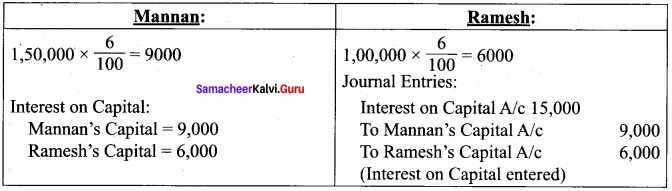
Later Holmes explains to Dr. Watson that the Red-Headed League was just created to keep Wilson away from his shop. When he went for work daily, they had time to make the tunnel Holmes doubted Spaulding as he worked for half wages and was in the cellar most of the time. When Holmes hit the ground with his walking stick and saw Spaulding’s trousers dirty, he understood that he is making a tunnel from the pawn-shop to the Bank at the back of the shop, in the next street. As the Red-Headed League was dissolved and it was Sunday, Holmes was sure the thieves would come and he caught them red handed. A huge bank robbery was cleverly stopped.

Samacheer Kalvi 8th Social Science Geography Solutions Term 1 Chapter 1 Rock and Soil

You can Download Samacheer Kalvi 8th Social Science Book Solutions Guide Pdf, Tamilnadu State Board help you to revise the complete Syllabus and score more marks in your examinations.

Samacheer Kalvi 8th Social Science Geography Solutions Term 1 Chapter 1 Rock and Soil

Samacheer Kalvi 8th Social Science Rock and Soil Textbook Evaluation

I. Choose the correct answer

Rock And Soil Class 8 Question 1.
Which of the following is known as sphere of rocks –
(a) Atmosphere
(b) Biosphere
(c) Lithosphere
(d) Hydrosphere
Answer:
(c) Lithosphere

Rocks And Soils 8th Standard Question 2.
World soil day is observed on –
(a) 15th August
(b) 12th January
(c) 15th October
(d) 5th December
Answer:
(d) 5th December

Samacheer Kalvi Guru 8th Social Question 3.
Fossils are found in –
(a) Sedimentary rocks
(b) Igneous rocks
(c) Metamorphic rocks
(d) Plutonic rocks
Answer:
(a) Sedimentary rocks

Social Samacheer Kalvi 8th Question 4.
The first layer of soil is called as –
(a) Regur
(b) Regolith
(c) Unweathered rock
(d) Partially weathered rock
Answer:
(*) Horizon

8th Social Guide Samacheer Kalvi Question 5.
Ideal soil for growing cotton is –
(a) Red soil
(b) Black soil
(c) Alluvial soil
(d) Mountain soil
Answer:
(b) Black soil

Samacheer Kalvi 8th Social Book Question 6.
The major component of soil is –
(a) Rocks
(b) Gas
(C) Water
(d) Minerals
Answer:
(d) Minerals

Samacheer Kalvi Guru 8th Social Science Question 7.
Which one of the following is the most widespread most and’productive category of soil –
(a) Alluvial soil
(b) Black soil
(c) Red soil
(d) Mountain soil
Answer:
(a) Alluvial soil

II. Fill in the Blanks

  1. Scientific study of rocks is called ………………
  2. …………… soil is highly suitable for cotton cultivation.
  3. The “skin of earth” is ……………..
  4. ……………. is the kind of metamorphic rock using which Taj Mahal was built.
  5. ……………. is known as the primary rocks.

Answer:

  1. Petrology
  2. Black
  3. Soil
  4. White Marble
  5. Igneous rock

III. State whether the following statements are true or false

Samacheer Kalvi 8th Social Question 1.
Igneous rocks are called primary rocks.
Answer:
True

Samacheer Kalvi 8th Social Science Question 2.
Slate is formed from shale.
Answer:
True

Samacheer Kalvi 8th Books Solutions Social Science Question 3.
Red soil is formed by the process of leaching.
Answer:
False
Correct statement:
Laterites soils i s formed by the process of leaching.

8th Social Samacheer Kalvi Question 4.
M – sand is used as alternative for natural sand in construction.
Answer:
True

Samacheer Kalvi.Guru 8th Social Question 5.
Volcanic mountains are covered with sedimentary rocks.
Answer:
False
Correct statement:
Sedimentary rocks are formed from broken pieces of rocks.

IV. Match the following

Samacheer Kalvi Social Science 8th Question 1.
Rock And Soil Class 8 Samacheer Kalvi Science Geography Solutions Term 1 Chapter 1Answer:

a. 2
b. 1
c.  4
d. 3.

Samacheer Kalvi 8 Social Question 2.
Rocks And Soils 8th Standard Samacheer Kalvi Science Geography Solutions Term 1 Chapter 1 Rock And Soil
Answer:

a. 2
b. 4
c.  1
d.  3.

V. Choose the incorrect statement from the following

Kalvi Guru 8th Social Question 1.

  1. Igneous rocks are called the primary rocks.
  2. Soil is the product of weathering of rocks.
  3. Sedimentary rocks are the hardest ones.
  4. Deccan plateau is the region of Igneous rocks.

Answer:
3. Sedimentary rocks are the hardest ones.

8th Samacheer Kalvi Social Question 2.

  1. Soil erosion decreases its fertility.
  2. Dynamic metamorphism is caused by high temperature.
  3. Soil is a renewable source.
  4. Humus is a part of the top layer of soil.

Answer:
2. Dynamic metamorphism is caused by high temperature.

VI. Consider the following statements and choose the right option from the given ones

Statement (1) – Sedimentary rocks consist of many layers.
Statement (2) – Sedimentary rocks are formed by the sediments deposited at different points of time.

  1. 1 and 2 are correct and 2 explains 1
  2. 1 and 2 are correct but, 2 does not explain 1
  3. 1 is correct but, 2 is incorrect
  4. 2 is correct but, 1 is incorrect.

Answer:
1. 1 and 2 are correct and 2 explains 1

VII. Give reasons for the following

Social Guide For Class 8 Samacheer Kalvi Question 1.
Chemical sedimentary rocks are found in the beds of reservoirs.
Answer:
Chemical Sedimentary rocks are formed by precipitating of minerals from water. It is formed usually through evaporation of chemical rich solutions.

Samacheer Kalvi Guru 8 Social Science Question 2.
Igneous rocks are found in the regions of volcanoes.
Answer:
The igneous rocks are formed by the solidification of molten magma.

VIII. Distinguish the following

Samacheer Kalvi 8th Books Social Science Question 1.
Metamorphic rock and sedimentary rock.
Answer:

Metamorphic Rocks:

  • Formed when Igneous and Sedimentary rocks are subjected to high temperature and pressure.
  • Mostly crystalline in nature
  • Fossils donot survive in these rocks
  • Example Gneiss, Slate, quartz

Sedimentary Rocks:

  • Formed by the sediments derived and deposited by various agents.
  • They are non – crystalline rocks
  • Contain fossils., Example Coal, Oil, natural gas
  • Example Chalk, Sandstone, Rock Salt

Question 2.
Soil conservation and Soil erosion.
Answer:

Soil conservation:

  • The process of protecting the soil from erosion to maintain its fertility.
  • Methods of soil conservation are afforestation, controlled grazing, construction of dams, crop rotation etc.,

Soil erosion:

  • Removal or destruction of the top layer of soil by natural forces and human activities.
  • Running water and wind are the major agents of Soil erosion.
    Rill erosion and Gully erosion are the major types of soil erosion

IX. Give short answers

Question 1.
How are igneous rocks formed?
Answer:
The igneous rocks are formed by the solidification of molten magma.

Question 2.
Describe about the composition of soil.
Answer:
The basic components of soil are mineral, organic matter, water and air. It consists of about 45% mineral, 5% organic matter, 25%  of water and 25% air. It is only a generalized fact. The composition of soil varies from place to place and time to time.

Question 3.
Define ‘rock’.
Answer:

  1. The rocks are the solid mineral materials forming a part of the surface of the earth and other similar planets.
  2. A rock is an aggregate of one or more minerals. Rock is an important natural resource and is found in solid state.
  3. It may be hard or soft in nature.

Question 4.
State the types of soils.
Answer:
Alluvial soil, Black soil, Red soil, Laterite soil, Mountain soil, Desert soil.

Question 5.
What is soil conservation?
Answer:
Soil conservation is the process of protecting the soil from erosion to maintain its fertility.

X. Give detailed answer for the following

Question 1.
Explain the process of soil formation.
Answer:

  1. Soil is a mixture of organic matter, minerals, gases, liquids and organisms that together support life.
  2. Soil minerals form the basis of soil. It forms on the surface of the earth. It is known as the ‘skin of the earth’.
  3. Soils are produced from rocks (parent material) through the processes of weathering and natural erosion.
  4. Water, wind, temperature change, gravity, chemical interaction, living organisms and pressure differences all help break down parent material. It leads to the formation of loose material.
  5. In course of time, they further break down into fine particles. This process release the minerals locked in the rock fragments.
  6. Later on, the vegetative cover which develop in that region forms humus content in the soil. This way the soil gets matured gradually.

Question 2.
Classify and explain the rocks.
Answer:
Samacheer Kalvi Guru 8th Social Science Geography Solutions Term 1 Chapter 1 Rock And Soil
Igneous:
(i) The igneous rocks are formed by the solidification of molten magma. Also called Primary or Parent Rocks.
(ii) Types:

  • Extrusive Igneous Rocks.
  • Intrusive Igneous Rocks

1. Extrusive Igneous Rocks:
Molten magma which comes out from the interior of the earth’s surface, gets solidified and forms such rocks. Fine grained and glassy in nature. Eg., Basalt, found in north western peninsular India.

2. Intrusive Igneous rocks:
Molten magma cools down deep inside the earth’s crust, becomes solid and forms such rocks. Form large grains. Deep seated rocks are plutonic rock and ones at shallow depths – Hypabysal rocks. Example Granite, Diorite.

Sedimentary:
(i) Formed by the sediments derived and deposited by various agents. Also called stratified rocks.
(ii) Types:

  • Organic sedimentary rocks
  • Mechanical sedimentary rocks,
  • Chemical sedimentary rocks

1. Organic sedimentary rocks:
Formed due to decomposition of dead Plants and Animals. Contains fossils. Example Chalk, Talc

2. Mechanical sedimentary rocks:
Formed from the disintegration of Igneous and metamorphic rocks. Get deposited due to erosion by natural agents. Get cemented after a long time to form rocks. Example Sandstone, Shale.

3. Chemical sedimentary rocks: Formed by precipitating of minerals from water. Formed due to evaporation of chemical rich solution. Example Rock Salt.

Metamorphic:
(i) Formed when Igneous and sedimentary rocks are subjected to high temperature and pressure.
(ii) Types:

  • Thermal
  • Dynamic

1. Thermal Metamorphic:
If the change in rocks is caused by high temperature.

2. Dynamic Metamorphic:
If the change in rock is caused by high pressure. Formed from Igneous rocks. Eg., Granite into gneiss
Formed from Sedimentary rocks. Eg., Shale into Slate

Question 3.
Give an account on different layers of soil.
Answer:
Social Samacheer Kalvi 8th Science Geography Solutions Term 1 Chapter 1 Rock And Soil
8th Social Guide Samacheer Kalvi Science Geography Solutions Term 1 Chapter 1 Rock And Soil

Question 4.
Classify and explain the soil.
Answer:
Definition:
Soil is a mixture of Organic matter, minerals, gases, liquids and organisms that together support life.

Classification of soils:
Soils are classified on the basis of their formation, colour, physical and chemical properties. Based on these, soil is classified into six major types. They are: Alluvial soil, Black soil, Red soil, Laterite soil, Mountain soil, Desert soil.

Alluvial soil:

  • Found in the regions of river valleys, flood plains and coastal regions.
  • Formed by the deposition of silt by the running water.
  • Most productive of all soils.
  • Suitable for the culitivation of sugarcane, jute, rice, wheat.

Black soils:

  • Formed by weathering of igneous rocks.
  • Clayey in nature.
  • Retains moisture.
  • Ideal for growing cotton.

Red Soils:

  • Formed by weathering of metamorphic rocks and crystalline rocks.
  • Found in semi – arid regions.
  • Not a fertile.
  • Is soil brown red in colour due to the presence of iron oxide
  • Suitable for millet cultivation.

Laterite soils:

  • Formed by the process of leaching.
  • Found in trophical regions, which experienced alternate wet and dry condition.
  • Infertile soil.
  • Suitable for plantation of tea and coffee.

Mountain soils:

  • Found in slopes of mountains.
  • Thin and acidic in nature.
  • Nature of soil differs based on the altitude.

Desert soils:

  • Found in hot desert region.
  • Porous and saline in nature.
  • Infertile in nature.
  • Agriculture not successful.

IX. Activity Corner

Question 1.
Complete the following table with the help of internet source
Samacheer Kalvi 8th Social Book Science Geography Solutions Term 1 Chapter 1 Rock And Soil
Answer:
Samacheer Kalvi Guru 8th Social Science Geography Solutions Term 1 Chapter 1 Rock And Soil

Question 2.
Map Work:
Mark the areas of black soil on the outline map of India.
Answer:
Samacheer Kalvi 8th Social Science Geography Solutions Term 1 Chapter 1 Rock And Soil

Samacheer Kalvi 8th Social Science Geography Rock and Soil Additional Questions

I. Choose the correct answer

Question 1.
……………. rocks are also called Primary rocks.
(a) Sedimentary
(b) Igneous
(c) Metamorphic
(d) Stratified
Answer:
(b) Igneous

Question 2.
…………….. rocks are also known as stratified rocks.
(a) Igneous
(b) Metamorphic
(c) Sedimentary
(d) Hypabysal
Answer:
(c) Sedimentary

Question 3.
Oldest sedimentary rocks of the world have been identified in
(a) Green land
(b) India
(c) France
(d) Australia
Answer:
(a) Creen landi

Question 4.
…………….. soil is suitable for milled cultivation.
(a) Alluvial
(b) Black
(c) Latente
(d) Red
Answer:
(d) Red

Question 5.
……………. soil is porous and saline.
(a) Mountain
(b) Desert
(c) Alluvial
(d) Red
Answer:
(b) Deserti

Question 6.
The time needed to form soil depends on the ……………..
(a) altitude
(b) rainfall
(c) climate
(d) fertility
Answer:
(c) climate

II. Fill in the blanks

  1. ……………. refer to rock in Greek.
  2. Out of 2,000 different types, only ……………. are the basic minerals commonly found all over the earth.
  3. ……………. are chemical substances which exist in nature.
  4. Minerals exist in nature ¡n the form of ……………. or …………..
  5. The world Igneous is derived from the Latin word ……………. meaning …………….
  6. Intrusive Igneous rocks are also called ………….. rocks.
  7. Meta means ………….. and morpha means ………………
  8. In wet tropical area soil formation is ………………

Answer:

  1. Petrus
  2. 12
  3. Minerals
  4. Elements, compounds
  5. Ignus, firel
  6. Crystallins
  7. Change, shape
  8. Faster

III. Match the following

Samacheer Kalvi 8th Social Science Geography Solutions Term 1 Chapter 1 Rock And Soil

a. iiii
b. iv
c. i
d. ii

IV. Choose the incorrect statement from the following

Question 1.

  1. Igneous rocks donot contain fossils
  2. The oldest sedimentary rock in the world is 3.9 billion years old.
  3. Soil consists of 5% Organic matter.
  4. Laterite soil is thin and acidic.

Answer:
4. Laterite soil is thin and acidic

V. Consider the following statement and choose the right option from the given ones

Question 1.
Statement (1) :
Proper management of soil resource will lead to sustainable food production.

Statement (2) :
India is an Agricultural country.

  1. 1 and 2 are correct but 2 does not explain.
  2. 1 is correct but 2 is incorrect.
  3. 1 and 2 are correct and 2 explains 1.
  4. 1 is incorrect but 2 is correct.

Answer:
3. 1 and 2 are correct and 2 explains 1

VI. Give Reason for the following

Question 1.
The Laterite soil is infertile.
Answer:
Laterite are the typical soils of trophical regions. These soils are found in the regions which experienced alternate wet and dry condition. As these soils are formed by the process of leaching, it is in fertile.

Question 2.
Sedimentary rocks are called stratified rocks.
Answer:
Sedimentary rocks consist of many layers which were formed by the sediments deposited at different periods. As it consists of many strata, it is also known as ‘Stratified rocks’.

VII. Distinguish the following

Question 1.
Igneous rock and sedimentary rock.
Answer:

Igneous rocks:

  • Formed by the solidification of molten magma.
  • Classified into 2 types:
  • Extrusive and Intrusive Igneous rocks.
  • Crystalline in nature.
  • Hard in nature.

Sedimentary rocks:

  • Formed by the sediments derived and deposited by various agents.
  • Classified into 3 types:
  • Organic, Mechanical, Chemical sedimentary rocks.
  • Non – crystalline rocks
  • Soft and get eroded easily.

VIII. Give short answers

Question 1.
Name the four realms of earth.
Answer:
Four realms of the earth, are lithosphere, hydrosphere, atmosphere and biosphere.

Question 2.
What is the Lithosphere composed of?
Answer:
Lithosphere is composed of solid rocks and unconsolidated materials.

Question 3.
What is lava?
Answer:
Lava is actually a fiery red molten magma comes out from the interior of the earth on its surface.

Question 4.
Why are crystalline rocks called so?
Answer:
The intrusive Igneous rocks consist of large crystals, and so they are also called as ‘Crystalline rocks’.

Question 5.
Name a few Major Active Volcanoes.
Answer:
Major Active Volcanoes:
Mount Vesuvius, Mt. Stromboli and Mt. Etna in Italy and Mauna Loa and Mauna Kea in Hawaii Islands.

Question 6.
What are the characteristics of Sedimentary rocks?
Answer:

  1. They have many layers.
  2. They are non-crystalline rocks.
  3. They contain fossils.
  4. They are soft and get eroded easily.

Question 7.
What is Thermal Metamorphism?
Answer:
If the change in the rocks is mainly caused by high temperature, the process is called as thermal metamorphism..

Question 8.
Explain Dynamic Metamorphism.
Answer:
If the change in the rock is mainly caused by high pressure, the process is called as Dynamic Metamorphism.

Question 9.
State the characteristics of Metamorphic rocks.
Answer:

  1. Metamorphic rocks are mostly crystalline in nature.
  2. They consist of alternate bands of light and dark minerals.

Question 10.
Mention some uses of rocks.
Answer:

  1. Cement
  2. Writing chalk
  3. Fire
  4. Building materials
  5. Bath scrub
  6. Kerb stone
  7. Ornament
  8. Roofing materials
  9. Decorative materials
  10. These are valuable source of minerals such as gold, diamond, sapphire etc.

IX. Give Detailed Answer

Question 1.
Explain the different types of sedimentary rocks.
Answer:
Types of Sedimentary Rocks
1. Organic Sedimentary Rocks:

  • These rocks are formed as a result of the decomposition of dead plants and animals.
  • It contains fossils. Chalk, Talc, Dolomite and Limestone rocks are of this category.

2. Mechanical Sedimentary Rocks:

  • These rocks are formed from the disintegration of igneous and metamorphic rocks.
  • The natural agents erode and transport these rocks and deposit them at some places. After a long period of time, they cemented to form rocks.
  • Sandstone, Shale and Clay are the examples of rocks of this type.

3. Chemical Sedimentary rocks

  • These are formed by precipitating of minerals from water. It is formed usually through evaporation of chemical rich solutions.
  • These rocks are also called as evaporates.
  • Rock Salt is an example of this kind.

Question 2.
Explain the Rock cycle with a diagram.
Answer:
1. Igneous rocks are the primary rocks formed first on the earth. These rocks are weathered, eroded, transported and deposited at some places to form sedimentary rocks.

2. The Igneous and Sedimentary rocks are changed into metamorphic rocks under the influence of temperature and pressure.

3. The metamorphic rocks are also get disintegrated and deposited to form sedimentary rocks.

4. Formation of igneous rocks take place when there is an outflow of molten materials. Like this, the rocks of the earth crust keeps on changing from one form to another form under various natural forces and agents.

5. The endless process is referred as Rock Cycle.

Samacheer Kalvi 8th Books Solutions Social Science Geography Term 1 Chapter 1 Rock And Soil

Question 3.
Mention the uses of soils.
Answer:
Uses of soils:
Soil is one of the important natural resource. It is a basic requirement for plant growth and supports various life forms on the earth.

  1. The minerals present in the soil enhance and nourishes the crops and plants.
  2. It is used in making of ceramics or pottery.
  3. It is a source of material for construction and handicraft works.
  4. It acts as natural filter of water and purifies it.
  5. Soil supports ecosystem and play an important role in land management.

Samacheer Kalvi 7th Science Solutions Term 2 Chapter 4 Cell Biology

You can Download Samacheer Kalvi 7th Science Book Solutions Guide Pdf, Tamilnadu State Board help you to revise the complete Syllabus and score more marks in your examinations.

Tamilnadu Samacheer Kalvi 7th Science Solutions Term 2 Chapter 4 Cell Biology

Samacheer Kalvi 7th Science Cell Biology Textual Evaluation

I. Choose the correct answers:

Cell Biology 7th Standard Question 1.
Basis unit of life.
(a) Cell
(b) Protoplasm
(c) Cellulose
(d) Nucleus
Answer:
(a) Cell

7th Science Cell Biology Question 2.
the outer most layer of an animal cell. Who am I?
(a)Cell wall
(b) Nucleus
(c)Cell membrane
(d) Nuclear membrane
Answer:
(c) Cell membrane

Samacheer Kalvi 7th Biology Guide Question 3.
Which part of the cell is called the brain of the cell?
(a) Lysosome
(c) Mitochondria
(b) Ribosome
(d) Nucleus.
Answer:
d) Nucleus

Science Cell Biology Question 4.
________ helps in cell division.
(a) Endoplasmic reticulum
(b) Golgi complex
(c) Centriole
(d) Nucleus
Answer:
(c) Centriole

Samacheer Kalvi Guru Science 7th Question 5.
Suitable term for the various components of cell is _________
(a) Tissue
(b) Nucleus
(c) Cell
(d) Cell organelle
Answer:
(d) Cell organelle

Fill in the blanks:

  1. The jelly like substance present in the cell is called _______.
  2. I convert the Sun’s energy into food for the plant. Who am I?_________.
  3. Mature Red blood cell do not contain a ________.
  4. Unicellular organisms can only be seen under a ________.
  5. Cytoplasm plus nucleoplasm is equal to ________.

Answer:

  1. cytoplasm
  2. chloroplast
  3. Nucleus
  4. Microscope
  5. Protoplasma

III. True or False – If False give the correction answer

7th Biology Guide Question 1.
Animal cells have a cell wall.
Answer:
False, Plant cells have a cell wall.

Question 2.
Salmonella is a unicellular bacteria.
Answer:
True

Question 3.
Cell membrane is fully permeable.
Answer:
False, Cell membrane is selectively permeable.

Question 4.
Only plant cells have chloroplasts.
Answer:
True.

Question 5.
Human stomach is an organ.
Answer:
True.

Question 6.
Ribosomes are small organelles with a membrane.
Answer:
False. Ribosomes are small organelles without a membrane.

IV. Match the following:

Question 1.

  1. Transporting channel – Nucleus
  2. Suicidal bag – Endoplasmic reticulum
  3. Control room – Lysosome
  4. Power house – Chloroplast
  5. Food producer – Mitochondria

Answer:

  1. Transporting channel – Endoplasmic reticulum
  2. Suicidal bag – Lysosome
  3. Control room – Nucleus
  4. Power house – Mitochondria
  5. Food producer – Chloroplast

V. Analogy:

Question 1.
Bacteria : microorganism :: mango tree :________
Answer:
Macroorganism.

Question 2.
Adipose : tissue :: eye :_________
Answer:
Organ

Question 3.
Cell wall: plant cell:: centriole :_________
Answer:
Animal cell.

Question 4.
Chloroplast: photosynthesis :: mitochondria :________
Answer:
Respiration.

VI. Choose Use connect alternative from the following :

Question 1.
Assertion (A) : Tissue is a group of dissimilar cells.
Reason (R) : Muscle is made up of Muscle cell.
(a) Both A and R are true
(b) Both A and R are false
(c) A is true but R is false
(d) A is false but R is true
Answer:
(a) Both A and R are true

Question 2.
Assertion (A) :Majority of cells cannot be seen directly with naked eye because.
Reason (R) :Cells are microscopic.
(a) Both A and R are true
(b) Both A and R are false
(c) A is true but R is false.
(d) A is false but R is true.
Answer:
(a) Both A and R are true

VII. Very short answer:

Question 1.
What are the functions of cell wall in plant cell?
Answer:
Protection, maintains shape of cell and acts as protective framework.

Question 2.
Which organelle uses energy from sunlight to make starch?
Answer:
Chloroplast uses energy from sunlight to make starch.

Question 3.
What are the main things in a nucleus?
Answer:
Nuclear envelope, Nucleolus, chromatin body.

Question 4.
What does cell membrane do?
Answer:
It acts as boundary of cell and protects it.

Question 5.
Why lysosomes are known as scavengers of the cell?
Answer:
The lysosomes are the main digestive compartments of a cell and digest damaged cell parts. Hence they are called scavengers of the cell.

Question 6.
Teacher said “A virus is not an organism” Do you agree with this statement or
not? Explain Why?
Answer:
True I agree with the statement. A virus acts as a living organism within the body of a host and behaves like a non-living thing outside. It lacks cell wall, cell membrane, cytoplasm and organelles. Hence it is not a organism.

VII. Give short answer :

Question 1.
Why the cell is very important for us?
Answer:

  1. Cell is the basic structural and functions unit of life.
  2. It is the building unit of living organism.
  3. A group of cells form a tissue which forms the organ and organ systems.
  4. This helps a living organism to do its functions. Hence cell is very important for us.

Distinguish between the following pairs

  • Smooth ER and Rough ER
  • Cell wall and cell membrane
  • Chloroplast and mitochondria

Answer:
Smooth ER (Endoplasmic Reticulum)

  1. It is smooth due to absence of Ribosomes.
  2. It helps in transport of steroids and lipids.

Rough ER (Endoplasmic Reticulum)

  1. It is’rough due to presence of Ribosomes.
  2. It helps in protein synthesis

Cell wall

  1. It is seen only in plant cells.
  2. It is made of cellulose.

Cell membrane

  1. It is seen in plant and animal cells.
  2. It is made of proteins and lipids.

Chloroplast

  1. It is a organelle seen only in plant cells (green plants)
  2. It helps in synthesis and storage of starch.

Mitochondria

  1. It is a organelle seen in plant and animal cells.
  2. It is the centre of respiration in a cell and produces energy.

Question 3.
Write correct sequence from cell to organism?
Answer:
Cell —> Tissue —> Organ —> Organ system —> Organism.

Question 4.
Write a short note on nucleus.
Answer:

  1. Nucleus is seen in the cytoplasm of plant and Animal cells.
  2. It is surrounded by nuclear envelope.
  3. It has one or two nucleoli and chromatin body.
  4. The chromatin body stores genetic information.

Functions of Nucleus:

  1. It controls all the processes and chemical reactions that take place inside the cell.
  2. Inheritance of character from one generation to another.

Question 5.
Classify the following terms into cells, tissues, organs and write in the tabular column given below:
Neuron, Lungs, Xylem, brain, adipose, Leaf, RBC, WBC, hand, muscle, heart, ovum, squamous, phloem, cartilage.
Answer:

CellTissueOrgan
NeuronXylemLungs
RBCAdiposeBrain
WBCMuscleLeaf
OvumSquamousHand
PhloemHeart
Cartilage

Question 6.
On the lines given below, write about what you have learned from the activities done in this lesson.
Let me tell you about some of the important things I’ve learned about cells. First, I’ll start with… .
First, I’ll start with___________________________.
Answer:

  1. Cell is the basic unit of an organisms.
  2. Based on number of cells organisms can be classified as unicellular and multicellular organisms.
  3. The cells form tissues, Tissues form organs, Organ system help an organism to function.
  4. The cell wall is seen only in plant cells.
  5. Cell membrane is seen only in plant cells.
  6. Cell membrane is seen in all cells.
  7. The organelles of the cell like chloroplast, Mitochondria, Ribosomes, Endoplasmic Reticulum, Golgi bodies etc help to perform cell functions.
  8. Nucleus is the controlling centre of a cell.

IX. Given long answer:
Question 1.
Write about any three organelles in detail.
Answer:
The three organelles are as follows
Chloroplasts:

  1. They are green organelles seen in plant cells only.
  2. They can prepare food using sun is energy and photosynthesize since they contain the pigment chlorophyll.
  3. They absorb the radiant energy of the sun and convert it to chemical energy to be used by plants and animals.

Golgi Complex:

  1. They are cell organelles which consist of membrane bound sacs stacked on top of one another and have associated secretory vesicles.
  2. Golgi complex helps in production of secretory substances, packaging and secretion.

Mitochondria:

  1. It is a oral double membrane bounded organelle.
  2. Aerobic respiration occurs in mitochondria and energy is released. Hence mitochondria is called as power house of the cell
  3. The energy produced is used for metabolic activities of the cell.

Question 2.
In a situation, how to explain, while your friend ask what is this, never seen before ?
Cell Biology 7th Standard Samacheer Kalvi Term 2 Chapter 4
Answer:

  1. This is a animal cell.
  2. It is the basic unit of an animal body.
  3. Animal cell is covered by a cell membrane and lacks cell wall.
  4. It has organelles like mitochondia, Golgi apparatus, Ribosomes, etc..
  5. It differs from plant cells since it lacks chloroplast.
  6. It has centrioles which are not seen in plant cells.
  7. Nucleus is the controlling centre of the cell.

Question 3.
Compare the plant cell and the animal cell and complete the illustration given below
Answer:
7th Science Cell Biology Samacheer Kalvi Term 2 Chapter 4

X. Higher ordear Thinking question :
Virus is called Acellular. Why?
Answer:

  1. Virus is made up of a outer protein coat and a nucleic acid.
  2. It lacks cell wall, cell membrane, organelles and cytoplasm.
  3. Therefore a virus is described as a cellular.

Samacheer Kalvi 7th Science Cell Biology Intext Activities

Activity – 1

Question 1.
Do you remember the lesson studied in previous class, how will you find whether an object is living or non – living? Write it down. An object is living or non-living?
Answer:
Living things: Living things use energy. They move or change shape.
Eg: Humans, insects, plants, animals etc.
Non-living things:
Do not move by themselves, grow or reproduce.
Eg: Rocks, car, pencils etc.

Question 2.
Form a team and work together to write down some of the functions of life, which you can remember.
Answer:
Reproduction, response to stimuli, Growth, movement, excretion

Question 3.
Do you think that an individual cell is living? Explain your answer.
Answer:
Cells are living things. Cells are found in plants, animals and Bactria.

Question 4.
Write about various organelles of a cell which you know.
Answer:
Vacuole, lysosome, endoplasmic reticulum, Golgi appartus, mitochondria, chloroplast.

Activity – 2
Find out major organs that are part of the circulatory system of a human body and list out their functions.
Answer:

Organs

  1. Heart (Cardiovascular)
  2. Lungs (Pulmonary)
  3. Blood vessels – Arteries
  4. Blood vessels – Veins

Functions

  1. Pumps oxygenated and deoxygenated blood on different sides.
  2. In oxygen from incoming air enters the blood and carbon-di-oxide, a waste gas from the metabolism, leaves the blood.
  3. Carry blood away from the heart.
  4. Carry blood back to the heart.

Activity – 3
Study the pictures given and write the differences between cells that you observe in the given table
Answer:
Samacheer Kalvi 7th Biology Guide Term 2 Chapter 4 Cell Biology

Activity – 4
Summarise what you have learnt Now you’ve studied the internal structure of a cell. Let us summerise what we have learnt so far Complete this table by filling the main function of each of the cell structures.

Cell Structure

  1. Cell membrane
  2. Cell wall
  3. Cytoplasm
  4. Mitochondria
  5. Vacuole
  6. Chloroplast
  7. Endoplasmic reticulum

Function(s)

  1. Boundary of an animal cell.
  2. Supporter and protector.
  3. Giving a ceil its shape.
  4. Energy releaser.
  5. Support the organelle.
  6. Food producers.
  7. Synthesis protein lipids, steroids and transport them

Samacheer Kalvi 7th Science Cell Biology Additional Question :

Choose the correct answer.

Question 1.
________ is the largest organelle
(a) Chloroplast
(b) Mitochondria
(c) Nucleus
(d) Golgi apparatus
Answer:
(c) Nucleus

Question 2.
The ______cells are spindle shaped.
(a) muscle
(b) nervous
(c) RBC
(d) epithelial
Answer:
(a) muscle

Question 3.
The________ plays a role in change of colour and taste of fruits.
(a) nucleus
(b) Golgi bodies
(c) lysosome
(d) chloroplast
Answer:
(b) Golgi bodies

Question 4.
________lacks a nucleus.
(a) Nerve cell
(b) Muscle cell
(c) RBC
(d) Brain cell
Answer:
(c) RBC

Question 5.
Starch is stored in _______
(a) chloroplast
(b) leucoplast
(c) chromoplast
(d) Golgi apparatus
Answer:
(b) leucoplast

II. Fill in the blanks.

  1. Plastids containing coloured pigments are called ________
  2. cells have the ability to multiply and develop into different types of cells.
  3. ________are seen only in animal cells.
  4. An organelle seen in bacteria and cell of higher organisms is ______
  5. Cell wall is made up of ________

Answer:

  1. Chromoplasts
  2. stem
  3. centrioles
  4. Ribosome
  5. cellulose

III. True or false – if false, give the correct statement.
Question 1.
Leucoplast store steroids.
Answer:
False, Leucoplasts store starch.

Question 2.
Bacteria is a animal cell.
Answer:
False, Bacteria is a plant cell.

Question 3.
Amoeba contains chloroplants.
Answer:
False, Amoeba does not contain chloroplasts.

Question 4.
Mitochondria can help to photosynthesize.
Answer:
False, Mitochondria can help to produce energy

Question 5.
The cytoplasm consists of 90% water.
Answer:
True

Question 6.
The body of a nerve cell is branched.
Answer:
True.

IV. Match the following:

Question 1.
Science Cell Biology Samacheer Kalvi 7th Solutions Term 2 Chapter 4
Answer:
(c)
(d)
(b)
(a)

V. Analogy:

Question 1.
Golgi: secretion :: Endoplasmic reticulum: _________
Answer:
Transport.

Question 2.
Plant tissue : Xylem :: Animal tissue : _________
Answer:
Epithelium.

Question 3.
Plant organ : stem :: Animal organ : _________
Answer:
Stomach.

VI. Assertion and Reason.
Mark the correct choice as
(a) Both A and R are true.
(b) Both A and R are false
(c) A is true but R is false.
(d) A is false but R is true

Question 1.
Assertion (A) : Stem cells can form different types of cells.
Reason (R) : They are found in plants and animals.
Answer:
(c) A is true but R is false

Question 2.
Assertion (A): The cell wall has pores.
Reason (R) : Each cell is connected to its neighbouring cell.
Answer:
(a) Both A and R are true

VII. Very short Answers:

Question 1.
Define a tissue.
Answer:
Tissue is a group of cells organized for a specific function.

Question 2.
What is Plasmodesmata?
Answer:
Each plant cell is interconnected with its neighboring cells through openings called Plasmodesmata.

Question 3.
What is ATP?
Answer:
ATP stands for Adenosineri Phosphate and is the energy currency of a cell.

Question 4.
What is unique about embryonic stem cells?
Answer:
They can develop into any type of cell in the body. Such as blood cell, nerve cell etc.

Question 5.
Name the types of plastids.
Answer:
Chloroplasts, chromoplasts and leucoplasts.

Question 6.
Name a cell which lacks a nucleus.
Answer:
Red blood cell.

VII. Short Answer.

Question 1.
Why are lysosomes called as ‘suicidal bags of the cell’?
Answer:
Lysosoms can lyse (destroy) a cell by producing enzymes. Hence they are known as suicidal bags of the cell.

Question 2.
What is endoplasmic reticulum?
Answer:
It is an inter membranous network made up of flat or tubular sacs within the cytoplasm. Endoplasmic reticulum is of two types. They are rough endoplasmic reticulum and smooth endoplasmic reticulum

Question 3.
List the functions of Nucleus.
Answer:

  1. It controls all the processes and chemical reactions that take place inside the cell.
  2. Inheritance of character from one generation to another.

Question 4.
Why is mitochandia known as power house of the cell?
Answer:
Aerobic respiratory reactions take place within the mitochondrion to release energy. So it is known as “The Power House’” of the cell.

Question 5.
What is a vacuole?
Question:
It is a membrane bound bag like structure filled within organic and organic molecules along with water and found in plant cells to support the organelles. Animal cell has very small vacuoles.

VIII. Long Answer

Question 1.
List the functions of cell wall.
Answer:

  1. Cell wall provides a frame work for support and stability.
  2. It allows the plant to remain rigid and upright.
  3. It helps to maintain the shape of the plant cell.
  4. It has openings called plasmodesmata through which neighboring cells are interconnected.
  5. It acts as a protective covering for the cell.

Question 2.
Draw a plant cell and label the parts.
Answer:
Samacheer Kalvi Guru Science 7th Science Solutions Term 2 Chapter 4 Cell Biology

Question 3.
List the differences between Plant cell and Animal cell.
Answer:

Plant cell

  1. It has cell wall.
  2. It has plastids such as chloroplasts, chromoplasts etc.
  3. Centrioles are not seen.
  4. It has a large vacuole.
  5. It is larger in size.

Animal Cell

  1. Cell wall is absent.
  2. Plastids are absent.
  3. It has centrioles which help in cell division.
  4. Vacuoles are small or absent.
  5. It is smaller in size.

IX. Hots:

Question 1.
Bacterial cells can prepare food. Do you agree?
Answer:
Yes, some bacterial cells have chlorophyll pigments and can prepare food.

Question 2.
Stem cells are used by doctors to treat diseases. Do you agree with this statement?
Answer:
Yes. Stem cells can divide and form any other cell type and hence can be used to cure several diseases like spinal cord injury.

Samacheer Kalvi 7th English Solutions Term 1 Prose Chapter 3 A Prayer to the Teacher

Students can Download English Lesson 3 A Prayer to the Teacher Questions and Answers, Summary, Notes Pdf, Activity, Samacheer Kalvi 7th English Book Solutions Guide Pdf helps you to revise the complete Tamilnadu State Board New Syllabus and score more marks in your examinations.

Tamilnadu Samacheer Kalvi 7th English Solutions Term 1 Prose Chapter 3 A Prayer to the Teacher

Reading
I. Which of these statements do you find in the speech?

  1. Inclusion is essential for us to do well in life.
  2. We should neglect others.
  3. Communicate politely with the less privileged.
  4. Teachers teach us to communicate well.
  5. Effective Communication is inessential to excel in life.

Answer:
We find statement No. 1, 3 and 4 in the speech.

  1. [✓]
  2. [✗]
  3. [✓]
  4. [✓]
  5. [✗]

II. Read the statements. Tick [✓] the correct words. You can tick more than one.

A Prayer To The Teacher Question 1.
We should develop the ability to learn from _____
Answer:
[✓] self
[✓] others
[✓] books

A Prayer To The Teacher Question And Answer Question 2.
Teachers help me to learn _____  things.
Answer:
[✓] new
[ ] bad
[✓] difficult

A Prayer To The Teacher Summary Question 3.
Teach me to appreciate
Answer:
[✓] nature
[ ] destruction
[✓] small creatures

A Prayer To The Teacher Book Back Answers Question 4.
We should learn to questions.
Answer:
[✓] ask
[✓] answer
[ ] discard

III. Answer the following questions in a sentence or two.

A Prayer To The Teacher 7th Standard Question 1.
What is inclusion? Why is it important?
Answer:
Inclusion is to value everyone beyond the boundaries irrespective of their differences. Inclusion is important to be successful in life.

A Prayer To The Teacher 7th Std Question 2.
What is good or effective communication?
Answer:
Good and effective communication are to be able to speak and write to convey what . we actually feel.

Prayer To The Teacher Question 3.
What should we learn from our teachers?
Answer:
We should learn newer and more difficult things from our teachers.

A Prayer To The Teacher Lesson Plan Question 4.
What kind of learning brings joy to you?
Answer:
Learning new ways to learn brings joy to us.

A Prayer To The Teacher Theme Question 5.
In what ways are we doing injustice to nature?
Answer:
We do injustice to nature by felling trees, killing small creatures and causing urban decay.
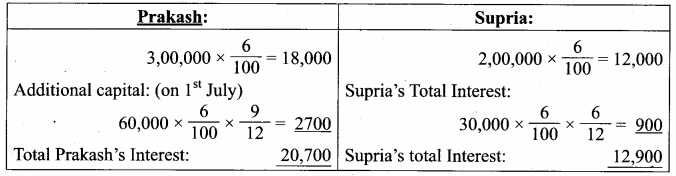
A Prayer To The Teacher Prose 7th Standard Question 6.
What do you need to learn to live a good life in this world?
Answer:
To live a good life in this world we need to learn to appreciate the interconnected nature of things.

The Prayer To The Teacher Question 7.
How does the ability to question help us?
Answer:
The ability to question helps us to get answers, to establish better order of things, to be accountable and in the end it helps us to see the truth emerge.

A Prayer To The Teacher Lesson Question 8.
What do you think are the two most important lessons that the speaker mentions?
Answer:
The two most important lessons the speaker mentions are to stress our point without raising our voice and to raise our voice when our silence hurts another life.

IV. Answer the following questions in detail.

Samacheer Kalvi Guru 7th English Question 1.
What are the skills / values a teacher should teach their students to live in this competitive world?
Answer:
To live in this competitive world, our teachers should teach their students important skills and values like, the value of inclusion, ability to communicate both written and verbal, the ability to learn newer and more difficult things.

Samacheer Kalvi Guru English 7th Standard Question 2.
What kind of a life do you want to lead in this world?
Answer:
When I live in this world I want to live a patriotic life which means having tolerance towards others with a different opinion in matters like religion, race, etc. I would like to consider all people in the world suffering from poverty, disease and hunger as my own and help them. Violence should not be found in my environment. I should have the strength to love all my fellow human beings with all their short comings. I should see unity in diversity. I must not consider anyone from any part of the globe as foreigner or stranger but as brother and sister. I wish to live a peaceful life without any barbed wires or smoking guns.

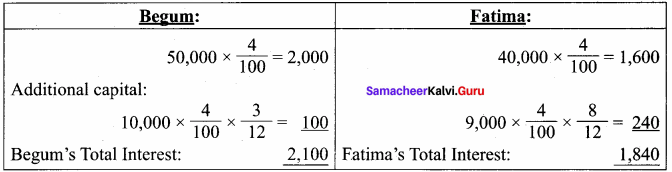
Vocabulary

Prefix And Suffix

A. Match the suitable prefix and suffix to create new words of your own. One has been done for you.
Answer:

A Prayer To The Teacher Samacheer Kalvi 7th English Solutions Term 1 Prose Chapter 3
B. Refer to your dictionary. Add a prefix or suffix to the following words and find their antonyms.
Answer:

  1. privileged × underprivileged
  2. animate × inanimate
  3. discriminate × indiscriminate
  4. empty × unempty
  5. communicate × miscommunicate
  6. learn × unlearn

Listening

C. Listen to the story and fill in the blanks by selecting the right option.

  1. Raj was upset as he had done ______ (Well/poorly) in his english test
  2. His grandmother gave him a ______ (pen/pencil)
  3. Granny compared ______ (Raj / Ravi) with the pencil.
  4. Raj’s pain of not doing well in his test was compared with ______ of Pencil. (Sharping/ writing)
  5. Raj understood that failures are stepping stones to _____ (success/climbing)

Answer:

  1. Poorly
  2. Pencil
  3. Raj
  4. Sharping
  5. success

Speaking

D. Read the story. Divide yourselves into groups of four. Discuss what little Sarah wants to talk about. Take roles and enact the story.
Answer:
Anitha, Banu, Chitra and Daisy discuss what Little Sarah wants to talk about.
Anitha : Why is Sarah sad?
Banu : Sarah’s father got a transfer to another city. So Sarah was moved to a new house and a new school in the new city.
Chitra : Oh! Is she sad because she missed her old home and old school friends?
Daisy : Yes. She wanted to express her sad feelings to her close relatives.
Anitha : Do you mean to her parents and brother?
Banu : But poor thing, they did not listen to her in their busy work.
Chitra : Was she able to tell her feelings to any one?
Daisy : Her teacher Ms. Nancy saw her new student Sarah sad. She called her and asked the reason.
Anitha : Sure. Sarah would have told how badly she missed her dear friends and her home. Was the teacher able to make her happy?
Banu : Of course. The teacher listened to Sarah patiently and told her that the people near her present home and school are also good and assure she would earn good friends soon.
Chitra : The teacher had helped Sarah to develop a world view of things, to appreciate diversity and the power of loving her fellow human beings.
All : Yes!

Picto Grammar

E. Look at the pictures. Pick out the right preposition and fill in the speech bubbles given below.

A Prayer To The Teacher Question And Answer Samacheer Kalvi 7th English Solutions Term 1 Prose Chapter 3

Answer:

  1. I’ am jumping over the box.
  2. I can jump down from the box.
  3. I’ am standing on the box.
  4. I’ am carrying the box on my head.
  5. I’ am sitting inside the box.
  6. I’ am standing in front of the box
  7. I’ am sitting in between the boxes.

Grammar

F. Read the following sentences carefully and underline the preposition
Answer:

  1. Julian placed her lunchbox inside her bag. – Place Preposition
  2. Vinothini left the house before sunrise. – Time Preposition
  3. Ben saw Daisy playing across the road. – Place Preposition
  4. Hema keeps all her teddy bears on top of her wardrobe. – Position Preposition
  5. Divya hid the sweets behind her back. – Place Preposition
  6. Sudha fell over during the basketball match. – Position Preposition
  7. Madhusudhan checked to see if his keys had fallen underneath his chair. – Position Preposition
  8. Mrs Meena asked the children to go into her classroom. – Place Preposition
  9. After lunch, the children were allowed to play. – Time Preposition
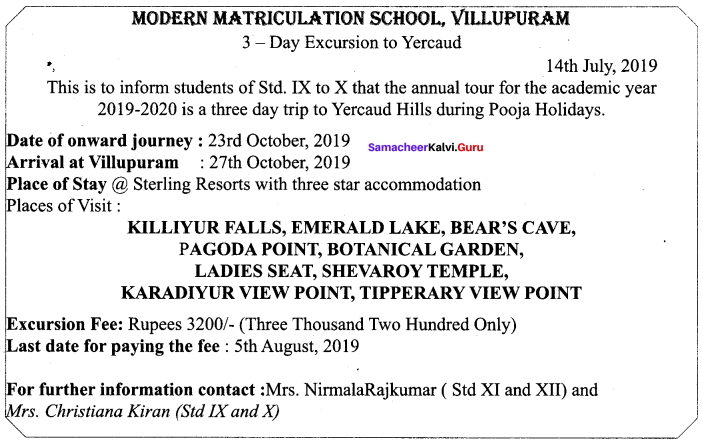
  10. Saravanan climbed onto the horse. – Position Preposition

G. Complete the following sentences using appropriate prepositions.

Question 1.
Is your mother _______ home?
(a) in
(b) at
(c) on
Answer:
(b) at

Question 2.
There is unity in diversity _______ the people.
(a) among
(b) between
(c) within
Answer:
(a) among

Question 3.
He discussed the problem _______ his parents.
(a) with
(b) to
(c) for
Answer:
(a) with

Question 4.
Lithisha was praised _______ her father.
(a) with
(b) for
(c) by
Answer:
(c) by

Question 5.
Can you finish the work _______ tomorrow?
(a) by
(b) in
(c) within
Answer:
(a) by

Question 6.
He has been absent _______ last week.
(a) since
(b) for
(c) by
Answer:
(a) since

H. Fill in the blanks using suitable positions from the box. Some options can be used more than once.

(across,with,on,to,by,since,from,about,into,at,during)

  1. What do you do ______ weekends?
  2. I am going to my village ______ Sunday.
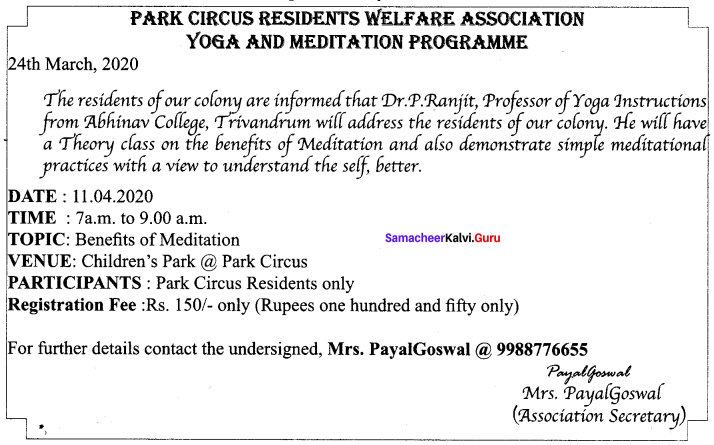
  3. I haven’t met my friends ______ December.
  4. Run ______ the street and get me the ribbon.
  5. He told me in detail ______ the incident.
  6. ‘This picture was drawn ______ the girl ______ Charcoal
  7. The car was travelling ______ a great speed.
  8. The ball fell ______ the lake.
  9. There is a bridge ______ the river.
  10. The conference will be held ______ 10 a.m. ______ 5 p.m.

Answer:

  1. during
  2. on
  3. since
  4. on
  5. about
  6. by; with
  7. at
  8. into
  9. across
  10. from; tol

I. Fill up the blanks using suitable prepositions on your own.

  1. The soldier climbed ________ a horse and rode away.
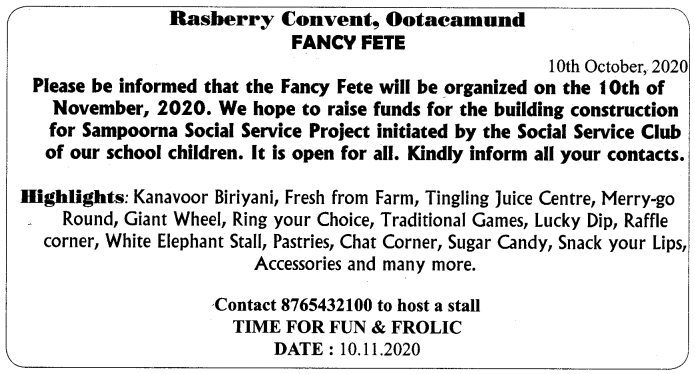
  2. They have been here ________ a long time.
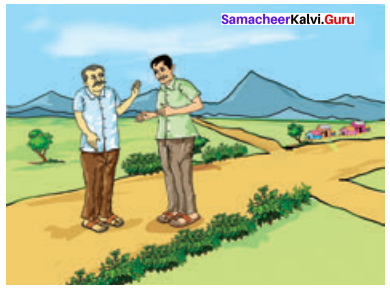
  3. Kumaravel has lived in this city ________ 2012.
  4. The paper was published ________ an International journal.
  5. When will you return ________ home?
  6. One ________ the four students wrote the answers correctly.
  7. This fruit is ________ the Mexican capital.
  8. The head offce is ________ Nungambakkam. It is College Road. As you go the station, the office is the right side.
  9. The sailors were taken ________ the forest and made to walk 10 miles.
  10. The girl standing ________ me was sneezing.

Answer:

  1. on
  2. for
  3. since
  4. in
  5. back
  6. of
  7. from
  8. at; on; through; at
  9. through for
  10. before

Writing

J. Fill in the value rees with the best qualities you like to follow ii ir life from the given list. Write a few lines about your favourite quality in the box.
Answer:

A Prayer To The Teacher Summary Samacheer Kalvi 7th English Solutions Term 1 Prose Chapter 3

My favourite quality is Good manners. Good manners fetches good name for us. If we develop good manners from childhood it will continue till our adulthood. We shall be role models for others when we display good manners.

Creative Writing

K. Fill in the template given for limerick.
Answer:
There once was a chubby soft Teddy bear (8 syllable)
Whom cute baby had always near (8 syllable)
She played with him (5 syllable)
Even when she swim (5 syllable)
If Teddy’s lost don’t cry baby dear! (8 syllable)

A prayer to the Teacher Additional Questions

I. Choose the correct Synonyms from the options below.

Question 1.
emerge
(a) to appear
(b) come out
(c) reveal
Answer:
(b) come out

Question 2.
engulf
(a) swallow whole
(b) consume
(c) eat
Answer:
(a) swallow whole

Question 3.
nakedness
(a) frank
(b) open
(c) not hiding
Answer:
(a) frank

Question 4.
urban decay
(a) making city rot
(b) deteriorating the city
(c) destroy the city
Answer:
(c) destroy the city

Question 5.
gifted
(a) people with knowledge
(b) people blessed with everything
(c) giving fit
Answer:
(a) people with knowledge

Question 6.
cut throat
(a) highly competitive
(b) competitive
(c) cut the throat
Answer:
(a) highly competitive

Question 7.
value
(a) giving importance
(b) precious
(c) costly
Answer:
(a) giving importance

Question 8.
free
(a) without payment
(b) discount
(c) available without money
Answer:
(a) without payment

II. Pick the Correct Antonyms.

  1. proportionate × ______ (disproportionate, unusual size, inequal)
  2. unusual × ______ (usual, common, regular)
  3. urban × ______ (village, suburban, town)
  4.  accountable × ______ (unaccountable, not responsible, irresponsible)
  5. imbalance × ______ (balance, not partial, equal)
  6. animate × ______ (inanimate, not animal, non living)
  7. tolerance × ______ (intolerance, not tolerate, not adjusting)
  8. foreigner × ______ (native, inland person, citizen)
  9. humility × ______ (proud, boasting, dominating)
  10. indiscriminate × ______ (discriminate, judge carefully, identify)

Answer:

  1. disproportionate
  2. usual
  3. village
  4. unaccountable
  5. balance
  6. inanimate
  7. intolerance
  8. native
  9. proud
  10. discriminate

III. Choose the Correct Answer (MCQ).

Question 1.
I clean my house and empty the garbage on the road because the road is not ______ in what I feel is my own.
(a) included
(b) indulgence
(c) inclusion
Answer:
(a) included

Question 2.
I take my child to the movie but not my neighbour’s child because that child is beyond my zone of ______
(a) fostering
(b) caring
(c) parenting
Answer:
(c) parenting

Question 3.
Our depends on our power to impress ______
(a) survival
(b) impact
(c) honour
Answer:
(a) survival

Question 4.
We are ______ because we do not ask questions
(a) accountable
(b) learning
(c) enslaved
Answer:
(c) enslaved

Question 5.
The sea does not get ______ from us for the fish it gives us.
(a) tax
(b) royalties
(c) money
Answer:
(b) royalties

Question 6.
Poverty, disease and hunger have no ______
(a) diversity
(b) patriotism
(c) nationality
Answer:
(c) nationality

IV. Short Questions with Answers.

Question 1.
Give an introduction to the lesson ‘A Prayer to the Teacher’.
Answer:
The lesson A Prayer to the Teacher’ is actually the speech given by Subroto Bagchi, the Founder and CEO of Mindtree. The speech was the convocation address given to the teachers graduating from the International Academy for Creative Teaching at Bangalore in 2005.

Question 2.
What was the main theme of Subroto Bagchi’s speech?
Answer:
Subroto emphasizes mainly that the teachers should go beyond the syllabus and teach students the values and skills they need to live a useful and meaningful life.

Question 3.
What is the importance of the ‘power to impress’?
Answer:
Today’s students are forced to impress because their survival depends on their success in the rat race of common entrance tests and competitive exams and competitions.

Question 4.
‘Teach me also to raise my voice’. Is the author asking us to fight?
Answer:
No. The author wants us to speak thoughtfully to protect a life, one who is hurt and for truth. But at the same time when people unnecessarily shout, we should be silent, contemplate and act positively.

V. Paragraph Questions with Answers.

Question 1.
Define ‘inclusion’ and give three examples.
Answer:
Inclusion means valuing all people irrespective of their boundaries like financial and educational status, caste, creed, physical health, designation or nativity.
Examples:
1. Cleaning our house and emptying the garbage on the road because we do not feel the road is also ours.
2. Feeding our child in front of our hungry servant maid, not caring for her with a humanitarian heart that she also is one in our household.
3. Not taking the close neighbour’s child to the movie along with one’s own child, thereby not having a broad parental attitude.

Question 2.
List a few things we need to communicate and convey what we feel.
Answer:
We must be able to communicate with:

  1. A simple innocent child and nature.
  2. The disabled and the ones who are hard of hearing and speaking.
  3. Those who are under privileged and less gifted than us.
  4. People who are our seniors and elders as well as our juniors and youngsters.
  5. With all the living as well as the nonliving things around.
    By communicating, the speaker means to protect, safe-guard, cherish and to keep them.

Question 3.
‘Teach me to appreciate the interconnected nature of things’. How?
Answer:
The speaker wants the teachers to create an awareness in students about nature when
they teach of nature. Example :

a) It is not just teaching the concept of ‘rising waves’ but also the reasoning what causes the waves to fall.

b) Teaching not only teach the use of fertilizers and pesticides, but even the damage they cause by killing small creatures and felling big trees.

c) We teach the protection and promotion of the interests of consumers but at the same time we must also teach the imbalance it causes in the natural state of things which causes death and destruction on the earth.

d) We must not just teach about birds like crows and sparrows but also teach what makes them to go extinct and how it could be prevented by saving them.

Question 4.
In this increasingly commercial world, the things that truly support life comes freely to us. Justify with suitable evidence.
Answer:
The things that help us to live are mostly got free.
We do not pay the cow for the milk she gives.
The earth does not ask us money for the crops it gives.
The sun that gives light, the air that helps to breathe, the river that gives water and the clouds which give rain do not get paid for their services.

Question 5.
How can we‘develop a world view of things’according to the speaker.
Answer:
The speaker stresses that we must have the ‘one world’ feeling. Poverty, disease and hunger in the world have to be removed. Patriotism in the world should not be intolerance towards religion and race. Enimity and wars in the future must be replaced with love for our fellow human beings. There should be unity in diversity. We should have tolerance towards the differences found in people. No one should be a ‘foreigner’ for us but all people in the world are our brothers and sisters.

VI. Explain the Following Terms.

Question 1.
Narrow domestic walls.
Answer:
Here the speaker Subroto narrates how India had been crushed in ‘narrow domestic walls’ Which means it has been divided by regions or barriers based on class, colour, caste, race, religion, ethnicity, etc. This narrow attitude opposes to a feeling of one united nation or one united human race. These barriers are not favourable for nationalism and internationalism.

Question 2.
‘Illuminated with the power of thousand Suns’
Answer:
As a concluding note of his convocation address, Subroto speaks these words to bless all the new graduates. Anyone, who graduates, dreams to take up the best career, do well in it, achieve and to be elevated. Hence Subroto abundantly blesses the life of the graduates to be lighted and bright, equivalent to the light given by a thousand Suns.

Question 3.
Power of silence.
Answer:
Sometimes silence is more louder than voices. Example if a son makes a mistake and faces his father, expecting that he would scold him and when he does not scold him, the son would feel the silence more painful than his words. Silence gives inner strength.

Question 4.
Engulf me and mine.
Answer:
Here the speaker says that if we continue to fell trees, kill animals, use enormous technology that destroys nature and causes natural imbalance, then one day our own habits and actions would completely damage and destroy us.

A Prayer to the Teacher Grammar Additional

I. Fill in the blanks with prepositional phrases.

A Prayer To The Teacher Book Back Answers Samacheer Kalvi 7th English Solutions Term 1 Prose Chapter 3

Answer:

  1. into the boat
  2. in the dustbin
  3. over the phone
  4. over the track
  5. on the road

II. Underline the place prepositional phrases.

Question 1.
Mani was at home when I called.
Answer:
Mani was at home when I called.

Question 2.
The tourists walked along the riverside.
Answer:
The tourists walked along the riverside.

Question 3.
You cannot park your car outside the restaurant.
Answer:
You cannot park your car outside the restaurant.

Question 4.
The flat on the second floor is vacant.
Answer:
The flat on the second floor is vacant.

Question 5.
Nana will put the baby in the cradle.
Answer:
Nana will put the baby in the cradle.

III. Underline the time prepositional phrases.

Question 1.
Chandran will call the doctor by 10.00 a.m.
Answer:
Chandran will call the doctor by 10.00 a.m.

Question 2.
Papa will have his medicine after breakfast.
Answer:
Papa will have his medicine after breakfast.

Question 3.
The buses are crowded during the morning.
Answer:
The buses are crowded during the morning.

Question 4.
I go for a walk in the evening.
Answer:
I go for a walk in the evening.

Question 5.
I have my interview at 11.00 a.m.
Answer:
I have my interview at 11.00 a.m.

IV. Underline the Position Prepositional Phrases.

Question 1.
Arun’s pen was found under the table.
Answer:
Arun’s pen was found under the table.

Question 2.
Ravi’s cap was below the lamppost.
Answer:
Ravi’s cap was below the lamppost.

Question 3.
The Principal sat near the Chief guest.
Answer:
The Principal sat near the Chief guest

Question 4.
The drone was moving above her head.
Answer:
The drone was moving above her head.

Question 5.
He clicked a photo on the Napier bridge.
Answer:
He clicked a photo on the Napier bridge

Warm up
Read the clues gues the professional and fill in the crosswords puzzle

A Prayer To The Teacher 7th Standard Samacheer Kalvi 7th English Solutions Term 1 Prose Chapter 3

Answer:

A Prayer To The Teacher 7th Std Samacheer Kalvi  Term 1 Prose Chapter 3

Question 1.
Which is the role of a farmer in society? Discuss and answer.
Farmers are the backbone of our country. They produce the food-crops, the oil-seeds, the commercial crops, and also some raw materials for our industries. Our food and dress materials are obtained from the hard work of farmers. Due to cotton cultivation, several textile mills were established and they gave employment opportunities for the unemployed.

Question 2.
When you grow up, what do you want to become? Why?
Answer:
When I grow up I want to become a Teacher because I can enlighten the children with knowledge.

A Prayer to the Teacher Summary

This lesson is the convocation address given by Subroto Bagchi, Founder and CEO, Mindtree, for the graduating teachers, their faculty and administrators.
The speaker first stresses on inclusion – valuing all people, irrespective of their boundaries like financial and educational status, caste, creed, physical strength, designation or nativity.

He gives three examples: Dumping the garbage on the road which is also ours. Feeding our child in front of our hungry servant maid without a humanitarian heart.

Secondly the speaker says that amidst the cut throat competition, the more we want to impress, the less we communicate. He emphasises to communicate with an innocent child, nature, the dumb and deaf, less gifted, the old and young, the living and non-living things around too. Thirdly he feels that teachers should prepare students for the wide world by teaching them newer and difficult things. Help to learn newer ways to learn that will make learning a joy. Fourthly Subroto emphasises to teach to appreciate the interconnected nature of things. Like creating an awareness about ‘nature’ while the topic ‘Nature’ is taught.

Example:

  1. Teach not just the concept of ‘rising waves’ but also the reason why the waves fall.
  2. Not only the use of fertilizers and pesticides but also the damages they cause.
  3. Teach about birds like crows and sparrows how they go extinct and how to prevent it.

Subroto fifthly wants to inculcate the ability to question. This helps one to get answers, to establish better order of things, to be accountable and in the end it helps us to see the truth emerge.

The speaker sixthly clarifies that in this increasingly commercial world. All things that truly support life comes freely. The cow is not paid for the milk it gives, nor the earth asks money for the crops it gives. The sun gives light, air helps to breathe, the river gives water, clouds give rain, without getting paid for their services.

Seventhly the speaker wants the students to learn the ‘power of silence’. Stress our point without raising our voice and to raise our voice when our silence hurts another life.

Finally the speaker pleads the teachers to develop a world view of things by having a ‘one world’ feeling. By removing poverty, decrease and hunger in the world. Patriotism is not intolerance towards religion and race. Enmity was to be replaced with love for others. There should be unity in diversity. No one is a foreigner. All the people in the world are our siblings.