Samacheer Kalvi 7th Science Solutions Term 2 Chapter 2 Electricity

You can Download Samacheer Kalvi 7th Science Book Solutions Guide Pdf, Tamilnadu State Board help you to revise the complete Syllabus and score more marks in your examinations.

Tamilnadu Samacheer Kalvi 7th Science Solutions Term 2 Chapter 2 Electricity

Samacheer Kalvi 7th Science Electricity Textual Evaluation

I. Choose the correct answer:

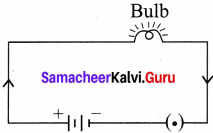
Samacheer Kalvi 7th Science Guide Term 2 Question 1.
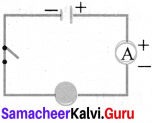
In the circuit diagram below, 10 units of electric charge move past point x every second What is the current in the circuit ________.
Samacheer Kalvi 7th Science Guide Term 2 Chapter 2 Electricity
(a) 10 A
(b) 1 A
(c) 10 V
(d) 1 V
Answer:
(a) 10 A

Electricity Book Back Answers Question 2.
In the circuit shown, which switches (L, M or N) must be closed to light up the
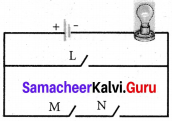
Electricity Book Back Answers Samacheer Kalvi 7th Science Solutions Term 2 Chapter 2
(a) switch L only
(b) switch M only
(c) Switch M and N only
(d) either switch L or switches M and N
Answer:
(d) either switch L or switches M and N

Samacheer Kalvi 7th Science Term 2 Question 3.
Small amounts of electrical current are measured in milliampere (mA). How many milliampere are there in 0.25 A ?
(a) 2.5 mA
(b) 25 mA
(c) 250 mA
(d) 2500 mA
Answer:
(c) 250 mA

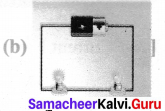
Samacheer Kalvi 7th Science 2nd Term Question 4.
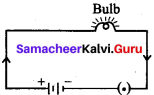
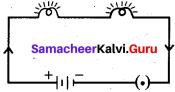
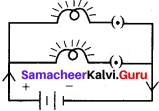
which of the following circuits are the bulb connected in series?

Samacheer Kalvi 7th Science Term 2 Chapter 2 Electricity
Answer:
Samacheer Kalvi 7th Science 2nd Term 2 Chapter 2 Electricity

II. Fill in the blanks

  1. The direction of conventional current is ____________ to electron flow.
  2. One unit of coulomb is charge of approximately ____________ protons or electrons.
  3. ____________ is used to measure the electric current.
  4. In conducting materials electrons are ____________
  5. S.I. unit of Electrical conductivity of a conductor is ____________

Answers:

  1. Opposite
  2. 6.242×10
  3. Ammeter
  4. Loosely
  5. siemens/meters

III. True or false – If false give Hie correct answer:

Samacheer Kalvi 7th Science Book Answers Term 2 Question 1.
Electron flow is in the same direction to conventional current flow.
Answer:
False.
Electron flow is in the opposite direction to conventional current flow.

7th Science Term 2 Question 2.
The fuse wire does not melts whenever there is overload in the wiring.
Answer:
False.
The fuse wire melts whenever there is overload in the wiring.

7th Standard Term 2 Science Question 3.
In a parallel circuit, the electric components are divided into branches.
Answer:
True.

Electricity Lesson 7th Class Question 4.
The representation of the electric current is A.
Answer:
False.The representation of the electric current is I.

7th Class Electricity Lesson Question 5.
The electrical conductivity of the semiconductor is in between a conductor and an insulator.
Answer:
True.

VI. Match the following :

  1. Cell – used to open or close a circuit
  2. Switch – safety device used in electric circuit
  3. Circuit – A complete path for the flow of an electric current
  4. Miniature circuit Breaker- Reset by hand, circuit becomes complete once again
  5. Fuse – A device which converts chemical energy into electrical energy

Answer:

  1. Cell – A device which converts chemical energy into electrical energy
  2. Switch – used to open or close a circuit
  3. Circuit – A complete path for the flow of an electric current
  4. Miniature circuit Breaker – Reset by hand, circuit becomes complete once again
  5. Fuse – safety device used in electric circuit

V.Analogy:

Samacheer Kalvi Guru 7th Science Term 2 Question 1.
Water : pipe : : Electric current: ______.
Answer:
wire

7th Class Science Electricity Lesson Question 2.
Copper : conductor : : Wood : ________.
Answer:
insulator

7th Standard 2nd Term 2nd Lesson Question 3.
Length : meter scale : : Current : ________.
Answer:
ammeter

Question 4.
milli ampere: micro ampere : : 10 – 3A: _______.
Answer:
10-6A

VI. Assertion and Reason :

Question 1.
Assertion (A) : Copper1 is used to make electric wires.
Reason (R) : Copper has very low electrical resistance.
Option:
A. Both A and R are true and R is the correct explanation of A.
B. Both A and R are true but R is NOT the correct explanation of A.
C. A is true but R is false.
D. A is false but R is true.
E. Both A and R are false .
Answer:
A. Both A and R are true and R is the correct explanation of A

Question 2.
Assertion (A) : Insulators do not allow the flow of current through themselves. Reason (R) : They have no free charge carriers.
A. If both A and R are true and the R is correct explanation of A.
B. If both A and R are true but R is not a correct explanation of A.
C. If A is true and R is false.
D. If both A and R are false.
Answer:
A. If both A and R are true and the R is correct explanation of A

VII. Very short answer :

Question 1.
What is the speed of electric current?
Answer:
Current travels at the speed of 1/100th times the speed of light 0.0002 m/s.

Question 2.
What is the S.I unit of electrical conductivity?
Answer:
The SI unit of electrical conductivity is Siemens / metres (s/m).

Question 3.
Name the device used to generate electricity.
Answer:
Electric cell.

Question 4.
Define fuse.
Answer:
Electric fuse is a safety device which is used in household wiring and in many appliances.

Question 5.
Name some devices that run using heat effect of electric current
Answer:
Electric bulb, geyser, Iron box.

Question 6.
Name few insulators.
Answer:
Rubber, wood, plastic, glass.

Question 7.
What is a battery?
Answer:
Batteries are a collection of one or more cells whose chemical reactions create a flow of electrons in a circuit.

VIII. Short Answer :

Question 1.
Define an electric current.
Answer:
An electric current is measured by the amount of electric charge moving per unit time at any point in the circuit. The conventional symbol for current is I.

Question 2.
Differentiate parallel and serial circuits.
Answer:
Parallel circuits:

  1. It is connected by branches.
  2. Voltage remains the same across each component of the circuit
  3. Each bulb is fully powered.
  4. All bulbs stay lit if one goes out.

Serial circuits:

  1. It consist of single loop connection.
  2. Current remains same in all parts of the circuit.
  3. All the bulbs share power.
  4. All bulbs go out if one goes out.

Question 3.
Define electrical conductivity.
Answer:
Electrical conductivity or specific conductance is the measure of a material’s ability to conduct an electric current.

IX. Long Answer :

Question 1.
Explain flie construction and working of an Telephone.
Answer:
In telephones, a changing magnetic effect causes a thin sheet of metal (diaphragm) to vibrate. The diaphragm is made up a metal that can be attracted to magnets.

  1. The diaphragm is attached to spring that is fixed to the earpiece.
  2. When a current flows through the wires, the soft – iron bar becomes an electromagnet.
  3. The diaphragm becomes attracted to the electromagnet.
  4. As the person on the other end of the line speaks, his voice cause the current in the circuit to change. This causes the diaphragm in the earpiece to vibrate, producing sound.

Question 2.
Explain the heating effect of electric current
Answer:

  1. When an electric current passes through a wire, the electrical energy is converted to heat.
  2. In heating appliances, the heating element is made up of materials with high melting point. An example of such a material is nichrome (an alloy of nickel, iron and chromium).
  3. The heating effect of electric current has many practical applications.
  4. The electric bulb, geyser, iron box, immersible water heater are based on this effect.
  5. These appliances have heating coils of high resistance.
  6. Generation of heat due to electric current is known as the heating effect of electricity.

Question 3.
Explain the construction and working of a dry cell.
Answer:

  1. A dry cell is a portable form of a leclanche cell.
  2. It consists of zinc vessel which acts as a negative electrode or anode.
  3. The vessel contains a moist paste of saw dust saturated with a solution of ammonium chloride an chloride.
  4. The ammonium chloride acts as an electrolyte.
  5. The purpose of zinc pide is to maintain the moistness of the paste being highly gyroscopic.
  6. The carbon rod covered with a brass cap is placed in the middle of the vessel. It acts as positive electrode or cathode.
  7. It is surrounded by a closely packed mixture of charcoal and manganese dioxide (Mn02) in a muslin bag.
  8. Here Mn02 acts as depolarizer. The zinc vessel is sealed at the top with pitch or shellac.
  9. A small hole is provided in it to allow the gases formed by the chemical action to escape.
  10. The chemical action inside the cell is the same as in avalanche cell.

X. Higher Order Question:

A student made a circuit by using an electric cell, a switch, a torch bulb (fitted in the bulb holder) and copper connecting wires. When he turned on the switch, the torch bulb did not glow at all. The student checked the circuit and found that all the wire connections were tight.

Question 1.
What could be the possible reason for the torch bulb not glowing even when the circuit appears to be complete?
Answer:
The possible reasons so that even at switch ‘ON’ position the bulb is not glowing are:

  1. The cell may be discharge
  2. The bulb may be fused.
  3. The wire may be broken from inside
  4. The connection may be loose.

XI. Picture based Questions:

Question 1.
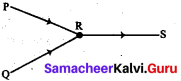
Three conductors are joined as shown in the diagram.
The current in conductor RS is 10 A. The current in conductor QR is 6 A. What will be the current in conductor PR
Samacheer Kalvi 7th Science Book Answers Term 2 Chapter 2 Electricity
(a) 4A
(b) 6 A
(c) 10 A
(d) 16 A
Solution:
PR + OR = RS
PR + 6A = 10A
PR = 10A- 6A = 4A

Question 2.
Draw the circuit diagram for the following series connection.
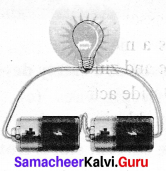
7th Science Term 2 Samacheer Kalvi Term 2 Chapter 2 Electricity
Answer:
7th Standard Term 2 Science Samacheer Kalvi Chapter 2 Electricity

Question 3.
Study the electric circuit below. Which of the following switches should be closed so that only two bulbs will light up.
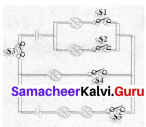
Electricity Lesson 7th Class Samacheer Kalvi Term 2 Chapter 2 Electricity
(a) SI, S2 and S4 only
(b) SI, S3 and S5 only
(c) S2, S3 and S4 only
(d) S2, S3 and S5 only
Answer:
(c) S2, S3 and S4 only

Question 4.
Study the three electric circuits below. Each of them has a glass rod (G), a steel rod (S), and a wooden rod (W).
In which of the electric circuits would the bulb not light up
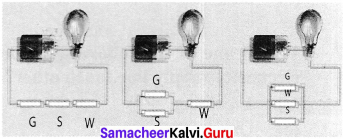
7th Class Electricity Lesson Samacheer Kalvi Term 2 Chapter 2 Electricity
(a) A only
(b) C only
(c) A and B only
(d) A, B and C
Answer:
(c) A and B only

Samacheer Kalvi 7th Science Electricity Intext Activities

Activity – 3

Question 1.
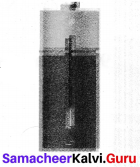
I am so exhausted. I am going to faint. What first aid will you give me to wake up?
Answer:
Samacheer Kalvi Guru 7th Science Term 2 Chapter 2 Electricity
I will recharge immediately

Samacheer Kalvi 7th Science Electricity Additional Questions

I. Choose the correct answer.

Question 1.
An electric component used as a safety device is electric circuit is
(a) cell
(b) electric wires
(c) switch
(d) fuse
Answer:
(d) fuse

Question 2.
In an electric circuit, the current starts from
(a) the positive terminal of the battery
(b) the negative terminal of the battery
(c) either of the terminals of the battery
(d) none
Answer:
(a) the positive terminal of the battery

Question 3.
_______ was developed is 1887 by Yei Sakizo of Japan
(a) Alkaline cell
(b) Button cell
(c) Lead accumulator
(d) Dry cell
Answer:
(d) dry cell

Question 4.
________ cell is used to operate devices such as mobile phones, computers and emergency lights
(a) Primary cell Lithium cell
(b) Secondary cell
(c) Lithium Cell
(d) None
Answer:
(b) Secondary cell

Question 5.
A battery is a group of _______
(a) only two cells
(c) two or more cells
(b) only single cell
(d) all of these
Answer:
(c) two or more cells

Question 6.
Which of the following is an electrical conductor?
(a) cork
(b) wood
(c) plastic
(d) silver
Answer:
(d) silver

Question 7.
Which one of the following phenomenon occurs when two naked wires of electricity supply line touch other?
(a) Lightning
(b) Short circuiting
(c) Overloading
(d) none
Answer:
(b) Short circuiting

Question 8.
Magnetic effect of current was discovered by ____________
(a) Flemming
(b) John Dalton
(c) Newton
(d) Hans Christian Oersted
Answer:
(d) Hans Christian Oersted

Question 9.
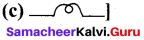
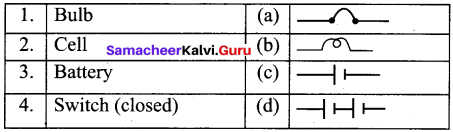
Which of the following is the symbol for a bulb?

7th Class Science Electricity Lesson Samacheer Kalvi Term 2 Chapter 2
Answer:
7th Standard 2nd Term 2nd Lesson Samacheer Kalvi Chapter 2 Electricity

Question 10.
Electricians wear rubbers gloves because it is ____________
(a) soft
(b) an insulator
(c) conductor
(d) water proof
Answer:
(b) an insulator

II. Fill in the Blanks.

  1. ____________ is a common example of the practical application.
  2. An insulator gives a lot of ____________ to the flow of charge (electron)
  3. Wires made of ____________  an electrical conductor, have very low resistance.
  4. The chip which are used in SIM cards and ATM cards are made up of ____________
  5. ____________  are used to remove splinters of steel or iron in hospitals dealing with eye injuries.
  6. Edison used a ____________ wire coil is a vacuum glass and discovered the first electric bulb in 1879.
  7. ____________ cells cannot be recharged after use. x
  8. The SI unit of potential difference is____________
  9. The SI unit of resistance is____________
  10. An electric charge always flows from a point____________ at to a point at____________

Answer:

  1. Arc welding
  2. resistance
  3. copper
  4. Semi conductors
  5. Electromagnets
  6. platinum
  7. platinum
  8. volt (V)
  9. ohm
  10. higher potential, lower potential

III. True or False – if false give the correct statement.

Question 1.
Insulators do not carry electric current because they do not have free electrons.
Answer:
True.

Question 2.
An MCB can be used instead of a fuse in an electrical circuit.
Answer:
True.

Question 3.
The flow of electric charge per unit time is called potential difference.
Answer:
False. The flow of electric charge per unit time is called current.

Question 4.
The source which produce the small amount of electricity for shorter period of time is called as electro chemical cell.
Answer:
True.

Question 5.
Electric cell converts electrical energy into chemical energy.
Answer:
False. Electric cell converts chemical energy into electrical energy.

Question 6.
The pipe is like the wire in the electric circuit and the pump is like the battery.
Answer:
True.

Question 7.
All batteries are made up of three components an anode, a cathode and some kind of electrolyte.
Answer:
True.

Question 8.
An insulator gives a less resistance to the flow of charge.
Answer:
False.An insulator gives a more resistance to the flow of charge.

Question 9.
Electric fuse has a body made of ceramic and two points for connecting the fuse wire.
Answer:
True

Question 10.
Chemical reaction happens, when electricity passes through various conducting liquids.
Answer:
True

IV. Match the following
Question 1.

  1. 1 mA – (a) series
  2. 1 pA – (b) ohm – metre
  3. Ammeter – (c) 10-6 ampere
  4. Electrical resistivity – (d) 10-3 ampere

Answer:

  1. (d)
  2. (c)
  3. (a)
  4. (b)

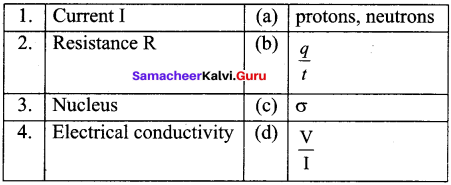
Question 2.
Samacheer Kalvi 7th Science Solutions Term 2 Chapter 2 Electricity image - 14
Answer:

  1. (b)
  2. (d)
  3. (a)
  4. (c)

Question 3.

  1. Dry cells – (a) Reversible
  2. Electrolyte – (b) Opens or closes the circuit
  3. Switch – (c) Solution
  4. Secondary cell – (d) Torches

Answer:

  1. (d)
  2. (c)
  3. (b)
  4. (a)

Question 4.
Samacheer Kalvi 7th Science Solutions Term 2 Chapter 2 Electricity image - 15
Answer:

  1. (b)
  2. (c)
  3. (d)
  4. (a)

V. Assertion and Reason.

Mark the correct choice as
(a) Both A and R are true but R is the correct explanation of A.
(b) Both A and R are true and R is the not the correct explanation of A.
(c) A is true but R is false.
(d) A is false but R is true.

Question 1.
Assertion (A) : Charges flow from higher potential to the lower potential.
Reason (R) : Current flows mainly due to flow of electrons.
Answer:
(b) Both A and R are true and R is the not the correct explanation of A

Question 2.
Assertion (A) : Insulators do not allow flow of current through them.
Reason (R) : Insulators have no free charge carrier.
Answer:
(a) Both A and R are true but R is the correct explanation of A

Question 3.
Assertion (A) : A current carrying wire should be charged.
Reason (R) : The current in a wire is due to flow of free electrons in a definite direction.
Answer:
(d) A is false but R is true

Question 4.
Assertion (A) : The connecting wires are made of copper.
Reason (R) : The electrical conductivity of copper is high.
Answer:
(a) Both A and R are true but R is the correct explanation of A

VI. Very short Answers:

Question 1.
What is the source of electric current in a T.V. remote?
Answer:
Electric cell.

Question 2.
In which position is key placed in a circuit?
Answer:
Key can be placed anywhere in the circuit.

Question 3.
What are the effects of electricity?
Answer:

  1. Heating effect
  2. Chemical effect
  3. Magnetic effect

Question 4.
Name the instrument which is used to measure potential difference.
Answer:
Voltmeter.

Question 3.
Name the portable form of a avalanche cell.
Answer:
Dry cell.

Question 4.
Name the substance that become ions in solutions and acquire the capacity to conduct electricity.
Answer:
Electrolytes.

Question 7.
Name the component of a circuit which help us to start or stop the appliances & safely and easily.
Answer:
Switch.

Question 8.
Name the component which connects electrical components to one another.
Answer:
Wire.

VII. Short Answer.

Question 1.
What is resistance?
Answer:
Resistance is the property of an electrical component which resists the flow of electric charges, when it is connected is a circuit.

Question 2.
What are the uses of electromagnets?
Answer:
Electromagnets are used in cars, speakers, electric motors, electric cells, telephone receivers and television.

Question 3.
What is an electric fuse made up of?
Answer:
A fuse is a small place of wire of an alloy of low melting point (63% tin and 37% lead).

Question 4.
What do you mean by magnetic effect?
Answer:
When electric current passes through a wire, it behaves like a magnet. This is called
magnetic effect of electricity.

Question 5.
What are MCB’s? How do they work?
Answer:

  1. MCB’s (Miniature Circuit Breakers) are switches which automatically turn off when current in a circuit exceeds the safe limit.
  2. We turn them on and the circuit is once again complete.

Question 6.
What is heating effect of the electric current?
Answer:

  1. The wire or component gets hot when an electric current passes through them,
  2. This is known as heating effect of the electric current.

Question 7.
Define electric cell. What is the direction of electric current in a cell?
Answer:

  1. The simplest sources of an electric current is an electric cell and it has a positive terminal and a negative terminal.
  2. In electric cell the current starts from positive terminal of the cell, passes through the equipment connected to it, and terminates at the negative terminal of the cell.

Question 8.
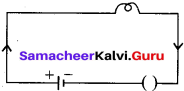
What do you mean by an open circuit?
Answer:
Samacheer Kalvi 7th Science Solutions Term 2 Chapter 2 Electricity image - 16
An open circuit occurs when there is break in the circuit which stops the current from flowing. Breaks in the circuit can be due to many causes, such as loose bulb holder or a missing wire in the circuit.

Question 9.
Write the analogy between water current and electric current.
Answer:

  1. Water molecules flow towards a point of lower elevation.
  2. Electric charges flow towards a point of lower voltage.

Question 10.
What are the factors affecting heating effect of electric current?
Answer:

  1. The amount of current I.
  2. The resistance R and

VIII. Long Answer

Question 1.
Write the differences between primary cell and secondary cell.
Answer:
Primary cell:

  1. The chemical reaction inside the primary cell is irreversible
  2. It cannot be recharged.
  3. Examples of secondary cells are lead accumulator, Edison accumulator and Nickel – Iron accumulator.
  4. Examples- simple voltalic cell, Daniel cell, and lechlanche cell and dry cell

Secondary cell:

  1. The chemical reaction inside the secondary cell is reversible.
  2. It can be recharged.
  3. It is used to operate devices such as mobile phones, cameras, computers, and emergency lights.
  4. Examples of secondary cells are lead accumulator, Edison accumulator and Nickel – Iron accumulator.

Question 2.
Explain the working of an electric fuse.
Answer:

  1. Electric fuse is a safety device which is used in household wing and in many appliances.
  2. Electric fuse has a body made of ceramic and two points for connecting the wire.
  3. The fuse wire melts whenever there is overload of the current in the wire.
  4. This breaks the circuit and helps in preventing damage to costly appliances and to the wiring.
  5. In electrical devices, a glass fuse is often used.
  6. This is a small glass tube, in which lies the fuse wire.

Question 3.
Explain the following :

  1. Semi – conductors
  2. Short circuit.

Answer:
1. The chip which are used in SIM Cards, Computers, and ATM cards are made up of semiconductors namely, silicon and germanium because of their electrical conductivity lies between a conductor and an insulator.

2. A short circuit is simply a low resistance connection between two conductors supplying electrical power to any circuit. Arc welding is a common example of the practical application of the heating due to a short circuit.

Question 4.
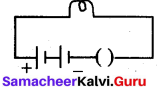
Draw the following using symbols:

  1. Open circuit
  2. Closed circuit
  3. Series circuit
  4. Parallel circuit

Answer:
1. Open Circute:
Samacheer Kalvi 7th Science Solutions Term 2 Chapter 2 Electricity image - 17

2. Closed Circuit:
Samacheer Kalvi 7th Science Solutions Term 2 Chapter 2 Electricity image - 18
3. Series Circuit:
Samacheer Kalvi 7th Science Solutions Term 2 Chapter 2 Electricity image - 19
4. Parallel Circuit:
Samacheer Kalvi 7th Science Solutions Term 2 Chapter 2 Electricity image - 20

IX. Problems for practice:

Question 1.
If 50 coulomb of electric charge flows through a wire in five minutes, calculate the current in the wire?
Solution:
Charge q = 50 c
time t = 5 min × 60 s = 300 s
current I = \(\frac { q }{ t }\)
= \(\frac { 50 }{ 300 }\) = \(\frac { 5 }{ 30 }\) = 0.166A

Question 2.
If 5A current flows through a circuit, then convert the current is terms of micro ampere?
solution :
I = 5A
IA = 106 µA
5A = 5 × 10⁶ µA
5A = 50,00,000 µA

Question 3.
If 3A current flows through a circuit, then convert the current in terms of milliampere.
solution:
I = 3A
1A = 103 mA
3A = 3 × 1000 mA
3A = 3000 mA

X. Creative questions: HOTS

Question 1.
What is the difference between fuse wire and a heating wire?
Answer:
The fuse wire has low melting point, whereas the heating wire has a high melting point. Fuse wire is made up of tin-lead alloy, whereas heating wire is made of constant. (Copper and nickel alloy)

Question 2.
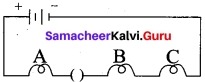
Observe the circuit given:

  1. Would any of the bulb glow when the switch is in the ‘OFF’ position?
    Samacheer Kalvi 7th Science Solutions Term 2 Chapter 2 Electricity image - 21
  2. What will be the order in which the bulbs A, B and C will glow when the switch is moved to the ‘ON’ position?

Answer:

  1. No bulb will glow
  2. All bulbs will glow simultaneously.
Samacheer Kalvi 12th Accountancy Solutions Chapter 2 Accounts of Not-For-Profit Organisation

Students can Download Accountancy Chapter 2 Accounts of Not-For-Profit Organisation Questions and Answers, Notes Pdf, Samacheer Kalvi 12th Accountancy Book Solutions Guide Pdf helps you to revise the complete Tamilnadu State Board New Syllabus and score more marks in your examinations.

Tamilnadu Samacheer Kalvi 12th Accountancy Solutions Chapter 2 Accounts of Not-For-Profit Organisation

Samacheer Kalvi 12th Accountancy Accounts of Not-For-Profit Organisation Text Book Back Questions and Answers

I. Choose the Correct Answer

12th Accountancy 2nd Chapter Answers  Question 1.
Receipts and payments account is a …………….
(a) Nominal A/c
(b) Real A/c
(c) Personal A/c
(d) Representative personal account
Answer:
(b) Real A/c

12th Accountancy Chapter 2 Question 2.
Receipts and payments account records receipts and payments of …………….
(a) Revenue nature only
(b) Capital nature only
(c) Both revenue and capital nature
(d) None of the above
Answer:
(c) Both revenue and capital nature

Samacheer Kalvi 12th Accountancy Solutions Chapter 2 Question 3.
Balance of receipts and payments account indicates the …………….
(a) Loss incurred during the period
(b) Excess of income over expenditure of the period
(c) Total cash payments during the period
(d) Cash and bank balance as on the date
Answer:
(d) Cash and bank balance as on the date

12th Accounts 2nd Chapter Question 4.
Income and expenditure account is a …………….
(a) Nominal A/c
(b) Real A/c
(c) Personal A/c
(d) Representative personal account
Answer:
(a) Nominal A/c

12th Accountancy 2nd Chapter Question 5.
Income and Expenditure Account is prepared to find out …………….
(a) Profit or loss
(b) Cash and bank balance
(c) Surplus or deficit
(d) Financial position
Answer:
(c) Surplus or deficit

12th Accountancy Chapter 2 Solutions Question 6.
Which of the following should not be recorded in the income and expenditure account?
(a) Sale of old news papers
(b) Loss on sale of asset
(c) Honorarium paid to the secretary
(d) Sale proceeds of furniture
Answer:
(d) Sale proceeds of furniture

12th Account Chapter 2 Question 7.
Subscription due but not received for the current year is …………….
(a) An asset
(b) A liability
(c) An expense
(d) An item to be ignored
Answer:
(a) An asset

Samacheer Kalvi 12th Accountancy Solutions Question 8.
Legacy is a …………….
(a) Revenue expenditure
(b) Capital expenditure
(c) Revenue receipt
(d) Capital receipt
Answer:
(d) Capital receipt

12th Accountancy 2nd Chapter Solutions Question 9.
Donations received for a specific purpose is …………….
(a) Revenue receipt
(b) Capital receipt
(c) Revenue expenditure
(d) Capital expenditure
Answer:
(b) Capital receipt

Samacheer Kalvi 12th Accountancy Solutions Chapter 1 Question 10.
There are 500 members in a club each paying ₹ 100 as annual subscription. Subscription due but not received for the current year is ₹ 200; Subscription received in advance is ? 300. Find out the amount of subscription to be shown in the income and expenditure account,
(a) ₹ 50, 000
(b) ₹ 50, 200
(c) ₹ 49, 900
(d) ₹ 49, 800
Answer:
(a) ₹ 50,000

II. Very Short Answer Questions

12th Samacheer Kalvi Accountancy Solution Book Question 1.
State the meaning of not-for-profit organisation.
Answer:
Some organisations are established for the purpose of rendering services to the public without any profit motive. They may be created for the promotion of art, culture, education and sports, etc. These organisations are called not-for-profit organisation.

Class 12 Accountancy Chapter 2 Solutions Question 2.
What is receipts and payments account?
Answer:
Receipts and Payments account is a summary of cash and bank transactions of not-for-profit organisations prepared at the end of each financial year. It is a real account in nature.

Class 12 Accountancy Chapter 2 Question 3.
What is legacy?
Answer:
It is the amount given to a non-trading concern as per the will. It is like a donation. It appears on the debit side of receipts and payments account, but is not treated as income because it is not of recurring nature. It is a capital receipt.

Chapter 2 Accountancy Class 12 Solutions Question 4.
Write a short note on life membership fees.
Answer:
Life membership fee is accounted as a capital receipt and added to capital fund on the liabilities side of Balance sheet. It is non – recurring in nature.

Samacheer Kalvi Guru 12th Accountancy Question 5.
Give four examples for capital receipts of not-for-profit organisation.
Answer:

  1. Life membership fees
  2. Legacies
  3. Specific donation
  4. Sale of fixed assets

12th Accountancy Solutions Samacheer Kalvi Question 6.
Give four examples for revenue receipts of not-for-profit organisation.
Answer:

  1. Subscription
  2. Interest on investment
  3. Interest on fixed deposit
  4. Sale of old sports material

III. Short Answer Questions

12th Accountancy Guide Samacheer Kalvi Question 1.
What is income and expenditure account?
Answer:
Income and expenditure account is a summary of income and expenditure of a not-for-profit organisation prepared at the end of an accounting year. It is prepared to find out the surplus or deficit pertaining to a particular year. It is a nominal account in nature in which items of revenue receipts and revenue expenditure relating to the current year alone are recorded.

12th Accountancy Answer Question 2.
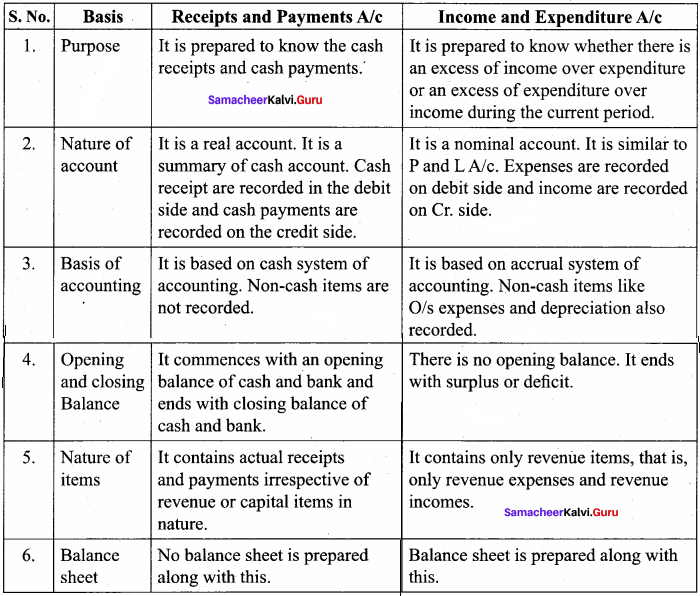
State the differences between Receipts and Payments Account and Income and Expenditure Account.
Answer:
12th Accountancy 2nd Chapter Answers Samacheer Kalvi Accounts Of Not-For-Profit Organisation

Accountancy 2nd Chapter Question 3.
How annual subscription is dealt with in the final accounts of not-for-profit organisation?
Answer:
(A) Treatment in income and expenditure account:
When subscription received for the current year, previous years and subsequent period are given separately, subscription received for the current year will be shown on the credit side of income and expenditure account after making the adjustments given below:

  • Subscription outstanding for the current year is to be added.
  • Subscription received in advance in the previous year which is meant for the current year is to be added.

When total subscription received in current year is given:

  • Subscription outstanding in the previous year which is received in the current year will be subtracted.
  • Subscription received in advance in the previous year which is meant for the current year is added and subscription received in advance must be subtracted.

(B) Treatment in Balance sheet:

  • Subscription outstanding for the current year and still outstanding for the previous year will be shown on the asset side of the Balance sheet.
  • Subscriptions received in advance in the current year will be shown on the liabilities side of the Balance sheet.

Class 12th Accounts Chapter 2 Solutions Question 4.
How the following items are dealt with in the final accounts of not-for-profit organisation?

  1. Sale of sports materials
  2. Life membership fees
  3. Tournament fund

Answer:
1. Sale of sports materials:
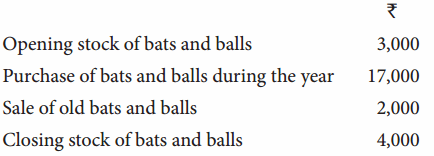
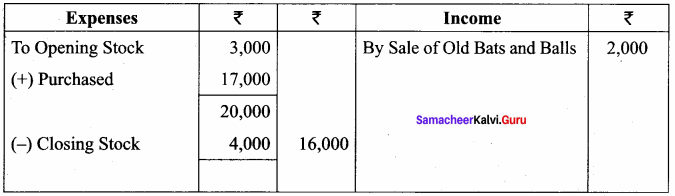
The sale proceeds of old sports materials like balls and bats, etc., are revenue receipts.

2. Life membership fees:
Amount received like membership fee from members is a capital receipt as it is non – recurring in nature.

3. Tournament fund:
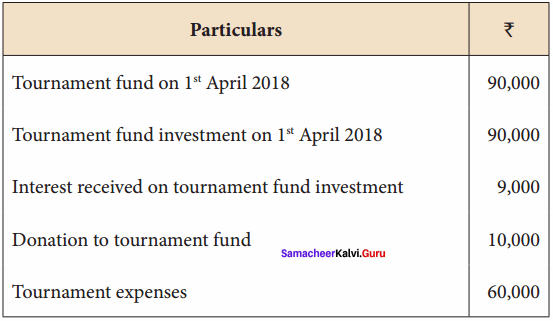
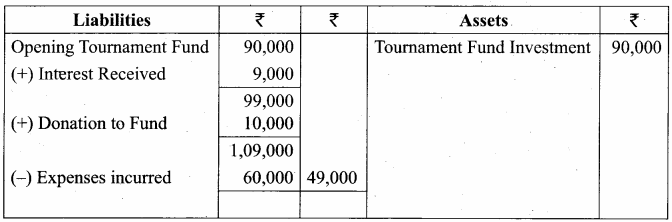
It is recurring in nature. It is revenue receipt. It is shown on liabilities side of balance sheet. Opening balance added donations and subtracted expenses incurred.

IV. Exercises

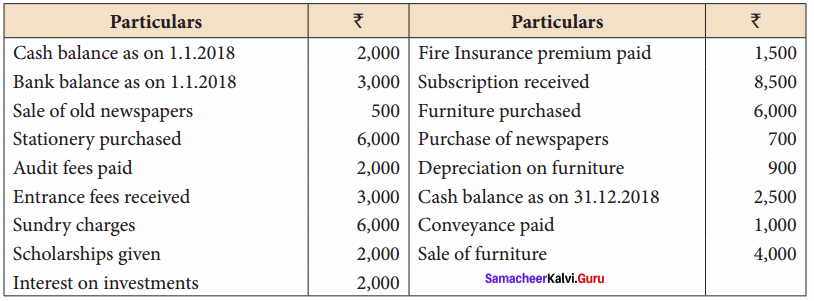
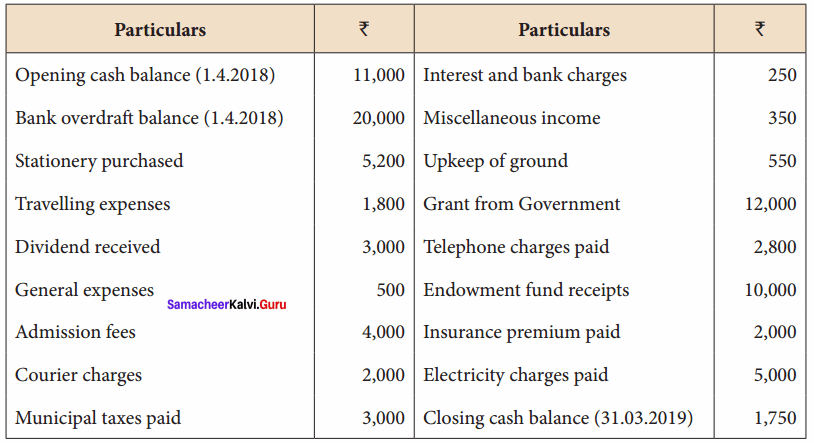
Question 1.
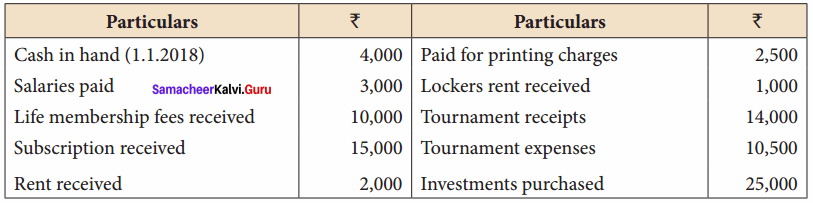
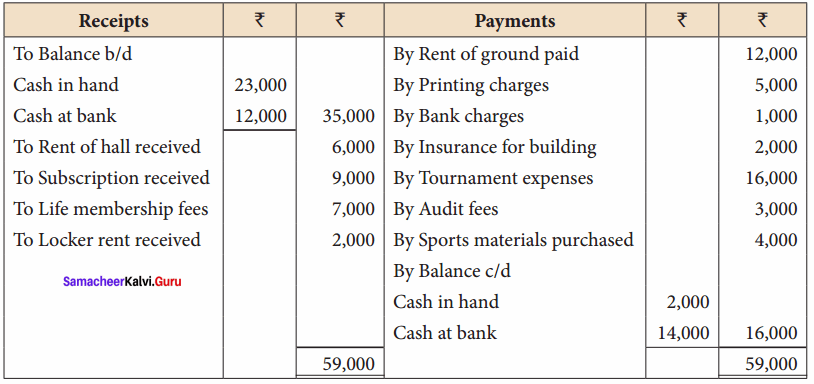
From the information given below, prepare Receipts and Payments account of Kurunji Sports Club for the year ended 31st December, 2018.
12th Accountancy Chapter 2 Samacheer Kalvi Chapter 2 Accounts Of Not-For-Profit Organisation
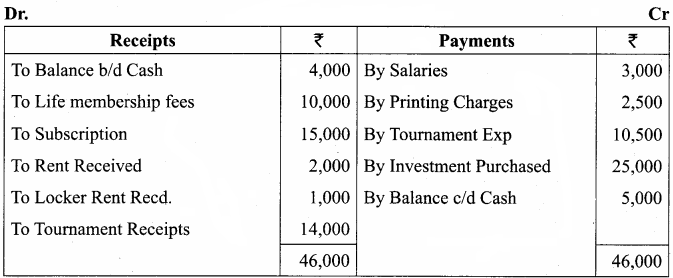
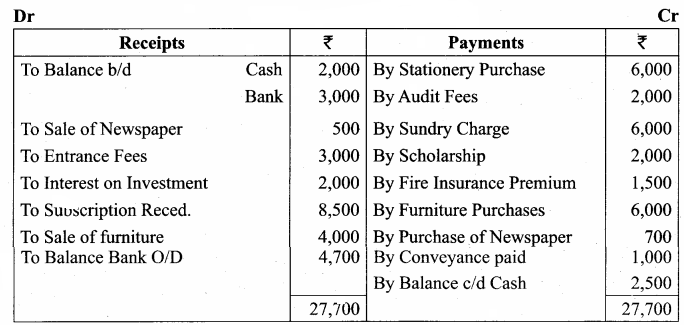
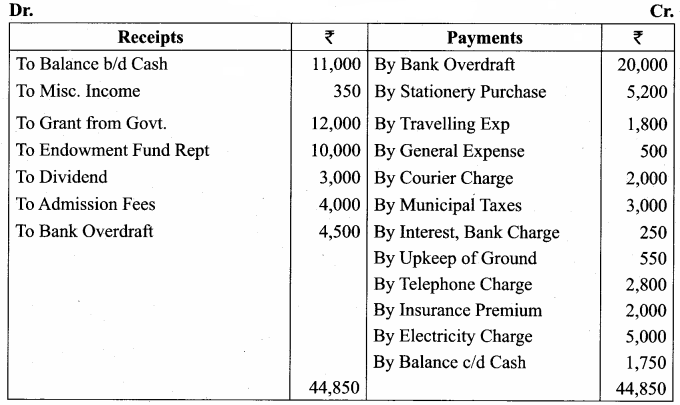
Answer:
Kurinji Sports Club Account for the year ended 31st Dec 2018
Receipts and Payments
Samacheer Kalvi 12th Accountancy Solutions Chapter 2 Accounts Of Not-For-Profit Organisation

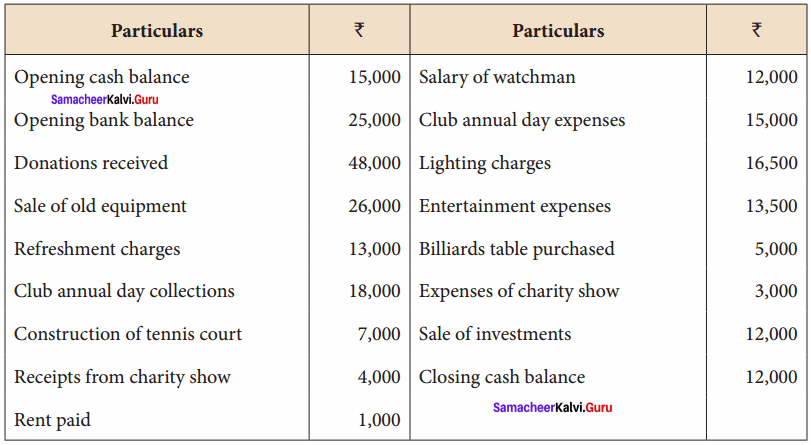
Question 2.
From the information given below, prepare Receipts and Payments account of Coimbatore Cricket Club for the year ending 31st March, 2019.
12th Accounts 2nd Chapter Samacheer Kalvi Accounts Of Not-For-Profit Organisation
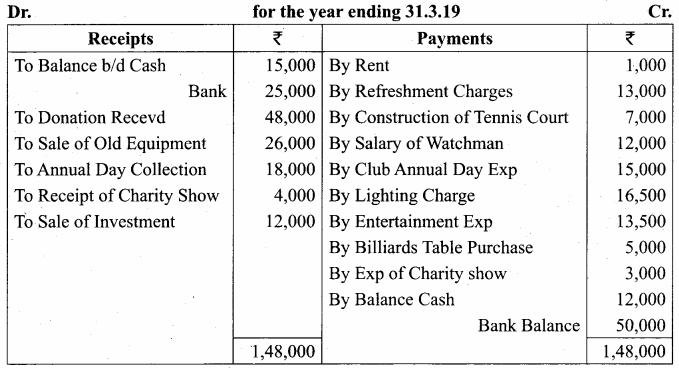
Answer:
Coimbatore Cricket Club Receipts and Payments Account
for the year ending 31.03.19
12th Accountancy 2nd Chapter Samacheer Kalvi Accounts Of Not-For-Profit Organisation

Question 3.
From the information given below, prepare Receipts and Payments account of Madurai Mother Theresa Mahalir Mandram for the year ended 31st December, 2018.
12th Accountancy Chapter 2 Solutions Samacheer Kalvi Accounts Of Not-For-Profit Organisation
Answer:
Madurai Mother Theresa Mahalir Mandram Receipts and Payments Account for the year ending 31.12.18
12th Account Chapter 2 Samacheer Kalvi Accounts Of Not-For-Profit Organisation

Question 4.
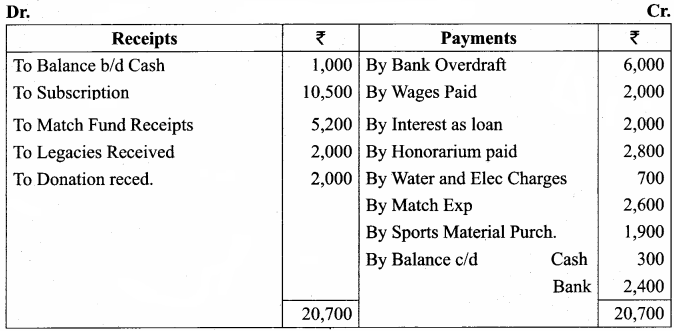
Mayiladuthurai Recreation Club gives you the following details. Prepare Receipts and Payments account for the year ended 31st March, 2019.
Samacheer Kalvi 12th Accountancy Solutions Chapter 2 Accounts Of Not-For-Profit Organisation
Answer:
Mayiladuthurai Recreation Club Receipts and Payments Account for the year ending 31.3.19
12th Accountancy 2nd Chapter Solutions Samacheer Kalvi Accounts Of Not-For-Profit Organisation

Question 5.
From the following information, prepare Receipts and Payments account of Cuddalore Kabaddi Association for the year ended 31st March, 2019.
12th Samacheer Kalvi Accountancy Solution Book Chapter 2 Accounts Of Not-For-Profit Organisation
Cuddalore Kabadi Association Receipts and Payments Account for the year ending 31.03.19
Answer:
Class 12 Accountancy Chapter 2 Solutions Samacheer Kalvi Accounts Of Not-For-Profit Organisation

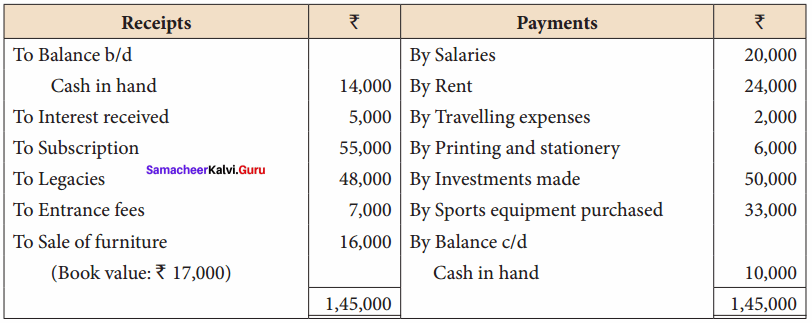
Question 6.
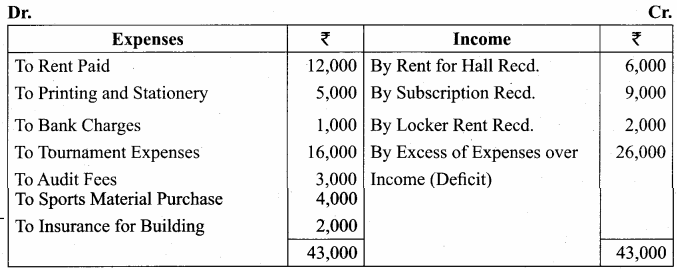
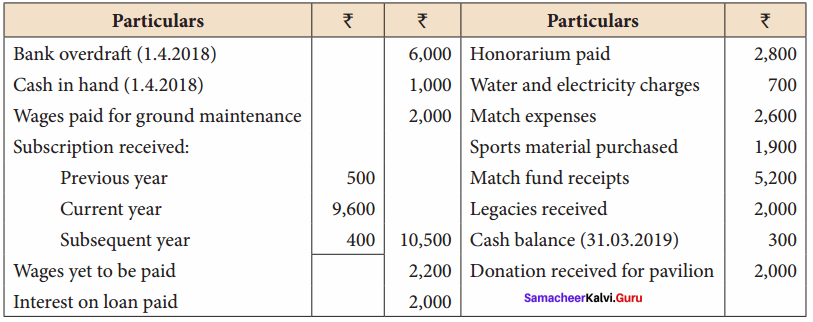
From the following receipts and payments account of Tenkasi Thiruvalluvar Manram, prepare income and expenditure account for the year ended 31st March, 2019.
Class 12 Accountancy Chapter 2 Samacheer Kalvi Accounts Of Not-For-Profit Organisation
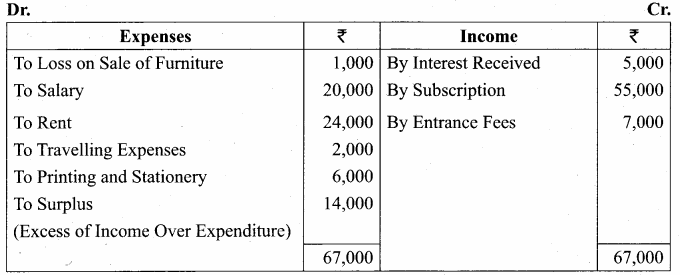
Answer:
Tenkasi Thiruvalluvar Manram Income and Expenditure Account for the year ended 31.03.19
Chapter 2 Accountancy Class 12 Solutions Accounts Of Not-For-Profit Organisation

Question 7.
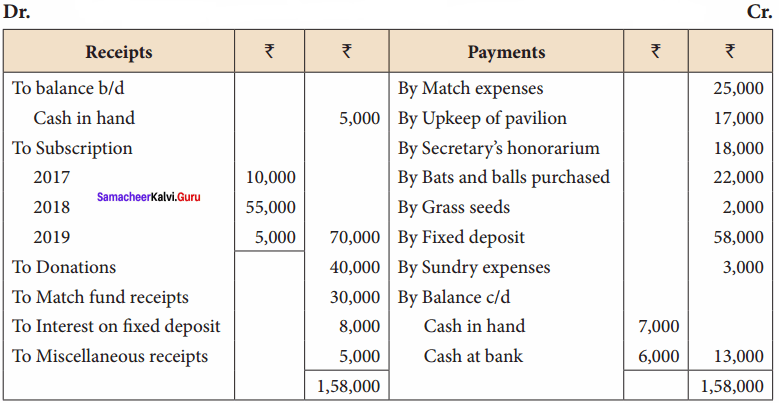
From the following receipts and payments account, prepare income and expenditure account of Kumbakonam Basket Ball Association for the year ended 31st March, 2018.
Samacheer Kalvi Guru 12th Accountancy Solutions Chapter 2 Accounts Of Not-For-Profit Organisation
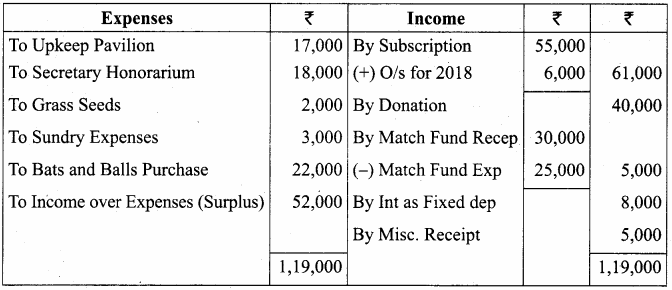
Answer:
Kumbakonam Basket Ball Association Income & Expenditure Account for the year ended 31.03.19
12th Accountancy Solutions Samacheer Kalvi Chapter 2 Accounts Of Not-For-Profit Organisation

Question 8.
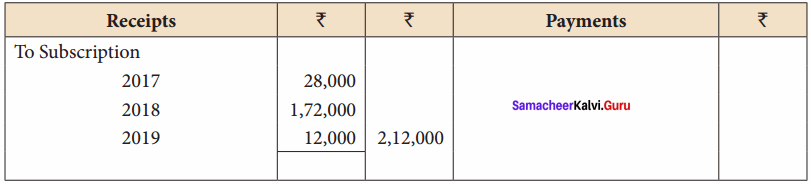
From the following receipts and payments account and the additional information given below, calculate the amount of subscription to be shown in Income and expenditure account for the year ending 31st December, 2018.
12th Accountancy Guide Samacheer Kalvi Chapter 2 Accounts Of Not-For-Profit Organisation
Answer:
Income and Expenditure Account for the year ended 31.12.18
12th Accountancy Answer Samacheer Kalvi Chapter 2 Accounts Of Not-For-Profit Organisation

Question 9.
How the following items will appear in the final accounts of a club for the year ending 31st March 2019?
Receipts and Payments Account for the year ended 31st March, 2019
Accountancy 2nd Chapter Samacheer Kalvi 12th Accounts Of Not-For-Profit Organisation
Answer:
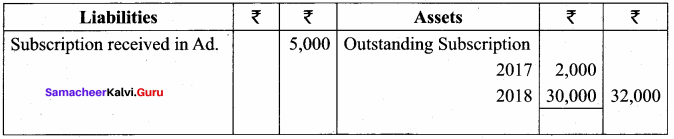
There are 200 members in the club each paying an annual subscription of ₹ 400 per annum. Subscription still outstanding for the year 2017 – 2018 is ₹ 2,000.
Income & Expenditure Account for the year ended 31.03.2019
Class 12th Accounts Chapter 2 Solutions Accounts Of Not-For-Profit Organisation
Balance Sheet as on 31.03.19

Samacheer Kalvi 12th Accountancy Solutions Chapter 2 Accounts of Not-For-Profit Organisation 21

Question 10.
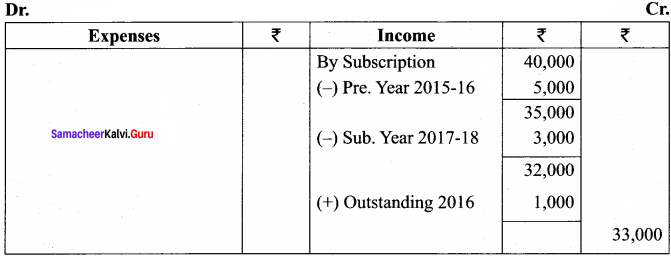
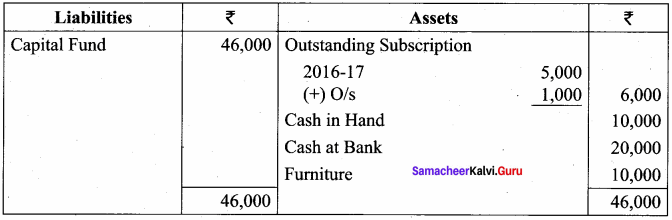
How will the following items appear in the final accounts of a club for the year ending 31st March 2017? Received subscription of ₹ 40,000 during the year 2016 – 17. This includes subscription of ₹ 5,000 for 2015 – 16 and ₹ 3,000 for the year 2017 – 18. Subscription of ₹ 1,000 is still outstanding for the year 2016 – 17.
Answer:
Income & Expenditure Account for the year ended 31.03.19
Samacheer Kalvi 12th Accountancy Solutions Chapter 2 Accounts of Not-For-Profit Organisation 82Balance Sheet as on 31.03.19
Samacheer Kalvi 12th Accountancy Solutions Chapter 2 Accounts of Not-For-Profit Organisation 23

Question 11.
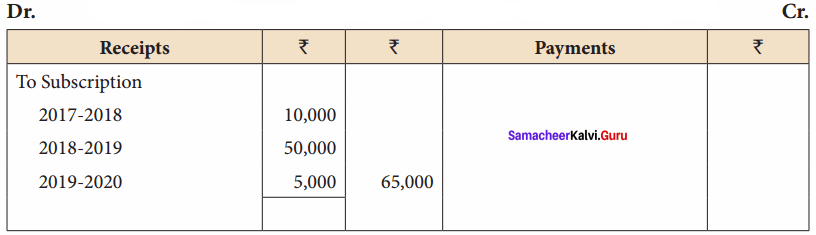
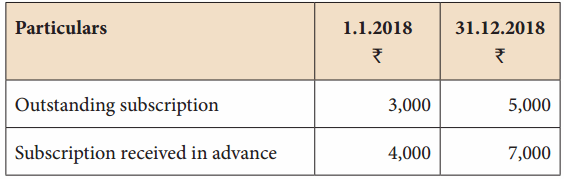
Compute income from subscription for the year 2018 from the following particulars relating to a club.
Samacheer Kalvi 12th Accountancy Solutions Chapter 2 Accounts of Not-For-Profit Organisation 24
Answer:
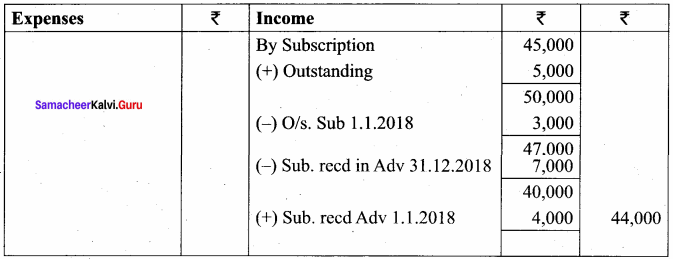
Subscription received during the year 2018: ₹ 45,000. Income & Expenditure Account for the year ended 31.03.2019
Samacheer Kalvi 12th Accountancy Solutions Chapter 2 Accounts of Not-For-Profit Organisation 25

Question 12.
From the following particulars, show how the item ‘subscription’ will appear in the Income and Expenditure Account for the year ended 31 – 12 – 2018?
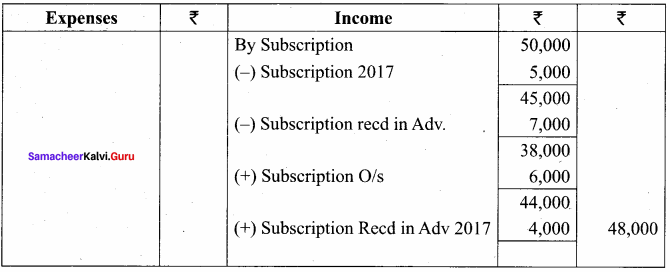
Subscription received in 2018 is ₹ 50,000 which includes ₹ 5,000 for 2017 and ₹ 7,000 for 2019. Subscription outstanding for the year 2018 is ₹ 6,000. Subscription of ₹ 4,000 was received in advance for 2018 in the year 2017.
Answer:
Income and Expenditure Account for the year ended 31.12.2018
Samacheer Kalvi 12th Accountancy Solutions Chapter 2 Accounts of Not-For-Profit Organisation 26

Question 13.
How the following items appear in the final accounts of Thoothukudi Young Pioneers Association?
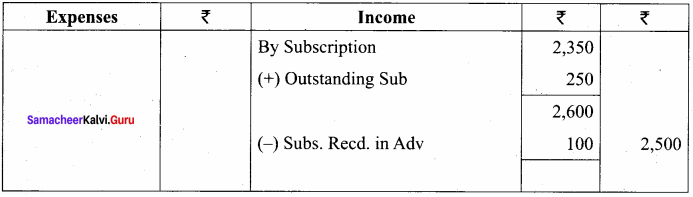
There are one hundred members in the association each paying ₹ 25 as annual subscription. By the end of the year 10 members had not paid their subscription but four members had paid for the next year in advance.
Income & Expenditure Account for the year ended
Answer:
Samacheer Kalvi 12th Accountancy Solutions Chapter 2 Accounts of Not-For-Profit Organisation 27
Balance Sheet as on …………..
Samacheer Kalvi 12th Accountancy Solutions Chapter 2 Accounts of Not-For-Profit Organisation 28

Question 14.
How will the following appear in the final accounts of Marthandam Women Cultural Association?
Samacheer Kalvi 12th Accountancy Solutions Chapter 2 Accounts of Not-For-Profit Organisation 29
Answer:
Income and Expenditure Account for the year ended 31.03.19
Samacheer Kalvi 12th Accountancy Solutions Chapter 2 Accounts of Not-For-Profit Organisation 30
Balance Sheet as on 31.03.19
Samacheer Kalvi 12th Accountancy Solutions Chapter 2 Accounts of Not-For-Profit Organisation 31

Question 15.
How will the following appear in the final accounts of Vedaranyam Sports club?
Samacheer Kalvi 12th Accountancy Solutions Chapter 2 Accounts of Not-For-Profit Organisation 32
Answer:
Income & Expenditure Account for the year ended
Samacheer Kalvi 12th Accountancy Solutions Chapter 2 Accounts of Not-For-Profit Organisation 33
Balance Sheet as on …………..
Samacheer Kalvi 12th Accountancy Solutions Chapter 2 Accounts of Not-For-Profit Organisation 34

Question 16.
Show how the following items appear in the income and expenditure account of Sirkazhi Singers Association?
Samacheer Kalvi 12th Accountancy Solutions Chapter 2 Accounts of Not-For-Profit Organisation 35
Answer:
Income and Expenditure Account for the year ended 31.03.18
Samacheer Kalvi 12th Accountancy Solutions Chapter 2 Accounts of Not-For-Profit Organisation 36

Question 17.
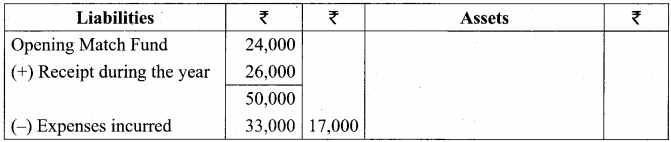
Chennai tennis club had Match fund showing credit balance of ₹ 24,000 on 1st April, 2018. Receipt to the fund during the year was ₹ 26,000. Match expenses incurred during the year was ₹ 33,000. How these items will appear in the final accounts of the club for the year ended 31st March, 2019?
Balance Sheet as on 31.03.2019
Answer:
Income and Expenditure Account for the year ended 31.03.18
Samacheer Kalvi 12th Accountancy Solutions Chapter 2 Accounts of Not-For-Profit Organisation 37

Question 18.
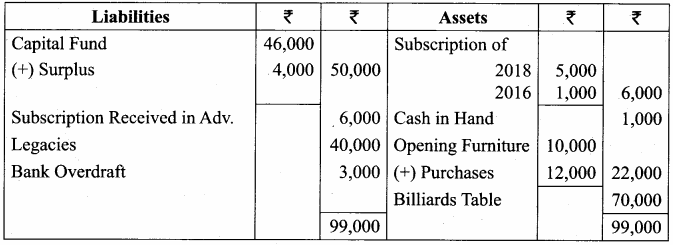
How will the following appear in the final accounts of Karaikudi sports club for the year ending 31stMarch, 2019?
Samacheer Kalvi 12th Accountancy Solutions Chapter 2 Accounts of Not-For-Profit Organisation 38
Answer:
Balance Sheet as on 31.03.19
Samacheer Kalvi 12th Accountancy Solutions Chapter 2 Accounts of Not-For-Profit Organisation 39

Question 19.
Compute capital fund of Salem Sports Club as on 1.4.2019.
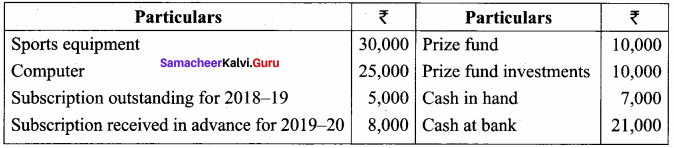
Samacheer Kalvi 12th Accountancy Solutions Chapter 2 Accounts of Not-For-Profit Organisation 40
Answer:
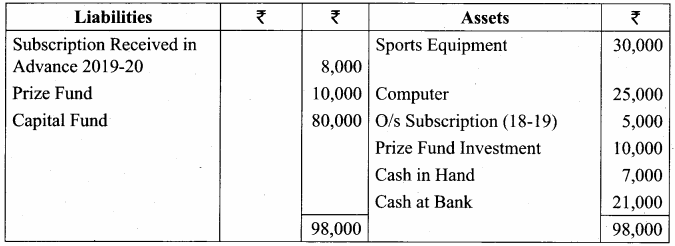
Balance Sheet as on 01.04.2019
Samacheer Kalvi 12th Accountancy Solutions Chapter 2 Accounts of Not-For-Profit Organisation 41

Question 20.
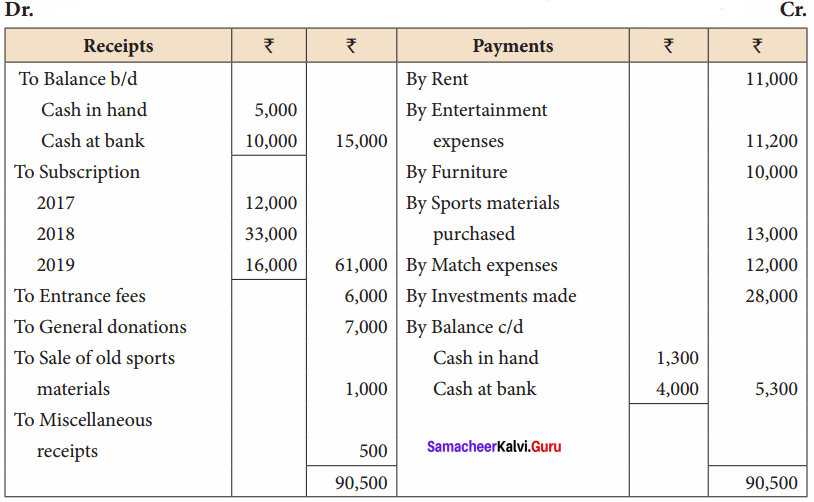
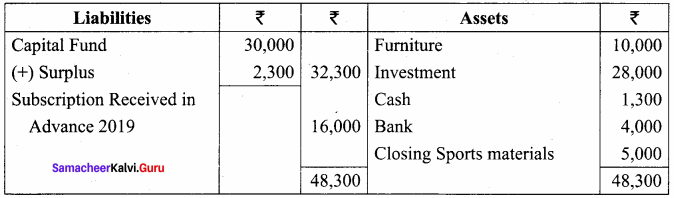
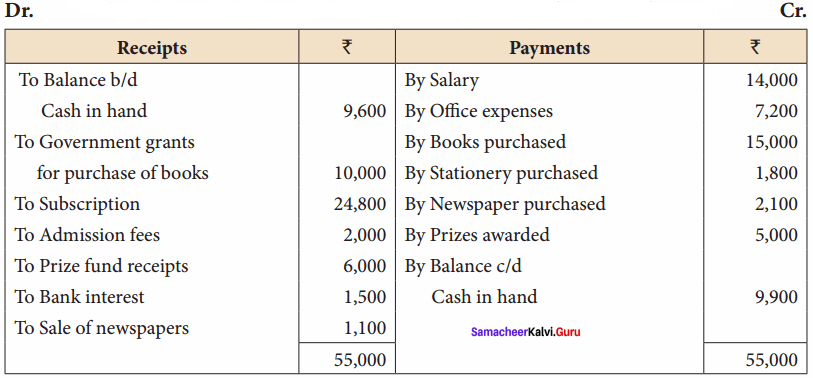
From the following Receipts and Payments account and from the information given below of Ramanathapuram Sports Club, prepare Income and Expenditure account for the year ended 31st December, 2018 and the balance sheet as on that date.
Receipts and Payments Account for the year ended 31st December, 2018
Samacheer Kalvi 12th Accountancy Solutions Chapter 2 Accounts of Not-For-Profit Organisation 42
Additional information:

  1. Capital fund as on 1st January 2018 ₹ 30,000.
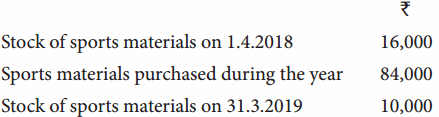
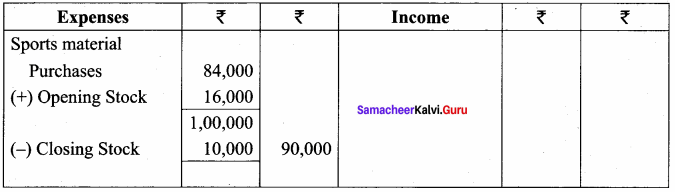
  2. Opening stock of sports material ₹ 3,000 and closing stock of sports material ₹ 5,000.

Answer:
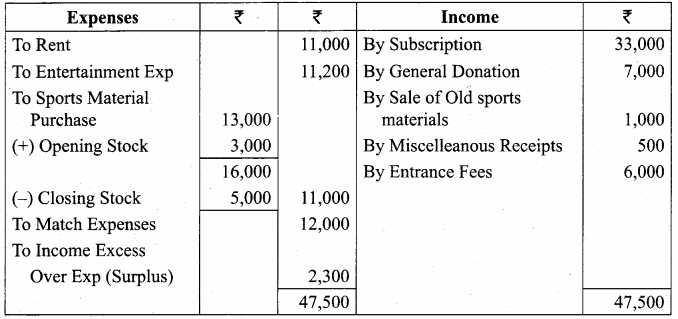
Income and Expenditure Account for the year ended 31.12.18
Samacheer Kalvi 12th Accountancy Solutions Chapter 2 Accounts of Not-For-Profit Organisation 43
Balance Sheet as on 31.12.18
Samacheer Kalvi 12th Accountancy Solutions Chapter 2 Accounts of Not-For-Profit Organisation 44

Question 21.
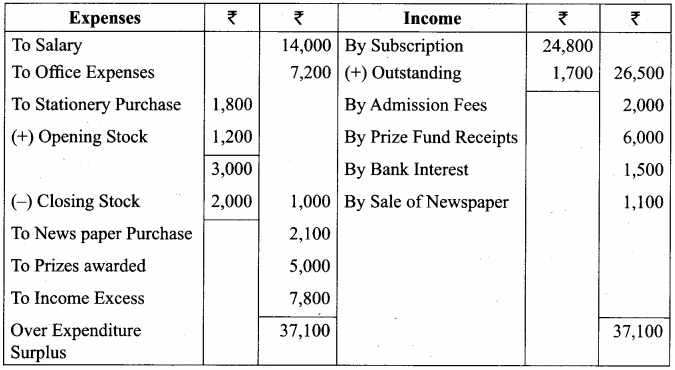
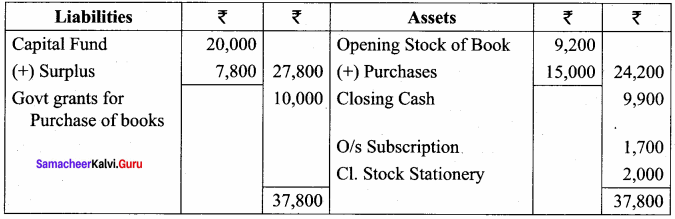
From the following Receipts and Payments account of Yercaud Youth Association, prepare Income and expenditure account for the year ended 31st March, 2019 and the balance sheet as on that date.
Receipts and Payments Account for the year ended 31st March, 2019
Samacheer Kalvi 12th Accountancy Solutions Chapter 2 Accounts of Not-For-Profit Organisation 45
Additional information:

  1. Opening capital fund ₹ 20,000.
  2. Stock of books on 1.4.2018 ₹ 9,200.
  3. Subscription due but not received ₹ 1,700.
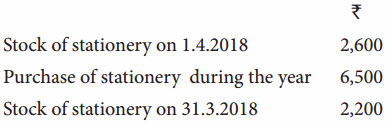
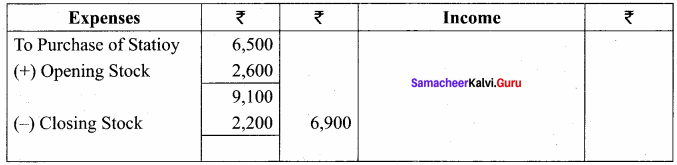
  4. Stock of stationery on 1.4.2018 ₹ 1,200 and stock of stationery on 31.3.2019, ₹ 2,000

Income and Expenditure Account for the year ended 31.03.19
Samacheer Kalvi 12th Accountancy Solutions Chapter 2 Accounts of Not-For-Profit Organisation 46
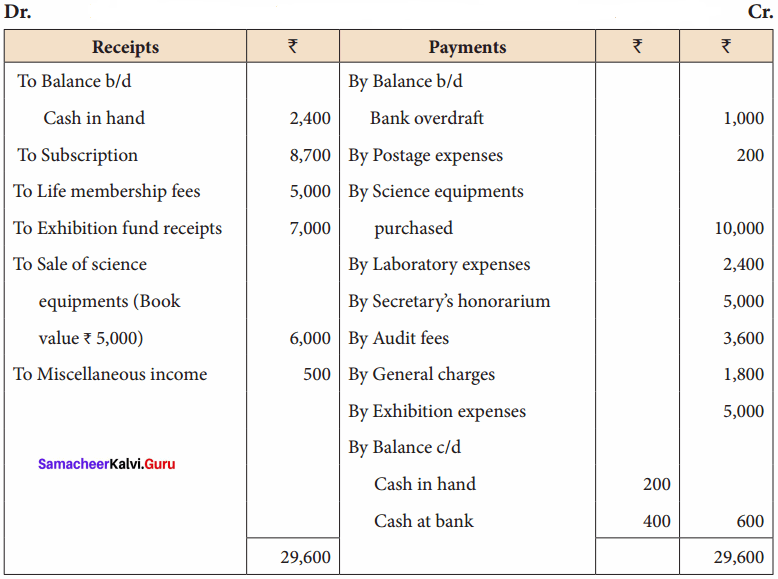
Balance Sheet as on 31.03.2019
Samacheer Kalvi 12th Accountancy Solutions Chapter 2 Accounts of Not-For-Profit Organisation 47

Question 22.
Following is the Receipts and Payments account of Neyveli Science Club for the year ended 31st December, 2018.
Receipts and Payments Account for the year ended 31st December, 2018
Samacheer Kalvi 12th Accountancy Solutions Chapter 2 Accounts of Not-For-Profit Organisation 48

Additional information:

  1. Opening capital fund ₹ 6,400
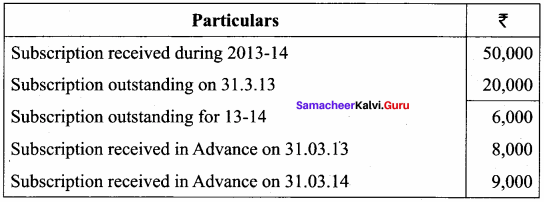
  2. Subscription includes ₹ 600 for the year 2019
  3. Science equipment as on 1.1.2018 ₹ 5,000
  4. Surplus on account of exhibition should be kept in reserve for new auditorium.

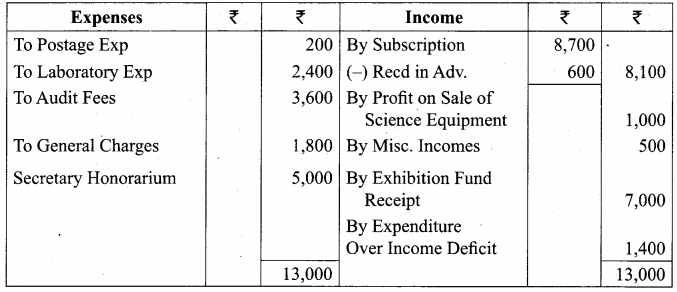
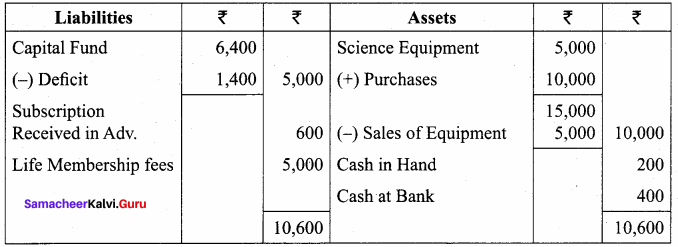
Prepare income and expenditure account for the year ended 31st December, 2018 and the balance sheet as on that date.
Answer:
Income and Expenditure Account for the year ended 31.12.18
Samacheer Kalvi 12th Accountancy Solutions Chapter 2 Accounts of Not-For-Profit Organisation 49
Balance Sheet as on 31.12.2018
Samacheer Kalvi 12th Accountancy Solutions Chapter 2 Accounts of Not-For-Profit Organisation 50

Question 23.
From the following Receipts and Payments account of Sivakasi Pensioner’s Recreation Club, prepare income and expenditure account for the year ended 31st March, 2018 and the balance sheet as on that date.
Receipts and Payments Account for the year ended 31st March, 2018
Samacheer Kalvi 12th Accountancy Solutions Chapter 2 Accounts of Not-For-Profit Organisation 51
Additional information:

  1. The club had 300 members each paying ₹ 100 as annual subscription.
  2. The club had furniture ₹ 10,000 on 1.4.2017.
  3. The subscription still due but not received for the year 2016 – 2017 is ₹ 1,000.

Income and Expenditure Account for the year ended 31.03.18
Samacheer Kalvi 12th Accountancy Solutions Chapter 2 Accounts of Not-For-Profit Organisation 52
Opening Balance Sheet as on 1.1.18
Samacheer Kalvi 12th Accountancy Solutions Chapter 2 Accounts of Not-For-Profit Organisation 53
Balance Sheet as on 31.12.2019
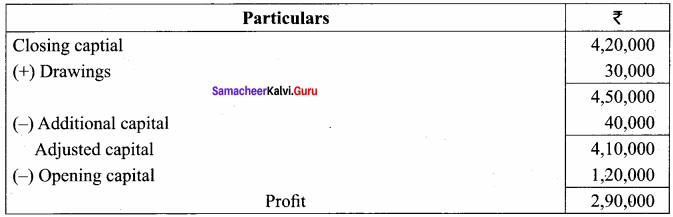
Samacheer Kalvi 12th Accountancy Solutions Chapter 2 Accounts of Not-For-Profit Organisation 54

Question 24.
Following is the Receipts and payments account of Virudhunagar Volleyball Association for the year ended 31st December, 2018.
Receipts and Payments Account for the year ended 31st December, 2018
Samacheer Kalvi 12th Accountancy Solutions Chapter 2 Accounts of Not-For-Profit Organisation 55
Answer:
Additional information:

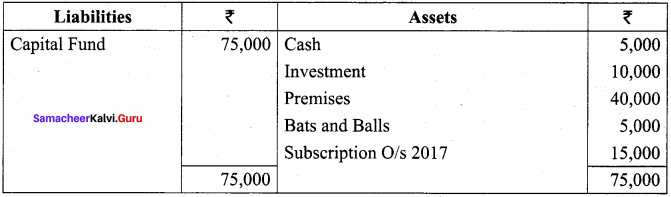
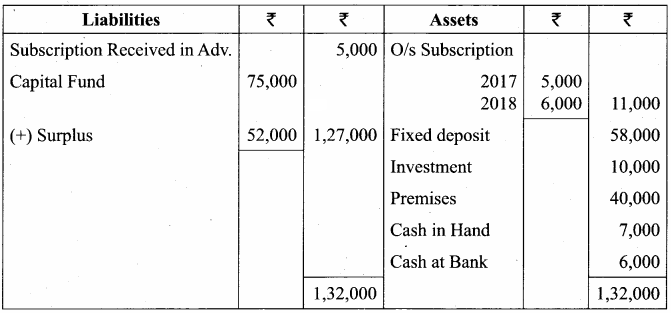
  1. On 1.1.2018, the association owned investments ₹ 10,000, premises and grounds ₹ 40,000, stock of bats and balls ₹ 5,000.
  2. Subscription ₹ 5,000 related to 2017 is still due.
  3. Subscription due for the year 2018, ₹ 6,000.

Prepare income and expenditure account for the year ended 31st December, 2018 and the balance sheet as on that date.
Answer:
Income and Expenditure Account for the year ended 31.12.18
Samacheer Kalvi 12th Accountancy Solutions Chapter 2 Accounts of Not-For-Profit Organisation 56
Opening Balance Sheet as on 1.1.18
Samacheer Kalvi 12th Accountancy Solutions Chapter 2 Accounts of Not-For-Profit Organisation 57
Balance Sheet as on 31.12.2109
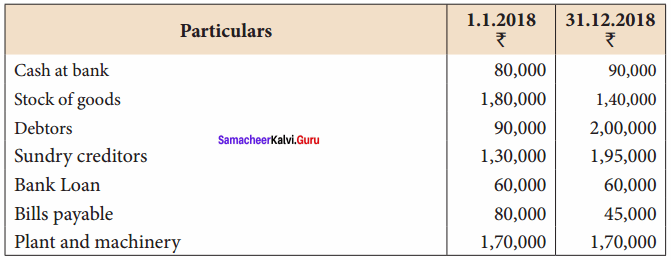
Samacheer Kalvi 12th Accountancy Solutions Chapter 2 Accounts of Not-For-Profit Organisation 58

Samacheer Kalvi 12th Accountancy Accounts of Not-For-Profit Organisation Additional Questions and Answers

I. Choose the correct answer

Question 1.
State the primary motive of not-for-profit organisation?
(a) Producing goods
(b) Provide service
(c) Both
(d) None of these
Answer:
(b) Provide service

Question 2.
State the nature of Life membership subscription.
(a) Cash Payments
(b) Cash Receipts
(c) Capital Receipt
(d) None of these
Answer:
(b) Cash Receipts

Question 3.
On which basis Receipt and Payment Account is prepared?
(a) Cash basis
(b) Credit basis
(c) Accrual basis
(d) None of these
Answer:
(a) Cash basis

Question 4.
Classify the subscription received during the year of not-for-profit organisation.
(a) Capital Receipt
(b) Capital Expenditure
(c) Revenue Receipt
(d) Both
Answer:
(c) Revenue Receipt

Question 5.
State the nature of Receipt and Payment A/c for not-for-profit organisation.
(a) Real Account
(b) Personal A/c
(c) Nominal A/c
(d) Representative Personal A/c
Answer:
(a) Real Account

Question 6.
Subscription received in advance is
(a) An Asset
(b) Income
(c) A Liability
(d) Expenditure
Answer:
(c) A Liability

II. Fill in the blanks

Question 7.
Not-for-profit organisation set up with the objective of ……………. of the society.
Answer:
Welfare

Question 8.
The nature of Receipt and Payments Account is …………….
Answer:
An Asset

Question 9.
Receipt and Payment Account is prepared as ……………. basis of accounting.
Answer:
Cash

Question 10.
Nature of Income over Expenditure Account is …………….
Answer:
Nominal Account

Question 11.
Excess of Income over Expenditure, the result is …………….
Answer:
Real surplus Account

Question 12.
Excess of Expenditure over the Income, the result is …………….
Answer:
Definite Liability

III. Match the following

Question 13.
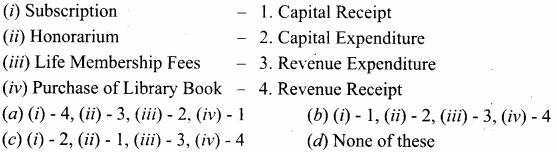
Samacheer Kalvi 12th Accountancy Solutions Chapter 2 Accounts of Not-For-Profit Organisation 81
Answer:
(a) 4, 3, 1, 2

Question 14.
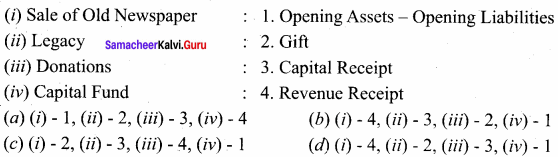
Samacheer Kalvi 12th Accountancy Solutions Chapter 2 Accounts of Not-For-Profit Organisation 80
Answer:
(a) 4, 3, 1, 2

IV. Assertion and Reason:

Question 15.
Assertion : Life Membership Fee: Amount received towards life membership fee from the members is a capital receipt.
Reason : It is non – recurring nature.
(a) Assertion and Reason is correct
(b) Assertion is incorrect Reason is correct
(c) Assertion is correct
(d) Both are incorrect
Answer:
(a) Assertion and Reason is correct

Question 16.
Specific Donation : Assertion : Donation is received with a specific condition for a particular purpose like sports fund is a specific donations.
Reason : It is Capital Receipt.
(a) Assertion and Reason is incorrect
(b) Assertion and Reason is correct
(c) Assertion is correct Reason is incorrect
(d) Assertion is incorrect Reason is correct
Answer:
(b) Assertion and Reason is correct

Question 17.
Identify wrong statement about Entrance Fees
(a) Is a amount paid by a person at the time of becoming a member
(b) Is a income of Not-for-profit organisation
(c) It is a revenue receipt of organisation
(d) Is debited to Income and Expenditure Account
Answer:
(d) Is debited to Income and Expenditure Account

V. Very Short Answer Questions

Question 1.
What are the features of Not-for-profit-organisation?
Answer:

  1. Main aim is service
  2. Profit is not the criterion
  3. Surplus not distributed among its members
  4. Separate entity
  5. Unique names connect their working
  6. Management by elected persons

Question 2.
What are books maintained by Not-for-profit organisation?
Answer:

  1. Cash Book
  2. Ledger
  3. Member’s Register
  4. Register of Assets
  5. Final Accounts: (a) Receipt and payments Account
  6. Income and Expenditure Account
  7. Balance Sheet

VI. Exercises:

Question 1.
Samacheer Kalvi 12th Accountancy Solutions Chapter 2 Accounts of Not-For-Profit Organisation 59
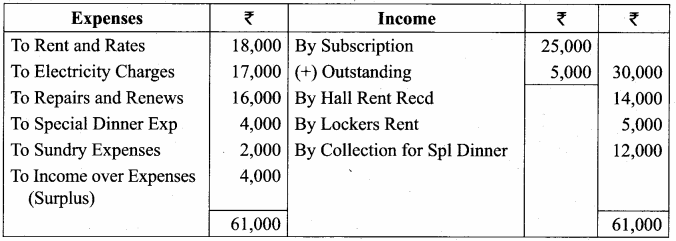
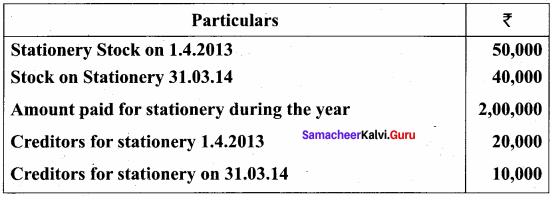
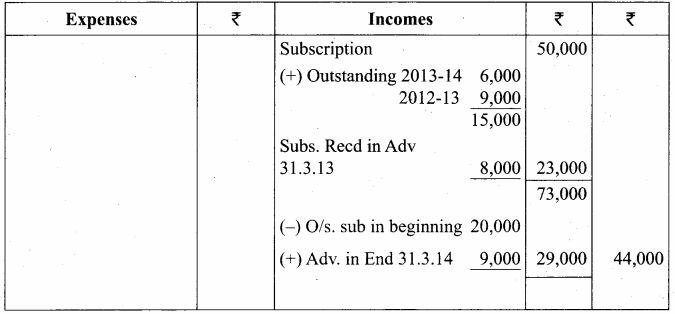
Subscription of ₹ 9,000 is still in arrears for the year 2012 – 13. Prepare Income and Expenditure Account for 2013 – 2014.
Answer:
Income and Expenditure Account for the year 31.03.14
Samacheer Kalvi 12th Accountancy Solutions Chapter 2 Accounts of Not-For-Profit Organisation 60

Question 2.
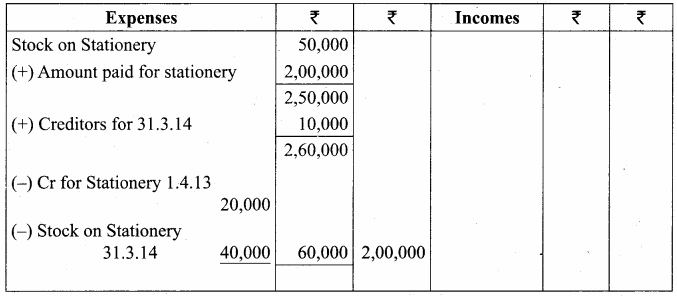
Samacheer Kalvi 12th Accountancy Solutions Chapter 2 Accounts of Not-For-Profit Organisation 61
Answer:
Income and Expenditure Account for the year 31.3.14
Samacheer Kalvi 12th Accountancy Solutions Chapter 2 Accounts of Not-For-Profit Organisation 62

Question 3.
What are the steps in preparation of Income and Expenditure from Receipts and Payments account?
Answer:

1. Opening and Closing balances of cash and bank a/cs in receipts and payment account must be excluded.

2. Capital receipts and capital expenditure must be excluded.

3. Only revenue receipts pertaining to the current year should be taken to the credit side of income and expenditure account. Due adjustments should be made for income received in advance income accrued for the current year and for the amount relating to the previous year or years.

4. Similarly revenue expenditure relating to the current year only must be taken in the debit side of income and expenditure account. Adjustment must be made for outstanding expenses of the previous year and current year and for the prepaid expenses of the previous year and current year.

5. Any income or expense relating to specific fund must not be taken to income and expenditure account.

6. Non – Cash items such as bad debts, depreciation, loss or gain on sale of assets etc. which are not recorded in receipt and payments account must be recorded in income and expenditure account.

7.The balancing figure of income and expenditure account is either surplus or deficit and will be transferred to capital fund in the balance sheet. If the total of credit side of income and expenditure account is more than the total of debit side (excess of income over expenditure), the difference represents surplus. If the debit side total income and expenditure is more than the total of credit side), the difference represents deficit.

Question 4.
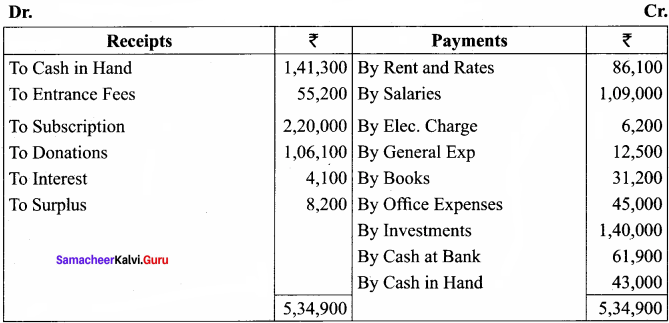
Following is the summary of cash transactions of Friends Club for the year ended 31st March 2016. Prepare Income and Expenditure Account for the year ended 31st March 2016, and also Balance Sheet at that date.
Receipts and Payments Account
Samacheer Kalvi 12th Accountancy Solutions Chapter 2 Accounts of Not-For-Profit Organisation 63
Additional Information:

  1. In the beginning of the year, the club had books worth ₹ 3,00,000 and Furniture worth ₹ 58,000.
  2. Subscription in Arrear 1st April 2015 When ₹ 6,000 and ₹ 7,000 on 31st March 2016.
  3. 18,000 was due by of Rent in the beginning as well at the end of the year.
  4. Write off Rs. 5,000 from Furniture and ₹ 30,000 from Banks.

Balance Sheet as on 01.04.2015
Samacheer Kalvi 12th Accountancy Solutions Chapter 2 Accounts of Not-For-Profit Organisation 64
Answer:
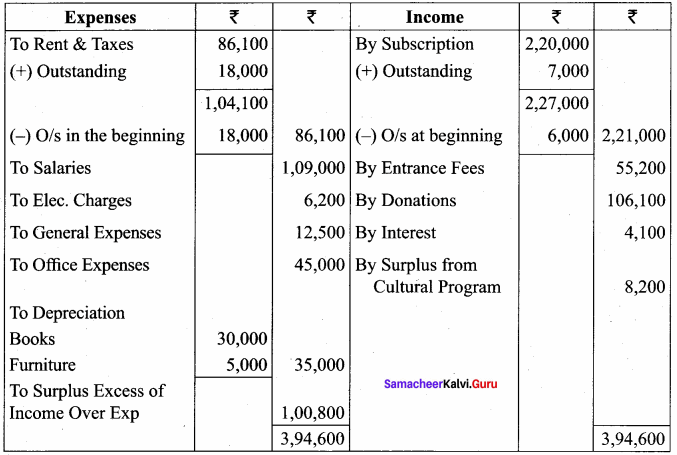
Friends Club:
Income and Expenditure Account for the year ended.
Samacheer Kalvi 12th Accountancy Solutions Chapter 2 Accounts of Not-For-Profit Organisation 65
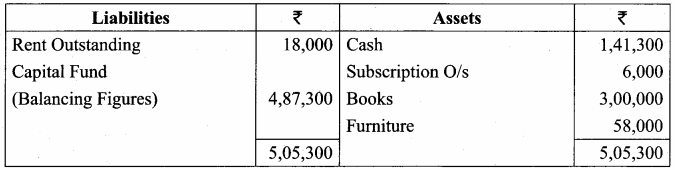
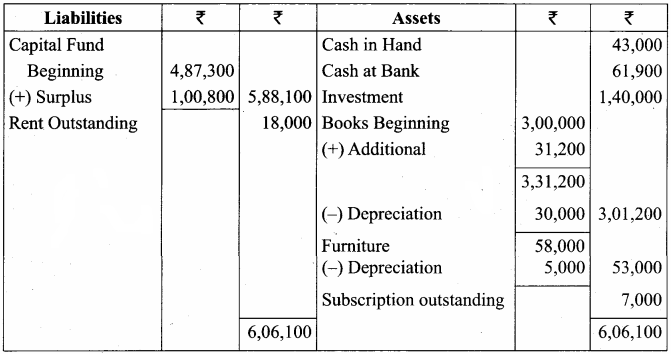
Balance Sheet as on 31.03.2016
Samacheer Kalvi 12th Accountancy Solutions Chapter 2 Accounts of Not-For-Profit Organisation 66

Question 5.
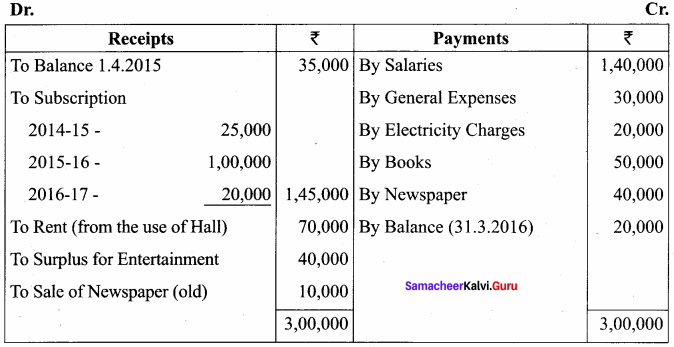
From the following Receipts and Payments Account of Defence Club and from the information supplied, prepare Income and Expenditure Account for the year ended 31st March 2016 and Balance Sheet as on that date.
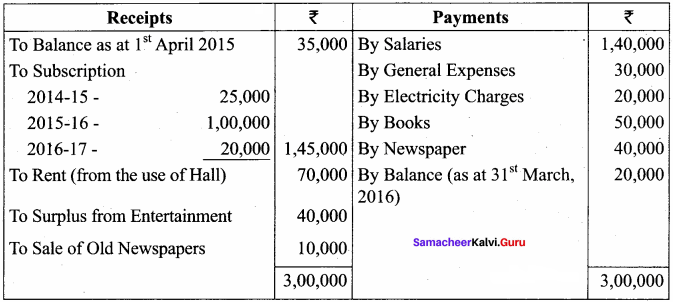
Receipts and Payments Account for the year ended 31.3.2016
Samacheer Kalvi 12th Accountancy Solutions Chapter 2 Accounts of Not-For-Profit Organisation 67

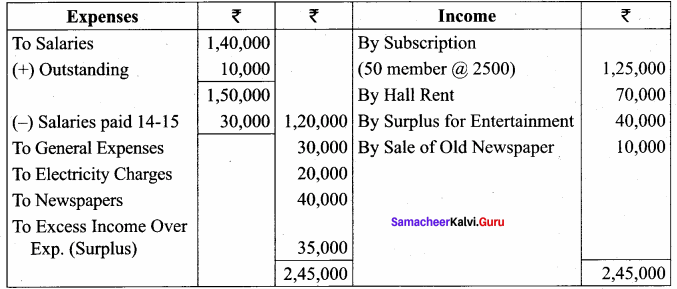
  1. The Club has 50 members each paying an annual subscription of ₹ 2,500. Subscription outstanding in 31.03.2015 were to extent of ₹ 3,000
  2. On 31st March 2016, Salaries Outstanding amounted to ₹ 10,000. Salaries Paid in 2015 – 16 included ₹ 30,000 for the year 14 – 15
  3. On 1st April 2015, the Club owned Building valued @ ₹ 10,00,000; Furniture Worth of ₹ 1,00,000 and Books ₹ 1,00,000

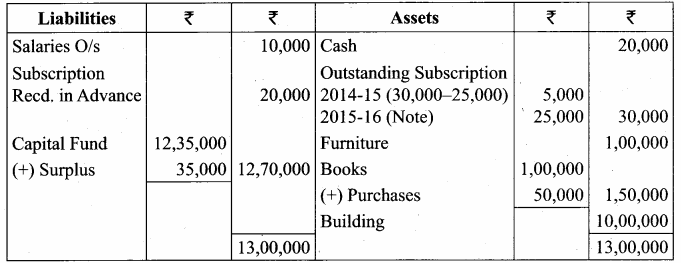
Balance Sheet as on 1.4.2015
Samacheer Kalvi 12th Accountancy Solutions Chapter 2 Accounts of Not-For-Profit Organisation 68
Income and Expenditure Account for the year ended 31.3.16
Samacheer Kalvi 12th Accountancy Solutions Chapter 2 Accounts of Not-For-Profit Organisation 69
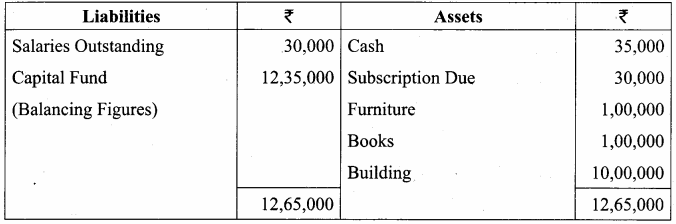
Balance Sheet as on 31.03.2016
Samacheer Kalvi 12th Accountancy Solutions Chapter 2 Accounts of Not-For-Profit Organisation 70

Question 6.
From the following Receipts and Payments Account of Defence Club and from the information supplied, prepare Income and Expenditure Account for the year ended 31st March 2016 and Balance sheet as on that date.
Receipts and Payments Accounts for the year ended 31st March 2016
Samacheer Kalvi 12th Accountancy Solutions Chapter 2 Accounts of Not-For-Profit Organisation 71

  1. The Club has 50 members each paying an annual subscription of ₹ 2,500. Subscriptions outstanding on 31st March, 2015 were to the extent of ₹ 30,000.
  2. On 31st March, 2016, Salaries Outstanding amounted to ₹ 10,000. Salaries Paid in 2015 – 16 included ₹ 30,000 for the year 2014 – 15
  3. On 1st April 2015, the Club owned building valued at ₹ 10,00,000. Furniture worth ₹ 1,00,000 and Books ₹ 1,00,000.

Answer:
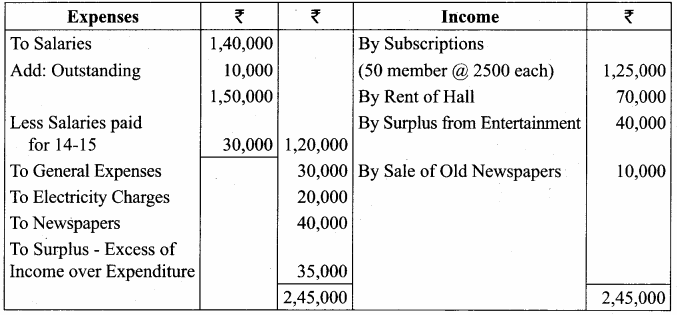
Defence Club
Income and Expenditure Account for the year ended 31st March, 2016
Samacheer Kalvi 12th Accountancy Solutions Chapter 2 Accounts of Not-For-Profit Organisation 72
Balance Sheet as at 31st March 2016
Samacheer Kalvi 12th Accountancy Solutions Chapter 2 Accounts of Not-For-Profit Organisation 73
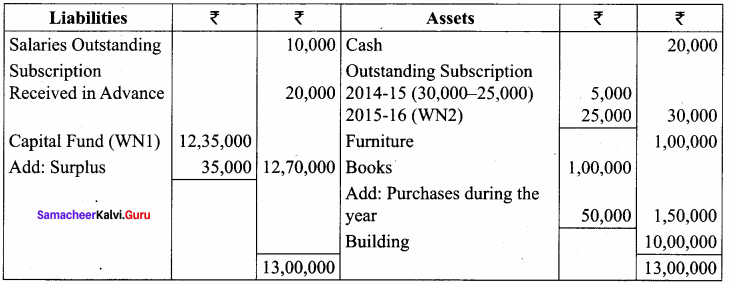
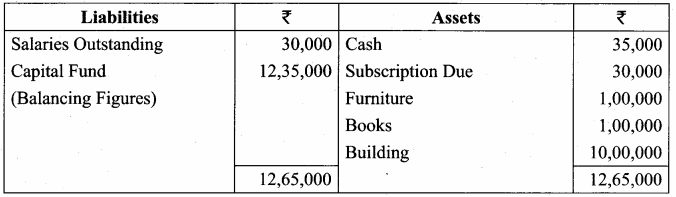
Working Notes 1. Calculation of Capital Fund as at 1st April, 2015
Samacheer Kalvi 12th Accountancy Solutions Chapter 2 Accounts of Not-For-Profit Organisation 74
Balance Sheet as at 31st April, 2015

Question 7.
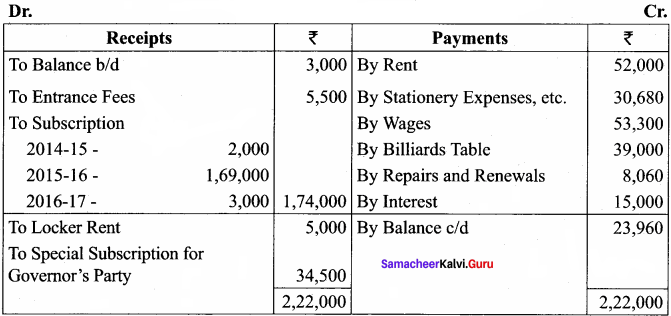
Following is the Receipts and Payments Account of the Mumbai Club for the year ended 31st March 2016:
Receipts and Payments Accounts for the year ended 31st March 2016
Samacheer Kalvi 12th Accountancy Solutions Chapter 2 Accounts of Not-For-Profit Organisation 75
Additional Information:

  1. Stationery Expenses, etc ₹ 3,120 related to 2014 – 15 still owing ₹ 3,640.
  2. Subscription unpaid for 2015 – 16 ₹ 8,680; Special subscriptions for Governor’s party outstanding ₹ 5,500. Governor’s party is to be held in April 2016.
  3. The Club owned sports materials of the value ₹ 1,60,000 on 1st April, 2015. This was valued at ₹ 1,35,000 on 31st March, 2016, stock includes sports materials of ₹ 5,000, which is to be written off being not usable. The club took a loan of ₹ 2,00,000 in 2014 – 15.

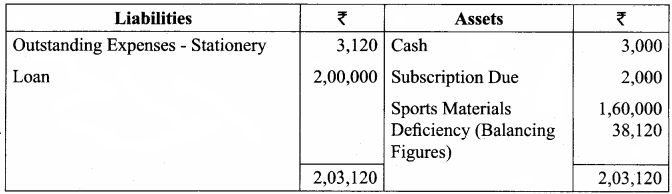
Prepare Income and Expenditure Account for the year ended on 31st March, 2016 and Balance Sheet as on that date.
Balance Sheet as on 1st April 2015
Samacheer Kalvi 12th Accountancy Solutions Chapter 2 Accounts of Not-For-Profit Organisation 76
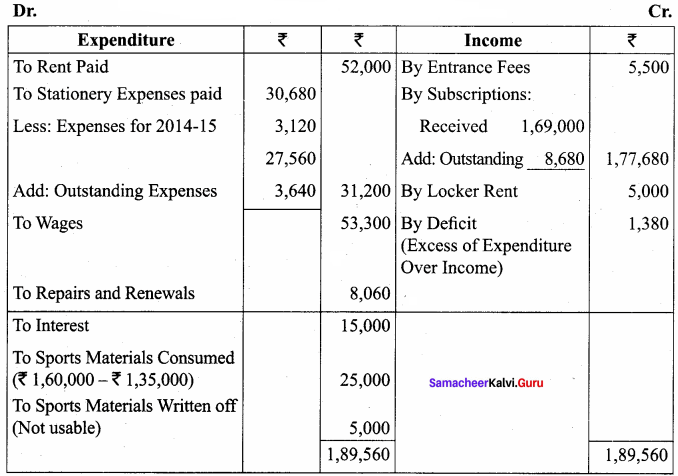
Mumbai Club Income And Expenditure Account for the year ended 31st March, 2016
Samacheer Kalvi 12th Accountancy Solutions Chapter 2 Accounts of Not-For-Profit Organisation 77
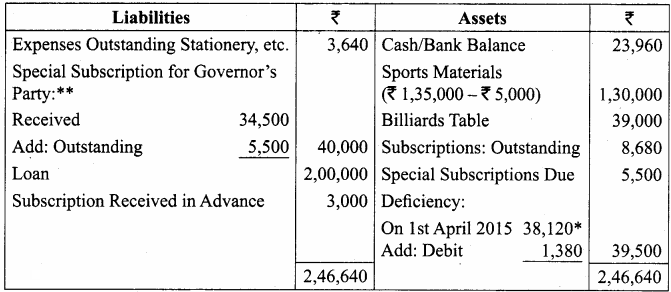
Balance Sheet as on 31st March, 2016
Samacheer Kalvi 12th Accountancy Solutions Chapter 2 Accounts of Not-For-Profit Organisation 78

Question 8.
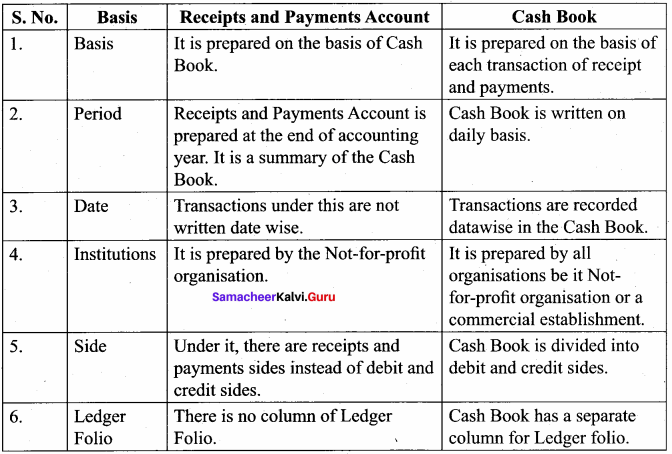
Distinction between Receipts and Payments Account and Cash Book.
Answer:
Samacheer Kalvi 12th Accountancy Solutions Chapter 2 Accounts of Not-For-Profit Organisation 79

Samacheer Kalvi 11th English Solutions Prose Chapter 3 Forgetting

Students who are interested in learning of 11th English Prose Chapter 3 Forgetting Questions and Answers can use Tamilnadu State Board Solutions of 11th English Chapter Wise Pdf. First check in which chapter you are lagging and then Download Samacheer Kalvi 11th English Book Solutions Questions and Answers Summary, Activity, Notes Chapter Wise. Students can build self confidence by solving the solutions with the help of Tamilnadu State Board English Solutions. English is the scoring subject if you improve your grammar skills. Because most of the students will lose marks by writing grammar mistakes. So, we suggest you to Download Tamilnadu State Board 11th English Solutions according to the chapters.

Tamilnadu Samacheer Kalvi 11th English Solutions Prose Chapter 3 Forgetting

Check out the topics covered in Prose Chapter 3 Forgetting Questions and Answers before you start your preparation. Improve your grammar skills with the help of Samacheer Kalvi 11th English Book Solutions Questions and Answers pdf links. The solutions for Tamilnadu State Board 11th English Textbook are prepared by the English experts. So, if you follow Tamilnadu State Board Solutions 11th English Textbook Solutions you can cover all the topics in Prose Chapter 3 Forgetting Questons and Answers. This helps to improve your communication skills.

Check out the topics covered in Chapter 3 Forgetting Questions and Answers before you start your preparation. Improve your grammar skills with the help of Samacheer Kalvi 11th English Book Solutions Questions and Answers pdf links. The solutions for Tamilnadu State Board 11th English Textbook are prepared by the English experts. So, if you follow Tamilnadu State Board Solutions 11th English Textbook Solutions you can cover all the topics in Chapter 3 Forgetting Questons and Answers. This helps to improve your communication skills.

Warm up

11th English Forgetting Lesson Summary Question 1.
How forgetful are you?
Answer:
We are all forgetful at times and would like to find ways of improving our memories.

A. How sharp is your memory?

Take this five-minute memory test. The teacher will read out a series of 30 words, one by one. Some of them will be repeated. Whenever you hear a word for the first time, write ‘N’ (for New) in the corresponding box and when you hear a repeated word write ‘R’ After completing this task, check your results. Compare it with your friends and see where you stand.

A set of 30 words is provided here. You can ask your teacher or a friend to read out the words. Hear carefully and do this activity yourself.

11121
21222
31323
41424
51525
61626
71727
81828
91929
102030

Answer:

1astonished11safety21giants
2available12approach22reluctant
3doubt13chemist23devotee
4statistical14methodical24perambulator
5ordinary15doubt25memory
6fortune16perfection26audacious
7devotee17memory27eccentric
8seldom18scarcely28common
9reluctant19thousand29statistical
10important20visitor30efficient

B. Have you ever lost or misplaced anything of value due to forget fulness?

Yes, I have misplaced my hall ticket. I was tensed. My Headmaster asked me not to panic. He identified me to the hall supervisor and allowed me to write my examination in Std X.

At times, instances of forgetfulness may land us in a tight spot or in a difficult situation. Therefore, we need to find ways to remember what we have to do or carry with us. One way is to make a mental check-list that we can verify before starting any activity.

Now discuss with your partner and think of some practical ideas to overcome forgetfulness, in your day-to-day activities.

e.g. setting an alarm

Answer:

e.g. setting an alarmKeeping a diary
ChecklistWrite on calendar
Sticky notesPDA – Personal Digital Assistant

C. Discuss and share your views with the class on the following. Is forgetfulness a result of carelessness or preoccupation?

Team A : We think it is a result of carelessness. If we really attach great importance to details, we will never forget.
Team B : Perhaps, things you are interested in, you don’t tend to forget.
Team C : We think forgetting is mostly by preoccupation with something. Brain can do , multi-tasking but not always. If your mind is focussed on a serious problem and ways of solving it, the brain shuts down all other memory files for a while. It is purely a temporary issue.
Team A&B : Yes, we agree;with team‘C’.

Samacheer Kalvi 11th English Forgetting Textual Questions

1. Based on your understanding of the essay, answer the following questions in one or two sentences each.

Forgetting By Robert Lynd Questions And Answers Question (a)
What does lynd actually wonder at?
Answer:
Robert Lynd wonders at the efficiency of human memory. He is amazed at the ordinary man’s capacity to remember phone numbers, addresses of friends, appointments for lunch and dinner and many names of actors, actresses and leading players in popular games.

11th English Forgetting Lesson Paragraph Question (b)
Name a few things that a person remembers easily.
Answer:
A man easily remembers all the items of clothing, shutting the door before leaving the home, turning off lights before going upstairs, etc,

11th English Unit 3 Prose Question (c)
How do psychologists interpret forgetfulness?
Answer:
Psychologists believe that humans forget what they don’t want to remember, like taking pills.

11th English Unit 3 Question (d)
What is the commonest type of forgetfulness, according to Lynd?
Answer:
Commonest type of forgetfulness occurs in the matters of posting letters. The author himself has forgotten to post his own letters many times.

Forgetting Lesson Question (e)
What does the author mean when he says the letter in his pocket leads an unadventurous life?
Answer:
The poet forgets the letters kept in his pocket. Whenever the friend enquires about the unposted letters, it embarrasses him. Then he is forced to produce the evidence of his guilt (i.e.,) the unposted letters. This awkward humiliation is said to be unadventurous.

Forgetting Prose Summary Question (f)
What are the articles the writer forgets most often?
Answer:
The poet often forgets his books and walking sticks.

Forgetting Lesson Summary Question (g)
Who are the citizens of ‘dreamland’? Why?
Answer:
Boys who return from cricket and football matches tend to forget bats and balls. Their minds are filled with a vision of the playing field. Their heads are among the stars. They are said to be the citizens of dreamland.

Question (h)
What is common about the ‘angler’ and the ‘poet’?
Answer:
The angler enjoys his sport of fishing so intensely that he forgets his fishing rod. Likewise, the poet, who often roams in his own world of imagination, may forget to post a letter. Both the angler’s and the poet’s loss of memory is a tribute to the intensity of their enjoyment.

2. Based on your reading, answer the following questions in two to four sentences each,

Question (a)
What made people wonder about the absentmindedness of their fellow-beings?
Answer:
The publication of articles lost by train travellers astonished many readers. Old people did not forget much. In fact, young men have forgotten bats and balls on their return from matches.


Question (b)
What are our memories filled with?
Answer:
Our memories are filled with names of cricketers, footballers, murderers,. actors and actresses. Our memories are filled with many routine activities.

Question (c)
When does human memory work with less than its usual capacity?
Answer:
Human memory works with less than its usual capacity in matters like taking medicine. The author explains that human memory represents the
willingness to remember certain things. It forgets what it does not wish to remember. Humans are blessed with “selective amnesia”

Question (d)
Why, according to Lynd, should taking medicines be one of the easiest actions to remember?
Answer:
Taking medicines should be one of the easiest actions to remember because doctor has prescribed the medicine to recover from illness. Besides, there is a need to take it either before or after meals. Everytime one takes meals, one should easily remember medicine.

Question (e)
How,do the chemists make fortunes out of the medicines people forget to take? Similar to the author, many remember to forget medicine as soon as the appointed time arrives.
Answer:
The forgotten medicines tend to aggravate the illness. As a vicious cycle, again they are forced to buy costlier medicines. Thus people who forget to take medicines contribute to the fortunes of chemists.

Question (f)
The list of articles lost in trains suggest that sportsmen have worse memories than their ordinary serious-minded fellows. Why does Lynd say this?
Answer:
Considerable number of footballs and cricket bats were forgotten by young sportsmen. Serious – minded ordinary citizens forget less. The author Lynd infers that the sportsmen’s forgetfulness is justified as their minds are full of vision of the playing field. Their heads are in the stars and among the clouds. Keeping their hearts in boots, young sportsmen rush home to talk about their exploits and are naturally more absent-minded than serious- minded ordinary folks.

Question (g)
What kind of absent-mindedness is regarded as a virtue by Lynd?
Answer:
Scientists, poets, anglers and philosophers forget prosaic things. Their minds are absorbed in lofty thoughts and glorious imaginations that they forget ordinary things. Socrates, Tagore and Einstein had the virtue of absent – mindedness. Einstein usually forgot to change his rocks. Once he even forgot his own house address. The absent – mindedness of such great personalities is a virtue. As they make best of life, they have no time to remember the mediocre.


Question (h)
Narrate the plight of the baby on its day out.
Answer:
A father offered to take the baby out in a perambulator. On a sunny morning, he was tempted to have a glass of beer. He entered a pub leaving the perambulator in the street opposite to the pub. A little later, his wife found the baby asleep in the perambulator. Her husband was not found anywhere. She took the perambulator home anticipating her husband’s remorse over the stolen baby. But to her obvious dismay, he walked in cheerfully and asked her what was the lunch. He had completely forgotten the baby on its day out.

3. Answer the following in a paragraph of about 100-150 words each.

Question (a)
You have borrowed a branded cricket bat from your reluctant friend for an outstation match. After returning home you realize you have absent-mindedly left it in the hotel room. Write a letter of apology and regret to your friend.

12, Dhandapani Street,
T. Nagar
13.07.2018.

Dear Madhan / Seema,

I’m. fine. I hope this letter finds you in the best of your health. I’m penning this letter to express my profound sorrow for forgetting to bring your branded cricket bat. I have left it behind in the hotel room in Mumbai. I’m terribly sorry. I was late for the train to Chennai. As I rushed to the station, I just forgot the packed bat. I rang up the hotel. I am told that the bat is safe. Next week, my cousin is coming home. I have asked him to bring it from the hotel. Kindly bear with me. Please do forgive my mistake. I shall certainly return your bat in a fortnight.
With deep regrets

Yours loving friend
Arun / Vanitha

To
K. Madhan
S/0 Krishna
17, Valluvar St,
Urappakam

Question (b)
Kahlil Gibran states ‘Forgetfulness is a form of freedom.’ Write an article for your school magazine, linking your ideas logically and giving appropriate examples.
Answer:
Forgetting is deemed by many people leading prosaic lives as a mistake or an inefficiency of mind. But in reality, forgetfulness is freedom. Osho is right in his opinion of forgetfulness. In fact, it liberates painful memories and unpleasant things. We need to “let go” painful memories of the past and be free to aspire for better things in life. Robert Frost in his poem, “Let go” talks about mediocre person’s inability to let go things that hurt them. The capacity to forget hurtful memories is a real blessing.

If human mind does not have the capacity to forget, life would be miserable for every one of us. Human mind is such a wonderful machine that it retains what is most important for personal or professional growth and allows the other things to slip away from the bank of memory. But young ones should remember to remember important assignments, deadlines for submission of homework, examination time-tables and hall tickets before leaving for examination.

To assist memory we can have a checklist before leaving for the school. It is often said, “If you fail to plan, you plan to fail.” So, my dear friends, I appeal to you to love whatever work you do. The brain retains in memory whatever you do with great passion, love and involvement. For a successful life, a strong memory is indispensable. So, cultivate a strong memory. However, I appeal to you to forget failures, betrayals and hurts to grow into a happy and healthy person.

“Sometimes we survive by forgetting.”

Question (c)
Will you sympathise or ridicule someone who is intensely forgetful? Write an essay justifying your point of view.
Answer:
Forgetfulness, if deemed a form of freedom, must be welcome. But what one forgets matters. Similar to the father who forgot the baby in the perambulator if one forgets main duties, he would become an anathema to even family members. I wouldn’t be hasty to ridicule a person who “suffers” from acute or intense forgetfulness. I would observe, in the first place, what are the items he forgets routinely. Are they trifles or serious things? If a married man forgets his wife and children and forgets his filial duties, then he deserves chastisement and not ridicule.

If forgetting leads to comic situations like wearing chappals in the wrong foot, or wearing the tie in a funny manner, sometimes a person of extraordinary intelligence may forget his residential address similar to Einstein. Scientists and great philosophers like Socrates and Rabindranath Tagore suddenly went into spells of deep contemplation totally forgetting where they were heading to. Once it so happened that socrates went into a trance on a road. His disciples and friends stood around him the whole day. Night came. Friends bought mats and pillows and slept around him hoping to listen to his words of wisdom as soon as the spell breaks and remembers what he saw in his world of imagination.

Towards dawn, the spell broke. Socrates saw the people sleeping around him. He just carefully walked back home. I have my heart-felt sympathies for my friends who study just before examination and forget what they learnt in the examination hall. I’ve my conviction that those who forget naturally need to be treated with a sympathetic understanding because they really don’t know that they forget. Those who suffer from selective amnesia, I mean politicians who give tall promises before elections but remember to forget them soon after winning the elections need to be ridiculed by funny cartoons and in public places because they have done a breach of trust.

“There is some pleasure even in words, when they bring forgetfulness of present miseries.”

Additional Questions

A Give answers to the following question in 100-150 word each.

Question (a)
Why is Robert Lynd amazed at the efficiency of humans to remember things?
Answer:
Robert Lynd is amazed by the efficiency of human memory. Modem man remembers telephone numbers, names of film stars, cricketers, football champions and even notorious murderers. He remarks with jest that man does not forget a single item of his clothing. No one forgets to shut the door when leaving the house. The institution of family survives in modem cities because ordinary people have efficient memory power. In the ordinary life, man remembers almost everything he is expected to remember like birthdays and Valentine’s day. He remembers appointments for dinner and lunch. He remembers what the weather was in a . long-part August. Not even one in thousand forgets, simple things like switching off lights before going upstairs or a single item of dressing. Almost everybody remembers to do the right things of the right moment till it is time to go to bed.


Question (b)
What according to Robert Lynd are the causes for forgetting?
Answer:
In some matters, the memory is less than perfect, causes could be psychological. We tend to forget things we don’t wish to remember. For example, many people forget to take medicines. Medicine needs to be taken before / after meals. Robert Lynd remarks that chemists make a lot of money because people tend to forget to take medicines. It aggravates the disease and people are forced to buy more and more medicines. It may be due to their antipathy to pills and poisons that many people fail to remember them at the appointed hours. The author is quizzed at the fact as to how a life-long devotee of medicines like himself is forgetful of them as those who take them up unwillingly. He admits that even if he has the pills in his pockets as soon as the time of consumption arrives, he forgets it.

Question (c)
Describe the circumstances leading to the vexation of the mother on the baby’s day out.
Answer:
Once a father took his baby out in a perambulator in the morning. He walked into a pub to have a glass of beer. The child was sitting in the perambulator outside in the street. After sometime his wife came that way for shopping. She was shocked to find her baby sleeping in the perambulator. She decided to teach him a lesson. She took the’baby home. She expected her husband to come and apologize for losing the child. But he just walked in and casually asked his wife cheerfully what was there for lunch. Very few people like Einstein or Socrates would be capable of such absent-mindedness.

Question (d)
What are the observations of Robert Lynd on the capacity of humans to remember and forget things?
Answer:
Robert Lynd is amazed by the efficiency of human memory. Modem man remembers telephone numbers, names of film stars, cricketers, football champions and even notorious murderers. He remarks wittily that man does not forget a single item of his clothing. No one forgets to shut the door when leaving the house. The institution of family survives in modem cities because ordinary people have extraordinary memory power. In some matters, the memory is less than perfect, causes could be psychological. We tend to forget things we don’t wish to remember. For example, many people forget to take medicines.

Medicine needs to be taken before / after meals. Robert Lynd remarks that chemists make a lot of money because people tend to forget to take medicines. It aggravates ithe disease and people are forced to buy more and more medicines. Most people forget to post letters. The author himself would not trust his letters to be posted by others. The author himself never remembered to post letters entrusted to him. He had to apologise for the unposted letters kept with him for long. Likewise, the author forgets his walking sticks often.

Question (e)
How does the author prove that absent-mindedness is a boon as well as a bane?
Answer:
Absent – mindedness of people shocked the author when the Railway department published the list of lost articles. It was startling to note that young people forget bats, balls etc. The author attributes it to the abundant imagination and dreams. They are citizens of dreamland. Anglers also forget their fishing rods. Absent – mindedness is often a blessing in disguise. People can forget their unhappiness and live in a world of Utopia. Great thinkers, poets and philosophers are absent – minded because their minds are full of lofty ideas and imagination. Socrates the philosopher and S.T. Coleridge the poet were absent – minded people. Similarly, Politicians have bad memories. States are yet to produce ideal statesmen. Great writers, composers of music have amazingly great memories.

Memory is half the substance of their art. Once a father took his baby out in a perambulator in the morning. He walked into a pub to have a glass of beer. The child was sitting in the perambulator outside in the street. After sometime, his wife came that way for shopping. She was shocked to find her baby sleeping in the perambulator. She decided to teach her husband a lesson. She took the baby home. She expected her husband to come and apologize for losing the child. But he just walked in and casually asked his wife cheerfully what was there for lunch. Very few people like Einstein or Socrates would be capable of such absent-mindedness. Men should forget unpleasant things and remember pleasant things. Thus Absent – mindedness is both a boon and a bane.

Vocabulary

A. Homonyms and Heteronyms.

Complete the sentences by choosing a suitable word from those given in the brackets.

  1. Nobody can say (1) _______ there will be an improvement in the (2) _______ (whether / weather)
  2. Your ring is (1) _______ Do not (2) _______ it.(loose / lose) .
  3. We found a (1) _______ of biscuits in the old man’s shirt (2) _______ (pocket /packet)
  4. When the pole vaulter cleared 28. (1) _______ it was declared a record (2) _______ (feet/feat)
  5. Explain the (1) _______ ‘Cut your (2) _______ according to your cloth.’ (coat / quote)
  6. The’stranger (1) _______ for a few minutes before he (2) _______ . my house.(paused /passed)
  7. The (1) _______ dancer turned (2) _______ after the final performance, (weary /wiry)
  8. The chain that I presented to my sister was not made of gold; it was just (1) _______ Iam suffering from a sense of (2) _______ (guilt / gilt)

Answers:

  1. whether, weather
  2. loose, lose
  3. packet, pocket
  4. feet, feat
  5. quote, coat
  6. paused, passed
  7. wiry, weary
  8. gilt, guilt

Form meaningful sentences using the given words to bring out at least two different meanings.

  1. train – You must train yourself to catch the train in time.
  2. tear – The tear in the uniform brought tears in the eyes of the student.
  3. wind – It is time to wind up the programme because it is very windy and it might rain soon.
  4. light – As the bag was very light, the boy was able carry it though there was no light in his street.
  5. file – She filed all the documents carefully in a file.
  6. bear – The bear couldn’t bear the mischief of the visitor; he took him into the cage and mauled him very badly.

B. Clipped Words
Now, write the clipped and unclipped form of the given words and complete the table.

UNCLIPPEDCLIPPED
chimpanzee___________
___________photo
___________mike
cafeteria___________
___________gas
helicopter___________
telephone___________
___________varsity
___________memo
influenza___________
___________hippo
bridegroom___________
___________fan
demonstration___________
refrigerator___________

Answer:

UNCLIPPEDCLIPPED
chimpanzeechimp
photographphoto
microphonemike
cafeteriacafe
gasolinegas
helicoptercopter
telephonephone
universityvarsity
memorandummemo
influenzaflu
hippopotamushippo
bridegroomgroom
ceiling fan or fanaticfan
demonstrationdemo
refrigeratorfridge

C. Refer to a dictionary and match the professions with their relevant job descriptions

AB
1.pathologiststudies languages and their structure
2.ornithologiststudies atmosphere, weather and climate
3.entomologiststudies the matter that constitutes the Earth
4.archaeologiststudies earthquakes
5.sociologiststudies reptiles and amphibians
6.geologiststudies functioning of human society
7.linguiststudies artefacts and. physical remains
8.seismologiststudies birds
9.herpetologiststudies insects
10.meteorologiststudies diseases

Answer:

  1. studies diseases
  2. studies birds
  3. studies insects
  4. studies artefacts and physical remains
  5. studies functioning of human society
  6. studies the matter that constitutes the Earth
  7. studies languages and their structure
  8. studies earthquakes
  9. studies reptiles and amphibians
  10. studies atmosphere, weather and climate

D. Fill in the blanks choosing the words from the box. Refer to a dictionary if required. One has been done for you.

(thespian, sadist, polyglot, ambidextrous, philanthropist, misanthrope, bibliophile, nonagenarian, teetotaller, globetrotter, optimist)

(i) Peter always refuses alcohol, when it is offered to him at parties and takes a soft drink instead. He says he always has and always will abstain from alcohol and it is a matter of principle for him. We can call Peter a ________
(ii) Aruna always looks at the bright side of things. Even in the face of misfortune, she firmly believes that everything will workout for the best in the end. What can we call Aruna? ________
(iii) The rich industrialist donated a huge sum of money to set up a public library in his native village. He is a ________ and a social reformer.
(iv) The Chair person of our company keeps travelling all over the world to attend conferences and we call her a ________
(v) Antony has the amazing ability to use both his hands, equally well. He can write, draw and perform various other tasks with equal speed and efficiency with his left as well as his right hand. Antony is ________
(vi) Due to some disturbing incidents in her childhood, Neetu grew into a reclusive adult. She tends to keep aloof and avoids all kinds of social activities. Neetu is a ________
(vii) Tharini serves as an interpreter at meetings between statesmen from different countries. She is also a much sought-after tour guide, as she is well-versed and fluent in multiple languages. Tharini is a ________
(viii) My grandparents are in their nineties. I am glad that this ________ couple are active, cheerful and in good health.
(ix) Richard Burton was a gifted theatre artist. He donned several roles with ease and is especially famous for the Shakespearean parts he played on stage. Mr. Burton is a born ________
(x) The Chairman of this concern seems to derive pleasure from inflicting pain on others. He humiliates and hurts his subordinates for no reason. He is a real ________

Answers:

(i) tee totaller
(ii) optimist
(iii) philanthropist
(iv) globetrotter
(v) ambidextrous
(vi) misanthrope
(vii) polyglot
(viii) nonagenarian
(ix) thespian
(x) sadist

E. Find the antonyms of the following words in the puzzle and shade them with a pencil. The first one has been done for you.

  1. seldom,
  2. admitted,
  3. methodical,
  4. reality,
  5. virtue,
  6. vile,
  7. indignant,
  8. relish,
  9. fact Spot the word

11th English Forgetting Lesson Summary Samacheer Kalvi Prose Chapter 3

Answers:

  1. often
  2. denied
  3. haphazard
  4. fantasy
  5. vice
  6. good
  7. delighted
  8. hate
  9. fiction

Forgetting By Robert Lynd Questions And Answers Samacheer Kalvi 11th English Solutions Prose Chapter 3

Listening Activity

A. First, read the incomplete sentences given below. Listen to two interesting anecdotes about two scientists that your teacher will read aloud or play on the recorder. Then, based on your understanding, complete the sentences suitably.

(For listening to the passage refer to our website www.fullcircleeducation.in) Thomas Alva Edison stepped from a train in Orange, New Jersey and walked down the platform. The station master knew how forgetful the famous inventor was. Therefore, he would always ask him a customary question. He asked Edison if he had left anything behind. Edison confidently replied that he had not left anything and everything was safe with him. Then, he began taking a count of his suitcases. As he was doing so, he happened to look up at the train. With a start, he dropped his bags and raced back to the car in which he had been travelling. What prompted that burst of activity was the face of his bride, with whom he had just married and returned from a honeymoon trip, staring from a window.

Albert Einstein was working at the Princeton University. One day when he was going back home he forgot his home address. The driver of the cab aid not recognize him. Einstein asked the driver if he knew Einstein’s home. The driver exclaimed that there could be no one who did not know Einstein’s address. He added that everyone in Princeton knew where Einstein lived and asked him if he wanted to meet Einstein. Einstein with a sheepish grin replied that he was Einstein and he had forgotten his residential address. He requested the cabbie if he could take him there. The astonished driver drove him home and dropped him safely. The cabbie considered driving Einstein a great honour and refused to charge him for the service.

  1. Edison travelled to New Jersey by ______
  2. The station master enquired if Edison ______
  3. Edison raced back to the car, when he saw ______
  4. Albert Einstein was working in ______
  5. One day, when he was going back home, he ______
  6. Einstein asked the cab driver if he knew ______
  7. The driver was so good that he ______

Answers:

  1. a train
  2. had left anything behind
  3. the face of his bride
  4. Princeton university
  5. forgot his residential address
  6. Einstein’s residence
  7. refused to charge him for his

Speaking Activity

Work with a partner and take turns to share your views and suggestions with the class.

Question (i)
You are travelling in a train. When the Train Ticket Examiner enters your compartment, much to your shock, you realize you have forgotten to bring your train ticket. How will you handle the situation?
Answer:
TTE : Please show me your ticket.
Ragu : Oh! sorry! I left my printed ticket on my table.
TTE : Well, this is a reserved compartment, Don’t you know?
Ragu : Sir, I have reserved my ticket. It is 28 UB, S7 in Pandiyan Express.
TTE : Well, what you say might be true. But I want the ticket.
Ragu : Sir, could you please give me five minutes.
TTE : Why? .
Ragu : I will ask my sister to scan the ticket and send it to my phone by WhatsApp.
TTE : Okay. But get it in five minutes.
Ragu : Thank you so much sir.


Question (ii)
You forget to wish your best friend on his/her birthday. He gets very angry. How will you try to pacify him/her? Construct a dialogue of about 4 to 5 exchanges and enact a role play.
Answer:
Ramesh : Ravi, aren’t you my best friend?
Ravi : Why do you doubt it?
Ramesh : You didn’t even wish me. Yesterday evening I was waiting for you till 9 pm. Ravi : I’m terribly sorry! I was at the Chepauk stadium watching CSK batting under trying conditions.
Ramesh : Oh! when it comes to cricket, you forget even your weekly tests.
Ravi : Friend, forgive me. Accept my belated wishes.
Ramesh : Okay. Let us forget it and talk about the match.

Question (iii)
‘Forgetfulness is the beginning of happiness’ Do you agree or disagree? Discuss in class.
Answer:
In “Ode to skylark,” Shelly beautifully portrays the human beings’ boundless capacity to worry about dead yesterday, unborn tomorrow and spoil the happiness of a perfectly beautiful present. He says, “We look before and after and pine for what is not. Our sincerest laughter with some pain is fraught”. Human mind has a soft comer for harbouring hurts and pain. It replays them like a broken record often and sustains hostility between individuals. It requires a mature mind to forgive and forget. The road to recovery of any invisible hurt starts the moment one forgives the person and casually forgets all unpleasant memories connected to it. Human mind, according to Robert Lynd, forgets what it chooses to forget. We are in a civilized society because everyone remembers to dress properly and remember the names of friends and relatives. If one develops the attitude to remember only pleasant things, the mind will train itself to forget insignificant bad memories. Thus forgetting is the beginning of real happiness.

Question (iv)
Is there a link between intelligence and absent-mindedness? Share your views on this subject.
Answer:
Of course yes, the person who is smart and extremely intelligent focusses his entire being on an issue or an invention. Thus all other things are abstracted. Great genius like Einstein and philosophers like Tagore tend to forget mundane affairs. Their minds are always preoccupied with lofty ideas and the ills of the society. So, it is believed that eccentricity like absent mindedness is common among very intelligent people. The best example is Einstiein. He sat in the railway coach leaving behind his newly married bride in the car. Only on seeing her furious face, he realized the fact that he forgot to take her along into the railway coach.

Reading Activity

Now, read the following biographical extract on Sujatha Rangarajan, a Science-fiction writer, and answer the questions that follow.

1. Sujatha is the allonym of the Tamil author S. Rangarajan and it is this name that is recognised at Once by the Tamil Sci-Fi reading community. You might have heard of Chitti and his extraordinary exhibition of different qualities in an incredible manner. The robot could excel a human being in any act beyond one’s imagination. Jeeno, a robotic dog which appeared in Sujatha’s science fiction novel “En Iniya Iyandhira” (My Dear Robot) formed the basis of Chitti’s character. Like Chitti, Jeeno was an all-rounder who could cook, clean and fight.

Very high tech computer technology terms are used in the story. Jeeno, a pet robot, plays an important role throughout the story. As the story proceeds, it behaves and starts to think on its own like-a human and instructs Nila, a human being, on how to carry on further.


2. In the preface of ‘En Iniya Iyandhira’,the writer states the reason for his attraction to the genre: “Science gives us the wonderful freedom to analyse thousands and thousands of alternative possibilities. While using it, and while playing with its new games, a writer needs to be cautious only about one thing. The story should draw some parallels or association from the emotions and desires of the present humankind. Only then it becomes interesting. Jeeno, the robot dog, was intelligent.

But the character became popular only because of the robot’s frequently displayed human tendencies. It is no wonder that his works echo these words about him and will reflect in the minds of the readers who enjoy reading his novels to have a lifetime experience.

3. It was Sujatha, who set the trend in sci-fi stories. He had tracked the origin from Mary Shelly’s Frankenstein to his short stories. He has written 50 sci-fi short stories published in various Tamil magazines.

His stories have inspired many readers to extend their reading to English sci-fi writers like Isaac Asimov. The themes were bold even if there was a dependence on very well – established characterisation of English fiction. Sujatha opened up a new world to us with his writings on holograms, computers and works like ‘En Iniya Iyanthira’, inspire many to study computer science.

4. He has been a great writer for more than four decades. He combined reasoning and science in his writings. Being a multifaceted hi-fi and sci-fi humanistic author, he expressed his views distinctively. He was the one who took Tamil novels to the next level. As an MIT alumnus and an engineer at BHEL, he was very good at technology. So, he narrated sci-fi stories, impressively. His readers always enjoyed reading all his detective and sci-fi novels which featured the most famous duo Ganesh and Vasanth.

5. Sujatha has played a crucial role as a playwright for various Tamil movies which have fascinated movie lovers. Hence, it is fathomable that the writer’s perspective of future India enthuses every reader and paves a new way to reading sci-fi stories in English.

A. Answer the following questions in a sentence or two.

Question (i)
How was Jeeno different from other robots?
Answer:
Other robots did tasks only as per the commands issued. But Jeeno frequently displayed human tendencies. It behaved and thought like a human being.

Question (ii)
What precaution should one take while writing Science fiction stories?
Answer
The writer should ensure that the story draws some parallel or association from emotions and desires of the present humankind. Only then the science-fiction would be interesting.

Question (iii)
What inspired Sujatha’s themes?
Answer:
Sujatha had bold trend in sci-fi stories. He had tracked the origin from Mary Shelley’s Frankenstein to his short stories. He opened up a new world to the readers with his writings on holograms, computers, robots who feel and behave like humans, (e.g) “En Iniya Iyanthira”. In short, Sujatha’s themes were inspired by reasoning, science, technology, computers and humanoids.


Question (iv)
Why were Sujatha’s sci-fi stories impressive?
Answer:
Sujatha’s sci-fi stories have really inspired Tamil readers to move on to read Isaac Asimov. He combined reasoning with science in his writings. Being a multi-faceted hi-fi and sci-fi humanistic author, he expressed his views distinctly. Being an alumni of MIT, he was good at technology. Thus his sci-fi stories were always impressive with interesting characters like Chitti, the robot; Jeeno the robot-dog and detective duo Ganesh and Vasanth.

B. Find words from the passage which mean the same as the following.

  1. difficult to believe (para 1) incredible
  2. a style or category of art, music or literature (para 2) genre
  3. having many sides (para 4) multifaceted
  4. capable of being understood (para 5) fathomable

Grammar

A. Identify the changes in these pairs of active and passive constructions.

11th English Forgetting Lesson Paragraph Samacheer Kalvi Prose Chapter 3

Question 1.
The pilot flew the airplane to Bengaluru.
Answer:
The airplane was flown to Bengaluru by the pilot. In the second sentence, the object has been shifted to the place of subject. It remains passive and allows the work to be done by the noun.

Question 2.
The bananas were eaten by the monkey.
Answer:
The monkey ate the bananas. Here the subject is shifted to the place of object.

B. Change the voice of the following sentences.

Question 1.
Mohammed follows the rules.
Answer:
The rules are followed by Mohammed.

Question 2.
Mohan has completed the course.
Answer:
The course has been completed by Mohan.

Question 3.
Magdalene is singing the prayer.
Answer:
The prayer is being sung by Magdelene.

Question 4.
Who wrote this complaint?
Answer:
By whom was this complaint written?

Question 5.
May God bless you with happiness!
Answer:
May you be blessed with happiness by God.


Question 6.
A house is being constructed by them.
Answer:
They are constructing a house.

Question 7.
Let the door not be slammed.
Answer:
Don’t slam the door.

Question 8.
The team was trained by the coach.
Answer:
The coach trained the team.

C. Make sentences using the passive forms of the verbs.

Question 1.
Tagore/award/Nobel prize/
Tagore was awarded Nobel prize.

Question 2.
IIM Ahmedabad / establish /1961
Answer:
IIM Ahmedabad was established in 1961.

Question 3.
Chhattisgarh/ form / 2000
Answer:
Chhattisgarh was formed in 2000.

Question 4.
First passenger train /inaugurated /India /1853
Answer:
The first passenger train was inaugurated in 1853.

Question 5.
Indian Airlines /set up /1953 ! Indian Airlines was set up in 1953.

D. Look at the newspaper items given below. Use the information in the headlines to complete the sentence.

Question 1.
HEAVY RAINS LASH CHENNAI
______ threw normal life out of gear.
Answer:
Heavy rains threw normal life out of gear.

Question 2.
NEET CLASSES TO BEGIN ON SEPT. 20th
The Centre co-ordinator informed the candidates ______ Sept. 20th
Answer:
The centre coordinator informed the candidates about the commencement of NEET classes on September 20th.


Question 3.
12 INJURED AS BUSES COLLIDE
About at the Dindigul bus terminus here today.
Answer:
About 12 passengers were injured as buses collided at Dindigul.

E. Expand the following news headlines in a sentence.

Question 1.
MUNICIPAL ELECTIONS IN DECEMBER
Answer:
Municipal Elections will be held in December.

Question 2.
TELEPHONE CUSTOMERS TO GET VIDEO PHONE BSNL
Answer:
proposes to give video phone to its customers at a low cost.

Question 3.
CARD LICENSE TO REPLACE PAPER DRIVING LICENSE
Answer:
Transport Minister announced that paper licenses will be replaced with card licenses.

Question 4.
ATM WITHOUT SECURITY GUARD TO CLOSE RBI
Answer:
announced that all ATMS which have no security guard will be closed.

F. Describing a process

1. Complete the passage by filling the blanks with the passive forms of the verbs.

11th English Unit 3 Prose Samacheer Kalvi Chapter 3 Forgetting

The water should be boiled in a vessel. Then tea leaves and milk (1) _____ to the water. The vessel (2) _____ with a lid. The tea (3) _____ and (4) _____ into the tups. Sugar (5) _____ . and (6) _____ The tea (7) _____ hot.
Answers:

  1. should be added
  2. must be covered
  3. should be filtered
  4. poured
  5. should be added
  6. stirred
  7. should be served

2. Here is a recipe to make chocolate cake in a pressure cooker. Rewrite the instructions in passive voice. The first one has been done for you.

Question (i)
First sift the flour, cocoa powder and baking powder in a mixing bowl.
Answer:
The flour, cocoa powder and baking powder are first sifted in a mixing bowl.


Question (ii)
Add butter, sugar, salt, water and vanilla and beat the ingredients using a whisk.
Answer:
Butter, sugar, salt, water and vannila should be added and the ingredients must be beaten using a whisk. .

Question (iii)
Add the eggs and beat the batter until it is smooth.
Answer:
The eggs must be added and the batter must be beaten until it is smooth.

Question (iv)
Transfer the batter into the baking tin.
Answer:
The batter must be transferred into the baking tin.

Question (v)
Heat the pressure cooker, covered with the lid but without the pressure, for 3-4 minutes on high heat. Then place the cake tin in the empty cooker (Do not add water in the cooker).
Answer:
The pressure cooker must be heated. It should be covered with the lid but without the pressure. It must be left for 3-4 minutes on high heat. The cake tin must be kept in the empty cooker. (Let not water be added in the cooker)

Question (vi)
Close the lid (without the pressure), lower the flame and let it cook for about 30 minutes.
Answer:
Let the lid be closed without the pressure. The flame must be lowered and it must be let to cook for about thirty minutes.

3. Write the process of wrapping a Christmas gift in a paragraph in passive form, with the help of the pictures given below.

11th English Unit 3 Samacheer Kalvi Forgetting

Answers:

  1. The gift must be placed in a rectangular box.
  2. The required paper must be measured. The gift paper must be placed on the box. It must be wrapped loose end up and over and a cut must be made.
  3. The gift paper must be placed face down and centred on the box. The first edge must be brought up and taped in place on to box. Then it must be brought other side up and taped in place.
  4. The sides should be folded in against the edges of the box. The diagonal flaps you have created must be creased.
  5. The top edge should be folded down. Then bottom edge should be folded up and taped.
  6. A gift tag must be added with a bow and ribbon to really class up your Christmas gift and impress recipients of your gift.

Subject and Verb Agreement (Concord)
A. Underline the correct verb in these sentences.

  1. The girl and her sisters _______ (watch,watches) television everyday.
  2. Ravi _______ (doesn’t, don’t) like sports.
  3. My classmates _______ (study, studies) before a test.
  4. One of the cookies _______ (is, are) missing.
  5. A lady with ten cats _______ (live, lives) in that big house.
  6. Measles _______ (is, are) very serious.
  7. The committee _______ (decide, decides) when to adjourn.
  8. Our team _______ (is, are) the best.
  9. Everybody _______ (enjoy, enjoys) a good song.
  10. Either of these _______ (is, are) suitable.

Answers:

  1. watch
  2. doesn’t
  3. study
  4. is
  5. lives
  6. is
  7. decides
  8. is
  9. enjoys
  10. is

B. Correct the following passage.

Where does the deer and the antelope play? One place is Yellowstone National Park. It were created in 1872. Parts of the park is in Wyoming, Montana and Idaho. The park are a safe place for many animals. Bears, moose, buffalo, deer and antelope lives there. Beavers, otters, fish and eagles also enjoys the park. For them, Yellowstone be ‘home sweet home.’
Answer
Where do the deer and the antelope play? One place is Yellowstone National Park. It was created in 1872. Parts of the park are in Wyoming, Montana and Idaho. The park is a safe place for many animals. Bears, moose, buffalo, deer and antelope live there. Beavers, otters, fish and eagles also enjoy the park. For them, Yellowstone is ‘Home, sweet home.’

Writing

Biographical sketch:

A biographical sketch is a brief summary of a person’s life and his achievements. It should include a description of the person’s physical appearance, education, work, achievements and other salient personal traits. The main focus of a biographical sketch is to portray the person in an admirable way.

(a) Given below are hints about a renowned British science fiction writer Arthur C. Clarke. Write a biographical sketch on the author in not more than 80-100 words based on the information given below.

NameArthur C. Clarke
Pen namesCharles Willis, E.G.O’Brien
Birth16 Dec 1917, England
CareerNovelist, Television host, inventor and film screen writer.
GenreScience Fiction, Television series, film screen play
Awards and Honours1961, Kalinga Prize – an award given by UNESCO for

popularising science

Hugo and Nebula Awards

Chairman of the Interplanetary Society

Highest Civil Honour of Sri Lanka – ‘Sri Lankabhimanya 2005’

TitlesClarke, Robert Heinlein and Isaac Asimov – ‘Big Three’ of Science Fiction

‘The Prophet of the Space Age’

Famous WorksChildhood’s End 2001: A Space Odyssey Rendezvous with Rana

Arthur C. Clark was bom on 16th December, 1917 in England. He was a novelist, television host, inventor and film screen writer all bundled into one. He gained popularity in science fiction, sensational T.V serials and screen play writing. In recognition of his exceptional skills, he was awarded Kalinga prize for popularising science. This award was given to him by UNESCO in 1961..He was made the chairman of Interplanetary Society and also conferred Hugo and Nebula awards, He was given the highest civilian (award) honour of Sri Lanka ‘Sir Lankabhimanya in 2005’. Clarke is often regarded as one of the triumvirs of sci-fi writers, (i.e) Robert Heinlein, Asimov and himself. He is hailed as “The Prophet of Space Age”. He is widely remembered world over for his famous work “Childhood End”, “2001: A space Odysey”: and “Rendezvous with Rana”.

Report Writing:

Question (a)
You have recently attended a seminar on ‘Science and Literature’ in which writers presented papers on Science Fiction and literature and focused on the creativity of young writers. Write a short report about it for a leading newspaper in about 100-120 words.
Answer:
The seminar on “Science and Literature” was held at American college, Madurai. It was organized in memory of Prof. Vasanth. Students from various colleges, Government Higher Secondary Schools and Matriculation schools were present. Dr. Paul Luv inaugurated the seminar. Students from Manjakkuppam Higher Secondary School talked about novels of Jules Verne-(i.e) Journey to the center of the earth, Twenty thousand leagues under the sea, From earth to the moon, Around the world in eighty days, Five weeks in a balloon, Off on a comet, An Antartic mystery has prophesied man’s potential ability to carryout space travel, explore

Antartica, do deep water Research, mission to moon and other celestial bodies. It is mind boggling to realize that he wrote about these latest developments before 1905. Students were ‘ much impressed by the prolific sci-fi writings of the French novelist more than a century ago.

Prof. Sangeetha spoke on Aldous Huxley’s brave new world which predicted Human genome project and how science can help produce babies with special attributes, size, colour and ’ character traits. All of us, know the cloning of ‘Dolly’. Student from Government Hr. Sec. School D. Kala spoke about Alvin Toffler and how he had predicted revolution due to technological break through in his most famous books. “Future shock”, “The third wave” r and “power shift”. He discusses modem technologies including the digital revolution, and the communication revolution.Malathy talked about Sujatha, Tamil Sci-fi writer who influenced large number of children and adults to fall in love with computers and robotics. His imaginary characters Chitti and Jeeno I have endeared him to the masses.

Asimov has written large number of Sci-fi stories in collaboration with Robert A. Heinlein and Arthur C. Clarke. Asimov’s most famous work is the “Foundation series” and Galactic empire”. Asimov has written Lucky start series of Juvenile science-fiction using the pen name Paul French.The seminar ended with the note that many sci-fi writers have greatly contributed to the giant strides science and Technology has made in recent times. Students must read and write sci-fi fiction to influence the development of love for science.


Question (b)
You are the School Pupil Leader. Your school organised an Inter-School Sports event at Nehru Stadium. Write a report on the special events conducted in 100-120 words for the school souvenir.
Answer:
Hon Balakrishna Reddy, the minister for sports inaugurated the sports meet in the presence of state project officer RMSA Dr. V.C. Rameswara Murugan. Mr. Peter the physical director from Salem coordinated all the events. In the track and field events, Meena and Tamilselvi from Ashok Nagar Girl’s School bagged gold and silver medals. In the men’s event, Kandan

Subbu from Government Boys High School, Nungambakkam bagged Gold and Silver medals. Third position was bagged by Presidency School girl Suba. In boy’s event, Ambedkar School Sukumar bagged a silver medal.

Maheswari of Girl’s School, Guduvancherry won the gold in weightlifting. It was heartening to note many Government School students playing tough against even private schools which give special coaching in sports and games. Chandran, the Chief Inspector of Physical Education gave away the prizes to all the winners of various sports and games events.

Forgetting About the Author

Forgetting Lesson Samacheer Kalvi 11th English Solutions Prose Chapter 3

Robert Lynd is an Anglo-Irish writer, essayist and a poet. He is respected as one of the greatest essayists of the 20th century. He wrote many articles for leading journals and newspapers like Daily News, the New Statesman and Nation. He wrote under the pseudonym name “Y.Y His essays dealt with interesting and simple topics. His essays arc humourous delightful, ironical and satirical. I le was awarded with an honorary literary Doctorate by Queen’s university. He was confessed silver medal by the Royal Society of Literature.

Forgetting Summary

Robert Lynd is a humorous and delightful essayist. His essays are simple, playful and satirical. His style of writing is elegant and charming. In his essay “Forgetting”, he writes about the root causes of forgetting and also explains what items are usually forgotten by people.

Forgetting Prose Summary Samacheer Kalvi 11th English Solutions Chapter 3

Robert Lynd is amazed by the efficiency of human memory. Modem man remembers telephone numbers, names of film stars, cricketers, football champions and even notorious murderers. He remarks wittily that man does not forget a single item of his clothing; No one forgets to shut the door when leaving the house. The institution of family survives in modem cities because ordinary people have extraordinary memory power. In some matters the memory is less than perfect, causes could be psychological. We tend to forget things we don’t wish to remember.

For example, many people forget to take medicines. Medicine needs to be taken before / after meals. Robert Lynd remarks that chemists make a lot of money because people tend to forget to take medicines. It aggravates the disease and people are forced to buy more and more medicines. Most people forget to post letters. The author himself would not trust his letters to be posted by others. The author himself never remembered to post letters entrusted to him. He had to apologise for the unposted letters kept with him for long. Likewise, the author forgets his walking sticks often.

Absent – mindedness of people shocked the author when the Railway department published the list of lost articles. It was startling to note that young people forget bats, balls etc. The author attributes it to the abundant imagination and dreams. They are citizens of dreamland. Anglers also forget their fishing rods. Absent – mindedness is often a blessing in disguise. People can forget their unhappiness and live in a world of Utopia. Great thinkers, poets and philosophers are absent – minded because their minds are full of lofty ideas and imagination.

Socrates the philosopher and S.T. Coleridge the poet were absent – minded people. Similarly, Politicians have bad memories. States are yet to produce ideal Statesmen. Great writers, composers of music have amazingly great memories . Memory is half the substance of their art. Once a father took his baby out in a perambulator in the morning. He walked into a pub to have a glass of beer. The child was sitting in the perambulator outside in the street. After sometime, his wife came that way for shopping. She was shocked to find her baby sleeping in the perambulator.

She decided to teach her husband a lesson. She took the baby home. She expected her husband to come and apologize for losing the child. but he just walked in and casually asked his wife cheerfully what was there for the lunch. Very few people like Einstein or Socrates would be capable of such absent-mindedness. Men should forget unpleasant things and remember pleasant things.

Textual:

abstracted – lacking concentration on what is
happening around
antipathy – strong dislike
audacious – bold and daring
delinquent – a young person who is regularly
involved in wrongdoing
eccentric – tending to act strangely
exploits – daring or heroic acts or actions, feats
fallible – capable of making mistakes
fortunes – huge sums of money
indignant – being very angry.
mediocre – not very good, ordinary
prosaic – dull
quivering – trembling, shivering
reluctant -unwilling
sieve – strainer or filter
vexation – irritation, annoyance
vintage – wine of high quality produced in a particular year

Additional:

Antipathy – dislike
Magnificent – spectacular
Prosaic – dull

Forgetting Synonyms

Choose the most appropriate synonym for the underlined word. (Exam model)

Question 1.
The ordinary man seldom forgets things. .
(a) frequently
(b) rarely
(c) never
(d) often
Answer:
(b) rarely


Question 2.
A very methodical man remembers to take medicine.
(a) chaotic
(d) organized
(c) disarrayed
(d) inefficient
Answer:
(d) organized

Question 3.
I am always reluctant to trust a visitor to post my letters.
(a) willing
(b) unwilling
(c) like
(d) hatred
Answer:
(b) unwilling

Question 4.
It is because of their antinathv to pills.
(a) love
(b) affinity
(c) like
(d) aversion
Answer:
(d) aversion

Question 5.
Chemists makes their fortunes out of medicines people forget to take.
(a) riches/wealth
(b) poverty
(c) paucity
(d) luck
Answer:
(a) riches/wealth

Question 6.
A long chain of circumstances leads to a number of embarrassing questions.
(a) comfortable
(b) interesting.
(c) anxious
(d) awkward
Answer:
(d) awkward

Question 7.
I am no delinquent in such matters.
(a) activist
(b) wrongdoer
(c) volunteer
(d) strategist
Answer:
(b) wrongdoer

Question 8.
I dare not carry an umbrella because I forget it often.
(a) believe
(b) refuse
(c) accept
(d) fear
Answer:
(d) fear


Question 9.
He did not even have the grimmest jawed umbrella.
(a) pleasant
(b) charming
(c) beautiful
(d) unpleasnt
Answer:
(d) unpleasnt

Question 10.
An absent – minded angler is good at inventing magnificent lies.
(a) dull
(b) drab
(c) cluster
(d) spectacular
Answer:
(d) spectacular

Question 11.
One has no time to remember the mediocre.
(a) great
(b) exceptional
(c) ordinary
(d) excellent
Answer:
(c) ordinary

Question 12.
He has a memory like sieve.
(a) glass
(b) filter
(c) fitter
(d) sleeve
Answer:
(d) sleeve

Question 13.
He is an audacious perverter of the truth.
(a) daring / bold
(b) timid
(c) frightened
(d) alarmed
Answer:
(a) daring / bold

Question 14.
We regard a person who does not possess a good memory as eccentric.
(a) usual
(b) conventional
(c) controversial
(d) strange / queer
Answer:
(d) strange / queer

Question 15.
Being indignant at her husband’s behaviour, she decided to teach him a lesson.
(a) cool
(b) calm
(c) anxious
(d) angry
Answer:
(d) angry

Question 16.
She anticipated her husband’s white face with quivering lips confessing the theft of the child.
(a) solid
(b) daring
(c) trembling
(d) cold.
Answer:
(c) trembling

Question 17.
Her husband’s cheerful entry and enquiry about lunch and forgetting the baby was her vexation.
(a) joy
(b) bliss
(c) ecstasy
(d) annoyance / irritation
Answer:
(d) annoyance / irritation

Question 18.
Most of us are bom with prosaically efficient memories.
(a) elated
(b) cheerfully
(c) normally
(d) dull
Answer:
(d) dull

Question 19.
They are abstracted from the world outside them.
(a) actual
(b) distracted
(c) stupid
(d) concrete
Answer:
(b) distracted

Question 20.
Men with fallible memories try to make out a case for their superiority.
(a) infallible
(b) valuable
(c) error-prone
(d) mailcious
Answer:
(c) error-prone

Forgetting Antonyms

Choose the most appropriate antonym for the underlined word. (Exam model)

Question 1.
Many people who read the list of lost articles in the trains would be astonished.
(a) unexpected
(b) unpredictable
(c) surprised
(d) expected
Answer:
(d) expected

Question 2.
Modem man remembers even telephone numbers.
(a) recalls
(b) retrieves
(c) recollects
(d) forgets
Answer:
(d) forgets

Question 3.
The ordinary man seldom forgets to turn off lights.
(a) rarely
(b) almost never
(c) scarcely
(d) frequently
Answer:
(d) frequently

Question 4.
Moral giants remember to take medicines regularly.
(a) periodically
(b) intermittently
(c) irregularly
(d) continuously
Answer:
(c) irregularly

Question 5.
The fact remains.
(a) truth
(b) verity
(c) veracity’
(d) lie / fiction
Answer:
(d) lie / fiction

Question 6.
Some forget pills due to their antipathy.
(a) strong dislike
(b) aversion
(c) hostility
(d) affinity
Answer:
(d) affinity


Question 7.
Chemists make their fortunes out of the medicines forgotten to take.
(a) luck
(b) wealth
(c) bounty
(d) misfortunes
Answer:
(d) misfortunes

Question 8.
I am always reluctant to trust a visitor to post my letters.
(a) unwilling
(b) indisposed
(c) ill-disposed
(d) willing
Answer:
(d) willing

Question 9.
I put it for safety into one of my pockets.
(a) protection
(b) danger
(c) defence
(d) asylum
Answer:
(b) danger

Question 10.
I get weary of holding it in my hands.
(a) exhausted
(b) tired
(c) depleted
(d) energetic / fresh
Answer:
(d) energetic / fresh

Question 11.
A methodical man always remembers everything.
(a) organized
(b) disciplined
(c) chaotic / unorganized
(d) regular
Answer:
(c) chaotic / unorganized

Question 12.
A long chain of circumstances leads to a number of embarrassing questions’.
(a) awkward
(b) uneasy
(c) comforting
(d) discomforting
Answer:
(c) comforting

Question 13.
I am no great delinquent in such matters.
(a) irresponsible
(b) careless
(c) responsible
(d) negligent
Answer:
(c) responsible

Question 14.
I dare not carry an umbrella.
(a) defy
(b) fear
(c) avoid / dodge
(d) encounter
Answer:
(c) avoid / dodge

Question 15.
Memories prevent them from doing prosaic things.
(a) dull
(b) drab
(c) interesting
(d) boring
Answer:
(c) interesting

Question 16.
The angler who invents magnificent lies after a day’s fishing is bound to be absent-minded.
(a) spectacular
(b) fabulous
(c) weak / feeble
(d) strong
Answer:
(c) weak / feeble

Question 17.
Absent’ – minded great people have no time to remember the mediocre.
(a) average
(b) drab
(c) common
(d) exceptional / excellent
Answer:
(d) exceptional / excellent

Question 18.
People with fallible memories occasionally assert their superiority.
(a) likely to do mistakes
(b) infallible
(c) insatiable
(d) inscrutable
Answer:
(b) infallible

Question 19.
Memory is half the substance of their art.
(a) remembrance
(b) forgetfulness
(c) recollection
(d) retrieval
Answer:
(b) forgetfulness

Question 20.
He is an audacious perverter of truth.
(a) bold
(b) daring
(c) diligent
(d) timid
Answer:
(d) timid


Question 21.
A man who does not possess a good memory is often regarded eccentric.
(a) strange
(b) queer
(c) unconventional
(d) ordinary / conventional
Answer:
(d) ordinary / conventional

Question 22.
What was her vexation?
(a) worry
(b) annoyance
(c) regret
(d) pleasure
Answer:
(d) pleasure

Question 23.
Great Statesmen have the genius of memoiy and intellect combined.
(a) mental ability
(b) dunce
(c) sharp witted
(d) brilliance
Answer:
(b) dunce

Question 24.
She was indignant at her husband’s behaviour.
(a) furious
(b) ruffled
(c) angry
(d) contented / composed
Answer:
(d) contented / composed

Question 25.
She arrived home anticipating with angry relish the white face and quivering lips.
(a) enjoyment
(b) like
(c) dislike
(d) pleasure
Answer:
(c) dislike

The main aim is to share the knowledge and help the students of 11th English to secure the best score in their final exams. Use the concepts of Samacheer Kalvi 11th English Book Solutions Prose Chapter 3 Forgetting Questions and Answers in Real time to enhance your skills. If you have any doubts you can post your comments in the comment section, We will clarify your doubts as soon as possible without any delay.

Samacheer Kalvi 9th Science Solutions Chapter 13 Chemical Bonding

You can Download Samacheer Kalvi 9th Science Book Solutions Guide Pdf, Tamilnadu State Board help you to revise the complete Syllabus and score more marks in your examinations.

Tamilnadu Samacheer Kalvi 9th Science Solutions Chapter 13 Chemical Bonding

Samacheer Kalvi 9th Science Chemical Bonding Textbook Exercises

I. Choose the correct answer.

Chemical Bonding Class 9 Samacheer Kalvi Question 1.
Number of valence electrons in carbon is …………….
(a) 2
(b) 4
(c) 3
(d) 5
Answer:
(b) 4

9th Science Chemical Bonding Question 2.
Sodium having atomic number 11, ready to ………….. electron/ electrons to attain the
nearest Noble gas electronic configuration.
(a) gain one
(b) gain two
(c) lose one
(d) lose two
Answer:
(c) lose one

Chemical Bonding 9th Class Question 3.
The element that would form anion by gaining electrons in a chemical reaction is …………………
(a) Potassium
(b) Calcium
(c) Fluorine
(d) Iron
Answer:
(c) Fluorine

Chemical Bonding Class 9 Question 4.
Bond formed between a metal and non metal atom is usually ……………..
(a) ionic bond
(b) covalent bond
(c) coordinate bond
Answer:
(a) ionic bond

Chapter 13 Chemical Bonding Question 5.
…………….. compounds have high melting and boiling points
(a) Covalent
(b) Coordinate
(c) Ionic
Answer:
(c) Ionic

Chemical Bonding Questions And Answers Class 9 Question 6.
Covalent bond is formed by …………………
Answer:
(a) transfer of electrons
(b) sharing of electrons
(c) sharing a pair of electrons
Answer:
(b) sharing of electrons

Chemical Bonding Class 9 Pdf Question 7.
Oxidising agents are also called as …………….. because they remove electrons from other
substances.
(a) electron donors
(b) electron acceptors
Answer:
(b) electron acceptors

Chemical Bonding Questions And Answers Pdf Class 9 Question 8.
Elements with stable electronic configurations have eight electrons in their valence shell.
They are ………………..
(a) halogens
(b) metals
(c) noble gases
(d) non metals
Answer:
(c) noble gases

II. Answer in brief.

Chemical Bonding Answer Key Question 1.
How do atoms attain Noble gas electronic configuration?
Answer:
Atoms of all elements, other than inert gases, combine to form molecules because they have incomplete valence shell and tend to attain a stable electronic configuration similar to noble gases. Atoms can combine either by transfer of valence electrons from one atom to another or by sharing of valence electrons in order to achieve the stable outer shell of eight electrons.

Chemical Bonding Notes Class 9 Question 2.
NaCl is insoluble in carbon tetrachloride but soluble in water. Give reason.
Answer:
NaCl is an ionic compound that is soluble in polar solvents like water and insoluble in non-polar solvents like benzene (C6H6), carbon tetra chloride (CCl4). Whereas, CCl4 is an organic compound, hence it is insoluble m water

Class 8 Science Chapter 13 Chemical Change And Chemical Bond Question Answer Question 3.
Explain Octet rule with an example.
Answer:
The tendency of atoms to have eight electrons in the valence shell is known as the ‘Octet rule’ or the ‘Rule of eight’.
Example: Sodium with atomic number 11 will readily loose one electron to attain Neon’s stable electronic configuration.

Chemical Bond Class 9 Question 4.
Write a note on different types of bonds.
Answer:
All the elements differ with each other in their valence shell electronic configuration. So the way in which they combine to form compounds also differs. Hence, there are different types of chemical bonding possible between atoms which make the molecules. Depending on the type of bond they show different characteristics or properties. Such types of bonding that are considered to exist in molecules are categorized as the Ionic bond, Covalent bond and Coordinate bond.

Class 9 Science Chapter 13 Question Answer Question 5.
Correct the wrong statements.

  1. Ionic compounds dissolve in non-polar solvents
  2. Covalent compounds conduct electricity in molten or solution state

Answer:

  1. Ionic compounds are soluble in polar solvents like water. They are insoluble in non-polar solvents like benzene (C6H6), carbon tetra chloride (CCl4).
  2. Ionic compounds conduct electricity in molten or solution state.Covalent compounds are non-conductors of electricity.

Class 9 Chemical Bonding Question 6.
Complete the table given below.

ElementAtomic
number
Electron
distribution
Valence
electrons
Lewis dot structure
Lithium3
Boron5
Oxygen8

Answer:
Chemical Bonding Class 9 Samacheer Kalvi Science Solutions Chapter 13

Question 7.
Draw the electron distribution diagram for the formation of Carbon dioxide (CO2) molecule
Answer:

9th Science Chemical Bonding Samacheer Kalvi Solutions Chapter 13

Question 8.
Fill in the following table according to the type of bonds formed in the given molecule CaCl2, H2O, CaO, CO, KBr, HCl, CCl4, HF, C02, Al2Cl6
Answer:

Ionic bondCovalent bondCoordinate covalent bond
CaOH2O, HFCO
CaCl2CO2
KBrCCl4, Al2Cl6

Question 9.
Choose the correct answer from the choices given below.
The property which is characteristics of an Ionic compound is that

  1. it often exists as gas at room temperature
  2. it is hard and brittle
  3. it undergoes molecular reactions
  4. it has low melting point
  5. it is hard and brittle

Answer:
2. it is hard and brittle

Question 10.
Identify the following reactions as oxidation or reduction

  1. Na ➝ Na+ + e
  2. Fe3+ + 2 e ➝ Fe+

Answer:
1. It is an Oxidation reaction.
Oxidation: A chemical reaction which involves addition of oxygen or removal of hydrogen or loss of electrons is called oxidation.

2. It is a Reduction reaction.
Reduction: A chemical reaction which involves addition of hydrogen or removal of oxygen or gain of electrons is called reduction.

Question 11.
Identify the compounds as Ionic/Covalent/Coordinate based on the given characteristics.

  1. Soluble in non-polar solvents
  2. undergoes faster/instantaneous reactions
  3. Non-conductors of electricity
  4. Solids at room temperature

Answer:

  1. Covalent compounds
  2. Ionic compounds
  3. Covalent compounds
  4. Ionic compounds

Question 12.
An atom X with atomic number 20 combines with atom Y with atomic number 8. Draw the dot structure for the formation of the molecule XY.
Answer:
Atom X is Calcium with atomic number 20 and atom Y is Oxygen with atomic number 8.
Chemical Bonding 9th Class Samacheer Kalvi Chapter 13 Chemical Bonding

Question 13.
Considering MgCl2 as ionic compound and CH4 as covalent compound give any two differences between these two compounds.
Answer:

MgCl2CH4
Ionic compounds are crystalline solids at room temperatureIt occurs in gaseous state
It has high melting and boiling pointHave relatively low melting point
Soluble in polar solvents and insoluble in non-polar solventSoluble in non-polar solvents and insoluble in polar solvents

Question 14.
Why are Noble gases inert in nature?
Answer:
Noble gases are inert in nature due to the completely filled subshells and thus have stable electronic structures which is very difficult to change. The elements Helium, Neon, Argon, Krypton, Xenon and Radon of group 18 in the periodic table are Noble gases.

III. Answer in detail.

Question 1.
List down the differences between Ionic and Covalent compounds.
Answer:

Ionic CompoundCovalent Compound
Ionic compounds are crystalline solids at room temperatureIt occurs in gaseous state
They are poor conductors of electricity in solid state. However, in molten state and their aqueous solutions conduct electricity.They are bad conductors of electricity
It has high melting and boiling pointHave relatively low melting point
Soluble in polar solvents and insoluble in non-polar solventSoluble in non-polar solvents and insoluble in polar solvents
They have high density and they are quite hard because of the strong electrostatic force between the ions. But they are highly brittleThey are neither hard nor brittle. But they are soft and waxy
Undergoes ionic reactions which are practically rapid and instantaneousUndergo molecular reactions in solutions and these reactions are slow

Question 2.
Give an example for each of the following statements.
a. a compound in which two Covalent bonds are formed
b. a compound in which one ionic bond is formed
c. a compound in which two Covalent and one Coordinate bonds are formed
d. a compound in which three covalent bonds are formed
e. a compound in which Coordinate bond is formed
Answer:
a. Formation of oxygen molecule (O2)
Each oxygen atom has six valence electrons (2, 6). These two atoms achieve a stable electronic configuration (octet) by sharing two pair of electrons. Hence a double bond is formed in between the two atoms.
Chemical Bonding Class 9 Samacheer Kalvi Science Solutions Chapter 13

b. Formation of Magnesium Chloride (MgCl2)
Magnesium Chloride (MgCl2) is an ionic compound formed when the magnesium ion loses two electrons to gain the noble state which is accepted by chloride ion.
Chapter 13 Chemical Bonding Samacheer Kalvi 9th Science Solutions

c. Formation of coordinate covalent bond between NH3 ➝ BF3 molecules
Answer:
NH3 ➝ BF3 is a compound formed by coordinate covalent bonding. Here one pair of electrons from ammonia molecule is shared with electron deficit boron trifluoride. This type of bonding is also known as Dative bond.
Chemical Bonding Questions And Answers Class 9 Samacheer Kalvi Chapter 13

d. Formation of nitrogen molecule (N2)
Nitrogen molecule (N2) is formed by three covalent bonds where three pairs of electrons are shared between the two to achieve a stable configuration.
Chemical Bonding Class 9 Pdf Samacheer Kalvi Science Solutions Chapter 13

e. Formation of coordinate covalent bond in ammonium ion (NH4+)
In ammonia molecule the central nitrogen atom has five valence electrons (2,5) among which three electrons are shared with three hydrogen atoms and still it has an unshared lone pair of electrons. This lone pair electrons are donated to a Hydrogen ion and thus a N ➝ H coordinate covalent bond is formed in ammonium ion molecule (NH4+).

Question 3.
Identify the incorrect statement and correct them.

  1. Like covalent compounds, Coordinate compounds also contain charged particles (ions), so they are good conductors of electricity
  2. Ionic bond is a weak bond when compared to Hydrogen bond.
  3. Ionic or electrovalent bonds are formed by mutual sharing of electrons between atoms.
  4. Loss of electrons is called Oxidation and Gain of electron is called Reduction.
  5. The electrons which are not involved in bonding are called valence electrons.

Answer:

  1. Like covalent compounds, coordinate compounds also do not contain charged particles (ions), so they are bad conductors of electricity
  2. An ionic bond is formed by the electrostatic attraction between positive and negative ions. Hence it is stronger than Hydrogen bonding which is formed by electronegativity.
  3. The ionic bond is formed between two atoms when one or more electrons are transferred from the valence shell of one atom to the valence shell of the other atom. The atom that loses electrons will form a cation (positive ion) and the atom that gains electrons will form an anion (negative ion).
  4. Loss of electrons is called Oxidation and Gain of electron is called Reduction.
  5. The electrons which are involved in bonding are called valence electrons.

Question 4.
Discuss in brief about the properties of Coordinate covalent compounds.
Answer:
The compounds containing coordinate covalent bonds are called coordinate covalent compounds.

  1. Physical state – These compounds exist as gases, liquids or solids.
  2. Electrical conductivity – Like covalent compounds, coordinate compounds also do not contain charged particles (ions), so they are bad conductors of electricity.
  3. Melting point – These compounds have melting and boiling points higher than those of purely covalent compounds but lower than those of purely Ionic compounds.
  4. Solubility – Insoluble in polar solvents like water but are soluble in non-polar solvents like benzene, CCl4, and toluene.
  5. Reactions – Coordinate covalent compounds undergo molecular reactions which are
    slow.

Question 5.
Find the oxidation number of the elements in the following compounds,

  1. C in CO2
  2. Mn in MnSO4
  3. N in HNO3

Answer:

  1. Oxidation number of C in CO2 is +4
  2. Oxidation number of Mn in MnSO4 is +2
  3. Oxidation number of N in HNO3 is +5

Samacheer Kalvi 9th Science Chemical Bonding In Text Problems

Question 1.
Find the oxidation number of Mn in KMnO4
Solution:
+ 7.
Since manganese atom is attached to four oxygen atoms through three double bonds and one single bond.

Question 2.
Find the oxidation number of Cr in Na2Cr2O7.
Solution:
+ 6.

Question 3.
Find the oxidation number of Cu in CuS04.
Solution:
+ 2

Question 4.
Find the oxidation number of Fe in FeO.
Solution:
+ 2

Samacheer Kalvi 9th Science Chemical Bonding Additional Questions

I. Short answers questions.

Question 1.
What is an ionic or electrovalent bond?
Answer:
The oppositely charged ions are held together by electrostatic force of attraction which is called Ionic or Electrovalent bond.

Question 2.
What is electrovalency?
Answer:
The number of electrons that an atom of an element loses or gains to form an electrovalent bond is called electrovalency.

Question 3.
Write a short note on oxidizing and reducing agents.

  1. Substances that have the ability to oxidize other substances are called oxidizing agents. These are also known as electron acceptors as they remove electrons from other substances. Example H202, Mn04, Cr03, Cr20?
  2. The substances that have the ability to reduce other substances are called reducing agents. These are also called as electron donors as they donate electrons to other substances. Example – NaBEl4, LiAlH2 and metals like palladium and platinum

Question 4.
What is a redox reaction?
Answer:
Generally, the oxidation and reduction occurs in the same reaction (simultaneously). If one reactant gets oxidised, the other gets reduced. Such reactions are called oxidation-reduction ‘ reactions or Redox reactions.
Ex: 2 PbO + C ➝ 2Pb + C02

II. Long answers questions.

Question 1.
Mention some oxidation reactions that occur in daily life.
Answer:
In nature the oxygen present in atmospheric air oxidises many things, starting from metals to living tissues.

  • The shining surface of metals tarnishes due to the formation of respective metal oxides on their surfaces. This is called corrosion.
  • The freshly cut surfaces of vegetables and fruits turns brown after some time because of the oxidation of organic compounds present in them.
  • The oxidation reaction in food materials that were left open for a long period is responsible for spoiling of food. This is called Rancidity.

Question 2.
What is Fajan’s rule? Discuss.
Answer:
As we know, a metal combine with a nonmetal through ionic bond. The compounds so formed are called ionic compounds. A compound is said to be ionic when the charge of the cation and anion are completely separated. But in 1923, Kazimierz Fajans found, through his X-Ray Crystallographic studies, that some of the ionic compounds show covalent character. Based on this, he formulated a set rules to predict whether a chemical bond is ionic or covalent. Fajan’s rules are formulated by considering the charge of the cation and the relative size of the cation and anion.

  • When the size of the cation is small and that of anion is large, the bond is of more covalent character.
  • Greater the charge of the cation, greater will be the covalent character.

Question 3.
What are the differences between ionic, covalent and coordinate covalent bond?
Answer:

Ionic CompoundCovalent CompoundCoordinate covalent bond
Ionic compounds are crystalline solids at room temperatureIt occurs in gaseous stateIt can exist as gases, liquids or solids
They are poor conductors of electricity in solid state. However, in molten state and their aqueous solutions conduct electricity.They are bad conductors of electricityCoordinate compounds also do not contain charged particles (ions), so they are bad conductors of electricity
It has high melting and boiling pointHave relatively low melting pointHave melting and boiling points higher than that of purely covalent compounds but lower than those of purely Ionic compounds
Soluble in polar solvents and insoluble in non-polar solventSoluble in non-polar solvents and insoluble in polar solventsSoluble in non-polar solvents and insoluble in polar solvents
They have high density and they are quite hard because of the strong electrostatic force between the ions.

But they are highly brittle

They are neither hard nor brittle.

But they are soft and waxy

Undergoes ionic reactions which are practically rapid and instantaneousUndergo molecular reactions in solutions and these reactions are slowUndergoes slow molecular reactions which are slow.

Samacheer Kalvi 6th English Solutions Term 2 Supplementary Chapter 1 Think to Win

Students can Download English Lesson 1 Think to Win Questions and Answers, Summary, Activity, Notes, Samacheer Kalvi 6th English Book Solutions Guide Pdf  helps you to revise the complete Tamilnadu State Board New Syllabus and score more marks in your examinations.

Tamilnadu Samacheer Kalvi 6th English Solutions Term 2 Supplementary Chapter 1 Think to Win

A. Choose the correct answer.

Think To Win 6th Std Question 1.
“Girls you are a good team.”
Which team do the girls belong to?
(a) Badminton
(b) Hockey
(c) Relay
(d) Volleyball
Answer:
(c) Relay

Think To Win 6th Std Questions And Answers Question 2.
Spring fields is the name of a ________
(a) team
(b) house
(c) company
(d) school
Answer:
(d) school

Think To Win Book Back Answers Question 3.
The inter-school sports meet refers to competitions among the _______
(a) teams of the same school
(b) schools in the locality
(c) schools in neighborhood
(d) schools from other districts
Answer:
(b) schools in the locality

Think To Win Question 4.
Seema is Rucha’s _______
(a) friend
(b) teammate
(c) younger sister
(d) opponent
Answer:
(c) younger sister

Think To Win 6th English Question 5.
Order the names of the members in Team B relay event. Shabnum was followed by _______
(a) Neelam, Arana, Rucha
(b) Arana, Rucha ,Neelam
(c) Neelam, Rucha, Arana
(d) Arana, Neelam, Rucha
Answer:
(a) Neelam, Aruna, Rucha

MCQ : Additional

Think To Win Supplementary Summary Question 1.
The bicycle wobbled, as ten year old Rucha leaned forward in the seat and pumped the
(a) pedals
(b) tyres
(c) wheels
(d) tubes
Answer:
(a) pedals

Think To Win Summary Question 2.
For a few _______,he let go of his hold and Rucha was on her own.
(a) minute
(b) hours
(c) moments
(d) seconds
Answer:
(c) moments

Think To Win 6th Std Summary In Tamil Question 3.
Rucha _______ that he was not holding the bicycle anymore.
(a) noticed
(b) found
(c) realised
(d) knew
Answer:
(c) realised

6th English Think To Win Question 4.
Rucha cut in before her mother could .
(a) talk
(b) interfere
(c) listen
(d) answer
Answer:
(d) answer

Think To Win 6th Std Summary In English Question 5.
Their house stood _______ in the overall tally.
(a) third
(b) first
(c) last
(d) second
Answer:
(d) second

Think To Win 6th Std Summary Question 6.
He was very _______ about sports, (interesting / enthusiastic)
(a) eager
(b) enthusiastic
(c) curious
(d) interesting
Answer:
(b) enthusiastic

Think To Win Supplementary Question 7.
The girls murmured their _______.
(a) assent
(b) acceptance
(c) approval
(d) grievance
Answer:
(a) assent

Samacheer Kalvi Guru 6th English Question 8.
Prakash Sir was never far, even as he trained other _______.
(a) students
(b) schools
(c) children
(d) players
Answer:
(c) children

Question 9.
The stadium, where the meet was being held, bustled with great _______.
(a) activity
(b) pomp
(c) show
(d) fun
Answer:
(a) activity

Question 10.
Totally absorbed, she ran, she lost track of time and _______
(a) space
(b) energy
(c) distance
(d) strength
Answer:
(c) distance

B. Answer the Following.

Question 1.
How does Rucha differ from her sister?
Answer:
Rucha is over protective of herself. She never did things rashly. Even in running ‘ and playing, she would be conscious of her movements. But Seema, her younger sister was bold and was ready to take any risks.

Question 2.
‘Springfieids has a runner and they call her P.T. Usha’. Why did they call her so?
Answer:
As the runner, runs very fast, like P.T. Usha, they call her so.

Question 3.
Describe the qualities of the new PIT. Instructor Mr. Prakash.
Answer:
The new P.T. Instructor was very enthusiastic about sports and drove the children . hard – praising them, scolding and correcting them. But most of time, he encourages and advises them a lot.

Question 4.
What words were ringing in Rucha’s ears when she was running in the relay?
Answer:
When Rucha was running in the relay, her P.T. Sir’s words came to her mind. ‘Think to Win’ were the words ringing in her ears.

Question 5.
What did Rucha finally realise about herself?
Answer:
She realised that she had overcome her hesitations and denials. She could win, whenever she chose to do so.

C. Read the given lines and answer the questions.

1. His voice came from some distance away and, Rucha realized that he was not
holding the bicycle any more. “I will fall! I will fall!” she wailed.

Question a.
What was she afraid of?
Answer:
She was afraid of losing her balance and that she may fall down.

Question b.
Was the boy closely following her?
Answer:
No, the boy was not closely following her.

2. For the past two weeks he had been teaching her to ride.

Question a.
Who was teaching whom?
Answer:
Vishnu was teaching Rucha.

Question b.
What was he teaching?
Answer:
He was teaching Rucha to ride the bicycle.

3. Even ‘P.T. Usha’ came to shake her hand. “I thought I was fast, but you were simply
superb! ” she shook hands with her.

Question a.
Who does the word ‘you’ refer to?
Answer:
‘You’ refers to Rucha, the winner.

Question b.
What quality of the speaker is revealed?
Answer:
The speaker’s attitude to take her loss sportively and the good heart to praise the opponent’s ability.

Read The Given Lines and Answer The Questions – Additional

1. ‘Mummy may I ride the bicycle?’

Question a.
Who wants to ride the bicycle?
Answer:
Seema, Rucha’s sister, wanted to ride the bicycle.

Question b.
Was she allowed to ride the bicycle?
Answer:
No, she was not allowed to ride the bicycle.

2. ‘Cheer up now,’ Aruna told her. ‘At least you tried, I say, the inter-school sports meet is coming up. You are in the school’s relay team, aren’t,you?’

Question a.
Why was Aruna consoling Rucha?
Answer:
Aruna was consoling her because she was upset that she has lost her game by a couple of points.

Question b.
In which team was Rucha in the inter school sports meet?
Answer:
She was in the school’s relay team.

3. ‘Prakash Sir overheard this conversation. He took a quick decision.’

Question a.
What was the conversation overheard by Mr. Prakash?
Answer:
He heard the girls talking about a fast runner in Springfields school and they call her as P.T. Usha.

Question b.
Who Informed this to the other girls?
Answer:
Shabnam informed this message to the other girls.

D. Think and Answer

Imagine you are Rucha and make a diary entry on your feelings about the day’s happening and your victory. The start is given. Complete the diary.

Think To Win 6th Std Samacheer Kalvi English Solutions Term 2 Supplementary Chapter 1
Answer:
January 29, 2018.
Dear Diary,

Hurrah, we have won the race. I can’t believe it. At first, I thought, I would once again fail at the last minute and was not ready to take part in the race. But I did run and we did win. I am so happy. I took Sir’s advice. It really helped me. I was so excited when everyone applauded me. It was a proud moment for me, when our team was called to the victory stand. I had overcome my hesitations and denials. Now, I could win everything, whenever I chose to do so. I am really thankful to my P.T. Sir, who had motivated me and advised me to have a positive attitude every time I meet my opponent.

E. Discuss in class.

Question 1.
How did Rucha overcome her self-doubts? How can shyness and fear be overcome?
Answer:
Rucha was overprotective of herself. She never did things rashly. She would be conscious of her movements, even in running and playing. Her friends used to console her and motivate her, whenever she failed in her attempts. She had hesitations, self-doubts and denials in whatever task was done by her. Her RT instructor Mr. Prakash observed these negative qualities in her and advised her to have only positive attitude towards everything. He asked her to believe in herself and don’t ever think of losing, think to win. In the relay race, she put aside all her fears and self doubts about her ability. She just remembered her P.T. Sir’s words and ran fast to the finishing line. She won the race and everyone was excited about this attempt of Rucha. She made it because she overcame her self-doubts.

Your shyness and fear can be overcome by being confident always, trying new things, engaging yourself in talks with others, giving speeches or presentations often, walking with your head high and be aware of what is happening around you.

F. Role play.

Question:
Work in groups and enact the story.
Select the character you are going to impersonate.

  • Read the story carefully.
  • Prepare your dialogue.
  • Co-ordinate with your group.
  • Present your skit to the class.

(To be done by the students)

Project

G. Prepare a collage on different sports and present it in the class.

A Collage on different sports
Think To Win 6th Std Questions And Answers Samacheer Kalvi Term 2 Supplementary Chapter 1
Collage: An artistic composition of materials and objects pasted over a surface, often with unifying lines and colour.

Steps to Success

Identify the sport name from the given wuzzies. One is done for you.
Think To Win Book Back Answers Samacheer Kalvi 6th English Solutions Term 2 Supplementary Chapter 1
Answer:
Think To Win Samacheer Kalvi 6th English Solutions Term 2 Supplementary Chapter 1

Find the odd one out.
eg. Weight lifting, Boxing, Silambam, Fencing – [Weight lifting]

  1. Hide and Seek, Kho-Kho, Tennikoit, Kabaddi [Hide and seek]
  2. Badminton, Cycling, Tennis, Squash [Cycling]
  3. Trapeze, Throw Ball, Bowling, Goalball [Bowling]
  4. Snooker, Polo, Five Pins, Carrom Board [Polo]
  5. Cricket, Base Ball, Hockey, Basket Ball [Basket ball]

Think to Win Additional Questions

I. Identify The Character/Speaker.

  1. ‘Hold tight, Vishnu! I will fall! ’ – Rucha to Vishnu
  2. ‘Don’t worry, Ruchaji, you are doing well’. – Vishnu to Rucha
  3. ‘You fell. Doesn’t matter. We all do, when we are learning to ride a cycle. ’ – Rucha’s niother to Rucha
  4. ‘Rucha, hit harder.’ – Rucha’s friends to Rucha
  5. ‘ You must practice more. That is all. ’ – Aruna to Rucha
  6. ‘I will probably make everyone lose the race.’ – Rucha to Aruna
  7. ‘Rucha, you are nimble and light. You can do better than that.’ – PT. Instructor to Rucha
  8. ‘Has anyone heard about her? It seems they call herP.T. Usha!’ , – Shabnam to her friends
  9. ‘No self-doubts, Rucha! This is exactly what I have been wanting to tell you.’ – P.T. Instructor to Rucha
  10. ‘Girls, you are a good team. You can win. Go ahead and show your mettle! Good luck.’ – P.T. Instructor to the girls team

II. Read the Following. State True or False.

  1. Rucha complained that the bicycle was too small for her.
  2. Rucha’s sister, seema was younger to her by five years.
  3. There was a considerable contrast between the two sisters.
  4. Rucha finally agreed to stand in, if no better person could be found.
  5. The spring fields did not have a very fast runner.
  6. When Prakash overheard the conversation, he took a quick decision.
  7. ‘You must have a positive attitude’ said Prakash Sir to Rucha.
  8. The stadium, where the meet was being held was simple and had less of activity.
  9. Prakash Sir, did not give the final words of encouragement to the girls.
  10. She had overcome her hesitations and denials.

Answers:

  1. False
  2. False
  3. True
  4. True
  5. False
  6. True
  7. True
  8. False
  9. False
  10. True

III. Rearrange the Following jumbled Sentences in The Correct Order.

A.
1. For the past two weeks, he had been teaching her to fide.
2. For a few moments he let go of his hold and Rucha was on her own.
3. The bicycle wobbled as ten year old Rucha leaned forward in the seat and pumped the pedals.
4. ‘Hold tight, Vishnu, I will fall!’ she shouted to the boy, who ran behind, steadying the bicycle.
5. ‘Don’t worry Ruchaji, you are doing well’ he puffed.
Answer:
3, 4, 1, 5, 2
3. The bicycle wobbled as ten year old Rucha leaned forward in the seat and pumped the pedals.
4. ‘Hold tight, Vishnu, I will fall!’ she shouted to the boy, who ran behind, steadying the bicycle.
1. For the past two weeks, he had been teaching her to ride.
5. ‘Don’t worry Ruchaji, you are doing well’ he puffed.
2. or a few moments he let go of his hold and Rucha was on her own.

B.
1. ‘The bicycle is too big for me’ Rucha complained.
2. She stormed into the house to complain.
3. At least you are not hurt.
4. ‘You fell. Doesn’t matter,” said her mother calmly.
5. We all do, when we are learning to ride a cycle.
Answer:
2, 4, 5, 3, 1
2. She stormed into the house to complain.
4. ‘You fell. Doesn’t matter,” said her mother calmly.
5. We all do, when we are learning to ride a cycle.
3. At least you are not hurt.
1. ‘The bicycle is too big for me’ Rucha complained.

C.
1. “I can’t seem to win,” said Rucha remorsefully.
2. Rucha lost the game by a couple of points.
3. ‘You played all right, ’ Arana consoled her.
4. ‘The time when your opponent was at the net, if you had hit just a little harder over her head, you could have won that point’.
5. Their house stood second in the overall tally.
Answer:
2, 5, 1, 3, 4
2. Rucha lost the game by a couple of points.
5. Their house stood second in the overall tally.
1. “I can’t seem to win,” said Rucha remorsefully.
3. ‘You played all right, ’ Arana consoled her.
4. ‘The time when your opponent was at the net, if you had hit just a little harder over her head, you could have won that point’.

D.
1. There was laughter and a great deal of joviality as Prakash Sir had seen to it that they were fit and relaxed as well.
2. The next few days, he saw the girls training extra hard.
3. The stadium, where the meet was being held, bustled with great activity.
4. Prakash Sir was never far, even as he trained other children.
5. The day of the sport meet dawned and the children piled into buses to reach the venue.
Answer:
2, 4, 5, 1, 3
2. The next few days, he saw the girls training extra hard.
4. Prakash Sir was never far, even as he trained other children.
5. The day of the sport meet dawned and the children piled into buses to reach the venue.
1. There was laughter and a great deal of joviality as Prakash Sir had seen to it that they were fit and relaxed as well.
3. The stadium, where the meet was being held, bustled with great activity.

IV. Read The Passage and Answer the Questions.

1. The bicycle wobbled as ten-year-old Rucha leaned forward in the seat and pumped the pedals. “Hold tight, Vishnu! I will fall!” she shouted to the boy, who ran behind, steadying the bicycle. For the past two weeks he had been teaching her to ride. “Don’t worry, Ruchaji, you are doing well,” he puffed. For a few moments he let go of his hold and Rucha was on her own.

Question a.
How old was Rucha?
Answer:
She was ten years old.

Question b.
Who was teaching Rucha to ride a bicycle?
Answer:
Vishnu was teaching Rucha to ride a bicycle.

Question c.
For how many days, he had been teaching her?
Answer:
He had been teaching her, for the past two weeks.

2. Next week, inter-house badminton matches were to be held in the school. Rucha was in the senior team. She gave up other activities and practised with her friends. “Rucha, hit harder,” they told her on the day of the match. Arana, a very good player of their house, was expected to win. And she did. Rucha and her opponent were almost evenly matched and Rucha lost the game by a couple of points.

Question a.
What matches were to be held in the school?
Answer:
Inter-house badminton matches were to be held in the school.

Question b.
What did Rucha do?
Answer:
She gave up other activities and practised with her friends.

Question c.
In which team was Rucha?
Answer:
She was in the Senior team.

3. He was very enthusiastic about sports and drove the children hard- praising, scolding, correcting but mostly encouraging them. “Rucha, you are nimble and light. You can do better than that,” he told her often. “How can I do that?” Rucha confided to Arana. “I will most probably fall.” “Don’t be silly. We are all trying to better ourselves. You must try too,” Arana told her.

Question a.
How was the P. T. Instructor?
Answer:
He was very enthusiastic about sports and drove the children hard.

Question b.
What did he tell Rucha often?
Answer:
He told her often that she was nimble and light. She can do better.

Question c.
Who encouraged her apart from the P. T. Instructor?
Answer:
Arana her teammate encouraged her.

4. Shabnam, a tall girl, was their first runner. She would pass the baton to Neelam, Neelam would pass it to Arana, and Arana to Rucha, who would be finishing the race for them. The whistle blew and the first runners were off. With her long strides, Shabnam gave the team a marginal lead. But by the time Neelam had passed the baton to Arana, both Team A and D had drawn level with her. Then, the runner of Team D fumbled and dropped the baton. Arana ran for all she was worth, just managing to keep abreast of the runner of the Team A.

Question a.
Who was the first runner?
Answer:
Shabnam was the first runner.

Question b.
What happened, when Neelam had passed the baton to Aruna?
Answer:
When Neelam had passed the baton to Aruna, both Team A and D had drawn level with her.

Question c.
How did Aruna ran?
Answer:
Aruna ran for all she was worth, just managing to keep abreast of the runner of the team A.

V. Paragraph Questions.

Question 1.
What happened when Rucha was learning to ride the bicycle?
Answer:
Vishnu was teaching Rucha, a ten year old girl to ride a bicycle. Rucha was not confident of riding it smoothly. She was frightened that she would fall, if Vishnu doesn’t hold the bicycle. Vishnu was teaching her to ride the bicycle for the past two weeks. Though he told Rucha that she was doing well, Rucha had self-doubts about her riding. She was insisting Vishnu to hold the bicycle tightly. After some time, she realized that Vishnu had stopped holding the bicycle. She called out to him and cried that she will fall. Before Vishnu could reach her, the bicycle wobbled, tilted to one side and Rucha was deposited into a bush.

Question 2.
What type of a person was Mr. Prakash, the P. T. Instructor and how did he manage to motivate and help the girls?
Answer:
The P. T. Instructor, Mr. Prakash was very enthusiastic about sports and drove the children hard – praising, scolding, correcting but mostly encouraging them. When he heard about the fast runner from Springfields school, he took a quick decision. He gave the girls more practice on the field. He taught exercises that would allow their legs to stretch more and stride faster. Then he trained them in the skill of passing the baton without losing speed. He motivated Rucha to have a positive attitude always. She should always think to win and said that he felt that she can do it. All these words of motivation and the training given to the girls, made their relay team to win at the inter school sports meet.

Question 3.
How did Rucha finally win the match?
Answer:
Finally, when the baton was in Rucha’s hand, she was dismayed to see that she was pitted against P. T. Usha of Team A. She quickly put aside all her thoughts and got ready to speed up. She heard the shouts of her schoolmates. She could see P. T. Usha trying to overtake her. She thought that she had to win. Prakash Sir’s words were ringing in her ears – ‘Think to Win’. The next moment, she was conscious of nothing, except the finishing line, which she had to reach. Totally absorbed, she ran and lost the track of time and distance. She was conscious of what happened there only when Aruna called out jo her and told her that they have won. Everyone applauded her. Even P.T. Usha came over to shake her hands. Rucha had overcome her hesitations and denials. She could win, whenever she chose to do so.

Think to Win Summary

This lesson is based on Positive Attitude. You have to believe in yourself and work towards achieving your goal. You should not think of losing but think to win. Only to win and then you can do it easily. Rucha seldom did things rashly. Even in running and playing, she would be conscious of her movements. Seema, her younger sister, on the other hand, was bold and prone to taking risks. Rucha had no confidence in her ability.

She always had some hesitations and denials. Even while learning to ride a bicycle, she feared that she may fall off, little knowing that she was riding well. Her fear and hesitation made her fall off the bicycle. She was also upset, when she lost the inter-house badminton match by .a couple of points. Her friends consoled her and asked her to practice more for the relay in the inter-school sports meet. Rucha feared that she would make everyone lose the race. As her friends compelled her to take up the race, she agreed and started practising under the new P.T. instructor, Mr. Prakash. He was very enthusiastic about sports and drove the children hard – praising, scolding, correcting but mostly encouraging them.

Mr. Prakash overheard the conversation of the children that Springfields school had a very fast runner and they call her P.T. Usha. So he took a quick decision to make the girls practice more on the field. He also motivated them saying that their aim should be to win the race, not just to make an attempt in the relay. He showed them some exercises that would allow their legs to stretch more and stride faster. He also trained them in the skill of passing the baton without losing their speed.

He then turned to Rucha and gave her advice to win the relay. He asked her not to slow down and to have self confidence. She should not have any self-doubts, and not to think of losing. She must have positive attitude and see herself winning. Think to win. Only to win. He said that he can feel that she can do it. Rucha was inspired by his words. At the sports meet, Prakash Sir gave the girls his final words of encouragement.

As the whistle blew, Shabnam the first runner, gave the team a marginal lead. Then to Neelam and Arana, who ran just managing to keep abreast of the runner of the Team A. Finally, the baton was in Rucha’s hand. She had noted with dismay that she was pitted against P.T. Usha of Team – A. When the baton was passed to her, she was more than ready, Prakash Sir’s words came to her mind, ‘Think to Win’. The next moment, Rucha was conscious of nothing except the tape at the finishing line which she had to reach. Totally absorbed, she ran. She lost track of time and distance. She ran on, not conscious of the fact that the race was over till Aruna called out to her that they have won. She was applauded by everyone, including the fast runner. Rucha had overcome her hesitations and denials. She could win, whenever she chose to succeed.

Samacheer Kalvi 6th English Solutions Term 1 Supplementary Chapter 1 Owlie

Students can Download English Lesson 1 Owlie Questions and Answers, Summary, Activity, Notes, Samacheer Kalvi 6th English Book Solutions Guide Pdf helps you to revise the complete Tamilnadu State Board New Syllabus and score more marks in your examinations

Tamilnadu Samacheer Kalvi 6th English Solutions Term 1 Supplementary Chapter 1 Owlie

Mind Map

Owlie Supplementary Question And Answer Samacheer Kalvi 6th English Solutions Term 1 Chapter 1

A. identify the character / speaker,

Owlie Supplementary Question And Answer Question 1.
Owlie’s gone!
Answer:
Payal to Mom.

Owlie’s Gone Question 2.
She opened one eye and then the other.
Answer:
Owlie.

Question 3.
Don’t panic.
Answer:
Mom to Payal.

Identify The Character / Speaker : Additional

  1. “Well, now Owlie has gone”. – Mom to Payal
  2. ‘Where would she have gone, Payal?’ – Mom to Payal
  3. ‘She was right there, sleeping in her cage, a little while ago’. – Mom to Payal
  4. ‘Mom, what shall we call her?’ – Mom to Payal
  5. ‘How about Owlie?’ – Mom to Payal
  6. ‘Oh, what have I done?’ – Mom to Payal
  7. ‘She must be somewhere around’. – Mom to Payal
  8. ‘Why don’t you find yourself a good book to read? – Mom to Payal
  9. ‘Mom! she’s back’. – Payal to Mom
  10. Tears rolled down Payal’s cheeks. – The author
  11. ‘Don’t you ever give me a fright like that again’. – Payal to the ow

B. Choose the correct answer from the options given.

  1. The owlet was _______ (brown and grey / white and grey)
  2. In Payal’s family, they were all _______ (non-vegetarian / vegetarian).
  3. The cage was shifted to the _______ (library / living room).

Answers:

  1. brown and grey
  2. vegetarian
  3. library

Mcq: Additional

  1. As Owlie was a baby, it didn’t know to _______ ( eat / dance)
  2. Payal’s Mom was hesitant to _______ inside the house, (bring Owlie / bring meat)
  3. Payal’s Mom started reading a lot about _______ (owls and their habits / feeding animals)
  4. Owls were _______ so they slept all day and were active during the night. (night birds / day birds)
  5. In the library , one door led to the rest of the house and another into _______ (kitchen / garden)
  6. The book shelves also displayed _______, dolls and wooden and clay animals. (beautiful pieces of pottery / glass jars)
  7. Payal left the cage door open as Owlie was _______ during the day. (eating / sleeping)
  8. Payal panicked because _______ (the cage was empty / Owlie had died)
  9. Payal’s Mom advised her _______ to cheer up. (to go for a ride / to read some book)
  10. Payal noticed a _______ on the book shelf, (curio / tom book)

Answers:

  1. eat
  2. bring meat
  3. owls and their habits
  4. night birds
  5. garden
  6. beautiful pieces of pottery
  7. sleeping
  8. the cage was empty
  9. to read some book
  10. curio

C. Read the passage and answer the questions.

Payal and her mother started talking bravely about where to bury Owlie. Just then, Owlie opened one eye and then the other. She got onto her feet and quietly climbed the perch! Payal learnt later that falling on her back and pretending to be dead was Owlie’s way of defending herself against danger.

Owlie Questions And Answers Question 1.
Why did Payal and her mother want to bury Owlie?
Answer:
They thought that Owlie had died.

Owlie Question 2.
What did Owlie do then?
Answer:
Owlie opened one eye and then the other.

6th Standard English Supplementary Owlie Question Answers Question 3.
What did Payal learn from Owlie’s pretence?
Answer:
Owlie leamt the way of defending herself.

Read The Passage and Answer the Questions ; Additional

1. Owls are hunters. They eat rats and snakes and frogs. ’And in Payal’s house, they were all vegetarian, even the dogs! Payal’s mother was totally anti-meat. But now that Owlie had come to stay, she had to get over her dislike for meat. That was another reason why that day was memorable. It was the first day that meat was brought to the house! Payal got the number from her friend and called the meat shop to ask them to deliver half a kilogram of minced meat to the house. They put the meat before Owlie.

Owlie Supplementary Summary Question a.
What did Payal’s Mom dislike to do ?
Answer:
Payal’s Mom disliked to bring meat into the house.

Owlie Supplementary Question b.
Why was the day memorable ?
Answer:
The day was memorable as it was the first day that meat was brought to the house.

Owlie Lesson 6th Standard Question c.
How did Payal get the meat for Owlie ?
Ans.
Payal got the number from her friend and called the meat shop to ask them to deliver half a kilogram of minced meat to the house.

2. Reading up more about owls and their habits, Payal discovered that Owlie was a Spotted Owlet. She had the typical grey-brown coat, heavily spotted with white, the pale face, yellow eyes and the white neckband, which looked like a ribbon, Payal decided. Soon, Payal took over the job of looking after Owlie. She saw that the cage was cleaned every day.She filled the water bowl. Once Owlie began to eat by herself, Payal too could feed her.

Samacheer Kalvi Guru 6th English Question a.
What did Payal’s mom discover by reading books on Owls?
Answer:
Payal’s Mom discovered that the Owlie was a Spotted Owlet.

6th Standard English Supplementary Owlie Question b.
Describe the appearance of Owlie ?
Answer:
Owlie had a typical grey-brown coat, heavily spotted with white, the pale face, yellow eyes and a white neckband.

Samacheerkalvi.Guru 6th English Question c.
What was Payal’s job in taking care of Owlie ?
Answer:
Payal cleaned the cage and filled the water bowl everyday.

3. Once Owlie was moved to the library, strict rules were laid down for everyone in the house. The two doors were never to be left open – not at night, not in the day. Every night, Payal would leave the cage door open and put a plate of mincemeat on top of the cage. This was so that when Owlie flew out of her cage, she could also learn to find her food.

6th Standard Supplementary Question a.
What were the rules ?
Answer:
The two doors were never to be left open – not at night, not in the day. Every ‘ night, Payal would leave the cage door open and put a place of mincemeat on top of the cage.

The Owlet Was Answer Question b.
Why was the meat placed on the top of cage ?
Answer:
The meat was placed on the top of the cage so that Owlie would fly out of the cage and leam to find her food.

Supplementary Owlie Question c.
Where was Owlie moved ?
Answer:
Owlie was moved into the library.

4. Every day when Payal came back from school, the first thing she did was to peep into the library. Usually, she would find Owlie fast asleep on her perch. But today, it was different. The cage was empty and there was no sign of Owlie! And the door to the garden was open.‘Mom!’ Payal howled. ‘Who left the garden door open? How will we find Owlie now? ‘Don’t panic,’ said Mom. ‘She must be somewhere around.’ They shut the garden door and looked in every comer of the room. Behind doors, on top of the tall bookshelves, in every nook and cranny. No Owlie.

Question a.
What did Payal do everyday when she returned from school ?
Answer:
Everyday Payal would peep into the library and find Owlie fast asleep on her perch inside the cage.

Question b.
What was different today when Payal returned from School ?
Answer:
Today, the cage was empty and there was no sign of Owlie when Payal returned from School.

Question c.
What did Payal and Mom do when they found that Owlie was missing ?
Answer:
Payal and Mom shut the garden door and looked in every comer of the room. They searched behind the doors, on top of the tall bookshelves and in every nook and cranny.

D. Rearrange the following jumbled sentences in the correct order.

  • Payal’s house was a home for abandoned animals.
  • It was a small ball of brown and grey.
  • She found an owlet in one comer.
  • Payal’s mother picked her up gently.
  • Payal’s mother opened the carton.
  • One day they got a carton.

Answer:

  • Payal’s house was a home for abandoned animals.
  • One day they got a carton.
  • Payal’s mother opened the carton.
  • She found an owlet in one comer.
  • It was a small ball of brown and grey.
  • Payal’s mother picked her up gently.

Rearrange The Following Jumbled Sentences ; Additional

A.
1. When the owl got used to her, and seemed relaxed enough, Payal’s mother placed her inside a cage.
2. When Payal’s mother opened the carton, there was the smallest of owlets sitting in , one comer, a small ball of brown and grey.
3. There were always empty cages in Payal’s house – just in case a bird dropped in!
4. She had never handled owls before, so she was very careful not to get pecked.
5. Payal’s mother picked her up gently and placed her in her lap, talking to her just as she would to the dogs.
Answer:
2, 5, 4, 1, 3
2. When Payal’s mother opened the carton, there was the smallest of owlets sitting in one comer, a small ball of brown and grey.
5. Payal’s mother picked her up gently and placed her in her lap, talking to her just as she would to the dogs.
4. She had never handled owls before, so she was very careful not to get pecked.
1. When the owl got used to her, and seemed relaxed enough, Payal’s mother placed her inside a cage.
3. There were always empty cages in Payal’s house – just in case a bird dropped in!

B.
1. After all, people seldom went into that room all day, and Owlie was always asleep, so there seemed little point.
2. But Payal knew Owlie was flying because she found bits of meat all over the room.
3. After some time, Payal stopped shutting the cage door even during the day.
4. She would always find Owlie on her perch inside the cage, though the cage door was still open.
5. Initially, Payal would shut the cage door every morning when she popped in to say hello to Owlie before going to school.
Answer:
5, 4, 2, 3,-1
5. Initially, Payal would shut the cage door every morning when she popped in to say hello to Owlie before going to school.
4. She would always find Owlie on her perch inside the cage, though the cage door was still open.
2. But Payal knew Owlie was flying because she found bits of meat all over the room.
3. After some time, Payal stopped shutting the cage door even during the day.
1. After all, people seldom went into that room all day, and Owlie was always asleep, so there seemed little point.

C.
1. Where did this one come from, she wondered.
2. She noticed a curio on a shelf that she had never noticed before. Hello?
3. Where did her mother get the owl from?
4. It was Owlie pretending to be a curio! ‘Mom!’ bawled Payal.
5. She was about to pick it up when the curio opened one eye…
Answer:
2, 1, 3, 5, 4
2. She noticed a curio on a shelf that she had never noticed before. Hello?
1. Where did this one come from, she wondered.
3. Where did her mother get the owl from?
5. She was about to pick it up when the curio opened one eye.
4. It was Owlie pretending to be a curio! ‘Mom! ’ bawled Payal.

E. Discuss in pairs. Then write the answers.

Question 1.
What kind of a girl was Payal? What did she like? How did she behave with animals and people?
Answer:
Payal was a kind hearted girl. She liked pets. She behaved with love and care.

Question 2.
Do you think Owlie was happy to be with Payal? Give reasons for your answer.
Answer:
Yes, Owlie was very happy to be with Payal. It did not leave the house. It adapted the home well.

Project

F. Listen to the teacher read the passage, watch this website: https://sstcn.org/ Then write a Paragraph on students Turtle Walk Channai 2017.

It is a night long trek/walk along the beaches of Chennai between December to April. It is a breeding season of the Olive Ridley turtles. One has to volunteer with the students’conservation society and walk along the beaches, fishing hamlets looking out for turtle nests. The eggs are collected from these nests and kept at an artificial environment until the eggs hatch. After 21 days, the hatchlings are let back into the sea water safely. This is done in order to protect these eggs which otherwise have a very high threat of getting killed by many external factors. The volunteering is open to general public who is genuinely concerned about conserving this endangered reptile species.

Connecting To Self

G. Write a caption for these pictures. One is done for you
Owlie's Gone Samacheer Kalvi 6th English Solutions Term 1 Supplementary Chapter 1
Answer:
Owlie Samacheer Kalvi 6th English Solutions Term 1 Supplementary Chapter 1

Steps To Success

H. Find the group name and write them in the blanks. One is done for You.
eg: elephant, tiger, lion, monkey – Land animals

  1. eel, seal, walrus, seahorse
  2. pearl, coral,conch, oil
  3. submarine, ship, yacht, ferry
  4. kite surfing, scuba diving, parasailing
  5. albatross, penguin, pelican, fish hawk

Answers:

  1. sea/aquatic
  2. sea products
  3. sea vehicles
  4. sea games
  5. sea birds

Owlie Additional Questions

I. Write The Correct Word.
6th Standard English Supplementary Owlie Question Answers Samacheer Kalvi
Answers:
shore
swim
aquatic
airport
row

II. Paragraph Questions.

Question 1.
How did Owlle spend her first day at Payal’s house?
Answer:
Payal’s mom ordered the meat to feed the owl. As Owlie was a baby, it didn’t know to eat. Mom decided to squish the meat until it was soft and forced the food into Owlie’s mouth. In a second, Owlie fell down on the floor of the cage She lay on her back with her feet up in the air. Payal and his Mom thought that they had killed the owl and started talking about burying the bird. Suddenly, Owlie opened one eye and got on to her feet. Payal learnt later that falling on her back and pretending to be dead was Owlie’s way of defending herself against danger. So that was Owlie’s first day at home.

Question 2.
What happened one day, when Payal returned home?
Answer:
One day, when Payal returned home, the cage was empty and the garden door was left open. Payal panicked and called for her mother. Payal’s mother ran into the room and searched for the owl. There was no sign of Owlie. Mom asked Payal to be calm and to search once again all over. They shut the garden door and looked ‘ in every comer of the room – Behind doors, on top of the tall book shelves and in every nook and cranny. They couldn’t find Owlie. Finally, they decided that the Owlie had gone and left the doors open. But Payal hoped secretly that Owlie would come in, if the doors were kept open.

Question 3.
How did Payal get back the owl?
Answer:
Payal was upset after the Owlie left their house. She was sitting, gazing mournfully at the Owlie’s cage. Mom advised Payal to read a good book to cheer herself up. Payal started looking for a book to read. Suddenly, she noticed, a curio on the shelf. She was about to pick it up, when the curio opened an eye. It was Owlie pretending to be a curio. Payal was happy to find out that it,was Owlie. Payal scolded the owl not to give her a fright like that again and put her back in her cage.

Owlie Summary

Payal and her mom are fond of birds and animals. Their house was a home to all kinds of abandoned animals, lost dogs, injured cats and lost baby birds. Though not a large house, Payal’s mom had a BIG heart. One day Shefali didi had brought a carton. Inside the carton, there was a small Owlet. Payal’s Mom picked it up carefully and placed her inside the cage. They named it Owlie.

They had to figure out a way to feed the owlet. As Owls eat rats, snakes and frogs, Payal’s mom was hesitant to bring meat inside the house. Finally, Mom ordered the meat and put the meat before Owlie. As Owlie was a baby, it didn’t know to eat. Mom decided to squish (smash) the meat until it was soft and shoved (forced) the food into Owlie’s mouth. In a second, Owlie fell down on the floor of the cage. They thought they had killed Owlie and started talking about burying Owlie. Suddenly, Owlie opened one eye and got onto her feet. That’s when Payal and her Mom learnt that it was Owlie’s way of defending danger.

Payal’s Mom started reading a lot about owls and their habits. Payal took the job of looking after Owlie. Once Owlie leamt to eat on its own, Payal loved it when she offered the meat on her hand and Owlie took the piece. Owls were night birds, so they slept all day and were active during the night. So Payal decided to let Owlie fly when she was bigger. To train her to fly, they had to keep Owlie in closed room. So they chose the library with two doors.

One door led to the rest of the house and another into the garden. Payal used to read all kinds of books in her favorite library room. The book shelves also displayed beautiful pieces of pottery, dolls and wooden and clay animals and birds from all around the world.

Once Owlie was moved to the library, it was decided by Mom and Payal not to leave the doors open. Every night, Payal left the cage door open and put a piece of meat on the cage. Owlie would fly out of the cage and find her food. Every morning, Payal used to close the cage door and find minced meats all over the room. So she thought Owlie was flying around in night and returning back to the cage in the morning to sleep. After some days, Payal left the cage door open as Owlie was sleeping during the day. But one day, when Payal returned, the cage was empty and the garden door was left open. Payal panicked and called for her Mom. Mom asked Payal to be calm and search for Owlie. They couldn’t find Owlie . Finally they decided that Owlie had gone and left the doors open.

Payal was very upset and was looking sadly at the cage . Mom advised Payal to read a book to cheer herself up. Payal started looking for a book to read. Suddenly she noticed a curio (unusual object) on the shelf. Payal was happy to find out that it was Owlie. Payal scolded the owl and put her back in her cage.

Samacheer Kalvi 12th Accountancy Solutions Chapter 1 Accounts from Incomplete Records

Students can Download Accountancy Chapter 1 Accounts from Incomplete Records Questions and Answers, Notes Pdf, Samacheer Kalvi 12th Accountancy Book Solutions Guide Pdf helps you to revise the complete Tamilnadu State Board New Syllabus and score more marks in your examinations.

Tamilnadu Samacheer Kalvi 12th Accountancy Solutions Chapter 1 Accounts from Incomplete Records

Samacheer Kalvi 12th Accountancy Accounts from Incomplete Records Text Book Back Questions and Answers

I. Choose the Correct Answer

Samacheer Kalvi 12th Accountancy Solutions Chapter 1 Question 1.
Incomplete records are generally maintained by …………….
(a) A company
(b) Government
(c) Small sized sole trader business
(d) Multinational enterprises
Answer:
(c) Small sized sole trader business

12th Accountancy 1st Chapter Question 2.
Statement of affairs is a …………….
(a) Statement of income and expenditure
(b) Statement of assets and liabilities
(c) Summary of cash transactions
(d) Summary of credit transactions
Answer:
(b) Statement of assets and liabilities

12th Accountancy Chapter 1 Question 3.
Opening statement of affairs is usually prepared to find out the …………….
(a) Capital in the beginning of the year
(b) Capital at the end of the year
(c) Profit made during the year
(d) Loss occurred during the year
Answer:
(a) Capital in the beginning of the year

12th Accountancy 1st Chapter Solutions Question 4.
The excess of assets over liabilities is …………….
(a) Loss
(b) Cash
(c) Capital
(d) Profit
Answer:
(c) Capital

12th Accountancy Chapter 1 Exercise Sums Question 5.
Which of the following items relating to bills payable is transferred to total creditors account?
(a) Opening balance of bills payable
(b) Closing balance of bills payable
(c) Bills payable accepted during the year
(d) Cash paid for bills payable
Answer:
(c) Bills payable accepted during the year

12th Accountancy Chapter 1 Solutions Question 6.
The amount of credit sales can be computed from …………….
(a) Total debtors account
(b) Total creditors account
(c) Bills receivable account
(d) Bills payable account
Answer:
(a) Total debtors account

Accounts From Incomplete Records Class 12 Solutions Question 7.
Which one of the following statements is not true in relation to incomplete records?
(a) It is an unscientific method of recording transactions
(b) Records are maintained only for cash and personal accounts
(c) It is suitable for all types of organisations
(d) Tax authorities do not accept
Answer:
(c) It is suitable for all types of organisations

12 Accountancy Chapter 1 Question 8.
What is the amount of capital of the proprietor, if his assets are ₹ 85,000 and liabilities are ₹ 21,000?
(a) ₹ 85,000
(b) ₹ 1,06,000
(c) ₹ 21,000
(d) ₹ 64,000
Answer:
(d) ₹ 64,000

Accounts From Incomplete Records Class 12 Question 9.
When capital in the beginning is ₹ 10,000, drawings during the year is ₹ 6,000, profit made during the year is ₹ 2,000 and the additional capital introduced is ₹ 3,000, find out the amount of capital at the end …………….
(a) ₹ 9,000
(b) ₹ 11,000
(c) ₹ 21,000
(d) ₹ 3,000
Answer:
(a) ₹ 9,000

12th Accounts 1st Chapter Question 10.
Opening balance of debtors: ₹ 30,000, cash received: ₹ 1,00,000, credit sales: ₹ 90,000; closing balance of debtors is …………….
(a) ₹ 30,000
(b) ₹ 1,30,000
(c) ₹ 40,000
(d) ₹ 20,000
Answer:
(d) ₹ 20,000

II. Very Short Answer Questions

12th Accounts Chapter 1 Question 1.
What is meant by incomplete records?
Answer:

  1. When accounting records are not strictly maintained according to double entry system, these records are called incomplete accounting records.
  2. Generally, cash accounts and the personal accounts of customers and creditors are maintained fully and other accounts are maintained based on necessity.

12th Accountancy 1st Lesson Question 2.
State the accounts generally maintained by small sized sole trader when double entry accounting system is not followed.
Answer:
Generally cash account and the personal accounts of customers and creditors are maintained by small sized sole trader. When double entry accounting system is not followed.

Incomplete Records Accounting Questions Answers Pdf Question 3.
What is a statement of affairs?
Answer:
A statement of affairs is a statement showing the balances of assets and liabilities on a particular date. The balance of assets are shown on the right side and the balance of liabilities on the left side. This statement resembles a balance sheet. The difference between the total of assets and total of liabilities is taken as captial.
Capital = Assets – Liabilities.

III. Short Answer Questions

12th Account Chapter 1 Question 1.
What are the features of incomplete records?
Answer:
1. Nature:

  • It is an unscientific and unsystematic way of recording transactions.
  • Accounting principles and accounting standards are not followed properly.

2. Types of accounts maintained – In general only cash and personal accounts are maintained fully. Real accounts and nominal accounts are not maintained properly. Some transactions are correctly omitted.

3. Lack of uniformity – There is no uniformity in recording the transactions among different organisations. Different organisations record their transactions according to their needs and conveniences.

4. Financial statements may not represent true and fair view – Due to the incomplete information and inaccurate records of accounts, the profit or loss calculated from these records cannot be relied upon. It may not represent true profitability. Assets and liabilities may not represent a true and fair view of financial position.

5. Suitability – Only the business concerns which have no legal obligation to maintain books of accounts under double entry system may maintain incomplete records. Hence, it may be maintained by small sized sole traders and partnership firms.

6. Mixing up of personal and business transactions – Generally, personal transactions of the owners are mixed up the with the business transactions. For example, purchase of goods for own use may be mixed up along with business purchases.

12 Account Chapter 1 Question 2.
What are the limitations of incomplete records?
Answer:
Limitations of Incomplete records:
1. Lack of proper maintenance of records – It is an unscientific and unsystematic way of maintaining records. Real and nominal accounts are not maintained properly.

2. Difficulty in preparing trial balance – As accounts are not maintained for all items, the accounting records are incomplete. Hence, it is difficult to prepare trail balance to check the arithmetical accuracy of accounts.

3. Difficulty in ascertaining true profitability of the business – Profit is found out based on available information and estimates. Hence, it is difficult to prepare ascertain true profit as the trading and profit and loss account cannot be prepared with accuracy.

4. Difficulty in ascertaining financial position – In general, only the estimated values of assets and liabilities are available from incomplete records. Hence, it is difficult to ascertain true and fair view of state of affairs or financial position as on a particular date

5. Errors and frauds cannot be detected easily – As only partial records are available, it may not be possible to have internal checks in maintaining accounts to detect errors and frauds.

6. Unacceptable to government and other activities – As accounts maintained are incomplete, these may not comply with the legal requirements. Hence, government, tax authorities and other legal authorities do not accept accounts prepared from incomplete records.

Question 3.
State the differences between double entry system and incomplete records.
Answer:
Samacheer Kalvi 12th Accountancy Solutions Chapter 1 Accounts From Incomplete Records

Question 4.
State the procedure for calculating profit or loss through statement of affairs.
Answer:
The difference between the closing capital and the opening capital is taken as profit or loss of the business. Due adjustments are to be made for any withdrawal of capital from the business and for the additional capital introduced in the business.
Adjusting closing capital = Closing capital + Drawings – Opening capital.
Closing capital + Drawings – Additional capital – Opening capital = Proft/Loss.

Question 5.
Differentiate between statement of affairs and balance sheet.
Answer:
12th Accountancy 1st Chapter 1 Accounts From Incomplete Records

Question 6.
How is the amount of credit sale ascertained from incomplete records?
Answer:
Ascertainment of Credit Sales:-
12th Accountancy Chapter 1 Samacheer Kalvi Accounts From Incomplete Records

IV. Exercises:

Question 1.
From the following particulars ascertain profit or loss:
12th Accountancy 1st Chapter Solutions Samacheer Kalvi Accounts From Incomplete Records
Answer:
Statement of profit or Loss
12th Accountancy Chapter 1 Exercise Sums Samacheer Kalvi Accounts From Incomplete Records

Question 2.
From the following particulars ascertain profit or loss:
12th Accountancy Chapter 1 Solutions Samacheer Kalvi Accounts From Incomplete Records
Answer:
Statement of profit or Loss
Accounts From Incomplete Records Class 12 Solutions Samacheer Kalvi Chapter 1

Question 3.
From the following details, calculate the missing figure:
12 Accountancy Chapter 1 Samacheer Kalvi Accounts From Incomplete Records
Answer:
Statement of profit or Loss
Accounts From Incomplete Records Class 12 Samacheer Kalvi Accounts From Incomplete Records

Question 4.
From the following details, calculate the capital as on 31st December 2018.
12th Accounts 1st Chapter Samacheer Kalvi Accounts From Incomplete Records
Answer:
Statement of profit or Loss
12th Accounts Chapter 1 Samacheer Kalvi Accounts From Incomplete Records

Question 5.
From the following details, calculate the missing figure:
12th Accountancy 1st Lesson Samacheer Kalvi Accounts From Incomplete Records
Answer:
Statement of profit or Loss
Incomplete Records Accounting Questions Answers Pdf Samacheer Kalvi 12th Accountancy Solutions Chapter 1

Question 6.
Following are the balances in the books of Thomas as on 31st March 2019.
12th Account Chapter 1 Samacheer Kalvi Accounts From Incomplete Records
Prepare a statement of affairs as on 31st March 2019 and calculate capital as at that date.
Answer:
Statement of profit or Loss
12 Account Chapter 1 Samacheer Kalvi Accounts From Incomplete Records

Question 7.
On 1st April 2018 Subha started her business with a capital of ₹ 1,20,000. She did not maintain proper book of accounts. Following particulars are available from her books as on 31.3.2019.
Samacheer Kalvi 12th Accountancy Solutions Chapter 1 Accounts from Incomplete Records 16
During the year she withdrew ₹ 30,000 for her personal use. She introduced further capital of? 40,000 during the year. Calculate her profit or loss.
Answer:
Statement of Affairs
Samacheer Kalvi 12th Accountancy Solutions Chapter 1 Accounts from Incomplete Records 17
Statement of profit or Loss
Samacheer Kalvi 12th Accountancy Solutions Chapter 1 Accounts from Incomplete Records 18

Question 8.
Raju does not keep proper books of accounts. Following details are taken from his records.
Samacheer Kalvi 12th Accountancy Solutions Chapter 1 Accounts from Incomplete Records 19
During the year he introduced further capital of ₹ 50,000 and withdrew ₹ 2,500 per month from the business for his personal use. Prepare statement of profit or loss with the above information.
Answer:
Statement of Affairs
Samacheer Kalvi 12th Accountancy Solutions Chapter 1 Accounts from Incomplete Records 20
Statement of profit or Loss
Samacheer Kalvi 12th Accountancy Solutions Chapter 1 Accounts from Incomplete Records 21

Question 9.
Ananth does not keep his books under double entry system. Find the profit or loss made by him for the year ending 31st March, 2019.
Samacheer Kalvi 12th Accountancy Solutions Chapter 1 Accounts from Incomplete Records 22
Ananth had withdrawn ₹ 60,000 for his personal use. He had introduced ₹ 17,000 as capita for expansion of his business. Create a provision of 5% on debtors. Plant and machinery is to be depreciated at 10%.
Answer:
Statement of Affairs
Samacheer Kalvi 12th Accountancy Solutions Chapter 1 Accounts from Incomplete Records 23
Statement of profit or Loss
Samacheer Kalvi 12th Accountancy Solutions Chapter 1 Accounts from Incomplete Records 24

Question 10.
Find out credit sales from the following information:
Samacheer Kalvi 12th Accountancy Solutions Chapter 1 Accounts from Incomplete Records 25
Answer:
Total / Sundry debtors Account
Samacheer Kalvi 12th Accountancy Solutions Chapter 1 Accounts from Incomplete Records 26

Question 11.
From the following details find out total sales made during the year.
Samacheer Kalvi 12th Accountancy Solutions Chapter 1 Accounts from Incomplete Records 27
Total / Sundry debtors Account
Samacheer Kalvi 12th Accountancy Solutions Chapter 1 Accounts from Incomplete Records 28
Total Sales = Cash Sales + Credit Sales
= 4, 60, 000 + 5, 40, 000
= 10, 00, 000

Question 12.
From the following particulars, prepare bills receivable account and compute the bills received from the debtors.
Samacheer Kalvi 12th Accountancy Solutions Chapter 1 Accounts from Incomplete Records 29
Answer:
Total/Bills Receivable Account
Samacheer Kalvi 12th Accountancy Solutions Chapter 1 Accounts from Incomplete Records 30

Question 13.
From the following particulars, calculate total sales.
Samacheer Kalvi 12th Accountancy Solutions Chapter 1 Accounts from Incomplete Records 31
Answer:
Bills Receivable Account
Samacheer Kalvi 12th Accountancy Solutions Chapter 1 Accounts from Incomplete Records 32
Debtors A/c
Samacheer Kalvi 12th Accountancy Solutions Chapter 1 Accounts from Incomplete Records 33
Total Sales = Cash Sales + Credit Sales
= 9, 85, 000 + 3, 15, 000
= ₹ 10, 00, 000

Question 14.
From the following details, calculate credit purchases.
Samacheer Kalvi 12th Accountancy Solutions Chapter 1 Accounts from Incomplete Records 34
Answer:
Total/ Sundry Creditors Account
Samacheer Kalvi 12th Accountancy Solutions Chapter 1 Accounts from Incomplete Records 35

Question 15.
From the following particulars calculate total purchases.
Samacheer Kalvi 12th Accountancy Solutions Chapter 1 Accounts from Incomplete Records 36
Answer:
Bills Payable Account
Samacheer Kalvi 12th Accountancy Solutions Chapter 1 Accounts from Incomplete Records 37
Total Creditors Account
Samacheer Kalvi 12th Accountancy Solutions Chapter 1 Accounts from Incomplete Records 38
Total purchases = Cash purchases + Credit purchases
Total purchases = 1, 55, 000 + 2, 25, 000
= Rs. 3, 80, 000

Question 16.
From the following details you are required to calculate credit sales and credit purchases by preparing total debtors account, total creditors account, bills receivable account and bills payable account.
Samacheer Kalvi 12th Accountancy Solutions Chapter 1 Accounts from Incomplete Records 39
Answer:
Bills Receivable A/c
Samacheer Kalvi 12th Accountancy Solutions Chapter 1 Accounts from Incomplete Records 40
Total debtors A/c
Samacheer Kalvi 12th Accountancy Solutions Chapter 1 Accounts from Incomplete Records 41
Bills Payable A/c
Samacheer Kalvi 12th Accountancy Solutions Chapter 1 Accounts from Incomplete Records 42
Total Creditors A/c
Samacheer Kalvi 12th Accountancy Solutions Chapter 1 Accounts from Incomplete Records 43

Question 17.
From the following details of Abdul who maintains incomplete records, prepare Trading and Profit and Loss account for the year ended 31st March, 2018 and a Balance Sheet as on the date.
Samacheer Kalvi 12th Accountancy Solutions Chapter 1 Accounts from Incomplete Records 44
Other details:
Samacheer Kalvi 12th Accountancy Solutions Chapter 1 Accounts from Incomplete Records 45
Answer:
Total Debtors Account
Samacheer Kalvi 12th Accountancy Solutions Chapter 1 Accounts from Incomplete Records 46
Total Creditors Account
Samacheer Kalvi 12th Accountancy Solutions Chapter 1 Accounts from Incomplete Records 47
Trading Account for year ended 31st March 2019
Samacheer Kalvi 12th Accountancy Solutions Chapter 1 Accounts from Incomplete Records 48
Profit/Loss Account for the year ended 31st March 2019
Samacheer Kalvi 12th Accountancy Solutions Chapter 1 Accounts from Incomplete Records 49
Balance Sheet as on 31st March 2019
Samacheer Kalvi 12th Accountancy Solutions Chapter 1 Accounts from Incomplete Records 50

Question 18.
Bharathi does not maintain her books of accounts under double entry system. From the following details prepare trading and profit and loss account for the year ending 31st March, 2019 and a balance sheet as on that date.
Samacheer Kalvi 12th Accountancy Solutions Chapter 1 Accounts from Incomplete Records 51
Cash Book
Samacheer Kalvi 12th Accountancy Solutions Chapter 1 Accounts from Incomplete Records 52
Other information:
Samacheer Kalvi 12th Accountancy Solutions Chapter 1 Accounts from Incomplete Records 53
Answer:
Total Debtors Account
Samacheer Kalvi 12th Accountancy Solutions Chapter 1 Accounts from Incomplete Records 54
Trading Account for that year ended 31st March 2019
Samacheer Kalvi 12th Accountancy Solutions Chapter 1 Accounts from Incomplete Records 55
Profit/Loss Account for the year ended 31st March 2019
Samacheer Kalvi 12th Accountancy Solutions Chapter 1 Accounts from Incomplete Records 56
Balance Sheet as on 31st March 2019
Samacheer Kalvi 12th Accountancy Solutions Chapter 1 Accounts from Incomplete Records 57

Question 19.
Arjun carries on grocery business and does not keep his books on double entry basis. The following particulars have been extracted from his books:
Samacheer Kalvi 12th Accountancy Solutions Chapter 1 Accounts from Incomplete Records 58
Other information for the year ending 31 – 3 – 2019 showed the following:
Samacheer Kalvi 12th Accountancy Solutions Chapter 1 Accounts from Incomplete Records 59
Total sales during the year were ₹ 7, 70,000. Purchases returns during the year were ₹ 30, 000 and sales returns were ₹ 25, 000. Depreciate plant and machinery by 5%. Provide ₹ 1, 500 for doubtful debts. Prepare trading and profit and loss account for the year ending 31st March, 2019 and a balance sheet as on the date.
Answer:
Statement of Affairs
Samacheer Kalvi 12th Accountancy Solutions Chapter 1 Accounts from Incomplete Records 60
Total Credit Account
Samacheer Kalvi 12th Accountancy Solutions Chapter 1 Accounts from Incomplete Records 61
Trading Account for year ended 31st December 2019
Samacheer Kalvi 12th Accountancy Solutions Chapter 1 Accounts from Incomplete Records 62
Profit/Loss Account for the year ended 31st December 2019
Samacheer Kalvi 12th Accountancy Solutions Chapter 1 Accounts from Incomplete Records 63
Balance Sheet as on 31st December 2019
Samacheer Kalvi 12th Accountancy Solutions Chapter 1 Accounts from Incomplete Records 64

Question 20.
Selvam does not keep his books under double entry system. From the following information prepare trading and profit and loss account A/c and balance sheet as on 31 – 12 – 2018.
Samacheer Kalvi 12th Accountancy Solutions Chapter 1 Accounts from Incomplete Records 65
Adjustments:
Write off depreciation of 5% on furniture. Create a reserve of 1% on debtors for doubtful debts.
Answer:
Statement of affairs as on 1st January, 2018
Answer:
Statement of Affairs as on st January, 2018
Samacheer Kalvi 12th Accountancy Solutions Chapter 1 Accounts from Incomplete Records 66
Trading Account for year ended 31st December 2018
Samacheer Kalvi 12th Accountancy Solutions Chapter 1 Accounts from Incomplete Records 69
Profit/Loss Account for the year ended 31st December 2018
Samacheer Kalvi 12th Accountancy Solutions Chapter 1 Accounts from Incomplete Records 68
Balance Sheet as on 31st December 2018
Samacheer Kalvi 12th Accountancy Solutions Chapter 1 Accounts from Incomplete Records 71

Samacheer Kalvi 12th Accountancy Solutions Accounts from Incomplete Records Additional Questions and Answers

I. Choose the correct answer

Question 1.
Single entry system is …………….
(a) a scientific method
(b) an incomplete double entry system
(c) None of these
Answer:
(b) an incomplete double entry system

Question 2.
Single entry system will not be accepted by …………….
(a) Proprietor
(b) Partners
(c) Tax authorities
Answer:
(c) Tax authorities

Question 3.
Single entry system capital is calculated.
(a) Capital = Assets – Liabilities
(b) Assets = Capital – Liabilities
(c) Capital = Assets + Liabilities
(d) Assets = Liabilities – Capital
Answer:
(a) Capital = Assets – Liabilities

Question 4.
Credit Purchase is obtained from …………….
(a) Total Debtors Accounts
(b) Total Creditors Account
(c) Statement of Affairs
Answer:
(b) Total Creditors Account

Question 5.
Statement of Affairs is like a …………….
(a) Trading Account
(b) Profit and Loss Account
(c) Balance Sheet
Answer:
(c) Balance Sheet

II. Fill in the blanks

Question 6.
Statement of affairs method is also called ……………. method.
Answer:
Networth Method.

Question 7.
A statement of affairs resembles a …………….
Answer:
Balance Sheet.

Question 8.
Single entry system maintains ……………. and ……………. accounts.
Answer:
Cash, Personal.

Question 9.
A firm has assets worth ₹ 10,00,000 and Capital ₹ 2,25,000 then its liabilities is …………….
Answer:
₹ 7,75,000.

Question 10.
The difference between capital while beginning and capital at the end indicates ……………. of the business.
Answer:
Profit/Loss.

Question 11.
The excess of assets over liabilities is …………….
Answer:
Capital.

III. Match the following

Question 12.
Samacheer Kalvi 12th Accountancy Solutions Chapter 1 Accounts from Incomplete Records 72
Answer:
(i) 3

Question 13.
Samacheer Kalvi 12th Accountancy Solutions Chapter 1 Accounts from Incomplete Records 73
Answer:
(ii) 3

IV. Assertion & Reason

Question 14.
(A) Assertion: Bill receivable endorsed are debited to Creditors Account
(B) Reason: Bills receivable is received from Debtors is credited to Debtors A/c
(a) Both (A) and (B) are correct
(b) (A) is correct and (B) is in correct
(c) Both are correct
(d) (A) is incorrect but (B) is correct
Answer:
(a) Both (A) and (B) are correct

V. True or False

Question 15.
Limited Companies are free to choose either single entry (or) Double entry system.
Answer:
False.

Question 16.
Under networth method profit is ascertained by calculating the increase in network after adjusting for drawing and addition to capital.
Answer:
True.

Question 17.
Net Profit is calculated to capital at the end + Drawing + Capital introduced – Capital in the beginning.
Answer:
False.

Question 18.
In this system personal accounts and cash accounts transaction are recorded.
Answer:
True.

VI. Very Short Answer Question

Question 1.
Define of Single Entry System.
Answer:
According to Kohler, “Single Entry System is a system of Book-keeping in which as a rule, only records of cash and personal accounts are maintained. It is always incomplete double entry system varying with circumstances.

VII. Exercise

Question 1.
Calculate the profit for the following information.
Samacheer Kalvi 12th Accountancy Solutions Chapter 1 Accounts from Incomplete Records 74
Answer:
Samacheer Kalvi 12th Accountancy Solutions Chapter 1 Accounts from Incomplete Records 75

Question 2.
Calculate opening capital
Samacheer Kalvi 12th Accountancy Solutions Chapter 1 Accounts from Incomplete Records 76
Answer:
Samacheer Kalvi 12th Accountancy Solutions Chapter 1 Accounts from Incomplete Records 77

Question 3.
Calculate the missing figure.
Samacheer Kalvi 12th Accountancy Solutions Chapter 1 Accounts from Incomplete Records 78
Answer:
Samacheer Kalvi 12th Accountancy Solutions Chapter 1 Accounts from Incomplete Records 79

Question 4.
Joseph maintains books in single entry. Following details are given from his books.
Samacheer Kalvi 12th Accountancy Solutions Chapter 1 Accounts from Incomplete Records 80
He has taken ₹ 40,000 from the business for his personal exp depreciate furniture by 10%. Prepare a statement showing profit or loss for the year 2001.
Answer:
Statement of Affairs on 1.1.2010 to 31.12.2010
Samacheer Kalvi 12th Accountancy Solutions Chapter 1 Accounts from Incomplete Records 81
Statement Profit
Samacheer Kalvi 12th Accountancy Solutions Chapter 1 Accounts from Incomplete Records 82

Question 5.
From the following details find out the credit purchases and total purchase.
Samacheer Kalvi 12th Accountancy Solutions Chapter 1 Accounts from Incomplete Records 83
Answer:
Bills Payable Account
Samacheer Kalvi 12th Accountancy Solutions Chapter 1 Accounts from Incomplete Records 84
Total Creditors Account
Samacheer Kalvi 12th Accountancy Solutions Chapter 1 Accounts from Incomplete Records 85
Credit Purchase ₹ 30,800
Total Purchases = Cr Purchases + Cash Purchases
= 30, 800 + 29, 000
= ₹ 59, 800

Question 6.
From the following information you are required to calculate total sales.
Samacheer Kalvi 12th Accountancy Solutions Chapter 1 Accounts from Incomplete Records 86
Answer:
Bills Receivable Account
Samacheer Kalvi 12th Accountancy Solutions Chapter 1 Accounts from Incomplete Records 87
Total Debtors Account
Samacheer Kalvi 12th Accountancy Solutions Chapter 1 Accounts from Incomplete Records 88
Total Sales = Cash Sales + Credit Sales
= 40, 900 + 95, 300
= ₹ 1,36,200

Question 7.
From the following particulars prepare the final accounts of Mrs. Meenakshi for the year ended 31.3.2004
Samacheer Kalvi 12th Accountancy Solutions Chapter 1 Accounts from Incomplete Records 89
Answer:
Total Debtors Account
Samacheer Kalvi 12th Accountancy Solutions Chapter 1 Accounts from Incomplete Records 90
Sundry Creditors Account
Samacheer Kalvi 12th Accountancy Solutions Chapter 1 Accounts from Incomplete Records 91

Question 8.
How to prepare the final accounts from incomplete records?
Answer:
When books of accounts are incomplete, information regarding revenues, expenses, assets and liabilities is not known fully. Hence it becomes difficult to prepare trading and profit and loss account and balance sheet.

Steps to be followed to prepare final accounts:

  1. Opening statement of affairs is to be prepared to ascertain the opening capital.
  2. Missing figures must be found out with available date. This can be done by preparing memorandum accounts or by making necessary adjustments to the existing figure.
    • It may become necessary to prepare a cash book find out missing items such as cash purchase and sales.
    • By preparing total debtors and total creditors A/c credit sales and credit purchases can be ascertained.
    • Bills Receivable, Bills Payable A/cs are to be prepared to find out the balance of Bills Receivable. Bills Payable accepted.
  3. The final step is to prepare trading and profit and loss A/c and balance sheet.

Question 9.
Kumaran, a trader does not keep proper books of account. However he furnishes you the following particulars.
Samacheer Kalvi 12th Accountancy Solutions Chapter 1 Accounts from Incomplete Records 92
During the year Kumaran introduced ? 6,000 as further capital and withdrew ? 4,000 as drawings. Write off Depreciation on furniture at 10% and on office equipment at 5% Prepare a statement showing the profit or loss made by him for the year ended 31st March, 2013.
Answer:
Statement of Affairs as on 31st March 2012
Samacheer Kalvi 12th Accountancy Solutions Chapter 1 Accounts from Incomplete Records 93
Statement of Affairs as on 31st March 2013
Samacheer Kalvi 12th Accountancy Solutions Chapter 1 Accounts from Incomplete Records 94
Statement of Profit/Loss for the year ended 31st March 2013
Samacheer Kalvi 12th Accountancy Solutions Chapter 1 Accounts from Incomplete Records 95

Samacheer Kalvi 8th Science Solutions Term 1 Chapter 6 Micro Organisms

You can Download Samacheer Kalvi 8th Science Book Solutions Guide Pdf, Tamilnadu State Board help you to revise the complete Syllabus and score more marks in your examinations.

Tamilnadu Samacheer Kalvi 8th Science Solutions Term 1 Chapter 6 Micro Organisms

Samacheer Kalvi 8th Science Solutions Micro Organisms Text Book Exercises

I. Multiple choice questions

8th Science Microorganisms Book Back Answers Question 1.
Micro organisms are measured in ……………..
(a) cm
(b) mm
(c) micron
(d) meter.
Answer:
(c) micron

8th Science Microorganisms Question Answer Question 2.
Shows both living and non-living characteristics ………………
(a) Protozoa
(b) Virus
(c) Bacteria
(d) Fungi
Answer:
(b) Virus

Samacheer Kalvi Guru 8th Science Question 3.
……………. is a prokaryotic micro organisms.
(a) Virus
(b) Algae
(c) Fungi
(d) Bacteria
Answer:
(d) Bacteria

Samacheer Kalvi Guru 8th Science Solutions Question 4.
Based on shape, the bacteria are classified into …………….. types.
(a) 2
(b) 3
(c) 4
(d) 5
Answer:
(c) 4

Samacheer Kalvi 8th Books Solutions Science Question 5.
The plant body of algae is called as ………………
(a) Stem
(b) Thallus
(c) Leaf
(d) Root
Answer:
(b) Thallus

II. Fill in the blanks

  1. ……………… is prepared from a mould called Penicillium.
  2. ……………… are the infectious protein particles.
  3. The infect virus particle found outside the host cell is ………………
  4. Micro organism can be seen with the help of a ………………
  5. Bacteria, which have a flagellum at one end is classified as ………………

Answer:

  1. Penicillin
  2. Prions
  3. Virion
  4. Microscope
  5. Monotrichous

III. Match the following

Samacheer Kalvi 8th Science Question 1.

1.Nitrogen fixing bacteria(a)Vaccine
2.Tuberculosis(b)Prion
3.Kuru(c)Lactobacillus acidophilus
4.Probiotics(d)Bacteria
5.Edward Jenner(e)Rhizobium

Answer:

  1. e
  2. d
  3. b
  4. c
  5. a

III. True or False

Samacheer Kalvi 8th Standard Science Question 1.
Diseases causing micro organisms are called pathogens.
Answer:
True.

8th Standard Samacheer Kalvi Science Question 2.
Female Anopheles mosquito is a carrier of dengue virus.
Answer:
False.
Correct statement:
Female Anopheles mosquito is a carrier of malaria.

Samacheer Kalvi 8th Science Book Question 3.
Chicken pox is a communicable disease.
Answer:
True.

Class 8 Science Samacheer Kalvi Question 4.
Citrus canker is transmitted by insects.
Answer:
True.
Correct statement:
Citrus canker is transmitted by air and water

Samacheer Kalvi 8th Science Book Answers Question 5.
Yeast is used in the large scale production of alcohol.
Answer:
True.

V. Assertion & Reason

Direction:
In each of the following questions, a statement of Assertion is given and a corresponding statement of Reason is given just below it. Of the four statements, given below, mark one as the correct answer.
(a) If both Assertion and Reason are true and Reason is the correct explanation of Assertion.
(b) If both Assertion and Reason are true and Reason is not the correct explanation of Assertion.
(c) If Assertion is true but Reason is false.
(d) If both Assertion and Reason are false.

8th Standard Science Samacheer Kalvi Question 1.
Assertion : Malaria is caused by Protozoa.
Reason : The disease is transmitted by mosquito.
Answer:
(a) Both Assertion and Reason are true and Reason is the correct explanation of Assertion

Science Book Class 8 Samacheer Kalvi Question 2.
Assertion : Algae are heterotrophic.
Reason : They don’t have chlorophyll.
Answer:
(d) Both Assertion and Reason are false

VI. Very short answer type

8th Samacheer Kalvi Science Question 1.
Write the name of any nitrogen fixing bacteria.
Answer:
Rhizobium.

Samacheer Kalvi Science 8th Standard Question 2.
Name the bacteria used in the production of vinegar.
Answer:
Acetobacter aceti.

Science 8th Samacheer Kalvi Question 3.
Write the names of any three protozoans.
Answer:

  1. Amoeba
  2. Plasmodium
  3. Paramecium.

8th Science Samacheer Kalvi Question 4.
Who discovered penicillin?
Answer:
Alexander Flemming.

Samacheer Kalvi Science 8th Question 5.
Which diseases can be prevented by vaccination?
Answer:
Small pox, polio, measles, mumps, rubella, tuberculosis.

VII. Short answer type

Samacheer Kalvi Guru 8th Standard Science Question 1.
Write the four types of bacteria, based on their shape.
Answer:
Bacteria are described according to the shape of their cells. They are:

  1. Bacilli – Rod shaped bacteria.
  2. Spirilla – Spiral shaped bacteria.
  3. Cocci – Spherical or ball shaped bacteria.
  4. Vibrio – Comma shaped bacteria.

Kalvi Guru 8th Science Question 2.
What are antibiotics?
Answer:
Antibiotic is a substance produced by living organisms which is toxic for other organisms. Example: Penicillin.

Samacheer Kalvi 8th Books Science Question 3.
What are pathogens?
Answer:
Disease causing organisms are called pathogens. Example: The bacterium Mycobacterium tuberculosis causes tuberculosis in human beings.

Samacheerkalvi.Guru 8th Science Question 4.
How diseases causing micro organisms enter into human beings?
Answer:
The disease causing microbes are called pathogens. They enter into the body through –

  1. Cuts and wounds in the skin, mouth or nose.
  2. Some pathogens are found in air and enter into a healthy person by breathing. When a patient sneezes, droplets containing microbes spread in air. Example: Tuberculosis, Flu.
  3. Some pathogens enter into our body through food and water contaminated with the pathogen. Example: Cholera.
  4. Pathogens also enter through blood transfusion from a infected to healthy person. Example: Aids

Samacheer Kalvi.Guru 8th Science Question 5.
Why micro organisms are essential for agriculture?
Answer:
Role of microbes in agriculture:
1. Natural fertilizer:
Microbes like bacteria, fungi act as decomposers and break down the dead and degradable waste of plants and animals. During this process nutrients are released into the soil and the soil becomes fertile. This compost is called natural fertilizer.

2. Nitrogen fixation:
Microbes can fix atmospheric gaseous nitrogen as nitrate salts in the soil. Example: Rhizobium (root nodule bacteria in leguminous plants). Free living bacteria, cyanobacteria (Nostoc).

3. Biocontrol agents:
Microbes act as natural biocontrol agents and protect crops from pests. Example: Baculoviruses attack insects which harm the plants.

VIII. Long answer type

Question 1.
Write a short note on bacteria and its structure.
Answer:
1. Bacteria are single – celled prokaryotes (cells without nuclei).

2. Bacteria are grouped under the kingdom Monera. The study of Bacteria is called Bacteriology.

3. Bacteria are of two types based on respiration

  • Aerobic bacteria (requires oxygen).
  • Anaerobjc bacteria (Does not requires oxygen).

4. A bacterium has an outer covering known as the cell wall. Nuclear material is represented by a nucleoid without nuclear membrane.

5. An extra chromosomal DNA called plasmid is present in the cytoplasm.

6. Protein synthesis is carried out by 70S ribosomes. Other cell organelles (mitochondria, Golgi body endoplasmic reticulum etc.,) are absent. Flagella aids in locomotion.

7. Bacteria are described according to the shape of their cells. They are:

  • Bacilli – Rod shape bacteria
  • Spirilla – Spiral shaped bacteria
  • Cocci – Spherical or ball shaped bacteria
  • Vibrio – Comma shaped bacteria

Bacteria are also classified according to number and arrangement of flagella as follows:

  • Monotrichous – Single flagella at one end. Example: Vibrio cholera
  • Lophotrichous – Tuft of flagella at one end. Example: Pseudomonas.
  • Amphitrichous – Tuft of flagella at both ends. Example:Rhodospirillum rubrum.
  • Peritrichous – Flagella all around. Example: E.coli.
  • Atrichous – Without any flagella. Example: Corynebacterium diptherae.

Question 2.
How micro organisms are useful in the field of medicine?
Answer:
Role of microbes in medicine:
We obtain antibiotics and vaccines from microbes.

1. Antibiotics:
It is a substance produced by living organisms which is toxic to other organisms. The antibiotic penicillin got from the fungus Penicillium chrysogenum is used to treat diseases like tetanus, diphtheria. Streptomycin got from streptomyces bacteria is used to cure bacterial infections like plague.

2. Vaccines:
They are prepared from dead or weakened microbes. When a vaccine is injected into the body of a patient, it produces antibodies to fight the germs. These antibodies protect the body from infections in future. Example: MMR vaccine for measles.

Question 3.
Answer:
8th Science Microorganisms Book Back Answers Samacheer Kalvi Solutions Term 1 Chapter 6
Question 4.
How can we improve the beneficial bacterial count in human beings?
Answer:
We can improve the beneficial bacterial count in human beings by adopting the following methods:

  1. Intake of fibre rich foods.
  2. Intake of seasonal fruits and vegetables.
  3. Intake of plenty of fermented foods with live microbes. Eat more of prebiotic foods.
  4. Intake of whole grains.
  5. Prefer plant based diet.
  6. Avoid artificial sweeteners.

Question 5.
Write a short note on Probiotics.
Answer:
Probiotics:
Probiotics are live food supplements used in yoghurt and other fermented milk products. Example: Lactobacillus acidophilus and Bifidobacterium bifidum. These bacteria improve the microbial spectrum in the gut and thus contribute to the following effects:

  1. Decrease the risk of colon cancer
  2. Decrease cholesterol absorption
  3. Prevent diarrheal diseases by increasing the immunity power.

Samacheer Kalvi 8th Science Solutions Micro Organisms Additional Questions

I. Choose the correct answer

Question 1.
……………. is absent in bacteria.
(a) DNA
(b) RNA
(c) Mitochondria
(d) Cell wall
Answer:
(c) Mitochondria

Question 2.
……………. is not a shape seen in bacteria.
(a) Spiral
(b) Rod shaped
(c) Spherical
(d) Tadpole
Answer:
(d) Tadpole

Question 3.
E.coli is an example of ……………. bacteria.
(a) Peritrichous
(b) Atrichous
(c) Lophotrichous
(d) Monotrichous
Answer:
(a) peritrichous

Question 4.
……………. is not a fungus.
(a) Agaricus
(b) Nostoc
(c) Penicillium
(d) Albugo
Answer:
(b) Nostoc

Question 5
‘Grass of water’ refers to …………….
(a) Fungi
(b) Bacteria
(c) Algae
(d) Bryophytes
Answer:
(c) Algae

Question 6.
……………. is a biocontrol agent.
(a) Mycorrhizae
(b) Rhizobium
(c) Trichoderma
(d) Agaricus
Answer:
(c) Trichoderma

II. Fill in the Blanks

  1. One word virus means …………… in Latin.
  2. …………… are considered to be the first living organisms on earth.
  3. The nuclear material of bacteria is called …………….
  4. The extra chromosomal DNA in bacteria is called ……………
  5. …………… is a unicellular fungus.
  6. The study of fungi is called ……………
  7. Yeast has an enzyme called ……………
  8. The mode of respiration in yeast is ……………

Answer:

  1. Poison
  2. Bacteria
  3. Nucleoid
  4. Plasmid
  5. Yeast
  6. Mycology
  7. Zymase
  8. Anaerobic

III. True or False – if false give the correct statement

Question 1.
Agaricus is a biocontrol agent.
Answer:
False.
Correct statement:
Trichoderma is a biocontrol agents.

Question 2.
Nostoc is used for fixing nitrogen.
Answer:
True.

Question 3.
Phycoerythirin is a blue pigment.
Answer:
False.
Correct statement:
Phycoerythrin is a red pigment.

Question 4.
Mushroom is the part of the fungus which produces spores.
Answer:
True.

Question 5.
Plasmodium is a parasite.
Answer:
True.

IV. Match the following

Question 1.

iProbiotic(a)Kuru
iiPreservation(b)Methanogen
iiiPrion(c)Curd
ivBiogas(d)Sugar

Answer:

i. c
ii. d
iii. a
iv. b

Question 2.

iAmoeba(a)Autotrophs
iiAlgae(b)Gills
iiiAgaricus(c)Biocontrol
ivBt cotton(d)Sporulation

Answer:

i. d
ii. a
iii. b
iv. c

V. Assertion and Reason

Direction:
In each of the following questions, a statement of Assertion is given and a corresponding statement of Reason is given just below it. Of the four statements, given below, mark one as the correct answer.
(a) If both Assertion and Reason are true and Reason is the correct explanation of Assertion.
(b) If both Assertion and Reason are true and Reason is not the correct explanation of Assertion.
(c) If Assertion is true but Reason is false.
(d) If both Assertion and Reason are false.

Question 1.
Assertion (A) : Fungi are heterotrophic in nutrition.
Reason (R) : They lack chlorophyll.
Answer:
(a) Both Assertion and Reason are true and Reason is the correct explanation of Assertion

Question 2.
Assertion (A) : Boiling milk is a method of preservation.
Reason (R) : Probiotics is a method of preserving milk.
Answer:
(c) Assertion is true but Reason is false

VI. Very short Answers

Question 1.
What is a plasmid?
Answer:
Extra chromosomal DNA present in bacteria is called plasmid.

Question 2.
Why is nuclear content of a bacterial cell called nucleoid?
Answer:
The nuclear content of a bacterial cell lacks nuclear membrane. So it is called nucleoid.

Question 3.
What are chemosynthetic bacteria?
Answer:
Bacteria that live in harsh environment use chemicals (Ammonia, hydrogen sulphide) to produce their food instead of utilizing energy from the sun. This process is called chemosynthesis.

Question 4.
Why does yeast help in fermentation?
Answer:
It respires anaerobically and has an enzyme called zymase to bring about fermentation.

Question 5.
Name the pigments found in algae.
Answer:
Chlorophylls, fucoxanthin (brown), xanthophylls (yellow), phycoerythrin (red) phycocyanin (blue).

Question 6.
What is biocontrol?
Answer:
Use of microbes to protect crops is called biocontrol.
Example : Trichoderma (fungi) protects plant roots from pathogens.

Question 7.
What is pasteurization?
Answer:

  1. Milk is heated up to 70°c to kill the bacteria and it is cooled to 10°c to prevent the growth of remaining bacteria.
  2. Then milk is stored in sterilized bottles in cold places.
  3. It is a method of preserving milk.

VII. Short Answer

Question 1.
Mention two living characteristics of viruses.
Answer:

  1. They respond to heat, chemicals and radiations.
  2. They reproduce inside the host cells and produce copies of themselves.

Question 2.
Mention two non living characteristics of viruses.
Answer:

  1. They are inactive when present freely in the environment.
  2. They can be crystallized and stored for a very long time, like other non – living things.

Question 3.
Draw a diagram of a bacteriophage and label the parts.
Answer:
8th Science Microorganisms Question Answer Samacheer Kalvi Solutions Term 1 Chapter 6
Question 4.
How are protozoans classified?
Answer:

  1. Ciliates – presence of cilia for locomotion (e.g. Paramecium)
  2. Flagellates – presence of flagella for locomotion (e.g. Euglena)
  3. Pseudopods – presence of pseudopodia for locomotion (e.g. Amoeba)
  4. Sporozoans – parasites (e.g. Plasmodium)

Question 5.
What is pseudopodia?
Answer:
In amoeba pseudopodia are the extended part of cell membrane. It helps to catch its prey (algae).

Question 6.
What is retting?
Answer:
Flax plants are tied in bundles and kept in water. Bacteria loosen the supporting fibres of the stem by acting on the stem tissues. This process is known as retting.

Question 7.
Mention the symptoms and preventive measures undertaken for foot and mouth disease in animals.
Answer:

Animal diseaseSymptomsPreventive measures / Treatment
Foot and mouth diseaseFever, blisters in mouth, weight loss, decreased milk productionFMD vaccine

Question 8.
Draw a virion and label the parts.
Answer:
Samacheer Kalvi Guru 8th Science Solutions Term 1 Chapter 6 Micro Organisms

VIII. Long Answer

Question 1.
How are microbes useful in industry?
Answer:
1. Sewage Treatment:
Aerobic microbes are allowed to grow in the primary effluent during the secondary stage of waste water treatment. These microbes consume the major part of the organic matter in the effluent example Nitrobacter sps. In the anaerobic treatment of sewage Methanobacterium is used.

2. Production of Biogas:
Human and animal faecal matter and plant wastes are broken down by anaerobic bacteria to produce methane (biogas) along with carbon dioxide and hydrogen. These bacteria are called as methanogens.

3. Production of Alcohol and Wine:
Alcoholic drinks are prepared by fermentation process using yeast. Sugars in grapes are fermented by using yeast. Beer is produced by the fermentation of sugars in rice and barley.

4. Microbes in Retting and Tanning Process:
1. Retting:
Flax plants are tied in bundles and kept in water. Bacteria loosen the supporting fibres of the stem by acting on the stem tissues. This process is known as retting. Linen thread is made from these fibres example Pseudomonas aeruginosa.

2. Tanning:
In Tanning industry bacteria act upon the skin of animals and makes it soft and therefore it becomes pliable.

Question 2.
Describe the structure of chlamydomonas with neat labelled diagram.
Answer:

  1. Chlamydomonas is a simple, unicellular, motile fresh water algae. They are oval, spherical or pyriform in shape.
  2. The cell is surrounded by a thin and firm cell wall made of cellulose.
  3. The cytoplasm is seen in between the cell membrane and the chloroplast.
  4. The cell contains large dark nucleus lying inside the cavity of the cup shaped chloroplast.
  5. The anterior part of the cell bears two flagella which helps in locomotion.
  6. Two contractile vacuoles are seen at the base of each flagellum.
  7. The anterior side of the chloroplast contains a tiny red coloured eyespot.

Samacheer Kalvi Guru 8th Science Solutions Term 1 Chapter 6 Micro Organisms

Samacheer Kalvi 7th Science Solutions Term 2 Chapter 3 Changes Around Us

You can Download Samacheer Kalvi 7th Science Book Solutions Guide Pdf, Tamilnadu State Board help you to revise the complete Syllabus and score more marks in your examinations.

Tamilnadu Samacheer Kalvi 7th Science Solutions Term 2 Chapter 3 Changes Around Us

Samacheer Kalvi 7th Science Changes Around Us Textual Evaluation

I. Choose the best answer :

Changes Around Us Class 7 Question 1.
When a woolen yarn is knitted to get a sweater, the change can be classified as _________
(a) physical change
(b) chemical change
(c) endothermic change
(d) exothermic change
Answer:
(a) physical change

7th Class Science Changes Around Us Question 2.
_________ of the following are endothermic changes.
(a) Condensation and melting
(b) Condensation and freezing
(c) Evaporation and melting
(d) Evaporation and freezing
Answer:
(a) Condensation and melting

Changes Around Us Class 7 Pdf Question 3.
The chemical change is _______
(a) water to clouds
(b) growth of tree
(c) cow dung to bio-gas
(d) ice-cream to molten ice-cream
Answer:
(c) cow dung to bio-gas

Changes Around Us 7th Class Lesson Question 4.
_______ is an example of a periodic change
(a) Earthquake
(b) Formation of rainbow in sky
(c) Occurrence of tides in seas
(d) Showering of rain
Answer:
(a) Earthquake

Question 5.
_______ is not a chemical change.
(a) Dissolution of ammonia in water
(b) Dissolution of carbon-dioxide in water
(c) Dissolution of oxygen in water
(d) Melting of polar ice caps
Answer:
(b) Melting of polar ice-caps

II.Fill in the blanks :

  1. Filling up a balloon with hot air is a _______ change.
  2. Stretching gold coin into a ring is a _______ change.
  3. Opening a gas cylinder knob converts _______ fuel into _______ fuel. This is an example of _______ change.
  4. Spoiling of food is a _______ change.
  5. Respiration is a _______ change.

Answer:

  1. physical
  2. physical
  3. liquid, gaseous, chemical
  4. chemical
  5. exothermic chemical

III. True or False – If False give the correct answer :

Question 1.
Cutting of cloth is an example of a periodic change.
Answer:
False, Cutting of cloth is an example of a physical change.

Question 2.
Taking a glass of water and freezing it by placing it in the freezer is a chemical change.
Answer:
False, Taking a glass of water and freezing it by placing it in the freezer is a physical change

Question 3.
A bean plant collecting sunlight and turning it into bean seeds is an example of physical and non-periodic change.
Answer:
False, A bean plant collecting sunlight and turning it into bean seeds is an example of chemical and non-periodic change.

Question 4.
If the chemical properties of a substance remain unchanged and the appearance or shape of a substance changes it is called a periodic change.
Answer:
False, if the chemical properties of a substance remain unchanged and the appearance or shape of a substance changes it is called a fossil change.

Question 5.
Tarnishing of silver is an example of endothermic change.
Answer:
False, Tarnishing of silver is an example of change.

IV. Match the following:
Changes Around Us Class 7 Samacheer Kalvi Science Solutions Term 2 Chapter 3
Answer:
7th Class Science Changes Around Us Samacheer Kalvi Term 2 Chapter 3

V. Classify the following changes as physical and chemical changes:

Question 1.
A rough piece of wood is sanded and polished resulting in change in texture, Rusting of a iron nail, Painting the grill, Bending a paper clip, Pounding silver into thin plate, Rolling the chapathi dough into thin wire, Occurrence of day and night, eruption of volcano, burning of matchstick, dosa from the batter, blinking of eyelids, occurrence of a thunderstorm, rotation of the earth, formation of eclipses.
Answer:

Physical changes

  1. Bending a paper clip.
  2. Pounding silver into thin plate.
  3. Rolling a chapathi dough into thin wire.
  4. Occurrence of a day and night.
  5. Blinking of eyelids.
  6. Occurrence of a thunderstorm.
  7. Rotation of the earth.
  8. Formation of eclipses.
  9. Painting the grill.
  10. A rough piece of wood is sanded and polished resulting in change in texture.
  11. Dosa from the batter.

Chemical changes

  1. Rusting of a iron
  2. Eruption of volcano
  3. Burning of matchstick.

VI Analogy:

Question 1.
Physical Change: Boiling::Chemical Change: ________
Answer:
Burning.

Question 2.
Wood to saw dust: _________ :: Wood to Ash: Chemical change
Answer:
Physical change.

Question 3.
Forest fire: ________ change::Change in period in a school: periodic change
Answer:
Non-periodic.

VII. Very short answer type question :

Question 1.
State two examples of periodic changes.
Answer:
Seasonal changes, motion of hands of a clock.

Question 2.
Mention any two exothermic reactions.
Answer:
Burning of magnesium ribbon and burning of a candle.

Question 3.
Cold milk is heated and it becomes hot. Which type of change it is?
Answer:
Reversible.

Question 4.
What type of change is artificial ripening of fruit?
Answer:
Irreversible chemical change.

Question 5.
What type of change is coloring of a paper?
Answer:
Physical change.

Question 6.
Growing of nails is a periodic change. Why?
Answer:
Growing of nail is a periodic change, because it occurs periodically at regular intervals.

Question 7.
What type of energy changes is associated when ice melts?
Answer:
Changes Around Us Class 7 Pdf Samacheer Kalvi Science Solutions Term 2 Chapter 3

  1. Physical change
  2. Endothermic (heat energy is absorbed)

VII. Short answer type question :

Question 1.
Distinguish physical and chemical changes.
Answer:
Physical changes:

  1. No new substance is formed
  2. Reversible
  3. Change in physical properties like size, shape, state
  4. Melting of ice, tearing of paper freezing, evaporation vaporization

Chemical changes:

  1. New substance is formed
  2. Irreversible
  3. Change in properties of reactants and products
  4. Burning of paper, photosynthesis, digestion of food, rusting of iron

Question 2.
How can a change occur in a substance?
Answer:
A change can occurs in a substance by an alteration in the properties such as colour, texture and the state of the substance since there is formation of a new substance.

Question 3.
Can you suggest a method to collect water from sea water?
Answer:
Evaporation.

Question 4.
Is solar eclipse a periodic change? Give your reason.
Answer:
Yes, solar eclipse is a periodic change as it occurs after a definite interval of time.

Question 5.
What is the difference between dissolution of sugar and burning of sugar ?
Answer:

Dissolution of sugar:

  1. When sugar is dissolved in water it disappears. It we taste the solution, the sugar is still present in dissolved form.
  2. If water is evaporated we get back the sugar.
  3. So it is a physical and reversible change.

Burning of sugar:

  1. Fire activates a chemical reaction between sugar and oxygen. The oxygen in the air reacts with the sugar as the chemical bonds broke.
  2. Energy is released in the form of smoke.
  3. So, burning a sugar is a chemical change.

IX. Long answer type question :

Question 1.
Explain the following statement: Digestion is a chemical change.
Answer:

  1. When we eat, our mouth physically break down food into small pieces.
  2. Mechanical digestion occurs in the mouth, stomach and small intestine.
  3. Food is chemically changed in digestion when new, smaller substances are formed.
  4. Moreover, we will never be able to get back the raw material in the same form as it was before.
  5. Digestion of food is a permanent change which is irreversible.

Question 2.
How the iron blade is fixed into a wooden handle in tools used to dig the soil?
Answer:

  1. First the ring in the iron blade of spade is heated.
  2. Heating of the blade leads to its expansion and thus the ring gets bigger.
  3. This happens because metals always expand on heating.
  4. The metal blade is then fitted easily into the wooden handle.
  5. After this, cold water is usually poured on the iron blade which leads to the contraction of the expanded iron blade.
  6. The spade can also be left to cool down, undisturbed so that it is firmly fixed, (vu) The blade is attached firmly to the wooden handle of a spade in this process.

X.Higher order Thinking questions :

Question 1.
Peeled and unpeeled banana does not look the same. Does that mean peeling banana is a chemical change?
Answer:
No, it is not a chemical change. We just separated the skin of the banana and there is no change is its composition..

Question 2.
A very hot glass on putting in cold water cracks. What does this change indicate?
Answer:
When hot glass is cooled fast, the glass cools down unevenly and therefore cause the glass to crack because inside contracts while the outside remains expanded. Glass expands when hot and contracts when cold. It’s a physical but irreversible change.

Question 3.
Boiling of water is a physical change; but boiling of egg is a chemical change. Why?
Answer:
Boiling of water is a physical change:

  1. On boiling, water is converted into steam. If we cover the beaker with a lid, steam condenses back to water. So, boiling, of water is a physical change since only the physical state of water changes.

Boiling of egg is chemical change:

  1. When egg is boiled, chemical nature of the egg changes. The properties of a boiled egg are totally different from the raw egg. Hence, boiling of an egg is a chemical change.

XI. Assertion – Reason type question :

Question 1.
Assertion (A) : The explosion of fire cracker is a physical change.
Reason (R) : A physical change is a reversible change.
Option:
(a) Both A and R are true and R is the correct explanation of A.
(b) Both A and R are true but R is not the correct explanation of A.
(c) A is true but R is false.
(d) A is false but R is true.
Answer:
(d) A is false but R is true

Question 2.
Assertion (A) : e process of conversion of liquid water to its vapours by heat mg the liquid is called boiling.
Reason (R) :The process of conversion of water vapours to liquid by cooling the vapors is called condensation
(a) Both A and R are true and R is the correct explanation of A.
(b) Both A and R are 11 but R is not the correct explanation of A.
(c) A is true but R is false.
(d) A is false but R is true.
Answer:
(b) Both A and R are true but R is not the correct explanation Of A.’

Question 3.
Assertion (A) : Burning of wood log to charcoal is a physical change.
Reason (R) : The products formed of burning a piece of wood can be easily converted back to wood log.
(a) Both A and R are true and R is the correct explanation of A.
(b) Both A and R are true but R is not the correct explanation of A.
(c) A is true but R is false.
(d) A is false but R is true.
Answer:
The correct answer is A Both A and R are false]

Question 4.
Assertion (A) : The formation of iron oxide from iron is a chemical change.
Reason (R) : For the rust to form from iron, it must be exposed to air and water.
(a) Both A and R are true and R is the correct explanation of A.
(b) Both A and R are true but R is not the correct explanation of A.
(c) A is true but R is false. .
(d) A is false but R is true.
Answer:
(a) Both A and R are true and R is the correct explanation of A.

XII. Picture based Questions:
Observe the picture and list down the changes that are accompanied in the picture.
Changes Around Us 7th Class Lesson Samacheer Kalvi Term 2 Chapter 3
Answer:
(a)Physical change
(b)Chemical change
(c) Exothermic

Question 2.
Observe the picture containing a kettle and note that it has salt water in it and answer the following questions.
(a) What is name of the process that is done to the kettle?
(b) What will happen to the content of the kettle?
(c) What kind of change is occurring on the cold surface of the metal plate?
(d) What can you say about the quality of water that is obtained in the beaker?
Samacheer Kalvi 7th Science Solutions Term 2 Chapter 3 Changes Around Us image -5
Answer:
(a) Boiling
(b) Water in the kettle gets converted into vapour
(c) Endothermic
(d) Water vapour converted into liquid (condensation)

Samacheer Kalvi 7th Science Changes Around Us Intext Activity

Activity – 3

Question 1.
Take two pans, one wide and another narrow. Fill hot water in both to the same depth. Keep them in open. Observe after one to two hours. The pan that is wide has cooled more than the narrow one. That is more the surface area; the rate of evaporation is more.
Samacheer Kalvi 7th Science Solutions Term 2 Chapter 3 Changes Around Us image -6
From this, can you guess why we unfurl the clothes while putting them to dry, rather than just drape them over the cloth line?
Answer:
Wet clothes dry faster when we unfurl (Spread) them because the rate of evaporation depends on the surface area. If the surface area will be more, rate of evaporation will be higher or more.

Activity – 7

Question 1.
Take a small piece of magnesium ribbon and clean it by rubbing its surface with a sand paper. Hold the magnesium ribbon at one end with a pair of tongs and bring its other end over the flame of a burner.
Samacheer Kalvi 7th Science Solutions Term 2 Chapter 3 Changes Around Us image -7
Answer:
Magnesium ribbon must be cleaned before burning. So that the layer of magnesium oxide can be removed in order to get the desired chemical reaction.
Magnesium ribbon burns in air with a dazzling flame and forms a white ash, I magnesium gets oxidised to magnesium oxide.

Activity- 9

Question 11.
Ask a student to stretch both hands, put a pinch of soap powder in one hand and a pinch of glucose in the other hand. Add a few drops of water to soap powder and ask how the student feels upon adding water. Now add a few drops of water to the glucose at the other hand. Now ask the student how he /she feels on adding water, What is the feeling when water is added to glucose?
Answer:
We feel cool.

Question 10.
What is the difference when water is added to soap powder and when water is added to glucose?
Answer:
When water is added to soap powder we feel hot. When water is added to glucose we feel cold.

Intext Questions.

Question 1.
Look at the following list. Identify the physical and chemical changes and fill in the given table.
(rusting of iron, digestion of food, boiling egg, rotting banana, mixing sand and water, chopping wood, crushing a can, mixtures of different coloured buttons, burning of wood)
Samacheer Kalvi 7th Science Solutions Term 2 Chapter 3 Changes Around Us image -8
Answer:
Physical changes:

  1. Chopping wood
  2. Mixing sand and water
  3. Crushing a can
  4. Mixtures of different coloured buttons

Chemical changes:

  1. Rusting of iron
  2. Digestion of food
  3. Boiling egg
  4. Rotting banana
  5. Burning of wood

Question 2.
When food gets spoiled, it produces a foul smell. Shall we call this change as a chemical change?
Answer:
Yes, it is a chemical change.

Question 3.
Discuss and give your answer. You know that plant produce their food by a process called photosynthesis. Can we call photosynthesis a chemical change?
Answer:
Yes.

  1. Photosynthesis is the process through which plants convert light energy into chemical energy. Here is the chemical reaction involved.
  2. As we can see, water and carbon di oxide combine to form glucose and oxygen.
  3. Since new chemical species are formed, photosynthesis is clearly a chemical change.

Samacheer Kalvi 7th Science Changes Around Us Additional Questions.

I. Choose the correct answer

Question 1.
The change of state of a substance from solid to liquid and liquid to gas is ____________
(a) physical change
(b) a chemical change
(c) combination of a physical and chemical changes
(d) none
Answer:
(a) physical change

Question 2.
Rusting of iron is ____________
(a) an irreversible chemical change
(b) a reversible chemical change
(c) an irreversible chemical change
(d) a reversible physical change
Answer:
(a) an irreversible chemical change

Question 3.
Keeping a stone in sunlight for few hours is ____________
(a) a physical change
(b) a chemical change
(c) neither physical nor a chemical change
(d) combination of physical and chemical changes
Answer:
(c) neither physical nor a chemical change

Question 4.
Beating an egg to make a cake is a ____________
(a) physical change
(b) reversible change
(c) chemical change
(d) change in state
Answer:
(c) chemical change

Question 5.
Large crystals of pure substances can be obtained from their solutions by the process of ____________
(a) sublimation
(b) evaporation
(c) melting
(d) crystallization
Answer:
(d) crystallization

Question 6.
Which of the following is not a physical change?
(a) crushing of a paper
(b) Burning of a paper
(c) making boat of a paper
(d) melting of butter
Answer:
(b) Burning of a paper

Question 7.
Cut vegetables turn brown when exposed to air, this is due to ____________
(a) evaporation
(b) oxidation
(c) neutralization
(d) displacement
Answer:
(b) oxidation

Question 8.
Which gas is produced when vinegar reacts with baking soda?
(a) Hydrogen
(b) carbondioxide
(c) carbon monoxide
(d) oxygen
Answer:
(b) carbondioxide

Question 9.
Vanaspathi is obtained from vegetable oils by addition of ____________ to the oils.
(a) oxygen
(b) hydrogen
(c) carbon di oxide
(d) nitrogen
Answer:
(b) hydrogen

Question 10.
The simplest method of preventing rusting of iron is to coat it with oil, grease or paint. The reason being ____________
Answer:
(a) this layer does not allow iron to come in contact with air.
(b) this layer does not allow iron to come in contact with water
(c) this layer does not allow iron to come in contact
(d) this layer does not allow iron to come in contact with air and water.
Answer:
(c) this layer does not allow iron to come in contact

II. Fill in the Blanks.

  1. When water is added to _______ there will be evolution of heat along with the formation of slaked lime.
  2. A lump of curd is the _______ that is obtained by the chemical reaction between hot milk and lemon juice.
  3. Heat may evolved or absorbed during a _______ change.
  4. Salt is obtained from sea water by the process of _______
  5. When magnesium is burnt in air, a new substance is formed which is _______
  6.  _______ occurs in the absence of air and in the presence of micro-organisms such as yeast.
  7.  _______ are substances that speed up the process of a chemical change and it will not under go any change during the course of the reaction.
  8. Galvanisation is a process is which _______ is coated as a layer on iron.
  9. The chemical formula of rust is _______.
  10. _______ happens when molecules in a gas cool down.
  11. Solid substances like_______ , _______ heating without becoming liquid.
  12. Dissolution of glucose in water is an _______ Change
  13. In an endothermic process, the speed of the molecules is _______ hence they move faster
  14. _______ is the changing of a liquid into its solid state and it happens by cooling.
  15. The rate of evaporation _______ with rising temperature.

Answer:

  1. Quicklime
  2. precipitate
  3. chemical
  4. evaporation
  5. magnesium oxide
  6. fermantation
  7. catalysts
  8. chromium or zinc
  9. fe2O3.H2O
  10. condensation
  11. camphor,naphthalene
  12. endothermic
  13. incresed
  14. freezing
  15. increses

III. True or False – if false give the correct statement.

Question 1.
Nitrogen gas turns lime water milky.
Answer:
False.
Carbondioxide gas turns lime water milky.

Question 2.
Cutting a log of wood into pieces is a chemical change.
Answer:
False.
Cutting a log of wood into pieces is a physical change.

Question 3.
Iron pipes coated with zinc do not get rusted easily.
Answer:
True.

Question 4.
Iron and rust are the same substances.
Answer:
False.
Rust is iron oxide.

Question 5.
The chemical name of baking soda is sodium bicarbonate.
Answer:
True.

Question 6.
Adding sugar to milk is a physical change.
Answer:
True.

Question 7.
Magnesium + oxygen → magnesium oxide.
2Mg + O2 → 2Mg O
Answer:
True

Question 8.
Evaporation is a fast process and occurs only at the surface of the liquid.
Answer:
False. Evaporation is a slow process and occurs only at the surface of the liquid.

Question 9.
The rate of evaporation is more when the surface area is greater.
Answer:
True.

Question 10.
When lemon juice is mixed with soda water, they produce brisk effervescence
Answer:
true

IV. Match the following :
Question 1.
Samacheer Kalvi 7th Science Solutions Term 2 Chapter 3 Changes Around Us image -9
Answer:

  1. (a)
  2. (c)
  3. (d)
  4. (b)

Question 2.
Samacheer Kalvi 7th Science Solutions Term 2 Chapter 3 Changes Around Us image -10
Answer:

  1. (c)
  2. (d)
  3. (a)
  4. (b)

Question 3.
Samacheer Kalvi 7th Science Solutions Term 2 Chapter 3 Changes Around Us image -11
Answer:

  1. (c)
  2. (d)
  3. (a)
  4. (b)

IV. Very short Answers:

Question 1.
Mention few physical properties of a substance.
Answer:
Lustre, malleability, ductility, density, viscosity, solubility mass and volume.

Question 2.
What are crystals?
Answer:
Crystals are solids in their purest form that have definite geometrical shapes.

Question 3.
Is conversion of milk into ice-cream a chemical change?
Answer:
Yes, conversion of milk into ice-cream is a chemical change. Since properties of ice-cream are different from the milk

Question 4.
Which is used as a catalyst during the process of hydrogenation of oils?
Answer:
Nickel, platinum or palladium.

Question 5.
Mention some of the different conditions needed for chemical changes to occur.
Answer:
Physical contact of the substances, heat, light, electricity and pressure.

Question 6.
Write the chemical reaction of baking soda with lemon.
Answer:
Sodium hydrogen carbonate + citric acid → sodium citrate + carbon di oxide+ water.

Question 7.
Give examples for endothermic process.
Answer:
Melting, vaporization and sublimation.

Question 8.
Give examples for exothermic process.
Answer:
Freezing and condensation.

Question 9.
Write the equation for the process of formation of rust.
Answer:
Iron + oxygen + water → rust
2Fe + 2O2 + 2H2O →2Fe2O3.H2O

Question 10.
What will happen when we mix baking soda with lemon juice?
Answer:
When we mix baking soda with lemon juice we can hear a hissing sound when bubbles of carbon di oxide coming out and rising is the reaction vessel.

VI. Short Answer.

Question 1.
How would you show that settling of curd is a chemical change?
Answer:
When milk is set to curd, the properties of milk are completely changed and a new product is formed. Curd cannot be converted back to milk, hence it is a chemical change.

Question 2.
Explain how painting of an iron gate prevents it from rusting.
Answer:
When an iron surface is painted, iron does not come in contact with air or moisture. Paint acts as a protective layer and prevents exposure of iron to the atmosphere. Since air and water are necessary for rusting, iron does not get rusted, if painted.

Question 3.
Give an example where heat, light and sound are produced during a chemical change.
Answer:
Burning of a fire cracker is accompanied by evolution of heat, light and sound.

Question 4.
Give an example of a physical change in which the colour of the substance changes.
Answer:
Heat a piece of iron wire on fire. After some time, it turns red in colour. On cooling it is again converted into its original colour.

Question 5.
Write five changes in the characteristics of a substance which can take place during a chemical change. .
Answer:

  1. Change in colour
  2. Change in physical state.
  3. Evolution of gas
  4. Absorption or evolution of heat
  5. Formation of a precipitate

Question 6.
How can we prevent rusting?
Answer:
Iron articles can be prevented from making contact with oxygen, water/water vapour. A simple way is to apply a coat of paint or grease. These coats should be applied regularly to prevent rusting.

Question 7.
Write a note on catalyst.
Answer:
Catalysts are substances that speed up the process of a chemical change and it will not undergo any change during the course of the reaction. For example, yeast acts as the catalyst in the fermentation of sugar.

Question 8.
We are advised to not to play with fireworks. Give reason.
Answer:
Explosion of a firework is a chemical change. This explosion produces heat,Tight, sound andampleasant gases that pollute the atmosphere.

Question 9.
The process of eveporation is not a good technic to seperate salt from a sea water give a reason
Answer:
The process of evaporation is not a good technique because the soluble impurites do not get removed in the process of evaporation.

Question 10.
Chemical changes are important is our day to day life. Give examples
Answer:

  1. Medicines are prepared by carrying out a chain of chemical changes.
  2. The materials such as plastics, soaps, detergents, perfumes, acids, bases, salts etc are all made by carrying out various types of chemical changes.

Question 11.
A puddle of water getting pooled around the glass of ice-cream or a glass of ice cubes. When it is kept in room temperature. Give reason.
Answer:
The ice kept in the beaker receives heat from the surrounding air, to melt and form water.

VII. Long Answers

Question 1.
Distinguish between the characteristics of solid, liquid and gas.
Answer:
Samacheer Kalvi 7th Science Solutions Term 2 Chapter 3 Changes Around Us image -12

Question 2.
We would have observed that the plate that covers the cooked food items have water droplets inside. Why? Explain.
Answer:

  1. The water vapour emerges from the hot food and goes up.
  2. The plate covering the food item is in relative less temperature than the hot food.
  3. Thus the more energetic molecules loose energy once they touch the cooler plate.
  4. As the molecules lose heat, they lose energy and slow down.
  5. They move closer to other gas molecules.
  6. Finally these molecules collect together to form a liquid.
  7. Condensation happens when molecules in a gas cool down.

Question 3.
Write note on the following:

  1. Curdling of milk
  2. Fermentation

Answer:
(i) Curdling of milk: Curdling is a process in which liquid gradually turns into solid, forming clumps along the way. Take hot milk in a pan and add few drops of curd, in few minutes milk curdles forming lumpy solid masses. We can even add lemon extract to the hot milk to effect curdling immediately, but the taste and texture of the curd will not be the same as that of the curdling occurring in a few hours.

(ii) Fermentation: Fermentation is the process in which microorganisms such as yeast and certain bacteria break down sugar solution into alcohol and carbon-di-oxide. It is an irreversible process as the alcohol fosned cannot be turned back into sugar. Thus, fermentation is a chemical change.

Question 4.
Explain the characteristics of physical change with examples.
Answer:

(i) During a physical change, no new substances are formed. In a physical change,the chemical properties of a substance do not change. For example, when ice cube melts, water is formed. In this change, there is no new substance, but water is same both in ice and in water.

(ii) A physical change is usually temporary and reversible in nature. For example, when water is heated, water vapours are formed, once water vapours are cooled, water can be obtained again.

(iii) In a physical change, the chemical properties of a substance do not change. For example, when a piece of gold is melted, its chemical composition remains the same in the solid form and also in the liquid form.

(iv) In a physical change, the physical properties such as colour, shape and size of a substance may undergo a change.For example, cutting of vegetables and inflating a balloon are some examples of physical changes in which size and shape of a substance undergoes a change.

Question 5.
Write the characteristics of chemical change.
Answer:

  1. Heat, light or any other radiation may be given off or absorbed.
  2. Sound may be produced.
  3. A change in smell may take place (or) a new smell may be given off.
  4. A colour change may take place.
  5. A gas may be formed.
  6. Formation of precipitate

Question 6.
Explain about indicators of a chemical change with examples.
Answer:
(i) Take some broken pieces of egg shell in a test tube and add lemon juice to it. You could see bubbles of carbon-di-oxide evolving in the test tube. This is because of the chemical change between the two. Hence, we can say that evolution of bubbles serve as an indicator that of a chemical change.

(ii) When water is added to quicklime (calcium oxide) there will be evolution of lot of heat along with the formation of slaked lime (calciumhydroxide). This is a chemical change and it is indicated by the evolution of heat when the reaction sets in between quicklime and water.

(iii) Spoilage of food is a chemical change and it is indicated by the foul smell. So, change of odour is also an indicator of a chemical change.

(iv) When an iron nail is kept in water for a few days and taken out, the nail will become reddish brown in colour indicating that it has rusted. Rusting is a chemical change and it is indicated by a change in colour of the iron nail.

(v) A lump of curd is the precipitate that is obtained by the chemical reaction between hot milk and lemon juice. So, formation of precipitate is also an indication of a chemical change.

VII. Assertion – Reason type questions

Mark the correct choice as:

a. Both A and R are true and R is the correct explanation of A.
b. Both A and R are true but R is not the correct explanation of A.
c. A is true butR is false.
d. Both assertion and reason are false.

Question 1.
Assertion (A) : Burning of a candle is considered a physical as well as chemical change.
Reason (R)Melting of wax is a physical change melted wax turns into vapours and then bums which is a chemical change.
Answer:
(a) Both A and R are true and R is the correct explanation of A.

Question 2.
Assertion (A) : No-new substance is formed when water is heated to get steam.
Reason (R) :Conversion of water into steam is a physical change.
Answer:
(a) Both A and R are true and R is the correct explanation of A

Question 3.
Assertion (A) : Cutting of paper into very small pieces is an irreversible change.
Reason (R) : Physical changes are always reversible.
Answer:
(c) A is true but R is false

IX. Picture based Question:
Question 1.
Cut a fresh slice of potato, apple and brinjal and keep it away for sometime. What is the reason for the change of colour in these cases?
Samacheer Kalvi 7th Science Solutions Term 2 Chapter 3 Changes Around Us image -13
Answer:

  1. Colour of the potato and brinjal remains the same when stored in water but there is a change in colour with the piece kept in air.
  2. The slice of an apple acquires a brown colour if it is not consumed immediately.
  3. This occurs mainly due to oxidation which is caused by oxygen from the air.
  4. So, it is a chemical change.

Question 2.
Samacheer Kalvi 7th Science Solutions Term 2 Chapter 3 Changes Around Us image -14
Answer:

  1. Meting
  2. Condensation

X. Higher order Thinking questions (HOTS):

Question 1.
Give an example to justify the statement that physical changes can be reversible as well as irreversible.
Answer:

  1. When water is frozen into ice, it is a physical change. It is reversible since ice can be converted to water again.
  2. When a piece of wood is cut into very small pieces, it is a physical change. It is reversible since small pieces of wood cannot be converted back to the bigger piece of wood.
  3. It shows that physical changes can be reversible as well as irreversible.

Question 2.
Photosynthesis is a chemical charge. Justify your answer.
Answer:

  1. Photosynthesis is the process through which plants convert light energy into chemical energy. Here is the chemical reaction involved.
  2. As we can see, water and carbon di oxide combine to form glucose and oxygen,
  3. Since new chemical species are formed, photosynthesis is clearly a chemical change.

Question 3.
Why is spoiling of food a chemical change?
Answer:

  1. Spoiling of food is a chemical change as it involves the breakdown of the food particles by the microbes.
  2. When the food gets spoiled certain properties of that food is loosed and some are gained, as there is a new change happening it is a chemical change.
  3. Spoilage of food is indicates by the foul-smell. So change of odour is an indicator of a chemical change.

Samacheer Kalvi 8th Social Science History Solutions Term 2 Chapter 1 Educational Development in India

You can Download Samacheer Kalvi 8th Social Science Book Solutions Guide Pdf, Tamilnadu State Board help you to revise the complete Syllabus and score more marks in your examinations.

Tamilnadu Samacheer Kalvi 8th Social Science History Solutions Term 2 Chapter 1 Educational Development in India

Samacheer Kalvi 8th Social Science Educational Development in India Textbook Evaluation

I. Choose the correct answer

Educational Development In India 8th Standard Question 1.
The word ‘Veda’ is derived from ………
(a) Sanskrit
(b) Latin
(c) Prakrit
(d) Pauli
Answer:
(a) Sanskrit

Samacheer Kalvi Guru 8th Social Science Question 2.
Which of the following was an important center for the learning in the ancient period?
(a) Gurukula
(b) Viharas
(c) Pauli
(d) All of these
Answer:
(a) Gurukula

Samacheer Kalvi Guru 8th Social Question 3.
Nalanda, the oldest university in India was located in –
(a) Uttar Pradesh
(b) Maharashtra
(c) Bihar
(d) Punjab
Answer:
(c) Bihar

<img src=”https://samacheerkalviguru.com/wp-content/uploads/2019/12/SamacheerKalvi.Guru_.png” alt=”Samacheer Kalvi 12th Economics Solutions Chapter 10 Environmental Economics” width=”224″ height=”19″ />

Question 4.
When did the UNESCO declare Takshashila as world heritage site?
(a) 1970
(b) 1975
(c) 1980
(d) 1985
Answer:
(c) 1980

Question 5.
Which European country were the first to start Modern System of Education in India?
(a) British
(b) Danish
(c) French
(d) Portuguese
Answer:
(d) Portuguese

Question 6.
Which of the following Charter Act made a provision for an annual grant one lakhs Rupees for the promotion of Education in India?
(a) Charter Act of 1813
(b) Charter Act of 1833
(c) Charter Act of 1853
(d) Charter Act of 1858
Answer:
(a) Charter Act of 1813

Question 7.
Which of the following Commission recommended to constitute the University Grants Commission?
(a) Sergeant Report, 1944
(b) Radhakrishnan Commission, 1948
(c) Kothari Commission, 1964
(d) National Education Policy, 1968
Answer:
(b) Radhakrishnan Commission, 1948

Question 8.
In which year the New Education Policy was introduced in India?
(a) 1992
(b) 2009
(c) 1986
(d) 1968
Answer:
(c) 1986

II. Fill in the Blanks

  1. The word ‘Veda’ means ………
  2. Taxila ruins were discovered by ………..
  3. ………. was the first ruler to establish a madrasa at Delhi.
  4. The New Education Policy was revised in ………….
  5. ……….. is the primary vehicle for implementing the provisions of the Right to Education Act of (RTE) 2009.
  6. Mid – day meal program was introduced in schools in ………

Answers:

  1. Knowledge
  2. Archaeologist Alexander Cunningham
  3. Iltutmish
  4. 1992
  5. SSA (Sarva Shiksha Abhiyanj
  6. 1956

III. Match the following

  1. I – Tsing – Saraswathi Mahal
  2. Francis Xavier – Magnacarta of Indian Education
  3. Wood’s Despatch – Western Education in Madras
  4. Sarafoji II – University at Kochin
  5. Sir Thomas Munroe – Chinese scholar

Answer:

  1. I – Tsing – Chinese scholar
  2. Francis Xavier – University at Kochin
  3. Wood’s Despatch – Magnacarta of Indian Education
  4. Sarafoji II – Saraswathi Mahal
  5. Sir Thomas Munroe – Western Education in Madras

IV. State True or False

  1. The writings of Charaka and Sushrutha were the sources of learning of medicine.
  2. Temples were the centers of learning and played an active role in the promotion of knowledge.
  3. The Jataka tales tell us that the kings and society took an active interest in promoting education.
  4. Women education in India was not prevalent during the medieval period.
  5. The RMSA scheme was implemented during tenth Five Year Plan.

Answer:

  1. True
  2. True
  3. True
  4. True
  5. False

V. Consider the following statements and tick the appropriate answer

Question 1.
(i) The Nalanda University was founded in fifth century C.E
(ii) In ancient India teachers had complete autonomy in all aspects from selection of students to designing their syllabi
(iii) In ancient times the teacher was called Kanakkayar.
(iv) The famous college during the Chola period was Kandhalur salai.

(a) i and ii are correct iii and iv are correct
(b) ii and iv are correct
(c) iii and iv are correct
(d) i, ii and iii are correct
Answer:
(d) i, ii and iii are correct

Question 2.
Find out the Correct pair –
(a) Maktabs – Secondary School
(b) Macaulay’s Minutes of 1835 – English education
(c) Operation Blackboard – Secondary Education Commission
(d) Salabhogam – Lands were given to temples
Answer:
(b) Macaulay’s Minutes of 1835

VI. Answer the following in one or two sentences

Question 1.
Write about the importance of Gurukulas.
Answer:

  1. Teaching was oral and students remembered and meditated upon what was taught in the Gurukulas Guru / Acharya.
  2. Many of these Gurukulas were named after the sages. Situated in forests, in serve and peaceful surroundings, hundreds of students used to learn together in Gurukulas.
  3. This was known as ‘Gurukula System’ of education.

Question 2.
Name the most notable universities that evolved in ancient India.
Answer:
The most notable universities the emerged during that period were situated at –

  1. Taxila
  2. Nalanda
  3. Valabhi
  4. Vikramshila
  5. Odantapuri
  6. Jagaddala

Question 3.
Write a short note on Taxila.
Answer:

  1. Taxila was an ancient Indian city, which is now in north – western Pakistan.
  2. It is an important archaeological site and the UNESCO declared it as a world heritage site in 1980.
  3. Its fame rested on the university where Chanakya is said to have composed his Arthashastra.

Question 4.
Mention the education centres flourished in Cholas period?
Answer:

  1. Rajaraja Chaturvedimangalam – Vedic College (Ennayiram in Former South Arcot District)
  2. Tirubuvanai – Vedic College (Pondicherry)
  3. Viravajendra – Medical School (Tiruvaduthurai)

Question 5.
Expand SSA and RMSA.
Answer:

  1. Sarva Shiksha Abhiyan (SSA)
  2. Rastriya Madhyamik Shiksha Abhiyan (RMSA)

Question 6.
What do you know about RTE.?
Answer:
Right to Education (RTE) provides for free and compulsory education to all the children from the age of 6 to 14 years.

VII. Answer the following

Question 1.
What were the sources of .education in ancient India?
Answer:
Education in Ancient India:

  1. The historical Sources provide the information that from very early times, the tradition on teaching and learning had been in vogue in India.
  2. The concept of Education might have originated from the Vedas.
  3. The literal meaning the Sanskrit word ‘Veda’ is knowledge and the word derived from the word Vid, which means ‘to know’.

Gurukula System in ancient India :

  1. In ancient India, both formal and informal education existed.
  2. There were people in homes, villages and temples who guided young children in imbibing pious ways of life.
  3. Teaching was oral and students remembered and meditated upon what was taught in the Gurukulas Guru / Acharya.

Question 2.
Write a paragraph about the education under the British rule.
Answer:
History of education in British rule can be divided into four periods.

  1. From the early days of the British rule upto 1813.
  2. Period from 1813 – 1853
  3. Period from 1854 – 1920
  4. Period from 1921 – 1947

1. From the early days of the British Rule:

  • The Company’s charter was renewed in 1813, which compelled the company to assume responsibility for the education of Indian’s, though on a very limited scale.
  • Missionaries, non-missionaries like Raja Ram Mohan Roy of Bengal, Pachyappar of Madras, W. Frazer of Delhi contributed to the cause of education.

2. Period from 1813 – 1853:

  • The second period was also marked by great educational controversies concerning the issues of educational policy, medium of instruction and method of spreading education.
  • These controversies were partially set at rest by Macaulay’s Minutes of 1835.
  • It also encouraging English education for the upper classes.

3. Period from 1854 – 1920:

  • The Third phase of British – influenced education may be called the period of an All India Educational Policy.
  • It commenced with Sir Charles Wood’s Despatch in 1854.

4. Period from 1921 – 1947 :

  • This period may be called provincial autonomy.
  • The Act of 1935 ushered a new era of educational advancement through the country.
  • After the Second World War, a very important plan for educational development, known as the Sergeant Report (1944) was prepared.

Question 3.
Describe the National Policy on Education.
Answer:

1. The First National Educational Policy of 1968,marked a significant step in the history of education in post independent India.

2. It aimed to promote national progress, culture and to strengthen national integration.

3. In 1986, the Government of India introduced a New Education Policy.

4. The aim of New Education Policy (NEP) was to transfer a static society into a vibrant one with a commitment to development and change. It emphasized an equal opportunities for marginalized – sections of the country and the removal of disparity through scholarships, adult education and open universities, especially for rural India.

5. The New Education Policy called for a child – centered approach in primary education.

6. This policy launched operation of Blackboard to improve primary schools nationwide.

7. The New Education Policy was revised again in 1992.

8. It envisaged the formulation of National Curriculum Framework, emphasis on in – service education,improvement of facilities and streamlining of the evaluation system at the secondary stage.

Question 4.
Give a detailed account on education under Cholas.
Answer:
The Chola Period :

  1. The Chola Period was the most brilliant and creative period in the Tamil Literature.
  2. Tamil education enjoyed a greater connection with religion and temple.
  3. Free education was given to people.
  4. The curriculum and syllabi had a theoretical background.
  5. From the inscription of that period, we. can now gain knowledge about the qualification of teacher, method of teaching etc.

The education centres flourished in Chola’s Period:

  1. Rajaraja Chaturvedimangalam Vedic College (Ennayiram in Former South Arcot District).
  2. Tirubuvanai Vedic College (in Pondicherry)
  3. Viravajendra Medical School (in Tiruvaduthurai).

VIII. HOTs

Question 1.
How does the flagship programme of SSA achieve Universal Elementary Education?
Answer:
The Sarva Shiksha Abhiyan (SSA) is the Government of India’s flagship programme that was launched in 2000 – 01 to achieve Universal Elementary Education (UEE). SSA is now the primary vehicle for implementing the provisions of the Right of Children to Free and Compulsory Education Act (2009) (RTE). Right To Education (RTE) provides for free and compulsory education to all the children from the age of 6 to 14 years. The SSA initiates a variety of innovation and activities related to schools.

IX. Mark the following places on the outline map of India

1. Nalanda
2. Taxila
3.Valabhi
4. Kanchi
5. Vikramshila
6. Delhi
7. Lucknow
8. Allahabad
9. Cochin
10. Calcutta
11. Madras
12. Chidambaram
Answer:
Educational Development In India 8th Standard Samacheer Kalvi Term 2 Chapter 1

X. Project and Activity

Question 1.
Collect the pictures of ancient educational centres and prepare an album.
Answer:
Activity to be done by the students.

Question 2.
Find out the historic importance of Nalanda, Taxila and prepare a power point presentation on it.
Answer:
Activity to be done by the students.

Samacheer Kalvi 8th Social Science Educational Development in India Additional Questions

I. Choose the correct answer

Question 1.
……… is derived from Sanskrit word
(a) Latin
(b) Prakrit
(c) Veda
(d) Pali
Answer:
(c) Veda

Question 2.
In 1986 …………. policy was introduced in India.
(a) New Education Policy
(b) New Agricultural Policy
(c) New Industrial Policy
(d) None of these
Answer:
(a) New Education Policy

Question 3.
………. Program was introduced in School in 1956.
(a) Educational
(b) Mid-day-meal
(c) Free Books Scheme
(d) Free Cycle
Answer:
(b) Mid-day-meal

Question 4.
………… means knowledge.
(a) Prakrit
(b) Pali
(c) Viharas
(d) Veda
Answer:
(d) Veda

Question 5.
Iltutmish was the first ruler to establish a ……… at Delhi.
(a) Madrasas
(b) School
(c) Dam
(d) Gurukulam
Answer:
(a) Madrasas

Question 6.
………. ‘Vid’ means:
(a) ‘Togo’
(b) ‘Toknow’
(c) ‘Torun’
(d) ‘Tostudy’
Answer:
(b) ‘To know’

Question 7.
Education is a continuous process of aquring and sharing of ………..
(a) Knowledge
(b) Skills
(c) Values
(d) All of these
Answer:
(d) All of these

Question 8.
The concept of ……….. might have originated from the Vedas.
(a) Information
(b) Distribution
(c) Education
(d) None of these
Answer:
(c) Education

Question 9.
……… was an ancient Indian city, which is now in north – western Pakistait.
(a) Jataka
(b) Alexander
(c) Nalanda
(d) Taxila
Answer:
(d) Taxila

Question 10.
The UNESCO declared it as a world heritage site in ……….
(a) 1980
(b) 1976
(c) 1986
(d) 1982
Answer:
(a) 1980

Question 11.
………. played a vital role in importing education and served the centers of learning.
(a) Church
(b) Temples
(c) Both‘a’and‘b’
(d) None of these
Answer:
(b) Temples

Question 12.
Chanakya is said to have composed his ……….
(a) Jataka Tales
(b) Taxila
(c) Arthashastra
(d) All of these
Answer:
(c) Arthashastra

Question 13.
Archaeologist Alexandar Cunningham discovered its ruins in the mid ……….
(a) 15th Century
(b) 17th Century
(c) 18th Century
(d) 19th Century
Answer:
(d) 19th Century

Question 14.
In the later medieval era, the British came to India and introduced ……… education.
(a) Arabic
(b) Tamil
(c) English
(d) Spanish
Answer:
(c) English

Question 15.
…………. of Jaipur encouraged learning of scientific subjects.
(a) Maulana Sadruddin
(b) Ghaziuddin
(c) Ilthumis
(d) Raj a Jai Singh
Answer:
(d) Raja Jai Singh

Question 16.
Several Madrasas were set up by the ………. and nobles.
(a) Sultans
(b) Raja Jai Singh
(c) Maulana
(d) All the above
Answer:
(a) Sultans

Question 17.
……… came to India for trade and established trading companies.
(a) Arabs
(b) Europeans
(c) Japanese
(d) None of these
Answer:
(b) Europeans

Question 18.
The first college offering degrees on a completion of a course was started in ……..
(a) Madras
(b) Culcutta
(c) Goa
(d) Cochin
Answer:
(c) Goa

Question 19.
Charter of Act in 1813 made a provision for an annual grant of sum of ………. for the promotion of education.
(a) 1 lakh rupees
(b) 2 lakhs rupees
(c) 10 thousand rupees
(d) 5 lakhs rupees
Answer:
(a) 1 lakh rupees

Question 20.
Gandhiji evolved a scheme popularly known as the ……… scheme of Basic National Education.
(a) Wood’s Despatch
(b) Wardha Scheme
(c) SSA Scheme
(d) Kothari Commission
Answer:
(b) Wardha Scheme

II. Fill in the blanks

  1. Free education at secondary level was introduced in ……….
  2. ……….. Rural College was established in 1975.
  3. The First National Educational Policy of ………… marked a significant step in the history of education in post – independent India.
  4. ……… program was introduced in school in 1956.
  5. The Annamalai University was founded at ……….. in 1929.
  6. The Madras University was founded in ……….
  7. The First University in Tamil Nadu under the British rule ……….
  8. Wood’s Dispatch of 1854 introduced the department of public instruction in …………
  9. ………….. came to Madurai during the time of Veerappa Nayak.
  10. The Maratha ruler ……….. collected the old records and kept them in the Saraswathi Mahal Library.
  11. ………….. the Governor of Madras Presidency in (1820 – 27).
  12. Pradran is an important center of ………. in the country.
  13. The curriculum and ………. had a theoretical background.
  14. In ancient times, the teacher was called as …………
  15. ………… period was the most brilliant and creative period in the Tamil literature
  16. ……………. Kings patronized Sanskrit in an exemplary way.
  17. The SSA is the Government of India flagship programme was launched in …………
  18. In 1948 …………. commission was appointed to present a report on university education.
  19. Free and compulsory primary education for all children up to the age of …………
  20. The family of Guru functioned as a domestic school or an ………..
  21. The ………. accounts given by Hiuen Tsang and I – Tsing.

Answer:

  1. 1964 – 64
  2. Gandhigram
  3. 1968
  4. Mid-day meal
  5. Chidambaram
  6. 1857
  7. The Madras University
  8. Madras Presidency
  9. Fernandez
  10. Sarfoji – II
  11. Sir Thomas Munroe
  12. higher education
  13. syllabi
  14. ‘Kanakkayar’
  15. The Chola
  16. The Pandya
  17. 2000 – 01
  18. Dr. Radhakrishnan
  19. 14 years
  20. Ashram
  21. Jataka tales

III. Match the following

Samacheer Kalvi Guru 8th Social Science History Solutions Term 2 Chapter 1 Educational Development In India
Answer:

  1. e
  2. a
  3. d
  4. b
  5. c

IV. State True or False

  1. The word derived from the word vid, which means ‘to understand’.
  2. The Gurus and their students worked conscientiously together to become proficient in all aspects of learning.
  3. In ancient India, both formal and informal education existed.
  4. Taxila is an important archaeological site and the UNESCO declared it as a world heritage site in 1960.
  5. The New Nalanda University is envisaged as a centre of inter – civilisational dialogue.
  6. Women education in India was followed during the medival period.
  7. The Revered Dr. Middleton, started a missionary college at Calcutta, which become famous as the Bishop’s college.
  8. The fourth phase may be called the period of provincial autonomy.

Answer:

  1. False
  2. True
  3. True
  4. False
  5. True
  6. False
  7. True
  8. True

V. Consider the following statements and Tick the appropriate answer

Question 1.
(i) The Chola’s period free education was given to people.
(ii) Thinnappalli Koodam was established during the Vijayanagar rule.
(iii) Pradran is an important center of higher education in the country.
(iv) Fernandez, who came to Madurai during the time of Veerappa Nayak, established a primary school.

(a) (i) & (ii) are Correct
(b) (ii) & (iii) are Correct
(c) (i), (ii) and (iii) are Correct
(d) (i), (iii) and (iv) are Correct
Answer:
(d) (i), (iii) and (iv) are Correct

Question 2.
Find out the wrong pair:
(a) Lord William – Western System of Education in India
(b) Sir Thomas Munroe – Creation of two school principal
(c) Fernandez – Printing press with Devanagari type
(d) Thirukkural – Stress the need for education
Answer:
(c) Fernandez – Printing press with Devanagari type

Question 3.
Find out the correct pair
(a) RMSA – College level
(b) SSA – Serva Shiksha Abhiyan
(c) Hiuen Tsang – Vidhyasathana
(d) The Pallava – ‘Kanakkayar’
Answer:
(b) SSA – Serva Shiksha Abhiyan

VI. Answer the following one or two sentences

Question 1.
What is the role of the Teacher?
Answer:

  1. Teachers had complete autonomy in all aspects from selection of students to designing their syllabi.
  2. When the teacher was satisfied with the performance of the students, the course concluded.

Question 2.
Who introduced Modern System of Educational in India?
Answer:

  1. The Portuguese were the first Europeans who started modem system of education in India.
  2. Francis Xavier, a Jesuit, started a University at Cochin.
  3. The first collage offering degrees on a completion of a course was started in Goa in (1575).

Question 3.
Write a short note on Wood’s despatch.
Answer:

  1. The Wood’s Despatch (1854) is called the ‘Magna Carta’ of English education in India because it was the first declaration of British education policy for educating the masses at all levels.
  2. But it resulted in the complete control on state education, divorcing it from Indian ideals and culture.

Question 4.
Write a short note on Jataka tales.
Answer:
The Jataka tales accounts given by Hiuen Tsang and I – Tsing (Chinese scholars) and other sources tell us that kings and society took an active interest in promoting education.

Question 5.
Write a few lines about Monasteries.
Answer:
Many monasteries and viharas were set up for monks and nuns to meditate, debate and discuss with the learned for their quest for knowledge during this period.

Question 6.
What are the characteristics of India’s traditional economy?
Answer:
India’s traditional economy was characterized by a blend of agriculture and handicrafts.

Question 7.
Write few Metal Industrial Centers found in India.
Answer:

  1. Certain centers of metal industry were quite well known.
  2. For example, Saurashtra was known for bell metal, Vanga for tin industry and Dacca was identified with muslin clothes.

Question 8.
Which is the oldest industry in India?
Answer:
Textile Industry was the oldest industry in India.

Question 9.
Write a short note on beginning of modern industries.
Answer:

  1. The process of industrialization started in India from the mid-19th Century.
  2. The beginning of modem industry is associated with the development in mainly plantations like jute, cotton and also steel.

Question 10.
Write a short note on self-reliance.
Answer:

  1. Another positive aspect of industrial growth is the attainment of the goal of self reliance.
  2. We have achieved self-reliance in machinery, plant and other equipment.

VII Answer the following in detail

Question 1.
Explain education in Medieval India.
Answer:

  1. The country was invaded by various foreign rulers and several traders from different part of the world.
  2. Besides, religion, society and culture, education in medieval India also experienced a new perspective.
  3. The aim of education during Muslim period (Medieval) was the illumination and extension of knowledge.
  4. In the eleventh century, the Muslim rulers established elementary and secondary schools.
  5. They founded primary schools (maktabs) in which students learnt reading, writing and basic Islamic prayers.
  6. And secondary schools (madrasas) were established to teach advanced language skills. Several madrasas were set up by the Sultans and nobles.
  7. The main objective of these madrasas was to train and educate the scholars who would become eligible for the civil service.
  8. Iltutmish was the first ruler to establish a madrasas at Delhi during his rule. Gradually many madrasas came into existence.
  9. In the later medieval era, the British came to India and introduced English education with the coming of the European missionaries, Western education made firm advances in the country.
  10. Various universities and thousands of colleges were formed and popularity of education increased.

Question 2.
Explain the Educational Development in Tamil Nadu.
Answer:

  1. The pattern of education in Tamil Nadu was not merely reading and understanding of books but listening to learned persons.
  2. The Thirukkural stresses the need for education and warns the dangers of illiteracy.
  3. In ancient times, the school was called (Palli) and the teacher was a Kanakkayar.
  4. Hiuen Tsang gives a graphic picture about Kanchi Buddhist centre and Kanchi, was considered as the main centre of learning.
  5. The Chola period was the most brilliant and creative period in the Tamil literature.
  6. Tamil education enjoyed a greater connection with religion and temple. Free education was given to people.
  7. The curriculum and syllabi had a theoretical background.

Education Centres flourished in Cholas period :

  1. Rajaraja Chaturvedimangalam was the famous seat of a Vedic College (Ermayiram in Former South Arcot District).
  2. Tirubuvanai Vedic College (in Pondicherry).
  3. Viravajendra Medical School (in Thiruvaduthurai).

Education Development in Pandya’s Kings:

  1. The Pandya Kings patronised Sanskrit in an exemplary way.
  2. It is revealed in the copper plates.
  3. The educational institutions of that period were called as (Ghatigai, Salai and Vidhyasathana).
  4. Lands were given to teacher. They were known as Salabhogam (Eg. Vallabha Perunchalai at Kanyakumari).
  5. The famous college during the Pandya regime was Kandhalur Salai.
  6. Mutts occupied a significant place in the promotion of education.

Vijayanagar Rule:

  1. Learning flourished under the Vijayanagar rule.
  2. Many educational institution were established under their patronage.

Nayak Rule:

  1. Thinnappalli Koodam was established during the Nayak Rule.

Question 3.
Explain educational development in modern period.
Answer:

  1. Fernandez, who came to Madurai during the time of Veerappa Nayak, established a primary school.
  2. Tha Maratha ruler Sarfoji II collected the old records and kept them in the Saraswathi Mahal Library.
  3. He also had a printing press with Devanagari type, which was located at Tanjore.
  4. Pradran is an important center of higher education in the country.
  5. Sir Thomas Munroe the Governor of Madras Presidency (1820 – 27) was highly responsible for the introduction of Western education in Madras Presidency.
  6. The Education Commission of Munroe recommended the creation of two principal schools (Collectorate and Tahsildare Schools) in each district.
  7. In 183 5 Lord William passed a resolution favouring the introduction of western system of education in India.
  8. Wood’s Despatch of 1854 introduced the department of public instruction in Madras Presidency. Grant – in – aid was given to all schools.
  9. The Madras University was founded in 1857. It was the first University in Tamil Nadu under the British rule.
  10. In 1882 the Local Boards Act was passed. The Board was empowered to open new schools and to get grants from the government.
  11. In 1938, all subjects except English were taught in Tamil in Schools.
  12. The Annamalai University was founded at Chidambaram in 1929. This was the next step in the development of higher education.