Samacheer Kalvi 10th English Vocabulary Clipped Words

Looking to improve English skills and gain more subject knowledge then the best resources that you can use here is Samacheer Kalvi 10th English Solutions for Vocabulary Clipped Words Questions and Answers.

In the Samacheer Kalvi 10th English Guide for textbook solutions, subject experts covered all types of questions and answers related to the topics, quick notes, summary, solved & unsolved exercises, etc. If you are planning to prepare Chapter via textbook, then you’re suggested to go with this Samacheer Kalvi 10th English Book Solutions Questions and Answers PDF for better understanding and preparation.

Tamilnadu Samacheer Kalvi 10th English Vocabulary Clipped Words

English Subject experts who are having max years of experience prepared this Tamilnadu State Board Solutions for 10th English Vocabulary Clipped Words Questions and Answers. They have explained all the topics covered in the board prescribed latest syllabus in a simple way to understand easily. So, students can prepare English from this Samacheer Kalvi 10th English Book Questions and Answers PDF. Download the Tamilnadu State Board 10th English Workbook Answers PDF by accessing the below links and learn properly for the final exams to score well.

Some examples of clipped words

1.aeroplaneplane
2.agricultureAgri
3.alchemistchemist
4.alumni/alumnaalum
5.amendmend
6.apollinarisPolly
Samacheer Kalvi 10th English Vocabulary Clipped Words
7.automobileauto
8.beautifulbeauty
9.biologybio
10.botanybot
11.brassierebra
12.brotherbro
13.burstbust
14.buttocksbutt
15.cablegramcable
16.cafeteriacafe
17.calculuscalc
18.cellphonecell
19.centumcent
20.championchamp
21.chemistrychem
22.chimpanzeechimp
23.clericclerk
24.coattailstails
25/coca-cola / cocainecoke
26.coeducationalcoed
27.comprehensivecomp
28.condominiumcondo
29.co-operativeco-op
30.cousincous
31.cucumbercuke
32.daddydad
33.daily paperdaily
34.delicatessen / delicacydeli
35.dental / dentistrydent
36t,detectivetec
37.differentialdiff
Samacheer Kalvi 10th English Vocabulary Clipped Words
38.disportsport
39.distillstill
40.doctordoc
41.dormitorydorm
42.draperydrape
43.earthquakequake
44.ecologyeco
45.electronic maile-mail
46.enthusiasmenthu
47.examinationexam
48.fabulousfab
49.faggotfag
50.fraternityfrat
51.gabblegab
52.gasolinegas
53.gentlemangent
54.graduategrad
55.Gypsygyp
56.hackneyhack
57.head-shrinkershrink
58.hippopotamushippo
59.homosexualhomo
60.informationinfo
61.internetnet
62.jet aircraftjet
63.laboratorylab
64.lavatorylav
65.limousinelimo
66.literaturelit
Samacheer Kalvi 10th English Vocabulary Clipped Words
67.lubricatelube
68.luncheonlunch
69.mathematicsmaths
70.maximummax
71.medicalmedic
72.memorandummemo
73.mistressmiss
74.mobile vulgusmob
75.modemmod
76.mommymom
77.motorcarcar
78.moving picturemovie
79.non-vegetariannon-veg
80.oleomargarinemargarine
81.parachutechute
82.parole d’honneurparole
83.penitentiarypen
88.photographphoto
89.pianofortepiano
90.popularpop
91.presidentpres
92.professionalpro
93.professorprof
94.promenadeprom
95.psychologypsych
96.public housepub
97.pugnaciouspug
98.pyjamasjams / jammies
99.quadrangle / quadraphonicquad
100.raccooncoon
101.referee/referenceref
Samacheer Kalvi 10th English Vocabulary Clipped Words
102.refrigeratorfridge
103.representativerep
104.revolution / reverendrev
105.rhinocerosrhino
106.robotbot
107.saxophonesax
108.schizophrenicschizo
109.scramblescram
110.squadronsquad
111..specificationsspecs
112.statisticsstats
113.sweat suitsweats
114.synchronisesync
115.teacherteach
116.technicaltech
117.teenagerteen
118.telephonephone
119.televisiontele
120.trigonometrytrig
121.triumphtrump
122.trombonebone
123.turnpikepike
124.tuxedotux
125.tympanitymps
126.universal jointU joint
127.universityvarsity
128.vegetarianveg
129.veteran / veterinarianvet
130.websiteweb
131.zoological gardenzoo

Unclipped Words

1.vetveterinarian
2.typotypographical error
3.taxitaxicab
4.subsubmarine
5.sophosophomore
6.pop musicpopular music
7.mikemicrophone
8.permpermanent wave
9.sci-fiscience fiction
10.carcarriage
11.mumchrysanthemum
12.croccrocodile
Samacheer Kalvi 10th English Vocabulary Clipped Words
13.debdebutante
14.curiocuriosity
15.faxfacsimile
16.ironflatiron
17.pantpantaloon
18.burgerhamburger
19.IDidentification
20.recaprecapitulate
21.martmarket
22.gymgymnasium
23.miniminimum
24.stereostereophonic

We hope the data given here will benefit you to the fullest extent at the time of preparation. For better understanding of English subject this Samacheer Kalvi 10th English Answers for Class 10th English Vocabulary Clipped Words PDF is the best resource. Download & ace up your preparation. Keep in touch with us and get the latest information on Tamilnadu State board Textbook Answers PDF.

Samacheer Kalvi 11th English Solutions Prose Chapter 4 Tight Corners

Students who are interested in learning of 11th English Prose Chapter 4 Tight Corners Questions and Answers can use Tamilnadu State Board Solutions of 11th English Chapter Wise Pdf. First check in which chapter you are lagging and then Download Samacheer Kalvi 11th English Book Solutions Questions and Answers Summary, Activity, Notes Chapter Wise. Students can build self confidence by solving the solutions with the help of Tamilnadu State Board English Solutions. English is the scoring subject if you improve your grammar skills. Because most of the students will lose marks by writing grammar mistakes. So, we suggest you to Download Tamilnadu State Board 11th English Solutions according to the chapters.

Tamilnadu Samacheer Kalvi 11th English Solutions Prose Chapter 4 Tight Corners

Check out the topics covered in Prose Chapter 4 Tight Corners Questions and Answers before you start your preparation. Improve your grammar skills with the help of Samacheer Kalvi 11th English Book Solutions Questions and Answers pdf links. The solutions for Tamilnadu State Board 11th English Textbook are prepared by the English experts. So, if you follow Tamilnadu State Board Solutions 11th English Textbook Solutions you can cover all the topics in Prose Chapter 4 Tight Corners Questons and Answers. This helps to improve your communication skills.

Check out the topics covered in Chapter 4 Tight Corners Questions and Answers before you start your preparation. Improve your grammar skills with the help of Samacheer Kalvi 11th English Book Solutions Questions and Answers pdf links. The solutions for Tamilnadu State Board 11th English Textbook are prepared by the English experts. So, if you follow Tamilnadu State Board Solutions 11th English Textbook Solutions you can cover all the topics in Chapter 4 Tight Corners Questons and Answers. This helps to improve your communication skills.

Tight Corners Summary Warm Up

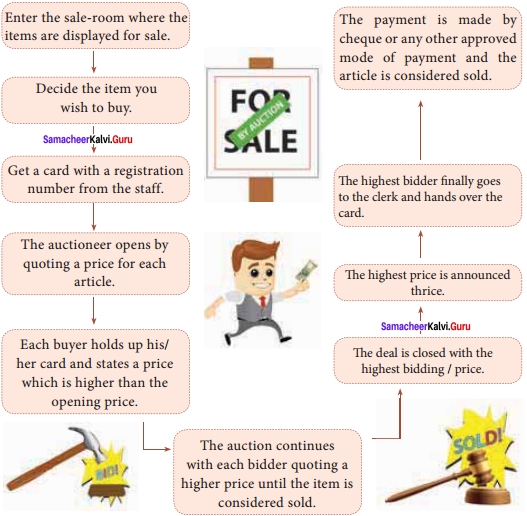
Many of us have unused, old but valuable items at home. If we wish to get rid of them, we can sell them at an auction. Items like paintings, jewels, household articles, vehicles, even houses can be auctioned.

The flowchart below will help you understand how an auction is conducted.

Tight Corners Summary Samacheer Kalvi 11th English Solutions Prose Chapter 4

Samacheer Kalvi 11th English Tight Corners Textual Questions

Tight Corner Questions And Answers Question (a)
Describe the activity that was going on in the sale – room at King Street.
Answer:
Christie Auction house was full. The auction house was selling Barbizon pictures and getting tremendous sums for each. Some were sold for two thousand and some for three thousand pounds. It was surprising to observe that all the sold items were little bit of things like forest scenes, pools at evening, shepherdesses and the regular subjects.

Tight Corners Pdf Question (b)
What can you say about the author’s attitude when he high-handedly participated in the auction?
Answer:
The author behaved like a gambler. He risked high banking on serendipity alone. In reality, he should have a minimum balance of 500 pounds in his bank account to be eligible to be a bidder in the auction. But he had only sixty three pounds. He didn’t have rich acquaintances or relatives who could bail him out-of a financial crisis of such a serious nature at a short notice. So, the author’s participation in the auction in a high handed manner demonstrates his audacity combined with absurdity.

Tight Corners Question (c)
Why was the author sure he would not be caught?
Answer:
The author decided to bid safely by just raising the stake a little bit and leave it for real millionaires to go ahead. Thus he was sure that he would not be caught.

Tight Corners Paragraph Question (d)
What made the author ignore his friend’s warning?
Answer:
The author was confident that he couldn’t run any risks by a playful participation in the auction. So, he ignored his friend’s warning.

Tight Corners Lesson Question (e)
How had the author managed the auction without getting involved in the deal?
Answer:
Although many bids ended up in four figures, they were started with a modest price of fifty to hundred guineas only. He ventured till the figures reached.only upto three digits. Thus he managed the auction without getting involved in the deal.

Summary Of The Lesson Tight Corners Question (f)
What came as a shock to the author?
Answer:
Unlike previous lots, one painting’s launch price was four thousand pounds. When, the millionaires were too stunned to react, the author had sheepishly said “and fifty”. The auctioneer clinched the deal in the author’s favour. This was a rude shock to the author because he did not wish to buy any painting.” .

Tight Corners Book Back Answers Question (g)
What did the falling of the hammer indicate?
Answer:
The falling of the hammer indicated “closure of the bid” and it mandated the highest bidder to pay and collect his purchase.

Tight Corners Theme Question (h)
What made the friend laugh heartily?
Answer:
The author’s friend realized that he had got into a pickle and there was no possible escape. Looking.at the crisis from outside made him laugh heartily.

Tight Corners Summary In English Question (i)
What kind of excuses did the narrator think he could make?
Answer:
The author speculated on the possibility of confessing his poverty to one of Christie ’s staff and request to put up the picture for sale once again.

Tight Corners Summary In Tamil Question (j)
Why did the friend desert the narrator, a second time?
Answer:
The author’s friend was so much tickled by the comedy of the situation that he deserted the author for a second time to have a hearty laugh alone.

Tight Corners Moral Question (k)
How does the narrator describe the man who approached him?
Answer:
The man who approached the author wore a green baize apron and spoke in a husky cockney tones. He had come to find out if he would accept the offer of fifty guineas for his expression of interest for Daubigny.

Question (l)
How does the Narrator show presence of mind in the sudden turn of events?
Answer:
The author should have been grateful for the stranger’s offer to bail him out of potential insolvency. He could have embraced him and even accepted fifty farthings for restoring him from a mental agony. But he asked the mediator if that was the most he could offer. This was . nothing but wordly guile. The man offered to find out saying there was no harm trying for a bit more. The author gave his ultimatum that he would take a hundred. He got a cheque for hundred guineas.

Question (m)
The narrator would not forget two things about his friend. What are they?
Answer:
The author’s friend only persuaded him to go to Christie’s auction. Secondly, he was the only witness to the author ’s mental agony in trying to get out of the crisis.

1. Choose the most appropriate answer for the following questions:

Question (a)
‘Tight Comer’ means a
(i) difficult situation
(ii) crowded comer
(iii) tragic incident
(iv) fierce fight
Answer:
(i) difficult situation

Question (b)
Barbizon refers to a
(i) kind of paint
(ii) type of architecture
(iii) a region in Britain
(iv) a French school of painting
Answer:
(iv) a French school of painting

Question (c)
The narrator visited the sale-room as he
(i) wished to see an auction
(ii) had a painting to sell
(iii) was persuaded by his friend
(iv) wanted to buy a painting
Answer:
(iii) was persuaded by his friend

Question (d)
The narrator had been a safe contributor at the auction, as
(i) there were bidders quoting higher prices
(ii) he had a sound financial background
(iii) his friend had lent him money
(iv) he did not make any bidding
Answer:
(i) there were bidders quoting higher prices

Question (e)
‘And I got it.’ Here‘it’refers to the’
(i) the picture
(ii) the price
(iii) an award
(iv) the card
Answer:
(iv) the card

2. Answer the following questions:

Question (a)
What is a tight corner? What happens when one finds oneself in a tight corner?
Answer:
Tight comer is a difficult situation. When one finds oneself in a tight comer, one worries and thinks seriously about the ways of getting out of it.


Question (b)
What is the difference between a physical and mental tight corner?
Answer:
Physical tight comers are those situations which threaten the lives of an individual. Mental tight comers are worries for which no solution is in sight. It upsets the individuals and confounds them. .

Question (c)
Why did the narrator visit Christie’s?
Answer:
The narrator visited Christie’s to watch the process of auctioning.

Question (d)
The narrator heard his own voice saying, ‘and fifty’. What does this suggest?
Answer:
The narrator heard his voice saying “and fifty”. This suggested that he offered to buy the painting by paying four thousand fifty guineas.

Question (e)
What was the narrator’s financial condition?
Answer:
The narrator had just sixty three pounds in his bank account. The tragic fact was that he did not even have 500 pounds which was the security deposit to be eligible to bid for the paintings.

Question (h)
The narrator could not pretend to have made a mistake in bidding. Why?
Answer:
The narrator had made bids for many paintings. Now he could not confess his poverty. So, he could not pretend tahave made a genuine mistake.

Question (g)
What could have been the best way for the narrator, to get himself out of the tight corner?
Answer:
The author could have confessed his poverty and
requested the auctioned picture to be put up again for “sale” again to get himself freed from the auction.

Question (h)
Why did the narrator feel he could have welcomed a firing party?
Answer:
The author had made many bids in a low margin and got escaped. But he got trapped by saying “and fifty” when a picture was put up for sale with a starting price of 4000 guineas. No one else raised the stake. The auctioner rang the bell and the author realized with alarm how on earth he could ever raise that much money. He thought he could find a firing party to shoot him down. Death is better than public disgrace.

Question (i)
What was the bidder’s offer to the narrator?
Answer:
The bidder offered 50 guineas to the narrator to give up his claim of the painting.

Question (j)
How did the narrator take advantage of the situation?
Answer:
The author asked the mediator of the bidder if that was the most he could offer. The mediator said that there was no harm in asking for a little more. Then the narrator gave his ultimatum that he would take hundred. This showed how guile the narrator was though the stranger was inadvertently rescuing him from a tight comer.

3. Form a meaningful summary of the lesson by rewriting the numbers in the correct sequence:

(a) The narrator had only 63 pounds with him and did not know how to manage the situation. [ ]
(b) The narrator thought of ail his relations from whom he could borrow. [ ]
(c) Unfortunately he had made the highest bid. [ ]
(d) The narrator entered Christie’s as his friend persuaded him to visit the sale room. [ ]
(e) Every time someone else made a higher bid and hence the narrator was not caught. [ ]
(f) The narrator on a sudden impulse added 50 more guineas, to the amount offered. [ ]
(g) His friend joined him then but left immediately unable to control his laughter. [ ]
(h) He even thought of borrowing from money lenders and considered the possibility of confessing the truth to the staff at Christie’s. [ ]
(i) The picture was declared sold to the narrator. [ ]
(j) After sometime a picture was put up and a bid for 4000 guineas was raised. [ ]
(k) A sudden stroke of luck befell the narrator when he heard that the gentleman who had made the bid of 4000 guineas would offer him the additional 50 guineas and buy the picture. [ ]
(l) The narrator kept bidding just for fun. [ ]
(m) The picture was given away to the other bidder and the narrator was saved from humiliation. [ ]
(n) His friend had left the place roaring with laughter at the narrator’s predicament. [ ]
(o) The narrator was too happy at the offer but demanded 100 guineas instead of the 50. Now there was no need for him to make any payment. [ ]

Answer:

1. The narrator entered Christie’s as his friend persuaded him to visit the sale room.
2. The narrator kept bidding just for fun.
3. Every time someone else made a higher bid and hence the narrator was not caught.
4. After sometime a picture was put up and a bid for 4000 guineas was raised.
5. The narrator on a sudden impulse added 50 more guineas, to the amount offered.
6. Unfortunately he had made the highest bid.
7. The picture was declared sold to the narrator.
8. The narrator had only 63 pounds with him and did not know how to manage the situation.
9. The narrator thought of all his relations from whom he could borrow.
10. He even thought of borrowing from moneylenders and considered the possibility of confessing the truth to the staff at Christie’s,
11. His friend had left the place roaring with laughter at the narrator’s predicament. .
12. A sudden stroke of luck befell the narrator when he heard that the gent who had made the bid of 4000 guineas would offer him the additional 50 guineas and buy the picture.
13. The narrator was too happy at the offer but demanded 100 guineas instead of the 50. Now there was no need for him to make any payment.
14. The picture was given away to the other bidder and the narrator was saved from humiliation.
15. His friend joined him then but left immediately unable to control his laughter.

4. Answer the following questions in a paragraph of about 100 – 150 words.

Question (a)
Narrate the circumstances that led to the narrator getting into a tight corner, by his own folly.
Answer:
Lucas learnt that an auction was in progress. His friend suggested that they peeped in, to watch the fun. Despite the caution from his friend, he started bidding at moderate rates. He had only 63 pounds in his account. A bidder was supposed to have a minimum of 500 pounds to take part in the bid. As bidding for most of the paintings were started with two or three digits in guineas, the author sailed through raising the stakes of many paintings and staying behind watching millionaires bid with higher prices. But one painting viz big Daubigny was launched at an offer price of 4000 Guineas.

Only one bidder showed interest. The rest were in silence. The author heard himself say “and fifty”. After seconds of uncomfortable silence, the dealer banged the hammer indicating the acceptance of the narrator’s offer of 4050 guineas for the painting. It was only then the narrator realized that he was in a tight comer. He wished a firing squad would be welcomed to eliminate him and put an end to his mental agony. He had no friend or relative or even money lenders who could extend him a loan to raise the money. He had got into a mess of his own choice.

“Auction houses run a rigged game. They know exactly how many people will be bidding on a work and exactly who they are. In a gallery, works of art just needs on to pay. ”


Question (b)
Trace the thoughts that went on in the mind of the narrator when picture after picture was put up and sold at the auction.
Answer:
The author was enthusiastically participating in the bid at Christie with very little money on him. He sailed smooth for a long time raising the stakes on many paintings and carefully staying behind other competitors. It was fun watching till he got trapped in a net, set by his own tongue. When one particular painting was offered for 4000 guineas, the bidders maintained an uncomfortable silence when the author heard himself foolishly saying “and fifty”. The auctioner banged the hammer finalizing the deal in the narrator’s favour.

It was then the narrator realized with alarm that he had no money on him. Suddenly he lost interest in fun bidding. He started thinking fast for a way out of the tight comer he had created for himself. Many small and big paintings were offered and sold out fast. The Barbizon pictures were selling fast like hot cakes for 2000 to 3000 guineas. The author was running over the names of friends, relatives and even money lenders who might bail him out of the tight comer. He even speculated on the possibility of confessing his poverty to the staff of Christie and request them to put up the picture again for sale. Such a genuine mistake could have been rectified at the early stages of auction. As he had enthusiastically participated in the bid for many paintings,

the auctioners wouldn’t buy his justification for the “genuine mistake”. As bidders stood in a queue to hand in their cheques/cash to collect their paintings, the narrator stood deliberately at the end. He never felt such a fool or had colder feet all his life.

“People do not wish to appear foolish; to avoid the appearance of foolishness, they are will to
remain actually fools but wait in patience for the right time

Question (c)
Explain how the narrator got out of the tight corner that he was in.
Answer:
When the author was perplexed beyond measure and was even ready to welcome a firing squad to bail him out of the current crisis, a divine chance presented itself to the narrator. The narrator had stupidly given an open bid to buy “big Daubigny” for 4050 guineas when he had only 63 pounds in his bank account. However hard he tried, he could not recall a name of an “uncle” or a friend who could extend him a loan to cover the price of the painting. To delay disgrace, he was standing at the end of the queue of the successful bidders. Like a providential intervention, a mediator from the starting bidder who was ready to take the same painting for 4000 guineas enquired the narrator in a husky cockney tone if he was the gentleman who had bought, “big Daubigny”.

The narrator admitted it. To the narrator’s great relief, the mediator said the first bidder wanted to know if he would take 50 guineas for his interest. The author should have embraced him and wept for joy for bailing him out of a potential disgrace. But he made the best use of the opportunity exhibiting his guile, by asking him if that was the most he could offer. The mediator said that there was no harm in asking for some more. The narrator said he would take hundred guineas. When the man left to find out the possibility both the author and his friend laughed.

But when the author saw the cheque for hundred guineas, he became serious. He said with joy and shock, “of all the luck! well, I’m hanged”. Thus the narrator had a narrow escape from a tight comer. One could even say that the narrator escaped by the skin of his teeth.

“Call it a narrow escape, maybe it’s your lucky day. ”

Question (d)
As the narrator, make a diary entry about the tight corner you faced at Christie’s and how you were saved from the dire situation.
Answer:
Thursday, 17th Nov. 20xx
I was lunching at a club in King James’s street. While passing along Kingstreet later, my friend suggested that we peeped in at Christie’s where an auction of Barbizon pictures was going on. The prices of the paintings were pertaining to forest scenes, pools at evening, shepherdesses, and the regular subjects were tremendous for each ranging from two to three thousand guineas each. The remarkable thing was that nothing was sold at three figures. After watching the auction for fun for a while I found myself bidding.

I had exactly sixty three pounds in my account in the bank. I knew that any bidder must have a minimum of five hundred pounds in the bank to stand as security to bid for the artistic works. I enthusiastically participated in many bids as the starting price for each paining was a modest fifty to hundred guineas. Things went on well for me for quite sometime. But a cruel fate awaited me. A short red-faced man electrified the room by fixing the starting price at 4000 guineas. There was a rustle of excitement followed by terrible silence. But I found myself saying “and fifty”. The dealer looked at the opener and at the company. To my surprise and horror, the dealer shot his bolt.

My heart stopped and my blood congealed. I was in possession of the picture I did not want to buy. I was the top purchaser in the auction with just 63 pounds in the bank account. I turned to my friend for some moral support but he had deserted me to have a hearty laugh at a distance. With great alarm, I saw many other Barbizon pictures being put up and sold. The auction came to an end. The bidders stood in a queue to pay the price and collect the pictures. I stayed behind at the end of the queue as I could not recall the name of any uncle, aunt or even a relative who could offer me 4050 guineas to buy the painting. I wished that a firing squad could give me a welcome relief by shooting me down. I preferred death to public disgrace. But something divine turned my tragedy into a comedy.

Just then one gentleman enquired if I was the gentlemen who bought “big Daubigny”. I admitted. The mediator asked if 1 could take 50 guineas for my interest and give up my claim. I would have hugged him and wept for joy of relief from the tight comer. But I had the guile/presence of mind to ask, “Is that the most he would offer?” The mediator said that there was no harm in trying for a bit more. I said, “Tell him I will take hundred” myself and my friend started laughing. But when I saw the cheque for hundred guineas, I became grave, My friend said to me that it was he who brought me to Christie. I admitted, “I shall never forget it. It is indelibly branded in letters of fire on my heart”

Additional Questions

Question (e)
Describe the activity that was going on in the sale-room at King street. What can you say about the author’s attitude when he high handedly participated in the auction?
Answer:
The sale-room at Christie’s was full. Billionaire’s and millionaires who wished to showcase their taste in art had assembled there. The dealer was offering Barbizon pictures on sale. The paintings had mainly forest scenes, pools at evening, shepherdesses and the regular subjects. But each of the little paintings was sold at tremendous prices ranging from two to three thousand guineas. Nothing was sold at three digits. The narrator had just 63 pounds in his bank. The auctioneer had made it mandatory that each bidder should have a minimum of 500 pounds in the bank to stand as security for the bid.

Being aware of this condition, the narrator’s friend cautioned him against participating in the auction for fun. But the narrator ignored his friend’s caution and started bidding for many paintings. He promised his friend that he was not going to run any risk. As most of the paintings were offered with the initial modest price of either 50 or 100 guineas, he carefully hiked the price a little and derived great pleasure in the hot bidding that ensued among millionaires. His over confidence and high handed participation did land him in trouble.

“Life is not a competition. Each one is on their own journey. Live according to your choices,capacity, values and principles. ”

Vocabulary

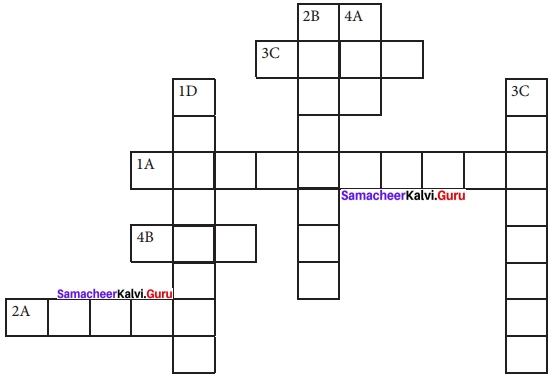
(i) Auction House Puzzler
You have come across many terms associated with auction, in the lesson. Now solve the crossword puzzle with words from the lesson. Make use of the clues given

Tight Corner Questions And Answers Samacheer Kalvi 11th English Solutions Prose Chapter 4

Across
1. conducts
2. a protective garment
3. strip with numbers
4. offer

1. painter
2. school of painting
3. auction houses
4. painting Answers

Answers:

Across
1. Auctioneer
2. Apron
3. Card
4. Bid

Down
1. Daubigny
2. Barbizon
3. Christie
4. Art

A. Here are some more idioms taken from the lesson. Find out their meanings and use them in sentences of your own.

Question 1.
Tight corners – difficult situations.
Answer:
Those who act on impulse find themselves in tight comers.

Question 2.
Shoot one’s bolt – exhaust one’s effort
Answer:
Mithali Raj had shot her bolt and made 54 runs to help India win the World Cup Cricket title.


Question 3.
In a nice pickle – in a mess
Answer:
Boney Kapoor is in a nice pickle unable to explain Sridevi’s sudden death to media personal and to film Industry friends.

Question 4.
Have a cold feet – be frightened
The hotel staff had a cold feet when Dubai police enquired him about Sridevi’s death.

B. Match the following idioms related to difficult situations with their meanings.

AB
1.alarm bells ringing(a)abandoning one who is in difficulty
2.back to the wall(b)try any method to overcome a crisis
3.grasp /clutch at straws(c)sign of something going wrong
4.save by the bell(d)in serious difficulty
5-.hang out to dry(e)help at the last moment rescuing one from a difficult situation

Answer:

  1. (c)
  2. (d)
  3. (b)
  4. (e)
  5. (a)

C. We use a variety of idioms in our daily life to describe various situations. Describethe narrator’s situation in your own words, making use of some of the new idiomsyou have just learnt.

Question 1.
Saved by the bell – saved from being counted out by the ringing of bell at the end of a round of boxing.
Answer:
The batsman was tired and was saved by the bell otherwise he would have lost his wicket.


Question 2.
Hang out to dry – leave some one in a difficult situation.
Answer:
When Lucas was in dire straits after bidding the highest price, he found that his friend had hung him out to dry. ‘

Question 3.
Grasp/clutch at straw’s try any method to overcome a crisis.
Answer:
The man who got suspended from his job like a drowning man clutching at straw, sought the advice of his door peon to come out of the crisis.

Question 4.
Back to the wall – in a serious difficulty.
Answer:
The narrator had little money to buy the painting and was back to the wall.

Question 5.
Alarm bells ringing – sign of something going wrong.
Answer:
Seeing the policeman round the comer, the chain snatcher heard alarm bells ringing in his head.

Question 6.
Run the risk – exposure to injury or loss
Answer:
If you tell her the truth, you may run the risk of hurting.

Question 7.
Escape by the skin of one’s teeth – have a narrow escape
Answer:
Lucas escaped by the skin of his teeth when a gentleman offered him 100 guineas to buy the painting for which he had made the highest bid.

Question 8.
At one’s wit’s end – desperate
Answer:
I am unable to send a mail due to poor connectivity all day long. I am at my wit’s end.

Question 9.
Catch 22 situation – a situation in which it’s impossible to succeed because of conflicting conditions or rules.
Answer:
Getting one’s first job is a catch-22 because companies want to hire experienced candidates. But how could one get experience before being hired?

Question 10.
Dodge a bullet – barely escaped from a disastrous situation
Answer:
Jaswanth’s girl friend told the press that she was glad she broke up with him. She had infact dodged a bullet.

Question 11.
In dire straits – in a serious, bad situation
Answer:
Sunitha’s husband abandoned her. She is really in dire straits as she had stupidly resigned her job soon after marriage.

Question 12.
You’ve got your work cut out for you – you have a large and difficult job to perform
Answer:
If you wish to complete a degree course in a single sitting, you’ve got your work cut out for you.

Question 13.
Last resort – last option
Answer:
Politics is the last resort of the scoundrels.

Question 14.
The tip of the iceberg – the biggest part of the problem is hidden
Answer:
Common men are apprehensive that Nirav Modi’s scam and Rotomac pen owner’s scam which are just a tip of the ice berg. Many scams may still be untraced or untraceable.

Question 15.
Vicious cycle – chain like issues
Answer:
Poverty causes a vicious cycle as it prevents education and thus it perpetuates poverty.


Question 16.
To be in double bind – to choose between two unsatisfactory alternatives
Answer:
Kamala was in a double bind as she had to choose a low paying job or an early marriage with a rogue neither of which she liked.

Phrasal Verbs

(iii) Use the following phrasal verbs in sentences of your own. The first one has been done for you: stand

(i) up – Your statement will not stand up as proof in the court of law.
(ii) for – My father always stands for truth and honesty.
(iii) by – Come what may, I will stand by you.

Question 1.
look
(i) into : __________
(ii) at : __________
(iii) through : __________
Answer:
(i) The principal promised to look into his application.
(ii) She was looking at the painting for a long time.
(iii) Don’t look through your poor relatives.

Question 2.
run
(i) over : __________
(ii) away : __________
(iii) into : __________
Answer:
(i) The tortoise was run over by a speeding lorry.
(ii) The run away slave was caught
(iii) She’ advised her son not to fall into bad company.

Question 3.
put
(i) on : __________
(ii) up : __________
(iii) off : __________
Answer:
(i) Do not put on airs
(ii) She had to put up with her rude husband.
(iii) The match was put off due to rains.

Additional Questions

Question 1.

Question (a)
back down – with draw one’s position in a fight
Answer:
It’s too late to backed down now.

Question (b)
back up – help or support
Answer:
You can back up the contacts stored on your device or SIM card.

Question (c)
back off – retreat / withdraw
Answer:
He refused to back off from his earlier statement.

Question 2.
(a) Ask for – demand/request for something
Answer:
Oliver should ask for a hike in salary.


Question (b)
Ask after – enquire some one’s health
Answer:
Did she ask after me in her letter?

Question (c)
Ask out – invite some one to begin a relationship
Answer:
I heard Murugesh ask out Sonia.

Question 3.

Question (a)
Blow up – destroy something
Answer:
They used 10 tonnes of dynamite to blow up the rock.

Question (b)
Blow out – extinguish
Answer:
Blow out the candles before they bum out.

Question (c)
Blow off – decide not do what is expected of someone
Answer:
Moorthy bunked the classes when the last exam was scheduled. He deliberately blew it off.

Question 4.

Question (a)
break down – divide something in small units
Answer:
It is easier to leam a big lesson if you break it down into many small segments. [OR] The car broke down on the way to Chennai.

Question (b)
break into – to get into a building stealthily by force
Answer:
Generally, the burglars break into a bank and rob in the nights.

Question (c)
break off – suddenly stop speaking .
Answer:
Nayanthara, while sharing her grief over, the death of Sridevi, had to break off in the middle of her speech.

Question (d)
break out – some unpleasant beginning
Answer:
The civil war broke out in China.

Question (e)
break through – force one’s way through barriers
Answer:
The protesters will break through the barriers and storm into the office.


Question (f)
break up – to get separated
Answer:
Money problem often result in a marital break up.

Question 5.

Question (a)
bring over – bring someone to a place
Answer:
I should bring over Mala for dinner.

Question (b)
bring up – raise some one.
Answer:
The aged couple will bring up the children with values.

Question (c)
bring back – to return something
Answer:
He asked Ramesh to bring back his pony.

Question 6.

Question (a)
burn down – destroy something with fire
Answer:
Hate not only bums down buildings but also the relationship between countries.

Question (b)
burn out – nothing left to bum
Answer:
As she did not get her promotion for long, she became a bum out.

Question (c)
burn up – destroy with fire .
Answer:
The lab burnt up and got reduced to ashes due to the negligence of the watchman.

Question 7.

Question (a)
call in – request some one to help
Answer:
Dr. Amar was called in to revive the dying lady.

Question (b)
call off – cancel a planned programme
Answer:
The strike was called off as the boss agreed to most of their demands.

Question (c)
call up – chosen to be a part of military service
Answer:
Young ones waste away their adult life jobless as they are not called up in military.

Question 8.

Question (a)
carry away – do something out of the ordinary due to strong feelings
Answer:
She was carried away by his flattery and regretted her decision to marry him.

Question (b)
carry on – continue to do something
Answer:
You must carry on your work

Question (c)
carry out – do
Answer:
The workers carried out their duties without grumbling.

Question 9.

Question (a)
come about – when something occurs
Answer:
Ram was happy to see that things came about as expected.

Question (b)
come across – meet
Answer:
I came across a strange bird in the jungle.


Question (c)
come down – move from higher to lower position
Answer:
He came down because of his arrogance.

Question (d)
come down with – experience symptoms of illness
Answer:
Chitra came down with flu

Question 10.

Question (a)
cut back – spendless
Answer:
If young ones don’t learn to cutback their expenses now, they will regret later.

Question (b)
cut down – reduced expense
Answer:
Mother cut down domestic expenses to support her child’s education.

Question (c)
cut off – completely remove
Answer:
The village was cut off from electricity and water due to Tsunami

Question 11.

Question (a)
drop in – visit
Answer:
I dropped into Hari’s home last evening.

Question (b)
drop off – decline
Answer:
The price of gold has dropped off a little

Question (c)
dropout – quit school
Answer:
She dropped out of school for her teacher was very rude.

Question 12.

Question (a)
fall for – get attracted to
Answer:
He fell for her beauty.

Question (b)
fall behind – move slower
Answer:
Ram has fallen behind others in studies because he stayed away for a month.

Question (c)
face through – collapse of a plan
Answer:
The project of converting sea water into drinking water fell through as the money got
diverted to freebies.

Question 13.

Question (a)
Get over – move past an obstacle
Answer:
You must learn to get over small problems to achieve great things in life.

Question (b)
get behind – progress slowly
Answer:
The minister’s car got behind due to a traffic jam.

Question (c)
get through – pass
Answer:
Priya will get through NEET because she is preparing smartly for it.

Question 14.

Question (a)
give away – distribute freely .
Answer:
Give away your surplus wealth to poor relatives.


Question (b)
give in – surrender
Answer:
The terrorists gavein when they could not fight Indian jawans any more.

Question (c)
give up – stop doing something
Answer:
Never give up hope.

Question 15.

Question (a)
go through – read
Answer:
I went through the book “Three cups of tea”.

Question (b)
go up – extend to a higher level
Answer:
The price of rice, is going up everyday but the farmers are starving.

Question (c)
go over – visit a place
Answer:
I went over Agra last week with my school teacher.

listening Activity

(A) Listen to the announcement made by your teacher and answer the questions that follow.

(For listening to the passage refer to our website www.fullcircleeducation.iri)
The Department of School Education has organized a one-day seminar on ‘Career Guidance and Counselling’ for the students appearing for the oncoming Public Examination. The programme is scheduled at 3 p.m. today, at Dr. A P J Abdul Kalam Auditorium, in our School campus. You are to assemble at the venue at 2.45 p.m. sharp, with a notebook and a pen. The main purpose of the programme is to create awareness among students on the numerous career options available and the various institutions that offer relevant courses.

The other objective is to boost their self-confidence and prepare them to face the challenges they encounter from time to time with courage. You are expected to be attentive throughout the programme, actively participate in discussions and get all your doubts clarified without any hesitation. The second session will be conducted in the first week of next month. Those who are interested in attending the next session can register your names with the School Pupil Leader within two days.

Complete the following sentences based on your listening.

  1. The programme is organized by the Department of ______
  2. The topic of the seminar is ______
  3. The programme is to be held at ______ p.m. at .
  4. Students are instructed to carry and a to the programme hall.
  5. Students who wish to attend the second session should register within
  6. The main purpose of the programme is to provide information on options and the that offer relevant courses.

Answer:

  1. School Education
  2. Career Guidance and Counselling
  3. 2.45, Dr. APJ Abdul Kalam Auditorium
  4. notebook, pen
  5. two days
  6. career, institutions

Speaking Activity

Question (a)
Work with a partner: Your friend has lost his books just before the annual examination and he/she is depressed. How will you help him / her? Share it with the class and enact.
Answer:
Vinod, why are you upset?
I have lost my books
In a couple of days, we have the Board examination.
Yes, that is why I am upset.
Don’t worry. I shall mail you the pdf version of the books. You can just open them in your laptop. Read them at your own pace.
Thank you for the excellent idea.
You are most welcome.

Question (b)
You have recently shifted to a new locality. You cannot find your way home. Your uncle spots you and takes you home. Narrate the incident to the class.
Answer:
My dear friends we shifted our home from Gandhi Nagar to Ambedkar Nagar last week. My I mom asked me to buy something in the grocery shop. There was no grocery shop in my street. I just wandered into the third street. After purchasing the items I realized with alarm that It had forgotten the road I had taken to reach the market. When I had wasted half on hour trying to find my way back home. I met my uncle Dr. Sukumar. He took me back home in just five minutes. I can never forget the helplessness I felt last week.

Question (c)
As a friend of the narrator, describe how you would have behaved at the auction.
Answer:
As an author’s friend, I would have dissuaded him from continuing the risk he was taking by idding. I would have reasoned with him that bidding without even the security deposit of 500 pounds in the bank had the potential threat of facing public-disgrace. If I insisted, he would
definitely give up bidding. Friendship is a heavy responsibility. One can’t permit a friend to go towards a tight comer unthinkingly.

Reading

Read the following passage and answer the questions that follow:

The Stationmaster’s supreme sacrifice by Sanchari Pal (Adapted)

1. Thirty-three years ago, on the night of December 2,1984, Bhopal was hit by a catastrophe that had no parallel in the world’s industrial history. An accident at the Union Carbide pesticide plant in Bhopal had released almost 30 tons of a highly toxic gas called methyl isocyanate, turning the city into a vast gas chamber. The result was a nightmare; more than 600,000 people were exposed to the, deadly gas cloud that left thousands dead and many more breathless, blind and in agonizing pain. Few people know that during the Bhopal gas tragedy a heroic stationmaster risked his own life to save others.

2. On the evening of December 3, 1984,Ghulam Dastagir was settling down in his office to
complete some pending paper work. This work kept him in his office till 1 am in the night, when he emerged to check the arrival of the Gorakhpur Mumbai Express. As he stepped on to the platform, the deputy station master felt his eyes bum and a queer itching sensation in his throat. He did not know that poisonous fumes leaking from Union Carbide’s pesticide factory were stealthily enveloping the railway station. .

3. Beginning to choke, Dastagir did not know then, that twenty-three of his railway colleagues, including his boss, station superintendent Harish Dhurve, had already died. It was later reported that Dhurve had heard about the deadly gas and had immediately tried stopping the movement of trains passing through Bhopal before collapsing in his office chamber. His suddenly worsening health and years of experience told Dastagir that something was very wrong.

Though he did not fully comprehend what was happening, he decided to act immediately when he did not get any response from the station master. He alerted the senior staff at nearby stations, like Vidisha and Itarsi, to suspend all train traffic to Bhopal.

4. However, the jam-packed Gorakhpur-Kanpur Express was already standing at the platform . and its departure time was 20 minutes away. Listening to his gut instinct, Dastagir summoned his staff and told them to immediately clear the train for departure. When they asked if they should wait until the order to do so came from the head office, Dastagir replied that he would take complete responsibility for the train’s early departure. He wanted to ensure that the train left immediately,without any delay. His colleagues later recalled that Dastagir could barely stand and breathe as he spoke to them. Breaking all rules and without taking permission from anyone, he and his brave staff personally flagged off the train.


5. But Dastagir’s work was not done. The railway station was filling up with people, desperate to flee the fumes. Some were gasping, others were vomiting,and most were weeping. Dastagir chose to remain on duty, running from one platform to another, attending, helping and consoling victims. He also sent an SOS to all the nearby’railway offices,asking for immediate medical help. As a result, four ambulances with paramedics and railway doctors arrived at the station.

It was winter and the gas was staying low to the ground, a thick haze poisoning everything in its path. Besieged by hordes of suffering people, the station soon resembled the emergency room of a large hospital. Dastagir stayed at the station, steadfastly doing his duty, knowing that his family was out there in the ill-fated city. That day all he had for his protection was a wet handkerchief on his mouth.

6. Ghulatti Dastagir’s devotion to duty saved the lives of hundreds of people. However, the catastrophe didn’t leave him unscathed. One of his sons died on the night of the tragedy and another developed a lifelong skin infection. Dastagir himself spent his last 19 years shuttling n and out of hospitals; he developed a painful growth in the throat due to prolonged exposure to toxic fumes. When he passed away in 2003, his death certificate mentioned that he was suffering from diseases caused as a direct result of exposure to MIC (Methyl Isocyanate) gas.

A memorial has been built at platform No. 1 to pay tribute to those who sacrificed their lives in the line of duty on the fateful night of December 3, 1984. However, Ghulam Dastagir, who died later, is not one of them. A forgotten hero whose sense of duty and commitment saved countless lives, Dastagir’s story deserves to be recognized and remembered by our fellow countrymen.

Question (i)
Why was the accident at Union Carbide unparalleled in the world’s industrial history?
Answer:
The union carbide pesticide plant in Bhopal had released almost 30 tons of a highly toxic gas called methyl isocyanate. It had turned the city into a gas chamber. It left thousands dead. Six lakh persons suffered due to exposure to the toxic gas. So, the Bhopal tragedy was unparalleled in the world’s industrial history.

Question (ii)
How was Dastagir affected by the poisonous gas?
Answer:
One of his sons died. Another developed a life long infection. Ghulam Dastagir himself spent his last 19 years in and out of hospitals. He developed a painful growth in his throat. He was suffering from diseases caused by direct exposure to toxic fumes.

Question (iii)
What was the action taken by the station superintendent?
Answer:
Dastagir alerted senior staff members at the nearby railways station like vidhisha and Itarsi to suspend all train traffic to Bhopal. Against rule he alerted his staff to clear the train immediately for departure. He got medical help. Four ambulances with para medics arrived to attend the suffering people at the station.

Question (iv)
How did Dastagir and his staff break rules?
Answer:
A train can’t be flagged off before its stipulated time without getting permission from top level officers. Dastagir gives orders to release the train
immediately after it reached the station. They flagged off the train even before it stopped. Traffic to Bhopal from other stations was blocked by his timely orders. Thus Dastagir and his staff broke the rules.

Question (v)
What was the cause of Dastagir’s death?
Answer:
Dastagir died after 19 years of suffering of diseases caused by direct result of exposure to MIC (methyl ISO cyanate) gas.

Question (vi)
Find words from the passage which mean the opposite of the following.
(a) safeguard x risk
(b) common x queer
(c) prompt x delay
(d) cause x result

Grammar

(i) Complete the following with appropriate conditional clauses.

(a) We will miss our train, ______
(b) Jayashree would travel to France, ______
(c) People get sun-burnt, ______
(d) Vicky would have passed, ______
(e) I wouldn’t refuse, ______
(f) Sundar would have waited, ______
(g) Vijayshree will be busy, ______
(h) Adhvika will not go to play, ______

Answer:

(a) if we don’t go fast
(b) if she had money
(c) if they move about in hot sunlight
(d) if he had worked hard
(e) if I were you
(f) if he had been informed
(g) if you go to meet her after 10 a.m.
(h) if it rains

Grammar

(i) Complete the following with appropriate conditional clauses.

(a) We will miss our train, _____
(b) Jayashree would travel to France, _____
(c) People get sun-burnt, _____
(d) Vicky would have passed, _____
(e) I wouldn’t refuse, _____
(f) Sundar would have waited, _____
(g) Vijayshree will be busy, _____
(h) Adhvika will not go to play, _____

Answer:

(a) if we don’t go fast
(b) if she had money
(c) if they move about in hot sunlight
(d) if he had worked hard
(e) if I were you
(f) if he had been informed
(g) if you go to meet her after 10 a.m.
(h) if it rains

(ii) Complete the following paragraph.

Did you hear about that boy who won one crore in a game show? If I (1) ________ (win) that much money, I (2) ________ (quit) my job the next day. I ……(3) ________ (travel) round the world and (4) (stay) in the most luxurious hotels. If I (5) (want) anything, I (6) ________ (buy) it. If I (7) ________ (see) a Mercedes that I wanted, I (8) ________ (buy) it. I (9) ________ (can) do anything in the world if I had one crore rupees, I am starting to sound a little materialistic. Well, I (10) ________ (do) good things with the money as well. If anybody (11) ________ (need) help, I (12) (take) care of their needs. I (13) ________ (donate) money to charities. I (14) ________ (give) money to help support the arts. If I (15) ________ (win) that much money, I wouldn’t keep it all for myself. I (16) ________ (help) as many people as possible.
Answers:

  1. won
  2. would quit
  3. will travel
  4. stay
  5. wanted
  6. would buy
  7. saw
  8. would buy
  9. can
  10.  will do
  11. needs
  12. will take
  13. will donate
  14. will give
  15. won
  16. will help

(iii) Fill in the blanks in the following dialogue.

Gopal : What’s wrong, Muthu? You look terrible!
Muthu : Well, you (1) ______ (look) terrible today, too, if you (2) ______ (have) a day like mine yesterday. My car slid into a tree, because the roads were slippery.
Gopal : Oh! I was driving on the slippery roads yesterday, and I didn’t have such trouble. What happened?
Muthu : Well, I think if I (3) ______ (drive not) so fast, I . (4) ______ (slide, not) into the tree.
Gopal : Slippery roads and speed don’t mix. If drivers (5) ______ (speed) on wet roads, they’re likely to spin their car in circles.
Muthu : I know. But I have one more problem. I didn’t have my driver’s license with me. If I (6) ______ (have) it, I (7) ______ (have to, not) pay an extra fine in the court next week.
Gopal : Why were you driving without your license?
Muthu : Well, I lost my wallet some days ago. It slipped out of my pocket, while I was riding the bus to work.
Gopal : Oh, Muthu! If you (8) ______ (take, not) that bus, you ,(9) ______ (lose, not) your wallet. If you (10) ______ (lose, not) your wallet, you (11) ______ (have) your driver’s license with you when you hit the tree. If you (12) ______ (have) your. driver’s license with you, you ;(13) ______ (have to pay, not) a big fine when you go to court next week. And of course, if you .(14) ______ (drive, not) too fast, you.(15) ______ (run into, not) a tree, and you (16) ______ (be, not) in this mess now. If I (17) ______ (be) you, I (18) ______ (take) it easy for a while and just .(19) ______ (stay) home where you are safe.
Muthu : Enough about me! How about you?
Gopal : Well, things are really looking up for me. I’m planning to take off for Goa as soon as I finish my finals. I’m sick of all this old, rainy weather we’ve been having.
Muthu : I wish I (20) ______ (go) with you. How are you planning on getting there?
Gopal : If I! (21) ______ (have) enough money, I (22) ______ (fly). Otherwise, I (23) ______ (take) the bus. I wish (24) ______ (drive) my own car because it (25) ______ . (be)
nice to drive there, but it’s such a long trip. I’ve been looking for a friend to go with me and share the driving.
Muthu : I have a super idea! Why don’t I go with you? I can share the driving. I’m a great driver!
Gopal : Oh, Muthu! I can’t believe it.
Answer:

  1. would look
  2. had
  3. had not driven
  4. would not have slid
  5. speed
  6. had
  7. would not have had to
  8. had not taken the bus
  9. would not have lost
  10. had not lost
  11. you would have had
  12. had
  13. would not have had to pay
  14. had not driven
  15. would not have run into
  16. would not be
  17. were
  18. would take
  19. stay
  20. go/went
  21. had
  22. would fly
  23. would take
  24. i could drive
  25. would be

A. Seema goes to a hotel for lunch. The waiter explains to her the different items available at that time. Here is the conversation between them. Complete the dialogue. You may use modals to frame questions.

Seema: Could I get something to eat immediately?
Waiter: Yes Ma’am. We have , (1) ______
Seema: (2) ______
Waiter: Yes Ma’am. It is available.
Seema: (3) _______
Waiter: It should not take long (4) _______
Seema: Yes bring that too (5) _______
Waiter: (6) _______
Seema: I prefer it cold, (7) ________
Waiter: Sorry Ma’am we don’t have ice creams served here. But you can get it in the outlet next door.
Seema: Oh that’s fine. Okay, please get these quickly.
Waiter: Sure Ma’am.
Answer:

  1. Mini meals
  2. Is Veg fried rice available?
  3. Can you give it to me quickly?
  4. We do have Kushbu Idli too.
  5. Do you give ginger oil and spicy chilli powder for Idly?
  6. We have filter coffee mam.
  7. or else can you give me Gulfi Ice cream?


B. Read the following story and do the exercises that follow.

Last night somebody broke into our neighbour’s house. He stole everything he found. The neighbours, Mr. and Mrs. Umar saw him while he was running away but they couldn’t catch him. This morning an inspector arrived to make an inquiry.

The Inspector posed certain questions to Mr. Umar.
The Inspector: The thief broke into the house at around IQ p.m. What were you doing then?
Mr. Umar: I was watching a movie with my wife. Then I went to the kitchen to prepare tea. .
The Inspector: How many minutes did you spend in the kitchen?
Mr. Umar: I think 10 or 15 minutes… I’m not sure….
The Inspector: Did you prepare only tea?
Mr. Umar: Yes.
The Inspector: Okay. Thanks.

The Inspector also asked Mi’s. Umar some questions:

The Inspector: What were you doing at around 10 p.m. yesterday?
Mrs. Umar: I was watching a movie while drinking my coffee.
The Inspector: Coffee? But your husband has prepared tea.
Mrs. Umar: Tea? No… We didn’t drink tea last night.
The Inspector: Okay. What was he doing in the kitchen?
Mrs. Umar: He was thirsty. He wanted to drink water. ‘
The Inspector: Hmmm. What happened then?
Mrs.Umar: A friend of his called him and he went out to help him.
The Inspector: So, you were alone at home, weren’t you?
Mrs.Umar: Yes, I was. I called him immediately but he didn’t answer.

The inspector was suspicious about Mr.Umar and so he asked him to Come to the station for further questioning.

The Inspector: You weren’t at home when the thief broke into your neighbour’s house. Where were you?
Mr.Umar: I went out to help a friend of mine.
The Inspector: Who is that friend?
Mr.Umar: Ehhhh… he is just a friend. ’
The Inspector: Hmmm. Who is that friend?
Mr.Umar: I told you already. He is just a friend.
If you cannot prove that you were with a friend, we can arrest you.
At the end of the questioning session, Mr.Umar told the inspector the truth.
“Last night, somebody called me, but he wasn’t my friend. I had borrowed some money from him and he had given me time till last night to return it. But I did not do so. So, he called home asking me to meet him outside the house. That’s why I went out. I did not tell my wife as I did not want her to know about it. When I went out, I saw a stranger entering my neighbour’s house but I did not stop as I was in a hurry to meet the moneylender.

Answer the questions after reading the story.

Question 1.
Did Mrs. Umar see the thief?
Answer:
No, Mrs. Umar did not see the thief.

Question 2.
What was Mrs. Umar doing when the thief broke into the house?
Answer:
Mrs. Umar was drinking coffee and watching TV.

Question 3.
Was Mr. Umar watching movie with his wife when the thief broke into the house?
Answer:
No, Mr. Umar had gone out of the house to meet a friend when the thief broke into a neighbour’s house.

Question 4.
What was Mr. Umar doing in the kitchen?
Answer:
He was drinking water in the kitchen.

Frame Questions:

Question 1.
Mr. Umar was at home when the event occurred.
Answer:
Where was Mr. Umar when the event occurred?

Question 2.
Yes, Mr. Umar saw the thief entering the neighbour’s house.
Answer:
Did Mr. Umar see the thief entering the neighbour’s house?

Question 3.
Mrs. Umar was watching the movie while her husband was drinking water.
Answer:
What was Mrs. Umar doing when her husband was drinking water?

Question 4.
The thief broke into the house while they were watching a movie.
Answer:
When did the thief break into the house?

A. Add appropriate question tags to the following sentences.

  1. Cities are increasingly becoming urbanised.
  2. They experiment with ways to improve air quality.
  3. The aim should be to reduce congestion.
  4. There is an urgent need to provide clean, reliable and affordable energy to their growing populations.
  5. Automation and shared mobility will play a key role in this transformation.
  6. It changes the way people commute in cities.
  7. Before long, a fleet of electric autonomous vehicles (AVs) could drive people to their destinations.
  8. These shared AVs will run at higher utilization rates.
  9. They can substantially reduce the cost of mobility and congestion.
  10. These should not be thought of as luxury but as necessity. .

Answers :

  1. aren’t they?
  2. don’t they?
  3. shouldn’t it be?
  4. isn’t it?
  5. won’t they?
  6. doesn’t it?
  7. couldn’t they?
  8. won’t they?
  9. can’t they?
  10. should they?

B. Add appropriate question tags and role play the dialogue with your friend.

Jeyanth : Hello, Anish! It’s your Physics exam today, isn’t it?
Anish : Yes. They have set a very long paper. Yet, I managed to finish the paper 1 ______
Jeyanth True. My maths paper too was very long. I couldn’t finish it, 2 ______
Anish : I could not solve my paper properly, 3 ______
Jeyanth : Ok. Actually, my question paper was very easy, 4 ______
Anish : Mine wasn’t easy. I made a silly mistake, 5 ______
Jeyanth : Tell me about your English paper, 6 ______
Anish : The story comprehension was very easy. I am sure to score more than ten marks
on fifteen. I wrote it very well. There wouldn’t be any mistake, 7 ______
Jeyanth : For me, my letter- writing was the best. I didn’t make a single mistake, 8 ______
Anish : Ok. I’ve got lots to study for tomorrow’s exam, 9 ______
Jeyanth : Me too. So, see you later. All the best, bye. .
Anish : Thank you. Wish you the same, bye.
Answers:

  1. didn’t?
  2. could I?
  3. could I?
  4. wasn’t it?
  5. didn’t I?
  6. won’t you?
  7. will there be?
  8. did I?
  9. haven’t I?

Writting

A. Read the information in the table below and answer the following questions.

SI. No.EventYearAffected Area
1.Earthquake2001Bhuj, Gujarat
2.Tsunami2004Coastline TN, Kerala, C.P., A & N Islands, Pondicherry
3.FloodsJuly 2005Maharashtra
4.Earthquake2008Kashmir
5.Floods2008North Bihar
6.Cyclone2008Tamil Nadu
7.Floods2009Andhra Pradesh & Karnataka
8.Cyclone2011Tamil Nadu / Cuddalore
9.Flash floodsJune 2013Uttarkhand
10.CycloneOct.2013Coastline of Orissa & Jharkhand
11.FloodsDec. 2015Tamil Nadu / Chennai
12.CycloneDec. 2016Tamil Nadu / Chennai

Question 1.
What kinds of natural disasters have occurred before 2005?
Answer:
Earth quake and Tsunami have occured before 2005.

Question 2.
Name the disasters that are common in India.
Answer:
Floods and cyclones are common in India.


Question 3.
Mention the states often affected by disasters.
Answer:
Tamil Nadu and Andhra are often affected by disasters.

Question 4.
List out the disasters that are common in North India.
Answer:
Earth quake, floods and flash floods are common in North India.

Question 5.
Write three sentences on your inference about the data given.
Answer:
Coastal towns in Tamil Nadu, Andhra and Orissa are often plagued with cyclone and floods. Kashmir and Gujarat were affected by earthquake about 15 years ago. Cyclones and floods happen often in the South India in the coastal belt.

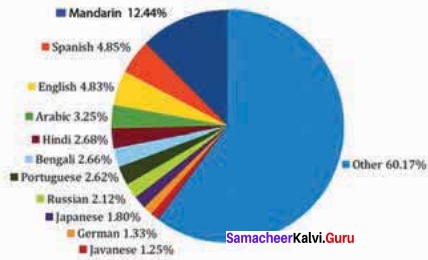
(B) Study the pie-chart carefully and answer the questions that follow.

Percentage of people who speak each language as their first language.

Tight Corners Pdf Samacheer Kalvi 11th English Solutions Prose Chapter 4

Use expressions such as…
Generally….
A majority….
Most of the….
Some of the….
Minority of….
In conclusion….

Question 1.
Which language is spoken by most people?
Answer:
Mandarin is spoken by most people.

Question 2.
What are the Indian languages that rank among the top five spoken languages?
Answer:
Hindi and Bengali rank among the top five languages spoken in the world.

Question 3.
Which are the languages that are spoken by less than three percent of people?
Answer:
Hindi, Bengali, Portuguese, Russian, Japanese, German and Javanese are the languages spoken by less than 3% people of the world.

Question 4.
With the help of the questions and answers, draw your own conclusions from the pie chart. Then, write a paragraph on the popular.spoken languages.
Answer:
A majority of people in China speak Mandarin. It constitutes 12.44$ of the world population. Spanish is spoken more than English (i.e) 0.2% more people in the world speak Sopanish (i.e) (4.85%). Hindi, Bengali and Portuguese are spoken by a minority of around 2.7% of world population. A minority of just 1.25% of world population speaks Javanese, Russian language is spoken only by a minority of 2.12% people, in the world. As low as 1.8% of people speak Japanese language. Many other languages are little known in the world or spoken by other people in the world for which exact statistics is not available. There are many fast disappearing languages which have no writter script. Along with a language, a culture also disappears.

Write conversations on the following situations.

(i) Between two friends about uses and abuses of mobile phone

A : Mobile phone has made our lives comfortable.
B : How?
A : Well, for any project related queries, I just google. I get a variety of solved projects, I get an opportunity to refer to any information in Science.
B : Well deosn’t it have its abuses too?
A : Of course yes, any technology has its own advantages or disadvantages.
B : Most of the elders are really worried about facebook and what’s app addiction and squandering of time in social websites.
A : I agree with you absolutely. Moderation is necessary in the use of mobile phones,

(ii) Between two friends about planting trees

A : A country without trees has a hopeless future
B : What a strong statement? Who said it?
A : Theodore Roosevelt said it.
B : Can you tell me about living legends who plant trees and protect them?
A : Have you heard of Jamuna Tudu? What has she done? Where is she?
B : She is in Jharkhand. She has fought against timber mafia and saved fifty hectare of forests with the help of women volunteers.
A : How did she achieve such a feat?
B : In 1998, she formed “Vana Suraksha Smitit” (i.e) Forest safety committee.
A : Didn’t she get opposition from villagers and Timber mafia?
B : Yes of course the villagers protested because they needed fire wood. She persuaded them to use small twigs and leave the main tree. The timber mafia looted their home and pelted stones at her husband who was critically wounded.
A : How strong is her committee now?
B : She has created 300 groups of women volunteers who roam the forest with bow and, arrows to protect the trees.

(iii) Between two friends about the importance of reading newspapers

A : Do we need newspapers? We have different sources of news. Even an android phone gives one access different kinds of news.
B : Well, the question is how important is reading of news papers?
A : My contention was that one can read the e.version.
B : Read any version, brother. Newspapers must be read.
A : Why do you advise it so strongly?
B : I advocate reading of newspaper strongly because, most of the students focus only on their Board exam or class tests. If they cultivate the habit of reading newspapers, , their knowledge of the world will expand. In future, they will be in a comfortable position to prepare for any competitive examination including IAS examination.
A : We will tell all our friends about this.
B : That’s nice.

(iv) Between two friends about the uses of the internet

A : Where are you going?
B : To Sakthi Browsing Centre.
A : Why?
B : To browse internet for my school project.
A : Why don’t you visit the district library?
B : Well, the internet section in the library is always crowded.
A : Well, I meant why don’t you refer to books? How is internet useful?
B : Everyday knowledge is being added on. Continuous updation of data is done in internet. I have an easy access to e.profiles and projects of children. Besides, I can select video lectures of eminent personalities. When I feel low, I listen to the inspirational lectures of Suki Sivam and Jayantha Sree Balakrishnan. All subject references are available at a click of a button. Last week, I read prize winning essays on various topics. If you don’t wander into toxic Face book or What’s app, you could always use internet to your own maximum advantage. Through skype, we can talk to people around the world, share ideas and strengthen cultural bondages too.

(v) Between a father and a son on choice of a career

Father : Why don’t you take up B.E Information Technology.
Son ; Dad I am interested in music.
Father : It is good for entertainment. Will it give you a steady income?
Sun : Dad, let me master music. I passionately love people. I may become a good musician.
Father : All can’t become like A.R. Rehman or Ilayara Raja.
Son : Dad, let me be myself.
Father : You are my only son. Will I suggest something bad for you.
Sun : Dad, please suggest the dress in which I will look better. Suggest the food item which would suit me better. But, career option, please leave it to me.
Father : Do you really believe you can shine in the field of music?
Son : Dad, faith is life. Music is just not an entertainment.
Father : OK. It is your life. Go to music college.
Son : Thanks Dad.


(vi) Between you and a bookseller on buying books

Bookseller : What do you want sir?
Boy : I want a dictionary.
Bookseller : Hindi – English, Tamil – English, English -English which brand?
Boy : I want a good dictionary to last till I do my Graduation.
Bookseller : Then please take Oxford Advanced learners dictionary by A.S. Hornby and Daniel Jones.
Boy : How much is it?
Bookseller : After discount it is Rs. 640/
Boy : Take the money sir, thank you.

(vii) Between two friends on the benefits of early rising

A : Why are you late today?
B : Yesterday I had been to movies. I overslept.
A : You must practise early rising.
B : Why?
A : Early to bed and early to rise makes you a healthy person.
B : Tell me why I should get up early?
A : If you get up early, you will be brisk. The morning walk will provide you extra energy, you will bathe in time and be celebrated for being punctual. An early bird catches its prey. Similarly early risers achieve a lot in life.
B : Thank you. I will rise early from tomorrow.

(viii) Between two friends on an exciting cricket match

A : Did you watch T20 cricket between India and Bangladesh last night?
B : No, I slept when the Bangladesh was making inroads into our bowling attack.
A : Bangladesh was chasing 177 runs.
B : Who bowled well?
A : Washington Sundar did a wonderful job. He bowled and took wickets giving minimum runs.
B : Shikar Dhawan and Rohit Sharma did excellently well.
A : Who scored high?
B : Skipper Rohit Sharma scored 89 runs leading the team from the front.
A : Who else did well?
B : Suresh Raina scored 47 and Shikar Dhawans 35. They both contributed handsomely to India’s victory over Bangladesh.
A : We shall see another sensational game soon.
B : Yes.

(ix) Between two friends on the importance of punctuality

Varun : Karun, you are alwasy ahead of us. How?
Kanin : Varun, my dad insists that I must be always punctual.
Varun : Are they going to reward you?
Karun : No, virtue can’t ask for a reward because it is a reward by itself.
Varun : How does punctuality help us?
Karun : Punctuality makes others believe that you value their time.
Varun : What can I do to be punctual?
Karun : It is simple. Have a calendar for your daily activities. Fix time for everything. You will reap the fruits soon.
Vanin : Thank you

(x) Between two friends on a picnic they enjoyed recently

A : Wasn’t our picnic-to Mahabalipuram wonderful?
B : Yes, I enjoyed the stroll on the beach.
A : I liked the monolithic structures. How beautifully they have frozen beauty on stones!
B : The five Rathas reminded me of Pandavas.
A : I like the games we played as a team sitting in a circle.
B : The Anthakshari we played was very interesting.
A : The riddles were also challenging.
B : I liked the Kabaddi game played by our friends on the beach.
A : Infact, I can’t forget the picnic we ha

Tight Corners About the author

Tight Corners Samacheer Kalvi 11th English Solutions Prose Chapter 4

Edward Vcrral Lucas (1868-1938) was an English humorist, essayist, play wright. biographer, publisher, poet novelist and short story writer. His contribution to the humorous magazine Punch started in 1904 and lasted till his death.

Tight Corners Summary

In this humorous prose piece, the writer confesses how he was bailed out of a humiliating experience by a sudden stroke of luck and thus got relieved from a tight comer he had foolishly walked into.

The author’s friends quoted incidents such as

  1. a man caught by the tide in Brittany and escaped by the skin of his teeth
  2. a man was on an elephant when a wounded tiger attacked it
  3. a man was on the top storey of a burning house
  4. a man was torpedoed in a war. All these incidents talk of physical problems which are claimed to be tight comers. But the author cites from his personal experience an example of a mental tight comer which almost took him to the brink of public disgrace at an auction house at Christie’s.

An auction was in progress at Christie’s. The author and his friend were passing along King Street after having lunch at a club. He persuaded the author to peep into the auction room where Barbizon pictures were on sale. Each picture was sold at two to three thousand pounds.

Tight Corners Paragraph Samacheer Kalvi 11th English Solutions Prose Chapter 4

The author had only sixty-three pounds in the bank. He realized that it was not enough to borrow securities to the tune of five hundred pounds, which is the minimum required deposit to be eligible to bid. Yet, the author found himself bidding just for fun.

The author’s friend cautioned him that he may get caught. But he was overconfident and asserted that he was not going to run any risks. Things moved on well till some well-known dealer put up a picture for a price a little higher than any picture had reached in that auction so far. All the previous bids had been started with the most moderate sum of fifty guineas or a hundred guineas. One particular picture was started with an astounding sum of4000 pounds.

There was an uncomfortable silence in the auction hall. There was a hushed excitement expressing surprise at the sudden hike in the opening bid amount. But foolishly the author had his own voice saying “and fifty”. He expected competitors to hike the price and save him from trouble. But there was a stunned silence. The auctioner after waiting for a few minutes of silence clinched the deal with a hammer saying “four thousand and fifty guineas offered”. The author ’s blood congealed in obvious horror. The auctioner asked for an advance for the bid.

The author, despite the warning of his friend, had foolishly got into a mess. He had to pay four thousand and fifty guineas, the top price of that day. His friend had deserted him to have a hearty laugh.

Not exhibiting the inner turmoil and alarm, the author non-chalantly gave his visiting card. Whoever had bid came and paid for the picture and collected the painting. The author stayed behind at the end of the queue feverishly thinking of the next steps. He was trying to recall uncles and aunts who might lend him the required money. But deep within he realized that his contacts and relatives would not give him money but promises future support. The only open course of action was to confess his poor financial status. But he was scared of the reaction of the auctioning agents, about the credibility he had established by bidding for many ‘prized’ collections. He had created such an impression that anyone would ever treat his behaviour as a “genuine mistake”.

Someone came and politely asked the author if he was the gentleman who had made a bid for big Daubigny. The author confirmed it. He asked the author if he would take fifty guineas from the man who had made a bid for four thousand guineas.

Instead of weeping for joy for getting such an opportunity to be relieved from a predicament or a tight comer with a bonus of fifty guineas, the author asked, “Is that the most he would offer?”. The mediator said that there was no harm in asking for a little bit more. Cashing in on the opportunity the author said, “Tell him I will take a hundred”.

The author and his friend started laughing at the sudden turn of the events like O. Henry twist. But when the author saw the cheque for 100 guineas, he became suddenly serious and said that of all the luck, he was hanged. The author ’s friend reminded him that he would not have been at Christie had it not been for him. The author agreed that it was indelibly written on his heart with letters of fire and promised that he would never forget it.

People who take calculated risks may get away. But those who take high risks usually find themselves in tight comers. The author was lucky but every one may not have similar luck.

Tight Corners Glossary

Textual:
baize – coarse woollen material
bloatocrat – bloated + aristocrat (a term coined by E.V. Lucas to mean a bloated (fat) and wealthy person) y
Brittany – a region in the coast of North – West France
congealed – thickened as if frozen (through fear etc.)
cresendo – progress towards a climax
electrified – shocked by something unexpected
farthing – as low as paise
glibly – smoothly but not sincerely
guile – cunning, deceit
indelible – cannot be rubbed out or removed
nonchalantly – unconcernedly, coolly
note of hand – promissory note,
rectitude – honesty, good behaviour
smothered – suppressed
St. James – Street, King
Street – well-known commercial streets in London

Additional:
auction – a public event of selling things to the highest bidder
cautioned – warned
enough – adequate
excitement – thrill
inquiringly – inquisitively
modestly – moderately
persuaded – induced
purchaser – buyer
remote – isolated
torpedoed – bombed

Tight Corners Synonyms

Choose the most appropriate synonyms for the underlined words.

Question 1.
The talk was running on critical situations.
(a) electrical
(b) extremely ill
(c) serious
(d) ready for chain reaction
Answer:
(c) serious

Question 2.
A wounded tiger charged at it.
(a) complained
(b) attacked
(c) gave power
(d) reported
Answer:
(b) attacked

Question 3.
A fourth was torpedoed in the war.
(a) rescued
(b) bombed
(c) lifted
(d) arrested
Answer:
(b) bombed


Question 4.
He persuaded me to look in at the sale-room.
(a) discouraged
(b) criticised
(c) induced
(d) dissuaded
Answer:
(c) induced

Question 5.
I found myself bidding just for fun.
(a) offering
(b) with drawing
(c) neglecting
(d) accepting
Answer:
(a) offering

Question 6.
And not enough securities to borrow five hundred on
(a) surplus
(b) efficient
(c) adequate
(d) excess
Answer:
(c) adequate

Question 7.
I was nodding away to the auctioneer like a bloated aristocrat.
(a) bloated autocrat
(b) bloatocrat
(c) bloated artist
(d) bloated
Answer:
(b) bloatocrat

Question 8.
A dealer electrified the room by starting the bid with a huge figure.
(a) pleased
(b) shocked
(c) electrocuted
(d) provoked
Answer:
(b) shocked

Question 9.
The previous lots had run into four figures but they had all been modestly started at fifty or a hundred guineas.
(a) immodestly
(b) politely
(c) moderately
(d) exorbitantly
Answer:
(c) moderately

Question 10.
The dealer made his sensational bid.
(a) dull
(b) insipid
(c) exciting
(d) timid
Answer:
(c) exciting

Question 11.
The narrator was contributing safely to the gradual crescendo.
(a) climax
(b) anti-climax
(c) denouement
(d) excitement
Answer:
(a) climax

Question 12.
There was a rustle of excitement.
(a) sensation/thrill
(b) reason
(c) argument
(d) appeasement
Answer:
(a) sensation/thrill

Question 13.
The auctioneer looked inquiringly first at the opener and then at the company.
(a) ignorantly
(b) innocently
(c) inquisitively
(d) incessantly
Answer:
(c) inquisitively

Question 14.
Mv blood congealed arround the cut.
(a) thawed
(b) thickened
(c) boiled
(d) showed down
Answer:
(b) thickened

Question 15.
There was a curious smothered noise from my friend.
(a) expressed
(b) articulated
(c) hidden
(d) suppressed
Answer:
(d) suppressed


Question 16.
That was a nice pickle to be in.
(a) comfort
(b) mess
(c) canteen
(d) cafeterial
Answer:
(b) mess

Question 17.
I had become a purchaser of a picture I didn’t want to own.
(a) seller
(b) auctioneer
(c) buyer
(d) antic-dealer
Answer:
(c) buyer

Question 18.
He had left me not out of baseness as I discovered later.
(a) foundation
(b) meanness
(c) sanctity
(d) holiness
Answer:
(b) meanness

Question 19.
He deserted me to find a remote place to laugh.
(a) nearby
(b) neighbouring
(c) isolated
(d) irritated
Answer:
(c) isolated

Question 20.
The narrator wondered if money lenders who talk so glibly about “note of hand” really mean it.
(a) rudely
(b) sincerely
(c) honestly
(d) insincerely
Answer:
(d) insincerely

Question 21.
He started speculating on the possibility of confessing his poverty.
(a) believing
(b) hypothesize
(c) distrusts
(d) doubting
Answer:
(b) hypothesize

Question 22.
I pulled myself together sufficiently to hand my card nonchalantly.
(a) devotedly
(b) enthusiastically
(c) coolly / unconcernedly
(d) with concern
Answer:
(c) coolly / unconcernedly

Question 23.
The stafflooked prosperous.
(a) poor
(b) dirty
(c) rich
(d) stingly
Answer:
(c) rich

Question 24.
A genuine mistake could have been rectified.
(a) fake
(b) false
(c) real
(d) feigned
Answer:
(c) real

Question 25.
A career of rectitude has rewards.
(a) disloyalty
(b) dishonesty
(c) contentment
(d) honesty
Answer:
(d) honesty

Question 26.
The rewards are beyond the consciousness of virtue.
(a) sin
(b) crime
(c) vice
(d) morality
Answer:
(d) morality

Question 27.
Even among the best of us there is wordly guile.
(a) wisdom
(b) cunningness
(c) virtue
(d) morality
Answer:
(d) morality

Question 28.
He became suddenly grave.
(a) light hearted
(b) humorous
(c) serious
(d) critical
Answer:
(c) serious

Question 29.
It is indelibly branded on letters of fire on my heart.
(a) unforgettable
(b) inerasable
(c) misunderstood
(d) ineligible
Answer:
(b) inerasable

Tight Corners Antonyms

Choose the most appropriate antonyms for the underlined words.

Question 1.
The talk was on critical situations.
(a) important
(b) precious
(c) unimportant / trivial
(d) furious
Answer:
(c) unimportant / trivial

Question 2.
Someone talked as if tight comers were always physical affairs.
(a) fiscal
(b) bodily
(c) concrete
(d) mental
Answer:
(d) mental

Question 3.
He persuaded me to look in at the sale.
(a) led
(b) followed
(c) dissuaded
(d) made
Answer:
(c) dissuaded

Question 4.
Each picture was getting tremendous sums.
(a) poor / meagre
(b) impressive
(c) excellent
(d) huge
Answer:
(a) poor / meagre


Question 5.
I had not enough money for securities.
(a) adequate
(b) sufficient
(c) surplus
(d) limited
Answer:
(c) surplus

Question 6.
The.place was full.
(a) crowded
(b) empty
(c) overflowing
(d) congested
Answer:
(b) empty

Question 7.
I had to borrow five hundred pounds.
(a) receive.
(b) raise
(c) lend
(d) land
Answer:
(c) lend

Question 8.
Then I found myself.
(a) gained
(b) discovered
(c) established
(d) lost
Answer:
(d) lost

Question 9.
I had often been safely contributing to the hike in auction.
(a) calmly
(b) harmlessly
(c) innocently
(d) dangerously
Answer:
(d) dangerously

Question 10.
The dealer made his sensational bid.
(a) exciting
(b) remarkable
(c) extraordinary
(d) ordinary
Answer:
(d) ordinary

Question 11.
The auctioneer built up the crescendo gradually.
(a) climax
(b) bottom
(c) peak
(d) zenith
Answer:
(b) bottom

Question 12.
There was a rustle of excitement.
(a) sensation
(b) calmness
(c) fun
(d) activity
Answer:
(b) calmness

Question 13.
To my horror, the red faced dealer gave no sign of life. .
(a) antipathy
(b) hate
(c) dread
(d) delight
Answer:
(d) delight

Question 14.
Four thousand and fifty guineas offered.
(a) presented
(b) withdrew
(c) provided
(d) tendered
Answer:
(b) withdrew

Question 15.
There was no sound but a curious smothered noise from my friend.
(a) suffocated
(b) stifled
(c) expressed
(d) suppressed
Answer:
(c) expressed


Question 16.
I was the purchaser of a picture.
(a) consumer
(b) client
(c) seller
(d) bidder
Answer:
(c) seller

Question 17.
My blood congealed.
(a) froze
(b) solidified
(c) thickened
(d) thinned
Answer:
(d) thinned

Question 18.
My friend had left me not because of baseness.
(a) depravity
(b) mobility
(c) vileness
(d) wickdenss
Answer:
(b) mobility

Question 19.
He had left to find a remote place to laugh.
(a) distant
(b) aloof
(c) isolated
(d) nearby
Answer:
(d) nearby

Question 20.
I was stunned and dazed.
(a) astounded
(b) astonised
(c) amazed
(d) cool hedede
Answer:
(d) cool hedede

Question 21.
I handed in my card non-chalantlv.
(a) indifferently
(b) eagerly/mindfull
(c) coolly
(d) careless
Answer:
(b) eagerly/mindfull

Question 22.
I set to pondering oil the problem.
(a) ignoring
(b) reflecting
(c) consider
(d) contemplating
Answer:
(a) ignoring

Question 23.
They talk so glibly.
(a) smoothly
(b) effortlessly
(c) dismissively
(d) rudely
Answer:
(d) rudely

Question 24.
A career of rectitude has its rewards.
(a) honesty
(b) good behaviour
(c) depravity
(d) uprightness
Answer:
(c) depravity

Question 25.
The rewards are beyond the mere consciousness of virtue.
(a) nobility
(b) dignity
(c) morality
(d) vice
Answer:
(d) vice

Question 26.
I admitted it.
(a) confessed
(b) acknowledged
(c) denied
(d) accepted
Answer:
(c) denied

Question 27.
The staff looked prosperous
(a) affluent
(b) rich
(c) proud
(d) poor
Answer:
(d) poor

Question 28.
A genuine mistake could have been rectified.
(a) Teal
(b) sincere
(c) loyal
(d) false
Answer:
(d) false

Question 29.
Will you take fifty guineas for your bid?
(a) order
(b) offer
(c) tender
(d) rejection
Answer:
(d) rejection


Question 30.
In the best of us, there is worldly guile.
(a) artistic
(b) clever
(c) cunning
(d) honesty
Answer:
(d) honesty

Question 31.
He became grave.
(a) cheerful
(b) serious
(c) severe
(d) solemn
Answer:
(c) severe

Question 32.
It is indelibly branded in letters of fire on my heart.
(a) permanently
(b) unerasably
(c) erasable
(d) fixed
Answer:
(c) erasable

The main aim is to share the knowledge and help the students of 11th English to secure the best score in their final exams. Use the concepts of Samacheer Kalvi 11th English Book Solutions Prose Chapter 4 Tight Corners Questions and Answers in Real time to enhance your skills. If you have any doubts you can post your comments in the comment section, We will clarify your doubts as soon as possible without any delay.

Samacheer Kalvi 6th Social Science Geography Solutions Term 1 Chapter 1 The Universal And Solar System

You can Download Samacheer Kalvi 6th Social Science Book Solutions Guide Pdf, Tamilnadu State Board help you to revise the complete Syllabus and score more marks in your examinations.

Tamilnadu Samacheer Kalvi 6th Social Science Geography Solutions Term 1 Chapter 1 The Universal And Solar System

Samacheer Kalvi 6th Social Science The Universal And Solar System Textual Evaluation

A. Fill in the blank

  1. The Universe was formed after _______ explosion.
  2. _______ is the unit used to measure the distance between two celestial bodies.
  3. _______ is the centre of the solar system.
  4. The word planet means _______
  5. _______ planet has many natural satellites.
  6. India’s first ever mission to the moon is _______
  7. Earth is inclined by _______ degrees.
  8. The Equator faces the Sun directly _______ on and _______
  9. the time of Perihelion, the Earth is _______ to the sun
  10. The line which divides day and night on the Earth’s surface is _______

Answer:

  1. Big Bang
  2. Light year
  3. Sun
  4. Wanderer
  5. Jupiter
  6. Chandrayaan – I
  7. 231/2
  8. 21st March and 23rd September
  9. Closest
  10. Terminator Line

B. Choose the bent answer

The Universe And Solar System 6th Standard Question 1.
The movement of the Earth on its axis is called
(a) Revolution
(b) Seasons
(c) Rotation
(d) Circulation
Answer:
(c) Rotation

The Universe And Solar System Book Back Answers Question 2.
The Tropic of Capricorn faces the Sun directly on _______
(a) March 21
(b) June 21
(c) September 23
(d) December 22
Answer:
(d) December 22

Samacheer Kalvi 6th Geography Book Question 3.
The galaxy in which our solar system is found is
(a) Andromeda
(b) Magellanic clouds
(c) Milky Way
(d) Starburst
Answer:
(c) Milky Way

Samacheer Kalvi Guru 6th Social Science Question 4.
The only celestial body where man has successfully landed _______
(a) Mars
(b) Moon
(c) Mercury
(d) Venus
Answer:
(b) Moon

The Universe 6th Standard Question 5.
Which of the following planets can float on water?
(a) Jupiter
(b) Saturn
(c) Uranus
(d) Neptune
Answer:
(b) Saturn

C. Circle the odd one out

  1. Venus, Jupiter, Neptune,
  2. Saturn Sirius, Andromeda, Milky way, Magellanic clouds
  3. Pluto, Eris, Ceres, Io
  4. Comet, Asteroids, Meteorites, Dwarf planets
  5. Rover, Orbiter, Aeroplane, Space shuttle

Answer:

  1. Venus
  2. Sirius
  3. Io
  4. Dwarf planets
  5. Aeroptane

D. Match the following

  1. Hottest Planet – a. Mars
  2. Ringed Planet – b. Neptune
  3. Red Planet – c. Venus
  4. Somersaulting Planet – d. Saturn
  5. Coldest Planet – e. Uranus

Answer:

  1. – c
  2. – d
  3. – a
  4. – e
  5. – b

(I) Consider the following statement

Samacheerkalvi.Guru 6th Social Question 1.

  1. Venus rotates from east to west.
  2. The Tropic of Cancer faces the Sun on June 21.
  3. Mars has rings around it.

Choose the correct answer using the codes given below.

(a) 1 and 2
(c) 1,2 and 3
(b) 2 and 3
(d) 2 only
Answer:
(a) 1 and 2

(II) Consider the following statements.

Samacheer Kalvi Guru 6th Social Question 1.
Statement Is Earth is called a watery planet,
Statement II: The rotation of the Earth causes seasons.
Which of the statement(s) is/are true?
(a) I is true; II is wrong
(b) I is wrong; II is true
(c) Both the statements are true
(d) Statements I and II are wrong.
Answer:
(a) I is true; II is wrong

F. Name the following

  1. Cluster of stars. – Galaxy
  2. The nearest galaxy to the solar system. – Magellanic clouds/Andromeda
  3. The brightest planet. – Venus
  4. The living sphere – Earth
  5. The year which has 366 days. – Leap year

G. Answer in brief.

Samacheer Kalvi Guru 6th Standard Social Science Question 1.
Name the inner planets.
Answer:
The inner planets are Mercury, Venus, Earth, and Mars.

Samacheer Kalvi Guru 6th Social Science Book Back Answers Question 2.
Pluto is no longer a planet. Reason out.
Answer:
Unlike planets Pluto share its orbit with other planets.

Question 3.
What is perihelion?
Answer:
Perihelion is the Earth’s closest position to the Sun.

Question 4.
How many times in a year would you find the Sun overhead if you lived on 20°N Latitude?
Answer:
2 times.

Question 5.
Which celestial body shares its orbit with others? Give an example,
Answer:

  1. The dwarf planets share their orbits with others.
  2. The five dwarf planets of the solar system are Pluto, Ceres, Eris, Makemake and Haumea.

H. Give reasons.

Question 1.
Why is Uranus called the somersaulting planet?
Answer:
The axis of Uranus is tilted so much that, it appears to orbit the sun on its sides like a rolling ball. So uranus called the somersaulting planet.

Question 2.
The surface of the moon has many craters.
Answer:
The craters are formed due to the meteorites which fall on the moon’s surface.

Question 3.
The velocity of Earth’s rotation is zero at poles,
Answer:

  1. The Earth is a sphere.
  2. It is widest at the equator, becoming increasingly narrow further toward to top and bottom.
  3. The velocity of earth’s rotation varies from 1670 km/hr at equator and to 845 km/ hr at 60°N and S and zero at the poles.

I. Answer In detail.

Question 1.
Distinguish between inner and outer planets,
Answer:

Inner or Terrestrial Planets

  1. Mercury, Venus, Earth, Mars.
  2. They are comparatively smaller in size.
  3. They are composed of rocks. The surface of the inner planets has mountains, volcanoes and craters.
  4. None of the inner planets have rings orbiting them

Outer Planets or Jovian Planets , or Gaseous Giants

  1. Jupiter, Saturn, Uranus, Neptune.
  2. They are huge in size.
  3. Most of them are made of gas.
  4. All of the outer plants have rings orbiting them.

Question 2.
What are the effects of rotation and revolution?
Answer:
Rotation:

  • The rotation of the earth causes day and night.
  • As the earth is spherical in shape, only one half of it is illuminated by the sun at a time. The other half remains dark.
  • The illuminated portion of the earth experiences day and the other part of the earth experiences night.

Revolution:

  • The movement of the earth around the sun is called revolution.
  • The revolution of the earth causes seasons.
  • The revolution of the earth gives the impression that the sun is moving north and south of the equator.
  • The equator faces the Sun directly on March 21 and September 23.
  • During these two days the day and night are equal throughout the earth. These two days are called Equinoxes.
  • On June 21, the Tropic of Cancer faces the sun. This is known as summer solstice. It is the longest day in the
  • Northern Hemisphere and longest night in the Southern hemisphere.

Question 3.
Explain the characteristic! of the various spheres of the Earth.
Answer:
Earth is the most suitable planet to support life. It has three major components that we call as the realms of the Earth lithosphere, hydrosphere and atmosphere.

(i) Lithosphere : The word lithosphere is derived from the Greek word Lithos, which means rocky. The Lithosphere is the land on which we live.

(ii) Hydrosphere : The word Hydro means water in Greek. The hydrosphere consists of water bodies such as oceans, seas, rivers, lakes, ice caps on mountains and water vapour in the atmosphere.

(iii) Atmosphere : The word Atmo means air in Greek. Atmosphere is the envelope of air that surrounds the Earth. Different types of gases make up the atmosphere. The major gases are Nitrogen (78%) and Oxygen (21%).

(iv) Biosphere : The narrow belt of interaction among the lithosphere, the hydrosphere and the atmosphere, where life exists is known as Biosphere. Bio means life in Greek. It consists of distinct zones.

J. Picture Study,

Question 1.

The Universe And Solar System 6th Standard Samacheer Kalvi Social Science Geography Solutions Term 1 Chapter 1

Study the picture and answer the given questions,
a. Which is the closest planet to the Sun?
b. Which is the largest planet?
c. Which is the farthest planet from the Sun?
d. Which is the second smallest planet?
Answer:
a. Mercury
b, Jupiter
c, Neptune
d. Mars

Question 2.
Look at the picture and answer the questions given below,

The Universe And Solar System Book Back Answers Samacheer Kalvi 6th Social Science Geography Solutions Term 1 Chapter 1

(a) Identify the planet
Answer:
Uranus

(b) What is the colour of the planet?
Answer:
Green

(c) Why is it of this colour?
Answer:
It appears green due to the presence of methane

Student Activity

K. Solve the Puzzle Across

Samacheer Kalvi 6th Geography Book Social Science Solutions Term 1 Chapter 1 The Universal And Solar System

2. A dwarf planet.
3. Equal days and nights.
7. I am a gas found in the Sun.
8. I appear once in 76 years.

Samacheer Kalvi Guru 6th Social Science Geography Solutions Term 1 Chapter 1 The Universal And Solar System

Down

  1. I am the morning star.
  2. India’s first moon mission.
  3. I have two natural satellites.
  4. I am the farthest planet.
  5. An imaginary line passing through
  6. the centre of the Earth.

Samacheer Kalvi 6th Social Science The Universal And Solar System In-Text Question

HOTS:
Question 1.
Even though Mercury Is the nearest planet to the Sun, Venus Is the hottest one, Guess why?
Answer:

  1. Venus is the hottest planet even though Mercury is the closest planet to the Sun.
  2. The reason that Venus is hotter than Mercury is because it has an atmosphere made of Carbon dioxide.
  3. It also has clouds of acid inside its atmosphere.
  4. This is called Green House effect.

Question 2.
If you could put Saturn In a large enough ocean It would float. Guess why?
Answer:

  1. Being less dense than water means that it would float on an ocean big enough to contain it.
  2. Saturn is the only planet in the Solar System that is less dense than water.
  3. Since Saturn is lighter that water, it can float on water.

Question 3.
Imagine you were on a space craft travelling at the speed of light from Earth, how long would It take to reach the Sun?
Answer:

  1. Sunlight travels at the speed of light.
  2. Photons emitted from the surface of the Sun need to travel across the vacuum of space to reach our eyes.
  3. It takes sunlight to an average time of 8 minutes and 20 seconds to travel from the Sun to Earth.

Question 4.
We see only one side of the Moon always. Why?
Answer:

  1. We can see only one side of the moon.
  2. It is because the moon revolves around the Earth at the exact same speed as it rotates around its own axis.
  3. So that the same side of the moon is constantly facing the surface of the Earth.
  4. It takes 27 days and 8 hours for its one rotation.
  5. If the moon did not rotate at all, we would see all of its sides.

Question 5.
Priya Is 12 years old. How many limes she would have revolved around the Sun?
Answer:

  1. It takes the earth 365 1/4 days to complete one orbit around the sun.
  2. It is the movement of the Earth around the Sun on its elliptical path.
  3. priya is 12 years old. She would have revolved around the Sun 12 times.

Question 6.
If the Earth is not Inclined at 231/2° angle, what would happen to the Earth ?
Answer:

  1. If the Earth weren’t tilted on its axis, there would be no seasons and humanity would suffer.
  2. An Earth without a tilt would get colder as you move away from the equator.
  3. Humans would never survive the continuous winter of the high latitudes.
  4. Fortunately, as things are, Earth ‘s tropical zones tend to have minimal temperature, day- length variability over the course of the year.

Samacheer Kalvi 6th Social Science The Universal And Solar System In-Text Question

Question 1.
Watch a show In the nearest planetarium,
(a) Share your experience In the class room,
(b) Make an album of Interesting facts about the Solar System.
(c) In the Solar System
Answer:

  1. The hottest planet is not closest of the Sun.
  2. The dwarf planet Pluto is smaller in diameter than the United States of America.
  3. The edge of the Solar System is 1000 times farther away than Pluto.
  4. Jupiter has the biggest Ocean of any planet.

Solar system profile:

Age4.6 Billian Years
1.Number of Planets8
2.Number of dwarf Planets5
3.Number of Moons181
4.Number of Asteroids5,52,894
5.Number of Comets3,084
6.Diameter18.75 Trillion years

Question 2.
Circle the leap years? 2000,2005, 2012,2014,2017, and 2020
Answer:
2000,2012,2020

A. Fill In the blanks :

  1. Universe is also referred to as the _______
  2. The study of the Universe is called _______
  3. The sound travels at a speed of _______
  4. In a galaxy, a huge cluster of stars are held by _______
  5. The nearest galaxy to the Earth is _______
  6. The Roman word ‘sol’ means _______
  7. The Sun is made up of extremely hot gases like _______and _______
  8. There are _______ planets in the solar system.
  9. The curved path in which the planets move around the Sun is known as _______
  10. The four planets nearer to the Sun are called _______ Planets
  11. Outer Planets are also called _______
  12. The smallest planet is _______
  13. The planet _______ is called Earth’s twin.
  14. The living planet is _______
  15. The distance between the Sun and the Earth is about _______
  16. The _______ is named after the Roman God of war.
  17. ISRO has now become the _______ space agency to reach
  18. The fastest spinning planet in the solar system is _______
  19. Saturn has _______ natural satellites around it.
  20. The specific gravity of Saturn is _______
  21. The astronomer William Herschel discovered _______ in 1781
  22. The Planet _______ has striking blue and white features
  23. The _______ planets are extremely cold and dark.
  24. The Earth’s satellite is _______
  25. Asteroids are _______ the Planets.
  26. The celestial object made up of a head and a tail is called a _______
  27. Shooting stars are nothing but _______
  28. The earth is _______ in shape
  29. The earth is _______ on its axis.
  30. The rotation of the Earth _______ causes _______
  31. In a leap year, there are _______ days in the month of February.
  32. When day and night are equal throughout the Earth, it is known as _______
  33. farthest position ofthe Earth from the Sun is known as ________
  34. Summer Solstice is the longest day in _______ Hemisphere
  35. The longest day in _______Hemisphere is called as Winter Solstice
  36. The Greek word ‘Lithos’ means _______
  37. The Greek word ‘hydro’ means _______
  38. The _______ is made up of different types of gases.
  39. In Biosphere, there are zones called _______
  40. Our solar system is a part of the _______ Galaxy.

Answer:

  1. Cosmos
  2. Cosmology
  3. 330 m/sl
  4. gravitational forcesl
  5. Andromedal
  6. Sun God
  7. hydrogen and helium
  8. eight
  9. Orbit
  10. Inner or Terrestriall
  11. Jovian Planets or Gaseous Giantsl
  12. Mercury
  13. Venus
  14. Earth
  15. 150 million kilometer’
  16. Mars
  17. Fourth
  18. Jupiter
  19. 62
  20. less than
  21. Uranus
  22. Neptune
  23. Dwarf
  24. Moon
  25. Minor
  26. Comet
  27. Meteors
  28. Spherical
  29. rotates
  30. Day,night
  31. 29
  32. Equinox
  33. Aphelion
  34. Northern
  35. Southern
  36. Rocky
  37. Water
  38. atmosphere
  39. Eco system
  40. Milky Way

B. Choose the correct answer

Question 1.
Galaxy means having a huge cluster of _______
(a) Planets
(b) Asteroids
(c) Stars
(d) Meteors
Answer:
(e) Stars

Question 2.
The somersaulting planet is _______
(a) Venus
(b) Mars
(c) Neptune
(d) Uranus
Answer:
(d) Uranus

Question 3.
_______Is self-luminous and gives light on its own
(a) Sun
(b) Moon
(c) Star
(d) Earth
Answer:
(a) Sun

Question 4.
Halley comet will next appear in _______
(a) 2051
(b) 2041
(c) 2061
(d) 2031
Answer:
(c) 2061

Question 5.
The nearest planet is _______
(a) Mercury
(b) Venus
(c) Neptune
(d) Jupiter
Answer:
(a) Mercury

Question 6.
The fifth-largest planet in the Solar system is _______
(a) Jupiter
(b) Mars
(c) Saturn
(d) Earth
Answer:
(d) Earth

Question 7.
lo, Europa, Ganymede, Callisto are a few large satellites of _______
(a) Jupiter
(b) Mars
(c) Mercury
(d) Venus
Answer:
(a) Jupiter

Question 8.
The second-largest planet in the solar system is _______
(a) Mars
(b) Star
(c) Earth
(d) Saturn
Answer:
(d) Saturn

Question 9.
Saturn’s largest moon is _______
(a) Europa
(b) Callisto
(c) Titan
(d) Titania
Answer:
(c) Titan

Question 10.
Triton is the satellite of _______
(a) Earth
(b) Juipeter
(c) Neptune
(d) Uranus
Answer:
(c) Neptune

Question 11.
Halley’s comet is expected to appear in _______
(a) 2020
(b) 2014
(c) 2035
(d) 2020

Question 12.
Pick owt the leap year from the following:
(a) 2001
(b) 2014
(c) 2018
(d) 2020

Question 13.
Solid layer of rocks and soil is found in:
(a) Biosphere
(b) Lithosphere
(c) Hydrosphere
(d) Atmosphere

C. Find the odd one out

Question 1.
Mercury, Earth, Mars, Uranus
Answer:
Uranus, the other three rotate anti-clockwise.

Question 2.
Pluto, Ceres, Makemake, Titan.
Answer:
Titan,Titan is a moon. Other three are Dwarf planets.

Question 3.
Sol, Bio, Atmo, Hydro
Answer:
Sol, it a Roman word. Other three are Greek words.

Question 4.
Mars, Saturn, Mercury, Jupiter.
Answer:
Mercury, R doesn’t have any moon. Other three have moons.

Question 5.
Europa, Ganymede, Pluto, Callisto.
Answer:
Pluto, R is a dwarf planet. Other three are satellites of Jupiter.

D. Match the following

Question 1.

  1. Planets – (a) Jovian planet
  2. Mercury – (b) Earth’s Twin
  3. Neptune – (c) Living planet
  4. Venus – (d) Wanderer
  5. Earth – (e) Innner planet

Answer:

  1. (1 – d)
  2. (2 – e)
  3. (3 – a)
  4. (4 – b)
  5. (5 – c)

Question 2.

  1. Cosmos – (a) Self-luminous
  2. Sun – (b) Axis tilted
  3. Orbit – (c) Universe
  4. Mercury – (d) Curved path
  5. Uranus – (e) No natural satellite

Answer:

  1. (1- c)
  2. (2 – a)
  3. (3 – d)
  4. (4 – e)
  5. (5 – b)

Question 3.

  1. Summer Solstice – (a) 22nd December
  2. Equinox – (b) Rocky
  3. Winter Solstice – (c) 21st June
  4. Lithos – (d) Water
  5. Hydro – (e) 21st March

Answer:

  1. (1 – c)
  2. (2 – e)
  3. (3 – a)
  4. (4 – b)
  5. (5 – d)

E. Consider the following statement:

Question 1.

  1. Universe is referred to Cosmos.
  2. The Sun is at the centre of the solar system.
  3. Pluto is a dwarf planet.

Choose the correct answer using the codes given below:
(a) 1 and 2
(b) 2 and 3
(c) 1,2 and 3
(d) 1 only.
Answer:
(c) 1,2 and 3

Question 2.

  1. Biosphere consists of Ecosystems.
  2. Atmosphere consists of water bodies.
  3. Lithosphere is the solid outer layer of the! Earth.

Choose the correct answer using the codes given below:
(a) 1 and 2
(b) 1 and 3
(c) 1, 2 and 3
(d) 2 only.
Answer:
(b) 1 and 3

Question 3.
Statement I : Jupiter is the eighth planet from the Sun.
Statement II : Jupiter is the Gaseous Giant planet.
Which of the following statements is/are time?
(a) I is true, II is wrong
(b) I is wrong, II is true
(c) Both the statements are true
(d) Both the statements are wrong
Answer:
(b) 1 is wrong, II is true

Question 4.
Statement I : Summer Solstice is the longest day with Southern Hemisphere.
Statement II : Winter Solstice is the longest day in the Northern Hemisphere.
(a) I is true, II is wrong
(b) I is wrong, II is true
(c) Both the statements are true
(d) Both the statements are wrong
Answer:
(d) Both the statements are wrong!

F. Name the following

Question 1.

  1. A massive explosion to bring the celestial bodies into existence.
  2. The somersaulting plant.
  3. The study of the Universe.
  4. Outer Planets or Jovian Planets .
  5. Morning Star.
  6. Red Planet.
  7. Fastest spinning Planet.
  8. Its specific gravity in less than water.
  9. This planet appears green.
  10. It comesdose to the Earth every 76 years.
  11. Shooting Star.
  12. It is in spherical shape.
  13. The spinning movement of the Earth.
  14. 21st March and 23rd September.
  15. This layer is made up of different types of gases.

Answer:

  1. Big Bang
  2. Uranus
  3. Cosmology
  4. Gaseous giants
  5. Verms
  6. Viars
  7. Jupiter
  8. Saturn
  9. Uranus
  10. Halley’s Comet
  11. Meteors
  12. Earth
  13. Rotation
  14. Equinoxes
  15. Atmosphere

G. Answer in a sentence or two

Question 1.
W hat does the universe consist of?
Answer:
The universe consists of billions of galaxies, stars, planets, comets, asteroids, meteors

Question 2.
Did the ancient Tamils know that the planets went around the Sun? It yes, then give example.
Answer:
Yes. In Tamil literature, Sirupanatruppadai, it is mentioned that the Sun is surrounded by planets.

Question 3.
What is a solar system?
Answer:

  1. The solar system is gravitationally bound system.
  2. It comprises of the Sun, the eight planets, dwarf planets, satellites, comets, asteroids and meteors.

Question 4.
Name the eight planets.
Answer:

  1. Mercury
  2. Venus
  3. Earth
  4. Mars
  5. Jupiter
  6. Saturn
  7. Uranus and
  8. Neptune are the planets.

Question 5.
Write a note on the venus.
Answer:

  1. Venus rotates in the opposite direction to all other planets except Uranus.
  2. It has no natural satellites.
  3. It is often visible in the mornings and the evenings. So it is also known as Morning Star and the Evening Star.

Question 6.
Name the tw o natural satellites of Mars.
Answer:
Phobos and Deimos are the two natural satellites of Mars.

Question 7.
Name the four largest satellites of Jupiter.
Answer:
Io, Europa, Ganymede and Callisto are the four largest satellites of Jupiter.

Question 8.
Define satellites
Answer:
Satellites are celestial objects, which revolve around the planets.

Question 9.
Where do we find the Asteroids?
Answer:

  1. Asteroids are small solid objects that move around the Sun.
  2. They are found as a belt between the Mars and Jupiter.
  3. They are too small to be called as planets

Question 10.
What is the Rotation?
Answer:
Rotation is the spinning movement of the Earth on its axis.

Question 11.
What is Revolution?
Answer:
Revolution is the movement of the Earth around the Sun on its elliptical path.

H. Give reasons.

Question 1.
The eight planets revolve in their respective orbits.
Answer:
The eight planets revolve in their respective orbits because of the gravitational pull of the Sun.

Question 2.
Planet Mercury experiences extremes of temperature.
Answer:
Mercury does not have an atmosphere and so experiences extremes of temperature. Life is possible on the Earth.

Question 3.
Life is possible on Earth because of the presence of land, air and water.
Answer:
Mars appears red in colour.

Question 4.
Mars appears red in colour
Answer:
Mars appears red in colour due to presence of iron oxide on its surface.

Question 5.
Seasons are caused.
Answer:
The inclination of the Earth on its axis and its revolution around the Sun cause different seasons.

Question 6.
We think the sun is continuously moving north and south of the equator.
Answer:
The changing position of the Earth in its orbit during revolution gives this impression.

I. Answer In detail.

Question 1.
Distinguish between Mercury and Venus.

Mercury

  1. Smallest and closest planet to the Sun.
  2. Experiences extremes of temperature.
  3. Airless and waterless planet.

Venus

  1. Second planet from the Sun.
  2. Rotates in opposite direction. Hottest planet.
  3. Brightest planet.

Question 2.
Distinguish between Asteroids and Comets.
Answer:
Asteroids

  1. Small solid objects moving around the Sun.
  2. Found as a belt between Mars and Jupiter.
  3. They are too small to be called planets.
  4. They are also known as Minor Planets or Planetoids

Comets

  1. A celestial object made up of a head and tail.
  2. The head of a comet consists of solid particles held together by ice and the tail is made of gases.
  3. Halley’s comet comes Close to earth every 76 years.

Samacheer Kalvi 6th Social Science History Solutions Term 3 Chapter 1 Society And Culture In Ancient Tamizhagam :The Sangam Age

You can Download Samacheer Kalvi 6th Social Science Book Solutions Guide Pdf, Tamilnadu State Board help you to revise the complete Syllabus and score more marks in your examinations.

Tamilnadu Samacheer Kalvi 6th Social Science History Solutions Term 3 Chapter 1 Society And Culture In Ancient Tamizhagam :The Sangam Age

Samacheer Kalvi 6th Social Science History An Introduction Textual Evaluation

I. Choose the correct answer:

6th Standard Social Science Guide Pdf Free Download Question 1.
Pattini cult in Tamil Nadu was introduced by
(a) Pandyan Neducheliyan
(b) Cheran Senguttuvan
(c) Ilango Adigal
(d) Mudathirumaran
Answer:
(b) Cheran Senguttovanj

6th Standard Social Science Guide Pdf Question 2.
Which dynasty was not in power during the Sangam Age?
(a) Pandyas
(b) Cholas
(c) Pallavas
(d) Cheras
Answer:
(c) Pallavas

6th Social Guide Term 3 Question 3.
The rule of Pandyas was followed by
(a) Satavahanas
(b) Cholas
(c) Kalabhras
(d) Pallavas
Answer:
(c) Kalabhras

6th Standard Social Science Guide In English Medium Pdf Download Question 4.
The lowest unit of administration during the Sangam Age was ……………..
(a) Mandalam
(b) Nadu
(c) Ur
(d) Pattinam
Answer:
(c) Ur

Samacheer Kalvi 6th Social Science Book Back Answers Question 5.
What was the occupation of the inhabitants of the Kurinji region?
(a) Plundering
(b) Cattle rearing
(c) Hunting and gathering
(d) Agriculture
Answer:
(c) Hunting and gathering

II. Read the Statement and tick the appropriate answer :

Samacheer Kalvi Guru 6th Social Science Question 1.
Assertion (A) :The assembly of the poets was known as Sangam.
Reason (R) :Tamil was the language of Sangam literature,
a. Both A and R are true. R is the correct explanation of A.
Both A and R are true. R is not the correct explanation of A.
A is true but R is false.
Both A and R is not true.
Answer:
(b) Both A and R are true. R is not the correct explanation of A

6th Social Science Guide Question 2.
Which of the following statements are not true?
(b) The Pathitrupathu provides information about Chera Kings.
(c) The earliest literature of the Sangam age was written mostly in the form of prose,
(a) 1 only
(b) 1 and 3 only
(c) 2 only
Answer:
(b) 1 and 3 only

6th Std Social Science Guide Question 3.
The ascending order of the administrative division in the ancient Tamizhagam was
a. Ur < Nadu < Kurram < Mandalam
b. Ur < Kurram < Nadu < Mandalam
c. Ur < Mandalam < Kurram < Nadu
d. Nadu < Kurram < Mandalam < Ur
Answer:
b Ur < Kurram < Nadu < Mandalam

6th Standard Social Guide Question 4.
Match the following dynasties with the Royal Insignia
Chera – 1. Fish
Chola – 2. Tiger
Pandya – 3. Bow and arrow
A. 3 2 1
B. 1 2 3
C. 3 1 2
D. 2 1 3
Answer:
A. 3 2 1

III. Fill in the blanks :

  1. The battle of Venni was won by ___________
  2. The earliest Tamil grammar work of the Sangam period was ___________
  3. ___________ built Kallanai across the river Kaveri.
  4. The chief of the army was known as ___________
  5. Land revenue was called ___________

Answer:

  1. Karikalana
  2. Tholkappriya
  3. Karikalana
  4. Thanithalaivan
  5. Irai

IV. True or False :

  1. The singing bards of the Sangam age were called Irular.
  2. Caste system developed during the Sangam period.
  3. Kizhar was the village chief.
  4. Puhar was the general term for city.
  5. Coastal region was called Marudham

Answer:

  1. False
  2. False
  3. True
  4. False
  5. False

V. Match :

  1. Thennar – i Cheras
  2. Vanavar – ii Cholas
  3. Senni – iii Velir
  4. Adiyaman – iv Pandyas

Answer:

  1. – iv
  2. – i
  3. – ii
  4. – iii

VI. Answer in one or two sentence

Question 1.
Name any two literacy sources to reconstruct the history of ancient Tamizhagam.
Answer:
Tholkappiyam, Ettuthogai and Patthupattu are some of the literary sources to reconstruct the history of ancient Tamizhagam.

Question 2.
What was Natukkal or Virakkal?
Answer:
In anciant Tamizhagam, the stones erected to commemorate the heroes who died in the battle field are called Natukal (Veerakkal)

Question 3.
Name five thinais mentioned in the Sangam literature.
The five thinais mentioned in the Sangam literature are
Answer:

  1. Kurinji.
  2. Mullai.
  3. Marutham.
  4. Neithal.
  5. Palai.

Question 4.
Name any two archaeological sites related to the Sangam period.
Answer:

  1. Adichanallur
  2. Arikamedu

Question 5.
Name the seven patrons (KadaiyeluVallalgal).
The seven patrons were

  1. Pari
  2. Kari
  3. Ori
  4. Pegan
  5. Ay
  6. Adiyaman
  7. Nalli

Question 6.
Name any three Tamil poetic works of Kalabhra period.
Answer:

  1. Tamil Navalar Charithai
  2. Yaperunkalam
  3. Periapuranam

VII. Answer the following :

Question 1.
Discuss the status of women in the Sangam Society.
Answer:

  1. There was no restriction for women in social life.
  2. There were learned and wise women.
  3. Forty women poets had lived and left behind their valuable works.
  4. Marriage was a matter of self-choice.
  5. However, Chastity (Karpu) was considered the highest virtue of women.
  6. Sons and daughters had equal shares in their parent’s property.
  7. Women poets of Sangam Age were Arraiyar, Velliveethiyar, Kakkaipadiniyar, AathiManthiyar, Ponmudiyar.

VIII. Hots

Question 1.
KarikalValavan Is regarded as the greatest Chela king. Justify.
Answer:

  1. KarikalValavan or Karikalan was the most famous of the Chola kings.
  2. He defeated the combined army of the Cheras, Pandyas and the eleven Velir Chieftains who supported them at Venni, a small village in the Thanjavur region.
  3. He converted forests into cultivable lands.
  4. He built Kallanai across the river Kaveri to develop agriculture.
  5. Their port Puhar attracted merchants from various regions of the Indian Ocean.
  6. The Pattinapaalai a poetic work in the pathinenkeezhkanakku gives elaborate information of the trading activity during the rule of Karikalan.

Question 2.
The period of Kalabhra is not a dark age. Give reasons.
Answer:

  1. The literary sources include Tamil Navalar Charithai, Yapernkalam and Periapuranam for the period of Kalabhra.
  2. Seevaka Chinthamani and Kundalakesi were aslo written during this period. Many works under pathinenkeezh kanakku were composed.
  3. During this period Jainism and Buddhism became prominent.
  4. The – introduction of Sanskrit and Prakrit developed Vattezhuththu script.
  5. Trade and commerce flourished.

So the Kalabhra Period is not a dark age.

IX. Map Work :
Question 1.
Mark and colour the extent of Chera, Chola and Pandya empires on the river map of South India.

6th Standard Social Science Guide Pdf Free Download Samacheer Kalvi Term 3 Chapter 1 Society And Culture In Ancient Tamizhagam :The Sangam Age

Question 2.
Mark the following places,
a. Kerkil
b. Kaveripoompattinam
c. Mwsiri
d. Uratyur
e. Madurai

6th Standard Social Science Guide Pdf Term 3 Chapter 1 Society And Culture In Ancient Tamizhagam :The Sangam Age Samacheer Kalvi

XI. Answer Grid

6th Social Guide Term 3 Samacheer Kalvi Chapter 1 Society And Culture In Ancient Tamizhagam :The Sangam Age

Society And Culture In Ancient Tamizhagam :The Sangam Age Additional Questions

I. Choose the correct answer:

Question 1.
Cheran Senguttuvan’s younger brother was .
(a) IlangoAdigal
(b) Udayan Cheralathan
(c) Cheran Irumporai
(d) Imayavaramban
Answer:
(a) Ilango Adigal

Question 2.
The epic character from Silappathikaram
(a) Kannagi
(b) Manimegalai
(c) Sita
(d) Panjali
Answer:
(a) Kannagi

Question 3.
The Pandyas ruled the present day Tamilnadu.
(a) Eastern
(b) Western
(c) Southern
(d) Northern
Answer:
(c) Southern

Question 4.
The first emporium of India is …………….
(a) Muziri
(b) Madurai
(c) Vanchi
(d) Puhar
Answer:
(a) Muziri

Question 5.
One of the Seven patrons were
(a) Nalli
(b) Vendan
(c) Valavan
(d) Vanaran
Answer:
(a) Nalli

Question 6.
The place served as the court of .Justice was .
(a) Padai
(b) Mandram
(c) Avai
(d) Ariyanai
Answer:
(b) Mandram

Question 7.
Mudur means
(a) big village
(b) small village
(c) old village
(d) developing village
Answer:
(c) old village

Question 8.
Paddy and Sugarcane were produced in .
(a) Marutham
(b) Neithal
(c) Palai
(d) Mullai
Answer:
(a) Marutham

Question 9.
Yapernkalam was one of the liter a sources of the
(a) Pandyas
(b) Pallavas
(c) Kalabhras
(d) Cholas
Answer:
(c) Kalabhras

II. Read the Statement and tick the appropriate answer :

Question 1.
Assertion (A) :Marutham w as called fertile land.
Reason (R) :Marutham produced Paddy and Sugarcane.
a. A is true but R is false.
b. Both A and R is not true.
c. Both A and R are true ; But R is not the correct explanation of A.
d. Both A and R are true ; R is the correct explanation of A.
Answer:
(d) Both A and R are true. R is the correct explanation of A

Question 2.
Which of the following statement is / are not true.
a. Tholkappiam is a work on Tamil grammar.
b. Perunarkilli was a prominent Chera ruler.
c. Sembiyan was a title assumed by the Cholas.
d. Madurai was the capital of the Cholas.

  1. a and b only
  2. b and d only
  3. c only iv. c and d only

Answer:

  1. b and d only

Question 3.
Which of the following statement is / are true?.
a. Nanmaran was praised as the lord of Korkai.
b. Paddaikottil was a place where weapons were kept.
c. Women had many restrictions in social life during Sangam age.
d. Koothu means folk drama.

  1. a and b are true
  2. b is true
  3. c and d are true
  4. b and d are true

Answer:

  1. b and d are true

Question 4
Match the following dynasties with the garlands they signified.
a. Chera – i. Margosa.
b. Chola – ii. Fig
c. Pandya – iii. Palmyra

  1. iii, ii, i
  2. ii, iii, i
  3. i, ii, iii

Answer:

  1. iii, ii, ii

III. Fill in the blanks:

  1. Sangam age belonged to ______ age.
  2. Cheran Irumporai issued ______ in his name.
  3. The ______ region remained the central part of the Kingdom.
  4. Kallanai means a dam ______
  5. MudukudimiPeruvazhuthi issued coins to commemorate his performance of many ______
  6. The crown prince was known as ______
  7. Veera kazhal means ______
  8. Pattinam was the name for a ______

Answer:

  1. Iron
  2. Coins
  3. Kaveri delta
  4. Made of stone
  5. vedic rituals
  6. Komahan
  7. coin
  8. Kaveri deltas
  9. made of stone
  10. Vedic rituals
  11. Komahan
  12. Heroic anklet
  13. coastal town

IV. True or False :

  1. The King’s court was called Arasavai.
  2. The King’s army consisted of eight divisions.
  3. The entire kingdom was called Nadu.
  4. The eco-regions were five thinais.
  5. Varuna system existed in the Sangam age.
  6. Sangam age developed the concept of Muthamizh.

Answer:

  1. True
  2. False
  3. False
  4. True
  5. False
  6. True

V. Match:

  1. Kurinji – i. Herding
  2. Mullai – ii. Fishing
  3. Marutham – iii. Heroic Deeds
  4. Neithal – iv. Agriculture
  5. Palai – v. Hunting

Answer:

  1. v
  2. i
  3. iv
  4. ii
  5. iii

VI. Answer in one or two sentences

Question 1.
Mention the boundary of Tamizhagam.
Answer:
Tamizhagam started from Vengadam (Tirupathi hill) in the north to Kanyakumari (Cape comorin) in the south, bounded by sea on the east and the west.

Question 2.
What were the Festivals and Entertainments in the sangam period?
Answer:
Festivals:

  1. People celebrated sveral festivals.
  2. Some of them were the harvest festival (Pontal), the festival of spring and Karthigai.
  3. Indira vizha was celebrated in the capital.

Entertainments:

  1. There were many amusements and games.
  2. Dances, festivals, bull fights, cork fights, dice, hunting, wrestling and playing in swings were some of them.
  3. Children played with toy cart and with the sand houses made by them.

Question 3.
Where did the Cheras rule?
Answer:
The Cheras ruled over the central and north Travancore, Cochin, South Malabar and Kongu region of TamilNadu.

Question 4.
Mention about the Chera king Senguttuvan.
Answer:

  1. Cheran Senguttuvan went on a military expedition to North India.
  2. He brought stones from the Himalayas for making the idol of Kannagi, an epic character from Silappathikaram. He introduced Pattini cult.

Question 5.
Why was Kallanai built?
Answer:

  1. Kallanai was a dyke (thick wall), built with stones.
  2. It was constructed across the Kaveri to divert water throughout the delta region for irrigation.
  3. When it was built, Kallanai irrigated an area of about 69,000 acres.

Question 6.
Why is Nedunchezhian hailed on the most popular warrior?
Answer:

  1. Nedunchezhiyan is hailed as the most popular warrior.
  2. He defeated the combined army of the Chera, Chola and five Velir Chieftains at Talayalanganam.
  3. He is praised as the lord of Korkai.

Question 7.
What were the Symbols of royal used during the Sangam period?
Answer:
Kol, Murasu and Venkudai were used as the symbols of the royal authority.

Question 8.
What were the prominent weapons used during the Sangam period?
Answer:

  1. The prominent weapons used during this period were sword, kedayam (shield), tomaram (lance) spears, bows and arrows.
  2. Tomaram is mentioned as a missile to be thrown at the enemy from a distance.
  3. The place where the weapons were kept was known as Paddaikottil.

Question 9.
Mention the important towns of the Sangam period.
Answer:
Puhar, Uraiyur, Korkai, Madurai, Musiri, Vanji or Karur and Kanchi were the important towns of the Sangam period.

Question 10.
What were the festivals celebrated by the people of the Sangam Age?
Answer:

  1. People celebrate several festivals.
  2. The harvest festival, (Pongal) and the festival of spring, Kaarthigai, were some of them.
  3. Indira vizha was celebrated in the Capital.

Question 11.
What were the two kinds of markets or bazaars in Puhar and Madurai ?
Answer:

  1. There were two kinds of markets or bazaars in the leading cities like Puhar and Madurai.
  2. In Madurai, they were Nalangadi (the morning bazaar) and Allanga (the evening bazaar).
  3. In these markets, large varieties as well as large quantities of goods were sold and purchased.

Question 12.
Mention the major exports and imports of Musiri, Tondi, Korkai.
Answer:

  1. Main exports : Salt, pepper, Ivory, Silk, Spices, Diamonds, Saffron, Precious stones, Muslin, Sandal wood.
  2. Main imports : Topaz, tin, wine, glass, horses.

VII. Answer the following :

Question 1.

Write about the sources of the Sangam Age.
Answer:
(i) Inscriptions – Hathigumpha Inscription of King Karavela ofKalinga, Pugalur (near Karur) Inscription, Ashokan Edicts II and XIII, and
inscriptions found at Mangulam, Alagarmalai and Ki lavalavu (all near Madurai).

(ii) Copper plates – Velvikudi and Chinnamanur copper plates.

(iii) Coins – Issued by the Cheras, Cholas, Pandyas and the chieftains of Sangam Age as well as the Roman coins.

(iv) Megalithic
Monuments – Burials and Hero stones.

(v) Excavated
Materials from – Adichanallur, Arikamedu, Kodumanal, Puhar, Korkai, Alagankulan, Uraiyur.

(vi) Literary Sources – Tholkappiyam, Ettuthogai,Pathupattu, Pathinankeezhkanakku, Pattinapalai and Maduraikanji. Epics Silapathikaram and Manimegalai.

(vii) Foreign Notices – The Periplus of the Erythrean Sea, Pliny’s Natural History, Ptolemy’s Geography, Megasthenes’s Indica, Rajavali, Mahavamsa and Dipavamsa.

Question 2.
Write about the Kingship under the Sangam polity.
Answer:

  1. The kingship was hereditary.
  2. The eldest son of the reigning king generally succeeded to the throne.
  3. The coronation ceremony was known as Arasukattilerudhal or Mudisoottuvila.
  4. The crown prince was known as Komahan.
  5. King held a daily durbar (naalavai) at which he heard and resolved all the disputes.
  6. The income to the state was through taxation.
  7. The kings and soldiers wore the heroic anklet (Veera kazhal).
  8. Spies were used.
  9. A wound in the back was considered a disgrace.

Question 3.
Write a note on a) Arts and b) Occupation during Sangam age.
Answer:
Arts:

  1. There are many references to variety of musical instruments such as drum, flute and yazh.
  2. Karikalan was master of seven notes of music.
  3. Singing bards were called panar and vraliyar.
  4. Dancing was performed by kanigaiyar. Koothu was the most important cultural practice of the people of Sangam Age.
  5. They developed the concept of Muthamizh (Iyal, Isai, Naatakam).

Occupation :

  1. The major occupations of the people were : agriculture, cattle rearing, fishing and hunting.
  2. Other craftsmen like carpenter, blacksmith, goldsmith, and potters were also part of the population.
  3. Weaving was the most common part-time occupation of the farmers and a regular full time job for many others.

VIII. HOTS :

Question 1.
a. Write a note on Ornamental Gateway.
Answer:
Omainental gateway (Pailou) built during Han dynasty (202 BCE – 220 CE) across street lined with small shobs, Hanzhong, Shaanxi Province China in 1875.
b. Write a note on Pyramid Mayan civilisation

  1. Mayan pyramid : The Maya are a people of Southern Mexico and northern central America with some 3000 years of history.
  2. Archaeological evidence shows the Mayan started to build ceremonial architecture approximately 3000 yrs ago.
  3. Mesoamerican pyramids or pyramid shaped structures form a prominent part of ancient Mesoamerican architecture resemblance to Egyptian pyramids.

Samacheer Kalvi 7th English Solutions Term 1 Poem Chapter 3 Your Space

Students can Download English Poem 3 Your Space Questions and Answers, Summary, Notes Pdf, Activity, Samacheer Kalvi 7th English Book Solutions Guide Pdf helps you to revise the complete Tamilnadu State Board New Syllabus and score more marks in your examinations.

Tamilnadu Samacheer Kalvi 7th English Solutions Term 1 Poem Chapter 3 Your Space

Read And Understand

A. Answer the following questions in a sentence or two.

Your Space Poem Question 1.
Why should we speak gently?
Answer:
We should speak gently because soft and kind words leave a deep and lasting impression. We can win people’s hearts by love and God too likes it and rewards us for eternity.

Your Space Poem Questions And Answers Question 2.
What do you infer about speaking with others from this poem?
Answer:
From this poem we understand that at all levels there is problems and sadness to everyone but with kind and gentle words they can be overcome.

Your Space Poem Summary Question 3.
What are the disadvantages of speaking harshly?
Answer:
Speaking harshly to people will deprive us of all the good we do here. It is far better to rule by love than fear. Harsh speakers will have more enemies than friends.

Your Space Poem 7th Standard Question 4.
Why does the poet tell us to speak gently to young children?
Answer:
When we speak gently to young children they too will learn to speak gently. Childhood period does not remain long, so we should teach children softly and mildly. We can get their love and trust only with kind words.

Your Space Poem Mind Map Question 5.
How should you speak with old people?
Answer:
We should use kind, gentle, loving and caring words with the old people because their days are numbered. Harsh words will make them sad but gentle words will keep them happy and they will die in peace.

B. Read the poem and fill in the blanks with the correct option.

(Soft,Vain,fear,joy,love,heard,toiled,mild,good,sand,life,harsh)

  1. It is better far to rule by ______ , then _____.
  2. Teach it in accents ______ and ______
  3. Let no tone be ______ and _____
  4. They may have ______ in ______
  5. The _____, the _____,Which it may bring
  6. The _____ of _____ are nearly run

Answer:

  1. love; fear
  2. soft; mild
  3. harsh; heard
  4. toiled; vain.
  5. good; joy
  6. sands; life

C. Pick out the words which rhyme with the given words and write similar rhyming words on your own.
Answer:

Your Space Poem Samacheer Kalvi 7th English Solutions Term 1 Chapter 3

D. Take a stanza from the poem. Write it in the blanks and find the rhyme scheme.
Answer:

Lines from the poemRhyme scheme (a/b/c/d)
Speak gently to the aged onea
Grieve not the care-worn heart;b
The sands of life are nearly runa
Let such in peace depart!b

Your space Additional Questions

I. Read these lines and answer the questions given below.

Your Space Poem In Tamil Question 1.
Speak gently! -Love doth whisper low
The vows that true hearts bind;
And gently Friendship’s accents flow
Affections voice is kind.

(a) How does love speak?
Answer:
Love speaks as a low whisper.

(b) What does vows of love do?
Answer:
Vows of love binds true hearts.

7th Std English Poem Your Space Question 3.
What flows gently?
Answer:
Friendship.

Samacheer Kalvi 7th English Memory Poem Question 4.
How is the voice of affection?
Answer:
Kindness.

Your Space Poem Explanation Question 2.
Speak gently! – ’tis a little thing
Dropped in the hearts deep well;
The good, the joy, which it may bring,
Eternity shall tell.

Speak Gently Question 1.
What is a‘little thing?
Answer:
Speaking gently is a little thing.

Speak Gently Poem Question 2.
Where should we drop the gentle words?
Answer:
We drop them deep in the hearts.

Speak Gently Poem Summary Question 3.
What does gentle words in our deep hearts bring?
Answer:
The gentle words bring goodness and joy to our hearts.

Speak Gently Summary Question 4.
Till when will the goodness and joy last?
Answer:
Goodness and joy would last forever till eternity.

II. Short Questions and Answers.

Samacheer Kalvi Guru 7th English Question 1.
Why do the youth require gentle words?
Answer:
The foundation for living a good life is made during the youth days. Youth have to build a family, career, earn for the future. Hence during this period of hard work, stress and anxieties, we should speak gentle motivating words so that they may pass through this phase of life in the best way.

Question 2.
“They have enough they must endure”. Who are ‘they’? What do they endure?
Answer:
‘They’ refers to the poor people. They have a lot to endure like want of money, ill health, lack of food, big family, illiteracy, oppression by the rich, etc.

Question 3.
Why do people err according to the poet? How do gentle words help them?
Answer:
According to the poet people err when man treat them harsh and unkindly. When we love them and treat them gently and kindly, it will heal their soul and we can win them back.

III. Paragraph Questions with Answers.

Question 1.
Poet David Bates mentions about speaking gently to six categories of people. Who are they? Why should we speak gently to them?
Answer:
The six categories of people to whom we should speak gently are children, youngsters, aged, poor, the erring and to God.

1. Childhood days move fast so the gentle and kind words we speak and teach them will make them to love and trust us and also train them to speak so.

2. The youth pass through a period of stress, anxiety and carry burdens. To make them cross this phase happily and successfully, we must talk to them understandingly, gentle and patiently.

3. The old people are tired, weak and worried. They have only a brief time left to live, so help them live happily and peacefully. We must talk to them softly, caring and kind words.

4. The poor are already burdened and undergone sufferings, so we must not use rough, unkind words but only gentle kind words.

5. Speaking gently to the erring people will make them realize their mistakes and to reconcile, repent and come back.

6. Finally we should speak gently and with reverence to God who controls the fierce elements of the earth. God gave his life to give us peace, happiness and to forgive our sins.

Question 2.
What does the poet tell about gentle words and love in our hearts in stanza 1,2 and 9?
Answer:
Gentle words help to rule over people by love and not fear. This love exists long. Promises given in a low soft voice with love, help tie hearts together. Gentle words make friendship root deeper and kind words establish affection. Soft words are not difficult to speak. If gentle words are planted deeply in hearts , it will bring goodness and joy forever.

Question 3.
Compare the effect of gentle and harsh words in life.
Answer:

Speaking Gently

  1. Gentle words rule our hearts by love.
  2. Soft loving promises, whispered lowly, bind the hearts.
  3. Gentle words bring friendship and affection.
  4. Gentle words help children to love and trust us. It trains them to speak gently.
  5. Speaking gently to youngsters relieves their stress and anxiety and makes them happy.
  6. By speaking gently , the worn out old people will be happy and peaceful the rest of their life.
  7. Kind caring words, to the burden enduring poor people, make their life happy.
  8. Speaking gently to the erring people makes them repent and reconcile
  9. Speaking gently and with reverence to God helps us get his favour.
  10. Gentle words go deep in our hearts and bring goodness and joy forever.

Speaking Harshly

  1. Harsh words bring fear and remove all good deeds.
  2. Harsh words do not bring hearts closer.
  3. Unkind words bring hatred and enmity.
  4. Children who hear harsh words do not love and they too speak harshly later.
  5. Unkind words to youngsters increase anxiety and burdens. They cannot be successful.
  6. Harsh words on old people make them sad and unhappy. It reduces their life time.
  7. Rude and unkind words make life horrible for the poor.
  8. Harsh words on erring people make them worser and they would never come back.
  9. Harsh words put God on the cross again
  10. Harsh words, planted in the hearts, bring unhappiness forever

Warm Up

Look at the pictures given below. Fill in the blanks according to the clues given.
Answer:

Your Space Poem Questions And Answers Samacheer Kalvi 7th English Solutions Term 1 Chapter 3

Your Space Summary

The poet David Bates says that we should speak gently as it is easy to control people by love rather than by fear. The good deeds we do are spoilt by the rough words we speak.

When promises of love are expressed in a low voice, it ties the truly loving hearts. Friendship grows deeper through the kind words that flow. The language of affection is kindness. We must speak gently to gain the love of little children. Childhood period does not extend for a long time, hence we must speak caring, soft and mild words that they may remember always.

The youth and adolescents need gentle words as they already have burdens, worry and anxieties to undergo. We must help the youth pass their springtime in life in the best way happily and successfully by handling them with care, patiently and gently.

Next the poet asks us to speak gently to the seiner citizens. Our words and actions must not make their tired and worn out hearts more sorrowful. They have almost lived their life-time, so we must help them live the little time left, happily and peacefully.

The poor people must not hear rough and unkind words, says the poet. They already undergo hardships due to lack of money, food, health, oppression, etc.

We must use kind words to the criminals, prisoners and those who have committed mistakes in their lives to win them back and make them good. They could have become bad due to the unkindness shown towards them.

Finally the poet speaks about God. When God travelled on a fierce stormy sea, he commanded it to be calm and still and controlled the elements of nature. The same God gave his life on the cross to mend man’s sinful stubborn mind. So we should speak to him gently in prayer.

To conclude, the poet compares our hearts to a deep well. To conquer hearts we must put kind and gentle words into it. Those words would bring joy and goodness that lasts till the world ends.

Samacheer Kalvi 6th Science Solutions Term 1 Chapter 7 Computer – An Introduction

You can Download Samacheer Kalvi 6th Science Book Solutions Guide Pdf, Tamilnadu State Board help you to revise the complete Syllabus and score more marks in your examinations.

Tamilnadu Samacheer Kalvi 6th Science Solutions Term 1 Chapter 7 Computer – An Introduction

Samacheer Kalvi 6th Science Computer – An Introduction Textual Evaluation

I. Choose the Correct answer.

6th Computer Science Guide Question 1.
Who is the father of Computer?
(a) Martin Luther King
(b) Graham Bell
(c) Charlie Chaplin
(d) Charles Babbage
Answer:
(d) Charles Babbage

6th Standard Computer Science Guide Question 2.
Which of the following is another form of computer?
a. Blackboard
b. Mobile
c. Radio
d. Book
Answer:
b. Mobile

Samacheer Kalvi 6th Computer Book Question 3.
When was the first computer introduced?
(a) 1980
(b) 1947
(c) 1946
(d) 1985
Answer:
(c) 1946

6th Computer Guide Question 4.
Who is the computer’s first programmer?
a. Lady Wellington
b. Augusta ado Lovelace
c. Mary Curie
d. Mary Comb
Answer:
b. Augusta ado Lovelace

Samacheer Kalvi 6th Computer Science Guide Question 5.
Pick out the odd one.
(a) Calculator
(b) Abacus
(c) Flash card
(d) Laptop
Answer:
(c) Flash card

II. Fill in the blanks.

  1. Data is ______ information.
  2. World’s first general purpose computer is ______
  3. Information is ______ data.
  4. Fifth generation computer had ______ intelligence.
  5. ______ is the device that uses Index number.

Answers:

  1. unprocessed
  2. Abacus
  3. Processed
  4. artificial
  5. Analog Computer

III. State True or False.

Samacheer Kalvi 6th Computer Guide Question 1.
Computer is an Electronic device.
Answer:
True

6th Standard Computer Guide Question 2.
Sir Isaac Newton invented Computer.
Answer:
False. Charles Babbage invented Computer.

6th Computer Guide Samacheer Kalvi Question 3.
Computer can do calculations fast.
Answer:
True

IV. Match the following.

1.First generation Computera. Artificial Intelligence
2.Second generation Computerb. Integrated Circuit
3.Third generation Computerc. Vacuum tubes
4.Fourth generation Computerd. Transistor
5.Fifth generation computere. Micro processor

Answer:

  1. c
  2. d
  3. b
  4. e
  5. a

V. Answer the following.

6th Std Computer Science Guide Question 1.
What is a computer?
Answer:
Computer is an electronic device that process the data and information according to our needs.

Computer Science 6th Guide Question 2.
Who are the pioneers/forerunners of a computer?
Answer:
Charles Babbage and Augusta Ada Lovelace are the pioneers/forerunners of the computer.

Samacheer Kalvi 6th Computer Science Book Question 3.
Write a short note on Data.
Answer:

  1. Data is the information that has to be processed.
  2. They are in the form of numbers, alphabets and images.

Samacheer Kalvi 6th Books Computer Science Question 4.
Name any four input devices.
Answer:
Keyboard, Mouse, Scanner and Web camera, etc.

Samacheer Kalvi 6th Computer Book Back Answers Question 5.
Differentiate Hardware and Software
Answer:
Hardware :
The parts that are available in the computer that helps the software to work.

Software :
The commands or programs that are used in a computer.

VI. Answer in detail.

6th Computer Book Answers Question 1.
Explain in detail the Applications of computer.
Answer:

  1. Computer is used in textile shops for billing purpose.
  2. It is used in railway station for issuing tickets.
  3. It is used in the banks for multi purpose.
  4. It is used in the ATMs.
  5. It is used in Post office.

Samacheer Kalvi 6th Science Computer – An Introduction Additional Questions

I. Fill in the blanks.

  1. ______ is also a computer.
  2. Computers are available in ______
  3. ______ and ______ are different types of computers.

Answers:

  1. Smart phone
  2. different shapes
  3. Laptops and tablets

II. Short Answers.

6th Computer Science Guide Samacheer Kalvi Question 1.
Mention the two types of softwares.
Answer:

  1. Operating software
  2. Application software

6th Standard Computer Book Back Answers Question 2.
Give any two examples of operating software.
Answer:
Windows and Linux are operating software.

6 Std Computer Science Guide Question 3.
Mention any two output devices.
Answer:
Printers and Monitors are output devices.

Samacheer Kalvi 8th Social Science History Solutions Term 2 Chapter 2 Development of Industries in India

You can Download Samacheer Kalvi 8th Social Science Book Solutions Guide Pdf, Tamilnadu State Board help you to revise the complete Syllabus and score more marks in your examinations.

Tamilnadu Samacheer Kalvi 8th Social Science History Solutions Term 2 Chapter 2 Development of Industries in India

Samacheer Kalvi 8th Social Science Development of Industries in India Textbook Evaluation

I. Choose the correct answer

Development Of Industries In India 8th Standard Question 1.
Which of the following activities of the people will not come under handy craft?
(a) Carving statues out of stone
(b) Making bangles with glass
(c) Weaving silk sarees
(d) Smelting of iron
Answer:
(d) Smelting of Iron

Question 2.
The oldest industry in India was ……….. industry.
(a) Textile
(b) Steel
(c) Electrical
(d) Fertilizers
Answer:
(a) Textile

Question 3.
The woolen and leather factories became prominent in …………
(a) Bombay
(b) Ahmadabad
(c) Kanpur
(d) Decca
Answer:
(c) Kanpur

Question 4.
What was the aim of first Three Five year Plans of India?
(a) To control population growth
(b) To reduce illiteracy rate
(c) To built a strong industrial base
(d) To empower the women
Answer:
(c) To built a strong industrial base

Question 5.
What was not the reason for the decline of Indian Industries?
(a) Loss of royal patronage
(b) Competition of machine made goods
(c) Industrial policy of India
(d) Trading policy of British
Answer:
(c) Industrial policy of India

II. Fill in the Blanks

  1. ……….. was the integral part in the life of the people.
  2. Industrial revolution took place in …………
  3. The Assam Tea Company was founded in ………………
  4. Jute industry was started in the Hoogly Valley at ………. near Calcutta.
  5. ………… shortened the distance between Europe and India.

Answer:

  1. Craft
  2. 1948
  3. 1939
  4. Rishra
  5. Suez Canal

III. Match the following

  1. Tavernier – Drain Theory
  2. Dacca – Paper mill
  3. Dadabai Naoroji – Artisan
  4. Ballygunj – Muslin
  5. Smiths – French traveller

Answer:

  1. Tavernier – French traveller
  2. Dacca – Muslin
  3. Dadabai Naoroji – Drain Theory
  4. Ballygunj – Paper mill
  5. Smiths – Artisan

IV. State True or False

  1. India was famous for cotton and silk cloths.
  2. The railway was introduced in India by the British.
  3. Steel was first manufactured by modem methods at Jamshedpur.
  4. The industrial policy of 1948, brought mixed economy in industrial sector.
  5. The tenth and eleventh five year plans witnessed a high growth rate of Agricultural production.

Answer:

  1. True
  2. True
  3. False
  4. True
  5. False

V. Consider the following statements and tick the appropriate answer:

Question 1.
Which of the following statements are correct?
(i) According to Edward Baines, ‘The birth place of cotton manufacture is in England’.
(ii) Before mechanised industry handicrafts was the second largest source of employment in rural India.
(iii) Saurashtra was known for tin industry.
(iv) Construction of Suez Canal made the British goods cheaper in India.

(a) i and ii are correct
(b) ii and iv are correct
(c) iii and iv are correct
(d) i, ii and iii are correct
Answer:
(b) ii and iv are correct

Question 2.
Assertion (A) : Indian handicrafts collapsed under the colonial rule.
Reason (R) : British made India as the producer of raw materials and markets for their finished products.
(a) A is correct R is correct explanation of A
(b) A is correct and R is not the correct explanation of A
(c) Both A and R is correct
(d) Both A and R is wrong
Answer:
(c) Both A and R is correct

Question 3.
Which one of the following is wrongly matched?
(a) Bernier – Shajahan
(b) Cotton mill – Ahmedabad
(c) TISCO – Jamshedpur
(d) Economic Liberalisation – 1980
Answer:
(d) Economic Liberalisation – 1980

VI. Answer the following in one or two sentences

Question 1.
What are the traditional handicrafts industries of India?
Answer:

  1. The traditional handicrafts industries of India are textiles, woodwork, ivory, stone cutting, leather, fragrance wood, metal work and jewellery.
  2. The village artisans such as potters, weavers, smiths produced articles and utensils.

Question 2.
Write about the Drain theory.
Answer:
The Drain theory of Dadabai Naoroji was the first to acknowledge that the poverty of the Indian people was due to the British exploitation of India’s resources and the drain of India’s wealth to Britain.

Question 3.
Name the inventions which made the production of textiles on large scale?
Answer:
The invention of cotton gin, flying shuttle, spinning jenny and steam engine in England, which made the production of textiles on large scale.

Question 4.
Write a short note on Confederation of Indian Industry.
Answer:

  1. The Confederation of Indian Industry is a business association in India.
  2. CIT is a non – Govemment, not – for – profit, industry – led and industry – managed organisation.
  3. It was founded in 1985.

Question 5.
What is de – industrialisation?
Answer:
The process of disruption of traditional Indian crafts and decline in national income has been referred to as de – industrialisation.

VII. Answer the following

Question 1.
How was the trading policy of British caused for the decline of the Indian Industries?
Answer:

  1. All the policies implemented by the British government in India had a deep impact on India’s indigenous industries.
  2. Free trade policy followed by the East India Company compelled the Indian traders to sell their goods below the market prices.
  3. This forced many craftsmen to abandon their ancestral handicraft talents.
  4. East India company’s aim was to buy the maximum quantity of Indian manufactured goods at the cheapest price and sell them to other European countries for a huge profit.
  5. This affected the traditional Indian industry.
  6. The British followed the policy of protective tariffs that was much against the trading interests of India.
  7. Heavy duties were charged on Indian goods in Britain, but at the same time, the English goods entering India were charged only nominal duties.

Question 2.
Write in detail about the plantation industries.
Answer:
Plantation industries :

  1. The plantation industry was the first to attract the Europeans. This provide jobs on large scale.
  2. In reality, it could meet the increasing demands for tea, coffee and indigo by the British Society.
  3. The Assam Tea Company was founded in 1839.
  4. Coffee plantation also started simultaneously.
  5. As the tea plantation was the most important industry of Eastern India, coffee plantation became the center of activities in South India.
  6. The Third important plantation, which gave birth to factory was jute.
  7. All these Industries were controlled by many former employees of the British East India Company.

Question 3.
Explain Industrial development after 1991 reforms.
Answer:

  1. The year 1991 ushered a new era of the economic liberalization.
  2. India took major decision to improve the performance of the industrial sector.
  3. The Tenth and Eleventh five year plans witnessed a high growth rate of industrial production.
  4. The abolition of Industrial licensing, dismantling of price controls, dilution of reservation of small scale industries.
  5. Virtual abolition of monopoly law enabled Indian industry to flourish,
  6. The new policy welcomes foreign investments.

VII. HOTs

Question 1.
How do handicraft products differ from machine made products?
Answer:
Handicraft:
Something you make with your own hands, especially an ornament or decoration, is a handicraft. Instead, items made by artisans like pottery, handwoven blankets, handmade jewellery and quilts stitched by hand are all examples of handicrafts.

Machine made Products:
Machine made Products are produced faster and all are exactly the same. Machine manufacturing is faster and more economical. Also machine made goods are cheaper than hand made goods.

IX. Mark the following places on the outline map of India

1. Bombay
2. Calcutta
3. Dacca
4. Jamshedpur
5. Rishra
6. Ahmedabad
7. Kanpur
8. Kulti
9. New Delhi
10. Assam
Answer:
Development Of Industries In India 8th Standard Samacheer Kalvi Social Science History Solutions Term 2 Chapter 2

X. Project and Activity

Question 1.
Name the industries in your state and divide them into Agro based metal based and forest based.
Answer:
Samacheer Kalvi 8th Social Science History Solutions Term 2 Chapter 2 Development of Industries in India 2

Question 2.
Prepare a project on air, water, and land pollution due to the industrial development in India.
Answer:
Activity to be done by the students.

Question 3.
Make a power point presentation on the industrial development of India and highlight the main features of those developments.
Answer:
Activity to be done by the students.

Samacheer Kalvi 8th Social Science Development of Industries in India Additional Questions

I. Choose the correct answer :

Question 1.
The ………….. in India has a rich history.
(a) Craft
(b) Steel
(c) Agricultural
(d) None of these
Answer:
(a) Craft

Question 2.
Saurashtra was known for ………………
(a) Tin Industry
(b) Bell Metal
(c) Muslin Clothes
(d) None of these
Answer:
(b) Bell Metal

Question 3.
Dacca was identified with ………….
(a) Tin Industry
(b) Muslin Clothes
(c) Bell Metal
(d) All of these
Answer:
(b) Muslin Clothes

Question 4.
The Tradition Indian Industry was known in the fields of …………..
(a) textiles
(b) woodwork
(c) ivory
(d) all of these
Answer:
(d) all of these

Question 5.
Mummies in …………. tombs dating from 2000 BC were found wrapped in Indian muslins of the finest quality.
(a) Egyptian
(b) British
(c) Spanish
(d) None of these
Answer:
(a) Egyptian

Question 6.
A 50 meters of this thin fabric could be squeezed into a …………..
(a) dress
(b) matchbox
(c) tin
(d) all the above
Answer:
(b) match box

Question 7.
………… industry was the oldest industry in India.
(a) Steel
(b) Jute
(c) Textile
(d) Sugar
Answer:
(c) Textile

Question 8.
Poverty of the Indian people was due to the British exploitation of India’s resources and the drain of India’s wealth to …………
(a) England
(b) Britain
(c) Egyptian
(d) All the above
Answer:
(b) Britain

Question 9.
Free trade policy followed by the ………….
(a) India
(b) England
(c) East India Company
(d) Both ‘a’ and ‘b’
Answer:
(c) East India Company

Question 10.
The process of Industrialization started in India from the mid ………..
(a) 18th Century
(b) 19th Century
(c) 20th Century
(d) 21st Century
Answer:
(c) 20th Century

Question 11.
The beginning of modern industry is associated with the development in mainly plantation like …………
(a) jute
(b) cotton
(c) steel
(d) all of these
Answer:
(d) all of these

Question 12.
The ……….. was the first to attract the Europeans.
(a) Machine based Industries
(b) Plantation Industries
(c) Heavy Industries
(d) None of these
Answer:
(b) Plantation Industries

Question 13.
The Assam Tea Company was founded in ……………
(a) 1839
(b) 1939
(c) 1739
(d) 1840
Answer:
(a) 1839

Question 14.
The Tata Iron and Steel Company (TISCO) was setup in …………..
(a) 1905
(b) 1906
(c) 1907
(d) 1908
Answer:
(c) 1907

Question 15.
In India, Modern Industrial sector in an organised form started with the establishment of cotton textile industry at ……….. in 1854.
(a) Madras
(b) Calcutta
(c) Delhi
(d) Bombay
Answer:
(d) Bombay

Question 16.
The First Paper Mill was started in …………. near Calcutta in 1870.
(a) Ballygunj
(b) Rishra
(c) Kanpur
(d) Jamshedji
Answer:
(a) Ballygunj

Question 17.
Steel was First manufactured by modern methods at Kulti in ………….
(a) 1843
(b) 1874
(c) 1865
(d) 1878
Answer:
(b) 1874

Question 18.
The year 1991 undered a new era of the ……………..
(a) Modernisation
(b) Industrialization
(c) Economic liberalisation
(d) None of these
Answer:
(c) Economic liberalisation

Question 9.
The New Policy welcomes ……………
(a) Craft
(b) Foreign Investment
(c) Agriculture
(d) All of these
Answer:
(b) Foreign Investment

Question 20.
………….. is an important component of economic growth.
(a) Modernisation
(b) Privatisation
(c) Liberalisation
(d) Industrialisation
Answer:
(d) Industrialisation

II. Fill in the blanks

  1. ………….. industry was started in Hoogly valley at Rishra near Culcutta
  2. The …………. and ………… factories become prominent in Kanpur.
  3. The ………… tea company was founded in 1939.
  4. The steel was first manufactured by modern methods at ………..
  5. ………… for tin industry.
  6. The Second largest source of employment in Rural India next to agriculture is ……….
  7. The British conquest transformed Indian economy (self-reliant) into ………economy.
  8. The accelerated industrialization began with the development of ……….. and ……………
  9. The length of ………….. increased from 2,573 Km in 1861 to 55,773 Km in 1914.
  10. ………….. mills were opened in Bombay and Ahmadabad.
  11. The heavy industries included the ……….. and ……….. industry.
  12. Iron and steel industries began rooted in the Indian soil in the beginning of ………. century.
  13. Industrial Policy Resolution 1956, industries were classified into ………. categories.
  14. ………….. skills were short in supply.
  15. Very important aim of the first three five year plans were ……………. India.
  16. A new era of the economic liberalization in …………..
  17. The …………. policy welcomes foreign investments.
  18. …………. has now a large verity of industries producing goods of varied nature
  19. Give example for primary sector ……….
  20. There was a limited development of mining, especially …………

Answer:

  1. Jutej
  2. Wollen and leather
  3. Assam
  4. Jamshedpui
  5. Vanga
  6. Handicrafts
  7. colonial
  8. roadways and railways
  9. railways
  10. Cotton
  11. Iron and Steel
  12. 20th Century
  13. Three
  14. Technical
  15. Strong Industrial
  16. 1991
  17. New
  18. India
  19. agriculture
  20. coal

III. Match the following:

Samacheer Kalvi 8th Social Science History Solutions Term 2 Chapter 2 Development of Industries in India 3

  1. b
  2. a
  3. d
  4. c
  5. f
  6. c

IV. State True or False:

  1. Jute industry was started in the Hoogly ally at Rishra near Punjab.
  2. Suez canal shortened the distance between Europe and India.
  3. The Assam Tea Company was founded in 1939.
  4. The expand form of TISCO – True Iron and Steel Company.
  5. Cotton Mills were opened in Bombay and Ahmadabad.
  6. India was famous for its quality of cotton and silk clothes.
  7. Saurashtra was known for Dacca.
  8. Vanga was known for tin industry.
  9. India become the market for the finished products of Britain.
  10. During the first half of 19th Century western countries were industrialization.

Answer:

  1. False
  2. True
  3. True
  4. False
  5. True
  6. True
  7. False
  8. True
  9. True
  10. True

V. Consider the following statements and Tick the appropriate answer

Question 1.
Which of the following statements are correct?
(i) The village artisans such as potters, weavers, smiths produced articles and utensils for domestic use.
(ii) Dacca was identified with muslin clothes.
(iii) The process of industrialization started In India from the mid-18’ century.
(iv) The plantation industry was the first to attract the Europeans.

(a) (i), (ii) & (iii) are Correct
(b) (i), (iii) & (iv) are Correct
(c) (i), (ii) & (iv) are Correct
(d) (i), (ii), (iii) and (iv) are Correct
Answer:
(c) (i), (ii) and (iv) are Correct

Question 2.
Assertion (A) : Indian became the market for the finished products of Britain.
Reason (R) : The British conquest transformed Indian Economy (self-reliant) into colonial economy.
(a) A is correct and R is the correct explanation of A
(b) A is correct but R is not the correct explanation of A
(c) Both A and R are correct
(d) Both A and R are wrong
Answer:
(b) A is correct but R is not the correct explanation of A

Question 3.
Which one of the following is correctly matched?
(a) Shajahan – Jamshedpur
(b) Bombay – First Textile Industry
(c) TISCO – Bernier
(D) 1991 – New Agricultural Policy
Answer:
(b) Bombay – First Textile Industry

Question 4.
Which one of the following is wrongly matched?
a) Paper Mill – Muslin
(b) Smiths – Artisan
(c) Drain Theory – The British exploitation of India’s resources
(d) De – industrialisation – 19th Century
Answer:
(a) Paper Mill – Muslin

VI. Answer the following one or two sentences

Question 1.
Write a short note on industrial development during 1965 – 1980.
Answer:

  1. As the first three five year plans mostly focused on the development of the capital goods sector, the consumer goods sector was neglected.
  2. The consumer goods sector is the backbone of rural economy.
  3. As a result, there was a fall in the growth rate of industrial production.

Question 2.
Classify the Industries on the basis of raw material.
Solution:
On the basis of raw material used, industries can be classified into –

  1. Agro – based Industries
  2. Mineral – based Industries

Question 3.
When and where was the first paper mill started?
Answer:
The first paper mill was started in Ballygunj near Calcutta in 1870.

Question 4.
Write any two machine based industries started in India.
Answer:

  1. In India modern industrial sector in an organised form started with the establishment of cotton textile industry in Bombay in 1854.
  2. In 1855, Jute industry was started in the hooghly valley at Rishra near Calcutta.

Question 5.
Write about the Muslin of Dacca.
Answer:

  1. Mummies in Egyptian tombs dating from 2000 BC (BCE) were found wrapped in Indian muslins of the finest quality.
  2. A 50 meters of this thin fabric could be squeezed into a match box.

Question 6.
What happen to Indian handicrafts under the colonical rule?
Answer:
Indian handicrafts that had made the country famous collapsed under the colonical rule.

Question 7.
Which is an important component of economic growth?
Answer:

  1. Industrialization is an important component of economic growth.
  2. India’s industrial expansion over the plan period presents a mixed picture.

Question 8.
Write about Indian road network.
Answer:

  1. The Indian road network has become one of the largest in the world.
  2. Government efforts led to the expansion of the network of National Highways, State highways and major district roads, which in turn has directly contributed to industrial growth.

Question 9.
Classify the Industries oh the basis of ownership?
Answer:
On the basis of ownership it can be classified into –

  1. Public Sector
  2. Private Sector
  3. Joint Sector and
  4. Co – operative Sector

Question 10.
What are the specialized goods produced by the Traditional Crafts?
Answer:
Some specialized goods produced by the traditional crafts are:

  1. Cotton textiles
  2. Muslin
  3. Wool
  4. Silk and
  5. Metal articles

VII Answer the following in detail

Question 1.
Explain the phases of Industrial development in India.
Answer:
1. Industrial development during 1950’s to 1965:

  • During this phase, a majority of consumer goods were produced in India.
  • The Industrial sector was underdeveloped with weak infrastructure.
  • The first three Five-Year plans were very important because their aim was to build a strong industrial base in independent India.

2. Industrial development during 1965’s – 1980:

  • As the first three Five-year plans mostly focused on the development of the capital goods sector, the consumer goods sector was neglected.
  • The consumer goods sector is the beck bone of rural economy.
  • As a result, there was a fall in the growth rate of industrial production.

3. Industrial development during 1980’s till 1991:

  • The period of the 1980’s can be considered as the period of the industrial recovery.
  • This period witnessed quite a healthy industrial growth.

4. Industrial development post 1991 Reforms:

  • The year 1991 ushered a new era of the economic liberalization.
  • India took major decision to improve the performance of the industrial sector.
  • The Tenth and Eleventh Five-year plans witnessed a high growth rate of industrial production.
  • The new policy welcomes foreign investments.

Question 2.
Discuss about the Traditional Crafts of India.
Answer:

  1. The Crafts in India has a rich history. Crafts were an integral part in the life of the people.
  2. Before arrival mechanized industry, the production of Indian handicrafts was the second largest source of employment in Rural India next to agriculture.
  3. The traditional Indian industry was known in the fields of textiles, woodwork, ivory, stone cutting, leather, fragrance wood, metal work and jewellery.
  4. The village artisans such as potters, weavers, smiths produced articles and utensils for domestic use.
  5. Some specialized goods were produced for cotton textiles, muslin, wool, silk and metal articles.
  6. India was famous for its fine quality of cotton and silk clothes.
  7. There are references made in many scholarly works to the professions of the weaver, the tailor and the dyer.
  8. Certain centers of metal industry well quite well known.
  9. For example, Saurashtra was known for bell metal, Vanga for tin industry and Dacca was identified with muslin clothes.

Question 3.
Write in detail about the Heavy Industries.
Answer:

  1. The heavy industries included the iron and steel industry, steel was first manufactured by modem methods at Kulti in 1874.
  2. Iron and steel industries began rooted in the Indian soil in the beginning of 20th century.
  3. However, the credit for the development of large-scale manufacture of steel in India goes to Jamshedji Tata.
  4. The Tata Iron and steel company (TISCO) was setup in 1907 at Jamshedpur,
  5. It started producing pig iron in 1911 and steel ingots in 1912.

Samacheer Kalvi 11th Computer Science Solutions Chapter 3 Computer Organization

Students can Download Computer Science Chapter 3 Computer Organization Questions and Answers, Notes Pdf, Samacheer Kalvi 11th Computer Science Book Solutions Guide Pdf helps you to revise the complete Tamilnadu State Board New Syllabus and score more marks in your examinations.

Tamilnadu Samacheer Kalvi 11th Computer Science Solutions Chapter 3 Computer Organization

Samacheer Kalvi 11th Computer Science Computer Organization Text Book Back Questions and Answers

PART – 1
I. Choose The Correct Answer

11th Computer Science Chapter 3 Book Back Answers Question 1.
Which of the following is said to be the brain of a computer?
(a) Input devices
(b) Output devices
(c) Memory device
(d) Microprocessor
Answer:
(d) Microprocessor

Computer Science Chapter 3 Answers Question 2.
Which of the following is not the part of a microprocessor unit?
(a) ALU
(b) Control unit
(c) Cache memory
(d) register
Answer:
(c) Cache memory

Samacheer Kalvi Guru 11th Computer Science Question 3.
How many bits constitute a word?
(a) 8
(b) 16
(c) 32
(d) determined by the processor used
Answer:
(d) determined by the processor used

Class 11 Computer Science Chapter 3 Notes Question 4.
Which of the following device identifies the location when address is placed in the memory address register?
(a) Locator
(b) encoder
(c) decoder
(d) multiplexer
Answer:
(c) decoder

Computer Science Samacheer Kalvi Question 5.
Which of the following is a CISC processor?
(a) Intel P6
(b) AMD K6
(c) Pentium III
(d) Pentium IV
Answer:
(c) Pentium III

Samacheer Kalvi Computer Science Question 6.
Which is the fastest memory?
(a) Hard disk
(b) Main memory
(c) Cache memory
(d) Blue – Ray disc
Answer:
(c) Cache memory

Samacheer Kalvi 11th Computer Science Question 7.
How many memory locations are identified by a processor with 8 bits address bus at a time?
(a) 28
(b) 1024
(c) 256
(d) 8000
Answer:
(c) 256

Samacheer Kalvi.Guru 11th Computer Science Question 8.
What is the capacity of 12 cm diameter DVD with single sided and single layer?
(a) 4.7 GB
(b) 5.5 GB
(c) 7.8 GB
(d) 2.2 GB
Answer:
(a) 4.7 GB

11th Samacheer Kalvi Computer Science Question 9.
What is the smallest size of data represented in a CD?
(a) blocks
(b) sectors
(c) pits
(d) tracks
Answer:
(c) pits

Question 10.
Display devices are connected to the computer through.
(a) USB port
(b) PS/2 port
(c) SCSI port
(d) VGA connector
Answer:
(d) VGA connector

PART – 2
II. Short Answers

Question 1.
What are the parameters which influence the characteristics of a microprocessor?
Answer:
It depends on (a) Clock speed (b) Instruction set (c) Word size

Question 2.
What is an instruction?
Answer:
Instruction is a command which is given to the computer to perform an operation on a piece of data.

Question 3.
What is a program counter?
Answer:
A program counter (PC) is a CPU register in the computer processor which has the address of the next instruction to be executed from memory. It is a digital counter needed for faster execution of tasks as well as for tracking the current execution point.

Question 4.
What is HDMI?
Answer:
HDMI (High Definition Multimedia Interface is an audio/video interface which transfer the the uncompressed video and audio data from a video controller, to a compatible computer monitor, LCD projector, digital television, etc.

Question 5.
Which source is used to erase the content of a EPROM?
Answer:
Ultra violet rays are used to erase the contents of EPROM. EPROM retains its contents until it is exposed to ultraviolet light. The ultraviolet light clears its contents making it possible to reprogram the memory.

PART – 3
III. Explain in Brief

Question 1.
Differentiate Computer Organisation from Computer Architecture.
Answer:
Differences between computer organisation and Computer Architecture:
Computer Organisation:

  • Often called micro architecture (low level).
  • Transparent from programmer (example: a programmer does not worry much how addition is implemented in hardware).
  • Physical components (Circuit design. Adders, Signals, Peripherals).

Computer Architecture:

  • Computer architecture (a bit higher level)
  • Programmer viewfi.e. Programmer has to be aware of which instruction set used)
  • Logic (Instruction set, Addressing modes, Data types, Cache optimization)

Question 2.
Classify the microprocessor based on the size of the data.
Answer:
Depending upon the size of the data the microprocessor can be classified as

  1. 8 bit microprocessor
  2. 16 bit microprocessor
  3. 4 bit microprocessor
  4. 32 bit microprocessor
  5. 64 bit microprocessor.

Question 3.
Write down the classifications of microprocessors based on the instruction set.
Answer:
Classification of Microprocessor based on the Instruction set:

  1. RISC- Reduced Instruction Set Computers.
  2. CISC- Complex Instruction set Computers.

Question 4.
Differentiate PROM and EPROM.
Answer:
PROM:

  • Can be Programmed only once.
  • This has Permanent memory.
  • Enclosed in plastic package so that not visible to UV light.
  • Uses high Voltage.

EPROM:

  • It is reusable and can be programmed multiple times.
  • EPROMs memory can be erased using UV light.
  • EPROMs are fused with quartz window.
  • Also use high Voltage but not enough to alter the semiconductor layer permanently.

Question 5.
Write down the interfaces and ports available in a computer.
Answer:
Interfaces are HDMI interface port, USB 3.0 port, Ports available in the computer: Serial Port. Parallel port, USB ports, VGA connector. Audio plugs, PS/2 port, SCSI Port.

Question 6.
Differentiate CD and DVD.
Answer:
CD:

  • CD stands for Compact Disc.
  • Can store up to 700 MB.
  • CD’s are single sided.
  • Due to capacity constraint, CD’s cannot store movies of good quality.
  • CD players cannot play DVD’s.

DVD:

  • DVD stands for Digital Versatile Disc.
  • Capacity of DVD is 4.7 GB of data.
  • DVD’s are single or double sided.
  • DVD’s are used for storing movies with good quality.
  • DVD players can play CD’s.

Question 7.
How will you differentiate a flash memory and an EEPROM?
Answer:
Flash memory:

  • It is faster.
  • Flash memory is read/write memory.
  • Flash memory can store 4GB to 2TB of data.
  • Flash memory is used in PDA’S, Digital camera to store data.

EEPROM:

  • It is slower.
  • EEPROM is read only memory.
  • EEPROM can store only less data.
  • It is used to store critical programs.

PART – 4
IV. Explain in Detail

Question 1.
Explain the characteristics of a microprocessor.
Answer:
(a) Clock speed – Each microprocessor has an internal clock that regulates the speed at which it executes instructions. The speed at which the microprocessor executes instructions is called clock speed. It is measured in MHz or in GHz.

(b) Instructions set – The set of machine level instructions that a microprocessor is designed to execute is called as an instruction set. This carries 4 types of operations. They are

  • Data transfer
  • Arithmetic operations
  • Logical Operations
  • Control flow
  • Input/output

(c) Word size – The number of bits that can be processed by a processor in a single instruction is called as its word size. It determines the amount of RAM that can be accessed at one time and the total number of pins on the microprocessor. Total number of input and output pins in turn determines the architecture of the microprocessor.

Question 2.
How the read and write operations are performed by a processor? Explain.
Answer:

  1. The Central Processing Unit(CPU) has a Memory Data Register (MDR) and a Memory Address Register (MAR).
  2. The Memory Data Register (MDR) keeps the data which is transferred between the Memory and the CPU. The Program Counter (PC) is a special register in the CPU which always keeps the address of the next instruction to be executed.
  3. The Arithmetic and Logic unit of CPU places the address of the memory to be fetched, into the Memory Address Register.
  4. A bus is a collection of wires used for communication between the internal components of a computer.
  5. The address bus is used to point a memory location. A decoder, a digital circuit is used to point to the specific memory location where the word can be located.
  6. The address register is connected with the address bus, which provides the address of the instruction. A data bus is used to transfer data between the memory and the CPU.
  7. The data bus is bidirectional and the address bus is unidirectional. The control bus controls both read ana write operations.
  8. The read operation fetches data from memory and transfers to MDR. A single control line performs two operations like Read/Write using lor 0.
  9. Also, the write operation transfers data from the MDR to memory. This organisation is shown below.
    11th Computer Science Chapter 3 Book Back Answers Computer Organization Samacheer Kalvi
  10. The word in the RAM has the same size (no. of bits) as the Memory Data Register (MDR). If the processor is an 8-bit processor like Intel 8085, its MDR and the word in the RAM both have 8 bits.
  11. If the size of the MDR is eight bits, which can be connected with a w7ord in the memory which is also eight bits size. The data bus has eight parallel wires to transfer data either from MDR to word or word to MDR based on the control(Read or write).
  12. This control line is labeled as R/W, which becomes 1 means READ operation and 0 means WRITE operation.
    Computer Science Chapter 3 Answers Samacheer Kalvi 11th Computer Science Solutions
  13. These pictures show the contents of MDR and the word before and after the READ operation.
  14. The read operation transfers the data(bits) from word to Memory Data Register.
  15. The write operation transfers the data(bits) from Memory Data Register to word.

Question 3.
Arrange the memory devices in ascending order based on the access time.
Answer:
A memory is just like a human brain. It is used to store data and instructions. Computer memory is the storage space in the computer, where data and instructions are stored. There are two types of accessing methods to access (read or write) the memory. They are sequential access and random access. In sequential access, the memory is accessed in an orderly manner from starting to end. But, in random access, any byte of memory can be accessed directly without navigating through previous bytes. Different memory devices are arranged according to the capacity,
Samacheer Kalvi Guru 11th Computer Science Solutions Chapter 3 Computer Organization

Question 4.
Explain the types of ROM.
Answer:
Types of Rom:
Class 11 Computer Science Chapter 3 Notes Samacheer Kalvi Computer Organization
Read Only Memory (ROM):

  1. Read Only Memory refers to special memory in a computer with pre-recorded data at manufacturing time which cannot be modified.
  2. The stored programs that start the computer and perform diagnostics are available in ROM’s. ROM stores critical programs such as the program that boots the computer.
  3. Once the data has been written onto a ROM chip, it cannot be modified or removed and can only be read.
  4. ROM retains its contents even when the computer is turned off. So, ROM is called as a non – volatile memory.

Programmable Read Only Memory (PROM):

  1. Programmable read only memory is also a non – volatile memory on which data can be written only once. Once a program has been written onto a PROM, it remains there forever.
  2. Unlike the main memory, PROM’s retain their contents even when the computer is turned off.
  3. The PROM differs from ROM. PROM is manufactured as a blank memory, whereas a ROM is programmed during the manufacturing process itself.
  4. PROM programmer or a PROM burner is used to write data to a PROM chip. The process of programming a PROM is called burning the PROM.

Erasable Programmable Read Only Memory (EPROM):

  1. Erasable Programmable Read Only Memory is a special type of memory which serves as a PROM, but the content can be erased using ultraviolet rays.
  2. EPROM retains its contents until it is exposed to ultraviolet light. The ultraviolet light clears its contents, making it possible to reprogram the memory.
  3. An EPROM differs from a PROM, PROM can be written only once and cannot be erased.
  4. EPROMs are used widely in personal computers because they enable the manufacturer to change the contents of the PROM to replace with updated versions or erase the contents before the computer is delivered.

Electrically Erasable Programmable Read Only Memory (EEPROM):

  1. Electrically Erasable Programmable Read Only Memory is a special type of PROM that can be erased by exposing it to an electrical charge.
  2. Like other types of PROM, EEPROM retains its contents even when the power is turned off.
  3. Comparing with all other types of ROM, EEPROM is slower in performance.

Samacheer kalvi 11th Computer Science Computer Organization Additional Questions and Answers

PART – 1
I. Choose the correct answer

Question 1.
The ………………. is the major component of a computer, which performs all taks.
(a) CPU
(b) MDR
(c) MAR
(d) RISC
Answer:
(a) CPU

Question 2.
The speed at which the microprocessor executes instructions is called ……………….
(a) Instruction set
(b) word size
(c) clock speed
(d) control flow
Answer:
(c) clock speed

Question 3.
The number of bits that can be processed by a processor in a single instruction is called ……………….
(a) word size
(b) CPU
(c) Data transfer
(d) CISC
Answer:
(a) word size

Question 4.
The main memory is otherwise called as ……………….
(a) cache memory
(b) main memory
(c) hard disk
(d) random access memory
Answer:
(d) random access memory

Question 5.
………………. is a magnetic disk on which you can store data.
(a) compact disc
(b) hard disk
(c) DVD
(d) flash memory devices
Answer:
(b) hard disk

Question 6.
………………. is a high – density optical disc similar to DVD.
(a) Blu – Ray disc
(b) digital versatile disc
(c) flash memory devices
(d) compact disc
Answer:
(a) Blu – Ray disc

Question 7.
………………. connect the hard disk drives and network connectors.
(a) PS/2 port
(b) SCSI port
(c) USB port
(d) serial port
Answer:
(b) SCSI port

Question 8.
………………. is an electronic (solid – state) non – volatile computer storage medium that can be electrically erased and reprogrammed.
(a) main memory
(b) flash memory
(c) Blu – Ray disc
(d) USB
Answer:
(b) flash memory

Question 9.
The micro processors were first introduced in early ……………….
(a) 1976
(b) 1975
(c) 1970
(d) 1978
Answer:
(c) 1970

Question 10.
………………. is commonly used to measure wave frequencies.
(a) Hertz
(b) internal memory
(c) RAM
(d) ALU
Answer:
(a) Hertz

Question 11.
Which one of the following deals with hardware components of a computer system.
(a) Computer organisation
(b) Computer architecture
(c) System software
(d) Application software
Answer:
(a) Computer organisation

Question 12.
Computer architecture deals with ……………….
(a) designing the computer
(b) input devices
(c) output devices
(d) memory
Answer:
(a) designing the computer

Question 13.
The first general purpose microprocessor was ……………….
(a) IBM 2002
(b) IBM 1620
(c) Intel 4004
(d) Intel 4002
Answer:
(c) Intel 4004

Question 14.
Which one of the following is a programmable multipurpose silicon chip and are driven by clock pulses?
(a) Hardware
(b) Memory
(c) Microprocessor
(d) Clock
Answer:
(c) Microprocessor

Question 15.
Which of the following temporarily holds the instructions and data for execution of the processor.
(a) ALU
(b) CU
(c) Registers
(d) RAM
Answer:
(c) Registers

Question 16.
How many types of system buses are available?
(a) 2
(b) 3
(c) 4
(d) 5
Answer:
(b) 3

Question 17.
System bus is a collection of ……………….
(a) address bus
(b) data bus
(c) control bus
(d) all of these
Answer:
(d) all of these

Question 18.
Which one of the following bus serves as a communication channel between the microprocessor and other devices.
(a) Address bus
(b) Data bus
(c) Control bus
(d) Process bus
Answer:
(c) Control bus

Question 19.
MHz arid GHz are the units of ……………….
(a) clock speed
(b) instruction set
(c) Word size
(d) system bus
Answer:
(a) clock speed

Question 20.
An average human ear can detect sound waves between ……………….
(a) 20 to 200 Hz
(b) 20 to 2000 Hz
(c) 20 to 20000 Hz
(d) 20 to 200000 Hz
Answer:
(c) 20 to 20000 Hz

Question 21.
One hertz is equal to ………………. cycles per second.
(a) 1
(b) 10
(c) 2
(d) 20
Answer:
(a) 1

Question 22.
Which among the following is not an operation carried out Instruction set?
(a) Arithmetic operations
(b) Logical operations
(c) Control flow
(d) Bitwise operations
Answer:
(d) Bitwise operations

Question 23.
The architecture of the microprocessor is determined by ……………….
(a) total no. of input and output pins
(b) clock speed
(c) word size
(d) instruction set
Answer:
(a) total no. of input and output pins

Question 24.
The amount of RAM that can be accessed by a microprocessor at one time is determined by ……………….
(a) clock speed
(b) word size
(c) instruction
(d) software
Answer:
(b) word size

Question 25.
Intel 8085 is a ………………. bit processor.
(a) 8
(b) 16
(c) 32
(d) 64
Answer:
(a) 8

Question 26.
What will be the value of of control line for read operation from RAM to MDR?
(a) 1
(b) 0
(c) 1
(d) 2
Answer:
(a) 1

Question 27.
Which bus is unidirectional?
(a) Control
(b) System
(c) Data
(d) Address
Answer:
(d) Address

Question 28.
Which of the following digital circuit is used to point to the specific memory location where the word can be located?
(a) Logic gate
(b) Transistor
(c) Encoder
(d) Decoder
Answer:
(d) Decoder

Question 29.
How many classifications of microprocessors are there based on data width?
(a) 2
(b) 3
(c) 4
(d) 5
Answer:
(c) 4

Question 30.
Which one of the following is not a RISC processor?
(a) Pentium IV
(b) AMD K6
(c) Intel P6
(d) AMD K8
Answer:
(d) AMD K8

Question 31.
Which one of the following is not a CISC processor?
(a) Pentium II
(b) Pentium III
(c) Pentium IV
(d) Pentium
Answer:
(c) Pentium IV

Question 32.
Which of the following memory is of higher cost?
(a) Hard disk
(b) Main memory
(c) Cache memory
(d) Floppy
Answer:
(c) Cache memory

Question 33.
Which of the following needs refreshing very often?
(a) ROM
(b) Static RAM
(c) Dynamic RAM
(d) EPROM
Answer:
(c) Dynamic RAM

Question 34.
In which of the following memory, contents can be erased by exposing to ultraviolet rays?
(a) ROM
(b) EPROM
(c) PROM
(d) RAM
Answer:
(b) EPROM

Question 35.
Identify the wrong statement.
(i) Dynamic RAM have to be refreshed frequently.
(ii) SRAM is faster.
(iii) SRAM is cheap.
(iv) SRAM is to be refreshed less often.
(a) (iv)
(b) (iii)
(c) (ii)
(d) (i)
Answer:
(b) (iii)

Question 36.
The time taken to respond to a read/write operation is ………………….
(a) response time
(b) access time
(c) both (a) and (b)
(d) sequential time
Answer:
(c) both (a) and (b)

Question 37.
CD data represented as tiny indentations are called ………………….
(a) tracks
(b) sectors
(c) stacks
(d) pits
Answer:
(d) pits

Question 38.
Which one of the following has the stacked arrangement of disks?
(a) CD
(b) DVD
(c) Blu – Ray
(d) Hard disk
Answer:
(d) Hard disk

Question 39.
A 12 cm diameter DVD with single sided, single layer has the storage capacity of ………………….
(a) 4.7 GB
(b) 8.7 GB
(c) 8.5 GB
(d) 1.5 GB
Answer:
(a) 4.7 GB

Question 40.
What is the colour of double layered sides DVD?
(a) Silver
(b) Green
(c) Gold
(d) Brown
Answer:
(c) Gold

Question 41.
Which type of disc is : used for playing High-Definition movies?
(a) CD
(b) DVD
(c) Flash Devices
(d) Blu – Ray Disc
Answer:
(d) Blu – Ray Disc

Question 42.
DVD uses a …………………. colour laser to read and write data.
(a) red
(b) green
(c) blue
(d) orange
Answer:
(a) red

Question 43.
Blu – ray uses a …………………. laser to write data.
(a) red
(b) green
(c) blue – violet
(d) violet
Answer:
(c) blue – violet

Question 44.
USB 3.0 can transfer data up to ………………….
(a) 3 GB/sec
(b) 5GB/sec
(c) 5GB/min
(d) 3GB/min
Answer:
(b) 5GB/sec

Question 45.
Match the following.
Computer Science Samacheer Kalvi 11th Chapter 3 Computer Organization
(a) (1) (2) (3) (4)
(b) (4) (3) (2) (1)
(c) (2) (3) (4) (1)
(d) (3)(4) (2) (1)
Answer:
(c) (2) (3) (4) (1)

Question 46.
Which port is used to LCD projector.
(a) SCSI
(6) PS/2
(c) Audio
(d) VGA port
Answer:
(d) VGA port

Question 47.
The areas between the pits in CD’s are called ………………….
(a) memory
(b) bus
(c) buffer
(d) lands
Answer:
(d) lands

Question 48.
Which one of the following uses magnetic disk to store the data?
(a) DVD
(b) HD
(c) CD
(d) FD
Answer:
(b) HD

Question 49.
How are sound waves close to 20 Hz with low pitch called?
(a) Treble
(b) Tremble
(c) Bass
(d) Accumulator
Answer:
(c) Bass

Question 50.
Which of the following interface transfers the uncompressed audio and video data to monitor, projector?
(a) CD
(b) DVD
(c) HDMI
(d) FDD
Answer:
(c) HDMI

PART – 2
II. Short Answers

Question 1.
Which is the first commercial microprocessor?
Answer:
Intel 4004 is a 4-bit processor.

Question 2.
What are the components of CPU?
Answer:
The CPU has a Memory Data Register (MDR) and a Memory Address Register (MAR). The MDR keeps the data which is to be transferred between memory and the CPU. The ALU of CPU places the address of the memory to be fetched into MAR.

Question 3.
What is Program counter?
Answer:
Program counter is a special Register in the CPU which always keeps the address of the next instruction to be executed.

Question 4.
Define a BUS?
Answer:

  1. A bus is a collection of wires used for communication between the internal components of a computer.
  2. The three types of buses are: address bus, data bus and control bus.

Question 5.
What is the use of cache memory?
Answer:

  1. Cache memory is a very high speed and expensive memory.
  2. It is used to speed up the memory retrieval process.
  3. Cache memory comes with smaller size.

Question 6.
What is meant by Hard Disk?
Answer:

  1. Hard disk is a magnetic disk on which user can store data.
  2. The hard disks has the stacked arrangement of disks accessed by a pair of heads for each of the disk.
  3. The hard disks come with a single or double sided disk.

Question 7.
Write notes on Blu-Ray Disc.
Answer:

  1. Blu – Ray disc is a high density optical disc used for playstation games and HD movies.
  2. A double layer Blu-Ray disc can store up to 50 GB of data.
  3. Blu – Ray disc uses a blue-violet laser to write data.

Question 8.
Why the Blu – Ray disc is called so?
Answer:
Since it uses a blue – violet laser to write, hence it is called so.

Question 9.
What is meant by word size?
Answer:

  1. The number of hits that can be processed by a processor in a single instruction is called its Word Size.
  2. Word size determines the amount of RAM that can be accessed by a microprocessor at one time and the total number of pins on the microprocessor.

Question 10.
Expand RISC, CISC
Answer:
RISC stands for Reduced Instruction Set Computers CISC stands for Complex Instruction Set Computers.

Question 11.
What is Cache Memory?
Answer:
The cache memory is a very high speed and expensive memory, which is used to speed up the memory retrieval process.

Question 12.
Expand HDMI
Answer:
HDMI – High Definition Multimedia Interface

Question 13.
What are the main units of a microprocessor.
Answer:
The three major units of a microprocessor are:

  1. Arithmetic Logic Unit (ALU): To perform arithmetic and logical instructions.
  2. Control Unit (CU): To control the overall operation of the computer through signals.
  3. Registers (Internal Memory): They are used to hold the data and instruction for the execution of the processor.

Question 14.
Name the types of operations performed by the Instruction Set.
Answer:

  1. Data transfer
  2. Arithmetic operations
  3. Logical operations
  4. Control flow
  5. Input/output

Question 15.
Mention the criteria on which microprocessors are classified.
Answer:
Microprocessors are classified based on the following criteria:

  1. The width of the data that can be processed.
  2. The instruction set.

Question 16.
What is RISC?
Answer:
RISC stands for Reduced Instruction Set Computers. They have small set of highly optimised instructions. Example Pentium IV, intel P6, AMD K6 and K7.

Question 17.
What is CISC?
Answer:
CISC stands for Complex Instruction Set Computers. They support hundreds of instructions. It is ideal for personal computers. Example Intel 386486, Pentium, Pentium II and III, Motorola 68000.

Question 18.
What are the two types of accessing methods to access the memory?
Answer:
The two types of accessing methods are:

  1. In sequential access, the memory is accessed in an orderly manner from starting to end.
  2. In random access, any byte of memory can be accessed directly without navigating through previous bytes.

Question 19.
Give the Block diagram of microprocessor based system.
Answer:
Samacheer Kalvi Computer Science 11th Chapter 3 Computer Organization

Question 20.
Write note on secondary storage devices.
Answer:
To store data and programs permanently, secondary storage devices are used. Secondary storage devices serve as a supportive storage to main memory and they are non-volatile in nature. Secondary storage is also called as back up storage.

PART – 3
III. Explain in Brief

Question 1.
What is memory?
Answer:
A memory is just like a human brain. It is used to store data and instructions. Computer memory is the storage space in the computer, where data and instructions are stored.

Question 2.
What is RAM?
Answer:
The main memory is otherwise called as Random Access Memory. This is available in computers in the form of Integrated Circuits (ICs). It is the place in a computer where the Operating System, Application Programs and the data in current use are kept temporarily so that they can be accessed by the computer’s processor.

Question 3.
What is ALU?
Answer:
Arithmetic and Logic unit (ALU):
To perform arithmetic and logical instructions based on computer instructions.

Question 4.
What is control unit?
Answer:
Control unit: To control the overall operations of the computer through signals.

Question 5.
What is microprocessor?
Answer:
The microprocessor is a programmable multipurpose silicon chip. It is driven by clock pulses. It accepts input as a binary data and after processing, it provides the output data as per the instructions stored in the memory.

PART – 4
IV. Explain in Detail

Question 1.
Explain the ports and interfaces.
Answer:
Ports and Interfaces:
The Motherboard of a computer has many I/O sockets that are connected to the ports and interfaces found on the rear side of a computer. The external devices can be connected to the ports and interfaces. The various types of ports are given below:

Serial Port:
To connect the external devices, found in old computers.

Parallel Port:
To connect the printers, found in old computers.

USB Ports:
To connect external devices like cameras, scanners, mobile phones, external, hard disks and printers to the computer. USB 3.0 is the third major version of the Universal Serial Bus (USB) standard to connect computers with other electronic gadgets. USB 3.0 can transfer data up to 5 Giga byte/second. USB 3.1 and USB 3.2 are also released.

SCSI Port:
To connect the hard disk drives and network connectors.

VGA Connector:
To connect a monitor or any display devices like LCD projector.

Audio plugs:
To connect sound speakers, microphone and headphones

PS/2 Port:
To connect mouse and keyboard to PC.

High Definition Multimedia Interface (HDMI):
High Definition Multimedia Interface is an audio/video interface which transfers the uncompressed video and audio data from a video controller to a compatible computer monitor, LCD projector, digital television.

Question 2.
Explain the flash memory devices and Blu-ray disc.
Answer:
Flash Memory Devices:
Flash memory is an electronic (solid – state) non – volatile computer storage medium that can be electrically erased and reprogrammed. They are either EEPROM or EPROM. Examples for Flash memories are pendrives, memory cards etc. Flash memories can be used in personal computers, Personal Digital Assistants (PDA), digital audio players, digital cameras and mobile phones. Flash memory offers fast access times. The time taken to read or write a character in memory is called access time. The capacity of the flash memories vary from 1 Gigabytes (GB) to 2 Terabytes (TB).

Blu – Ray Disc:
Blu – Ray Disc is a high – density optical disc similar to DVD. Blu-ray is the type of disc used for PlayStation games and for playing High – Definition (HD) movies. A double – layer Blu – Ray disc can store up to 50 GB (gigabytes) of data. This is more than 5 times the capacity of a DVD, and above 70 times of a CD. The format was developed to enable recording, rewriting and playback of high – definition video, as well as storing large amount of data. DVD uses a red laser to read and write data. But, Blu – ray uses a blue-violet laser to write. Hence, it is called as Blu – Ray.

Question 3.
Explain various types of microprocessors.
Answer:
Microprocessors can be classified based on the following criteria:

  1. The width of data that can be processed
  2. The instruction set

Classification of Microprocessors based on the Data Width
Depending on the data width, microprocessors can process instructions. The microprocessors can be classified as follows:

  1. 8 – bit microprocessor
  2. 16 – bit microprocessor
  3. 32 – bit microprocessor
  4. 64 – bit microprocessor

Classification of Microprocessors based on Instruction Set:
The size of the instruction set is another important consideration while categorizing microprocessors. Initially, microprocessors had very small instruction sets because complex hardware was expensive as well as difficult to build. As technology had developed to overcome these issues, more and more complex instructions were added to increase the functionality of microprocessors. Let us learn more about the two types of microprocessors based on their instruction sets.

Reduced Instruction Set Computers (RISC):
RISC stands for Reduced Instruction Set Computers. They have a small set of highly optimized instructions. Complex instructions are also implemented using simple instructions, thus reducing the size of the instruction set.
Examples of RISC processors are Pentium IV, Intel P6, AMD K6 and K7.

Complex Instruction Set Computers (CISC):
CISC stands for Complex Instruction Set Computers. They support hundreds of instructions. Computers supporting CISC can accomplish a wide variety of tasks, making them ideal for personal computers.
Examples of CISC processors are Intel 386 & 486, Pentium, Pentium II and III, and Motorola 68000.

Question 4.
Explain the secondary storage devices.
Answer:
Secondary Storage Devices:
A computer generally has limited amount of main memory which is expensive and volatile. To store data and programs permanently, secondary storage devices are used. Secondary storage devices serve as a supportive storage to main memory and they are non – volatile in nature, secondary storage is also called as Backup storage

Hard Disks:
Hard disk is a magnetic disk on which you can store data. The hard disk has the stacked arrangement of disks accessed by a pair of heads for each of the disks. The hard disks come with a single or double sided disk.

Compact Disc (CD):
A CD or CD – ROM is made from 1.2 millimeters thick, polycarbonate plastic material. A thin layer of aluminum or gold is applied to the surface. CD data is represented as tiny indentations known as “pits”, encoded in a spiral track moulded into the top of the polycarbonate layer. The areas between pits are known as “lands”. A motor within the CD player rotates the disk. The capacity of an ordinary CD – ROM is 700 MB.
Samacheer Kalvi 11th Computer Science Solutions Chapter 3 Computer Organization

Digital Versatile Disc (DVD)
A DVD (Digital Versatile Disc or Digital Video Disc) is an optical disc capable of storing up to 4.7 GB of data, more than six times what a CD can hold. DVDs are often used to store movies at a better quality. Like CDs, DVDs are read with a laser.
The disc can have one or two sides, and one or two layers of data per side; the number of sides and layers determines how much it can hold. A 12 cm diameter disc with single sided, single layer has 4.7 GB capacity, whereas the single sided, double layer has 8.5 GB capacity. The 8 cm DVD has 1.5 GB capacity. The capacity of a DVD-ROM can be visually determined by noting the number of data sides of the disc. Double – layered sides are usually gold – coloured, while single – layered sides are usually silver – coloured, like a CD.
Samacheer Kalvi.Guru 11th Computer Science Solutions Chapter 3 Computer Organization

Fash Memory Devices:
Flash memory is an electronic (solid – state) non – volatile computer storage medium that can be electrically erased and reprogrammed. They are either EEPROM or EPROM. Examples for Flash memories are pendrives, memory cards etc. Flash memories can be used in personal computers, Personal Digital Assistants (PDA), digital audio players, digital cameras and mobile phones. Flash memory offers fast access times. The time taken to read or write a character in memory is called access time. The capacity of the flash memories vary from 1 Gigabytes (GB) to 2 Terabytes (TB).

Blu – Ray Disc
Blu – Ray Disc is a high-density optical disc similar to DVD. Blu-ray is the type of disc used for PlayStation games and for playing High-Definition (HD) movies. A double – layer Blu-Ray disc can store up to 50GB (gigabytes) of data. This is more than 5 times the capacity of a DVD, and above 70 times of a CD. The format was developed to enable recording, rewriting and playback of high-definition video, as well as storing large amount of data. DVD uses a red laser to read and write data. But, Blu-ray uses a blue-violet laser to write. Hence, it is called as Blu-Ray.

Question 5.
Explain the cache memory.
Answer:
Cache Memory:
The cache memory is a very high speed and expensive memory, which is used to speed up the memory retrieval process. Due to its higher cost, the CPU comes with a smaller size of cache memory compared with the size of the main memory. Without cache memory, every time the CPU requests the data, it has to be fetched from the main memory which will consume more time. The idea of introducing a cache is that, this extremely fast memory would store data that is frequently accessed and if possible, the data that is closer to it. This helps to achieve the fast response time, Where response time, (Access Time) refers to how quickly the memory can respond to a read / write request. Arrangement of cache memory between the CPU and the main memory is shown below
11th Samacheer Kalvi Computer Science Solutions Chapter 3 Computer Organization

Question 6.
Explain main memory and its types.
Answer:
The main memory is otherwise called as Random Access Memory. This is available in computers in the form of Integrated Circuits (ICs). It is the place in a computer where the Operating System, Application Programs and the data in current use are kept temporarily so that they can be accessed by the computer’s processor. The smallest unit of information that can be stored in the memory is called as a bit. The memory can be accessed by a collection of 8 bits which is called as a byte. The bytes are referred by ‘B\ If a computer has 1 megabyte of memory, then it can store 10,48,576 bytes (or characters) of information. [Hence 1MB is 1024KB and 1 KB is 1024 Bytes, So 1024 X 1024 =10,48.576 Bytes],

Types of RAM:
There are two basic types of”RAM

  1. Dynamic RAM (DRAM)
  2. Static RAM (SRAM)

These two types differ in the technology they use to hold data. Dynamic RAM being a common type needs to be refreshed frequently. Static RAM needs to be refreshed less often, which makes it .faster. Hence, Static RAM is more expensive than Dynamic RAM.

Samacheer Kalvi 6th English Solutions Term 2 Poem Chapter 2 From a Railway Carriage

Students can Download English Poem 1 From a Railway Carriage Questions and Answers, Summary, Activity, Notes, Samacheer Kalvi 6th English Book Solutions Guide Pdf  helps you to revise the complete Tamilnadu State Board New Syllabus and score more marks in your examinations.

Tamilnadu Samacheer Kalvi 6th English Solutions Term 2 Poem Chapter 2 From a Railway Carriage

From A Railway Carriage Poem Questions And Answers Poem Overview

No.Poem LineExplanation
1-2Faster than fairies, faster than witches, Bridges and houses, hedges and ditches;The poet says that the train runs more quickly than the fairies that can fly or the witches can move. It rushes leaving behind bridges, houses, fences and ditches.
3-4And charging along like troops in a battle, All through the meadows the horses and cattle:When the train advances forward it seems as the soldiers are attacking enemy in a battlefield. It runs and leaves behind the green fields where horses and cattle are grazing.
5-6All of the sights of the hill and the plain Fly as thick as driving rain;All the scenes of hill and plain were being crossed by train as quick as one drop of rain follows another drop in a storm.
7-8And ever again, in the wink of an eye, Painted stations whistle by.Again and again in a very short moment, the train was crossing painted stations with a whistle.
9-10Here is a child who clambers and scrambles,
All by himself and gathering brambles;
He also sees a child climbing a steep ground by himself with difficulty. During his climb, he gathers blackberries.
11-12Here is a tramp who stands and gazes; And there is the green for stringing the daisies!He sees a tramp or a homeless person who was looking at the train with amazement. Some ladies were making garlands of daisy flowers.
13-14Here is a cart run away in the road, Lumping along with man and load;He sees a cart moving slowly in the middle of a highway. It was loaded with a cart driver and a load.
15-16And here is a mill and there is ariver: Each a glimpse and gone forever!He sees a watermill and a river, while travelling in the train. All these objects appeared and disappeared so quickly that the poet looked at them only for a short time and they can never be seen again.

Read And Understand

A. Read the lines and answer the questions given below.

1. Faster than fairies, faster than witches,
Bridges and houses, hedges and ditches;

From A Railway Carriage Questions And Answers Question a.
What is faster than fairies and witches?
Answer:
The train runs faster than fairies and witches.

From A Railway Carriage Question b.
Why does the poet mention ‘bridges and houses, hedges and ditches’? Where are they?
Answer:
The poet mentions them because we can see them while travelling in a train.
They are on the way of the train journey.

2. Here is a child who clambers and scrambles,
All by himself and gathering brambles;

From A Railway Carriage 6th Standard Question a.
Where do you think the child is?
Answer:
The poet sees a child in the fields climbing up a steepy ground.

From A Railway Carriage Comprehension Questions And Answers Question b.
What does ‘gathering brambles’ mean?
Answer:
He climbs with difficulty and gathers blackberries.

3. And ever again, in the wink of an eye,
Painted stations whistle by.

From The Railway Carriage Question Answer Question a.
‘In the wink of an eye’ means very quickly. Explain ‘painted stations whistle by’.
Answer:
Many colourful buildings of stations appear and disappear in a glance due to the speed of the train.

4. Each a glimpse and gone forever;

6th Standard English Poem From A Railway Carriage Question a.
What is ‘each’ over here? Why is it gone forever?
Answer:
All the objects appeared and disappeared so quickly that the poet looked at them only for a short time and they can never be seen again.

B. Answer the following questions.

6th English Poem From A Railway Carriage Question 1.
What does ‘charges along like troops in a battle’ mean?
Answer:
The train runs forward as quickly as army soldiers attack the enemy in the battlefield.

From A Railway Carriage Questions And Answers Pdf Question 2.
What word could best replace ‘charges’ in the poem – marches, rushes or pushes?
Answer:
‘Marches’could best replace‘charges’ih the poem.

From A Railway Carriage Questions And Answers For Class 6 Question 3.
Why does the child damber and scramble?
Answer:
The child clambers and scrambles to gather blackberries.

C. Think and write.

6th Poem From A Railway Carriage Question 1.
Write a paragraph about SO words describing the scenes that the poet passed by.
Answer:
The poet shares his experience of a Railway Journey with us. He says that the train runs more faster than the fairies and witches. The bridges, houses, rows of thorny plants and ditches pass by in a moment. It rushes through common grass lands where horses and cattle are grazing. Painted stations, a child gathering blackberries a homeless person who stares at the train, garlands of daisies, a loaded cart, a river and a mill all pass by in a very short moment.

From A Railway Carriage Exercises Question 2.
There is a connection between the rhyming words and rhythms of the train. Present your views about it.
Answer:
The poem coveys the experience of a railway journey through the rhythm of verse. This poem is a masterly piece of versification, using its sprightly rhythm to evoke the movement of a train. The rhythm of the poem echoes the rhythm of the train, with the rhyme scheme suggesting the sense of repetition – the poem being written in rhyming couplets. For example witches / ditches, battle / cattle, plain / rain, etc. The rhythm of the poetic lines is regular and steady, but the view from the window of the train is constantly changing.

D. Fill in the blanks to complete the summary.

Ever since their introduction, rhymes, and their unique rhythms have inspired poets. In this poem the poet shares his experience of a Journey in a Railway Carriage with us. He presents natural scenes seen from the window of a railway carriage. The rhythm of the lines is regular and steady but the view from the window of the train is constantly changing. The poem’s rhythm and phrases bring speed and exhilaration of a railway journey. The poet looks out of the window at the fast moving array of images outside. Every line we see here is a quick account of something seen for short moment. The line that best sums up is the final one: “Each a glimpse and gone forever!”

Vocabulary

E. Find me in the poem.

  1. I can help you to cross the river – ________.
  2. I can border your garden – ________.
  3. I can alert you – ________.
  4. I can carry you – ________.
  5. You can ride on me – ________.
  6. You can climb on me – ________.
  7. You can lay down on me – ________.
  8. You can play with me – ________.

Answers:

  1. bridge
  2. hedge
  3. troop
  4. cart
  5. horse
  6. bramble
  7. meadow
  8. child

Appreciating The Poem

F. Work in pairs.

A simile is a figure of speech that directly compares two things. Similes explicitly use connecting words such as ‘like’ and ‘as’,

eg. ‘as cool as’; ‘like a child’.

From A Railway Carriage Poem 6th Standard Question 1.
Discuss with your partner and pick out the similes used in the poem. Which one do you like the most? Why?
Answer:
Similes used in this poem are :
(i) ‘And charging along like troops in a battle’.
(ii) ‘Ely as thick as driving rain’
I like the second one the most because the poet says all the sights of hills and plains fly as quickly as a drop of rain following another drop in a storm.

From A Railway Carriage Question Answer Question 2.
Discuss with your, partner and pick out the rhyming words from the poem.
Answer:
The rhyming words in the poem are :
“witches – ditches ; battle – cattle ; plain – rain; eye – by ; scrambles – brambles; gazes – daisies ; road – load ; river – forever”.

Creative Writing

Cinquain Poem:

  • Brainstorm some interesting nouns, verbs and adjectives connected to travel.
  • Pick out the most descriptive words from your brainstorming and put your cinquain together.
  • Your cinquain should have five lines and the finished poem should have only eleven words.

Answer:
(1) Nouns : Train, plane, carriage, compartment, journey, window, scenery, view, sights, pictures, landscape, hedges, ditches, fairies, houses, bridges, witches, plains, hills, rivers, child, mill, stations, horses and cattle, flight.

(2) Verbs : run, move, see, view, fly, clambers, scrambles, charge, stand, gaze, enjoy, look, gather, carry, board.

(3) Adjective : colourful, painted, twisting, curving, winding, crossing, driving, stringing, charging, gathering, booking, boarding, landing, next, international.

Cinquain poem connected to travel.

Flight
next, international
booking, boarding, landing
no place like home
plane

G. Pick out the nouns from the poem. Write as many Cinquain poems as you can.
Answer:
1. Fairy
humble, sweet
working, dreaming, helping
heart full of action
goddess

2. Flowers
colourful, fragrant
swaying, growing, blooming
make me feel happy
blossoms.

3. Child
innocent, playful
laughing, running, dreaming
lonely in the track
tramp

From a Railway Carriage Additional Questions

Alliteration:
It is the repetition of the initial consonant sounds of words in a single line.

I. Poem Comprehension And Poetic Devices.

1. And charging along like troops in a battle,
All through the meadows the horses and cattle:

From A Railway Carriage Answers Question a.
How does the train move forward?
Answer:
The train moves forward, like the soldiers attacking the enemy in a battlefield.

6th Standard From A Railway Carriage Question b.
Where do the horses and cattle graze?
Answer:
They graze in the meadows.

Question c.
What is the figure of speech in the first line?
Answer:
Simile. The horses and cattle are compared with troops, using the word, “like”.

2. Here is a tramp who stands and gazes;
And there is the green for stringing the daisies!

Question a.
Who is a tramp?
Answer:
A tramp is a homeless person, who travels from place to place on foot in search of work.

Question b.
What does the poet mention in the line ‘There is the green’?
Answer:
Green is a common grassy village land, where ladies make garlands of daisies.

Question c.
Pick out the rhyming words.
Answer:
gazes – daises are the rhyming words.

3. Here is a cart run away in the road,
Lumping along with man and load;

Question a.
Where was the cart?
Answer:
The cart was in the middle of the road.

Question b.
How was it moving?
Answer:
Due to the heavy load, it was moving awkwardly. The cart man was also sitting on the cart.

Question c.
Identify the rhyming words here?
Answer:
The rhyming words are road – load.

4. Faster than fairies, faster than witches,
Bridges and houses, hedges and ditches;
And charging along like troops in a battle,
All through the meadows the horses and cattle:

Question a.
Who is moving faster than fairies and witches?
Answer:
The train is moving faster than fairies and witches.

Question b.
What is the rhyming scheme used here?
Answer:
The rhyming scheme is ‘a a b b’.

Question c.
Write down the words in Alliteration.
Answer:
The Alliterated words are :
(1) faster – fairies – faster
(2) houses – hedges

5. And ever again, in the wink for an eye, painted stations whistle by
‘In the wink of the eye’ means very ________.
Answer:
Quickly.

6. All of the sights of the hill and the plain
Fly as thick as driving rain;
And ever again, in the wink of an eye,
Painted stations whistle by.

Question a.
What is the rhyme scheme of these lines?
Answer:
The rhyme scheme of these lines are ‘a a b b’.

Question b.
What figure of speech is employed in the second line.,
Answer:
Simile. The hill and plain fly as the driving rain. They pass quickly as one drop of the rain follows another drop in a storm.

Question c.
How do the painted stations pass by?
Answer:
The stations pass by in a very short moment.

7. Here is a child who clambers and scrambles,
All by himself and gathering brambles;

Question a.
Pick out the alliterated words in these lines.
Answer:
The Alliterated words are :
by – brambles

Question b.
What does the child do?
Answer:
The child clambers and scrambles to gather blackberries.

Question c.
Is the child alone?
Answer:
Yes the child is alone.

II. Very Short Answer Questions.

Question 1.
What does the poet mean by the word ‘troops’?
Answer:
Troops are soldiers or army officers who attack their enemy in the battle.

Question 2.
Why Is the cart moving awkwardly?
Answer:
It is moving awkwardly due to the heavy load on it along with the cart dri ver.

Question 3.
What was the child doing?
Answer:
The child was clambering and scrambling. He was all alone gathering blackberries.

Question 4.
What was the tramp doing when the train passed him?
Answer:
He was standing idle and gazing at the passing railway carriage.

Question 5.
What is a bramble?
Answer:
A bramble is a prickly scrambling shrub of the rose family especially a blackberry.

III. Paragraph Questions.

Question 1.
What pleasure does the railway journey give to the poet?
Answer:
The poet enjoys watching the natural scene from the window of a railway carriage. His railway journey becomes a source of great happiness for him. He shares this happiness with us. He gives in detail the scenery, seen from his carriage, as he wants to share his experience with us. In the end, he sums up saying that everything appeared and disappeared in a very short moment and they can never be seen again.

From a Railway Carriage Summary

Robert Louis Stevenson’s poem ‘From a Railway Carriage’ communicates a child’s excitement at travelling by train and takes us on an unforgettable picture book journey. The poet shares his experience of a railway journey. He says that the train runs more fast than the fairies and witches. It runs so fast that the bridges, houses, rows of thorny plants and ditches pass by in a moment. It goes forward as quickly as army soldiers attack the enemy in the battlefield. The train runs through common grassy lands, where horses and cattles are grazing. All the sights pass as quickly as drop of rain follows another drop. Many colourful buildings of stations appear and disappear in a glance due to the speed of the train.

The poet sees a child climbing up the steepy ground. He moves with difficulty and gathers blackberries. He also sees a homeless person looking at the train with amazement. He sees some ladies making garlands of daisies in a common grassy village land. In the middle of road, there was cart with load. Due to the heavy load, it was moving awkwardly. The cart man was sitting on the cart.

He sees a river and a floor mill. All these scenes appeared and disappeared in a very short moment.

Samacheer Kalvi 7th Science Solutions Term 2 Chapter 5 Basis of Classification

You can Download Samacheer Kalvi 7th Science Book Solutions Guide Pdf, Tamilnadu State Board help you to revise the complete Syllabus and score more marks in your examinations.

Tamilnadu Samacheer Kalvi 7th Science Solutions Term 2 Chapter 5 Basis of Classification

Samacheer Kalvi 7th Science Basis of Classification Textual Evaluation

I. Choose the correct answer:

Basis Of Classification Class 7 Question 1.
The following characteristics are essential for classification.
(a) Similarities
(b) Differences
(c) Both of them
(d) None of them
Answer:
(c) Both of them

Question 2.
Approximately species of living organisms found in the earth.
(a) 8.7 million
(b) 8.6 million
(c) 8.5 million
(d) 8.8 million
Answer:
(a) 8.7 million

Question 3.
The largest division of the living world is
(a) Order
(b) Kingdom
(c) Phylum
(d) Family
Answer:
(b) Kingdom

Question 4.
Who proposed the five kingdom of classification?
(a) Aristotle
(b) Linnaeus
(c) Whitakar
(d) Plato
Answer:
(c) Whitakar

Question 5.
The binomial name of pigeon is
(a) Homo sapiens
(b) Rattus rattus
(c) Mangifera indica
(d) Columbo livia
Answer:
(d) Columbo livia

II. Fill in the blanks

  1. ________ in 1623, introduced the binomial nomenclature.
  2. Species is the ________unit of classification.
  3.  ________ are non- green and non-photosynthetic in nature.
  4. The binomial name of onion is ________
  5. Carolus Linnaeus is known as the Father of ________

Answer:

  1. Gaspard Bauhin
  2. Basic
  3. Fungi
  4. Hum sativum
  5. Modern Taxonomy

IV. Match the following:

Question 1.

  1. Monera – Moulds
  2. Protista – Bacteria
  3. Fungi – Neem
  4. Plantae – Butterfly
  5. Animalia – Euglena

Answer:

  1. Monera – Bacteria
  2. Protista – Euglena
  3. Fungi – Moulds
  4. Plantae – Neem
  5. Animalia – Butterfly

V. Assertion and Reason Questions:

Question 1.
Assertion (A) : Binomial name is the universal name and contains two names.
Reason (R) : It was first introduced by Carolus Linnaeus.
(a) Assertion is correct, Reasoning is correct
(b) Assertion is correct, Reasoning is incorrect
(c) Assertion is incorrect, Reasoning is correct
(d) Assertion and Reasoning are incorrect
Answer:
(b) Assertion is correct, Reasoning is incorrect

Question 2.
Assertion (A) : Identification, assortment and grouping are essential for classification.
Reason (R) : These are basic steps of taxonomy.
(a) Assertion is correct, Reasoning is correct
(b) Assertion is correct, Reasoning is incorrect
(c) Assertion is incorrect, Reasoning is correct
(d) Assertion & Reasoning is incorrect.
Answer:
(a) Assertion is correct, Reasoning is correct

VI. Give very short answer:

Question 1.
What is classification?
Answer:
The method of arranging the organisms into groups is called classification

Question 2.
List out the five kingdoms classification.
Answer:

  1. Monera
  2. Protista
  3. Fungi
  4. Plantae
  5. Animalia

Question 3.
Define – dichotomous key.
Answer:
It is a tool used to classify organisms based on their similarities and differences.

Question 4.
Write two examples of Monera.
Answer:
Bacteria and Blue green algae.

Question 5.
What is binomial nomenclature?
Answer:
Binomial nomenclature is an universal system of naming organisms. As per this system, each organism has two names – the first is the Genus name and the second is the Species name.

Question 6.
Write the binomial name of
(a) Human being
(b) Paddy
Answer:
Binomial name
(a) Human being – Homo sapiens
(b) Paddy – Oryza sativa

Question 7.
Write two features of protista.
Answer:

  1. It includes unicellular and few simple multicellular eukaryotes.
  2. It includes plant like protists (Algae) and animal like protists (protozoans)

VII. Give short Answer :

Question 1.
Write the levels of classification.
Answer:
There are seven main categories of hierarchies namely, Kingdom, Phylum, Class, Order, Family, Genus and Species- Species is the basic unit of classification

Question 2.
Differentiate plantae and animalia
Answer:
Kingdom plantae

  1. They are multicellular eukaryotes that can photosynthesize.
  2. The cells have cell wall.
  3. The cells can perform specialised functions like photosynthesis.
  4. Eg. Ferns, cone bearing plants and flowering plants

Kingdom Animalia

  1. They are multicellular, eukaryotic and heterotrophic animals.
  2. The cells lack cell wall.
  3. They cannot photosynthesize but animals move from place to place unlike plants.
  4. Eg. Invertebrates and Vertebrates

Question 3.
Write any two merits of Five Kingdom classification.
Answer:

  1. This system of classification is more scientific and natural.
  2. This system of classification clearly indicates the cellular organization, mode of nutrition, and characters for early evolution of life.

VII. Give answer in Detail:

Question 1.
Explain about five kingdom classification.
Answer:

  1. The five kingdom classification was proposed by R.H.Whittaker in 1969.
  2. He classified the organisms into five kingdoms on the basis of characteristics like cell structure, mode of Nutrition, Source of Nutrition and body organization.

Basis Of Classification Class 7 Samacheer Kalvi Science Solutions Term 2 Chapter 5

Question 2.
Write short notes on – Binomial Nomenclature.
Answer:
(i) Gaspard Bauhin jn 1623, introduced naming of organisms with two names which is known as Binomial nomenclature, and it was implemented by Carolus Linnaeas in 1753

(ii) Binomial nomenclature an universal system of naming organisms. As per this system, each organism has two names – the first is the Genusname and the second is the Speciesname.

(iii) Genus name begins with a capital letter and Species name begins with a small letter. Example The nomenclature for onion is Allium sativam. Genus name is Allium, species name is sativam.

(iv) Vernacular name is a local name that is familiar for a particular place. Binomial name is an universal name which never changes.

(v) Binomial nomenclature and classification helps scientists to identify any organisms and to place them at a particular hierarchy.

Question 3.
Give an account on the classification of invertebrates with few general features and examples.
Answer:
Invertebrates are animals without a backbone. The invertebrates have been classified into various phyla as follows:

S.No

Division

General Characters

1.

Phylum Protozoa

Eg. Amoeba, Euglena p

Microscopic unicellular, pseudopodia, flagella and cilia for locomotion, reproduce by fission or conjugation.

2.

Phylum Porifera

Eg. Leucosolenia, Sycon.

Multicellular organisms with holes in the body. Skeleton formed of spicules, asexual and sexual reproduction.

3.

Phylum Coelenterata Eg. Hydra, Jelly fish.

Multicellular organisms Diploblastic, sessile or free swimming, solitary or colonial, asexual and sexual reproduction

4.

Phylum Platyhelminthes Eg. Planaria, Liver fuke

Acoelomates, parasites inside the body of animals and human beings, mostly hermaphrodite (bisexual).

5.

Phylum Aschelminthes or Nematoda

Eg. Ascaris lumbricoides

Unsegmented body, mostly parasites in human beings and animals, causing diseases, asexual reproduction.

6.

Phylum Annelida Eg. Earthworm, Leech.

Triploblastic, segmented body, mostly hermaphrodite (bisexual and unisexual).

7.

Phylum Arthropoda Eg. Crab, Prawn

Segmented body, thick chitinous cuticle forming an exoskeleton, paired and jointed legs, unisexual exhibits sexual dimorphism.

8.

Phylum Mollusca Eg. Cuttle fish, Snail

Soft bodied, unsegmented, muscular head, foot and visceral mass, mantle, a calcareous shell, sexual reproduction.

9.

Phylum Echinodermata Eg. Starfsh, Sea – Urchin

Exclusively marine, spines and spicules over the body, water vascular system, tube feet, for feeding, respiration and locomotion sexual reproduction.

IX. HOTS :

Question 1.
Which kingdom has saprophytic, parasitic and symbiotic nutrition. Why?
Answer:
Kingdom Fungi comprises of unicellular to multicellular organisms which are heterotrophic in their mode of nutrition. They do not contain chlorophyll and cannot photosynthesize. Hence they show modes of Nutrition such as:

  1. Saprophytic – Obtaining nutrition from dead matter Eg. Mucor
  2. Parasitic – Obtaining nutrition from living organisms Eg. Cercospora
  3. Symbiotic – Obtaining nutrition through a mutually beneficial relationship with another organism. Eg. Lichens

X. See the Diagram and write The Kingdom:
Question 1.
Pictures of some living organisms are given below. Identify the kingdom to which each of these belong and write the kingdom name in the blanks provided.
Samacheer Kalvi 7th Science Solutions Term 2 Chapter 5 Basis of Classification image - 2
Answer:
(a) Kingdom plantae
(b) Kingdom protista
(c) Kingdom protista
(d) Kingdom Animalia
(e) Kingdom Fungi

Samacheer Kalvi 7th Science Basis of Classification Intext Activities.

Activity- 2
Question 1.
Fill up the blanks with the suitable organisms
Samacheer Kalvi 7th Science Solutions Term 2 Chapter 5 Basis of Classification image - 3

  1. Vertebrates ________ , ________ and ________
  2. Invertebrates ________, ________ and ________.
  3. Name the vertebrates with wings ________, ________.
  4. Name the invertebrates with wings ________, ________.
  5. Name the invertebrates with segmented legs ________, ________.
  6. Name the invertebrates with Jointed legs ________, ________.
  7. Name the warm blooded vertebrates ________.
  8. Name the cold blooded vertebrates ________.
  9. Name the vertebrates with lungs respiration ________, ________.
  10. Name the animal with beak ________.

Answers:

  1. Fishes, Amphibians, Mammals.
  2. Protozoa, Porifera, Annelida.
  3. Bat, Pigeon.
  4. Butterfly, Dragon fly.
  5. Millipedes, Centipedes.
  6. Crab, Prawn.
  7. Mammals.
  8. Fishes.
  9. Birds, Mammals.
  10. Birds

Activity – 3
Given table shows the name of the phylum and its characteristic features. Write name of the animals belonging to the respective phylum
Samacheer Kalvi 7th Science Solutions Term 2 Chapter 5 Basis of Classification image - 4

Samacheer Kalvi 7th Science Basis of Classification Additional Questions

I. Choose the correct answer.

Question 1.
_______ belongs to Phylum Platyhelminthes.
(a) Ascaris
(b) Liver fluke
(c) Leucosolcnia
(d) Euglena
Answer:
(b) Liver fluke

Question 2.
_______ are diploblastic.
(a) Protozoa
(b) Annelida
(c) Coelenterata
(d) Echinodermata
Answer:
(c) Coelenterata

Question 3.
_______ is not a characteristic of Phylum Echinodertnata.
(a) Water vascular system
(b) Tube feet
(c) Pores in the body
(d) Spicules
Answer:
(c) Pores in the body

Question 4.
Bones with air cavities ate seen in _______
(a) snail
(b) pigeon
(c) bats
(d) cuttle fish
Answer:
(b) pigeon

Question 5.
_______ is not oviparous.
(a) Snake
(b) Crow
(c) Frog
(d) Human being
Answer:
(d) Human being

Question 6.
Plant is a thallus in _______
(a) Algae
(b) Ferns
(c) Bacteria
(d) Pinus
Answer:
(a) Algae

Question 7.
Naked ovules are seen in _______
(a) Cycas
(b) Funaria
(c) Mango
(d) Chara
Answer:
(a) Cycas

Question 8.
_______ is not a fugus.
(a) Yeast
(b) Chlamydomonas.
(c) Rhizopus
(d) Agaricus
Answer:
(b) Chlamydomonas

Question 9.
_______ belong to Monera.
(a) Blue green algae
(b) Yeast
(c) Mushrooms
(d) Red algae
Answer:
(a) Blue green algae

Question 10.
_______ are called Amphibious plants.
(a) Ferns
(b) Mosses
(c) Fungi
(d) Gymnosperms
Answer:
(b) Mosses

II. Fill in the Blanks.

Question 1.

  1. ________ was a greek philosopher who classified animals.
  2. Paired and jointed legs are seen in phylum ________
  3. Giving birth to young ones is described as________
  4. Animals belonging to phylum ________ are mostly parasites.
  5. Flowering plants belong to________
  6. ________ are considered to be first land plants,
  7. ________ are dominant plant forms of present day.
  8. All prokaryotic belong to kingdom________
  9. Scientific name for Human being is ________
  10. Cones are produced by ________

Answer:

  1. Aristotle
  2. Arthropoda
  3. Viviparous
  4. Aschelminthes
  5. Angiosperms
  6. Ferns
  7. Angiosperms
  8. Monera
  9. Homo sapiens
  10. gymnosperms

III. True or False – if false give the correct statement.

Question 1.
Animals belonging to phylum protozoa reproduce by fission.
Answer:
True

Question 2.
Specialised vascular tissues for conduction of food and water are seen in mosses.
Answer:
False. Specialised vascular tissues for conduction of food and water are seen in ferns ‘

Question 3.
Angiosperms are divided into monocots and dicots.
Answer:
True

Question 4.
The angiosperms are evergreen trees.
Answer:
False. The gymnosperms are evergreen trees.

Question 5.
Fungi need water to complete their life cycle.
Answer:
False. Mossesneed water to complete their life cycle

IV. Match the following:

Question 1.

  1. Protozoa- (a) Spongy bones
  2. Annelida- (b) Hermaphrodite
  3. Coelenterata- (c) Soft body
  4. Aves- (d) Colonial forms
  5. Mollusca- (e) Conjugation

Answer:

  1. -e
  2. -b
  3. -d
  4. -a
  5. -c

Question 2.

  1. Fungi- (a) Funaria
  2. Mosses- (b) Cycas
  3. Gymnosperms- (c) Adiantum
  4. Flowering Plants- (d) Agaricus
  5. Ferns- (e) Tamarind

Answer:

  1. -d
  2. -a
  3. -b
  4. -e
  5. -c

V. Assertion and Reason.

Mark the correct choice as
(a) Assertion is correct, Reasoning is correct
(b) Assertion is correct, Reasoning is incorrect
(c) Assertion is incorrect Reasoning is correct
(d) Assertion & Reasoning are incorrect

Question 1.
Assertion (A) : Angiosperms have ovary in the flower.
Reason (R) : They produce fruits and seeds.
Answer:
(a) Assertion is correct, Reasoning

Question 2.
Assertion (A) : Blue green algae are prokaryotes.
Reason (R) : They do not have a true nucleus.
Answer:
(a) Assertion is correct, Reasoning

Question 3.
Assertion (A) : Xylem does not have vessels in angiosperms.
Reason (R) : They conduct food.
Answer:
(d) Assertion & Reasoning is

Question 4.
Assertion (A) : Reptiles are warm blooded animals.
Reason (R) : They have scales.
Answer:
(c) Assertion is incorrect Reasoning is correct

VI. Give Very short Answers:

Question 1.
Name the following:

  1. A phylum with diploblastic animals
  2. A phylum which has hermaphrodite animal

Answer:

  1. phylum coelenterata.
  2. Phylum Annelida / Phylum Platyhelminthes.

Question 2.
Mention two features of phylum Echinodermata.
Answer:
Water vascular system, tube feet.

Question 3.
Mention two salient features of class mammalia.
Answer:
Viviparous animals, heterodont dentition.

Question 4.
What is heterodont dentition?
Answer:
Presence of different kinds of teeth.

Question 5.
Why do Aves have bones with air cavities?
Answer:
It makes the body lighter and helps in flight.

Question 6.
Name the vascular tissues seen in plants.
Answer:
Xylem and phloem.

Question 7.
Gymnosperms do not produce fruits. Give Reason.
Answer:
The ovules are naked, without ovary. Hence gymnosperms do not produce fruits.

VII. Short Answer.

Question 1.
List two demerits of five kingdom system of classification.
Answer:

  1. In this system of classification, viruses have not been given a proper place
  2. Multicellular organisms have originated several times from protists.

Question 2.
Write a note on kingdom fungi.
Answer:

  1. Fungi are eukaryotic, and mostly are multicellular.
  2. They secrete enzymes to digest the food and absorb the food after digested by the enzymes.
  3. Fungi saprophytes as decomposes (decay-causing organisms) or as parasites.
  4. Kingdom Fungi includes molds, mildews, mushrooms and yeast.

Question 3.
Differentiate Angiosperms and Gymnosperms.
Answer:
Angiosperms

  1. They produce flowers.
  2. They produce fruits.
  3. They are classified into monocots and dicots.
  4. They possess well developed xylem and phloem.

Gymnosperms

  1. They produce cones.
  2. Ovules are naked and no fruit formation occurs.
  3. They are not classified.
  4. Xylem lacks vessels and phloem lacks companion cells.

VIII. Give answer in Detail:

Question 1.
Write the merits and demerits of five kingdom classification.
Answer:
Merits:

  1. This system of classification is more scientific and natural.
  2. This system of classification clearly indicates the cellular organization, mode of nutrition, and characters for early evolution of life.
  3. It is the most accepted system of modem classification as the different groups of organisms are placed phylogenetically.
  4. It indicates gradual evolution of complex organisms from simpler one.

Demerits:

  1. 1.In this system of classification of viruses have not been given a proper place.
  2. Multicellular organisms have originated several times from protists.
  3. This type of classification has drawn back with reference to the lower forms of life.
  4. Some organisms included under protista are not eukaryotic.

IX. Creative questions: HOTS

Question 1.
Blue green algae are not placed under kingdom protista whereas other algae are placed under it.
Answer:
Blue green algae has prokaryotic cells like bacteria. The cells lake a proper nucleus, therefore they are placed with bacteria in kingdom monera.

Question 2.
How can you differentiate a Prokaryotic cell from Eukaryotic cell.
Answer:
Prokaryotic
1. Presence of a true nucleus is eukaryotes ,
2. Eg. A nucleus which is covered by a nuclear membrane.

Prokaryotic
1. Presence of a true nucleus is eukaryotes ,
2. Eg. A nucleus which is covered by a nuclear membrane.