Samacheer Kalvi 6th Science Solutions Term 2 Chapter 2 Electricity

You can Download Samacheer Kalvi 6th Science Book Solutions Guide Pdf, Tamilnadu State Board help you to revise the complete Syllabus and score more marks in your examinations.
Tamilnadu Samacheer Kalvi 6th Science Solutions Term 2 Chapter 2 Electricity

Samacheer Kalvi 6th Science Electricity Textual Evaluation

I. Choose the appropriate answer.

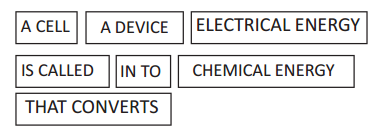
Samacheer Kalvi 6th Science Term 2 Question 1.
The device which converts chemical energy into electrical energy is
(a) fan
(b) solar cell
(c) cell
(d) television
Answer:
(c) cell

Science Term 2 Question 2.
Electricity is produced in
(a) transformer
(b) power station
(c) electric wire
(d) television
Answer:
(b) power station

Samacheer Kalvi Term 2 Question 3.
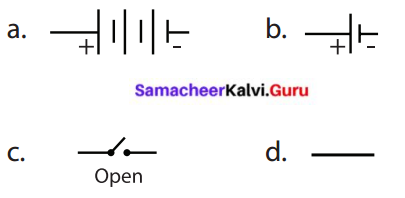
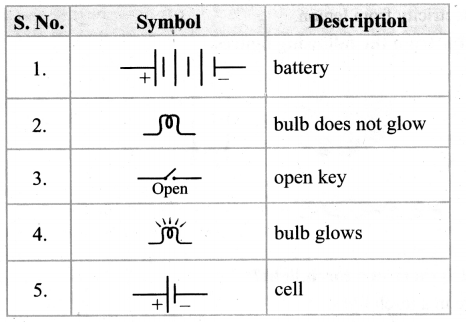
Choose the symbol for battery
Samacheer Kalvi 6th Science Term 2 Chapter 2 Electricity
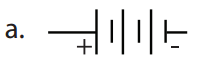
Answer:
Science Term 2 Samacheer Kalvi 6th Solutions Chapter 2 Electricity

Samacheer Kalvi Science Question 4.
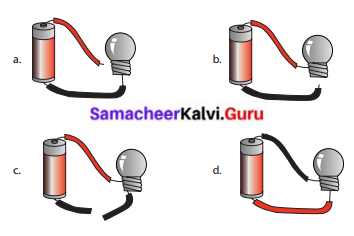
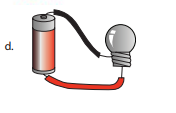
In which among the following circuits does the bulb glow?
Samacheer Kalvi Term 2 6th Science Solutions Chapter 2 Electricity
Answer:
Samacheer Kalvi Science 6th Term 2 Chapter 2 Electricity

Samacheer Kalvi Guru 6th Science Question 5.
……… is a good conductor
(a) silver
(b) wood
(c) rubber
(d) plastic
Answer:
(a) silver

II. Fill in the blanks.

  1. _______ are the materials which allow electric current to pass through them.
  2. Flow of electricity through a closed circuit is _______
  3. _______ is the device used to close or open an electric circuit.
  4. The long perpendicular line in the electrical symbol represents its _______ terminal.
  5. The combination of two or more cells is called a _______

Answers:

  1. conductors
  2. a complete electric circuit
  3. Key or Switch
  4. positive
  5. Battery

III. True or False. If False, give the correct statement.

Samacheer Kalvi 6th Science Book Back Answers Question 1.
In a parallel circuit, the electricity has more than one path.
Answer:
True

Samacheer Kalvi 6th Standard Science Question 2.
To make a battery of two cells, the negative terminal of one cell is connected to the negative terminal of the other cell.
Answer:
False. To make a battery of two cells, the negative terminal of one cell is connected to the positive terminal of the other cell. (OR) To make a battery of two cells, the positive terminal of one cell is connected to the negative terminal of the other cells.

Samacheer Kalvi 6th Science Question 3.
The switch is used to close or open an electric circuit.
Answer:
True

Samacheer Kalvi 6th Science Book Answers Question 4.
Pure water is a good conductor of electricity.
Answer:
False. Impure water is a good conductor of electricity

Samacheer Kalvi Guru 6th Term 2 Question 5.
Secondary cell can be used only once.
Answer:
False. Primary cells can be used only once

IV. Match the following :
Samacheer Kalvi Guru 6th Science Solutions Term 2 Chapter 2 Electricity
Answer:
Samacheer Kalvi 6th Science Book Back Answers Term 2 Chapter 2 Electricity

V. Arrange in sequence:
Samacheer Kalvi 6th Standard Science Solutions Term 2 Chapter 2 Electricity
Answer:
Samacheer Kalvi 6th Science Solutions Term 2 Chapter 2 Electricity

VI. Give Very Short Answers:

Samacheer Kalvi 6th Guide Science Question 1.
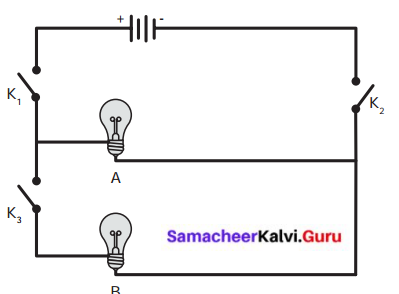
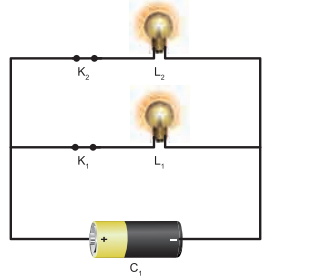
In the given circuit diagram, which of the given switch(s) should be closed, So that only the bulb A glows.
Samacheer Kalvi 6th Science Book Answers Term 2 Chapter 2 Electricity
Answer:
Switches K1 and K2 should be closed.

6th Samacheer Kalvi Science Question 2.
Assertion (A): It is very easy for our body to receive electric shock.
Reason (R) : Human body is a good conductor of electricity.
a. Both A and R are correct and R is the correct explanation for A.
b. A is correct, but R is not the correct explanation for A.
c. A is wrong but R is correct.
d. Both A and R are correct and R is not the correct explanation for A.
Answer:
a. Both A and R are correct and R is the correct explanation for A.

Samacheer Kalvi 6th Computer Book Back Answers Question 3.
Can you produce electricity from lemon?
Answer:
Yes, I can produce electricity from lemon.

Samacheer Kalvi 6th Science Book Question 4.
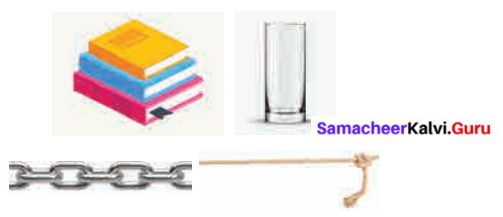
Identify the conductor from the following figures.
Samacheer Kalvi Guru 6th Term 2 Chapter 2 Electricity
Answer:
The conductor is Iron chain.

6th Standard Science Samacheer Kalvi Question 5.
What type of circuit is there in a torchlight?
Answer:
Simple circuit system is used in a torchlight.

Samacheer Kalvi 6th Science Guide Term 2 Question 6.
Circle the odd one out. Give reason for your choice.
Switch, Bulb, Battery, Generator.
Answer:
Generator. Switch, Bulb, Battery are the components used to make simple circuit. Generator is used to generate electricity.

VII. Give Short Answers:

Question 1.
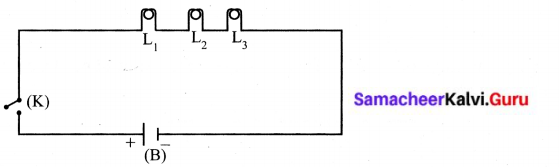
Draw the circuit diagram for series connection.
Answer:
Samacheer Kalvi 6th Guide Science Term 2 Chapter 2 Electricity

Question 2.
Can the cell used in the clock gives us an electric shock? Justify your answer.
Answer:

  1. The cell used in clock will not give us an electric shock because the voltage of that cell is very low nearly 1.5 v.
  2. So it will not affect our body.

Question 3.
Silver is a good conductor but it is not preferred for making electric wires. Why?
Answer:
Silver is a good conductor. But it is a costly metal. So it is not preferred for making electric wire.

VIII. Answer in detail.

Question 1.
What is the source of electricity? Explain the various power stations in India? Thermal power stations:
Answer:

  1. In thermal power stations, thermal energy is generated by burning coal, diesel or gas to produce steam.
  2. Steam is used to rotate turbine to generate electricity.
  3. Here heat energy is converted into electric energy.

Hydel power stations :

  1. In hydel power stations, the turbine is made to rotate by the flow of water from dams.
  2. Here kinetic energy is converted into electric energy.

Atomic power station :

  1. Here nuclear energy is used to boil water
  2. The steam thus produced is used to rotate the turbine, as a result electricity is produced.
  3. Here nuclear energy is converted into mechanical energy.

Windmills :

  1. In wind mills, wind energy is used to rotate turbine to produce electricity.
  2. Here kinetic energy is converted into electrical energy.

Question 2.
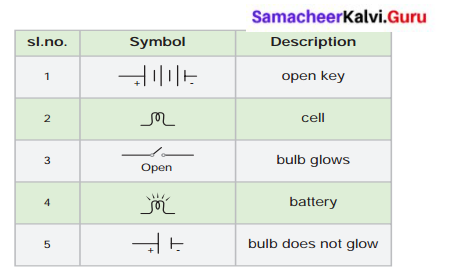
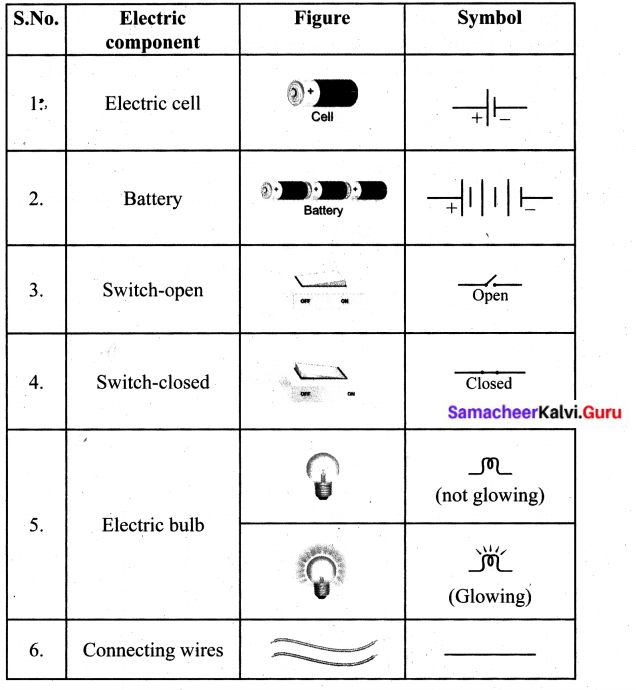
Tabulate the different components of an electric circuit and their respective symbols.
Answer:
6th Samacheer Kalvi Science Solutions Term 2 Chapter 2 Electricity

Question 3.
Write short notes on conductors and insulators.
Answer:
Conductors:
The rate of flow of electric charges in a circuit is called electric current. The materials which allow electric charges to pass through them are called conductors.
Examples: Copper, iron, aluminum, impure water, earth etc.,

Iniulaton (Non-Conductors):
The materials which do not allow electric charges to pass through them are called insulators or non- conductors. Examples: plastic, glass, wood, rubber, china clay, ebonite etc.

IX. Questions Based on Higher Order Thinking Skills.

Question 1.
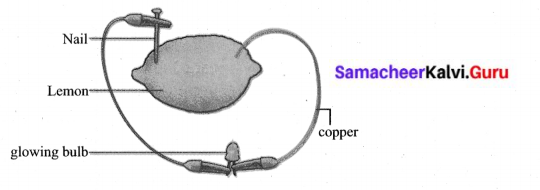
Rahul wants to make an electric circuit. He has a bulb, two wires, a safety pin and a piece of copper. He does not have any electric cell or battery. Suddenly he gets some idea. He uses a lemon instead of a battery and makes a circuit. Will the bulb glow?
Answer:
Yes the bulb will glow:

  1. Take a lemon. Squeeze it without breaking its skin. The squeezing action releases the juice inside the lemon needed as a the battery to work.
  2. Use a nail to make one hole in one end of the lemon and push a copper wire into that hole.
  3. Then, push the nail into the other end.
  4. Connect a bulb with one of the terminal with the copper wire and other terminal with the nail, as shown in the figure.
  5. Now the lemon generates a small amount of electricity and the bulb glows.

Samacheer Kalvi 6th Computer Book Back Answers Term 2 Chapter 2 Electricity

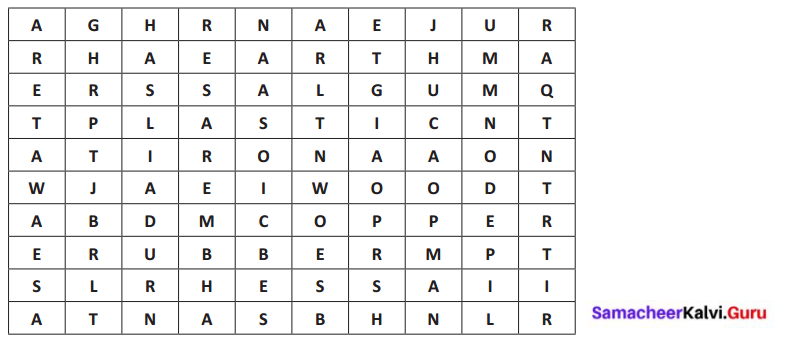
X. Search ten words in the given word grid and classify them as conductors and insulators.
Samacheer Kalvi 6th Science Book Solutions Term 2 Chapter 2 Electricity
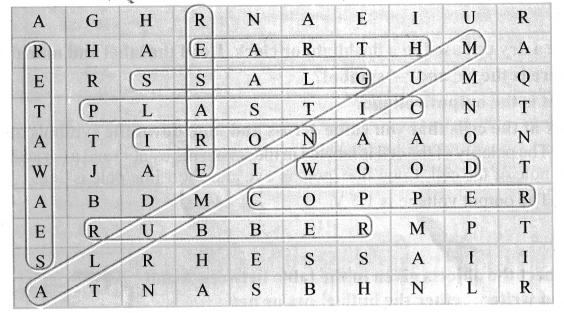
Answer:
6th Standard Science Samacheer Kalvi Term 2 Chapter 2 Electricity

Conductors:

  1. Alumtnium
  2. Earth
  3. Copper
  4. Iron
  5. Sea water

Insulators:

  1. Wood
  2. Plastic
  3. Rubber
  4. Glass
  5. Eraser

Samacheer Kalvi 6th Science Electricity Intext Activities

Activity 1

Question 1.
List out the electrical appliances used in your home.
Answer:

  1. Television
  2. Computer
  3. Laptop
  4. Mobile Phones
  5. Fridge
  6. Heater
  7. Air conditioner
  8. Microwave oven
  9. Inverter
  10. Washing machine with drier.

Activity 2

Question 2.
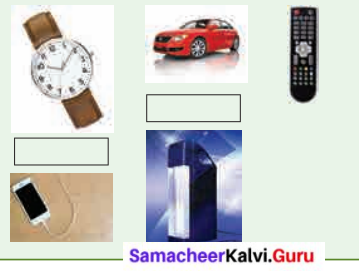
From the following pictures, identify those use primary cell and secondary cell. Mark Primary cell as ‘P’, Secondary cell as ‘S’.
Samacheer Kalvi 6th Science Guide Term 2 Chapter 2 Electricity
Answer:
Watch – Primary cell
Car – Secondary cell
Remote – Primary cell
Mobile phone – Secondary cell
Emergency Lamp – Secondary cell

Activity 3

Question 1.
Take a dry cell used in a flashlight or clock. Read the label and note the following.
1. Where is the ‘+’ and ‘-’ symbol?
2. What is the output voltage?
Look at the cells that you come across and note down the symbols and voltage.
Answer:
1. The polarity of the cell is labeled in the schematic by a (+) and a (-) at the appropriate pole of the cell. Long line pole is +ve and short line pole is -ve.
2. The output voltage is 1.5 V.

Activity 4

Question 1.
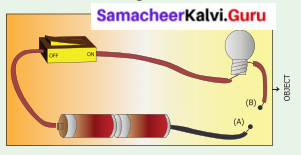
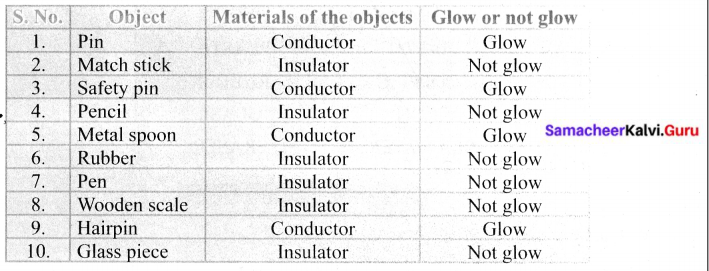
Connect the objects given in the table between A and B and write whether the bulb glows or not.
Samacheer Kalvi 6th Science Solutions Term 2 Chapter 2 Electricity 17
Answer:
Samacheer Kalvi 6th Science Solutions Term 2 Chapter 2 Electricity 18

Activity 5

Question 1.
Shall we make our own Battery
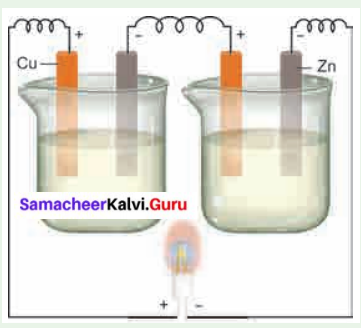
Produce electricity using copper plates, zinc plate, connecting wires, key, beaker and porridge (rice water) [the older the porridge the better will be the current| Arrange copper and zinc plates in series as shown in the figure. Half till two beakers with porridge. Connect the copper plate with the positive of and LED bulb and zinc to the negative. Observe what happens.
Now you can replace porridge with curd, potato, lemon etc.
Samacheer Kalvi 6th Science Solutions Term 2 Chapter 2 Electricity 19
Answer:
Porridge, curd, potato, lemon are used to produce electricity. Less amount of electricity is produced. The LED bulb will glow with low energy.

Samacheer Kalvi 6th Science Electricity Additional Questions

I. Choose the correct answer:

Question 1.
One of the atomic power station is located in ________
(a) Mettur
(b) Papanasam
(c) Neyveli
(d) Kalpakkam
Answer:
(d) Kalpakkam

Question 2.
Coil of wire is rotated between electromagnets is created
(a) Heat
(b) Electromagnetic induction
(c) Kinetic energy
(d) None
Answer:
(b) Electromagnetic induction

Question 3.
Secondary cells are used in ________
(a) Mobile phone
(b) wall clocks
(c) watches
(d) toys
Answer:
(a) Mobile phone

Question 4.
Which circuits are used in homes?
(a) Parallel circuit
(b) Serial circuit
(c) Simple circuit
(d) None
Answer:
(a) Parallel circuit

Question 5.
________ is an instrument used in electric circuits to find the quantity of current flowing through the circuit.
(a) Volt meter
(b) Ammeter
(c) Cell
(d) Key
Answer:
(b) Aniniele

Question 6.
Thomas Alva Edison invented more than ________ useful inventions which are used in homes.
(a) 100
(b) 10
(c) 500
(d) 1000
Answer:
(d) 1000

II. Fill in the blanks.

  1. Hydel electricity is produced in ________ in Tirunelveli district.
  2. In Thermal power station ________ is used as fuel.
  3. ________ Cells used in automobiles like cars and buses are large and very heavy.
  4. The rate of flow of electric charges in a circuit is called ________
  5. ________ is a kind of fish which is able to produce electric current.
  6. ________ are used to connect devices.
  7. ________ was an American inventor, who invented electric bulb.

Answers:

  1. PaPanasam
  2. Coal or diesel
  3. Secondary
  4. Electric Current
  5. Electric Eel
  6. Connecting Wires
  7. Thomas Alva Edison

III. Find whether the following sentences are true or false. If false Correct the statement.

Question 1.
Windmills are located at Neyveli in Kanyakumari district.
Answer:
False. Windmills are located at Aalvaimozhi in Kanyakumari district.

Question 2.
In atomic power station nuclear energy is converted into electrical energy.
Answer:
True.

Question 3.
Primary cells are usually produced in large sizes.
Answer:
False. Primary cells are usually produced in small sizes.

Question 4.
Primary cells are used in mobile phones.
Answer:
False. Secondary cells are used in mobile phones.

Question 5.
In a circuit if the key is in open (off) condition, then electricity will not flow.
Answer:
True.

Question 6.
Ebonite do not allow electric charges to pass through them.
Answer:
True.

IV. Analogy.

Question 1.
Thermal power station : Neyveli.
Hydel power station : ________
Answer:
Mettur

Question 2.
Kayatharu in Tirunelveli district: Wind mills.
Koodankulam in Tirunelveli district: ________
Answer:
Atomic power station.

Question 3.
Primary cells : Toys
Secondary cells: ________
Answer:
Emergency lamps.

Question 4.
Bulbs are connected in series : Series circuit.
Bulbs are connected in parallel: ________
Answer:
Parallel circuit.

V. Match the following :
A.

1. Thermal power stations(a)Kinetic energy converted into electrical energy
2. Hydel power stations(b)Nuclear energy is converted into mechanical energy and then electrical energy
3. Atomic power stations(c)Wind energy is used to produce electricity.
4. Windmills(d)Heat energy is converted into electrical energy.

Answer:

  1. – d
  2. – a
  3. – b
  4. – c

B.

i. Source of electricity(a)Conductors
ii. To connect devices(b)Bulb
iii. Consumes electricity(c)Insulators
iv. Allow electric charges(d)Connecting wires
v. Do not allow electric charges(e)Cell

Answer:

  1. – e
  2. – d
  3. – b
  4. – a
  5. – c

VI. Give Short Answers

Question 1.
How many cells are required to make a battery?
Answer:

  1. Two or more cells are combined to make a battery.
  2. A battery is a collection of cells.

Question 2.
Where are the Hydel power stations located in Tamil Nadu?
Answer:

  1. Mettur in Salem District.
  2. Papanasam in Tirunelveli District.

Question 3.
Where are Windmills located in Tamil Nadu?
Answer:

  1. Aralvaimozhi in Kanyakumari District.
  2. Kayatharu in Tirunelveli District.

Question 4.
What are the types of electric circuits?
Answer:

  1. Simple circuit
  2. Series circuit
  3. Parallel circuit

Question 5.
What are the types of cells? Give examples.
(i) Primary cells.
(ii) Secondary cells.
Primary cells : Cells used in clocks, watches and toys, etc.
Secondary cell: Cells used in Mobile phones, Laptops and Emergency lamps.

Question 6.
What is the electric current?
Answer:
The rate of flow of electric charges in a circuit is called electric current.

Question 7.
Differentiate Primary and Secondary cells.
Answer:
Primary cells:

  1. They cannot be recharged.
  2. They can be used only once
  3. Usually produced in small size.

Secondary cells:

  1. They can be recharged.
  2. They can be used again and again.
  3. The size can be small or even large.

Question 8.
Define simple circuit.
Answer:
A circuit consisting of a cell, key, bulb and connecting wires is called a simple circuit.

Question 9.
What is electric circuit?
Answer:
An electric circuit is the continuous or unbroken closed path along which electric current flows from the positive terminal to the negative terminal of the battery.

Question 10.
Give the types of circuits.
Answer:
They are three types of circuits.

  1. Simple circuit
  2. Series circuit
  3. Parallel circuit.

Question 11.
Why parallel circuits are used in homes?
Answer:
Parallel circuits are used in homes, because if any one of the bulb is damaged or disconnected, the other part of the circuit will work.

Question 12.
Identify the conductors and insulators among the following?
Copper, plastic, glass, iron, wood, Aluminum, China clay, impure water, Earth, ebonite
Answer:
Conductors:

  1. Copper
  2. iron
  3. Aluminium
  4. impure water
  5. Earth

Insulators:

  1. plastic
  2. glass
  3. wood
  4. China clay
  5. ebonite

Question 13.
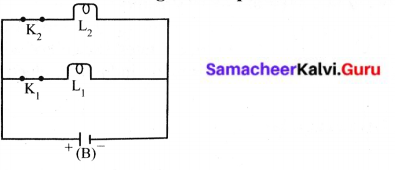
Draw a circuit diagram for parallel connection?
Answer:
Samacheer Kalvi 6th Science Solutions Term 2 Chapter 2 Electricity 20

VII. Answer in detail.

Question 1.
Describe open circuit and closed circuits with diagram.
Answer:
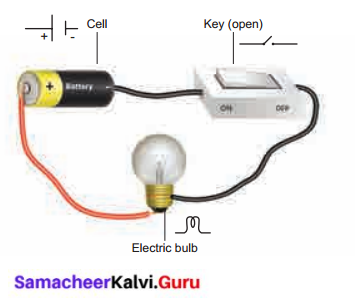
(i) Open Circuit:
In a circuit if the key is in open (off) condition, then electricity will not flow and the circuit is called an open circuit. The bulb will not glow in this circuit.
Samacheer Kalvi 6th Science Solutions Term 2 Chapter 2 Electricity 21
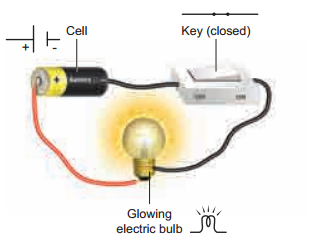
(ii) Closed Circuit
In a circuit if the key is in closed (on) condition, then electricity will flow and the circuit is called a closed circuit. The bulb will glow in this circuit.
Samacheer Kalvi 6th Science Solutions Term 2 Chapter 2 Electricity 22

Question 2.
Describe series circuit a..d parallel circuit with diagram.
Answer:
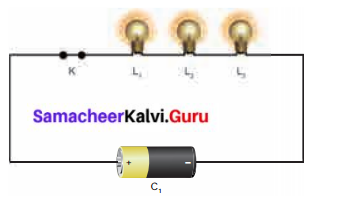
(i) Series Circuit:
Samacheer Kalvi 6th Science Solutions Term 2 Chapter 2 Electricity 23
If two or more bulbs are connected in series in a circuit, then that type of circuit is called series circuit. if any one of the bulbs is damaged or disconnected, the entire circuit will not work.

(ii) Parallel Circuit:
Samacheer Kalvi 6th Science Solutions Term 2 Chapter 2 Electricity 24
If two or more bulbs are connected in parallel in a circuit, then that type of circuit is called parallel circuit. If any one of the bulb ¡s damaged or disconnected, the other part of the circuit will work. So parallel circuits are used in homes.

Question 3.
What are the safety measures to safeguard a person from electric shock?
Answer:

  1. Switch off the power supply.
  2. Remove connections from the switch.
  3. Push him away using non conducting materials.
  4. Give him first aid.
  5. Take him to the nearest health centre.

Samacheer Kalvi 12th English Solutions Prose Chapter 3 In Celebration of Being Alive

Students can Download English Lesson 3 In Celebration of Being Alive Questions and Answers, Summary, Activity, Notes, Samacheer Kalvi 12th English Book Solutions Guide Pdf helps you to revise the complete Tamilnadu State Board New Syllabus and score more marks in your examinations.

Tamilnadu Samacheer Kalvi 12th English Solutions Prose Chapter 3 In Celebration of Being Alive

12th English In Celebration Of Being Alive Paragraph Warm Up

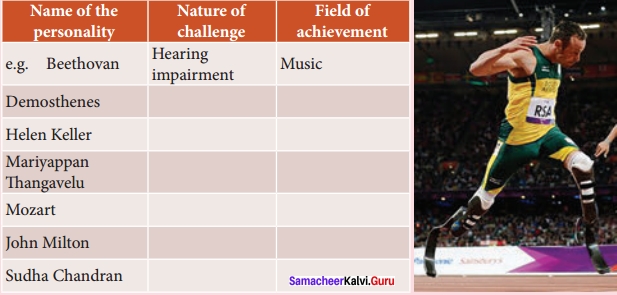
There are several physically-challenged people who have lived successful and meaningful lives. Here are a few personalities who have fought great odds and lived a life of blazing achievements. Let’s share wdiat we know about each of them and complete the table below.

12th English In Celebration Of Being Alive Paragraph Samacheer Kalvi Prose Chapter 3

Answer:

Name of the PersonalityNature of ChallengeField of achievement
e.g. BeethovanHearing impairmentMusic
DemosthenesSpeech impairedOration
Helen KellerVision and multiple disordersWriting, Public Service
Mariyappan ThangaveluPhysically handicappedHigh Jump
 MozartHearing impairmentMusic
John MiltonHearing impairmentPoetry
Sudha ChandranHearing impairmentDancing

Samacheer Kalvi 12th English In Celebration of Being Alive Textual Questions

1. Answer the following questions in one or two sentences based on your understanding of the lesson.

In Celebration Of Being Alive Summary Question (a)
What thoughts troubled Dr. Christiaan Barnard as he neared the end of his career as a heart surgeon?
Answer:
Towards the end of his career, Dr. Christiaan Barnard was troubled by the suffering of people and especially of young children. He could not accept the fact that 12 million children are unlikely to reach the age of one and about 6 million children die annually before reaching the age of five.

In Celebration Of Being Alive Paragraph Question (b)
What were Dr. Barnard’s feelings when he was hospitalized after an accident?
Answer:
He experienced not only agony but also anger after they had met with an accident. He had eleven broken ribs and perforated lungs. His wife had a badly fractured shoulder. He could not understand why they should undergo pain when they had other important things to do in life during that time.

In Celebration Of Being Alive Question (c)
When and where did the accident occur?
Answer:
He and his wife were crossing the road after a lovely meal. A car hit him and knocked him ’ into his wife. His wife was thrown into the other lane and was struck by a car coming in the opposite direction.

In Celebration Of Being Alive Questions And Answers Question (d)
How did the hospitalization of Dr. Barnard and his wife affect their routine?
Answer:
As a heart surgeon, he had to operate many heart patients. He was helpless as he had perforated lungs and broken ribs. His wife could not take care of the baby. Thus the routine life of both Dr. Barnard and his wife was affected adversely.

12th English Unit 3 Prose Question (e)
How was Dr. Barnard’s attitude to suffering different from that of his father’s?
Answer:
Dr. Barnard’s father accepted suffering as God’s will. He also believed that suffering ennobles humans. But Dr. Barnard found no meaning in the agony and suffering of patients and especially of the young children.

In Celebration Of Being Alive Book Back Answers Question (f)
How was the unattended trolley put to use?
Answer:
The unattended trolley was used as a car for a race (Grand prix of Cape Town’s Red cross childrens’ hospital) within the hospital.

In Celebration Of Being Alive Summary In English Question (g)
What roles did the duo take up?
Answer:
The unattended trolley was commandeered by a crew of two boys. One served as the driver and the other as a mechanic.

12th English 3rd Prose Question (h)
Why did the choice of roles prove to be easy for them?
Answer:
The mechanic provided motor power by galloping along behind the trolley with his head down. The driver steered the trolley by scraping his foot on the floor. The choice of the roles was easy because the mechanic was totally blind and the driver had only one arm.

Question (i)
Who encouraged them and how?
Answer:
They were encouraged by laughter and shouts of encouragement from the rest of the patients.

Question (j)
What does Dr. Barnard compare this entertainment to?
Answer:
Dr. Barnard compared the trolley race as much better entertainment than anything anyone puts on at the Indianapolis 500 car race.

Question (k)
What happened in the grand finale?
Answer:
There was a grand finale of scattered plates and silverware before the nurse and ward sister caught up with them.

Question (l)
How does Dr. Barnard know the boy who played the trolley’s driver?
Answer:
Dr. Barnard knew the trolley’s driver better. He had successfully closed a hole in his heart a few years back.

Question (m)
What was the profound lesson that Dr. Barnard learnt from the boys?
Answer:
The boys had taught Dr. Barnard the lesson in getting on with the business of living. The business of living is the celebration of being alive.

Additional Questions

Question (a)
What did the Grand Prix of the hospital teach the author?
Answer:
The author found out that his perception of human suffering was incomplete. The boys taught him how the experience of suffering helps a person value life. This thought gave the author a solace.

2. Answer the following questions in three or four sentences.

Question (а)
Detail the statistics Dr. Barnard has provided in his speech.
Answer:
Of the 125 million children bom that year, 12 million are unlikely to reach the age of one. Another six million will die before the age of five. Among the rest, many will end up as mental or physical cripples.

Question (b)
What happened when the doctor couple were crossing the street?
Answer:
After a nice meal, Dr. Barnard and his wife were crossing the street. A car hit the doctor. He dashed against his wife who was thrown on the other side of the road. She was hit by another car from the opposite side.

Question (c)
What injuries did they sustain in the accident?
Answer:
Dr. Barnard had eleven broken ribs. A lung was profoundly perforated. His wife had a badly fractured shoulder.

Question (d)
Dr. Barnard couldn’t find any nobility in suffering. Why?
Answer:
As a doctor, he does not find any nobility in suffering. There is nothing noble in a patient’s thrashing around in a sweat-soaked bed, mind clouded in agony. He was against his dad’s faith that suffering ennobles human beings.

Question (e)
Why does Dr. Barnard find suffering of children heartbreaking?
Answer:
He has always found suffering of young children heart-breaking. Especially because they have total faith in doctors. They believe doctors will help. They don’t complain even after undergoing a mutilating surgery.

Question (f)
How did the boy who played the mechanic lose his eyesight?
Answer:
The mechanic was seven years old. One night, when his drunk father tortured his mom, she threw a lantern at him. The lantern broke over the child’s head and shoulders. He suffered third degree bums on the upper part of his body and lost both of his eyes.

Question (g)
Why does Dr. Barnard describe the blind boy as a ‘walking horror’?
Answer:
At the time of the grand prix, the boy was a walking horror. His face was disfigured. A long flap of skin was hanging from the side of his neck to his body. As the wound healed around his neck, his lower jaw became gripped in a mass of fibrous tissue. The only way he could open his mouth was to raise his head.

Question (h)
What were the problems the trolley driver suffered from?
Answer:
The trolley’s driver had a malignant tumour of the bone. A few days before the race, his shoulder and arm were amputated. There was no hope of recovery.

Additional Questions

Question (a)
How does suffering ennoble a person?
Answer:
One does not become a better person because one has suffered. One becomes a better person because one has undergone suffering. One can’t appreciate light in the absence of darkness.

3. Answer the following in a paragraph of 100 – 150 words each.

Question (a)
Give an account of the medical problems for which the two boys were hospitalized.
Answer:
The seven years old mechanic suffered third degree bums on the upper part of his body. He had lost both his eyes. He was literally a walking horror. He was disfigured. A long flap of skin w as hanging from the side of his neck to his body. As the wound healed around his neck, his lower jaw became gripped in a mass of fibrous tissue. The trolley driver had a malignant tumour of the bone. A few days before the race, his shoulder and arm were amputated. There was little hope of his recovery. If two adults had similar ailments, they would have got dejected with life. But the boys were just happy celebrating the joy of being alive.

Question (b)
“These two children had given me a profound lesson …” Elucidate.
Answer:
The author had self-pity and was cursing the accident that had caused him and his wife great pain and inconveniences in the daily routine. But the two little boys, one almost scarred to death with both eyes gone and the other with amputated arm and no hope of recovery wrere together celebrating the joy of being alive. They minded the business of living ignoring pain, surgery and the sickly environment. Dr. Barnard leamt the lesson from the children that the business of living is joy in the real sense of the w ord. It was not just something for pleasure, amusement or recreation. The business of living is the celebration of being alive.

Question (c)
Describe the ‘Grand Prix’ at Cape Town’s Red Cross Children’s Hospital.
Answer:
The author describes the event as “the Grand Prix of Cape Town’s Red Cross Childrens’ Hospital”. A nurse had left a breakfast trolley unattended. Very soon this trolley was commandeered by a daring crew of two, a driver and a mechanic. The mechanic provided motor power by galloping along behind the trolley head down. While the driver, seated on the lower deck held on with one hand and steered it by scrapping his foot on the floor. The choice of roles wag easy because the mechanic was totally blind and the driver had only one arm. It was better than Indianapolis 500 car race. Patients shouted and cheered the boys. There was a grand finale of scattered plates and silverware before the nurse and ward sister took control of the situation.

Question (d)
How did a casual incident in a hospital help Dr. Barnard perceive a new dimension of life?
Answer:
Initially Dr. Barnard was grumbling. He wondered why on earth he and his wife should have been subjected to agony and inconvenience. He couldn’t take his dad’s view that suffering ennobles human beings. But the little boys taught him a profound lesson of life. One should get on with the business of living irrespective of whatever misfortune strikes one. You don’t become a better person because you suffered, your suffering does not ennoble you. But you become a better person because you have experienced suffering. It is not what you have lost is important. What is important is what you have left. We can appreciate light better once we have experienced darkness. Similarly, we can appreciate warmth only after experiencing cold.

Question (e)
Life is unjust and cruel to certain people. Do they all resign themselves to their fate? Can you think of some who have fought their disabilities heroically and remained a stellar example for others? (for e.g. the astrophysicist Stephen Hawking, a paraplegic). Give an account of one such person and his/her struggle to live a fruitful life.
Answer:
Alexis Leon lives in Kakkanad, Kerala. He passed B.Tech from the university of Kerala with first rank. Then he did his M.Tech. He met w ith an accident in 1993 which left him paralysed from chest down and confined him to a wheel chair for the rest of his life. After a brief spell of dejection owing to a suspended marriage, he made up his mind to write books. He has written 50 books for Engineering graduates.

His notable w’ork is ‘Internet for Everyone’ and ‘A Guide to Software Configuration Management’. He is also a mentor at International Mentoring Network Association. He offers software consultancy to international IT companies. He travels across the world and delivers lectures to graduates and Corporates. His indomitable will has made him strong. He has become a light house for many aspirants in the software industry.

Additional Questions

(a) What did Dr. Christiaan Barnard know about the mechanic and his family?
Answer:
The mechanic was seven years old. Both of his parents were drunk while quarreling, his mom threw a lantern at his father. It missed him but hit the boy. He suffered severe third degree bums on the upper part of his body. He had lost both his eyes in the process. He got a disfigured face. He was a walking horror with a long flap of skin hanging from the side off his next to his body.

Vocabulary

1. More and more, as I near the end of my career as a heart surgeon, my thoughts have turned to the consideration of why people should suffer. Suffering seems so cruelly prevalent in the world today. Do you know that of the 125 million children born this year, 12 million are unlikely to reach the age of one and another six million will die before the age of five? And, of the rest, many will end up as mental or physical cripples.

2. My gloomy thoughts probably stem from an accident I had a few years ago. One minute I was crossing the street with my wife after a lovely meal together, and the next minute a car had hit me and knocked me into my wife. She was thrown into the other lane and struck by a car coming from the opposite direction.

3. During the next few days in the hospital, I experienced not only agony and fear but also anger. I could not understand why my wife and I had to suffer. I had eleven broken ribs and a perforated lung. My wife had a badly fractured shoulder. Over and over, I asked myself, why should this happen to us? I had work to do, after all; there were patients waiting for me to operate on them. My wife had a young
baby who needed her care

4. My father, had he still been alive, would have said: “My son, it’s God’s will. That’s the way God tests you. Suffering ennobles you – makes you a better person.”

5. But, as a doctor, I see nothing noble in a patient’s thrashing around in a sweat-soaked bed, mind clouded in agony. Nor can I see any nobility in the crying of a lonely child in a ward at night.

6. In those days, they didn’t have sophisticated heart surgery. I have always found the suffering of children particularly heartbreaking–especially because of their total trust in doctors and nurses. They believe you are going to help them. If you can’t they accept their fate. They go through mutilating surgery, and afterwards they don’t complain.

7. One morning, several years ago, I witnessed what I call the Grand Prix of Cape Town’s Red Cross Children’s Hospital. It opened my eyes to the fact that I was missing something in all my thinking about suffering – something basic that was full of solace for me.

8. What happened there that morning was that a nurse had left a breakfast trolley unattended. And very soon this trolley was commandeered by an intrepid crew of two – a driver and a mechanic. The mechanic provided motor power by galloping along behind the trolley with his head down, while the driver, seated on the mower deck, held on with one hand and steered by scraping his foot on the floor. The choice of roles was easy because the mechanic was totally blind and the driver had only one arm.

In Celebration Of Being Alive Summary Samacheer Kalvi 12th English Solutions Prose Chapter 3

9. They put on quite a show that day. Judging by the laughter and shouts of encouragement from the rest of the patients, it was a much better entertainment than anything anyone puts on at the Indianapolis 500 car race. There was a grand finale of scattered plates and silverware before the nurse and ward sister caught up with them, scolded them and put them back to bed.

10. Let me tell you about these two. The mechanic was all of seven years old. One night, when his mother and father were drunk, his mother threw a lantern at his father, missed and the lantern broke over the child’s head and shoulders. He suffered severe third-degree burns on the upper part of his body, and lost both his eyes.

At the time of the Grand Prix, he was a walking horror, with a disfigured face and long flap of skin hanging from the side of his neck to his body. As the wound healed around his neck, his lower jaw became gripped in a mass of fibrous tissue. The only way this little boy could open his mouth was to raise his head. When I stopped by to see him after the race, he said, “You know, we won.” And he was laughing.

11. The trolley’s driver I knew better. A few years earlier, I had successfully closed a hole in his heart. He had returned to the hospital because he had a malignant tumour of the bone. A few days before the race, his shoulder and arm were amputated. There was little hope of his recovery. After the Grand Prix, he proudly informed me that the trolley’s wheels were not properly oiled, but he was a good driver, and he had full confidence in the mechanic.

12. Suddenly, I realized that these two children had given me a profound lesson in getting on with the business of living. Because the business of living is joy in the real sense of the word, not just something for pleasure, amusement, recreation. The business of living is the celebration of being alive.

13. I had been looking at suffering from the wrong end. You don’t become a better person because you are suffering; but you become a better person because you have experienced suffering. We can’t appreciate light if we haven’t known darkness. Nor can we appreciate warmth if we have never suffered cold. These children showed me that it’s not what you’ve lost that’s important. What is important is what you have left

(a) Go through the lesson and spot the words which mean the same as the following.

  1. profession (para 1)
  2. sorrowful (para 2)
  3. decency (para 5)
  4. destiny (para 6)
  5. hijacked (para 8)
  6. motivation (para 9)
  7. serious (para 10)
  8. significant (para 13)

Answer:

  1. career
  2. gloomy
  3. nobility
  4. fate
  5. commandeered
  6. encouragement
  7. severe
  8. important

(b) Go through the lesson and spot the words opposite to the meaning of the following.

  1. rare (para 1)
  2. primitive (para 6)
  3. fiction (para 7)
  4. fearful (para 8)
  5. benign (para 11)
  6. diffidence (para 11)
  7. boredom (para 12)
  8. criticize (para 13)

Answers

  1. prevalent
  2. sophisticated
  3. fact
  4. intrepid
  5. malignant
  6. confidence
  7. recreation
  8. appreciate

(c) Frame illustrative sentences to distinguish the meaning of the words in the following clusters.

Question 1.
career – carrier – courier
Answer:
A J. Cronin started his career as a doctor but eventually became a writer.
The curry spilled over as the tiffin carrier lid was not tightly closed.
The courier office is closed on Sundays.

Question 2.
patients – patience – patents
Answer:
I saw a large number of patients standing in queue in front of the Government Hospital.
The patience of the gardener got paid well when the garden bloomed.
No other scientist in the world has got so many patents as Edison did.

Question 3.
accident – incident – incidence
Answer:
The accident took place in front of the hospital.
The incident of the French camp is an interesting poem.
The rising incidence of cross border terror attacks has annoyed India.

Question 4.
scraping – scrapping – scrubbing
Answer:
Scraping of NEET may help rural students to get into Government Medical Colleges.
Anil Ambani’s company suffered through several bankruptcies, resulting in scrapping of many deals.
After scrubbing the stains for a long time, she found that the stain was gone but the cloth had got damaged.

Question 5.
accept – except – expect
Answer:
Don’t accept bribe.
Except Raghu all had paid the fees for NEET coaching.
Those who don’t expect much gain a lot in life.

Question 6.
lesson – lessen – lesion
Answer:
Dr. Barnard leamt a great lesson from the two disabled kids.
This medicine will lesson the pain.
The protruding thorn caused a lesion in his forearm.

Question 7.
severe – sever – sewer
Answer:
Prime Minister of India warned Pakistan of severe consequences of Pulwana terror attack.
It is difficult to sever the relationship on flimsy reasons.
Madras Corporation has invested a lot in laying underground sewer.

Question 8.
raise – rise – rice
Answer:
The philanthropist raised funds for the benefit of relations of those warriors who laid down their lives in Pulwana.
“The rise and fall of Roman empire” is an interesting book.
Many poor people do not use the ration rice but exchange it for other items.

Question 9.
quiet – quite – quit
Answer:
Sheela lives in her quiet cottage in Chengalpattu with her retired husband.
Life in Coimbatore is quite expensive.
Some players, who are jealous of Dhoni’s reputation, want him to quit before the world cup matches.

Question 10.
final – finale – feline
Answer:
You must be relaxed before the final examination.
The performance of the child with autism in super singer in the grand finale was amazing.
I have a young feline pet who is very naughty.

(d) Fill in the blanks with the words given in brackets.

[profound, amusement, confidence, agony, solace, intrepid, disfigured, perforated]

  1. Theatrical plays were a main source of ________ before the advent of television.of police.
  2. The ________ warriors of the Spartan Army marched into battle against a powerful enemy.
  3. The ________ of parents finally came to an end when their lost child was found with the help
  4. Social media has brought about a ________ impact on the lives of millennial.
  5. The tyres of the car got ________ when the vehicle rolled over the rusted nails scattered on the road.
  6. Thomas Alva Edison did not lose his ________ , even after facing a series of experimental’ failures in his quest to discover tungsten.
  7. Many victims of the pipeline explosion in an oil refinery were left permanently ________
  8. The old lady found ________ in the company of the children in the neighbourhood

Answer:

  1. amusement
  2. intrepid
  3. agony
  4. profound
  5. perforated
  6. confidence
  7. disfigured
  8. solace

(e) Form a phrase with each of the

  1. muscle + pain – muscular pain
  2. skeleton + system – skeletal system
  3. nerve + disorder – nervous disorder
  4. digestion + enzymes – digestive enzyme
  5. surgery + instruments – surgical instruments
  6. agony + experience – agonising experience
  7. glory + victory – glorious victory
  8. fancy + idea – fanciful idea
  9. emotion + song – emotional song
  10. sense + issue – sensitive issue

(f) Fill the empty boxes with suitable words under each word class.

NOUNVERBADJECTIVEADVERB
amusement
appreciate
success
proudly
hopeful

Answer:

NOUNVERBADJECTIVEADVERB
amusementamuseamusingamusingly
appreciationappreciateappreciativeappreciably
successsucceedsuccessfulsuccessfully
pridebe proudproudproudly
hope(n)hope (v)hopefulhopefully

(g) Spot the errors in the following sentences and rewrite them correctly.

Question 1.
My grandfather is well-known in the village for his nobel deeds.
Answer:
My grandfather is well-known in the village for his noble deeds.

Question 2.
I had my evening meals in a restaurant near my office.
Answer:
I had my dinner in a restaurant near my office.

Question 3.
The Boss had full confidence on his Manager for successful completion of the project.
Answer:
The Boss had full confidence in his Manager for successful completion of the project.

Question 4.
After the complicated surgery, the patient hoped of complete recovery.
Answer:
After the complicated surgery, the patient hoped for complete recovery.

Question 5.
The new health care scheme announced by the Government will bring relief to the children suffering with acute tuberculosis.
Answer:
The new health care scheme announced by the Government will bring relief to the children suffering from acute tuberculosis.

Question 6.
In spite of his poverty and setbacks, he was able to launch his dream carrier.
Answer:
In spite of his poverty and setbacks, he was able to launch his dream career.

Listening Activity

Listen to the passage being read out. Based on your understanding, complete the statements given below with appropriate answers.

Boredom
We have all experienced boredom sometime or the other. Boredom occurs when a person is unable to stay attentive. It is something more than an unpleasant feeling. It can make you angry and frustrated and lead to negative physical health consequences.

How boredom affects one physically
A study reveals that when a person is affected by acute boredom his eyelids droop and the face assumes a frown. There is a gradual loss of ability to coordinate movements. These symptoms are accompanied by mental fatigue and a slowing down of thought processes. A bored person at work is likely to make many more errors than one who is not bored. We should never let boredom take charge. There are several easy ways to overcome boredom.

Here are a few practical suggestions:

  • Set goals for yourself, work towards them.
  • Develop an interest in hobbies and crafts.
  • Socialize, stay in the company of cheerful people.
  • Take up a charitable cause.
  • Exercise regularly.

Coming out of boredom will feel like breaking free from a cold, dark room into the outdoors on a warm, sunny day

Questions:

  1. Boredom occurs when a person is unable to
  2. ______ and ______ are emotional consequences of boredom.
  3. Two physical signs of acute boredom are (a) ______ (b) ______
  4. How does boredom affect the quality of work a person does?
  5. Mention two ways by which one can overcome boredom. (a) ______ (b) ______

Answers:

  1. stay attentive
  2. Anger, frustration
  3. (a) Drooping eyelids, (b) Frown
  4. A bored person commits a lot of errors in his work.
  5. (a) Goal setting, (b) stay in the company of cheerful people

Speaking Activity

1. You are rushing to attend to an important work and you witness an accident on your way. Will you go to the rescue of the injured person? Share your views with the class.
Answer:
There is nothing more valuable than a human life. I would suspend whatever important work I have in hand and call 108 and summon the ambulance. I will try to get the contact number . of the next of kin of the injured person if he/she is conscious. I will inform them the incident without causing panic. I will accompany the injured person to the hospital. In our NSS team, we have blood donors whatsapp group. I will find out if blood is required and inform in my blood donor group to ensure blood donation to the injured person. Only after the doctor confirms that the injured person is out of danger, I will leave the place.

I draw my inspiration to help people in distress from the life of Abraham Lincoln. He was a budding lawyer. He had to walk 2 hours to reach the court. On his way, he found a pig sinking in mud and grunting in agony. It was scared that it would die. Abraham Lincoln was on his only best dress. He just got into the mud, lifted the pig and left him safely on the hard surface. As he reached the court everyone laughed at his dirty coat but Abraham Lincoln just smiled and argued well in favour of his innocent client and got him acquitted too.

2. Every person should take up the responsibility to serve the society in his or her own way. Discuss the various ways in which you can serve the society.
Answer:
Elders keep on telling that students should not enter into politics, instead should focus on studies and scoring high marks. I’ve a sincere feeling that life is more than marks. Students can do a lot of service which would certainly make the society a better place. Though the state government has banned the use of single use plastics, it is widely used. Hot sambar curry and tea are packed in small plastic bags. People just use them.

We can generate awareness to all sellers and buyers in places where large number of people gather that by eating hot things from single use plastic bags, we are increasing the chances of getting cancer.The plastic covers thrown away blatantly does not degenerate for hundreds of years, it does not allow percolation of rain water and soon after rain, we suffer from water scarcity. The rain water runs away and joins the oceans.

We can tell the importance of rain water harvesting and make farming practises economically viable. During elections we can campaign for judicious use of voting rights to elect a person who has both the capacity and love for citizens to serve without expecting anything in return. We can also spread hygiene among the masses.

(a) Pair work: Practise the dialogue with another student. Then write a similar dialogue between a student and the class teacher regarding an educational trip.

Teacher : We plan to go on an excursion.
Student A : Where sir?
Teacher : We will discuss and finalise it today.
Student B : Sir, how about Vandaloor Zoo?
Teacher : it is a very hot season now, all the animals will be taking shelter under distant trees
Student A : We can’t see all of them. What about Vedanthangal?
Teacher : No, only after the rains foreign birds visit it.
Student B : What about Birla Planetarium?
Teacher : Fine, that is a good choice. We will go there next week.

(b) Build a conversation for the following situations with a minimum of five exchanges.

1. A passenger and a railway staff regarding the cancellation of the reserved tickets.

Passenger : Sir, I want to cancel a ticket.
Clerk : When was the journey planned?
Passenger : Sir, next Monday, the 23rd of March.
Clerk : Well, still three days are there.
Passenger : This is my ticket and take the filled in cancellation form. Tell me sir, how much will you deduct.
Clerk : Well, we will deduct only the reservation charges and you will get the balance amount. Take the money and count it, it is Rs. 280/ Thank you sir.

2. Two friends about the NSS camp which they are going to attend.

Tarun : I am leaving for NSS camp.
Kavin : How many days?
Tarun : One week.
Kavin : Where are you going?
Tarun : To Madagupatti.
Kavin : That village has no electricity.
Tarun : Yes. That’s why we are going there to help them in small possible ways.
Kavin : What will you do?
Tarun : We will deepen the lakes, clean the streets, remove the unneeded thorny
Kavin : bushes from the school and temple premises.
Tarun : That is a lot of work.
Kavin : We will conduct a medical camp with the help of doctors too.
Tarun : Sounds exciting. Can I join you?
Tarun : No, brother. Wait till you become old enough to become a volunteer.
Kavin : Well, I’m ten years old already.

3. A salesman and a customer at an electronic shop.

Customer : Good evening sir.
Salesman : Good evening. What shall I do for you?
Customer : We bought a Smart TV last week. It is not working properly.
Salesman : May be the problem is with your dish antenna or cable connection.
Customer : No, the fault is only with the TV.
Salesman : Please leave your address and phone number. I will send the TV mechanic in half an hour.
Customer : Thanks.

4. A father and his daughter about the advantages of the habit of newspaper- reading.

Father : Maydhini my dear, you must read newspapers daily.
Maydhini : How does it help dad? Will they ask questions in the examination from them?
Father : No, newspapers help you know about the world.
Maydhini : I’m a small girl. Are there sections in a newspaper which will have things to my taste?
Father : Why not? You read young world in the Hindu. In fact, children write and send things to be published here.
Maydhini : Can I send my puzzles and paintings?
Father : Yes, of course.
Maydhini : Ok dad, I will read newspaper everyday.

(c) Extend the conversation with two more relevant exchanges.

Question 1.
Receptionist : Good evening, sir. Welcome to Chennai.
Traveller : I would like to book a deluxe room in your hotel for 3 days.
Receptionist : (i) ________
Traveller :(ii) ________
Receptionist :(iii) ________
Traveller :(iv) ________
Answers:
(i) How many people intend to stay sir?
(ii) Three members
(iii) For Deluxe A/C room the charge is Rs. 5000/- per day and for Non A/C it is Rs. 3500/-
(iv) If it includes GST, please book Deluxe A/C room. Take my card and book the room.

Question 2.
Student : Good morning, sir. May I come in?
Teacher : Good morning, why are you late today?
Student : (i) ________
Teacher : (ii) ________
Student : (iii) ________
Teacher : (iv) ________
Answers:
(i) There was a traffic jam sir.
(ii) Why?
(iii) A political party had staged a protest blocking the vehicles. I was stranded and helpless.
(iv) Oh! The politicians should keep in mind the difficulties common people face when doing such protests. Okay, go to your seat now.

Reading

Read the passage given below and answer the questions that follow.

Humans have long been fascinated by fiction. We experience excitement in assigning supernatural power to imaginary characters in fictional stories – and so we have Spider man, Batman, He man, Titans and many more. The ‘Cyborg’ was an offshoot of such wild imagination of humans to invest our species with superhuman powers. Today, the Cyborg is no more an imaginary organism. We are living in a world where a sizeable population of humans have merged their bodies with technological implants. The term ‘Cyborg’, short for ‘cybernetic organism’, was coined to describe a man, whose body is implanted with technological devices to supplement and substitute body functions.

Cyborgs include people with cardiac pacemakers, contact lenses, bionic ears and eyes, prosthetics and so on. In other words, a cyborg is partly human and partly machine. The technological innovations in the field of medicine and healthcare augment humans with machines, producing a beta version of the human body. The advent of brain machine interfaces is certain to blur the boundary between humans and machines. Scientists are working hard to find a technique for age reversal too. People do not want to die, so mankind is striving to get to the final frontier, which is development of machines and devices that would accord man immortality.

The needs of humans are not limited. As time passes, food habits change, thinking patterns change, and even appearances change. We are about to travel by driverless, folly automated vehicles. Computers and smart phones have become our masters. The more we depend and merge with technological advancements, the more the humanness in us slowly erodes. Intelligence is sought to be infused into machines and robotics are designed in such a way to give man a virtual human companion.

The field of artificial intelligence is overtaking the human brain and many fear that it could even harm the human race. Despite certain limitations and potential threats, many believe that cyborgs will be the next step in the evolution of mankind. The amalgamation of man and machine is sure to add a new dimension to the life of mankind and this will prove to be the ‘biggest evolution in Biology’ since the emergence of life, four billion years ago.

Question (a)
Account for the popularity’ of characters with supernatural powers.
Answer:
Human beings want to achieve things far above their natural capacity. The superheroes like Spiderman, Batman and He man do great feats on screen. So, people like them.

Question (b)
Who is referred to as a ‘Cyborg’?
Answer:
Cyborg is a man whose body is implanted with technological devices to supplement and substitute body functions.

Question (c)
What is expected to happen with the advent of the brain machine interface?
Answer:
The advent of brain machine interface is certain to blur the boundary between machines and humans.

Question (d)
The needs of humans are not limited. How is this statement elaborated in the passage?
Answer:
As the time passes, food habits change, thinking patterns change, even appearances change. We are about to travel by driverless, folly automated
vehicles.

Question (e)
How can a machine turn into a virtual companion for humans?
Answer:
Intelligence is sought to be infused into machines and robots are designed in such a way to give man a virtual human companion.

Question (f)
Explain the flipside of the rapid technological advancement.
Answer:
The more we depend and merge with technological advancements, the humanness in us slowly erodes.

Question (g)
Identify the word in para 2 which means ‘everlasting life’.
Answer:
Immortality in para 2 means ‘everlasting life’.

Question (h)
Which of the following words is synonymous with ‘amalgamation’?
(a) recreation
(b) integration
(c) exploration
(d) proposition
Answer:
(b) integration

Question (i)
Which of the following options is the antonym of the word ‘advent’?
(a) drawback
(b) dispute
(c) departure
(d) danger
Answer:
(c) departure

Question (J)
Find out the word which is the antonym of ‘natural’ in para 2.
Answer:
Prosthetics

Grammar

Tenses
Task 1
Change the following sentences into Passive Voice.

Question (a)
The Governor inaugurated the exhibition at ten o’ clock.
Answer:
The exhibition was inaugurated by the Governor at ten o’ clock

Question (b)
The crowd expected their leader to arrive early in the morning.
Answer:
The leader was expected to arrive early in the morning.

Question (c)
Who taught her Computer Science?
Answer:
By who was she taught Computer Science.

Question (d)
They unanimously named Ravi the captain of team.
Answer:
Ravi was named the captain of the team unanimously.

Question (e)
The President gave the commander an award.
Answer:
An award was given to the commander by the president.

Question (f)
Do not tell a lie.
Answer:
Let not a lie be told.

Question (g)
Please open the door.
Answer:
Let the door be opened please.

Question (h)
It is time to stop the work.
Answer:
It is time for the work to be stopped.

Question (i)
They say he is a spy.
Answer:
It is said that he is a spy.

Question (j)
One should keep one’s promise.
Answer:
Promise must be kept.

Question (k)
People burn a great deal of w ood in winter.
Answer:
A great deal of wood is burnt in the winter by people.

Question (l)
Where had you kept the book?
Answer:
Where had the book been kept by you?

Question (m)
When did you feel the tremors?
Answer:
When was the tremors felt by you?

Question (n)
How did you do the experiment?
Answer:
How was the experiment done by you?

Question (o)
Whose car did someone park in front of your gate?
Answer:
Whose car was parked in front of your gate?

Task 2
Change the following sentences into Active Voice.

Question (а)
The smuggler has been nabbed by the police.
Answer:
The police have nabbed the smuggler.

Question (b)
By whom were you interviewed?
Answer:
Who interviewed you?

Question (c)
Why were you scolded by your parents?
Answer:
Why did your parents scold you?

Question (d)
Not a word was spoken by the convict in self-defence.
Answer:
The convict spoke not a word in self-defence.

Question (e)
Good news is expected shortly.
Answer:
We expect good news shortly.

Question (f)
The mail has just been received.
Answer:
We have received the mail just now.

Question (g)
Sundari has been taken to hospital by her husband.
Answer:
Sundari’s husband has taken her to the hospital.

Question (h)
Our television is being repaired now.
Answer:
We are repairing our TV now.

Question (i)
Sweets have not been distributed to children by the organisers.
Answer:
The organization have not distributed sweets to children.

Question (j)
Prizes were being given by the chief guest.
Answer:
The chief guest was giving prizes.

Question (k)
Nobody has been seen in the library this week.
Answer:
The librarian has not seen anybody in the library this week.

Question (l)
Nobody would have known the truth if you had not disclosed it.
Answer:
Nobody will know the truth if you have not disclosed it.

Question (m)
You are advised to help the poor and needy.
Answer:
Help the poor and the needy.

Question (n)
You are requested to make a cup of tea for the guest.
Answer:
Please make a cup of tea for the guest.

Interrogations Or Questions

Task 1
Add suitable question tags to the following sentences and punctuate properly.

Question 1.
The children are very happy today.
Answer:
The children are very happy today, aren’t they?

Question 2.
You have not returned my books yet.
Answer:
You have not returned my books yet, have you?

Question 3.
We enjoyed the trip very much.
Answer:
We enjoyed the trip very much, didn’t we?

Question 4.
Let’s clean the shelves this weekend.
Answer:
Let’s clean the shelves this weekend, shall we?

Question 5.
My mother rarely travels by bus.
Answer:
My mother rarely travels by bus, does she?

Question 6.
Somebody must bell the cat.
Answer:
Somebody must bell the cat, mustn’t they?

Question 7.
Anita never comes late to office.
Answer:
Anita never comes late to office, does she?

Question 8.
Iam always the winner.
Answer:
I am always the winner, aren’t I?

Question 9.
Don’t commit this mistake again.
Answer:
Don’t commit this mistake again, will you?

Question 10.
There is a pharmacy near that bus stand.
Answer:
There is a pharmacy near that bus stand, isn’t it?

Question 11.
Bacteria can never survive in extreme weather conditions.
Answer:
Bacteria can never survive in extreme weather conditions, can it?

Question 12.
I am not as smart as you are.
Answer:
I am not as smart as you are, am I?

Question 13.
The boys broke the window pane last evening.
Answer:
The boys broke the window pane last evening, didn’t they?

Question 14.
Leaves wither during autumn.
Answer:
Leaves wither during autumn, don’t they?

Question 15.
You should add a little salt to the buttermilk.
Answer:
You should add a little salt to the buttermilk, shouldn’t you?

Task 2
Correct the error found in the question tag in each of the following.

Question 1.
The evil doers cannot cross the path of truth, can’t they?
Answer:
The evil doers cannot cross the path of truth, can they?

Question 2.
The vegetables in the fridge are still fresh, aren’t it?
Answer:
The vegetables in the fridge are still fresh, aren’t they?

Question 3.
The village head understood the intention of the politician, doesn’t he?
Answer:
The village head understood the intention of the politician, didn’t he?

Question 4.
I claim to be a person of faith and prayer, aren’t I?
Answer:
I claim to be a person of faith and prayer, don’t I?

Question 5.
The employees are seldom allowed to meet their boss, aren’t they?
Answer:
The employees are seldom allowed to meet their boss, are they?

Question 6.
Let’s organize a trip to Goa, can we?
Answer:
Let’s organize a trip to Goa, shall we?

Question 7.
The landlady will charge me for the damage, shan’t she?
Answer:
The landlady will charge me for the damage, won’t she?

Question 8.
Both the sisters have left for Canada, aren’t they?
Answer:
Both the sisters have left for Canada, haven’t they?

Question 9.
That’s definitely not the right thing to do in this situation, isn’t that?
Answer:
That’s definitely not the right thing to do in this situation, isn’t it?

Question 10.
We needn’t apply for a bank loan, do we?
Answer:
We needn’t apply for a bank loan, need we?

Question 11.
The Chief Guest spoke a few words, did he?
Answer:
The Chief Guest spoke a few words, didn’t he?

Question 12.
The rhinoceros has a horn made of keratin, haven’t they?
Answer:
The rhinoceros has a horn made of keratin, hasn’t it?

Writing

Story Writing
Task 1
Expand the following outlines into complete stories and supply a suitable title for each.

Question 1.
Big cotton merchant – owned a factory – many employees – one day a heap of cotton stolen – no clue – merchant’s secretary assured to find out – asked him to host dinner – invite all workers – merchant agreed – middle of feast – secretary suddenly shouted – cotton sticking to hair of thieves – the guilty dusted their heads – tried to clear – caught in the trap – punished.
Answer:
Once upon a time there was a big cotton merchant. He owned a factory. Many employees were working in it. One day a bale of cotton was stolen. The merchant had no clue as to who might have stolen the bale of cotton. The merchant’s secretary assured him that she will find out the thief. She asked him to host a dinner and invite all the workers. Merchant agreed. When the feast was in progress, the secretary shouted suddenly, “There is cotton sticking on to the hair of the thieves. The guilty ones involuntarily dusted their heads to clear it. They were caught unawares. They were sacked from their jobs as a punishment for their theft.

Question 2.
Mr. X, a rich businessman – runs a company – always very busy with office work – one day his son – 10 years old – approaches dad and asks – how much he earns in one hour – father gets furious – boy persuades – father says Rs. 500 – immediately son asks for ’ Rs. 300 – father shouts – wasting money on toys – son leaves to his room crying – father feels bad – thinks might need some stationery – enters boy’s room and gives money – boy becomes happy – takes some crumpled notes – under his pillow – counts everything together – total Rs.500 – gives it to dad – wants to buy – one hour of his time – father realizes his mistake – feels sorry and guilty – hugs son – closes all office files – takes him on a picnic – decides to spend more time w ith near and dear ones.
Answer:
Mr. X is a rich business man. He runs a company. He is always busy with his office work. Like a snail, he carries his office work everywhere. His young son one day asks him, “How much do you earn in an hour?” The father gets furious and refuses to reply. But the son coaxes him to give the answer. The father grudgingly says, “Rs. 500/- an hour.” Immediately the boy asks his dad to give him three hundred rupees. He reprimands his son for trying to waste his hard earned money. The boy cries and goes to the bedroom without dinner. The father feels guilty.

He realises that the boy might really need the money for buying some stationary. He gives him three hundred rupees. The next moment, the boy collected all the crumpled notes from under his pillow. Dad asks, “why did you ask for money when you have so much?” Without replying the boy handed him Rs. 500/- and said, “this is the amount you earn in an hour, I have given you that money. Now will you spend an hour with me?” The father realises his mistake. He suspends his work and takes the boy out on a picnic. Then onwards he regularly spends time with near and dear ones.

Task 2
Continue and complete the following stories and suggest suitable titles for the same.

Question 1.
A rich man had a neighbour who was suffering from acute poverty. The rich man was
proud of his wealth and treated his poor neighbour with disrespect and derision. One day, a fortune-teller told the rich man that all his wealth would be possessed by his neighbour within a month. The rich man became greatly worried and spent sleepless nights. He did not know how to safeguard his wealth round the clock. Suddenly he thought of a plan. He disposed of everything he had and with all that money, he bought a large, precious diamond. He sewed up the diamond in his turban. He proudly said to himself, “Now, there’s no way. My poor neighbour can never secure my wealth. The words of the fortune-teller will prove false.” _______
Answer:
Once, he had to go to a distant town with his merchandise. His poor neighbour’s wife came to borrow the turban on the occasion of attending a marriage function in the town. The rich man’s wife wasn’t aware of the value of the turban. She gave it to him. This poor neighbour wore the turban proudly and attended the wedding. When he was returning, he had a feeling that something hurt like a stone. On reaching home, he took a needle and untied the stitches.

He was amazed at the hidden diamond. He threw the turban into the rich man’s compound and vacated the house at night and ran away with his family. When the rich man returned, he saw the turban lying in his compound. He shouted at his wife for not keeping the turban in its proper place. He hurriedly took the turban and touched at the bottom. He was shocked to find the diamond missing. He realized that the fortune-teller w as proved right.
Title: The Rich man’s turban and the fortune-teller

Question 2.
Four friends decided to go to a restaurant for dinner. They ordered an extra-large pizza with grated cheese and other choice toppings. The next 20 minutes seemed to be too long a time. Their eyes widened and their mouth watered, when the server brought the steaming hot pizza and placed it on the table. They could barely control the drool. Simultaneously, all the four hands pulled at a slice from the plate, their faces beaming with a victorious grin. Silence prevailed as they were absorbed in the taste of their favourite food. They relished every mouthful to the core and savoured the taste of each topping with a smile of approval. Soon, the plate was empty and clean with no trace.

The boys dabbed their mouths and wiped their hands with tissues. Mission accomplished, they leaned back with immense joy and satisfaction not knowing, it would be short-lived. The waiter arrived with the bill. Joseph, who had brought the others to the restaurant for a treat casually slipped his hand into his pocket to get his wallet. He gave a soft shriek accompanied by an expression of dismay and utter disbelief. He exclaimed, “It’s not there! Someone has pinched my wallet! What are we to do now?”______
Answer:
One of the friends sprang up saying, “take it easy. Our government has made things simple for us. See we are going digital, isn’t it. So now consider the problem we encountered to be solved.'”Joseph, still will, asked, “What do you mean?” Simple, let me pay the bill through the Paytm app in my mobile. The money will be transferred instantly. Everyone was overjoyed at the turn of the event. They walked out with their pride being saved. It is important to be safe and to have an alternative option in unwarranting situations.

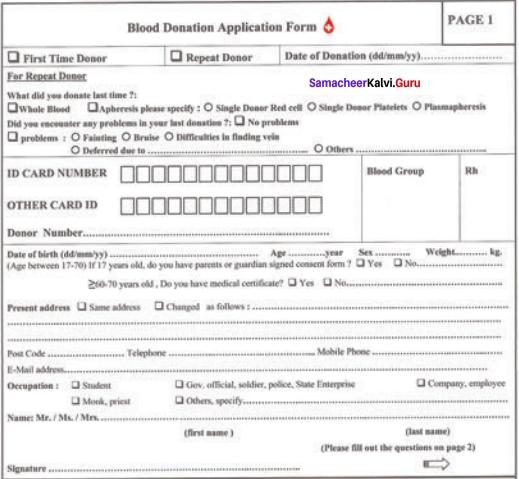
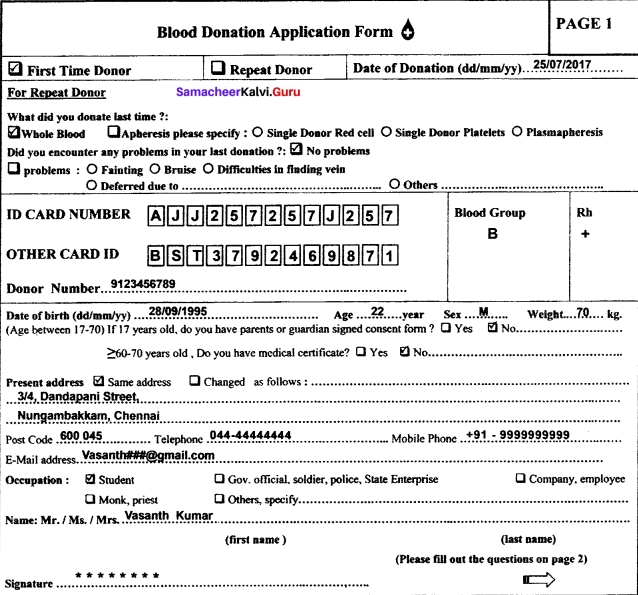
UTHIRA is an event conducted by the NSS unit of ABC Hr Sec School. Imagine you are a volunteer and help a parent fill in the following registration form. (Invent necessary details)

Question 1.

In Celebration Of Being Alive Paragraph Samacheer Kalvi 12th English Solutions Prose Chapter 3

Answer:

In Celebration Of Being Alive Samacheer Kalvi 12th English Solutions Prose Chapter 3

Question 2.

In Celebration Of Being Alive Questions And Answers Samacheer Kalvi 12th English Solutions Prose Chapter 3

Answer:

12th English Unit 3 Prose Samacheer Kalvi Prose In Celebration Of Being Alive

In Celebration Of Being Alive Book Back Answers Samacheer Kalvi 12th English Solutions Prose Chapter 3

In Celebration of Being Alive About The Author

In Celebration Of Being Alive Summary In English Samacheer Kalvi 12th Chapter 3

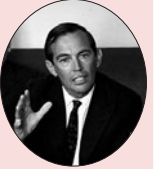
Christiaan Neethling Barnard was bom in rural South Africa in 1922 to poor parents as their fourth child. After the loss of his brother to heart ailment, he resolved to become a doctor. He performed the world’s first successful human heart transplantation in the year 1967. He instantly gained worldwide recognition. He has penned 14 books and 235 scientific articles. Some of his prominent books are, ‘The Best Medicine’ and ‘The Faith’. He has been conferred with 11 honorary doctorates, and 36 International Awards. In his late years, he established the Christiaan Barnard Foundation to serve and promote the cause of underprivileged children throughout the world and died at the age of 78.

In Celebration of Being Alive Summary in English

Introduction
The piece “In celebration of being alive” portrays a new dawn of understanding of human life after he met with an accident.

Is there divinity behind suffering?
Christian Barnard was a Doctor who performed the world’s first human heart transplant operation. He found the suffering of children particularly heart-breaking. During his lifetime, Christian Barnard and his wife met with an accident while they were crossing the road. His eleven ribs were broken and lung was perforated. His wife had a badly fractured shoulder. Both experienced fear and agony in the hospital. He totally disagreed with his father’s view that God tests human beings and suffering ennobles a person.

A life changing event
His brother died of an abnormal heart. This incident brought awareness to Dr. Barnard of the sufferings of little children. Several years ago. Dr. Barnard witnessed an incident at Cape Town’s Red Cross Children’s Hospital. That event made him realize that he was missing something in all his thinking about suffering.

Grand prix in the hospital
While he and his wife were undergoing treatment in the hospital, one day a nurse left a breakfast trolley unattended. Two children who were patients took charge of the trolley. One was blind and the other was crippled. One of them played the role of a driver and the other played that of a mechanic. The blind boy provided motor power, and the crippled sat on the lower deck and steered the trolley. The rest of the patients laughed and gave shouts of encouragement. The nurse and the ward sister finally took control over the situation

Harsh truth about the heroes
The mechanic was a seven-year old boy who was admitted in the hospital due to serious bums on the upper part of his body and lost both of I .eyes.
The driver had a harmful tumor and his shoulder and arm were amputated with little hope of recovery. Both did not lose hope. They enjoyed life despite its stings

Learning life’s lesson
These two children taught Dr. Barnard a profound lesson that the business of living is in the celebration of being alive and not just something for pleasure, amusement and recreation. They made it clear that being alive is more important than the suffering they are experiencing. They made him understand that sufferings does not ennobles humans but celebrating life inspite of the sufferings makes it noble

Conclusion
People try to understand life always with their own experiences. Only when a misfortune strikes, they look at life from a different angle. They may have scars but then they understand what makes life noble.

In Celebration of Being Alive Summary in Tamil

முன்னுரை:
ஆசிரியர் தாம் விபத்துக்குள்ளாகிய பிறகு எழுதிய இந்தக் கட்டுரை மனித வாழ்க்கையின் புது அர்த்தத்தை விவரிக்கக் கூடிய ஒரு விடிவெள்ளியாகும்.

நாம் படும் வேதனைக்குப் பின்னால் தெய்வீக காரணம் உள்ளதா?
கிரிஸ்டியன் பார்னாட் உலகத்திலேயே முதன் முதலாக மனித இதய மாற்று சிகிச்சையை மேற்கொண்ட மருத்துவர் ஆவார். அவர், குழந்தைகள் இதய நோயால் அவதிப்படுவதை கண்டு மனமுடைந்து போனார். அவர்தம் மனைவியுடன் சாலை ஒன்றை கடக்கும் போது இருவரும் விபத்திற்கு உள்ளானார்கள். அவரின் 11 விலா எலும்புகள் முறிந்தன மற்றும் நுரையீரல் சல்லடைத் துளையாகிப் போனது. அவர் மனைவிக்கு தோற்பட்டை முறிந்து போனது. மருத்துவமனையில் பயமும், வேதனையும் அவரைத் தொற்றிக் கொண்டது. ஆசிரியர் தம் தகப்பனாரின் கருத்தான ‘கடவுள் மனிதனை சோதிப்பான், அந்த சோதனை அவனை மேன்மைபடுத்தும்’ என்பதை ஆட்சேபித்தார்.

ஒரு வாழ்க்கை மாறும் நிகழ்வு
அவரின் சகோதரர் அசாதாரண இதயத்துடன் பிறந்ததால் இறந்து போனார். இந்த சம்பவம் குழந்தைகள் படும் துன்பத்தை உணர்த்த வல்லதாக அமைந்தது. பல வருடங்களுக்கு முன்னதாக டாக்டர். பார்னாட் கேப் டவுனின் செஞ்சிலுவை குழந்தைகள் மருத்துவமனையில் ஒரு சம்பவத்தை காண நேரிட்டது. இந்த சம்பவம் அவர் வேதனை என்று தாம் நினைப்பதில் ஏதோ ஒரு குறைபாடு இருப்பதை உணர்ந்தார்.

கிரிஸ்டியன் பார்னாட்டின் மருத்துவமனை அனுபவம்
ஆசிரியரும் அவரது மனைவியும் மருத்துவமனையில் சிகிச்சை மேற்கொண்டிருந்த போது ஒரு சமயம் செவிலிப் பெண் சிற்றுண்டி வண்டியை நிறுத்தி சென்று விட்டார். அங்கு அனுமதிக்கப் பட்டிருந்த இரண்டு நோயாளிகளான சிறுவர்கள் அந்த சிற்றுண்டி வண்டியைக் கையாண்டனர். ஒருவன் குருடன், மற்றவனோ முடவன். அதில் ஒரு சிறுவன் தன்னை ஓட்டுனர் போல் சித்தரித்துக் கொண்டான். மற்றொருவன் இயந்திர தொழில் நிபுணராக வேடம் ஏற்றுக் கொண்டான், கண் இல்லாத சிறுவன் வண்டியை தள்ள வண்டியின் அடித்தளத்தில் அமர்ந்த முடவனான சிறுவன் வண்டியை செலுத்துவது போல் பாவனை செய்தான். இதைக் கண்ட இதர நோயாளிகள் உற்சாகக் கூக்குரல் எழுப்பினார்கள். ஒரு வழியாக செவிலிப் பெண்ணும் மற்றும் வார்ட் சிஸ்ட்டரும் நிலைமையை கட்டுக்குள் கொண்டு வந்தனர்.

இரு கத இயந்திர தெரு வயது சிங்கம் கருகி
இரு கதாநாயகர்களைப் பற்றிய திடுக்கிடும் தகவல்:
இயந்திர தொழில் நிபுணராக தன்னை சித்தரித்துக் கொண்ட 7 வயது சிறுவனின் தீப்புண் காயங்களால் உடலின் மேல் பாகம் கருகி கண் பார்வையை இழந்த நிலையில் மருத்துவமனையில் அனுமதிக்கப்பட்டான். தன்னை ஓட்டுநர் போல் சித்தரித்துக் கொண்டு இருந்த சிறுவனுக்கு தோள்பட்டை புற்றுநோய் பாதித்ததால் கை ஒன்று வெட்டி எடுக்கப்பட்டு உடல்நலம் தேற சிறிது வாய்ப்பே இருந்தது. ஆனால், இருவரும் நம்பிக்கையை இழக்கவில்லை. வாழ்க்கையின் வலியைத் தாண்டிய குதூகலம் அவர்களிடம் காணப்பட்டது.

வாழ்க்கை தந்த பாடம்:
இந்த இரு சிறுவர்களும் டாக்டர். பர்னாட் அவர்களுக்கு கற்றுத் தந்த ஆழ்ந்த உண்மை நாம் | உயிருடன் இருப்பதை கொண்டாடுவதே வாழ்க்கை. | அல்லாமல் சொகுசு. வேடிக்கை மற்றும் பொழுது போக்கு அல்ல என்பதாகும். அவர்கள் தாம் அனுபவிக்கின்ற வலியைக் காட்டிலும் உயிருடன் இருப்பதை |முக்கியத்துவம் வாய்ந்ததாக தெளிவுபடுத்தினர். வேதனைகள் மனிதனை மேம்படுத்துவதில்லை. மாறாக,வேதனைகளை அனுபவித்த பின் வாழ்வதின் சுகம் எளிதில் புலப்படுகிறது.

முடிவுரை:
தம் அனுபவத்தின் வாயிலாகதான் மனிதன் வாழ்க்கையை அறிந்து கொள்கிறான். துன்பப்படும் போது தான் வாழ்க்கையை வேறு கோணத்தில் பார்க்க முயல்கிறான். காயங்கள் அடைந்தபோதிலும் வாழ்க்கையை எது உன்னதப்படுத்துகிறது என்பதை அறிந்து கொள்கிறான்.

In Celebration of Being Alive Glossary

Textual:

12th English 3rd Prose Samacheer Kalvi Chapter 3 In Celebration Of Being Alive

Additional:

Samacheer Kalvi 12th English Solutions Prose Chapter 3 In Celebration of Being Alive img-10

In Celebration of Being Alive Synonyms

Find out the synonym of the underlined word in each of the following sentences.

Question 1.
My thoughts have turned to the consideration of why people suffer.
(a) imagination
(b) curiosity
(c) absurdity
(d) careful thought
Answer:
(d) careful thought

Question 2.
Suffering seems cruelly prevalent in the world today.
(a) unique
(b) uncommon
(c) common
(d) fair
Answer:
(c) common

Question 3.
Of the rest, many will end up as mental or physical cripples
(a) people with sound bodies
(b) people with rare gifts
(c) people with disabilities
(d) people with perfect health
Answer:
(c) people with disabilities

Question 4.
My gloomy thoughts stem from an accident.
(a) ecstatic
(b) blissful
(c) depressed
(d) lofty
Answer:
(c) depressed

Question 5.
I experienced agony.
(a) relaxation
(b) liberation
(c) amusement
(d) extreme suffering
Answer:
(d) extreme suffering

Question 6.
Dr. Barnard had a perforated lung.
(a) damaged with holes
(b) inflated
(c) shrunk
(d) inebriated
Answer:
(a) damaged with holes

Question 7.
The wound healed around his neck.
(a) cursed
(b) cured
(c) curtailed
(d) contorted
Answer:
(b) cured

Question 8.
He had a malignant tumour of the bone.
(a) harmless
(b) friendly
(c) harm full
(d) helpful
Answer:
(c) harm full

Question 9.
His shoulder and arm were amputated.
(a) attached
(b) surgically cut off
(c) frustrated
(d) transplant
Answer:
(b) surgically cut off

Question 10.
There was little hope for his recovery.
(a) recuperation
(b) discovery
(c) loss
(d) damage
Answer:
(a) recuperation

Question 11.
He had full confidence in the mechanic.
(a) trust
(b) disbelief
(c) doubt
(d) scepticism
Answer:
(a) trust

Question 12.
Two children had given me a profound lesson.
(a) humble
(b) modest
(c) shallow
(d) very great
Answer:
(d) very great

Question 13.
The business of living is joy
(a) amnesia
(b) dyslexia
(c) dementia
(d) delight
Answer:
(d) delight

Question 14.
Life is not something for recreation.
(a) earnestness
(b) meditation
(c) entertainment
(d) distress
Answer:
(c) entertainment

Question 15.
Nor can we appreciate warmth if we have not
(a) heat
(b) wellness
(c) chillness
(d) wetness
Answer:
(a) heat

Question 16.
Suffering ennobles you.
(a) destroys
(b) dignifies
(c) distress
(d) encourages
Answer:
(b) dignifies

Question 17.
I see nothing noble in thrashing around in a sweat-soaked bed
(a) heated
(b) warmed
(c) drenched
(d) smellled
Answer:
(c) drenched

Question 18.
There was a grand finale of scattered plates.
(a) anti-climax
(b) climax
(c) boring end
(d) gloomy denouement
Answer:
(b) climax

Question 19.
They didn’t have sophisticated surgery.
(a) crude
(b) undeveloped
(c) cumbersome
(d) well-advanced
Answer:
(d) well-advanced

Question 20.
Something basic that w as full of solace for me.
(a) pity
(b) neglect
(c) abandon
(d) consolation
Answer:
(d) consolation

In Celebration of Being Alive Antonyms

Find out the antonym of the underlined word in each of the following sentences.

Question 1.
Why people should suffer.
(a) undergo pain
(b) struggle
(c) enjoy
(d) heal
Answer:
(c) enjoy

Question 2.
Suffering is cruelly prevalent.
(a) sarcastically
(b) tortuously
(c) mercilessly
(d) mercifully
Answer:
(d) mercifully

Question 3.
My gloomy thoughts stem from an accident.
(a) sad
(b) murky
(c) happy
(d) vague
Answer:
(c) happy

Question 4.
I experienced agony.
(a) calamity
(b) delight
(c) horror
(d) misery
Answer:
(b) delight

Question 5.
Suffering ennobles you.
(a) exalts
(b) dignifies
(c) praises
(d) humilites
Answer:
(d) humilites

Question 6.
This trolley was commandeered by an intrepid crew of two.
(a) timid
(b) bold
(c) daring
(d) adventurous
Answer:
(a) timid

Question 7.
They did not have sophisticated heart surgery.
(a) advanced
(b) well-developed
(c) backward
(d) cultured
Answer:
(c) backward

Question 8.
He was a walking horror.
(a) disgust
(b) delight
(c) shock
(d) fear
Answer:
(b) delight

Question 9.
They go through mutilating surgery.
(a) crippling
(b) paralysing
(c) maiming
(d) heating
Answer:
(d) heating

Question 10.
There was a grand finale.
(a) end
(b) climax
(c) exciting finish
(d) begining
Answer:
(d) begining

Question 11.
It was solace for me.
(a) anguish
(b) cheer
(c) consolation
(d) reassurance
Answer:
(a) anguish

Question 12.
The trolley was commandeered by the two boys.
(a) hijacked
(b) snatched
(c) usurped
(d) abandoned
Answer:
(d) abandoned

Question 13.
The wound healed around his neck.
(a) cured
(b) worsened
(c) got healthy again
(d) returned to normalcy
Answer:
(b) worsened

Question 14.
He had full confidence.
(a) trust
(b) belief
(c) disabilities
(d) distrust
Answer:
(c) disabilities

Question 15.
Two children had given me profound lesson.
(a) deep
(b) great
(c) intense
(d) superficial/hollow
Answer:
(d) superficial/hollow

Question 16.
The business of living is the celebration of being alive.
(a) commemoration
(b) praise
(c) honour
(d) criricism
Answer:
(d) criricism

Question 17.
Business of living is not just for joy.
(a) bliss
(b) sorrow
(c) indulgence
(d) elation
Answer:
(b) sorrow

Question 18.
We can’t appreciate light if we haven’t known darkness.
(a) criticise
(b) acknowledge
(c) welcome
(d) be obliged
Answer:
(a) criticise

Question 19.
Living is not for just recreation.
(a) dalliance
(b) amusement
(c) drudgery
(d) pastime
Answer:
(c) drudgery

Question 20.
He was laughing.
(a) crying
(b) chuckling
(c) whooping
(d) simpering
Answer:
(a) crying

Samacheer Kalvi 7th Social Science Economics Solutions Term 1 Chapter 1 Production

Students can Download Social Science Economics Chapter 1 Production Questions and Answers, Notes Pdf, Samacheer Kalvi 7th Social Science Book Solutions Guide Pdf helps you to revise the complete Tamilnadu State Board New Syllabus and score more marks in your examinations.

Tamilnadu Samacheer Kalvi 7th Social Science Economics Solutions Term 1 Chapter 1 Production

Samacheer Kalvi 7th Social Science Production Textual Evaluation

I.Choose the correct answer:

Samacheer Kalvi Guru 7th Social Science Question 1.
Production refers to
(a) destruction of utility
(b) creation of utilities
(c) exchange value
(d) none of these
Answer:
(b) creation of utilities

Samacheer Kalvi 7th Social Science Books Answers Question 2.
Utilities are in the nature of
(a) form utility
(b) time utility
(c) place utility
(d) all of these
Answer:
(d) all of these

Samacheer Kalvi Guru 7th Social Question 3.
is carried out by extractive industries.
(a) Secondary production
(b) Primary production
(c) Tertiary production
(d) Service production
Answer :
(b) primary production

Samacheer Kalvi 7th Social Science Book Back Answers Question 4.
Primary factors are
(a) land, capital
(b) capital, labour
(c) land, labour
(d) none of these
Answer:
(c) land, labour

7th Social Science Samacheer Kalvi Question 5.
The entrepreneur is also called
(a) exchanger
(b) Agent
(c) organizer
(d) communicator
Answer:
(c) organizer

II. Fill in the Blanks

  1. ________ means want satisfying power of a product.
  2. Derived factors are ________ and ________
  3. ________ is a fixed in supply.
  4. ________ is the human input into the production process.
  5. ________  is the man made physical goods used to produce other goods and services.

Answer:

  1. Utility
  2. Capital, Organization
  3. Land
  4. Labour
  5. Capital

III. Match the following

AB
Primary production(i)Adamsmith
Time utility(ii)Fishing, mining
Wealth of nation(iii)Entrepreneur
Human capital(iv)Stored for future
Innovator(v)Education, health

Answer:

  1. ii
  2. iv
  3. i
  4. v
  5. ii

IV.Give short answer:

Samacheer Kalvi.Guru 7th Social Question 1.
What is production?
Answer:
Production is a process of combining various material inputs and immaterial inputs in order to make something for consumption (the output).

Samacheer Kalvi 7th Social Book Question 2.
What is utility?
Answer:
Utility means want satisfying power of a product.

Samacheer Kalvi 7th Social Question 3.
Name the types of utility.
Answer:

  1. Form utility
  2. Time utility and
  3. Place utility

Samacheer Kalvi Social Science 7th Question 4.
Name the types of production.
Answer:
There are three types of production

  1. Primary production
  2. Secondary Production
  3. Tertiary or Service Production

Samacheer Kalvi 7th Standard Social Science Question 5.
What are the factors of production?
Answer:
The factors of production

  1. Land
  2. Labour
  3. Capital
  4. Organization

Samacheer Kalvi Guru Social 7th Question 6.
Define Labour.
Answer:
Alfred Marshall defines labour as, ‘the use of body or mind, partly or wholly, with a view to secure an income apart from the pleasure derived from the work’.

7th Soc Guide Question 7.
Define Division of labour.
Answer:
Division of labour means dividing the process of production into distinct and several component processes and assigning each component in the hands of a labour or a set of labourers, who are specialists in that particular process.

Samacheer Kalvi Guru 7th Social Science Guide Question 8.
Write the forms of capital.
Answer:

  1. Physical Capital or Material Resources, Ex. Machinery, tools, buildings, etc.
  2. Money capital or Monetary resources, Ex. Bank deposits, shares and securities, etc.
  3. Human capital or Human Resources Ex. Investments in education, training and health

Samacheer Kalvi 7th Question 9.
Who is the changing agent of the society? .
Answer:
The entrepreneur is also called ‘Organizer’. In, modem times, an entrepreneur is called ‘the changing agent of the society’.

Samacheer Kalvi 7th Social Solutions Question 10.
Write the three characteristics of entrepreneur.
Answer:

  1. Identifying profitable investible opportunities
  2. Deciding the location of the production unit
  3. Making innovations

V. Give brief answer.

Question 1.
Explain the types of production.
Answer:
There are three types of production

  1. Primary production
  2. Secondary Production
  3. Tertiary or Service Production

1. Primary Production:

  1. Primary production is carried out by ‘extractive’ industries like agriculture, forestry, fishing, mining and oil extraction.
  2. These industries are engaged in such activities as extracting the gifts of nature from the earth’s surface, from beneath the earth’s surface and from the oceans.

2. Secondary Production:

  1. This includes production in manufacturing industry, turning out semi-finished and finished goods from raw materials and intermediate goods, conversion of flour into bread or iron ore into finished steel.
  2. They are described as manufacturing and construction industries.
  3. Such as the manufacture of cars, furnishing, clothing and chemicals, as also engineering and building.

3. Tertiary Production

  1. Industries in the tertiary sector produce all those services which enable the finished goods to be put in the hands of consumers.
  2. These services are supplied to the firms in all types of industry and directly to consumers.
  3. Ex. cover distributive traders, banking, insurance, transport and communications. Government services, such as law, administration, education, health and defence, are also included.

Question 2.
What is land ? What are the characteristics of land?
Answer:
Land as a factor of production refers to all those natural resources or gifts of nature which are provided free to man.
Characteristics of Land:

  1. Land is a Free Gift of Nature
  2. Land is fixed in supply
  3. Land is imperishable
  4. Land is a Primary Factor of Production
  5. Land is Immovable
  6. Land has some Original Indestructible Powers
  7. Land Differs in Fertility

Question 3.
Explain the merits and demerits of division of labour.
Answer:

Merits of division of labour

  1. It improves efficiency of labour when labour repeats doing the same tasks.
  2. Facilitates the use of machinery in production, resulting in inventions.
  3. Time and Materials are put to the best and most efficient use.

Demerits of division of labour

  1. Repetition of the same task makes labour to feel that the work is monotonous and stale. It kills the humanity in him.
  2. Narrow specialization reduces the possibility of labour to find alternative avenues of employment. This results in increased unemployment.
  3. Reduce the growth of handicrafts and the worker loses the satisfaction of having made a commodity in full.

Question 4.
Describe the characteristics of capital.
Answer:
Characteristics of Capital

  1. Capital is a passive factor of production
  2. Capital is man-made
  3. Capital is not an indispensable factor of production
  4. Capital has the highest mobility
  5. Capital is productive
  6. Capital lasts over time
  7. Capital involves present sacrifice to get future benefits

Question 5.
What are the functions of entrepreneur?
Answer:
The functions are

  1. Decision making
  2. Management control
  3. Division of income
  4. Risk-Taking
  5. Uncertainty-Bearing

VI. Activity and Project

Question 1.
Students are asked to prepare a chart containing dummy images of primary, secondary and tertiary sectors images.
Answer:

Samacheer Kalvi Guru 7th Social Science Economics Solutions Term 1 Chapter 1 Production

Question 2.
Students are asked to visit some local farmers and to discuss about the land and its characteristics. Collect some photographs of land and make a album.
Answer:

  1. We visited a local farm which is built with in an existing coconut grove. This thatched ‘ roofed structure is made from materials mostly from the farm.
  2. The land is then made suitable for cultivation using organic farming method.
  3. They grow vegetables and fruits which will produce a good yield in that soil.
  4. They first test the soil and make sure that it is suitable for growing vegetables and fruits.

Samacheer Kalvi 7th Social Science Books Answers Economics Solutions Term 1 Chapter 1 Production

VII. Life skills:

Question 1.
Students to know about the characteristics of entrepreneur, Set up your classroom like a industry. Some Students are asked to act like a businessman, Do the industries activities. Teacher and students together discuss about the entrepreneur and their important of development of society.
Answer:
Role of business man:
Ensures smooth operation of his business. He coordinates with people to procure the factors of production namely land, labour and capital. He has to look into access of raw materials needed, skilled labour transport and the prospects to market the products.

Samacheer Kalvi 7th Social Science Production Additional Question

I. Choose the correct answer:

Question 1.
Indian Economy is a ______ Economy.
(a) Private
(b) Public
(c) Mixed
(d) Socialist
Answer:
(c) Mixed

Question 2.
The most to the Gross Domestic product of our country is contributed by the ______ sector.
(a) Tertiary
(b) Primary
(c) Secondary
(d) All the above
Answer:
(a) Tertiary

Question 3.
_______ is known as ‘Father of Economics.
(a) Alfred Marshall
(b) Adam Smith
(c) Karl Mark
(d) Amartya Sen
Answer:
(b) Adam Smith

Question 4.
_______ cannot be stored.
(a) Land
(b) Capital
(c) Organisation
(d) Labour
Answer:
(d) Labour

II. Fill in the blanks:

  1. _____ can be both customers of the producers and suppliers to the producers.
  2. Entrepreneurship is otherwise called ______
  3. ______ is more perishable than other factors of production.
  4. The Theory of Moral Sentiments’ was written by ______

Answer:

  1. Consumers
  2. Organization
  3. Labour
  4. Adam Smith

III. Match the following:

Primary sectoriDefence
Secondary sectoriiCotton Industary
Tertiary sectoriiiFood Production

Answer:

  1. ii
  2. iii
  3. i

IV. Answer the following in one or two sentences:

Question 1.
What is a mixed Economy?
Answer:
An Economy in which Private and Public sectors co-exist is a mixed economy. Eg. India.

Question 2.
Name the components of Human activity.
Answer:
Production and consumption.

Question 3.
What are Primary factors of production?
Answer:
Land and Labour

Question 4.
What are derived factors of production?
Answer:
Capital and Organisation.

Question 5.
What is capital?
Answer:
Capital is man made physical goods used to produce other goods and services. In short, Capital means money.

VI. Answer the following in Detail:

Question 1.
Explain the types of utility.
Answer:
Types of Utility

  1. Form utility: If the physical form of a commodity is changed, its utility may increase. Eg. Cotton increases, if it is converted into clothes.
  2. Place utility: If a commodity is transported from one place to another, its utility may increase. Eg. If rice transported to Tamilnadu to Kerala, its utility will be more.
  3. Time utility : If the commodity is stored for future usage, its utility may increase. Eg. Agricultural commodities like Paddy, Wheat, etc. are stored for the regular uses of consumers throughout the year.

Question 2.
Mention the characteristics of Labour.
Answer:

  1. Labour is more perishable than other factors of production.
  2. Labour cannot be stored.
  3. Labour is an active factor of production.
  4. Labour is not homogeneous.
  5. Labour cannot be separated from the labourer.
  6. Labour is mobile.
  7. Individual labour has only limited bargaining power. He cannot fight with his employer for a rise in wages or improvement in work-place conditions.

Question 3.
Mention the characteristics of entrepreneur.
Answer:

  1. An entrepreneur is a person who combines the different factors of production (land, labour and capital), in the right proportion
  2. Initiates the process of production and bears the risk involved in it.
  3. He is not only responsible for producing the socially desirable output but also to increase the social welfare.
  4. Identifying profitable investible opportunities
  5. Deciding the location of the production unit
  6. Making innovations
  7. Deciding the reward payment
  8. Taking risks and facing uncertainties

Samacheer Kalvi 8th Science Solutions Term 2 Chapter 3 Air

You can Download Samacheer Kalvi 8th Science Book Solutions Guide Pdf, Tamilnadu State Board help you to revise the complete Syllabus and score more marks in your examinations.

Tamilnadu Samacheer Kalvi 8th Science Solutions Term 2 Chapter 3 Air

Samacheer Kalvi 8th Science Air Text Book Exercises

I. Choose the best answer

8th Science Air Lesson Question 1.
Which of the following is true about oxygen?
(a) Completely burning gas
(b) Partially burning gas
(c) Doesn’t support burning
(d) Supports burning
Answer:
(d) Supports burning

Samacheer Kalvi Guru 8th Science Question 2.
Aerated water contains –
(a) air
(b) oxygen
(c) carbon dioxide
(d) nitrogen
Answer:
(c) carbon dioxide

Question 3.
Solvay process is a method to manufacture –
(a) lime water
(b) aerated water
(c) distilled water
(d) sodium carbonate
Answer:
(d) sodium carbonate

Question 4.
Carbon dioxide with water changes –
(a) blue litmus to red
(b) red litmus to blue
(c) blue litmus to yellow
(d) doesn’t react with litmus
Answer:
(a) blue litmus to red

Question 5.
Which of the following is known as azote?
(a) Oxygen
(b) Nitrogen
(c) Sulphur
(d) Carbon dioxide
Answer:
(b) Nitrogen

II. Fill in the blanks

  1. ……………. is called as vital life.
  2. Nitrogen is ……………. than air.
  3. ……………. is used as a fertilizer.
  4. Dry ice is used as a …………….
  5. The process of conversion of iron into hydrated form of oxides is called …………….

Answer:

  1. Oxygen
  2. lighter
  3. Nitrogen
  4. refrigerant
  5. rusting

III. Match the following

Question 1.

  1. Nitrogen – Respiration in living animals
  2. Oxygen – Fertilizer
  3. Carbon dioxide – Refrigerator
  4. Dry ice – Fire extinguisher

Answer:

  1. Nitrogen – Fertilizer
  2. Oxygen – Respiration in living animals
  3. Carbon dioxide – Fire extinguisher
  4. Dry ice – Refrigerator

IV. Answer briefly

Question 1.
What are the sources of oxygen?
Answer:

  1. Atmospheric air, water.
  2. Plants and animals.
  3. Minerals in the form of silicates, carbonates, oxides.

Question 2.
Mention the physical properties of oxygen.
Answer:
Physical properties of oxygen:

  1. Oxygen is a colorless, odorless and tasteless gas.
  2. It is a poor conductor of heat and electricity
  3. Oxygen dissolves readily in cold water.
  4. It is denser than air.
  5. It can be made into liquid (liquefied) at high pressure and low temperature.
  6. It supports combustion.

Question 3.
List out the uses of nitrogen.
Answer:
Uses of nitrogen:

  1. Liquid nitrogen is used as a refrigerant.
  2. It provides an inert atmosphere for conducting certain chemical reactions.
  3. It is used to prepare ammonia (by Haber’s process) which is then converted into fertilizers and nitric acid.
  4. It is used for inflating tyres of vehicles.

Question 4.
Write about the reaction of nitrogen with non metals.
Answer:
Nitrogen reacts with non-metals like hydrogen, oxygen etc., at high temperature to form their corresponding nitrogen compounds.
Non-metal + Nitrogen \(\underrightarrow { \Delta } \) Nitrogen compound
Example:
8th Science Air Lesson Samacheer Kalvi Term 2 Chapter 3

Question 5.
What is global warming?
Answer:
The increased green house effect is caused due to increase in the air pollutants and it results in the average increase of temperature of the atmosphere. This is called as Global warming.

Question 6.
What is dry ice? What are its uses?
Answer:

  1. Solid carbon dioxide, called as dry ice is used as a refrigerant.
  2. The gas is so cold that moisture in the air condenses on it, creating a dense fog which is used in stage shows and movie effects.

V. Answer in detail

Question 1.
What happens when carbon dioxide is passed through lime water? Write the equation for this reaction.
Answer:
When a limited amount of CO2 is passed through lime water, it turns milky due to the formation of insoluble calcium carbonate.
Ca(OH)2 + CO2 → CaCO3 + H2O
When an excess amount of CO2 is passed through lime water, it first turns milky and the milkyness disappears due to the formation of soluble calcium hydrogen carbonate, Ca(HCO3)2.

Question 2.
Name the compounds produced when the following substances burn in oxygen:

  1. Carbon
  2. Sulphur
  3. Phosphorous
  4. Magnesium
  5. Iron
  6. Sodium

Answer:

  1. Carbon dioxide (CO2)
  2. Sulphur dioxide (SO2)
  3. Phosphorus trioxide (P2O3) (or) Phosphorus pentoxide (P2O5)
  4. Magnesium Oxide (MgO)
  5. Iron Oxide (Fe2O3)
  6. Sodium Oxide (Na2O)

Question 3.
How does carbon dioxide react with the following?

  1. Potassium
  2. Lime water
  3. Sodium hydroxide

Answer:
1. Potassium combine with CO2 to form potassium carbonate.
4K + 3CO2 → 2K2CO3 + C

2. When a limited amount of CO2 is passed through lime water, it turns milky due to the formation of insoluble calcium carbonate.
Ca(OH)2 + CO2 → CaCO3 + H2O
(Calcium carbonate)
Sodium hydroxide (base) is neutralized by carbon dioxide (acidic) to form sodium carbonate (salt) and water.
Samacheer Kalvi Guru 8th Science Solutions Term 2 Chapter 3 Air
Question 4.
What are the effects of acid rain? How can we prevent them?
Answer:
Acid rain affects us in many ways. Some of the consequences are given below.

  1. It irritates eyes and skin of human beings.
  2. It inhibits germination and growth of seedlings.
  3. It changes the fertility of the soil, destroys plants and aquatic life.
  4. It causes corrosion of many buildings, bridges, etc.

Preventive measures:
Acid rain and its effects can be controlled by the following ways.

  1. Minimizing the usage of fossil fuel such as petrol, diesel etc.
  2. Using CNG (Compressed Natural Gas).
  3. Using non – conventional source of energy.
  4. Proper disposal of the industrial wastes.

VI. Higher Order Thinking Questions

Question 1.
Soda bottle bursts sometimes when it is opened during summer. Why?
Answer:

  1. In soda bottle carbon dioxide gas is dissolved in water under pressure.
  2. The gas in the bottle expands.
  3. Hence, the pressure inside the bottle increases.
  4. Thus the bottle may burst in hot summer.

Question 2.
It is said that sleeping beneath the tree during night is bad for health. What is the reason?
Answer:
During night trees absorb oxygen and release carbon dioxide. Therefore, anyone who sleeps under tree, will not get oxygen, which can cause breathing problems, suffocation etc.

Question 3.
Why does the fish die when it is taken out of water?
Answer:

  1. Gills are richly supplied with blood capillaries and can readily absorb the oxygen dissolved in water.
  2. When fishes are taken out of water, the supply of oxygen to the fishes is cut as the fishes cannot absorb and breathe using the oxygen present in the atmosphere.
  3. Hence they die, when it is taken out of water.

Question 4.
How do astronauts breathe when they go beyond earth’s atmosphere?
Answer:

  1. Astronauts cannot breathe in space unless they carry their own oxygen with them.
  2. They can make their own oxygen by using energy from the solar arrays to split hydrogen and oxygen from water.

Do you know?

Question 1.
Nowadays nitrogen is used as a substitute for compressed air in tyres. Have you noticed it? Why do people prefer nitrogen instead of compressed air in tyres?
Answer:
It is because nitrogen tyres hold pressure longer as compared to compressed air. Nitrogen gas in the tyre escapes more slowly than compressed air does.

Samacheer Kalvi 8th Science Air Additional Questions

I. Choose the correct answer

Question 1.
Question 1.
…………… is necessary for all acids.
(a) Nitrogen
(b) CO2
(c) Oxygen
(d) Hydrogen
Answer:
(c) Oxygen

Question 2.
Tri oxygen molecule is known as ……………
(a) hydrogen
(b) oxygen
(c) nitrogen
(d) ozone
Answer:
(d) ozone

Question 3.
About 78% by volume of air is ……………
(a) Carbon dioxide
(b) Nitrogen
(c) Argon
(d) Oxygen
Answer:
(b) nitrogen

Question 4.
Carbon dioxide gas is ……………
(a) heavier than air
(b) lighter than air
(c) as heavy as air
(d) none of these
Answer:
(a) heavier than air

Question 5.
A gas which neither burns nor supports burning is …………….
(a) Oxygen
(b) Helium
(c) Hydrogen
(d) Carbon dioxide
Answer:
(d) Carbon dioxide

Question 6.
A gas which is used to remove carbon impurities from steel.
(a) Nitrogen
(b) Oxygen
(c) Carbon dioxide
(d) Hydrogen
Answer:
(b) Oxygen

Question 7.
Venus atmosphere consists of roughly 96 – 97% of …………….
(a) Oxygen
(b) Nitrogen
(c) Carbon dioxide
(d) none
Answer:
(c) Carbon dioxide

Question 8.
Carbon dioxide gas is …………… in nature.
(a) basic
(b) acidic
(c) sweet
(d) none
Answer:
(b) acidic

Question 9.
…………… gas is essential for the proper growth of all plants.
(a) Nitrogen
(b) CO2
(c) Oxygen
(d) none
Answer:
(a) Nitrogen

Question 10.
Lighter metals like Na, K combine with CO2 to form corresponding …………….
(a) Nitrates
(b) Carbonates
(c) Oxide
(d) none
Answer:
(b) Carbonates

II. Fill in the Blanks

  1. …………… exists in nature as silicates, carbonates, oxides and water.
  2. Metals like magnesium, iron and sodium bum with oxygen and give basic …………….
  3. …………… has pH less than 5.6.
  4. CO2 is along with …………… in the manufacture of fertilizers like urea.
  5. CO2, N2O, CH4 and CFC are known as …………….
  6. ……………. is used to prepare soft drinks or aerated drinks.
  7. ……………. is used as a substitute for compressed air in tyres.
  8. Liquid nitrogen is used as a ……………..
  9. Oxygen is used to oxidize …………….
  10. Phosphorous bums with suffocating smell and gives ……………..

Answer:

  1. Oxygen
  2. Oxides
  3. Acid rain
  4. ammonia
  5. Greenhouse gases
  6. CO2
  7. Nitrogen
  8. refrigerant
  9. rocket fuel
  10. Phosphorous pentaoxide

III. Match the following

Question 1.

1.Oxygen(a)Carbon dioxide
2.Azote(b)Nitrogen
3.Solvay process(c)Vital life
4.Gun powder(d)No life

Answer:

  1. c
  2. d
  3. a
  4. b

Question 2.

1.Nitrogen(a)Acid rain
2.CO2(b)Global warming
3.Melting of glaciers(c)Volcanic gases
4.Corrosion of bridges(d)Aerated drinks

Answer:

  1. c
  2. d
  3. b
  4. a

IV. True or False – if false give the correct statement

Question 1.
Oxygen is the poor conductor of heat and electricity.
Answer:
True

Question 2.
Nitrogen is about two times more soluble in water then oxygen.
Answer:
False
Correct statement:
Oxygen is about two times more soluble in water than Nitrogen.

Question 3.
Nitrogen is an essential element present in proteins and nucleic acids which are the building blocks of living things.
Answer:
True

Question 4.
Non-metal + Nitrogen \(\underrightarrow { \Delta } \) Nitrogen compound.
Answer:
True

Question 5.
Solid form of CO2 is called as dry ice which undergoes condensation.
Answer:
False
Correct statement:
Solid form of CO2 is called as dry ice which undergoes sublimation.

Question 6.
Acid rain inhibits germination and growth of seedlings.
Answer:
True

Question 7.
An average increase in the temperature of the atmosphere is called as acid rain.
Answer:
False
Correct statement:
An average increase in the temperature of the atmosphere is called as global warming.

Question 8.
Rain water is actually the purest form of water.
Answer:
True

Question 9.
The increase in the levels of greenhouse gases results in the gradual increase of temperature of the earth’s surface.
Answer:
True

Question 10.
Nitrogen gas is so cold that moisture in the air condenses on it, creating a dense fog.
Answer:
False
Correct statement:
Solid CO2 gas is so cold that moisture in the air condenses on it, creating a dense fog.

V. Assertion and Reason

Question 1.
Mark the correct choice as:
(a) If both assertion and reason are true and the reason is the correct explanation of the assertion.
(b) If both assertion and reason are true, but the reason is not the correct explanation of the assertion.
(c) If the assertion is true, but the reason is false.
(d) If the assertion is false, but the reason is true.

Question 1.
Assertion : Green house gases maintain the temperature.
Reason : Green house gases absorb the infra red rays.
Answer:
(a) Both assertion and reason are true and the reason is the correct explanation of the assertion

Question 2.
Assertion : Carbon dioxide occurs as carbonates in nature.
Reason : Carbon dioxide can exist as a liquid at atmospheric pressure.
Answer:
(c) Assertion is true, but the reason is false.

VI. Answer briefly

Question 1.
What is acid rain?
Answer:
Rain mixed with sulphuric acid is called acid rain.

Question 2.
Name some green house gases.
Answer:
CO2, N2O, CH4, CFC (Chlorofluorocarbon) etc.

Question 3.
Name the microbe which converts atmospheric nitrogen directly into soluble nitrogen compounds.
Answer:
Bacteria.

Question 4.
Write the reaction of oxygen with hydrocarbons.
Answer:
Hydrocarbon + O2 > CO2 + Water vapour + Heat energy + Light.

Question 5.
Write the reaction of carbon dioxide with lime water.
Ca(OH)2 + CO2 → CaCO3 + H2O.

Question 6.
Write any two preventive measures for acid rain.
Answer:

  1. Using CNG
  2. Proper disposal of the industrial wastes.

Question 7.
Write about the combustible property of Oxygen.
Answer:
Oxygen is a non – combustible gas as it does not bum on its own. It supports the combustion of other substances.

Question 8.
Write any two effects of global warming.
Answer:

  1. Increase in frequency of floods, soil erosion and unseasonal rains.
  2. Loss of biodiversity due to the extinction of coral reefs and other key species.

Question 9.
What do you mean by aerated water?
Answer:
Aerated water is nothing but carbon dioxide dissolved in water under pressure. This is also called soda water.

Question 10.
Write any two preventive measures of global warming.
Answer:

  1. Reduction in the use of fossil fuels.
  2. Restricting the use of CFC’s.

Question 11.
Write the reaction of oxygen with non – metals.
Answer:
Oxygen reacts with various non – metals like hydrogen, nitrogen, carbon, sulphur, phosphorus etc., to give corresponding non – metallic oxides which are generally acidic in nature.
Non – metal + Oxygen → Non – metallic oxide
Example:
C + O2 → CO2

Question 12.
Write a note on rusting process.
Answer:
The process of conversion of iron into its hydrated form of oxide in the presence of air and moisture (humid atmosphere) is called rusting. Rust is hydrated ferric oxide.
4Fe + 3O2 → 2Fe2O3
Fe2O3 + X H2O → 2Fe2O3 . X H2O
(X = Number of water molecules which is variable).

Question 13.
Write the reaction of nitrogen with metals.
Answer:
Nitrogen reacts with metals like lithium, calcium, magnesium etc., at high temperature to form their corresponding metal nitrides.
Metal + Nitrogen \(\underrightarrow { \Delta } \) Metal nitride
Example:
Samacheer Kalvi 8th Science Solutions Term 2 Chapter 3 Air 3

Question 14.
Write about occurrence of carbon dioxide.
Answer:
Carbon dioxide is present in air to the extent of about 0.03% in volume. It is evolved by the plants and animals during respiration and is produced during fermentation reactions. Much of the naturally occurring CO2 is emitted from the magma through volcanoes. CO2 may also originate from the bio – degradation of oil and gases. Human CO2 emissions upset the natural balance of the carbon cycle.

Question 15.
Write the reaction of carbon dioxide with metals.
Answer:
Lighter metals like sodium, potassium and calcium, combine with CO2 to form corresponding carbonates whereas magnesium gives its oxide and carbon.
Example :
Samacheer Kalvi 8th Science Solutions Term 2 Chapter 3 Air 4

Question 16.
What are the effects of global warming?
Answer:

  1. Melting of ice cap and glaciers.
  2. Increase in frequency of floods, soil erosion and un – seasonal rains.
  3. Loss of biodiversity due to the extinction of coral reefs and other key species.
  4. Spreading of waterborne and insectborne diseases.

Question 17.
Complete the following:
Samacheer Kalvi 8th Science Solutions Term 2 Chapter 3 Air 5
Answer:

  1. Natural fixation
  2. From leguminous plants
  3. From ammonia and ammonium salts
  4. From nitric acid and nitrate salts

Question 18.
What is green house effect?
Answer:

  1. Certain gaseous molecules present in the atmosphere absorb the infra red rays and reradiate the heat in all directions.
  2. Hence, these gases maintain the temperature of earth’s surface.
  3. The gases which absorb these radiations are called green house gases and this effect is called green house effect.

Question 19.
Complete the table:

MetalConditionProduct formed
KRoom temperature(i)
Ca(ii)CaO
(iii)Even at high temperatureNo action
FeHigh temperature(iv)

Answer:

  1. Potassium oxide (K2O)
  2. Heating slightly
  3. Au or Pt
  4. Iron Oxide (Fe3O4)

VII. Answer in detail

Question 1.
Explain the uses of oxygen.
Answer:
Uses of oxygen:

  1. It is used as oxy – acetylene light for cutting and welding metals.
  2. It is used to remove carbon impurities from steel.
  3. Plants and animals use oxygen from the air for respiration.
  4. It is used to oxidize rocket fuel.
  5. It is used for artificial respiration by scuba divers, mountaineers, astronauts, patients etc.
  6. Mixed with powdered charcoal it is used as explosives.
  7. It is used in the synthesis of methanol and ammonia.

Question 2.
Write the physical properties of nitrogen.
Answer:

  1. Physical properties of nitrogen
  2. It is a colorless, tasteless and odorless gas.
  3. It is slightly lighter than air.
  4. It is slightly soluble in water.
  5. Nitrogen becomes a liquid at low temperature and looks like water. When it freezes, it becomes a white solid.
  6. It is neutral to litmus like oxygen.

Question 3.
Write the uses of nitrogen.
Answer:
Uses of Nitrogen:

  1. Liquid nitrogen is used as a refrigerant.
  2. It provides an inert atmosphere for conducting certain chemical reactions.
  3. It is used to prepare ammonia (by Haber’s process) which is then converted into fertilizers and nitric acid.
  4. It is used for inflating tyres of vehicles.
  5. It is used for filling the space above mercury in high temperature thermometer to reduce the evaporation of mercury.
  6. Many explosives such as TNT (Trinitrotoluene), nitroglycerin and gun powder contain nitrogen.
  7. It is used for the preservation of fresh foods, manufacturing of stainless steel, reducing fire hazards and as part of the gas in incandescent light bulbs.

Question 4.

  1. Explain the physical properties of carbon dioxide.
  2. Write the preventive measures to control the effect of global warming.

Answer:
1. Physical properties of carbon dioxide:

  • Carbon dioxide is a colorless and odorless gas.
  • It is heavier than air.
  • It does not support combustion.
  • It is fairly soluble in water and turns blue litmus slightly red. So it is acidic in nature.
  • It can easily be liquefied under high pressure and can also be solidified. This
  • solid form of CO2 is called dry ice which undergoes sublimation.

2. Preventive measures:

  • Reduction in the use of fossil fuels.
  • Controlling deforestation.
  • Restricting the use of CFCs.
  • Planting more trees.
  • Reducing, reusing and recycling resources.

VIII. Higher Order Thinking Questions

Question 1.
What will happen if oxygen has the capacity to burn itself?
Answer:
If oxygen has the capacity to bum itself, striking a match stick will be enough to bum all the oxygen in our planet’s atmosphere.

IX. Solve the crossword Puzzle by using the clues given below.

Question 1.
Across:
1. A gas that supports combustion.
4. The compound that turns lime water milky.
5. The Gaseous jacket that surrounds the Earth.
6. It is used as a refrigerant.
7. Solid form of carbon dioxide.
Down:
2. The process by which atmospheri&oitrogen is converted into nitrates.
3. The common name of the compound formed when nails are exposed to moist air.
8. It changes the fertility of the soil, destroys plants and aquatic life.
Answer:
Samacheer Kalvi 8th Science Solutions Term 2 Chapter 3 Air 6

Samacheer Kalvi 6th English Solutions Term 1 Supplementary Chapter 2 The Apple Tree and The Farmer

Students can Download English Lesson 2 The Apple Tree and The Farmer Questions and Answers, Summary, Activity, Notes, Samacheer Kalvi 6th English Book Solutions Guide Pdf helps you to revise the complete Tamilnadu State Board New Syllabus and score more marks in your examinations.

Tamilnadu Samacheer Kalvi 6th English Solutions Term 1 Supplementary Chapter 2 The Apple Tree and The Farmer

A. Read the following statements. Say True or False.

  1. The farmer had spent his childhood playing under the tree.
  2. The farmer felt the space could be used to build a house.
  3. The apple tree requested the farmer not to cut it.
  4. All the little animals were happy about the farmer’s decision.
  5. The apple tree was home for all the little animals.

Answers:

  1. True
  2. False
  3. False
  4. False
  5. True

B. Identify the speaker / character

The Apple Tree And The Farmer Questions And Answers Question 1.
Please don’t cut the tree.
Answer:
Farmer’s daughter and her friends.

The Apple Tree And The Farmer Question 2.
You can enjoy the shade when you become old.
Answer:
Farmer’s daughter and her friends.

The Apple Tree And The Farmer Summary Question 3.
I promise that I will never cut this tree.
Answer:
Farmer to his daughter.

Identify The Character/Speaker:Additional

  1. ‘We play here just like you did’. – The farmer’s daughter and her friends.
  2. He wanted his little girl to have the childhood that he had had. – The farmer.
  3. ‘You and your friends will have your tree and your playground’. – The farmer to his daughter.
  4. He lived in a village, up in the hills, beside a forest’. The farmer.
  5. They climbed the tree and swung on it. – The farmer and his friends.

C. Choose the right option.

1. The animals became worried because
(a) there was heavy rain.
(b) the farmer began to chop the tree.
(c) the farmer chased them away.
(d) the tree became old.
Answer:
(b) the farmer began to chop the tree.

2. The farmer’s daughter and her friends came out because
(a) they wanted to play under the tree.
(b) they heard the commotion of the creatures.
(c) the farmer called them.
(d) they heard the farmer’s voice.
Answer:
(b) they heard the commotion of the creatures.

3. The farmer promised that he would
(a) grow more trees.
(b) provide shelter to all the little animals.
(c) not cut the tree.
(d) be thankful to the children.
Answer:
(c) not cut the tree.

Apple Tree And The Farmer MCQ; Additional

6th Standard The Apple Tree And The Farmer Questions 1.
For many years, the farmer and his family
(a) enjoyed living in the village
(b) enjoyed the tastiest apples from the tree
(c) enjoyed farming and cultivation
Answer:
(b) enjoyed the tastiest apples from the tree

The Apple Tree Was Home For All The Little Animals Question 2.
The farmer felt he could use the wood from the tree
(a) to build a new room in his house
(b) to build a new boat
(c) to sell it in the market
Answer:
(a) to build a new room in his house

The Apple Tree Questions And Answers Questions 3.
The farmer decided to cut the tree because
(a) the tree was big and its branches were entering the house
(b) the tree was dying
(c) the tree bear fewer and fewer fruits
Answer:
(c) the tree bear fewer and fewer fruits

The Apple Tree And The Farmer Book Back Answers Questions 4.
When the farmer began chopping the tree , the farmer’s daughter and her friends
(a) pleaded him not to cut the tree
(b) helped the farmer to cut the tree
(c) collected the woods from the chopped tree.
Answer:
(a) pleaded him not to cut the tree

The Apple Tree And The Farmer Lesson Plan Question 5.
When the farmer bit into the juicy fruit from the tree,
(a) he felt it was bitter in taste
(b) memories of the fun he had as a boy came rushing back
(c) he fainted and fell on the floor.
Answer:
(b) memories of the fun he had as a boy came rushing back

D. Read the passage and answer the following.

All of a sudden, the farmer noticed a small fruit hanging from a branch. It was an apple and looked as delicious as the ones he ate as a boy. He plucked it and bit into the juicy fruit. The memories of the fun he had had as a boy came rushing back. When his daughter saw the changed expression in her father’s face, she started pleading harder.

The Apple Tree And The Farmer Short Summary Questions 1.
What did the farmer notice?
Answer:
The farmer noticed a small fruit hanging from a branch.

The Apple Tree And The Farmer Story Questions 2.
What made him recall his childhood?
Answer:.
The delicious apple made him recall his childhood.

The Apple Tree Complex Class 6 Questions And Answers Question 3.
Why did his daughter start pleading?
Answer:.
When his daughter saw the changed expression in her father’s face, she started pleading harder.

Read The Passage And Answer the Questions; Additional

1. For many years the farmer and his family had enjoyed the tastiest apples from the tree. As a boy the farmer and his friends played hide and seek around the apple tree. In mean time many small animals and birds started living in the tree.

The Apple Tree Complex Questions And Answers Question a.
What did the the farmer and his family enjoy?
Answer:
The farmer and his family had enjoyed the tastiest apples from the tree.

The Apple Tree And The Farmer Story In English Question b.
What is the game mentioned in the passage?
Answer:
The game mentioned in the passage is hide and seek.

Question c.
Who lived in the tree?
Answer:
Many small animals and birds lived in the tree.

2. Once upon a time there was a farmer. He lived in a village, up in the hills, beside a forest. In his farm where he grew many kinds of vegetables, he also had an apple tree. For many years the farmer and his family had enjoyed the tastiest apples from the tree. As a boy, the farmer and his friends played under the apple tree. They played hide and seek around the tree. They climbed the tree and swung on it and in season they plucked and ate the apples.

Question a.
Where did the farmer live?
Answer:
Farmer lived in a village, up in the hills, beside a forest.

Question b.
What did the farmer grow in his farm ?
Answer:
The farmer grew many kinds of vegetables and also had an apple tree in his farm.

Question c.
How did the farmer as a boy and his friends enjoy the apple tree ?
Answer:
As a boy, the farmer and his friends played hide and seek around the tree. They climbed the tree and swung on it and in season they plucked and ate the apples.

3. As the years passed the boy grew into a man. He took over the farm and continued to enjoy ’> the fruits from the tree. In the meantime many small animals and birds started living in the tree. The man’s children and their friends started playing under it. The large and shady apple tree now grew old and was bearing fewer and fewer fruits. It was nice to sit under its shade in the summer but nothing grew under it. The farmer felt the space could be used to grow some vegetables. He also felt he could use the wood to build a new room in his house. Therefore, he decided to cut the tree.

Question a.
What did animals and birds do ?
Answer:
The small animals and birds started living in the tree.

Question b.
What happened to the apple tree?
Answer:
The apple tree grew old and was bearing fewer and fewer fruits.

Question c.
What did the farmer decide to do?
Answer:
The Farmer felt he could use the wood of the apple tree to build a new room in his house. So decided to cut the tree.

4. When the farmer took his axe and began chopping the tree, all the little animals, birds and insects that lived in the tree came rushing down. They started running around in alarm, chirping and squeaking all over the place. The farmer was adamant. He raised his axe and the uproar grew.

Question a.
What did the animals and birds do?
Answer:
When the farmer took the axe and began to cut the tree, the animals, birds and insects that lived in the tree came rushing down.

Question b.
How did the animals and birds react when the farmer chopped the tree ?
Answer:
The animals ,birds and insects started running around in alarm, chirping and squeaking all over the place.

Question c.
What did the farmer do then ?
Answer:
As the farmer was adamant, he raised his axe and the uproar grew.

5. All of a sudden, the farmer noticed a small fruit hanging from a branch. It was an apple and looked as delicious as the ones he ate as a boy. He plucked it and bit into the juicy fruit. The memories of the fun he had had as a boy came rushing back. When his daughter saw the changed expression in her father’s face, she started pleading harder.

Question a.
What did the former notice?
Answer:
Suddenly, the farmer noticed a small fruit hanging from a branch.

Question b.
How did the apple look like ?
Answer:
The apple looked delicious like the ones the farmer had eaten when he was a boy.

Question c.
What came to Farmer’s mind when he ate the apple ?
Answer:
The farmer plucked the apple and bit into the juicy fruit; The memories of the fun he had had as a boy came rushing back.

6. The farmer put down his axe. He understood that the tree was home to many lovely animals and provided them with so many things. He wanted his little girl to have the childhood that he had had. He threw away the axe and said to his daughter, “I promise that I will never cut this tree. You and your friends will have your tree and your playground.”

Question a.
What did the Farmer do ?
Answer:
The farmer put down the axe.

Question b.
What did the former promise his daughter ?
Answer:
The farmer promised his daughter that he will never cut the tree.

Question c.
What is the moral of the story ?
Answer:
The moral of the story is we should not cut down the tree. We should try to grow more trees and preserve the trees for future generations to come.

E. Rearrange the jumbled sentences.

1. He did not listen to their cries.
2. The farmer continued cutting the tree.
3. His childhood memories made him realize his mistake.
4 He decided to cut the tree thinking that it was useless.
5. The taste of the apple brought back his childhood memories.
6. The farmer had an old apple tree in his garden.
7. All the little animals in the tree pleaded with him.
8. He spent all his childhood playing under the apple tree.
Answer:
(6, 8, 4, 7, 1, 2, 5, 3)
6. The farmer had an old apple tree in his garden.
8. He spent all his childhood playing under the apple tree.
4. He decided to cut the tree thinking that it was useless.
7. All the little animals in the tree pleaded with him.
1. He did not listen to their cries.
2. The farmer continued cutting the tree.
5. The taste of the apple brought back his childhood memories.
3. His childhood memories made him realize his mistake.

Rearrange The Following Jumbled Sentences : Additional

A. 1. We play here just like you did. These small animals live here.
2. If you cut the tree, where will they go? You can enjoy the shade when you become old.
3. The farmer’s daughter and her friends began to plead with him.
4. It is a beautiful tree.”
5. They gathered around the farmer and said, “Please don’t cut the tree.
Answer:
(3, 5,1, 2, 4)
3. The farmer’s daughter and her friends began to plead with him.
5. They gathered around the farmer and said, “Please don’t cut the tree.
1. We play here just like you did. These small animals live here.
2. If you cut the tree, where will they go? You can enjoy the shade when you become old.
4. It is a beautiful tree.”

B. 1. Rather he felt the tree had outlived its usefulness and should be cut down.
2. He did not think about the wonderful times he and his friends had playing around the tree or the delicious apples they ate.
3. Therefore, he decided to cut the tree.
4. He also felt he could use the wood to build a new room in his house.
5. The farmer felt the space could be used to grow some vegetables.
Answer:
(5. 4, 3, 2,1)
5. The farmer felt the space could be used to grow some vegetables.
4. He also felt he could use the wood to build a new room in his house.
3. Therefore, he decided to cut the tree.
2. He did not think about the wonderful times he and his friends had playing around the tree or the delicious apples they ate.
1. Rather he felt the tree had outlived its usefulness and should be cut down.

F. Think and answer :

Question 1.
Which part of the story do you like? why?
Answer:
I like the last part of the story because the farmer realizes his mistake and puts down his axe. He understands that the tree was a home to many lovely animals and provided them so many things.

Question 2.
If the little animals become homeless, what will happen?
Answer:
They will become desperate, suffer and sometimes die.

Question 3.
What made the farmer realise his mistakes?
Answer:
The memories of the fun, he had had as a boy came rushing back, when the farmer ate a juicy apple, which was hanging from a branch. This made the farmer realise his mistakes.

Project

G. Look at the table. Read any story. Then fill the table

Title of the storyThe selfish Gaint
Name of the authorOscar wilde
No of charactersTwo
The character you like the mostThe little child
Main pointsThe giant built a wall.
The little child kissed him.
The giant became kind hearted.
The boy took him to paradise.

Connecting To Self

H. Lilly was on a trip to the beach with her friends. Some of her friends carelessly threw plastic bags on the road after eating their snacks. She wants to convince them that what they were doing was not correct and they should be good citizens.

Discuss in your group. What could Lilly say? Role play die conversation with one person being Lilly and the other a friend.
(To be done by the students)

Steps To Success

I. For each item write the word that has the same relationship as the pair on the left.

Example: desert : dry :: valley : fertile

Question 1.
creeper : tendril :: tree : ?
(a) leaf
(b) bough
(c) flower
(d) fruit
Answer:
(b) bough

Question 2.
river : flow :: mountain : ?
(a) beautiful
(b) high
(c) trees
(d) still
Answer:
(d) still

Question 3.
breeze : gentle :: storm: ?
(a) violent
(b) wind
(c) sea
(d) rain
Answer:
(a) violent

Question 4.
mango : sweet :: lime: ? ‘
(a) fruit
(b) sour
(c) tree
(d) juice
Answer:
(b) sour

Question 5.
hark : timber :: flower : ?
(a) branch
(b) plant
(c) fruit
(d) stem
Answer:
(c) fruit

The Apple Tree and The Farmer Additional Questions

I. What is the logical sequence for these words? Tick the right option

Questions 1.
1. leaves, 2. fruit , 3. seed, 4. flowers, 5. root
(a) 2,4,5,1,3, (b) 3,5,1,4,2, (c) 1,2,3,4,5, (d) 5,3,1,2,4
Answer:.
(b) 3,5,1,4,21

Questions 2.
1. Timber, 2. Furniture, 3. Sapling, 4. Tree, 5. wood
(a) 2,1,4,5,3, (b) 5,2,3,1,4, (c) 3,4,5,1,2, (d) 5,3,1,4,2
Answer:
(c) 3,4,5,1,21

Question 3.
1. Sow, 2. Weed, 3. Water, 4. Harvest, 5. Plough
(a) 1,3,5,2,4, (b) 5,1,3,2,4, (c) 3,5,4,2,1, (d) 2,3,4,1,5
Answer:
(b) 5,1,3,2,4

Question 4.
1. Plant, 2. Butterfly, 3. Flower, 4. Honey, 5. Seed
(a) 5,1,3,4,2, (b) 3,4,5,2,1, (c) 5,4,2,3,1, (d) 2,3,4,5,1
Answer:
(a) 5,1,3,4,21

Question 5.
1. Paper, 2. Bamboo, 3. Book, 4. Bulb, 5. Sapling
(a) 2,4,5,1,3, (b) 3,4,5,2,1, (c) 5,2,4,1,3, (d) 4,5,2,3,1
Answer:
(c) 5,2,4,1,3

II. Paragraph Questions.

Question 1.
How did the farmer enjoy his childhood days ?
Answer:
The farmer lived in a village, up in the hills, beside a forest. In his farm, he grew many kinds of vegetables and an apple tree. For many years, the farmer his family had enjoyed the tastiest apples from the tree. As a boy, he played under the apple tree with his friends. They played hide and seek, climbed the tree, swung on it and ate the tasty apples.

Question 2.
Why did the’ farmer decided to- cut, the apple tree?
Answer:
The large and the shady apple tree grew old and w’as bearing fewer and fewer fruits. It gave them shade but nothing grew under it. The farmer felt that the space could be used to grow some vegetables. He also felt that he could use the wood to build a new room in his house. Therefore, he decided to cut the tree. He did not think about the wonderful times, he and his friends had, playing around the tree or the delicious apples, they ate. Rather, he felt that the tree had outlived its usefulness and should be cut down.

Question 3.
What happened, as soon as the farmer took his axe and began to chop the tree?
Answer:
When the farmer took his axe and began chopping the tree, all the little animals, birds and insects that lived in the tree came rushing down. They started running around in alarm, chirping and squeaking all over the place. The farmer was adamant. He raised his axe and the uproar grew. He began to chop the tree harder. All the little animals became desperate and wanted to protect the apple tree at any cost. They ran around in circles making a huge commotion.

Question 4.
Write a paragraph op “Uses of trees”.
Answer:
Trees provide food, notably fruit trees such as apple, pear, apricot, peach, cherry, lemon, orange and grapefruit. They also provide shade and protect us from solar radiation. They offer habitation and food for birds, insects, lichen, etc. They help to prevent flooding and soil erosion. They absorb carbon dioxide and help to slow the rate of global warming.

The Apple Tree and The Farmer Summary

A farmer had an apple tree is his farm. Many small animals and birds lived in that tree. The apple tree grew old and bore less fruits. It gave shade, so his daughter and her friends played under it. The farmer decided to cut the tree for timber and more space to grow vegetables. He took his axe and began chopping. The little animals, birds and insects created commotion and brought his daughter out. The daughter pleaded in vain. The farmer saw a small fruit. He plucked it & tasted and recollected his childhood. The farmer put the axe down and promised his daughter that he would never cut the apple tree.

Samacheer Kalvi 8th Social Science Geography Solutions Term 2 Chapter 2 Hazards

You can Download Samacheer Kalvi 8th Social Science Book Solutions Guide Pdf, Tamilnadu State Board help you to revise the complete Syllabus and score more marks in your examinations.

Tamilnadu Samacheer Kalvi 8th Social Science Geography Solutions Term 2 Chapter 2 Hazards

Samacheer Kalvi 8th Social Science Geography Hazards Textbook Evaluation

I. Choose the correct answer

Define Hazard Samacheer Kalvi Question 1.
……………. percentage of nitrogen is present in the air.
(a) 78.09%
(b) 74.08%
(c) 80.07%
(d) 76.63%
Answer:
(a) 78.09%

Hazards May Lead To Answer Question 2.
Tsunami in Indian Ocean took place in the s ear …………….
(a) 1990
(b) 2004
(c) 2005
(d) 2008
Answer:
(b) 2004

Mention The Types Of Drought Samacheer Kalvi Question 3.
The word tsunami is derived from ……………. language.
(a) Hindi
(b) French
(c) Japanese
(d) German
Answer:
(c) Japanese

Samacheer Kalvi 8th Social Book Question 4.
The example of surface water is –
(a) Artesian well
(b) Groundwater
(c) Subsurface water
(d) Lake
Answer:
(d) Lake

Samacheer Kalvi Guru 8th Social Question 5.
Event that occurs due to the failure of monsoons.
(a) Condensation
(b) Drought
(c) Evaporation
(d) Precipitation
Answer:
(b) Drought

II. Fill in the anks

  1. Hazards may lead to ……………..
  2. Landslide is an example of …………….. hazard.
  3. On the basis of origin, hazard can be grouped into …………….. categories.
  4. Terrorism is an example of …………….. hazard.
  5. Oxides of Nitrogen are …………….. pollutants which affects the human beings.
  6. Chernobyl nuclear accident took place in ……………..

Answer:

  1. disaster
  2. Geologic (or) Seismic
  3. Eight
  4. Human – induced
  5. Primary
  6. 26th April 1986

III. Match the following

Define Hazard Samacheer Kalvi 8th Social Science Geography Solutions Term 2 Chapter 2
Answer:
Hazards May Lead To Answer Samacheer Kalvi 8th Social Science Geography Solutions Term 2 Chapter 2

IV Answer in brief

Samacheer Kalvi.Guru 8th Social Question 1.
Define‘hazard’.
Answer:
‘Hazards are defined as a thing, person, event or factor that poses a threat to people, structures or economic assets and which may cause a disaster.’

Samacheer Kalvi Guru 8 Social Science Question 2.
What are the major types of hazards?
Answer:

  1. Atmospheric hazard
  2. Geologic 7 Seismic hazard
  3. Hydrologic hazard
  4. Volcanic hazard
  5. Environmental hazard
  6. Biological hazard
  7. Human – induced hazard
  8. Technological hazard

Samacheer Kalvi Guru 8th Question 3.
Write a brief note on hazardous wastes.
Answer:
The wastes that may or tend to cause adverse health effects on the ecosystem and human beings are called hazardous wastes.

8th Social Solution Question 4.
List out the major flood prone areas of our country.
Answer:

  1. The major flood prone areas in north and northeast India are, Punjab, Haryana, Uttar Pradesh, North Bihar, West Bengal and Brahmaputra valley.
  2. Coastal Andhra Pradesh, Odisha and Southern Gujarat are the other regions which are also prone to flood often.

Question 5.
Mention the types of drought.
Answer:
Drought could be classified into three types. They are:

  1. Meteorological drought
  2. Hydrological drought
  3. Agricultural drought

Question 6.
Why should not we construct houses at foothill areas?
Answer:
We should not construct houses at foothill areas because it has rapid downward movement of rocks and soil and vegetation down the slope under the influence of gravity which leads to landslides.

V. Distinguish the following :

Question 1.
Hazards and disasters.
Answer:
1. Hazard:
A natural hazard is a natural process and event that is a potential threat to human life and property.

2. Disasters:
A disaster is a hazardous event that occurs over a limited time span in a defined area and causes great damage to property / loss of life, also needs assistance from others.

Question 2.
Natural hazard and human-made hazard.
Answer:
Natural Hazards:

  1. These are the results of natural processes and man has no role to play in such hazards.
  2. For example: Earthquakes, Floods, Cyclonic storms and volcanic eruption etc.

Human – made – Hazards:

  1. These are caused by undesirable activities of human. It can be the result of an accident such as an industrial chemical leak or oil spill.
  2. For example: Hazardous wastes, pollution of air, water and land etc.

Question 3.
Flood and drought.
Answer:
Flood:

  1. Flood is an event in which a part of the earth’s surface gets inundated.
  2. Heavy rainfall and large waves in seas are the common causes of flood.

Drought:

  1. Any lack of water to satisfy the normal needs of agriculture, livestock, industry or human population may be termed as a drought.
  2. Droughts in India occur in the event of a failure of monsoon.

Question 4.
Earthquake and tsunami.
Answer:
1. Earthquake:
Earthquake is a violent tremor in the earth’s crust, sending out a series of stock waves in all directions from its place of origin.

2. Tsunami:
Tsunami refers to huge ocean waves caused by an earthquake, landslide or volcanic eruption. It is generally noticed in the coastal regions and travel between 640 and 960 Km/h.

VI. Answer in a paragraph

Question 1.
Write an essay on air pollution.
Answer:
Pollution of Air :

1. Air is a mixture of several gases.

2. The main gases are nitrogen (78.09%) for forming products such as fertilizers for plants and for making the air inert, oxygen (20.95%) for breathing and carbon dioxide (0.03%) for photosynthesis.

3. Some other gases like argon, neon, helium, krypton, hydrogen, zenon and methane are also present.

4. Air pollution is the contamination of the indoor or outdoor air by a range of gases. Air pollution can be categorized into primary and secondary pollutants.

5. A primary pollutant is an air pollutant emitted directly from a source.

6. A secondary pollutant is not directly emitted.

7. Primary pollutants are as follows:

  • Oxides of Sulphur
  • Oxides of Nitrogen
  • Oxides of Carbon
  • Particulate Matter and
  • Other primary pollutants

8. Secondary pollutants are as follows:

  • Ground Level Ozone
  • Smog

Question 2.
Define earthquake and list out its effects.
Answer:
Earthquakes:
Earthquake is a violent tremor in the earth’s crust, sending out a series of shock waves in all directions from its place of origin.

Effects of Earthquakes:

  1. The Primary effects of earthquakes are ground shaking, ground rupture, landslides, Tsunamis and soil liquefaction.
  2. The Secondary effects of earthquakes are fires.
  3. The effects of earthquakes are terrible and devasting. Thus leads to distraction of buildings, loss of money, property and lines of people. This affects the mental and emotional health of people.

Question 3.
Give a detailed explanation on the causes of landslides.
Answer:

1. Landslide is a rapid downward movement of rock, soil and vegetation down the slope under the influence of gravity.

2. The causes of landslides are wide ranging, They have two aspects in common.

3. Force of gravity and

4. Failure of Soil

5. Landslides are considered of two types. They are:

  • Naturally occuring disaster.
  • Human induced changes in the environment.

6. Natural causes of landslides are:

  • Climatic changes
  • Seismic activities
  • Weathering
  • Soil erosion
  • Forest fires
  • Gravity and
  • Volcanic eruption

7. Human causes of landslides includes deforestation mining, construction of roads and railways over the mountain.

Question 4.
Elaborately discuss the effects water pollution.
Answer:
Water Pollution:

  1. Water pollution may be defined as alteration in the physical, chemical and biological characteristics of water which may cause harmful effects in human and aquatic life.
  2. In India, water pollution has been taking place on a large scale.
  3. Some of these waterborne diseases are Typhoid, Cholera, Paratyphoid fever, Dysentery, Jaundice and Malaria.
  4. Chemicals in the water also have negative effects on our health.
  5. Pesticides – can damage the nervous system and cause cancer because of the Carbonates and organophosphere that they may contain.
  6. Both surface and groundwater bodies are polluted to a great extent.

VII. Activities

Question 1.
Name the hazards which you have identified.
Mention The Types Of Drought Samacheer Kalvi 8th Social Science Geography Solutions Term 2 Chapter 2 Hazards
Answer:
Activity to be done by the students.

Question 2.
List out the hazards that occur frequently and occasionally in your place.
Samacheer Kalvi 8th Social Book Science Geography Solutions Term 2 Chapter 2 Hazards
Answer:
Activity to be done by the students.

Question 3.
On the map of Tamilnadu shade the 13 coastal districts in different colors.
Answer:
Samacheer Kalvi Guru 8th Social Science Geography Solutions Term 2 Chapter 2 Hazards

Samacheer Kalvi 8th Social Science Geography Hazards Additional Questions

I. Choose the correct answer

Question 1.
…………. is an example of human induced pollutants hazard.
(a) Terrorism
(b) Evaporation
(c) Nuclear accident
(d) None of these
Answer:
(a) Terrorism

Question 2.
…………. in Indian ocean took place in the year 2004.
(a) Earthquake
(b) Droughts
(c) Landslide
(d) Tsunami
Answer:
(d) Tsunami

Question 3.
A …………. hazard ¡s a natural process.
(a) Socio natural hazard
(b) Human – made
(c) Natural
(d) All the bove
Answer:
(C) Naturall

Question 4.
…………. can be broadly classified Into three types.
(a) Economics
(b) Hazards
(c) Environment
(d) None of these
Answer:
(b) Hazards

Question 5.
The main examples of natural hazards are ………….
(a) earthquakes
(b) floods
(c) cyclonic
(d) all of these
Answer:
(d) all of these

Question 6.
…………. hazards are caused by undesirable activities of human.
(a) Human – made
(b) Natural
(c) Socio – natural
(d) Atmospheric
Answer:
(a) Human – made

Question 7.
…………. are caused by natural forces in mountainous areas.
(a) Over populations
(b) Landslides
(c) Socio – natural
(d) Hydrologic hazard
Answer:
(b) Landslides

Question 8.
…………. Is a serious problem In most big Urban.
(a) Storm
(b) Landslides
(c) Smog
(d) Droughts
Answer:
(c) Smog

Question 9.
…………. surge hazards may be worsened by the destruction of mangroves.
(a) Storm
(b) Smog
(c) Flood
(d) Droughts
Answer:
(a) Stormi

Question 10.
Heavy rainfall and large waves In seas are the common causes of …………..
(a) Droughts
(b) Smog
(c) Tsunami
(d) Flood
Answer:
(d) Flood

Question 11.
…………. storm is a strong wind circulating around a low pressure area in the atmosphere.
(a) Tropical cyclone
(b) Cyclonic
(c) Heavy
(d) None of these
Answer:
(b) Cyclonic

Question 12.
The west coast of India is …………. vulnerable to storm surges than the east coast.
(a) less
(b) more
(c) great
(d) high
Answer:
(a) less

Question 13.
…………. drought is a reduction in rainfall for a specific period below a specific level.
(a) Agricultural
(b) Hydro – logical
(c) Landslides
(d) Meteorological
Answer:
(d) Meteorological

Question 14.
…………. droughts associated with reduction of water in streams, rivers and reservoirs.
(a) Hydro – logical
(b) Agricultural
(c) Meteorological
(d) Both ‘b’ and ‘c’
Answer:
(a) Hydro – logical

Question 15.
…………. droughts refers to the condition in which the agricultural crops get affected due to lack of rainfall.
(a) Meteorological
(b) Agricultural
(c) Hydro – logical
(d) Both ‘a’ and ‘b’
Answer:
(b) Agricultural

Question 16.
…………. in India occur in the event of a failure of monsoon.
(a) Floods
(b) Landslides
(c) Droughts
(d) Earthquakes
Answer:
(c) Droughts

Question 17.
The dry region lying in the leeward side of the …………..
(a) Western Ghats
(b) Eastern Ghats
(c) Both ‘a’ and ‘b’
(d) None of these
Answer:
(a) Western Ghats

Question 18.
…………. is a rapid downward movement of rock, soil and vegetation down the slope under the influence of gravity.
(a) Drought
(b) Flood
(c) Landslide
(d) Earthquake
Answer:
(c) Landslide

Question 19.
…………. is a mixture of several gases.
(a) Water
(b) Air
(c) Soil
(d) All of these
Answer:
(b) Air

Question 20.
…………. pollutant is an air pollutant emitted directly from a source.
(a) Primary
(b) Secondary
(c) Tertiary
(d) All of these.
Answer:
(a) Primary

II. Fill in the blanks:

  1. Hazards can be broadly classified into …………. types
  2. Smog is a serious problem in most …………. areas.
  3. The beginning of …………. century, the earth supported a human population.
  4. The meaning of old french “Hazards” ………….
  5. A catastrophe was recover …………. time.
  6. …………. can disturb the safety health, welfare of people.
  7. …………. is a violent tremor in the earth’s crust.
  8. …………. percentage of carbon di oxide present in the air.
  9. …………. percentage of oxygen present in the air.
  10. …………. nuclear accident took place in 26th April 1986.
  11. …………. hazards are caused by the combined effect forces and misdeeds of human.
  12. Storm surge hazards may be worsened by the destruction of …………..
  13. A sudden rise of seawater due to tropical cyclone is called ……………
  14. In Tamil Nadu coast …………… and …………… districts are frequently affected.
  15. The drought could be classified into …………… major types.
  16. Presence of steep slope and heavy rainfall are the major causes of …………….
  17. The word ‘tsu’ meaning ……………..
  18. The word ‘nami’ meaning ……………..
  19. The atomic bomb dropped on Hiroshima (Japan) in ………………
  20. ……………… the wastes resulting from ordnance manufacturing and some industrial gases.
  21. ……………… refers to huge ocean waves caused by an earthquake, landslide (or) volcanic eruption.

Answer:

  1. Three
  2. big urban
  3. Twenty first
  4. a game of dice
  5. long
  6. Hazards
  7. Earthquake
  8. 0.03%
  9. 20.95%
  10. Chernobyl
  11. Socio – natural
  12. mangroves
  13. storm surge
  14. Cuddalore, Nagapattinam
  15. three
  16. Landslides
  17. harbour
  18. ‘wave’
  19. 1945
  20. Explosives
  21. Tsunami

III. Match the following

Samacheer Kalvi.Guru 8th Social Science Geography Solutions Term 2 Chapter 2 Hazards
Answer:

  1. c
  2. e
  3. d
  4. b
  5. a

Samacheer Kalvi Guru 8 Social Science Geography Solutions Term 2 Chapter 2 Hazards
Answer:

  1. e
  2. d
  3. b
  4. c
  5. a

IV. State True or False

  1. Hazards are classified into natural, human – made and socio – natural hazards
  2. Earthquake is a violent tremor in the earth’s crust, sending out a series of shock waves in all directions from its place of origin.
  3. Heavy rainfall and large waves in seas are not the common causes of flood.
  4. The West coast of India is more vulnerable to storm surge than the east coast.
  5. The coastal belt around the Gulf of Kutch.
  6. The droughts could be classified into six types.
  7. Hydro – logical droughts is associated with reduction of water in streams, rivers and reservoirs.
  8. Agricultural drought refers to the condition in which the agricultural crops get affected due to more of rainfall.
  9. Weak ground structure, mining, construction of roads and railways over the mountains are the causes of landslides.
  10. The word ‘Tsunami’ is derived from latin world ‘tsu’ meaning harbour.

Answer:

  1. True
  2. True
  3. False
  4. False
  5. True
  6. False
  7. True
  8. False
  9. True
  10. False

V. Consider the following statements and Tick (✓) the appropriate answer

Question 1.
Which of the following statements are correct:
(i) Oxides of Nitrogen are primary pollutants which affects the human beings.
(ii) On the basis of origin, hazard can be grouped into eight categories.
(iii) Delayed actions may increase the economic losses.
(iv) The major causes of water pollution in India are sewages and soil wastes,

(a) (i) & (ii) are Correct
(b) (i), (ii) & (iii) are Correct
(c) (i), (ii) and (iv) are Correct
(d) (i), (ii), (iii) and (iv) are Correct
Answer:
(d) (i), (ii), (iii) and (iv) are Correct

Question 2.
Consider the following statements and tick the appropriate answer
Statement (A) : Water pollution may be defined as alteration in which the physical, chemical and biological characteristics of water.
Reason (R) : Water pollution cause harmful effects in human and aquatic life.
(a) A is correct and R is the correct explanation of A
(b) A is correct but R is not correct explanation of A
(c) Both A and R are correct
(d) Both A and Rare wrong
Answer:
(a) A is correct and R is the correct explanation of A

Question 3.
Which one of rthe following is correctly matched?
(a) Secondary Pollutant – Smog
(b)Primary Pollutant – Ground Level Ozone
(c) Water Pollution – Earthquake
(d) 2016 – Tsunami in India
Answer:
(a) Secondary Pollutant – Smog

Question 4.
Which one of the following is not correctly matched?
(a) Ecosystem – Hazardous waste
(b) Chemic1als – Explosives
(c) Carbon di oxide – 0.05%
(d) Oxygen – 20.95%
Answer:
(C) Carbon di oxide – 0.05%

VI. Answer the following one or two sentences

Question 1.
List out any four major causes of water pollution in India.
Answer:

  1. Urbanization
  2. Industrial effluents
  3. Se-wages
  4. Solid wastes

Question 2.
Define prevention.
Answer:
Prevention is defined as the activities taken to prevent a natural calamity or potential hazard from having harmful effects on either people or economic assets.

Question 3.
Define Water Pollution.
Answer:
Water Pollution may be defined as alteration in the physical, chemical and biological characteristics of water, which may cause harmful effects in human and aquatic life.

Question 4.
List out any four major hazardous wastes.
Answer:

  1. Chemicals
  2. Biomedical wastes
  3. Flammable wastes
  4. Explosives

Question 5.
What do you mean by Tsunami?
Answer:

  1. Tsunami refers to huge ocean waves caused by an earthquake, landslide or volcanic eruption.
  2. It is generally noticed in the coastal regions and travel between 640 and 960 Km/h.

Question 6.
List out the major drought prone areas of our country.
Answer:

  1. The arid and semi arid region from Ahmadabad to Kanpur on one side and from Kanpur to Jalandhar on the other.
  2. The dry region lying in the leeward side of the Western Ghats.

Question 7.
What is earthquake?
Answer:
Earthquake is a violent tremor in the earth’s crust, sending out a series of shock waves in all directions from its place of origin.

Question 8.
List out the Atmospheric hazards.
Answer:
Tropical storms, Thunderstorms, Lightning, Tornadoes, Avalanches, Heat waves, fog and forest fire.

Question 9.
What do you meant by hazard?
Answer:
The word ‘hazard’ owes its origin to the word ‘hazart’ in old French meaning a game of dice (in Arabic-az-zahr; in Spanish – azar).

VII. Answer the following in detail

Question 1
What is flood? What are the Major causes of flood?
Answer:
Meaning of flood :

  1. Flood is an event in which a part of the earth’s surface gets inundated.
  2. Heavy rainfall and large waves in seas are the common causes of flood.

Major causes of floods: The Major causes of floods are,
1. Meteorological Factors:

  • Heavy rainfall
  • Tropical cyclones
  • Cloud burst

2. Physical Factors:

  • Large catchment area.
  • Inadequate drainage arrangement

3. Human Factors:

  • Deforestation
  • Siltation
  • Faulty agricultural practices
  • Faulty irrigation practices
  • Collapse of dams
  • Accelerated urbanization

Question 2.
What is cyclonic storms? Explain about the cyclonic storms.
Answer:
Cyclonic Storms:

  1. A Cyclonic storm is a strong wind circulating around a low pressure area in the atmosphere.
  2. It rotates in anti – clockwise direction in Northern Hemisphere and clockwise in the southern Hemisphere.
  3. Tropical Cyclones are characterized by destructive winds, storms surges and exceptional levels of rainfall, which may cause flooding.
  4. Wind speed may reach upto 200 Km/h and rainfall may record upto 50 cm/ day for several consecutive days.
  5. A sudden rise of seawater due to tropical cyclone is called storm surge.
  6. It is more common in the regions of shallow coastal water.

East Coastal areas vulnerable to storm surges:

  1. North Odisha and West Bengal coasts. ,
  2. Andhra Pradesh coast between Ongole and Machilipatnam.
  3. Tamil Nadu coast (among 13 coastal districts, Nagapattinam and Cuddalore districts are frequently affected).

West Coastal areas vulnerable to storm surges:

  1. The west coast of India is less vulnerable to storm surges than the east coast.
  2. Maharashtra coast, North of Hamai and adjoining South Gujarat coast and the coastal belt around the Gulf of Cambay.
  3. The coastal belt around the Gulf of Kutch.

Question 3.
Give a detailed explanation about droughts.
Answer:
Droughts:
Any lack of water to satisfy the normal needs of agriculture, livestock, industry or human population may be termed as a drought.

Classifications of drought:
The drought could be classified into three major types. They are:

1. Meteorological drought:
ft is a situation where there is a reduction in rainfall for a specific period below ‘ a specific level.

2. Hydrological drought:
It is associated with reduction of water in streams, rivers and reservoirs. It is of two types.

  • Surface water and
  • Ground water drought

3. Agricultural drought:

  • It refers to the condition in which the agricultural crops get affected due to lack of rainfall.
  • Droughts in India occur in the event of failure monsoon.

The Major areas highly prone to drought are:

  • The arid and semi arid region from Ahmadabad to Kanpur on one side and from Kanpur to Jalandhar on the other.
  • The dry region lying in the leeward side of the Western Ghats.

Samacheer Kalvi 10th English Solutions Poem Chapter 6 No Men Are Foreign

Looking to improve English skills and gain more subject knowledge then the best resources that you can use here is Samacheer Kalvi 10th English Solutions for Poem Chapter 6 No Men Are Foreign Questions and Answers.

In the Samacheer Kalvi 10th English Guide for Chapter 6 No Men Are Foreign textbook solutions, subject experts covered all types of questions and answers related to the topics, quick notes, summary, solved & unsolved exercises, etc. If you are planning to prepare Chapter 6 No Men Are Foreign via textbook, then you’re suggested to go with this Samacheer Kalvi 10th English Book Solutions Questions and Answers PDF for better understanding and preparation.

Tamilnadu Samacheer Kalvi 10th English Solutions Poem Chapter 6 No Men Are Foreign

English Subject experts who are having max years of experience prepared this Tamilnadu State Board Solutions for 10th English Poem Chapter 6 No Men Are Foreign Questions and Answers. They have explained all the topics covered in the board prescribed latest syllabus in a simple way to understand easily. So, students can prepare Chapter 6 English from this Samacheer Kalvi 10th English Book Questions and Answers PDF. Download the Tamilnadu State Board 10th English Chapter 6 No Men Are Foreign Workbook Solutions PDF by accessing the below links and learn properly for the final exams to score well.

No Men Are Foreign Textual Questions

A. Based on the understanding of the poem, read the following lines and answer the questions given below.

(i) Beneath all uniforms, a single body breathes
Like ours: the land our brothers walk upon
Is earth like this, in which we all shall lie.
(a) What is found beneath all uniforms?
Answer:
Though the outward appearance of people may change because of the difference in their attire, there is an inherent similarity between all human beings. All people live and breathe in a similar fashion. Militaries in the world may don different uniforms but they comprise of human beings who essentially are the same anywhere in the world.

(b) What is same for every one of us?
Answer:
When we die, we all shall meet this same earth in the end where we shall be buried in it the same way.

(c) Where are we all going to lie finally?
Answer:
The poet says that at the end of our respective lives, we all shall lie buried in the same earth. He means to draw our attention to the common fate that awaits us regardless of our nationality.

Additional:
(a) What makes men strange and countries foreign?
(b) Who is referred to as ‘our brothers’ in this stanza?
(c) What lesson can we learn from these lines?
(d) What should we remember?
(e) What uniforms is the poet talking about?
(f) Where do our brothers walk?
(g) Name the poem and the poet.
(h) What is the figure of speech in the first line?
(i) Explain the metaphor in the first line.
(j) What breathes beneath all uniforms?
Answer:
(a) Geographical boundaries segregate countries. We consider countries other than ours to be ‘foreign’ and the people living in these countries to be ‘strange’.
(b) The people who live in countries other than ours have been referred to as our brothers.
(c) These lines teach us the lesson of peace, universal brotherhood and harmony.
(d) We should remember that no men are strange and no country is foreign.
(e) The poet is talking about the different uniforms worn by different people in different countries.
(f) Our brothers walk on this earth which is the same for all.
(g) The name of the poem is ‘No Men Are Foreign’ and the name of the poet is ‘James Kirkup’.
(h) Beneath all uniforms, a single body breathes – Metaphor is the figure of speech employed here. Beneath all uniforms, a single body breathes.
(i) ‘Uniforms’ here basically stand for militaries that different countries in the world have. These uniforms may be different in colour, design, shape and culture, but people donning them are the same anywhere in the world. So the word uniform is indirectly compared to the militaries of different countries.
(j) A single type of body breathes beneath all uniforms.

(ii) They, too, aware of sun and air and water,
Are fed by peaceful harvests, by war’s long winter starv’d.
(a) What is common for all of us?
(b) How are we fed?
(c) Mention the season referred here?
Answer:
(a) Sun, air and water is common for all of us.
(b) We the people of the world are nourished and nurtured equally by the elements of Nature like sun, air and water, enjoying the harvests in peaceful times and dreading starvation caused by long-drawn wars.
(c) The season mentioned here is winter.

Additional:
(a) Who does ‘they’ refer to in the first line?
(b) What are they aware of?
(c) What are all men fed by?
(d) What do you mean by peaceful harvest?
(e) What do you mean by ‘wars’ long winter?
(f) What are they starved by?
(g) Which poetic device has been used in “war’s long winter starv’d”?
(h) Why has war’s winter been called long?
(i) What is the figure of speech in the line, war’s long winter starv’d?
(j) Explain war’s long winter starv’d?
Answer:
(a) ‘They’ refers to the people of countries other than ours, whom we consider as strangers.
(b) They are aware of the benefits of sun, air and water drawing sustenance from these elements of nature.
(c) All men are fed by peaceful harvests.
(d) By peaceful harvests, we mean the crops grown during the period of peace.
(e) It means the painful days of the war when we are kept indoors.
(f) They are starved by long winter.
(g) The poetic device used in “war’s long winter starv’d” is a ‘metaphor’.
(h) The winter of war has been called ‘long’ because unlike the naturalness it is self – inflicted trouble that not only robs the warmth of peace but also never ending.
(i) The starvation caused by the harsh winter has been compared indirectly to the wartime destruction. So it is Metaphor. The poetic device can also be Alliteration where the initial consonants in war and winter are repeated.
(j) Here the starvation experienced during unproductive and harsh winter describes the want and hunger faced during war-time. Both these conditions lead to ultimate destruction.

(iii) Their hands are ours, and in their lines we read
A labour not different from our own. –
(a) Who does ‘their’ refer to?
(b) What does the poet mean by ‘lines we read’?
(c) What does not differ?
Answer:
(a) ‘Their’ refers to the other people of the world whom we consider as strange and foreign.’
(b) The poet by the words, Tines we read’ means that their destiny is similar to ours.The lines of their hands also show their capacity of doing hard work or labour.
(c) Labour does not differ.

Additional:
(а) Explain the expression: ‘Their hands are ours’.
(b) Explain: ‘A labour not different from our own’.
Answer:
(a) ‘Their hands are ours’ means that they too work hard like us with their hands to earn their livelihood.
(b) This expression means that the hard work done by the people who live in other countries is not different in any way from the one that we do. All of us have to toil and work hard in a similar way for survival.

(iv) Let us remember, whenever we are told To hate our brothers, it is ourselves That we shall dispossess, betray, condemn
(а) Who tells us to hate our brothers?
(b) What happens when we hate our brothers?
(c) What do we do to ourselves?
Answer:
(a) The opportunist and leaders and politicians craving for power and authority, in short the selfish people, who control all wartime affairs, tell us to hate our brothers.
(b) When we hate our brothers, we hate ourselves unknowingly.
(c) We dispose and be disloyal to ourselves expressing complete disapproval to our deeds.

Additional:
(a) What are we doing to our fellow beings?
(b) Why do we sometimes hate our brothers?
(c) How shall we dispossess ourselves?
(d) Whom do we harm by going to war?
(e) What are the aftermaths of hatred?
(f) Why does the poet call all strangers and foreigners ‘brothers’?
Answer:
(a) We are disposing of; betraying and criticising our fellow beings.
(b) We sometimes hate our brothers because we allow vested and unscrupulous politicians and religious leaders to instigate us. We are taken in by their lies about our differences and begin to consider our brothers as strange and foreign.
(c) We shall dispossess ourselves by disliking our brothers in other parts of the world when we are told by the politically driven people to do so. These brothers cannot become foreign or strange just because they belong to different countries, races and cultures.
(d) By going to war, we harm ourselves as much as we harm the enemy. The environmental pollution makes this earth an equally unhealthy place to live in for both sides that go to war.
(e) The aftermaths of hatred are violence, communal disharmony and inhuman behaviour.
(f) All of them are bound by the common bond of humanity. Hence the poet calls all the , strangers and foreigners as brothers.

(v) Our hells of fire and dust outrage the innocence
Of air that is everywhere our own,
Remember, no men are foreign, and no countries strange.
(a) What outrages the innocence?
(b) Who are not foreign?
(c) What is not strange?
Answer:
(a) War, which is futile spoiling the very earth with hells of fire and dust outrages the innocence.
(b) Any human being who breathe the same air are not foreign.
(c) The world which becomes more difficult place to live in and any country in this world is not strange.

Additional:
(a) Explain: ‘hells of fire and dust’.
(b) Explain: ‘the innocence of air’.
Answer:
(a) ‘Hells of fire and dust’ stands for the devastation created and caused by the arms and ammunition used in wars. The dust and smoke thus caused pollute the very air we breathe.
(b) ‘Innocence of air’ means the freshness and purity of air that nature has blessed us with. It also indicates the innocence of the human mind.

Additional Questions

(i) Remember they have eyes like ours that wake
Or sleep, and strength that can be won
By love. In every land is common life
That all can recognise and understand.”
(a) What do all people have in common?
(b) Who does the word, ‘they’ refer to?
(c) Who does the words, ‘ours’ refer to?
(d) What do the eyes do?
(e) How can strength be won ?
(f) What is common in every land?
(g) What can all recognise and understand?
(h) Explain: ‘they have eyes like ours that wake or sleep’.
(i) According to the poet, how can we win other people?
(j) What do you understand by ‘common life’?
(k) What should we remember about men?
(l) What should we remember about countries?
(m) What advice does the poet give us in these lines?
Answer:
(a) All people have eyes, sleep and strength in common.
(b) ‘They’ refers to people whom we discriminate and all the people of different countries whom we consider to be strange.
(c) ‘Ours’ refers to the people living in our own country whom we consider to be like us.
(d) The eyes wake and sleep.
(e) Strength can be won by love.
(f) Life is common in every land.
(g) All can recognise and understand that life is common in every land.
(h) The poet is trying to bring home the idea that those people whom we consider strange m or foreign are similar to us in every way. They sleep and wake up each new day just ’ like us. Even though the colour and shape of their eyes is different from ours, they perform a similar function.
(i) The poet says that the strength of other people can be won by love and kindness, not by force or war.
(j) ‘Common life’ means life anywhere in the world that has similar patterns and features – birth and death, joys and sorrows, youth and old age, and so on and so forth. This commonness of ‘common life’ is experienced by all the people of the world regardless of the country in which they live.
(k) We should remember that no men are strange.
(l) We should remember that no countries are foreign.
(m) The poet advises us to ignore the orders of those who incite us to hate and abuse others because by doing so we harm ourselves.

(ii) “It is the human earth that we defile
Our hells of fire and dust outrage the innocence
Of air that is everywhere our own,
Remember, no men are foreign, and no countries strange”
(a) What are we doing to the earth?
(b) What is outraging this earth?
(c) How do we outrage the innocence of air?
(d) What do you mean by ‘hells of fire and dust’?
(e) What can we call our own?
(f) Is there any strange country?
(g) What is ‘human earth’?
(h) What does the poet want to convey by telling us that “It is the human earth that we defile”?
(i) How do we defile human earth?
(j) How do we humiliate the mother earth?
(k) What should a man remember?
Answer:
(a) We are polluting this earth.
(b) Hells of fire and dust are outraging this earth.
(c) We outrage the innocence of air by our poisonous ideas and deeds.
(d) ‘Hells of fire and dust’ means the wars that cause a lot of destruction.
(e) We can call the air our own.
(f) No, there isn’t any strange country.
(g) ‘Human earth’ is the human world that is comprised of all countries, races, cultures and creeds.
(h) The poet wants to convey that wars cause enormous destruction of life and possessions. They ruin the clean and green surroundings of the earth and breed disgust and hostility. Hence, no one profits from war because the damage caused to earth is to be tolerated similarly, for we all share the same earth.
(i) We defile or pollute the human earth by using arms and ammunition to cause extensive , death and destruction. Contemporary weapons cause irreparable damage to the environment. So, we defile the earth by our polluted ideas and hellish deeds.
(j) We humiliate the mother earth by fighting and killing one another.
(k) A man should remember that no men are foreign and no countries are strange.

B. Based on your understanding of the poem, complete the summary using the phrases given below.

This poem is about the ……………… (a) ……………… of all men. The subj ect of the poem is the …………… (b) …………. race, despite of the difference in colour, caste, creed, religion, country etc. All human beings are same. We walk on the …………….. (c) ………….. and we will be buried under it. Each and everyone of us are related to the other. We all are bom same and die in the same way. We may wear different uniforms like ………………… (d) ………….. during wars the opposing side will also have the same …………… (e) …………….. like ours. We as human do they same labour with ……………. (f) …………… and look at the world with the …………… (g) ……………… Waging war against others as they belong to a different country is like attacking our own selves. It is the ………………(h) ……………. we impair. We all share the same ……………… (i) ……………We are similar to each other. So the poet concludes that we shouldn’t have wars as it is ……………. (j) ……………… to fight against us.
(unity of human, dreams and aspirations, same land, our hands, unnatural, breathing body, same eyes, brotherhood, language, human earth)
Answers:
(a) brotherhood
(b) unity of human
(c) same land
(d) language
(e) breathing body
(f) our hands
(g) same eyes
(h) dreams and aspirations
(i) human earth
(j) unnatural

C. Based on your understanding of the poem answer the following questions in a ‘paragraph of about 100-150 words.

Question 1.
‘What is the central theme of the poem ‘No men are foreign’?
Answer:
James Kirkup gives a positive message of hope to mankind. In spite of obvious divisions and variances, all are united together by the common bond of civilization and mankind. For their entrusted interests, some selfish people divide lands and people. They collaborate to create hatred and divisions among people. The poet validates the statement that people living in different countries are essentially the same by proclaiming that ‘no men are strange and no men are foreign’.

That is the part of the title of the poem and it is the central theme too. Every single body breathes and functions in the same way as ours. Each one of us equally needs the sun, air and water. Human hands too are used for the similar purpose of labouring for livelihood. Even eyes perform similar purpose of sleeping and waking up. Love wins us all and we all identify its power.

In peace times, we all flourish and wars starve us. Hatred leads us astray and when we take up arms against each other, the entire earth is defiled and destroyed. Therefore, we all like peace which showers abundance and prosperity on us. Therefore, fundamentally we all are the same.

We should understand and try to recognise that the same soul runs through all the people. Let us work for the unity and affluence of all lands and all people. Let us not pollute and taint the earth which is ours. Hatred and narrow ideas pollute the minds of the people.

Conflicts and wars bring destruction and violence. We should remember that raising our arms against anyone means fighting against ourselves. The poet reminds us to remember, recognise and strengthen the common bond that unites mankind and humanity which is the main theme of this poem.

‘Sometimes one feels better speaking to a stranger than someone known.’

Question 2.
The poem ‘No men are foreign ’ has a greater relevance in today’s world. Elucidate. The poet, James Kirkup, quotes various instances to prove that no men are foreign. The very title of the poem is thought-provoking and forces the reader to think about the issue of people living in other countries as foreigners and strangers.

As the poem advances, the poet recurrently emphasises that all human beings are indistinguishable in their nature and tactics. All live on the same earth; enjoy air, sun and water; love peace and are opposed to war. They all have mutual experiences and toil in a similar manner to earn the living. The realistic reasoning put forth by the poet and the numerous reminders fully satisfy the reader that no men are foreign. He gets the message that alienation from fellow brethren is equally damaging to himself.

He also understands that by treating other men as foreign, the world stands exposed to the risk of war which can lead to permanent destruction and pollution of mother earth. It is true that many people have been telling us to live harmoniously since long. We never follow their message. We also know that our greed to get more wealth and power cannot give us peaceful life.

But some deep-rooted evils in our society make us draw a distinction between people. We know that all customs and conventions have been made by people. We start to hate even our family members due to our ego to be more powerful. By doing so, we at last harm ourselves. In society, people dislike selfish people. So before going to hurt other’s feeling, first of all we should think whether doing such act with others are justified by other people or society.

‘Smile at strangers and you just might change a life. ’

Additional Questions

Question 1.
How are we alike? Explain in context with the poem, ‘No Men Are Foreign’.
Answer:
All human-beings are the same. We have a similar body structure. All of us need air to breathe, sunlight and warmth to live and water for our survival. Our daily routine is also similar. We wake up in the morning, bathe and have breakfast before going on with our daily chores. All of us long for love and affection. We all sleep at night and wake up in the morning. When our needs and feelings are the same, then isn’t it right to treat all men alike? We should not look down upon anybody on the basis of his/her colour, caste, region or gender.

We should treat everyone as our brother and sister. Unfortunately, some self- centred people fight with others and hurt them. They think that others have harmed them. We should not think that other people are ‘others’. They are also our brothers. If they make one mistake, we should forgive them or compromise with them.

‘Acceptance for one another is the key to living.’

Question 2.
‘ The land our brothers walk upon
Is earth like this, in which we all shall lie.’
What does the poet mean to say in the above lines? Explain.
Answer:
The poet means to say in these lines that it is the same land on which we walk and tread. After our death, we would be buried in the same earth. Through these lines the poet tells us that we do all our activities on this same land. We get food for our survival from this same land. We make our houses on this land and we get many other things from the same land. Therefore, why should we consider some as strangers? No one is foreign or strange. We live in the same house or universe as a family.

Then why do we create discrimination against some people? Why do we fight with our brothers? It is all because of our greed to get more wealth and power. We want to have more wealth and power than others. In our quest to fulfil this desire, we fight with others and hurt them. The poet also tells us that one day all of us will die. Nothing would remain ours. We cannot take any of our possessions with us. We will have to leave all things on this same earth. Finally when we die, all of us will be buried in this same earth.

‘All are alike. ’

Question 3.
In what way do we dispossess, betray and condemn ourselves by hating our brothers and taking up arms against them?
Answer:
By hating our brothers and taking up arms against them, we ‘dispossess’ ourselves as we rob ourselves of their love. When we hate them, they too react destructively and stop loving us. Mutually, we deprive each other of the noble emotion of love. We deceive ourselves as our hatred leads to wars, and wars cause widespread death and devastation. This leads to the piling up of waste that pollutes our own mother earth. The dust and smoke from war obstruct the air that we breathe.

So, hatred of fellow beings, in fact, leads to betrayal of our own selves. Further, this earns us condemnation as we disrupt the purity of the elements of nature. We threaten our own existence by ruining the systems that sustain us. Hence, hating our brothers and taking up arms against them does more damage to us.

‘The universal brotherhood of man is our most precious possession. ‘

No Men Are Foreign (James Falconer Kirkup)
Literary Devices At A Glance (Figures of Speech)

Samacheer Kalvi 10th English Solutions Poem Chapter 6 No Men Are Foreign 1

No Men Are Foreign by James Falconer Kirkup about poet:
James Falconer Kirkup was bom on April 23, 1918 in South Shields, Durham, England to James Harold Joseph and Mary Virginia. He attended Westoe Secondary School before studying Modem Languages at Armstrong College where he co-produced the poetry magazines Dint and Fulcrum, which featured his earliest verse. James Kirkup, who died on Sunday 10 May, aged 91, at his Andorran home, was an internationally celebrated English poet, travel writer, memoirist, novelist, playwright and translator. Dining the Second World War, Kirkup secured conscientious objector status, working as a farm labourer and for the Forestry Commission.

No Men Are Foreign summary:

Samacheer Kalvi 10th English Solutions Poem Chapter 6 No Men Are Foreign 2

Introduction:
In the poem ‘No men are foreign’ the poet stresses the fact that all human beings are equal. He is requesting his countrymen to not treat people unequally. Moreiver, the poet conveys that we are scarring the earth by shedding blood of our brethren in wars. Therefore the poet is putting forth a request to people to live their lives in harmony on this beautiful earth that God has given us.
Samacheer Kalvi 10th English Solutions Poem Chapter 6 No Men Are Foreign 3

World fraternity:
Emphasising the value of universal brotherhood, the poet draws our attention to the absence of any differences amongst the people of different countries. He asks us never to forget that people living in other countries are not strange or unfamiliar. The uniforms worn by people in different parts of the world may be different, but the bodies beneath them are the same. All human bodies live and breathe in a similar fashion. We are all brothers because we walk upon the same earth that we have divided into countries. Also, we shall all meet this same earth when we die and be buried in it.
Samacheer Kalvi 10th English Solutions Poem Chapter 6 No Men Are Foreign 4
Samacheer Kalvi 10th English Solutions Poem Chapter 6 No Men Are Foreign 5

All men are our friends:
All the people of the world are nourished and nurtured equally by the elements of Nature like sun, air and water. We are all human beings. We have a common soul. Everyone is united by the sameness of spirit. Therefore wars and the bloodshed that takes place in the name of caste, class, creed and country are futile and must be condemned. They too prosper during peace but have to suffer poverty, hunger and even dread starvation caused by long-drawn wars. They too toil to earn the livelihood and their destiny is similar to ours.

We should remember that our eyes that wake, sleep and love are similar to eyes all over the world. The poet asks us to remember that the so-called ‘strange’ and ‘foreign’ people experience sleep and wakefulness like us. It is a fact that wherever we may be, we can win powerful strength with love. Their experiences of life are similar to that of ours. Hence, we all find something familiar in each other’s life and realise a common identify with one another.
Samacheer Kalvi 10th English Solutions Poem Chapter 6 No Men Are Foreign 6

Hate others and hate yourself:
The poet says whenever we are asked by our leaders or rulers to hate and exploit the people of other countries, we must remember that this hatred would have a negative effect on us. We should keep in mind that if we hate others it means that we hate ourselves. We would find ourselves cheated as it would deprive us of the bliss of universal brotherhood. We would condemn ourselves to a life of enmity and strangeness.
Samacheer Kalvi 10th English Solutions Poem Chapter 6 No Men Are Foreign 7

Mother Earth’s mercy:
The poet again retells us in the end that people are contaminating this earth by their deeds. The fatal weapons emit fire and ashes that spread all over and pollute the environment. War is futile as it spoils the very earth for which we take up arms against each other. We should protect our atmosphere and keep in mind that this universe is the creation of God and we all are one. All will one day or the other die and return to earth only. This robs the air of its pureness and the world becomes a more difficult place to live in. The earth that one walks upon is the same for all people from diverse countries. People in every part of the world get the sunshine, air and water in equal methods. It is, therefore, imperative not to consider any human being as foreign and any country as strange. We must build common respect and trust.
Samacheer Kalvi 10th English Solutions Poem Chapter 6 No Men Are Foreign 8

Conclusion:
The poet tries to convey that one must shed the difference of opinion and be united and make this earth a haven. To treat anybody as a foreigner is an insult to the one who cultivates.
Samacheer Kalvi 10th English Solutions Poem Chapter 6 No Men Are Foreign 9

No Men Are Foreign Glossary:
Textual:
Samacheer Kalvi 10th English Solutions Poem Chapter 6 No Men Are Foreign 10

We hope the data given here will benefit you to the fullest extent at the time of preparation. For better understanding of English subject this Samacheer Kalvi 10th English Solutions for Class 10th English Poem Chapter 6 No Men Are Foreign PDF is the best resource. Download & ace up your preparation. Keep in touch with us and get the latest information on Tamilnadu State board Textbook Solutions PDF.

Samacheer Kalvi 6th Science Solutions Term 1 Chapter 4 The Living World of Plants

You can Download Samacheer Kalvi 6th Science Book Solutions Guide Pdf, Tamilnadu State Board help you to revise the complete Syllabus and score more marks in your examinations.

Tamilnadu Samacheer Kalvi 6th Science Solutions Term 1 Chapter 4 The Living World of Plants

Samacheer Kalvi 6th Science The Living World of Plants Textual Evaluation

I. Choose the appropriate answer

The World Of Plants Class 6 Question 1.
Pond is an example of ______ ecosystem.
(a) Marine
(b) Freshwater
(c) Deserts
(d) Mountain
Answer:
(b) Freshwater

Mention Few Desert Plants Answer Question 2.
The important function of stomata is ……….
(a) conduction
(b) Transpiration
(c) Photosynthesis
(d) Absorption
Answer:
(c) Photosynthesis

The Living World Of Plants Question 3.
Organ of absorption is ______
(a) Root
(b) Stem
(c) Leaf
(d) Flower
Answer:
(a) Root

The Living World Of Plants Class 6 Question 4.
The habitat of water hyacinth is
(a) Aquatic
(b) Terrestrial
(c) Desert
(d) Mountain
Answer:
(a) Aquatic

II. True or False

Samacheer Kalvi Guru 6th Science Question 1.
Plants can live without water.
Answer:
False. Plants cannot live without water.

Samacheerkalvi.Guru 6th Science Question 2.
All plants have chlorophyll.
Answer:
True.

The Living World Class 6 Question Answers Question 3.
Plants have three parts: the root, the stem and leaves.
Answer:
False. Plants have several parts: Such as the root, the stem, leaves, flowers, fruits and seeds.

The World Of Plants Question 4.
Mountain is an example for freshwater habitat.
Answer:
False. Rivers, ponds, lakes and pools are the example for freshwater habitat. (OR) Mountain is an example for Terrestrial habitat.

Samacheer Kalvi.Guru 6th Science Question 5.
Root is modified into spines.
Answer:
False. Leaves are modified into spines.

Question 6.
Green plants need sunlight.
Answer:
True.

III. Fill in the Blanks.

  1. Earth’s surface is covered by __________ % of water.
  2. The driest places on Earth are __________
  3. Fixation and absorption are the main functions of __________
  4. Primary organs of photosynthesis are __________
  5. Tap root system is present in __________ plants.

Answers:

  1. More than 70%
  2. deserts
  3. root
  4. leaves
  5. dicotyledonous

IV. Match the following.
The World Of Plants Class 6 Science Solutions Term 1 Chapter 4 The Living Samacheer Kalvi
Answer:
Mention Few Desert Plants Answer Samacheer Kalvi 6th Science Solutions Term 1 Chapter 4 The Living World Of Plants

V. Arrange in correct sequence.

Question 1.
Leaves – Stem Root – Flower.
Answer:
Root, Stem, Leaves, Flower.

Question 2.
Transpiration-Conduction-Absorption-Fixation
Answer:
Fixation-Absorptiori-Conduction-Transpiration

VI. Very short answer.

Question 1.
Classify the plants on the basis of their habitats.
Answer:
The two major habitats.
(a) Aquatic habitat
(b) Terrestrial habitat

(a) Aquatic habitat classified into two. They are

  1. Fresh water habitat
  2. Marine water habitat

(b) Terrestrial habitat classified into three.

  1. Forest habitat
  2. Grassland habitat
  3. Desert habitat.

Question 2.
Identify the Desert plants from the following-
Cactus, Hydrilla, Mango and Rose
Answer:
Cactus plants – grow in deserts, and are able to store water in their stem.

Question 3.
Define the term habitat.
Answer:
A dwelling place of an animal, plant or other organism, to live and reproduce is called habitat.

Question 4.
Relate the terms leaves and photosynthesis.
Answer:
Leaves are green in colour, they have chlorophyll and do photosynthesis.

VII. Short Answer.

Question 1.
Why do you call jasmine plant, a twiner?
Answer:
Jasmine plant has weak stem. It cannot stand straight on its own. It must climb on any support to survive. So jasmine plant is called as twiner.

Question 2.
Compare the tap root and fibrous root systems.
Answer:
Tap root :
Single root-grow straight with smaller roots arise from the tap root.
eg. Dicot plants- Bean, mango

Fibrous root :
Cluster of roots arising from base of the stem, tin and uniform in size.
eg. Monocots, grass, paddy

Question 3.
Distinguish between terrestrial and aquatic habitats.
Answer:
Terrestrial habitats:

  1. They are found on land
  2. They include desert, grassland, forest, farms, towns and cities
  3. They are classified into 3 types, such as Desert habitat, Grassland habitat & Forest habitat.
  4. Eg. Rubber tree, teak tree, neem tree

Aquatic habitats:

  1. They are found in water.
  2. They include the areas, permanently as well as occasionally covered by water.
  3. They are classified into 2 types, such as Fresh water habitat, & Marine water habitat.
  4. Eg. Lily, lotus, marine algae, sea grasses.

Question 4.
List out the plants present in your school garden.
Answer:
Shoe Flower, Ferns, Crotons, Roses, Lilies, Cactus, Coconut Trees, Royal Palm, Clitoria, Cycas, Agave, Allamanda, Tomato, Brinjal, Lady’s Finger etc in Terrace garden.

VIII. Answer in detail.

Question 1.
Make a list of the functions of root and stem.
Answer:
Functions of root:
The root,

  • Fixes the plant to the soil.
  • Absorbs water and minerals from the soil.
  • Stores food in some plants like carrot and beet root.

Functions of stem:
The stem,

  • Supports the branches, leaves, flowers and fruits.
  • Transports water and minerals from roots to upper aerial plant parts.
  • Transports the prepared food from leaves to other parts.
  • Stores food as in the case of sugarcane.

Question 2.
Study the given concept map. Connect them correcting by drawing arrow marks. Complete the map by filling the blanks.
The Living World Of Plants Samacheer Kalvi 6th Science Solutions Term 1 Chapter 4
Answer:
The Living World Of Plants Class 6 Samacheer Kalvi Term 1 Chapter 4

Guess it :
Ginger: Is it a Root or stem?
Samacheer Kalvi Guru 6th Science Solutions Term 1 Chapter 4 The Living World Of Plants
Answer:
Ginger is often mistaken as a root. In fact it is actually an underground stem from a tropical herb plant Zingiber Officinale.

Samacheer Kalvi 6th Science The Living World of Plants Intext Activities

Samacheerkalvi.Guru 6th Science Solutions Term 1 Chapter 4 The Living World Of Plants Activity – 1

Water absorption by Root
Aim:- To observe absorption of water by root

The Living World Class 6 Question Answers Term 1 Chapter 4 Samacheer Kalvi Question 1.
What you need?
Answer:
A carrot, a glass of water and blue ink.

The World Of Plants Samacheer Kalvi 6th Science Solutions Term 1 Chapter 4 The Living Question 2.
What to do?
Answer:
Place a carrot in a glass of water with a few drops of blue ink. Leave the carrot in water for two to three days. Then cut the carrot into half length wise and observe.

Samacheer Kalvi.Guru 6th Science Solutions Term 1 Chapter 4 The Living World Of Plants Question 3.
What do you learn?
Answer:
Blue colour appears in carrot which indicates the upward movement of water in the carrot showing that root conducts water.

Activity – 2

Conduction of water
Aim:- To observe conduction of water by stem.

Question 1.
What you need?
Answer:
A small twig of balsam plant, a glass of water and a few drops of red ink.

Question 2.
What to do?
Answer:
Place the small twig in the water with red ink.

Question 3.
What do you see?
Answer:
The stem becomes reddish.

Question 4.
What do you learn?
Answer:
This is because red coloured water is being absorbed by the stem upwards.

Activity – 3

Question:
The teacher will divide students into four groups. Each group leader will pull a plant part from a “hat” (roots, stems, leaves, and flower). The teacher will take students around campus to search for their assigned plant parts. They have to locate different types of plants discussed in the class room. The learner will return to the class, follow a process sheet given to create a poster with their group and identify correctly each type of root, stem, or leaf observed. The flower group will create a poster by identifying correctly each part of the flower. Each group will share their posters within the class.
Answer:
Activity to done by the students themselves

Activity – 4

Question 1.
Read the following story along with your friend
Once, I was a happy monkey. I lived in a beautiful thick forest with my mother and two brothers. We ran and played in the lush grass. On one hot day, I fell fast asleep in the cool shade of a tree. Suddenly the bright sun woke me up. I opened my eyes and could not believe what I saw everything has changed. Everything had been destroyed. I stood and looked at the stumps that used to be trees. Nothing was left apart from hard dry ground and only streets and building. I saw a deer that looked very sad, “where have all the trees gone and where are all the other animals?” I asked her.

She explained how humans had chopped down all the trees, but had not planted new ones to replace them. After a while, I said good bye to deer. My home had gone. I didn’t know where my family was, and I was hungry and thirsty, day and night. I walked in search of water, food and safe place to sleep. Whenever I stopped, to rest humans drove me away with sticks and angry voices. I could feel my body getting weak and tired. One day when I had almost given all the hope, I came across a cool and dark forest. As I walked through it, I found plenty of food and water. The forest was safe for me. There were no signs of human visiting it.

  • Why did the deer feel sad?
  • Who chopped the trees?
  • Which is the safest place for monkey to live?
  • What is a habitat?

Answer:

  • The deer felt sad because humans had chopped down all the trees and there was no place to live.
  • People had chopped the trees.
  • A forest is the safest place for monkey to live.
  • The dwelling place of an animal, plant or other organism is called habitat.

Activity – 5
Visit a nearby nursery. Choose any ten varieties of plants and place them under the appropriate habitats.
Answer:
Samacheer Kalvi 6th Science Solutions Term 1 Chapter 4 The Living World of Plants 6
Samacheer Kalvi 6th Science Solutions Term 1 Chapter 4 The Living World of Plants 7

Activity – 6
Field Investigation

Name of the student :
Date :
Location :
Plant types to be observed
1. A tendril climber
2. A twiner
3. A plant with thorn
Tabulate the modification that you have observed in these plants.
Answer:
Field Investigation
Name of the student : Ramesh
Date : 28 – 07 – 2018
Location : Thekkady
Samacheer Kalvi 6th Science Solutions Term 1 Chapter 4 The Living World of Plants 8

Hots
Cactus plant is green in colour and performs photosynthesis. Which part of the plant does photosynthesis?
Answer:
The stem part of the cactus plant performs photosynthesis.

Samacheer Kalvi 6th Science The Living World of Plants Additional Questions

I. Choose the appropriate answer.

Question 1.
______ is a natural science concerned with study of life and living organisms.
(a) Chemistry
(b) Biology
(c) Zoology
(d) Physics
Answer:
(b) Biolog

Question 2.
The part of a stem from where a leaf arises is
(a) node
(b) internode
(c) terminal bud
(d) lateral bud
Answer:
(a) node

Question 3.
Main axis of the shoot system Is called ______
(a) stem
(b) root
(c) Leaf
(d) buds
Answer:
(a) stem

Question 4.
The green colour of the leaf is due to the presence of
(a) chloronchyma
(b) chlorophyll
(c) lamina
(d) stomata
Answer:
(b) chlorophyll

Question 5.
World habitat day is observed on first Monday of ______
(a) October
(b) November
(c) September
(d) December
Answer:
(a) October

Question 6.
______ is one of the fast growing plant during active growth phase.
(a) Mango
(b) Neem
(c) Hibiscus
(d) Bamboo
Answer:
(d) Bamboo

Question 7.
______ is the longest river in the world.
(a) Sutlej
(b) Yellow
(c) Nile
(d) Congo
Answer:
(c) Nile

Question 8.
Length of Nile river is ______
(a) 6560 km
(b) 6650 km
(c) 6506 km
(d) 5606 km
Answer:
(b) 6650 km

Question 9.
Air spaces in stems and petioles of ______ plant are useful for floating In water.
(a) lotus
(b) waterlily
(c) water hyacinth
(d) agave
Answer:
(a) lotus

Question 10.
The first land plants are ______
(a) neem and pine
(b) hibiscus and lotus
(c) banyan and peepal
(d) mosses and liverworts
Answer:
(d) mosses and liverworts

Question 11.
The ______ forest in South America produces half of the world’s oxygen supply.
(a) Taiga
(b) Congo rain
(c) Amazon rain
(d) Dry deciduous
Answer:
(c) Amazon rain

II. True or False – If False give the correct answer.

Question 1.
The living world comprises of plants and animals.
Answer:
True.

Question 2.
Root has nodes and internodes.
Answer:
False. Stem has nodes and intemodes.

Question 3.
Tap root consists of a cluster of roots arising from the base of the stem.
Answer:
False. Fibrous root consists of a cluster of roots arising from the base of the stem.

Question 4.
The buds at the axils of the leaves are called terminal buds.
Answer:
False. The buds at the axils of the leaves are called auxiliary buds.

Question 5.
In case of sugarcane, food is stored in the stem region.
Answer:
True.

Question 6.
The longest river in India is the Ganges river.
Answer:
True

Question 7.
The Amazon rain forest in Canada produces half of the world’s oxygen supply.
Answer:
False. The Amazon rain forest in South America produces has of the world’s oxygen supply.

III. Fill in the blanks.

  1. Plants can prepare _______
  2. _______ are positively geotropic in nature.
  3. Mango plant is a _______ plant.
  4. _______ plants store food in their roots.
  5. The aerial part of the plant body above the ground is known as _______
  6. The part of the stem between two successive nodes is called _______
  7. The flat portion of the leaf is called _______
  8. The green colour of the leaf is due to the presence of green coloured pigment called _______
  9. _______ plant’s leaves grow up to 3 metres across.
  10. _______ are free floating Algae.
  11. _______ desert is called as Great Indian desert.
  12. River Ganges is _______ km long.
  13. Marine plants perform about _______ of all photosynthesis that occurs on the planet.

Answers:

  1. food
  2. Roots
  3. dicotyledonous
  4. Carrot and beet root
  5. shoot system
  6. internode
  7. Leaf Lamina
  8. Chlorophyll
  9. Victoria amazonica
  10. Phytoplanktons
  11. Thar
  12. 2525
  13. 40%

IV. Complete the given analogy.

Question 1.
Aerial part above the ground : Shoot system
Underground part of the axis of a plant : _______
Answer:
Root system

Question 2.
Dicotyledonous plants : Bean, Mango
Monocotyledonous plants : _______
Answer:
Grass, paddy

Question 3.
Carrot, beet root : store food in roots.
Sugarcane : _______
Answer:
Stores food in shoot

Question 4.
Photosynthesis : _______
Transpiration : Stomata.
Answer:
chiorophyll

Question 5.
Flowering plant : Sun flower
Non-flowering plant : _______
Answer:
Riccial

Question 6.
Mango : Angiosperm
Cycas : _______
Answer:
Gymnosperm

Question 7.
Water lily : Fresh water habitat
Marine Algae : _______
Answer:
Marine water habitat

Question 8.
Rainfall 25 – 200 cm : Forest habitat
Rainfall below 25 cm : _______
Answer:
Desert habitat

Question 9.
Sweet Peas : Tendril Climber
Clitoria : _______
Answer:
Twiners

Question 10.
Leaves are modified into spines : Opuntia
Stem has sharp thorns : _______
Answer:
Bougainvillea

V. Match the following.

  1. Tap root – (a) Grass
  2. Aquatic plant – (b) Teak tree
  3. Desert plant – (c) Neem
  4. Grassland – (d) Opuntia
  5. Terrestrial plant – (e) Water lily

Answer:

  1. – (c)
  2. – (e)
  3. – (d)
  4. – (a)
  5. – (b)

VI. Short Answers.

Question 1.
What are the uses of plants?
Answer:
Plants are used as food, medicine, wood and shelter.

Question 2.
Classify plants on the basis of flowers.
Answer:
Plants can be classified into 2 on the basis of flowers

  1. Non-flowering plants – Eg. Riccia
  2. Flowering plants – Eg. Mango

Question 3.
What are the properties of root?
Answer:

  1. Root lies below the surface of the soil.
  2. It does not have nodes and intemodes.
  3. It has a root cap at the tip.
  4. Roots are positively geotropic in nature.

Question 4.
Notes on cactus.
Answer:

  1. Cactus – desert plant ( where there is less or no rain fall)
  2. Stem – store water
  3. Leaves – modified to spines
  4. Roots – well developed, go deep down into soil to get water.

Question 5.
Answer:

  1. Shoot system is the aerial part of the plant body above the ground.
  2. It consists of stem, leaves, flowers and fruits. .
  3. It grows towards the sunlight.
  4. It has nodes and intemodes.

Question 6.
List the functions of leaves.
Answer:

  1. The green leaves prepare food by the process of photosynthesis.
  2. They help in respiration
  3. They carryout transpiration.

Question 7.
Classify the plants on the basis of (i) flower and (ii) position of seed.
Answer:
Based on flower:
They are classified into

  1. Flowering plants
  2. Non-flowering plants

Based on the position of seed :
They are classified into

  1. Gymnosperms
  2. Angiosperms

Question 8.
List the characters of aquatic plant.
Answer:
In aquatic plants, roots are very much reduced in size. Stem and leaves have air chambers that allow to float in the water.

Question 9.
Give some examples of fresh water habitat and marine water habitat plants.
Answer:
Fresh water habitat: Water hyacinth, water lily, lotus.
Marine water habitat: Marine Algae, Sea grasses, Marsh grass, Phytoplanktons.

Question 10.
Name the part which is modified into tendril in Sweet Peas and Bitter Gourd?
Answer:
In Sweet Peas : Leaflets are modified.
In Bitter Gourd : Axiliary buds are modified.

Question 11.
Define Thorns.
Answer:
Leaves of some plants become wholly or partially modified into sharp pointed structures called thorns or spines.

Question 12.
Name the part which is modified into Thorns or Spines in Agave, Opuntia and Bougainvillea.
Answer:
In Agave : The leaf apex and margins are modified into thorns.
In Opuntia : The leaves are modified into spines.
In Bougainvillea : The stem has sharp thorns.

VII. Long Answer.

Question 1.
Describe the Structure of Leaf.
Answer:

  1. The leaf is a green, flat expanded structure.
  2. It has a stalk called petiole.
  3. The flat portion of the leaf is called leaf lamina or leaf blade.
  4. On the lamina, there is a main vein called midrib.
    Samacheer Kalvi 6th Science Solutions Term 1 Chapter 4 The Living World of Plants 9
  5. The portion of the leaf connected in the nodal region of the stem is known as the leaf base.
  6. The green colour is due to the presence of green coloured pigment called chlorophyll.
  7. On the lower side of the leaf there are tiny pores or openings known as stomata.

Question 2.
Draw a diagram of a plant and label its parts.
Answer:
Samacheer Kalvi 6th Science Solutions Term 1 Chapter 4 The Living World of Plants 10

Samacheer Kalvi 6th English Solutions Term 3 Poem Chapter 1 Indian Seasons

Students can Download English Poem 1 Indian Seasons Questions and Answers, Summary, Activity, Notes, Samacheer Kalvi 6th English Book Solutions Guide Pdf  helps you to revise the complete Tamilnadu State Board New Syllabus and score more marks in your examinations.

Tamilnadu Samacheer Kalvi 6th English Solutions Term 3 Poem Chapter 1 Indian Seasons

6th Standard Indian Season Poem Overview

Line
Nos.

Poem Lines

Explanation

1-2

Summer comes in a blase of heat

The summer season starts with intense of heat. It is like a bright flame or fire.

3-4

with sunny smiles and dusty pet

It brings cheerfulness to people. Though it brings smiles on their faces, it makes their feet dusty.

5-6

Then seasons change to muddy muds

After a period of time, the seasons change. Monsoons come in bringing muddy roads everywhere.

7-8

monsoons and mangoes leapfrogs and toads

The Monsoons cause rainfall everywhere and ripe mangoes are seen in abundance. The frogs play in the water and jump high. Toads hop happily around.

9-10

Spring is pretty hut short and sweet

Spring is pretty with freshness and blossoms every where. But it is short and sweet.

11-12

when you van smell the grass from your garden seat

The spring is sweet because its freshness can be smelt from your garden.

13-14

Autumn is English in ml Yellow and brown

Autumn is different in the West. The flowers and leaves of the trees become red, yellow and brown.

15-16

Autumn is hid fan whenever leaves fall down

But in India, during Autumn season, leaves fall down.

B. Which season am I? Read the poem, understand and solve the riddle.

  1. I make the feet dusty.
  2. Frogs and toads will visit when I am there.
  3. I am pretty short and sweet.
  4. I make your garden smell sweet.
  5. Leaves will wither because of me.

Answers:

  1. Summer
  2. Rainy
  3. Spring
  4. Spring
  5. Autumn

6th Standard English Poem Indian Season Read and Understand

C. Read the tines and answer the questions given below.

1. Summer comes
in a blaze of heat with
sunny smiles
and dusty feet

Indian Seasons Poem Summary Question a.
Dots the poet welcome the summer? How do you know?
Answer:
Yes, the poet welcomes the summer because she says that summer comes with sunny smiles, making people cheerful.

Indian Seasons Poem Question b.
Which lines tells you that there is no rain in summer?
Answer:
‘Sunny smiles and dusty feet’ tells us that there is no rain in summer.

2. Spring is pretty
but short and sweet
when you can smell the grass
from your garden seat

Indian Seasons Poem Lines Question a.
How does the poet describe the spring season?
Answer:
The poet describes the spring season as pretty, short and sweet.

Indian Season Poem 6th Standard Question b.
Which line tells you that the garden is fresh?
Answer:
The line ‘when you can smell the grass from your garden seat’ tells us that the garden is fresh.

Indian Season Poem Question c.
Who does ‘you’ refer to?
Answer:
‘You’ refers to ‘the person who owns the garden’.

3. Autumn is English
in red, yellow and brown
Autumn is Indian
Whenever leaves fell down

Indian Season 6th Standard Poem Question a.
How Is autumn in India?
Answer:
Whenever the leaves fall down, it is autumn in India.

Indian Seasons Poem In English Question b.
Compare the English autumn with the Indian autumn.
Answer:
The leaves are beautiful with red, yellow and brown colours and the poet considers this to be English autumn. Whenever the leaves fall down, it is Indian autumn.

D. Pick out the rhyming words from the poem and write them In the table.

Stanza – 1

Stanza – 2Stanza – 3

Stanza – 4

heat – feet

roads – toadssweet – seat

brown – down

E. Find examples of alliteration and write them in the blanks.

1. In a blaze of heat
with sunny smiles
Answer:
sunny – smiles

2. to muddy roads
monsoons and mangoes
Answer:
monsoons – mangoes

3. Spring Is pretty
but short and sweet
Answer:
short – sweet

F. Work In pairs, find answers for the questions and share In the class.

Indian Seasons Book Back Answers Question 1.
Name the seasons mentioned In the poem?
Answer:
The seasons mentioned in the poem are summer, rainy, spring and autumn.

Indian Seasons Poem Questions And Answers Question 2.
What does the summer bring?
Answer:
The summer brings sunny smiles and dusty feet.

Poem Indian Seasons Question 3.
Which word refers to ‘rain’?
Answer:
The word ‘Monsoon’ refers to ‘rain’.

6th Standard Indian Season Poem Question 4.
Why does the poet say the ‘Spring Is pretty’?
Answer:
The spring is pretty because we can smell the freshness of grass from our garden.

Indian Seasons Poem By Nisha Dyrene Question 5.
When Is it autumn in India? Why does the poet say this? Is there an autumn season in India?
Answer:
When the leaves fall down, it is autumn in India. The poet says this because in India, leaves rarely change colours. Only when the trees shed their leaves, we know that it is autumn in India. Yes, there is an autumn season in India during the months of September, October and November.

G. How does the poet describe the Indian seasons? Write in your own words in about 50 words.
Answer:
The poet describes the Indian seasons vividly in a simple form. The sumer season starts with intense heat. It is like a bright flame or fire. It brings cheerfulness to people and makes their feet dusty. Then, the seasons change. Monsoons come in bringing muddy roads, ripe mangoes, leaping frogs and toads everywhere. Spring is pretty but short. It is also sweet because we can smell the freshness of green grass from our garden. The poet compares the autumn season in the West to India. Leaves change their colours into red, yellow and brown in the West, whereas the trees shed their leaves in India.

Indian Seasons Additional Questions

I. Poem Comprehension and Poetic Devices.

1. Then seasons change
to muddy roads
monsoons and mangoes
leapfrogs and toads

6th English Poem Indian Season Question a.
What Is the season mentioned here?
Answer:
Rainy season is mentioned here.

6th Standard English Poem Indian Season Question b.
Why are roads muddy?
Answer:
The roads become muddy because of heavy rains.

Question c.
What do you mean by the word ‘leap’?
Answer:
‘Leap’ means ‘jump’.

Question d.
Pick out the alliterated words in third line.
Answer:
monsoons and mangoes’are the alliterated words.

Indian Seasons Poem 6th Standard Paragraph Question.

Question 1.
What do you know about spring season? What does it symbolize? Write in your own words.
Answer:
Trees and bushes that lose their leaves over the winter, begin to grow new leaves again and also flower in spring. This happens because the temperature of the air and soil starts to warm up and the hours of daylight increase, as the days get longer with the coming of spring. Spring symbolizes new life. So plants start to grow again and flowers appear.

Indian Seasons Poem Summary By Nisha Dyrene

The poet Nisha Dyrene in this poem ‘Indian seasons’ describes the four seasons prevalent in India. The poem begins with the summer season starting with intense heat. It comes like a bright flame or fire. It brings cheerfulness to people and makes their feet dusty. Then the seasons change, after a certain period of time. The roads become muddy at the onset of monsoons, which is a rainy season. We can see ripe mangoes everywhere. The frogs play in the water and jump high, where as the toads hop happily.

Next comes the spring season which is pretty, but its duration is short. It is also sweet because you can smell fresh grass from your garden. The poet compares autumn in the West to autumn in India. She says when the leaves are red, yellow and brown, then it signifies autumn in the West. But when the leaves shed, it is autumn in India

Samacheer Kalvi 11th Economics Solutions Chapter 1 Introduction To Micro-Economics

Immediately get Chapter Wise Tamilnadu State Board Solutions for 11th Economics to gain more marks and start Quick Revision of all Chapters. All Chapters Pdf is provided along with the Questions and Answers. You Can Dowload Samacheer Kalvi 11th Economics Book Solutions Questions and Answers for Chapter wise are given with a clear explanation. Tamilnadu State Board Solutions for 11th Economics Chapter 1 Introduction To Micro-Economics Questions and Answers is for free of cost.

Tamilnadu Samacheer Kalvi 11th Economics Solutions Chapter 1 Introduction To Micro-Economics

Tamilnadu State Board Solutions for 11th Economics Chapter 1 Introduction To Micro-Economics Questions and Answers PDF has all given in Chapter Wise Section. Check Out daily basis with Tamilnadu State Board Solutions 11th Economics PDF will help to improve your score. Improve your level of accuracy to answer a question by reading with Samacheer Kalvi 11th Economics Book Solutions Questions and Answers PDF.

Samacheer Kalvi 11th Economics Introduction To Micro-Economics Text Book Back Questions and Answers

Part – A
Multiple Choice Questions

Samacheer Kalvi 11th Economics Solution Chapter 1 Question 1.
‘Economics is a study of mankind in the ordinary business of life’ -It is the statement of
(a) Adam Smith
(b) Lionel Robbins
(c) Alfred Marshall
(d) Samuelson
Answer:
(c) Alfred Marshall

11th Economics Chapter 1 Book Back Answers Question 2.
The basic problem studied in Economics is ……………………….
(a) Unlimited wants
(b) Unlimited means
(c) Scarcity
(d) Strategy to meet all our wants
Answer:
(c) Scarcity

11th Economics 1st Lesson Questions And Answers Question 3.
Microeconomics is concerned with
(a) The economy as a whole
(b) Different sectors of an economy
(c) The study of individual economic units behaviour
(d) The interactions within the entir e economy
Answer:
(c) The study of individual economic units behaviour

Samacheer Kalvi 11th Economics Guide Question 4.
Which of the following is a microeconomics statement?
(a) The real domestic output increased by 2.5 percent last year
(b) Unemployment was 9.8 percent of the labor force last year
(c) The price of wheat determines its demand
(d) The general price level increased by 4 percent last year
Answer:
(c) The price of wheat determines its demand

11th Economics 1st Lesson Question 5.
Find the odd one out:
(a) “An inquiry into the nature and the causes of the Wealth of Nations”
(b) “Principles of Economics”
(c) “Nature and Significance of Economic Science”
(d) “Ceteris paribus”
Answer:
(d) “Ceteris paribus”

11th Economics Samacheer Kalvi Question 6.
The equilibrium price is the price at which ……………………….
(a) Everything is sold
(b) Buyers spend their money
(c) Quantity demanded equals quantity supplied
(d) Excess demand is zero
Answer:
(c) Quantity demanded equals quantity supplied

11th Economics Chapter 1 Question 7.
Author of “An Inquiry into the Nature and Causes of Wealth of Nations”
(a) Alfred Marshall
(b) Adam Smith
(c) Lionel Robbins
(d) Paul A Samuelson
Answer:
(d) Paul A Samuelson

Samacheer Kalvi Guru 11th Economics Question 8.
“Economics studies human behavior as a relationship between ends and scarce means which have alternative uses” is the definition of the economics of …………………………
(a) Lionel Robbins
(b) Adam Smith
(c) Alfred Marshall
(d) Paul A Samuelson
Answer:
(a) Lionel Robbins

Samacheer Kalvi 11th Economics Book Question 9.
Who is the Father of Economics?
(a) Max Muller
(b) Adam Smith
(c) Karl Marx
(d) Paul A Samuelson
Answer:
(b) Adam Smith

11th Economics Solutions Samacheer Kalvi Question 10.
“Economics is a science” The basis of this statement is …………………………
(a) Relation between cause and effect
(b) Use of deductive method and inductive method for the formations of laws
(c) Experiments
(d) All of the above
Answer:
(d) All of the above

11th Economics 1st Chapter Question Answer Question 11.
Utility means
(a) Equilibrium point at which demand and supply are equal
(b) Want-satisfying capacity of goods and services
(c) Total value of commodity
(d) Desire for goods and services
Answer:
(b) Want-satisfying capacity of goods and services

11th Economics Samacheer Kalvi Guide Question 12.
A market is ………………………
(a) Only a place to buy things
(b) Only a place to sell things
(c) Only a place where prices adjust
(d) A system where persons buy and sell goods directly or indirectly
Answer:
(d) A system where persons buy and sell goods directly or indirectly

Samacheer Kalvi 11th Economics Book Back Answers Question 13.
Which one of the following is not a point in the Welfare Definition of Economics?
(a) Study of an ordinary man
(b) Economics does not focus on wealth alone
(c) Economics is the study of material welfare
(d) Economics deals with unlimited wants and limited means
Answer:
(d) Economics deals with unlimited wants and limited means

11 Economics Samacheer Kalvi Question 14.
Growth definition takes into account ……………………….
(a) The problem of choice in the dynamic framework of Economics
(b) The problem of unlimited means in relation to wants
(c) The production and distribution of wealth
(d) The material welfare of human beings
Answer:
(a) The problem of choice in the dynamic framework of Economics

Samacheer Kalvi 11th Economics Question 15.
Which theory is generally included under microeconomics?
(a) Price Theory
(b) Income Theory
(c) Employment Theory
(d) Trade Theory
Answer:
(a) Price Theory

11th Economics 1st Chapter Question 16.
……………………….. have exchange value and their ownership rights can be established and exchanged.
(a) Goods
(b) Services
(c) Markets
(d) Revenue
Answer:
(a) Goods

11th Economics Chapter 1 Answers Question 17.
Identify the correct characteristics of utility
(a) It is equivalent to ‘usefulness’
(b) It has moral significance
(c) It is same as pleasure
(d) It depends upon consumer’s mental attitude
Answer:
(d) It depends upon consumer’s mental attitude

11 Th Samacheer Kalvi Economics Question 18.
Who has given a scarcity definition of economics?
(a) Adam Smith
(b) Marshall
(c) Robbins
(d) Robertson
Answer:
(c) Robbins

Economics Class 11 Samacheer Kalvi Question 19.
The process of reasoning from particular to general is
(a) Deductive method
(b) Inductive method
(c) Positive economics
(d) Normative economics
Answer:
(b) Inductive method

Question 20.
Total revenue is equal to total output sold multiplied by ………………………….
(a) Price
(b) Total cost
(c) Marginal revenue
(d) Marginal cost
Answer:
(a) Price

Part – B

Answer the following questions in one or two sentences

Economics Samacheer Kalvi Question 21.
What is meant by Economics?
Answer:
The term ‘Economics’ comes from oikonomikos which means ‘Management of households’. ‘Political Economy’ is renamed as ‘Economics’ by Alfred Marshall.

Economics Book Class 11 Samacheer Kalvi Question 22.
Define microeconomics?
Answer:

  1. Microeconomics is the study of the economic actions of individual units say households, firms, or industries.
  2. It studies how business firms operate under different market conditions.
  3. The combined actions of buyers and sellers determine prices.
    • Microeconomics covers:
    • Value theory [product pricing and factor pricing]
    • Theory of economic welfare.

Economics Class 11 Chapter 1 Questions And Answers Question 23.
What are the goods?
Answer:
The materialistic things and services which satisfy human wants are called as goods in economics.

Samacheer Kalvi Economics Question 24.
Distinguish goods from services.
Answer:

S.No.GoodsServices
1.Material things, tangibleIntangible
2.Exist independently of their ownerInseparable from their makers
3.Transferable have value – in – exchangeServices cannot be stored as inventories like goods.

Question 25.
Name any two types of utility?
Answer:

  1. Time Utility: A sick man derives time utility from blood not at the time of its donation. but only at the operation – time, i.e., when it is used.
  2. Place Utility: A student derives place utility from a book not at the place of its publication (production centre) but only at the place of his education (consumption centre).

Question 26.
Define positive economics.
Answer:
Positive economics deals with what it is, its means, it analyses a problem on the basis of facts and examines its causes.

Question 27.
Give the meaning of the deductive method?
Answer:

  1. The deductive method is also named as an analytical or abstract method.
  2. It consists in deriving conclusions from general truths.
  3. It takes a few general principles and applies them to draw conclusions.
  4. The classical and neoclassical school of economists notably, Ricardo, JS Mill, Malthus Marshall, Pigou applied the deductive method in their economic investigations.

Part – C

Answer the following questions in One Paragraph

Question 28.
Explain the scarcity definition of Economics and assess it.
Answer:
Lionel Robbins published a book “An Essay on the Nature and Significance of Economic Science”. In it, he defined “Economics is a science which studies human behavior as a relationship between ends and scarce means which have alternative uses”.
Assessment:

  1. Robbins does not make any distinction between goods conducive to human welfare and goods that are not.
  2. Economics deals not only with the microeconomic aspects but also with the macroeconomic aspects like how national income is generated. Robbins reduces economics merely to the theory of resource allocation.
  3. Robbin’s definition does not cover the theory of economic growth and development.

Question 29.
What are the crucial decisions involved in ‘what to produce’?
Answer:
Every society much decides on what goods it will produce and how much of these it will produce.
In this process, the crucial decisions include:

  1. Whether to produce more of food, clothing and housing or to have more luxury goods.
  2. Whether to have more agricultural goods or to have industrial goods and services.
  3. Whether to use more resources in education and health or to use more resources in military services.
  4. Whether to have more consumption goods or to have investment goods.
  5. Whether to spend more on basic education or higher education.

Question 30.
Explain different types of economic activities.
Answer:

Samacheer Kalvi 11th Economics Solution Chapter 1 Introduction To Micro-Economics

  1. Economics focuses on the behavior and interactions among economic agents, individuals, and groups in the economic system.
  2. It deals with the consumption and production of goods and services and distribution of income among the factors of production.
  3. It includes the activities of the rational human beings under the existing social, legal, and institutional arrangement.
  4. It studies the way in which people use the available resources to satisfy their multiplicity of wants.

Question 31.
Elucidate different features of services?
Answer:
Along with goods, services are produced and consumed. They are generally, possess the following:

1. Intangible:

  • Intangible things are not physical objects but exist in connection to other things for example, brand image, goodwill etc.
  • The intangible things are converted and stored into tangible items such as recording a music piece into a pen – drive.

2. Heterogeneous:

  • Services vary across regions or cultural backgrounds.
  • A single type service yields multiple experiences, e.g., music, consulting physicians etc.

3. Inseparable from their makers:

  • Services are inextricably connected to their makes. For example, labour and labourers are inseparable.

4. Perishable:

  • Services cannot be stored as inventories like assets.
  • For example, it is useless to possess a ticket for a cricket-match once the match is over.
  • It cannot be stored and it has no value-in-exchange.

Question 32.
What are the important features of utility?
Answer:
Utility : Utility is the want satisfying power of a commodity or a service. Features of utility :

  1. Utility is psychological.
  2. Utility is not equivalent to usefulness.
  3. Utility is not the same as pleasure.
  4. Utility is personal and relative.
  5. Utility is the function of the intensity of human want.
  6. Utility is a subjective concept.
  7. Utility has no ethical or moral significance.

Question 33.
Distinguish between microeconomics and macroeconomics
Answer:

S.No.Micro EconomicsMacro Economics
1.It deals with the economic decision – making of individual economic agents.It deals with aggregates and averages of the entire economy.
2.It accounts only small components of the whole economy.It considers the economy of the country as a whole.
3.It deals with price determination of individual products and factors of pro­duction.It deals with general price – level in any economy.
4.It is concerned with the optimization goals of individual consumers and producersIt is concerned with the optimization of the growth process of the entire economy.

Question 34.
Compare positive economics and normative economics.
Answer:
Positive economics deals with what it means, it analyses a problem on the basis of facts and examines its causes whereas, Normative economics responds to a question like what ought to be.

Positive Economics:

  1. An increase in the money supply implies a price rise in an economy.
  2. As the irrigation facilities and application of chemical fertilizers expand, the production of food – grains increases.
  3. An increase in birth rate and a decrease in the death rate reflect the rate of growth of the population.

Normative Economics:

  1. Inflation is better than deflation.
  2. More production of luxury goods in not good for a less developed country.
  3. Inequalities in the distribution of wealth and incomes should be reduced.

Part – D

Answer the following questions in about a page

Question 35.
Compare and contrast various definitions of Economics?
Answer:
1. Adam Smith – Wealth definition:

  1. Adam Smith [1723 – 1790], in his book “An Inquiry into Nature and Cause of Wealth of Nations” [1776] defines “Economics as the science of wealth”
  2. He explains how a nation’s wealth is created and increased.
  3. He considers that the individual in the society wants to promote his own gain and in this process, he is guided and led by an “invisible hand”
  4. Adam Smith favours the introduction of “division of labour” to increase the quantum of output.
  5. Severe competition in factories and society helps in bettering the product.
  6. Supply force is very active and a commodity is made available to the consumers at the lowest price.

2. Alfred Marshall – Welfare definition:

  1. Alfred Marshall [1842 – 1924] in his book “Principles of Economics” [1890] defines Economics thus “Political Economy” or Economics is a study of mankind in the ordinary business of life.
  2. It examines that part of individual and social action which is most closely connected with the attainment and with the use of the material requisites of well being.
  3. Thus, it is on one side a study of wealth and on the other and more important side, a part of the study of man”.

The important features of Marshall’s definition are:

  1. Economics does not treat wealth as the be all and end all of economic activities.
  2. Man promotes primarily welfare and not wealth. ‘
  3. The science of economics contains the concerns of ordinary people who are moved by love and not merely guided or directed by the desire to get maximum monetary benefit.
  4. Economics is a social science. It studies people in the society who influence one another.

3. Lionel Robbins – Scarcity definition:

  1. Lionel Robbins published a book “An Essay on the Nature and Significance of Economic Science” in 1932.
  2. According to him, “Economics is a science which studies human behaviour as a relationship between ends and scarce means which have alternative uses”.

The major features of Robbins’ definition:

  1. Ends refer to human wants. Human beings have unlimited number of wants.
  2. On the other hand, resources or means that go to satisfy the unlimited human wants are limited or scarce in supply.
  3. The scarce means are capable of having alternative uses.
  4. An individual grades his wants and satisfies first his most urgent want.
  5. Economics, according to Robbins, is a science of choice.

4. Samuelson’s – growth definition:
Paul Samuelson defines Economics as “the study of how men and society choose, with or without the use of money, to employ scarce productive resources which could have alternative uses to produce various commodities over time, and distribute them for consumption, now and in the future among various people and groups of society”.

The major implications of this definition are as follows:

  • Samuelson makes his definition dynamic by including the element of time in it.
  • Samuelson’s definition is applicable also in a barter economy.
  • His definition covers various aspects like production, distribution and consumption.
  • Samuelson treats Economics as a social science.
  • Samuelson appears to be the most satisfactory.

Question 36.
Explain various steps of deductive and inductive methods.
Answer:
Steps of deductive method :

  1. Should have clear and precise idea of the problem.
  2. Definition of technical terms and assumptions.
  3. Deducing hypothesis.
  4. Verification of hypotheses

Steps of inductive method :

  1. Data collection and arrangement.
  2. By observing the data conclusions are drawn easily.
  3. Generalization of data and hypothesis formulation.
  4. Verification of hypothesis.

Question 37.
Elaborate the nature and scope of Economics.
Answer:
Explanation :
Nature of Economics :
The nature of a subject refers to its contents and how and why they find a place in the subject. This nature is understood by studying the various definitions given by Economists.
The nature of Economics can be clearly understood from the following definitions :

  1. Adam Smith (classical Era) who considered Economics is a science of wealth gave wealth definition.
  2. Alfred Marshall (Neo-classical era) considered Economics as a social science which studies wealth on one side and the material welfare of human beings on the other side.
  3. Robbin’s Scarcity Definition (new age) He defined Economics is a science of choice.
  4. Samuelson gave growth definition which represents the modern age.
  5. The scope of economics refers to the subject matter of economics. It throws light on whether it is an art or a science and science, whether positive or normative science.

Economics: It’s the subject matter :

11th Economics Chapter 1 Book Back Answers Samacheer Kalvi Introduction To Micro-Economics

Related to socity:

  1. Economics focuses on the behaviour and interactions among economic agents, individuals and groups belonging to an economic system.
  2. It deals with the consumption and production of goods and services and the distribution of income among the factors of production.

Related to scarce resources :

  1. Economics studies the ways in which people use the available resources to satisfy their multiplicity of wants.

Human science or Social science :

  1. Economics is concerned with activities of human beings.
  2. The action of one member affect those of the others in the society. Hence, economics is called a human science or social science.

Related to wealth :

  1. Economics constitute all human activities related to wealth.
  2. Human activities not related to wealth are not included in Economics.

Economics as an art:

  1. Art is the practical application of knowledge for achieving particular goals.
  2. Economics provides guidance to the solutions to all the economic problems.

Economics as a science :

  1. Science is a systematic study of knowledge. Science develops the co-relation between cause and effect based on facts.
  2. Economics examines the relationship between the cause and effect of the problems. Hence, it is rightly considered as both an art and a science.

Economics : Positive and Normative science:

  1. Positive- Economics is concerned with how ? and why ? and normative Economics with ‘What ought to be’. Economics is both a positive and normative science.

Question 38.
Explain basic problems of the economy with the help of production possibility curve. Production possibility curve :
Answer:
The Problem of choice between relatively scarce commodities due to limited resources can be illustrated with the help of a geometric device, is known as production possibility curve

Basic problems of the Economy :

11th Economics 1st Lesson Questions And Answers Samacheer Kalvi Introduction To Micro-Economics

(i) The problem of choice :

  1. The problem of choice arise because of the given limited resources and unlimited wants.
  2. It may be related to the allocation of resources between people of different standards.
  3. Since PPC is the locus of the combination of the goods the problem of choice will not arise.

(ii) The Notion of scarcity :

  1. We can explain the notion of scarcity with the help of PPC.
  2. Every society possesses only a specific amount of resources, which can produce only limited amount of output even with the help of best technology.
  3. The PPC reflects the constraints imposed by the element of economic scarcity.

(iii) Solution of central problems :

  1. The central problems of an economy can be explained with the help of PPC.
  2. The solution for what to produce involves the decisionregarding the choice oflocation on the production possibility curves.
  3. A production combination represented by any point inside the PPC indicates that the economy is using inefficient methods of production and combination of resources.

Samacheer Kalvi 11th Economics Introduction To Micro-Economics Additional Questions and Answers

Part – A

Choose the best options

Question 1.
In Economics, we make use of ………………………
(a) Deductive Method
(b) Inductive Method
(c) Both
(d) None
Answer:
(c) Both

Question 2.
Adam Smith wrote “Wealth of Nations” in
(a) 1723
(b) 1890
(c) 1776
(d) 1932
Answer:
(c) 1776

Question 3.
Who wrote the book “Principles of Economics” in 1890?
(a) Adam Smith
(b) Alfred Marshall
(c) Lionel Robbins
(d) Samuelson
Answer:
(b) Alfred Marshall

Question 4.
Lionell Robbins book, “An essay on the nature and significance of economic science” was published in
(a) 1932
(b) 1776
(c) 1723
(d) 1890
Answer:
(a) 1932

Question 5.
Production refers to the creation of ……………………….
(a) Price
(b) Market
(c) Cost
(d) Utilities
Answer:
(d) Utilities

Question 6.
is the unit of measurement of utility.
(a) Price
(b) Utils
(c) Consumption
(d) Human wants
Answer:
(b) Utils

Question 7.
Perishable goods are ………………………..
(a) Long Term Lived
(b) Short Term Lived
(c) Medium Term Lived
(d) Longer Life Time Lived
Answer:
(b) Short Term Lived

Question 8.
“The proportion of total expenditure incurred on food items declines as total expenditure goes on increasing” is
(a) Marshall’s law
(b) Adam Smith’s law
(c) Engel’s law
(d) Samuelson’s law
Answer:
(c) Engel’s law

Question 9.
……………………… The economy is the other name for economics.
(a) Wealth
(b) Welfare
(c) Scarcity
(d) Political
Answer:
(d) Political

Question 10.
Utility can be measured indirectly using the ‘Measuring rod of money’ is the statement of
(a) Adam Smith
(b) Samuelson
(c) Marshall
(d) Lionel Robbins
Answer:
(c) Marshall

Question 11.
……………………. goods don’t directly satisfy the consumer.
(a) Capital
(b) Consumer
(c) Free
(d) Economic
Answer:
(a) Capital

Match the following and choose the answer using the codes given below

Question 1.

(a)Adam Smith(1)Nature and significance of economic science
(b)Alfred Marshall(2)Net economic welfare
(c)Robbins(3)Principles of Economics
(d)Samuelson(4)Wealth of nations

(a) 3 4 2 1
(b) 1 2 3 4
(c) 4 2 3 1
(d) 2 4 3 1
Answer:
(a) 3 4 2 1

Question 2.

(a)Goods(1)Man-made
(b)Services(2)Nature
(c)Free good(3)Tangible
(d)Consumer good(4)Intangible

(a) 1 2 3 4
(b) 2 4 3 1
(c) 4 3 2 1
(d) 3 4 2 4
Answer:
(c) 4 3 2 1

Choose the correct statement

Question 3.
(a) Utility is equal to usefulness
(b) Utility is same as pleasure
(c) Utility is a objective concept
(d) Utility has no ethical or moral significance
Answer:
(d) Utility has no ethical or moral significance

Question 4.
(a) Consumption is the result of co-orindation of factors of production
(b) Macro Economics is the obverse of micro Economics
(c) Macro Economics is called as price theory
(d) production studies about the pricing of factors of production
Answer:
(b) Macro Economics is the obverse of micro Economics

Choose the incorrect pair

Question 5.

(a)Micro EconomicsiValue theory
(b)Macro EconomicsiiIncome theory
(c)International EconomicsiiiHappiness index
(d)Public financeivFinancial Administration

Answer:
(c) International Economics – Happiness index

Question 6.

(a)Adam SmithiClassical era
(b)MarshalliiNeo classical era
(c)RobbinsiiiNew age
(d)SamuelsonivOld age

Answer:
(d) Samuelson iv Old age

Choose the odd one out

Question 7.
(a) Form unity
(b) Place untility
(c) Time untility
(d) Total untility
Answer:
(d) Total untility

Question 8.
(a) Net economic
(b) Wealth defination
(c) welfare defination
(d) scarcity defination
Answer:
(a) Net economic

Choose the correct pair

Question 9.

(a)International economicsiPublic investment
(b)Health economicsiiDrug price control
(c)Developmental economicsiiiEcology and environment
(d)Environment economicsivHuman development index

Answer:
(b) Health economics (ii) Drug price control

Question 10.

(a)EquilibriumiKeyres
(b)UtilsiiMarshall
(c)Ragnar frischiiiEngland
(d)Neo-classical schoolivAdam smith

Answer:
(b) Utils (ii) Marshall

Choose the incorrect statement

Question 11.
(a) Macro economics is concerned with the economy as a whole
(b) Micro economics is the study of economic actions of individual units
(c) Health economics is an area of applied economics
(d) International economics analyse the inter relationship between economy and environment.
Answer:
(d) International economics analyse the inter relationship between economy and environment.

Question 12.
(a) Economics is an art – A.C. Pigou, Marshall
(b) Economics is a science – Robbins, Jordan
(c) Economic laws are statement of tendencies – Adam Smith
(d) Political economy is said to have strangled itself with definitions – Keynes
Answer:
(c) Economic laws are statement of tendencies – Adam Smith

Analyse the reason for the following

Question 13.
Assertion (A) : Deductive method derives conclusions from general truth.
Reason (R) : Hypotheses can be verified through direct observation and statistical methods
(a) Both (A) and (R) are true, (R) is the correct explanation of (A)
(b) Both (A) and (R) are true, (R) is not the correct explanation of (A)
(c) (A) is true , (R) is false.
(d) Both (A) and (R) are false.
Answer:
(b) Both (A) and (R) are true, (R) is not the correct explanation of (A)

Question 14.
Assertion (A) : In every society certain choices have to be made.
Reason (R) : Resources are always scarce but wants are numerous.
(a) Both (A) and (R) are true, (R) is the correct explanation of (A)
(b) Both (A) and (R) are true, (R) is not the correct explanation of (A)
(c) (A) is true , (R) is false.
(d) (A) is false (R) is true.
Answer:
(a) Both (A) and (R) are true, (R) is the correct explanation of (A)

Fill in the blanks with the suitable option given below

Question 15.
The value of goods expressed in money terms is
(a) Revenue
(b) Market
(c) Price
(d) Cost
Answer:
(c) Price

Question 16.
Alfred Marshall wrote “Principles of Economics” in
(a) 1776
(b) 1932
(c) 1723
(d) 1890
Answer:
(d) 1890

Question 17.
______ is the assumption in economics that makes the economic laws hypothetical
(a) Other things remaining the same
(b) Time remaining the same
(c) Money remaining the same
(d) Wants to remain the same
Answer:
(a) Other things remaining the same

Choose the best option

Question 18.
Examples for perishable goods
(a) Television, furniture
(b) Table, chair
(c) Fish, fruits, flowers
(d) Vehicles, capital goods
Answer:
(c) Fish, fruits, flowers

Question 19.
The proportion of total expenditure incurred food items declines as total expenditure goes on increasing is
(a) Marshall’s law
(b) Samuelson’s law
(c) Adam smith’s law
(d) Engel’s law
Answer:
(d) Engel’s law

Question 20.
Utility can be measured indirectly using the ‘Measuring rod of money’ is the statement of
(a) Marshall
(b) Samuelson
(c) Robbins
(d) Frisch
Answer:
(a) Marshall

Part – B

Answer the following questions in one or two sentences

Question 1.
What is scarcity?
Answer:
Scarcity is the gap between what people want and what they are able to get.

Question 2.
Define normative economics?
Answer:

  1. Inflation is better than deflation.
  2. More production of luxury goods is not good for a less-developed country.
  3. Inequalities in the distribution of wealth and incomes should be reduced.

Question 3.
Explain Value.
Answer:
Value is the power of a commodity to command other commodities in exchange.

Question 4.
What is Income?
Answer:
Income is the amount of monetary or other returns, either earned or unearned, accruing over a period of time.

Question 5.
Give the meaning of the Inductive method.
Answer:
Induction is a process in logic facilitative or arriving at an inference, moving from particular to the general.

Question 6.
What are the kinds of goods?
Answer:

  1. Consumer goods
  2. Capital goods
  3. Perishable goods
  4. Durable goods

Part – C

Answer the following questions in One Paragraph

Question 1.
What are the four definitions of economics?
Answer:
Based on the particular stage of the growth of the subject of economics, the four definitions are presented here.

  1. Smith’s wealth definition, representing the classical era.
  2. Marshall’s welfare definition, representing the Neo-classical era.
  3. Robbin’s scarcity definition representing the new age.
  4. Samuelson’s growth definition representing the modern age.

Question 2.
Explain the steps of the deductive method?
Answer:
Steps of deductive method:

  • Step 1: The analyst must have a clear and precise idea of the problem to be inquired into.
  • Step 2: The analyst clearly defines the technical terms used in the analysis. Further, assumptions of the theory are to be precise.
  • Step 3: Deduce hypothesis from the assumptions taken.
  • Step 4: Hypotheses should be verified through direct observation of events in the real world and through statistical methods. [e.g.] There exists an inverse relationship between price and quantity demanded of a good.

Question 3.
Whether economics is an art or science ? Explain.
Answer:
1. Economics as an art:
Art is the practical application of knowledge for achieving particular goals. Economics provides guidance to the solutions to all the economic problems.
A.C. Pigou, Alfred Marshall and others regard economics as an art.

2. Economics as a science :
Science is a systematic study of knowledge. Science develops the co-relation between cause and effect based on facts.
Economics examines the relationship between the cause and effect of the problems. Hence, it is rightly considered as both an art and a science.

Question 4.
State the importance of microeconomics.
Answer:

  1. To understand the operation of an economy.
  2. To provide tools for economic policies.
  3. To examine the condition of economic welfare.
  4. Efficient utilization of resources.
  5. Useful in international trade.
  6. Useful in decision making.
  7. Optimal resource allocation.
  8. The basis for prediction.
  9. Price determination.

Question 5.
What are the methods of economic analysis ?
Answer:
There are two types of methods used in economics.
i. Deductive Method :

  1. It is also named as analytical or abstract method.
  2. It is a process in logic facilitating or arriving at an inference, moving from general to particular.
  3. It consists in deriving conclusions from general truths.

ii. Inductive method :
Inductive method is also called as empirical method. It involves the process of reasoning from particular facts to general principle. In this method, economic generalizations are derived based on

  1. Experimentations
  2. Observations
  3. Statistical methods

Alfred Marshall has rightly remarked “Inductive and Deductive methods are both needed for scientific thought as the right and left foot are both needed for walking”

Part – D

Answer the following questions in about a page

Question 1.
Explain the production possibility curve with a diagram.
The problem of choice between relatively scarce commodities can be illustrated with a help of a geometric device known as the production possibility curve.
Assumptions :
The analysis of the production possibility curve is based on certain assumptions :

  1. The time period remains constant.
  2. Techniques of production are fixed.
  3. Only two goods can be produced from the given resources.
  4. There is full employment in the economy.
  5. Resources of production are fully mobile.
  6. The factors of production are given in quantity and quality.
  7. The law of diminishing returns operates in production.

Production possibility schedule :

Production PossibilitiesQuantity of food production in tonsNo. of car produced
I025
II10023
III20020
IV30015
V4008
VI5000

Explanation :
The above schedule suggests that if all resources are used for food production a maximum of 500 tons of food can be produced, given the existing technology. Instead, if all resources are used for producing cars, 25 cars can be produced. In between these two extreme possibilities exist, if we are willing to give up some food, we can have some cars.

Samacheer Kalvi 11th Economics Guide Solutions Chapter 1 Introduction To Micro-Economics

Diagram Explanation :

  • The quantity of food is shown on the x-axis and the number of cars on the y-axis.
  • Six different production possibilities P1, P2, P3, P4, P5, P6 are shown.
  • Point outside the curve P cannot be attained due to limited resources.
  • A point inside the curve P7 can be attained but at these points, resources are not fully employed

Question 2.
What are the basic economic problems?
Answer:
Basic economics problems:

  1. If resources are abundant and wants are so few, then there would be no economic problem.
  2. But this situation can never exist.
  3. Resources are always scarce and our wants are numerous.

Hence in every society certain choices have to be made.

The Economic Problem:

  1. Wants, desires; unlimited
  2. Resources: Scarce – Not freely available
  3. Economic choice
  4. Economics – How people use scarce resources to satisfy unlimited wants.

What and how much to produce?

  1. Every society must decide on what goods it will produce and how much of these it will produce.

In this process, the crucial decisions include:

  1. Whether to produce more of food, clothing and housing or to have more luxury goods.
  2. Whether to have more agricultural goods or to have industrial goods and services.
  3. Whether to use more resources in education and health or to use more resources in military services.
  4. Whether to have more consumption goods or to have investment goods.
  5. Whether to spend more on basic education or higher education.

How to produce?

  1. Every society has to decide whether it will use labor-intensive technology on capital intensive technology; that is whether to use more labour and less more machines and vice versa.

For whom to produce?

  1. Every society must also decide how its produce be distributed among the different sections of the society.
  2. It must also decide who gets more and who gets less.
  3. It should also decide whether or not a minimum amount of consumption be ensured for everyone in the society.
  4. Due to the scarcity of resources, a society faces the compulsion of making choice among alternatives.
  5. It face the problem of allocating the scare resources to the production of different possible goods and services and of distributing the produced goods and services among individuals within the economy.

If you need some more information about Tamilnadu State Board Solutions for 11th Economics Chapter 1 Introduction To Micro-Economics Questions and Answers then visit our site frequently and get all the resources that you look for. Also, share this page with your friends and make them learn all the concepts thoroughly before the exams.