Samacheer Kalvi 7th Social Science Geography Solutions Term 2 Chapter 1 Resources

You can Download Samacheer Kalvi 7th Social Science Book Solutions Guide Pdf, Tamilnadu State Board help you to revise the complete Syllabus and score more marks in your examinations.

Tamilnadu Samacheer Kalvi 7th Social Science Geography Solutions Term 2 Chapter 1 Resources

Samacheer Kalvi 7th Social Science Resources Textual Exercises

I. Choose the correct answer:

Samacheer Kalvi Guru 7th Social Science Question 1.
Which one of the following is renewable resource?
(a) Gold
(b) Iron
(c) Petrol
(d) solar energy
Answer:
(d) solar energy

Samacheer Kalvi 7th Social Solutions Question 2.
Where is the largest solar power project situated in India?
(a) Kamuthi
(b) Aralvaimozhi
(c) Muppandal
(d) Neyveli
Answer:
(a) Kamuthi

Samacheer Kalvi Guru 7th Social Question 3.
Which is one of the first metals known and used by man?
(a) Iron
(b) Copper
(c) Gold
(d) Silver
Answer:
(b) Copper

Samacheer Kalvi 7th Social Guide Question 4.
_______ is one of the indispensable minerals used in electrical and electronics Industry.
(a) Limestone
(b) Mica
(c) Manganese
(d) Silver
Answer:
(b) Mica

Samacheer Kalvi Guru 7th Social Science Guide Question 5.
Electricity produced from coal is called ________.
(a) Thermal Power
(b) Nuclear power
(c) Solar power
(d) Hydel power
Answer:
(a) Thermal Power

II. Fill In the blanks

  1. ______ is the largest producer of hydroelectricity.
  2. Iron ores found at ______ in Tamil Nadu.
  3. ______ is produced from bauxite ore.
  4. ______ is used in making electrical batteries.
  5. Petroleum and its derivatives are called ______.

Answers:

  1. China
  2. Kanjamalai
  3. Aluminium
  4. Manganese
  5. Black Gold

III. Match the following

Samacheer Kalvi 7th Social Science Guide Question 1.

  1. Renewable resource – Iron
  2. Metallic resource – Mica
  3. Non-metallic resource – Wind energy
  4. Fossil fuel – Sedimentary rock
  5. Limestone – Petroleum

Answers:

  1. Renewable resource – Wind energy
  2. Metallic resource – Iron
  3. Non-metallic resource – Mica
  4. Fossil fuel – Petroleum
  5. Limestone – Sedimentary rock

IV. Consider the following statement and tick (✓) the appropriate answer

Samacheer Kalvi.Guru 7th Social Question 1.
Assertion (A): Wind power is Clean Energy.
Reason (R): Wind turbines do not produce any emissions
(a) A and R are correct and R explains A
(b) A and R are correct but R does not explain A
(c) A is incorrect but R is correct
(d) Both A and R are incorrect
Answer:
(a) A and R are correct and R explains A

Samacheerkalvi.Guru 7th Social Question 2.
Assertion (A): Natural gas is found with petroleum deposits.
Reason (R): it can be used as a domestic and industrial fuel.
(a) A and R are correct and R explains A
(b) A and R are correct but R does not explain A
(c) A is incorrect but R is correct
(d) Both A and R are incorrect
Answer:
(a) A and R are correct and R explains A

V. Answer the following

Samacheer Kalvi Guru Social 7th Question 1.
Define – Resource.
Answer:
Anything which can be used for satisfying the human needs is called resource.

Samacheer Kalvi Guru 7th Standard Social Question 2.
What are the uses of iron?
Answer:
(i) Iron is used to manufacture steel and also used in civil engineering like reinforced concrete, griders etc.
(ii) It is used to make alloy steels like carbon steels with additives such as nickel, chromium, vanadium, tungsten and manganese.

Samacheer Kalvi 7th Social Book Solutions Question 3.
What are the major utilizers of solar energy in the world?
Answer:
India, China, Japan, Italy and States of America are major utilizers of solar energy in the world.

Samacheer Kalvi 7th Social Book Question 4.
Name the types of coal based on carbon content.
Answer:
Coal is classified into four types based on carbon content. They are :

  1. Anthracite
  2. Bituminous
  3. Lignite
  4. Peat

Samacheer Kalvi 7th Social Science Book Solutions Question 5.
Give a short note on Duralumin.
Answer:
Duralumin is an alloy, a trade name given to the earliest types of the age hardenable aluminum alloys. It is an alloy made up of 90% aluminum, 4% copper, 1 % magnesium and 0.5% to 1 % manganese. Duralumin is.a hard, but a lightweight alloy of aluminum.

VI. Distinguish the following

Samacheer Kalvi 7th Social Science Books Answers Question 1.
Biotic resources and abiotic resources.
Answer:
Biotic resources:

  1. Biotic resources are found in the biosphere which are obtained from living and organic materials.
  2. Biotic resources depend on abiotic resources for their survival.
  3. Example : Plants, trees, animals, microorganisam etc.

Abiotic resources :

  1. Abiotic resources are the non-living parts of an environment.
  2. Abiotic resources do not depend on biotic resources for their survival.
  3. Example : Sunlight, temperature, water, soil, air, etc.

Samacheer Kalvi Term 2 Question 2.
Renewable resources and non-renewable resources.
Answer:
Renewable resources:

  1. Renewable resources can be used again and again throughout its life.
  2. These resources are present in unlimited quantity.
  3. These resources are pollution free
  4. Example : Solar energy, wind energy and hydropower.

Non-renewable resources:

  1. Non-renewable resources cannot be used again and again as it is limited which can be depleted one day.
  2. These resources are present in a limited quantity only.
  3. These resources are not pollution free.
  4. Example : Fossil fuels, iron, copper, gold silver etc.

Samacheer Kalvi 7th Social Science Question 3.
Metallic resources and non-metallic resources.
Answer:
Metallic resources:

  1. Metallic resources are the types of resources that are composed of metals.
  2. These are hard substances, which are the good conductors of heat and electricity.
  3. Example for metallic resources are iron, copper, gold, bauxite, silver, manganese, etc.

Non-metallic resources:

  1. Non-metallic resources can be described as the resources that do not comprise of metals.
  2. These are not hard substances and are not good conductors of heat and electricity.
  3. Example for non-metallic resources are mica, limestone, gypsum, dolomite, phosphate, etc.

VII. Give reason

Samacheer Kalvi 7th Standard Social Guide Question 1.
Aluminium has wide range of uses compared to other metals.
Answer:

  1. Aluminium is light in weight, tough and cheaper, which makes it popular metal for constructional purpose.
  2. It is mainly used in the construction of aircrafts, ship, automobiles, railway coaches and etc.
  3. So, Aluminium has wide range of use compared to other metals.

Question 2.
Water is considered as a great source of energy.
Answer:
At present, water is used for producing hydroelectric power. Hydroelectricity is generated from moving water with high velocity and great falls with the help of turbines and dynamos. So water is considered as a great source of energy.

VIII. Answer in a paragraph

Question 1.
Explain the different types of renewable resources.
Answer:
Solar energy :

  1. The sun produces energy in the form of heat and light. Solar energy is not harmful to the environment.
  2. Photovoltaic devices or solar cells, directly convert solar energy into electricity.
  3. India, China, Japan, Italy and States of America are major utilizers of solar energy in the world.

Hydropower:

  1. Hydroelectricity power is the cheapest and most versatile source of energy out of all the know energy. Hydroelectric power is a renewable resource.
  2. China, Canada, Brazil, United States of America, Russia, India, Norway and Japan are some countries producing hydroelectricity. China is the largest producer of hydro-electricity.

Wind energy :

  1. Wind power is clean energy since wind turbines does not produce any emission.
  2. In recent years, wind energy has become one of the most economical and renewable energy technologies.
  3. Major wind energy producing countries are United States, China, Germany, Spain, India, United Kingdom, Canada and Brazil.

Question 2.
Describe the non-metallic resources.
Answer:
Non-metallic resources:

  1. Non-metallic resources can be described as the resources that do not comprise of metals.
  2. These are not hard substances, and are not good conductors of heat and electricity.
  3. Example for non-metallic resources are mica, limestone, gypsum, dolomite, phosphate, etc.

Mica:

  1. Muscovite and Biotite are the common ores of Mica.
  2. It is one of the indispensable minerals used in electrical and electronics industry.
  3. In powder form, it is used for making lubricating oils and decorative wallpapers.

Limestone:

  1. Limestone is a sedimentary rock, composed mainly by skeletal fragments of marine organisms such as coral, foraminifera and molluscs.
  2. About 10% of sedimentary rocks are limestones. Mostly limestone is made into crushed stone and used as a construction material.
  3. It is used for facing stone, floor tiles, stair treads, windows sills and many other purposes.
  4. Crushed limestone is used in smelting and other metal refining process. Portland cement is made from limestone.

Question 3.
What are the different types of fossil fuel resources? Explain them.
Answer:
Fossil fuel resources:

  1. Fossil fuel resources are normally formed from the remains of dead plants and animals.
  2. They are often referred to as fossil fuels and are formed from hydrocarbon.

Coal:

  1. This is the most abundantly found fossil fuel that forms when dead plant matter is converted into peat.
  2. It is used as a domestic fuel, in industries such as iron and steel, steam engines to generate electricity.

Petroleum:

  1. Petroleum is found between the layers of rocks and is drilled from oil fields located in Offshore and coastal areas.
  2. Petroleum and its derivatives are called Black Gold as they are very valuable.

Natural gas:

  1. Natural gas is found with petroleum deposits and is released when crude oil is brought to the surface.
  2. It can be used as a domestic and industrial fuel.

IX. Activity

Question 1.
Mark the metallic resources on the given outline map of the world.
Samacheer Kalvi Guru 7th Social Science Geography Solutions Term 2 Chapter 1 Resources
Question 2.
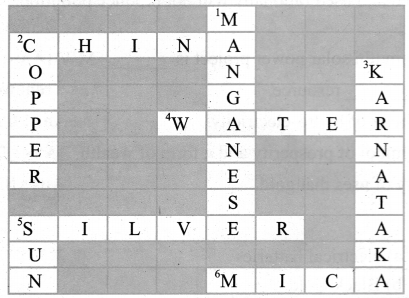
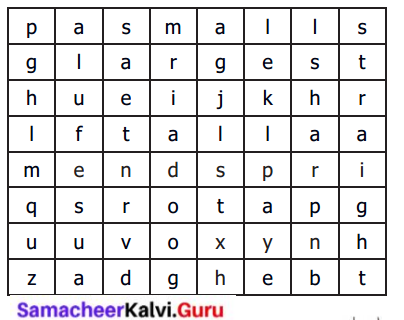
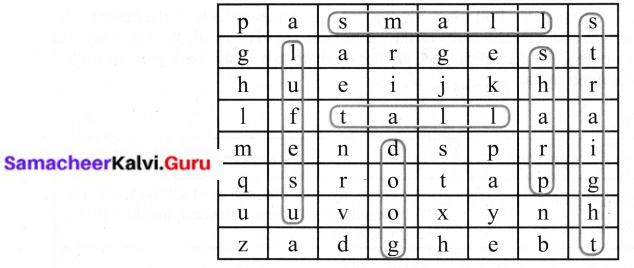
Crossword puzzle
Samacheer Kalvi 7th Social Solutions Science Geography Term 2 Chapter 1 Resources
Across:
2. The leading coal producers of the world
4. Considered as a great source of energy
5. Precious metal like gold
6. Used as an insulating material in electrical industry
Down:
1. Used in making electrical batteries
2. Good conductor of heat and electricity
3. The largest producer of gold in India
5. Produces energy in the form of heat and light
Samacheer Kalvi Guru 7th Social Science Geography Solutions Term 2 Chapter 1 Resources

Samacheer Kalvi 7th Social Science Resources Additional Questions

I. Choose the correct answer:

Question 1.
______ are the non-living parts of an environment.
(a) Biotic resources
(b) Abiotic resources
(c) Both
(d) None
Answer:
(b) Abiotic resources

Question 2.
______ is not harmful to the environment.
(a) Sotar energy
(b) Wind energy
(c) Hydropower
(d) None of these

Question 3.
Kamuthi solar power project is situated in ______ district in Tamil Nadu.
(a) Madurai
(b) Tirunelveli
(c) Ramanathapuram
(d) Kancheepuram
Answer:
(c) Ramanathapurami

Question 4.
______ ¡s considered as a great source of energy.
(a) Air
(b) Wind
(c) Land
(d) Water
Answer:
(d) Water

Question 5.
_______ resources are the type of resources that are composed of metals.
(a) Metallic
(b) Non-metallic
(c) Both
(d) None
Answer:
(a) Metallic

Question 6.
Iron ores found at _______ in Tamil Nadu.
(a) Shervaroy hills
(b) Kanjamalai
(c) Palani hills
(d) None of these
Ans:
(b) Kanjamalai

II. Fill in the blanks:

  1. _________ are resources that exist without action of humankind.
  2. _________ resources harvested and used rationally will not produce pollution.
  3. The installed capacity of Kamuthi solar power project is _________ MW.
  4. Hydro electric power is a _________ resource.
  5. _________ is the largest producer of hydro-electricity.
  6. _________ is regarded as a symbol of prosperity and a form of wealth.
  7. _________ has a wider variety of uses that gold.

Answers:

  1. Natural resources
  2. Renewable
  3. 648
  4. Renewable
  5. China
  6. GoId
  7. Silver

III. Match the following:

  1. Gold – (a) electrical batteries
  2. Silver – (b) Black Gold
  3. Manganese – (c) Sedimentary rock
  4. Petroleum – (d) Mexico
  5. Limestone – (e) China

Answers:

  1. e
  2. d
  3. a
  4. b
  5. c

IV. Consider the following statements: Tick the appropriate answer

Question 1.
Assertion (A) : Fossil fuel resources are normally formed from the remains of dead plants and animals.
Reason (R) : They are often referred to as fossil fuels and are formed from hydrocarbon.
(a) A and R are correct and R explains A
(b) A and R are correct but R does not explain A
(c) A is incorrect but R is correct
(d) Both A and Rare incorrect
Answer:
(a) A and R are correct and R explain A

Question 2.
Assertion (A) : Mica is used as an insulating material in electrical industry.
Reason (R) : Non-metallic resources are hard substances, and are good conductors of heat and electricity.
(a) A and R are correct and R explains A
(b) A and R are correct but R does not explain A
(e) A is incorrect but R is correct
(d) A is correct but R is incorrect
Answer:
(d) A is correct but R is incorrect

V. Answer in one or two sentences

Question 1.
What are the importance of resources?

  1. Natural resources satisfy daily needs of man such as food, clothing and shelter.
  2. Natural resources also contribute immensely to boost up a nation’s economy.

Question 2.
What is renewable resources?
Answer:
A renewable resource is a resource which can be used repeatedly and replaced naturally. Renewable resources harvested and used rationally will not produce pollution. The use of renewable resources and energy sources is increasing worldwide.
Example: solar energy, wind energy, and hydropower.

Question 3.
Write a note on Kamuthi Solar Project.
Answer:
Kamuthi solar power project is one of the largest solar power projects in the world. It is situated in Ramanathapuram District in Tamilnadu. The Kamuthi solar power project was completed on 21st September 2016. The installed capacity of this project is 648 MW.

Question 4.
Describe the major wind farms in India.
Answer:
Wind Forms:

  1. Muppandal
  2. Jaisalmer
  3. Brahmanvel
  4. Dhalgaon
  5. Damanjodi

Question 5.
What are Non-renewable resources?
Answer:
Natural resources that once consumed and cannot be replaced is called non-renewable resources. Continuous consumption of non-renewable resources ultimately leads to exhaustion. Examples of non-renewable resources include fossil fuels such as coal, petroleum, natural gas and mineral resources such as iron, copper, bauxite, gold, silver and others.

Question 6.
What are the types of Non-renewable resources?
Non-renewable resources can be divided into three types. They are:

  • Metallic resources
  • Non – Metallic resources
  • Fossil fuel resources

VI. Answer the following in detail

Question 1.
What are the types of resources on the basis of origin?
Answer:
On the basis of origin, resources may be divided into two types. They are:

  1. Biotic resources
  2. Abiotic resources

1. Biotic resources:
Biotic resources are found in the biosphere which are obtained from living and organic materials. It includes forests, crops, birds, animals, fishes, man and materials that can be obtained from them. Fossil fuels such as coal and petroleum are also included in this category because they are formed from decayed organic matter.
2. Abiotic resources:
Abiotic resources are the non-living parts of an environment. Examples of abiotic resources include land, water, air, sunlight and heavy metals including ores such as gold, iron, copper, silver etc.

Question 2.
Briefly explain any four of the metallic resources.
Answer:
Metallic resources Metallic resources are the type of resources that are composed of metals. These are hard substances, which are the good conductors of heat and electricity. Example for metallic resources are iron, copper, gold, bauxite, silver, manganese, etc.

Iron : Iron is the fourth most common element in the Earth’s crust and the most widely available metal. Magnetite and hematite are the common ore for iron, which occurs normally in the rocksof the crust.

Copper : Copper is one of the first metals known and used by man. Copper ranks as the third most consumed industrial metal in the world after Iron and Aluminium. Copper is good conductor of heat and electricity. Chile is the world’s number one country in the production of copper.

Gold : It is a rare and precious metal. Hence, ithas high demand in world markets. Formerly, it was used for minting coins, but now it is used for making ornaments and in dentistry. It is regarded as a symbol of prosperity and a form of wealth. China is the world’s largest producer of gold.

Silver : Silver is also a precious metal like gold. It has a wider variety of uses than gold. It is used in making jewellery, dentistry, photographic goods, electroplating industry and in the manufacture of luxury goods. Mexico is the world’s leading silver producer.

VII. Give reason.

Question 1.
Manganese is used in drafting electrical batteries.
Answer:
Manganese is used in making electrical batteries. It is also used as colouring material in bricks, pottery, floor tiles.

Question 2.
Silver is also a precious metal like Gold.
Answer:
Silver is also a precious metal like gold. It has a wider variety of uses than gold. It is used in making jewellery, dentistry, photographic goods, electroplating industry and in the manufacture of luxury goods.

Samacheer Kalvi 8th Social Science Geography Solutions Term 2 Chapter 1 Migration and Urbanisation

You can Download Samacheer Kalvi 8th Social Science Book Solutions Guide Pdf, Tamilnadu State Board help you to revise the complete Syllabus and score more marks in your examinations.

Tamilnadu Samacheer Kalvi 8th Social Science Geography Solutions Term 2 Chapter 1 Migration and Urbanisation

Samacheer Kalvi 8th Social Science Migration and Urbanisation Textbook Evaluation

I. Choose the correct answer

Migration And Urbanisation 8th Class Question 1.
People move from …………… to …………… mainly in search of better jobs.
(a) Rural to Urban
(b) Urban to Rural
(c) Hills to plains
(d) Plains to hills
Answer:
(a) Rural to Urban

The Migration In Search Of Fertile Agricultural Land Is Dash Migration Question 2.
A person moves from his own country to another country is known as ……………
(a) Immigrant
(b) Refugee
(c) Emigrant
(d) Asylum seeker
Answer:
(c) Emigrant

Urbanization Is Determined By Dash Number Of Factors Question 3.
The migration in search of fertile agricultural land is …………… migration.
(a) Rural to Rural
(b) Rural to Urban
(c) Urban to Rural
(d) Urban to Urban
Answer:
(a) Rural to Rural

The Migration In Search Of Fertile Agricultural Land Is Question 4.
War is one of the …………… causes of human migration.
(a) Demographic
(b) Socio – Cultural
(c) Political
(d) Economic
Answer:
(c) Political

Mass Migration Is Absent In The Modern Period True Or False Question 5.
The main reason for the development of urbanization in pre – historic period was ……………
(a) Production of food grains
(b) Domestication of cattle
(c) Fishing
(d) hunting
Answer:
(b) Domestication of cattle

II. Fill in the Blanks

  1. Urbanization is determined by …………… number of factors.
  2. …………… is the major push factor operating in rural areas.
  3. …………… Metropolitan city in India has the second highest urban population in the world.
  4. The movement of a person based on his free will and desire to live in a better place is …………… migration.
  5. In modem time urban growth was accelerated by the development of ……………

Answer:

  1. Three
  2. Poverty
  3. Delhi
  4. Voluntary
  5. Towns and cities

III. Match the following

  1. Emigration – In migration
  2. Immigration – Out migration
  3. Pull factor – Employment
  4. Push factor – Socio – Cultural migration
  5. Marriage – Employment opportunity

Answer:

  1. Emigration – Out migration
  2. Immigration – In migration
  3. Pull factor – Socio – Cultural migration
  4. Push factor – Employment opportunity
  5. Marriage – Employment

IV. State whether the following statements are True or False

  1. Slums are generally found in cities.
  2. Mass migration is absent in the modem period.
  3. The process of Urbanisation has a short history.
  4. Cities and towns are the major polluters of environment.
  5. Transhumance is also referred as seasonal migration.

Answer:

  1. True
  2. True
  3. False
  4. True
  5. True

V. Consider the given statements and choose the correct option the given ones

Statement (A) – Urbanisation is mainly due to the movement of people from rural to cities.
Reason (R) – Rural to Urban migration is not a predominant one.
(a) A is correct but R is incorrect
(b) Both A and R are incorrect
(c) Both A and R are correct
(d) A is incorrect and R is correct
Answer:
(a) A is correct but R is incorrect

VI. Answer the following questions in brief

Is The Major Push Factors Operating In Rural Areas Answer Question 1.
Define “Migration”.
Answer:
Migration has been defined differently by different experts. In general migration is defined as the permanent or semi permanent change of residence of an individual or group of people over a significant distance. So, the term migration refers to the movement of people from one place to another.

Major Push Factors Operating In Rural Areas Question 2.
What are the causes of rural to urban migration?
Answer:

  1. Ecological or Natural causes of migration
  2. Economic causes of migration
  3. Socio – cultural causes of migration
  4. Demographic causes of migration
  5. Political causes of migration

People Move From To Mainly In Search Of Better Jobs Question 3.
State the causes of the ecological or natural migration.
Answer:

  1. Natural causes include volcanic eruption, mankind changed considerably.
  2. At this stage, people continued to move from one region to another in search of fertile land for cultivation.

The Process Of Urbanisation Has A Short History True Or False Question 4.
Name any two pull factor of migration.
Answer:

  1. Availability of better job opportunity.
  2. Fertile land

Question 5.
What is Urbanization?
Answer:
Urbanization refers to the process in which there is an increase in the proportion of population living in towns and cities.

Question 6.
List out any four most populous cities in the world.
Answer:

  1. Tokyo (Japan)
  2. Delhi (India)
  3. Shanghai (China)
  4. Mexico city (Mexico)

VII Answer the following questions in detail

Question 1.
What are the different types of migration? Explain.
Answer:
Migration can be classified in several ways. They are:
1. Based on the movement associated with administrative limits.

(a) Internal Migration
(b) International Migration

2. Based on the willingness of the migrants for migration.

(a) Voluntary Migration
(b) Involuntary Migration

3. Based on the duration of stay of migrants in the place of destination.

(a) Short term Migration
(b) Long term Migration
(c) Seasonal Migration

1. Based on the movement associated with administrative limits.
(a) Internal Migration:

  1. The movement of people within a country is known as internal migration.
  2. Further internal migration is classified into four types. They are,
    • Rural to Urban migration
    • Urban to Urban migration
    • Rural to Rural migration and
    • Urban to Rural migration

(b) International Migration:
Migration that occurs across the national boundaries are known as international migration.

2. Based on the Willingness of the migrants for migration:
(a) Voluntary migration:

  1. If the migration takes place on perspus free will, initiative and desire to live in a better place.

(b) Involuntary migration:

  1. If the migration takes place against the will of migrants is known as involuntary migration.

3. Based on the duration of stay of migrants in the place of destination:
(a) Short term migration:

  1. The migrants stay outside only for a short duration before returning to the place of origin.

(b) Long term migration:

  1. The migrants stay outside at least for a few years.

(c) Seasonal migration:

  1. Usually a group of people migrates from their native places during a particular season and return after end of that season.
  2. Transhumance is an another example of seasonal migration.

Question 2.
Explain in detail about the various causes of migration.
Answer:
1. Ecological or Natural causes of migration:

  • The causes operate under this category are natural ones. They include Valcanic eruption, mankind changed considerably.
  • At this stage, people continued to move from one region to another in search of fertile land for cultivation.

2. Economic causes of migration:

  • Economy is one of the most important causes of human migration from one area to another.
  • The availability of fertile agricultural land, employment opportunities, development of technology etc. are some of the economic causes that attract the migration.

3. Socio – cultural causes of migration:

  • Socio – cultural causes also play some roles in the process of migration.
  • For example, women after marriage.

4. Demographic causes of migration:

  • In demographic sense, the population composition like age and sex, over population and under population are the major causes of migration.
  • Over population is considered as a push factor and under population to be pull factor in the context of migration.

5. Political causes of migration:

  • Various political causes like colonization, wars, Government policies etc. have always been playing important role in human migration from time to time.

Question 3.
Discuss the problems of urbanisation.
Answer:
1. Housing and Slums:

  • There is a lack of space for housing and a marked reduction in the quality of housing in the urban areas due to increase in population.

2. Over Crowding:

  • Over – crowding leads to unhealthy environment in the urban areas.
  • It also the cause of many diseases and riots.

3. Water Supply, Drainage and Sanitation:

  • No city has round the clock water supply in the world.
  • Drainage situation is equally bad.
  • The removal of garbage is a Himalayan task for urban local bodies.

4. Transportation and Traffic:

  • Absence of planned and adequate arrangements for traffic and transport is another problem in urban centers.
  • The increasing number of two wheeler and cars make the traffic problem worse.

5. Pollution:

  • Towns and cities are the major polluters of environment.
  • Several cities discharge their entire sewage and industrial effluents untreated into the near by rivers. Industries in and around the urban centers pollute the atmosphere with smoke and toxic gases.

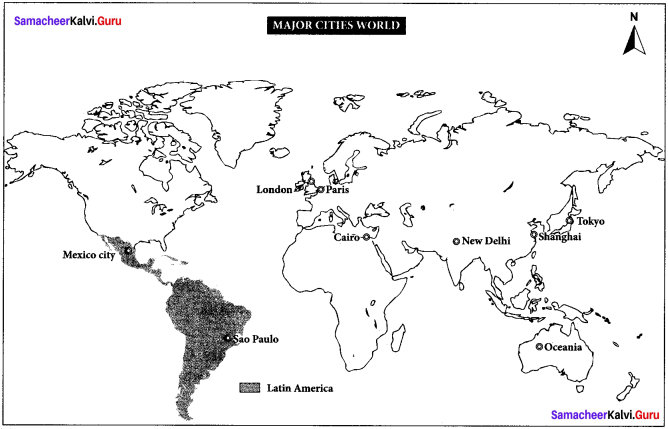
VIII. Map Study

Question 1.
On the outline map of the world mark the following places

  1. Tokyo
  2. New Delhi
  3. Mexico city
  4. Shanghai
  5. Sao Paulo
  6. Oceania
  7. Latin America
  8. Paris
  9. London
  10. Cairo

Answer:
Migration And Urbanisation 8th Class Samacheer Kalvi Geography Solutions Term 2 Chapter 1

IX. Activities

Question 1.
List out and analyze the reason for migration of people in your locality.
Answer:
People migrate for a number of reasons. The reasons and causes for migration would normally fall under these areas:

  1. Environmental – Better climate, calamities and natural disasters are examples of environmental causes or reasons.
  2. Economic – Moving to find work or moving to follow a particular career path is an example of economic cause or reason.
  3. Cultural – Religious freedom and education is an example of cultural cause or reason.
  4. Political – Civil war or escaping from political persecution is an example of political cause.
  5. Social – Moving for a better quality of life or moving closer to a family member or friend is an example of a social cause or reason.

Question 2.
Collect the pictures and information regarding the effects of urbanization and make an album.
Answer:
Activity to be done by the students.

Samacheer Kalvi 8th Social Science Migration and Urbanisation Additional Questions

I. Choose the correct answer:

Question 1.
…………… refers to the movement of people from one place to another.
(a) Privatization
(b) Migration
(c) Modernisation
(d) All the above
Answer:
(b) Migration

Question 2.
…………… move from rural to urban mainly in search of beter jobs.
(a) Children
(b) People
(c) Both ‘a’ and ‘b’
(d) None of these
Answer:
(b) People

Question 3.
…………… is determined by three number of factors.
(a) Globalization
(b) Privatization
(c) Liberalization
(d) Urbanization
Answer:
(d) Urbanization

Question 4.
Transhumance is also referred as …………… migration.
(a) Seasonal
(b) Migration
(c) Socio – Cultural Migration
(d) Mass Migration
Answer:
(c) Socio – Cultural Migration

Question 5.
Cities and towns are the major polluters of …………….
(a) Environment
(b) Urbanization
(c) Privatization
(d) None of these
Answer:
(a) Environment

Question 6.
Poverty is the major push factor operating in …………… areas.
(a) Urban
(b) Rural
(c) Both ‘a’ and ‘b’
(d) None of these
Answer:
(b) Rural

Question 7.
Delhi Metropolitan City in India has the …………… highest urbam population in the world.
(a) First
(b) Third
(c) Second
(d) Fourth
Answer:
(c) Second

Question 8.
In …………… time urban growth was accelerated by the development of towns and cities.
(a) Modem
(b) Medieval
(c) Classical
(d) Ancient
Answre:
(a) Modern

Question 9.
…………… are generally found in cities.
(a) Fields
(b) Slums
(c) Wells
(d) All of these
Answer:
(b) Slums

Question 10.
…………… around the urban centers polluted the atmosphere with smoke and toxic gases.
(a) Trades
(b) Transhumances
(c) Industries
(d) Both ‘a’ and ‘b’
Answer:
(c) Industries

Question 11.
The favorable factors which attract people towards a location are called …………… factors.
(a) Push
(b) Pull
(c) Natural
(d) All of these
Answer:
(b) Pull

Question 12.
The unfavorable factors which make the people to move out from a location are called …………… factors.
(a) Push
(b) Pull
(c) Natural
(d) All of these
Answer:
(a) Push

Question 13.
Human migration is categorized under …………… groups.
(a) three
(b) four
(c) two
(d) five
Answer:
(d) five

Question 14.
Wars have been one of the significant causes of migration since …………….
(a) Modem time
(b) Ancient time
(c) Classical time
(d) None of these
Answer:
(b) Ancient time

Question 15.
Migration that occurs across the national boundaries are known as …………… migration.
(a) Urban
(b) Rural
(c) Involuntary
(d) International
Answer:
(d) International

Question 16.
…………… takes place on person’s free will, initiative and desire to live in a better place.
(a) Involuntary migration
(b) Voluntary migration
(c) Rural migration
(d) All of these
Answer:
(b) Voluntary migration

Question 17.
The movement of the people within a country is known as …………… migration.
(a) Urban migration
(b) Internal
(c) International
(d) Involuntary
Answer:
(b) Internal

Question 18.
…………… migration takes place against the will of migration.
(a) Rural
(b) Internal
(c) Involuntary
(d) Voluntary
Answer:
(c) Involuntary

Question 19.
Transhumance is an another example of …………… migration.
(a) Rural
(b) Seasonal
(c) Urban
(d) Voluntary
Answer:
(b) Seasonal

Question 20.
The industrial revolution in the …………… century
(a) 18th Century
(b) 20th Century
(c) 19th Century
(d) 16th Century
Answer:
(c) 19th Century

II. Fill in the blanks:

  1. …………… is one of the most important causes of human migration from one area to another.
  2. In 2017 …………… was the largest country of Origin of International migrants followed by Mexico.
  3. …………… Migration is the movement of population from rural areas to growing towns and cities.
  4. …………… in Urban areas leads to the pollution of air, water and soil.
  5. …………… is driven by three factors.
  6. To Improve their financial status, the migration is said to be ……………
  7. One of the most important aspect of Social Science is …………….
  8. Women mostly migrate after their ……………
  9. …………… to Urban migration is the migration between one urban center to the other like in search of higher salaries.
  10. Rural to urban migration is the most …………… one.
  11. …………… migration may be from a few days to few months.
  12. …………… migrants stay outside at least for a few years.
  13. …………… period primitive man started domestication of plants and animals.
  14. The excess production of food grains was the major reason for ……………
  15. During the beginning of the …………… century itself many cities were found near the Aegean Sea.
  16. …………… period starts from 17th century.
  17. The latest development in Urbanization was noticed in the continent of …………..
  18. In 1950 …………… percentage of the world’s population was Urban.
  19. The removal of …………… is a Himalayan task for urban local bodies.
  20. Industries in and around the Urban centers pollute the atmosphere with and …………… gases.

Answer:

  1. Economy
  2. India
  3. Rural to Urban
  4. Over population
  5. Urbanization
  6. Voluntary
  7. “Human Migration”
  8. Marriage
  9. Urban
  10. common
  11. Short – term
  12. Long – term
  13. Ancient period
  14. Urbanization
  15. 7th Century
  16. Modern
  17. Africa
  18. 30%
  19. garbage
  20. Smoke, toxic

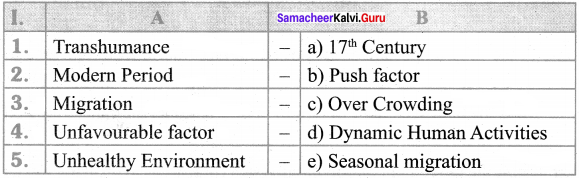
III. Match the following:

The Migration In Search Of Fertile Agricultural Land Is Dash Migration Samacheer Kalvi 8th Social Science Geography Solutions Term 2 Chapter 1
Answer:

  1. e
  2. a
  3. d
  4. b
  5. c

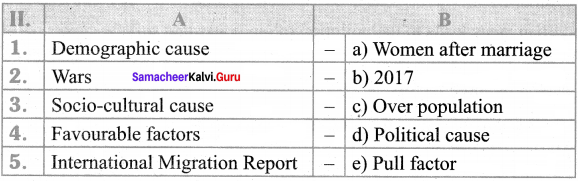
Urbanization Is Determined By Dash Number Of Factors Samacheer Kalvi 8th Social Science Geography Solutions Term 2 Chapter 1
Answer:

  1. c
  2. d
  3. a
  4. e
  5. b

IV. State True or False

  1. Transhumance is an example of short term migration.
  2. Wars have been considered as political causes of migration.
  3. Urbanization is driven by five factors.
  4. Modem period start from 20th century.
  5. Generally over population is considered as pull factor.
  6. In 2019, the total population in Northern America is 366,400,324
  7. One of the most important aspects of social science is “Birds Migration”.
  8. The favorable factors which attract people towards a location are called push factors.
  9. Unemployment is a economic causes of migration.
  10. Volcanic eruption is a social causes of migration.

Answer:

  1. False
  2. True
  3. False
  4. False
  5. False
  6. True
  7. False
  8. False
  9. True
  10. False

V. Consider the following statements and Tick (✓) the appropriate answer:

Question 1.
(i) During the early days, people moved from one place to another in search of food.
(ii) Human migration is categorized under two groups.
(iii) Various economic causes determine the level and direction of migration.
(iv) Migration that occurs across the national boundaries are known as international migration.

(a) (i), (ii) & (iii) are Correct
(b) (i), (ii) & (iv) are Correct
(c) (i), (ii) and (iii) are Correct
(d) (i), (iii) and (iv) are Correct
Answer:
(d) (i), (iii) and (iv) are Correct

Question 2.
Statement (A): Large scale movement of people from rural to urban areas causes over crowding in cities.
Reason (R) : The over population in Urban areas leads to the pollution of air, water and soil.
(a) A is correct but R is incorrect
(b) Both A and R are incorrect
(c) Both A and R are correct
(d) A is incorrect and R is correct
Answer:
(c) Both A and R are correct!

Question 3.
Which one of the following is correctly matched?
(a) Brain drain – Economic consequence
(b) Environmental causes – Earth quake
(c) Example for Demographic consequences – People become generous.
(d) Social consequences – Pollution of air, water
Answer:
(a) Brain drain – Economic consequence

Question 4.
Which one of the following is not correctly matched?
(a) Short term migration – Few years
(b) Long term migration – Stay outside at least few years
(c) Involuntary migration – Migration take place against the will.
(d) Europe – Female migrants outnumber male migrants.
Answer:
(a) Short term migration – Few years

VI. Answer the following one or two sentences

Question 1.
What do you mean by Migration?
Answer:
The term migration refers to the movement of people from one place to another.

Question 2.
What are the Factors influencing Migration?
Answer:

  1. There are number of factors which are responsible for the migration of human population.
  2. These factors can be grouped under the heads of favorable and unfavorable factors.

Question 3.
What is pull factors?
answer:
The favorable factors which attract people towards a location are called pull factors.

Question 4.
What is push factors?
Answer:
The unfavorable factors which make the people to move out from a location are called push factors.

Question 5.
Write a short note on Economic causes of Migration.
Answer:

  1. Economy is one of the most important causes of human migration from one area to another.
  2. The availability of fertile agricultural land, employment opportunities, development of technology etc. are some of the economic causes that attract the migration.

Question 6.
What is Demographic causes of Migration?
Answer:
In demographic sense, the population composition like age and sex, over population and under population are the major causes of migration.

Question 7.
What is voluntary migration?
Answer:

  1. If the migration takes place on person’s free will, initiative and desire to live in a better place.
  2. To improve their financial status, the migration is said to be voluntary.

Question 8.
What are the consequences of Migration?
Answer:

  1. Demographic consequences.
  2. Social consequences.
  3. Economic consequences.
  4. Environmental consequences.

Question 9.
What are the factors influencing urbanization?
Answer:
Urbanization is driven by three factors. They are,

  1. Natural population growth.
  2. Rural to Urban Migration and
  3. Reclassification bf rural areas into urban areas.

VII. Answer the following in detail

Question 1.
Describe the consequences of Migration.
Answer:
1. Demographic consequences:
It changes age and sex composition of population. Migration of females after their marriage leads to decline in sex ratio in the source regions and increase the sex ratio in the regions of destinations.

2. Social consequences:
The Migration of people from different regions towards an urban area leads to the formation of plural society. It helps the people to come out of narrow mindedness and people become generous.

3. Economic consequences:
The Migration of more people from over populated to under populated regions results the imbalance of the resource – population ratio. In some cases, the regions of over and under population may become the regions of optimum population. Migration may influence the occupational structure of the population of our area. Brain drain is a consequence of migration.

4. Environmental consequences:
Large scale movement of people from rural to urban areas causes overcrowding in cities and puts heavy pressure on resources. It leads to rapid growth of cities. The over population in urban areas leads to the population of air, water and soil. The lack of space for housing and the rising off and cost lead to the formation of slums.

Question 2.
Explain about the demographic causes of migration and political causes of migration.
Answer:
Demographic causes of Migration:

  1. In demographic sense, the population composition like age and sex, over population and under population are the major causes of migration.
  2. It is well known fact that adults are more migratory than any other age-groups.
  3. Women mostly migrate after their marriage.
  4. Generally over population is considered as a push factor and under population to be Pull factor in the context of migration.

Political cause of Migration:

  1. Various political causes like colonization, wars, government policies etc. have always been playing important role in human migration from time to time.
  2. Wars have been one of the significant causes of migration since ancient time.

Samacheer Kalvi 7th Science Solutions Term 1 Chapter 4 Atomic Structure

Students can Download Science Chapter 4 Atomic Structure Questions and Answers, Notes Pdf, Samacheer Kalvi 7th Science Book Solutions Guide Pdf helps you to revise the complete Tamilnadu State Board New Syllabus and score more marks in your examinations.

Tamilnadu Samacheer Kalvi 7th Science Solutions Term 1 Chapter 4 Atomic Structure

Samacheer Kalvi 7th Science Atomic Structure Textual Evaluation

I. Choose the appropriate answer :

7th Science Atomic Structure Question 1.
The basic unit of matter is __________
(a) Element
(b) Atom
(c) Molecule
(d) Electron
Answer:
(b) Atom

Unit 4 Atomic Structure Answers Question 2.
The subatomic particle revolve around the nucleus is __________
(a) Atom
(b) Neutron
(c) Electron
(d) Proton
Answer:
(c) Electron

Atomic Structure Class 9 Samacheer Kalvi Question 3.
__________ is positively charged.
(a) Proton
(b) Electron
(c) Molecule
(d) Neutron
Answer:
(a) Proton

Atomic Structure Worksheet Answer Key 7th Grade Question 4.
The atomic number of an atom is __________
(a) Number of neutrons
(b) Number of protons
(c) Total number of protons and neutrons
(d) Number of atoms
Answer:
(b) Number of protons

7th Standard Atomic Structure Question 5.
__________ Nucleons comprises of
(a) Protons and electrons
(b) Neutrons and electrons
(c) Protons and neutrons
(d) Neutrons and Positron
Answer:
(c) Protons and neutrons

II. Fill in the blanks

  1. The smaller particles found in the atom is called _____
  2. The nucleus has _____ and _____
  3. The _____ revolve around the nucleus.
  4. If the valency of carbon is 4 and that of hydrogen is 1, then the molecular formula of methane is _____
  5. There are two electrons in the outermost orbit of the magnesium atom. Hence, the valency of magnesium _____

Answer:

  1. sub-atomic particels
  2. Protons, Neutrons
  3. electrons
  4. CH4
  5. 2

III. Match the following :

1.Valency(a)Fe
2.Neutral Particle(b)Proton
3.Iron(c)Electrons in the outermost Orbit
4.Hydrogen(d)Neutron
5.Positively charged Particle(e)Monovalent

Answer:

  1. c
  2. d
  3. a
  4. e
  5. b

IV. True or False. If False, give the correct statement (T/F).

Structure Of Atom Class 7 Question 1.
The basic unit of an element is molecule.
Answer:
(False) Correct statement: The basic unit of an element is atom.

Samacheer Kalvi Guru 7th Science Question 2.
The electrons are positively charged.
Answer:
False. Correct statement: The electrons are negatively charged.

Class 7 Science Chapter 4 Notes Question 3.
An atom is electrically neutral.
Answer:
True

Atomic Structure Book Back Answers Question 4.
The nucleus is surrounded by protons.
Answer:
(False) Correct statement: The nucleus is surrounded by electrons.

V. Complete the analogy.

  1. Sun: Nucleus, planets: ______
  2. Atomic number: ______ , Mass number: number of protons and neutrons.
  3. K: Potassium, C: ______.

Answer:

  1. electrons
  2. Number of protons
  3. Carbon

VI. Assertion and reason.

Samacheer Kalvi.Guru 7th Science Question 1.
Assertion : An atom is electrically neutral.
Reason : Atoms have equal number of protons and electrons.
Answer:
Both Assertion and Reason are true and Reason is the correct explanation of Assertion.

Atomic Structure Class 7 Question 2.
Assertion : The mass of an atom is the mass of nucleus.
Reason : The nucleus is at the centre.
Answer:
Both Assertion and Reason are true and Reason is the correct explanation of Assertion.

Atomic Structure Notes For Class 7 Question 3.
Assertion : The number of protons and neutrons is atomic number.
Reason : The mass number is sum of protons and neutrons.
Answer:
Assertion is false but the reason is true statement.
Correct statement: The number of protons and neutrons is mass number.

VII. Give very short answer.

Question 1.
Define an atom.
Answer:
An atom is the smallest particle of a chemical element that retains its chemical properties.

Question 2.
Name the sub-atomic particles.
Answer:
Proton, Electron, Neutrons.

Question 3.
What is atomic number?
Answer:
The number of electrons or protons in an atom is called the atomic number of that atom. It is represented by the letter Z.

Question 4.
What is the characteristics of proton?
Answer:
The proton is the positively charged particle and its located in the nucleus. Its positive Charge is of the same magnitude as that of the electron’s negative charge.

Question 5.
Why neutrons called neutral particles?
Answer:
Neutrons are the particles in an atom that have a neutral change (no charge). They are not positive like protons. They are not negative like electrons. So they are called as neutral particles.

VIII. Give short answer.

Question 1.
Distinguish Isotopes from Isobar.
Answer:

IsotopesIsobar
Isotopes are atoms of the same element thus having same atomic number but different mass number.Isobars are such atoms which have same mass number but different atomic numbers. Thus isobars are different elements
Example : Hydrogen has three isotopes protium, with deuterium, tritium atomic number 1 but mass number 1,2,3.Example : Calcium and Argon are isobars as they have atomic number 20 and 18 but their mass number is 40.

Question 2.
What are the isotones give one example.
Isotones are the atoms of different elements with same number of neutrons.
136C Neutrons = 13-6 = 7
147C Neutrons = 13-6 = 7

Question 3.
Differentiate mass number from atomic number.
Answer:

Atomic numberMass number
The number of electrons or protons in an atom is called atomic number of that atom.The number of protons and neutrons present is its nucleus is called mass number of that atom.
It is represented by the letter ZIt is represented by the letter ‘A’.
Example : Helium (He) has 2 protons and two electrons hence its atomic number will be 2.Example : Sodium (Na) has 11 protons and 12 Neutrons hence its mass number A= 11 + 12 = 23

Question 4.
The atomic number of an element is 9, it has 10 neutrons. Find the element from the periodic table. What will be its mass number?
Answer:
The element is Fluorine
Its mass number A
= n + p
= 10 + 9 = 19
∴Mass number of Fluorine = 19

IX. Answer in detail.

Question 1.
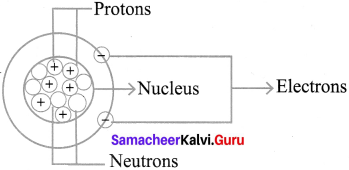
Draw the atom structure and explain the position of the sub-atomic particles. »
Answer:
Structure of an atom.

7th Science Atomic Structure Samacheer Kalvi Term 1 Chapter 4

Position of the subatomic – particles.
Atom consist of three sub-atomic.
Particles : 1. Protons, 2. Electrons, 3. Neutrons

  1. The nucleus of the atom contains the protons (positively charged) and the neutrons (no change)
  2. The outermost regions of the atom are called electron shells and contain the electrons (negatively charged)
  3. The protons have a positive charge while neutrons have a neutral charge.
  4. Electrons circle around the nucleus of an atom, they are negatively charged.

Question 2.
The atomic number and the mass number of an element is 26 and 56 respectively. Calculate the number of electrons, protons and neutrons in its atom. Draw the structure.
Answer:
Atomic number A = 26
Mass number A = 56
No. of Protons P = ?
No. of Electrons = ?
No. of Neutrons N = ?
Name of the element is Iron (Fe)
No. of proton (P) = 26
Mass number A = n+p
56 = n = 26
n = 56-26
∴ No. of neutrons n = 30
In an element No. of protons and No. of electrons is equal.
∴No of electrons = no. of protons
= 26
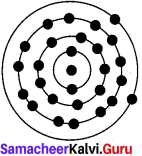
Structure of Iron:

Unit 4 Atomic Structure Answers Samacheer Kalvi 7th Science Solutions Term 1

Question 3.
What are nucleons? Why are they so called? Write the properties of the nucleons?
Answer:

  1. Nucleons are sub-atomic particles (Protons and Neutrons) which are located in the nucleus of atoms.
  2. Neutron and proton exist within the nucleus of the atom, together, they are called as nucleons.

Properties of Nucleons :
(a) Nucleons (Proton and Neutrons) have same mass as if they were identical particles that differ only in their electric charge.
(b) The proton carries a charge +1 and the Neutron is neutral.
(c) The size nucleon is about 1 : 6 fm (Femto meters)
(d) The force that holds the nucleus together is very short range.

Question 4.
Define valency? What is the valency of the element with atomic number 8? What is the compound by the element with hydrogen.
Answer:

  1. Valency is defined as the combining capacity of an element.
  2. Valency of the element with atomic number : 8 Name of the element:

Oxygen : 0
Atomic number: 8
Valency : 2
Water (H2O) is the Oxide of Hydrogen and most familiar oxygen compound

X. Questions based on Higher Order Thinking Skills. :

Question 1.
An atom of an element has no electron, will that atom have any mass or not? Can atom exist without electron? If so then give example.
Answer:

  1. Atoms with no electron will have mass, because mass depends on number of Protons and Neutrons though it has no electron.
  2. Atoms can exist without electrons, Matter is build out of neutrons, protons (+) and electrons (-). Matter becomes stable only if it is electrically neutral.
  3. So atoms without electrons do exist and must have their own states (charged or uncharged transfered back and forth in their environment)
  4. Example : He2+. It has 2 protons and 2 neutrons but no electrons.

Question 2.
Find what is common salt? Name the elements present in it? Write the formula of common salt. What are the atomic number and the mass number of the elements? Write the ions in the compound.
Answer:

  1. Common salt is mostly sodium chloride. The ionic compound with the formula NaCl, representing equal proportions of sodium and chlorine.
  2. Elements present is common salt: Sodium & Chlorine.
  3. Formula of common salt: NaCl Atomic number and mass number of NaCl:
    Atomic number of Na = 1 Atomic number of Cl = 17 Mass number of Na = 23
    Mass number of Cl = 35
  4. Ions present in the compound :
    Sodium ion Na+ and Chloride ion Cl

Try yourself:

Question 1.
Why are atomic numbers and mass numbers are always whole numbers ?
Answer:

  1. The atomic number is always a whole number because there must always be a whole number of protons in a nucleus. In other words there can never exist fractions of a proton.
  2. The atomic mass number is always a whole number for the same reason. Protons and neutrons always come in single units not in fractions.

Question 2.
A sulphur atom contains 16 Protons and 16 neutrons. Give its atomic number and atomic mass number.
Answer:
Atomic number of Sulphur = No.of proton sulpher
= 16
Atomic mass number of Sulphur = No. of Protons + No. of Neutrons
= 16 + 16
= 32

Samacheer Kalvi 7th Science Atomic Structure Intext Activities


Activity – 1

Some known objects are shown, also the broken particles of the objects are shown. Name the articles or objects you see here? Also try to write What each of it made of?
Answer:

  1. Hummer made of Iron
  2. Bangles made of glass
  3. Tap made of steel
  4. Vessels made of Aluminum or steel

Activity – 2

Let us learn the characteristics of the subatomic particles through the following activity. Label the parts in the given diagram and answer the following.

  1. The positively charged particle is ________
  2. The negatively charged particle is ________
  3. ________ is neutral.

Answer:

  1. Proton
  2. Electron
  3. Neutron

Activity – 3

Observe the table given above and answer the following questions.

  1. I am used for breathing, without me you cannot live. Do you know me? Write my name and symbol ________
  2. It is used in filling the balloons. It is a gas, identity it. What is its mass number?
  3. Name the element present in banana. What is my atomic number?
  4. I am found in crackers. How many protons do i have?
  5. I am the most valuable element. Find who am I? Can you say my mass number?

Answer:

  1. Oxygen, Symbol – O.
  2. Helium, Mass no. 4 Potassium, Atomic number: 19.
  3. Phosphorous, No. of Protons : 15.
  4. Carbon, Mass number: 12.

Samacheer Kalvi 7th Science Atomic Structure Additional Questions

I. Choose the correct answer:

Question 1.
________ is made up of two or more atoms.
(a) Atoms
(b) Molecule
(c) Compound
(d) None
Answer:
(b) Molecule

Question 2.
The average diameter of an atom is ________
(a) 10“8 m
(b) 1 m
(c) 1A°
(d) 10
Answer:
(c) 1A°

Question 3.
Whose theory does not propose anything about the positive and negative charges of an atoms.
(a) J J. Thomson
(b) Dalton
(c) Rutherford
(d) Bohr
Answer:
(b) Dalton

Question 4.
________ is the smallest unit used to measure small lengths.
(a) Metre
(b) Nanometre
(c) Millimetre
(d) Centimetre
Answer:
(b) Nanometre

Question 5.
One Nano metre is equal to ________
(a) 108 m
(b) 10-9 m
(c) 10-5 m
(d) 109 m
Answer:
(b) 109 m

Question 6.
One metre is equal to ________ mm.
(a) 109
(b) 108
(c) 105
(d) 1010
Answer:
(a) 109

Question 7.
Who discovered the existence of the negatively charged particles is an atom?
(a) John Dalton
(b) Rutherford
(c) Neils Bohr
(d) J.J. Thomson
Answer:
(d) J.J. Thomson

Question 8.
J.J Thomson’s atom model is also called as ________
(a) Plum pudding model
(b) gold foil
(c) alpha particle
(d) none
Answer:
(a) Plum pudding model

Question 9.
Protons and neutrons are called ________
(a) atom
(b) nucleons
(c) positive charge
(d) negative charge
Answer:
(b) nucleons

Question 10.
Proton was discovered by ________
(a) Rutherford
(b) Goldstein
(c) Chadwick
(d) J.J. Thomson
Answer:
(a) Rutherford

II. Fill in the blanks :

  1. ______ is the smallest particle of a chemical element.
  2. The ______ are combination of atoms of various elements or the same element.
  3. According to John Dalton, atom is a hard, solid, ball and it is ______
  4. ________ compared an atom to a watermelon.
  5. The particles that make up the atom are called _________ particles.

Answer:

  1. Atom
  2. molecules
  3. indivisible
  4. J.J. Thomson
  5. sub-atomic

III. Write true or false :

Question 1.
A neutron is a neutral particle.
Answer:
True.

Question 2.
J.J. Thomson proposed than an atom consists of positively charged sphere in which the electrons are embedded.
Answer:
True.

Question 3.
The outermost orbit of an atom can have more than 8 electrons.
Answer:
(False) Correct statement : The outermost orbit of an atom contains maximum of 8 electrons.

Question 4.
Most of the space in an atom is occupied by electrons.
Answer:
True.

Question 5.
Rutherford used beta particles in his scattering experiments.
Answer:
(False) Correct statement: Rutherford used alpha particles in his scattering experiments.

IV. Matrix matching :

Question 1.

ElementSymbolAtomic No.
i)Hydrogena)01.11
ii)Heliumb)Al2.8
iii)Aluminiumc)He3.1
iv)Oxygend)Na4.2
v)Sodiume)H5.13

Answer:

  1. e
  2. c
  3. b
  4. a
  5. d

Question 2.

ParticleChargeDiscoverer
i)Protona)n1.James Chadwick
ii)Electronb)P2.Rutherford
iii)Neutronc)e3.J.J. Thomson

Answer:

  1. b
  2. c
  3. a

V. Give very short answer :

Question 1.
What is atomic number?
Answer:
Atomic number is the number of protons, an atom contains.

Question 2.
What is mass number of an atom?
Answer:
It is the sum of protons and neutrons in the nucleus of an atom.

Question 3.
What is a neutron?
Answer:
Neutron is an elementary particle that carries no charge

Question 4.
Name the 3 sub-atomic particles of an atom.
Answer:
Electron, Proton, Neutron.

Question 5.
What are valence electrons?
Answer:
The number of electrons present in the outermost shell of an atom are known as valence electrons.

Question 6.
What are nucleons?
Answer:
Protons and neutrons reside in the nucleus of an atom and are thus called nucleons.

Question 7.
What is an electron?
Answer:
It is negatively charged particle, which revolve around the nucleus of the atom is specific orbits.

Question 8.
What is the mass of a proton?
Answer:
1.6726 x 10⁻²⁷ kg.

VI. Give short answer :

Question 1.
Is the structure of the atom the same as the structure of the solar system.
Answer:
Yes It is similar to the solar system. It has a core center called nucleus and it has paths called orbits around the nucleus.

Question 2.
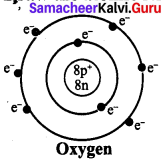
Draw the atomic structure of Oxygen :
Answer:

Atomic Structure Worksheet Answer Key 7th Grade Samacheer Kalvi Term 1 Chapter 4

Question 3.
what is atomic mass number? mention its formula.
Answer:
Atomic mass number (A) is equal to the sum of the number of protons(p) and neutrons (n) in the nucleus.
Atomic mass or mass number = Number of Protons + Number of Neutrons

Question 4.
Define isotopes. Give example.
Answer:
Atoms of the same element can have different number of neutrons. Such atoms will have same atomic number but different mass numbers. These atoms are called isotopes. For example Hydrogen has three isotopes – Hydrogen,Deuterium,Tritium

Question 5.
Define Isobars. Give example.
Answer:
Atoms that have the same mass number but different atomic numbers are called Isobars.
Eg: Calcium – 40 and Argon – 40.

Question 6.
What are the limitations of Thomson’s model of an atom?
Answer:
J. J. Thomson’s theory does not propose anything about the positive and negative charges of an atom. Hence , it was not able to explain many of the properties of substances.

VII. Answer the following in detail :

Question 1.
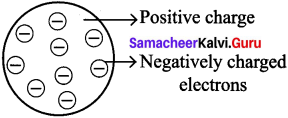
What was the model of an atom proposed by Thomson?
Answer:

  1. J.J. Thomson’s theory proposed that the atom has positively charged part like the red part of the watermelon and in it are embedded, like the seeds, negatively charged particles which he called electrons.
  2. According to this theory as the positive and negative charges are equal, the atom as a whole does not have any resultant charge.
  3. Thomson’s greatest contribution was to prove by experimentation the existence of the negatively charged particles or electrons in an atom.
    7th Standard Atomic Structure Term 1 Chapter 4 Samacheer Kalvi

Question 2.
Explain the following terms.

  • Proton
  • Electron
  • Neutron.

Answer:

  1. Proton (p): The proton is the positively charged particle and is located in the nucleus. Its positive charge is of the same magnitude as that of the electron’s , negative charge.
  2. Neutron (n): Neutron is inside the nucleus. The neutron does not have any charge. Except hydrogen (protium), the nuclei of all atoms contain neutrons.
  3. Electron (e): This is a negatively charged particle. Electrons revolve around the nucleus of the atom in specific orbits. The mass of an electron is negligible as compared to that of a proton or neutron.

VIII. Higher Order Thinking skills : (HOTS)

Question 1.
In Rutherford experiment of scattering of alpha particles, can we take foil of any other metal instead of gold?
Answer:

  1. Yes, we can take foil of any other metal that is highly malleable because for this experiment we need a very thin foil.
  2. Gold was used because it is highly malleable, the gold foil taken was about 1000 atoms thick.

Question 2.
How Rutherford’s model is different from that proposed by J.J. Thomson?
Answer:
According to Rutherford, most of the mass is concentrated is a small central part of the atom whereas J.J. Thomson thought that mass was uniformly distributed in the atom.

Samacheer Kalvi 6th English Solutions Term 1 Poem Chapter 2 Trees

Students can Download English Poem 2 Trees Questions and Answers, Summary, Activity, Notes, Samacheer Kalvi 6th English Book Solutions Guide Pdf helps you to revise the complete Tamilnadu State Board New Syllabus and score more marks in your examinations

Tamilnadu Samacheer Kalvi 6th English Solutions Term 1 Poem Chapter 2 Trees

Trees Poem Class 6 Questions And Answers Poem Overview

No.

Poem Line

Explanation

1-2

The Banyan is the largest of trees, The Peepul quivers in the breeze,

The banyan is the largest of all the trees. The peepul tree shivers (shakes) quickly in the breeze of the wind.

3-4

The Coconut grows up straight and tall, The Neem tree s fruits ate very small,

The coconut tree looks majestic, growing up straight and tall. The Neem tree’s fruits are very small.

5-6

The Tamarind gives us pleasant shade, The Dates leaf is as sharp as a blade,

The Tamarind tree gives us pleasant shade to relax. The leaves of the Date tree are as harp as a blade.

7-8

The Teak tree gives us useful wood, The Mango gives us fruit that is good.

The Teak tree gives us wood which is useful for all of us, while the Mango tree gives us fruits which are good and tasty to eat.

Glossary

  • quivers – shakes quickly
  • pleasant – enjoyable

Vocabulary

A. Find the describing words given in the poem.

Samacheer Kalvi 6th English Solutions Term 1 Poem Chapter 2 Trees 1
Answer:
Samacheer Kalvi 6th English Solutions Term 1 Poem Chapter 2 Trees 2
small
tall
useful
good
sharp
straight

Read and Understand

B. Answer the following.

Trees Poem Class 6 Question a.
What does the peepul do?
Answer:
The peepul quivers in the breeze.

6th Standard Trees Poem Summary Question b.
How does the coconut tree grow?
Answer:
The coconut tree grows up straight and tall.

6th English Poem Question c.
What does the tamarind tree give?
Answer:
The tamarind gives us pleasant shade.

6th Standard English Poem Trees Question d.
What is as sharp as a blade?
Answer:
The date’s leaf is as sharp as a blade.

6th Standard English Poem Question e.
What does the teak tree give us?
Answer:
The teak tree gives us useful wood.

Creative Writing

C. Read the acrostic poem on ‘Friend’. Write an acrostic poem like this on ‘Tree’.

Friend:

  • Friends always love each other
  • Respect each Other
  • Interact with each other
  • Enjoy playing with each Other
  • Never hurt your friends
  • Do everything together

Tree:

  • Trees are our gifts
  • Rear them with care
  • Enjoy the earth
  • Every day growing trees

Appreciating The Poem

D. Work in pairs.

A rhyme is repetition of the same sound in two or more words. Usually they come at the end of lines in poems and songs. Eg. tower – power; king – sing.
Discuss with your partner and pick out the rhyming words in the poem.
Read the poem aloud in pairs. Take turns to read the verses.
Trees – breeze
tall – small
shade – blade
wood – good

Trees Additional Questions

I. Poem Comprehension.

1. The Banyan is the largest of trees
The Peepul quivers in the breeze

6th Standard English Poem Trees Question Answer Question a.
Which is the largest of trees ?
Answer:
Banyan

Trees Poem Summary Class 6 Question b.
How does the breeze affect the trees ?
Answer:
The Peepul tree shakes quickly in the breeze.

2. The Coconut grows up straight and tall
The Neem tree s fruits are very small

6th Standard English Memory Poem Question a.
How does the coconut tree grow ?
Answer:
The coconut tree grows straight and tall.

6th Standard English Book Poems Question b.
How are the fruits of Neem tree ?
Answer:
The Neem tree’s fruits are very small.

3. The Tamarind gives us pleasant shade
The Date s leaf is as sharp as a blade

Tree Poem In English For Class 6 Question a.
What does the Tamarind tree give and why is it pleasant ?
Answer:
Tamarind tree gives pleasant shade. The shade is cool and breezy place to take rest. So it is pleasant.

Trees Poem 6th Standard Question b.
What is referred as blade ?
Answer:
The Date trees’ leaves are sharp as a blade.

4. The Teak tree gives us useful wood,
The Mango gives us fruit that is good.

6th Standard Trees Poem Question a.
Why is wood useful ?
Answer:
The wood from Teak tree can be used for making wooden furniture. So it is useful.

Poem Trees Class 6 Question b.
What does the Mango tree give ?
Answer:
Mango tree gives us mangoes which tastes good.

II. Poetic Devices.

1. The Tamarind gives us pleasant shade,
The Date s leaf is as sharp as a blade,

Question a. Mention the figure of speech.
Answer:
Simile – (Leaf is compared with blade, using the word “as”).

2. The Teak tree gives us useful wood,
The Mango gives us fruit that is good.

6th Standard English 1st Poem Question a.
Pick out the alliterated words.
Answer:
Teak – tree

6th Standard English Memory Poem 1st Term Question b.
Pick out the rhyming words.
Answer:
wood, good.

III. Paragraph Questions.

6th Standard English Trees Poem Question 1.
Trees are very useful to Humans. Explain
Answer:
Trees have always been useful to Man. In fact, trees are responsible for existence of life on earth. The Banyan tree and Tamarind tree give us pleasant shade to take rest on a sunny day. The Coconut tree gives us tender coconut and leaves are used for building thatched houses. The Mango tree gives us sweet mangoes and the . Teak tree gives us wood to make wooden furniture.

6th Standard Poem Question 2.
What are the trees mentioned in the poem and what do each tree contribute to the people?
Answer:
The trees mentioned in the poem are the Banyan tree, the Peepul tree, the Coconut tree, the Neem tree, the Tamarind tree, the Date, Teak and the Mango trees. The Banyan tree is the largest tree, which provides pleasant shade to the tired people. The Peepul tree also gives cool breeze, as its leaves shake in the breeze. The Coconut gives tender coconut and its leaves are used to build thatched houses. The Tamarind gives pleasant shade. The Date tree and the Neem tree give medicinal values. The Teak gives us wood to make wooden furniture and doors. The Mango tree gives tasty fruits for us.

Trees Summary

The Banyan tree is the largest of all trees. The peepul tree shakes quickly in the breeze. The coconut tree grows straight and tall. The fruits of the neem trees are very small. We get enjoyable shade from the Tamanind tree. The leaf of the date palm is as sharp as a blade. Teak gives us timber and mango tree gives us good fruits.

Samacheer Kalvi 11th Computer Science Solutions Chapter 5 Working with Typical Operating System (Windows & Linux)

Students can Download Computer Science Chapter 5 Working with Typical Operating System (Windows & Linux) Questions and Answers, Notes Pdf, Samacheer Kalvi 11th Computer Science Book Solutions Guide Pdf helps you to revise the complete Tamilnadu State Board New Syllabus and score more marks in your examinations.

Tamilnadu Samacheer Kalvi 11th Computer Science Solutions Chapter 5 Working with Typical Operating System (Windows & Linux)

Samacheer Kalvi 11th Computer Science Working with Typical Operating System (Windows & Linux) Text Book Back Questions and Answers

PART – 1
I. Choose The Correct Answer

11th Computer Science Chapter 5 Book Back Answers Question 1.
From the options given below, choose the operations managed by the operating system …………….
(a) Memory
(b) Processor
(c) I/O devices
(d) all of the above
Answer:
(d) all of the above

11th Computer Science 5th Lesson Book Back Answers Question 2.
Which is the default folder for many Windows Applications to save your file?
(a) My Document
(b) My Pictures
(c) Documents and Settings
(d) My Computer
Answer:
(a) My Document

Chapter 5 Computer Science Class 11 Question 3.
Under which of the following OS, the option Shift + Delete – permanently deletes a file or folder?
(a) Windows 7
(b) Windows 8
(c) Windows 10
(d) all of the OS
Answer:
(d) all of the OS

Samacheer Kalvi 11th Computer Application Question 4.
What is the meaning of “Hibernate” in Windows XP/Windows 7?
(a) Restart the Computer in safe mode
(b) Restart the Computer in hibernate mode
(c) Shutdown the Computer terminating all the running applications
(d) Shutdown the Computer without closing the running applications
Answer:
(c) Shutdown the Computer terminating all the running applications

11th Computer Application Samacheer Kalvi Question 5.
Which of the following OS is not based on Linux?
(a) Ubuntu
(b) Redhat
(c) Cent OS
(d) BSD
Answer:
(d) BSD

Question 6.
Which of the following in Ubuntu OS is used to view the options for the devices installed?
(a) Settings
(b) Files
(c) Dash
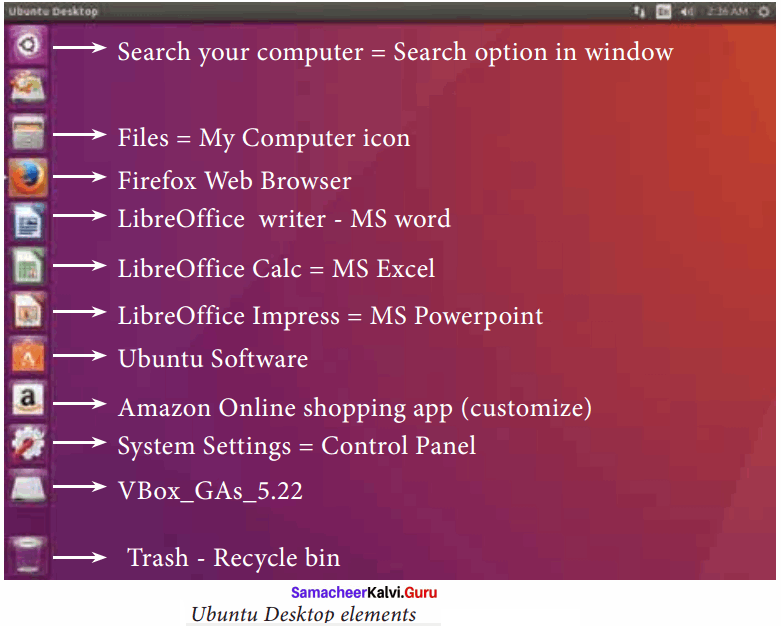
(d) VBox_GAs_5.2.2
Answer:
(d) VBox_GAs_5.2.2

Question 7.
Identify the default email client in Ubuntu …………….
(a) Thunderbird
(b) Firefox
(c) Internet Explorer
(d) Chrome
Answer:
(a) Thunderbird

Question 8.
Which is the default application for spreadsheets in Ubuntu? This is available in the software launcher ……………..
(a) LibreOffice Writer
(b) LibreOffice Calc
(c) LibreOffice Impress
(d) LibreOffice Spreadsheet
Answer:
(b) LibreOffice Calc

Question 9.
Which is the default browser for Ubuntu?
(a) Firefox
(b) Internet Explorer
(c) Chrome
(d) Thunderbird
Answer:
(a) Firefox

Question 10.
Where will you select the option to log out, suspend, restart, or shut down from the desktop of Ubuntu OS?
(a) Session Indicator
(b) Launcher
(c) Files
(d) Search
Answer:
(a) Session Indicator

PART – 2
II. Short Answers

Question 1.
Differentiate cut and copy options.
Answer:
Cut:

  • The file is moved to the destination location.
  • Edit → cut, Edit → paste is used for cut.
  • Ctrl + X, Ctrl + V is used.
  • Right click ? cut, Right click ? paste is used.

Copy:

  • File will be present in both source destination places.
  • Edit → copy, Edit → paste is used for copy.
  • Ctrl + C, Ctrl + V is used.
  • Right click → copy, Right click → paste is used.

Question 2.
What is the use of a file extension?
Answer:
File Extension is the second part of the file name. It succeeds the decimal point in the file name. It is used to identify the type of file and it is normally upto 3 to 4 characters long.
Example: exe, html.

Question 3.
Differentiate Files and Folders.
Answer:
The basic difference between the two is that files store data, while folders store files and other folders.
Files:
Files, on the other hand, can range from a few bytes to several gigabytes. They can be documents, programs, libraries, and other compilations of data.

Folders:
The folders, often referred to as directories, are used to organize files on the computer. The folders themselves take up virtually no space on the hard drive.

Question 4.
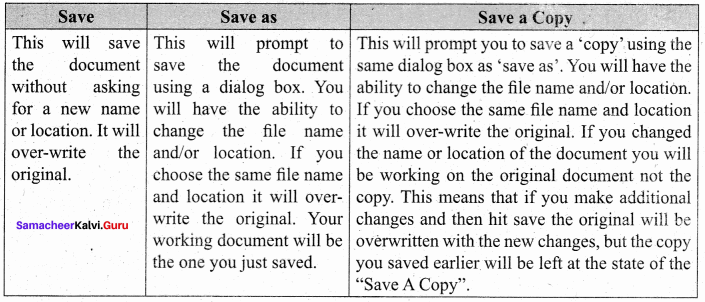
Differentiate Save and save As option.
Answer:
Save:
This will save the document without asking for a new name or location. It will over – write the original.

Save as:
This will prompt to save the document using a dialog box. You will have the ability to change the file name and/or location. If you choose the same file name and location it will over – write the original. Your working document will be the one you just saved.

Question 5.
What is Open Source?
Answer:
Open source refers to a program or software in which the source code is available in the web to all public, without any cost.

Question 6.
What are the advantages of open source?
Answer:
Advantages:

  1. It is free of cost
  2. Accessible to everybody.
  3. Not belongs to particular vendor.
  4. It can be modified, for requirements.

Question 7.
Mention the different server distributions in Linux OS.
Answer:
The server distribution in Linux OS:

  1. Ubuntu Linux
  2. Linux Mint
  3. Arch Linux
  4. Deepin
  5. Fedora
  6. Debian
  7. Centos

Question 8.
How will you log off from Ubuntu OS?
Answer:
By choosing an option logout through the session indicator on the far right side of the top panel.

PART – 3
III. Explain in Brief

Question 1.
Analyse: Why the drives are segregated?
Answer:

  1. It saves space and increases system performance.
  2. Sharing and protection.
  3. Segment and segregate the data to defend it from cyber attack.

Question 2.
If you are working on multiple files at a time, sometimes the system may hang.
What is the reason behind it. How can you reduce it?
Answer:
When we open multiple applications, each application opened on the system takes some internal and hardware resources to keep it running. Memory is used by all the applications. System processing speed will be shared and it will become slow finally the system will hang.

Methods of reducing it:

  1. It is advisable to run one program at a time.
  2. Upgrade RAM
  3. Clean the cache Memories
  4. Defragmentation can be done

Question 3.
Are drives such as hard drive and floppy drives represented with drive letters? If so why, if not why?
Answer:
Yes, hard drives and floppy drives are represented with drive letters.
A: drive is used for floppy disk of 3.5 inches and storage capacity of 1.44 MB.
B: drive is for floppy of size 5.25 inches and of storage capacity of 1.2 MB
So, we can say like
A: First Floppy Drive
B: Second Floppy Drive
C: D : E: …………….. Z: Hard Disk Drives, CD/DVD

Question 4.
Write the specific use of Cortana.
Answer:
Uses of Cortana:

  1. Cortana is a voice activated personal assistant.
  2. Give the reminders based on time, places, or people.
  3. Track packages, teams, interests, and flights.
  4. Send emails and texts.
  5. Manage the calendar and keeps up to date.
  6. Create and manage lists.
  7. Chit chat and play games.
  8. Find facts, files, places, and info.
  9. Open any app on the system.

Question 5.
List out the major differences between Windows and Ubuntu OS.
Answer:

  1. Ubuntu supports high security than windows.
  2. Windows is more user friendly than Ubuntu
  3. Ubuntu is a free and open source based Linux OS whereas windows is a closed source and it is not free.
  4. Ubuntu uses Linux kernel whereas windows uses a hybrid kernel.

Question 6.
Are there any difficulties you face while using Ubuntu? If so, mention it with reasons.
Answer:

  1. Ubuntu has less hardware support for commercial / industrial / medical/ logistical therefore its less votted for use in big time backends.
  2. Ubuntu doesn’t support middlewares such as C panel, cloud linux and a plethora of other infrastructure or monitoring tools.
  3. Hard to install graphic drivers especially for old hardwares. It is not possible to play the modern games, because of poor graphics quality.
  4. The user switching from windows will not like the user experience on Ubuntu and will have difficulty in operating the OS.
  5. Ubuntu is not capable of playing MP3 files by default.

Question 7.
Differentiate Thunderbird and Firefox in Ubuntu OS.
Answer:
Difference between Thunderbird and Firefox in Ubuntu:

  1. Thunderbird is inbuilt email software of ubuntu whereas Firefox is a web browser.
  2. Thunderbird is used to access email such as Gmail, hotmail whereas Firefox is used to open web pages including e-mail.

Question 8.
Differentiate Save, Save As and Save a Copy in Ubuntu OS.
Answer:
11th Computer Science Chapter 5 Book Back Answers Samacheer Kalvi Working With Typical Operating System

PART – 4
IV. Explain in Detail

Question 1.
Explain the versions of Windows Operating System.
Answer:
11th Computer Science 5th Lesson Book Back Answers Samacheer Kalvi Working With Typical Operating System

Question 2.
Draw and compare the icon equivalence in Windows and Ubuntu.
Answer:
Chapter 5 Computer Science Class 11 Samacheer Kalvi Working With Typical Operating System
Elements of Ubuntu:
Search your Computer Icon : This icon is equal to search button in Window’s OS. Here, you have to give the name of the File or Folder for searching them.

Files : This icon is equivalent to My Computer icon. From here, you can directly go to Desktop, Documents and so on.

Firefox Web Browser : By clicking this icon, you can directly browse the internet. This is equivalent to clicking the Web Browser in Task bar in Windows.

Libre Office Writer : This icon will directly take you to document preparation application like MS Word in Windows.

Libre Office Calc: This icon will open LibreOffice Calc application. It is similar to MS Excel in Windows.

LibreOffice Impress : By clicking this icon, you can open LibreOffice Impress to prepare any presentations in Ubuntu like MS PowerPoint.

Ubuntu Software Icon : This icon will let you add any additional applications you want. This can be done by clicking the Update option at the top right comer of that screen.

Online Shopping icon : Using this icon user can buy and sell any products online.

System Settings Icons : This icon is similar to the Control panel in the Windows Operating System. But here, you need to authenticate the changes by giving your password. You cannot simply change as you do in Windows.

Trash : This icon is the equivalent of Recycle bin of windows OS. All the deleted Files and Folders are moved here.

Question 3.
Complete the following matrix.
Samacheer Kalvi 11th Computer Application Science Solutions Chapter 5 Working With Typical Operating System
Answer:
11th Computer Application Samacheer Kalvi Science Solutions Chapter 5 Working With Typical Operating System

Question 4.
Observe the figure and mark all the window elements. Identify the version of the Windows OS.
Answer:
Samacheer Kalvi 11th Computer Science Solutions Chapter 5 Working with Typical Operating System (Windows & Linux) 1

Question 5.
Write the procedure to create, rename, delete and save a file in Ubuntu OS. Compare it with Windows OS.
Answer:
Samacheer Kalvi 11th Computer Science Solutions Chapter 5 Working with Typical Operating System (Windows & Linux)

Samacheer kalvi 11th Computer Science Working with Typical Operating System (Windows & Linux) Additional Questions and Answers

PART – 1
I. Choose the correct answer

Question 1.
………………. is Open source Operating System for desktop and server.
(a) Windows series
(b) Android
(c) iOS
(d) Linux
Answer:
(d) Linux

Question 2.
The most common way of opening a file or a Folder is to click on it.
(a) left
(b) right
(c) double
(d) single
Answer:
(c) double

Question 3.
If you want to select multiple files or folders, use ……………….
(a) Ctrl + shift
(b) Ctrl + click
(c) shift + click
(d) Ctrl + shift + click
Answer:
(b) Ctrl + click

Question 4.
………………. is a special folder to keep the files or folders deleted by the user, which means you still have an opportunity to recover them.
(a) My computer
(b) Documents
(c) Recycle bin
(d) Pictures
Answer:
(c) Recycle bin

Question 5.
………………. is one of the popular Open Source versions of the UNIX Operating System.
(a) Windows 7
(b) Windows 8
(c) Linux
(d) Android
Answer:
(c) Linux

Question 6.
………………. icon is equivalent to My Computer icon. From here, you can directly go to Desktop, Documents and so on.
(a) Files
(b) Documents
(c) Downloads
(d) Computer
Answer:
(a) Files

Question 7.
………………. icon is the equivalent of Recycle bin of windows OS. All the deleted Files and Folders are moved here.
(a) Trash
(b) Files
(c) Online shopping
(d) Libre Office Impress
Answer:
(a) Trash

Question 8.
The vertical bar of icons on the left side of the desktop is called the ………………..
(a) Search
(b) Libre office calc
(c) Launcher
(d) Files
Answer:
(c) Launcher

Question 9.
………………. manages network connections, allowing you to connect to a wired or wireless network.
(a) Toolbar
(b) Title bar
(c) Session indicator
(d) Network indicator
Answer:
(d) Network indicator

Question 10.
To permanently delete a file or folder (i.e. to avoid sending a file or folder to the Recycle Bin), hold down the SHIFT key, and press on the keyboard.
(a) restore
(b) delete
(c) send to
(d) cut
Answer:
(b) delete

Question 11.
Clock is available in ……………….
(a) system tray
(b) Files
(c) start
(d) My documents
Answer:
(a) system tray

Question 12.
………………. command should be typed in the Run dialog bar to open Calculator?
(a) Calculator
(b) Calc
(c) Arithmetic
(d) Calculator open
Answer:
(b) Calc

Question 13.
The menu bar is present below the ……………….
(a) Task bar
(b) Scroll bar
(c) Title bar
(d) Function bar
Answer:
(c) Title bar

Question 14.
Which of the following OS bar plug and play feature ……………….
(a) Window XP
(b) Windows 98
(c) Windows 95
(d) Windows me
Answer:
(b) Windows 98

Question 15.
………………. has the task for frequently used applications?
(a) Quick Launch Tool bar
(b) Settings
(c) My pc
(d) This pc
Answer:
(a) Quick Launch Tool bar

Question 16.
The winkey combination used to display desktop is ……………….
(a) winkey + dt
(b) winkey + T
(c) winkey + alt + D
(d) winkey + D
Answer:
(d) winkey + D

Question 17.
SSD stands for ……………….
(a) Solid State Devices
(b) Simple Stage Driver
(c) Single State Drivers
(d) Synchronized State Devices
Answer:
(a) Solid State Devices

Question 18.
The mouse pointer becomes ………………. when it is positioned over a border or a comer of a window.
(a) +
(b) arrow
(c) single headed arrow
(d) double headed arrow
Answer:
(d) double headed arrow

Question 19.
What is the name given to the document window to enter or type the text?
(a) Work space
(b) Work Area
(c) Typing Area
(d) Space
Answer:
(a) Work space

Question 20.
………………. enables alternate method of opening an application.
(a) Running
(b) Searching
(c) Run
(d) Open
Answer:
(c) Run

Question 21.
The disk drives mounted in the system can be seen by clicking ……………….
(a) Disk drive Icon
(b) Drive Icon
(c) Device Driver Icon
(d) My Computer Icon
Answer:
(d) My Computer Icon

Question 22.
What is the name given to the rectangular area in an application or a document?
(a) Document
(b) Window
(c) Application
(d) Desktop
Answer:
(b) Window

Question 23.
Windows 10 was developed in the year ……………….
(a) 2009
(b) 2012
(c) 2015
(d) 2018
Answer:
(c) 2015

Question 24.
Match the following:
Samacheer Kalvi 11th Computer Science Solutions Chapter 5 Working with Typical Operating System (Windows & Linux)
(a) (3) (4) (2) (1)
(b) (1) (2) (3) (4)
(c) (4) (3) (2) (1)
(d) (4) (2) (1) (3)
Answer:
(a) (3) (4) (2) (1)

Question 25.
The Rulers are used to set ……………….
(a) Orientations
(b) Header
(c) Footer
(d) Margins
Answer:
(d) Margins

Question 26.
Which one of the following boots faster, mns apps faster compared to HDD.
(a) FDD
(b) Cache
(c) SSD
(d) DVD
Answer:
(c) SSD

Question 27.
Which functional key is used to bring the focus on, the first menu of the menu bar?
(a) F5
(b) F10
(c) F11
(d) F7
Answer:
(b) F10

Question 28.
How many disk drive icon options are there?
(a) 2
(b) 3
(c) 4
(d) 5
Answer:
(d) 5

Question 29.
Which one of the following is used to open search results dialog box?
(a) search
(b) See more results
(c) search more results
(d) searching web
Answer:
(b) See more results

Question 30.
Which icon is used to check whether one system is connected to another system?
(a) Network
(b) System
(c) Control panel
(d) Hard drive
Answer:
(a) Network

Question 31.
The keyboard shortcut to save a file is ……………….
(a) alt + s
(b) Ctrl + s
(c) Ctrl + alt + s
(d) winkey + s
Answer:
(b) Ctrl + s

Question 32.
Which command is used to create new folder?
(a) File → folder
(b) File → New folder
(c) New → folder
(d) File → New → folder
Answer:
(d) File → New → folder

Question 33.
Applications or files or folders are opened using related shortcut icons by ……………….
(a) Click and drag
(b) double click
(c) click
(d) drag and drop
Answer:
(b) double click

Question 34.
In windows 7, which option is used from file menu to quit an application?
(a) Exit
(b) Close
(c) Quit
(d) Exit window
Answer:
(b) Close

Question 35.
Which option is used to save the file?
(a) Ctrl + s
(b) Save
(c) File + save
(d) All the above
Answer:
(d) All the above

Question 36.
Which is inbuilt Word Processor application to creat and manipulate text documents?
(a) Word pad
(b) MS – word
(c) Staroffice writer
(d) Notepad
Answer:
(a) Word pad

Question 37.
ubuntu supports office suite called ……………….
(a) Open Office
(b) Star Office
(c) Libre Office
(d) MS – Office
Answer:
(c) Libre Office

Question 38.
The in – built e – mail software facility in ubuntu is ……………….
(a) Debain
(b) Thunderbird
(c) Gmail
(d) Firefox
Answer:
(b) Thunderbird

Question 39.
Which one of the following is a server distribution of Linux?
(a) Deepin
(b) Firefox
(c) MS.word
(d) Files
Answer:
(a) Deepin

Question 40.
The popular Linux distributions is ……………….
(a) Deepin
(b) Centos
(c) Debian
(d) All the above
Answer:
(d) All the above

Question 41.
Which option is used to delete all files in the Recycle bin?
(a) Remove the Recycle bin
(b) Empty the Recycle bin
(c) Clear the Recycle bin
(d) Clean the Recycle bin
Answer:
(b) Empty the Recycle bin

Question 42.
The search text box in the computer disk drive screen will appear at ……………….
(a) Bottom right comer
(b) Top left comer
(c) Bottom left comer
(d) Top right comer
Answer:
(d) Top right comer

Question 43.
Which key is used to access the menu’s in the menu bar?
(a) shift
(b) control
(c) alt
(d) Tab
Answer:
(c) alt

Question 44.
Which one of the following is the open source for desktop and server?
(a) Linux
(b) MS – DOS
(c) BASIC
(d) COBOL
Answer:
(a) Linux

Question 45.
Which mouse actions is used to display popup menu?
(a) right click
(b) click
(c) Double click
(d) drag and drop
Answer:
(a) right click

Question 46.
What is used to interact with windows by clicking icons?
(a) Mouse
(b) Keyboard
(c) Monitor
(d) Printer
Answer:
(a) Mouse

Question 47.
Which menu contains layout options?
(a) option
(b) view
(c) organize
(d) Menu bar
Answer:
(c) organize

Question 48.
V Box stands for ……………….
(a) Virtual Image Box
(b) Virtual box
(c) Validity box
(d) Vat Box
Answer:
(b) Virtual box

Question 49.
Session Indicator is present in which comer?
(a) top left
(b) top right
(c) bottom left
(d) bottom right
Answer:
(b) top right

Question 50.
Hardware settings is used in which option?
(a) Monitor
(b) Display
(c) Theme
(d) My Computer
Answer:
(b) Display

Question 51.
In Text entry settings En, Fr, Ku are ……………….
(a) Desktop Layouts
(b) Keyboard Layouts
(c) Message Layouts
(d) Data Entry Layouts
Answer:
(b) Keyboard Layouts

Question 52.
Which one in ubuntu is similar to task bar of windows?
(a) Launcher
(b) Desktop
(c) start
(d) Notification area
Answer:
(a) Launcher

Question 53.
Notification area of ubuntu desktop is otherwise called as ……………….
(a) Task bar
(b) Desktop
(c) status bar
(d) Indicator area
Answer:
(d) Indicator area

Question 54.
The indicator that helps to access instant messenger and email client is ……………….
(a) Messaging
(b) Network
(c) Email
(d) Text entry
Answer:
(a) Messaging

Question 55.
The application in Ubuntu similar to MS – Excel in windows ……………….
(a) Spread sheet
(b) Libre Office calc
(c) Open Office calc
(d) Star Office calc
Answer:
(b) Libre Office calc

Question 56.
Which dropdown list box is used to select the location where you want to save the file?
(a) Location
(b) Look – in
(c) Peep in
(d) Search for
Answer:
(b) Look – in

Question 57.
Which menu has the rename option?
(a) File
(b) Edit
(c) View
(d) Window
Answer:
(a) File

Question 58.
How will you rename the file?
(a) Edit → Rename
(b) press F2
(c) right click → rename
(d) All the above
Answer:
(d) All the above

Question 59.
In which panel of disk drive window, the files and folders are displayed in tree like structures?
(a) Top
(b) Centre
(c) Left
(d) Right
Answer:
(c) Left

Question 60.
Delete option is present in which menu?
(a) File
(b) Edit
(c) View
(d) Tools
Answer:
(a) File

Question 61.
Which option reboot the computer?
(a) Restart
(b) Boot
(c) Reboot
(d) Reselect
Answer:
(a) Restart

Question 62.
Identify the menu item which is not present is the keyboard indicator menu?
(a) Character Map
(b) Keyboard Layout
(c) Keyboard Layout Chart
(d) Text entry settings
Answer:
(b) Keyboard Layout

Question 63.
There are ………………. types of indicators in the Menu bar.
(a) 5
(b) 6
(c) 1
(d)8
Answer:
(b) 6

Question 64.
What is the name of the default Ubuntu 16.04 theme?
(a) Ambiance
(b) V Box
(c) Trash
(d) Files
Answer:
(a) Ambiance

Question 65.
Who developed Ubuntu OS?
(a) Mark Shuttleworth
(b) Ricki Mascitti
(c) Dan Bricklin
(d) Bob Franston
Answer:
(a) Mark Shuttleworth

Question 66.
Which year ubuntu OS was developed?
(a) 2003
(b) 2004
(c) 2005
(d) 2006
Answer:
(b) 2004

Question 67.
Identify the statement which is given wrong?
(a) Open source code is available free of cost.
(b) ubuntu is a linux based OS.
(c) ubuntu has smart searching facility
(d) The horizontal bar of icons on the left side of the desktop is called Launcher.
Answer:
(d) The horizontal bar of icons on the left side of the desktop is called Launcher.

Question 68.
How many ways of creating files are there is windows?
(a) 2
(b) 3
(c) 4
(d) 5
Answer:
(a) 2

Question 69.
How many sets of scroll bars are there?
(a) 2
(b) 3
(c) 4
(d) 5
Answer:
(a) 2

Question 70.
How many versions of windows 2000 are there?
(a) 2
(b) 3
(c) 4
(d) 5
Answer:
(c) 4

Question 71.
Which one of the following is used for high traffic computer networks in windows 2000?
(a) Professional
(b) Server
(c) Advanced server
(d) Data centre server
Answer:
(d) Data centre server

Question 72.
How many types of Icons are there?
(a) 2
(b) 3
(c) 4
(d) 5
Answer:
(b) 3

Question 73.
What is the name given to the larger window?
(a) Work window
(b) Document window
(c) Application window
(d) Desktop
Answer:
(c) Application window

Question 74.
Which symbol is used to indicate that sub menu is attached to this option?
(a) +
(b) ▷
(c) ☐
(d) ◁
Answer:
(b) ▷

Question 75.
What is the keyboard shortcut for Exit option?
(a) Ctrl + E
(b) Alt + E
(c) Ctrl + Q
(d) Alt + Q
Answer:
(c) Ctrl + Q

Question 76.
How many methods of Renaming file are there?
(a) 2
(b) 3
(c) 4
(d) 5
Answer:
(b) 3

Question 77.
Which one of the following is not a method of pasting the contents?
(a) Edit → paste
(b) Ctrl + V
(c) alt + V
(d) Right click → paste
Answer:
(c) alt + V

Question 78.
Which option is used as a part of installing new software or windows update?
(a) Lock
(b) Restart
(c) Sleep
(d) Hibernate
Answer:
(b) Restart

Question 79.
Which option is found only on Laptop?
(a) Lock
(b) Restart
(c) Sleep
(d) Hibernate
Answer:
(d) Hibernate

PART – 2
II. Short Answers

Question 1.
Name some distributions of Linux.
Answer:

  1. Fedora
  2. Ubuntu
  3. BOSS
  4. RedHat
  5. Linux Mint.

Question 2.
What is Ubuntu?
Answer:
It is a Linux – based operating system. Designed for computers, smart phones and network servers.

Question 3.
What is Open source Operating system?
Answer:
It is the software in which the source code is available to the general public for use and modification from its original design, free of charge.

Question 4.
Mention any 2 significant features of Ubuntu?
Answer:

  1. It supports the office suite called Libreoffice.
  2. Ubuntu has in built email software called Thunderbird, which gives the user access to email such as Exchange, Gmail, Hotmail, etc.

Question 5.
What are the similarities between Ubuntu and other operating systems?
Answer:
All are based on the concepts of Graphical User Interface.

Question 6.
What is Multitasking?
Answer:
Multiple applications which can be executed simultaneously in Windows is known as Multitasking.

Question 7.
What is a workspace of a window?
Answer:
The workspace is the area in the document window to enter or type the text of your document. The workspace is the element of a window.

Question 8.
What is a Wordpad?
Answer:
It is an in – built word processor application in windows OS to create and manipulate text windows.

Question 9.
What is Folder?
Answer:
It is a container of files.

Question 10.
What is Firefox?
Answer:
It is a browser.

PART – 3
III. Explain in Brief

Question 1.
How will you renaming the files or folders?
Answer:
Using the FILE Menu

  1. Select the File or Folder you wish to Rename.
  2. Click File → Rename.
  3. Type in the new name.
  4. To finalise the renaming operation, press Enter

Question 2.
Draw the diagram of overview of an operating system
Answer:
Samacheer Kalvi 11th Computer Science Solutions Chapter 5 Working with Typical Operating System (Windows & Linux)

Question 3.
List out the important functions of an OS?
Answer:
Following are some of the important functions of an Operating System:

  1. Memory Management
  2. Process Management
  3. Device Management
  4. File Management
  5. Security Management
  6. Control overall system performance
  7. Error detecting aids
  8. Coordination between other software and users

Question 4.
How will you create a shortcuts on the desktop?
Answer:
Creating Shortcuts on the Desktop:
Shortcuts to your most often used folders and files may be created and placed on the Desktop to help automate your work.

  1. Select the file or folder that you wish to have as a shortcut on the Desktop.
  2. Right click on the file or folder.
  3. Select Send to from the shortcut menu, then select Desktop (create shortcut) from the submenu.
  4. A shortcut for the file or folder will now appear on your desktop and you can open it from the desktop in the same way as any other icon.

Question 5.
What are the elements of Ubuntu?
Answer:

  1. Search your Computer Icon
  2. Files
  3. Firefox Web browser
  4. Libre Office Writer
  5. Libre Office Calc
  6. Libre office Impress
  7. Ubuntu software icon
  8. Online shopping icon
  9. System settings icon
  10. Trash

Question 6.
Write note on windows XP.
Answer:

  1. Windows XP was developed in the year 2001
  2. It introduced 64 bit processor.
  3. Improved windows appearance with themes and offered a stable version.

Question 7.
What are the four versions of windows 2000.
Answer:

  1. Professional – business desktop and laptop systems.
  2. Server – used as both web server and an office server.
  3. Advanced server – for line of business applications.
  4. Data center server – for high-traffic computer networks.

Question 8.
What are the advantages of using windows 8 OS?
Answer:

  1. Windows 8 is faster than previous versions of windows.
  2. It has multi – core processing, Solid State Drivers (SSD), touch screens and other alternate input methods.
  3. It served as common platform for mobile and computer.

Question 9.
What is a Window?
Answer:
Window is a typical rectangular area in an application or a document. It is an area on the screen that displays information for a specific program. The two types of windows are application window and document window.

Question 10.
Differentiate Application Window and Document Window?
Answer:
Application Window:

  • It is the larger window.
  • This window helps the user to communicate with the application program.

Document Window:

  • It is the smaller window and appears inside the Application Windows.
  • This window is used for typing, editing, drawing and formatting the text and graphics.

Question 11.
How will you start an application?
Answer:

  1. Click the start button and then point to all programs. The program menu appears. Point to the group that contains the application you want to start and then click the application name.
  2. Click Run on the start menu and type the name of the application and click ok.

Question 12.
How will you close an application?
Answer:

  1. To quit a application, click the close button in the upper right comer of the application window.
  2. Click File → Exit
  3. Click File → Close option

Question 13.
How will you open the word pad?
Answer:

  1. Click start → All programs → Accessories → Wordpad
  2. Run → type wordpad, click ok

Question 14.
How will you delete a file or folder?
Answer:
Select the file or folder you wish to delete.

  1. Right click the file or folder, select delete option from the popup menu or click file → delete (or) Press delete key from the keyboard.
  2. The file will be deleted and moved to the Recycle bin.

Question 15.
Write note on Recycle bin.
Answer:
Recycle bin is a special folder to keep the files or folders deleted by the user. From the recycle bin, files can be restored back.

PART – 4
IV. Explain in Detail

Question 1.
Discuss about the mouse actions.
Answer:

ActionReaction
Point to an itemMove the mouse pointer over the item.
ClickPoint to the item on the screen, press and release the left mouse button.
Right clickPoint to the item on the screen, press and release the right mouse button. Clicking the right mouse button displays a pop up menu with various options.
Double-clickPoint to the item on the screen, quickly press twice the left mouse button.
Drag and dropPoint to an item then hold the left mouse button as you move the pointer press and you have reached the desired position, release the mouse button.

Question 2.
Discuss the following Icons.
Answer:
Shortcut Icons:
Shortcut icons can be created for any application or file or folder. By double clicking the icon, the related application or file or folder will open. This represents the shortcut to open a particular application.

Disk drive icons:
The disk drive icons graphically represent five disk drive options.

  1. Hard disk.
  2. CD – ROM/DVD Drive.
  3. Pen drive.
  4. Other removable storage such as mobile, smart phone, tablet etc.
  5. Network drives if your system is connected with other system.

Question 3.
How will you copying files and folders to removable disk?
Answer:
Copying Files and Folders to removable disk:
There are several methods of transferring files to or from a removable disk.

  1. Copy and Paste
  2. Send To

METHOD I – Copy and Paste:

  1. Plug the USB flash drive directly into an available USB port.
  2. If the USB flash drive or external drive folder does NOT open automatically, follow these steps:
  3. Click Start → Computer.
    Samacheer Kalvi 11th Computer Science Solutions Chapter 5 Working with Typical Operating System (Windows & Linux)
  4. Double Clicking on the Removable Disk associated with the USB flash drive.
    Samacheer Kalvi 11th Computer Science Solutions Chapter 5 Working with Typical Operating System (Windows & Linux)
  5. Navigate to the folders in your computer containing files you want to transfer. Right – click on the file you want to copy, then select Copy.
    Samacheer Kalvi 11th Computer Science Solutions Chapter 5 Working with Typical Operating System (Windows & Linux)
  6. Return to the Removable Disk window, right – click within the window, then select Paste.
    Samacheer Kalvi 11th Computer Science Solutions Chapter 5 Working with Typical Operating System (Windows & Linux)

METHOD II – Send To:

  1. Plug the USB flash drive directly into an available USB port.
  2. Navigate to the folders in your computer containing files you want to transfer.
  3. Right – click on the file you want to transfer to your removable disk.
  4. Click Send To and select the Removable Disk associated with the USB flash drive.
    Samacheer Kalvi 11th Computer Science Solutions Chapter 5 Working with Typical Operating System (Windows & Linux)

Question 4.
Explain the various elements of a window.
Answer:
Elements of a window:
Samacheer Kalvi 11th Computer Science Solutions Chapter 5 Working with Typical Operating System (Windows & Linux)
Title Bar : The title bar will display the name of the application and the name of the document opened. It will also contain minimize, maximize and close button.

Menu Bar : The menu bar is seen under the title bar. Menus in the menu bar can be accessed by pressing Alt key and the letter that appears underlined in the menu title. Additionally, pressing Alt or F10 brings the focus on the first menu of the menu bar. In Windows 7, in the absence of the menu bar, click Organise and from the drop down menu, click the Layout option and select the desired item, from that list.

The Workspace : The workspace is the area in the document window to enter or type the text of your document.

Scroll bars : The scroll bars are used to scroll the workspace horizontally or vertically.

Corners and borders : The comers and borders of the window helps to drag and resize the windows. The mouse pointer changes to a double headed arrow when positioned over a border or a comer. Drag the border or comer in the direction indicated by the double headed arrow to the desired size as shown in the Figure. The window can be resized by dragging the comers diagonally across the screen.

Question 5.
Explain various methods of creating Files and Folders.
Answer:
Creating files and Folders:
Creating Folders:
You can store your files in many locations – on the hard disk or in other devices. To better organise your files, you can store them in folders.
There are two ways in which you can create a new folder:

Method I:
Step 1: Open Computer Icon.
Step 2: Open any drive where you want to create a new folder. (For example select D:)
Step 3: Click on File → New → Folder.
Step 4: A new folder is created with the default name “New folder”.
Step 5: Type in the folder name and press Enter key.

Method II:
In order to create a folder in the desktop:
Step 1: In the Desktop, right click → New → Folder.
Step 2: A Folder appears with the default name “New folder” and it will be highlighted.
Step 3: Type the name you want and press Enter Key.
Step 4: The name of the folder will change.

Question 6.
Explain how will you rename files and folders.
Answer:
Renaming Files or Folders:
There are number of ways to rename files or folders. You can rename using the File menu, left mouse button or right mouse button.

Method I:
Using the FILE Menu

  1. Select the File or Folder you wish to Rename.
  2. Click File → Rename.
  3. Type in the new name.
  4. To finalise the renaming operation, press Enter.

Method II:
Using the Right Mouse Button

  1. Select the file or folder you wish to rename.
  2. Click the right mouse button over the file or folder.
  3. Select Rename from the pop-up menu. ’
  4. Type in the new name.
  5. To finalise the renaming operation, press Enter.
  6. The folder “New Folder” is renamed as C++.

Method III:
Using the Left Mouse Button

  1. Select the file or folder you wish to rename.
  2. Press F2 or click over the file or folder. A surrounding rectangle will appear around the name.
  3. Type in the new name.
  4. To finalise the renaming operation, press Enter.

Question 7.
How will you move the file or folder from one place to another?
Answer:
Moving/Copying Files and Folders:
You can move your files or folders to other areas using variety of methods.

Moving Files and Folders:
Method I – CUT and PASTE
To move a file or folder, first select the file or folder and then choose one of the following:

  1. Click on the Edit → Cut or Ctrl + X Or right click → cut from the pop – up menu.
  2. To move the file(s) or folder(s) in the new location, navigate to the new location and paste it using Click Edit → Paste from edit menu or Ctrl + V using keyboard.
  3. Or Right click → Paste from the popup menu. The file will be pasted in the new location.

Method II – Drag and Drop:

In the disk drive window, we have two panes called left and right panes. In the left pane, the files or folders are displayed like a tree structure. In the right pane, the files inside the specific folders in the left pane are displayed with various options.

  1. In the right pane of the Disk drive window, select the file or folder you want to move.
  2. Click and drag the selected file or folder from the right pane, to the folder list on the left pane.
  3. Release the mouse button when the target folder is highlighted (active).
  4. Your file or folder will now appear in the new area.

Question 8.
How will you copy files and folders.
Answer:
Copying Files and Folders:
There are variety of ways to copy files and folders:

Method I – COPY and PASTE:
To copy a file or folder, first select the file or folder and then choose one of the following:

  1. Click Edit → Copy or Ctrl + C or right click → Copy from the pop – up menu.
  2. To paste the file(s) or folder(s) in the new location, navigate to the target location then do one of the following:
  3. Click Edit → Paste or Ctrl + V.
  4. Or Right click → Paste from the pop – up menu.

Method II – Drag and Drop:

  1. In the RIGHT pane, select the file or folder you want to copy.
  2. Click and drag the selected file and/or folder to the folder list on the left, and drop it where you want to copy the file and/or folder.
  3. Your file(s) and folder(s) will now appear in the new area.

Question 10.
Explain various menu bar Indicator.
Menu bar:
The menu bar is located at the top of the screen. The menu bar incorporates common functions used in Ubuntu. The frequently used icons in the menu bar are found on the right. The most common indicators in the Menu bar are located in the indicator or notification area.

Network indicator:
This manages network connections, allowing you to connect to a wired or wireless network. Text entry settings:
This shows the current keyboard layout (such as Eli, Fr, Ku, and so on). If more than one keyboard layout is shown, it allows you to select a keyboard layout out of those choices. The keyboard indicator menu contains the following menu items: Character Map, Keyboard Layout Chart, and Text Entry Settings.

Messaging indicator:
This incorporates your social applications. From here, you can access instant messenger and email clients.

Sound indicator:
This provides an easy way to adjust the volume as well as access your music player.

Clock:
This displays the current time and provides a link to your calendar and time and date settings.

Question 11.
Explain various elements of Ubuntu.
Answer:
Samacheer Kalvi 11th Computer Science Solutions Chapter 5 Working with Typical Operating System (Windows & Linux) 1
Search your Computer Icon : This icon is equal to search button in Windows OS. Here, you have to give the name of the File or Folder for searching them.

Files : This icon is equivalent to My Computer icon. From here, you can directly go to Desktop, Documents and so on.

Firefox Web Browser : By clicking this icon, you can directly browse the internet. This is equivalent to clicking the Web Browser in Task bar in Windows.

Libre Office Writer : This icon will directly take you to document preparation application like MS Word in Windows.

Libre Office Calc : This icon will open LibreOffice Calc application. It is similar to MS Excel in Windows.

Libre Office Impress : By clicking this icon, you can open LibreOffice Impress to prepare any presentations in Ubuntu like MS PowerPoint.

Ubuntu Software Icon : This icon will let you add any additional applications you want. This can be done by clicking the Update option at the top right comer of that screen.

Online Shopping icon : Using this icon user can buy and sell any products online.

System Settings Icons : This icon is similar to the Control panel in the Windows Operating System. But here, you need to authenticate the changes by giving your password. You cannot simply change as you do in Windows.

Trash : This icon is the equivalent of Recycle bin of windows OS. All the deleted Files and Folders are moved here.

Samacheer Kalvi 12th English Solutions Prose Chapter 1 Two Gentlemen of Verona

Students can Download English Lesson 1 Two Gentlemen of Verona Questions and Answers, Summary, Activity, Notes, Samacheer Kalvi 12th English Book Solutions Guide Pdf helps you to revise the complete Tamilnadu State Board New Syllabus and score more marks in your examinations.

Tamilnadu Samacheer Kalvi 12th English Solutions Prose Chapter 1 Two Gentlemen of Verona

Warm up

12th English Two Gentlemen Of Verona Paragraph Samacheer Kalvi Solutions Prose Chapter 1

Samacheer Kalvi 12th English Two Gentlemen of Verona Textual Questions

1. Answer the following questions in one or two sentences each based on your understanding of the story.

12th English Two Gentlemen Of Verona Paragraph Question (a)
Who did the narrator meet at the outskirts of Verona?
Answer:
The Narrator met Nicola and Jacopo at the outskirts of Verona.

12th English Two Gentlemen Of Verona Questions And Answers Question (b)
Why did the driver not approve of the narrator buying fruits from the boys?
Answer:
The fruit vendors were shabby in their appearance. So, the driver did not approve of the narrator’s idea of buying fruits from them.

Two Gentlemen Of Verona Questions And Answers Question (c)
The boys did not spend much on clothes and food. Why?
Answer:
The boys had to save every penny towards the weekly medical bill of their sister Lucia. So, they did not spend much on the clothes and food.

Two Gentlemen Of Verona Book Back Answers Question (d)
Were the boys saving money to go the States? How do you know?
Answer:
No, the boys did not save the money to go to States. The boys themselves admit that they have other plans.

Two Gentlemen Of Verona Summary 12th English Question (e)
Why did the author avoid going to Lucia’s room?
Answer:
The author did not want to disturb the privacy of the family party and the sense of pride the boys had in supporting their elder sister.

12th English Two Gentlemen Of Verona Book Back Answers Question (f)
What was Lucia suffering from?
Answer:
Lucia was suffering from tuberculosis of the spine.

Two Gentlemen Of Verona Paragraph Pdf Question (g)
What made the boys join the resistance movement against the Germans?
Answer:
The boys hated the Germans who had destroyed their town and killed their father. So, they joined the resistance movement against the Germans.

Two Gentlemen Of Verona Class 12 Questions And Answers Question (h)
What made the boys work so hard?
Answer:
They did not want charity from the hospital. The determination to save the life of their sister made the boys work hard.

Two Gentlemen Of Verona Paragraph Question (i)
Why didn’t the boys disclose their problem to the author?
Answer:
The little boys did not want sympathy but any work which would fetch them money. So, they did not disclose their problem to the author.

12th English Two Gentlemen Of Verona Summary Additional Questions

12th English Two Gentlemen Of Verona Question (a)
What were the two boys selling?
Answer:
The two boys were selling wild strawberries.

The Two Gentlemen Of Verona Question Answer Question (b)
What were the boys doing at night in a deserted square?
Answer:
The boys were resting on the stone pavement in the windy and deserted square beneath the street light. They were waiting for the last bus from Padua to sell the unsold newspapers.

Two Gentlemen Of Verona Question Answers Question (c)
How did the boys impress the narrator?
Answer:
Both the boys were cheerfully ready to work. In their boyish faces, there was a seriousness which was far beyond their years.

The Gentlemen Of Verona Question Answers Question (d)
What did the boys do other than selling fruits?
Answer:
The boys shined shoes, hawked newspapers, conducted tourists round the town and ran errands in addition to selling fruits.

2. Answer the following questions in three or four sentences each.

12th English Two Gentlemen Of Verona In Tamil Question (a)
Describe the appearance of Nicola and Jacopo.
Answer:
One boy had worn Jersey and cut-off khaki pants. The other had a shortened army tunic gathered in loose folds about his skinny frame. They had tangled hair and dark earnest eyes.

Two Gentlemen Of Verona Answers Question (b)
What were the various jobs undertaken by the little boys?
Answer:
The little boys sold wild berries. They shined shoes. They showed visitors through the town to Juliet’s tomb and other places of interest. They even booked a seat for the narrator in a theatre and got American cigars too.

12th English Two Gentlemen Of Verona Story In Tamil Question (c)
How did the narrator help the boys on Sunday?
Answer:
The author took the boys in his car to a tiny village called Poleta,set high upon a hill. He drove the car up to a large red-roofed villa. The boys asked the author to come there after an hour and went inside.

Two Gentlemen Of Verona Class 12 Question (d)
Who took the author to the cubicle?
Answer:
Attained nurse who was very familiar with Nicola and Jacopo took the narrator in. She led him through a cool, tiled vestibule into the hospital, the villa had become. She left him at the door of a little cubicle from where he can watch unseen Nicola and Jacopa chatting with their ailing sister.

Two Gentlemen Of Verona Question Answers Pdf Question (e)
Describe the girl with whom the boys were talking to in the cubicle.
Answer:
Lucia was a girl of about twenty. She was propped up on pillows wearing a pretty lace jacket. Her eyes were soft and tender.

Two Gentlemen Of Verona Synonyms And Antonyms Question (f)
Recount the untold sufferings undergone by the siblings after they were rendered homeless.
Answer:
The boys and their sister were thrown in the streets. Lucia had to give up her singing lessons. They had suffered horribly from near starvation and exposure to the cold winter. Lucia developed tuberculosis of the spine. The boys built a home from the rubbles. They had to admit Lucia in a nursing home. To pay the weekly medical bill, they worked from dawn to midnight doing odd jobs eating very little.

12th Two Gentlemen Of Verona Question (g)
The narrator did not utter a word and preferred to keep the secret to himself. Why? Substantiate the statement with reference to the story.
Answer:
After coming out of the hospital the boys sat beside the narrator. Throughout the 30 km ride, they did not say a word. The narrator did not say a word because he wanted the boys to feel that their sacrifice and sufferings remained a secret. However, the narrator was touched by the devotion of the little boys.

Additional Questions

Two Gentlemen Of Verona Notes Pdf Question (a)
Why was the narrator tempted to ask if the brothers wanted to emigrate to America?
Answer:
The boys earned a lot of money doing odd jobs from dawn to midnight. Yet, they spent little on clothes and food. This tempted the narrator to ask the boys if they had plans to emigrate to America.

Gentlemen Of Verona Question Answers Question (b)
How did the narrator gather information about Nicola and Jacopo without meeting Lucia?
Answer:
The author could not bear to intrude upon the happy family party. Yet, he wanted to know everything about the boys. So, he requested the nurse to tell him all she knew about them. She did share all she knew about Nicola and Jacopo with the narrator.

3. Answer the following in a paragraph of 100-150 words each.

Question (а)
What was the driving force that made the boys do various jobs?
Answer:
In the war-hit Verona everything was difficult. Food had become scarce and dear. The hospital which offered to treat Lucia was forced to charge a weekly fee. Work was scarce. But the boys were determined to save the life of their beloved sister. After the untimely death of the father

in the war, the two little boys Nicola and Jacopo took the responsibility of earning money by doing all odd jobs for defraying the medical expenses for their sister on their tender shoulders. They spent very little on their food and clothes. The driving force behind their selfless sacrifice and hard work from dawn to midnight was the love they had for their elder sister. They wanted her to get well soon and become an accomplished singer in life. Once you set a goal far above your capacity but work hard ceaselessly, you are bound to achieve it.

Question (b)
How was the family affected by the war?
Answer:
Before the war, Nicola and Jacopo’s widowed father was a well-known singer. He was killed in the early part of the war leaving Lucia, his daughter behind to take care of the little boys. Shortly after a bomb destroyed their home. The three children were thrown into the streets. They had always known a comfortable and cultured life. Lucia was training to become a singer. Suddenly they were uprooted from their cozy life. They had suffered from near starvation and exposure to cold winter. The home they rebuilt from the rubbles was not weather-proof. The boys joined the secret services of resistance moment as they hated Germans. When they returned home after the war, they found their sister affected by tuberculosis of the spine. They persuaded a private hospital to take Lucia in. Every week they worked hard to pay for their sister’s medical expenses. To achieve it they had to sacrifice a lot.

Question (c)
Write a character sketch of Nicola and Jacopo.
Answer:
Nicola was 13 and Jacopo only 12. They were brothers. They were tanned, had tangled hair and dark earnest eyes. Though they were just kids, they were serious about their work. They did hundreds of errands for the tourists. They were found doing brisk business shining shoes or selling wild berries. They had the skill to find seats in theater for the tourists and also guide the tourists through many important sites of the city of Verona such as Juliet’s tomb. Jacopo was lively as a squirrel. Nicola’s smile was steady and engaging yet in their innocent faces one could find seriousness far beyond their years. What struck one was the extreme willingness of both the boys to work. Under the scorching Sun, they hawked newspapers. When the narrator enquired what they did with the money they earned as they were not spending it on clothes or food or saving it for emigrating to America, Nicola coloured but he did not reveal the secret family adversity. Both are gentlemen because they did not want any one’s sympathy.

Question (d)
What message is conveyed through the story ‘Two Gentlemen of Verona’?
Answer:
Adversity is a touchstone of virtue. Both the little boys resemble tea leaves. Their best essence comes to limelight when they find themselves in hot waters. But they don’t complain. One does not give up on family relations when misfortune strikes. The bond becomes strong as the bond demands selfless sacrifice. The nobility of human life emerges from the precious lessons one learns from the supreme sacrifices of Nicola and Jacopo. One who shoulders the responsibility of taking care of the loved ones, irrespective of age, is an exemplary gentleman worthy of emulation. The primary motivational force of an individual is to find meaning in life. Both the little boys had a specific purpose for their life. They had made up their minds to do what ever work possible to earn money to save their sister and restore her singing career.

Question (e)
Justify the title of the story ‘Two Gentlemen of Verona’.
Answer:
In the story ‘Two gentlemen of Verona’, the two orphan boys Jacopo and Nicola work immensely and exhaustively. They shine shoes, sell newspapers, run errands and show tourists round the city. They take only figs and black tea as food. They save every penny for the medical treatment of their sister Lucia who is suffering from Tuberculosis of the spine. The narrator himself admits that their willingness to work impressed him. They demonstrate an unusual devotion to their work. The objective of their hard work and purpose behind their half-starved daily routine is not known to many in Verona. Anyone may polish shoes or hawk newspapers but it is the magnanimity of heart and nobleness of purpose that actually determines whether one is a real gentleman or a hypocrite. Hence the title ‘‘Two gentlemen of Verona” is justified.

Question (f)
Adversity brings out the best as well as the worst in people. Elucidate this statement with reference to the story.
Answer:
Whenever confronted by an adversity, there is a psychological reaction among most of us. Either fight or flee from it. Even adults run away from crisis and seek asylum or support of others. We find hordes of people, when living becomes difficult, migrate to other places to survive. In the face of adversity, even educated people turn to evil ways. They worked hard from dawn to midnight. They did any job that came their way. They shined shoes, hawked newspapers, sold wild fruits and took the people round the city. They spent very little on their food and clothes. Every week they cycled to Poleta and paid Lucia’s medical bill systematically. In this story, the nurse of the private hospital reveals the bitter truth about the economy of Verona. Jobs are scarce. There is inflation. It is difficult to buy food with limited money. When the hospital laid the condition that the little boys Nicola and Jacopo should pay the weekly medical bill for their sister Lucia’s treatment for tuberculosis, they did not back off or give up. Their best qualities came out during adversity. Like tea leaves, they gave their best while in hot waters.

Question (g)
Which character do you like the most in the story and why?
Answer:
Of all the characters, I like Nicola who is a 13 year old boy (i.e.) one of the two gentlemen of Verona. Though he is small, he is mature beyond his years. Like John Keets, he hated sympathy and self-pity. He does not want any favour except the opportunity to work. He has an engaging smile. He and his brother Jacopo were hardworking and devoted to their sister Lucia. He has seriousness far beyond his years. Even when kindly enquired by the narrator as to why he was spending little on clothes and food, he doesn’t open up. He colours deeply and grows pale. He even avoided the eyes of the narrator. When his squirrel-like brother requested the narrator to send them in his car to Poleta on Sunday, Nicola doesn’t like it. He glares at his brother in vexation and says, “we couldn’t think of troubling you sir.” He wins the respect of all readers because of his maturity, willingness to work and devotion to his sister.

Vocabulary

(a) Read the following words taken from the story. Give two synonyms and one antonym for each of these words. Use a dictionary, if required.

12th English Two Gentlemen Of Verona Questions And Answers Samacheer Kalvi Solutions Prose Chapter 1

Answer:

S. No.WordSynonymsAntonym
1.cautiouscarefulalertreckless
2.disapproveexpress dislikeobject toapprove
3.briskswiftfastsloppy
4.engagingcharmingagreeablerepulsive
5.humblemeeksubmissiveproud
6.eageranxiousimpatientapathetic
7.resistanceoppositionhostilityacceptance
8.persuadeconvinceinducedissuade
9.scarcescantinsufficientplentiful
10.nobilityvirtuegoodnessdishonour

(b) Homophones and Confusables

Question 1.
Given below is a list of common confusables. Distinguish the meaning of each pair of words by framing your own sentences.
Answer:
(a) emigrate (leaving homeland) – immigrate (come to live permanently in a foreign country)
Priyanka Chopra does not wish to emigrate to UK where her husband is living. Candidates who wish to immigrate to USA are increasing in number every year.

(b) beside (at the side of) – besides (in addition to)
I remember keeping my watch beside my glasses.
Besides supporting terrorist outfits within its borders, Pakistan claims innocence in the Pulwana attack.

(c) judicial (relating to justice) – judicious (wise/prudent)
The fraudsters who swindled the money of an IT personnel in Navalur through ATM were taken into judicial custody.
Kalpana reacted judiciously when she realised that a mobile thief was standing next to her.

(d) eligible (Adj.- satisfying the appropriate conditions) – illegible (Adj.- not clear enough to be read)
Even at the age of 30, Vinod is an eligible bachelor for the manager post.
Priya’s handwriting is illegible.

(e) conscience (a person’s moral sense of right and wrong) – conscious (being aware of) “Conscience makes cowards of us all”, said Shakespeare.
The lorry driver was conscious of the dangers involved in carrying the explosives in his truck.

(f) industrial (relating to industry) – industrious (diligent/hardworking)
Perungudi is an industrial block.
Man should be as industrious as ants and bees.

(g) eminent (famous) – imminent (something bad likely to happen very soon)
Every eminent scientist has an unseen past in which he must have struggled to prove his theory or inventions to the world.
Environmentalists are apprehensive of the imminent earthquakes in mega multipurpose projects’ catchment areas as they fall under seismicity-prone areas.

(h) illicit (adj- illegal) – elicit (v – to evoke a response)
Two hundred miners perished after consuming illicit liquor in Bihar.
The police personnel tried to elicit the truth about the murder of the school girl in a pump set from the arrested relative and three other culprits.

(i) prescribed (set down rules) – proscribed (prohibited)
The students were advised to follow the guidelines prescribed by the Directorate of Government Examinations.
The tourists were proscribed from taking selfies from the suicide point in Kodaikanal.

(j) affect (to influence something or someone) – effect (result/impact of something)
The athlete did not imagine that a steroid shot might affect his sports career adversely.
The rising number of cybercrimes proves the adverse effect of educated unemployment.

(k) aural (relating to hearing) – oral (verbal)
In primary schools, teachers must assess the aural skills of children.
There must be a fool-proof mechanism to assess the oral skills of students at the secondary level especially in languages.

(l) born (related to birth) – borne (carried by)
Divya was not born with a silver spoon in her mouth.
The entire village paid homage to army personnel, U. Saravanan’s body which was borne in a decorated coffin by military soldiers and homeguards.

Question 2.
Fill in the blanks with suitable homophones or confusables

Two Gentlemen Of Verona Questions And Answers Samacheer Kalvi 12th English Solutions Prose Chapter 1
Answer:

walletvalethoardhorde
fairyferrydesertdessert
medalmeddlenightknight
waitweightsweetsweat
yokeyolkplainplane
growngroanmightmite
earnyearnquitequiet

(c) Give the meanings of the following phrasal verbs and frame sentences using them.

Question 1.
cut off: block the way
Answer:
The village was cut off due to floods.

Question 2.
come upon : to meet or encounter unexpectedly
Answer:
I came upon an old friend in the street today.

Question 3.
put out: extinguish
Answer:
The firemen put out the fire after a stmggle of six hours.

Question 4.
draw up : halt
Answer:
Ram drew up his car on seeing the red signal.

Question 5.
pass out: become unconscious
Answer:
The college student who fell down from the bus passed out and an ambulance was called.

Question 6.
take off: leave the ground
Answer:
The plane took off two hours late from Delhi due to fog.

Question 7.
turn away : move one’s face away
Answer:
Whenever I find able-bodied men and women beg in the trains, I turn away.

Question 8.
stand by : ready to substitute
Answer:
The eleventh player was standing by to play if any player gets hurt or a substitute is needed.

Question 9.
bank on : rely on confidently
Answer:
We can always bank on our English teacher whenever a debate is announced.

Prefixes and Suffixes

(d) Read the list of words formed by adding suffixes.

frequentlysatisfactionwillingness
comfortableresemblancenobility

Form two derivatives from each of the following words by adding prefixes and suffixes.

Two Gentlemen Of Verona Book Back Answers Samacheer Kalvi 12th English Solutions Prose Chapter 1

Answer:

WordPrefixSuffix
patientimpatientpatiently
honourdishonourhonourable
respectdisrespectrespectable
managemismanagemanagement
fertileinfertilefertility
differentindifferentdifferently
friendbefriendfriendly
obeydisobeyobedience

Listening Activity

Floods are an inevitable natural disaster which can occur in any part of the world. Floods can prove all the more disastrous in localities, where population density is high. Preparation for Disaster Management has become imperative for any city, town or village during monsoons. The Government Department entrusted with Disaster Management makes periodic announcements about the precautions to be taken whenever floods are anticipated.

Now, you are going to listen to the cautionary instructions that are given to the general public living in flood-prone areas. Listen carefully and complete the following sentences. For the attention of the public, here is an announcement from the Department of Disaster Management. As per the warning issued today by the Meteorological Department, there exists a high probability of a widespread heavy downpour from the early hours of Sunday and consequent flooding of low-lying areas. In order to ensure safety of life and property, everyone is hereby warned and advised to take certain precautionary measures:

  • First of all, prepare a household flood plan and be ready to respond to the situation.
  • Find out the locations of the closest flood shelters available and routes to reach them.
  • Maintain an emergency kit comprising water bottles, biscuit packets, medical supplies, a torch light, and a whistle to signal for help.
  • Paste or fix a list of emergency telephone numbers on the wall in a visible spot.
  • Switch off hazardous items like gas cylinders and disconnect electrical gadgets.
  • Secure important personal documents and valuables in a waterproof case and place it in an accessible location.
  • Place small pieces of furniture and clothing on tables and cots.
  • Shift all the small objects safely to the loft.
  • Empty your refrigerators and leave their doors open to avoid damage in case they float.
  • Charge your mobile phones as well as your battery banks so as to communicate with friends, relatives and emergency services.
  • Place sandbags in the toilet bowls and bathroom drain holes to prevent sewage inflow.
  • Prepare and pack food with a long shelf life.
  • Finally, listen to the periodic news updates through your portable communication devices and follow the instructions implicitly.
  1. The announcement was made by the Department of _________
  2. Widespread heavy rains are expected from the early hours of _________
  3. The public is asked to find out the locations of _________
  4. An emergency kit should contain water bottles, biscuit packets and a _________
  5. A list _________ of should be displayed on the wall.
  6. Important documents can be secured by keeping them in a _________ case.
  7. Damage to refrigerators can be avoided by _________
  8. Mobile phones should be charged to enable the marooned to contact their friends, relatives and _________
  9.  _________ should be placed in the toilet bowls to prevent sewage inflow.
  10. Listen to the _________ and follow the instructions implicitly.

Answer:

  1. Disaster Management
  2. Sunday
  3. closest flood shelters
  4. whistle
  5. emergency telephone numbers
  6. waterproof
  7. emptying refrigerators and leaving their doors open
  8. emergency services
  9. Sandbags
  10. periodic news updates

Speaking Activity

Task 1
On the occasion of World Environment Day, you have been asked to deliver a speech during morning assembly on the importance of tree planting. Write the speech in about 100 -150 words.

  • Introduction
  • Suggested value points
  • Pollution control – Medicine – Necessary for wildlife – Cause rainfall
  • Conclusion

Respected Principal, chief guest and dignitaries on the dias and off the dias.
Good evening. I am immensely delighted to speak to you on World Environment Day. All of you know that we celebrate Environment Day on 5th June, every year, let me explain why we celebrate World Environment Day. The relationship between humanity and environment is a delicate balance. Since the industrial revolution, the world’s population has increased exponentially. With the population growth, the environment has been profoundly affected. Deforestation, pollution and global climatic changes are amongst the adverse effects the explosive population and technological expansion have introduced. The main objective of Environment Day is to gain greater understanding of the environment. This enhanced awareness, I believe, will help the country reduce carbon foot prints, increase the use of solar power, reduce and recycle non-biodegradable waste and evolve alternative technologies which would reduce our dependence on fossil fuels.

Moreover, tree planting will be done on a mission modeby school children and college students representing NCC and NSS wings. This would spread the forest cover and give shelter to the wild life and also ensure plentiful rainfall sustaining life on this lovely planet. Student community shall disseminate the urgent need to conserve water and other natural resources. I appeal to the younger generation, I mean my friends to be socially responsive and do their part to preserve the environment.

Task 2
Prepare a speech on “The importance of a reading habit” in about 100-150 words using the hints given below together with your own ideas.

  • Introduction
  • Suggested value points
  • Knowledge enrichment – Skill development – Meaningful usage of time – Overall  development
  • Conclusion

Most distinguished chief guest, revered Principal, dignitaries on the dias and off the dias, my beloved teachers and friends. This morning 1 wish to share my views on a man-making habit called ‘Reading’.

Books are the quietest and most constant of friends. They are the most accessible and wisest of counselors and most patient of teachers. Some schools do focus on developing a flair for reading by keeping a library period. Children are allowed to borrow books and also share their observations with their peers after the library hour is over. Such sharing introduces children to the wonder world of books. The art of reading is in great part that of acquiring a better understanding of life from one’s encounter with it in a book. Through reading, one exposes oneself to new things, new ways to solve a problem. Reading is a very useful hobby. Wisemen have lauded the importance of reading and the hobby of reading. Kofi Annan said, “Literacy is a bridge from misery to hope.”

William James said, “So it is with children who learn to read fluently and well. They begin to take flight into whole new worlds as effortlessly as young birds take to the sky.” Dear friends let us read books and conquer the world.

Reading

Read the passage given below and make notes.

To match the best cities across the world, the Government of India initiated ‘smart cities’ to drive economic growth and improve the quality of life of people. The agenda under smart city promises to resolve urban sustainability problems. Urban forests provide a range of important ecosystem services that are critical for the sustainability of cities. Urban forestry, which is defined more as ‘Management of Trees’ contributes to the physiological, sociological andeconomic well-being of the society. Mangroves, lakes, grasslands, and forests in and around our cities, act as sponges that absorb the air and noise pollution and they present themselves as our cultural and recreational hotspots. However, these spots are rapidly being reclaimed” and replaced in the name of development. Presence of urban green has shown to increase the economic value of the place.

Urban forests contribute to reduce the cost of building storm water drain systems for municipalities and neutralizing urban heat island effect. Plants not only provide shade but also help in regulating the micro-climate. They help regulate energy budgets, improve air quality, and curtail noise pollution. Trees, herbs, shrubs and grasses arrest sedimentation and prevent other pollutants from entering our water systems. This will give a chance for our urban lakes and rivers to recover and help improve aquatic ecosystems. Biodiversity also gets a boost through the urban forests and helps create corridors connecting the forest areas. High biodiversity areas can also help to build resilient ecosystems. Availability of forests within our urban areas gives an opportunity for children to connect to the natural environment and learn about native species.

Notes

1. Agenda of smart cities
Resolve urban sustainability problems-manage trees-urban forestry-psychological and sociological well-being of society.

2. Main advantages of urban forestry
Mangroves, lakes, grasslands and forests-sponges absorbing noise and air pollutants Recreational hotspots-urban green-additive economic value-threat in the name of development.

3. Impact on climate
Reduce cost of storm water drain system-neutralise urban heat island effect-maintains I microclimate.

4. Enhancing environmental health
Regulate energy budget-air quality improved-sedimentation arrested-pollutants prevented I from entering water systems-urban lakes and rivers revive aquatic ecosystems.

5. Biodiversity
Biodiversity enhanced-resilient ecosystems developed-children get connected to natural ‘ environment.

Grammar

Tenses
Task 1
Tick the correct options and complete the dialogue.

  1. A: Hello. What do you watch / are you watching?
  2. B: A programme about the Jallian Wala Bagh massacre, which I recorded last night. I study /I’m studying about it this term.
  3. A: All that I know / I’ve known about it is that hundreds of people died / had died in it.
  4. B: Yes, it was much, much worse than anyone has expected / had expected. It went on / has gone on for hours. Do you want / Have you wanted to watch the programme with me?
  5. A: No, thanks. I’ve got to do some veena practice. I’ve just remembered /1 just remembered that we’ve got a concert tomorrow, and I don’t have / haven’t had time to practise my new piece this week.
  6. B: OK. I’ve already done /I already did my practice, so I’ve got time to watch TV. See you later.

Answer:

  1. are you watching
  2. I’m studying
  3. I’ve known, had died
  4. had expected, went on, Do you want
  5. I’ve just remembered, haven’t had
  6. I already did

Task 2
Complete the sentences with the correct tense form of the verbs in brackets.

(a) ________ (tell) me exactly what ________ (happen) last night!
(b) Mrs. Mageswari is my Maths teacher. She ________ (teach) me for four years.
(c) I ________ (never /think) of a career in medicine before I spoke to my Biology teacher but now I (seriously/ consider) it.
(d) Oh no! I ________ (forget) to bring my assignment! What am I going to do? This is the second time I (do) this!
(e) I can’t remember what my teacher ________ (say) yesterday about our homework. I (not listen) properly because Hussain (talk) to me at the same time.
(f) Last year we ________ (go) on a school trip to Kanyakumari. We (have) a very interesting time.
(g) At the moment I ________ (think) about what course to pursue next year but I (notmake) a final decision yet.
(h) I ________ (get) up at 7 every morning but this morning I (sleep) for a long time and I ________ (not get) up until 8.

Answer:

(a) Tell, happened
(b) has been teaching
(c) never thought, am seriously considering it
(d) forgot, have done
(e) said, was not listening, was talking
(f) went, had
(g) am thinking, have not made
(h) get, slept, did not get

Task 3
Fill in the blanks with the correct form of the verbs given in the brackets.

(a) Everyone ________ when the earthquake hit the small town, (sleep)
(b) Evangelene ________ her job a couple of years ago. (quit)
(c) Where ________ your last holidays? (you spend)
(d) I think Suresh ________ for Tiruvallur next morning, (leave)
(e) I was angry that I ________ such a mistake (make).
(f) My mother was tired yesterday because she ________ well the night before (not sleep).
(g) Her parents ________ in Coimbatore for two weeks from today (be).
(h) Nothing much ________ when I got to the meeting (happen).
(i) Scientists predict that by 2050, man ________ on Mars, (land)
(J) Sh! Someone ________ to our conversation! (listen)
(k) The plane ________ off in a few minutes, (take)
(l) They ________ about me when I interrupted their conversation, (talk)
(m) Justin and his parents ________ in an apartment right now because they can’t find a cheap house, (live)
(n) Rajini Prem’s family ________ in Chengalpet now. (be).
(o) Yusuf ________ to the movies once in a while (go)
(p) This ________ an easy quiz so far (be).
(q) Our team ________ any games last year, (not win)
(r) We ________ a wonderful film at the cinema last night, (see)
(s) Hurry up! The movie ________ (already begin)

Answer:

(a) was sleeping
(b) had quit
(c) did you spend
(d) left
(e) had made
(f) had not slept
(g) will be
(h) had happened
(i) will land
(j) is listening
(k) will take
(l) were talking
(m) are living
(n) is
(o) goes
(p) has been
(q) did not win
(r) saw
(s) may have already begun

Modal Auxiliaries
Task 1
Fill in the blanks with modal auxiliaries.

(a) The candidates ________ answer five out of ten questions.
(b) How ________ you open my bag?
(c) Tajudeen ________ finish this work by Monday.
(d) ________ I go to school today?
(e) I wish you ________ tell me the truth.
(f) Poonam ________ not catch the bus yesterday.
(g) People who live in glass houses ________ not throw stones.
(h) You ________ not go to the market as I have brought vegetables.
(i) ________ you have taken all this trouble?
(j) You ________ be joking.
(k) I tried to climb up the tree, but ________ not.
(l) Hima Das ran so fast that she ________ win the medal.
(m) You ________ lead a horse to water, but you make it drink.
(n) I ________ like to have a cup of coffee.
(o) My grandfather ________ visit this temple when he was young.

Answer:

(a) should
(b) dare
(c) can
(d) May
(e) could
(J) could
(g) should
(h) need
(i) Should
(j) must
(k) could
(l) could
(m) can, can’t
(n) would
(o) used to

Task 2
Complete the following sentences with modals using the clues given.

(a) You ________ help the needy, (moral obligation)
(b) If I were you, I ________ not behave like that, (conditional sentence)
(c) I ________ never tell a lie. (determination)
(d) My uncle ________ have reached by now. (possibility)
(e) to play hockey when I was a student, (past habit)
(f) You not attend my class, (order)
(h) He come today, (remote possibility)
(i) You rollow the traffic rules, (regulation)
(j) He play the match, (willingness)
(k) You not waste time on it. (necessity)
(l) Had the doctor come in time, he have saved the patient.(probability)

Answer:

(a) ought to
(b) would
(c) will
(d) may
(e) must
(f) used
(g) should
(h) might
(i) should
(j) would
(k) need
(l) would

Reported Speech

Task 1
Read what these people say and rewrite as sentences.

Question 1.
I am very busy.
Answer:
Raja said that he was very busy.

Question 2.
I have completed my work.
Answer:
Satya said that she had completed her work

Question 3.
I don’t like to go out.
Answer:
Johnson said that he didn’t like to go out

Question 4.
I have just come back from Chennai.
Answer:
Akshita said that she had just comeback from Chennai

Question 5.
I am learning English.
Answer:
Jayan said that he was learning English

Question 6.
I bought a pen yesterday.
Answer:
Madhu said that she had bought a pen the previous day

Question 7.
We will go shopping tomorrow.
Answer:
Joseph and Mary said that they would go shopping the next day

Question 8.
We can’t attend the party.
Answer:
Afsar and Ayesha said that they couldn’t attend the party

Question 9.
How are you?
Answer:
Satish

Question 10.
I am line. Thank you.
Answer:
Victor enquired how Victor was replied that he was fine and thanked him

Task 2
Read the following dialogue and complete the report in the space provided.

Question 1.
Priya : Where are you going?
Vijay : I am going to the railway station.
Priya : Why are you going there?
Vijay : I want to receive my uncle who is coming from Bangalore.

Answer:

Priya asked Vijay : (a) where he was going.
Vijay replied : (b) that he was going to the railway station.
Priya further inquired : (c) why he was going there.
Vijay stated that : (d) he wanted to receive his uncle who was coming from Bangalore.

Question 2.
Teacher : Why are you late?
Divya : I missed the bus.
Teacher : You should have reached the bus stop on time.
Divya : My grandmother is ill. So, I had to take her to the doctor.
Teacher : I am sorry. What ails her?
Divya : She has high fever.
The teacher asked Divya why she was late. Divya replied that ___(a)___The teacher told her that ___(b)___ Divya said that her grandmother was ill so she had to take her to the doctor. The teacher felt sorry and further asked her ___(c)___Divya explained that she ___(d) ___ high fever.

Answer:

(a) she had missed the bus
(b) she should have reached the bus stop on time .
(c) what ailed her
(d) had

Task 3
Rewrite the following passage in indirect speech.

Pradeep got out of bed with much excitement. “It is going to be a lovely sunny day,” he remarked to his sister Varshini.
I “Just let me sleep a bit longer, Pradeep,” Varshini begged, “and since you are feeling so
enthusiastic,” she suggested, “Why don’t you go and help mother in cooking?”
“Sure, I will”, said Pradeep. “Can I help you, mum?”, he said to his mother.
“Yes, of course. There are idlis and vadas on the dining table. Have your breakfast.”
“Thank you, mum; I’ll surely help you by eating them.”

‘Pradeep got out of his bed with much excitement and told his sister that it was going to be a lovely Sunday. Varshini requested him to let her sleep a bit longer. She added that as he was feeling so enthusiastic he should go and help mother in cooking. Pradeep agreed readily. He asked his mom if he could help her. Mom agreed and asked him to have breakfast adding that there were idlis and vadas on the dining table. Pradeep thanked mom and said that he would surely help her by eating them.

Writing
Letter Writing

(a) Read the following letter carefully, discuss with your partner and answer the questions.

Sir,
I request you o publish the following letter in your daily to address an important issue which needs immediate redressal.
During week ends motorcyclists are seen racing on the East Coast road and the Old Mahabalipuram road of Chennai. The amateur racers are risking their own lives and of the public as well. They are fearless and irresponsible, not knowing the price of human lives. Risking others and their lives for their pleasure is highly condemnable.

Even school students indulge in such activities and cause fatal accidents. The racers have started occupying the lanes and streets of busy localities. As such, the violation of traffic rules often results in loss of young lives. Such reckless riders who violate traffic rules should be punished severely.

As a responsible citizen of the society, I request the authorities concerned to take appropriate measures to put an end to this menace.
Yours truly,
Srivastsav

Questions:

Question (a)
Who is the sender of the letter?
Answer:
The sender is Srivatsav

Question (b)
Who is the receiver?
Answer:
The editor of a Newspaper (unnamed).

Question (c)
What is the issue?
Answer:
Bike racing on the East Coast road and the Old Mahabalipuram road of Chennai is the issue.

Question (d)
What is the request of the sender?
Answer:
The reckless riders who violate traffic rules must be punished. This is the request of the sender.

Question (e)
Who will take steps after reading it?
Answer:
The authorities concerned will take steps after reading it.

(b) You have chosen Computer Science in the Higher Secondary Course. Write a letter to your friend giving reasons for your choice. Read the clues given in brackets to complete the letter.

(1) _____ (Greeting),
Hope (2) ______ (enquire about his well being). I would like to (3) ______ Firstly (4) ______ (reason for your choice of group). I wish (5) ______ (state your ambition). We come to hear (6) ______ (discuss recent unhealthy happenings in social media and the society). These have made me (7) ______ (demand or need of this profession). I have plans to pursue (8) ______ (higher studies or specialization).
All the best for your CA preparation.
Convey my (9) ______
Yours lovingly,
(your name)

Answer:

1. Dear Ram
2. you are doing fine
3. inform you that I have chosen Computer Science stream in eleventh
4. one has to have sound knowledge of computers and without computer literacy one can’t succeed in life.
5. to become a Computer Engineer
6. cyber bullying and sexploitation
7. understand the need of ethical computer engineers in tackling such issues
8. Computer Science Engineering in Anna University
9. kind regards to your parents

Task
(a) You had been to your Grandma’s house during the summer holidays. You enjoyed your stay in her company. Write a letter to your Grandma stating how much you miss her after returning to your home.
Dear Grandma,

I am fine. I hope your health is fine. My stay in your house was really wonderful. You spent a lot of time with me sharing recipes for many delicious dishes. Everyday you prepared curry with vegetables from your own garden. The food you gave was so tasty that I envied my mom who had spent the best part of her life with you. I just love the stories you shared every evening. Grandma, you had herbal remedies for every kind of ailment. I wish I could come again during next summer and stay with you.
Yours lovingly,
Anu
To
K. Savithri
18, Mettu St.
Chengalpattu – 603001

(b) You are the head of the English department in a renowned institution. You are invited to preside over the inauguration of the English Literary club in your alma mater. Respond to the letter you have received either accepting the invitation or expressing your inability to attend the function.

Dear Vijaya Sarathy,
Received your invitation. I am really glad to accept your invitation to inaugurate the English Literary Club in the school where I had completed my twelfth standard 15 years ago. Don’t worry about sending a car. I will come in my own car. You can fix any working day in the second week of November.
With Warm
Regards Yours sincerely
Anjali
To
Vijaya Sarathy
Secretary, Literary Club
ABC HSS,
XXXX

Inability to attend the function

Dear Sarathy,

Received your invitation, I wish I could attend the inaugural meeting of the literary club. It would be such an honour as I have studied in that school. But I need to attend an international conference in Thailand. I will be away during second and third week of October. 1 would recommend you to invite Dr. Sangeetha, a great scholar who has recently done her Ph.D. in Modem Poetry (i.e.) Pudhukavithai. Though she is young, she is a versatile genius and it would be appropriate if you would come and invite her in person. Good luck for the success of the programme.
With Warm Regards Yours sincerely Anjali Head
Dept, of English
ABC College of Arts and Science Chennai – 78.
To
Vijaya Sarathy
Secretary, Literary Club
ABC HSS,
XXXX

(c) Write a letter to the Headmaster of your school requesting him to help you obtain a duplicate mark sheet of class XII, which you lost while travelling.

From
S. Kavinilavan
18, Gangu Reddy
Egmore Chennai To
The Headmaster
Govt. HSS
Nungambakkam
Respected Sir,
Sub: Loss of Twelfth Marksheet
I completed my twelfth in your esteemed school in the year 2016-2017. My reg. no. is 98781. I lost my twelfth marksheet. I request you to kindly guide me to get a duplicate marksheet from the Directorate of Government Examinations at the earliest.
With warm regards.
Yours sincerely
S. Kavinilavan
To;
The Headmaster
Govt. HSS
Nungambakkam

(d) Write a letter to AZ Company requesting them to replace the defective juicer that you bought recently. Include the following details: the problem, date of purchase, receipt number, model and warranty.

From
K. Manimuthu
18, East Street
Kulamangalam
To,
The Manager
A2 Company
18, Dindigul Road
Madurai
Sir,
Sub: Request to replace defective juicer-Reg.
I bought Preethi juicer mixie on 18.02.19 vide bill no. 1781. On reaching home I tried to make apple juice. The juicer rotates but the cut apples were not crushed. I believe this is a mechanical fault. Could you please replace the faulty Preethi juicer with a new one? Photocopies of warranty card and the bill are enclosed.
Yours sincerely K. Manimuthu
To,
The Manager
A2 Company
Company
18, Dindigul Road
Madurai

(e) You wish to become a pilot. Write a letter to a college enquiring about the details of the pilot training course offered by the college. Include the following details in your enquiry: duration of the course, fee structure, scholarships, hostel facilities and placement details.

From
L. Kathiravan
17, Awaiyar St.
K.K. Nagar
Madurai – 20 To
The Principal
PTC Aviation Academy
Chromepet
Chennai – 600044
Sir,
Warm Greetings.
Sub: Enquiry about Pilot training course-Reg.
I saw your advertisement in the Indian Express newspaper about pilot training course yesterday. I would like to become a commercial pilot. Kindly clarify my doubts by answering the following questions.
1. How long do you conduct the course for the candidates who want to become pilots?
2. What is the fee structure of the course?
3. I have 90+ marks in I Group in my +2 Board examinations. Is there any scholarship or concession in fee structure for meritorious candidates?
4. What is the success rate of placements in your institute for trained pilots?
I shall contact you in person after receiving your information-packed reply.
Yours sincerely
L. Kathiravan
To,
The Principal
PTC Aviation Academy
Chromepet
Chennai – 600044

(f) Write a letter to the manager of Waves Furniture Company ordering furniture for a coaching centre. Include the following details: description of the furniture, number of pieces, mode of payment, time and delivery options.

From
M. Usharani Coordinator
NEET Coaching Centre Government Girl’s Hr. Sec. School Egmore To
The Sales Manager
Waves Furniture Company
Station Road
Nungambakkam
Chennai
Sir,
We need 100 double desks (i.e.) Desk + bench enabling four students to sit comfortably and write at a time. On receipt of the green painted iron double desks, we will make payment through cheque. Delivery can be effected only after personal verification of sample piece tailor-made for our school requirements. You can deliver the pieces before 28th July without fail.
Yours sincerely
S/d Usharani
To,
The Sales Manager
Waves Furniture Company
Station Road
Nungambakkam
Chennai

(g) Write an application for the post of Personal Secretary to the Managing Director of a company. Include the following details: Educational qualification, experience, various other qualifications required for the post.

From
R. Kalaivani, B.Sc.
23, Karameswar Koil St.
Saidapet Chennai – 16 To
The Managing Director Mathew Garments Rameshwaram Road T. Nagar Chennai – 17
Sir,
With reference to your advertisement in The Hindu dated 18.02.19,1 wish to apply for the post of Personal Secretary. I am a Science graduate from Loyola College. I have done my short hand and P.G. Diploma in Human Resource Management. I can take notes and type in the computer at a reasonable speed. I have an experience of working as a part-time Personal Secretary to Shri Ram Chits Company Manager for a period of three years. I have good working knowledge of English and Tamil. I request you to consider my application favourably and send me a call letter. I assure you, I would execute my job to the best satisfaction of my superiors.
With Regards
Yours Sincerely
R. Kalaivani
To,
The Managing Director
Mathew Garments
Rameshwaram Road, T. Nagar
Chennai – 17

(h) Write a letter the Editor of a newspaper about the nuisance created by the roadside vendors blocking the pavements and occupying the parking zone.

From
M. Kalavathi
24, South Car St
Madurai
To,
The Editor
The Hindu
Chennai – 2
Sir,
Sub: Nuisance of vendors in roads and parking spaces
Many foot path vendors are blocking the pavements and occupying parking areas in South Car St. and the nearby parking areas. All those vendors who eke out a living may be allotted shops elsewhere to curtail this menace. Kindly publish this in your newspapers so that Madurai corporation and the traffic police may take the necessary action.
Yours Sincerely
M. Kalavathy
To,
The Editor
The Hindu
Chennai – 2

(i) Write a letter to your relative or friend who is admitted in hospital for treatment of jaundice. Advise him/her not to worry about the illness and be positive. Assure him/her of your psychological and financial help during the crisis.

Dear Mala,
Received the letter informing me of your ailment. Jaundice can be cured by herbs very quickly without serious side effects. Sirukurinjan Thalai is a remarkable herb which would expedite the cure. In case you have already started the treatment, don’t worry, if you need money, I will transfer it to your account by NEFT or I can transfer it from my Paytm App.’ Drink only boiled water. Avoid oily and spicy food items. You must take fruit juices to recover completely. Don’t worry, I’m there for you. Get well soon.
With love KuralMathi
To,
Mala
Meenakshi Nagar
Madurai

Two Gentlemen of Verona About The Author

Two Gentlemen Of Verona Summary 12th English Samacheer Kalvi Prose Chapter 1

Archibald Joseph Cronin (1896-1981) was a Scottish novelist, dramatist and physician. A.J. Cronin was a doctor by profession and a writer by accident. While recovering from an illness, he started writing his first novel “Hatter’s Castle” and instantly became popular. Many of his stories have emerged from his medical career and are noted for their narrative skill, deep social conscience and finely drawn characters. Cronin’s books were not only bestsellers but some of them were made into successful films and were adapted for radio and television. His novella Country Doctor was adapted for a long running BBC radio and TV series. Drawing inspiration from an early play of Shakespeare, he wrote “Two Gentlemen of Verona”.

Two Gentlemen of Verona Summary in English

Introduction
‘Two Gentlemen of Verona’ is the story of two young boys, Nicola and Jacopo. The story recounts how the two brothers devoted themselves to a hard and difficult life to earn money for the medical treatment of their sister.She was afflicted with tuberculosis of the spine. The author was impressed by their sincerity and devotion to the cause. They displayed maturity and understanding beyond their years. Their selfless action ‘brought a new nobility to human life and gave promise of a greater hope for human society’.

Nicola and Jacopo – the fruit vendors
Two young boys stopped the narrator on the outskirts of Verona. They were selling wild strawberries. The elder brother Nicola was thirteen while the younger brother Jacopo was nearly twelve. Both were in rags. He was strangely attracted towards them. The earnestness in their eyes touched the narrator. He bought their biggest basket inspite of Luigi’s (his driver) protests.

Doing odd jobs

12th English Two Gentlemen Of Verona Book Back Answers Samacheer Kalvi Prose Chapter 1

Next morning, the narrator saw both the brothers bending over shoeshine boxes in the public square. They were doing a brisk business. They not only picked up fruits but also did many other things to earn a living. Often they showed visitors round the town-to Juliet’s tomb and other places of interest. They proved extremely useful to the narrator and his driver Luigi. They could buy a pack of American cigarettes or get seats for the opera. They could be relied upon to satisfy their needs. They shined shoes, sold fruits and hawked newspapers, took tourists round the city and did all odd jobs for others to earn money.

Working till late night

Two Gentlemen Of Verona Paragraph Pdf Samacheer Kalvi 12th English Solutions Prose Chapter 1

One night, the narrator saw both the brothers resting on the stone pavement. Jacopo’s head was resting upon his elder brother’s shoulders. He was asleep. It was nearly midnight. Nicola told them that they were waiting for the last bus from Padua. They could sell all their papers when the bus came in there. The narrator thought that they must earn quite a lot. They worked so hard and ate so little. They spent nothing on their clothes. The narrator thought that perhaps they were saving up to emigrate to America. But they had other plans.

A rare privilege
The author was to leave Verona on Monday. He asked the brothers if he could do anything for them before leaving. Jacopo told that every Sunday they made a visit to the country to Poleta, 30 kilometers from there. Usually they hired bicycles to go there. He asked the narrator if he could send them there in his car. Luigi had taken the Sunday off but the narrator replied that he would drive them out himself. The following afternoon they drove to a tiny village. The two brothers came out of the car and went towards a red-roofed villa. They promised to be back within an hour.

Unravelled Mystery
The narrator found a grilled slide entrance. He determinedly rang the bell. A pleasant-looking young woman appeared in the white uniform of a trained nurse.She led him into the hospital. She stopped at the door of a little cubicle. She asked him to look through the glass partition. The two brothers were seated at the bedside of a girl of about twenty. She resembled her brothers. She was listening to their chatter. The nurse asked the narrator to go in. Lucia would be pleased to see him. The narrator did not want to intrude upon that happy family party. He begged the nurse to tell him all she knew about those boys.

Family Destroyed by the War
Nicola and Jacopo were quite alone in the world, except their sister Lucia. Their father was a widower. He was a well-known singer and was killed in the early part of the war. A bomb had destroyed their home and they were thrown into the streets. They rebuilt their house using the rubbles. They suffered horribly. They faced starvation and were exposed to the cold winter. They hated the Germans who brought all these troubles on them. The boys served as secret agents and carried messages about movement of German troops to freedom fighters. When the war was over, they came to their beloved sister. They found her suffering from tuberculosis of the spine.

Love for their Sister
The boys did all that they could do for their ill sister. They brought her to the hospital and persuaded them to take her into the hospital. She had made a lot ofj progress in the last twelve months. It I was hoped that one day she would walk and sing again.Lucia’s brothers paid weekly bills regularly. The narrator was shocked to know the story of the two boys and their sister. He hurriedly came out and waited until the boys rejoined him. He drove them back to the city. They sat beside him and spoke nothing. Even he didn’t say a word to them. He knew they would prefer to feel that they had ‘safely kept their secret’. Their devotion, selfless action and sincerity touched his heart deeply. Their devotion to the cause brought a new nobility to human life. They gave a new hope for humanity.

Conclusion
The selfless hardships bravely faced by the two little brothers of Lucia teach us the meaning of life. The story conveys the message that as long as people are willing to make sacrifices for the well-being of others, there is hope for humanity.

Two Gentlemen of Verona Summary in Tamil

முடிவுரை:
லூசியாவின் சகோதரர்களின் தன்னலமற்ற கடின உழைப்பு மனித வாழ்க்கையின் அர்த்தத்தை நமக்கு உணர்த்தியது. இந்தக் கதையானது பிறரின் நல்வாழ்விற்காக தங்களை அர்ப்பணிப்பவர்கள் உள்ள வரையில் மனித குலம் தழைக்கும் என்ற செய்தியை நமக்கு அளிக்கிறது.அவர்கள் தங்கை முதுகுத்தண்டு புற்றுநோயால் | பாதிக்கப்பட்டிருந்தார். அச்சகோதரர்கள் தன் குறிக்கோளின் மேல் கொண்ட விசுவாசத்தைக் கண்டு | கதையாசிரியர் வியந்து போனார். அவர்கள் வயதிற்கு மீறிய பக்குவத்தைக் கொண்டிருந்தனர். தன்னலமற்ற அவர்களின் சேவை மனித குலத்திற்கே உண்டான | பெருந்தன்மையையும், மனித குலத்தின் மேல் அதிக நம்பிக்கையையும்

கனி விற்பவர்களாக நிகோலாவும், ஜக்கோப்போவும்:
நிகோலா மற்றும் ஜகாப்போ என்ற இரு சிறுவர்களும் கதையாசிரியரை வெரோனா நகர்ப்புறவெளியில் வழி மறித்து நிறுத்தினர். அவர்கள் காட்டு வகை மென்மையான செந்நிற கனிகளை (Wild Strawberries) விற்றுக் கொண்டிருந்தனர். பெரியவன் நிகோலாவிற்கு வயது 13, சிறியவன் ஜகாப்போவிற்கு வயது 12. இருவரும் மிகவும் ஏழ்மை கோலம் பூண்டிருந்தனர். கதாசிரியர் வினோதமாக அவர்களின்பால் ஈர்க்கப்பட்டார். அவர்களின் கபடமற்ற கண்கள் கதாசிரியரை கவர்ந்தன. கதையாசிரியரின் காரோட்டி லூகி மறுப்பு தெரிவித்த போதிலும் அவர் சிறுவர்களிடமிருந்து பெரிய பழக்கூடையை வாங்கிக் கொண்டார்.

கையில் கிடைத்த வேலைகளை எல்லாம் செய்தனர்:

Two Gentlemen Of Verona Class 12 Questions And Answers Samacheer Kalvi Prose Chapter 1

அடுத்த நாள் காலைப் பொழுதில் ஒரு பொது இடத்தில் இரு சகோதரர்களும் பொது மக்களின் காலணியை மெருகூட்டிக் கொண்டிருப்பதைக் கண்டார் அவர்கள் சுறுசுறுப்பாக வேலையில் ஈடுபட்டிருந்தனர் அவர்கள் வாழ்வாதாரத்திற்காக பழம் மட்டும் விற்கவில்லை . மேலும், பல பணிகளை புரிந்து வந்தனர் பல சமயங்களில் அவர்கள் சுற்றுலாப் பயணிகளை ஊரைச் சுற்றிக் காட்டும் விதமாக ஜுலியட் கல்லறை மற்றும் இதரப் புகழ் பெற்ற இடங்களுக்கு அழைத்துக் சென்றனர். இருவரும் கதையாசிரியருக்கும், லூகிக்கும் மிகவும் உதவியாக இருந்தனர். அவர்களுக்கு சிகரெட் வாங்குதல், கலை கச்சேரிக்கு அனுமதிச் சீட்டு வாங்குதல் என எல்லா உதவிகளையும் செய்து வந்தனர் நம்பிக்கைக்கு பாத்திரமானவர்களாக, அவர்கள் தேவைகளை நிறைவு செய்பவர்களாகத் திகழ்ந்தனர் காலணி பாலிஷ் செய்தல், பழங்கள் மற்றும் செய்தித் தாள்களை விற்றல், சுற்றுலா பயணிகளுக்கு ஊரை சுற்றிக் காட்டுதல் மற்றும் இதர கிடைத்த பணிகளைட் புரிந்து பொருள் ஈட்டினர்.

நடுநிசி வரை பணி புரிந்தனர்:

Two Gentlemen Of Verona Paragraph Samacheer Kalvi 12th English Solutions Prose Chapter 1

ஒரு நாள் இரவு கதையாசிரியரும், லூகியும், சிறுவர்கள் இருவரும் நடைபாதை கல் ஒன்றின் மேல் அமர்ந்து இருப்பதைக் கண்டனர். ஜகாப்போ அண்ணனின் தோள் பட்டையின் மேல் சாய்ந்து உறங்கிக் கொண்டு இருந்தான். அது நள்ளிரவு நேரம். நிக்கோலா கதையாசிரியரிடம் பதுவாவிலிருந்து வரும் கடைசி பேருந்திற்கு காத்திருப்பதாகக் கூறினான். ஊரைப் பேருந்து அடைந்ததும் அவர்கள் செய்தித் தாள்கள் முழுவதையும் விற்றுவிடுவார்கள். கதையாசிரியர் இச்சிறுவர்கள் கணிசமான தொகையை சம்பாதிக்கக் கூடும் என நம்பினார். அவர்கள் கடுமையாக உழைத்தாலும் உணவிற்காக கொஞ்சமே செலவழித்தனர். துணிகளுக்காக எதையும் அவர்கள் செலவழிக்கவில்லை. அவர்கள் அமெரிக்க நாட்டிற்கு குடிபெயர்வதற்கு சேமிக்கிறார்களா என கதையாசிரியர் சிறுவர்களிடம் விசாரித்தார். ஆனால் சிறுவர்களுக்கோ வேறு திட்டங்கள் இருந்தன.

அரிதான சலுகை:
கதையாசிரியர் திங்கட்கிழமை அன்று வெரோனாவை விட்டு கிளம்புவதாக இருந்தது. அவர் கிளம்புவதற்கு முன் அச் சகோதரர்களுக்கு ஏதேனும் உதவி தேவைப்படுகிறதா எனக் கேட்டார். அதற்கு ஜகாப்போ அங்கிருந்து 30 கிலோ மீட்டர் தூரத்தில் உள்ள பொலேட்டாவிற்கு செல்லவேண்டும் என்றான். பொதுவாகவாடகைசைக்கிளில் செல்வதுதான் அவர்கள் வழக்கம். ஜகாப்போ கதையாசிரியரின் மகிழுந்தில் செல்லும் விருப்பத்தை தெரிவித்தான். லூகிக்கு விடுமுறை கொடுத்து விட்டதால் கதையாசிரியர் தாமே இவர்களை தன் மகிழுந்தில் அழைத்துச் செல்வதாகக் கூறினார். அன்றைய மதிய நேரத்தில் அக்குறுகிய கிராமத்திற்கு பயணத்தை மேற்கொண்டனர். சிறுவர்கள் மகிழுந்தை விட்டிறங்கி சிவப்பு சாயம் பூசப்பட்ட பெரிய பங்களாவுக்குள் நுழைந்தனர். ஒரு மணி நேரத்தில் திரும்பி விடுவதாக வாக்களித்தனர்.

அவிழ்ந்த மர்மம்:
கதையாசிரியர் அந்த பங்களாவில் கம்பிகளாலான வாயிற் கதவைக் கண்டார். ஒரு முடிவோடு அழைப்பு மணியை அடித்தார். அங்கு இளமையான வெண்ணிற ஆடை உடுத்திய செவிலிப் பெண் ஒருவர் தோன்றினார்.
அவர் கதையாசிரியரை மருத்துவமனைக்குள் அழைத்துச் சென்றார். ஓர் தடுப்புச்சுவர் அருகில் கதையாசிரியரை நிற்கச் சொன்னார். கண்ணாடி தடுப்பு வழியாகப் பார்க்கச் சொன்னார். இரு சகோதரர்களும் 20 வயது மதிக்கத்தக்க பெண் ஒருவர் அருகில் அமர்ந்திருந்தனர். அவர் இச்சகோதரர்களின் சாயலில் இருந்தாள். அப்பெண் தம்பிகளின் அரட்டையை இரசித்துக் கேட்டுக் கொண்டிருந்தாள். செவிலிப் பெண் அவரை உள்ளே போகச் சொன்னார். அதற்கு கதையாசிரியர். அவர்களின் சந்தோசமான குடும்ப சந்தோசத்தில் தலையிட விரும்பவில்லை என்றார். செவிலிப் பெண்ணிடம் சிறுவர்களைப் பற்றிய விவரங்களைக் கூறுமாறு வருந்தி வேண்டிக் கொண்டார்.

போரால் சிதைந்த குடும்பம்:
லூசியாவைத் தவிர நிகோலா, ஜகாப்போவிற்கு இந்த உலகத்தில் சொந்தம் என்று கூறிக்கொள்ள எவரும் இல்லை. சிறுவர்களின் அம்மா சிறுவயதிலேயே இறந்துவிட்டார். அவர்களின் தகப்பனார் ஒரு பாடகர். அவர் ஆரம்ப போர் காலத்திலேயே மரணமடைந்து விட்டார். அதன்பிறகு நடந்த ஒரு குண்டு வெடிப்பில் அவர்கள் வீடு சின்னாபின்னமாகிக் போனதால் வீதிக்கு தள்ளப்பட்டார்கள். இடிந்த கட்டிட குவியலைக் கொண்டு மீண்டும் ஒரு வீட்டைக் கட்டினர். அவர்கள் பிறரைப் போலவே கடினமாகப் பாதிக்கப்பட்டனர். பசியையும், குளிரையும் எதிர் கொண்டார்கள். இந்நிலைக்கு தம்மை ஆளாக்கிய ஜெர்மானியர்களை சிறுவர்கள் வெறுத்தனர். இரகசிய உளவுத்துறை உளவாளிகளாகப் பணிபுரிந்து தகவல்களை விடுதலை வீரர்களிடம் தெரிவித்தனர். போர் முடிந்ததும் தன் அன்பார்ந்த சகோதரியுடன் வந்து சேர்ந்து கொண்டனர். தங்கள் சகோதரி முதுகெலும்பு புற்றுநோயால் அவதியுறுவதை அறிந்தனர்.

சகோதரியின்பால் கொண்ட அன்பு:
நோய் வாய்ப்பட்ட சகோதரிக்காக தம்மால் இயன்ற அனைத்தையும் செய்தனர். சகோதரியை மருத்தவமனைக்கு அழைத்து வந்து அவரை அனுமதித்துக் கொள்ள மன்றாடினர். 12 மாதத்தில் அவர் நல்ல உடல்நலம் தேறினார். அவர் மீண்டும் நடக்கவும், பாடவும் செய்வார் என்ற நம்பிக்கை உண்டாயிற்று.
லூசியாவின் வாராந்திர மருத்துவச் செலவினை சகோதரர்கள் ஏற்றுக்கொண்டனர். அவர்கள் கதையை அறிந்த கதையாசிரியர் அதிர்ச்சிக்குள்ளானார். அவர் அவசரமாக வெளியே வந்து சகோதரர்களின் வருகைக்கு காத்திருந்தார். அவர்களுடன் மீண்டும் வெரோனா நகரத்திற்கு பயணித்தார். இரு சிறுவர்களும் அவரின் அருகே அமர்ந்து அமைதியாகப் பயணம் செய்தனர். கதையாசிரியரும் ஏதும் பேசிக் கொள்ளவில்லை. அவர்கள் இந்த இரகசியத்தை பேணிக் காக்கவே விரும்புவார்கள் என எண்ணினார். அச்சகோதரர்களின் தியாகம், நம்பிக்கை மற்றும் குறிக்கோள் கதையாசிரியரை உருகச் செய்தது. ஒரு குறிக்கோளுக்காக அவர்கள் தங்களை அர்ப்பணித்துக் கொண்டது மனித குலத்திற்கே உரிதான பெருந்தன்மையை வெளிப்படுத்தியது. மனித குலத்திற்கே அவர்கள் நம்பிக்கையை கொண்டு வந்தனர்.

முடிவுரை:
லூசியாவின் சகோதரர்களின் தன்னலமற்ற கடின உழைப்பு மனித வாழ்க்கையின் அர்த்தத்தை நமக்கு உணர்த்தியது. இந்தக் கதையானது பிறரின் நல்வாழ்விற்காக தங்களை அர்ப்பணிப்பவர்கள் உள்ள வரையில் மனித குலம் தழைக்கும் என்ற செய்தியை நமக்கு அளிக்கிறது.

Two Gentlemen of Verona Glossary

Textual:

12th English Two Gentlemen Of Verona Summary Samacheer Kalvi Solutions Prose Chapter 1

Additional:

12th English Two Gentlemen Of Verona Samacheer Kalvi Solutions Prose Chapter 1

Two Gentlemen of Verona Synonyms

Question 1.
He disannroved of their shabby appearance.
(a) tidy
(b) clean
(c) crisp
(d) wom-out
Answer:
(d) wom-out

Question 2.
He shrugged his shoulders.
(a) lowered
(b) raised lightly
(c) widened
(d) decreased
Answer:
(b) raised lightly

Question 3.
I was gazing at the two little figures.
(a) blinking
(b) looking intently
(c) gruelling
(d) glistening
Answer:
(b) looking intently

Question 4.
They had tangled hair.
(a) smooth
(b) matted/twisted
(c) straight
(d) Well-groomed
Answer:
(b) matted/twisted

Question 5.
The narrator was attracted to their dark earnest eyes.
(a) comic
(b) serious
(c) innocent
(d) yearning
Answer:
(b) serious

Question 6.
Jacopo barely came up to the door handle of the car.
(a) fully
(b) hardly
(c) simply
(d) complexly
Answer:
(b) hardly

Question 7.
They were doing brisk business in the public square.
(a) indolent
(b) active
(c) lethargic
(d) dull
Answer:
(b) active

Question 8.
We went over to the boys as trade slackened.
(a) got brisk
(b) intensified
(c) quickened up
(d) slowed down
Answer:
(d) slowed down

Question 9.
My interest was again provoked.
(a) annoyed
(b) irritated
(c) aroused
(d) exasperated
Answer:
(c) aroused

Question 10.
They had remarkable demeanour.
(a) meanness
(b) manner
(c) make-up
(d) policy
Answer:
(b) manner

Question 11.
In many ways the boys were artless.
(a) artificial
(b) innocent
(c) pretentious
(d) snobbish
Answer:
(b) innocent

Question 12.
They hawked newspapers.
(a) sold in public places
(b) displacment
(c) showcased
(d) brougth
Answer:
(a) sold in public places

Question 13.
We came upon them in the windy and deserted square,
(a) populated
(b) uninhabited
(c) dense
(d) occupied
Answer:
(b) uninhabited

Question 14.
you must be saving to emigrate to America.
(a) visit another country
(b) desert
(c) settle down
(d) become a citizen in another country
Answer:
(b) desert

Question 15.
There was a pause.
(a) closed
(b) temporary stop
(c) evicted
(d) seized
Answer:
(b) temporary stop

Question 16.
We drove to a tiny village.
(a) stupendous
(b) very small
(c) large
(d) spectacular
Answer:
(b) very small

Question 17.
I imagined to see some humble dwellings.
(a) proud
(b) modest
(c) immodest
(d) grand
Answer:
(b) modest

Question 18.
They disappeared beyond the comer of a wall.
(a) left
(b) came
(c) emerged
(d) vanished
Answer:
(d) vanished

Question 19.
I rang the bell determinedly.
(a) resolutely
(b) gradually
(c) intermitently
(d) cautiously
Answer:
(a) resolutely

Question 20.
A pleasant looking woman with a steel rimmed glass opened the door.
(a) irritated
(b) intrepid
(c) morose
(d) happy
Answer:
(d) happy

Question 21.
With a smile she bade me look through the partition.
(a) requested
(b) ordered
(c) humbled
(d) humiliated
Answer:
(b) ordered

Question 22.
A girl was listening to their chatter.
(a) series of meaningless sounds
(b) chopper
(c) copter
(d) callousness
Answer:
(a) series of meaningless sounds

Question 23.
Her eyes were soft and tender.
(a) harsh
(b) gentle
(c) sly
(d) stubborn
Answer:
(b) gentle

Question 24.
I could not bear to intrude upon their privacy.
(a) help
(b) protect
(c) predate
(d) encroach
Answer:
(d) encroach

Question 25.
They persuaded us to take her in.
(a) dissuaded
(b) convinced
(c) disdained
(d) discouraged
Answer:
(b) convinced

Two Gentlemen of Verona Antonyms

Find out the antonym of the underlined word in each of the following sentences.

Question 1.
The driver disapproved of their shabby appearance.
(a) untidy
(b) dirty
(c) smart
(d) unkempt
Answer:
(c) smart

Question 2.
They had tangled hair.
(a) matted
(b) twisted
(c) organised
(d) mangled
Answer:
(c) organised

Question 3.
The children were artless.
(a) innocent
(b) simple
(c) natural
(d) pretentious
Answer:
(d) pretentious

Question 4.
They were doing brisk business in the public square
(a) quick
(b) intensified
(c) sluggish
(d) feverish
Answer:
(c) sluggish

Question 5.
We waited until trade slackened.
(a) slowed down
(b) intensified
(c) got closed
(d) begen
Answer:
(b) intensified

Question 6.
Their earnestness provoked my interest.
(a) aroused
(b) teased
(c) deterred
(d) preempted
Answer:
(c) deterred

Question 7.
We came upon a windy deserted square.
(a) uninhabited
(b) depeopled
(c) unoccupied
(d) crowded
Answer:
(d) crowded

Question 8.
There was a pause.
(a) period
(b) stop
(c) resumption
(d) end
Answer:
(c) resumption

Question 9.
We drove to a tiny village.
(a) very small
(b) huge
(c) minute
(d) dwarfis
Answer:
(b) huge

Question 10.
I expected to see some humble dwellings.
(a) modest
(b) small
(c) meek
(d) proud
Answer:
(d) proud

Question 11.
They disappeared beyond the comer.
(a) vanished
(b) appeared
(c) ran away
(d) melting
Answer:
(b) appeared

Question 12.
I rang the bell determinedly.
(a) firmly
(b) irresolutely
(c) decidedly
(d) unhesitatingly
Answer:
(b) irresolutely

Question 13.
He saw a pleasant looking nurse.
(a) gleeful
(b) happy
(c) unpleasant
(d) kind
Answer:
(c) unpleasant

Question 14.
Her eyes were soft and tender.
(a) caring
(b) kind
(c) noble
(d) unsympathetic
Answer:
(d) unsympathetic

Question 15.
They persuaded us to take her in.
(a) convinced
(b) satisfied
(c) paified
(d) dissuaded
Answer:
(d) dissuaded

Samacheer Kalvi 11th Accountancy Solutions Chapter 7 Subsidiary Books – II

Students can Download Accountancy Chapter 7 Subsidiary Books – II Questions and Answers, Notes Pdf, Samacheer Kalvi 11th Accountancy Book Solutions Guide Pdf helps you to revise the complete Tamilnadu State Board New Syllabus and score more marks in your examinations.

Tamilnadu Samacheer Kalvi 11th Accountancy Solutions Chapter 7 Subsidiary Books – II

Samacheer Kalvi 11th Accountancy Subsidiary Books – II Text Book Back Questions and Answers

I. Multiple Choice Questions
Choose the Correct Answer

11th Accountancy Chapter 7 Book Back Answers Question 1.
Cash book is a ………………
(a) Subsidiary book
(b) Principal book
(c) Journal proper
(d) Both subsidiary book and principal book
Answer:
(d) Both subsidiary book and principal book

Subsidiary Books Questions And Answers Pdf Question 2.
The cash book records ………………
(a) All cash receipts
(b) All cash payments
(c) Both (a) and (b)
(d) All credit transactions
Answer:
(c) Both (a) and (b)

11th Accountancy 7th Chapter Solutions Question 3.
When a firm maintains a simple cash book, it need not maintain ………………
(a) Sales account in the ledger
(b) Purchases account in the ledger
(c) Capital account in the ledger
(d) Cash account in the ledger
Answer:
(d) Cash account in the ledger

11th Accountancy Book Back Answers Question 4.
A cash book with discount, cash and bank column is called ………………
(a) Simple cash book
(b) Double column cash book
(c) Three column cash book
(d) Petty cash book
Answer:
(c) Three column cash book

11th Accountancy – Book Back Answers Question 5.
In Triple column cash book, the balance of bank overdraft brought forward will appear in ………………
(a) Cash column debit side
(b) Cash column credit side
(c) Bank column debit side
(d) Bank column credit side
Answer:
(d) Bank column credit side

Samacheer Kalvi 11th Accountancy Chapter 7 Question 6.
Which of the following is recorded as contra entry?
(a) Withdrew cash from bank for personal use
(b) Withdrew cash from bank for office use
(c) Direct payment by the customer in the bank account of the business
(d) When bank charges interest
Answer:
(b) Withdrew cash from bank for office use

Samacheer Kalvi Guru 11th Accountancy Question 7.
If the debit and credit aspects of a transaction are recorded in the cash book, it is ………………
(a) Contra entry
(b) Compound entry
(c) Single entry
(d) Simple entry
Answer:
(a) Contra entry

Accounting 11 Chapter 7 Answer Key Question 8.
The balance in the petty cash book is ………………
(a) An expense
(b) A profit
(c) An asset
(d) A liability
Answer:
(c) An asset

Class 11 Accountancy Chapter 7 Solutions Question 9.
Petty cash may be used to pay ………………
(a) The expenses relating to postage and conveyance
(b) Salary to the Manager
(c) Purchase of furniture and fixtures
(d) Purchase of raw materials
Answer:
(a) The expenses relating to postage and conveyance

Accounting Chapter 7 Answer Key Question 10.
Small payments are recorded in a book called ………………
(a) Cash book
(b) Purchase book
(c) Bills payable book
(d) Petty cash book
Answer:
(d) Petty cash book

II. Very Short Answer Questions

11th Accountancy Book Answers Question 1.
What is cash book?
Answer:
Cash book is the book in which only cash transactions are recorded in the chronological order. The cash book is the book of original entry or prime entry as cash transactions are recorded for the first time in it. Cash transactions here may include bank transactions also. Cash receipts are recorded on the debit side while cash payments are recorded on the credit side.

Class 11 Accounts Subsidiary Books Solutions Question 2.
What are the different types of cash book?
Answer:
The main cash book may be of various types and following are the three most common types.

  1. Simple or single column cash book (only cash column)
  2. Cash book with cash and discount column (double column cash book)
  3. Cash book with cash, discount and bank columns (three column cash book)

Accountancy Class 11 Chapter 7 Solutions Question 3.
What is simple cash book?
Answer:
Single column cash book or simple cash book, like a ledger account has only one amount column, i.e., cash column on each side. Only cash transactions are recorded in this book. All cash receipts and payments are recorded systematically in this book.

Chapter 7 Accountancy Class 11 Question 4.
Give the format of ‘Single column cash book’.
Answer:
Simple Cash Book
Subsidiary Books Questions And Answers Pdf Samacheer Kalvi 11th Accountancy Solutions Chapter 7

Subsidiary Books Class 11 Notes Question 5.
What is double column cash book?
Answer:
It is a cash book with cash and discount columns. As there are two columns, i.e., discount and cash columns, both on debit and credit sides, this cash book is known as ‘double column cash book’.

Question 6.
Give the format of ‘Double column cash book’.
Answer:
Cash book with cash and discount columns
11th Accountancy 7th Chapter Solutions Samacheer Kalvi Subsidiary Books

Question 7.
What is three column cash book?
Answer:
A three column cash book includes three amount columns on both sides, i.e., cash, bank and discount. This cash book is prepared in the same way as simple and double column cash books are prepared. The transactions which increase the cash and bank balance are recorded on the debit side of the cash and bank columns respectively. Opening balance of cash and favourable bank balance appear as the first item on the debit side of the three column cash book in case of existing business. If the business is a new one, capital contributed in cash and/or bank deposit appear as the first item on the debit side.

Question 8.
What is cash discount?
Answer:
Cash discount is allowed to the parties making prompt payment within the stipulated period of time or early payment. It is discount allowed (loss) for the creditor and discount received (gain) for the debtor who makes payment. The discount is allowed when payment is received or made and hence, the entry for discount is also passed with the entry of payment. The earlier the payment, the more may be the discount. Cash discount motivates the debtor to make the payment at an earlier date to avail discount facility.

Question 9.
What is trade discount?
Answer:
Trade discount is a deduction given by the supplier to the buyer on the list price or catalogue price of the goods. It is given as a trade practice or when goods are purchased in large quantities. It is shown as a deduction in the invoice. Trade discount is not recorded in the books of accounts. Only the net amount is recorded.

Question 10.
What is a petty cash book?
Answer:
Business entities have to pay various small expenses like taxi fare, bus fare, postage, carriage, stationery, refreshment and other sundry items. These are small payments and repetitive in nature. If all these small payments are recorded in the main cash book, it will be loaded with lot of entries. Hence, all petty payments of the business may be recorded in a separate book, which is called as petty cash book and the person who maintains the petty cash book is called the petty cashier.

III. Short Answer Questions

Question 1.
Explain the meaning of imprest system of petty cash book.
Answer:
Under this system, a fixed amount necessary or sufficient to meet petty payments determined on the basis of past experience is paid to the petty cashier on the first day of the period. (It may be a week or fortnight or month). The amount given to the petty cashier in advance is known as “Imprest Money”.

The word imprest means payment in advance. The petty cashier makes payments from this amount and records them in petty cash book. At the end of a particular period, the petty cashier submits the petty cash book to the head cashier.

The head cashier scrutinises the petty payments and gives amount equal to the amount spent by petty cashier so that the total amount with the petty cashier is now equal to the amount he had received in the beginning as advance. Under the system, the total cash with the petty cashier never exceeds the imprest at any time during the period.

Question 2.
Bring out the differences between cash discount and trade discount.
Answer:
Following are the difference between cash discount and trade discount:
11th Accountancy Book Back Answers Samacheer Kalvi Chapter 7 Subsidiary Books

Question 3.
Write the advantages of maintaining petty cash book.
Answer:
Following are the advantages of maintaining petty cash book:

  1. There can be better control over petty payments.
  2. There is saving of time of the main cashier.
  3. Cash book is not loaded with many petty payments.
  4. Posting of entries from main cash book and petty cash book is comparatively easy.

Question 4.
Write a brief note on accounting treatment of discount in cash book.
Answer:
In the discount columns, cash discount, i.e., cash discount allowed and cash discount received are recorded. The net amount received is entered in the amount column on the debit side and the net amount paid is entered in the amount column on the credit side. For the seller who allows cash discount, it is a loss and hence it is debited and shown on the debit side of the cash book. For the person making payment, discount received is a gain because less payment is made and it is credited and shown on the credit side of the cash book.

Question 5.
Briefly explain about contra entry with examples.
Answer:
To denote that there are contra entries, the alphabet ‘C’ is written in L.F. column on both sides. Contra means that particular entry is posted on the other side (contra) of the same book, because Cash account and Bank account are there in the cash book only and there are no separate ledger accounts needed for this purpose. The alphabet ‘C’ indicates that no further posting is required and the relevant account is posted on the opposite side.

IV. Exercises

Question 1.
Enter the following transactions in a single column cash book of Seshadri for May, 2017.
11th Accountancy - Book Back Answers Samacheer Kalvi Chapter 7 Subsidiary Books
Answer:
In the books of Seshadri
Single column cash book
Samacheer Kalvi 11th Accountancy Chapter 7 Subsidiary Books

Question 2.
Enter the following transactions in a single column cash book of Pandeeswari for the month ofJune, 2017
Samacheer Kalvi Guru 11th Accountancy Solutions Chapter 7 Subsidiary Books
Answer:
In the books of Pandeeswari
Single column cash book
Accounting 11 Chapter 7 Answer Key Samacheer Kalvi Subsidiary Books – II

Question 3.
Enter the following transactions in a single column cash book of Ramalingam for month of July, 2017.
Class 11 Accountancy Chapter 7 Solutions Samacheer Kalvi Subsidiary Books – II
Answer:
In the books of Ramalingam
Single column cash book
Accounting Chapter 7 Answer Key Samacheer Kalvi Subsidiary Books – II

Question 4.
Enter the following transaction in Ahamad’s cash book with discount and cash columns.
11th Accountancy Book Answers Samacheer Kalvi Chapter 7 Subsidiary Books – II
Answer:
In the books of Ahamad’s
Cash book with discount and cash columns
Class 11 Accounts Subsidiary Books Solutions Samacheer Kalvi Chapter 7

Question 5.
Enter the following transaction in Chandran’s cash book with cash and discount column.
Accountancy Class 11 Chapter 7 Solutions Samacheer Kalvi Subsidiary Books – II
Answer:
In the books of chandran
Cash book with cash and discount columns
Chapter 7 Accountancy Class 11 Samacheer Kalvi Subsidiary Books – II

Question 6.
Enter the following transactions in cash book with discount and cash column of Anand
Subsidiary Books Class 11 Notes Samacheer Kalvi Accountancy Solutions Chapter 7
Answer:
In the books of Anand
Cash book with cash and discount and cash columns
Samacheer Kalvi 11th Accountancy Solutions Chapter 7 Subsidiary Books – II

Question 7.
Write out a cash book with discount, cash and bank columns in the books of Mahendran.
Samacheer Kalvi 11th Accountancy Solutions Chapter 7 Subsidiary Books – II
Answer:
In the books of Mahendran
There – column cash book
Samacheer Kalvi 11th Accountancy Solutions Chapter 7 Subsidiary Books – II

Question 8.
Enter the following transactions in the three column cash book of Kalyana Sundaram
Samacheer Kalvi 11th Accountancy Solutions Chapter 7 Subsidiary Books – II
Answer:
In the books of Kalyana Sundaram
There – column cash book
Samacheer Kalvi 11th Accountancy Solutions Chapter 7 Subsidiary Books – II

Question 9.
Enter the following transactions of Fathima in the cash book with cash, bank and discount columns for the month of May, 2017.
Samacheer Kalvi 11th Accountancy Solutions Chapter 7 Subsidiary Books – II
Answer:
In the books of Fathima
Three – column cash book with cash, bank and discount
Samacheer Kalvi 11th Accountancy Solutions Chapter 7 Subsidiary Books – II
Question 10.
Enter the following transactions in the three column cash book of Chozhan.
Samacheer Kalvi 11th Accountancy Solutions Chapter 7 Subsidiary Books – II
Answer:
In the books of Fathima
Three – column cash book with cash, bank and discount
Samacheer Kalvi 11th Accountancy Solutions Chapter 7 Subsidiary Books – II

Question 11.
Enter the following transactions in a cash book with cash, bank and discount columns of Sundari.
Samacheer Kalvi 11th Accountancy Solutions Chapter 7 Subsidiary Books – II
Answer:
In the books of Sundari
Three – column cash book
Samacheer Kalvi 11th Accountancy Solutions Chapter 7 Subsidiary Books – II

Question 12.
Record the following transactions in the three column cash book of Rajeswari for the month of June, 2017.
Samacheer Kalvi 11th Accountancy Solutions Chapter 7 Subsidiary Books – II
Answer:
In the books of Rajeswari
Three – column cash book
Samacheer Kalvi 11th Accountancy Solutions Chapter 7 Subsidiary Books – II

Question 13.
Record the following transactions in three column cash book of Ramachandran.
Samacheer Kalvi 11th Accountancy Solutions Chapter 7 Subsidiary Books – II
Answer:
In the books of Ramachandran
Three – column cash book
Samacheer Kalvi 11th Accountancy Solutions Chapter 7 Subsidiary Books – II

Question 14.
Record the following transactions in the three column cash book of John Pandian.
In the books of John Pandian
Three – column cash book
Samacheer Kalvi 11th Accountancy Solutions Chapter 7 Subsidiary Books – II
Answer:
In the books of John Pandian
Three – column cash book
Samacheer Kalvi 11th Accountancy Solutions Chapter 7 Subsidiary Books – II
Question 15.
Prepare a triple column cash book of Rahim from the following transactions:
Samacheer Kalvi 11th Accountancy Solutions Chapter 7 Subsidiary Books – II
In the hooks of Rahim
Three – column cash book
Answer:
Samacheer Kalvi 11th Accountancy Solutions Chapter 7 Subsidiary Books – II

Question 16.
Prepare analytical petty cash book from the following particulars under imprest system:
Samacheer Kalvi 11th Accountancy Solutions Chapter 7 Subsidiary Books – II
Answer:
Analytical Petty Cash Book (in ₹)
Samacheer Kalvi 11th Accountancy Solutions Chapter 7 Subsidiary Books – II

Question 17.
From the following information prepare an analytical petty cash book under imprest system:
Samacheer Kalvi 11th Accountancy Solutions Chapter 7 Subsidiary Books – II
Answer:
Analytical Petty Cash Book (in ₹)
Samacheer Kalvi 11th Accountancy Solutions Chapter 7 Subsidiary Books – II

Question 18.
Record the following transactions in an analytical petty cash book and balance the same. On 1st November, 2017, the petty cashier started with imprest cash ₹ 2,000.
Samacheer Kalvi 11th Accountancy Solutions Chapter 7 Subsidiary Books – II
Answer:
Analytical Petty Cash Book (in ₹)
Samacheer Kalvi 11th Accountancy Solutions Chapter 7 Subsidiary Books – II

Question 19.
Enter the following transactions in Iyyappan’s petty cash book with analytical columns under imprest system.
Samacheer Kalvi 11th Accountancy Solutions Chapter 7 Subsidiary Books – II
Answer:
Analytical Petty Cash Book (in ₹)
Samacheer Kalvi 11th Accountancy Solutions Chapter 7 Subsidiary Books – II

Textbook Case Study Solved

Vetri is a sole trader selling food products. He maintains a simple cash book. He sells and purchases goods both on cash and credit. He maintains the cash book by himself. He allows discount and receives discount. He has his personal bank account. He also has so many petty expenses. Now, he wants to establish his business. But he wants to maintain the cash book all by himself.
Now, discuss on the following points:

Question 1.
What could be the reason that Vetri maintains the cash book by himself?
Answer:
He is a sole trader, he need not show the accounts to anybody else, he wants to know about profit or loss for himself only. So he maintains cash book only.

Question 2.
Is it convenient for him to record all the cash transactions in the simple cash book?
Answer:
No, it is not convenient for him to record all the cash transactions in the simple cash book.

Question 3.
Will his personal bank account serve the purpose of his business transactions?
Answer:
No, his personal bank account will not serve the purpose of his business transactions.

Question 4.
Suggest him some better ways of maintaining the cash transactions.
Answer:
Suggestions:

He may maintain triple column cash book, because he can know all cash transactions is a same account.
Instead of personal bank account he can open business bank account (i.e.) current account.

Question 5.
When his business becomes large, what other books will he be maintaining?
Answer:
He will be maintaining the following other books:

  1. Triple column cash book.
  2. Petty cash book (Analytical).
  3. Purchases book for credit purchases
  4. Sales book for credit sales.
  5. Purchases returns book.
  6. Sales returns book.
  7. Business book account (i.e. current account to be maintained).
  8. Proper journal for other assets maintaining:
    • All cash transactions recorded in cash book.
    • All petty expenses are to recorded in analytical petty cash book.
    • All credit transactions to recorded in special purpose books (i.e. purchases book, sales book, purchases return book and sales returns book and proper journal.

Samacheer Kalvi 11th Accountancy Subsidiary Books – II Additional Questions and Answers

I. Multiple Choice Questions
Choose the correct answer

Question 1.
Cash receipts are recorded on the ……………. of the cash book.
(a) debit side
(b) credit side
(c) journal
(d) ledger
Answer:
(a) debit side

Question 2.
Cash payments are recorded on the ……………. of the cash book.
(a) debit side
(b) credit side
(c) contra
(d) journal
Answer:
(b) credit side

Question 3.
All cash transactions are straightway recorded in the …………….
(a) cash book
(b) ledger
(c) journal
(d) contra
Answer:
(a) cash book

Question 4.
……………. serves the purpose of a journal and a ledger.
(a) cash book
(b) purchase book
(c) sales book
(d) petty cash book
Answer:
(a) cash book

Question 5.
There are ……………. types of cash book (common).
(a) three
(b) four
(c) five
(d) two
Answer:
(a) three

Question 6.
R.N. expands for …………….
(a) Receipts number
(b) Roll number
(c) Route number
(d) Rank number
Answer:
(a) Receipts number

Question 7.
L.F. expands for ……………..
(a) Long file
(b) Ledger folio
(c) Line folio
(d) Link file
Answer:
(b) Ledger folio

Question 8.
V.N. exapnds for …………….
(a) Value number
(b) Voucher number
(c) Vendor number
(d) Volume number
Answer:
(b) Voucher number

Question 9.
As both the debit and credit aspects of a transaction are recorded in the cash book, such entries are called ……………. entries.
(a) Contra
(b) Journal
(c) Compound
(d) Opening
Answer:
(a) Contra

Question 10.
The word ……………. means payment in advance.
(a) imprest
(b) loan
(c) money
(d) petty cash
Answer:
(a) imprest

Samacheer Kalvi 7th Social Science History Solutions Term 1 Chapter 3 Emergence of New Kingdoms In South India: Later Cholas And Pandyas

Students can Download Social Science History Chapter 3 Emergence Of New Kingdoms In South India: Later Cholas And Pandyas Questions and Answers, Notes Pdf, Samacheer Kalvi 7th Social Science Book Solutions Guide Pdf helps you to revise the complete Tamilnadu State Board New Syllabus and score more marks in your examinations.

Tamilnadu Samacheer Kalvi 7th Social Science History Solutions Term 1 Chapter 3 Emergence of New Kingdoms In South India: Later Cholas And Pandyas

Samacheer Kalvi 7th Social Science Emergence of New Kingdoms In South India: Later Cholas And Pandyas Textual Evaluation

I. Choose the correct answer:

Highlight Any Five Aspects Of Cholas Legacy Question 1.
Who revived the later Chola dynasty?
(a) Vijayalaya
(b) Rajaraja I
(c) Rajendral
(d) Athirajendra
Answer:
(a) Vijayalaya

Emergence Of New Kingdoms In South India Question 2.
Who among the following Pandya rulers is known for ending the Kalabhra rule?
(a) Kadunkon
(b) ViraPandyan
(c) Kun Pandyan
(d) Varaguna
Answer:
(a) Kadunkon

Emergence Of New Kingdoms In South India Later Cholas And Pandyas Question 3.
Which of the following was the lowest unit of Chola administration?
(a) Mandalam
(b) Nadu
(c) Kurram
(d) Ur
Answer:
(d) Ur

Highlight Any Five Aspects Of Chola Legacy Question 4.
Who was the last ruler Vijayalaya line of Chola dyanasty?
(a) VeeraRajendra
(b) Rajadhiraja
(c) AthiRajendra
(d) Rajaraja II
Answer:
(c) AthiRajendra

The Royal Secretariat Of Pandya Kingdom Was Known As Question 5.
An example of Chola architecture can be seen at ______
(a) Kannayiram
(b) Uraiyur
(c) Kanchipuram
(d) Thanjavur
Answer:
(d) Thanjavurj

The Elder Son Of The Chola King Was Called Yuvaraja Question 6.
To which of the following, Marco Polo went in the last decade of 13th century in India?
(a) Chola mandalam
(b) Pandya country
(c) Kongu region
(d) Malainadu
Answer:
(b) Pandya country

II. Fill in the Blanks

  1. built the famous Brihadeshwara Temple at Thanjavur.
  2. established a Vedic college at Ennayiram.
  3. was the donor of Velvikudi copper plates.
  4. The royal sectretariat of Pandya kingdom was known as

Answer:

  1. Rajaraja I
  2. Rajaraja I
  3. Jatila Parantaka Nedunjadayan
  4. eluttu-mandapam

III. Match the following

AB
MaduraiiInland traders
Gangaikonda  CholapuramiiMaritime traders
Anju-vannattariiiCapital of Cholas
Mani- gramattarivCapital of Pandyas

Answer:

  1. iv
  2. iii
  3. iii
  4. i

IV. True or False :

  1. A Muslim state subordinate to Delhi Sultan was in Madurai.
  2. Koodal – nagar Kavalan was the title of a Pandya king.
  3. Chola kingdom was situated in Vaigai delta.
  4. Correct statement: Chola kingdom was situated in Kaveri delta.
  5. Kulothunga I belonged to Chalukya – Chola dynasty.
  6. The elder son of the Chola king was called Yuvaraja.

Answer:

  1. True
  2. True
  3. False
  4. True
  5. True

V. Consider the following statements.
Tick (✓) the appropriate answer.

Chola Kingdom Was Situated In Vaigai Delta True Or False Question 1.
Which of the following statements about Later Cholas are correct?

  1. They had a system of Local self government.
  2. They maintained a strong navy.
  3. They were the followers of Buddhism.
  4. They built big temples.

(a) 1,2 and 3
(b) 2,3 and 4
(c) 1,2 and 4
(d) 1,3 and 4
Answer:
(c) 1,2 and 4

Established A Vedic College At Ennayiram Question 2.
Which of the following statements are true with regard to Rajendra Chola?

  1. He assumed the title Gangaikonda Chola.
  2. He conquered Southern Sumatra.
  3. He is credited with consolidating the Chola power.
  4. His naval power enabled him to conquer Srivijaya.

(a) 1 and 2
(b) 3 and 4
(c) 1,2 and 4
(d) All the above
Answer:
(d) All the above

Donor Of Velvikudi Copper Plates Question 3.
Assertion:- The Yuvarajas were appointed Governors in the provinces.
Reason:- This was done for their training in administration.
(a) R is the correct explanation of A.
(b) R is not the correct explanation of A.
(c) A is wrong and R is correct.
(d) A and R are wrong.
Answer:
(a) R is the correct explanation of A

Question 4.
Arrange the following administration divisions in descending order.

  1. Nadu
  2. Mandalam
  3. Ur
  4. Kurram

Answer:

  1. Madalam
  2. Nadu
  3. Kurram
  4. Ur

Question 5.
Arrange the events in chronological order.

  1. Maravarman appointed Virapandyan as co – regent.
  2. Civil war broke out.
  3. A Muslim State was established in Madurai.
  4. MaravarmanKulasekaran had two sons – Virapandyan and Sundrapandyan
  5. SundraPandyan sought help from Ala – ud-din Khalji.
  6. Malik Kafur invaded Madurai.

Answer:

  1. MaravarmanKulasekaran had two sons – Virapandyan and Sundrapandyan
  2. Maravarman appointed Virapandyan as co – regent.
  3. Civil war broke out.
  4. SundraPandyan sought help from Ala – ud-din Khalji.
  5. Malik Kafur invaded Madurai.
  6. A Muslim State was established in Madurai.

Question 6.
Find out

BrahmadeyaLand grants given to Brahmins
DevadanaTax free lands given to temples by Chola rulers
PallichchandamLand granted to Jain Institutions
VellanvagaiHolders were called vellalars who retained major share in harvest.

VI. Answer in one or two sentences

Question 1.
What were the items exported during the later Chola period?
Answer:
During the later Cholah period, the items exported were sandalwood, ebony, condiments, precious gems, pepper, oil, paddy, grains and salt.

Question 2.
What was called Chatur-vedi-mangalam?
Answer:
Kings Pandya and local chiefs created Brahmin settlements called Mangalam or Chatur-vedi- mangalam with irrigation facilities.

Question 3.
Write about Kanikadan.
Answer:
The revenue of the Chola state came mainly from the land. The land tax was known as Kanikadan. The Chola rulers carried out an elaborate survey of land in order to fix the government’s share of »the land revenue. One-third of produce was collected as land tax. It was collected mostly in kind.

VII. Answer the following :

Question 1.
Highlight any five aspects of Cholas’ legacy.
Answer:

  1. The chola rulers established a well organized system of administration in which the empire was divided into mandalans, naadu, Kurrams and gramam.
  2. A very efficient local administration was another important feature of the Chola rule.
  3. Chola gave importance to irrigation – vati-vaykkal, ur-vaykkal and nadu-vaykkal ensured proper distribution of water.
  4. The Chola rulers built the famous temples in Thanjavur, Gangaikonda Cholapuram and Darasuram. Chola Kings were great patrons of learning. Trade flourished during their period.

VIII. HOTS :

Question 1.
Chola kings were great patrons of learning: Support the statement with details.
Answer:

  1. Rajendra I estabished Vedic college at Ennayiram where Vedas, grammar and Upanishad were taught.
  2. This was later followed by his successors and two more such colleges had been founded.
  3. The Great literary works like Periyapuranam and Kamba Ramayanam belong to this period.

IX. Student Activity :
Who am I?

  1. I was responsible for Malik Kafur invasion.
  2. I built 16-mile embankment-lake in Gangaikonda Cholapuram.
  3. I am a water supply channel.
  4. I codified Thirumurai.
  5. I was a great port. Marco Polo visited me twice.

Answer:

  1. Sundara Pandyan
  2. Rajendra Chola
  3. Vaykkal
  4. Nambiy andar Nambi
  5. Kayal

Highlight Any Five Aspects Of Cholas Legacy Samacheer Kalvi 7th Social Science History Solutions Term 1 Chapter 3

X. Answer Grid

1. Name the two literary works of Chola period.
Answer:
Periya Puranam, Kamba Ramayanam
2. Which port is associated with pearl fishery?

Answer:
Korkai

3. What do kasu, kalanchu and pon refer to?

Answer:
Gold coins were in circulation as the trade was carried through the medium of gold. It was variously called kasu, kalanchu and pon.

4. In which district is Kayal -Pattinam located?

Answer:
Thoothukudi

5. Who was the Pandya king, defeated by Parantaka I?

Answer:
Rajasimha II

6. Where is the famous Meenakshi temple located?

Answer:
Madurai

XI. Field trip :

Question 1.
Visit any one temple built during Chola or Pandya period and see its magnificence.
Answer:
Students to be taken for a field trip to a built temple during Chola or Pandya period.

Samacheer Kalvi 7th Social Science Emergence of New Kingdoms In South India: Later Cholas And Pandyas Additional Questions

I. Choose the correct answer:

Question 1.
The ancient Chola kingdom reigned with ______ as its capital
(a) Thanjavur
(b) Uraiyur
(c) Kayal
(d) Madurai
Answer:
(b) Uraiyur

Question 2.
Rajaraja chola’s daughter was married to ______ Prince Vimaladitya
(a) Chera
(b) Chola
(c) Chalukya
(d) Pallava
Answer:
(c) Chalukya

Question 3.
______ presently in Kanchipuram district was as Brahmadeya village
(a) Darasuram
(b) Thoothukudi
(c) Tiruchirapalli
(d) Uttiramerur
Answer:
(d) Uttiramerur

Question 4.
Saivite saint ______ converted Arikesari from Jainism to Saivism. .
(a) Thirugnanasambandar
(b) Sundarar
(c) Kambar
(d) Sekkizhar
Answer:
(a) Thirugnanasambandar

Question 5.
Marcopolo recorded the incident of _____ and poiigamy practised by the sings in his travel account
(a) Child Marriage
(b) Sati
(c) Untouchability
(d) Chaild Labour
Answer:
(b) Sati

II. Fill in the blanks:

  1. ______ were landlords who acted as spokesmen in the Ur.
  2. Arikesari Maravarman is identified with the ______ ,the persecutor of Jain.
  3. Parantaka I defeated the Pandya king ______ who feld the country in 920.
  4. Madurai has been popularly venerated as ______

Answer

  1. The Urai
  2. Kun pandian
  3. Rajasimha
  4. Kooda

III. Match the following :

AB
VatiiBusiest port
Ur vaykkaliiritual
Kayal Pattinamiiidrainage channel
Asvameda yagaivVillage channel

Answer:

  1. iii
  2. iv
  3. i
  4. ii

IV. True or False :

Question 1.
Vati-vaykkal is a traditional type of harnessing rain in the Cauvery delta.
Answer:
True

Question 2.
During the Pandya period trade was carried out by two guild like groups anju-vannattar and manigramattar.
Answer:
(False) Correct statement: During the Chola period trade was carried out by two guild like groups anju-vannattar and manigramattar.

Question 3.
The Chera ruler, the chief of Malanadu, accepted his feudatory position and paid tribute to Sundarapandyan.
Answer:
True

V. Match the statement with the reason. Tick the appropriate answer:

Question 1.
Statement : Rajendra chola I matched his father in his ability to expand the empire.
Reason : The Chola empire remained a powerful force in South India during his reign,
(a) Statement and Reason are correct.
(b) Statement is correct, Reason is wrong.
(c) Statement is wrong, Reason is correct.
(d) Both statement and Reason are wrong.
Answer:
(a) Statement and Reason are correct.

Question 2.
Statement : Arikesari is alleged to have impale 8000 Saivites on stakes.
Reason : Arikesari had an anti-Jain attitude.
(a) Statement is correct, Reason is wrong.
(b) Statement is wrong, Reason is correct.
(c) Statement and Reason are correct.
(d) Both Statement and Reason are wrong.
Answer:
(b) Statement is wrong. Reason is correct

Question 3.
Which of the following statements is/are correct?

  1. During the Pandya rule, horse trade became brisk
  2. Those who were trading in horses were called Kudirai chetties
  3. Horses were needed only for trading purpose.

(a) (i) and (ii)
(b) (ii) and (iii)
(c) (i) and (iii)
(d) (i), (ii) and (iii)
Answer:
(a) (i) and (ii)

Question 4.
Pick out the odd one.
(a) Vijayalaya
(b) Sundarapandyan
(c) Rajaraja I
(d) Rajendra
Answer:
(b) Sundarapandyan

Question 5.
Find out the wrong pair
(a) Provinces – mandalams
(b) Kurrams – groups of village
(c) Ur – town
(d) gramam – village
Answer:
(c) Ur – town

VI. Answer in one word.

Question 1.
How were the landowning groups called during the Pandya rule?
Answer:
Bumiputtirar or Vellalar

Question 2.
What was the average cost of a horse used for trading in Pandya Kingdom?
Answer:
220 dinars of red gold.

Question 3.
Name the place where Sundarapandyan defeated Someswara.
Answer:
Kannanur.

VII. Answer the following :

Question 1.
For what purposes were horses used during Pandya rule?
Answer:
Horses were used for trading, ceremonial purposes and also to fight wars.

Question 2.
Write a short note on the administrative system of the chola period.

  1. The Chola rulers established a well organised system of administration.
  2. The empire, was divided into provinces or mandalams. Each mandalam was sub-divided into naadus.Within each naadu, there were many kurrams (groups of villages). The lowest unit was the gramam (village).

Question 3.
What were the responsibilities of the Local Governannce committees in the chola period?
Answer:
The committees took care of irrigation, roads, temples, gardens, collection of revenue and conduct of religious festivals.

VIII. HOTS:

Question 1.
What was the impact of attitude of Pandya kings towards different sects of religions?
Answer:

  1. The Pandya rulers were impartial towards Saivism and Vaishnavism. Temples of both sects were patronised through grants, tax-exemption and renovation.
  2. The great Saiva and Vaishnava saints (Nayanmars and Alwars) contributed to the growth of Tamil literature.

Samacheer Kalvi 10th English Solutions Poem Chapter 5 The Secret of the Machines

Looking to improve English skills and gain more subject knowledge then the best resources that you can use here is Samacheer Kalvi 10th English Solutions for Poem Chapter 5 The Secret of the Machines Questions and Answers.

In the Samacheer Kalvi 10th English Guide for Chapter 5 The Secret of the Machines textbook solutions, subject experts covered all types of questions and answers related to the topics, quick notes, summary, solved & unsolved exercises, etc. If you are planning to prepare Chapter 5 The Secret of the Machines via textbook, then you’re suggested to go with this Samacheer Kalvi 10th English Book Solutions Questions and Answers PDF for better understanding and preparation.

Tamilnadu Samacheer Kalvi 10th English Solutions Poem Chapter 5 The Secret of the Machines

English Subject experts who are having max years of experience prepared this Tamilnadu State Board Solutions for 10th English Poem Chapter 5 The Secret of the Machines Questions and Answers. They have explained all the topics covered in the board prescribed latest syllabus in a simple way to understand easily. So, students can prepare Chapter 5 English from this Samacheer Kalvi 10th English Book Questions and Answers PDF. Download the Tamilnadu State Board 10th English Chapter 5 The Secret of the Machines Workbook Solutions PDF by accessing the below links and learn properly for the final exams to score well.

The Secret of the Machines Textual Questions

A. Answer the following questions briefly.

The Secret Of The Machines Question 1.
Who does ‘we’ refer to in the first stanza?
(a) Human beings
(b) Machines
Answer:
(b) Machines

The Secret Of The Machines Poem Questions And Answers Question 2.
Who are the speakers and listeners of this poem?
Answer:
The speakers are the Machines which is the brain child of man. The listeners are the readers of this poem.

10th English Poem The Secret Of Machines Question 3.
What metals are obtained from ores and mines?
Answer:
The metals obtained from ores are iron ores and minerals from mines.

The Secret Of The Machines Poem Summary Question 4.
Mention a few machines which are hammered to design
Answer:
Pulley – Power lift, The Cutting Wedge, The Wheel and Axle are a few machines which are hammered to design.

The Secret Of Machines Figure Of Speech Question 5.
Mention the names of a few machines that run on water, coal or oil.
Answer:
Power Station, Pipeline transport, Water Heaters, Train, Car, Plane, Ship are a few machines that run on water, coal or oil.

10th English Poem The Secret Of The Machines Question 6.
Mention a few machines used for pulling, pushing, lifting, driving, printing, ploughing, reading, and writing etc.
Answer:
Pulling – Pulley, Winch, Elevator, Windlass, Pushing – Motor Engines, Lifting – Crane, „ Hoist, Driving – Car, Omnibus, Caravan, Printing – Typewriter, Computer printer, Fax machine, Ploughing – Tractor, Reading and Writing – Computer, Cellular Phones The above are a few machines used for pulling, pushing, lifting, driving, printing, ploughing, reading, and writing.

The Secret Of The Machines Memory Poem Question 7.
Are machines humble to accept the evolution of human brain? Why?
Answer:
The machines humble themselves only before God and not humble to accept the evolution, of human brain since they warn us to be humble and tell us about their power to wipe out mankind. (The poetic lines related with the answer to this question is not given in the textbook.)

10th Poem The Secret Of Machines Question 8.
What feelings are evoked in us by the machines in this poem?
Answer:
Pride and superiority are the feelings evoked in us by the machines in this poem. There is also the feeling of fear and perusal that no error in handling the machinery should take place.

10th English Unit 5 Poem Question 9.
‘And a thousandth of an inch to give us play:’
Which of the following do the machines want to prove from this line?
(a) Once Machines are fed with fuel, they take a very long time to start.
(b) Once Machines are fed with fuel, they start quickly.
Answer:
(b) Once Machines are fed with fuel, they start quickly.

The Secret Of Machines Questions And Answers Question 10.
“And now, if you will set us to our task,
We will serve you four and twenty hours a day!”
(a) Who does the pronoun ‘you’ refer to here?
(b) Whose task is referred to as ‘our task’ here?
(c) Open conditional clause is used in the given line. Why is the future tense ‘will set’ and ‘will serve’ used both in the ‘if clause’ and in the ‘main clause?’
(d) Do the machines serve us twenty four hours a day?
(e) Rewrite the given lines with the ending ‘365 days a year.’
Answer:
(a) ‘You’ refers to the industrialists and the people using the machines.
(b) The task to be performed for the industrialists by the machines is referred to as ‘our task’.
(c) The future tense ‘will set’ and ‘will serve’ is used both in the ‘if clause’ and in the ‘main clause’ to indicate surety and futurity.
(d) Yes, the machines serve us round the clock and non-stop the entire day.
(e) Some water, coal, and oil is all we ask,
And a thousandth of an inch to give us play, lend us your ear:
And now, if you will set us to our task,
We ’ll serve you three hundred and twenty four hours a year!

Additional Questions

The Secret Of Machines Poem Question 1.
Which stanza shows us that the machines have mastered almost all the common ”
human activities?
Answer:
We can pull and haul and push and lift and drive,
We can print and plough and weave and heat and light,
We can run and race and swim and fly and dive,
We can see and hear and count and read and write!

The Secret Of The Machines Poem Question 2.
Is there anything that the machines are incapable of doing?
Answer:
Machines cannot detect a lie. Besides, machines cannot emote nor comprehend feelings. Therefore, machines are incapable of loving, pitying or forgiving.

Secret Of Machines Poem Question 3.
What is the warning issued by the machines?
Answer:
We must accept the fact that our dependency on machines are increasing day by day. A . time will come when people will depend on a machine to wake them from sleep and then to put them back to sleep, walk and eat. If this really happens, life will be different, similar to a robotic life – without feelings, sympathy, pity, forgiveness and love.

Secret Of The Machines Question 4.
Which lines tell us that for every little input, the machines are able to provide constant, daily service to humans?
Answer:
Some water, coal, and oil is all we ask,
‘And a thousandth of an inch to give us play:
And now, if you will set us to our task,
We will serve you four and twenty hours a day!

The Secret Of The Machines Poem Pdf Question 5.
How did machines come to life?
Answer:
Machines had taken a long way before they came to life. First their basic raw building materials were dug out as iron ores from ore-beds and minerals from mines. After processing ores in the hot furnaces, metals were formed and every machine was given a specific shape by casting and hammering. This then followed a more accurate process which includes cutting and measuring and tooling.

The Secret Of The Machines Poem Figures Of Speech Question 6.
Can we really rely upon machines?
Answer:
No, we cannot always rely on machines as with people. Suddenly some simple apparatus will fail. If the machine is faulty, it can even go to the extent of killing us.

The Secret Of The Machines Questions And Answers Question 7.
Should we depend on machines?
Answer:
To an extent, we should depend on machines in transport, communication and education, which mostly get complicated. This is inevitable as we move further into a technological age of computers and increasing automation. We must accept the fact that our lives depend on machines day by day.

The Secret Of Machines Poem Summary Question 8.
What do machines symbolise?
Answer:
Machines symbolise man’s progress.

B. Write your favourite stanza from the poem and find the rhyming scheme.

Though our smoke may hide the Heavens from your eyes, a
It will vanish and the stars will shine again, b
Because, for all our power and weight and size, a
We are nothing more than children of your brain! a

C. Read the poem and find the Sines for the following poetic devices or write your own example.

Alliteration:
filed to fit; pull and push; print and plough; run and race; hide the heavens;

Own Example:

  1. The cat, clawing the couch is creating chaos.
  2. Michael made mellow music on the mike.
  3. Rudolph the red-nosed reindeer raced rapidly from the room.

Assonance:
Oil is all; pull and push; weave and heat; fly and dive

Own Example:

  1. mellow wedding bells
  2. crumbling thunder
  3. she bleats when she speaks

Personification:
Some water, coal and oil is all we ask We can pull and push and lift and drive Bui remember, please, the Law by which we live We are nothing more than children of your brain!

Own Example:

  1. Two Sunflowers Move into the Yellow Room.
  2. The popcorn leapt out of the bowl.
  3. The sun glared at me from the sky.
  4. The fire ran wild.

Simile:
Nil

Own Example:

  1. The flowers were as soft as thoughts of budding love.
  2. You are soft as the nesting dove.
  3. She hung her head like a dying flower.
  4. Her eyes are like the eyes of statues.

Additional Questions

Anaphora: Anaphora is the technique of repeating a specific word or phrase at the beginning of a line or passage. The repetition of a word can intensify the overall meaning of the piece. We were taken from the ore-bed and the mine,
We were melted in the furnace and the pit We were cast and wrought and hammered to design,
We were cut and filed and tooled and gauged to fit.
We can pull and haul and push and lift and drive,
We can print and plough and weave and heat and light,
We can run and race (jump) and swim and fly and dive,
We can see and hear and count and read and write!
Own Example

  1. Charles Dickens – It was the best of times, it was the worst of times, it was the age of wisdom, it was the age of foolishness, it was the epoch of belief, it was the epoch of incredulity, it was the season of Light, it was the season of Darkness, it was the spring of hope, it was the winter of despair.
  2. Winston Churchill – We shall fight in France, we shall fight on the seas and oceans, we shall fight with growing confidence.
  3. Martin Luther King Jr’s – “I have a dream that one day this nation will rise up and live out the true meaning of its creed: I have a dream that one day on the red hills of Georgia the sons of former slaves and the sons of former slave owners will be able to sit down together.

Answer each of the following questions in a paragraph of about 100 – 150 words.

Question 1.
Describe in your own words how the poem, The Secret of the Machines’ by Rudyard Kipling has an importance to current life.
Answer:
This poem written at the beginning of the twentieth century is about Industrialization. The poet starts by describing how the machines are created, wrought and taken from the ore-bed and mines. The only requirement for the machines is water, coal and oil. Further, Kipling enumerates the various skills of machines, such as pulling, carrying, pushing, lifting, driving, printing, ploughing, weaving, heating, lighting, running, racing, swimming, flying, diving, seeing, hearing, counting, reading and writing. Machines do. exactly as it is programmed.

These machines have no feelings and any wrong handling can be dangerous for they are just machines with power invented by humans. The first intention of the poem reveals the progress of machines which is indeed a good thing for mankind. They make many things easier and facilitate the work of the humans. The second purpose is to express that a machine can never replace a human-being, because a machine is devoid of feelings being the child of human brain.

Hence man has full control over it, dependent on humans. By choosing the headline, “The secret of the machines” the poet wants to simplify that machines also have secret flaws where they don’t possess feelings nor identify a lie. Any slip in handling it means instant death.

At the time of mechanization, people gave importance to machines. So Rudyard Kipling wanted to make known the advantages and disadvantages of machines. I have come to the conclusion that the poem by Rudyard Kipling still has a current importance today and that for all advantages there are also disadvantages while using machines.

‘Industrialisation based on machinery, is a revolution wrought by technology’.

Question 2.
What is the theme of the poem?
Answer:
The theme of the poem is a period when man gives more importance to industrialization. To live a life man will depend on machines for Machines will make many things easier and facilitate the work of the human beings. The most important fact is that any wrong handling of the machines can be extremely dangerous for it cannot understand a lie. This poem brings out the greatness of modem technology. The ability to change the nature of all things is also vividly explained.

However Machines cannot replace human-beings for they do know how to emote or understand feelings. After all, machines are just the brain child . of a man and not the creation of God Almighty. Therefore there will be fatal disasters, if man doesn’t know to handle it. An important concept in Kipling is ‘the Law by which we live’. It is an unshakeable moral imperative. In this case, the machines represent a form of absolute truth that is particularly difficult for human beings to understand.

‘The country that is more developed industrially shows the underdeveloped it’s own future.’

Question 3.
Elucidate – We are nothing more than children of your brain.
Answer:
“The Secret of the Machines” looks back to the poems rejoicing modem technology which had pre-occupied Kipling during the mid-1990s. This poem by Rudyard Kipling, a famous British poet, is about the status of machines in the age of the industrial progress. I The poet qualifies machines to define the situation from their point of view! In many of those poems it is the machines themselves who speak, taking on human characteristics and feelings.

In “The Secret of the Machines” the anthropomorphism is choral, with the machines conveying their message in a collective chant, informing the reader, posing rhetorical questions, offering a stem warning about their potential strength and finally submitting to their masters – the human brain. This is yet another example of Kipling’s constant, though often tilted is the denial of religion. The machines have the ability to change the environment of all created things except The Gods, the creator of human- beings.

The machines assert that they have produced a kind of smoke-screen which is momentarily covering the fact that it is you, the human beings, who are the true gods, with the machines nothing more than children of your brain! If the machines are to function to j *, their full capacity they must be dutifully controlled by the Gods who have created them. That is why it is so important for man to understand the Law that machines ‘are not built to comprehend a lie.’

‘ Your beliefs become your thoughts
Your thoughts-your words
Technology is your Destiny. ’

Read the following excerpts from the poem and answer the questions that follow:
(i) “We were taken from the ore-bed and the mine,
We were melted in the furnace and the pit—
We were cast and wrought and hammered to design,
We were cut and filed and tooled and gauged to fit.”
(a) What is a furnace?
(b) What is ‘wrought’?
(c) What is hammered?
(d) Why is it hammered?
(e) Give the meaning of the word, ‘gauged’.
(f) What was taken from the ore-bed and the mine?
(g) What is a pit?
(h) All the four lines begin with the words, ‘We were’. Which poetic device does it indicate?
Answer:
(a) A furnace is a highly heated oven to melt ores in large quantity.
(b) Wrought is the third form of the verb, ‘work’.
(c) The molten metal is hammered.
(d The molted metal is hammered to shape it.
(e) The meaning of the word, ‘gauged’ is measured.
(f) Raw materials for machines such as the iron ore from ore-bed and minerals from mines are taken.
(g) A pit is a mine.
(h) It indicates the poetic device, ‘Anaphora’.

(ii) “Some water, coal, and oil is all we ask,
And a thousandth of an inch to give us play:
And now, if you will set us to our task,
We will serve you four and twenty hours a day!”
(a) What is the requirement of the machines?
(b) What is the figure of speech in the first line?
(c) What does the second line indicate?
(d) What is the rhyme scheme of the above lines?
(e) Explain the poetic device in the last line.
(f) And a thousandth of an inch to give us play – Explain
(g) Give the rhyming word for play and task.
Answer:
(a) The requirement of the machines is water, coal and oil.
(b) Assonance is the figure of speech. The initial vowel sound in oil and all makes it an assonance.
(c) The second line indicates the close arrangement of the nuts, screws and bolts.
(d) ‘abab’ is the rhyme scheme in the above lines.
(e) The poetic device is hyperbole which is the exaggeration of the machine working round the clock without any rest.
(f) Parts are closely arranged with bolts, nuts, leaving only less than an inch for the movement of wheels.
(g) The rhyming word for play is day and for task is ask.

(iii) “We can pull and haul and push and lift and drive,
We can print and plough and weave and heat and light,
We can run and race (jump) and swim and fly and dive,
We can see and hear and count and read and write”
(a) What is meant by ‘haul’?
(b) What is the figure of speech in the last line?
(c) Pick out the alliterated words on the third line.
(d) Give the example of Anaphora in the above stanza.
(e) What is the rhyme scheme of the above four lines?
(f) Mention the figure of speech in the first line.
(g) What is personified?
(h) Write the alliterated words in the second line.
(i) Give the rhyming word for drive and light.
Answer:
(a) ‘Haul’ means ‘carry’.
(b) The figure of speech in the last line is Imagery.
(c) The alliterated words are ‘run and race’.
(d) The words ‘we can’ is the example of Anaphora in the above stanza.
(e) The rhyme scheme is ‘abab’ in the above four lines.
(f) Personification is the figure of speech in the first line.
(g) The Machines are personified since they talk about the various tasks it performs.
(h) The alliterated words are print and plough.
(i) The rhyming words are dive and write respectively for drive and light.

(iv) “But remember, please, the Law by which we live,
We are not built to comprehend a lie,
We can neither love nor pity nor forgive,
If you make a slip in handling us you die!”
(a) What can a machine not understand?
(b) What can a machine not do?
(c) What will happen if a mistake is done by man?
(d) What do you understand by the word, ‘slip’?
(e) What is the Law by which a machine lives?
(f) What is the warning given in the above lines?
(g) What is the reminder given by the machines?
Answer:
(a) The machine cannot understand if the command is a lie.
(b) A machine cannot love, show pity or forgive.
(c) If a mistake is done by man, they will be destroyed and put to death.
(d) A slip is nothing but a mistake.
(e) The Law is the way in which the machine is designed and programmed to work when the command is given.
(f) The caution is the perils and hazards of mechanization.
(g) The reminder given by the machines is the law by which a machine lives to do the work of a man.

(v) “Though our smoke may hide the Heavens from your eyes,
It will vanish and the stars will shine again,
Because, for all our power and weight and size,
We are nothing more than children of your brain!”
(a) What is the brain child of man?
(b) What is the figure of speech in the first line?
(c) Pick out the alliterated words in the first line.
(d) From where does the smoke come?
(e) What does the smoke hide?
(f) What is of no use in front of God?
Answer:
(a) The brain child of man is the machines made by man.
(b) The figure of speech is alliteration.
(c) The alliterated words are hide the Heavens.
(d) The smoke comes from the factories.
(e) The smoke hides the sight of the heavens in the sky where the stars shine bright.
(f) The power, weight and size is of no use in front of God.

The Secret of the Machines (Rudyard Kipling)
Literary Devices At A Glance (Figures of Speech)
The Secret Of The Machines Samacheer Kalvi 10th English Solutions Poem Chapter 5

The Secret Of The Machines by Rudyard Kipling About the Poet:
A noble prize winner at 42, Rudyard Kipling was born on December 30, 1865, in Mumbai, India. He was educated in England but returned to India in 1882. He was fascinated by the advance made in science and technology and mechanisation through the Historical Revolution. A decade later, Kipling married Caroline Baluster and settled in Brattle boro, Vermont, where he wrote The Jungle Book (1894), among a host of other works that made him successful. Kipling was the recipient of the 1907 Nobel Prize in I Literature. He died in 1936.

The Secret of the Machines Summary:

The Secret Of The Machines Poem Questions And Answers Samacheer Kalvi 10th English Solutions Poem Chapter 5

Introduction:
The poem by Rudyard Kipling deals with problems of technology and automation. The unquestioned utility of man-made inventions is highlighted.
10th English Poem The Secret Of Machines Samacheer Kalvi Chapter 5

Process of making machines
In the first stanza, the poet highlights the way machines are shaped and how they are managed. The raw material, iron- ore and minerals for machines are taken from the ores and mines accordingly. They were further melted in the blast furnace and in the mine. Metals were melted and turned into various designs using the hammer to be fashioned. They were also cut into different sizes and measured fit according to the required weight.
The Secret Of The Machines Poem Summary Samacheer Kalvi Chapter 5 10th English

Machines:
Second stanza states that the only requirement for the machine is water, coal and oil. The moving parts may have a clearance of a thousandth of an inch which may be the permissible variation from the required dimensions. These parts are closely arranged with bolts and nuts leaving only less than an inch for the movement of wheels. With such a setup, the machines are willing to work round the clock, non-stop without any rest.
The Secret Of Machines Figure Of Speech Samacheer Kalvi 10th English Solutions Poem Chapter 5
10th English Poem The Secret Of The Machines Samacheer Kalvi Chapter 5

Machines reduce manual jobs:
In the third stanza, the machines elucidate how they can serve human race by doing all the possible human activities mastered by machines. They say they can do various tasks such as pulling, carrying, pushing, lifting, driving, printing, ploughing, weaving, heating, lighting, mining, racing, swimming, flying, diving, seeing, hearing, counting, reading and writing.
The Secret Of The Machines Memory Poem Samacheer Kalvi 10th English Solutions Chapter 5

Friend indeed!
The machines in the fourth stanza caution the readers with an unshakeable moral imperative – the Law by which it Jives! The machines represent a form of absolute truth that is particularly difficult for mankind to understand. Here machines tell us that they don’t emote nor understand different feelings such as love, pity or apology. It reiterates its dangerous nature by simply stating that a slip while handling it means instant death.
10th Poem The Secret Of Machines Samacheer Kalvi English Solutions Chapter 5

Man-made wonder:
In the last stanza the design of the machine just changes. The dream of the “perfect machinery” suddenly seems to fade out. Machines aren’t perfect. Nature always wins over. Machines aren’t miraculous creations but just a creation of the human brain. Therefore, machines although capable of great deeds, are still nothing more then creations of the human brain
10th English Unit 5 Poem Samacheer Kalvi The Secret Of The Machines

Conclusion:
The use of machines in everyday life has clearly established the fact that without them life comes to a standstill. Such is our dependence on machines which carry the instructions given by us. The perpetual use of machines in all fields shows the scalable heights it has reached.
The Secret Of Machines Questions And Answers Samacheer Kalvi 10th English Solutions Poem Chapter 5

The Secret Of The Machines Glossary:
Textual:
The Secret Of Machines Poem Samacheer Kalvi 10th English Solutions Chapter 5

Additional:
The Secret Of The Machines Poem Samacheer Kalvi 10th English Solutions Chapter 5

We hope the data given here will benefit you to the fullest extent at the time of preparation. For better understanding of English subject this Samacheer Kalvi 10th English Solutions for Class 10th English Poem Chapter 5 The Secret of the Machines PDF is the best resource. Download & ace up your preparation. Keep in touch with us and get the latest information on Tamilnadu State board Textbook Solutions PDF.
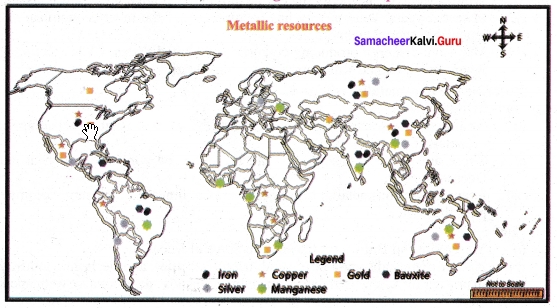
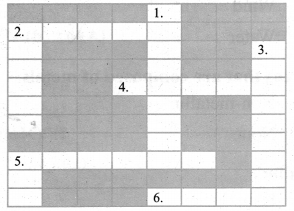
Samacheer Kalvi 11th Computer Science Solutions Chapter 4 Theoretical Concepts of Operating System

Students can Download Computer Science Chapter 4 Theoretical Concepts of Operating System Questions and Answers, Notes Pdf, Samacheer Kalvi 11th Computer Science Book Solutions Guide Pdf helps you to revise the complete Tamilnadu State Board New Syllabus and score more marks in your examinations.
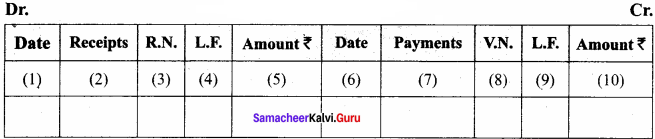
Tamilnadu Samacheer Kalvi 11th Computer Science Solutions Chapter 4 Theoretical Concepts of Operating System

Samacheer Kalvi 11th Computer Science Theoretical Concepts of Operating System Text Book Back Questions and Answers

PART – 1
I. Choose The Correct Answer

11th Computer Science Chapter 4 Book Back Answers Question 1.
Operating system is a ……………….
(a) Application Software
(b) Hardware
(c) System Software
(d) Component
Answer:
(c) System Software

Theoretical Concepts Of Operating System Question 2.
Identify the usage of Operating Systems ……………….
(a) Easy interaction between the human and computer
(b) Controlling input & output Devices
(c) Managing use of main memory
(d) All the above
Answer:
(d) All the above

Computer Operating System In Tamil Pdf Question 3.
Which of the following is not a function of an Operating System?
(a) Process Management
(b) Memory Management
(c) Security management
(d) Compiler Environment
Answer:
(d) Compiler Environment

Samacheer Kalvi Advantages And Disadvantages Question 4.
Which of the following OS is a Commercially licensed Operating system?
(a) Windows
(b) UBUNTU
(c) FEDORA
(d) REDHAT
Answer:
(a) Windows

Samacheer Kalvi Guru 11th Computer Science Question 5.
Which of the following Operating systems support Mobile Devices?
(a) Windows 7
(b) Linux
(c) BOSS
(d) iOS
Answer:
(d) iOS

Question 6.
File Management manages ……………….
(a) Files
(b) Folders
(c) Directory systems
(d) All the Above
Answer:
(d) All the Above

Question 7.
Interactive Operating System provides ……………….
(a) Graphics User Interface (GUI)
(b) Data Distribution
(c) Security Management
(d) Real Time Processing
Answer:
(a) Graphics User Interface (GUI)

Question 8.
Android is a ……………….
(a) Mobile Operating system
(b) open Source
(c) Developed by Google
(d) All the above
Answer:
(d) All the above

Question 9.
Which of the following refers to Android operating system’s version?
(a) JELLY BEAN
(b) UBUNTU
(c) OS/2
(d) MITTIKA
Answer:
(a) JELLY BEAN

PART – 2
II. Short Answers

Question 1.
What are the advantages of memory management in Operating System?
Answer:

  1. Allocating memory is easy and cheap
  2. Any free page is ok, OS can take first one out of.list it keeps
  3. Eliminates external fragmentation
  4. Data (page frames) can be scattered all over PM
  5. Pages are mapped appropriately anyway
  6. Allows demand paging and pre – paging
  7. More efficient swapping
  8. No need for considerations about fragmentation
  9. Just swap out page least likely to be used

Question 2.
What is the multi – user Operating system?
Answer:
A Multi – user Operating system is a computer operating system (OS) that allows multiple users on different computers or terminals to access a single system with one OS on it.

Question 3.
What is a GUI?
Answer:
GUI – Graphical User Interface – It allows the use of icons or other visual indicators to interact with electronic devices, rather than using only text via the command line. For example, all versions of Microsoft Windows utilize a GUI, whereas MS – DOS does not.

Question 4.
List out different distributions of Linux operating system.
Answer:
Different server distributions in Linux OS:

  1. Ubuntu
  2. Linux Mint
  3. Debian
  4. Fedora
  5. RedHa.

Question 5.
What are the security management features available in Operating System?
Answer:
Security Management features:

  1. File access level security
  2. System level security
  3. Network level securny.

Question 6.
What is multi – processing?
Answer:
Multiprocessing is one of the features of operating system. It has two or more processors for a single running process. Each processor works on different parts of the same task or two or more different tasks.

Question 7.
What are the different Operating Systems used in computer?
Answer:
Different operating system used:

  1. Single user, single Task Operating system
  2. Multi user operating system
  3. Multiprocessing operating system
  4. Distributed Operating system

PART – 3
III. Explain in Brief

Question 1.
What are the advantages and disadvantages of Time – sharing features?
Answer:
Advantages and disadvantages of Time Sharing Option (TSO)
Advantages:

  • Each task and each user get its time.
  • Systems have to give time to these application individual tasks and other applications also, so that all system behave correctly.
  • Reduces the CPU ideal time

Disadvantages:

  • Problem in Reliability
  • It consumes many resources so it need special operating systems.
  • Need High specification hardware

Question 2.
Explain and List out examples of mobile operating system.
Answer:
A Mobile Operating System (or mobile OS) is an operating system that is specifically designed to run on mobile devices such as phones, tablets, smart watches, etc.
Example: Apple IOS

Google android : Android is a mobile OS developed by Google, based on Linux and designed for smart phones and tabs. iOS was developed by Apple.
Example : Android, ColorOS, LGUX, MIUI.

Question 3.
What are the differences between Windows and Linux Operating system?
Answer:
Windows:

  • Microsoft windows is a proprietary OS which is commercial.
  • Windows can be modified only by the company that owns it.
  • Difficult to customize.
  • Vulnerable to virus and malware attacks.

Linux:

  • Linux is open source, i.e., free licensed.
  • Linux can be modified by anyone.
  • Easy to customize.
  • More secure.

Question 4.
Explain the process management algorithms in Operating System.
Answer:
The following algorithms are mainly used to allocate the job (process) to the processor: FIFO, SJF, Round Robin, Based on priority.

  1. First In First Out (FIFO) Scheduling – This algorithm is based on queuing technique. Technically, the process that enters the queue first is executed first by the CPU, followed by the next and so on. The processes are executed in the order of the queue.
  2. Shortest Job First (SJF) Scheduling – This algorithm works based on the size of the job being executed by the CPU.
  3. Round Robin Scheduling – Round Robin (RR) Scheduling algorithm is designed especially -for time sharing systems, jobs are assigned and processor time in a circular method.
  4. Based on priority – The given job (process) is assigned on a priority. The job which has higher priority is more important than ether jobs.

PART – 4
IV. Explain in Detail

Question 1.
Explain the concept of a Distributed Operating System.
Answer:
The data and application that are stored and processed on multiple physical locations across the world over the digital network (intemet/intranet). The Distributed Operating System is used to access shared data and files that reside in any machine around the world. The user can handle the data from different locations. The users can access as if it is available on their own computer.
11th Computer Science Chapter 4 Book Back Answers Samacheer Kalvi Theoretical Concepts Of Operating System
The advantages of distributed Operating System are as follows:

  1. A user at one location can make use of all the resources available at another location over the network.
  2. Many computer resources can be added easily in the network
  3. Improves the interaction with the customers and clients.
  4. Reduces the load on the host computer.

Question 2.
Explain the main purpose of an operating system.
Operating system has become essential to enable the users to design applications without the knowledge of the computer’s internal structure of hardware.
Operating system manages all the software and hardware. Most of the time there are many different computer programmes running at the same time, they all need to access the computers, CPU, memory and storage. The need of operating system is basically – an interface between the user and the hardware.
Theoretical Concepts Of Operating System Samacheer Kalvi 11th Computer Science Solutions Chapter 4
Operating System works as translator, while it translates the user request into machine language(Binary language), processes it and then sends it back to Operating System. Operating System converts processed information into user readable form.

Uses of Operating Systems:

  1. to ensure that a computer can be used to extract what the user wants it do.
  2. Easy interaction between the users and computers.
  3. Starting computer operation automatically when power is turned on (Booting).
  4. Controlling Input and Output Devices
  5. Manage the utilisation of main memory.
  6. Providing security to user programs.

Question 3.
Explain advantages and disadvantages of open source operating systems.
Answer:
The benefits of open source are tremendous and have gained huge popularity in the IT field in recent years. They are as follows:

  1. Open source (OS) is free to use, distribute and modify.
  2. Open source is independent of the company as author who originally created it.
  3. It is accessible to everyone. Anyone can debug the coding.
  4. It doesn’t have the problem of incompatible formats that exits in proprietary software.
  5. It is easy to customize as per our needs.
  6. Excellent support will be provided by programmers who will assist in making solutions.

Some of the disadvantages are:

  1. Latest hardware are incompatible, i.e. lack of device drivers.
  2. It is less user friendly and not as easy to use.
  3. There may be some indirect costs involved such as paying for external support.
  4. Malicious users can potentially view it and exploit any vulnerability.

Samacheer kalvi 11th Computer Science Theoretical Concepts of Operating System Additional Questions and Answers

PART – 1
I. Choose the correct answer

Question 1.
Software is classified into ………………. types.
(a) five
(b) two
(c) four
(d) six
Answer:
(b) two

Question 2.
A computer consists of a collection of processes, they are classified as ………………. categories.
(a) 7
(b) 3
(c) 8
(d) 2
Answer:
(d) 2

Question 3.
Which one of the following is not an algorithm?
(a) NTFS
(b) FIFO
(c) SJE
(d) Round Robin
Answer:
(a) NTFS

Question 4.
The operating system provides ………………. levels of securities to the user end.
(a) three
(b) five
(c) seven
(d) ten
Answer:
(a) three

Question 5.
Which one of the following is not a prominent operating system?
(a) UNIX
(b) IOS
(c) GUI
(d) Android
Answer:
(c) GUI

Question 6.
………………. is a family of multitasking.
(a) LINUX
(b) Microsoft Windows
(c) UNIX
(d) iOS
Answer:
(a) LINUX

Question 7.
Which one of the following comes under proprietary licence?
(a) Apple Mac OS
(b) Google’s Android
(c) UNIX
(d) LINUX
Answer:
(a) Apple Mac OS

Question 8.
The LINUX operating system was originated in ……………….
(a) 1996
(b) 1998
(c) 2000
(d) 1991
Answer:
(d) 1991

Question 9.
………………. is the second most popular mobile operating system globally after Android.
(a) Microsoft Windows
(b) iOS
(c) UNIX
(d) LINUX
Answer:
(b) iOS

Question 10.
Which one of the following is an application software to play audio and video files?
(a) Audio Player
(b) Media Player
(c) VLC Player
(d) All of these
Answer:
(c) VLC Player

Question 11.
Which one of the following is a System software?
(a) Operating System
(b) Language Processor
(c) Both a & b
(d) none of these
Answer:
(c) Both a & b

Question 12.
Which one of the following is a set of instructions that perform specific tasks?
(a) Hardware
(b) Software
(c) Processor
(d) I/O devices
Answer:
(b) Software

Question 13.
Hardware and software are managed by ……………….
(a) GUI
(b) OS
(c) Bootstrap
(d) keyboard
Answer:
(b) OS

Question 14.
The process of starting computer operation automatically when the power is turned on is called ……………….
(a) Booting
(b) Compiling
(c) executing
(d) Storing
Answer:
(a) Booting

Question 15.
An OS that allows only a single user to perform a task at a time is called as ……………….
(a) Single user os
(b) Single task os
(c) Both a & b
(d) Multi tasking os
Answer:
(c) Both a & b

Question 16.
Identify the single user and single task OS?
(a) MS – DOS
(b) UNIX
(c) LINUX
(d) iOS
Answer:
(a) MS – DOS

Question 17.
Identify the multi-user OS?
(a) Windows
(b) Linux
(c) UNIX
(d) All of these
Answer:
(d) All of these

Question 18.
To build a cheap computer, ………………. os is used.
(a) Windows
(b) Raspbion OS
(c) iOS
(d) None of these
Answer:
(b) Raspbion OS

Question 19.
GUI stands for ……………….
(a) Geo User Interact
(b) Global User Inter Change
(c) Graphical User Interface
(d) Global User Interface
Answer:
(c) Graphical User Interface

Question 20.
A ………………. is the unit of work or program in a computer.
(a) Process
(b) Code
(c) Concept
(d) Log file
Answer:
(a) Process

Question 21.
The operating system processes are executed by ……………….
(a) User code
(b) System code
(c) Task
(d) Program
Answer:
(b) System code

Question 22.
System level security is provided by ………………. in a multi user environment.
(a) Permission
(b) execute
(c) Password
(d) Security code
Answer:
(c) Password

Question 23.
NTFS is a ……………….
(a) game
(b) file management technique
(c) os
(d) System level security
Answer:
(b) file management technique

Question 24
………………. os is used to access shared data that resides in any machine around the world.
(a) Time sharing
(b) fixed
(c) MS – Dos
(d) distributed
Answer:
(d) distributed

Question 25.
Unix was developed in the year ……………….
(a) 1970
(b) 1980
(c) 1990
(d) 1960
Answer:
(a) 1970

Question 26.
Unix was developed by?
(a) Ken Thompson
(b) Dennis Ritchie
(c) Both a & b
(d) Ricki Mascitti
Answer:
(c) Both a & b

Question 27.
………………. is a windows alternative open source operating system.
(a) React OS
(b) Boss
(c) Redhat
(d) Fedora
Answer:
(a) React OS

Question 28.
Google has developed ………………. for wrist watches.
(a) Android wear
(b) Android wrist
(c) Android wrist watches
(d) Android watches
Answer:
(a) Android wear

Question 29.
Which among the following is not an android moblie open source versions?
(a) Dotnut
(b) Froyo
(c) Nougat
(d) Alpha
Answer:
(a) Dotnut

PART – 2
II. Short Answers

Question 1.
What is an operating system?
Answer:
An operating system is a software which serves as the interface between a user and a computer.

Question 2.
What are the different types of Operating System?
Answer:
Single user and single task operating system, Multi user operating system, Multi – Processing Operating system, Time sharing Operating system.

Question 3.
What is Real Time operating system?
Answer:
It is a multi – tasking and multi user operating system designed for real time based applications such as robotics, weather and climate prediction software etc.,

Question 4.
What is meant by Distributed Operating system?
Answer:
The data and applications are stored and processed on multiple locations in an around world over the digital network.

Question 5.
What are the advantages of Distributed Operating system?
Answer:
Resources can be used in different locations. Improves interaction with customers and clients. Reduces load on host computers. The data can be exchanged via email and chat.

Question 6.
What is an Interactive Operating system?
Answer:
This is the operating system that provides a GUI through which the user can navigate and interact.

Question 7.
Explain Round Robin Scheduling.
Answer:
This type of scheduling is also known as Time sharing scheduling process. In this, each program is given a fixed amount of time to execute.

Question 8.
What is Memory Management?
Answer:
It is the main functionality of an operating system which handles or manages primary memory and moves processes back and forth between main memory and disk during execution.

Question 9.
Mention different management techniques?
Answer:
Single continuous allocation, Partitioned allocation, Paged memory management, Segmented memory management.

Question 10.
What is Linux?
Answer:
Linux is a family of open-source operating systems.

Question 11.
What is an Android?
Answer:
Android is a mobile operating system developed by Google, based on the Linux and designed primarily for touch screen mobile devices such as smart phones and tablets.

Question 12.
What are the types of software?
Answer:
Application software and System software

Question 13.
What is Process Management?
Answer:
Process management is a function that includes creating and deleting processes and providing mechanisms for processes to communicate and synchronize with each other.

Question 14.
What is Round Robin Scheduling?
Answer:
This algorithm is designed especially for time sharing systems.

Question 15.
What are the 3 levels of security?
Answer:

  1. File Access Level
  2. System Level
  3. Network Level.

Question 16.
Name an OS which is Multitasking and Multi – user operating system.
Answer:
UNIX.

PART – 3
III. Explain in Brief

Question 1.
Write a short note on Android.
Answer:
Android:
Android is a mobile operating system developed by Google, based on Linux and designed primarily for touch screen mobile devices such as smart phones and tablets. Google has further developed Android TV for televisions, Android Auto for cars and Android Wear for wrist watches, each with a specialized user interface. Variants of Android are also used on game consoles, digital cameras, PCs and other electronic gadgets.

Question 2.
Why the operating system is needed?
Answer:
Need for operating system:
Operating System has become essential to enable the users to design applications without the knowledge of the computer’s internal structure of hardware. Operating System manages all the Software and Hardware. Most of the time there are many different computer programmes running at the same time, they all need to access the Computers, CPU, Memory and Storage. The need of Operating System is basically – an interface between the user and hardware.
Computer Operating System In Tamil Pdf Samacheer Kalvi 11th Computer Science Solutions Chapter 4
Operating System works as translator, while it translates the user request into machine language(Binary language), processes it and then sends it back to Operating System. Operating System converts processed information into user readable form.

Question 3.
Write a note on OS for mobile devices.
Answer:
Operating systems for mobile devices:
Mobile devices such as phones, tablets and MP3 players are different from desktop and laptop computers and hence they need special Operating Systems. Examples of mobile Operating Systems are Apple iOS and Google Android. The iOS running on an iPad is Operating systems for mobile devices generally are not as fully featured as those made for desktop and laptop computers and they are not able to run all software.

Question 4.
Write a note on iOS – iphone OS.
Answer:
iOS (formerly iPhone OS) is a mobile Operating System created and developed by Apple Inc., exclusively for its hardware. It is the Operating System that presently powers many of the company’s mobile devices, including the iPhone, iPad and iPod Touch. It is the second most popular mobile Operating System globally after Android.

Question 5.
What is a software? Explain its types in detail.
Answer:
A software is a set of instructions that perform specific task. It interacts basically with the hardware to generate the desired output.
Types of Software:
Software is classified into two types:

  1. Application Software
  2. System Software

Application Software:
Application software is a set of programs to perform specific task. For example MS-word is an application software to create text document and VLC player is familiar application software to play audio, video files and many more.

System Software:
System software is a type of computer program that is designed to run the computer’s hardware and application programs. For example Operating System and Language Processor.

Question 6.
Write note on single user OS?
Answer:
An os allows only a single user to perform a task at a time. It is called as a single user and single task os.
Example : MS – DOS.

Question 7.
Write note on Raspbion os?
Answer:
Raspbion os is a platform that is designed to teach how to build a computer, working principle of every part of a circuit board, write code apps or games. The platform is available in pre – designed kits.

Question 8.
Explain the memory management activities done by os?
Answer:

  1. Keeping track of which portion of memory are currently being used and who is using them.
  2. Determining which processes and data to more in and out of memory.
  3. Allocation and de – allocation of memory blocks as needed by the program in main memory. (Garbage collection).

Question 9.
Define Process?
Answer:

  1. A process is the unit of work (program) in a computer.
  2. A word processing program being run by an individual user on a computer is a process.
  3. A system task, such as sending output to printer or screen can also be called as a process.

Question 10.
How are the processes classified on process management?
Answer:
A computer consists of a collection of process they are classified as two categories:

  1. Operating system process which is executed by system code.
  2. User processes which is executed by user code.

Question 11.
Name the activities done by os related with the process management?
Answer:

  1. Scheduling processes and threads on the cpu.
  2. Creating and deleting both user and system processes.
  3. Suspending and resuming processes.
  4. Providing mechanisms for process synchronization.
  5. Providing mechanisms for process communication.

Question 12.
Write note an Fault Tolerance?
Answer:

  1. The operating systems should be robust.
  2. When there is a fault, the operating system should not crash, instead the os have fault tolerance capabilities and retain the existing state of system.

Question 13.
Write note on File Allocations Table (FAT).
Answer:

  1. Any type of data in a computer is stored in the form of flies and directories / folders through File Allocation Table (FAT).
  2. The FAT stores general information about files like file name, type (text or binary), size, starting address and access mode (sequential / indexed / indexed – sequential / direct / relative).

Question 14.
Give an example for Time – Sharing concept?
Answer:
Let us assume that there are three processes called P1, P2, P3 and time allocated for each process 30,40, 50 minutes. If the process P1 completes with in 20 minutes then processor takes the next Process P1 for the execution. If the process P2 could not complete within 40 minutes, then the current process P2 will be paused and switch over to the next process P3.

Question 15.
Write note on React OS.
React os is a windows – alternative open source os which is being developed on the principles of windows – without using any of the microsoft code.

Question 16.
List any 6 Android Mobile Open Source OS.
Answer:

  1. Honey comb
  2. Jelly Bean
  3. Kitkat
  4. Lollipop
  5. Marshmallow
  6. Nougat

PART – 4
IV. Explain in Detail

Question 1.
Write six uses of operating system.
Answer:
The main use of Operating System is

  1. to ensure that a computer can be used to extract what the user wants it do.
  2. Easy interaction between the users and computers.
  3. Starting computer operation automatically when power is turned on (Booting).
  4. Controlling Input and Output Devices
  5. Manage the utilization of main memory.
  6. Providing security to user programs.

Question 2.
Draw the diagram for the key features of the operating system.
Answer:
Samacheer Kalvi Advantages And Disadvantages 11th Computer Science Solutions Chapter 4 Theoretical Concepts Of Operating System

Question 3.
Explain User Interface?
Answer:
User Interface:
User interface is one of the significant feature in Operating System. The only way that user can make interaction with a computer. If the computer interface is not user – friendly, the user slowly reduces the computer usage from their normal life. This is the main reason for the key success of GUI (Graphical User Interface) based Operating System. The GUI is a window based system with a pointing device to direct I/O, choose from menus, make selections and a keyboard to enter text. Its vibrant colours attract the user very easily. Beginners are impressed by the help and pop up window message boxes. Icons are playing vital role of the particular application.

Now Linux distribution is also available as GUI based Operating System. The following points are considered when User Interface is designed for an application.

  1. The user interface should enable the user to retain this expertise for a longer time.
  2. The user interface should also satisfy the customer based on their needs.
  3. The user interface should save user’s precious time. Create graphical elements like Menus,Window,Tabs, Icons and reduce typing work will be an added advantage of the Operating System.
  4. The ultimate aim of any product is to satisfy the customer. The User Interface is also designed to satisfy the customer.
  5. The user interface should reduce number of errors committed by the user with a little practice the user should be in a position to avoid errors (Error Log File)

Question 4.
Explain Memory Management?
Answer:
Memory Management:
Memory Management is the process of controlling and coordinating computer’s main memory and assigning memory block (space) to various running programs to optimize overall computer performance. The Memory management involves the allocation of specific memory blocks to individual programs based on user demands. At the application level, memory management ensures the availability of adequate memory for each running program at all times.

The objective of Memory Management process is to improve both the utilization of the CPU and the speed of the computer’s response to its users via main memory. For these reasons the computers must keep several programs in main memory that associates with many different Memory Management schemes.

The Operating System is responsible for the following activities in connection with memory management:

  1. Keeping track of which portion of memory are currently being used and who is using them.
  2. Determining which processes (or parts of processes) and data to move in and out of memory.
  3. Allocation and de – allocation of memory blocks as needed by the program in main memory. (Garbage Collection)

Question 5.
Explain process Management.
Answer:
Process Management:
Process management is function that includes creating and deleting processes and providing mechanisms for processes to communicate and synchronize with each other. A process is the unit of work (program) in a computer. A word processing program being run by an individual user on a computer is a process. A system task, such as sending output to a printer or screen, can also be called as a Process.

A computer consists of a collection of processes, they are classified as two categories:

  1. Operating System processes which is executed by system code.
  2. User Processes which is execute by user code.

All these processes can potentially execute concurrently on a single CPU. A process needs certain resources including CPU time, memory, files and I/O devices to finish its task.

The Operating System is responsible for the following activities associated with the process management:

  1. Scheduling processes and threads on the CPUs.
  2. Creating and deleting both user and system processes.
  3. Suspending and resuming processes.
  4. Providing mechanisms for process synchronization.
  5. Providing mechanisms for process communication.

The following algorithms are mainly used to allocate the job (process) to the processor.

  1. FIFO
  2. SJF
  3. Round Robin
  4. Based on Priority