Samacheer Kalvi 7th Social Science History Solutions Term 2 Chapter 2 The Mughal Empire

You can Download Samacheer Kalvi 7th Social Science Book Solutions Guide Pdf, Tamilnadu State Board help you to revise the complete Syllabus and score more marks in your examinations.

Tamilnadu Samacheer Kalvi 7th Social Science History Solutions Term 2 Chapter 2 The Mughal Empire

Samacheer Kalvi 7th Social Science The Mughal Empire Textual Evaluation

I. Choose the correct answer:

Question 1.
Who introduced the Persian style of architecture in India?
(a) Humayun
(b) Babur
(c) Jahangir
(d) Akbar
Answer:
(b) Babur

Question 2.
In which battle did Akbar defeat Rana Pratap?
(a) Panipat
(b) Chausa
(c) Haldighati
(d) Kanauj
Answer:
(c) Haldighati

Question 3.
Whose palace in Delhi was destroyed by Sher Shah?
(a) Babur
(b) Humayun
(c) Ibrahim Lodi
(d) Alam Khan
Answer:
(b) Humayun

Question 4.
Who introduced Mansabdari system?
(a) Sher Sha
(b) Akbar
(c) Jahangir
(d) Shah Jahan
Answer:
(b) Akbar

Question 5.
Who was the revenue minister of Akbar?
(a) Birbal
(b) Raja Bhagwan Das
(c) RajaTodarmal
(d) Raja Man Singh
Answer:
(b)Raja Todarmal

II. Fill In the Blanks

  1. _______ was the name of the horse of Rana Pratap.
  2. _______ was a hall at FatehpurSikri where scholars of all religions met for a discourse.
  3. The Sufi saint who received Akbar’s utmost respect was _______
  4. During the reign of _______ the Zabti system was extended to the Deccan provinces.
  5. _______ were tax-free lands given to scholars and religious institutions.

Answers:

  1. Chetak
  2. Ibadatkhana
  3. Salim Chishti
  4. Shah Jahan
  5. Suyurghal

III. Match the following

Question 1.

  1. Babur – Ahmednagar
  2. Durgavati – Jaipur
  3. Rani Chand Bibi – Akbar
  4. Din Ilahi – Chanderi
  5. Raja Man Singh – Central Province

Answer:

  1. Babur – Chanderi
  2. Durgavati – Central Province
  3. Rani Chand Bibi – Ahmednagar
  4. Din Ilahi – Akbar
  5. Raja Man Singh – Jaipur

IV. True or False

  1. Babur inherited Farghana, a small kingdom in Central Asia.
  2. Humayun succeeded in recapturing Delhi in 1565.
  3. Aurangzeb married a girl of a notable Rajput family.
  4. Jahangir ordered execution of Sikh leader Guru Arjun for helping his son Khusrau.
  5. During Aurangzeb’s reign, architecture received much patronage.

Answers:

  1. True
  2. False
  3. False
  4. True
  5. False

V. Consider the following statements. Tick (✓) the appropriate answer.

Question 1.
Assertion (A): The British established their first factory at Surat.
Reason (R): Jahangir granted trading rights to the English.
(a) R is the correct explanation of A.
(b) R is not the correct explanation of A.
(c) A is wrong and R is correct.
(d) (A) and (R) are wrong.
Answer:
(a) R is the correct explanation of A

Question 2.
Assertion (A): Aurangzeb’s intolerance towards other religions made him unpopular among people.
Reason (R): Aurangzeb re-imposed the jizya and pilgrim tax on the Hindus.
(a) R is the correct explanation of A.
(b) R is not the correct explanation of A.
(c) A is wrong and R is correct.
(d) (A) and (R) are wrong.
Answer:
(a) R is the correct explanation of A

Question 3.
Find out the correct statements
(i) Kamran was the son of Afghan noble, Hasan Suri, ruler of Sasaram in Bihar.
(ii) Akbar abolished the jizya poll tax on non-Muslims and the tax on Hindu pilgrims.
(iii) Aurangzeb acceded the throne after killing his three brothers.
(iv) Prince Akbar entered into a pact with Shivaji’s son Shambuji in the Deccan.
(a) (I), (II) and (III) are correct
(b) (II), (III) and (IV) are correct
(c) (I), (III) and (IV) are correct
(d) (II), (III), (IV) and (I) are correct
Answer:
(b) (II), (III) and (IV) are correct

Question 4.
Arrange the battles in chronological order

  1. Battle of Khan wa
  2. Battle of Chausa
  3. Battle of Kanauj
  4. Battle of Chanderi

Answer:

  1. Battle of Khanwa (1527)
  2. Battle of Chanderi (1528)
  3. Battle of Chausa (1539)
  4. Battle of Kanauj (1540)

Question 5.
Arrange the following administrative divisions in descending order

  1. Sarkars
  2. Parganas
  3. Subhas

Answer:

  1. Subhas
  2. Sarkars
  3. Parganas

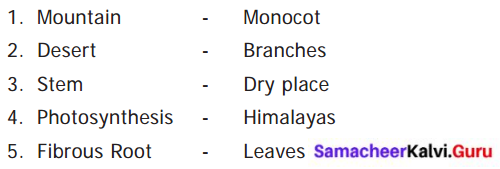
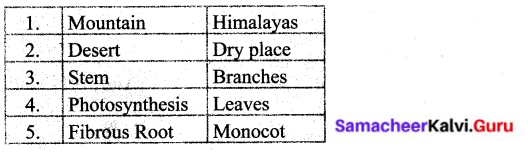
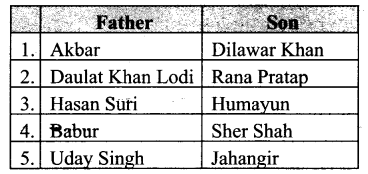
Match the lather and son
Samacheer Kalvi 7th Social Science History Solutions Term 2 Chapter 2 The Mughal Empire 1
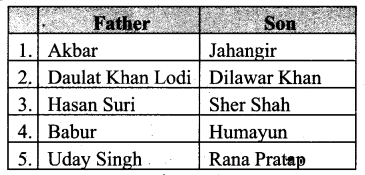
Answer:
Samacheer Kalvi 7th Social Science History Solutions Term 2 Chapter 2 The Mughal Empire 2

VI. Give short answer

Question 1.
Write the circumstance that led to the Battle of Panipat in 1526.
Answer:
Babur did not have any ambition beyond Punjab till 1524. Then a greater opportunity came knocking. Dilawar Khan, who was Daulat Khan Lodi’s son, and Alam Khan, who was the uncle of Sultan of Delhi, arrived in Kabul to seek Babur’s help in removing Ibrahim Lodi from power. Babur defeated Ibrahim Lodi in the famous Battle of Panipat in 1526.

Question 2.
Mention the Humayun recapture the Delhi throne in 1555.
Answer:
Sher Shah defeated Humayun at Chausa (1539) and again at Kanauj (1540). Humayun, defeated and overthrown, had to flee to Iran. With the help of the Persian ruler Shah Tahmasp of the Safavid dynasty, Humayun succeeded in recapturing Delhi in 1555.

Question 3.
Write a note on Mansabdari system.
Answer:
Akbar introduced the Mansabdari system. According to this system, the nobles, civil and military officials were combined to form one single service. Everyone in the service was given a mansab, meaning a position or rank. A Mansabdar was a holder of such a rank. Mansabdar rank was dependent on Zat and Sawar.

VII. Answer the following

Question 1.
Describe the land revenue administration of the Mughals.
Answer:
Land Revenue Administration:
(i) Land revenue administration was toned up during the reign of Akbar. Raja Todar Mai, Revenue Minister of Akbar, adopted and refined the system introduced by Sher Shah.

(ii) According to Zabt system, after a survey, lands were classified according to the nature and fertility of the soil. The share of the state was fixed at one-third of

(iii) the average produce for 10 years.

(iv) The Mughal emperors enforced the old iqta system, renaming it jagir. It is a land tenure system developed during the period of Delhi Sultanate. Under the . system, the collection of the revenue of an area and the power of governing

(v) it were bestowed upon a military or civil official now named Jagirdar.

(vi) Every Mansabdar was a Jagirdar if he was not paid in cash. The Jagirdar collected the revenue through his own officials.

(vii) Those appointed to collect the revenue from the landholders were called zamindars. Zamindars collected taxes and maintained law and order with the help of Mughal officials and soldiers.

(viii) The local chieftains and little kings were also called zamindars.

Question 2.
Estimate Akbar as a patron of learning.
Answer:
(i) Akbar was a great patron of learning. His personal library had more than four thousand manuscripts.

(ii) He patronised scholars of all beliefs and all shades of opinions.

(iii) He extended his benevolence to authors such as Abul Fazl, Abul Faizi and Abdur Rahim Khan-i-Khanan, the great storyteller Birbal, competent officials like Raja Todar Mai, Raja Bhagwan Das and Raja Man Singh.

(iv) The great composer and musician Tansen and artist Daswant adorned Akbar’s court as well.

VIII. HOTs

Question 1.
Shah Jahairs time witnessed the climax of Mughal splendour. Support this statement in comparison with the times of other Mughal rulers.
Answer:
(i) The famous peacock throne, covered with expensive jewels, was made during Shah Jahan’s time for the emperor to sit on. The world famous Taj Mahal, the Moti Masjid, the pearl mosque at Agra, the Jama Masjid of Delhi, the Diwan-i- Khas and Diwan – i Am in his palace exhibit his taste for Art and Architecture.

(ii) Babur built many structures at Agra, Biana, Dholpur, Gwalior and Kiul in Persian style of Architecture.

(iii) Sher shah built a mausoleum at Sasaram. Diwan-i-khas, Diwan-i-Am, Panch Mahal Rang Mahal, Salim Chishti’s tomb and Buland Darwaza were built during Akbar’s time.

(iv) Jahangir completed Akbar’s tomb at Sikandara and the beautiful building containing the tomb of Itmad-ud-daula, at Agra.

(v) During Aurangzeb’s reign, architecture did not receive much patronage.

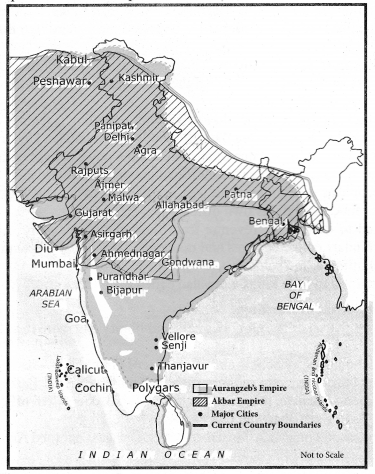
Map

Mark the extent of Mughal Empire during the reign of Akbar and Aurangzeb with special focus on important battle fields.
Answer:
Samacheer Kalvi 7th Social Science History Solutions Term 2 Chapter 2 The Mughal Empire 3

IX. Activity
Collect information about the scholars in Akbar’s court and conduct a mock llxiikitfi khana in the class.
Answer:
Scholars of Akbar’s court:

Tansen – Renowned Singer
Fakir Aziao Din – Religious Advisor and Minister
Faizi – Minister of education
Mulla – Do – Piyaza – Minister of affairs
Raja Birbal – Minister of foreign affairs
Raja Todar Mai – Finance Minister
Abu’l Fazl ibn Mubarak – Grand Vizier

Samacheer Kalvi 7th Social Science The Mughal Empire Additional Questions

I. Choose the correct answer:

Question 1.
______ was the founder of the Mughal Empire in India.
(a) Humayun
(b) Babur
(c) Akbar
(d) Sher Shah
Answer:
(b) Baburl

Question 2.
Babur inherited ______ a small kingdom in central Asia.
(a) Farghana
(b) Chanderi
(c) Agra
(d) Delhi
Answer:
(a) FarghanaI

Question 3.
Babur led his first expedition towards ______
(a) Kabul
(b) China
(c) India
(d) Turkey
Answer:
(c) India

Question 4.
Babur chose his eldest son, ______ as his heir.
(a) Akbar
(b) Sher Shah
(c) Jahangir
(d) Humayun
Answer:
(d) Humayun

Question 5.
______ started the rule of Sur dynasty at Agra.
(a) Shah Jahan
(b) Muhammad Shah
(c) Akbar
(d) Slier Shah
Answer:
(d) Sher Shah

Question 6.
The memory of the gallant Rajput, ______ is treasured in Rajputara.
(a) Rana Pratap
(b) Rana Uday Singh
(c) Prithiviraj Chauhan
(d) Rana Sanga
Answer:
(a) Rana Pratap

Question 7.
Akbar sent ______ of Jaipur as governor of Kabul once.
(a) Rana Pratap
(c) Raja Man Singh
(c) Raja Todarmal
(d) Rana Sanga
Answer:
(b) Raja Man Singh

Question 8.
______ after as struggle for power, succeeded Jahangir.
(a) Akbar
(b) Aurangazeb
(c) Humayun
(d) Shah Jahan
Answer:
(d) Shah Jahan

Question 9.
______ assumed the title Alamgir (the conqueror of the world).
(a) Babur
(b) Akbar
(c) Aurangazeb
(d) Humayun
Answer:
(c) Aurangazeb

Question 10.
Shivaii proclaimed himself the ‘Emperor of Maratha’ state in ______
(a) 1674
(b) 1754
(c) 1685
(d) 1690
Answer:
(a) 1674

Question 11.
The towns and cities were administered by ______ during the Mughal administration.
(a) Subedar
(b) Kotwal
(c) Sarkar
(d) Wakil
Answer::
(b) Kotwal

Question 12.
______ were conferred hereditary rights over Zamin.
(a) Kotwals
(b) Subedars
(c) Zamindars
(d) Sarkars
Answer:
(c) Zamindars

Question 13.
The famous monument of Sher Shah’s reign was his mausoleum built at ______ in Bihar.
(a) Gaya
(b) Patna
(c) Nalanda
(d) Sasaram
Answer:
(d) Sasaram

Question 14.
The world famous Taj Mahal is by the side of the river .
(a) Ganga
(b) Jumna
(c) Brahmaputra
(d) Indus
Answer:
(b) Jumna

Question 15.
The Bibi Ka Maqbara in Aurangabad was built by Prince
(a) Akbar
(b) Humayun
(c) Babur
(d) Azam Shah
Answer:
(d) Azam Shah

II. fill in the blanks

  1. Babur was the great grandson of ______.
  2. Zahir-ud-din means ______
  3. Mughal dynasty came to be established in India with ______ as its capital.
  4. Humayun’s trusted general ______ became the regent and ruled on behalf of Akbar.
  5. ______ a general of sur dynasty, captured Agra and Delhi in 1556.
  6. Bairam Khan killed Hemu in the ______.
  7. Jahangir’s wife Mehr-un-nisa known as ______ was the real power behind the throne.
  8. ______, a representative of Kind James I of England, visited Jahangir’s court.
  9. ______ maintained law and order in the Mughal Administration.
  10. ______ was the number of horses and horsemen, a Mansabdar had to maintain.
  11. In Akbar’s court, the ______ missionaries were great favourites.

Answers:

  1. Timur
  2. Defender of faith
  3. Agra
  4. Bairam Khan
  5. Hemu
  6. Second battle of Panipat
  7. Nur Jahan
  8. Thomas Roe
  9. Kotwalsi
  10. Sawar
  11. Portuguese

III. Match the following

  1. Wakil – (a) In-charge of the army
  2. Wazir – (b) Chief judge
  3. Mir Bhakshi – (c) Prime Minister
  4. Mir Saman – (d) In-charge of revenue
  5. Qazi – (e) Royal house hoed

Answers:

  1. – c
  2. – d
  3. – a
  4. – e
  5. – b

IV. State true or false

  1. Babur was driven out form Farghana by Uzbeks.
  2. Kamran, Hindal and Askari were the brothers of Akbar.
  3. The fight Rani chand Bibi put up impressed Mughal Army.
  4. The Sikh shrine Haramandir Sahib was built in Amritsar.
  5. The Mansabdars were paid low salary by the Emperor.

Answers:

  1. True
  2. False
  3. True
  4. True
  5. False

V. Considerthe following statements Tick (✓) the appropriate answer:

Question 1.
Assertion (A) : Bairam khan was murdered in Gujarat, allegedly at the instance of Hemu.
Reason (R) : Akbar could not tolerate his dominance in day-to-day governance of the kingdom.
(a) R is the correct explanation of A.
(b) A is wrong and R is correct
(c) A and R are wrong
(d) A is not the correct explanation of A
Answer:
(b) A is wrong and R is correct

Question 2.
Find out the correct statements.
i. Akbar was succeeded by Prince Salim, his son through a Rajput wife.
ii. The toleration of religious of Akbar’s time continued in Shah Jahan’s time.
iii. Aurangazeb suppressed the revolt of Bundelas Jats, Satnamis and sikhs.
iv. In the Mughal administration, Sadr-us-Sudr was the minister of Finance.
(a) i, ii and iv are correct
(b) i and iii are correct
(c) ii and iv are correct
(d) i and ii are correct
Answer:
(b) i and iii are correct

Question 3.
Match the pairs (Akbar’s invasion).
(a) Fort of Chittoor – i. 1576
(b) Ranthambore – ii. 1568
(c) Battle of Haldighati – iii. 1569
Answer::
a – ii, b – iii, c – i

VI. Give short Answers

Question 1.
Where did Babur record his impressions about Hindustan?
Answer:
Babur recorded his impressions about Hindustan, its animals, plants and trees, flowers and fruits in his autobiography Tuzuk-i-Baburi.

Question 2.
Write a few sentences about the reign of Sher Shah.
Answer:
Sher Shah introduced an efficient land revenue system. He built many roads, and standardised coins, weights and measures.

Question 3.
Why was Akbar’s defeat of Rani Durgavati hot appreciated?
Answer:

  1. Akbars defeat of Rani Durgavati, a ruler in the Central Province, is not appreciated, since the brave Rani did him no harm.
  2. Yet larged by his ambition to build an empire, Akbar had no consideration for the good nature of the ruler.

Question 4.
How did Akbar establish commercial access to Arabia, Southeast Asia and China?
Answer:

  1. Akbar’s conquest of Gujarat helped him to establish control over Gujarat’s overseas trade with the Arabs and the Europeans.
  2. Akbar’s military campaigns in East Bihar and Odisha and victory over Bengal facilitated access to Southeast Asia and China.

Question 5
Write a brief account of Akbar’s military campaigns in the Northwest.
Answer:

  1. Akbar added Kandahar, Kashmir and Kabul to the Mughal Empire. His battles in the Deccan led to the annexation of Berar, Khandesh and parts of Ahmednagar.
  2. Under Akbar, the Mughal Empire extended from Kashmir in the north to Godavari in the south, and from Kandahar in the west to Bengal in the east.

Question 6.
Why did the Mughals had to lost control over the trade routes to Afghanistan? Persia and Central Asia?
Answer:

  1. Jahangir ordered the execution of Sikh leader Guru Aijun (or Arjan) for helping his rebellious son Khusrau, who contested for the throne.
  2. This resulted in a prolonged fight between the Sikhs and the Mughals.
  3. As a result of this confrontation, the Mughals had to lose control over the trade routes to Afghanistan, Persia and Central Asia.

Question 7.
Why was there a sustained resistance from Marathas in the Deccan to the Mughal?
Answer:
Some Maratha warriors, notably Shahji Bhonsle (Shivaji’s father), entered the services of the Deccan kingdoms and trained bands of Maratha soldiers to fight against the Mughals. So there was a sustained resistance in the Deccan to the Mughals from the Marathas too.

Question 8.
Narrate the circumstances under with Aurangzeb become the ruler.
Answer:

  1. Aurangzeb, the last of the Great Mughals, started off his reign by imprisoning his old father.
  2. He assumed the title Alamgir (the Conqueror of the World). He reigned for 48 years.
  3. He was no lover of art like his grandfather Jahangir and architecture like his father Shah Jahan.

Question 9.
Why did Aurangzeb march to the Deccan in 1689?
Answer:
Aurangzeb’s rebellious son, Prince Akbar, joined the forces of Rajputs and created troubles to him. Prince Akbar entered into a pact with Shivaji’s son Shambuji in the Deccan. So Aurangzeb had to march to the Deccan in 1689.

Question 10.
Name the places where the British established their trade centres.
Answer:
The British established their trade centres at Madras (Chennai), Calcutta (Kolkata) and Bombay (Mumbai).

Question 11.
Describe the local administration of the Mughals.
Answer:
The towns and cities were administered by kotwals. Kotwals maintained law and order. The administration of villages was left in the hands of local village panchayats (informal institution of justice in villages). The Panchayatdars (jury) dispensed justice.

Question 12.
Write a short note on Mansabdars.
Answer:
(i) A mansabdar was a holder of a rank. Mansabdar rank was dependent on Zat and Sawar. Mansabdar’s salary was fixed on the basis of the number of soldiers each Mansabdar received ranging from 10 to 10,000.

(ii) The Mansabdars were paid high salary by the Emperor. Before receiving the salary, a Mansabdar has to present his horsemen for inspection. Their horses were branded to prevent theft.

Question 13.
Name the famous buildings of Akbar’s time.
Answer:
The Diwan-i-Khas, Diwan-i-Am, Panch Mahal (pyramidal structure in five stories), Rang Mahal, Salim Chishti’s Tomb and Buland Darwaza were built during Akbar’s time.

Question 14.
Write a short note on Red Fort.
Answer:
Red Fort, also called Lai Qila, in Delhi was the residence of the Mughal emperors. Constructed in 1639 by Emperor Shah Jahan as the palace of his fortified capital Shajahanabad. The Red Fort is named for its massive enclosing walls of red sandstone.

VII. Answer the following

Question 1.
Given an account of the Religious policy of Akbar.
Answer:

  1. The Mughal emperors were the followers of islam. Akbar was very liberal in his religious policy.
  2. In Akbar’s court, the Portuguese missionaries were great favourites.
  3. Akbar tried to include the good principles in all religions and formulated them into one single faith caftxl Din-I-Ilahi (divine faith).
  4. Ja.hpgir and Shah Jahan also followed the policy ofAkbar. Aurangzeb rejected the liberal views of his predecessors.
  5. As we pointed out earlier, he re-imposed the jizya and pilgrim tax on the Hindus. His intolerance towards other religions made him unpopular among the people.

VIII. HOTS

Question 1.
Name a few famous monuments built during Mughal rule in Delhi.
Answer:
Alai Darwaza, Red Fort, Qutub Minar, Safdarjung tomb, Humayun’s tomb, Isa Khan’s tomb.

Samacheer Kalvi 8th English Solutions Term 1 Supplementary Chapter 3 When Instinct Works

Students can Download Lesson 3 When Instinct Works Questions and Answers, Summary, Activity, Notes, Samacheer Kalvi 8th English Book Solutions Guide Pdf Supplementary Chapter 3 helps you to revise the complete Tamilnadu State Board New Syllabus and score more marks in your examinations.

Tamilnadu Samacheer Kalvi 8th English Solutions Term 1 Supplementary Chapter 3 When Instinct Works

A. Comprehension.

When Instinct Works Summary Question 1.
Choose the best option

When Instinct Works Question 1.
The season mentioned in the lesson is _________
(a) spring
(b) autumn
(c) summer
(d) winter
Answer:
(b) autumn

When Instinct Works Book Back Answers Question 2.
In one low part of the road the _________was halfway up to black beauty’s knees.
(a) the river
(b) dust
(c) water
(d) leaves
Answer:
(c) water

When Instinct Works Question Answer Question 3.
The bridge was broken in the _________
(a) front
(b) rear
(c) middle
(d) up
Answer:
(c) middle

8th English When Instinct Works Question 4.
The instinct in _________had often saved the lives of men.
(a) girls
(b) animals
(c) birds
(d) boys
Answer:
(b) animals

When Instinct Works 8th Std Question 5.
Black beauty dared not move even to the sharp snap of the _________
(a) stick
(b) thread
(c) whip
(d) kick
Answer:
(c) whip

When Instinct Works Summary In Tamil Question 2.
Match the following.

1. Man at the toll gate(a) had many stories to tell.
2. Bridge(b) wise.
3. John(c) have special knowledge.
4. Black beauty(d) flashing a torch.
5. Animals(e) sturdy rail.

Answer:

  1. d
  2. e
  3. a
  4. b
  5. c

When Instinct Works Theme Question 3.
Fill in the blanks.
When Instinct Works Summary Samacheer Kalvi 8th English Solutions Term 1 Supplementary Chapter 3

  1. Just then, the man at the ______ on the other side ran out, ______ a torch.
  2. Even when John tried to ______ him forward Beauty did not move.
  3. We were saved because Beauty had known that something was ______ with the bridge.
  4. Suddenly an ______ tree came crashing down and fell right in front of us.
  5. He told that the bridge had just broken due to the ______
  6. As we went through the wood, the ______ of the trees were swaying and making a rushing sound.
  7. A little later, when we reached the bridge Beauty came to a ______
  8. When we started back from the town, it was late in the ______ The wind was much ______
  9. John said we must go back to the ______ find another way to the wooden
  10. Oh! What a good ______ he gave me that night. And then a really thick

Answer:

  1. toll gate; flashing
  2. lean
  3. wrong
  4. oak
  5. flood
  6. branches; terrible
  7. sudden stop
  8. afternoon; stronger
  9. cross ways; bridge
  10. Supper; bed of straw

When Instinct Works Mind Map Question 4.
Based on your understanding of the story write the answers for the following questions in a sentence or two. .

When Instinct Works Lesson Plan Question 1.
Did Black Beauty like to pull the cart?
Answer:
Yes, Black Beauty liked to pull the cart, as it was very light and the high wheels rolled along so smoothly.

When Instinct Works Summary In English Question 2.
How was the weather?
Answer:
The weather was very windy and the dry leaves blew across the road. There had been a great deal of rain.

When Instinct Works In Tamil Question 3.
Describe the bridge.
Answer:
The low wooden bridge had sturdy rails on both sides. As the river banks were fairly high, the bridge went across just level.

When Instinct Works Story In Tamil Question 4.
What was the alternate plan suggested by John to reach the wooden bridge?
Answer:
The alternate plan suggested by John to reach the wooden bridge was to go back to four cross ways.

When Instinct Works Theme Question 5.
Why was Black Beauty reluctant to cross the bridge?
Answer:
The moment Black Beauty’s feet touched the ground which was the first part of the bridge, the horse sensed something was wrong. So it was reluctant to cross the

When Instinct Works Mind Map Question 5.
Write the answers for the following questions in 100 words.

When Instinct Works Lesson Plan Question 1.
What did the man at the toll gate on the other side tell them?
Answer:
The man told them that the bridge was broken in the middle. Part of it had been carried away by the flood. If they proceed, they will be drowned in the river.

When Instinct Works Summary In English Question 2.
Was Black Beauty afraid to cross the bridge?
Answer:
No, Black Beauty was not afraid to cross the bridge. But it knew that there was some problem and the bridge was not safe to cross.

When Instinct Works In Tamil Question 3.
What did John think about human’s attitude on animals?
Answer:
John thought many people did not take very good care of their animals or make friends with them as they should do. According to John, such attitude of human should be changed. Master told John that God had given animals a special knowledge and quicker to respond to danger. This instinct in animals, the Master continued, had often saved the lives of men. John had many stories to tell of dogs and horses, and the wonderful ways the animals had saved the lives of people.

When Instinct Works Story In Tamil Questions 4.
What would have happened to all the three if Black Beauty had not been wiser?
Answer:
It Black beauty had not been wiser, all the three would have been drowned at the wooden bridge.

Question 5.
Where did John take Black Beauty and what did he give her?
Answer:
John took black beauty to the stable. He gave her a good supper and a thick bed of straw to relax.

Question 6.
How will you take care of your pet? Write about in fifty words.
Answer:
I will take care of my pet dog by providing it with a protected and clean living environment. I always keep fresh water and quality food for my pet. I will also communicate with it and develop a relationship with it. I will take my pet for a walk, every morning and evening.

Step To Success

Coding – Decoding verbal reasoning.

Question 1.
In a certain code language, if Violet is called as Green, Green is called as Red, Red is called as Brown, Brown is called as Orange, Orange is called as Yellow, Yellow is called as Blue and Blue is called as Indigo, then what is the colour of human blood in that language?
(a) Red
(b) Blue
(c) Green
(d) Violet.
(e) Brown
Answer:
(e) Brown

Question 2.
In a certain code language, if Pen means Eraser, Eraser means Book, Book means Scale, Scale means Sharpener, Sharpener means Duster and Duster means Table, then what is the name of the object that is used to clean the black board in that language?
(a) Duster
(b) Sharpener
(c) Table
(d) Scale
(e) Book
Answer:
(b) Sharpener

Question 3.
In a certain code language, if Bread is called Butter, Butter is called Milk, Milk is called Shirt, Shirt is called Shoe, Shoe is called Bicycle, Bicycle is called Watch, Watch is called Aeroplane and Aeroplane is called Ship, then which of the following indicates time in that language?
(a) Watch
(b) Bicycle
(c) Milk
(d) Ship
(e) Aeroplane
Answer:
(e) Aeroplane

Connecting To Self

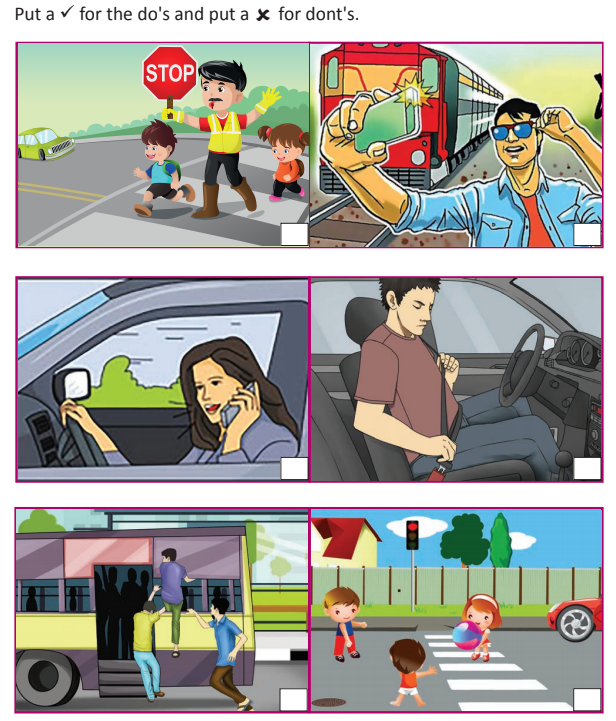
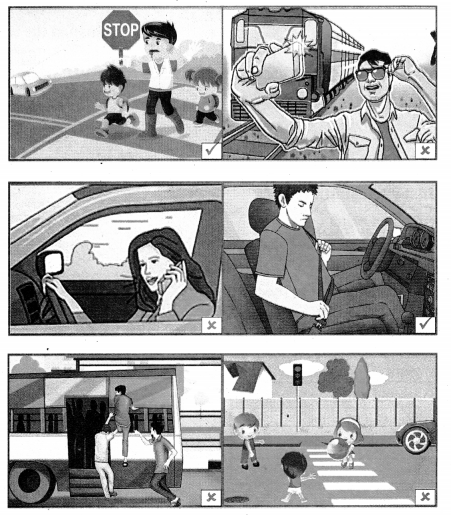
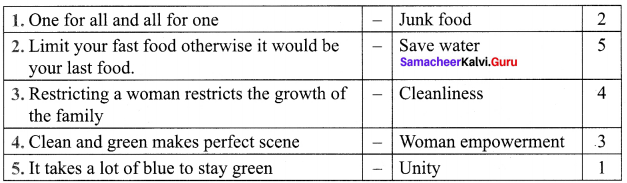
Put a ✓for the do’s and put a✗ for dont’s
When Instinct Works Samacheer Kalvi 8th English Solutions Term 1 Supplementary Chapter 3

Answer:
When Instinct Works Book Back Answers Samacheer Kalvi 8th English Solutions Term 1 Supplementary Chapter 3

When Instinct Works Additional Questions

I. Choose the Correct Answers (MCQ).

Question 1.
John harnessed black beauty to the ______ cart
(a) old
(b) broken
(c) new
(d) damaged
Answer:
(c) new

Question 2.
But the cart was so good and master drove
(a) strongly
(b) gently
(c) roughly
(d) harshly
Answer:
(b) gently

Question 3.
There were good sturdy on both sides.
(a) slabs
(b) pipes
(c) rails
(d) bamboos

Question 4.
He held my and calmed my nerves.
(a) bridle
(b) ears
(c) girdle
(d) band
Answer:
(a) bridle

Question 5.
The man at the toll gate was flashing a torch like a .
(a) foolish man
(b) mad man
(c) horrified man
(d) beggar man
Answer:
(b) mad man

Question 6.
Then an tree fell right across the road in front of them.
(a) Pine
(b) Cypress
(c) Ebony
(d) Oak
Answer:
(d) Oak

II. Identify the Character / Speaker.

  1. One morning in the autumn, my master had to go on a long journey”.
  2. I hope no branches fall down on us”.
  3. “I wish we were out of this wood”.
  4. “That was close! What shall we do now?”
  5. “Hoy, Hoy, Hoy, Stop!”.
  6. “You really are a beauty!”.
  7. “Go on, Beauty”.
  8. “There is something wrong sir”.
  9. “Are you safe, my dear?”.
  10. .I was grateful for everything for I was tired”.

Answer:

  1. Black beauty horse
  2. John
  3. Master
  4. Master
  5. The man at the toll gate
  6. John
  7. Master
  8. John
  9. Mistress
  10. Black Beauty (horse)

III. Write True or False against each statement.

1. Many of the houses were under water.
2. In one low part of the road, the water was halfway up to the knees.
3. The river was rising slowly.
4. Black Beauty had to wait for a long time in the town.
5. John praised Black Beauty.
Answer:
False
True
False
True
True

IV. Match the following.

1. The bridge(a) gently
2. Branches(b) trotted softly
3. Master drove(c) swaying like twigs
4. Black beauty(d) to greet master
5. Mistress ran out(e) broken in the middle

Answer:

  1. (e)
  2. (c)
  3. (a)
  4. (b)
  5. (d)

IV. Very Short Questions with Answers.

Question 1.
How did the high wheels roll?
Answer:
The high wheels rolled along so smoothly.

Question 2.
What were there on both sides of the bridge?
Answer:
There were good sturdy rails on both sides of the bridge.

Question 3.
What did the man at the toll gate say?
Answer:
The man at the toll gate said that the river was rising fast.

Question 4.
What did the master say to John?
Answer:
The master said that he had never been out in such a bad storm.

Question 5.
How were the branches swaying?
Answer:
The branches were swaying like twigs.

V.Short Questions with Answers.

Question 1.
What did John do to calm Black Beauty?
Answer:
John jumped out and in a moment was standing by the horse’s head. He held its bridle and calmed its nerves.

Question 2.
What did Black Beauty see in it’s master’s house after their return?
Answer:
Black Beauty saw that all the lights were on. As they came up to the door, the mistress ran out to greet the master.

VI. Paragraph Questions with Answers.

Question 1.
What happened when John, Black beauty and the master were returning home?
Answer:
When they were returning home late in the afternoon, the wind was much stronger and the great branches were swaying. The wind made a terrible rushing sound. Suddenly an oak tree fell in front of them. When Black Beauty came to the bridge, it sensed some danger. So it did not move forward. The man on the other side told them that the bridge was broken in the middle. All the three were saved by the wisdom of Black Beauty.

VIII. Rearrange the Jumbled Sentences.

A
1.Come on!, Beauty. Whats’the matter?’
2. Of course, I could not tell what the problem was, but I knew very well that the bridge was not safe.
3. He got down from the cart and came to my head.
4. He took hold of my bridle and tried to lead me forward.
5.”There is something wrong sir” said John.
Answer:
5, 3,4,1, 2
5. “There is something wrong sir” said John.
3. He got down from the cart and came to my head.
4. He took hold of my bridle and tried to lead me forward.
1. ‘Come on!, Beauty. Whats’ the matter?’
2. Of course, I could not tell what the problem was, but I knew very well that the bridge was not safe.

IX. Read the passage and answer the questions.

A.
One morning in the autumn, my master had to go on a long journey, John harnessed me to the new cart. I liked too pull as it was very light and the
high wheels rolled along so smoothly.

Question 1.
When did they go on a long journey?
Answer:
One morning in the autumn they went on a long journey.

Question 2.
Who harnessed Black Beauty to the new cart?
Answer:
John harnessed Black Beauty to the new Cart.

Question 3.
Was the cart light?
Answer:
Yes, the cart was light to pull.

B.
They went into the house and I heard no more. John took me to the stable. Oh! What a good supper he gave me that night. And then a really thick bed of straw. I was grateful for everything for I was tired.

Question 1.
Where did John take Black Beauty?
Answer:
John took Black Beauty to the stable.

Question 2.
What did he give him that night?
Answer:
He gave him a good supper and a thick bed of straw that night.

Question 3.
Why was Black Beauty grateful for everything?
Answer:
Black Beauty was grateful for everything because it was tired.

When Instinct Works Adapted From ‘Black Beauty” By Anna Sewell Summary

This lesson is about the special knowledge given to animals by God. The instinct in animals had saved the lives of men. One morning late in the autumn, John harnessed Black Beauty, the horse to the new cart. The Master, John and Black Beauty proceeded on a long journey. It was very windy and there was a great deal of rain. When they came to the entrance of the toll gate, the man at the toll gate warned them that the river was rising fast. Suddenly an oak tree came crashing down in front of them. The river was flooding and it grew darker. Black Beauty sensed danger, the moment its feet touched the bridge. It made a dead stop. The man at the other end of the toll gate flashed a torch and said that the bridge was broken in the middle. John praised Black Beauty for saving their lives. If the horse had not been wiser, they would have drowned. John gave a good supper and a thick bed of straw to the horse. Black Beauty was grateful for everything, as it was tired

Samacheer Kalvi 9th English Solutions Supplementary Chapter 6 Mother’s Voice

You can Download Mother’s Voice Questions and Answers, Summary, Activity, Notes, Samacheer Kalvi 9th English Book Solutions Guide Pdf Supplementary Chapter 6 help you to revise complete Tamilnadu State Board New Syllabus and score more marks in your examinations.

Tamilnadu Samacheer Kalvi 9th English Solutions Supplementary Chapter 6 Mother’s Voice

Mother’s Voice Supplementary In English

Mother’s Voice Warm Up:

If you are given an opportunity to go on a one-way trip to Mars, will you accept it? Discuss.
If given an opportunity to go on a one-way trip to Mars, I will not take it up since I am basically a timid person. When I am so frightened to travel by airplane, how will I travel to outer space!

Mother’s Voice Textual Questions

A. Choose the correct answer.

Mother’s Voice Summary Question 1.
Mother was excited because __________.
(a) her son would be home in the spring
(b) her son was coming back to earth
(c) it was her first visit to the moon
(d) her son was going to another galaxy
Answer:
(c) it was her first visit to the moon

Mother’s Voice Supplementary Paragraph Question 2.
On weekdays, as Mother went about the chores __________.
(a) she constantly thought of her son
(b) she was always tired
(c) her singing would be soft and almost inaudible
(d) her singing was muted and a little sad
Answer:
(d) her singing was muted and a little sad

Mother’s Voice Questions And Answers Question 3.
__________ occupies more than a hundred square kilometers on the moon.
(a) Selenopolis
(b) Metropolis
(c) Astrodrome
(d) Orchards
Answer:
(a) Selenopolis

Mother’s Voice Question 4.
The Community of Nations Square is where people __________.
(a) live on the moon
(b) work on the moon.
(c) walk on the moon
(d) of different nationalities come after work
Answer:
(d) of different nationalities come after work

Mother’s Voice Supplementary Summary Question 5.
They are planning an expedition to a neighbouring __________.
(a) galaxy
(b) country
(c) planet
(d) star
Answer:
(a) galaxy

Mother Voice Summary Question 6.
The mother was not able to understand why people wanted to leave the moon because __________.
(a) it was better to remain as a part of solar-system
(b) it was better to remain on the earth
(c) it was not possible to come back
(d) it was a place to enjoy life
Answer:
(a) it was better to remain as a part of the solar system.

Summary Of Mother’s Voice Additional Questions

Mothers Voice Question 1.
The mother wanted to know if her son would come during ………………. .
(a) Summer
(b) Autumn
(c) Winter
(d) Spring
Answer:
(b) Autumn

Mother’s Voice Supplementary Question 2.
His mother looked at the enormous lily-shaped tent over a ……………….. .
(a) Plate
(b) crater
(c) sheet of ice
(d) galaxy
Answer:
(b) crater

Mother’s Voice Lesson Plan Question 3.
His mom preferred River ……………………… than Selenopolis.
(a) Dnieper
(b) Pluto
(c) Ganges
(d) Miami
Answer:
(a) Dnieper

Mother’s Voice Book Back Answers Question 4.
Since the pond is deepend, there will be a lot of …………….. .
(a) fresh water
(b) moss
(c) mosquitoes
(d) fish
Answer:
(d) fish

Mother’s Voice By Vasil Summary Question 5.
The spaceships on the moon were readied for ……………….. .
(a) the scientists to travel.
(b) an expedition to the nearby galaxy
(c) the school students to explore
(d) a voyage around’ the moon.
Answer:
(b) an expedition to the nearby galaxy

B. Identify the character or speaker of the following lines.

  1. It’s so easy to walk here, son!
  2. They’re planning an expedition to a neighboring galaxy.
  3. Why should people go off into the unknown?
  4. I don’t know when we’ll see each other again.
  5. Operator on duty, ………. report to the office.

Answers:

  1. Mother
  2. Son
  3. Mother
  4. Son
  5. A voice from the loud Speaker

Mother’s Voice Summary By Vasil Berezhnoy Additional Questions:

Identify the character or speaker of the following lines.

Astronaut’s Mom to Son:

  1. I never realized it was such a beautiful place.
  2. Back home the orchards are in bloom.
  3. Will you come for a holiday in the summer?
  4. I’m sure it’s better in the river Dnieper.
  5. What are these?
  6. Of course, you will walk on the dewy grass.
  7. Why should people go off into the unknown?
  8. Do you know why people settle down on the Moon so easily?
  9. There will be a lot of fruits this year if only the frosts don’t strike.
  10. Why ask for trouble?
  11. These are very reliable spaceships.
  12. At least try to come in the autumn.
  13. They have deepened the pond.
  14. You could visit your friends and relatives.
  15. It’s full of fish now, you like fishing.

The young astronaut to his mother:

  1. That’s why I asked you to come.
  2. It’s easy to walk here but the distances are long.
  3. People of different nationalities who work in Selenopolis come here after work.
  4. Let’s ride for a bit.
  5. The Community of Nations Square.
  6. It’s quite an exotic experience to have a swim on the moon.
  7. Long-range spaceships They’re planning an expedition to a neighboring galaxy.
  8. You may be right, but
  9. How do I know?
  10. You think I don’t want to walk barefoot on the dewy grass?
  11. Coming
  12. These are very reliable spaceships.
  13. There are some tourists.
  14. Selenopolis occupies more than a hundred square kilometers.
  15. They are walking towards the lake.

C. Answer the following questions in about 100 -120 words.

Mother’s Voice Supplementary Story In Tamil Question 1.
Write a paragraph listing all the sentimental and the scientific reasons given by the mother against the expedition to the neighbouring galaxy.
Answer:
The mother’s sentimental and scientific reasons against the expedition to the neighboring galaxies are that the moon is a beautiful place, easy to walk on. There are lots of fruits on earth. The river Dnieper is better to swim. She asked her son why people should go off into the unknown and ask for trouble. She also suggested that it is advisable for people to settle on the moon first and then on the planets in the solar system.

She philosophized that the moon has the same gravitational field of their native earth, under the native sun. She sentimentally invited her son to come in the autumn for the apples, pears and the watermelons. She persuaded him to come to their deepened pond to fish and indicated that the pond was now full of fish.

Mother’s Voice Supplementary Theme Additional Questions:

Mother’s Voice 9th Supplementary Question 1.
Describe Selenopolis.
Answer:
Selenopolis is much easier to walk through though the distances are long. It occupies more than a hundred square kilometers. It’s a moving pavement covered with green plastic strips. These are rushed through echoing tunnels and spacious caves with walls sparkling in the light of the quartz lamps. There is a large lily-shaped tent over a crater, at least a kilometer in diameter. This was called, ‘The community of Nations Square.’ ‘People of different nationalities who work in Selenopolis and tourists go there to relax.

D. Think and answer.

“The explorer in this story is traveling to another galaxy. The final destination is an unknown ‘ planet in another galaxy. The travel will take many years”. What qualities and life skills do you think an explorer-like him must possess? Why? Do you have any of these skills and qualities? Explain.
Answer:
Space explorers work either as pilots who fly spacecraft or as mission specialists who conduct experiments. Regardless of their position, they need certain qualities to survive both NASA’s selection process and space travel itself. The qualities and life- skills needed are intelligence, adaptability, good physique, mental endurance and good ‘ knowledge. I have all these skills except the educational level which I would study as I grow up. ‘

Intelligence:
Astronauts need above-average intelligence and need quick thinking to A handle unexpected problems. They also need the intellectual creativity to dream up new avenues of space-based research into medicine, materials and processes for use N on Earth and in space. Curiosity is key, as are people skills and communication skills.

Adaptability:
Astronauts have many responsibilities in space. They need the flexibility to move from one task to another, different task. They also work on teams with astronauts from other countries and cultures, so they must be open-minded to diversity. They must be willing to change routines to accommodate new procedures.

Physical Condition:
The rigors of space travel are just about as intense as the rigors of space training. Astronauts need eyesight of20/100 or better uncorrected, correctable to 20/20 in each eye. Their blood pressure can’t be above 140/90. Candidates also must meet military water survival standards, which test for the ability to swim without stopping and to swim and tread water clothed in flight gear.

Astronauts also must be SCUBA-qualified to prepare for spacewalk training. Their bodies must respond well to high and low atmospheric pressures. They also must be prepared for the physical effects of zero gravity training up to 40 times a day. Space travel can last for months, during which the human body must function amid physical stress.

Mental Endurance:
Astronauts who make it through the physical demands of space travel must also grapple with isolation, fear and separation from loved ones. It’s not easy to live in close quarters with virtual strangers for three to six months or more. Astronauts must begin to cope with those long periods away from home during training, which takes two to three years and requires heavy travel to practice with international mission partners.

Education:
Astronauts need a bachelor’s degree from an accredited university in engineering, biological science, physical science and maths.

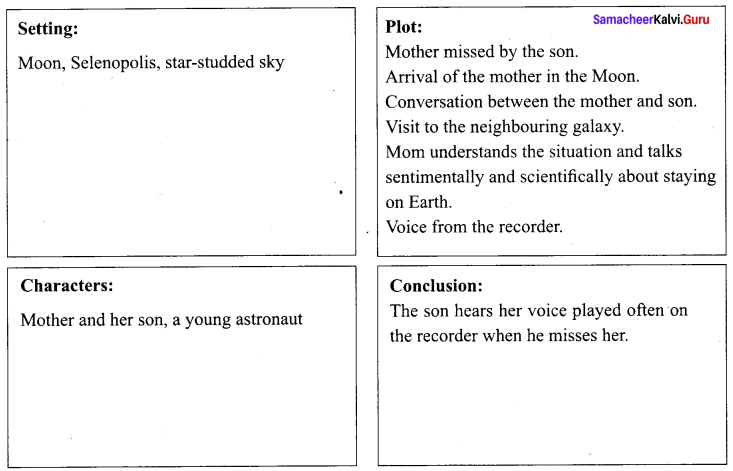
E. Based on the understanding of the story, discuss in groups and make a note of the following.

Mother's Voice Summary Samacheer Kalvi 9th English Solutions Supplementary Chapter 6

Mother's Voice Supplementary Paragraph Samacheer Kalvi 9th English Solutions Chapter 6

Mother’s Voice by Vasil Berezhnoy About The Author:

In 1972, a group of authors were awarded the Rudaki Prize of the Tajik SSR, which shows the importance of Soviet Literature and the role played by Science fiction. Vasil Berezhnoy was surely one among the group of authors.

Mother’s Voice Supplementary Summary:

Mother's Voice Questions And Answers Samacheer Kalvi 9th English Solutions Supplementary Chapter 6

This story revolves around the feeling of a young astronaut who has volunteered to explore the 1 galaxy beyond the one he lived in. The entire conversation between the mother and son is the recording that he hears now and then. The beginning of the story sees him taking his mother to the moon. He shows her around. They walk through the Selenopolis, seeing tall structures that have propped up the star-studded sky. The son listens to his mother’s voice that is so dear to him. She talks to her son about the orchards, the river Dnieper where he used to go for fishing, the apples, pears and melons, the walk on the dewy grasses, their relatives whom he may never meet if he goes for this expedition.

Yet she hopes that he will come and visit her during his vacation. She tells how the planet earth is so rich and beautiful with snow-covered peaks, that there can never be a place like the planet earth. This makes the son look at the earth with a newer vision and he understands that his mother is right. It is never going to be the same in another galaxy far away from home and his mother.

But, now he is helpless and cannot change his decision of coming back to earth. He goes on explaining the things happening on the moon; how people come to the ‘Community of Nations Square’ after work for relaxation. He tells about the spaceships which is fully equipped for this major expedition. The mother watches the rockets with people assembling for a take off, and asks her son why someone yearns to leave their home and go to another galaxy instead of being happy with their own.

She tries to pursue her son to quit from this mission even though she knew she may never see her son again. Just then a voice from the loudspeaker asks the astronaut to report to duty and he turns off the button and the screen becomes blank. He often plays this recording to be in that moment with his mother. This kind of expedition is the result of young curious minds and humanity.

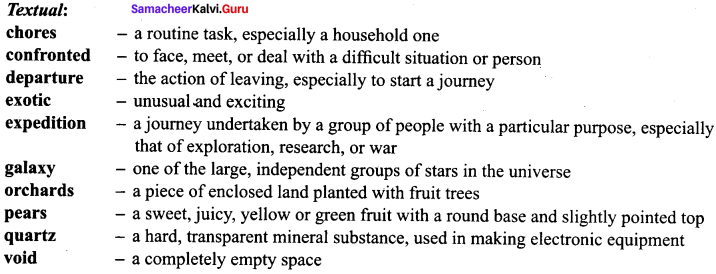
Mother’s Voice Glossary:

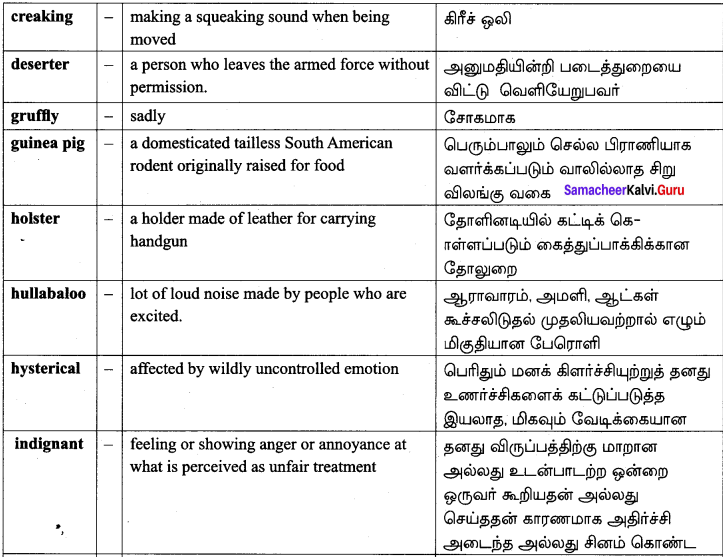
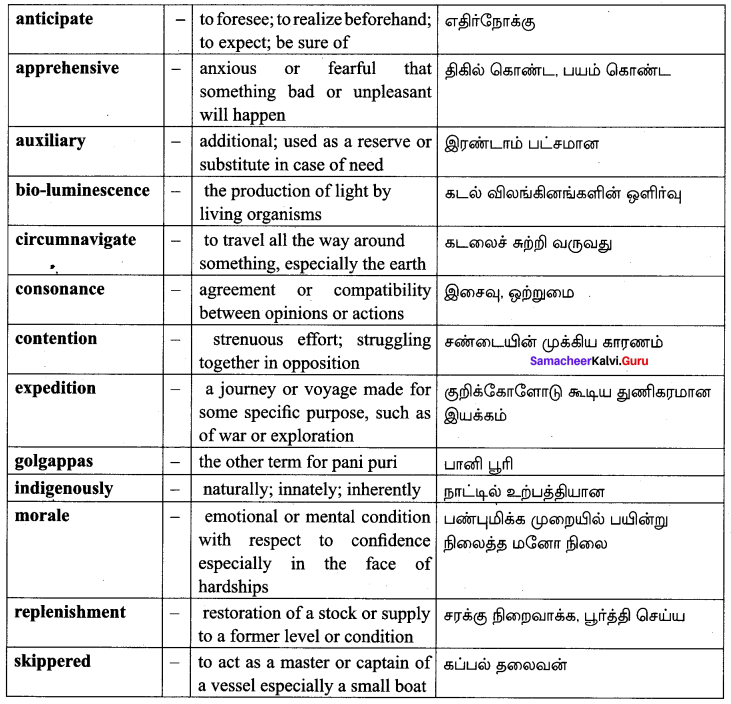
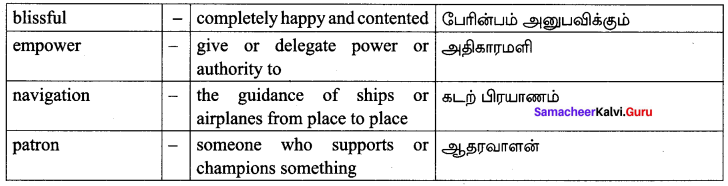
Mother's Voice Samacheer Kalvi 9th English Solutions Supplementary Chapter 6

Samacheer Kalvi 10th English Solutions Prose Chapter 2 The Night the Ghost Got in

Looking to improve English skills and gain more subject knowledge then the best resources that you can use here is Samacheer Kalvi 10th English Solutions for Prose Chapter 2 The Night the Ghost Got in Questions and Answers.

In the Samacheer Kalvi 10th English Guide for Chapter 2 The Night the Ghost Got in textbook solutions, subject experts covered all types of questions and answers related to the topics, quick notes, summary, solved & unsolved exercises, etc. If you are planning to prepare Chapter 2 The Night the Ghost Got in via textbook, then you’re suggested to go with this Samacheer Kalvi 10th English Book Solutions Questions and Answers PDF for better understanding and preparation.

Tamilnadu Samacheer Kalvi 10th English Solutions Prose Chapter 2 The Night the Ghost Got in

English Subject experts who are having max years of experience prepared this Tamilnadu State Board Solutions for 10th English Prose Chapter 2 The Night the Ghost Got in Questions and Answers. They have explained all the topics covered in the board prescribed latest syllabus in a simple way to understand easily. So, students can prepare Chapter 2 English from this Samacheer Kalvi 10th English Book Questions and Answers PDF. Download the Tamilnadu State Board 10th English Chapter 2 The Night the Ghost Got in Workbook Solutions PDF by accessing the below links and learn properly for the final exams to score well.

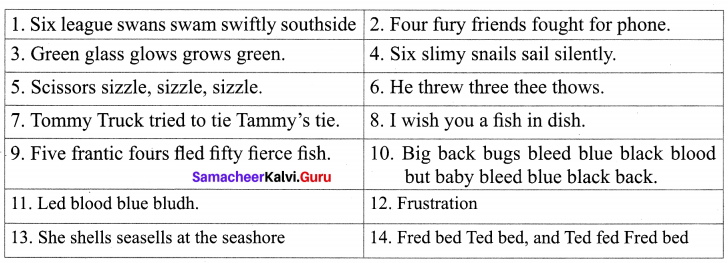
The Night the Ghost Got in warm up:

Use the following tongue twisters in a ‘Game of Telephone: where each student whispers the phrase to the next. The student who finishes the last says it aloud to the class. Let the students fill in the table given with what they listen to. They can get the help of their teacher

  1. Six sleek swans swam swiftly southwards.
  2. Four furious friends fought ur the phone.
  3. Green glass globes glow greenly.
  4. Six slimy snails sailed silently.
  5. Scissors sizzle, thistles sizzle.
  6. He threw three free throws.
  7. Tommy Tucker tried to tie Tammys Turtles tie.
  8. I wish you were a fish in my dish.
  9. Five frantic frogs fled from fifty fierce fishes.
  10. black bugs bleed blue black blood but baby black bugs bleed blue blood.
  11. Red blood blue blood
  12. Fresh registration… Fresh registration
  13. She sells seashells at the seashore
  14. Fred fed Ted bread, and Ted fed Fred bread

The Night The Ghost Got In Questions And Answers Samacheer Kalvi 10th English Solutions Prose Chapter 2Answer:
The Night The Ghost Got In Summary Samacheer Kalvi 10th English Solutions Prose Chapter 2

I hope you ended with a delightfully tangled whole new tongue twisters.

The Night the Ghost Got in InText Questions

a. Where was the author when he heard the noise?
Answer:
The author had just stepped out of the bathtub, when he heard the noise.

b. What did the narrator think the unusual sound was?
Answer:
At first, he thought it was his father or his brother Roy. Next, he suspected that it was a burglar. Later on, he thought that it was a ghost.

c. What were the various sounds the brothers heard when they went downstairs?
Answer:
The brothers heard like a man running and started up the stairs towards them. They thought that they were coming two at a time. They saw nothing, but only heard the steps.

d. Who were the narrator neighbors?
Answer:
The narrator’s neighbors were a retired engraver named Bodwell and his wife.

e. How did the Bodwells react, when a shoe was thrown into their house?
Answer:
Mr. Bodwell was shouting, frothing a little and shaking his fist. Mrs. Bodwell wanted to sell their house and go back to Peoria. For some years, he had been in a bad way and was subjected to mild attacks.

f. What did the Bodwells think when they heard the mother shout?
Answer:
Bodwell thought that there were burglars in his house when they heard the mother shout.

g. What was the grandfather wearing?
Answer:
The narrator’s grandfather was wearing a long flannel nightgown over long woollen pants, a nightcap and a leather jacket around his chest.

h. What conclusions did grandfather jump to when he saw the cops?
Answer:
His grandfather was going through fits where he believes he is in the war. He thinks that General Meade’s men are deserting under fire from Stonewall Jackson.

i. Were the policemen willing to leave the house?
Answer:
No, the policemen were not willing to leave without getting their hand on somebody besides grandfather.

j. What made the reporter gaze at the author?
Answer:
The author had put on one of his mother’s dress, as he couldn’t find anything else. The reporter looked at him with mingled suspicion and interest.

The Night the Ghost Got in Textual Questions

A. Answer the following questions in a sentence or two.

The Night The Ghost Got In Questions And Answers Question 1.
Why was the narrator sorry to have paid attention to the footsteps?
Answer:
The imagination of the ghost getting into his house lead to a commotion. It caused his mother to throw a shoe through a window of the neighbouring house. It ended with his grandfather shooting a policeman. So the narrator was sorry to have paid attention to the footsteps.

The Night The Ghost Got In Summary Question 2.
Why did Herman and the author slam the doors?
Answer:
Herman and the author slammed the doors because they thought that someone was coming up their stairs. They were scared as they heard the steps of someone.

10th English Unit 2 Prose Question Answer Question 3.
What woke up the mother?
Answer:
The slamming of the doors had awakened their mother.

10th English The Night The Ghost Got In Question Answer Question 4.
What do you understand by the mother’s act of throwing the shoe?
Answer:
His mother enormously fancied the thrill of throwing a shoe through a glass window of her neighbour. She is a highly excitable woman.

The Night The Ghost Got In Question 5.
Why do you think Mrs. Bodwell wanted to sell the house?
Answer:
Mrs. Bodwell wanted to sell the house, as she wanted to go back to Peoria, due to the frequent mild attacks.

10th English The Night The Ghost Got In Question 6.
How did the cops manage to enter the locked house?
Answer:
The cops managed to enter the locked house by breaking the glass of the front door.

The Night The Ghost Got In Paragraph Question 7.
Why were the policemen prevented from entering grandfather’s room?
Answer:
The policemen were prevented from entering into grandfather’s room because the narrator realized that it would be bad if they do so. His grandfather was going through a phase, in which he believed that General Meade’s men were beginning to retreat. They were under the control of Stonewall Jackson.

The Night The Ghost Got In Pdf Question 8.
Who used the zither and how?
Answer:
Zither was used by the guinea pig to sleep on it. It would never sleep anywhere except on the zither.

Question 9.
Mention the things that the grandfather imagined.
Answer:
His grandfather imagined that the cops were deserters from Meade’s army. He thought that they were trying to hide away in his attic.

Additional Questions

Question 1.
Who is Mr. Bodwell?
Answer:
Bodwell is Thurber family’s neighbour, a retired engineer. He is “subject to mild ‘attacks,’” like most people whom the family knows.

Question 2.
How does Mr. Bodwell react to the shoe thrown by Mrs. Thurber?
Answer:
When the narrator’s mother throws a shoe through the Bodwells’ window and says there are burglars in the house, Bodwell is momentarily confused, thinking that the burglars are in his house, before understanding the truth and alerting the police.

Question 3.
Who is the only cop referred by name and what does he do?
Answer:
The only policeman referred to by name is Joe. He examines an old zither with another policeman.

Question 4.
Why does Joe mock the policeman who wants to retrieve his gun from the grandfather?
Answer:
When the policeman talks bravely about going to retrieve his gun from the grandfather, Joe mocks him because he feels it’s dangerous to approach an armed and unstable suspect.

Question 5.
Who is Herman? Comment on his personality.
Answer:
Herman is the brother of the narrator, James Thurber. He generally sleeps uneasily, always fearful that something might come and “get him” in the night. When the narrator wakes him and he hears the sounds in the dining room, he runs back into his room and slams the door showing what a timid boy he can be.

Question 6.
Who is the Zither-cop? Why is he called so?
Answer:
One of the policemen who search through the house finds an old zither and strums it in curiosity. The story later refers to this officer as “Zither,” as well as “the zither- cop.”

Question 7.
Why were the policeman prevented from entering grandfather’s room?
Answer:
The zither-cop was shot at by the grandfather because he was the first to go up the stairs when they heard the sound of a creaking in the attic caused by the grandfather turning in the bed.

B. Answer the following questions in about 100-150 words.

Question 1.
Describe the funny incident that caused the confusion in the house.
Answer:
James, the author comes out of the bathroom, drying him she dining table. He wakes up his brother Herman. They both listen to the footsteps and gets scared. Their mother wakes up. When she comes to know lf. At that moment, he hears the footsteps of someone walking downstairs near the she alerts her neighbour to call the police. The police arrive with some reporters.

They search all over, upstairs and downstairs. When they find nothing, they rush to the attic. The narrator’s grandfather believes that he is still in the war. He thinks that the policemen are deserters. So he starts shooting at them. The policemen leave their house immediately, creating a lot of confusion everywhere.

Question 2.
Narrate the extensive search operation made by the policemen in the house.
Answer:
The police were on hand in a commendably short time. They began banging at the narrator’s front door. When nobody responded, they broke into the house. They searched downstairs and upstairs messing up everything. They opened all the doors and windows. They pulled the drawers and furniture. They began to ransack the floor, pulled beds away from the walls, tore clothes off the hooks in the closets.

They also pulled suitcases and boxes off the shelves. Later, they heard some creaking in the attic. They stepped into the attic. As his grandfather thought that they were the deserters from Meade’s army, so he started shooting at them. Then he went back to bed. The cops were unwilling to leave without getting their hand on somebody. They felt it was a defeat for them. They began to poke into things again and finally left the place.

Additional:

Question 1.
What do you know about James Thurber, the narrator?
Answer:
The narrator James Thurber, presents himself as acting judiciously, although his actions are uncommon to raise the uncertainties of the policemen. He is the first person in the household to hear the mysterious sound, as he is stepping out of the bathtub at 1:15 a.m. on November 17th. After waking his brother Herman, he is the one who resolves that the reason of the sound downstairs must be an apparition.

When his hasty mother decides that the sounds must be caused by intruders, the narrator thinks that she is past reasoning. Even when the cops arrive, he is still wrapped in a towel from his bath. Later, when the reporter comes around asking questions, the narrator puts on one of his mother’s blouses, explaining that it is the only thing that he can find at the moment.

He chooses to be honest with the reporter and tell him that the problem was caused by ghosts, but the reporter does not take him earnestly. Later, when the policeman who has been shot by Grandfather wants to challenge him and take his gun back, the narrator mediates with composed receptivity and offers to take the gun over to the police station in the morning.
“A judicious reticence is hard to learn, but it is a lifetime lesson.”

Question 2.
What is the theme of the story, ‘The Night the Ghost got in’ by James Thurber?
Answer:
The theme of the story, ‘The Night the Ghost got in’ by James Thurber is surely of a supernatural kind. This story asks readers to accept the existence of the ghost mentioned in the title as a believable one. Many a time, ghost stories offer readers a sign for a common explanation for the events that the characters themselves trust are triggered by the bizarre scenario.

Although it seems very unlikely that a real ghost would have generated a commotion in the house, Thurber gives readers distressing indication that the sounds that he heard were undeniably supernatural. For example, the police thoroughly investigate the house and say that all the doors and windows are locked from inside and nothing in the house is said to have been taken by burglars. The father and brother Roy, who are at first expected do have come home from Indianapolis early, do not feature in the play and are just characters mentioned during conversations.
“The human mind delights in grand conceptions of supernatural beings.”

Question 3.
Bring out the character of the grandfather and the mother in the lesson, ‘The Night the Ghost got in’.
Answer:
The narrator’s grandfather is an old- timer of the Union army of the Civil War, which terminated about fifty-two years ago. His bedroom is in the attic. When the police come to the house to search for the burglar, the grandfather thinks that they are militaries who are abandoning because they are losing to the South. The grandfather calls them “cowardly dog” and “lily-livered cattle” and then fetches a policeman’s holster and shoots a man with his own gun.

The police retreat, terrified of the irrational old man but at the breakfast table the next morning, Grandfather seems impeccably conscious of the previous night’s situation, asking why so many police had been “tanyhootin” around the house. On the contrary, the narrator’s mother, Mrs Thurber is a highly excitable woman, scatter brained yet practical at times.

Hearing a sound in her house and suspecting a burglar, she thinks of the clever plan of alerting Mrs and Mr. Bodwell the neighbours by throwing a shoe through his closed window. After he goes to alert the police, she considers throwing the matching shoe, a thrill and fanciful act. She is surprised to hear that Grandfather has shot a policeman, not because of the courageous ferocity of the act, but because the cop was such a nice-looking young man.
“Great powers don’t get angry Nor do they act in haste!”

Vocabulary:

C. Look at the following expressions from the text. With the help of your teacher rewrite them in standard English. One has been done for you.

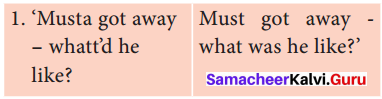
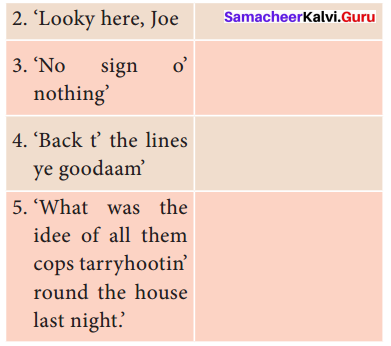
10th English Unit 2 Prose Question Answer Samacheer Kalvi The Night The Ghost Got In
10th English The Night The Ghost Got In Question Answer Samacheer Kalvi Chapter 2
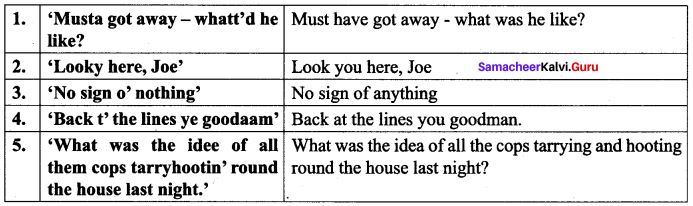
Answer:
The Night The Ghost Got In Samacheer Kalvi 10th English Solutions Prose Chapter 2

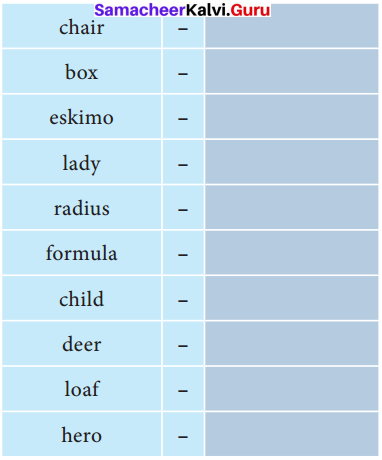
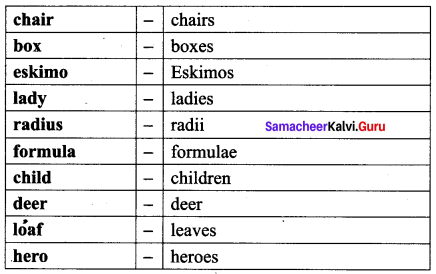
D. Complete the given tabular column with the suitable plural forms.

10th English The Night The Ghost Got In Samacheer Kalvi Prose Chapter 2
Answer:
The Night The Ghost Got In Paragraph Samacheer Kalvi 10th English Solutions Prose Chapter 2

Listening Activity:

E. Listen to the story and answer the following.

A Short Story : Three Simple Rules This Short Story Three Simple Rules is quite interesting to all the people. Enjoy reading this story. Once there was a rich man in Thailand. His name was Chulong. He was a very rich man. Yet he wanted more riches, more money. One day he was walking in his garden. He saw a strange bird in a bush. It was very small. But it had very beautiful and colorful features. Its voice was also very sweet. Chulong had never seen such a bird in his life. He slowly went near the bush unseen. He caught the bird. Now the bird began to speak.

“Why have you caught me?” the bird asked. “I want to make money. I can sell you for a big amount,” replied Chulong. “But you are already rich. Why do you want more?” asked the bird. “Because I want to become richer and richer,” replied Chulong. “But do not dream of making .

money through me!” said the bird. It further added, “You cannot sell me. Nobody will buy me, because, in imprisonment, I lose my beauty and my sweet voice.” Then it slowly turned into a black bird. The beautiful features were now looking like the feathers of a crow. Chulong hopes of making money were shattered. He said angrily, “I will kill you, and I will eat your meat.” “Eat me! I am so small. You will not get any meat out of me,” replied the bird.

Chulong could not answer. The bird then suggested, “Well set me free. In return I shall teach you three simple but useful rules.” “What is the use of the rules? I want only money,” said Chulong. He was irritated. “But these rules can profit you greatly,” added the bird. “Profit me! Really? Then I shall set you free. But how can I trust you? You may fly away,” said Chulong. “I give you my word. And I always keep my word,” said the bird. Chulong wanted to take a chance.

He released the bird. It flew up at once. Then it sat on the branch of a tree. Its color started changing. It became beautiful again. Chulong asked, “Now teach me the rules.” “Certainly,” said the bird. Then it added, “The first rule is Never Believe everything others say. The second rule is Never be sad about something you do not have. The third rule is Never throw away what you have in your hand.” “You silly bird,” shouted Chulong. And he added, “These three rules are known to everyone.

You have cheated me.” But the bird said, “Chulong, just sit down for ” a while. Think about all your actions of today. You had me in your hands, but you threw me away (released me). You believed all that I said. And you are sad about not having me. The rules are simple. But you never followed them. Now do you see the value of the rules?” so saying the bird Threw away and disappeared from his sight.

Question 1.
The rich man was from
(a) Nagaland
(b) Thailand
(c) Finland
Answer:
(b) Thailand

Question 2.
Where did Chulong catch the bird?
Answer:
Chulong caught the bird in a bush in his garden.

Question 3.
Why did Chulong catch the bird?
Answer:
Chulong caught the bird because it was strange and small and would surely fetch him good •money.

Question 4.
What will happen to the bird in imprisonment?
Answer:
The bird in imprisonment will lose its beauty and sweet voice.

Question 5.
What did the bird suggest Chulong, in exchange for its freedom?
Answer:
The bird in exchange for its freedom suggested to Chulong three simple, yet useful rules.

Question 6.
Does Chulong want to earn money honestly?
Answer:
No, he did not want to earn money honestly.

Question 7.
What were Chulongs plans for the bird?
Answer:
Chulong wanted to sell the bird and earn good money.

Question 8.
Who is wise according to you?
Answer:
The bird is wise according to me.

Question 9.
Is the bird a crow?
Answer:
No, the bird isn’t a crow.

10. What are the three rules given by the bird?
Answer:
The three rules given by the bird are:

  1. Never believe everything others say.
  2. Never be sad about something you do not have.
  3. Never throw away what you have in your hand.

Speaking Activity

F. Quiz: Who am I ?
Sample questions to ask. Answers must be ‘yes’ or ‘no’ only.

  1. Are you a male (female)?
  2. Are you young (old)?
  3. Are you a famous personality?
  4. Are you alive now?
  5. Are you a singer (dancer, actor)?
  6. Does your name start with ‘……………’ ?
  7. Are you a historical figure?
  8. Is he/she ………………. ?

G. Use this passage to play the game. You can collect information on other famous personalities and play too.
The Night The Ghost Got In Pdf Samacheer Kalvi 10th English Solutions Prose Chapter 2
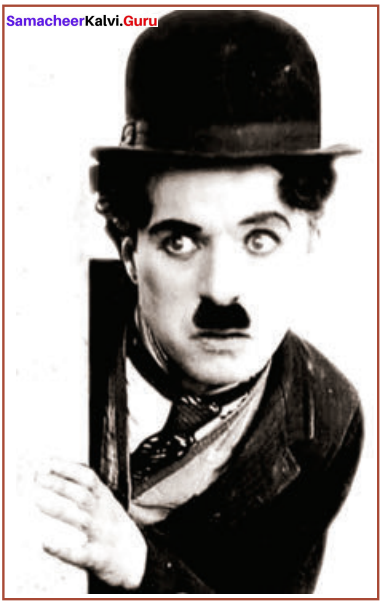
Charlie Chaplin was bom on April 16, 1889, in London England. His birth name was Charles ‘ Spencer Chaplin, though he had many nicknames growing up such as Charlie, Chariot, and The Little Tramp. His father, Charles Chaplin, and his mother, Hannah Chaplin, were inducted into the music hall of fame, leading the way to his exposure even as a young boy.

His first on stage moment was when he was 5 years old; he sang a song that was intended to be sung by his own mother; she had become ill at the time of the performance, so little Charlie Chaplin stood instead and performed for his mother. Charlie Chaplin came to the United States in 1910, at the age of 21. He was brought to New York, which was known to be a great place to start out for anyone trying to become a professional actor. Two years later, in 1913, Chaplin signed his very first contract at Keystone and it was no time before he headed to Hollywood. His first movie premiered in 1914, “Making a Living,” and went on to make over 35 movies total in that year alone.

Charlie Chaplin grew to become one of the most popular and successful actors of all time. The moment that really kicked off his long career was in 1921 when he starred in, and produced, his first full length film called “The Kid.” From then on, most people all over the world knew Charlie Chaplin and loved his movies. He had a great career and life, dying on December 25, 1977, in Vevey, Switzerland. He had apparently died of natural causes in his sleep from old age.

Give Answers:
Is the personality a female character? No
Is he a political figure? No
Is he from the Film Industry? Yes
Is he a comedian? Yes
Is he from India? No
Is the person alive? No
Is he an artist from his childhood? Yes

Reading:

H. Read the following incident carefully to answer the questions that follow.

The tie that does not bind
“Oh, so you’re going abroad? Can you bring me back ?” I’ve been asked to bring back a vaccine for a course. Once I searched the suburbs of Paris for two days for a special brand of ceramic paint. Having spent a lot of money for Cartier lighter refills, I had them confiscated at the airport just before boarding because the gas might be dangerous in the air.

Now, two months before a trip, I stop talking to people so they won’t suspect I’m about to travel. But someone always catches me.” I’ve heard you’re going to New York, and I want you to get something for me. It’s just a little thing you can find anywhere. I don’t know exactly how much it costs, but it shouldn’t be much. We’ll settle up when you get back”.

What Gilson asked me to buy was, in fact a little thing: a tie. But not just any tie. He wanted a tie with a small embroidered G. Any colour would do, as long as it had his initial. Look , this is a special flight, I explained . We are only staying Saturday through Tuesday. On the day we arrived I didn’t have time to think about the tie, but strolling around on Sunday I did see ties bearing various letters in more than one shop window. They were cheap, just a dollar, but all the shops were closed.

On Monday, lunch lasted the whole afternoon. Then it was Tuesday morning, time to leave. It was only when I saw our airport bus waiting outside the hotel that I remembered the tie. I told the group to go on. I would get a taxi to the airport. And so I went in search of a nearby shop where I had seen ties.

But I couldn’t find it. I walked further down the street-one, two, three blocks – all in vain. Back at the hotel, a bit anxious now, I took my suitcase, got a taxi and asked the driver to rush to the street where I had seen them. The driver stopped at each shop we passed so I could look from the window.

The stores had all sorts of ties, but not the kind I was looking for. When I finally thought I had located the right shop, I decided to go in and check. The driver refused to wait. Parking was prohibited, he said. I promised to double the fare, jumped out and ran into the shop. Was I going to miss the plane just for a damned tie?

The salesman was unbearably slow. When I realized that the smallest change I had was a ten dollar note , I grabbed ten ties of different colours so I wouldn’t have to wait for change. I rushed out with the ties in a paper bag. On the street I looked around. The taxi had vanished, taking my suitcase. What is more, I was going to miss the plane.

I ran to the comer, and hope flared up again: the taxi was waiting in the next street. Quick to the airport! As I settled down inside the taxi. I sighed with relief. Gilson was going to have enough initialized ties to last him a lifetime.

When I reached the airport, I paid the taxi driver the double fare and grabbed my suitcase. Panting, I boarded the plane under the reproachful gaze of the other passengers, all primly seated with their seat belts fastened. Ready to take off. Departure had been delayed because of me.
“At least I hope you found your tie”, said one who knew the story.
“I did”, I answered triumphantly.
After making myself comfortable, I reached for the paper bag to show the ties.
I had left it behind; in the taxi.

Question 1.
What was the writer always asked to do whenever he planned to go abroad?
Answer:
Whenever the writer planned to go abroad, he was always asked to buy something or the other like a vaccine for a course, a special brand of ceramic paint, Cartier lighter refills and so on.

Question 2.
What did Gilson want the writer to bring for him?
Answer:
Gilson wanted the writer to bring a tie with a small embroidered G on it.

Question 3.
When did the writer remember the fact that he had to buy something for Mr. Gilson? The writer remembered the fact that he had to buy
Answer:
something for Mr. Gilson only on Tuesday when it was time to leave.

Question 4.
Why were the other passengers in the flight gazing at the writer?
Answer:
The other passengers in the flight gazed at the writer since the flight was delayed because of him.

Question 5.
What is the humour element in the above incident?
Answer:
The humour element in the above accident is that after all the frantic search for the tie and purchasing ten of them to avoid the trouble of getting back the change, the writer had left it – behind in the taxi for which he had also paid double the fare.

I. Suggesting titles.
Title summarises the story. Each paragraph is a part of the story. Look at the following expressions and find out the paragraphs that best suit these expressions.

  1. Oh, No! But it happens! Paragraph 1
  2. Don’t let out your travelling dates Paragraph 2
  3. Anyway, people will be people Paragraph 3
  4. Search begins Paragraph 6
  5. Things are not that easy Paragraph 7
  6. Hurry invites worry Paragraph 10

J. Look at the following situations the writer was in. He could have avoided the situation and saved himself. Glance through the write up again and comment on what the writer should have done in the following situations.

1. Gilson asked the writer to bring a tie.
He should have politely refused stating it was a business trip.

2. On the day of arrival, the writer had no time to think about the tie.
The writer should not have felt guilty since he was busy.

3. The writer remembered about the tie when the bus was leaving for the airport.
He should have stopped being courteous and proceeded to the airport with others.

4. The writer walked down in search of the shop.
When he couldn’t find the shop with ties he was looking for, he should have not searched for it in other shops.

5. The writer rushed out with the tie in a paper bag.
The writer should have kept the paper bag inside his suitcase as soon as he got into the taxi.

K. State whether the following statements are true or false.

  1. The narrator searched for three days to buy ceramic paint. [False]
  2. The author was going to New York. [True]
  3. Gilson asked the narrator to buy a tie. [True]
  4. The taxi driver took away the narrator’s suitcase. [False]
  5. Departure was delayed because of the author. [True]
  6. The author left the ties in the taxi. [True]

M. Write a speech for your school Literary Association celebration with the given lead.

Samacheer Kalvi 10th English Solutions Prose Chapter 2 The Night the Ghost Got in 9

Writing:

Good morning to one and all present here, it is indeed my privilege to stand before you as the Secretary of the Literary Association. It was formed to stimulate and motivate the young minds to perform challenging activities and become good orators, dramatists, poets and also be short story writers. The purpose is mainly to enhance the literary, aesthetic and communicative skills among students. You are the pillars of the future society. The advancement of the society lies in your hands.

Communication skills is vital for the development of an individual or a society. Thereby, every year informative programmes are conducted to enhance the language skills and dramatic talents. Students are provided a platform to nurture and exhibit their innate potentials. We request you to unleash the hidden potentials and bring out the latent abilities. Explore the world around and experience a different environment. I am sure, each one of you will have a story to share about the learning experiences in this Literary Association. Wishing you a challenging journey for a lifetime experience. Thank you.

Grammar:

A. Na’garajan and Dhanalakshmi want to buy a new house. They have come to see a house for sale. Complete the conversation below by adding a, an or the.

Nagarajan : Well, here we are, No. 8, Kaveri Street. I think this is …………………. (a)…………… house we saw online. What do you think of ………….. (b) ………….. location?
Dhanalakshmi : It is in …………….. (c) ……………….. nice neighbourhood. And it’s close to the railway station.
Nagarajan : And …………….. (d) …………….. bus stop is not too far away
Dhanalakshmi : How many rooms are there?
Nagarajan : There are three rooms, ………………….. (e) kitchen and ……………….. (f) …………………balcony.
Dhanalakshmi : There is ………………….. (g) ………………. lawn behind ………….. (h) …………………. house, right?
Nagarajan That’s right …………….. (i) ……………….. lawn is actually quite large. Did you see any photos of ……………… (j) ……………….. living room, online? What does it look like?
Dhanalakshmi : …………………. (k) ………………… living room looks great. It looks bright and airy. It has …………………. (l) …………………. nice view of ………………… (m) ………………… hills. But …………….. (n) …………. kitchen looks ……………… (o) …………….. little small.
Nagarajan : And, I remember you said there isn’t …………… (p) ………….. store room, right?
Dhanalakshmi : No, but there is …………… (q) …………… attic, where we can store things.
Nagarajan : I hope this house is ……………(r) ……………. better option.
Dhanalakshmi : let’s wait for …………(s) ……………….. real estate agent. She said, she would be here at three o’clock.
Nagarajan : Look there she is!
Answers:
(a) the, (b) the, (c) a, (d) the, (e) a, (f) a, (g) a, (h) the, (i) The, (j) the, (k) The, (l) a, (m) The, (n) the, (o) a, (p) a, (q) an, (r) a, (s) the

B. Few articles are missing in the given passage. Edit the passage given below by adding suitable articles wherever necessary.

My neighbourhood is very interesting place. My house is located in apartment building downtown near many stores and offices. There is small supermarket across street, where * my family likes to go shopping. There is also post office and bank near our home. In our neighbourhood there is small, Green Park where my friends and I like to play on weekends and holidays. There is small pond near park and there are many ducks in park. We always have great time. In addition there is elementary school close to our home where my little brother studies in third grade. There are so many things to see and do in my neighbourhood that’s why I like it. It’s really great place.
Answer:
My neighbourhood is a very interesting place. My house is located in an apartment building downtown near many stores and offices. There is a small supermarket across the street, where my family likes to go shopping. There is also a post office and a bank near our home. In our neighbourhood there is a small, Green Park where my friends and I like to play on weekends and holidays. There is a small pond near the park and there are many ducks in the park. We always have a great time. In addition there is an elementary school close to our home where my little brother studies in third grade. There are so many things to see and do in my neighbourhood. That’s why I like it. It’s really a great place.

C. Refer to the dictionary to find out the meaning of the following prepositions and match them with the correct meaning.

Samacheer Kalvi 10th English Solutions Prose Chapter 2 The Night the Ghost Got in 10

D. Fill in the blanks by choosing the most appropriate prepositional phrase from the given options.

1. Everything falls to the ground …………………. earth’s gravitational pull.
(a) in addition to
(b) because of
(c) cause of
Answer:
(b) because of

2. The trial was conducted ………………. the procedure of law.
(a) in accordance with
(b) due to
(c) despite of
Answer:
(a) in accordance with

3. There is a temple right …………. my house.
(a) in back of
(b) apart from
(c) in front of
Answer:
(c) in front of

4. As a ……………….. of his hard work, he achieved the target.
(a) instead of
(b) result of
(c) apart from
Answer:
(b) result of

5. Failure is often the ………………. negligence.
(a) effect of
(b) consequence of
(c) reason of
Answer:
(b) consequence of

6. Children are given toys ………………. sweets on Children’s day.
(a) on top of
(b) in addition to
(c) due to
Answer:
(b) in addition to

7. The parents must be informed …………………… any indiscipline conduct of their wards.
(a) because of
(b) in case of
(c) in spite of
Answer:
(b) in case of

8. He didn’t turn up ……………………… his busy schedule.
(a) consequence of
(b) due to
(c) except for
Answer:
(b) due to

9. Global warming is ……………………. the green house emission.
(a) an effect of
(b) in spite of
(c) in addition to
Answer:
(a) an effect of

10. ……………… several warnings, he continued to swim.
(a) due to
(b) in spite of
(c) because of
Answer:
(b) in spite of

E. Edit the following passage by replacing the underlined incorrect words with correct prepositional phrases.
1. Janu is studying in class X. In the event of the teachers.
According to the teachers, Janu is studying in Class X.

2. she is a disciplined student. In addition to her poverty, she …………….. .
In spite of her poverty, she is a disciplined student.

3. is always neat. Many students like her in case of …………….. .
Because of her neatness, many students like her.

4. her simplicity. According to her studies, she also ………………. .
Apart from her studies, she is also known for her simplicity.

5. participates in sports. She gets on with everyone in case of ………….. .
She gets on with everyone in spite of her participation in sports.

6. age and gender in the school. In opposition to taking leave, she ensures …………….. .
Due to her opposition to take leave, she ensures her age and gender in the school.

7. that she completes the work given before she goes to school next day.
On account of completing the work given before, she goes to school the next day.

The Night the Ghost Got in by James Thurber:
James Thurber was born on December 8, 1894, in Columbus, Ohio. He was an American cartoonist, author, humourist, journalist, playwright, and celebrated wit. He worked for the New Yorker from 1927 to 1933 and continued contributing stories and drawings to it for the rest of his life, becoming one of America’s most treasured humourists. He was best known for, “The Catbird Seat”. As the sight in Thurber’s good eye failed, his literary production dwindled. Thurber fell into alcoholism in his later years and died of pneumonia following a stroke on November 2, 1961.

The Night the Ghost Got in Summary:

Samacheer Kalvi 10th English Solutions Prose Chapter 2 The Night the Ghost Got in 11

Introduction:
Imagination of odd things leads to absolute humourous drama making everybody confused. This story makes us laugh at the confused family members whose imagination creates a chaos ultimately for nothing that made everyone spend a sleepless night. Let us enjoy the sequence that happened inside a house due to each persons’ different imaginations.
Samacheer Kalvi 10th English Solutions Prose Chapter 2 The Night the Ghost Got in 12

Confusion over foot steps:
The narrator, James Thurber, comes out of his bathtub in the bathroom at 1:15 a.m. in the morning, on November 17th, 1915 and hears footsteps going round and round the dining room, downstairs. At first, James thinks the footsteps might belong to his father and brother Roy, who had been traveling in Indianapolis and were supposed to be back late in the evening. James quickly realizes that it isn’t his father and brother.
Samacheer Kalvi 10th English Solutions Prose Chapter 2 The Night the Ghost Got in 13

Brother Herman Wakes Up
After a few minutes, he fears something strange and goes to wake up his brother, Herman. Waking up all of a sudden in the middle of the night, Herman is frightened to know of someone downstairs as stated by his brother. He goes back to bed, slamming the door.
Samacheer Kalvi 10th English Solutions Prose Chapter 2 The Night the Ghost Got in 14

Mother’s fear for Burglar’s
The slamming of the door makes their mother come out of her room. The mother asks them about the footsteps she has heard and then comes to the conclusion that there are burglars inside their house.
Samacheer Kalvi 10th English Solutions Prose Chapter 2 The Night the Ghost Got in 15

Agitated neighbours
As the telephone is in the dining area, she plans to contact the police through her neighbour and throws a shoe through the window of the Bodwell’s. They are cross with her behavior. However, Mr.Bodwell mistakes for burglars in his house. The confusion is cleared and he calls the police and tells them about the burglars in Thurber house.
Samacheer Kalvi 10th English Solutions Prose Chapter 2 The Night the Ghost Got in 16

Arrival of Police
A whole lot of police in a Ford Sedan, two on motorcycles, and a patrol wagon with about eight policemen and a few reporters creates more chaos and confusion. They call out for the inmates and when no one responds, they break in. They find the narrator upstairs with a towel round his waist and the mother who is certain of burglars in the house. Though all doors and windows are bolted from inside, to justify their trip, the police set about searching the house, moving furniture and cleaning closets.
Samacheer Kalvi 10th English Solutions Prose Chapter 2 The Night the Ghost Got in 17

Police are suspicious
At one point, a policeman’s inquisitiveness gets the best of him, and he points out a rare old musical instrument, a zither, to another officer. The narrator adds to the confusion with the inadequate information about the family’s old guinea pig which used to sleep on the zither. The police are suspicious of this strange family.
Samacheer Kalvi 10th English Solutions Prose Chapter 2 The Night the Ghost Got in 18

Grandfather’s obsession
Just when the police decide to retire, the narrator’s grandfather sleeping in the attic makes a slight noise and the policemen spring into action. They race upstairs to catch the culprit. The narrator knows that this will lead to worry because his grandfather thinks that the Civil War is still going on. Grandfather is obsessed with the retreat of the army under General George Meade. When the policemen arrive at his door, he is convinced that they are Meade’s army. He calls them cowards and tells them to go back to the battle.
Samacheer Kalvi 10th English Solutions Prose Chapter 2 The Night the Ghost Got in 19

Grandpa shoots a Policeman
Grandpa slaps one of the policemen across the back of the head, sending him to the floor and as the others leave their fallen companion and run away, he takes the man’s gun from his holster and shoots at him, hitting him in the shoulder. He fires twice more and then goes back to bed. Back downstairs, the police are upset that there is nobody to arrest, but they are not willing to go back to the attic and risk being shot at. The wounded officer’s shoulder is bandaged and they start looking around the house \ again.
Samacheer Kalvi 10th English Solutions Prose Chapter 2 The Night the Ghost Got in 20

Reporter gazes at narrator’s stupidity
A reporter approaches the narrator who is wearing one of his mother’s outfit since he doesn’t find his nightdress. When the reporter asks him about the commotion, the narrator admits the presence of ghosts in the house. It is indeed a comedy, when the narrator’s mother is informed about Grandfather shooting a policeman and she is concerned about a nice-looking young man being shot at.
Samacheer Kalvi 10th English Solutions Prose Chapter 2 The Night the Ghost Got in 21

Unraveled Mystery
The next morning, the grandfather comes down for breakfast looking cheery. James, Herman, and their mother all think that the grandfather has forgotten the whole scene. However, the story ends with the grandfather asking, with a smirk on his face, what on earth the police had been doing raiding the house the night before. He chided them that none of them left a bottle beside his head and told them that they did not realize how hard it was for a thirsty man to look for water in the dining room. Now the family had him there; it was the grandpa who was going around the dining room last night.
Samacheer Kalvi 10th English Solutions Prose Chapter 2 The Night the Ghost Got in 22

Conclusion:
This story thus ended as a humourous drama, each one assuming that there is a ghost, a burglar and Meade’s army men inside the house. Author has sequenced the scenes as a lively comedy show that one will roar with laughter at the stupidity of each person in the story.
Samacheer Kalvi 10th English Solutions Prose Chapter 2 The Night the Ghost Got in 23

The Night the Ghost Got in Glossary:
Textual:
Samacheer Kalvi 10th English Solutions Prose Chapter 2 The Night the Ghost Got in 24
Samacheer Kalvi 10th English Solutions Prose Chapter 2 The Night the Ghost Got in 25
Samacheer Kalvi 10th English Solutions Prose Chapter 2 The Night the Ghost Got in 26

Additional:
Samacheer Kalvi 10th English Solutions Prose Chapter 2 The Night the Ghost Got in 27

Synonyms:

Choose the most appropriate synonym of the underlined word.

1. ‘Burglars!’ she shouted, intuitively.
(a) intentionally
(b) thoughtfully
(c) knowingly
(d) instinctively
Answer:
(d) instinctively

2. ‘He thinks you’re deserter.’
(a) absconder
(b) camel
(c) convict
(d) dessert-monger
Answer:
(a) absconder

3. ‘Nothing.’ he said, gruffly.
(a) sadly
(b) grievously
(c) angrily
(d) carefully
Answer:
(c) angrily

4. ‘Open up!’ cried a hoarse voice.
(a) sharp
(b) haughty
(c) soft
(d) trough
Answer:
(d) rough

5. ‘What’s that?’ snapped Joe.
(a) retorted
(b) smiled
(c) mocked
(d) photographed
Answer:
(a) retorted

6. A board creaked, when it was trod upon.
(a) weary
(b) worn
(c) walked
(d) opened
Answer:
(c) walked

7. A half-dozen policemen emerged out of the darkness.
(a) appeared
(b) exit
(c) charged
(d) jumped
Answer:
(a) appeared

8. A reporter, a thin-faced, wispy man, came up to me.
(a) considerable
(b) significant
(c) substantial
(d) delicate
Answer:
(d) delicate

9. Before I could intervene, the cops were in the attic.
(a) interfere
(b) interrogate
(c) instigate
(d) investigate
Answer:
(a) interfere

10. Finally the cops broke the thick bevelled glass.
(a) rough
(b) thin
(c) oblique
(d) hovelled
Answer:
(c) oblique

11. Five or six cops sprang for the attic door.
(a) leaped
(b) water
(c) spring
(d) sprout
Answer:
(a) leaped

12. Flashlights shot streaks of gleam up and down the walls.
(a) glows
(b) signals
(c) strains
(d) splashes
Answer:
(d) splashes

13. Glass tinkled into the bedroom.
(a) jingled
(b) placed
(e) tinged
(d) sparked
Answer:
(a) jingled

14. Grandfather had evidently jumped to a conclusion.
(a) immediately
(b) earnestly
(c) obviously
(d) drastically
Answer:
(c) obviously

15. He gazed at me a long time.
(a) gawked
(b) stared
(c) glared
(d) shouted
Answer:
(b) stared

16. Herman looked at me in some alarm.
(a) apprehension
(b) excitement
(c) intuition
(d) bell
Answer:
(a) apprehension

17. Herman rushed to his room’and slammed the door.
(a) altered
(b) banged
(c) sliced
(d) dug
Answer:
(b) banged

18. Herman ventured out of his room.
(a) volunteered
(b) venerated
(c) visioned
(d) vagaries
Answer:
(a) volunteered

19. I can see their viewpoint – phony.
(a) deceptive
(b) sounding
(c) clear
(d) phonetic
Answer:
(a) deceptive

20. T could hear a rending of wood.
(a) shredding
(b) breaking
(c) rubbing
(d) rushing
Answer:
(a) shredding

21. I could see the faint shine of plates on the plate-rail.
(a) tired
(b) feeble
(c) weary
(d) track
Answer:
(b) feeble

22. I gripped his arm.
(a) cut
(b) grieved
(c) grasped
(d) damaged
Answer:
(c) grasped

23. I prevented her.
(a) legitimate
(b) prohibited
(c) presumed
(d) deserted
Answer:
(b) prohibited

24. I suspected next that it was a burglar.
(a) alerted
(b) blamed
(c) called
(d) doubted
Answer:
(d) doubted

25. Instantly the steps began again.
(a) blatantly
(b) callously
(c) suddenly
(d) definitely
Answer:
(c) suddenly

Antonyms:

Choose the most appropriate antonym of the underlined word.

1. Imagination of odd things always leads to absolute humour.
(a) tragedy
(b) beauty
(c) comedy
(d) danger
Answer:
(a) tragedy

2. The ghost raised such a hullabaloo of misunderstandings.
(a) misinterpretation
(b) calculations
(c) silence
(d) tumult
Answer:
(c) silence

3. Its advent caused my mother to throw a shoe.
(a) initiation
(b) departure
(c) calmness
(d) dawn
Answer:
(b) departure

4. They began about a quarter past one o’clock in the morning.
(a) started
(b) culminated
(c) culminated
(d) brought
Answer:
(b) culminated

5. My mother was asleep in one room upstairs.
(a) lethargic
(b) brimming
(c) awake
(d) dozing
Answer:
(c) awake

6. The old walnut bed, you will remember, fell on my father.
(a) agree
(b) blame
(c) forget
(d) daring
Answer:
(c) forget

7. They were the steps of a man walking rapidly.
(a) forcibly
(b) speedily
(c) hurriedly
(d) leisurely
Answer:
(d) leisurely

8. The steps kept going round and round at regular intervals.
(a) unvarying
(b) irregular
(c) consistent
(d) reckless
Answer:
(b) irregular

9. It did not enter my mind until later that it was a ghost.
(a) fixture
(b) earlier
(c) advanced
(d) latter
Answer:
(b) earlier

10. The steps had ceased.
(a) stopped
(b) seized
(c) begun
(d) terminated
Answer:
(c) begun

11. The slamming of the doors had aroused mother.
(a) dampened
(b) below
(c) above
(d) finite
Answer:
(a) dampened

12. ‘What was all that running around downstairs?’ said mother.
(a) stairway
(b) attic
(c) dining
(d) upstairs
Answer:
(d) upstairs

13. Bodwell was subject to mild ‘attacks’.
(a) trivial
(b) serious
(c) insignificant
(d) meagre
Answer:
(b) serious

14. The police were on hand in a commendably short time.
(a) laudably
(b) outrageously
(c) committedly
(d) admirably
Answer:
(b) outrageously

15. They came in a patrol wagon with a few reporters.
(a) meagre
(b) limited
(c) many
(d) scarce
Answer:
(c) many

16. Finally the cops put their shoulders to our big heavy front door.
(a) light
(b) substantial
(c) hefty
(d) dense
Answer:
(a) light

17. He believed that General Meade’s men, were beginning to retreat.
(a) rejoice
(b) advance
(c) evacuation
(d) withdrawal
Answer:
(b) advance

18. The; cops were reluctant to leave.
(a) indisposed
(b) settle
(c) keen
(d) lazy
Answer:
(c) keen

19. The night had been distinctly a defeat for them.
(a) victory
(b) setback
(c) conquest
(d) destiny
Answer:
(a) victory

20. The reporter was a thin-faced, wispy man.
(a) fine
(b) flimsy
(c) thin
(d) substantial
Answer:
(d) substantial

We hope the data given here will benefit you to the fullest extent at the time of preparation. For better understanding of English subject this Samacheer Kalvi 10th English Solutions for Class 10th English Prose Chapter 2 The Night the Ghost Got in PDF is the best resource. Download & ace up your preparation. Keep in touch with us and get the latest information on Tamilnadu State board Textbook Solutions PDF.

Samacheer Kalvi 11th Accountancy Solutions Chapter 5 Trial Balance

Students can Download Accountancy Chapter 5 Trial Balance Questions and Answers, Notes Pdf, Samacheer Kalvi 11th Accountancy Book Solutions Guide Pdf helps you to revise the complete Tamilnadu State Board New Syllabus and score more marks in your examinations.

Tamilnadu Samacheer Kalvi 11th Accountancy Solutions Chapter 5 Trial Balance

Samacheer Kalvi 11th Accountancy Trial Balance Text Book Back Questions and Answers

I. Multiple Choice Questions
Choose the Correct Answer

11th Accountancy Chapter 5 Book Back Answers Question 1.
Trial balance is a ………………
(a) Statement
(b) Account
(c) Ledger
(d) Journal
Answer:
(a) Statement

Trial Balance Questions With Solutions Pdf Question 2.
After the preparation of ledger, the next step is the preparation of ………………
(a) Trading account
(b) Trial balance
(c) Journal
(d) Profit and loss account
Answer:
(b) Trial balance

11th Accountancy 5th Chapter Solutions Question 3.
The trial balance contains the balances of ………………
(a) Only personal accounts
(b) Only real accounts
(c) Only nominal accounts
(d) All accounts
Answer:
(d) All accounts

Trial Balance Questions And Answers Pdf Question 4.
Which of the following is/are the objective(s) of preparing trial balance?
(a) Serving as the summary of all the ledger accounts
(b) Helping in the preparation of final accounts
(c) Examining arithmetical accuracy of accounts
(d) (a), (b) and (c)
Answer:
(d) (a), (b) and (c)

Accounting 11 Chapter 5 Answers Question 5.
While preparing the trial balance, the accountant finds that the total of the credit column is short by ₹ 200. This difference will be ………………
(a) Debited to suspense account
(b) Credited to suspense account
(c) Adjusted to any of the debit balance
(d) Adjusted to any of the credit balance
Answer:
(b) Credited to suspense account

Trial Balance Questions And Answers Question 6.
A list which contains balances of accounts to know whether the debit and credit balances are matched is ………………
(a) Journal
(b) Day book
(c) Trial balance
(d) Balance sheet
Answer:
(c) Trial balance

Trial Balance Question Question 7.
Which of the following method(s) can be used for preparing trial balance?
(a) Balance method
(b) Total method
(c) Total and Balance method
(d) (a), (b) and (c)
Answer:
(d) (a), (b) and (c)

Trial Balance Questions Question 8.
The account which has a debit balance and is shown in the debit column of the trial balance is ………………
(a) Sundry creditors account
(b) Bills payable account
(c) Drawings account
(d) Capital account
Answer:
(c) Drawings account

Trial Balance Question And Answer Question 9.
The difference of totals of both debit and credit side of trial balance is transferred to ………………
(a) Trading account
(b) Difference account
(c) Suspense account
(d) Miscellaneous account
Answer:
(c) Suspense account

Trial Balance Sums Question 10.
Trial balance is prepared ………………
(a) At the end of the year
(b) On a particular date
(c) For a year
(d) None of the above
Answer:
(b) On a particular date

II. Very Short Answer Questions

Trial Balance Class 11 Pdf Question 1.
What is trial balance?
Answer:
Trial balance is a statement containing the debit and credit balances of all ledger accounts on a particular date. It is arranged in the form of debit and credit columns placed side by side and prepared with the object of checking the arithmetical accuracy of entries made in the books of accounts and to facilitate preparation of financial statements.

Samacheer Kalvi Guru 11th Accountancy Question 2.
Give the format of trial balance.
Answer:
Trial balance is prepared in the following format under the balance method:
11th Accountancy Chapter 5 Book Back Answers Samacheer Kalvi Trial Balance

Trial Balance Questions With Solutions Question 3.
What are the methods of preparation of trial balance?
Answer:

  1. Balanced method
  2. Total method
  3. Total and balance method

Trial Balance Questions With Answers Question 4.
State whether the balance of the following accounts should be placed in the debit or the credit column of the trial balance:

  1. Carriage outwards
  2. Carriage inwards
  3. Sales
  4. Purchases
  5. Bad debts vi. Interest paid
  6. Interest received
  7. Discount received
  8. Capital
  9. Drawings
  10. Sales returns
  11. Purchase returns

Answer:
Trial balance as on 31st March, 2017
Trial Balance Questions With Solutions Pdf Samacheer Kalvi 11th Accountancy Solutions Chapter 5
III. Short Answer Questions

Trial Balance Chapter Pdf Question 1.
What are the objectives of preparing trial balance?
Answer:
Trial balance is prepared with the following objectives:
1. Test of arithmetical accuracy:
Trial balance is the means by which the arithmetical accuracy of the book – keeping work is checked. When the totals of debit column and credit column in the trial balance are equal, it is assumed that posting from subsidiary books, balancing of ledger accounts, etc. are arithmetically correct. However, there may be some errors which are not disclosed by trial balance.

2. Basis for preparing final accounts:
Financial statements, namely, trading and profit and loss account and balance sheet are prepared on the basis of summary of ledger balances obtained from the trial balance.

3. Location of errors:
When the trial balance does not tally, it is an indication that certain errors have occurred. The errors may have occurred at one or more of the stages of accounting process, namely, journalising or recording in subsidiary books, totalling subsidiary books, posting in ledger accounts.

Balancing the ledger accounts, carrying ledger account balances to the trial balance and totalling the trial balance columns, etc. Hence, the errors should be located and rectified before preparing the financial statements.

4. Summarised information of ledger accounts:
The summary of ledger accounts is shown in the trial balance. Ledger accounts have to be seen only when details are required in respect of an account.

Trial Balance Exercise With Answer Pdf Question 2.
What are the limitations of trial balance?
Answer:
The following are the limitations of trial balance:

  1. It is possible to prepare trial balance of an organisation, only if the double entry system is followed.
  2. Even if some transactions are omitted, the trial balance will tally.
  3. Trial balance may tally even though errors are committed in the books of account,
  4. If trial balance is not prepared in a systematic way, the final accounts prepared on the basis of trial balance may not depict the actual state of affairs of the concern.
  5. Agreement of trial balance is not a conclusive proof of arithmetical accuracy of entries made in the accounting records. This is because there are certain errors which are not : disclosed by trial balance such as complete omission of a transaction, compensating errors and error of principle.

Accountancy Class 11 Chapter 5 Solutions Question 3.
‘A trial balance is only a prima facie evidence of the arithmetical accuracy of records’. Do you agree with this statement? Give reasons.
Answer:
Yes, I agree with the statement. ‘A trial balance is only a prima facie evidence of the arithmetical accuracy of records.

Reasons:
Trial balance is the means by which the arithmetical accuracy of the book – keeping. work is checked. When the totals of debit column and credit column in the trial balance are equal, it is assumed that porting from subsidiary books, balancing of ledger accounts, etc.

IV. Exercises

Trial Balance Sums For Class 11 Question 1.
Prepare a trial balance with the following information: (3 Marks)
11th Accountancy 5th Chapter Solutions Samacheer Kalvi Trial Balance
Answer:
Trial balance
Trial Balance Questions And Answers Pdf Samacheer Kalvi 11th Accountancy Solutions Chapter 5

Chapter 5 Accounts Class 11 Solutions Question 2.
Prepare the trial balance from the following information: (3 Marks)
Accounting 11 Chapter 5 Answers Samacheer Kalvi Trial Balance
Answer:
Trial Balance
Trial Balance Questions And Answers Samacheer Kalvi 11th Accountancy Solutions Chapter 5

Samacheer Kalvi Accountancy 11th Question 3.
Prepare the trial balance from the following balances of Chandramohan as on 31st March, 2017. (3 Marks)
Trial Balance Question Samacheer Kalvi 11th Accountancy Solutions Chapter 5
Answer:
Trial balance of Chandramohan as on 31st March, 2017
Trial Balance Questions Samacheer Kalvi 11th Accountancy Solutions Chapter 5

Samacheer Kalvi 11th Accountancy Guide Question 4.
Prepare the trial balance from the following balances of Babu as on 31st March, 2016. (3 Marks)
Trial Balance Question And Answer Samacheer Kalvi 11th Accountancy Solutions Chapter 5
Answer:
Trial balance of Babu as on 31st March, 2016
Trial Balance Sums Samacheer Kalvi 11th Accountancy Solutions Chapter 5

Question 5.
From the following balances of Aijun, prepare the trial balance as on 31st March, 2018. (3 Marks)
Trial Balance Class 11 Pdf Samacheer Kalvi Chapter 5
Answer:
Trial balance of Arjun as on 31st March, 2018
Samacheer Kalvi Guru 11th Accountancy Solutions Chapter 5 Trial Balance

Question 6.
Prepare the trial balance from the following balances of Rajesh as on 31st March, 2017. (3 Marks)
Trial Balance Questions With Solutions Samacheer Kalvi 11th Accountancy Solutions Chapter 5
Answer:
Trial balance of Rajesh as on 31st March, 2017
Trial Balance Questions With Answers Samacheer Kalvi 11th Accountancy Solutions Chapter 5

Question 7.
Prepare the trial balance from the following balances of Karthik as on 31st March, 2017. (3 Marks)
Trial Balance Chapter Pdf Samacheer Kalvi 11th Accountancy Solutions Chapter 5
Answer:
Trial balance of Karthik as on 31st March, 2017
Trial Balance Exercise With Answer Pdf Samacheer Kalvi 11th Accountancy Solutions Chapter 5

Question 8.
From the following balance of Rohini, Prepare the trial balance as on 31st March, 2016. (3 Marks)
Accountancy Class 11 Chapter 5 Solutions Samacheer Kalvi Trial Balance
Answer:
Trial balance of Rohini as on 31st March, 2017
Trial Balance Sums For Class 11 Samacheer Kalvi Accountancy Solutions Chapter 5

Question 9.
Balan who has a car driving school gives you the following ledger balances. Prepare trial balance as on 31st December, 2016. (3 Marks)
Chapter 5 Accounts Class 11 Solutions Samacheer Kalvi Trial Balance
Answer:
Trial balance of Balan as on 31st March, 2017
Samacheer Kalvi Accountancy 11th Solutions Chapter 5 Trial Balance

Question 10.
The following balances are extracted from the books of Ravichandran on 31st December, 2016. Prepare the trial balance. (5 Marks)
Samacheer Kalvi 11th Accountancy Guide Chapter 5 Trial Balance
Answer:
Trial balance of Rohini as on 31st March, 2017
Samacheer Kalvi 11th Accountancy Solutions Chapter 5 Trial Balance

Question 11.
From the following balances, Prepare trial balanceof Baskar as on 31st March 2017. Transfer the difference, if any, to suspense account. (5 Marks)
Samacheer Kalvi 11th Accountancy Solutions Chapter 5 Trial Balance
Answer:
Trial balance of Rohini as on 31st March, 2017
Samacheer Kalvi 11th Accountancy Solutions Chapter 5 Trial Balance

Question 12.
From the following balances extracted from the books of Rajeshwari as on 31st March, 2017, prepare the trial balance.
Samacheer Kalvi 11th Accountancy Solutions Chapter 5 Trial Balance
Answer:
Trial balance of Rajeshwari as on 31st March, 2017
Samacheer Kalvi 11th Accountancy Solutions Chapter 5 Trial Balance

Question 13.
Correct the following trail balance:
Samacheer Kalvi 11th Accountancy Solutions Chapter 5 Trial Balance
Answer:
The Corrected Trial balance
Samacheer Kalvi 11th Accountancy Solutions Chapter 5 Trial Balance

Textbook Case Study Solved

Question 1.
Mary runs a textile store. She has prepared the following trial balance from her ledger balances. Her trial balance does not tally. She needs your help to check whether what she has done is correct.
Samacheer Kalvi 11th Accountancy Solutions Chapter 5 Trial Balance
Solution:
There are some errors in Mary’s Trial balance. The corrected trial balance has been written below:
The Corrected Trial balance of Mary
Samacheer Kalvi 11th Accountancy Solutions Chapter 5 Trial Balance

Samacheer Kalvi 9th Science Solutions Chapter 14 Acids, Bases and Salts

You can Download Samacheer Kalvi 9th Science Book Solutions Guide Pdf, Tamilnadu State Board help you to revise the complete Syllabus and score more marks in your examinations.

Tamilnadu Samacheer Kalvi 9th Science Solutions Chapter 14 Acids, Bases and Salts

Samacheer Kalvi 9th Science Acids, Bases and Salts Textbook Exercises

I. Choose the correct answer.

Chapter 14 Acids, Bases And Salts Question 1.
Zn + 2HCl ➝ ZnCl2 + ………….. ↑
(a) H2
(b) O2
(c) CO2
Answer:
(a) H2

Acids Bases And Salts Class 9 Samacheer Kalvi Question 2.
Apple contains malic acid. Orange contains ……………….
(a) citric acid
(b) ascorbic acid
Answer:
(b) ascorbic acid

9th Class Science Acids Bases And Salts Question 3.
Acids in plants and animals are organic acids. Whereas Acids in rocks and minerals are ………………..
(a) Inorganic acids
(b) Weak acids
Answer:
(a) Inorganic acids

Acids Bases And Salts Samacheer Kalvi Question 4.
Acids turn blue litmus paper to …………………
(a) Green
(b) Red
(c) Orange
Answer:
(b) Red

9th Acid Base And Salt Question 5.
Since metal carbonate and metal bicarbonate are basic they react with acids to give salt and water with the liberation of ………………
(a) NO2
(b) SO2
(c) CO2
Answer:
(c) CO2

Acid Base And Salt 9th Class Exercise Question 6.
The hydrated salt of copper sulphate has …………….. colour
(a) Red
(b) White
(c) Blue
Answer:
(c) Blue

II. Answer in brief.

Acids, Bases And Salts Samacheer Kalvi Question 1.
Name any two metals which do not react with sodium hydroxide.
Answer:
Few metals do not react with sodium hydroxide. For example: Cu, Ag, Cr.

9th Class Science Acids, Bases And Salts Question Answer Question 2.
Write any four uses of acids.

  • Sulphuric acid is called King of Chemicals because it is used in the preparation of many other compounds. It is used in car batteries also.
  • Hydrochloric acid is used as a cleansing agent in toilets.
  • Citric acid is used in the preparation of effervescent salts and as a food preservative.
  • Nitric acid is used in the manufacture of fertilizers, dyes, paints and drugs.

Acid Base And Salts Exercise 9th Class Question 3.
Give the significance of pH of soil in agriculture.
Answer:
In agriculture, the pH of soil is very important. Citrus fruits require slightly alkaline soil, while rice requires acidic soil and sugarcane requires neutral soil.

Acid Base And Salts Book Back Answers Question 4.
When does the acid rain occur?
Answer:
The pH of rain water is approximately 7 which means that it is neutral and also represents its high purity. If the atmospheric air is polluted with oxide gases of sulphur and nitrogen, they get dissolved in rainwater and make its pH less than 7. Thus, if the pH of rain water is less than 7, then it is called acid rain.

Acids, Bases And Salts Class 9 Pdf Question 5.
What are the uses of Plaster of Paris?
Answer:

  1. It is used for plastering bones
  2. It is used for making casts for statues.

Acid Base And Salts Class 9 Question 6.
Two adds ‘A’ and ‘B’ are given. Acid A gives one hydrogen ion per molecule of the acid in solution. Acid B gives two hydrogen ions per molecule of the acid in solution.

  1. Find out acid A and acid B.
  2. Which acid is called the King of Chemicals?

Answer:

  1. Acid A is HCl and Acid B is H2SO4
  2. Sulphuric acid is called the King of Chemicals.

Acids Bases And Salts Question Bank Question 7.
Define aquaregia.
Answer:
Metals like gold and silver are not reactive with either HCl or HNO3. But the mixture of these two acids can dissolve gold. This mixture is called Aquaregia. It is a mixture of hydrochloric acid and nitric acid prepared optimally in a molar ratio of 3:1. It is a yellow- orange fuming liquid. It is a highly corrosive liquid, able to attack gold and other resistant substances.

Acids Bases And Salts Class 9 Questions And Answers Question 8.
Correct the mistakes:

  1. Washing soda is used for making cakes and bread soft, spongy.
  2. Calcium sulphate hemihydrate is used in textile industry.

Answer:

  1. Baking soda is used for making cakes and bread soft, spongy.
  2. Calcium Oxychloride hemihydrate is used in textile industry.

Acids Bases And Salts Solutions Question 9.
What is neutralization reaction? Give an example.
Acids and bases neutralize each other to form corresponding salts and water.
Example: Bases react with acids to form salt and water.
KOH + HCl ➝ KCl + H2O
The above reaction between a base and an acid is known as Neutralisation reaction.

III. Answer in detail.

Class 9 Science Chapter 5 Acids Bases And Salts Question 1.
Why does distilled water not conduct electricity whereas rain water does?
Answer:
Distilled water is created through the process of distillation.

In this process, the pure water (H2O) is boiled to remove contaminants. This is done by the capturing of steam that rises after boiling of water followed by cooling. This is distilled water and is free of ions that are required for the conduction of electricity. Whereas, the pollutants present in the atmospheric air gets dissolved in rainwater which provides necessary ions for the conduction of electricity.

Question 2.
Plaster of Paris should be stored in a moisture proof container. Why?
Answer:
The Plaster of Paris .should be stored in a moisture-proof container as it turns into a hard substance known as gypsum on absorption of water from moisture.

Question 3.
Write any four uses of bases.
Answer:

  1. Sodium hydroxide is used in the manufacture of soap.
  2. Calcium hydroxide is used in white washing of building.
  3. Magnesium hydroxide is used as a medicine for stomach disorder.
  4. Ammonium hydroxide is used to remove grease stains from cloths

Question 4.
Write any five uses of salts.
Answer:
Common Salt (NaCl): It is used in our daily food and used as a preservative.

  1. Washing Soda (Sodium Carbonate):
    • It is used in softening hard water.
    • It is used in glass, soap and paper industries.
  2. Baking Soda (Sodium bicarbonate -NaHC03):
    • It is used in making of baking powder which is a mixture of baking soda and tartaric acid.
    • It is used in soda-acid fire extinguishers.
    • Baking powder is used to make cakes and bread, soft and spongy.
    • It neutralizes excess acid in the stomach and provides relief.
  3. Bleaching powder (Calcium Oxychloride – CaOCl2)
    • It is used as disinfectant.
    • It is used in textile industry for bleaching cotton and linen.
  4. Plaster of Paris (Calcium Sulphate Hemihydrate – CaS04 . \(\frac { 1 }{ 2 }\)H20)
    • It is used for plastering bones
    • It is used for making casts for statues

Question 5.
Sulphuric acid is called King of Chemicals. Why is it called so?
Answer:
Sulphuric acid is called King of Chemicals because it is used in the preparation of many Other compounds. It is used in car batteries also.
Acids react with metallic oxides to give salt and water.
CaO + H2S04 CaS04 + H20

Activity

Question 1.
Take about 10 ml of dilute hydrochloric acid in a test tube and add a few pieces of zinc granules into it. What do you observe? Why are bubbles formed in the solution?
Answer:
Take a burning candle near a bubble containing hydrogen gas, the flame goes off with a ‘Popping’ sound. This confirms that metal displaces hydrogen gas from the dilute acid.
Bubbles are formed as Zinc reacts with HCl to form ZnCl and Hydrogen gas is released.

Question 2.

  • Take solutions of hydrochloric acid or sulphuric acid.
  • Fix two nails on a cork and place the cork in a 100 ml beaker.
  • Connect the nails to the two terminals of a 6V battery through a bulb and a switch as shown in Figure.
  • Now pour some dilute HCl in the beaker and switch on the current.
  • Repeat the activity with dilute sulphuric acid, glucose and alcohol solutions. What do you observe now?
  • Does the bulb glow in all cases?

Answer:
The bulb glows when the solution in the beaker is hydrochloric acid or sulphuric acid as they ionise into H+ ions thus facilitating the flow of current.
Both hydrochloric acid and sulphuric acid readily ionise to H+, Cl and 2H+ and SO4- in solution and thus conduct electricity letting the bulb glow. Whereas glucose and alcohol do not ionise and hence the bulb doesn’t glow.

Question 3.
Collect the following samples from the science laboratory – Hydrochloric acid, sulphuric acid and Nitric acid, Sodium hydroxide, Potassium hydroxide. Take 2 ml of each solution in a test tube and test with a litmus paper and indicators phenolphthalein and Methyl orange. Tabulate your observations.

Sample SolutionsLitmus PaperIndicators
BlueRedPhenolphthaleinMethyl Orange
Hydrochloric acidColourlessPink
Sulphuric acidColourlessPink
Nitric acidColourlessPink
Sodium hydroxidePinkYellow
Potassium hydroxidePinkYellow

Question 4.
Fill in the blanks in the following table based on the concept of water of crystallisation.

SaltFormula of an hydrous saltFormula of hydrated saltName of hydrated salt
Zinc sulphateZnSO4ZnSO4.7H2O
Magnesium chlorideMgCl2Magnesium chloride hexahydrate
Iron (II) sulphateFeSO4.7H20Iron (II) sulphate heptahydrate
Calcium chlorideCaCl2CaCl2.2H2O
Sodium thiosulphateNa2S2O3Sodium thiosulphate pentahydrate

Answer:

SaltFormula of an hydrous saltFormula of hydrated saltName of hydrated salt
Zinc sulphateZnSO4ZnSO4.7H2OZinc sulphate heptahydrate
Magnesium chlorideMgCl2MgCl2. 6H2OMagnesium chloride hexahydrate
Iron (II) sulphateFeSO4FeSO4.7H20Iron (II) sulphate heptahydrate
Calcium chlorideCaCl2CaCl2.2H2OCalcium chloride dihydrate
Sodium thiosulphateNa2S2O3Na2S2O3.5H2OSodium thiosulphate pentahydrate

Question 5.
Boil about 100 ml of ground water in a vessel to dryness. After all the water get evaporated observe the inner wall of the vessel. Can you observe any deposits?
Answer:
Yes, this is the deposit of dissolved salts present in water.

Samacheer Kalvi 9th Science Acids, Bases and Salts Additional Questions

I. Short answers questions.

Question 1.
What are acids?
Answer:
Acids are those with chemical properties that includes; turning litmus red, neutralizing alkalis, and dissolving some metals; typically, a corrosive or sour-tasting liquid present in curd, fruit juices, vinegar, etc. The word ‘acid’ is derived from the Latin name “acidus” which means sour taste.

Question 2.
Why is the term basicity is used for acids?
Answer:
The term basicity is used for acids since they have replaceable hydrogen atoms in a molecule.

Question 3.
What are bases?
Answer:
According to Arrhenius theory, bases are substances that ionise in water to form hydroxyl ions (OH). Bases that are soluble in water are called alkalis.

Question 4.
“All alkalis are bases, but not all bases are alkalis”. Justify this statement.
Answer:
Bases react with acids to neutralise them. Some are insoluble. Soluble bases are called Alkalis. For example CuO (copper oxide) does not dissolve in water, therefore it’s a base. Generally hydroxides of alkali metals and alkaline earth metals are called alkalis.

Question 5.
What is the correct procedure of mixing an acid and water? Why?
Answer:
One has to be cautious while mixing’a concentrated inorganic acid with water. Always the acid must be added to water gently. While adding acid to water, one has to keep stirring the mixture simultaneously. Water should never be added to an acid as it generates huge amount of heat and the mixture can splash out of the container and cause harm to the person handling it, causing bums.

Question 6.
“All acids contain one or more hydrogen atoms, but not all substances containing hydrogen are acids.” Support this statement with examples.
Answer:
HCl (hydrochloric acid), H2SO4 (sulphuric acid) and HNO3 (Nitric acid) are all examples of inorganic acids. They all have the hydrogen atom in common. Most acids essentially contain one or more hydrogen atoms. Whereas water (H20) also contains hydrogen, but it is not an acid. Similarly molecule of methane and ammonia also contain hydrogen, but all these do not produce H+ ions in aqueous solutions. Therefore it can be said that “all acids contain hydrogen, but all substances containing hydrogen are not acids.”

Question 7.
Explain the role of pH in our digestive system.
Answer:
The pH of saliva is usually between 6.5 – 7.5.
pH of stomach fluid is approximately 2.0. This is because it produces hydrochloric acid which helps in the digestion of food without harming the stomach. pH in the small and large intestine ranges from 4.0 to 7.0.

II. Long answers questions.

Question 1.
Explain water of crystallisation.
Answer:
Many salts are found as crystals with water molecules they contain. These water molecules are known as water of crystallisation. Salts that contain water of crystallisation are called ‘ hydrated salts. The number of molecules of water hydrated to a salt is indicated after the dot in its chemical formula. For example, copper sulphate crystal have five molecules of water for each molecule of copper sulphate. It is written as CuS04.5H20 and named as copper sulphate pentahydrate. This water of crystallisation makes the copper sulphate blue.

When it is heated, it loses its water molecules and becomes white. Salts that do not contain water of crystallisation is called anhydrous salt.

Question 2.
What are four types of salts?
Answer:
Types of Salts

  1. Normal Salts
    A normal salt is obtained by complete neutralization of an acid by a base.
    NaOH + HCl ➝ NaCl + H2O
  2. Acid Salts
    It is derived from the partial replacement of hydrogen ions of an acid by a metal. When a calculated amount of a base is added to a polybasic acid, acid salt is obtained.
    NaOH + H2S02 ➝ NaHS04 + H20
  3. Basic Salts
    Basic salts are formed by the partial replacement of hydroxide ions of a diacidic or triacidic base with an acid radical.
    Pb(OH)2 + HCl ➝ Pb(OH)Cl + H2O
  4. Double Salts
    Double salts are formed by the combination of the saturated solution of two simple salts in equimolar ratio followed by crystallization. For example, Potash alum is a mixture of potassium sulphate and aluminium sulphate.
    KAI(SO4)2·12H2O

Question 3.
Classify acids based on their sources and basicity.
Answer:
Acids are classified in different ways as follows:
Based on their sources:

  1. Organic acids: Acids present in plants and animals (living things) are organic acids. Example: HCOOH, CH3COOH
  2. Inorganic acids: Acids prepared from rocks and minerals are inorganic acids or mineral acids. Example: HCl, HNO3, H2SO4

Based on their Basicity:

  1. Monobasic Acid: Acid that contain only one replaceable hydrogen atom per molecule is called monobasic acid. It gives one hydrogen ion per molecule of the acid in solution. Example: HCl, HNO3
  2. Dibasic Acid: An acid which gives two hydrogen ions per molecule of the acid in solution. Example: H3SO4, H2CO3
  3. Tribasic Acid: An acid which gives three hydrogen ions per molecule of the acid in solution. Example: H3P04

Question 4.
Name the acid present in the given table.
Answer:
Acid and its source

SOURCEACID PRESENT
AppleMalic acid
LemonCitric acid
GrapeTartaric acid
TomatoOxalic acid
VinegarAcetic acid
CurdLactic acid
OrangeAscorbic acid
TeaTannic acid
Ant, BeeFormic acid
Stomach juiceHydrochloric acid

Question 5.
Describe the tests used to determine acids and bases.
Answer:
Take 10 ml of solution in a test tube and test with a litmus paper or indicators like phenolphthalein and methyl orange.

  1. Test with a litmus paper: An acid turns blue litmus paper into red. A base turns red litmus paper into blue.
  2. Test with an indicator Phenolphthalein: In acid medium, phenolphthalein is colourless.
    In basic medium, phenolphthalein is pink in colour.
  3. Test with an indicator Methyl orange: In acid medium, methyl orange is pink in colour. In basic medium, methyl orange is yellow in colour.

Question 6.
Differentiate between Acids and Bases.
Answer:

AcidsBases
Acids are proton donors or electron acceptorsBases are proton acceptor or electron donors
Acids are able to increase the H<sup>+</sup> ion concentration in aqueous solution.Bases are able to increase the OH” ion concentration in an aqueous solution
Acids have a pH value < 7.Bases have a pH value > 7.
Acids turn blue litmus paper red.Bases turn red litmus paper blue.
Acids react with bases to form salts in an aqueous medium.Bases react with acids to form salts.
Acids are sour to taste.Bases are soapy to touch.

Samacheer Kalvi 10th English Solutions Prose Chapter 3 Empowered Women Navigating The World

Looking to improve English skills and gain more subject knowledge then the best resources that you can use here is Samacheer Kalvi 10th English Solutions for Prose Chapter 3 Empowered Women Navigating The World Questions and Answers.

In the Samacheer Kalvi 10th English Guide for Chapter 3 Empowered Women Navigating The World textbook solutions, subject experts covered all types of questions and answers related to the topics, quick notes, summary, solved & unsolved exercises, etc. If you are planning to prepare Chapter 3 Empowered Women Navigating The World via textbook, then you’re suggested to go with this Samacheer Kalvi 10th English Book Solutions Questions and Answers PDF for better understanding and preparation.

Tamilnadu Samacheer Kalvi 10th English Solutions Prose Chapter 3 Empowered Women Navigating The World

English Subject experts who are having max years of experience prepared this Tamilnadu State Board Solutions for 10th English Prose Chapter 3 Empowered Women Navigating The World Questions and Answers. They have explained all the topics covered in the board prescribed latest syllabus in a simple way to understand easily. So, students can prepare Chapter 3 English from this Samacheer Kalvi 10th English Book Questions and Answers PDF. Download the Tamilnadu State Board 10th English Chapter 3 Empowered Women Navigating The World Workbook Solutions PDF by accessing the below links and learn properly for the final exams to score well.

Empowered Women Navigating The World warm up:

1 Read the statements given below and match the issues accordingly.

  1. The marriage of a young girl below 18.
  2. A transfer ofdurable goods/property that the bride’s family gives to the bridegroom as a condition of the marriage.
  3. The intentional killing of a baby girl due to the preference for male babies in the family.
  4. Repeated and unwelcome sexual comments, looks, or physical contact at work place made by men that could offend women.
  5. A women deciding to remarry despite opposition from relatives /society.
  6. Women excelling in many fields overcoming many hurdles.

Empowered Women Navigating The World Samacheer Kalvi 10th English Solutions Prose Chapter 3
Answer:
10th English Unit 3 Prose Question Answer Samacheer Kalvi Empowered Women Navigating The World

2. Discuss with your friend the role of a women in building a family. What are the roles played by her?
Answer:
Women are the forerunners of a nation. Indian culture attaches great importance to women. Women comprise half of world’s population. Women are the key to sustainable development and quality of life in the family. The varieties of role the women assume in the family are those of spouse, leader, manager, supervisor of family income and last but not the least important the role of a mother.

3. What do you think of the status of women in the modern society.
Answer:
Status of Indian Women has changed radically during the modem period. Both the structural and cultural changes provided equality of opportunities to women. With the help of these changes, exploitation of women, to a great extent was reduced. More freedom and better orientation were provided to the women’s organisation to pursue their interest in all fields.

4. Compare the status of women in the past with the present.
Answer:
Women of the past were generally the keeper of the home. She made the family’s clothes; provided meal and took care of the home needs. She catered to her children all of this by herself until the female children were old enough to be of use. She was more a husband’s slave. She had no power to decide and just obeyed her husband’s orders. But today the role in the family that women play is more so an equal partnership to the man. They both work together to make the family function. Many a times, it is a single mom trying to mn the household chores. She works outside the home and inside the home; feeds her children at home and does whatever she can. She plays the role of a mother and a father sometimes. She does take decisions for the welfare of her family.

5. What is the role of women in the modern society discuss.
Answer:
Now-a-days women have the freedom to be what they want to be, who they want to be and how they want to live. Never before, women had the degree of freedom and self-determination they are experiencing today in this modem society. Yet there are problems and obstacles to be overcome. Sometimes, one feels that the young women of yesterday were freed from a style that narrowed them in numerous ways, only to be forced into another style that confines them today. Women should be free to choose whatever career or lifestyle interests them. Women are surely accepted as our partners in life; our work place; and in our goals to survive and move on.

6. Divide the class into small groups, choose any one eminent women personality of the world. List out her characters. achievements, etc and speak a minute about her?
Answer:
Empowered Women Navigating The World Summary Samacheer Kalvi 10th English Solutions Prose Chapter 3
Mother Teresa, the founder of the Order of the Missionaries of Charity, a Roman Catholic congregation of women dedicated her life to helping the poor.

In 1979 she received the Nobel Peace Prize for her humanitarian work. She died in September 1997 and was beatified in October 2003. In December 2015, Pope Francis recognized a second miracle attributed to Mother Teresa, clearing the way for her to be canonized on September 4, 2016. Considered one of the 20th Century’s greatest humanitarians, she was canonized as Saint Teresa of Calcutta in 2016.

Mother Teresa, a Nun and missionary known in the Catholic Church as Saint Teresa of Calcutta, devoted her life to caring the sick and the poor. Mother Teresa was born on August 26, 1910, in Skopje, the current capital of the Republic of Macedonia. The following day, she was baptized as Agnes Gonxha Bojaxhiu.

She taught in India for 17 years having experienced her “call within a call” in 1946.

Sakshi Malik born on September 3, 1992, is an Indian wrestler who has won a bronze medal in the 58 Kg category at the 2016 Rio Summer Olympics. She has become the first female Indian wrestler who has bagged a medal at the Olympics. Apart from Olympics, Malik had participated and won a silver in the 2014 Commonwealth Games in Glasgow and a bronze at the 2015 Asian Wrestling Championships in Doha.

Sakshi Malik hails from Mokhra village of Rohtak district in Haryana. Her father, Sukhbir Malik, is a bus conductor and her mother, Sudeh Malik, is a supervisor at a local health Anganwadi. She was inspired by her grandfather who was also a wrestler. Her wrestling training started when she was just 12. Her coach, Ishwar Dahiya trained her at Rohtak.

Malik is an employee of Indian Railways in its Delhi division and in the commercial department in the Northern Railway Zone. After she won a bronze medal in the Rio Olympics, she was promoted to gazetted officer rank from being a senior clerk at the Indian Railways. She has pursued her post-graduation in Physical Education from Maharshi Dayanand University in Rohtak.

Malik earned her first bronze medal in the 5 8 Kg freestyle event at the Junior World Championships in 2010. Her determination became stronger with this medal, which motivated her to win a gold in 60 Kg category at the 2014 Dave Schultz International Tournament. At the 2014 Glasgow Commonwealth Games, she came out with a bronze medal in the 60 Kg category at the 2015 Asian Championships in Doha, Qatar 2016 Rio Olympics.

Aung San Suu Kyi, also called Daw Aung San Suu Kyi, was born on June 19, 1945, Rangoon, Burma. She was a politician and opposition leader of Myanmar, daughter of Aung San and Khin Kyi and winner of the Nobel Prize for Peace in 1991. She held multiple governmental posts since 2016, including that of state counselor, which essentially made her the de facto leader of the country.

Aung San Suu Kyi was two years old when her father, then the de facto prime minister of what would shortly become independent Burma, was assassinated. She attended schools in Burma until 1960, when her mother was appointed ambassador to India. After further study in India, she attended the University of Oxford, where she met her future husband, the British scholar Michael Aris. She and Aris had two children and lived a rather quiet life until 1988, when she returned to Burma to nurse her dying mother, leaving her husband and sons behind.

Suu Kyi was freed from house arrest in July 1995, although restrictions were placed on her ability to travel outside Yangon. In 2008 the conditions of her house arrest were somewhat loosened, allowing her to receive some magazines as well as letters from her children, who were both living abroad. In May 2009, shortly before her most recent sentence was to be completed, Suu Kyi was arrested and charged with having breached the terms of her house arrest after an intruder (a U.S. citizen) entered her house compound and spent two nights there.

In August she was convicted and sentenced to three years in prison, though the sentence immediately was reduced to 18 months, and she was allowed to serve it while remaining under house arrest. At the time of her conviction, the belief was widespread both within and outside M/anmar that this latest ruling was designed to prevent Suu Kyi from participating in multiparty parliamentary elections (the first since 1990) scheduled for 2010.

The daughter of a candid social activist and educator, Malala Yousafzai was an outstanding student. Her father, who established and administered Khushal Girls High School and College in the city of Mingora where she was educated, encouraged her to follow his path.

Malala Yousafzai was born on July 12, 1997, Mingora, Swat Valley in Pakistan. She gained global attention when she survived an assassination attempt at age 15. In 2014 Yousafzai and Kailash Satyarthi were jointly awarded the Nobel Prize for Peace on behalf of children’s rights.

On September 1, 2008, when Yousafzai was 11 years old, her father took her to a local press club in Peshawar to protest the school closings. Her first speech, “How Dare the Taliban Take Away My Basic Right to Education?” was publicized throughout Pakistan. The British Broadcasting Corporation (BBC) approached Yousafzai’s father in search of someone who might blog for them about TTP me. Under the name Gul Makai, Yousafzai began writing regular entries for BBC Urdu about her daily life.

In October 2011 she was nominated by human rights activist Desmond Tutu for the International Children’s Peace Prize. In December of that year she was awarded Pakistan’s first National Youth Peace Prize later renamed the National Malala Peace Prize.

Empowered Women Navigating The World InText Questions

Empowered Women Navigating The World Question 1.
Wiyat does INSV stand for?
Answer:
INSV stands for Indian Naval Ship Vessel.

10th English Unit 3 Prose Question Answer Question 2.
When was INSV Tarini commissioned to Indian Navy service?
Answer:
INSV Tara-Tarini after undergoing extensive sea trials was commissioned to the Indian Navy service on 18th February, 2017.

Empowered Women Navigating The World Summary Question 3.
Who is Tara-Tarini? After whom was the sailboat named?
Answer:
INSV stands for Indian Naval Ship Vessel.
Tara-Tarini is the patron deity for sailors. The sailboat was named after the famous ‘Tara- Tarini’ temple in Ganjam district of Odisha.

10th English Unit 3 Prose Question 4.
Where did the crew undergo their basic training?
Answer:
The crew underwent their basic sail training courses in Mumbai at the Indian Naval Waterman ship Training Centre (INWTC), and at various schools in the southern naval base in Kochi. They even sailed on INSV Mhadei up and down to Mauritius in 2016 and 2017 and also to Cape Town in December 2016.

Empowered Woman Navigating The World Question 5.
How long were they trained to undertake this voyage?
Answer:
They were trained for almost three years to undertake this voyage.

Empowered Women Navigation The World Question 6.
Which skill was considered important in the selection process?
Answer:
Little survival skills we showcased was considered important in the selection process.

Empowered Women Navigating The World Paragraph Question 7.
Who mentored the crew?
Answer:
The crew was mentored by Commander Dilip Donde.

Question 8.
Which quality of the skipper helped to bring out a successful expedition?
Answer:
To complete the journey with ultimate honesty was the quality of skipper which helped to bring out a successful expedition. Rather than the destination, it was the journey which was the most important. So her contention was to make sure that they go by the rules of circumnavigation which say that one need not use any auxiliary means of repulsion and take anybody else’s assistance.

Question 9.
Who among the crew mentioned about teamwork?
Answer:
Among the crew, it was Payal Gupta who mentioned about teamwork.

Question 10.
When did they witness the brilliant southern lights from the sea? How did the sky appear there?
Answer:
When the crew was crossing the Tasman Sea, they witnessed the brilliant Southern Lights from sea. It was rare to watch that in those months, that too from sea. The entire sky was lit up in green light. There was bioluminescence, dolphins swimming in the wake of the boat like our neighbours and a variety of sea creatures.

Question 11.
What festival did they celebrate during their expedition?
Answer:
They celebrated Diwali during their expedition.

Empowered Women Navigating The World Textual Questions

A. Read the statements given below and state whether they are true or false. If false , then write the correct answer in the space given.

Question 1.
Indian Navy’s all-women crew was the first-ever to circumnavigate the globe.
Answer:
True.

Question 2.
The crew consists of six members of men and women Indian Navy service.
Answer:
False – The crew consisted of all women crew in Indian Navy Service.

Question 3.
Vartika Joshi skippered the crew to circumnavigate the globe.
Answer:
True

Question 4.
The crew started their expedition on 10 July 2017 from Mumbai.
Answer:
False – The crew started their expedition on 10 September, 2017 from Goa.

Question 5.
Dilip Donde was the first person to go on a non-stop solo circumnavigation.
True.

Additional Questions

Question 1.
Navika Sagar Parikrama was a project undertaken with the National policy to empower both men and women to attain their full potential.
Answer:
False – Navika Sagar Parikrama was a project undertaken with the National policy to empower women to attain their full potential.

Question 2.
In the North Pacific, the crew encountered a storm where the seas were almost nine to ten meters high and the winds were picking up to 60-70 knots.
Answer:
False – In the South Pacific, the crew encountered a storm where the seas were almost nine to ten meters high and the winds were picking up to 60-70 knots.

Question 3.
Team effort actually helped in navigating through the 20 hours long storm.
Answer:
True

Question 4.
Two of the crew members were well acquainted with a sail boat or ocean-going boat.
Answer:
False – None of them were acquainted with a sail boat or ocean-going boat.

Question 5.
It covered the expedition in five legs with stop-overs at five ports.
Answer:
False – It covered the expedition in five legs with stop-overs only at four ports.

B. Answer the following questions briefly.

Question 1.
Mention the special features of INSV Tarini.
Answer:
INSV Tarini is the second sailboat of the Indian Navy. It is a 55 foot sailing vessel built indigenously in India by M/s Aquarius Shipyard Pvt. Ltd, located in Goa. After undergoing extensive sea trials, she was commissioned to the Indian Navy service.

Question 2.
What does the term circumnavigation mean?
Answer:
The term, circumnavigate means to travel all the way around something, especially the earth.

Question 3.
How did the all women Indian Navy crew go about their voyage?
Answer:
Indian Navy’s all-women crew was the first-ever to circumnavigate the globe. The crew started their voyage from Goa, flagged off by the Defence Minister of India, Nirmala Sitharaman. It – was a historic day, marked in navigation history, globally. It covered the expedition in five legs with stop-overs at four ports viz. Fremantle, Australia; Lyttelton, New Zealand; Port Stanley, the Falklands and Cape Town, South Africa for replenishment of ration and repair as necessary, before returning to Goa in April 2018. The six member women crew broke many stereotypes during their record-setting sail.

Question 4.
When did the crew start their voyage? When did they return back to India? How many days did it take to complete the expedition?
Answer:
The crew started their voyage on 10th September, 2017 from Goa. They returned back to India on 21st May, 2018. It took them 254 days to complete the expedition.

Question 5.
What sort of training did the crew undergo before their expedition?
Answer:
The crew started with some theoretical courses on navigation, communication and weather prediction. Classroom courses were different from sailing outside. So, they were given hands- on training, like, how to repair things and how to deal with emergencies, when the weather is rough, during medical needs and training needing tactical aspects as well. They underwent their basic sail training courses in Mumbai at the Indian Naval Waterman ship Training Centre (INWTC), and at various schools in the southern naval base in Kochi. They even sailed on INSV Mhadei to Mauritius in 2016 and 2017 and back and also to Cape Town in December 2016.

Question 6.
How did the crew members work as a team to make their expedition successful?
Answer:
The crew members have all sailed and trained the same amount and everybody has their own way of dealing with situations. This was a good thing because they could discuss different ways of solving a problem and choose the best one. When they were at sea, teamwork is vital in the middle of the crisis. Even during the storm when three people would be out on watch, the other three staying inside would be restless. When one would heat the water, the other would heat the gloves because it was also raining.

Question 7.
What challenging tasks did the team face during their voyage?
Answer:
In the South Pacific, they encountered a storm where the seas were almost nine to ten meters high and the winds were picking up to 60-70 knots. It was normal on sea where there was hardly any land mass to stop the winds. However, after a lot of hard work and effort, they were able to fix it together and feel blissful. They would remember those incidents because it gave them the strength to move on and overcome those challenges.

Question 8.
What sort of activities did the crew engage in during their long voyage?
Answer:
During circumnavigation, the crew picked up some hobbies and kept posting pictures of delicacies like golgappas and cakes. They also read books when the weather was pleasant and did some quilling and craft work. While team leader Joshi read comics and the Ramayana during her journey, Swathi loved cooking and so indulged in baking. Swathi also liked crafting I a lot and made some lampshades. They were always entertained being in a group of six. They watched movies and sometimes listened to music. They made parathas, baked cakes and breads, and even made halwa and rasgullas!

Question 9.
Mention the celebrations which the crew enjoyed during their expeditions.
Answer:
At festival times they celebrated and had fun. They celebrated Diwali during their expedition. They celebrated three birthdays including the first birthday of the boat and also specific occasions like crossing the equator, the International Date Line and so on.

Question 10.
Which factor motivated the crew to undertake this expedition?
Answer:
The crew knew that the entire country was watching them and praying for them. So they never wanted them to have a single day thinking that they were in trouble. They knew that it was going to happen but the people out there did not know what kind of challenges they were facing. So, one of the motives that they kept in mind was that they did not want to frighten anyone.

Additional Questions:

Question 1.
Why is Tara-Tarini worshipped?
Answer:
Tara – Tarini is worshipped for safety and success at sea.

Question 2.
What is the meaning of Tarini?
Answer:
The word ‘Tarini’ means ‘boat’ and in Sanskrit it means ‘Saviour’.

Question 3.
What were the problems they faced during their training voyage?
Answer:
As the boat was old, it had minor leaks and repairs. They also ran out of water and food soon.

Question 4.
In what way was the training voyage a tutorial to them?
Answer:
The trip was a tutorial for them on how to manage food, water and even electricity during the big voyage.

Question 5.
What made Aishwarya have second thoughts?
Answer:
When Aishwarya was told about the flare- ups at sea, she had second thoughts about joining the team.

Question 6.
How many applied to be shortlisted to six members of the crew?
Thirty women applied for six of them to be shortlisted, as members of the crew.

Question 7.
What did they mistake a dead sperm whale to be?
Answer:
They mistook a dead whale sperm to be an island from a distance as it was so huge.

Question 8.
What did they do when they witnessed something new in their journey?
As they were not specialists, whenever they spotted something new in the sea, they googled and browsed information to learn more about the species.

Question 9.
How did they plan to manage a storm?
Answer:
Even during the storm when three people would be out on watch, the other three who would be inside wouldn’t be able to rest. When somebody heated the water, the other person would heat the gloves because it was raining also.

Question 10.
How many hours was the storm and what helped them to stay safe?
Answer:
Team effort helped them to stay safe and navigate through the 20 hours long storm.

Question 11.
Who were the all women crew members?
Answer:
Indian Navy’s all-women crew was skippered by Lt. Commander Vartika Joshi. The other members in the women team were Lt. Cdr. Pratibh Jamwal, Lt. Cdr. Swathi Patarapalli, Lt. Aishwarya Boddapati, Lt. Sh. Vijaya Devi and Lt. Payal Gupta.

C. Answer the following in about 100-150 words:

Question 1.
Highlight the factors responsible for the all-women Indian Navy crew to carry out their expedition.
Answer:
The support the crew members received was a major factor. When they knew that they were doing well and looked after themselves well, in spite of all apprehensions they were supportive. The crew members’ personal aim and target mattered a lot. Mostly they wanted to make sure that they complete the journey with ultimate honesty without the use of engines.

Than the destination, the journey was important. So their contention was to make sure that they go by the rules of circumnavigation without any means of repulsion and anybody else’s assistance. The L presence of mind and common sense to make decisions and act quickly was an added factor. They had to quickly do an analysis of problem solving techniques. Ego should never come I amidst them. Team work helped them to collaborate and work together. Mutual understanding I was important too.

One would heat the water while the other would heat the gloves or even rested. Over all the confidence you had in each other than the trust and acceptance as every member of the crew to be a family was a must to carry out the expedition.
“It’s about women helping women and women doing things together and supporting each other.”

Question 2.
Write in detail about the selection and training process which the crew underwent
Answer:
Indian Navy’s all-women adventure sailing crew, which aimed at several record-making I achievements with an ambitious circumnavigation of the globe, was in the capital to meet Prime Minister Narendra Modi and the top brass of the Navy, before it embarked on a voyage to circumnavigate earth.

The selection process was indeed not an easy one. In order to promote ocean sailing activities and to encourage women empowerment, the Indian Navy conceptualized this idea of the First Indian All Women Circumnavigation of the Globe. Out of the thirty women who had applied, six of them were shortlisted, based on the little survival skills they showcased. They were led by Lieutenant Commander Vartika Joshi.

These officers had done basic sail training courses at INWTC Mumbai followed by Navigation, Seamanship, Communication and Meteorology courses at various naval training schools at Kochi. After completion of theoretical courses, the officers sailed INSV Mhadei to Vizag for the International Fleet Review 2016 and thereafter to Mauritius and back.

Following that, they sailed the boat on a gruelling voyage to Cape Town in December. Lt. Commander Jamwal revealed that they were selected from different cadres and trained extensively for three-years where they learnt about navigation, communication, weather prediction and sailing.

The selected team was extensively mentored and trained by Dilip Donde, the first Indian to circumnavigate the globe from the Navy in the project ‘Sagar Parikrama’.Classroom courses were different from sailing outside.

So, they were given hands- on training, like, how to repair things and how to deal with emergencies, when the weather got rough. They underwent basic sail training courses in Mumbai at the Indian Naval Waterman ship Training Centre (INWTC), and at various schools in the southern naval base in Kochi.

They even sailed on INSV Mhadei to Mauritius (in 2016 and 2017) and back and also to Cape Town in December 2016. They were trained for almost three years to prepare for the voyage.
“Confidence comes from discipline and training.”

Additional Questions:

Question 1.
What do you know about the Navikaa Sagar Parikrama?
Answer:
Navika Sagar Parikrama was a project undertaken in consonance with the National policy to empower women to attain their full potential. The Project is considered essential towards promoting ocean sailing activities in the Navy while depicting Government of India’s thrust for Nari Shakti which means women power.

The Chief of the Naval Staff, Admiral Sunil Lanba gave his welcome speech when this project was launched. The voyage was aimed to show ‘case ‘Make in India’ initiative by sailing on-board indigenously built INSV Tarini. The special feature of this sailboat is that it encouraged use of environment friendly non-conventional renewable energy resources such as the wind; collected and updated meteorological, ocean and wave data on regular basis for accurate weather forecast by India Meteorological Department (IMD) and also collected data for monitoring marine pollution on high seas.
“The goal is not to sail the boats, bat rather to help the boat sail herself.”

Question 2.
Describe the challenge they faced with the weather condition.
Answer:
One day they were hit by a storm – it was scary to see very high waves, around 9-10 metres high surging the boat at a wind speed of 60 to 70 knots. Though they were prepared for the storm, it was quite challenging. Mountainous waves were surging from behind, pushing them forward. They were in the South Pacific. Luckily, they were sailing downwind. They took turns in steering the boat. When three of them were doing the watch at a time the other three rested.

It was so cold that it was difficult to stand outside for more than an hour. They watched enormous waves break over the top of the boat and sweep across the deck. One can imagine that a blast of saltwater soaking them completely. Sometimes the water would have gushed inside their living space, soaking all their clothes in sea water. The place would have been a mess.
“Accept the challenges so that you can feel the exhiliration of victory.”

Vocabulary:

D. Pick out the idioms and phrases from the box and write them in the blanks equivalent to their meanings. One is done for you.

10th English Unit 3 Prose Samacheer Kalvi Empowered Women Navigating The WorldEmpowered Woman Navigating The World Samacheer Kalvi 10th English Solutions Prose Chapter 3
Answers:
Empowered Women Navigation The World Samacheer Kalvi 10th English Solutions Prose Chapter 3

E. Read the given sentences carefully and fill in with appropriate phrasal verbs. Choose them from the help box.

Empowered Women Navigating The World Paragraph Samacheer Kalvi 10th English Solutions Prose Chapter 3

  1. The air hostess instructed the passengers to wear the seat belts during the …………….. .
  2. Venkat felt happy to……………… the neighbours in the new locality.
  3. There will be a ……………… next week in the office.
  4. Doing ………………… every day in the morning keeps one healthy.
  5. The mother instructed the maid to ………………….. the child carefully.

Answers:

  1. takeoff
  2. get along with
  3. shutdown
  4. warm up
  5. look after

F. Read the given passage carefully and fill in the blanks with suitable phrasal verbs from the help box.

Samacheer Kalvi 10th English Solutions Prose Chapter 3 Empowered Women Navigating The World 6

Riya is a young dancer who feels contented and satisfied with herself. Let’s hear from her.
Hi, everyone! I am Riya. I suppose I’m really lucky because I don’t (1) ………………… weight easily. I never (2) ……………… in the gym and the only time I (3) ……………… is when I need something from the top shelf. I tried aerobics several times but I couldn’t (4) ……………….. with the others. I take my pet for a walk thrice a day though, and that helps to (5) ………………. the calories. I usually watch what I eat but I sometimes binge on ice cream. My sister Diya, is a real fitness fanatic. Before she works out she (6) ………………. every day with push ups, sit ups, stretches and a jog around the park. She says it’s important to (7) ………………. good levels of strength and stamina. I don’t want to overdo it though. A fitness regime like hers would (8) …………… me (9) …………………..!
Answers

  1. put on
  2. tire out
  3. work out
  4. keep up
  5. bum off out
  6. warms up
  7. buildup
  8. stretch

Listening Activity:

G. Listen to the passage read by the teacher and say whether the given statement is true or false.

Preethi Srinivasan is a former cricketer from Tamil Nadu who played domestic cricket in the 1990’s. At the age of eight, she was the youngest girl to play in the State cricket team. At the age of 17, she captained the Tamil Nadu women’s under-19 cricket team in a national tournament in 1997, and registered its only victory ever.

She was also a state-level gold winner in 50 m breaststroke swimming event. But the following year, she suffered a spinal cord injury in an accident in Puducherry that left her quadriplegic. Her own trauma inspired her to create SoulFree, a foundation that aims to help Indian youth to cope with disabilities related to spinal – cord injuries, and how suitable precautions can help them out.

Instead of the term ‘differently abled’, SoulFree employs the term ‘positively-abled’ for those suffering from a disability. She is active in social life and earned many honours too. In 2018, she received the Kalpana Chawla Award for Courage and Daring Enterprise.

  1. Preethi Srinivasan is a former cricketer from Tamil Nadu.
  2. At the age of seventeen, she captained the Indian Women’s cricket team.
  3. Preethi Srinivasan was not only a cricketer but also a runner.
  4. Preethi’s own trauma inspired her to create SoulFree, a foundation for those suffering from mental illness.
  5. Preethi received the Kalpana Chawla Award for Courage and Daring Enterprise.

Answers:

  1. True
  2. False
  3. False
  4. False
  5. True

Speaking Activity:

Story Telling:
Storytelling is an art which involves planning, research and skill. A good storyteller makes decisions ahead that drive their stories forward, engage their audience and relate information important to the telling of the story.

Techniques and Presentation skills:
There are certain techniques that help narrate a story perfectly.

  • Remember and recall the plot.
  • Create story frame to remember the key events
  • Self-narrate the story as a rehearsal
  • Change the volume, pitch and tempo of your voice to make the narration effective.
  • Use appropriate facial expressions and gestures.
  • Include questions and answer them during the narration.
  • Retain focus and maintain concentration on what you are narrating
  • Sustain eye contact and grab attention of the audience.

H. Read the clues given below and develop your story. Narrate your story to the class. Robert Bruce – King – lying on the ground in a dejected mood – failed to defeat his enemies – was thinking of giving up the attempt – saw a spider falling down from the ceiling – the ceiling far away – wondered how it would get there – the spider fell back again – again it tried – again it fell – it made nine such attempts – no success – climbed up once more – at last succeeded in reaching the roof – Bruce imitated its example – he too tried once again – was successful.

Once upon a time, there was a king by name, Robert Bruce. He was both brave and wise in spite of the defeat he had faced recently. Battle after battle Bruce had fought and was lying on the ground in a dejected mood. He had failed to defeat his enemies and hence was almost giving up another attempt against his foes.

It seemed to him that there was no use for him to try to do anything more. As Robert Bruce lay contemplating and looking at the ceiling, he noticed a spider falling over his head trying to weave her web. He watched her as she worked slowly and with great care. Nine times the spider tried to throw her thread from one edge of the dilapidated room wall to another.

All the nine times her thread fell short. Success was not the spider’s cup of tea. King Robert Bruce too was in a similar situation. Victory over his enemies was not his cup of tea. But to his astonishment, he saw the spider climbing up once more. At last, it succeeded in reaching the roof. Now, King Robert Bruce was inspired by the spider which did not lose hope.

He dismissed his defeat and hopeless nature and swung to action. So he got up and called his men together. He instructed his men of his plans and sent them out with hopeful messages to cheer the discouraged people. Very soon, he set out with an army of brave men around him and now Success was his!

I. Develop a story with the given pictures and narrate it to your class. Your story must have a plot and vivid details.
Samacheer Kalvi 10th English Solutions Prose Chapter 3 Empowered Women Navigating The World 7Samacheer Kalvi 10th English Solutions Prose Chapter 3 Empowered Women Navigating The World 8Samacheer Kalvi 10th English Solutions Prose Chapter 3 Empowered Women Navigating The World 9Samacheer Kalvi 10th English Solutions Prose Chapter 3 Empowered Women Navigating The World 10
Samacheer Kalvi 10th English Solutions Prose Chapter 3 Empowered Women Navigating The World 11

Santiago, Ranthambore and Bevis happily started for their underwater expedition to the extreme northern coastal area of Charlotte islands. They were well equipped and it was one of the usual underwater expedition. However, 19th May, 1968 wasn’t quite the normal one. The ship, ‘Probably Never Sinks’ did sink into the sea. The three of them dove into the sea 150 miles before Charlotte island.

This disaster turned a blessing in disguise for the three of them. They did find a lot of underwater sea creatures and many coral reefs. Ranthambore, who was a specialist at venturing deep into coral reefs spotted a visage of a fallen emperor.

On being alerted with flashlights, Santiago and Bevis helped Ranthambore to push aside and take the ruin to the surface of the ocean. To their astonishment, they were awestruck at the chest of precious stones under it. They rejoiced at their luck yet knew their civic responsibilities and proceeded towards the Department of Tourism. All the local newspapers and television channels reported their marvellous experience.

Reading:

I. Read the data below and answer the following questions.

Samacheer Kalvi 10th English Solutions Prose Chapter 3 Empowered Women Navigating The World 12

Choose the correct answer:

1. What is the data about?
(a) women empowerment
(b) women power
(c) women at work
(d) women at home
Answer:
(c) women at work

2. Identify the three jobs where the same percentage of women work.
(a) Technical Field, Medicine, Environmental
(b) Information Technology, Environmental, Technical Field
(c) Administration/ Human Resources, Earthmoving Workshop, Logistics
(d) Environmental, Technical Field, Earthmoving Workshop
Answer:
(b) Information Technology, Environmental, Technical Field

3. In which field of work is women’s involvement the second highest?
(a) Logistics stores
(b) Home maker
(c) Medicine
(d) Administration/Human resource
Answer:
(c) Medicine

4. Percentage of women working in finance is the same as
(a) Home maker
(b) Information Technology
(c) Technical Field
(d) Administration / Human Resources
Answer:
(d) Administration / Human Resources

5. What is the difference between the percentage of women working in logistics and Medicine?
(a) 8 (b) 11 (c) 13 (d) 5
Answer:
(d) 5

Writing:

J. Read the given slogans and match them appropriately with their theme.

Samacheer Kalvi 10th English Solutions Prose Chapter 3 Empowered Women Navigating The World 13
Answer:
Samacheer Kalvi 10th English Solutions Prose Chapter 3 Empowered Women Navigating The World 14


K. Look at the images of familiar advertisements given below. Identify the products and try to frame your own slogans for each one of them.

Samacheer Kalvi 10th English Solutions Prose Chapter 3 Empowered Women Navigating The World 15
Answer:
Samacheer Kalvi 10th English Solutions Prose Chapter 3 Empowered Women Navigating The World 16Samacheer Kalvi 10th English Solutions Prose Chapter 3 Empowered Women Navigating The World 17Samacheer Kalvi 10th English Solutions Prose Chapter 3 Empowered Women Navigating The World 18Samacheer Kalvi 10th English Solutions Prose Chapter 3 Empowered Women Navigating The World 19

L. Look at the pitcures given below and frame your own slogans:

Samacheer Kalvi 10th English Solutions Prose Chapter 3 Empowered Women Navigating The World 20 Samacheer Kalvi 10th English Solutions Prose Chapter 3 Empowered Women Navigating The World 21Samacheer Kalvi 10th English Solutions Prose Chapter 3 Empowered Women Navigating The World 22Samacheer Kalvi 10th English Solutions Prose Chapter 3 Empowered Women Navigating The World 23

Letter Writing:

M. Exercise:

1. Imagine that you have parked your vehicle (two-wheeler)/ bicycle inside the school premises. You find it missing in the evening. Write a complaint to the head of the school regarding this issue.
From
Ms. XYZ,
(Student ofStd X-C)
D/O Mr. Alagesan
9, South Boag road,
Officer’s colony,
Jawaharpet,
Dindivanam – 604172
2nd August, 2019
To
The Principal,
Sankalwar High School,
43 & 44 Rajarajastreet,
Permalpuram,
Dindivanam – 604174

Sir / Madam,
Subject: Complaint about my Bicycle – Reg.
This morning, I had parked my brand new bicycle which was gifted to me last birthday by my grandparents in the usual place near the school canteen allotted for bicycle parking along with many other cycles. However, I am alarmed to note that the bicycle is missing at the parking lot when I went at 5.10 p.m. after the Remedial class for Mathematics. I do remember seeing my bicycle during the lunch break.

It is a BSA Ladybird Breeze 26T Steel Bicycle, Pink in colour with a Pink seat cover. I request you to kindly look into the matter and do the needful.
Looking forward to your immediate action and thanking you in advance for the same.
Thank you,
Yours faithfully,
XYZ
To
The Principal,
Sankalwar High School,
43 & 44 Rajarajastreet,
Permalpuram,
Dindivanam – 604174

2. Write a complaint to the officer of the PWD department to take immediate actions of maintaining cleanliness in the Children’s Park in your locality.’
From
ABC,
10,Margostreet,
Alandur,
Manamadhurai-630606.
4th December 2021 .
To
The PWD Officer,
Alandur,
Manamadhurai- 630606
Respected Sir,
Sub: Garbage to be removed inside the Children’s Park
I am a resident of Margo street in Alandur. As a resident, I hereby bring to your notice the poor sanitation conditions of this locality. The sanitation is very bad here. The roads here are not swept regularly. Almost every litter area is overflowing with garbage. They have not cleaned the area for nearly a week. Colony children go to the Children’s park on Sullivan street. Foul smell arises from the garbage area there. It has become a place for mosquitoes to breed. Recently, we noticed many children affected by fever. Some are even diagnosed to be suffering from dengue, malaria, etc.
So, I request you to look into this matter seriously and improve the sanitation in this locality. Looking forward to your continued co-operation and stringent action against the sanitation staff in-charge for this locality.
Thank you,
Yours faithfully,
ABC
To
The PWD Officer,
Alandur,
Manamadhurai- 630606

3. Write a letter to the manager of a famous daily, ordering subscription for your school library.
From
The Librarian,
ABC School,
Rajakilpakam,
Chennai – 600073
1st December, 2019
To
The Manager,
Chandama Publishing House,
Kodambakkam,
Chennai – 600024
Dear Sir,
Subject: Subscription for magazines
I hereby request you to renew our Annual subscription for five copies of Chandamama Quest, two copies each of India Today, Periwinkle and Reader’s Digest for the year 2020.
As per the tele-comunication, please find enclosed the cheque for 8750/- only in favour of Chandamama Publishing House.
Thanking you in advance for your continued cooperation.
In anticipation,
Yours sincerely,
Mrs. Rani Rajan
(School Librarian)
To
The Manager,
Chandama Publishing House,
Kodambakkam,
Chennai – 600024

Grammar:

Tenses:

A. Complete the sentences in present tense forms.

  1. Saravanan always ……………….. (go) for a walk in the morning.
  2. We …………………. (gather) here for a meeting and the chair person is yet to arrive.
  3. Arun has ……………… eagerly …………… (wait) to meet her friend since morning.
  4. Sheeba …………… (move) to a new house next week.
  5. Naseera …………… (attend) music classes regularly.
  6. Ilakiya and Adhira …………….. (enjoy) each other’s company very much.
  7. Mani ……………… (work) in this school for five years.
  8. It ……………. (pour) outside now.

Answers:

  1. goes
  2. are gathered
  3. been, waiting
  4. is moving/moves
  5. attends
  6. enjoy / are enjoying
  7. is working
  8. is pouring

B. Complete the sentences in past tense forms.

  1. I ……………… (go) to her place on foot.
  2. The children …………… (play) in the ground when the teacher arrived.
  3. They …………… (request) him when the manager arrived.
  4. If you ……………..(work) hard, you would have won the relay match
  5. Joanna and Joy ……………… already ……………….. (leave) for Ooty, when the others reached the station.
  6. We all ……………… (sing) in the choir last week.
  7. Nancy ……………… always ………………… (ask) for help.
  8. The office goers …………….. (wait) for the train.

Answers

  1. went
  2. were playing
  3. requested
  4. had worked
  5. had, left
  6. sang
  7. would, ask
  8. waited

C. Fill in the blanks using the verbs in the brackets in the future form.

  1. We …………… not ……………… to the market, in case it rains, (go)
  2. Keerthi ……………. his work by next week.(do)
  3. The peon …………….. the bell by the time I reach the school.(ring)
  4. I …………….. my sister’s house next April if I go to Uttarkhand. (visit)
  5. If you listen carefully, you ……………… my point, (understand)
  6. By next year, I ………….. in Chennai for fifteen years, (live)
  7. The new edition of this book ………………. out shortly, (come)
  8. She hopes you …………….. her. (help)

Answers:

  1.  will, go
  2. will do/will be doing
  3. will ring
  4. will visit
  5. will understand
  6. would have lived
  7. will come
  8. will help

D. Underline the verbs and identify the tense forms.

  1. I am working hard day and night. …………………………………………………….
  2. The Moon revolves around the Earth. ………………………………………………
  3. Were the milk men milking the cow? ………………………………………………..
  4. He received your messages last night. ……………………………………………..
  5. I have been ill for a couple of days. …………………………………………………..

Answers:

  1. Present Continuous
  2. Simple Present
  3. Past Continuous
  4. Simple Past
  5. Present Perfect

E. In the following passage, some words are missing. Choose the correct words from the given options to complete the passage.

Raghav (1) ……………….. in a middle class family. He is a (2) ……………… boy of 8. His mother (3) ……………………….. as a software engineer in an MNC. (4) ………………… is his favourite hobby. He (5) …………………….. the first prize in school level competition for drawing last week. He (6)………………. drawing at the age of 3. His mother (7) …………. he (8) ………………. a great painter in future.
(a) (i) will be born (ii) is born (iii) born (iv) has born
(b) (i) school-going (ii) going to school (iii) school coming (iv) school gone
(c) (i) working (ii) works (iii) has worked (iv) will work
(d) (i) drawn (ii) had drawn (iii) drawing (iv) having drawn
(e) (i) win (ii) was winning (iii) wins (iv) won
(f) (i) was starting (ii) starting (iii) started (iv) is starting
(g) (i) hoped (ii) hoping (iii) hopes (iv) has hoped
(h) (i) will become (ii) becomes (iii) would become (iv) will be becoming
Answers

  1. is born
  2. school-going
  3. works
  4. Drawing
  5. won
  6. started
  7. hopes
  8. will become

F. The following passage has not been edited. There is one error in the tense of the verb in each line. Write the wrong word as well as the correct word in the given place. One is done for you.
Samacheer Kalvi 10th English Solutions Prose Chapter 3 Empowered Women Navigating The World 24

G. Read the story and rewrite it using the simple past tense.

Juno the elephant is lonely and tries to make friends with the other animals in the forest. But, the other animals refuse to play with Juno because of his size. One day, all the animals are running away from Dera the tiger who is eating everyone he finds. Juno goes and gives Dera a swift kick. Dera immediately runs away. Juno is now everyone’s friend.
Answer:
Juno the elephant was lonely and tried to make friends with the other animals in the forest. But, the other animals refused to play with Juno because of his size. One day, all the animals were running away from Dera the tiger who was eating everyone he found. Juno went and ‘ gave Dera a swift kick. Dera immediately ran away. Juno was now everyone’s friend.

H. Read the situations given and frame two suitable sentences in the appropriate form of the tenses.

Samacheer Kalvi 10th English Solutions Prose Chapter 3 Empowered Women Navigating The World 25
Answer:
Samacheer Kalvi 10th English Solutions Prose Chapter 3 Empowered Women Navigating The World 26Samacheer Kalvi 10th English Solutions Prose Chapter 3 Empowered Women Navigating The World 27

Samacheer Kalvi 10th English Solutions Prose Chapter 3 Empowered Women Navigating The World 28Samacheer Kalvi 10th English Solutions Prose Chapter 3 Empowered Women Navigating The World 29

Empowered Women Navigating The World Summary:

Samacheer Kalvi 10th English Solutions Prose Chapter 3 Empowered Women Navigating The World 30

Introduction:
History unveils records of women who faught wars and won accords from age immemorial. Today the advancing technology is bringing to prominence the presence of the empowered women worldwide.
Samacheer Kalvi 10th English Solutions Prose Chapter 3 Empowered Women Navigating The World 31

Modern Day Women
Modem day women in India have fought for their freedom and set a very good example for others. The real power of women is currently projected to the world by the advancement of technology and media.
Samacheer Kalvi 10th English Solutions Prose Chapter 3 Empowered Women Navigating The World 32

Women’s endeavour into sea Nowadays, women occupy almost all the major positions in society and their accomplishments are tremendous. One such achievement is the All-women Indian Navy crew who circumnavigated the world for 254 days all alone, in a sailboat called Indian Naval Ship Vessel – Tarini. Tara- Tarini is the patron deity for sailors and is worshipped for safety and success at sea.
Samacheer Kalvi 10th English Solutions Prose Chapter 3 Empowered Women Navigating The World 33

INSV Tarini
INSV Tarini is the second sailboat of the Indian Navy and the first was the INSV Mhadei. It is a 55 foot sailing vessel built indigenously in India by M/s Aquarius Shipyard Pvt. Ltd, located in Goa. After undergoing extensive sea trials, she was commissioned on 18th February, 2017.
Samacheer Kalvi 10th English Solutions Prose Chapter 3 Empowered Women Navigating The World 34

The boat was named after the famous ‘Tara-Tarini’ temple in Ganjam district of Odisha. The word ‘Tarini’ means ‘boat’andin Sanskrit it means ‘Saviour’. INSV Tarini has advance Raymarine navigation suite and an array of satellite communication systems for perfect navigation anywhere in the world.
Samacheer Kalvi 10th English Solutions Prose Chapter 3 Empowered Women Navigating The World 35

Navika Sagar Parikrama
Navika Sagar Parikrama was a project undertaken in consonance with the National policy to empower women. The Project is considered essential towards promoting ocean sailing activities in the Navy while depicting Government of India thrust for Nari Shakti which means women power said Chief of the Naval Staff, Admiral Sunil Lanba in his welcome speech. The voyage was aimed to show case ‘Make in India’ initiative. The special feature of this sailboat is that it encouraged use of environment friendly resources, accurate weather forecast by India Meteorological Department (IMD) and also data for monitoring marine pollution on high seas.
Samacheer Kalvi 10th English Solutions Prose Chapter 3 Empowered Women Navigating The World 36

Navy’s six women crew
Indian Navy’s all-women crew was the first-ever to circumnavigate the globe skippered by Lt. Commander Vartika Joshi. The all-women team has also Lt. Cdr. Pratibh Jamwal, Lt. Cdr. Swathi Patarapalli, Lt. Aishwarya Boddapati, Lt. Sh. Vijaya Devi and Lt. Payal Gupta as its crew members. The crew started its voyage on 10 September 2017 from Goa, flagged off by the Defence Minister of India. It covered the expedition in five legs with stop-overs at four ports for replenishment of ration and repair. They went around the globe within 254-days and reached Goa port on 21 May 2018.
Samacheer Kalvi 10th English Solutions Prose Chapter 3 Empowered Women Navigating The World 37

Conclusion:
Thus we feel proud of women in all fields whatsoever. She landed on moon and she is out in the sea venturing around. So, women be motivated and bring out your best in all that you do.
Samacheer Kalvi 10th English Solutions Prose Chapter 3 Empowered Women Navigating The World 38

Empowered Women Navigating The World Glossary:
Textual:
Samacheer Kalvi 10th English Solutions Prose Chapter 3 Empowered Women Navigating The World 39

Additional:
Samacheer Kalvi 10th English Solutions Prose Chapter 3 Empowered Women Navigating The World 40

Synonyms:

Choose the most appropriate synonym of the underlined word.

1. Gone are the days, where women in India remained indoors.
(a) stayed
(b) realised
(c) regained
(d) signed
Answer:
(a) stayed

2. Women were permitted to go out only with an escort.
(a) enigma
(b) enemy
(c) attendant
(d) competent
Answer:
(c) attendant

3. The real power of women is seen in the advancement of technology and media.
(a) alteration
(b) alignment
(c) deterioration
(d) development
Answer:
(d) development

4. Currently, women’s accomplishments are tremendous in many fields.
(a) tragedy
(b) remarkable
(c) treacherous
(d) changeable
Answer:
(b) remarkable

5. All-women Indian Navy crew circumnavigated the world for 254 days all alone.
(a) brew
(b) alerted
(c) soldiers
(d) team
Answer:
(d) team

6. Tara-Tarini is the patron deity for sailors.
(a) patriotic
(b) supporter
(c) partridge
(d) balancing
Answer:
(b) supporter

7. The vessel is built indigenously in India.
(a) locally
(b) indirectly
(c) invisibly
(d) laboriously
Answer:
(a) locally

8. INSV Tarini has an array of satellite communication systems.
(a) collection
(b) rainbow
(c) disorder
(d) variety
Answer:
(a) collection

9. NSP was a project undertaken in consonance with the National policy.
(a) agreement
(b) alignment
(c) arrangement
(d) continuation
Answer:
(a) agreement

10. The voyage was aimed to show case ‘Make in India’ initiative.
(a) intuition
(b) inventiveness
(c) interrogation
(d) management
Answer:
(b) inventiveness

Antonyms:

Choose the most appropriate antonym of the underlined word.

1. The real power of women though realised earlier, is currently being projected to the world.
(a) presently
(b) formerly
(c) carefully
(d) electrically
Answer:
(b) formerly

2. India Meteorological Department collected data for monitoring marine pollution.
(a) distributed
(b) cancelled
(c) threshold
(d) bridge
Answer:
(a) distributed

3. It covered the expedition in five legs with stop-overs at four ports.
(a) shielded
(b) protected
(c) exposed
(d) hid
Answer:
(c) exposed

4. I wanted to make sure that I complete this journey with ultimate honesty.
(a) honourable
(b) dishonesty
(c) rectitude
(d) scrupulousness
Answer:
(b) dishonesty

5. So my contention was to go by the rules of circumnavigation.
(a) disagreement
(b) agreement
(c) dispute
(d) deputation
Answer:
(b) agreement

6. You don’t have to use any auxiliary means of repulsion.
(a) disgust
(b) revolution
(c) repercussions
(d) attraction
Answer:
(d) attraction

7. In fact, I’d say it was easier for us to collaborate and work together.
(a) difficult
(b) calmer
(c) tranquility
(d) quicker
Answer:
(a) difficult

8. It is about a hurricane force of wind on land.
(a) farce
(b) vigour
(c) weakness
(d) potency
Answer:
(c) weakness

9. I gave my crew members the best dishes with the limited resources.
(a) limitations
(b) partial
(c) incomplete
(d) boundless
Answer:
(d) boundless

10. It is a great boost to women in the country.
(a) broaden
(b) increase
(c) knock
(d) brew
Answer:
(c) knock

We hope the data given here will benefit you to the fullest extent at the time of preparation. For better understanding of English subject this Samacheer Kalvi 10th English Solutions for Class 10th English Prose Chapter 3 Empowered Women Navigating The World PDF is the best resource. Download & ace up your preparation. Keep in touch with us and get the latest information on Tamilnadu State board Textbook Solutions PDF.

Samacheer Kalvi 10th English Solutions Poem Chapter 2 The Grumble Family

Looking to improve English skills and gain more subject knowledge then the best resources that you can use here is Samacheer Kalvi 10th English Solutions for Poem Chapter 2 The Grumble Family Questions and Answers.

In the Samacheer Kalvi 10th English Guide for Chapter 2 The Grumble Family textbook solutions, subject experts covered all types of questions and answers related to the topics, quick notes, summary, solved & unsolved exercises, etc. If you are planning to prepare Chapter 2 The Grumble Family via textbook, then you’re suggested to go with this Samacheer Kalvi 10th English Book Solutions Questions and Answers PDF for better understanding and preparation.

Tamilnadu Samacheer Kalvi 10th English Solutions Poem Chapter 2 The Grumble Family

English Subject experts who are having max years of experience prepared this Tamilnadu State Board Solutions for 10th English Poem Chapter 2 The Grumble Family Questions and Answers. They have explained all the topics covered in the board prescribed latest syllabus in a simple way to understand easily. So, students can prepare Chapter 2 English from this Samacheer Kalvi 10th English Book Questions and Answers PDF. Download the Tamilnadu State Board 10th English Chapter 2 The Grumble Family Workbook Solutions PDF by accessing the below links and learn properly for the final exams to score well.

The Grumble Family Textual Questions

A. Read the following lines from the poem and answer the questions given below.

(i) There’s a family nobody likes to meet;
They live, it is said, on Complaining Street
(a) Where does the family live?
(b) Why do you think the street is named as ‘Complaining Street’?
Answer:
(a) The family lives on Complaining street.
(b) I think the street is named as ‘Complaining Street’ because there is a family which is always complaining and no one likes to meet them.

(ii) They growl at that and they growl at this;
Whatever comes, there is something amiss;
(a) What does the word ‘growl’ mean here?
(b) Why do they find everything amiss?
Answer:
(a) The word growl here means ‘grumbling’.
(b) They find everything amiss, since they are not satisfied or contented with anything.

(iii) Nothing goes right with the folks you meet Down on that gloomy Complaining Street
(a) What is the opinion about the folks you meet down the street?
(b) What does the word ‘gloomy’ mean here?
Answer:
(a) The folks you meet down the street are always in trouble and are complaining.
(b) Here ‘gloomy’ means ‘depressing’.

(iv) The worst thing is that if anyone stays
Among them too long, he will learn their ways;
(а) What is the worst thing that can happen if anyone stays with them?
(b) What are the ways of the Grumble family?
Answer:
(a) The worst thing that can happen if anyone stays with them is that they too will start complaining and become one with them.
(b) The ‘Grumble Family’ growl at anything and everything so much that they sometimes growl that they have nothing to grumble about.

(v) And so it were wisest to keep our feet From wandering into Complaining Street;
(a) What is the wisest thing that the poet suggests?
(b) What does the phrase ‘to keep our feet from wandering’ refer to?
Answer:
(a) The wisest thing is to avoid wandering into the complaining street.
(b) The phrase, ‘to keep our feet from wandering’ refer to restricting your path from strolling.

(vi) Let us learn to walk with a smile and a song,
No matter if things do sometimes go wrong;
(a) What does the poet expect everyone to learn?
(b) What should we do when things go wrong sometimes?
Answer:
(a) The poetess expects everyone to learn to walk with a smile and a song even when things go wrong.
(b) Even when things go wrong, we need to feel happy and be cheerful.

Additional Questions

(i) “There’s a family nobody likes to meet;
They live, it is said, on Complaining Street In the city of Never-Are-Satisfied, The River of Discontent beside. ”
(a) Where is Complaining Street?
(b) Which river flows beside the Complaining Street?
(c) Pick out the rhyming words.
(d) What is the rhyme scheme?
Answer:
(a) Complaining street is in the city of Never-Are-Satisfied.
(b) River of Discontent runs beside Complaining Street.
(c) The rhyming words are ‘meet and street’ and ‘satisfied and beside’.
(d) The rhyme scheme is ‘aabb’

(ii) “ They growl at that and they growl at this;
Whatever comes, there is something amiss;
And whether their station be high or humble,
They are all known by the name of Grumble.”
(a) Pick out the rhyming words.
(b) What is the rhyme scheme?
(c) What is the figure of speech in the third line?
(d) Why are they known by the name of Grumble?
(e) What do you understand by the term, ‘high or humble’?
Answer:
(a) The rhyming words are ‘this and amiss’ and ‘humble and grumble’.
(b) The rhyme scheme is ‘aabb’
(c) The figure of speech is alliteration.
(d) They are known by the name of Grumble because they are never satisfied in any station be it high or humble.
(e) The term, ‘high or humble’ refers to their status or position in life.

(iii) “ The weather is always too hot or cold;
Summer and winter alike they scold.
Nothing goes right with the folks you meet Down on that gloomy Complaining Street.’1′
(a) How is the Complaining Street?
(b) Which are the two seasons spoken here?
(c) Generally, how is the weather condition?
(d) Who does ‘they’ refer to?
(e) Where do you meet the folks who face problems?
Answer:
(a) The Complaining Street is always gloomy.
(b) The two seasons spoken here are summer and winter.
(c) Generally the weather condition is too hot or too cold.
(d)‘They’ refers to the grumblers in Complaining Street.
(e) We meet the folks on Complaining Street.

(iv) “They growl at the rain and they growl at the sun;
In fact, their growling is never done.
And if everything pleased them, there isn’t a doubt They’d growl that they’d nothing to grumble about!”
(a) Explain the second line.
(b) What do they grumble about?
(c) What is the rhyming word for ‘sun’?
(d) Give the rhyme scheme.
(e) What is certain about the Grumble family when everything pleases them?
Answer:
(a) The second line means that they always grumble and murmur showing their dissatisfaction over everything.
(b) They grumble about the rain and sun.
(c) The rhyming word for ‘sun’ is ‘done’.
(d) The rhyme scheme is ‘aabb’.
(e) When everything pleases them, the Grumble family is sure to grumble that they have nothing to grumble about.

(v) “But the queerest thing is that not one of the same Can be brought to acknowledge his family name;
For never a Grumbler will own that he is connected with it at all, you see.”
(a) Give the rhyming word for same.
(b) What is meant by ‘queer’?
(c) What is the queerest thing about the Grumble family?
Answer:
(a) The rhyming word for ‘same’ is ‘name’.
(b) ‘Queer’ means ‘strange’.
(c) The queerest thing about the Grumble family is that they will never accept the name of the family.

(vi) The worst thing is that if anyone stays Among them too long, he will learn their ways;
And before he dreams of the terrible jumble He’s adopted into the family of Grumble.”
(a) Pick out the alliterated words from the above stanza.
(b) Give the rhyming word for ‘stays’.
(c) What is he expected to dream of?
(d) What happens before he could dream?
Answer:
(a) The alliterated words are long and leam in the second line.
(b) The rhyming word for ‘stays’ is ‘ways’.
(c) The Grumbler is expected to dream of the terrible jumble.
(d) Before he could dream of the terrible jumble, he is adopted into the family of Grumble.

(vii) “And so it were wisest to keep our feet,
From wandering into Complaining Street;
And never to growl, whatever we do,
Lest we be mistaken for Grumblers, too.”
(a) What is the advice given to new comers to the city of ‘Never-Are-Satisfied’?
(b) Pick out the alliterated words in the first line.
(c) What are the rhyming words for do and feet?
(d) What is the rhyme scheme followed?
(e) What will happen if we enter Complaining Street?
Answer:
(a) Any new comers to the ‘Never-are-Satisfied’ city are advised not to enter into Complaining Street.
(b) The alliterated words in the first line are ‘were wisest’.
(c) The rhyming word for do is too and for feet it is street.
(d) The rhyme scheme followed is ‘aabb’ pattern.
(e) If we enter Complaining Street, we will be mistaken to be Grumblers.

(viii) “Let us learn to walk with a smile and a song,
No matter if things do sometimes go wrong;
And then, be our station high or humble,
We’ll never belong to the family of Grumble”
(a) What is the poetic device used in the first line?
(b) What are the alliterated words in the first line?
(c) Pick out the rhyming words.
(d) What is the rhyme scheme?
Answer:
(a) The figure of speech is alliteration.
(b) The alliterated words are Let- leam; walk-with and smile- song in the first line.
(c) The rhyming words are ‘song and wrong’ and ‘humble and grumble’.
(d) The rhyme scheme is ‘aabb’

B. Answer the following question in about 80 – 100 words.

The Grumble Family Poem Questions And Answers Question 1.
Write a paragraph on ‘The Grumble Family’ and their attitude towards other folks.
Answer:
The Grumble family lives on Complaining street in the city called’ Never-are-Satisfied’ where River Discontent runs beside it. They growl at anything and everything and whatever – happens, there is something that goes wrong. They scold at each other at all seasons be it winter or summer.

They never stop growling at any weather conditions be it during monsoon or summer. Anyone who is associated with them even as an acquaintance get adapted to their ways easily. They are moaning, grumbling and never satisfied. A feeling of pessimism is strongly embedded in them and they are so contagious that they pass on the nature of grumbling and complaining to all who converse with them.
“7o do nothing but grumble and not to act – that is throwing away ones life.”

The Grumble Family Poem Figure Of Speech Question 2.
If you were to live in the Complaining Street, how would you deal with the people who grumble?
Answer:
If I were in Complaining Street, I will try my level best to bring about a change in their outlook towards life. Continuous attempts with perseverance and determination will surely fetch me good rewards. I will never give up and keep spreading the spirit of optimism amidst them. I will try my best to be a live wire and make them stay high-spirited. I will therefore never allow the negativity of one person to restrict from reaching the heights of success that God desires for us.

Many a times, we come into contact with people who have nothing good or positive to say. If they see the sun shining, they will complain that it is too hot. If they see the snow falling, they will complain that it is too cold. So, I will make them see the God who created us to never want us to complain or murmur. I will speak of blessings and prosperity and show them the areas where many are much more in poverty or sickness than us and be thankful to the creator for what we are.
“Empty grumblers are the sources of everyday failure”

The Grumble Family Poem Summary Question 3.
From the poem ‘The Grumble Family’ what kind of behavior does the poet want the readers to possess?
Answer:
L.M. Montgomery, from the poem, ‘The Grumble Family’ wants the readers to possess optimistic behavior. The poet wants us to focus on the bright side of life and avoid the negativity around us. She wants us to learn to appreciate the beauty around us and avoid criticism.

The poetess wants us to always try our best to be an optimist who sees the good and not the bad. Hence, she opines that it is wise to keep our feet from roaming into the Complaining Street and never growl at anything we do even if we are mistaken to be a complainer. Therefore, the poetess wants us to learn to walk with a smile and a song even when things go against our likes.
“A complainer is just an ex-plainer of problems.”

The Grumble Family Poem Additional Questions

The Grumble Family Poem Paragraph Question 1.
Give summary of the poem, ‘The Grumble Family’.
Answer:
There is a family that no one ever wants to meet on Complaining Street in ‘Never-are- Satisfied’ city where River Discontent also runs. They growl at everything and hence – something goes wrong. Even if their station is high or humble, they are known by the r ‘S name of Grumble. The weather is always at extreme conditions and they scold at each other at both seasons. Everything is topsy-turvey with people who live on the gloomy ‘ Complaining street. Even when they are satisfied with everything, there isn’t a doubt!

that they would growl about not having anything to grumble about. The strangest thing is not a single person in the Grumble family can accept the family name because no – Grumbler will accept that he is a grumbler nor associated with such qualities. They are so contagious that anyone who says with them for a bit too long become a grumbler himself.

Hence, it is wise to keep our feet away from Complaining Street. Therefore, let us learn to walk with a smile on our lips and a song in our mouth even when things go against our desires. One should never belong to the family of Grumble, even if the status changes drastically.

“Be grateful and you won’t grumble.
Grumble and you won’t be grateful.”

C. Answer the following:

The Grumble Family Figure Of Speech Question 1.
And whether their station be high or humble,…
Pick out the alliteration from the above line
Answer:
The alliteration from the above line is ‘high and humble’.

The Grumble Family Questions And Answers Question 2.
Pick out the other examples for alliteration from the poem.
Answer:
They’d growl that they’d nothing to grumble about!
In the above line, growl and grumble are the alliterated words.
Let us learn to walk with a smile and a song,
In the above line, Let and learn, walk and with, and smile and song are the alliterated words.
Among them too long, he will learn their ways;
In the above line, Jong and learn are the alliterated words.

The Grumble Family Poetic Devices Question 3.
The weather is always too hot or cold;
Summer and winter alike they scold.
Nothing goes right with the folks you meet Down on that gloomy Complaining Street.
Pick out the rhyming words and identify the rhyme scheme of the above lines.?
Answer:
The rhyming words are ‘cold and scold’ as well as ‘meet and street’.
The rhyme scheme for the above are, ‘aabb’ pattern.
The Grumble Family (Lucy Maud Montgomery) Literary Devices At A Glance (Figures of Speech)The Grumble Family Poem Questions And Answers Samacheer Kalvi 10th English Solutions Chapter 2
The Grumble Family Poem Figure Of Speech Samacheer Kalvi 10th English Chapter 2

The Grumble Family by L. M. Montgomeiy About the Poet:

L. M. Montgomeiy, (1874-1942) was a Canadian author best known for a series of novels beginning in 1908 with Anne of Green Gables. Montgomery went on to publish 20 novels as well as 530 short stories, 500 poems, and 30 essays. A prolific writer, Montgomery published – over 100 stories between 1897 and 1907. Montgomery’s work, diaries and letters have been read and studied by scholars and readers worldwide.

The Grumble Family Summary:

The Grumble Family Poem Summary Samacheer Kalvi 10th English Solutions Chapter 2

The Grumble Family Poem Paraphrase Introduction:
This poem by Lucy Montgomery depicts a family whom everybody despises to meet. The poet’s resolution is to never meet people who grumble, instead, she wants to live in peace.
The Grumble Family Poem Samacheer Kalvi 10th English Solutions Chapter 2

A Family in Isolation:
There is a family that no one ever wants to meet. They live on Complaining street in the city called’ Never-are-Satisfied’. River Discontent runs beside the Complaining Street.
The Grumble Family Poem Paragraph Samacheer Kalvi 10th English Solutions Chapter 2

Growling Grumblers:
They growl at anything and everything and whatever comes there is something that goes wrong. Even if their station is high or humble, they are known by the name of Grumble.
The Grumble Family Figure Of Speech Samacheer Kalvi 10th English Solutions Poem Chapter 2

Everything Goes Topsy-Turvy The weather is always at extreme conditions of heat or cold and they scold at each other at all seasons be it winter or summer. Everything is topsy-turvey with people who live on the gloomy Complaining street.
The Grumble Family Questions And Answers Samacheer Kalvi 10th English Solutions Poem Chapter 2
The Grumble Family Poetic Devices Samacheer Kalvi 10th English Solutions Poem Chapter 2

All-time Grumblers :
They never stop growling at any weather conditions be it a rainy season or a sunny time. Even if everything goes well and they feel satisfied, there isn’t a doubt that they would growl about not having anything to grumble about.
Grumble Family Poem Samacheer Kalvi 10th English Solutions Chapter 2

Annoyed Being Called a Grumbler:
But the strangest thing is that not one in the Grumble family can accept the family name because no Grumbler will accept that he is a grumbler nor associated with the qualities of a grumbler.
The Grumble Family Poem Paraphrase Samacheer Kalvi 10th English Solutions Chapter 2

Contagious Quality:
The worst is that when someone stays with them for a long time, he too will learn to be a moaner. Before he can dream of the terrible unwanted items, he will be adopted into the family of Grumble.
The Grumble Family Poem Line By Line Explanation  Samacheer Kalvi 10th English Solutions Chapter 2

Slay Away – Stay Wise:
Hence) it is wise to keep our feet from roaming into the Complaining Street and never growl at anything we do even if we are mistaken to be a complainer.
Grumble Family Samacheer Kalvi 10th English Solutions Poem Chapter 2
Be an Optimist :
Therefore, let us learn to walk with a smile on our lips and a song in our mouth even when things go against our desires. Even if our position is high or humble, we will never belong to the family of Grumble.
10th English The Grumble Family Samacheer Kalvi 10th English Solutions Poem Chapter 2

Grumble Family Conclusion :
Rich or poor, one finds happiness in leading a peaceful life. No one likes to be tormented by quarrels and grumbling. So the poet’s advice is not to have the habit of grumbling.
Samacheer Kalvi 10th English Solutions Poem Chapter 2 The Grumble Family 14

The Grumble Family Glossary:
Textual :
Samacheer Kalvi 10th English Solutions Poem Chapter 2 The Grumble Family 15

Grumble Family Poem Additional :
Samacheer Kalvi 10th English Solutions Poem Chapter 2 The Grumble Family 16

We hope the data given here will benefit you to the fullest extent at the time of preparation. For better understanding of English subject this Samacheer Kalvi 10th English Solutions for Class 10th English Poem Chapter 2 The Grumble Family PDF is the best resource. Download & ace up your preparation. Keep in touch with us and get the latest information on Tamilnadu State board Textbook Solutions PDF.

Samacheer Kalvi 11th English Reading Note-Making and Summarizing

Students who are interested in learning of 11th English Reading Note-Making and Summarizing Questions and Answers can use Tamilnadu State Board Solutions of 11th English Chapter Wise Pdf. First check in which chapter you are lagging and then Download Samacheer Kalvi 11th English Book Solutions Questions and Answers Summary, Activity, Notes Chapter Wise. Students can build self confidence by solving the solutions with the help of Tamilnadu State Board English Solutions. English is the scoring subject if you improve your grammar skills. Because most of the students will lose marks by writing grammar mistakes. So, we suggest you to Download Tamilnadu State Board 11th English Solutions according to the chapters.

Tamilnadu Samacheer Kalvi 11th English Reading Note-Making and Summarizing

Check out the topics covered in Reading Note-Making and Summarizing Questions and Answers before you start your preparation. Improve your grammar skills with the help of Samacheer Kalvi 11th English Book Solutions Questions and Answers pdf links. The solutions for Tamilnadu State Board 11th English Textbook are prepared by the English experts. So, if you follow Tamilnadu State Board Solutions 11th English Textbook Solutions you can cover all the topics in Reading Note-Making and Summarizing Questons and Answers. This helps to improve your communication skills.

Notes are short written record of facts to aid the memory. Notes are usually taken to record a speech or dictation while listening to it or after reading a book, magazine or article. They are referred back whenever needed and may be reproduced in the desired way.


A Good Business Letter Note Making The Necessity Of Note-Making

Knowledge is vast and unlimited, but our memory is limited. We cannot remember all the information all the time. Hence note-making is necessary. With the help of notes we can recall the entire information read/heard months ago. It is quite useful to students preparing for many subjects. At the time of examinations, it is not possible to go through voluminous books. At such critical times, notes are quite handy. Hence note-making fulfils three useful functions:
(i) It keeps a lot of information at our disposal for ready reference.
(ii) It helps us reconstruct what was said or written and thus accelerates the process of remembering/recall.
(iii) It comes in handy in delivering a speech, participation in a debate/discussion, writing an essay and revising lessons before an examination.

How Note-Making Helps Us

While making notes we do not simply read the passage/listen to speech but consider various points made by the writer/speaker and draw our own inferences about what is being presented. Thus note-making helps us in understanding the passage in a better way and organising our thoughts systematically.


Characteristics Of Good Notes

  • Short and Compact: Good notes must be short and compact.
  • Complete Information: They must contain all the important information.
  • Logical: They must be presented in a logical way.
  • Understandable: They should be understandable when consulted at a later stage.

Mechanics Of Note-Making

While making notes we follow certain standard practices. These may be listed as follows:
(a) Heading and Sub-headings
(b) Abbreviation and Symbols
(c) Note-form
(d) Numbering and Indentation

Heading And Sub-Headings
The heading reflects the main theme whereas the sub-headings point out how it has been developed. The selection of proper heading and sub-heading reveals the grasp of the passage by the students. In the absence of proper assimilation of main ideas and subsidiary points it is impossible to make notes.


Abbreviations And Symbols
They are used for precision and economy of words and hence quite helpful in note-making. At least four recognisable abbreviations are to be used in note-making in your board examination. These are essential components of note-making. Students often make use of abbreviations and symbols in doing their written work.

Conversation Is Indeed The Most Easily Solved Questions
Read the following passages carefully:

Conversation Is Indeed The Most Easily Teachable Passage Answers Passage 1
1. The conversation is indeed the most easily teachable of all arts. All you need to do in order to become a good conversationalist is to find a subject that interests you and your listeners. There are, for example, numberless hobbies to talk about. But the important thing is that you must talk about other fellow’s hobby rather than your own. Therein lies the secret of your popularity. Talk to your friends about the things that interest them, and you will get a reputation for good fellowship, charming wit, and a brilliant mind. There is nothing that pleases people so much as your interest in their interest.


2. It is just as important to know what subjects to avoid and what subjects to select for good conversation. If you don’t want to be set down as a wet blanket or a bore, be careful to avoid certain unpleasant subjects. Avoid talking about yourself, unless you are asked to do so. People are interested in their own problems, not in yours. Sickness or death bores everybody. The only one who willingly listens to such talk is the doctor, but he gets paid for it.

3. To be a good conversationalist you must know not only what to say, but how also to say it. Be mentally quick and witty. But don’t hurt others with your wit. Finally, try to avoid mannerisms in your conversation. Don’t bite your lips or click your tongue, or roll your eyes or use your hands excessively as you speak.

4. Don’t be like that Frenchman who said, “How can I talk if you hold my hand?”

11th English Summary Writing Questions:
A. On the basis of your understanding of the above passage make notes on it using headings and sub-headings. Use recognizable abbreviations wherever necessary. Give an appropriate title.
B. Write a summary of the above passage in about 80 words.
Answers:
A. TITLE: The Art of Conversation NOTES:
1. Conv’n—most easily tch’ble art
(i) Reqd. interest’g subject – hobbies
(ii) Talk abt other fellow’s int./hobby
(iii) Win’g reptn. as good conversationalist
(a) good f ’ship
(b) charm’g wit
(c) brl. mind


2. Fit subs, for conversationalist
(i) What subs, to avoid/select?
(ii) Avoid unpl’nt subs.
(a) sickness
(b) death
(iii) Avoid talk’g abt self

3. Qualities A a good conversationalist
(i) What to say & how to say it
(ii) ment’y quick & witty
(iii) pleasant & unhurt’g
(iv) avoid mannerisms

Key to Abbreviations and Symbols used

  • Conv’n – Conversation
  • tch’ble – teachable
  • Reqd. – Required
  • interest’g – interesting
  • abt – about
  • int. – interest
  • Win’g – Winning
  • reptn. – reputation
  • f’ship – friendship
  • charm’g – charming
  • brl. – brilliant
  • subs. – subjects
  • unpl’nt – unpleasant
  • talk’g – talking
  • A – of
  • ment’y – mentally
  • & – and
  • unhurt’g – unhurting


B. Summary
Conversation is the easiest and the most effective tool than other arts. To have such attractive quality, you need to pick a subject that interests your listeners more than you. Talk to your friends on topics that can indulge your friends in the conversation for a longer period of time. Being a good conversationalist, you have to be quick and witty. You should have a pleasant and unhurting quality. Mannerism should be avoided.

Passage 2
1. A good business letter is one that gets results. The best way to get results is to develop a letter that, in its appearance, style and content, conveys information efficiently. To perform this function, a business letter should be concise, clear and courteous.

2. The business letter must be concise: don’t waste words. Little introduction or preliminary chat is necessary. Get to the point, make the point, and leave it. It is safe to assume that your letter is being read by a very busy person with all kinds of papers to deal with. Re-read and revise your message until the words and sentences you have used are precise. This takes time, but is a necessary part of a good business letter. A short business letter that makes its point quickly has much more impact on a reader than a long-winded, rambling exercise in creative writing. This does not mean that there is no place for style and even, on occasion, humour in the business letter. While it conveys a message in its contents, the letter also provides the reader with an impression of you, its author: the medium is part of the message.


3. The business letter must be clear. You should have a very firm idea of what you want to say, and you should let the reader know it. Use the structure of the letter—the paragraphs, topic sentences, introduction and conclusion—to guide the reader point by point from your thesis, through your reasoning, to your conclusion. Paragraph often, to break up the page and to lend an air of organisation to the letter. Use an accepted business-letter format. Re-read what you have written from the point of view of someone who is seeing it for the first time, and be sure that all explanations are adequate, all information provided (including reference numbers, dates, and other identification). A clear message, clearly delivered, is the essence of business communication.

4. The business letter must be courteous. Sarcasm and insults are ineffective and can often work against you. If you are sure you are right, point that out as politely as possible. Explain why you are right, and outline what the reader is expected to do about it. Another form of courtesy j is taking care in your writing and typing of the business letter. Grammatical and spelling errors (even if you call them typing errors) tell a reader that you don’t think enough of him or can > lower the reader’s opinion of your personality faster than anything you say, no matter how idiotic. There are excuses for ignorance; there are no excuses for sloppiness.


5. The business letter is your custom-made representative. It speaks for you and is a permanent record of your message. It can pay big dividends on the time you invest in giving it a concise message, a clear structure, and a courteous tone.

Note Making Conversation Is Indeed Questions:
A. On the basis of your understanding of the above passage make notes on it using headings and sub-headings. Use recognizable abbreviations wherever necessary. Give an appropriate title.
B. Write a summary of the above passage in about 80 words.
Answers:
A. TITLE: Writing a Business Letter
Notes:
1. Features of a gd. busns. letter
(i) conveys info efficiently to get results
(ii) is concise
(iii) is clear
(iv) is courteous


2. How to write a gd. busns. letter
(i) Making letter concise
(a) Intro shd be brief
(b) make ur pt in precise words and sent’s
(c) short letr more effective
(d) style is imp.—may ocasnly have hum’
(ii) Achieving clarity
(a) Have a clear idea of what you wish to say
(b) structr the letter—intro & conclsn.
(c) use accepted format; para, topic, sent’s
(d) check facts, expl’ns, refs.
(iii) Bejng courteous
(a) Expin. ur pt. politely—avoid sarcasm/insults.
(b) careful wrtg & typg.
(c) gram. & spel’g errors to be avoided

3. Importance of busns. letr
(i) a representative
(ii) permanent rec. message


Key to Abbreviations and Symbols used

  • gd – good
  • busns – business
  • info – information
  • shd – should
  • letr – letter
  • pt – point
  • sent’s – sentences
  • ur – your
  • imp – important
  • ocasnly – occasionally
  • hum’r – humour
  • & – and
  • structr – structure
  • intro – introduction
  • conclsn – conclusion
  • para – paragraphs
  • expl’ns – explanations
  • refs – references
  • Expln – Explain
  • wrtg – writing
  • typg – typing
  • gram – grammar
  • spel’g – spelling
  • rec – record


B. Summary
A good business letter is that lends you positive and quality results. To get such results, a business letter should be effective in appearance, style and content. Apart from this a letter should be concise, clear and courteous. The business letter should be to the point as the message can be clear to the reader with an impression of you. The structure of letter should have topic sentence, introduction, paragraphs to conclusion. Re-read the points you have written to avoid sarcasm and insults that can work against your motive. Further more grammar and spelling errors need to be avoided.

The main aim is to share the knowledge and help the students of 11th English to secure the best score in their final exams. Use the concepts of Samacheer Kalvi 11th English Book Solutions Reading Note-Making and Summarizing Questions and Answers in Real time to enhance your skills. If you have any doubts you can post your comments in the comment section, We will clarify your doubts as soon as possible without any delay.

Samacheer Kalvi 9th Science Solutions Chapter 12 Periodic Classification of Elements

You can Download Samacheer Kalvi 9th Science Book Solutions Guide Pdf, Tamilnadu State Board help you to revise the complete Syllabus and score more marks in your examinations.

Tamilnadu Samacheer Kalvi 9th Science Solutions Chapter 12 Periodic Classification of Elements

Samacheer Kalvi 9th Science Periodic Classification of Elements Textbook Exercises

I. Choose the correct answer.

Periodic Classification Of Elements Book Back Answers Question 1.
If Dobereiner is related with ‘law of triads’, then Newlands is related with ……………………
(a) Modern periodic law
(b) Hund’s rule
(c) Law of octaves
(d) Pauli’s Exclusion principle
Answer:
(c) Law of octaves

Periodic Classification Of Elements Class 9 Question 2.
Modem periodic law states that the physical and chemical properties of elements are the periodic functions of their ……………
(a) atomic numbers
(b) atomic masses
(c) similarities
(d) anomalies
Answer:
(a) atomic numbers

9th Science Periodic Classification Of Elements Question 3.
Elements in the modem periodic table are arranged in …………. groups and ………. periods.
(a) 7, 18
(b) 18,7
(c) 17,8
(d) 8, 17
Answer:
(b) 18,7

II. Fill in the blanks.

  1. In Dobereiner’s triads, the atomic weight of the middle element is the ……………….. of the atomic masses of 1st and 3rd elements.
  2. Noble gases belong to ……………….. group of the periodic table.
  3. The basis of the classifications proposed by Dobereiner, Newlands and Mendeleev was …………………..
  4. Example for liquid metal is …………………..

Answer:

  1. average
  2. 18th
  3. atomic masses
  4. Mercury

III. Match the following.

Column – IColumn – II
1. Traids(a) Newlands
2. Alkali metal(b) Calcium
3. Law of octaves(c) Henry Moseley
4. Alkali earth metal(d) Sodium
5. Modem Periodic Law(e) Dobereiner

Answer:

  1. (e) Dobereiner
  2. (d) Sodium
  3. (a) Newlands
  4. (b) Calcium
  5. (c) Henry Moseley

IV. State whether True or False.

  1. Newlands’ periodic table is based on atomic masses of elements and modem periodic table is based on atomic number of elements – True
  2. Metals can gain electrons – False.
    Correct Statement: Metals tend to lose electrons to attain Noble Gas electron configuration.
  3. Alloys bear the characteristics of both metals and nonmetals – False
    Correct Statement: An alloy is a mixture of metals or a mixture of a metal and another element.
  4. Lanthanides and actinides are kept at the bottom of the periodic table because they resemble each other but they do not resemble with any other group elements – True
  5. Group 17 elements are named as Halogens – True

V. Assertion and Reason

Statement: Elements in a group generally possess similar properties but elements along a period have different properties.
Reason: The difference in electronic configuration makes the element differ in their chemical properties along a period.
(a) Statement is true and reason explains the statement.
(b) Statement is false but the reason is correct.
Answer:
(a) Statement is tme and reason explains the statement.

VI. Answer the following.

Chapter 12 Periodic Classification Of Elements Question 1.
State modern periodic law.
Answer:
The modem periodic law states that:
“The Chemical and Physical properties of elements are periodic functions of their atomic numbers”.

Periodic Classification Of Elements 9th Class Question 2.
What are groups and periods in the modern periodic table?
Answer:

  • The horizontal rows are called periods. There are seven periods in the periodic table.
  • Vertical columns in the periodic table starting from top to bottom are called groups. There are 18 groups in the periodic table.

9th Periodic Table Question 3.
What are the limitations of Mendeleev’s periodic table?
Limitations of Mendeleev’s periodic table:
Answer:
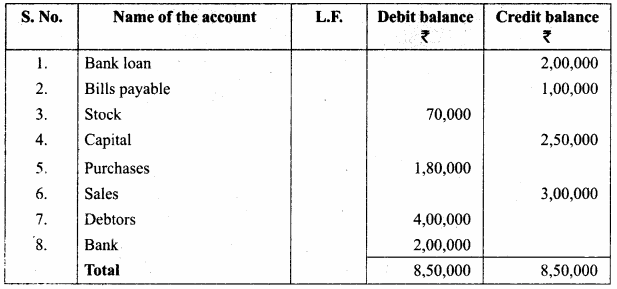
  • Elements with large difference in properties were included in the same group. Eg: Hard metals like copper (Cu) and silver (Ag) were included along with soft metals like sodium (Na) and potassium (K).
  • No proper position could be given to the element hydrogen. Non-metallic hydrogen was placed along with metals like lithium (Li), sodium (Na) and potassium (K).
  • The increasing order of atomic mass was not strictly followed throughout. Eg. Co & Ni, Te &I.
  • No place for isotopes in the periodic table.

Science Lesson 12 Class 9 Question 4.
State any five features of modern periodic table.
Answer:
  • All the elements are arranged in the increasing order of their atomic number
  • The horizontal rows are called periods. There are seven periods in the periodic table.
  • The elements are placed in periods based on the number of shells in their atoms
  • Vertical columns in the periodic table starting from top to bottom are called groups. There are 18 groups in the periodic table
  • Based on the physical and chemical properties of elements, they are grouped into various families.

Periodic Classification Of Elements Activity

Classification Of Elements Question 1.
Find the pair of elements having similar properties by applying Newlands law of Octaves (Example: Mg & Ca):
Set I: F, Mg, C, O, B
Set II: Al, Si, S, Cl, Ca
Answer:
Set I:FMgC0B
Set II:ClCaSisAl

Samacheer Kalvi 9th Science Periodic Classification of Elements Additional Questions

I. Short answers questions.

Question 1.
Why did the classification of elements evolve?
Answer:
Scientists found it difficult to organize all that was known about the elements. Therefore they started looking for some pattern in their properties, and the concepts of classification of elements were proposed by various scientists. This led to the evolution of classification of elements from early to modem period.

Question 2.
What is a triads group?
Answer:
Johann Wolfgang Dobereiner arranged the elements into groups containing three elements each based on their relative,atomic masses. He called these groups as ‘triads’ also known as Dobereiner’s Triads.

Question 3.
Explain law of octaves.
Answer:
John Newlands arranged 56 known elements in the increasing order of their atomic mass. He observed that every eighth element had properties similar to those of the first element like the eighth note in an octave of music is similar to the first and this arrangement was known as “law’ of octaves”.

Question 4.
What is a periodic table?
Answer:
Dmitri Mendeleev proposed the law of periodicity which states that “the physical and chemical properties of elements are the periodic functions of their atomic masses”. He arranged 56 elements known at that time according to his law of periodicity. This was best known as the short form of periodic table.

Question 5.
What is IUPAC? Where is it located? Give examples of few elements named by IUPAC.
Answer:
IUPAC stands for-The International Union of Pure and Applied Chemistry. It is an international organization that represents Chemists from various countries. IUPAC is registered in Zurich, Switzerland and has its.secretarate in United States.

Question 6.
How are metals classified in the periodic table?
Answer:
Metals occupy a larger area in the periodic table and are categorized as follows –

  • Alkali metals eg. – Sodium and Potassium
  • Alkaline earth metals eg. – Calcium and Magnesium
  • Transition metals eg. – Iron and Nickel
  • Other metals eg. – Aluminium and Tin

Question 7.
What are alkali metals?
Answer:
The elements of group 1 (except hydrogen) are metals. They react with water to form solutions that are highly alkaline or basic. Hence they are called alkali metals.

Question 8.
Though they are found rare, they have many uses. Justify this statement.
Answer:
Helium, Neon, Argon, Krypton, Xenon and Radon are called the Noble or rare gases and are placed in group 18 in the periodic table. They are monoatomic and do not react with other substances easily. Though these gases are chemically inert, they have stable electronic . structures which are difficult to change. Their uses are as follows –

  1. Helium has a very low density and used for filling weather ballon.
  2. Neon gas is used in discharge lamps.
  3. Argon is filled in electrical bulbs to prevent evaporation of the filament.
  4. Radon is a radioactive gas.

II. Long answers questions.

Question 1.
Write any five advantages of modern periodic law.
Answer:
  • The table is based on a more fundamental property i.e., atomic number.
  • It correlates the position of the element with its electronic configuration more clearly.
  • The completion of each period is more logical. In a period, as the atomic number increases, the energy shells are gradually filled up until an inert gas configuration is reached.
  • Each group is an independent group and the idea of subgroups has been discarded.
  • One position for all isotopes of an element is justified, since the isotopes have the same atomic number.

Question 2.
Explain limitations of Mendelev’s periodic table and why is the modern periodic table considered an extension of Mendelev’s periodic table.
Limitations of Mendelev’s periodic table –
(a) Elements with large difference in properties were included in the same group. Eg. Elard metals like copper (Cu) and silver (Ag) were included along with soft metals like sodium and potassium
(b) No proper position could be given to the element hydrogen. Non-metallic Hydrogen was placed along with metals like lithium, sodium and potassium.
(c) The increasing order of atomic mass was not strictly followed throughout. Eg. – Co & Ni, te & I.
(d) No place for isotopes in the periodic table.
The modem periodic table is an extension of the original Mendeleev’s periodic table and is known as the long form of periodic table. Mendeleev’s initial table had 63 elements, modem table has 109 elements. It is also known important to note how the modem periodic table is arranged.

Although the columns which reflect a natural order have been retained, the row’s of the modem table show elements in the order of Mendeleev’s columns. In other words the elements of what we now call ‘a period’ were listed vertically by Mendeleev. ‘Groups are now shown vertically in contrast to their horizontal format in Mendeleev’s table.

Question 3.
What are the advantages of alloys?

  • Alloys do not get corroded or get corroded to very less extent.
  • They are harder and stronger than pure metals (example: gold is mixed with copper and it is harder than pure gold).
  • They have less conductance than pure metals (example: copper is good conductor of heat and electricity whereas brass and bronze are not good conductors).
  • Some alloys have lower melting point than pure metals (example: solder is an alloy of lead and tin which has lower melting point than each of the metals).
  • When metal is alloyed with mercury, it is called amalgam.

Question 4.
Explain the uniqueness of Hydrogen.
Answer:
Hydrogen is the lightest, smallest and first element of the periodic table. Its electronic configuration (Is1) is the simplest of all the elements. It occupies a unique position in the periodic table. It behaves like alkali metals as well as halogens in its properties. In the periodic table, it is placed at the top of the alkali metals.

  1. Hydrogen can lose its only electron to form a hydrogen ion (H+) like alkali metals.
  2. It can also gain one electron to form the hydride ion (H-) like halogens.
  3. Alkali metals are solids while hydrogen is a gas.