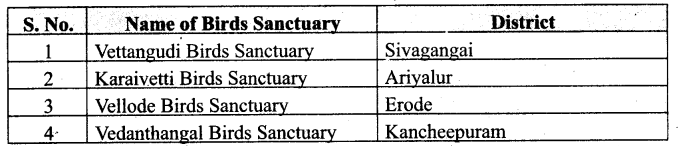
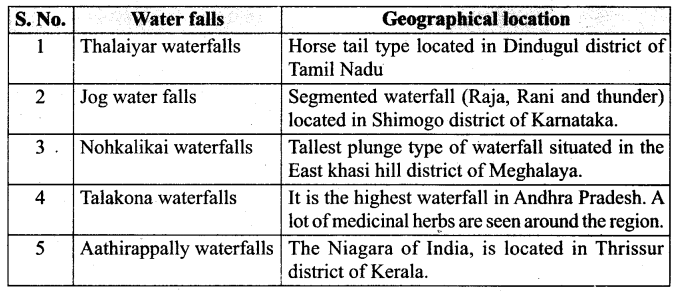
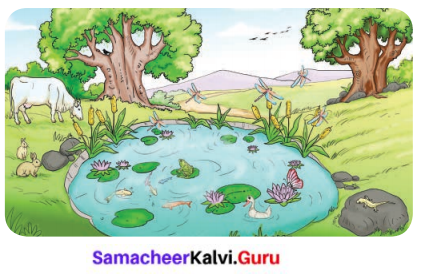
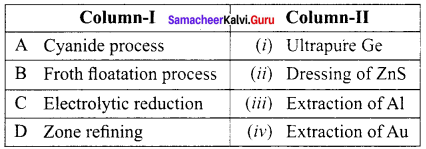
Samacheer Kalvi 10th English Solutions Prose Chapter 6 The Last Lesson

Looking to improve English skills and gain more subject knowledge then the best resources that you can use here is Samacheer Kalvi 10th English Solutions for Prose Chapter 6 The Last Lesson Questions and Answers.

In the Samacheer Kalvi 10th English Guide for Chapter 6 The Last Lesson textbook solutions, subject experts covered all types of questions and answers related to the topics, quick notes, summary, solved & unsolved exercises, etc. If you are planning to prepare Chapter 6 The Last Lesson via textbook, then you’re suggested to go with this Samacheer Kalvi 10th English Book Solutions Questions and Answers PDF for better understanding and preparation.

Tamilnadu Samacheer Kalvi 10th English Solutions Prose Chapter 6 The Last Lesson

English Subject experts who are having max years of experience prepared this Tamilnadu State Board Solutions for 10th English Prose Chapter 6 The Last Lesson Questions and Answers. They have explained all the topics covered in the board prescribed latest syllabus in a simple way to understand easily. So, students can prepare Chapter 6 English from this Samacheer Kalvi 10th English Book Questions and Answers PDF. Download the Tamilnadu State Board 10th English Chapter 6 The Last Lesson Workbook Solutions PDF by accessing the below links and learn properly for the final exams to score well.

The Last Lesson Warm up:

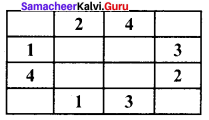
A. Fill the globe with an acrostic poem.

The Last Lesson Class 10 Samacheer Kalvi English Solutions Prose Chapter 6

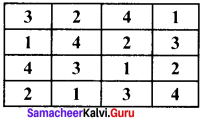
Answer:
The Last Lesson Book Back Answers Samacheer Kalvi 10th English Solutions Prose Chapter 6

B. How can you make the world a better place?

10th English The Last Lesson Samacheer Kalvi English Solutions Prose Chapter 6

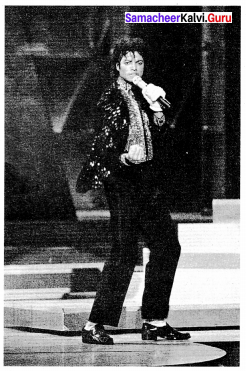
While “making the world a better place” often calls to mind the image of Michael Jackson’s song, ‘Heal the world’, there is plenty of room for less lofty acts that create small measures of happiness in the lives of those around us. Little gesticulations can create or fortify our sense of community and of shared human race, lessening our problems for just a moment and giving us something to smile about.

C. What does the picture symbolise?
Answer:
The picture symbolises Peace and tranquillity.

D. Find the names of the various UN organizations with the logo given below and fill in the blanks.

The Last Lesson 10th Class Samacheer Kalvi English Solutions Prose Chapter 6Answer:
The Last Lesson Summary In Tamil Samacheer Kalvi 10th English Solutions Prose Chapter 6

The Last Lesson Intext Questions

The Last Lesson Class 10 Question a.
What kind of news was usually put up on the bulletin board?
Answer:
All bad news like lost battles, the draft, the orders of the commanding officer, came from the Bulletin board.

The Last Lesson Book Back Answers Question b.
What was the usual scene when school began every day?
Answer:
When school began every day, there was a great bustle of opening and closing of the desks, lessons were repeated in unison loudly and the teacher’s ruler rapped on the table.

10th English The Last Lesson Question c.
Other than the students, who were present in the class?
Answer:
The village people, old Hauser, the former mayor, the former postmaster and several others were present in the class, besides the students.

The Last Lesson 10th Class Question d.
Why did Mr. Hamel say it was the last French lesson?
Answer:
The order had come from Berlin to teach only German in the schools of Alsace and Lorraine. So Mr. Hamel said that was the last French lesson.

The Last Lesson Summary In Tamil Question e.
What was Franz asked to tell? Was he able to answer?
Answer:
Franz was asked to recite the rule for participle all through. But he got mixed up on the first words and stood there nervous.

10th English Unit 6 Poem Question f.
Why did Mr.Hamel blame himself?
Answer:
Mr. Hamel blamed himself because he had often sent Franz to water his flowers instead of learning his lessons and when he went for fishing he gave him a holiday.

The Last Lesson In Tamil Question g.
What did M. Hamel say about the French language?
Answer:
M. Hamel said that French was the most beautiful language in the world – the clearest, the most logical and that they must guard it and never forget it.

The Last Lesson Question Answers Pdf Question h.
How many years had M. Hamel been in the village?
Answer:
M. Hamel had been in the village for forty years.

The Last Lesson Textual Questions

A. Answer the following questions in one or two sentences.

The Last Lesson Summary Class 10 Question 1.
Why did Franz dread to go to school that day?
Answer:
Franz dreaded to go to school that day because M.Hamel had said he would question them on participles and he did not know the first word about them.

Samacheer Kalvi Question 2.
What were the various things that tempted Franz to spend his day outdoors?
Answer:
The day was warm and bright. The birds were chirping and in the open field back of the sawmill, the Prussian soldiers were drilling.

Question 3.
Why was the narrator not able to get to his desk without being seen?
Answer:
The narrator was not able to get to his desk without being seen because that day everything was quiet about the school. He had to open the door and go in before everybody, who were in their places already.

Question 4.
What was Franz sorry for?
Answer:
Franz was sorry for not learning his lessons, for having found his books heavy and his history of the saints, were old friends, now that he couldn’t give up. He also felt sorry for Hamel who was going away.

Question 5.
Why were the old villagers sitting in the last desk?
Answer:
The old villagers sat in the last desks feeling sad that, that was the last French lesson that would be taught at school. They were sorry that they hadn’t gone to school, it was their way of thanking the master for his forty years of faithful service.

Question 6.
What were the thoughts of the narrator’s parents?
Answer:
The narrator’s parents preferred to send him to work on a farm or at the mills so as to have a little more money.

Question 7.
Why does M. Hamel say that we must guard our language?
Answer:
M. Hamel said that we must guard our language among us and never forget it because when a people are enslaved, as long as they hold fast to their language it is as if they had the key to their prison.

Question 8.
M. Hamel was gazing at many things. What were they?
Answer:
M.Hamel was gazing at his garden outside the window, his class in front of him, the walnut- trees in the garden and the hop vine that he had planted twined about the windows to the roof, with a broken heart that he is leaving all.

Question 9.
When and how did M. Hamel bid farewell to the class?
Answer:
When the trumpets of the Prussians sounded under their windows, M.Hamel stood up, very pale, with words choking his throat, he turned to the blackboard, and wrote “LONG LIVE FRANCE!” in French with a great deal of effort and a heavy heart.

Additional Questions

Question 1.
What was Franz expected to be prepared with for school that day?
Answer:
That day Franz was expected to be prepared with participles because M. Hamel had said that he would question them on participles. Franz did not know anything about participles.

Question 2.
What had been put up on the bulletin- board?
Answer:
An order had come from Berlin to teach only German in the schools of Alsace and Lorraine. The Germans had put this notice upon the bulletin-board.

Question 3.
What can be the matter now?” says Franz. Why, do you think he commented?
Answer:
When Franz passed by the bulletin board near the town-hall, he noticed a crowd there. He did not stop there nor wondered what could be the matter then. For the last two years they had received all the bad news from the bulletin-board-the lost battle, the draft and the orders of the commanding officer.

Question 4.
Who was Wachter? What did he ask Franz and why? How did Franz react?
Answer:
Wachter, a blacksmith was reading the latest bulletin. He asked Franz not to rush to his school and said that he would get to his school well ahead of time. Franz thought that the blacksmith was making fun of him not realizing the order that was announced. So, he ignored Wachter and rushed so that he would escape M. Hamel’s rebuke.

Question 5.
What changes did the order from Berlin cause in school that day?
Answer:
M. Hamel had put on his best dress-his beautiful green coat, his frilled shirt and the little black silk cap, all embroidered. The whole school seemed so strange and solemn. On the back benches that were always empty, the elderly village people were sitting quietly like the kids.

Question 6.
Why was Franz not scolded for reaching the school late that day?
Answer:
Franz was late for school. Usually there was a great hustle and bustle in the morning. He had anticipated to take benefit of that noise and hubbub. He wanted to get to his desk without being noted. But that day he had to go in before everybody. M. Hamel politely requested him to take his seat without scolding him as it was Hamel’s last lesson of French in that school.

Question 7.
What did Franz wonder about when he entered the class that day?
Answer:
M. Hamel was to question the students on participles and Franz knew nothing about them and feared caning or scolding. He wondered about the big crowd he had seen around the notice board at the Town Hall and also the empty back benches filled by the villagers including the Mayor and the Postmaster.

Question 8.
What happened when the lesson in History was over?
Answer:
After the History lesson, the babies chanted their ba, be, bi, bo, bu. Old Hauser, who was sitting at the back of the room had put on his spectacles. He was holding his primer in both hands and was spelling the last lesson. He was seated motionless in his chair during the writing lesson. He gazed at one thing or the other. Perhaps he wanted to fix in his mind how everything looked in that little school room. Surely, it must have pained his heart to leave his familiar spot after forty long years.

Question 9.
“He had the courage to hear every lesson to the very last.” What led Franz to make this remark?
Answer:
Franz observed that M. Hamel was feeling sad to leave the place after forty years and not being allowed to teach French any longer. Yet, he did not emote his feelings. Rather, he performed his duties faithfully listening to every lesson to the last till the school was dismissed at mid-day prayer time.

B. Answer the following questions in about 80-100 words.

Question 1.
We appreciate the value of something only when we are about to lose it. Explain this with reference to the French language and M. Hamel.
Answer:
The Last Lesson’, written by Alphonse Daudet describes the year 1870 when the Prussian forces under Bismarck attacked and captured France. Alsace and Lorraine, districts of France went into Prussian hands. The new Prussian rulers issued an order that only German should be taught in all schools. The French teachers were asked to leave with immediate effect. The story describes the last day of one such French class under M. Hamel. M. Hamel had taught French for forty years. Most of them never knew the value of the teacher’s devotion and dedicated service.

We do not always get an opportunity to learn, and this is never understood till the end. Luck doesn’t favour always. Likewise, opportunity knocks ones. Time should be valued. Procrastination is a sin. Most of us end up delaying things. Unless we are constant and regular in our efforts, we cannot achieve our goals.

When things come easy, we do not realise ifs value. Time and tide wait for no man. The entire village knew the value of Mr. Hamel and his teaching only when he was asked to leave. There was no use in their regrets. It was all too late. Therefore, let’s remember that we should make hay when the sun shines and not weep in vain.
‘Understand, your worth; Value your life; Appreciate your blessings’

Question 2.
Give an account of the last day of M. Hamel in school.
Answer:
The story described what was just another ordinary day for Franz who started very late for school that morning. Franz, who played truant with French class, feared M. Hamel’s iron rod. He came to the school thinking he would be punished as he had not learnt his lesson on participles.

In fact, he was reluctant to go to school. Initially, he thought of spending the bright warm day outdoors enjoying the chirping of birds and seeing the drilling of Prussian soldiers at the back of the sawmill. On the way, Franz passed the Town hall, where he saw a large crowd reading the bulletin board which had been a source of all bad news.

Franz rushed to his classroom, overseeing it for the fear of being chided. When Franz arrived at the school, his classmates were already seated and the teacher had already started teaching. The back benches were occupied by grim and solemn villagers including the Mayor, The Postmaster, Hauser and many others. To his surprise, M. Hamel was in his Sunday clothes. Franz found M. Hamel to be kinder than usual. Franz was shocked to know that it was the last French lesson and the German teacher would start classes the next day. He was full of regret for not learning his mother tongue and felt a sudden love for French.

He even started liking M. Hamel and forgot all about his ruler. When M. Hamel asked Franz to recite the rules of participle, he was petrified. M. Hamel didn’t scold him and remarked that the only problem with people of, Alsace was procrastinating learning. He blamed parents and himself for exploiting children. Hamel then talked of the French language, calling it the most beautiful language in the world. He said that when we were enslaved knowing our mother tongue was similar to having the key to prison. As the church clock bell struck twelve, M. Hamel with a choked throat wrote on the Blackboard Vive La France!, i.e. Long Live France and dismissed the class.
‘Our memories of yesterday will last a lifetime.’

Additional Questions:

Question 1.
How was the last lesson different from earlier lessons?
The last lesson was different from earlier lessons in numerous ways. It revealed the love and respect of the teacher and students for their mother tongue. Even the teacher was unusually kind and did not scold children. M. Hamel taught very patiently, with utmost dedication and sincerity. It seemed as if he wanted to give all that he knew before going away. He was dressed at his best and his ‘iron ruler’ was not used even to rap it on the desk.

The last lesson was attended by villagers with deep remorse to show their love and respect for their mother tongue and also to M. Hamel. The students listened very carefully and everybody was absolutely quiet. Franz regretted for not learning his lesson. The last lesson was indeed emotional. It stirred patriotic feelings and awakened the villagers to the importance of their mother tongue.
‘The bird of love flies on two wings Faith and Dedicated Service.’

Question 2.
Justify the title ‘The Last Lesson’.
Answer:
The title The Last Lesson’ is noteworthy and conveys the principal theme of the story. The story has an appropriate and suggestive title. It highlights the fact that sometimes even the most precious things in our lives are taken for granted by us. The people of Alsace never give much thought or importance to their mother tongue, French. They least expect such a situation in their motherland. Parents prefer their children to go to the farm and bring an extra income rather than learn French.

They hardly encourage regular attendance in school. They think there will be plenty of time to leam the language in their life but it’s a sudden bolt from the blue when the order is announced. The order from Berlin to ban French and make German compulsory had to be accepted without any rejection. This ruthless order from Prussians makes them realise various things in life. The beginning of the story serves as preparation for it. The unusual quietness at school, presence of village elders and the teacher in his best Sunday dress—all point out to the unusual and unique occasion-the last lesson in French in a French village conquered by the Prussians. While delivering the last lesson, the teacher wants to transmit all his knowledge in one stretch. He explains everything with patience and the students as well as old villagers listen attentively.

As the teacher is unable to express his emotions because of choked throat, he ends the lesson by writing ‘Vive La France’ on the blackboard. He makes a gesture with his hand to indicate that the school is dismissed and students can go home. This was the last class of French. Hamel was the last teacher of the last French class. Perhaps this was the last attentive class too. Thus, the title The Last Lesson’ reveals the theme of the story and is fully justified.
‘Do it with passion The last may be sudden.’

Question 3.
Write a character sketch of little Franz. Franz was a typical schoolboy who played truant. He hated school or learning. He was afraid of his
Answer:
French Teacher M. Hamel’s ‘iron ruler’. He was more eager to spend his time outside the school. Many times, he missed the school and went in search of ‘bird’s eggs’. He preferred to watch the Prussian soldiers drilling at the saw-mill. He did not realise the importance of learning his mother tongue till the time his country passed into Prussian hands and teaching French was banned.

This was a rude shock to him when he came to school and found it to be his last French lesson. At this point, he lamented the loss of his language. His entire perspective towards the language and the teacher changed. He was surprised to learn and understand everything on the last day and did not find M. Hamel strict during the lesson nor did he find his teaching complicated. He felt he was able to understand the rules of grammar so very easily and thought it was his readiness to learn that mattered. He was really a child and was not able to understand the. severity of war and wondered whether the Pigeons would be made to coo in German too. Such was his innocence!
‘Thoughts change, Perceptions change, ‘Changes are inevitable.’

Question 4.
“Order from Berlin aroused a particular zeal in the school.” Comment.
Answer:
The order from Berlin brought a sense of shock and surprise in the class. They were all dumbstruck. As per the order, this was the last French class. Alsace and Lorraine had been captured by the Prussians. So only German was to be taught in the schools. Hamel had to leave the next day. Now they all felt passionate about their mother tongue. All the eminent village elders felt guilty for neglecting their mother tongue.

Now they came to the class and showed their love and respect for their mother tongue. They were in awe for their French teacher M. Hamel. The entire school was filled with an air of repentance and guilt. There was complete quietness. The teacher, M. Hamel, was dressed at his best and was full of emotions. Even the students in the class, including little Franz, felt remorse for their indifference to their mother tongue. There was an atmosphere of stillness and quietness in the class.
‘Education prepares you for the future.’

Question 5.
Give a character sketch of M. Hamel.
Answer:
M. Hamel is a strict disciplinarian at a school in a village in the French districts of Alsace and Lorraine. M. Hamel is an experienced teacher who has been teaching in that village school for forty years. He imparts primary education in all subjects. He is a hard taskmaster and students like Franz, who are not good learners, are in great dread of being scolded by him. He loves his profession from the bottom of his heart and holds a deep sense of respect for the mother tongue.

The latest order of the Prussian conquerors upset him. He has to leave the place forever and feels heartbroken. He feels sad but exercises self-control. He has the courage to hear every lesson to the last. This thought completely shatters a calm and composed man like M. Hamel. He tries his level best to remain calm and unruffled but breaks down at the end. His performance during the last lesson is exemplary. He is kind even to a latecomer like Franz. He uses a solemn and gentle tone while addressing the students.

He has a logical mind and can analyse problems and deduce the reasons responsible for it. He feels grief-stricken at the fact that people became indifferent to learning French. He charms them to keep their language alive. Hamel is a patriot in the real sense. He regards the mother tongue to be a means of holding one’s identity and self-respect. He knows the emotional hold of a language over its users. He is a good communicator and explains everything patiently. Partings are painful and being human, M. Hamel too is no exception. He fails to say goodbye as his throat is choked
‘Good teachers are rarity. M.Hamel is an exception to rarity!’

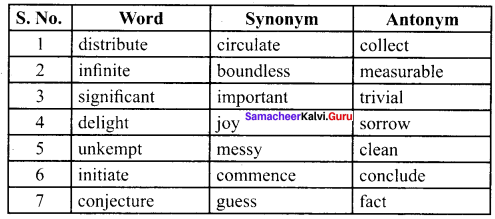
Vocabulary:

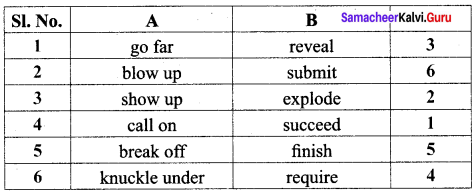
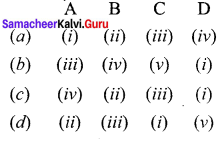
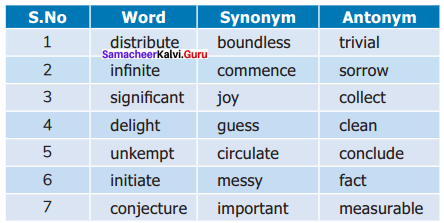
C. In column A are some of the idiomatic phrases from the essay. Match them with equivalent single words in column B:
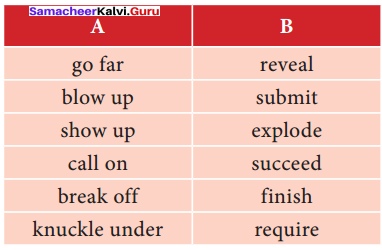
10th English Unit 6 Poem The Last Lesson Samacheer Kalvi
Answer:
The Last Lesson In Tamil Samacheer Kalvi 10th English Solutions Prose Chapter 6

D. Frame sentences of your own using the above idiomatic phrases.

  1. You will go far (succeed) if you learn to persevere and never give up.
  2. I just knew that Sasikala would blow up (explode) as a result of her sustained anger.
  3. The records show up (reveal) the true personality of the Managing Director of the factory.
  4. This project calls on (requires) all the creative hands to launch it immediately.
  5. Although Leela was angry, she did not want to break off (finish) her long relationship with Chandran.
  6. I hate to knuckle under (submit) my boss, just to hold on to my job.

E. Given below are some idiomatic phrases. Find the meaning of it using the dictionary:
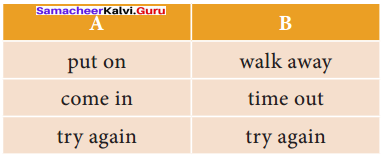
The Last Lesson Question Answers Pdf Samacheer Kalvi 10th English Solutions Prose Chapter 6

Frame sentences of your own to bring out the meaning.

  1. Put on – (assume) They put on an American Accent which sounded perfect.
  2. Come in – (join later) Ashish will sing the verse and then the rest of choristers will come in on the chorus.
  3. Try again – (don’t quit) Oh common, just try again.
  4. Walk away – (escape a danger) You were lucky to walk away from that ghastly car accident.
  5. Time out – (a short break) Workaholics rush around so much now-a-days that they all need a time out now and then.
  6. Try again – (never give up) It’s hard at first to shift gears but try, try again till you feel at ease with changing gears.

Listening Activity

F. Listen to the article titled “Remembering Nel Jayaraman”

It must have been eight years ago I was at Thiruvarur to attend the Nel Thiruvizha (seed festival) organised by Jayaraman.
I went there to volunteer; I’d heard about him from organic farming pioneer G. Nammalvar and wanted to see if we could bring the varieties Jayaraman revived, to the market.

It was just a small affair then; some people attended. But the festival grew exponentially from then on; from 500, the number of participants went up to 1,500 next year; and then to 2,500, 5,000… there was no looking back. When I entered the village Adhirangam where the festival took place, I saw men carrying sacks of paddy, they came with five kilograms and returned with 10 kilograms the next year. That was how the seed exchange work.

I remember how Jayaraman cycled across villages to find traditional paddy seeds and distribute them. I asked him how he planned to carry his vision forward; what would he do for funds/ But he replied, “What do I need funds for ? I have seeds and my cycle will take me to everywhere. Or I’ll take a bus”.

If people called him asking for his number of varieties of seeds, he went directly to see to it – that they got what they wanted. I participated in the planning of his seed festivals.

But the man didn’t believe I going by a strict plan. He was always cool when those around him panicked. For instance, if I told him there were many people coming for the event and that we i had to pain for meals and plates, he would respond unfettered, “Thambi, it’ll fall in place. If i there is no plates we can buy banana leaves; if there’s no food. We can cook and serve rice, we have it in plenty, don’t we?”

What if the sound system doesn’t work, I insisted and he said.’Then we might have to speak louder”. I joked that I would refuse to come for planning meetings, because anyway, he didn’t need them. On a serious note, all the festivals he organised went on smoothly, like he believed. During floods or droughts , he took the collector of Nagapattinam to show him how our traditional paddy withstood the forces of Nature.

He visited collectorates to submit petitions against genetically modified crops whenever he encountered them. Later in life, when his popularity grew, he spent more time in the field; but that’s where his heart was. Hundreds of people called me from India and abroad, enquiring about his health during his final days. He showed that if you worked selflessly for the society, it will give back.

Student A: (interviewer) – Vanakkam sir. For what cause do you organise festivals ?
Student B : ( NJ) – I organise these festivals with a difference. I present seeds to all the 1 participating farmers.
Student A: (interviewer) – Oh ! That’s really good, Sir. What do you expect in return?
Student B : (NJ) – In return I expect them to have double the harvest next year.
Student A: (interviewer) – Where did you organise the NEL festival?
Student B:(NJ) – (1) ……………………………………………………………………………………..
Student A: (interviewer) – Can you mention how many people congregated for the meeting?
Student B : (NJ) – (2) …………………………………………………………………………………..
Student A: (interviewer) – What did you distribute to the farmers?
Student B : (NJ) – (3) ……………………………………………………………………………………
Student A: (interviewer) – How did you commute to each of these villages?
Student B : (NJ) – (4) ……………………………………………………………..
Student A: (interviewer) – Ayya, Do you plan your schedules?
Student B : ( NJ) (5) ……………………………………………………………….
Student B : ( NJ) – 1 have an alternative (6) ……………………………………………………………
Student A: (interviewer) – Where was your heart and soul?
Student B : (NJ) – (7) ……………………………………………………………..
Student A: (interviewer) – People say when your popularity grew, you spent less time in the field?
Student B : (NJ) – (8) ……………………………………………………………..
Student A : (interviewer) – What is your message to the world?
Student B :(NJ) – (9) ……………………………………………………………….
Student A: (interviewer) – Thank you, Sir. Nandri
Student B : (NJ) – Nandri.
Answers:

  1. I organized the Nel festival at Thiruvarur.
  2. Around 500 people congregated for the meeting.
  3. I distributed traditional paddy seeds to the farmers.
  4. I used to cycle across to these villages.
  5. Yes, I do plan my seed festival schedules.
  6. to everything – no plates meant that we could buy banana leaves; no food meant that we could cook and serve rice which was available in plenty; no mike meant that we have to just raise our voices and speak!
  7. My heart and soul was in the field.
  8. That’s the world we live in!
  9. If you work selflessly for the society, it will give back.

Speaking Activity:

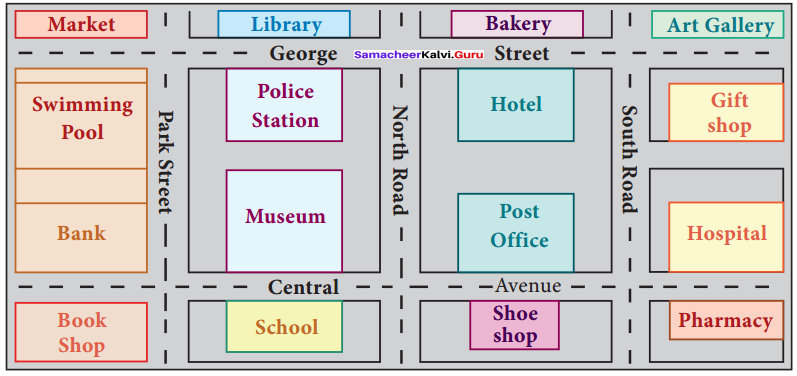
G. A road map is given below. Answer the questions that follow with the help of the road map. Work in pairs and discuss to give directions to get to one place from another.
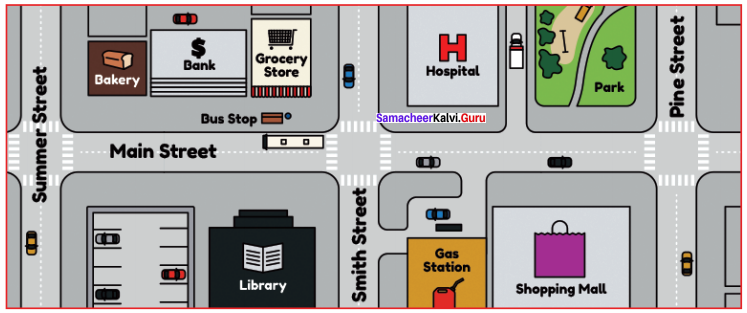
The Last Lesson Summary Class 10 English Solutions Prose Chapter 6 Samacheer Kalvi
Answer:
Samacheer Kalvi 10th English Solutions Prose Chapter 6 The Last Lesson
Question 1.
You are at the market. You need directions to go to the pharmacy.
Answer:
From the market on George Street, go past two crossroads. After you cross the library and the bakery on the left, take your right on South road at the cross roads just before the Art Gallery. You will find a Gift shop as soon as you turn on the left side. After a kilometer or so you will find a Hospital on the left. Take left immediately and you will find the pharmacy just opposite to the hospital on Central Avenue.

Question 2.
You are in a book shop. Ask your partner to direct you to the Art Gallery.
Answer:
Walk straight on Central Avenue and go past the School on your right. Proceed further and cross the Post office on the left. After a couple of buildings, take the immediate left on South Road. Walk down further till you arrive at the cross roads on George street. At the crossroads, you will find the Art Gallery, diagonally opposite to you on the right side on George Street.

Question 3.
Give your partner the directions to go from the Bank to the hotel.
Answer:
Go to the Bank out-gate on Park Street and take your left. Go past the Swimming pool on the left and take the right on George Street. Further down you will find a Police station on the right before the next crossroad at North Road. A few buildings after the North road crossing you will find the Hotel on the right side.

Question 4.
Direct your partner from the post office to the market.
Answer:
Use the gate on Central Avenue and take your right. Go past the Museum on the right and take the right turn on Park Street just before the Bank. Proceed further and keep left. You will find a Swimming pool on the left. Take the immediate right after the Swimming pool. You will find the Market just opposite to the Swimming pool on George Street.

Question 5.
Your partner wants to go the library from school. Give suitable directions.
Answer:
Take the right on Central Avenue. Take the first right again on Park street. Keep to the left of the Park Street and walk further. Cross the Bank and the Swimming pool till you reach the junction at George Street. Take your right and walk further. You will find the Library just opposite the Police station on George Street.

Additional:

Question 1.
Direct your partner who had visited the museum with her family to go to the Gift Shop on South Road.
Answer:
Use the gate on Central Avenue and take your left. Go past the Post office on the left and take the left on South Road. Keep left and walk further. Cross the road to take the first lane on your right. You will find the Gift shop after three or four buildings on the left side of the road.

Question 2.
Guide a stranger from the Police Station to the Hospital.
Answer:
Take the right on George Street. Proceed further and cross the Hotel after the Crossroads of North Road. Take the right after the Hotel on South Road. Walk straight and go past the lane on the left. Take the left on Central Avenue at the Crossroads. You will find the Hospital on the left after a furlong or so.

Reading:

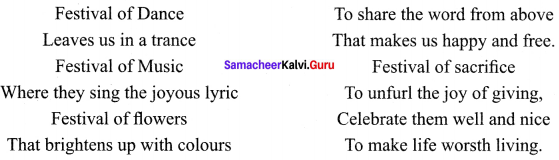
H. Read the poem carefully and answer the questions that follow:
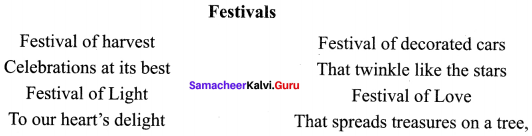
Samacheer Kalvi 10th English Solutions Prose Chapter 6 The Last Lesson 11
Samacheer Kalvi 10th English Solutions Prose Chapter 6 The Last Lesson 12

Fill in the blanks.

1. (a) ………………………. is the festival which fills our hearts with delight.
(b) ………………….. is referred to as a festival of sacrifice.
(a) Festival of light
(b) Unfurling the joy of giving

2. What kind of joy is unfurled during the festival of sacrifice?
The joy of giving is unfurled during the festival of sacrifice.

3. How can we make our life worth living?
By celebrating all festivals well and nice, we can make our life worth living.

4. What does the poet mean by ‘Festival of flowers’?
By festival of flowers the poet means that they brighten up with colours.

5. When are we in a state of trance?
We are in a state of trance, when we celebrate the festival of dance.

6. What do the people do when the festival of Music is celebrated?
They sing the joyous lyric when the festival of music is celebrated.

7. What makes us happy and free, according to the poet?
The festival of love that spreads treasures on a tree, shares the word from above and makes us happy and free.

8. Find out the rhyme scheme employed in the fourth stanza.
‘abab’ is the rhyme scheme employed in the fourth stanza.

9. Pick out the rhyming words from the first stanza of the poem.
‘Harvest-best; and light-delight’ are the rhyming words from the first stanza of the poem.

10. Write down the words that alliterate in the poetic lines below.
(a) Festival of Flowers
(b) That spreads treasures on a tree
(a) Festival of Flowers
(b) That spreads treasures on a tree

Writing:

I. Create posters for following:

1. You are Raja/ Ranjani. Draft a poster to create awareness about the harmful effects of using plastics, in not more than 50 words

Samacheer Kalvi 10th English Solutions Prose Chapter 6 The Last Lesson 13

2. Say ‘No to Drugs’ – Design a poster for it in not more than 50 words. You may use slogans/ phrases.
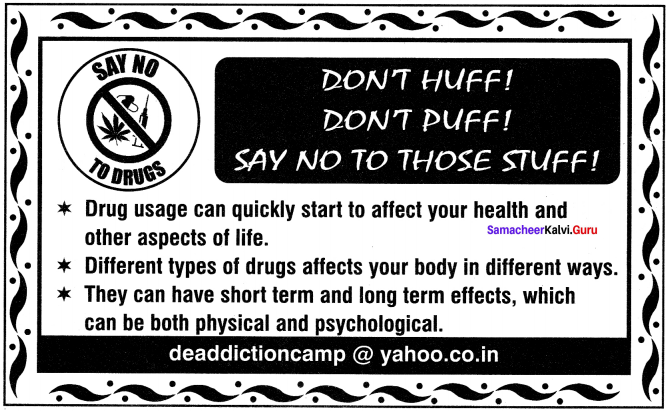
Samacheer Kalvi 10th English Solutions Prose Chapter 6 The Last Lesson 14

3.“ Save our Earth” is the need of the hour. Draft a poster with attractive slogans/ phrases for the same in not more than 50 words. Use attractive drawings.

Samacheer Kalvi 10th English Solutions Prose Chapter 6 The Last Lesson 15

4. You are Sita/ Sudhan. Design a poster in not more than 50 words to focus on not wasting water. Be creative.
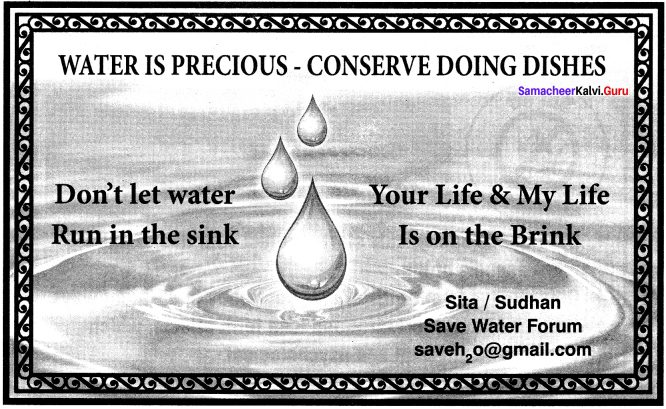
Samacheer Kalvi 10th English Solutions Prose Chapter 6 The Last Lesson 16

5. Good handwriting is the index of an individual. Design a poster on the importance of good handwriting. Use catchy slogans or phrases. Your poster should not exceed 50 words.
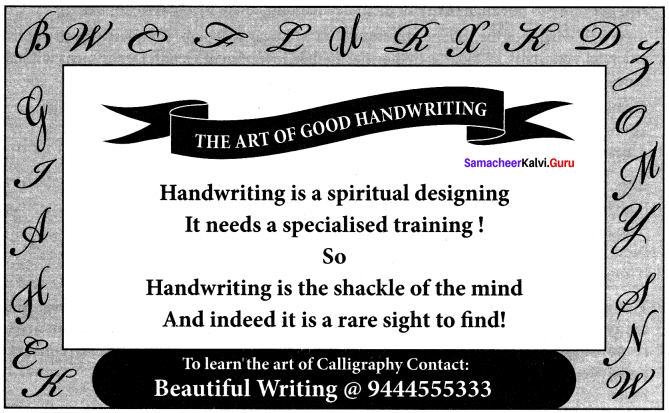
Samacheer Kalvi 10th English Solutions Prose Chapter 6 The Last Lesson 17

J. Draft Letters for the following

1. You are Ajeet, living in a remote village in Tirunelveli. You participated in a health camp organised by your school. You were surprised to observe that most of the residents were unaware of health and hygiene. As a concerned citizen, write a letter to the editor stating the need to organise such camps focusing on the importance of health and hygiene.
From
Mast. Ajeet.
SGH High School
Meviyar kuppam
Tenkasi
Tirunelveli district
20.10.2020
To
The Editor
The Hindu
New Town
Tirunelveli
Respected Sir
Subject: Requisition for more Camps on Health and Hygiene
Recently the Health and Hygiene club of SGH High school at Meviyar Kuppam conducted a health camp in the school campus. Three doctors from the nearby Public Health Centre were kind enough to be a part of this successful camp.
I was quite shocked as the Secretary of the Health and Hygiene Club to note that most of the villagers who came that day were unaware about the importance of health and hygiene. It is also alarming to note that many of them needed immediate medical treatment.
As a well wisher of the village community in Meviyar Kuppam, I request you to publish this article in your daily so that the authorities in the Government Health Department will take the necessary steps to organize such camps frequently.
Thank you
Yours faithfully
Ajeet
To
The Editor
The Hindu
New Town
Tirunelveli

2. You are Sanjay. Your colony utilises solar energy to light the common areas. You find many friends of your colony forgetting to switch off the lights in the common area. As a responsible citizen, write a letter to a newspaper, echoing the importance to conserve and preserve solar energy.
From
Mr.Sanjay,
7, Shanaz street,
TNGO Colony,
Adambakkam,
Chennai – 600088
30th September, 2020
To
The Editor
The Times of India
Chennai – 600001
Sir,
Sub: Importance of Conserving and Preserving Solar Energy Through the esteem column of your daily, I wish to bring to the Readers the importance to conserve and preserve solar energy.

Our colony Samba colony at Adambakkam uses Solar energy to lighten up the common area. Though we may save on electricity charges, it is important that we reduce the usage of solar energy also when not needed. I had noticed that in many areas the lights are not switched off in the mornings.

Although it may not be obvious, there’s a direct connection between your energy use and the environment. When you consume less power, you reduce the amount of toxic fumes released by power plants, conserve the earth’s natural resources and protect ecosystems from destruction. By taking steps to reduce your energy intake, you’ll contribute to a healthier and happier world. When you opt to cut back on energy use, you also help conserve limited natural resources that would otherwise be used to power the power plants. Less demand for energy creates less demand for harvesting fossil fuels.

Turning off the lights at night or washing clothes in cold water can save trees, coal, natural gas and more. From an economic standpoint, it’s critical to conserve our finite resources. Reducing electricity use in your home – or going off the power grid with solar energy -can benefit the environment, conserve resources and save lives. Although your own energy saving adjustments may seem inconsequential, small steps become great leaps when multiplied by the number of people living in the vicinity. Thereby I appeal to all the importance to conserve and preserve energy resources and save Mother Earth and lead a pollution free atmosphere.
Thank you
Yours faithfully
Sanjay
To
The Editor
The Times of India
Chennai – 600001

3. You are Sadasivam. You recently visited your native town in Vellore. You happened to accompany your grandmother to your family temple. You were shocked to notice the poor condition and maintenance of the temple. Write a letter to the Editor of local newspaper highlighting the poor condition of the temple. Also give some suggestions and request the HRC to take steps to improve the situation.
From
Mr.Sadasivam
Subash street
Sathuvachary
Vellore
21st June, 2020
To
The Editor
The Hindu
Bose Bank Road
Vellore
Sir / Madam
Sub: Poor maintenance of the Temple
This is to bring to the notice of the authorities concerned over the deliberate damage done to Vinayagar Temple in Sathuvachary.
What shocks me most is the negligence and indifference of the civic authorities to the maintenance and conservation of these temples frequently visited by tourists. These temples are not only the irreplaceable symbols of our past culture and traditional importance, but also a very rich source of earnings. If foreign and local tourists stop visiting these places because of poor maintenance, the consequences will be quite massive.
The damaged areas of these buildings must be improved and repaired. Installation of CCTV cameras, putting sentries on duty, sanitation, and providing some facilities for the tourists also must be looked into. In the absence of proper restrooms, the immediate surroundings of these places have become very unhealthy.
Through the columns of your venerated daily I appeal to the concerned authorities of HRC to look into the problem and do the needful. After all these temples are symbols and treasures of our cultural heritage.
Through this letter, let me request the public to showcase their civic responsibilities.
I also appeal to the authorities to take the necessary action to maintain a congenial atmosphere to worship the deity.
Yours truly,
Sadasivam
To
The Editor.
The Hindu
Bose Bank Road
Vellore

4. You are Sudha. Your neighbour has a pet dog that barks continuously. Write a letter to the Editor of a weekly newspaper of your locality, highlighting the nuisance and noise pollution created thus. Also suggest ways to solve the problem.
From
Ms. Sudha,
Lawyer Road.
Medavakam
Chennai-89
4th July, 2020
To
The Editor
The Indian Express
Sreyas Chamiers Towers,
Chamiers Road, Teynampet,
Chennai – 600 018
Sir,
Subject: Nuisance and Noise pollution
Through the esteemed columns of your daily/ newspaper, I wish to bring to your kind notice the sleepless nights we are having at home because of the continuous barking of the neighbour’s dog.
Noisy dogs are a common lawful argument. After all, while pet owners may feel irritation at a dog that barks at every little sound, a neighbour has unquestionably no control over teaching the dog not to retort in this manner.
I tried in vain to resolve the issue simply by talking with my neighbour, politely explaining my concerns, and asking if a compromise can be made that will satisfy both of us. However, my neighbour is unwilling to do what is necessary to quieten their pet without requiring me to take the next step.
I am writing to let the SPCA know that the dog’s barking has been disrupting our ability to have peace inside our home and in our back yard. I believe that if the dog isn’t chained, it might not bark at least in the night. Please take the necessary action immediately so that we can have peaceful nights.
Yours sincerely,
Sudha
To
The Editor
The Indian Express
Chamiers Road, Teynampet,
Chennai – 600 018

5. You are Raja. The street lights of your area do not work properly. As a responsible citizen, write a letter to the newspaper enlightening them about the problem and also suggest ways to brighten the area.
From
Mr. Raja,
17-A, Abraham Street,
Nellikuppam,
Royapuram,
Chennai – 13
12.11.2020
To
The Editor
The Hindu
Anna Salai
Chennai – 2
Sir,
Sub: Dark Roads lead to Chain Snatching
I am writing to your esteemed self to express my deep concern and anguish over the poor state of street lights in our colony. Almost all the street lights are not burning. After it gets dark, moving on the colony streets is unsafe and perilous. Many chain snatching incidents have happened owing to poor visibility on the roads. Even mobile phones and purse snatching cases have also been reported. We fear other antisocial activities to be on the rise.
Through the medium of your esteemed daily I appeal to the concerned authorities in the municipal corporation to look into the matter and make the street lights functional again in Nellikupam area.
I hope you will give space to my voice in your esteemed daily.
Thank you
Raja
To
The Editor
The Hindu
Anna Salai
Chennai – 2

Grammar

A. Fill in the blanks appropriately:

  1. Mahatma Gandhi ……………….. the father of our nation.
  2. There ………………. ten dogs in my street.
  3. They …………….. to write the exercises neatly.
  4. Butter milk …………….. good for health.
  5. Fruits ……………… good for health.

Answers:
1. is, 2. are, 3. have, 4. is, 5. are.

B. Fill in the blanks with the appropriate verb:

  1. The quality of dal …………………. not good.
  2. The horse carriage …………………… at the door.
  3. My friend and teacher ……………….. come.
  4. …………….. your father and mother at home?
  5. Honour and glory ………………… his reward.
  6. The ship with its crew ………………… sailing good.
  7. Gullivers Travels ………………….. an excellent story.
  8. Neither food nor water ………………… found here.
  9. Mathematics ………………. a branch of study.
  10. Fifteen minutes …………………… allowed to read the question paper.

Answers:
1. is, 2. is, 3. has, 4. is, 5. is, 6. is, 7. is, 8. is, 9. is, 10. is.

C. Change the singular nouns to plurals by either adding ‘s’, ‘ies’, ‘es\ ‘ves
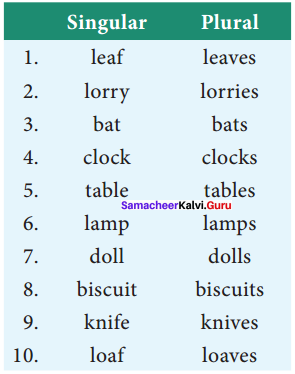
Samacheer Kalvi 10th English Solutions Prose Chapter 6 The Last Lesson 18

D. Identify the non-finites in the following sentences and underline them
E. g., Children love eating chocolates

1. Roshan dreams of becoming an architect.
Answer:
Roshan dreams of becoming an architect.

2. We must aim at fulfilling Dr AP J Abdul Kalam’s dream to make India the most developed country by 2020.
Answer:
We must aim at fulfilling Dr APJ Abdul Kalam’s dream to make India the most developed country by 2020.

3. Taking the children to the museum is Seema’s responsibility.
Answer:
Taking the children to the museum is Seema’s responsibility.

4. Having finished the work, the manager decided to return home.
Answer:
Having finished the work, the manager decided to return home.

5. Travelling with her family, Tara enjoyed every minute of it.
Answer:
Travelling with her family, Tara enjoyed every minute of it.

E. Replace the underlined words by a participle in the following sentences:

Example: When young people wear soiled clothes on formal occasions to show rebelliousness.
Answer:
Young people wear soiled clothes on formal occasions to show rebelliousness.

1. While Sudha was climbing the stairs, she tripped and fell down.
Answer:
While climbing the stairs, Sudha tripped and fell down.

2. After her evening prayers, my grandmother went to the temple.
Answer:
Having said her evening prayers, my grandmother went to the temple.

3. Since he is a king, he can order everybody.
Answer:
Being a King, he can order everybody.

4. They took the last wicket and walked back to the pavilion.
Answer:
Having taken the last wicket, they walked back to the pavilion.

5. When he saw the train in the platform he rushed.
Answer:
Seeing the train in the platform, he rushed.

F. Fill in the blank with the correct alternative:

  1. ………………….. on the flute, Krishna returned it. (played/having played)
  2. We wish she continues ……………….. healthy, (being /be)
  3. The doctor advised him against ………………. in the sun. (wander / wandering)
  4. I like ………………………. rasam. (drinking / drink)
  5. …………………. the scissors I returned it to her. (using / having used)

Answers:

  1. Having played
  2. being
  3. wandering
  4. drinking
  5. Having used

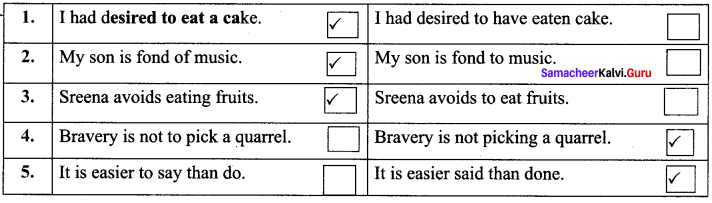
G. Tick the correct sentences:
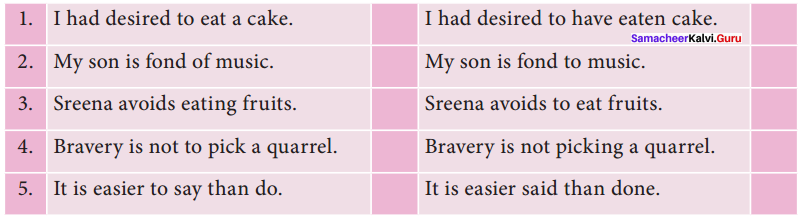
Samacheer Kalvi 10th English Solutions Prose Chapter 6 The Last Lesson 19Answer:
Samacheer Kalvi 10th English Solutions Prose Chapter 6 The Last Lesson 20

The Last Lesson by Alphonse Daudet About the Author:
Alphonse Daudet born on 13th May 1840, was a French novelist and short story writer. His creativeness resulted in characters that were real and also typical. His other work includes Jack, a novel about an illegitimate child, a martyr to his mother’s selfishness, which followed in 1876, served only to deepen the same impression. Daudet died in Paris on 16 December 1897, and was interred at Pere Lachaise Cemetery. The story, ‘The Last Lesson’ highlights the pain that is inflicted on the people of a territory by its conquerors by taking away their right to study or speak their own language.

The Last Lesson Summary:
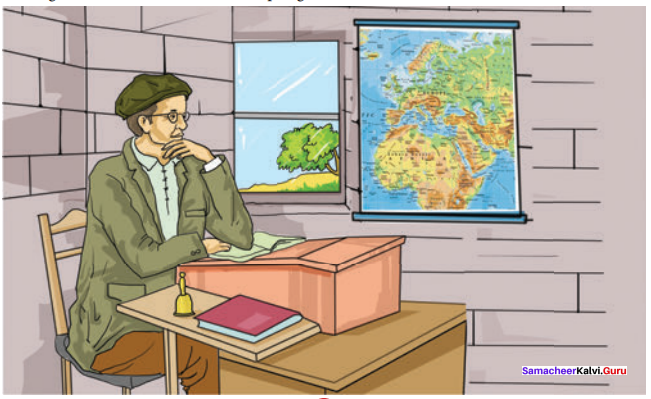
Samacheer Kalvi 10th English Solutions Prose Chapter 6 The Last Lesson 21

Introduction:
The Last Lesson is set in the days of the Franco-Prussian War (1870-1871) when the Prussian forces under Bismarck attacked and captured France. The French districts of Alsace and Lorraine went into
Prussian hands. The new Prussian rulers discontinued the teaching of French and introduced German in the schools of these two districts. The story deals with the theme of language imposition and language loyalty. The French teachers were asked to leave. Pmssia at that time, consisted of Germany, Poland and parts of Austria.
Samacheer Kalvi 10th English Solutions Prose Chapter 6 The Last Lesson 22

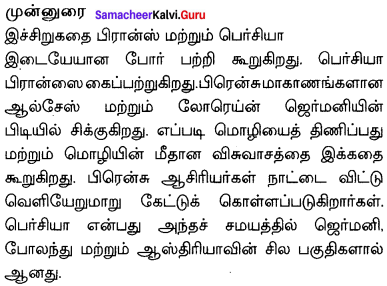
Worry of Franz
Franz started for school quite late that morning. He was afraid of being scolded by M. Hamel. He was to question them on participles and little Franz hadn’t studied. He wanted to spend the day out of doors admiring the warm bright day, chirping birds and the Prussian soldiers drilling in the open field back of the sawmill. But he resisted the temptation and rushed to school.
Samacheer Kalvi 10th English Solutions Prose Chapter 6 The Last Lesson 23

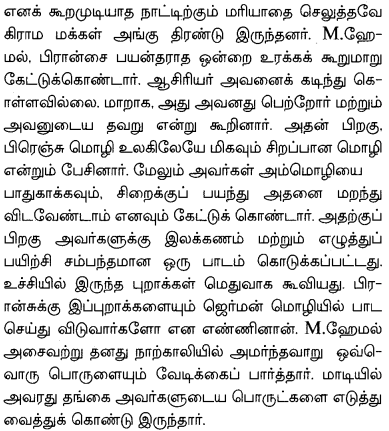
The idea that M. Hamel was going away made the narrator forget all about his iron ruler. Now Franz understood the situation well. The villagers were there to thank the master for his forty years of faithful service and to show their respect for the country that was theirs no more.

M. Hamel asked Franz to recite in vain. The teacher did not scold but confessed that his parents and he himself were at fault. Then he talked of the French language, the best in the world. He asked them to guard and never forget for it was the key to their prison. Then they had lesson in grammar and writing.

The pigeons cooed very low on the roof. Franz wondered if they would even make the pigeons sing in German. All the while M. Hamel was sitting motionless in his chair and gazing at one thing or the other. His sister was packing their trunks in the room above as they had to leave the country next day.

After writing, they had a lesson in history, and then the babies chanted their ba, be, bi, bo, bu. Even old Hauser was crying. All at once the church-clock struck twelve and then the mid-day prayers. At the same moment the trumpets of the Prussians, returning from drill, sounded under the windows.

M. Hamel stood up. He wanted to speak but something choked him. Then he took a piece of chalk and wrote on the blackboard as large as he could “Vive La France!” After this he stopped and leaned his head against the wall. Without a word, he made a gesture with his hand to indicate that the school was dismissed and they might go.
Samacheer Kalvi 10th English Solutions Prose Chapter 6 The Last Lesson 24
Samacheer Kalvi 10th English Solutions Prose Chapter 6 The Last Lesson 25

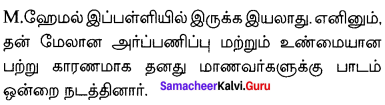
Now M. Hamel could no longer stay in his school. Still he gave a lesson to his students with utmost devotion and sincerity as ever.
Samacheer Kalvi 10th English Solutions Prose Chapter 6 The Last Lesson 26

Conclusion:
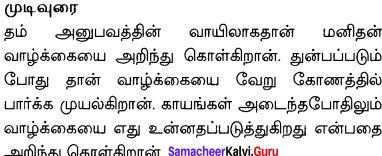
The author has expressed the true feeling of loyalty, duty and concern of a teacher towards his pupils. The helplessness of the citizens and the unawareness of the impending danger to the nation is portrayed well by the author.
Samacheer Kalvi 10th English Solutions Prose Chapter 6 The Last Lesson 27

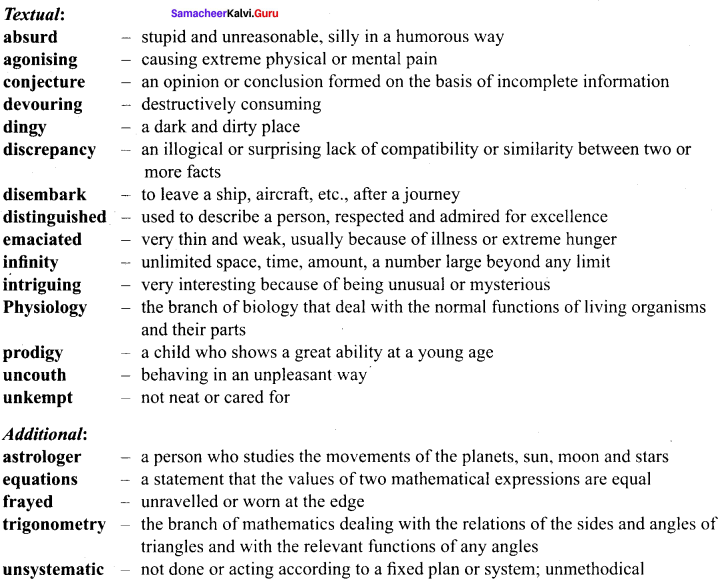
The Last Lesson Glossary:

Textual:
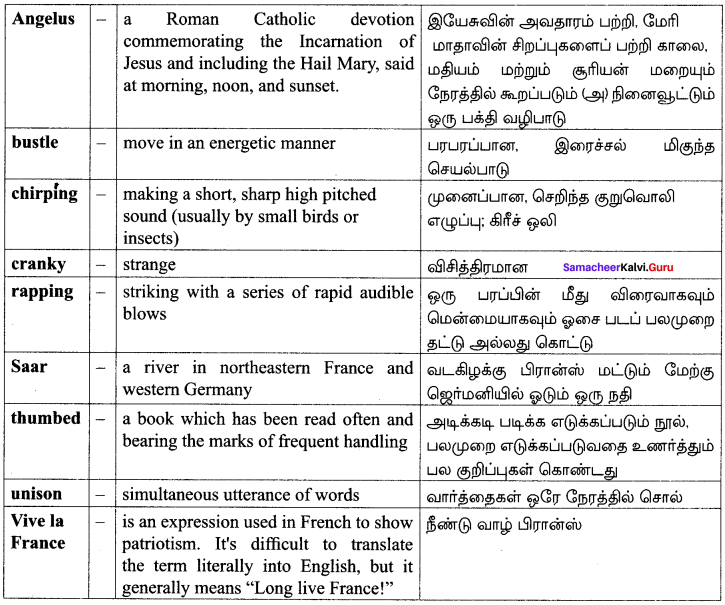
Samacheer Kalvi 10th English Solutions Prose Chapter 6 The Last Lesson 28

Additional:
Samacheer Kalvi 10th English Solutions Prose Chapter 6 The Last Lesson 29

Synonyms:

Choose the most appropriate synonym of the underlined word.

1. I was in great dread of a scolding.
(a) fear
(b) tread
(c) walk
(d) footfall
Answer:
(a) fear

2. The birds were chirping at the edge of the woods.
(a) cheating
(b) duplicitous
(c) tweeting
(d) clinging
Answer:
(c) tweeting

3. Wachter was there with his apprentice.
(a) appearance
(b) baggage
(c) calmness
(d) trainee
Answer:
(d) trainee

4. Usually, when school began, there was a great bustle.
(a) commotion
(b) bus
(e) haste
(d) silence
Answer:
(a) commotion

5. Lessons were repeated in unison.
(a) discord
(b) harmony
(c) usage
(d) underway
Answer:
(b) harmony

6. The teacher’s great ruler rapped on the table.
(a) tapped
(b) sang
(c) reigned
(d) kept
Answer:
(a) tapped

7. I had counted on the commotion to get to my desk without being seen.
(a) blocked
(b) reckoned
(c) cancelled
(d) dreaded
Answer:
(b) reckoned

8. You can imagine how I blushed and how frightened I was.
(a) blamed
(b) beamed
(c) bleated
(d) flushed
Answer:
(d) flushed

9. Hauser had brought an old primer.
(a) prankster
(b) textbook
(c) guitar
(d) machine
Answer:
(b) textbook

10. I want you to be very attentive.
(a) attendance
(b) concentrating
(c) creative
(d) distracted
Answer:
(b) concentrating

Antonyms:

Choose the most appropriate antonym of the underlined word.

1. This lesson is set in the days of France-Prussian war.
(a) avarice
(b) battle
(c) combat
(d) peace
Answer:
(d) peace

2. The Prussians defeated the French.
(a) aimed
(b) brought
(c) triumphed
(d) drained
Answer:
(c) triumphed

3. The oppressors dominated over the language and culture of the Germans.
(a) liberated
(b) released
(c) conquered
(d) controlled
Answer:
(a) liberated

4. M. Hamel would question us on participles.
(a) beautify
(b) answer
(c) clarify
(d) demonstrate
Answer:
(b) answer

5. The birds were chirping in the open field back of the saw mill.
(a) enrolled
(b) built-up
(c) enclosed
(d) vulnerable
Answer:
(c) enclosed

6. I had the strength to resist.
(a) asset
(b) forte
(c) weakness
(d) dream
Answer:
(c) weakness

7. There was a crowd in front of the bulletin-board.
(a) averse
(b) reverse
(c) anterior
(d) façade
Answer:
(b) reverse

8. Then, as I hurried by as fast as I could go.
(a) hassled
(b) released
(c) relaxed
(d) Warmed
Answer:
(c) relaxed

9. Lessons were repeated in unison.
(a) accord
(b) discord
(c) united
(d) ignited
Answer:
(b) discord

10. Everything had to be as quiet as Sunday morning.
(a) queer
(b) quaint
(c) noisy
(d) calm
Answer:
(c) noisy

We hope the data given here will benefit you to the fullest extent at the time of preparation. For better understanding of English subject this Samacheer Kalvi 10th English Solutions for Class 10th English Prose Chapter 6 The Last Lesson PDF is the best resource. Download & ace up your preparation. Keep in touch with us and get the latest information on Tamilnadu State board Textbook Solutions PDF.


Samacheer Kalvi 6th Science Solutions Term 2 Chapter 3 Changes Around Us

You can Download Samacheer Kalvi 6th Science Book Solutions Guide Pdf, Tamilnadu State Board help you to revise the complete Syllabus and score more marks in your examinations.

Tamilnadu Samacheer Kalvi 6th Science Solutions Term 2 Chapter 3 Changes Around Us

Samacheer Kalvi 6th Science Changes Around Us Textual Evaluation

I. Choose the appropriate answer:

Define A Slow Change Answer Question 1.
When Ice melts to form water, change occurs In its
(a) position
(b) colour
(c) state
(d) composition
Answer:
(c) state

Samacheer Kalvi 6th Science Term 2 Question 2.
Formation of curd from milk is
(a) a reversible change
(b) a fast change
(c) an irreversible change
(d) an undesirable change
Answer:
(c) an irreversible change

Changes Around Us Question 3.
Formation of curd from milk Is
(a) a reversible change
(b) a fast change
(c) an irreversible change
(d) an undesirable change
Answer:
(c) an irreversible change

Changes Around Us Class 6 Worksheet Pdf Question 4.
Out of the following an example of a desirable change is
(a) rusting
(b) change of seasons
(c) earthquake
(d) flooding
Answer:
(b) change the seasons

Changes Around Us Meaning In Tamil Question 5.
Air pollution leading to Acid rain Is a
(a) reversible change
(b) fast change
(c) natural change
(d) human-made change
Answer:
(d) human-made change

II. Fill in the blanks:

  1. Magnet attracts iron needle. This is ______ change (a reversible/anirreversible)
  2. Boiling of egg results in _______ change, (a reversible / an irreversible)
  3. Changes that are harmful to us are _______ (desirable / undesirable)
  4. Plants convert Carbon-di-oxide and water into starch. This is an example of _______ change, (natural / human made).
  5. Bursting of fire crackers is a _______ change whereas germination of seeds is a _______ change, (slow / fast)

Answers:

  1. reversible
  2. an irreversible
  3. undesirable
  4. natural
  5. fast, slow

III. True or False. If False, give the correct statement:

Samacheer Kalvi Guru 6th Science Term 2 Question 1.
Growing of teeth in an infant is slow change.
Answer:
True

Changes Around Us Questions And Answers Question 2.
Burning of match stick is a reversible change.
Answer:
False, Burning of match stick is an irreversible change.

Define Sublimation Samacheer Kalvi Question 3.
Change of New moon to Full moon is human made.
Answer:
False, Change of new moon to full moon is natural change.

Question 4.
Digestion of food is a physical change.
Answer:
False, Digestion of food is a chemical change.

Question 5.
In a solution of salt in water, water is the solute.
Answer:
False, In a solution of salt in water, water is the solvent

IV. Analogy:

Question 1.
Curdling of milk : irreversible change :: Formation of clouds : ________ change.
Answer:
reversible

Question 2.
Photosynthesis : ________ change :: burning of coal: Human – made change.
Answer:
natural

Question 3.
Dissolving of glucose: reversible change:: Digestion of food: ________ change
Answer:
irreversible

Question 4.
Cooking of food : desirable change :: decaying of food : ________ change
Answer:
undesirable

Question 5.
Burning of matchstick : ________ change: Rotation of the Earth : Slow change
Answer:
Fast

V. Circle the odd one out. Give reason for your choice:

Question 1.
Growth of a child, Blinking of eye, Rusting, Germination of a seed.
Answer:
Rusting
Reason: Rusting is undesirable change. Others three are desirable changes.

Question 2.
Glowing of a bulb, lighting of a Candle, breaking of a coffee mug, curdling of milk.
Answer:
breaking of a coffee mug.
Reason : Breaking of a coffee mug is undesirable change. Other three are desirable changes.

Question 3.
Rotting of an egg, condensation of water vapour, trimming of hair, Ripening of fruit.
Answer:
Rotting of an egg.
Reason : Rotting of an egg is undesirable change. Other three are desirable changes.

Question 4.
Inflating a balloon, popping a balloon, fading of wall paint, burning of kerosene.
Answer:
Inflating a balloon.
Reason : Inflating a balloon is reversible change. Other three are irreversible changes.

VI. Give very short answer:

Question 1.
What kind of a change is associated with decaying of a plants?
Answer:
Decaying of plants is associated with slow change and chemical change.

Question 2.
You are given some candle wax. Can you make a candle doll from it? What kind of change is this?
Answer:
Yes, I can. It is a physical (reversible) change.

Question 3.
Define a slow change.
Answer:
Changes which take place over a long period of time (hours/days/months/years) are known as slow changes.

Question 4.
What happens when cane sugar is strongly heated? Mention any two changes in it.
Answer:

  1. Sugar is basically Sucrose.
  2. The molecular formula of Sugar is C12 H22O11 (or) C12(H2O)11.
  3. When sugar is heated, it loses all water molecules and decomposes to carbon.
  4. Chemical change;
  5. Irreversible change

Question 5.
What is a solution?
Answer:
When a solute is dissolved in a solvent, it forms a solution.
Solute + solvent → solution.

VII. Give short answer:

Question 1.
What happens when paper is burnt? Explain.
Answer:
Burning of paper takes place within a short period of time (seconds or minutes) So, it is a fast change.

Question 2.
Can deforestation be considered a desirable change? Explain.
Answer:
No, it is an undesirable change, and it is a human made change. Deforestation leads to decreasing rainfall, and leads to global warming.

Question 3.
What type of changes is associated with germination of a seed? Explain
Answer:

  1. Germination of seed is a slow change.
  2. Changes which take place over a long period of time (days) are known as Slow changes.

VIII. Answer In detail:

Question 1.
Give one example in each case that happens around you.
a. Slow and fast change
b. Reversible and irreversible change
c. Physical and chemical change
d. Natural and man-made change
e. Desirable and undesirable change
Answer:

S.No.ChangesExamples
a.Slow changegrowth of nail and hair
Fast changeburning of a paper
b.Reversible changemelting of ice
Irreversible changechange of milk into curd.
c.Physical changedrying of cloth
Chemical changerusting of iron
d.Natural changerotation of earth
Man-made changeconstruction of building
e.Desirable changecooking of food
Undesirable changedeforestation.

IX. Questions Based on Higher Order Thinking Skills.

Question 1.
When a candle is lit the following changes are observed.
a. Wax melts.
b. Candle keeps burning
c. The size of the candle decreases.
d. The molten wax solidifies
e. Which of the changes can be reversed? Justify your answer.
Answer:
a. Wax melting is a reversible change.
d. “The molten wax solidifies” is a reversible change.

These two changes can be reversible to get back the original state. So the above two changes are reversible changes.

Samacheer Kalvi 6th Science Changes Intext Activities

Fill in the gaps:
Answer:

Initial stageChanging stage
SeedSapling
DayNight
RockSoil
raw fruitripe fruit

Activity 1

Question 1.
What happens when you blow air into a balloon?
Define A Slow Change Answer Samacheer Kalvi 6th Science Solutions Term 2 Chapter 3
Is there change in size? [ ] Yes [ ] No
Answer:
[✓] Yes

Is there change in shape? [ ] Yes [ ] No
Answer:
[✓] Yes

Is there any other change? [ ] Yes [ ] No
Answer:
[✓] No

Activity 2

Question 1.
Look at the pictures and discuss about the duration for the changes to take place.
Samacheer Kalvi 6th Science Term 2 Chapter 3 Changes Around Us
Answer:

  1. Child growing – Slow change
  2. Rusting of iron – Slow change
  3. Bulb glowing – Fast change
  4. Bursting of fire crackers – Fast change

Activity 3

Question 1.
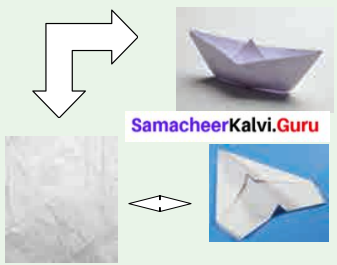
Try to make a boat and an aeroplane one by one using the same piece of paper. This means the change of shape discussed here is reversible.
Changes Around Us Samacheer Kalvi 6th Science Solutions Term 2 Chapter 3
Answer:
The change is reversible, because we make boat and aeroplane in the same piece of paper.
Activity to be done by the students themselves

Activity 4

Question 1.
What kind of changes are they?
(a) Burning of a candle.
(b) Piercing a balloon with a pin.
Changes Around Us Class 6 Worksheet Pdf Term 2 Chapter 3 Changes Around Us
Answer:
(a) Reversible change
(b) Irreversible change.

Activity 5

Question 1.
Take an apple and cut it into two halves. Cut one half into pieces and share it with your friends.
Changes Around Us Meaning In Tamil Samacheer Kalvi 6th Science Solutions Term 2 Chapter 3
Is there any change in the composition of the Apple while cutting?
No, only the shape and size have changed. This can be called a
Physical change.
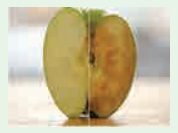
Leave the other half on the table for some time. You can see brown patches formed on the cut surface because of the reaction between some substances in the apple and the air around it. This is a Chemical change.
Answer:
Activity to be done by the students themselves

Activity 6

Take half a cup of water, add one spoon full of sugar and stir well.
Samacheer Kalvi Guru 6th Science Term 2 Chapter 3 Changes Around Us
(a) What do you observe?
(b) What happened to the sugar?
(c) Where is it gone?
(d) The solute in the above solution is __________
(e) The solvent in the above solution is __________
(f) Have you seen a glass of water and a glass of sugar solution looking alike?
Answer:
(a) I observe sugar solution is there.
(b) The sugar is dissolved in the water.
(c) The sugar particle is mixed with water molecules.
(d) The solute is sugar.
(e) The solvent is water
(f) Yes.

Activity 7

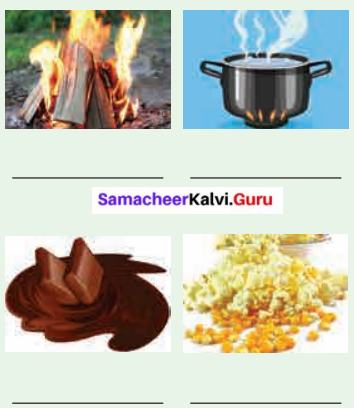
Question 1.
Look at the pictures and write whether they are Physical or Chemical changes.
Changes Around Us Questions And Answers Samacheer Kalvi 6th Science Solutions Term 2 Chapter 3
Answer:
i. Chemical change
ii. Physical change
iii. Physical change
iv. Chemical change

Activity 8

Question 1.
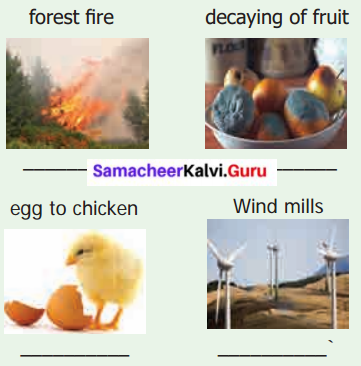
Look at the pictures and write whether they are desirable or undesirable changes.
Define Sublimation Samacheer Kalvi 6th Science Solutions Term 2 Chapter 3 Changes Around Us
Answer:
i. forest fire – undesirable change
ii. decaying of fruit – undesirable change
iii. egg to chicken – desirable change
iv. wind mills – desirable change

Activity 9

Question 1.
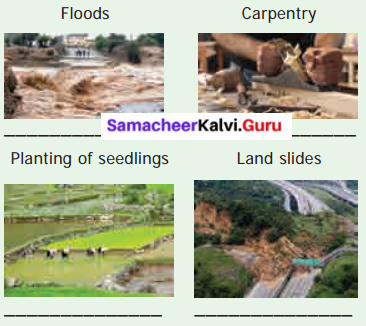
Identify the type of changes.
Natural / Human made
Samacheer Kalvi 6th Science Solutions Term 2 Chapter 3 Changes Around Us 9
Answer:
i. Floods – Natural change
ii. Carpentry – Human made change
iii. Planting of seedlings – Human made change
iv. Land slides – Natural change

Samacheer Kalvi 6th Science Changes Additional Questions

I. Choose the correct answer:

Question 1.
Growth of seed into sapling is _______ change
(a) slow
(b) chemical
(c) reversible
(d) undesirable
Answer:
(a) slow

Question 2.
The softening of vegetables by cooking is a (an)
(a) Fast change
(b) Chemical change
(c) Artificial change
(d) Reversible change
Answer:
(c) Artificial change

Question 3.
Which of the following is not a man-made change?
(a) Burning of fuels
(b) Drying of clothes
(c) Tearing of paper
(d) Change of day and nigh
Answer:
(d) Change of day and night

Question 4.
Sublimation of Iodine is a
(a) Chemical change
(b) Physical change
(c) Natural change
(d) Undesirable change
Answer:
(b) physical change

Question 5.
Raining is a _______ change
(a) human made
(b) undesirable
(c) slow
(d) natural
Answer:
(d) natural

II. Fill in the blanks:

  1. _______ changes which take place within a short period of time. (Fast/Slow)
  2. When ‘Touch me not’ plant is touched by us, _______ changes occur. (reversible/irreversible)
  3. Tearing of sheet of paper into pieces is _______ By the process of Heating of water, change. (physical / chemical).
  4. By the process of Heating of water, _______ is obtained (ice/steam)
  5. _______ is the substance that is dissolved in a solvent. (Solute/Solvent)
  6. The changes in which new substance with new chemical properties are formed are _______ changes. (physical / chemical).
  7. Deforestation is _______ change. (Natural/human made)

Answers:

  1. Fast
  2. reversible
  3. physicall
  4. steam
  5. Solutel
  6. chemical
  7. human made

III. Find whether the following sentences are true or false. If false Correct the statement:

Question 1.
The difference between initial state and the final state is called change.
Answer:
True.

Question 2.
Gas exists in three states as solid, liquid and gas.
Answer:
False. Water exists in three states as solid, liquid, gas.

Question 3.
Water into steam on heating is called freezing.
Answer:
False. Water into steam on heating is called vaporisation.

Question 4.
When solute is dissolved in a solvent it forms a solution.
Answer:
True.

Question 5.
Chemical change is a temporary change .
Answer:
False. Chemical change is a permanent change, (or) Physical change is a temporary change.

Question 6.
Natural changes which take place in nature on their own, are beyond the control of human being.
Answer:
True.

Question 7.
Construction of building is a Natural change.
Answer:
False. Construction of building is a human made change.

IV. Analogy:

Question 1.
Germination of seed : slow change.
Breaking of glass : _______
Answer:
Fast change

Question 2.
Irreversible change : Making idly front batter.
Reversible change: _______
Answer:
Stretching of Rubber band

Question 3.
Melting of ice : Physical change.
Popping of popcorn : _______
Answer:
Chemical change

Question 4.
Melting : ice into water on heating,
freezing: _______
Answer:
water into ice on cooling.

Question 5.
Changing of phases of the moon : Natural changes.
Cultivation of paddy : _______
Answer:
Human made change.

V. Match the following:

i. Lighting(a)Physical change
ii. Touch me not plant leaves showing(b)camphor
iii. Sugar dissolving(c)Water
iv. Sublimation(d)Reversible change
v. Universal solvent(e)Fast change

Answer:
i. – e
ii. – d
iii – a
iv. – b
v. – c

VI. Give short answer:

Question 1.
Mention any three examples of fast change?
Answer:

  1. Bursting of balloon
  2. Breaking of glass
  3. Burning of paper

Question 2.
What is reversible change? Give example.
Answer:
Changes which can be reversed, to get back the original state, are known as reversible
changes. Eg.: Melting of ice, stretching of rubber band.

Question 3.
Give some examples for physical change.
Answer:

  1. Melting of ice
  2. The solution of salt (or) sugar
  3. Stretching of rubber band

Question 4.
Whatjs freezing? Give example.
Answer:
The conversion of liquid into solid by cooling is called freezing. Ex. Water into ice cubes.

Question 5.
Define sublimation.
Answer:
The change of state from solid to gas directly is called sublimation.

Question 6.
Water is known as universal solvent. Why?
Answer:
Water dissolves a wide range of substances. So it is called as universal solvent.

Question 7.
What is the meaning of natural changes? Give example.
Answer:
Changes which take place in nature on their own and are beyond the control of human beings are known as natural changes. Ex.: Rotation of earth, Raining.

Question 8.
What is artificial changes? Give example.
Answer:
The changes which are brought about by human beings are known as human made or artificial changes. Ex.: Construction of bridges, Road construction, Cooking.

VII. Answer in detail:

Question 1.
Tabulate the difference between physical and chemical changes.
Answer:

S.No.Physical ChangesChemical Examples
1.No new substance formedNew substance formed
2.No change in the chemical composition

There is change in the chemical composition.

3.It is a temporary change.It is a permanent change
4.It is reversibleIt is irreversible.
5.Ex.: Melting of ice, dissolving of salt, Tearing of paper.Ex.: Rusting of iron, Burning of wood, Paper.


Samacheer Kalvi 6th Social Science History Solutions Term 1 Chapter 3 Indus Civilisation

You can Download Samacheer Kalvi 6th Social Science Book Solutions Guide Pdf, Tamilnadu State Board help you to revise the complete Syllabus and score more marks in your examinations.

Tamilnadu Samacheer Kalvi 6th Social Science History Solutions Term 1 Chapter 3 Indus Civilisation

Samacheer Kalvi 6th Social Science Indus Civilisation Textual Evaluation

I. Choose the correct answers:

Indus Valley Civilization Samacheer Kalvi Question 1.
What metals were know to the people of Indus Civilisation?
(a) Copper, bronze, silver, gold, but not iron
(b) Copper, silver, iron, but not bronze
(c) Copper, gold, iron, but not silver
(d) Copper, silver, iron, but not gold
Answer:
(a) Copper, bronze, silver, gold; but not iron

Indus Civilisation Belonged To Question 2.
Indus Civilization belonged to ………………..
(a) Old Stone age
(b) Medieval stone age
(c) New Stone age
(d) Metal age
Answer:
(d) Metal age

Indus Civilization Belongs To Question 3.
River valleys are said to be the cradle of civilisation because.
(a) Soil is very fertile
(b) They experience good climate.
(c) They are useful for transportation
(d) Many civilisations flourished on river valleys.
Answer:
(d) Many civilisations flourished on river valleys.

II. Match the statement whit the reason. tick the appropriate answers:

Indus Civilisation Belonged To Answer Question 1.
Statement : Harappait civilization is said to be ait urban civilizations,
Reason : It has well planned cities with advanced drainage systems.
(a) Statement and reason are correct.
(b) Statement is wrong.
(c) Statement is true, but the reason is wrong.
(d) Both statement and reason are wrong.
Answer:
(a) Statement and reason are correct.

Indus Civilization Belongs To Metal Age Question 2.
Statement : Harappan civilisation belongs to Bronze age.
Reason : Harappans did not know the use of iron.
(a) Statement and reason are correct.
(b) Statement is wrong.
(c) Statement is correct, but the reason is wrong.
(d) Both statement and reason are wrong.
Answer:
(a) Statement and reason are correct.

Indus Civilization Belongs To Answer Question 3.
Statement : The engineerring skill of Harpones was remarkable
Reason : Building docks after u careful study Of tides, waves and currents.
(a) Statement and reason are correct.
(b) Statement is wrong.
(c) Statement is correct, but the reason is wrong.
(d) Both statement and reason are wrong.
Answer:
(a) Statement and reason are correct.

Indus Civilization Belonged To Question 4.
Which of the following statements about Mohenjo – Daro is correct?
(a) Gold ornaments were unknown.
(b) Houses were made of burnt bricks.
(c) Implements were made of iron.
(d) Great Bath was made water tight with the layers of natural bitumen
Answer:
(b) and (d)

Indus Valley Civilization Belongs To Old Stone Age Question 5.
Cosidering the following statement:
1. Uniformity in layout of town, streets, and brick siz
2. An elaborate and well laid out drainage system
3. Granaries constituted an important part of Harappan Cities
Which of the above statement are correct?
(a) 1&2
(b) 1&3
(c) 2&3
(d) all the three
Answer:
(d) all the three

Indus Civilization Belonged To Answer Question 6.
The odd one
Answer:
Oxen, sheep, buffaloes, pigs, horses

Find out the wrong pair
(b) Citadel – Granaries
(a) ASI John – Marshall
(c) Lothal – dockyard
(d) Harappan civilisation – River Cauvery
Answer:
(d) Harappan civilisation – River Cauvery

III. Fill in the blanks:

  1. ________ is the oldest civilisation.
  2. Archaeological Survey of india was founded by ________
  3. ________ were used to store grains.
  4. Group of people ________ form

Answer:

  1. Mesopotamian civilization
  2. Alexander cunningham
  3. Granaries
  4. Community

IV. State True or False:

  1. Mehergarh is a Neolithic site.
  2. Archaeological Survey of India is responsible for the preservation of cultural monuments
  3. in the country.
  4. Granaries were used to store grains
  5. The earliest form of writings was developed by the Chinese.

Answer:

  1. True
  2. True
  3. True
  4. False

V. Match the following :

  1. Mohenjo Daro – (i) raised platform
  2. Bronze – (ii) red quartz stone
  3. Citade – (iii) alloy
  4. Carnelian – (iv) mound of dead

Answer:

  1. iv
  2. iii
  3. i
  4. ii

VI. Answer in the one or two sentences:

Samacheer Kalvi 6th Books Social Science Question 1.
What are the uses of metal?
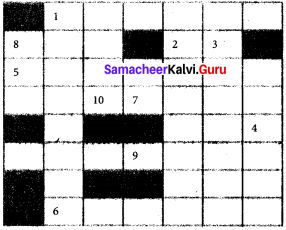
Answer:

  1. Gold and Silver were used to make ornaments.
  2. They used copper and bronze to make weapons and vessels.
  3. Bronze was used to make statues. ( Example: Statue of a dancing girl.)

Samacheer Kalvi 6th Social Science Book Question 2.
Make a list of baked and raw food that weat.
Raw food : Fruits and vegetables like apple, carrot, cucumber etc.
Baked food : Bread, Bun, Cake, Cookie, Pudding etc.

Samacheer Kalvi 6th Social Science Book Back Answers Question 3.
Do we have the practice of worshipping animals and trees?
Answer:
Yes, people belonging to some religions worship animals and trees.

Samacheer Kalvi 6th Social Book Question 4.
River valleys are cradles of civiftatfun, why?
Answer:

  1. River valley had fertile soil. Agriculture grew well in these regions.
  2. Fresh water was available for drinking, Watering livestock and irrigation.
  3. Easy movement of people and goods was possible.

Question 5.
Just because a toy moves it doesn’t mean it’s modern. What did they use instead of batteries?
Answer:
They used wheels.

Question 6.
Dog was the first animal to be tamed. Why?
Answer:
Humans started breeding dogs to help with hunting, herding, standing guard and carrying stuff.

Question 7.
If you were an archaeologist, what will you do?
Answer:
If I were an archaeologist I would go to Adichanallur which is located in our district and do excavation there.

Question 8.
Name any two Indus sites located in the Indian border?
Answer:

  1. Ralibangan (Rajasthan)
  2. Dholavira (Gujarat).

Question 9.
In Indus civilisation, which features you like the most? Why?
Answer:

  1. I like the drainage system very much.
  2. Most of the drains were covered with slabs or bricks. Even after nearly 5000 years many of the modern cities don’t have covered drains.
  3. It is said that each house had its own soak pit, which collected all the sediments and allowed only the water to flow into the street drain. I like this system very much.

Question 10.
What instrument Is used nowadays to weigh things?
Answer:
Weighing scale or spring balance is used nowadays to weigh things.

VII. Answer the following:

Question 1.
What method is used to explore buried buildings nowadays?
Answer:

  1. To see under the ground, the archaeologists may uSe a magnetic scanner.
  2. The presence and absence of archaeological remains can be detected by Radar and Remote Sensing Method.

Question 2.
Why did the Indus civilization call Bronze age civilization?
Answer:
Indus civilisation is called Bronze age civilisation because it is a historical period characterized by the use of articles made of bronze.

Question 3.
Indus Civilisation is called urban civilisation. Give reason
Answer:
Indus Civilisation is called urban civilisation because

  1. There was well-conceived town planning.
  2. Astonishing masonry and architecture were found.
  3. Priority was given for hygiene and public health.
  4. They used Standardised weights and measures
  5. They had solid agricultural and

Question 4.
Can you point out the special features of their drainage system?
Answer:

  1. The cities had covered drains.
  2. They were covered with slabs or bricks.
  3. There were manholes at regular intervals to clean the drains.
  4. Every house had its own soak pit, which collected all the sediments and allowed only the water to flow into the street drain.

Question 5.
What do you about great the great bath?
Answer:

  1. The great bath was a large, rectangular tank in a courtyard. It may be the earliest example of a waterproof structure.
  2. The bath was lined with bricks, coated with plaster and made watertight using layers of natural bitumen.
  3. There were steps on the north and south leading into the tank.
  4. There were rooms oh three sides.
  5. Water was drawn from the well, located in the courtyard and drained out after use.

Question 6.
How do you know that Indus people traded with other countries?
Answer:

  1. King Naram – sin of Akkadian empire has written about buying jewellery from the land of Melukha which is a region of the Indus valley.
  2. The same types of seals found in Mesopotamia have been also found in the Indus area.
  3. A naval dockyard has been discovered in Lothal in Gujarat. All these things show that Indus people traded with other countries.

VIII. HOTS:
Observe the following features of Indus Civilisation and compare that with the present day.
a. Lamppost
b. Burnt bricks
c. Underground drainage system
d. Weights and measurement
e. Dockyard
Answer:

(a) Lamp post

  1. In Indus Valley archaeologists have discovered lamp posts at intervals. This suggests the existence of street lights.
  2. Today street lighting commonly uses high intensity discharge lamps often HPS—high pressure sodium lamps.

(b) Burnt bricks

(i) In Harappan Civilization, the houses were built using baked bricks and ’mortar. Sun dried bricks were also used, Most of the bricks were of uniform size. They used the burnt bricks which were strong, hard, durable, resistant to fire and would not dissolve in water.

(ii) Even at present, brick is the most basic and favoured material for common construction through out the world. Nowadays bricks are available in different sizes and shapes. Kiln burnt bricks are used.

(c) Underground drainage system

(i) In Indus Civilization, they had covered drains. The drains were covered with slabs or bricks. Each drain had a gentle slope. Manholes were provided at regular intervals to clear the drain.

(ii) At present our cities and town are so populated and congested that conducting any infrastructural improvement over ground or underground is becoming difficult.

(d) Weights and measurement,

(i) Indus people used standardised weights and measures. They used sticks with marks to measure length.

(ii) In the modem world, we use electronic weighing machine to have accuracy in weighing. Floor scales and Platform scales are used in industries and small scale industries respectively.

(e) Dockyard

(i) A naval dockyard has been discovered in Lothal in Gujarath. It shows the maritime activities of the Indus people.

(ii) In modem days, there are may well developed ports in India. To quote a few, Chennai port, Kandla port, Tuticorin port, Cochin port, Paradip port etc.

Question 2.
Agriculture was one of their occupations. How can you prove this? (with the findings)
Answer:

  1. Agriculture was one of their main occupations. They cultivated wheat, barley, millets, sesame and pulses.
  2. There were granaries to store food grains. A granary has been discovered in a village in the state of Haryana. Ploughs have been unearthed. All these things show that agriculture was one of their occupations.

Question 3.
Many pottery and Its pieces have been discovered from Indus sites. What do you know from that?
Answer:

  1. Pottery was practised using the potter’s wheel. It was well fired.
  2. Potteries were red colour with beautiful designs in black.
  3. The broken pieces of pottery have animal figures and geometric designs on it.
  4. All these reveal the fact that the Indus people had very good artistic skill, colour concept and rich imagination.

Question 4.
A naval dockyard has been discovered in Lothal. What does it convey?
Answer:
A naval dockyard shows the maritime activities of the Indus people. It stands as a proof for their maritime trade.

Question 5.
Can you guess what happened to the Harappans?

  1. By 1800 BCE, the Harappan culture had started declining.
  2. It is assumed that the civilization met with

(a) repeated floods
(b) ecological changes
(c) invasions
(d) natural calamity
(e) climatic changes
(f) deforestation
(g) an epidemic might have disturbed the civilization.

IX. Student Activity :

Question 1.
Prepare a scrap book,
(Containing more information about objects collected from Mohenjo-Daro and Harappa.)
Hints :

(i) Mohenjo-Daro Findings – Notable Artefacts- seated and standing figures, copper and stone tools, balance scale and weighs, gold and Jasper jewellery, children Toys. The Dancing girl statue at National Museum, Delhi.

(ii) Harappan findings – seal with yogic picture representing Pashupathi toys, house hold implements, pottery displayed in Harappan gallery, National Museum, Delhi.

Question 2.
You arc a young archaeologist working at a site that was once an Indus city. What will you collect?
Hints:

  1. As a young archaeologist with Indus site, will examine the artefacts found, followed by documenting and preserving them,
  2. Compile the information collected with photos. Then analyses the findings from different angles with the help of

Question 3.
Crossword puzzle.
Indus Valley Civilization Samacheer Kalvi 6th Social Science History Solutions Term 1 Chapter 3

Top to Bottom

  1. Director General of ASI
  2.  _______ is older than Mohenjo-Daro
  3. This is _______ age civilisation
  4. Each house had a _______

Indus Civilisation Belonged To Samacheer Kalvi 6th  Social Science History Solutions Term 1 Chapter 3
Left to Right

  1. Place used to store grains
  2. A dockyard has been found
  3. _______ is unknown to Indus people
  4. It is used to make water tight.

Right to left

  1. From this we can get lot of information
  2. This is responsible for research

X. Rapid Fire Quiz (Do it in groups)

Question 1.
Which crop did Indus people use to make clothes?
Answer:
Cotton.

Question 2.
Which was the first Indus city discovered?
Answer:
Harappa.

Question 3.
Where was Indus Civilisation?
Answer:
Banks of River Indus.

Question 4.
Which animal was used to pull carts?
Answer:
OX, Buffalo.

Question 5.
Which metal was unknown to Indus people?
Answer:
Iron.

Question 6.
What was used to make pots?
Answer:
Potter’s wheel.

Question 7.
Which is considered the largest civilisation among four ancient civilisations of the
world?
Answer:
Indus Valley Civilization.

XI. Map work

  1. Mark any four Indus sites located within the Indian border.
  2. On the river map of India, colour the places where Indus civilisation spread.
  3. Mark the following places in the given India map:

(a) Mohenjo-Daro
(b) Chanhudaro
(c) Harappa
(d) Mehergarh
(e) Lothal
Indus Civilization Belongs To Samacheer Kalvi 6th  Social Science History Solutions Term 1 Chapter 3

XII. Answer Grid

Indus Civilisation Belonged To Answer Samacheer Kalvi 6th  Social Science History Solutions Term 1 Chapter 3

Samacheer Kalvi 6th Social Science Indus Civilisation In-Text Question

Observe the picture and fill the tabular column.

Indus Civilization Belongs To Metal Age Samacheer Kalvi 6th  Social Science History Solutions Term 1 Chapter 3

Indus Civilization Belongs To Answer Samacheer Kalvi 6th  Social Science History Solutions Term 1 Chapter 3
Indus Civilization Belonged To Samacheer Kalvi 6th  Social Science History Solutions Term 1 Chapter 3

Samacheer Kalvi 6th Social Science Indus Civilisation Additional Question

I. Choose the correct answer:

Question 1.
Indus valley civilization is great, because
(a) It had advanced sanitation and drainage system.
(b) Repeated floods affected this area.
(c) Indus people maintained a big army.
(d) They did not use iron
Answer:
(a) It had advanced sanitation and drainage system.

Question 2.
The assembly hall was located at ……………
(a) Harappa
(b) Mohenjo – Daro
(c) Lothal
(d) Kalibangan
Answer:
(b) Mohenjo – Daro

II. Match the statement with the Reason. Tick the appropriate answer:

Question 1.
Statement : Harappans knew the art of writing.
Reason : Harappans wrote on seals and pottery.
(a) Statement and Reason are correct
(b) Statement is correct, Reason is wrong.
(c) Statement is wrong, Reason is correct.
(d) Both statement and Resonance wrong
Answer:
(a) Statement and Reason are correct

Question 2.
Statement: The Harappan city had two planned areas.
Reason : Each house was with one or two storeys.
(a) Statement and Reason are correct
(b) Statement and Reason are wrong.
(c) Statement correct Reason wrong.
(d) Statement wrong Teason correct.
Answer:
(a) Statement and Reason are correct

Question 3.
Which one of the following is correct?

  1. Indus valley civilisation is an urban civilisation.
  2. In urban civilisatin people shift from rural areas to urban areas.
  3. They live a settled life.

(a) (i) and (ii) are correct
(b) (ii) and (iii) are correct
(c) (i) and (iii) are correct
(d) (i), (ii), and (iii) are correct
Answer:
(d) (i), (ii), and (iii) are correct

Question 4.
Which Of the following statements about Mohenjodaro is correct.
(a) People led nomadic life.
(b) Hunting was the main occupation
(c) Well planned streets were there
(d) They did not have a script
Answer:
(c) Well planned streets were there

Question 5.
Consider the following statements.

  1. Harappans used carts with spokeless solid wheels.
  2. In Harappan society there were merchants, traders, and artisans.
  3. Cotton fabrics were in common use.

Which of the above statements are correct.
(a) i and ii
(b) ii and iii
(c) i and iii
(d) all the three
Answer:
(d) all the three

Question 6.
Circle the odd one:
(a) Bangles
(b) Armlets
(c) Necklaces
(d) Seals
Answer:
(d) Seals

Question 7.
Find out the wrong pair.
(a) Lothal – Dockyard
(b) Janpath – New Delhi
(c) Mohenjodaro – Mound of dead
(d) Camelian – Pottery
Answer:
(d) Carnelian – Pottery

III. Fill in the blanks:

  1. The archaeologists began to excavate the cities of Harappa and Mohenjodaro in the ________
  2. The word civilisation comes from the ancient Latin word ________
  3. A huge public building found at Mohenjodaro was the ________
  4. Lothal is situated on the banks of a tributary of ________
  5. In Indus civilisation settlements were built on ________
  6. The earliest form of writing was developed by the ________

Answer:

  1. 1920s
  2. Civis
  3. assembly hall
  4. sabarmathi
  5. elevated
  6. sumerians

IV. State True or False:

  1. The Archaeological Survey of India (ASI) was started in 1924.
  2. Indus Civilisation had covered 6 big cities. .
  3. Mesopotamia was modem day Iraq, Kuwait and parts of Syria.
  4. Bitumen is nothing but water-proof Tar

Answer:

  1. False
  2. True
  3. True
  4. True

V. Match the following:

  1. Charles Masson – (i) Neolithic
  2. Mehergarh – (ii) First metal
  3. Radar – (iii) Explorer
  4. Copper – (iv) Remote sensing

Answer:

  1. Charles Masson – (iii) Explorer
  2. Mehergarh – (i) Neolithic
  3. Radar – (iv) Remote sensing
  4. Copper – (ii) First metal

VI. Answer in or two sentences :

Question 1.
Mention the importance of Rakhigarh village.
Answer:

  1. Rakhigarh is a village in Haryana.
  2. A granary with walls made of mud, bricks, which are still in a good condition, , has been discovered here.

Question 2.
Why did they use burnt bricks for construction?
Answer:
Burnt bricks are strong, hard, durable, to resistant to fire and will not dissolve in water or rain.

Question 3.
Who governed the Indus valley people?
Answer:
Historians believe that there existed a central authority that controlled planning of towns and overseas trade, maintenance of drainage and peace in the city.

Question 4.
Write a few sentences about pot making.
Answer:

  1. The wheel was used in pot making.
  2. Pots were burnt.
  3. They were painted.
  4. They drew figures of animals on the pots.

Question 5.
What is meant by Ziggurat?
Answer:

  1. Ziggurat means temple.
  2. In Mesopotami King Ur Nammu built Ziggurat in honour of the Moon God Sin.

VII. Answer the following:

Question 1.
How do archaeologists explore a lost city?
Answer:

  1. Archaeologists study the physical objects such as bricks, stones or bits of broken pottery to ascertain the time that they belong to.
  2. They search the ancient literary sources for references about the place.
  3. They look at the aerial photographs to understand topography.
  4. To see under the ground, they may use a magnetic scanner.

Question 2.
What do you understand by the excavation of granary in Indus Civilization?
Answer:

  1. The granary was a massive building with a solid brick foundation.
  2. They were used to store food grains.
  3. The remains of wheat, barley, millets, sesame and pulses have been found here.
  4. It shows that they had surplus grains.
  5. To safeguard the grains stored with granary, the granary was built on a raised platform.
  6. They should have had a good standard of agriculture.

Question 3.
Was there any leader in Mohenjodaro? Explain.
Answer:

  1. A sculpture of a seated male has been un earthered in a building, with a head band on the forehead and a smaller ornament on the right upper arm.
  2. His hair is carefully combed, and beard finely trimmed.
  3. Two holes beneath the ears suggest that the head ornament might have been attached to the ear.
  4. The left shoulder is covered with a shawl-like garment decorated with designs of flowers and rings.
  5. This shawl pattern is used by people even today in those areas.

VIII. HOTS:

Question 1.
Why should we learn about the Indus Valley Civilization?
Answer:

  1. The Indus Valley civilization was a Bronze Age civilization in the world.
  2. It was the largest among the four ancient civilizations of the world.
  3. At its peak, it might have had a population of over 5 million.
  4. Till date over 1056 cities have been discovered.
  5. Archaecologists first thought they had discovered cities of children since during excavation they found more and more of toys.
  6. Britishers laid down 93 miles of railway track with 4,000 year old Indus Valley bricks.
  7. They had the world’s first planned cities
  8. Their sanitation systems and drainage systems were much advanced than any other ancient civilizations.
  9. By learning about this civilization, we realise the richness of our ancient past

Samacheer Kalvi 7th Social Science Geography Solutions Term 2 Chapter 2 Tourism

You can Download Samacheer Kalvi 7th Social Science Book Solutions Guide Pdf, Tamilnadu State Board help you to revise the complete Syllabus and score more marks in your examinations.

Tamilnadu Samacheer Kalvi 7th Social Science Geography Solutions Term 2 Chapter 2 Tourism

Samacheer Kalvi 7th Social Science Tourism Textual Evaluation

I. Choose the correct answer:

The Oldest Type Of Tourism Is Dash Question 1.
The oldest type of tourism is
(a) Religious
(b) Historical
(c) Adventure
(d) Recreational
Answer:
(a) Religious

Samacheer Kalvi 7th Social Science Books Answers Question 2.
In which state is the Kaziranga national park located.
(a) Rajasthan
(b) West Bengal
(c) Assam
(d) Gujarat
Answer:
(c) Assam

Samacheer Kalvi 7th Social Question 3.
Which one of the following is not a beach of India?
(a) Goa
(b) Cochin
(c) Kovalam
(d) Miami
Answer:
(d) Miami

Samacheer Kalvi 7th Books Social Science Question 4.
Which of the following is not a bird sanctuary in India?
(a) Nal sarovor in Gujarat
(b) Koonthakulam in Tamil Nadu
(c) Bharatpur in Rajasthan
(d) Kanha in Madhya pradesh
Answer:
(d) Kanha in Madhya pradesh

Samacheer Kalvi 7th Social Science Question 5.
In which district courtallam waterfalls is located?
(a) Dharmapuri
(b) Tirunelveli
(c) Namakkal
(d) Theni
Answer:
(b) Tirunelveli

II. Fill in the blanks

  1. The three main components of tourism together known as _________
  2. Gastronomy refers to an aspect of _________ tourism.
  3. Suruli falls is also called as _________
  4. The second largest urban beach is _________
  5. Expansion of TAAJ _________

Answers:

  1. A3 concept
  2. cultural
  3. cloud land falls (or) Meghamati falls
  4. Marina beach
  5. Travel Agents Association of India

III. Circle the Odd one

Samacheer Kalvi 7th Social Book Question 1.
Transport, Attraction, Accommodation, Amenities
Answer:
(Transport) Attraction, Accommodation, Amenities

Samacheer Kalvi 7th Social Book Answers Question 2.
Nainital, Shillong, Munnar, Digha
Answer:
Nainital, Shillong, Munnar, (Digha)

Oldest Type Of Tourism Question 3.
Corbett, Sundarbans, periyar, Mayani
Ans.
Corbett, Sundarbans, periyar, (Mayani)

Social Samacheer Kalvi 7th Question 4.
Hogenakal, Kumbakkari, Suruli, Kalakad
Answer:
Hogenakal, Kumbakkari, Suruli, (Kalakad)

The Oldest Type Of Tourism Question 5.
Rishikesh, ladakh, Gulmarg, Kotagiri
Answer:
Rishikesh, ladakh, Gulmarg, (Kotagiri)

IV. Match the following

  1. Anamalai hills – West Bengal
  2. Monkey falls – Goa
  3. Darjeeling – Coimbatore
  4. Nature’s Haven – Top slip
  5. Aguda Beach – Javadi

Answers:

  1. Anamalai hills – Top slip
  2. Monkey falls – Coimbatore
  3. Darjeeling – West Bengal
  4. Nature’s Haven – Javadi
  5. Aguda Beach – Goa

V. Consider the following statement and tick (✓) die appropriate answer

Samacheer Kalvi Guru 7th Social Science Question 1.
Assertion (A) : Tourism is an essential activity for the life Of the society.
Reason (R) : its direct impact on social cultural, education and economic sector of the nation.
(a) A and R are correct and A explains R
(b) A and R are correct but A does not explain R
(c) A is in correct but R is correct
(d) Both A and R are in Correct
Answer:
(a) A and R are correct and A explains R

Question 2.
Assertion (A) : One of the most popular beaches in Goa Calangute is a treat for the adventure sports activities.
Reason (R) : Foreigners throng the beaches
(a) A and R are correct and A explain R
(b) A and R are correct but A does not explain R
(c) A is incorrect but R is correct
(d) Both A and R are incorrect
Answer:
(a) A and R are correct and A explains R

VI. Answer the following briefly

Question 1.
Define Tourism.
Answer:

  1. The word tourist was derived from an old English word “tourian” which refers to a person who travels out of his usual environment for not more than one year and less than 24 hours.
  2. The purpose of travel may be religious, recreation, business, historical and cultural.

Question 2.
Write short note on ECO Tourism.
Answer:

  1. Eco tourism typically involves travel, to destinations where plants and animals thrive in a naturally preserved environment.
  2. Amazon rain forest, African forest safari, trekking in the slopes of Himalayas are the famous incredible Eco friendly attractions.

Question 3.
What are the basic elements of Tourism?
Answer:
Certain elements are fundamental to attract tourists as travel destinations. They are:

  1. Pleasant weather
  2. Scenic beauty
  3. Historical and cultural monuments

Question 4.
Name any five hill stations in India.
Answer:

  1. Kodaikanal, Ooty
  2. Namital, Mussoorie
  3. Darjeeling
  4. Gulmarg
  5. Shillong

Question 5.
Name any five beaches in Tamil Nadu.
Answer:

  1. Kanyakumari beach
  2. Rameshwaram beach
  3. Golden beach
  4. Elliot beach
  5. Mahabalipuram beach

VII. Distinguish between

Question 1.
International Tourism and Historical Tourism
Answer:
International Tourism:

  1. International tourism refers to tourism that crosses national borders
  2. Globalization has made tourism a popular global leisure activity.

Historical Tourism

  1. Historical tourism is primarily focused upon historical places.
  2. The individuals make visits to these places with the purpose of leisure as well as acquiring information.

Question 2.
Religious Tourism and Adventure Tourism
Answer:
Religious Tourism:

  1. Religious tourism is one of the oldest type of tourism, wherein people travel individually or in groups for pilgrimage to a religious location such as temples, churches, mosques and other religious places.
  2. Religious tour to Kasi (Varanasi) by Hindus, to Jerusalem by Christians and to Mecca by Muslims are few of the examples for religious tourism.

Adventure Tourism:

  1. Adventure tourism is a type of tourism involving travel to remote or exotic places in order to take part in physica 11 y challenging outdoor activities
  2. For e.g. sky dive in Australia, Bungee jumping in New Zealand, mountaineering in the peaks of Himalayas, rafting in the Brahmaputra River at Arunachala Pradesh.

Question 3.
Attraction and Accessibility
Answer:
Attraction:

  1. Attractions mainly comprise of two types such as: Natural attraction, Cultural attraction
  2. Natural attraction includes landscape, seascape, beaches, climatic condition and forests. Cultural attraction are historic monuments and other intellectual creations. Apart from this, cultural attractions also includes fairs and festivals.

Accessibility:

  1. Accessibility means reachability to a particular place of attraction through various means of transportation such as road, rail, water and air
  2. Transport decides the cost of travel and the time consumed in reaching or accessing a specific attraction.

VIII. Answer the following questions in detail

Question 1.
Explain the Geographical components of Tourism.
Answer:
(i) Landforms : Mountains, Plateaus, Canyons, Valleys, Caves, Cirques, Sand dunes, Coral reefs, Cliffs, etc.,
(ii) Water: Rivers, Lakes, Waterfalls, Hot springs and Geysers, Snow and Glacier, Water Currents, Tides and Waves.
(iii) Vegetation : Forest, Grasslands, Moors, Deserts etc.,
(iv) Climate: Sunshine, Clouds, Admirable Temperature, Rain and Snow.
(v) Animal life :-
(a) Wildlife : Birds, Game Reserves, Zoos.
(b) Hunting and Fishing
(vi) Settlement features:-
(a) Towns, Cities, Villages
(b) Historical remains and Monuments
(vii) Culture:-Ways of life, traditions, folklore, arts and crafts.

Question 2.
Write briefly about the waterfalls in Tamil Nadu.
Answer:

  1. Mountains and rivers of Tamil Nadu combined together created many endearing waterfalls.
  2. Waterfalls in Tamil Nadu with its inspiring natural wonders attracts many tourists. A trek amidst thick green trees, steep hills and a bath in the gushing water is most rejuvenating.
  3. Here is the list of famous water falls of Tamil Nadu.

The Oldest Type Of Tourism Is Dash Samacheer Kalvi 7th Social Science Geography Solutions Term 2 Chapter 2

Question 3.
Describe the Environment Impact of Tourism.
Answer:
Environmental Impact of Tourism
The quality of the environment is essential for tourism. The tourism industry created several positive and negative impacts on the environment.

Positive Impacts:

  1. Direct financial Contributions
  2. Contributions to government revenues
  3. Improved environmental management and planning
  4. Increasing environmental awareness
  5. Protection and reservation of environment

Negative Impacts

1. Depletion of Natural Resources

  1. Water resources
  2. Local resources
  3. Land degradation

2. Pollution

  1. Air and Noise Pollution
  2. Solid Waste and Litering
  3. Sewage

3. Destruction and Alteration of Eco system

  1. Air
  2. Water
  3. Soil

IX. Hots

Question 1.
Why do we like sightseeing so much?
Answer:

  1. Sightseeing is considered to be one of the most important activities a tourist chooses to take part on reaching a destination.
  2. Sightseeing gives the tourist a chance to know a destination and experience it.
  3. Some people like adventures and to escape their normal monotonous life.
  4. So some people like sightseeing so much.

Question 2.
What are the ways to protect the sanctuaries?
Answer:

  1. Adopt: From wild animals to wild places, there’s an option for everyone.
  2. Volunteer : if you don’t have money to give, donate your time.
  3. Visit zoos, aquariums, national parks and wildlife refuges are all home to wild animals.
  4. Donate
  5. Speak up
  6. Buy responsibility
  7. Pitch in
  8. Recycle
  9. Restore
  10. Join

Question 3.
List any five reasons for travelling.
Answer:

  1. We travel to learn, whether its learning a new language or learning about an area’s history, travel allows us to learn so many different things.
  2. We travel to escape. Travel provides a momentary break from the humdrum of our daily lives.
  3. We travel to discover.
  4. We travel to make new friends.
  5. We travel to experience.

X. Activity

  • This activity should be done by students under the supervision of the subject teacher.
  • The students are grouped with six members in a group.
  • Each student will discuss in the group about their last tour. Each group will collect photographs and information.
  • The information will be shared in the class as well as displayed on the notice board of the class room.

Answer:
Activity to be done by the students themselves

Samacheer Kalvi 7th Social Science Tourism Additional Questions

I. Choose the correct answer:

Question 1.
________ are historic monuments and other intellectual creations.
(a) Natural attraction
(b) Cultural attraction
(c) Social attraction
(d) None of these
Answer:
(b) Cultural attraction

Question 2.
Tajmahal of India and Pyramids of Egypt are the examples of
(a) Historical Tourism
(b) Cultural tourism
(c) Eco-tourism
(d) Adventure tourism
Answer:
(a) Historical Tourism

Question 3.
Gastronomy refers to an aspect of
(a) Religious tourism
(b) Cultural tourism
(c) Historical tourism
(d) Eco-tourism
Answer:
(b) Cultural tourism

Question 4.
________ attract attention for their exclusive variety of birds.
(a) Bird sanctuaries
(b) Wildlife sanctuaries
(c) Both ‘a’ and ‘b’
(d) None of these
Answer:
(a) Bird sanctuaries

Question 5.
Push factors in Tourism are
(a) Amenities
(b) Accessibility
(c) Prestige
(d) Attraction
Answer:
(c) Prestige

Question 6.
_______ earns the largest share of income from tourism in India.
(a) Kerala
(b) Goa
(c) Rajasthan
(d) Tamil Nadu
Answer:
(d) Tamil Nadu

Question 7.
Suruli Falls is located in ________ district.
(a) Namakkal
(b) Tirunelveli
(c) Theni
(d) Dharmapuri
Answer:
(c) Theni

Question 8.
________ is a lovely place to hand around with friends, families and kids.
(a) Beach
(b) Temple
(c) Park
(d) Sanctuary
Answer:
(a) Beach

Question 9.
________ is a country known for its gentle (or) hospitality to all visitors.
(a) USA
(b) UK
(c) London
(d) India
Answer:
(d) India

II. Fill in the blanks:

  1. _______ has become an important source of income for many regions.
  2. _______ type of tourism aims at enjoyment, amusement or pleasure are mainly for fun activity.
  3. _______ is a very important factor in tourism.
  4. Few of the amazing waterfalls are in swing during the _______ season.
  5. Pull factors in Tourism are _______
  6. _______ in Tamil Nadu with its inspiring natural wonders attracts many tourists.
  7. The tourism industry created several positive and negative impacts on the _______

Answers:

  1. Tourism
  2. Recreational tourism
  3. Scenic attraction
  4. Monsoonj
  5. Amenitiesl
  6. Waterfalls
  7. environment

III. Circle the Odd one

Question 1.
Religious tourism, Cultural tourism, Adventure tourism, Environment
Answer:
Religious tourism, Cultural tourism, Adventure tourism, [Environment]

Question 2.
Mountains, Sunshine, Canyons, Valleys
Answer:
Mountains, [Sunshine], Canyons, Valleys

Question 3.
Forest, Grasslands, Clouds, Moors
Answer:
Forest, Grasslands, [Clouds], Moors

Question 4.
Water resources, Local resources, Land degradation, Amusement park
Answer:
Water resources, Local resources, Land degradation, [Amusement park]

III. Match the following

Question 1.

  1. Natural attraction – (a) Sand dunes
  2. Cultural attraction – (b) Grasslands
  3. Landforms – (c) Rain and snow
  4. Vegetation – (d) Historic monuments
  5. Climate – (e) Landscape

Answers:

  1. – e
  2. – d
  3. – a
  4. – b
  5. – c

Question 2.

  1. Amritsar – (a) Kerala
  2. Darjeeling – (b) Uttarakhand
  3. Munnar – (c) Maharashtra
  4. Corbeti National Park – (d) West Bengal
  5. Mayani Bird Sanctuary – (e) Punjab

Answers:

  1. – e
  2. – d
  3. – a
  4. – b
  5. – c

IV. Consider the following statements: Tick the appropriate answer

Question 1.
Assertion (A) : Recreational Tourism aims at enjoyment, amusement or pleasure are mainly for fun activity.
Reason (R) : India is a country known for its gentle hospitality with spicy food and culture.
(a) A and R are correct and A explain R
(b) A and R are correct but A does not explain R
(c) A is in correct but R is correct
(d) Both A and R are in Correct
Answer:
(b) A and R are correct but A does not explain R

V. Answer in one or two sentences

Question 1.
What are the types of tourism?
Answer:
Types of Tourism:

  • Religious tourism
  • Cultural tourism
  • Historical tourism
  • Eco-Tourism
  • Adventure tourism
  • Recreational tourism

Question 2.
Write a short note on Historical tourism.
Answer:
It focuses on visiting historically important places like museums, monuments archaeological areas, forts, temples and so on. Angkorwat of Cambodia, Tajmahal of India and Pyramids of Egypt are some of the examples to quote for Historical Tourism

Question 3.
Write a note on

  1. Inbound Tourism
  2. Outbound Tourism

Answer:

  1. Inbound Tourism : Touring within the native country.
  2. Outbound Tourism : Touring in foreign countries.

Question 4.
What is game reserves?
Answer:
Game Reserves : An area of land set aside for the protection of wild animals.

Question 5.
List any four famous religious spots of India.
Answer:

  • Rameswaram – TamilNadu
  • Kanchipuram – Tamil Nadu
  • Varanasi(Kasi) – Uttarpradesh
  • Saranath – Uttarpradesh

Question 6.
WrIte the abbreviation of

  1. ITC
  2. IATA
  3. TAAI
  4. TTDC

Answer:

  1. ITC – Inclusive Tour Charter
  2. IATA – International Air Transport Association
  3. TAAI – Travel Agents Association of India
  4. TTDC – Tamil Nadt Tourism Development Corporation

Question 7.
What is Wildlife and Bird Sanctuaries?
Answer:
India possesses a wide range of forests and grasslands. Diversity of these lands makes it one of the hotspot for flora and fauna. The dense and dark forest of Indian States provides suitable habitat for a wide and an unique variety of animals and birds.

Bird sanctuaries attract attention for their exclusive variety of birds. Diverse range of climate of India invite birds from remote places to feed, breed and to nurture their young ones in the Indian bird sanctuaries.

Question 8.
Answer:
Write any four bird sanctuaries in Tamil Nadu.
Samacheer Kalvi 7th Social Science Books Answers Geography Solutions Term 2 Chapter 2 Tourism

VI. Answer the following in detail

Question 1.
What are the basic components of tourism? Briefly explain it.
Answer:
The three main components of tourism are

  • Attraction
  • Accessibility
  • Amenities.

These three components are together known as A3 concept.

Attraction:
Attractions mainly comprise of two types such as:

  • Natural attraction
  • Cultural attraction

Accessibility:
Accessibility means reachability to a particular place of attraction through various means of transportation such as road, rail, water and air. Transport decides the cost of travel and the time consumed in reaching or accessing a specific attraction.

Amenities:
Amenities are the facilities that cater to the needs of a tourist.

  1. Accommodations in terms of hotels, restaurants, cafes and other staying units.
  2. Travel organizers, Tour operators and Travel Agents
  3. Foreign exchange centres, passport and visa agencies
  4. Sectors related to Travel Insurance, Safety and Security

Question 2.
Explain the tourism attractions in India.
Answer:

  1. India is a country known for its gentle hospitality with spicy food and culture.
  2. Visitor friendly traditions with varied life style, culture, heritage, colourful fairs and festivals are abiding attractions for the tourists.
  3. All types of land form, varied climate, rich resources for eco and adventure tourism are the versatile specialty of India.
  4. Technological parks and science museums, pilgrimage centers with wonderful art and architecture are an added advantage for tourists.
  5. Yoga, Ayurveda and Natural remedial Health resorts attract tourists from all over the world.

Question 3.
Briefly Explain Waterfall in India.
Answer:
In India there are many spectacular and wonderful waterfalls covered by dense forest, huge walls of rock and lush green trees. Among these waterfalls, some are seasonal, while some are perennial. Few of the amazing waterfalls are in swing during the monsoon season. This season brings lot of tourists to these bubbling waterfall sites. Notable waterfalls of India are given below:
Samacheer Kalvi 7th Social Science Geography Solutions Term 2 Chapter 2 Tourism

Samacheer Kalvi 6th Science Solutions Term 1 Chapter 5 Living World of Animals

You can Download Samacheer Kalvi 6th Science Book Solutions Guide Pdf, Tamilnadu State Board help you to revise the complete Syllabus and score more marks in your examinations.

Tamilnadu Samacheer Kalvi 6th Science Solutions Term 1 Chapter 5 Living World of Animals

Samacheer Kalvi 6th Science Living World of Animals Textual Evaluation

I. Choose the appropriate answer

Samacheer Kalvi Guru 6th Science Question 1
The study of living things or organisms is called _______
(a) Psychology
(b) Biology
(c) Zoology
(d) Botany
Answer:
(b) Biology

The World Of Animals Class 6 Question 2
Which of the following are characteristics of living beings?
i. Respiration
ii. Reproduction
iii. Adaptation
iv. Excretion
Choose the correct sequence
a. i, ii, and iv only
b. i, ii only
c. ii and iv only
d. i, iv, ii and iii
Answer:
d. i, iv, ii and iii

Living World Of Animals For Class 6 Question 3
Lizards breathe through their _______
(a) Skin
(b) Gills
(c) Lungs
(d) Trachea
Answer:
(c) Lungs

Samacheerkalvi.Guru 6th Science Question 4
All animals need
a. Food and water only
b. Water only
c. Air, food and water
d. Food only
Answer:
d. Air, food and water

Samacheer Kalvi 6th Science Solutions Question 5.
Which animal has the special organs of breathing called gills?
(a) Earthworm
(b) Fox
(c) Fish
(d) Frog
Answer:
(c) Fish

Samacheer Kalvi 6th Standard Science Question 6.
Choose the set that represents only biotic components of a habitat
a. Tiger, Deer, Grass, Soil
b. Rocks, Soil, Plants, Air
c. Sand, Turtle, Crab, Rocks
d. Aquatic plant, Fish, Frog, Insects
Answer:
d. Aquatic plant, Fish, Frog, Insects

Samacheer Kalvi.Guru 6th Science Question 7.
Which of the following cannot be called as a habitat?
(a) A desert with camels
(b) A pond with fish and snails
(c) Cultivated land with grazing cattle
(d) Ajungle with wild animals
Answer:
(c) Cultivated land with grazing cattlel

Living World Of Animals Question 8.
Birds fly in the air with the help of
a. heavy and strong Bones
b. Soft and thick Bones
c. Hollow and light Bones
d. Flat and thick Bones
Answer:
c. Hollow and Light Bones

Samacheer Kalvi 6th Science Question 9.
Paramecium moves from one place to other with the help of _______
(a) Pseudopodia
(b) Flagella
(c) Foot
(d) Cilia
Answer:
(d) Cillai

Samacheer Kalvi Guru 6th Science Book Back Answers Question 10.
Kangaroo rat lives in
a. Aquatic habitat
b. Desert habitat
c. Grassland habitat
d. Mountain habitat
Answer:
b. Desert habitat

II. Multiple Choice Questions.

Complete the following with appropriate word(s).

  1. Aquatic, deserts, mountains are called _______
  2. Based on the number of cells present, animals are classified into _______ and _______
  3. Tail of a bird acts as a rudder which helps to .
  4. Amoeba moves with the help of _______

Answers:

  1. Habitats
  2. unicellular, multicellular
  3. control the direction of the movements
  4. Pseudopodia (false foot)

III. True or False, If False gives the correct answer.

Samacheer Kalvi Science 6th Standard Question 1.
Habitat is a living or dwelling place of an organism.
Answer:
True.

Samacheer Guru 6th Science Question 2.
The geographical features and environmental conditions on earth remain same from one place to other.
Answer:
False. The geographical features and environmental conditions on earth differ from one place to other.

Samacheer Kalvi 6th Science Book Question 3.
Amoeba is a unicellular organism and moves with pseudopodia.
Answer:
True.

Samacheer Kalvi 6th Science Book Back Answers Question 4.
Birds can see only one object at a time.
Answer:
False. Birds can see two objects at a time. (Binocular vision)

Kalvi Guru 6th Science Question 5.
Paramoecium is a multicelluar organism.
Answer:
False. Paramoecium is a unicelluar organism.

IV. Complete the following.

  1. Tropical rain forests, grasslands and deserts are known as _______
  2. Some living things are made of a single cell, they are called _______ organism.
  3. The breathing organ of a fish is known as _______
  4. The lizard _______ on the ground with its claw on its feet.
  5. Camel stores _______ in its hump.

Answers:

  1. Habitats
  2. unicellular
  3. gills
  4. moves
  5. fat

V. Very Short Answer Questions.

Samacheer Kalvi Guru 6th Standard Science Question 1.
How do the birds catch their prey?
Answer:
a. The prey catching process depends on their types.
b. The aquatic birds with the help of their beaks get their prey sliding upside down into the water.
c. The birds of paddy fields get small insects with the help of sharp claws of their limbs.

Samacheer Kalvi Guru 6 Science Question 2.
Where can we see Camels in India?
Answer:
We can see Camels in Rajasthan.

Samacheer Kalvi Guru Science 6th Question 3.
Name the locomotary organ of an amoeba.
Answer:
Amoeba with the help of finger like projection called pseudo podia move from place to place.

Samacheer Kalvi 6th Science Book Solutions Question 4.
What are the body parts of a snake?
Answer:
Head, eyes, nostrils, mouth, belly, tail.

Samacheer Kalvi 6th Science Solution Question 5.
Which structure helps the bird to change its direction while flying in air?
Answer:
The tail helps the bird to change its direction while flying in air.

VI. Short Answer Type Questions.

Question 1.
Differentiate between Unicellularand Multicellular organisms.
Answer:
Unicellular Organisms:

  1. They are made up of single cell.
  2. They can perform all the functions of life.
  3. They are very small (microscopic) in size
  4. They lack tissues, organs and organ systems
  5. Growth occurs by an increase in the size of the cell.
  6. Eg. Amoeba, Paramecium, Euglena.

Mukkellubr Organisms

  1. They are made up of many cells.
  2. Different cells perform different functions.
  3. They are mostly large in size. They are seen through naked eyes.
  4. They are composed of tissues, and organ yems.
  5. Growth occurs by an increase in the number of cells by cell division.
  6. Eg. Earthworms, Fish, Frogs, Lizard and Human being.

Question 2.
Write the adaptive features of Polar bear and Penguin.
Answer:
Samacheer Kalvi Guru 6th Science Solutions Term 1 Chapter 5 Living World Of Animals

Question 3.
Mention the feature that help a bird to fly in the air.
Answer:

  1. The streamlined body shape.
  2. Their forelimbs are modified into wings.
  3. They have hollow and light bones for easy flying.
  4. The body of the birds are covered with feathers.

Question 4.
What are the different types of invertebrates?
Answer:

  1. Sponges (Porifera)
  2. Comb jellies (Ctenophora)
  3. Hydras, jellyfishes, sea anemones, and corals (Cnidaria)
  4. Starfishes, sea urchins, sea cucumbers (Echinodermata)
  5. Flatworms (Platyhelminthes)
  6. Round or threadworms (Nematoda)
  7. Earthworms and leeches (Annelida)
  8. Insects and arachnids (Arthropoda)
  9. Snails, and octopuses (Mollusca)

VII. Answer in detail.

Question 1.
Describe the various features which help camel dwell well in the desert?
Answer:

  1. The long leg of camel helps to keep its body away from the desert.
  2. Camel will drink large amount of water and store it in the body.
  3. Camel produce only small quantity of urine.
  4. The stored fat in the hump can break down for nourishment
  5. A camel has large and flat padded feet which helps in walking easily on soft sand.
  6. The long eyelashes and hairs protect its eyes and ears from flowing dust.
  7. It can keep its nostrils closed to avoid dust.

Samacheer Kalvi 6th Science Living World of Animals Intext Activities

Activity 1
The World Of Animals Class 6 Science Solutions Term 1 Chapter 5 Samacheer Kalvi
Look at the above picture and prepare a chart for the following interpretation.
How does the climate differ in these habitats?
Name some animals that exist in these habitats.
Can an animal survive if it is shifted from one habitat to another contrasting habitat?
Answer:
In terrestrial habitat, the temperature is more. In water habitat, the temperature is less.
(i) Terrestrial habitat animals : Cow, Rabbit, Lizard.
(ii) Water habitat animals : Duck, fish.
No. For example, in the water habitat fish can live in. But in terrestrial habitat, it cannot survive, because of the adaptation.

Activity 2

Question 1.
Collect the pictures of various ecosystems like lake, pond, forest, desert, mountains, and Polar regions and prepare a chart of animals in these places.
Answer:
Activity to be done by the students themselves

Samacheer Kalvi 6th Science Living World of Animals Additional Questions

I. Choose the correct answer.

Question 1.
Which is not a biotic community among the following?
(a) Plants
(b) Birds
(c) Air
(d) Elephant
Answer:
(c) Air

Question 2.
The locomotory organ of amoeba,
(a) pseudopodia
(b) cilia
(c) flagella
(d) None of these.
Answer:
(a) pseudopodia

Question 3.
Jurong Birds Park is located in
(a) America
(b) Singapore
(c) Japan
(d) Germany
Answer:
(b) Singapore

Question 4.
The animal that never drinks water,
(a) rat
(b) cat
(c) dog
(d) cow
Answer:
(a) rat

Question 5.
Lizards walk with four legs and it is known as .
(a) Bipedal
(b) Tripedal
(c) Monopedal
(d) quadripedal
Answer:
(d) quadripedal

Question 6.
Vedanthangal is ………. sanctuary
(a) Birds sanctuary
(b) Tiger sanctuary
(c) Elephant sanctuary
(d) Deer sanctuary
Answer:
(a) Birds sanctuary

Question 7.
Movement of animals to a different location due to seasonal change is called
(a) Hibernation
(b) Aestivat ion
(c) Migration
(d) Adaptation
Answer:
(c) Migration

Question 8.
_______ can live for many days without drinking water.
(a) Dog
(b) Elephant
(c) Cow
(d) Camel
Answer:
(d) Camel

Question 9.
Camel passes _______ amount of urine.
(a) small
(b) large
(c) moderate
(d) too large
Answer:
(a) small

II. Complete the following.

  1. Living things are made of small units called ________
  2. Organisms that are made of many cells are called ________
  3. Unicellular Organisms are small, usually ________ nature, and cannot be seen with naked eye.
  4. In Amobea ________ help in excretion.
  5. The fish has fins for ________
  6. ________ have web in the toes and able to glide or parachute the air and make soft landings.
  7. Birds have streamlined body covered with ________
  8. ________ is called the Ship of the Desert.

Answers:

  1. Cells
  2. multi cellular organisms
  3. microscopics
  4. Contractile vacuoles
  5. Swimming
  6. Dinosaurs
  7. feathers
  8. Camel

III. True of false. If false give the correct answer.

Question 1.
Fishes are unicellular organism.
Answer:
False. Fishes are multicellular organism.

Question 2.
In Amoeba, reproduction is by simple diffusion through the body surface.
Answer:
False. In Amoeba, respiration is by simple diffusion through the body surface.

Question 3.
In unicellular organisms, the growth occurs by an increase in the size of the cell.
Answer:
True.

Question 4.
The streamlined body shape of fish helps it to move through the water easily.
Answer:
True

Question 5.
Some fishes have the capacity to rotate the head around the head joint.
Answer:
False. Some lizards have the capacity to rotate the head around the head joint.

Question 6.
Movement of animals to different locations due to the season changes is said to be adaptation.
Answer:
False. Movement of animals to different locations due to the season changes is said to be Migration.

Question 7.
Spending the hot and dry period in an inactive state is known as Aestivation.
Answer:
True.

IV. Match the following.

Question 1.

  1. Polar bear – (a) Strong hooves for running, long hair to protect from cold
  2. Penguin – (b) Strong and fast runner has sharp claws to catch prey
  3. Mountain goat – (c) Paddle to swim, walk with two legs
  4. Lion – (d) Thick skin for protection, white fur

Answer:

  1. d
  2. c
  3. a
  4. b

Question 2.

  1. Bird – (a) stores water in the body
  2. Fish – (b) rotates its head around the head joint
  3. Lizard – (c) wings that are modified forelimbs
  4. Camel – (d) gills as respiratory organ lAns

Answer:

  1. – c
  2. – d
  3. – b
  4. – a

V. Complete the given analogy.

Question 1.
Fish : Water : : Elephant: _______
Answer:
Land

Question 2.
Euglena: Flagellum
_______ : Paramecium
Answer:
Cilia

Question 3.
Euglena: unicellular organism.
_______ : Multicellular organism
Answer:
Man

Question 4.
Fish respiratory organ : Gills
Bird’s Breathing organ: _______
Answer:
Lungs

Question 5.
Fins: Fish
Feather: _______
Answer:
Bird

Question 6.
Turtle: Hibernation
_______ : Aestivation
Answer:
Snail

Question 7.
Beak: Bird’s mouth
_______ : Fat stored in Camel.
Answer:
Hump

V. Short Answers.

Question 1.
List the locomotory organ of unicellular organisms.
Answer:

  1. Protozoa – pseudopodia
  2. Paramecium – cilia
  3. Euglena – flagellum

Question 2.
List any two differences between Paramecium and Euglena.
Answer:
Paramecium:

  1. Its locomotory organ is cilia
  2. Absence of chloroplast

Euglena:

  1. Its locomotory organ is fiagelhun
  2. Presence of chloroplast

Question 3.
What is meant by aestivation?
Answer:
Spending the hot and dry period in an inactive state is known as aestivation. (eg) Snail.

Question 4.
Mention the important adaptive features of fish.
Answer:
Gills is the respiratory organ of fish. It helps to absorb oxygen dissolved in water for breathing and not from the atmosphere. It is the adaptive feature of fish.

Question 5.
What is Binocular vision.
Answer:
At a time birds can see one object with one eye and another object with the other eye is. known binocular vision.

Question 6.
Define – Migration.
Answer:
When an animals moves its location as the season changes it is said to be Migration.

Question 7.
Which is called as ship of the desert? Why it is called so?
Answer:
Camel is called as ship of the desert.
A camel has large and flat padded feet which help it to walk easily on soft sand.

Question 8.
From which countries many birds migrate to our Vedanthangal?
Answer:
There are many birds from foreign countries like Siberia and Russia migrate to our Vedanthangal.

VII. Long Answer.

Question 1.
Describe various adaptive features of birds.
Answer:

  1. Birds have streamlined body covered with feathers.
  2. This body shape provides minimum resistance to air.
  3. They have beak instead of mouth.
  4. They breathe through lungs.
  5. They have hollow and light bones.
  6. The tail of the bird helps it to control the direction of the movements.
  7. They have strong chest muscles.
  8. They have binocular vision.

Question 2.
List the adaptation present in the lizard.
Answer:

  1. Lizards have strong four limbs.
  2. Lizards have the capacity to rotate the head around the head joint.
  3. They respire through lungs.
  4. Lizards have teeth adapted for grabbing and holding.
  5. Some lizards have web in the toes and are able to glide or parachute the air and make soft landings.

Samacheer Kalvi 9th Science Solutions Chapter 23 Economic Biology

You can Download Samacheer Kalvi 9th Science Book Solutions Guide Pdf, Tamilnadu State Board help you to revise the complete Syllabus and score more marks in your examinations.

Tamilnadu Samacheer Kalvi 9th Science Solutions Chapter 23 Economic Biology

Samacheer Kalvi 9th Science Economic Biology Textbook Exercises

I. Choose the correct answer.

Economic Biology 9th Class Question 1.
The production and management of fish is called ……………..
(a) Pisciculture
(b) Sericulture
(c) Aquaculture
(d) Monoculture
Answer:
(a) Pisciculture

Chapter 23 Economic Biology Question 2.
Which one of the following is not an exotic breed of cow?
(a) Jersey
(b) Holstein-Friesan
(c) Sahiwal
(d) Brown Swiss
Answer:
(c) Sahiwal

9th Science Economics Biology Question 3.
Which one of the following is an Italian species of honey bee?
(a) Apis mellifera
(b) Apis dorsata
(c) Apis florae
(d) Apis Cerana
Answer:
(a) Apis mellifera

Samacheer Kalvi 9th Science Question 4.
Which one of the following is not an Indian major carp?
(a) Rohu
(b) Catla
(c) Mrigal
(d) Singhara
Answer:
(d) Singhara

Samacheer Kalvi Guru 9th Science Question 5.
Drones in the honey bee colony are formed from
(a) unfertilized egg
(b) fertilized egg
(c) parthenogenesis
(d) both b and c
Answer:
(b) fertilized egg

Samacheer Kalvi 9th Science Solutions Question 6.
Which of the following is an high milk yielding variety of cow?
(a) Holstein- Friesan
(b) Dorset
(c) Sahiwal
(d) Red Sindhi
Answer:
(a) Holstein- Friesan

9th Science Samacheer Kalvi Question 7.
Which Indian variety of honey bee is commonly used for apiculture?
(a) Apis dorsata
(b) Apis florea
(c) Apis mellifera
(d) Apis indica
Answer:
(d) Apis indica

Samacheer Kalvi 9th Science Guide Question 8.
………………. is the method of growing plants without soil.
(a) Horticulture
(b) Hydroponics
(c) Pomology
(d) None of these
Answer:
(b) Hydroponics

Samacheer Kalvi 9th Science Solution Question 9.
The symbiotic association of fungi and vascular plants is …………………….
(a) Lichen
(b) Rhizobium
(c) Mycorhizae
(d) Azotobacter
Answer:
(c) Mycorhizae

9th Science Solutions Samacheer Kalvi Question 10.
The plant body of mushroom is …………………….
(a) Spawn
(b) Mycelium
(c) Leaf
(d) All of these
Answer:
(c) Leaf

II. Fill in the blanks.

Samacheer Kalvi Class 9 Science Solutions Question 11.
Quinine drug is obtained from ……………….
Answer:
Cinchona officinalis

Samacheer Kalvi 9th Biology Book Pdf Question 12.
Carica papaya leaf can cure …………….. disease.
Answer:
Apiculture

Samacheer Kalvi 9th Science Practical Question 13.
Vermicompost is a type of soil made by ………………. and microorganisms.
Answer:
earthworms

Samacheer Kalvi Biology Question 14
……………….. refers to the culture of prawns, pearl and edible oysters.
Answer:
Aquaculture

Samacheer Kalvi 9th Science Book Solutions Question 15.
The largest member in a honey bee haive is the …………………..
Answer:
F

Samacheer Kalvi 9th Standard Science Question 16
……………… is a preservative in honey.
Answer:
Formic acid

Science Solution Class 9 Samacheer Kalvi Question 17
…………………. is the method of culturing different variety of fish in a water body.
Answer:
Polyculture

III. State whether true or false, If false, correct the given statement.

  1. Mycorrhiza is an algae – False.
    Correct Statement: Mycorrhiza is a fungi
  2. Milch animals are used in agriculture and transport – False.
    Correct Statement: Milch animals are domesticated for obtaining only milk.
  3. Apisflorea is a rock bee – False.
    Correct Statement: Apis Florea is a little bee
  4. Ongole is an exotic breed of cattle – False.
    Correct Statement: Ongole is a dual-purpose breed of cattle
  5. Sheep manure contains high nutrients than farmyard manure – True.

IV. Differentiate the following

9th Samacheer Kalvi Science Question 1.
Exotic breed and Indigenous breed.
Answer:

Exotic breedIndigenous breed
Exotic breeds are imported from foreign countriesIndigenous breed are native to India
These foreign breeds are selected for long lactation periods.These local breed show excellent resistance to diseases.
Example: Jersey, Brown Swiss and Holstein-FriesianExample: Sahiwal, Red Sindhi, Deoni and Gir.

Samacheer Kalvi 9 Science Question 2.
Pollen and Nectar
Answer:

PollenNectar
Pollen is a fine to a coarse powdery substance comprising pollen grains which are male microgametophytes of seed plants, which produce male gametesIt is a sweet viscous secretion secreted by the flower of plants.

Science 9th Samacheer Kalvi Question 3.
Shrimp and Prawn
Answer:

ShrimpPrawn
Shrimp has lamellar gills.Prawns have branching gills.
Shrimp have claws on two of their five pairs of legs.Prawns have claws on three of their five pairs of legs.

Samacheer Kalvi Guru 9th Science Solutions Question 4.
Farmyard manure and Sheep manure
Answer:

Farmyard manureSheep manure
Well decomposed farm yard manure contains 0.5% Nitrogen, 0.2% available phosphate and 0.5% available potash.It contains 3% Nitrogen, 1% phosphorus pentoxide and 2% potassium oxide.

V. Match the following.

Column A.           Column B
1.Lobsters(a) Marine fish
2.Catla(.b) Pearl
3.Sea bass(c) Shell fish
4.Oysters(d) Paddy
5Pokkali(.e) Fin fish
6Pleurotus sps(J) Psoriosis
7Sarpagandha(g) Oyster mushroom
8Olericulture(h) Reserpine
9Wrighta tinctoria(0 Vegetable farming

Answer:

  1. (c) Shellfish
  2. (e) Finfish
  3. (a) Marine fish
  4. (b) Pearl
  5. (d) Paddy
  6. (g) Oyster mushroom
  7. (h) Reserpine
  8. (i) Vegetable farming
  9. (f) Psoriasis

VI. Answer in brief.

Samacheerkalvi.Guru 9th Science Question 1.
What are secondary metabolites?
Answer:
Most medicines are obtained either directly or indirectly from plants. All the major system of medicines such as Ayurveda, Yoga, Unani, Siddha, Homeopathy (AYUSH) use drugs obtained from plants and animals. These drugs from medicinal plants are called secondary metabolites.

Question 2.
What are the types of vegetable garden?
Answer:
Vegetable farming can be classified into:

  1. Kitchen or Nutrition gardening,
  2. Commercial gardening,
  3. Vegetable forcing.

Question 3.
Mention any two mushroom preservation methods.
Answer:
Drying and Vacuum Cooling are some methods used to preserve mushroom.+

Question 4.
Enumerate the advantages of vermicompost over chemical fertiliser.
Answer:

  • It is a rich source of nutrients essential for plant growth. It makes the soil fertile.
  • It improves soil structure, texture, aeration and water holding capacity and helps to prevent soil erosion.
  • It contains valuable vitamins, enzymes and growth regulator substances for increasing growth, vigour and yield of plants.
  • It enhances decomposition of organic matter in soil.
  • Vermicompost is free from pathogens and toxic elements.
  • Vermicompost is rich in beneficial microflora.

Question 5.
What are the species of earthworm used for vermiculture?
Answer:
Among the vast community of earthworms only very few species can be used for vermicompost production. They are Perionyx excavatus (Indian blueworm), Eisenia fetida (Red worms), Eudrilus eugeniae (African night crawler).

Question 6.
List the medicinal importance of honey.
Answer:
Uses of Honey

  • Honey has an antiseptic and antibacterial property. It is a blood purifier.
  • It helps in building up of haemoglobin content in the blood.
  • It is used in Ayurvedic and Unani system of medicines.
  • It prevents cough, cold, fever and relieves sore throat.
  • It is a remedy for ulcers of tongue, stomach and intestine.
  • It enhances digestion and appetite.

VII. Answer in detail.

Question 1.
Enumerate the advantage of hydroponics.
Answer:
Hydroponics was demonstrated by a German Botanist Julius Von Sachs in 1980.
Advantages

  • Crops can be grown in places where the land is limited, doesn’t exist, or is heavily contaminated.
  • The climate – temperature, humidity, light intensification, the composition of the air can be monitored.
  • Conservation of water and nutrients.
  • Controlled plant growth.
  • No intrusion by weeds.
  • Fewer pests & diseases
  • Minimal use of insecticide or herbicides
  • In deserts and Arctic regions hydroponics can be an effective alternative method.
  • Hydroponics is successfully employed for the commercial production of seedless cucumber and tomato.

Question 2.
Define Mushroom culture. Explain the mushroom cultivation methods.
Answer:
Mushroom is a fungi belonging to basidiomycetes. It is rich in proteins, fibres, vitamins and minerals. Mushroom culture is the process of producing food, medicine, and other products by the cultivation of mushrooms.
Mushroom can be cultivated either on paddy straw or on wood log.
Major stages of mushroom cultivation are;

  • Composting:
    Compost is prepared by mixing paddy straw with number of organic materials like cow dung and inorganic fertilizers. It is kept at about 50°C for one week.
  • Spawning:
    Spawn is the mushroom seed. It is prepared by growing fungal mycelium in grains under sterile conditions. Spawn is sown on compost.
  • Casing:
    Compost is covered with a thin layer of soil. It gives support to the growing mushroom, provides humidity and helps regulate the temperature.
  • Pinning:
    Mycelium starts to form little bud, which will develop into mushroom. Those little white buds are called pins.
  • Harvesting:
    Mushroom grow better in 15°C – 23°C. They grow 3 cm in a week which is the normal size for harvesting. In the third week the first flush mushroom can be harvested.

Question 3.
What are the sources of organic resources for vermicomposting?
Answer:
Materials required for vermicomposting
Biologically degradable organic wastes are used as potential organic resources for vermicomposting. They are:

  • Agricultural wastes (crop residue, vegetable waste, sugarcane trash)
  • Crop residues (rice straw, tea wastes, cereal and pulse residues, rice husk, tobacco wastes, coir wastes)
  • Leaf litter
  • Fruit and vegetable wastes
  • Animal wastes (cattle dung, poultry droppings, pig slurry, goat and sheep droppings)
  • Biogas slurry

Question 4.
Give an account of different types of fish ponds used for rearing fishes.
Answer:
Types of ponds for fish culture
Fish farm requires different types of pond for the various developmental stages of fish growth. They are:

  1. Breeding pond: Healthy and sexually mature male and female fishes are collected and introduced in this pond for breeding. The eggs released by the female are fertilized by the sperm and fertilized eggs float in water as frothy mass.
  2. Hatchling pits: The fertilized eggs are transferred to hatching pits for hatching. Two types of hatching pits are hatcheries and hatching hapas.
  3. Nursery ponds: The hatchlings are transferred from hatching pits after 2 to 7 days. The hatchlings grow into fry and are cultured in these ponds for about 60 days with proper feeding till they reach 2 -2.5 cm in length.
  4. Rearing ponds: Rearing ponds are used to culture the fry. The fish fry are transferred from nursery pond to rearing ponds and are maintained for about three months till they reach 10 to 15 cm in length. In these rearing ponds the fry develops into fingerlings.
    e) Stocking pond: The stocking pond is also called a culture pond or production pond. These ponds are used to rear fingerlings upto the marketable size. Before releasing the fingerlings, the pond is manured with organic manure and inorganic fertilizers.

Question 5.
Classify the different breeds of the cattle with suitable examples.
Answer:
Cattle breeds
The Indian cattle include cows and buffaloes. They are domesticated for milk, meat, leather and transportation. They belong to two different species, Bos indicus (Indian cows and bulls) and Bos bubalis (buffaloes). These cattle animals are reared for milk and farm labour. They are classified into three types:

  1. Dairy breeds,
  2. Draught (or) Draft breeds,
  3. Dual-purpose breeds

Dairy breeds:
Dairy animals are domesticated for obtaining milk. The cows (milk producing females) are high milk yielders (milch animals). The dairy breeds may be indigenous breeds (or) exotic breeds.

  • Indigenous breeds are native of India. They include Sahiwal, Red Sindhi, Deoni and Gir. These cattle are well built with strong limbs, prominent hump and loose skin. These local breed animals show excellent resistant to diseases.
  • The exotic breeds (Bos taurus) are imported from foreign countries. They include Jersey, Brown Swiss and Holstein-Friesian etc. These foreign breeds are selected for long lactation periods. The Indian (local) breeds and foreign breeds can be cross bred to produce animals with both desired qualities.

Draught (or) Draft breeds:
They are used for agricultural work, such as tilling, irrigation and carting. These include Amritmahal, Kangayam, Umblachery, Malvi, Siri and Hallikar breeds. Bullocks are good draft animals while the cows are poor milk yielders.

Dual-purpose breeds:
These breeds provide milk and they are useful for farm work. In India these breeds are favoured by farmers as the cows are fairly good milk yielders and bullocks are good for draught work. They includes Haryana, Ongole, Kankrej and Tharparkar.

Buffalo breeds:
In India, buffaloes are domesticated in great number. They are the main milk producers. The milk production of buffaloes is more than that of cows. Murrah, Mehsana and Surti are indigenous buffalo breeds which are good milk yielders.

VIII. Higher Order Thinking Skills.

Question 1.
Biomanuring plays an important role in agriculture. Justify
Answer:
Biomanure also knwon as organic manures, are predominantly derived from plant debris, animal faeces and microbes. They make the soil fertile by adding nutrients like nitrogen. They are eco-friendly. Biomanure is easy to generate and very economical. Some examples of biomanure are Animal manure, Vermicompost and Green Manure.

Question 2.
Each bee hive consists of hexagonal cells. Name the material in which the cell is formed and mention the significance of the hexagonal cells.
Answer:
The cell is formed in a sheet of wax. The hexagonal shape allows to hold the queen bee’s eggs and store the pollen and honey the worker bees bring to the hive.

Activity

Question 1.
Discuss in your class room about the importance of crop insurance to farmers.
Answer:
In agriculture there are risks beyond one’s control. Hence precautionary measures are to be considered to control damage faced by farmers. Farmers who take crop insurance protect their crop and families from unforeseen setbacks.
The advantages of crop insurance are,

  1. Stability in Income
  2. Minimal Debts
  3. Farmers can safely invest on new technological advancements to improve their crop production.
  4. Protection against loss of crops
  5. Provides Awareness on natural calamities and the preventive measures to be taken

Question 2.
Collect at least five medicinal plants from your locality. Identify the plant and try to find out its medicinal value.
Answer:
Students can perform this activity under the guidance of the class teacher.

Question 3.
Visit a fish farm during the breeding season near your locality and collect information.
Answer:
Students can perform this activity under the guidance of the class teacher.

Samacheer Kalvi 9th Science Economic Biology Additional Questions

I. Choose the correct answer.

Question 1.
………………. is a branch of agriculture that deals with cultivation of fruits, vegetables and
ornamental plants.
(a) Floriculture
(b) Horticulture
(c) Olericulture
(d) Moriculture
Answer:
(b) Horticulture

Question 2.
……………….. is growing of vegetables in small scale in households.
(a) Vegetable farming
(b) Flower farming
(c) Kitchen gardening
(d) Vegetable forcing
Answer:
(c) Kitchen gardening

Question 3.
Which one of the following is an African species of Honey bee?
(a) Apis florae
(b) Apis indica
(c) Apis mellifera
(d) Apis adamsoni
Answer:
(d) Apis adamsoni

Question 4.
Which one of the following is not an indegenous of cow?
(a) Sahiwal
(b) Jersey
(c) Red Sindhi
(d) Deoni
Answer:
(b) Jersey

Question 5.
……………… involves rising of cattle for milk production.
(a) Dairy farming
(b) Drying
(c) Freezing
(d) Canning
Answer:
(a) Dairy farming

Question 6.
………………. are low in fibre and contain high level of carbohydrates, protein and other nutrients.
(a) Cattle feed
(b) Roughage
(c) Concentrates
(d) Feed management
Answer:
(c) Concentrates

Question 7.
The ………………. contain the young stages of the honey bees and they are built in the centre
and lower part of the comb.
(a) brood cells
(b) storage cells
(c) drone chamber
(d) queen chamber
Answer:
(a) brood cells

Question 8.
………………….. feeds on the organic wastes.
(a) Bees
(b) Earthworms
(c) Prawns
(d) Cattle
Answer:
(b) Earthworms

II. Fill in the blanks.

  1. ………………. is the science of growing vegetables.
  2. Compost is a ……………….. as well as a fertilizer which is rich in nutrients.
  3. …………….. is a small bacterium that colonize the roots of leguminous plants to form root nodules.
  4. Application of ……………… has been found to increase yield of wheat, rice, maize and sorghum.
  5. Mycelium starts to form little bud which develops into a ……………..
  6. Compost for mushroom cultivation is prepared by mixing ………………… with number of organic materials like cow dung and inorganic fertilizers.

Answer:

  1. Olericulture
  2. soil conditioner
  3. Rhizobium
  4. Azotobacter
  5. mushroom
  6. paddy straw

III. State whether the following statements are true or false. If false, write the correct statement.

  1. Vermicomposting is the rearing of earthworms for the production of vermicompost – True
  2. Pasturage is the production of fruits – False.
    Correct Statement: Pasturage is the availability of flowers to bees for nectar and pollen collection.
  3. Binomial name of Nilavembu is Leucas aspera – False.
    Correct Statement: Binomial name of Nilavembu is Andrographis paniculata.
  4. Mariculture is the culture of fishes and another aquatic organism in marine water near the sea coast – True
  5. Operation flood programme is based on dairy commodity to increase milk supply in urban areas – True.

IV. Match column A with column B.

S.No.Column AColumn C
1.Tulsia.Wrightia tinctoria
2.NannaribCathyranthus roseus
3.VepalaicEucalyptus globulus
4Cinjona maramdHemidesmus indicus
5Nithya kalyanieCinchona officinalis
6Thaila maramfOcimum sanctum

Answer:

S.No.Column AColumn C
1.Tulsia.Ocimum sanctum
2.NannaribHemidesmus indicus
3.VepalaicWrightia tinctoria
4Cinjona maramdCinchona officinalis
5Nithya kalyanieCathyranthus roseus
6Thaila maramfEucalyptus globulus

V. Differentiate the following.

Question 1.
Marine water prawn culture and Freshwater prawn culture
Answer:

Marine water prawn cultureFreshwater prawn culture
The rearing of marine penaied prawn is called marine prawn culture or shrimp culture.The rearing of freshwater prawn is called fresh water prawn culture.

Question 2.
Extensive fish culture and Intensive fish culture
Answer:

Extensive fish cultureIntensive fish culture
Culture of fishes in large areas with low stocking density and natural feeding.Culture of fishes in small areas with high stocking density and providing artificial feed to increase production.

Question 3.
Storage cells and Brood cells
Answer:

Storage cellsBrood cells
The storage cells contain honey and pollen.The brood cells contain the young stages of the honey bees.
They are built in the margin and at the top of the comb.They are built in the centre and the lower part of the comb.

VI. Answer in brief.

Question 1.
Who are the Father of Indian medicines.
Answer:

AyurvedaCharaka Samhita
YogaPatanjali
UnaniHippocrates
SiddhaAgasthya
HomeopathySamuel Hahnemann

Question 2.
What is spawning?
Answer:
Spawn is the mushroom seed. It is prepared by growing fungal mycelium in grains under sterile conditions. Spawning is the sowing or planting of spawn on compost.

Question 3.
What are the types of aquaculture?
Answer:
Aquaculture is classified into;

  1. Freshwater aquaculture
  2. Brackish water aquaculture
  3. Marine water aquaculture (Mariculture)

Question 4.
What is aquaponics?
Answer:
Aquaponics is a system of a combination of conventional aquaculture with hydroponics in a symbiotic environment in which plants are fed with the aquatic animals excreta or wastes.

Question 5.
What is green manure? How is it beneficial?
Answer:
Green manure is obtained by collection and decomposition of green leaves, twigs of trees, shrubs and herbs growing in wastelands, field bunds etc. Green manure improves soil structure, increases water holding capacity and decreases soil loss by erosion. It also helps in reclamation of alkaline soils and reduces weed proliferation. It is a manure obtained from undecomposed green material derived from leguminous plants e.g. Sunhemp, Dhaincha, etc.

Question 6.
Write a note on nutritional value of fishes.
Answer:
Cultivable freshwater and marine food fishes are highly nutritious, rich source of animal proteins and are easily digestible. They are rich in essential amino acids such as lysine and methionine, minerals like calcium, phosphorus, iron, sodium, potassium and magnesium. Fat soluble vitamins A, D and water soluble B-complex vitamins like pyridoxine, cyanocobalamine and niacin ate found in fishes. Polyunsaturated fatty acid (PUFA) which are helpful in regulation of cholesterol are present in plenty in fishes and thus promote cardiac health.

VII. Answer in detail.

Question 1.
Explain hydroponics and give its importance.
Answer:
Hydroponics is the method of growing plants without soil, using mineral nutrient solutions in water. The containers are made of glass, metal or plastic. They range in size from small pots for individual plants to huge tank for large scale growing. It was demonstrated by a German Botanist Julius Von Sachs in 1980. Hydroponics is successfully employed for the commercial production of seedless cucumber and tomato.

Plants are suspended with their roots submerged in water that contain plant nutrients. The roots absorb water and nutrients, but do not perform the anchoring function. Therefore, the plants must be mechanically supported from above.
Importance of hydroponics

  • Conservation of water and nutrients.
  • Controlled plant growth.
  • In deserts and Arctic regions hydroponics can be an effective alternative method.

Question 2.
What are the types of honey bees found in a colony?
Answer:
There are three types of individuals in a colony namely the Queen bee, the drones and the worker bees.

  1. Queen Bee: The queen is the largest member and the fertile female of the colony. They are formed from fertile eggs. The queen is responsible for laying eggs in a colony. The life span of the queen bee is 3-4 years.
  2. Drones: They are the fertile males. They develop from unfertilized eggs. They are larger than the workers and smaller than the queens. Their main function is to fertilize the eggs produced by the queen.
  3. Worker Bees: They are sterile female bees and are the smallest members of the colony. Their function is to collect honey, look after the young ones, clean the comb, defend the hive and maintain the temperature of the bee hive.

Question 3.
Explain the methods used for vermicomposting.
Answer:
Vermicomposting methods can range from a wormbin in the kitchen for household scraps to large mechanized systems, which can be able to accommodate tons of organic material. In general these methods are of the following types:

  • Bin (or) Container method
  • Vermicomposting of organic wastes in field pits
  • Vermicomposting of organic wastes on ground heaps

Bin method:
Vermicomposting by bin method is the rearing of earthworms in a container or bin. The container is half filled with bedding materials such as shredded cardboard, leaves, paddy husk, chopped straw, saw dust and manure. Small quantity of soil and sand is added to provide necessary grit for the worms. The bedding material should be moistened by adding water that enables free movements of the worms. The worms are gently placed and spread evenly on the bedding.

Organic wastes (kitchen wastes, vegetable and fruit wastes) are added which are fed by the earthworms. The bin is covered with coconut leaves or gunny bags to conserve moisture, provide darkness and keep out of pests. After a period of 60 days the wastes are completely transformed into nutrient-rich materials that are excreted by earthworms known as worm castings. These castings are harvested and used as organic manure.

Question 4.
What are concentrates? Why should they be given to cattle?
Answer:
Concentrates are low in fibre and contain high level of carbohydrates, protein and other nutrients. A variety of raw materials such as cholam (jowar), kambu (pearl millet), ragi (finger millet), rice bran, wheat bran, cotton seed cake, mustard cake, linseed cake, groundnut cake, mango seed, neem cake and yellu (sesame) cake can be used to make concentrate feed. The concentrates are fed at the time of milking. This helps in ‘let down’ of milk.
The daily average feed ratio of a milking cow is:

  1. 15-25 kg of roughage (dry grass and green fodder)
  2. 4-5 kg of grain mixture
  3. 100-150 litres of water

For a cow that gives above 2.5 kg milk yield per day, 1 kg of concentrate feed should be given for every additional milk yield.

Samacheer Kalvi 12th Chemistry Solutions Chapter 1 Metallurgy

Are you searching for the Samacheer Kalvi 12th Chemistry Chapter Wise Solutions PDF? Then, get your Samacheer Kalvi 12th Chapter Wise Solutions PDF for free on our website. Students can Download Chemistry Chapter 1 Metallurgy Questions and Answers, Notes Pdf, Samacheer Kalvi 12th Chemistry Solutions Guide Pdf helps you to revise the complete Tamilnadu State Board New Syllabus and score more marks in your examinations.

Tamilnadu Samacheer Kalvi 12th Chemistry Solutions Chapter 1 Metallurgy

All concepts are explained in an easy way on our website. So, students can easily learn and practice Tamilnadu State Board 12th Chemistry Chapter 1 Metallurgy Question and Answers. You can enjoy the digitized learning with the help of the Tamilnadu State Board Chemistry Online Material.

Samacheer Kalvi 12th Chemistry Metallurgy TextBook Evalution

I. Choose the correct answer.

12th Chemistry Chapter 1 Book Back Answers Question 1.
Bauxite has the composition ………………
(a) Al2O3
(b) Al2O3.nH2O
(c) Fe2O3.2H2O
(d) None of these
Answer:
(b) Al2O3.nH2O

Metallurgy Class 12 State Board Question 2.
Roasting of sulphide ore gives the gas (A). (A) is a colourless gas. Aqueous solution of (A) is acidic. The gas (A) is ………………
(a) CO2
(b) SO3
(c) SO2
(d) H,S
Answer:
(c) SO2

Metallurgy Class 12 Important Questions State Board Question 3.
Which one of the following reaction represents calcination?
(a) 2Zn + O2 → 2ZnO
(b) 2ZnS + 3O2 → 2ZnO + 2SO2
(c) MgCO3 → MgO + CO2
(d) Both (a) and (c)
Answer:
(c) MgCO3 → MgO + CO2

Samacheer Kalvi Guru 12th Chemistry Question 4.
The metal oxide which cannot be reduced to metal by carbon is ………………
(a) PbO
(b) Al2O3
(C) ZnO
(d) FeO
Answer:
(b) Al2O3

12th Chemistry Samacheer Kalvi Question 5.
Which of the metal is extracted by Hall-Herold process?
(a) Al
(b) Ni
(c) Cu
(d) Zn
Answer:
(a) Al

12th Chemistry Metallurgy Book Back Answers Question 6.
Which of the following statements, about the advantage of roasting of sulphide ore before reduction is not true?
(a) ∆Gf° of sulphide is greater than those for CS2 and H2S.
(b) ∆Gr° is negative for roasting of sulphide ore to oxide.
(c) Roasting of the sulphide to its oxide is thermodynamically feasible.
(d) Carbon and hydrogen are suitable reducing agents for metal sulphides.
Answer:
(d) Carbon and hydrogen are suitable reducing agents for metal sulphides.

12th Chemistry Metallurgy Pdf Question 7.
Match items in column -1 with the items of column – II and assign the correct code:
12th Chemistry Chapter 1 Book Back Answers Samacheer Kalvi Metallurgy
Metallurgy Class 12 State Board Chemistry Solutions Chapter 1 Samacheer Kalvi
Answer:
(c) A – (iv), B – (ii), C – (iii), D – (i)

Chemistry Class 12 Samacheer Kalvi Question 8.
Wolframite ore is separated from tinstone by the process of ………………
(a) Smelting
(b) Calcination
(c) Roasting
(d) Electromagnetic separation
Answer:
(d) Electromagnetic separation

12th Chemistry Metallurgy Question 9.
Which one of the following is not feasible?
(a) Zn(s) + Cu2+(aq) → Cu(s) + Zn2+(aq)
(b) Cu(s) + Zn2++(aq) → Zn(s) + Cu2+(aq)
(c) Cu(s) + 2Ag+(aq) → Ag(s) + Cu2+(aq)
(d) Fe(s) + Cu2+(aq) → Cu(s) + Fe2+(aq)
Answer:
(b) Cu(s) + Zn2++(aq) → Zn(s) + Cu2+(aq)

Samacheer Kalvi 12 Chemistry Solutions Question 10.
Electrochemical process is used to extract ………………
(a) Iron
(b) Lead
(c) Sodium
(d) Silver
Answer:
(c) Sodium

12 Chemistry Samacheer Kalvi Question 11.
Flux is a substance which is used to convert ………………
(a) Mineral into silicate
(b) Infusible impurities to soluble impurities
(c) Soluble impurities to infusible impurities
(d) All of these
Answer:
(b) Infusible impurities to soluble impurities

12th Chemistry Metallurgy Important Questions Question 12.
Which one of the following ores is best concentrated by froth – floatation method?
(a) Magnetite
(b) Hematite
(c) Galena
(d) Cassiterite
Answer:
(c) Galena

Samacheer Kalvi 12th Chemistry Solutions Chapter 1 Question 13.
In the extraction of aluminium from alumina by electrolysis, cryolite is added to ………………
(a) Lower the melting point of alumina
(b) Remove impurities from alumina
(c) Decrease the electrical conductivity
(d) Increase the rate of reduction
Answer:
(a) Lower the melting point of alumina

Chemistry Metallurgy Pdf Download Question 14.
Zinc is obtained from ZnO by ………………
(a) Carbon reduction
(b) Reduction using silver
(c) Electrochemical process
(d) Acid leaching
Answer:
(a) Carbon reduction

12th Samacheer Kalvi Chemistry Question 15.
Cupellation is a process used for the refining of ………………
(a) Silver
(b) Lead
(c) Copper
(d) Iron
Answer:
(a) Silver

Samacheer Kalvi 12th Chemistry Question 16.
Extraction of gold and silver involves leaching with cyanide ion. Silver is later recovered by ………………
(a) Distillation
(b) Zone refining
(c) Displacement with zinc
(d) liquation
Answer:
(c) Displacement with zinc

Samacheer Kalvi Guru 12 Chemistry Question 17.
Considering Ellingham diagram, which of the following metals can be used to reduce alumina?
(a) Fe
(b) Cu
(c) Mg
(d) Zn
Answer:
(c) Mg

Samacheer Kalvi 12th Chemistry Book Solutions Question 18.
The following set of reactions are used in refining Zirconium
Metallurgy Class 12 Important Questions State Board Chemistry Solutions Chapter 1 Samacheer Kalvi
This method is known as
(a) Liquation
(b) Van Arkel process
(c) Zone refining
(d) Monds process
Answer:
(b) Van Arkel process

12th Chemistry Solution Book Samacheer Kalvi Question 19.
Which of the following is used for concentrating ore in metallurgy?
(a) Leaching
(b) Roasting
(c) Froth floatation
(d) Both (a) and (c)
Answer:
(d) Both (a) and (c)

Class 12 Chemistry Chapter 1 Notes Question 20.
The incorrect statement among the following is ………………
(a) Nickel is refined by Monds process
(b) Titanium is refined by Van Arkels process
(c) ZinC blende is concentrated by froth floatation
(d) In the metallurgy of gold, the metal is leached with dilute sodium chloride solution
Answer:
(d) In the metallurgy of gold, the metal is leached with dilute sodium chloride solution

12th Chemistry 1 Chapter Question 21.
In the electrolytic refining of copper, which one of the following is used as anode?
(a) Pure copper
(b) Impure copper
(c) Carbon rod
(d) Platinum electrode
Answer:
(b) Impure copper

Metallurgy Class 12 Important Questions Pdf Question 22.
Which of the following plot gives Ellingham diagram?
(a) ∆S Vs T
(b) ∆G° Vs T
(c) ∆G° Vs
(d) ∆G° Vs T
Answer:
(b) ∆G° Vs T

Samacheer Kalvi 12th Chemistry Solutions Question 23.
In the Ellingham diagram, for the formation of carbon monoxide
(a) \(\left( \frac { \triangle { S }^{ 0 } }{ \triangle T } \right) \)is negative
(b) \(\left( \frac { \triangle { G }^{ 0 } }{ \triangle T } \right) \)is positive
(c) \(\left( \frac { \triangle { G }^{ 0 } }{ \triangle T } \right) \)is negative
(d) initially \(\left( \frac { \triangle T }{ \triangle { G }^{ 0 } } \right) \)is positive, after 700°C, \(\left( \frac { \triangle { G }^{ 0 } }{ \triangle T } \right) \)is negative
Answer:
(c) \(\left( \frac { \triangle { G }^{ 0 } }{ \triangle T } \right) \)is negative

Question 24.
Which of the following reduction is not thermodynamically feasible?
(a) Cr2O3 → Al2O3 + 2Cr
(b) Al2O3 → Cr2O3 + 2Al
(c) 3TiO2 + 4Al → 2Al2O3 + 2Al
(d) none of these
Answer:
(b) Al2O3 → Cr2O3 + 2Al

Question 25.
Which of the following is not truc with respect to Ellingham diagram?
(a) Free energy changes follow a straight line. Deviation occurs when there is a phase change.
(b) The graph for the formation of CO2 is a straight line almost parallel to free energy axis.
(c) Negative slope of CO shows that it becomes more stable with increase in temperature.
(d) Positive slope of metal oxides shows that their stabilities decrease with increase in temperature.
Answer:
(b) The graph for the fonnation of CO2 is a straight line almost parallel to free energy axis.

II. Answer the following questions:

Question 1.
What is the difference between minerals and ores?
Answer:
Minerals:

  1. Minerals contain a low percentage of metal.
  2. Metal cannot be extracted easily from minerals.
  3. Clay Al2O3. SiO2. 2H2O is the mineral of aluminium.

Ores:

  1. Ores contain a large percentage of metal.
  2. Ores can be used for the extraction of metals on a large scale readily and economically.
  3. Bauxite Al2O3. 2H2O is the ore of aluminium.

Question 2.
What are the various steps involved in extraction of pure metals from their ores?
Answer:
The extraction of pure metals from the concentrated ores is carried out in two steps:

  1. Conversion of the ore into oxides of the metal of interest.
  2. Reduction of the metal oxides to elemental metals.

Question 3.
What is the role of Limestone in the extraction of Iron from its oxide Fe2O3?
Answer:
In the extraction of iron, a basic flux limestone is used. Limestone decomposes to form CaO which reacts with silica gangue present in the iron ore is acidic in nature to form calcium silicate (slag).
Samacheer Kalvi Guru 12th Chemistry Solutions Chapter 1 Metallurgy

Question 4.
Which type of ores can be concentrated by froth floatation method? Give two examples for such ores.
Answer:
Sulphide ores can be concentrated by froth floatation method, e.g.,

  1. Copper pyrites (CuFeS2H2)
  2. Zinc blende (ZnS)
  3. Galena (PbS)

Question 5.
Out of coke and CO, which is better reducing agent for the reduction of ZnO? Why?
Answer:
Coke (C) is a better reducing agent for the reduction of ZnO. Because, when we use coke, the reduction can be easily carried out at 673 K. Thus Carbon (Coke) reduces zinc oxide more easily than carbon monoxide (CO). From the Ellingham diagrams, it is quite clear that the reduction of zinc oxide is more favourable using coke ∆G for the formation of carbon monoxide from carbon is more negative).

Question 6.
Describe a method for refining nickel.
Answer:
The impure nickel is heated in a stream of carbon monoxide at around 350K. The nickel reacts with the CO to form a highly volatile nickel tetracarbonyl. The solid impurities are left behind.
Ni (s) + 4 CO (g) → Ni(CO)4(g)

On heating the nickel tetracarbonyl around 460 K, the complex decomposes to give pure metal.
Ni(CO)4 (g) → Ni (s) + 4 CO (g)

Question 7.
Explain zone refining process with an example using the Ellingham diagram given below.
Answer:
1. Zone Refining method is based on the principles of fractional crystallisation. When an impure metal is melted and allowed to solidify, the impurities will prefer to be in the molten region, i.e. impurities are more soluble in the melt than in the solid state metal.

2. In this process, the impure metal is taken in the form of a rod. One end of the rod is heated using a mobile induction heater which results in melting of the metal on that portion of the rod.

3. When the heater is slowly moved to the other end the pure metal crystallises while the impurities will move on to the adjacent molten zone formed due to the movement of the heater. As the heater moves further away, the molten zone containing impurities also moves along with it.

4. The process is repeated several times by moving the heater in the same direction again and again to achieve the desired purity level.

5. This process is carried out in an inert gas atmosphere to prevent the oxidation of metals.

6. Elements such as germanium (Ge), silicon (Si) and galium (Ga) that are used as semiconductor are refined using this process.

Question 8.
1. Predict the conditions under which
(a) Aluminium might be expected to reduce magnesia.
(b) Magnesium could reduce alumina.

2. Carbon monoxide is more effective reducing agent than carbon below 983 K but, above this temperature, the reverse is true -Explain.

3. it is possible to reduce Fe2O3 by coke at a temperature around 1200 K.
Answer:
1. The conditions under which:
(a) Ellingham diagram is used to predict thermodynamic feasibility of reduction of oxides of one metal by another metal. Any metal can reduce the oxides of other metals that are located above it in the Ellingham diagram. In the Ellingham diagram, for the formation of magnesia (magnesium oxide) occupy lower position than aluminium oxide. Therefore aluminium cannot be used to reduce the oxides of magnesium (magnesia). Above 1623K, A1 can reduce MgO to Mg, so that ArG° becomes negative and the process becomes thermodynamically feasible.
12th Chemistry Samacheer Kalvi Solutions Chapter 1 Metallurgy

(b)

  • \(\left( \frac { 4 }{ 3 } \right) \)Al + O2 → \(\left( \frac { 2 }{ 3 } \right) \)Al2O3
  • 2Mg + O2 → 2MgO

At the point of intersection of the Al2O3 and MgO curves in Ellingham diagram. ∆G°
becomes zero for the reaction:

\(\left( \frac { 2 }{ 3 } \right) \)Al2O3 → 2MgO + \(\left( \frac { 4 }{ 3 } \right) \)Al
Below that point magnesium can reduce alumina.

2. From the Ellingham diagram, we find that at 983 K, the curves intersect.
12th Chemistry Metallurgy Book Back Answers Chapter 1 Samacheer Kalvi

The value of ∆G° for change of C to CO2 is less than the value of ∆G° for change of CO to CO2. Therefore, coke (C) is a better reducing agent than CO at 983K or above temperature. However below this temperature (e.g. at 673K), CO is more effective reducing agent than C.

3. Yes, it is possible to reduce Fe2O3 by coke at a temperature around 1200 K. In the Ellingham diagram, carbon line cuts across the lines of many metal oxides and hence it can reduce all those metal oxides at sufficiently high temperature. Ellingham diagram for the formation of Fe2O3 and CO intersects around 1000 K.

Below this temperature, the carbon line lies above the iron line which indicates that Fe2O3 is more stable than CO and hence at this temperature range the reduction is not thermodynamically feasible. However above 1000 K carbon line lies below the iron line and hence we can use coke as a reducing agent around 1200 K. Around 1200 K, coke is better reducing agent because above 1000 K, Gibb’s free energy for the formation of Fe2O3 is more than the formation of CO2 from C.

Question 9.
Give the uses of zinc.
Answer:
Applications of Zinc (Zn):

  1. Metallic zinc is used in galvanising metals such as iron and steel structures to protect them from rusting and corrosion.
  2. Zinc is also used to produce die-castings in the automobile, electrical and hardware industries.
  3. Zinc oxide is used in the manufacture of many products such as paints, rubber, cosmetics, pharmaceuticals, plastics, inks, batteries, textiles arid electrical equipment. Zinc sulphide is used in making luminous paints, fluorescent lights and x-ray screens.
  4. Brass an alloy of zinc is used in water valves and communication equipment as it is highly resistant to corrosion.

Question 10.
Explain the electrometallurgy of aluminium.
Answer:
Electrochemical extraction of aluminium Hall-Herold process:
In this method, electrolysis is carried out in an iron tank lined with carbon, which acts as a cathode. The carbon blocks immersed in the electrolyte acts as a anode. A 20% solution of alumina, obtained from the . bauxite ore is mixed with molten cyrolite and is taken in the electrolysis chamber. About 10%, calcium chloride is also added to the solution. Here calcium chloride helps to lower the melting point of the mixture. The fused mixture is maintained at a temperature of above 1270 K. The chemical reactions involved in this process are as follows:

Ionisation of alumina:
Al2O3 → 2Al3 + 3OO2-

Reaction at cathode:
2Al3+ (melt) + 3e → Al(l)

Reaction at anode:
2O2- (melt) → O2 + 3e

Since carbon acts as anode the following reaction also takes place on it.

  • C (s) + O2- (melt) → CO + 2e
  • C (s) + 2O2- (melt) → CO2 + 4e

Due to the above two reactions, anodes are slowly consumed during the electrolysis. The pure aluminium is formed at the cathode and settles at the bottom. The net electrolysis reaction can be written as follows:
4Al3+ (melt) + 6O2- (melt) + 3C(s) → 4A(l) + 3CO2(g)

Question 11.
Explain the following terms with suitable examples.

  1. Gangue
  2. Slag

Answer:
1. Gangue:
The impurities associated with the minerals are known as Gangue or Matrix.

2. Slag:
A compound formed when gangue is combined with flux is called slag.
Flux + Gangue → Slag

For example, the oxide of iron can be reduced by carbon monoxide as follows:
Fe2O3 + 3CO → 2Fe + 3CO2

In this extraction a basic flux, limestone is used.
Since the silica gangue present in the ore is acidic in nature, the limestone combines with it to form Calcium silicate (Slag).
12th Chemistry Metallurgy Pdf Chapter 1 Samacheer Kalvi

Question 12.
Give the basic requirement for vapour phase refining.
Answer:
The two requirements for vapour phase refining are:

  1. The metal should form a volatile compound with a suitable reagent.
  2. The volatile compound is decomposed to give the pure metal.

Question 13.
Describe the role of the following in the process mentioned.

  1. Silica in the extraction of copper.
  2. Cryolite in the extraction of aluminium.
  3. Iodine in the refining of Zirconium.
  4. Sodium cyanide in froth floatation.

Answer:
1. The role of silica in the extraction of copper is to remove the iron oxide obtained during the process of roasting as slag. If the sulphide ore of copper contains iron, the silica (SiO2) is added as flux before roasting. Then, FeO combines with silica to form iron silicate, FeSiO3 (Slag).

2. Cryolite reduces the melting point of Al2O3 and increases its electrical conductivity. Aluminium is produced by the electrolytic reduction of fused alumina in the electrolytic cell. Alumina is not an electrolyte. So it is made as an electrolyte by dissolving it in the fused cryolite. The function of cryolite is to lower the fusion temperature.

3. Zirconium crude metal is heated with iodine in an evacuated vapour to separate from impurities and this decomposes at 1800 K to give a pure zirconium metal and iodine. Initially iodine is heated with zirconium to form a volatile compound.

4. Sulphide ores which are concentrated by the froth floatation process. Depressants are used to prevent certain type of particles from forming the froth. NaCN act as a depressant to separate ZnS from PbS.

Question 14.
Explain the principle of electrolytic refining with an example.
Answer:
The crude metal is refined by electrolysis. It is carried out in an electrolytic cell containing aqueous solution of the salts of the metal of interest. The rods of impure metal are used as anode and thin strips of pure metal are used as cathode.

The metal of interest dissolves from the anode, pass into the solution while the same amount of metal ions from the solution will be deposited at the cathode. During electrolysis, the less electropositive impurities in the anode, settle down at the bottom and are removed as anode mud. Let us understand this process by considering electrolytic refining of silver as an example.

Cathode:
Pure silver

Anode:
Impure silver rods

Electrolyte:
Acidified aqueous solution of silver nitrate. When a current is passed through the electrodes the following reactions will take place Reaction at anode.
2Ag (s) → Ag+(aq) + 1 e

Reaction at cathode:
Ag+ (aq) + 1 e → Ag (s)

During electrolysis, at the anode the silver atoms lose electrons and enter the solution. The positively charged silver cations migrate towards the cathode and get discharged by gaining electrons and deposited on the cathode. Other metals such as copper, zinc etc.,can also be refined by this process in a similar manner.

Question 15.
The selection of reducing agent depends on the thermodynamic factor. Explain with an example.
Answer:
From the Ellingham diagram, it is clear that metals for which the standard free energy of formation (∆fG0) of their oxides is more negative can reduce the metal oxides for which the standard free energy of formation (∆fG0) of oxides is less negative.

Thermodynamic factor has a major role in selecting the reducing agent for a particular reaction. Only that reagent will be preferred which will lead to decrease in the free energy (AG°) at a certain specific temperature.
E.g – Carbon reduce ZnO to Zn but not CO.

  • ZnO + C → Zn + CO …………..(1)
  • ZnO + CO → Zn + CO2 ………………(2)

In the first case, there is increase in the magnitude of ∆S° while in the second case, it almost remains the same. In other words, ∆G° will have more negative value in the first case, when C is the reducing agent then in the second case when CO acts as the reducing agent. Therefore, C is a better reducing agent.

Question 16.
Give the limitations of Ellingham diagram.
Answer:
Limitations of Ellingham diagram:
1. Ellingham diagram is constructed based only on thermodynamic considerations. It gives information about the thermodynamic feasibility of a reaction. It does not tell anything about the rate of the reaction. Moreover, it does not give any idea about the possibility of other reactions that might be taking place.

2. The interpretation of ∆G is based on the assumption that the reactants are in equilibrium with the product which is not always true.

Question 17.
Write a short note on electrochemical principles of metallurgy.
Answer:
Electrochemical principles also find applications in metallurgical process. The reduction of oxides of active metals such as sodium, potassium etc., by carbon is thermodynamically not feasible. Such metals are extracted from their ores by using electrochemical methods. In this technique, the metal salts are taken in a fused form or in solution form. The metal ion present can be reduced by treating it with some suitable reducing agent or by electrolysis. Gibbs free energy change for the electrolysis process is given by the following expression
∆G° = -nFE°

Where n is number of electrons involved in the reduction process, F is the Faraday and E° is the electrode potential of the redox couple. If E° is positive then the ∆G is negative and the reduction is spontaneous and hence a redox reaction is planned in such a way that the e.m.f of the net redox reaction is positive. When a more reactive metal is added to the solution containing the relatively less reactive metal ions, the more reactive metal will go into the solution. For example,

  • Cu (s) + 2Ag+(s) → Cu2+ (aq) + 2Ag (s)
  • Cu2+ (aq) + Zn (s) → Cu (s) + Zn+(aq)

Evaluate Yourself

Question 1.
Write the equation for the extraction of silver by leaching with sodium cyanide and show that the leaching process is a redox reaction.
Answer:
The crushed ore of argentite (Ag2S) is leached with sodium cyanide solution. This reaction forms sodium argento cyanide
Na[Ag(CN)2]

Step 1:
Ag2S + 4NaCN \(\rightleftharpoons\) 2Na[Ag(CN)2] + Na2S
The solution of sodium argento cyanide combines with zinc dust and forms sodium tetra cyano zincate and precipitated silver.

Step 2:
Zn + 2Na[Ag(CN)2] → Na2[Ag(CN)4] + 2 Ag↓
In the step 2, redox reaction take place.
Chemistry Class 12 Samacheer Kalvi Solutions Chapter 1 Metallurgy

12th Chemistry Metallurgy Samacheer Kalvi Chapter 1

Question 2.
Magnesite (Magnesium carbonate) is calcined to obtain magnesia, which is used to make refractory bricks. Write the decomposition reaction.
Answer:
Magnesite is a carbonate of magnesium. Magnesite when heated at 800°C to 1000°C at the CO2 content in it is driven off. The residue so obtained is known as calcined magnesite.
Samacheer Kalvi 12 Chemistry Solutions Chapter 1 Metallurgy

Question 3.
Using Ellingham diagram indicate the lowest temperature at which ZnO can be reduced to zinc metal by carbon. Write the overall reduction reaction at this temperature.
Answer:
Ellingham diagram shows variation in standard Gibbs free energy change with temperature for the formation of oxide. The Ellingham diagram shows straight line upward slope with formation of oxide, but in case of ZnO there is sudden change. Ellingham diagram helps in the selecting suitable reducing agent.

By seeing the Ellingham diagram, the free energy formation (∆fG°) of CO from C becomes lower temperatures above 1120 K while that of CO2 from C becomes lower above 1323 K than ∆fG° of ZnO. As ∆fG° of C02 from CO is always higher than that of ZnO. So C can reduce ZnO to Zn but not CO. Thus carbon is better reducing agent than CO for ZnO.
12 Chemistry Samacheer Kalvi Solutions Chapter 1 Metallurgy

Question 4.
Metallic sodium is extracted by the electrolysis of brine (aq. NaCl). After electrolysis the electrolytic solution becomes basic in nature. Write the possible electrode reactions.
Answer:
Brine is a solution of sodium chloride (molten state):
The process of electrolysis involves using an electric current to bring about a chemical change and make new chemicals. In the electrolysis of brine, sodium ions migrate to the cathode, where electrons enter the melt and are reduced to sodium metal.
Na+ + e → Na (at cathode)

Chloride ions migrate the other way toward the anode. They give up their electrons to the anode and are oxidised to chlorine gas.
Cl → \(\frac { 1 }{ 2 } \)Cl2 + e (at anode)

Overall reaction:
2NaCl → 2Na(s) + Cl2 (g)

For aqueous solution of NaCl:

  • H2O + 2e → H2\(\uparrow \)+ 20H (at cathode)
  • Cl → \(\frac { 1 }{ 2 } \)Cl2 + e (at anode)

Overall reaction:
NaCl (aq) + H2O(1) → Na+(aq) + OH(aq) + H2(g) + \(\frac { 1 }{ 2 } \)Cl2(g)
After electrolysis the electrolytic solution becomes basic in nature. [Due to formation of hydroxide (OH) ion].

Samacheer Kalvi 12th Chemistry Metallurgy Additional Questions

Samacheer Kalvi 12th Chemistry Metallurgy 1 Mark Questions and Answers

I. Choose the best answer:

Question 1.
Chemical formula of bauxite is ……………
(a) Fe2O3
(b) Fe2O3. FeO
(c) Al2O3 . H2O
(d) Al2O3.2H2O
Answer:
(d) Al2O3.2H2O

Question 2.
An example of an oxide ore is ……………
(a) malachite
(b) bauxite
(c) galena
(d) zinc blende
Answer:
(b) bauxite

Question 3.
Froth floatation process involves the ……………
(a) treatment of the ore with water and pine oil
(b) washing of the ore with a steam of water
(c) owing off the ore over a conveyor belt rolling over magnetic roller
(d) melting of ore
Answer:
(a) treatment of the ore with water and pine oil

Question 4.
In the froth floatation process for the purification of ores the particles float because ……………
(a) they are light
(b) their surface is not easily wetted by water
(c) they bear electrostatic charge
(d) they are insoluble
Answer:
(b) their surface is not easily wetted by water

Question 5.
In a metallurgical process, an acid flux is used for removing ……………
(a) Slag
(b) basic flux
(c) acidic gangue
(d) basic gangue
Answer:
(d) basic gangue

Question 6.
The process of the removal of impurities from a crude metal is called ……………
(a) concentration
(b) calcination
(c) refining
(d) roasting
Answer:
(c) refining

Question 7.
Which of the following metal is obtained by self reduction method?
(a) Fe
(b) Cu
(c) Ag
(d) Mg
Answer:
(b) Cu

Question 8.
Which one of the following ore is best concentrated by froth floatation method?
(a) Magnetite
(b) Malachite
(c) Galena
(d) Haematite
Answer:
(c) Galena

Question 9.
Heating mixture of Cu2O and Cu2S will give ……………
(a) Cu + SO2
(b) Cu + SO3
(c) CuO + CuS
(d) Cu2SO3
Answer:
(a) Cu + SO2

Question 10.
Which of the following pairs of metals is purified by Van-Arkel method?
(a) Ag and Au
(b) Ni and Fe
(c) Ga and In
(d) Zr and Ti
Answer:
(d) Zr and Ti

Question 11.
Aluminium is extracted from alumina (Al2O3) by electrolysis of a molten mixture of ……………
(a) (Al2O3) + KF + Na3AlF6
(b) (Al2O3) + HF + NaAlF4
(c) (Al2O3) + CaF2 + NaAlF4
(d) (Al2O3) + Na3AlF6 + CaF2
Answer:
(d) (Al2O3) + Na3AlF6 + CaF2

Question 12.
The ore which contains both copper and iron ……………
(a) Cuprite
(b) Haematite
(c) Copper pyrite
(d) Malachite
Answer:
(c) Copper pyrite

Question 13.
Match the extraction processes listed in Column-I with metals listed in Column-II.
12th Chemistry Metallurgy Important Questions Chapter 1 Samacheer Kalvi

(a) A – 2, B – 1, C – 4, D – 3
(b) A – 3, B – 4, C – 1, D – 2
(c) A – 3, B – 1, C – 2, D – 4
(d) A – 4, B – 2, C – l, D – 3
Answer:
(c) A – 3, B – 1, C – 2, D – 4

Question 14.
Chief ore of aluminium is ……………
(a) bauxite
(b) clay
(c) haematite
(d) magnetite
Answer:
(a) bauxite

Question 15.
Which one of the following metal having least chemical reactive?
(a) Na
(b) Mg
(c) Al
(d) Au
Answer:
(d) Au

Question 16.
Pick out the more reactive metal.
(a) Cu
(b) Ag
(c) Au
(d) Na
Answer:
(d) Na

Question 17.
Consider the following statements.
(i) All ores are minerals but all minerals are not ores.
(ii) Bauxite is an ore of aluminium while clay is not.
(iii) Extraction of aluminium form clay is profitable one.

Which of the above statement(s) is / are not correct?
(a) (i) only
(b) (ii) only
(c) (iii) only
(d) (i), (ii) and (iii)
Answer:
(c) (iii) only

Question 18.
Match the List-I and List-II correctly using the code given below.
Samacheer Kalvi 12th Chemistry Solutions Chapter 1 Metallurgy
Answer:
(c)  3, 4, 2, 1

Question 19.
The impurities associated with ores is ……………
(a) flux
(b) slag
(c) gangue
(d) metal
Answer:
(c) gangue

Question 20.
Oxide ores are concentrated by ……………
(a) handpicking
(b) hydraulic washing
(c) froth floatation process
(d) Magnetic separation process
Answer:
(b) hydraulic washing

Question 21.
Haematite and tin stone are purified by ……………
(a) gravity separation process
(b) magnetic separation process
(c) froth floatation process
(d) handpicking
Answer:
(a) gravity separation process

Question 22.
Froth floatation process is applicable for ……………
(a) oxide ores
(b) carbonate ores
(c) chloride ores
(d) sulphide ores
Answer:
(d) sulphide ores

Question 23.
Copper pyrite and zinc blende are purified by ……………
(a) gravity separation process
(b) magnetic separation process
(c) froth floatation process
(c) handpicking
Answer:
(c) froth floatation process

Question 24.
Frothing agent used in froth floatation process is ……………
(a) pine oil
(b) olive oil
(c) mustard oil
(d) neem oil
Answer:
(a) pine oil

Question 25.
Depressing agents used to separate ZnS from PbS is ……………
(a) NaCN
(b) NaCl
(c) NaNO3
(d) NaNO2
Answer:
(a) NaCN

Question 26.
Leaching is also called as ……………
(a) hand picking
(b) Electrolysis
(c) Chemical process
(d) magnetic separation process
Answer:
(c) Chemical process

Question 27.
In the leaching process, the metal present in the ore is converted into ……………
(a) soluble salt
(b) soluble complex
(c) insoluble complex
(d) both (a) and (b)
Answer:
(d) both (a) and (b)

Question 28.
Gold ore is concentrated by ……………
(a) cyanide leaching
(b) alkali leaching
(c) acid leaching
(d) hand picking
Answer:
(a) cyanide leaching

Question 29.
Bauxite is purified by ……………
(a) cyanide leaching
(b) alkali leaching
(c) acid leaching
(d) hand picking
Answer:
(b) alkali leaching

Question 30.
Which type of leaching process convert insoluble sulphide ores into soluble sulphates?
(a) cyanide leaching
(b) alkali leaching
(c) acid leaching
(d) hand picking
Answer:
(c) acid leaching

Question 31.
A chemist involves mining process and he got tow ores mixed together. If one is tinstone and another one is chromite, which type of process will be used to separate that two ores?
(a) Leaching process
(b) Froth floatation process
(c) Zone refining process
(d) Magnetic separation process
Answer:
(d) Magnetic separation process

Question 32.
The process in which the concentrated ore is strongly heated in the absence of air is called as ……………
(a) Roasting
(b) Calcination
(c) Smelting
(d) Leaching
Answer:
(b) Calcination

Question 33.
A chemical substance that forms an easily fusible slag with gangue is called as ……………
(a) flux
(b) pure metal
(c) ore
(d) impure metal
Answer:
(a) flux

Question 34.
Blistered copper is ……………
(a) 98% pure copper
(b) 96% pure copper
(c) 97% pure copper
(d) 88% pure copper
Answer:
(a) 98% pure copper

Question 35.
Ignition mixture used in aluminothermic process is ……………
(a) Mg + BaO2
(b) MgO + BaO
(c) Al2O3 + Mg
(d) Al2O3 + BaO2
Answer:
(a) Mg + BaO2

Question 36.
For spontaneous reaction, the change in free energy should be ……………
(a) positive
(b) negative
(c) zero
(d) neutral
Answer:
(b) negative

Question 37.
The change in Gibbs free energy for a reaction is expressed by ……………
(a) ∆G = ∆H + T∆S
(b) ∆G = ∆H – TS
(c) G = H – TS
(d) ∆G = ∆H – T∆S
Answer:
(d) ∆G = ∆H – T∆S

Question 38.
Relationship between ∆G° and Kp is ……………
(a) ∆G° = – RT In Kp
(b) ∆G° = – R In Kp
(c) ∆G° = – T In Kp
(d) ∆G° = RT In Kp
Answer:
(a) ∆G° = – RT In Kp

Question 39.
Consider the following statements.
(i) Ellingham drawn on a plot by considering the temperature in the x-axis and the standard free energy change for the formation of metal oxide in y-axis.
(ii) The resultant plot is straight line.
(ii) In the Ellingham diagram, ∆H as slope and ∆S as y-intercept.

Which of the above statement(s) is / are not correct?
(a) (i) and (ii)
(b) (ii) and (iii)
(c) (ii) only
(d) (iii) only
Answer:
(d) (iii) only

Question 40.
Which of the following oxides is unstable j at moderate temperature?
(a) Al2O3
(b) Cr2O3
(c) MgO
(d) HgO
Answer:
(d) HgO

Question 41.
The oxides will decompose on heating even in the absence of a reducing agent is ……………
(a) Ag2O
(b) HgO
(c) MgO
(d) both (a) and (b)
Answer:
(d) both (a) and (b)

Question 42.
Consider the following statements.
(i) Ellingham diagram gives information about the thermodynamic feasibility of a reaction.
(ii) It explains the rate of the reaction.
(iii) Below 1000 K temperature, FeO is more stable than CO.

Which of the above statements (s) is / are not correct?
(a) (i) and (ii)
(b) (ii) and (iii)
(c) (iii) only
(d) (ii) only
Answer:
(d) (ii) only

Question 43.
Gibbs free energy change for the electrolysis process is expressed by ……………
(a) ∆G° = – nFE°
(b) ∆G° = nF
(c) ∆G° = – nE°
(d) ∆G° = nFE°
Answer:
(a) ∆G° = – nFE°

Question 44.
The technique used to refining zinc and mercury is ……………
(a) Liquation
(b) Distillation
(c) Zone refining
(d) Van-Arkel method
Answer:
(b) Distillation

Question 45.
Which of the following is not purified by zone refining process?
(a) Ge
(b) Si
(c) Ga
(d) Al
Answer:
(d) Al

Question 46.
Nickel is purified by ……………
(a) Mond process
(b) Van-Arkel method
(c) Zone refining
(d) Electrolytic refining
Answer:
(a) Mond process

Question 47.
Titanium is purified by ……………
(a) Mond process
(b) Van-Arkel method
(c) Zone refining
(d) Electrolytic refining
Answer:
(b) Van-Arkel method

Question 48.
The metal used for galvanisation of iron is ……………
(a) Al
(b) Zn
(c) Cu
(d) Au
Answer:
(b) Zn

Question 49.
Which metal alloy is used in design of aeroplane parts?
(a) Al
(b) Zn
(c) Cu
(d) Au
Answer:
(a) Al

Question 50.
Which metal is used for making coins and ornaments along with gold and other metals?
(a) Zn
(b) Al
(c) Cu
(d) Fe
Answer:
(c) Cu

II. Fill in the blanks:

  1. Minerals that contains a high percentage of metal from which it can be extracted conveniently and economically are called ……………
  2. …………… helps us to select a suitable reducing agent and appropriate temperature range for reduction.
  3. If E° is positive, then the ∆G is ……………
  4. Chemical formula of cuprite is ……………
  5. Gravity separation is also called as ……………
  6. …………… ore is purified by gravity separation process.
  7. In froth floatation process …………… acts as a collector.
  8. Sodium cyanide is added to depresses the floatation property of ZnS by forming a layer of ……………
  9. The process of gold reduced to its elemental state is called ……………
  10. Leaching process is a …………… reaction.
  11. Magnesite is calcined to give ……………
  12. …………… a chemical substance that forms an easily fusible slag with gangue.
  13. Flux + Gangue → ……………
  14. In the extraction of iron …………… is removed as slag.
  15. In the extraction of copper …………… is removed as slag.
  16. Cr2O3 can be reduced by …………… an process.
  17. …………… is used as a reducing agent for the reduction of chromic oxide.
  18. …………… is purified by zone refining.
  19. In the mond process, impure nickel is heated with …………… compound.
  20. …………… filament is used to decompose titanium tetraoxide.
  21. …………… is the most abundant metal.
  22. …………… is used in packing materials for food items.
  23. …………… is used in the manufacture of paints, rubber and cosmetics.
  24. …………… is the first metal used by the humans.
  25. …………… is one of the expensive and precious metals.
  26. …………… is used for increasing the efficiency of solar cells and also used as catalysts.
  27. …………… ore is concentrated by froth floatation process.
  28. Zinc blende is concentrated by …………… process.
  29. Gold ore is leached by adding of ……………

Answer:

  1. Ores
  2. Ellingham diagram
  3. negative
  4. Cu2O
  5. Hydraulic washing
  6. oxide
  7. Sodium ethyl xanthate
  8. Na2[Zn(CN)4] – Sodium negative
  9. Cementation
  10. Redox
  11. Magnesia
  12. Flux
  13. slag
  14. Calcium silicate (CaSiO3)
  15. Ferrous silicate (FeSiO3)
  16. Aluminothermic process
  17. Aluminium
  18. semi-conductior
  19. carbon monoxide
  20. Tungsten
  21. Aluminium
  22. Aluminium foils
  23. Aluminium
  24. Zinc oxide
  25. Copper
  26. Gold
  27. Gold nanoparticle
  28. Sulphide
  29. Froth floatation
  30. NaCN

III. Match the following:

Question 1.
(i) Haematite – (a) Fe3O4
(ii) Siderite – (b) Fe3O3
(iii) Iron pyrite – (c) Fe3O3
(iv) Magnetite – (d) FeS2
Answer:
(i) – (b)
(ii) – (c)
(iii) – (d)
(iv) – (a)

Question 2.
(i) Copper glance – (a) CuCO3. Cu(OH)2
(ii) Malachite – (b) Cu2S
(iii) Copper pyrite – (c) 2CuCO3. Cu(OH)2
(iv) Azurite – (d) CuFeS2
Answer:
(i) – (b)
(ii) – (a)
(iii) – (d)
(iv) – (c)

Question 3.
(i) Zinc blende – (a) Al203.2H2O
(ii) Bauxite – (b) ZnC03
(iii) Zincite – (c) ZnS
(iv) Calamine – (d) ZnO
Answer:
(i) – (c)
(ii) – (a)
(iii) – (d)
(iv) – (b)

Question 4.
(i) Tin stone – (a) AgCl
(ii) Argentite – (b) Ag3SbS3
(iii) Ruby silver – (c) Ag2S
(iv) Horn silver – (d) SnO2
Answer:
(i) – (d)
(ii) – (c)
(iii) – (b)
(iv) – (a)

Question 5.
(i) Oxide ore – (a) Zinc blende
(ii) Carbonate ore – (b) Horn silver
(Hi) Sulphide ore – (c) Haematite
(iv) Chloride ore – (d) Calamine
Answer:
(i) – (c)
(ii) – (d)
(iii) – (a)
(iv) – (b)

Question 6.
(i) Tin stone – (a) Magnetic separation process
(ii) Copper pyrite – (b) Leaching process
(Hi) Bauxite – (c) Froth floatation process
(iv) Chromite – (d) Hydraulic washing process
Answer:
(i) – (d)
(ii) – (c)
(iii) – (b)
(iv) – (a)

Question 7.
(i) Aluminium – (a) cosmetics
(ii) Zinc oxide – (b) gas pipelines
(iii) Iron – (c) making coins
(iv) Copper – (d) bicycle chains
Answer:
(i) – (b)
(ii) – (a)
(iii) – (d)
(iv) – (c)

Question 8.
(i) Gold nanopaticle – (a)Cast iron
(ii) Cast iron – (b) Cooking vessels
(iii) Metallic zinc – (c) Solar cells
(iv) Aluminium – (d) Pump stoves
Answer:
(i) – (c)
(ii) – (d)
(iii) – (a)
(iv) – (b)

IV. Assertion and reasons:

Note:
In the following questions a statement of assertion followed by a statement of reason is given. Choose the correct answer out of the following choices.
(a) A and R are correct, R explains A
(b) A and R are correct, R does not explains A
(c) A is correct but R is wrong
(d) A is wrong but R is correct

Question 1.
Assertion(A) – Clay is an ore of aluminium while bauxite is not.
Reason (R) – Aluminium can be economically extracted from bauxite not from clay.
Answer:
(d) A is wrong but R is correct

Question 2.
Assertion(A) – Haematite and tin stone are concentrated by hydraulic washing process.
Reason (R) – Oxide ores are heavy and have high specific gravity.
Answer:
(a) A and R are correct, R explains A .

Question 3.
Assertion(A) – Sulphide ores are concentrated by froth floatation process.
Reason (R) – Sulphide ores are preferentially wetted by oil can be separated from gangue.
Answer:
(a) A and R are correct, R explains A

Question 4.
Assertion(A) – A suitable reducing agent is selected based on the thermodynamic consideration.
Reason (R) – The reduction of metal oxide with a given reducing agent can occur if the free energy change for the coupled reaction is positive.
Answer:
(c) A is correct but R is wrong

Question 5.
Assertion(A) – Aluminium can be used as a reducing agent for the reduction of chromic oxide.
Reason (R) – In the Ellingham diagram, formation of chromium oxide lies above that of the aluminium, therefore Al2O3 is more stable than Cr2O3.
Answer:
(a) A and R are correct, R explains A

Question 6.
Assertion(A) – Zone refining is based on the principles of fractional crystallisation,
Reason (R) – This process is carried out in an inert gas temperature.
Answer:
(b) A and R are correct, R does not explain A

Question 7.
Assertion(A) – Aluminium is used in the j design of chemical reactors.
Reason (R) – Aluminium has high resistance to corrosion.
Answer:
(a) A and R are correct, R explains A

V. Find the odd one out and give the reasons:

Question 1.
(a) Nickel
(b) Silicon
(c) Germanium
(d) Galium
Answer:
(a) Nickel
Reason:
Si, Ge and Ga are purified by I zone refining while Ni is not.

Question 2.
(a) Copper
(b) Zinc
(c) Silver
(d) Galium
Answer:
(d) Galium
Reason:
Cu, Zn and Ag are purified by electrolytic refining while Ga is not.

Question 3.
(a) ∆G = -ve
(b) ∆H = -ve
(c) ∆S = +ve
(d) ∆S = -ve
Answer:
(d) ∆S = -ve

Reason:
∆G=-ve, ∆H=-ve, ∆S=+ve are the conditions for spontaneous reaction, ∆S = -ve is condition for non-spontaneous process.

Question 4.
(a) Haematite
(b) Siderite
(c) Limonite
(d) Azunte
Answer:
(a) Azurite

Reason:
Azurite is ore of copper but others arc ore of iron.

Question 5.
(a) Copper glance
(b) Zinc blende
(c) Argentite
(d) Magnetite
Answer:
(d) Magnetite

Reason:
Magnetite is oxide ore but others are sulphide ores.

Question 6.
(a) Silver
(b) Gold
(c) Sodium
(d) Platinum
Answer:
(c) Sodium

Reason:
Sodium is more reactive element than Ag, Au and Pt.

VI. Find out the correct pair:

Question 1.
(a) Metallurgy – Extraction of metals
(b) Clay – Ore of Al
(c) Na – Native element
(d) Ore – Gangue
Answer:
(a) Metallurgy Extraction of metals

Question 2.
(a) Bauxite – Iron
(b) Siderite – Aluminium
(c) Malachite – Copper
(d) Argentite – Gold
Answer:
(c) Malachite – Copper

Question 3.
(a) Limonite – Sulphide ore
(b) Cuprite – Oxide ore
(c) Calamine – Suiphide ore
(d) Horn silver – Oxide ore
Answer:
(b) Cuprite – Oxide ore

Question 4.
(a) Oxide ore – Froth floatation process
(b) Suiphide ore – Gravity separation process
(c) Gold ore – Leaching method
(d) Oxide ore – Magnetic separation process
Answer:
(c) Gold ore – Leaching method

Question 5.
(a) Aluminium – Galvanising metals
(b) Zinc – Cooking vessels
(c) Iron – Cutlery
(d) Copper – Dental fillings
Answer:
(c) Iron -Cutlery

VII. Find out the incorrect pair:

Question 1.
(a) Copper – Least reactive
(b) Clay – Mineral of Al
(c) Bauxite – Mineral of Al
(d) Gangue – Impurity
Answer:
(c) Bauxite – Mineral of Al

Question 2.
(a) Aluminium – Corundum
(b) Limonite – Iron
(c) Galena – Lead
(d) Tin – Siderite
Answer:
(d) Tin – Siderite

Question 3.
(a) Magnetite – FeO4
(b) Malachite – CuCO3 .Cu(OH)2
(c) Horn silver – Ag2S
(d) Stefinite – Ag2SbS4
Answer:
(c) Horn silver – Ag2S

Question 4.
(a) Tin stone – Oxide ore
(b) Copper pyrite – Oxide ore
(c) Zincite – Oxide ore
(d) Bauxite – Oxide ore
Answer:
(b) Copper pyrite Oxide ore

Question 5.
(a) Haematitc – Gravity separation process
(b) Copper pyrite – froth floatation process
(c) Bauxite – Leaching process
(a) pyrolusite – Magnetic separation process
Answer:
(b) Copper pyrite – froth floatation process

Question 6.
(a) Gold ore – Cyanide leaching
(b) Nickel ore – Ammonia leaching
(c) Aluminium ore – Alkali leaching
(d) Silver ore – Acid leaching
Answer:
(a) Silver ore – Acid leaching

Question 7.
(a) Aluminium – Design of aeroplane
(b) Zinc oxide – Cosmetics
(c) Zinc suiphide – X-ray screens
(d) Iron – Artifici al limb joints
Answer:
(d) Iron – Artificial limb joints

Samacheer Kalvi 12th Chemistry Metallurgy 2 Mark Questions and Answers

VIII. Answer the following:

Question 1.
Define Metallurgy.
Answer:
The various steps involved in the extraction of metals from their ores as well as refining of crude metals are collectively known as metallurgy.

Question 2.
What are minerals?
Answer:
A naturally occurring substance obtained by mining which contains the metal in free state or in the form of compounds like oxides, sulphides etc… is called as mineral. Bauxite and clay are minerals of Aluminium.

Question 3.
What are ores?
Answer:
A mineral from which the metal can be extracted easily and economically are called ores. Bauxite is an ore of Aluminium.

Question 4.
What are all the steps involved in metallurgical process?
Answer:
The extraction of a metal from its ore consists the following metallurgical process.

  1. Concentration of the ore
  2. Extraction of crude metal
  3. Refining of crude metal

Question 5.
What is Gangue?
Answer:
Generally, the ores are associated with nonmetallic impurities, rocky materials and siliceous matter which arc collectively known as gangue.

Question 6.
Give the depressing agents used in the froth floatation process and why we use depressing agents in that process?
Answer:
Generally sodium cyanide and sodium carbonate are used as an depressing agents for froth floatation process. These reagents are used to selectively prevent other metal sulphides from coming to the froth. For example, when impurities such as ZnS is present in galena (PbS), sodium cyanide (NaCN) is added to depresses the flotation property of ZnS by forming a layer of zinc complex Na2[Zn(CN)4] on the surface of zinc sulphide.

Question 7.
What are leaching process?
Answer:
This method is based on the solubility of the ore in a suitable solvent and the reactions in aqueous solution. In this method, the crushed ore is allowed to dissolve in a suitable solvent, the metal present in the ore is converted to its soluble salt or complex while the gangue remains insoluble. This process is also called chemical method.

Question 8.
Explain Cyanide leaching.
Answer:
In the concentration of gold ore, the crashed ore of gold is leached with aerated dilute solution of sodium cyanide. Gold is converted into a soluble cyanide complex. The gangue, aluminosilicate remains insoluble.
4Au (s) + 8CN (aq) + O2 (g) + 2H2O (1) → 4[Au(CN)2](aq) + 4OH (aq)

Question 9.
What is Cementation?
Answer:
Gold can be recovered by reacting the deoxygenated leached solution with zinc. In this process the gold is reduced to its elemental state (zero oxidation sate) and the process is called
Zn (s)+ 2[Au(CN)2] (aq) → [Zn(CN)4]2-(aq)+ 2Au (s)

Question 10.
What is Ammonia leaching.
Answer:
When a crashed ore containing nickel, copper and cobalt is treated with aqueous ammonia . under suitable pressure, ammonia selectively leaches these metals by forming their soluble complexes viz. [Ni(NH3)6]2+, [Cu(NH3)4]2+, and [Co(NH3)5H2O]3+ respectively from the ore leaving behind the gangue, iron(III) oxides/hydroxides and aluminosilicate.

Question 11.
What is Acid leaching?
Answer:
Leaching of sulphide ores such as ZnS, PbS etc,, can be done by treating them with hot aqueous sulphuric acid.
2ZnS(s) + 2H2SO4(aq) + O2 (g) → 2ZnSO4 (aq) + 2S (s) + H2O
In this process the insoluble sulphide is converted into soluble sulphate and elemental sulphur.

Question 12.
What is roasting?
Answer:
The process of heating an ore (generally, sulphide are) is strongly below its melting point in the presence of an excess of air is called roasting.

Question 13.
Define Calcination.
Answer:
It is the process in which the concentrated ore is strongly heated in the absence of air. This method can also be carried out with a limited supply of air.
Samacheer Kalvi 12th Chemistry Solutions Chapter 1 Metallurgy img-12

Question 14.
How will you manage sulphur dioxide produced during roasting process?
Answer:
The sulphur dioxide produced during roasting process is harmful to the environment. In modem metallurgical factories, this by product is trapped and converted into sulphuric acid to avoid air pollution.

Question 15.
What is smelting?
Answer:
Smelting is a process of reducing the roasted metallic oxide to metal in molten condition. In this process, impurities are removed by the addition of flux as slag.

Question 16.
Explain Auto reduction.
Answer:
Simple roasting of some of the ores give the crude metal. In such cases, the use of reducing agents is not necessary. For example, mercury is obtained by roasting of its ore cinnabar (HgS)
HgS (s) + O2(g) → Hg (l) + SO2 \(\uparrow \)

Question 17.
What is Ellingham diagram?
Answer:
The graphical representation of variation of the standard Gibbs free energy of reaction for the formation of various metal oxides with temperature is called Ellingham diagram.

Question 18.
CO is more stable at higher temperature. Why?
Answer:
In the Ellingham diagram, the formation of carbon monoxide is a straight line with negative slope. In this case ∆S is positive as 2 moles of CO gas is formed by the consumption of one mole of oxygen. Hence, CO is more stable at higher temperature.

Question 19.
Ag2(g)O and HgO are unstable at moderate temperature and they will decompose on heating even in the absence of a reducing agent. Why?
Answer:
Ellingham diagram for the formation of Ag2(g)O and HgO is at upper part of the diagram and their decomposition temperatures are 600 and 700 K respectively. It indicates that these oxides are unstable at moderate temperatures and will decompose on heating even in the absence of a reducing agent.

Question 20.
What is refining process?
Answer:
Generally the metal extracted from its ore contains some impurities such as unreacted oxide ore, other metals, nonmetal etc. Removal of such impurities associated with the isolated crude metal is called refining process.

Question 21.
List out the common refining methods.
Answer:

  1. Distillation
  2. Liquation
  3. Electrolytic refining
  4. Zone refining
  5. Vapour phase method

Question 22.
Explain Distillation process with suitable example.
Answer:
This method is employed for low boiling volatile metals like zinc (boiling point 1180 K) and mercury (630 K). In this method, the impure metal is heated to evaporate and the vapours are condensed to get pure metal.

Question 23.
Write the applications of copper.
Answer:

  1. Copper is the first metal used by the humans and extended use of its alloy bronze resulted in a new era, Bronze age.
  2. Copper is used for making coins and ornaments along with gold and other metals.
  3. Copper and its alloys are used for making wires, water pipes and other electrical parts.

Question 24.
Why aluminium cannot be extracted by reducing alumina with carbon?
Answer:
Alumina (Al2O3) cannot be reduced by using carbon because aluminum has more affinity for oxygen than carbon. Therefore, aluminium cannot be extracted by reducing alumina with carbon.

Question 25.
Write the names of two ores of copper.
Answer:
Main ores of copper are:

  1. Copper pyrites – CuFeS2
  2. Copper glance – Cu2S
  3. Malachite – CuCO3. Cu(OH)2

Question 26.
Explain the role of carbon monoxide in the purification of nickel?
Answer:
During the purification of Nickel by Mond’s process, carbon monoxide (CO) is used to convert impure nickel to nickel carbonyl. Nickel carbonyl is an unstable compound. Heating to higher temperature decomposes it to give pure nickel.

Question 27.
ZnO can be reduced to the metal by heating with carbon but not Cr2O3. Justify your answer.
Answer:
Carbon has more affinity for oxygen than zinc, whereas chromium has higher affinity for oxygen than zinc. Hence ZnO can be reduced to the metal by heating with carbon but not Cr2O3.

Question 28.
Name the method used for the refining of

  1. Nickel
  2. Zirconium

Answer:

  1. Mond’s process
  2. Van Arkel’s method

Question 29.
Give one example for

  1. Acidic flux
  2. Basic flux

Answer:

  1. Acidic flux: SiO2
  2. Basic flux: CaCO3, MgCO3

Question 30.
Why is the reduction of a metal oxide easier if the metal formed is in liquid state at the temperature of reduction?
Answer:
The entropy is higher if the metal is in liquid state than when it is in solid state. The value of entropy change (∆S) of the reduction process is more on +ve side when the metal formed is in liquid state and the metal oxide being reduced is in solid state. Thus, the value of ∆G° becomes more on negative side and the reduction becomes easier.

Samacheer Kalvi 12th Chemistry Metallurgy 3 Mark Questions and Answers

IX. Answer the following questions:

Question 1.
All ores are minerals, but all minerals are not ores. Explain.
Answer:
A naturally occurring substance obtained by mining which contains the metal in free state or in the form of compounds is called a mineral. In most of the minerals, the metal of interest is present only in small amounts and some of them contains a reasonable percentage of metal. Such minerals that contains a high percentage of metal, from which it can be extracted conveniently and economically are called ores. Hence all ores are minerals but all minerals are not ores.

Question 2.
Bauxite is an ore of aluminium while china clay is not. Why?
Answer:
Bauxite and china clay, both are minerals of aluminium. However, aluminium can be commercially extracted from bauxite while extraction from china clay is not a profitable one. Hence the mineral, bauxite is an ore of aluminium while china clay is not.

Question 3.
Explain Gravity separation process or Hydraulic washing process?
[OR]
How will you concentrate oxide ores?
[OR]
Explain the suitable method to concentrate hematite and tinstone ores.
Answer:
In this method, the ore having high specific gravity is separated from the gangue that has low specific gravity by simply washing with running water. Ore is crushed to a finely powdered form and treated with rapidly flowing current of water. During this process the lighter gangue particles are washed away by the running water. This method is generally applied to concentrate the native ore such as gold and oxide ores such as hematite (Fe2O3), tin stone (SnO2) etc.

Question 4.
Write a notes on alkali leaching process?
Answer:
In this method, the ore is treated with aqueous alkali to form a soluble complex. For example, bauxite, an important ore of aluminium is heated with a solution of sodium hydroxide or sodium carbonate in the temperature range 470 – 520 K at 35 atm to form soluble sodium meta- aluminate leaving behind the impurities, iron oxide and titanium oxide.
Al2O3 (S) + 2NaOH (aq) + 3H2O (l) → 2Na[Al(OH)4] (aq)

The hot solution is decanted, cooled, and diluted. This solution is neutralised by passing CO2 gas, to the form hydrated Al2O2 precipitate.
2Na[Al(OH)4](aq) + CO2(g) → Al2O3. xH2O(s) + 2NaHCO3 (aq)
The precipitate is filtered off and heated around 1670 K to get pure alumina Al2O3.

Question 5.
Complete the following reaction.

  1. ZnS + O2 \(\underrightarrow { \Delta } \) ?
  2. P4+ O2 \(\underrightarrow { \Delta } \)?
  3. CaCO3 \(\underrightarrow { \Delta } \) ?

Answer:

  1. 2ZnS + 3O2 \(\underrightarrow { \Delta } \) 2ZnO + 2SO2 \(\uparrow \)
  2. P4+ 5O2 \(\underrightarrow { \Delta } \) P4O10 \(\uparrow \)
  3. CaCO3 \(\underrightarrow { \Delta } \) CaO + C02 \(\uparrow \)

Question 6.
Explain Aluminothermic process.
Answer:
Metallic oxides such as Cr2O3 can be reduced by an aluminothermic process. In this process, the metal oxide is mixed with aluminium powder and placed in a fire clay crucible. To initiate the reduction process, an ignition mixture (usually magneisium and barium peroxide) is used.
BaO2 + Mg → BaO + MgO

During the above reaction a large amount of heat is evolved (temperature upto 2400°C, is generated and the reaction enthalpy is – 852 kJ mol ) which facilitates the reduction of Cr2O3 by aluminium power.
Cr2O3 + 2Al \(\underrightarrow { \Delta } \) 2Cr + Al2O3

Question 7.
Why aluminium can be used as a reducing agent for the reduction of chronic oxide?
Answer:
Ellingham diagram is used to predict thermodynamic feasibility of reduction of oxides of one metal by another metal. Any metal can reduce the oxides of other metals that are located above it in the diagram. For example, in the Ellingham diagram, for the fonnation of chromium oxide lies above that of the aluminium, meaning that Al2O3, is more stable than Cr2O3. Hence aluminium can be used as a reducing agent for the reduction of chromic oxide. However, it cannot be used to reduce the oxides of magnesium and calcium which occupy lower position than aluminium oxide.

Question 8.
Write notes on liquation.
Answer:
Liquation:
This method, is employed to remove the impurities with high melting points from metals having relatively low melting points such a stin(Sb;mp=904K), lead(Pb;mp=600K), mercury(Hg; mp = 234 K), and bismuth (Bi; mp = 545K). In this process, the crude metal is heated to form fusible liquid and allowed to flow on a sloping surface.

The impure metal is placed on sloping hearth of a reverberatory furnace and it is heated just above the melting point of the metal in the absence of air, the molten pure metal flows down and the impurities are left behind. The molten metal is collected and solidified.

Question 9.
Write the application of Iron (Fe).
Answer:
1. Iron is one of the most useful metals and its alloys are used everywhere including bridges, electricity pylons, bicycle chains, cutting tools and rifle barrels.

2. Cast iron is used to make pipes, valves and pumps stoves etc.

3. Magnets can be made of iron and its alloys and compounds.

4. An important alloy of iron is stainless steel, and it is very resistant to corrosion. It is used in architecture, bearings, cutlery, surgical instruments and jewellery. Nickel steel is used for making cables, automobiles and aeroplane parts. Chrome steels are used for manufacturing cutting tools and curshing machines

Question 10.
Mention the uses of Gold (Au).
Answer:
1. Gold, one of the expensive and precious metals. It is used for coinage, and has been used as standard for monetary systems in some countries.

2. It is used extensively in jewellery in its alloy form with copper. It is also used in electroplating to cover other metals with a thin layer of gold which are used in watches, artificial limb joints, cheap jewellery, dental fillings and electrical connectors.

3. Gold nanoparticles are also used for increasing the efficiency of solar cells and also used an catalysts.

Question 11.
The extraction of Au by leaching with NaCN involves both oxidation and reduction. Justify giving equation.
Answer:

  • 4Au (s) + 8CN(aq) + 2H2O2(aq) + O2(g) → 4[Au(CN)2] (aq) + 4OH(aq)
  • 2[Au(CN)2](aq) + Zn(s) → 2Au(s)+ [Zn(CN)4]-2(aq)

In the first reaction Au changes into Au+, i.e. its oxidation takes place. In the second reaction:
Au+ → Au°
(i.e.) reduction takes place.

Question 12.
Account for the following facts:

  1. The reduction of a metal oxide is easier if the metal formed is in liquid state at the temperature of reduction.
  2. The reduction of Cr2O3 with Al is thermodynamically feasible, yet it does not occur at room temperature.
  3. Pine oil is used in froth floatation method.

Answer:

  1. In liquid state entropy is higher than the solid form, this makes ∆fG more negative.
  2. By increasing the temperature, fraction of activated molecules increases, which helps in crossing over the energy barrier.
  3. Pine oil enhances the non-wetting property of the ore particles and also acts as the froth collector.

Question 13.
Write the chemical reactions for purification of Zirconium by Van Arkel’s process.
Answer:
Chemistry Metallurgy Pdf Download Samacheer Kalvi 12th Chapter 1

Samacheer Kalvi 12th Chemistry Metallurgy 5 Mark Questions and Answers

X. Answer the following questions:

Question 1.
Explain froth floatation process.
(Or)
How will you concentrate sulphide ores?
(Or)
Explain-the concentration of copper pyrites and galena ores.
Answer:
Froth flotation:
This method is commonly used to concentrate sulphide ores such as galena (PbS), zinc blende (ZnS) etc. In this method, the metallic ore particles which are preferentially wetted by oil can be separated from gangue. In this method, the crushed ore is suspended in water and mixed with frothing agent such as pine oil, eucalyptus oil etc. A small quantity of sodium ethyl xanthate which acts as a collector is also added. A froth is generated by blowing air through this mixture.

The collector molecules attach to the ore particle and make them water repellent. As a result, ore particles, wetted by the oil, rise to the surface along with the froth. The froth is skimmed off and dried to recover the concentrated ore. The gangue particles that are preferentially wetted by water settle at the bottom.

When a sulphide ore of a metal of interest contains other metal sulphides as impurities, depressing agents such as sodium cyanide, sodium carbonate etc are used to selectively prevent other metal sulphides from coming to the froth. For example, when impurities such as ZnS is present in galena (PbS), sodium cyanide (NaCN) is added to depresses the flotation property of ZnS by forming a layer of zinc complex Na2[Zn(CN)4] on the surface of zinc sulphide.
12th Samacheer Kalvi Chemistry Solutions Chapter 1 Metallurgy

Question 2.
Discuss the magnetic separation process.
(Or)
How will you separate magnetic ores from non-magnetic ores?
Answer:
Magnetic separation:
This method is applicable to ferromagnetic ores and it is based on the difference in the magnetic properties of the ore and the impurities. For example tin stone can be separated from the wolframite impurities which is magnetic. Similarly, ores such as chromite, pyrolusite having magnetic property can be removed from the non magnetic siliceous impurities.

The crushed ore is poured on to an electromagnetic separator consisting of a belt moving over two rollers of which one is magnetic. The magnetic part of the ore is attracted towards the magnet and falls as a heap close to the magnetic region while the nonmagnetic part falls away from it as shown in the figure.
Samacheer Kalvi 12th Chemistry Solutions Chapter 1 Metallurgy

Question 3.
Write a note on thermodynamic principle of metallurgy.
Answer:
Thermodynamic principle of metallurgy:
The extraction of metals from their oxides can be carried out by using different reducing agents. For example, consider the reduction of a metal
oxide MxOy.
\(\frac { 2 }{ y } \)MxOy(s) → \(\frac { 2x }{ y } \)M(s) + O2(g) ……………..(1)

The above reduction may be carried out with carbon. In this case, the reducing agent carbon may be oxidised to either CO or CO2.

  • C + O2 → CO2(g) ……….(2)
  • 2C + O2 → 2CO(g) …………(3)

Samacheer Kalvi Guru 12 Chemistry Solutions Chapter 1 Metallurgy
If carbon monoxide is used as a reducing agent, it is oxidised to CO2 as follows,
2CO + O2 → 2CO2(g)  ……………(4)

A suitable reducing agent is selected based on the thermodynamic considerations. We know that for a spontaneous reaction, the change in free energy (AG) should be negative. Therefore, thermodynamically, the reduction of metal oxide [equation (1)] with a given reducing agent [Equation (2), (3) or (4)] can occur if the free energy change for the coupled reaction. [Equations (1) & (2), (1) & (3) or (1) & (4)] is negative. Hence, the reducing agent is selected in such a way that it provides a large negative AG value for the coupled reaction.

Ellingham diagram:
The change in Gibbs free energy (∆G) for a reaction is given by the expression.
∆G = ∆H – T∆S ……….(1)
where, ∆H is the enthalpy change , T the temperature in kelvin and ∆S the entropy change. For an equilibrium process, ∆G° can be calculated using the equilibrium constant by the following expression ∆G° = – RT lnKp

Harold Ellingham used the above relationship to calculate the ∆G° values at various temperatures for the reduction of metal oxides by treating the reduction as an equilibrium process. He has drawn a plot by considering the temperature in the x-axis and the standard free energy change for the formation of metal oxide in y-axis. The resultant plot is a straight line with ∆S as slope and ∆H as y-intercept. The graphical representation of variation of the standard Gibbs free energy of reaction for the formation of various metal oxides with temperature is called Ellingham diagram.

Question 4.
Explain the observations from the Ellingham diagram.
Answer:
1. For most of the metal oxide formation, the slope is positive. It can be explained as follows. Oxygen gas is consumed during the formation of metal oxides which results in the decrease in randomness. Hence, ∆S becomes negative and it makes the term, T∆S positive in the straight line equation.

2. The graph for the formation of carbon monoxide is a straight line with negative slope. In this case ∆S is positive as 2 moles of CO gas is formed by the consumption of one mole of oxygen gas. It indicates that CO is more stable at higher temperature.

3. As the temperature increases, generally ∆G value for the formation of the metal oxide become less negative and becomes zero at a particular temperature. Below this temperature, ∆G is negative and the oxide is stable and above this temperature ∆G is positive. This general trend suggests that metal oxides become less stable at higher temperature and their decomposition becomes easier.

4. There is a sudden change in the slope at a particular temperature for some metal oxides like MgO, HgO. This is due to the phase transition (melting or evaporation).

Question 5.
Discuss.the applications of the Ellingham diagram:
Answer:
Ellingham diagram helps us to select a suitable reducing agent and appropriate temperature range for reduction. The reduction of a metal oxide to its metal can be considered as a competition between the element used for reduction and the metal to combine with oxygen.

If the metal oxide is more stable, then oxygen remains with the metal and if the oxide of element used for reduction is more stable, then the oxygen from the metal oxide combines with elements used for the reduction. From the Ellingham diagram, we can infer the relative stability of different metal oxides at a given temperature.

1. Ellingham diagram for the formation of Ag2O and HgO is at upper part of the diagram and their decomposition temperatures are 600 and 700 K respectively. It indicates that these oxides are unstable at moderate temperatures and will decompose on heating even in the absence of a reducing agent.

2. Ellingham diagram is used to predict thermodynamic feasibility of reduction of oxides of one metal by another metal. Any metal can reduce the oxides of other metals that are located above it in the diagram. For example, in the Ellingham diagram, for the formation of chromium oxide lies above that of the aluminium, meaning that Al2O3 is more stable than Cr2O3. Hence aluminium can be used as a reducing agent for the reduction of chromic oxide. However, it cannot be used to reduce the oxides of magnesium and calcium which occupy lower position than aluminium oxide.

3. The carbon line cuts across the lines of many metal oxides and hence it can reduce all those metal oxides at sufficiently high temperature. Let us analyse the thermodynamically favourable conditions for the reduction of iron oxide by carbon. Ellingham diagram for the formation of FeO and CO intersects around 1000 K.

Below this temperature the carbon line lies above the iron line which indicates that FeO is more stable than CO and hence at this temperature range, the reduction is not thermodynamically feasible. However, above 1000 K carbon line lies below the iron line and hence, we can use coke as reducing agent above this temperature. The following free energy calculation also confirm that the reduction is thermodynamically favoured.

From the Ellingham Diagram at 1500 K:

  • 2Fe(s) + O2(g) → 2FeO(g)
  • 2C(s) + O2(g) → 2CO(g)
  • ∆G1 = – 350 kJ mol-1 …………(5)
  • ∆G2 = – 480 kJ mol-1 ………….(6)

Reverse the reaction (1)

  • 2FeO(s) → 2Fe(s) + O2(g)
  • – ∆G1= +350 kJ mol-1 ………. (7)

Now couple the reactions (2) and (3)

  • 2FeO(s) + 2C 2Fe (l,s) + 2CO(g)
  • ∆G3 = -130 kJ mol-1 ……………. (8)

The standard free energy change for the reduction of one mole of FeO is:
∆G3/2 = -65 kJ mol-1.

Question 6.
Explain the method to purify Titanium metal.
[OR]
Explain Van-Arkel method for refining Titanium.
[OR]
How will you purify metals by using iodine?
Answer:
This method is based on the thermal decomposition of metal compounds which lead to the formation of pure metals. Titanium and zirconium can be purified using this method. For example, the impure titanium metal is heated in an evacuated vessel with iodine at a temperature of 550 K to form the volatile titanium tetra-iodide.(TiI4). The impurities are left behind, as they do not react with iodine.
Ti(s) + 2I2(s) → TiI4 (vapour)

The volatile titanium tetraiodide vapour is passed over a tungsten filament at a temperature around 1800 K. The titanium tetraiodide is decomposed and pure titanium is deposited on the filament. The iodine is reused.
Til4 (vapour) → Ti(s)+ 2I2(s)

Question 7.
Mention the applications of Aluminium.
Answer:
Aluminium is the most abundant metal and is a good conductor of electricity and heat. It also resists corrosion. The following are some of its applications.

  1. Many heat exchangers/sinks and our day to day cooking vessels are made of aluminium.
  2. It is used as wraps (aluminium foils) and is used in packing materials for food items,
  3. Aluminium is not very strong, However, its alloys with copper, manganese, magnesium and silicon are light weight and strong and they are used in design of aeroplanes and other forms of transport.
  4. As Aluminium shows high resistance to corrosion, it is used in the design of chemical reactors, medical equipments,refrigeration units and gas pipelines.
  5. Aluminium is a good electrical conductor and cheap, hence used in electrical overhead electric cables with steel core for strength.

Question 8.
Complete the following reactions,

  1. Cr2O3 + A1 \(\underrightarrow { \Delta } \) ?
  2. B2O2 + Na \(\underrightarrow { \Delta } \) ?
  3. ThO2 + Ca \(\underrightarrow { \Delta } \) ?
  4. Mn3O4 + C \(\underrightarrow { \Delta } \) ?
  5. Ag2O + H2 \(\underrightarrow { \Delta } \) ?

Answer:

  1. Cr2O3 + 2Al \(\underrightarrow { \Delta } \) 2Cr +Al2O3
  2. B2O3 + 6Na \(\underrightarrow { \Delta } \) 2B +3Na2O
  3. ThO2 + 2Ca \(\underrightarrow { 1250K }\) Th + 2CaO
  4. Mn3O4 + 4C \(\underrightarrow { \Delta } \) 3Mn + 4CO
  5. Ag2O + H2 \(\underrightarrow { \Delta } \) 2Ag + H2O

Common Errors and its Rectifications

Common Errors:

  1. In balancing inorganic reactions, they may struggle.
  2. Ores formula they may forget.
  3. In metallurgy, the steps are very important.

Rectifications:

  1. Students are advised to balance first the negative charged atoms like oxygen, chlorine in the equation.
  2. Simple way is to remember one oxide ore (or) one sulphide ore from which the metal is extracted.
  3. Students should practice to write steps headings first along with explanation.

Hope you love the Samacheer Kalvi 12th Chemistry Chapter Wise Material. Clearly understand the deep concept of Chemistry learning with the help of Tamilnadu State Board 12th Chemistry Chapter 1 Metallurgy Questions and Answers PDF. Refer your friends to and bookmark our website for instant updates. Also, keep in touch with us using the comment section.
Samacheer Kalvi 9th English Solutions Prose Chapter 6 From Zero to Infinity

You can Download From Zero to Infinity Questions and Answers, Summary, Activity, Notes, Samacheer Kalvi 9th English Book Solutions Guide Pdf Prose Chapter 6 help you to revise complete Tamilnadu State Board New Syllabus and score more marks in your examinations.

Tamilnadu Samacheer Kalvi 9th English Solutions Prose Chapter 6 From Zero to Infinity

From Zero To Infinity 9th Standard English Warm Up:

From Zero To Infinity Summary Samacheer Kalvi 9th English Solutions Prose Chapter 6
Answer:
From Zero To Infinity Prose Summary Samacheer Kalvi 9th English Solutions Chapter 6

From Zero To Infinity Summary Question 1.
Did you enjoy solving this?
Answer:
Yes.

From Zero To Infinity Prose Summary Question 2.
Was it easy or hard to solve?
Answer:
It was very easy to solve.

From Zero To Infinity Question 3.
Do you like Mathematics? Give reasons.
Answer:
I like mathematics because it is fun to solve and find the right solutions. It is very useful in our daily lives.
OR
I do not like mathematics because it is complicated and too hard to understand.

From Zero to Infinity Intext Questions

From Zero To Infinity 9th Standard English Question 1.
What was the reaction of the classmates to Ramanujan’s question?
Answer:
The classmates laughed at Ramanujan’s question.

From Zero To Infinity Questions And Answers Question 2.
What did the Indian mathematician Bhaskara prove?
Answer:
The Indian mathematician Bhaskara proved that zero divided by zero is infinity.

From Zero To Infinity Book Back Answers Question 3.
Where did Ramanujan get S.L. Loney’s book on Trigonometry?
Answer:
Ramanujan got Loney’s “Trigonometry” book from a college library.

Zero To Infinity Lesson Summary Question 4.
Where did Ramanujan do his mathematical problems?
Answer:
Ramanujan did his mathematical problems on loose sheets of paper or on a slate.

From Zero To Infinity Lesson Plan Question 5.
What were the subjects neglected by Ramanujan in college?
Answer:
History, English, Physiology were the subjects neglected by Ramanujan in college.

From Zero To Infinity Lesson Summary Question 6.
Which University granted him a fellowship of H75 a month?
Answer:
University of Madras granted him a fellowship of? 75 a month.

From Zero To Infinity Biography Of Ramanujan Question 7.
What did Ramanujan send to G.H. Hardy?
Answer:
Ramanujan sent a letter in which he set out 120 theorems and formulae to G.H Hardy.

From Zero To Infinity Summary In English Question 8.
Who discovered a rare mathematical genius in Ramanujan?
Answer:
G.H Hardy and his colleague J.E. Littlewood discovered a rare mathematical genius in Ramanujan.

From Zero to Infinity Textual Questions

A. Answer the following questions in a sentence or two.

From Zero To Infinity Essay Question 1.
Why did the students laugh at Ramanujan?
Answer:
The students laughed at Ramanujan because he asked if no banana was distributed among no one, would every one get one banana.

From Zero To Infinity Summary In Tamil Question 2.
Why did the teacher compliment Ramanujan?
Answer:
The teacher complimented Ramanuj for asking a question that took centuries for mathematicians to answer.

Summary Of From Zero To Infinity Question 3.
Question What did Ramanujan do after reading the book on Trigonometry?
Answer:
After reading the book on Trigonometry, Ramanujan began his own research. He came forth with many mathematical theorems and formulae not given in the book

From Zero To Infinity Pdf Question 4.
What disappointed Ramanujan’s father?
Answer:
Ramanujan failed twice in his first year arts examination in college as he neglected other subjects such as History, English and Physiology. This disappointed his father.

From Zero To Infinity Mind Map Question 5.
How did Ramanujan manage his paper crisis?
Answer:
Ramanujan needed about 2,000 sheets of paper every month. He started using even scraps of paper he found lying on the streets. Sometimes he used a red pen to write over what was written in blue ink.

Question 6.
Why were Ramanujan’s application for jobs rejected?
Answer:
Ramanujan would show his frayed notebooks to every officers. But no one could understand what was written in the notebooks. So, his applications for jobs were rejected.

Question 7.
Why was Ramanujan sent back to India?
Answer:
While Ramanujan continued his research work, Tuberculosis, then an incurable disease, was devouring him. So, he was sent back to India.

Additional Questions:

Question 1.
Who asked the intriguing question to the arithmetic teacher? What do you know about him?
Answer:
The intriguing question was asked by Srinivasa Ramanujan. He was a native of Kumbakonam. Both during his school and research work at Cambridge, he was always ahead of his mathematics teachers.

Question 2.
Where and when was Ramanujan born? What do you know of his father?
Answer:
Ramanujan was born in Erode in Tamil Nadu on December 22, 1887. His father was a petty clerk in a cloth shop.

Question 3.
What was the most significant turn in Ramanujan’s life?
Answer:
The most significant turn came when one of Ramanujan’s senior friends showed him Synopsis of Elementary> Results in Pure Applied Mathematics by George Shoobridge Carr. Ramanujan was delighted than intimidated. This book triggered the mathematical genius in him and he began to work on the problems given in it.

Question 4.
What was Hardy’s opinion of Ramanujan?
Answer:
According to Hardy, Ramanujan was an unsystematic mathematician, similar to one who knows the Pythagorus theorem but does not know what a congruent triangle means. He felt that many discrepancies in his research could be due to his lack of formal education.

Question 5.
How can you say that Ramanujan was multi-talented?
Answer:
Besides Ramanujan being a mathematician, he was a reputed astrologer. He was also an excellent orator and many were eager to listen to his practical and intellectual talks. He used to give lectures on subjects like “God, Zero and Infinity”, topics that no ordinary man can easily indulge in. Hence we can surely say he was multi-talented.

B. Answer the following questions in about 80 -100 words.

Question 1.
Describe the life of Srinivasa Ramanujan in India.
Answer:
Ramanujan was born in Erode in Tamilnadu on December 22,1887. From early childhood, it was evident that he was a prodigy. Senior students used to get his assistance in solving math problems. At the age of 13, he began his own research on Trigonometry. The book “Elementary Results in Pure Applied Mathematics” by George Shoobridge Carr triggered the genius in Ramanujan. He used to do problems on loose sheets and enter the results in notebooks which are now famous as “Ramanujan’s Frayed Notebooks”.

Although Ramanujan secured a first class in Mathematics in the matriculation examination and was awarded the Subramanyan Scholarship, he failed twice in his first year arts examination in college as he neglected other subjects such as History, English and Physiology. He searched for job for food and papers to do calculations. The Director of Madras Port Trust gave a clerical job to Ramanujan on a monthly salary of Rupees 25.

Question 2.
Narrate the association of Ramanujan with G.H. Hardy.
Answer:
Ramanujan sent a letter to the great Mathematician G.H. Hardy of Cambridge University, in which he set out 120 theorems and formulae which included the Reimann Series. Hardy and his colleague Littlewood realized that they had discovered a rare mathematical genius.

They invited him to Britain.Despite the cold weather and food, Ramanujan continued his research with determination in the company of Hardy and Littlewood. Hardy found an unsystematic mathematician in Ramanujan due to his lack of formal education. Ramanujan’s achievements include the Hardy-Ramanujan-Littlewood circle method in number theory.

Additional Questions:

Question 1.
What prompted Ramanujan to ask an intriguing question?
Answer:
The Mathematics teacher was teaching and solving concepts in division. She drew three bananas on the blackboard and she pointed to three boys who were there and asked them how many each would get. A smart student quickly answered that each would get one. After appreciating the students’ answer, the teacher introduced a similar instance of 1,000 bananas distributed among 1,000 boys where each would again get one. While the teacher was explaining, a boy seated in one comer who was none other than Ramanujan asked an intriguing question wherein if no banana was distributed among no one, would everyone still get one banana?

Question 2.
Mention the achievements of Srinivasa Ramanujan.
Answer:
Ramanujan was elected Fellow of the Royal Society on February 28, 1918. In October, 1918 he became the first Indian to be elected Fellow of Trinity College, Cambridge. His achievements at Cambridge include the Hardy-Ramanujan-Littlewood circle method in number theory.

He is also popular with Roger-Ramanujan’s identities in partition of integers. A long list of the highest composite numbers, besides work on the number theory and the algebra of inequalities are also his noted achievements. In algebra his work on continued fractions is considered on par with great mathematicians like Leonard Euler and Jacobi.

Question 3.
What did Ramanujan do when his mind was flooded with ideas?
Answer:
Mathematical ideas flooded Ramanujan’s mind. He was not able to write all of them down. ‘He solved problems on loose sheets of paper, slate and jotted the results down in notebooks. Before he went abroad he had filled three notebooks, later known as Ramanujan’s Frayed Notebooks.

His father who found him scribbling, mistook him to be mad. He had to find money for food and papers to do calculations. Every month, he needed at least 2,000 sheets of paper. He started using scraps of paper found lying on the streets. Sometimes, he even wrote using red ink over used papers found on the streets.

C. Match the words with correct Synonym and Antonym from the table.

From Zero To Infinity Samacheer Kalvi 9th English Solutions Prose Chapter 6
Answer:
From Zero To Infinity 9th Standard English Prose Chapter 6 Samacheer Kalvi

Listening:

D. Listen to the anecdote “Two Geniuses” and narrate it in your own words.
Answer:

Narration of “Two Geniuses”

There’s a story about how Dr. Albert Einstein was travelling to Universities in his car, delivering lectures on his theory of relativity. During one tired journey, his driver Hans remarked “Dr. Einstein, I have heard you deliver that lecture about 30 times. ,t I know it by heart and bet I could give it myself.”

“Well, I’ll give you the chance”, said the Dr. “They don’t know me at the next University, so when we get there, I’ll put on your cap, and you introduce yourself as Dr. Einstein and give the lecture.”

The driver delivered Einstein’s lecture without any mistakes. When he finished, he started to leave, but one of the professor stopped him and asked a complex question filled with mathematical equations and formulae. The driver thought fast. “The answer to that problem is so simple,” he said,” I’m surprised you have to ask me. In fact, to show you just how simple it is, I’m going to ask my driver Hans to come up here and answer your question”.

Speaking:

E. Divide the students into groups of five and conduct a group discussion on the topic “Importance of Mathematics in Our Everyday Life” The teacher will act as a moderator.
Answer:

Group Discussion on Importance of Mathematics

Teacher: Good morning students! We have just learnt the life of the great mathematician Ramanujan. Now let’s have a group discussion on “Importance of Mathematics in Our Everyday Life”. Divide yourselves into groups of five.

Harsha (Group A) : The importance of maths in everyday life. Mathematics is a methodical application of matter. It is so said because the subject makes a man methodical or systematic. Mathematics makes our life orderly and prevents chaos.

Varsha (Group B) : In Hebrew, it’s root is “thinking.” They tell us that mathematics gives us the critical ability to learn and think logically in any field of endeavor. The skills of learning today are more important than knowledge, which is so readily available on the Internet.

Yusuf (Group C) : Math is an important part of our lives, because in the future you will get a job that deals with math. Math is pretty much in everything you do, really. Math is important because it is the most widely used subject in the world. Every career uses some sort of math.

Adhira (Group D) : Maths improves problem-solving abilities. Teaches clearer logical reasoning. Sharpens concentration and observance. Develops confidence and self-esteem.

Danny (Group E) : Knowing basic math principles keeps you from having to carry around a calculator because good use of math allows you to do many calculations in your head.

Reading:

F. Answer the following questions based on the given passage.
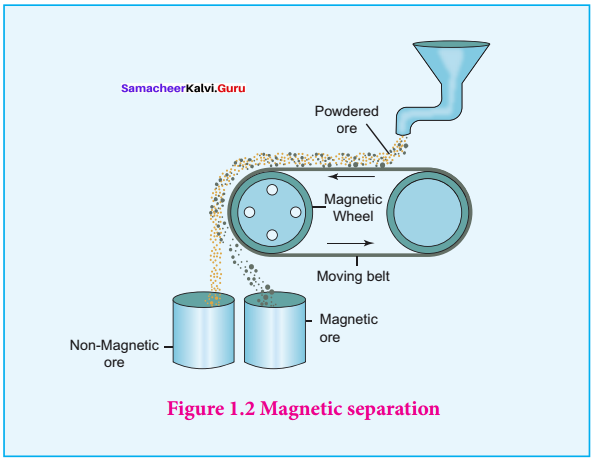
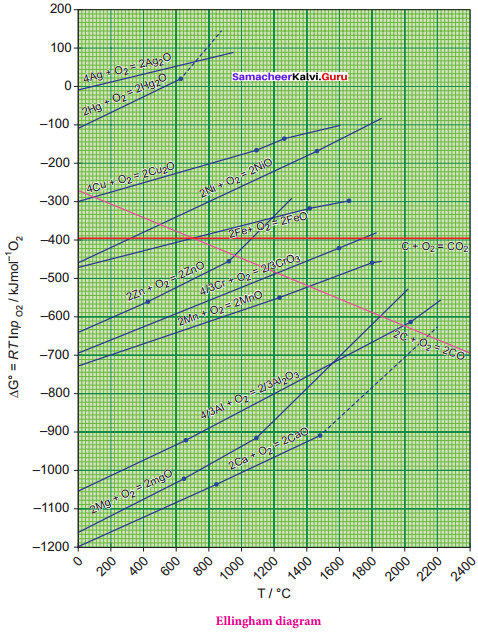
Question 1.
What made John Shepherd-Barron to come up with the idea of ATM?
Answer:
It was then John’s habit to withdraw money on a Saturday, but on this particular weekend he had arrived one minute late and found the bank doors locked against him. This made him to come up with idea of ATM.

Question 2.
When and where was the first ATM installed?
Answer:
The first ATM was installed at a branch in the North London suburb of Enfield on June 27, 1967.

Question 3.
Who was the first person to withdraw cash from the ATM?
Answer:
The first person to withdraw cash from the ATM was Reg Varney, a celebrity resident of Enfield known for his part in the number of popular television series.

Question 4.
Why did Shepherd-Barron reduce the PIN number from six digits to four?
Answer:
Shepherd-Barron’s wife said that she could only remember four figures, because of her, four figures became the world standard.

Question 5.
Which theory of Ramanujan helps the ATMs to dispense cash?
Answer:
Ramanujan’s Partition theory helps the ATMs to dispense cash.

Writing:

G. Paragraph Writing

Question 1.
Write a paragraph of 100-120 words about a memorable anecdote / incident of your life.
Answer:
A memorable anecdote/incident in my life:
I was then a student of class four. One day, I was left at home with my grandmother. It was in the afternoon, my grandmother was taking a nap. I was a very restless one. The toys soon bored me and I looked around for something new. The unique thing which caught my attention was my Grandma’s spectacles.

I put it on my nose just in the style of my Grandma and looked around. Soon my eyes got tired. As I felt pain in my eyes, I removed the specs and threw them away. They struck the wall and landed on the ground broken. Now I got worried and afraid. I started trying to repair it. As I was holding these glass pieces I felt a severe pain in the middle finger of my right hand, I looked at it .

Blood was trickling down from a deep cut in my finger. I started crying loudly. On hearing my loud wailing my Grandma woke up. She hurriedly came out of her room, took a quick glance at my adventure and detecting the source of my trouble, she pressed her hand on my cut finger for some time and then she took me to the doctor for bandaging. I was very much afraid of punishment but my Grandma forgave me although she had to suffer difficulty in seeing until the glasses were repaired. However I was naturally punished as I could neither eat my meals nor do my homework for three days.

Question 2.
Write a paragraph of 100-120 words about your favorite personality.
Answer:
My favorite personality:
There are many people all around the world who are very famous and celebrities. But my favourite personality is my father. My father is my hero. He is kind, polite and really friendly to everyone. He is a teacher by profession and is very good in teaching. He is always ready to help and support the needy and helpless. He is a God fearing person and always teaches us to remember the God’s gifts and God’s love for the world.

I am so proud to have a father like him. He is a simple man with kind rules. He is handsome, my favourite and my ideal man. He is my friend and always ready to encourage, appreciate me for success and always ready to help me wherever I need a friend or a support of my father. I am proud of my father and wish him good health forever.

Grammar:

A. Complete the following sentences using appropriate Connectors from the box.

From Zero To Infinity Questions And Answers Samacheer Kalvi 9th English Solutions Prose Chapter 6

1. She felt cold _________ she was wearing a winter coat.
Answer:
although

2. This restaurant has some of the best chefs in the town.__________ their service is excellent.
Answer:
Moreover

3. I’m not going to the party tonight __________ I didn’t get an invitation.
Answer:
because

4. You can set the table. __________, I’ll start making dinner.
Answer:
Meanwhile

5. I can play quite a few instruments __________ , the flute, the guitar and the piano.
Answer:
For instance

6. The store was out of chocolate chips; __________ they would need to make a different type of cookies.
Answer:
therefore

7. The stores are open daily __________ Sundays.
Answer:
except

8. I’ll stay __________ you need me.
Answer:
as long as

9. This detergent is highly concentrated and __________ you will need to dilute it.
Answer:
thus

10. It was the thing he prized __________ .
Answer:
above all

Active Voice and Passive Voice:

B. Convert the following active sentences into passive sentences by supplying an appropriate passive verb form.

Question 1.
She will not recognize us. / We__________ by her.
(a) will not recognize
(b) will not being recognized
(c) will not be recognized
Answer:
(c) will not be recognized

Question 2.
They didn’t invite me, but I went anyway. /I __________ but I went anyway.
(a) wasn’t invited
(b) wasn’t being invited
(c) wasn’t inviting
Answer:
(a) wasn’t invited

Question 3.
They broke up the table for firewood. / The table __________ up for firewood.
(a) broke
(b) had broken
(c) was broken
Answer:
(c) was broken

Question 4.
She has won the first prize. / The first prize __________ by her.
(a) has won
(b) has been won
(c) had been won
Answer:
(b) has been won

Question 5.
A friend of mine is repairing the car. / The car __________ by a friend of mine.
(a) is repairing
(b) is repaired
(c) is being repaired
Answer:
(c) is being repaired

Question 6.
Begin the work tomorrow. / Let the work __________ tomorrow.
(a) be begun
(b) begin
(c) is beginning
Answer:
(a) be begun

Question 7.
They speak English in New Zealand. / English __________ in New Zealand.
(a) is speaking
(b) is spoken
(c) is being spoken
Answer:
(b) is spoken

Question 8.
His attitude shocked me. / I __________ by his attitude.
(a) had shocked
(b) had been shocked
(c) was shocked
Answer:
(c) was shocked

Question 9.
She had already sent the parcel. / The parcel __________ by her.
(a) has already been sent
(b) had already been sent
(c) was already sent
Answer:
(b) had already been sent

Question 10.
Her silence worries me / I __________ her silence.
(a) am worrying by
(b) am worried by
(c) have worried by
Answer:
(b) am worried by

C. Match the following Active voice sentences with Passive voice.

From Zero To Infinity Book Back Answers Samacheer Kalvi 9th English Solutions Prose Chapter 6
Answers:
Zero To Infinity Lesson Summary Samacheer Kalvi 9th English Solutions Prose Chapter 6

D. Change the following into passive voice.

Question 1.
Stanley will inform you later.
Answer:
You will be informed by Stanley later.

Question 2.
People speak Portuguese in Brazil.
Answer:
Portuguese is spoken by people in Brazil.

Question 3.
My grandfather built this house in 1943.
Answer:
This house was built by my grandfather in 1943.

Question 4.
Do not hurt the animals.
Answer:
You are warned not to hurt the animals.

Question 5.
You must not drop litter in the streets.
Answer:
You are warned not to drop litter in the streets.

Question 6.
Carry it home.
Answer:
Let it be carried to home.

Question 7.
They are decorating the wall.
Answer:
The wall is being decorated by them.

Question 8.
He has already mended the TV set.
Answer:
The TV set has already been mended by him.

E. Make a scrapbook of’Famous Biographies’ by collecting at least five biographies of famous scientists, mathematicians, inventors, artists etc., of your choice. You may also collect the pictures related to their achievements, inventions etc.
Answer :
Sir Isaac Newton (Scientist):
Sir Isaac Newton was born on Christmas day, 1642. He was an English physicist and mathematician, who was the culminating figure of the scientific revolution of the 17th century. Born in the hamlet of Woolsthorpe, Newton was the only son of a local yeoman. Newton would eventually pick up his idea of a mathematical science of motion and bring his work to full fruition.

A tiny and weak baby, Newton was not expected to survive his first day of life, much less 84 years. Deprived of a father before birth, he soon lost his mother as well, for within two years she married a second time. He was left with his grandmother and moved to a neighbouring village.

For nine years, Isaac was effectively separated from his mother, and his pronounced psychotic tendencies have been ascribed to this traumatic event. Like thousands of other undergraduates, Newton began his higher education by immersing himself in Aristotle’s work. Even though the new philosophy was not in the curriculum, it was in the air.

Sometime during his undergraduate career, Newton discovered the works of the French natural philosopher Rene Descartes and the other mechanical philosophers. Newton had also begun his mathematical studies. Within little more than a year, he had mastered the literature; and, pursuing his own line of analysis, he began to move into new territory.

Despite the. fact that only a handful of savants were even aware of Newton’s existence, he had arrived at the point where he had become the leading mathematician in Europe.
From Zero To Infinity Lesson Plan Samacheer Kalvi 9th English Solutions Prose Chapter 6

Leonardo da Vinci (Artist):
Leonardo da Vinci was a leading artist and intellectual of the Italian Renaissance who’s known for his enduring works ‘ The Last Supper’ and the ‘Mona Lisa’. Leonardo da Vinci was born on April 15, 1452, in a farmhouse nestled amid the undulating hills of Tuscany outside the village of Anchiano, in present-day Italy. Born out of wedlock to respected Florentine notary Serpiero and a young peasant woman named Caterina.

Leonardo da Vinci was raised by his father and his stepmother. At the age of five, he moved to his father’s family estate in nearby Vinci, the Tuscan town from which the surname associated with Leonardo derives, and lived with his uncle and grandparents. Young Leonardo received little formal education beyond basic reading, writing and mathematics instruction, but his artistic talents were evident from an early age.

Around the age of 14, da Vinci began a lengthy apprenticeship with the noted artist Andrea del Verrocchio in Florence. He learned a wide breadth of technical skills including metalworking, leather arts, carpentry, drawing, painting and sculpting. His earliest known dated work, a pen-and-ink drawing of a landscape – the Amo Valley – was sketched in 1473. With a curious mind and keen intellect, da Vinci studied the laws of science and nature, which greatly improved his work. His ideas and body of work have influenced countless artists and made da Vinci a leading light of the Italian Renaissance.
From Zero To Infinity Lesson Summary Samacheer Kalvi 9th English Solutions Prose Chapter 6

Pythagoras (Mathematician):
Pythagoras is often known as the first pure mathematician. born on the island of Samos, Greece in 569 BC, his father, Mnesarchus, was a gem merchant. His mother’s name was Pythais and Pythagoras lived with his two or three brothers. Pythagoras was well educated, and played the lyre. He knew poetry and recited Homer. He was interested in mathematics, philosophy, astronomy and music.
Pythagoras believed:

  1. The sum of the angles of a triangle is equal to two right angles.
  2. The theorem of Pythagoras – for a right-angled triangle the square on the hypotenuse is equal to the sum of the squares on the other two sides.
  3. Constructing figures of a given area and geometrical algebra. For example they solved various equations by geometrical means.
  4. Pythagoras taught that Earth was a sphere in the center of the Universe, that the planets, stars, and the universe were spherical because the sphere was the most perfect solid figure.
  5. Pythagoras recognized that the morning star was the same as the evening star, Venus.

The Pythagorean Theorem is a cornerstone of mathematics, and continues to be so interesting to mathematicians that there are more than 400 different proofs of the theorem, including an original proof by President Garfield.
From Zero To Infinity Biography Of Ramanujan Samacheer Kalvi 9th English Solutions Prose Chapter 6

Michael Joseph Jackson (Singer and Dancer):
From Zero To Infinity Summary In English Samacheer Kalvi 9th Solutions Prose Chapter 6
Michael Joseph Jackson was an American singer, songwriter and dancer. Dubbed the “King of Pop”, he is regarded as one of the most significant cultural icons of the 20th century and is also regarded as one of the greatest entertainers of all time. Jackson’s contributions to music, dance, and fashion, along with his publicized personal life, made him a global figure in popular culture for over four decades.

The eighth child of the Jackson family, Michael made his professional debut in 1964 with his elder brothers Jackie, Tito, Jermaine and Marlon as a member of the Jackson 5. He began his solo career in 1971 while at Motown Records.

In the early 1980s, Jackson became a dominant figure in popular music. His music videos, including “Beat It”, “Billie Jean”, and “Thriller” from his 1982 album Thriller, are all time favourites. Through stage and video performances, Jackson popularized a number of complicated dance techniques, such as the robot and the moonwalk, to which he gave the name.

His distinctive sound and style has influenced numerous artists of various genres. While preparing for his comeback concert series, This Is It, Jackson died of acute propofol and benzodiazepine intoxication in 2009, after suffering from cardiac arrest.

Kapil Dev (Cricketer):
From Zero To Infinity Essay Samacheer Kalvi 9th English Solutions Prose Chapter 6
Dev was born as Kapil Dev Nikhanj to Ram Lai Nikhanj, a prominent timber merchant and his wife Raj Kumari Ram Lai Nikhanj in Chandigarh on 6 January 1959. His mother was born in Pakpattan, in the town of the Sufi Saint Baba Farid. His father was from Dipalpur. They lived in Shah Yakka which is now in Okara district, Pakistan. His four sisters were born there before partition and his two brothers in Fazilka, where they moved after partition. His father spent his early life after the partition in Fazilka. They moved to the capital city Chandigarh.

Dev was a student at D.A.V. School and joined Desh Prem Azad in 1971. Dev captained the Indian cricket team that won the 1983 Cricket World Cup. He was India’s national cricket coach between October 1999 and August 2000. He retired in 1994, holding the world record for the most number of wickets taken in Test cricket, a record subsequently broken by Courtney Walsh in 2000.

He is the first player to take 200 ODI wickets. He is the only player in the history of cricket to have taken more than 400 wickets (434 wickets) and scored more than 5000 runs in Tests, making him one of the greatest all-rounders to have played the game. On 11 March 2010, Dev was inducted into the ICC Cricket Hall of Fame.
From Zero To Infinity Summary In Tamil Samacheer Kalvi 9th English Solutions Prose Chapter 6

From Zero to Infinity Lesson Summary By Biography Of Srinivasa Ramanujan

Ramanujan was born in Erode in Tamil Nadu on December 22, 1887. His father was a petty clerk in a cloth shop. From early childhood it was evident that he was a prodigy. Mathematical ideas flooded in his mind for which he did not find enough papers to note it down. Hence he started writing them in loose sheets which was later known as Ramanujan’s Frayed Notebook. At the age of 13, he was not only able to master the Loney’s Trigonometiy, but also started his own research and came up with many mathematical theorems and formulae.

At the age of 15, the book Synopsis of Elementary Results in Pure Applied Mathematics by George Shoobridge Carr given by his senior friends triggered the mathematical genius in him. Though Ramanujan was a mathematical genius and was awarded the Subramanyan Scholarship, he failed twice in his first-year arts examination in college, which disappointed his father.

Then Ramanujan started looking for a job as he needed money not only for food but also for papers to do his calculations. His applications were rejected as no one could understand what he had scribbled in his notebooks. Luckily, Director of Madras Port Trust, Francis Spring, understood his capability and he gave Ramanujan a clerical job on a monthly salary of ?25. Later on, some teachers and educationists helped him to get a research fellowship. Thus, on 1st May 1913, the University of Madras granted him a fellowship of ?75 a month, though he had no qualifying degree.

Meanwhile, he had sent a letter to the great mathematician G.H. Hardy of Cambridge University, in which he set out 120 theorems and formulae. Among them was what is known as the Reimann Series, a topic in the definite integral of Calculus. These letters made G.H. Hardy and his colleague J.E. Littlewood realize that they bad discovered a rare mathematical genius. They made quick arrangements for his passage and stay at Cambridge University. Ramanujan sailed to Britain on March 17, 1914.

Even though he found it difficult to adapt to the new environment, he continued his research in Mathematics with determination. He forgot his hardships in the company of Hardy and Littlewood. Ramanujan was elected Fellow of the Royal Society on February 28, 1918. He was the youngest Indian to receive this distinguished fellowship. In October that year, he became the first Indian to be elected Fellow of Trinity College, Cambridge.

Ramanujan continued his works even though Tuberculosis, then an incurable disease, was devouring him. When his friends found him pale, exhausted and emaciated, they sent him back to India. He continued to play with numbers until his death. Apart from a mathematician, Ramanujan was an astrologer of repute and a good speaker.

From Zero to Infinity Glossary:
Summary Of From Zero To Infinity Samacheer Kalvi 9th English Solutions Prose Chapter 6

Samacheer Kalvi 8th Science Solutions Term 2 Chapter 4 Atomic Structure

You can Download Samacheer Kalvi 8th Science Book Solutions Guide Pdf, Tamilnadu State Board help you to revise the complete Syllabus and score more marks in your examinations.

Tamilnadu Samacheer Kalvi 8th Science Solutions Term 2 Chapter 4 Atomic Structure

Samacheer Kalvi 8th Science Atomic Structure Text Book Exercises

I. Choose the best answer

8th Science Atomic Structure Question 1.
The same proportion of carbon and oxygen in the carbon dioxide obtained from different sources proves the law of
(a) reciprocal proportion
(b) definite proportion
(c) multiple proportion
(d) conservation of mass
Answer:
(b) definite proportion

Atomic Structure Book Back Answers Question 2.
Cathode rays are made up of –
(a) neutral particles
(b) positively charged particles
(c) negatively charged particles
(d) None of the above
Answer:
(c) negatively charged particles

Atomic Structure Class 9 Samacheer Kalvi Question 3.
In water, hydrogen and oxygen are combined in the ratio of by mass.
(a) 1 : 8
(b) 8 : 1
(c) 2 : 3
(d) 1 : 3
Answer:
(a) 1 : 8

8th Standard Question 4.
Which of the following statements made by Dalton has not undergone any change?
(a) Atoms cannot be broken.
(b) Atoms combine in small, whole numbers to form compounds.
(c) Elements are made up of atoms.
(d) All atoms of an elements are alike
Answer:
(d) All atoms of an elements are alike

Question 5.
In all atoms of an element –
(a) the atomic and the mass number are same.
(b) the mass number is same and the atomic number is different.
(c) the atomic number is same and the mass number is different
(d) both atomic and mass numbers may vary.
Answer:
(a) the atomic and the mass number are same.

II. Fill in the blanks

  1. …………….. is the smallest particle of an element.
  2. An element is composed of …………….. atoms.
  3. An atom is made up of …………….., …………….. and ……………..
  4. A negatively charged ion is called …………….. while positively charged ion is called
  5. …………….. is a negatively charged particle (Electron/Proton).
  6. Proton is deflected towards the …………….. charged plate (positively, negatively).

Answer:

  1. Atom
  2. same kind of
  3. proton, electron, neutron
  4. anion, cation
  5. Electron
  6. negatively

III. Match the following

  1. Law of Conservation of Mass – Sir William Crookes
  2. Law of Constant Proportion – James Chadwick
  3. Cathode rays – Joseph Proust
  4. Anode rays – Lavoisier
  5. Neutrons – Goldstein

Answer:

  1. Law of Conservation of Mass – Lavoisier
  2. Law of Constant Proportion – Joseph Proust
  3. Cathode rays – Sir William Crookes
  4. Anode rays – Goldstein
  5. Neutrons – James Chadwick

IV. Answer briefly

Question 1.
State the Law of Conservation of Mass.
Answer:
The law states that during any chemical change, the total mass of the products is equal to the total mass of the reactants.

Question 2.
State the Law of Constant Proportions.
Answer:
Law of constant proportions states that in a pure chemical compound the elements are always present in definite proportions by mass.

Question 3.
Write the properties of anode rays.
Answer:
Properties of Anode rays:

  1. Anode rays travel in straight lines.
  2. Anode rays are made up of material particles.
  3. Anode rays are deflected by electric and magnetic fields. Since, they are deflected towards the negatively charged plate, they consist of positively charged particles.

Question 4.
Define valency of an element with respect to hydrogen.
Answer:
Valency of an element is defined as the number of hydrogen atoms which combine with one atom of it.

Question 5.
Define the term ions or radicals.
Answer:
An atom or a group of atoms when they either lose or gain electrons, get converted into ions or radicals.

Question 6.
What is a chemical equation?
Answer:
A chemical equation is a short hand representation of a chemical reaction with the help of chemical symbols and formula.

Question 7.
Write the names of the following compounds.

  1. CO
  2. N2O
  3. NO2
  4. PCl5

Answer:

  1. Carbon monoxide.
  2. Nitrous oxide
  3. Nitrogen dioxide
  4. Phosphorous pentachloride

V. Answer the following

Question 1.
Find the valency of the element which is underlined in the following formula.

  1. NaCl
  2. CO2
  3. Al(PO2)
  4. Ba(NO3)2
  5. CaCl2

Answer:

  1. NaCl = 1
  2. CO2 = 4
  3. Al(PO4) = 3
  4. Ba(NO3)2 = 2
  5. CaCl2 = 2

Question 2.
Write the chemical formula for the following compounds

  1. Aluminium sulphate
  2. Silver nitrate
  3. Magnesium oxide
  4. Barium chloride

Answer:

  1. Aluminium sulphate = Al2(SO4)3
  2. Silver nitrate = AgNO3
  3. Magnesium oxide = MgO
  4. Barium chloride = BaCl2

Question 3.
Write the skeleton equation for the following word equation and then balance them.

  1. Carbon + Oxygen → Carbon dioxide
  2. Phosphorus + Chlorine → Phosphorus pentachloride.
  3. Sulphur + Oxygen → Sulphur dioxide
  4. Magnesium + hydrogen chloride → Magnesium chloride + Hydrogen

Answer:
Balanced equation:

  1. C + O2 → CO2
  2. P4 + 10 Cl2 → 4PCl5
  3. S + O2 → SO2
  4. Mg + 2HCl → MgCl2 + H2

Skeleton equation:

  1. C + O2 → CO2
  2. P + Cl2 → PCl5
  3. S + O2 → SO2
  4. Mg + 2HCl → MgCl2 + H2

Question 4.
Balance the following chemical equation.

  1. Na + O2 → Na2O
  2. Ca + N2 → Ca3N2
  3. N2 + H2 → NH3
  4. CaCO3 + HCl → CaCl2 + CO2 + H2O
  5. Pb(NO3)2 → PbO + NO2 + O2

Answer:

  1. 4Na + O2 → 2Na2O
  2. 3Ca + N2 → Ca3N2
  3. N2 + 3H2 → 2NH3
  4. CaCO2 + 2HCl → CaCl2 + H2O + CO2
  5. 2Pb (NO3)2 → 2PbO + 4NO2 + O2

VI. Higher Order Thinking Questions

Question 1.
Why does a light paddle wheel placed in the path of cathode rays begin to rotate, when cathode rays fall on it?
Answer:
It is because the small particles of the cathode rays (electrons) have mass and energy. This energy is used in rotating the paddle wheels.

Question 2.
How can we prove that the electrons carry negative charge?
Answer:
J.J. Thomson found that cathode rays were attracted by the positively charged plate and repelled by the negatively charged plate. This led him to the conclusion that the cathode rays (electrons) were made of negatively charged particles.

Question 3.
Ruthresh, Hari, Kanishka and Thahera collected different samples of water from a well, a pond, a river and underground water. All these samples were sent to a testing laboratory. The test result showed the ratio of hydrogen to oxygen as 1:8.

  1. What conclusion would you draw from the above experiment?
  2. Which law of chemical combination does it obey?

Answer:

  1. Water obtained from different sources like a well, a pond, a river and underground water will always consist of the same two elements hydrogen and oxygen in the ratio 1 : 8 by mass.
  2. It obeys the law of constant proportion.

Samacheer Kalvi 8th Science Atomic Structure Intext Activitics

Activity – 2

Question 1.
Classify the following ions into monovalent, divalent and trivalent.
Ni2+, Fe3+, Cu2+, Ba2+, Cs+, Zn2+, Cd2+, Hg2+, Pb2+, Mn2+, Fe2+, CO2+, Sr2+, Cr3+, Li+, Ca2+, Al3+
Answer:

  • Monovalent ions – Li+, Cs+
  • Divalent ions – Ni2+, Cu2+, Ba2+, Zn2+, Cd2+, Hg2+, Pb2+, Mn2+, Fe2+, CO2+, Ca2+, Sr2+
  • Trivalent ions – Fe3+, Cr3+, Al3+

Activity – 3

Question 1.
Write the chemical formula of the compounds
8th Science Atomic Structure Samacheer Kalvi Term 2 Chapter 4
Answer:
Atomic Structure Book Back Answers Samacheer Kalvi 8th Science Solutions Term 2 Chapter 4

Activity – 4

Question 1.
Write the names of the chemical compounds.
Atomic Structure Class 9 Samacheer Kalvi Term 2 Chapter 4
Answer:
8th Standard Samacheer Kalvi Solutions Term 2 Chapter 4 Atomic Structure

Samacheer Kalvi 8th Science Atomic Structure Additional Questions

I. Choose the correct answer :

Question 1.
Which of the following scientists observed that cathode rays consists of negatively charged particles?
(a) John Dalton
(b) J.J. Thomson
(c) James Chadwick
(d) Democritus
Answer:
(b) J.J. Thomson

Question 2.
The outer most shell of an atom is known as ………………..
(a) valency
(b) valence electron
(c) nucleus
(d) valance shell
Answer:
(d) valance shell

Question 3.
The valency of which of the element is zero.
(a) iron
(b) hydrogen
(c) helium
(d) oxygen
Answer:
(c) helium

Question 4.
The equation Na + H2O → NaOH + H2 is ………………
(a) correct
(b) iricorrect since it is not balanced
(c) incorrect since hydrogen should be written as H and not H2
(d) None
Answer:
(b) ipcorrect since it is not balanced

Question 5.
Whatis the valency of carbon?
(a) 1
(b) 2
(c) 3
(d) 4
Answer:
(d) 4

Question 6.
Metals form ……………..
(a) anions
(b) cations
(c) both a and b
(d) none
Answer:
(b) cations

Question 7.
Isotopes exist because atoms of the same element can have different numbers of –
(a) protons
(b) neutrons
(c) electrons
(d) none
Answer:
(b) neutrons

Question 8.
An atom differs from its ion in ………………
Answer:
(a) nuclear charge
(b) mass number
(c) number of electrons
(d) number of protons
Answer:
(c) number of electrons

Question 9.
What is the atomic number of an element whose electronic configuration is 2, 8, 1?
(a) 10
(b) 23
(c) 11
(d) 8
Answer:
(c) 11

II. Fill in the Blanks

  1. Isotopes have the same ……………… number but different ……………… numbers.
  2. ……………… have the same mass number but different atomic numbers.
  3. Crookes Rays are also called as ……………….
  4. Cathode rays are made up of material particles which have mass and ……………….
  5. A proton can be defined as a ………………
  6. Atoms of all metals will have …………….. electrons in their outermost orbit.
  7. All non – metals will have ……………… electrons in the outermost orbit of their atoms.
  8. Atoms which carry positive or negative charges are called ……………….
  9. Maximum number of electrons that can be present in N shell is ……………….
  10. The atomic theory was first proposed by ……………….

Answer:

  1. atomic, mass
  2. Isobars
  3. Cathode rays
  4. kinetic energy
  5. hydrogen ion
  6. 1 to 3
  7. 4 to 7
  8. ions
  9. 32
  10. Dalton

III. True or False – if false give the correct statement

Question 1.
Anode rays travel in straight lines.
Answer:
True

Question 2.
James Chadwick discovered the fundamental particle called proton.
Answer:
False
Correct statement:
James Chadwick discovered the fundamental particle called neutron.

Question 3.
Relative charge of an electron is – 1.
Answer:
True

Question 4.
Atoms of the same element are identical in all respects.
Answer:
True

Question 5.
The first scientific theory about atom was given by J J. Thomson.
Answer:
False
Correct statement:
The first scientific theory about atom was given by John Dalton.

Question 6.
In television tube, Cathode rays are deflected by magnetic fields.
Answer:
True

Question 7.
An atom has a number of orbits and each orbit has protons.
Answer:
False
Correct statement:
An atom has a number of orbits and each orbit has electrons.

Question 8.
The combining capacity of an atom is called valency.
Answer:
True

Question 9.
Helium has two electrons in the outermost orbit and so it is chemically inert.
Answer:
True

Question 10.
When an atom gains an electron it has more number of electrons and thus it carries positive charge.
Answer:
False
Correct statement:
When an atom gains an electron it has more number of electrons and thus it carries negative charge.

IV. Match the following

Question 1.

1.J.J. Thomson(a)Law of definite proportions
2.Air(b)Law of indestructibility of mass
3.Hydrogen ion(c)Poor conductor of electricity
4.Law of constant proportions(d)Plum pudding model
5.Law of conservation of mass(e)H+

Answer:

  1. d
  2. c
  3. e
  4. a
  5. b

Question 2.

1.Crooke’s tube(a)Negatively charged particles
2.Cathode rays(b)Cathode ray tube
3.Proton(c)Positively charged particles
4.Anode rays(d)1.6 x 10⁻²⁴ g

Answer:

  1. b
  2. a
  3. d
  4. c

V. Assertion and Reason.

Question 1.
Mark the correct choice as :
(a) If both assertion and reason are true and the reason is the correct explanation of the assertion.
(b) If both assertion and reason are true, but the reason is not the correct explanation of the assertion.
(c) If the assertion is true, but the reason is false.
(d) If the assertion is false, but the reason is true.

Question 1.
Assertion : Proton can be defined as a hydrogen ion (H+).
Reason : These protons are produced when one electron is removed from one hydrogen atom.
Answer:
(a) Both assertion and reason are true and the reason is the correct explanation of the assertion

Question 2.
Assertion : Helium has four electrons in the outermost orbit.
Reason : Neon has eight electron in the outermost orbit.
Answer:
(d) The assertion is false, but the reason is true

VI. Answer briefly

Question 1.
What is an atom?
Answer:
Atom is the smallest particle of matter that takes part in a chemical reaction.

Question 2.
What is electrical discharge?
Answer:
When electricity passes through air, remove the electrons*from the gaseous atoms and produces ions. This is called electrical discharge.

Question 3.
What is the charge of a neutron?
Answer:
Neutron is a neutral particle, that is it carries no charge.

Question 4.
Define electronic configuration.
Answer:
The arrangement of electrons in the orbits is known as electronic configuration.

Question 5.
Define Orbits.
Answer:
Electrons revolve around the nucleus in a circular fixed paths is called orbits or shells.

Question 6.
Name the subatomic particles of an atom.
Answer:
Proton, electron and neutron.

Question 7.
Define nucleus.
Answer:
The nucleus is the central dense core of the atom consisting of neutrons and protons.

Question 8.
What is a reactant in a chemical equation?
Answer:
Reactant is the substance that take part in a chemical reaction.

Question 9.
What is a product in a chemical equation?
Answer:
Product is the substance that are formed in a chemical reaction.

Question 10.
What are the two types of valency?
Answer:
Positive valency and negative valency.

Question 11.
Write any two advantages of Dalton’s atomic theory.
Answer:

  1. Dalton’s theory explains most of the properties of gases and liquids.
  2. This explains the law of chemical combination and the law of conservation of mass.

Question 12.
Write any two limitations of Dalton’s atomic theory.
Answer:

  1. Atom is no longer considered as the smallest indivisible particle.
  2. Substances made up of same kind of atoms may have different properties.

Question 13.
What are fluorescent materials?
Answer:
When invisible radiation falls on materials like zinc sulphite, they emit a visible light (or glow). These materials are called fluorescent.

Question 14.
Write the properties of neutrons.
Answer:

  1. Neutron is a neutral particle, that is, it carries no charge.
  2. It has mass equal to that of a proton that is 1.6 x 10⁻²⁴ g.

Question 15.
An atom is electrically neutral. Give reason.
Answer:
The total number of protons present in an atom is equal to the total number of electrons, thus balancing the total charge of the atom.

Question 16.
What is atomic number?
Answer:
The total number of protons present in the nucleus of an atom is called its atomic number.

Question 17.
What is mass number?
Answer:
The total number of protons and neutrons present in the nucleus of an atom is called as mass number.

Question 18.
Mention any two information conveyed by a balanced chemical equation.
Answer:

  1. Balanced chemical equation gives us both qualitative and quantitative information.
  2. We can get quantitative information like the number of molecules/atoms of the reactants and products that is taking part in the reaction.

Question 19.
What is a balanced chemical equation?
Answer:
A balanced chemical equation is one in which the total number of atoms of any element on the reactant side is equal to die total number of atoms of that element on the product side.

Question 20.
Draw a diagram to show the electronic configuration of sodium atom.
Answer:
Samacheer Kalvi 8th Science Solutions Term 2 Chapter 4 Atomic Structure 5

Question 21.
Draw a diagram to show the electronic configuration of chlorine atom.
Answer:
Samacheer Kalvi 8th Science Solutions Term 2 Chapter 4 Atomic Structure 6

Question 22.
Name the four laws of chemical combinations.
Answer:

  1. Law of conservation of mass
  2. Law of constant proportion
  3. Law of multiple proportion
  4. Gay Lussac’s law of gaseous volumes.

Question 23.
Write the names for the following compounds,

  1. Aluminium sulphate
  2. Silver nitrate.

Answer:

  1. Al2(SO4)3
  2. AgNO3

VII. Answer in detail

Question 1.

  1. Explain J.J. Thomson’s atom model with the help of a diagram.
  2. Write the limitations of Thomson’s Atom model.

Answer:
1. J.J. Thomson’s atom model with the help of a diagram:

  • Thomson proposed that the shape of an atom resembles a sphere having a radius of the order of 10-10m.
  • The positively charged particles are uniformly distributed with electrons arranged in such a manner that the atom is electrically neutral.
  • Thomson’s atom model was also called as the plum pudding model or the watermelon model.
  • The embedded electrons resembled the seed of watermelon while the watermelon’s red mass represented the positive charge distribution.
  • The plum pudding atomic theory assumed that the mass of an atom is uniformly distributed all over the atom.

Samacheer Kalvi 8th Science Solutions Term 2 Chapter 4 Atomic Structure 7

2. Limitations of Thomson’s Atom model:

  • Thomson’s model failed to explain how the positively charged sphere is shielded from the negatively charged electrons without getting neutralized.
  • This theory explains only about the protons and electrons and failed to explain the presence of neutral particle neutron.

Question 2.
Write a note on valency with respect to –

  1. Chlorine
  2. Oxygen.

Answer:
1. Valency with respect to Chlorine:

  • Since valency of chlorine is one, the number of chlorine atoms with which one atom of an element can combine is called valency.
  • In sodium chloride (NaCl) molecule, one chlorine atom combines with one sodium atom. So, the valency of sodium is one.
  • But, in magnesium chloride (MgCl2) valency of magnesium is two because it combines with two chlorine atoms.

2. Valency with respect to oxygen:

  • Valency can be defined as double the number of oxygen atoms with which one atom of an element can combine because valency of oxygen is two.
  • For example, in magnesium oxide (MgO) valency of magnesium is two.

Question 3.
Write the steps are followed to write down the chemical formula of a substance.
Answer:
Step 1:
Write down the symbols of elements/ions side by side so that the positive radical is on the left and the negative radical is on the right hand side.

Step 2:
Write the valencies of the two radicals above their symbols to the right in superscript (Signs ‘+’ and ‘-‘ of the ions are omitted).

Step 3:
Reduce the valencies to simplest ratio if needed. Otherwise interchange the valencies of the elements/ions. Write these numbers as subscripts. However, ‘1’ appearing on the superscript of the symbol is omitted.

Question 4.
What are the steps involved in writing the skeletal equation?
Answer:
The following are the steps involved in writing the skeletal equation:

  1. Write the symbols and formula of each of the reactants on the left hand side (LHS) and join them by plus (+) sign.
  2. Follow them by an arrow (→) which is interpreted as gives or forms.
  3. Write on the right hand side (RHS) of arrow the symbols and formula for each of the products.
  4. The equation thus written is called as skeleton equation (unbalanced equation).
  5. If the product is a gas it should be represented by upward arrow (↑) and if it is a precipitate it should be represented by downward arrow (↓).
    Example: Mg + H2SO2 → MgSO4 + H2

Question 5.
What are the points to be followed while balancing a chemical equation?
Answer:
1. Initially the number of times an element occurs on both sides of the skeleton equation should be counted.

2. An element which occurs least number of times in reactant and product side must be balanced first. Then, elements occuring two times, elements occuring three times and so on in an increasing order must be balanced.

3. When two or more elements occur same number of times, the metallic element is balanced first in preference to non – metallic element. If more than one metal or nonmetal is present then a metal or non-metal with higher atomic mass (refer periodic table to find the atomic mass) is balanced first.

4. The number of molecules of reactants and products are written as coefficient.

5. The formula should not be changed to make the elements equal.

6. Fractional method of balancing must be employed only for molecule of an element (O2, H2,O3, P4,…) not for compound (H2O, NH3,…).

Question 6.
What information are not conveyed by a balanced chemical equation?
Answer:

  1. Physical state of the reactants and the products.
  2. Heat changes (heat liberated or heat absorbed) accompanying the chemical reaction.
  3. Conditions such as temperature, pressure, catalyst etc., under which the reaction takes place.
  4. Concentration (dilute or concentrated) of the reactants and products.
  5. Speed of the reaction.

Question 7.
Explain the specific ways to be followed while naming chemical compounds?
Answer:
1. In naming a compound containing a metal and a non-metal, the name of the metal is written first and the name of the non-metal is written next after adding the suffix-ide to its name.
Examples:
NaCl – Sodium chloride
AgBr – Silver bromide

2. In naming a compound containing a metal, a non-metal and oxygen, name of the metal is written first and name of the non-metal with oxygen is written next after adding the suffix- ate (for more atoms of oxygen) or -ite (for less atoms of oxygen) to its name.
Examples:
Na2 SO4 – Sodium sulphate
Na 2 – Sodium nitrite

3. In naming a compound containing two non – metals only, the prefix mono, di, tri, tetra, penta etc. is written before the name of non – metals.
Examples:
SO2 – Sulphur dioxide
N2O5 – Dinitrogen pentoxide.

Question 8.
Derive the chemical formula for calcium chloride.
Answer:

  • Step 1 – Write the symbols of calcium and chlorine side by side. Ca Cl
  • Step 2 – Write the valencies of calcium and chlorine above their symbols to the right. Ca2 Cl1.
  • Step 3 – Interchange the valencies of elements. Ca Cl2.

Thus the chemical formula for calcium chloride is CaCl2.

Question 9.
Describe an experiment to prove that during a chemical charge, the total mass of matter remains the same.
Answer:
1. Prepare 5% of barium chloride (5g of BaCL in 100 ml of water) and sodium sulphatesolutions separately.

2. Take some solution of sodium sulphate in a conical flask and some solution of barium chloride in a test tube.

3. Hang the test tube in the conical flask.

Samacheer Kalvi 8th Science Solutions Term 2 Chapter 4 Atomic Structure 8

4. Weigh the flask with its contents. Now mix the two solutions by tilting and swirling the flask. Weigh the flask after the chemical reaction is occurred.

5. Record your observation. It can be seen that the weight of the flask and the contents remains the same before and after the chemical change.

6. Hence, it is proved that during a chemical change, the total mass of matter remains the same.

Question 10.
Explain the advantages and limitations of Dalton’s atomic theory.
Answer:
Advantages of Dalton’s Atomic Theory:

  1. Dalton’s theory explains most of the properties of gases and liquids.
  2. This explains the laws of chemical combination and the law of conservation of mass.
  3. This theory helps to recognize the molecular differences of elements and compounds.

Limitations of Dalton’s Atomic Theory:

  1. Atom is no longer considered as the smallest indivisible particle.
  2. Atoms of the same element have different masses (Isotopes).
  3. Atoms of the different elements may have same masses (Isobars).
  4. Substances made up of same kind of atoms may have different properties
  5. Example: Coal, Graphite and Diamond are made up of carbon atoms but they differ in their properties

Question 11.
Explain the construction of cathode Ray Tube (CRT) with a diagram.
Answer:

  1. Cathode Ray Tube is a long glass tube filled with gas and sealed at both the ends.
  2. It consists of two metal plates (which act as electrodes) connected with high voltage.
  3. The electrode which is connected to the negative terminal of the battery is. called the cathode (negative electrode).
  4. The electrode connected to the positive terminal is called the anode(positive electrode).
  5. There is a side tube which is connected to a pump.
  6. The pump is used to lower the pressure inside the discharge tube.

Samacheer Kalvi 8th Science Solutions Term 2 Chapter 4 Atomic Structure 9

Question 12.
Explain the properties of Cathode rays.
Answer:
Properties of Cathode rays:

  1. Cathode rays travel in straight line from cathode towards anode.
  2. Cathode rays are made up of material particles which have mass and kinetic energy.
  3. Cathode rays are deflected by both electric and magnetic fields. They are negatively charged particles.
  4. The nature of the cathode rays does not depend on the nature of the gas filled inside the tube or the cathode used.

Question 13.
Write the main postulates of Dalton’s Atomic theory.
Answer:
The nain postulates of Dalton’s atomic theory are:

  1. All the matters are made up of extremely small particles called atoms (Greek philosopher Democritus used the same name for the smallest indivisible particles).
  2. Atoms of the same element are identical in all respects (size, shape, mass and properties).
  3. Atoms of different elements have different sizes and masses and possess different properties.
  4. Atoms can neither be created nor be destroyed, i.e., atom is indestructible.
  5. Atoms of different elements may combine with each other in a fixed simple ratio to form molecules or compounds.
  6. An atom is the smallest particle of matter that takes part in a chemical reaction.

Question 14.
Complete the table:
Samacheer Kalvi 8th Science Solutions Term 2 Chapter 4 Atomic Structure 10
Answer:

  1. Oxide
  2. 2
  3. OH
  4. H2CO3

VIII. Solve the following crossword puzzle with the help of the given clues.

Question 1.
Across:
1. The particles that build up an atom.
3. The arrangement of electrons in a succession of energy levels or shells.
5. An electrically neutral sub atomic particle that is part of the nucleus of an atom.
6. A whole number that represents the ability of an atom or a group of atoms to combine with other atoms or group of atoms.
7. The number of protons in the nucleus of an atom.
8. The smallest unit of an element that maintains the properties of an element.
A sub – atomic particle that has a positive electric charge.
Down:
2. A substance that cannot be broken down into simpler substance by chemical means.
4. The total number of protons and neutrons present in the nucleus of an atom.
9. An ion that has a negative charge.
11 A sub – atomic particle with a negative electric charge.
12. Positively charged ions.
Answer:
Samacheer Kalvi 8th Science Solutions Term 2 Chapter 4 Atomic Structure 11

Samacheer Kalvi 8th English Solutions Term 1 Poem Chapter 3 Fire Work Night

Students can Download English Poem 3 Fire Work Night Questions and Answers, Summary, Activity, Notes, Samacheer Kalvi 8th English Book Solutions Guide Pdf  helps you to revise the complete Tamilnadu State Board New Syllabus and score more marks in your examinations.

Tamilnadu Samacheer Kalvi 8th English Solutions Term 1 Poem Chapter 3 Fire Work Night

A. Answer the following questions.

Fireworks Night Poem Questions And Answers Question 1.
Why was the dog frightened?
Answer:
The dog was frightened by the fireworks on a bonfire night.

Firework Night Poem Summary Question 2.
Whom did the dog ask for help?
Answer:
The dog asked the mistress and master for help.

Firework Night Poem Question 3.
What did the dog do when the door is opened?
Answer:
The dog rushed in, when the door was opened.

Firework Night Poem Line By Line Summary Question 4.
Where did the dog hide himself?
Answer:
The dog hid himself behind the couch.

Question 5.
Where will the dog go when the firework stops?
Answer:
He will go to his kennel, when the firework stops

B. Literary appreciation

(a)
Mistress, Master, hear me yelp,
I’m out-of-doors, I want your help.
Let me in-oh, LET ME IN
Before those fireworks begin

Write the rhyme scheme of the above poetic lines.
Answer:
The rhyme scheme of the above poetic lines is ‘aabb’.

(b)
To shoot again I can’t bear that;
My tall is down, my ears are flat,
I’m trembling here outside the door,
Oh, don’t you love me anymore?
Write the rhyming words from the above poetic lines
Answer:
The rhyming words are ‘that – flat’ and ‘door – anymore’

Rhyming words.
Match the rhyming words from the poem.

1. Hark(a) do
2. Too(b) fright
3. Yelp(c) dark
4. Grand(d) crouch
5. Couch(e) help
6. Night(f) hand

Answer:

  1. (c)
  2. (a)
  3. (e)
  4. (f)
  5. (d)
  6. (b)

Figure of speech.

Fire Work Night Question 1.
What is being personified in the sentence – ‘The full moon peeped through partial clouds’?
Answer:
The full moon is being personified here. It peeps through the partial clouds.

Fire Work Night Poem Question 2.
Which of the following is an example of personification?
(a) The chocolates smelled like delicious cake.
(b) The chocolates smell delicious.
(c) The delicious smell of chocolates invited me to eat them.
(d) I dreamt of delicious chocolates.
Answer:
(c) The delicious smell of chocolates invited me to eat them. ]

Fireworks Night Summary Question 3.
Personification is _______
(a) giving human attributes to human beings.
(b) comparing unrelated things.
(c) giving human attributes to non-human objects.
(d) talking the negative aspects of a person.
Answer:
(c) giving human attributes to non-human objects.

Fire Works Night Additional Questions

I. Poem Comprehension.

Fireworks Night Book Back Answers Question 1.
Mistress, Master, hear me yelp,
(a) Who is yelping?
Answer:
The dog is yelping.

(b) What does the word ‘yelp’ mean?
Answer:
It means ‘a sharp painful cry’.

Fireworks Poem Summary Question 2.
Oh, don’t you love me anymore?
(a) Who is the dog questioning?
Answer:
The dog is questioning the mistress.
(b) Why is he asking such a question?
Answer:
He is asking this question because he has been left outside and no one is responding to his cry.

II. Poetic Devices.

Fireworks Night Poem Summary In English Question 1.
Before these fireworks begin
(a) Pick out the words in alliteration.
Answer:
Before – begin are the words in alliteration.

Fireworks Night Question Answer Question 2.
The lights are on, it’s warm andgrand-
Mistress, let me lick your hand
Before I slip behind the couch.
There I’ll hide myself and crouch
(a) Write the rhyme scheme of the above poetic lines.
Answer:
The rhyme scheme of the above poetic lines is ‘aabb’.

III. Short Questions and Answers.

Fireworks Night Poem Question 1.
When were the fireworks burst?
Answer:
They were burst on a bonfire night.

Fire Works Night Question 2.
Why were the ears of the dog flat?
Answer:
The ears of the dog were flat because it was scared.

Fireworks Poem Questions And Answers Question 3.
What did the dog feel, when it went in?
Answer:
The dog felt warm, and safe inside the house.

Fireworks Night Poem 8th Standard Question 4.
What did the mistress ask her children?
Answer:
She asked them whether she can allow the dog into the house.

Firework At Night Question 5.
Why did the dog say that he would guard the mistress safely all the night?
Answer:
The dog said that he would guard the mistress safely because she understood his fright. ‘

IV. Paragraph Question with Answer.

Firework Night Question 1.
Narrate the fright of the dog left outside the house?
Answer:
The dog is left outside the house on a bonfire night. He gets scared by the sound and bursting of fireworks. He requests his mistress and master to allow him into the house. He is unable to bear the loud bang sound. Out of fear, his tail is down and the ears are flat. He trembles outside the door. He says that he will die with fright, if they don’t allow him into the house. As soon as the mistress opens the door, he rushes through and feels safe inside. It feels grateful to her mistress.

Fire Work Night Summary

The poem focuses on a dog being scared by the fireworks on a Bonfire night. A dog requests his mistress to let him into the house as he is scared of the guns shooting at night. He couldn’t bear the loud ‘bang’ sound. Out of fear, his tail is down and his ears are flat. He is trembling outside the door. He says that he will die with fright, if they don’t allow him into the house.

The mistress opens the door wide and the dog rushes in. He feels safe inside, as the lights are on. It is warm and grand inside. He feels grateful to the mistress and wants to show it by licking her hand, before he slips behind the couch. He will hide there and crouch in safety till the bangs are done. After that, he will run to his kennel and guard her safely because she understood his fright.