Samacheer Kalvi 11th English Grammar Clipped Words

Students who are interested in learning of 11th English Grammar Clipped Words Questions and Answers can use Tamilnadu State Board Solutions of 11th English Chapter Wise Pdf. First check in which chapter you are lagging and then Download Samacheer Kalvi 11th English Book Solutions Questions and Answers Summary, Activity, Notes Chapter Wise. Students can build self confidence by solving the solutions with the help of Tamilnadu State Board English Solutions. English is the scoring subject if you improve your grammar skills. Because most of the students will lose marks by Grammar grammar mistakes. So, we suggest you to Download Tamilnadu State Board 11th English Solutions according to the chapters.

Tamilnadu Samacheer Kalvi 11th English Grammar Clipped Words

Check out the topics covered in Grammar Clipped Words Questions and Answers before you start your preparation. Improve your grammar skills with the help of Samacheer Kalvi 11th English Book Solutions Questions and Answers pdf links. The solutions for Tamilnadu State Board 11th English Textbook are prepared by the English experts. So, if you follow Tamilnadu State Board Solutions 11th English Textbook Solutions you can cover all the topics in Grammar Clipped Words Questons and Answers. This helps to improve your communication skills.

Clipped Form Of Demonstration Question 1.
Choose the clipped word for ‘microphone’.
(a) micro
(b) mice
(c) phone
(d) mike
Answer:
(d) mike

Clipped Word For Demonstration Question 2.
Choose the clipped word for “helicopter”.
(a) heli
(b) cop
(c) copt
(d) copter
Answer:
(d) copter

Clipped Word For Diskette Question 3.
Choose the clipped word for the word “demonstration”.
(a) demon
(b) station
(c) demo
(d) dems
Answer:
(c) demo

Clipped Word Of Demonstration Question 4.
Choose the clipped word for “advertisement
(a) advent
(b) adment
(c) advertise
(d) ad
Answer:
(d) ad

Clipped Words For Demonstration Question 5.
Choose the clipped word for “memorandum i”.
(a) memes
(b) memo
(c) memory
(d) memorise
Answer:
(b) memo

Clipped Word Of Diskette Question 6.
Choose the clipped word for “diskette”.
(a) desk
(b) desket
(c) docket
(d) disc
Answer:
(d) disc

Clipped Form Of Microphone Question 7.
Choose the clipped word for “gymnasium”.
(a) gymna
(b) nasium
(c) gym
(d) masium
Answer:
(c) gym

Clipped Words For 11th English Question 8.
Choose the clipped word for “hamburger”.
(a) burg
(b) burger
(c) bike
(d) ham
Answer:
(b) burger

Clipped Words Helicopter Question 9.
Choose the clipped word for “laboratory”.
(a) labs
(b) labor
(c) labo
(d) lab
Answer:
(d) lab

Clipped Word For Microphone Question 10.
Choose the clipped word for “omnibus”.
(a) Omni
(b) bus
(c) omnibus
(d) nib
Answer:
(b) bus

The main aim is to share the knowledge and help the students of 11th English to secure the best score in their final exams. Use the concepts of Samacheer Kalvi 11th English Book Solutions Grammar Clipped Words Questions and Answers in Real time to enhance your skills. If you have any doubts you can post your comments in the comment section, We will clarify your doubts as soon as possible without any delay.
Samacheer Kalvi 9th English Solutions Supplementary Chapter 2 The Fun They Had

You can Download The Fun They Had Questions and Answers, Summary, Activity, Notes, Samacheer Kalvi 9th English Book Solutions Guide Pdf Supplementary Chapter 2 help you to revise complete Tamilnadu State Board New Syllabus and score more marks in your examinations.

Tamilnadu Samacheer Kalvi 9th English Solutions Supplementary Chapter 2 The Fun They Had

The Fun They Had Warm Up:

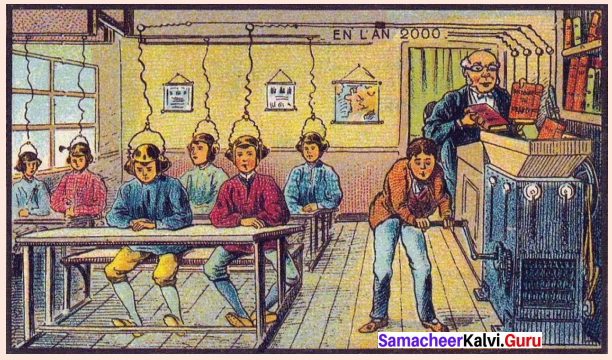
Here is an imaginary high school class depicted in a French postcard (1901-1910). Discuss what do you think have come true in the present century.
The Fun They Had Book Back Answers Samacheer Kalvi 9th English Solutions Supplementary Chapter 2
With the advancement in technology, schools will also have to take a change in their style of teaching-learning process. What we see in the picture reminds me of the language laboratory in school, which is used for enhancing English language as a skill. The given picture shows further advanced applications; like, using technology for entire classroom learning for all subjects. The teacher plays the role of either an inspector or an instructor in the classroom. Whether it is really admirable or not, we may have to wait and see.

Now, share your views about the changes that you and your classmates expect in your school and classroom in about 20-50 years.

In about 20-50 years, there won’t be any school. All children will be techno-savvy and learn things at their own pace. Credit system will be followed. Test or exam pressure will not be there because the students shall be taking the exam independently, as and when they like. Sports and games will be through play stations; co-curricular activities would be online. There is a possibility of mind reading – all telepathists would judge and evaluate the students’ knowledge only through mind reading and not through the usual percentage method.

The Fun They Had Textual Questions

A. Identify the character or speaker of the following lines.

  1. She was given test after test in geography. ……………………………
  2. He was a round little man with a red face and a whole box of tools with dials and wires. ……………………
  3. She had been hoping they would take the teacher away altogether. ……………………….
  4. They learned the same things, so they could help one another with the homework and talk about it. …………
  5. They had a special building and all the kids went there. ……………………….

Answers:

  1. Margie
  2. County Inspector
  3. Margie
  4. Students of the old school
  5. Tommy

B. Fill in the blanks with the clue given below to complete the paragraph

9th English The Fun They Had Samacheer Kalvi Solutions Supplementary Chapter 2

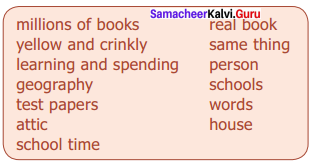
Tommy and Margie found something about the (1) ____________ of the past. Tommy found a (2) ____________ which has been printed on paper. The book was old and the pages were (3) ____________ At present, the (4) ____________ were moving on a television screen. The television had over (5) ____________ He had found the old book in the (6) ____________ of his house. While reading Tommy found that it was about the old schools. Margie hated school because she was having problems with learning (7) ____________ The mechanical teacher was black and large with a screen. Margie hated the slot where she had to insert her homework or (8) ____________ Margie did not understand how a (9)____________ could be a teacher and how the students were taught the (10) ____________ Then it was (11) ____________ for Margie and Tommy. Margie went to the schoolroom in her (12) ____________ where the mechanical teacher stood. She was thinking about the old school and how much fun the children had, (13) ____________ time together
Answers:

  1. schools
  2. real book
  3. yellow and crinkly
  4. words
  5. million of books
  6. attic
  7. geography
  8. test papers
  9. person
  10. same thing
  11. time
  12. house
  13. learning and spending

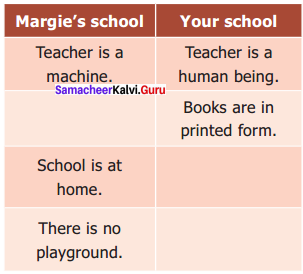
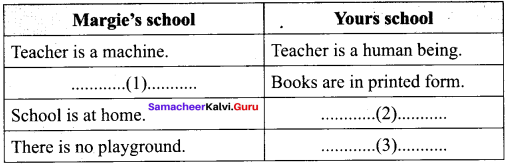
C. Bring out the difference between your school and Margie’s school in the given tabular column. An example is done for you.

The Fun They Had Summary In Tamil Samacheer Kalvi 9th English Solutions Supplementary Chapter 2The Fun They Had Samacheer Kalvi 9th English Solutions Supplementary Chapter 2

D. Complete the following statements based on your reading.

  1. The old book was found by ____________ .
  2. Margie was surprised to see the old book because ____________ .
  3. The mechanical teacher was giving Margie ____________ .
  4. Margie had to study always at the same time every day, because her mother said little girls ____________ .
  5. The geography sector in mechanical teacher was ____________ .

Answers:

  1. Tommy
  2. The words stood still, instead of moving
  3. test after test in geography
  4. learned letter, if they learned at regular hours
  5. geared a little too quickly

Think And Write:

E. On the basis of your reading and using your own ideas, answer the following in about 125 -150 words each.

The Fun They Had Book Back Answers Question 1.
Describe Margie’s mechanical teacher and her classroom in your own words.
Answer:
Tommy found the book on 17 May 2157. It was a very old book. The pages, were yellow and crinkly, and it was awfully funny to read the words that stood still instead of moving the way they were supposed to, on a screen. The mechanical teacher had been giving her test after test in geography and she had been doing worse and worse until her mother had shaken her head sorrowfully and sent for the county inspector.

9th English The Fun They Had Question 2.
Why did Margie hate her school? What was she thinking about at the end of the story?
Answer:
The part Margie hated most was the slot where she had to put homework and test papers. The geography sector was geared a little too quickly. She had been hoping that they would take the teacher away altogether. She was thinking about the old schools where the teacher told boys and girls things and gave them homework and asked them questions. The students had a special building and all the kids went there. All the kids learned the same thing.

The Fun They Had Summary In Tamil Question 3.
What was strange about the ‘book’? Why did Margie find it strange?
Answer:
The pages of the ‘book’ were yellow and crinkly. It was awfully funny to read words that stood still, unlike moving on a screen. When Margie turned back to the previous page, the page had the same words on it, when she read it the first time. All these things were strange for Margie, as she used to read only telebooks through computer screen, without any knowledge of a real book.

The Fun They Had Samacheer Kalvi Additional Questions

The Fun They Had 9th Standard Question 1.
In spite of all comforts and luxuries in today’s world, our grandparents still cherish their own time when life was quite tough. Give your own views regarding this in 80-100 words.
Answer:
Our grandparents lived during the years of 1950s to 1970s. At that time life was very simple yet tough. They had time to explore the surroundings and the world. They had parks to play with less pollution around them. Mechanical gadgets were there but were used only for necessary activities. There were rivers where they could go for picnics and treks without the fear of getting any allergy.

The school was more of a fun place where they would meet their friends. They studied but were not competing against each other. For them togetherness was important rather than competition. In today’s world we are competing against our friends. We have all the facilities of life but we do not have time for our family and friends. We like to play but on computers and play stations rather than with our siblings and friends.

The Fun They Had Questions Answers Question 2.
Machines can’t replace human beings. Explain with reference to the lesson ‘The Fun They Had’.
Answer:
A teacher has to not only teach and explain things but also has to understand the mindset of the students. A computer instructor will only be able to deliver the lesson but will not be able to understand the problems of the students. A teacher emotionally connects to the students to make them comfortable but this is not the case with a mechanical teacher.

Teaching can be best done by a person because then only will they be able to pass on the correct values and lessons to the students. Though smart classrooms are introduced, teachers are not replaced by machines. In the morning sessions, usually classes are very active. Teachers do full-fledged teaching. Afternoon sessions include activity-based jobs. Only teachers can have such kind of understanding of children’s psychology. Affirmatively we can say teachers can’t be replaced.

The Fun They Had by Isaac Asimov About The Author:

Isaac Asimov (1920 – 1992) was an American writer, known for his work of science fiction and ‘popular science’. He was a professor of Biochemistry at Boston University. Along with Robert A. Heinlein and Arthur C. Clarke, Asimov was considered one of the “Big Three” science fiction writers during his lifetime. He edited more than 500 books and approximately 90,000 letters and postcards. Asimov’s most famous work is the “Foundation” series. He also wrote mysteries and fantasy, as much as nonfiction.

The Fun They Had Summary:

Isaac Asimov was known for his work of science fiction. ‘The Fun they had’ is an ideal example of his fictitious stories. On 17th May 2157, Tommy, a thirteen-year-old boy finds a ‘real book’ in the attic of his house. His friend Margie, an eleven-year-old girl mentions this incident in her diary.

Surprised and astonished to see a ‘real book’, they both take a look at it together. The book has been printed on paper. It is really old and its pages are yellow and cranky. In the year 2157, this kind of books doesn’t exist anymore. In this time, words are moving on a television screen. This television contains over a million books. That is the reason why Tommy thinks that they are much better.

While reading the old book, Tommy says that it is about school! But not about their type of school; it is about school centuries ago. Margie hates school and cannot understand why someone would write about it. She is having problem with learning geography from her ‘mechanical teacher’, which is black, large and has a screen on it. It teaches the students, gives them exercises and asks them questions, all in a special room in their own house. It can also calculate the marks in no time.

Margie hates papers. Once, the geography sector of her mechanical teacher was geared too quickly, so that her marks got worse and worse. The country inspector had to rebuild it and it took him about an hour to set things right.

Tommy and Margie find out that students back then had a human as a teacher who taught the girls and boys, gave them homework and asked them questions. School was a special kind of building where the children went to. The children of same age gathered in a class and were taught by a teacher.

At first, Margie does not understand how a person could be a teacher and how all the students were taught the same thing, because her mother says that education must fit each child’s mind. But nevertheless, in her opinion, these schools are funny and she wants to read more about it.

Then it is time for Margie and Tommy for their school. Margie goes to the schoolroom in her house where the mechanical teacher stands. It is already on because the lessons are always at regular hours. Margie keeps thinking about the old school system and how much fun the children must have had back then, learning and spending time together.

The Fun They Had Glossary:

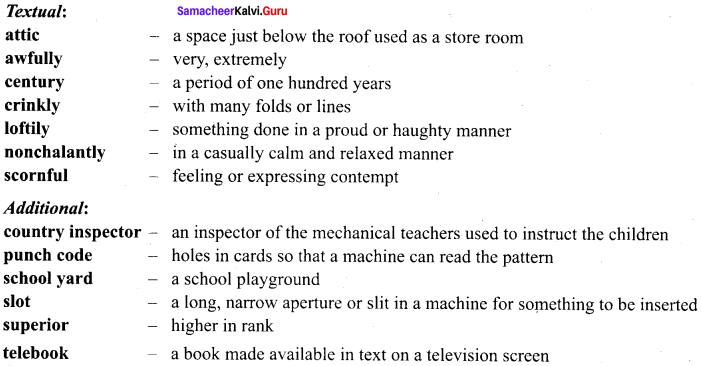
The Fun They Had 9th Standard Samacheer Kalvi English Solutions Supplementary Chapter 2

Samacheer Kalvi 11th Accountancy Solutions Chapter 1 Introduction to Accounting

Students can Download Accountancy Chapter 1 Introduction to Accounting Questions and Answers, Notes Pdf, Samacheer Kalvi 11th Accountancy Book Solutions Guide Pdf helps you to revise the complete Tamilnadu State Board New Syllabus and score more marks in your examinations.

Tamilnadu Samacheer Kalvi 11th Accountancy Solutions Chapter 1 Introduction to Accounting

Samacheer Kalvi 11th Accountancy Introduction to Accounting Text Book Back Questions and Answers

I. Multiple Choice Questions
Choose the Correct Answer

Samacheer Kalvi Guru 11th Accountancy Question 1.
The root of financial accounting system is ……………..
(a) Social accounting
(b) Stewardship accounting
(c) Management accounting
(d) Responsibility accounting
Answer:
(b) Stewardship accounting

11th Accountancy Chapter 1 Question 2.
Which one of the following is not a main objective of accounting?
(a) Systematic recording of transactions
(b) Ascertainment of the profitability of the business
(c) Ascertainment of the financial position of the business
(d) Solving tax disputes with tax authorities
Answer:
(d) Solving tax disputes with tax authorities

11th Accountancy 1st Chapter Question Answer Question 3.
Which one of the following is “hot a branch of accounting?
(a) Financial accounting
(b) Management accounting
(c) Human resources accounting
(d) None of the above
Answer:
(d) None of the above

Samacheer Kalvi 11th Accountancy Guide Question 4.
Financial position of a business is ascertained on the basis of ……………..
(a) Journal
(b) Trial balance
(c) Balance Sheet
(d) Ledger
Answer:
(c) Balance Sheet

Samacheer Kalvi Accountancy 11th Question 5.
Who is considered to be the internal user of the financial information?
(a) Creditor
(b) Employee
(c) Customer
(d) Government
Answer:
(b) Employee

II. Very Short Answer Questions

11th Accountancy Samacheer Kalvi Question 1.
Define accounting.
Answer:
American Accounting Association has defined accounting as “the process of identifying, measuring and communicating economic information to permit informed judgements and decisions by users of the information.”

Samacheer Kalvi 11th Accountancy Book Question 2.
List any two functions of accounting.
Answer:
The main functions of accounting:

  1. Measurement
  2. Forecasting

1. Measurement: The main function of accounting is to keep systematic record of transactions, post them in the ledger and ultimately prepare the final accounts.

2. Forecasting: With the help of the various tools of accounting, future performance and financial position of the business enterprises can be forecasted.

Accountancy Class 11 Pdf Samacheer Kalvi Question 3.
What are the steps involved in the process of accounting?
Answer:
Accounting is the systematic process of identifying, measuring, recording, classifying, summarising, interpreting and communicating financial information.

11th Accountancy 1st Chapter Question 4.
Who are the parties interested in accounting information?
Answer:

  1. Internal users: Owners, Management and Employees.
  2. External users: Creditors, Investors, Customers, Tax authorities, Government, Researchers and General Public.

Samacheer Kalvi 11th Accountancy Question 5.
Name any two basis of recording accounting information.
Answer:
There are three basis of accounting in common usage.

  1. Cash basis
  2. Accrual or mercantile basis

III. Short Answer Questions

Samacheer Kalvi 11th Accountancy Book Back Answers Question 1.
Explain the meaning of accounting.
Answer:
Accounting is the systematic process of identifying, measuring, recording, classifying, summarising, interpreting and communicating financial information. Accounting gives information on:

  1. The resources available
  2. How the available resources have been employed and
  3. The results achieved by their use.

11th Accountancy Solutions Samacheer Kalvi Question 2.
Discuss briefly the branches of accounting.
Answer:
The main branches of accounting are:
1. Financial Accounting: It involves recording of financial transactions and events.

2. Cost Accounting: It involves the collection, recording, classification and appropriate allocation of expenditure for the determination of the costs of products or services and for the presentation of data for the purpose of cost control and managerial decision making.

3. Management Accounting: It is concerned with the presentation of accounting information in such a way as to assist management in decision making and in the day – to – day operations of an enterprise.

4. Social Responsibility Accounting: It is concerned with presentation of accounting information by business entities and other organisations from the view point of the society by showing the social costs incurred such as environmental pollution by the enterprise and social benefits such as infrastructure development and employment opportunities created by them.

5. It is concerned with identification, quantification and reporting of investments made in human resources of an enterprise.

11th Accountancy Book Samacheer Kalvi Question 3.
Discuss in detail the importance of accounting.
Answer:
The importance of accounting is:
1. Systematic records: All the transactions of an enterprise which are financial in nature are recorded in a systematic way in the books of accounts.

2. Preparation of financial statements: Results of business operations and the financial position of the concern can be ascertained from accounting periodically through the preparation of financial statements.

3. Assessment of progress: Analysis and interpretation of financial data can be done to assess the progress made in different areas and to identify the areas of weaknesses.

4. Aid to decision making: Management of a firm has to make routine and strategic decisions while discharging its functions.

5. Satisfies legal requirements: Various legal requirements like maintenance of provident fund (PF) for employees, Tax deducted at source (TOS), filing of tax returns and properly fulfilled with the help of accounting.

6. Information to interested groups: Accounting supplies appropriate information to different interested groups like owners, management, creditors, employees, financial institutions, tax authorities and the Government.

7. Legal evidence: Accounting records are generally accepted as evidence in courts of law and other legal authorities in the settlement of disputes.

8. Computation of tax: Accounting records are the basic source for computation and settlement of income tax and other taxes.

9. Settlement during mergers: When two or more business units decide to merge, accounting records provide information for deciding the terms of merger and any compensation payable as a consequence of merges.

Account 11th 1st Chapter Question 4.
Why are the following parties interested in accounting information?

  1. Investors
  2. Government

Answer:
1. Investors: Persons who are interested in investing their funds in an organisation should know about the financial condition of a business unit while making their investment decisions. They are more concerned about future earnings and risk bearing capacity of the organisation which will affect the return to the investors.

2. Government: The scarce resources of the country are used by business enterprises. Information about performance of business units in different industries helps the government in policy formation for development of trade and industry, allocation of scarce resources, grant of subsidy, etc.

11th Accounts Samacheer Kalvi Solutions Question 5.
Discuss the role of an accountant in the modem business world.
Answer:
The important role of an accountant is:
1. Record keeper: The accountant maintains a systematic record of financial transactions.

2. Provider of information to the management : The accountant assists the management by providing financial information required for decision making and for exercising controls.

3. Protector of business assets: The accountant maintains records of assets owned by the business which enables the management to protect and exercise control over these assets.

4. Financial advisor: The accountant analysis financial information and advises the business managers regarding investment opportunities, strategies for cost savings, capital budgeting, provision for future growth and development, expansions of enterprise, etc.

5. Tax managers: The accountant ensures that tax returns are prepared and filed correctly on time and payment of tax is made on time

6. Public relation officer: The accountant provides accounting informations to various interest users for analysis as per their requirements.

Textbook Case Study Solved

Samacheer Kalvi 11th Accountancy Solutions Question 1.
How do SHGs maintain their accounting?
Answer:
They are maintaining single entry systems, so the cash book and personal accounts are being maintained by them. The nominal accounts are not being maintained by them, so we can not find out the accurate profit or loss on the business. We can find out the estimated value only.

11th Accountancy Guide Samacheer Kalvi Question 2.
Do you think that financial accounting system is suitable for all businesses?
Answer:
This system is not suitable for all business because the actual profit or loss cannot be found out by this system. If it is a small business only then we can follow this system.

Samacheer Kalvi 11th Accountancy Introduction to Accounting Additional Questions and Answers

I. Multiple Choice Questions
Choose the correct answer

11th Accounts Chapter 1 Question 1.
In 1494, ……………. an Italian developed double – entry book – keeping system.
(a) Luca Pacioli
(b) Kautilya
(c) Wheeler
(d) R.N.Cart
Answer:
(a) Luca Pacioli

Accountancy Class 11 Samacheer Kalvi Question 2.
Who is considered to be the external user of the financial information?
(a) Employee
(b) Owners
(c) Management
(d) Creditor
Answer:
(d) Creditors

11th Accountancy Chapter 1 Book Back Answers Question 3.
Which one is not a role of an accountant?
(a) Record keeper
(b) Tax manager
(c) PRO
(d) Owner
Answer:
(d) Owner

11th Accounts Book Samacheer Kalvi Question 4.
The first step of accounting cycle.
(a) Transactions
(b) Journlising
(c) Profit & loss account
(d) Trading account
Answer:
(a) Transactions

Samacheer Kalvi 11th Accountancy Book Pdf Question 5.
Original entry is otherwise called ………………
(a) Journal
(b) Ledger
(c) Trial balance
(d) Balance sheet
Answer:
(a) Journal

Accountancy 1st Chapter Question 6.
……………… is the language of business.
(a) Accounting
(b) Book – keeping
(c) Trade
(d) Banking
Answer:
(a) Accounting

Accountancy Book Class 11 Samacheer Kalvi Question 7.
Financial information for managerial decision making caused emergence of ……………… accounting.
(a) Management
(b) Cost
(c) Financial
(d) Corporate
Answer:
(a) Management

Samacheer Kalvi 11th Accounts Question 8.
Transferring the entries from the journal to the ledger ……………….
(a) Posting
(b) Journal
(c) Ledger
(d) Transaction
Answer:
(a) Posting

Question 9.
The balance in the trading account is the gross profit or ……………….
(a) Net profit
(b) Net loss
(c) gross loss
(d) balance
Answer:
(c) gross loss

Question 10.
A statement showing the balances of assets and liabilities is called as ……………….
(a) Profit & loss A/c
(b) Trading A/c
(c) Balance sheet
(d) Final A/c
Answer:
(c) Balance sheet

Question 11.
Two or more business units forming a single entity is known as ……………….
(a) Joint
(b) Merger
(c) Link
(d) Compound
Answer:
(b) Merger

Question 12.
………………. is irrecoverable debt ……………….
(a) debtor
(b) creditor
(c) bad debt
(d) loan
Answer:
(c) bad debt

Question 13.
Unsold goods lying in a business on a particular date are known as ……………….
(a) Stock
(b) creditor
(c) debtor
(d) cash
Answer:
(a) Stock

Question 14.
………………. is the incapability of a person or an enterprises to pay the debts
(a) Asset
(b) Liability
(c) Insolvency
(d) Sales
Answer:
(c) Insolvency

Question 15.
………………. is the amount incurred in order to produce and sell the goods and services.
(a) Creditor
(b) Debtor
(c) Stock
(d) Expense
Answer:
(d) Expense

II. Very Short Answer Questions

Question 1.
Write any two objectives of Accounting.
Answer:

  1. To keep a systematic record of financial transactions and events.
  2. To ascertain the profit or loss of the business enterprise.

Question 2.
Who are researchers?
Answer:
Researchers who carry out their research can use accounting information and make use of the published financial statements for analysis and evaluation.

Question 3.
Who is Public Relation Officer? (PRO)
Answer:
The accountant provides accounting information to various interested users for analysis as per their requirements.

Question 4.
What do you mean by legal evidence?
Answer:
Accounting records are generally accepted as evidence in courts of law and other legal authorities in the settlement of disputes.

Question 5.
Who is a creditor of business?
Answer:
A person who gives a benefit without receiving money or money’s worth immediately but to claim in future.

Question 6.
What is a bad debt?
Answer:
It is a loss to the business arising out of failure of a debtor to pay the dues. It is irrecoverable debt.

Question 7.
What is capital?
Answer:
It is the amount invested by the owner or proprietor in an organisation.

Question 8.
What is drawings?
Answer:
It is the amount of cash or value of goods, assets, etc., withdrawn from the business by the owner for the personal use of the owner.

Question 9.
What is a voucher?
Answer:
Any written or printed document in support of a business transaction is called a voucher.

Question 10.
What is depreciation?
Answer:
It refers to the gradual reduction in the value of fixed assets due to usage and passage of time.

III. Short Answer Questions

Question 1.
Write a note on

  1. Debtor
  2. Creditor

Answer:

  1. Debtor: A person who receives a benefit without giving money or money’s worth immediately, but liable to pay in future or in due course of time.
  2. Creditor: A person who gives a benefit without receiving money or money’s worth immediately but to claim in future.

Question 2.
Write a note on

  1. Purchases
  2. Sales.

Answer:

  1. Purchases: Buying of goods with the intention of resale is called purchase.
  2. Sales: When goods meant for resale are sold, it is called sales.

Question 3.
What is the difference between cash transaction and credit transactions?
Answer:
Cash transaction:
It is a transaction which involves immediate cash receipt or immediate cash payment.

Credit transaction:
It is a transaction in which cash is not received or paid immediately, but will be received or paid later.

Question 4.
What is the difference between voucher and invoice?
Answer:
Voucher:
Any written or printed document in support of business transaction is called a voucher. Examples: cash receipts, bank pay – in – slip, etc.

Invoice:
It is a statement prepared by a seller of goods to be sent to the buyer. It shows details of quantity, price, value, etc., of the goods and any discount given, finally showing the net amount payable by the buyer.


Samacheer Kalvi 7th Social Science Civics Solutions Term 2 Chapter 1 State Government

You can Download Samacheer Kalvi 7th Social Science Book Solutions Guide Pdf, Tamilnadu State Board help you to revise the complete Syllabus and score more marks in your examinations.

Tamilnadu Samacheer Kalvi 7th Social Science Civics Solutions Term 2 Chapter 1 State Government

Samacheer Kalvi 7th Social Science State Government Textual Evaluation

I. Choose the correct answer:

Samacheer Kalvi Guru 7th Social Science Question 1.
What is the minimum age for becoming a member of the State Legislative Council?
(a) 18 years
(b) 21 years
(c) 25 years
(d) 30 years
Answer:
(d) 30 years

Samacheerkalvi.Guru 7th Social Question 2.
How many states does India have?
(a) 26
(b) 27
(c) 28
(d) 29
Answer:
(d) 29

Samacheer Kalvi Guru 7th Social Question 3.
The word State government refers to
(a) Government departments in the states
(b) Legislative Assembly
(c) both a and b
(d) none of the above
Answer:
(c) both a and b

Samacheer Kalvi 7th Social Science Books Answers Question 4.
The overall head of the government in the state is the .
(a) President
(b) Prime Minister
(c) Governor
(d) Chief Minister
Answer:
(b)Prime Minister

Samacheer Kalvi.Guru 7th Social Question 5.
Who appoints the Chief Minister and other Ministers?
(a) President
(b) Prime Minister
(c) Governor
(d) Election Commissioner
Answer:
(c) Governor

Samacheer Kalvi 7th Social Book Answers Question 6.
Who becomes the Chief Minister?
(a) Leader of the Majority party
(b) Leader of the opposition party
(e) Both
(d) None
Answer:
(a) Leader of the Majority party

Samacheer Kalvi 7th Social Book Question 7.
What are the three branches of the state government?
(a) Mayor, governor, MLA
(b) Panchayat, municipality, corporation
(c) Village, City, State
(d) Legislative, executive and judiciary
Answer:
(d) Legislative, executive and judiciary

II. Fill in the blanks

  1. The Governor is appointed by the _______
  2. The leader of the majority party is appointed as _______ in the state assembly.
  3. _______ is the highest judicial organ of the state.
  4. MLA stands for _______.
  5. _______ is a particular area form where all the voters living there choose their representatives.
  6. The elected representatives who are not the member of ruling party are called _______.

Answers:

  1. President of India
  2. the Chief Minister
  3. The High Court
  4. Member of Legislative Assembly
  5. Electoral Constituencies
  6. Opposition Party

III. Match the following

Samacheer Kalvi 7th Social Science Question 1.

  1. MLAs – Secretariat
  2. Governor – 7
  3. Chief Minister – Head of the state
  4. Union territories – Legislative Assembly
  5. Fort St. George – leader of the Majority party

Answers:

  1. MLAs – Legislative Assembly
  2. Governor – Head of the state
  3. Chief Minister – leader of the Majority party
  4. Union territories – 7
  5. Fort St. George – Secretariat

IV. Consider the following statements: Tick the appropriate answer

Samacheer Kalvi 7th Social Question 1.
Which of the following statement is/are not correct?
To become a governor, one
a. should be the citizen of India
b. should have completed 25 years of age
c. should have sound mind
d. should not hold any office of profit.
i. a & b
ii. c & d
iii. a
iv. b
Answer:
iv. b

Samacheer Kalvi 7th Social Solutions Question 2.
Consider the following statements and state true or false.
a. MLAs are together responsible for the working of the government
b. All the MLAs of other political party who do not belong to the ruling party are called opposition.
e. MLAs are not the representatives of people.
Answers:
a. True
b. True
c. False

Samacheer Kalvi Guru 7th Standard Social Question 3.
Find out the correct meaning of bicameral legislature.
a. It means that there are cameras in the legislature.
b. It means that the legislature has men and women members.
c. It means that there are two houses like upper house and lower house..
d. It means that the governor is the leader over the members of the legislature.
Answer:
c. It means that there are to houses like upper house and lower house.

Samacheer Kalvi Guru Social 7th Question 4.
Assertion: India has a federal system of government.
Reason: According to our constitution the power is divided between central and state governments.
a. A is correct and R explains A
b. A is correct and R does not explain A
c. A is correct and R is wrong
d. Both are wrong
Answer:
a. A is correct and R explains A

Social Samacheer Kalvi 7th Question 4.
Assertion: India has a federal system of government.
Reason: According to our constitution the power is divided between central and state governments.
a. A is correct and R explains A
b. A is correct and R does not explain A
c. A is correct and R is wrong
d. Both are wrong
Answer:
a. A is correct and R explains A

V. Answer in one or two sentences

Samacheer Kalvi 7th Standard Social Question 1.
What are the qualifications to become the Governor of a state?
Answer:
A person to be eligible to the post of Governor should be :

  1. A citizen of India.
  2. Should have completed 35 years of age.
  3. Should have sound mind and
  4. Should not hold any public office of Profit.

Samacheer Kalvi Guru 7th Social Science Guide Question 2.
Who are called oppositions?
Answer:
All the MLAs of other political parties who do not belong to the ruling party are called opposition party.

Samacheer Kalvi 7 Social Question 3.
Write a note on Lok Adalat.
Answer:
Lok Adalat (people’s court) also have been established by the Government of India to settle dispute through conciliation and compromise. Lok adalats have been given statutory status under the Legal Service Authorities Act, 1987.

Samacheer Kalvi 7th Social Books Question 4.
What is a constituency?
Answer:
Political parties nominate their candidates to each constituency. All the people residing in that constituency who has completed 18 years of age cast their vote.

Samacheer Kalvi 7th Social Books Answers Question 5.
Who appoints the chief minister and other ministers?
Answer:
The Chief Minister is appointed by the Governor who also appoints other ministers on the advice of the Chief Minister. The council of Minister is collectively responsible to legislative assembly of the state.

VI. Answer the following in detail

Samacheer Kalvi 7th Social Science Book Solutions Question 1.
Describe the powers of the Governor.
Answer:

  1. The Governor is an integral part of the State Legislature.
  2. Governor is the head of the state executive and he has enormous powers.
  3. All the administration is carried on in his name. He is the chancellor of Government universities in the state.
  4. All bills become law only after his assent. He appoints important officials of the state government such as advocate General, Chairman and members of State Public Service Commission,
  5. State Election Commissioner, Vice chancellors of state universities etc.

Question 2.
Who is an MLA?
Answer:

  1. The term MLA stands for a Member of Legislative Assembly.
  2. The member of the Parliament is called MP whereas the member of the Legislative Assembly is called MLA. Both the Central and State Governments work according to our constitution.
  3. He / She is elected through a general election and represents a particular constituency.
  4. It is not necessary for one to be a member of a political party to become a MLA.
  5. He / She can contest the election as an independent candidate also.

Question 3.
What is the role of Chief Minister and other Council of Ministers at the state level?
Answer:

  1. The Chief Minister is the real executive head of the state administration.
  2. He allocates the portfolios among the ministers.
  3. The Council of Ministers are collectively responsible to the State Legislature.
  4. All the ministers work as a team under the Chief Minister.
  5. The Chief Minister formulates programmes and policies for the welfare of the people of the state.
  6. The council of Ministers is collectively responsible to the Legislative Assembly of the state

VII. HOTs

Question 1.
Name some departments of the government
Answer:

  1. Health
  2. Railway
  3. Finance
  4. Education
  5. Revenue
  6. Agriculture

Question 2.
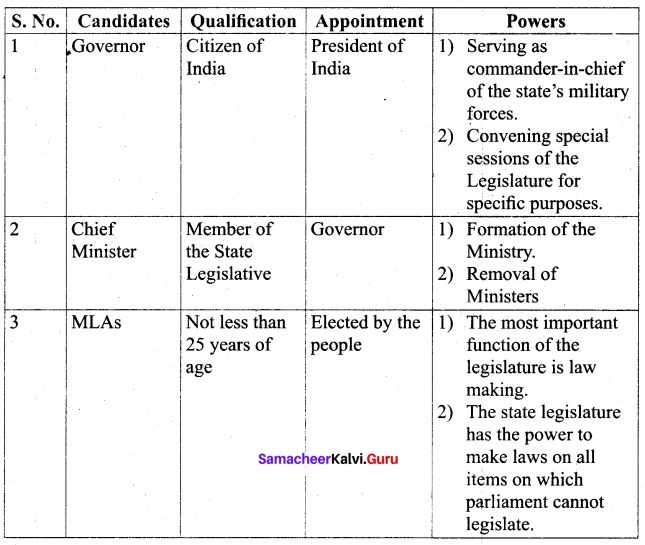
Tabulate: qualification, appointment and any two powers of governor, Chief Minister and MLAs. ;
Answer:
Samacheer Kalvi Guru 7th Social Science Civics Solutions Term 2 Chapter 1 State Government

VIII. Activity

Question 1.
Make a list of the name of the Governor, Chief Minister and other Ministers with their departments.
Answer:
Activity to be done by the students themselves

Question 2.
Write an essay on ‘If you were the Chief Minister of the state’.
Answer:
First of all, I shall try my level best to make my country a strong and self respecting nation. India will be a great power and no other country will dare attack India.

The second thing I will do will be the fullest and genuine attention to the poorest and the lowliest. I shall endeavour to give full employment to at least one member of each house-hold. It will be my attempt to keep the prices under control. I shall try to stream-line the public distribution system further and supply the essential commodities to the poor at subsidized rates. I shall try to make the taxation system more useful and rational. Whereas the rich may be taxed heavily, the poor and the middle classes will be spared.

The third thing, to which I shall devote my energy, is the education system. I shall raise its standard and make it based on merit and for all. The examination system will be over-hauled, so that there is no copying and the real merit of a student is readily discernible. Much more attention will be given to admission to professional colleges on the basis of merit. There will be reservation only on economic grounds and not on caste basis.

The fourth thing deserving my fullest attention will be the population control. Without it, our country will be ruined. Then I shall also take care of important and productive fields like agriculture, industry, oil production, mining, increase in exports etc. Above all, I shall try to raise the moral standard of the people and make them more patriotic. I shall also try to root out evils of terrorism, communalism, provincialism, drug-taking, dowry system, drinking etc.

Question 3.
Make a student Legislative body in your class, (allocate the departments and do periodical review).
Answer:
Activity to be done by the students themselves

Samacheer Kalvi 7th Social Science State Government Additional Questions

I. Choose the correct answer:

Question 1.
MLA’s are elected by _______.
(a) Children
(b) People
(e) Teachers
(d) None of these
Answer:
(b) People

Question 2.
The Governor calls the leader of the majority party to form the ________.
(a) State Government
(b) Central Government
(c) Both
(d) None
Answer:
(a) State Government

Question 3.
The Governor is appointed by the President of India for the term of ________ years.
(a) 3
(b) 5
(c) 6
(d) 12
Answer:
(b) 51

Question 4.
MLA or MLC should have completed ________ years of age.
(a) 25
(b) 35
(c) 30
(d) 40
Answer:
(c) 30

Question 5.
________ is an integral part of the state legislature.
(a) MLA
(b) MLC
(c) Chief Minister
(d) Governor
Answer:
(d) Governor

Question 6.
All the Minisers work as a team under the ________.
(a) Chief Minister
(b) Prime Minister
(e) President
(d) MLA
Answer:
(a) Chief Minister

II. Fill in the blanks:

  1. Every state in India has a ________
  2. The ruling party members then form the government and some members are appoinied as ________
  3. ________ are representatives of the people.
  4. ________ conducts and monitors the elections.
  5. In India some of the states have two houšes in their.
  6. The ________ is the real executive head of the state administration.

Answers:

  1. Legislative Assembly
  2. Ministers
  3. MLAs
  4. The Election Commission of lndia
  5. state legislaturel
  6. Chief Minister

III. Match the following:

  1. States – (a) Chief Minister
  2. Integral part – b) People’s court
  3. Real executive power – (c) Highest judicial organ
  4. Lok Adalat – (d) President
  5. High Courts – (e) 29

Answers:

  1. – e
  2. – d
  3. – a
  4. – b
  5. – c

IV. True or False

  1. The powers and responsibilities between city governments and country governments are always the same in every state.
  2. Tamil Nadu is a unicamerate legislature.
  3. Governor is the chancellor of government universities in the state.

Answer:

  1. False
  2. True
  3. True

V. Consider the following statements: Tick the appropriate answer

Question 1.
Assertion (A) : The three main organs of government are the legislative, executive and judiciary.
Reason (R) : The High Courts are the highest judicial organ at the state level
(a) A is correct and R explains A
(b) A is correct and R does not explain A
(c) A is correct and R is wrong
(d) Both are wrong
Answer:
(b) A is correct and R does not explain A

VI. Answer in one or two sentences

Question 1.
What is Legislative Assembly?
Answer:
Legislative Assembly is the law making body of a state. The members of (his Assembly are directly elected by people, so they can be called as representatix e ol people or usually known as Member of Legislative Assembly (MLA).

Question 2.
How many states and union territories are there in India?
Answer:
29 States and 7 uni&n terriories are in India.

Question 3.
What is Central Government?
Answer:
India is a Parliamentary democratic republic where the President of India is the Head of Indian Union and the Prime Minister and all the Ministers are responsible for smooth running of the government. This is called central government.

Question 4.
Who are all included in the State Government?
Answer:
The Governor, the Chief Minister, Council of Ministers.

VI. Answer the following in detail

Question 1.
What is High Courts? and it briefly explain.
Answer:

  1. The High courts are the highest judicial organ at the State level.
  2. It is an independent body.
  3. As per the constitution there shall be a High Court in each state.
  4. The state high court consists of a Chief Justice and other judges.
  5. The number of Judges in the high court is not uniform and fixed.
  6. President appoints the Chief Justice and can hold the office until he completes the age of 62 years.
  7. Apart from High court there are district courts and tribunals.
  8. They ensure justice to the people without any bias. Apart from this, Family Courts are established to settle the disputes relating to marriages and family affairs.

Samacheer Kalvi 7th Maths Solutions Term 2 Chapter 1 Number System Intext Questions

Students can Download Maths Chapter 1 Number System Intext Questions and Answers, Notes Pdf, Samacheer Kalvi 7th Maths Book Solutions Guide Pdf helps you to revise the complete Tamilnadu State Board New Syllabus and score more marks in your examinations.

Tamilnadu Samacheer Kalvi 7th Maths Solutions Term 2 Chapter 1 Number System Intext Questions

Exercise 1.1
(Try These Text book Page No. 2)

7th Maths Term 2 Exercise 1.1 Question 1.
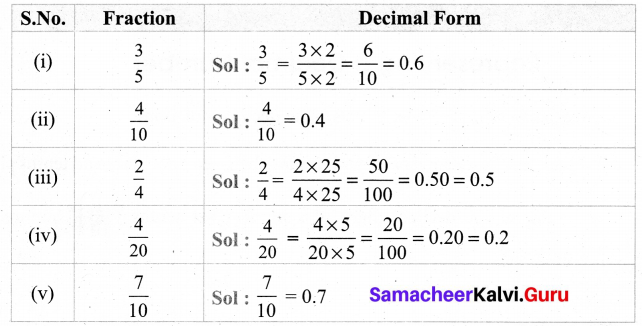
Observe the following and write the fraction of the shaded portion and mention in decimal form also.
7th Maths Term 2 Exercise 1.1 Chapter 1 Number System Intext Questions Samacheer Kalvi
Solution:
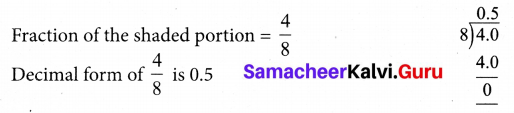
(i) Total parts = 8
Shaded parts = 4
Samacheer Kalvi 7th Maths Book Answers Term 2 Chapter 1 Number System Intext Questions

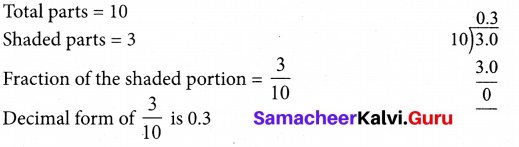
(ii)
Samacheer Kalvi 7th Maths Book Solutions Term 2 Chapter 1 Number System Intext Questions

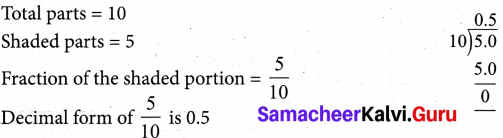
(iii)
7th Std Samacheer Kalvi Maths Solutions Term 2 Chapter 1 Number System Intext Questions

Samacheer Kalvi 7th Maths Book Answers Term 2 Question 2.
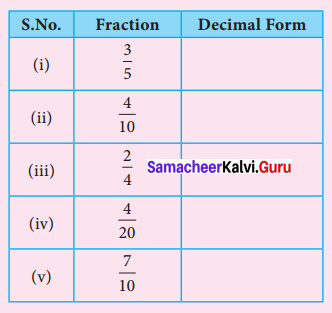
Represent the following fractions in decimal form by converting denominator into ten or powers of 10.
7th Standard Maths Number System Exercise 1.1 Term 2 Chapter 1 Samacheer Kalvi
Solution:
7th Maths Exercise 1.1 Samacheer Kalvi Term 2 Chapter 1 Number System Intext Questions

Samacheer Kalvi 7th Maths Book Solutions Term 2 Question 3.
Give any two life situations where we use decimal numbers.
Solution:
(i) Measuring weight of gold.
(ii) Weighing our height

(Try These Text book Page No. 3)

7th Std Samacheer Kalvi Maths Solutions Term 2 Question 1.
Represent the following decimal numbers pictorially.
(i) 5 ones and 3 tenths
(ii) 6 tenths
(iii) 7 ones and 9 tenths
(iv) 6 ones and 4 tenths
(v) Seven tenths
Solution:
(i) 5 ones and 3 tenths
Samacheer Kalvi 7th Maths Term 2 Chapter 1 Number System Intext Questions
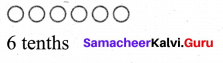
(ii) 6 tenths
7th Maths Guide Try These Solutions Term 2 Chapter 1 Number System Intext Questions Samacheer Kalvi
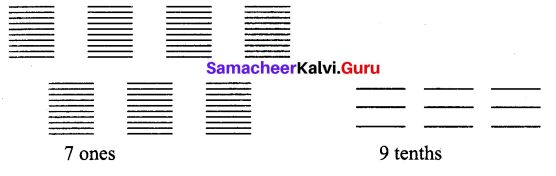
(iii) 7 ones and 9 tenths
Samacheer Kalvi 7th Maths Book Answers Solutions Term 2 Chapter 1 Number System Intext Questions
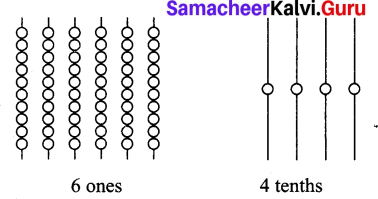
(iv) 6 ones and 4 tenths
7th Std Maths Guide Solutions Term 2 Chapter 1 Number System Intext Questions Samacheer Kalvi
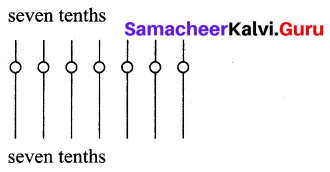
(v) Seven tenths
Samacheer Kalvi 7th Term 2 Maths Solutions Chapter 1 Number System Intext Questions

(Try These Text book Page No. 5 & 6)

7th Standard Maths Number System Exercise 1.1 Question 1.
Express the following decimal numbers in an expanded form and place value grid form.
(i) 56.78
(ii) 123.32
(iii) 354.56
Solution:
(i) 56.78
(a) Expanded form
56.78 = 5 × 101 + 6 × 100 + 7 × 10⁻¹ + 8 × 10⁻²

(b) Place value grid
Samacheer Kalvi 7 Maths Solutions Term 2 Chapter 1 Number System Intext Questions

(ii) 123.32
(a) Expanded form
123.32 = 1 × 10² + 2 × 101 + 3 × 100 + 3 × 10⁻¹ +2 × 10⁻²

(b) Place value grid
Samacheer Kalvi 7th Standard Maths Solutions Term 2 Chapter 1 Number System Intext Questions

(iii) 354.56
(a) Expande form
354.56 = 3 × 10² + 5 × 101 + 4 × 100+ 5 × 10⁻¹ + 6 × 10⁻²

(b) Place value grid
7th Maths 2nd Term Chapter 1 Number System Intext Questions Samacheer Kalvi

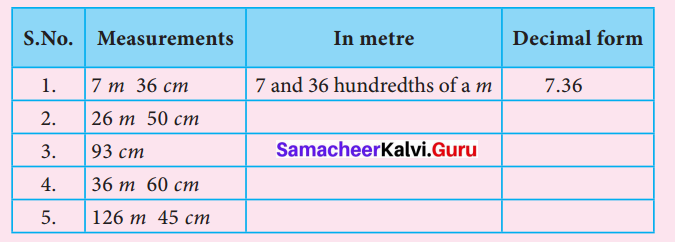
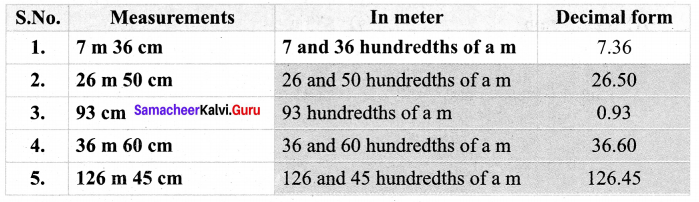
7th Maths Exercise 1.1 Samacheer Kalvi Question 2.
Express the following measurements in terms of metre and in decimal form. One is done for you.
7th Maths Term 2 Chapter 1 Number System Intext Questions Samacheer Kalvi
Solution:
7th Samacheer Kalvi Maths Solutions Term 2 Chapter 1 Number System Intext Questions

Samacheer Kalvi 7th Maths Term 2 Question 3.
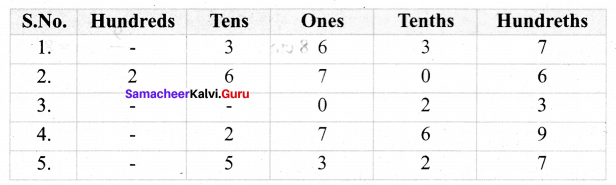
Write the following numbers in the place value grid and find the place value of the underlined digits.
(i) 36.37
(ii) 267.06
(iii) 0.23
(iv) 27.69
(v) 53.27
Solution:
7th Standard Maths Samacheer Kalvi Term 2 Chapter 1 Number System Intext Questions
(i) Place value of 3 in 36.37 is Tenths.
(ii) Place value of 6 in 267.06 is Hundredths.
(iii) Place value of 2 in 0.23 is Tenths.
(iv) Place value of 9 in 27.69 is Hundredths.
(v) Place value of 2 in 53.27 is Tenths.

Exercise 1.2

(Try These Text book Page No. 10)

7th Maths Guide Try These Question 1.
Convert the following fractions into the decimal numbers.
(i) \(\frac { 16 }{ 1000 } \)
(ii) \(\frac { 638 }{ 10 } \)
(iii) \(\frac { 1 }{ 20 } \)
(iv) \(\frac { 3 }{ 50 } \)
Solution:
(i) \(\frac { 16 }{ 1000 } \) = 0.016
(ii) \(\frac { 638 }{ 10 } \) = 63.8
(iii) \(\frac { 1 }{ 20 } \) = \(\frac{1 \times 5}{20 \times 5}\) = \(\frac { 5 }{ 100 } \) = 0.05
(iv) \(\frac { 3 }{ 50 } \) = \(\frac{3 \times 2}{50 \times 2}\) = \(\frac { 6 }{ 100 } \) = 0.06

Samacheer Kalvi 7th Maths Book Answers Question 2.
Write the fraction for each of the following:
(i) 6 hundreds + 3 tens + 3 ones + 6 hundredths + 3 thousandths.
(ii) 3 thousands + 3 hundreds + 4 tens + 9 ones + 6 tenths.
Solution:
(i) 6 hundreds + 3 tens + 3 ones + 6 hundreds + 3 thousandths.
= 6 × 100 + 3 × 10 + 3 × 1 + 0 × \(\frac { 1 }{ 10 } \) + 6 × \(\frac { 1 }{ 100 } \) + 3 × \(\frac { 1 }{ 1000 } \)
= 600 + 30 + 3 + 0 + \(\frac { 6 }{ 100 } \) + \(\frac { 3 }{ 1000 } \)
= 633 + 0.06 + 0.003
= 633.063

(ii) 3 thousands + 3 hundreds + 4 tens + 9 ones + 6 tenths.
= 3 × 1000 + 3 × 100 + 4 × 10 + 9 × 1 + 6 × \(\frac { 1 }{ 10 } \)
= 3000 + 300 + 40 + 9 + \(\frac { 6 }{ 10 } \)
= 3349 + 0.6
= 3349.6

7th Std Maths Guide Question 3.
Convert the following decimals into fractions.
(i) 0.0005
(ii) 6.24
Solution:
(i) 0.0005 = \(\frac { 5 }{ 10000 } \) = \(\frac{5 \div 5}{10000 \div 5}\) = \(\frac { 1 }{ 2000 } \)
(ii) 6.24 = \(\frac { 624 }{ 100 } \) = \(\frac{624 \div 4}{100 \div 4}\) = \(\frac { 156 }{ 25 } \)

Exercise 1.4

(Try These Text book Page No. 22)

Samacheer Kalvi 7th Term 2 Maths Solutions Question 1.
Mark the following decimal numbers on the number line.
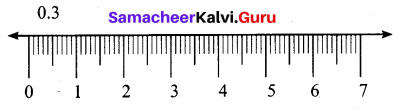
(i) 0.3
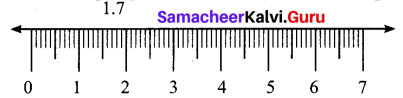
(ii) 1.7
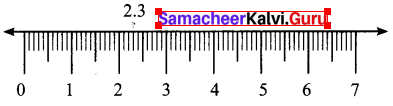
(iii) 2.3
Solution:
(i) 0.3
We know that 0.3 is more than 0, but less than 1.
There are 3 tenths in it. Divide the unit lenght between O and 1 on the number line
into 10 equal parts and take 3 parts, which represent 0.3.
Samacheer Kalvi 7th Guide Maths Term 2 Chapter 1 Number System Intext Questions

(ii) 1.7
We know that 1.7 is more than 1, but less than 2.
There are one ones and 7 tenths in it. Divide the unit length between 1 and 2 on the number line into 10 equal parts and take 7 parts which represents 1.7 = 1 + 0.7
Samacheer Kalvi Maths 7th Standard Term 2 Chapter 1 Number System Intext Questions

(iii) We know that 2.3 is more than 2 and less than 3.
There are 2 ones and 3 tenths in it. Divide the unit length between 2 and 3 into 10 equal parts and take 3 parts, which represents 2.3 = 2 + 0.3
7th Maths Guide Term 2 Chapter 1 Number System Intext Questions Samacheer Kalvi

Samacheer Kalvi 7 Maths Question 2.
Identify any two decimal numbers between 2 and 3.
Solution:
2.5 and 2.9

Samacheer Kalvi 7th Standard Maths Question 3.
Write any decimal number which is greater than 1 and less than 2.
Solution:
1.7, 1.9, 1.6, ………………..

Samacheer Kalvi 6th Social Science Civics Solutions Term 1 Chapter 1 Understanding Diversity

You can Download Samacheer Kalvi 6th Social Science Book Solutions Guide Pdf, Tamilnadu State Board help you to revise the complete Syllabus and score more marks in your examinations.

Tamilnadu Samacheer Kalvi 6th Social Science Civics Solutions Term 1 Chapter 1 Understanding Diversity

Samacheer Kalvi 6th Social Science Understanding Diversity Textual Evaluation

I. Choose the correct answer

Samacheer Kalvi Guru 6th Social Science Question 1.
India consists of _____ States and’_____Union territories.
(a) 27,9
(b) 29,7
(c) 28,7
(d) 28,9
Answer:
(b) 29, 7

Samacheer Kalvi 6th Social Question 2.
India is known as a …………….
(a) Continent
(b) Sub continent
(c) Island
(d) None of these
Answer:
(b) Sub continent

Samacheer Kalvi 6th Social Guide Question 3.
Mawsynram, the land of highest rainfall is located in
(a) Manipur
(b) Sikkim
(c) Nagaland
(d) Meghalaya
Answer:
(d) Meghalaya

Samacheer Kalvi 6th Social Science Book Back Answers Question 4.
Which one of the following religion is not practised in India?
(a) Sikhism
(b) Islam
(c) Zoroastrianism
(d) Confucianism
Answer:
(d) Confucianism

Samacheer Kalvi Social Science 6th Question 5.
Recognised official languages of India, as per VIIIth Schedule of Indian Constitution
(a) 25
(b) 23
(c) 22
(d) 26
Answer:
(c) 22

6th Standard Samacheer Kalvi Social Science Question 6.
Onam festival is celebrated in …………….
(a) Kerala
(b) Tamil Nadu
(c) Punjab
(d) Karnataka
Answer:
(a) Kerala

Class 6 Social Science Samacheer Kalvi Question 7.
Mohiniyattara is a classical dance of
(a) Kerala
(b) Tamil Nadu
(c) Manipur
(d) Karnataka
Answer:
(a) Kerala

Samacheer Kalvi 6th Social Science Question 8.
‘Discovery of India’ – a book was written by …………….
(a) Rajaji
(b) V.O.C
(c) Nethaji
(d) Jawaharlal Nehru
Answer:
(d) Jawaharlal Nehru

Samacheer Kalvi 6 Social Science Question 8.
‘Discovery of India’
(a) Rajaji
(b) V.O,C
(c) Nethaji
(d) Jawaharlal Nehru
Answer:
(d) Jawaharlal Nehrul

Samacheer Kalvi 6th Standard Social Science Question 9.
The phrase ‘ Unity in Diversity’ was coined by
(a) Jawaharlal Nehru
(b) Ambedkar
(c) Mahathma Gandhi
(d) Rajaji
Answer:
(a) Jawaharlal Nehru

6th Standard Samacheer Kalvi Social Question 10.
V.A. Smith called India as …………….
(a) Great Democracy
(b) Unique land of diversities
(c) Ethnological museum
(d) Secular nation
Answer:
(c) Ethnological museum

II. Fill in the blanks :

  1. Geographical features and climatic conditions determine the _________ activities of region
  2. Jaisalmer, the land of lowest rainfall is located in _________
  3. Tamil was declared as classical language in the year _________
  4. Bihu festival is celebrated in _________

Answer:

  1. economic
  2. Rajasthan
  3. 2004
  4. Assam

III. Match the following

  1. Negroids – a. Religion
  2. Coastal areas – b. India
  3. Zoroastrianism- c. Fishery
  4. Unity in diversity- d. Indian race

Answer:

  1. – d
  2. – c
  3. – a
  4. – h

IV. Answer the following questions:

Social Samacheer Kalvi 6th Question 1.
Define diversity.
Answer:
We, the Indians come from different backgrounds, belong to different cultures, worship in different ways. This is known as diversity.

6th Standard Social Samacheer Kalvi Question 2.
What are the types of diversity?
Answer:
The types of diversity are –

  1. Landforms and Lifestyle diversity
  2. Social diversity
  3. Religious diversity
  4. Linguistic diversity
  5. Cultural diversity

6th Samacheer Kalvi Social Guide Question 3.
Why is India called a subcontinent?
Answer:
A continent is a very large area of land with various physical features such as mountains, plateaus, plains, rivers and seas and various types of weather patterns. India has all of them. So India is known as a subcontinent.

Samacheer Kalvi 6th Social Science Guide Question 4.
Write the names of three major festivals celebrated in India.
Answer:

  1. Pongal, Deepavali – Hindus
  2. Miladi Nabi, Ramjan – Muslims
  3. Christmas, Easter – Christians

Social Guide For Class 6 Samacheer Kalvi Question 5.
List out some of the classical dances of India.
Answer:

  1. Tamil Nadu – Bharatanatyam
  2. Kerala – Kathakali
  3. Karnataka – Yakshagana
  4. Odisha – Odissi
  5. Andhra Pradesh – Kuchipudi
  6. Manipur – Manipuri
  7. Assam – Sattriya

Samacheer Kalvi Social 6th Standard Question 6.
Why is India called the land of unity in diversity?
Answer:

  1. In India, people who live in different parts of the country differ in their ways of life.
  2. These differences make us unique as Indians.
  3. We come from different backgrounds, belong to different cultures, worship different Gods in different ways, yet we live together.
  4. This is known as unity in diversity.

V. Answer the following in detail:

Samacheer Kalvi Guru 6th Social Guide Question 1.
Explain : Linguistic diversity’ and cultural diversity.
Answer:
Linguistic Diversity :

  1. According to census of India 2001, India has 122 maj or languages and 1599 other languages.
  2. Four major Indian language families are Indo-Aryan, Dravidian, Austroasiatic and Sino Tibetian. Tamil is the oldest Dravidian language.
  3. Historically, the Portuguese, the Dutch, the British, the Danish and the French came to India for trade and their occupation of India or some parts of it has left behind a certain impact upon the culture and language of the people.
  4. In due course, English has emerged as an important language and a medium of instruction in schools and colleges.
  5. (It is widely used in official communication and daily life.

Cultural Diversity :

  1. The term ‘culture’ refers to customs and practices of people, their language, their dress code, cuisine, religion, social habits, music, art and architecture.
  2. The culture of a group of people is reflected in their social behaviour and interactions.
  3. The group identity fostered by social patterns is unique to a group.
  4. Art and architecture are an integral part of every community.
  5. It develops as a part of culture and tradition of a community.

Question 2.
“India is a land of diversity, yet we are all united”. Discuss.
Answer:

  1. Though diversity is visiable in every aspect of life in India, we are united by the spirit of patriotism.
  2. Symbols like the National flag and National Anthem remind us of our great nation and the need to stay united.
  3. Celebration of events like Independence Day , Republic day and Gandhi Jayanthi brings us together and keeps the spirit of one nation alive with us.
  4. India has a multicultural society.
  5. India evolved as a single nation through common beliefs, customs and cultural practices.
  6. The freedom struggle and the drafting of our constitution stands as ample evidence to the spirit of unity of India.

VI. Projects and Activities:

Question 1.
“The occupation of people depends on the landform of a place”. Give some
examples.
Answer:

  1. The Earth has many landforms such as plains, valleys and mountains.
  2. Landforms affect where people build houses and communities.
  3. Many people live on plains because it is easy to travel and to farm on flat land.
  4. (The low lying regions are suitable for growing crops near clean and fresh water with access to the sea in natural protected harbours.
  5. People living in the coastal region might prefer finishing. Mountains and hilly regions are cool but transport, farming etc will be difficult here. So the landforms play a major role in the section of occupation.

Question 2.
Read about a state of your choice and make an album to show the culture and tradition of people who live in that state.
Answer:
Tamil Nadu :

  1. Tamil Nadu is a southern state of India.
  2. It is supremely rich in culture and heritage.
  3. Tamil is the official language of the State. Hindus, Jains, Christians and Muslims live here Men wear dhoti and shirt and woman wear sari. Rice, lentils, grains and vegetables form the main cuisine.
  4. Some Tamilans follow the tradition of eating on banana leaf.
  5. The Most important form of music is Carnatic music. Bharathanatyam is the
    official dance form of Tamil Nadu.
  6. Kolam is drawn at the doors of every house in Tamil Nadu Meenakshi Temple of Madurai and Brihadeeswar
  7. Temple of Thanjavur display a grand vista of ancient Hindu mythological diversity and Tamil Heritage.

VII. HOTS :

Question 1.
List out the various festivals celebrated in different states.
Answer:

  1. Andhra Pradesh – Brahmotsavam
  2. Arunachal Pradesh – Losar festival
  3. Assam – Bohag Bihu
  4. Bihar – Chhath Puja
  5. Chhattisgarh – Bastar Dussehra
  6. Goa – Carnival
  7. Gujarat – Janmashtami, Diwali
  8. Haryana – Baisaki
  9. Himachal Pradesh – Maha Sivarathiri
  10.  Jammu and Kashmir – Eid-Ul-Fitr and Eid-ul-Azha
  11. Jharkhand – Holi
  12. Karnataka – Ugadi
  13. Kerala – Onam
  14. Madhya Predesh – Diwali
  15. Maharastra – Ganesh Chaturthi

Samacheer Kalvi 6th Social Science Understanding Diversity Intext Questions

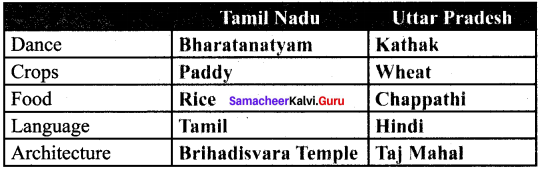
Question 1.
You have read about the diversity that exists in our country. Compare and contrast. Two states in this table.
Answer:
Samacheer Kalvi Guru 6th Social Science Civics Solutions Term 1 Chapter 1 Understanding Diversity

Samacheer Kalvi 6th Social Science Understanding Diversity Additional Questions

I. Choose the correct answer

Question 1.
Karagattam is a popular folk dance in
(a) Tamil Nadu
(b) Gujarat
(c) Assam
(d) Kerala
Answer:
(a) Tamil Nadu

Question 2.
The number of recognized official languages …………….
(a) 13
(b) 18
(c) 22
(d) 25
Answer:
(c) 22

Question 3.
India was called an “ethnological museum” by
(a) Rabindranath Tagore
(b) Dr. Ambedkar
(c) V.A. Smith
(d) Adam Smith
Answer:
(c) V.A. Smith

II. Fill in the blanks :

  1. The migration of people is the reason for India’s rich ___________
  2. Jaisalmer, located in Rajasthan, is the land of ___________ rainfall.
  3. The land of the highest rainfall is ___________ in megalaya.
  4. A ___________ is a place where people live together with a common interest or heritage.
  5. The fundamental unit of a society are ___________
  6. In a ___________ nation all religions are treated equally
  7.  ___________ language is widely used in official communication and daily life
  8. India is known for ___________
  9. The first Prime Minister of independent India was ___________

Answer:

  1. diversity
  2. lowest
  3. Mawsynram
  4. community
  5. families
  6. secular
  7. English
  8. unity in diversity
  9. Jawarharlal Nehru

III. Match the following

Question 1.
(a) Gujarat -(i) Mohiniattam
(b) Kerala -(ii) Kummi
(c) Rajasthan -(iii) Garba
(d) Tamil Nadu -(iv) Ghoomer
Answer:
(a – iii)
(b – i)
(c – iv)
(d – ii)

Question 2.
(a) Dussehra – (i) Architecture
(b) Zoroastrianism – (ii) Language
(c) Dilwara Temple – (iii) Festival
(d) Malayalam – (iv) Religion
Answer:
(a – iii)
(b – iv)
(e – i)
(d – ii)

IV. Answer the following questions:

Question 1.
Who became part of the modern Indian race?
Answer:
The Dravidians, Negroids, Aryans, Alpines and Mongoloids became part of the modem Indian race.

Question 2.
What is meant by community?
Answer:

  1. A community is a place where people live together with a common interest or heritage.
  2. Our community is made up of peasants, labourers, artisans, parents, teachers, students and many others.

Question 3.
How is a city formed?
Answer:

  1. Families live in a harmonious neighbourhood.
  2. Hundreds of neighbourhoods collectively form a village.
  3. Thousands of them group together to form a city.

Question 4.
Mention the folk dances of Tamil Nadu.
Answer:

  1. Karagattam
  2. Oyillattam
  3. Kummi
  4. Therukoothu
  5. Bommalattam
  6. Puliattam
  7. Kolattam and Thappattam.

Question 5.
Mention some of the festivals celebrated in India.
Answer:
Festivals like Pongal, Deepavali, Holi, Vijayadhasami, Ayudha puja, Navratri Durga Puja, Ganesh Chaturthi, Onam, Miladi Nabi, Ramzan, Christmas are celebrated in India.

Question 6.
What are the various styles of music practiced in India?
Answer:
The Hindustani music, Kamatic music, Classical music, Folk music, Lavani, Ghazl are some of the musics practiced in India.

Question 7.
What does the term culture refer to?
Answer:
The term culture refers to customs and practices of people, their language, their dress code, cuisine, religion, social habits music, art and architecture.

Question 8.
Mention the importance of dances in India.
Answer:
In ancient times, dance was considered as a way to celebrate worship and also as a gesture of thanks giving and joy. Dances of India reflect its cultural richness.

V. Answer the following questions in detail.

Question 1.
How do land forms affect life style?
Answer:

  1. India is a sub – continent.
  2. It has mountains, plateaus, plains, rivers and seas.
  3. These features influence upon the people who live in different landforms of the country.
  4. People who live in plains do agriculture.
  5. Coastal areas take to fishing for their livelihood.
  6. Diversity in landforms also impacts the flora and fauna of that region.
  7. As a result food, clothing, occupation and livelihood of the people is closely connected with the regions natural surroundings and climate.

Samacheer Kalvi 8th Science Solutions Term 3 Chapter 4 Water

Students can Download Science Term 3 Chapter 4 Water Questions and Answers, Notes Pdf, Samacheer Kalvi 8th Science Book Solutions Guide Pdf helps you to revise the complete Tamilnadu State Board New Syllabus and score more marks in your examinations.

Tamilnadu Samacheer Kalvi 8th Science Solutions Term 3 Chapter 4 Water

Samacheer Kalvi 8th Science Water Text Book Exercise

I. Choose the best answer:

8th Standard Science Water Lesson Question 1.
Water changes to ice at ………….
(a) 0°C
(b) 100°C
(c) 102°C
(d) 98°C
Answer:
(a) 0°C

8th Standard Science Water Lesson Notes Question 2.
Solubility of carbon dioxide in water is high when the ………….
(a) pressure is low
(b) pressure is high
(c) temperature is high
(d) None of the above
Answer:
(b) pressure is high

8th Standard Water Lesson Question 3.
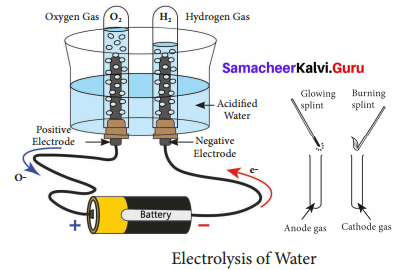
The gas collected at the cathode on electrolysis of water is ………….
(a) oxygen
(b) hydrogen
(c) nitrogen
(d) carbon dioxide
Answer:
(b) hydrogen

Samacheer Kalvi Guru 8th Science Question 4.
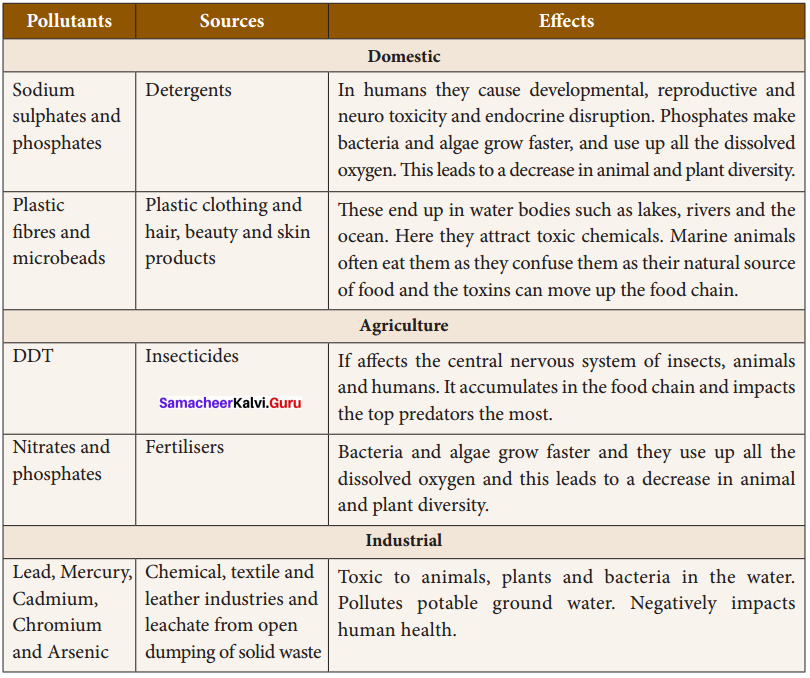
Which of the following is a water pollutant?
(a) Lead
(b) Alum
(c) Oxygen
(d) Chlorine
Answer:
(a) Lead

Samacheer Kalvi Guru 8th Question 5.
Permanent hardness of water is due to the presence of ………….
(a) Sulphates and Chlorides
(b) Dust particles
(c) Carbonates and Bicarbonates
(d) Other soluble particles
Answer:
(a) Sulphates and Chlorides

II. Fill in the blanks:

  1. Water is colourless, odourless and ………….
  2. The boiling point of water is ………….
  3. Temporary hardness of water can be removed by …………. of water
  4. The density of water is maximum at …………..
  5. Loading speeds up the process of …………..

Answer:

  1. tasteless
  2. 100°C
  3. boiling
  4. 4°C
  5. Sedimentation

III. State True or False. If false, correct the statement:

Samacheer Kalvi 8th Science Solutions Question 1.
Sewage should be treated well before being discharged it into water bodies.
Answer:
True.

Samacheer Kalvi 8th Science Book Solutions Question 2.
Sea water is suitable for irrigation as it contains dissolved salts.
Answer:
False.

Correct statement:
Sea water is not suitable for irrigation as it has high salinity.

Samacheer Kalvi Science 8th Standard Question 3.
Excessive use of chemical fertilizers depletes the soil and causes water pollution.
Answer:
True.

Samacheer Kalvi.Guru 8th Question 4.
Water unfit for drinking is called potable water.
Answer:
False

Correct statement:
Water suitable for drinking is called potable water.

Samacheer Kalvi 8th Standard Science Question 5.
Soap lathers well in hard water.
Answer:
False

Correct statement:
Soap lathers well in soft water.

IV. Match the following:

  1. Universal solvent – Water Pollutant
  2. Hard water – Kills germs
  3. Boiling – Ozonisation
  4. Sterilization – Water
  5. Sewage – Stomach ailments

Answer:

  1. Universal solvent
  2. Hard water
  3. Boiling
  4. Sterilization
  5. Sewage

V. Give reasons for the following:

Samacheer Kalvi Science 8th Question 1.
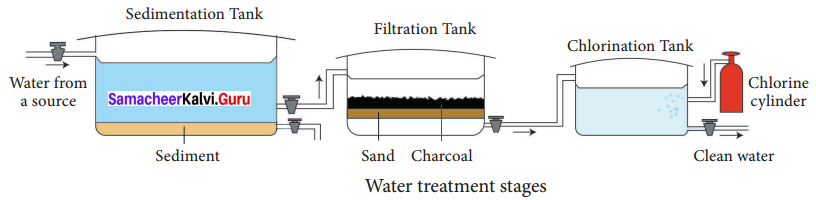
Alum is added to water in sedimentation tank.
Reason:

  1. Chemical substance potash alum is added to water to speed up the process of sedimentation.
  2. This process is called loading.
  3. The particles of potash alum combine with the suspended impurities and make them settle down at a faster rate.

Samacheer Kalvi Guru 8th Science Solutions Question 2.
Water is a universal solvent.
Reason:

  1. Water has a unique property to dissolve more substances than any other liquids.
  2. It can dissolve solids such as salt and sugar, liquids such as honey and milk and gases such as oxygen and carbon dioxide in it.
  3. Water can dissolve more number of substances than any other solvent.
  4. Therefore, it is called as universal solvent.

Samacheer Kalvi 8th Science Guide Question 3.
Ice floats on water.
Reason:

  1. This is because ice is lighter than water.
  2. It means that the density of ice is lower than that of water.
  3. Since ice is a bad conductor of heat it does not allow heat to pass through it.
  4. So, the water below the ice remains in liquid form, where most of the aquatic life lives.

Samacheer Kalvi 8th Books Science Question 4.
Aquatic animals can breathe in water.
Reason:

  1. Air dissolved in water is important for the aquatic animals to survive.
  2. Aquatic animals extracts the oxygen form the water and expels water.
  3. They can breathe in water only through the dissolved oxygen present in water.

Samacheer Kalvi 8th Science Question 5.
Sea water is unfit for drinking.
Reason:

  1. Every litre of sea water contains 35 grams of dissolved salts most commonly known as sodium chloride (NaCl).
  2. Such water is called saline water.
  3. It is not suitable for drinking and is said to be non-potable water.

Samacheer Kalvi 8th Science Book Question 6.
Hard water is not good for washing utensils.
Reason:
Hard water damages the utensils and containers in which it is stored and forms a hard layer.

VI. Define the following:

Samacheer Kalvi 8th Books Solutions Science Question 1.
Freezing Point.
Answer:
The temperature at which a liquid turns into solid when cooled is known as freezing point. The freezing point of water is 0°C.

8th Standard Samacheer Kalvi Science Question 2.
Boiling point.
Answer:
The temperature at which a water boils and changes to steam is called as boiling point. The boiling point of water is 100°C at atmospheric pressure.

Samacheer Kalvi Guru 8th Standard Question 3.
Specific heat capacity.
Answer:
Amount of heat that is needed to raise the temperature of a unit mass of a substance by 1°C is called specific heat capacity.

8th Standard Science Samacheer Kalvi Question 4.
Latent heat of fusion.
Answer:
The amount of heat energy required by ice to change into water is called latent heat of fusion of ice.

Samacheer Kalvi 8 Science Book Question 5.
Potable water.
Answer:
The water suitable for drinking is called potable water.

VII. Answer in brief:

Question 1.
Name the gas evolved at cathode and anode when water is electrolysis. State their ratio by volume.
Answer:

  1. The gas which is evolved at cathode: Hydrogen (H2).
  2. The gas which is evolved at anode: Oxygen (O2)
  3. The ratio of H2 and O2 = 2 : 1.

Question 2.
State the importance of dissolved oxygen and carbon dioxide in water.
Answer:

  1. Fish extracts the oxygen from the water and expels water through the gills. Fish can survive in water only through the dissolved oxygen present in water.
  2. Aquatic plants make use of dissolved carbon dioxide for photosynthesis.
  3. Carbon dioxide dissolved in water reacts with limestone to form calcium bicarbonate.
  4. Marine organisms such as snails, oysters, etc., extract calcium carbonate from calcium bicarbonate to build their shells.

Question 3.
What are the causes of temporary hardness and permanent hardness of water?
Answer:

  1. Temporary hardness is due to the presence of carbonate and bicarbonate salts of calcium and magnesium.
  2. Permanent hardness is due to the presence of chloride and sulphate salts of calcium and magnesium.

Question 4.
Define specific latent heat of vaporization of water.
Answer:

  1. When water attains the temperature of 100°C, it starts changing its state from liquid to gaseous state, however, the temperature of water does not rise above 100°C.
  2. It is because the heat energy supplied only changes the state of the boiling water.
  3. This heat energy is stored in steam and is commonly called latent heat of vaporization of steam.

Question 5.
What are the methods of removing hardness of water?
Answer:

  1. Boiling – Temporary hardness is easily removed from water by boiling.
  2. Adding washing soda – Washing soda is used to remove permanent hardness of water.
  3. Ion-exchange – This converts hard water into soft water.
  4. Distillation – Temporary and permanent hardness both can be removed by the method of distillation.

VIII. Answer in detail:

Question 1.
How is water purified at a water purification plant?
Answer:
In conventional water treatment plant, water is subjected to different process. They are:
Sedimentation:

  1. Water from lakes or rivers is collected in large sedimentation tanks.
  2. There, it is allowed to stand undisturbed so that suspended impurities settle down at the bottom of the tank.
  3. Sometimes, a chemical substance such as potash alum is added to water to speed up the process of sedimentation, this is called loading.
  4. The particles of potash alum combine with the suspended impurities and make them settle down at a faster rate.

Filtration:

  1. Water from the sedimentation tanks is then pumped to the filtration tanks.
  2. Filtration tanks contain filter beds made up of gravel, sand, pebbles, activated charcoal and concrete.
  3. Water passes through these layers and becomes free from any remaining dissolved or suspended impurities completely.

8th Standard Science Water Lesson Term 3 Chapter 4 Samacheer Kalvi

sterilisation:

  1. The filtered water is treated chemically to remove the remaining germs or bacteria, this process is called sterilisation.
  2. The chemicals that are used in this process are chlorine and ozone.
  3. The process of adding chlorine in adequate amounts to water is called chlorination.
  4. The water from filtration tanks is pumped into chlorination tanks, where chlorine is added to remove harmful bacteria and other germs.
  5. Ozonisation is a process in which water is treated with ozone gas to kill the germs present in it.
  6. The sterilisation of water can also be done by exposing it to air and sunlight.
  7. Oxygen from the air and sunlight destroy the germs present in water.
  8. Aeration is the process in which air under pressure is blown into filtered water, this also helps to kill the germs.

Question 2.
What is permanent hardness of water? How can it be removed?
Answer:
The hardness due to the presence of chloride and sulphate salts of calcium and magnesium is known as permanent hardness of water.
Removal of hardness:
1. Adding washing soda.

  1. Washing soda is used to remove permanent hardness of water.
  2. It converts chlorides and sulphates into insoluble carbonates.
  3. These insoluble carbonates are removed by filtration.

2. Distillation.

  1. Temporary and permanent hardness both can be removed by the method of distillation.
  2. The water obtained after distillation is called distilled water.
  3. It is the purest form of water.

Question 3.
What is Electrolysis? Explain the electrolysis of water.
Answer:
The process of breaking down of water molecules by the passage of electric current is known as electrolysis of water.
Electrolysis of Water:

  1. A glass beaker is fixed with two carbon electrodes and it is filled with water up to one third of its volume.
  2. The positive carbon electrode acts as anode and the negative carbon electrode acts as cathode.
  3. Two test tubes are placed on the electrodes.
  4. The electrodes are connected to a battery’ and current is passed until the test tubes are filled with a particular gas.
  5. If the gas collected is tested using a burning splint we can notice that the gas in cathode side bums with a popping sound when the burning splint is brought near the mouth of the test tube.
  6. This property is usually shown by hydrogen gas and so it is confirmed that the gas inside the test tube is hydrogen.
  7. The burning splint placed near the anode side bums more brightly confirming that it is oxygen gas. This experiment shows that water is made up of hydrogen and oxygen.
  8. The ratio of hydrogen and oxygen is 2:1. Hence, for every two volumes of hydrogen collected at the cathode, there is one volume of oxygen collected at the anode.

8th Standard Science Water Lesson Notes Term 3 Chapter 4 Samacheer Kalvi

8th Standard Water Lesson Term 3 Chapter 4 Samacheer Kalvi

Question 4.
Explain the different ways by which water gets polluted.
Answer:
1. Domestic Sewage.
Untreated sewage contains impurities such as organic matter from food waste, toxic chemicals from household products and it may also contain disease-causing microbes.

2. Domestic waste and plastics.
Plastics block drains spreading vector borne diseases such as malaria and dengue. Waste in water bodies negatively impact aquatic life.

3. Agricultural activities

  • Fertilizers, pesticides and insecticides used in agriculture can dissolve in rainwater and flow into water bodies such as rivers and lakes.
  • This causes an excess of nutrients such as nitrates and phosphates as well as toxic chemicals into the water bodies and they can be harmful to aquatic life.

4. Industrial waste.

  • Many industries release toxic waste such as lead, mercury, cyanides, cadmium, etc.
  • If this waste is unregulated and is released into water bodies, it negatively impacts humans, plants, animals and aquatic life.

5. Oil spills.
Oil spills cause water pollution which is harmful to aquatic life.

6. Thermal pollution.
Water used for cooling purposes is discharged back to a river or to original water source at a raised temperature and sometimes with chemicals. This rise in temperature decreases the amount of oxygen dissolved in water which adversely affects the aquatic life.

Samacheer Kalvi 8th Science Water Additional Questions

I. Choose the correct Answer:

Question 1.
What is the chemical formula of water?
(a) HO2
(b) H2O
(C) H2O2
(d) HO
Answer:
(b) H2O

Question 2.
In which one of the following states water is present on Earth?
(a) solid
(b) liquid
(c) gas
(d) All of these
Answer:
(d) All of these

Question 3.
In the process of electrolysis of water, the positive carbon electrode acts as ……………..
(a) cathode
(b) anode
(c) both a and b
(d) none
Answer:
(b) anode

Question 4.
The boiling point of water increases with …………….. in pressure.
(a) decrease
(b) increase
(c) increase or decrease
(d) none
Answer:
(b) increase

Question 5.
The freezing point of water …………….. with increase in pressure.
(a) increase
(b) decreases
(c) remains same
(d) none
Answer:
(b) decreases

Question 6.
Every litre of sea water contains …………….. grams of dissolved salts.
(a) 40
(b) 70
(c) 35
(d) 10
Answer:
(c)35

Question 7.
The process of adding chlorine in adequate amounts to water is called ……………..
(a) Sterilisation
(b) Ozonisation
(c) Aeration
(d) Chlorination
Answer:
(d) Chlorination

Question 8.
…………….. from the air and sunlight destroy the germs present in water.
(a) Oxygen
(b) Hydrogen
(c) Nitrogen
(d) none
Answer:
(a) Oxygen

Question 9.
Aquatic plants make use of dissolved …………….. for photosynthesis.
(a) O2
(b) CO2
(c) N2
(d) H2
Answer:
(b)CO2

Question 10.
Which one of the following has the highest latent heat of vaporization?
(a) Ice
(b) Water
(c) Steam
(d) Metal
Answer:
(c) Steam

II. Fill in the blanks:

  1. The chemical name of water is …………….
  2. Samacheer Kalvi Guru 8th Science Solutions Term 3 Chapter 4 Water …………….
  3. Water was first prepared by ……………..
  4. Pure water boils at ……………. °C at one atmospheric pressure.
  5. Freezing of water will cause an ……………. is the volume.
  6. ……………. has the highest latent heat of fusion.
  7. One gram of water requires ……………. of heat to raise its temperature by l°C.
  8. Water is circulated around car engine using the ……………. pump and the heat is absorbed.
  9. Pure water is ……………. and it shows no action towards litmus paper
  10. ……………. does not react with water and any temperature.

Answer:

  1. Dihydrogen monoxide
  2. O2
  3. Henry Cavendish
  4. 100
  5. expansion
  6. Ice
  7. 1 Calorie
  8. radiator
  9. neutral
  10. Copper

III. True or False. If false, give the correct statement:

Question 1.
Washing soda is used to remove permanent hardness of water.
Answer:
True.

Question 2.
Temporary and permanent hardness both can be removed by the method of boiling.
Answer:
False

Correct statement:
Temporary and permanent hardness both can be removed by the method of distillation.

Question 3.
The pleasant taste of drinking water is due to the presence of dissolved substance which include air, CO2 and minerals.
Answer:
True.

Question 4.
Micro-plastics can be found in almost every freshwater source.
Answer:
True.

Question 5.
During electrolysis, hydrogen and oxygen are obtained in the ratio 1 : 2.
Answer:
False

Correct statement:
During electrolysis, hydrogen and oxygen are obtained in the ratio 2:1.

IV. Match the following:

  1. Density of pure water – (a) Inflammable air
  2. Henry Cavendish – (b) Cathode
  3. Hydrogen – (c) 1 g/cm3
  4. Negative carbon electrode – (d) Hydrogen

Answer:

  1. c
  2. d
  3. a
  4. b

V. Very short answer questions:

Question 1.
Name the process by which temporary hardness is easily removed from water.
Answer:
Boiling.

Question 2.
Name the chemical which converts chlorides and sulphates into insoluble carbonates.
Answer:
Washing soda.

Question 3.
What is the taste of distilled water & boiled water?
Answer:
No taste.

Question 4.
When did Henry Cavendish discover Water?
Answer:
Water was first prepared in 1781 by an English scientist Henry Cavendish.

VI. Short Answer Questions:

Question 1.
What are the sources of water pollution?
Answer:

  1. House hold detergents
  2. Domestic sewage
  3. Domestic waste and plastics
  4. Agricultural activities
  5. Oil spills
  6. Industrial waste.

Question 2.
How plastic sheets affect the soil?
Answer:

  1. Plastic sheets are used in agriculture to grow vegetables.
  2. At the end of the season, these plastic sheets are ploughed back into the soil.
  3. The plastic sheets break into tiny pieces and get eaten by earthworms, which is harmful to their health and that of soil.

Question 3.
Write a note on ion-exchange.
Answer:

  1. Another method used to remove the hardness of water is to pass it through a column of ion-exchange resins where calcium and magnesium ions get replaced by sodium ions.
  2. This converts hard water into soft water.

Question 4.
What is the reason for hardness of water?
Answer:
The hardness of water is due to the presence of dissolved salts of calcium and magnesium.

Question 5.
Mention the disadvantages of hard water.
Answer:

  1. It is not good for washing clothes. It forms scum with soap and detergents, which makes the soap ineffective and also spoils the clothes further.
  2. It damages the utensils and containers in which it is stored and forms a hard layer.
  3. It forms scales on the machine parts used in industries and decreases their efficiency.
  4. It results in stomach ailments if consumed for a long period.

Question 6.
What is soft water?
Answer:
Water contains a number of dissolved salts and minerals. When these salts are present in very small quantities in water, it is called soft water.

Question 7.
Write the characteristics of potable water.
Answer:

  1. Potable water should be colourless and odourless.
  2. II should be transparent.
  3. It should be free from harmful micro-organisms such as bacteria, virus and protozoa.
  4. It should be free from suspended impurities.
  5. I should contain some minerals and salts, necessary for our body and some dissolved gases to add taste.

Question 8.
Write a short note on catalytic nature of water.
Answer:
Water acts as a catalyst in a number of reactions. Perfectly dry hydrogen and chlorine gases do not react in the presence of sunlight. However in the presence of traces of water, the reaction takes place with explosion to produce hydrogen chloride.
Samacheer Kalvi Guru 8th Science Solutions Term 3 Chapter 4 Water

Question 9.
What are the physical properties of pure water?
Answer:
Pure water is a clear and transparent liquid:

  1. Pure water boils at 100° C at one atmospheric pressure.
  2. Pure water freezes at exactly 0°C at one atmospheric pressure.
  3. Pure water has a density of 1 gm/cm3.

Question 10.
Write the chemical equation for the production of water when zinc reacts with sulphuric acid.
Answer:
Zn + H2SO4 → ZnSO4 + H2
2H2+ O2 → 2H2O

VII. Answer in detail:

Question 1.
Tabulate the sources and effects of domestic and industrial pollutants.
Answer:
Samacheer Kalvi 8th Science Solutions Term 3 Chapter 4 Water

Question 2.
Mention some simple ideas to avoid water pollution.
Answer:

  1. Use detergents that are biodegradable and avoid those that contain toxic chemicals,
  2. Wear clothing that is made from natural fibres such as cotton and avoid wearing synthetic fibres such as nylon.
  3. Do not throw waste such as plastics into water bodies. Always separate your waste into recyclable, non-recyclable and biodegradable so that it does not cause pollution.
  4. Domestic waste water should be treated properly, and all harmful substances should be removed from it, so it can be reused for flushing toilets and gardening.
  5. Use bio-pesticides (natural pest control) instead of chemical pest control.
  6. Use compost made from cow dung, garden waste and kitchen waste as a fertiliser.
  7. Water released from industries should be treated before being discharged.

Question 3.
Explain about oil spills.
Answer:

  1. There are large crude oil and natural gas reserves below the sea bed.
  2. With the increasing exploration of crude oil in the oceans, accidents in drilling and transporting oil have also increased.
  3. Oil spills cause water pollution which is harmful to aquatic life.
  4. The oil which remains floating on the water surface blocks sunshine, reduces the oxygen dissolved in water and suffocates marine organisms.

Question 4.
Explain the importance of dissolved salts in water.
Answer:

  1. They are essential for the growth and development of plants.
  2. They add taste to water.
  3. They supply the essential minerals needed for our bodies.
  4. Most of the chemical reactions important for our living take place in the cells of our body with the help of water.

Samacheer Kalvi 8th Science Water Intext Activities

Activity – 1

Question 1.
Take some anhydrous copper (II) sulphate powder and place it in a watch glass. Add water drop by drop to the anhydrous copper (II) sulphate. Do you notice any colour change in the powder? You can notice the powder turning blue. It is a test for water.
Samacheer Kalvi 8th Science Book Solutions Term 3 Chapter 4 Water
Answer:

  1. The reaction between anhydrous copper (II) sulphate and water is used as a test for water.
  2. The white solid turns blue in the presence of water.

Activity -3

Question 1.
Place a sample of tap water on a clean watch glass and place it over a beaker containing water, as shown in Tap water the figure. Boil the water in the beaker. When all the water has evaporated from the watch glass, remove it from the burner and let it cool. What do you see on the watch glass?
Samacheer Kalvi Science 8th Standard Solutions Term 3 Chapter 4 Water
Answer:

  1. We can observe a number of concentric rings of solid matter deposited on the watch glass.
  2. These are the dissolved solids left behind after the evaporation of water Salts, minerals and impurities are the solids dissolved in water.

Activity -5

Question 1.
Take two pots with similar plants. Water one of the plants with tap water and the other with sea water. Record your findings and note the difference observed.
Answer:
Observation:

  1. Due to the high salinity of sea water, the plant starts to droop
  2. The plant which is watered with tap water grows well.

Activity – 6

Question 1.
Take samples of water from different sources (like a tube well, a lake, a pond or a river) and pour equal quantities of each sample of water into different test tubes. Measure the height of water in each test tube with a scale. Add one or two drops of liquid soap to each test tube. Shake each test tube five times and observe the height of the lather in each sample. Record your observations in the table. Which water is soft ? Which water is hard? Can you say why?
Answer:
Samples of water (Source):

  1. Tap water
  2. Well water
  3. Pond water
  4. River water

Height of lather:

  1. Less
  2. Less
  3. More
  4. More

Question 2.
Which water is soft?
Answer:

  1. Pond and river water are considered as soft due to presence of very small quantities of salts.
  2. Salts are present in very small quantities.

Question 3.
Which water is hard?
Answer:
Tap and well water are considered as hard due to presence of large quantity of minerals and salts.

Samacheer Kalvi 11th Commerce Solutions Chapter 1 Historical Background of Commerce in the Sub-Continent

Students can find the most related topics which helps them to analyse the concepts if they practice according to the chapter-wise page. It is necessary for the students to practice more Questions and Answers for Tamilnadu State Board Solutions of 11th Commerce are given in the pdf format in chapter 1 Historical Background of Commerce in the Sub-Continent Questions and Answers so that students can prepare in both online and offline modes. So, Download Samacheer Kalvi 11th Commerce Book Solutions Questions and Answers, Notes Pdf, to score good marks.

Samacheer Kalvi 11th Commerce Solutions Chapter 1 Historical Background of Commerce in the Sub-Continent

Get the Questions and Answers, in Tamilnadu State Board 11th Commerce Solutions for Chapter 1 Historical Background of Commerce in the Sub-Continent. Learn the concepts of 11th Commerce Chapter-Wise by referring to the Tamilnadu State Board Solutions for Chapter 1 Historical Background of Commerce in the Sub-Continent Questions and Answers. Hence we suggest the students to Download Samacheer Kalvi 11th Commerce Book Solutions Questions and Answers pdf to enhance your knowledge.

Samacheer Kalvi 11th Commerce Historical Background of Commerce in the Sub-Continent Textbook Exercise Questions and Answers

I. Choose the Correct Answer

11th Commerce Chapter 1 Question 1.
The place where the goods are sold is ……………
(a) Angadi
(b) Market
(c) Nalangadi
(d) Allangadi
Answer:
(a) Angadi

Trade And Commerce Was Common To Dynasty Question 2.
Hindrance of place is removed by ……………
(a) Transport
(b) Warehouse
(c) Salesman
(d) Insurance
Answer:
(a) Transport

11th Commerce 1st Chapter Question 3.
Who wrote “Arthasasthra”?
(a) Kautilya
(b) Chanakiya
(c) Thiruvalluvar
(d) Elangovadigal
Answer:
(a) Kautilya

Trade And Commerce Was Common To Dash Dynasty Question 4.
Trade and Commerce was common to …………… Dynasty.
(a) Pallava
(b) Chola
(c) Pandiya
(d) Chera
Answer:
(c) Pandiya

Historical Background Of Commerce Question 5.
…………… was first sultan who paved way in the dense forest and helped traders to move from one market place to others place for their commercial caravans.
(a) Balban
(b) Vasco da Gama
(c) Akbar
(d) Alauddin Khilji
Answer:
(a) Balban

II. Very Short Answer Questions

Samacheer Kalvi Guru 11th Commerce Question 1.
What is meant by Barter system?
Answer:
Goods were exchanged for goods prior to invention of money.

Question 2.
What is meant by Nalangadi?
Answer:
The place where the goods were sold was called ‘Angadi’ in the Pandiya period. Day market was called as Nalangadi.

Question 3.
What is meant by Allangadi?
Answer:
The night market was called as Allangadi according to Saint Poet Ilango in Silapathigaram, Madurai-Kanchi.

III. Short Answer Questions

Question 1.
Explain the meaning of the term “Vanigam”.
Answer:
The word ‘Vanigam’ has been widely used in Sangam literature like Purananuru and Thirukkural. The earliest trading population of India was Indus valley people, who used the word ‘trade’. The word vaniyam or vanipam would have had a Dravidian origin.

Question 2.
State the meaning of Maruvurapakkam and Pattinapakkam.
Answer:
Big cities like Poompuhar had the ‘Maruvurappakam’ (inland town) and ‘Pattinapakkam’ (coastal town), had market and bazaars where many merchants met one another for the purpose of selling or buying different kinds of commodities and food stuff.

Question 3.
What is the role of Sangam in trade development of ancient Tamil Nadu?
Answer:
Sangam work refers to great traders, their caravans, security force, markets, marts and guilds of such great traders.

Question 4.
What are the ports developed by Pandiya kingdom?
Answer:
Port towns like Tondi, Korkai, Puhar and Muziri were always seen as busy with marts and markets with activities related to imports and exports. In such a brisk trade, people of the coastal region, engaged themselves in coastal trade and developed their intercontinental trade contacts.

Question 5.
What was focused in Arthasasthra about creation of wealth?
Answer:
Arthasasthra focused on creation of wealth as the means to promote the well being of the state. Kautilya advocated maintenance of perfect balance between State management and people’s welfare through trading activities.

IV. Long Answer Questions

Question 1.
What are the hindrances of business?
Answer:
Hindrances of business:
1. Hindrance of Person: Manufacturers do not know the place and face of the consumers. It is the retailer who knows the taste, preference and location of the consumers. The chain of middlemen consisting of wholesalers, agents and retailers establish the link between the producers and consumers.

2. Hindrance of Place: Production takes place in one centre and consumers are spread throughout the country and world. Rail, air, sea and land transports bring the products to the place of consumer.

3. Hindrance of Time: Consumers want products whenever they have money, time and willingness to buy. Goods are produced in anticipation of such demands.

4. Hindrance of risk of deterioration in quality: Proper packaging and modern air conditioned storage houses ensure that there is no deterioration in quality of products.

5. Hindrance of risk of loss: Fire, theft, floods and accidents may bring huge loss to the business.

6. Hindrance of knowledge: Advertising and communication help in announcing the arrival of new products and their uses to the people.

7. Hindrance of exchange: Money functions as a medium of exchange and enables the buying and selling of any product or service by payment of the right price.

8. Hindrance of finance: Producers and traders may not have the required funds at the time of their need.

9. Hindrance of developing the exact product: Research and development helps in developing the exact product or service which can satisfy the specific wants of consumers and thus improve the standard of living of the people.

10. Hindrance of both selection and delivery at doorsteps: E – Commerce enables the consumer to select the product in the website, place online orders and make payment after receiving the product at the doorstep.

Question 2.
State the constraints in barter system.
Answer:
1. Lack of double coincidence of Wants: Unless two persons who have surplus have the demand for the goods possessed by each other, baiter could not materialize. If this “coincidence of wants” does not exist, Barter cannot take place.

2. Non – existence of common measure of value: Barter system could not determine the value of commodities to be exchanged as they lacked commonly acceptable measures to evaluate each and every commodity.

3. Lack of direct contact between producer and consumers: It was not possible for buyers and sellers to meet face to face in many contexts for exchanging the commodities for commodities.

4. Lack of surplus stock: Absence of surplus stock was one of the impediments in barter system. If the buyers and sellers do not have surplus then no barter was possible.

Question 3.
Explain the development of Commerce and Trade in North India.
Answer:
India was prosperous even during the medieval period from 12th to 16th centuries despite political upheavals. Balban was the first sultan who paved the way in the dense forest and helped traders and their commercial caravans to move from one market place to others. Allauddin Khilji brought the price to a very low ebb. He encouraged import of foreign goods from Persia and subsidised the goods.

Arabs were dominant players in India’s foreign trade. They never discouraged Indian traders like Tamils, Gujaratis, etc. The trade between the coastal ports were in the hands and Marwaris and Gujiratis, The overland trade with central and west Asia was in the hands of Multanis who were Hindus and Khurasanis who were Afghans, Iranians and so on.

Question 4.
Briefly explain the coastal trade in ancient Tamil Nadu.
Answer:
Big cities like Poompuhar had the ‘Maruvurappakam’ (inland town) and ‘Pattinapakkam’ (coastal town), had market and bazaars where many merchants met one another for the purpose of selling or buying different kinds of commodities and food stuff. Port towns like Tondi, Korkai, Puhar and Muziri were always seen as busy with marts and markets with activities related to imports and exports. In such a brisk trade, people of the coastal region, engaged themselves in coastal trade and developed their intercontinental trade contacts.

They were engaged in different kinds of fishing pearls, and conches and produced salts and built ships. Boats like ‘Padagu’, ‘Thimil’, ‘Thoni’, ‘Ambu’, ‘Odampunai’, etc., were used to cross rivers for domestic trade while ‘Kalam’, ‘Marakalam’, ‘Vangam’, ‘Navai’, etc., were used for crossing oceans for foreign trade.

Question 5.
What do you know about the overseas trading partners of ancient Tamil Nadu?
Answer:
Foreigners who transacted business were known as Yavanars. Arabs who traded with Tamil were called ‘Jonagar’. Pattinappalai praised Kaveripumpattinam as a city where various foreigners of high civilization speaking different languages assembled to transact business with the support of the then Kingdom.

Many ports were developed during the Sangam period. Kaveripumpattinam was the chief port of the Kingdom of Cholas while Nagapattinam, Marakannam, Arikamedu, etc., were other small ports on east coast. Similarly, Pandiyas developed Korkai, Saliyur, Kayal, Marungaurpattinam and Kumari for foreign trade. The State Govertments installed check posts to collect customs along the highways and the ports.

Samacheer Kalvi 12th Commerce Historical Background of Commerce in the Sub-Continent Additional Questions and Answers

I. Choose the Correct Answer:

Question 1.
…………….. is part and parcel of human life.
(a) Commerce
(b) Banking
(c) Insurance
(d) Warehousing
Answer:
(a) Commerce

Question 2.
…………….. means exchange of goods for goods.
(a) Insurance
(b) Money
(c) Barter System
(d) Transport
Answer:
(c) Barter System

Question 3.
Commerce activities are heading for a cashless system through ……………..
(a) e – commerce
(b) banking
(c) insurance
(d) warehousing
Answer:
(a) e – commerce

Question 4.
…………….. in Sangam period was both internal and external.
(a) Sales
(b) Education
(c) Industry
(d) Trade
Answer:
(d) Trade

Question 5.
Day market was called as ……………..
(a) Nalangadi
(b) Angadi
(c) Business
(d) Trade
Answer:
(a) Nalangadi

Question 6.
Night market was called as ……………..
(a) Allangadi
(b) Street store
(c) Shop
(d) Maligai
Answer:
(a) Allangadi

Question 7.
Which is called as sleepless city?
(a) Chennai
(a) Allangadi
(c) Tuticorin
(d) Salem
Answer:
(a) Allangadi

Question 8.
Boats like …………….. were used to cross rivers for domestic trade.
(a) Fishings
(b) Kalam
(c) Marakalam
(d) Thimil
Answer:
(d) Thimil

Question 9.
Boats like …………….. were used for crossing oceans for foreign trade.
(a) Vangam
(b) Thimil
(c) Ambu
(d) Thoni
Answer:
(a) Vangam

Question 10.
…………….. was the chief port of the Kingdom of Cholas.
(a) Marakannam
(b) Arikamedu
(c) Kayal
(d) Kaveripumpattinam
Answer:
(d) Kaveripumpattinam

Question 11.
…………….. Who advocated maintenance of perfect balance between State management and people’s welfare through trading activities.
(a) Kautilya
(b) Pandiya
(c) Hebrew
(d) Chola
Answer:
(a) Kautilya

Question 12.
The profit margin allowed for traders ranged from 5% for indigenous goods and ……………..
for imported goods.
(a) 10%
(b) 5%
(c) 15%
(d) 20%
Answer:
(a) 10%

Question 13.
Who encouraged import of foreign goods from Persia and subsidized the goods?
(a) Balban
(b) Sultan
(c) Alauddin Khilji
(d) Kautilya
Answer:
(c) Alauddin Khilji

Question 14.
Which one helps in announcing the arrival of new products and their uses to the people?
(a) Advertising
(b) Banking
(c) Trade
(d) Transport
Answer:
(a) Advertising

Question 15.
…………….. functions as a medium of exchange.
(a) Transport
(b) Banking
(c) Money
(d) Warehousing
Answer:
(c) Money

II. Very Short Answer Questions

Question 1.
What is cashless system?
Answer:
Commerce activities are heading for a cashless system through e-commerce which means business activities enabled through electronic modes like Online trading, Mobile banking and e – marketing.

Question 2.
What is ‘Angadi’?
Answer:
The place where the goods were sold was called ‘Angadi’ in Pandiya Dynasty.

Question 3.
Which city was called sleepless city?
Answer:
Madurai was called sleepless city due to round – the – clock business activities.

Question 4.
What type of boats were used to cross rivers for domestic trade?
Answer:
Boats like ‘Padgu’, ‘Thimil’, ‘Thom’, ‘Ambu’ ‘Odampunai’, etc., were used to cross rivers for domestic trade.

Question 5.
What type of boats were used to cross oceans for foreign trade?
Answer:
Boats like ‘Kalam’, ‘Marakalam’, ‘Vangam’, ‘Navai’, etc., were used for crossing oceans for foreign trade.

Question 6.
How were the foreigners called in Ancient Tamil Nadu?
Answer:
Foreigners who transacted business were known as ‘yavanars’.

Question 7.
What was the role of the state in trade?
Answer:
The role of the state in trade related to two aspects namely adequate infrastructure to sustain the trade and administrative machinery for taxation.

Question 8.
What was advocated by Kautilya?
Answer:
Kautilya advocated maintenance of perfect balance between State management and people’s welfare through trading activities.

Question 9.
With whom Cholas had a strong trading relationship?
Answer:
Cholas had a strong trading relationship with Chinese Song Dynasty.

Question 10.
What are the constraints of Barter System? (any two)
Answer:

  1. Lack of double coincidence of wants
  2. Non – existence of common measure of value

III. Short Answer Questions

Question 1.
How has the commerce activities emerged how?
Answer:
The whole of commerce activity has emerged from barter system into a multi – dimensional and multifaceted scientific system consisting of courses like Monetary system, Mail order business, Hire purchase system, Instalment purchase system and so on.

Question 2.
What is the course of commerce activities in today’s technology driven society?
Answer:
In a technology driven society today again the course of commerce activities is heading for a cashless system through e-commerce which means business activities enabled through electronic modes like Online trading, Mobile banking and e – marketing.

Question 3.
What were the constraints in barter system? (Any three)
Answer:
1. Lack of Double Coincidence of Wants:
Unless two persons who have surplus have the demand for the goods possessed by each other, barter could not materialize. If this “coincidence of wants” does not exist, barter cannot take place.

2. Non – existence of Common Measure of Value:
Barter system could not determine the value of commodities to be exchanged as they lacked commonly acceptable measures to evaluate each and every commodity.

3. Lack of Direct Contact between Producer and Consumers:
It was not possible for buyers and sellers to meet face to face in many contexts for exchanging the commodities for commodities.

Question 4.
Write any three hindrances of commerce.
Answer:
1. Hindrance of Person: Manufacturers do not know the place and face of the consumers. The chain of middlemen consisting of wholesalers, agents and retailers establish the link between the producers and consumers.

2. Hindrance of Place: Production takes place in one centre and consumers are spread throughout the country and world. Rail, air, sea and land transports bring the products to the place of consumer.

3. Hindrance of Time: Consumers want products whenever they have money, time and willingness to buy. Goods are produced in anticipation of such demands.

IV. Long Answer Questions

Question 1.
How did the ancient Tamil country trade with Rome, China and Europe?
Answer:
Roman and Greek traders frequented the ancient Tamil country and forged trade relationship with ancient Kings of Pandiya, Chola and Chera dynasties. Cholas had a strong trading relationship with Chinese Song Dynasty. The Cholas conquered the Sri Vijaya Empire of Indonesia and Malaysia to secure a sea trading route to China. During the 16th and 18th centuries, India’s overseas trade expanded due to trading with European companies. The discovery of new all sea routes from Europe to India via Cape of Good Hope by Vasco da Gama had far-reaching impact on the civilized world. The arrival of Portuguese in India was followed by the advent of other European communities. They gained a strong foothold in India’s maritime trade by virtue’ of their strong naval power.

Share this Tamilnadu State Board Solutions for 11th Commerce Chapter 1 Historical Background of Commerce in the Sub-Continent Questions and Answers with your friends to help them to overcome the issues in exams. Keep visiting this site Tamilnadu State Board Solutions frequently to get the latest information on different subjects. Clarify your doubts by posting the comments and get the answers in an easy manner.

Samacheer Kalvi 9th English Solutions Prose Chapter 7 A Birthday Letter

You can Download A Birthday Letter Questions and Answers, Summary, Activity, Notes, Samacheer Kalvi 9th English Book Solutions Guide Pdf Prose Chapter 7 help you to revise complete Tamilnadu State Board New Syllabus and score more marks in your examinations.

Tamilnadu Samacheer Kalvi 9th English Solutions Prose Chapter 7 A Birthday Letter

A Birthday Letter Warm Up:

A Birthday Letter Summary Question 1.
Have you ever received a personal letter from your friends or relatives?
Answer:
Yes.

A Birthday Letter By Jawaharlal Nehru Summary Question 2.
If yes, from whom and about what?
Answer:
I have received letters from my brother who stays in Coimbatore, enquiring about my health and well-being and also about how I spent my summer vacation.

A Birthday Letter Question And Answer Question 3.
Have you ever written a personal letter to anyone?
Answer:
Yes, I have.

A Birthday Letter By Jawaharlal Nehru Question Answer Question 4.
If yes, to whom and about what?
Answer:
I have written letters to my cousin who stays in Kerala, enquiring about how she did in her annual examinations.

A Birthday Letter Intext Questions

A Birthday Letter 9th Std Question 1.
From which prison did Nehru write this letter?
Answer:
Nehru wrote the letter from Central Prison, Naini, in Uttar Pradesh.

A Birthday Letter By Jawaharlal Nehru Question 2.
Did Nehru send any presents to Indira?
Answer:
No, he did not send any solid material presents.

A Birthday Letter Book Back Answers Question 3.
Which historical character inspired young Indira?
Answer:
The historical character which inspired young Indira was Joan of Arc.

A Birthday Letter Jawaharlal Nehru Explanation Question 4.
What helps the ordinary men and women to become heroes?
Answer:
History helps the ordinary men and women to become heroes.

Birthday Letter Summary Question 5.
Who is addressed as ‘Bapuji’?
Answer:
Mahatma Gandhiji is addressed as Bapuji.

A Birthday Letter Questions Answers Question 6.
What should the soldiers of India respect?
Answer:
The soldiers of India should respect India’s honour.

A Birthday Letter Textual Questions

A. Answer the following questions in one or two sentences.

9th English A Birthday Letter Question 1.
Why could not Nehru send any presents to Indira?
Answer:
Nehru could not send any presents to Indira because he was in prison.

A Birthday Letter Lesson Plan Question 2.
What cannot be stopped even by the high walls of prisons?
Answer:
Mind and spirit cannot be stopped even by the high walls of prisons.

A Birthday Letter By Jawaharlal Nehru In Tamil Question 3.
Why did Nehru dislike sermonizing?
Answer:
Nehru has always thought that the best way to find what is right is not by giving a sermon but by talking and discussing.

Birthday Letter Jawaharlal Nehru Question 4.
What does history tell us?
Answer:
History tells us the life of nations, of great men and women.

A Birthday Letter By Jawaharlal Nehru In English Question 5.
What do ordinary men and women usually think of?
Answer:
Ordinary men and women are not usually heroic. They think of their bread and butter, of their children, of their household worries and the like.

Question 6.
When do ordinary men and women become heroes?
Answer:
A time comes when a whole people become interested in a great cause. Then history helps even simple, ordinary men and women to become heroes.

Question 7.
What does the phrase ‘great drama’ refer to?
Answer:
The great drama refers to India’s freedom movements.

Question 8.
Why are the freedom fighters under Gandhi not afraid of anything?
Answer:
The freedom fighters under Gandhi are not afraid of anything as there is no room for secrecy or hiding.

Additional Questions

Question 1.
Mention the topics that Nehru wrote about in his letters to Indira?
Answer:
In his letters to Indira, Nehru wrote about languages, trade, history, geography, science, epics and evolution.

Question 2.
What impact did the letters have on Indira?
Answer:
The letters written to the teenager contained Nehru’s understanding of the world which he wanted to impart to his daughter Indira. It is no wonder that such letters made her the strong personality our previous generation saw in her.

Question 3.
What did the great leaders in India do to the deprived?
Answer:
The great leaders helped to free those who were starving, those in poverty and the oppressed and make them happy.

Question 4.
What do you know of the great Freedom movement.
Answer:
The great Freedom Movement was under Bapuji’s leadership. There was no room for secrecy or hiding under his rule. They did not do anything in secret and hence they were undaunted in their spirit. They worked in the light and under the sun.

B. Answer the following in about 80-100 words each.

Question 1.
Explain the important elements of Nehru’s letter.
Answer:
Pandit Nehru was imprisoned in Naini jail. As he was not able to send a gift to Indira on her birthday, he sends her a letter. Though presents are appreciated, letters can equally be cherished as gifts. Nehru did not like to sermonize or give advice. We have learnt that it is important to do things without fear. We should recognize right from wrong. While facing problems, we can resolve them by discussing them with near and dear ones.

The value of the contribution of our leaders to fight for freedom and the value of qualities exhibited by these leaders. The two factors that make ordinary men heroes are, (i) full faith in a great cause and (ii) love and respect for the nation. Mahatma Gandhi inspired millions of people to fight for freedom. Nehru wants Indira to develop qualities like respect for her country’s honour, trust, patriotism, etc.

Question 2.
Imagine yourself as Indira and write a reply letter to your father, Nehru for the letter your received on your birthday.
Answer:

Mussoorie,
October 31, 1930.

My dear Papa,

Thank you so much for your wonderful birthday gift – a letter – a true gift though not solid or material. Your heartfelt wishes and your words mean a lot to me. Your mind and spirit guide me from wherever you are. Your letter isn’t an advice or a sermon, the words are powerful enough to trigger the potential within me to fight for our nation. I understand that Bapuji focuses on truth, courage, fearlessness, openness, hard work, peace, straight-forwardness and non-violence. I shall follow your words and grow up into a brave soldier in India’s service.

With all my love and good wishes,

Your loving daughter,
Indira.

Vocabulary:

C. Match the words with correct Synonym and Antonym from the table.

A Birthday Letter Summary Samacheer Kalvi 9th English Solutions Prose Chapter 7
Answer:
A Birthday Letter By Jawaharlal Nehru Summary Samacheer Kalvi 9th English Solutions Prose Chapter 7

D. Identify, whether the following statements are of OPINION or FACT.

Question 1.
On your birthday, you have been in the habit of receiving presents and good wishes. (Opinion / Fact)
Answer:
Fact

Question 2.
I have liked my talks with you. (Opinion / Fact)
Answer:
Opinion

Question 3.
The best way to find what is wrong and right is by discussing. (Opinion / Fact)
Answer:
Fact

Question 4.
A letter can hardly take the place of a talk. (Opinion / Fact)
Answer:
Opinion

Question 5.
For the desire to hide anything means that you are afraid. (Opinion / Fact)
Answer:
Fact

Listening:

E. “listen to the dialogue and answer the following questions.

Question 1.
Aadhav and Raghav are ________.
(a) brothers
(b) friends
(c) colleagues
(d) classmates
Answer:
(a) brothers

Question 2.
The brothers are planning to celebrate their ________wedding anniversary.
(a) uncle’s
(b) parents’
(c) grandparents’
(d) sister’s
Answer:
(b) parents

Question 3.
The wedding anniversary is on ________.
(a) March 2nd
(b) April 2nd
(c) May 2nd
(d) June 2nd
Answer:
(b) April 2nd

Question 4.
As part of the celebration, the brothers have planned to make their parents to ________.
(a) visit an orphanage
(b) donate some money
(c) plant a mango sapling
(d) conduct a game
Answer:
(c) plant a mango sapling

Question 5.
State whether the statement is true or false.
The brothers have decided to borrow money for the wedding anniversary celebration.
Answer:
False

Reading:

F. Answer the following questions based on the given reading passage.

A Birthday Letter Question And Answer Samacheer Kalvi 9th English Solutions Prose Chapter 7

Question 1.
What is the name of her diary?
Answer:
Kitty is the name of her diary.

Question 2.
Why did Anne want to exchange the book ‘Camera Obscura’?
Answer:
Anne’s sister Margot already has it. So, Anne wanted to exchange it.

Question 3.
Who baked the homemade cookies?
Answer:
Anne baked the homemade cookies.

Question 4.
What game did Anne choose to play?
Answer:
Anne chose to play the volleyball.

Question 5.
Which gift did Anne value the most?
Answer:
Anne valued the diary the most.

Speaking:

G. Imagine you are going to celebrate your forthcoming birthday at an orphanage/ bid-age home.
Deliver a short speech about your birthday celebration by using the following hints.

  • The reasons for choosing an orphanage / old-age home.
  • The people who accompany you.
  • The food which you are going to offer them.
  • The useful gifts / articles which you are going to give them.
  • Other events like cake cutting, conducting games etc.

Answer:
Good morning everybody. I am going to speak about my birthday celebration this year. On my birthday, we decided to celebrate it in a different way, a day to remember. So we went to Mother Teresa Ashram in T.Nagar, Chennai.

First my younger sister and I played with the children there. We distributed them ” games materials like bat, ball, chocolates, etc. My parents decorated the hall with balloons and flowers. Then we celebrated the birthday cutting a cake. The mother and other sisters of the orphanage gave me blessings. The children presented me flowers to show their love.

Then, we had our lunch with them. We enjoyed there the whole day. It is our duty to help them. After coming back home, I felt a little sad on the plight of the people there. But I decided to go there and celebrate every year.

Thank you.

Writing:

H. Write a meaningful paragraph using the hints given below.

Mahesh – celebrates – 14th birthday – an old-age home – family, friends – informs home in advance – delegates tasks – friends buy things necessary – arrives home early – decorates place – balloons, colour papers – inmates gathered – cuts cake – sing song, claps – distributes cakes – expresses his feelings – gets blessings – offers things – bedsheets, footwear etc. needed – fun, entertainment – happy and content.
Answer:
Mahesh celebrated his 14th birthday at an old age home with his family and friends. His parents had informed the home in advance to delegate tasks. His friends bought all the necessary things for the inmates of the old age home. His friends arrived the home early, decorated the place with balloons and colour papers. The inmates gathered at the hall and Mahesh cut a cake. Everybody sang the birthday song and clapped happily. Mahesh distributed cakes to all. He expressed his feelings and got their blessings. He offered them things like bed sheets, footwear, etc. There was a lot of fun and entertainment programmes. He was very happy and contented.

Grammar:

A. Choose the Correct Determiner

Question 1.
Could you bring me_______tools I left in the garden? (this, those, these)
Answer:
Those

Question 2.
________Earth revolves around the sun. (the, a, an)
Answer:
The

Question 3.
I found ________one rupee coin in the playground while playing, (a, an, the)
Answer:
a

Question 4.
There aren’t ________students in the library, (much, many, a lot)
Answer:
many

Question 5.
It was ________unforgettable experience, (a, an, the)
Answer:
an

Question 6.
I haven’t got ________pictures in my bedroom, (some, any, many)
Answer:
any

Question 7.
He said that he wanted to become ________engineer, (a, an, the)
Answer:
an

Question 8.
Kokila gave a pen to ________ child in the classroom on her birthday, (any, all, each)
Answer:
each

Question 9.
I’ve got to solve math problems before I go to sleep, (all, some, any)
Answer:
some

Question 10.
India is largest democracy in the world, (a, an, the)
Answer:
the

Question 11.
My father doesn’t drink coffee, (much, many, a lot)
Answer:
much

Question 12.
I always keep ________ money in my wallet for emergencies, (any, every, some)
Answer:
some

Question 13.
This year we are celebrating my sister’s ________birthday, (a, two, second)
Answer:
second

Question 14.
I have ________ pencils with me. (a, three, third)
Answer:
three

Question 15.
‘What is that noise?’ I think it is ________ airplane, (a, an, the)
Answer:
an

B. Observe the following call-outs. Reporter (C) has reported the sentences of Speaker (A). Now, help Reporter (C) report the rest of the sentences of Speaker (A).

A Birthday Letter By Jawaharlal Nehru Question Answer Samacheer Kalvi 9th English Solutions Prose Chapter 7
Answers:

  1. He said that he won’t go to the party.
  2. She asked when did you come?
  3. She warned you not to touch the wire.
  4. I’ll bring some coffee.
  5. He said that he would bring some coffee for you.
  6. Please sit down.
  7. He requested you to sit down

C. Report the following sentences.

Question 1.
Banu said, “Do not spoil the eco-system.”
Answer:
Banu advised not to spoil the ecosystem.

Question 2.
Pranav said, “Have you booked the tickets to Delhi?”
Answer:
Pranav asked whether I had booked the tickets to Delhi.

Question 3.
Rekha said to Tilak, “When are we leaving to our native?”
Answer:
Rekha asked Tilak when they were leaving to their native.

Question 4.
Sujith said, “Ryan, you should get up early in the morning.”
Answer:
Sujith advised Ryan that he should get up early in the morning.

Question 5.
Vivaan said to his mother, “Can you, please, buy me a hot-chocolate?”
Answer:
Vivaan requested his mother to buy him a hot-chocolate.

Question 6.
“Tomorrow I have to take a test in English”, said Sudan
Answer:
Sudar said that he had to take a test in English the next day.

Question 7.
Pragathi said to her sister, “I need your help to arrange the books in the shelf.”
Answer:
Pragathi asked her sister’s help to arrange the books in the shelf.

Question 8.
“Why don’t you use crayons for colouring?” said Dhilip to his son.
Answer:
Dhilip suggested his son to use crayons for colouring.

D. Write a Diary entry each day for a month and compile them into a book. You may also name your diary as Anne Frank did.
A Birthday Letter 9th Std English Solutions Prose Chapter 7 Samacheer Kalvi

1st February, 2018

Dear Kibu,
Being the first day of the month, I went to the temple before going to school. I asked God to be with me, guide and lead me this month.
I cannot forget the morning assembly. It was about Mother Theresa. The theme was Help the Needy. Time is fleeting. I must focus in my studies and get good marks. I must aim to be a doctor and help the needy.

2nd February, 2018

Dear Kibu,
Today I had the opportunity to go by the metro with my mom. The station was spic and span. There weren’t many commuters. Most of them were decent and disciplined. I could not find anyone littering the area. There was orderliness while buying the tickets. The announcements were meticulous. The doors opened and shut automatically. We realized that the mobile phones weren’t working inside the station. What amazed me was the time taken to travel even long distances! I doubt anyone would commute to far off places by buses when metros take us at short time.

3rd February, 2018

Dear Kibu,
My exam, starts tomorrow and I’m slightly scared. Tomorrow is my first exam. French isn’t tough for me. However, I’m so anxious these dayscause I want to get the first mark. Until my Math exam is over, I won’t be able to breathe properly. I have always had a very sound sleep and now I’m sleepless! I am sure I can overcome the stress and do pretty well with systematic studies, meticulous revision and God’s help.

A Birthday Letter by Jawaharlal Nehru About the Author:

Jawaharlal Nehru (14 November 1889 – 27 May 1964) was the first Prime Minister. He emerged as an eminent leader of the Indian independence movement under the tutelage of Mahatma Gandhi. He served India as Prime Minister from 1947 until his death in 1964. He is considered to be the architect of the modern Indian nation-state: a sovereign, socialist, secular, and democratic republic. His birthday is celebrated as Children’s Day.

He was a prolific writer in English and wrote a number of books, such as The Discovery of India, Glimpses of World History, and his autobiography, Toward Freedom. In 1955, Nehru was awarded Bharat Ratna, India’s highest civilian honour by the President Rajendra Prasad.

A Birthday Letter Summary:

A Birthday Letter By Jawaharlal Nehru Samacheer Kalvi 9th English Solutions Prose Chapter 7

The letters written by Nehru from the various prisons in British India to his daughter Indira, were published in 1942 as a book called “Glimpses of World History”. It is a collection of 196 letters on World History. This extract is about a letter written by Jawaharlal Nehru to his daughter Indira, when he was in the Central Prison at Naini. As he was not able to send a gift to Indira on her birthday, he writes to her. Though presents are appreciated, letters can equally be cherished as gifts. Nehru disliked giving sermons or advices because he believed that only by talking and discussing, sometimes a little bit of truth comes out.

The two factors that make ordinary men heroes are full faith in a great cause and love and respect for the nation. Mahatma Gandhi inspired millions of people to fight for freedom. He has helped to make the starving, the poor and the oppressed free and happy. If we are to be India’s soldiers, we have to respect India’s honour which is a sacred trust. He advises Indira not to do anything in secret or wish to hide anything. She should always stand bold and be brave always. Only then, she will grow up to be a child of the light, unafraid, calm and peaceful. He concludes finally by wishing her to grow up into a brave soldier in India’s service.

A Birthday Letter Glossary:

A Birthday Letter Book Back Answers Samacheer Kalvi 9th English Solutions Prose Chapter 7

Samacheer Kalvi 12th Accountancy Solutions Chapter 4 Goodwill in Partnership Accounts

Students can Download Accountancy Chapter 4 Goodwill in Partnership Accounts Questions and Answers, Notes Pdf, Samacheer Kalvi 12th Accountancy Book Solutions Guide Pdf helps you to revise the complete Tamilnadu State Board New Syllabus and score more marks in your examinations.

Tamilnadu Samacheer Kalvi 12th Accountancy Solutions Chapter 4 Goodwill in Partnership Accounts

Samacheer Kalvi 12th Accountancy Goodwill in Partnership Accounts Text Book Back Questions and Answers

I. Choose the Correct Answer

12th Accountancy 4th Chapter Solutions Question 1.
Which of the following statements is true?
(a) Goodwill is an intangible asset
(b) Goodwill is a current asset
(c) Goodwill is a fictitious asset
(d) Goodwill
Answer:
(a) Goodwill is an intangible asset

12th Accountancy Chapter 4 Question 2.
Super profit is the difference between ………………..
(a) Capital employed and average profit
(b) Assets and liabilities
(c) Average profit and normal profit
(d) Current year’s profit and average profit
Answer:
(c) Average profit and normal profit

12th Accountancy 4th Chapter Question 3.
The average rate of return of similar concerns is considered as ………………..
(a) Average profit
(b) Normal rate of return
(c) Expected rate of return
(d) None of these
Answer:
(b) Normal rate of return

Class 12 Accountancy Chapter 4 Solutions Question 4.
Which of the following is true?
(a) Super profit = Total profit / number of years
(b) Super profit = Weighted profit / number of years
(c) Super profit = Average profit – Normal profit
(d) Super profit = Average profit x Years of purchase
Answer:
(c) Super profit = Average profit – Normal profit

Chapter 4 Accountancy Class 12 Solutions Question 5.
Identify the incorrect pair ………………..
(a) Goodwill under Average profit method – Average profit x Number of years of purchase
(b) Goodwill under Super profit method – Super profit x Number of years of purchase
(c) Goodwill under Annuity method – Average profit x Present value of annuity factor
(d) Goodwill under Weighted average profit method – Weighted average profit x Number of years of purchase
Answer:
(c) Goodwill under Annuity method – Average profit x Present value of annuity factor

Class 12th Accounts Chapter 4 Solutions Question 6.
When the average profit is ₹ 25,000 and the normal profit is ₹ 15,000, super profit is ………………..
(a) ₹ 25,000
(b) ₹ 5,000
(c) ₹ 10,000
(d) ₹ 15,000
Answer:
(c) ₹ 10,000

Accountancy Class 12 Chapter 4 Solutions Question 7.
Book profit of 2017 is ₹ 35,000; non – recurring income included in the profit is ₹ 1,000 and abnormal loss charged in the year 2017 was ₹ 2,000, then the adjusted profit is ………………..
(a) ₹ 36,000
(b) ₹ 35,000
(c) ₹ 38,000
(d) ₹ 34,000
Answer:
(a) ₹ 36,000

Accountancy 4th Chapter Question 8.
The total capitalised value of a business is ₹ 1,00,000; assets are ₹ 1,50,000 and liabilities are ₹ 80,000. The value of goodwill as per the capitalisation method will be ………………..
(a) ₹ 40,000
(b) ₹ 70,000
(c) ₹ 1,00,000
(d) ₹ 30,000
Answer:
(d) ₹ 30,000

II. Very Short Answer Questions

Accountancy Chapter 4 Class 12 Question 1.
What is goodwill?
Answer:
Goodwill is the good name or reputation of the business which brings benefit to the business. It enables the business to earn more profit. It is the present value of a firm’s future excess earnings.

Accountancy Chapter 4 Question 2.
What is acquired goodwill?
Answer:
Goodwill acquired by making payment in cash or kind is called acquired or purchased goodwill. When a firm purchases an existing business, the price paid for purchase of such business may exceed the net assets (Assets – Liabilities) of the business acquired.

Chapter 4 Accounts Class 12 Question 3.
What is super profit?
Answer:
Super profit is the excess of average profit over the normal profit of a business.
Super profit = Average profit – Normal profit.
Average profit is calculated by dividing the total of adjusted actual profit of certain number of years by the total number of such years. Normal profit is the profit earned by the similar business firms under normal conditions.
Normal profit = Capital employed x Normal rate of return Capital employed = Fixed assets + Current assets – Current liabilities

Samacheer Kalvi Guru 12th Accountancy Question 4.
What is normal rate of return?
Answer:
It is the rate at which profit is earned by similar business entities in the industry under normal circumstances.

Question 5.
State any two circumstances under which goodwill of a partnership firm is valued?
Answer:

  1. When there is a change in the profit sharing ratio.
  2. When a new partner is admitted into a firm.
  3. When an existing partner retires from the firm or when a partner dies.
  4. When a partnership firm is dissolved.

III. Short Answer Questions

Question 1.
State any six factors determining goodwill.
Answer:

  1. Profitability of the firm.
  2. Favourable location of the business enterprise.
  3. Good quality of goods or services offered.
  4. Tenure of the business enterprise.
  5. Efficiency of management.
  6. Degree of competition.
  7. Other factors.

Question 2.
How is goodwill calculated under the super profits method?
Answer:
1. Purchase of super profit method: Goodwill is calculated by multiplying the super profit by a certain number of years of purchase.
Goodwill = super profit x No. of years of purchase

2. Annuity method: Value of goodwill is calculated by multiplying the super profit with the present value of annuity.
Goodwill = Super profit x Present value annuity factor

3. Capitalisation of super profit method: Goodwill = 12th Accountancy 4th Chapter Solutions Goodwill In Partnership Accounts Samacheer Kalvi x 100

Question 3.
How is the value of goodwill calculated under the capitalisation method?
Answer:
Capitalisation method:
Under Capitalisation method, goodwill is the excess of capitalised value of average profit of the business over the actual capital employed in the business.
Goodwill = Total capitalised value of the business – Actual capital employed
The total capitalised value of the business is calculated by capitalising the average profits on the basis of the normal rate of return.
Capitalised value of the business =12th Accountancy Chapter 4 Goodwill In Partnership Accounts Samacheer Kalvi x 100
Actual capital employed = Fixed assets (excluding goodwill) + Current assets – Current liabilities

Question 4.
Compute average profit from the following information.
Answer:
Calculation of Average profit:
2016 – ₹ 8,000; 2017 – ₹ 10,000; 2018 – ₹ 9,000
12th Accountancy 4th Chapter Goodwill In Partnership Accounts Samacheer Kalvi
Valuation of goodwill = ₹ 9,000

Question 5.
Calculate the value of goodwill at 2 years purchase of average profit when average profit is ₹ 15,000.
Answer:
Goodwill: ₹ 30,000

IV. Exercises

Simple average profit method:
Question 1.
The following are the profits of a firm in the last five years:
Class 12 Accountancy Chapter 4 Solutions Goodwill In Partnership Accounts Samacheer Kalvi
Answer:
Chapter 4 Accountancy Class 12 Solutions Goodwill In Partnership Accounts Samacheer Kalvi
Valuation of goodwill = Average profit x No. of years purchase
= ₹ 12,000 x 2 years
= ₹ 24,000

Question 2.
From the following information, calculate the value of goodwill on the basis of 3 years purchase of average profits of last four years.
Class 12th Accounts Chapter 4 Solutions Goodwill In Partnership Accounts Samacheer Kalvi
Answer:
Calculation of goodwill:
Accountancy Class 12 Chapter 4 Solutions Goodwill In Partnership Accounts Samacheer Kalvi
Valuation of goodwill = Average profit x No. of years purchase = ₹ 4,000 x 3
= ₹ 12,000

Question 3.
From the following information relating to a partnership firm, find out the value of its goodwill based on 3 years purchase of average profits of the last 4 years:

  1. Profits of the years 2015, 2016, 2017 and 2018 are ₹ 10, 000, ₹ 12, 500, ₹ 12, 000 and ₹ 11, 500, respectively.
  2. The business was looked after by a partner and his fair remuneration amounts to ₹ 1, 500 per year. This amount was not considered in the calculation of the above profits.

Answer:
Valuation of goodwill
Calculation of average profit Year Profit
Accountancy 4th Chapter 12th Goodwill In Partnership Accounts Samacheer Kalvi
(-) Remuneration = ₹ 1,500
Net average profit = ₹ 10,000
Valuation of goodwill = Average profit x No. of years purchase
= ₹ 10,000 x 3
= ₹ 30,000

Question 4.
From the following information relating to Sridevi enterprises, calculate the value of goodwill on the basis of 4 years purchase of the average profits of 3 years.

  1. Profits for the years ending 31st December 2016, 2017 and 2018 were ₹ 1,75,000, ₹ 1,50,000 and ₹ 2,00,000, respectively.
  2. A non – recurring income of ₹ 45,000 is included in the profits of the year 2016.
  3. The closing stock of the year 2017 was overvalued by ₹ 30,000.

Answer:
Calculation of adjusted profit
Accountancy Chapter 4 Class 12 Goodwill In Partnership Accounts Samacheer Kalvi
Average profit = <Accountancy Chapter 4 Goodwill In Partnership Accounts Samacheer Kalvi
Average profit = \(\frac { 4, 80, 000 }{ 3 }\) = ₹ 1,60,000
Goodwill = Average profit x No. of year purchase = ₹ 1,60,000 x 4
= ₹ 64,00,000

Question 5.
The following particulars are available in respect of the business carried on by a partnership firm:

  1. Profits earned: 2016: ₹ 25,000; 2017: ₹ 23,000 and 2018: ₹ 26,000.
  2. Profit of 2016 includes a non – recurring income of ₹ 2,500.
  3. Profit of 2017 is reduced by ₹ 3,500 due to stock destroyed by fire.
  4. The stock was not insured. But, it is decided to insure the stock in future. The insurance premium is estimated to be ₹ 250 per annum.

You are required to calculate the value of goodwill of the firm on the basis of 2 years purchase of average profits of the last three years.
Answer:
Calculation of adjusted profit
Chapter 4 Accounts Class 12 Goodwill In Partnership Accounts Samacheer Kalvi
Total profit = 22,250 + 26, 250 + 25, 750 = ₹ 74, 250
Samacheer Kalvi Guru 12th Accountancy Solutions Chapter 4 Goodwill In Partnership Accounts
Valuation of goodwill = Average profit x No.of year purchase
= ₹ 24, 750 x 2 years = ₹ 49, 500

Weighted average profit method:
Question 6.
Find out the value of goodwill at three years purchase of weighted average profit of last four years.
Samacheer Kalvi 12th Accountancy Solutions Chapter 4 Goodwill in Partnership Accounts 13
Answer:
Calculation of weighted average profit
Samacheer Kalvi 12th Accountancy Solutions Chapter 4 Goodwill in Partnership Accounts 14
Goodwill = Weighted average profit x No. of years purchase
= ₹ 15,400 x 3 = ₹ 46,200

Purchase of super profit method:
Question 7.
From the following details, calculate the value of goodwill at 2 years purchase of super profit:

  1. Total assets of a firm are ₹ 5,00,000
  2. The liabilities of the firm are ₹ 2,00,000
  3. Normal rate of return in this class of business is 12.5 %.
  4. Average profit of the firm is ₹ 60,000.

Answer:
Capital employed = fixed assets + current assets – current liabilities
= 5, 00, 000 – 2, 00, 000 = 3, 00, 000
Normal profit = Capital employed x Normal rate of return
= 3,00,000 x \(\frac { 12.5 }{ 100 }\) = 3, 75, 000
Super profit = Average profit – Normal profit
= 60, 000 – 37, 500 = 22, 500
Goodwill = Super profit x Number of years of purchase
= ₹ 22,500 x 2
= ₹ 45,000

Question 8.
A partnership firm earned net profits during the last three years as follows:
2016: ₹ 20,000; 2017: ₹ 17,000 and 2018: ₹ 23,000
The capital investment of the firm throughout the above mentioned period has been ₹ 80,000. Having regard to the risk involved, 15% is considered to be a fair return on capital employed in the business. Calculate the value of goodwill on the basis of 2 years purchase of super profit.
Answer:
Calculation of average profit Year Profit
Samacheer Kalvi 12th Accountancy Solutions Chapter 4 Goodwill in Partnership Accounts 15
Normal profit = Capital employed x Normal rate of return
= 80,000 x \(\frac { 15 }{ 100 }\) = 12,000
Super profit = 8,000
Valuation of goodwill = Super profit x No. of years purchase
= ₹ 8,000 x 2
= ₹ 16,000

Annuity method:
Question 9.
From the following information, calculate the value of goodwill under annuity method:

  1. Average profit – ₹ 14,000
  2. Normal profit – ₹ 4,000
  3. Normal rate of return – 15%
  4. Years of purchase of goodwill – 5

Present value of ₹ 1 for 5 years at 15% per annum as per the annuity table is 3.352
Answer:
Super profit = Average profit – Normal profit
= 14, 000 – ₹ 4, 000 = ₹ 10, 000
Goodwill = Super profit x Present value of annuity factor
= ₹ 10,000 x 3.352 = ₹ 33, 520

Capitalisation of super profit method:
Question 10.
Find out the value of goodwill by capitalising super profits:

  1. Normal Rate of Return 10%
  2. Profits for the last four years are ₹ 30,000, ₹ 40,000, ₹ 50,000 and ₹ 45,000.
  3. Anon – recurring income of ₹ 3,000 is included in the above mentioned profit of ₹ 30,000.
  4. Average capital employed is ₹ 3,00,000.

Answer:
Samacheer Kalvi 12th Accountancy Solutions Chapter 4 Goodwill in Partnership Accounts 16
Average profit = Samacheer Kalvi 12th Accountancy Solutions Chapter 4 Goodwill in Partnership Accounts 17= \(\frac { 1, 62, 000 }{ 4 }\)
= ₹ 40,500
Normal profit = Capital employed x Normal rate of return
= 3,00,00 x \(\frac { 10 }{ 100 }\) = 30,000
Super profit = 10,500
Capitalisation super profit method = Samacheer Kalvi 12th Accountancy Solutions Chapter 4 Goodwill in Partnership Accounts 18 x 100
= \(\frac { 10, 500 }{ 10 }\) = ₹ 1, 05, 000

Capitalisation method:
Question 11.
From the following information, find out the value of goodwill by capitalisation method :

  1. Average profit ₹ 20, 000
  2. Normal rate of return 10%
  3. Tangible assets of the firm ₹ 2, 20, 000
  4. Liabilities of the firm ₹ 70, 000

Answer:
Capital Assets – Liabilities
= 2, 20, 000 – 70, 000 = ₹ 1, 50, 000
Capitalised value of business = Samacheer Kalvi 12th Accountancy Solutions Chapter 4 Goodwill in Partnership Accounts 19 x 100
= \(\frac { 20, 000 }{ 10 }\) x 100 = ₹ 2, 00, 000
Value of goodwill = Total capitalised average profit – Capital employed
= 2, 00, 000 – 1, 50, 000
= ₹ 50,000

Samacheer Kalvi 12th Accountancy Goodwill in Partnership Accounts Additional Questions and Answers

I. Choose the correct answer

Question 1.
Goodwill is valued under ………………
(a) Average profit method
(b) Super profit method
(c) Capitalisation method
(d) All of these
Answer:
(d) All of these

Question 2.
Average profit method can be further divided ………………
(a) Simple average profit
(b) Weighted average profit
(c) Both (a) and (b)
(d) None of these
Answer:
(c) Both (a) and (b)

Question 3.
Super profit is
(a) Average profit – Normal profit
(b) Normal profit – Average profit
(c) Both (a) and (b)
(d) None of these
Answer:
(a) Average profit – Normal profit

Question 4.
Kinds of goodwill ………………
(a) Purchased goodwill
(b) Self – generated goodwill
(c) None of these
(d) Both (a) and (b)
Answer:
(d) Both (a) and (b)

Question 5.
Nature of goodwill is ………………
(a) Reputation of business firm
(b) Profit of firm
(c) total asset of firm
(d) None of these
Answer:
(a) Reputation of business firm

Question 6.
Factor of goodwill is ………………
(a) Location of the business
(b) Efficient management
(c) Nature of the goods
(d) All of these
Answer:
(b) Efficient management

Question 7.
Arrange the following in ascending or descending order:
1. Super profit = Weighted average profit x No. of years purchase
2. Capitalistion method = Samacheer Kalvi 12th Accountancy Solutions Chapter 4 Goodwill in Partnership Accounts 20 x 100
3. Weighted Average method = Average profit – Normal profit
4. Capitalisation super profit = Total profit/No. of years purchase
(a) 1, 2, 3, 4
(b) 2, 4, 1, 2
(c) 3, 4, 1, 2
(d) 4, 3, 2, 1
Answer:
(c) 3, 4, 1, 2

Question 8.
Goodwill of the firm on the basis of 2 years purchase of average profit of the last 3 years is ₹ 25,000. Find average profit ………………
(a) ₹ 50,000
(b) ₹ 25,000
(c) ₹ 10,000
(d) ₹ 12,500
Answer:
(a) ₹ 50,000

Question 9.
Calculate the value of goodwill at 3 years purchase when capital employed is ₹ 2,50,000. Average profit ₹ 30,000 and normal rate of return is 10% ………………
(a) ₹ 3,000
(b) ₹ 25,000
(c) ₹ 30,000
(d) ₹ 15,000
Answer:
(d) ₹ 15,000

Question 10.
Adjusted profit = Actual profit
(a) + past expenses not required in the future
(b) – past revenue not likely to be eached in the future
(c) + additional income expected in the future
(d) All of these
Answer:
(d) All of these

II. Fill in the blanks:

Question 11.
Goodwill brought in cash by new partner is divided among the old partner by debiting is ________ A/c and crediting ________ A/c.
Answer:
Goodwill; capital.

Question 12.
Calculation of goodwill under simple average profit method is ________
Answer:
Total profit = Samacheer Kalvi 12th Accountancy Solutions Chapter 4 Goodwill in Partnership Accounts 21

Question 13.
Super profit method normal profit is ________
Answer:
Normal profit = Capital employed x Normal rate of return

Question 14.
Under average profit method ________
Answer:
Samacheer Kalvi 12th Accountancy Solutions Chapter 4 Goodwill in Partnership Accounts 22 x 100

Question 15.
Super profit = ________
Answer:
Average profit – Normal profit

III. Short answer questions

Question 1.
What are the nature of goodwill?
Answer:
The nature of the goodwill can be described as follows:

  1. Goodwill is an tangible fixed asset. It is tangible because it has no physical existence. It cannot be seen or touched.
  2. It has a definite value depending on the profitability of the business enterprise.
  3. It cannot be separated from the business.
  4. It helps in earning more profit and attracts more customers.
  5. It can be purchased or sold only when the business is purchased or sold in full or in part.

Question 2.
What is average profit method?
Answer:
Under this method, goodwill is calculated as certain years of purchase of average profits of the past years. The number of years of purchase is generally determined on the basis of the average period a new business will take in order to bring it to the current state of the existing business.

Question 3.
What is meant by simple average profit method?
Answer:
Goodwill is calculated by multiplying the average profit by a certain number of years of purchase. Simple average profit is calculated by adding the adjusted profits of certain number of years by dividing the total number of such years.
Goodwill = Average profit x Number of years purchase Total profit.
Average profit = Samacheer Kalvi 12th Accountancy Solutions Chapter 4 Goodwill in Partnership Accounts 23

Question 4.
Weighted average profit method.
Answer:
Goodwill is calculated by multiplying the weighted average profit by a certain number of years of purchase.
Goodwill = Weighted average profit x Number of years purchase
In this method, weights are assigned to each year’s profit. Weighted profit is ascertained by multiplying the weights assigned with the respective year’s profit.
Weighted average profit = Samacheer Kalvi 12th Accountancy Solutions Chapter 4 Goodwill in Partnership Accounts 24

Question 5.
What is meant by annuity method of valuation of goodwill?
Answer:
Value of goodwill is calculated by multiplying the super profit with the present value of annuity.
Goodwill = Super profit x Present value annuity factor
Present value annuity factor is the present value of annuity of rupee one at a given time. It can be found out from annuity table or by using formula.

Question 6.
What is annuity factor?
Answer:
Annuity refers to series of uniform cash flows at regular intervals. The table value gives the present value of annuity of rupee one received at the end of every year for a specified number of years.
Samacheer Kalvi 12th Accountancy Solutions Chapter 4 Goodwill in Partnership Accounts 25
where, i = interest rate ; n = estimated number of years

Question 7.
What is capitalisation of super profit method?
Answer:
Under this method, value of goodwill is calculated by capitalising the super profit at normal rate of return, that is, goodwill is the capitalised value of super profit.
Goodwill = Samacheer Kalvi 12th Accountancy Solutions Chapter 4 Goodwill in Partnership Accounts 26 x 100

IV. Exercise

Question 1.
Goodwill is to be valued at three years purchase of five years average profits. The profit for the last five years were 2010 – ₹ 4,200; 2011 — ₹ 4,500; 2012 – ₹ 4,700; 2013 – ₹ 4,600; and 2014 – ₹ 5,000.
Solution:
Calculation of average profit:
Samacheer Kalvi 12th Accountancy Solutions Chapter 4 Goodwill in Partnership Accounts 27
Calculation of goodwill = Average profit x No. of years purchase
= ₹ 4,600 x 3 = ₹ 13,800

Question 2.
A firm’s profit for the last 5 years were ₹ 20,000, ₹ 30,000, ₹ 40,000. ₹ 50,000, and ₹ 60,000. Calculated the value of firm’s goodwill on the basis of three years purchase of weighted average profit after using weight of 1, 2, 3, 4, 5 respectively.
Solution:
Samacheer Kalvi 12th Accountancy Solutions Chapter 4 Goodwill in Partnership Accounts 28
Goodwill = Weighted avg. profit x Number of years purchase = 46,667 x 3 = ₹ 1,40,000 (appr.)

Question 3.
A business has earned average profit ₹ 1,00,000 during the last few years and the normal rate of return in similar business is 10%. Find out the value of goodwill.

  1. Capitalisation of super profit method.
  2. Super profit method of the goodwill is valued at 3 years purchase of super profit. The assets of the business were ₹ 10,00,000 and liabilities of ₹ 1,80,000.

Solution:
1. Capital employed = Assets – libilities
= 10,00,000 – 1,80,000
= ₹ 8,20,000
Normal profit = Capital employed x Samacheer Kalvi 12th Accountancy Solutions Chapter 4 Goodwill in Partnership Accounts 29
8,20,000 = 1 x \(\frac { 10 }{ 100 }\) = 82,000
Super profit = Average profit – Normal profit
= ₹ 1,00,000 – ₹ 82,000 = ₹ 18,000

2. Capitalisation method Super profit
Goodwill = Samacheer Kalvi 12th Accountancy Solutions Chapter 4 Goodwill in Partnership Accounts 30 x 100
= \(\frac { 18, 000 }{ 10 }\) = ₹ 1, 80,000
as per super profit method Goodwill = super profit x No. of years purchase
= ₹ 18000 x 3 = ₹ 54,000

Question 4.
The average profit earned by the firm is Z 80,000 which includes under valuation of stock an average basis the capital invested in the business and normal rate of return is 8%. Calculate the goodwill of the firm on the basis of times the super profit.
Solution:
Average profit – ₹ 80,000
(A) Under value of stock – ₹ 8,000
Actual Average profit – ₹ 88,000
Normal profit = Capital investment x Normal rate of return
= ₹ 88,000 – ₹ 64,000
= ₹ 24,000
Goodwill = Super profit x 7
= ₹ 24,000 x 7
= ₹ 1,68,000

Question 5.
Capital investment is ₹ 5,00,000; firms profit ₹ 1,50,000 Assuming that normal rate of return is 20%. Calculate the goodwill

  1. Capitalisation method.
  2. Super profit method if the goodwill is valued @ 2 years purchase

Solution:
1. Capitalisation of average profit method.
Goodwill = Samacheer Kalvi 12th Accountancy Solutions Chapter 4 Goodwill in Partnership Accounts 31 x 100
= \(\frac { 1,50,000 }{ 20 }\) = ₹ 7,50,000
Goodwill = Total capital employed – capital employed
= ₹ 7,50,000 – ₹ 5,00,000 = ₹ 2,50,000

2. Super profit method
Normal profit = Capital employed x Samacheer Kalvi 12th Accountancy Solutions Chapter 4 Goodwill in Partnership Accounts 32
Normal profit = ₹ 5,00,000 x \(\frac { 20 }{ 100 }\) = ₹ 1,00,000
Super profit = Average profit – Normal profit
= ₹ 1,50,000 – 1,00,000
= ₹ 50,000
Value of Goodwill = Super profit x No. of years purchase
= ₹ 50,000 x 2
= ₹ 1,00,000

Question 6.
Calculate the value of goodwill of the firm of 2 partners
(a) At the 3 years purchase of average profits
(b) At 3 years purchase of super profits
(c) On the basis of capitalisation of super profits
(d) On the basis of capitalisation of average profits

(i) Average capital employed ₹ 7,00,000
(ii) Net trading results of the firm 2014 – ₹ 1,47,600 2015 – Loss ₹ 1,48,100. Profit for 2016 – ₹ 4,48,700
(iii) Rate of interest on capital @ 18%
(iv) Remunuration ₹ 500/- per month
Solution:
Calculation of Average profit and super profit
Total profit = ₹ 1,47,600 – ₹ 1,48,100 + ₹ 4,48,700 = ₹ 4,48,200
Average profit = Samacheer Kalvi 12th Accountancy Solutions Chapter 4 Goodwill in Partnership Accounts 23 = ₹ 1,49,400
Less: Remunration of 2 partner (2 x 500 x 1/2) \(\frac { 12,000 }{ 1,37,400 }\)
Less: Normal profit = Capital employed x Samacheer Kalvi 12th Accountancy Solutions Chapter 4 Goodwill in Partnership Accounts 35
= 7,00,000 x \(\frac { 18 }{ 100 }\) = ₹ 1,26,000
Super profit = ₹ 11,400

(a) Average profit – Average profit x No. of year purchase
= ₹ 1,37,400 x 3 = ₹ 4,12,200

(b) Super profit – Super profit x No. of year purchase
= ₹ 11,400 x 3 = ₹ 34,200

(c) Capitalisation of super profit – Samacheer Kalvi 12th Accountancy Solutions Chapter 4 Goodwill in Partnership Accounts 33 x 100
= \(\frac { 11,400 }{ 18 }\) x 100
= ₹ 63,333

(d) Capitalisation of average profit = Samacheer Kalvi 12th Accountancy Solutions Chapter 4 Goodwill in Partnership Accounts 34 x 100
= \(\frac { 1,37,400 }{ 100 }\) x 100
= ₹ 7,63,333
(-) Actual capital employed = ₹ 7,00,000
Goodwill = ₹ 63,333