Samacheer Kalvi 10th English Solutions Poem Chapter 4 The Ant and the Cricket

Looking to improve English skills and gain more subject knowledge then the best resources that you can use here is Samacheer Kalvi 10th English Solutions for Poem Chapter 4 The Ant and the Cricket Questions and Answers.

In the Samacheer Kalvi 10th English Guide for Chapter 4 The Ant and the Cricket textbook solutions, subject experts covered all types of questions and answers related to the topics, quick notes, summary, solved & unsolved exercises, etc. If you are planning to prepare Chapter 4 The Ant and the Cricket via textbook, then you’re suggested to go with this Samacheer Kalvi 10th English Book Solutions Questions and Answers PDF for better understanding and preparation.

Tamilnadu Samacheer Kalvi 10th English Solutions Poem Chapter 4 The Ant and the Cricket

English Subject experts who are having max years of experience prepared this Tamilnadu State Board Solutions for 10th English Poem Chapter 4 The Ant and the Cricket Questions and Answers. They have explained all the topics covered in the board prescribed latest syllabus in a simple way to understand easily. So, students can prepare Chapter 4 English from this Samacheer Kalvi 10th English Book Questions and Answers PDF. Download the Tamilnadu State Board 10th English Chapter 4 The Ant and the Cricket Workbook Solutions PDF by accessing the below links and learn properly for the final exams to score well.

The Ant and the Cricket Textual Questions

A. Based on your understanding of the poem, read the following lines and answer the questions given below.

(i) “A silly young cricket accustomed to sing
Through the warm, sunny months of gay summer and spring.”
(a) What was the routine of the cricket?
(b) Name the seasons mentioned here.
Answer:
(a) The routine of the cricket was to sing and while away the time enjoying the spring.
(b) The seasons mentioned are summer and winter.

(ii) “Began to complain when he found that, at home,
His cupboard was empty, and winter was come.”
(a) Who does ‘he’ refer to?
(b) Why was his cupboard empty?
Answer:
(a) ‘He’ refers to the foolish cricket.
(b) His cupboard was empty because he had not stored any food during summer.

(iii) “Not a crumb to be found
On the snow-covered ground;
(a) What couldn’t he find on the ground?
(b) Why was the ground covered with snow?
Answer:
(a) He couldn’t find even a single piece of bread on the ground.
(b) The ground was covered with snow because of the onset of winter season.

(iv) “At last by starvation and famine made bold,
All dripping with wet, and all trembling with cold,”
(a) What made the cricket bold?
(b) Why did the cricket drip and tremble?
Answer:
(a) Starvation and hunger made the cricket bold.
(b) The cricket dripped wet and trembled with cold because it was winter.

(v) “Away he set off to a miserly ant,
To keep if, to keep him alive, he would grant
Him shelter from rain,
And a mouthful of grain.”
(a) Whom did the cricket want to meet? Why?
(b) What would keep him alive?
Answer:
(a) The cricket wanted to meet the miserly ant to ask for shelter and food.
(b) Shelter from rain and a mouthful of grain would keep him alive.

(vi) “But we ants never borrow; we ants never lend. ”
(a) Why do you think ants neither borrow nor lend?
(b) Who says these lines to whom?
Answer:
(a) Ants are industrious and good planners. So they neither borrow nor lend.
(b) The miserly ant says this to the silly cricket.

(vii) “Not I My heart was so light
That I sang day and night,
For all nature looked gay.”
(a) Who does ‘I’ refer to?
(b) What was the nature of the cricket? How do you know?
Answer:
(a) ‘I’ refers to the cricket.
(b) The nature of the cricket is to sing day and night and be happy.

(viii) “Thus ending, he hastily lifted the wicket,
And out of the door turned the poor little cricket,”
(a) The ant refused to help the cricket. Why?
(b) Explain the second line.
Answer:
(a) The ant refused to help the cricket since they will end up in starvation giving food to the silly cricket.
(b) Since the ant closed the door, the poor little cricket had to turn and go away.

(ix) “He wished only to borrow;
He’d repay it tomorrow;”
(a) Pick out the rhyming words in the above lines.
(b) Give more examples of rhyming words from the poem.
Answer:
(a) The rhyming words in the above lines are borrow and tomorrow.
(b) Sing-spring; home-come; found-ground; see-tree-me; bold-cold; ant-grant; rain-grain; tomorrow-sorrow; ffiend-lend; by-I; light-night; gay-say-away; wicket-cricket and true-two are the rhyming words.

(x) “My heart was so light
that I sang day and night,
For all nature looked gay.
“You sang, Sir, you say”?
(a) Mention the rhyme scheme employed in the above lines.
Answer:
aabb’ is the rhyme scheme.

Additional Questions

(i) “A silly young cricket, accustomed to sing
Through the warm, sunny months of gay summer and spring,
Began to complain when he found that, at home,
His cupboard was empty, and winter was come.”
(а) What are the two qualities of the Cricket described here?
(b) What is the weather condition in the above lines?
(c) What do you understand by the word, ‘accustomed’?
(d) Why has the young cricket been called silly?
(e) How did he spend his summer and spring?
(f) What did he find in winter?
(g) Write the rhyming words.
Answer:
(a) The two qualities to describe the cricket in this poem are foolish cricket and singer cricket.
(b) The weather condition is dry summer and cold winter.
(c) Accustomed means ‘used to’.
(d) The young cricket has been called silly because he sang day and night all throughout the warm weathers. He made no provisions for the future.
(e) He spent his summer and spring singing all day and night.
(f) He found his empty cupboard without any food to eat in winter.
(g) The rhyming words are ‘sing-spring’ and ‘home-come’.

(ii) “Not a crumb to be found
On the snow-covered ground;
Not a flower could he see,
Not a leaf on a tree.
“Oh I what will become, ” says the cricket, “of me ?”
(a) Who was looking for the crumbs?
(b) What did the Cricket usually do?
(c) Why did he suffer unable to find neither a flower nor a leaf?
(d) When does the cricket ask “Oh! What will become of me?” and why?
Answer:
(a) The cricket was looking for the crumbs.
(b) The cricket usually sang without any thought for the future.
(c) He suffered because he was lazy and careless and not making any plan or provision for the future. He wasted his time when the weather was fine and so starved in the winters as food was covered with snow.
(d) The cricket asks these words when he was in his home looking at the empty cupboard because he finds no food to eat in winter.

(iii) “At last by starvation and famine made bold,
All dripping with wet, and all trembling with cold,
Away he set off to a miserly ant,
To see if, to keep him alive, he would grant”
(a) Who was suffering from starvation and famine?
(b) Why was he ‘dripping with wet’?
(c) Whom did the cricket approach for help?
(d) What did he expect to get from the miserly ant?
(e) What does the word ‘grant’ mean?
(f) Why had the cricket to suffer in winter?
Answer:
(a) The cricket was suffering from starvation and cold.
(b) The winter season was cold and he had no shelter. Hence the cricket was dripping with cold. .
(c) The cricket approached a miserly ant for help.
(d) The cricket expected to get food and shelter from the miserly ant.
(e) Here ‘grant’ means ‘give’.
(f) The cricket had to suffer in winter because of his lazy and careless nature. He was not wise enough to plan the future and store food for the winter season.

(iv) “Him shelter from rain,
And a mouthful of grain.
He wished only to borrow;
He’d repay it tomorrow ;
If not, he must die of starvation and sorrow.”
(a) Who is ‘Him’ in the first line?
(b) What did he want?
(c) From whom did he hope to borrow?
(d) What does the word ‘borrow’ refer to?
Answer:
(a) ‘Him’ refers to the cricket who needs shelter from the ant.
(b) The cricket wanted a mouthful of food and shelter from rain.
(c) The Cricket hoped to borrow from the ant.
(d) The word ‘borrow’ refers to taking money from someone.

(v) “My heart was so light
that I sang day and night,
For all nature looked gay. ” “For all nature looked gay”.
“You sang, Sir, you say?
Go then”, says the ant, “and dance the winter away”.”
(a) Whose heart was light?
(b) What did he do out of joy?
(c) What is meant by ‘gay’?
(d) Why does the poet say that the nature looks gay?
(e) Explain the phrase, ‘dance winter away’.
(f) The ant tells the cricket to “dance the winter away.” Is the usage of the word ‘dance’ appropriate here? If so, why?
(g) Give the rhyme scheme.
Answer:
(a) The cricket’s heart was light.
(b) Out of joy, the cricket danced the winter away.
(c) ‘Gay’ here means ‘happy and joyful’.
(d) The poet says that the nature looks happy because it’s springtime.
(e) The phrase ‘dance winter away’ means dancing all through the winter season.
(f) The word ‘dance’ here means ‘merry making and wasting time.’ It is appropriate here. The irresponsible cricket does not deserve any sympathy.
(g) ‘aabbb’ is the rhyme scheme.

(vi) “Folks call this a fable. I’ll warrant it true;
Some crickets have four legs, and some have but two”
(a) Who is ‘I’ here?
(b) What is a fable?
(c) ‘…some have but two.’ Who are referred to here?
(d) What is the figure of speech in the second line?
Answer:
(a) The poet is ‘I’ here.
(b) A fable is a short poem or a legend that imparts a moral lesson. It is not based on truths. It often has animals as characters.
(c) The crickets are referred to here.
(d) The figure of speech in the second line is Metaphor- ‘some have but two’. ‘Some’ crickets that have two legs refer to human beings who are as lazy and careless as the cricket. So the Cricket is compared indirectly to the lazy human beings who are two legged.

B. Based on your understanding of the poem, complete the summary using the phrases given below.

In this narrative poem, the poet brings out the idea that is essential for every creature. He conveys this message to the readers through a story of (a) ……………… The ant spends all its summer saving (b) ……………. The cricket (c) …………….. happily in the summer. He (d) …………………. anything for the winter. When winter comes, he is worried that his (e) ……………… is empty. So, he seeks the help of the ant to have (f) ……………… and a (g) …………… to stay. The cricket was even prepared to repay it in the future. The ant made it clear that ants (h) ……………. He also enquired the cricket if it had saved anything when the weather was fine. The cricket answered that it had sung day and night enjoying (i) …………. The ant threw the cricket out and stated in a stem voice it should dance in the winter season too. In his concluding lines, the poet affirms that this is not (j) ………….. but it is true and applicable to (k) …………….. also.
(the pleasant nature, human beings, doesn’t save, warm place, kitchen cupboard, just a fable, saving for future, some grains, never borrow or lend, an ant and a cricket, sings and dances)
Answers:
(a) an ant and a cricket
(b) some grains
(c) sings and dances
(d) doesn’t save
(e) kitchen cupboard
(f) saving for future
(g) warm place
(h) never borrow or lend
(i) the pleasant nature
(j) just a fable
(k) human beings

C. Answer each of the following questions in a paragraph of 120-150 words.

10th English Poem The Ant And The Cricket Question 1.
‘Some crickets have four legs and some have two’. Elucidate this statement from the poet’s point of view.
Answer:
The poet is comparing the lazy crickets to the two-legged creatures – the human beings. The poetic device Metaphor is perfectly used to fit into the situation. Everyone knows that crickets have four legs. But he says some have two to compare the silly cricket to the two-legged human-beings who sometimes are as lazy and silly as the cricket in this poem.

The poet wants to suggest that this story is not entirely a fable; rather, it is related to the real world. Surely, some people are as careless and lazy as the cricket is. Likewise, some humans like the cricket also don’t plan out for the future or for the bad times. They just enjoy the present moment. The poet is thus calling such people as mindless as the cricket.

‘God gave us the gift of life; it is up to us to give ourselves the gift of living well. ’

The Ant And The Cricket 10th Poem Question 2.
Compare and contrast the attitude of the ant and the cricket.
Answer:
The poem, ‘The Ant and the Cricket’ is about a careless cricket and a hardworking ant. We all know that ants are hardworking creatures but on the other hand the Cricket is portrayed as a lazy being. He made no efforts to plan for the future. Thus, the cricket is shown as a young and silly creature because he sang all through summer and spring with no worries in the world for winter that was to come. But when winter arrived, he began to complain that he would die of starvation and hunger.

He found that his cupboard was empty and not a piece of bread to eat. He neither found a leaf, nor a flower. Everything was covered with snow. Therefore, the cricket cried and moaned as he perceived his bad future. Finally, deprived of hunger and starvation, being all wet and cold, the cricket journeyed to the house of the stingy ant becoming bold by nature. He begged for food and shelter but the Ant is wise, foresees its needs for winter and prudently turned down the foolish Cricket.

The Ant clearly stated that Ants neither borrow nor lend. So the Ant is shown as a straightforward and outspoken personality. Perhaps the cricket here is portrayed as a person who makes false promises and the Ant is portrayed to be a strong personality not carried away by the false promises of one. Therefore the Ant could never be exploited though it was humble enough to admit it to be a servant and friend of the Cricket. The Cricket was surely careless and reckless against the Ant who was judicious, discrete and level-headed.
‘Accept responsibility for your life. Know that it is you who will get you where you want to go, no one else.’

The Ant And The Cricket Poem Class 10 Question 3.
If given a chance, who would you want to be- the ant or the cricket? Justify your answer.
Answer:
If given a chance to be a Cricket or an Ant, it is obvious that I would like to be an ant. I surely wouldn’t like to be called a silly cricket. Who would like to be foolish like the Cricket? I do like to enjoy life and have fun but I strongly do understand the importance of seeing the future needs. I prefer to be wise and intelligent rather than being foolish and silly in my behaviour. Year after year, I have witnessed the different seasons.

I do know that during winter, I will be deprived of food if I am not discrete. Hence, I will be judicious and meticulously work for future like the Ant. I hate to be put to shame. I do not like the idea of borrowing or lending like the Cricket. I agree it’s indeed a shame to be a debtor. So I will never be a debtor borrowing things from others like the Cricket. I hate to brood and be morose.

The Cricket is pushed to such a state looking at the empty cupboard, Surely I do not want to be a moaner. I do like to be courageous but not like the Cricket that became courageous because of starvation and famine. I cannot be so shameless like the Cricket and get turned down by the Ant.
‘I would like to live a day in the life of an ant and hope not to get squashed. ’

Additional Questions

Question 1.
What is the Theme and moral of this poem?
Answer:
The theme of the poem, The Ant and the Cricket is hard work versus laziness. Through the story of the silly cricket, which is also lazy and the wise and industrious ant, the poet teaches us the virtue of hard work. The cricket was foolish enough not to see the imminent needs. He made no plans or supplies for the future. He lived in the present moment. The ant, on the other hand, was wise and hardworking. She worked hard so that she could relish the future. The poet wants us to leam a significant lesson in life.

One must always save for the future. One should not be thoughtless and just enjoy the present moment. You will reap only what you sow. Therefore, we must be foresighted enough to see our future and consequently make plans. One should be ready to face anything in life – be it good or bad. The moral of the cricket’s story is also similar to the theme. One should not be lazy and careless about one’s life and future. Hard work is the key to success. One must leam to save for the future.

‘Self-belief and handwork will
always earn you success. ’

Question 2.
Narrate the fable of ‘The Ant and the Cricket’ in your own words.
Answer:
The silly young cricket was fun-loving. He used to sing all through the pleasant sunny months of summer and spring. He was short-sighted. He didn’t bother to store food for the rainy season and cold winter. When the earth was covered with ice and snow, he found that he had nothing to eat and his cupboard was empty. There were no flowers nor leaves on the trees.

He grew nervous. Starvation could be seen over his face. Wet with the rain and shivering with cold, the hungry cricket went to an ant to get shelter and food. He made it clear that he would return the borrowed grain the next day. With humility, the miserly ant said that he was surely the servant and friend of the cricket. But as a matter of principle, the ants neither borrow nor lend. He asked why he never bothered to store something for the rainy day. The cricket admitted that he had been careless and foolish. He enjoyed the beauties of summer and sang merrily. The ant then told him bluntly to go and dance all winter and turned the poor cricket out.

‘Prudence is foresight
and farsightedness.’

The Ant and the Cricket (Adapted from Aesop s fables)
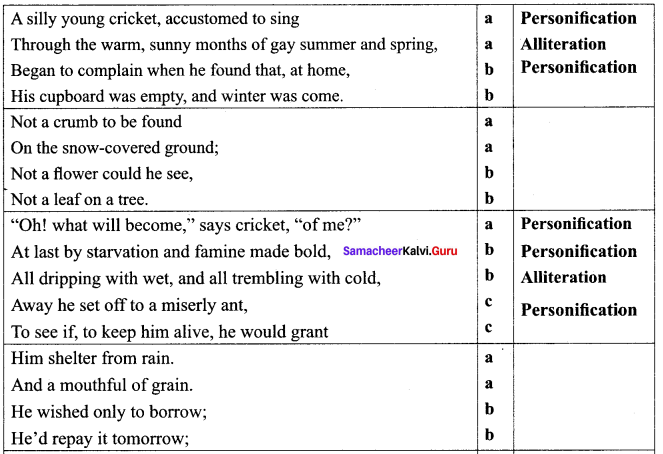
Literary Devices At A Glance (Figures of Speech)
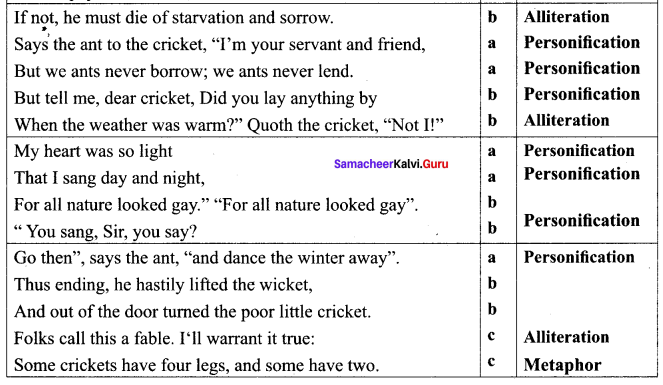
10th English Poem The Ant And The Cricket Poem Chapter 4 Samacheer Kalvi
The Ant And The Cricket 10th Poem Samacheer Kalvi Chapter 4

The Ant and the Cricket by Aesop’s Fables About the Poet:
Aesop’s Fables, or the Aesopica, is a collection of fables credited to Aesop, a slave and storyteller believed to have lived in Samos, a Greek island but others say he came from Ethiopia. The name Aesop is derived from the Greek word Aethiop which means Ethiopia! Aesop’s fables were not believed to have been written as Children’s literature and the book of fables were originally used to make thinly disguised social and political criticisms. The similarity to parables or allegories can be seen in most of the short tales in Aesop’s Book of Fables.

The Ant and the Cricket Summary:

The Ant And The Cricket Poem Class 10 Samacheer Kalvi Chapter 4

Introduction:
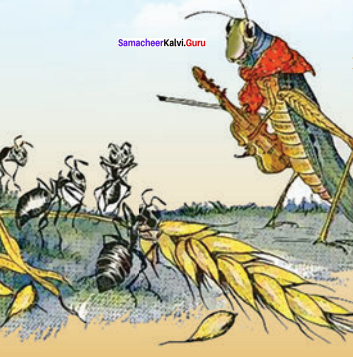
The poem, ‘The Ant and the Cricket’ is about a careless cricket and a hardworking ant. We all know that ants are hardworking creatures. The cricket, on the other hand, was a lazy being which sang day and night and made no efforts to plan for the future.
Samacheer Kalvi 10th English Solutions Poem Chapter 4 The Ant and the Cricket 4

Irresponsible Cricket:
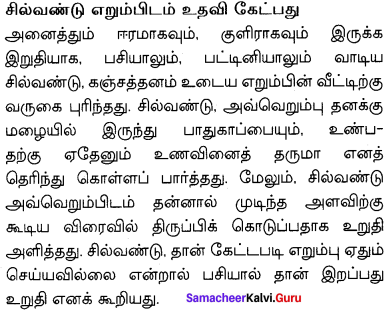
There was a cricket who loved singing. The poet says the cricket is young and silly because he sang all through summer and spring with no worries in the world. But when winter arrived, he began to complain. He found that his cupboard was empty and not a piece of bread was there to eat. He neither found a leaf, nor a flower. Everything was covered with snow. Therefore, the cricket cried as he perceived his bad future.
Samacheer Kalvi 10th English Solutions Poem Chapter 4 The Ant and the Cricket 5

Cricket asks for help from the ant:
Finally, deprived of hunger and starvation, being all wet and cold, the cricket journeyed to the house of a stingy ant. He wanted to know if the ant would lend him a shelter from the rain and a mouthful of grain. He promised that he would repay the ant as soon as he could. He was sure to die of hunger and pain if he didn’t do it.
Samacheer Kalvi 10th English Solutions Poem Chapter 4 The Ant and the Cricket 6

Cricket’s careless reply to ant’s questions:
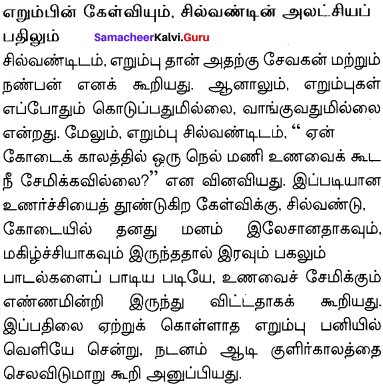
The ant said to the cricket that he is his servant and friend. However, ants never borrow nor lend. He asked the cricket why he did not store even a single grain of food when the weather was warm. To such a stimulating question, the cricket carelessly replied that he sang day and night as his heart was light and happy and hence never thought of storing food. The ant disapproved the cricket’s reply and told him to go and dance the winter away.
Samacheer Kalvi 10th English Solutions Poem Chapter 4 The Ant and the Cricket 7

The Ant’s final reply and the state of Cricket:
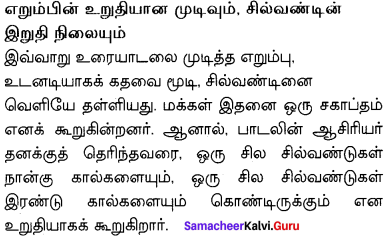
Thus, completing the conversation, the ant quickly closed the door and turned the poor little cricket out of the house. People call this a legend, but, the poet says that he assures it is true that some crickets have four legs and some crickets have two.
Samacheer Kalvi 10th English Solutions Poem Chapter 4 The Ant and the Cricket 8

Conclusion:
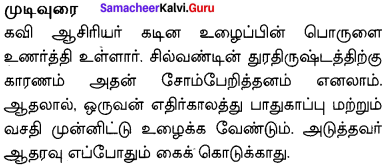
The poet endorsed the idea of hard work. Hard work fetches fortune. The lazy nature of the Cricket was the reason behind his misfortune. Therefore one has to think ahead and work for safety and comfort. Dependence may not help every time.
Samacheer Kalvi 10th English Solutions Poem Chapter 4 The Ant and the Cricket 9

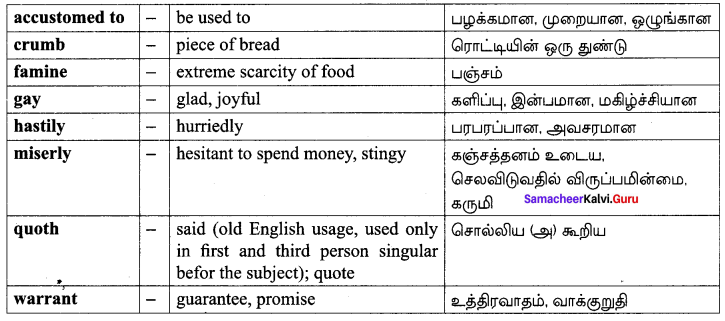
The Ant and the Cricket Glossary:
Textual:
Samacheer Kalvi 10th English Solutions Poem Chapter 4 The Ant and the Cricket 10

Additional:
Samacheer Kalvi 10th English Solutions Poem Chapter 4 The Ant and the Cricket 11

We hope the data given here will benefit you to the fullest extent at the time of preparation. For better understanding of English subject this Samacheer Kalvi 10th English Solutions for Class 10th English Poem Chapter 4 The Ant and the Cricket PDF is the best resource. Download & ace up your preparation. Keep in touch with us and get the latest information on Tamilnadu State board Textbook Solutions PDF.

Samacheer Kalvi 8th Science Solutions Term 3 Chapter 1 Sound

Students can Download Science Term 3 Chapter 1 Sound Questions and Answers, Notes Pdf, Samacheer Kalvi 8th Science Book Solutions Guide Pdf helps you to revise the complete Tamilnadu State Board New Syllabus and score more marks in your examinations.

Tamilnadu Samacheer Kalvi 8th Science Solutions Term 3 Chapter 1 Sound

Samacheer Kalvi 8th Science Sound Text Book Exercises

I. Choose the best answer:

Samacheer Kalvi Guru 8th Science Question 1.
Sound waves travel very fast in …………..
(a) air
(b) metals
(c) vacuum
(d) liquids
Answer:
(b) metals

Samacheer Kalvi 8th Science Book Solutions Question 2.
Which of the following are the characteristics of vibrations?
(i) Frequency
(ii) Time period
(iii) Pitch
(iv) Loudness

(a) (i) and (ii)
(b) (ii) and (iii)
(c) (iii) and (iv)
(d) (i) and (iv)
Answer:
(c) (iii) and (iv)

Samacheer Kalvi Guru 8th Question 3.
The amplitude of the sound wave decides it’s ……………
(a) speed
(b) pitch
(c) loudness
(d) frequency
Answer:
(c) loudness

Samacheer Kalvi 8th Science Guide Question 4.
What kind of musical instrument is a sitar?
(a) String instrument
(b) Percussion instrument
(c) Wind instrument
(d) None of these
Answer:
(a) String instrument

8th Standard Sound Lesson Question 5.
Find the odd one out.
(a) Harmonium
(b) Flute
(c) Nadaswaram
(d) Violin
Answer:
(d) Violin

Reason:
Violin is a stringed instrument. Other are wind or reed instruments.

Samacheer Kalvi.Guru 8th Question 6.
Noise is produced by …………..
(a) vibrations with high frequency
(b) regular vibrations.
(c) regular and periodic vibrations
(d) irregular and non-periodic vibrations.
Answer:
(d) irregular non-periodic vibrations

Samacheer Kalvi 8th Science Question 7.
The range of audible frequency for the human ear is …………..
(a) 2 Hz to 2000 Hz
(b) 20 Hz to 2000 Hz
(c) 20 Hz to 20000 Hz
(d) 200 Hz to 20000 Hz
Answer:
(c) 20 Hz to 20000 Hz

Samacheer Kalvi.Guru 8th Science Question 8.
If the amplitude and frequency of a sound wave are increased, which of the following is true?
(a) Loudness increases and pitch is higher
(b) Loudness increases and pitch is unchanged
(c) Loudness increases and pitch is lower
(d) Loudness decreases and pitch is lower
Answer:
(a) Loudness increases and pitch is higher

II. Fill in the blanks:

  1. Sound is produced by …………
  2. The vibrations of a simple pendulum are also known as …………
  3. Sound travels in the form of …………
  4. High frequency sounds that cannot be heard by you are called …………
  5. Pitch of a sound depends on the ………… vibration.
  6. If the thickness of a vibrating string is increased, its pitch …………

Answer:

  1. vibrating bodies
  2. oscillation
  3. mechanical waves
  4. Ultrasonic
  5. frequency of the
  6. decrease

III. Match the following:

  1. Ultrasonics – Frequency below 20Hz
  2. Speed of sound in air – Needs material medium
  3. Infrasonics – 330 m
  4. Sound propagation – Frequency more than 20000 Hz

Answer:

  1. Ultrasonics – Frequency more than 20000 Hz
  2. Speed of sound in air – 330 m
  3. Infrasonics – Frequency below 20Hz
  4. Sound propagation – Needs material medium

IV. Choose the correct option:

(a) Both assertion and reason are true and reason is the correct explanation of assertion.
(b) Both assertion and reason are true but reason is not the correct explanation of assertion.
(c) Assertion is true but reason is false.
(d) Assertion is false but reason is true.
(e) Both Assertion and reason are false.

Samacheer Kalvi Guru 8 Science Question 1.
Assertion: When lightning strikes, the sound is heard a little after the flash is seen.
Reason: The velocity of light is greater than that of the sound.
Answer:
(a) Both assertion and reason are true and reason is the correct explanation of assertion.

Samacheer Kalvi .Guru 8th Question 2.
Assertion: Two persons on the surface of moon cannot talk to each other.
Reason: There is no atmosphere on moon.
Answer:
(a) Both assertion and reason are true and reason is the correct explanation of assertion.

V. Answer briefly:

Samacheer Kalvi Guru 8th Science Solutions Question 1.
What are vibrations?
Answer:
Vibration means a kind of rapid to and fro motion of an object.

Samacheer Kalvi 8th Standard Science Question 2.
Give an example to show that light travels faster than sound.
Answer:
Lightning:
The most common example of showing that light travels faster than sound is lightning. Whenever a lightning strikes, you see the lightning first and then hear the thunder after some time.

8th Science Solutions Samacheer Kalvi Question 3.
To increase loudness of sound by four times, by how much should the amplitude of vibration be changed?
Answer:
Loudness of a sound depends on the amplitude of the vibration. So to increase loudness of sound by four times, the amplitude of the vibration also to be increased by four times.

Samacheer Kalvi 8th Science Solutions Question 4.
What is an ultrasonic sound?
Answer:
A sound with a frequency greater than 20000 Hz is called as ultrasonic sound.

Science Term 3 Question 5.
Give two differences between music and noise.
Answer:
Music:

  1. The sound that provides a pleasing sensation to the ear.
  2. It is produced by the regular patterns of vibrations.

Noise:

  1. Sound that is unpleasant to the ear
  2. It is produced by the irregular and non-periodic vibrations.

8th Science Sound Lesson Question 6.
What are the hazards of noise pollution?
Answer:

  1. Noise may cause irritation, stress, nervousness and headache.
  2. Long term exposure to noise may change the sleeping pattern of a person.
  3. Sustained exposure to noise may affect hearing ability. Sometimes, it leads to loss of hearing.
  4. Sudden exposure to louder noise may cause a heart attack and unconsciousness.
  5. Noise of horns, loud speakers, etc., cause disturbances leading to lack of concentration.
  6. Noise pollution affects a person’s peace of mind.

8th Standard Science Sound Lesson Question 7.
Mention few measures to be taken to reduce the effect of noise pollution.
Answer:

  1. Strict guidelines should be set for the use of loudspeakers on social, religious and political occasions.
  2. All automobiles should have effective silencers.

Samacheer Kalvi 8th Question 8.
Answer:
Define the following terms:

  1. Amplitude
  2. Loudness

1. Amplitude:
Amplitude is the maximum displacement of a vibrating particle from its mean position. It is denoted by ‘A’ and its unit is ‘metre’ (m).

2. Loudness:
It is defined as the characteristic of a sound that enables us to distinguish a weak or feeble sound from a loud sound. The unit of loudness of sound is decibel (dB).

Samacheer Kalvi Guru 8th Standard Question 9.
How does planting trees help in reducing noise pollution?
Answer:

  • Plant parts such as stems, leaves, branches wood, etc., absorb sound.
  • Rough bark and thick, fleshy leaves are particularly effective at absorbing sound due to their dynamic surface area and helps in reducing noise pollution.

VI. Answer in detail:

Question 1.
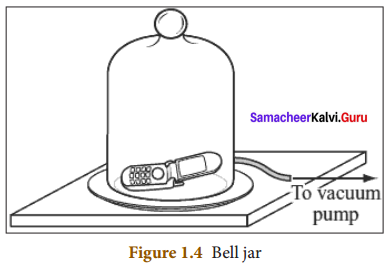
Describe an experiment to show that sound cannot travel through vacuum.
Answer:
1. Aim:
To prove that sound cannot travel through vacuum and it needs a medium for propagation.

2. Materials Required:
Bell jar, mobile phone and vacuum pump.

Procedure:

  1. Take a bell jar and a mobile phone.
  2. Switch on the music in the mobile phone and place it in the jar.
  3. Now, pump out the air from the bell jar using a vacuum pump.
  4. As more and more air is removed from the jar, the sound from the mobile phone becomes feebler and finally, very faint.

Samacheer Kalvi Guru 8th Science Solutions Term 3 Chapter 1 Sound
Conclusion:
This experiment proves that sound cannot travel in vacuum and it needs a medium.

Question 2.
What are the properties of sound?
Answer:

  1. Loudness
  2. Pitch
  3. Quality or Timbre

1. Loudness:

  • It is defined as the characteristic of a sound that enables us to distinguish a weak or feeble sound from a loud sound.
  • The loudness of a sound depends on its amplitude.
  • Higher the amplitude louder will be the sound and vice-versa.
  • When a drum is softly beaten, a weak sound is produced. However, when it is beaten strongly, a loud sound is produced.
  • The unit of loudness of sound is decibel (dB).

2. Pitch:

  • The pitch is the characteristic of sound that enables us to distinguish between a flat sound and a shrill sound.
  • Higher the frequency of sound, higher will be the pitch. High pitch adds shrillness to a sound.
  • The sound produced by a whistle, a bell, a flute and a violin are high pitch sounds.

3. Quality or Timbre:

  • The quality or timbre is the characteristic of sound that enables us to distinguish between two sounds that have the same pitch and amplitude.
  • For example in an orchestra, the sounds produced by some musical instruments may have the same pitch and loudness.

Question 3.
What steps should be taken to reduce the effect of noise pollution?
Answer:

  1. Strict guidelines should be set for the use of loudspeakers on social, religious and political occasions.
  2. All automobiles should have effective silencers.
  3. People should be encouraged to refrain from excessive honking while driving.
  4. Industrial machines and home appliances should be properly maintained.
  5. All communication systems must be operated in low volumes.
  6. Residential areas should be free from heavy vehicles.
  7. Green corridor belt should be set up around the industries as per the regulations of the pollution control board.
  8. People working in noisy factories should wear ear plugs.
  9. People should be encouraged to plant trees and to use absorbing materials like curtains and cushions in their home.

Question 4.
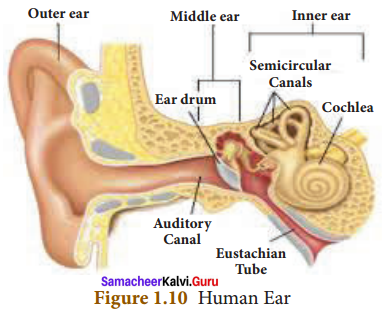
Describe the structure and function of the human ear.
Answer:

  1. The outer and visible part of the human ear is called pinata (curved in shape).
  2. It is specially designed to gather sound from the environment, which then reaches the ear drum (tympanic membrane) through the ear canal.
  3. When the sound wave strikes the drum, the vesicles move inward and outward to create the vibrations.
  4. These vibrations are then picked up by special types of cells in the inner ear. From the inner ear the vibrations are sent to the brain in the form of signals.
  5. The brain perceives these signals as sounds.

Samacheer Kalvi 8th Science Book Solutions Solutions Term 3 Chapter 1 Sound

VII. Problem:

Question 1.
Ruthvik and Ruha hear a gunshot 2 second after it is fired. How far away from the gun they are standing ? (Speed of sound in air is equal
to 330ms-1).
Solution:
Given data: time t = 2s
Speed of sound V = 330 ms-1
To find: Distance d = ?
Formula: Distance = Speed x time
Distance d = 330 x 2 = 660 m

Question 2.
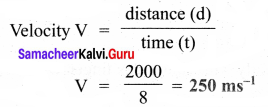
A sound wave travels 2000 m in 8 s. What is the velocity of the sound?
Solution:
Given data:
Distance travelled by a sound wave d = 2000 m
time taken t = 8s
To find: Velocity of sound V = ?
Formula:
Samacheer Kalvi Guru 8th Science Solutions Term 3 Chapter 1 Sound

Question 3.
What is the frequency of a mechanical wave that has a velocity of 25 ms-1 and a wavelength of 12.5 m?
Solution:
Given data: Frequency n = ?
Velocity V = 25 ms-1
To find: Frequency n = ?
Samacheer Kalvi 8th Science Guide Solutions Term 3 Chapter 1 Sound

Question 4.
What is the wavelength?
Solution:
Given data:
Frequency n = 500 Hz
Speed V = 200 ms-1
To find: Wavelength λ = ?
8th Standard Sound Lesson Samacheer Kalvi Science Solutions Term 3 Chapter 1

Samacheer Kalvi 8th Science Sound Additional Questions

I. Choose the correct Answer:

Question 1.
Sound cannot travel through ………………..
(a) solid
(b) liquid
(c) vacuum
(d) air
Answer:
(c) vacuum

Question 2.
Vibrations in a body produce ………………..
(a) pressure
(b) sound
(c) density
(d) current
Answer:
(b) sound

Question 3.
Frequency is expressed in ………………..
(a) hertz
(b) meter
(c) Kilogram
(d) second
Answer:
(a) hertz

Question 4.
Unwanted sounds are called ………………..
(a) noise
(b) music
(c) both a and b
(d) none
Answer:
(a) noise

Question 5.
Pitch of sound is determined by its ………………..
(a) speed
(b) loudness
(c) amplitude
(d) frequency
Answer:
(d) frequency

Question 6.
The hearing range of human ear is ………………..
(a) 20 Hz to 20 kHz
(b) less than 20 Hz
(c) more than 20 k Hz
(d) none
Answer:
(a) 20 Hz to 20 kHz

Question 7.
The voices of men, women and children differ because of difference in their ………………..
(a) lungs
(b) vocal cords
(c) larynx
(d) wind pipe
Answer:
(b) vocal cords

Question 8.
The time taken for one complete vibration is called its ………………..
(a) loudness
(b) pitch
(C) time period
(d) frequency
Answer:
(c) time period

Question 9.
……………….. instruments produce a specific sound when they are struck, scrapped or clashed together.
(a) Reed
(b) Stringed
(c) Percussion
(d) None
Answer:
(c) Percussion

Question 10.
Bats produce ……………….. sound during screaming.
(a) infrasonic
(b) ultrasonic
(c) noise
(d) none
Answer:
(b) ultrasonic

II. Fill in the blanks:

  1. …………… is produced when an object is set to vibrate.
  2. The substance through which sound is transmitted is called ……………
  3. Sound cannot travel in ……………
  4. The speed of sound is …………… in solids than in liquids.
  5. …………… is the distance between two consecutive particles, which are in the same phase of vibration.
  6. …………… is the number of vibrations of a particle in the medium in one second.
  7. In any medium, as the …………… increases, the speed of sound also increases.
  8. The speed of sound in air is 331 ms-1 at …………… and …………… at 22°C.
  9. The unit of frequency is ……………
  10. The amount of water vapour in the air is known as ……………

Answer:

  1. Sound
  2. medium
  3. vacuum
  4. more
  5. Wavelength
  6. Frequency
  7. temperature
  8. 0°C, 344 ms-1
  9. hertz
  10. humidity

III. True or False – if false, give the correct statement:

Question 1.
The seismic wave formed during earthquake is an example for a transverse wave.
Answer:
False:
Correct statement: The seismic wave formed during earthquake is an example for a longitudinal wave.

Question 2.
The loudness of a sound depends on its pitch.
Answer:
False:
Correct statement: The loudness of a sound depends on its amplitude.

Question 3.
The pitch is the characteristic of sound that enables us to distinguish between a flat sound and a shrill sound.
Answer:
True:

Question 4.
The voice of a female has a lower pitch than a male.
Answer:
False:
Correct statement: The voice of a female has a higher pitch than a male.

Question 5.
Longitudinal waves are produced in solids liquids and also in gases.
Answer:
True

IV. Match the following:

Question 1.

  1. String vibration – (a) Flute
  2. Membrane vibration – (b) Bicycle bell
  3. Vibration of air – (e) Table
  4. Vibration of plate – (d) Gitar

Answer:

  1. d
  2. c
  3. a
  4. b

Question 2.

  1. Audible range – (a) 50 Hz to 45000 Hz
  2. Infrasonic range – (b) Above 20.000 Hz
  3. Ultrasonic range – (c) 20 Hz to 20 k Hz
  4. Dog’s hearing range – (d) Below 20 Hz

Answer:

  1. c
  2. d
  3. b
  4. a

Question 3.

  1. pitch – (a) Woman
  2. Loudness – (b) Man
  3. Shriller voice – (c) Frequency
  4. Flatter voice – (d) Amplitude

Answer:

  1. c
  2. d
  3. a
  4. b

V. Assertion and Reason:

Mark the correct choice as:

(a) Both assertion and reason are true and reason is the correct explanation of assertion.
(b) Both assertion and reason are true but reason is not the correct explanation of assertion.
(c) Assertion is true but reason is false.
(d) Assertion is false but reason is true.
(e) Both Assertion and reason are false.

Question 1.
Assertion: Sound waves do not travel through vacuum.
Reason: The speed of sound Is too small when compared to speed of light.
Answer:
(b) Both assertion and reason are true but reason is not the correct explanation of assertlon.

Reason:
Sound is mechanical wave, which require medium to travel.

Question 2.
AssertIon: We cannot hear the sound produced by a vibrating pendulum.
Reason: The frequency of the pendulum is very less.
Answer:
(a) Both assertion and reason are true and reason Is the correct explanation of assertion.

Question 3.
Assertion: Trees should be planted along the road to control noise pollution.
Reason: Trees act as noise buffers.
Answer:
(a) Both assertion and reason are true and reason ¡s the correct explanation of assertion.

Question 4.
Assertion: Women have shriller sound than men.
Reason: Men produced higher frequency sound than women.
Answer:
(c) Assertion is true but reason is false

Reason:
Women produce higher frequency sound than men.

VI. Pick out the odd one and give reason:

Question 1.
Trumpet, Flute, Saxophone, Mouthorgan.
Answer:
Mouthorgan.
Reason:
Mouthorgan is a reed instrument whereas the others are wind instruments.

Question 2.
Drum, Violin, Guitar, Sitar.
Answer:
Drum.
Reason:
Drum is a percussion instrument whereas the others are stringed instruments.

Question 3.
Sonar, Gatton’s whistle, Sonogram, hydrophone.
Answer:
Hydrophone.
Reason:
Hydrophone uses infrasonic wave whereas the others are using ultrasonic sound wave.

VII. Very short answer questions:

Question 1.
In which medium the speed of the sound is maximum?
Answer:
Solids.

Question 2.
On which factor pitch of the sound depends?
Answer:
Frequency.

Question 3.
What types of medium is required for sound to travel?
Answer:
Solid, liquid and gases.

Question 4.
Can sound travel through vacuum?
Answer:
No, sound cannot travel through vacuum. It needs medium to travel.

Question 5.
Do the frequency of sound produced by Men and Women are same?
Answer:
No, the frequency of sound produced by men and women are different.

Question 6.
Name the sound producing organ in human.
Answer:
Voice box or Larynx.

Question 7.
What is the name of the sound produced by irregular vibrations?
Answer:
Noise.

Question 8.
Mention the name of passage is the outer ear which carries sound waves to the eardrum.
Answer:
Ear canal.

Question 9.
What happens to the speed of sound when it gases from solid to gaseous state?
Answer:
The speed of sound decreases when it goes from solid to gaseous state.

Question 10.
What is the lowest limit of audible frequency?
Answer:
20 Hz.

Question 11.
Define the term frequency.
Answer:
The number of vibrations produced by a vibrating body in one second is called frequency.

VIII. Short answer type questions:

Question 1.
Derive the mathematical relation between the frequency and the time period of a sound wave.
Answer:
Velocity of sound V = Frequency (n) x wavelength (λ). V = n λ

Question 2.
Write any two uses of ultrasonic sound.
Answer:

  1. It is extensively used in medical applications like sonogram.
  2. It is also employed in dishwashers.

Question 3.
What do you understand by the term echo?
Answer:
The repetition of the sound, which is reflected from a high building or any such object is called an echo.

Question 4.
What are the uses of infrasonic sound?
Answer:

  1. Infrasonic wave is used in the study of the mechanism of the human heart.
  2. It is employed in the Earth monitoring system.

Question 5.
What are the symptoms of hearing loss?
Answer:

  1. Ear ache.
  2. A feeling of fullness or fluid in the air.
  3. Ringing in your ears.

Question 6.
What is meant by audible sound?
Answer:
Sound with the frequency ranging from 20 Hz to 20,000 Hz is called sonic sound or audible sound.

Question 7.
Mention any two ways to control noise pollution.
Answer:

  1. All automobiles should have effective silencers.
  2. People should be encouraged to plant trees and to use absorbing materials like curtains and cushions in their home.

IX. Long answer questions:

Question 1.
Explain the types of mechanical wave.
Answer:
There are two types of mechanical wave.

  1. Transverse wave
  2. Longitudinal wave

1. Transverse wave:

  • The particles of the medium vibrate in a direction, which is perpendicular to the direction of propagation of the wave.
  • E.g. Waves in strings, light waves, etc.
  • Transverse waves are produced only in solids and liquids.

2. Longitudinal wave:

  • The particles of the medium vibrate in a direction, which is parallel to the direction of propagation of the wave.
  • E.g. Waves in springs, sound waves in a medium.
  • Longitudinal waves are produced in solids, liquids and also in gases.

Question 2.
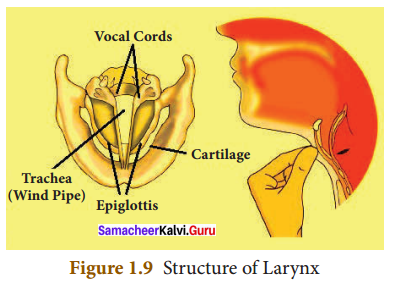
Draw and explain larynx and its functions.
Answer:

  1. In a human being, the sound is produced in the voice box, called the larynx, which is present in the throat.
  2. It is located at the upper end of the windpipe.
  3. The larynx has two ligaments called ‘vocal cords’, stretched across it.
  4. The vocal cords have a narrow slit through which air is blown in and out.
  5. When a person speaks, the air from the lungs is pushed up through the trachea to the larynx.
  6. When this air passes through the slit, the vocal cords begin to vibrate and produce a sound.
  7. By varying the thickness of the vocal cords, the length of the air column in the slit can be changed.
  8. This produces sounds of different pitches.
  9. Males generally have thicker and longer vocal cords that produce a deeper, low pitch sound in comparison with females.

Samacheer Kalvi.Guru 8th Science Solutions Term 3 Chapter 1 Sound

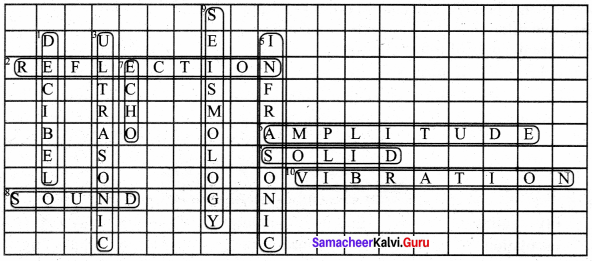
X. Solve the following cross word with the help of the given clues:

Clues Across:

2. The bouncing back of sound wave when it strikes a hard surface.
4. Form of matter of fixed shape other than liquid or gas.
6. Maximum distance moved by a vibrating body form its position of rest.
8.Waves which need a material medium for its propagation.
10. A kind of raepid to and fro motion of an object.

Down:

1. A unit used to measure the loudness or intensity of sound.
3. Sound wave whose frequency is too high to be heard by humans.
5. Sound wave whose frequency is too low to be heard by humans.
7. A reflection of sound.
9. The branch of science deals with the study of seismic waves.
Samacheer Kalvi 8th Science Solutions Term 3 Chapter 1 Sound

XI. Problems for practice:

Question 1.
A sound has a frequency of 60 Hz and a wavelength of 20 m. What is the speed of the sound?
Solution:
Given: Frequency n = 60 Hz
Wavelength λ = 20 m
To find: Speed V = ?
Formula: V = n λ
V = 20 x 60
V = 120 ms-1

Samacheer Kalvi 8th Science Sound Intext Activities

Activity – 1

Take the tray of an empty match box and stretch a rubber band around it, along its length. Then, pluck the stretched rubber band with your index finger. What do you observe? Do you hear any sound?
Answer:
Observation:

  1. On plucking the rubber band, it starts vibrating.
  2. We can hear a feeble humming sound as long as the rubber band is vibrating.
  3. The humming sound stops as soon as the rubber band stops vibrating.

Conclusion:
This confirms that sound is produced by vibrating bodies.

Activity – 2

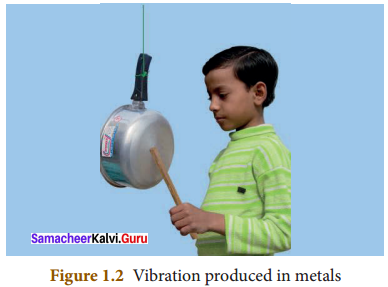
Take a metal shallow pan. Hang it at a convenient place in such a way that it does not touch anything. Now, strike it with a stick. Touch the pan gently with your index finger. Do you feel the vibrations? Again, strike the pan with the stick and hold it tightly with your hands, immediately after striking. Do you still hear the sound?
Samacheer Kalvi.Guru 8th Science Solutions Term 3 Chapter 1 Sound
Answer:
Case 1:

  1. Now, strike it with a stick.
  2. Touch the pan gently with your index finger. Do you feel the vibrations?

Observation:
we can the feel the vibration for sometime.

Case 2:

  1. Strike the pan with the stick and hold tightly with your hands, immediately after striking.
  2. Do you still hear the sound?

Observation:
we cannot hear the sound.

Conclusion:
This activity shows the vibrating pan produces sound.

Activity – 3

Question 1.
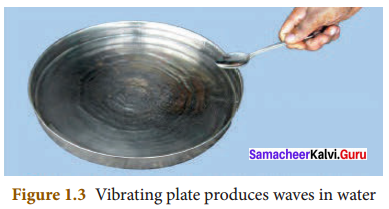
Take a metal dish, pour some water in it. Strike it at its edge with a spoon. Do you hear any sound?
Answer:
We see that a vibrating object produces sound.
Samacheer Kalvi Guru 8 Science Solutions Term 3 Chapter 1 Sound

Question 2.
Again strike the dish and touch it. Can you feel the dish vibrating?
Answer:
I can feel the dish vibrating.

Question 3.
Strike the dish again. Look at the surface of water. Do you see any movement on the water surface?
Answer:
I can see the waves on the surface of water.

Question 4.
Now, hold the dish. What change do you observe on the surface of water?
Answer:
I cannot see the waves on the surface of water.

Activity – 4

Question 1.
Take two stones and strike them together and listen to the sound produced by them. Now take the stones underwater and strike them. You will find that the sound produced by the stones underwater is feeble and not very clear.
Answer:
Observation:
We observe that the sound produced by the stones underwater is feeble and not very clear.
Conclusion:
This activity shows that the speed of sound depends on the properties of the medium through which it travels.

Samacheer Kalvi 8th Social Science History Solutions Term 1 Chapter 3 Rural Life and Society

You can Download Samacheer Kalvi 8th Social Science Book Solutions Guide Pdf, Tamilnadu State Board help you to revise the complete Syllabus and score more marks in your examinations.

Tamilnadu Samacheer Kalvi 8th Social Science History Solutions Term 1 Chapter 3 Rural Life and Society

Samacheer Kalvi 8th Social Science Rural Life and Society Textbook Evaluation

I. Choose the correct answer

Rural Life And Society Class 8 Questions And Answers Question 1.
Which system was called by different names like Jagirdari, Malguzari and Biswedari etc.?
(a) Mahalwari
(b) Ryotwari
(c) Zamindari
(d) None of these
Answer:
(d) None of these

Rural Life And Society Class 8 Question 2.
Under which Governor General did the permanent settlement implemented in Bengal.
(a) Lord Hastings
(b) Lord Cornwallis
(c) Lord Wellesley
(d) Lord Minto
Answer:
(b) Lord Cornwallis

Rural Life And Society Question 3.
What was the Mahal in the Mahalwari system?
(a) House
(b) Town
(c) Village
(d) Palace
Answer:
(c) Village

Rural Life And Society Class 8 Solutions Question 4.
In which region was the Mahalwari system imposed?
(a) Maharashtra
(b) Madras
(c) Bengal
(d) Punjab
Answer:
(d) Punjab

Rural Life And Society Class 8 Answers Question 5.
Who among the following Governors introduced Mahalwari system?
(a) Lord Hastings
(b) Lord Cornwallis
(c) Lord Wellesley
(d) Lord William Bentinck
Answer:
(d) Lord William Bentinck

Rural Life And Society Class 8 Pdf Question 6.
In which region was the Ryotwari system not introduced by the British?
(a) Bombay
(b) Madras
(c) Bengal
(d) None of these
Answer:
(c) Bengal

Rural Life And Society Answer Key Question 7.
The Indigo revolt was led by whom?
(a) Mahatma Gandhi
(b) Keshab Chandra Roy
(c) Digambar Biswas and Bishnu Biswas
(d) Sardar Vallabhbhai Patel
Answer:
(c) Digambar Biswas and Bishnu Biswas

Rural Life And Society In Tamil Question 8.
The Bardoli Satyagraha was led by whom?
(a) Sardar Vallabhbhai Patel
(b) Mahatma Gandhi
(c) DigambarBiswas
(d) Keshab Chandra Roy
Answer:
(a) Sardar Vallabhbhai Patel

II. Fill in the Blanks

  1. ……………… is the modified version of the Zamindari system.
  2. The Mahalwari system was a Brain child of ……………….
  3. Indigo Revolt took place in ……………….
  4. Maplah Rebellion was held in ……………….
  5. The Champaran Agrarian Act was passed in ……………….

Answer:

  1. Mahalwari system
  2. Holt Mackenzie
  3. Bengal
  4. Malabar (Kerala)
  5. May 1918]

III. Match the following

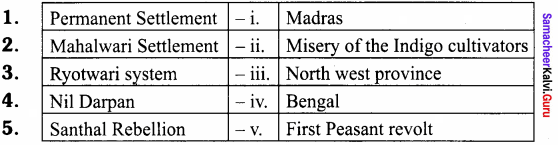
Rural Life And Society Class 8 Questions And Answers Samacheer Kalvi Social Science History Solutions Term 1 Chapter 3
Answer:

  1. iv
  2. iii
  3. i
  4. ii
  5. v.

IV. State true or false

Rural Life And Society Class 8 Exercise Question 1.
Warren Hastings introduced quinquennial land settlement.
Answer:
True

Rural Life And Society Mcq Question 2.
Ryotwari system was introduced by Thomas Munro.
Answer:
True

Rural Life And Society Class 8 Pdf Download Question 3.
Pabna revolt originated in the Yusufshahi pargana in Gujarat.
Answer:
False
Correct statement:
Pabna revolt originated in the Yusufshahi pargana in Bengal.

Rural Life And Society Answer Sheet Question 4.
The Punjab land alienation Act was passed in 1918.
Answer:
False
Correct statement:
The Punjab land alienation Act was passed in 1900.

V. Consider the following statement and tick appropriate answer

Question 1.
Which of the following statement is not true about Zamindari system?

  1. This settlement was introduced in 1793.
  2. The Zamindars became the owner of the land.
  3. This system secured a fixed a stable income for the cultivators.
  4. This practice was applicable to the area of 19% of India.

Answer:
3. This system secured a fixed a stable income for the cultivators.

Question 2.
Which of the following statement is correct about Peasants revolt in India?

  1. The Santhal rebellion was held in Bengal.
  2. DinabandhuMitra wrote a drama called Nil Darban.
  3. The Deccan riots started from a village at Pune in 1873.
  4. The Moplah peasants rebellion was held in Tamil Nadu.

Answer:
2. DinabandhuMitra wrote a drama called Nil Darban.

VI. Answer the following in one or two sentences

Question 1.
List out any two salient features of the Permanent settlement?
Answer:
Salient features of the Permanent settlement:

  1. The Zamindars were recognised as the owners of land as long as they paid the revenue to the East India Company regularly.
  2. The Zamindars acted as the agent of the Government for the collection of revenue from the cultivators.

Question 2.
What were the salient features of the Ryotwari system?
Answer:
Salient features of the Ryotwari system:

  1. Revenue settlement was done directly with the ryots.
  2. Measurement of field and an estimate of produce was calculated.
  3. Government fixed the demand at 45 to 55 percent of the produce.

Question 3.
Bring out the effects of the Mahalwari settlement.
Answer:
Effects of the Mahalwari settlement:

  1. The Lambardar enjoyed privileges which was misused for their self – interest.
  2. This system brought no benefit to the cultivators.
  3. It was a modified version of the Zamindari system and benefited the upper class in villages.

Question 4.
What was the cause of Indigo Revolt in 1859 – 60?
Answer:

1. The European indigo planters compelled the tenant farmers to grow indigo at terms highly disadvantageous to the farmers.

2. The tenant farmer was forced to sell it cheap to the planter and accepted advances from the planter that benefitted the latter. There were also cases of kidnapping, looting, flogging and burning.

3. Led by Digambar Biswas and Bishnu Charan Biswas, the ryots of Nadia district gave up indigo cultivation in September 1859. Factories were burnt down and the revolt spread.

Question 5.
What was the contribution of Mahatma Gandhi on Champaran Satyagraha?
Answer:

  1. The European planters of Champaran in Bihar resorted to illegal and inhuman methods of indigo cultivation at a cost which was wholly unjust.
  2. The peasants were liable to unlawful extortion and oppression by the planters.
  3. Mahatma Gandhi took up their cause. The Government appointed an enquiry commission of which Mahatma Gandhi was a member.
  4. The grievances of the peasants were enquired and ultimately the Champaran Agrarian Act was passed in May 1918.

Question 6.
Mention the role of Vallabhai Patel in Bardoli Satyagraha.
Answer:

1. In 1928, the peasants of Bardoli (Gujarat) started their agitation under the leadership of Sardar Vallabhbhai Patel, in protest against the government’s proposal to increase land revenue by 30 percent.

2. The peasants refused to pay tax at the enhanced rate and started no – tax campaign from 12 February 1928. Many women also participated in this campaign.

VII. Answer the following in detail.

Question 1.
Discuss the merits and demerits of the Permanent settlement.
Answer:
Merits:

  • Under this system many of the waste lands and forests became cultivable lands.
  • The Zamindars became the owner of the land.
  • The Zamindars were made free from the responsibility of providing justice.
  • The Zamindars remained faithful to the British Government.
  • This system secured a fixed and stable income for the British Government.

Demerits:

  • The British Government had no direct contact with the cultivators.
  • The rights of the cultivators were ignored and they were left at the mercy of the Zamindars.
  • The peasants were almost treated as serfs.
  • This system was made the Zamindars lethargic and luxurious.
  • Many conflicts between the zamindars and the peasants arose in rural Bengal.

Question 2.
What were the impacts of the British Land Revenue system on the cultivators?
Answer:
Impact of the British land revenue system on the cultivators:

1. A common feature of all the settlements was the assessment and the maximize income from land. It resulted in increasing land sales and dispossession.

2. The peasants were overburdened with taxation. Due to the tax burden and famines, in general, the people suffered in poverty and burdened with debts. They had to seek the moneylenders who became rich and acquired lands from the peasants.

3. The Zamindars, money – lenders and lawyers exploited the poor peasants.

4. The stability and continuity of the Indian villages was shaken.

5. Cottage industries disappeared on account of the import of British goods and the peasants had nothing to supplement their income.

6. The old body of custom was replaced by new apparatus of law, courts, fees, lawyers and formal procedures.

7. The British policy proved advantageous only to the government of a privileged section of the society at the cost of the cultivators who were the rightful owners of their lands and claimants of the larger share of the produce.

Question 3.
Write a paragraph about the Moplah Rebellion?
Answer:
Moplah Rebellion (1921):

1. The Muslim Moplah (or Moplah) peasants of Malabar (Kerala) was suppressed and exploited by the Hindu zamindars (Jenmis) and British government.

2. This was the main cause of this revolt.

3. The Moplah peasants got momentum from the Malabar District Conference, held in April 1920.

4. This conference supported the tenants’ cause, and demanded legislations for regulating landlord-tenant relations.

5. In August 1921, the Moplah tenants rebelled against the oppressive zamindars. In the initial phase of the rebellion, the Moplah peasants attacked the police stations, public offices, communications and houses of oppressive landlords and moneylenders.

6. By December 1921, the government ruthlessly suppressed the Moplah rebellion.

7. According to an official estimate, as a result of government intervention, 2337 Moplah rebels were killed, 1650 wounded and more than 45,000 captured as prisoners.

VIII. HOTs

Question 1.
Apart from the exploiting through taxes, how did the British further exploit the land?
Answer:
Apart from the taxes, the British followed the policy of commercialization of Agriculture which was a major set back for Indian farmers. They were forced to grow the soil fertility deteriorating cash crops such as opium. Jute, Indigo etc., Agricultural prices shot up by 31%. They were threatened if they failed to grow these crops.

IX. Project and Activity

Question 1.
Point out the influence which shaped Gandhiji’s ideas on Ahimsa and Satyagraha.
Answer:
The 21 years Gandhiji spent in South Africa offered him valuable insights in familiarizing himself with the inhuman situations that existed outside as well as helping him develop appropriate concepts and techniques of nonviolent defence. He resisted non – violently any oppression and exhorted the Indians to take part in public activities.

For him, South Africa was the place where he first tried methods of non violence and after 20 years of relentless struggle he won finally against the whites.

Samacheer Kalvi 8th Social Science History Rural Life and Society Additional Questions

I. Choose the correct answer

Question 1.
…………….. was the primary occupation of the Indians, in the pre – colonial period.
(a) Banking
(b) Agriculture
(c) Mining
(d) Fishing
Answer:
(b) Agriculture

Question 2.
By …………….. system, the rights of ownership was handed over to the peasants.
(a) Zamindari
(b) Jagirdari
(c) Malguzari
(d) Ryotwari
Answer:
(d) Ryotwari

Question 3.
Initially, the British Government fixed …………….. of the estimated produce as rent.
(a) One – half
(b) One – fourth
(c) One – third
(d) One – eight
Answer:
(a) one – half

Question 4.
William Bentinck reduced the state share of revenue to ……………..
(a) 40%
(b) 30%
(c) 50%
(d) 20%
Answer:
(c) 50%

Question 5.
The newspaper, …………….. brought to light the misery of the cultivators several times.
(a) Times of India
(b) Swadesha Mitran
(c) Indian Express
(d) Hindu Patriot
Answer:
(d) Hindu Patriot

6. The peasant revolt which started in Poona in 1875 is called the ………………
(a) Punjab peasant movement
(b) Deccan Riots
(c) Indigo revolt
(d) Pabna revolt
Answer:
(b) Deccan Riots

Question 7.
In the Kheda district of Gujarat, agriculture failed in 1918 due to ………………
(a) Floods
(b) Cyclone
(c) Famine
(d) Earthquake
Answer:
(c) Famine

Question 8.
…………….. emerged as an important leader of Indian freedom struggle during the Kheda Satyagraha.
(a) Mahatma Gandhi
(b) Jawahar lal Nehru
(c) Sardar Vallabhbhai Patel
(d) Vinobha Bhave
Answer:
(c) Sardar Vallabhbhai Patel

Question 9.
…………….. broke out in the year 1921.
(a) Moplah Rebellion
(b) Bardoli Satyagraha
(c) Kheda Satyagraha
(d) Deccan Riots
Answer:
(a) Moplah Rebellion

Question 10.
The lands of the peasants of Bardoli were returned when the …………….. came to power in 1937.
(a) Communists
(b) Socialists
(c) Congress
(d) British
Answer:
(c) Congress

II. Fill in the blanks

  1. The economic exploitation of the …………….. led to the revolts in future.
  2. During the time of Cornwallis, a …………….. settlement of land revenue was introduced.
  3. As per the permanent settlement, all judicial powers were taken away from the ……………..
  4. By Ryotwari system, the revenue was based on the basis of the …………….. and the nature of the ……………..
  5. Radical changes were brought in the Mahalwari system by the guidance of …………….. in 1832.
  6. The village as a whole had to pay the revenue through its ……………..
  7. The land near the hills of or Rajmahal in Bihar was cultivated by the ……………..
  8. The Pabna revolt was led by ……………..
  9. During the Deccan riots, the peasants looted the property of ……………..
  10. The Deccan riots resulted in passing of the …………….. Act.

Answer:

  1. Peasants
  2. Ten years (decennial)
  3. Zamindars
  4. Soil, Crop
  5. Robert Martins Bird
  6. headman or Lambardar
  7. Santhals
  8. Keshab Chandra Roy
  9. Marwari Sahukars
  10. Deccan Agriculturalist Relief

V. Match the following

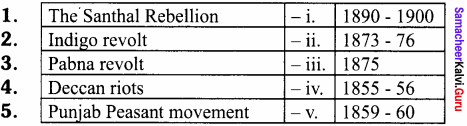
Rural Life And Society Class 8  Social Science History Solutions Term 1 Chapter 3 Samacheer Kalvi

  1. iv
  2. v
  3. ii
  4. iii
  5. i

IV. State True or False

Question 1.
According to Permanent settlement, the Zamindars granted patta to the ryots.
Answer:
True

Question 2.
Under Ryotwari system, rents would be periodically revised, generally after 5 to 10 years.
Answer:
False
Correct statement:
Under Ryotwari system, rents would be periodically revised, generally after 20 to 30 years.

Question 3.
The Santhal rebellion continued till 1856.
Answer:
True

Question 4.
Under the Tinkathia system in Champaran, the peasants were bound by law to grow indigo on 2/20 part of their land.
Answer:
False
Correct statement:
Under the Tinkathia system in Champaran, the peasants were bound by law to grow indigo on 3/20 part of their land.

V. Consider the following statement and tick appropriate answer

Question 1.
Which of the following statements is not true about Pabna Revolt.

  1. Pabna Peasant Uprising was, a resistance movement by the peasants against the oppression of the Zamindars.
  2. It was led by Dinabandhu Mitra.
  3. Peasants were often evicted from land on the pretext of non payment of rent.
  4. There were only a few cases of looting of the houses of the Zamindars.

Answer:
2. It was led by Dinabandhu Mitra

Question 2.
Which of the following statement is collect about the land revenue policies in India?

  1. As per the permanent settlements, the ryots became tenants since they were considered the fillers of the soil.
  2. Under the Ryotwari system, the Government exploited the Zamindars.
  3. Under the Mahalwari system one person could hold only one village.
  4. As per the Mahalwari system, the village land belonged to the Zamindars.

Answer:
1. As per the permanent settlements, the ryots became tenants since they were considered the fillers of the soil.

VI. Answer the following in one or two sentences.

Question 1.
Where were Permanent settlements made in British India?
Answer:
Permanent settlement were made in Bengal, Bihar, Orissa, Varanasi division of U.P., and Northern Karnataka, which roughly covered 19 percent of the total area of British India.

Question 2.
Name the areas where Ryotwari system was introduced?
Answer:
Major areas of introduction of Ryotwari system included Madras, Bombay, parts of Assam, and Coorg provinces of British India.

Question 3.
What were the effects of the Ryotwari settlement?
Effects of the Ryotwari Settlement:

  1. In most areas the land revenue fixed was excessive the ryots were hardly left with bare maintenance even in the best of seasons.
  2. Under this system the government exploited the farmers instead of zamindars.

Question 4.
What was the major cause of the Pabna revolt?
Answer:

  1. Pabna Peasant Uprising was a resistance movement by the peasants against the oppression of the Zamindars.
  2. The zamindars routinely collected money from the peasants by the illegal means of forced levy, abwabs, enhanced rent and so on. Peasants were often evicted from land on the pretext of non – payment of rent.

Question 5.
How did the Deccan Riots spread?
Answer:

  1. In 1875, the peasants revolted in the district of Poona.
  2. Primarily against the oppression of local moneylenders who were grabbing their lands systematically.
  3. The uprising started from a village in Poona district when the village people forced out a local moneylender from the village and captured his property.
  4. Gradually, the uprising spread over 33 villages and the peasants looted the property of Marwari Sahukars.
  5. The uprising turned into violent when the Sahukars took help of the police.

Question 6.
Why was the ‘Punjab Land Alienation ‘ Act passed by the British?
Answer:

1. The peasants of the Punjab agitated against the urban moneylenders. The Government of India did not want any revolt in that province which provided a large number of soldiers to the British army in India.

2. In order to protect the peasants of the Punjab, the Punjab Land Alienation Act was passed in 1900 “as an experimental measure” to be extended to the rest of India if it worked successfully in the Punjab.

Question 7.
How did the Punjab Land Alienation Act divide the population of Punjab?
Answer:
The Act divided the population of the Punj ab into three categories viz., the agricultural classes, the statutory agriculturist class and the rest of the population including the moneylenders.

Question 8.
How was the Kheda Satyagraha organised by Gandhiji?
Answer:

1. Gandhiji organised the peasants to offer Satyagraha and opposed official insistence on full collection of oppressive land revenue despite the conditions of famine.

2. He inspired the peasants to be fearless and face all consequences. The response to his call was unprecedented and the government had to bow to a settlement with the peasants.

Question 9.
What was the result of the Bacholi Satyagraha?
Answer:
In 1930, the peasants of Bardoli rose to a man, refused to pay taxes, faced the auction sales and the eventual loss of almost all of their lands but refused to submit to the Government. However, all their lands were returned to them when the Congress came to power in 1937.

VII. Answer the following

Question 1.
Explain the course and features of the Mahalwari system.
Answer:
1. Mahalwari system, was a modified version of the Zamindari settlement introduced in the Ganga valley, the North – West Province, parts of the Central India and Punjab in 1822.

2. Lord William Bentinck was to suggest radical changes in the Mahalwari system.

3. Assessment of revenue was to be made on the basis of the produce of a Mahal or village. All the proprietors of a Mahal were severally and jointly responsible for the payment of revenue.

4. Initially the state share was fixed two-thirds of the gross produce. Bentinck, therefore, reduced to fifty percent. The village as a whole, through its headman or Lambardar, was required to pay the revenue.

5. This system was first adopted in Agra and Awadh, and later extended to other parts of the United Provinces. The burden of all this heavy taxation finally fell on the cultivators.

Question 2.
Give an account of the Santhal Rebellion.
Answer:
1. The first revolt which can be regarded as peasants’ revolt was the Santhal Rebellion in 1855 – 56.

2. The land near the hills of Rajmahal in Bihar was cultivated by the Santhals.

3. The landlords and money – lenders from the cities took advantage of their ignorance and began grabbing their lands. This created bitter resentment among them leading to their armed uprising in 1855.

4. Consequently, under the belief of a divine order, around 10,000 Santals gathered under two Santhal brothers, Siddhu and Kanhu, to free their country of the foreign oppressors and set up a government of their own.

5. The rebellion assumed a formidable shape within a month. The houses of the European planters, British officers, railway engineers, zamindars and moneylenders were attacked.

6. The rebellion continued till February 1856, when the rebel leaders were captured and the movement was put down with a heavy hand.

7. The government declared the Parganas inhabited by them as Santhal Parganas so that their lands and identity could be safeguarded from external encroachments.

Question 3.
Narrate the course of the Pabna Revolt.
Answer:
1. Large crowds of peasants gathered and marched through villages frightening the zamindars and appealing to other peasants to join with them. Funds were raised from the ryots to meet the costs.

2. The struggle gradually spread throughout Pabna and then to the other districts of East Bengal.

3. Everywhere agrarian leagues were organized. The main form of struggle was that of legal resistance. There was very little violence.

4. It occurred only when the zamindars tried to compel the ryots to submit to their terms by force. There were only a few cases of looting of the houses of the zamindars.

5. A few attacks on police stations took place and the peasants also resisted attempts to execute court decrees. Hardly zamindars or zamindar’s agent were killed or seriously injured.

6. In the course of the movement, the ryots developed a strong awareness of the law and their legal rights and the ability to combine and form associations for peaceful agitation.

Samacheer Kalvi 10th Tamil Model Question Paper 4

Students can Download Samacheer Kalvi 10th Tamil Model Question Paper 4 Pdf, Samacheer Kalvi 10th Tamil Model Question Papers helps you to revise the complete Tamilnadu State Board New Syllabus and score more marks in your examinations.

Tamil Nadu Samacheer Kalvi 10th Tamil Model Question Paper 4

நேரம்: 3,00 மணி
மதிப்பெண்கள் : 100

(குறிப்புகள்:

  • இவ்வினாத்தாள் ஐந்து பகுதிகளைக் கொண்டது. அனைத்து பகுதிகளுக்கும் விடையளிக்க – வேண்டும். தேவையான இடங்களில் உள் தேர்வு வினாக்கள் கொடுக்கப்பட்டுள்ளது. காக
  • பகுதி I, II, III, IV மற்றும் Vல் உள்ள அனைத்து வினாக்களுக்குத் தனித்தனியே விடையளிக்க வேண்டும்.
  • வினா எண். 1 முதல் 15 வரை பகுதி-1ல் தேர்வு செய்யும் வினாக்கள் தரப்பட்டுள்ளன. ஒவ்வொரு வினாவிற்கும் ஒரு மதிப்பெண். சரியான விடையைத் தேர்ந்தெடுத்து குறியீட்டுடன் எழுதவும்.
  • வினா எண் 16 முதல் 28 வரை பகுதி-IIல் இரண்டு மதிப்பெண் வினாக்கள் தரப்பட்டுள்ளன: ஏதேனும் 9 வினாக்களுக்கு மட்டும் விடையளிக்கவும்.
  • வினா எண் 29 முதல் 37 வரை பகுதி-IIIல் மூன்று மதிப்பெண் வினாக்கள் தரப்பட்டுள்ளன. –
    ஏதேனும் 6 வினாக்களுக்கு மட்டும் விடையளிக்கவும்.
  • வினா எண் 38 முதல் 42 வரை பகுதி-IVல் ஐந்து மதிப்பெண் வினாக்கள் தரப்பட்டுள்ளன. ஏதேனும் 5 வினாக்களுக்கு மட்டும் விடையளிக்கவும்.
  • வினா எண் 43 முதல் 45 வரை பகுதி-Vல் எட்டு மதிப்பெண் வினாக்கள் தரப்பட்டுள்ளன. அனைத்து வினாவிற்கும் விடையளிக்கவும்.

பகுதி – 1 (மதிப்பெண்கள்: 15)

(i) அனைத்து வினாக்களுக்கும் விடையளிக்கவும்.
(ii) கொடுக்கப்பட்ட நான்கு விடைகளில் சரியான விடையினைத் தேர்ந்தெடுத்துக் குறியீட்டுடன் விடையினையும் சேர்த்து எழுதுக. [15 x 1 = 15]

(குறிப்பு: விடைகள் தடித்த எழுத்தில் உள்ளன)

Question 1.
”அன்னை மொழியே” என்ற தலைப்பில் அமைந்த கவிதையில் குறிப்பிடாத நூல் ………..
(அ) திருக்குறள்
(ஆ) பத்துப்பாட்டு
(இ) எட்டுத்தொகை
(ஈ) தொல்காப்பியம்
Answer:
(ஈ) தொல்காப்பியம்

Question 2.
செய்தி 1 – ஒவ்வோர் ஆண்டும் ஜுன் 15 ஐ உலகக் காற்று நாளாகக் கொண்டாடி வருகிறோம்.
செய்தி 2 – காற்றாலை உற்பத்தியில் இந்தியாவில் தமிழகம் இரண்டாமிடம் என்பது எனக்குப் பெருமையே.
செய்தி 3 – காற்றின் ஆற்றலைப் பயன்படுத்திக் கடல் கடந்து வணிகம் செய்து வெற்றி கண்டவர்கள் தமிழர்கள்.
(அ) செய்தி மட்டும் சரி
(ஆ) செய்தி 1, 2 ஆகியன சரி
(இ) செய்தி 1, 2, 3 சரி –
(ஈ) செய்தி 1, 3 ஆகியன சரி
Answer:
(இ) செய்தி 1, 2, 3 சரி –

Question 3.
சார்பெழுத்துக்களின் வகைகள்………
(அ) எட்டு
(ஆ) ஒன்பது
(இ) பத்து
(ஈ) ஏழு
Answer:
(இ) பத்து

Question 4.
பாரத ஸ்டேட் வங்கியின் உரையாடு மென்பொருள் எது?
அ) துலா
(ஆ) சீலா
(இ) குலா
(ஈ) இலா
Answer:
(ஈ) இலா

Question 5.
‘மூலித் தீர் தேன் வழிந்து ஒழுகு தாரானைக் கண்டு’ என்னும் தொடரில் தாரணை என்பது யாரைக் குறிக்கிறது?
(அ) சிவபெருமான்
(ஆ) கபிலர்
(இ பாண்டியன்
(ஈ) இடைக்காடனார்
Answer:
(இ பாண்டியன்

Question 6.
சரியான விடை வரிசையைத் தேர்ந்தெடு.
1) கரகாட்டம் – உறுமி எனப்படும் தேவதுந்துபி
2) மயிலாட்டம் – தோலால் கட்டப்பட்ட குடம், சிங்கி, டோலாக், தப்பு
3) ஒயிலாட்டம் – நையாண்டி மேள இசை
4) தேவராட்டம் – நையாண்டி மேள இசை, நாகசுரம், தவில், பம்பை
(அ) 4, 3, 2, 1 (ஆ) 1, 2, 3, 4- (இ) 3, 4, 1, 2 (ஈ) 2, 1, 4, 3
Answer:
1) கரகாட்டம் – உறுமி எனப்படும் தேவதுந்துபி

Question 7.
‘நசை’ என்ற சொல்லின் பொருள் …..
(அ) விருப்பம்
(ஆ) அவமானம்
(இ) வசை
(ஈ) இசை
Answer:
(அ) விருப்பம்

Question 8.
காலக்கணிதம் கவிதையில் இடம்பெற்ற தொடர்….
(அ) இகழ்ந்தால் என்மனம் இறந்துவிடாது
(ஆ) என் மனம் இகழ்ந்தால் இறந்துவிடாது
(இ) இகழ்ந்தால் இறந்துவிடாது என் மனம்
(ஈ) என் மனம் இறந்துவிடாது இகழ்ந்தால்
Answer:
(அ) இகழ்ந்தால் என்மனம் இறந்துவிடாது

Question 9.
உயிரளபெடைகளின் வகைகள்
(அ) ஒன்று
(ஆ) இரண்டு
(இ) மூன்று
(ஈ) நான்கு
Answer:
(இ) மூன்று

Question 10.
செந்தீ – இலக்கணக் குறிப்பு
(அ) பண்புத்தொகை
(ஆ) வினைத்தொகை
(இ) வேற்றுமைத் தொகை
(ஈ) சொல்லிசை அளபெடை
Answer:
(அ) பண்புத்தொகை

Question 11.
சந்தக் கவிமணி எனப்படுபவர்…..
(அ) தமிழழகனார்
(ஆ) பெருஞ்சித்திரனார்
(இ) வெள்ளி வீதியார்
(ஈ) அம்மூவனார் பாடலைப்
Answer:
(அ) தமிழழகனார்

படித்துப் பின்வரும் வினாக்களுக்கு (12, 13, 14, 15) விடை தருக.
செந்தீச் சுடரிய ஊழியும், பனியொடு
தண்பெயல் தலைஇய ஊழியும், அவையிற்று
உள்முறை வெள்ளம் மூழ்கி ஆர்தருபு,
மீண்டும் பீடு உயர்பு ஈண்டி, அவற்றிற்கும்
உள்ளீடு ஆகிய இருநிலத்து ஊழியும்…..

Question 12.
பாடலிலுள்ள எதுகைச் சொற்கள்………
(அ) உள் முறை – உள்ளீடு
(ஆ) வெள்ளம் – மூழ்கி
(இ) தண்பெயல் – தலைஇய
(ஈ) செந்நீர் – தண்பெயல்
Answer:
(அ) உள் முறை – உள்ளீடு

Question 13.
மேற்கண்ட பாடலடிகள் இடம் பெற்ற நூல் ……..
அ) பத்துப்பாட்டு
(ஆ) சங்க இலக்கியங்கள்
(இ) பரிபாடல்
(ஈ) எட்டுத்தொகை
Answer:
(இ) பரிபாடல்

Question 14.
பாடலின் ஆசிரியர் …
(அ) நக்கீரர்
(ஆ) கீரந்தையார்
(இ) பெருங்கௌசிகனார்
(ஈ) குலசேகராழ்வார்
Answer:
(ஆ) கீரந்தையார்

Question 15.
தண்பெயல் என்பதன் பொருள்……..
(அ) குளிர்ந்த மழை
(ஆ) காற்று
(இ) வானம்
Answer:
(அ) குளிர்ந்த மழை

பகுதி – II (மதிப்பெண்க ள்: 18)

பிரிவு – 1

எவையேனும் நான்கு வினாக்களுக்கு மட்டும் குறுகிய விடையளிக்க.
21 ஆவது வினாவிற்குக் கட்டாயமாக விடையளிக்க வேண்டும். [4 x 2 = 8]

Question 16.
விடைக்கேற்ற வினாக்கள் அமைக்க.
(அ) இயல், இசை, நாடகம் ஆகியன முத்தமிழ் எனப்படும்.
(ஆ) முதற்சங்கம், இடைச்சங்கம், கடைச்சங்கம் விடை:
Answer:
(அ) முத்தமிழ்’ தொகைச் சொல்லை விரித்து எழுதுக.
ஆ) முச்சங்கம்’ தொகைச் சொல்லை விரித்து எழுதுக.

Question 17.
“கழிந்த பெரும் கேள்வியினான் எனக் கேட்டு முழுது உணர்ந்த கபிலன் தன் பால் பொழிந்த பெரும் காதல் மிகு கேண்மையினான் இடைக்காட்டுப் புலவன் தென் சொல்” – இவ்வடிகளில் கழிந்த பெரும் கேள்வியினான் யார்? காதல்மிகு கேண்மையினான் யார்?
Answer:
இவ்வடியில் கழிந்த பெரும் கேள்வியினான்: குசேல பாண்டியன் காதல்மிகு கேண்மையினான். இடைக்காடனார்.

Question 18.
ஆண்பாற் பிள்ளை தமிழ், பெண்பாற் பிள்ளை தமிழ் விளக்குக.
Answer:
ஆண்பாற் பிள்ளைத்தமிழ் (கடைசி மூன்று பருவம்) – சிற்றில், சிறுபறை, சிறுதேர் பெண்பாற் பிள்ளைத்தமிழ் (கடைசி மூன்று பருவம்) – கழங்கு, அம்மானை, ஊசல் இருபாலருக்கும் பொதுவான பருவங்கள் – காப்பு, செங்கீரை, தால், சப்பாணி, முத்தம், வருகை, அம்புலி

Question 19.
பாசவர், வாசவர், பல்நிண விலைஞர், உமணர் – சிலப்பதிகாரம் காட்டும் இவ்வணிகர்கள் யாவர்?
Answer:
வெற்றிலை விற்பவர் – பாசவர் என்றும், ஏலம் முதலான ஐந்து நறுமணப்பொருள் விற்பவர் – வாசவர் என்றும், பல வகையான இறைச்சிகள் விற்பவர் – பல் நிண விலைஞர் என்றும், வெண்மையான உப்பு விற்பவர் – உமணர் என்றும் சிலப்பதிகாரம் காட்டுகிறது.

Question 20.
தானியம் ஏதும் இல்லாத நிலையில் விதைக்காக வைத்திருந்த தினையை உரலில் இட்டுக் குற்றியெடுத்து விருந்தினருக்கு விருந்தளித்தாள் தலைவி’ என்பது இலக்கியச் செய்தி. விருந்தோம்பலுக்குச் செல்வம் மட்டுமே இன்றியமையாத ஒன்றா? உங்கள் கருத்தைக் குறிப்பிடுக.
Answer:
விருந்தளிக்க செல்வம் மட்டும் இருந்தால் போதாது விருந்து கொடுக்க வேண்டும் என்ற எண்ணமும் வேண்டும். பணம் இல்லை என்றாலும் எண்ணம் இருந்தால் தன்னிடம் இல்லை என்றாலும் பிறரிடம் கடன் பெற்றாவது விருந்து அளிக்கப்படும் அதற்குப் பணம் முக்கியம் இல்லை எண்ணம்தான் முக்கியம்.

Question 21.
‘பொருள்’ என முடியும் குறள் எழுதுக.
Answer:
பொருளல் லவரைப் பொருளாகச் செய்யும் பொருளல்ல தில்லை பொருள்.

பிரிவு – 2

எவையேனும் ஐந்து வினாக்களுக்கு மட்டும் குறுகிய விடையளிக்க. [5 x 2 = 10]

Question 22.
நேற்று என்னைச் சந்தித்தார். அவர் என் நண்பர். (வினைமுற்றை, வினையாலணையும் பெயராக மாற்றுக.)
Answer:
நேற்று என்னைச் சந்தித்தவர் என் நண்பர்.

Question 23.
கீழ்க்காணும் தொடரில் கோடிட்ட சொற்களுக்கு ஏற்ற அதே பொருளுடைய வேறு சொல் அமைத்து எழுதுக. (துணைவியும், முகில், மஞ்சை, களி)
Answer:
நளனும் அவனது துணைவியும் நிடதநாட்டுக்கு வந்ததைக் கண்டு, அந்நாட்டு மக்கள் மழைமுகில் கண்ட மஞ்ஞை போலக் களி கொண்டனர். நளனும் அவனது மனைவியும் நிடதநாட்டுக்கு வந்ததைக் கண்டு, அந்நாட்டு மக்கள் மழைமேகம் கண்ட மயில் போல மகிழ்ச்சி கொண்டனர்.

Question 24.
இரு சொற்களையும் ஒரே தொடரில் அமைத்து எழுதுக.
Answer:
தொடு – தோடு
காதை தொடு, தோடு இருக்கும்.

Question 25.
கலைச்சொற்கள் தருக.
Answer:
(அ) Homograph – ஒப்பெழுத்து
(ஆ) Conversation – உரையாடல்

Question 26.
வா – வேர்ச்சொல்லைக் கொண்டு எழுவாய் தொடர், வினையெச்சத் தொடர் ஆகியவை எழுதுக.
Answer:
Samacheer Kalvi 10th Tamil Model Question Paper 4 image - 1

Question 27.
பொருத்தமான நிறுத்தற் குறிகளை இடுக.
தமிழை அதன் வழிமொழிகளாகிய தெலுங்கு கன்னட மலையாள துளுவங்களோடு அடங்கி உண்ணாட்டு மொழிகள் என வகைப்படுத்தினர் சிலர்.
Answer:
விடை: தமிழை அதன் வழிமொழிகளாகிய தெலுங்கு, கன்னட, மலையாள, துளுவங்களோடு அடங்கி ‘உண்ணாட்டு மொழிகள்’ என வகைப்படுத்தினர் சிலர்.

Question 28.
பொறித்த – பகுபத உறுப்பிலக்கணம் தருக
Answer:
பொறித்த = பொறி + த் + த் + அ
பொறி – பகுதி
த் – சந்தி
த் – இறந்தகால இடைநிலை
அ – பெயரெச்ச விகுதி பகுதி

III (மதிப்பெண்கள்: 18)

பிரிவு – 1

எவையேனும் இரண்டு வினாக்களுக்கு மட்டும் சுருக்கமாக விடையளிக்க. [2 x 3 = 6]

Question 29.
தோற்பாவைக் கூத்து பற்றி விளக்குக.
Answer:

  • தோலில் செய்த வெட்டு வரைபடங்களை, விளக்கின் ஒளி ஊடுருவும் திரைச்சீலையில் பொருத்தி, கதைக்கேற்ப மேலும் கீழும் பக்கவாட்டிலும் அசைத்துக்காட்டி, உரையாடியும் பாடியும் காட்டுவது தோற்பாவைக் கூத்து.
  • தோலால் ஆன பாவையைக் கொண்டு நிகழ்த்தும் கலையாதலால் தோற்பாவை என்னும் பெயர் பெற்றது.
  • இசை , ஓவியம், நடனம், நாடகம், பலகுரலில் பேசுதல் ஆகியவை இதில் இணைந்துள்ளன. கூத்து நிகழ்த்தும் திரைச்சீலையின் நீளம்.
  • அகலம் ஆகியன பாவையின் அமைப்பையும் எண்ணிக்கையையும் பொறுத்து வேறுபடுகின்றன.
  • இந்நிகழ்ச்சியில் பாவையின் அசைவு, உரையாடல், இசை ஆகியனவற்றோடு ஒளியும் முதன்மை பெறுகின்றது.

Question 30.
ஜெயகாந்தன் குறிப்பு வரைக.
Answer:

  • கருத்தாழமும் வாசகச் சுவைப்பும் கலந்து இலக்கியங்கள் படைத்தவர் ஜெயகாந்தன்.
  • சமகாலக் கருத்துகளையும் நிகழ்வுகளையும் சமகால மொழியில் சமகால உணர்வில் தந்தவர்.
  • மனிதம் தோய்ந்த எழுத்தாளுமை மிக்கவர் ஜெயகாந்தன்.
  • காந்தத் தன்மையுடைய எழுத்தை நினைவூட்டும் வகையில் அவரது படைப்புப் புதையலிலிருந்து சில.
  • மணிகளைத் தொடுத்து ஜெயகாந்தம் என்னும் நினைவு இதழ் உருவாக்கப்பட்டுள்ளது.
  • குறும்புதினங்களையும், புதினங்களையும், கட்டுரைகளையும், கவிதைகளையும் படைத்துள்ளார்.
  • தன் கதைகளைத் திரைப்படமாக இயக்கியிருக்கிறார்; தலைசிறந்த உரத்த சிந்தனைப் பேச்சாளராகவும் திகழ்ந்தார்.
  • சாகித்திய அகாதெமி விருதையும் ஞானபீட விருதையும் பெற்ற இவருடைய கதைகள் பிறமொழிகளில் மொழிபெயர்க்கப்பட்டுள்ளன.
  • அவருடைய படைப்புகள் உணர்ச்சி சார்ந்த எதிர்வினைகளாக இருக்கின்றன.

இதுவே அவருக்குச் “சிறுகதை மன்னன்” என்ற பட்டத்தைத் தேடித்தந்தது

Question 31.
உரைப்பத்தியைப் படித்து வினாக்களுக்கு விடை தருக.
Answer:
ஒரு மொழி பொதுமக்களாலும் அதன் இலக்கியம், புல மக்களாலும் அமையப்பெறும். தமிழ்ப் பொதுமக்கள் உயர்ந்த பகுத்தறிவுடையர். எத்துணையோ ஆராய்ச்சி நடந்துவரும் இக்காலத்திலும் எத்துணையோ மொழிகளினின்று கடன் கொண்ட ஆங்கில மொழியிலும் நூலிலும் இலையைக் குறிக்க Leaf (லீஃப் என ஒரே சொல் உள்ளது.

ஆங்கில நூல்களிலும் வேறு பல வகைகளில் இலைகளைப் பாகுபாடு செய்தனரேயன்றி, தமிழ்ப்பொதுமக்களைப் போல வன்மை மென்மை பற்றித் தாள், இலை, தோகை, ஓலை எனப் பாகுபாடு செய்தாரில்லை. இத்தகைய பாகுபாடு ஏனைய உறுப்புகளுக்குள்ளும் செய்யப்பட்டது முன்னர்க் காட்டப்பெற்றது.

(அ) தமிழ்ப் பொதுமக்கள் எத்தகைய தன்மையுடையவர்?
Answer:
தமிழ்ப் பொதுமக்கள் உயர்ந்த பகுத்தறிவுடையவர்.

(ஆ) ஆங்கில மொழியிலும், நூலிலும் இலையைக் குறிக்கப் பயன்படும் ஒரே சொல் என்ன?
Answer:
Leaf (லீஃப்)

(இ) இலையைக் குறிக்கும் மற்ற சொற்கள் யாவை?
Answer:
தோகை, ஓலை

பிரிவு – 2

எவையேனும் இரண்டு வினாக்களுக்கு மட்டும் சுருக்கமாக விடையளிக்க.
34 ஆவது வினாவிற்குக் கட்டாயமாக விடையளிக்க வேண்டும். [233 = 6]

Question 32.
தமிழன்னையை வாழ்த்துவதற்கான காரணங்களாகப் பாவலரேறு சுட்டுவன யாவை?
Answer:

  • அன்னைத் தமிழ்மொழியே! அழகாய் அமைந்த செந்தமிழே! பழமைக்கும் பழமையாய்த் தோன்றிய நறுங்கனி நீயே!
  • கடல் கொண்ட குமரிக் கண்டத்தில் அரசாண்ட மண்ணுலகப் பேரரசே! பாண்டிய மன்னனின் மகளே!
  • திருக்குறளின் பெரும் பெருமைக்குரியவளே, இனிமையான பத்துப்பாட்டே, எட்டுத்தொகையே பதினெண்கீழ்க்கணக்கே நிலைத்த சிலப்பதிகாரமே.
  • அழகான மணிமேகலையே ! விளங்கும் உன்னைத் தலைபணிந்து வாழ்த்துகின்றோம்.
  • பழமைக்கும் பழமையாய்த் தோன்றியது.
  • கடல் கொண்ட குமரிக்கண்டத்தில் அரசாண்ட மண்ணுலகப் பேரரசாகத் திகழ்வது.
  • பாண்டிய மன்னனின் மகளாகத் தோன்றியது. திருக்குறளைப் பெற்ற பெருமைக்குரியது.
  • பத்துப்பாட்டு, எட்டுத்தொகை, பதினெண்கீழ்க்கணக்கு போன்ற நூல்களையும் சிலப்பதிகாரம்.
  • மணிமேகலை போன்ற காப்பியங்களையும் பெற்ற பெருமைக்குரியது.

Question 33.
முல்லை நிலத்து முதற்பொருள் கரும்பொருள் உரிப்பொருள் ஆகியவற்றை விரித்து எழுதுக.
Answer:

  • முதற்பொருள் நிலம் – காடும் காடு சார்ந்த இடமும்
  • பொழுது – பெரும்பொழுது கார்காலம் ஆவணி, புரட்டாசி
  • சிறுபொழுது – மாலை கருப்பொருள் – நீர்- குறுஞ்சுனை நீர், காட்டாறு
  • மரம் – கொன்றை, காயா, குருந்தம்
  • பூ- முல்லை, பிடவம், தோன்றிப்பூ
  • உரிப்பொருள் – இருத்தலும் இருத்தல் நிமித்தமும்

Question 34.
அடிபிறழாமல் எழுதுக.
Answer:
”தண்டலை மயில்களாட” எனத் தொடங்கும் கம்பராமாயணப் பாடல்.
தண்டலை மயில்களாட தாமரை விளக்கந் தாங்க,
கொண்டல்கள் முழவினேங்க குவளைகண் விழித்து நோக்க,
தெண்டிரை யெழினி காட்ட தேம்பிழி மகரயாழின்
வண்டுகளி னிதுபாட மருதம் வீற்றிருக்கும்மாதோ – கம்பர்

(அல்லது)

“தூசும் துகிரும்” எனத் தொடங்கும் சிலப்பதிகாரப் பாடல்.

தூசும் துகிரும் ஆரமும் அகிலும்
மாசு அறு முத்தும் மணியும் பொன்னும்
அருங்கல வெறுக்கையோடு அளந்துகடை அறியா
வளம் தலை மயங்கிய நனந்தலை மறுகும்;
பால்வகை தெரிந்த பகுதிப் பண்டமொடு
கூலம் குவித்த கூல வீதியும்; – இளங்கோவடிகள்.

பிரிவு – 3

எவையேனும் இரண்டு வினாக்களுக்கு மட்டும் சுருக்கமாக விடையளிக்க. [2 x 3 = 6]

Question 35.
தொழிற்பெயருக்கும், வினையாலணையும் பெயருக்கும் உள்ள வேறுபாட்டை எழுதுக.
Answer:
Samacheer Kalvi 10th Tamil Model Question Paper 4 image - 2

Question 36.
நன்றிக்கு வித்தாகும் நல்லொழுக்கம் தீயொழுக்கம் என்றும் இடும்பை தரும். இக்குறட்பாவினை அலகிட் பாடு தருக.
Answer:
Samacheer Kalvi 10th Tamil Model Question Paper 4 image - 3

Question 37.
நிரல்நிறை அணி என்றால் என்ன? சான்றுடன் விளக்குக.
Answer:
நிரல் = வரிசை ; நிறை = நிறுத்துதல் சொல்லையும் பொருளையும் வரிசையாக நிறுத்தி அவ்வரிசைப்படியே இணைத்துப் பொருள் கொள்வது நிரல்நிறை அணி எனப்படும்.

(எ.கா.) அன்பும் அறனும் உடைத்தாயின் இல்வாழ்க்கை
பண்பும் பயனும் அது.

பாடலின் பொருள் : இல்வாழ்க்கை அன்பும், அறமும் உடையதாக விளங்குமானால், அந்த வாழ்க்கையின் பண்பும் பயனும் அதுவே ஆகும்.

அணிப்பொருத்தம்: இக்குறளில் அன்பும் அறனும் என்ற சொற்களை வரிசையாக நிறுத்தி, பண்பும் பயனும் என்ற சொற்களை முறைப்படக் கூறியுள்ளமையால் இது நிரல் நிறை அணி ஆகும்.

பகுதி – IV (மதிப்பெண்கள்: 25)

அனைத்து வினாக்களுக்கும் விடையளிக்க. [5 x 5 = 25]

Question 38.
(அ) ஆற்றுப்படுத்தல் என்பது அன்றைக்குப் புலவர்களையும் கலைஞர்களையும்
வள்ளல்களை நோக்கி நெறிப்படுத்துவதாக இருந்தது. அது இன்றைய நிலையில் ஒரு வழிகாட்டுதலாக மாறியிருப்பதை விளக்குக.
Answer:

  • ஆற்றுப்படுத்துதல் என்பது வள்ளலை நாடி எதிர்வருபவர்களை அழைத்து யாம் இவ்விடத்தே சென்று இன்னவெல்லாம் பெற்று வருகின்றோம்.
  • நீயும் அந்த வள்ளலிடம் சென்று வளம் பெற்று வாழ்வாயாக என்று கூறுதல் ஆற்றுப்படை ஆகும்.
  • ஆற்றுப்படுத்துதல் என்பது இன்றைய நிலையில் ஒரு வழிகாட்டுதலாக இருக்கிறது.
  • தன்னிடம் இல்லை என்றோ அல்லது தெரியாது என்றோ கூறாமல் யார் வந்தாலும்.
  • அவர்களுக்கு வழிகாட்டுதலாகவும் இருக்கிறது.
  • அவர்களுக்கு அறிவுரை கூறி அவர்களை வழிகாட்டுகின்றனர்.
  • அன்றைய ஆற்றுப்படுத்துதல் இன்றைய வழிகாட்டுதலாக மாறியுள்ளது.
  • இது ஒவ்வொரு நிலையிலும் மாற்றம் அடைந்துள்ளது. உதவி தேவைப்படுபவர்களுக்கு பெரும் உதவியாக இருந்து வருகிறது.
  • இதுவே இன்றைய ஆற்றுப்படுத்துதல் ஆகும். பாகானை

(அல்லது)

(ஆ) காலக்கணிதம் கவிதையில் பொதிந்துள்ள நயங்களைப் பாராட்டி எழுதுக.
Answer:
கவிஞன் யானோர் காலக் கணிதம்
கருப்படு பொருளை உருப்பட வைப்பேன்!
புவியில் நானோர் புகழுடைத் தெய்வம்
பொன்னினும் விலைமிகு பொருளென் செல்வம்!
இவைசரி யென்றால் இயம்புவதென் தொழில்
இவைதவ றாயின் எதிர்ப்பதென் வேலை!
ஆக்கல் அளித்தல் அழித்தல் இம் மூன்றும்
அவனும் யானுமே அறிந்தவை, அறிக! – கண்ண தாசன்

கருத்து:
நான் தான் காலக்கணிதன் கருப்படும் பொருளை உருப்பட வைப்பேன் ! புவியில் நல்லவர்கள் பலபேர் இருக்கின்றனர். பொன்னும் விலைமிகு பொருளும் இருக்கிறது. அது செல்வம், இது சரி, இது தவறு என்று சொல்வது என் வேலை செய்வது தவறாயின் எதிர்ப்பது என் வேலை சரி என்றால் புகழ்வது என் தொழில் ஆக்கல், காத்தல், அழித்தல் இம்மூன்றும் இறைவனும் நானும் மட்டுமே அறிந்த தொழில்களாகும். எதுகை. செய்யுளின் இரண்டாம் எழுத்து ஒன்றி வரத் தொடுப்பது எதுகை.

கவிஞன், புவியில் மோனை: செய்யுளில் முதல் எழுத்து ஒன்றிவரத் தொடுப்பது மோனை. கவிஞன், காலம், கணிதம், கருப்படு முரண்: சரி X தவறு, ஆக்கல் x அழித்தல் சொல் நயம்: கவிஞன் யானோர் காலக் கணிதம் கருப்படு பொருளை உருப்பட வைப்பேன் என்ற சொற்றொடர்களை அமைத்துப் பாடலுக்குச் சிறப்புச் சேர்த்துள்ளார்.

(எ.கா.) தெய்வம் எனத் தன்னைக் கூறும் கவிஞர் புகழுடைத் தெய்வம் என்ற சொற்றொடரைக் கையாளும் நயம் படித்து இன்புறத்தக்கது.

பொருள் நயம்: ஆக்கல் அளித்தல் அழித்தல் இம்மூன்றும் அவனும் யானுமே அறிந்தவை என்றும் ஆழ்ந்த பொருள் சுவை உடையது (எ.கா.) தன் செல்வம் எது எனக் கூற வந்த கவிஞர், பொன் விலை உயர்ந்தது. அதைக் காட்டிலும் விலை உயர்ந்த கவிதைப்பொருளே என் செல்வம் எனக் கூறியிருக்கும். இக்கவிதையின் பொருள்நயம் போற்றுதற்குரியது.

Question 39.
(அ) உங்கள் பள்ளிக்குத் தேவையான கையேடுகளை அனுப்பித் தருமாறு புத்தக பதிப்பகத்திற்கு கடிதம் வரைக.
Answer:
அனுப்புநர்
கண்ண ன், அரசினர் மேல்நிலைப் பள்ளி, மேலூர்,
திருச்சி – 620 018.

பெறுநர்
உயர்திரு நவீன் அவர்கள்,
சாரதா பதிப்பகம், 10/34,
மகாலட்சுமி தெரு,
தி.நகர்,
சென்னை – 600 017.

ஐயா,
பொருள்: கையேடுகள் சில அனுப்பி வைத்தல் – தொடர்பாக வணக்கம். எம் பள்ளிக்கு சில கையேடுகள் தேவைப்படுகின்றன. அவற்றிற்குரிய தொகையினைப் பணவிடைத்தாள் மூலம் அனுப்பியுள்ளேன். கீழே குறிப்பிட்ட எனது முகவரிக்குப் பதிவஞ்சல் மூலமாகத் தாமதமின்றி கையேடுகளை அனுப்பி வைக்குமாறு. தாழ்மையுடன் வேண்டுகிறேன்.

நன்றி,

இடம்: திருச்சி
தேதி: 10.04.2019

இங்ஙனம்,
தங்கள் உண்மையுள்ள
கண்ண ன்.

தேவையான கையேடுகள்

  • தமிழ் பத்தாம் வகுப்புக் கையேடு – 30 பிரதிகள்
  • ஆங்கிலம் பத்தாம் வகுப்புக் கையேடு – 15 பிரதிகள்
  • கணிதம் பத்தாம் வகுப்புக் கையேடு – 20 பிரதிகள்
  • அறிவியல் பத்தாம் வகுப்புக் கையேடு – 10 பிரதிகள்

உறைமேல் முகவரி
பெறுநர்
உயர்திரு நவீன் அவர்கள்,
சாரதா பதிப்பகம்,
10/34, மகாலட்சுமி தெரு, தி. நகர்,
சென்னை – 600017.

(அல்லது)

(ஆ) பள்ளி வளாகத்தில் நடைபெற்ற மரம் நடுவிழாவுக்கு வந்திருந்த சிறப்பு விருந்தினருக்கும் பெற்றோருக்கும் பள்ளியின் பசுமைப் பாதுகாப்புப் படை’ சார்பாக நன்றியுரை எழுதுக.
Answer:
வீட்டுக்கொரு மரம் வளர்ப்போம் என்பது அன்றைய வாசகம். ஆளுக்கொரு மரம் வளர்க்க வேண்டிய தேவை இன்று ஏற்பட்டுள்ளது. மரங்கள் இயற்கையின் கொடை இயற்கை அன்னையின் மடியில் மலர்ந்த முதல் குழந்தை மரம் தானே! அவற்றை நாம் இல்லாமல் செய்யலாமா? இயற்கையின் வழியில் செல்வோம் ! மரங்களையும், பயனுள்ள செடி, கொடிகளையும் வளர்ப்போம் பயன் பெறுவோம் பசுமை பாரதத்தை உருவாக்குவோம் என்ற சிந்தனையை மாணவர்கள் மனதில் விதை ஊன்றிய எம் சிறப்பு விருந்தினருக்கு நன்றிகளை எங்கள் பள்ளியின் சார்பாகத் தெரிவித்துக் கொள்கிறோம். இங்கு வந்திருந்து எங்களைச் சிறப்பித்த பெற்றோருக்கும் நன்றிகளைத் தெரிவித்துக் கொள்கிறோம்.

Question 40.
படம் உணர்த்தும் கருத்தை நயமுற எழுதுக.
Samacheer Kalvi 10th Tamil Model Question Paper 4 image - 4
Answer:
விடை மனிதர்களே! தன் மனதிற்கும்
அறிவுக்கும் பூட்டு போட்டுக்கொள்ளாதீர்கள்
திறந்த மனதுடன் தொலைநோக்குடன்
கல்வியைக் கற்க பழகுங்கள் – நம்
எண்ணங்களுக்குப் பூட்டு போட்டுக்
கொண்டால் விழிப்புணர்வும் – அறிவு
முதிர்ச்சியும் இல்லாமல் போகும்.

Question 41.
கீழ்க்காணும் படிவத்தை நிரப்புக.
Answer:
நூலக உறுப்பினர் படிவம் மதுரை மாவட்ட நூலக ஆணைக்குழு மைய கிளை ஊர்ப்புற நூலகம் மைய நூலகம்.

உறுப்பினர் சேர்க்கை அட்டை

அட்டை எண்
உறுப்பினர் எண் 567

  • பெயர் – கந்தன்
  • தந்தை பெயர் – ஆறுமுகம்
  • பிறந்த தேதி – 06.06.2005
  • வயது – 14
  • படிப்பு – பத்தாம் வகுப்பு
  • தொலைபேசி எண் – 98678 64590
  • முகவரி – 35 அம்மன் கோயில் தெரு

(அஞ்சல் குறியீட்டு எண்ணுடன்) – 5வது தெரு, மேலவீதி, மதுரை – 625 002

நான் அ. கந்தன் நூலகத்தில் உறுப்பினராகப் பதிவு செய்ய இத்துடன் காப்புத்தொகை ரூ 100 சந்தா தொகை ரூ 100 ஆக மொத்தம் ரூ 200 ரொக்கமாகச் செலுத்துகிறேன். நூலக நடைமுறை மற்றும் விதிகளுக்குக் கட்டுப்படுகிறேன் என உறுதியளிக்கிறேன்.

இடம் : மதுரை
நாள் : 24.5.2019

தங்கள் உண்மையுள்ள
அ. கந்தன்

திரு/திருமதி / செல்வி /செல்வன் அவர்களை எனக்கு நன்கு தெரியும் எனச் சான்று அளிக்கிறேன்.

தீபா அலுவலக முத்திரை
பிணைப்பாளர் கையொப்பம்
(பதவி மற்றும் அலுவலகம்)

மாநில மைய அரசு அதிகாரிகள், கல்லூரி முதல்வர்கள் பேராசிரியர்கள்,
உயர் மேல்நிலைப்பள்ளி தலைமை ஆசிரியர்கள், சட்டமன்ற நாடாளுமன்ற
உறுப்பினர்கள், நகராட்சி/மாநகராட்சி ஒன்றிய பேரூராட்சி உறுப்பினர்கள்

Question 42.
(அ) புயலின் போது – கீழ்க்கண்ட அறிவிப்பைக் கேட்ட நீங்கள், உங்களையும் உங்கள் குடும்பத்தாரையும் காப்பாற்றும் வகையில் செய்யும் செயல்களை வரிசைப்படுத்தி எழுதுக.
Samacheer Kalvi 10th Tamil Model Question Paper 4 image - 5
Answer:

விடை

  • புயலின் போது மின்சாரம் துண்டிக்க நேரிடும் அதனால் மெழுகுவர்த்தி தீப்பெட்டி அருகில் வைத்துக் கொள்ளவும்.
  • பிஸ்கெட், பால் பாக்கெட்களை வாங்கி வைத்துக் கொள்ள வேண்டும்.
  • வெளியே செல்வதைத் தவிர்க்க வேண்டும்.
  • மரங்களின் அருகில் நிற்கக் கூடாது.
  • உதவிக்கு அழைக்க அவசர எண்களைத் தெரிந்து வைத்துக் கொள்ள வேண்டும்.

(அல்லது)

(ஆ) மொழிபெயர்க்க.
Respected ladies and gentlemen, I am Ilangovan studying tenth standard. I have come here to say a few words about our Tamil culture. Sangam literature shows that Tamils were best in culture and civilization about two thousand years ago. Tamils who have defined grammar for language have also defined grammar for life. Tamil culture is rooted in the life styles of Tamils throughout India. Srilanka, Malaysia, Singapore, England and Worldwide. Though our culture is very old, it has been updated consistently. We should feel proud about our culture. Thank you one and all.

விடை இங்கு கூடி இருக்கும் அனைவருக்கும் என் மனமார்ந்த வணக்கம். என் பெயர் இளங்கோவன். நான் 10 ஆம் வகுப்பு படிக்கிறேன். தமிழ்க் கலாச்சாரத்தைப் பற்றி சில வார்த்தைகள் கூற வந்துள்ளேன். இரண்டாயிரம் ஆண்டுகளுக்கு முன்னரே தமிழன் கலாச்சாரத்திலும், நாகரிகத்திலும் மேம்பட்டு இருந்தான் என்பதைச் சங்க இலக்கியங்கள் புலப்படுத்துகின்றன தமிழ் மொழிக்கு இலக்கணம் வகுத்த தமிழன் வாழ்க்கை நெறிக்கும் இலக்கணம் வகுத்துள்ளான்.

தமிழ்க் கலாச்சாரம் இலங்கை, சிங்கப்பூர், இங்கிலாந்து மற்றும் உலகளாவிய இந்தியத் தமிழ் மக்களின் வாழ்வாதாரங்களில் வேரூன்றி நிற்கிறது. நம் கலாச்சாரம் பழமை வாய்ந்ததாக இருப்பினும் அது தொடர்ச்சியாகப் புதுப்பித்த வண்ணமே இருக்கின்றன. நாம் நம் கலாச்சாரத்தைப் பற்றி பெருமை கொள்ள வேண்டும். அனைவருக்கும் நன்றி.

பகுதி – V (மதிப்பெண்கள்: 24) 

அனைத்து வினாக்களுக்கும் விரிவாக விடையளிக்க. [3 x 8 = 24]

Question 43.
(அ) ஜெயகாந்தன் நினைவுச் சிறப்பிதழை, வார இதழ் ஒன்று வெளியிட இருக்கிறது. அதற்கான ஒரு சுவரொட்டியை வடிவமைத்து அளிக்க
மாவட்ட ஆட்சியர் தலைமையில்
நினைவுச் சிறப்பிதழ் வெளியீட்டு விழா
ஞானபீட விருது பெற்ற காலம் சென்ற
எழுத்துலக வித்தகர். தெய்வத்திரு
ஜெயகாந்தன்

அவர்களின் நினைவுச் சிறப்பிதழ் வெளியீட்டு விழா
நாள் : 14.4.2019
நேரம் : 6.00 மாலை

இடம் : கலையரங்கம்
சென்னை

(அல்லது)
(ஆ) ஒரு குழந்தையைத் தூக்கவும் கீழே விழுந்த ஒரு தேனீர்க் கோப்பையை எடுக்கவும் மென்பொருள் அக்கறை கொள்ளுமா? வெறும் வணிகத்துடன் நின்றுவிடுமா? இக்கருத்துகளை ஒட்டிச் செயற்கை நுண்ணறிவின் எதிர்கால வெளிப்பாடுகள்’ பற்றி ஒரு கட்டுரை எழுதுக.

எதிர்காலத்தில் ரோபோக்கள் :
வேலை வாய்ப்புகளில் கணிசமான மாற்றங்களைச் செயற்கை நுண்ணறிவு கொண்டுவரப்போகிறது. எதிர்காலத்தில் ரோபோ’ விடம் குழந்தையை ஒப்படைத்துவிட்டு நிம்மதியாக அலுவலகம் செல்லும் பெற்றோர்களை நாம் பார்க்கப்போகிறோம். வயதானவர்களுக்கு உதவிகள் செய்தும் அவர்களுக்கு உற்ற தோழனாய்ப் பேச்சுக் கொடுத்தும் பேணும் ரோபோக்களை நாம் பார்க்கப்போகிறோம்! செயற்கை நுண்ணறிவுள்ள ரோபோக்களால், மனிதர் செய்ய இயலாத, அலுப்புத் தட்டக்கூடிய, கடினமான செயல்களைச் செய்ய முடியும்; மனித முயற்சியில் உயிராபத்தை விளைவிக்கக் கூடிய செயல்களைச் செய்யமுடியும்!

புதிய வணிக வாய்ப்புகளைச் செயற்கை நுண்ணறிவு நல்குகிறது. பெருநிறுவனங்கள் தங்கள் பொருள்களை உற்பத்தி செய்யவும் சந்தைப்படுத்தவும் செயற்கை நுண்ணறிவைப் பயன்படுத்துகின்றன. விடுதிகளில், வங்கிகளில், அலுவலகங்களில் தற்போது மனிதர் அளிக்கும் சேவைகளை ரோபோக்கள் அளிக்கும். மேலும், நம்முடன் உரையாடுவது, ஆலோசனை வழங்குவது, பயண ஏற்பாடு செய்துதருவது, தண்ணீர் கொண்டு வந்து தருவது, உடன் வந்திருக்கும் குழந்தைகளுக்கு வேடிக்கை காட்டுவது எனப் பலவற்றைச் செய்யும்.

எதிர்காலத்தில் நாம் பயணிக்கும் ஊர்திகளைச் செயற்கை நுண்ணறிவைக் கொண்டு இயக்கவேண்டியிருக்கும். இத்தகைய ஊர்திகள் ஏற்படுத்தும் விபத்துகள் குறையும்; போக்குவரத்து நெரிசல் இருக்காது. அதன்மூலம் பயண நேரம் குறையும் ; எரிபொருள் மிச்சப்படும். இத்தகைய மென்பொருள்கள் கவிதைகள், கதைகள், விதவிதமான எழுத்து நடைகள் போன்றவற்றைக் கற்றுக்கொண்டு மனிதர்களுடன் போட்டியிட்டாலும் வியப்பதற்கில்லை. கல்வித் துறையில் இத்தொழில் நுட்பத்தைப் பலவிதங்களில் பயன்படுத்தும் சாத்தியக்கூறுகள் இருக்கின்றன.

செயற்கை நுண்ணறிவின் பொதுவான கூறுகள்:
செயற்கை நுண்ணறிவு நமது வாழ்க்கையையும் வணிகத்தையும் நம்மை அறியாமலேயே வளப்படுத்திக் கொண்டிருக்கின்றது. இந்தத் தொழில் நுட்பத்தைக் கண்டு அச்சப்பட்டவர்களின் அலறல்களை நாம் எதிர்கொள்வதே முதல் அறைகூவல். ஒவ்வொரு புதிய கண்டுபிடிப்பு அறிமுகமாகும் போதும் பழைய வேலைவாய்ப்புகள் புதிய வடிவில் மாற்றம் பெறுகின்றன. ஆகவே, செயற்கை நுண்ணறிவுத் தொழில்நுட்பம் அளிக்கும் வியக்கத்தக்க நன்மைகளைப் புரிந்துகொள்ளவும் வரவேற்கவும் நாம் தயாராக வேண்டும்.

மனித இனத்தைத் தீங்குகளிலிருந்து காப்பாற்றவும் உடல் நலத்தைப் பேணவும் கொடிய நோய்களைத் தொடக்க நிலையிலேயே கண்டறியவும் மருத்துவம் செய்யும் முறைகளைப் பட்டறிவு மிக்க மருத்துவரைப் போலப் பரிந்துரை செய்யவும் செயற்கை நுண்ணறிவைப் பயன்படுத்தும் ஆராய்ச்சிகள் மும்முரமாக நடந்து வருகின்றன.

கல்வியில் செயற்கை நுண்ணறிவு :
ஒரு காலத்தில் வாழ்க்கையில் முன்னேறுவதற்கு எழுதப் படிக்கத் தெரிந்த கல்வியறிவே போதுமானதாக இருந்தது. இப்போது கல்வியறிவுடன் மின்னணுக் கல்வியறிவையும் மின்னணுச் சந்தைப்படுத்துதலையும் அறிந்திருப்பது வாழ்க்கையை எளிதாக்கவும் வணிகத்தில் வெற்றியடையவும் உதவுகிறது. ஆனால் எதிர்காலத்தில் செயற்கை நுண்ணறிவு பற்றிய அறிவும் நான்காவது தொழிற்புரட்சியின் தொழில் நுட்பங்களைப் பயன்படுத்தும் அறிவுமே நம்மை வளப்படுத்த உதவும்.

ஆனாலும் முன்னேற்றமே! :
மனிதக் கண்டுபிடிப்புகள் அனைத்திலும் நன்மை, தீமை என்று இரண்டு பக்கங்கள் இருந்தே வந்திருக்கின்றன. அதற்கேற்ப மனிதர்கள் தங்களை மாற்றிக்கொள்வார்கள். இப்போது உலகில் இங்கொன்றும் அங்கொன்றுமாகப் பயன்பாட்டில் இருக்கின்ற செயற்கை நுண்ணறிவுத் தொழில்நுட்பம், எதிர்காலத்தில் உலகின் ஒவ்வொரு துறையிலும் அளவிடற்கரிய முன்னேற்றத்தைத் தரும்.

Question 44.
(அ) குறிப்புகளைக் கொண்டு ஒரு பக்க அளவில் நாடகம் எழுதுக. மாணவன் – கொக்கைப் போல, கோழியைப் போல – உப்பைப் போல – இருக்க வேண்டும் – கொக்கு காத்திருந்து கிடைக்கும் வாய்ப்பைப் பயன்படுத்திக்கொள்ளும் – குப்பையைக் கிளறினாலும் தனது உணவை மட்டுமே எடுத்துக்கொள்ளும் கோழி – கண்ணுக்குத் தெரியாவிட்டாலும் உப்பின் சுவையை உணரமுடியும் – ஆசிரியர் விளக்கம் – மாணவன் மகிழ்ச்சி
Answer:

காட்சி – 1

இடம் : வகுப்பறை
பங்கு பெறுவோர் : தமிழ் ஆசிரியர் மாணவிகள் (செல்வி, மேரி, பர்வினா) (ஆசிரியர் இலக்கிய மன்றப் போட்டிக்கான தலைப்புகளை அறிவித்தல்) பாகை கலை கள்
மாணவர்கள் : வணக்கம் அம்மா ! ஆசிரியரே!)
ஆசிரியர் : வணக்கம் மாணவிகளே அனைவரும் நலம் தானே உங்களுக்கெல்லாம் ஒரு
மகிழ்ச்சியான செய்தி : சொல்லட்டுமா?
செல்வி : அது என்ன செய்தி ஆசிரியரே ஆர்வமாக இருக்கு கொஞ்சம் விளக்கிக் கூறுங்கள்
ஆசிரியர் : வருகின்ற புதன்கிழமையன்று, இலக்கிய மன்ற விழா நடைபெற இருக்கிறது. அதன் சிறப்பு விருந்தினர் நம் பள்ளி முதல்வர். அந்த விழாவில் சொற்பொழிவில் பங்குபெறும் மாணவிகளுக்குச் சிறப்பு பரிசுகளை நம் முதல்வர் கையால் வழங்குவார்.
மேரி : மிக்க மகிழ்ச்சி ஆசிரியரே அதன் தலைப்புகள் என்ன?
ஆசிரியர் : கொக்கு! கோழி ! உப்பு இவற்றின் சிறப்புத் தன்மைகளை விளக்கிக் கூற வேண்டும். இதைப்பற்றிய கூடுதல் தகவல்களை வீட்டில் உள்ளவர்களிடமும் கேட்டு அறிந்து கொண்டு, போட்டியில் பங்கு பெற்று, பரிசு பெற உங்களை வாழ்த்துகிறேன்.
பர்வின் : நன்றி ஆசிரியரே!
ஆசிரியர் : நாளை தான் கடைசி நாள்! போட்டியில் பங்கு பெறுவோர் பெயர் பட்டியலை கொடுக்கவும்.

காட்சி – 2

இடம் : வீடு
பங்கு பெறுவோர் : மேரி, அப்பா, அம்மா, தாத்தா (மாணவிகள் வீட்டுக்கு சென்று போட்டிக்கான விவரங்களை சேகரித்தல்)
அப்பா : மேரி இன்னைக்கு (இன்றைக்கு என்ன ஆச்சு உனக்கு? பள்ளி முடிந்து வீட்டிற்கு வந்ததிலிருந்து ஏதோ யோசிச்சிட்டே
இருக்கிற? : அது அப்பா ! எங்க பள்ளியிலே இலக்கிய மன்ற விழா நடக்க போகிறது. அதில் சொற்பொழிவு நடத்த எங்க தமிழ் ஆசிரியர் மூன்று தலைப்புகளை
கொடுத்திருக்காங்க அது பற்றிதான் ஒரே யோசனையா இருக்கு அப்பா!
அப்பா : அது என்ன தலைப்பு மேரி?
மேரி : கொக்கு, கோழி, உப்பு இவற்றின் சிறப்புகளைக் கூற வேண்டும் அப்பா.
அப்பா : அவ்வளவு தானே உன் சோகத்தை விடு எனக்குத் தெரிந்த கொக்கின் சிறப்புக்களைக் கூறுகிறேன் கேட்டுக்கோ!
மேரி : சரி அப்பா நீங்க சொல்ல சொல்ல நானும் எழுதிக் கொள்கிறேன்.
அப்பா : கொக்கானது தனக்கு ஏற்ற பெரிய மீன் வரும் வரை ஓடையில், வாடிய நிலையில் இருக்கும், தனக்கு ஏற்ற பெரிய மீன் வருவதை அறிந்தவுடன் விரைந்து தன் கூர்மையான அலகுகளால் கொத்தி எடுக்கும். அதுபோல நாமும் எந்தச் செயலைச் செய்தாலும் காலத்தின் இறப்பை உணர்ந்து விரைந்து செயல்பட வேண்டும். காலத்தின் முக்கியத்துவத்தை உணர்ந்ததால் தான் திருவள்ளுவரும், கொக்கொக்கக் கூம்பும் பருவத்து மற்றதன் குத்தொக்க சீர்த்த இடத்து என்று கூறியுள்ளார்.
மேரி : சிறப்பான செய்திகள் அப்பா
அப்பா : அடுத்த தலைப்பான கோழியின் தன்மைகளைத் தாத்தாவிடம் கேட்டுத் தெரிந்துகொள். அப்பாவிற்கு சில முக்கியமான அலுவலக வேலைக் காரணமாக வெளியே செல்ல வேண்டும் சரியா மேரி.
மேரி : சரி அப்பா ! தாத்தா ! தாத்தா! எனக்குக் கொஞ்சம் கோழியின் பண்புகளைச் சொல்வீங்களா!
தாத்தா : சொல்கிறேன் மேரி குட்டி ! கோழி தனக்கு வேண்டிய உணவினைக் குப்பைமேட்டில் தேடித்தான் உட்கொள்ளும். எல்லாக் குப்பைகளையும் உட்கொள்ளாமல், தனக்கு வேண்டிய உணவினை மட்டுமே உண்ணும் அதைப் போல நாமும், நம் முன்னேற்றத்திற்கான நல்ல செய்திகளை மட்டுமே எடுத்துக் கொண்டு வேண்டாதவற்றை விட்டொழிக்க வேண்டும் மேரி.
மேரி : தாத்தா உண்மையிலேயே நீங்க மிக நல்ல தாத்தா.
அம்மா : மேரி கொஞ்சம் சமையலறைக்கு ஓடி வா! (என்று அம்மா அழைக்க சமையலறைக்கு மேரி செல்கிறாள்)
மேரி : என்னம்மா அவசரம்! அம்மா : அண்ணாச்சி கடைக்குச் சென்று உப்பு வாங்கிக் கொண்டு வா !
மேரி : அம்மா உப்பு என்ற உடனேதான் ஞாபகம் வருது? உப்பின் சிறப்புகள் என்னம்மா?
அம்மா : உப்பில்லா பண்டம் குப்பையிலே’ என்ற பழமொழிக்கேற்பே உணவில் நாம் சுவைத்து உண்ண உப்புதான் முதற்காரணம் ! உப்பு சமையலில் சேர்த்த உடனே தான் இரண்டறக் கலந்து தன் சுவையினைக் கொடுக்கும், அதுபோல நீயும் சமூகப் பணிகளில் மக்களோடு மக்களாகக் கலந்து உன்னால் முடிந்த பயனைநாட்டுக்கும், சமுதாயத்திற்கும் செய்து சிறந்த தொண்டாற்றும் சாதனை பெண்ணாக உயர வேண்டும். சரியா மேரி?!

காட்சி-3

இடம் : பள்ளி (இலக்கிய மன்ற விழா)
பங்கு பெறுவோர் : (தலைமையாசிரியர், தமிழ் ஆசிரியர், மேரி மற்றும் சில மாணவர்கள்) (மேரி இலக்கிய மன்ற விழாவில் பங்கேற்றுத் தலைமையாசிரியர் கையால் பரிசு பெறுதல்)
தமிழ் ஆசிரியர் : இவ்விலக்கிய மன்ற விழாவிற்கு வருகை புரிந்துள்ள தலைமை ஆசிரியரையை வரவேற்று பேச்சுப்போட்டியில் முதலில் பேச ஒன்பதாம் வகுப்பு மாணவி மேரியை அழைக்கிறேன்.
மேரி : அனைவருக்கும் வணக்கம்! (என்று கூறி தான் சேகரித்த செய்திகளை எல்லாம் நிரல்பட, சுவைபட அனைவரும் மகிழும் வண்ணம் எடுத்துக் கூறுதல்) [மேரியின் பேச்சுத்திறனைக் கேட்ட அனைவரும் கைகளைத்தட்டி தங்கள் மகிழ்ச்சியினை வெளிப்படுத்துதல்.
தமிழ் ஆசிரியர் : பேச்சுப் போட்டியில் பங்கேற்கப் பெயர்ப் பதிவு செய்துள்ள மாணவிகள் ஒவ்வொருவராக வந்து பேசுங்கள். [போட்டியாளர்கள் அனைவரும் பேசி முடிகின்றனர்)
தலைமையாசிரியர் : இவ்விலக்கிய மன்ற விழாவில் சிறப்பாகப் பேசிய அனைத்து மாணவிகளுக்கும் எனது பாராட்டுகள் ! வாழ்த்துகள்! பரிசு மட்டும் வெற்றியில்லை இம்மேடையில் பேசிய ஒவ்வொருவரும் வெற்றியாளர்களே ! என்றாலும் சிறப்பாகப் பேசி, நம்மை எல்லாம் சிந்திக்கச் செய்த மேரிக்கு இப்பரிசினை அளிப்பதில் நான் மிக்க மகிழ்ச்சியடைகிறேன்.
மேரி : நன்றி ஐயா! [பரிசினைப் பெற்ற பெருமிதத்தில் மேரி வீட்டுக்கு செல்லுதல்]

(அல்லது)
(அ) புயலிலே ஒரு தோணி கதையில் இடம்பெற்றுள்ள வருணனைகளும் அடுக்குத் தொடர்களும் ஒலிக்குறிப்பு சொற்களும் புயலில், தோணி படும் பாட்டை எவ்வாறு விவரிக்கின்றன?

முன்னுரை :
1. இந்தோனேசியாவில் மெயின் நகரில் இருந்தபோது இரண்டாம் உலகப்போர் நிகழ்ந்தது.

2. ஆசிரியரின் நேரடி அனுபவங்களோடு கற்பனையும் கலந்த கதைதான் புயலிலே ஒரு தோணி என்னும் புதினம் கடற்பயணத்தில் கண்ட காட்சிகளும் அதன் தொடர்ச்சியாக நடைபெறும் நிகழ்வுகளும் தான் இக்கதைப்பகுதி.

3. தொங்கான் படும்பாடு கொளுத்திக் கொண்டிருந்த வெயில் இமை நேரத்தில் மறைந்துவிட்டது.

4. புழுங்கிற்று. பாண்டியன் எழுந்து போய் அண்ணாந்து பார்த்தான். மேகப் பொதிகள் பரந்து திரண்டு கும்மிருட்டாய் இறுகி நின்றன. அலைகள் எண்ணெய் பூசியவை போல் மொழுமொழுவென நெளிந்தன.

5. காற்றையே காணோம். ஒரே இறுக்கம். எதிர்க்கோடியில் வானையும், கடலையும் மாறிமாறிப் பார்த்தவாறு தலைமை மாலுமி பரபரப்பாகப் பேசிக் கொண்டிருந்தார். மாலுமிகள் திடுமெனப் பாய்மரத்தை நோக்கி ஓடிச்சென்று கட்டுக் கயிறுகளை இறுக்குகிறார்கள். விவரிக்க இயலாத ஓர் உறுத்தல் ஒவ்வோர் உணர்விலும் பட்டது.

6. எல்லோரும் எழுந்து ஒருவர் முகத்தை ஒருவர் பார்த்து மிரண்டு விழித்தனர். திடுமென அமைதி பாய்ந்து வந்து மிரட்டியது. வானும் கடலும் பிரிந்து தனித்துத் தென்பட்டன. பலகை அடைப்புக்குள்ளிருந்து கப்பித்தான் (கேப்டன்) கத்துகிறான்.

7. “ஓடி வாருங்கள் ! இங்கே ஓடி வாருங்கள்” பாண்டியன் எழுந்தான். எங்கெங்கோ இடுக்குகளில் முடங்கிக் கிடந்த உருவங்கள் தலை தூக்கின. தொங்கான் தள்ளாடுகிறது அலைகள் மலைத்தொடர் போன்ற அலைகள் மோதித் தாக்குகின்றன. தட்டுத் தடுமாறி நடந்தோடினர்.

தொங்கானின் நிலை:

  • வானும் கடலும் வளியும் மழையும் மீண்டும் ஒன்றுகூடிக் கொந்தளிக்கின்றன.
  • வானம் பிளந்து தீ கக்கியது. மழை வெள்ளம் கொட்டுகிறது. வளி முட்டிப் புரட்டுகிறது.
  • கடல் வெறிக் கூத்தாடுகிறது.
  • கப்பல் நடுநடுங்கித் தாவித் தாவிக் குதிகுதித்து விழுவிழுந்து நொறுநொறு நொறுங்குகிறது.
  • முகத்தில் வெள்ளம் உடலில் வெள்ளம். கால் கையில் வெள்ளம்.
  • உடை உடலை இறுக்கியிறுக்கி ரம்பமாய் அறுக்கிறது. மரத்தூண்.
  • கல்தூண் இரும்புத்தூண், உயிர்த்தூண் கப்பல் தாவி விழுந்து சுழல்கிறது.
  • மூழ்கி நீந்துகிறது, தாவி நீந்துகிறது. இருட்டிருட்டு கும்மிருட்டு, குருட்டிருட்டு.
  • சிலுசிலு மரமரப்பு இடி முழக்கச் சீனப் பிசாசுகள் தாவி வீசுகின்றன.

தொங்கான் மிதந்து சென்ற காட்சி:

  • • மூடைகள் சிப்பங்கள் நீந்தியோடி மறைகின்றன. தொங்கான் குதித்து விழுந்து நொறுநொறு நொறுங்குகிறது.
  • சுழன்று கிறுகிறுத்துக் கூத்தாடுகிறது கலவை அடிக்கிறது.
  • என்னயிது சூரிய வெளிச்சம் ! சூரியன் சூரியன் சூரியன் கப்பலில் நீர் நெளிகிறது.
  • பாய்மரம் ஒடிந்து கிடக்கிறது. கப்பலின் இருபுறமும் பின்னேயும் தேயிலைப் பெட்டிகளும் புகையிலைச் சிப்பங்களும் மிதந்து வருகின்றன.
  • பாண்டியன் நாற்புறமும் கடலைப் பார்த்து மலைத்து நின்றான்.
  • கடற்கூத்து எவ்வளவு நேரம் நீடித்ததென்று கணக்கிட முடியவில்லை.
  • தொடங்கியபோதோ, முடிந்தபோதோ முடிந்து வெகுநேரம் வரையிலோ யாரும் கடிகாரத்தைப் பார்க்கவில்லை.
  • பார்த்தபோது எல்லாக் கடிகாரங்கள் நின்று போயிருந்தன.
  • இனிமேல் பயமில்லை இரண்டு நாளில் கரையைப் பார்க்கலாம்.
  • அன்றிறவு யாரும் உண்ணவில்லை பேச்சாடவில்லை.

முடிவுரை:

  • கடற்கூத்துக்குப் பின் ஐந்தாம் நாள் மாலையில் வானொடு வானாய் கடலோடு கடலை மரப்பச்சை தெரிவது போலிருந்து அடுத்த நாள் முற்பகலால் பினாங்குத் துறைமுகத்தை அணுகினார்கள்.
  • தொங்கான் கரையை நெருங்கிப் போய் நின்றது.

Question 45.
(அ) இந்தியாவின் கணினிப் புரட்சி – எனும் தலைப்பில் கட்டுரை ஒன்று எழுதுக.
Answer:
முன்னுரை:
உலக நாடுகளிடையே இந்தியாவும் முன்னேற்ற மடைந்த வளர்ச்சியுற்ற நாடாக வேண்டும். இக்கனவு நனவாகுமா? இதற்குப் பாரதம் பல துறைகளிலும் நன்கு உழைக்க வேண்டும். அவற்றுள் ஒன்றுதான் கணினிப் புரட்சி. உலக நாடுகள் அனைத்தும் கணினித் துறையில் வளர்ந்த அளவிற்கு நாமும் உயர வேண்டும் என்ற எண்ணம் தான் 1984இல் கணினியைக் கொணர்ந்தோம். அன்றைய பிரதமர் திரு. ராஜீவ் காந்தி அவர்கள் கணினிக்கு முக்கியத்துவம் கொடுத்து முதலிடம் அளித்தார்.

பாரதத்தில் கணினியின் வளர்ச்சி :
முதன் முதலாக மும்பையிலுள்ள டாடா ஆய்வு மையம் தான் 1966இல் கணினியை செயல்படத் தொடங்கியது. நம் நாட்டிலுள்ள மின்னியல் கழகம் கணினிகளை வாணிக நோக்குடன் தயாரிக்கத் தொடங்கியது. மின்னியல் துறையில் ஒரு புரட்சி ஏற்பட்டது. அப்போதைய பிரதமர் திரு ராஜீவ் காந்தி அவர்கள் இந்தியாவிற்கு நல்ல எதிர்காலம் நல்கும் என வலியுறுத்தினார். வேலையில்லாத் திண்டாட்டத்திற்கு முற்றுப்புள்ளி வைக்கும் அளவிற்கு மின்னியல் துறையை வளர்த்தார். தற்போது நல்ல அடிப்படையுடன் கணினித் துறை பல துறைகளிலும் நிலைபெற்று விட்டது.

கணினியின் பயன்கள் :
மக்கள் சபையிலும், மாநில சட்ட மன்றங்களிலும் கூட கணினி பயன்படுகிறது. தேர்தல் முடிவுகளை உடனுக்குடன் அறிவிப்பதிலும், வானொலி, தொலைக்காட்சி நிகழ்ச்சிகளைத் தயாரிப்பதிலும் கணினித் தொழில் நுட்பம் அங்கம் வகிக்கிறது. எல்லா மாநிலத் தலைநகரங்களிலும், மாவட்டத் தலைநகரங்களிலும் கணினி மயமாக்கப்பட்டுவிட்டது. போர்க்கால அடிப்படையில் வங்கிகள் யாவும் கணினியை ஏற்றுக்

கொண்டுவிட்டன. தேசிய மயமாக்கப்பட்ட வங்கிகளைக் கணினியைக் கொண்டு கண்காணிக்க உதவுகிறது. தேசிய காப்பீட்டுக் கழகம் பெரிய அளவில் கணினி மயமாக்கப்பட்டு விட்டது.

பிறதுறைகளில் கணினி :
போக்குவரத்துத் துறையான விமான, இரயில் துறைகளில் இருக்கை முன்பதிவு செய்யவும், அவற்றைக் கட்டுப்பாட்டுக்குள் செயல்படவும் கணினி பயன்படுகிறது. குற்றவாளிகளைக் கண்டு பிடிக்கக் கூடிய முறைகள் கையாளப்படுகின்றன. மருத்துவத் துறையில் இரத்தப் பரிசோத ருத்துவத் துறையில் இரத்தப் பரிசோதனை, இருதய ஆய்வு, அறுவைச் சிகிச்சையிலும் கூட குறிப்பிடத்தக்க அளவில் பயன்படுத்தப்படுகிற.

கல்வி நிலையங்களிளும் கணினி :
வணிகம், தொழில், தபால், தந்தி போன்ற பல துறைகளிலும் கணினி புரட்சி ஏற்பட்டு விட்டது. கல்வி நிலையங்களில், பல்கலைக் கழகங்களில் கல்வி மேம்பாட்டுப் பணிகளைச் செய்து விடுகிறது. பலரும் கணினி பற்றிய கல்வி நிலையங்களைத் துவங்கி பட்டம் பட்டமேற்படிப்பு என வகைப்படுத்தி இந்தியாவில் அனைவருமே கணினி பற்றிய கல்வி நிலையங்களைத் துவங்கி பட்டம் பட்ட மேற்படிப்பு என வகைப்படுத்தி இந்தியாவில் அனைவருமே கணினி அறிவு பெற்றுத் திகழ வாய்ப்பினை ஏற்படுத்தி விட்டது. இதன்மூலம் நம் நாட்டு இளைஞர்கள் மேனாடுகளில் சென்று வேலைவாய்ப்பு பெற்று நிரம்பப் பொருளீட்டும் வாய்ப்பும் பெற்றுள்ளனர். கணினித் தொழில் நுட்பம் செய்திகளை அனுப்பவும், தொலை தூர நாடுகளிடையே தொடர்பு ஏற்படுத்தவும் பெரிதும் உதவுகிறது. கல்வி நிலையங்களில் கணினி ஒரு பாடத் திட்டமாக அமைந்துள்ளது. தற்கால இளைஞர்கள் கணினியை விரும்பிக் கற்று புரட்சி ஏற்படுத்துவதில் முனைந்துவிட்டனர்.

முடிவுரை:
கணினித்துறை, நம் நாட்டின் எதிர்காலத்தில் மிக விரைவாகவும், திறமையாகவும் செயல்படும் என்பதில் ஐயமில்லை. பாரதத்தின் தொழில் வளர்ச்சிக்கேற்ப கணினித் துறை பெருமளவில் வளர்ச்சி பெறுவது இயற்கை நியதிகளில் ஒன்றாகிவிடும்.

(அல்லது)

(ஆ) குறிப்புகளைப் பயன்படுத்திக் கட்டுரை ஒன்று வரைக.
முன்னுரை – முறையான ஒப்பந்தம் – நீர் தேவையை சமாளித்தல் – குறைபாடுகள் – திட்டம் – நன்மைகள் – முடிவுரை.
தேசிய நதி நீர் இணைப்புத் திட்டம்

முன்னுரை:
21 ஆம் நூற்றாண்டின் மிகப்பெரிய பிரச்சினையாக உருவெடுப்பது தண்ணீர் பிரச்சினையாகும். இதனைத் தீர்க்க தண்ணீர் பிரச்சினையைச் சமாளிக்க நதிகளை இணைக்க வேண்டும் என்பது பல்லாண்டுகளாகப் பேசப்பட்டு வருவதொன்றாகும். இதற்கு ஓராண்டில் 56 கோடி ரூபாய் செலவாகும் என்று திட்டமிடப்படுகிறது.

முறையான ஒப்பந்தம் :
ஆயிரம் கிலோ மீட்டர் நீளத்திற்குக் கால்வாய்கள் அமைத்து 30 நதிகளை அடுத்த இரண்டு ஆண்டுகளில் ஒன்றாக இணைக்கலாம். 10 ஆயிரம் மெகா வாட் மின்சாரம் எடுக்க முடியும் 11 ஆயிரம் கியூ செக்ஸ் நீர் தேவைப்படும். இதற்கு 400 புதிய நீர்நிலைகள் அமைக்கப்பட்டு நதிநீர் இணைப்புத் திட்டத்தைச் செயல்படுத்த எந்த இடத்தின் வழியாகக் கால்வாய் அமைத்தால் பயனுள்ளதாக அமையும் எனத் திட்டமிட வேண்டும். மகாந்தி, கோதாவரி ஆகிய நதிகளில் நீர் அதிகம் உள்ளது. ஆனால் வல்லுநர்களிடையே விவாதம் நடத்தி முறையான ஒப்பந்தம் ஏற்பட வேண்டும்.

நீர் தேவையை சமாளித்தல் :
மழைக் காலங்களில் வட இந்தியாவில் பாயும் பல நதிகளில் வெள்ள அபாயம் ஏற்படுகிறது. இதைத் தடுக்க வேண்டுமானால், கால்வாய்கள் வெட்டி அந்நீரை ஒருநிலைப்படுத்த வேண்டும். இதற்காக வெட்டப்படும் கால்வாய்கள் மூலம் ஏராளமான தொழிலாளர்களுக்கு வேலை கிடைப்பதுடன் கூடுதல் வருவாயும் கிடைக்கும். அதிகமாகக் கிடைக்கும் மழைநீரைச் சேமித்து வைக்கத் தேவையான திட்டங்கள் நிறைவேற்றப்படவேண்டும். இந்தியாவில் வறட்சி ஏற்படும் பெரும்பாலான பகுதிகளில் நீர் தேவையை எளிதாகச் சமாளிக்க முடியும்.

குறைபாடுகள் :
தமிழகத்தில் வற்றாத ஜீவநதிகள் இல்லாத காரணத்தால் மழைக்காலங்களில் மட்டுமே இத்திட்டத்தின் மூலம் நீர் பெறமுடியும். காவிரி டெல்டா பகுதியிலுள்ள நிலத்தடி நீர்வளம், குடிநீருக்கு ஆதாரமாக உள்ளது. இதனால் இப்பகுதிகளில் தண்ணீருக்காகக் கிணறுகள் தோண்ட வேண்டிய நிலை உள்ளது. இந்நிலையில் வற்றாத ஜீவந்திகளான கிருஷ்ணா, கோதாவரி, மகாந்தி போன்ற தென்னிந்திய நதிகளை தமிழகத்தின் நதிகளோடு இணைத்தால் மட்டுமே ஆண்டு முழுவதும் நீர்வளம் குறையாமல் இருக்கும். இன்றைய நிலையில் பல கடைக்கோடி கிராமங்களில் வசிக்கும் மக்களுக்குச் சராசரி இரண்டு லிட்டர் குடிநீர் கூடக் கிடைப்பதில்லை.

மூன்று நீர்வழித்திட்டம்:
மூன்று நீர்வழிகளைக் கொண்டதாக இத்திட்டம் அமைக்கப்பட்டு ஒன்றன் பின் ஒன்றாக நிறைவேற்றலாம்.

  • இமயமலை நீர்வழி. இது கங்கை பிரம்மபுத்திரா நதிகளை இணைக்கும்.
  • மத்திய நீர்வழி : கங்கை, மகாந்தி, தபதி ஆகிய நதிகளை இணைக்கிறது.
  • தென்னக நீர்வழி: இது கோதாவரி, கிருஷ்ணா, காவிரி மற்றும் கேரள நதிகளை.

இணைக்கும் இந்நீர்நிலைகள் 120 மீட்டர் அகலமும் 10 மீட்டர் ஆழமும் கொண்டதாக இருக்கும். இவை உரிய வழியில் ஒன்றுடன் ஒன்று இணைக்கும். நீர் சேமிப்பு போக்குவரத்து மற்றும் நீரைப் பல்வேறு நதிகளில் பகிர்ந்தளித்தல் போன்ற பல நன்மைகளைக் கொண்டதாக விளங்கும்.

நன்மைகள் :
மழைக்காலங்களில் ஏற்படும் கட்டுப்படுத்த முடியாத வெள்ளத்தை இத்திட்டத்தின் மூலம் கட்டுப்படுத்தலாம். இதனால் அசாம், பீகார், உத்தரப் பிரதேசம், மேற்கு வங்கம் போன்ற மாநிலங்களில் ஏற்படும் அபாய வெள்ள அளவைக் குறைக்கலாம்.

வெள்ளத்தினால் ஏற்படும் பாதிப்பு குறைந்து வெள்ள நிவாரணப் பணிக்கு ஒதுக்கப்படும் தொகையும் வெகுவாகக் குறையும். அனைத்து முக்கிய நகரங்களுக்கும், கிராமங்களுக்கும் போதுமான குடிநீர் வசதியை ஆண்டு முழுவதும் வழங்க முடியும்.

முடிவுரை:
தேவையான அளவு நீர்வள மேலாண்மைத் திட்டங்கள் செயல்படுத்தாத காரணத்தால் கிடைக்கும் மழைநீர் அனைத்தும் கடலில் வீணாகக் கலந்து நாட்டில் நீர்ப் பற்றாக்குறை ஏற்பட்டு உழல்கிறோம். அதனால் தேசிய நதிகளை இணைத்து சிறந்த முறையில் சுற்றுச் சூழலைப் பாதுகாத்து வாழ்வோம்.

Samacheer Kalvi 6th English Solutions Term 1 Prose Chapter 3 A Visitor from Distant Lands

Students can Download English Lesson 3 A Visitor from Distant Lands Questions and Answers, Summary, Activity, Notes, Samacheer Kalvi 6th English Book Solutions Guide Pdf helps you to revise the complete Tamilnadu State Board New Syllabus and score more marks in your examinations.

Tamilnadu Samacheer Kalvi 6th English Solutions Term 1 Prose Chapter 3 A Visitor from Distant Lands

Look at the pictures

What do their expressions tell you? Fill in the blanks with the item that tastes the same.

A Visitor From Distant Lands Samacheer Kalvi 6th English Solutions Term 1 Prose Chapter 3

One example is given for each.

  1. Sweet : sugarcane – Candy, Cake, Ice-cream.
  2. Sour : lime – Cheese, Vinegar, Yogurt
  3. Bitter : bitter gourd – fenugreek, olives, spinach.
  4. Salty : salt – Pickles, Seaweed.
  5. Astringent : betel nut – Pomegranate, Broccoli, Lentils.
  6. Pungent : ginger – Garlic, Onion, Blackpepper.

Read and Understand

A. Work in pairs. Tick the best option.

A Visitor From Distant Lands Question 1.
When Amma said, ‘Don’t upset our foreign visitor’ she meant _______.
(a) potatoes
(b) pepper
(c) chilli
Answer:
(c) chilli

A Visitor From Distant Lands Questions And Answers Question 2.
Selvi asked, ‘Did they come in an aeroplane?’ because she ________
(a) was joking
(b) did not understand her mother
(c) thought it would be fun
Answer:
(a) was joking

A Visitor From Distant Lands Book Back Answers Question 3.
Amma bought the vegetables from the _______
(a) shops
(b) shopping mall
(c) Super market
Answer:
(a) shops

B. Answer these questions.

A Visitor From Distant Lands Summary Question 1.
Who first brought these vegetables to India?
Answer:
Portuguese first brought these vegetables to India.

A Visitor From Distant Lands In Tamil Question 2.
Who came to India from Portugal in search of pepper?
Answer:
Vascoda Gama came to India from Portugal in search of pepper.

Samacheer Kalvi Guru 6th English Question 3.
What did Amma mean when she said tomatoes, ladies’ fingers and corn came from other countries?
Answer:
They were not found in India, they were brought by foreigners.

C. Read the comic strip again. Make groups of four and frame some questions on what you have read. Each group should ask a question in turns. You cannot repeat the same question. The team which asks more questions is the winner.

Samacheer Kalvi 6th English Book Question 1.
Which are the foreign vegetables mentioned?
Answer:
Potato, tomato, ladies finger.

Samacheer Kalvi Books 6th English Question 2.
Why was Columbus sad?
Answer:
Columbus was sad because he could not discover India.

D. Discuss in groups and share your views in three or four sentences with others in the class.

Samacheerkalvi.Guru 6th English Question 1.
What is your favourite dish? Do you know the spices that go into it?
Answer:
My favourite dish is Briyani. I know it is yummy due to the spices in it. My mother uses garlic, ginger, curd, cumin seeds, pepper, chillies etc.

Vocabulary

E. Add Y, ‘er’ or ‘or’ to get the name of the person who does the activity. Take turns in class to make sentences with the words you have formed.

e.g: A teacher is a person who teaches. Teach + er – Teacher.

use,buy,sail,watch,operate,foreign,bake,write,govern,act

F. Complete this table with the help of the given example.

e.g: Portugal is the name of the country. People from Portugal are called the Portuguese.

COUNTRYNATIONALITY
Ex. PortugalPortuguese
FranceFrench
ChinaChinese
AmericaAmerican
Sri LankaSri Lankan
SpainSpaniard
BurmaBurmese
IndiaIndian
ThailandThai

Listening

G. Listen to some interesting facts about spices and choose the best option..

Samacheer Kalvi 6th Books English Question 1.
Red peppers have _______
(a) Vitamin A
(b) Vitamin C
(c) Vitamin D
Answer:
(b) Vitamin C

Samacheer Kalvi 6th Standard English Book Question 2.
Red chilli is also called as _______
(a) Paprika
(b) Carica
(c) Pyrus
Answer:
(a) Paprika

Question 3.
One pound is equal to _______ grams
(a) 480
(b) 450
(c) 500
Answer:
(b) 450

Question 4.
Mint leaves help to cure _______
(a) body pain
(b) fever
(c) upset stomach
Answer:
(c) upset stomach

Speaking

H. Work in pairs. Take turns and speak about spices.

Saritha : Hi Divya, how are you?
Divya : Hi, I’m fine Saritha.
Saritha : What did you have for breakfast?
Divya : I had idlies with onion chutney.
Saritha : Do you know where onions came from ?
Divya : Yes, I guess it is from Central Asia.
Saritha : Do you know chilli too has come from somewhere else?
Divya : Is it from Portuguese ?
Saritha : Yes you are right.
Divya : Many of the spices & vegetables came from foreign nations.

Use Grammar

Use two or three words from the box to describe each picture
A Visitor From Distant Lands Questions And Answers Samacheer Kalvi 6th English Solutions Term 1 Prose Chapter 3
Answer:
A Visitor From Distant Lands Book Back Answers Samacheer Kalvi 6th English Solutions Term 1 Prose Chapter 3

I. Correct the order of the words in bold and write them in the blanks.

  1. Green little the chilli _______ was very hot.
  2. Sailors many brave _______ tried to find a sea route to India.
  3. Brown dog the big _______ barked at the children.
  4. The spice most common _______ used today is the red chilli pepper.
  5. _______ The path mud long led to a beautiful lake.

Answers:

  1. The little green chilli was very hot.
  2. Many brave sailors tried to find a sea route to India.
  3. The big brown dog barked at the children.
  4. The most common spice used today is the red chilli pepper.
  5. The long mud path led to a beautiful lake.

J. Play this game in the class.
Make two teams. Each team should describe something in the class using at least three words. The other team should guess it.
(To be done by Ihe students)

Writing

K. How do you cook rice in your house?

Fill in the gaps in this recipe for cooking rice. Use the words in the box.
wash, boil, water, heat, keep, rice, lid, low, water, more, ready

How to make it

  1. Wash the rice until the water runs clear.
  2. Drain the water and keep the rice aside.
  3. In a medium sized pan, bring water to stove and boil it.
  4. Add the salt, stir, and then add the rinsed and drained rice.
  5. Reduce the heat, cover the rice, and let it simmer on low heat for 20 minutes.
  6. Check after 15 minutes to see if all the water has evaporated. If it has, the rice is cooked.
  7. If not, replace the lid and let the rice simmer for 5 more minutes.
  8. Remove from the pan and serve.

L. Work in groups.

  • Discuss how your mother cook rice in your house.
  • Write down the ingredients you need like rice and water.
  • List the steps in cooking. The words in the recipe above will help you.
  • Each person in the group should tell the others how rice is made in their house.
  • Now write down the recipe.

(To be done by the students)

Creative Writing

M. Your mother has written a message for you before going out.
Write a message to her after finishing your lunch.

Your mother’s message

Your lunch is in the kitchen. Please warm before eating it. There is some curd in the pot, if you want it. Clean up the kitchen after you finish eating. I will be back at 4 p.m. You can go out to play at 3.30 p.m, if you want but be back by 5.30 p.m.
Answer:

  1. Mom, I had the lunch.
  2. I liked the curd.
  3. I have cleaned the kitchen.
  4. I am going to play.
  5. I will be back by 5.30 p.m.

Write about the following in your message.

  • You ate lunch _______
  • What you liked _______ (mention the dish)
  • You have cleaned the kitchen _______
  • You are going out to play. _______ (mention when you will be back).

Answer:

  • You ate lunch which was in the kitchen.
  • What you liked I liked the curd.
  • You have cleaned the kitchen after eating.
  • You are going out to play. I will be back by 5.30 pm.

A Visitor from Distant Lands Additional Questions

I. Select the Suitable Synonyms.

1. foreign
(a) domestic
(b) native
(c) abroad
Answer:
(c) abroad

2. sail
(a) cruise
(b) sale
(c) move
Answer:
(a) cruise

3. adventurous
(a) fearsome
(b) bold
(c) timid
Answer:
(b) bold

4. popular
(a) lovable
(b) well known
(c) unknown
Answer:
(b) well known

5. stubby
(a) thin
(b) lean
(c) thick
Answer:
(c) thick

6. delicious
(a) salty
(b) tasty
(c) divine
Answer:
(b) tasty

7. different
(a) similar
(b) various
(c) mild
Answer:
(b) various

8. spicy
(a) sweet
(b) salt
(c) savoury
Answer:
(c) savoury

II. Select the Suitable Antonyms.

1. distant
(a) aloof
(b) near
(c) far
Answer:
(b) near

2. attractive
(a) repulsive
(b) cute
(c) appealing
Answer:
(a) repulsive

3. visitor
(a) caller
(b) guest
(c) host
Answer:
(c) host

4. sweet
(a) delicious
(b) bitter
(c) yummy
Answer:
(b) bitter

5. locally
(a) globally
(b) regionally
(c) natively
Answer:
(a) globally

6. fat
(a) plump
(b) obese
(c) slim
Answer:
(c) slim

7. popular
(a) well known
(b) unknown
(c) famous
Answer:
(b) unknown

8. stubby
(a) long
(b) stocky
(c) short
Answer:
(a) long

9. delicious
(a) tasty
(b) palatable
(c) unsavory
Answer:
(c) unsavory

III. Choose The Correct Answers (MCQ).

1. Mani liked only a few _____
(a) fruits
(b) vegetables
(c) items
(d) dishes
Answer:
(b) vegetables

2. Mani’s family lived in a village near _______
(a) Senji
(b) Madurai
(c) Palani
(d) Arcot
Answer:
(a) Senji

3. Our _______ said that we should buy and eat locally grown food.
(a) master
(b) headmaster
(c) mother
(d) teacher
Answer:
(d) teacher

4. She also told us to use things made in our _______
(a) city
(b) country
(c) house
(d) neighborhood
Answer:
(b) country

5. People came to India in search of
(a) rice
(b) pepper
(c) spices
(d) chilli
Answer:
(b) pepper

6. They took a lot of back to their country.
(a) salt
(b) chillies
(c) vegetables
(d) pepper
Answer:
(d) pepper

7. This has travelled so far.
(a) lady’s finger
(b) mango
(c) brinjal
(d) potato
Answer:
(d) potato

8. Amma, you are making _______ of me.
(a) fool
(b) fun
(c) stupid
(d) great
Answer:
(b) fun

9. Chillies are very popular in _______
(a) Africa
(b) India
(c) South America
(d) London
Answer:
(c) South America

10. They shouted and quickly took a bite of the
(a) chilli
(b) pepper
(c) salt
(d) spices
Answer:
(a) chilli

IV. Very Short Answer Questions.

Question 1.
Where did Mani’s family live?
Answer:
Mani’s family lived in a village near Senji in Villupuram district.

Question 2.
What did Mani liked the beet?
Answer:
Mani liked only a few vegetables. Potatoes and ladies’ finger were the two that he liked the best.

Question 3.
What is the name of Mani’s sister?
Answer:
Her name was Selvi.

Question 4.
Who brought chillies to India?
Answer:
The Portuguese brought chillies to India.

Question 5.
Where did the sailors find black pepper?
Answer:
They found black pepper at Kozhikode.

V. Short Answer the Questions.

Question 1.
What did Mani’s teacher tell Mani?
Answer:
The teacher told the class that they should buy and eat locally grown food. She also told them that they should use things made in our country.

Question 2.
What did his parents and his sister tell him when he told them not to eat foreign vege-tables?
Answer:
They were kidding him saying that he “cannot order henceforth for a tomato soup or a pineapple juice. He cannot eat popcorn, the next time, they go to watch a movie.

Question 3.
Why did they say so?
Answer:
They said so because com, tomatoes and even lady’s finger – all came from the other countries by some merchants.

Question 4.
Who came to India in search of spices?
Answer:
People came to India in search of spices especially black pepper. A man from Portugal named Vasco-da-Gama sailed to Kerala and took a lot of black pepper to his country.

Question 5.
Where was chilli first brought in India?
Answer:
Chilli was first brought into Goa and the people there learnt to use this new spice in their cooking.

VI. Paragraph Question.

Question 1.
Who is the foreign visitor mentioned in the lesson and how did it travel to India?
Answer:
Chilli is the foreign visitor mentioned in the lesson. Chillies were very popular in South America, but no one else knew of this spicy fruit. One day, a sailor named Christopher Columbus sailed to South America. This sailor was actually looking for India. He wanted to buy black pepper. Instead, he found South America and the Chilli. As it was as spicy as the black pepper, he packed the Chilli and took it back to his country with him. Then the Portuguese brought the Chillies to India.

Question 2.
Describe black pepper in few sentence.
Answer:
Black pepper also known as ‘Black gold’. It was the most prized spice traded from the Kerala coast. Indians have been using black pepper for a very long time. Farmers began growing it in around 5000 years ago. They exported it to North and West Asia. The trade soon spread to Greece, Rome, Europe,1 and China, and also became popular in the Islamic empire. Recipes from rich Roman households show the value of the spice in ancient Rome. The Romans sent 120 ships a year from Egypt to trade with India and bring back enormous quantities of pepper.

Picto Grammar

Noun And Adjective Types

Nouns are names of people, places, animals or things.
Example : Geetha went to the market to buy some fruits.
In the given sentence, the words in italics are nouns.

kinds of Nouns

1. Common Nouns : A common noun is a name which does not point out any particular person, animal, place or thing, but is common to all persons or things or the same class or kind. Some examples of common nouns are school, book, teacher, city, girl, men, boys, girls, pupils, etc.

2. Proper Nouns : A proper noun is a particular name of a person, animal or place. It always begins with a capital letter. For example, Vasu is a Proper Noun, for it is the name of a particular boy. Similarly, Lucknow is a Proper Noun for it is the name of a particular place.

3. Collective Nouns : A collective noun represents the name of a collection of persons or things which is considered as one complete whole. Following are some collective nouns :
A Visitor From Distant Lands Summary Samacheer Kalvi 6th English Solutions Term 1 Prose Chapter 3
4. Abstract Nouns : An abstract noun is the name of something, which we can neither see nor touch, but we can only think of. For example, fear, bravery, love, health, curiosity, kindness, etc.

Abstract nouns can be formed from different words by adding suffixes.

from common nouns:

enemy – enmity
patient – patience
poet – poetry
child – childhood
student – study
friend – friendship

from verbs:

decide – desision
punish – punishment
act – action
advise – advice
laugh – laughter
depart – departure

from adjectives:

dark – darkness
honest – honesty
young – youth
obstinate – obstinacy
happy – happiness
accurate – accuracy

Material Nouns : A material noun stands for the name of matter or substance of which things are made. For example, wood, cotton, glass, iron, rock, etc.

Countable And Uncountable Nouns

Generally, most of the common and collective nouns are countable. For example, girls, boys, keys, birds, etc. can be counted.

Proper nouns like Kolkata, Suraj, India are names of particular places or persons. There is only one of their kind so, they are uncountable.

Some common nouns that name materials like wood, iron, milk, silk, etc. are uncountable.

Sugar, Rice, Wheat, etc. are also uncountable.

Abstract nouns like pride, beauty, hardness, health, etc. cannot be counted.

A countable noun has a plural, however, an uncountable noun does not have one. For example, the plural of dog is dogs, the plural of flower is flowers but we cannot write prides, healths, etc.

Countables may be used with words like a one, two, few, a few, many, etc. For example, a table, one boy, a few mangoes, many people, etc.

Uncountables cannot be used with these words. We cannot say, one milk, a few happiness or a water. We can use words like little (a little), much, etc. with uncountables. For examples, a little milk, much help.

A. Match each proper noun with a suitable common noun.

A Visitor From Distant Lands In Tamil Samacheer Kalvi 6th English Solutions Term 1 Prose Chapter 3
Answer:

  1. – (j)
  2. – (i)
  3. – (h)
  4. – (b)
  5. – (g)
  6. – (n)
  7. – (f)
  8. – (k)
  9. – (o)
  10. – (m)
  11. – (e)
  12. – (d)
  13. – (c)
  14. – (a)
  15. – (l)

B. Choose the correct Adjectives:

1. At home there is a _______ table in the dining room.
(a) beautiful square wooden
(b) wooden beautiful square
(c) beautiful wooden square
Answer:
(a) beautiful square wooden

2. I was offered _______ ring by my husband.
(a) an unusual gold
(b) a gold unusual
Answer:
(a) an unusual gold

3. My grandmother has knitted _______ pullover for me.
(a) a new nice woollen
(b) a woollen new nice
(c) a nice new woollen
Answer:
(c) a nice new woollen

4. I saw _______ movie with friends at home.
(a) an old American interesting
(b) an American old interesting
(c) an interesting old American
Answer:
(c) an interesting old American

5. It may rain ! There are _______ clouds floating in the air
(a) big black
(b) black big
Answer:
(a) big black

6. It was such _______ day that we decided to go out for a walk.
(a) a sunny lovely
(b) a lovely sunny
Answer:
(b) a lovely sunny

7. My daughter has _______ hair
(a) beautiful long black
(b) black long beautiful
(c) long beautiful long
Answer:
(a) beautiful long black

8. Last week, I visited _________ town in a remote Place
(a) a little lovely old
(b) a lovely little old
(c) an old lovely little
Answer:
(b) a lovely little old

9. The gallery exhibited mainly _______ paintings
(a) French old strange
(b) old strange French
(c) strange old French
Answer:
(c) strange old French

10. John was given _______ kitten by his sister.
(a) an adorable little black
(b) a little black adorable
(c) a black little adorable
Answer:
(a) an adorable little black

C. Order of Adjectives.

  1. We wanted _______ table (grey a metal).
  2. They bought _______ car (a red new).
  3. She went home and sat on her _______ bed (old wooden comfortable).
  4. He bought a _______ suit (British woollen fabulous).
  5. They have _______ bicycles (Dutch black).
  6. He wants _______ cheese (delicious French some).
  7. _______ girl walked into the room (young a pretty).
  8. He has _______ books (old lot of a interesting).
  9. She bought _______ He is looking for gnome (new plastic a red).
  10. He is looking for _______ bag (stylish a black leather).

Answers:

  1. a grey metal
  2. a new red
  3. old comfortable wooden
  4. fabulous British woollen
  5. black Dutch
  6. some delicious French
  7. a pretty young
  8. a lot of interesting old
  9. a new red plastic
  10. a stylish black leather

A Visitor from Distant Lands Summary

This lesson is about native and imported vegetables. One-day, when Amma served potato curry, Mani’s favourite dish, he refused. He told that potato is a foreign vegetable and he would like locally grown food. Tomatoes, pine-apple, com, ladies fingers were other foreign vegetables. When Mani asked how these vegetables reached India, his father explained that merchants brought them by sea. The merchants came to India to take spices and in turn Portuguese gave us potatoes. The chillies were grown in south America where Columbus discovered it and later it reached India from Portuguese. Before chillies, we used pepper in cooking.

Samacheer Kalvi 6th Social Science History Solutions Term 1 Chapter 4 Ancient cities of tamilagam

You can Download Samacheer Kalvi 6th Social Science Book Solutions Guide Pdf, Tamilnadu State Board help you to revise the complete Syllabus and score more marks in your examinations.

Tamilnadu Samacheer Kalvi 6th Social Science History Solutions Term 1 Chapter 4 Ancient cities of tamilagam

Samacheer Kalvi 6th Social Science Textual Evaluation 4 Ancient cities of tamilagam

I. Choose the correct answer

Ancient Cities Of Tamilagam Question 1.
Which of the following region has a city more than 6500 years old?
(a) Iraq
(b) Indus Valley
(c) Tamilagam
(d) Thondaimandalam
Answer:
(b) Indus Valley

Ancient Cities Of Tamilagam 6th Standard Question 2.
Which one of the following is a Tamil city?
(a) Iraq
(b) Harappa
(c) Mohenjo – Daro
(d) Kancheepuram
Answer:
(d) Kancheepuram

Mention The Ancient Cities Of Tamil Nadu Question 3.
Which city is not related to the Bay of Bengal?
(a) Poompuhar
(b) Thondi
(c) Korkai
(d) Kancheepuram
Answer:
(d) Kancheepuram

Ancient Cities Of Tamil Nadu Question 4.
Water management system of Tamils are known from …………………
(a) Kallanai
(b) Tanks in Kancheepuram
(c) Prakirama Pandyan Tank
(d) River Cauvery
(a) a is correct
(b) b is correct
(c) c is correct
(d) a and b are correct
Answer:
(d) a and b are correct

Question 5.
Which is not the oldest city among the following ones?
(a) Madurai
(b) Kancheepuram
(c) Poompuhar
(d) Chennai
Answer:
(d) Chennai

Question 6.
Which city is related to keezhadi excavation?
(a) Madurai
(b) Kancheepuram
(c) Poompuhar
(d) Harappa
Answer:
(a) Madurai

II. Tick the appropriate answer Match the Statement with the Reason.

Question 1.
Statement: Goods were imported and exported from the city Poompuhar.
Reason: Bay of Bengal was suitable for trading with neighbouring countries.
(a) Statement is correct, but reason is wrong.
(b) Statement and its reason are correct.
(c) Statement is wrong, but reason is correct.
(d) Both are wrong.
Answer:
(b) Statement and its reason are correct

Question 2.
(a) Thirunavukkarasar said “Kalvyil karaillatha”. This statement refers to the city Kancheepuram.
(b) Hieun Tsang said, “Kancheepuram is one among the seven – sacred places of India”.
(c) Kalidasa said, “Kancheepuram is the best city among the cities”
(a) Only a is correct
(b) Only b is correct
(c) Only c is correct
(d) All are correct
Answer:
(d) All are correct

Question 3.
Find out the correct statement
(a) Naalangadi – Night shop
(b) Allangdi – Day-time shop
(c) Ancient Roman coin factory was found at Poompuhar.
(d) Pearls were exported from Uvari near Korkai.
Answer:
(d) Pearls were exported from Uvari near Korkai

Question 4.
Find out the wrong statement.
(a) Megasthanese has mentioned Madurai in his account.
(b) Hien Tsang came to the Tamil city of Kancheepuram.
(c) Kovalan and Kannagi lived in Kancheepuram.
(d) Iraq is mentioned in Pattinapalai.
Answer:
(c) Kovalan and Kannagi lived in Kancheepuram

Question 5.
Find out the correct pair
(a) Koodal nagar – poompuhar
(b) Thoonga nagaram – harappa
(b) Thoonga Nagaram – Harappa
(d) City of Temples -Kancheepuram
Answer:
(d) City of Temples -Kancheepuram

Question 6.
Find out the wrong pair
(a) Vadamalai – Gold
(b) Western Ghats – Sandal
(c) Southern Sea – Pearls
(d) Eastern Sea – Ahil

III. Fill in the blanks :

  1. Kanchi Kailasanathar temple was built by_______
  2. _______ is known as the city of temples
  3. Masathuvan means _______

Answer:

  1. Pallava King Raja Simtia
  2. Kanchi
  3. A big trader

IV. State True or False.

  1. Cultural relationship with the outside world developed in Poompuhar because of its trade relationship with it.
  2. Women also purchased from Allangadi of Madurai without fear.
  3. Many rock cut temples were made during the Pallava period.
  4. Bodhi Dharmar belonged to Kancheepuram.

Answer:

  1. True
  2. True
  3. True
  4. True

V. Answer in one word :

Question 1.
What do you know about the term export?
Answer:
Exports are goods and services produced in one country and purchased by the citizens of another country.

Question 2.
Mention the epic and the Sangam poem you read in the lesson:
Answer:

  1. Epic: Silappathikaram and Manimegalai
  2. Sangam literature: Pattinappaalai

Question 3.
Which is the oldest city in Thondai Nadu?
Answer:
Kanchi is the oldest city in Thondai Nadu.

Question 4.
Point out anyone difference between a village and a city
Answer:
The population of a city will be higher than that of a village.

Question 5.
Which civilisation is associated with the city Lothal?
Answer:
The Indus Valley Civilisation is associated with the city Lothal.

Question 6.
Name the oldest civilization of the world
Answer:
Mesopotamian civilization

VI. Answer the following :

Question 1.
Write a brief note on ancient cities of India.
Answer:

  1. Harappa and Mohenjodaro were prominent cities of ancient India.
  2. They developed along the banks of the river Indus.
  3. They were the symbol of urban civilization.
  4. They had a very good town planning, well-constructed house, well-maintained drainage system.
  5. They had very good civic sense.
  6. They developed pottery, ornaments as well as a script which is yet to be deciphered.

Question 2.
Mention the ancient cities of Tamil Nadu
Answer:

  1. Poompuhar
  2. Madurai
  3. Kanchi
  4. Korkai
  5. Vanchi
  6. Thondi
  7. Uraiyur
  8. Musiri
  9. Karavur
  10. Kaayal
  11. Mamallapuram
  12. Thanjavur
  13. Thagadoor

Question 3.
Discuss the sources available to know about Tamil cities.
Answer:

  1. Tamil literature, accounts of foreign travellers and archaeological finds provide the information about the ancient towns of Tamizhagam.
  2. Sangam Tamil Literature Pattinappaalai and Tamil epics Silappathikaram and Manimegalai have references about Poompuhar.
  3. Madurai is proudly associated with three Sangams.
  4. The fame of Madurai can be attested from the accounts of the Greek historian Megasthenes.
  5. Chanakya mentions about Madurai in his famous work Arthashastra.
  6. The Chinese Traveller Hieun Tsang writes about the greatness of Kanchi.
  7. Poet Kalidasa refers to Kanchi as the best of the towns.

Question 4.
Write about the kings who ruled Madurai?
Answer:

  1. The Pandyas, Cholas and Kalabras ruled Madurai.
  2. During the medieval times later Cholas and later Pandyas ruled Madurai.
  3. Then the Nayaks ruled Madurai.

Question 5.
Mention the other names of Madurai.
Answer:

  1. Sangam Valartha Nagaram
  2. Thoonga Nagaram (the city that never sleeps).
  3. Koodal nagar are the other names of Madurai

Question 6.
What is the difference between Naalangadi and Allangadi?
Answer:

  1. Naalangadi is the day market.
  2. Allangadi is the evening market.

Question 7.
Name the scholars who were born at Kancheepuram.
Answer:
Scholars like Dharmabalar, Jothibalar, Sumathi and Bodhi Dharmar were bom in Kanchi.

Question 8.
Which is known as the city of lakes? Why?
Answer:
There are hundreds of lakes in and around the city of Kanchi. So Kanchi is known as the city of lakes.

VII. HOTS:

Question 1.
Write a short note on Iraq.
Answer:

  1. Iraq has a narrow section of coast line on the northern Persian Gulf.
  2. There are several suggestions for the origin of the name Iraq.
  3. One dates back to the Sumerican city of Uruk.
  4. Another suggestion is that Iraq comes from the Aramaic language meaning the land along the banks of rivers.

Question 2.
Write a paragraph about the city of Poompuhar with special reference to trade.
Answer:

  1. Poompuhar was a port.
  2. Big traders and sea traders had settled down there.
  3. Numerous merchants from foreign countries such as Greece and Rome landed at Poompuhar.
  4. Brisk sea – borne trade took place in Puhar .
  5. Foreign traders stayed on indefinitely at Puhar.
  6. There are evidences of foreign settlements in the town.

Question 3.
Write about the accounts given by scholars about Kanchi.
Answer:
The Chinese traveller Hieun Tsang visited Kanchi Kadigai to pursue his further studies.

  1.  He remarked that Kanchi can be counted as one among the seven sacred places like Budh Gaya and Sanchi.
  2. Poet Kalidasa says, “Kanch is the best of the towns
  3. Tamil poet saint Thirunavukarasar praises Kanchi as “Kalviyil Karaillatha Kanchi

Question 4.
City of Temples. Give short notes
Answer:

  1. Kanchi is also known as the Temple city.
  2. The famous Kailasanathar temple is at Kanchi.
  3. There are a large number of cave temples in Kanchi. So Kanchi is known as the Temple city.

Question 5.
Kancheepuram was famous for education. Prove this statement.
Answer:

  1. Kanchi was an educational centre.
  2. A place of learning is called school.
  3. Several schools were established in great numbers further first time in Kancheepuram.
  4. Jains studied in Jainapalli and Buddhists studied in Viharas.
  5. The greatness of Kanchi as an educational centre can be understood from the fact that the Chinese traveller Hieun Tsang visited Kanchi ‘Kadigai’ to pursue his further studies.

VIII. Student Activity :

Question 1.
Make an album about Keezhadi excavations.
Hints: Keezhadi excavations :
Answer:

  1. In 2013 – 2014 the Archaeological survey of India (ASI) carried out explorations in 293 sites.
  2. It was done along the Vaigai river Valley in Theni, Dindugal,Madurai, Sivaganga and Ramananathapuram districts.
  3. Keezhadi in Sivagana district was chosen for excavations.
  4. The artefacts in unearthed here at Pallichandhai Thidal of Keezhadi pointed to an ancient civilization.
    Ancient Cities Of Tamilagam Samacheer Kalvi 6th Social Science History Solutions Term 1 Chapter 4
  5. It might have thrived on the banks of Vaigai.
  6. The settlement belonged to 200 B.C
  7. This proves that urban civilization had existed in Tamil Nadu since the Sangam age

Question 2.
Poompuhar was famous for trading activities. Discuss.
Hints :
Answer:

  1. Pattinappalai, Silapathikaram and Manimegalai have refrences to the British sea – borne trade that took place in the Puhar Port.
  2. In Silappathikaram it is given that Kovalan’s father was a big trader and Kannagi’s father a sea – trader.
  3. This proves that big traders and sea traders had settled in Poompuhar.
  4. Numerous merchants from foreign countries such as Greece and Rome landed at Poompuhar.
  5. Due to busy and continuous trade, many of them stayed on indefinitely in Poompuhar.
  6. The traders of Poompuhar were known for their honesty and integrity.

Question 3.
Collect  ctures of Pallava temple architecture
Hints : Important Lakes of Tamil Nadu :

Answer:
Ancient Cities Of Tamilagam 6th Standard Samacheer Kalvi Social Science History Solutions Term 1 Chapter 4
(i) Kailasanathar Temple at Kanchipuram built by Raja Simha.

Mention The Ancient Cities Of Tamil Nadu Samacheer Kalvi 6th Social Science History Solutions Term 1 Chapter 4
(ii) Rathas of Mahabalipram

Ancient Cities Of Tamil Nadu Samacheer Kalvi 6th Social Science History Solutions Term 1 Chapter 4
(iii) The shore Temple

Samacheer Kalvi 6th Social Science History Solutions Term 1 Chapter 4 Ancient cities of tamilagam image - 4
(iv) Vaikunta perumal Temple – By Nandhi Varman II

Question 4.
Prepare a booklet describing the famous lakes of Tamil nadu
Hints:

Answer:

  1. Chembarambakkam Lake in Kanchipuram Dt, 40km for Chennai.
  2. Kaliveli Lake – Viluppuram Dt.
  3. Kolavai Lake – Kanchipuram Dt.
  4. Pulicat Lake – Coromandel Coast.
  5. Sholavaram Lake – Thiruvallur Dt.
  6. Veeranam Lake – Cuddalore Dt.

Question 5.
Make a booklet about the famous cities of Tamil Nadu.
Hints:
Answer:

  1. Chennai
  2. Coimbatore
  3. Thiruchirapalli
  4. Tiruppur
  5. Salem
  6. Erode
  7. Tirunelveli
  8. Kumbakonam Dt.

IX. Answer Grid

Samacheer Kalvi 6th Social Science History Solutions Term 1 Chapter 4 Ancient cities of tamilagam image - 6

XI. Map work

Question 1.
Mark the following place in a South India map,

(a) Chennai
(b) Madurai
(c) Kancheepuram
(d) Poompuhar
(e) Arabian Sea
(f) Bay of Bengal
(g) Indian Ocean
Answer:
Samacheer Kalvi 6th Social Science History Solutions Term 1 Chapter 4 Ancient cities of tamilagam image - 7

Samacheer Kalvi 6th Social Science 4 Ancient cities of tamilagam Additional Questions

I. Choose the correct answer:

Question 1.
Which is the oldest city among the following ones?
(a) Chennai
(b) Tiruppur
(c) Poompuhar
(d) Salem

Question 2.
The author of Pattinappaalai was …………….
(a) Uruttiranagannanar
(b) Seikkizhar
(c) Nakkeerar
(d) Jeyamkondar
Answer:
(a) Uruttiranagannanar

Question 3.
In Poompuhar the foreign traders began to interact with the local people because,
(a) Loading and unloading of ships took some months.
(b) Foreigners liked the local people.
(c) Foreigners wanted to learn Tamil.
(d) Foreigners wanted to stay in Poompuhar
Answer:
(a) Loading and unloading of ships took some months

Question 4.
Which of the following was an educational centre?
(a) Poompuhar
(b) Madurai
(c) Kanchi
(d) Thanjavur
Answer:
(c) Kanchi

Question 5.
We read Puhar kandam in
(a) Manimegalai
(b) Pattinappalai
(c) Arthashastra
(d) Silappathikaram
Answer:
(d) Silappathikaram

Question 6.
Thoonga Nagaram refers to
(a) Kanchi
(b) Poompuhar
(c) Madurai
(d) Korkai
Answer:
(c) Madurai

Question 7.
Pearls were found in abundance in
(a) Chozha Nadu
(b) Pandya Nadu
(c) Thondai Nadu
(d) Chera Nadu
Answer:
(b) Pandya Nadu

II. Match the statement with the Reason. Tick the appropriate answer:

Question 1.
Statement: Kanchi was an educational centre.
Reason: Hieun Tsang pursued his further studies at Kadigai.
(a) Statement and Reason are wrong.
(b) Statement correct but Reason is wrong.
(c) Both statements and Reason are correct.
(d) Statement is wrong but Reason is correct.
Answer:
(c) Both statements and Reason are correct.

Question 2.
(i) Madurai was a prominent town of Tamizhagan.
(ii) An archaeological excavation has been done in Keezhadi near Madurai.
(iii) Women purchased things from Allangadi without any fear.
(a) i) is correct
(b) ii) is correct
(c) iii) is correct
(d) i), ii) and iii) are correct
Answer:
(d) (i), (ii) and (iii) are correct

Question 3.
Find out the correct statement.
(a) Tamil literature provide us information about ancient Tamizhagam.
(b) Madurai had very good maritime trade.
(c) Chandragupta’s minister was Megasthanese.
(d) In Chera nadu horses were found in abundance.
Answer:
(a) Tamil literature provide us information about ancient Tamizhagam

Question 4.
Find out the wrong statement.
(a) Poompuhar is a coastal town near the present day Mayiladuthurai.
(b) Madurai is known as city of lakes.
(c) Mohenja-Daro was a popular city of ancient civilisation.
(d) The traders of Poompuhar were known of their honesty.
Answer:
(b) Madurai is known as city of lakes.

Question 5.
Find out the wrong pair.
(a) Poompuhar – Educational centre
(b) Madurai – Koodal nagar
(c) Manimegalai – Epic
(d) Hieun Tsang – Chinese Traveller
Answer:
(a) Poompuhar – Educational centre

III. Fill in the blanks:

  1. The early Chola kingdom had _______ as its capital
  2. Kadiyalur Uruttirangannanar wrote the book _______
  3. Sangam Valartha Nagaram referred to _______

Answer:

  1. Poompuhar
  2. Pattinappaalai
  3. Madurai

IV. Sate True or False:

  1. Three sangams were held in Kanchi.
  2. Magasthanese was a historian from Rome.
  3. Chozha Nadu had plenty of elephants.
  4. Hundred of lakes were built in Poompuhar.
  5. Chandra Gupta wrote the book arthashastra.

Answer:

  1. False
  2. False
  3. False
  4. False
  5. False

V. Answer in one word :

Question 1.
Who w ere Kovalan and Kannagi?

  1. Kovalan and Kannagi were the well known characters of Silapathikaram.
  2. They lived in Poombuhar.

Question 2.
What does Pattinappaalai say about the traders of Poompuhar?
Answer:

  1. The traders of Poompuhar were known for their honesty and integrity.
  2. Pattinappaalai states that “selling any commodity at a higher price was considered bad”

Question 3.
Mention the importance of water management in Kanchi?
Answer:

  1. Puhar was a busy port upto 200 CE.
  2. It might have been either washed away by sea or destroyed by big shore waves,
  3. The remains of that destruction can still be seen in the present Poompuhar town.

Question 4.
What is Thoonga Nagaram?
Answer:

  1. Madurai is known as Thoonga Nagaram.
  2. Thoonga nagaram means the city that never sleeps.

VI. Answer the following:

Question 1.
Write a note on Siiappathikaram.
Answer:

  1. Siiappathikaram speaks about the greatness of Poompuhar.
  2. The lead female character of Siiappathikaram is Kannagi.
  3. Her father is Maanaigan. Sea traders are know by the name Maanaigan.
  4. The male character is Kovalan, who’s father is Maasathuvan, meaning a big trader.
  5. It is clear from the text that Poompuhar was a place where big traders and sea traders had settled down.

Question 2.
What do you know about the trade items of Poompuhar?
Answer:

  1. Horses were imported by sea.
  2. Pepper was procured through the land route.
  3. Gold that came from Vadamalai was polished and exported to the neighbouring countries.
  4. Sandal from western ghat, pearls from southern sea, corals from eastern sea and food items from Elam were imported.

Question 3.
Mention the importance of water management in Kanchi?
Answer:

  1. Water management played an important role in the agrarian society of those times.
  2. Hundreds of lakes were created for stroring water around the town of Kanchi.
  3. These lakes were well connected with canals.
  4. During the later period, Kanchi came to be known as the district of lakes.
  5. Water management skills of the ancient Tamils can be understood from the construction of Kallanai in the Chola country and the lakes and canals in Kanchi

VII. HOTS:

Question 1.
Write about the town Poompuhar.
Answer:

  1. Poompuhar had been built differently from other towns.
  2. Each social group had a separate settlement for living.
  3. Streets were broad and straight, dotted with well – designed houses
  4. It is believed that there was also a dockyard.

Question 2.
Write a short note on the economy of ancient Tamil country.
Answer:

  1. The main economic activities were agriculture, weaving, pearl fishery, manufacturing and construction.
  2. Paddy was the most important corp.
  3. Pepper, millets, grams and sugarcane were other commonly grown crops.
  4. Madurai and Uraiyur were important centres for the textile industry.
  5. Korkai was the centre of the pearl trade.
  6. There was brisk overseas trade with Rome.
  7. Good roads and ports also facilitated the trade.

Question 3.
What do you know about education in ancient Tamil country?
Answer:

  1. Education was considered important in ancient Tamilagam.
  2. The rulers and aristocrats of an ancient Tamilagam were always conscious of their duties to their country.
  3. They considered development of education as an important duty.
  4. Naaladiyar mentions that men gathered books in abundance and filled their house with them.

VII. HOTS :

Question 1.
Write about the town Poompuhar.
Answer:

  1. Poompuhar had been built differently from other towns.
  2. Each social group had a separate settlement for living.
  3. Streets were broad and straight, dotted with well-designed houses
  4. It is believed that there was also a dockyard.

Question 2.
Write a short note on the economy of ancient Tamil country.
Answer:

  1. The main economic activities were agriculture, weaving, pearl fishery, manufacturing and construction.
  2. Paddy was the most important corp.
  3. Pepper, millets, grams and sugarcane were other commonly grown crops.
  4. Madurai and Uraiyur were important centres for the textile industry.
  5. Korkai was the centre of the pearl trade.
  6. There was brisk overseas trade with Rome.
  7. Good roads and ports also facilitated the trade.

Question 3.
What do you know about education in ancient Tamil country?
Answer:

  1. Education was considered important in ancient Tamilagam.
  2. The rulers and aristocrats of an ancient Tamilagam were always conscious of their duties to their country.
  3. They considered development of education as an important duty.
  4. Naaladiyar mentions that men gathered books in abundance and filled their house with them.
  5. They studied science, mathematics, engineering, astronomy, logic and ethics.
  6. Libraries were attached to Jainapalli and Buddhist Viharas.
  7. The girls of Sangam Age were given a good training in literature, music and drama,
  8. Many women had distinguished themselves in the art of music.
  9. More than fifty women have been ranked among the Sangam poets

Samacheer Kalvi 9th Science Solutions Chapter 6 Light

You can Download Samacheer Kalvi 9th Science Book Solutions Guide Pdf, Tamilnadu State Board help you to revise the complete Syllabus and score more marks in your examinations.

Tamilnadu Samacheer Kalvi 9th Science Solutions Chapter 6 Light

Samacheer Kalvi 9th Science Light Textbook Exercises

I. Choose the correct answer.

Light Samacheer Kalvi Question 1.
A ray of light passes from one medium to another medium. Refraction takes place when angle of incidence is …………..
(a) 0°
(b) 45°
(c) 90°
Answer:
(b) 45°

Light Book Back Answers Question 2.
…………. is used as reflectors in torchlight.
(a) Concave mirror
(b) Plane mirror
(c) Convex mirror
Answer:
(a) Concave mirror

Light 9th Class Question 3.
We can create enlarged, virtual images with ………………
(a) Concave mirror
(b) Plane mirror
(c) Convex mirror
Answer:
(a) Concave mirror

9th Science Light Question 4.
When the reflecting surface is curved outwards the mirror formed will be
(a) concave mirror
(b) convex mirror
(c) plane mirror
Answer:
(b) convex mirror

Chapter 6 Light Question 5.
When a beam of white light passes through a prism it gets
(a) reflected
(b) only deviated
(c) deviated and dispersed
Answer:
(a) Reflected

Unit 6 Light Question 6.
The speed of light is maximum in
(a) vacuum
(b) glass
(c) diamond
Answer:
(a) vacuum

II. True or False – If false give the correct answer.

  1. The angle of deviation depends on the refractive index of the glass – True.
  2. If a ray of light passes obliquely from one medium to another, it does not suffer any deviation – False.
    Correct Statement: When light travels from one medium to another, it suffers deviation.
  3. The convex mirror always produces a virtual, diminished and erect image of the object – True.
  4. When an object is at the centre of curvature of concave mirror the image formed will be virtual and erect – False.
    Correct Statement: The image formed is real, inverted and same size of the object.
  5. The reason for brilliance of diamonds is total internal reflection of light – True.

III. Fill in the blanks.

  1.  In going from a rarer to denser medium, the ray of light bends …………….
  2. The mirror used in search light is ………………
  3. The angle of deviation of light ray in a prism depends on the angle of ……………..
  4. The radius of curvature of a concave mirror whose focal length is 5 cm is …………….
  5. Large ………… mirrors are used to concentrate sunlight to produce heat in solar furnaces.

Answer:

  1. towards normal
  2. concave mirror
  3. prism and angle of incident
  4. 10 cm
  5. concave

IV. Match the following.

1. Ratio of height of image to height of object(a) Concave Mirror
2. Used in hairpin bends in mountains(b) Total Internal Reflection
3. Coin inside water appearing slightly raised(c) Magnification
4. Mirage(d) convex Mirror
5. Used as Dentist’s mirror(e) Refraction

Answer:

  1. (c)
  2. (d)
  3. (e)
  4. (b)
  5. (a)

V. Assertion & Reason.

Mark the correct choice as:
(a) If both assertion and reason are true and reason is the correct explanation.
(b) If both assertion and reason are true and reason is not the correct explanation.
(c) If assertion is true but reason is false.
(d) If assertion is false but reason is true.

Light Lesson Class 9 Question 1.
Assertion: For observing the traffic at a hairpin bend in mountain paths a plane mirror is
preferred over convex mirror and concave mirror.
Reason : A convex mirror has a much larger field of view than a plane mirror or a concave mirror.
Answer:
(d) If assertion is false but reason is true.

9th Science Reflection Of Light Exercise Question 2.
Assertion : Incident ray is directed towards the centre of curvature of spherical mirror.
After reflection it retraces its path.
Reason : Angle of incidence i = Angle of reflection r = 0°.
Answer:
(b) If both assertion and reason are true and reason is not the correct explanation.

VI. Answer very briefly.

9th Science Reflection Of Light Question 1.
According to cartesian sign convention, which mirror and which lens has negative focal length?
Answer:
Concave mirror is having a negative focal length.

Light Chapter Of Class 6 Pdf Question 2.
Name the mirror(s) that can give (i) an erect and enlarged image, (II) same sized, inverted image.
Answer:
Concave mirror

Science Solution Class 9 Samacheer Kalvi Question 3.
If an object is placed at the focus of a concave mirror, where is the image formed? Image will be formed at infinity as real and inverted.

Light Class 9 Question 4.
Why does a ray of light bend when it travels from one medium to another?
Answer:
The bending of light rays when they pass obliquely from one medium to another medium is called refraction of light.

Light rays get deviated from their original path while entering from one transparent medium to another medium of different optical density. This deviation (change in direction) in the path of light is due to the change in velocity of light in the different medium. The velocity of light depends on the nature of the medium in which it travels.

9th Science Samacheer Kalvi Question 5.
What is speed of light in vacuum?
Answer:
The speed of light in vacuum is known to be almost exactly 300,000 km per second. In 1665 the Danish astronomer Ole Roemer first estimated the speed of light by observing one of the twelve moons of the planet Jupiter.

Samacheerkalvi.Guru 9th Science Question 6.
Concave mirrors are used by dentists to examine teeth. Why?
Answer:
As a dentist’s head mirror: You would have seen a circular mirror attached to a band tied to the forehead of the dentist/ENT specialist. A parallel beam of light is made to fall on the concave mirror; this mirror focuses the light beam on a small area of the body (such as teeth, throat etc.).

VII. Answer briefly.

9th Science Chapter 11 Reflection Of Light Exercise Question 1.
(a) Complete the diagram to show how a concave mirror forms the image of the object.
(b) What is the nature of the image?
Light Samacheer Kalvi 9th Science Solutions Chapter 6
Solution:
(a) Light Book Back Answers Samacheer Kalvi 9th Science Solutions Chapter 6
(b) magnified, real and inverted.

Questions On Reflection Of Light Class 9 Question 2.
Pick out the concave and convex mirrors from the following and tabulate them
Answer:
Rear-view mirror, Dentist’s mirror, Torch-light mirror, Mirrors in shopping malls, Make-up mirror.

Concave mirrorConvex mirror
Dentist’s mirrorRear view mirror
Torch light mirrorMirrors in shopping malls
Make-up mirror

Question 3.
State the direction of incident ray which after reflection from a spherical mirror retraces its path. Give reason for your answer.
Answer:
When incident ray is directed towards the centre of curvature, at all the points of spherical mirror, the ray is always normal. Therefore, angle of incidence i = Angle of reflection r = 0°.

Question 4.
What is meant by magnification? Write its expression. What is its sign for real image and virtual image?
Answer:
Magnification produced by a spherical mirror gives how many times the image of an object is magnified with respect to the object size.
It can be defined as the ratio of the height of the image (hi) to the height of the object (ho).
Magnification = m = \(\frac{h_{i}}{h_{o}}=\frac{\text { height of the image }}{\text { height of the object }}\)

  • for real image it is negative,
  • for virtual image it is positive.

Question 5.
Write the spherical mirror formula and explain the meaning of each symbol used in it.
Answer:
The expression relating the distance of the object u, distance of image v and focal length/of a spherical mirror is called the mirror equation. It is given as:
Mirror formula: \(\frac{1}{f}=\frac{1}{u}+\frac{1}{v}\)
Here, f – focal length of spherical mirror; u – distance of the objective; v – distance of the image.

VIII. Answer in detail.

Question 1.
(a) Draw ray diagrams to show how the image is formed, using a concave mirror when the position of object is

  1.  at C
  2.  between C and F
  3.  between F and P of the mirror.

Answer:
(1) At the centre of curvature C
Light 9th Class Samacheer Kalvi Science Solutions Chapter 6
(2) Between C and F
9th Science Light Samacheer Kalvi Chapter 6
(3) Between the focus F and the Pole P of the mirror.
Chapter 6 Light Samacheer Kalvi 9th Science Solutions

(b) Mention the position and nature of image in each case.
Answer:

Position of objectPosition of ImageNature of Image
At the centre of curvature CAtCReal and Inverted
Between C and FBeyond CReal and inverted
Between F and PBehind the mirrorVirtual and Erect

Question 2.
Explain with diagrams how refraction of incident light takes place from
(a) rarer to denser medium
(b) denser to rarer medium
(c) normal to the surface separating the two media.
Answer:
(a) rarer to denser medium:
When a ray of light travels from optically rarer medium to optically denser medium, it bends towards the normal.
Unit 6 Light Samacheer Kalvi 9th Science Solutions
(b) denser to rarer medium:
When a ray of light travels from an optically denser medium to an optically rarer medium it bends away from the normal.
Light Lesson Class 9 Samacheer Kalvi Chapter 6 Light
(c) normal to the surface separating the two media:
A ray of light incident normally on a denser medium, goes without any deviation.
9th Science Reflection Of Light Exercise Chapter 6 Samacheer Kalvi

IX. Numerical problems.

Question 1.
A concave mirror produces three times magnified real image of an object placed at 7 cm in front of it. Where is the image located? (21 cm in front of the mirror)
Answer:
Given: hi = 3ho
u = 7 cm
Solution:

  1. m = \(\frac{h_{i}}{h_{O}} \Rightarrow \frac{3 h o}{h_{O}}\) ∴ m = 3.
  2. m = – \(\frac{v}{u}\)
    v = – m × u
    = – 3 × 7 cm = – 21 cm.
    Hence, Real, inverted and magnified image will be formed at 21 cm in front of the mirror.

Question 2.
Light enters from air into a glass plate having refractive index 1.5. What is the speed of light in glass? (2 × 10⁸ ms– 1)
Given: Refractive index (µ) = 1.5
Speed of light in vacuum (c) = 2 × 10⁸ms– 1
Speed of light in glass (υ) = ?
Solution:
9th Science Reflection Of Light Samacheer Kalvi Chapter 6
∴ Speed of light in glass = 1.3 × 10⁸ ms< sup>- 1

Question 3.
The speed of light in water is 2.25 × 10⁸ms– 1. If the speed of light in vacuum is 3 × 10⁸ms– 1, calculate the refractive index of water.
Given:
Speed of light in water (υ) = 2.25 × 10⁸ms– 1
Speed of light in vacuum (c) = 3 × 10⁸ms– 1
Solution:
μ = \(\frac{c}{υ}\) ⇒ μ = \(\frac{3 \times 10^{8} \mathrm{ms}^{-1}}{2.25 \times 10^{8} \mathrm{ms}^{-1}}\)
∴ μ = 1.33

X. HOTS.

Question 1.
Light ray emerges from water into air. Draw a ray diagram indicating the change in its path in water.
Answer:
Light Chapter Of Class 6 Pdf Samacheer Kalvi 9th Science
When a ray of light travels from dense medium to rarer medium [from water medium to air medium], light ray moves away from the normal.
∴ Angle of incidence < Angle of refraction.

Question 2.
When a ray of light passes from air into glass, is the angle of refraction greater than or less than the angle of incidence?
Answer:
Science Solution Class 9 Samacheer Kalvi Chapter 6 Light
When a ray of light travels from rare (air) medium to dense [glass] medium, light ray moves towards the normal.
∴ Angle of refraction < Angle of incidence.

Question 3.
What do you conclude about the speed of light in diamond if the refractive index of diamond is 2.41? way from the mirror. Does the image become smaller or larger? What do you observe?
Answer:
µ = 2.41; Ca = 3 × 10⁸ms [Velocity of light]
µ = \(\frac{\text { Speed of light in air }}{\text { Speed of light in diamond }}=\frac{\mathrm{C}_{\mathrm{a}}}{\mathrm{C}_{\mathrm{d}}}\)
Cd = \(\frac{C_{a}}{\mu}=\frac{3 \times 10^{8}}{2.41}\) = 1. 245 × 108 m/s
∴ Speed of light decreases when the light ray travels from air to diamond.

ACTIVITY

Question 1.
Stand before the mirror in your dressing table or the mirror fixed in a steel almirah. Do you see your whole body?
Answer:
To see your entire body in a mirror, the mirror should be atleast half of your height.
Height of the mirror = Your height/2.

Question 2.
Hold a concave mirror in your hand (or place it in a stand). Direct its reflecting surface towards the sun. Direct the light reflected by the mirror onto a sheet of paper held not very far from the mirror. Move the sheet of paper back and forth gradually until you find a bright, sharp spot of light on the paper. Position the mirror and the paper at the same location for few moments. What do you observe? Why does the paper catches fire?
Answer:
The concave mirror focus the sunlight at one particular point. At that particular point, amount of sunlight is converged and heat is trapped at that point. This is because, it bum the paper on which the image is focused.

Question 3.
Take a convex mirror. Hold it in one hand. Hold a pencil close to the mirror in the upright position in the other hand. Observe the image of the pencil in the mirror. Is the image erect or inverted? Is it diminished or enlarged? Move the pencil slowly away from the mirror. Does the image become smaller or larger? What do you observe?
Answer:
When we hold a pencil in the upright position in front of a convex mirror we observe the image of the pencil at the back of the mirror. The image is erect, virtual and smaller in size than the object. As the pencil is moved away from the mirror, the image becomes smaller. When the object is moved away from the mirror, the image would move closer to the focus of the mirror.

Question 4.
Refraction of light at air – water interface
Put a straight pencil into a tank of water or beaker of water at an angle c 45° and look at it from one side and above. How does the pencil look now?
Answer:
Light Class 9 Samacheer Kalvi Science Solutions Chapter 6
The pencil appears to be bent at the surface of water.

Samacheer Kalvi 9th Science Light In Text Problems

Question 1.
Find the size, nature and position of the image formed when an object of size 1 cm is placed at a distance of 15 cm from a concave mirror of focal length 10 cm.
Solution:
Object distance, u = – 15 cm (to the left of mirror)
Image distance, v = ?
Focal length,f = – 10 cm (concave mirror)
Using mirror formula,
9th Science Samacheer Kalvi  Solutions Chapter 6 Light
Thus, image distance, v = – 30 cm (negative sign indicates that the image is on the left side of the mirror).
∴ Position of image is 30 cm in front of the mirror. Since the image is in front of the mirror, it is real and inverted.
To find the size of the image, we have to calculate the magnification.
m = \(\frac{-v}{u}=\frac{-(-30)}{(-15)}\) = – 2
We know that, m = \(\frac{h_{2}}{h_{1}}\)
Here, height of the object h1 = 1 cm
– 2 = \(\frac{h_{2}}{1}p.\)
h2 = – 2 × 1 = – 2 cm
The height of image is 2 cm (negative sign shows that the image is formed below the principal axis).

Question 2.
An object 2 cm high is placed at a distance of 16 cm from a concave mirror which produces a real image 3 cm high. Find the position of the image.
Solution:
Height of object h1 = 2 cm
Height of real image h2 = – 3 cm
Samacheerkalvi.Guru 9th Science Solutions Chapter 6 Light
The position of image is 24 cm in front of the mirror (negative sign indicates that the image is on the left side of the mirror).

Question 3.
A car is fitted with a convex mirror of focal length 20 cm. Another car is 6 m away from the first car. Find the position of the second car as seen in the mirror of the first. What is the size of the image if the second car is 2 m broad and 1.6 m high?
Solution:
Focal length = 20 cm (convex mirror)
Object distance = – 6m = – 600 cm
Image distance v =?
9th Science Chapter 11 Reflection Of Light Exercise Chapter 6
Height of image = \(\frac{1}{31}\) × 160 cm = 5.16 cm

Question 4.
The speed of light in air is 3 × 10⁸ ms– 1 and in glass it is 2 × 10⁸ ms– 1. What is the
refractive index of glass?
Solution:
\(_{a} \mu_{g}=\frac{3 \times 10^{8}}{2 \times 10^{8}}=\frac{3}{2}\) = 1.5

Question 5.
Light travels from a rarer medium to a denser medium. The angles of incidence and refraction are respectively 45° and 30°. Calculate the refractive index of the second medium with respect to the first medium.
Solution:
Angle of incidence i = 45° ; Angle of refraction r = 30°
\(_{1} \mu_{2}=\frac{\sin i}{\sin r}=\frac{\sin 45^{\circ}}{\sin 30^{\circ}}=\frac{1 / \sqrt{2}}{1 / 2}=\sqrt{2}\) = 1.414

Samacheer Kalvi 8th Social Science Civics Solutions Term 1 Chapter 1 How the State Government Works

You can Download Samacheer Kalvi 8th Social Science Book Solutions Guide Pdf, Tamilnadu State Board help you to revise the complete Syllabus and score more marks in your examinations.

Tamilnadu Samacheer Kalvi 8th Social Science Civics Solutions Term 1 Chapter 1 How the State Government Works

Samacheer Kalvi 8th Social Science How the State Government Works

I. Choose the correct answer

Samacheer Kalvi Guru 8th Social Science Question 1.
The Governor of a state is appointed by –
(a) President
(b) Vice President
(c) Prime Minister
(d) Chief Minister
Answer:
(a) President

Social Answers Class 8 Samacheer Kalvi Question 2.
The State Council Minsters is headed by –
(a) The Governor
(b) Chief Minister
(c) Speaker
(d) Home Minister
Answer:
(b) Chief Minister

Samacheer Kalvi Guru 8th Social Science Book Back Answers Question 3.
Who can summon and prorogue the sessions of the State legislature?
(a) Home Minister
(b) President
(c) Speaker
(d) The Governor
Answer:
(d) The Governor

How The State Government Works Question 4.
Who does not participate in the appointment of the High Court Judge?
(a) Governor
(b) Chief Minister
(c) Chief Justice of the High Court
(d) President of India
Answer:
(c) Chief Justice of the High Court

Samacheer Kalvi 8th Standard Social Science Question 5.
The age of retirement of the Judges of the High Court is –
(a) 62
(b) 64
(c) 65
(d) 58
Answer:
(a) 62

II. Fill in the Blanks

  1. ……………… States are there in India at present.
  2. The tenure of the Governor is normally ……………. years.
  3. The District Judges are appointed by ……………..
  4. The Governor is the ……………. Head of the State.
  5. Minimum age for elections as MLA ……………. years.

Answer:

  1. 29
  2. Five
  3. The Governor
  4. Constitutional
  5. 25

III. Match the following
Samacheer Kalvi Guru 8th Social Science Civics Solutions Term 1 Chapter 1 How The State Government Works

Answer:

  1. iv
  2. ii
  3. i
  4. iii

IV. State true or false

Samacheer Kalvi 8th Social Question 1.
Chief Minister is the chief administrator of the State.
Answer:
True

Social Samacheer Kalvi 8th Question 2.
The Governor nominates two members of the Anglo – Indian Community to Legislative Assembly.
Answer:
False
Correct statement:
The Governor nominates one members of the Anglo- Indian Community to Legislative Assembly.

Samacheer Kalvi Guru 8 Social Science Question 3.
The number of judges in the High Courts is not uniform and fixed.
Answer:
True

V. Choose the correct statement

State Government Lesson Questions And Answers Question 1.
The State Legislative Assembly participates in the election of
(i) President
(ii) Vice – President
(iii) Rajya Sabha members
(iv) Members of the Legislative Council of the State

(a) i, ii & iii are Correct
(b) i & iii are Correct
(c) i, iii & iv are correct
(d) i, ii, iii & iv are correct
Answer:
(c) i, iii & iv are correct

VI. Answer the following in one or two sentences

Samacheer Kalvi Guru 8th Social Question 1.
Name the two houses of the State legislature.
Answer:
The State Legislature consists of the Governor and one or two houses. The upper house is called the Legislative Council while the lower house is called the Legislative Assembly.

How State Government Works Question 2.
Write the qualifications of the members of the Legislative Assembly?
Answer:

  1. The candidate must be a citizen of India.
  2. He/she must be 25 years and above.
  3. The candidate must be of sound mind.
  4. He/she must be an elector for any constituency in the state he is representing from.

8th Class Civics Chapter 1 Question 3.
How is the Chief Minister appointed?
Answer:
The Governor appoints the leader of the majority party in the State Legislative Assembly as the Chief Minister. He is the head of the State Council of Ministers.

How The State Government Works Class 7 Notes Question 4.
How is the Council of Ministers formed?
Answer:

  1. The party which gets majority seats in the election forms the government.
  2. The leader of the majority party in the election is chosen as Chief Minister.
  3. The Chief Minister chooses his ministers from the MLAs of his party.
  4. On the advice of the Chief Minister, the Governor appoints the other ministers.
  5. Council of Ministers headed by the Chief Minister form the State Government.

VII. Answer the following in detail

How The State Government Works Class 7 Question 1.
Discuss the powers and functions of the Chief Minister.
Answer:
Powers and functions:

1. The Chief Minister is the chief administrator of the State. All major decisions of the State Government are taken under his leadership.

2. The Chief Minister plays an important role in the formation of the Council of Ministers. On the advice of the Chief Minister, the Governor appoints the other Ministers.

3. The Chief Minister supervises the activities of different ministries and advises them accordingly. He also coordinates the activities of different ministries.

4. The Chief Minister plays an important role in making policies of the State Government ensuring public interest. His voice is final in policy decisions of the State Government.

5. The Governor appoints different higher officials of the State Government on the advice of the Chief Minister and his Council of Ministers.

The State Government Class 8 Question 2.
Discuss the powers and functions of the Legislative Assembly.
Answer:
The main duty of the Legislative Assembly is to make laws for the state. It can make law on the subjects mentioned in the state list and the concurrent list. However, during state emergency, it cannot exercise its legislative power.

1. The assembly has control over the State council of Ministers. The State council of ministers are responsible or answerable to the Assembly for its activities. The Assembly may pass a no confidence motion against the council of Ministers if it is not satisfied with the performance of the council of Ministers.

2. The legislative Assembly has control over the finances of the state. A money bill can be introduced only in the Assembly. The government cannot impose, increase, lower or withdraw any tax without the approval of the Assembly.

3. The elected members of the Legislative Assembly can take part in the election of the president of India and all members can take part in the election of the members of the Rajya Sabha from the state.

4. The Assembly also takes part in the amendment of the Constitution on certain matters.

5. So the government has three basic functions: making laws, executing laws and ensuring justice.

Question 3.
Write about the powers and functions of the High Court.
Answer:
1. The High Court has been empowered to issue writs of Habeas corpus, Mandamus, Prohibition, Certiorari and Quo Warranto for the enforcement of the fundamental rights and for other purposes.

2. Every High Court has a general power of superintendence over all the lower courts and tribunals within its jurisdiction.

3. If a case is pending before a sub – ordinate court and the High Court is satisfied that it involves a substantial question of the constitutional law, it can take up the case and decide it itself.

4. The High Court controls all the subordinate courts in the State.

5. Like the Supreme Court, the High Court also acts as a Court of Record.

Samacheer Kalvi 8th Social Science Civics How the State Government Works Additional Questions

I. Choose the correct answer

Question 1.
The ……………. is an integral part of the state Legislature.
(a) Governor
(b) President
(c) Vice – President
(d) Chief Justice
Answer:
(a) Governor

Question 2.
Before the expiry of the full term of the Governor, the …………….. can dismiss him.
(a) Chief Minister
(b) Vice – president
(c) President
(d) Speaker
Answer:
(c) Presiden

Question 3.
To be the Governor, a person must have completed …………….. years of age.
(a) 25
(b) 35
(c) 21
(d) 40
Answer:
(a) 35

Question 4.
The position of the Governor of a state is compared to the ……………. of India.
(a) Chief Justice
(b) Lok Sabha speaker
(c) Attorney General
(d) President
Answer:
(d) President

Question 5.
The president declares emergency in a state on the basis of the report of the ………………
(a) Chief Minister
(b) Governor
(c) Speaker
(d) Opposition party leader
Answer:
(b) Governor

Question 6.
As per our constitution, the strength of the Legislative council must not be less than …………..
(a) 25
(b) 30
(c) 40
(d) 35
Answer:
(c) 40

Question 7.
The members of the legislative council are elected for a term of ………….. years.
(a) 6
(b) 5
(c) 2
(d) 4
Answer:
(a) 6

Question 8.
One legislative constituency may have ………….. or even more people.
(a) 1 lakh
(b) 10 thousand
(c) 20 thousand
(d) 50 thousand
Answer:
(a) 1 lakh

Question 9.
The Governor can nominate …………… member from the Anglo – Indian community to the Legislative Assembly.
(a) 5
(b) 3
(c) 2
(d) 1
Answer:
(d) 1

Question 10.
The Legislative Assembly of Tamil Nadu located at …………….
(a) Madurai
(b) Salem
(c) Chennai
(d) Coimbatore
Answer:
(c) Chennai

II. Fill in the blanks

  1. The states have their own executive, …………… and ……………
  2. A Person is not appointed …………… in his own state.
  3. The …………… acts as an agent of the Central Government in a state.
  4. The …………… remains in office so long as he gets support of the majority members of the Legislative Assembly.
  5. The members of the …………… are elected indirectly.
  6. At present, only …………… states in India have Legislative Council in their legislative.
  7. …………… of the members of the Legislative Council retire every two years.
  8. The …………… is the presiding officer of the Legislative Council.
  9. The people who make the laws of a state Government are called ……………
  10. Different …………… compete in the elections to the legislative Assembly.

Answer:

  1. Legislative, Judiciary
  2. Governor
  3. Governor
  4. Chief Minister
  5. Legislative council
  6. Seven
  7. One – third
  8. Chairman
  9. Members of the Legislative Assembly
  10. Political parties

III. Match the following
Social Answers Class 8 Samacheer Kalvi Civics Solutions Term 1 Chapter 1 How The State Government Works
Answer:

  1. iii
  2. i
  3. iv
  4. ii

IV. True or False

Question 1.
The Governor must give his assent to all the bills passed in the legislature
Answer:
True

Question 2.
The Chief Minister is responsible for maintaining relationship between the central Government and the state Government.
Answer:
False
Correct statement:
The Governor is responsible for maintaining relationship between the central Government and the state Government.

Question 3.
For the election of MLAs the entire state is divided into different constituencies.
Answer:
True

Question 4.
There may be a common High Court only for 2 states.
Answer:
False
Correct statement:
There may be a common High Court for two or more states and Union Territories.

V. Choose the correct statement

Question 1.
(i) A Legislative Assembly cannot have more than 500 members.
(ii) Some seats in the Legislative Assembly are reserved for scheduled castes and Scheduled tribes.
(iii) The meetings of the Assembly are presided by the chief minister.
(iv) People who have completed 21 years of age can cast their vote in the elections.

(a) i and ii are correct
(b) ii, iii and iv are correct
(c) i and iii are correct
(d) i, ii and iv are correct
Answer:
(d) i, ii and iv are correct

VI. Answer in one or two sentences

Question 1.
How is the Governor appointed?
Answer:
While appointing the Governor, the President acts as per the advice of the Union Cabinet. The State Government is also consulted when the appointment is to be made. Generally, a person is not appointed Governor in his own State.

Question 2.
What does the state executive consist of?
Answer:
The state executive consists of the Governor and the Council of Ministers headed by the Chief Minister.

Question 3.
Write short notes on the Governor of a state.
Answer:
The Governor as the Head of a State in India. He is appointed by the President of India. He is the constitutional Head of a State. The Governor is appointed for a term of five years.

Question 4.
How long can the Chief Minister remain in office?
Answer:
The Chief Minister has no fixed term of office. He remains in office so long as he gets support of the majority members of the Legislative Assembly. When he loses support in the legislature, he has to resign.

Question 5.
How are the members of the legislative council elected?
Answer:

  1. The members of the Legislative Council are elected indirectly.
  2. One third of its members are elected by the local government bodies like the District Panchayat and Municipalities.
  3. Another one third is elected by the members of the Legislative Assembly.
  4. One twelfth is elected by the graduates of the constituency and another one twelfth by the teachers of secondary schools, colleges and universities.
  5. One sixth of the members of the Legislative Council are nominated by the Governor of the State.

Question 6.
Name the states in India which have Legislative council.
Answer:
Bihar, Uttar Pradesh, Maharashtra, Karnataka, Jammu & Kashmir, Andhra Pradesh and Telengana.

Question 7.
How is the capital of a state determined?
Answer:
The place where a state’s legislative assembly is located and where its council of ministers function is called the capital of that state.

Question 8.
How are the laws of the state Government executed?
Answer:
The state government has several lakhs of government employees to execute the laws made by the legislative assembly- Collectors, Tahsildars, Block Development Officers, Revenue officers, Village Administrative Officers, Policemen, Teachers and Doctors, etc.

VII. Answer in Detail

Question 1.
Discuss the powers and functions of the Governor.
Answer:
Powers and functions
1. The Governor is the Chief Executive in a State. All the executive powers of the State are vested upon him and decisions are taken in his name. He appoints the Chief Minister and Council of Ministers.

2. He makes some important appointments such as, the Advocate general, Chairman and members of the State Public Service Commission and others.

3. The Governor also acts as the Chancellor of State Universities.

4. He summons and prorogues the sessions of the State legislature and he can dissolve the Legislative Assembly.

5. Money bills can be introduced in the State Legislative Assembly only with the approval of the Governor.

6. The annual budget of the State Government is laid before the legislature with approval of the Governor. The Contingency fund of the State is also placed at the disposal of the Governor.

Question 2.
How are laws made in the state Government?
Answer:
In the legislative assembly meetings, MLAs discuss a number of topics like public works, education, law and order and various problems faced by the state. The MLAs can ask questions to know the activities of ministries, which the concerned ministers have to answer. The legislative assembly makes laws on certain issues. The process of law making as follows:

  1. A Bill is presented in the Legislative Assembly.
  2. Debates and discussions take place on it. Changes can be made in the Bill.
  3. If more that half of the MLA’s vote in favour of the Bill, it is said to be passed.
  4. The Bill needs to get assent of the Governor to become an Act.

Samacheer Kalvi 8th Social Science History Solutions Term 1 Chapter 2 From Trade to Territory

You can Download Samacheer Kalvi 8th Social Science Book Solutions Guide Pdf, Tamilnadu State Board help you to revise the complete Syllabus and score more marks in your examinations.

Tamilnadu Samacheer Kalvi 8th Social Science History Solutions Term 1 Chapter 2 From Trade to Territory

Samacheer Kalvi 8th Social Science From Trade to Territory Textbook Evaluation

I. Choose the correct answer

8th Social From Trade To Territory Question 1.
The ruler of Bengal in 1757 was ……………
(a) Shuja – ud – daulah
(b) Siraj – ud – daulah
(c) Mirkasim
(d) Tippu Sultan
Answer:
(b) Siraj – ud – daulah

From Trade To Territory Class 8 Questions And Answers Pdf Question 2.
The Battle of Plassey was fought in ………………
(a) 1757
(b) 1764
(c) 1765
(d) 1775
Answer:
(a) 1757

From Trade To Territory Meaning In Tamil Question 3.
Which among the following treaty was signed after Battle of Buxar?
(a) Treaty of Allahabad
(b) Treaty of Carnatic
(c) Treaty of Alinagar
(d) Treaty of Paris
Answer:
(a) Treaty of Allahabad]

From Trade To Territory In Tamil Question 4.
The Treaty of Pondichery brought the …………….. Carnatic war to an end .
(a) First
(b) Second
(c) Third
(d) None
Answer:
(b) Second

Samacheer Kalvi 8th Social Solutions Question 5.
When did Hyder Ali crown on the throne of Mysore?
(a) 1756
(b) 1761
(c) 1763
(d) 1764
Answer:
(b) 1761

Class 8 Social Science From Trade To Territory Question 6.
Treaty of Mangalore was signed between ……………..
(a) The French and Tippu Sultan
(b) Hyder Ali and Zamorin of Calicut
(c) The British and Tippu Sultan
(d) Tippu Sultan andMarathas
Answer:
(c) The British and Tippu Sultan]

Samacheer Kalvi Guru 8th Social Science Question 7.
Who was the British Governor General during Third Anglo – Mysore War?
(a) Robert Clive
(b) Warren Hastings
(c) Lord Cornwallis
(d) Lord Wellesley
Answer:
(c) Lord Cornwallis]

Samacheer Kalvi 8th Social Book Solutions Question 8.
Who signed the Treaty of Bassein with the British?
(a) Bajirao II
(b) DaulatraoScindia
(c) SambhajiBhonsle
(d) SayyajiraoGaekwad
Answer:
(a) Bajirao II

Question 9.
Who was the last Peshwa of Maratha empire?
(a) BalajiVishwanath
(b) BajiRao II
(c) BalajiBajiRao
(d) BajiRao
Answer:
(d) BajiRao

Question 10.
Who was the first Indian state to join the subsidiary Alliance?
(a) Oudh
(b) Hyderabad
(c) Udaipur
(d) Gwalior
Answer:
(b) Hyderabad

II. Fill in the Blanks

  1. The Treaty of Alinagar was signed in ……………..
  2. The commander in Chief of Sirajuddaula was ……………….
  3. The main cause for the Second Carnatic war was ……………….
  4. ………………. adopted the policy of Doctrine of Lapse to extend the British Empire in India.
  5. Tippu Sultan was finally defeated at the hands of ……………….
  6. After the death of Tippu Sultan Mysore was handed over to ……………….
  7. In 1800, ………………… established a college at Fort William in Calcutta.

Answer:

  1. 1757
  2. Mir Jafar
  3. The issue of succession
  4. Lord Dalhousie
  5. Arthur Wellesely
  6. Krishna Raja Odayar
  7. Lord Wellesley]

III. Match the following

8th Social From Trade To Territory Samacheer Kalvi Science History Solutions Term 1 Chapter 2

Answer:

  1. ii
  2. iv
  3. iii
  4. V
  5. i.

IV. State true or false

Question 1.
After the death of Alivardi Khan, Siraj – ud – daula ascended the throne of Bengal.
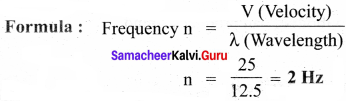
Answer:
True

Question 2.
Hector Munro, led the British forces in the battle of Plassey.
Answer:
False
Correct statement:
Robert Clive, led the British forces in the battle of Plassey.

Question 3.
The outbreak of the Austrian war of succession in Europe was led to Second Carnatic War in India.
Answer:
False
Correct statement:
The outbreak of the Austrian war of succession in Europe was led to First Carnatic War in India.

Question 4.
Sir Elijalmpey was the first Chief Justice of the Supreme Court at Fort William in Bengal.
Answer:
True

Question 5.
The Police system was created by Lord Cornwallis.
Answer:
True

V. Which one of the following is correctly matched?

  1. Battle of Adayar – 1748
  2. Battle of Ambur – 1754
  3. Battle of Wandiwash – 1760
  4. Battle of Arcot – 1749

Answer:
3. Battle of Wandiwash – 1760

VI. Answer the following in one or two sentences

Question 1.
Write a short note on Black Hole Tragedy.
Answer:
There was a small dungeon room in the Fort William in Calcutta, where troops of the Nawab of Bengal Siraj – ud – daula, held 146 British Prisoners of war for one night. Next day morning, when the door was opened 123 of the prisoners found dead because of suffocation.

Question 2.
What were the benefits derived by the English after the Battle of Plassey?
Answer:
After the Battle of Plassey in 1757, the company was granted undisputed right to have free trade in Bengal, Bihar and Orissa. It received the place of 24 parganas in Bengal.

Question 3.
Mention the causes for the Battle of Buxar.
Answer:
Mir Qasim the son in law of the Nawab of Bengal revolted as he was angry with the British for misusing the destakes (free duty passes).

Question 4.
What were the causes for the First Mysore War?
Causes:

  1. Haider Ali’s growing power and his friendly relations with the French became a matter of concern for the English East India Company.
  2. The Marathas, the Nizam and the English entered into a triple alliance against Haider Ali.

Question 5.
Bring out the results of the Third Maratha War.

  1. The Maratha confederacy was dissolved and Peshwaship was abolished.
  2. Most of the territory of Peshwa BajiRao II was annexed and became part of the Bombay Presidency
  3. The defeat of the Bhonsle and Holkar also resulted in the acquisition of the Maratha kingdoms of Nagpur and Indore by the British.
  4. The BajiRao II, the last Peshwa of Maratha was given an annual pension of 8 lakh rupees.

Question 6.
Name the states signed into Subsidiary Alliance.
Answer:
Hyderabad (1798). It was followed by Tanjore (1799), Auadh (1801), Peshwa (1802), Bhonsle (1803), Gwalior (1804), Indore (1817), Jaipur, Udaipur and Jodhpur (1818).

VII. Answer the following in detail

Question 1.
Write an essay on second Carnatic war.
Answer:
In the 18th century, three Carnatic wars were fought between various Indian rulers, British and French East Indian Company on either side.

Second Carnatic War:

1. The main cause of this war was the issue of succession in Carnatic and Hyderabad. Anwaruddin Khan and Chanda Sahib were the two claimants to the throne of Carnatic, whereas Nasir Jang and Muzaffar Jang were claimants to the throne of Hyderabad.

2. The French supported Chanda sahib and Muzaffar Jang, while the British supported the other claimants with the objective of keeping their interest and influence in the entire Deccan region.

Battle of Ambur (1749):

1. Finally Dupleix, Chanda Sahib and Muzaffar Jang formed a grand alliance and defeated and killed Anwar-ud-din Khan, the Nawab of Carnatic, in the Battle of Ambur.

2. Muhammad Ali, the son of Anwar – ud – din, fled to Trichinopoly.

3. Chanda Sahib became the Nawab of Carnatic and rewarded the French with the grant of 80 villages around Pondicherry.

4. In the Deccan, the French defeated and killed Nasir Jang and made Muzaffar Jang as the Nizam.

5. The new Nizam gave ample rewards to the French.

6. He appointed Dupleix as the governor of all the territories in south of the river Krishna. Muzaffar Jang was assassinated by his own people.

7. Salabat Jang, brother of Nasir Jang was raised to the throne by Bussy.

8. Salabat Jang granted the Northern Circars to the French.

9. Dupleix’s power was at its zenith by that time.

Battle of Arcot (1751):

1. In the meantime, Dupleix sent forces to besiege the fort of Trichy

2. Chanda Sahib also joined with the French in their efforts to besiege Trichy. Robert Clive’s proposal was accepted by the British governor, Saunders, and with only 200 English and 300 Indian soldiers, Clive was entrusted the task of capturing Arcot. His attack proved successful.

3. Robert Clive defeated the French at Ami and Kaveripak. With the assistance of Lawrence, Chanda Sahib was killed in Trichy. Muhammad Ali was made the Nawab of Arcot under British protection. The French Government recalled Dupleix to Paris.

Treaty of Pondicherry (1755):

1. Dupleix was succeeded by Godeheu who agreed the treaty of Pondicherry. According to it, both the powers agreed not to interfere in the internal affairs of the native states. They were to retain their old positions. New forts should not be built by either power. The treaty made the British stronger.

2. The second Carnatic war also proved inconclusive. The English proved their superiority on land by appointing Mohammad Ali as the Nawab of Carnatic. The French were still very powerful in Hyderabad. However, the predominant position of the French in the Deccan peninsula was definitely undermined in this war.

Question 2.
Give an account of the Fourth Anglo Mysore war.
Answer:
The Fourth Anglo – Mysore War:
Tipu Sultan did not forget the humiliating treaty of Srirangapatnam imposed upon him by Cornwallis in 1790.
Causes:

  1. Tipu sought alliance with foreign powers against the English and sent ambassadors to Arabia, Turkey, Afghanistan and the French.
  2. Tipu was in correspondence with Napoleon who invaded Egypt at that time.
  3. The French officers came to Srirangapatnam where they founded a Jacobin Club and planted the Tree of Liberty.

Course:

1. Wellesley declared war against Tipu in 1799. The war was short and decisive. As planned, the Bombay army under General Stuart invaded Mysore from the west.

2. The Madras army, which was led by the Governor – General’s brother, Arthur Wellesley, forced Tipu to retreat to his capital Srirangapatnam.

3. On 4th May 1799 Srirangapatnam was captured. Tipu fought bravely and was killed finally. Thus ended the fourth Mysore War and the whole of Mysore lay prostrate before the British.

Mysore after the War:

  1. The English occupied Kanara, Wynad. Coimbatore. Darapuram and Srirangapattinam.
  2. Krishna Raja Odayar of the former Hindu royal family was brought to the throne.
  3. Tipu’s family was sent to the fort of Vellore.

Question 3.
Describe the policy adopted by Lord Dalhousie to expand the British empire in India.
Answer:
Doctrine of Lapse:
1. Lord Dalhousie was one of the chief architects of the British Empire in India. He was an imperialist. He adopted a new policy known as Doctrine of Lapse to extend British Empire.

2. He made use of this precedent and declared in 1848 that if the native rulers adopted children without the prior permission of the Company, only the personal properties of the rulers would go to the adopted sons and the kingdoms would go to the British paramount power. This principle was called the Doctrine of Lapse.

3. It was bitterly opposed by the Indians and it was one of the root causes for the great revolt of 1857.

Question 4.
How did Lord Wellesley expand the British
Answer:
The Subsidiary Alliance:

  1. Lord Wellesley introduced the system of Subsidiary Alliance to bring the princely states under the control of the British.
  2. It was the most effective instrument for the expansion of the British territory and political influence in India.
  3. The princely state was called ‘the protected state’ and the British came to be referred as ‘the paramount power’.
  4. It was the duty of the British to safeguard the state from external aggression and to help its ruler in maintaining internal peace.

Main Features of Subsidiary Alliance:

  1. An Indian ruler entering into this alliance with the British had to dissolve his own armed forces and accept British Forces.
  2. A British Resident would stay in his capital.
  3. Towards the maintenance charges of the army, he should make annual payments or cede some territory permanently to the Company.
  4. All the non – English European officials should be turned out of his state.
  5. The native ruler should deal with foreign states only through the English Company.
  6. The British would undertake to defend the state from internal trouble as well as external attack.

VIII. HOTs

Question 1.
Explain the causes for the success of the English in India.
Answer:
1. Lack of unity among Indian Stats:
Even though there were powerful kings and who ruled Punjab, Mysore and Maratha region, they lacked unity and fought with each other for various reasons. They failed to perceive the danger arising from the East India Company.

2. Greater Naval Power:
The British came through the sea and established a strong naval power in the Indian Ocean before coming to the Indian main land. There was no strong naval power in India to challenge the Brititsh.

3. Development of textile:
By the beginning of the 19th century English made cotton textiles successfully ousted Indian goods from their traditional markets.

4. Scientific division of labour:
The production and growth of modem science in India was encouraged by the British with a view to further colonial interests.

5. Economic prospertiy:
The British had enough funds to pay its share holders that compelled them to finance the English wars in India.

IX. Mark the following on the River map of India

Question 1.

  1. Plassy
  2. Buxar
  3. Purandhar
  4. Arcot
  5. Wandiwash

Answer:
From Trade To Territory Class 8 Questions And Answers Pdf Samacheer Kalvi Term 1 Chapter 2

Samacheer Kalvi 8th Social Science History  From Trade to Territory Additional Questions

I. Choose the correct answer

Question 1.
The rule of …………… in India became effective after the conquest of Bengal.
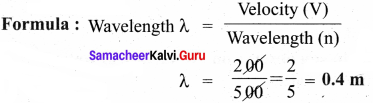
(a) Mughals
(b) East India Company
(c) Portuguese
(d) French
Answer:
(b) East India Company

Question 2.
Siraj – ud – daula captured the British factory at …………….
(a) Kasim bazar
(b) Delhi
(c) Alinagar
(d) Chandranagore
Answer:
(a) Kasim bazar]

Question 3.
Buxar was a small fortified town in the territory of ……………….
(a) West Bengal
(b) Karnataka
(c) Bihar
(d) Rajasthan

Answer:
(c) Bihar

Question 4.
In the battle of Adayar, the French army fought under captain ……………..
(a) Hector Munro
(b) Robert Clive
(c) Eyre Coote
(d) Paradise
Answer:
(d) Paradise

Question 5.
Under the terms of the Treaty of Aix – la – Chapelle, ……………. was returned back to the English.
(a) Madras
(b) Trichinopoly
(c) Hyderabad
(d) Calcutta
Answer:
(a) Madras

Question 6.
The out break of the seven years’ was in Europe led to the ……………. war in India.
(a) I Carnatic
(b) II Carnatic
(c) III Carnatic
(d) Wandiwash
Answer:
(c) III Carnatic

Question 7.
In the III Carnatic war, France captured Fort ……………
(a) Gwalior
(b) St. David
(c) William
(d) Vellore
Answer:
(b) St. David

Question 8.
The Battle of Wandiwash was fought by the English army under General …………….
(a) Forde
(b) Dupleix
(c) Hector Munro
(d) Eyre Coote
Answer:
(d) Eyre Coote

Question 9.
The Seven year’s war was concluded …………… by the treaty of.
(a) Paris
(b) Pondicherry
(c) Madras
(d) Mangalore
Answer:
(a) Paris

Question 10.
The state of Mysore rose to prominence uder the leadership of …………….
(a) Chanda sahib
(b) Salabat Jang
(c) Haider Ali
(d) MirJafar
Answer:
(c) Haider Ali

Question 11.
In 1781, the British General Sir Eyre Coote defeated Haider Ali at ………………
(a) Hyderabad
(b) Porto Novo
(c) Mysore
(d) Mangalore
Answer:
(b) Porto Novo

Question 12.
………….. Saved the British Dominion from the wrath of powerful enemies.
(a) Wellesley
(b) Cornwallis
(c) Warren Hastings
(d) Dalhousie
Answer:
(c) Warren Hastings

Question 13.
Tipu attacked in ……………. 1789.
(a) Madras
(b) Mangalore
(c) Mahe
(d) Travancore
Answer:
(d) Travancore

Question 14.
During the course of the third Anglo – Mysore war …………… took the command of the British Armyi
(a) Cornwallis
(b) Dalhousie
(c) Robert Clive
(d) Curzon
Answer:
(a) Cornwallis

Question 15.
The internal conflict among the ……………. was best utilised by the British.
(a) Nizams
(b) Marathas
(c) Nawabs
(d) Chauhans
Answer:
(b) Marathas

Question 16.
Colonel Upton concluded the treaty of ……………. in 1776.
(a) Mangalore
(b) Mysore
(c) Purandhar
(d) Pondicherry
Answer:
(c) Purandhar

Question 17.
The death of …………….. in 1800 gave the British an added advantage.
(a) Mahadaji Scindia
(b) Daulat Rao Scindia
(c) Madhav Rao
(d) Nana Phadnavis
Answer:
(d) Nana Phadnavis]

Question 18.
In the III Anglo Maratha war, Hastings was supported by a force under General ……………
(a) Thomas Hislop
(b) Mathews
(c) Medows
(d) Upton
Answer:
(a) Thomas Hislop]

Question 19.
……………… the Governor General of India in 1786, enforced the ruler against private trade.
(a) Warren Hastings
(b) Wellesley
(c) Cornwallis
(d) Robert Clive
Answer:
(c) Cornwallis

Question 20.
As per the Government of India Act of 1858, the maximum age for competitors of civil services examination was fixed at ……………
(a) 20
(b) 23
(c) 25
(d) 21
Answer:
(b) 23

II. Fill in the blanks

  1. ………………. of Portugal discovered a new sea route from Europe to India.
  2. ………………. ascended the throne of Bengal in 1756.
  3. British captured …………….. the French settlement in 1757.
  4.  ………………. concluded two treaties with Siraj – Ud – daula and Shah Alam II.
  5. ………………. and ……………… were rival countries in Europe.
  6. The battle of ………………… was fought between the French forces and forces of Anwar – ud – din.
  7. ……………. was deputed from France to conduct the third Carnatic war.
  8. Robert Clive sent ………….. from Bengal to occupy the Norhem Circars.
  9. Haider Ali and his son …………. played a prominent role against the expansion of British empire in India.
  10. The Nizam, with the help of British troops led by General invaded Mysore in 1767.
  11. Tipu captutred Brigadier …………. the supreme commander of the forces in 1783.
  12. After the death of Narayan Rao, ……………. became the Peshwa.
  13. Raghunath Rao’s authority was challenged by a strong party at poona under ……………..
  14. ……………. made an attempt to form a coalition of Indian rulers to fight against the British.
  15. The Royal Commission on Public Service was Chaired by Lord ……………. in 1912.
  16. In 1918 ………….. and ……………. recommended that 33% of Indians should be recruited in Indian civil services.
  17. The …………….. was the second important pillar of the British administration in India.
  18. The highest rank in the army that an Indian could ever reach was that of a ……………..
  19. Circles or Thanas were headed by a …………….
  20. The heriditary village police became ……………

Answer:

  1. Vasco da Gama
  2. Siraj – Ud – daula
  3. Chandra nagore
  4. Robert Clive
  5. Britain and France
  6. San Thome (Madras)
  7. Count de Lally
  8. Colonel Forde
  9. Tipu Sultan
  10. Joseph Smith
  11. Mathews
  12. Raghunath Rao
  13. Nana Phadnavis
  14. Yashwant Rao Holkas
  15. Islington
  16. Montague, Chelmsford
  17. Army
  18. Subedar
  19. Daroga
  20. Chowkidars

III. Match the following

From Trade To Territory Meaning In Tamil Samacheer Kalvi 8th Social Science History Solutions Term 1 Chapter 2

Answer:

  1. iii
  2. i
  3. iv
  4. v
  5. ii

IV. State true or false

Question 1.
Within a year after the Battle of Wandiwash the English army totally routed the French Army.
Answer:
True

Question 2.
In 1761, Tipu Sultan became the de facto ruler of Hyderabad.
Answer:
False
Correct statement:
In 1761, Tipu Sultan became the de facto ruler of Mysore.

Question 3.
Warren Hastings consolidated the British power in India. [Ans : True]
The Treaty of Salbai was signed between Cornwallis and Mahadaji Scindia.
Answer:
False
Correct statement:
The Treaty of Salbai was signed between Warren Hastings and Mahadaji Scindia.

Question 4.
The idea of competition for recruitment was introduced first by the Charter Act, 1833.
Answer:
True

V. Answer the following in one or two sentences.

Question 1.
What was the motive behind the discovery of sea routes to India?
Answer:
The main motive behind those discoveries was to maximize profit through trade and to establish political supremacy.

Question 2.
What were the causes of the Second Anglo Mysore war?
Answer:
1. The English did not fulfill the terms of the treaty of 1769, when Haider’s territories were attacked in 1771 by Marathas, Haider did not get help from the British.

2. British captured Mahe, a French settlement within Haider’s Jurisdiction. It led to the formation of an alliance by Haider with the Nizam and Marathas against the English in 1779.

Question 3.
Prepare flow chart to explain the period of the three Carnatic wars.
Answer:
From Trade To Territory In Tamil Samacheer Kalvi 8th Social Science History Solutions Term 1

Question 4.
What were the results of the First Anglo Maratha War?
Answer:

  1. RaghunathRao was pensioned off and MadhavRao II was accepted as the Peshwa.
  2. Salsette was given to the British.
  3. The Treaty of Salbai established the British influence in Indian politics. It provided the British twenty years of peace with the Marathas.

Question 5.
Explain with a flow chart the period of the Anglo Mysore wars.
Answer:
Samacheer Kalvi 8th Social Solutions History Term 1 Chapter 2 From Trade To Territory

Question 6.
Prepare a flow chart mentioning the period in which the Anglo Maratha wars were fought.
Answer:
Class 8 Social Science From Trade To Territory Samacheer Kalvi History Solutions Term 1 Chapter 2

Question 7.
What did the Indian Civil Service Act of 1861 state?
Answer:
The Indian Civil Service Act of 1861 passed by the British Parliament exclusively reserved certain categories of high executive and judicial posts for the covenanted civil service which was later designated as the Indian Civil Service.

Question 8.
Name the three Indians who became successful in the I.C.S. examination in 1869.
Answer:
In 1869, three Indians – Surendra Nath Banerje, Ramesh Chandra Dutt and Bihari Lai Gupta became successful in the I.C.S. examination.

Question 9.
What did the Royal Commission of Public Service or the Lee Commission recommend in 1923?
Answer:
In 1923, a Royal Commission on Public Services was appointed with Lord Lee of Fareham as chairman. This commission recommended that recruitment to all-Indian services like the Indian Civil Service, the Indian Police Service and the Indian Forest Service should be made and controlled by the Secretary of State for India. The Lee Commission recommended the immediate establishment of a Public Service Commission.

Question 10.
Write a short note on the Act of 1935.
Answer:
The Act of 1935 also made provisions for the establishment of a Federal Public Service Commission at the Centre and the Provincial Public Service Commissions in the various provinces. Provision was also made for a Joint Public Service Commission in two or more Provinces. Although, the main aim of this measure was to serve the British interests, it became the base of the civil service system in independent India.

Question 11.
Name the provinces in which separates armies were organised during the British rule.
Answer:
During the early stage of British rule, three separate armies had been organised in three Presidencies of Bengal, Bombay and Madras.

Question 12.
Name the places where high courts were setup according to the Act of 1861.
Answer:
According to the Indian High Courts Act, 1861, three High Courts were set up in Calcutta, Bombay and Madras.

Question 13.
Brief the merits of the subsidiary Alliance for the British.
Answer:
Merits for the British:

  1. The British Company maintained a large army at the expense of the Indian rulers.
  2. All Frenchmen in the service of native rulers were dismissed, and the danger of French revival was completely eliminated.
  3. The British Company began to control the foreign policy of the Princely States,
  4. Wellesley’s diplomacy made the British the paramount power in India. He transformed the British Empire in India into the British empire of India.

Question 14.
What were the factors for the success of the British?
Answer:
Factors for the success of the British

  1. Greater naval power.
  2. Development of textile.
  3. Scientific division of labour.
  4. Economic prosperity and skilful diplomacy of the British.
  5. Feelings of insecurity among the Indian merchants.
  6. The inequality and ignorance of the Indian kings.

Question 15.
What was the impact of the policies of Subsidiary Alliance and Doctrine of Lapse in India?
Answer:
This policy led to a South Indian rebellion (1800 – 01), Vellore Rebellion (1806) and the Great Rebellion (1857).

Samacheer Kalvi 11th Computer Science Solutions Chapter 9 Introduction to C++

Students can Download Computer Science Chapter 9 Introduction to C++ Questions and Answers, Notes Pdf, Samacheer Kalvi 11th Computer Science Book Solutions Guide Pdf helps you to revise the complete Tamilnadu State Board New Syllabus and score more marks in your examinations.

Tamilnadu Samacheer Kalvi 11th Computer Science Solutions Chapter 9 Introduction to C++

Samacheer Kalvi 11th Computer Science Introduction to C++ Text Book Back Questions and Answers

PART – 1
I. Choose The Correct Answer

11th Computer Science Chapter 9 Book Back Answers Question 1.
Who developed C++?
(a) Charles Babbage
(b) Bjame Stroustrup
(c) Bill Gates
(d) Sundar Pichi
Answer:
(b) Bjame Stroustrup

11th Computer Science Evaluate Yourself Answers Question 2.
What was the original name given to C++?
(a) CPP
(b) Advanced C
(c) C with Classes
(d) Class with C
Answer:
(c) C with Classes

Samacheer Kalvi Guru 11th Computer Science Question 3.
Who coined C++?
(a) Rick Mascitti
(b) Rick Bjame
(c) Bill Gates
(d) Dennis Ritchie
Answer:
(a) Rick Mascitti

Samacheer Kalvi Computer Science Question 4.
The smallest individual unit in a program is:
(a) Program
(b) Algorithm
(c) Flowchart
(d) Tokens
Answer:
(d) Tokens

Computer Science Samacheer Kalvi Question 5.
Which of the following operator is extraction operator of C++?
(a) >>
(b) <<
(c) <>
(d) ^^
Answer:
(a) >>

Samacheer Kalvi 11th Computer Science Question 6.
Which of the following statements is not true?
(a) Keywords are the reserved words convey specific meaning to the C++ compiler.
(b) Reserved words or keywords can be used as an identifier name.
(c) An integer constant must have at least one digit without a decimal point.
(d) Exponent form of real constants consists of two parts
Answer:
(b) Reserved words or keywords can be used as an identifier name.

11th Samacheer Kalvi Computer Science Question 7.
Which of the following is a valid string literal?
(a) ‘A’
(b) ‘Welcome’
(c) 1232
(d) “1232”
Answer:
(d) “1232”

11th Computer Science Samacheer Kalvi Question 8.
A program written in high level language is called as ……………….
(a) Object code
(b) Source code
(c) Executable code
(d) All the above
Answer:
(b) Source code

Samacheer Kalvi Computer Science Book Question 9.
Assume a = 5, b = 6; what will be result of a & b?
(a) 4
(b) 5
(c) 1
(d) 0
Answer:
(a) 4

11 Computer Science Samacheer Kalvi Question 10.
Which of the following is called as compile time operators?
(a) sizeof
(b) pointer
(c) virtual
(d) this
Answer:
(a) sizeof

PART – 2
II. Answer to all the questions

Samacheer Kalvi.Guru 11th Computer Science Question 1.
What is meant by a token? Name the token available in C++.
Answer:
C++ program statements are constructed by many different small elelments such as commands, variables, constants and many more symbols called as operators and punctuators. Individual elements are collectively called as Lexical units or Lexical elements or Tokens. C++ has the following tokens:

  1. Keywords
  2. Identifiers
  3. Literals
  4. Operators
  5. Punctuators

Samacheer Kalvi 11th Computer Science Book Back Answers Question 2.
What are keywords? Can keywords be used as identifiers?
Answer:
Keywords are the reserved words which convey specific meaning to the C++ compiler. They are the essential elements to construct C++ programs. Most of the keywords are common to C, C++ and Java. Keywords are reserved and cannot be used as identifiers.

Question 3.
The following constants are of which type?

  1. 39
  2. 032
  3. OXCAFE
  4. 04.14

Answer:

  1. 39 – Decimal
  2. 032 – Octal
  3. OXCAFE – Hexadecimal
  4. 04.14 – Decimal

Question 4.
Write the following real constants into the exponent form:

  1. 23.197 00
  2. 7.214
  3. 0.00005
  4. 0.319

Answer:

  1. 23.197 = 0.23197 x 102 = 0.23197E2
  2. 00 7.214 = 0.7214 x 101 = 0.7214E1
  3. 0.00005 = 0.5 x 10-4 = 0.5E – 4
  4. 0.319 = 3.19 x 10-1 = 3.19E – 1

Question 5.
Assume n = 10; what will be result of n>>2;?
Answer:
11th Computer Science Chapter 9 Book Back Answers Introduction To C++ Samacheer Kalvi

Question 6.
Match the following:
11th Computer Science Evaluate Yourself Answers Samacheer Kalvi Chapter 9 Introduction To C++
Answer:
Samacheer Kalvi Guru 11th Computer Science Solutions Chapter 9 Introduction To C++

PART – 3
III. Answer to all the questions

Question 1.
Describe the differences between keywords and identifiers?
Answer:
Keywords:

  • Keywords are the reserved words which convey specific meaning to the C++ compiler.
  • They are essential elements to construct C++ programs.
  • Most of the keywords are common to C, C++ and Java.

Identifiers:

  • Identifiers are the user-defined names given to different parts of the C++ program.
  • They are the fundamental building blocks of a program.
  • Every language has specific rules for naming the identifiers.

Question 2.
Is C++ case sensitive? What is meant by the term “case sensitive”?
Answer:
C++ is a case sensitive programming language so, all the keywords must be in lowercase. Case sensitive means that the uppercase and lowercase letters are considered differently.

Question 3.
Differentiate “=” and “==”.
Answer:

= = =
‘=’ is an assignment operator‘= =’ is an equal to operator and it is a relational operator.
It is used to assign the value of variable or expressionIt is used for comparison of both left and right side operands.

Question 4.
Assume a = 10, b = 15; What will be the value of a^b?
Answer:
Samacheer Kalvi Computer 11th Science Solutions Chapter 9 Introduction To C++

Question 5.
What is the difference between “Run time error” and “Syntax error”?
Answer:
Run – time Error:

  • A run time error occurs during the execution of a program. It occurs because of some illegal operation that takes place.
  • For example, if a program tries to open a file which does not exist, it results in a run – time error.

Syntax Error:

  • Syntax errors occur when grammatical rules of C++ are violated.
  • Example: if you type as follows, C++ will throw an error.
    cout << “Welcome to Programming in C++”

Question 6.
What are the differences between “Logical error” and “Syntax error”?
Answer:
Logical Error : Logical errors occur when there is an incorrect usage of variable / operator / order of execution etc. It is also called as Semantic Error.

Syntax Error : Syntax errors occur when grammatical rules of C++ are violated.

Question 7.
What is the use of a header file?
Answer:
Header files contain definitions of Functions and Variables, which is imported or used into any C++ program by using the pre – processor #include statement. Header files have an extension “.h” which contains C++ function declaration and macro definition.
Example: #include

Question 8.
Why is main function special?
Answer:
C++ program is a collection of functions. Every C++ program must have a main function. The main() function is the starting point where all C++ programs begin their execution. Therefore, the executable statements should be inside the main() function.

Question 9.
Write two advantages of using include compiler directive.
Answer:

  1. The program is broken down into modules, thus making it more simplified.
  2. More library functions can be used, at the same time size of the program is retained.

Question 10.
Write the following in real constants.

  1. 15.223
  2. 211.05
  3. 0.00025

Answer:

  1. 15.223 = 0.15223E2
  2. 211.05 = 0.21105E3
  3. 0.00025 = 0.25E – 3

PART – 4
IV. Answer all the questions

Question 1.
Write about Binary operators used in C++.
Answer:
Binary Operators require two operands:
Arithmetic operators that perform simple arithmetic operations like addition, subtraction, multiplication, division (+, -, *, %, /) etc. are binary operators which requires minimum of two operands.

Relational operators are used to determine the relationship between its operands. The relational operators (<, >, >=, <=, ==, !=) are applied on two operands, hence they are binary operators. AND, OR (logical operator) both are binary operators. Assignment operator is also a binary operator (+=, – =, *=, /=, %=).

Question 2.
What are the types of Errors?
Answer:

Type of ErrorDescription
Syntax ErrorSyntax errors occur when grammatical rules of C++ are violated.
Semantic ErrorSemantic Error occur when there is wrong use of variable / operator / order of execution etc.

It is also called as Logical Error.

Run – time errorA run time error occurs during the execution of a program. It is occurs because of some illegal operation that takes place.

Question 3.
Assume a = 15, b = 20; What will be the result of the following operations?
(a) a&b
(b) a|b
(c) a^b
(d) a>>3
(e) (~b)
Answer:
Computer Science Samacheer Kalvi 11th Solutions Chapter 9 Introduction To C++

PART – 1
I. Choose the correct answer

Question 1.
How many categories of data types available in C++?
(a) 5
(b) 4
(c) 3
(d) 2
Answer:
(c) 3

Question 2.
Which of the following data types is not a fundamental type?
(a) signed
(b) int
(c) float
(d) char
Answer:
(a) signed

Question 3.
What will be the result of following statement?
char ch= ‘B’;
cout<< (int) ch;
(a) B
(b) b
(c) 65
(d) 66
Answer:
(d) 66

Question 4.
Which of the character is used as suffix to indicate a floating point value?
(a) F
(b) C
(c) L
(d) D
Answer:
(a) F

Question 5.
How many bytes of memory allocates for the following variable declaration if you are using
Dev C++? short int x;
(a) 2
(b) 4
(c) 6
(d) 8
Answer:
(a) 2

Question 6.
What is the output of the following snippet?
charch =‘A’;
ch = ch + 1;
(a) B
(b) A1
(c) F
(d) 1A
Answer:
(a) B

Question 7.
Which of the following is not a data type modifier?
(a) signed
(b) int
(c) long
(d) short
Answer:
(b) int

Question 8.
Which of the following operator returns the size of the data type?
(a) sizeof()
(b) int ()
(c) long ()
(d) double ()
Answer:
(a) sizeof()

Question 9.
Which operator is used to access reference of a variable?
(a) $
(b) #
(c) &
(d) !
Answer:
(c) &

Question 10.
This can be used as alternate to endl command:
(a) \t
(b) \b
(a) \0
(d) \n
Answer:
(d) \n

PART – 2
II. Answer to all the questions

Question 1.
Write a short note const keyword with an example.
Answer:
const is the keyword used to declare a constant, const keyword modifies / restricts the accessibility of a variable. So, it is known as Access modifier.

Question 2.
What is the use of setw( ) format manipulator?
Answer:
setw manipulator sets the width of the field assigned for the output. The field width determines the minimum number of characters to be written in output.
Syntax:
setw(number of characters)

Question 3.
Why is char often treated as integer data type?
Answer:
Character data type accepts and returns all valid ASCII characters. Character data type is often said to be an integer type, since all the characters are represented in memory by their associated ASCII Codes. If a variable is declared as char, C++ allows storing either a character or an integer value.

Question 4.
What is a reference variable? What is its use?
Answer:
Reference variable in C++ is alias for existing variable. They store nothing but the address of the variable used at the time of its declaration. It is important to assign the reference variable at the time of declaration, else it will show an error.

Question 5.
Consider the following C++ statement. Are they equivalent?
char ch = 67;
charch = ‘C’;
Answer:
Both the statements are equivalent as they declare ‘ch’ to be char and initialize it with the value of 67. Since this is the ASCII code for ‘C’, the character constant also can be used to initialize ‘ch’ to 67.

Question 6.
What is the difference between 56L and 56?
Answer:
56L – The suffix L forces the constant to be represented as long, which occupies 4 bytes.

56 – This will be represented as int type constant which occupies 2 bytes as per Turbo C++.

Question 7.
Determine which of the following are valid constant? And specify their type.

  1. 0 0.5
  2. ‘Name’
  3. ‘\t’
  4. 27,822

Answer:

  1. 0.5 – is a valid constant. It is a decimal.

  2. ‘Name’ – Invalid constant as single quote is not allowed.
  3. ‘\t’ – Escape sequence (or) non – graphical character (horizontal tab).
  4. 27,822 – Invalid constant. Comma is not allowed.

Question 8.
Suppose x and y are two double type variable that you want add as integer and assign to an integer variable. Construct a C++ statement for the doing so.
Answer:
double x = 10.5, y = 4.5; int a;
a = int (x) + int (y);

Question 9.
What will be the result of following if num=6 initially.
(a) cout << num;
(b) cout << (num==5);
Answer:
(a) 6 (b) False

Question 10.
Which of the following two statements are valid? Why? Also w rite their result, int a; a = 3,014; a=(3,014);
Answer:
It is invalid as comma is not allowed in an integer constant. It is valid. Comma in bracket is allowed.

PART – 3
III. Answer to all the questions

Question 1.
What are arithmetic operators in C++? Differentiate unary and binary arithmetic operators. Give example for each of them.
Answer:
Arithmetic operators : perform simple arithmetic operations like addition, subtraction, multiplication, division etc.
Unary Operators : Require only one operand . Example: +, -, *, /, %, >, <, <=, AND, OR

Binary Operators:

  1. Require two operands
  2. Example: ++ (Plus, Plus) Increment operator, – – (Minus, Minus) Decrement operator, NOT, ~,

Question 2.
Evaluate x + = x + + + x; Let x = 5;
Answer:
x + = x + + + x (x = 5) x + = x + + + 5 (x becomes 6)
x + = 6 + 6
x + = 12
x = 6 + 12
x = 18

Question 3.
How relational operators and logical operators are related to one another?
Answer:
Relational operators are used to determine the relationship between its operands. When the relational operators are applied on two operands, the result will be a boolean value 1 or 0 which represents True or False respectively which represents logical operator.

Question 4.
Evaluate the following C++ expressions where x, y, z are integers and m, n are floating point numbers. The value of x = 5, y = 4 and m = 2.5;
Answer:

  1. n = x + y / x;
  2. z = m * x + y;
  3. z = (x++) * m + x;

Answer:
1. n = x + y / x;
= 5 + 4/5
= 5 + 0 (both x and y are int type. Therefore only integer part of quotient is considered)
=5

2. z = m * x + y;
= 2.5 * 5 + 4 (m is float type, so x value is promoted to float [implicit conversion])
= 12.5 + 4 ‘
= 16 (2 is int type. So ‘.2’, the fractional part is discarded)

3. z = (x++) * m + x;
= 5*2.5 + x
= 12.5 + 5
= 18 (z is int type, therefore the fractional part is removed, x is incremented after the addition)

Samacheer kalvi 11th Computer Science Introduction to C++ Additional Questions and Answers

PART – 1
I. Choose The Correct Answer

Question 1.
The latest standard version published in December 2017 as ISO/IEC …………….. which is informally known as C++ 17.
(a) 14882 : 1998
(b) 14883 : 2017
(c) 14882 : 2017
(d) 14882 : 2000
Answer:
(c) 14882 : 2017

Question 2.
The smallest individual unit in a program is known as ……………..
(a) token
(b) lexical unit
(c) lexical element
(d) all the above
Answer:
(d) all the above

Question 3.
Integer constant is also called as ……………..
(a) fixed point constant
(b) floating point constant
(c) real constants
(d) boolean literals
Answer:
(a) fixed point constant

Question 4.
Exponent form of real constants consists of parts.
(a) 3
(b) 2
(c) 5
(d) 4
Answer:
(b) 2

Question 5.
…………….. relational operators are binary operators.
(a) 7
(b) 8
(c) 6
(d) 2
Answer:
(c) 6

Question 6.
Match the following
Samacheer Kalvi 11th Computer Science Solutions Chapter 9 Introduction to C++
(a) 1 – (i) 2 – (ii) 3 – (iii) 4 – (iv)
(b) 1 – (iv) 2 – (ii) 3 – (iii) 4 – (i)
(c) 1 – (i) 2 – (iii) 3 – (ii) 4 – (iv)
(d) 1 – (i) 2 – (ii) 3 – (iv) 4 – (iii)
Answer:
(b) 1 – (iv) 2 – (ii) 3 – (iii) 4 – (i)

Question 7
…………….. used to label a statement.
(a) colon
(b) comma
(c) semi – colon
(d) parenthesis
Answer:
(a) colon

Question 8.
Match the following
Samacheer Kalvi 11th Computer Science Solutions Chapter 9 Introduction to C++
(a) 1 – (i) 2 – (ii) 3 – (iii) 4 – (iv)
(b) 1 – (ii) 2 – (iv) 3 – (i) 4 – (iii)
(c) 1 – (i) 2 – (iii) 3 – (ii) 4 – (iv)
(d) 1 – (i) 2 – (ii) 3 – (iv) 4 – (iii)
Answer:
(d) 1 – (i) 2 – (ii) 3 – (iv) 4 – (iii)

Question 9.
IDE stands for ……………..
(a) Integrated Development Environment
(b) International Development Environment
(c) Integrated Digital Environment
(d) None of the above
Answer:
(a) Integrated Development Environment

Question 10.
In programming language …………….. are referred as variables and the values are referred to as data.
(a) constant
(b) integer
(c) fields
(d) files
Answer:
(c) fields

Question 11.
…………….. data type signed more precision fractional value.
(a) char
(b) short
(c) long double
(d) signed doubles
Answer:
(c) long double

Question 12.
Syntax for reference is ……………..
(a) =
(b) = <& reference>
(c) <&reference_variable>=
(d) None of these
Answer:
(c) <&reference_variable>=

Question 13.
…………….. manipulator is the member of iomanip header file.
(a) setw
(b) setfill
(c) setf
(d) all the above
Answer:
(d) all the above

Question 14.
…………….. is used to set the number of decimal places to be displayed.
(a) Set precision
(b) Garbage
(c) Constant
(d) All the above
Answer:
(a) Set precision

Question 15.
Match the following
Samacheer Kalvi 11th Computer Science Solutions Chapter 9 Introduction To C++
(a) 1 – (iv) 2 – (iii) 3 – (ii) 4 – (i)
(b) 1 – (i) 2 – (ii) 3 – (iii) 4 – (iv)
(c) 1 – (iv) 2 – (i) 3 – (i) 4 – (iii)
(d) 1 – (iv) 2 – (iii) 3 – (i) 4 – (ii)
Answer:
(a) 1 – (iv) 2 – (iii) 3 – (ii) 4 – (i)

PART – 2
II. Short Answers

Question 1.
Mention any two benefits of C++.
Answer:

  1. C++ is a highly portable language and is often the language of choice for multi – device, multi – platform app development.
  2. C++ is an object – oriented programming language and includes classes, inheritance, polymorphism, data abstraction and encapsulation.

Question 2.
What is the use of Boolean literals?
Answer:
Boolean literals are used to represent one of the Boolean values (True or false). Internally true has value 1 and false has value 0.

Question 3.
What are the types of C++ operators based on the number of operands?
Answer:
The types of C++ operators based on the number of operands are:

  1. Unary Operators – Require only one operand
  2. Binary Operators – Require two operands
  3. Ternary Operators – Require three operands

Question 4.
What are the types of bitwise operators?
Answer:
In C++, there are three kinds of bitwise operators, which are:

  1. Logical bitwise operators
  2. Bitwise shift operators
  3. One’s compliment operators

Question 5.
What is stream extraction operator?
Answer:
C++ provides the operator >> to get input. It extracts the value through the keyboard and assigns it to the variable on its right; hence, it is called as “Stream extraction” or “get from” operator.

Question 6.
Expand IDE and GNU.
Answer:
IDE stands for Integrated Development Environment and GNU stands for General Public License.

Question 7.
What are the main types of C++ datatypes?
Answer:
In C++, the data types are classified as three main categories

  1. Fundamental data types
  2. User – defined data types and
  3. Derived data types.

Question 8.
Write C++ program to accept any character and display its next character.
Answer:
C++ Program to accept any character and display its next character
11th Samacheer Kalvi Computer Science Solutions Chapter 9 Introduction To C++
The output produced by the program will be
Enter a character: A
The Next character: B

Question 9.
Write C++ program to find the area of circle.
Answer:
C++Program to find the area of circle
11th Computer Science Samacheer Kalvi Solutions Chapter 9 Introduction To C++
Output:
Enter Radius: 6.5
The Area of the circle is 132.665

Question 10.
What is Junk (or) Garbage values?
Answer:
If you declare a variable without any initial value, the memory space allocated to that variable will be occupied with some unknown value. These unknown values are called as “Junk” or “Garbage” values.

PART – 3
III. Explain in Brief

Question 1.
What are the uses of Set precision?
Answer:
setprecision () prints the values from left to right. For the above code, first, it will take 4 digits and then prints one digit from fractional portion. setprecision can also be used to set the number of decimal places to be displayed. In order to do this task, you will have to set an ios flag within setf() manipulator. This may be used in two forms: fixed and (i) fixed (ii) scientific These two forms are used when the keywords fixed or scientific are appropriately used before the setprecision manipulator.

Question 2.
Define – Expression?
Answer:
An expression is a combination of operators, constants and variables arranged as per the rules of C++. It may also include function calls which return values.

Question 3.
What is Automatic conversion and Type promotion?
Answer:
An Implicit type conversion is a conversion performed by the compiler automatically. So, implicit conversion is also called as “Automatic conversion”. This type of conversion is applied usually whenever different data types are intermixed in an expression. If the type of the operands differ, the compiler converts one of them to match with the other, using the rule that the “smaller” type is converted to the “wider” type, which is called as “Type Promotion”.

Question 4.
What is type casting. Write its syntax?
Answer:
C++ allows explicit conversion of variables or expressions from one data type to another specific data type by the programmer. It is called as “type casting”.
Syntax:
(type – name) expression;
Where type – name is a valid C++ data type to which the conversion is to be performed.

Question 5.
What kind of constants are the following?

  1. 0X568
  2. – 27
  3. – 27

Answer:

  1. Hexadecimal
  2. Decimal
  3. Octal

Question 6.
What are the types of C++operators?
Answer:
C++ Operators are classified as:

  1. Arithmetic Operators
  2. Relational Operators
  3. Logical Operators
  4. Bitwise Operators
  5. Assignment Operators
  6. Conditional Operator
  7. Other Operators

Question 7.
Convert the following real constants into exponent form:

  1. 12.0005
  2. 0.00000009
  3. 7.9283

Answer:
0 12.0005 = 0.120005 x 102 = 0.120005E2
0.00000009 = 0.9 x 10-7 = 0.9E-7
7.9283 = 0.79283 x 101 = 0.79283E1

Question 8.
If a = 15; what is the result of a<<3 and a >> 2?
If a = 15; equivalent binary value of a is 00001111
Answer:
Samacheer Kalvi Computer Science 11th Book Solutions Chapter 9 Introduction To C++

Question 9.
If b = 15 what is the result of ~b?
If b = 15; equivalent binary value of b is 00001111
Answer:
11 Computer Science Samacheer Kalvi Solutions Chapter 9 Introduction To C++

Question 10.
If a = 65, b = 15, what is the result of a|b?
Equivalent Binary values of 65 = 01000001; 15 = 00001111
Answer:
Samacheer Kalvi.Guru 11th Computer Science Solutions Chapter 9 Introduction To C++

PART – 4
IV. Explain in Detail

Question 1.
Explain steps involved in creating and execution of C++ program.
Answer:
For creating and executing a C++ program, one must follow four important steps.
1. Creating Source code : Creating includes typing and editing the valid C++ code as per the rules followed by the C++ Compiler.

2. Saving source code with extension .cpp
After typing, the source code should be saved with the extension .cpp

3. Compilation
This is an important step in constructing a program. In compilation, compiler links the library files with the source code and verifies each and every line of code. If any mistake or error is found, it will inform you to make corrections. If there are no errors, it translates the source code into machine readable object file with an extension .obj

4. Execution
Execution is the final step of construction of a C++ Program. In this stage, the object file becomes an executable file with extension .exe. Once the program becomes an executable file, the program has an independent existence. This means, you can run your application without the help of any compiler or IDE.
Samacheer Kalvi 11th Computer Science Book Back Answers Chapter 9 Introduction To C++

Question 2.
Explain working with Dev C++.
Answer:
Dev C++ is an open source, cross platform (alpha version available for Linux), full featured Integrated Development Environment (IDE) distributed with the GNU General Public License for programming in C and C++. It is written in Delphi. It can be downloaded from
http://www.bloodshed.net/dev/devcpp.html

After installation Dev C++ icon is available on the desktop. Double click to open IDE. Dev C++ IDE appears.
To create a source file, Select File → New → Source file or Press Ctrl + N.
On the screen that appears, type your C++ program, and save the file by clicking File → Save or Pressing Ctrl + S. It will add .cpp by default at the end of your source code file. No need to type .cpp along with your file name.
Samacheer Kalvi 11th Computer Science Solutions Chapter 9 Introduction to C++
After save, Click Execute → Compile and Run or press F11 key.
After successful compilation, output will appear in output console, as follows
Samacheer Kalvi 11th Computer Science Solutions Chapter 9 Introduction to C++

Question 3.
Draw memory allocation of a variable and int type variable.
Answer:
Samacheer Kalvi 11th Computer Science Solutions Chapter 9 Introduction to C++

Question 4.
Write the C++ program to find the curved surface area of the cylinder.
C++ Program to find the Curved Surface Area of a cylinder (CSA) (CSA = 2 nr * h)
Answer:
#include
using namespace std;
int main()
{

float pi = 3.14, radius, height, CSA;
cout << “\n Curved Surface Area of a cylinder”;
cout << “\n Enter Radius (in cm):”; cin >> radius;
cout << “\n Enter Height (in cm):”; cin >> height;
CSA = (2*pi*radius)*height; system (“els”);
cout << “\n Radius:” << radius « “cm”;
cout << “\n Height:” << height« “cm”;
cout << “\n Curved Surface Area of a Cylinder is” << CSA «“sq. cm.”;

}

Output:
Curved Surface Area of a cylinder
Enter Radius (in cm) : 7
Enter Height (in cm) : 20
Radius : 7cm
Height : 20cm
Curved Surface Area of a Cylinder is 879.2 sq. cm.

Question 5.
Write the C++ program to calculate Net salary.
Program to Calculate Net Salary
Answer:
#include
#include using namespace std;
int main()
{

float basic, da, hra, gpf, tax, gross, np; char name[30];
cout << “\n Enter Basic Pay:”; cin >> basic;
cout<< “\n Enter D.A cin >> da;
cout << “\n Enter H.R.A:”; cin >> hra;
gross = basic+da+hra; // sum of basic, da nad hra
gpf = (basic+da) * 0.10; //10% of basic and da
tax = gross * 0.10; //10% of gross pay
np = gross – (gpf+tax); //netpay = earnings – deductions
cout << setw(25) << “Basic Pay:” << setw(10) << basic << endl;
cout << setw(25) << “Dearness Allowance:”<< setw(10) << da << endl;
cout << setw(25) << “House Rent Allowance:” << setw(10) << hra << endl;
cout << setw(25) << “Gross Pay:” << setw(10) << gross << endl;
cout << setw(25) << “G.P.F:” << setw(10) << gpf << endl;
cout << setw(25) << “Income Tax:” << setw(10) << tax << endl;
cout << setw(25) << “Net Pay:” << setw(10) << np << endl;

}
The output will be,
Enter Basic Pay : 12000
Enter D.A : 1250
Enter H.R.A : 1450
Basic Pay : 12000
Dearness Allowance : 1250
House Rent Allowance : 1450
Gross Pay : 14700
G.P.F : 1325
Income Tax : 1470
Net Pay : 11905

Question 6.
If a = 17, b = 24, what is the result of the following?

  1. a & b
  2. a|b
  3. a^b
  4. a>>3
  5. ~ b

Answer:
Samacheer Kalvi 11th Computer Science Solutions Chapter 9 Introduction to C++