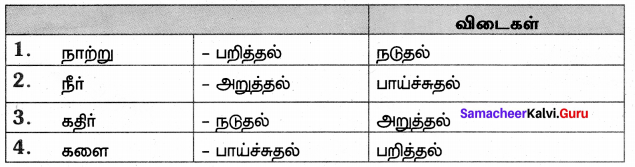
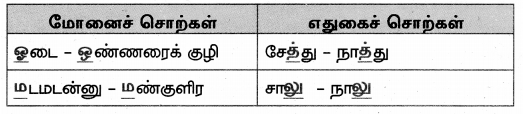
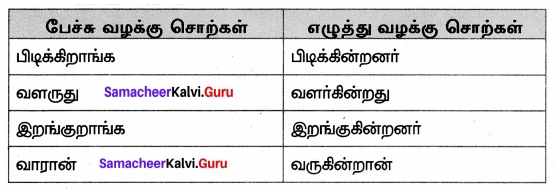
Samacheer Kalvi 7th English Solutions Term 2 Poem Chapter 1 The Poem of Adventure

Students can Download English Poem 1 The Poem of Adventure Questions and Answers, Summary, Notes Pdf, Activity, Samacheer Kalvi 7th English Book Solutions Guide Pdf helps you to revise the complete Tamilnadu State Board New Syllabus and score more marks in your examinations.

Tamilnadu Samacheer Kalvi 7th English Solutions Term 2 Poem Chapter 1 The Poem of Adventure

Read And Understand

A. Read the lines and answer the questions.

The Poem Of Adventure Question And Answer Question 1.
Deep inside the mountain
the adventures hide themselves.
(a) Where do adventures hide?
Answer:
Adventures hide deep inside the mountain.

The Poem Of Adventure Question 2.
They are of all forms and shapes They all have an excellent ending
(a) What do have an excellent ending?
Answer:
Adventures have an excellent ending.

The Poem Of Adventure Summary Question 3.
when to fight for a righteous cause one did gain considerable applause.
(a) When will one get an applause?
Answer:
If one fights for a righteous cause, one will get an applause.

The Poem Of Adventure 7th Standard Question 4.
And in fighting for their country, faith and king
noble impressions on peoples minds would ring
(a) What does ‘noble impression’ mean?
Answer:
‘Noble impression’ is good opinion’.

(b) Who can leave a noble impression?
Answer:
Knights fighting for their country, faith and the king can leave a noble impression on people’s minds.

The Poem Of Adventure Book Back Answers Question 5.
There are many legends based on their heroic exploits a legacy of tales which have been told with much adroit
(a) What does ‘heroic exploits’ mean?
Answer:
‘Heroic exploits’ means ‘daring adventures’.

(b) What are legends?
Answer:
Legends are traditional stories.

B. Answer briefly.

Poem Of Adventure 7th Standard Question 1.
What is adventure?
Answer:
An Adventure is an unusual, exciting and daring deed.

The Poem Of Adventure 7th Standard Summary Question 2.
Describe the appearance of a knight.
Answer:
A knight is bold and daring. He rides on a horse with a sword or spear in armours seeking romance.

Poem Of Adventure Question 3.
What are the characteristics of an adventure?
Answer:
Adventures hide deep inside the mountains. They have an excellent- ending. They are all forms and shapes.

C. Think and Answer.

The Poem Of Adventure 7th Standard English Question 1.
Why does the poet ask us to imagine that we have tiny wings on our back?
Answer:
The poet asks us to imagine that we have tiny wings on our back, so that we can bounce a bit with joy, when we take a new step towards our adventurous life. He also wants us to imagine that we are clear in mind and feel the wind passing . through us, instead of going against us. You just have to close your eyes and ask them to embrace you. Thus, they would be attracted to be our patterns of habit.

7th English The Poem Of Adventure Question 2.
Why should we fight for righteous cause?
Answer:
Long ago during the age of chivalry, knights used to fight for a righteous cause. They gained a considerable applause for their chivalrous acts. Likewise, we should also fight for a noble cause, so that we could get a good applause from the people of our country. If you fight for your country, people will have good impression about you in their minds. They will hold you in high esteem.

D. Literary Appreciation.

The Poem Of Adventure Line By Line Explanation Question 1.
Pick out the rhyming words. –
Answer:
“Old – bold” lance – romance; cause – applause; chivalry – history; maiden – laden; blows – foes; death – breath; yore – fore; struggle – juggle; king – ring; esteem – seem; exploits – adroit; vice – sacrifice; cause – pause are the rhyming words in this poem.

Summary Of The Poem Of Adventure Question 2.
Write down the alliterated words
Answer:
those-that-their
they – themselves
fighting – for – faith
lessons-learnt
time – take
defying – death
held – high
bounce – bit
virtue – vice

Creative Writing
Concrete Poems
Concrete poems are made up ofwords that have been placed in such a way that they make the shape of an object and also use words to describe the object.
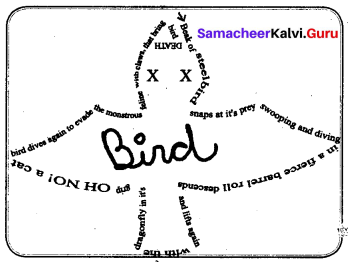
The Poem Of Adventure Question And Answer Samacheer Kalvi 7th English Term 2 Poem Chapter 1
Star,t by making a simple outline of the shape or object (an animal, a football, a fruit etc.) large enough to fill a piece of paper.
Then brainstorm a minimum of ten words and phrases that describe the shape. List action and feeling words as well.
Next, place a piece of paper over the shape and decide where your words are going to be placed so that they outline your shape but also fit well together.
Separate words and phrases with commas.

E. Now read the poem and pick out the nouns. Then write your own concrete poem
Answer:
Nouns

  1. Bird
  2. Beak
  3. Claws
  4. Prey
  5. Barrell
  6. Dragon fly
  7. Grip
  8. Cat
  9. Feline
  10. Roll

Hot Air Balloon

From down
below I wave hello
to a man standing in
a basket, a basket hang-
ing from a balloon, a ball-
oon filled with hot air
that keeps it pre
cariously,
scario
us
ly
al
oft

The Poem of Adventure Additional Questions

I. Poem Comprehension:

The Poem Of Adventure Full Poem Question 1.
To attract the adventures into the patterns of habit
you only need to close your eyes
and ask them to embrace you.

(a) What can be taken into the patterns of habit?
Answer:
Adventures can be taken into the patterns of habit.

(b) What should you do to make adventures to embrace you?
Answer:
You should close your eyes and ask them to embrace you.

The Poem Of Adventure Poem Question 2.
Back in the days of old
when knights were bold
who with a sword or lance
in armour sought romance.

(a) When were the knights bold?
Answer:
In olden days, the knights were bold.

(b) How do they go on a horse?
Answer:
Vuiva They go on with a sword or a lance.

(c) What did they seek?
Answer:
They sought romance.

(d) What does the word ‘lance’ mean?
Answer:
It means ‘a long weapon with a wooden shaft and pointed steelhead.

II. Poetic Devices:

The Poem Of Adventure Lines Question 1.
in a one to one combat defying death as crowds watched with abated breath.

a) Pick out the rhyming words in the lines.
Answer:
death – breath are the rhyming words.

b) Pick out the alliterated words.
Answer:
defying – death are the alliterated words.

7th Standard The Poem Of Adventure Question 2.
Back in the days of old when knights were bold
a) Pick out the rhyming words in the lines.
Answer:
old – bold are the rhyming words..

b) Pick out the alliterated words.
Answer:
when – were are the alliterated words.

III. Short Questions and Answers.

Question 1.
On whom do the knights strike heavy blows?
Answer:
Knights strike heavy blows on all their opponents and foes.

Question 2.
How do the crowds watch the knights combating their opponents?
Answer:
The crowds watch them with abated breath.

Question 3.
How was the legacy of tales told by the people?
Answer:
The legacy of tales were told with much skill and cleverness.

Question 4.
Should we pause, when we are acting with chivalry?
Answer:
No, we should not pause when we are acting with chivalry.

IV. Paragraph Question with Answer.

Question 1.
Describe the knights daring activities according to the poet?
Answer:
In olden days, knights were bold. They used to ride on their horses with a sword ora lance in armour. During their age of chivalry, knights fought their opponents for a righteous cause and gained considerable applause. Knights regarded themselves as being worthy of capturing the hearts of some fair lady, which was the most desired prize. They would strike heavy blows on all their opponents, as the crowds watched them in suspense. They were held in high esteem by the people.

Warm up

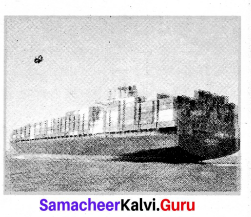
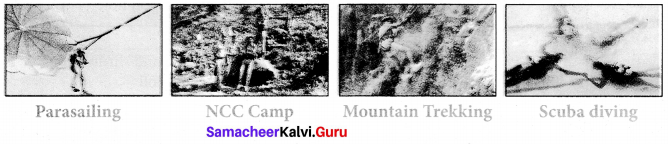
Look at the picture. Name the activities.
The Poem Of Adventure Samacheer Kalvi 7th English Term 2 Poem Chapter 1
Discuss and Answer.

Question 1.
What are the adventure activities of NCC?
Answer:
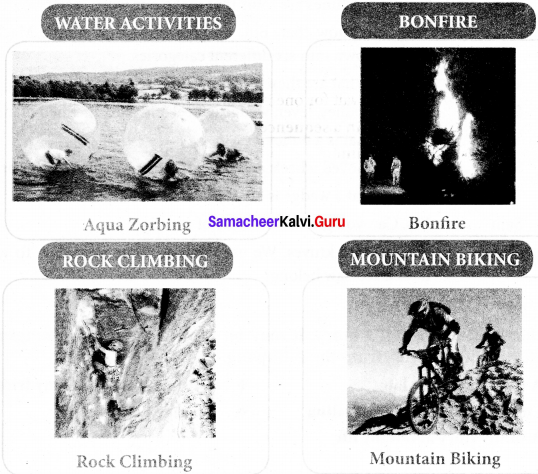
Mountain Treks, Parasailing, Scuba diving, Kayaking.

Question 2.
When can you join the NCC?
Answer:
I can join the NCC after completing 12 years.

Question 3.
What is the motto of NCC?
Answer:
The motto of NCC is to provide a suitable environment to motivate the youth to take up a career in the Armed forces.

Think and Answer.

Question 1.
Why do we need adventure in life?
Answer:
We need adventure to be confident, decisive and self-aware.

Question 2.
Do you like adventures? Why?
Answer:
Yes, I like adventures because they are thrilling.

Question 3.
Why does the NCC conduct adventure activities?
Answer:
NCC conducts activities to tone leadership skills and to enhance their character qualities.

The Poem of Adventure Summary

In this poem, the poet George Krokos relates to the Adventures of the knights. Adventures are hidden deep inside the mountains in all types of forms and shapes. The adventures have an excellent ending. People, who take up adventures in their life, see the world in an extraordinary special way. They feel that they have little wings on their back and whenever they take a new step, they bounce in joy.
In the olden days, knights were daring and chivalrous. They rode on their horses with a sword or spear and fought their opponents for a just cause. They regarded themselves as worthy of winning the hands of their fair ladies as a valuable prize for their valour. They impressed the crowd by fighting with their opponents. Even today, people talk with much applause about the brave adventures, deeds of the knights.
Samacheer Kalvi 7th English Solutions Term 2 Prose Chapter 2 The Last Stone Carver

Students can Download English Lesson 2 The Last Stone Carver Questions and Answers, Summary, Notes Pdf, Activity, Samacheer Kalvi 7th English Book Solutions Guide Pdf helps you to revise the complete Tamilnadu State Board New Syllabus and score more marks in your examinations.

Tamilnadu Samacheer Kalvi 7th English Solutions Term 2 Prose Chapter 2 The Last Stone Carver

Work in pairs.

A. Arrange the words in alphabetical order, find the meaning of the words from the dictionary and fill in the blanks.
( Ikebana Applique Origami Calligraphy Tapestry )

  1. Applique – Ornamental needle work
  2. Calligraphy – The art of producing decorative handworking.
  3. Ikebana – The art of Japanese flower arrangement.
  4. Origami – The Japanese art of folder paper into decorative shapes and forms.
  5. Tapestry – A form of Textile art.

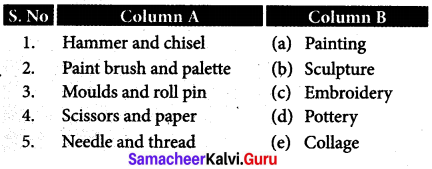
B. Match the tools with art forms.

The Last Stone Carver Question And Answer Samacheer Kalvi 7th English Term 2 Prose Chapter 2
Answer:

  1. b
  2. a
  3. d
  4. e
  5. c

Listening

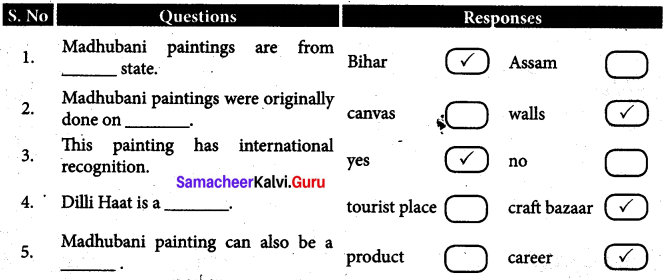
C. Listen to the teacher reading the passage. Read the questions given below, then listen to passage again and complete the responses.

The Last Stone Carver Samacheer Kalvi 7th English Term 2 Prose Chapter 2

Speaking
D. Work in pairs. Find answers to these questions and present it to the class.

The Last Stone Carver Question And Answer Question 1.
Do you have art / craft session in your school?
Answer:
Yes, we do have art and craft session in our school.

The Last Stone Carver Question 2.
Which session do you like – art / craft?
Answer:
I like the craft session.

The Last Stone Carver Summary Question 3.
What do you do in that session?
Answer:
We make a lot of new models.

The Last Stone Carver 7th Standard Question 4.
Do you work individually or in pairs?
Answer:
We work in pairs and groups.

The Last Stone Carver Book Back Answer Question 5.
Can you do an art work or a craft work on your own?
Answer:
I can do a craft on my down. I can do a model of a house.

The Last Stone Carver Lesson Question 6.
What qualities do you gain by doing art or craft?
Answer:

  1. We can develop fine Motor skills.
  2. Art and craft improves Hand – Eye coordination.
  3. It boosts self-esteem and helps in socializing.
  4. It also promotes innovation and creativity in an individual.

Grammar

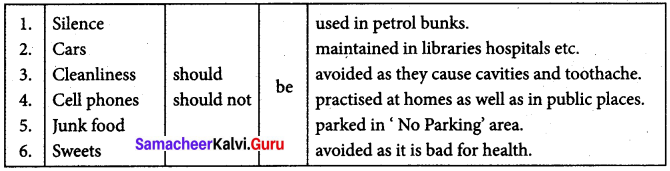
E. Construct meaningful sentences from the table given below

The Last Stone Carver Summary Samacheer Kalvi 7th English Term 2 Prose Chapter 2
Answer:

  1. Silence should be maintained in libraries, hospitals etc.
  2. Cars should not be parked in ’No Parking’ area.
  3. Cleanliness should be practised at homes as well as in public places.
  4. Cell phones should not be used in petrol bunks.
  5. Junk food should be avoided as it is bad for health.
  6. Sweets should be avoided as they cause cavities and toothache.

F. Read the news report given below and underline the passive form of verbs.

7th English The Last Stone Carver Question 1.
The police had announced that the State Bank of India was robbed yesterday. Two men entered the bank at 4.30 pm with guns in their hands. Customers and bank clerks were asked to lie down on the floor, and one of the bank clerks was made to fill robbers’ bags with money.After that the two men left the bank quickly. The police officer said that more thgn pqe lakh of rupees was stolen from the bank but nobody was injured. He also added that the robbers would be found soon.
Answer:
The police had announced that the State Bank of India was robbed yesterday. Two men entered the bank at 4.30 pm with guns in their hands. Customers and bank clerks were asked to lie down on the floor, and one of the bank clerks was made to fill robbers’ bags with money. After that the two men left the bank quickly. The police officer said that more than one lakh of rupees was stolen from the bank but nobody was injured. He also added that the robbers would be found soon.

Work in pairs

G. Rani’s teacher narrates to her students about the production of paper. Read the following narration and fill in the blanks with the verbs using their passive form.

People of China produced paper from wood. They mixed water with the fibres of wood and dried it, until they became a soft wet pulp. They used this pulp to make paper. The Chinese invented this method of paper making in 2nd century BCE. Later Egyptians used papyrus plants to make paper.

  1. Paper (produce) from wood.
  2. The fibres of wood from trees (mix) with water to make a soft wet pulp.
  3. Later, it (dry) to make paper.
  4. This method (invent) in 2nd BCE in China.
  5. Papyrus plants (use) by Egyptians to make paper.

Answer:

  1. was produced
  2. was mixed
  3. was dried
  4. was invented!
  5. were used

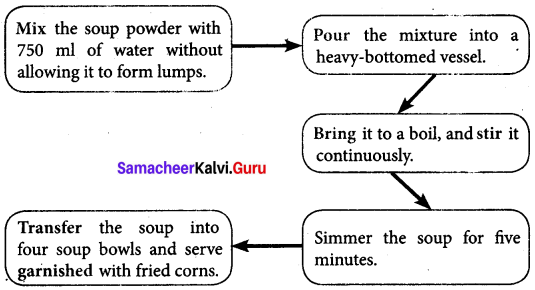
H. Read the process of making soup. Use suitable passive form of verbs and complete the paragraph.

The Last Stone Carver 7th Standard Samacheer Kalvi 7th English Term 2 Prose Chapter 2

The packet is opened and the contents

  1. are mixed with 750 ml of water, without allowing it to form lumps. The mixture
  2. is poured into a heavy-bottomed vessel. It
  3. is boiled in low flame for five minutes. The soup
  4. is transferred into soup bowls and
  5. is garnished with fried corns.

Writing
I. If you are asked to choose from any one of these toys which one do you choose? Give reasons, (plastic toys, wooden toys, clay toys, metallic toys)
Answer:
I would choose wooden toys because they are much more special that the latest educational technology. Wooden toys bring a certain amount of nostalgia with them. It is also a durable material for toys. The more contact, we have With the plastic toys, the higher are the chances of health issues like asthma. So the wooden toys are better for safety and also good for the child’s brain. The quality and life span of wooden toys are much better than plastic toys and metallic toys.

J. Your friend has presented a beautiful art piece on your birthday. Write a letter to her appreciating her art work.
Answer:

5 th August 2019
Salem

Dear Lathika,

I am extremely happy to write this letter to you, as I am very happy after receiving your present on my birthday. It is an excellent piece of art. The art piece called “Glow of Hope” is also referred to as the “Woman with the lamp”. It is a master piece from
S.L. Haldankar, produced in 1945-1946. Water colours are used deliberately. The effect of this painting is heightened with the shadow behind the subject. It is such a wonderful art by him. I thank you so much for this excellent art piece as a gift to me.

Your loving friend
Amritha.

Creative Writing

K. You have prepared some eco-friendly craft materials like paper mache dolls, greeting cards, book marks, festoons, garlands, quilling jewellery etc for an Art Mela to be conducted in you school premises. Describe in a few sentences how you made the craft work. Include the following details in your writing.

  • Name of the craft work
  • Materials used
  • Nature (handy / eco-friendly, longlasting / affordable price)
  • Use (place / person / time)

Answer:
We have made eco-friendly craft materials like paper mache dolls, greeting cards, book marks, festoons, garlands, quilling Jewellery for the Art Mela conducted in your school premises. The paper mache dolls were Russian Nesting Dolls. Paper – mache is a composite material consisting of paper pieces or pulp, reinforced with textiles and bound with glue. The beautiful hand made Birthday cards were excellent. They were made with cardboard, glue, colour pencils, glitter papers and some paper flowers. Festoons, garlands made out of crepe paper and quilling jewellery made out of quilled paper and flowers were excellent exhibits in the Mela. They were also sold to the students at affordable prices. They were safe to be used by everyone, as they are handy and eco-friendly.

The Last Stone Carver Additional Questions

I. Choose The correct Synonyms from the option below.

The Last Stone Carver Short Summary Question 1.
heaps
(a) things
(b) piles
(c) toys
(d) bits
Answer:
(b) piles

The Last Stone Carver Story Question 2.
offered
(a) gave
(b) bought
(b) ordered
(d) begged
Answer:
(a) gave

The Last Stone Carver Lesson Plan Question 3.
ache
(a) worry
(b) pain
(c) hurt
(d) relief
Answer:
(b) pain

Summary Of The Last Stone Carver Question 4.
tourists
(a) guests
(b) people
(c) travellers
(d) local
Answer:
(c) travellers

Question 5.
admiration
(a) hate
(b) praise
(c) wonder
(d) dislike
Answer:
(b) praise

Question 6.
stunned
(a)shocked
(b) wondered
(c) wounded
(d) active
Answer:
(a) shocked

Question 7.
startled
(a) surprised
(b) worried
(c) walked
(d) bold
Answer:
(a) surprised

Question 8.
stumbled
(a) gain confidence
(b) lost balance
(c) found lost
(d) induced
Answer:
(b) lost balance

Question 9.
serene
(a) calm
(b) swoon
(c) pale
(d) wild
Answer:
(a) calm

Question 10.
congested
(a) confused
(b) returned
(c) overcrowded
(d) deserted
Answer:
(c) overcrowded

II. Pick the correct Antonyms,

1. flung
(a) throw
(b) held
(c) send
(d) focus
Answer:
(b) held

Question 2.
indifferently
(a) concerned
(b) not interested
(c) unconcern
(b) apathetic
Answer:
(a) concerned

Question 3.
determination
(a) firmness
(b) weak mindedness
(c) fixedness
(d) will power
Answer:
(b) weak mindedness

Question 4.
waning
(a) decreasing
(b) increasing
(c) fading
(d) shrinking
Answer:
(b) increasing

Question 5.
confidence
(a) trust
(b) belief
(c) distrust
(d) hope
Answer:
(c) distrust

Question 6.
drenched
(a) dried
(b)soaked
(c) wet
(d) doused
Answer:
(a) dried

Question 7.
whispered
(a) spoke softly
(b) murmured
(c) shouted
(d) muttered
Answer:
(c) shouted

Question 8.
deceived
(a) fooled
(b) enlightened
(c) cheated
(d) tricked
Answer:
(b) enlightened

Question 9.
clumsily
(a) gracefully
(b) awkwardly
(c) crudely
(d) ineptly
Answer:
(a) gracefully

Question 10.
arching
(a) bending
(b) curving
(c) bowing
(d) straight
Answer:
(d) straight

III. Choose the Correct Answer (MCQ).

Question 1.
The young man flung the hammer and the _______
(a) file
(b) knife
(c) chisel
(d) hacksaw
Answer:
(c) chisel

Question 2.
The windows opened into a tiny _______
(a) backyard
(b) garden
(c) portico
(d) hall
Answer:
(a) backyard

Question 3.
The old man a lot these days _______
(a) worked
(b) prayed
(c) suffered
(d) enjoyed
Answer:
(b) prayed

Question 4.
It was the features and _______
(a) legs
(b) face
(c) hands
(d) eyes
Answer:
(c) hands

Question 5.
There was something missing in his _______
(a) figures
(b) statues
(c) carvings
(d) drawing
Answer:
(a) figures

IV. Very Short Questions with Answers.

Question 1.
How did the old man work on the sculpture.
Answer:
He worked tirelessly on the sculpture.

Question 2.
When did Salim join the workshop of the old man?
Answer:
Salim joined the workshop of the old man five years ago.

Question 3.
What was the name of his son?
Answer:
His son’s name was Gopal.

Question 4.
What filled the old man with happiness and confidence?
Answer:
The cool metal of the tools filled him with happiness and confidence.

Question 5.
What did the old man have for his breakfast?
Answer:
The old man had a glass of milk for breakfast.

Question 6.
Who was chiselling the statue after the old man opened his eyes?
Answer:
Salim was chiselling the statue.

Question 7.
What did Salim want to become?
Answer:
He wanted to become a stone carver.

Question 8.
What statue did the old man carve?
Answer:
The old man carved the statue of Lord Krishna.

V. Short Questions with Answers.

Question 1.
Why was Gopal indifferent to his father’s profession?
Answer:
Gopal was more practical than his father. Gopal believed that being traditional, sculptors wouldn’t pay them for a decent life. He believed that making candle- stands, paper-weights and ashtrays would bring them good revenue.

Question 2.
Why was the master sculptor not able to understand his son’s stance?
Answer:
The master mason loved his work and didn’t want to change it for any other work in the world. He told his son that it was the work he had learnt from his father and had kept up the traditions for hundreds of years.

Question 3.
How did the master mason’s love for his work ruin his life?
Answer:
The man worked continuously without taking any rest for many days. His one desire was to finish the sculpture, which would be his last. He worked till his hands began to tremble and his shoulders started to ache. His arms grew heavy and his eyes grew tired then he couldn’t see anymore.

VI. Paragraph Questions with Answers.

Question 1.
What was wrong with masterjee?
Answer:
Masterjee, as he was known in his little village was a traditionalist. He was superstitious. He believed that Gods have entrusted the work of idol-making to his ancestors. So he, his sons and daughters should do the same work. For him, choosing another work – however profitable it was – was a sin. He was so much blind that he didn’t see the poverty that his family was suffering and had no commonsense to see that Gods would never want a group of people to starve and die.

Question 2.
Why did masterjee tell Salim that he was going to be the last stone-mason in his village?
Answer:
“Masterjee, Masterjee” Salim, the servant boy entered the workshop. His voice was filled with concern. He held a cup of tea in his hand. The old man lifted his head. He had a pale face and looked old and tired. He said, “Salim, soon I’ll be the last stone mason here, as everyone has gone to Agra. Look, Gopal my son has gone too. Now I’ll have to finish this sculpture all by myself. I can’t work with the chisel the way I used to do. But I have to finish the work and I will”.

The Last Stone Carver Grammer Additional

Passive Form

A. Rewrite the sentences using the passive forms of the verbs underlined.

Question 1.
He took the book.
Answer:
The book was taken by him.

Question 2.
She is writing the exam.
Answer:
The exam is being written by her.

Question 3.
The children sang a song
Answer:
A song was sung by the children.

Question 4.
She has submitted her work book
Answer:
Her work book has been submitted by her.

Question 5.
The carpenter will make a table for me.
Answer:
A table will be made by the Carpenter for me.

B. Fill in the blanks using the verbs in their passive form.

The young man flung the hammer and the chisel to the ground and cried “I’m leaving Father. I’m leaving you and this work. Look what it’s brought us!” He spread out his arms and glanced indifferently at the small congested workroom. The monsoons stained the white washed walls.
The hammer and chisel (i) ________ (flung) to the ground by the young man. He cried that he (ii) ________ (leave). His arms (iii) ________ (spread) out. The congested workroom (iv) ________ (glanced) indiferently by him. The white washed walls (v) ________ (stained) by monsoons.
Answer:

  1. were flung
  2. was leaving
  3. were spread
  4. was glanced
  5. were stained

C. Fill in the blanks using the passive form of verbs.

Today, a provision store (i) ______ (rob) by a group of people who (ii) ______ (catch) red-hand by the shop authorities. They (iii)_______ (hand over) to the police immediatly The culprits (iv) ______ (arrest) and (v) ______ (take) into the custody . the shop owners
(vi) ______ (request) by the police to fix a CCTV in the shop.
Answer:

  1. was robbed
  2. were caught
  3. were handed over
  4. were arrested
  5. were taken
  6. were requested

Warm up
Work in pairs.

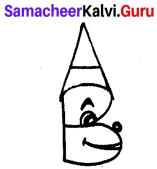
Read the instructions given below, draw and name the picture

1. Draw a Letter A
2. Just below draw a letter B. So A is a cap for B.
3. Give B one eye, a round nose and a big mouth.
Answer:
The Last Stone Carver Book Back Answer Samacheer Kalvi 7th English Term 2 Prose Chapter 2

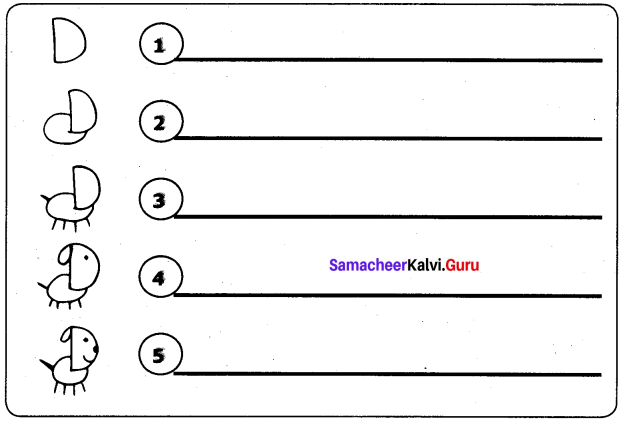
Write step by step instructions for the following picture.

 The Last Stone Carver Lesson Samacheer Kalvi 7th English Term 2 Prose Chapter 2
Answer:
1. Draw a letter ‘D’.
2. Draw a semi circle starting from the middle of ‘D’.
3. Draw a tail and four legs.
4. Draw an ear at the top of ‘D’.
5. Give a round nose and a big mouth.

The Last Stone Carver Summary

Section – I

An old man was a traditional sculptor. He made a living by making statues for temples. He did this work because he believed in traditions. His father was a sculptor, too. But his son Gopal was different. He used to argue with his father about the stupidity of not changing his profession for good. One day, Gopal went off home for Agra to be a more successful man in life. The old man knew that his son’s decision was good but he was helpless. He loved his traditions and his sculptures. After his son’s departure, he continued his work. He had a servant by named Salim who was very dedicated to him. He came to work there five years ago.

Which of the two sentences given below convey the following meaning?

Question 1.
stained by – mark made on clothe or materials
The white washed walls were stained by many monsoons.
(a) The walls were made dirty by rains.
(b) The Monsoon removed the dirt from the walls.
Answer:
(a) The walls were made dirty by rains.

Question 2.
working for a pittance – working for very little money I am tired of working for a pittance.
(a) He didn’t want to work because he was tired.
(b) He didn’t want to work as he gets low income for his work.
Answer:
(b) He didn’t want to work as he gets low income for his work.

Question 3.
ashen-pale
His face was ashen.
(a) He looked pale and dull.
(b) He looked bright and cheerful.
Answer:
(a) He looked pale and dull.

Question 4.
drenched – thoroughly wet
He is drenched to the skin.
(a) He is thin and skinny.
(b) He is thoroughly wet.
Answer:
(a) He is thin and skinny.

Section – II

The old man struggled hard for a month to complete the statue of Radha and Krishna. His hands were weak and his mind was weak. He didn’t feel hunger and thirst. His chisel was striking the stone / again and again. He had a strong desire to complete his work. He prayed and cried. He wanted his son to help him. Finally, in the wake of the day, the old man fainted.

Read the sentences and number them in correct order.

  1. The old man worked tirelessly on the sculpture.
  2. He had a strong wish to finish it in time.
  3. Over days, he felt very weak.
  4. He thought he wouldn’t be able to finish it.
  5. He wished to have Gopal with him.
  6. He realized that Gopal must learn to carve the finer details.
  7. Salim felt that it should come from within.

Section – III

Next day, when he opened his eyes, the old man saw someone completing the statue that! he had left unfinished. ‘Was it Gopal’, he thought. No, it was his servant boy, an orphan Salim. { Salim was sculpting Krishna’s statue in a wonderful way.

The old man watched everything with shock. The first wave of shock, fear and anger passed to give way to a feeling of great relief and happiness. Salim said that he had practised sculpting secretly for almost two years in the quarry. He wanted to become a sculptor like his master. He begged his master to teach him ‘Stone carving’. The old man told that there was nothing to teach him, as he already has it in his hands and heart. He has found his successor.

Read Section – III (para 1 and 4) and answer the following questions.
Paragraph 1

  1. Who listened to the chipping sound of the chisel? The old man
  2. Who was working with the hammer and chisel? Salim

Paragraph 4

  1. Who was staring? The old man
  2. Who was the young stone carver? Salim
  3. What was he working on? The face of the statue.

Samacheer Kalvi 7th English Solutions Term 1 Prose Chapter 2 The Wind on Haunted Hill

Students can Download English Lesson 2 The Wind on Haunted Hill Questions and Answers, Summary, Notes Pdf, Activity, Samacheer Kalvi 7th English Book Solutions Guide Pdf helps you to revise the complete Tamilnadu State Board New Syllabus and score more marks in your examinations.

Tamilnadu Samacheer Kalvi 7th English Solutions Term 1 Prose Chapter 2 The Wind on Haunted Hill

Read And Understand

A. Choose the most appropriate option.

The Wind On Haunted Hill Question Answer Question 1.
The wind hurried and passed through the
(a) apples and mangoes
(b) pines and deodars
(c) berries and cherries
Answer:
(b) pines and deodars

The Wind On Haunted Hill Question 2.
The market was
(a) 3 miles
(b) 7 miles
(c) 11 miles
Answer:
(a) 3 miles

The Wind On Haunted Hill Pdf Question 3
Usha went to visit her.
(a) Grand father
(b) aunt’s
(c) Cousin’s
Answer:
(b) aunt’s

The Wind On Haunted Hill Question Answers Question 4.
Usha took shelter in the
(a) ruins
(b) caves
(c) dens
Answer:
(a) ruins

The Wind On Haunted Hill 7th Std Prose Question 5.
At dawn, the
(a) cuckoo
(b) linnet
(c) thrush
Answer:
(c) thrush

B. Think and answer

The Wind On Haunted Hill Book Back Answers Question 1.
Why was it a struggle for the children to dry their clothes?
Answer:
It was a struggle for the children to dry their clothes because there was always a wind – which blew away the clothes.

The Wind On Haunted Hill Questions And Answers Question 2.
What story did grandfather tell them about the haunted hill?
Answer:
Grandfather told Usha and Suresh about the English people who lived on the hill a hundred years ago. During a terrible storm one of the houses was hit by lightning and all the English people in it were killed, including the children – a brother and sister. Grandfather had seen the ghosts many times playing in the moonlight.

The Wind On Haunted Hill Summary Question 3.
What did Usha buy in the market? List them.
Answer:
Usha bought soap, matches, spices, sugar, a new pipe stem for grandfather’s hookah, an exercise book and marbles for Suresh and a necklace for herself.

The Wind On Haunted Hill 7th Std Prose Question 4.
What scared Usha during the dark rainy night?
Answer:
The black clouds, the howling wind, the heavy rain, sudden flash of lightning, the wild cat, the storm, the booming thunder and the ghosts scared Usha during the dark rainy night.

7th Standard The Wind On Haunted Hill Question 5.
How did the children react when they met each other at the ruins?
Answer:
When the children met each other at the ruins they fell into each other’s arms, they were surprised and relieved, that all they could do was laugh and giggle and repeat each others names.

C. Discuss in class.

The Wind On Haunted Hill Explanation Question 1.
“Was it just the wind?”- What do you think Usha thought it was? Why?
Answer:
Usha thought it was the two ghostly creatures that she had seen in the night at the old fireplace. When the top of the plum tree swayed, it looked like a hand waving. Even the voices of the wind seemed like someone saying goodbye.

Vocabulary

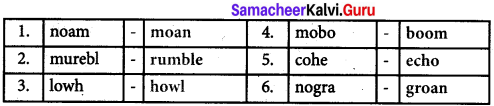
D. Unscramble the sound – describing words from the text. One has been done for you.
Eg : igeglg – giggle
Answer:
The Wind On Haunted Hill Question Answer Samacheer Kalvi 7th English Term 1 Prose Chapter 2

E. The Detective’s Dictionary!
Choose the correct word from the box and fill in the blanks
(evidence,clue,detective,suspect,Victum)

  1. A _______ is someone who investigates a crime.
  2. A _______ is someone who suffers the effect of a crime
  3. Someone who might have committed a crime is a .
  4. A is an idea or fact that helps us solve a mystery.
  5. An ______ proves us that something is true

Answer:

  1. detective
  2. Victum
  3. suspect
  4. clue
  5. evidence

Listening

F. Listen to the news report carefully and complete the following.

Question 1.
Name of the place.
Answer:
Gollamudi in Andhra Pradesh.

Question 2.
What happened?
Answer:
There was a ‘rain of fish’.

Question 3.
What time of day did it happen?
Answer:
It happened in the early hours of the morning.

Question 4.
What did the people say?
Answer:
The people said that it was a fish not usually found there.

Question 5.
What do strong winds and gales carry?
Answer:
Strong winds and gales sometimes carry fish and sea animals along with the water from rivers and canals.

Speaking

G. Work in pairs.

Question 1.
Have you ever been scared?
Answer:
Yes, when I happen to go in the dark at night alone on the road.

Question 2.
What happened?
Answer:
Suddenly a black car came fast and flashed the head lights on my face.

Question 3.
How did you feel?
Answer:
I felt shocked and was shaken.

Question 4.
Talk about it in one or two sentences with your friend. Repeat it to the class.
Answer:
Once I had to go to get an emergency medicine for my dad which was not available any where nearby. I walked more than one kilometer through the dark streets with fear in my heart. Unexpectedly a car came in front of me and flashed its head lights on my face. I started running to escape from being crashed under its wheels. The driver applied the brakes and apologized.

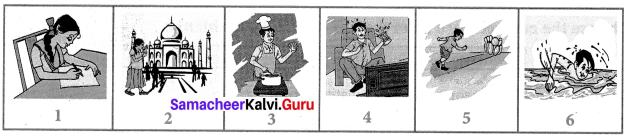
Grammar

H. Frame five questions using the picture clues. Begin with “Have you ever”.

The Wind On Haunted Hill Samacheer Kalvi 7th English Term 1 Prose Chapter 2

Question 1.
Write a story
Answer:
Have you ever written a story?

Question 2.
Visit the Tajmahal
Answer:
Have you ever visited the Tajmahal?

Question 3.
Cook briyani
Answer:
Have you ever cooked biryani?

Question 4.
Watch a horror film
Answer:
Have you ever watched a horror film?

Question 5.
Play Ten pin bowling
Answer:
Have you ever played Ten pin bowling?

Question 6.
Go swimming
Answer:
Have you ever gone for swimming?

I. Fill in the blanks with the past perfect tense with the help of the words given in the bracket

  1. When Usha looked out of the window dark clouds _______ (gather) over the mountains.
  2. She had no umbrella with her; the weather _______ (seem) so fine just a few hours ago.
  3. All was dark again. Night _______ (fall)
  4. She ran toyvards the big gap in the wall through which she (enter).
  5. Usha looked back at the ruins. The sun _______ (come) up and was touching the top of the

Answer

  1. had gathered
  2. had seemed
  3. had fallen
  4. had entered
  5. had come

J. Read this text and fill in the blanks with future tense.

Iniya moves to Chennai to join an IAS coaching class. Tomorrow by this time, she ___(i)___ (join) the class. She ___(ii)___ (undergo) training till next year. She ___(iii)___ (work) very hard by the time she comes home. Her parents ___(iv)___ (worry) about her health all the time. They___ (v)___ (write) many letters by the time she comes home. They will be very happy when Iniya becomes an IAS officer.
Answer:

  1. would have joined
  2. will have to undergo
  3. would have worked
  4. would be worried
  5. would have written

Writing

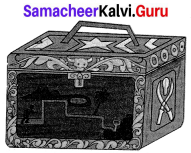
K. Nalan’s grandfather showed him an old treasure trunk. A road map was stuck on the trunk. It showed the spot where a key was hidden. Look at the road map and write five directions to reach the spot where the key is hidden Discuss with your partner and compare your directions with those of your classmates.
The Wind On Haunted Hill Pdf Samacheer Kalvi 7th English Term 1 Prose Chapter 2

Answer:

  1. Walk straight and turn to the left at the end of the bend.
  2. Again reach the end and turn to the right, walking along the foot hills.
  3. At the bend near the pond now turn to the right again and then to the left
  4. Walk straight passing the single coconut tree at the end of the path.
  5. Finally turn the curve to reach the rocky area where the key is kept behind the first rock.

Creative Writing

Venba was walking along the beach. When she saw a beautiful green perfume bottle that had been washed up on the shore she bent down and picked it up. There was something inside the bottle and it was calling her. When she opened the bottle….?!!!

N. Imagine you are Venba and act the situations in the class. Then conclude this mysterious story in your own words. Write at least five or six sentences with the help of the words given in the box.
(Tiny,Sing,Talk,Bird,Free,Flay,Gift,Thanks)
Answer:
When I picked the green perfume bottle on the sea-shore the tiny creature inside the bottle pleaded me to open the lid. When I opened the bottle it was free to fly out and started to sing like a happy bird. It came near me and started to talk to me and I was surprised. It told its story of how it went into the bottle and said, “Thank You!” to me for setting it free. It gave me a bunch of golden feathers as gift before it left.

The Wind on Haunted Hill Additional Questions

I. Choose the correct Synonyms from the options below.

Question 1.
hummed
(a) sing with closed lips in a low voice
(b) sing without words
(c) make sound
Answer:
(a) sing with closed lips in a low voice

Question 2.
rattled
(a) thunder
(b) horn sound
(c) moving with quick light steps
Answer:
(c) moving with quick light steps

Question 3.
fluttered
(a) fly unsteadily by flapping
(b) move the wings
(c) getting ready to fly
Answer:
(a) fly unsteadily by flapping

Question 4.
plumage
(a) colorful feathers
(b) birds feathers
(c) feathers on the head of a bird
Answer:
(b) birds feathers

Question 5.
tripped
(a) run
(b) jog
(c) moving with quick light steps
Answer:
(c) moving with quick light steps

Question 6.
pellets
(a) a piece of shot
(b) small long bits
(c) long slender pieces
Answer:
(a) a piece of shot

Question 7.
trinkets
(a) neck jewel
(b) a small inexpensive ornament
(c) leg ornament
Answer:
(b) a small inexpensive ornament

Question 8.
slung
(a) hang
(b) cling
(c) clipped
Answer:
(a) hang

Question 9.
rumble
(a) clashing of stones
(b) rolling noise
(c) low continuous sound
Answer:
(c) low continuous sound

Question 10.
pace
(a) measure
(b) step
(c) Walk
Answer:
(b) step

Question 11.
leapt
(a) to jump high suddenly
(b) Pounce
(c) leap high
Answer:
(a) to jump high suddenly

Question 12.
venturing
(a) involving in a risky activity
(b) adventure
(c) taking up a new activity
Answer:
(a) involving in a risky activity

Question 13.
stinging
(a) to bite
(b) hurting with a pointed thing
(c) a sharp tingling sensation
Answer:
(c) a sharp tingling sensation

Question 14.
boomed
(a) sudden explosion
(b) make a loud deep sound
(c) unexpected burst
Answer:
(b) make a loud deep sound

Question 15.
chattering
(a) informal talk
(b) talk unnecessarily
(c) talking to pass time
Answer:
(a) informal talk

II. Pick the correct Antonyms.

  1. Stunted × _______ (rapid, fast growth, tall)
  2. staring × _______ (gentle look, peep, glancing)
  3. chop × _______ (chaining, join, link)
  4. glistening × _______ (sober, dull, dusty)
  5. peal × _______ (whisper, speak softly, dumb)
  6. steeply × _______ (slope,slanting)
  7. brow × _______ (valley, foot hill, bottom)
  8. snarl × _______ (creek, sob, mewed)
  9. straggling × _______ (rooted, deep foundation, firm)
  10. crouching × _______ [EM standing]
  11. instantly × _______ (gradually, pause, slowly)

Answer:

  1. rapid
  2. glancing
  3. join
  4. dull
  5. whisper
  6. foot hill
  7. mewed
  8. rooted
  9. slowly

III. Choose the Correct Answers (MCQ).

Question 1.
Binya was not able to go with Usha to the bazaar as she had to __________
(a) help grandfather to cut wood
(b) help with the cows
(c) pick dry clothes
Answer:
(b) help with the cows

Question 2.
Usha bought for herself a necklace of amber coloured beads from an __________ old lady.
(a) Nepali
(b) Pakisthan
(c) Tibetan
Answer:
(c) Tibetan

Question 3.
Usha knew that it was __________ the month of storms.
(a) May
(b) April
(c) March
Answer:
(c) March

Question 4.
When they left the ruins, the ______ had come up and was touching the top of the walls.
(a) tree
(b) bird
(c) sun
Answer:
(c) sun

IV. Very Short Questions with Answers.

Question 1.
Who was Binya?
Answer:
Binya was Usha’s friend and neighbour slightly older to her.

Question 2.
What did Aunt Lakshmi talk to Usha?
Answer:
Aunt Lakshmi spoke to Usha about her left shoulder ache and the stiffness in her joints.
Question 3.
What did Usha have in her hand while returning home? How did she hold it?
Answer:
Usha had her shopping bag in her hand . She was holding it close to her body.

Question 4.
What was holding the tin sheet from sailing away at any moment?
Answer:
The tin sheet was held down by the solid branch of a straggling old oak tree.

Question 5.
How did Usha, Suresh and Binya react when they saw each other in the ruins?
Answer:
They were surprised, relieved, laughed and giggled repeating each others names.
V. Short Questions with Answers.
Question 1.
What do you know about Suresh?
Answer:
Suresh was the younger brother of Usha. He was eight years old, chubby and almond eyed. His father was in the army. He helped his grandfather in chopping the wood. He was always ready to visit the bazaar on the other side of the haunted hill.

Question 2.
Write about the path taken by Usha to reach the bazaar.
Answer:
Usha first went through the fields, then along the saddle of the hill, from there she took the path straight through the ruins. Later the path dipped steeply down to the valley to reach the little town.

Question 3.
Describe the changes in nature before it started raining.
Answer:
Before it started raining, the wind dropped. The trees were still and not a leaf moved. The crickets were silent in the grass. The crows flow round in circles and then setded on an oak tree for the night. The sky was darkening. The black clouds threatened. A deep rumble echoed over the hills.

Question 4.
Explain the appearance of Usha when she was running in the rain towards the ruins.
Answer:
Usha was tying an old scarf on her head and had pulled her shawl tight across her shoulders. She had no umbrella. She was holding her shopping bag close to her body and was walking fast keeping large steps.

Question 5.
How was the nature in the morning on the brow of the hill after the storms of the previous
night?
Answer:
In the morning the rain had stopped. The thrush began to sing. The plum tree stood upright again. The sky grew pink and there was a light breeze.

VI. Paragraph Questions with Answers.

Question 1.
Narrate Usha’s encounter with the ghostly figures.
Answer:
In the background of the thunder and lightning, there was a bigger flash and the entire ruin was lit up for more than a second. When the wall opposite Usha was lit up, she saw crouching in the disused fireplace, two small figures who could have been children. Usha starred straight and the ghostly figures also looked up starring back at Usha.

Question 2.
How did Usha, Suresh and Binya meet in the ruins? What was their reaction?
Answer:
Usha came to the ruins to take shelter from the storm. At the same time, Suresh and Binya came looking for Usha, as it grew dark. When the storm broke they too came into the ruins.

When Usha was running out of the ruins on seeing the ghostly creatures, on her way something fell against her. When she stumbled and got up, she again bumped into something and gave a frightened scream. As a reply there was a familiar boys shout which Usha immediately understood it was Suresh.

The three fell into each other’s arms. They were surprised and relieved as they laughed, giggled and repeated each others names. Usha thought that Binya and Suresh were ghosts and they thought that she was a ghost. Usha called them to the shelter of the ruins and they huddled together in the corner chattering excitedly. They gave each other warmth and confidence. They were not afraid now.

The Wind on Haunted Hill Grammar Additional

Tenses

TenseSample SentenceExercise
Simple Present tense:

Tells about things which ai;e true in the present

You live in IndiaMy name is………

I study in class…….

Present Continuous TenseI am driving car.I am climbing Mount Everest
Present perfect tenseI have completed.I have voted
Present perfect Continuous tenseI have been collecting taxes.I have been writing books
Simple Past TenseWe reached Agra in the morning.You came home yesterday
Past Continuous TenseI was sleeping at 2.00 a.m.Mom was cooking in the morning
Past Perfect tenseShe had not come to school for two days.Tom had not visited Aunt for many days
Past Perfect Continuous tenseI had been playing for 3 hours.The boy had been attending school for four years.
Simple Future TenseI will see you Monday.I will come back tomorrow.
Future Continuous TenseI will be flying at 10 pm tonight.I will be lecturing at 9 am today
Future Perfect TenseI will have completed by 5 pm today.I will have done by evening
Future Perfect Continuous tense:I may be hungry when I see you because I will have been fasting.I may be penniless when I meet you because I will have been spending

I. The following sentences contain direct speech. Rewrite them using correct punctuation.

Question 1.
I must go to the bazaar today said Usha,
Answer:
“I must go to the bazaar today,” said Usha

Question 2.
No old people don’t mind seeing ghost.
Answer:
“No. Old people don’t mind seeing ghosts.”

Question 3.
I must go home before dark Usha said to herself.
Answer:
“I must go home before dark,” said Usha to herself.

Question 4.
Come on said Suresh I m hungry
Answer:
“Come on,” said Suresh. “I’m hungry”

Question 5.
Are there many ghosts in the ruins asked Binya.
Answer:
“Are there many ghosts in the ruins?” asked Binya.

II. A group of words that makes sense but not complete sense is called a ‘phrase’. Complete the sentences using suitable phrases from the box

during the dayin these partsup before herin a circleout of the floor
  1. Ghosts dont’t appear _____
  2. There was nearly always a wind in _____
  3. The crows flew round _____
  4. A wild plum tree grew straight _____
  5. The ruins looked _____, grim and forbidding.

Answer:

  1. during the day
  2. in these parts
  3. in a circle
  4. out of the floor
  5. up before her

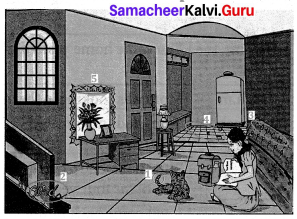
Warm up

Find the hidden words in the pictures. One has been done for you.

The Wind On Haunted Hill Question Answers Samacheer Kalvi 7th English Term 1 Prose Chapter 2
Answer:

  1. Cat
  2. Cord
  3. Couch
  4. Tiles
  5. Mirror

Question 2.
Solve these riddles.
Answer:
Question (who am I?)

  1. I have a face but no eyes, hands but no arms.
  2. I sit in a corner while travelling around the world.
  3. I go up when rain comes down.
  4. I have a head and a tail but no body

Answer:

  1. Clock
  2. Stamp
  3. Umbrella
  4. Coin

The Wind on Haunted Hill Summary

Section – I

Usha goes for shopping

The wooing wind blew from the Himalayas over the hills and trees. It passed the haunted hill and reached the village, on the slope of the next hill. It tried to blow away the tin roofs, doors, windows, chimneys and clothes even on sunny days.

Usha, her brother Suresh and her friend Binya spread their clothes out to dry, firmly holding them by rocks. They rested awhile there. Usha planned to go for weekly shopping. Binya could not go with her. Suresh was willing but he had to help Grandpa. He was worried about how she would return alone in the dark passing the Haunted hill.

Grandfather told a story about an English family which lived on the Haunted hill a hundred years ago and the family members were killed by lightning. Grandfather had seen the two children of the family often playing in the moonlight near the ruins even now. This frightened them.Usha went for weekly shopping passing the fields, hill, ruins and valley. The ruined house had crumbling walls with wild flowers, a wild plum tree in the floor of the large hall, lizard on the stones and singing bird on the empty window.

Usha bought soap, matches, spices, sugar, pipe stem, exercise book, marbles and necklace at the bazaar.

She went to Aunt Lakshmis house for tea and when the clouds gathered for rain she hurried home after collecting her mother’s slippers from the cobbler.

Reading

Listen to the teacher read this section.
As you listen,

a. Underline the words or phrases that tell you what the wind does to the village.
Answer:
Blew the tin roofs, rattled the doors and windows, choked the chimneys and blew the clothes.

b. Write the names of the characters in this story.
Answer:

  1. Usha
  2. Suresh
  3. Binya
  4. Grandfather
  5. Aunt Lakshmi

Work in pairs. Read the story above and find the answers to these questions.

Question 1.
What were the children doing beside the stone wall?
Answer:
The children were spreading the clothes out to dry, beside the stone wall.

Question 2.
What did Suresh ask Usha? Why?
Answer:
Suresh asked Usha if he could go with her to the bazaar because Usha would be afraid to come back alone as there were ghosts on the hill.

Question 3.
Who told the children the story about the ghosts on Haunted Hill?
Answer:
Grandfather told the children about the story of the ghosts on the Haunted Hill.

Section – II

Storm on the haunted hill

The clouds and thunder were threatening to rain. So Usha hurried to reach home before dark. She did not have an umbrella but only a shawl and a scarf. Now the raindrops came faster. It was dark and lightning. Usha ran to the ruins to take shelter from the heavy winds and rain. She moved sideways to reach the corner of the old roof for shelter but touched a wild cat and was frightened. It was dry and more sheltered at the old fireplace opposite, but she did not know the way in the darkness. Her clothes and long black hair were soaked. The sound of the tin sheets and the storm blotted out all other sounds.

The lightning and thunder were often, Usha remembered grandpas story about lightning killing the English family and prayed it would not strike her. Suddenly when the lightning flashed again, Usha saw two small figures at the opposite wall near the disused fireplace – they could have been the children.

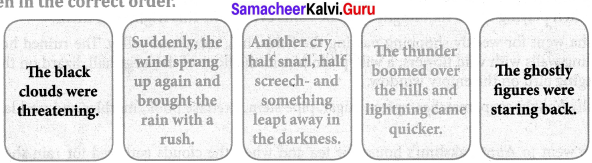
Two scary events from this section are listed here. Write the events that take place in between in the correct order.
Answer:
The Wind On Haunted Hill 7th Std Prose Samacheer Kalvi Term 1 Prose Chapter 2

Section – III
A night at the haunted hill

Usha wanted to leave the ruined building after seeing the two ghostly creatures. As she rushed out she bumped on something and screamed. There were reply screams and it was of Suresh and Binya. They had come looking for Usha in the stormy night. They were surprised, relieved and happy. They decided not to go home in the dark, thunder, lightning and rainy night when the paths also had fallen. Together they had warmth and confidence and stayed in the ruins all night, till the morning. They left the ruins on the top of the hill as the rain had stopped, birds began to sing, the sky was pink and bright and Suresh was hungry. As they were climbing down home, Usha saw a hand waving at them from the brow. Binya said it was the sway of the plum tree. But Usha also heard voices on the wind saying ‘Good Bye’. Usha wondered if it was just the wind.

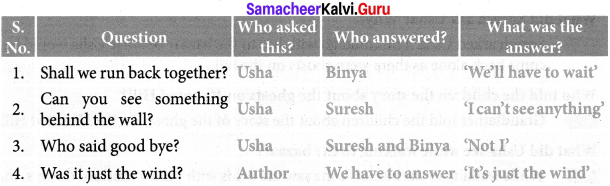
Discuss with your partner and complete the table
Answer:

The Wind On Haunted Hill Book Back Answers Samacheer Kalvi 7th English Term 1 Prose Chapter 2

Samacheer Kalvi 7th Science Solutions Term 1 Chapter 1 Measurement

Students can Download Science Chapter 1 Measurement Questions and Answers, Notes Pdf, Samacheer Kalvi 7th Science Book Solutions Guide Pdf helps you to revise the complete Tamilnadu State Board New Syllabus and score more marks in your examinations.

Tamilnadu Samacheer Kalvi 7th Science Solutions Term 1 Chapter 1 Measurement

Samacheer Kalvi 7th Science Measurement Textual Evaluation

I. Choose the appropriate answer:

Samacheer Kalvi Guru 7th Science Question 1.
Which of the following is a derived unit?
(a) mass
(b) time
(c) area
(d) length
Answer:
(c) area

Measurement 7th Standard Science Question 2.
Which of the following is correct?
(a) 1L=lcc
(b) 1L= l0cc
(c) 1L= l00cc
(d) 1L= l000cc
Answer:
(d) 1L = 1000cc

Measurement Lesson 7th Standard Question 3.
SI unit of density is
(a) kg/m2
(b) kg/m3
(c) kg/m
(d) g/m3
Answer:
(b) kg/m3

7th Science Measurement Question 4.
Two spheres have equal mass and volume in the ratio 2:1. The ratio of their density is
(a) 1:2
(b) 2:1
(c) 4:1
(d) 1:4
Answer:
(b) 2:1

Samacheer Kalvi 7th Science Solutions Term 1 Chapter 1 Measurement Question 5.
Light year is the unit of
(a) Distance
(b) time
(c) density
(d) both length and time
Answer:
(a) Distance

II. Fill in the blanks:

  1. Volume of irregularly shaped objects are measured using the law of ___________
  2. One cubic metre is equal to ___________ cubic centimetre.
  3. Density of mercury is ___________
  4. One astronomical unit is equal to ___________
  5. The area of a leaf can be measured using a ___________

Answer:

  1. Archimedes
  2. 10,00,000 or 1066
  3. 13,600 kg/m3
  4. 1.496×10¹¹m
  5. graph sheet

III. State whether the following statements are true or false.

7th Standard Science Measurement Question 1.
The region covered by the boundary of the plane figure is called its volume.
Answer:
(False) Correct statement: The region covered by the boundary of plane figure is called its area.

7th Standard Measurement Question 2.
Volume of liquids can be found using measuring containers.
Answer:
True

Science Measurement Lesson Question Answer Question 3.
Water is denser than kerosene.
Answer:
True

Unit 1 Measurement Question 4.
A ball of iron floats in mercury.
Answer:
True

Measurement Lesson Question Answer Question 5.
A substance which contains less number of molecules per unit volume is said to be denser.
Answer:
False. Correct statement: A substance which contains more number of molecules per unit volume is said to be denser.

IV. Match the items in column – I to the items in column – II :

Samacheer Guru 7th Science Question 1.

Column -1Column – II
i.Area(a)light year
ii.Distance(b)m3
iii.Density(c)m2
iv.Volume(d)kg
V.Mass(e)kg/ m3

Answer:

  1. i
  2. ii
  3. iii
  4. iv
  5. v

7th Standard Measurement Lesson Question 2.

Column -1Column – II
i.Area(a)g / cm3
ii.Length(b)measuring jar
iii.Density(c)amount of a substance
iv.Volume(d)rope
V.Mass(e)plane figures

Answer:

  1. i
  2. ii
  3. iii
  4. iv
  5. v

V. Arrange the following in correct sequence :

Samacheer Kalvi 7th Science Guide Question 1.
1L, 100 cc, 10 L, 10 cc
Answer:
10 cc, 100 cc, 1L, 10L

Samacheer Kalvi 7th Science Question 2.
Copper, Aluminium, Gold, Iron
Answer:
Aluminium, Iron, Copper, Gold

VI. Use the analogy to fill in the blank:

Samacheer Kalvi 7th Science Solution Question 1.
Area: M2 :: Volume : _________
Answer:
M3

Samacheer Kalvi 7th Science Answers Question 2.
Liquid : Litre :: Solid : _________
Answer:
cm3

7th Standard Science Unit 1 Measurement Question 3.
Water: Kerosene :: ______ : Aluminium
Answer:
Iron

VII. Assertion and reason type questions:
Mark the correct choice as

(a) Both assertion and reason are true and reason is the correct explanation of assertion
(b) Both assertion and reason are true, but reason is not the correct explanation of assertion
(c) If assertion is true but reason is false
(d) Assertion is false but reason is true.

7th Measurements Question 1.
Assertion (A) : Volume of a stone is found using a measuring cylinder.
Reason (R) : Stone is an irregularly shaped object.
Answer:
(a) If both assertion and reason are true and reason is the correct explanation of assertion

Class 7 Science Measurement Question 2.
Assertion (A) : Wood floats in water.
Reason (R) : Water is a transparent liquid.
Answer:
(b) If both assertion and reason are true, but reason is not the correct explanation of assertion
Correct explanation: Density of water is more than the density of wood.

Samacheer Kalvi.Guru 7th Science Question 3.
Assertion (A) : Iron ball sinks in water.
Reason (R) : Water is denser than iron.
Answer:
(b) If both assertion and reason are true, but reason is not the correct explanation of assertion
Correct explanation : Density of iron is more than that of water.

VIII. Give very short answer:

Samacheer Kalvi Guru 7th Science Book Back Answers Question 1.
Name some of the derived quantities.
Answer:
Area, volume, density.

Samacheer Kalvi Guru 7th Standard Science Question 2.
Give the value of one light year.
Answer:
One light year = 9.46 x 10¹⁵m

Samacheer Kalvi Guru Science 7th Question 3.
Write down the formula used to find the volume of a cylinder.
Answer:
Volume of a cylinder = πr2 h

Question 4.
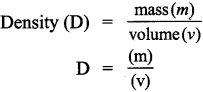
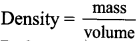
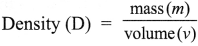
Give the formula to find the density of objects.
Answer:
Samacheer Kalvi Guru 7th Science Term 1 Chapter 1 Measurement

Question 5.
Name the liquid in which an iron ball sinks.
Answer:
Iron ball sinks in water. The density of an iron ball is more than that of water so it sinks in water.

Question 6.
Name the unit used to measure the distance between celestial objects.
Answer:
Astronomical unit and light year are the units used to measure the distance between celestial objects.

Question 7.
What is the density of gold?
Answer:
Density of gold is 19,300 kg/m3

IX. Give Short Answer.

Question 1.
What are derived quantities?
Answer:
The physical quantities which can be obtained by multiplying, dividing or by mathematically combining the fundamental quantities are known as derived quantities.
(or)
The physical quantities which are expressed is terms of fundamental quantities are called

Question 2.
Distinguish between the volume of liquid and capacity of a container.
Answer:

S.NoVolume of liquidCapacity of a container
1.Volume is the amount of space taken up by a liquidCapacity is the measure of an objects ability to hold a substance like solid, liquid or gas
2.


It is measured in cubic units.It is measured in litres, gallons, pounds, etc.
3.It is calculated by multiplying the length, width and height of an object.It’s measurement is cc or ml.

Question 3.
Define the density of objects.
Answer:
Density of a substance is defined as the mass of the substance contained in unit volume
Measurement 7th Standard Science Term 1 Chapter 1 Measurement

Question 4.
What is one light year?
Answer:
One light year is the distance travelled by light in vacuum during the period of one year.
1 Light year = 9.46 x 10¹⁵m.

Question 5.
Define one astronomical unit?
Answer:
One astronomical unit is defined as the average distance between the earth and the sun.
1 AU = 1.496 5 106km = 1.496 × 10¹¹m.

X. Answer In detail.

Question 1.
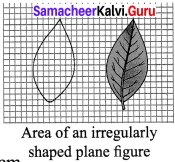
Describe the graphical method to find the area of an irregularly shaped plane figure.
Answer:
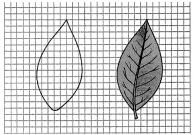
To find the area of an irregularly shaped plane figure, we have to use graph paper.

  1. Place a piece of paper with an irregular shape on a graph paper and draw its outline.
  2. To find the area enclosed by the outline, count the number of squares inside it (M).
  3. You will find that some squares lie partially inside the outline.
  4. Count a square only if half (p) or more of it (N) lies inside the outline.
  5. Finally count the number of squares, that are less than half. Let it be

For the shape in figure we have the following:
M = 50
N = 7
P = 4
Q = 4
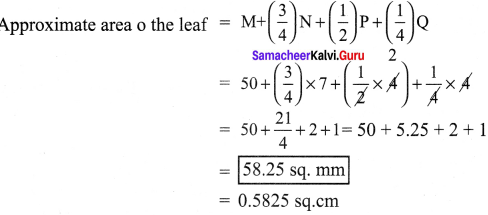
Now, the approximate area of the can be calculated using the following formula.
Measurement Lesson 7th Standard Term 1 Chapter 1 Measurement

Area of the leaf = M+(\(\frac { 3 }{ 4 }\)) N + (\(\frac { 1 }{ 2 }\)) P+\(\frac { 1 }{ 4 }\) Qsq.cm
= 52 + 5.25 = 58.25 sq.mm = 0.5825 sq.cm

Question 2.
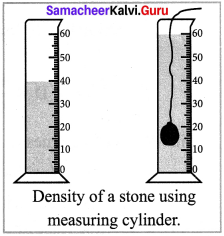
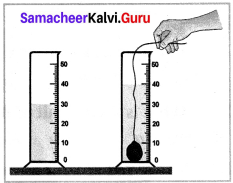
How will you determine the density of a stone using a measuring jar?
Answer:
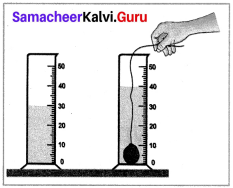
Determination of density of a stone using a measuring cylinder.

7th Science Measurement Term 1 Chapter 1 Measurement

  1. In order to determine the density of a solid, we must know the mass and volume of the stone.
  2. The mass of the stone is determined by a physical balance very accurately. Let it be ‘m’ grams.
  3. In order to find the volume, take a measuring cylinder and pour in it some water.
  4. Record the volume of water from the graduations marked on measuring cylinder. Let it be 40 cm3.
  5. Now tie the given stone to a fine thread and lower it gently in the measuring cylinder, such that it is completely immersed in water.
  6. Record the new level of water. Let it be 60 cm3

∴Volume of the solid = (60-40) cm3
= 20 cm3 = V cm3 (assume)
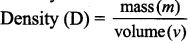
Knowing the mass and the volume of the stone, the density can be calculate by the formula:
Samacheer Kalvi 7th Science Solutions Term 1 Chapter 1 Measurement

XI. Questions based on Higher er Thinking skills:

Question 1.
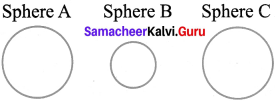
There are three spheres A, B, C as shown below :
Answer:

7th Standard Science Measurement Term 1 Chapter 1 Measurement

Sphere A and B are made of the same material. Sphere C is made of a different material. Spheres A and C have equal radii. The radius of sphere B is half that of A. Density of A is double that of C.

Question 2.
Now answer the following questions:

  1. Find the ratio of masses of spheres A and B.
  2. Find the ratio of volumes of spheres A and B.
  3. Find the ratio of masses of spheres A and C.

Answer:
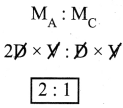
i. Ratio of masses of spheres A and B
MA : MB
D × VA : D × VB
Let the mass of sphere A = MA
Let the mass of sphere B = MB
Mass = Density × Volume
MA = DA × VA
MB = DB × VB (Density is same)
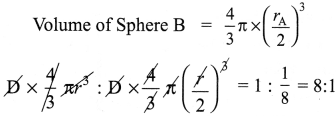
Volume of Sphere A =\(\frac { 4 }{ 3 }\)πr3
Science Measurement Lesson Question Answer Term 1 Chapter 1 Measurement

ii. Ratio of volumes of spheres A and B
VA : VB
8 : 1 (As mass is directly proportional to volume)

iii. Ratio of masses of spheres A and C.
Unit 1 Measurement Samacheer Kalvi 7th Science Solutions Term 1
[∴ Density of A is double that of C ]

XII. Numerical problems:

Question 1.
A circular disc has a radius 10 cm. Find the area of the disc in m2. (Use n = 3.14)
Answer:
Given radius = 10 cm = 0.1m
π= 3.14
Area of a circular disc A = ?
Formula : Area of a circle A = πr2
= 3.14 × 0.1 × 0.1
Solution : A = 0.0314 m2

Question 2.
The dimension of a school playground is 800 m x 500 m. Find the area of the ground.
Answer:
Given :The dimension of a school
Playground = l x b = 800 m x 500 m

Formula :Area of the ground A = l x b
= 800 x 500 = 4,00,000
A = 4,00,000 m2

Question 3.
Two spheres of same size are made from copper and iron respectively. Find the ratio between their masses. Density of copper 8,900 kg/m and iron 7,800 kg/m3
Answer:
Given : Density Copper Dc = 8900 kg/m3
Density of Iron D1 = 7800 kg/m3
Volume of Copper sphere = Volume of Iron sphere
To find : Ratio of Masses of Copper (MC) and Iron (MI)
Solution: Mass = Density x Volume
MC = DC x V, M1 = D1 x V
MC = 8900 V, M1 = 7,800 V
MC = M1
8900 V : 7800 V
= 1.14: 1

Question 4.
A liquid having a mass of 250 g fills a space of lOOOcc. Find the density of the liquid.
Answer:
Given : Mass of a liquid M = 250 g
Volume V = l000cc
Density of the liquid D = ?
Measurement Lesson Question Answer Samacheer Kalvi 7th Science Solutions Term 1
Solution: Density of the liquid = 0.25 g/cc

Question 5.
A sphere of radius 1cm is made from silver. If the mass of the sphere is 33 g, find the density of silver (Take π = 3.14)
Answer:
Given : radius of a sphere r = 1cm
Volume of the sphere V = ?
Mass of the sphere M = 33 g
Density of silver D = ?
Samacheer Guru 7th Science Term 1 Chapter 1 Measurement
Solution: Density of silver sphere = 7.889 g/cc.

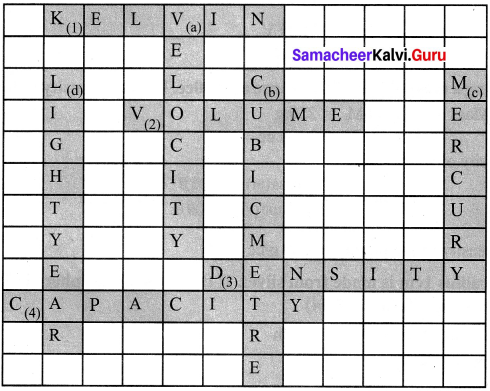
XIII. Cross word puzzle:

Clues – Across
1. SI unit of temperature
2. A derived quantity
3. Mass per unit volume
4. Maximum volume of liquid a container can hold

Clues – Down
a. A derived quantity
b. SI unit of volume
c. A liquid denser than iron
d. A unit of length used to measure very long distances
Answer:

7th Standard Measurement Lesson Term 1 Chapter 1 Measurement Samacheer Kalvi

Clues – Across
1. KELVIN
2. VOLUME
3. DENSITY
4. CAPACITY

Clues – Down
a. VELOCITY
b. CUBIC METRE
c. MERCURY
d. LIGHT YEAR

Samacheer Kalvi 7th Science Measurement lntext Activities

Activity -1

Take a leaf from any one of trees in your neighborhood.
Place the leaf on a graph sheet and draw the outline of the leaf with a pencil. Remove the leaf. You can see the outline of the leaf on the graph sheet.

Samacheer Kalvi 7th Science Guide Term 1 Chapter 1 Measurement

  1. Now, count the number of whole squares enclosed within the outline of the leaf. Take it to be M.
  2. Then, count the number of squares that are more than half. Take it as N.
  3. Next, count the number of squares which are half of a whole square. Note it to be P.
  4. Finally, count the number of squares that are less than half. Let it be Q.
  5. M = _______;N = _______; P = _______; Q = _______

Now, the approximate area of the leaf can be calculated using the following formula:
Approximate area of the leaf = M +(\(\frac { 3 }{ 4 }\)) N+(\(\frac { 1 }{ 2 }\)) P+(\(\frac { 1 }{ 4 }\)) Q square cm
Area of the leaf =________.
This formula can be used to calculate the area of any irregularly shaped plane figures.
Answer:
M = 50
N = 7
P = 4
Q = 4
Samacheer Kalvi 7th Science Term 1 Chapter 1 Measurement

Activity – 2

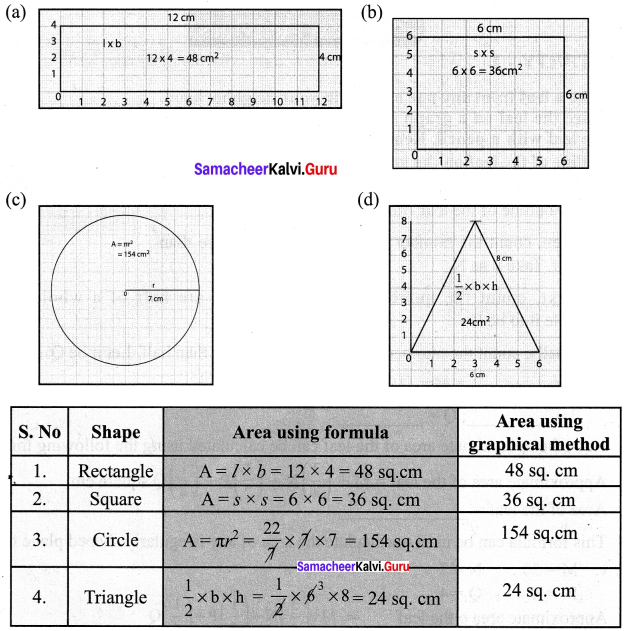
Draw the following regularly shaped figures on a graph sheet and find their area by the graphical method. Also, find their area using appropriate formula. Compare the results obtained in two methods by tabulating them.
(a) A rectangle whose length is 12 cm and breadth is 4 cm.
(b) A square whose side is 6 cm.
(c) A circle whose radius is 7 cm.
(d) A triangle whose base is 6 cm and height is 8 cm.
Answer:
Samacheer Kalvi 7th Science Solution Term 1 Chapter 1 Measurement

Activity – 3

Take a measuring cylinder and pour some water into it (Do not fill the cylinder completely). Note down the volume of water from the readings of the measuring cylinder. Take it as V . Now take a small stone and tie it with a thread. Immerse the stone inside the water by holding the thread. This has to be done such that the stone does not touch the walls of the measuring cylinder. Now, the level of water has raised. Note down the volume of water and take it to be V . The volume of the stone is equal to the raise in the volume of water.

Samacheer Kalvi 7th Science Answers Term 1 Chapter 1 Measurement

V1= _______
V2=_______
Volume of stone = v2 – v1 =_______.
Answer:
V1 = 30 cc, V2 = 40 cc; Volume of stone =v2 – v1 = 40cc – 30cc = 10cc

Activity – 4
(a) Take an iron block and a wooden block of same mass (say 1 kg each). Measure their volume. Which one of them has more volume and occupies more volume?
(b) Take an iron block and a wooden block of same size. Weigh them and measure their mass. Which one of them has more mass?
Answer:
(a) Wooden block has more volume and occupies more volume. (As the molecules of wood are loosely packed)
(b) Iron block has more mass. (In iron block, molecules are closely packed).

Samacheer Kalvi 7th Science Measurement Additional Questions

I. Choose the correct answer.

Question 1.
The unit of volume is _____
(a) m3
(b) m3
(c) cm3
(d) km
Answer:
(a) m3

Question 2.
Physical quantities are classified into _____ type
(a) three
(b) two
(c) four
(d) none of the above
Answer:
(b) two

Question 3.
The SI unit of speed is _____
(a) m/s2
(b) m/s
(c) km/h
(d) m2/s
Answer:
(a) m/s2

Question 4.
1 litre = ______ cc
(a) 100
(b) 1000
(c) 10
(d) 0.1
Answer:
1000

Question 5.
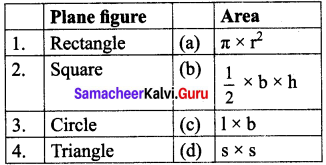
The formula to calculate area of a rectangle is _____
(a) length × breadth
(b) side × side
(c) π × radius × radius
(d) none of the above
Answer:
(a) length × breadth

Question 6.
_____ is a derived quantity.
(a) length
(b) mass
(c) time
(d) area
Answer:
(d) area

Question 7.
The amount of space occupied by a three dimensional object is known as its _____
(a) density
(b) volume
(c) Area
(d) mass
Answer:
(b) volume

Question 8.
The maximum volume of liquid that a continer can hold is _____
(a) area
(b) volume
(c) capacity
(d) density
Answer:
(c) capacity

Question 9.
The shortest distance between the earth and the sun is called as _____ position.
(a) Light year
(b) normal
(c) perihelion
(d) aphelion
Answer:
(c) Perihelion

Question 10.
The largest distance between the earth and the sun is called as _____ position.
(a) normal
(b) perihelion
(c) aphelion
(d) none of the above
Answer:
(c) aphelion

II. Fill in the Blanks.

  1. The materials with higher density are called ______
  2. The materials with lower density are called ______
  3. The area of irregularly shaped figures can be calculated with the help of a ______
  4. The SI unit of volume is ______
  5. The SI unit of density is ______
  6. The CGS unit of density is ______
  7. If the density of a solid is lower than that of a liquid it ______ is that liquid
  8. If the density of a solid is higher than that of a liquid, it ______ is that liquid.
  9. The total number of seconds in one year = ______
  10. The average distance between the earth and the sun is about ______ million kilometre.

Answer:

  1. denser
  2. rarer
  3. graph sheet
  4. cubic metre or m3
  5. kg/m3
  6. g/cm3
  7. floats
  8. sinks
  9. 3.15 3 x 10⁷ second
  10. 149.6

III. True or False – if false give the correct statement.

Question 1.
One square metre is the area enclosed inside a square of side 2 metre.
Answer:
(False) Correct Statement: One square metre is the area enclosed inside a square of side 1 metre.

Question 2.
Area is a derived quantity as we obtain by multiplying twice of the fundamental physical quantity length.
Answer:
True.

Question 3.
Density of water is 100 kg/m3
Answer:
(False) Correct statement: Density of water is 1000 kg/m3

Question 4.
Density is defined as the mass of the substance contained in unit volume.
Answer:
True.

Question 5.
The lightness or heaviness of a body is due to volume
Answer:
(False) Correct statement: The lightness or heaviness of a body is due to density.

Question 6.
Neptune is 30 AU away from sun.
Answer:
True.

Question 7.
The nearest star to our solar system is proxima centauri.
Answer:
True.

Question 8.
The volume of a figure is the region covered by the boundary of the figure.
Answer:
(False) Correct statement: The area of a figure is the region covered by the boundary of the figure.

Question 9.
1 Light year = 9.46 x 10⁵ m.
Answer:
True.

Question 10.
One light year is defined as the distance travelled by light inW vacuum during the period of one year.
Answer:
True.

IV. Match the following :
Question 1.

1.Length(a)ampere (A)
2.time(b)kelvin (K)
3.Mass(c)metre (M)
4.Temperature(d)second (S)
5.Electric current(e)kilogram (K)

Answer:

  1. c
  2. d
  3. e
  4. b
  5. a

Question 2.
7th Standard Science Unit 1 Measurement Term 1 Samacheer Kalvi
Answer:

  1. c
  2. d
  3. a
  4. b

V. Assertion and Reason.

Mark the correct choice as
(a) Both A and R are true but R is not the correct reason.
(b) Both A and R are true and R is the correct reason.
(c) A is true but R is false.
(d) A is false but R is true

Question 1.
Assertion (A): The distance between two celestial bodies is measured by the unit of light year.
Reason (R) : The distance travelled by the light in one year in vacuum is called one light year.
Answer:
(a) Both A and R are true but R is not the correct reason.

Question 2.
Assertion (A): It is easier to swim in sea water than in river water.
Reason (R) : Density of sea water is more than that of river water
(a) Both A and R are true but R is not the correct reason.
(b) Both A and R are true and R is the correct reason.
(c) A is true but R is false.
(d) A is false but R is true.
Answer:
(b) Both A and R are true and R is the correct reason.

VI. Very short Answers:

Question 1.
Write the SI unit of speed.
Answer:
m/s

Question 2.
What is the fundamental unit of amount of substance?
Answer:
mole (mol)

Question 3.
What are the types of physical quantity?
Answer:

  1. Fundamental quantity
  2. Derived quantity.

Question 4.
What is the SI unit of electric charge?
Answer:
Coulomb (C)

Question 5.
Mention the formula to calculate area of a circle?
Answer:
n × r2 = πr2.

Question 6.
How do you find the area of irregularly shaped figures?
Answer:
Graphical method.

Question 7.
How will you determine the volume of a liquid?
Answer:
By using measuring cylinder.

Question 8.
What are the other units used to measure the volume of liquids?
Answer:
Gallon, ounce and quart.

Question 9.
Which one of the following has more volume. Iron block or a wooden block of same mass.
Answer:
Wooden block.

Question 10.
Which one of the following has more density. Water or cooking oil.
Answer:
Water

VII. Short Answer.

Question 1.
What is fundamental quantity? Give examples.
Answer:
A set of physical quantities which cannot be expressed in terms of any other quantities are known as fundamental quantities. Ex: Length, mass, time.

Question 2.
Define mass Mention its unit.
Answer:
Mass is the amount of matter contained in a body. It’s unit is kilogram (kg).

Question 3.
What are the multiples and sub multiples of mass?
Answer:
The multiples of mass are quintal and metric tonne.
The sub-multiples of mass are gram and milligrams.

Question 4.
What is physical quantity? give example.
Answer:
A quantity that can be measured is called a physical quantity. For example, the length of a piece of cloth, the time at which school begins.

Question 5.
What do you mean by ‘unit’?
Answer:
The known measure of a physical quantity is called the unit of measurement.

Question 6.
What is measurement?
Answer:
Comparison of an unknown quantity with a standard quantity is called measurement.

Question 7.
What is meant by area?
Answer:
Area is the measure of the region inside a closed line.

Question 8.
What is capacity of a container?
Answer:
The volume of liquid which a container can hold is called its capacity.

Question 9.
What is the relation between density, volume and mass?
Answer:
7th Measurements Term 1 Chapter 1 Measurement Samacheer Kalvi

Question 10.
Define astronomical unit.
Answer:
One astronomical unit is defined as the average distance between the earth and the sun. 1AU = 1.496 x 10¹¹ m or 149.6 x 10⁶ m

VIII. Long Answer

Question 1.
How will you find the volume of an irregularly shaped object (stone) by using measuring cylinder?
Answer:
Class 7 Science Measurement Term 1 Chapter 1 Measurement Samacheer Kalvi

  1. Take a measuring cylinder and pour some water into it.
  2. Note down the volume of water from the readings of the measuring cylinder.
  3. Take it as V1
  4. Now take Q small stone and tie it with a thread.
  5. Immerse the stone inside the water by holding the thread.
  6. This has to be done such that the stone does not touch the walls of the measuring cylinder.
  7. Now the level of water has raised.
  8. Note down the volume of water and take it to be V2

The volume of the stone is equal to the raise in the volume of water.
V1 = 30cc, V2 = 40cc
Volume of stone = V2 – Vj = 40 – 30 = 10cc

IX. Problems for practice:

Question 1.
A piece of iron weighs 230 g and has a volume of 20 cm3. Find the density of iron.
Solution:
Mass of iron (m) = 230 g
Volume of iron (v) = 20 cm3
Samacheer Kalvi.Guru 7th Science Term 1 Chapter 1 Measurement

Question 2.
Find the mass of silver of volume 50 cm3 and density 10.5 g / cm3
Solution:
Mass of silver (M) = ?
Volume of silver (V) =50 cm3
Density of silver D = 10.5 g/cm3
Samacheer Kalvi Guru 7th Science Book Back Answers Term 1 Chapter 1 Measurement
mass (M) = Density × Volume
= 10.5 x 50 = 525 g

X. Creative questions: HOTS

Question 1.
Why does an iron needle sink in water, but not an iron ship?
Answer:
Iron needle is compact and its density is 7.6 g/cm3 Thus, as the density of iron needle is more than 1 g/cm3 therefore, it sinks in water. However, the iron ship is constructed in such a way that it is mostly hollow from within, thus, the volume of iron ship becomes very large as compared to its mass and hence its density is less than lg/cm3 . As the density of iron ship is less than 1g/cm3, therefore it floats in water.

Samacheer Kalvi 7th Tamil Solutions Term 2 Chapter 1.3 தமிழரின் கப்பற்கலை

Students can Download Tamil Chapter 1.3 தமிழரின் கப்பற்கலை Questions and Answers, Summary, Notes Pdf, Samacheer Kalvi 7th Tamil Book Solutions Guide Pdf helps you to revise the complete Tamilnadu State Board New Syllabus and score more marks in your examinations.

Tamilnadu Samacheer Kalvi 7th Tamil Solutions Term 2 Chapter 1.3 தமிழரின் கப்பற்கலை

மதிப்பீடு

சரியான விடையைத் தேர்ந்தெடுத்து எழுதுக.

Question 1.
தமிழர்கள் சிறிய நீர்நிலைகளைக் கடக்கப் பயன்படுத்தியது ……..
அ) கலம்
ஆ) வங்கம்
இ) நாவாய்
ஈ) ஓடம்
Answer:
ஈ) ஓடம்

Question 2.
தொல்காப்பியம் கடற்பயணத்தை …………………….. வழக்கம் என்று கூறுகிறது.
அ) நன்னீ ர்
ஆ) தண்ணீ ர்
இ) முந்நீர்
ஈ) கண்ணீ ர்
Answer:
இ)
முந்நீர்)

Question 3.
கப்பலை உரிய திசையில் திருப்புவதற்குப் பயன்படும் கருவி ……………….
அ) சுக்கான்
ஆ) நங்கூரம்
இ) கண்ண டை
ஈ) சமுக்கு
Answer:
அ) சுக்கான்

கோடிட்ட இடங்களை நிரப்புக

Question 1.
கப்பல் கட்டுவதற்குப் பயன்படும் மர ஆணிகள் ……….. …….. என அழைக்கப்படும்.
Answer:
தொகுதி

Question 2.
கப்பல் ஓரிடத்தில் நிலையாக நிற்க உதவுவது …
Answer:
நங்கூரம்

Question 3.
இழைத்த மரத்தில் காணப்படும் உருவங்கள் எனக் குறிப்பிடப்படும்.
Answer:
கண்ணடை

பொருத்துக –

1. எரா – திசைகாட்டும் கருவி
2. பருமல் – அடிமரம்
3. மீகாமன் – குறுக்கு மரம்
4. காந்த ஊசி – கப்பலைச் செலுத்துபவர்
Answer:
1. எரா – அடிமரம்
2. பருமல் – குறுக்கு மரம்
3. மீகாமன் – கப்பலைச் செலுத்துபவர்
4. காந்த ஊசி – திசைகாட்டும் கருவி

தொடர்களில் அமைத்து எழுதுக

1. நீரோட்டம்
கடல் நீரோட்டங்களின் திசையை தமிழர்கள் தம் பட்டறிவால் நன்கு அறிந்திருந்தனர்.

2. காற்றின் திசை
காற்றின் திசையை அறிந்து கப்பல்களைச் செலுத்தும் முறையைத் தமிழர்கள் நன்கு அறிந்திருந்தனர்.

3. வானியல் அறிவு
கப்பல் ஓட்டும் மாலுமிகள் சிறந்த வானியல் அறிவைப் பெற்றிருந்தனர்.

4. ஏற்றுமதி
பூம்புகார் துறைமுகத்திலிருந்து கப்பல்கள் மூலம் பொருள்கள் ஏற்றுமதியும் இறக்குமதியும் செய்யப்பட்டன.

குறுவினா

Question 1.
தோணி என்னும் சொல்லின் பெயர்க்காரணத்தைக் கூறுக.
Answer:

  • எடைக் குறைந்த பெரிய மரங்களின் உட்பகுதியைக் குடைந்து எடுத்துவிட்டுத்த தோணியாகப் பயன்படுத்தினர் தமிழர்கள்.
  • உட்பகுதி தோண்டப்பட்டவை என்பதால் அவை தோணிகள் எனப்பட்டன.
  • சிறிய நீர்நிலைகளைக் கடக்கத் தமிழர்கள் தோணியைப் பயன்படுத்தினர்.

Question 2.
கப்பல் கட்டும்போது மரப்பலகைகளுக்கு இடையே தேங்காய் நார் அல்லது பஞ்சு வைப்பதன் நோக்கம் என்ன?
Answer:

  • மரங்களையும் பலகைகளையும் ஒன்றோடு ஒன்று இணைக்கும் போது அவற்றுக்கு இடையே தேங்காய் நார், பஞ்சு ஆகியவற்றில் ஒன்றை வைத்து நன்றாக இறுக்கி ஆணிகளை அறைந்தனர்.
  • சுண்ணாம்பையும் சணலையும் கலந்து அரைத்து அதில் எண்ணெய் கலந்து கப்பலின் அடிப்பகுதியில் பூசினர்.
  • இதனால் கப்பல்கள் பழுதடையாமல் நெடுங்காலம் உழைத்தன.

Question 3.
கப்பல் உறுப்புகள் சிலவற்றின் பெயர்களைக் கூறுக.
Answer:
கப்பலின் உறுப்புகள் :

  • கப்பல் பல்வேறு வகையான உறுப்புகளை உடையது.
  • எரா, பருமல், வங்கு , கூம்பு, பாய்மரம், சுக்கான், நங்கூரம் போன்றவை கப்பலின் உறுப்புகளுள் சிலவாகும்.

சிறுவினா

Question 1.
சிறிய நீர்நிலைகளையும் கடல்களையும் கடக்கத் தமிழர்கள் பயன்படுத்திய ஊர்திகளின் பெயர்களை எழுதுக.
Answer:

  • தமிழர்கள் தோணி, ஓடம், படகு, புணை, மிதவை, தெப்பம் போன்றவற்றைச் சிறிய நீர்நிலைகளைக் கடக்கப் பயன்படுத்தினர்.
  • கலம், வங்கம், நாவாய் முதலியவை அளவில் பெரியவை.
  • இவற்றைக் கொண்டு தமிழர்கள் கடல் பயணம் மேற்கொண்டனர்.

Question 2.
பண்டைத் தமிழரின் கப்பல் செலுத்தும் முறை பற்றி எழுதுக.
Answer:
கப்பலைச் செலுத்தும் முறை :

  • காற்றின் திசையை அறிந்து கப்பல்களைச் செலுத்தும் முறையைத் தமிழர்கள் நன்கு அறிந்திருந்தனர்.
  • இவ்வுண்மையை வெண்ணிக்குயித்தியார் தம் புறப்பாடலில் குறிப்பிடுகிறார். “நளியிரு முந்நீர் நாவாய் ஓட்டி வளி தொழில் ஆண்ட உரவோன் மருக – வெண்ணிக் குயத்தியார்
  • கடலில் காற்று வீசும் திசை, கடல் நீரோட்டங்களின் திசை ஆகியவற்றைத் தமிழர்கள் தம் பட்டறிவால் நன்கு அறிந்து அவற்றுக்கு ஏற்ப உரிய காலத்தில் சரியான திசையில் கப்பலைச் செலுத்தினர்.

Question 3.
கப்பல் பாதுகாப்பானதாக அமையத் தமிழர்கள் கையாண்ட வழிமுறைகள் யாவை?
Answer:

  • பெருந்திரளான மக்களையும் பொருள்களையும் ஏற்றிச் செல்லும் வகையில் பெரிய கப்பல்களைத் தமிழர் உருவாக்கினர்.
  • நீண்ட தூரம் கடலிலேயே செல்ல வேண்டி இருந்ததால் கப்பல்களைப் பாதுகாப்பனவையாகவும் வலிமைமிக்கவையாகவும் உருவாக்கினர்.
  • கப்பல் கட்டுவதற்கு உரிய மரங்களைத் தேர்ந்தெடுப்பதில் தமிழர்கள் மிகுந்த கவனம் செலுத்தினர். தண்ணீரால் பாதிப்பு அடையாத மரங்களையே கப்பல் கட்டப் பயன்படுத்தினர். நீர்மட்ட வைப்பிற்கு வேம்பு, இலுப்பை, புன்னை, நாவல் போன்ற மரங்களைப் பயன்படுத்தினர்.
  • பக்கங்களுக்குத் தேக்கு, வெண்தேக்கு போன்ற மரங்களைப் பயன்படுத்தினர். நீளம், அகலம், உயரம் ஆகியவற்றைச் சரியான முறையில் கணக்கிட்டுக் கப்பலை உருவாக்கினர்.
  • மரங்களையும் பலகைகளையும் இணைக்கும் போது அவற்றுக்கு இடையே தேங்காய் நார் அல்லது பஞ்சு இவற்றில் ஒன்றை வைத்து இறுக்கி ஆணிகளை அறைந்தனர். மரத்தால் ஆன ஆணிகளையே பயன்படுத்தினர்.


சிந்தனை வினா

Question 1.
இக்காலத்தில் மக்கள் வெளிநாடுகளுக்குச் செல்வதற்கு கடற்பயணத்தைப் பெரிதும் மேற்கொள்ளாதது ஏன் எனச் சிந்தித்து எழுதுக.
Answer:
தற்போது விமானம் கண்டுபிடிக்கப்பட்ட பிறகு, கடற்வழி பயணம் விரும்பத்தகாத ஒன்றாக மாறிவிட்டது. காலதாமதம் காரணமாக தற்பொழுது கடல் வழி பயணத்தைத் தவிர்த்து வான்வெளிப் பயணத்தை ஏற்றனர். அதன் காரணமாகவே கடற்வழிப் பயணத்தை பெரிதும் மேற்கொள்ளுதலைத் தவிர்த்தனர்.

கற்பவை கற்றபின்

Question 1.
பலவகையான கப்பல்களின் படங்களைச் சேகரித்துப் படத்தொகுப்பு ஒன்று உருவாக்குக.
Answer:
பாய்மரக்கப்பல்கள் :

  • காற்றின் உதவியால் செலுத்தப்படும் கப்பல்கள் பாய்மரக்கப்பல்கள் எனப்பட்டன.
  • பெரிய பாய்மரம், திருக்கைத்திப் பாய்மரம், காணப் பாய்மரம், கோசுப் பாய்மரம் போன்ற பலவகையான பாய்மரங்களைத் தமிழர் பயன்படுத்தினர்.

Samacheer Kalvi 7th Tamil Solutions Term 2 Chapter 1.3 தமிழரின் கப்பற்கலை - 1

நீர்மூழ்கிக் கப்பல்கள் :

  • இவை நீரில் மூழ்கியபடியே வெகு தொலைவு செல்லக்கூடிய நீர் ஊர்தி ஆகும்.
  • நீர்மூழ்கிக் கப்பல்கள் போரில், பகைவர் கப்பல்களைத் தாக்குதல், முற்றுகையை முறியடித்தல், நீரில் இருந்தபடியே நிலப்பகுதியைத் தாக்குதல், இரகசியமாகச் சிறப்புப் E படைகளை முக்கியப் பகுதிகளில் இறக்கி வியூகம் அமைத்தல் ஆகிய பல பணிகளைச் ஓ செய்ய வல்லவை.

Samacheer Kalvi 7th Tamil Solutions Term 2 Chapter 1.3 தமிழரின் கப்பற்கலை - 2

பயணிகள் கப்பல்கள் :

  • பயணிகள் கப்பல்களின் அளவு சிறிய ஆற்று படகுகளில் இருந்து மிக பெரிய கப்பல்கள் வரை இருக்கும்.
  • ஓர் இடத்திலிருந்து மற்றோர் இடத்திற்குப் பயணிகளைக் கொண்டு செல்லும் கப்பல்கள்.
  • குறுகிய பயணங்களுக்குப் பயணிகள் மற்றும் வாகனங்களை ஏற்றிச் செல்லும் கப்பல்கள், இன்பப் பயணங்கள் மேற்கொள்ளப்படும் கப்பல்கள் இந்த வகையில் அடங்கும்.

Samacheer Kalvi 7th Tamil Solutions Term 2 Chapter 1.3 தமிழரின் கப்பற்கலை - 3

எண்ணெய்க் கப்பல்கள் :

திரவ பெட்ரோலிய வாயு , திரவ இயற்கை எரிவாயு , வேதிப்பொருட்கள் ஆகியவற்றைச் சுமந்து செல்லும் கப்பல்கள்.

சரக்குக் கப்பல்கள் :

  • சரக்குக் கப்பல் என்பது ஒரு துறைமுகத்தில் இருந்து இன்னொரு துறைமுகத்துக்குச் சரக்கு மற்றும் பல்வேறு  பொருட்களை எடுத்துச் செல்லும் கப்பலாகும்.
  • சரக்குக் கப்பல்கள் பொதுவாக அவற்றின் தேவைக்கு ஏற்ப வடிவமைப்புச் செய்யப்படுகின்றன.
  • பொருட்களை ஏற்றி இறக்கும் வசதிக்காக அவற்றில் பாரந்தூக்கிகளும் பொருத்தப்படுவதுண்டு.

Question 2.
தரைவழிப்பயணம், கடல்வழிப்பயணம், வான்வழிப்பயணம் ஆகியவை குறித்து வகுப்பறையில் கலந்துரையாடுக.
Answer:
இடம் : அரசு உயர்நிலைப்பள்ளி.

நடிகர்கள் : கபிலன், மணிவண்ண ன், கயல்விழி, தேன்மொழி, தமிழாசிரியர்,

விளக்கம் : ஏழாம் வகுப்பு மாணவர்கள் வகுப்பறையில் கலந்துரையாடுகின்றனர். உடன் தமிழாசிரியர் தமிழ்வேந்தன் அவர்கள் உரையாடலில் உடன் பங்கேற்கின்றார்.

தமிழ்வேந்தன் : மாணவச் செல்வங்களே! இன்று நாம் எதைப் பற்றி உரையாடப் போகிறோம் தெரியுமா?

கயல்விழி : சொல்லுங்கள் ஐயா! தெரிந்து கொள்கிறோம்.

தமிழ்வேந்தன் : கோடை விடுமுறையில் நீங்கள் ஊர்ப்பயணம் போவீர்களா?

மணிவண்ணன் : நிச்சயமாக

தமிழ்வேந்தன் : எங்கு போவீர்கள்?

தேன்மொழி : எங்கள் பாட்டி வீட்டிற்குப் போவேன் ஐயா!

தமிழ்வேந்தன் : எப்படி போவீர்கள்?

தேன்மொழி : பேருந்தில் பயணம் செய்வேன் ஐயா!

தமிழ்வேந்தன் : அதாவது தரைவழிப் பயணம் அப்படித்தானே!

தேன்மொழி : ஆமாம் ஐயா!

தமிழ்வேந்தன் : பேருந்து, சிற்றுந்து, மகிழுந்து, இரு சக்கரவாகனம் இவையாவும் தரைவழிப்பயணம் தானே!

கயல்விழி : ஆமாம் ஐயா!

தமிழ்வேந்தன் : தரைவழிப்பயணம் செல்வதில் சிக்கல்கள் ஏதாவது உண்டா?

கபிலன் : ஒன்றா இரண்டா எடுத்துச் சொல்ல ! பெருகி வரும் மக்கள்தொகையில் நகர்புறம், கிராமப்புறம் எங்கும்போக்குவரத்து இடையூறுகள் அதிகம். வாகனங்கள் மக்கள் தொகைப் போல பன்மடங்கு பெருகி உள்ளன ஐயா!

தமிழ்வேந்தன் : இதனைக் கட்டுப்படுத்த என்ன வழி?

கபிலன் : சாலைகளை விரிவாக்கம் செய்ய வேண்டும் ஐயா!

தமிழ்வேந்தன் : நல்ல கருத்து இது வரவேற்கத்தக்கது. இதைத்தவிர வேறு பயணம் ஏதாவது உண்டா ?

தேன்மொழி : உண்டு ஐயா ! கடல்வழிப் பயணம்

தமிழ்வேந்தன் : ஆதியில் பெருந்திரளான மக்கள் தங்களையும் தங்கள் உடைமைகளையும் ஏற்றிச் செல்ல கப்பலைமலைபோல நம்பி இருந்தனர்.

தேன்மொழி : அது மட்டுமல்ல ஐயா, நீண்ட தூரம் கடலிலேயே செல்ல வேண்டி இருந்தால் கப்பல் பயணம் பாதுகாப்பானது மற்றும் மனதிற்கு மகிழ்ச்சி தரக்கூடியது.

கயல்விழி : போக்குவரத்து இடையூறு கப்பல் பயணத்தில் இல்லை
ஐயா ! கடல் வழிப்பயணத்தில் துரிதமாக போக வேண்டிய இடத்திற்கு போய்ச் சேரலாம். மனதிற்கும் உடலுக்கும் புது தெம்பு தருவது இந்த ..
கடல் வழிப் பயணம்தான்.

தமிழ்வேந்தன் : நல்லது. இதைத் தவிர வேறு பயணம் ஏதாவது உண்டா ?

மணிவண்ண ன் : தரைவழிப் பயணம், கடல் வழிப்பயணம் இரண்டையும் பின்னுக்குத்
தள்ளும் பயணம் வான் வழிப் பயணம்தான்.

தமிழ்வேந்தன் : எப்படி?

மணிவண்ணன் : கட்டணச் செலவு கூடுதலாக இருந்தாலும் நாம் போய் சேர வேண்டிய இடத்திற்குச் சில மணிநேரங்களில் அலுங்காமல் குலுங்காமல் போய் சேரலாம். இதனால் நேரம் மிச்சம். சுகமான பயணம் ஐயா!

தமிழ்வேந்தன் : உண்மைதான்! இருப்பினும் நடுத்தர மக்களுக்கும், ஏழை எளிய மக்களுக்கும் சாதகமாக இருக்கும் பயணம் தரைவழிப் பயணம் மட்டும் தான். காத்திருப்பதிலும் ஒரு சுகம்தான்! கூட்ட நெரிசலில் பயணிப்பதும் ஒரு தனி சுகம்தான் !

(பள்ளி மணி ஒலிக்கிறது)

கூடுதல் வினாக்கள்

சரியான விடையைத் தேர்ந்தெடுத்து எழுதுக.

Question 1.
முந்நீர் வழக்கம் என்று தொல்காப்பியம் எதைக் குறிப்பிடுகிறது?
அ) கடற்பயணம்
ஆ) வான்வழிப்பயணம்
இ) தரைவழிப்பயணம்
ஈ) இவை ஏதுமில்லை
Answer:
அ) கடற்பயணம்

Question 2.
பூம்புகார் துறைமுகத்தில் இருந்து கப்பல்கள் மூலம் பொருள்களை ஏற்றுமதி இறக்குமதி செய்யப்பட்டன. இக்கூற்றை மெய்ப்பித்த நூல் எது?
அ) அகநானூறு
ஆ) பட்டினப்பாலை
இ) கலித்தொகை
ஈ) குறுந்தொகை
Answer:
ஆ) பட்டினப்பாலை

Question 3.
“உலகு கிளர்ந்தன்ன உருகெழு வங்கம்” – இத்தொடர் இடம் பெற்ற நூல் எது?
அ) அகநானூறு
ஆ) புறநானூறு
இ) பட்டினப்பாலை
ஈ) மதுரைக்காஞ்சி
Answer:
அ) அகநானூறு

Question 4.
பலவகையான கப்பல்களின் பெயர்கள் குறிப்பிடப்பட்டுள்ளன என்பதனை மெய்ப்பிக்கும் நூல் எது?
அ) சேந்தன் திவாகரம்
ஆ) ஏலாதி
இ) திருமந்திரம்
ஈ) சீவகசிந்தாமணி
Answer:
அ) சேந்தன் திவாகரம்

Question 5.
தமிழர்கள் பயன்பாட்டில் உருவான கப்பல்கள் பழுதடையாமல் நெடுங்காலம் உழைத்தன. இம்முறையைக் கண்டு வியந்தவர்.
அ) மார்க்கோபோலோ
ஆ) ஆம்ஸ்ட்ராங்
இ) கலிலியோ
ஈ) இவர்களில் யாருமில்லை
Answer:
அ) மார்க்கோபோலோ

Question 6.
கப்பலின் முதன்மையான உறுப்பாகிய அடிமரம் ……………. எனப்படும்
அ) எரா
ஆ) பருமல்
இ) சுக்கான்
ஈ) வங்கு
Answer:
அ) எரா

Question 7.
குறுக்கு மரத்தை ………….. என்பர்
அ) நங்கூரம்
ஆ) சமுக்கு
இ) கூம்பு
ஈ) பருமல்
Answer:
ஈ) பருமல்

Question 8.
கப்பல் செலுத்துபவரை ….. …… என அழைப்பர்.
அ) மாலுமி
ஆ) கம்மியர்
இ) கனரக வாகனம் ஓட்டுநர்
ஈ) இவர்களில் யாருமில்லை
Answer:
அ) மாலுமி

கோடிட்ட இடத்தை நிரப்புக

Question 1.
கப்பலை அழைக்கும் விளக்கு என்னும் பொருளுக்கு ………………… என்று பெயர்.
Answer:
கலங்கரை விளக்கம்

Question 2.
கடலில் செல்லும் கப்பல்களுக்குத் துறைமுகம் இருக்கும் இடத்தைக் காட்டுவதற்காக அமைக்கப்படுவது ………………
விடை:
கலங்கரை விளக்கம்

Question 3.
கலம் என்பதன் பொருள் …………
Answer:
கப்பல்

Question 4.
கரைதல் என்பதன் பொருள் ……………
Answer:
அழைத்தல்

Question 5.
கப்பலைச் செலுத்துவதற்கும், உரிய திசையில் திருப்புவதற்கும் பயன்படும் முதன்மையான கருவி ……………………. எனப்ப டும்.
Answer:
சுக்கான்

Question 6.
கப்பலை நிலையாக ஓரிடத்தில் நிறுத்தி வைக்க உதவும் உறுப்பு …………………… ஆகும்.
Answer:
நங்கூரம்]

Question 7.
மரத்தின் வெட்டப்பட்ட பகுதியை ……………. என்பர்.
Answer:
வெட்டுவாய்

Question 8.
……… என்பது இழைத்த மரத்தில் காணப்படும் உருவங்கள் ஆகும்.
Answer:
கண்ணடை

Question 9.
நீளம், அகலம், உயரம் ஆகியவற்றை சரியான முறையில் கணக்கிட்டுக் கப்பலை உருவாக்கினர். இவற்றை ……………………என்னும் நீட்டலளவையால் கணக்கிட்டனர்.
Answer:
தச்சு முழம்

Question 10.
பெரிய படகுகளில் முன் பக்கம் ………………………. என அழைக்கப்பட்டன.
Answer:
கரிமுக அம்பி, பரிமுக அம்பி

Question 11.
கப்பல்கள் பழுதடையாமல் நெடுங்காலம் உழைக்க மரத்தால் ஆன ஆணிகளைப் பயன்படுத்தினர் இந்த ஆணிகளை……………….. என்பர்.
Answer:
தொகுதி

Question 12.
பாய்மரங்களைத் ……………….. பயன்படுத்தினர்.
Answer:
தமிழர்]

Question 13.
தமிழர் கட்டிய கப்பல்களை ஐம்பது ஆண்டுகள் வரை பழுது பார்க்க வேண்டிய அவசியமில்லை எனக் கூறியவர் …………………
Answer:
வாக்கர் என்னும் ஆங்கிலேயர்

விடையளி :

Question 1.
பாய்மரக் கப்பல்கள் என்றால் என்ன?
Answer:
காற்றின் உதவியால் செலுத்தப்படும் கப்பல்கள் பாய்மரக் கப்பல்கள் எனப்பட்டன.

Question 2.
பாய்மரங்களின் பல வகைகளைக் குறிப்பிடுக.
Answer:
பெரிய பாய்மரம், திருக்கைத்திப் பாய்மரம், காணப் பாய்மரம், கோசுப் பாய்மரம் போன்ற ல பலவகையான பாய்மரங்களைத் தமிழர் பயன்படுத்தினர்.

Question 3.
பாய்மரங்களைக் கட்டும் கயிறுகளின் வகைகளை வரிசைப்படுத்துக.
Answer:

  1. ஆஞ்சான் கயிறு
  2. தாம்பாங்கயிறு
  3. வேடாங்கயிறு
  4. பளிங்கைக் கயிறு
  5. மூட்டங்கயிறு
  6. இளங்கயிறு
  7. கோடிப்பாய்க்கயிறு.

Question 4.
கப்பல் செலுத்துபவரை எவ்வாறு அழைப்பர்?
Answer:
கப்பல் செலுத்துபவரை மாலுமி, மீகாமன், நீகான், கப்பலோட்டி முதலிய பல பெயர்களால் அழைப்பர்.

Question 5.
எரா என்றால் என்ன?
Answer:
கப்பலின் முதன்மையான உறுப்பாகிய அடிமரம் எரா எனப்படும்.

Question 6.
சுக்கான் என்றால் என்ன?
Answer:
கப்பலைச் செலுத்துவதற்கும், உரிய திசையில் திருப்புவதற்கும் பயன்படும் முதன்மையான கருவி சுக்கான் எனப்படும்.

Question 7.
நங்கூரம் எதற்கு பயன்படுகிறது?
Answer:
கப்பலை நிலையாக ஓரிடத்தில் வைக்க உதவும் உறுப்பு நங்கூரம் ஆகும். இது கப்பலை ஓரிடத்தில் நிறுத்துவதற்குப் பயன்படுகிறது.

Question 8.
சமுக்கு என்றால் என்ன?
Answer:

  • சமுக்கு என்னும் ஒரு கருவியையும் கப்பலில் பயன்படுத்தினர் என்று கப்பல் சாத்திரம் என்னும் நூல் குறிப்பிடுகிறது.
  • இது காந்த ஊசி பொருத்தப்பட்ட திசை காட்டும் கருவியாக இருக்கலாம் என ஆய்வாளர்கள் கருதுகின்றனர்.

Question 9.
மீகாமன் – குறிப்பு வரைக.
Answer:

  • மீகாமன் என்பதற்குக் கப்பலைச் செலுத்துபவர் என்பது பொருளாகும்.
  • கப்பல் ஓட்டும் மாலுமிகள் சிறந்த வானியல் அறிவையும் பெற்றிருந்தனர்.
  • கோள்களின் நிலையை வைத்துப் புயல், மழை போன்றவை தோன்றும் காலங்களையும் கடல் நீர் பொங்கும் காலத்தையும் அறிந்து தகுந்த காலத்தில் கப்பல்களைச் செலுத்தினர்.
  • கடலில் காற்று வீசும் திசை, கடல் நீரோட்டங்களின் திசை ஆகியவற்றைத் தமிழர்கள் அறிந்திருந்தனர்.

Samacheer Kalvi 7th English Solutions Term 2 Prose Chapter 1 Adventures of Don Quixote

You can Download Adventures of Don Quixote Questions and Answers, Summary, Activity, Notes, Samacheer Kalvi 7th English Book Solutions Guide Pdf Prose Chapter 1 helps you to revise the complete Tamilnadu State Board New Syllabus and score more marks in your examinations.

Tamilnadu Samacheer Kalvi 7th English Solutions Term 2 Prose Chapter 1 Adventures of Don Quixote

Read And Understand

Answer the following questions.

Adventures Of Don Quixote Questions And Answers Question 1.
What kinds of books did Don Quixote like to read? What were these books like?
Answer:
Don Quixote liked to read books about courageous knights and their unbelievable
adventures.

Adventures Of Don Quixote 7th English Question 2.
What effect do the things Don Quixote reads have on him?
Answer:
He was so absorbed in these stories that he never remembered to eat or sleep.

Adventures Of Don Quixote Questions And Answers Pdf Question 3.
Why didn’t Don Quixote believe Sancho Panza when Sancho told him the ogres were actually windmills?
Answer:
As Don Quixote imagined himself placed in the world of knights, he didn’t believe Sancho.

Adventures Of Don Quixote Book Back Answers Question 4.
Why do you think Sancho continued to journey on with Don Quixote after the windmill incident?
Answer:
Sancho continued his journey with Don Quixote after the windmill incident because he wanted to prevent Don Quixote from attempting anything careless.

7th Standard Adventures Of Don Quixote Questions And Answers Question 5.
When Don Quixote sees the cloud of dust on the plain in the distance, what does he think causes it?
Answer:
As Don Quixote and Sancho pass a farm, they see a thick cloud of dust. Don Quixote thinks it to be a great army marching towards them.

7th English Adventures Of Don Quixote Question 6.
Sancho sees two clouds of dust, leading him to conclude that there are two armies. What does Don Quixote think will happen next?
Answer:
He thinks that the neighing of horses, the sound of trumpets and the rattling of drums would lead to a battle between the two armies.

Adventures Of Don Quixote 7th Standard Question 7.
What is the reaction of the shepherds when they see that Don Quixote is attacking their sheep?
Answer:
The shepherds pelted stones at Don Quixote and soon, he fell wounded to the ground.

Think and Do.

Don Quixote Questions And Answers Question 1.
Most people associate windmills with Holland, rather than Spain. Use the encyclopaedia and any other sources you might have to find out more about windmills and their traditional and modern uses. Then, make a model of a windmill to display with the results of your research.
Answer:
Windmill in Holland
Historically, windmills in Holland served many purposes. The most important was pumping water out of the lowlands and back into the rivers beyond the dikes, so that the land could be farmed. In the fourteenth century, hollow-post mills were used to drive scoop wheels to drain the wetlands. In Amsterdam, we can see the “Molen de Otter”, the only wind-powered sawmill left in operation. Today, the 250-year-old windmill park is a fascinating open-air museum. The five biggest windmills in the world are located in the centre of schiedam. “Kinderdijk”

one of the best-known places for ‘windmill watching’. Its 19 windmills, almost all “grondzeilers” are on the UNESCO world heritage list. These mills, which pumped up the polder water, played an important part in shaping the Netherlands.

(Students can make a model of a windmill to display the results of their research.)

7th Standard Adventures Of Don Quixote Question 2.
Draw a design of a boat that skims trash off the surface of a river, lake, or ocean. Label the parts and give your invention a catchy name.

  • What kind of vessel could do the job?
  • What parts would it have?
  • How would it move?
  • How could it tell the difference between trash and other objects, such as animals and seaweed?
  • How would it store and dump the trash?
  • Could your machine double as a beach sweeper, sifting trash from sand?

Students design (draw) a boat that skims trash.

Discuss and Answer.

Adventures Of Don Quixote In Tamil Question 1.
To Dream the Impossible Dream
Don Quixote might be seen as not simply crazy in his refusal to see things as they really are but more like a person who wants to accomplish a greater good and so refuses to compromise his ideals. Examples of such people include Nelson Mandela, Mahatma Gandhi, and Martin Luther King Jr.
Discuss (with examples and other evidence) whether or not they think Quixote deserves to be put in the company of real-world idealists or is merely delusional.
Answer:
Don Quixote is a delusional romantic, who has read too many chivalric adventures. He assumes being a knight in the story and with the transforming power of illusion, makes monsters out of windmills and court-subjects out of ordinary people. This implies that the character of Don Quixote adds significant value on ordinary insignificant objects and people to suit to his perfect world of imagination.

Vocabulary
Homophones
(Homophones are two words that are spelled differently but have the same sound.)

A. Explain the difference between these words by making sentences. One is done for you.

  1. see/sea – Can you see the birds flying over the sea?
  2. knight/night – Yesterday night, I saw a knight riding on a horse.
  3. right/write – Write the address on the right side of the page.
  4. arms/alms – She stretched her arms to receive alms
  5. fair/fare – The auto fare was not fair.
  6. here/hear – I can hear the roaring sound of a lion from here.
  7. heard/herd – The herd of cattle heard the ratting sound of the branches.
  8. our/hour – It takes one hour to reach our destination.
  9. no/know – No one knows about this matter.
  10. not/knot – The knot is not tight.

Homonyms

(Homonyms are spelled the same way but differ in meaning.)

B. Read the following sentences and write the meaning of the italicised words. One is done for you.

7th Standard English Adventures Of Don Quixote Question 1.
The bandage was wound around the wound.
wound – injury
wound – past tense of wind

Question 2.
There is a fair Arts and Craft fair this weekend,
fair – good
fair – competition exhibition.

Question 3.
The woodcutter saw a huge saw in his dream,
saw – past tense of see.
saw – tool for cutting wood.

Question 4.
Write the right answers on the right side,
right – correct
right – direction

Question 5.
The well was dug by a well-known king.
well – a deep hole that is dug to get water.
well – famous

Question 6.
We have march past in March.
march – Walking in a military manner.
March – 3rd month of the year.

Question 7.
Can you get me a can?
can – A modal verb requesting permission.
can – a vessel

Question 8.
How long will the live fish live without food?
live – living and not dead.
live – remain alive.

Question 9.
She has tears in her eyes as she tears old photos.
tears – drops of liquid that come from your eyes.
tears – pull apart pr to pieces with force.

Question 10.
I will be second in line iflwait for one more second. second second
second – number a sequence.
second – duration offime.

C. Divide each word by putting a slash (/) symbol between each syllable. In the space provided, write how many syllables each word has. Use a dictionary if you’re not sure where to divide the syllables.
Syllable is a unit of pronunciation having one vowel sound, with or without surrounding consonants, forming the whole or a part of a word; for example, there are two syllables in water. Wa/ter
Answer:

Adventures Of Don Quixote Questions And Answers Samacheer Kalvi 7th English Term 2 Prose Chapter 1

Listening

D. Listen to your teacher reading a passage on Adventure Trips. Visualize the activities. Draw the scenes in the given boxes.

There is a very famous quote by Helen Keller, “Life is either a daring adventure or nothing.” Adventure trips are all about making memories, gaining more knowledge, learning new things about the surroundings and about one’s own self and making lots of great stories. Going for an adventure camp is the best way to get all of these as it forces one to get out of their ordinary lives and try new things.
Adventure camp basically means spending the nights in tents and doing various activities at the camp-site. There are many activities included in camping to make it more exciting and interesting. Some of these are mentioned below:
Water Activities : If your camp site is near a water body then one can do aqua zorbing, water skiing, fishing, swimming, playing water volleyball and other such fun games.
Bonfire : This can be done during winter camping. Campers are made to sit surrounding the bonfire and talk about their stories or perform some acts, such as playing some instrument or singing songs.
Rock Climbing : This activity is meant to provide both physical and mental challenges to the climbers and help them in learning new skills.
Mountain biking : Just a few scratches and the trip can be memorable with new experience of driving bicycles on forest roads.
Answer:
Adventures Of Don Quixote 7th English Samacheer Kalvi Term 2 Prose Chapter 1

Speaking

E. Read the conversation of the simple machines. Take roles to play. Then discuss in pairs to describe any simple machine. Create your own storyboard and take roles to play.

Jack : Don’t you know how simple machines make your life easy?
Jimmy : Um I don’t know what simple machines are.
Jack : Simple machines are mechanical devices for applying force like a wedge or ramp.
Jimmy : Oh! wow! How did I not know this?
Jack : Like the wheels on hospital bed and IV pole. They help you move people faster by reducing the friction.
Jimmy : Is the stick over there that the TV is attached to, is that a simple machine too?
Jack : Yes it is, its a lever. ‘Ihe wheels on the bus are simple machines, they make the bus move.
Jimmy :What about the doors?
Jack : Yeah the driver pulls a lever and the doors open and you climb up the inclined plane also known as the stairs. The cable in the elevator is wrapped around a groove in the wheel and axle, an electric motor pulls the cable, lifting the car between floors.
Jimmy : So the wheels on the rolling chair are too by rolling the chair back instead of lifting the chair back.
Jack : Yes theyare, they move the chair and reduce the friction.
Answer:
Tom : Simple machines are tools that make our work easier.
Sam : Yes, I do know that. But, do you know that simple Machines can be broken down into six different categories.
Tom : Is it so? What are these different categories?
Sam : They are pulley, lever, wedge, wheel and axle, inclined plane and screw. Wow! What is a pulley?
Tom : It uses grooved wheels and ropes or chains to raise, lower or move a load. I know that a wedge is an object with a sharp slanted.
Sam : Yes. Can you give an example of a wedge?
Tom : Scissors and knives. We use them at home everyday. To what category does a see-saw belong?
Sam : It is a lever.

F. Ask the students to tell a story. It may be a true story or an imaginative story. Choose one of the titles from the following.

  • A time l was very late
  • A funny story about my friend
  • met someone very Interesting
  • An unusual event
  • A funny story about my life

Answer:
A funny story about my friend.
In the year 2018 my friend had a severe eye pain. He consulted many physicians, but none could treat his ache. At last, he approached a wise monk who carefully observed his eyes and offered a very peculiar solution. The monk told him to concentrate only on green colour for a few weeks and avoid any other colour. My friend was very desperate to get rid of the pain. So he was determined to go to any extent. He appointed a group of painters and directed them to paint every thing in green colour. As I was working in his office, I was surprised to see all this.

After a few weeks, the monk came to visit him to follow up on his progress. As the monk was walking towards the man’s room, the appointed painter poured a bucket of green pain on the monk. The monk enquired about the reason for painting everything green. My friend told him that he was only following the monk’s advice to look at only green. At this, the monk laughed and said, ‘If only you had purchased a pair of green spectacles, you could have saved a large share of your fortune. You cannot paint the world green? .
Moral: So let us change our vision and the world will appear accordingly.

Think about your story

  • When did It happen?
  • Where were yon?
  • Who was there?
  • What happened?

Answer:
Adventures Of Don Quixote Questions And Answers Pdf Samacheer Kalvi 7th English Term 2 Prose Chapter 1

Picto Grammer

G.Solve the crossword puzzle using superlative adjectives.
Adventures Of Don Quixote Book Back Answers Samacheer Kalvi 7th English Term 2 Prose Chapter 1

7th Standard Adventures Of Don Quixote Questions And Answers Samacheer Kalvi Term 2 Prose Chapter 1

H. Put students in pairs and tell them to interview their partner. To do this they must make questions, e.g. What’s the worst storm you’ve ever seen? They can also ask follow-up questions to find out more information. Do feedback on this as a whole class. Other thematic questionnaires of this kind could be:

Emotional experiences

  • The most frightened I’ve ever been …
  • The happiest moment I’ve ever had …
  • The most nervous I’ve ever been …

Musical experiences

  • The best song I’ve ever heard …
  • The worst song I’ve ever heard …
  • The longest time I’ve ever danced …

Places in your life

  • The most dangerous place I’ve been in ..
  • The cheapest restaurant I’ve eaten in …
  • The most boring town I’ve ever visited ..

Answer:
Student 1 : What was the happiest moment your’ve ever had?
Student 2 : The happiest moment was when I received the best award for the Elocution competition in the national level.
Student 1 : How did you feel about that award?
Student 2 : I felt very proud to receive the award in front of all the dignitaries.
Student 1 : Were you nervous to be on the stage?
Student 2 : Yes, at first I was nervous to speak to the audience. But then, after some time, I became normal.
Student 1 : Did you ever dance on the stage?
Student 2 : Yes, I had danced on the stage for the Annual School day celebration.
Student 1 : Excellent! You had a very good opportunity to exhibit your talents and you had utilized the opportunity successfully.

Writing

I. Write a paragraph comparing Don Quixote and Sancho Panza. The following words will help you to write a compare and contrast paragraph
7th English Adventures Of Don Quixote Samacheer Kalvi Term 2 Prose Chapter 1
Answer:
The relationship between Don Duixote and Sancho Panza is an important one. Readers can easily understand that the two characters stand for different things. Don Quixote represents illusion. On the other hand Sancho Panza represents reality. They complement each other in a dualistic way
Sancho Panza was a peasant labourer. He was greedy, but kind and faithful. He was also a coward. He is a foil to Don Quixote and virtually to every other character in the story. Don Quixote sees what his mind and imagination create, not which is actually
there. He retreats to a world that holds meaning for him. He wants to be a knight in search of his own adventures, winning fame and honour. Unlike Don, Sancho is more practical. He seeks fortune and has a lot of common sense. But he consistently defers with his master and assents to dangerous schemes. However, Don Quixote despite his folly, Superior to the real world he has to deal with

Creative Writing

j. Local Historians

  • Ask students to collect stories about their town from older people.
  • Ask them to find out how the streets were named.
  • Are there any interesting people or legends to which the street names refer?
  • Are there any local places in town about which people tell stories?
  • Any haunted house?
  • Let students find out when the town was founded and by whom.
  • Visit a local historical society to see old photographs or artefacts.

Let student create an original historical fiction :
Describe the town from the point of view of a fictitious citizen who might have lived in the town long ago. Include local issues of the time in the story. Write the story of the town from the fictionalized point of view of a resident who actually lived there.

Activity done by the Students.

Adventures of Don Quixote Additional Questions

I. Choose the correct Synonyms from the options below.

Question 1.
courageous
(a) daring
(b) timid
(c) coward
(d) fearsome
Answer:
(a) daring

Question 2.
exciting
(a) depressing
(b) annoying
(c) thrilling
(d) arousing
Answer:
(c) thrilling

Question 3.
incredible
(a) believable
(b) unbelievable
(c) fact
(d) truth
Answer:
(b) unbelievable

Question 4.
hilarious
(a) frightening
(b) boring
(c) amusing
(d) fascinating
Answer:
(c) amusing

Question 5.
sparkle
(a) shine
(b) glimmer
(c) shade
(d) dark
Answer:
(a) shine

Question 6.
hideous
(a) beautiful
(b) pleasant
(c) oily
(d) ugly
Answer:
(d) ugly

Question 7.
combat
(a) peace
(b) fight
(c) retreat
(d) accord
Answer:
(b) fight

Question 8.
exploits
(a) achievements
(b) devastation
(c) failure
(d) waste
Answer:
(a) achievements

Question 9.
dissuade
(a) permit
(b) prevent
(c) encourage
(d) attract
Answer:
(b) prevent

II. Pick the correct Antonyms

Question 1.
same
(a) different
(b) alike
(c) real
(d) true
Answer:
(a) different

Question 2.
serious
(a) trivial
(b) severe
(c) funny
(d) silly
Answer:
(c) funny

Question 3.
faithful
(a) loyal
(b) dedicated
(c) unfaithful
(d) devoted
Answer:
(c) unfaithful

Question 4.
collided
(a) clashed
(b) missed
(c) agreed
(d) ascended
Answer:
(d) ascended

Question 5.
charged
(a) retreated
(b) denied
(c) attacked
(d) bored
Answer:
(a) retreated

Question 6.
defeated
(a) won
(b) beaten
(c) surrendered
(d) destroyed
Answer:
(a) won

Question 7.
reckless
(a) careless
(b) careful
(c) headless
(d) thoughtless
Answer:
(b) careful

Question 8.
disorder
(a) order
(b) mess
(c) chaos
(d) confusion
Answer:
(a) order

Question 9.
taunted
(a) insulted
(b) teased
(c) ridiculed
(d) praised
Answer:
(d) praised

Question 10.
embarrassed
(a) unsettled
(b) ashamed
(c) proud
(d) shameless
Answer:
(c) proud

III. Choose the Correct Answer (MCQ).

Question 1.
As years passed, Don Quixote imagines himself placed in the world of _____
(a) kings
(b) princes
(c) knights
(d) soldiers
Answer:
(c) knights

Question 2.
He convinces Sancho Panza, a _____from the same village to be his sauire.
(a) woodcutter
(b) well wisher
(c) attendant
(d) peasant
Answer:
(d) peasant

Question3.
Don sets on a _____ in search of a sauire.
(a) journey
(b) voyage
(c) trip
(d)tour
Answer:
(a) journey

Question 4.
Sancho’s shouts and warnings Passed _____
(a) heedless
(b) unheard
(c) untold
(d) careless
Answer:
(b) unheard

Question 5.
Don Quixote’s eyes began to _____
(a) shine
(b) brighten
(c) sparkle
(d) dazzle
Answer:
(c) sparkle

VI. Very Short Questions with Answers.

Question 1.
Where did Don Quixote live?
Answer:
He lived in a village called La Mancha in Spain.

Question 2.
What comes alive in the hilarious account of Don Quixote’s travels?
Answer:
The days of knight and squires of exciting adventures come alive in Don Quixote travels.

Question 3.
Who does he convince to be his squire?
Answer:
He convinces Sancho Panza, a poor peasant to be his squire.

Question 4.
How does he convince Sancho?
Answer:
He convinces him by rewarding him with an island, if he serves him faithfully.

Question 5.
Where did they see a large windmill?
Answer:
They saw a large windmill on the hill in front of them.

V. Short Questions with Answers.

Question 1.
Were Sancho’s warnings heard by Don Quixote? What did he do?
Answer:
Sancho’s shouts and warnings were not heard by Don Quixote. He flew towards the windmill and collided with it.

Question 2.
What did Don Quixote tell Sancho about the windmill, after his attack on it?
Answer:
He told his squire Sancho that the ogre (windmill) was more seriously wounded than him.

Question 3.
What did Sancho do to prevent Don Quixote from attempting anything reckless?
Answer:
Sancho did his best to prevent Don Quixote from attempting anything else reckless. Even though the windmill was working perfectly, he supported Don’s deeds.

Question 4.
What did Don do, when he saw a thick cloud of dust?
Answer:
He thought that they were a great army marching towards them. So he started to name the leaders and the principal knights in each army and described different nations.

Question 5.
What did Don Quixote do to his horse?
Answer :
He set spurs to his horse Rozinante, and charged into the midst of the sheep.

VI. Paragraph Questions with Answers.

Question 1.
How did Don Quixote brush aside the warnings given by his squire?
Answer:
Don Quixote and Sancho Panza set out on a journey together. They saw a large old windmill on a hill. When Don imagined it to be an ogre, Sancho warned him saying that it was only a windmill. But Don brushed aside his warnings asking him to go aside and say his prayers, if he was afraid of them. Again when they saw a dust of cloud, Don thought they were two armies marching towards them. Sancho told him that they were only sheep and lambs. Don paid no heed to him and told him that his fears prevent him from hearing or seeing right.

Question 2.
What did Don Quixote do to the sheep and lambs? How did the animals and the peasants react?
Answer:
Don Quixote set spurs to his horse Rozinante and charged into the midst of the sheep and lambs. At this, the frightened animals fled helter-skelter. The shepherds seeing the cause of their disorder, pelted stones at Don Quixote. He soon fell  wounded to the ground. All the local peasants thought that Don Quixote was crazy. As he passed, they laughed and insulted him. Don thought that they were praising him. But Sancho told him that they were only mocking at him.

Adventures of Don Quixote Vocabulary Additional

Homophones

A. Explain the difference between these words by making sentences.

1. no/know : Do you know the answer? No. I don’t.
2. wear/where : Where do you wear woollen clothes?
3. hare/hair : The colour of your hair is the same as that of the hare.
4. steel/steal : He tried to steal the jewels from the steel almirah.
5. by/buy : He wants to buy a flat by selling his old house.

Homonym
B. Read the following sentences and write the meaning of the italicised words.

1. He hit the bat with his bat.
bat – a mammal
bat – sport equipment (cricket bat)

2. I did not object to the object
object – protest
object – aim (or) purpose

3. I was content to write the whole content of the book,
content – willing to accept
content – the subjects or topics covered in a book

4. They were too close to the door to close it.
close – being near
close – to shut

5. Don’t park your car near the park.
park – to leave a vehicle
park – a public land for recreation

C. Divide each word by putting a slash (/) symbol between each syllable and write how many syllables each word has..

Adventures Of Don Quixote 7th Standard Samacheer Kalvi Term 2 Prose Chapter 1

Adventures of Don Quixote Grammer Additional

Degrees of Comparision

PositiveComparativeSuperlative
badworseworst
clevercleverercleverest
darkdarkerdarkest
deliciousmore deliciousmost delicious
easyeasiereasiest
goodbetterbest
muchmoremost
wisewiserwisest

A. Choose the Correct Answer.

Question 1.
He is the _____ musician.
(a) good
(b) better
(c) best
Answer:
(c) best

Question 2.
Ravi s handwriting is _____ than that of Muthu.
(a) good
(b) better
(c) best
Answer:
(b) better

Question 3.
He is a _____ person.
(a) good
(b) better
(c) best
Answer:
(a) good

Question 4.
Your answer is the _____ relevent.
(a) more
(b) more than
(c) most
Answer:
(c) most

Question 5.
The Ganges is the _____ river of India.
(a) long
(b) longer
(c) longest
Answer:
(c) longest

Question 6.
Rajasthan is the India’s _____ state by area.
(a) large
(b) largest
(c) larger
Answer:
(c) larger

Question 7.
Goa is the _____ state of India by area.
(a) smallest
(b) smaller
(c) small
Answer:
(a) smallest

Question 8.
Ganesh is the _____ boy in the class.
(a) tall
(b) taller
(c) tallest

Question 9.
He is the _____ player in the team.
(a) good
(b) better
(c) best
Answer:
(c) best

Question 10.
Jupiter is the _____ of all planets.
(a) big
(b) bigger
(c) biggest
Answer:
(c) biggest
Warm up

My Hand of Imagination :

  1. Trace around your hand on a white paper.
  2. Make a list of your five choices.
  3. Draw a picture to indicate what your finger would become.
  4. Erase one finger at a time and draw your choice in its place.
  5. Write and share in the class.

Don Quixote Questions And Answers Samacheer Kalvi Term 2 Prose Chapter 1
Answer:

  1. Pencil
  2. Spoon
  3. Scale
  4. Pen
  5. Writing Pad

Adventures of Don Quixote Summary

There lived a middle aged man in a village called La Mancha in Spain. He loved to read books about courageous knights and the unbelievable adventures they had experienced. He involved himself so much in these adventurous stories that he imagined himself to be one of them. He convinced a poor farmer Sancho Panza to be his squire. The two men set out on a journey together. On the way, they saw a large windmill. Don Quixote imagined it to be an ogre, who was blocking their path. Though his squire tried to convince him that it was only a windmill, he didn’t believe him. He fought with the windmill and got knocked off his horse. Sancho did his best to dissuade Don Quixote from attempting anything reckless.

As they were passing a farm, they saw a thick cloud of dust. Don Quixote thought it to be a great army, marching in their direction. But Sancho knew that they were only sheep and lambs. Paying no heed to his squire, he charged at them with his horse Rozinante. The local farmers thought that he was crazy. They laughed and insulted him. Don Quixote did not understand them. He thought that the people were cheering him. He returned to his estate and realized that all his adventures were simply a product of his imagination. So he never embarrassed himself by going on any more quests. But he lived happily imagining and narrating the most fantastic stories about knights and squires to all the children.

Samacheer Kalvi 7th English Solutions Term 1 Prose Chapter 1 Eidgah

Students can Download English Lesson 1 Eidgah Questions and Answers, Summary, Notes Pdf, Activity, Samacheer Kalvi 7th English Book Solutions Guide Pdf helps you to revise the complete Tamilnadu State Board New Syllabus and score more marks in your examinations.

Tamilnadu Samacheer Kalvi 7th English Solutions Term 1 Prose Chapter 1 Eidgah

Read And Understand

A. Answer the following questions.

Eidgah Lesson Questions And Answers Question 1.
What did Granny say about Hamid’s parents?
Answer:
Granny told that Hamid’s father had gone to earn money and his mother had gone to Allah to get lovely gifts for Hamid.

Eidgah 7th English Lesson Question 2.
Write about Hamid in one or two sentences.
Answer:
Hamid was a happy, four year old, poor and thin boy. His parents had died. He lived with his granny.

Eidgah 7th English Lesson Question Answer Question 3.
How did Hamid’s friends enjoy the games in the fair?
Answer:
Hamid’s friends mounted on the wooden horses and camels in the merry-go-round and enjoyed twenty five rounds of fun in the fair.

Idgah Story Questions And Answers In English Question 4.
What did Hamid buy at the fair? And for whom?
Answer:
Hamid bought a pair of tongs at the fair for his Granny.

Idgah Story Questions And Answers In English Class 7 Question 5.
Why did Granny scold Hamid?
Answer:
Granny scolded Hamid for not eating or drinking anything till almost noon.

B. Rearrange the jumbled sentences and write them in the correct order.

1. But Hamid bought a pair of tongs.
2. Granny Ameena felt proud of her grandson.
3. Hamids friends bought different toys of their choice.
4. Hamid proudly compared his tongs with a brave tiger.
5. Hamid had less money than his friends.
6. Granny Ameena was worried as he had to go to the Eidgah alone.
Answer:
6. Granny Ameena was worried as he had to go to the Eidgah alone.
5. Hamid had less money than his friends.
3. Hamids friends bought different toys of their choice.
1. But Hamid bought a pair of tongs.
4. Hamid proudly compared his tongs with a brave tiger.
5. Granny Ameena felt proud of her grandson.

Vocabulary

C. Fill in the blanks with the help of the picture clues.
Answer:
Eidgah Lesson Questions And Answers Samacheer Kalvi Term 1 Prose Chapter 1

D. What am I? (Use a pair of…)

  1. We wear this on our face to see better _______
  2. We wear this on our ears _______
  3. We wear this on our face when it is sunny _______
  4. We cut things with _______
  5. We wear this on our feet _______

Answer:

  1. A pair of spectacles
  2. A pair of earrings
  3. A pair of cooling glasses
  4. A pair of scissors
  5. A pair of shoes

E. Add a suitable prefix or suffix and make new words.

Eidgah 7th English Lesson Samacheer Kalvi Term 1 Prose Chapter 1
Answer:

  1. Childhood
  2. Afternoon
  3. Relationship
  4. unhappy
  5. dangerous
  6. Wonderful
  7. countless
  8. impact
  9. exitement
  10. perfection

F. Match the following and write them in Column C.
Answer:
Eidgah 7th English Lesson Question Answer Samacheer Kalvi Term 1 Prose Chapter 1

G. Fill in the blanks with suitable words from the box.

(cupful,handful,spoonful,mouthful,pocketful,bagful)

  1. The thieves came out of the house with a _______ of gold and silver.
  2. My mother throws a _______ of grains for the parrots every day.
  3. He took a _______ of the cake.
  4. Ram takes a _______ of soup before food.
  5. John added a _______ of sugar to the lemon juice.
  6. The child was happy with his _______ of chocolates.

Answer:

  1. bagful
  2. handful
  3. mouthful
  4. cupful
  5. spoonful
  6. pocketful

Listening

H. Listen to the teacher read the passage. Read the questions given below. Then listen to the passage again and tick the correct answers.

  1. The three boys went for bathing /swimming in the sea.
  2. They watched the waves / dolphins tumbling towards the shore.
  3. The gulls were flying over the sea / oyster catchers.
  4. When the sea was calm / rough they would skim stones.
  5. Twenty six / thirty six was Gopal’s record.

Answer:

  1. swimming
  2. waves
  3. oyster catchers
  4. calm
  5. Twenty six

Speaking

I. Talk about yourself using the clues given. You may start like this

  1. When I was a little boy, I had a red bicycle.
  2. On the first day of school ________
  3. As a child I spent my free time ________
  4. I used to admire ________
  5. Last year at this time I ________
  6. Now I really enjoy ________
  7. While I was ________
  8. have never visited ________

Answer:

  1. was crying
  2. playing games
  3. my teacher
  4. was writing my exams
  5. my new school
  6. in Chennai
  7. the Marina beach

Grammar
J. Tick the correct option.

  1. There are ______ (many / much) apples in the basket.
  2. Only ______ (some / a few) are green.
  3. There isn’t ______ (many / much) traffic on Sundays.
  4. There isn’t ______ (some / any) water in the glass.
  5. There aren’t ______ (some / any) eggs in the basket.
  6. But there are ______ (much / a few) near it.

Answer:

  1. many
  2. a few
  3. much
  4. any
  5. any
  6. a few

K. Fill in the blanks with some/ any/ much/ many. Some options can be used more than

  1. There is ______ coffee left in the pot. Do you want?
  2. Do you have ______ coins with you? I need some.
  3. She asked me for ______ magazines, but I could not find
  4. I can’t carry the luggage ______ more. I need help.
  5. There are ______ places to visit but we don’t have ______ time to visit them.

Answer:

  1. some
  2. any
  3. some; any
  4. any; some
  5. many; much

L. Describe Kandan’s family in about 60 words using the pictures and clues given. One is done for you.

Idgah Story Questions And Answers In English Samacheer Kalvi Term 1 Prose Chapter 1

Idgah Story Questions And Answers In English Class 7 Samacheer Kalvi Term 1 Prose Chapter 1

M. Read the telephonic conversation between Malar and Selvi. Malar needs to leave a message for her father.
Answer:
Eidgah Lesson Questions And Answers In English Samacheer Kalvi Term 1 Prose Chapter 1

Creative Writing

N. Describe the picture in 50 words and give a suitable title. Make use of the words given below.

(modern world – left alone – busy – gadgets – cell phones – ignored – feels alone – lonely – sad feeling)
Answer:
Use Gadgets – Love Elders

Eidgah Book Back Answers Samacheer Kalvi Term 1 Prose Chapter 1

In our modern world we celebrate Grand parents Day on 1st October every year. Here we see a grandmother with her family, son, daughter and grandchildren. But no one
talks to her and she is left alone. They are busy using their modern gadgets like the cell phones, tablet, laptop, i pad, ear phone, etc. Poor old grandma is ignored by her own family, as all are talking, viewing, listening and playing with their gadgets. She feels alone even when her family is around her. In her old age she lives a lonely life, so she is not happy. It is our duty to see that our elders do not have a sad feeling and are happy always.

O. Here are some words that express feelings. Read the situations and write the suitable one in the blanks.
(anxious,worried,thankful,excited,dejected,joyous,proud)

  1. Your mom made your favourite dinner ________
  2. You lost your geometry box, and some one returns it to you ________
  3. You are waiting for your exam results.________
  4. It is very late at night and your father hasn’t returned from the office.________
  5. You have won the first prize in the essay writing competition.________
  6. The first day at school ________
  7. You find it tough to learn a new language.________

Answer:

  1. joyous
  2. thankful
  3. anxious
  4. worried
  5. proud
  6. excited
  7. dejected

Eidgah Additional Questions

I. Choose the correct Synonyms from the options below.

Eidgah Lesson Questions And Answers In English Question 1.
greener
(a) fertile
(b) signal to go
(c) more green colour
Answer:
(a) fertile

Eidgah Lesson In 7th Class Question 2.
lark
(a) happy
(b) singing bird
(c) activity done for joke
Answer:
(b) singing bird

Eidgah Lesson Question 3.
soiled
(a) put soil
(b) dirty
(c) added soil
Answer:
(b) dirty

Eidgah Question Answer Question 4.
vendor
(a) a person who sells something
(b) buyer
(c) banker
Answer:
(a) a person who sells something

7th Std English 1st Lesson Question 5.
excitement
(a) anxious
(b) feeling of enthusiasm
(c) eager
Answer:
(b) feeling of enthusiasm

Eidgah Book Back Answers Question 6.
smashed
(a) drunk
(b) fallen
(c) broken into pieces
Answer:
(c) broken into pieces

7th English Eidgah Question Answer Question 7.
miserable
(a) wretched
(b) awful
(c) uncomfortable
Answer:
(a) wretched

Question 8.
mounted
(a) arranged
(b) raised
(c) sat on a horse
Answer:
(c) sat on a horse

Question 9.
embraced
(a) fastened
(b) hold close lovingly
(c) hold tightly
Answer:
(b) hold close lovingly

Question 10.
occurred
(a) a thought coming into the mind
(b) stopped
(c) lost
Answer:
(a) a thought coming into the mind

Question 11.
noticed
(a) recorded
(b) caught sight of
(c) remarked
Answer:
(b) caught sight of

Question 12.
contrary
(a) alike
(b) very pretty
(c) opposite
Answer:
(c) opposite

II. Pick the Correct Antonyms.

  1. take × _______ (give, leave, pick)
  2. correct × _______ (exact, incorrect, true)
  3. descend × _______ (fall, ascend, sink)
  4. mounted × _______ (dismounted, climbed, increased)
  5. bought ×_______ (gave, took, sold)
  6. expensive × _______(costly, valuable, inexpensive)
  7. beautiful × _______(ugly, cute, pretty)
  8. patient × _______(impatient, calm, kind)
  9. died × _______ (departed, perished, lived)
  10. earn × _______ (spend, get, gain)
  11. poorly × _______ (richly, badly, grimly)
  12. precious × _______ (worthless, costly, expensive)

Answer:

  1. give
  2. incorrect
  3. ascend
  4. dismounted
  5. sold
  6. inexpensive
  7. ugly
  8. impatient
  9. lived
  10. spend
  11. richly
  12. worthless

III. Choose the Correct Answer (MCQ)

Question 1.
They were taking their treasures out of their pockets and counting. What were their treasures?
(a) toys
(b) coins
(c) sweets
Answer:
(b) coins

Question 2.
Hamid’s father died of
(a) no money
(b) no food
(c) cholera
Answer:
(c) cholera

Question 3.
Hamid saw a pile of tongs at the shop.
(a) hardware
(b) jewellery
(c) sweet
Answer:
(a) hardware

Question 4.
Sammi wanted to exchange his eight paise worth for the tongs.
(a) sesame seed candy
(b) water – carrier
(c) tambourine
Answer:
(c) tambourine

Question 5.
Hamid bought the tongs so that
(a) he carries it like a musical instrument
(b) his granny will not burn her fingers again
(c) he can carry it on his shoulders like a gun
Answer:
(b) his granny will not burn her fingers again

IV. Very Short Questions with Answers.

1. Link and tell how these were on the morning of Eid.

  1. trees – (a) pink glow
  2. field – (b) brighter
  3. sky – (c) festive
  4. sun – (d) greener

Answer:

  1. (d)
  2. (c)
  3. (a)
  4. (b)

Question 2.
What did the men do after the prayers?
Answer:
The men embeaced each other after their prayers

Question 3.
How many rounds can the boys go on the merry-go-round for one paise?
Answer:
Twenty five rounds.

Question 4.
When did all the villagers return home after the fair?
Answer:
By eleven in the morning.

V. Short Questions with Answers.

Question 1.
Why was Ameena sad on the Eid day?
Answer:
Ameena was sad on the Eid day because she did not have even a handful of grains.

Question 2.
Describe the cap on Hamid’s head?
Answer:
The cap on Hamid’s head was soiled and tattered.

Question 3.
Why did Ameena cry?
Answer:
Hamid did not buy sweets or toys for himself but got a pair of tongs for his Granny. Ameena was deeply moved by Hamids selflessness and cried.

Question 4.
Why didn’t Hamid buy toys in the fair?
Answer:
Each toy cost two paise. All Hamid had with him was only three paise, so he could not afford to buy such expensive’ toys.

VI. Paragraph Questions with Answers.

Question 1.
How did Hamid prove to his friends that his tongs are better than their toys?
Answer:
Hamid’s pair of tongs won all his friends over to its side. Hamid’ friends thought he was crazy to buy the tongs of no use to him. But Hamid showed his friends that it would not break like their toys when it is thrown down, when he places the tongs on his shoulders, it is a gun and when Hamid carries it in his hands, it is like a musical instrument carried by the singing monks. So he proved his friends that his tongs are like a tiger among toys.

Question 2.
What do you know about Hamid from this lesson?
Answer:
From this lesson we know that Hamid is a poor, and intelligent boy. He is not a spendthrift boy. He is not carried away by the actions of his friends. He can decide over his choices correctly. He remembers how his grandmother burns her fingers while cooking chappatis. So, he does not buy any toy or sweets or candies for him. But he buys a pair of tongs for his grandmother. It shows his love and affection for his grandmother.

Question 3.
What does the ending of the story tell us about Hamid’s and Ameena’s relationship?
Answer:
In the end, we understand that for Hamid, his grandmother was his world and for Ameena her grandson was her world. Hamid did not buy sweets, toys or go for games but bought tongs for saving his grandmother’s fingers. Amena was upset that Hamid did not eat or drink anything with his money till noon but had got a pair of tongs to help her. Both Ameena and Hamid had a deep concern towards each other

Eidgah Grammar Additional

Determiners

  • Determiners are words which are used at the beginning of the noun phrases.
  • Determiners tell us whether the noun phrase is specific or general.
  • Determiners can be either specific or general.

Determiners are of four kinds :

Question 1.
The Definite article the.
Answer:
Eg. I have the letter. Please take it.

Question 2.
The Possessive Pronouns : my, your, his, her, its, our, their, whose
Answer:
Eg. The shop has his address and my address.
They were taking their treasures.
Smack your lips.

Question 3.
The Demonstrative Determiners : this, that, these, those
Answer:
Eg. Those shops do not sell sweets but these shops sell.
This boy bought a policeman and that boy bought a lawyer.

Question 4.
The Interrogative Determiner : which
Answer:
Eg. Which toy was Samir’s? It looks same like Abdul’s.

Question 5.
General Determiners : a, an, any, another, other, what
Answer:
Eg. Hamid left with the other boys.
Noorey bought a tambourine.
I want an umbrella and not any toys.

Fill in the blanks with Determiners given in the box to complete the conversation.

(Its,other,that,any,Which,my,your,this,those,the,ruin)
Mala : May I sit here please?
Rani : This place next to mine is for my brother. You can take one of those seats.
Mala : Thank you. Our house is on that hill. Its a small house.
Rani : Which school do you go to?
Mala : I go to the school on the other side of the hill.
Rani : What is your name? Do you have any pet at home?

Quantifiers

A Quantifier is a word or phrase which is used before a noun to indicate the amount or quantity. Quantifiers can be used with both countable and uncountable nouns.

7th English Eidgah Question Answer Samacheer Kalvi Term 1 Prose Chapter 1

I. Complete the following exercise with correct Quantifiers.

  1. Hamid had ______ money than his friends, (less, fewer, a few)
  2. Mohsin would buy countless things, toys, sweets ______ more (many, more, much)
  3. Next to the sweet- shops there were ______ a hardware stores, (few, some, fewer)
  4. Hamid had never seen this ______ toys in one place. ( much, a lot, many)
  5. Aunt Polly laughed a little, cried a ______ , then did both together, (some, some, little)
  6. People came on tongas and ekkas ,and ______ in motor cars (few, plenty, some)
  7. After the prayer ______ men embraced each other, (plenty, several, much)
  8. On the Eid day of boys went to the fair with their fathers, (a lot of, a few, many)
  9. Except Hamid ______ Of the boys went to the hardware stores .(no,none,any)
  10. ______ of people went to the fair from Hamid s village, (a lot of, plenty, much)

Answer:

  1. Less
  2. much
  3. few
  4. Many
  5. Little
  6. some
  7. several
  8. a lot of
  9. none
  10. plenty

II. Use ‘ie’ or ‘ei’ to fill in the blanks.

  1. f r i e n d s
  2. r e p l i e d
  3. c a r r i e r
  4. e i g h t
  5. e i d
  6. t h e i r
  7. f i e l d
  8. h a p p i e s t
  9. s o l d i e r s

III. There are some strong words and some weak words. Complete the sentences choosing strong words from the brackets.

  1. The sun seemed than before to wish the world a happy Eid. (bright / dazzling)
  2. The cap on Hamid’s head was soiled and (torn / tattered)
  3. If the toys drop out of the hands, they would be to bits, (broken / smashed)
  4. Hamid was afraid that the shopkeeper would
  5. Hamid the tongs on the ground, (throw / flung)

Answer

  1. dazzling
  2. tattered
  3. smashed
  4. Scream
  5. Flung

IV. From the lesson find the words which mean the same as the following.

(worried,stared,finally,suburbs,return,embraced,gifts,heaped,stores,injured)
Answer:

  1. at last – finally
  2. present – gifts
  3. sad – worried
  4. piled – heaped
  5. outskirts – suburbs
  6. shops – stores
  7. hugged – embraced
  8. gape – stared
  9. hurt – injured
  10. come back – return

V. Add suitable articles for the following words, (a, an, the)

  1. ______ skv had a pink glow.
  2. ______ handful of grains.
  3. ______ expensive tov.
  4. ______ few hardware stores.
  5. ______ wretched woman.
  6. ______ armv moving to attack.
  7. ______ day (Eid) had come.
  8. ______ pair of tongs.

Answer:

  1. The
  2. A
  3. An
  4. A
  5. The
  6. An
  7. The
  8. A

VI. Write the plural forms.

  1. lark – larks
  2. tonga – tongas
  3. washer – woman – washer-women
  4. candy – candies
  5. child – children
  6. holy man – holy men
  7. vendor – vendors
  8. lawyer – lawyers

Warm up
Observe the pictures and write the names of the festivals in the blanks. One is done for you.

Eidgah Question Answer Samacheer Kalvi Term 1 Prose Chapter 1

Discuss in pairs.

Question 1.
Which is your favourite festival?
Answer:
My favourite festival is Pongal.

Question 2.
When do you celebrate it?
Answer:
I celebrate it in the month of January.

Question 3.
Do you celebrate with your family or friends?
Answer:
Yes, I celebrate with my family and friends.

Question 4.
Why do you celebrate it?
Answer:
I celebrate it to enjoy with my family and friends

Eidgah Summary :

Hamid Goes to Eidgah

Section – I

On the Eid day even nature, the sun, sky and trees were bright and gay. The village is awake early and filled with excitement to go to Eidgah. The boys collected the coins they had saved to buy sweets and toys.

Four year old poor Hamid lived with his grandma after his parents died. But Hamid believed that they will come back with lots of gifts and then he would be richer than his friends.

On the day of Eid, Ameena was sad as she did not have even a handful of grains and for little Ha-mid had to go to Eidgah alone. Hamid went running with the other boys, ahead of the elders crossing big houses, fruit trees and sweet shops.

Choose the correct answers and fill in the blanks.

Question 1.
‘Finally the day had come’. Here the day refers to _________
(a) Pongal
(b) Christmas
(c) Eid
Answer:
(c) Eid

Question 2.
With their treasure, the boys would buy in Eidgah._________
(a) pens and pencils
(b) toys and rubber balls
(c) chocolates and cakes
Answer:
(b) toys and rubber balls

Question 3.
Hamid’s friends are _________
(a) Mahmood, Mohsin, Noorey and Sammi.
(b) Raghul, Preethi, Sam and Mufeed.
(c) Rani, Verghese, Sita and Zahir.
Answer:
(a) Mahmood, Mohsin, Noorey and Sammi

Question 4.
‘If only her son were there, it would have been a different kind of Eid’! What had happened to her son?
(a) Her son had died.
(b) Her son had gone abroad.
(c) Her son had gone on a tour.
Answer:
(a) Her son had died

Question 5.
Hamid was like one with wings on his feet. This means
(a) He ran fast
(b) He ran slowly
(c) He was an angel.
Answer:
(a) He ran fast

Section – II

The Boys at the Eidgah

Crowds of people went to Eidgah in their vehicles, grandly dressed. The village children were excited to see everything in the town.

After the prayers, the huge number of worshippers embraced each other, and visited the sweets and toy shops. Children played merry-go-round paying one paise for twenty five rounds.

Hamid’s friends bought different toys, for two paise each. Then they relished the sweets. Hamid had only three paise so he did not go on the merry-go-round, buy toys or eat sweets as it were expen-sive’ fo/him.

Work in pairs and answer the following questions.

There were many toys in the stall. Three of Hamid’s friends had bought some toys.

Question 1.
Write the names of Hamid’s friends in column A and the toys they bought in column B
Answer:
A

  1. Mahmood
  2. Mohsin
  3. Noorey

B

  1. Policeman
  2. Water – carrier
  3. Lawyer

Question 2.
Write the names of the toys against each picture.
Answer:

7th Std English 1st Lesson Samacheer Kalvi Term 1 Prose Chapter 1

Think and Answer
‘They’ descended on the sweet and toy-vendors’ stores like an army moving to attack.

Question 1.
Who does they refer to? Did they move one by one in a line or in a big group?
Answer:
‘They’ refers to the worshippers who came out after their prayers. They moved in a big group.

Question 2.
Hamid’s friends enjoyed the ride in the merry-go-round. But Hamid didn’t go on it. Why?
Answer:
Hamid had only three paise. He did not want to part with one third of his treasure for a few miserable rounds.

Question 3.
How did Hamid’s friends show that they enjoyed eating the sweets?
Answer:
Hamid’s friends smacked their lips with relish and showed that they enjoyed the sweets.

Section – III

Hamid Buys a Pair of Tongs

Hamid bargained and bought a pair of tongs from the hardware shop for his grandma, who often burnt her hands while cooking chapatis.
Hamid carried the tongs proudly like a gun. His friends Mohsin and Mahmood made fun of him for buying the tongs. But Hamid proved his tongs were stronger than their toys. He used it as a gun and a musical instrument making his friends believe that it’s a tiger among toys. So his friend Sammi wanted to exchange it for his eight paise worth tambourine, but Hamid did not give his tongs.
The villagers returned home by eleven. Ameena welcomed home Hamid. She was upset that he had got the tongs without eating or drinking anything until then. But when Ameena understood that Hamid had got the tongs to save her fingers, she was moved and now the tongs seemed to be precious for her.

Tick the correct answer.

Question 1.
Hamid thought that his grandma would be pleased if he bought ______
(a) a pair of tongs.
(b) sweets for himself.
(c) toys.
Answer:
(a) a pair of tongs

Question 2.
Hamid’s heart sank because the price of the tongs was ______ for him.
(a) too high
(b) too low
(c) affordable
Answer:
(a) too high

Question 3.
‘My tongs are like a tiger among toys.’ It means ______
(a) Hamid valued his toy.
(b) Hamid bought a tiger toy.
(c) Hamid wanted to exchange his toy.
Answer:
(a) Hamid valued his toy

Question 4.
Hamid’s granny scolded him for buying iron tongs. Then she understood that Hamid had bought it ______
(a) out of compulsion
(b) out of love and concern.
(c) Out of interest
Answer:
(b) out of love and concern

Samacheer Kalvi 7th Tamil Solutions Term 2 Chapter 2.4 பள்ளி மறுதிறப்பு

Students can Download Tamil Chapter 2.4 பள்ளி மறுதிறப்பு Questions and Answers, Summary, Notes Pdf, Samacheer Kalvi 7th Tamil Book Solutions Guide Pdf helps you to revise the complete Tamilnadu State Board New Syllabus and score more marks in your examinations.

Tamilnadu Samacheer Kalvi 7th Tamil Solutions Term 2 Chapter 2.4 பள்ளி மறுதிறப்பு

மதிப்பீடு

Question 1.
மதிவாணன் பள்ளிக்குச் செல்ல முடிவெடுத்த நிகழ்வைச் சுருக்கி எழுதுக.
Answer:
மதிவாணன் கோடை விடுமுறையில் நாலைந்து நாள்கள் அக்கா வீடு, அத்தை வீடு என்று சென்று வந்தான். தொலைக்காட்சியைப் பார்த்துப் பொழுதுபோக்கினான்.
மதிவாணனின் நண்பன் கவின், “சும்மாதானே இருக்கே. வாடா பின்னலாடை நிறுவனத்துக்குப் போகலாம். புதிய உடைகள், எழுதுகோல்கள், குறிப்பேடுகள் வாங்கப் பணம் சம்பாதித்து விடுவாய்” என்றான். மதிவாணனும் சேர்ந்துவிட்டான்.

மதிவாணனுக்குப் புதிய அனுபவம் கிடைத்தது. சனிக்கிழமை வாரச் சம்பளம் கிடைத்தது. மேலும் வடை, தேநீர், இரவில் பரோட்டா, தோசை என்று சாப்பிட முடிந்தது.

வாழ்க்கை முழுவதும் தொழிலாளியா? எனச் சிந்தித்தான். தொழிலாளியாக இருப்பது கேவலமில்லை. ஆனால் படிக்கிற வயதில் வேலை தேவையா? எனச் சிந்தித்தான்.

படித்தால் வேறு வேலை கிடைக்கும். நல்ல வருமானம் வரும் எனத் தோன்றியது. கல்வியறிவு முதன்மையானது. ஒரு பட்டமாவது வாங்கவேண்டும் என எண்ணினான். அப்துல்கலாமும் அம்பேத்கரும் இருந்த விளம்பரப் பலகை கண்ணில் பட்டது. அவர்களைப் போல் உயர வேண்டுமெனில் படிக்க வேண்டும் என உணர்ந்தான்.

மதிவாணன் பேருந்து நிலையத்தில் நின்று கொண்டிருந்த போது படிப்பறிவில்லாத முதியவர் ஒருவர், அங்கு வந்து நின்ற பேருந்து நல்லூர் போகுமா?” என்று கேட்டார். ஒரு சிறுவன் பேருந்தின் முகப்பைப் பார்த்தான். எதுவும் பேசாமல் புன்முறுவல் பூத்தான்.

“என்னப்பா போகுமா?” என்று மீண்டும் கேட்டார். “யாருக்குத் தெரியும்? எங்களுக்குப் படிக்கத் தெரியாதே” என்று கூறியபடி ஒரு சிறுவன் முகத்தைத் திருப்பிக் கொண்டான். பெரியவர் “இதுகூட படிச்சுச் சொல்லத் தெரியாதா?” என்றார். ஒரு சிறுவன் பெரியவரே. இதப் படிக்கக் கூட உங்களுக்குத் தெரியாதா?” என்றான். மற்றவர்கள் சிரித்தனர். மதிவாணன் அப்பெரியவரிடம் “பேருந்து வந்தா சொல்றேன்” என்றான்.

Samacheer Kalvi 7th Tamil Solutions Term 2 Chapter 2.4 பள்ளி மறுதிறப்பு

முதியவர் கல்வியறிவு இல்லாததால் அவமானப்பட்டதைக் கவனித்தான். கல்வியறிவு இல்லையெனில் தானும் இவ்வாறு அவமானப்பட நேரும் என்ற எண்ணம் வந்தது.

நல்ல கல்வியறிவு தலைநிமிர்ந்து நிற்க வைக்கும். நல்ல படிப்புதான் சிறந்த மனிதனாக்கும் என்பதை உணர்ந்தான். வேலைக்குப் போவதை விடுத்துப் பள்ளிக்குச் செல்ல முடிவெடுத்தான்.

கற்பவை கற்றபின்

Question 1.
பள்ளி மறுதிறப்பு’ என்னும் கதையை வகுப்பில் நாடகமாக நடித்துக் காட்டுக.
Answer:
மாணவர்கள் தாங்களாகவே செய்ய வேண்டியவை.

Question 2.
எழுதப் படிக்கத் தெரியாதவர்களுக்கு எவ்வாறு உதவுவீர்கள்? வகுப்பில் கலந்துரையாடுக.
மாணவன் -1 : டேய் மணியைப் பார்த்தாயா? தேர்வில் முட்டை மதிப்பெண்
பெற்றுள்ளான்.
மாணவன் -2 : அப்படியெல்லாம் ஒருவரை ஏளனப்படுத்தாதே. அவன் நம் வகுப்பில் படிக்கும் மாணவன். அவனுக்கு என்ன பிரச்சனை? எதனால் படிக்க இயலவில்லை என்று சிந்தித்தாயா? அதை விட்டுவிட்டு ஏளனப்படுத்துகிறாயே?
மாணவன் -1 : என்னை மன்னித்துவிடு. ஏதோ விளையாட்டுத்தனமாகப் பேசிவிட்டேன் அவனுக்கு எவ்வாறு உதவலாம் என்று சொல்.
மாணவன் -2 : இதுதான் படிப்பவருக்கு அழகு. நீயும் நானும் சேர்ந்து அவனுக்குப் டு
பள்ளி வேளை நேரம் முடிந்ததும் படிப்பதற்குக் கற்றுக் கொடுக்கலாம். நீ அவனுடைய வீட்டிற்கு அருகில் இருக்கிறாய். தினமும் காலையில் கற்றுக்கொடு. நான் தினமும் மாலையில் பள்ளியிலேயே கற்றுக் கொடுக்கிறேன்.
மாணவன் -1 : நான் மொழிப் பாடங்களையும் அறிவியல் பாடத்தையும் கற்றுக் கொடுக்கிறேன்.
மாணவன் -2 : நான் கணிதம், சமூக அறிவியல் இரண்டு பாடத்தையும் கற்றுக் கொடுக்கிறேன்.
மாணவன் -1 : மொழிப்பாடத்தில் முதலில் எழுத்துகளை அடையாளப்படுத்தி புதிய
சொற்கள் உருவாக்குதல் போன்ற மொழிப்பயிற்சிகள் மூலம் எளிய முறையில் கற்றுக் கொடுப்பேன். சொந்தமாகப் பேசுதல், கடிதம், கட்டுரை எழுதுதல் ஆகியவற்றையும் கற்றுக் கொடுப்பேன்.
மாணவன் -2 : நானும் கணிதத்தை வாய்பாடுகள் படிக்க வைத்தல், எளிமையான வழிமுறைகளில் அறிவியலை இன்றைய வாழ்வியலுடனும் குடும்பத்திடனும் ஒப்பிட்டுப் பார்த்து புரிந்து கொள்ளச் செய்வேன்.
மாணவன் -1 : அறிவியல் பாடத்தை நாம் பயன்படுத்தும் பொருட்களுடன் ஒப்பிட்டுக்
கற்றுக் கொடுப்பேன்.

Samacheer Kalvi 7th Tamil Solutions Term 2 Chapter 2.4 பள்ளி மறுதிறப்பு

மாணவன் -2 : ஆம். நாம் இருவரும் சேர்ந்து மணியைப் படிக்க வைத்து அடுத்த
தேர்வில் நல்ல மதிப்பெண் பெறச் செய்வோம்.

Samacheer Kalvi 7th Tamil Solutions Term 3 Chapter 1.1 விருந்தோம்பல்

Students can Download Tamil Chapter 1.1 விருந்தோம்பல் Questions and Answers, Summary, Notes Pdf, Samacheer Kalvi 7th Tamil Book Solutions Guide Pdf helps you to revise the complete Tamilnadu State Board New Syllabus and score more marks in your examinations.

Tamilnadu Samacheer Kalvi 7th Tamil Solutions Term 3 Chapter 1.1 விருந்தோம்பல்

மதிப்பீடு

சரியான விடையைத் தேர்ந்தெடுத்து எழுதுக.

Question 1.
மரம் வளர்த்தால் …………………………….. பெறலாம்.
அ) மாறி
ஆ) மாரி
இ) காரி
ஈ) பாரி
Answer:
ஆ) மாரி

Samacheer Kalvi 7th Tamil Solutions Term 3 Chapter 1.1 விருந்தோம்பல்

Question 2.
‘நீருலையில் என்னும் சொல்லைப் பிரித்து எழுதக் கிடைப்பது …………….
அ) நீரு + உலையில்
ஆ) நீர் + இலையில்
இ) நீர் + உலையில்
ஈ) நீரு + இலையில்
Answer:
இ) நீர் + உலையில்

Question 3.
மாரி + ஒன்று என்பதனைச் சேர்த்தெழுதக் கிடைக்கும் சொல் …………….
அ) மாரியொன்று
ஆ) மாரி ஒன்று
இ) மாரியின்று
ஈ) மாரியன்று
Answer:
அ) மாரியொன்று

Samacheer Kalvi 7th Tamil Solutions Term 3 Chapter 1.1 விருந்தோம்பல்

குறுவினா

Question 1.
பாரி மகளிரின் பெயர்களை எழுதுக.
Answer:
அங்கவை, சங்கவை என்போர் பாரியின் மகள்களாவர்.

Question 2.
பொருள் ஏதும் இல்லாத வீடுகளே இல்லை ‘ – எவ்வாறு?
Answer:
பாரி மகளிர் உலை நீரில் பொன் இட்டுத் தந்ததால் பொருள் ஏதும் இல்லாத வீடுகளே இல்லை என்பது புலனாகிறது.

சிந்தனை வினா

தமிழர்களின் பிற பண்பாட்டுக் கூறுகளை எழுதுக.

தமிழர்களின் பிற பண்பாட்டுக் கூறுகள் : (பண்பாடு – நம்மைப் பண்படுத்துதல்)
(i) ஒழுக்க ம்
(ii) சிறந்த கல்வியைப் பெறுதல்
(iii) பெரியோரை மதித்தல்
(iv) நன்றியுணர்வுடன் இருத்தல்
(V) ஈகைக் குணம்
(vi) விருந்தோம்பல்
(vii) முன்னோர் கூறியவற்றைப் பின்பற்றுதல்
(viii) மேலைநாட்டு உணவைத் தவிர்த்து நம் பாரம்பரிய உணவை உண்ணுதல்.
(ix) உடலை மறைக்கும் ஆடை அணிதல்.
(x) உறவினர்களைப் பேணி பாதுகாத்தல்
(xi) நாட்டுப்பற்றுடனும், மொழிப்பற்றுடனும் இருத்தல்.

Samacheer Kalvi 7th Tamil Solutions Term 3 Chapter 1.1 விருந்தோம்பல்

கற்பவை கற்றபின்

Question 1.
வள்ளல்கள் எழுவரின் பெயர்களைத் தொகுத்து எழுதுக.
Answer:
Samacheer Kalvi 7th Tamil Solutions Term 3 Chapter 1.1 விருந்தோம்பல் - 1

Samacheer Kalvi 7th Tamil Solutions Term 3 Chapter 1.1 விருந்தோம்பல்

Question 2.
விருந்தோம்பல் பண்பை விளக்கும் கதை ஒன்றை அறிந்து வந்து வகுப்பறையில் கூறுக.
Answer:
விருந்தோம்பல் பண்பு – கதை : மாறனார் என்ற சிவனடியார் பற்றிய கதை :
மாறனார் தம் முயற்சியினாலும் உழைப்பினாலும் உழவுத்தொழில் செய்து அதில் ஈட்டிய செல்வத்தைக் கொண்டு சிவனடியார்களுக்கும் நலிந்தவர்களுக்கும் அன்னமிட்டு மகிழ்வார். இவர் இளையான்குடி என்ற ஊரில் வாழ்ந்தவர். தன் மனைவி புனிதவதியுடன் இணைந்து இத்திருத்தொண்டை செய்தார்.

மாறனாரும், புனிதவதியும் சிவனடியார்களுக்குத் தினமும் அன்னமிட்டு அவர்களுக்குப் பாத பூஜை செய்து சிவபெருமானை வழிபட்டு வந்தனர். இவருடைய சிவத்தொண்டை உலகறியச் செய்ய எண்ணினார் சிவபெருமான். தன் திருவிளையாடலால் மாறனாரின் வீட்டில் வறுமை சூழச் செய்தார். ஆனாலும், மாறனார் கடன் வாங்கியும் நிலங்களை விற்றும் அன்னமிட்டார்.

ஒருநாள் கடும் மழை பெய்து கொண்டிருந்தது. மாறனாரும் அவரது மனைவியும் பசியில் வாடிக் கொண்டிருந்தனர். அன்று நள்ளிரவில் சிவபெருமான், அடியவர் கோலத்தில் மாறனார் வீட்டிற்கு வந்தார். அவரைப் பார்த்ததும் இருவரும் அகமகிழ்ந்தனர். ஆனால் அன்னமிடுவதற்கு என்ன செய்வது என்று வருந்தினர்.

புனிதவதி, மாறனாரிடம், “நாம் இன்று காலையில் வயலில் விதைத்து வந்த விதை நெல்லினைச் சேகரித்து எடுத்து வந்து தந்தால், நான் அதனை சமைத்து அடியவருக்கு நீ அன்னம் பரிமாறுவேன்” என்றாள்.

அடியவரைக் கொஞ்ச நேரம் காத்திருக்கும்படிக் கூறிவிட்டு, வயலுக்குச் சென்றார் – மாறனார். புனிதவதி மிச்சமிருந்த விறகை வைத்து தோட்டத்தில் இருந்த கீரையைச் சமைத்தாள். மாறனார் வருகைக்குக் காத்திருந்தாள். அடியவர் கண்ணயர்ந்து விட்டார்.

Samacheer Kalvi 7th Tamil Solutions Term 3 Chapter 1.1 விருந்தோம்பல்

மாறனார் ஒரு வழியாக நீரில் மிதந்த விதைநெல்லை எடுத்து வந்தார். விறகு இல்லாததால் வீட்டின் கூரையில் இருந்த குச்சிகளை எடுத்துக் கொடுத்தார். புனிதவதி நெல்லை உரலில் இட்டுக் குத்தி அரிசியை எடுத்து உலையிலிட்டுச் சோறாக்கினாள்.

பிறகு உறங்கிக் கொண்டிருந்த அடியவரை உணவு உண்பதற்காக மாறனார் எழுப்பினார். அப்போது சோதி வடிவாக இறைவன் தோன்றினார். “மாறனாரே, உங்கள் இருவரின் விருந்தோம்பல் பண்பினை உலகிற்கு உணர்த்தவே நான் இவ்வாறு செய்தேன். ” இனி நீங்கள் செல்வங்கள் அனைத்தையும் பெற்று பல காலம் தொண்டு செய்து என்னை வந்து அடைவீர்களாக,” என்று கூறிவிட்டு மறைந்தார்.
இப்புராணக்கதை நமக்கு விருந்தோம்பல் பற்றி உணர்த்துகிறது.

Samacheer Kalvi 7th Tamil Solutions Term 3 Chapter 1.1 விருந்தோம்பல்

கூடுதல் வினாக்கள்

நிரப்புக.

1: பழமொழி நானூறு நூலின் ஆசிரியர் முன்றுரை அரையனார்.
2. முன்றுறை அரையனாரின் காலம் கி.பி. நான்காம் நூற்றாண்டு.
3. முன்றுறை அரையனார் சமண சமயத்தைச் சேர்ந்தவர்.
4. பழமொழி நானூறு பதினெண்கீழ்க்கணக்கு நூல்களுள் ஒன்று.
5. நமது பாடப்பகுதியில் உள்ள பழமொழி நானூறு பாடலில் உள்ள பழமொழி ஒன்றாகு முன்றிலோ இல்

விடையளி :

Question 1.
பழமொழி நானூறு குறிப்பு வரைக.
Answer:

  • பழமொழி நானூறு பதினெண்கீழ்க்கணக்கு நூல்களுள் ஒன்று.
  • இது நானூறு பாடல்களைக் கொண்டது.
  • ஒவ்வொரு பாடலின் இறுதியிலும் ஒரு பழமொழி இடம் பெற்றிருப்பதால் இது பழமொழி நானூறு என்னும் பெயர் பெற்றது.

Samacheer Kalvi 7th Tamil Solutions Term 3 Chapter 1.1 விருந்தோம்பல்

Question 2.
முன்றுறை அரையனார் – குறிப்பு வரைக.
Answer:

  • பழமொழி நானூறு நூலின் ஆசிரியர் முன்றுரை அரையனார் ஆவார்.
  • இவர் கி.பி. நான்காம் நூற்றாண்டைச் சேர்ந்தவர் என்பர்.
  • பழமொழி நானூறு நூலின் கடவுள் வாழ்த்துப் பாடல் மூலம் இவர் சமண சமயத்தைச்  சேர்ந்தவர் என அறிய முடிகிறது.

பாடலின் பொருள்

மழையின்றி வறட்சி நிலவிய காலத்தில், பாரி மகளிரான அங்கவை, சங்கவை ஆகியோரிடம் பாணர்கள் இரந்து நின்றனர். பாரிமகளிர் உலைநீரில் பொன் இட்டு அவர்களுக்குத் தந்தனர். அதனால் பொருள் ஏதும் இல்லாத வீடு எதுவும் இல்லை என்பதை அறியலாம்.

இப்பாடலில் இடம் பெற்றுள்ள பழமொழி ஒன்றாகு முன்றிலோ இல் என்பதாகும். ஒன்றுமில்லாத வீடு எதுவுமில்லை என்பது இதன் பொருள்.

Samacheer Kalvi 7th Tamil Solutions Term 3 Chapter 1.2 வயலும் வாழ்வும்

Students can Download Tamil Chapter 1.2 வயலும் வாழ்வும் Questions and Answers, Summary, Notes Pdf, Samacheer Kalvi 7th Tamil Book Solutions Guide Pdf helps you to revise the complete Tamilnadu State Board New Syllabus and score more marks in your examinations.

Tamilnadu Samacheer Kalvi 7th Tamil Solutions Term 3 Chapter 1.2 வயலும் வாழ்வும்

மதிப்பீடு

சரியான விடையைத் தேர்ந்தெடுத்து எழுதுக.

Question 1.
உழவர் சேற்று வயலில் ………………………. நடுவர்.
அ) செடி
ஆ) பயிர்
இ) மரம்
ஈ) நாற்று
Answer:
ஈ) நாற்று

Question 2.
வயலில் விளைந்து முற்றிய நெற்பயிர்களை …………………… செய்வர்.
அ) அறுவடை
ஆ) உழவு
இ) நடவு
ஈ) விற்பனை
Answer:
அ) அறுவடை

Samacheer Kalvi 7th Tamil Solutions Term 3 Chapter 1.2 கலங்கரைவிளக்கம்

Question 3.
தேர்ந்தெடுத்து’ என்னும் சொல்லைப் பிரித்து எழுதக் கிடைப்பது ……….
அ) தேர் + எடுத்து
ஆ) தேர்ந்து + தெடுத்து
இ) தேர்ந்தது + அடுத்து
ஈ) தேர்ந்து + எடுத்து
Answer:
ஈ) தேர்ந்து + எடுத்து

Question 4.
‘ஓடை + எல்லாம்’ என்பதனைச் சேர்த்தெழுதக் கிடைக்கும் சொல் ……………
அ) ஓடை எல்லாம்
ஆ) ஓடையெல்லாம்
இ) ஓட்டையெல்லாம்
ஈ) ஓடெல்லாம்
Answer:
ஆ) ஓடையெல்லாம்

Samacheer Kalvi 7th Tamil Solutions Term 3 Chapter 1.2 கலங்கரைவிளக்கம்

பொருத்துக
Samacheer Kalvi 7th Tamil Solutions Term 3 Chapter 1.2 வயலும் வாழ்வும் - 1

வயலும் வாழ்வும் பாடலில் உள்ள மோனை, எதுகைச் சொற்களை எழுதுக
Samacheer Kalvi 7th Tamil Solutions Term 3 Chapter 1.2 வயலும் வாழ்வும் - 2
Answer:
Samacheer Kalvi 7th Tamil Solutions Term 3 Chapter 1.2 வயலும் வாழ்வும் - 2.png - 3

பேச்சு வழக்குச் சொற்களை எழுத்து வழக்கில் எழுதுக
எ.கா. : போயி – போய்
Samacheer Kalvi 7th Tamil Solutions Term 3 Chapter 1.2 வயலும் வாழ்வும் - 2.png - 4

குறுவினா

Question 1.
உழவர்கள் எப்போது நண்டு பிடித்தனர்?
Answer:

  • உழவர்கள், நாற்றுப் பறிக்கும் பொழுது அங்குள்ள நண்டுகளையும் சேர்த்துப் பிடித்தனர்.
  • கதிரடித்த நெல்தாள்களை மாடுகளைக் கொண்டு மிதிக்கச் செய்து நெற்கதிர்களில் இருந்து நெல்மணிகளைப் பிரித்தெடுத்தனர்.

Samacheer Kalvi 7th Tamil Solutions Term 3 Chapter 1.2 கலங்கரைவிளக்கம்

Question 2.
நெற்கதிரிலிருந்து நெல்மணியை எவ்வாறு பிரிப்பர்?
Answer:

  • அறுவடை செய்த நெற்கதிர்களைக் களத்தில் அடித்து நெல்லைப் பிரிப்பர்.
  • நெல்தாளில் எஞ்சியிருக்கும் நெல்மணிகளைப் பிரிப்பதற்காக மாடுகளைக் கொண்டு மிதிக்கச் செய்து பிரித்தெடுப்பர்.

சிறுவினா

உழவுத்தொழிலின் நிகழ்வுகளை வரிசைப்படுத்தி எழுதுக.
Answer:
உழவுத்தொழிலின் நிகழ்வுகள் :

  • மாடுகளை ஏரில் பூட்டி நிலத்தை உழுது பண்படுத்துவர்.
  • நாற்றங்காலில் இருந்து பிடுங்கி எடுக்கப்பட்ட நாற்றை நடுவர். அவ்வாறு நடும்போது ஒரு சாணுக்கு ஒரு நாற்று வீதம் என்று பெண்கள் நாற்றை நடுவர்.
  • பயிருக்குத் தேவையான அளவு நீரைப் பாய்ச்சுவர்.
  • பிறகு பயிர்களுக்கு இடையே வளர்ந்துள்ள களைகளைப் பறிப்பர்.
  • பயிர்களுக்குத் தேவைக்கேற்ப பூச்சிக்கொல்லி மருந்துகளைத் தெளிப்பர். இயற்கை உரங்களையும் பயன்படுத்துவர்.
  • நெற்பயிர் வளர்ந்து நெல் முற்றியதும் அறுவடை செய்வர்.
  • அறுவடை செய்த நெல்தாள்களைக் கட்டுகளாகக் கட்டி நெற்களத்தில் சேர்ப்பர்.
  • கதிரடித்து நெல்மணியைப் பிரித்து எடுப்பர். எஞ்சியிருக்கும் நெல்மணிகளைப் பிரிப்பதற்காக மாடுகளைக் கொண்டு மிதிக்கச் செய்வர்.
  • பிறகு நெல்மணிகளை வெயிலில் காயவைத்து மூட்டைகளாகக் கட்டி வீட்டில் கொண்டு வந்து சேர்ப்பர்.

Samacheer Kalvi 7th Tamil Solutions Term 3 Chapter 1.2 கலங்கரைவிளக்கம்

சிந்தனை வினா

உழவுத்தொழிலில் காலந்தோறும் ஏற்பட்டுவரும் மாற்றங்கள் பற்றி எழுதுக.
Answer:
உழவுத்தொழிலில் காலந்தோறும் ஏற்பட்டு வரும் மாற்றங்கள் :
(i) பண்டைத் தமிழர்கள் வேளாண்மைத் தொழிலை மிகச் சிறப்பாகச் செய்துள்ளனர்.

(ii) குறிஞ்சி நில மக்கள் ஏர்கொண்டு உழாமல் வேளாண்மை செய்துள்ளனர்.

(iii) முல்லை நில மக்கள்தான் கலப்பையின் உதவியோடு பயிர் செய்துள்ளனர்.

(iv) ஆறு, குளம், ஏரி முதலிய நீர் நிலைகளில் இருந்து உழவர்கள் வயலுக்கு நீர் பாய்ச்சினர். பயிர் செய்தனர். வரகு, சாமை, நெல் எனப் பயிர் செய்தனர் தமிழர். அரிசியை உலகிற்கெல்லாம் கொடுத்தனர்.

(v) அதேபோல பிற பகுதிகளில் இருந்து வேறு சில பயிர்களைத் தமிழகத்திற்குப் பண்டைத் தமிழர்கள் கொண்டு வந்துள்ளனர்.

(vi) வானியல் பற்றி அறிந்ததால் கோள்களின் நிலை கண்டு மழை வரும் காலமறிந்து பயிர் செய்தனர். இயற்கை உரங்களான இலைதழைகளைப் பயன்படுத்தினர். கால்நடைகளை வளர்த்து அதன் சாணங்களை எருவாக்கினர். கால்நடைகளை வண்டி இழுக்கவும் ஏர் உழவும் பயன்படுத்தினர்.

(vii) இந்நிலை கொஞ்சம் கொஞ்சமாக மாறியது அதிக விளைச்சல் வேண்டி செயற்கை உரங்களைப் பயன்படுத்தினர். பலவகையான பூச்சிக்கொல்லி மருந்துகளைப் பயன்படுத்தினர். இதனால் மண் வளம் பாதிப்புக்குள்ளாகி விட்டது. மனிதன் செய்த வேலைகளையெல்லாம் தற்பொழுது இயந்திரங்கள் செய்கின்றன.

(viii) உழவுக் கருவிகள், களைப்பறித்தல், அறுவடை செய்தல் என எல்லாவற்றிற்கும் நவீன இயந்திரங்கள் பயன்படுத்தப்படுகின்றன. புதிய வகை வேளாண்மையின் விளைவாக மக்களுக்குப் புதிய நோய்கள் வந்தன. சுற்றுச்சூழல் பாதிக்கப்பட்டது. இந்நிலையை மாற்ற வேண்டி தற்போது இயற்கை வேளாண்மை என்று கூறப்படும் அங்கக வேளாண்மைக்கு மாறியுள்ளனர் விவசாயிகள். இவ்வாறு உழவுத்தொழில் காலந்தோறும் மாற்றமடைந்து கொண்டே வந்துள்ளது.

கற்பவை கற்றபின்

Question 1.
வேளாண்மை சார்ந்த கருவிகளின் பெயர்களை எழுதி வருக.
Answer:
வேளாண்மை சார்ந்த கருவிகள் : ஏர்க்கலப்பை, மண்வெட்டி, அரிவாள், கத்தி, உழவு இயந்திரம், கடப்பாரை.

தெரிந்து தெளிவோம்

அறுவடை செய்த நெற்கதிர்களைக் களத்தில் அடித்து நெல்லைப் பிரிப்பர். நெல்தாளில் எஞ்சியிருக்கும் நெல்மணிகளைப் பிரிப்பதற்காக மாடுகளைக் கொண்டு மிதிக்கச் செய்வர். இதற்குப் போரடித்தல் என்று பெயர்.

மாடுகட்டிப் போரடித்தால் மாளாது செந்நெல்லென்று ஆனைகட்டிப் போரடிக்கும் அழகான தென்மதுரை – நாட்டுப்புறப்பாடல்

Samacheer Kalvi 7th Tamil Solutions Term 3 Chapter 1.2 கலங்கரைவிளக்கம்

கூடுதல் வினாக்கள்

நிரப்புக.

1. நாட்டுப்புறப் பாடல்களை மலை அருவி என்னும் நூலில் கி.வா.ஜகந்நாதன் தொகுத்துள்ளார்.
2. ‘குழி’ என்பது நில அளவைப் பெயர்.
3. சாண் என்பது நீட்டல் அளவைப் பெயர்.
4. நெற்பயிர் நடுவதற்கான இடைவெளி ஒரு சாண்.

விடையணி:

Question 1.
வாய்மொழி இலக்கியம் – குறிப்பு வரைக.
Answer:
நாட்டுப்புறங்களில் உழைக்கும் மக்கள் தங்கள் களைப்புத் தெரியாமல் இருப்பதற்காகப் பாடும் பாடலே நாட்டுப்புறப் பாடல் எனப்படுகிறது. இதனை வாய்மொழி இலக்கியம் என்றும் வழங்குவர்.

Samacheer Kalvi 7th Tamil Solutions Term 3 Chapter 1.2 கலங்கரைவிளக்கம்

Question 2.
போரடித்தல் என்றால் என்ன?
Answer:

  • அறுவடை செய்த நெற்கதிர்களைக் களத்தில் அடித்து நெல்லைப் பிரிப்பர்.
  • நெல்தாளில் எஞ்சியிருக்கும் நெல்மணிகளைப் பிரிப்பதற்காக மாடுகளைக் கொண்டு மிதிக்கச் செய்வர். இதற்குப் போரடித்தல் என்று பெயர்.

Question 3.
போரடித்தல் பற்றிப் பாடும் நாட்டுப்புறப் பாடலை எழுதுக.
Answer:
“மாடு கட்டிப் போரடித்தால் மாளாது செந்நெல்லென்று
ஆனைகட்டிப் போரடிக்கும் அழகான தென்மதுரை
என்ற பாடல் போரடித்தல் பற்றிக் குறிப்பிடுகிறது.

Question 4.
சும்மாடு என்றால் என்ன?
Answer:
பாரம் சுமப்பவர்கள் தலையில் வைத்துக் கொள்ளும் துணிச்சுருள் சும்மாடு எனப்படும்.

Samacheer Kalvi 7th Tamil Solutions Term 3 Chapter 1.2 கலங்கரைவிளக்கம்

Question 5.
நாற்றுப் பறிக்கும்போது ஆண்களும் பெண்களும் என்ன செய்தனர்?
Answer:
நாற்றுப் பறிக்கும் போது ஆண்களும் பெண்களும் வயல் வரப்பில் உள்ள நண்டுகளையும் பிடித்தனர்.

பாடலின் பொருள்

உழவு செய்யும் மக்கள் ஓடையைக் கடந்து சென்று ஒன்றரைக் குழி நிலத்தைத் தேர்ந்தெடுத்தனர். பெண்கள் புடவையை இறுகக் கட்டி நடவு செய்ய வயலில் இறங்கினர். நாற்று பறிக்கும் போது ஆண்களும் பெண்களும் வயல் வரப்பில் உள்ள நண்டுகளையும் பிடித்தனர்.

Samacheer Kalvi 7th Tamil Solutions Term 3 Chapter 1.2 கலங்கரைவிளக்கம்

ஒரு சாணுக்கு ஒரு நாற்று வீதம் சுறுசுறுப்பாக நட்டனர். நடவு நட்ட வயலின் மண்குளிருமாறு மடைவழியே நீர்பாய்ச்சினர். நட்ட நெற்பயிர்கள் வரிசையாக வளர்ந்து செழித்தன. பால் பிடித்து முற்றிய நெல்மணிகள் மனம் மயங்குமாறு விளைந்தன. அறுவடை செய்யும் ஆட்களுக்குப் பணம் கொடுத்தனர்.

அறுவடை செய்த நெல்தாள்களைக் கட்டுகளாகக் கட்டித் தலைக்குச் சும்மாடு வைத்துத் தூக்கிச் சென்று களத்தில் சேர்த்தனர். கதிரடித்த நெல்தாள்களைக் கிழக்கத்தி மாடுகளைக் கொண்டு மிதிக்கச் செய்தனர். மாடுகள் மிதித்த நெற்கதிர்களில் இருந்து நெல்மணிகள் மணிமணியாய் உதிர்ந்தன