Samacheer Kalvi 7th English Solutions Term 2 Supplementary Chapter 1 Alice in Wonderland

Students can Download English Lesson 1 Alice in Wonderland Questions and Answers, Summary, Notes Pdf, Activity, Samacheer Kalvi 7th English Book Solutions Guide Pdf helps you to revise the complete Tamilnadu State Board New Syllabus and score more marks in your examinations.

Tamilnadu Samacheer Kalvi 7th English Solutions Term 2 Supplementary Chapter 1 Alice in Wonderland

Read And Understand

A. Identify the character / speaker.

1. I must find out why he’s in such a hurry!
2. Go to my cottage and fetch my gloves and fan.
3. Oh no, I’ll never get back to the right size.
4. One side makes you big, the other side makes you small.
5. I’ll see you later at the Queen’s croquet game.
6. You may stay if you answer my riddle.
7. Wake up. You’ve been sleeping for too long.
Answer:
Alice
White Rabbit
Alice
Green Caterpillar
Cheshire Cat
Mad Hatter
Alice’s sister

B. Discuss and Answer.

Alice In Wonderland Book Back Answers Question 1.
Why did Alice follow the rabbit?
Answer
Alice saw a rabbit hurrying down a rabbit’s hole. She wanted to find out why the rabbit was in such a hurry. So she followed him.

Alice In Wonderland Questions And Answers Pdf Question 2.
Do you think this was a good idea?
Answer:
No, it was not a good idea.

Alice In Wonderland 7th Standard Book Question 3.
Why can’t Alice get through the little door into the garden?
Answer:
She couldn’t get into the garden through the little door because she was too big.

Alice In Wonderland 7th Standard Question 4.
Why does Alice drink from the bottle that says ‘DRINK ME’ and why does she eat from the cake that says ‘EAT ME’?
Answer:
Out of curiosity, Alice drank from the bottle that said ‘DRINK Me’. As she was hungry, she ate the cake that said ‘EAT ME’.

Alice In Wonderland Questions And Answers Question 5.
How does Alice feel after all these changes?
Answer:
She felt strange and realized that she would never get back to the right size.

7th Standard Alice In Wonderland Question 6.
What do you think is going to happen next?
Answer:
She may shrink again, after eating or touching anything.

C. Think and Answer.

Alice In Wonderland Supplementary 7th Standard Question 1.
What challenges does Alice face and how does she overcome them?
Answer:
Alice goes through a variety of strange physical changes. The discomfort she feels at never being the right size acts as a symbol for the changes that occur during her adolescence. She continually finds herself in a situation in which she risks death. She gets in trouble because of her curiosity. As Alice progresses through her dream, she loses her sense of identity. At. the beginning of her journey, she was confused, anxious and timid. Finally, she becomes a strong and confident girl, who is able to stand up for her.

Alice In Wonderland Question Answer Question 2.
Have you ever had a strange dream? Share your dream in the class.
Answer:
Yes, I had a strange dream last night. I went to bed late and was fast asleep. Suddenly, I felt that I was in a fairyland. There was a big garden. The flowers were blooming. The fairies were singing beautiful songs. One fairy came to me and offered me a small chair to sit on and enjoy the song. There I saw a little child playing on the flute. He arrived in the midst of the fairies. Some dwarfs and elves were sitting nearby. The child brought fruits for me. Everyone was dancing and singing happily. It was a pleasant and strange sight for me. Suddenly, I could hear my mother shouting at me to get up and to get ready to go to school. I woke up and was surprised to realize that it was only a pleasant and a strange dream.

D. Role play
Put students in pairs to role play a conversation between:

  • Alice and her sister.
  • Alice and White Rabbit

Alice and her sister.
Answer:
Alice : it Alice and White Rabbit.
Sister : Alice and her sister
Alice : What are you doing?
Sister : I am reading a book.
Alice : Let me see the book.
Sister : Here it is.
Alice : Are you reading a book without pictures or conversations in it?
Sister : Yes, I love to read these books.
Alice : What is the use of reading such a book? It is boring to read.
Sister : If it is boring for you, Please stay away from me.
Alice : This hot day makes me feel sleepy. Let me have a nap.

Alice and White Rabbit

Rabbit : Let me check the time. Oh my God. It’s late. I have to hurry.
Alice : Why are you in such a hurry?
Rabbit : I need to hurry for an important work.
Alice : Stop! Don’t run. I will chase you wherever you go.
Rabbit : I will go into my hole. You cannot enter it.
Alice : Why can’t I enter into the hole?
Rabbit : You are too big to enter into this hole.
Alice : Then what should I do?
Rabbit : You have to drink the little bottle on top of the table.
Alice : Oh Yes. I have shrunk in size after drinking from the bottle.
Rabbit : (Mistaking Alice for his maid). Go to my cottage and fetch my gloves and fan.
Alice : (confused) May be I’ll find something at the cottage to help me find my way out. I am hopeful.

E. Activity

It’s fun to help out in the kitchen. You can even practise reading aloud when reading the recipe. And you can learn a little math by figuring out how to measure. Here are a few fun items to make that are “Alice” themed.

Activity to be done by the Students.

F. Learning About Nature

Learn about caterpillars and.butterflies. Read a book about a caterpillar turning into a butterfly. You can get one from the library or go online and find information with pictures.

Students individual work.
Read a book about Caterpillars and Butterfly

Connecting to self

G. Tackling the issues

Ask the class to discuss solutions to an issue that plagues contemporary society at large or just your community for example, homelessness, violence, environmental degradation, hunger.
Half the class should mention idealistic solutions to the chosen issue; the Other half should mention only realistic approaches to solving the problem.
See if, in listening to both sides, someone can come up with a proposal that is both realistic and unconventional an idea that hasn’t been tried yet.
Answer:
Homelessness – Idealistic Solutions

Student No. 1 :
A permanent and sustainable end to homelessness requires four essential components.
1. Housing is the essential foundation to ending homelessness.
2. Housing is essential, but it is not sufficient. Housing alone, without attention to health, behavioural health, employment and education will continue to result in instability and recurrent homelessness for many people.

Student No. 2 :
1. A key to an apartment is great. But we have to stay connected with the society. Staying lonely in an apartment is not advisable.
2.People should be aware of new home loan plans and housing

Student No. 3 :
Proposal that is both realistic and unconventional:
We can end the homelessness crisis by stabilizing people through shelter, moving them into permanent housing and implementing assistance programs to keep them in their housing. Only then we can reduce and eliminate homelessness in India.

PROJECT
H. Imagine you are a marketing executive for a company in a specific industry (toothpaste, soup, hair care products, automobiles, etc) and are developing a product with a brand name that refers to a character from the story.

For example: You want to sell bandages that have little pictures of Don Quixote on them. Your company’s name is Kure-All and you decide to call them “Kure-All Quixote Bandages”.
The slogan might be: “Had a tough day with windmills? When you take a fall, use Kure-All.”
You can use exciting words, a catchy new slogan, and a jingle, among other things, to promote sales of your item.
Answer:
Marketing Products
1. “Are you tired chasing the rabbit for a long time?” Feel energetic, after a chase. Have “Alice Soup” for refreshment”.
2. “Cool your body with Cheshire hair oil and feel fresh”.
3. Want to reach your destination quickly? Go for “Lae March Hare Cars”.

Step To Success

J. Look at the number pattern. Fill the blank in the middle of the series or end of the series.

7th English Alice In Wonderland Question 1.
SCD,TEF,UGH,______,WKL
A) CMN
B) UJI
C) VIJ
D) IJT
Answer:
(C) VIJ

7th Standard English Alice In Wonderland Question 2.
FAG. GAF. HAL IAH,______,
A) JAK
B) HAL
C) HAK
D) JAI
Answer:
(A) JAK

Alice In Wonderland In Tamil 7th Standard Question 3.
F.T.FA. GT.HA. TLTA,______,MLNA
A) OLPA
B) KLMA
C) LLMA
D) KLLA
Answer:
(D) KLLA

Alice In Wonderland Answer Key Question 4.
CMM. F.OO. GOO,______,KUU
A) GRR
B) GSS
C) ISS
D) ITT
Answer:
(C) ISS

7th English Book Alice In Wonderland Question 5.
OPO. NML. KTI,______,EDC
A) HGF
B) CAB
C) JKL
D) GHI
Answer:
(A) HGF

Alice in Wonderland Additional Questions

I. Choose the Correct Answers (MCQ).

Question 1.
Alice was beginning to get_____
(a) upset
(b) tired
(c) irritated
(d) bored
Answer:
(b) tired

Question 2.
The hot day made her feel very ______ and stupid.
(a) sleepy
(b) frustrated
(c) calm
(d) active
Answer:
(a) sleepy

Question 3.
The Rabbit pulled a ______ out of his pocket.
(a) Twig
(b) brush
(c) watch
(d) paper
Answer:
(c) watch

Question 4.
There was nothing on it except a tiny ______ Key
(a) golden
(b) silver
(c) round
(d) iron
Answer:
(a) golden

Question 5.
She opened the door and saw a beautiful ______
(a) sight
(b) room
(c) garden
(d) paper
Answer:
(c) garden

II. dentify the Character / Speaker.

  1. “Why, I’m no bigger than the insects that crawl on these flowers.
  2. “Get out of my way! You’re blocking the door!”.
  3. “I want to be big again”.
  4. “There isn’t any”.
  5. “Why is a raven like a writing desk?”

Answer:

  1. Alice
  2. The White Rabbit
  3. Alice
  4. March Hare
  5. Mad Hatter

III. Write True or False against each statement.

  1. Out of curiosity, Alice followed the rabbit.
  2. Alice was unhappy with her tiny size at first
  3. The magical toy made her small again.
  4. Alice grew to her normal size after eating the mushroom.
  5. The Dormouse smiled at Alice while the Cheshire cat was sleeping.

Answer:

  1. True
  2. False
  3. False
  4. True
  5. False

IV. Very Short Questions with Answers.

Question 1.
Why was Alice tired of sitting by her sister?
Answer:
Alice was doing nothing, as her sister was reading a book.

Question 2.
Why did the rabbit pull out a watch out of his pocket?
Answer:
The rabbit did so to check the time.

Question 3.
What did Alice do at the rabbit’s hole?
Answer:
Alice ran to the rabbit’s hole and peeped through the entrance.

Question 4.
What was there on a three-legged table?
Answer:
There was a tiny golden key on it.

Question 5.
What was the green Caterpillar wearing?
Answer:
The green Caterpillar was wearing a pink jacket.

Question 6.
What did the Cheshire cat tell Alice before disappearing?
Answer:
The Cheshire cat told him that it would see Alice later at the Queen’s croquet game.

Question 7.
What were March Hare and Mad Hatter having?
Answer:
The March Hare and Mad Hatter were having tea.

Question 8.
Where was the Dormouse sitting?
Answer:
The Dormouse was sitting between March Hare and Mad Hatter.

Question 9.
Did Alice solve the riddle?
Answer:
Alice did not solve the riddle.

Question 10.
Why did the trumpet sound?
Answer:
The trumpet sounded in a distance calling the court to session

V. Short Questions with Answers.

Question 1.
What did Alice think of doing when she got bored?
Answer:
She thought that it was a pleasure to make a daisy-chain by getting up and picking the daisies fallen on the ground.

Question 2.
Describe the green Caterpillar.
Answer:
The green Caterpillar was dressed in a pink jacket. He was sitting on the top of a large mushroom, smoking a bubble pipe.

Question 3.
What did a gardener do?
Answer:
One gardener had planted white roses by mistake. He then painted them red, as the Queen hated white roses.

VI. Paragraph Questions with Answers.

Question 1.
What happened to Alice, when she drank from the bottle?
Answer:
Alice finds a tiny key and fits it into the tiny lock of a 15 inch high door. She peers inside and sees a beautiful garden. She wishes she could get through it. But even her head was too big. She then notices a bottle with a printed label that reads ‘Drink me’. She drinks the liquid from the bottle. She realizes that she is shrinking
down. She shrinks down to 10 inches high. She feels happy because she will be able to reach the garden. She is soon reassured that she will not shrink anymore, as she was a bit worried that she could keep shrinking down.

Question 2.
What is the most important literary element and message in ‘Alice in Wonderland’?
Answer:
The most important literary element in ‘Alice in Wonderland’ is fantasy. The message conveyed in this story for children is about the value of questioning our identity. One can question one’s identity at any age, but Alice in particular, questions her identity throughout the story, which marks her transition from childhood to adulthood. It is symbolized by her physical changes in size and shape. As we read the story, we can even see Alice reflecting on how different she was before her adventure began.

VII. Rearrange the following sentences in coherent order.

1. The Dormouse slept and the Cheshire cat smiled at her.
2. “And now you must be punished. Off with her head” yelled the Queen
3. “What’s going on?” asked Alice.
4. “Court is now in session” announced the white rabbit.
5. “How silly”, replied Alice. ‘I did not have the slightest idea what you were talking about. I was only playing croquet.
6. “You are guilty of stealing the delicious heart-shaped tarts” accused the Queen.
7. Everyone rushed into the courtroom.
8. “Will Alice please come to the stand?”
9. Alice felt someone touch her shoulder, ‘wake up’.
10. Alice took the stand and looked at the jury box, where March Hare and the Mad Hatter were making noise.
Answer:
7, 4, 8,10,1, 3, 6, 2, 5, 9.
7. Everyone rushed into the courtroom.
4. “Court is now in session” announced the white rabbit.
8. “Will Alice please come to the stand?”
10. Alice took the stand and looked at the jury box, where March Hare and the Mad Hatter were making noise.
1. The Dormouse slept and the Cheshire cat smiled at her.
3. “What’s going on?” asked Alice.
6. “Your are guilty of stealing the delicious heart-shaped tarts” accused the Queen.
2. “And now you must be punished. Off with her head” yelled the Queen.
5. “How silly”, replied Alice. ‘I did not have the slightest idea what you were talking about. I was only playing croquet.
9. Alice felt someone touch her shoulder, ‘wake up’.

VIII. Read the passage and answer the questions.

A.
When she turned around towards the three-legged table, Alice found a green bottle that said ’ “DRINK ME” magically appeared on it. Out of curiosity, Alice took the bottle and drunk the
entire potion. Then, she began to shrink until she was no bigger than a doll.

Question 1.
What did Alice find on the three legged table?
Answer:
She found a green bottle that said, “DRINK ME”.

Question 2.
Why did Alice take the bottle?
Answer:
Alice took the bottle because she was curious to know about it.

Question 3.
What happened to her, when she drank the entire potion in it?
Answer:
She began to shrink, until she was no bigger than a doll.

B.
There was a table set out under a tree in front of the house, and the March Hare and the Hatter were having tea at it: A Dormouse was sitting between them, fast asleep, and the other two were using it as a cushion, resting their elbows on it, and talking over its head.

Question 1.
What was there in front of the house?
Answer:
There was a table set under a tree in front of the house.

Question 2.
Where was the Dormouse sitting? What was it doing?
Answer:
Dormouse was sitting between Mad Hatter and March Hare. It was fast asleep.

Question 3.
What were Mad Hatter and March Hare doing?
Answer:
They were resting their elbows on the Dormouse, talking over its head and having tea.

C.
Alice felt someone touch her shoulder, “Wake up. You’ve been sleeping for too long,” said her sister softly. “I had a strange dream,” said Alice. She told her sister about the White Rabbit, the mad tea party, the Queen of Hearts and the trial. But her sister wasn’t paying attention.”

Question 1.
Who touched Alice’s shoulder?
Answer:
Alice’s sister touched her shoulder and woke her up.

Question 2.
What did Alice tell her?
Answer:
Alice told her that she had a strange dream. She told her about the white rabbit, the mad tea party, the Queen of Hearts and the trial.

Question 3.
Was her sister paying attention to her?
Answer:
No, her sister was not paying any attention to her.

Alice in Wonderland Summary

Lewis Carroll’s “Alice in Wonderland” opens with a scene of Alice reading over her sister’s shoulder. Alice sees a White Rabbit down a rabbit hole and decides to follow him. In Wonderland, she meets an assortment of strange characters including the Cheshire cat, who advises her to attend to tea party thrown by the March Hare. After the Mad Hatter tries to cut her hair, Alice runs away from the tea party. She soon finds herself in a garden, where servants are painting white roses red to satisfy the Queen of Hearts. Alice is called upon to testify against a bad thief. When Alice says that she knows nothing about the crime, the Queen orders her execution. Alice wakes up at the last minute to realize that was all a dream.
Samacheer Kalvi 7th English Solutions Term 1 Poem Chapter 2 The Listeners

Students can Download English Poem 2 The Listeners Questions and Answers, Summary, Notes Pdf, Activity, Samacheer Kalvi 7th English Book Solutions Guide Pdf helps you to revise the complete Tamilnadu State Board New Syllabus and score more marks in your examinations.

Tamilnadu Samacheer Kalvi 7th English Solutions Term 1 Poem Chapter 2 The Listeners

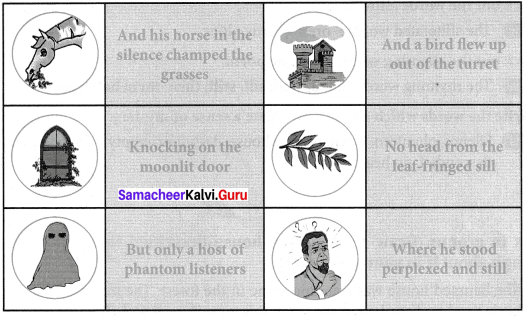
B. Find a line from the poem to match the pictures given below and write it in the blank.
Answer:

The Listeners Poem 7th Standard Samacheer Kalvi English Solutions Term 1 Chapter 2

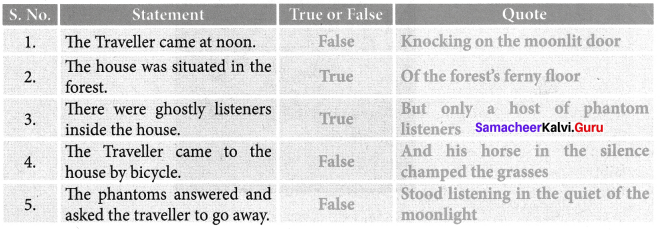
C. Read the statements and say True or False. Quote lines from the poem to support your answer
Answer:

The Listeners Poem 7th Standard Question Answer Samacheer Kalvi English Solutions Term 1 Chapter 2

D. Answer the following questions.

The Listeners Poem 7th Standard Question 1.
Who is the speaker?
Answer:
The speaker is a traveller.

The Listeners Poem 7th Standard Question Answer Question 2.
What was the horse doing?
Answer:
The horse was biting and chewing the grass noisily.

The Listeners Poem Questions And Answers Pdf Class 7 Question 3.
Who were the listeners?
Answer:
The listeners were the phantom or ghosts who lived in the lonely house.

The Listeners Questions And Answers Question 4.
How did the Traveller feel when nobody answered?
Answer:
The Traveller felt confused and stood still when nobody answered him.

The Listeners Poem Questions And Answers Pdf Question 5.
What kind of feeling does the poem create?
Answer:
The poem creates a mystical, lonely, strange and eerie feeling.

E. Work in pairs and answer the questions given below.

7th Standard English Memory Poem 2nd Term Question 1.
Of the forest’s ferny floor.
Pick out the words alliterated.
Answer:
The alliterated words : forest’s, ferny, floor.

7th English Poem Question 2.
Pick out the rhyming words from the poem.
Answer:
The rhyming words : head, said; sill, still; then, men; hall, call;

The Listeners Poem Questions And Answers Question 3.
Write the words which are used to create a sense of mystery.
Answer:
Silence, phantom, listeners, lone house, dark stair, empty hall, lonely traveller, no one descended, no head.

Writing

F. Discuss in groups. Draw the haunted house described in the poem and write a paragraph about it in your own words.
Answer:
The haunted house was standing alone in the forest. The moonlight shone on its door, birds lived undisturbed in the small tower on its wall and climbers grew on its window sill. The dark steps lead to the empty hall. No one lived in the house for a long.
The Listeners Poem Questions And Answers Pdf Class 7 Samacheer Kalvi Term 1 Chapter 2

The Listeners Additional Questions

I. Read these lines and answer the questions given below.

Listeners Poem Questions And Answers Question 1.
‘Hearkening in an air stirred and shaken.
What is the figure of speech used here?
Answer:
Metaphor. This poetic device is used when a comparison is made between two different things or ideas. In the above line, air is being compared to something that – could be stirred and shaken but actually air cannot be picked up in order to shake.

Samacheer Kalvi 7th English Memory Poem Question 2.
Stood listening in the quiet of the moonlight To that voice from the world of men:
Stood thronging the faint moonbeams on the dark stair,

(a) What is the figure of speech used here?
Answer:
Anaphora. It is the deliberate repetition of the first part of the sentence in order to achieve an artistic effect.

(b) Who were standing as a crowd and listening?
Answer:
The ghosts were standing as a crowd and listening.

(c) “Voice from the world of men” Whose voice is it?
Answer:
It is the voice of the Traveller.

II. Very Short Questions with Answers.

7th Standard English Memory Poem 1st Term Question 1.
Why did the horse champ the grasses?
Answer:
The horse had travelled a long way to reach the lonely house in the forest and it was tired and hungry. So the horse bit and chewed the grass noisily and hastily.

7th English Memory Poem Question 2.
Name the characters in the poem.
Answer:
The characters mentioned in the poem are, the traveller, the horse, ghosts and ‘they’.

7th Standard English Poem Question 3.
Who were the ‘phantom listeners’?
Answer:
The ‘phantom listeners’ were the ghosts and host of the lonely house who lived there always even before their death.

7th Standard English Poem 1st Term Question 4.
How many times did the Traveller call and knock the door?
Answer:
Three times.

The Listeners Poem Questions Question 5.
What were the ‘ghosts’ doing according to the Traveller?
Answer:
The ghosts who were the hosts of the lonely house, gathered at the steps leading to the empty hall. They were silently listening to the call of the Traveller.

III. Short Questions and Answers.

The Listeners Poem Question Answer Question 1.
When and where does the action of the poem take place?
Answer:
The action of the poem takes place during the night in a lonely house in the middle of the forest.

The Listeners Questions And Answers Class 7 Question 2.
The poem caption is “The Listeners.” Which words in the poem confirm that there were listeners?
Answer:
The phrases – ‘phantom listeners’, ‘stood listening’ and ‘hearkening’ confirm that there were listeners in the house.

7th English Book Poem Question 3.
From the poem “The Listeners” quote three phrases that tells the reader what time of day it is.
Answer:
Line 2 – Moonlit door; Line 14 – quiet of the moonlight; Line 16 – faint moonbeams on the dark stair.

The Listeners Poem Class 7 Question 4.
Justify with the words from the poem that the house was uninhabited.
Answer:
When the traveller knocked the house and called, no one responded. The floor around the house was ferny as no one used the area. Since, there was no one in the house, birds started living in the turret. Creepers grew on the window sill. Host of ghosts dwell in the empty house.

The Listeners Poem Questions And Answers Class 7 Question 5.
State the words that portray greenery in and around the house.
Answer:
Champed the grasses, forest’s ferny floor and leaf-fringed sill.

IV. Paragraph Questions with Answers.

The Listeners Summary Questions And Answers Question 1.
Describe the lonely house in the forest.
Answer:
The lonely house in the forest had a fern plant carpet on the floor around it. There was a small tower that projected from the wall of the lonely house, where birds nested. The window sill of the house was framed with creepers. The moonlight shone on its door, dark stairs and its empty hall.

Question 2.
What do you know about the ‘phantom listeners’ by reading the poem?
Answer:
According to the lines in the poem, the phantom listeners are the ghosts who lived in r the lonely house of the forest. They were the host and the owner of the house while they were alive. But even after their death they continue to live there as a group.
In the dark silent night they listen attentively to the sound of the traveller which vibrates the air, by standing as a crowd under the dull moonlight on the dark stair that leads down to the empty hall.

Warm up
Question 1.
You are walking into a grove at 12 noon. You feel that somebody is following you. When you look behind, nobody is there. How would you feel? What would you do? Share it in the class.
Answer:
Once I was walking through a thick mango grove all alone at mid noon when the scorching sun was right above the head but the close branches of the mango trees formed an umbrella over me. As I walked solitary in the middle of the grove, I could hear only the rustle of the trees, and chirping of the birds. The giant shadows of the huge trees moved in front of me. A strange feeling tickled my stomach as if a powerful alien figure accompanied me. Fear choked my throat and I started walking fast making large paces. Crossing a ruined well I heard the frogs croak that doubled terror in me. But no human soul was seen around. I called all the gods on earth for my rescue. Alas! The discerning spirit within me told it was just an eerie feel in me. Now I realised it was just an impact of the ghost film that I had viewed the previous night. I laughed to myself and continued to walk boldly whistling towards my destination.

The Listeners Summary

A man identified as the ‘Traveller’ arrives on horseback late at night at a lone house in a forest. He knocks on the moonlit door asking if anybody is there. His horse was hungrily biting and chewing the grass noisily amidst the silence of the forest.

The forest ground was covered with ferns. A bird flew from the cylindrical tower on the wall of the house which proved that it lived there undisturbed.

The Traveller knocks thrice on the door asking if anyone is there but no one responds to his call. Nobody peeped from the leaves creeping window sill nor they leaned down and looked into his grey eyes.

When the Traveller was standing confused and still, the host of ghosts that lived in the lonely house stood listening in the silence of the moonlight to the voice of the human. In the dull moonlight they stood crowded on the dark steps which lead to the empty hall in the house. They were attentively listening to the call of the lonely Traveller which disturbed the calm environment.

Samacheer Kalvi 7th Social Science History Solutions Term 1 Chapter 1 Sources of Medieval India

Students can Download Social Science History Chapter 1 Sources of Medieval India Questions and Answers, Notes Pdf, Samacheer Kalvi 7th Social Science Book Solutions Guide Pdf helps you to revise the complete Tamilnadu State Board New Syllabus and score more marks in your examinations.

Tamilnadu Samacheer Kalvi 7th Social Science History Solutions Term 1 Chapter 1 Sources of Medieval India

Samacheer Kalvi 7th Social Science Sources of Medieval India Textual Evaluation

I. Choose the correct answer:

Sources Of Medieval India Class 7 Question 1.
are the writings engraved on solid surfaces such as rocks, stones, temple wails and metals.
(a) Chronicles
(b) Travelogues
(c) Coins
(d) Inscriptions
Answer:
(d) Inscriptions

Sources Of Medieval Indian History Class 7 Question 2.
was the land gifted to temples.
(a) Vellanvagai
(b) Shalabhoga
(c) Brahmadeya
(d) Devadana
Answer:
(d) Devadana

Sources Of Medieval India Questions And Answers Question 3.
__________ period was known as the period of devotional literature.
(a) Chola
(b) Pandya
(c) Rajput
(d) Vijayanagara
Answer:
(a) Chola

Sources Of Medieval Indian History Class 7 Question Answer Question 4.
__________ provides information about the first Sultan of Delhi.
(a) Ain-i-Akbari
(b) Taj-ul-Ma’asir
(c) Tuzk-i-Jahangiri
(d) Tarikh-i-Frishta
Answer:
(b) Taj-ul-Ma’asir

Samacheer Kalvi Guru 7th Social Science Question 5.
__________ an Arab-born Morocco scholar, travelled from Morocco to India.
(a) Marco Polo
(b) A1 Beruni
(c) Domingo Paes
(d) Ibn Battuta
Answer:
(d) Ibn Battuta

II. Fill in the Blanks

  1. __________ inscriptions provide details about administration in a Brahmadeya village.
  2. __________ had stamped the figure of Goddess Lakshmi on his gold coins and had his name inscribed on it.
  3. __________ 3.6 grains of silver amounted to a
  4. __________ was patronised by Sultan Nazir-ud-din Mahmud of Slave Dynasty.
  5. __________ An Italian traveller visited Vijayanagar Empire in 1420.

Answer:

  1. Uttiramerur
  2. Muhammad Ghori
  3. Jital
  4. Minhaj-us-Siraj
  5. Nicolo Conti

III. Match the following

AB
Khajurahoi.Odisha
Konarkii.Hampi
Dilwaraiii.Madhya Pradesh
Virupakshaiv.Rajasthan

Answer:

  1. iii
  2. i
  3. iv
  4. ii

IV. State true or false :

Samacheer Kalvi 7th History Book Question 1.
Pallichchandam was the land donated to Jaina institution.
Answer:
True

Samacheer Kalvi Guru 7th Social Question 2.
The composition of metal coins gives us information on the political condition of the empire.
Answer:
False
Correct statement: The composition of metals in the coins gives us information on the economic condition of the empire.

Question 3.
The high cost of copper made palm leaf and paper cheaper alternatives for recording royal orders and events in royal courts.
Answer:
True

Question 4.
Domingo Paes, a Portuguese traveller, visited the Chola Empire in 1522.
Answer:
False
Correct statement: Domingo Paes, a Portuguese traveller, visited the Vijayanagar in 1522.

V. Match the statement with the reason Tick
(a) Tick (✓) the appropriate answer.

Question 1.
Assertion (A) :Muhammad Ghori’s gold coins carried the figure of Goddess Lakshmi.
Reason (R) :The Turkish invader was liberal in his religious outlook.
a) R is the correct explanation of A.
b) R is not the correct explanation of A.
c) A is wrong and R is correct.
d) A and R are wrong.
Answer :
(a) R is the correct explanation of A

(b) Find out the wrong pair

  1. Madhura Vijayam – Gangadevi
  2. Abul Fazal – Ain-i-Akbari
  3. Ibn Battura – Tahquiq-i-Hind
  4. Amuktamalyatha – Krishnadevaraya

Answer:
3. Ibn Battuta – Tahquiq-i-Hind

(c) Find out the odd one
Question 1.
Inscriptions, Travelogues, Monuments, Coins
Answer:
Travelogues

VI. Answer the following in one or two sentences

Question 1.
Who compiled Nalayira Divyaprabhandham ?
Answer:
Nathamuni

Question 2.
What does the word Tuzk mean?
Answer:
Auto biography

Question 3.
Name Jahangir’s memoir.
Tuzk-i-Jahangiri

Question 4.
Name the two different types of sources for the study of history.
Answer:
Primary sources and Secondary sources are the two different types of sources for the study of history.

Question 5.
List out the important mosques and forts constructed during the medieval times.
Answer:

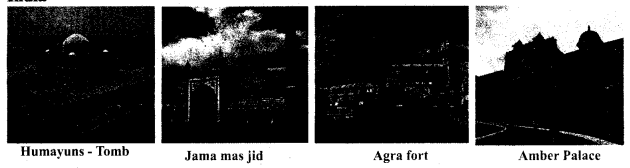
  1. Quwwat-ul Islam Masjid, Moth-ki- Masjid, Jama Masjid, Fatehpur Sikri Dargah (all in and around Delhi) and Charminar (Hyderabad) are the important mosques belonging to the medieval times.
  2. The forts of historical importance are Agra Fort, Chittor Fort, Gwalior Fort and Delhi Red Fort and

Question 6.
Mention the important foreign travellers who visited India during the medieval period.
Answer:
Marco Polo, a Venetian traveller, Al-Beruni, Ibn Battuta Nicolo Conti, Abdur-Razzaq, Domingo Paes.

VII. Answer the following :

Question 1.
Describe the different types of coins introduced by the rulers of Delhi Sultanate.
Answer:

  1. The picture and the legend on the coins convey the names of kings with their titles and portraits, events, places, dates, dynasties and logos.
  2. The composition of metals in the coins gives us information on the economic condition of the empire.
  3. Mention of king’s achievements like military conquests, territorial expansion, trade links and religious faith can also be found in the coins.
  4. Muhammad Ghori had stamped the figure of Goddess Lakshmi on his gold coins and had his name inscribed on it.
  5. This coin tells us that this early Turkish invader was in all likelihood liberal in religious outlook. Copper Jitals are available for the study of the period of the Delhi Sultans.
  6. Silver Tanka introduced by Iltutmish, Ala-ud-din Khalji’s gold coins, Muhammad-bin- Tughluq’s copper token currency are indicative of coinage as well as the economic prosperity or otherwise of the country of the time. A jital contained 3.6 grains of silver. Forty eight jitals were equal to 1 silver tanka.

VIII. Answer Grid

1. _______________ was a courtier of Emperor Aurangazeb.
Answer:
Khafi khan
2. Tiruvalangadu copper plates belong to
Answer :
Rajendra Chola I
3. _______________ was the land for the maintenance of the school.
Answer :
Shalabhoga
4. _______________ compiled Periyapuranam.
Answer :
Sekkizhar
5. _______________ is an Arabic word meaning history.
Answer:
Tariq or Tahquiq.
6. Muhammed bin Tughluq transferred his capital from Delhi to ____________ in the south.
Answer:
Devagiri (Daulatabad).

IX. HOTS :

Question 1.
The composition of metals in coins is indicative of the economic prosperity of the empire-
Substantiate.
Answer:

  1. Metals like Gold and Silver are precious and rare elements.
  2. They are shiny, strong and have high economic value.
  3. If such metals are used in coins in an empire, it indicates its economic prosperity.

X. Student Activity :

Prepare an album collecting pictures of palaces, tombs, mosques and forts of Medieval India

Sources Of Medieval India Class 7 Samacheer Kalvi History Solutions Term 1 Chapter 1

XI. Life skill :

Question 1.
Find out from the libraries in your town or village and prepare a report about the primary and secondary sources available there.
Answer:
On a visit to a library nearby I found that it had primary and secondary sources.

I found historical documents, statistical data, pieces of creative writing, speeches and art objects. Interviews, surveys, field work also are available here. I also could see and sources like articles in news papers, popular magazines, book a movie views and articles in journals.

Samacheer Kalvi 7th Social Science Sources of Medieval India Additional Questions

I. Choose the correct answer:

Question 1.
Uttiramerur inscriptions in ______ district provide details about Brahmadeya village administration.
(a) Salem
(b) Kanchipuram
(c) Chennai
(d) Vellore
Answer:
(b) Kanchipuram

Question 2.
______ jitals are available for the study Of the period Of the Delhi sultans.
(a) Gold
(b) Silver
(c) Copper
(d) Aluminium
Answer:
(c) Copper

II. Fill in the blanks

  1. ______ grants, which were treated as legal documents, have significant source value.
  2. Palaces in Jaipur, Jaisalmer and Jodhpur signify the greatness of the _____ dynasty.
  3. The ______ period was known as the period of devotional literature in South India
  4. ______ are pictures, images in drawing or painting

Answer:

  1. Copper – Plate
  2. Rajput
  3. Chola
  4. Portraits

III. Match the following:

AB
a.Abul Fazali.King’s achievements
b.Iltutmishii.Akbar nama
c.Coinsiii.Kalhana
d.Rihlaiv.Chahalgani
e.RajataranginiV.The Travels

Answer:
a – ii
b – iv
c – i
d – v
e – iii

IV. State true or false:

Question 1.
Zia – Ud – Bami wrote Tarikh – i – Firoz shahi.
Answer:
True

Question 2.
Tabakat-i- Akbari was authored by Abul Faze.
False
Correct statement: Tabakat-i- Akbari was authored by Nizam-ud-din Ahmad.

Question 3.
Ibn Battuta tells us of caste in India and the practice of Sati.
Answer:
True

V. Match the statement with the reason. Tick the appropriate answer:

Question 1.
Statement : Minhaj – us- siraj, patronised by Sultan Nazir – ud – din Mahmud, wrote Tabakat – i – Nasiri
Reason : The compendium was named after its patron.
(a) Statement is true but Reason is wrong.
(b) Statement and Reason are correct.
(c) Statement is wrong and reason is correct.
(d) Both Statement and reason are wrong.
Answer:
(b) Statement and Reason are correct.

Question 2.
Statement :Accroding to Ibn Battuta, a Morocco scholar, Egypt was rich in the 16th century.
Reason: The whole of Indian trade with the west passed through Egypt
(a) Statement is true but Reason is wrong.
(b) Statement and Reason are correct.
(c) Statement is wrong and reason is correct.
(d) Both Statement and reason are wrong.
Answer:
(c) Statement is wrong and reason is correct.

Question 3.
Statement: Kayal, which was a port city is situated in this district of Tamil Nadu.
Find out which of the following is correct?
(a) Kanyakumari
(b) Tirunelveli
(c) Thoothukudi
(d) Ramanathapuram
Answer:
(c) Thoothukudi

Question 4.
Find out the wrong Pair
(a) Nalayira Divyaprabhandham – 12Azhwars
(b) Devaram – Appar, Sambandar, Sundarar
(c) Thiruvasagam – Manikkavasakar
(d) GitaGovindam – Kabirdas
Answer:
(d) Gita Govindam – Kabir das

Question 5.
pick out the wrong statement.
(a) Al – Beruni accompanied Mahmud of Ghazni in one of his campaigns
(b) He stayed in India for 10 years.
(c) The most accurate accounts of Mahmud’s Somnath expedition is that of Alberuni
(d) He knew only Arabic.
Answer:
(d) He knew only Arabic

VI. Answer in one or two sentences

Question 1.
Who composed Nalayira Divya Prabhandam?
Answer:
Nalayira Divya Prabhandam was composed by 12 Azhwars.

Question 2.
By whom was Devaram composed and compiled?
Answer:

  1. Devaram composed by Appar, Sundarar and Sambandar
  2. Compiled by Nambiyandar Nambi.

Question 3.
How many jitals were equal to 1 siver tanka?
Answer:
Forty – eight

VII. HOTS :

Question 1.
How are sources of history useful to us?
Answer:

  1. Source are the supporting materials, documents or records in the form of evidence that help to reconstruct the past.
  2. They are available in different forms such as Inscriptions, monuments, coins, chronicles, travelogues, biographies etc.,
  3. Through these sources we get to know a lot of information about social, economic and political condition of a country under different rulers.

Who am I ?

  1. I am a person who writes accounts of important historical events.
  2. I am a collection of detailed information about a particular subject.
  3. I am a tall tower, typically part of a mosque.
  4. I am an Arabic word meaning generations or centuries.

Answer:

  1. Chronicles
  2. Compendium
  3. Minaret
  4. Tabakat

Samacheer Kalvi 7th Science Solutions Term 1 Chapter 3 Matter Around Us

Students can Download Science Chapter 3 Matter Around Us Questions and Answers, Notes Pdf, Samacheer Kalvi 7th Science Book Solutions Guide Pdf helps you to revise the complete Tamilnadu State Board New Syllabus and score more marks in your examinations.

Tamilnadu Samacheer Kalvi 7th Science Solutions Term 1 Chapter 3 Matter Around Us

Samacheer Kalvi 7th Science Matter Around Us Textual Evaluation

I. Choose the appropriate answer :

Matter Around Us Class 7 Question 1.
Which of the following is an example of a metal?
(a) Iron
(b) Oxygen
(c) Helium
(d) Water
Answer:
(a) Iron

7th Science Matter Around Us Question 2.
Oxygen, hydrogen, and sulphur are examples of which of the following?
(a) Metals
(b) Non-metals
(c) Metalloids
(d) Inert gases
Answer:
(b) Non-metals

7th Standard Science Matter Around Us Question 3.
Which of the following is a short and scientific way of representing one molecule of an element or compound?
(a) Mathematical formula
(b) Chemical formula
(c) Mathematical symbol
(d) Chemical symbol
Answer:
(d) Chemical symbol

7th Standard Science Matter Around Us Question Answer Question 4.
The metals which is a liquid at room temperature
(a) Chlorine
(b) Sulphur
(c) Mercury
(d) Silver
Answer:
(c) Mercury

Matter Around Us Class 9 Samacheer Kalvi Question 5.
An element which is always lustrous, malleable and ductile
(a) non-metal
(b) metal
(c) Metalloid
(d) gas
Answer:
(b) metal

II. Fill in the blanks :

  1. The smallest particle of matter that can exist by itself ______
  2. A compound containing one atom of carbon and two atoms of oxygen is ______
  3. ______ is the only non-metal conducts electricity.
  4. Elements are made up of ______ kinds of atoms.
  5. ______of some elements are derived from Latin or Greek names of the elements.
  6. There are ______ number of known elements.
  7. Elements are the ______ form of pure substances.
  8. The first letter of an element always written in ______ letter.
  9. Molecule containing more than three atoms are known as ______
  10. ______ is the most abundant gas in the atmosphere.

Answer:

  1. atom
  2. CO2
  3. Graphite
  4. same
  5. Symbol
  6. 118
  7. simplest
  8. capital
  9. polyatomic molecule
  10. Nitrogen

III. Fill in the blanks :

  1. Mercury: liquid at room temperature:: Oxygen: _________
  2. Non metal conducting electricity: _______ :: Metal conducting electricity: Copper
  3. Elements: combine to form compounds:: Compounds: ________
  4. Atoms: fundamental particle of an element:: ________ fundamental particles of a compound

Answer:

  1. Gas at room temperature
  2. Graphite
  3. can be split into elements
  4. elements

IV. True of False. If False, give the correct statement.

Matter Around Us Questions And Answers Question 1.
Two different elements may have similar atoms.
Answer:
True

Samacheer Kalvi Guru 7th Science Question 2.
Compounds and elements are pure substance.
Answer:
True

Samacheer Kalvi 7th Science Books Answers Question 3.
Atoms cannot exist alone; they can only exist as groups called molecules.
Answer:
True

Samacheer Kalvi 7th Guide Science Question 4.
NaCl represents one molecule of sodium chloride.
Answer:
True

Samacheer Kalvi 7th Books Science Question 5.
Argon is mono atomic gas.
Answer:
True

V. Answer in brief.

Samacheer Kalvi 7th Science Solution Question 1.
Write the chemical formula and name the elements present in the following compounds:
a. Sodium chloride
b. Potassium hydroxide
c. Carbon-di-oxide
d. Calcium oxide
e. Sulphur dioxide
Answer:

Chemical fromulaElements present
a.Sodium chlorideNaClSodium (Na), Chlorine (Cl)
b.Potassium hydroxideKOHPotassium (K), Oxygen (O), Hydrogen (H)
c.Carbon-di-oxideCO2Carbon (C), Oxygen (O2)
d.Calcium oxideCaOCalcium (C), Oxygen (O2)
e.Sulphur dioxideSO2Sulphur (S), Oxygen (O2)

Samacheer Kalvi.Guru 7th Science Question 2.
Matter Around Us Class 7 Samacheer Kalvi Term 1 Chapter 3
Answer:

7th Science Matter Around Us Samacheer Kalvi Term 1 Chapter 3

Samacheer Kalvi Guru Science 7th Question 3.
What do you understand by chemical formula of a compound? What is its significance?
Answer:

  1. A chemical formula is a symbolic representation of one molecule of an element or a compound.
  2. It provides information about the elements present in the molecule and the number of atoms of each element. The chemical formula tells us the types of atoms and the number of each type of atom in one molecule of substance.

Samacheer Kalvi Science 7th Standard Question 4.
Define the following terms with an example of each:
a. Element
b. Compound
c. Metal
d. Non-metal
e. Metalloid
Answer:
(a) Element: It is a substance that cannot be broken down into simpler substance by chemical means Ex. : Oxygen, Hydrogen, Gold & Helium.

(b) Compound A compound is a pure substance that is formed when the atoms of two or more elements combine chemically in definite proportions. Ex : H?0, NaCl.

(c) Metal A chemical element that is an effective conductor of electricity and heat can be defined as a metal. Ex.: Copper, Iron, Silver, etc.
(d) Non-Metal Non-metal is an element that doesn’t have the characteristics of metal including, (i.e.) ability to conduct heat or electricity luster or flexibility. Ex. Carbon Iodine, Sulphur.

(e) Metalloid : Metalloid is a chemical element that exhibits some properties of metals and some of non-metals. Metalloids are generally semi-conductors. Ex. : Silicon. Arsenic, Antimony and Boron.

Samacheer Kalvi Guru 7th Standard Science Question 5.
Write the symbols for the following elements and classify them as solid, liquid and gas.
Aluminum, carbon, chlorine, mercury, hydrogen and helium.
Answer:

ElementSymbolClassification
AluminumAlSolid
CarbonCSolid
Chlorine.ClGas
Mercury.HgLiquid
Hydrogen.HGas
HeliumHeGas

Samacheer Kalvi 7th Science Book Answers Question 6.
Classify the following as metals, non-metals and metalloids
Sodium, Bismuth, Silver, Nitrogen, Silicon, carbon, chlorine, Iron, copper.
Answer:

MetalNon-metalMetalNon-metal
SodiumMetalCarbonNon-metal
BismuthMetalChlorineNon-metal
SilverMetalIronMetal
NitrogenNon-metalCopperMetal
SiliconMetalloid

Samacheer Kalvi 7th Science Books Answers Pdf Question 7.
Classify the following as elements and compounds.
Water, common salt, sugar, carbon dioxide, iodine and lithium
Answer:

ElementsCompounds
WaterCompound
Common saltcompound
SugarCompound
Carbon dioxideCompound
IodineElement
LithiumElement

Samacheer Kalvi 7th Standard Science Question 8.
Write the chemical formula for the following elements.
a. Hydrogen
b. Nitrogen
c. Ozone
d. Sulphur
Answer:

ElementsFormula
HydrogenH
NitrogenN
OzoneO3
SulphurS

Samacheer Kalvi 7th Science Question 9.
What are elements? What are they made of. Give two examples.
Answer:

  1. Elements are chemically the simplest substances and hence cannot be broken down using chemical reactions.
  2. It is made of entirely from one type of atom.
  3. Example : Hydrogen, Oxygen is made from atoms containing a single proton and a single electron.

7th Standard Science Samacheer Kalvi Question 10.
Define molecule.
Answer:

  1. When an atom combines with another atom (or atoms) and forms a compound it is called as molecule.
  2. A molecule is made up of two or more atoms chemically combined.

Samacheer Kalvi 7th Science Book Back Answers Question 11.
What are compounds? Give two examples.
Answer:
A compound is a pure substance that is formed when the atoms of two or more elements combine chemically in definite proportions.
Example : H2O, NaCl,

Question 12.
Give an example for the elements derived from their Latin names.
Answer:

ElementLatin NameSymbol
CopperCuprumCu
LeadPlumbumPb
PotassiumKaliumK
IronFerrumFe
MercuryHydrargyrumHg
SodiumNatriumNa

Question 13.
What is atomicity of elements?
Answer:
Atomicity is the total number of atoms present in one molecule of an element, compound or a substance.

Question 14.
Calculate the atomicity of H2S04.
Answer:
A molecule of sulphuric acid (H2S04) consists of 2 hydrogen atom, 1 Sulphur atom and 4 oxygen atoms. Hence its atomicity 2 + 1 + 4 = 7.

VI. Answer in detail :

Question 1.
Differentiate metals and non metals.
Answer:

MetalsNon-Metals
Metals are lustrous. They have a shinyNon metals are non lustrous. They
surfacehave non- shiny surface
Metals are generally hardNon-metals are generally soft
Most metals are bendableNon-metals are non bendable
Most metals can be bent, beaten into sheets and they can drawn into wiresNon-metals are non ductile
Most metals are good conductors of electricityNon-metals are bad conductors of electricity
Most metals are good conductors of heatNon-metals are bad conductors of heat
Most metals are making ringing sound when struck. Hence, they are used to make objects like bellsNon-metals does not make any sound when they struck
Ex. : Copper, Lead, Tin, NickelEx. : Carbon, Iodine, Sulphur

Question 2.
Explain the characteristics of compounds.
Answer:

  1. A compound is formed only when the constituent elements combine in a fixed proportion.
  2. The properties of a compound are different from those of its constituent elements
  3. A compound cannot be broken down by physical methods.
  4. This is because a compound is made up of different elements that are chemically combined. Sodium chloride cannot be separated by physical methods such as filtration.
  5. A compound can be separated into its constituent elements by chemical methods only.

Question 3.
Describe the different ways in which we can write the symbols of elements. Give appropriate examples.
Answer:
The following rules are followed while assigning symbol to an elements:

  1. Chemical symbols usually consist of one or two letters.
  2. The symbols of most elements correspond to the first letter (which is capitalized) of their English name. For example, the symbol for oxygen is “O” and that for hydrogen is “H”.
  3. When there is more than one element that begins with the same letter, their symbols take two letters.
  4. The first letter is capitalised while the second letter has a lower case.
  5. For example, the names of both hydrogen and helium begin with H. So, hydrogen is represented by the symbol H and Helium by He.

Example:
7th Standard Science Matter Around Us Samacheer Kalvi Term 1 Chapter 3

Question 4.
Differentiate between elements and compounds.
Answer:

ElementsCompounds
An element is the simplest substanceA compound is a chemical substance formed by the combination of two or more elements
Elements combine to form compoundsCompounds can be split into elements
Atoms are the fundamental particle of an elementMolecules are the fundamental particles of a compound

Question 5.
Write any five characteristics of compound.
Characteristics of compound:
Answer:

  1. A compound is formed only when the constituent elements combine in a fixed proportion.
  2. The properties of a compound are different from those of its constituent elements.
  3. A compound cannot be broken down by physical methods.
  4. Compound is made up of different elements that are chemically combined.
  5. A compound can be separated into its constituent elements by chemical methods only.

Question 6.
List comparative properties of metals and non-metals. Give three examples of each.
Answer:

MetalsNon-Metals
Metals are lustrous. They have a shinyNon metals are non lustrous. They
surfacehave non- shiny surface
Metals are generally hardNon-metals are generally soft
Most metals are bendableNon-metals are non bendable
Most metals can be bent, beaten into sheets and they can drawn into wiresNon-metals are non ductile

Question 7.
Write down the properties of metalloids.
Answer:
Properties of metalloids :

  1. Metalloids usually look like metals but behave largely like non-metals.
  2. Physically they are shiny, brittle solids with intermediate to relatively good electrical conductivity.
  3. They can from alloys with metals.
  4. Most of their physical and chemical properties are intermediate in nature, (v) They are semiconductors.
  5. All are solids at room temperature.
  6. Example : Germanium, Boron, Antimony, Silicon.

VII. Rewrite the sentence in correct form :

Question 1.
Elements contains two or more kinds of atoms and compounds contains only one kinds of atoms.
Answer:
Elements contains two or more kinds of atoms and compounds contains two or more kinds of elements.

VIII. Higher Order Thinking questions :

Question 1.
Lists the metals, non-metals and metalloids which you used in your house, schools. Compare their properties.
Answer:
Metals and their uses in our houses & schools :

  1. Magnesium is used in the laboratory as magnesium ribbon.
  2. Copper is used cooking utensils.
  3. Zinc is mainly used as a protective coat for iron is our school and house gates.
  4. Aluminum is used as cooking utensils and electrical cables which are used in our schools and houses.
  5. Iron and steel are widely used is construction of house and school.
  6. Sodium is used as a table salt and for flavoring, preserving food.
  7. Coins are made up of nickel.
  8. Lead is used in car batteries. Lead based alloys find extensive use in printing

Non-metals and their uses in houses & school:

  1. Oxygen is essential for the breathing. It is used as oxidising agent in laboratory. Chlorine is used for purifying water.
  2. Graphite is used in pencil leads.
  3. Carbon is used as a fuel.
  4. Bromine is used in dyes.
  5. Iodine is used in laboratory to test for starch.

Metalloids and their uses in houses & schools :

  1. Silicon is used in glass items.
  2. Antimony is used in optical discs.
  3. Tellurium is used in solar cells.
  4. Boron is used in washing powders.
  5. Germanium is used to make transistors which is used in laboratory in electrical devices.

Comparsion of properties of metals, non-metals & metalloids

MetalsNon-metalsMetalloids
They have lustreThey are not lustrousIntermediate
Conduct heat and electricityPoor conductors of electricity except graphiteIntermediate (semi­conductors)
They are malleable and ductileThey are neither malleable nor ductile.Intermediate

Question 2.
Aakash noticed that the metal latch on gate was difficult to open during hot sunny days. However, this same latch was not difficult to open at night. Aakash observed that the latch and the gate are exposed to the sun during the day.
a) Formulate a hypothesis based on the information provided.
b) Briefly state how you would test the hypothesis stated in (a).
Answer:
(a) Solids (Iron) expand on heating and contract on cooling. This causes the volume to matter of increase during heating or expansion, the mass of matter does not change.
(b) During heating the distance between the particles of the iron latch change. In an iron latch the distance between the iron particles increases when they gain enough heat. So during hot days the latch on the gate was difficult to open. At night, because of cooling the distance between the particles decreases. So at night it was not difficult to open the latch on the gate.

Question 3.
What changes take place in the movement and arrangement of particles during heating process?
Answer:
When a substance is heated, its internal energy increases.

  1. The movement of its particles increases.
  2. Bonds between particles break when a substance melts evaporates. This causes the volume of matter to increase.
  3. The closeness, arrangement and motion of the particles in a substance change when it changes state. But the size of the particles remain in same size, (i.e.) the mass of matter does not change.

Question 4.
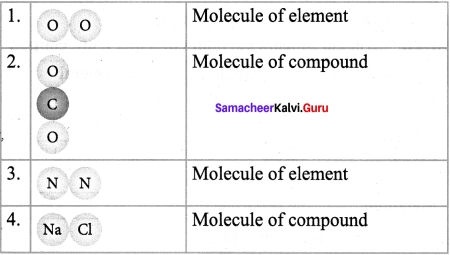
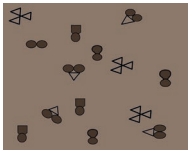
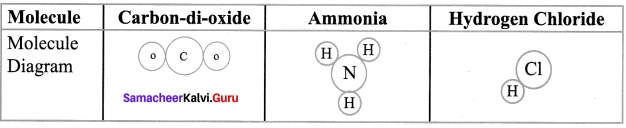
In the diagram given below, the circle, square and triangle represent the atoms of different elements different elements.

7th Standard Science Matter Around Us Question Answer Samacheer Kalvi Term 1 Chapter 3
Identify all combinations that represent.
a) A molecule of a compound
b) A molecule of an element consisting of two atoms
c) A molecule of an element consisting of three atoms
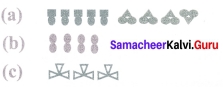
Answer:

Matter Around Us Class 9 Samacheer Kalvi Term 1 Chapter 3

IX. Assertion-reason questions :

Question 1.
Directions: Please refer to the following instructions:
A. Both statements are true and the 2nd statement is a correct explanation of the 1st statement.
b. Both statements are true but the 2nd statement is NOT a correct explanation of the 1st statement.
C. The 1st statement is false while the 2nd statement is true.
D. Both statements are false.

1st Statement2nd Statement
1.Oxygen is a elementOxygen cannot be broken down into anything simpler
2.Hydrogen is an elementHydrogen cannot be broken down into anything simpler
3.Air is a compoundAir consists of carbon dioxide
4.Air is a mixture of elements onlyOnly nitrogen, oxygen and neon gases exist in air
5.Mercury is solid in room temperatureMercury is a non-metal

Answer

1. (A) Both statements are true and the 2nd statement is a correct explanation of the 1st statement.
2. (A) Both statements are true and the 2nd statement is a correct explanation of the 1 st statement.
3. (D) Both statements are false.
Correct statement:

  1. Air is a mixture of gases.
  2. Air consists of Nitrogen Oxygen, CO,, other noble gases.

4. (A) Both statements are true and the 2nd statement is a correct explanation of the 1 st statement.
5. (D) Both statements are false.
Correct statement:

  1. Mercury is liquid at room temperature.
  2. Mercury is a metal.

Samacheer Kalvi 7th Science Matter Around Us Intext Activities

Activity – 1
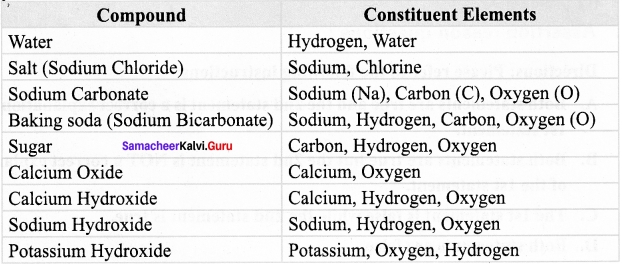
Complete the following table by writing compounds of its constituents.
Answer:

Matter Around Us Questions And Answers Samacheer Kalvi 7th Science Solutions Term 1 Chapter 3

Activity – 2
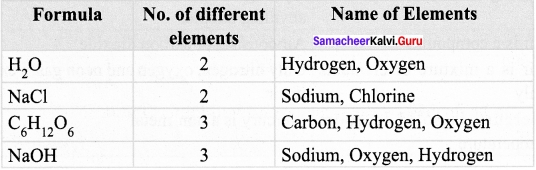
Complete the following table by counting the number of different elements in a compounds and give appropriate name.
Answer:

Samacheer Kalvi Guru 7th Science Term 1 Chapter 3 Matter Around Us

Activity – 3
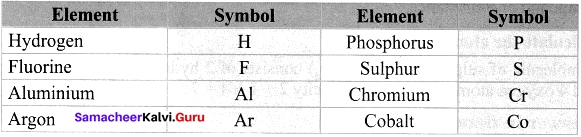
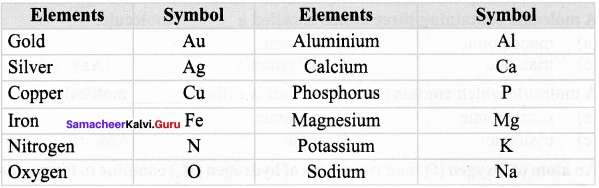
Write down the symbols of the following elements.
Answer:

Samacheer Kalvi 7th Science Books Answers Samacheer Kalvi Term 1 Chapter 3

Activity – 4
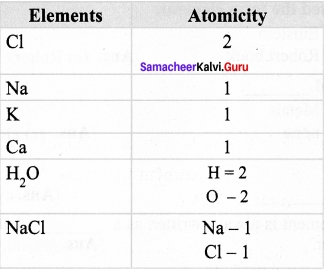
Write down atomicity of the following elements and compounds
Answer:

Samacheer Kalvi 7th Guide Science Samacheer Kalvi Term 1 Chapter 3

Samacheer Kalvi 7th Science Matter Around Us Additional Questions

I. Choose the correct answers:

Question 1.
The graphite refill used is pencil is made of element called __________
(a) graphite
(b) carbon
(c) silicon
(d) sodium
Answer:
(b) carbon

Question 2.
The smallest unit of an element is __________
(a) atom
(b) molecule
(c) compound
(d) none
Answer:
(a) atom

Question 3.
The most abundant type of atom is the universe is __________
(a) Helium
(b) Hydrogen
(c) Argon
(d) Argon
Answer:
(b) Hydrogen

Question 4.
__________ can be formed by the same or different kinds of atoms.
(a) Atom
(b) Molecule
(c) Gases
(d) None
Answer:
(b) Molecule

Question 5.
__________ is a substance that is made up of three oxygen atoms chemically combined.
(a) Oxygen
(b) Hydrogen
(b) Ozone
(d) CO2
Answer:
(a) Oxygen

Question 6.
A molecule containing three atoms is called a __________ molecule
(a) monoatomic
(b) diatomic
(c) triatomic
(d) polyatomic
Answer:
(c) triatomic

Question 7.
A molecule which contains only one atom is called __________ molecule
(a) monoatomic
(b) diatomic
(c) triatomic
(d) none
Answer:
(a) monoatomic

Question 8.
An atom of Oxygen (O) and two atoms of hydrogen (H.) combine to form a molecule of __________
(a) hydrogen
(b) ozone
(c) water
(d) none
Answer:
(c) water

Question 9.
__________ is the first scientist who used the term element.
(a) New ton
(b) Einstein
(c) Robertr boyle
(d) Robert hook
Answer:
(c) Robertr boyle

Question 10.
Matter is its simplest form is called __________
(a) molecule
(b) Metals
(c) element
(d) none
Answer:
(c) element

II. Fill in the blanks :

  1. The name copper was taken from ______
  2. The first letter of a symbol of an element is always written as a the second letter as a ______ letter and the second letter as a _____ letter
  3. There are ______ hydrogen atoms in water molecule.
  4. There is ______ oxygen atom is water molecule.
  5. ______ is the total number atoms present in one molecule of an element, compound or a substance.
  6. ______ is a mixture of gases
  7. ______ is the life-giving element is the air
  8. During heating or expansion, the ______
  9. ______ is the smallest particle of an element.
  10. ______ of an element consist of a fixed number of different types of atom.

Answer:

  1. cypress
  2. capital,small
  3. 2
  4. 1
  5. atomicity
  6. Air
  7. Oxygen
  8. mass
  9. Atom
  10. Molecules

III. Write true or false :

Question 1.
Metals are usually solids or gases at room temperature.
Answer:
False. Metals are usually solids at room temperature.

Question 2.
Non-metals are non-malleable.
Answer:
True.

Question 3.
Non-metals are usually good conductors of heat and electricity.
Answer:
(False) Metals are usually good conductors of heat and electricity.

Question 4.
Sodium chloride is used as table salt and for flavoring and preserving food.
Answer:
True.

Question 5.
Lead is also known as plumbum.
Answer:
True

IV. Match the following :

Question 1.

1.Co2(a)Robert Boyle
2.Sulphur(b)Making mobile phones
3.Element(c)triatomic molecule
4.Gallium(d)Polyatomic molecule

Answer:

  1. c
  2. d
  3. a
  4. b

Question 2.

1.Non-metals(a)Silicon
2.Metals(b)fire extinguisher
3.Metalloids(c)dull and soft
4.Oxygen(d)hard and shiny
5.Water(e)supports fire

Answer:

  1. c
  2. d
  3. a
  4. b

V. Give very short answer :

Question 1.
How many elements are known at present?
Answer:
118.

Question 2.
Name the element which is used for making computer chips.
Answer:
Silicon

Question 3.
Name the constituents of water.
Answer:
Hydrogen and Oxygen.

Question 4.
What is the expansion of IUPAC.
Answer:
International Union of Pure and Applied Chemistry.

Question 5.
What is the Latin name of Sodium?
Answer:
Natrium

Question 6.
What is a molecule?
Answer:
Molecule is the smallest unit of compound.

Question 7.
What is the fundamental particle of an element?
Answer:
Atom.

Question 8.
What is a chemical formula?
Answer:
A chemical formula is a symbolic representation of one molecule of an element or a compound.

VI. Give short answer :

Question 1.
What is an atom?
Answer:
The smallest unit of an element that exhibits the properties of the element is called as ‘atom’.

Question 2.
What are the 3 most abundant atoms on the earth?
Answer:
On earth the three most abundant atom are iron, oxygen, and silicon.

Question 3.
Write any two classification of molecule.
Answer:

  1. A molecule which contains only one atom is called monatomic molecule (inert gases)
  2. A molecule which contains two atoms is called diatomic molecule (oxygen, nitric oxide, hydrogen, etc.).

Question 4.
Classify the following as element and compound, (i) Silver (ii) Ammonia (iii) Water (iv) Mercury.
Answer:

  1. Silver – element
  2. Ammonia – compound
  3. Water – compound
  4. Mercury – clement

Question 5.
Give an account of elements known to us.
Answer:
There are 118 known elements till date. 94 of these elements occur naturally while 24 elements have been created artificially in the laboratory.

Question 6.
What are metalloids? Give examples.
Answer:
Metalloids are the elements which have properties intermediate, between those of metals and non-metals. Ex.: Boron, Silicon, Germanium, Arsenic, Antimony.

Question 7.
Give an example of a metal which
(a) is liquid at room temperature.
(b) is the best conductor of heat.
Answer:
a) Mercury
b) Silver, Copper

Question 8.
Write any two properties of a compound.
Answer:

  1. The properties of a compound are different from those of its constituent elements.
  2. A compound cannot be broken down by physical methods. This is because a compound is made up of different elements that are chemically combined. Sodium chloride cannot be separated by physical methods such as filtration.

Question 9.
What happens to matter during heating?
Answer:

  1. SOLID : When solid is heated, the particles gain energy and vibrate more vigorously.
  2. LIQUID : Melting occurs when the melting point is reached. The solid changes to its liquid state.
  3. LIQUID : When a liquid is heated the particles gain energy and vibrate more
  4. GAS : Boiling occurs when the boiling point is reached. The liquid changes to its gaseous State.

Question 10.
How do hot air balloons float?
Answer:
When air inside the hot air balloon is heated with a burner, it expands. The expansion causes the density of the air inside the balloon to decrease. Hence, the air inside the balloon has a lower density that the air outside of the balloon. This difference is density allows the hot-air balloon to float.

VII. Complete the table

Question 1.
Samacheer Kalvi 7th Books Science Term 1 Chapter 3 Matter Around Us
Answer:

Samacheer Kalvi 7th Science Solution Term 1 Chapter 3 Matter Around Us

Question 2.
Samacheer Kalvi.Guru 7th Science Term 1 Chapter 3 Matter Around Us
Answer:

Samacheer Kalvi Guru Science 7th Term 1 Chapter 3 Matter Around Us

Question 3.

CompoundConstituent elements
Sodium carbonateSodium, Carbon. Oxygen
Water(i) ?
Calcium oxide(ii) ?
SugarCarbon, Hydrogen, Oxygen

Answer:

  1. Hydrogen, Oxygen
  2. Calcium, Oxygen.

Question 4.
Complete the table by writing the symbols of the following elements

ElementSymbol
AluminiumAl
Nickel
Bromine
Helium
Magnesium

Answer:

ElementSymbol
AluminiumAl
NickelNi
BromineBr
HeliumHe
MagnesiumMg

Question 5.
Complete the table:

ElementLatin NameSymbol
MercuryHg
LeadPlumbum
IronFe
PotassiumKalium

Answer:

  1. Hydrargyrum
  2. Pb
  3. Ferrum
  4. K

VIII. Long answer questions :

Question 1.

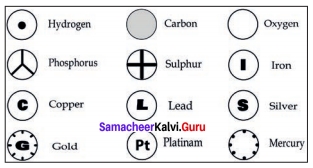
  1. Draw the symbol for some elements as proposed by Dalton.
  2. What are rules to be followed while assigning symbol to element.

Answer:

  1. Symbol for some elements as proposed by Dalton.
  2. The following rules are followed while assigning symbol to an elements:

Samacheer Kalvi Science 7th Standard Term 1 Chapter 3 Matter Around Us
(a) Chemical symbols usually consist of one or two letters
(b) The symbols of most elements correspond to the first letter (which is capitalized) of their English name. For example, the symbol for oxygen is “O” and that for hydrogen is “H”.

Higher Order Thinking questions : (HOTS)

Question 1.
Why is hydrogen considered as an element?
Answer:
Hydrogen is considered as an element because,

  1. Hydrogen cannot be broken into new substance by ordinary physical or chemical means, (i.e) by applying heat, light.
  2. Hydrogen has one kind of atoms.

Question 2.
Why is water considered as compound?
Answer:
Water is considered as compound because,

  1. Water is composed of two elements: H2 and 02
  2. The ratio of Hydrogen and Oxygen by mass in any sample of pure water is the same.
  3. The properties of water are different from its constituent elements : Hydrogen and Oxygen.
  4. Water can be decomposed only by chemical methods into Hydrogen and Oxygen.

Question 3.
Write the difference between a mixture and compound.
Answer:

MixtureCompound
When two or more substances are mixed at random it forms a mixture.A compound is a pure substance that is formed when the atoms of two or more elements combine chemically is definite proportion
The constituents can be separated easily by physical methodsThe constituents can be separated only by chemical methods.

Samacheer Kalvi 7th Science Solutions Term 2 Chapter 1 Heat and Temperature

You can Download Samacheer Kalvi 7th Science Book Solutions Guide Pdf, Tamilnadu State Board help you to revise the complete Syllabus and score more marks in your examinations.

Tamilnadu Samacheer Kalvi 7th Science Solutions Term 2 Chapter 1 Heat and Temperature

You can Download Samacheer Kalvi 7th Science Book Solutions Guide Pdf, Tamilnadu State Board help you to revise the complete Syllabus and score more marks in your examinations.

Samacheer Kalvi 7th Science Heat and Temperature Textual Evaluation

I. Choose the correct answer:

Heat And Temperature Class 7 Samacheer Question 1.
International unit of measuring temperature is
(a) Kelvin
(b) Fahrenheit
(c) Celsius
(d) Joule
Answer:
(a) Kelvin

Heat And Temperature 7th Standard Question 2.
In thermometer when bulb comes in contact with hot object, liquid inside it
(a) expands
(b) contracts
(c) remains same
(d) none of above
Answer:
(a) expands

Heat And Temperature 7th Class Question 3.
The body temperature of a healthy man is;
(a) 0°C
(b) 37°C
(c) 98°C
(d) 100°C
Answer:
(b) 37°C

Samacheer Kalvi Guru 7th Science Question 4.
Mercury is often used in laboratory thermometers because it
(a) is a harmless liquid
(b) is silvery in colour and is attractive in appearance
(c) Expands uniformly
(d) is a low cost liquid
Answer:
(c) Expands uniformly

7th Science Heat And Temperature Question 5.
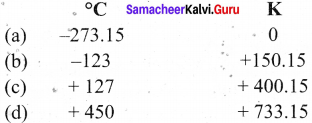
Which of the following temperature conversions is incorrect K (Kelvin) = oc ( Celsius) + 273.15
Heat And Temperature Class 7 Samacheer Kalvi Term 2 Chapter 1

II. Fill In the blanks:

  1. Doctor uses ________ thermometer to measure the human body temperature.
  2. At room temperature mercury is in _______ state.
  3. Heat energy transfer from _______ to _______
  4. -7°C temperature is _______ than 0°C temperature.
  5. The common laboratory thermometer is a _______ thermometer.

Answer:

  1. clinical
  2. liquid
  3. hotter object, colder object
  4. less
  5. mercury

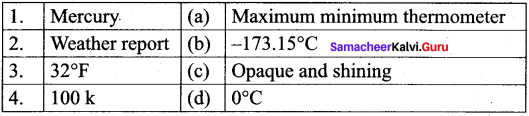
III. Match the following:

  1. Clinical thermometer – A form of energy
  2. Normal temperature of human body – 100°C
  3. Heat – 37°C
  4. Boiling point of water – o°c
  5. Melting point of water – Kink

Answer:

  1. Clinical thermometer – Kink
  2. Normal temperature of human body – 37°C
  3. Heat – A form of energy
  4. Boiling point of water – 100°C
  5. Melting point of water – 0°C

IV. Give very short answer:

7th Standard Science Heat And Temperature Question 1.
Temperature of Srinagar (J&K) is -4°C and in Kodaikanalis 3°C which of them
has greater temperature ? What is the difference between the temperatures of
these two places?
Answer:
Kodaikanal has greater temperature.
Temperature of srinagar (J &K) = -4°C
Temperature of = 3°C
Difference = -4°C + 3°C = 7°C
Srinagar is colder than that of kodaikanal.

7th Standard Heat And Temperature Question 2.
Jyothi was prepared to measure the temperature of hot water with a clinical thermometer. Is it right or wrong? Why?
Answer:
It is wrong, because clinical thermometer has small temperature range (35°C to 42°C or 94°F to 108°F). If it is used to measure the temperature of hot water, the glass will crack/ burst due to excessive pressure created by expansion of mercury.

Science 7 Heat And Temperature Question 3.
A clinical thermometer is not used to measure the temperature of air, why?
Answer:
The range of the clinical thermometer is less than that of thermometer used to measure temperature of air.

Samacheer Kalvi 7th Science Term 2 Question 4.
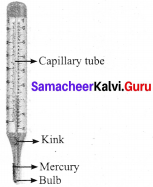
What is the use of kink in clinical thermometer?
Answer:
A kink is clinical thermometer prevents the mercury from flowing back into the bulb when the thermometer is taken out of the patient’s mouth, so that the temperature can be noted conveniently.

Samacheer Kalvi Guru 7th Science Book Back Answers Question 5.
Why do we jerk a clinical thermometer before we measure the body temperature?
Answer:
The jerk to the thermometer will allow the mercury level to flow into the bulb so that the mercury level is below the normal temperature.

V. Give Short Answer

Heat And Temperature Class 7 Questions And Answers Question 1.
Why do we use mercury in thermometers? Can water be used instead of mercury? What are the problems in using it?
Answer:

  1. We use mercury in thermometers as they remain in liquid form even with a change of temperature in it.
  2. A small change in the temperature causes change in volume of a liquid.
  3. Water cannot be used as a thermometric liquid, because it is not helpful to measure below 0°C and above 100°C.
  4. Water is transparent. So it makes the reading of the scales of the thermometer more difficult, water wets the glass tube so its steady is glass tube.
  5. Due to this constraints it is not used as a thermometric liquid.

Heat And Temperature Answer Key Question 2.
Swathi kept a laboratory thermometer in hot water for some time and took it out to read the temperature. Ramani said it was a wrong way of measuring temperature. Do you agree with Ramani ? Explain your answer.
Answer:
Yes, I agree with Ramani.

  1. Laboratory thermometer does not have a kink. So, when Swathi takes out the thermometer, the level can go back because of absence of kink.
  2. So Swathi should note the reading when the thermometer bulb has surrounded by hot water.

Question 3.
The body temperature of Srinath is 99°F. Is he suffering from fever? If so, why?
Answer:
Srinath is having a fever because the normal body temperature is 98.6°F.

VI. Give long answer:

Question 1.
Draw the diagram of a clinical thermometer and label its parts
Answer:
Heat And Temperature 7th Standard Samacheer Kalvi Term 2 Chapter 1

Question 2.
State the similarities and differences between the laboratory thermometer and the clinical thermometer.
Answer:
Similarities between laboratory thermometer and the clinical thermometer:

  1. Both clinical and laboratory thermometers have long, narrow and uniform glass tubes.
  2. Bulbs contain mercury.
  3. Both have Celsius scale.

Differences:

Laboratory thermometer:

  1. Laboratory thermometer is generally scaled from -10°C to 11 CPC.
  2. Mercury level falls on its own as no kink is present.
  3. Temperature is read while keeping the thermometer in the source of temperature, e.g. a liquid or any other thing.
  4. No need to give jerk to lower the mercury level.
  5. It is used to take temperature in laboratory.

Clinical thermometer:

  1. Clinical thermometer is scaled from 35°C to 42°C or from 94°F to 108°F.
  2. Mercury level does not fall on its own, as there is a kink near the bulb to prevent the fall of mercury level.
  3. Temperature can be read after removing the thermometer from armpit or mouth.
  4. To lower the mercury level jerks are given.
  5. It is used for taking the body temperature.

VII. Higher Order Thinking questions:

Question 1.
What must be the temperature in Fahrenheit, so that it will be twice its value in Celsius?
Answer:
According to the question, F = 2C and C1 = C
F = \(\frac { 9C }{ 5 }\) + 32
2c =\(\frac { 9 }{ 5 }\) C + 32
2c – \(\frac { 9 }{ 5 }\) c = 32 ⇒\(\frac { 10c – 9c }{ 5 }\) = 32 + 0
\(\frac { 1c }{ 5 }\) = 32
Heat And Temperature 7th Class Samacheer Kalvi Term 2 Chapter 1

Question 2.
Answer:
Go to a veterinary doctor (a doctor who treats animals). Discuss and find out the normal temperature of domestic animals and birds.

  1. Dog – 38.9°C
  2. Horse – 38°C
  3. Rabbit – 38.3°C
  4. Cow – 38.6°C
  5. Cat – 39°C
  6. Goat- 39.7°C
  7. Pigeon – 44.1°C
  8. Crow – 40°C
  9. Duck – 40.7°C
  10. Karaknath – 41.8°C
  11. Parrot – 41°C

Samacheer Kalvi 7th Science Heat and Temperature Intext Activites

Activity – 1

Question 1.
What is required?
A small glass bottle, a rubber cork, an empty refill, water, colour, a candle, a fork, a paper.
What to do?

Samacheer Kalvi Guru 7th Science Term 2 Chapter 1 Heat And Temperature

  • Take a small glass bottle. Fill it with coloured water.
  • Make hole at the centre of the rubber cork.
  • Pass empty refill from the hole of the rubber cork.

7th Science Heat And Temperature Samacheer Kalvi Term 2 Chapter 1

  • Make the bottle air tight and observe the water raised in the refill.
  • Make a scale on paper, place it behind the refill and note down the position of the surface of water.
  • Hold bottle with fork and supply heat to it with candle. Then ‘ observe.

Question 2.
What is the change in the surface of water?
Answer:
The level of water increases.
Stop the supply of heat. When water is cooled, observe the surface of water in the refill,

Question 3.
what change takes place? Why?
Answer:
The level of water comes to the original position.
When, a liquid is heated, it expands and when it is cooled down, it contracts.

Activity – 2

Question 1.
What is required?
A big bottle, a balloon, threads, candle, water, fork.
What to do?

7th Standard Science Heat And Temperature Samacheer Kalvi Term 2 Chapter 1

  • Take one big bottle, and fill some water in it.
  • Attach one balloon on the mouth of bottle and fix it with thread.
  • Hold bottle with a fork. Heat the bottle with a candle and take observation.

7th Standard Heat And Temperature Samacheer Kalvi Term 2 Chapter 1

Question 2.
What change occurs in the state of balloon after heating the bottle?
Answer:
The balloon expands.

Question 3.
What change occurs in the state of balloon after heating the bottle?
Why?
Answer:
The air inside it gets heated and expands. This causes the balloon to stretch and expand.
Now, let the bottle get cooled down.

Question 6.
What change occurs in the state of balloon after bottle gets cool down?
Why?
Answer:
The temperature within the bottle reduces causing the air to cool down. This causes the balloon to contract.
When gases substance gets heat, it expands; when it cools it contracts.

Question 5.
Why does a tyre get burst in summer?
Answer:
During summer, the air inside the tyre of a vehicle will get heated up with the increase in pressure of the air inside the tyre. As there is no place to air to escape tyre will get bursted.

Activity – 3
Measure your body temperature.
Wash the thermometer preferably with an antiseptic solution. Hold it firmly by the end and give it a few jerks. These jerks will bring the level of Mercury down. Ensure that it falls below 35°C (95°F). Now place the thermometer under your tongue or arm pit. After one minute, take the thermometer out and note the reading. It tells you your body temperature.
What did you record as your body temperature?
Answer:
37°C

1.6 Numerical problems:

3. Convert the given temperature :

Question 1.
45°C = _____ °F
Solution:
F = \(\frac { 9c }{ 5 }\) + 32
\(\frac{9 \times 45^{9}}{8}\)
= 81 +32
45°c = 113°F

Question 2.
20°C =______°F
Solution:
F =\(\frac { 9c }{ 5 }\)
= \(\frac{9 \times 20^{4}}{5}\) + 32
=36 + 32
20°c = 68°F

Question 3.
68°F =_______°F
Solution:
C = (F-32) ×\(\frac { 5 }{ 9 }\)
= (68 – 32) × \(\frac { 5 }{ 9 }\)
= 36 ×\(\frac { 5 }{ 9 }\)
68°F = 20°C

Question 4.
185°C =_______°F
Solution:
c = (F – 32) × \(\frac { 5 }{ 9 }\)
= (185 -32) × \(\frac { 5 }{ 9 }\)
= 153 × \(\frac { 5 }{ 9 }\)
185F° = 85°C

Question 5.
0°=________°F
Solution:
K = C + 273
= 0 + 273
0°C = 273K

Question 6.
– 20°=________°F
Solution:
k = C + 273
= – 20 + 273
– 20°C = 273K

Question 7.
100K=________°F
Solution:
C = K – 273
=272.15 – 273
272.15K= – 0.85°C

Samacheer Kalvi 7th Science Heat and Temperature Additional Questions

I. Choose the correct answer.

Question 1.
Heat energy is the total of the particles that make up a substance.
(a) potential energy
(b) substance
(c) temperature
(d) none
Answer:
(b) substance

Question 2.
Heat energy is always transferred from to temperatures.
(a) lower, higher
(b) higher, lower
(c) conductor, insulator
(d) both a and b
Answer:
(b) higher, lower

Question 3.
A clinical thermometer is calibrated from to .
(a) 10°Ctol00°C
(b) 32°C to 110°C
(c) 0°Ctol00°C
(d) 35°C to 42°C
Answer:
(d) 35°C to 42°C

Question 4.
The thermometer which ranger from -10°C to 110°C is .
(a) clinical thermometer
(b) digital thermometer
(c) laboratory thermometer
(d) All of these
Answer:
(c) laboratory thermometer

Question 5.
Which one of the following scale has lower fixed point at 0°C?
(a) Kelvin scale
(b) Fahrenheit scale
(c) Celsius scale
(d) All of these
Answer:
(c) Celsius scale

Question 6.
The lower fixed point on the Celsius scale is
(a) melting point of mercury
(b) melting point of ice
(c) boiling point of water
(d) none
Answer:
(b) melting point of ice

Question 7.
The measure of degree of hotness or coldness of a body is called
(a) heat energy
(b) Celsius
(c) kelvin
(d) temperature
Answer:
(d) temperature

Question 8.
Digital thermometer is widely used for the measurement of the temperature due to .
(a) Analog display
(b) Mercury
(c) High accuracy
(d) Low accuracy
Answer:
(c) High accuracy

Question 9.
Temperature of boiling water cannot be measured by a thermometer.
(a) laboratory
(b) digital
(c) clinical
(d) both b & c
Answer:
(d) both b & c

Question 10.
When a substance is heated, its temperature .
(a) rises
(b) falls
(c) remains same
(d) none
Answer:
(a) rises

II. Fill in the Blanks.

  1. Digital thermometers do not use ______
  2. In a thermometer, when liquid gets heat, it_____and when it is cooled down, it
  3. The SI unit of temperature is ______
  4. A small change in the temperature causes change in of a liquid.________
  5. The freezing point of alcohol is less than________
  6. All clinical thermometers have a________ that prevents mercury from flowing back into the bulb.
  7. A clinical thermometer indicates temperatures from a minimum of ________ °F to a maximum of °F.
  8. Before use, the mercury level in clinical thermometer should be below________
  9. The coldest natural temperature ever recorded on earth is________
  10. The hottest natural temperature ever recorded on earth is________
  11. Temperature of the universe in the earliest moments after the big bang is ________

Answer:

  1. mercury
  2. expand, contact
  3. kelvin
  4. volume
  5. – 100°
  6. kink
  7. 94° F,108° F
  8. 35° C or 94° F
  9. 178.45K
  10. 392.85K
  11. 10³² K

III. True or False – if false give the correct statement.

Question 1.
Temperature is related to how fast the atoms within a substance are moving.
Answer:
True

Question 2.
Mercury is a poor conductor of heat.
Answer
False. Mercury is a good conductor of heat.

Question 3.
Fahrenheit scale is more sensitive that the Celsius scale.
Answer:
True

Question 4.
In humans, the average internal temperature is 98.60°C.
Answer:
False. In humans, the average internal temperature is 98.60°F.

Question 5.
Digital thermometers are mainly used to take the body temperature.
Answer:
True

Question 6.
The glass of a clinical thermometer will burst due to excessive pressure created by contraction of mercury.
Answer:
The glass of a clinical thermometer will burst due to excessive pressure created by expansion of mercury.

Question 7.
In greek, Centium means 100 and Gradus means steps, both words make it Centigrade and later Celsius.
Answer:
True

Question 8.
Kelvin is written as K also known as absolute scale as it starts from absolute zero temperature.
Answer:
True

Question 9.
The temperatures in Celsius and in Fahrenheit will be same at -40.
Answer:
True

IV. Match the following :
Science 7 Heat And Temperature Samacheer Kalvi  Term 2 Chapter 1
Answers:

  1. (c)
  2. (a)
  3. (d)
  4. (b)

V. Assertion and Reason.
Mark the correct choice as
(a) Both A and R are true but R is the correct explanation of assertion.
(b) Both A and R are true but R is not correct explanation of assertion.
(c) A is true but R is false.
(d) A is false but R is true.

  1. Assertion

(A): Heat energy is transferred from one body to another due to a temperature difference between them.
Reason (R): Heating a substance causes a rise in temperature.
Answer:
(b) Both A and R are true but R is not correct explanation of assertion.

Correct reason: Heat energy always travels from hotter object to colder objects.

  1. Assertion

(A): When a very hot liquid is poured into a thick glass tumbler it cracks.
Reason (R): Unequal expansion of inner and outer glass walls causes the glass to crack.
Answer:
(a) Both A and R are true but R is the correct explanation of assertion

VI . Very short Answers:

Question 1.
Mention the three units which are used to measure the temperature.
Answer:
The three units which are used to measure the temperature: Degree Celsius, Fahrenheit and Kelvin.

Question 2.
What is the boiling point of mercury?
Answer:
357°C

Question 3.
What is the freezing point of alcohol?
Answer:
Less than -100°C

Question 4.
Mention the use of laboratory thermometers.
Answer:
To measure the temperature is laboratories for scientific research.

Question 5.
What is the average internal temperature of human body?
Answer:
37°C (98.6°F)

Question 6.
What is the freezing point of water is Fahrenheit scale?
Answer:
32°F

Question 7.
At what temperature the value will be same in Celsius and in Fahrenheit?
Answer:
– 40.

Question 8.
Name the principle which is used in thermometer.
Answer:
Liquids expand on heating and contract on cooling.

VII. Short Answer.

Question 1.
Mention any two precautions to be followed while using a clinical thermometer.
Answer:

  1. The thermometer should be washed before and after use, preferably with an antiseptic solution.
  2. Jerk the thermometer a few times to bring the level of the mercury down.

Question 2.
What are the uses of laboratory thermometers?
Answer:
Laboratory thermometers are used to measure the temperature in school and other laboratories for scientific research. They are also used in the industry as they can measure temperatures higher than what clinical thermometers can record.

Question 3.
Mention any two properties of alcohol.
Answer:

  1. The freezing point of alcohol is less than -100°C. So it can be used to measure very low temperatures.
  2. Its expansion per degree Celsius rise in temperature is very large.

Question 4.
What is the use of kink in clinical thermometers?
Answer:
Kink prevents the mercury from flowing back into the bulb when the thermometer is taken out of the patient’s mouth. So that the temperature can be noted conveniently.

Question 5.
Why mercury or alcohol is used in thermometers?
Answer:
Mostly Alcohol and Mercury are used in thermometers as they remain in liquid form even with a change of temperature in them. A small change in the temperature causes change in volume of a liquid. We measure this temperature by measuring expansion of a liquid in thermometer.

Question 6.
We are advised to avoid keeping clinical thermometer in the sun or near a flame. Why?
Answer:
A Clinical thermometer has small temperature range. The glass will crack/ burst due to excessive pressure created by expansion of mercury.

VIII. Long Answer:

Question 1.
Explains the properties of mercury.
Answer:

  1. Its expansion is uniform. (For equal amounts of heat it expands by equal lengths.)
  2. If is opaque and shining.
  3. It does not stick to the sides of the glass tube.
  4. It is a good conductor of heat.
  5. It has a high boiling point (357°C) and a low freezing point (-39°C). Hence a wide range of temperatures can be measured using a mercury thermometer.

Question 2.
Explain the construction and working of clinical thermometer.
Answer:

  1. Clinical thermometers are used to measure the temperature of a human body – at home, clinics and hospitals.
  2. All clinical thermometers have a kink that prevents the mercury from flowing back into the bulb when the thermometer is taken out of the patient’s mouth, so that the temperature can be noted conveniently.
  3. There are temperature scales on either side of the mercury thread, one in C elsius scale and the other in Fahrenheit scale.
  4. Since the Fahrenheit scale is more sensitive than the Celsius scale, body temperature is measured in F only.
  5. A clinical thermometer indicates temperatures from a minimum of 35°C or 94°F to a maximum of 42°C or 108°F.

Question 3.
Explain the precautions to be followed while using clinical thermometer.
Answer:

  1. The thermometer should be washed before and after use, preferably with an antiseptic solution.
  2. Jerk the thermometer a few times to bring the level of the mercury down.
  3. Before use, the mercury level should be below 35°C or 94°F.
  4. Do not hold the thermometer by its bulb.
  5. Keep the mercury level along your line of sight and then take the reading.
  6. Handle the thermometer with care. If it hits against some hard object, it may break.
  7. Do not place the thermometer in a hot flame or in the hot sun.

Question 4.

1. Write a note on laboratory thermometer.
2. Write the precautions to be following while using a laboratory thermometer.

Answer:
(a) Laboratory Thermometers:

  1. Laboratory thermometers are used to measure the temperature in school and other laboratories for scientific research.
  2. They are also used in the industry as they can measure temperatures higher than what clinical thermometers can record.
  3. The stem and the bulb of a lab thermometer are longer when compared to that of a clinical thermometer and there is no kink in the lab thermometer.
  4. A laboratory thermometer has only the Celsius scale ranging from -10°C to 110°C.

(b) Precautions to be Followed While Using a Laboratory Thermometer:

  1. Do not tilt the thermometer while measuring the temperature. Place it  upright.
  2. Note the reading only when the bulb has been surrounded by the substance from all sides.

Question 5.
Explain how do you determine the temperature of hot water using laboratory thermometer?
Answer:

  1. Take some water in a beaker.
  2. Take a laboratory thermometer and immerse its bulb end in water; holding it vertically. Ensure to dip whole portion of bulb end. The bulb end should not touch the bottom or side of the beaker.
  3. Observe the movement of rise of mercury. When it becomes stable, take the reading of the thermometer.
  4. Repeat this with hot water and take the reading.

Question 6.

  1. write a note on digital thermometer.
  2. Mention the precaution to be followed while using digital thermometer.

Answer:
(a) Digital Thermometer:

  1. Mercury is a toxic substance and is very difficult to dispose of if a thermometer breaks.
  2. These days, digital thermometers are available which do not use mercury.
  3. Instead, it has a sensor which can measure the heat coming out from the body directly and from that can measure the temperature of the body.
  4. Digital thermometers are mainly used to take the body temperature.
  5. Do not use a clinical thermometer for measuring the temperature of any object other than human body.
  6. Avoid keeping it in the sun or near of flame.

Question 7.
Explain the usage of digital thermometer.
Answer:
Use of Digital thermometer:

  1. Wash the tip with warm (not hot), soapy water.
  2. Press the “ON” button.
  3. Insert the tip of the thermometer into the mouth, bottom, or under the armpit.
  4. Hold the thermometer in place until it beeps (about 30 seconds).
  5. Read the display.
  6. Turn off the thermometer, rinse under water, and put it away in a safe place.

IX.Problems for practice:
Convert the given temperature:

Question 1.
40°C =_______°F
Solution:
F = \(\frac { 9c }{ 5 }\) +32
\(\frac{9 \times 40^{8}}{8}\) + 32
= 72 + 32
40°C = 104°F

Question 2.
0 K =_______°F
Solution:
C = k – 273
= 0 – 273
0 K = – 273°C

Question 3.
– 30°C = _______°F
Solution:
K = C + 273
= – 30 + 273

Question 4.
150°F =_______°C
Solution:
C = (F – 32) × \(\frac { 5 }{ 9 }\)
= 118 × \(\frac { 5 }{ 9 }\)
=\(\frac { 590 }{ 9 }\) = 65.9
150°F = 65.9°C

X . Creative Questions: HOTS

Question 1.
What the minimum possible temperature is 0 k .There also a maximum possible temperature ?
Answer:
The minimum possible temperature is 0 K. There is no limit to maximum temperature.

Question 2.
Complete the table.
Samacheer Kalvi 7th Science Term 2 Chapter 1 Heat And Temperature
Answer:

  1. 212°F
  2. Freezing point of water
  3. 273.15 K
  4. 37°C
  5. 23 K

Samacheer Kalvi 7th English Solutions Term 1 Supplementary Chapter 1 On Monday Morning

Students can Download English Lesson 1 On Monday Morning Questions and Answers, Summary, Notes Pdf, Activity, Samacheer Kalvi 7th English Book Solutions Guide Pdf helps you to revise the complete Tamilnadu State Board New Syllabus and score more marks in your examinations.

Tamilnadu Samacheer Kalvi 7th English Solutions Term 1 Supplementary Chapter 1 On Monday Morning

A. Name the speaker.
Answer:

On Monday Morning Samacheer Kalvi 7th English Solutions Term 1 Supplementary Chapter 1

B. Write True or False against each statement.

  1. Tom enjoyed Monday mornings as he had to go to school.
  2. Toms first groan woke up Sid from his sound sleep.
  3. Tom wanted to give his dog with one eye to the new girl who had come to town.
  4. Aunt Polly sent Sid to fetch the dentist.

Answer:

  1. False
  2. False
  3. False
  4. False

C. Read the following passage and answer the questions.

Tom lay thinking. Presently it occurred to him that he wished he was sick; then he could stay home from school. He examined himself. He found no symptoms or sickness, and he investigated again. This time he felt he had a stomach ache, but it soon grew feeble, and presently died wholly away. He reflected further.

Question with Answers:

On Monday Morning Question 1.
Why did Tom wish that he were sick?
Answer:
Tom wished he was sick so that he could stay home from school.

Monday Morning Questions And Answers Question 2.
What was the result of Tom’s self-examination?
Answer:
Tom found no symptoms of sickness after he self-examined himself.

On Monday Morning Supplementary Summary Question 3.
What did he detect?
Answer:
Tom detected that he had a stomach ache.

D. Think and answer.

On Monday Morning Questions And Answers Question 1.
How did Sid show his affection towards Tom?
Answer:
Tom’s groans made Sid’s flesh to crawl. When he thought that Tom was dying, and flew to call Aunt Polly quickly.

On Monday Morning Supplementary Questions And Answers Question 2.
Did Aunt Polly believe Tom’s groaning? Why?
Answer:
No, Aunt Polly did not believe Tom’s groaning because his toe was not sore and he was not in a dying state.

On Monday Morning Question Answer Question 3.
What did Aunt Polly do to relieve Tom’s toothache?
Answer:
Aunt Polly pulled out his loose tooth to relieve his toothache.

E. Choose the correct answer.

On Monday Morning Book Back Answers Question 1.
Tom pretended his toe was dying in order to __________
(a) miss school
(b) scare Sid
(c) make Aunt Polly feel bad
Answer:
(a) miss school

On Monday Morning Supplementary Question 2.
Aunt Polly pulled Tom’s tooth out with __________
(a) her fingers
(b) a pair of pliers
(c) a piece of thread
Answer:
(c) a piece of thread

Monday Morning Questions And Answers Pdf Question 3.
Tom was miserable on Monday morning because __________
(a) he was sick
(b) he hated going to school
(c) Aunt Polly was sick
Answer:
(b) he hated going to school

Project

F. Give instructions to your friend to reach your house from school. Mention some landmarks that your friend should lookout for on his way. Draw a road map with landmarks based on the instructions given to your friend.
Answer:
Dear Kiran, Come to my home today after school.
As you step out of the school, turn right and walk till you reach the signal. Cross the road and walk further passing the Reliance Super Market in the corner. Turn the second right next to the Post office. The third house on the left, beside the park with door number 16 is my house.

Monday Morning Questions And Answers Samacheer Kalvi 7th English Solutions Term 1 Supplementary Chapter 1

Connecting To Self

G. Draw a family tree showing the members of your family and write a sentence about the activities that your whole family does together. How does it help others in a family and what do you learn from this?
Answer:

On Monday Morning Supplementary Summary Samacheer Kalvi 7th English Solutions Term 1 Chapter 1

Step To Success

H. Give a relationship term for the clues given
Answer:

On Monday Morning Questions And Answers Samacheer Kalvi 7th English Solutions Term 1 Supplementary Chapter 1

I. Arrange the words according to their degrees of meaning

  1. eager, thrilled, excited
  2. old, aged, senior
  3. small, tiny, minute
  4. worried, panicked, anxious

Answer:

  1. excited, thrilled, eager
  2. fruifar senior, old, aged
  3. small, tiny, minute
  4. anxious, worried, panicked

J. Think and Answer

Monday Morning Summary Question 1.
X and Y are parents to Z. But Z is not the son of X.
Then what is Z to X?
Answer:
Daughter

On Monday Morning Supplementary In Tamil Question 2.
Meera’s brother is the father of Aakash.
Then how is Aakash related to Meera?
Answer:
Aunt

On Monday Morning Additional Questions

I. Choose the Correct Answers (MCQ)

On Monday Morning 7th Standard Question 1.
It occurred to Tom that he was ______; then he could stay home from school
(a) sick
(b) dead
(c) happy
Answer:
(a) sick

Monday Morning Lesson Summary Question 2.
Tom groaned louder, and fancied that he began to feel pain in the ______
(a) tooth
(b) stomach
(c) toe
Answer:
(c) toe

7th Standard English On Monday Morning Question 3.
“Why, what’s the matter, Tom? I must call ______
(a) Mary
(b) auntie
(c) Sid
Answer:
(b) auntie

Question 4.
The old lady laughed a little, then ______ a little, then did both together.
(a) screamed
(b) cried
(c) clapped
Answer:
(b) cried

Question 5.
So all this row was because you thought you’d get to stay home from school and go ______ ?”
(a) fishing
(b) shopping
(c) playing
Answer:
(a) fishing

II. Identify the Character / Speaker.

  1. “Tom, why didn’t you wake me sooner?”
  2. “Tom, what a turn you did give me”.
  3. “I forgive you for everything, Sid”.
  4. “Mary get me a silk thread, and a chunk of fire out of the kitchen”.
  5. “Oh, auntie, my sore toe’s dying!”

Answer:

  1. Tom’s brother Sid
  2. Aunt polly
  3. Tom
  4. Aunt pollyTom
  5. Tom

III. Write True or False against each statement.

  1. Monday morning found Tom Sawyer miserable.
  2. “Sid, you give my window-sash and my dog with one eye to that new girl that’s come to town”.
  3. “Open your mouth. Well. Your tooth is loose, but your’e not going to die from that.”
  4. “Please don’t, auntie. I don’t want to stay home from school.”
  5. “Tom, I love you so, and you try every way you can to break my old hand with your mischief?’

Answer:

  1. True
  2. False
  3. True
  4. True
  5. False

IV. Very Short Questions with Answers.

Question 1.
What did Tom compared his school to?
Answer:
Tom compared his school to a prison.

Question 2.
Was Tom really sick?
Answer:
No, Tom was not actually sick

Question 3.
What did Sid tell Aunt about Tom?
Answer:
Sid told aunt that Tom was dying.

Question 4.
With whom did Aunt go upstairs to see Tom?
Answer:
Aunt went upstairs with Sid and Mary.

Question 5.
What were the dental instruments?
Answer:
A silk thread and a chunk of fire were the dental instruments.

Question 6.
What did Tom want to do by staying home from school?
Answer:
Tom wanted to stay home from school and go for fishing

V. Short Questions with Answers.

Question 1.
What were the three sickness Tom had planned to suffer from?
Answer:
Tom planned to suffer from stomach ache, sore toe and toothache.

Question 2.
How did Tom try to wake up Sid?
Answer:
Tom made successive loud groans, panted with exertions and snored. When this did not wake up Sid, he called Sid and shook him.

Question 3.
Why did Aunt Polly cried and laughed together?
Answer:
Aunt Polly cried with relief that nothing was wrong with Tom. She laughed thinking of the prank played by Tom once again.

VI. Paragraph Questions with Answers.

Question 1.
How did Aunt Polly extract Tom’s tooth?
Answer:
Aunt Polly fastened one end of the silk thread to Tom’s tooth with a loop and tied the other to the bedpost. Then she caught hold of the chunk of fire and suddenly pushed it almost into Tom’s face. The tooth now was hanging loosely by the bedpost.

Question 2.
Did Sid believe that Tom was sick? Justify.
Answer:
Yes, Sid believed that Tom was very sick. Anxious Sid, called Tom and shook him. He felt bad for not helping Tom who was suffering for hours. He assured Tom that he would not die and rushed to call Aunt Polly to save Tom from dying.

VII. Rearrange the Jumbled Sentences.

1.“What is the matter with you child?”.
2.Tom groaned and fancied to feel pain in the toe.
3.“You seem to try every way you can to break my old heart with your mischief’
4.The tooth was hanging loosely by the bedpost.
5.He wished he was sick to stay home from school.
6.Monday morning found Tom Sawyer miserable.
7.”Tom you aren’t dying, are you?”
8.“Oh, Aunt Polly, come! Tom’s dying!”
9.“One of them is loose, and it aches perfectly awful”
10.“I don’t want to stay home from school.”
Answer:
6.Monday morning found Tom Sawyer miserable.
5.He wished he was sick to stay home from school.
2.Tom groaned and fancied to feel pain in the toe.
7.”Tom you aren’t dying, are you?”
8.“Oh, Aunt Polly, come! Tom’s dying!”
1.“What is the matter with you child?”
9.“One of them is loose, and it aches perfectly awful”.
10.“I don’t want to stay home from school.”
3.“You seem to try every way you can to break my old heart with your mischief.”
4.The tooth was hanging loosely by the bedpost.

VIII. Read the passage and answer the questions.

A.
Monday morning found Tom Sawyer miserable. Monday morning always found him so because it began another week’s slow suffering in school. He generally began that day with wishing he had had no holiday in between, he made the going into prison again so much worse.

Question 1.
Why were Monday mornings miserable for Tom?
Answer:
Tom hated to go to school on Monday mornings. So he felt miserable.

Question 2.
How was Tom’s experience about going to school all the week?
Answer:
It was a week long slow suffering in school for Tom.

Question 3.
What was going to school compared to by Tom?
Answer:
Going to school was compared to going into a prison by Tom.

B.
The old lady made one end of the silk thread fast to Tom’s tooth with a loop and tied the other to the bedpost. Then she caught hold of the chunk of fire and suddenly pushed it almost into the boy’s face. The tooth was hanging loosely by the bedpost, now.

1 .The old lady tied one end of the silk thread to Tom’s tooth. Where did she tie the other?
Answer:
She tied the other end to the bedpost.

Question 2.
Did the old lady push the chunk of fire into Tom’s face?
Answer:
No. The old lady almost seem to do it but she did not actually push it.

Question 3.
How was the tooth pulled out?
Answer:
When the old lady went towards Tom with the hot chunk of fire, he feared it would hurt his face and tried to move away. When he moved, his tooth tied to the thread got pulled.

C.
“Tom, why didn’t you wake me sooner? Oh, Tom, DON’T! It makes my flesh crawl to hear you. What is the matter?”
“I forgive you for everything, Sid. (Groan.) Everything you’ve ever done to me. When I’m gone »
“Oh, Tom, you aren’t dying, are you?

Question 1.
Why did Sid feel that Tom should have woken him sooner?
Answer:
Sid felt that if Tom had woken him up earlier, he could had prevented Tom’s condition becoming bad.

Question 2.
Why did Tom ask forgiveness to Sid for everything he had done to him?
Answer:
Tom pretended to ask forgiveness as his death bed confession.

Question 3.
“When I’m gone”. What does Tom mean by these words?
Answer:
Tom’s words mean that he would be dead soon.

On Monday Morning Summary

Tom felt like going to prison on all Monday mornings. Tom wanted to stay home from school so he lay in bed and wished to be sick. First he wanted to complain of stomach ache and later of loose tooth, but he changed his mind as he was afraid that his aunt would pull his teeth and hurt him.

Tom had earlier known that an injured toe can keep one in bed for even three weeks. So he lifted his sore toe up and started to groan loudly in imaginary pain, to wake up Sid sleeping beside him. Finally Sid woke thinking Tom was really suffering for hours. Sid was upset with Toms condition, who started to confess his sins as if he was about to die.

Sid flew down to call Aunt Polly quickly to save Tom. Aunt Polly hurried upstairs trembling. Soon she understood Tom was pretending of‘dying sore toe’. So Tom now told it was awful aching of loose tooth.

When Aunt Polly got ready to pull his tooth with a silk thread and a chunk of fire, Tom panicked and confessed that it doesn’t hurt him anymore and he would go to school and not for fishing.

Old Aunt Polly loved mischievous Tom though he tries to break her heart often. She pulled his tooth in a crude way and relieved his toothache.

Samacheer Kalvi 7th Tamil Solutions Term 2 Chapter 1.5 இலக்கியவகைச் சொற்கள்

Students can Download Tamil Chapter 1.5 இலக்கியவகைச் சொற்கள் Questions and Answers, Summary, Notes Pdf, Samacheer Kalvi 7th Tamil Book Solutions Guide Pdf helps you to revise the complete Tamilnadu State Board New Syllabus and score more marks in your examinations.

Tamilnadu Samacheer Kalvi 7th Tamil Solutions Term 2 Chapter 1.5 இலக்கியவகைச் சொற்கள்

மதிப்பீடு

சரியான விடையைத் தேர்ந்தெடுத்து எழுதுக.

Question 1.
எல்லார்க்கும் எளிதில் பொருள் விளங்கும் சொல் ……………..
அ) இயற்சொல்
ஆ) திரிசொல்
இ) திசைச்சொல்
ஈ) வடசொல்
Answer:
அ) இயற்சொல்

Question 2.
பலபொருள் தரும் ஒரு சொல் என்பது ……………………..
அ) இயற்சொல்
ஆ) திரிசொல்
இ) திசைச்சொல்
ஈ) வடசொல்
Answer:
ஆ) திரிசொல்

Question 3.
வடமொழி என்று அழைக்கப்படும் மொழி …………………………..
அ) மலையாளம்
ஆ) கன்ன டம்
இ) சமஸ்கிருதம்
ஈ) தெலுங்கு
Answer:
இ) சமஸ்கிருதம்

பொருத்துக

1. இயற்சொல் – பெற்றம்
2. திரிசொல் – இரத்தம்
3. திசைச்சொல் – அழுவம்
4. வடசொல் – சோறு
Answer:
1. இயற்சொல் – சோறு
2. திரிசொல் – அழுவம்
3. திசைச்சொல் – பெற்றம்
4. வடசொல் – இரத்தம்

குறுவினா

Question 1.
மண், பொன் என்பன எவ்வகைச் சொற்கள்?
Answer:

  • எளிதில் பொருள் விளங்கும் வகையில் அமைந்த சொற்கள் இயற்சொற்கள் எனப்படும்.
  • இயற்சொல் பெயர், வினை, இடை, உரி ஆகிய நான்கு வகையிலும் வரும்.
  • மண், பொன் – பெயர் இயற்சொல்

Question 2.
இயற்சொல்லின் நான்கு வகைகள் யாவை?
Answer:
இயற்சொல்லின் நான்கு வகைகள்.
இயற்சொல் பெயர், வினை, இடை, உரி ஆகியன நான்கு வகைகளாகும்.

எடுத்துக்காட்டு :
மண், பொன் – பெயர் இயற்சொல்
நடந்தான், வந்தான் – வினை இயற்சொல் அவனை,
அவனால் – இடை இயற்சொல்
மாநகர் – உரி இயற்சொல்

Question 3.
குங்குமம், கமலம் என்பன எவ்வகை வடசொற்கள்?
Answer:
கமலம், குங்குமம் என வடமொழியில் இருப்பது போன்றே தமிழில் எழுதுவதைத் தற்சமம் என்பர்.

சிறுவினா

Question 1.
இலக்கிய வகைச் சொற்கள் எத்தனை வகைப்படும்? அவை யாவை?
Answer:
இலக்கிய வகைச் சொற்கள் நான்கு வகைப்படும்

  1. இயற்சொல்,
  2. திரிசொல்,
  3. திசைச்சொல்,
  4. வடசொல்

(i) இயற்சொல் : எளிதில் பொருள் விளங்கும் வகையில் அமைந்த சொற்கள் இயற்சொற்கள் எனப்படும். எடுத்துக்காட்டு : கடல், கப்பல்

(ii) திரிசொல் : கற்றோருக்கு மட்டுமே விளங்குவதாகவும் இலக்கியங்களில் மட்டுமே பயின்று வருபவையாகவும் அமையும் சொற்கள் திரிசொற்கள் எனப்படும். எடுத்துக்காட்டு : வங்கூழ், அழுவம்.

(iii) திசைச்சொல் : வடமொழி தவிர, பிறமொழிகளில் இருந்து வந்து தமிழில் இடம்பெறும் சொற்கள் திசைச்சொற்கள் எனப்படும். எடுத்துக்காட்டு: சாவி, சன்னல்.

(iv) வடசொல் : வடமொழியிலிருந்து வந்து தமிழில் இடம் பெறும் சொற்கள் வடசொற்கள் எனப்படும். எடுத்துக்காட்டு: வருடம், மாதம்.

Question 2.
திரிசொல்லின் வகைகள் குறித்து விளக்குக.
Answer:
திரிசொல்லின் வகைகள் :
திரிசொற்களை ஒரு பொருள் குறித்த பல திரிசொற்கள் எனவும். பல பொருள் குறித்த ஒரு திரிசொல் எனவும் இருவகைப்படுத்தலாம்.

ஒரு பொருள் குறித்த பல திரிசொற்கள்
எடுத்துக்காட்டு :
வங்கம், அம்பி, நாவாய் – என்பன கப்பல் என்னும் ஒரே பொருளைத் தருவதால் ஒரு பொருள் குறித்த பல திரிசொற்கள் என்பர்.

பல பொருள் குறித்த ஒரு திரிசொல் :
எடுத்துக்காட்டு :
இதழ் என்னும் சொல் பூவின் இதழ், உதடு, கண்ணிமை, பனையேடு, நாளிதழ் ஆகிய பல பொருள்களைத் தருவதால் பலபொருள் குறித்த ஒரு திரிசொல் என்பர்.

Question 3.
பண்டிகை, கேணி என்பன எவ்வகைச் சொற்கள்? விளக்குக.
Answer:

  • பண்டிகை, கேணி என்பன திசைச் சொற்களாகும்.
  • வடமொழி தவிர, பிற மொழிகளில் இருந்து வந்து தமிழில் இடம்பெறும் சொற்கள் திசைச் சொற்கள் எனப்படும்.
  • முற்காலத்தில் பாண்டி நாட்டைத் தவிர, தமிழ்நாட்டின் பிற பகுதிகளில் வழங்கிய கேணி (கிணறு, பெற்றம் (பசு) போன்ற சொற்களையும் திசைச்சொற்கள் என்றே வழங்கினர்.

கற்பவை கற்றபின்

Question 1.
நாளிதழ் செய்தியொன்றை எடுத்துக் கொண்டு அதில் உள்ள நால்வகைச் சொற்களையும் வகைப்படுத்திப் பட்டியல் உருவாக்குக.
Answer:
(i) வீடுகளிலே நடைபெறும் விஷேசங்களின் போது, வெளியூர்கள் சென்று திரும்பும் போது, பரிசளிப்புகள் நடத்தும் போதும் புத்தகங்கள் வாங்குவது என்று ஒரு – பழக்கத்தைக் கொஞ்சம் வசதியுள்ள வீட்டார் சில காலத்துக்காவது ஏற்படுத்திக் கொண்டால் சுலபத்தில் ஒரு சில புத்தகசாலையை அமைத்து விடலாம்.
விசேஷம் – சிறப்பு
விசேஷம் – வடமொழி

(ii) சன்னல் வழியாக இராமு போவதை கோபு பார்த்துக் கொண்டிருந்தான்.
சன்னல் – சாளரம்
சன்னல் – திசைச் சொல்

(iii) நாவாய் கரையோரம் ஒதுங்கியது
நாவாய் – திரிசொல்
நாவாய் – கப்பல்

(iv) கபிலன் கதை எழுதினான்
எழுதினான் – வினை இயற்சொல்.

கூடுதல் வினாக்கள்

நிரப்புக.

Question 1.
ஓர் எழுத்து தனித்தும் ஒன்றிற்கும் மேற்பட்ட எழுத்துகள் தொடர்ந்தும் வந்து பொருள் தருவது ………………. எனப்ப டும்.
Answer:
சொல்

Question 2.
சொல் என்னும் பொருள் தரும் வேறு சொற்கள் ……….
Answer:
பதம், மொழி, கிளவி

Question 3.
இலக்கண முறைப்படி …………….. எனச் சொற்கள் நான்கு வகைப்படும்.
Answer:
பெயர்ச்சொல், வினைச்சொல், இடைச்சொல், உரிச்சொல்

Question 4.
இலக்கிய வகைச் சொற்களை …………….. என நான்கு வகையாகப் பிரிக்கலாம்.
Answer:
இயற்சொல், திரிசொல், திசைச்சொல், வடசொல்

Question 5.
எளிதில் பொருள் விளங்கும் வகையில் அமைந்த சொற்கள் …………… எனப்படும்.
Answer:
இயற்சொற்கள்

Question 6.
இயற்சொல் ……………………… ஆகிய நான்கு வகையிலும் வரும்.
Answer:
பெயர், வினை, இடை, உரி

Question 7.
கற்றோர்க்கு மட்டுமே விளங்கும் சொற்கள் …………… எனப்படும்.
Answer:
திரிசொற்கள்

Question 8.
லக்ஷ்மி என்பதை இலக்குமி என்றும், விஷம் என்பதை விடம் என்றும் தமிழ் எழுத்துகளால் மாற்றி எழுதுவதை ………….. என்பர்.
Answer:
தற்பவம்

Question 9.
வடசொற்களை ………………… என இருவகையாகப் பிரிப்பர்.
Answer:
தற்சமம், தற்பவம்

Question 10.
திரிசொல் …………………………………………………. ஆகிய நான்கு வகையிலும் வரும்.
Answer:
பெயர், வினை, இடை, உரி

மொழியை ஆள்வோம்

கேட்க

Question 1.
கடற்பயணம் தொடர்பான கதைகளைப் பெற்றோரிடம் கேட்டு மகிழ்க.
Answer:
சாகச கடல் பயணம்
மாலை வேளை வானம் மேகம் சூழ்ந்தது. நள்ளிரவைப் போல் வானம் இருண்டு காணப்பட்டது. ஆனால் இன்னும் சூரியன் மறையவில்லை. புயல் மழை கொட்டுவதற்கான அறிகுறிகள் தெரிந்தன. கடல் அலைகள் ஆர்ப்பாட்டம் இல்லாமல் ஒரு பனை மர அளவிற்கு ஏறி இறங்கின. அதில் பனை மலர்’ என்ற கப்பல் ராட்டினம் போல மேலே ஏறி கீழே இறங்கியது.

பனை மலர் கப்பல் தமிழ்நாட்டின் தரங்கம்பாடி துறைமுகத்திலிருந்து கிளம்பி ஒரு மாதத்துக்கும் மேலாகிறது. இங்கிருந்து கப்பல் நிறைய ஏலம், கிராம்பு, மிளகு, பட்டை, சோம்பு, ஜாதி, பத்திரி போன்ற உணவுக்கு நல்ல வாசனை தரும் ஏராளமான பொருட்கள், தூத்துக்குடி முத்துக்கள், பவளங்கள், மாணிக்கக் கற்கள், பட்டுச் சேலைகள், பருத்தி துணிகள், சிற்பங்கள், கைவினைப் பொருட்கள் போன்ற பலவகையான பொருட்களை ஏராளமாக ஏற்றிச் சென்றனர்.

கப்பலில் ஆறு மாதங்களுக்குத் தேவையான தண்ணீர், உப்பு, அரிசி, மிளகாய், எண்ணெய் போன்றவற்றை சேமித்துக் கொண்டு போயிருந்தனர். இப்போது, இலங்கையைத் தாண்டி 300 ஆவது கடல் மைல் தொலைவில் பெரும் புயல் ஒன்றை எதிர்கொண்டுள்ளனர். முதலில் சாதாரணமாக நினைத்தாலும், காற்று சுழற்றும், சுழற்றலில், கப்பல் உடைந்து தூள்தூளாகப் போகிறது எனப் பயந்தார்கள். ஆனால் கப்பல் மேலும் கீழும் குதித்தது. கிறுகிறுவென சுற்றிச் சுழன்றது.

கடல் நீர் அருவி கொட்டுவதைப் போல கப்பலுக்குள் புகுந்தது. சில நிமிடங்களில் புயல் நின்று விட்டது. ஊழியர்கள் நூறு பேரும் கப்பலில் புகுந்த தண்ணீரை வாரி வாரி இறைத்து கடலில் ஊற்றினர்.

இரவில் வானத்திலிருந்து சில சமயங்களில் சின்னச் சின்ன எரிகற்கள் விழும். கடலுக்கு மேலே வரும் திமிலங்கள் மிகப்பெரியவை. அவை மேலே வரும் போது அவற்றின் உடல் ஒரு பெரிய விளையாட்டு மைதானம் கடலில் இருப்பதைப் போல தெரியும். அதைப் பார்த்ததும் கப்பல் ஊழியர்கள் அதை நிலம் என நினைத்துக்கொண்டு கடலில் பாய பரபரப்பார்கள். ஆனால் மாலுமி அவர்களை அதட்டி நிறுத்துவார்.

கடலுக்குள் மின்னலைப் போல தெரியும் அபூர்வ உயிரினங்கள், கண்ணைப் பறிக்கும் வண்ணங்களில் படர்ந்திருக்கும் கடற்கொடிகள், வலையை வீசினால் இரண்டு கப்பல்கள் நிறையும் அளவுக்கு வரும் மீன் கூட்டங்கள் என்றெல்லாம் பார்த்தாலும் அவர்களுக்கு சலிப்பாய் இருந்தது. எப்போது நிலத்தைப் பார்ப்போம் என ஏங்கிப் போனார்கள்.

இப்படியாக பயணம் செய்து ஒரு வழியாக அவர்கள் ஏதென்ஸ் நகரத்தின் 9 துறைமுகத்துக்கு வந்து சேர்ந்தார்கள். கொண்டு வந்த பொருட்கள் எல்லாவற்றையும் கிடங்கில் இறக்கி வைத்தார்கள். அப்போதே நூற்றுக்கணக்கானவர்கள் அவர்களை .8 மொய்த்துக் கொண்டார்கள். ஒவ்வொரு பொருளையையும் பார்த்து வாயைத் திறந்து 3 ஆச்சரியத்தில் மூழ்கினர் அங்குள்ளோர்.

முறைப்படி மன்னரைச் சந்தித்த பின்தான் வியாபாரத்தைத் தொடங்க வேண்டும் என்பதில் மாலுமி உறுதியாக இருந்தார். ஏதென்சின் ராணி பாட்ரியா அவர்களை வரவேற்றார் மாலுமி: அவர்கள் கொண்டு வந்த பொருட்களில் பாதியை ராணி பாட்ரியா வாங்கிக் கொண்டார். அரண்மனையை ஏராளமான தமிழக கலைப் பொருட்களைக் கொண்டு தமிழ்நாட்டின் அரண்மனையைப் போன்று மாலுமி அலங்கரித்தார்.

ராணி மிகவும் மகிழ்ச்சி அடைந்து ஆப்பிரிக்க வைரங்கள் பதித்த பெரிய வைர் மாலையை மாலுமிக்கு பரிசளித்தார். மீண்டும் விரைவிலேயே அதிக பொருட்களோடு வர வேண்டும் எனக் கேட்டுக் கொண்டார்.

அதன் பிறகு மாலுமி மற்றும் கப்பல் ஊழியர்கள் துறைமுகத்திலேயே ஒரு மாதம் 3 தங்கியிருந்து மீதமிருந்த பொருட்களை விற்றனர். கப்பல் ஊழியர்கள் கலைநயத்துடன் 3 இருந்த ஏதென்ஸ் வீதிகளில் மகிழ்ச்சியுடன் தினமும் சுற்றி வந்தனர். கடற்கரையில் இ விளையாடி மகிழ்ந்தனர். ஒரு மாதம் கழித்து இந்தியாவுக்கு திரும்ப மாலுமி முடிவு செய்தார்.

ராணி மினு… மினு…. என சில முறை குரல் கொடுத்தார். மினு நான் வளர்க்கும் டால்பின் உங்களுடன் உங்கள் நாடு வரை துணைக்கு வரும் என்றார். டால்பின் இவர்களின் கடற்பயணத்திற்கு உறுதுணையாக இருந்தது.

பின்வரும் தலைப்பில் இரண்டு நிமிடம் பேசுக

கப்பல்களின் வகைகளும் பயன்களும்.
Answer:
வணக்கம்!
நீர்வழிப்பயணத்தை இரண்டு வகையாகப் பிரிக்கலாம்.

1. உள்நாட்டு நீர்வழிப் பயணம், 2. கடல்வழிப் பயணம்

கப்பல் பயணம் : காற்றின் துணை கொண்டு கப்பலைச் செலுத்திய நம் முன்னோரின் திறமையைச் சங்கப்பாடல்கள் மூலம் தெரிந்து கொள்ள முடிகிறது. கப்பல்கள் மூலம் பொருள்கள் பூம்புகார் துறைமுகத்தின் வாயிலாக ஏற்றுமதி இறக்குமதி செய்யப்பட்டன என்பதற்கு ஆதாரமாக பட்டினப்பாலை என்னும் நூலின் மூலம் தெரிந்து கொள்ளலாம். கப்பல் வகைகள் : ‘உலகு கிளர்ந்தன்ன உருகெழு வங்கம்’ என்று பெரிய கப்பலை அகநானூறு குறிப்பிடுகிறது. ‘அருங்கலம் தரீஇயர் நீர்மிசைநிவக்கும் பெருங்கலி வங்கம் என்று பதிற்றுப்பத்து குறிப்பிடுகிறது. சேந்தன் திவாகரம் என்னும் நிகண்டு நூலில் பலவகையான கப்பலின் பெயர்கள் குறிப்பிடப்பட்டுள்ளன.

சிறிய நீர் நிலைகளைக் கடக்க தோணி, ஓடம், படகு, புணை, மிதவை, தெப்பம் ஆகியவற்றை தமிழர்கள் பயன்படுத்தினர். கலம், வங்கம். நாவாய் முதலியவை அளவில் பெரியவை. இவற்றைக் கொண்டு தமிழர்கள் கடல்பயணம் மேற்கொண்டனர். கப்பலின் பயன்கள் : முற்காலத்தில் மக்கள் பயணம் செய்வதற்கும் மட்டும் அன்றிப் போர் புரியவும் கப்பல் பெரிதும் பயன்பட்டது. இக்காலத்தில் பெரும்பாலும் பொருள்களை ஏற்றிச் செல்லவே கப்பல்கள் பயன்படுத்தப்படுகின்றன. அவற்றைச் சரக்குக் கப்பல்கள் என்பர். போருக்குப் பயன்படும் பெரிய கப்பல்களும் இன்று உள்ளன.

சொல்லக் கேட்டு எழுதுக

  1. பெருந்திரளான மக்களையும் பொருள்களையும் கப்பல்கள் ஏற்றிச் செல்லும்.
  2. காற்றின் உதவியால் செலுத்தப்படுபவை பாய்மரக் கப்பல்கள்
  3. வானில் தோன்றும் விண்மீன்களின் நிலையை வைத்துத் திசையை அறிவர்.
  4. ஆழ்கடல் விந்தைகளைப் பற்றி ஆய்வுகள் செய்தார்.
  5. நார்வே நாட்டின் கடற்கரையில் கண்விழித்தோம்.

அறிந்து பயன்படுத்துவோம்

காலம் மூன்று வகைப்படும்.
அவை: 1. இறந்தகாலம், 2. நிகழ்காலம், 3. எதிர்காலம்.
இறந்தகாலம் : நடந்த செயலைக் குறிப்பது இறந்தகாலம்.
எடுத்துக்காட்டு: பார்த்தான். ஆடினாள், பறந்தது.

  • கபிலன் திரைப்படத்தைப் பார்த்தான்.
  • கோதை நடனம் ஆடினாள்
  • கிளி பறந்தது.

நிகழ்காலம் : நடக்கும் செயலைக் குறிப்பது நிகழ்காலம்.
எடுத்துக்காட்டு : பார்க்கிறான், ஆடுகின்றாள், பறக்கின்றது.

  • கலிவரதன் நாடகத்தைப் பார்க்கிறான்.
  • பூங்குழலி நாட்டியம் ஆடுகின்றாள்.
  • பறவை வானில் பறக்கின்றது.

எதிர்காலம் : நடக்கவிருக்கும் செயலைக் குறிப்பது எதிர்காலம்.
எடுத்துக்காட்டு : காண்பான், ஆடுவாள், பறக்கும்.

  • திருவண்ணாமலை தீபத்தை மணிமாறன் கண்களால் காண்பான்.
  • வண்டார்குழிலி ஆட்டம் ஆடுவாள்.
  • வண்டு பறக்கும்.

கட்டங்களை நிரப்புக
Samacheer Kalvi 7th Tamil Solutions Term 2 Chapter 1.5 இலக்கியவகைச் சொற்கள் - 6
Answer:
Samacheer Kalvi 7th Tamil Solutions Term 2 Chapter 1.5 இலக்கியவகைச் சொற்கள் - 1

பொருத்தமான காலம் அமையுமாறு திருத்தி எழுதுக

Question 1.
அமுதன் நேற்று வீட்டுக்கு வருவான்.
Answer:
அமுதன் நேற்று வீட்டுக்கு வந்தான்

Question 2.
கண்மணி நாளை பாடம் படித்தாள்.
Answer:
கண்மணி நாளை பாடம் படிப்பாள்

Question 3.
மாடுகள் இப்பொழுது புல் மேயும்
Answer:
மாடுகள் இப்பொழுது புல் மேய்கின்றன.

Question 4.
ஆசிரியர் நாளை சிறுதேர்வு நடத்தினார்.
Answer:
ஆசிரியர் நாளை சிறுதேர்வு நடத்துவார்.

Question 5.
நாங்கள் நேற்றுக் கடற்கரைக்குச் செல்கிறோம்.
Answer:
நாங்கள் நேற்றுக் கடற்கரைக்குச் சென்றோம்.

கொடுக்கப்பட்டுள்ள குறிப்புகளைக் கொண்டு கட்டுரை எழுதுக

பயணங்கள் பலவகை

முன்னுரை – பயணத்தின் தேவை – தரைவழிப்பயணம் – கடல்வழிப்
பயணம் – வான்வழிப்
பயணம் – முடிவுரை

முன்னுரை:
பயணம் செய்வதில் இளஞ்சிறார்கள் முதல் முதியவர்கள் வரை பெருவிருப்பம் கொள்வார்கள். பயணம் தரைவழிப் பயணம், நீர்வழிப் பயணம், வான்வழிப் பயணம் என மூன்று வகையாகப் பிரிக்கலாம். இவற்றைப் பற்றி இங்கு ஆய்வு செய்வதே இக்கட்டுரையின் நோக்கமாகும்.

பயணத்தின் தேவை :
திரைகடல் ஓடியும் திரவியம் தேடு . இது ஔவை சொன்ன அமுதமொழி. சுற்றுப்பயணம் மேற்கொண்டால் பல நாடுகளைப் பார்க்கலாம். அங்குள்ள கலைநயம் மிக்க சிற்பங்கள், கோயில்கள், இயற்கைக் காட்சிகள், கவின்மிகு கலைப்பொருட்கள் இவற்றினைக் கண்டு ரசிக்கலாம்.

தொழில் நிமித்தமாக பயணம் மேற்கொள்வதும் அங்குள்ள மக்களின் பழக்க வழக்கங்களையும் கலாச்சாரங்களையும் பற்றியும் அறிவுப்பூர்வமாக தெரிந்து கொள்ளலாம்.

தரைவழிப் பயணம்:
ஓரிடத்திலிருந்து மற்றோர் இடத்திற்கு பயணிப்பது பயணம் ஆகும். பேருந்து, சிற்றுந்து, மகிழுந்து, இரு சக்கர வாகனம் இவற்றின் மூலம் பயணம் செய்வது தரைவழிப் பயணம் ஆகும். தரைவழிப் பயணம் ஏழை எளியவர், நடுத்தர வகுப்பினர், உயர் தர வகுப்பினர் யாவரும் பயன்படுத்தும் பயணம் ஆகும். போக்குவரத்து நெரிசல் அதிகம் ஏற்படுவதால் இப்பயணத்தில் நேரம் விரயமாகிறது. மன உளைச்சல்களுக்கு ஆளாக வேண்டிய சூழல் ஏற்படுகிறது.

கடல்வழிப் பயணம்:
வானூர்திகள் கண்டுபிடிக்கப்படாத காலத்தில் வெளிநாட்டுப் பயணத்திற்கு உதவியவை கப்பல்களே. கப்பல்கள் மூலம் பொருட்கள் துறைமுகத்திலிருந்து ஏற்றுமதி இறக்குமதி செய்யப்பட்டன. இதற்கான ஆதாரங்கள் பட்டினப்பாலையில் தரப்பட்டுள்ளன. தோணி, ஓடம், படகு, புணை, மிதவை, தெப்பம் போன்றவற்றை சிறிய நீர்நிலைகளைக் கடக்கப் பயன்படுத்தினர். கலம், வங்கம், நாவாய் முதலியவை அளவில் பெரியவை. இவற்றைக் கொண்டு தமிழர்கள் கடல்பயணம் மேற்கொண்டனர். கடலில் செல்லும் கப்பல்களுக்குத் துறைமுகம் இருக்கும் இடத்தைக் காட்டுவதற்காக அமைக்கப்படுவது கலங்கரை விளக்கம் ஆகும்.

வான்வழிப் பயணம்:
மிக துரிதமாக ஓரிடத்திலிருந்து மற்றோர் இடத்திற்குக் கொண்டு சேர்ப்பது வான்வழிப்பயணமே. வான்வழிப் பயணம் வந்த பிறகு கடல் வழிப்பயணம் குறைந்தது. கடல் வழிப் பயணத்தில் போக வேண்டிய இடத்திற்கு சில நாட்கள் ஆகும். வான்வழிப் பயணம் மூலமாக சில மணி நேரங்களில் போக வேண்டிய இடத்திற்கு போய் சேரலாம். மிக முக்கியமான அரசியல் பிரமுகர்கள், அரசுத் துறையில் இருப்பவர்கள், வியாபாரிகள்; தொழிலதிபர்கள் போன்றோர் வேலை நிமித்தமாக இந்த வான்வழிப் பயணத்தை மேற்கொள்கின்றனர்.

முடிவுரை:
பயணம் மனிதர்கள் வாழ்க்கையில் அன்றாடம் வந்து போகும் முக்கிய நிகழ்வு ஆகும். தரைவழிப் பயணத்தை யாவரும் பயன்படுத்துவர். கடல்வழிப்பயணத்தில் கனரகப் பொருள்களை ஏற்றிச் செல்ல கப்பல்கள் பயன்படுகின்றன. தொழில் ரீதியாக வான்வழிப் பயணத்தைச் சிலர் பயன்படுத்துகின்றனர்.

மொழியோடு விளையாடு

குறுக்கெழுத்துப் புதிர்.

பிறமொழிச் சொற்களுக்கு இணையான தமிழ்ச் சொற்களை அறிவோம்.
Samacheer Kalvi 7th Tamil Solutions Term 2 Chapter 1.5 இலக்கியவகைச் சொற்கள் - 2
Samacheer Kalvi 7th Tamil Solutions Term 2 Chapter 1.5 இலக்கியவகைச் சொற்கள் - 3

Answers:

இடமிருந்து வலம் 1. தந்தை , 2. அறிவியல், 4. தேர்வு, 19. குறிக்கோள்
மேலிருந்து கீழ் 1. தலைவர், 3. வியப்பு, 7. தொடக்கம், 12. நூறு
வலமிருந்து இடம் : 6. இடர், 8. உடல், 13. வரலாறு, 14. ஓசை
கீழிருந்து மேல் 5. முதல், 9. கட்டளை , 11. நாள், 15. மகிழ்ச்சி

கட்டங்களை நிரப்புக

குறிப்புகளை கொண்டு ‘மா’ என்னும் எழுத்தில் தொடங்கும் சொற்களைக் கண்டறிந்து கட்டங்களை நிரப்புக.
Samacheer Kalvi 7th Tamil Solutions Term 2 Chapter 1.5 இலக்கியவகைச் சொற்கள் - 7
Samacheer Kalvi 7th Tamil Solutions Term 2 Chapter 1.5 இலக்கியவகைச் சொற்கள் - 4

நிற்க அதற்குத் தக

என் பொறுப்புகள்

  1. கடல் மற்றும் கடற்கரையின் தூய்மை காப்பேன்.
  2. சுற்றுச்சூழலுக்குத் தீங்கு தராத பொருள்களையே பயன்டுத்துவேன்.

கலைச்சொல் அறிவோம்
Samacheer Kalvi 7th Tamil Solutions Term 2 Chapter 1.5 இலக்கியவகைச் சொற்கள் - 5

Samacheer Kalvi 7th Social Science History Solutions Term 2 Chapter 1 Vijayanagar and Bahmani Kingdoms

You can Download Samacheer Kalvi 7th Social Science Book Solutions Guide Pdf, Tamilnadu State Board help you to revise the complete Syllabus and score more marks in your examinations.

Tamilnadu Samacheer Kalvi 7th Social Science History Solutions Term 2 Chapter 1 Vijayanagar and Bahmani Kingdoms

Samacheer Kalvi 7th Social Science Vijayanagar and Bahmani Kingdoms Textual Evaluation

I. Choose the correct answer:

Vijayanagar And Bahmani Kingdom Question And Answer Question 1.
Who was the greatest ruler of Sangama Dynasty? .
(a) Bukka
(b) Devaraya II
(c) Harihara II
(d) Krishna’Devaraya
Answer:
(b) Devaraya II

Vijayanagar And Bahmani Kingdom Question And Answer Pdf Question 2.
Which was the most common animal depicted on the pillars of Vijayanagara style?
(a) Elephant
(b) Horse
(c) Cow
(d) Deer
Answer:
(b) Horse

Vijayanagar And Bahmani Kingdoms Question And Answer Question 3.
Who was the last ruler of the Sangama Dynasty?
(a) Rama Raya
(b) Tirumaladeva Raya
(c) Devaraya II
(d) Virupaksha Raya II
Answer:
(d) Virupaksha Raya II

Vijayanagar And Bahmani Kingdom Question And Answer Pdf In Tamil Question 4.
Who ended the Sultanate in Madurai?
(a) SaluvaNarasimha
(b) Devarayall
(c) Kumara Kampana
(d) Tirumaladeva Raya
Answer:
(c) Kumara Kampana

The Structure Of Governance In Vijayanagara Kingdom Question 5.
Name the Bahmani King who was a linguist and a poet.
(a) Ala-ud-din Hasan Shah
(b) Muhammad I
(c) Sultan Firoz
(d) Mujahid
Answer:
(c) Sultan Firoz

II. Fill in the Blanks

  1. ___________ was the capital of Aravidu dynasty.
  2. Vijayanagar emperors issued a large number of gold coins called ___________
  3. Mahmud Gawan used ___________chemists to teach the preparation and use of gunpowder.
  4. In Vijayanagara administration ___________ looked after the affairs of villages.

Answers:

  1. Penukonda
  2. Varahas
  3. Persian
  4. Gaudal

III. Match the Following

Vijayanagar And Bahmani Kingdom Class 7 Question 1.

  1. Vijayanagara – Ruler of Odisha
  2. Prataparudra – Astadiggajas
  3. Krishna Devaraya – Pandurangamahatyam
  4. Abdur Razzaq – City of victory
  5. Tenali Ramakrishna – Persian emissary

Answer:

  1. Vijayanagara – City of victory
  2. Prataparudra – Ruler of Odisha
  3. Krishna Devaraya – Astadiggajas
  4. Abdur Razzaq – Persian emissary
  5. Tenali Ramakrishna – Pandurangamahatyam

IV.

Vijayanagara Match The Following Question 1.
Assertion (A): The Vijayanagar army was considered one of the feared armies in India.
Reason (R): Vijayanagar armies used both firearm and cavalry.
(a) R is not the correct explanation of A
(b) R is correct explanation of A
(c) A is correct and R is wrong
(d) (A) and (R) are Correct
Answer:
(b) R is correct explanation of A

In Vijayanagar Administration Looked After The Affairs Of Village Question 2.
Find’out the wrong pair
(a) Silk – China
(b) Spices – Arabia
(c) Precious stone – Burma
(d) Madurai Vijayam – Gangadevi
Answer:
(b) Spices – Arabia

Question 3.
Find the odd one out
Harihara II, Muhammad I, Krishnadeva Raya, Devaraya I
Answer:
Muhammad I

Question 4.
Consider the following statements and find out which is/are correct
I. Turquoise throne is one of the bejewelled royal seats of Persian kings described in Firdausi’s Shah Nama.
II. The fertile regions between the rivers Krishna and Tungabhadra and Krishna-Godavari delta were the zones of conflict among the rulers of Vijayanagar, and Bahmani.
III. Muhammad I was educated at Multan.
IV. Mahmud Gawan served with great distinction as the Prime Minister under Muhammad III.
(a) I, II, are correct
(b) I, II, III are correct
(c) II, III, IV are correct
(d) III, IV, are correct
(e) I, II & IV are correct
Answer:
(e) I, II & IV are correct

V. True or False

  1. Harihara and Bukka were the founder of Bahmani kingdom.
  2. Krishnadeva Raya, who reigned for 20 years, was the most illustrious rulers of Sangama dynasty.
  3. Alasani Peddana was the greatest of all Astadiggajas.
  4. Kingship of Vijayanagar administration was hereditary, based on the principle of primo geniture.
  5. There were 18 monarchs of the Bahmani dynasty.

Answers:

  1. False
  2. False
  3. True
  4. True
  5. True

VI. Answer in one or two sentences

Question 1.
The four dynasties of Vijayanagara kingdom with reference to prominent rulers of each dynasty.
Answer:
Four dynasties, namely

  1. Sangama (1336-1485)
  2. Saluva (1485-1505)
  3. Tuluva (1505-1570)
  4. Aravidu (1570-1646) ruled this kingdom.

Question 2.
Battle of Talikota.
Answer:
The sultans of Deccan kingdoms formed a league to fight the Vijayanagar Empire. The combined forces of the enemies met at Sadasiva Raya Talikota in 1565. In the ensuing battle, known as Rakasa Tangadi (Battle of Talikota), Vijayanagar was defeated.

Question 3.
The structure of governance in Vijayanagar kingdom.
Answer:

  1. The empire was divided into different mandalams (provinces), nadus (districts), sthalas (taluks) and finally into gramas (villages).
  2. Each province was administered by a governor called Mandalesvara.
  3. The lowest unit was the village. Each village had a grama sabha. Gauda, village headman, looked after the affairs of the village.
  4. The army consisted of the infantry, cavalry and elephant corps.

Question 4.
five independent kingdoms of Deccan Sultanate.
Answer:
Bidar, Bijapur, Ahmednagar, Berar and Golconda.

Question 5.
The educational reforms of Ala-ud-din Hasan Shah
Answer:
Alaud-din Hasan Shah on his accession, took special care in founding a school to educate his sons and opened institutions for the purpose of educating the children of noble families in the art of soldiery.

VII. Answer in detail

Question 1.
Discuss the career and achievements of Krishna Devaraya.
Answer:
(i) Krishnadevaraya who reigned for 20 years was the most illustrious rulers of the Tuluva dynasty.

(ii) He brought under control the independent chieftains in the Tungabhadra river basin.

(iii) The Bahmani sultan, Mahmud Shah, had been overthrown and kept in imprisonment by his minister. Krishnadevaraya freed the sultan and restored him to the throne. Prataparudra negotiated for peace and offered to marry off his daughter to him.

(iv) Accepting the offer, Krishnadevaraya returned the territory he had conquered from Prataparudra.

(v) Krishnadevaraya, with the assistance of the Portuguese gunners, could easily defeat the Sultan of Golconda and subsequently take over Raichur from the ruler of Bijapur.

A Great Builder:

(i) Krishnadevaraya built huge irrigation tanks and reservoirs for harvesting rainwater.

(ii) He built the famous temples of.Krishnaswamy, Hazara Ramaswamy and Vithalaswamy in the capital city of Hampi.

(iii) He distributed the wealth he gained in wars to all major temples of South India for the purpose of constructing temple gateways (gopura), called ‘Rayagopuram,’ in his honour.

(iv) He had good friendly relationship with the Portuguese and Arabian traders, which increased the Empire’s income through customs.

Patron of Literature, Art and Architecture:
Krishnadevaraya patronised art and literature. Eight eminent luminaries in literature known as astadiggajas adorned his court.

VIII. HOTs

Question 1.
Discuss the causes for the decline of Vijayanagar rule. To what extent the Bahmani sultans contributed to it?
Answer:
The main causes of the decline of the Vijayanagar empire were
(i) The military ambitions of the Vijayanagar rulers and Deccan sultan resulted in shifting alignment.

(ii) In the battle of Talikota, the Vijayanagar empire was completely defeated. Both the Vijaya nagar and Bahamani kingdoms claimed Raichur doab lying between Krishna and Tungabadhra because of its fertile rich land. Both wanted to conquer Golconda because of its gold mines. Both the powers descried to extend their. Kingdom and had religious jealousy. Each considered the other as a danger to its existence.

IX. Map

Question 1.
Highlight the boundaries of Vijayanagar Empire and Bahmani kingdom.
Answer:
Vijayanagar And Bahmani Kingdom Question And Answer Samacheer Kalvi 7th Social Science History Solutions Term 2 Chapter 1

X. Answer Grid

Question 1.
Name the kingdom ruled by 18 monarchs which lasted for nearly 180 years.
Answer:
Bahmani

Question 2.
Name the Bahmani Sultan who was restored to the throne by Krishna Devaraya
Answer:
Mahmud Shah

Question 3.
Name the book written by Krishnadevaraya in Sanskrit.
Answer:
Jambavati Kalyanam

Question 4.
Where did Hasan Bahman Shah shift his capital.
Answer:
Gulbarga

XI. Student Activity

Question 1.
Collect information about temples in Tamil Nadu with the influence of Vijayanagara style of art and architecture. Also read the stories of Tenali Ramakrishna in the classroom.
Answer:
Temple architecture received a new impetus and reached to new heights under the patronage of the Vijayanagar rulers. About the architecture of the period. Prof. S.K. Saraswati has observed, “The most frequent design is one in which the shaft becomes either a central core or background for a group of statuary, of substantial proportion and carved practically on the ground. Important features of Vijayanagar style of temple and architecture were: monolithic pillars, ornate brackets, decoration on exterior side of the walls, etc.
Vijayanagar And Bahmani Kingdom Question And Answer Pdf Samacheer Kalvi 7th Social Science History Solutions Term 2 Chapter 1
A large number of temples were built during this period. Krishnadevaraya built a temple dedicated to Lord Krishna. He renovated several temples. The most important was the temple of Hazara Rama. The royal family worshipped there. Its most interesting features were the four finely polished black stone pillars which support the ‘Mandapa’.

They have beautiful sculptures carved on them. The deities on the pillars represent Vishnu, Lakshminarayana, Krishna, Brahma and others. Scenes from the lipics are depicted on the outer walls of the shrine.

A number of temples were built during the medieval period in the South cities of Vellore, Kumbhakonam, Kalahsti. Srirangam, Conjeevam and Virinchipuram were dotted with magnificent temples.

The temples of Vithala and Pattabhirama also deserve mention. The most important features of the temple of Vithala are the ‘Mahamandappa’ and the ‘garbhagriha’. The Mahamandappa has 56 pillars. The ceilings above these pillars are highly ornamented. Likewise ‘garbhagriha’ is highly ornate:

A ‘rath’ in stone with finely carved wheels adds beauty to Vitthalaswami temple.

‘Gopurams’ – the entrances to the courts of the temples are a unique feature of the south Indian temples, particularly built during the medieval period. These colossal gateways which lend glamour and prestige to the temples were covered by lofty pyramidal tower rising up in storeys and ultimately crowned by a lofty vault. The ‘gopuram’ in the temple of Ekambaranath having ten storeys rising to the height of 188 feet is the most remarkable one.

Samacheer Kalvi 7th Social Science Vijayanagar and Bahmani Kingdoms Additional Questions

I. Choose the correct

Question 1.
The _______ kingdom spread all over the Maharashtra region and partly over karnataka.
(a) Bahmani
(b) Chola
(c) Chera
(d) Vijayanagar
Answer:
(a) Bahmani

Question 2.
Harihara and Bukka belonged to the _______ dynasty.
(a) Saluva
(b) Sangama
(c) Aravidu
(d) Tuglaq
Answer:
(b) Sangama

Question 3.
After _______, the Vijayanagar empire went through a crisis.
(a) Harihara II
(b) Virupaksha Raja II
(c) Devaraya II
(d) Gajapathi
Answer:
(c) Devaraya II

Question 4.
_______ was the Gajapathi ruler of Odisha.
(a) Saluva Narasimha
(b) Bukka
(c) Naras Nayaka
(d) Prataparudra
Answer:
(d) Prataparudra

Question 5.
_______ was the minor who ascended the throne of Vijayanagar.
(a) Achtyuda Raya
(b) Sadasiva Raya
(c) Venkata I
(d) Rama Raya
Answer:
(b) Sadasiva Raya

Question 6.
The site of the city of Vijayanagar on the bank of the river _______.
(a) Krishna
(b) Narmada
(c) Godavari
(d) Tungabhadra
Answer:
(d) Tungabhadra

Question 7.
_______ of the Aravidu dynasty moved to Chandragiri carrying all the treasures and wealth.
(a) Rama Raya
(b) Sadasiva Raya
(c) Tirumaladeva Raya
(d) Achtyda Deva Raya
Answer:
(c) Tirumaladeva Raya

Question 8.
Vijayanagar’s agricultural production was supplemented by humerous _______ industries.
(a) cottage-scale
(b) large-scale
(c) medium-scale
(d) small-scale
Answer:
(a) cottage-scale

Question 9.
_______ succeeded Bahman shah.
(a) Ala-ud-din Hasan
(b) Muhammad bin Tughluq
(c) Muhammad Shah I
(d) Mujahid
Answer:
(c) Muhammad Shah I

Question 10.
_______ was the noteworthy ruler of the Bahmini kingdom who ruled for 19 years.
(a) Muhammad III
(b) Muhammad II
(c) Maljahid
(d) Muhammad shah
Answer:
(a) Muhammad III

II. Fill in the blanks:

  1. In 1565, the battle of _________, finally the Deccan kingdoms could crush the Vijayanagar empire.
  2. _________, was the head of the Saivitc Sringeri mutt.
  3. _________ was the able commander of the Vijayanagar army.
  4. Battle of Talikota was also known as _________.
  5. Hampi is in ruins and the _________ has declared it a heritage stat
  6. In Vijayanagar administration, each province was administrated by a governor called _________.
  7. Krishna deva Raya wrote _________ an epic in Telugu
  8. _________ was the daughter of Periazhvar.
  9. Ala-ud-din Hasan was also known as _________.
  10. _________ is a semi-precious stone sky blue in colour.
  11. Muhammad shah built two mosques at _________.
  12. In his war against the Vijayanagar kings in _________, Gawan used gunpowder.
  13. The _________ nobles grew jealous of Gawan’s success and considered him as an obstacle to their rise.
  14. _________, son of Alaud-din-Hasan Shah was a patron of learning.
  15. Mahmud Gawan’s world famous madrasa was in _________.

Answer:

  1. Talikota
  2. Vidyaranya
  3. Saluva Naraslmha
  4. Rakasa Tangadi
  5. UNESCO
  6. Mandalesvara
  7. Amuktamalyada
  8. Goda devi (Andal)
  9. Hasan Gangu
  10. Turquoisel
  11. Gulbarga
  12. Belgaum
  13. Deccan
  14. Muhammad I
  15. Bidar

III. Match the following
Vijayanagar And Bahmani Kingdoms Question And Answer Samacheer Kalvi 7th Social Science History Solutions Term 2 Chapter 1
Answer:

  1. – e
  2. – c
  3. – b
  4. – a
  5. – d

IV.

Question 1.
Assertion (A): The already existing rivalry among nobles such as Deccanis and Pradesis further intensified.
Reason (R): Mahmud Gawan curtailed the powers of the Provincial chief who were mostly Deccanis,
(a) R is not the correct explanation of A
(b) A is correct and R is wrong
(c) R is correct explanation of A
(d) A and R are Correct
Answer:
(c) R is correct explanation of A

Question 2.
Find out the wrong pair
(a) Firdausi – Shah Nama
(b) Bala Hissar – Golconda Fort
(c) Daud – Uncle of Muhammad
(d) Zabar khan – Mahmud Gawan
Answer:
(d) Zabar khan – Mahmud Gawan

Question 3.
Find the odd one out
Mandalams, Peshwa, Sthalas, Gramas.
Answer:
Peshwa

Question 4.
Consider the following statements and find out which is/are correct
I. The repressive measures of Muhammad-bin-Tughlaq led to the rise of many independent states.
II. Vijayanagara was called Vidyanagara initially.
III. Saluva Narasimha replaced the Saluva dynasty with Aravidu dynasty.
IV. Muhammad Shah I’s attack on Warangal earned him a large property and wealth,
(a) I, II and III are correct
(b) II and IV ai#€orrect
(c) I, II and IV are correct
(d) II, III and IV are correct
Answer:
(c) I, II and IV are correct

V. True or False

  1. Muhammad II’s reign was peaceful.
  2. Mahmud Gawan was well versed in Islamic theory.
  3. The contribution of Bahmani kings to architecture is evident in Hampi.
  4. The Golconda fort is located in eastern Karnataka.
  5. Shihab-ud-din Mahmud reigned as the sultan until his death.

Answers:

  1. True
  2. True
  3. False
  4. False
  5. True

VI. Answer In one or two sentences

Question 1.
Name the Five sultanates into which the Bahmani kingdom split in the sixteenth century.
Answer:
Bijapur, Ahmednagar, Golconda, Bidar and Berar.

Question 2.
What led to the final collapse or the empire about 1646.
Answer:
Internal dissensions and the intrigues of the sultans of Bijapur and Golconda, however, led to the final collapse of the empire about 1646.

Question 3.
Write a short note on the economic condition of Vijayanagar kingdom.
Answer:

  1. The Vijayanagar Empire was one of the richest states then known to the world.
  2. Several foreign travellers, who visited the empire left behind glowing accounts of its splendour and wealth.
  3. The emperors issued a large number of gold coins called Varahas.

Question 4.
Give an account of the irrigation polices of Vijayanagar empire.
Answer:
Ahuge tank was built with the help of Portuguese masons. Channels were constructed to supply water from the tank to different parts of the city. The city was well stocked with a variety of agricultural goods.

Question 5.
Name the cottage scale industries of the Vijayanagar kingdom.
Answer:
Textile, Mining and Metallurgy.

Question 6.
Describe the growth of trade in the Vijayanagar empire.
Answer:
(i) During the Vijayanagar Empire, inland, coastal and overseas trade flourished in goods such as silks from China, spices from the Malabar region and precious stones from Burma (Myanmar).
(ii) Vijayanagar traded with Persia, South Africa, Portugal, Arabia, China, Southeast Asia and Sri Lanka.

Question 7.
What led to frequent wars during Ala-ud-din Hasan’s rule?
Answer:
Ala-ud-din Hasan’s attempt to exact an annual tribute from the state of Warangal, the Reddi kingdoms of Rajahmundry and Kondavidu, led to frequent wars.

Question 8.
Write a short note on the Golconda Fort.
Answer:
The Golconda Fort is located about 11 kilometres from Hyderabad on a hill 120 meters height. The fort is popular for its acoustic architecture. The highest point of the fort is Bala Hissar. It is believed that there is a secret underground tunnel, which leads from the Turbar Hall to one of the palaces at the foot of the hills.

Question 9.
Why did Mahmud Gawan divide the Bahmani sultanate into eight provinces.
Answer:
Gawan divided the existing four provinces of the Bahmani Sultanate into eight provinces so as to limit the area under the rule of each governor and to make the provincial administration more manageable.

Question 10.
Name the places in which schools were founded by the successors of Sultan Firoz.
Answer:
Gulbarga, Bidar, Daulatabad and Kandahar

Question 11.
Mention the salient features of Mahamed Gawan’s madrasa in Bidar.
Answer:
Mahmud Gawan’s world famous madrasa in Bidar, with a large library, containing a collection of3000 manuscripts, is illustrative of the importance given to scholarship and education by Gawan.

VII. Answer in Detail :

Question 1.
Describe the contribution of Vijayanagar rulers to Architecture.
Answer:
(i) The temple building activity of the Vijayanagar rulers produced a new style called the Vijayanagara style.

(ii) Prominence of pillars and piers, in large numbers, and the manner in which they were sculptured are hallmarks of the Vijayanagara style.

(iii) Horse was the most common animal to be depicted on the pillars. The structures have a mandapam (open pavilion) with a raised platform, generally meant for seating the deity on special occasions.

(iv) These temples also have a marriage hall with elaborately carved pillars.

Question 2.
Give an account of the eight ministers of the Bahmani state.
Answer:

1.Vakil-us-saltana or lieutenantImmediate subordinate authority of the sovereign.
2.PeshwaAssociated with the lieutenant of the kingdom.
3.Waziri-kullSupervised the work of all other ministers.
4.Amir-i-jumlaMinister of finance.
5.NazirAssistant minister for finance.
6.Wasir-i-ashrafMinister of foreign affairs.
7.KotwalChief of police and city magistrate in the capital.
8.Sadr-i-jahanChief justice and minister of religious affairs and endowments.

VIII. HOTS:

Question 1.
Arrange the names of the following rulers in the chronological order.
(1) Mujahid
(2) Muhammad Shah I
(3) Shinab-ud-din Mahmud
(4) Muhammad III
Answer:
(2) Muhammad Shah I
(1) Mujahid
(4) Muhammad III
(3) Shinab-ud-din Mahmud

Samacheer Kalvi 7th English Solutions Term 3 Prose Chapter 1 Journey by Train

Students can Download English Lesson 1 Journey by Train Questions and Answers, Summary, Notes Pdf, Activity, Samacheer Kalvi 7th English Book Solutions Guide Pdf helps you to revise the complete Tamilnadu State Board New Syllabus and score more marks in your examinations.

Tamilnadu Samacheer Kalvi 7th English Solutions Term 3 Prose Chapter 1 Journey by Train

Read And Understand

A. Fill in the table
Answer:

Problems Faced By Mr. Fogg  And His TeamSolution
The train stopped in the middle of the forest.The passengers must provide themselves a means of transport from Kholby to Allahabad.
They couldn’t hire the elephant.Mr. Fogg purchased it for 2000 pounds.
They were in need Of an elephant driver.A young man offered his service as a guide.

B. Answer the questions briefly

Journey By Train 7th Standard Question 1.
Who inhabited the jungles that the train passed through?
Answer:
Snakes, tigers and elephants inhabited the jungles that the train passed through.

Journey By Train Summary Question 2.
What was the reaction of the inhabitants?
Answer:
Snakes and tigers fled at the noise Of the train. The elephants stood gazing with sad eyes at the train, as it passed.

Journey By Train Question Answer Question 3.
What did Mr. Fogg mean by, ‘it was foreseen’?
Answer:
Mr. Fogg meant that some difficulty or the other would sooner or later arise on his route.

Journey By Train 7th Standard Summary Question 4.
Describe the elephant driver in your own words.
Answer:
The elephant driver was intelligent and a skilled young man. He covered the elephant’s back with saddle-cloth. He attached seats on each of its side. He sat on the neck of the elephant and set out from the village with the three passengers.

C. Think and Answer.

Journey By Train Book Back Answer Question 1.
What qualities of Mr. Phileas Fogg are highlighted in this extract? Support your answer with suitable examples.
Answer:
Mr. Phileas Fogg was a rich, English man. He was a member of the Reform Club of London. He orders his life precisely by the clock and makes a bet with fellow club members that he can travel around the world in 80 days. He travels with his French servant Passepartout. He is a precise and intelligent man. He is perfect in his manners and is very punctual as well as particular about what he wants. This is evident in this extract, when he is determined to travel to Allahabad as planned. He even goes to the extent of purchasing an elephant for 2000 pounds to continue his travel to Allahabad. These qualities of Mr: Fogg are highlighted in his extract.

Vocabulary

D. Fill in the blanks with correct travel words.

(schedule,reach,book,railway,pack,board)
Answer:
To make travel convenient, we must book tickets well in advance. Then we have to Pack our things and schedule our trip. We have to reach the railway station in time and board the train in order to reach our destination.

E. Match the phrasal verbs with their meanings

Journey By Train 7th Standard Samacheer Kalvi Term 3 Prose Chapter 1

Answer:

  1. b
  2. f
  3. a
  4. e
  5. c
  6. d

F. Dictionary Task

Refer to a dictionary. Find the meaning of the following words and write them down.
Answer:

  1. journey – The act of travelling from one place to another.
  2. picnic – a trip or excursion to the country, seaside etc, on which people bring food to be eaten in the open air
  3. pilgrimaga – a religious journey.
  4. tour – a journey for pleasure in which several places are visited
  5. vacation – holiday.
  6. excursion – a short journey or trip.

Listening

G. Listen to the teacher reading the Weather forecast and complete the report.
Answer:
Name of the Cyclone is Gaja it may affect the places North Tamil Nadu and Puducherry Heavy rains are expected on November 14th and 15th It is 880 km away from Nagapatinam.

Speaking

H. Your family has decided to go on a tour during the vacation. You are calling a travel agency and seeking information regarding package, places of visit, cost etc. Work in pairs and role play as a receptionist and a customer.
Answer:
Receptionist: Good morning. This is Sai Dwaraka Mai Travel Agency. How can I help you?
Customer: We would like to go to a tour to Shirdi temple. Can you give us the information regarding the package, places of visit and the cost for it.
Receptionist: Yes, Madam. We offer flight packages from Chennai to Shirdi at affordable prices.
Customer: Okay Sir, what are the places of visit over there?
Receptionist: We take you to places like Dwarkamai, Chavadi, Gurusthan, Sai Museum, Maruthi temple and Nandadeep.
Customer: Okay fine. We would like to book tickets for the tour, as we would like to go any day between 23rd November and 27th November. What is the cost for four people?
Receptionist: It costs Rs. 9,9991- per person. So the total amount for four people would be Rs. 39,996/-
Customer: Thank you Sir, I will get back to you immediately, after discussing with my family members.
Receptionist: Thank you for calling, Madam. Have a nice day.

Grammar

I. Rewrite the story in the past tense.
Answer:

Journey By Train Summary Samacheer Kalvi 7th English Solutions Term 3 Prose Chapter 1

The boy chased a cat. The cat climbed up the tree and purred from the branch of the tree. The cat jumped to another tree. The boy who was chasing the cat noticed a snake under the tree. He left his attempt to catch the cat and he ran home screaming for help

J. Look at the picture and complete the following

Journey By Train Question Answer Samacheer Kalvi 7th English Solutions Term 3 Prose Chapter 1
Answer:
Nila told Miruthula that that hotel was famous for masala idli Miruthula said that the idly was soft and spongy Nila said that it was delicious too. She also said that they had added Kashmiri chilli. Miruthula said very much.

Writing

K. Your friend is coming to your city / town to spend a week with you. He /she wants to visit some tourist places, and enjoy the special food items of the place. Prepare a two day itinerary for the visit.
Answer:

Journey By Train 7th Standard Summary Samacheer Kalvi Term 3 Prose Chapter 1

Creative Writing

L. You are waiting to board a train in a railway station. The train is delayed by an hour. Write a paragraph about the crowded scene in the railway station based on your observation.
Journey By Train Book Back Answer Samacheer Kalvi 7th English Solutions Term 3 Prose Chapter 1

7th Standard 3rd Term Journey By Train Samacheer Kalvi Chapter 1 Journey By Train

Answer:
I was waiting to board a train at a railway station. The train was delayed by an hour. A lot of families were waiting eagerly for the announcement of the arrival of the train. Some of the porters were carrying the luggage of the passengers. Piles of luggage were seen all over. There were fruit vendors, tea vendors and other shops selling water, milk and snacks. By the ticket counter, there was a queue, waiting to buy tickets. The scroll board was displaying the necessary information for the passengers. The porters were also using trolleys to carry the luggage.

Journey by Train Additional Questions

I. Choose the correct Synonyms from the options below.

7th Standard 3rd Term Journey By Train Question 1.
proceeded
(a) stopped
(b) halted
(c) moved
(d) passed
Answer:
(c) moved

7th Std English Journey By Train Question 2.
fertile
(a) vast
(b) productive
(c) barren
(d) incapable
Answer:
(b) productive

Journey By Train 7th Standard In Tamil Question 3.
territory
(a) barrier
(b) border
(c) Limit
(d) region
Answer:
(d) region

The Train Would Come At Answer Question 4.
gazing
(a) look steadily
(b) looking away
(c) scanning
(d) blinking
Answer:
(a) look steadily

7th Standard 3rd Term English Journey By Train Question 5.
hasty
(a) slow
(b) wise
(c) quickly
(d) lazy
Answer:
(c) quick

7th English Journey By Train Question 6.
curled
(a) straightened
(b) erected
(c) evened
(d) twined
Answer:
(d) twined

Journey By Train 7th Std Lesson Question 7.
obstacle
(a) assist
(b) aid
(c) support
(d) difficulty
Answer:
(d) difficulty

Journey By Train 7th English Question 8.
halt
(a) start
(b) stop
(c) go
(d) continue
Answer:
(b) stop

Question 9.
foreseen
(a) predicted
(b) neglected
(c) disregarded
(d) failed
Answer:
(a) predicted

Question 10.
rapidly
(a) slowly
(b) suddenly
(c) quickly
(d) easily
Answer:
(c) quickly

II. Choose the correct Antonyms from the options below.

Question 1.
different
(a) same
(b) unlike
(c) dissimilar
(d) contrast
Answer:
(a) same

Question 2.
punctually
(a) promptly
(b) timely
(c) regularly
(d) early
Answer:
(d) early

Question 3.
straggling
(a) few
(b) rare
(c) abundant
(d) irregular
Answer:
(c) abundant

Question 4.
waking
(a) sleeping
(b) arousing
(c) raising
(d) getting up
Answer:
(a) sleeping

Question 5.
abandoned
(a) deserted
(b) forsakened
(c) casted
(d) inhabited
Answer:
(d) inhabited

Question 6.
skilled
(a) trained
(b) qualified
(c) inexperienced
(d) practised
Answer:
(c) inexperienced

Question 7.
announced
(a) reported
(b) declared
(c) notified
(d) suppressed
Answer:
(d) suppressed

Question 8.
snapped
(a) became happy
(b) broke
(c) crackled
(d) fractured
Answer:
(a) became happy

Question 9.
disadvantage
(a) effectiveness
(b) unfavourable
(c) drawback
(d) advantage
Answer:
(d) advantage

Question 10.
hesitation
(a) fluctuation
(b) unwillingness
(c) willingness
(d) stutter
Answer:
(c) willingness

III. Choose the Correct Answer (MCQ).

Question 1.
The train had started _________
(a) delayedly
(b) punctually
(c) late
(d) after an hour
Answer:
(b) punctually

Question 2.
An hour after leaving _________ the train had passed the bridges and the island of salcette.
(a) Allahabad
(b) Calcutta
(c) Lucknow
(d) Bombay
Answer:
(d) Bombay

Question 3.
At half-past _________ the train stopped at Burhampoor.
(a) ten
(b) twelve
(c) six (d) eight
Answer:
(b) twelve

Question 4.
The _________ at once stepped out.
(a) General
(b) attendant
(c) club member
(d) driver
Answer:
(a) General

Question 5.
Sir Francis was _________
(a) happy
(b) furious
(c) cool
(d) cheerful
Answer:
(b) furious

Question 6.
A steamer leaves Calcutta for _________ at noon on the 25th.
(a) Hongkong
(b) Persia
(c) Norway
(d) Burhampoor
Answer:
(a) Hongkong

Question 7.
‘Good Heavens’, what a price for an _________
(a) eagle
(b) ox
(c) elephant
(d) ostrich
Answer:
(c) elephant

Question 8.
The driver _________ himself on the elephant’s neck.
(a) lost
(b) perched
(c) unsettled
(d) lowered
Answer:
(b) perched

Question 9.
A young man, with an _________ face, offered his services as a guide.
(a) averse
(b) ugly
(c) intelligent
(d) inapt
Answer:
(c) intelligent

Question 10.
The travellers made a hasty _________
(a) lunch
(b) dinner
(c) moment
(d) breakfast
Answer:
(d) breakfast

7th Standard Journey By Train  Short Questions with Answers.

Question 1.
Who is the author of this novel’Around the world in Eighty Days’?
Answer:
The author of this novel is Jules Verna.

Question 2.
Who were there among the passengers?
Answer:
There were a number of officers, Government officials and merchants.

Question 3.
Who occupied a seat opposite to Mr. Fogg?
Answer:
Sir Francis Cromarty occupied a seat opposite to him.

Question 4.
Who was Sir Francis?
Answer:
Sir Francis was one of the friends of Mr. Fogg.

Question 5.
Where did he meet him?
Answer:
He met him on the ship Mongolia that brought him to Bombay.

Question 6.
When will the steamer leave Calcutta for Hong Kong?
Answer:
The steamer would leave Calcutta for Hong Kong at noon on the 25th.

Question 7.
What was Mr. Fogg resolved to hire?
Answer:
He was resolved to hire an Indian elephant for his journey to Allahabad.

Question 8.
How much did Mr. Fogg offer to hire the Elephant at first?
Answer:
He offered ten pounds per hour to hire the elephant.

Question 9.
Where did the train stop at half-past twelve?
Answer:
It stopped at Burhampoor at half-past twelve.

Question 10.
Which mountains separated the Khandesh from Bundelcund?
Answer:
The Sutpour mountains separated the Khandesh from Bundelcund.

V. Paragraph Questions with Answers.

Question 1.
What did Passepartout see, when he was crossing India in a railway train?
Answer:
Passepartout on waking looked out. He could not believe that he was actually crossing India. The locomotive, guided by an English engineer and fed with coal, threw out its smoke upon cotton, coffee, nutmeg, clove and pepper plantations. The steam curled in spirals around groups of palm-trees. In the midst of these trees were attractive bungalows, viharas and marvellous temples, decorated by the rich work of Indian architecture. There were vast areas extending to the horizon with jungles and forests. There he saw snakes, tigers and elephants.

Question 2.
Who served as a guide to Mr. Fogg and others? How did he manage to take all the three to Allahabad?
Answer:
A young intelligent man offered his services as a guide. The elephant was led out and equipped. The skilled driver covered the elephant’s back with a sort of saddle-cloth and attached to each of its side some uncomfortable howdahs. While Sir Francis and Mr. Fogg took the howdahs on either side, Passepartout got on to the saddle-cloth between them. The driver positioned himself on the elephant’s neck and they set out from the village at nine o’clock by short cuts through the dense forests of palms.

Journey by Train Grammar Additional

Reported Speech

The actual words spoken by a person is Direct speech. They are enclosed within quotation marks.
When we later report this, making changes to the words the speaker originally said, it is Reported Speech. (Indirect Speech)

SentenceDirect SpeechIndirect Speech
I want an ice creamRam said to Rakesh, “I want i an ice cream ”Ram told Rakesh that he wanted an ice cream.
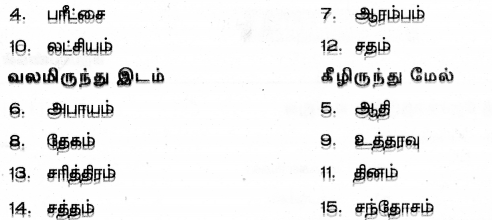
I am coming to

Chennai tomorrow.

My uncle said to me, “I am coming to Chennai tomorrow.”My uncle told me that he was coming to Chennai the next day
I want to become a doctor.Monica said, “I want to i become a doctor.”Monica said that she wanted to become a doctor.
The comic books are kept on the second shelf.The librarian said, “The comic books are kept on the second shelf”The librarian said that the comic books were kept on the second shelf.
The monument is beautiful.Sidharthan said, “The monument is beautiful.”Sidharthan said that the monument was beautiful.

I. Change into Indirect Speech.

Question 1.
He said, “I live in the city centre”.
Answer:
He said that he lived in the city centre.

Question 2.
Radha said, “I am going out”.
Answer:
Radha said that she was going out.

Question 3.
Ravi said, “I can swim”
Answer:
Ravi said that he could swim.
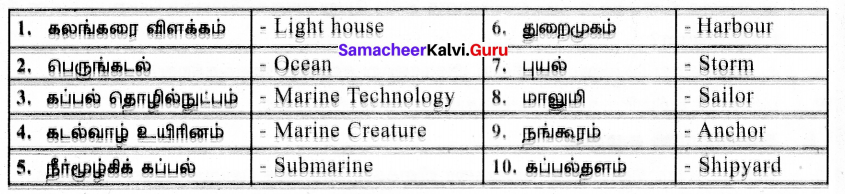
Question 4.
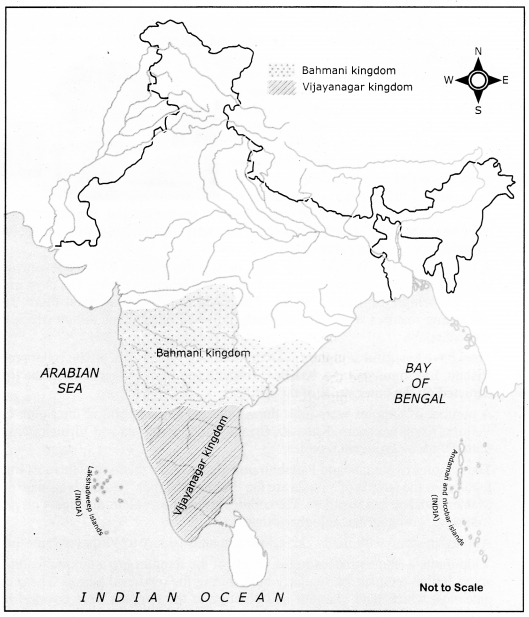
He said, “I arrived before you”.
Answer:
He said that he had arrived before him.

Question 5.
My father said, “I will be in Pairs on Monday”.
Answer:
My father said that he would be in Paris on Monday.

Warm Up

Work in pairs. Choose six items which are essential for a camp. Rank their priority and justify your answer.

7th Std English Journey By Train Samacheer Kalvi Chapter 1 Journey By Train
Answer:

  1. Torch Light
  2. Tent
  3. Cell Phone
  4. Rope
  5. Hammer
  6. Stove

These things are essential for a camp because without these things, we cannot enjoy our camp. Camping is an amazing experience. So we should prepare ourselves properly with the essential items taken along with us. This will avoid frustration and stress.

Journey by Train Summary

Section – I

This story tells us of an amazing journey by an Englishman Mr. Phileas Fogg. He is a ruthless perfectionist who cares more about the bet than
the native places, he sees on his travels. He will do anything, even lie and cheat, to get what he wants.
Mr. Phileas Fogg along with his French attendant, Passepartout, attempts to go round the world in eighty days by taking a bet for $ 20,000. They travel through some parts of India. That was the time, when the railways were being built in the country. The train started at the scheduled time from Bombay. There were a number of passengers like officers, government officials and merchants in the train. Sir Francis Cromarty, one of Mr. Fogg’s friends, occupied a seat opposite to them. The train passed the bridges, the Island of Salcette, mountains, jungles, forests and the fertile territory of Khandesh.
Passepartout couldn’t believe that he was actually crossing India in a railway train. Tigers and snakes fled at the noise of the train. Elephants stood gazing at the train with sad eyes. At half-past twelve, the train stopped at Burhampoor. The travellers had a hasty breakfast. The train entered the valleys of Sutpour Mountains at three in the morning.

Question 1.
Give a picturesque view through which the train travels.
Answer:

Journey By Train 7th Standard In Tamil Samacheer Kalvi Chapter 1 Journey By Train

Section – II

The train stopped at 8 o’clock some fifteen miles beyond Rothal. Phileas Fogg and others were annoyed. They were wondering why there was a halt of the train in the midst of the forest. When they enquired, the conductor informed them that the railroad lines ends at Kholby, 50 miles short of Allahabad. The line begins again from there in Allahabad. Sir Francis got angry because they sold the tickets from Bombay to Calcutta, without confirming about the railroad lines.

The passengers had to provide means of transportation for themselves from Kholby to Allahabad. So, Mr. Fogg, his attendant and Sir. Francis planned to reach Allahabad in time by some means of transport, as a steamer was ready to leave Calcutta for Hongkong on the 25th. They had two days left to reach Calcutta.

Discuss and answer – Intext Questions.

Question 1.
Why did the train stop in the middle of the forest?
Answer:
The train stopped in the middle of the forest as there were no railroad lines beyond that place.

Question 2.
Why was Sir Francis angry?
Answer:
There were no railroad lines from Kholby to Allahabad. But the tickets were sold from Bombay to Calcutta. So Sir Francis was angry.

Section – III

After searching the village from end to end, Mr. Fogg and Sir. Francis came back without finding any means of transport. But Passepartout suggested that they can travel on an Indian elephant. As it could travel rapidly for a long time, Mr. Fogg determined to hire it. Even though Mr. Fogg offered excessive amount to hire the elephant, the elephant’s owner refused to hire it. So Mr. Fogg finally purchased the elephant for two thousand pounds. A young man offered his services as a guide to them.

While Mr. Fogg and Sir Francis took the howdahs on either side, Passepartout got on to the saddle-cloth between them. The driver sat on the elephant’s neck and at 9 o’clock set out from the village to Allahabad.

Discuss and answer.

Question 1.
Which mode of transport did Fogg choose?
Answer:
At first, Fogg chose to go on foot to Allahabad. Then he purchased an elephant to take them to Allahabad.

Question 2.
Did he hire Kiouni? Why?
Answer:
No, he did not hire Kiouni, but purchased it for 2000 pounds, because the owner of the elephant intended to make a big bargain and so refused to hire him.

Question 3.
Why was the elephant owner happy with the deal?
Answer:
The elephant owner was happy with the deal because Mr. Fogg offered him 2000 pounds to purchase the elephant.

Samacheer Kalvi 7th English Solutions Term 2 Poem Chapter 2 Wandering Singer

Students can Download Wandering Singer Questions and Answers, Summary, Activity, Notes, Samacheer Kalvi 7th English Book Solutions Guide Pdf  helps you to revise the complete Tamilnadu State Board New Syllabus and score more marks in your examinations.

Tamilnadu Samacheer Kalvi 7th English Solutions Term 2 Poem Chapter 2 Wandering Singer

B. Pick out the rhyming pairs from the poem and fill in the table.

Samacheer Kalvi 7th English Solutions Term 2 Poem Chapter 2 Wandering Singer img 1

C. Read these lines and answer the questions given below.

Wandering Singers Poem Question 1.
Where the voice of the wind calls our wandering feet Whose ‘Wandering feet’ is referred to here?
Answer:
The wandering feet of the band of folk singers.
With lutes in our hands ever-singing we roam,
All men are our kindred, the world is our home.

(a) Who does ‘we’ refer to? What do they have in their hands? What is its name?
Answer:
‘We’ refers to the wandering singers. They have a musical instrument in their hands. Its name is ‘lute’.
(b) How are the men in the world related to the singers?
Answer:
All the men in the world are their extended family and the world is their home.

Wandering Singers Question 3.
Our lays are of cities whose lustre is shed,
Here ‘Lays’ means ________
(a) lying down
(b) stories
(c) to keep
Answer:
(b) stories

Wandering Singers Summary Question 4.
The laughter and beauty of women long dead
Explain the meaning of the above line.
Answer:
The songs sung by the wandering singers are about the laughter and beauty of women who were dead long ago.

Writing

D. Answer in a paragraph.
What does Sarojini Naidu say about the Wandering Singers? Write in your own words. (in about 60 words)
Answer:
Sarojini Naidu in this poem tells us about the wandering singers, their life and their activities as well as their experiences. The wandering singers stroll here and there. They count the world as their home and all the people around are their inborn family and relatives. They hold ‘lutes’ in their hands and sing songs about ancient battles, old kings and the beauty and laughter of women of the past.

E. Think and answer.

Wandering Singers Poem Line By Line Explanation Question 1.
Are the singers homeless travellers? Why do you think so?
Answer:
Yes, they are homeless travellers because they wander from town to town and from village to village to spread the message of love through their singing.

Wandering Singers Poem Question Answers Question 2.
Do the singers have hopes and dreams? if not, why?
Answer:
The wandering singers have no dreams or hopes of their own. They go wherever the wind calls them.

Wandering Singer Additional Questions

I. Poem Comprehension:

Wandering Singers Poem Summary Question 1.
Our lays are of cities whose lustre is shed,
The laughter and beauty of women long dead;
The sword of old battles, the crown of old kings,
And happy and simple and sorrowful things.

(a) Whose lustre is shed?
Answer:
The cities lustre (glory) is shed (lost).

(b) Whose laughter and beauty had the poet mentioned here?
Answer:
She had mentioned the laughter and beauty of the women in the past.

(c) What do you mean by the word ‘lustre’?
Answer:
It means ‘the glory’ of the cities.

(d) Do they also sing of sorrowful things?
Answer:
Yes, they do sing of sorrowful things.

II. Poetic Devices:

Wandering Singers Poem 7th Standard Question 1.
Where the voice of the wind calls our wandering feet,
Through echoing forest and echoing street,
Pick out rhyming words in these lines.
Answer:
The rhyming words are ‘feet – street’.

Wandering Singers Questions And Answers Question 2.
And happy and simple and sorrowful things.
Pick out the alliterated words.
Answer:
‘Simple – sorrowful’ are the alliterated words.

III. Short Questions and Answers.

Summary Of Wandering Singers Question 1.
What is wandering singers about?
Answer:
Wandering singers are a band of folk singers who wander from place to place according to the call of the wind. It can either be town, village or forest.

Poem Wandering Singers Question 2.
How do the singers sing?
Answer:
The singers sing songs with lutes, in their hands and travelling from place to place.

Wandering Singers Line By Line Explanation Question 3.
What has happened to the cities?
Answer:
It has been seized by wars, famine etc., so the beauty is gone.

Wandering Singers Poem In English Question 4.
What does, “The laughter and beauty of women long dead” mean?
Answer:
The laughter and the beauty has died because of wars or because of famine.

Wandering Singers By Sarojini Naidu Question 5.
What songs do the singers sing about the sword of old battles?
Answer:
They sing about the brave warriors who fought bravely with the sword.

7th English Poem Wandering Singers Question 6.
Why do the singers feel nostalgic of the crown of old kings?
Answer:
They feel nostalgic because during the king’s period, these singers used to get rewards, which made them lead a comfortable life.

Summary Of Poem Wandering Singers Question 7.
‘What hope shall we gather, what dreams shall we sow’? Explain these lines.
Answer:
The poetess tells us that the wandering singers cannot have any hope or dream of bright future because of their wandering nature.

Wandering Singers Poem Explanation Question 8.
Do the singers stay at one place or do it they?
Answer:
They wander about from one place to the other. The call of the wind determines where they go.

IV. Paragraph Questions with Answers.

7th Standard English Poem Wandering Singers Question 1.
What is the song of the wandering singers about?
Answer:
The song is about the band of folk singers who wander from town to town and from village to village to spread the message of love through their singing. They play the lute, a musical instrument as they roam from place to place.
The theme of the song is about the swords of old battles and the crowns of old kings. They are also of the laughter and beauty of women in the past.

Wandering Singers Book Back Answers Question 2.
‘What hope shall we gather, what dreams shall we sow’ Explain this line in detail.
Answer:
Here the poetess seems to tell us about their sadness and about their future. They do not stay at one place. So they cannot gather hope and have dreams about their bright future. Their movements depend on the call of the wind. No love can make them go slow or no joy can bade them to wait.

Warm up

Discuss in pairs, circle the names of musical instruments from the grid. One is done for you.

Wandering Singers Poem Samacheer Kalvi 7th Term 2 Poem Chapter 2

Wandering Singer Summary

The poem “Wandering singers” by Sarojini Naidu is about the band of Folk singers who wander from town to town and from village to village to spread the message of love through their singing. They play the lute (a musical instrument) as they roam from place to place. The voice of the wind symbolizes the welcoming tone of the song that echoes through the forests and streets. To the wandering singers, all mankind are like their extended family and the world is their home. The theme of the songs that they sing goes back to stories of ancient battles or of old kings. They also have songs about the beauty of women and about happy and sad things.

The wandering singers have no dreams or hopes of their own; they go wherever the wind calls them. No love can make them go slow or no joy can bade them to wait. The voice of the wind is the voice of their life and also their destiny.