Samacheer Kalvi 7th Social Science Geography Solutions Term 2 Chapter 1 Resources

You can Download Samacheer Kalvi 7th Social Science Book Solutions Guide Pdf, Tamilnadu State Board help you to revise the complete Syllabus and score more marks in your examinations.

Tamilnadu Samacheer Kalvi 7th Social Science Geography Solutions Term 2 Chapter 1 Resources

Samacheer Kalvi 7th Social Science Resources Textual Exercises

I. Choose the correct answer:

Samacheer Kalvi Guru 7th Social Science Question 1.
Which one of the following is renewable resource?
(a) Gold
(b) Iron
(c) Petrol
(d) solar energy
Answer:
(d) solar energy

Samacheer Kalvi 7th Social Solutions Question 2.
Where is the largest solar power project situated in India?
(a) Kamuthi
(b) Aralvaimozhi
(c) Muppandal
(d) Neyveli
Answer:
(a) Kamuthi

Samacheer Kalvi Guru 7th Social Question 3.
Which is one of the first metals known and used by man?
(a) Iron
(b) Copper
(c) Gold
(d) Silver
Answer:
(b) Copper

Samacheer Kalvi 7th Social Guide Question 4.
_______ is one of the indispensable minerals used in electrical and electronics Industry.
(a) Limestone
(b) Mica
(c) Manganese
(d) Silver
Answer:
(b) Mica

Samacheer Kalvi Guru 7th Social Science Guide Question 5.
Electricity produced from coal is called ________.
(a) Thermal Power
(b) Nuclear power
(c) Solar power
(d) Hydel power
Answer:
(a) Thermal Power

II. Fill In the blanks

  1. ______ is the largest producer of hydroelectricity.
  2. Iron ores found at ______ in Tamil Nadu.
  3. ______ is produced from bauxite ore.
  4. ______ is used in making electrical batteries.
  5. Petroleum and its derivatives are called ______.

Answers:

  1. China
  2. Kanjamalai
  3. Aluminium
  4. Manganese
  5. Black Gold

III. Match the following

Samacheer Kalvi 7th Social Science Guide Question 1.

  1. Renewable resource – Iron
  2. Metallic resource – Mica
  3. Non-metallic resource – Wind energy
  4. Fossil fuel – Sedimentary rock
  5. Limestone – Petroleum

Answers:

  1. Renewable resource – Wind energy
  2. Metallic resource – Iron
  3. Non-metallic resource – Mica
  4. Fossil fuel – Petroleum
  5. Limestone – Sedimentary rock

IV. Consider the following statement and tick (✓) the appropriate answer

Samacheer Kalvi.Guru 7th Social Question 1.
Assertion (A): Wind power is Clean Energy.
Reason (R): Wind turbines do not produce any emissions
(a) A and R are correct and R explains A
(b) A and R are correct but R does not explain A
(c) A is incorrect but R is correct
(d) Both A and R are incorrect
Answer:
(a) A and R are correct and R explains A

Samacheerkalvi.Guru 7th Social Question 2.
Assertion (A): Natural gas is found with petroleum deposits.
Reason (R): it can be used as a domestic and industrial fuel.
(a) A and R are correct and R explains A
(b) A and R are correct but R does not explain A
(c) A is incorrect but R is correct
(d) Both A and R are incorrect
Answer:
(a) A and R are correct and R explains A

V. Answer the following

Samacheer Kalvi Guru Social 7th Question 1.
Define – Resource.
Answer:
Anything which can be used for satisfying the human needs is called resource.

Samacheer Kalvi Guru 7th Standard Social Question 2.
What are the uses of iron?
Answer:
(i) Iron is used to manufacture steel and also used in civil engineering like reinforced concrete, griders etc.
(ii) It is used to make alloy steels like carbon steels with additives such as nickel, chromium, vanadium, tungsten and manganese.

Samacheer Kalvi 7th Social Book Solutions Question 3.
What are the major utilizers of solar energy in the world?
Answer:
India, China, Japan, Italy and States of America are major utilizers of solar energy in the world.

Samacheer Kalvi 7th Social Book Question 4.
Name the types of coal based on carbon content.
Answer:
Coal is classified into four types based on carbon content. They are :

  1. Anthracite
  2. Bituminous
  3. Lignite
  4. Peat

Samacheer Kalvi 7th Social Science Book Solutions Question 5.
Give a short note on Duralumin.
Answer:
Duralumin is an alloy, a trade name given to the earliest types of the age hardenable aluminum alloys. It is an alloy made up of 90% aluminum, 4% copper, 1 % magnesium and 0.5% to 1 % manganese. Duralumin is.a hard, but a lightweight alloy of aluminum.

VI. Distinguish the following

Samacheer Kalvi 7th Social Science Books Answers Question 1.
Biotic resources and abiotic resources.
Answer:
Biotic resources:

  1. Biotic resources are found in the biosphere which are obtained from living and organic materials.
  2. Biotic resources depend on abiotic resources for their survival.
  3. Example : Plants, trees, animals, microorganisam etc.

Abiotic resources :

  1. Abiotic resources are the non-living parts of an environment.
  2. Abiotic resources do not depend on biotic resources for their survival.
  3. Example : Sunlight, temperature, water, soil, air, etc.

Samacheer Kalvi Term 2 Question 2.
Renewable resources and non-renewable resources.
Answer:
Renewable resources:

  1. Renewable resources can be used again and again throughout its life.
  2. These resources are present in unlimited quantity.
  3. These resources are pollution free
  4. Example : Solar energy, wind energy and hydropower.

Non-renewable resources:

  1. Non-renewable resources cannot be used again and again as it is limited which can be depleted one day.
  2. These resources are present in a limited quantity only.
  3. These resources are not pollution free.
  4. Example : Fossil fuels, iron, copper, gold silver etc.

Samacheer Kalvi 7th Social Science Question 3.
Metallic resources and non-metallic resources.
Answer:
Metallic resources:

  1. Metallic resources are the types of resources that are composed of metals.
  2. These are hard substances, which are the good conductors of heat and electricity.
  3. Example for metallic resources are iron, copper, gold, bauxite, silver, manganese, etc.

Non-metallic resources:

  1. Non-metallic resources can be described as the resources that do not comprise of metals.
  2. These are not hard substances and are not good conductors of heat and electricity.
  3. Example for non-metallic resources are mica, limestone, gypsum, dolomite, phosphate, etc.

VII. Give reason

Samacheer Kalvi 7th Standard Social Guide Question 1.
Aluminium has wide range of uses compared to other metals.
Answer:

  1. Aluminium is light in weight, tough and cheaper, which makes it popular metal for constructional purpose.
  2. It is mainly used in the construction of aircrafts, ship, automobiles, railway coaches and etc.
  3. So, Aluminium has wide range of use compared to other metals.

Question 2.
Water is considered as a great source of energy.
Answer:
At present, water is used for producing hydroelectric power. Hydroelectricity is generated from moving water with high velocity and great falls with the help of turbines and dynamos. So water is considered as a great source of energy.

VIII. Answer in a paragraph

Question 1.
Explain the different types of renewable resources.
Answer:
Solar energy :

  1. The sun produces energy in the form of heat and light. Solar energy is not harmful to the environment.
  2. Photovoltaic devices or solar cells, directly convert solar energy into electricity.
  3. India, China, Japan, Italy and States of America are major utilizers of solar energy in the world.

Hydropower:

  1. Hydroelectricity power is the cheapest and most versatile source of energy out of all the know energy. Hydroelectric power is a renewable resource.
  2. China, Canada, Brazil, United States of America, Russia, India, Norway and Japan are some countries producing hydroelectricity. China is the largest producer of hydro-electricity.

Wind energy :

  1. Wind power is clean energy since wind turbines does not produce any emission.
  2. In recent years, wind energy has become one of the most economical and renewable energy technologies.
  3. Major wind energy producing countries are United States, China, Germany, Spain, India, United Kingdom, Canada and Brazil.

Question 2.
Describe the non-metallic resources.
Answer:
Non-metallic resources:

  1. Non-metallic resources can be described as the resources that do not comprise of metals.
  2. These are not hard substances, and are not good conductors of heat and electricity.
  3. Example for non-metallic resources are mica, limestone, gypsum, dolomite, phosphate, etc.

Mica:

  1. Muscovite and Biotite are the common ores of Mica.
  2. It is one of the indispensable minerals used in electrical and electronics industry.
  3. In powder form, it is used for making lubricating oils and decorative wallpapers.

Limestone:

  1. Limestone is a sedimentary rock, composed mainly by skeletal fragments of marine organisms such as coral, foraminifera and molluscs.
  2. About 10% of sedimentary rocks are limestones. Mostly limestone is made into crushed stone and used as a construction material.
  3. It is used for facing stone, floor tiles, stair treads, windows sills and many other purposes.
  4. Crushed limestone is used in smelting and other metal refining process. Portland cement is made from limestone.

Question 3.
What are the different types of fossil fuel resources? Explain them.
Answer:
Fossil fuel resources:

  1. Fossil fuel resources are normally formed from the remains of dead plants and animals.
  2. They are often referred to as fossil fuels and are formed from hydrocarbon.

Coal:

  1. This is the most abundantly found fossil fuel that forms when dead plant matter is converted into peat.
  2. It is used as a domestic fuel, in industries such as iron and steel, steam engines to generate electricity.

Petroleum:

  1. Petroleum is found between the layers of rocks and is drilled from oil fields located in Offshore and coastal areas.
  2. Petroleum and its derivatives are called Black Gold as they are very valuable.

Natural gas:

  1. Natural gas is found with petroleum deposits and is released when crude oil is brought to the surface.
  2. It can be used as a domestic and industrial fuel.

IX. Activity

Question 1.
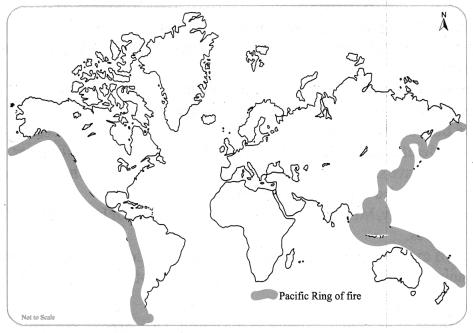
Mark the metallic resources on the given outline map of the world.
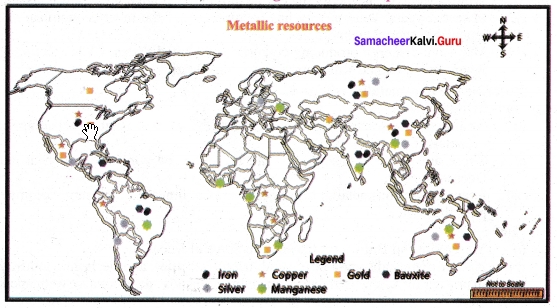
Samacheer Kalvi Guru 7th Social Science Geography Solutions Term 2 Chapter 1 Resources
Question 2.
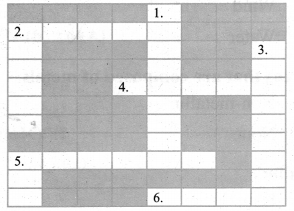
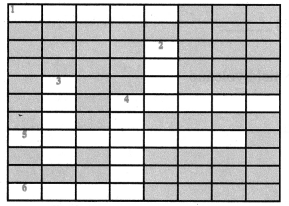
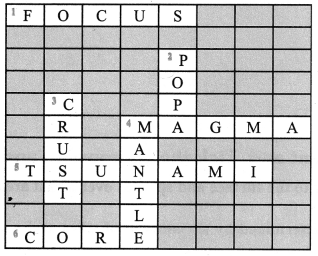
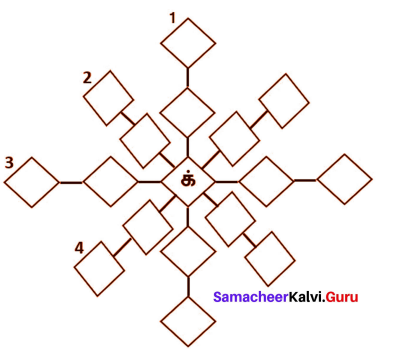
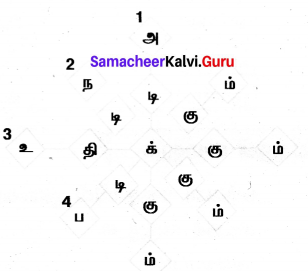
Crossword puzzle
Samacheer Kalvi 7th Social Solutions Science Geography Term 2 Chapter 1 Resources
Across:
2. The leading coal producers of the world
4. Considered as a great source of energy
5. Precious metal like gold
6. Used as an insulating material in electrical industry
Down:
1. Used in making electrical batteries
2. Good conductor of heat and electricity
3. The largest producer of gold in India
5. Produces energy in the form of heat and light
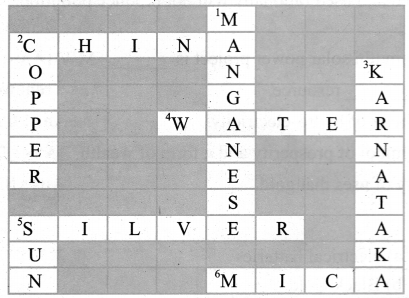
Samacheer Kalvi Guru 7th Social Science Geography Solutions Term 2 Chapter 1 Resources

Samacheer Kalvi 7th Social Science Resources Additional Questions

I. Choose the correct answer:

Question 1.
______ are the non-living parts of an environment.
(a) Biotic resources
(b) Abiotic resources
(c) Both
(d) None
Answer:
(b) Abiotic resources

Question 2.
______ is not harmful to the environment.
(a) Sotar energy
(b) Wind energy
(c) Hydropower
(d) None of these

Question 3.
Kamuthi solar power project is situated in ______ district in Tamil Nadu.
(a) Madurai
(b) Tirunelveli
(c) Ramanathapuram
(d) Kancheepuram
Answer:
(c) Ramanathapurami

Question 4.
______ ¡s considered as a great source of energy.
(a) Air
(b) Wind
(c) Land
(d) Water
Answer:
(d) Water

Question 5.
_______ resources are the type of resources that are composed of metals.
(a) Metallic
(b) Non-metallic
(c) Both
(d) None
Answer:
(a) Metallic

Question 6.
Iron ores found at _______ in Tamil Nadu.
(a) Shervaroy hills
(b) Kanjamalai
(c) Palani hills
(d) None of these
Ans:
(b) Kanjamalai

II. Fill in the blanks:

  1. _________ are resources that exist without action of humankind.
  2. _________ resources harvested and used rationally will not produce pollution.
  3. The installed capacity of Kamuthi solar power project is _________ MW.
  4. Hydro electric power is a _________ resource.
  5. _________ is the largest producer of hydro-electricity.
  6. _________ is regarded as a symbol of prosperity and a form of wealth.
  7. _________ has a wider variety of uses that gold.

Answers:

  1. Natural resources
  2. Renewable
  3. 648
  4. Renewable
  5. China
  6. GoId
  7. Silver

III. Match the following:

  1. Gold – (a) electrical batteries
  2. Silver – (b) Black Gold
  3. Manganese – (c) Sedimentary rock
  4. Petroleum – (d) Mexico
  5. Limestone – (e) China

Answers:

  1. e
  2. d
  3. a
  4. b
  5. c

IV. Consider the following statements: Tick the appropriate answer

Question 1.
Assertion (A) : Fossil fuel resources are normally formed from the remains of dead plants and animals.
Reason (R) : They are often referred to as fossil fuels and are formed from hydrocarbon.
(a) A and R are correct and R explains A
(b) A and R are correct but R does not explain A
(c) A is incorrect but R is correct
(d) Both A and Rare incorrect
Answer:
(a) A and R are correct and R explain A

Question 2.
Assertion (A) : Mica is used as an insulating material in electrical industry.
Reason (R) : Non-metallic resources are hard substances, and are good conductors of heat and electricity.
(a) A and R are correct and R explains A
(b) A and R are correct but R does not explain A
(e) A is incorrect but R is correct
(d) A is correct but R is incorrect
Answer:
(d) A is correct but R is incorrect

V. Answer in one or two sentences

Question 1.
What are the importance of resources?

  1. Natural resources satisfy daily needs of man such as food, clothing and shelter.
  2. Natural resources also contribute immensely to boost up a nation’s economy.

Question 2.
What is renewable resources?
Answer:
A renewable resource is a resource which can be used repeatedly and replaced naturally. Renewable resources harvested and used rationally will not produce pollution. The use of renewable resources and energy sources is increasing worldwide.
Example: solar energy, wind energy, and hydropower.

Question 3.
Write a note on Kamuthi Solar Project.
Answer:
Kamuthi solar power project is one of the largest solar power projects in the world. It is situated in Ramanathapuram District in Tamilnadu. The Kamuthi solar power project was completed on 21st September 2016. The installed capacity of this project is 648 MW.

Question 4.
Describe the major wind farms in India.
Answer:
Wind Forms:

  1. Muppandal
  2. Jaisalmer
  3. Brahmanvel
  4. Dhalgaon
  5. Damanjodi

Question 5.
What are Non-renewable resources?
Answer:
Natural resources that once consumed and cannot be replaced is called non-renewable resources. Continuous consumption of non-renewable resources ultimately leads to exhaustion. Examples of non-renewable resources include fossil fuels such as coal, petroleum, natural gas and mineral resources such as iron, copper, bauxite, gold, silver and others.

Question 6.
What are the types of Non-renewable resources?
Non-renewable resources can be divided into three types. They are:

  • Metallic resources
  • Non – Metallic resources
  • Fossil fuel resources

VI. Answer the following in detail

Question 1.
What are the types of resources on the basis of origin?
Answer:
On the basis of origin, resources may be divided into two types. They are:

  1. Biotic resources
  2. Abiotic resources

1. Biotic resources:
Biotic resources are found in the biosphere which are obtained from living and organic materials. It includes forests, crops, birds, animals, fishes, man and materials that can be obtained from them. Fossil fuels such as coal and petroleum are also included in this category because they are formed from decayed organic matter.
2. Abiotic resources:
Abiotic resources are the non-living parts of an environment. Examples of abiotic resources include land, water, air, sunlight and heavy metals including ores such as gold, iron, copper, silver etc.

Question 2.
Briefly explain any four of the metallic resources.
Answer:
Metallic resources Metallic resources are the type of resources that are composed of metals. These are hard substances, which are the good conductors of heat and electricity. Example for metallic resources are iron, copper, gold, bauxite, silver, manganese, etc.

Iron : Iron is the fourth most common element in the Earth’s crust and the most widely available metal. Magnetite and hematite are the common ore for iron, which occurs normally in the rocksof the crust.

Copper : Copper is one of the first metals known and used by man. Copper ranks as the third most consumed industrial metal in the world after Iron and Aluminium. Copper is good conductor of heat and electricity. Chile is the world’s number one country in the production of copper.

Gold : It is a rare and precious metal. Hence, ithas high demand in world markets. Formerly, it was used for minting coins, but now it is used for making ornaments and in dentistry. It is regarded as a symbol of prosperity and a form of wealth. China is the world’s largest producer of gold.

Silver : Silver is also a precious metal like gold. It has a wider variety of uses than gold. It is used in making jewellery, dentistry, photographic goods, electroplating industry and in the manufacture of luxury goods. Mexico is the world’s leading silver producer.

VII. Give reason.

Question 1.
Manganese is used in drafting electrical batteries.
Answer:
Manganese is used in making electrical batteries. It is also used as colouring material in bricks, pottery, floor tiles.

Question 2.
Silver is also a precious metal like Gold.
Answer:
Silver is also a precious metal like gold. It has a wider variety of uses than gold. It is used in making jewellery, dentistry, photographic goods, electroplating industry and in the manufacture of luxury goods.
Samacheer Kalvi 7th Science Solutions Term 1 Chapter 4 Atomic Structure

Students can Download Science Chapter 4 Atomic Structure Questions and Answers, Notes Pdf, Samacheer Kalvi 7th Science Book Solutions Guide Pdf helps you to revise the complete Tamilnadu State Board New Syllabus and score more marks in your examinations.

Tamilnadu Samacheer Kalvi 7th Science Solutions Term 1 Chapter 4 Atomic Structure

Samacheer Kalvi 7th Science Atomic Structure Textual Evaluation

I. Choose the appropriate answer :

7th Science Atomic Structure Question 1.
The basic unit of matter is __________
(a) Element
(b) Atom
(c) Molecule
(d) Electron
Answer:
(b) Atom

Unit 4 Atomic Structure Answers Question 2.
The subatomic particle revolve around the nucleus is __________
(a) Atom
(b) Neutron
(c) Electron
(d) Proton
Answer:
(c) Electron

Atomic Structure Class 9 Samacheer Kalvi Question 3.
__________ is positively charged.
(a) Proton
(b) Electron
(c) Molecule
(d) Neutron
Answer:
(a) Proton

Atomic Structure Worksheet Answer Key 7th Grade Question 4.
The atomic number of an atom is __________
(a) Number of neutrons
(b) Number of protons
(c) Total number of protons and neutrons
(d) Number of atoms
Answer:
(b) Number of protons

7th Standard Atomic Structure Question 5.
__________ Nucleons comprises of
(a) Protons and electrons
(b) Neutrons and electrons
(c) Protons and neutrons
(d) Neutrons and Positron
Answer:
(c) Protons and neutrons

II. Fill in the blanks

  1. The smaller particles found in the atom is called _____
  2. The nucleus has _____ and _____
  3. The _____ revolve around the nucleus.
  4. If the valency of carbon is 4 and that of hydrogen is 1, then the molecular formula of methane is _____
  5. There are two electrons in the outermost orbit of the magnesium atom. Hence, the valency of magnesium _____

Answer:

  1. sub-atomic particels
  2. Protons, Neutrons
  3. electrons
  4. CH4
  5. 2

III. Match the following :

1.Valency(a)Fe
2.Neutral Particle(b)Proton
3.Iron(c)Electrons in the outermost Orbit
4.Hydrogen(d)Neutron
5.Positively charged Particle(e)Monovalent

Answer:

  1. c
  2. d
  3. a
  4. e
  5. b

IV. True or False. If False, give the correct statement (T/F).

Structure Of Atom Class 7 Question 1.
The basic unit of an element is molecule.
Answer:
(False) Correct statement: The basic unit of an element is atom.

Samacheer Kalvi Guru 7th Science Question 2.
The electrons are positively charged.
Answer:
False. Correct statement: The electrons are negatively charged.

Class 7 Science Chapter 4 Notes Question 3.
An atom is electrically neutral.
Answer:
True

Atomic Structure Book Back Answers Question 4.
The nucleus is surrounded by protons.
Answer:
(False) Correct statement: The nucleus is surrounded by electrons.

V. Complete the analogy.

  1. Sun: Nucleus, planets: ______
  2. Atomic number: ______ , Mass number: number of protons and neutrons.
  3. K: Potassium, C: ______.

Answer:

  1. electrons
  2. Number of protons
  3. Carbon

VI. Assertion and reason.

Samacheer Kalvi.Guru 7th Science Question 1.
Assertion : An atom is electrically neutral.
Reason : Atoms have equal number of protons and electrons.
Answer:
Both Assertion and Reason are true and Reason is the correct explanation of Assertion.

Atomic Structure Class 7 Question 2.
Assertion : The mass of an atom is the mass of nucleus.
Reason : The nucleus is at the centre.
Answer:
Both Assertion and Reason are true and Reason is the correct explanation of Assertion.

Atomic Structure Notes For Class 7 Question 3.
Assertion : The number of protons and neutrons is atomic number.
Reason : The mass number is sum of protons and neutrons.
Answer:
Assertion is false but the reason is true statement.
Correct statement: The number of protons and neutrons is mass number.

VII. Give very short answer.

Question 1.
Define an atom.
Answer:
An atom is the smallest particle of a chemical element that retains its chemical properties.

Question 2.
Name the sub-atomic particles.
Answer:
Proton, Electron, Neutrons.

Question 3.
What is atomic number?
Answer:
The number of electrons or protons in an atom is called the atomic number of that atom. It is represented by the letter Z.

Question 4.
What is the characteristics of proton?
Answer:
The proton is the positively charged particle and its located in the nucleus. Its positive Charge is of the same magnitude as that of the electron’s negative charge.

Question 5.
Why neutrons called neutral particles?
Answer:
Neutrons are the particles in an atom that have a neutral change (no charge). They are not positive like protons. They are not negative like electrons. So they are called as neutral particles.

VIII. Give short answer.

Question 1.
Distinguish Isotopes from Isobar.
Answer:

IsotopesIsobar
Isotopes are atoms of the same element thus having same atomic number but different mass number.Isobars are such atoms which have same mass number but different atomic numbers. Thus isobars are different elements
Example : Hydrogen has three isotopes protium, with deuterium, tritium atomic number 1 but mass number 1,2,3.Example : Calcium and Argon are isobars as they have atomic number 20 and 18 but their mass number is 40.

Question 2.
What are the isotones give one example.
Isotones are the atoms of different elements with same number of neutrons.
136C Neutrons = 13-6 = 7
147C Neutrons = 13-6 = 7

Question 3.
Differentiate mass number from atomic number.
Answer:

Atomic numberMass number
The number of electrons or protons in an atom is called atomic number of that atom.The number of protons and neutrons present is its nucleus is called mass number of that atom.
It is represented by the letter ZIt is represented by the letter ‘A’.
Example : Helium (He) has 2 protons and two electrons hence its atomic number will be 2.Example : Sodium (Na) has 11 protons and 12 Neutrons hence its mass number A= 11 + 12 = 23

Question 4.
The atomic number of an element is 9, it has 10 neutrons. Find the element from the periodic table. What will be its mass number?
Answer:
The element is Fluorine
Its mass number A
= n + p
= 10 + 9 = 19
∴Mass number of Fluorine = 19

IX. Answer in detail.

Question 1.
Draw the atom structure and explain the position of the sub-atomic particles. »
Answer:
Structure of an atom.

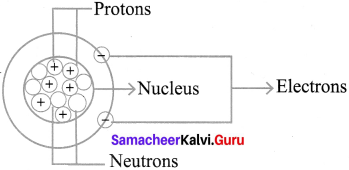
7th Science Atomic Structure Samacheer Kalvi Term 1 Chapter 4

Position of the subatomic – particles.
Atom consist of three sub-atomic.
Particles : 1. Protons, 2. Electrons, 3. Neutrons

  1. The nucleus of the atom contains the protons (positively charged) and the neutrons (no change)
  2. The outermost regions of the atom are called electron shells and contain the electrons (negatively charged)
  3. The protons have a positive charge while neutrons have a neutral charge.
  4. Electrons circle around the nucleus of an atom, they are negatively charged.

Question 2.
The atomic number and the mass number of an element is 26 and 56 respectively. Calculate the number of electrons, protons and neutrons in its atom. Draw the structure.
Answer:
Atomic number A = 26
Mass number A = 56
No. of Protons P = ?
No. of Electrons = ?
No. of Neutrons N = ?
Name of the element is Iron (Fe)
No. of proton (P) = 26
Mass number A = n+p
56 = n = 26
n = 56-26
∴ No. of neutrons n = 30
In an element No. of protons and No. of electrons is equal.
∴No of electrons = no. of protons
= 26
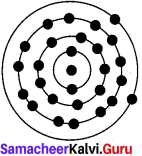
Structure of Iron:

Unit 4 Atomic Structure Answers Samacheer Kalvi 7th Science Solutions Term 1

Question 3.
What are nucleons? Why are they so called? Write the properties of the nucleons?
Answer:

  1. Nucleons are sub-atomic particles (Protons and Neutrons) which are located in the nucleus of atoms.
  2. Neutron and proton exist within the nucleus of the atom, together, they are called as nucleons.

Properties of Nucleons :
(a) Nucleons (Proton and Neutrons) have same mass as if they were identical particles that differ only in their electric charge.
(b) The proton carries a charge +1 and the Neutron is neutral.
(c) The size nucleon is about 1 : 6 fm (Femto meters)
(d) The force that holds the nucleus together is very short range.

Question 4.
Define valency? What is the valency of the element with atomic number 8? What is the compound by the element with hydrogen.
Answer:

  1. Valency is defined as the combining capacity of an element.
  2. Valency of the element with atomic number : 8 Name of the element:

Oxygen : 0
Atomic number: 8
Valency : 2
Water (H2O) is the Oxide of Hydrogen and most familiar oxygen compound

X. Questions based on Higher Order Thinking Skills. :

Question 1.
An atom of an element has no electron, will that atom have any mass or not? Can atom exist without electron? If so then give example.
Answer:

  1. Atoms with no electron will have mass, because mass depends on number of Protons and Neutrons though it has no electron.
  2. Atoms can exist without electrons, Matter is build out of neutrons, protons (+) and electrons (-). Matter becomes stable only if it is electrically neutral.
  3. So atoms without electrons do exist and must have their own states (charged or uncharged transfered back and forth in their environment)
  4. Example : He2+. It has 2 protons and 2 neutrons but no electrons.

Question 2.
Find what is common salt? Name the elements present in it? Write the formula of common salt. What are the atomic number and the mass number of the elements? Write the ions in the compound.
Answer:

  1. Common salt is mostly sodium chloride. The ionic compound with the formula NaCl, representing equal proportions of sodium and chlorine.
  2. Elements present is common salt: Sodium & Chlorine.
  3. Formula of common salt: NaCl Atomic number and mass number of NaCl:
    Atomic number of Na = 1 Atomic number of Cl = 17 Mass number of Na = 23
    Mass number of Cl = 35
  4. Ions present in the compound :
    Sodium ion Na+ and Chloride ion Cl

Try yourself:

Question 1.
Why are atomic numbers and mass numbers are always whole numbers ?
Answer:

  1. The atomic number is always a whole number because there must always be a whole number of protons in a nucleus. In other words there can never exist fractions of a proton.
  2. The atomic mass number is always a whole number for the same reason. Protons and neutrons always come in single units not in fractions.

Question 2.
A sulphur atom contains 16 Protons and 16 neutrons. Give its atomic number and atomic mass number.
Answer:
Atomic number of Sulphur = No.of proton sulpher
= 16
Atomic mass number of Sulphur = No. of Protons + No. of Neutrons
= 16 + 16
= 32

Samacheer Kalvi 7th Science Atomic Structure Intext Activities


Activity – 1

Some known objects are shown, also the broken particles of the objects are shown. Name the articles or objects you see here? Also try to write What each of it made of?
Answer:

  1. Hummer made of Iron
  2. Bangles made of glass
  3. Tap made of steel
  4. Vessels made of Aluminum or steel

Activity – 2

Let us learn the characteristics of the subatomic particles through the following activity. Label the parts in the given diagram and answer the following.

  1. The positively charged particle is ________
  2. The negatively charged particle is ________
  3. ________ is neutral.

Answer:

  1. Proton
  2. Electron
  3. Neutron

Activity – 3

Observe the table given above and answer the following questions.

  1. I am used for breathing, without me you cannot live. Do you know me? Write my name and symbol ________
  2. It is used in filling the balloons. It is a gas, identity it. What is its mass number?
  3. Name the element present in banana. What is my atomic number?
  4. I am found in crackers. How many protons do i have?
  5. I am the most valuable element. Find who am I? Can you say my mass number?

Answer:

  1. Oxygen, Symbol – O.
  2. Helium, Mass no. 4 Potassium, Atomic number: 19.
  3. Phosphorous, No. of Protons : 15.
  4. Carbon, Mass number: 12.

Samacheer Kalvi 7th Science Atomic Structure Additional Questions

I. Choose the correct answer:

Question 1.
________ is made up of two or more atoms.
(a) Atoms
(b) Molecule
(c) Compound
(d) None
Answer:
(b) Molecule

Question 2.
The average diameter of an atom is ________
(a) 10“8 m
(b) 1 m
(c) 1A°
(d) 10
Answer:
(c) 1A°

Question 3.
Whose theory does not propose anything about the positive and negative charges of an atoms.
(a) J J. Thomson
(b) Dalton
(c) Rutherford
(d) Bohr
Answer:
(b) Dalton

Question 4.
________ is the smallest unit used to measure small lengths.
(a) Metre
(b) Nanometre
(c) Millimetre
(d) Centimetre
Answer:
(b) Nanometre

Question 5.
One Nano metre is equal to ________
(a) 108 m
(b) 10-9 m
(c) 10-5 m
(d) 109 m
Answer:
(b) 109 m

Question 6.
One metre is equal to ________ mm.
(a) 109
(b) 108
(c) 105
(d) 1010
Answer:
(a) 109

Question 7.
Who discovered the existence of the negatively charged particles is an atom?
(a) John Dalton
(b) Rutherford
(c) Neils Bohr
(d) J.J. Thomson
Answer:
(d) J.J. Thomson

Question 8.
J.J Thomson’s atom model is also called as ________
(a) Plum pudding model
(b) gold foil
(c) alpha particle
(d) none
Answer:
(a) Plum pudding model

Question 9.
Protons and neutrons are called ________
(a) atom
(b) nucleons
(c) positive charge
(d) negative charge
Answer:
(b) nucleons

Question 10.
Proton was discovered by ________
(a) Rutherford
(b) Goldstein
(c) Chadwick
(d) J.J. Thomson
Answer:
(a) Rutherford

II. Fill in the blanks :

  1. ______ is the smallest particle of a chemical element.
  2. The ______ are combination of atoms of various elements or the same element.
  3. According to John Dalton, atom is a hard, solid, ball and it is ______
  4. ________ compared an atom to a watermelon.
  5. The particles that make up the atom are called _________ particles.

Answer:

  1. Atom
  2. molecules
  3. indivisible
  4. J.J. Thomson
  5. sub-atomic

III. Write true or false :

Question 1.
A neutron is a neutral particle.
Answer:
True.

Question 2.
J.J. Thomson proposed than an atom consists of positively charged sphere in which the electrons are embedded.
Answer:
True.

Question 3.
The outermost orbit of an atom can have more than 8 electrons.
Answer:
(False) Correct statement : The outermost orbit of an atom contains maximum of 8 electrons.

Question 4.
Most of the space in an atom is occupied by electrons.
Answer:
True.

Question 5.
Rutherford used beta particles in his scattering experiments.
Answer:
(False) Correct statement: Rutherford used alpha particles in his scattering experiments.

IV. Matrix matching :

Question 1.

ElementSymbolAtomic No.
i)Hydrogena)01.11
ii)Heliumb)Al2.8
iii)Aluminiumc)He3.1
iv)Oxygend)Na4.2
v)Sodiume)H5.13

Answer:

  1. e
  2. c
  3. b
  4. a
  5. d

Question 2.

ParticleChargeDiscoverer
i)Protona)n1.James Chadwick
ii)Electronb)P2.Rutherford
iii)Neutronc)e3.J.J. Thomson

Answer:

  1. b
  2. c
  3. a

V. Give very short answer :

Question 1.
What is atomic number?
Answer:
Atomic number is the number of protons, an atom contains.

Question 2.
What is mass number of an atom?
Answer:
It is the sum of protons and neutrons in the nucleus of an atom.

Question 3.
What is a neutron?
Answer:
Neutron is an elementary particle that carries no charge

Question 4.
Name the 3 sub-atomic particles of an atom.
Answer:
Electron, Proton, Neutron.

Question 5.
What are valence electrons?
Answer:
The number of electrons present in the outermost shell of an atom are known as valence electrons.

Question 6.
What are nucleons?
Answer:
Protons and neutrons reside in the nucleus of an atom and are thus called nucleons.

Question 7.
What is an electron?
Answer:
It is negatively charged particle, which revolve around the nucleus of the atom is specific orbits.

Question 8.
What is the mass of a proton?
Answer:
1.6726 x 10⁻²⁷ kg.

VI. Give short answer :

Question 1.
Is the structure of the atom the same as the structure of the solar system.
Answer:
Yes It is similar to the solar system. It has a core center called nucleus and it has paths called orbits around the nucleus.

Question 2.
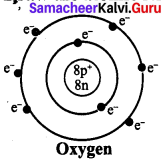
Draw the atomic structure of Oxygen :
Answer:

Atomic Structure Worksheet Answer Key 7th Grade Samacheer Kalvi Term 1 Chapter 4

Question 3.
what is atomic mass number? mention its formula.
Answer:
Atomic mass number (A) is equal to the sum of the number of protons(p) and neutrons (n) in the nucleus.
Atomic mass or mass number = Number of Protons + Number of Neutrons

Question 4.
Define isotopes. Give example.
Answer:
Atoms of the same element can have different number of neutrons. Such atoms will have same atomic number but different mass numbers. These atoms are called isotopes. For example Hydrogen has three isotopes – Hydrogen,Deuterium,Tritium

Question 5.
Define Isobars. Give example.
Answer:
Atoms that have the same mass number but different atomic numbers are called Isobars.
Eg: Calcium – 40 and Argon – 40.

Question 6.
What are the limitations of Thomson’s model of an atom?
Answer:
J. J. Thomson’s theory does not propose anything about the positive and negative charges of an atom. Hence , it was not able to explain many of the properties of substances.

VII. Answer the following in detail :

Question 1.
What was the model of an atom proposed by Thomson?
Answer:

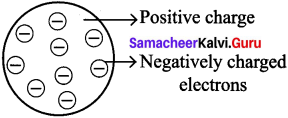
  1. J.J. Thomson’s theory proposed that the atom has positively charged part like the red part of the watermelon and in it are embedded, like the seeds, negatively charged particles which he called electrons.
  2. According to this theory as the positive and negative charges are equal, the atom as a whole does not have any resultant charge.
  3. Thomson’s greatest contribution was to prove by experimentation the existence of the negatively charged particles or electrons in an atom.
    7th Standard Atomic Structure Term 1 Chapter 4 Samacheer Kalvi

Question 2.
Explain the following terms.

  • Proton
  • Electron
  • Neutron.

Answer:

  1. Proton (p): The proton is the positively charged particle and is located in the nucleus. Its positive charge is of the same magnitude as that of the electron’s , negative charge.
  2. Neutron (n): Neutron is inside the nucleus. The neutron does not have any charge. Except hydrogen (protium), the nuclei of all atoms contain neutrons.
  3. Electron (e): This is a negatively charged particle. Electrons revolve around the nucleus of the atom in specific orbits. The mass of an electron is negligible as compared to that of a proton or neutron.

VIII. Higher Order Thinking skills : (HOTS)

Question 1.
In Rutherford experiment of scattering of alpha particles, can we take foil of any other metal instead of gold?
Answer:

  1. Yes, we can take foil of any other metal that is highly malleable because for this experiment we need a very thin foil.
  2. Gold was used because it is highly malleable, the gold foil taken was about 1000 atoms thick.

Question 2.
How Rutherford’s model is different from that proposed by J.J. Thomson?
Answer:
According to Rutherford, most of the mass is concentrated is a small central part of the atom whereas J.J. Thomson thought that mass was uniformly distributed in the atom.

Samacheer Kalvi 7th Social Science History Solutions Term 1 Chapter 3 Emergence of New Kingdoms In South India: Later Cholas And Pandyas

Students can Download Social Science History Chapter 3 Emergence Of New Kingdoms In South India: Later Cholas And Pandyas Questions and Answers, Notes Pdf, Samacheer Kalvi 7th Social Science Book Solutions Guide Pdf helps you to revise the complete Tamilnadu State Board New Syllabus and score more marks in your examinations.

Tamilnadu Samacheer Kalvi 7th Social Science History Solutions Term 1 Chapter 3 Emergence of New Kingdoms In South India: Later Cholas And Pandyas

Samacheer Kalvi 7th Social Science Emergence of New Kingdoms In South India: Later Cholas And Pandyas Textual Evaluation

I. Choose the correct answer:

Highlight Any Five Aspects Of Cholas Legacy Question 1.
Who revived the later Chola dynasty?
(a) Vijayalaya
(b) Rajaraja I
(c) Rajendral
(d) Athirajendra
Answer:
(a) Vijayalaya

Emergence Of New Kingdoms In South India Question 2.
Who among the following Pandya rulers is known for ending the Kalabhra rule?
(a) Kadunkon
(b) ViraPandyan
(c) Kun Pandyan
(d) Varaguna
Answer:
(a) Kadunkon

Emergence Of New Kingdoms In South India Later Cholas And Pandyas Question 3.
Which of the following was the lowest unit of Chola administration?
(a) Mandalam
(b) Nadu
(c) Kurram
(d) Ur
Answer:
(d) Ur

Highlight Any Five Aspects Of Chola Legacy Question 4.
Who was the last ruler Vijayalaya line of Chola dyanasty?
(a) VeeraRajendra
(b) Rajadhiraja
(c) AthiRajendra
(d) Rajaraja II
Answer:
(c) AthiRajendra

The Royal Secretariat Of Pandya Kingdom Was Known As Question 5.
An example of Chola architecture can be seen at ______
(a) Kannayiram
(b) Uraiyur
(c) Kanchipuram
(d) Thanjavur
Answer:
(d) Thanjavurj

The Elder Son Of The Chola King Was Called Yuvaraja Question 6.
To which of the following, Marco Polo went in the last decade of 13th century in India?
(a) Chola mandalam
(b) Pandya country
(c) Kongu region
(d) Malainadu
Answer:
(b) Pandya country

II. Fill in the Blanks

  1. built the famous Brihadeshwara Temple at Thanjavur.
  2. established a Vedic college at Ennayiram.
  3. was the donor of Velvikudi copper plates.
  4. The royal sectretariat of Pandya kingdom was known as

Answer:

  1. Rajaraja I
  2. Rajaraja I
  3. Jatila Parantaka Nedunjadayan
  4. eluttu-mandapam

III. Match the following

AB
MaduraiiInland traders
Gangaikonda  CholapuramiiMaritime traders
Anju-vannattariiiCapital of Cholas
Mani- gramattarivCapital of Pandyas

Answer:

  1. iv
  2. iii
  3. iii
  4. i

IV. True or False :

  1. A Muslim state subordinate to Delhi Sultan was in Madurai.
  2. Koodal – nagar Kavalan was the title of a Pandya king.
  3. Chola kingdom was situated in Vaigai delta.
  4. Correct statement: Chola kingdom was situated in Kaveri delta.
  5. Kulothunga I belonged to Chalukya – Chola dynasty.
  6. The elder son of the Chola king was called Yuvaraja.

Answer:

  1. True
  2. True
  3. False
  4. True
  5. True

V. Consider the following statements.
Tick (✓) the appropriate answer.

Chola Kingdom Was Situated In Vaigai Delta True Or False Question 1.
Which of the following statements about Later Cholas are correct?

  1. They had a system of Local self government.
  2. They maintained a strong navy.
  3. They were the followers of Buddhism.
  4. They built big temples.

(a) 1,2 and 3
(b) 2,3 and 4
(c) 1,2 and 4
(d) 1,3 and 4
Answer:
(c) 1,2 and 4

Established A Vedic College At Ennayiram Question 2.
Which of the following statements are true with regard to Rajendra Chola?

  1. He assumed the title Gangaikonda Chola.
  2. He conquered Southern Sumatra.
  3. He is credited with consolidating the Chola power.
  4. His naval power enabled him to conquer Srivijaya.

(a) 1 and 2
(b) 3 and 4
(c) 1,2 and 4
(d) All the above
Answer:
(d) All the above

Donor Of Velvikudi Copper Plates Question 3.
Assertion:- The Yuvarajas were appointed Governors in the provinces.
Reason:- This was done for their training in administration.
(a) R is the correct explanation of A.
(b) R is not the correct explanation of A.
(c) A is wrong and R is correct.
(d) A and R are wrong.
Answer:
(a) R is the correct explanation of A

Question 4.
Arrange the following administration divisions in descending order.

  1. Nadu
  2. Mandalam
  3. Ur
  4. Kurram

Answer:

  1. Madalam
  2. Nadu
  3. Kurram
  4. Ur

Question 5.
Arrange the events in chronological order.

  1. Maravarman appointed Virapandyan as co – regent.
  2. Civil war broke out.
  3. A Muslim State was established in Madurai.
  4. MaravarmanKulasekaran had two sons – Virapandyan and Sundrapandyan
  5. SundraPandyan sought help from Ala – ud-din Khalji.
  6. Malik Kafur invaded Madurai.

Answer:

  1. MaravarmanKulasekaran had two sons – Virapandyan and Sundrapandyan
  2. Maravarman appointed Virapandyan as co – regent.
  3. Civil war broke out.
  4. SundraPandyan sought help from Ala – ud-din Khalji.
  5. Malik Kafur invaded Madurai.
  6. A Muslim State was established in Madurai.

Question 6.
Find out

BrahmadeyaLand grants given to Brahmins
DevadanaTax free lands given to temples by Chola rulers
PallichchandamLand granted to Jain Institutions
VellanvagaiHolders were called vellalars who retained major share in harvest.

VI. Answer in one or two sentences

Question 1.
What were the items exported during the later Chola period?
Answer:
During the later Cholah period, the items exported were sandalwood, ebony, condiments, precious gems, pepper, oil, paddy, grains and salt.

Question 2.
What was called Chatur-vedi-mangalam?
Answer:
Kings Pandya and local chiefs created Brahmin settlements called Mangalam or Chatur-vedi- mangalam with irrigation facilities.

Question 3.
Write about Kanikadan.
Answer:
The revenue of the Chola state came mainly from the land. The land tax was known as Kanikadan. The Chola rulers carried out an elaborate survey of land in order to fix the government’s share of »the land revenue. One-third of produce was collected as land tax. It was collected mostly in kind.

VII. Answer the following :

Question 1.
Highlight any five aspects of Cholas’ legacy.
Answer:

  1. The chola rulers established a well organized system of administration in which the empire was divided into mandalans, naadu, Kurrams and gramam.
  2. A very efficient local administration was another important feature of the Chola rule.
  3. Chola gave importance to irrigation – vati-vaykkal, ur-vaykkal and nadu-vaykkal ensured proper distribution of water.
  4. The Chola rulers built the famous temples in Thanjavur, Gangaikonda Cholapuram and Darasuram. Chola Kings were great patrons of learning. Trade flourished during their period.

VIII. HOTS :

Question 1.
Chola kings were great patrons of learning: Support the statement with details.
Answer:

  1. Rajendra I estabished Vedic college at Ennayiram where Vedas, grammar and Upanishad were taught.
  2. This was later followed by his successors and two more such colleges had been founded.
  3. The Great literary works like Periyapuranam and Kamba Ramayanam belong to this period.

IX. Student Activity :
Who am I?

  1. I was responsible for Malik Kafur invasion.
  2. I built 16-mile embankment-lake in Gangaikonda Cholapuram.
  3. I am a water supply channel.
  4. I codified Thirumurai.
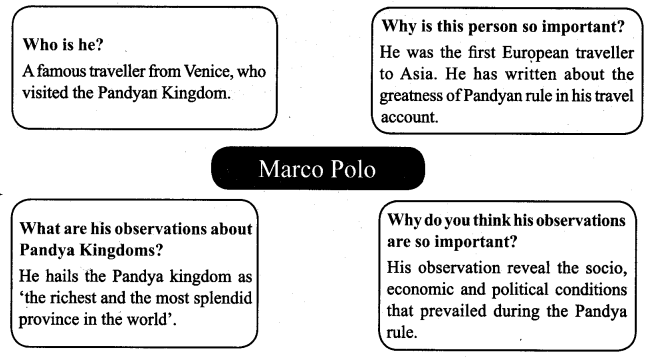
  5. I was a great port. Marco Polo visited me twice.

Answer:

  1. Sundara Pandyan
  2. Rajendra Chola
  3. Vaykkal
  4. Nambiy andar Nambi
  5. Kayal

Highlight Any Five Aspects Of Cholas Legacy Samacheer Kalvi 7th Social Science History Solutions Term 1 Chapter 3

X. Answer Grid

1. Name the two literary works of Chola period.
Answer:
Periya Puranam, Kamba Ramayanam
2. Which port is associated with pearl fishery?

Answer:
Korkai

3. What do kasu, kalanchu and pon refer to?

Answer:
Gold coins were in circulation as the trade was carried through the medium of gold. It was variously called kasu, kalanchu and pon.

4. In which district is Kayal -Pattinam located?

Answer:
Thoothukudi

5. Who was the Pandya king, defeated by Parantaka I?

Answer:
Rajasimha II

6. Where is the famous Meenakshi temple located?

Answer:
Madurai

XI. Field trip :

Question 1.
Visit any one temple built during Chola or Pandya period and see its magnificence.
Answer:
Students to be taken for a field trip to a built temple during Chola or Pandya period.

Samacheer Kalvi 7th Social Science Emergence of New Kingdoms In South India: Later Cholas And Pandyas Additional Questions

I. Choose the correct answer:

Question 1.
The ancient Chola kingdom reigned with ______ as its capital
(a) Thanjavur
(b) Uraiyur
(c) Kayal
(d) Madurai
Answer:
(b) Uraiyur

Question 2.
Rajaraja chola’s daughter was married to ______ Prince Vimaladitya
(a) Chera
(b) Chola
(c) Chalukya
(d) Pallava
Answer:
(c) Chalukya

Question 3.
______ presently in Kanchipuram district was as Brahmadeya village
(a) Darasuram
(b) Thoothukudi
(c) Tiruchirapalli
(d) Uttiramerur
Answer:
(d) Uttiramerur

Question 4.
Saivite saint ______ converted Arikesari from Jainism to Saivism. .
(a) Thirugnanasambandar
(b) Sundarar
(c) Kambar
(d) Sekkizhar
Answer:
(a) Thirugnanasambandar

Question 5.
Marcopolo recorded the incident of _____ and poiigamy practised by the sings in his travel account
(a) Child Marriage
(b) Sati
(c) Untouchability
(d) Chaild Labour
Answer:
(b) Sati

II. Fill in the blanks:

  1. ______ were landlords who acted as spokesmen in the Ur.
  2. Arikesari Maravarman is identified with the ______ ,the persecutor of Jain.
  3. Parantaka I defeated the Pandya king ______ who feld the country in 920.
  4. Madurai has been popularly venerated as ______

Answer

  1. The Urai
  2. Kun pandian
  3. Rajasimha
  4. Kooda

III. Match the following :

AB
VatiiBusiest port
Ur vaykkaliiritual
Kayal Pattinamiiidrainage channel
Asvameda yagaivVillage channel

Answer:

  1. iii
  2. iv
  3. i
  4. ii

IV. True or False :

Question 1.
Vati-vaykkal is a traditional type of harnessing rain in the Cauvery delta.
Answer:
True

Question 2.
During the Pandya period trade was carried out by two guild like groups anju-vannattar and manigramattar.
Answer:
(False) Correct statement: During the Chola period trade was carried out by two guild like groups anju-vannattar and manigramattar.

Question 3.
The Chera ruler, the chief of Malanadu, accepted his feudatory position and paid tribute to Sundarapandyan.
Answer:
True

V. Match the statement with the reason. Tick the appropriate answer:

Question 1.
Statement : Rajendra chola I matched his father in his ability to expand the empire.
Reason : The Chola empire remained a powerful force in South India during his reign,
(a) Statement and Reason are correct.
(b) Statement is correct, Reason is wrong.
(c) Statement is wrong, Reason is correct.
(d) Both statement and Reason are wrong.
Answer:
(a) Statement and Reason are correct.

Question 2.
Statement : Arikesari is alleged to have impale 8000 Saivites on stakes.
Reason : Arikesari had an anti-Jain attitude.
(a) Statement is correct, Reason is wrong.
(b) Statement is wrong, Reason is correct.
(c) Statement and Reason are correct.
(d) Both Statement and Reason are wrong.
Answer:
(b) Statement is wrong. Reason is correct

Question 3.
Which of the following statements is/are correct?

  1. During the Pandya rule, horse trade became brisk
  2. Those who were trading in horses were called Kudirai chetties
  3. Horses were needed only for trading purpose.

(a) (i) and (ii)
(b) (ii) and (iii)
(c) (i) and (iii)
(d) (i), (ii) and (iii)
Answer:
(a) (i) and (ii)

Question 4.
Pick out the odd one.
(a) Vijayalaya
(b) Sundarapandyan
(c) Rajaraja I
(d) Rajendra
Answer:
(b) Sundarapandyan

Question 5.
Find out the wrong pair
(a) Provinces – mandalams
(b) Kurrams – groups of village
(c) Ur – town
(d) gramam – village
Answer:
(c) Ur – town

VI. Answer in one word.

Question 1.
How were the landowning groups called during the Pandya rule?
Answer:
Bumiputtirar or Vellalar

Question 2.
What was the average cost of a horse used for trading in Pandya Kingdom?
Answer:
220 dinars of red gold.

Question 3.
Name the place where Sundarapandyan defeated Someswara.
Answer:
Kannanur.

VII. Answer the following :

Question 1.
For what purposes were horses used during Pandya rule?
Answer:
Horses were used for trading, ceremonial purposes and also to fight wars.

Question 2.
Write a short note on the administrative system of the chola period.

  1. The Chola rulers established a well organised system of administration.
  2. The empire, was divided into provinces or mandalams. Each mandalam was sub-divided into naadus.Within each naadu, there were many kurrams (groups of villages). The lowest unit was the gramam (village).

Question 3.
What were the responsibilities of the Local Governannce committees in the chola period?
Answer:
The committees took care of irrigation, roads, temples, gardens, collection of revenue and conduct of religious festivals.

VIII. HOTS:

Question 1.
What was the impact of attitude of Pandya kings towards different sects of religions?
Answer:

  1. The Pandya rulers were impartial towards Saivism and Vaishnavism. Temples of both sects were patronised through grants, tax-exemption and renovation.
  2. The great Saiva and Vaishnava saints (Nayanmars and Alwars) contributed to the growth of Tamil literature.

Samacheer Kalvi 7th Tamil Solutions Term 2 Chapter 2.2 அழியாச் செல்வம்

Students can Download Tamil Chapter 2.2 அழியாச் செல்வம் Questions and Answers, Summary, Notes Pdf, Samacheer Kalvi 7th Tamil Book Solutions Guide Pdf helps you to revise the complete Tamilnadu State Board New Syllabus and score more marks in your examinations.

Tamilnadu Samacheer Kalvi 7th Tamil Solutions Term 2 Chapter 2.2 அழியாச் செல்வம்

மதிப்பீடு

சரியான விடையைத் தேர்ந்தெடுத்து எழுதுக.

Question 1.
ஒருவர் தம் குழந்தைகளுக்குச் சேர்த்து வைக்க வேண்டிய செல்வம்
அ) வீடு
ஆ) கல்வி
இ) பொருள்
ஈ) அணிகலன்
Answer:
ஆ) கல்வி

Question 2.
கல்வியைப் போல் , ……………….. செல்லாத செல்வம் வேறில்லை .
அ) விலையில்லாத
ஆ) கேடில்லாத
இ) உயர்வில்லாத
ஈ) தவறில்லாத
Answer:
ஆ) கேடில்லாத

Question 3.
‘வாய்த்தியின்’ என்னும் சொல்லைப் பிரித்து எழுதக் கிடைப்பது ………………..
அ) வாய்த்து + ஈயீன்
ஆ) வாய் + தீயின்
இ) வாய்த்து + தீயின்
ஈ) வாய் + ஈயீன்
Answer:
ஆ) வாய் + தீயின்

Question 4.
கேடில்லை’ என்னும் கொல்லைப் பிரித்து எழுதக் கிடைப்பது ……..
அ) கேடி + இல்லை
ஆ) கே + இல்லை
இ) கேள்வி + இல்லை
ஈ) கேடு + இல்லை
Answer:
ஈ) கேடு = இல்லை

Question 5.
எவன் + ஒருவன் என்பதனைச் சேர்த்தெழுதக் கிடைக்கும் சொல் …………..
அ) எவன் ஒருவன்
ஆ) எவன்னொருவன்
இ) எவனொருவன்
ஈ) ஏன்னொருவன்
Answer:
இ) எவனொருவன்

குறுவினா

Question 1.
கல்விச் செல்வத்தின் இயல்புகளாக நாலடியார் கூறும் செய்திகளை எழுதுக.
Answer:
கல்வியைப் பொருள் போல் வைத்திருப்பினும் அது பிறரால் கொள்ளப்படாது. ஒருவற்கு வாய்க்கும் படி கொடுத்தாலும் குறைவுபடாது : மிக்கச் சிறப்பினை உடைய அரசராலும் கவா முடியாது போன்ற இயல்புகளைக் கொண்டது.

சிறுவினா

கல்விச் செல்வம் குறித்து நாலடியார் கூறும் கருத்துகளைத் தொகுத்து எழுதுக.
Answer:

  • கல்வியைப் பொருள் போல் வைத்திருப்பினும் அது பிறரால் கொள்ளப்படாது. ஒருவற்கு வாய்க்கும்படி கொடுத்தாலும் குறைவுபடாது. மிக்கச் சிறப்பினை உடைய அரசராலும் கவர முடியாது.
  • ஆதலால் ஒருவர் தம் குழந்தைகளுக்குச் சேர்த்து வைக்க வேண்டிய செல்வம் கல்வியே ஆகும்.
  • மற்றவை செல்வம் ஆகாது என்பன நாலடியார் கூறும் கருத்துகளாகும்.

சிந்தனை வினா

கல்விச் செல்வம் அழியாதக் செல்வம் எனப்படுவது ஏன்? சிந்தித்து எழுதுக.
Answer:
i) ஒரு மனிதன் தம்முடன் அனைத்துச் செல்வங்களையும் வைத்திருந்தாலும் அவனுக்கு கல்வியில்லையேல் அனைத்துச் செல்வங்களும் அழிந்து விடும். ஆனால் அழியாத ஒரு செல்வம் கல்விச் செல்வம் மட்டுமே

(ii) கற்றவன் எந்த இடத்திற்குச் சென்றாலும் அவன் பிற சமூகத்தால் மதிக்கப்படுகின்றான். இதற்குக் காரணம் அவன் கற்ற கல்வியே. கற்றவனுக்கு தனது நாடும் ஊருமே அல்லாமல் எந்த நாடும் ஊரும் தன்னுடைய ஊராகும்.

(iii) கல்வி, தொழிலுக்கு வழிகாட்டுகிறது. கல்வி என்பது வாழ்க்கை வாழ்வதற்காக உதவும் கருவியாகும். அறிவியலும் சமூகமும் வாழ்நாள் முழுவதும் தொடரும் கருவியாகும். கல்வி கற்றவரிடம் ஒழுக்கம், பண்பு, நேர்மை, நீதி இவைகள் அனைத்தும் ஒருங்கே அமைந்து காணப்படும். எனவே கல்வியானது ஒரு மனிதனின் முக்கியத் தேவையாக இருக்கிறது. எந்தவொரு சமூகமும் கல்வி இல்லாமல் இவ்வுலகில்லை.

(iv) கல்வி கற்றவன் ஒழுக்கமாகவும், திறமையாகவும், அறிவாளியாகவும் சமுதாயத்தால் மதிக்கப்படுவனாக இருப்பான். எனவே என்றுமே அழியாத செல்வம் கல்வி மட்டுமே.

கற்பவை கற்றபின்

Question 1.
கல்வியின் சிறப்பை விளக்கும் பிற பாடல்களைத் திரட்டி எழுதுக.
Answer:

  • வேற்றுமை தெரிந்து நாற்பாலுள்ளும் – கீழ்ப்பால்
    ஒருவன் கற்பின் மேற்பாலொருவனும் அவன்கட் படுமே. ………….- புறநானூறு )
  • கடைநிலத்திற் பிறந்தவர் எனினும்
    கற்றறிந்தவரைத் தலைநிலத்து வைப்பர். ………………………………- நாலடியார்
  • கற்றோர்க்குக் கல்வி நலனே கலன் அல்லால்
    மற்றோர் அணிகலம் வேண்டாவாம்: …………………….- நீதிநெறி விளக்கம்
  • நெஞ்சத்து நல்லம் யாம் என்னும்
    கல்வியழகே அழகு : …………………….- நாலடியார்
  • கற்கக் கசடறக் கற்பவை கற்றபின்
    நிற்க அதற்குத் தக. …………….- திருக்குறள்

Question 2.
கல்வியின் சிறப்பை விளக்கும் கதை ஒன்றனை அறிந்து வந்து வகுப்பறையில் கூறுக.
Answer:
கல்வி தந்த உயர்வு : சிறுவர் கல்வி சிறுகதைகள்
ஒரு குக்கிராமத்தில் அன்னம்மாள் என்னும் பெண்மணி வாழ்ந்து வந்தாள். அப்பெண்மணி ஓர் அந்தணனின் மனைவி : அன்னம்மாளின் நல்வினைப் பயனால், அவளுக்கு முதலில் ஓர் ஆண் குழந்தை பிறந்தது. பெற்றோர் அக்குழந்தைக்கு, கபிலன் – என்னும் பெயர் சூட்டி, அருமைமிகு வளர்ந்து வந்தனர். அதன் பின்னர் பிறந்த ஓர் ஆண் குழந்தைக்குக் கோவிந்தா என்னும் பெயரையும், பெண் குழந்தைக்குக் அம்பிகை என்னும் ! பெயரையும் சூட்டி மகிழ்ந்தாள்.

கபிலன், கோவிந்தா, அம்பிகை ஆகிய மூவரும் சிறுவர்களாக இருந்தபோதே, அவர்களுடைய பெற்றோர் இறந்து விட்டனர்: தாய்ப் பறவையை இழந்த, சிறகு முளைக்காத குஞ்சுகள் போலப் பிள்ளைகள் மூவரும் அல்லலுற்றனர்.

அவர்களுக்கு உண்ண உணவில்லை உடுத்த உடை இல்லை : அவர்கள் மிகவும் வறுமையில் வாடினர். உடன்பிறந்தாரைப் பாதுகாக்கும் பொறுப்பு கபிலனுக்கு உரியதாயிற்று. அவன் என்ன செய்வான் பாவம் !
கபிலன் வீடுதோறும் சென்று பிச்சை வாங்கி வந்து; தம்முடன் பிறந்தவர்களுக்குக் கொடுத்து, தாமும் உண்டு ஒருவாறு காலத்தைக் கழித்து வந்தான். கபிலன் பிச்சை வாங்க செல்லும் போது, அவனது உள்ளம் உருகும்; உடல் நடுங்கும், மென்மையான முகத்தில் துன்பம் தோன்றும் கண்களில் நீர் நிறைந்து வழியும் பிச்சை இடாதவரின் கடுஞ்சொல்லும் சுடுமுகமும், அவனது துன்பத்தை மேலும் மேலும் வளர்த்த வண்ணம் இருந்தன.

அந்நிலையில், கபிலனின் பிஞ்சு உள்ளத்தில் ஓர் எண்ணம் தோன்றி; அவனை மிகவும் வருத்திக் கொண்டிருந்தது. “எப்படியாவது நாம் படித்துவிட்டால் இத்தொழிலை விட்டு விடலாம்!” என்று நினைத்தான்.

அந்த வருத்தத்தினிடையே கபிலன், ”படித்தேயாக வேண்டும்’ என்னும் முடிவைக் கொண்டான். உடனே அந்த ஊரில் இருந்த ஆசிரியரை அடைந்து, வணங்கி நின்று, “ஐயா! படிக்க வேண்டும் என்னும் விருப்பம் உண்டாகிறது. நான் எடுப்பதோ பிச்சை, உடுப்பதோ கந்தல் ஆடை நீங்கள் அருள்கூர்ந்து அடியேனுக்குக் கல்விச் செல்வத்தைக் கொடுங்கள். உங்கள் பிள்ளைகளில் அடியேனும் ஒருவன்!” என்று கூறினான்.

அதைக் கேட்ட ஆசிரியர், தம் கையில் இருந்த பிரம்பைக் கீழே வைத்தார்; சிறுவனாகிய கபிலனை நோக்கினார். “சிறுவனே! உன் குறிக்கோள் மிகவும் உயர்ந்தது. அது எல்லாருடைய உள்ளத்திலும் உண்டாகிற அழுக்கில்லாத ஆசை. இங்குக் கிடக்கும் பனையோலைகளே உனக்குப் பெருவாழ்வளிக்கும் பொன்னேடுகள். இப்பனையோலையில் எழுதி தருகிறேன். நீ படித்துக்கொள்!” என்று கூறினார். கபிலனின் உள்ளம் குளிர்ந்தது; முகம் மலர்ந்தது.

அன்றே கபிலன் படிக்கத் தொடங்கினான். “இன்ன நேரத்தில் இன்ன வேலை செய்ய வேண்டும்” என்று ஒரு திட்டம் வகுத்துக் கொண்டான்; முறைப்படி கடமை புரிந்தான். கபிலன் தெலுங்கில் ஓரளவு அறிவு பெற்ற பின், வடமொழியையும் பயின்றான்.

Question 3.
பின்வரும் பாடலைப் படித்து மகிழ்க.
Answer:
வெள்ளத்தால் அழியாது வெந்தணலால்
வேகாது வேந்த ராலும்
கொள்ளத்தான் முடியாது கொடுத்தாலும்
நிறைவன்றிக் குறைவு றாது
கள்ளர்க்கோ பயமில்லை காவலுக்கு
மிக எளிது கல்வி யென்னும்
உள்ளபொருள் உள்ளிருக்கப் புறத்தேயோர்
பொருள்தேடி உழல்கின் றீரே. -தனிப்பாடல் திரட்டு

கூடுதல் வினாக்கள்

சொல்லும் பொருளும் :

1. வைப்புழி – பொருள் சேமித்து வைக்கும் இடம்
2. கோட்படா – ஒருவரால் கொள்ளப்படாது
3. வாய்த்து ஈயில் – வாய்க்கும்படி கொடுத்தலும்
4. விச்சை – கல்வி

நிரப்புக.

Question 1.
வைப்புழி என்பதன் பொருள் …………
Answer:
பொருள் சேமித்து வைக்கும் இடம்

Question 2.
விச்சை என்பதன் பொருள் ….
Answer:
கல்வி

Question 3.
…………….. சமண முனிவர்கள் பலரால் எழுதப்பட்ட நூலாகும்.
Answer:
நாலடியார்

பாடலின் பொருள்

கல்வியைப் பொருள் போல வைத்திருப்பினும் அது பிறரால் கொள்ளப்படாது. ஒருவற்கு வாய்க்கும்படி கொடுத்தாலும் குறைவுபடாது. மிக்க சிறப்பினை உடைய அரசராலும் கவர முடியாது. ஆதலால் ஒருவர் தம் குழந்தைகளுக்குச் சேர்த்து வைக்க வேண்டிய செல்வம் கல்வியே ஆகும். மற்றவை செல்வம் ஆகாது.

Samacheer Kalvi 7th English Solutions Term 1 Poem Chapter 1 The Computer Swallowed Grandma

Students can Download English Poem 1 The Computer Swallowed Grandma Questions and Answers, Summary, Notes Pdf, Activity, Samacheer Kalvi 7th English Book Solutions Guide Pdf helps you to revise the complete Tamilnadu State Board New Syllabus and score more marks in your examinations.

Tamilnadu Samacheer Kalvi 7th English Solutions Term 1 Poem Chapter 1 The Computer Swallowed Grandma

B. Read these lines and answer the questions given below.

The Computer Swallowed Grandma Poem Questions And Answers Question 1.
The computer swallowed grandma.
Answer:
Who swallowed Whom?
The computer swallowed grandma.

The Computer Swallowed Grandma Poem Question 2.
She pressed ‘Control’ and ‘Enter’
And disappeared from view.
How did Grandma disappear from view?
Answer:
Grandma disappeared from the view on the computer screen when she pressed the control’ and enter’ keys.

The Computer Swallowed Grandma Question 3.
It devoured her completely.
Who does ’if refer to?
Answer:
‘It’ refers to the computer.

The Computer Swallowed Grandma Poem Summary Question 4.
She must have caught a virus Or been eaten by a worm.
What happened to Grandma?
Answer:
Grandma was affected by computer ‘virus’.

The Computer Swallowed Grandma Poem Answers Question 5.
I’ve searched through the recycle bin And files of every kind;
I’ve even used the Internet,
But nothing did I find.
Where did the author search for grandma?
Answer:
The author searched Grandma in the recycle bin, files and on the internet.

C. Work in pairs. Read the last two stanzas of the poem and answer the following questions.

The Computer Swallowed Grandma Poem Paragraph Question 1.
Who did the author ask for grandma?
Answer:
The author asked Jeeves.

Computer Swallowed Grandma Poem Question 2.
Did the author get a positive reply?
Answer:
No, the author did not get a positive reply.

The Computer Swallowed Grandma Poem Book Back Answers Question 3.
What is the author’s plea?
Answer:
The author pleads to send grandma back to him by an email, if anyone sees her in their Inbox

D. Pick out the rhyming pairs and write them in the blanks given.
Answer:
The Computer Swallowed Grandma Poem Questions And Answers Samacheer Kalvi 7th English Solutions Term 1 Chapter 1

The Computer Swallowed Grandma Additional Questions

Poem Comprehension – Additional
7th English Poem The Computer Swallowed Grandma Question 1.
In desperation, I asked Jeeves
My searches to refine.
The reply from him was negative,
Not a thing was found Online’.

(a) Why was the poet desperate?
Answer:
The poet was desperate as her old Grandmother had disappeared.

(b) Who was Jeeves?
Answer:
Jeeves was a software engineer called to repair the computer to bring back Grandma.

(c) Did Jeeves spot Grandma?
Answer:
No, he could not find Grandma.

(d) What do you understand from the last line?
Answer:
Not only Grandma, nothing was found ‘online’. That means the computer was not connected to the internet.

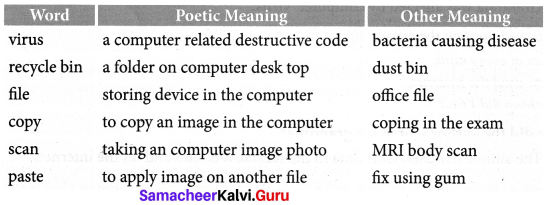
I. One Word Two Meanings.

The Computer Swallowed Grandma Poem Samacheer Kalvi 7th English Solutions Term 1 Chapter 1

II. Short Questions and Answers.

7th Standard English The Computer Swallowed Grandma Question 1.
List the computer terms used in the poem.
Answer:
Control, enter, virus, recycle bin, files, internet, online, inbox, copy, scan, paste.

The Computer Swallowed Grandma Poem Summary In Tamil Question 2.
Did Grandma really got swallowed by the computer?
Answer:
No, Grandma did not get swallowed by the computer. Only her image on the computer screen disappeared.

III. Paragraph Questions with Answers.

The Computer Swallowed Grandma Poem Explanation Questions 1.
Why was Jeeves called ? Was his visit successful ? Give reasons.
Answer:
Jeeves was called to find out ‘Why grandma was swallowed and consumed by the computer or if she had been caught by a virus or eaten by a worm?’ The computer repairer Jeeves refined the search for grandma everywhere in the computer and in the end, he gave only a negative reply. He said that not only grandma but nothing was found ‘online’. This means that the computer’s internet connection has been snapped for reasons unknown.

The Computer Swallowed Grandma Summary Question 2.
When and how did grandma disappear? Explain the different efforts put by the poet to get back her grandma.
Answer:
The poet’s grandma was an old tech savvy modern lady who lived far away from the poet. They loved each other and often had ‘online’ video chatting. On one such day, grandma mistakenly pressed ‘control’ and ‘enter’ and completely disappeared from the view of the poet on the other end.
The poet took many measures to get back grandma. She searched for grandma in the recycle bin and all the files. She also used the internet to find her. Then the poet called a computer mechanic Jeeves to identify the cause and bringing back grandma, but even that was a failure. Finally the poet desperately requests all the readers of her poem to send grandma back to her if they find her in their ‘inbox’, by email, after copying’, ‘scanning’ and ‘pasting’.

Figures of speech in this poem

1. Personification: the poet personifies the computer to a human being and says it had swallowed/ consumed Grandma.
Line 1 : The computer swallowed grandma.
Line 5 : It devoured her completely.

2. Hyperbole is extravagant exaggeration of an incident. Here the poet exaggerates and says the computer had swallowed and consumed grandma.
Line 1 : The computer swallowed grandma.
Line 5 : It devoured her completely.

3. Pun : It’s a play of words. In the poem the poet writes that her grandma was caught by a virus. Virus means medically a bacteria that causes disease. But in computer it denotes to a defect which erases and destroys the data in it.

Warm up

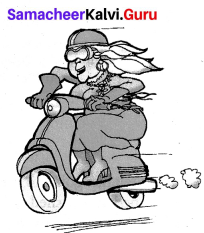
Look at the picture, discuss in pairs and present it before the class.

If your grandmother is …
The Computer Swallowed Grandma Poem Meaning In Tamil Question 1.
ready for a bicycle race, ______
Answer:
I will go for a race with her.

The Computer Swallowed Grandma Poem Lesson Plan Question 2.
willing to play hide and seek, _______
Answer:
I will play with her.

Question 3.
grabbing a lollipop from you, _______
Answer:
I will give mine to her.

The Computer Swallowed Grandma Samacheer Kalvi 7th English Solutions Term 1 Poem Chapter 1

Question 4.
How will you react to these situations?
Answer:
Grandma’s are always a blessing for us. So I would try to fulfill her wishes and make her happy.

The Computer Swallowed Grandma Summary

This childrens poem ‘The Computer Swallowed Grandma, was written by an Anonymous. Ever since it was published in ‘The Daily Mail’ national newspaper in July 2004, it was welcomed the world over for its humour, imagination and language.

The poet was chatting with her grandma online. Suddenly by mistake when grandma presses ‘Control’ and ‘Enter’, her image vanishes from the screen. The upset poet thinks that a virus must have attacked her computer and searches for her in the recycle bin, all files and on the internet. But she couldn’t find grandma, so she calls software engineer Jeeves to search grandma and he too couldn’t find. In the end, the poet requests all the readers of her poem to send grandma by email by copying, scanning and pasting her, if they happen to find grandma in their ‘in-box’.

Samacheer Kalvi 7th Science Solutions Term 1 Chapter 6 Health and Hygiene

Students can Download Science Chapter 6 Health and Hygiene Questions and Answers, Notes Pdf, Samacheer Kalvi 7th Science Book Solutions Guide Pdf helps you to revise the complete Tamilnadu State Board New Syllabus and score more marks in your examinations.

Tamilnadu Samacheer Kalvi 7th Science Solutions Term 1 Chapter 6 Health and Hygiene

Samacheer Kalvi 7th Science Health and Hygiene Textual Evaluation

I. Choose the appropriate answer :

Health And Hygiene 7th Standard Question 1.
Ravi has sound mind and physically fit body. Which refers to
(a) Hygiene
(b) Health
(c) Cleanliness
(d) Wealth
Answer:
(b) Health

Health And Hygiene Class 7 Question 2.
Sleep is not only good for body, but it is also good for
(a) Enjoyment
(b) Relaxation
(c) Mind
(d) Environment
Answer:
(c) Mind

7th Science Health And Hygiene Question 3.
Our living place should be
(a) Open
(b) Closed
(c) Clean
(d) Unclean / Untidy
Answer:
(c) Clean

7th Standard Science Health And Hygiene Question 4.
The tobacco chewing causes
(a) Anamia
(b) Periodontitis
(c) Tuberculosis
(d) Pneumonia
Answer:
(b) Periodontitis

Samacheer Kalvi Guru 7th Science Question 5.
The first aid is to
(a) To save money
(b) To prevent scars
(c) To prevent the medical care
(d) To relieve the pain
Answer:
(d) To relieve the pain

II. Fill in the blanks :

Health And Hygiene Questions And Answers Pdf Question 1.
A group of people living together in a particular area is called ______
Answer:
Community

Samacheer Kalvi Guru Science 7th Question 2.
Iam green colour box with garbage. Who am I ?
Answer:
Bio degradable waste

Health And Hygiene Class 7 Questions And Answers Question 3.
Eyes are considered as to the world.
Answer:
windows

Samacheer Kalvi Guru 7th Standard Science Question 4.
The hair follicles produce which keeps the hair smooth.
Answer:
oil

Health And Hygiene Chapter Question 5.
Tuberculosis is caused by the bacterium .
Answer:
Mycobacterium tuberculae

III. True (or) False, If false give the correct statement.

Health And Hygiene Questions And Answers Question 1.
All food should be covered.
Answer:
True

Samacheer Kalvi Guru 7th Science Guide Question 2.
Chicken pox also known as Leucoderma.
Answer:
(False) Correct statement: Chicken pox is also known as vanicella.

Question 3.
Stomach ulcer is a non-commnicable disease.
Answer:
True.

Question 4.
Rabies is a fatal disease.
Answer:
True

Question 5.
First- degree bums damage the whole skin.
Answer:
False. Correct statement: First -degree bums affects the outer layer (epidermis) of the skin only

IV. Match the following:

1.Rabie(a)Salmonella
2.Cholera(b)Yellow urine
3.Tuberculosis(c)Cramps in legs
4.Hepatitis(d)Hydrophobia
5.Typhoid(e)Mycobacterium

Answer:

  1. d
  2. c
  3. e
  4. b
  5. a

V. Analogy.

Question 1.
First degree bum: epidermis :: second degree bum : _________
Answer:
Dermis.

Question 2.
Typhoid: Bacteria:: Hepatitis: _________
Answer:
Vims.

Question 3.
Tuberculosis : air:: Cholera: _________
Answer:
Water.

VI. Choose the correct alternative from the following:

Question 1.
Assertion (A) : Oral hygiene is good.
Reason (R) : Sound teeth and healthy gums with healthy surrounding tissues,
(a) Both A and R are true
(b) Both A and R are false
(c) A is true but R is false
(d) A is false but R is true
Answer:
(a) Both A and R are true

Question 2.
Assertion (A): Chicken pox is a viral communicable disease.
Reason (R) : Characterized by rashes on the whole body, fever, head ache and tiredness.
(a) Both A and R are true
(b) Both A and R are false
(c) A is true but R is false
(d) A is false but R is true
Answer:
(a) Both A and R are true

VII. Very short Answer.

Question 1.
What is hygiene?
Answer:
Hygiene refers to the good habits and their practices which is followed to prevent disease, maintain good health, especially through cleanliness, consumption of safe drinking water and proper disposal of sewage. It refers to all those activities that are done for improving and maintaining good health and sound mind.

Question 2.
Write about the right way of protect the eyes?
Answer:
Practices to be followed for eye care.

  1. Do not rub the eyes
  2. Do not watch TV / Computer for a long time.
  3. Use cold water for cleaning the eyes.
  4. Eat lot of carrots which is rich in vitamin A needed for good vision.
  5. Eat fruits like oranges, sweet lemon etc., regularly.

Question 3.
How to keep your hair clean and health?
To keep the hair clean and healthy:
Answer:

  1. The regular hair wash and massage of the scalp will remove the dead skin cells, excess oil and dust.
  2. Rinsing the hair well with clear water and using good toothed comb for hair dressing is highly essential for their maintenance.

Question 4.
Sobi frequently playing with her mobile, suggest your ideas to protect his eye from irritation?
Answer:

  1. Stop playing with the mobile for a long time
  2. Keep the mobile at a distance from the eyes while playing.
  3. Wash eyes with cold water at intervals.

Question 5.
Give any two communicable disease, which spreads in your locality during monsoon?
Answer:

  1. Cholera
  2. Diarrhoea

Question 6.
What first aid will you provide in the case of bruises?
Answer:

  1. Bruises refer to scratches. It is a surface damage that does not penetrate the lower tissues.
  2. The affected area should be washed with cold running water and cleaned with an antiseptic cram on the wound.

Question 7.
Ravi said “Ganga had minor burn, so I washed with water” Do you agree with his statement or not? Explain Why?
Answer:

  1. Yes, In case of minor bums, the affected area should be washed with cold water.
  2. In case of severe bums, deeper layers of tissues get destroyed and blisters appear.

VIII. Short answer.

Question 1.
Why the first aid is essential?
Answer:
Safety and First Aid
First aid is the immediate treatment given to the victim of trauma or sudden illness before medical help is made available. The first aid is

  1. To save the life
  2. To prevent further bleeding and determine the condition of the patient.
  3. To relive the pain
  4. To provide a medical care available at the earliest

Question 2.
What is this picture? Explain.
Health And Hygiene 7th Standard Samacheer Kalvi Term 1 Chapter 6
Answer:
It says that “Waste should not be thrown there”.

Question 3.
Distinguish between the following pairs Communicable diseases and Non communicable diseases.
Answer:

S.no
1.These diseases spread from one person to another person.These diseases do not spread from one person to another person.
2.They are spread through contaminated air, water, food or vectors, e.g Tuberculosis, Cholera.They are caused due to wearing out of body parts or malnutrition etc., eg. Goiter, Night blindness.

Question 4.
What steps you will follow to keep the teeth healthy?
Answer:

  1. Good oral hygiene implies sound teeth and healthy gums with healthy surrounding tissues.
  2. When you brush two times a day, it will prevent the formation of tartar and plaque on, your teeth and gums.
  3. When you floss, it will remove food particles, plaque, and bacteria which build up between your teeth. When you start flossing, your gums may bleed a little bit, but after few days that will be stopped.
  4. It should be started only with proper medical guidance.
  5. Eat a well balanced diet and avoid habits like chewing tobacco.

Question 5.
Name the mode of transmission of communicable disease.
Answer:
Communicable diseases spread from one person to another person through various modes as given below.
Mode of Transmission:

  1. Food and water borne diseases – e.g Cholera, Typhoid
  2. Air borne diseases – e.g Tuberculosis, cold
  3. Insect other animals borne diseases – e.g Malaria, Rabies.
  4. Contaminated food and water, air and Insects are the modes for transmission of communicable disease.

Question 6.
The hair is thin, spares and lost very often. Suggested your ideas to reduce this problem?
Answer:
The condition of the hair reflects the nutritional status and general health of the body. Thin, sparse and lots of hair indicates poor nutritional status.
The following measures will help to maintain hair growth and avoid hair loss.

  1. The regular hair wash and massage of the scalp will remove the dead skin cells, excess oil and dust.
  2. Rinsing the hair well with clear water and using good toothed comb for hair dressing is highly essential for their maintenance.
  3. Eating a balanced diet which provides all nutrients needed for the body will promote hair growth.
  4. Applying oil to the skin and massaging the scalp will promote hair growth.
  5. Use of chemicals (dyes, shampoos) must be used to avoid hair loss.

IX. Answer in Details.

Question 1.
Write about any three communicable diseases in details.
Answer:
Communicable diseases are those that spread from one person to another. Diseases spread through contaminated air, water, food or vectors (insects and ohter animals) are palled as communicable diseases.

Tuberculosis:

  1. Tuberculosis is caused by Mycobacterium tuberculae.
  2. It spreads from one person to another person through air by spitting and prolonged contact with sharing materials of the patient.

Symptoms:
Fever, weight loss, Chronic cough, blood spitting and difficulty in breathing.

Prevention and treatment:

  1. Getting BCG vaccination
  2. Giving special attention to the patient,
  3. Regular medication like DOT

Cholera:

  1. Cholera is caused by Vibrio cholera.
  2. It spreads through the consumption contaminated food or water.

Symptoms:
The symptoms of Cholera is vomiting, severe diarrhoea and cramps in legs.

Hepatitis:

  1. Hepatitis is one of the most dangerous and fatal diseases caused by Hepatitis Virus A, B, C, D, E.
  2. Its mode of transmission are contaminated water, sharing of needles and blood transfusion.

Symptoms:
Loss of appetite, (Anorexia), vomiting, eyes and urine in yellow color.

Prevention and treatment:

  1. Drink boiled water.
  2. Proper cleaning of hands.

Question 2.
List the situations in which first aid is given. What would you do if a person suffers from skin burns?
Answer:
The tissue damage caused by heat, chemical, electricity, sunlight or nuclear radiation is known as Bums. Mostly bums are caused by scalds, building fires, flammable liquid and gases. According to burning. There are three types of bums.

  1. First-degree bums affect only the outer layer (called the epidermis) of the skin.
  2. Second-degree bums damage the epidermis and the layer beneath it called ther dermis.
  3. Third -degree bums involve damage or complete destruction of the skin to its full depth and damage to underlying tissues also. People who experience such bums often require skin grafting.

First Aid for Burning
In case of minor bums, the affected area should be washed with cold water and an antiseptic cream should be applied. In case of severe bums, where deeper layers of tissues get destroyed and blisters appear, use of water should be avoided. The burnt area should be covered with a clean non-sticking cloth or bandages. Larger bums need immediate medical attention.
It is very important to keep a fire extinguisher readily available.

Question 3.
How the disease are transmitted from one person to the other person?
Answer:
Communicable Diseases are those that spread from one person to another. Diseases spread through contaminated air, water, food or vectors (insects and ohter animals) are called as Communicable diseases.

  1. The communicable diseases are caused by disease causing microbes such as Bacteria, viruses etc.
  2. These microbes are found in contaminated food, water, air etc.
  3. Some of them like the malarial parasite complete their life cycle in the body of a mosquito.
  4. Thus air food and water, sweat act as modes of transmitting these microbes from an infected person to a healthy person.
  5. E.g. The cycle given below shows how food and water borne diseases are transmitted.
    Health And Hygiene Class 7 Samacheer Kalvi Term 1 Chapter 6
S.noMode of TransmissionExamples
1Contaminated food and waterCholera, Typhoid
2Contaminated airTuberculosis
3Insect / Animal borne diseasesMalaria, Rabies

X. Higher Order thinking question

Question 1.
A person is sleeping during day time. Why does this happen with some people that they feel sleepy during day time in office or in the classroom. Have you ever come across such situation? Explain.
7th Science Health And Hygiene Samacheer Kalvi Term 1 Chapter 6
Answer:

  1. Many people are tired and do not have the energy to perform day to day activities. They tired and tend to sleep in the classroom or work place. Though sleep can be due to various reasons, the common reason for this condition is Anaemia.
  2. People who are Anaemic have less number of Red blood cells in their blood.
  3. The Red blood cells have haemoglobin which caries oxygen to all the cells of the body.
  4. People who are Anaemic will have less slow oxygen supply to all the cells of the body.
  5. Energy production in the cells is less and they feel tired and sleepy always. This is due to in the diet. Prevention : Eat food rich in Iron.

Samacheer Kalvi 7th Science Health and Hygiene Additional Questions

I. Choose the appropriate answer.

Question 1.
Anorexia means _______
(a) Excess thirst
(b) Excess sweating
(c) Loss of hair
(d) Loss of appetite
Answer:
(d) Loss of appetite

Question 2.
Drinking boiled water can prevent _______
(a) Tuberculosis
(b) Rabies
(c) Cholera
(d) Chicken pox
Answer:
(c) Cholera

Question 3.
High fever is a symptom of _______
(a) Rabies
(b) Typhoid
(c) Scurvy
(d) Hepatits
Answer:
(b) Typhoid

Question 4.
_______ is a non communicable disease.
(a) small pox
(b) Varicella
(c) Rheumatism
(d) Flu
Answer:
(c) Rheumatism

Question 5.
Intake of _____ can help to prevent Anaemia.
(a) cod liver oil tablet
(b) oranges
(c) whole egg
(d) eggs
Answer:
(a) cod liver oil tablet

II. Fill in the Blanks.

  1. Dengue causes decrease in number of _______ in blood
  2. _____ is a non communicable disease caused by loss of pigmentation in the skin.
  3. The pigment present in our skin is _______
  4. Extreme fear for water is called _______
  5.  _______ vaccine prevents Tuberculosis.

Answer:

  1. Platelets
  2. Leucoderma
  3. Melanin
  4. hydrophobia
  5. BCG

III. True or False – if false give the correct statement.

Question 1.
Rabies can be caused by the bite of monkeys.
True.

Question 2.
We must eat lot of carrots to prevent eye diseases.
Answer:
True.

Question 3.
Chronic cough is a symptom of Typhoid.
Answer:
(False) Correct Statement: Chronic cough is a symptom of Tuberculosis.

Question 4.
Raju drank water in a fair and was affected by Dengue. Is this statement True or False.
Answer:
(False) Correct Statement: Dengue is not a water borne disease.

Question 5.
Bum injuries can be fatal.
Answer:
True

Question 6.
Alcoholism is a communicable disease.
Answer:
(False) Correct Statement: Alcoholism is a Non-communicable disease.

IV. Match the following :

Question 1.

Pellagra(a)Water
Allergies(b)Folic acid
Rabies(c)Pollen
Anaemia(d)skin

Answer:

  1. d
  2. c
  3. a
  4. b

Question 2.

Hepatitis(a)Citrus fruits
Nightblindness(b)Vomiting
Bleeding gums(c)smoking
Heart attack(d)Poor light

Answer:

  1. b
  2. d
  3. a
  4. c

V. Analogy.

Question 1.
Leucoderma: Melanin
Anaemia: ______.
Answer:
Iron.

Question 2.
Tuberculosis : Lungs
Rabies : _____.
Answer:
Nervous system.

VI. Assertion and Reason.

(a) Both A and R are true
(b) Both A and R are false
(c) A is true but R is false
(d) A is false but R is true

Question 1.
Assertion (A) : We must offer first aid to a bleeding person.
Reason (R) : We must not use gloves while helping them.
(a) Both A and R are true
(b) Both A and R are false
(c) A is true but R is false
(d) A is false but R is true
Answer:
(c) A is true but R is false

Question 2.
Assertion (A) : Antibiotics do not help to cure communicable diseases.
Reason (R) : They are caused by microbes.
(a) Both A and R are true
(c) A is due but R is false
(d) A is false but R is true
(b) Both A and R are false
Answer:
(d) A is false but R is true

VII. Complete the table.

Question 1.
Tuberculosis _______
________ Virus
Answer:
Bacteria,Hepatitis

Question 2.
Night Blindness ________
_________ Iron
Answer:
Vitamin A, Anaemia

Question 3.
BCG __________
________ Chicken pox
Answer:
Tubeculosis, Varicella Vaccine

Question 4.
Dog ________
________ Dengue
Answer:
Rabies,Mosquito

Question 5.
Tuberculosis ________
__________ Rashes
Answer:
Chronic cough, Chicken pox

VIII. Very short Answers:

Question 1.
Name some diseases which affect the teeth.
Answer:
Bleeding gums, Tooth decay, periodontis.

Question 2.
List two measures to maintain community hygiene.
Answer:

  1. The surroundings should be kept clean.
  2. Drains should be covered properly.

Question 3.
Name two disease which can be prevented by vaccination.
Answer:
Polio, Tuberculosis.

Question 4.
Name some diseases caused by lack of trace elements in the body.
Answer:
Anemia, pellagra, night blindness and xerophthalmia, goiter and hypothyroidism.

Question 5.
What is a Vaccine?
Answer:

  1. A vaccine is a biological preparation that provides active acquired immunity to a particular disease.
  2. Vaccine (BCG, Polio, MMR) are given at early childhood to protect from other diseases.

Question 6.
How can we prevent fatality in the case of Rabies?
Answer:
Timely vaccination before the onset of symptoms can prevent fatality in the case of Rabies.

IX. Short Answer.

Question 1.
Write a note on non-communicable diseases.
Answer:

  1. Communicable diseases do not spread from person to person. They are caused by other factors.
  2. Antibiotics, or medicines that fight against germs, do not help to cure non- communicable diseases.
  3. Problems caused by wearing out of body parts:
    Rheumatism, heart attack, epileptic seizures, stroke, migraine headaches, Cataract and cancer.
  4. Problems caused by external harmful agents entering the body:
    Allergies, asthma, poisons, snakebite, cough from smoking, stomach ulcer, alcoholism.
  5. Problems caused by a lack of trace elements in the body:
    Anaemia, pellagra, night blindness and xerophthalmia, goiter and hypothyroidism.

Question 2.
Write a note on Chicken pox.
Answer:

  1. Causal agent :Chickenpox (chicken pox), also known as varicella, is a highly contagious infection caused by the varicella zoster virus.
  2. This disease spreads through air and contact with an infected person.
  3. Symptoms: A appearance of rashes on the whole body, fever, headache and tiredness.
  4. Prevention and treatment: The chickenpox (Varicella) vaccine is the best way to prevent chickenpox. Special attention should be given to the infected persons.

Question 3.
Write a note an Rabies.
Answer:

  1. Rabies is a fatal disease, which is transmitted by the bite of the infected dog, rabbit, monkey, cat etc.
  2. Causal agent: The virus present in the saliva of dog enters the brain via neurons.
  3. Symptoms: The symptoms of rabies is hydrophobia (extreme fear for water), fever for 2-12 weeks and exaggerations in behavior.

Prevention and treatment

  1. In early stages rabies is very difficult to detect.
  2. After an animal is bitten it usually takes two to twelve weeks to shows any symptoms and it may take as long as two years also.
  3. Fatality can be prevented by timely vaccination before the onset of symptoms.

Question 4.
We should use a handkarchief when we sneeze, Justify.
Answer:
When we are suffering from cold etc, the virus comes out with the droplets and spreads in air. This can infect a healthy individual. Thus we should use a handkerchief while sneezing.

Question 5.
What can we do to maintain personal hygiene?
Answer:

  1. We must brush our teeth at least twice a day.
  2. We must have a shower daily.
  3. We must wash our hair regularly.
  4. We must wash our face and hands regularly.
  5. We should keep food covered with a lid.
  6. We should wear washed and clean clothes.
  7. We must wear slippers while we go out of the house. Drinking water must be stored in a clean and safe place.

X. Long Answer

Question 1.
List the diseases affecting the eye, their causative agents, impact and Remedial measures.
Answer:

S. NoName of the DiseaseCausative

Agents

Impacts / ConsequencesRemedial

measures.

1.Night

Blindness

Lack of vitamin A, a disorder of the cells in your retinaMakes it hard to see well at night or in poor light.Eat foods rich in antioxidant, vitamins and minerals.
2.Conjuncitvitis (Pink eye)Caused by a virus and bacteriaOne or both eyes can be affected. Highly contagious; can be spread by coughing and sneezingAntibiotic eye drops or

ointments, home remedy

3.Color

blindness

genetic condition1.  Difficulty distinguishing between colors.

2.   Inability to see shades or tones of the same color

There is no known cure for color blindness. Contact lenses and glasses are available with filters to help color deficiencies

XI. Hots

Question 1.
Richa had a pet dog. She vaccinated him regularly. He suddenly bit a stranger. Do you think that the person could have got Rabies.
Answer:
No, since the dog was vaccinated regularly, there is no chance of the person suffering from Rabies. But still the person should seek medical advise for the treatment.

Samacheer Kalvi 7th Social Science Geography Solutions Term 1 Chapter 1 Interior Of The Earth

Students can Download Social Science Geography Chapter 1 Interior Of The Earth Questions and Answers, Notes Pdf, Samacheer Kalvi 7th Social Science Book Solutions Guide Pdf helps you to revise the complete Tamilnadu State Board New Syllabus and score more marks in your examinations.

Tamilnadu Samacheer Kalvi 7th Social Science Geography Solutions Term 1 Chapter 1 Interior Of The Earth

Samacheer Kalvi 7th Social Science Interior Of The Earth Textual Evaluation

I. Choose the correct answer:

Samacheer Kalvi Guru 7th Social Science Question 1.
Nife is made up of _______
(a) Nickel and ferrous
(b) Silica and aluminum
(c) Silica and magnesium
(d) Iron and magnesium
Answer:
(a) Nickel and ferrous

Samacheer Kalvi 7th Social Science Books Answers Question 2.
Earthquake and volcanic eruption occur near the edges of _______
(a) Mountain
(b) Plains
(c) Plates
(d) Plateaus
Answer:
(a) Mountain

Samacheer Kalvi 7th Social Science Book Back Answers Question 3.
The magnitude of an earthquake is measured by _______
(a) Seismograph
(b) Richter scale
(c) Ammeter
(d) Rotameter
Answer:
(b) Richter scale

Social Samacheer Kalvi 7th Question 4.
The narrow pipe through which magma flow out is called a _______
(a) Vent
(b) Crater
(c) Focus
(d) Caldera
Answer:
(a) Vent

Samacheer Kalvi Guru 7th Social Science Guide Question 5.
Lava cones are _______
(a) mountains of accumulation
(b) mountains of deformation
(c) relicit mountains
(d) fold mountains
Answer:
(a) mountains of accumulation

Samacheer Kalvi 7th Standard Social Question 6.
The top of the cone of a volcanic mountain has a depression known as the _______
(a) crater
(b) lopith
(c) caldera
(d) sill
Answer:
(a) crater

Interior Of The Earth Question Answer Question 7.
_______ belt is known as the “Ring of Fire”.
(a) Pacific
(b) Atlantic
(c) Arctic
(d) Antarctic
Answer:
(a) Pacific

II. Fill in the Blanks

7th Standard Samacheer Kalvi Social Question 1.
The core is separated from the mantle by a boundary called _______
Answer:
Weichart – Gutenberg discontinuity

Interior Of The Earth Book Back Answers Question 2.
The earthquake waves are recorded by an instrument known as _______
Answer:
seismograph

7th Standard Geography Guide Question 3.
Magma rises to the surface and spreads over a vast area is known as _______
Answer:
fissure eruption

Samacheer Kalvi Guru 7th Social Question 4.
An example for active volcano _______
Answer:
St. Helens USA

Samacheer Kalvi 7th Social Question 5.
Seismology is the study of _______
Answer:
earthquake

III. Circle the odd one

Samacheer Kalvi 7th Social Guide Question 1.
crust, magma, core, mantle
Answer:
magma

Samacheer Kalvi 7th Social Answers Question 2.
focus, epicenter, vent, seismic waves
Answer:
vent

Samacheer Kalvi 7th Social Science Guide Question 3.
Uttar Kashi, Chamoli, Koyna, Krakatoa
Answer:
Krakatoa

Samacheer Kalvi 7th Social Book Answers Question 4.
lava, caldera, silica, crater
Answer:
silica

Samacheer Kalvi 7th Social Science Question 5.
Stromboli, Helens, Hawaii, Fujiyama
Answer:
Fujiyama

IV. Match the following

Earth quake(i)Japanese term
Sima(ii)Africa
Pacific Ring of Fire(iii)Sudden movement
Tsunami(iv)Silica and magnesium
Mt. Kenya(v)World volcanoes

Answer:

  1. iii
  2. iv
  3. v
  4. i
  5. ii

V. Consider the following statement and (✓) Tick the appropriate answer.

Samacheer Kalvi.Guru 7th Social Question 1.
Assertion (A): There structure of the earth may be compared to that of an Apple.
Reason (R) : The interior of the earth consists of crust, mantle and core.
(a) A and R are correct and A explains R
(b) A and R are correct but A does not explain R
(c) A is incorrect but R is correct
(d) Both A and R are incorrect
Answer:
(a) A and R are correct and A explatns R

Question 2.
Assertion (A): The Pacific Ocean includes two thirds of the world’s volcanoes.
Reason (R) : The boundary along the Eastern and Western coast areas of the Pacific
Ocean is known as the Pacific Ring of Fire.
(a) A and R are correct and A explains R
(b) A and R are correct but A does not explain R
(c) A is incorrect but R is correct
(d) Both A and R are incorrect
Answer:
(a) A and R are correct and A explains

VI. Answer in a word

Question 1.
Name the outer most layer of the earth.
Answer:
Crust

Question 2.
What is SIAL?
Answer:
Silica and Alumina.

Question 3.
Name the movement of the Earth’s lithospheric plates.
Answer:
Tectonic movements

Question 4.
Give an example of extinct volcano.
Answer:
Mt. Popa of Myanmar

VII. Answer the following briefly:

Question 1.
What is mantle?
Answer:
The layer of the earth beneath the crust is called the mantle. It is separated from the crust by a boundary called Mohorovicic discontinuity.

Question 2.
Write note on the core of the earth.
Answer:
The innermost layer of the earth is called the core. It is also known as barysphere. It is separated from the mantle by a boundary called Weichart-Gutenberg discontinuity. The core is also divided into two parts.

  1. The outer core, which is rich in iron, is in liquid state.
  2. The inner core, composed of Nickel and Ferrous (Nife), is solid in state.

Question 3.
Define Earthquake.
Answer:
A sudden movement of a portion of the earth’s crust which produces a shaking or trembling is known as an earthquake.

Question 4.
What is a Seismograph?
Answer:
The earthquake waves are recorded by an instrument known as seismograph.

Question 5.
What is a volcano?
Answer:
A volcano is a vent or an opening in the earth’s crust through which hot magma erupts from deep below the surface. The opening is usually circular in form.

Question 6.
Name the three types of volcanoes based on shape.
Answer:
On the basis of shape, there are three types of volcanoes. They are:

  1. Shield volcano
  2. Cinder-cone volcano
  3. Composite volcano

VIII. Give reason

Question 1.
No one has been able to take samples from the interior of the earth
Answer:
The innermost layer of the earth is called the core. The central core has very high temperature and pressure. So no one has been able to take samples from the interior of the earth.

Question 2.
The Continent crust is less dense than the oceanic crust
Answer:
Despite greater thickness, the continental crust is less dense than the oceanic crust because it is made of both light and dense rock typps.

IX. Distinguish between

Question 1.
SIAL and SIMA
Answer:

S.NoSIALSIMA
1.The upper part of the earth’s crust.The lower part of the crust.
2.Has granite rocks and forms continents.Continuous zone of denser basaltic rocks forming ocean floor.
3.Has silica and Alumina referred to as SIALHas silica and Magnesium called SIMA

Question 2.
Shield volcano and composite volcano
Answer:

S.NoShield volcanoComposite volcano
1.A shield volcano is formed by quiet eruption of lava with a low silica content.Composite volcanoes are made of alternate layers of lava, cinder and ash.
2.Eg. Volcanoes of the Hawaii islandsEg. St. Helens in USA

Question 3.
Active volcano and dormant volcano
Answer:

S.NoActive volcanoDormant volcano
1.Active Volcanoes erupt frequently.Dormant Volcanoes have shown no sign of activity for many years but may become active at any time.
2.Eg. St.Helens in USA, Pinatubo in Philippines.Eg. Mt Fujiyama in Japan, Mt. Krakatoa of Indonesia

X. Answer the following questions in detail

Question 1.
Write about the effects of an earthquake.
Answer:

  1. Earthquakes may cause changes in the earth’s surface. Vibrations often set landslides in mountainous regions.
  2. A greater danger in an earthquake is the falling of buildings.
  3. Fire is another great danger. Underground water system is naturally disturbed by such movements.
  4. An earthquake which originates below or near the sea causes great disturbance in the water.
  5. Tsunami, a Japanese term, is the name given to the huge wave caused in the sea by an earthquake.

Question 2.
Describe the classification of volcanoes based on the eruptions.
Answer:

  1. Volcanoes are also grouped according to their periodicity of eruptions such as active, dormant and extinct.
  2. These names refer to the state of activity rather than the types of volcanoes
  3. Active Valcanoes that erupt frequently are called active volcanoes. Most of the active volcanoes lie in the Pacific Ring of Fire belt which lies along the Pacific coast.
  4. Mt. Stromboli in Mediterranean Sea, St.Helens in USA, Pinatubo in Philippines.
  5. Dormant volcanoes have shown no sign of activity for many years but they may become active at any time. It is also called Sleeping Volcano
  6. Vesuvius mountain of Italy, Mt Fujiyama in Japan, Mt. Krakatoa of Indonesia are famous examples of this types.
  7. Extinct The top of extinct volcanic mountains have been eroded. Mt Popa of Myanmar and Mt. Kilimanjaro and Mt. Kenya of Africa are examples of extinct volcanoes.

Question 3.
Name the major zones of volcanic activity and explain any one.
Answer:
There are three major zones of volcanic activities in the world. They are:

  1. The Circum – Pacific belt
  2. The Mid continental belt
  3. The Mid Atlantic belt

Circum Beit
This is the volcanic zone of the convergent oceanic plate boundary. It includes the volcanoes of the eastern and western coastal areas of Pacific Ocean. This zone is popularly termed as the Pacific Ring of Fire which has been estimated to include two-thirds of the world’s volcanoes

XI. HOTs

Question 1.
The earth’s interior is very hot. Why?
Answer:

  1. The inner most layer of the earth, called the core has two parts, the outer core and the inner core.
  2. The outer core is rich in iron and is in liquid state.
  3. The inner core is made of Nickel and Ferrous which is in solid state.
  4. The central core has very high temperature and pressure

Question 2.
Are Volcanoes Destructive (or) Constructive?
Answer:
Volcanoes are constructive and Destructive.
Constructive effects:

  1. Volcanoes provide nutrients to the surrounding soil as volcanic ash contains minerals beneficial to plants.
  2. Some plateaus and plains are formed due to volcanic eruption.
  3. They cool off the earth removing heat from the interior.

Destructive effects:

  1. They cause earth quakes, fast floods, mud slides and rock falls.
  2. Dust and Ash that come out of volcanoes are very harmful to living things.

Question 3.
How does volcaone make on Island?
Answer:
Some volcanoes are found under oceans . If an underwater volcano keeps erupting, it can rise above the ocean’s surface and thus as Island is formed.

XII. Activity

Question 1.
On an outline map of the world, mark the Pacific Ring of Fire
Answer:

Samacheer Kalvi Guru 7th Social Science Geography Solutions Term 1 Chapter 1 Interior Of The Earth

Question 2.
Lable the parts of volcano.
Answer:

Samacheer Kalvi 7th Social Science Books Answers Geography Solutions Term 1 Chapter 1 Interior Of The Earth

Question 3.
Prepare an album on earthquake and volcanoes
Answer:
Activity to be done by the students themselves

Puzzle

Samacheer Kalvi 7th Social Science Book Back Answers Geography Solutions Term 1 Chapter 1 Interior Of The Earth
Answer:

Across
1. Point of origin of Earthquake
4. Molten rock under the surface
5. Waves triggered by deep ocean earthquake
6. Inner layer of the Earth

Down
2. Extinct volcano in Europe
3. Top layer of the Earth
4. Middle layer of Earth

Social Samacheer Kalvi 7th Science Geography Solutions Term 1 Chapter 1 Interior Of The Earth

Samacheer Kalvi 7th Social Science Interior Of The Earth Additional Questions

I. Choose the correct answer:

Question 1.
An earth quake of magnitude ________ scale can cause damage from things falling.
(a) 3.0
(b) 4.0
(c) 5.0
(d) 2.0
Answer:
(c) 5.0

Question 2.
In India, the Himalayan region and the ________ valley are prone to earthquakes.
(a) Ganga – Brahmaputra
(b) Yamuna
(c) Sind
(d) Sutle
Answer:
(a) Ganga-Brahmaputra

Question 3.
If the crater of a volcano is of great size and is shaped like a basin, it is called a ________
(a) Vent
(b) Crater
(c) Caldera
(d) Magma
Answer:
(c) Caldera

Question 4.
Volcanoes made of cinder and ash and which have sleep slopes are ________ volcanoes.
(a) Shield
(b) Cinder-cone
(c) Composite
(d) Dormant
Answer:
(c) Composite

II. Fill in the Blanks

  1. The scientific study of volcanoes is called ________
  2. People who study volcanoes are called ________
  3. Lava flow is affected by ________
  4. Barren island is situated in the ________
  5. ________ is known as the light house of Mediterranean sea.
  6. Iceland, the most active volcanic area is located on the ________

Answer:

  1. Volcanology
  2. Volcanologists
  3. Andaman sea
  4. Stramboli
  5. Mid-Atlantic ridge

III. Circle the odd one

  1. Active volcano, Dormant volcano, Extinct volcano, Shield volcano
  2. Mt. Popa, Mt. Fujiyama, Mt. Kilimanjaro, Mt. Kenya.
  3. Vesuvius, Stromboli, St.Helena, Etna.

Answer:

  1. Shield volcano
  2. Mt. Fujiyama
  3. St.Helena

IV. Match the following

EarthiTrembling
CoreiiAndaman
EarthquakeiiiLight house
Barren islandivBarysphere
StrambolivBlue planet

Answer:

  1. v
  2. iv
  3. i
  4. ii
  5. iii

V. Consider the following statement and Tick the appropriate answer:

Question 1.
Statement 1: When magma rises slowly to the surface and spreads over a vast area. It is known as fissure eruption
Statement 2 : The viscosity of lava is determined by the amount of silica and water in magma.
(a) 1 is true, 2 is wrong.
(b) 1 is wrong, 2 is true.
(c) Both the Statements are true.
(d) Both the Statements are wrong.
Answer:
(c) Both the Statements are true.

Question 2.
Statement 1: Many volcanoes of Mexico and Central America are cinder-cone volcanoes.
Statement 2 : Shield volcano is also called strato volcano.
(a) 1 is true, 2 is wrong.
(b) 1 is wrong, 2 is true.
(c) Both the Statements are true.
(d) Both the Statements are wrong.
Answer:
(a) 1 is true, 2 is wrong
Hints: composite volcano is also called strato volcano.

VI. Answer in a word

Question 1.
What is the raduis of the earth?
Answer:
6371

Question 2.
Name the point where the vibrations originate in an earthquake.
Answer:
Focus.

Question 3.
What is the point of the earth’s surface directly above the focus called?
Answer:
Epicentre.

Question 4.
Tsunami when did Indian ocean attack coastal area of Indonesia, India Srilanka and Thailand.
Answer:
26th December 2004.

VII. Answer the following in Brief.

Question 1.
What are endogenic and exogenic forces?
Answer:
The forces which act in the interior of the earth are called as Endogenic forces and the forces that work on the surface of the earth are called as Exogenic forces.

Question 2.
What is explosive eruption?
Answer:
If the magma rises quickly to the surface, lava is thrown high into the atmosphere. Besides lava, ash, steam, gases and pieces of rocks are also thrown out. This type of eruption is known as explosive eruption.

Question 3.
Mention any 2 causes of earthquake.
Answer:

  1. The chief cause of earthquake is the sudden slipping of the portion of the earth’s crust along fractures or faults.
  2. Another cause of earthquake is volcanic activity.

Question 4.
What is asthenosphere?
Answer:
The asthenosphere is the part of the mantle that flows and moves the plates of the earth.

VIII. Answer the following questions in detail.

Question 1.
Explain three major zones of volcanic activities in the world.
Answer:
There are three major zones of volcanic activities in the world. They are:

  1. The Circum – Pacific belt
  2. The Mid continental belt
  3. The Mid Atlantic belt

1. Circu m Belt: This is the volcanic zone of the convergent oceanic plate boundary. It includes the volcanoes of the eastern and western coastal areas of Pacific Ocean.

2. Mid continental belt:

  1. This is the volcanic zone of convergent continental plate boundaries that includes the volcanoes of Alpine mountain chains, the Mediterranean Sea and the fault zone of eastern Africa.
  2. The important volcanoes are Vesuvius, Stromboli, Etna, Kilimanjaro and Kenya.

3. Mid Atlantic Belt:

  1. This belt represents the divergent boundary of plates located along the mid- Atlantic ridges. Volcanoes of this area are mainly of fissure eruption type.
  2. St. Helena and Azores Island are other examples.

Question 2.
What are the causes of volcanic activity?
Answer:
Causes of Volcanic Activity

  1. The temperature increases as the depth increases at the rate of l°c for every 35 metres.
  2. There is also great pressure. At a depth of about 15 km the pressure is about 5 tonnes per cm of rock.
  3. Under these circumstances, the interior of the earth is in a semi-molten state called magma.
  4. The magma, under great pressure has the capacity to dissolve great volume of gas; some gases are also combustible.
  5. This makes volcanic material burst forth through the weak spots in the earth’s crust.

Samacheer Kalvi 7th English Solutions Term 3 Poem Chapter 1 Sea Fever

Students can Download English Poem 1 Sea Fever Questions and Answers, Summary, Notes Pdf, Activity, Samacheer Kalvi 7th English Book Solutions Guide Pdf helps you to revise the complete Tamilnadu State Board New Syllabus and score more marks in your examinations.

Tamilnadu Samacheer Kalvi 7th English Solutions Term 3 Poem Chapter 1 Sea Fever

Sea Fever Poem Line By Line Explanation By John Masefield, Sea Fever Exercise Question Answer.

Read And Understand

B. Choose the best answer

Sea Fever Poem 7th Standard Question 1.
The title of the poem ‘Sea Fever means _________
(a) flu fever
(b) the poet’s deep wish to be at sea
(c) the poet s fear of the sea
Answer:
(b) the poet’s deep wish to be at sea

Sea Fever Poem Questions And Answers Question 2.
The poet asks for _________
(a) a fishing net
(b) a big boat
(c) a tall ship
Answer:
(c) a tall ship

Sea Fever Questions Answers Question 3.
The poet wants to lead a life at sea like _________
(a) the gulls and whales
(b) the penguins and sharks
(c) the pelicans and dolphins
Answer:
(a) the gulls and whales

C. Read the lines and answer the questions.

Sea Fever Poem Questions And Answers Class 7 Question 1.
I must go down to the sea again, to the lonely sea and the sky
Where does the poet want to go?
Answer:
The poet wants to go to the sea again.

Sea Fever Poem Summary Question 2.
And the wheel’s kick and the winds song and the white sail’s shaking
What according to the poet are the pleasures of sailing?
Answer:
Will Watching from the shore, the wind’s song, the ship’s steering wheel and the shaking of the sail in the breeze are the pleasures of sailing.

Sea Fever Book Back Answers Question 3.
And all I ask is a windy day with the white clouds flying
Why does the poet ask for a windy day?
Answer:
The poet asks for a windy day, as it would blow away the thick white clouds from the sky and take the sail forward throughout the day.

Sea Fever Question Answer For Class 7 Question 4.
And all I ask is a merry yarn from a laughing fellow rover.
What kind of human company does the poet want?
Answer:
The poet wants the company of a fellow sailor or wanderer like him.

7th Standard English Sea Fever Question 5.
And quiet sleep and a sweet dream when the long trick’s over What does the poet want to do after his voyage is over?
Answer:
The poet wants to sleep soundly with pleasant dreams at the end of his long shift on watch.

D. Poem Appreciation

Sea Fever 7th Poem Question 1.
Fill in the blanks with correct rhyming words from the poem.
Answer:
sky – by, knife – life. rover – over.

Sea Fever Poem Question 2.
Quote the line that has been repeated in the poem.
Answer:
“I must go down to the seas again”.

Sea Fever Question And Answer Question 3.
Write the poetic device which is used in the line below.
And a grey mist on the sea’s face _________
Answer:
Imagery and personification.

7th English Poem Sea Fever Question 4.
What poetic device is used for the comparison in the below line?
Where the wind’s like a whetted life _________
Answer:
Simile

E. The poem has many visual and sound images. Complete the table with examples from the poem. The first one has been done for you.
Answer:

Visual imagesSound images
Wheels kickWind s song
white sail’s shakingwild call
grey dawnclear call
running tidewindy day
white clouds flying
blown spume
sea – gulls crying

Sea Fever Additional Questions

I. Poem Comprehension:

Sea Fever Poem Meaning In Tamil Question 1.
And all I ask is a tall ship and a star to steer her by;
What does the word ‘her’ refer to?
Answer:
‘Her’ refers to the tall ship.

Sea Fever Poem Summary 7th Standard Question 2.
To the gulls way and the whales way where the wind’s like a whetted knife;
What is like a whetted knife?
Answer:
The wind is strong like a whetted knife.

II. Poetic Devices:

Sea Fever Questions And Answers Question 1.
I must go down to the seas again, to the lonely sea and the sky,
Pick out the alliterated words.
Answer:
sea –sky are the alliterated words.

Sea Fever Summary In English Question 2.
And the wheel’s kick and the wind’s song and the white sail’s shaking,
What poetic device is used here?
Answer:
Personification: The wind, the wheel and the white sail are given the human qualities.

Sea Fever Question Answer Question 3.
And quiet sleep and a sweet dream when the long trick’s over.
Name the literary device used in this line.
Answer:
Metaphor : “when the long trick’s over’. This is comparing the end of a long voyage to the end of a long life.

III. Sea Fever Short Questions and Answers.

Question 1.
Why does the poet ask for a star?
Answer:
The poet asks for a star to guide the tall ship.

Question 2.
According to the poet, how is the call of the running tide?
Answer:
The call of the running tide is wild and clear.

Question 3.
What does the word ‘vagrant’ mean?
Answer:
‘Vagrant’ means wandering.

Question 4.
What does he want from a fellow-wanderer?
Answer:
He wants to share a happy tale and laughter with a fellow-wanderer.

Question 5.
What does the word ‘trick’ in sailing terms refer to?
Answer:
It refers to ‘a watch at sea’.

IV. Paragraph Question with Answer.

Question 1.
What message does the poet convey through the poem?
Answer:
John Masefield’s poem ‘Sea Fever’ is a work of art that brings beauty to the English language through its use of rhythm, imagery and many complex figures of speech. The imagery in ‘Sea Fever’ suggests an adventurous ocean that appeals to all five senses. Along with an adventurous ocean, ‘Sea Fever’ also sets a mood of freedom through the imagery of travelling gypsies. ‘Sea Fever’ not only depicts a strong longing for the sea through its theme, but also through the use of complex figures of speech.

Warm Up

Rescue the sinking words!

Sea Fever Poem 7th Standard Samacheer Kalvi Term 3 Chapter 1
Answer:

  1. Voyage
  2. Vaves
  3. Island
  4. Navigate
  5. Sailor
  6. Explore
  7. Harbour
  8. Shore

Sea Fever Summary

In the poem ‘Sea Fever’, the poet, John Masefield expresses his desire for sailing once again in the quiet sea, under the quiet sky. He expresses his desire for the need of a well-built ship to sail and a star in the dark sky to act as a guide. Soon the adventures would begin and as each day dawns, he wakes up to see the early grey mist rise from the sea. He wishes that there would be strong winds that would blow away the thick white clouds in the sky and take sail forward throughout the day. Watching from the shore, fills his heart with the adventure and spirit. The poet finally wishes to be a wandering gypsy.

He loves to share the tales and laughter with a fellow sailor. He wanted to sleep soundly with pleasant dreams at the end of his long shift on watch.

Samacheer Kalvi 7th Science Solutions Term 1 Chapter 5 Reproductive and Modification In Plants

Students can Download Science Chapter 5 Reproductive and Modification In Plants Questions and Answers, Notes Pdf, Samacheer Kalvi 7th Science Book Solutions Guide Pdf helps you to revise the complete Tamilnadu State Board New Syllabus and score more marks in your examinations.

Tamilnadu Samacheer Kalvi 7th Science Solutions Term 1 Chapter 5 Reproductive and Modification In Plants

Samacheer Kalvi 7th Science Reproductive and Modification In Plants Textual Evaluation

I. Choose the appropriate answer :

Reproduction And Modification In Plants Question 1.
Vegetative propagation by leaves takes place in
(a) Bryophyllum
(b) Fungi
(c) Virus
(d) Bacteria
Answer:
(a) Bryophyllum

Reproduction And Modification In Plants 7th Standard Question 2.
Asexual reproduction in yeast is
(a) Spore formation
(b) Fragmentation
(c) Pollination
(d) Budding
Answer:
(d) Budding

Reproduction And Modification In Plants 7th Standard Book Back Answers Question 3.
Reproductive part of a plant is
(a) Root
(b) Stem
(c) Leaf
(d) Flower
Answer:
(d) Flower

Samacheer Kalvi Guru 7th Science Question 4.
Pollinators are
(a) Wind
(b) Water
(c) Insect
(d) All the above
Answer:
d) All the above

Climbing Roots Are Seen In Black Pepper Question 5.
Climbing roots are seen in
(a) Betel
(b) Black pepper
(c) Both of them
(d) None of them
Answer:
(c) Both of them

II. Fill in the blanks :

  1. The male reproductive part of a flower is __________
  2. __________ is the basal swollen part of the Gynoecium.
  3. After fertilization the ovule becomes __________
  4. Breathing roots are seen in __________ plants.
  5. Onion and Garlic are example of __________

Answer:

  1. Androecium
  2. Ovary
  3. seed
  4. mangrove
  5. Bulb

III. True (or) False, unrite the correct answer for the false statement.

Climbing Roots Are Seen In Betel Question 1.
A complete flower has four whorls.
Answer:
True

Question 2.
The transfer of pollen to the stigma is known as pollination.
Answer:
True

Question 3.
Conical shaped root is carrot.
Answer:
True

Question 4.
Ginger is an underground root.
Answer:
(False) Correct Statement: Ginger is an underground stem.

Question 5.
Leaves of Aloe vera are fleshy and store water.
Answer:
True

IV. Match the following :

1.Petal(a)Opuntia
2.Fern(b)Chrysanthemum
3.Phylloclade(c)Attracts insect
4.Hooks(d)Spore
5.Sucker(e)Bignonia

Answer:

  1. c
  2. d
  3. a
  4. e
  5. b

V. Very short answers.

Question 1.
Write two types of reproduction in plants.
Answer:
Sexual and Asexual Reproduction.

Question 2.
What are the two important parts of a flower?
Answer:
Androecium and Gynoecium.

Question 3.
Define – pollination.
Answer:
Transfer of pollen grains from the anther to stigma is called pollination.

Question 4.
What are the agents of pollination?
Answer:
Insects, wind, water, animals.

Question 5.
Give example for
(a) Corm
(b) Tuber
Answer:

  1. Corm-e.g Colocasia
  2. Tuber – e.g Potato.

Question 6.
What is tendril?
Answer:

  1. It is an elongated structure produced by the plant to help the plants to climb efficiently.
  2. e.g In pea, the terminal leaflets are modified into a tendril.

Question 7.
What are thorns?
Answer:

  1. Thoms are pointed and sharp structures formed in a plant.
  2. Leaves other parts may be modified into thorns.
  3. It helps the plant to safeguard itself from animals. Thoms may also help in climbing.

VI. Short answer.

Question 1.
Differentiate bisexual flower from unisexual flower.
Answer:

S. No.Bisexual flowerUnisexual flower
(a)It has Androecium and GynoeciumIt has only Androecium or Gynoecium
(b)It can undergo self pollination and cross pollination e.g : HibiscusThey can be pollinated only by cross pollination eg : papaya.

Question 2.
What is cross pollination?
Answer:

  1. Pollen grains are transferred from the anther of one flower to the stigma of another flower of the same kind or different plant.
  2. Plants need to produce pollen grains in larger quantities to increase the chance of pollination.
  3. Cross pollination does introduce variations in characteristics of new plants.
  4. Cross pollination is brought about by agencies like wind, water, animals and Insects of plums, apples.

Question 3.
Write notes on phyllode.
Answer:
In Acacia auriculiformis, petioles expand to form leaf like structure. They carry out the function of leaf (Photosynthesis).

VII. Answer in Details.

Question 1.
Write a brief account on pollination.
Answer:
Transfer of pollen grains from the anther to the stigma is called pollination. There are two types of Pollination.
(a) Self Pollination
(b) Cross Pollination

(a) Self pollination

  1. Pollen grains are transferred from the anther to the stigma of the same flower or to another flower of the same plant.
  2. Plants do not need to produce pollen grains in a large quantity for self pollination.
  3. It does not produce changes in the characteristics of new plants

(b) Cross Pollination

  1. Pollen grains are transferee! for the anther of one flower to the stigma of anoter flower of the same kind or different plant.
  2. Plants need to produce pollen grains in larger quantities to increase the chance of pollination.
  3. Cross pollination does introduce variations in characteristics of new plants, e.g (apples, plums)
  4. Agents like wind, water, insects and animals are helpful for pollination and are known as pollinators.
  5. Wind pollinated plants produce pollen which are light. Insect pollinated flowers are brightly coloured and produce lot of pollen which sticks to the body of insects and are caused to other plants.
  6. Pollination that occurs in nature is called Natural pollination.
  7. Pollination between desired plants can be brought about by artificial methods.

Question 2.
Explain the underground stems.
Answer:
There are some stems that grow under the ground to store food. These underground stems swell and become thick.
There are four types of underground stems:

  1. Rhizome.
  2. Corm
  3. Tuber
  4. Bulb

(i) Rhizome : It is an underground thick stem with nodes and intemodes with scale , leaves at the node. It grows horizontally and has an irregular shape. Rhizome have buds. It gives rise to new stem and leaves. E.g. Ginger and Turmeric.

(ii) Corm: This underground stem is round in shape and flat at the top and bottom. It
is a condensed form of rhizome and bears one or more buds in the axils of scale leaves. Daughter plants arise from their buds. E.g. Colocasia.

(iii) Tuber: It is an enlarged, spherical underground stem that stores food. It has many dormant buds on its surface known as “Eyes”. If we plant a part of tuber with the bud, it grows into a new plant. E.g. Potato.

(iv) Bulb: It is condensed stem which is disc like and stores food in the fleshy leaves. The bulb has two types of leaves.

  1. Fleshy Leaves
  2. Scaly Leaves

The upper part of the stem has a terminal bud and it is covered by many scaly leaves, the inner fleshy leaves store food as seen in Garlic and Onion

VIII. Higher Order Questions :

Question 1.
Ginger is considered to be a stem, not a root. Why?
Answer:
Ginger has the following characteristics of a stem.

  1. It has scale leaves
  2. It has nodes and Intemodes
  3. It has axillary buds and a terminal bud.
    Therefore Ginger is considered to be a stem but is is a modified underground stem which stores food.

Question 2.
What will happen if pollen grain of rose gets deposited on stigma of lily flower? Will pollen germination takes place? Why?
Answer:
No pollen of rose will get wasted and will not germinate on the stigma of lily flower. This is because pollen of a flower is compatible (match) only with stigma of a flower of the same species.

IX. Assertion and Reasoning types of Question :

Question 1.
Assertion : Pollination and fertilization in flowers, produces fruits and seeds. Reasoning :After fertilization the ovary becomes fruit and ovule becomes seed.
(a) Assertion is correct, Reasoning is incorrect
(b) Assertion is incorrect, Reasoning is correct
(c) Assertion is correct, Reasoning is correct
(d) Assertion is incorrect, Reasoning is incorrect
Answer:
(c) Assertion is correct, Reasoning is correct.

Question 2.
Assertion : The example of conical root is carrot.
Reasoning : It is an adventitious root modification.
(a) Assertion is incorrect, Reasoning is correct.
(b) Assertion is incorrect, Reasoning is incorrect
(c) Assertion is correct, Reasoning is correct
(d) Assertion is correct, Reasoning is incorrect
Answer:
(a) Assertion is incorrect, Reasoning is correct.

X. Picture Based question.

Question 1.
Observe the picture and draw the labels.
Parts of a Flower
Label the parts below :

Reproduction And Modification In Plants Samacheer Kalvi 7th Science Solutions Term 1 Chapter 5
Answer:
Reproduction And Modification In Plants 7th Standard Samacheer Kalvi Term 1 Chapter 5

  1. Stigma
  2. Pistil
  3. Filament
  4. Ovule
  5. Sepal
  6. Stamen

Question 2.
Identify the four plants shown in the following Name the different modification in each of them.

NameModification
1.Garlic
2.Turnip
3.Rose plant

Answer:

NameModification
1.GarlicUnderground stem modification
2.TurnipTop Root modified for storage (Top shaped)
3.Rose plantStem used for vegetative propagation / Asexual Reproduction by cutting
4.MaizeStilt Roots (Adventitious roots produced from the node for mechanical support).

Samacheer Kalvi 7th Science Reproductive and Modification In Plants Intext Activities

Activity 1

Using the information from the above complete the following table:

SI.No.Name of the flowerComplete / incompleteUnisexual / bisexualIf unisexual male or female
1.HibiscusCompleteBisexualBoth male & female present is same flower
PumpkinIncompleteUnisexualMale in separate single flower & female in separate single flower
3.RoseCompleteBisexualBoth male & female present is same flower
4.CoconutIncompleteUnisexualMale in separate single flower & female in separate single flower
5.JasmineCompleteBisexualBoth male & female present is same flower

Samacheer Kalvi 7th Science Reproductive And Modification Additional Questions

I. Choose the appropriate answer.

Question 1.
___________ do not produce spores.
(a) Algae
(b) Fungi
(c) Datura
(d) Ferns
Answer:
(c) Datura

Question 2.
___________ have the smallest seeds in the plant kingdom.
(a) Coconut
(b) Orchids
(c) Onion
(d) Pumpkin
Answer:
(b) Orchids

Question 3.
Breathing Roots are seen in ___________
(a) Tarpa
(b) Avicennia
(c) Eicchomia
(d) pisum
Answer:
(b) Avicennia

Question 4.
___________ is a parasite.
(a) Cuscuta
(b) Hibiscus
(c) yeast
(d) Spirogyra
Answer:
(a) Cuscuta

Question 5.
In ___________ sepal is seen on the fruit after fertilization
(a) Brinjal
(b) Pumpkin
(c) Onion
(d) Garlic
Answer:
(a) Brinjal

II. Fill in the Blanks.

  1. The tissue seen in epiphytic roots is called _________
  2. Cactus is a example for _________
  3. Ginger and _________ are examples of Rhizome.
  4. In Gloriosa _________ is modified into a tendil leaf tip.
  5. Spirogyra reproduces by _________

Answer:

  1. Velamen
  2. Phylloclade
  3. Turmeric
  4. leaf tip
  5. fragmentation

III. True or False – if false give the correct statement.

Question 1.
In cactus stem is modified into spines.
Answer:
(False) In cactus, leaf is modified into spines

Question 2.
Ovules fall off after fertilization.
Answer:
(False) Style and stigma fall off after fertilization.

Question 3.
In Nepenthes, leaf is modified into a flask shaped structure.
Answer:
True

Question 4.
Tuber is an enlarged underground root.
Answer:
(False) Tuber is an enlarged underground stem.

Question 5.
Scaly leaves are seen in onion.
Answer:
True

IV. Match the following :

Question 1.

Vanda(a)Climber
Pea(b)epiphyte
Eicchomia(c)offset
wild strawberry(d)Runner stolon

Answer:

  1. b
  2. a
  3. c
  4. d

Question 2.

Pollen(a)anther
Ovule(b)protection
stamen(c)Powdery
Sepal(d)Seed

Answer:

  1. c
  2. d
  3. a
  4. b

V. Assertion and Reason types of Question.

(a) Assertion is correct, Reason is incorrect
(b) Assertion is incorrect, Reason is correct
(c) Assertion is correct, Reason is correct
(d) Assertion is incorrect, Reason is incorrect

Assertion : In potato shoot arises from eyes.
Reason : Eyes represent the buds.
(c) Assertion is correct, Reasoning is correct.

Assertion : In Banyan prop roots grow horizontally from the tree.
Reason : They give additional support to the tree.
(b) Assertion is incorrect, Reasoning is correct.

Assertion : Corm is a condensed form of Bulb.
Reason : It has dry and fleshy scale leaves.
(d) Assertion is incorrect, Reasoning is incorrect.

VI. Find the odd one out.

Question 1.
Pollen, anther, ovule, filament Ovule
Reason : It is a part of Gynoecium whereas others are parts of Androecium.

Question 2.
Corm, Bulb, Rhizome, sucker
Answer:
Sucker
Reason : It is a sub aerial stem modification whereas others are underground stem modification.

Question 3.
Haustoria, Velamen, Prop Roots, Phylloda.
Answer:
Phylloda
Reason : It is a leaf modification whereas others are root modifications.

VII. Complete the table

Question 1.

Underground stem_____(1)_____Ginger
_____(2)_____Runner_____(3)_____
Leaf modification_____(4)_____Acacia
Root modificationsucking Roots_____(5)_____

Answer:

  1. Rhizome
  2. Sub aerial stem
  3. Centella
  4. phylloda
  5. Cuscuta.

Question 2.

Caly x_____(1)__________(2)_____
_____(3)_____petalattract insects
Androecium_____(4)_____Male reproductive part
_____(5)__________(6)_____Female reproductive part.

Answer:

  1. sepal
  2. protection
  3. corolla
  4. stamen
  5. Gynoecium
  6. Ovary, style, stigma.

VIII.Very short answers:

Question 1.
Name the whorls of a flower
Answer:
Calyx, corolla, Androecium and Gynoecium.

Question 2.
What is an inflorescence?
Answer:
A group of flowers is called an inflorescence, e.g sunflower.

Question 3.
What is fertilization.
Answer:
Male gamete fuses with the female gamete to form zygote. This process is known as fertilization.

Question 4.
Name the sub aerial modifications of stem.
Answer:
Runner, stolum, sucker, offset.

Question 5.
Name the underground stem modifications.
Answer:
Rhizome, Corm, Tuber, Bulb.

Question 6.
What are sucking Roots?
Answer:

  1. Sucking roots (or) Haustoria are found in parasite plants.
  2. These roots penetrate the tissues of host plant and suck nutrients from then, e.g cuscuta.

Question 7.
Differentiate Phyllode and Phylloclade.
Answer:

PhyllodePhylloclade
Petioles are modified to form leaf like structure, e.g. Acacia.stem is modified to form leaf like structure, e.g. Cactus.

Question 8.
What are breathing Roots or Pneumatophores?
Answer:

  1. Mangrove plants roots which are seen above the ground for the purpose of gaseous exchange.
  2. These roots are erect, peg like structures with numerous pores through which air circulates.
  3. These roots are called breathing roots, or pneumatophores. e.g Avicennia.

IX. Short answers.

Question 1.
List the post fertilization changes in a flower.
Answer:

  1. Calyx sometimes persist with fruit
  2. Petals wither / fall off
  3. Androecium fall off
  4. Pistil remain and develops into a fruit
  5. Style and stigma fall off
  6. Ovary enlarges to store food materials and develops into a fruit.
  7. Ovules present inside the ovary develops into seeds.

Question 2.
Write a note an roots modified for mechanical support.
Answer:
Many Plants require additional support. Such plants develop roots on their aerial parts to provide mechanical support. These roots grow downward and act as supportive organs. There are three types of modified roots for support.

  1. Prop roots : Roots are modified to provide mechanical support as seen in Banyan tree. These roots grow vertically from horizontal branches of a tree.
  2. Stilt roots : In sugarcane, and maize adventitious roots arise from the nodes in cluster at the base of the stem. These roots are called stilt roots which gives additional support.
  3. Climbing roots : In betel and black pepper, nodes or intermodes bear roots which help in climbing.

Question 3.
How do Epiphytic roots differ from Sucking roots?
Answer:

Epiphytic rootsSucking roots
Vanda is an epiphytic plant, which grows on trees. The velamen tissue present in the epiphytic root, absorbs moisture, to perform photosynthesis.Cuscuta a parasite plant, climb the trees and other vegetation and use the haustorial roots Sucking roots to penetrate the tissue of the host plant and suck nutrients from them. They are usually found in parasitic plants that depend on the host plants for nutrients.

Question 4.
Write a note on phylloclade.
Answer:

  1. Plants growing in deserts try to store water. If the surface area is large, more water is lost by evaporation.
  2. In plants like cactus, the stem is thick and becomes flat like leaves to do photosynthesis.
  3. The leaves are reduced to small spines with less surface area. This kind of modification is called phylloclade. e.g. cactus.

Question 5.
What are traps or Insectivorous plants?
Answer:

  1. These plants grow in nitrogen deficient places. In Nepenthes, the leaves are modified into a flask like structure, which is used to attract insects and other tiny animals.
  2. The inner wall of the leaf secretes digestive enzymes that help to digest the insects and extract the nitrogen needed for the plant. E.g: Nepenthes.

Question 6.
Differentiate self pollination and cross pollination.
Answer:

S.noSelf pollinationCross pollination
1.Pollen grains are transferred from the anther to the stigma of the same flower or to another flower of the same plant.Pollen grains are transferred from the anther of one flower to the stigma of another flower of the same kind or different plant.
2.Plants do not need to produce pollen grains in a large quantity for self pollinationPlants need to produce pollen grains in larger quantities to increase the chance of pollination.
3.It does not produce changes in the characteristics of new plants.Cross pollination does introduce variations in characteristics of new plants.

Question 7.
Identify the plant and the modification seen in it
.Reproduction And Modification In Plants 7th Standard Book Back Answers Samacheer Kalvi Term 1 Chapter 5
Answer:
Chrysanthemum
Modification : Sucker (sub aerial stem modification).

X. Answer in detail

Question 1.
Write a note an sub aerial modifications of the stem.
Answer:
Sub- aerial Modifications : Stem of some plants remains sub- aerial which grow horizontally on the surface of the soil for the purpose of reproduction. There are four types.

  1. Runner: The stem grows laterally on the surface of the soil, breaks up to produce roots where it touches the ground to give rise to new plants. Eg: Centelk (Vallarai).
  2. Stolon: Stolon is a slender branch of the stem that grows upwards to some distance and then bends towards the ground. Upon touching the ground, it gives rise to a new plant. Eg. Wild strawberry.
  3. Sucker Sucker is a short and weak lateral branch that grows diagonally upwards and directly gives rise to a new shoot. Eg. Chrysanthemum.
  4. Offset: An offset is a short and thick branch that arises from the axial part of a leaf. It has thick intemodes. It produces a tuft of leaves and cluster of small roots below. Eg: Eichhornia.

Question 2.
Draw a diagram to show the life cycle of a plant.
Answer:

Samacheer Kalvi Guru 7th Science Solutions Term 1 Chapter 5 Reproductive And Modification In Plants

XI. Higher Order Questions : (HOTS)

Question 1.
Parasitic plants lack leaves.
Answer:
Parasites are plants which live on other living plants and derive nutrients from them. They are non-green and do not photosynthesize. They have sucking roots to absorb the nutrients directly from the host tissue. Thus they lack leaves.

Samacheer Kalvi 7th Tamil Solutions Term 2 Chapter 2.5 ஒரெழுத்து ஒருமொழி, பகுபதம், பகாப்பதம்

Students can Download Tamil Chapter 2.5 ஒரெழுத்து ஒருமொழி, பகுபதம், பகாப்பதம் Questions and Answers, Summary, Notes Pdf, Samacheer Kalvi 7th Tamil Book Solutions Guide Pdf helps you to revise the complete Tamilnadu State Board New Syllabus and score more marks in your examinations.

Tamilnadu Samacheer Kalvi 7th Tamil Solutions Term 2 Chapter 2.5 ஒரெழுத்து ஒருமொழி, பகுபதம், பகாப்பதம்

மதிப்பீடு

சரியான விடையைத் தேர்ந்தெடுத்து எழுதுக.

Question 1.
நன்னூலின்படி தமிழிலுள்ள ஓரெழுத்து ஒரு மொழிகளின் எண்ணிக்கை …………..
அ) 40
ஆ) 42
இ) 44
ஈ) 46
Answer:
ஆ) 42

Question 2.
எழுதினான்’ என்பது ………………..
அ) பெயர்ப் பகுபதம்
ஆ) வினைப் பகுபதம் இ) பெயர்ப் பகாப்பதம்
ஈ) வினைப் பகாப்பதம்
Answer:
ஆ) வினைப் பகுபதம்

Question 3:
பெயர்ப்ப குபதம் ……………… வகைப்படும்.
அ) நான்கு
ஆ) ஐந்து
இ) ஆறு
ஈ) ஏழு
Answer:
இ) ஆறு

Question 4.
காலத்தைக் காட்டும் பகுபத உறுப்பு ……………….
அ) பகுதி
ஆ) விகுதி
இ) இடைநிலை
ஈ) சந்தி
Answer:
இ) இடைநிலை

பொருத்துக

1. பெயர்ப் பகுபதம் – வாழ்ந்தான்
2. வினைப் பகுபதம் – மன்
3. இடைப் பகாப்பதம் – நனி
4. உரிப் பகாப்பதம் – பெரியார்
Answers:
1. பெயர்ப் பகுபதம் – பெரியார்
2. வினைப் பகுபதம் – வாழ்ந்தான்
3. இடைப் பகாப்பதம் – மன்
4. உரிப் பகாப்பதம் – நனி

சரியான பகுபத உறுப்பை எழுதுக
Samacheer Kalvi 7th Tamil Solutions Term 2 Chapter 2.5 ஒரெழுத்து ஒருமொழி, பகுபதம், பகாப்பதம் - 7

1. போவாள் – போ + வ் + ஆள்
போ – பகுதி
வ் – எதிர்கால இடைநிலை
ஆள் – படர்க்கைப் பெண்பால் வினைமுற்று விகுதி

2. நடக்கின்றான் – நட + க் + கின்று + ஆன்
நட – பகுதி
க் – சந்தி
கின்று – நிகழ்கால இடைநிலை
ஆன் – படர்க்கை ஆண்பால் வினைமுற்று விகுதி

பின்வரும் சொற்களைப் பிரித்துப் பகுபத உறுப்புகளை எழுதுக

1. பார்த்தான் – பார் + த் + த் + ஆன்
பார் – பகுதி
த் – சந்தி
த் – இறந்தகால இடைநிலை
ஆன்- படர்க்கை ஆண்பால் வினைமுற்று விகுதி

2. பாடுவார் – பாடு + வ் + ஆர்
பாடு – பகுதி
வ் – எதிர்கால இடைநிலை
ஆர் – படர்க்கைப் பலர்பால் வினைமுற்று விகுதி

குறுவினா

Question 1.
ஓரெழுத்து ஒருமொழி என்றால் என்ன?
Answer:
(i) ஓரெழுத்து தனித்து நின்று பொருள் தரும் சொல்லாக அமைவதே ஓரெழுத்து ஒரு மொழி ஆகும்.
(ii) எ.கா. (தீ, நீ, வா, போ).

Question 2.
பதத்தின் இரு வகைகள் யாவை?
Answer:
பதம் இரண்டு வகைப்படும். அவை, பகுபதம், பகாப்பதம்.

Question 3.
பகுபத உறுப்புகள் எத்தனை வகைப்படும்?
Answer:
அவை யாவை? பகுபத உறுப்புகள் ஆறு வகைப்படும். அவை, பகுதி, விகுதி, இடைநிலை, சந்தி, சாரியை, விகாரம்.

சிறுவினா

Question 1.
விகுதி எவற்றைக் காட்டும்?
Answer:
சொல்லின் இறுதியில் நிற்கும் உறுப்பே விகுதி ஆகும். இது திணை, பால், எண், இடம்,
முற்று, எச்சம் போன்றவற்றைக் காட்டும். (எ.கா.) படித்தான் = ஆன் – விகுதி

Question 2.
விகாரம் என்பது யாது? எடுத்துக்காட்டுடன் விளக்குக.
Answer:
பகுதி, விகுதி, சந்தி, இடைநிலை இவற்றில் ஏற்படும் மாற்றமே விகாரம் எனப்படும்.
(எ. கா.) வந்தான் = வா – பகுதி வா ‘வ’ எனக் குறுகியது விகாரம்.

Question 3.
பெயர்ப்பகுபதம் எத்தனை வகைப்படும்? அவை யாவை?
Answer:
பெயர்ப் பகுபதம் ஆறு வகைப்படும். அவை
(i) பொருள் – பொன்னன் (பொன் + அன்)
(ii) இடம் – நாடன் (நாடு + அன்)
(iii) காலம் சித்திரையான் (சித்திரை + ஆன்)
(iv) சினை கண்ண ன் (கண் + அன்)
(v) பண்பு இனியன் (இனிமை + அன்)
(vi) தொழில் – உழவன் (உழவு + அன்)

கற்பவை கற்றபின்

Question 1.
பாடப்பகுதியில் இடம்பெற்ற சொற்களில் பகுபதம், பகாப்பதம் ஆகியவற்றைக் கண்டறிந்து தனித்தனியே தொகுக்க.
Answer:
பகுபதம்
பெயர்ப்பகுபதம் :
பொருள் – பொன்னன் (பொன் + அன்)
இடம் – நாடன் (நாடு + அன்)
காலம் – சித்திரையான் (சித்திரை + ஆன்)
சினை – கண்ண ன் (கண் + அன் )
பண்பு – இனியன் (இனிமை + அன்)
தொழில் – உழவன் (உழவு + அன்)
வினைப்பகுபதம் : உண்கின்றான் – உண் + கின்று + ஆன்

பகாப்பதம் :
பெயர்ப் பகாப்பதம் – நிலம், நீர், நெருப்பு, காற்று
வினைப் பகாப்பதம் – நட, வா, படி, வாழ்.
இடைப் பகாப்பதம் – மன், கொல், தில், போல்
உரிப் பகாப்பதம் – உறு, தவ, நனி, கழி.

Question 2.
உங்கள் வகுப்பு மாணவ – மாணவிகளின் பெயர்களைப் பகுபதம், பகாப்பதம் என வகைப்படுத்துக.
Answer:
மாணவர்கள் தாங்களாகவே செய்ய வேண்டியவை.

கூடுதல் வினாக்கள்

நிரப்புக.

Question 1.
தே என்பதன் பொருள் ………….. எனப்படும்.
Answer:
கடவுள்

Question 2.
நன்னூல் என்னும் இலக்கண நூலை எழுதியர் ………….
Answer:
பவணந்தி முனிவர்

ஓரெழுத்து ஒரு மொழிகளும் அவற்றின் பொருளும்
Samacheer Kalvi 7th Tamil Solutions Term 2 Chapter 2.5 ஒரெழுத்து ஒருமொழி, பகுபதம், பகாப்பதம் - 1

மொழியை ஆள்வோம்

கேட்க.

Question 1.
சிறந்த கல்வியாளர்களின் சொற்பொழிவுகளை இணையத்தில் கேட்டு மகிழ்க.
Answer:
மாணவர்கள் தாங்களாகவே செய்ய வேண்டியவை

கீழ்க்காணும் தலைப்பில் இரண்டு நிமிடம் பேசுக

Question 1.
கல்வியின் சிறப்பு
Answer:
அனைவருக்கும் வணக்கம்!
நான் கல்வியின் சிறப்பு என்ற தலைப்பில் பேசவிருக்கிறேன். இன்றைய உலகின் தே இன்றியமையாத ஒன்றாகத் திகழ்வது யாதெனில் கல்வியே ஆகும். அனைவருக்கும் பகுத்தறிவு தேவைப்படுகிறது. அவர்களுக்குப் பகுத்தறியும் சக்தியைக் கொடுப்பதே கல்வியின் சிறப்பாகும்.

கல்வியின் சிறப்பு என்றாலே கல்வி கற்றவன் எங்குச் சென்றாலும் சிறப்பிக்கப்படுபவன் – என்பதே நினைவுக்கு வரும். அவனுக்கு எல்லா நாட்டினரும் உறவினர்கள் ஆவார்கள். எல்லா நாடும் சொந்த நாடாகும். கல்வி கற்கவில்லையெனில் வாழ்நாள் முழுவதும் அனைவராலும் அவமதிக்கப்படுவான். இதனையே வள்ளுவர்.

“யாதானும் நாடாமல் ஊர்ஆமால் என்னொருவன் சாந்துணையும் கல்லாத வாறு. என்று கூறுகிறார்.
அதுமட்டுமா? கற்றவரைக் கண்ணுடையார்’ என்றும் கல்லாதவரை முகத்தில் இரண்டு புண்ணுடையவர் என்றும் இடித்துரைக்கிறார் வள்ளுவர்.

கற்றோர்க்கு அணிகலன் கல்வியே; கற்றோரே கண்ணுடையவர்; கற்றாரே தேவர் எனப் போற்றப்படத்தக்கவர்; கற்றோரே மேலானவர் என்பதை அனைவரும் உணர வேண்டும்.
“கல்வி வந்தது எனில் கடைத்தேறிற்று உலகே!” என்று புரட்சிக்கவி கூறுகின்றார். கல்வியால் எல்லா வளங்களும் கிடைக்கும் என்பதே இதன் பொருளாகும்.

கல்வி உடையவர் எல்லா மக்களிடமும், நன்றாக பழகிக் கொள்வதோடு மட்டுமல்லாமல் அவர்களுடன் மகிழ்ச்சியாக சேர்ந்து வாழ்வதையே விரும்புவர்.

மனிதன் வாழ்நாள் முழுவதும் கற்றுக் கொண்டே இருக்க வேண்டும். கற்க மறுப்பவன் வாழ மறுப்பவன் ஆகின்றான். கல்வி என்னும் விளக்கால் வாழ்க்கையில் எதிர்ப்படும் இருள்களையெல்லாம் நீக்க முடியும். கல்வி போல மனப்பயத்தைப் போக்கும் மருந்து வேறொன்றுமில்லை. கல்வித் துணை வறுமையில் கை கொடுக்கும். கல்வியின் பயனே மனித வாழ்வின் பெரும்பேறாகும்.

கல்வி, தொழிலுக்கு வழி காட்டும். கல்வி என்பது வாழ்வதற்கு உதவும் கருவியாகும். வாழ்க்கையின் வெற்றிக்குக் கல்வி மிகவும் இன்றியமையாததாகிறது. வாழ்க்கையை நெறிப்படுத்தவும் மேம்படுத்தவும் கல்வி பயன்படுகிறது. கல்வி கற்ற பண்பு, நீதி, நேர்மை இவைகள் அனைத்தும் ஒருங்கே அமைந்து காணப்படும்.

கல்வியினால் மட்டுமே உலக அறிவினை வளர்த்துக் கொள்ள முடியும். உலகை முழுமையாகப் படிக்கவும் முடியும். கல்வி மனிதனுக்கு ஓர் உன்னதமான தேவையாகும்”
“கற்கை நன்றே! கற்றை நன்றே! பிச்சைப் புகினும் கற்கை நன்றே!” என்ற கூற்றினை மனதில் நிறுத்தி அள்ள அள்ளக் குறையாதக் கல்வியை அள்ளிப் பருகுவோம்.
கல்வி என்பது பலமே !
கற்றல் என்பது சுகமே!

Question 2.
குழந்தைத் தொழிலாளர் முறை ஒழிப்பு
Answer:
ஒரு குழந்தை கூலிக்காக வேலை பார்ப்பது மிகவும் தவறு. இளமைக் காலம் கல்வி கற்பதற்கே. குழந்தைத் தொழிலாளர்கள் இல்லாத நிலை உருவாக வேண்டும்.
பள்ளி செல்லாத குழந்தைகள், குழந்தைத் தொழிலாளர் ஆகிறார்கள். இது ஒரு பக்கம் இருக்க; வேலைவாய்ப்புக்காக இடம்பெயர்ந்து மாநிலம் விட்டு மாநிலம், மாவட்டம் விட்டு மாவட்டம் என்று செல்கின்றனர். இவ்விரண்டு நிலைகளில் ஒரு சிலர் தங்கள் பெற்றோருடன் சேர்ந்து வேலை செய்வார்கள் அல்லது தனியாகச் செல்வார்கள்.

மூன்றாவது நிலையில் உள்ளவர்கள் மிகவும் பரிதாபத்துக்குரியவர்கள். கொத்தடிமை முறையில் வேலைக்குச் செல்கிறார்கள். பெற்றோர் வாங்கிய கடனை ஈடுகட்டுவதற்காக பிள்ளைகள் வேலைக்குச் செல்கிறார்கள்.

குழந்தைத் தொழிலாளர்கள் உடல் ரீதியாகப் பாதிக்கப்படுகிறார்கள். உளவியல் ரீதியான பாதிப்பு, உணர்வு மற்றும் சமூக ரீதியான பாதிப்பு ஏற்படுகிறது.

கொடிய வறுமை, ஊட்டச்சத்துக் குறைவு, கல்வியறிவு பெற முடியாத நிலை, உடல் நலனைப் பாதிக்கக் கூடிய ஆபத்தான சூழல், காற்றோட்டம் இல்லாத குறுகிய அறை போன்றவை குழந்தைகளின் உடல் நலனைப் பெரிதும் பாதிப்பதால் ஆஸ்துமா, காசநோய் போன்ற நோய்கள் தாக்குகிறது. இதனைத் தடுக்க வேண்டும்.

குழந்தைகளுக்குத் தொடக்கக் கல்வி கட்டாயம் ஆக்கப்பட வேண்டும். பள்ளி மற்றும் கல்லூரிகளில் குழந்தைத் தொழிலாளர் ஒழிப்பு பற்றிய விழிப்புணர்வு முகாம்களை நடத்தலாம்.

சொல்லக் கேட்டு எழுதுக

1. இளமைப் பருவத்திலேயே கல்வி கற்க வேண்டும்.
2. கல்வியே அழியாத செல்வம்.
3. கல்வி இல்லாத நாடு விளக்கு இல்லாத வீடு.
4. பள்ளித்தலம் அனைத்தும் கோயில் செய்குவோம்.
5. நூல்களை ஆராய்ந்து ஆழ்ந்து படிக்க வேண்டும்.

கீழ்க்காணும் சொற்களை அறுவகைப் பெயர்களாக வகைப்படுத்துக

நல்லூர், வடை, கேட்டல், முகம், அன்னம், செம்மை, காலை, வருதல், தோகை, பாரதிதாசன், பள்ளி, இறக்கை, பெரியது, சோலை, ஐந்து மணி, விளையாட்டு, புதன்
Samacheer Kalvi 7th Tamil Solutions Term 2 Chapter 2.5 ஒரெழுத்து ஒருமொழி, பகுபதம், பகாப்பதம் - 8
Answer:
Samacheer Kalvi 7th Tamil Solutions Term 2 Chapter 2.5 ஒரெழுத்து ஒருமொழி, பகுபதம், பகாப்பதம் - 2

அறிந்து பயன்படுத்துவோம்

மூவிடம் :

இடம் மூன்று வகைப்படும். அவை 1. தன்மை, 2. முன்னிலை, 3. படர்க்கை
தன்னைக் குறிப்பது தன்மை.
(எ.கா.) நான், நாம், நாங்கள், என், எம், எங்கள்.
முன்னால் இருப்பவரைக் குறிப்பது முன்னிலை.
(எ.கா.) நீ , நீங்கள், நீர், நீவிர், உன், உங்கள்.
தன்னையும், முன்னால் இருப்பவரையும் அல்லாமல் மூன்றாமவரைக் குறிப்பது – படர்க்கை .
(எ.கா.) அவன், அவள், அவர், அவர்கள், அது, அவை, இவன், இவள், இவை.

சரியான சொல்லைக் கொண்டு நிரப்புக

(அது, நீ, அவர்கள், அவைகள், அவை, நாம், உன்)

Question 1.
……… பெயர் என்ன ?
Answer:
உன்

Question 2.
ஏழாம் வகுப்பு மாணவர்கள்.
Answer:
நாம்

Question 3.
………….. எப்படி ஓடும்?
Answer:
அது

Question 4.
………………என்ன செய்து கொண்டிருக்கிறாய்?
Answer:
நீ

Question 5.
…. வந்து கொண்டு இருக்கிறார்கள்.
Answer:
அவர்கள்

பின்வரும் தொடர்களில் மூவிடப் பெயர்களை அடிக்கோடிடுக. அவற்றை வகைப்படுத்துக.

1. எங்கள் வீட்டு நாய்க்குட்டி ஓடியது.
2. இவர்தான் உங்கள் ஆசிரியர்.
3. நீர் கூறுவது எனக்குப் புரியவில்லை
4. எனக்கு, அது வந்ததா என்று தெரியவில்லை , நீயே கூறு.
5. உங்களோடு நானும் உணவு உண்ணலாமா?
Samacheer Kalvi 7th Tamil Solutions Term 2 Chapter 2.5 ஒரெழுத்து ஒருமொழி, பகுபதம், பகாப்பதம் - 9
Answer:
Samacheer Kalvi 7th Tamil Solutions Term 2 Chapter 2.5 ஒரெழுத்து ஒருமொழி, பகுபதம், பகாப்பதம் - 3

கடிதம் எழுதுக

உங்கள் பகுதியில் நூலகம் ஒன்று அமைத்துத் தர வேண்டி நூலக ஆணையருக்குக் கடிதம் எழுதுக.
Answer:
அனுப்புநர் :
ஊர்ப் பொதுமக்கள்,
மறைமலை நகர்,
காஞ்சிபுரம் மாவட்டம்

பெறுநர் :
நூலக ஆணையர்,
பொதுநூலகத் துறை,
சென்னை – 600 002.

மதிப்பிற்குரிய ஐயா,
பொருள் : நூலகம் அமைத்துத் தர வேண்டுதல் தொடர்பாக

எங்கள் ஊர் மறைமலைநகர். இங்கு இரண்டாயிரம் பேருக்கு மேல் வாழ்கிறோம். பள்ளி மாணவர்கள், கல்லூரி மாணவர்கள், போட்டித் தேர்வுக்குப் படிக்கும் இளைஞர்கள், அன்றாடச் செய்தியை அறிந்து கொள்ளும் ஆர்வலர், பணி ஓய்வு பெற்றவர்கள் எனப் பலரும் உள்ளனர்.

அவரவர்களுக்குத் தேவையான நூல்கள், செய்தித்தாள்கள், இதழ்கள் போன்றவை இங்குக் கிடைப்பதற்கரிதாக உள்ளது. இவர்கள் அனைவரும் பயன்பெறும் வகையில் நூலகம் ஒன்றை எங்கள் ஊரில் அமைத்துத்தர ஆவன செய்யுமாறு கேட்டுக் கொள்கிறோம்.

நன்றி!
இடம் : மறைமலை நகர்,
தேதி : 5-2-2020

இப்படிக்கு ,
தங்கள் உண்மையுள்ள,
ஊர்ப் பொதுமக்கள்

Samacheer Kalvi 7th Tamil Solutions Term 2 Chapter 2.5 ஒரெழுத்து ஒருமொழி, பகுபதம், பகாப்பதம் - 4

மொழியோடு விளையாடு

கீழே உள்ள குறிப்புகளைப் பயன்படுத்திக் கட்டத்தில் எழுத்துகளை நிரப்புக.
1. காலையில் பள்ளி மணி……………………
2. திரைப்படங்களில் விலங்குகள் ……………………… காட்சி குழந்ை தகளுக்குப் பிடிக்கும்.
3. கதிரவன் காலையில் கிழக்கே ………………
4. நாள்தோறும் செய்தித்தாள் ………………. வழக்கம் இருக்க வேண்டும்.
Samacheer Kalvi 7th Tamil Solutions Term 2 Chapter 2.5 ஒரெழுத்து ஒருமொழி, பகுபதம், பகாப்பதம் - 10
Answer:

1. காலையில் பள்ளி மணி அடிக்கும்.
2. திரைப்படங்களில் விலங்குகள் நடிக்கும் காட்சி குழந்ை தகளுக்குப் பிடிக்கும்.
3. கதிரவன் காலையில் கிழக்கே உதிக்கும்.
4. நாள்தோறும் செய்தித்தாள் படிக்கும் வழக்கம் இருக்க வேண்டும்.
Samacheer Kalvi 7th Tamil Solutions Term 2 Chapter 2.5 ஒரெழுத்து ஒருமொழி, பகுபதம், பகாப்பதம் - 5

ஓர் எழுத்துச் சொற்களால் நிரப்புக

Question 1.
…………………… புல்லை மேயும்.
Answer:

Question 2.
……………………… சுடும்.
Answer:
தீ

Question 3.
……………….. பேசும்.
Answer:
நா

Question 4.
…………………… பறக்கும்.
Answer:

Question 5.
…………….. மணம் வீசும்
Answer:
பூ

பின்வரும் எழுத்துகளுக்குப் பொருள் எழுதுக

(எ.கா.) தா – கொடு
Samacheer Kalvi 7th Tamil Solutions Term 2 Chapter 2.5 ஒரெழுத்து ஒருமொழி, பகுபதம், பகாப்பதம் - 11
Answer:

1. தீ – நெருப்பு
2. பா – பாடல்
3. தை – தை மாதம்
4. வை – புல், வைக்கோல்
5. மை – அஞ்சனம்

பின்வரும் சொற்களை இருபொருள் தருமாறு தொடரில் அமைத்து எழுதுக

(ஆறு, விளக்கு, படி, சொல், கல், மாலை, இடி)
(எ.கா.) ஆறு – ஈ ஆறு கால்களை உடையது.
தஞ்சாவூரில் காவிரி ஆறு பாய்கிறது.

விளக்கு : இலக்கணப் பாடத்தை விளக்கிக் கூறு.
அறியாமை என்னும் இருளைப் போக்குவது கல்வி என்னும் விளக்கு.

படி : காலையில் தினமும் படி.
மாடிப்படி ஏறி வா.

சொல் : சொற்கள் சேர்ந்தால் பாமாலை.
பெரியோர் சொல் கேட்டு சிறியோர் நடக்க வேண்டும்.

கல் : கற்களால் ஆனது கோபுரம்.
இளமையில் கல்.

மாலை : நேற்று மாலை பூங்காவிற்குச் சென்றேன்.
பூ மாலை நல்ல மணம் வீசியது.

இடி இடிக்கும் சப்தம் கேட்டது.
தவறுகளைக் கண்டால் இடித்துரைத்தல் வேண்டும்.

நிற்க அதற்குத் தக

என் பொறுப்புகள்

  1. பாடப்புத்தகங்கள் மட்டுமன்றிப் பிற புத்தகங்களையும் படிப்பேன்.
  2. பெற்றோர், ஆசிரியர், மூத்தோர் இவர்களை எப்போதும் மதித்து நடப்பேன்.

கலைச்சொல் அறிவோம்Samacheer Kalvi 7th Tamil Solutions Term 2 Chapter 2.5 ஒரெழுத்து ஒருமொழி, பகுபதம், பகாப்பதம் - 6