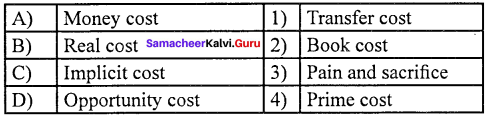
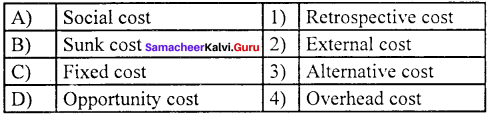
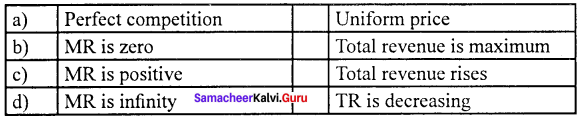
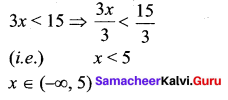
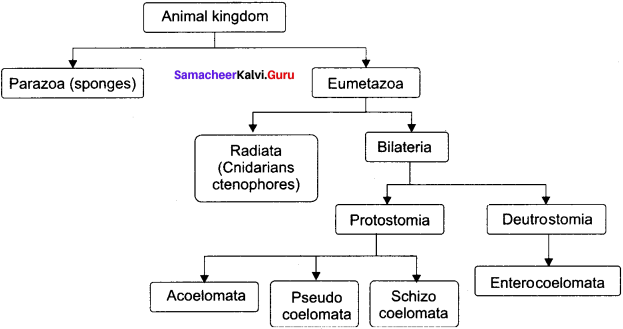
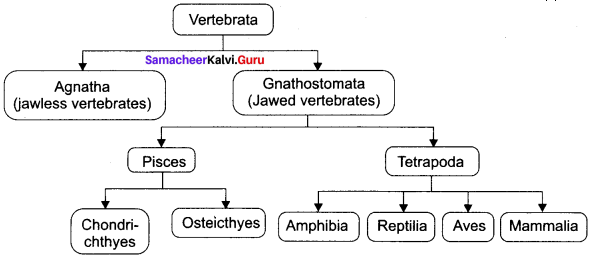
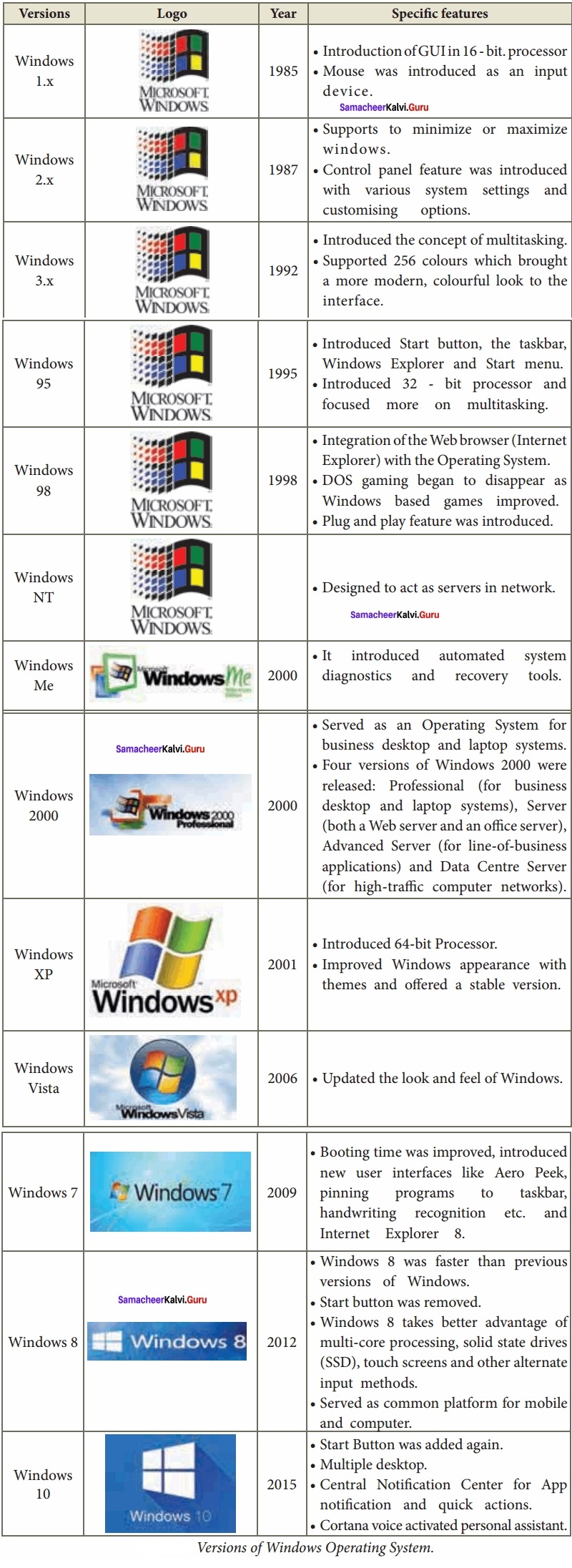
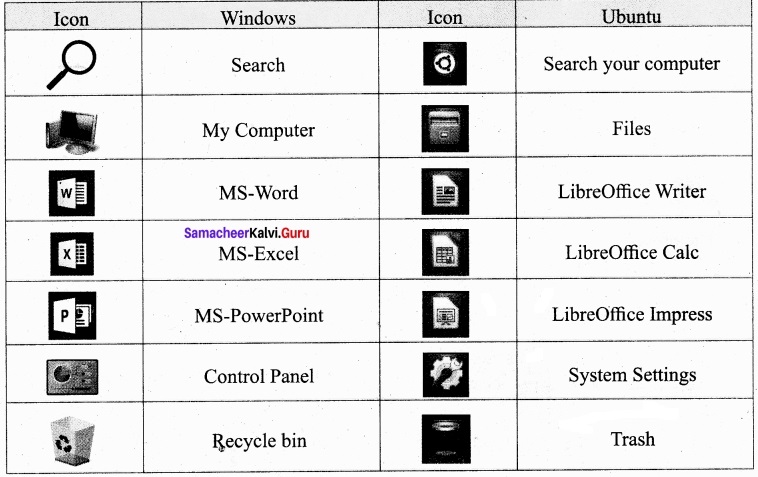
Samacheer Kalvi 11th Commerce Solutions Chapter 3 Classification of Business Activities

Students can find the most related topics which helps them to analyse the concepts if they practice according to the chapter-wise page. It is necessary for the students to practice more Questions and Answers for Tamilnadu State Board Solutions of 11th Commerce are given in the pdf format in chapter 3 Classification of Business Activities Questions and Answers so that students can prepare in both online and offline modes. So, Download Samacheer Kalvi 11th Commerce Book Solutions Questions and Answers, Notes Pdf, to score good marks.

Samacheer Kalvi 11th Commerce Solutions Chapter 3 Classification of Business Activities

Get the Questions and Answers, in Tamilnadu State Board 11th Commerce Solutions for Chapter 3 Classification of Business Activities. Learn the concepts of 11th Commerce Chapter-Wise by referring to the Tamilnadu State Board Solutions for Chapter 3 Classification of Business Activities Questions and Answers. Hence we suggest the students to Download Samacheer Kalvi 11th Commerce Book Solutions Questions and Answers pdf to enhance your knowledge.

Samacheer Kalvi 11th Commerce Classification of Business Activities Textbook Exercise Questions and Answers

I. Choose the Correct Answer

11th Commerce Chapter 3 Book Back Answers Question 1.
The industries engaged in extraction of iron ore are known as
(a) Construction industries
(b) Manufacturing Industries
(c) Extraction industries
(d) Genetic Industries
Answer:
(c) Extraction industries

Samacheer Kalvi Guru 11th Commerce Question 2.
Auxiliaries to trade is also called as
(a) Trade
(b) Advertisement
(c) Warehousing
(d) Aids to trade
Answer:
(d) Aids to trade

Samacheer Kalvi Commerce 11th Question 3.
Production which involves several stages for manufacturing finished products is known as
(a) Analytical industry
(b) Synthetic Industry
(c) Processing industry
(d) None of the above
Answer:
(c) Processing industry

Samacheer Kalvi 11th Commerce Solutions Question 4.
Normally high level risk is involved in
(a) Industry
(b) Commerce
(c) Trade
(d) All the above
Answer:
(a) Industry

11th Commerce Answer Question 5.
Commerce is mainly concerned with
(a) Connecting producer and consumer
(b) Pricing of goods
(c) Buying and selling of goods
(d) Manufacturing of goods
Answer:
(a) Connecting producer and consumer

II. Very Short Answer Questions

Class 11 Commerce Chapter 3 Question 1.
Define Commerce.
Answer:
According to Evelyn Thomas, “Commercial operations deal with the buying and selling of goods, the exchange of commodities and the contribution of finished products”.

11th Commerce Samacheer Kalvi Question 2.
What do you mean by industry?
Answer:
Industry refers to economic activities, which are connected with conversion of resources into useful goods. The production side of business activity is referred as industry.

11th Commerce Solutions Samacheer Kalvi Question 3.
What is trade?
Answer:
The term ‘trade’ is used to denote buying and selling. It is an essential part of commerce.

Samacheer Kalvi 11th Commerce Guide Question 4.
Write a short note on transportation.
Answer:
The medium which moves men and materials from one place to another is called transport. Selling all the goods produced at or near the production places is not possible. Hence, goods are to be sent to different places where they are demanded.

III. Short Answer Questions

Classification Of Business Activities Question 1.
Distinguish between Extractive industries and genetic industries.
Answer:
Extractive industries :

  • These industries extract or draw out products from natural sources.
  • Extractive industries supply some basic raw materials that are mostly products of geographical or natural environment.

Genetic industries:

  • These industries remain engaged in breeding plants and animals for their use in further reproduction.
  • The seeds, nursery companies poultry, diary, piggery, hatcheries, nursery, fisheries, apiary etc.

Classification Of Business Question 2.
What do you mean by tertiary industries?
Answer:
They do not produce goods. These industries produce utility services and sell them at a profit. They help trade, industry and commerce. This term also includes auxiliaries to trade like banking, insurance, warehouse, advertisement etc.

Classification Of Business Activity Question 3.
Write any three characteristics of commerce.
Answer:
1. Economic Activity : Commerce is an economic activity because it consists of activities which are undertaken for earning profits. A trader buys goods with the aim of selling them at a profit.

2. Exchange of Goods and Services : Commerce involves exchange and distribution of goods and services. Goods may be purchased or produced for sale. Commerce comprises both trade and aids to trade.

3. Profit Motive : The motive of commercial activities is to earn profits. Any activity which does not have the aim of profit will not be a part of commerce.

Samacheer Kalvi 11th Commerce Question 4.
Narrate commerce with an example.
Answer:
Commerce refers to all those activities which are necessary for bringing goods from the place of production to the place of their consumption. Commerce includes not only trade but also services such as transport, warehousing, packaging, insurance, banking and sales promotion which are incidental or auxiliaries to trade.

IV. Long Answer Questions

Samacheer Kalvi 11 Commerce Question 1.
Explain the various kinds of industries on the basis of size.
Answer:
1. Micro Units: A unit wherein investment in plant and machinery is upto Rs. 25 lakhs in case of manufacturing and upto Rs. 10 lakhs in case of service enterprises.

2. Small Units: A manufacturing unit wherein investment in plant and machinery is more than Rs. 25 lakhs but does not exceed Rs.5 crore. In case of service enterprises these limits are Rs. 10 lakhs and Rs. 2 crore respectively.

3. Medium Units: A manufacturing unit wherein investment in plant and machinery is more than Rs.5 crore but does not exceed Rs. 10 crore. In case of service enterprises, these limits are Rs.2 crore and Rs.5 crore respectively.

4. Large Units: A manufacturing unit wherein, investment in plant and machinery exceeds Rs.10 crore. In case of a service unit investment in equipment exceeds Rs.5 crore.

Classify Business Activities Question 2.
Compare industry, commerce and trade.
Answer:
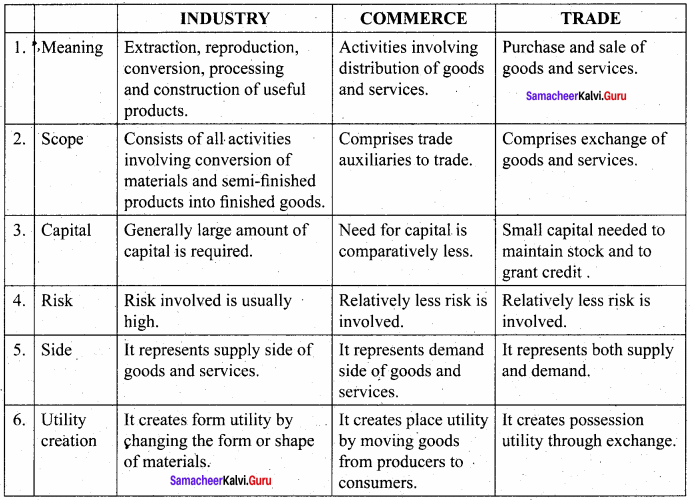
11th Commerce Chapter 3 Book Back Answers Classification Of Business Activities Samacheer Kalvi

Samacheer Kalvi 11th Accountancy Chapter 3 Question 3.
What are the characteristics of Commerce?
Answer:
1. Economic Activity:
Commerce is an economic activity because it consists of activities which are undertaken for earning profits. A trader buys goods with the aim of selling them at a profit.

2. Exchange of Goods and Services:
Commerce involves exchange and distribution of goods and services. Goods may be purchased or produced for sale. Commerce comprises both trade and aids to trade.

3. Profit Motive:
The motive of commercial activities is to earn profits. Any activity which does not have the aim of profit will not be a part of commerce.

4. Regularity of Transaction:
An isolated transaction does not imply commerce.

5. Creation of Utilities:
Commerce creates several types of utilities. It creates place utility by carrying goods to the place where they are needed. It makes goods available as and when demanded thereby creating time utility. By creating these utilities commerce helps to increase the volume of trade.

Samacheer Kalvi 11th Commerce Book Question 4.
Write short notes on:

  1. Analytical industry
  2. Genetic industry and
  3. Construction industry.

Answer:
1. Analytical Industry: It analyses and separates different elements from the same materials, as in the case of oil refinery.

2. Genetic Industries: These industries remain engaged in breeding plants and animals for their use in further reproduction. The seeds, nursery companies, poultry, diary, piggeiy, hatcheries, nursery, fisheries, apiary etc are classic examples of genetic industries.

3. Construction Industries: These industries are involved in the construction of building, dams, bridges, roads, as well as tunnels and canals.

Commerce Samacheer Kalvi Question 5.
Briefly explain the auxiliaries of trade.
Answer:
Auxiliaries of trade may be classified into five categories:
1. Transportation:
Selling all the goods produced at or near the production place is not possible. Hence, goods are to be sent to different places where they are demanded.

2. Banking and Finance:
Now – a – days we cannot think of business without bank. A bank is an organization which accepts deposits of money from the public, withdrawals on demand or otherwise, and lends the same to those who need it. Necessary funds can be obtained by businessmen from a bank. Thus, banking helps business activities to overcome the v problem of finance.

3. Insurance:
Business involves various types of risks. Materials and goods held in stock or in transit are subject to the risk of loss or damage. Insurance provides protection in all such cases. On payment of a nominal premium, the amount of loss or damage and compensation for injury, if any, can be recovered from the insurance company.

4. Warehousing:
Goods are held in stock to make them available as and when required. Special arrangement must be made for storage of goods to prevent loss or damage. Warehousing helps business firms to overcome the problem of storage and facilities the availability of goods when needed.

5. Advertising:
Advertising is one of the most important methods of promoting the sale of products, particularly, consumers goods like electronic goods, automobiles, soaps, detergents etc. Advertising helps in providing information about available goods and services and inducing customers to buy particular items.

Samacheer Kalvi 11th Commerce Classification of Business Activities Additional Questions and Answers

I. Choose the Correct Answer:

Question 1.
All business activities can be classified into ……………. broad categories.
(a) Two
(b) Three
(c) Four
(d) Five
Answer:
(a) Two

Question 2.
Where is the mechanical appliances and technical skills used?
(a) Industry
(b) Commerce
(c) Business
(d) Trade
Answer:
(a) Industry

Question 3.
Horticulture is an example for …………….
(a) Primary industry
(b) Secondary industry
(c) Tertiary industry
(d) Local industry
Answer:
(a) Primary industry

Question 4.
……………. industry assembles different component parts to make a new product, as in the case of television, car, computer, etc.
(a) Assembling
(b) Processing
(c) Analytical
(d) Construction
Answer:
(a) Assembling

Question 5.
Professional or specialized skills and high technology are used to provide ……………. type of services.
(a) Personalised
(b) Public
(c) Distributive
(d) Quaternary
Answer:
(d) Quaternary

Question 6.
Banking, factoring, accounting and insurance come under ……………. type of service.
(a) Mechanical
(b) Financial
(c) Personal
(d) Quinary
Answer:
(b) Financial

Question 7.
Commerce represents ……………. side of goods and services.
(a) Demand
(b) Profit
(c) Supply
(d) Cost
Answer:
(a) Demand

Question 8.
Special arrangement must be made for of goods to prevent loss or damage.
(a) Transportation
(b) Pricing
(c) Storage
(d) Advertising
Answer:
(c) Storage

II. Very Short Answer Questions

Question 1.
What is Extractive industry?
Answer:
Extractive industries extract or draw out products from natural sources. Extractive industries supply some basic raw materials that are mostly products of geographical or natural environment.

Question 2.
What is Primary industry?
Answer:
Primary industry is concerned with production of goods with the help of nature. It is a nature – oriented industry, which requires very little human effort.

Question 3.
What is Secondary industry?
Answer:
Secondary Industries are concerned with using the materials which have already been extracted at the primary stage. These industries process such materials to produce goods for final consumption or for further processing by other industrial units.

Question 4.
What is tertiary industry?
Answer:
They do not produce goods. These industries produce utility services and sell them at a profit. They help trade, industry and commerce. This term also includes auxiliaries to trade like banking, insurance, warehouse, advertisement etc.

Question 5.
What are the auxiliaries to trade?
Answer:

  1. Transportation
  2. Banking and Finance
  3. Insurance
  4. Warehousing
  5. Advertising

III. Short Answer Questions

Question 1.
Write any three categories of Manufacturing industries.
Answer:

  1. Analytical Industry which analyses and separates different elements from the same materials, as in the case of oil refinery.
  2. Synthetic Industry which combines various ingredients into a new product, as in the case of cement.
  3. Processing Industry which involves successive stages for manufacturing finished products, as in the case of sugar and paper.

Share this Tamilnadu State Board Solutions for 11th Commerce Chapter 3 Classification of Business Activities Questions and Answers with your friends to help them to overcome the issues in exams. Keep visiting this site Tamilnadu State Board Solutions frequently to get the latest information on different subjects. Clarify your doubts by posting the comments and get the answers in an easy manner.
Samacheer Kalvi 11th Economics Solutions Chapter 5 Market Structure and Pricing

Immediately get Chapter Wise Tamilnadu State Board Solutions for 11th Economics to gain more marks and start Quick Revision of all Chapters. All Chapters Pdf is provided along with the Questions and Answers. You Can Dowload Samacheer Kalvi 11th Economics Book Solutions Questions and Answers for Chapter wise are given with a clear explanation. Tamilnadu State Board Solutions for 11th Economics Chapter 5 Market Structure and Pricing Questions and Answers is for free of cost.

Tamilnadu Samacheer Kalvi 11th Economics Solutions Chapter 5 Market Structure and Pricing

Tamilnadu State Board Solutions for 11th Economics Chapter 5 Market Structure and Pricing Questions and Answers PDF has all given in Chapter Wise Section. Check Out daily basis with Tamilnadu State Board Solutions 11th Economics PDF will help to improve your score. Improve your level of accuracy to answer a question by reading with Samacheer Kalvi 11th Economics Book Solutions Questions and Answers PDF.

Samacheer Kalvi 11th Economics Market Structure and Pricing Text Book Back Questions and Answers

Part – A
11th Economics Chapter 5 Book Back Answers Multiple Choice Questions

Economics Class 11 Chapter 5 Question 1.
In which of the following is not a type of market structure Price will be very high?
(a) Perfect competition
(b) Monopoly
(c) Duopoly
(d) Oligopoly
Answer:
(a) Perfect competition

Samacheer Kalvi Guru 11 Economics Question 2.
Equilibrium condition of a firm is …………………….
(a) MC = MR
(b) MC > MR
(c) MC < MR
(d) MR = Price
Answer:
(a) MC = MR

Class 11 Economics Chapter 5 Solutions Question 3.
Which of the following is a feature of monopolistic competition?
(a) One seller
(b) Few sellers
(c) Product differentiation
(d) No entry
Answer:
(c) Product differentiation

11th Economics Chapter 5 Exercise Question 4.
A firm under monopoly can earn ………………… in the short run.
(a) Normal profit
(b) Loss
(c) Supernormal profit
(d) More loss
Answer:
(c) Supernormal profit

Economics Chapter 5 Class 11 Question 5.
There is no excess capacity under ______
(a) Monopoly
(b) Monopolistic competition
(c) Oligopoly
(d) Perfect competition
Answer:
(d) Perfect competition

Economics Class 11 Question 6.
Profit of a firm is obtained when ……………………
(a) TR < TC (b) TR – MC (c) TR > TC
(d) TR = TC
Answer:
(c) TR > TC

Samacheer Kalvi Guru 11th Economics Question 7.
Another name of price is ______
(a) Average Revenue
(b) Marginal Revenue
(c) Total Revenue
(d) Average Cost
Answer:
(a) Average Revenue

11th Economics Book Price Question 8.
In which type of market, AR and MR are equal ………………………
(a) Duopoly
(b) Perfect competition
(c) Monopolistic competition
(d) Oligopoly
Answer:
(b) Perfect competition

Chapter 5 Economics Class 11 Question 9.
In monopoly, MR curve lies below ______
(a) TR
(b) MC
(c) AR
(d) AC
Answer:
(c) AR

Question 10.
Perfect competition assumes ……………………..
(a) Luxury goods
(b) Producer goods
(c) Differentiated goods
(d) Homogeneous goods
Answer:
(d) Homogeneous goods

Question 11.
Group equilibrium is analysed in ______
(a) Monopolistic competition
(b) Monopoly
(c) Duopoly
(d) Pure competition
Answer:
(a) Monopolistic competition

Question 12.
In monopolistic competition, the essential feature is …………………….
(a) Same product
(b) Selling cost
(c) Single seller
(d) Single buyer
Answer:
(b) Selling cost

Question 13.
Monopolistic competition is a form of ______
(a) Oligopoly
(b) Duopoly
(c) Imperfect competition
(d) Monopoly
Answer:
(c) Imperfect competition

Question 14.
Price leadership is the attribute of ………………………
(a) Perfect competition
(b) Monopoly
(c) Oligopoly
(d) Monopolistic competition
Answer:
(c) Oligopoly

Question 15.
Price discrimination will always lead to ______
(a) Increase in output
(b) Increase in profit
(c) Different prices
(d) b and c
Answer:
(d) b and c

Question 16.
The average revenue curve under monopolistic competition will be …………………….
(a) Perfectly inelastic
(b) Perfectly elastic
(c) Relatively elastic
(d) Unitary elastic
Answer:
(c) Relatively elastic

Question 17.
Under perfect competition, the shape of demand curve of a firm is ______
(a) Vertical
(b) Horizontal
(c) Negatively sloped
(d) Positively sloped
Answer:
(b) Horizontal

Question 18.
In which market form, does absence of competition prevail?
(a) Perfect competition
(b) Monopoly
(c) Duopoly
(d) Oligopoly
Answer:
(b) Monopoly

Question 19.
Which of the following involves maximum exploitation of consumers?
(a) Perfect competition
(b) Monopoly
(c) Monopolistic competition
(d) Oligopoly
Answer:
(b) Monopoly

Question 20.
An example of selling cost is ………………………
(a) Raw material cost
(b) Transport cost
(c) Advertisement cost
(d) Purchasing cost
Answer:
(c) Advertisement cost

Part – B

Answer the following questions in one or two sentences

Question 21.
Define Market.
Answer:
In economics, the term ‘Market’ refers to a system of exchange between the buyers and the sellers of a commodity. Exchange may be direct or indirect.

Question 22.
Who is price – taker?
Answer:
A large number of buyers’ implies that each individual buyer buys a very, very small quantum of a product as compared to that found in the market. This means that he has no power to fix the price of the product. He is only a price taker and not a price-maker.

Question 23.
Point out the essential features of pure competition.
Answer:

  1. The absence of any monopoly element.
  2. There is a large buyers and sellers.
  3. Homogenous product and uniform price.
  4. Free entry and exit.

Question 24.
What is selling costs?
Answer:

  1. Selling Cost is the discussion of “ Product differentiation”.
  2. We can infer that the producer under monopolistic competition has to incur expenses to popularize his brand.
  3. This involved in selling the product is called selling cost.
  4. According to Prof. Chamberlin, selling cost is “ The cost incurred in order to alter the position or shape of the demand curve for a product”.

Question 25.
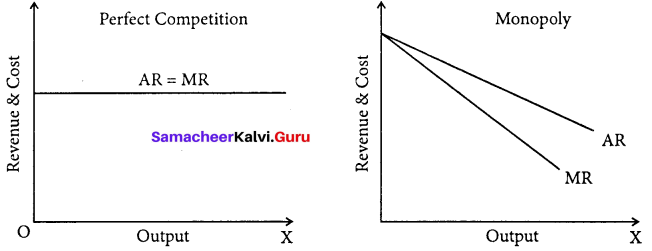
Draw demand curve of a firm for the following:
Answer:
(a) Perfect Competition
(b) Monopoly

11th Economics Chapter 5 Book Back Answers Market Structure And Pricing Samacheer Kalvi
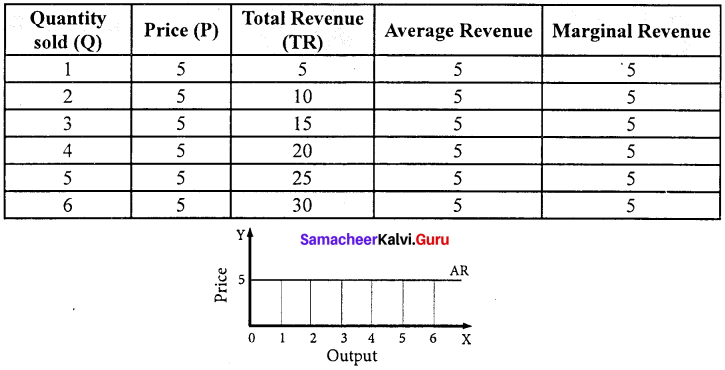
Under perfect competition, as uniform price prevails AR = MR and the demand curve (AR) is horizontal to X-axis.
A monopoly firm faces a downward-sloping demand curve.

Question 26.
Mention any two type of price discrimination?
Answer:

  1. Personal: Different prices are charged for different individuals. For example, the railways give tickets at concessional rate to the ‘Senior citizens’ for the same journey.
  2. Geographical: Different prices are charged at different places for the same product. For example, a book sold within India at a price is sold in a foreign country at lower price.

Question 27.
Define “Excess capacity”.
Answer:
Excess capacity is the difference between the optimum output that can be produced and the actual output produced by the firm.

Part – C

Answer the following questions in One Paragraph

Question 28.
What are the features of a market?
Answer:
A market has the following characteristic features:

  1. Buyers and sellers of a commodity or a service.
  2. A commodity to be bought and sold.
  3. Price agreeable to buyer and seller.
  4. Direct or indirect exchange.

Question 29.
Specify the nature of entry of competitors in perfect competition and monopoly.
Answer:
Perfect competition :
Under perfect competition, there is the possibility of free entry and exit of the firm. In the short run, if an efficient producer produces supernormal profits, it attracts new firms to enter the industry. When a large number of firms enter, the supply would increase, resulting in lower price. An inefficient producer, disturbed by the loss, quit the market. It results in a decrease in supply so the price will go up.

Monopoly :
In a monopoly, there is a strict barrier for entry of any new firm.

Question 30.
Describe the degree of price discrimination?
Answer:
Degrees of Price Discrimination:
Price discrimination has become widespread in almost all monopoly markets. According to A.C.Pigou, there are three degrees of price discrimination.

1. First degree price discrimination:
A monopolist charges the maximum price that a buyer is willing to pay. This is called as perfect price discrimination. This price wipes out the entire consumer’s surplus. This is maximum exploitation of consumers. Joan Robinson named it as “Perfect Discriminating Monopoly”.

2. Second degree price discrimination:
Under this degree, buyers are charged prices in such a way that a part of their consumer’s surplus is taken away by the sellers. This is called as imperfect price discrimination. Joan Robinson named it as “Imperfect Discriminating Monopoly”.

Under this degree, buyers are divided into different groups and a different price is charged for each group. For example, in cinema theatres, prices are charged for same film show from viewers of different classes. In a theatre the difference between the first row of first class and the last row in the second class is smaller as compared to the differences in charges.

3. Third degree price discrimination:
The monopolist splits the entire market into a few sub-market and charges different price in each sub-market. The groups are divided on the basis of age, sex and location. For example, railways charge lower fares from senior citizens. Students get discounts in museums, and exhibitions.

Question 31.
State the meaning of selling cost with an example.
Answer:
Under monopolistic competition as the products are differentiated, the producer has to incur expenses to make his brand popular. The expenditure involved in selling the product is called “selling cost”.

According to Prof.Chamberlin, selling cost is the cost incurred in order to alter the position or shape of the demand curve for a product.
Under perfect competition and monopoly there is soiling COM.
(Eg.) Advertisements, Free services, Home delivery etc.,

Question 32.
Mention the similarities between perfect competition and monopolistic competition,
Answer:

  1. In both perfect competition and monopolistic competition number of firms are large.
  2. Competition exists between the firms.
  3. There are no barriers for entry and exit in both the markets.
  4. Equilibrium occurs at the point where MC curve intersects MR curve.
  5. In short run there is supernormal profit or loss and in long run there is only normal profits in both market structures.

Question 33.
Differentiate between ‘firm’ and ‘industry’.
Answer:
Firm :
A firm refers to a single production unit in an industry, producing a large or a small quantity of a commodity or service, and selling it at a price in the market. Its main objective is to earn a profit.

Industry :
An industry refers to a group of firms producing the same product or service in an economy.
(Eg.) A group of firms producing cement is called a cement industry.

Question 34.
State the features of duopoly.
Answer:

  1. Each seller is fully aware of his rival’s motive and actions.
  2. Both sellers may collude (they agree on all matters regarding the sale of . commodity)
  3. They may enter into cut-throat competition.
  4. There is no product differentiation.
  5. They fix the price for their product with a view to maximising their profit.

Part – D

Answer the following questions in about a page

Question 35.
Bring out the features of perfect competition.
Answer:
According to Joan Robinson, “Perfect competition prevails when the demand for the output of each producer is perfectly elastic. It is an ideal but imaginary market. 100% of perfect competition cannot be seen.
Features of the perfect competition :

(a) Large number of buyers and sellers :
Each individual buyer buys a very very small quantum of a product as compared to that found in the market. This means that he has no power to fix the price of the product. He is only a price-taker and not a price-maker. As the number of sellers is large the seller is also a price – taker.

(b) Homogenous product and uniform price :
The. products are homogenous in nature and are perfectly substitutable. All the units of the product are identical. Therefore a uniform price prevails in the market.

(c) Free entry and exit:
In the short run, if the very efficient producer earns super normal profits, new firms enter into the industry. When large number of firms enter, the supply would increase, resulting in lower price. If a inefficient producer incurs loss, the loss incuring firms quit the market. So the existing firms could earn more profit as supply decreases.

(d) Absence of transport cost:
The prevalence of the uniform price is also due to the absence of the transport cost. . e) Perfect mobility of factors of production :
As there is perfect mobility of the factors of production, uniform price exists. As they enjoy perfect freedom of mobility the price gets adjusted.

(f) Perfect knowledge of the market:
All buyers and sellers have a thorough knowledge of the quality of the product, prevailing price etc.

(g) No government intervention :
There is no government regulation on supply of raw materials and in the determination of price etc.

Question 36.
How price and output are determined under the perfect competition?
Answer:
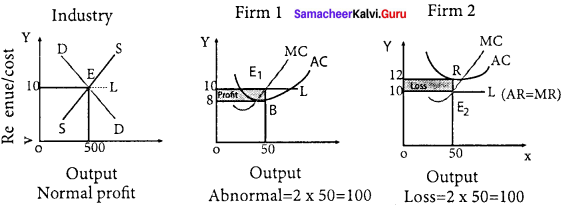
In the short run at least a few factors of production are fixed. The firms under perfect .competition take the price (10) from the industry and start adjusting their quantities produced.
For example
Qd = 100 -5P and
Qs = 5p
At equilibrium Qd = Qs
100 – 5p = 5p
100 = 5p + 5p
p = 10
Qd = 100 – 5(10)
= 50
Qs = 5(10) = 50
Qd = Qs
50 = 50

Economics Class 11 Chapter 5 Market Structure And Pricing Samacheer Kalvi

SS – market supply, DD – market demand, AR – Average Revenue, AC – Average Cost, MR – Marginal Revenue, MC – Marginal Cost This diagram consists of three panels.
First part:
The equilibrium of an industry is explained. The demand and supply forces of the firms interact and the price is fixed as Rs.10. The equilibrium of an industry is obtained at 50 units of output.

Second part:
AC curve is lower than the price line. Equilibrium is achieved where
MC = MR. Equilibrium quantity is 50. With price Rs. 10, it experiences supernormal profit
AC = Rs. 8
AR = Rs. 10
TR – 50 x 10 = 500
TC = 50 x 8 = 400
Profit = 500-400= 100.

Third part:
Firm’s cost curve is above the price line. Equilibrium MC = MR. Quantity is 50 with price Rs. 10, it experiences loss (AC > AR)
TR = 50 x 10 = 500
TC = 50 x 12 = 600
Loss = 600-500= 100
If profit prevails in the market, new firms emerge results in declining price and if loss occurs the existing loss making firm exits results in increasing price consequent upon the entry and exit of new firms into the industry, firms always earn ‘normal profit’ in the long run.

Price and output determination in long run :
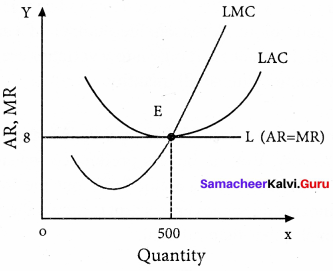
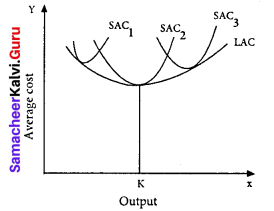
Long run equilibrium of the firm is illustrated in the diagram. Under perfect competition, long run equilibrium is only at minimum point of LAC. At point E,
LMC = MR = AR = LAC
Samacheer Kalvi Guru 11 Economics Solutions Chapter 5 Market Structure And Pricing

In the diagram AR = AC. Equilibrium is at point E where price is 8 and output is 500. At this point, the profit of the firm is only normal. Thus condition for long run equilibrium of the firm is
Price = AR = MR = Minimum AC

At equilibrium SAC > LAC. Hence in the long run equilibrium price is lower and quantity is larger compared to the short run equilibrium price and quantity.

Question 37.
Describe the features oligopoly.
Answer:
1. Few large firms :
Very few big firms own the major control of the whole market by producing major portion of the market demand.

2. Interdependence among firms :
The price and quality decisions of a particular firm are dependent on the price and . quality decisions of the rival firms.

3. Group behaviour :
The firms under oligopoly realise the importance of mutual co-operation.

4. Advertisement cost :
The oligopolist could raise sales either by advertising or improving the quality of the product.

5. Nature of the product:
Perfect oligopoly means homogeneous products and imperfect oligopoly deals with heterogenous products.

6. Price rigidity :
It implies that prices are difficult to be changed. The oligopolist firms do not change their prices due to the fear of rival’s reaction.

Question 38.
Illustrate price and output determination under monopoly.
Answer:
Monopoly is a market structure characterized by a single seller, selling the unique product with the restriction for a new firm to enter the market.

Price and Output Determination under Monopoly :
Nature of cost and revenue curves :
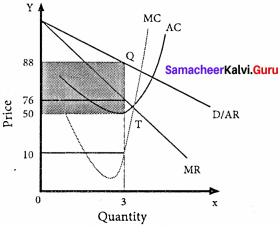
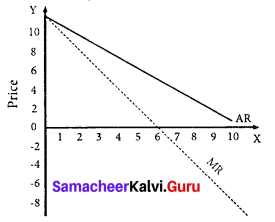
A monopoly is a one-firm industry. Therefore, a monopolist firm faces a downward-sloping demand curve. Since AR falls, MR lies below the AR curve (MR < AR)
The monopolist will continue to sell his product as long as his MR > MC
Class 11 Economics Chapter 5 Solutions Market Structure And Pricing Samacheer Kalvi

Condition for equilibrium :
Monopolists attain equilibrium at the level of output when MC = MR.
From the diagram, till he sells 3 units output, MR is greater than MC, and when he exceeds this output level, MR is less than MC. At equilibrium where MR = MC, price (AR) is Rs. 88. To know the profit of monopolists at equilibrium output, the average revenue curves and the average cost curves are used at equilibrium Output 3
AR= 88
AC = 50
Profit per unit = 88-50
= 38
= (AR – AC) × Total output
= (88 – 50) × 3
= 38 × 3
= 114

Question 39.
Explain price and output determined under monopolistic competition with help of diagram.
Answer:
Monopolistic competition refers to a market situation where there are many firms selling a differentiated product.

Price and output determination :
Nature of cost and revenue curves :
The monopolistic firm sell large quantity at less price. So, it faces a downward sloping demand curve. AR curve is fairly elastic. MR curve falls below AR. AC curve will be ‘U’ shaped.

Condition for equilibrium :
MC = MR, MC curve should cut MR from below. If MC is less than MR, the sellers will find it profitable to expand their output.

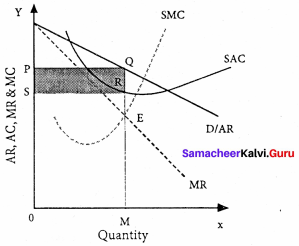
Short – run equilibrium :
11th Economics Chapter 5 Exercise Market Structure And Pricing Samacheer Kalvi

Profit is maximised when MC = MR. From the diagram.
OM – Equilibrium output OP – Equilibrium price
TR – OMQP TC – OMRS
Profit = OMQP-OMRS
= PQRS
This is super normal profit under short-run.
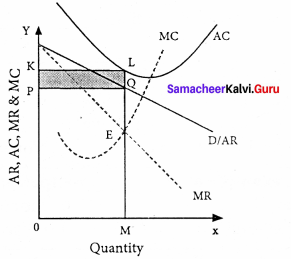
A monopolistic competitive firm may also incur loss in the short-run.
Economics Chapter 5 Class 11 Market Structure And Pricing Samacheer Kalvi

As shown in the diagram, the AR and MR curves are fairly elastic.
At equilibrium output is OM , price is OP
TR – OMQP
TC-OMLK
Total loss = TR-TC
= OMQP – OMLK
= PQLK

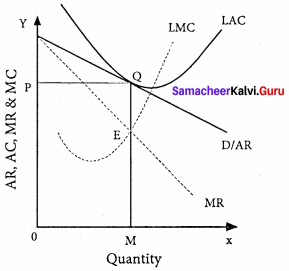
Long – run equilibrium :
In the long run AR curve is more elastic or flatter. Hence, the firms will only earn normal profit.
Economics Class 11 Solutions Chapter 5 Market Structure And Pricing Samacheer Kalvi

Samacheer Kalvi 11th Economics Market Structure and Pricing Additional Questions and Answers

Part -A

Choose the best options

Question 1.
In the real world what type of market we see?
(a) Imperfect
(b) Perfect
(c) Monopoly
(d) Oligopoly
Answer:
(a) Imperfect

Question 2.
First condition for equilibrium of the firm _______
(a) AC = AR
(b) AC = MC
(c) MC = MR
(d) AR = MR
Answer:
(c) MC = MR

Question 3.
How many types of price discrimination under monopoly?
(a) Three
(b) Two
(c) Five
(d) Seven
Answer:
(a) Three

Question 4.
Indian railways is an example of _______ competition.
(a) Perfect competition
(b) Monopoly
(c) Monopolistic competition
(d) Oligopoly
Answer:
(b) Monopoly

Question 5.
Monopoly power achieved through patent right is called ………………………..
(a) Duopoly
(b) Oligopoly
(c) Legal monopoly
(d) Monopolistic competition
Answer:
(c) Legal monopoly

Question 6.
Differentiated products are seen in _______
(a) Perfect competition
(b) Monopoly
(c) Monopolistic
(d) Monopsony
Answer:
(c) Monopolistic

Question 7.
Under perfect competition, the firms are producing …………………………
(a) Firm
(b) Sales
(c) Public sector
(d) Homogeneous
Answer:
(d) Homogeneous

Question 8.
In perfect competition, short run equilibrium is determined by
(a) MC = MR
(b) MC = AC
(c) MR = AR
(d) AR = AC
Answer:
(a) MC = MR

Question 9.
A firm and Industry are one and the same under ……………………
(a) Perfect competition
(b) Duopoly
(c) Oligopoly
(d) Monopoly
Answer:
(d) Monopoly

Question 10.
Group behaviour is seen in _______
(a) Perfect competition
(b) Monopoly
(c) Monopolistic competition
(d) Oligopoly
Answer:
(d) Oligopoly

Question 11.
When the monopoly will be an equilibrium?
(a) MC = MR
(b) AC = AR
(c) AC = MR
(d) MC = AR
Answer:
(a) MC = MR

Question 12.
_______ degree of price discrimination wipes out the entire consumer’s surplus.
(a) First
(b) Second
(c) Third
(d) None
Answer:
(a) First

Question 13.
In monopolistic competition, the demand curve is
(a) More elastic
(b) Inelastic
(c) Less elastic
(d) None
Answer:
(a) More elastic

Question 14.
Government controls monopoly by _______
(a) Taxation
(b) Legal methods
(c) Both
(d) None
Answer:
(c) Both

Question 15.
The important feature of non-price competition is _______
(a) Product differentiation
(b) Advertisement
(c) Sales promotion
(d) All the above
Answer:
(d) All the above

Question 16.
The concept of Imperfect Competition was
(a) J.M. Keynes
(b) Irving Fisher
(c) Marshall propounded by
(d) Joan Robinson
Answer:
(d) Joan Robinson

Question 17.
Identify the wrong statement about the features of Duopoly.
(a) There is product differentiation
(b) They fix the price for their product to maximise their profit
(c) Each seller is fully aware of his rival’s motive and actions
(d) Both sellers may collude regarding the sale of commodity.
Answer:
(a) There is product differentiation

Match the following and choose the answer using the codes given below

Question 1.
Samacheer Kalvi Guru 11th Economics Solutions Chapter 5 Market Structure And Pricing
(a) 1 2 3 4
(b) 2 4 1 3
(c) 4 3 2 1
(d) 3 4 1 2
Answer:
(b) 2 4 1 3

Question 2.
11th Economics Book Price Solutions Chapter 5 Market Structure And Pricing Samacheer Kalvi
(a) 2 4 1 3
(b) 3 1 4 2
(c) 3 4 1 2
(d) 1 2 3 4
Answer:
(d) 1 2 3 4

Choose the incorrect pair

Question 3.
Chapter 5 Economics Class 11 Market Structure And Pricing Samacheer Kalvi
Answer:
(d) Sub-market (iv) Fourth degree price discrimination

Question 4.
Samacheer Kalvi 11th Economics Solutions Chapter 5 Market Structure and Pricing 11
Answer:
(b) Artificial monopoly (ii) Gold mines (Africa)

Choose the odd one out

Question 5.
(a) Personal
(b) Geographical
(c) On the basis of use
(d) Price taker
Answer:
(c) On the basis of use

Question 6.
(a) Individual behaviour
(b) Few large firms
(c) Group behaviour
(d) Price rigidity
Answer:
(a) Individual behaviour

Question 7.
(a) Market period
(b) Short period market
(c) Very long period market
(d) Whole sale market
Answer:
(d) Whole sale market

Choose the incorrect statement

Question 8.
In perfect competition
(a) There are large number of buyers and sellers
(b) Free entry and exit of firm
(c) Price competition is essential
(d) Independent price policy
Answer:
(c) Price competition is essential

Question 9.
(a) In a market there is no exchange of goods.
(b) Commodities will be bought and sold in market.
(c) In market prices are agreeable to buyer and seller.
(d) In market there are buyer and seller of a commodity.
Answer:
(a) In a market there is no exchange of goods.

Analyse the reason for the following

Question 10.
Assertion (A) : Perfect competition is that no one is big enough to have any appreciable
influence over market price.
Reason (R) : Perfect competition is a market situation where there are infinite number of sellers.
(a) Both (A) and (R) are true, (R) is the correct explanation of (A)
(b) Both (A) and (R) are true, (R) is not the correct explanation of (A)
(c) Both (A) and (R) are false.
(d) (A) is true but (R) is false.
Answer:
(a) Both (A) and (R) are true, (R) is the correct explanation of (A)

Question 11.
Assertion (A) : At equilibrium MC cuts MR from below.
Reason (R) : MC cuts MR at two points.
(a) Both (A) and (R) are true, (R) is the correct explanation of (A)
(b) Both (A) and (R) are true, (R) is not the correct explanation of (A)
(c) (A) is true but (R) is false.
(d) (A) is false but (R) is true.
Answer:
(b) Both (A) and (R) are true, (R) is not the correct explanation of (A)

Question 12.
Assertion (A) : In monopoly there exist price discrimination.
Reason (R) : A monopolist is a price maker.
(a) Both (A) and (R) are true, (R) is the correct explanation of (A)
(b) Both (A) and (R) are false
(c) (A) is true but (R) is false.
(d) (A) is false but (R) is true.
Answer:
(a) Both (A) and (R) are true, (R) is the correct explanation of (A)

Choose the incorrect pair

Question 13.
Samacheer Kalvi 11th Economics Solutions Chapter 5 Market Structure and Pricing 12
Answer:
(c) Monopolistic competition (iii) Non – price discrimination

Question 14.
Samacheer Kalvi 11th Economics Solutions Chapter 5 Market Structure and Pricing 13
Answer:
(b) Oligopoly (ii) Group behaviour

Fill in the blanks with suitable option given below

Question 15.
Supply curve in the very short period is ________
(a) Horizontal
(b) Slopes downward
(c) Slopes upward
(d) Vertical
Answer:
(d) Vertical

Question 16.
Differentiated products are seen in ________
(a) Perfect competition
(b) Monopoly
(c) Monopolistic competition
(d) Monopsony
Answer:
(c) Monopolistic competition

Question 17.
Government controls monopoly by ________
(a) Taxation
(b) Legal method
(c) Both
(d) None
Answer:
(c) Both

Choose the best option

Question 18.
________ classified market based on time
(a) Marshall
(b) Adam smith
(c) Chamberlin
(d) Hicks
Answer:
(a) Marshall

Question 19.
In monopolistic competition the demand curve is
(a) Inelastic
(b) More elastic
(c) Less elastic
(d) None
Answer:
(b) More elastic

Question 20.
The important feature of non-price competition is ________
(a) Product differentiation
(b) Advertisement
(c) Sales promotion
(d) All the above
Answer:
(d) All the above

Part – B

Answer the following questions in one or two sentences

Question 1.
Define duopoly?
Answer:
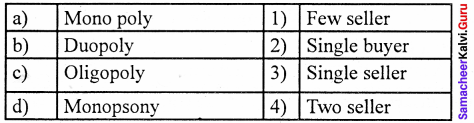
In a duopoly, there are only two sellers who are completely independent and no agreement exists between them.

Question 2.
Define “ Imperfect competition”?
Answer:
Imperfect competition is a competitive market situation where there are many sellers, but they are selling heterogeneous (dissimilar) goods as opposed to the perfect competitive market scenario. As the name suggests, competitive markets are imperfect in nature.

Question 3.
Classify market based on time.
Answer:

  1. Very short period market (or) Market period.
  2. Short period market
  3. Long period market
  4. Very long period market (or) Secular period market.

Question 4.
How is market classified based on the quantify of a commodity?
Answer:

  1. Whole-sale market
  2. Retail market

Question 5.
How can you classify market based on competition ?
Answer:

  1. Perfect competition market.
  2. Imperfect competition market which comprises monopoly, monopolistic competition, duopoly, oligopoly etc.

Question 6.
Define long run average cost curve.
Answer:
In the long run all the factors are variable. The LAC curve is an envelope curve as it contains a few average cost curves. It is a flatter ‘U’ shaped one. It is also called as planning curve.

Question 7.
Write a note imperfect competition.
Answer:
This concept was introduced by Joan Robinson and E.H.Chamberlin. Imperfect competition is a competitive market situation where there are many sellers, but they are selling heterogeneous goods. Competitive markets are imperfect in nature.

Question 8.
Explain monopoly.
Answer:
‘Mono’ refers to a single and ‘poly’ to seller. In this way, monopoly refers to a market situation in which there is only one seller of a commodity. There is no scope for competition.

Question 9.
What is dumping ?
Answer:
Dumping refers to practice of the monopolist charging higher price for his product in the local market and lower price in the foreign market. It is called as ‘International price discrimination’.

Question 10.
What is monopsony ?
Answer:
Monopsony is a market structure in which there is only one buyer of a good or service.

Question 11.
What is Bilateral monopoly ?
Answer:
If a single producer of a product faces a single buyer of that product, then it is called as bilateral monopoly.

Question 12.
What are the conditions for short, run and long-run equilibrium in the monopolistic competition ?
Answer:
Short – run equilibrium : MC = MR
Long – run equilibrium has two conditions : MC = MR and AC = AR

Question 13.
Give example for perfect competition.
Answer:

  1. Online ticket auctions.
  2. Truck farming
  3. Salt
  4. Gravel
  5. Garage sales
  6. Online sales in general

Question 14.
What is oligopoly ?
Answer:
Oligopoly is a market situation in which there are a few firms selling homogeneous or differentiated products.

Part – C

Answer the following questions in One Paragraph

Question 1.
Explain the types of markets based on area.
Answer:
The market is classified not only on its geographical spread but also on the nature of the goods exchanged.
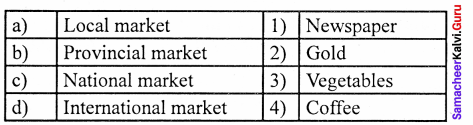
1. Local market:
It refers to the products or services which are sold and bought in the place of their production. (Eg.) Fruits, Vegetables etc.

2. Provincial market:
It arises when products or services are sold and bought in a restricted circle. (Eg.) : Provincial newspaper.

3. National market:
It arises when products and services are sold and bought throughout a country. (Eg.) Tea, Coffee, Cement etc.

4. International market:
It arises when products and services are sold and bought at the world level. (Eg.) Petrol, Gold etc.

Question 2.
What is the Duopoly and the characteristics of Duopoly?
Answer:
Duopoly is a special case of the theory of oligopoly in which there are only two sellers. Both the sellers are completely independent and no agreement exists between them. Even though they are independent, a change in the price and output of one will affect the other, and may set a chain of reactions. A seller may, however, assume that his rival is unaffected by what he does, in that case he takes only his own direct influence on the price.

Characteristics of Duopoly:

  1. Each seller is fully aware of his rival’s motive and actions.
  2. Both sellers may collude (they agree on all matters regarding the sale of the commodity).
  3. They may enter into cut-throat competition.
  4. There is no product differentiation.
  5. They fix the price for their product with a view to maximising their profit.
  6. Describe the features of monopolistic competition.

Features of monopolistic competition:

  1. There are large number of buyers and many sellers.
  2. Firms under monopolistic competition are price makers. They set their own prices.
  3. Firms produce differentiated products. It is the key element of monopolistic competition.
  4. There is a free entry and exit of firms.
  5. Firms compete with each other by incurring selling cost or expenditure on sales promotion of their products.
  6. Non – price competition is an essential part of monopolistic competition.
  7. A firm can follow an independent price policy.

Question 3.
Classify markets based on quantity of the commodity.
Answer:
1. Whole-sale market:
It is for bulk selling and buying of goods. The price is likely to be low compared to retail market. (Eg.) Clothing, Grocery etc.

2. Retail market:
It is the market for commodities in small quantities .(Eg.) Clothing, Vegetable etc.

Question 4.
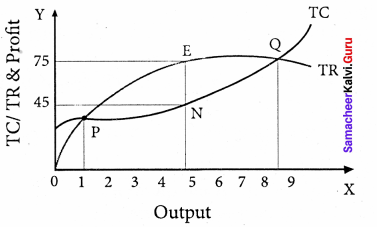
Explain total cost curve approach.
Answer:
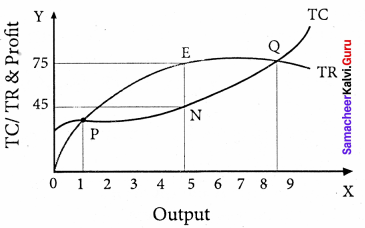
In the TC – TR approach, profit is obtained by a firm, through the difference between the TC and the TR.
Equilibrium is obtained at the point where maximum difference between the TC and TR occurs.
Samacheer Kalvi 11th Economics Solutions Chapter 5 Market Structure and Pricing 14

Question 5.
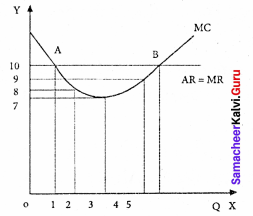
State the hvo conditions for equilibrium using marginal curve approach.
Answer:
Samacheer Kalvi 11th Economics Solutions Chapter 5 Market Structure and Pricing 15
1. MC = MR
A rational seller will not be in equilibrium at output level 1, though MC = MR at that point. He continues his production till 5 units where MC < MR. Beyond 5 units of Q, MC > MR where the seller incurs loss. So condition for equilibrium MC – MR. It is a necessary but not a sufficient condition.

2. MC cuts MR curve from below (Sufficient conditions):
MC curve is ‘U’ shaped. MR cuts MC both from above (at point A) and also from below (at point B). Only at point B the equilibrium condition is fulfilled.

Thus for equilibrium under all market situations the two conditions are MC = MR and MC cuts MR from below.

Question 6.
Explain the features of monopoly.
Answer:

  1. There is a single producer / seller of a product.
  2. The product of a monopolist is unique and has no close substitute. There is strict barrier for entry of any new firm.
  3. The monopolist is a price – maker.
  4. The monopolist earns maximum profit / abnormal profit.

Question 7.
Explain the sources of monopoly power.
Answer:
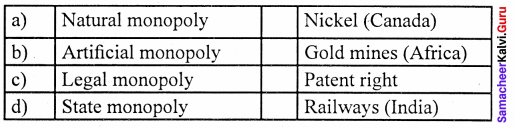
1. Natural monopoly :
Ownership of the natural raw materials. (Eg.) Gold mines (Africa)

2. State monopoly :
Single supplier of some special services. (Eg.) Railways in India

3. Legal monopoly :
A monopoly firm can get its monopoly power by getting patent rights, trade mark from
the government.

Question 8.
Explain the features of monopolistic competition.
Answer:

  1. There are large number of buyers and sellers.
  2. Firms under monopolistic competition are price makers.
  3. They produce differentiated products.
  4. There is a free entry and exit of firms.
  5. Finns compete with each other by incurring selling cost or expenditure on sales promotion.
  6. Non-price competition is an essential part of monopolistic competition.
  7. A firm can follow an independent price policy.

Question 9.
Explain the types of price discrimination.
Answer:
1. Personal :
Different prices are charged for different individuals.
(Eg.) Tickets at concessional rate to the senior citizens in railways.

2. Geographical:
Different prices are charged at different places for the same product.
(Eg.) A book sold within India at a price is sold in a foreign country at lower price.

3. On the basis of use :
Different prices are charged according to the use of a product.
(Eg.) TNEB charges lower rate for domestic use of electricity and higher rate for commercial uses.

Part – D

Answer the following questions in about a page

Question 1.
Explain long-run equilibrium in perfect competition.
Answer:
In the long run, all the factors are variable.
The LAC curve is an envelope curve as it contains a few average cost curves.
It is a flatter ‘U’ shaped one. It is also known as planning curve.

  1. The firms will earn only normal profit.
  2. All the firms in the market are in equilibrium. So entry and exit of a firm is not possible.
    Samacheer Kalvi 11th Economics Solutions Chapter 5 Market Structure and Pricing 16

A firm under perfect competition in the long run is a price-taker. It takes the price of the product from the industry. And it superimposes its cost curves on the revenue curves.

Long run equilibrium is at minimum point of LAC. In the diagram AC = AR, at equilibrium E price is 8 and output is 500. At this point, the profit of the firm is only normal.

The condition for long run equilibrium of the price is.
Price = AR = MR = Minimum AC. At this equilibrium.

  1. SAC > LAC
  2. Long run equilibrium price is lower than short run equilibrium price.
  3. Long run equilibrium quantity is larger than short run equilibrium quantity.

Question 2.
Describe the wastes of monopolistic competition?
Answer:
Wastes of Monopolistic Competition:
Generally there are five kinds of wastages under monopolistic competition.
1. Excess capacity:

  • Un-utilized capacity is the difference between the optimum output that can be produced and the actual output produced by the firm.
  • In the long run, a monopolistic firm produces delibourately output which is less than the optimum output that is the output corresponding to the minimum average cost.
  • This leads to excess capacity which is actually as waste in monopolistic competition.

2. Unemployment:

  • Under monopolistic competition, the firms produce less than optimum output.
  • As a result, the productive capacity is not used to the fullest extent.
  • This will lead to unemployment of human resources also.

3. Advertisement:

  • There is a lot of waste in competitive advertisements under monopolistic competition.
  • The wasteful and competitive advertisements lead to high cost to consumers.

4. Too many varieties of Goods:

  • The goods differ in size, shape, style and colour. A reasonable number of varieties would be sufficient.

5. Inefficient firms:
Under monopolistic competition, inefficient firms charge prices higher than their marginal cost. Efficient firms cannot drive out inefficient firms.

Question 3.
Explain long-run equilibrium in perfect competition.
Answer:
Similarities :

  1. The motive of both the type of market is profit maximisation.
  2. Condition for equilibrium is MC = MR

Dissimilarities :

Perfect Competition:

  1. Price taker. As the contribution of a single seller is less he cannot determine the price
  2. At equilibrium MC = MR = AR (Price)
  3. AR curve is perfectly elastic and horizontal to X – axis. MR curve is equal to AR and coincides with AR. AR = MR
  4. Equilibrium is attained at increasing marginal cost condition.
  5. In the short – run the firm earns super normal profit. In the long run, attracted by super-normal profit new firms enter the industry, which results in normal profit.
  6. The firms produce optimum quantity of output.
  7. Price discrimination is not possible, because of the perfectly elastic demand curve.
  8. Output is maximum and price is minimum.
  9. Possibility for consumer’s surplus.

Monopoly:

  1. Price maker. As the firm and industry remains the same, producer fix price for his product.
  2. At equilibrium MC = MR < AR (Price)
  3. AR curve is a downward sloping curve. MR falls below AR.
  4. Equilibrium can be attained during increasing, decreasing and constant marginal cost condition.
  5. In both short-run and long-run the firm earns super-normal profit because of the barrier to entry.
  6. The firm produces less than optimum quantity of output.
  7. Price discrimination is possible.
  8. Output is minimum and price is maximum.
  9. As the price is high there is no possibility for consumer’s surplus.

Question 4.
Explain long-run equilibrium of the firm and the group equilibrium in monopolistic competition.
Answer:
In the short run, the firm may earn super normal profit or incur loss. But in the long run, the entry of the new firms in the industry will wipe out the super normal profit earned by the existing firms. The entry of new firms and exit of loss making firms will result in normal profit for the firms in the industry.

In the long run AR curve is more elastic or flatter. Because plenty of substitutes are available.
Samacheer Kalvi 11th Economics Solutions Chapter 5 Market Structure and Pricing 17

In the diagram, equilibrium is achieved at point E The equilibrium output is ‘OM’ and the equilibrium price is ‘OP’. AR is ‘MQ’ and MC is also ‘MQ’.

In the long run, the condition for equilibrium is AR = AC And MC = MR. It means that a firm earns normal profit. AR is tangent to the Long run Average Cost (LAC) curve at point ‘Q’.

If you need some more information about Tamilnadu State Board Solutions for 11th Economics Chapter 5 Market Structure and Pricing Questions and Answers then visit our site frequently and get all the resources that you look for. Also, share this page with your friends and make them learn all the concepts thoroughly before the exams.

Samacheer Kalvi 11th Computer Applications Solutions Chapter 6 Word Processor Basics (OpenOffice Writer)

Students can Download Computer Applications Chapter 6 Word Processor Basics (OpenOffice Writer) Questions and Answers, Notes Pdf, Samacheer Kalvi 11th Computer Applications Book Solutions Guide Pdf helps you to revise the complete Tamilnadu State Board New Syllabus and score more marks in your examinations.

Tamilnadu Samacheer Kalvi 11th Computer Applications Solutions Chapter 6 Word Processor Basics (OpenOffice Writer)

Samacheer Kalvi 11th Computer Applications Word Processor Basics (OpenOffice Writer) Text Book Back Questions and Answers

I. Choose The Correct Answer

11th Computer Application Chapter 6 Book Back Answers Question 1.
Which is the opening screen of OpenOffice?
(a) Star desktop
(b) Star Center
(c) Star Screen
(d) Star window
Answer:
(b) Star Center

Samacheer Kalvi Guru 11th Computer Application Question 2.
Which option allows you to assign text, tables, graphics and other items to a key or key combination?
(a) Automatic
(b) Autoformat
(c) Auto Text
(d) Autographies
Answer:
(c) Auto Text

Samacheer Kalvi 11th Computer Application Question 3.
Which menu contains the Numbering option?
(a) File
(b) Edit
(c) Tools
(d) Format
Answer:
(c) Tools

Samacheer Kalvi Computer Application Question 4.
There are types of hyperlinks displayed on the left pane of the dialog box?
(a) 1
(b) 2
(c) 3
(d) 4
Answer:
(d) 4

11th Computer Application Samacheer Kalvi Question 5.
………………….. menu contains the Numbering option.
(a) File
(b) Edit
(c) Tools
(d) Format
Answer:

11th Computer Applications Samacheer Kalvi Question 6.
The option inserts an image that overlaps the text which as a result will be hidden.
(a) Font style
(b) Wrap Through
(c) Font group
(d) Shadow
Answer:
(b) Wrap Through

Computer Application Samacheer Kalvi Question 7.
……………………….. is the default setting, with which the table occupies the entire width of the text area.
(a) Default
(b) Right
(c) Left
(d) Automatic
Answer:
(a) Default

Question 8.
……………………… icon on the drawing toolbar gets you a text box.
(a) Text icon
(b) Text box icon
(c) Draw icon
(d) Draw box icon
Answer:
(a) Text icon

Question 9.
……………………. allows you to assign text, tables, graphics and other items to a key or key combination.
(a) Auto
(b) Automatic
(c) AutoText
(d) Default
Answer:
(c) AutoText

Question 10.
……………………… is the shortcut key for finding and replacing text in a document.
(a) Ctrl + F
(b) Ctrl + F4
(c) Ctrl + F5
(d) Ctrl + F7
Answer:
(a) Ctrl + F

II. Short Answers

Question 1.
How do you insert pictures in to your document?
Answer:
Open office Writer has the ability to insert and edit images in a more simple way.

  1. Place the insertion pointer where you want the image to appear.
  2. Select Insert → Picture From file.
  3. The insert picture dialog box appears where the picture gallery opens from which the desired picture can be selected.
  4. Click on the Open button.
  5. The selected picture is inserted into the document.

Question 2.
What are Hyperlinks?
Answer:
There are four types of hyperlinks displayed on the left pane of the dialog box:

  1. Internet: A web address, normally starting with http://
  2. Mail and News: For example an email address.
  3. Document: A hyperlink that points to another document or to another place in the presentation.
  4. New document: The hyperlink creates a new document.

Question 3.
What is auto text in writer?
Answer:
AutoText allows you to assign text, tables, graphics and other items to a key or key combination. For example, rather than typing “Tamil Nadu” every time you use that phrase, you might just type “tn” and press F3. You can also save a formatted Tip as AutoText and then insert a copy by typing “tip” and pressing F3.

Question 4.
How do you merge cells in a table?
Answer:
To merge a group of cells:

  1. Select the cells to merge.
  2. Right click and choose Cell → Merge or choose Table → Merge Cells from the menu bar.

Question 4.
What is the use of Word Art in writer?
Answer:
Word Art is a text modifying feature in the open office writer. It includes effects such as shadows, outlines, colors, gradients, and 3D effects that can be added to a word or phrase. Word Art helps to apply Special effects and change the appearance of the text to make it more presentable and attractive.

III. Explain in Brief

Question 1.
Write about the drawing toolbar?
Answer:
Open office writer uses the drawing tools, to create various shapes by using the Drawing toolbar.
To use th e drawing tools repeatedly, you can move this toolbar to a convenient place on the window. The drawing toolbar can be obtained by clicking View → Toolbars → Drawing.

Question 2.
What are comments, footnotes and endnotes in writer?
Answer:
Footnotes appear at the bottom of the page on which they are referenced. Endnotes are collected at the end of a document. To work effectively with footnotes and endnotes.
→ Insert footnotes.
→ Define formate of footnotes.
→ Define the location of footnotes on the page.
To insert a footnote on an endnote, then select Insert → Footnote / Endnote from the Menu bar or click directly by icon Insert footnote or Insert endnote.

Question 3.
How do you insert cells, rows and columns?
Answer:
To insert rows or columns inside a table:

  • Place the insertion pointer in the row or in the column where you would like to add new rows or columns and right-click.
  • Choose Row → Insert – to insert a row or Column → Insert – to insert a column. A dialog box will appear, from which you can select the number of rows or columns to insert. You can also set the position of the new rows or columns to Before or After.
  • Click OK to close the dialog box.

Question 4.
Write the steps to insert line numbers in writer?
Answer:
Line numbering puts automatic line numbers in the margin. The use of line numbers make it easier to identify specific locations in the document. The most common method of assigning numbers to lines is to assign every line a unique number, starting at 1 for the first line, and incrementing by 1 for each successive line. To apply line numbering:
Click Tools → Line Numbering and select the Show numbering option in the top left comer. Then click OK.

Question 5.
What is a Watermark?
Answer:
Watermarks are images or text displayed in transparency across the text. To create a watermark, it is best to use a Font works object wrapped in the background. The Wrap Through option inserts an image that overlaps the text which as a result will be hidden. To make the text appear, change the transparency of the picture, although the words under the image become visible, they may be difficult to read and will appear lighter than the rest of the text.

IV. Explain in detail

Question 1.
What are the different methods to change margin in writer?
Answer:
Page margins are the white space around the top, bottom, left, and right of your document. Margins let Writer know where to start placing the text at the top of a document, when to move on to the next page at the bottom, where to start typing text on the left side, and where to stop • and move to the next line on the right.

Changing or setting page margins in open office writer can be done in two ways:

  1. Using the Page rulers-quick and easy, but does not have precise values.
  2. Using the Page Style dialog box- can specify precise values for the margins.

Changing page margins – using Ruler:

  1. The shaded sections of the rulers are the margins.
  2. Hold the mouse pointer over the line between the gray and white sections.
  3. The mouse pointer turns into a double-headed arrow.
  4. Hold down the left mouse button and drag the mouse to move the margin and release it at the required point.
  5. The new margin is set.

Using the Page Style dialog box:
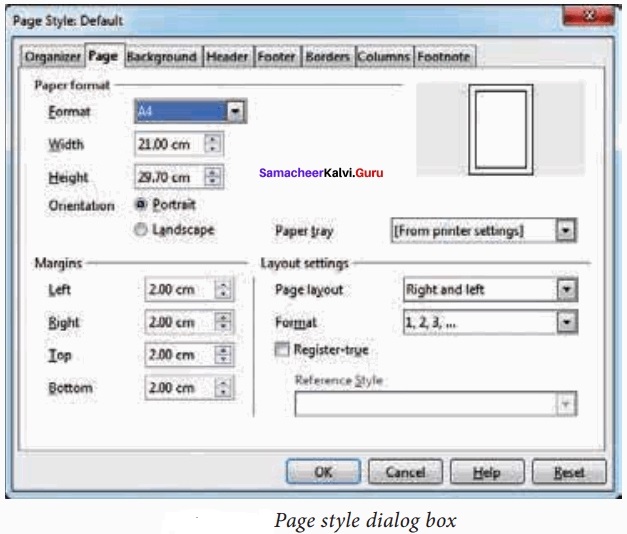
To change margins using the Page Style dialog box.

  1. Right-click anywhere on the page and select Page from the popup menu or select page tab of page style dialog box.
  2. In the Margins boxes, specify the values for left, right, top and bottom margins.
  3. Click on ok button.

Question 2.
What are Header and Footer? How do you insert page numbers?
Answer:
Header:
It is a section of the document that appears in the top margin, Which displays the title or chapter name, author name of a document.

Footer:
It is a section of the document that appears in the bottom margin of the page which displays the page number, date, time etc., which gets displayed on all the pages automatically.

Inserting Header and Footer:

  1. Select from the main menu Insert → Header → Default
  2. The header text area is separated from the normal text area.
  3. Enter the text that is to be repeated in all pages or Select Insert → Fields → Title.

Similarly to insert a Footer, the steps are as given below:

  1. Select from the main menu Insert → Footer → Default
  2. Place the insertion pointer in the footer part of the page.
  3. Select Insert → Fields → Date to insert date in all the pages.
  4. Once the headers and footers are given in the first page, the same text appears in all the pages.

Inserting and Formatting page numbers:
Once the Header / footer area is enabled, the page numbers can be inserted by performing the following steps:

  1. position the cursor where you want to insert the number
  2. choose Insert → Fields → Page Number
  3. The page number appears with a gray background

Question 3.
Write about the drawing toolbar?
Answer:
Open office writer uses the drawing tools, to create various shapes by using the Drawing toolbar. To use the drawing tools repeatedly, you can move this toolbar to a convenient place on the window. The drawing toolbar can be obtained by clicking View → Toolbars → Drawing.
11th Computer Application Chapter 6 Book Back Answers Word Processor Basics Samacheer Kalvi

To use a drawing tool, the steps are as given below:

  1. Click in the document where you want the drawing to be anchored.
  2. Select the tool from the Drawing toolbar. The mouse pointer changes to a drawing- functions pointer.
  3. Move the cross-hair pointer to the place in the document where you want the graphic to appear and then click-and-drag to create the drawing object.
  4. Release the mouse button. The selected drawing function remains active, so you can draw another object of the same type.
  5. To cancel the selected drawing function, press the Esc key or click on the Select icon on the Drawing toolbar.
  6. You can now change the properties (fill color, line type and weight, anchoring, and others) of the drawing object using either the Drawing Object Properties toolbar or the choices in the dialog box.

Question 4.
Explain Page formatting in writer?
Answer:
Samacheer Kalvi Guru 11th Computer Application Solutions Chapter 6 Word Processor Basics
The most important thing in a word processor is how to format the page with elements such as margins, numbering, page layout, headers and footers. Formatting your pages makes them look more attractive and makes them easier to read.

Changing Page Size:
The default page size in writer is 8.5 × 11”, the same as that of a standard A4 printing paper. However, for different types of documents, you may need to change the page size. To change the paper size:

  1. Select the page whose page size is to be changed
  2. Select Format → Page, the page style dialog box.
  3. Select Page Tab.
  4. In the paper format group, select the format like A4, legal ….
  5. Or the width and height option can be used to set the page size.

Samacheer Kalvi 11th Computer Applications Solutions Word Processor Basics (OpenOffice Writer) Additional Questions and Answers

I. Choose The Correct Answer

Question 1.
Which is the leading open-source office software to works on all common computers and available in many languages.
(a) OpenOffice
(b) StarOffice
(c) MSOffice
(d) None of these
Answer:
(a) OpenOffice

Question 2.
Which company has developed by OpenOffice writer?
(a) Microsoft
(b) Kingsoft
(c) Apache
(d) Sun micro systems
Answer:
(c) Apache

Question 3.
The open screen of the OpenOffice is known as:
(a) starcenter
(b) desktop
(c) window
(d) screen
Answer:
(a) starcenter

Question 4.
The keyboard shortcut key can be used to open a new text document in OpenOffice:
(a) Ctrl + O
(b) Ctrl + A
(c) Ctrl + N
(d) Ctrl + S
Answer:
(c) Ctrl + N

Question 5.
The bar, that displayed at the top most part of the window:
(a) Toolbar
(b) Title bar
(c) Menu bar
(d) Scroll bar
Answer:
(b) Title bar

Question 6.
Which is called a flashing vertical bar appears at the beginning of the screen?
(a) Insertion pointer
(b) Cursor
(c) Horizontal ruler
(d) Vertical ruler
Answer:
(a) Insertion pointer

Question 7.
The keyboard shortcut key can be used to close a document in OpenOffice:
(a) Ctrl + N
(b) Ctrl + A
(c) Ctrl + W
(d) Ctrl + Q
Answer:
(c) Ctrl + W

Question 8.
The keyboard shortcut key can be used to open an existing document in OpenOffice:
(a) Ctrl + 0
(b) Ctrl + A
(c) Ctrl + N
(d) Ctrl + S
Answer:
(a) Ctrl + 0

Question 9.
Which key is used to delete the character left of the insertion pointer?
(a) Backspace key
(b) Delete key
(c) Shift key
(d) Home key
Answer:
(a) Backspace key

Question 10.
Which key is used to delete the character right of the insertion pointer?
(a) Backspace key
(b) Delete key
(c) Shift key
(d) Home key
Answer:
(b) Delete key

Question 11.
The key is used toggle between Insertion mode and overwritten mode:
(a) Insert key
(b) Home key
(c) Shift key
(d) Ctrl key
Answer:
(a) Insert key

Question 12.
The OpenOffice writer provides help window, which function key is used to getting the help window?
(a) F1
(b) F2
(c) F3
(d) F4
Answer:
(a) F1

Question 13.
Which option is used to removed by selecting highlighted text?
(a) Cancel
(b) No fill
(c) Change
(d) None of these
Answer:
(b) No fill

Question 14.
For selecting whole document which shortcut key is used?
(a) Ctrl + A
(b) Ctrl + W
(c) Ctrl + M
(d) Ctrl + S
Answer:
(a) Ctrl + A

Question 15.
Which shortcut key is used to clear the formatting document?
(a) Ctrl + A
(b) Ctrl + W
(c) Ctrl + M
(d) Ctrl + A
Answer:
(c) Ctrl + M

Question 16.
A first-line indentation indents value is:
(a) positive
(b) negative
(c) zero
(d) none of these
Answer:
(a) positive

Question 17.
The hanging indent value can be entered as:
(a) positive
(b) negative
(c) zero
(d) none of these
Answer:
(b) negative

Question 18.
In page orientation, the height of the document is more than the width is called:
(a) portrait
(b) landscape
(c) legal
(d) A4 size
Answer:
(a) portrait

Question 19.
In page orientation-the width of the document is more than height is called:
(a) portrait
(b) landscape
(c) legal
(d) A4 size
Answer:
(b) landscape

Question 20.
Which shortcut key is used to find the replace the text?
(a) Ctrl + F
(b) Ctrl + B
(c) Ctrl + P
(d) Ctrl + S
Answer:
(a) Ctrl + F

Question 21.
Which menu option is choosed to open AutoCorrect dialog box?
(a) Tools → Change
(b) Tools → AutoCorrect
(c) Tools → Add
(d) Tools → Ignore
Answer:
(b) Tools → AutoCorrect

Question 22.
Which command is used to deselect the size of the picture?
(a) Crop
(b) Format
(c) Cut
(d) Delete
Answer:
(a) Crop

Question 23.
Which option is used to inserts an image that overlaps the text which result will be hidden?
(a) Drawing toolbar
(b) Wrap through
(c) Format
(d) Transparency
Answer:
(b) Wrap through

Question 24.
Which key is assign the AutoText shortcut?
(a) Ctrl + FI
(b) Ctrl + F2
(c) Ctrl + F3
(d) Ctrl + F4
Answer:
(c) Ctrl + F3

Question 25.
A specified number of rows and columns are called:
(a) Table
(b) Cell
(c) Column
(d) Row
Answer:
(a) Table

Question 26.
Which combination key is used to insert table dialog box?
(a) Ctrl + F10
(b) Ctrl + F11
(c) Ctrl + F11
(d) Ctrl + F12
Answer:
(d) Ctrl + F12

Question 27.
Multiple copies of a document to send to a list of different recipients is called:
(a) Mail merge
(b) Copy
(c) address book
(d) all of the above
Answer:
(a) Mail merge

Question 28.
Which opition can choose to print all colour text and graphics as gray scale in OpenOffice?
(a) Tools > options > OpenOffice.org > print
(b) Tools > options > OpenOffice.org > ok
(c) Tools > options > OpenOffice.org > Next
(d) None of the above
Answer:
(a) Tools > options > OpenOffice.org > print

Question 29.
When using Tab key in OpenOffice writer by default moving insertion point is:
(a) 1 inch
(b) 1/4 inch
(c) 1/2 inch
(d) 2 inch
Answer:
(c) 1/2 inch

Question 30.
Which rules you can add to decorate any or all the four sides of a paragraph?
(a) Highlighted
(b) Borders
(c) Shading
(d) Bold
Answer:
(b) Borders

Question 31.
Which can you use as background for enhancing the appearance of a text or paragraph?
(a) Highlighted
(b) Borders
(c) Shading
(d) Bold
Answer:
(c) Shading

Question 32.
The section’of the document that appears in the top margin:
(a) header
(b) footer
(c) margin
(d) window
Answer:
(a) header

Question 33.
The section of the document that appears in the bottom margin:
(a) header
(b) footer
(c) margin
(d) window
Answer:
(b) footer

Question 34.
Which is the shortcut key to insert a comment within the text?
(a) Ctrl + Alt + C
(b) Ctrl + Alt + I
(c) Ctrl + Alt + V
(d) Ctrl + Alt + C
Answer:
(a) Ctrl + Alt + C

Question 35.
Which shortcut key is used to undo last action?
(a) Ctrl + C
(b) Ctrl + F
(c) Ctrl + Z
(d) Ctrl + E
Answer:
(c) Ctrl + Z

Question 36.
Which shortcut key is used to center aligned text?
(a) Ctrl + C
(b) Gtrl + F
(c) Ctrl + Z
(d) Ctrl + E
Answer:
(d) Ctrl + E

Question 37.
Which combination of shortcut is used subscript a number?
(a) Ctrl + Shift + B
(b) Ctrl + Shift + V
(c) Ctrl + Shift + P
(d) Ctrl + Shift + S
Answer:
(a) Ctrl + Shift + B

Question 38.
Which combination of shortcut key is used superscript a number?
(a) Ctrl + Shift + B
(b) Ctrl + Shift + V
(c) Ctrl + Shift + P
(d) Ctrl + Shift + S
Answer:
(c) Ctrl + Shift + P

Question 39.
Which shortcut key is used to inserting a new paragraph without numbering?
(a) Alt + Shift
(b) Alt + Enter
(c) Alt + Tab
(d) Ctrl + Enter
Answer:
(b) Alt + Enter

Question 40.
Which shortcut key is used to apply default paragraph style?
(a) Ctrl + 0
(b) Ctrl + 1
(c) Ctrl + 2
(d) Ctrl + 3
Answer:
(a) Ctrl + 0

Question 41.
……………………. is the pictorial representation of data.
(a) Object
(b) Charts
(c) Shapes
(d) Colour
Answer:
(b) Charts

II. Short Answers

Question 1.
What is meant by word processing?
Answer:
Word processor is a computer software to create, edit, manipulate, transmit, store and retrieve a text document. The above said activities are called as “Word Processing”. In other words, Word processing is an activity carried out by a computer with suitable software to create, edit, manipulate, transmit, store and retrieve text documents.

Question 2.
What are the familiar open source word processing software?
Answer:
OpenOffice Writer, LibreOffice Writer, Abiword etc.

Question 3.
What are the familiar Tamil word processor?
Answer:
Tamil OpenOffice writer, Tamil Libre, Kamban 3.0, Mentamizh 2017 there are familiar word processors exclusively for Tamil Language.

Question 4.
How to open the OpenOffice Writer?
Answer:
A new OpenOffice Writer document can be created by various methods. From windows, select
Start → All Programs → OpenOffice → OpenOffice Writer.
(or)
From Star Center (Welcome Screen): Double-click on “OpenOffice” icon the desktop.

Question 5.
What is meant by star center?
Answer:
In OpenOffice, open screen is called as “Star Center”. Writer is one of the components of OpenOffice. So, it may be invoked from the “Star Center” by simply clicking on the “Text Document” icon.

Question 6.
How can you close the OpenOffice application?
Answer:
This button is called as “Close” button,when you click this button, the application is closed and OpenOffice returns back to the desktop. So, the red colored close button may be called as “Exit” or “Quit”.

There is another (‘x’) mark on the right most comer of the menu bar. This is actually used to close your document. When you click this (‘x’) mark, your document will be closed, OpenOffice will be still opened.

Question 7.
What are the types of toolbar available in the menu bar?
Answer:
Under the menu bar, there are two toolbars available by default.
They are:

  1. Standard Tool bar
  2. Formatting Toolbar.

Question 8.
What are the types of ruler scale?
Answer:
The ruler is a scale below the formatting toolbar which shows the margins. There are two set of rulers

  1. Horizontal ruler and
  2. Vertical ruler. Horizontal rules is used to set left and right margins of a page and vertical ruler for top and button setting.

Question 9.
What is called insertion pointer?
Answer:
The work space is the blank area which is used to type the content of the file. A flashing vertical bar appears at the beginning of the screen which is called as “Insertion pointer”.

Question 10.
Which is known as word wrap?
Answer:
When the text reaches the end of the line, the word is automatically wrapped to the next line. This feature in any word processor is known as “Word Wrap”.

Question 11.
How to save the document?
Answer:
One can select the drive and folder where the file will be stored. To save a document for a first time,the following steps are used:
Click File → Save → (or) File → Save As (or) Ctrl + S.

Question 12.
How to set a password to protect your document while saving a file?
Answer:
In OpenOffice writer, a document can be protected with a password. You can set a password to protect your document while saving a file. To save a file with password, click on “Save with Password”check box and then click “Save” button. Immediately it shows “Set Password” dialog box. Enter a password in “Enter Password to open” text box and retype the same password in “Confirm Password” box for confirmation. Finally click ‘OK’ button.

Question 13.
What is the use of Insert key?
Answer:
To insert a text in between if something is left out, the insertion can be made by taking the insertion pointer to the current location and Press the Insert Key the newly typed text is inserted, so that the existing text moves to the right. Press the Insert Key again, the text is over written on the existing text. This is called ‘Type over mode’. You can toggle between the insert mode and type over mode by pressing the‘Insert key’.

Question 14.
What is the purpose of using paste special option?
Answer:
When you move or copy information, the paste option is used to send the information as a whole. But, to move or copy only some aspects of the data, like only its formatting or only value, the Paste Special option is used. To use the paste special, select the text and apply move or copy, then at the destination location,
Click Edit → Paste Special (or) press Ctrl + Shift + V, (or) Alt + E + S the Paste Special dialog box opens.

Question 15.
What is difference between paste and paste special?
Answer:
Paste:
Paste is a feature that lets a user cut or copy items from Cells and transfer them to another completely.

Paste Special:
Paste Special allows the items being transferred to be formatted in several different ways. Paste Special is a feature found in software like Microsoft Word, Microsoft Excel and Open Office.

Question 16.
What is meant by Text formatting?
Answer:
A font is a set of characters in a particular style. Changing the default appearance of the text like changing the font type, size, color, style etc., are called as Text formatting.

Question 17.
What are the short cut commands using to make the text Formatting?
Answer:
Samacheer Kalvi 11th Computer Application Solutions Chapter 6 Word Processor Basics

Question 18.
What is the use of change case option of format menu?
Answer:
Normally any text can be typed in upper or lower case. The text can be changed to different cases like:

  1. Uppercase (Capital letters)
  2. Toggle case (reverse case),
  3. Sentence case (first letter of each sentence Capital),
  4. Capitalize every word (first letter of each word capital),
  5. Lower case. (Small letters)
    1. This can be done by:
    2. Select the text to change case
    3. Select Format → Change case.

Question 19.
What is meant by highlighting?
Answer:
Highlighting is used to draw attention to important information in a text. Highlighting is beneficial because it first asks the reader to pick out the important parts, and then gives an effective way to review that information later.
Highlighting can be applied by selecting the text and click Highlighting icon.

Question 20.
What is meant by hanging indent?
Answer:
This is a special kind of indent where the first line of the paragraph alone hangs outside leaving the rest of the text. To apply Hanging indent, a negative value is given in the “first line” option of the paragraph dialog box.

Question 21.
What are the types different page orientation?
Answer:
Page orientation refers to hgw the document will be displayed on screen and printed. There are two different orientations:
Landscape:
The width of the document is more than the height. This is best suited for displaying professional photos, invitations, albums, tables etc.,

Portrait:
This is the most common orientation. Here, the height of the document is more than the width. Normally books, newspapers will be displayed in this format.

Question 22.
What is the function of AutoCorrect?
Answer:
Auto Correct function has the facility to correct the common misspellings and typing errors, automatically. For example, “hte” will be changed to “the” which can be done through the menu option, Tools → AutoCorrect.

Question 23.
What is meant by spell check program?
Answer:
Spell check is a software program that corrects spl74568f.dfml d,589f fjidflfefelling errors in ewfword processing, email and documents, Spell check identifies and corrects misspelled words and the grammatical error is displayed with a green wavy line under the wrong word.

Question 24.
What is meant by table?
Answer:
A table is a grid with a specified number of rows and columns. Tables can often be used as an alternative to spreadsheet to organize materials. A well-designed table can help readers understand better what you are trying to convey.

Question 25.
What is meant by formatting table?
Answer:
Formatting a table involves formatting of the table layout, formatting of the table text, adjusting the size of the table, its position on the page, adding or removing rows or columns, merging and splitting cells, changing borders and the background.

III. Explain in Brief

Question 1.
What are the common software packages in OpenOffice?
Answer:
OpenOffice is a productive office suite with a collection of different software packages such as
OpenOffice Writer – Word Processor to create text documents
OpenOffice Calc – Spreadsheet to create worksheets
OpenOffice Base – Database
OpenOffice Impress – Presentation software
OpenOffice Draw – Drawing Software
OpenOffice Formula – Create formula and equations

Question 2.
What are the important features which provides OpenOffice writer?
Answer:

  1. Templates and styles.
  2. Page layout methods, including frames, columns, and tables.
  3. Embedding or linking of graphics, spreadsheets, and other objects.
  4. Built-in drawing tools.
  5. Master documents to group a collection of documents into a single document.
  6. Change tracking during revisions.
  7. Database integration, including a bibliography database.
  8. Export to PDF, including bookmarks.

Question 3.
Draw a OpenOffice writer window? With mark the important components?
Answer:
OpenOffice Writer window such as Title bar, Menu bar, Standard Toolbar, Formatting Toolbar, Ruler, Work space and Status bar. The components of a OpenOffice writer window are explained.
Samacheer Kalvi Computer Application Solutions Chapter 6 Word Processor Basics

Question 4.
How to select a text continuous and discontinuous?
Answer:
In any word processor, the text has to be selected for performing any operation like copying, moving, formatting etc. This text selection can be done by two methods;

  1. Selecting the continuous text.
  2. Selecting the non continuous text.

Continuous text:
To select the text continuously take the insertion pointer to the starting of the text.

Selecting the continuous text:
To select the text continously take the insertion pointer to the starting of the text.

  1. Hold the SHIFT key and drag the mouse across until the required text is selected and then release the SHIFT key.
  2. The select text can be used for any operation.

Selecting the non continuous text:
To select the text not continuously, take the insertion pointer to the starting of the text,

  1. Hold the CTRL key and drag across it till the required text is selected and release the CTRL key.
  2. The required text is selected for any operation.

Question 5.
How to use the help system in open writer?
Answer:
Open Office Writer provides several forms of help. By pressing FI or select Help from the menu bar the help window appears.

  1. To activate tool tips, extended tips, and the help Agent, click Tools → Options → OpenOffice.
  2. For a more detailed explanation, select Help → What’s This? and hold the mouse pointer over the icon where you want more help with.

Question 6.
How can you change the line spacing adjustment?
Answer:
Line spacing determines the amount of vertical space between lines of text in a paragraph. By default, the lines are single-spaced, that is the spacing accommodates the largest font in that line, plus a small amount of extra space. In Open Office, setting line spacing is quite easy through the context menu, select the line or word or phrase, right-click → line spacing, select the type single, 1.5 or double. There are seven different types of line spacing.

  1. Select the entire document by Edit → Select All.
  2. Format → paragraph.
  3. The paragraph dialog box appears, click Indents and spacing tab.
  4. In the line spacing option, select the type and click ok button.

Question 7.
What is a indent? What are the types of Indent?
Answer:
Indent is the distance from the left and right margin of a paragraph. It is used to improve the efficiency and readability of the paragraph and makes the paragraph look more attractive.
There are four types of indents:

  1. Left Indent
  2. Right Indent
  3. First Line Indent and
  4. Hanging Indent.

Question 8.
How to change the page colour and borders?
Answer:
Changing the page color is not quite common. To do so, in the page style dialog box, in the Background option, click on color and select the “color” from the color palette or select “graphic” to apply an image as a page background.

Borders can be applied to an entire document, an entire page, paragraph, or just to certain sections of the document. From the page style dialog box, select the Border tab, the user defined area helps to define the area of borders, the line style of borders, color of borders can be selected.

Question 9.
Howto insert special characters and equations?
Answer:
Many symbols which are used in a mathematical equation like alpha (α), beta (β), pi (π) etc.,, are not available on the standard keyboard. However, representing these characters are very much essentia in mathematical equations. To insert such characters, the procedure given below
is folio-wed:

  1. Place the cursor in your document where you want the character to appear.
  2. Click on the Insert → Special character.
  3. The Special character dialog box appears from which the desired symbol can be selected by clicking on the character.
  4. As you select each character, it is shown on the lower right, along with the numerical code for that character.
  5. If you do not find a particular special character you want, try changing the font selection.
  6. Click the Ok button and the character is inserted at the current location.

Question 10.
How to inserted the chart in the worksheet?
Answer:
Charts are pictorial representations of data. The data can be either typed in cells in writer or it can be inserted.
Click inside the Writer table.

  1. Choose Insert → Object → Chart, You see a chart preview and the Chart Wizard.
  2. The chart toolbar at the top of the page which contains the formatting tools.
  3. The insert menu shows the various attributes of the chart like Title, Legends, Axis, grid, label etc.,

Question 11.
What are the steps needed to create watermark?
Answer:

  1. Insert the image or text of your choice
  2. Anchor the image to the page and
  3. Select the wrap through option form the Format Wrap menu or right-clicking on the image and selecting Wrap
  4. Wrap Through from the pop-up menu
  5. Move the image into the desired position
  6. The Picture toolbar should be displayed when the image is selected
  7. Change the transperency to a suitable value so that the text can be read.

Question 12.
What are the steps follows to assign Auto Text?
Answer:
To assign AutoText shortcut to some text, the steps arc as follows:

  1. Type the text into your document.
  2. Select the text so that it is highlighted.
  3. Select Edit → AutText (or press Ctrl+F3).
  4. Enter a name for your shortcut. Writer will suggest a one-letter shortcut, which you can change.
  5. Click the AùtoText button on the right and select New (text only) from the menu.
  6. Click Close to return to your document.

Question 13.
How can you merging and splitting cells?
Answer:
To merge a group of cells:

  1. Select the cells to merge.
  2. Right click and choose Cell → Merge or choose Table → Merge Cells from the menu bar.
    1. To split a cell:
    2. Place the insertion pointer inside the cell.
    3. Right click and choose Cell → Split, or choose Table → Split Cells from the menu bar.
    4. Select the direction of the split, horizontally (for rows), or vertically (for columns), as well as the total number of cells to create.

Question 14.
What are the basic types of graphics in OpenOffice writer?
Answer:

  1. Image files, including photos, drawings, scanned images, and others.
  2. Diagrams created using OOo’s drawing tools.
  3. Charts created using OOo’s Chart facility.

IV. Explain in detail

Question 1.
Explain the menu bar in OpenOffice writer?
Answer:
Menu Bar:
The menu bar is just below the title bar which comprises of various menus consisting of various options.
11th Computer Application Samacheer Kalvi Solutions Chapter 6 Word Processor Basics

File:
The File menu contains the commands of all file management tasks like, Create a new file, Open an existing file, Close the current file, Save a file, Save As another file, print file, Export file etc.,

Edit:
The Edit menu contains the editing commands like, cut, copy, paste, Undo, Redo etc.,

View:
The View menu contains the commands which are used to modify the environment of write like display of toolbars, web layout, print layout, navigator etc.,

Insert:
The Insert menu contains commands for inserting various elements such as pictures, tables, charts, comments, headers, footers, special characters, cross reference etc.,

Format:
The Format menu contains the commands of various text and page formatting features like page size, layout, font characteristics, bullets and numbering etc.,

Tables:
The Table menu contains various tools to manage and manipulate tables such as create tajfie, insert rows, insert columns, s’plit cells, merge cells etc.,

Tools:
The Tools menu contains various tools and functions such as spell check, macros, mail merge, end notes/footnotes etc.,

Window:
The window menu shows display options such as New Window, Close Windows, Split and Freeze. .

Help:
The Help menu lists out the inbuilt help features available with OpenOffice.

Question 2.
What are the different shortcut keys of moving within a document?
Answer:
There are different ways of moving within a document. There are many shortcut keys given in Table which are used to move easily within a document.
11th Computer Applications Samacheer Kalvi Solutions Chapter 6 Word Processor Basics

Question 3.
Explain the various editing operations using a document?
Answer:
The various editing operations like cut, copy and paste.
Moving: To move a text from one location to another.

  1. Select the text to he moved.
  2. Click Ctrl + X or Cut Icon or Edit → Cut.
  3. The text is removed from the source location and placed in the clipboard.
  4. Take the insertion pointer to the new location to be moved and
  5. Click Ctrl + V or Paste Icon or Edit → Paste.

The required text is moved to the required location.
Copying: To copy a text from one location to another.

  1. Select the text to be copied .
  2. Click Ctrl + C or Copy Icon or Edit → Copy
  3. A duplicate copy of the text is made and send to the clipboard
  4. Take the insertion pointer to the new location to be copied and
  5. Click Ctrl + V or Paste Icon or Edit → Paste

The required text is copied to the required location.
The Editing shortcut keys are:
Computer Application Samacheer Kalvi 11th Solutions Chapter 6 Word Processor Basics

Question 4.
What are the various alignment in formatting paragraph?
Answer:
A paragraph is any text that ends with a hard return. A hard return is accomplished anytime you press the Enter key. Paragraph Alignment or justification refers to the way in which the lines of a paragraph are aligned. Paragraph alignment lets you control the appearance of individual paragraphs.

There are four types of alignment available in Open office Writer – left-alignment, Right-alignment, Center-alignment, and Justify-alignment. The paragraph formatting can also be done by icons using the formatting toolbar.
Samacheer Kalvi 11th Computer Applications Solutions Chapter 6 Word Processor Basics (OpenOffice Writer) img 8

Question 5.
How can you use Bullets and Numbering in a document?
Answer:
Bullets:
This is a paragraph level attribute that applies a bullet character to the start of the paragraph. In bulleted lists, each paragraph begins with a bullet character. This is suitable when the text has to be presented as a list of items preceded by a bullet symbol and no sequence has to be followed. Bullets are quickly created by clicking on the bullet icon.

Numbering:
This attribute applies a numeral to the start of the paragraph. Numbering is more suitable when the text has to be presented as a sequence. In numbered list, each paragraph begins with an expression that includes a number or letter and a separator such as a period or parenthesis. The numbers in a numbered list are updated automatically when you add or remove paragraphs in the list. Numbering is quickly created by clicking on the numbering icon.

Style of Bullets and Numbering:
The default type of bullet is (•) and the default type of numbering is (1,2, 3 ……………….). The style of bullets and numbering can be changed by applying the following steps:

  1. Select the text to be bulleted.
  2. Format → Bullets and Numbering.
  3. Select Bullets Tab.
  4. The bullets and Numbering dialog box where different styles of bullets are displayed.
  5. Click on the required style.
  6. Click OK button.
  7. The selected text is bulleted

Samacheer Kalvi 11th Computer Applications Solutions Chapter 6 Word Processor Basics (OpenOffice Writer) img 1

To apply Numbering:

  1. Select the text to be numbered.
  2. Format → Bullets and Numbering.
  3. Select Numbering Type Tab.
  4. The Bullets and Numbering dialog box where different styles of numbering are displayed.
  5. Click on the particular style.
  6. Click Ok button.
  7. The selected text is numbered.

Samacheer Kalvi 11th Computer Applications Solutions Chapter 6 Word Processor Basics (OpenOffice Writer) img 2

Question 6.
How can you find a word in Find and Replace text?
Answer:
OpenOffice Writer has a Find and Replace feature that helps to locate for a text inside a document and replace it with another word. In addition to finding and replacing words and phrases, you can also use wildcards and regular expressions to perform advanced search. To search a word

  1. Click Edit → Find & Replace (or) Ctrl + F
  2. The Find & Replace dialog box appears.

Steps to find & replace a text

  • Type the text you want to find in the Search for box.
    Eg: To search a word “Bombay” in a document and replace with “Mumbai”, enter the word “Bombay” in the Search for box.
  • To replace the text with different text, type the new text in the Replace with box.
    Enter the word “ Mumbai” in the Replace with box and Click Find button, to start the search, the found word is highlighted and the first occurance of “Bombay” is highlighted.
    Samacheer Kalvi 11th Computer Applications Solutions Chapter 6 Word Processor Basics (OpenOffice Writer) img 3
  • To replace text, click Replace button. The highlighted word is replaced with the word given in the Replace with box.
  • Click Find All, Writer selects all instances of the search text in the document. All occurrences of Bombay are highlighted.
  • Click Replace All button, Writer replaces all matches. This will replace all occurances of “Bombay” with “Mumbai”.
  • Enable Match case to perform the search case sensitively so that uppercase and lower cases are distinguished separately.
  • Enable Whole Words only to make the search more specific to words used separately alone.

Question 7.
Discuss the Auto spell check?
Answer:
Auto spell check option checks each word as it is typed and displays a wavy red line under any misspelled words. Once the word is corrected, the red wavy line disappears. This can be done through clicking the icon.

To perform a separate spelling check on the document (or a text selection) click the Spelling and Grammar button. This checks the document or selection and opens the Spelling dialog box if any misspelled words are found, This can be achieved by clicking the icon
Samacheer Kalvi 11th Computer Applications Solutions Chapter 6 Word Processor Basics (OpenOffice Writer) img 4

Here are some more features of the spelling tool:

  • Right-click on a word with a wavy underline, to open a powerful context menu. Correct words can be selected from the suggested words on the menu. The selection will replace the misspelled word with correct word. Other menu options are discussed below.
  • The dictionary language can be changed (For example, Spanish, French, or German) from the Spelling dialog box.
  • The new words can be added to a dictionary. Click Add in the Spelling dialog box and pick the dictionary to add it to.

Question 8.
How can you using different techniques to insert tables?
Answer:
Different techniques to insert tables:
To insert a new table, position the insertion pointer where you want the table to appear, then use any of the following methods to open the Insert Table dialog box.

There are two methods to create a table:

1. Table Icon:
To insert a table quickly from the standard tool bar:

  1. Place the insertion pointer where you want the table to appear.
  2. Click the arrow to the right side of the Table icon Samacheer Kalvi 11th Computer Applications Solutions Chapter 6 Word Processor Basics (OpenOffice Writer) img 13
  3. In the drop down grid, select the number of rows and columns for the table. (iv) The table will appear at the location of your insertion pointer.

2. Insert table dialog box:
To insert a table with more control over the settings and properties, use the Insert Table dialog box.
To open the dialog box: Select Table → Insert → Table (or) Ctrl +F12 or left-click the Table icon. From this dialog box, you can:

  1. Select the number of rows and columns of the table.
  2. Give a Name to the table to later distinguish it in the Navigator.
  3. Select the Heading option to define the first row in the table as the heading.
  4. Select the Repeat heading option to repeat the heading row if the table more than one page.
  5. Select the Don’t split table option to prevent the table from spanning more than one page.
  6. Select the Border option to surround each cell of the table with a border.

Samacheer Kalvi 11th English Solutions Supplementary Chapter 4 With the Photographer

Students who are interested in learning of 11th English Supplementary Chapter 4 With the Photographer Questions and Answers can use Tamilnadu State Board Solutions of 11th English Chapter Wise Pdf. First check in which chapter you are lagging and then Download Samacheer Kalvi 11th English Book Solutions Questions and Answers Summary, Activity, Notes Chapter Wise. Students can build self confidence by solving the solutions with the help of Tamilnadu State Board English Solutions. English is the scoring subject if you improve your grammar skills. Because most of the students will lose marks by writing grammar mistakes. So, we suggest you to Download Tamilnadu State Board 11th English Solutions according to the chapters.

Tamilnadu Samacheer Kalvi 11th English Solutions Supplementary Chapter 4 With the Photographer

Check out the topics covered in Supplementary Chapter 4 With the Photographer Questions and Answers before you start your preparation. Improve your grammar skills with the help of Samacheer Kalvi 11th English Book Solutions Questions and Answers pdf links. The solutions for Tamilnadu State Board 11th English Textbook are prepared by the English experts. So, if you follow Tamilnadu State Board Solutions 11th English Textbook Solutions you can cover all the topics in Supplementary Chapter 4 With the Photographer Questons and Answers. This helps to improve your communication skills.

With The Photographer Question Answer Warm Up

Photographs capture memorable moments. They fill us with nostalgia. Discuss the following questions.

With The Photographer By Stephen Leacock Question And Answers Question 1.
What are the occasions when photographs are taken?

e.g. birthday parties

Answer:

e.g. birthday partiesWeddings
ConvocationFunctions
Annual daySports day
TourMeetings

With The Photographer Question Answer Samacheer Kalvi 11th English Solutions Supplementary Chapter 4

With The Photographer Summary Question 2.
Why are photographs taken?

e.g. to freeze our favourite moments

Answer:

e.g. to freeze our favourite momentsto cherish memorable moments
To record best thingsto freeze beauty
To document functionto lodge complaints with evidence

Samacheer Kalvi 11th English With the Photographer Textual Questions

1. Based on your understanding of the story, answer the following questions in two or three sentences each.

With The Photographer Essay In English Question (a)
Why did the author go to the photo studio?
Answer:
The author wanted his photograph taken. He wanted to leave it behind with his friends and relatives after his death. So, he went to a photographer.

With The Photographer Paragraph Question (b)
Describe the photographer.
Answer:
The photographer was a drooping’man in a gray suit. He had dim eyes as a natural scientist.

With The Photographer Question (c)
Bring out the significance of what Leacock was reading at the photographer’s.
Answer:
The poet had to wait. To kill the time, he read Ladies companion for 1912 and the girls’ magazine for 1902 and the infants’journal for 1888. He read the old magazines which were meant for people who lived long ago.

Question (d)
Why did Leacock assume that the photographer was praying?
Answer:
The photographer hid himself behind the camera under a cloth. He did not move or say anything for quile’sometime. So, the author assumed that the photographer was praying.

Question (e)
How did the inner room get light?
Answer:
There was a frosted window. A sheet of factory cotton hung against it. A beam of sunlight filtered through it. Thus the studio got the needed light.

Question (f)
Why did the photographer take a longtime to photograph Leacock?
Answer:
The photographer wanted to prove his skills in photography. Somehow, the author’s face didn’t appear to be good enough for a photo. So, he gave many instructions like “open the mouth, close it, droop your ear, roll your eyes, turn your face up” and went on correcting the pose. This took a lot of time.

Question (g)
What angered the author?
Answer:
The author’s facial features and body was severely criticized by the photographer. He gave plenty of instructions. He himself held the author’s face and twisted it. He said, “I don’t like the head … The ears are bad”. He was asked to expand the lungs, contract the waist, turn the face upward. All this added to the author’s annoyance. He became really angry.

Question (h)
Why did the photographer feel happy after taking the photograph?
Answer:
The photographer felt happy after taking the photograph. The author was angry and was about to get up from his place. The animation on his face was caught in the photograph.

Question (i)
Why did Leacock visit the studio on Saturday?
Answer:
The photographer had asked the author to come and collect the proof on Saturday. So, the author went to the studio on Saturday.

Question (J)
How did the author react on seeing his photograph?
Answer:
The author was upset to see his photo. It carried little likeness of him. He even asked the photographer if it was himself on the photo.

Question (k)
What changes had the photographer effected on Leacock’s face in the picture?
Answer:
The photographer had retouched the author’s eyes. His eyebrows were removed and put in new ones. The mouth was adjusted a little. The author had a consolation that his ears were recognizable. The photographer declared his intention of removing it and fixing them anew.

Question (l)
What was the human side to the photographer?
Answer:
The photographer stated, “I think the face would be better three – quarters full. The author was glad to find that he had such a human side to him.


Question (m)
Why was the photographer proud to receive Leacock on Saturday?
Answer:
While handing over the proof of the photo, there was a certain pride in the photographer’s manner. He believed that with his technical expertise, he had corrected all the ugly features and made the photo presentable. So, he was naturally proud.

Question (n)
What was the only similarity between Leacock’s face and his photograph?
Answer:
The author’s ears were almost the same in the photograph.

2. Based on your understanding of the lesson, complete the sentences given below to make a summary of the story ‘With the Photographer’ in a paragraph.

(a) The narrator went to the photographer to
(b) The photographer made the author wait for
(c) While waiting in the studio the narrator kept reading
(d) The photographer told him to
(e) The narrator got angry because
(f) The photographer was pleased after
(g) He was called on Saturday to
(h) On seeing the photograph the narrator
(i) The photographer had made changes
(j) The photograph did not look like
(k) The narrator was frustrated as
(l) He left the studio saying

Answers:

(a) take a photograph of himself
(b) an hour
(c) old useless magazines
(d) sit down
(e) the photographer repeatedly said his face was wrong
(f) developing the negative
(g) see the proof
(h) was annoyed
(i) in the author’s face
(j) himself
(k) he could not share it with his friends
(l) that it was a worthless bauble for him

3. Answer the following questions in a paragraph of 100 -150 words each:

Question (a)
Stephen Leacock’s visit to the photo studio turns out to be an annoying experience for him. Discuss citing relevant instances from the story.
Answer:
The author had to wait for an hour and read the magazines like “The Ladies Companion, Girls’ Magazine and the Infants’ Journal. He had a disturbing feeling that he had done an unwarrantable thing in breaking in on the photographer’s privacy and his scientific pursuits with a face like his. After studying his face for sometime from behind the camera, he said, the face was wrong. He commented that the face would be better three quarters full. Then he held the author’s face making him believe that he was going to kiss it. He twisted the author’s face as far as it would go. He said that he didn’t like the head. He asked him to open the mouth a little and then close it. Then he said that the ears was bad. He suggested that he should droop them a little more. He asked him to roll his eyes under the lids.

He asked him to turn his face upward a little and keep his hand on the knee. He instructed the author to hump the neck and contract the waist and also twist the hip. It was the last straw when he said that he didn’t quite like his face for, it was just a trifle too full. These numerous instructions and cynical comments about the features of his face annoyed him. He exploded with anger saying that he had lived with the same face for forty years. He even wanted to leave the place without taking the photograph. When he was about to get up, the photographer clicked the button. The photographer looked pleased. He said that he had caught the author in a moment of animation. Thus the experience with the photographer was really annoying.

“Once you start to dislike someone, Everything they do begins to annoy you. ”

Question (b)
“To me it is but a worthless bauble.”Why did the photographer’s touch of technical expertise appear a worthless bauble to Leacock?
Answer:
The author wanted to have himself photographed. The purpose was to leave behind the image or picture of his likeness to his family and relatives. It would remind them of him after he is dead. The photo could reconcile his absence or loss to them. But the phototgrapher had retouched the eyebrows, eyes, mouth etc. All these features did n6t resemble the author. In a depressed mood, the author said his ears were almost the same.

But the photographer said he could completely replace his ears using a new technique. When the author saw the photo it was technically sound but when it came to likeness, it was a disaster. The purpose of taking the photo was lost. The poet asked the photographer to do all sorts of corrections and keep it with himself and for his friends as a technically sound photo. But for himself it was a worthless bauble. The author broke into tears and left the studio.

“God spent a long time crafting you, and God doesn’t make worthless things. ”

Additional Questions

Question (a)
Attempt a character sketch of the photographer.
Answer:
The photographer was a drooping man in gray coat. He appeared to be a scientist making a study on the faces of people who visit his studio. He wore a serious face all the time. He always looked at the faces of people through his camera. He disapproved of the features of people which did not conform to his estimate of perfect looks. He was proud of his expertise in using various editing skills. He boasted of his skill of removing eyebrows and refixing them artistically. He could correct the mouth, nose and eyes of photos.

Infact, he had corrected every feature of the author’s face except his ears which carried some resemblance to the original. Even that he offered to replace with better looking ears using sophisticated technique.

“To a photographer, photography is to place Head, Heart and Eye along the same line of sight. ”

I. Choose the correct answer from the following:

Question 1.
The photographer was a ____ man in gray suit.
(a) cheerful
(b) drooping
(c) drowsy
(d) flamboyant
Answer:
(b) drooping

Question 2.
The author has to wait for ____ to have his photo taken.
(a) two hours
(b) 15 minutes
(c) 45 minutes
(d) an hour
Answer:
(a) two hours

Question 3.
The author visited a ____ to have his photo taken.
(a) Jeweller’s
(b) dentist
(c) X-ray centre
(d) Studio
Answer:
(d) Studio

Question 4.
Stephen Leacock wanted a ____ taken to leave behind with his friends and relatives.
(a) portrait
(b) photo
(c) will
(d) video
Answer:
(b) photo

Question 5.
The photographer rolled a machine into the centre of the room. The machine was an old ____
(a) megaphone
(b) Radio
(c) TV
(d) camera
Answer:
(d) camera

Question 6.
The cameraman was apparently ____ for light and air.
(a) calm
(b) composed
(c) frantic
(d) foolish
Answer:
(c) frantic


Question 7.
The author believed that he had eroded into the ____ of the photographer.
(a) life
(b) business
(c) privacy
(d) publicity
Answer:
(c) privacy

Question 8.
Initially the photographer spent just a ____ behind the camera.
(a) minute
(b) second
(c) rupee
(d) pound
Answer:
(b) second

Question 9.
The photographer said “The face is quite ____ ”.
(a) right
(b) impressive
(c) wrong
(d) handsome
Answer:
(c) wrong

Question 10.
The photographer commented, “The face would be better ____ full”.
(a) one quarter
(b) three – quarter
(c) two quarter
(d) four quarter
Answer:
(b) three – quarter

Question 11.
The author closed his eyes when the photographer held his head in his hands. He thought the photographer was going to ____ him.
(a) touch
(b) kiss
(c) kick
(d) hug
Answer:
(b) kiss

Question 12.
The photographer twisted the author’s ____ as far as it would go.
(a) hand
(b) face
(c) leg
(d) ear
Answer:
(b) face

Question 13.
The photographer asked the author to drop his ____ a little.
(a) shoulders
(b) hands
(c) ears
(d) eyes
Answer:
(c) ears

Question 14.
The photographer instructed the author to expand his ____
(a) eyes
(b) ears
(c) hands
(d) lungs
Answer:
(d) lungs

Question 15.
Inspite of making many corrections in the position, the photographer found author’s face just a ____ too full.
(a) little
(b) lot
(c) a trifle
(d) a lot
Answers
(c) a trifle

II. Identify the speakers.

1. “I want my photograph taken.” – Stephen Leacock
2. “Sit there, and wait”. – The photographer
3. “The face is quite wrong”. – The photographer
4. “I know….. I have always known it”. – Stephen Leacock

III. Spoken by Stephen Leacock to photographer.

  1. I’m sure it would.
  2. Stop….. This is my face. It is not yours.
  3. I’ve lived with it for forty years
  4. I know its faults.
  5. I know’ tis my face. I know it wasn’t made for me, but it’s my face, the only one I have.
  6. Is it me?
  7. The eyes don’t look very much like mine.
  8. Fine…. but my eyebrows are not like that?
  9. Oh, you don’t, don’t you?
  10. What about the mouth?
  11. The ears though strike me as a good likeness they’re like mine.
  12. Heaven gave it to me, humble thought the gift may have been.
  13. “To me it is, but a worthless bauble”,
  14. What I wanted is no longer done.
  15. “Go on, then with your brutal work”

IV. Spoken by the photographer to Stephen Leacock:

  1. I don’t like the head.
  2. Open the mouth a little.
  3. Close it.
  4. The ears are bad drop them a little more.
  5. Put the hands on the knees.
  6. “I think… that I caught the features just in a moment of animation.”
  7. No I don’t care for it. I like to get the hair clear back’to the superficies and make out a new brow line.
  8. It’s adjusted a little, yours is too low. I found I couldn’t use it.
  9. “But I can fix that all right in the print. We have a process now – the sulphide for removing ears entirely. I’ll see if
  10. Yes,…. it’s you.
  11. Oh, no, “ I’ve retouched them. They came out splendidly, don’t they?
  12. The eye brows are removed. We have a process now – the delphide for putting in new ones.
  13. I don’t like the hair low on the skull. .

V. Rearrange the sentences logically:

Question 1.
(a) The photographer told him to sit.
(b) The photographer repeatedly said that his face was wrong.
(c) The author went to the photographer to have his photo taken.
(d) The photographer made him wait for an hour.
(e) While waiting in the studio, the narrator kept reading old magazines.

Answer:

(c) The author went to the photographer to have his photo taken.
(d) The photographer made him wait for an hour.
(e) While waiting in the studio, the narrator kept reading old magazines.
(a) The photographer told him to sit.
(b) The photographer repeatedly said that his face was wrong.

Question 2.
(a) He said that he didn’t like the head.
(b) He gave several instructions and kept on commenting about the author’s ears, eyes and face.
(c) The photographer said that the author’s face would be better three quarters full.
(d) The author got angry and said he had lived with the same face for forty years and knew its fault.
(e) He took the author’s face in his hand and twisted it sideways.

Answers:

(c) The photographer said that the author’s face would be better three quarter full.
(e) He took the author’s face in his hands and twisted it sideways.
(a) He said that he didn’t like the head.
(b) He gave several instructions and kept on commenting about the author’s ears, eyes and the face.
(d) The author got angry and said he lived with the same face for forty years and knew its faults.

Question 3.
(a) The photographer offered to remove the ears and fix them anew with a new teclmique.
(b) The ears alone resembled those of the author.
(c) The photographer asked the author to come on Saturday to see the proof.
(d) On seeing the photograph, the author was annoyed.
(e) The photographer had made several changes in the author’s face.

Answers:

(c) The photographer asked the author to come on Saturday to see the proof.
(d) On seeing the photograph, the author was annoyed.
(e) The photographer had made several changes in the author’s face.
(b) The ears alone in the photo resembled those of the author.
(a) The photographer offered to remove the ears and fix them anew with a new technique

Question 4.
(a) Calling it a worthless bauble, he left the studio in tears.
(b) As the photographer had made several changes, he could not share it with his friends.
(c) Stephen Leacock wanted to have his photo taken.
(d) He wanted his family and friends to remember him with the photo.
(e) The photographer, after making him wait for an hour and criticising his looks, took his photo.

Answers:

(c) Stephen Leacock wanted to have his photo taken.
(d) He wanted his family and friends to remember him with the photo after his death.
(e) The photographer, after making him wait for an hour and criticising his looks took his photo.
(b) As the photographer had made several changes, he could not share it with his friends.
(a) Calling it a worthless bauble, he left the studio in tears.

VI. Read the following paragraph and answer the questions given below.

1. “I want my photograph taken,” I said. The photographer looked at me without enthusiasm. He was a drooping man in a gray suit, with the dim eye of a natural scientist. But there is no need, to describe him. Everybody knows what a photographer is like.
“Sit there,” he said, “and wait.”

I waited an hour. I read the Ladies Companion for 1912, the Girls Magazine for 1902 and the Infants Journal for 1888. I began to see that I had done an unwarrantable thing in breaking in on the privacy of this man’s scientific pursuits with a face like mine. After an hour the photographer opened the inner door.
Come in,” he said severely.

I went into the studio.
“Sit down,” said the photographer.

Question (a)
Who wanted to have his photograph taken?
Answer:
Stephen Leacock wanted to have his photo taken.

Question (b)
What was the reaction of the photographer when the speaker disclosed his intention of visiting the studio?
Answer:
The photographer looked at the speaker without any enthusiasm and asked him to sit and wait.

Question (c)
How long did the author wait?
Answer:
He waited for an hour.

Question (d)
What did the author realized while waiting at the studio?
Answer:
The author realized that he had done an unnarratable thing in breaking in on the privacy of the photographer’s scientific pursuits with a face like his.

Question (e)
Why did the photographer make people wait for a long time before taking a photograph?
Answer:
In older times, it took enormous time to load a negative into the big camera. They needed time to fix the camera in the right angle and ensured the appropriate lighting for taking the photo. So, the photographers made people wait for a long time.

2. “The face is quite wrong,” he said. “I know,” I answered quietly; “I have always known it.” He sighed. “I think,” he said, “the face would be better three-quarters full.” “I’m sure it would,” I said enthusiastically, for I was glad to find that the man had such a human side to him. “So would yours. In fact,” I continued, “how many faces one sees that are apparently hard, narrow, limited, but the minute you get them three-quarters full they get wide, large, almost boundless in-”

But the photographer had ceased to listen. He came over and took my head in his hands and twisted it sideways. I thought he meant to kiss me, and I closed my eyes. But I was wrong.

Question (a)
What statement disturbed the author?
Answer:
The photographer said, “The face is quite wrong”. This statement disturbed the author.

Question (b)
What observation cheered up the author?
Answer:
The photographer said, “The face would be better three quarters full”. This cheered up the author.

Question (c)
How did the author respond to the photographer’s observation?
Answer:
The author, in a bid to please the photographer said that one comes across hard, narrow limited faces which become all right when they are three quarters full.

Question (d)
Why did the photographer sigh?
Answer:
The photographer had a feeling that the author’s face was not good for a photo. So, he 1 sighed.

Question (e)
How was the author wrong?
Answer:
When the photographer held the author’s head in his hand, he thought that he was going to kiss him. But he was wrong.

3. “I don’t like the head,” he said. Then he went back to the machine and took another look. “Open the mouth a little,” he said. I started to do so. “Close it,” he added quickly. Then he looked again.“The ears are bad,” he said; “droop them a little more. Thank you. Now the eyes. Roll them in under the lids. Put the hands on the knees, please, and turn the face just a little upward. Yes, that’s better. Now just expand the lungs! So! And hump the neck-that’s it-and just contract ! the waist-ha!-and twist the hip up toward the elbow-now! I still don’t quite like the face, it’s just a trifle too full, but-” I swung myself round on the stool. “Stop,” I said with emotion but, ‘ I think, with dignity.

Question (a)
What did the photographer not like?
Answer:
The photographer did not like the author’s head.

Question (b)
What did the photographer do after going back the machine?
Answer:
He asked the author to open the mouth a little and close it.

Question (c)
What did the photographer tell about the ears?
Answer:
The photographer told the author that the ears were bad.

Question (d)
What did the photographer ask the author to do with?
Answer:
The photographer asked the author to roll his eyes under the lids.

Question (e)
What was the photographer’s final comment comments after suggesting various changes in the posture?
Answer:
The photographer said, “I still don’t like the face. Its just a trifle too full.

4. “This face is my face. It is not yours, it is mine. I’ve lived with it for forty years and I know its faults. I know it’s out of drawing. I know it wasn’t made for me, but it’s my face, the only one I have-” I was conscious of a break in my voice but I went on-”such as it is, I’ve learned

( to love it. And this is my mouth, not yours. These ears are mine, and if your machine is too narrow-” Here I started to rise from the seat.)

Snick! The photographer had pulled a string. The photograph was taken. I could see the machine still staggering from the shock. “I think,” said the photographer, pursing his lips in a pleased smile, “that I caught the features just in a moment of animation.” “So!” I said bitingly,- “features, eh? You didn’t think I could animate them, I suppose? But let me see the picture.’’ “Oh, there’s nothing to see yet,” he said, “I have to develop the negative first. Come back on Saturday and I’ll let you see a proof of it.”


Question (a)
Why was there a break in the author’s voice?
Answer:
The photographer had given a lot of instructions and made insulting remarks about his face. He could not possibly allow a photographer to insult a face with which the author had lived for forty years. So, there was a break in his voice protesting against his rude remarks.

Question (b)
How did the author retaliate the photographer’s rudeness?
Answer:
The author said his camera was too narrow to take a proper photograph.

Question (c)
Why did the photographer take the snap when author refused to be photographed?
Answer:
The photographer found the author animated and caught his features in animation.

Question (d)
How did the author reveal his ignorance of the art of photography?
Answer:
Soon after the photo was taken, the author asked for the printout of the photo. In those days, developing a photo involved a long and cumbersome process.

Question (e)
When did the photographer ask the author to see a proof of the photo?
Answer:
The photographer wanted the author to come to collect the proof on Saturday.

5. “Fine,” I said, “but surely my eyebrows are not like that?” “No,” said the photographer, with a momentary glance at my face, “the eyebrows are removed. We have a process now-the Delphide-for putting in new ones. You’ll notice here where we’ve applied it to carry the hair away from the brow. I don’t like the hair low on the skull.”

“Oh, you don’t, don’t you?” I said. “No,” he went on, “I don’t care for it. I like to get the hair clear back to the superficies and make out a new brow line.” “What about the mouth?” I said with a bitterness that was lost on the photographer, “is that mine?” “It’s adjusted a little,” he said, “yours is too low. I found I couldn’t use it.”

Question (a)
What was the only consolation to the author in the proof given to him?
Answer:
The ears in the photo appeared to be like the author’s own. The rest of the facial features had been edited by the photographer. It was the only consolation.

Question (b)
Why did the author express scorn while talking to the proud photographer?
Answer:
The photographer could not accept the ears resembling those of the author. He offered to remove them completely and fix them anew with the process called sulphide. This infuriated the author so much that he expressed scorn in the words he spoke to the photographer.

Question (c)
What was the purpose of the author’s visit to the studio?
Answer:
The author visited with the purpose of taking a photo, a picture which would look like him.

Question (d)
What did the author want to do with the photograph he wanted?
Answer:
The author wanted to leave his photo with his friends who might keep it after his death to reconcile them to his loss.

Question (e)
Why did the author treat the photograph as a bauble?
Answer:
The photographer had used all his craftsmanship to correct the eyebrows, mouth and all the. facial features except the ears. The author was shocked to see the photo dissimilar to his look. Except his ears all looked different. The photographer offered to replace his ears using sulphide process. So, the author treated the photo as a worthless bauble and asked the photographer to retain it.

With the Photographer About the author.

With The Photographer By Stephen Leacock Question And Answers Samacheer Kalvi 11th English Solutions Supplementary Chapter 4

Stephen Leacocok (1869-1944) was a Canadian teacher, political scientist, writer and a humorist. He was the best known English- speaking humorist in the world in the years 1915-1925. He is popular for his light humour and criticism of people’s follies. In his honour “The Stephen Leacock Memorial Medal for Humour’ has been named. His stories and novels earned him a world wide reputation. He was awarded the “Royal Society of Canada’s Lome Pierce Medal in 1937. He is still remembered for his satire and witty criticism in his prose writings.

With the Photographer Summary

Leacock goes to a photographer to get himself photographed. He waits for an hour. He is called into the inner room. The photographer is a serious man. He is obviously not satisfied with Leacock’s face. He says his face is wrong. He says it should be three quarters full. Leacock talks about different kinds of faces and agrees with the photgrapher’s view. Meanwhile, the photographer withdraws himself behind the camera under a covered cloth. He comes close to Leacock. He holds his face tenderly. Leacock closes his eyes thinking he is going to kiss his face. But the photographer turns his face in many directions to suit the angle from which he is going to shoot him with his static camera. He gives many directions to Leacock as to how he should pose.

With The Photographer Summary Samacheer Kalvi 11th English Solutions Supplementary Chapter 4

Infact his instructiohs, “close your mouth, droop your ears, turn your face, expand you lungs, raise your hip” annoy Leacock. He is really confused and frightened. He becomes impatient and scolds him for finding fault with his face. It was after all the only face he had lived with for forty years. He is photographed when he is angry and about to get up. The photographer is pleased because he took the photo-when he was animated.

He asks Leacock to come again on Saturday to see the proof of his photograph. To the great annoyance of the author, the photographer claimed to have edited his eyebrows and mouth and wanted to edit his ears using some sophisticated techniques. Leacock tells the photographer that he wanted a photo of his likeness so that family members and friends could see the photo and remember him after his death. He is so angry that he asks the photographer to keep the corrected photo and left the studio in tears of humiliation.

With the Photographer Glossary

Textual:
animation – excitement
bauble – a thing of no value / trifle
beckoned – called
boundless – limitless
ceased – stopped
depict – show, give a picture of
drooping – bending
emboss – cause to bulge out
frantic – mad, desperate
grave – serious
pursuits – quest
reconcile – to comfort and heal
staggering – shaking or vibrating
super ficies – surface / outer face
trifle – bit
unwarrantable – illegal, wrongful
withering scorn – disapproving hatred


Additional:
animated – lively
annoyance – irritation
apparently – obviously
beam – a line of light
conscious – be aware of
contract (u) – shrink
dim – dull
droop – bend
expand – stretch / widen
frightened – got afraid
frosted – dimmed by frost
hooked – bent
humiliation – feeling of being hurt
likeness – similarity
quietly – silently
sophisticated – modem
tenderly – gently
unfolded – opened

The main aim is to share the knowledge and help the students of 11th English to secure the best score in their final exams. Use the concepts of Samacheer Kalvi 11th English Book Solutions Supplementary Chapter 4 With the Photographer Questions and Answers in Real time to enhance your skills. If you have any doubts you can post your comments in the comment section, We will clarify your doubts as soon as possible without any delay.

Samacheer Kalvi 11th Commerce Solutions Chapter 5 Hindu Undivided Family and Partnership

Students can find the most related topics which helps them to analyse the concepts if they practice according to the chapter-wise page. It is necessary for the students to practice more Questions and Answers for Tamilnadu State Board Solutions of 11th Commerce are given in the pdf format in chapter 5 Hindu Undivided Family and Partnership Questions and Answers so that students can prepare in both online and offline modes. So, Download Samacheer Kalvi 11th Commerce Book Solutions Questions and Answers, Notes Pdf, to score good marks.

Samacheer Kalvi 11th Commerce Solutions Chapter 5 Hindu Undivided Family and Partnership

Get the Questions and Answers, in Tamilnadu State Board 11th Commerce Solutions for Chapter 5 Hindu Undivided Family and Partnership. Learn the concepts of 11th Commerce Chapter-Wise by referring to the Tamilnadu State Board Solutions for Chapter 5 Hindu Undivided Family and Partnership Questions and Answers. Hence we suggest the students to Download Samacheer Kalvi 11th Commerce Book Solutions Questions and Answers pdf to enhance your knowledge.

Samacheer Kalvi 11th Commerce Hindu Undivided Family and Partnership Textbook Exercise Questions and Answers

I. Choose the Correct Answer

11th Commerce 5th Lesson Questions And Answers Question 1.
The firm of Hindu Undivided Family is managed by whom?
(a) Owner
(b) Karta
(c) Manager
(d) Partner
Answer:
(b) Karta

Samacheer Kalvi Guru 11th Commerce Question 2.
In the firm of Hindu Undivided Family, how one gets the membership?
(a) By Agreement
(b) By Birth
(c) By Investing Capital
(d) By Managing
Answer:
(b) By Birth

Hindu Undivided Family Business Examples Question 3.
The members in the joint Hindu family are known as ………………..
(a) Karta
(b) Coparceners
(c) Generations
(d) Partners
Answer:
(b) Coparceners

Question 4.
Only the male members in the family get the right of inheritance by birth as ………………..
(a) Hindu law
(b) Mitakshara Law
(c) Dayabhaga law
(d) None of these
Answer:
(b) Mitakshara Law

Question 5.
partnership is formed by ………………..
(a) Agreement
(b) relationship among partners
(c) The direction of government
(d) Friendship
Answer:
(a) Agreement

Question 6.
Registration of partnership is ………………..
(a) Compulsory
(b) Optional
(c) Not necessary
(d) None of the above
Answer:
(b) Optional

Question 7.
A temporary partnership which is formed to complete a specific job doing a specified period of time is called ………………..
(a) Partnership – at – will
(b) Particular partnership
(c) Limited Partnership
(d) Joint Venture
Answer:
(d) Joint Venture

Question 8.
The partnership deed is also called ………………..
(a) Articles of Association
(b) Articles of Partnership
(c) Partnership Act
(d) Partnership
Answer:
(b) Articles of Partnership

Question 9.
A partnership is registered with ………………..
(a) Registrar of Companies
(b) Registrar of Co – operatives
(c) Registrar of Firms
(d) District Collector
Answer:
(c) Registrar of Firms

II. Very Short Answer Questions

Question 1.
Who is called KARTA?
Answer:
All the affairs of a Joint Hindu Family are controlled and managed by one person who is known as ‘Karta’ or ‘Manager’.

Question 2.
What are the two schools of Hindu law?
Answer:

  1. Dayabhaga and
  2. Mitakshara

Question 3.
Who is a called a Partner?
Answer:
The persons who enter into partnership are individually called ‘Partners’.

Question 4.
Who is a Sleeping partner?
Answer:
Such a partner contributes capital and shares in the profits or losses of the firm but does not take part in the management of the business.

Question 5.
Who is a Minor?
Answer:
Under the Indian Majority Act, person who has not completed 18 years of age is a minor.

Question 6.
How many types of Dissolution?
Answer:

  1. Without order of court.
  2. By order of court.

III. Short Answer Questions

Question 1.
What is the meaning of Joint Hindu Family Business?
Answer:
The Joint Hindu Family Business is a distinct form of organisation peculiar to India. Joint Hindu Family Firm is created by the operation of law. It does not have any separate and distinct legal entity from that of its members.

Question 2.
Write any 3 features of HUF?
Answer:

  1. Governed by Hindu Law : The business of the Joint Hindu Family is controlled and managed under the Hindu law.
  2. Membership by Birth : The membership of the family can be acquired only by birth. As soon as a male child is born in the family, that child becomes a member.
  3. Liability : Except the Karta, the liability of all other members is limited to their shares in the business.

Question 3.
Explain the nature of liability of Karta.
Answer:
The Karta is not only liable to the extent of his share in the business but his separate property is equally attachable and amount of debt can be recovered from his personal property.

Question 4.
What is the meaning of Coparceners?
Answer:
The members of the Joint Hindu Family business are called Coparceners. It is regulated by the provisions of Hindu Law. According to Hindu Succession Act, 1956, a Coparcener will have a share in the Coparcenaries property after the death of the Co – parcener.

Question 5.
Define Partnership?
Answer:
According to Prof. Haney, “The relations which exist between persons, competent to make contracts, who agree to carry on a lawful business in common with a view to private gain”.

Question 6.
What is the minimum and maximum number of members in the partnership concern?
Answer:
Since partnership is the outcome of an agreement, the minimum number of persons required to form a partnership is two. Maximum is restricted to 10 in the case of banking business and to 20 in all other cases.

Question 7.
What is the meaning of Partnership Deed?
Answer:
Though a partnership agreement need not necessarily be in writing, it is important to have a written agreement in order to avoid misunderstandings; it is desirable to have a written agreement. A carefully drafted partnership deed helps in ironing out differences which may develop among partners and in ensuring smooth running of the partnership business. It should be properly stamped and registered.

Question 8.
Who is called a Secret partner?
Answer:
A secret partner is one whose association is not known to the general public. Other than this distinct feature, he is like rest of the partners in all respects.

Question 9.
What is meant by Joint and Several Liability?
Answer:
Every partner is jointly and severally liable for all acts of the firm. It means that in case the assets are inadequate for meeting the claims of creditors, even their personal properties should be made available. The creditors can recover their claims from all the partners.

IV. Long Answer Questions

Question 1.
What is the implied authority of Karta?
Answer:
1. In a joint family firm, only Karta has the implied authority to enter into a contract for debts and pledge the property of the firm for the ordinary purpose of the business of the firm.

2. The Karta is the senior most male member of the family. The members of the family have full faith and confidence in Karta. Only Karta is entitled to deal with outsiders. But other members can deal with outsiders only with the permission of Karta.

3. Except the Karta, the liability of all other members is limited to their shares in the business. The Karta is not only liable to the extent of his share in the business but his separate property is equally attachable and amount of debt can be recovered from his personal property.

Question 2.
Can a minor be admitted in the Joint Hindu Family business – Why?
Answer:
In a partnership, minor cannot become co – partner though he may be admitted to the benefit of partnership. In a Joint Hindu Family firm even a new born baby can be a partner. The membership of the family can be acquired only by birth. As soon as the male child is born in the family, that child becomes the member.

Question 3.
What are the contents of Partnership Deed?

Answer:

  1. Name : Name of the Firm.
  2. Nature of Business : Nature of the proposed business to be carried on by the partners.
  3. Duration of Partnership : Duration of the partnership business whether it is to be run for a fixed period of time or whether it is to be dissolved after completing a particular venture.
  4. Capital Contribution : The capital is to be contributed by the partners. It must be remembered that capital contribution is not necessary to become a partner for, one contribute his organising power, business acumen, managerial skill etc., instead of capital.
  5. Withdrawal from the Firm : The amount that can be withdrawn from the firm by each partner.
  6. Profit/Loss Sharing : The ratio in which the profits or losses are to be shared. If the profit sharing ratio is not specified in the deed, all the partners must share the profits and bear the losses equally.
  7. Interest on Capital : Whether any interest is to be allowed on capital and if so. the rate of interest.
  8. Rate of Interest on Drawing : Rate of interest on drawings, if any.
  9. Loan from Partners : Whether loans can be accepted from the partners and if so the rate of interest payable thereon.
  10. Account Keeping : Maintenance of accounts and audit.
  11. Salary and Commission to Partners : Amount of salary or commission payable to partners for their services. (Unless this is specifically provided, no partner is entitled to any salary).
  12. Retirement : Matters relating to retirement of a partner. The arrangement to be made for paying out the amount due to a retired or deceased partner must also be stated.
  13. Goodwill Valuation : Method of valuing goodwill on the admission, death or retirement of a partner.
  14. Distribution of Responsibility : Distribution of managerial responsibilities. The work that is entrusted to each partner is better stated in the deed itself.
  15. Dissolution Procedure : Procedure for dissolution of the firm and the mode of settlement of accounts thereafter.
  16. Arbitration of Dispute : Arbitration in case of disputes among partners. The deed should provide the method for settling disputes or difference of opinion. This clause will avoid costly litigations.

Question 4.
Explain the types of dissolution of partnership firm.
Answer:
Dissolution of Partnership is different from the dissolution of partnership firm. It is due to the fact that when the jurally relation present between all partners, comes to an end, it is known as dissolution of firm, however, when any one of the partners become incapacitated, then the partnership between the concerned partner and other partners of the firm, comes to an end, but the firm may continue to operate, if other partners desire so.

Question 5.
Write any three differences between Dissolution of Partnership and Dissolution of Firm?
Answer:
Dissolution of Partnership:

  • In the case of dissolution of partnership, only one or more of the partners terminate their connections with the firm.
  • Dissolution of partnership may or may not bring the business of the firm to an end.
  • In dissolution of partnership, the business will continue even after dissolution.

Dissolution of Firm:

  • Whereas all the partners terminate their connections with the firms in the case of dissolution of firm.
  • But dissolution of the firm brings the business of the firm to an end.
  • But business cannot be continued in the case of dissolution of firm.

Question 6.
Write the procedure for Registration of a Firing Procedure for registration:
Answer:
A statement should be prepared stating the following particulars.

  1. Name of The firm.
  2. The principal place of business.
  3. Name of other places where the firm carried on business.
  4. Names and addresses of all the partners.
  5. The date on which .each partner joined the firm.
  6. The duration of the firm.

This statement signed by all the partners should be produced to the Registrar of Firms along with the necessary registration fee of Rs.3. Any change in the above particulars must be communicated to the Registrar within 14 days of such alteration.

Samacheer Kalvi 11th Commerce Hindu Undivided Family and Partnership Additional Questions and Answers

I. Choose the Correct Answer:

Question 1.
……………. is that form of business organisation which is ow’ned and controlled by a single individual
(a) Sole trading concern
(b) Partnership firm
(c) Joint Hindu family business
(d) Joint stock companies
Answer:
(a) Sole trading concern

Question 2.
……………… is known as individual entrepreneurship.
(a) Partnership
(b) Sole trader
(c) Joint stock company
(d) Co – operative
Answer:
(b) Sole trader

Question 3.
When his business assets are not sufficient to pay off the business debts, he has to pay from his personal property.
(a) Unlimited Liability
(b) Flexibility
(c) Small capital
(d) Limited Liability
Answer:
(a) Unlimited Liability

Question 4.
“He receives all the profits and risks all of his property in the success or failure of the enterprise”- was said by ………………..
(a) Wheeler
(b) J.L. Hansen
(c) H. Haney
(d) O.R. Krishnasamy
Answer:
(a) Wheeler

Question 5.
Which of the following is under non – corporate enterprise?
(a) Government
(b) Co – operative
(c) Company
(d) Sole trading concern
Answer:
(d) Sole trading concern

II. Very Short Answer Questions

Question 1.
Write any two examples of Joint Hindu Family business run in India?
Answer:

  1. Reliance Industries
  2. Tata Consultancy Services.

Question 2.
Mention any four kinds of Partners?
Answer:

  1. Active partner
  2. Sleeping partner
  3. Nominal partner
  4. Partner in profits only

Question 3.
What is partnership firm?
Answer:
The persons who enter into partnership are collectively known as ‘Firm’.

Question 4.
Write any two types of dissolution through court?
Answer:

  1. When a partner becomes of unsound mind.
  2. Permanent incapacity observed in its formation, management or in its closure.

III. Short Answer Questions

Question 1.
What is unlimited liability?
Answer:
The liability of a sole trader is unlimited. Since, apart from his business assets, even his private properties are also available for satisfying the claims of creditors. Hence, creditors may give more loans because they can get back the loan from the personal properties of sole traders.

Question 2.
What is Particular partnership?
Answer:
When a partnership is formed to carry on a particular venture or a business of temporary nature, it is called particular partnership. In other words, it comes to an end on the completion of the particular venture.

Question 3.
What is meant by Mitakshara Law?
Answer:
According to Mitakshara law, only the male members in the family get the right of inheritance by birth. It is applied throughout India except Assam and West Bengal.

Question 4.
What is meant by Dayabhaga Law?
Answer:
According to Dayabhaga Law, the right of property develops on the Coparceners by succession and not by birth. The share in the property is not fluctuating on the basis of births and deaths. The share are specified prior to partition. The coparceners can alienate their share of property given without the concern of their coparceners.

IV. Long Answer Questions

Question 1.
What are the rights of a partner? (Any five)
Answer:
1. Right to take part in business : Every partner has a right to take part in the management of the business.

2. Right to be consultant : Every partner has the right to be consulted in all the matters concerning the firm. The decision of the majority will prevail in all the routine matters.

3. Right of access to books, record and document : Every partner has the right of access to all records and books of accounts, and to examine and copy them.

4. Right to share profit : Every partner is entitled to share the profits in the agreed ratio. If no profit – sharing ratio is specified in the deed, they must be shared equally.

5. Right to receive interest : A partner has the right to receive interest on loans advanced by him to the firm at the agreed rate, and where.no rate is stipulated, interest @ 6% p.a. allowed.

Question 2.
What are the circumstances under which a partnership firm is dissolved? (any five)
Answer:
1. By agreement or mutual consent : A firm may be dissolved when all the partners agree to close the affairs of the firm. Just as a partnership is created by contract, it can also be terminated by contract.

2. By insolvency of all the partners but one : If any of the partners adjudged an insolvent »(or if all the partners become insolvent) it is necessary to dissolve the firm.

3. Business becoming unlawful : When the business carried on by the partnership becomes illegal, the partnership firm is automatically dissolved.

4. By notice of dissolution : In the case of partnership at will when any partner gives in writing to all the other partners indicating his intension to dissolve the firm, the firm will be dissolved.

5. Continued loss : If the business of the firm cannot be continued expect at a loss, the same may be dissolved by the court on application by a partner.

Case Study

Question a.
A father had self acquired agricultural land. He transferred the said land in the name of his three sons. The revenue records reflect the names of the three sons with 1/3rd share against each name. Father died recently. However physical partition of the said land amongst the three brothers has not been done as they have mutually decided against it. Eldest son has started managing the land since father’s demise. Is the land in question ancestral property of the three brothers? Can the three brothers claim to a HUF? If yes, then since when are they HUF – after father’s demise or since the date land transferred in their names?
Answer:
Yes, the land is ancestral property of the three brothers. It is their father’s land. The three brothers can claim to a HUF. After their father’s death, they can get the land transferred in their names.

Question b.
Draw a family tree diagram as you think. Just imagine you are running a business under the Joint Hindu Family system.
Answer:
11th Commerce 5th Lesson Questions And Answers Hindu Undivided Family And Partnership Samacheer Kalvi

For Future Learning

Question a.
Raman with members of his extended family established a Joint Hindu Family business of Handicrafts. Raman being the head of family controlled the business as ‘Karta’. He had authority to take all decisions for the business. Many times, he sold goods for cash without informing other members of the family business. This resulted in lesser profits. He also sold one of the family properties and gave money to his daughter as a wedding gift. What values did Karta ignore in the above case?
Answer:

  1. Unlimited liability
  2. No consultation with family members.
  3. Quick decision making.
  4. Hasty decision.

Question b.
Palani is an Electronics Engineer. He has met two businessmen who wish to enter into a partnership with him for the manufacture of tape – recorders. They are prepared to make the investment and offer a fourth share in profits to Palani. Would you have any special words of advice for Palani?
Answer:
Palani is a working partner. He knows the field of product manufacturing of tape – recorders. So he is an expert in the business.

Share this Tamilnadu State Board Solutions for 11th Commerce Chapter 5 Hindu Undivided Family and Partnership Questions and Answers with your friends to help them to overcome the issues in exams. Keep visiting this site Tamilnadu State Board Solutions frequently to get the latest information on different subjects. Clarify your doubts by posting the comments and get the answers in an easy manner.
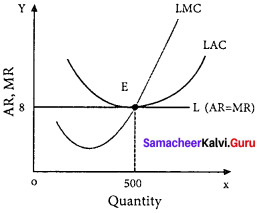
Samacheer Kalvi 11th Accountancy Solutions Chapter 8 Bank Reconciliation Statement

Students can Download Accountancy Chapter 8 Bank Reconciliation Statement Questions and Answers, Notes Pdf, Samacheer Kalvi 11th Accountancy Book Solutions Guide Pdf helps you to revise the complete Tamilnadu State Board New Syllabus and score more marks in your examinations.

Tamilnadu Samacheer Kalvi 11th Accountancy Solutions Chapter 8 Bank Reconciliation Statement

Samacheer Kalvi 11th Accountancy Bank Reconciliation Statement Text Book Back Questions and Answers

I. Multiple Choice Questions
Choose the Correct Answer

Bank Reconciliation Statement Questions And Answers Pdf Question 1.
A bank reconciliation statement is prepared by ………………
(a) Bank
(b) Business
(c) Debtor to the business
(d) Creditor to the business
Answer:
(b) Business

11th Accountancy Chapter 8 Book Back Answers Question 2.
A bank reconciliation statement is prepared with the help of ………………
(a) Bank statement
(b) Cash book
(c) Bank statement and bank column of the cash book
(d) Petty cash book
Answer:
(c) Bank statement and bank column of the cash book

Accountancy Class 11 Chapter 8 Solutions Question 3.
Debit balance in the bank column of the cash book means ………………
(a) Credit balance as per bank statement
(b) Debit balance as per bank statement
(c) Overdraft as per cash book
(d) None of the above
Answer:
(a) Credit balance as per bank statement

Bank Reconciliation Statement Problems And Solutions Pdf Question 4.
A bank statement is a copy of ………………
(a) Cash column of the cash book
(b) Bank column of the cash book
(c) A customer’s account in the bank’s book
(d) Cheques issued by the business
Answer:
(c) A customer’s account in the bank’s book

Bank Reconciliation Statement Questions And Answers Question 5.
A bank reconciliation statement is prepared to know the causes for the difference between:
(a) The balance as per the cash column of the cash book and bank column of the cash book
(b) The balance as per the cash column of the cash book and bank statement
(c) The balance as per the bank column of the cash book and the bank statement
(d) The balance as per petty cash book and the cash book
Answer:
(c) The balance as per the bank column of the cash book and the bank statement

Bank Reconciliation Questions For Class 11 Question 6.
When money is withdrawn from bank, the bank ………………
(a) Credits customer’s account
(b) Debits customer’s account
(c) Debits and credits customer’s account
(d) None of these
Answer:
(b) Debits customer’s account

Bank Reconciliation Statement Class 11 Question 7.
Which of the following is not the salient feature of bank reconciliation statement?
(a) Any undue delay in the clearance of cheques will be shown up by the reconciliation
(b) Reconciliation statement will discourage the accountant of the bank from embezzlement
(c) It helps in finding the actual position of the bank balance
(d) Reconciliation statement is prepared only at the end of the accounting period
Answer:
(d) Reconciliation statement is prepared only at the end of the accounting period

Bank Reconciliation Statement Class 11 Solutions Question 8.
Balance as per cash book is ₹ 2,000. Bank charge of ₹ 50 debited by the bank is not yet shown in the cash book. What is the bank statement balance now?
(a) ₹ 1,950 credit balance
(b) ₹ 1,950 debit balance
(c) ₹ 2,050 debit balance
(d) ₹ 2,050 credit balance
Answer:
(a) ₹ 1,950 credit balance

Bank Reconciliation Statement Questions Question 9.
Balance as per bank statement is ₹ 1,000. Cheque deposited, but not yet credited by the bank is ₹ 2, 000. What is the balance as per bank column of the cash book?
(a) ₹ 3,000 overdraft
(b) ₹ 3,000 favourable
(c) ₹ 1,000 overdraft
(d) ₹ 1,000 favourable
Answer:
(b) ₹ 3,000 favourable

Bank Reconciliation Questions Question 10.
Which one of the following is not a timing difference?
(a) Cheque deposited but not yet credited
(b) Cheque issued but not yet presented for payment
(c) Amount directly paid into the bank
(d) Wrong debit in the cash book
Answer:
(d) Wrong debit in the cash book

II. Very Short Answer Questions

Bank Reconciliation Statement Answers Question 1.
What is meant by bank overdraft?
Answer:
It is not possible to have unfavourable cash balance in the cash book. But, it is possible to have unfavourable balance in the bank account. When the business
is not having sufficient money in its bank account, it can borrow money from the bank. As a result of this, amount is overdrawn from bank.

Accounting Chapter 8 Bank Reconciliation Question 2.
What is bank reconciliation statement?
Answer:
If every entry in the cash book matches with the bank statement, then bank balance will be the same in both the records. But, practically it may not be possible. When the balances do not agree with each other, the need for preparing a statement to explain the causes arises. This statement is called bank reconciliation statement (BRS).

Chapter 8 Bank Reconciliation Question 3.
State any two causes of disagreement between the balance as per bank column of cash book and bank statement.
Answer:
(a) Cheques issued but not yet presented for payment.
(b) Cheques deposited into bank but not yet credited.

Bank Reconciliation Statement Solutions Question 4.
Give any two expenses which may be paid by the banker as per standing instruction.
Answer:
Insurance premium, loan instalment, etc., paid as per standing instructions.

Bank Reconciliation Solutions Question 5.
Substitute the following statements with one word/phrase
(a) A copy of customer’s account issued by the bank.
(b) Debit balance as per bank statement.
(c) Statement showing the causes of disagreement between the balance as per cash book and balance as per bank statement.
Answer:
(a) Pass book
(b) Pass book favourable
(c) (1) Timing difference, (2) Errors in recording

Question 6.
Do you agree on the following statements? Write “yes” if you agree, and write “no” if you disagree.
(a) Bank reconciliation statement is prepared by the banker.
(b) Adjusting the cash book before preparing the bank reconciliation statement is compulsory.
(c) Credit balance as per bank statement is an overdraft.
(d) Bank charges debited by the bank increases the balance as per bank statement.
(e) Bank reconciliation statement is prepared to identify the causes of differences between balance as per bank column of the cash book and balance as per cash column of the cash book.
Answer:
(a) No
(b) No
(c) No
(d) No
(e) Yes

III. Short Answer Questions

Question 1.
Give any three reasons for preparing bank reconciliation statement.
Answer:
The main reasons for preparing bank reconciliation statement are:

  1. To identify the reasons for the difference between the bank balance as per the cash book and bank balance as per bank statement.
  2. To identify the delay in the clearance of cheques.
  3. To ascertain the correct balance of bank column of cash book.

Question 2.
What is meant by the term “cheque not yet presented?”
Answer:
When the cheques are issued by the business, it is immediately entered on the credit side of the cash book by the business. But, this may not be entered in the bank statement on the same day. It will be entered in the bank statement only after it is presented with the bank.

Question 3.
Explain why does money deposited into bank appear on the debit side of the cash book, but on the credit side of the bank statement?
Answer:
When the cheques are deposited into bank, the amount is debited in the cash book on the same day. But, these may not be shown in the bank pass book on the same day because these will be entered in the bank statement only after the collection of the cheques.

Question 4.
What will be the effect of interest charged by the bank, if the balance is an overdraft?
Answer:
The bank has to cover the cost of running the customer’s account. So debit is given to the account of the business towards bank charges. Also, if the business had taken any loan or overdrawn, interest has to be paid by the business. These entries for bank charges and interest are made in the bank statement. But, the entry is made in the cash book only when the bank statement is received by the business. Till then, the Cash book shows more balance than bank statement.

Question 5.
State the timing differences in BRS with examples.
Answer:
The timing differences in BRS are:
(a) cheques issued but not yet presented for payment
(b) cheques deposited into bank but not yet credited
(c) bank charges and interest on loan and overdraft
(d) interest and dividends collected by the bank
(e) dishonour of cheques and bills
(f) amount paid by parties directly into the bank
(g) payment made directly by the bank to others
(h) bills collected by the bank on behalf of its customer

IV. Exercises

Question 1.
From the following particulars prepare a bank reconciliation statement of Jayakumar as on 31st December, 2016. (3 Marks)
(a) Balance as per cash book ₹ 7,130
(b) Cheque deposited but not cleared ₹ 1,000
(c) A customer has deposited ₹ 800 into the bank directly
Answer:
Bank reconciliation statement of Jayakumar as on 31st December, 2016
Bank Reconciliation Statement Questions And Answers Pdf Samacheer Kalvi 11th Accountancy Solutions Chapter 8

Question 2.
From the following particulars of Kamakshi traders, prepare a bank reconciliation statement as on 31st March, 2018. (3 Marks)
(a) Debit balance as per cash book ₹ 10,500
(b) Cheque deposited into bank amounting to ₹ 5,500 credited by bank, but entered twice in the cash book
(c) Cheques issued and presented for payment amounting to ₹ 7,000 omitted in the cash book
(d) Cheque book charges debited by the bank ₹ 200 not recorded in the cash book.
(e) Cash of ₹ 1,000 deposited by a customer of the business in cash deposit machine not recorded in the cash book.
Answer:
Bank reconciliation statement of Kamakshi as on 31st March, 2018
11th Accountancy Chapter 8 Book Back Answers Samacheer Kalvi Bank Reconciliation Statement

Question 3.
From the following information, prepare bank reconciliation statement to find out the bank statement balance as on 31st December, 2017. (5 Marks)
Accountancy Class 11 Chapter 8 Solutions Samacheer Kalvi Bank Reconciliation Statement
Answer:
Bank reconciliation statement as on 31st December, 2017
Bank Reconciliation Statement Problems And Solutions Pdf Samacheer Kalvi 11th Accountancy Solutions Chapter 8

Question 4.
On 31st March, 2017, Anand’s cash book showed a balance of ₹ 1,12,500. Prepare bank reconciliation statement. (5 Marks)
(a) He had issued cheques amounting to ₹ 23,000 on 28.3.2017, of which cheques amounting to ₹ 9,000 have so far been presented for payment.
(b) A cheque for ₹ 6,300 deposited into bank on 27.3.2017, but the bank credited the same only on 5th April 2017.
(c) He had also received a cheque for ₹ 12,000 which, although entered by him in the cash book, was not deposited in the bank.
(d) Wrong credit given by the bank on 30th March 2017 for ₹ 2,000.
(e) On 30th March 2017, a bill already discounted with the bank for ₹ 3,000 was dishonoured, but no entry was made in the cash book.
(f) Interest on debentures of ₹ 700 was received by the bank directly.
(g) Cash sales of ₹ 4,000 wrongly entered in the bank column of the cash book.
Answer:
Bank reconciliation statement of Anand as on 31st March, 2017
Bank Reconciliation Statement Questions And Answers Samacheer Kalvi 11th Accountancy Solutions Chapter 8

Question 5.
From the following particulars of Siva and Company, prepare a bank reconciliation statement as on 31st December, 2017. (2 Marks)
(a) Credit balance as per cash book ₹ 12,000.
(b) A cheque of ₹ 1,200 issued and presented for payment to the bank, wrongly credited in the cash book as ₹ 2,100.
(c) Debit side of bank statement was undercast by ₹ 100.
Answer:
Bank reconciliation statement of Siva and Company as on 31st December, 2017
Bank Reconciliation Questions For Class 11 Samacheer Kalvi Accountancy Solutions Chapter 8

Question 6.
From the following particulars of Raheem traders, prepare a bank reconciliation statement as on 31st March, 2018. (3 Marks)
(a) Overdraft as per cash book ₹ 2,500
(b) Debit side of cash book was undercast by ₹ 700
(c) Amount received by bank through RTGS amounting to ₹ 2,00,000, omitted in the cash book.
(d) Two cheques issued for ₹ 1,800 and ₹ 2,000 on 29th March 2018. Only the second cheque is presented for payment.
(e) Insurance premium on car for ₹ 1,000 paid by the bank as per standing instruction not recorded in the cash book.
Answer:
Bank reconciliation statement of Raheem as on 31st March, 2018
Bank Reconciliation Statement Class 11 Samacheer Kalvi Accountancy Solutions Chapter 8

Question 7.
From the following information, prepare bank reconciliation statement as on 31st December, 2017 to find out the balance as per bank statement. (5 Marks)
Bank Reconciliation Statement Class 11 Solutions Samacheer Kalvi Accountancy Chapter 8
Answer:
Bank reconciliation statement as on 31st December, 2017
Bank Reconciliation Statement Questions Samacheer Kalvi 11th Accountancy Solutions Chapter 8

Question 8.
Prepare bank reconciliation statement from the following data. (5 Marks)
Bank Reconciliation Questions Samacheer Kalvi 11th Accountancy Solutions Chapter 8
Answer:
Bank Reconciliation Statement Answers Samacheer Kalvi 11th Accountancy Solutions Chapter 8

Question 9.
From the following particulars of Veera traders, prepare a bank reconciliation statement as on 31st December, 2017. (2 Marks)
(a) Credit balance as per bank statement ₹ 6,000
(b) Amount received by bank through NEFT for ₹ 3,500, entered twice in the cash book.
(c) Cheque dishonoured amounting to ₹ 2,500, not entered in cash book.
Answer:
Bank reconciliation statement of Veera Traders as on 31st December, 2017
Accounting Chapter 8 Bank Reconciliation Statement 11th Solutions Samacheer Kalvi

Question 10.
Prepare bank reconciliation statement from the following data and find out the balance as per cash book as on 31st March, 2018. (3 Marks)
Chapter 8 Bank Reconciliation Statement Samacheer Kalvi 11th Accountancy Solutions
Answer:
Bank reconciliation statement as on 31st March, 2018
Bank Reconciliation Statement Solutions Samacheer Kalvi 11th Accountancy Chapter 8

Question 11.
Ascertain the cash book balance from the following particulars as on 31st December, 2017: (5 Marks)

  1. Credit balance as per bank statement ₹ 2,500
  2. Bank charges of ₹ 60 have not been entered in the cash book
  3. Cheque deposited on 28th December 2017 for ₹ 1,000 was not yet credited by the bank
  4. Cheque issued on 24th December 2017 for ₹ 700, not yet presented for payment
  5. A dividend of ₹ 400 collected by the bank directly but not entered in the cash book
  6. A cheque of ₹ 600 had been dishonoured, but no entry was made in the cash book
  7. Interest on term loan ₹ 1,200 debited by bank but not accounted in cash book
  8. No entry had been made in the cash book for a trade subscription of ₹ 500 paid vide banker’s order on 23rd December 2014

Answer:
Bank reconciliation statement as on 31st December, 2017
Bank Reconciliation Solutions Samacheer Kalvi 11th Accountancy Chapter 8

Question 12.
From the following particulars of Raja traders, prepare a bank reconciliation statement as on 31st January, 2018. (5 Marks)
(a) Balance as per bank statement ₹ 5,000
(b) Cheques amounting to ₹ 800 had been recorded in the cash book as having been deposited into the bank on 25th January 2018, but were entered in the bank statement on 2nd February 2018.
(c) Amount received by bank through NEFT amounting to ₹ 3,000, omitted in the cash book.
(d) Two cheques issued for ₹ 3,000 and ₹ 2,000 on 29th March 2018. Only the first cheque is presented for payment.
(e) Insurance premium on motor vehicles for ₹ 1,000 paid by the bank as per standing instruction not recorded in the cash book.
(f) Credit side of cash book was undercast by ₹ 700
(g) Subsidy received directly by the bank from the state government amounting to ₹ 10,000, not entered in cash book.
Answer:
Bank reconciliation statement of Raja Traders as on 31st January, 2018
Samacheer Kalvi 11th Accountancy Solutions Chapter 8 Bank Reconciliation Statement

Question 13.
From the following particulars of Simon traders, prepare a bank reconciliation statement as on 31st March, 2018. (2 Marks)
(a) Debit balance as per bank statement ₹ 2,500
(b) Cheques deposited amounting to ₹ 10,000, not yet credited by bank.
(c) Payment through net banking for ₹ 2,000, omitted in the cash book
Answer:
Bank reconciliation statement of Simon Traders as on 31st March, 2018
Samacheer Kalvi 11th Accountancy Solutions Chapter 8 Bank Reconciliation Statement

Question 14.
From the following particulars, ascertain the cash book balance as on 31st December, 2016.

  1. Overdraft balance as per bank statement ₹ 1,26,640 (3 Marks)
  2. Interest on overdraft entered in the bank statement, but not yet recorded in cash book ₹ 3,200
  3. Bank charges entered in bank statement, but not found in cash book ₹ 600
  4. Cheques issued, but not yet presented for payment ₹ 23,360
  5. Cheques deposited into the bank but not yet credited ₹ 43,400
  6. Interest on investment collected by the bank ₹ 24,000

Answer:
Bank reconciliation statement as on 31st December, 2016
Samacheer Kalvi 11th Accountancy Solutions Chapter 8 Bank Reconciliation Statement

Question 15.
From the following particulars of John traders, prepare a bank reconciliation statement as on 31st March, 2018. (5 Marks)
(a) Bank overdraft as per bank statement ₹ 4,000
(b) Cheques amounting to ₹ 2,000 had been recorded in the cash book as having been deposited into the bank on 26th March 2018, but were entered in the bank statement on 4th April 2018.
(c) Amount received by bank through cash deposit machine amounting to ₹ 5,000, omitted in the cash book.
(d) Amount of ₹ 3,000 wrongly debited to John traders account by the bank, for which no details are available.
(e) Bills for collection credited by the bank till 29th March 2017 amounting to ₹ 4,000, but no advice received by John traders.
(f) Electricity charges made through net banking for ₹ 900 was wrongly entered in cash column of the cash book instead of bank column.
(g) Cash sales wrongly recorded in the bank column of the cash book for ₹ 4,000.
Answer:
Bank reconciliation statement of John Traders as on 31st March, 2018
Samacheer Kalvi 11th Accountancy Solutions Chapter 8 Bank Reconciliation Statement

Question 16.
Prepare bank reconciliation statement from the following data. (3 Marks)
Samacheer Kalvi 11th Accountancy Solutions Chapter 8 Bank Reconciliation Statement
Answer:
Bank reconciliation statement
Samacheer Kalvi 11th Accountancy Solutions Chapter 8 Bank Reconciliation Statement

Question 17.
Prepare bank reconciliation statement as on 31st March, 2017 from the following extracts of cash book and bank statement.
Samacheer Kalvi 11th Accountancy Solutions Chapter 8 Bank Reconciliation Statement
Bank Statement
Samacheer Kalvi 11th Accountancy Solutions Chapter 8 Bank Reconciliation Statement
Answer:
Samacheer Kalvi 11th Accountancy Solutions Chapter 8 Bank Reconciliation Statement

Question 18.
A trader received his bank statement on 31st December, 2017 which showed an overdraft balance of ₹ 12,000. On the same day, his cash book showed a debit balance of ₹ 2,000.
Analyse the following transactions. Choose the possible causes and prepare a bank reconciliation statement to show the causes of differences.
(a) Cheque deposited for ₹ 2,000 on 21st December, 2017. Bank credited the same on 26th December, 2017.
(b) Cheque issued for payment on 26th December, 2017 amounting to ₹ 2,500, not yet presented until 31st, December, 2017.
(c) Bank charges amounting to ₹ 200 not yet entered in the cash book.
(d) Online payment for ₹ 1,500 entered twice in the cash book.
(e) Cheque deposited amounting to ₹ 1,000, but omitted in the cash book. The same cheque was dishonoured by bank, but not yet entered in cash book.
(f) Cheque deposited, not yet credited by bank amounting to ₹ 17,800.
Answer:
Bank reconciliation statement as on 31st December, 2017
Samacheer Kalvi 11th Accountancy Solutions Chapter 8 Bank Reconciliation Statement
Note: Transactions (a) and (c) have been entered in both cash book and bank statement also. So we need not false in to accounts.

Textbook Case Study Solved

Magesh, an enthusiastic young entrepreneur, started a business on 1st  December, 2017. He opened a current account with a nationalised bank for his business transaction. In the same bank, he maintains his personal savings bank account too. He did not find time to maintain his cash book. So he appointed a person called Dinesh to take care of bank transactions. But that person was inexperienced.

Question 1.
On 1st December, 2017, the opening balance as per cash book and bank record was the same. On 2nd December, Magesh issued a cheque for ₹ 2,000 to a supplier, but the same was entered in the credit side of the cash book as ₹ 200.
Answer:
Credit balance as per bank statement is ₹ 19,700.

Question 2.
On 3rd, December, Magesh issued his savings bank account cheque for his personal expenses amounting to ₹ 2,500, but Dinesh assumed this as current account cheque and the same was entered in the cash book as drawings.
Answer:
Over casting of debit side of bank column of the cash book is ₹ 1800.

Question 3.
Dinesh was asked to deposit cash of ₹ 1,000 in cash deposit machine in order to make a payment to one of the business’ supplier. He credited the same in the bank column of the cash book.
Answer:
Wrong debit in cash book is ₹ 2,500.

Question 4.
On 15th December, one of his customers made online payment to Magesh’s current account, amounting to ₹ 1,000. There was no entry in the cash book for this.
Answer:
Wrong credit in cash book is ₹ 1,000.
Instead of personal bank account he can open business bank account (i.e.) current account.

Question 5.
Dinesh received his salary in cash for ₹ 5,000. He credited this amount in the bank column of cash book.
Answer:
Online payment no recorded in cash book is ₹ 1,000.

Question 6.
Bank made payment on 23rd December, amounting to ₹ 2,500, as per standing instruction. But, there is no entry in the cash book for the same.
Answer:
Wrong credit in the cash book of bank column is ₹ 5,000.

Question 7.
On 31st, December 2017, Magesh received a bank statement from his bank, which showed a credit balance of ₹ 19,700. He instructed Dinesh to check the statement with the cash book. On comparing both, Dinesh found that the cash book showed a balance of ₹ 14,500. He was puzzled. He needs your help to reconcile the balances.
Answer:
Insurance premium paid but not entered in cash book is ₹ 2,500.
Bank reconciliation cash book as on 31st December 2017
Samacheer Kalvi 11th Accountancy Solutions Chapter 8 Bank Reconciliation Statement

Samacheer Kalvi 11th Economics Solutions Chapter 4 Cost and Revenue Analysis

Immediately get Chapter Wise Tamilnadu State Board Solutions for 11th Economics to gain more marks and start Quick Revision of all Chapters. All Chapters Pdf is provided along with the Questions and Answers. You Can Dowload Samacheer Kalvi 11th Economics Book Solutions Questions and Answers for Chapter wise are given with a clear explanation. Tamilnadu State Board Solutions for 11th Economics Chapter 4 Cost and Revenue Analysis Questions and Answers is for free of cost.

Tamilnadu Samacheer Kalvi 11th Economics Solutions Chapter 4 Cost and Revenue Analysis

Tamilnadu State Board Solutions for 11th Economics Chapter 4 Cost and Revenue Analysis Questions and Answers PDF has all given in Chapter Wise Section. Check Out daily basis with Tamilnadu State Board Solutions 11th Economics PDF will help to improve your score. Improve your level of accuracy to answer a question by reading with Samacheer Kalvi 11th Economics Book Solutions Questions and Answers PDF.

Samacheer Kalvi 11th Economics Cost and Revenue Analysis Text Book Back Questions and Answers

Part – A

11th Economics Chapter 4 Book Back Answers Multiple Choice Questions

11th Economics Chapter 4 Question 1.
Cost refers to _______
(a) price
(b) value
(c) fixed cost
(d) cost of production
Answer:
(d) cost of production

Cost And Revenue In Economics Class 11 Question 2.
Cost functions are also known as …………………….. function.
(a) Production
(b) Investment
(c) Demand
(d) Consumption
Answer:
(a) Production

Cost And Revenue In Economics Question 3.
Money cost is also known as _______ cost.
(a) explicit
(b) implicit
(c) social
(d) real
Answer:
(a) explicit

Cost And Revenue Analysis Question 4.
Explicit cost plus implicit cost denote ………………… cost.
(a) Social
(b) Economic
(c) Money
(d) Fixed
Answer:
(b) Economic

Samacheer Kalvi Guru 11 Economics Question 5.
Explicit costs are termed as
(a) out of pocket expenses
(b) social cost
(c) real cost
(d) sunk cost
Answer:
(a) out of pocket expenses

Cost And Revenue Analysis In Economics Question 6.
The costs of self – owned resources are termed as ……………………… cost.
(a) Real
(b) Explicit
(c) Money
(d) Implicit
Answer:
(d) Implicit

Cost And Revenue Questions Question 7.
The cost that remains constant at all levels of output is _______ cost.
(a) fixed
(b) variable
(c) real
(d) social
Answer:
(a) fixed

Cost And Revenue Analysis In Economics Pdf Question 8.
Identify the formula for estimating average variable cost.
(a) TC/Q
(b) TVC/Q
(c) TFC/Q
(d) TAC/Q
Answer:
(b) TVC/Q

Samacheer Kalvi Guru 11th Economics Question 9.
The cost incurred by producing one more unit of output is _______ cost.
(a) variable
(b) fixed
(c) marginal
(d) total
Answer:
(c) marginal

Question 10.
The cost that varies with the level of output is termed as …………………. cost.
(a) Money
(b) Variable cost
(c) Total cost
(d) Fixed cost
Answer:
(b) Variable cost

Question 11.
Wage is an example for _______ cost of the production.
(a) fixed
(b) variable
(c) marginal
(d) opportunity
Answer:
(b) variable

Question 12.
The cost per unit of output is denoted by …………………… cost.
(a) Average
(b) Marginal
(c) Variable
(d) Total
Answer:
(a) Average

Question 13.
Identify the formula of estimating average cost.
(a) AVC/Q
(b) TC/Q
(c) TVC/Q
(d) AFC/Q
Answer:
(b) TC/Q

Question 14.
Final total cost where TFC = 100 and TVC = 125.
(a) 125
(b) 175
(c) 225
(d) 325
Answer:
(c) 225

Question 15.
Long-run average cost curve is also called as _______ curve.
(a) demand
(b) planning
(c) production
(d) sales
Answer:
(b) planning

Question 16.
Revenue received from the sale of products is known as …………………….. revenue.
(a) Profit
(b) Total revenue
(c) Average
(d) Marginal
Answer:
(b) Total revenue

Question 17.
Revenue received from the sale of an additional unit is termed as _______ revenue.
(a) profit
(b) average
(c) marginal
(d) total
Answer:
(c) marginal

Question 18.
Marginal revenue is the addition made to the ……………………….
(a) Total sales
(b) Total revenue
(c) Total production
(d) Total cost
Answer:
(b) Total revenue

Question 19.
When price remains constant, AR will be _______ MR.
(a) equal to
(b) greater than
(c) less than
(d) not related to
Answer:
(a) equal to

Question 20.
A bookseller sold 40 books with a price of ₹10 each. The total revenue of the sellers is ₹ …………………….
(a) 100
(b) 200
(c) 300
(d) 400
Answer:
(d) 400

Part – B

Answer the following questions in one or two sentences

Question 21.
Define cost.
Answer:
Cost refers to the total expenses incurred in the production of a commodity.

Question 22.
Define cost function?
Answer:
The functional relationship between cost and output is expressed as ‘Cost Function’.
A Cost Function may be written as
C = f (Q)
Eg: TC = Q3 – 18Q2 + 91Q + 12
Where, C = Cost, and Q = quantity of output. Cost functions are derived functions because they are derived from Production Functions.

Question 23.
What do you mean by fixed cost?
Answer:
Fixed cost does not change with the change in the quantity of output. The expenses on fixed factors remain unchanged irrespective of the level of output and these expenses are called fixed cost.

Question 24.
Define Revenue?
Answer:
The amount of money that a producer receives in exchange for the sale of goods is known as revenue. In short, revenue means sales revenue. It is the amount received by a firm from the sale of a given quantity of a commodity at the prevailing price in the market.

Question 25.
Explicit Cost – Define.
Answer:
Explicit cost refers to the actual expenditures of the firm to purchase or hire the inputs.

Question 26.
Give the definition for ‘Real Cost’?
Answer:
Real Cost refers to the payment made to compensate for the efforts and sacrifices of all factor owners for their services in production. Real Cost includes the efforts and sacrifices of landlords in the use of land, capitalists to save and invest, and workers in foregoing leisure. Real costs are considered pains and sacrifices of labour as the real cost of production.

Question 27.
What is meant by Sunk cost?
Answer:
A cost incurred in the past and cannot be recovered in the future is called a sunk cost.

Part – C

Answer the following questions in One Paragraph

Question 28.
Distinguish between fixed cost and variable cost.
Answer:
Fixed Cost:

  1. Does not change with the change in the quantity of output.
  2. It is also called as ‘Supplementary cost’ or ‘Overhead cost’.
    (Eg.) Rent of the factory, Permanent worker’s salary.

Variable Cost:

  1. These costs vary with the level of output
  2. It is also called as ‘Prime cost’, ‘Special cost’ or ‘Direct cost’.
    (Eg.) Cost of raw materials, Temporary worker’s salary.

Question 29.
State the differences between money cost and real cost.
Answer:
Money Cost:

  1. It is the total money expenses incurred by a firm in producing a commodity.
  2. It includes the cost of raw materials, payments of wages and salaries, rent, interest, etc.,
  3. It is also called as prime cost or direct cost or nominal cost.

Real Cost:

  1. It refers to the payment made to compensate for the efforts and sacrifices of all factor owners for their services in production.
  2. It includes the efforts and sacrifices of factors of production.
  3. Landlords effort is the use of land, capitalists to save and invest and workers in foregoing leisure.

Question 30.
Distinguish between explicit cost and implicit cost.
Answer:
Explicit Cost:

  1. Payment made to others for the purchase of factors of production.
  2. It includes wages, payment for raw material, rent, interest, expenditure on transport and advertisement.
  3. It is also called as accounting cost or out of pocket cost or money cost.

Implicit Cost:

  1. Payment made to the use of resources that the firm already owns.
  2. Cash payment is not made for the use of producer’s own land, building, machinery and other factors of production.
  3. Implicit cost is also called as imputed cost or book cost.

Question 31.
Define opportunity cost and provide an example?
Answer:

  1. Opportunity cost refers to the cost of the next best alternative use. In other words, it is the value of the next best alternative foregone.
  2. For example, a farmer can cultivate both paddy and sugarcane in farmland.
  3. If he cultivates paddy, the opportunity cost of paddy output is the amount of sugarcane output given up.
  4. Opportunity Cost is also called as “Alternative Cost” or Transfer cost.

Question 32.
Stale the relationship between AC and MC.
Answer:
There is a unique relationship between the AC and MC curves.

Samacheer Kalvi 11th Economics Solutions Chapter 4 Cost and Revenue Analysis 1

  1. When AC is falling, MC lies below AC.
  2. When AC becomes constant, MC also becomes equal to it.
  3. When AC starts increasing, MC lies above the AC.
  4. MC curve always cuts AC at its minimum point from below.

Question 33.
Write a short note on Marginal Revenue?
Answer:

  1. Marginal Revenue [MR] is the addition to the total revenue by the sale of an additional unit of a commodity.
  2. MR can be found out by dividing change in total revenue by the change in quantity sold out.
  3. MR = ∆TR/∆Q where MR denotes Marginal Revenue, ∆TR denotes change in Total Revenue and ∆Q denotes change in total quantity.
  4. The other method of estimating MR is:

MR = TRn – TRn-1, (or) TRn+1 – TRn
Where, MR denotes Marginal Revenue,
TRn denotes total revenue of nth item,
TRn-1 denotes Total Revenue of n – 1th item and
TRn+1 denotes Total Revenue of n + 1th item.
If TR = PQ,
MR = dTR/dQ = P, which is equal to AR.

Question 34.
Discuss the Long run cost curves with a suitable diagram.
Answer:
In the long run all factors of production become variable. 1 he existing size of the firm can be increased. There are neither fixed inputs nor fixed costs in the long run.
Samacheer Kalvi 11th Economics Solutions Chapter 4 Cost and Revenue Analysis 2
LAC = LTC/Q
LAC – Long-run average cost LTC – Long-run total cost
Q – denotes the quantity of output.
The LAC curve is derived from short run average cost curves. It is the locus of points denoting the least cost curve of producing the corresponding output.
The LAC curve is called as ‘Planning curve’ or ‘Envelope curve’

Part – D
Answer the following questions in about a page

Question 35.
If total cost =10+Q3, find out AC, AVC, TFC, AFC when Q = 5.
Answer:
TC = 10 + Q3
AC = \(\frac { TC }{ Q } \)
AC = \(\frac{10+Q^{3}}{Q}\)
If Q=5, Q = 5 × 5 × 5 = 125
AC = \(\frac { 10 + 125 }{ 5 } \) = \(\frac { 135 }{ 5 } \) = 27

AVC:
TC = 10 + Q3
TC = TFC + TVC
TVC = Q3
AVC = \(\frac { TVC }{ Q } \)
= \(\frac{Q^{3}}{Q} = Q\)2
If Q = 5, then AVC = 52
AVC = 25

TFC:
TC = 10 + Q3
TC = TFC + TVC
TFC = 10

AFC:
AFC = \(\frac { TFC }{ Q } \)
= \(\frac { 10 }{ 5 } \)
AFC = 2

Question 36.
Discuss the short run cost curves with suitable diagram :
Answer:
1. Total fixed cost: TFC
All payments for the fixed factors of production are known as total fixed cost. It does not change with output.

2. Total variable cost: TVC
All payments to the variable factors of production is called as total variable cost. As output increases TVC also increases.

3. Total cost curves: TC
Total cost means the sum total of all payments made in the production. It is the total cost of production.
TC = TFC + TVC.

4. Average fixed cost: AFC
It refers to the fixed cost per unit of output.
AFC = \(\frac { TFC }{ Q } \)

5. Average variable cost: AVC
It refers to the total variable cost per unit of output.
AVC = \(\frac { TFC }{ Q } \)

6. Average cost:
It refers to the total cost per unit of output.
AC = \(\frac { TC }{ Q } \) (or) AC = AFC + AVC

Samacheer Kalvi 11th Economics Solutions Chapter 4 Cost and Revenue Analysis 3

  1. ATC curve is also a ‘U’ shaped curve.
  2. Initially ATC declines, reaches a minimum and rises beyond the optimum output.
  3. The ‘U’ shape of the AC reflects the law of the variable proportions.

Marginal Cost:
Marginal cost is the additional made to the total cost by producer one extra unit of output
Samacheer Kalvi 11th Economics Solutions Chapter 4 Cost and Revenue Analysis 4

Question 37.
Bring out the relationship between AR and MR curves under various price conditions.
Answer:
If a firm is able to sell additional units at the same price then AR and MR will be constant. If the firm sells its additional units only by reducing the price then both AR and MR will fall and be different.

Constant AR and MR: (at fixed price)
If price remains constant, MR also remain constant and coincide with AR. Under perfect competition as the price is constant, AR is equal to MR and their shape will be straight line horizontal to X axis.
TR – AR – MR – Constant price
Samacheer Kalvi 11th Economics Solutions Chapter 4 Cost and Revenue Analysis 5
Declining AR and MR: (at declining price)

When a firm sells large quantities at lower prices both AR and MR will fall. But the fall in MR will be more steeper than the fall in the AR and MR lies below AR.

The MR curve divides the distance between AR curve and Y axis into two equal parts. The decline in AR need not be a straight line or linear. If the prices are declining with the increase in quantity sold, the AR can be non-linear may be concave or convex to the origin

Samacheer Kalvi 11th Economics Solutions Chapter 4 Cost and Revenue Analysis 6

AR,TR,MR declining price

Samacheer Kalvi 11th Economics Solutions Chapter 4 Cost and Revenue Analysis 7

Samacheer Kalvi 11th Economics Cost and Revenue Analysis Additional Questions and Answers

Part – A

Choose the best options

Question 1.
Real Costis ……………………
(a) Pain and sacrifice
(b) Subjective concept
(c) Efforts and foregoing leisure
(d) All the above
Answer:
(d) All the above

Question 2.
Average fixed cost is obtained by _______
(a) TC / Q
(b) TFC / Q
(c) TVC / Q
(d) None of the above
Answer:
(b) TFC / Q

Question 3.
The Marginal Cost curve is ……………………..
(a) V-shaped
(b) Upward
(c) Downward
(d) U – shaped
Answer:
(d) U – shaped

Question 4.
Total fixed cost + Total variable cost is?
(a) AC-MC
(b) TC-AC
(c) TC
(d) None
Answer:
(c) TC

Question 5.
What is break-even point?
(a) No profit no loss point
(b) No profit
(c) No loss
(d) Profit – point
Answer:
(a) No profit no loss point

Question 6.
Break-Even point is _______
(a) Total cost and total revenue
(b) Average revenue and financial revenue
(c) No profit – no loss point
(d) All the above
Answer:
(c) No profit – no loss point

Question 7.
What is the other name for “Opportunity Cost”?
(a) Real Cost
(b) Money Cost
(c) Economic Cost
(d) Social Cost
Answer:
(a) Real Cost

Question 8.
Average variable cost is _______
(a) TFC / Q
(b) TVC / Q
(c) TC / Q
(d) None
Answer:
(b) TVC / Q

Question 9.
…………………….. revenue means price of the product.
(a) Total
(b) Marginal
(c) Profit
(d) Average
Answer:
(d) Average

Question 10.
Cost function is the
(a) Relationship between total cost and output
(b) Relationship between revenue and cost
(c) Relationship between wages and interest d. None of the above
(d) None of this above
Answer:
(a) Relationship between total cost and output

Question 11.
Match the following
Samacheer Kalvi 11th Economics Solutions Chapter 4 Cost and Revenue Analysis 8
(a) 1 – (iv), 2 – (i), 3 – (iii), 4 – (ii)
(b) 1 – (iv), 2 – (i), 3 – (ii), 4 – (iii)
(c) 1 – (ii), 2 – (iii), 3 – (iv), 4 – (i)
(d) 1 – (iii), 2 – (iv), 3 – (i), 4 – (ii)
Answer:
(b) 1 – (iv), 2 – (i), 3 – (ii), 4 – (iii)

Match the following and choose the answer using the codes given below

Question 1.
Samacheer Kalvi 11th Economics Solutions Chapter 4 Cost and Revenue Analysis 9
(a) 1 2 3 4
(b) 3 4 1 2
(c) 2 3 4 1
(d) 4 3 1 2
Answer:
(b) 3 4 1 2

Question 2.
Samacheer Kalvi 11th Economics Solutions Chapter 4 Cost and Revenue Analysis 10
(a) 3 4 2 1
(b) 1 2 3 4
(c) 2 3 4 1
(d) 4 3 1 2
Answer:
(a) 3 4 2 1

Question 3.
Samacheer Kalvi 11th Economics Solutions Chapter 4 Cost and Revenue Analysis 11
(a) 2 3 4 1
(b) 3 4 2 1
(c) 1 2 3 4
(d) 4 3 2 1
Answer:
(d) 4 3 2 1

Question 4.
Samacheer Kalvi 11th Economics Solutions Chapter 4 Cost and Revenue Analysis 12
(a) 2 3 4 1
(b) 2 1 4 3
(c) 4 3 2 1
(d) 2 4 1 3
Answer:
(b) 2 1 4 3

Choose the correct statement

Question 5.
(a) In the long run, all the factors are fixed
(b) The LAC curve is called an envelope curve.
(c) LAC is equal to the long-run total cost
(d) LAC curve cannot be derived from short-run cost curves
Answer:
(b) The LAC curve is called as an envelope curve.

Question 6.
(a) Revenue means the price of the product.
(b) Marginal revenue is equal to the price of the product.
(c) Revenue means sales revenue d. Average revenue is the total income of the firm.
(d) Average revenue is the total income of the firm
Answer:
(c) Revenue means sales revenue d. Average revenue is the total income of the firm.

Choose the incorrect pair

Question 7.
Samacheer Kalvi 11th Economics Solutions Chapter 4 Cost and Revenue Analysis 13
Answer:
(d) MR is infinity (iv) TR is decreasing

Question 8.
Samacheer Kalvi 11th Economics Solutions Chapter 4 Cost and Revenue Analysis 14
Answer:
(a) ATC  – (1) TCn – TCn-1

Analyze the reason for the following

Question 9.
Assertion (A) : If AR remains constant MR is also constant.
Reason (R) : MR is the addition made to the TR by the sale of an additional unit of a commodity.
(a) Both (A) and (R) are true, (R) is the correct explanation of (A)
(b) Both (A) and (R) are true, (R) is not the correct explanation of (A)
(c) Both (A) and (R) are false.
(d) (A) is true (R) is false.
Answer:
(b) Both (A) and (R) are true, (R) is not the correct explanation of (A)

Question 10.
Assertion (A) : Real cost refers to the payment made to compensate the efforts and sacrifice of all factor owners.
Reason (R) : Adam Smith regarded pain and sacrifice of labour as real cost of production.
(a) Both (A) and (R) are true, (R) is the correct explanation of (A)
(b) Both (A) and (R) are true, (R) is not the correct explanation of (A)
(c) Both (A) and (R) are false.
(d) (A) is false (R) is true.
Answer:
(a) Both (A) and (R) are true, (R) is the correct explanation of (A)

Choose the incorrect statement

Question 11.
(a) When AC is falling, MC lies below AC.
(b) When AC becomes constant, MC also equal to it.
(c) When AC starts increasing, MC lies above the AC.
(d) MC never cuts AC curve.
Answer:
(d) MC never cuts AC curve.

Question 12.
(a) MR is equal to zero and TR is decreasing
(b) AR and MR curve depends upon the elasticity of AR curve
(c) When price elasticity is greater than one, MR is positive
(d) When price elasticity is less than one, MR is negative
Answer:
(a) MR is equal to zero and TR is decreasing

Choose the odd one out

Question 13.
(a) Money cost
(b) Total variable
(c) Real cost
(d) prime cost
Answer:
(b) Total variable

Question 14.
(a) When P = 3, Q = 8 then TR = 24
(b) When P = Q = 1 then TR = 10
(c) When P = 4, Q = 6 then TR = 27
(d) When P = 5, Q = 7 then TR = 35
Answer:
(c) When P = 4, Q = 6 then TR = 27

Fill in the blanks with the suitable option given below

Question 15.
Economics profit is ______
(a) TR – TC
(b) TC – TR
(c) AC – MC
(d) None
Answer:
(a) TR – TC

Question 16.
Cost function is the ________
(a) Relationship between total cost and output
(b) Relationship between revenue and cost
(c) Relationship between wages and interest
(d) None of the above
Answer:
(a) Relationship between total cost and output

Question 17.
Break – even point is _________
(a) Total cost and total revenue
(b) Average revenue and financial revenue
(c) No profit – No loss point
(d) All the above
Answer:
(c) No profit – No loss point

Choose the best option

Question 18.
Average fixed cost is obtained by
(a) TC / Q
(b) TVC / Q
(c) AC / Q
(d) TFC / Q
Answer:
(d) TFC / Q

Question 19.
Long-run average cost curve can also be called as _____
(a) Planning curve
(b) Envelope curve
(c) Boat-shaped curve
(d) All the above
Answer:
(d) All the above

Question 20.
Total fixed cost + Total variable cost is _____
(a) AC – MC
(b) TC
(c) TC – AC
(d) None
Answer:
(b) TC

Part – B

Answer the following questions in one or two sentences

Question 1.
Give the definition for Economic Cost?
Answer:

  1. Economic cost refers to all payments made to the resources owned and purchased or hired by the firm in order to ensure their regular supply to the process of production. It is the summation of explicit and implicit costs.
  2. Economic Cost is relevant to calculate the normal profit and thereby the economic profit of a firm.

Question 2.
What is the economic cost?
The economic cost is the summation of explicit and implicit costs.

Question 3.
What is the Average Variable Cost?
Answer:
The average variable cost refers to the total variable cost per unit of output. It is obtained by dividing total variable cost (TVC) by the quantity of output [Q], AVC = TVC/Q, where AVC denotes Average variable cost, TVC denotes total variable cost and Q denotes the quantity of output.

Question 4.
What is a floating cost?
Answer:
Floating cost refers to all expenses that are directly associated with business activities but not with asset creation.

Question 5.
What are variable costs?
Answer:
Variable cost vary with the level of output. It is also called as prime cost, special cost or direct cost.

Question 6.
What is total revenue?
Answer:
Total revenue is the amount of income received by the firm from the sale of its products.

Question 7.
What is marginal revenue?
Answer:
Marginal revenue is the addition to the total revenue by the sale of an additional unit of a commodity.
MR = TRn – TRn-1

Part – C

Answer the following questions in One Paragraph

Question 1.
How can you calculate average fixed cost ?
Answer:
Average fixed cost is the fixed cost per unit of output. It is obtained by dividing the total fixed cost by the quantity of output.
AFC = \(\frac { TFC }{ Q } \)
(Eg.) If TFC is 100;
Q = 10 Find AFC
AFC = \(\frac { TFC }{ Q } \)
= \(\frac { 1000 }{ 10 } \)
AFC = 100.

Question 2.
Define the Prime Cost?
Answer:

  1. All costs that vary with output, together with the cost of administration are known as Prime Cost.
  2. Prime Cost = Variable Costs + Costs of Administration.

Question 3.
Write a note on average revenue.
Answer:
Average revenue is the revenue per unit of the commodity sold. It is calculated by dividing the total revenue (TR) by the number of units sold (Q).
AR = \(\frac { TR }{ Q } \)
If TR = PQ
AR = \(\frac { PQ }{ Q } \) = P
AR = P
AR – Average revenue, TR – Total revenue, Q – quantity of unit sold.

If you need some more information about Tamilnadu State Board Solutions for 11th Economics Chapter 4 Cost and Revenue Analysis Questions and Answers then visit our site frequently and get all the resources that you look for. Also, share this page with your friends and make them learn all the concepts thoroughly before the exams.

Samacheer Kalvi 11th Maths Solutions Chapter 2 Basic Algebra Ex 2.3

You can Download Samacheer Kalvi 11th Maths Book Solutions Guide Pdf, Tamilnadu State Board help you to revise the complete Syllabus and score more marks in your examinations.

Tamilnadu Samacheer Kalvi 11th Maths Solutions Chapter 2 Basic Algebra Ex 2.3

11th Maths Exercise 2.3 Question 1.
Represent the following inequalities in the interval notation:
Solution:
11th Maths Exercise 2.3 Solutions Chapter 2 Basic Algebra Samacheer Kalvi
⇒ x ∈ [-1, 4)

[] closed interval, end points are included
() ➝ open interval
end points are excluded

(ii) x ≤ 5 and x ≥ -3[i] x ≤ 5 and x ≥ -3
Solution:
11th Maths Exercise 2.3 Answers Solutions Chapter 2 Basic Algebra Samacheer Kalvi
x ∈ [-3, 5)

(iii) x < -1 or x < 3
Solution:
11th Maths Chapter 2 Solution Samacheer Kalvi Basic Algebra Ex 2.3
x ∈ (-∞, -1) or x ∈ (-∞, 3)

(iv) – 2x > 0 or 3x – 4 < 11
Solution:
-2x > 0 ⇒ 2x < 0 ⇒ x < 0
x ∈ (-∞, 0)
3x – 4 < 11
⇒ 3x – 4 + 4 < 11 + 4
Samacheer Kalvi 11th Maths Solution Chapter 2 Basic Algebra Ex 2.3

11th Maths Exercise 2.3 Answers Question 2.
Solve 23x < 100 when
(i) x is a natural number,
(ii) x is an integer.
Solution:
23x <100
Samacheer Kalvi 11th Maths Example Sums Solutions Chapter 2 Basic Algebra Ex 2.3
(i.e.,) x > 4.3
(i) x = 1, 2, 3, 4 (x ∈ N)
(ii) x = …. -3, -2, -1, 0, 1, 2, 3, 4 (x ∈ Z)

11th Maths Chapter 2 Solution Samacheer Kalvi Question 3.
Solve -2x ≥ 9 when
(i) x is a real number,
(ii) x is an integer,
(iii) x is a natural number.
Solution:
-2x > 9 ⇒ 2x ≤ -9
Samacheer Kalvi 11th Maths Solutions Chapter 2 Basic Algebra Ex 2.3
(ii) x = …. -3, -2, -1, 0, 1, 2, 3, 4
(iii) x = 1, 2, 3, 4

Samacheer Kalvi 11th Maths Solution Question 4.
Samacheer Kalvi Class 11 Maths Solutions Chapter 2 Basic Algebra Ex 2.3
Solution:
Samacheer Kalvi 11 Maths Solutions Chapter 2 Basic Algebra Ex 2.3

(ii)
Samacheer Kalvi 11th Maths Answers Solutions Chapter 2 Basic Algebra Ex 2.3
Solution:
Samacheer Kalvi Guru 11th Maths Solutions Chapter 2 Basic Algebra Ex 2.3

Samacheer Kalvi 11th Maths Example Sums Question 5.
To secure A grade one must obtain an average of 90 marks or more in 5 subjects each of maximum 100 marks. If one scored 84, 87, 95, 91 in first four subjects, what is the minimum mark one scored in the fifth subject to get A grade in the course?
Solution:
Required marks = 5 × 90 = 450
Total marks obtained in 4 subjects = 84 + 87+95 + 91 = 357
So required marks in the fifth subject = 450 – 357 = 93

Samacheer Kalvi 11th Maths Solutions Question 6.
A manufacturer has 600 litres of a 12 percent solution of acid. How many litres of a 30 percent acid solution must be added to it so that the acid content in the resulting mixture will be more than 15 percent but less than 18 percent?
Solution:
12% solution of acid in 600 l ⇒ 600 × \(\frac{12}{100}\) = 72 l of acid
15% of 600 l ⇒ 600 × \(\frac{15}{100}\) = 90 l
18% of 600 l ⇒ 600 × \(\frac{18}{100}\) = 108 l
Let x litres of 18% acid solution be added
11th Maths Solutions Samacheer Kalvi Chapter 2 Basic Algebra Ex 2.3
(600 + x)15 ≥ 7200 + 30x
9000+ 15x ≥ 7200 + 30x
1800 ≥ 15x
x ≤ 120
Let x litres of 18% acid solution be added
11th Maths Samacheer Kalvi Solutions Chapter 2 Basic Algebra Ex 2.3
10800 + 18 ≤ 7200 + 30x
3600 ≤ 12x
x > 300
The solution is 120 ≤ x > 300

Samacheer Kalvi Class 11 Maths Solutions Question 7.
Find all pairs of consecutive odd natural numbers both of which are larger than 10 and their sum is less than 40.
Solution:
Let the two numbers be x and x + 2
x + x + 2 < 40
⇒ 2x < 38
Samacheerkalvi.Guru 11th Maths Solutions Chapter 2 Basic Algebra Ex 2.3
⇒ x< 19 and x > 10
so x = 11 ⇒ x + 2 = 13
x = 13 ⇒ x + 2 = 15
x = 15 ⇒ x + 2 = 17
When x = 17 ⇒ x + 2 = 19
So the possible pairs are (11, 13), (13, 15), (15, 17), (17, 19)

Samacheer Kalvi 11 Maths Solutions Question 8.
A model rocket is launched from the ground. The height h of the rocket after t seconds from lift off is given by h(t) = -5t2 + 100t; 0 ≤ r ≤ 20. At what time the rocket is 495 feet above the ground?
Solution:
h(t) = -5t2 + 1oot
at t = 0, h(0) = 0
at t = 1, h(1) = -5 + 100 = 95
at t = 2, h(2) = -20 + 200 = 180
at t =3, h(3) = -45 + 300 = 255
at t = 4, h(4) = -80 + 400 = 320
at t = 5, h(5) = -125 + 500 = 375
at t = 6, h(6) = – 180 + 600 = 420
at t = 7, h(7) = -245 + 700 = 455
at t = 8, h(8) = – 320 + 800 = 480
at t = 9, h(9) = -405 + 900 = 495
So, at 9 secs, the rocket is 495 feet above the ground.

Samacheer Kalvi 11th Maths Answers Question 9.
A Plumber can be paid according to the following schemes: In the first scheme he will be paid Rs. 500 plus Rs.70 per hour, and in the second scheme he will be paid Rs. 120 per hour. If he works x hours, then for what value of x does the first scheme give better wages?
Solution:
I scheme with x hr
500 + (x- 1) 70 = 500 + 70x – 70
= 430 + 70x
II scheme with x hours
120x
Here I > II
⇒ 430 + 70x > 120x
⇒ 120x – 70x < 430
50x < 430
\(\frac{50 x}{50}<\frac{430}{50}\)
x < 8.6 (i.e.) when x is less than 9 hrs the first scheme gives better wages.

Samacheer Kalvi Guru 11th Maths Question 10.
A and B are working on similar jobs but their annual salaries differ by more than Rs 6000. If B earns Rs. 27000 per month, then what are the possibilities of A’s salary per month?
Solution:
A’s monthly salary = ₹ x
B’s monthly salary = ₹ 27000
Their annual salaries differ by ₹ 6000
A’s salary – 27000 > 6000
A’s salary > ₹ 33000
B’s salary – A’s salary > 6000
27000 – A’s salary > 6000
A’s salary < ₹ 21000
A’s monthly salary will be lesser than ₹ 21,000 or greater than ₹ 33,000

Samacheer Kalvi 11th Maths Solutions Chapter 2 Basic Algebra Ex 2.3 Additional Questions

11th Maths Solutions Samacheer Kalvi Question 1.
Samacheer Kalvi Guru 11th Maths Solution Chapter 2 Basic Algebra Ex 2.3
Solution:
Samacheer Kalvi 11th Maths Solutions Chapter 2 Basic Algebra Ex 2.3
Multiplying both sides by 30, we get 15x ≥ 2(4x – 1) ⇒ 15x ≥ 8x – 2⇒ 15x – 8x ≥ -2
Maths Solution Class 11 Samacheer Kalvi Chapter 2 Basic Algebra Ex 2.3
Ex 2.3 Class 11 Samacheer Kalvi Maths Solutions Chapter 2 Basic Algebra

11th Maths Samacheer Kalvi Solutions Question 2.
Ravi obtained 70 and 75 marks in first two unit tests. Find the minimum marks he should get in the third test to have an average of at least 60 marks.
Solution:
Let x be the marks obtained by Ravi in the third test.
Chapter 2 Maths Class 11 Exercise 2.3 Basic Algebra Samacheer Kalvi
⇒ 145 + x ≥ 180 ⇒ x >180 – 145
⇒ x ≥ 35
Thus, Ravi must obtain a minimum of 35 marks to get an average of at least 60 marks.
Note. A minimum of 35 marks.
⇒ Marks greater than or equal to 35.

Samacheerkalvi.Guru 11th Maths Question 3.
To receive Grade ‘A’ in a course, one must obtain an average of 90 marks or more in five examinations (each of 100 marks). If Sunita’s marks in first four examinations are 87, 92, 94 and 95, find minimum marks that Sunita must obtain in fifth examination to get Grade ‘A’ in the course.
Solution:
Let x be the marks obtained by Sunita in the fifth examination. Then,
Samacheer Kalvi 11th Maths Solutions Chapter 2 Basic Algebra Ex 2.3 55
⇒ 368 + x ≥ 450 ⇒ x ≥ 450 – 368
⇒ x ≥ 82
Thus, Sunita must obtain marks greater than or equal to 82,
i. e., a minimum of 82 marks.

Samacheer Kalvi Guru 11th Maths Solution Question 4.
Find the pairs of ceonsecutive odd positive integers both of which are smaller than 10 such that their sum is more than 11.
Solution:
Let x be the smaller of the two consecutive odd positive integers, then the other is x + 2 .
According to the given conditions.
x < 10, x + 2 < 10 and x + (x + 2) > 11
⇒ x < 10, x < 8
Samacheer Kalvi 11th Maths Solutions Chapter 2 Basic Algebra Ex 2.3 56
From (1) and (2), we get 9
\(\frac{9}{2}\) < x < 8
Also, x is an odd positive integer. x can take values 5 and 7.
So, the required possible pairs will be (x, x + 2) = (5, 7), (7, 9)

Samacheer Kalvi 11th Maths Question 5.
Find all pairs of consecutive even positive integers, both of which are larger than 5 such that their sum is less than 23.
Solution:
Let x be the smaller of the two consecutive even positive integers, then the other is x + 2. According to the given conditions.
Samacheer Kalvi 11th Maths Solutions Chapter 2 Basic Algebra Ex 2.3 57
Also, x is an even positive integer.
x can take the values 6, 8 and 10.
So, the required possible pairs will be (x, x + 2) = (6, 8), (8, 10), (10, 12)

Maths Solution Class 11 Samacheer Kalvi Question 6.
Forensic Scientists use h = 61.4 + 2.3F to predict the height h in centimetres for a female whose thigh bone (femur) measures F cm. If the height of the female lies between 160 to 170 cm find the range of values for the length of the thigh bone?
Solution:
Given h = 61.4 + 2.3 F
Given h = 160 ⇒ 160 = 61.4 + 2.3 F
⇒ 2.3 F = 160 – 61.4 = 98.6
Samacheer Kalvi 11th Maths Solutions Chapter 2 Basic Algebra Ex 2.3 58
Given h = 170 ⇒ 170 = 61.4 + 2.3 F
⇒ 170 – 61.4 = 2.3 F
2.3F = 108.6
Samacheer Kalvi 11th Maths Solutions Chapter 2 Basic Algebra Ex 2.3 59
So the ranges of values are 42.87 < x < 47.23

Samacheer Kalvi 11th Bio Zoology Solutions Chapter 2 Kingdom Animalia

Students who are in search of 11th Bio Zoology exam can download this Tamilnadu State Board Solutions for 11th Bio Zoology Chapter 2 Kingdom Animalia from here for free of cost. These cover all Chapter 2 Kingdom Animalia Questions and Answers, PDF, Notes, Summary. Download the Samacheer Kalvi 11th Biology Book Solutions Questions and Answers by accessing the links provided here and ace up your preparation.

Tamilnadu Samacheer Kalvi 11th Bio Zoology Solutions Chapter 2 Kingdom Animalia

Kickstart your preparation by using this Tamilnadu State Board Solutions for 11th Bio Zoology Chapter 2 Kingdom Animalia Questions and Answers get the max score in the exams. You can cover all the topics of Chapter 2 Kingdom Animalia Questions and Answers easily after studying the Tamilnadu State Board 11th Bio Zoology Textbook solutions pdf.

Samacheer Kalvi 11th Bio Zoology Kingdom Animalia Text Book Back Questions and Answers

I. Multiple Choice Questions
Choose the correct answer

Samacheer Kalvi Guru 11th Zoology Question 1.
The symmetry exhibited in cnidarians is –
(a) Radial
(b) Bilateral
(c) Pentamerous radial
(d) Asymmetrical
Answer:
(a) Radial

Class 11 Zoology Chapter 2 Notes Question 2.
Sea anemone belongs to phylum –
(a) Protozoa
(b) Porifera
(c) Coelenterata
(d) Echinodermata
Answer:
(c) Coelenterata

Samacheer Kalvi Guru 11th Biology Question 3.
The excretory cells that are found in platyhelminthes are –
(a) Protonephridia
(b) Flame cells
(c) Solenocytes
(d) All of these
Answer:
(d) All of these

Samacheer Kalvi 11 Zoology Solutions Question 4.
In which of the following organisms, self-fertilization is seen?
(a) Fish
(b) Round worm
(c) Earthworm
(d) Liver fluke
Answer:
(d) Liver fluke

Samacheer Kalvi 11th Zoology Solutions Question 5.
Nephridia of Earthworms are performing the same functions as –
(a) Gills of prawn
(b) Flame cells of Planaria
(c) Trachea of insects
(d) Nematoblasts of Hydra
Answer:
(b) Flame cells of Planaria

Zoology Class 11 Chapter 2 Question 6.
Which of the following animals has a true coelom?
(a) Ascaris
(b) Pheretima
(c) Sycon
(d) Taenia solium
Answer:
(b) Pheretima

Kingdom Zoology Question 7.
Metameric segmentation is the main feature of –
(a) Annelida
(b) Echinodermata
(c) Arthropoda
(d) Coelenterata
Answer:
(a) Annelida

11th Zoology Solutions Question 8.
In Pheretima locomotion occurs with help of –
(a) circular muscles
(b) longitudinal muscles and setae
(c) circular, longitudinal muscles and setae
(d) parapodia
Answer:
(c) circular, longitudinal muscles and setae

Samacheer Kalvi Guru 11th Bio Zoology Question 9.
Which of the following have the highest number of species in nature?
(a) Insects
(b) Birds
(c) Angiosperms
(d) Fungi
Answer:
(a) Insects

Kingdom Animalia Pdf Question 10.
Which of the following is a crustacean?
(a) Prawn
(b) Snail
(c) Sea anemone
(d) Hydra
Answer:
(a) Prawn

Zoology Kingdom Question 11.
The respiratory pigment in cockroach is –
(a) Haemoglobin
(b) Haemocyanin
(c) Haemoerythrin
(d) None of the above
Answer:
(c) Haemoerythrin

11th Zoology Samacheer Kalvi Question 12.
Exoskeleton of which phylum consists of chitinous cuticle?
(a) Annelida
(b) Porifera
(c) Arthropoda
(d) Echinodermata
Answer:
(a) Annelida

Question 13.
Lateral line sense organs occur in –
(a) Salamander
(b) Frog
(c) Water snake
(d) Fish
Answer:
(d) Fish

Question 14.
The limbless amphibian is –
(a) Icthyophis
(b) Hyla
(c) Rana
(d) Salamander
Answer:
(a) Icthyophis

Question 15.
Four chambered heart is present in –
(a) Lizard
(b) Snake
(c) Scorpion
(d) Crocodile
Answer:
(d) Crocodile

Question 16.
Which of the following is not correctly paired?
(a) Humans – Ureotelic
(b) Birds – Uricotelic
(c) Lizards – Uncotelic
(d) Whale – Ammonotelic
Answer:
(d) Whale – Ammonotelic

Question 17.
Which of the following is an egg laying mammal?
(a) Deiphinus
(b) Macropus
(c) Ornitho rhynchus
(d) Equus
Answer:
(c) Ornitho rhynchus

Question 18.
Pneumatic bones are seen in –
(a) Mammalia
(b) Aves
(c) Reptilia
(d) Sponges
Answer:
(b) Aves

Question 19.

Match the following columns and select the correct option.

Column -1

Column – II

(P) Pila

(i) Devil fish

(q) Dentalium

(ii) Chiton

(r) Chaetopleura

(iii) Apple snail

(s) Octopus

(iv) Tusk shell

(a) p – (ii), q – (i), r – (iii), s – (iv)
(b) p – (iii), q – (iv), r – (ii), s – (i)
(c) p – (ii), q – (iv), r – (i), s – (iii)
(d) p – (i), q – (ii), r – (iii), s – (iv)
Answer:
(b) p – (iii), q – (iv), r – (ii), s – (i)

Question 20.
In which of the following phyla, the adult shows radial symmetry but the larva shows bilateral symmetry?
(a) Mollusca
(b) Echinodermata
(c) Arthropoda
(d) Annelida
Answer:
(b) Echinodermata

Question 21.
Which of the following is correctly matched?
(a) Physalia – Portugese man of war
(b) Pennatula – Sea fan
(c) Adamsia – Sea pen
(d) Gorgonia – Sea anemone
Answer:
(a) Physalla – Portugese man of war

Question 22.
Why are spongin and spicutes important to a sponge?
Answer:
Spongin and spicules provide support and supports the soft body parts of the sponges. The spicules give the sponges rigidity and form to the sponges

Question 23.
What are the four characteristics common to most animals?
Answer:
The characteristics common to most animals are the arrangement of cell layers.

  • The levels of organization.
  • Nature of coelom.
  • The presence or absence of segmentation and notochord.
  • Organization of the organ system.

Question 24.
list the features that all vertebrates show at some point in their deelopnwnt.
Answer:
All vertebrates possess notochord during embryonic stay. li is repLaced by vertebra) column. All vertebrates possess pained appendages such as fins or lunits. Skin is covered by protective skeleton comprising of scales. fiathcrs hairs, claws, nails etc. Respiration is aerobic through gills, skin. buccopharyngeal cavity’ and lungs. All vertebrates have a muscular heart with two, three or four chambers and kidneys for excretion and osmoregulation.

Question 25.
Compare closed and opened circulatory system.
Answer:
Closed circulatory system:

  • The circulation in which blood is present inside the blood vessels is called closed circulatory’ system
  • It is found in higher organisms, e.g. annelids, cephalochordates and vertebrates.

Open circulatory system:

  • The circulation in which blood remains filled in tissue spaces due to the absence of blood vessels is called open circulatory system
  • It is found in lower organisms. e.g. arthropods, molluscs and echinoderms.

Question 26.
Compare schizocoelom with enterocoeloni.
Schizocoelom:

  • The coelom which is formed by splitting of Mesoderm is called schizocoelom.
  • It is found in lower invertebrates like annelids, arthropods and molluscs.

Enterocoeloni:

  • The coelom which is formed from the Mesodermal pouches of archenteron is called enteroceolem.
  • It is found in echinoderms, hemichordates and chordates.

Question 27.
Identify the structure that the archenteron becomes in a developing animal.
Answer:
The archenteron becomes the cavity of the digestive tract.

Question 28.
Observe the animal below and answer the following questions
(a) Identify the animal
(b) What type of symmetry does this animal exhibit?
(c) Is this animal Cephalized?
(d) How many germ layers does this animal have?
(e) How many openings does this animal’s digestive system have?
(f) Does this animal have neurons?
Samacheer Kalvi Guru 11th Zoology Solutions Chapter 2 Kingdom Animalia
Answer:
(a) Sea anemone (Adarnasia)
(b) Radial symmetry
(c) No
(d) Two (ectoderm and endoderm)
(e) One
(f) No.

Question 29.
Choose the term that does not belong in the following group and explain why it does not belong?
Answer:

  • Notochord, cephalisation, dorsal nerve cord and radial symmetry.
  • Notochord, cephalisation and dorsal nerve cord are the characteristic features of chordates. The radial symmetry is not a characteristic feature of chordate. It is the feature of cnidarian and adult echinoderms. Hence it does not belong to the group.

Question 30.
Why flat worms are called acoelomates?
Answer:
Flat worms are called acoelomate because they do not possess a body cavity.

Question 31.
What are flame cells?
Answer:
Flame cells are the specialized excretory cells in flat worms. They help in excretion and osmoregulation.

Question 32.
Concept Mapping – Use the following terms to create a concept map that shows the major characteristic features of the phylum nematoda: Round worms, pseudocoelomates, digestive tract, cuticle, parasite and sexual dimorphism.
Answer:
Class 11 Zoology Chapter 2 Notes Samacheer Kalvi Kingdom Animalia

Question 33.
In which phyla is the larva trochopore found?
Answer:
Annelida.

Question 34.
Which of the chordate characteristics do tunicates retain as adults?
Answer:
Ventral and tabular heart. Respiration is through gill slits.

Question 35.
List the characteristic features that distinguish cartilaginous fishes with living jawless fishes.
Answer:
Cartilaginous Fishes:

  • These have powerful jaws which help in predation.
  • These are free living predatory fishes.
  • These are advanced over jawless fishes.
  • These have a tough skin covered by dermal
  • Respiration is by lamelliform gills without operculum.
  • Paired fins are present.
  • Fertilization is internal
  • Viviparous e.g. Scoliodon

Living Jawless Fishes:

  • They do not have jaws and the mouth is circular and suctorial.
  • These are ectoparasites on fishes.
  • These are primitive over cartilaginous fishes.
  • The skin is soft and devoid of scales.
  • These have six to fifteen pair of gills slits.
  • Paired fins are absent.
  • Fertilization is external
  • Oviparous, e.g. Lamprey

Question 36.
List three features that characterise bony fishes.
Answer:

  • These fishes have bony endoskeleton.
  • The skin is covered by ganoid, cycloid or ctenoid scales.
  • Gills are covered by an operculum.
  • They are ammonotelic.
  • They have mesonephric kidneys.
  • External fertilization is seen.

Question 37.
List the functions of air bladder in fishes.
Answer:

  • Air bladder helps in gaseous exchange.
  • It helps in maintaining buoyancy.

Question 38.
Write the characteristics that contributes to the success of reptiles on land.
Answer:

  • The characteristics that contribute to the success of reptiles on land are as follows:
  • The presence of dry and comified skin with epidermal scales or scutes which prevent the loss of water.
  • The presence of metanephric kidney.
  • They are uricotelic (they excrete uric acid to prevent the loss of water).

Question 39.
List the unique features of bird’s endoskeleton.
Answer:

  • The endoskeleton of birds is bony
  • The long bones are hollow with air cavities (pneumatic)
  • The body is covered by feathers.

Question 40.
Could the number of eggs or young ones produced by an oviparous and viviparous female be equal? Why?
Answer:
No. The number of eggs or young ones produced by an oviparous and viviparous female cannot be equal. When the oviparous animals lay eggs in the external environment or in the medium, the chance of survival and successful development into the adults are not certain. But in case of viviparous animals, young ones are nurtured by the adult animals. Hence, oviparous animals lay more eggs if they are fertilized in the medium or in water.

Entrance Examination Questions Solved
Choose the correct answer
Question 1.
Classification of sponges is primarily based on the …………. (JCECE-2003)
(a) body organization
(b) body plan
(c) skeleton
(d) canal system
Answer:
(c) skeleton

Question 2.
Symmetry is cnidaria is …………. (AMU-2009)
(a) radial
(b) bilateral
(c) pentamerous
(d) spherical
Answer:
(a) radial

Question 3.
Cavity of coelenterates is called …………. (BHU-2008)
(a) coelenteron
(b) coelom
(c) cavity
(d) none of these
Answer:
(a) coelenteron

Question 4.
Sea anemone belongs to phylum …………. (BCECE-2005)
(a) protozoa
(b) porifera
(c) coelenterata
(d) echinodermata
Answer:
(c) coelenterata

Question 5.
Medusa is the reproductive organ of …………. (BHU-2008)
(a) Hydra
(b) Aurelia
(c) Obelia
(d) Sea anemone
Answer:
(b) Aurelia

Question 6.
The excretory cells, that are found in platyhelminthes …………. (J & K CET-2007)
(a) Protonephridia
(b) Flame cells
(c) Solenocytes
(d) All of these
Answer:
(b) Flame cells

Question 7.
In which of the following organisms, self-fertilization is seen? (CCET-2007)
(a) Fish
(b) Round worm
(c) Earthworm
(d) Liver fluke
Answer:
(d) Liver fluke

Question 8.
Nephridia of Earthworms are performing same function as …………. (J & KCET-2003)
(a) gills of prawn
(b) flame cells of Planaria
(c) trachea of insects
(d) nematoblasts of Hydra
Answer:
(b) flame cells of Planaria

Question 9.
Phylum of Taenia solium is …………. (BCECE-2004)
(a) Aschelminthes
(b) Annelids
(c) Platylelminthes
(d) Mollusca
Answer:
(c) Platylelminthes

Question 10.
Ascaris is found in …………. (RPMT-2004)
(a) body cavity
(b) lymph nodes
(c) tissue
(d) alimentary canal
Answer:
(d) alimentary canal

Question 11.
Which of the following animals has a true coelom? (J & K CET-2007)
(a) Ascaris
(b) Pheretima
(c) Sycon
(d) Taenia solium
Answer:
(b) Pheretima

Question 12.
Metameric segmentation is the main feature of ………….
(a) Annelida
(b) Echinodermata
(c) Arthropoda
(d) Coelenterata
Answer:
(a) Annelida

Question 13.
Body cavity lined by mesoderm is called …………. (J & T CET-2005)
(a) coelenteron
(b) pseudocoel
(c) coelom
(d) blastocoel
Answer:
(c) coelom

Question 14.
Which of the following have the highest number of species in nature? (AIPMT-2011)
(a) Insects
(b) Birds
(c) Angiosperms
(d) Fungi
Answer:
(a) Insects

Question 15.
Which of the following is a crustacean? (Guj-CET-2011)
(a) Prawn
(b) Snail
(c) Sea anemone
(d) Hydra
Answer:
(a) Prawn

Question 16.
The respiratory pigment present in cockroach is …………. (OJEE-2010)
(a) Haemoglobin
(b) Haemocyanin
(c) Oxyhaemoglobin
(d) None of these
Answer:
(d) None of these

Question 17.
Book lungs are respiratory organs in …………. (AMU-2008)
(a) Insects
(b) Arachnids
(c) Molluscans
(d) Echinoderms
Answer:
(b) Arachnids

Question 18.
The excretory organ in cockroach is …………. (Kerala-CEE-2007)
(a) Malpighian corpuscle
(b) Malpighian tubules
(c) Green gland
(d) Metanephridia
Answer:
(b) Malpighian tubules

Question 19.
Exoskeleton of which phylum consists of chitinous cuticle? (J & KCET-2007)
(a) Annelida
(b) Porifera
(c) Arthropoda
(d) Echinodermata
Answer:
(c) Arthropoda

Question 20.
In cockroach, vision is due to …………. (PMET-2005)
(a) one compound eye
(b) two compound eyes
(c) two simple eyes
(d) two compound and two simple eyes.
Answer:
(b) two compound eyes

Question 21.
Which of the following respires through gills? (J & K CET-2005)
(a) Whale
(b) Turtle
(c) Frog
(d) Prawns
Answer:
(d) Prawns

Question 22.
Animals active at night are called …………. (J & K CET-2004)
(a) diurnal
(b) nocturnal
(c) parasites
(d) nocto – diumal
Answer:
(b) nocturnal

Question 23.
Salient features of Arthropoda is ……….. (RPMT-2003)
(a) aquatic and free living
(b) chitinous exoskeleton and jointed appendages
(c) radulla
(d) none of those
Answer:
(b) chitinous exoskeleton and jointed appendages

Question 24.
The second largest number of species containing phylum in the animal kingdom is ……….. (J & K CET-2008)
(a) Annelida
(b) Arthropoda
(c) Mollusca
(d) Chordata
Answer:
(c) Mollusca

Question 25.
Mollusca is ………… (JCECE-2006)
(a) Triploblastic, acoelomate
(b) Triploblastic, coelomate
(c) Diploblastic, acoelomate
(d) Diploblastic, coelomate
Answer:
(b) Triploblastic, coelomate

Question 26.
Tube feet are the locomotory organs of ………….
(a) Platyhelminthes
(b) Echinodermata
(c) Mollusca
(d) Arthropoda
Answer:
(b) Echinodermata

Question 27.
Given below are four matchings of a animal and its kind of respiratory organ …………. (PMT 2003)
(A) Silver fish – Trachea
(B) Scorpion – Book lung
(C) Sea squirt – Pharyngeal gills
(D) Dolphin – Skin
The correct matchings are
(a) A and B
(b) A,B and C
(c) B and D
(d) C and D
Answer:
(b) A,B and C

Question 28.
Which one of the following is a matching pair of an animal and a certain phenomenon it exhibits? (PMT 2003)
(a) Pheretima – Sexual dimorphism
(b) Rana – Complete metamorphosis
(c) Chameleon – Mimicry
(d) Taenia – Polymorphism
Answer:
(b) Rana – Complete metamorphosis

Question 29.
Two common characters found in centipede, cockroach and crab …………. (PMT 2006)
(a) book lungs and antennae
(b) compound eyes and anal cerci
(c) joint legs and chitinous exoskeleton
(d) green gland and tracheae
Answer:
(c) joint legs and chitinous exoskeleton

Question 30.
Which one of the following groups of animals is bilaterally symmetrical and triploblastic? (PMT 2009)
(a) Aschelminthes (round worms)
(b) Ctenophores
(c) Sponges
(d) Coelenterates (cnidarians)
Answer:
(a) Aschelminthes (round worms)

Question 31.
Which one feature is common to leech, cockroach and scorpion? (AIIMS 2004)
(a) Nephridia
(b) Ventral nerve cord
(c) Cephalization
(d) Antennae
Answer:
(b) Ventral nerve cord

Question 32.
Which one of the following features is common in silverfish, scorpion, dragonfly and prawn?
(a) Three pairs of legs and segmented body
(b) Chitinous cuticle and two pairs of antennae
(c) Jointed appendages and chitinous exoskeleton
(d) Cephalothorax and trachea
Answer:
(c) Jointed appendages and chitinous exoskeleton

Question 33.
Peripatus is known as a connecting link, because it has the characters of both …………. (BHU 1993)
(a) Fishes & amphibians
(b) Reptiles & birds
(c) Aves & fishes
(d) Arthropoda & annelids
Answer:
(d) Arthropoda & annelids

Question 34.
Osphradium of Pila globosa is ………… (BHU 1994, 2000, 2007)
(a) thermoreceptor
(b) Pheretima
(c) chemoreceptor
(d) tangoreceptor
Answer:
(c) chemoreceptor

Question 35.
Green glands present in some arthropods help in …………. (BHU 1998, 2007)
(a) respiration
(b) excretion
(c) digestion
(d) none of these
Answer:
(b) excretion

Question 36.
Squid, cuttle fish and Octopus belongs to class of …………. (BHU 1998, 2001)
(a) decapoda
(b) scaphopoda
(c) cephalopoda
(d) apods
Answer:
(c) cephalopoda

Question 39.
The canal system is a characteristic feature of …………. (BHU 1999, 2002)
(a) sponges
(b) echinoderms
(c) helminthes
(d) coelenterates
Answer:
(a) sponges

Question 40.
Malpighian tubules are …………. (BHU 2006)
(a) excretory organs of insects
(b) excretory organs of frog
(c) respiratory organs of insects
(d) endocrine glands of insects
Answer:
(a) excretory organs of insects

Question 41.
Caterpillar and maggot are …………. (BHU 2007)
(a) larvae
(b) nymphs
(c) adults
(d) pupa
Answer:
(a) larvae

Question 42.
Excretory organ of platyhelminthes is …………. (BHU 2008)
(a) gills
(b) flame cells
(c) nephridia
(d) trachea
Answer:
(b) flame cells

Question 43.
Water vascular system is a characteristic of …………. (BHU 2008)
(a) ctenophore
(b) annelid
(c) echinodermata
(d) arthropoda
Answer:
(c) echinodermata

Question 44.
Tube feet are the characteristic structures of …………. (DPMT 1993, 2008)
(a) jellyfish
(b) starfish
(c) cuttlefish
(d) crayfish
Answer:
(b) starfish

Question 45.
Hormone, which helps in metamorphosis in insects is …………. (DPMT 1996)
(a) pheromone
(b) ecdysone
(c) thyroxine
(d) all of these
Answer:
(b) ecdysone

Question 46.
The muscles associated with the heart of insects are …………. (DPMT 1996, 2006)
(a) alary
(b) striped
(c) radial
(d) pericardial
Answer:
(a) alary

Question 47.
Which of the following organisms is pseudocoelomate? (DPMT 2001, 2006)
(a) Hookworm
(b) Liver fluke
(c) Jelly fish
(d) Leech
Answer:
(a) Hookworm

Question 48.
Which of the following is not reported to have any fresh water forms? (DPMT 2003)
(a) Mollusca
(b) Sponges
(c) Coelenterates
(d) Echinoderms
Answer:
(d) Echinoderms

Question 49.
Pseudocoelom is not found in ………… (DPMT 2004)
(a) Ascaris
(b) Ancylostoma
(c) Fasciola
(d) none of these
Answer:
(c) Fasciola

Question 50.
Animals devoid of respiratory, excretory and circulatory organs belong to phylum ………… (DPMT 2004)
(a) echinodermata
(b) platyhelminthes
(c) porifera
(d) mollusca
Answer:
(c) porifera

Question 51.
Cilia of gills of bivalve molluscs help in …………. (DPMT 2005)
(a) protection
(b) respiration
(c) excretion
(d) feeding
Answer:
(b) respiration

Question 52.
All flat worms differ from all round worms in having …………. (DPMT 2009)
(a) triploblastic body
(b) solid mesoderm
(c) bilateral symmetry
(d) metamorphosis in the life history
Answer:
(b) solid mesoderm

Question 53.
Parthenogenesis can be seen in …………. (UPCPMT 1995)
(a) frog
(b) honey bee
(c) moth
(d) all of these
Answer:
(b) honey bee

Question 54.
The endocrine gland of insects, which secretes the juvenile hormone, is …………. (UP-CPMT 1995)
(a) corpora allata
(b) corpora albicans
(c) corpora myecaena
(d) all of these
Answer:
(a) corpora allata

Question 55.
Malpighian tubules are …………. (UP – CPMT 1996, 2008)
(a) excretory organs of insects
(b) respiratory organs of insects
(c) excretory organs of frog
(d) endocrine glands of insects
Answer:
(a) excretory organs of insects

Question 56.
In mollusca, eye is present over a stalk called …………. (UP-CPMT 2000, 2007)
(a) osphradium
(b) ostracum
(c) ommatophore
(d) operculum
Answer:
(c) ommatophore

Question 57.
Which of the following symmetries is found in adult sea anemone? (UP – CPMT 2004)
(a) Radial
(b) Biradial
(c) Bilateral
(d) Spherical
Answer:
(a) Radial

Question 58.
Feeding in sponges takes place through …………. (UP-CPMT 2005)
(a) choanocytes
(b) nurse cells
(c) ostia
(d) osculum
Answer:
(a) choanocytes

Question 59.
Osphradium is meant for …………. (UP-CPMT 2005)
(a) excretion
(b) nutrition
(c) selection and rejection of food
(d) grinding of food
Answer;
(c) selection and rejection of food

Question 60.
Excretory product of spider is …………. (UPCPMT 2007)
(a) uric acid
(b) ammonia
(c) guanine
(d) none of these
Answer:
(c) guanine

Question 61.
Which of the following is not the character of Taenia soliuml …………. (UPCPMT 2007)
(a) Polysis
(b) Proglottid
(c) Metamerism
(d) Strobila
Answer:
(c) Metamerism

Question 62.
Daphnia is commonly known as …………. (UP-CPMT 2007)
(a) clam shrimp
(b) fairy shrimp
(c) water fleas
(d) tadpole shrimp
Answer:
(c) water fleas

Question 63.
Wuchereria is found in …………. (UP-CPMT 2007)
(a) lymph nodes
(b) lungs
(c) eye
(d) gonds
Answer:
(a) lymph nodes

Question 64.
“Turbellarians” are free living …………. (UP-CPMT 2008)
(a) flatworms
(b) trematodes
(c) nematodes
(d) cesrtodes
Answer:
(a) flatworms

Question 65.
Polyp phase is absent in …………. (UP-CPMT 2008)
(a) Physalia
(b) Obselia
(c) Hydra
(d) Aurelia
Answer:
(d) Aurelia

Question 66.
Animals having pseudocoelomate and triploblastic nature are present in phyla …………. (UP-CPMT 2008).
(a) annelida
(b) arthropoda
(c) aschelminthes
(d) platyhelminthes
Answer:
(c) aschelminthes

Question 67.
Primitive nervous system is formed in …………. (UP-CPMT 2009)
(a) sponge
(b) cnidaria (coelenterate)
(c) echinodermata
(d) annelida
Answer:
(b) cnidaria (coelenterate)

Question 68.
Tissues are absent in the body of …………. (UP-CPMT 2009)
(a) sponge
(b) annelida
(c) platyhelminthes
(d) arthropoda
Answer:
(a) sponge

Question 69.
Linmulus belongs to class ………….
(a) onychophora
(b) insect
(c) merostomata
(d) Crustacea
Answer:
(c) merostomata

Question 70.
Ambulacral system is mainly useful for ………….
(a) locomotion
(b) feeding
(c) circulation
(d) defence
Answer:
(b) feeding

Question 71.
Which of the following is a excretory organ in mollusca?
(a) Keber’s organ
(b) nephridia
(c) Malpighian organ
(d) Flame cells
Answer:
(a) Keber’s organ

Question 72.
Mouth parts of housefly are ………….
(a) Piercing and sucking type
(b) Biting and sucking type
(c) Sponging and sucking type
(d) biting and chewing type
Answer:
(c) Sponging and sucking type

Question 73.
Anus is absent in
(a) Periplaneta
(b) Unio
(c) Fasciola
(d) Pheretima
Answer:
(c) Fasciola

Question 74.
Asymmetry in gastropoda is due to ………….
(a) twisting
(b) torsion
(c) coiling
(d) none of these
Answer:
(b) torsion

Question 75.
The pigment haemocyanin is found in ………….
(a) mollusca
(b) chordate
(c) echinodermata
(d) annelida
Answer:
(a) mollusca

Question 76.
The development of adult characteristics in a moulting insect is promoted by ………….
(a) pheromone
(b) thyroxine
(c) juvenile hormone
(d) ecdysone
Answer:
(d) ecdysone

Question 77.
If you are given an insect, a spider, a Peripatus and a crab, based on which character you can identify an arachnid from others?
(a) one pair of legs
(b) sense organs
(c) four pairs of legs
(d) number of wings
Answer:
(c) four pairs of legs

Question 78.
Choanocytes perform ………….
(a) reproduction
(b) nutrition
(c) discretion of spicules
(d) excretion
Answer:
(b) nutrition

Question 79.
Common characteristics of cockroach, housefly and mosquito are ………….
(a) one pair each of wings and halters
(b) three pairs of legs and one pair of developed wings
(c) two pair of legs and two compound eye
(d) compound and simple eyes
Answer:
(a) one pair each of wings and halters

Question 80.
The secondary host of Taenia is ………….
(a) snail
(b) pig
(c) man
(d) dog
Answer:
(b) pig

Question 81.
The exoskeleton of insect is made up of ………….
(a) pectin
(b) lignin
(c) chitin
(d) suberin
Answer:
(c) chitin

Question 82.
Collar cells are found in ………….
(a) aschelminthes
(b) cnidaria
(c) arthropoda
(d) sponges
Answer:
(d) sponges

Question 83.
Ommatidia are the units that constitute the compound eyes in …………. (AMU 1995).
(a) Fish ‘
(b) Insects
(c) Mammals
(d) Birds
Answer:
(b) Insects

Question 84.
Which of the following animals possesses ink gland?(AMU 2003)
(a) Blue Whale
(b) Scorpion
(c) Sea Urchin
(d) Cuttle Fish
Answer:
(d) Cuttle Fish

Question 85.
Comb plates are present in …………. (AMU 2004)
(a) echinoderms
(b) ctenophores
(c) annelids
(d) molluscs
Answer:
(b) ctenophores

Question 86.
Which of the following does not belong to phylum cnidaria?(AMU 2004)
(a) Sea pen
(b) Sea lily
(c) Sea-fan
(d) Sea anemone
Answer:
(b) Sea lily

Question 87.
Protonephridia are the excretory structures present in …………. (AMU 2005)
(a) Planaria
(b) Roundworm
(c) Tapeworm
(d) Prawn
Answer:
(a) Planaria

Question 88.
Which of the following is not an annelid? (AMU 2007)
(a) Leech
(b) Earthworm
(c) Sea mouse
(d) Sea cucumbers
Answer:
(d) Sea cucumbers

Question 89.
Blood worms are the larvae of …………. (AMU 2007)
(a) Hirudinaria
(b) Chironomus
(c) Limulus
(d) Daphnia
Answer:
(b) Chironomus

Question 90.
Pick the odd pair …………. (AMU 2008)
(a) Porifera : spicules
(b) Scyphozoan : coral reef
(c) Nematode : pseudocoelomate
(d) Cestoda : proglottid
Answer:
(b) Scyphozoan : coral reef

Question 91.
Insect metamorphosis having larval stage is called …………. (AFMC 1994)
(a) Incomplete metamorphosis
(b) Retrogressive metamorphosis
(c) Heteromorphosis
(d) Complete metamorphosis
Answer:
(d) Complete metamorphosis

Question 92.
Which of the following is not an insect? (AFMC 1996)
(a) Cockroach
(b) Spider
(c) Mosquito
(d) Bedbug
Answer:
(b) Spider

Question 93.
Which of the following enters intestine by penetrating through skin? (AFMC 2003)
(a) Hook worm
(b) Ascaris
(c) Pin worm
(d) Filarialworm
Answer:
(a) Hook worm

Question 94.
In nemathelminthes the coelom is not lined by peritoneum is …………. (AFMC 2004)
(a) acoelom
(b) pseudocoelom
(c) enterocoelom
(d) haemocoel
Answer:
(b) pseudocoelom

Question 95.
Leech secretes which of the following anticoagulant? (AFMC 2004)
(a) Hirudin
(b) Heparin
(c) Serotonin
(d) Histamine
Answer:
(a) Hirudin

Question 96.
Canal system in porifera is not concerned with …………. (AFMC 2005)
(a) respiration
(b) nutrition
(c) sexual reproduction
(d) none of these
Answer:
(c) sexual reproduction

Question 97.
Johnston’s organ is present in …………. (AFMC 2007)
(a) antenna of insect
(b) head of cockroach
(c) abdomen of housefly
(d) abdomen of spider
Answer:
(a) antenna of insect

Question 98.
Which of the following is not an arachnid? (AFMC 2007)
(a) Spider
(b) Itchmite
(c) Louse
(d) Tick
Answer:
(c) Louse

Question 99.
Fasciola hepatica is …………. (AFMC 2007)
(a) hermaphrodite self fertilizing
(b) hermaphrodite, cross fertilizing
(c) unisexual
(d) both (a) and (b)
Answer:
(d) both (a) and (b)

Question 100.
Match the excretory organs listed under column I with the animals given under column II. Choose the answer which gives the correct combination of alphabets of the column.

Column I

Column II

A. Nephridia

p. Hydra

B. Malpighian tubules

q. Leech

C. protonephridia

r. Shark

D. kidneys

s. Round worms

t. Cockroach

(a) A – q; B -1; C – s; D – r
(b) A = s ; B= q; C= p; D= t
(c) A -1; B – q; C – s; D – r .
(d) A = q; B = s ; C =t; D= p
Answer:
(a) A – q; B -1; C- s; D – r

Question 101.
Entomology is concerned with the study of ………….
(a) formation and properties of soil
(b) agricultural practices
(c) various aspects of human life
(d) various aspects of insects.
Answer:
(d) various aspects of insects.

Question 102.
Which phylum of the animal kingdom is exclusively marine? (Orissa 2003, 2006)
(a) Porifera
(b) Arthropoda
(c) Echinodermata
(d) Molluscs
Answer:
(c) Echinodermata

Question 103.
Study of ticks and mites is ………….
(a) Acarology
(b) Entomology
(c) Malacology
(d) Carcinology
Answer:
(a) Acarology

Question 104.
Larva of mosquito is ………….
(a) maggot
(b) caterpillar
(c) grub
(d) none of these
Answer:
(d) none of these

Question 105.
Transparent hairs on catkins and caterpillars function to?
(a) Trap heat
(b) Trap moisture
(c) Reflect light
(d) Drink water
Answer:
(b) Trap moisture

Question 106.
Which of the following traits is not the characteristic of echinodermata?
(a) Water vascular system
(b) Trochophore larva
(c) Aristotle’s lantern
(d) Radial and indeterminate cleavage
Ans.
(b) Trochophore larva

Question 107.
Which of the following is pseudocoelomate?
(a) Nematode
(b) Chordate
(c) Echinodermata
(d) Arthropoda
Answer:
(a) Nematode

Question 108.
Which is not correct for sponges?
(a) Internal fertilization
(b) External fertilization
(c) Gemmule formation
(d) Gametes are formed from epidemial cells.
Answer:
(b) External fertilization

Question 109.
Triploblastic, schizocoelic and unsegmented soft bodied animals belongs to the phylum ……….. (J&K 1998)
(a) annelid
(b) mollusca
(c) nemathelminthes
(d) none of the above
Answer:
(b) mollusca

Question 110.
Which one of the following animals belongs to the phylum cnidaria? (J&K 1998)
(a) Silver fish
(b) Squid
(c) Jelly fish
(d) Echidna
Answer:
(c) Jelly fish

Question 111.
Palaemon (prawn) is a …………. (J & K 2000)
(a) fish
(b) insect
(c) soft shell mollusca
(d) crustacean
Answer:
(d) crustacean

Question 112.
Tapeworm occurs as a parasite in …………. (J&K 2001)
(a) liver
(b) stomach
(c) intestine
(d) all of these
Answer:
(c) intestine

Question 113.
What distinguishes an insect from crustacean? (J&K 2002. 2005)
(a) number of eyes
(b) arrangement of nerve cords
(c) number of appendages
(d) presence of wings.
Answer:
(c) number of appendages

Question 114.
Leeches are usually …………. (J&k 2005)
(a) herbivorous
(b) insectivorous
(c) carnivorous
(d) sanguvorous
Answer:
(d) sanguvorous

Question 115.
Wuchereria bancrofti is a common filarial worm. It belongs to the phylum …………. (J&K 2007)
(a) Platyhelminthes
(b) Nemathelminthes
(c) Annelid
(d) Coelenterate
Answer:
(b) Nemathelminthes

Question 116.
The dioecius animal is …………. (J&K 2008)
(a) Liver fluke
(b) Aurelia
(c) Tapeworm
(d) Earthworm
Answer:
(b) Aurelia

Question 117.
Malpighian tiihuies remove excretory products from ………….
(a) Mouth
(b) Haemolymph
(c) Oesophagus
(d) Alimentary canal
Answer:
(b) Haemolymph

Question 118.
Which of the following cell type is capable of giving rise to other ccli types in sponges?
(a) Pinacocytes
(b) Archaeocytes
(c) Thesocytes
(d) Collencytes
Answer:
(b) Archaeocytes

Question 119.
The infective stage of Entarnoeba histolytica is ………….
(a) cyst
(b) spore
(c) egg
(d) trophozoite
Answer;
(d) trophozoite

Question 120.
Gonads of Obelia occur in ………….
(a) on blastocyst
(b) in hydrula stage
(c) radial canals of medusa
(d) bases of entacies of medusa
Answer:
(c) radial canals of medusa

Question 121.
Which one of the following features is common to leech, cockroach and scorpion?
(a) nephridia
(b) ventral nerve cord
(c) cephalization
(d) antennae
Answer:
(b) ventral nerve cord

Question 122.
Excretory organs of flatworms are ………….
(a) Malpighian tubules
(b) Neprons
(c) Protonephridia
(d) Nnepridia
Answer:
(c) Protonephridia

Question 123.
Sea cucumbers belong to class ………….
(a) Echinoidea
(b) Ilolothuroidea
(c) Ophiuroidea
(d) Asteroidean
Answer:
(b) Holothuroidea

Question 124.
One of the following is a very unique feature of the mammals …………. (PMT2004, DPMT 1996. 1998)
(a) Homeothermy
(b) Presence of diaphragam
(c) Four chambered heart
(d) Rib cage
Answer:
(b) Presence of diaphragam

Question 125.
Uricotelisum is found in …………. (PMT 2004)
(a) Mammals and birds
(b) Fishes and fresh water protozoans
(c) Birds, reptiles and insects
(d) Frogs and toads
Answer:
(c) Birds, reptiles and insects

Question 126.
Which one of the following characters is not typical of the class mammalian? (PMT 2004)
(a) Thecodont dentition
(b) Alveolar lungs
(C) Ten pairs of cranial nerves
(d) Seven cervical vertebrate
Answer:
(c) Ten pairs of cranial nerves

Question 127.
Which one of the following in birds, indicates their reptilian ancestry? (PMT 2008)
(a) Two special chambers crop and gizzard in their digestive tract
(b) Eggs with a calcareous shell
(c) Scales on their hind limbs
(d) Four – chambered heart
Answer:
(e) Scales on their hind limbs

Question 128.
Which one of the following pairs of animals comprises ‘Jawless fishes’? (PMT2009)
(a) Mackerals and rohu
(b) Lampreys and hag fishes
(c) Guppies and hag fishes
(d) Lampreys and eels
Answer:
(b) Lampreys and hag fishes

Question 129.
Camouflage of chameleon is associated with …………. (AIIMS 1995)
(a) Chromoplast
(b) Chromosome
(c) Chromatophore
(d) Chromomere
Answer:
(c) Chromatophore

Question 130.
In fast swimming fishes, propulsion is due to …………. (A1IMS 2000)
(a) Pelvic fin
(b) Pectoral fin
(c) Dorsal fin
(d) Caudal fin
Answer:
(d) Caudal fin

Question 131.
Body temperature of cold blooded animals …………. (AIIMS 2000)
(a) Is constant
(b) Fluctuates with surrounding temperature
(c) Becomes very low (a) times
(d) Is very cold
Answer:
(b) Fluctuates with surrounding temperature

Question 132.
Which of the following is an egg laying mammal? (AUMS 2001)
(a) Kangaroo
(b) Platypus
(c) Penguin
(d) Whale
Answer:
(b) Platypus

Question 133.
Which of the following are uricotelic animals? (AIIMS 2002)
(a) rohu and frog
(b) camel
(c) lizard and crow
(d) earthworm and eagle
Answer:
(c) lizard and crow

Question 134.
Which of the following does not come under the class mammals? (AIIMS 2007)
(a) flying fox
(b) hedgehog
(c) manatee
(d) lamprey
Answer:
(d) lamprey

Question 135.
Which of the following is concerned with the formation of urea in rabbit? (BHU 1994,2007)
(a) spleen
(b) kidney
(c) blood
(d) liver
Answer:
(d) liver

Question 136.
Lateral line is present in …………. (BHU 1996)
(a) dog fish
(b) jelly fish
(c) star fish
(d) none of these
Answer:
(a) dog fish

Question 137.
The largest and heaviest mammals in the world is …………. (BHU 1994)
(a) blue whale
(b) elephant
(c) lion
(d) tiger
Answer:
(a) blue whale

Question 138.
Ichthyophis is a member of …………. (AIIMS 1997)
(a) amphibian
(b) mollusca
(c) reptilian
(d) annelid
Answer:
(a) amphibian

Question 139.
Renal portal system is absent in …………. (AIIMS 1998,2008)
(a) reptiles
(b) amphibians
(c) reptiles and amphibians
(d) birds
Answer:
(b) amphibian

Question 140.
Bone marrow is absent in …………. (AIIMS 2000)
(a) reptilian
(b) amphibian
(c) fishes
(d) birds
Answer:
(d) birds

Question 141.
Urea is formed in which organ of rabbit? (AIIMS 2001)
(a) liver
(b) kidney
(c) spleen
(d) lung
Answer:
(a) liver

Question 142.
Which of the following is not classified as amphibian? (AIIMS 2003)
(a) frog
(b) salamander
(c) tortoise
(d) ichthiophis
Answer:
(c) tortoise

Question 143.
The excretory material of bony fish is …………. (AIIMS 2004)
(a) urea
(b) protein
(c) ammonia
(d) amino acid
Answer:
(c) ammonia

Question 144.
Limbless amphibians belong to the order …………. (AIIMS 2007)
(a) anura
(b) urodela
(c) gymnophiona
(d) lissamphibia
Answer:
(c) gymnophiona

Question 145.
Which of the following snakes is non-poisonous?…………. (AIIMS 2007)
(a) cobra
(b) krait
(c) viper
(d) python
Answer:
(d) python

Question 146.
Placoid scales are found in …………. (AIIMS 2008)
(a) reptilia
(b) bony fishes
(c) cartilaginous fishes
(d) amphibians
Answer:
(c) cartilaginous fishes

Question 147.
Which of the following is a correct sequence of decreasing order of number of species? (AIIMS 2008)
(a) aves, pisces, reptiles, amphibians, mammals
(b) pisces, aves, reptiles, mammals, amphibians
(c) pisces, mammals, reptiles, amphibians, aves
(d) amphibians, aves, pisces, mammals, reptiles
Answer:
(b) pisces, aves, reptiles, mammals, amphibians

Question 148.
Excretory organ in Balanoglossus are …………. (DPMT 1991, 2008)
(a) nephridia
(b) antennary gland
(c) collar cord
(d) proboscis gland
Answer:
(d) proboscis gland

Question 149.
Reptiles share which of the following character with birds and mammals? (DPMT 1994)
(a) Amnion
(b) Homeothermy
(c) Diaphragm
(d) Hippie
Answer:
(a) Amnion

Question 150.
Cowper’s gland is present in …………. (DPMT 1996)
(a) Frog
(b) Earthworm
(c) Rabbit
(d) Cockroach
Answer:
(c) Rabbit

Question 151.
Which of the following pairs belong to the category of cold blooded animals? (DPMT 1998)
(a) bat & rat
(b) snakes & birds
(c) frog & snakes
(d) birds & monkey
Answer:
(c) frog & snakes

Question 152.
The character of birds without exception is …………. (UP-CPMT 1995)
(a) omnivorous
(b) beak without teeth
(c) flying wings
(d) lay eggs with calcareous shells
Answer:
(b) beak without teeth

Question 153.
Quill feathers (a) the base of quill wings are called …………. (UP-CPMT 1995)
(a) remiges
(b) coverts
(c) barbules
(d) down feathers
Answer:
(a) remiges

Question 154.
Which of the following pair of organisms are uricotelic? (UP-CPMT 2000)
(a) cartilaginous fishes and mammals
(b) reptiles and mammals
(c) birds and insects
(d) bony fishes and lizards
Answer:
(c) birds and insects

Question 155.
In the urinogenital organs of rabbit which one of following part is present in male but not in female? (UP-CPMT 2005)
(a) Urethra
(b) Fallopian tube
(c) Vagina
(d) Vas deferens
Answer:
(d) Vas deferens

Question 156.
Which one of the following features is present in some stage of the life history of all chordates? (UP-CPMT 2000)
(a) Blood flowing forward in dorsal blood vessel
(b) Pharyngeal gill slits
(c) A ventral hollow nerve cord
(d) Heart lying dorsally
Answer:
(b) Pharyngeal gill slits

Question 157.
Thoracic cage in rabbit is made up of …………. (UP-CPMT 2006)
(a) Ribs, vertebral column & diaphragm
(b) Ribs, diaphragm & sternum
(c) Vertebral column, diaphragm & sternum
(d) Ribs, vertebral column & sternum
Answer:
(d) Ribs, vertebral column & sternum

Question 158.
Which of the following has exoskeleton of scales and paired copulatory organ or penis? (UP-CPMT 2007)
(a) Sharks
(b) Lizards
(c) Urodela
(d) Urochordata
Answer:
(b) Lizards

Question 159.
Laterally compressed tail is found in ………….
(a) Fresh water snakes
(b) Terrestrial snakes
(c) Marine non-poisonous snakes
(d) Marine poisonous snakes
Answer:
(d) Marine poisonous snakes

Question 160.
Which of the following is characteristic feature of fishes?
(a) Tail and venous heart
(b) Epidermal scales and tail
(c) Venous heart and gills
(d) Epidcrmal scales and gills
Answer:
(c) Venous heart and gills

Question 161.
Similarity between fish and tadpole is ………….
(a) Scales
(b) Legs
(c) Lateral line
(d) Fins
Answer:
(c) Lateral line

Question 162.
Four-chambered heart is present in ………….
(a) frog
(b) crocodile
(c) shark
(d) lizard
Answer:
(b) crocodile

Question 163.
Right aortic arch is present in ………….
(a) reptiles only
(b) mammals only
(c) birds only
(d) both birds and mammals
Answer:
(c) birds only

Question 164.
Kidney of adult reptiles are …………. (AMU 1996)
(a) mesonephric
(b) metanephric
(c) pronephnc
(d) both (a) and (b)
Answer:
(b) metanephric

Question 165.
Marine fishes drink sea water to …………. (AMU 2001)
(a) meet their body salt requirements
(b) compensate loss of water from their body
(c) flush out nitrogenous wastes from their body
(d) achieve all of the above
Answer:
(d) achieve all of the above

Question 166.
In which of the following fishes the males have brood pouch, where eggs laid by the female remain till they hatch? (AMU 2002)
(a) Lung fish
(b) Climbing perch
(c) Salmon
(d) Sea horse
Answer:
(d) Sea horse

Question 167.
Match the names of branches of science listed under column-I with the field study given under column-II choose the choice which gives the correct combination of the alphabets …………. (AMU 2000)
Samacheer Kalvi 11 Zoology Solutions Chapter 2 Kingdom Animalia
(a) A – s, B – p, C – q, D – r
(b) A – q, B – s , C – r, D – q
(c) A – s, B – q, C – p, D – r
(d) A – p, B – s, C – r, D – q
Answer:
(a) A – s, B – p, C – q, D – r

Question 168.
Identify the edible fresh water teleosts …………. (AMU 2001)
(a) Sharks
(b) Rays and skates
(c) Hilsa ilisha
(d) Catla catla
Answer:
(d) Catla catla

Question 169.
Turtles are …………. (AMU 2002)
(a) Pisces
(b) Reptiles
(c) Molluscans
(d) Arthropods
Answer:
(b) Reptiles

Question 170.
Harversian systems are found in the bones of …………. (AMU 2002)
(a) Pigeon
(b) Panther
(c) Pipe fish
(d) Python
Answer:
(b) Panther

Question 171.
Choose the correct combination of alphabets which matches the zoological names given under column I with their common names given under column-II
Samacheer Kalvi 11th Zoology Solutions Chapter 2 Kingdom Animalia
(a) A – F,B – G,C – E,D – H
(b) A – G,B – E,C – H,D – F
(c) A – F,B – E,C – H,D – G
(d) A – F,B – E,C – G,D – H
Answer:
(c) A – F,B – E,C – H,D – G

Question 172.
Which of the following statements is true? (AMU 2003)
(a) All chordates are vertebrates
(b) All vertebrates are chordates
(c) Invertebrates possess a tubular nerve cord
(d) Non-chordates have a vertebral column
Answer:
(b) All vertebrates are chordates

Question 173.
Choose the cat fish from the following. (AMU 2004)
(a) Cirrhina mriga / a
(b) Wa / logo atiti
(c) Lobeo rohita
(d) Catia calla
Answer:
(b) Wallago allu

Question 174.
A four chambered heart is not found in …………. (AMU 2004)
(a) Mammals
(b) Birds
(c) Snake
(d) Crocodile
Answer:
(c) Snake

Question 175.
Calotes versicolor is a …………. (AMU 1997)
(a) House lizard
(b) Rock lizard
(c) Garden lizard
(d) Flying lizard
Answer:
(c) Garden lizard

Question 176.
Scientific name of king cobra is …………. (AMU 2002)
(a) Naja naja
(b) Amphibians
(c) Naja Hannah
(d) Vipera russelli
Answer:
(c) Naja Hannah

Question 177.
Branch of zoology dealing with the study of amphibians and reptiles is called …………. (AMU 2003)
(a) Ichthyology
(b) Ornithology
(c) Herpetology
(d) Malacology
Answer:
(c) Herpetology

Question 178.
Adaptation of colour vision is found in …………. (AMU 2006)
(a) Mammals
(b) Aves
(c) Reptiles
(d) All of these
Answer:
(d) All of these

Question 179.
Epidemial scale is the characteristic feature of class reptilian, which of the following class is without epidermal scale? (AMU 2006)
(a) Fish
(b) Aves
(c) Mammals
(d) Amphibians
Answer:
(d) Amphibians

Question 180.
Duck-billed platypus is a connecting link between …………. (AMU 2007)
(a) Reptile and bird
(b) Living and non-living
(c) Reptile and mammal
(d) Echinodermata and chordate
Answer:
(c) Reptile and mammal

Question 181.
Which of the following is a egg laying mammal? (J&K 2005)
(a) Dolphin
(b) Platypus
(c) Whale
(d) Walrus
Answer:
(b) Platypus

Question 182.
In sharks, one of the following is absent …………. (J&K 2008)
(a) Claspers
(b) Placoid scales
(c) Cartilaginous endoskeleton
(d) Air bladder
Answer:
(d) Air bladder

Question 183.
Which one of the following animals belongs to cyclostomata? (J&K2008)
(a) Channa
(b) Loris
(c) Dodo
(d) Pertomyzon
Answer:
(d) Pertomyzon

Question 184.
Which of the following is dominant in desert?
(a) Lizard
(b) Tiger
(c) Leopard
(d) Hyla
Answer:
(a) Lizard

Question 185.
Two examples in which the nitrogenous wastes are excreted from body in the form of uric acid are ………….
(a) birds and lizards
(b) insects and bony fishes
(c) mammals and molluscs
(d) frogs and cartilaginous fishes
Answer:
(a) birds and lizards

Question 186.
The arrangement of ear ossicles in mammalian ear is ………….
(a) stapes, malleus, incus
(b) malleus, incus, stapes
(c) incus, malleus, stapes
(d) columella, inatleus, incus
Answer:
(b) malleus, incus, stapes

Question 187.
Snake has ………….
(a) movable eyelids
(b) immovable eyelids
(c) no cyclids
(d) eyelids in pouches
Answer:
(b) immovable eyelids

Question 188.
Which among these is correct combination of aquatic mammals? (NEET 2017)
(a) Dolphins, Seals, Trygon
(b) Whales, Dolphin, Seals
(c) Trygon, Whales, Seals
(d) Seals, Dolphin, Sharks
Answer:
(b) Whales, Dolphin, Seals

Question 189.
In case of poriferance, the spongocoel is lined with flagellated cells called …………. (NEET 2017)
(a) Oscula
(b) Coenocytes
(c) Mesenchymal cells
(d) Ostia
Answer:
(b) Coenocytes

Question 190.
Which is the National Aquatic animal of India? (NEET 2016)
(a) River Dolphin
(b) Blue whale
(c) Sca horse
(d) Gangetic shark
Answer:
(a) River Dolphin

Question 191.
An important characteristic that Hernichordates share with chordates is …………. (NEET2O17)
(a) Ventral tubular nerve chord
(b) Pharynx with gill slits
(c) Pharynx without gill slits
(d) Absence of notochord
Answer:
(a) Ventral tubular nerve chord

Samacheer Kalvi 11th Bio Zoology Kingdom Animalia  Additional Questions & Answers

Multiple Choice Question And Answer
Choose the correct answer

Question 1.
Which of the following has loose aggregates of cells without tissues?
(a) cnidarians
(b) flatworms
(c) sponges
(d) echinodenns
Answer:
(c) sponges

Question 2.
Which of the following has open type of circulation?
(a) frogs
(b) garden lizard
(c) man
(d) cockroach
Answer:
(d) cockroach

Question 3.
Which of the following is advantageous for the animals in locomotion, food capture etc.?
(a) asymmetrical
(b) radially symmetrical
(c) biradially symmetrical
(d) bilaterally symmetrical
Answer:
(d) bilaterally symmetrical

Question 4.
Which of the following restricts the free movement of internal organs?
(a) acoelom
(b) pseudocoelom
(c) schizocoelom
(d) enterocoelom
Answer:
(a) acoelom

Question 5.
Radiata include
(a) Diploblastic and bilaterally symmetrical animals
(b) Triploblastic and radially symmetrical animals
(c) Diploblastic and radially symmetrical animals
(d) Triploblastic and bilaterally symmetrical animals
Answer:
(c) Diploblastic and radially symmetrical animals.

Question 6.
The minute pores on the body of sponges are called
(a) oseuliem
(b) ostia
(c) choanocytes
(d) spongocoel
Answer:
(b) ostia

Question 7.
Which of the following statements is correct?
(a) Polyp forms are free-living
(b) Medusa forms are sessile
(c) Medusa produces gametes
(d) Polyp reproduces sexually
Answer:
(c) Medusa produces gametes

Question 8.
Which of the following is the adaptation of flatworms for the endoparasitic mode of life?
(a) They are dorsoventrally flattened
(b) They have hooks, suckers or both
(c) Their body is not segmented
(d) They reproduce sexually
Answer:
(b) They have hooks, suckers or both

Question 9.
Sexual dimorphism is seen in –
(a) Sycon
(b) Hydra
(c) Liver flukes
(d) Ascaris
Answer:
(d) Ascaris

Question 10.
Which of the following shows metamerically segmented body?
(a) Aschelminthes
(b) Annelida
(c) Arthropoda
(d) Platyhelminthes
Answer:
(b) Annelida

Question 11.
Which of the following is the characteristic feature of the phylum Arthropoda?
(a) They have segmented legs
(b) They have collablasts for food capture
(c) They are end oparasites of animals
(d) They do not have chitinous exoskeleton
Answer:
(a) They have segmented legs

Question 12.
Which of the following is the rasping organ of molluscs found in the mouth?
(a) radula
(b) pallium
(c) misceral mass
(d) mantle
Answer;
(a) radula

Question 13.
Which of the following is bilaterally symmetrical in larval stages and radially symmetrical in adult?
(a) Molluscs
(b) Echinoderms
(c) Arthropods
(d) Annelids
Answer:
(b) Echinoderms

Question 14.
Which of the following has the anterior proboscis, collar and trunk?
(a) Ascidian
(b) Star fish
(c) Sea cucumber
(d) Balanoglossus
Answer:
(d) Balanoglossus

Question 15.
Urochordate means
(a) Chordates which have notochord in the head region
(b) Chordates which have notochord in the tail region of larval forms
(c) Chordates which have notochord in the tail region of adults
(d) Chordates which have no notochord
Answer:
(b) Chordates which have notochord in the tail region of larval forms.

Question 16.
Which of the following loses all the chordate characters in the adult stage?
(a) Cephalochordates
(b) Hemichordates
(c) Tunicates
(d) Chordates
Answer:
(c) Tunicates

Question 17.
Which of the following has cartilagenous endoskeleton with notochord?
(a) Exocoetus
(b) Labeo
(c) Hyla
(d) Scolidon
Answer:
(d) Scolidon

Question 18.
Which is the class of animals adapted for dual mode of life?
(a) Pisces
(b) Amphibia
(c) Reptilia
(d) Mammalia
Answer:
(b) Amphibia

Question 19.
Which of the following is the flight adaptation of birds?
(a) Pneumatic bones and strong flight muscles
(b) Homeothermic condition
(c) Migration to distant places
(d) Presence of homy covering on the beak
Answer:
(a) Pneumatic bones and strong flight muscles

Question 20.
Which of the following are truly terrestrial animals?
(a) Lung fishes
(b) Amphibians
(c) Mammals
(d) Reptiles
Answer:
(d) Reptiles

II Give Reasons
Question 1.
Closed type of circulation is advanced.
Answer:
Closed type of circulation is found in higher organisms like prochordates and vertebrates. The invertebrates have open type of circulation except annelids. The closed type of circulation is advanced because blood flows in blood vessels. There is a clear separation of oxygenated and deoxygenated blood.

Question 2.
Pseudocoelomates are more advanced than acoelomates.
Answer:
Acoelomates do not have body cavity. Their body is solid and hence the movement of internal organs is restricted. Pseudocoelomates have pseudocoelomic fluid in the pseudocoelom. It acts as a hydrostatic skeleton and allows free movement of visceral organs and circulation of nutrients.

Question 3.
Sponges are primitive animals.
Answer:
Sponges have cellular grade of organisation. Tissues are not formed. The cells are loosely arranged. The division of labour is found among the group of cells.

Question 4.
Bioluminence is advantageous to ctenophores.
Answer:
Ctenophores are exclusively marine. They emit light. It helps the animals in finding food, mate and escape from the predators.

Question 5.
Tape worm and liver fluke are not destroyed by the digestive juices secreted by human beings.
Answer:
The body of helminth parasites is covered by a thick covering called tegument. This protects the worms. They have hooks, suckers or both for attachment.

Question 6.
All vertebrates are chordates but all chordates are not vertebrates.
Answer:
All Vertebrates have notochord during embryonic development. Later it is replaced by the vertebral column. But in lower chordates like prochordates, vertebral column is not present. They have only notochord in the adult or larval stage. Hence it is said that all vertebrates are chordates but all chordates do not have vertebrate characters

Answer the following

Questions 1.
Distinguish invertebrates and chordates.
Answer:
Invertebrates:

  • The major group of animals which do not have notochord or vertebral column are Invertebrates.
  • These are lower animals.

Chordates:

  • The major group of animals which have notochord or vertebral column are chordates.
  • These are higher animals.

Question 2.
Distinguish between invertebrates and vertebrates.
Answer:
Invertebrates:

  • The major group of animals which do not have notochord or vertebral column are Invertebrates.
  • These are lower animals.

Vertebrates:

  • The major group of animals which have vertebral column are vertebrates
  • These are higher animals.

Question 3.
What are choanocytes?
Answer:
The inner layer of sponges have a special type of cells called choanocytes. These flagellated collar cells create and maintain water flow through the sponge. It helps in respiration and digestion.

Question 4.
Distinguish between open type of circulation and closed type of circulation.
Answer:
Open Type of circulation:

  • The circulation in which blood remains filled in tissue spaces is known as open type of circulation.
  • This is seen in lower organisms, e.g. arthropods, molluscs echinoderms and urochordates.

Closed type of circulation:

  • The circulation in which blood flows inside the blood vessels is known as closed type of circulation.
  • This is seen in higher organisms, e.g. Annelids, cephalochordates and vertebrates.

Question 5.
Distinguish between Diploblastic animals and triploblastic animals.
Answer:
Diploblastic animals:

  •  The animals in which the cells are arranged in two embryonic layers, the ectoderm and endoderm are called diploblastic animals.
  • These are lower organisms, e.g. Cnidaria and ctenophora

Triploblastic animals:

  • The animals in which the cells are arranged in three embryonic layers, the ectoderm, mesoderm and endoderm are called triploblastic animals.
  • These are higher organisms, e.g. Platyhelminthes to mammalia.

Question 6.
What are asymmetrical animals?
Answer:
The animals which lack a definite body plan and any plane passing through the center of the body does not divide them into two equal halves are known as asymmetrical animals, e.g. Sponges.

Question 7.
What is radial symmetry?
Answer:
When any plane passing through the central axis of the body divides an organism into two identical parts, it is called radial symmetry, e.g. Cnidarian.

Question 8.
What is bilateral symmetry?
Answer:
The symmetry in which the animals have two similar halves on either side of the central place is bilateral symmetry, e.g. Flatworms and annelids.

Question 9.
What is biradial symmetry?
Answer:
The symmetry in which the animals have two planes of symmetry, longitudinal and sagittal axis and longitudinal and transverse axis is biradial symmetry, e.g. Ctenophores.

Question 10.
What are the advantages of bilateral symmetrical animals?
Answer:
The bilaterally symmetrical animals can seek food, locate mates, escape from predators and move more efficiently. These animals have dorsal ventral sides and anterior, posterior ends, right and left sides. They exhibit cephalization with sense organs and brain at the anterior end of the animal.

Question 11.
What are acoelomates?
Answer:
The animals which do not possess a body cavity are called acoelomates. The body is solid without perivisceral cavity. These have restricted free movement of internal organs, e.g. Flatworms.

Question 12.
What are pseudocoelomates?
Answer:
The animals which have the body cavity that is not fully lined by the mesodermal epithelium are called pseudocoelomates. The pseudocoel is filled with pseudocoelomic fluid. It acts as a hydrostatic skeleton and allows free movement of visceral organs and circulation of nutrients e.g. Roundworms.

Question 13.
What are eucoelomates?
Answer:
Eucoelomates are the animals which have true coelom that develops with the mesoderm and is lined by mesodermal epithelium called peritonium.

Question 14.
Distinguish between schizocoelomates and enterocoelomates
Answer:
Schizocoelomates:
In schizocoelometes, the body cavity is formed by splitting of mesoderm, e.g. Annelids, arthropods and molluscs.

Enterocoelomates:
In enterocoelomates, the body cavity is formed from the mesodermal pouches of archenteron. e.g. Echinoderms, hemichordates and chordates.

Question 15.
Distinguish between parazoa and eunietazoa.
Answer:
Parazoa:
These include multicellular animals whose cells are loosely arranged without the formation of tissues or organs, e.g. Sponges

Eumetazoa:
These include multicellular animals with well defined tissues, organs and organ systems.

Question 16.
Distinguish between radiata and bilateria.
Answer:
Radiata:

  • These include radially symmetrical animals.
  • There are diploblastic e.g., Cnidarians and ctenophores

Bilateria:

  • These include bilaterally symmetrical animals.
  • There are triploblastic. e.g. Flat – worms

Question 17.
Distinguish between protostomia and deuterostomia.
Answer:
Protostomia:

  • These include the eumetazoans in which embryonic blastopores develops into mouth.
  • Acoelomata, pseudocoelomata and schizocoelomata are the three sub divisions of this division.

Deuterostomia:

  • These include the cutnetazoans in which embryonic blastopore develops into anus.
  • Enterocoelmata is the only one subdivision of this division.

Question 18.
What is canal system?
Answer:
The water transport system in sponges through which water enters through minute opores and goes out through the large opening called osculum. It helps in nutrition, circulation, respiration and excretion.

Question 19.
Distinguish between ostia and osculum.
Answer:
Ostia:

  • The minute pores lining the body wall of sponges are called ostia.
  • Water enters through ostia.

Osculum:

  • The large opening in sponges is called osculum.
  • Water goes out through osculum.

Question 20.
What spongocoel?
Answer:
The central cavity of the sponges is called spongocoel.

Question 21.
What are choanocytes?
Answer:
Choanocytes are the collar cells lining the spongocoel and the canals of sponges. These are helpful in creating water current in sponges.

Question 22.
Distinguish between asexual reproduction and sexual reproduction.
Answer:
Asexual Reproduction:

  • The reproduction without involvement of gametes is called Asexual Reproduction.
  • Zygote is not formed.

Sexual Reproduction:

  • The reproduction with the involvement of gametes is called sexual reproduction.
  • Zygote is formed by the process called fertilization.

Question 23.
Name the larvae of sponges.
Answer:
Parenchymula and amphiblastula.

Question 24.
What is indirect development?
Answer:
The development with different types of larval stages is called indirect development.

Question 25.
What is holozoic nutrition?
Answer:
The nutrition in which solid food materials are taken in by animals is called holozoic nutrition.

Question 26.
What are cnidocytes or cnidoblasts or nematocysts?
Answer:
The stinging cells found on the tentacles of cnidarians are called cnidocytes or cnidoblasts or nematocysts. They are useful for anchorage, defense and capturing prey.

Question 27.
What is coelenteron?
Answer:
The central visceral cavity of cnidarians is called coelenteron.

Question 28.
Distinguish between polyp and medusa.
Answer:
Polyp:

  • The sessile body form of cnidarians is called polyp.
  • It is the asexual generation

Medusa:

  • The free living body form of cnidarians is called medusa.
  • It is the asexual generation

Question 29.
What is metagenesis or Alternation of generation?
Answer:
The cnidarians exhibit sexual and asexual forms that alternate with each other. This is called metagenesis or Alternation of generation.

Question n 30.
Name the larva of cnidarians?
Answer:
Planula larva.

Question 31.
What are lasso cells or colloblasts?
Answer:
The special cells of ctenophores which helps in food capture are lasso cells or colloblasts.

Question 32.
Name the larva of ctenophores?
Answer:
Cydippid larva.

Question 33.
What are solanocytes?
Answer:
The specialized excretory cells of flatworms, flame cells are called solanocytes.

Question 34.
What are the larvae of flatworms?
Answer:
Miracidium, Sporocyst, redia, cercaria and metacercaria.

Question 35.
What is regeneration?
Answer:
The ability to regrow the lost parts is called regeneration, e.g. Planaria.

Question 36.
What is metamerism? –
Answer:
The body of annelids are divided into segments. This phenomenon is known as metamerism.

Question 37.
Name the respiratory pigments of annelids?
Answer:
Haemoglobin and chlorocruorin.

Question 38.
Name the larva of annelids.
Answer:
Trochophore larva.

Question 39.
What is moulting or ecdysis?
Answer:
The chitinous exoskeleton of arthropods is shed periodically. This process is known as moulting or ecdysis.

Question 40.
What are the respiratory organs of arthropods?
Answer:
Gills, Book gills, Book lungs and trachea.

Question 41.
Name the sensory organs of arthropods?
Answer:
Antennae, Simple and compound eyes and statocysts.

Question 42.
What are ctenidia?
Answer:
The feather like gills of molluscs are called ctenidia.

Question 43.
What is radula?
Answer:
The rasping organ found in the mouth of molluscs is called radula.

Question 44.
What is the function of ospharidium?
Answer:
Ospharidium are helpful to test the purity of water.

Question 45.
Name the respiratory pigment of molluscs.
Answer:
Haemocyanin, a copper containing pigment.

Question 46.
Name the larva of molluscs?
Answer:
Veliger larva.

Question 47.
What is water vascular system?
Answer:
The system which helps in nutrition and respiration in echinoderms is called water vascular system. Water enters into the body through special organs.

Question 48.
Name the larva of hemichordates?
Answer:
Tornaria larva.

Question 49.
What are urochordates?
Answer:
The chordates which have notochord only in the tail region of the larval stage are called urochordates e.g. Ascidian.

Question 50.
Distinguish between Agnatha and Gnathostomata.
Answer:
Agnatha:

  • These include jawless fish-like aquatic vertebrates.
  • They do not have paired appendages.

Gnathostomata:

  • These include jawed vertebrates.
  • They have paired appendages.

Question 51.
What are poikilothermic?
Answer:
The animals which change their body temperature according to the environment are called poikilothermic.

Question 52.
What is anadromous migration?
Answer:
The migration of marine fishes to fresh water body like rivers for spawning is known as anadromous migration.

Question 53.
Distinguish between oviparous and viviparous animals.
Answer:
Oviparous animals:

  • The egg laying animals are known as oviparous animals.
  • They lay eggs containing yolk for embryonic development e.g. birds.

Viviparous animals:

  • The animals which give birth to young ones are called viviparous animals.
  • The developing embryo derives nutrients from the parent, e.g. man

Question 54.
What are Ammonotelic animals?
Answer:
The animals which excrete ammonia dissolved in water are called ammonotelic animals. More water is spent, e.g. fishes.

Question 55.
What are ureotelic animals?
Answer:
The animals which excrete urea along with water are called ureotelic animals. Less water is spent e.g. man.

Question 56.
What are urecotelic animals?
Answer:
The animals which excrete uric acid in the form of pellets are called urecotelic animals. Very less water is spent e.g. birds.

Question 57.
Distinguish between hibernation and aestivation.
Answer:
Hibernation:

  • The dormancy period for animals during winter is called hibernation.
  • It is known as winter sleep.

Aestivation:

  • The dormancy period for animals during summer is called Aestivation.
  • It is know as summer sleep.

Question 58.
Distinguish between cleidoic eggs and non-cleidoic eggs.
Answer:
Cleidoic eggs:

  • The eggs which have a thick and hard outermost shell are cleidoic eggs.
  • This is a terrestrial adaptation, e.g., Reptiles and birds.

Non Cleidoic eggs:

  • The eggs Which do not have a protective shell are non – Cleidoic eggs
  • This is seen in aquatic animals, e.g., Fishes, amphibians.

Question 59.
What is rhamphotheca?
Answer:
The homy covering on the beak of birds is called rhamphotheca.

Question 60.
Name some flightless birds.
Answer:
Ostrich, kiwi and penguin.

Question 61.
Distinguish between poikilothermic and homeothermic.
Answer:
Poikilothermic:

  • The animals which change their body temperature according to the environment are called poikilothermic animals.
  • These cold blooded animals, e.g., fishes, amphibians and reptiles.

Homeothermic:

  • The animals which maintain constant body temperature irrespective of environmental changes are called homeothermic animals.
  • These are warm blooded animals, e.g., birds and mammals.

Question 62.
Explain various patterns of organisation in animals.
Answer:
Animals exhibit different patterns of organisation:
Cellular level of organisation :

  • Cells are loosely arranged without the formation of tissues.
  • There is division of labour among the cells, e.g., sponges.

Tissue level of organisation :

  • Cells which perform similar function are grouped into tissues.
  • The tissues perform a common function, e.g., cnidarians.

Organ level of organisation :
Different kinds of tissues aggregate to form an organ to perform a specific function e.g., flatworms and other hyper phyla.

Organ system level of organisation :

  • The tissues are organised to form organs and organ systems.
  • All the organ system function in a coordinated manner.
Question 63.
Explain symmetry in animals.
Answer:
Symmetry is the body arrangement in which parts lie on opposite side of the axis are identical. If the animals lack a definite body plane or irregular shaped and any plane passing through the center of the body does not divide them into two equal halves, these are known as asymmetrical, e.g., sponges, adult gastropods.

When any plane passing through the central axis of the body divides an organism into two equal parts, it is known as radial symmetry. They have a top and bottom side, e.g., cnidarians. Echinoderms have five planes of symmetry and show pentamerous radial symmetry. Animals which have two pairs of symmetrical sides are biradially symmetrical. Animal which have two similar halves on either side of the control plane show bilateral symmetry.

Question 64.
Classify animals based on coelom.
Answer:
The cavity between the body wall and the gut wall is called coelom. If the animals do not have coelom, they are called acoelomates. e.g., flatworms. In some animals, the body cavity is not fully lined by the mesodermal epithelium. The mesoderm is formed as scattered pouches between the ectoderm and endoderm. Such a body cavity is called a pseudocoel. The animals which have pseudocoel e.g. round worms.

If the coelom develops within the mesoderm and is lined by mesodermal epithelium it is called eucoelom. The animals which have true coelom are called eucoelomates. If the body cavity is formed by splitting of mesoderm, the animals are called schizocoelomates e.g., Annelids, arthropods and molluscs. If the body cavity is formed from the mesodermal ‘ pouches of archenteron, the animals are called enterocoelomate animals, e.g., echinoderms, hemichordates and chordates.

Question 65.
Classify the animal kingdom.
Answer:
Samacheer Kalvi 11th Bio Zoology Solutions Chapter 2 Kingdom Animalia

Question 66.
Write the general characters of the phylum porifera.
Answer:

  • They are aquatic, asymmetrical.
  • They have pores all over the body.
  • They are multicellular with cellular level of organisation. Tissues are not formed.
  • They have canal system for circulation of water.
  • They have skeleton made of calcareous or siliceous spicules.
  • Nutrition is holozoic and digestion intracellular.
  • Asexual reproduction by fragmentation and gemmule formation.
  • Indirect development with parenchymula and amphiblastula larvae, e.g., Sycon and Spongilla.

Question 67.
Write the general characters of the phylum cnidaria.
Answer:

  • The cnidaria are aquatic, radially symmetrical and diploblastic.
  • The tentacles have stinging cells called cnidocytes or cnidoblasts or nematocysts.
  • They exhibit tissue level of organisation.
  • They have a central gastrovascular cavity called coelenderon.
  • Digestion is by both extracellular and intracellular.
  • Alternation of generation is seen in cnidarians which have polyp and medusa forms.
  • Development is indirect with planula larva e.g. Physalia.

Question 68.
Write the general characters of the phylum ctenophora.
Answer:

  • The animals are marine, diploblastic and radially symmetrical.
  • They have eight external rows of ciliated comb plates which help in locomotion.
  • Bioluminescence is seen.
  • They lack nematocysts but have lasso cells which help in food capture.
  • Digestion is by both extracellular and intracellular.
  • Sexual reproduction is seen.
  • Fertilization is external and development is indirect.
  • Cydippid larva is seen, e.g., Pleurobrachia.

Question 69.
Write the general characters of flatworms.
Answer:

  • The flatworms are flat, bilaterally symmetrical, triploblastic animals.
  • These are acoelomates with organ system level of organisation.
  • They are endoparasites. They have hooks or suckers or both.
  • They show pseudosegmentation.
  • Flame cells or solanocytes are the excretory cells.
  • Sexes are not separate.
  • Fertilization is internal. Development is indirect with many larval stages like miracidium sporocyst, redia, cercaria and metacercaria. e.g., Taenia and liver fluke.

Question 70.
Write the general characters of the phylum aschelminthes.
Answer:

  • The body of these worms is circular.
  • They are free living or parasite.
  • They are triploblastic, pseudocoelomates with organ system level of organisation.
  • Body is covered by cuticle.
  • Digestive system is complete with mouth, pharynx and anus.
  • Excretory system consists of rennet glands.
  • Sexes are separate. Sexual dimorphism is seen.
  • Fertilization is internal.
  • Development may be direct or indirect, e.g., Ascaris.

Question 71.
Write the general characters of the phylum annelida.
Answer:

  • They are aquatic or terrestrials, free living or parasitic.
  • They are triploblastic, bilaterally symmetrical, schizocoelomates with organ system level of organisation.
  • The body is metamerically segmented.
  • Longitudinal and circular muscles help in locomotion.
  • Closed type of circulation is seen.
  • Respiratory pigments are present.
  • Sexual reproduction is seen. Development is direct or indirect with a trochophore larva e.g., earthworm.

Question 72.
Write the general characters of the phylum arthropoda.
Answer:

  • These are bilaterally symmetrical, triploblastic, schizocoelomate, segmented animals.
  • They have organ system grade of organisation.
  • They have jointed appendages.
  • Body is covered by chitinous exoskeleton. Body is divided into head, thorax and abdomen.
  • Body cavity is filled with colourless blood. It is called haemocoel.
  • Respiratory organs are gills, book gills, book lungs, trachea.
  • Open type circulation is seen.
  • Sense organs are present.
  • Fertilization is internal, e.g., Limulus and insects.

Question 73.
Write the general characters of the phylum mollusca.
Answer:

  • Molluscs are terrestrial or aquatic with organ system level of organisation.
  • They are triploblastic, bilaterally symmetrical, coelomate animals.
  • Body is divided into head, foot and visceral hump.
  • The digestive system is complete.
  • Nephridia are the excretory organs.
  • Open type of circulatory system is seen.
  • Blood contains copper containing respiratory pigment called hemocyanin.
  • They are oviparous.
  • Development is indirect with a veliger larva, e.g., Pila and Octopus.

Question 74.
Write the general characters of the phylum echinodermata.
Answer:

  • The adults are radially symmetrical but the larvae are bilaterally symmetrical.
  • They have mesodermal endoskeleton of calcareous ossicles called spines.
  • Water vascular system is present.
  • Tube feet are the organs of locomotion, respiration and capture of food.
  • The digestive system is complete with mouth on the ventral side and anus on the dorsal side.
  • Excretory organ are absent.
  • Open type of circulatory system is present.
  • Reproduction is by sexual method.
  • Fertilization is external.
  • Indirect development with bilaterally symmetrical larval forms, e.g., starfish.

Question 75.
Write the general characters of hemichordata.
Answer:

  • The Hemichordates have both invertebrate and vertebrate characters.
  • They are worm like, tubiculous animals.
  • They are bilaterally symmetrical, triploblastic coelomate animals with organ system level of organisation.
  • The body is divided into proboscis, collar and trunk.
  • They are ciliary feeders.
  • Circulatory system is simple and open.
  • Excretion is by a single proboscis gland or glomerulus situated in the proboscis.
  • Sexes are separate.
  • Fertilization is external.
  • Development is indirect with tomaria larva, e.g., Balanoglossus.

Question 76.
Write the general characters of urochordates or tunicates.
Answer:

  • They are marine, sessile, pelagic or free swimming.
  • Body is unsegmented and covered by a test or tunic.
  • Ault forms are sac like.
  • Coelom is absent.
  • Notochord is present only in the tail region of the larval stage.
  • Heart is ventral and tubular.
  • Nerve cord is present only in the larval stage.
  • They are hermaphrodites and development is indirect with a free swimming tadpole larva.
  • Retrogressive metamorphosis is seen e.g. Ascidia.

Question 77.
Write the general characters of cephalochordates.
Answer:

  • They are marine found in shallow waters.
  • They lead a burrowing mode of life.
  • They are fish like with notochord, nerve cord and pharyngeal gill slits throughout their life.
  • Closed type of circulatory system is seen without heart.
  • Excretion is by protonephridia.
  • Sexes are separate.
  • Fertilization is external.
  • Development is indirect with a larva e.g. Amphioxus.

Question 78.
Write the general character of the subphylum vertebrata.
Answer:

  • The vertebrates have notochord during embryonic stage. In adult, it is replaced by vertebral column. ,
  • They have paired appendages.
  • The skin is covered by protective skeleton like scales, feathers, hairs, claws, nails etc.
  • Respiration is by gills, skin, buccopharyngeal cavity and lungs.
  • They have a ventral heart with two, or three or four chambers.

Question 79.
Classify the subphylum Vertebrata.
Answer:
Samacheer Kalvi 11th Bio Zoology Solutions Chapter 2 Kingdom Animalia

Question 80.
Write the general characters of the class Cyclostomata.
Answer:

  • They are primitive, poikilothermic, jawless aquatic vertebrates.
  • Body is slender and eel-like with six to fifteen pairs of gill slips.
  • Mouth is circular without jaws and suctorial.
  • Heart is two chambered. Closed types of circulation is seen.
  • No paired appendages.
  • Cranium and vertebral column are cartilaginous, e.g. Petromyzon.

Question 81.
Write the general characters of the class chondrichthyes.
Answer:

  • They are cartilaginous marine fishes. .
  • Notochord is persistent throughout life.
  • The skin is covered by dermal placoid. scales.
  • Caudal fin is heterocercal.
  • Jaws are powerful.
  • Respiration is by lamelliform gills without operculum.
  • Mesonephric kidneys are present.
  • They have two chambered heart.
  • They are ureotelic.
  • They are poikilothermic and viviparous.
  • Sexes are separate and fertilization is internal, e.g., Scoliodon.

Question 82.
Write the general characters of the class osteichthyes.
Answer:

  • They are marine or freshwater fishes.
  • They have bony endoskeleton.
  • The body is spindle-shaped.
  • The skin is covered by ganoid, cycloid or ctenoid scales.
  • Respiration is by four pairs of gills covered by operculum.
  • Air bladder is present which helps in gaseous exchange (lung fishes) for maintaining buoyancy.
  • They have two chambered heart.
  • They have mesonephric kidneys and ammonotelic.
  • Lateral line sense organ is present.
  • External fertilization is seen and most forms are oviparous e.g. Labeo and Catla.

Question 83.
Write the general characters of the class Amphibia.
Answer:
Amphibians are adapted to live both in water and on land.

  • They are poikilothermic.
  • The body is divisible into head and trunk.
  • They have two pairs of limbs.
  • The skin is smooth or rough, moist, pigmented and glandular.
  • Eyes have eyelids.
  • Respiration is by gills, lungs and through the skin.
  • Heart is three chambered.
  • Kidneys are mesonephric and ureotelic.
  • Sexes are separate and fertilization is external.
  • They are oviparous and development is indirect, e.g. Bufo and Rana.

Question 84.
Write the general characters of the class Reptilia.
Answer:

  • They are mostly terrestrial.
  • The body is covered by dry and comified skin with scales.
  • They have three chambered heart.
  • They are poikilothermic.
  • They are oviparous and they lay cleidoic eggs.
  • They have metanephric kidney and are uricotelic.
  • Fertilization is internal, e.g. Chelone and Chameleon.

Question 85.
Write the general characters of the class Aves.
Answer:

  • They have feathers on the body.
  • The forelimbs are modified into wings. The hind limbs are adapted for walking, running, swimming and perching.
  • The skin has oil gland.
  • The exoskeleton consists of feathers, scales, claws on legs.
  • The bones are pneumatic.
  • Respiration is by lungs with air sacs.
  • The heart is four chambered with right systemic arch.
  • They are homeothermic.
  • Migration and parental care are seen.
  • Urinary bladder is absent.
  • Females have only left ovary.
  • They are oviparous. The eggs are cleidoic.

Question 86.
Write the general characters of the class Mammalia.
Answer:

  • The body is covered by hairs.
  • They have mammary glands.
  • They have two pairs of limbs adapted for walking, running, climbing, burrowing, swimming and flying.
  • The skin has sweat glands, scent glands and sebaceous glands.
  • Exoskeleton includes homy epidermal horns, spines, claws, nails, hooves and bony dermal plates.
  • They have thecodont, heterodont and diphyodont teeth.
  • External ears or pinnae are present.
  • Heart is four chambered with left systemic arch.
  • RBCs are non-nucleated.
  • They have metanephric kidneys and they are ureotelic.
  • They are homeothermic.
  • Sexes are separate and fertilization is internal e.g. Platypus, kangaroo, elephants and man.

Believing that the Samacheer Kalvi 11th Biology Book Solutions Questions and Answers learning resource will definitely guide you at the time of preparation. For more details about Tamilnadu State 11th Bio Zoology Chapter 2 Kingdom Animalia textbook solutions, ask us in the below comments and we’ll revert back to you asap.

Samacheer Kalvi 11th Computer Applications Solutions Chapter 5 Working with Typical Operating System (Windows & Linux)

Students can Download Computer Applications Chapter 5 Working with Typical Operating System (Windows & Linux) Questions and Answers, Notes Pdf, Samacheer Kalvi 11th Computer Applications Book Solutions Guide Pdf helps you to revise the complete Tamilnadu State Board New Syllabus and score more marks in your examinations.

Tamilnadu Samacheer Kalvi 11th Computer Applications Solutions Chapter 5 Working with Typical Operating System (Windows & Linux)

Samacheer Kalvi 11th Computer Applications Working with Typical Operating System (Windows & Linux) Text Book Back Questions and Answers

I. Choose The Correct Answer

11th Computer Application Chapter 5 Book Back Answers Question 1.
From the options given below, choose the operations managed by the operating system.
(a) memory
(b) processes
(c) disks and I/O devices
(d) all of the above
Answer:
(d) all of the above

Samacheer Kalvi 11th Computer Application Question 2.
Which is the default folder for many Windows Applications to save your file?
(a) My Document
(b) My Pictures
(c) Documents and Settings
(d) My Computer
Answer:
(a) My Document

11th Computer Application Samacheer Kalvi Question 3.
Under which of the following OS, the option Shift + Delete – permanently deletes a file or folder?
(a) Windows 7
(b) Windows 8
(c) Windows 10
(d) None of the OS
Answer:
(a) Windows 7

Samacheer Kalvi Computer Application Question 4.
What is the meaning of “Hibernate” in Windows XP/Windows 7?
(a) Restart the Computer in safe mode
(b) Restart the Computer in hibernate mode
(c) Shutdown the Computer terminating all the running applications
(d) Shutdown the Computer without closing the running applications
Answer:
(d) Shutdown the Computer without closing the running applications

Samacheer Kalvi Guru 11th Computer Application Question 5.
Which of the following OS is not based on Linux?
(a) Ubuntu
(b) Redhat
(c) CentOs
(d) BSD
Answer:
(d) BSD

11th Samacheer Kalvi Computer Application Question 6.
Which of the following in Ubuntu OS is used to view the options for the devices installed?
(a) Settings
(b) Files
(c) Dash
(d) VBox_GAs_5.2.2
Answer:
(d) VBox_GAs_5.2.2

11th Computer Applications Samacheer Kalvi Question 7.
Identify the default email client in Ubuntu:
(a) Thunderbird
(b) Firefox
(c) Internet Explorer
(d) Chrome
Answer:
(a) Thunderbird

11th Computer Application Book Back Answers Question 8.
Which is the default application for spreadsheets in Ubuntu?
(a) LibreOffice Writer
(b) LibreOffice Calc
(c) LibreOffice Impress
(d) LibreOffice Spreadsheet
Answer:
(b) LibreOffice Calc

Question 9.
Which is the default browser for Ubuntu?
(a) Firefox
(b) Internet Explorer
(c) Chrome
(d) Thunderbird
Answer:
(a) Firefox

Question 10.
Where will you select the option to log out, suspend, restart, or shut down from the desktop of Ubuntu OS?
(a) Session Indicator
(b) Launcher
(c) Files
(d) Search
Answer:
(a) Session Indicator

II. Short Answers.

Question 1.
Differentiate cut and copy options?
Answer:
Cut:

  1. When an object is cut from a document, it is completely removed and placed into a clipboard.
  2. Ctrl X and Ctrl V is the shortcut command for cut and paste.

Copy:

  1. When an object is copied a duplicate of it is placed into a clipboard while the original remains in place. .
  2. Ctrl + C and Ctrl + V is the shortcut command for copy and paste.

Question 2.
What is the use of a file extension?
Answer:
The extension of the file name simply says the format in which the data in the file is stored.
Eg: If a file is named letter.doc, the .doc is the file extension, and it tells windows that the file was created with microsoft word.

Question 3.
Differentiate Files and Folders?
Answer:
Files:

  1. A file is a collection of data on a single unit. It can be anything from a word file to a music, video or photo file.
  2. Files have a size ranging from a few bytes to several giga bytes.

Folders:

  1. Folders are places where files are stored. Folders can contain folders inside them.
  2. Folders take up no space on hard drive.

Question 4.
Differentiate save and save as option?
Answer:
Save:
The ‘save’ simply saves our work by updating the last saved version of the file to match the current version we see on our screen.

Save as:
The ‘save as’ brings upto save our work as a file with a different name.

Question 5.
What is Open Source?
Answer:

  1. Open Source refers to a program or software in which the source code is available in the web to the general public free of cost.
  2. Open Source code is typically created as a collaborative effort in which programmers continuously improve*upon the source code in the web and share the changes within the community.

Question 6.
What are the advantages of open source?
Answer:
The advantages of open sources are better security, better quality, more control, no vendor dependence, easier licence management.

Question 7.
Mention the different server distributions in Linux OS?
Answer:

  1. UbuntuLinux – LinuxMint
  2. Arch Linux – Deepin
  3. Fedora – Debian
  4. CentOS

Question 8.
How will you log off from Ubuntu OS?
Answer:
When you have finished working on your computer, you can choose to Log Out, Suspend or Shut down through the Session Indicator on the far right side of the top panel.

III. Answer in Brief.

Question 1.
Analyse: Why the drives are segregated?
Answer:
A driver is a program that lets the operating system communicate with specific computer hardware. Computer parts need a driver because they do not use standard commands, a driver written for Linux cannot be used by Microsoft windows.
Eg:

  1. Sound Card Drivers allow multi-media to deliver sound to the computer speakers.
  2. The Audio Driver controls instruction sets to the audio card.
  3. The Graphics Card Driver is responsible for managing the content of the images displayed on a computer monitor.
  4. Modems Driver are responsible for connecting a computer to a telephone-based network.

Question 2.
If you are working on multiple files at a time, sometimes the system may hang. What is the reason behind it. How can you reduce it?
Answer:
Each program or files we open our computer takes some of the computer resources to keep it running. If we have too many programs open at one time, our computer may be low on resources and as a result it slows down or it may hang. Try only one program running at a time to make sure our hang-ups is not being caused by multiple programs running at the same time.

An easy way to determine our computer in this situation is by pressing the Num Lock button on the keyboard and watching the Num Lock to see if it turns off and on. If we can get the light to turn off and on, press Ctrl + Alt + Del and End Task for the hang-up files.

Question 3.
Are drives such as hard drive and floppy drives represented with drive letters? If so why, if not why?
Answer:
The drive letters plays an important role in telling windows where to look. All the computers with a hard drive will always have that default hard drive assigned to a C: and for floppy drivers has a drive letter of A.

Question 4.
Write the specific use of Cortana?
Answer:
Cortana – the personal assistant feature from windows phone. This has become a major part of windows 10 doing double duty as a web search and a start menu / windows search. Plus the ability to search by voice.

Question 5.
List out the major differences between Windows and Ubuntu OS?
Answer:
Windows OS:

  1. Windows is a GUI based operating system.
  2. Windows is a closed source.
  3. Windows is strictly microsoft company based.

Ubuntu OS:

  1. Ubuntu is a Linux based operating system.
  2. Ubuntu is an open-source operating system.
  3. It is based around the company canonical and is also community based.

Question 6.
Ark there any difficulties you face while using Ubuntu? If so, mention it with reasons?
Answer:
Yes, Many difficulties are these while using Ubuntu operating system.

  1. A lack of familiarity and shared experiences fragments users they do not have a shared any points.
  2. Many Linux newbies start with Ubuntu. This should not take away from Ubuntu, it is a testament to its smart design and ease of use.
  3. Ubuntu has come a long way regarding hardware compatibility and some accessory hardware will not have the needed software to interface.

Question 7.
Differentiate Thunderbird and Firefox in Ubuntu OS?
Answer:
Thunderbird:

  1. Ubuntu has in-built email software called Thunderbird.
  2. It gives the user Access to email such as Gmail, Hotmail etc.,
  3. There are free applications for users to view and edit photos, to manage and share videos.

Firefox:

  1. Firefox is a internet browser, you can directly browse the internet.
  2. It is the fastest browser and numerous features that protect you, from viruses and other common exploits.
  3. Firefox has some advanced security measures that guard against the spyware and viruses.

Question 8.
Differentiate Save, Save As and Save a Copy in Ubuntu OS?
Answer:
Save:
This will save the document without asking for a new name or location. It will over-write the original.

SaveAs:
This will prompt you to save the document using a dialog box. You will have the ability to change the file name of location.

Save a Copy:
This will prompt you to save a copy using the same dialog box as save as. You will have the ability to change the file name or location. If you changed the name or location of the document you will be working on the original document not the copy. That meAnswer:if you make additional changes and then hit save the original will be overwritten with new changes, but the copy you saved earlier will be left at the state of the ‘save a copy’.

IV. Answer in detail.

Question 1.
Explain the versions of Windows Operating System?
Answer:
11th Computer Application Chapter 5 Book Back Answers Working With Typical Operating System Samacheer Kalvi

Question 2.
Draw and compare the icon equivalence in Windows and Ubuntu?
Answer:
Samacheer Kalvi 11th Computer Application Solutions Chapter 5 Working With Typical Operating System (Windows & Linux)

Question 3.
Complete the following matrix:
Answer:
11th Computer Application Samacheer Kalvi Solutions Chapter 5 Working With Typical Operating System (Windows & Linux)

Question 4.
Observe the figure and mark all the window elements. Identify the version of the Windows OS?
Answer:
Samacheer Kalvi Computer Application 11th Solutions Chapter 5 Working With Typical Operating System (Windows & Linux)
All the Window elements are same. The version of OS is Windows 10.

Question 5.
Write the procedure to create, rename, delete and save a file in Ubuntu OS. Compare it with Windows OS?
Answer:
The procedure to create, rename, delete and save a file in Ubuntu OS is similar to windows OS. You can create, rename, delete and save the files and folders with the same procedure by clicking files icon. The some related figure on the desktop represents creating a file or folder by right clicking in the Desktop.

A New Folder can also be created by using menus in the files icon. A document created by you can be moved to ‘trash’ by using right click or by using menus as in windows.
All the other options like rename, cut, copy can be performed by using right click or by using menus as windows.

Samacheer Kalvi 11th Computer Applications Working with Typical Operating System (Windows & Linux) Additional Questions and Answers

I. Choose The Correct Answer.
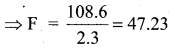
Question 1.
Microsoft windows is a …………………… based operating system.
(a) GUI
(b) command driven
(c) window
(d) menu driven
Answer:
(a) GUI

Question 2.
Multiple applications which can execute simultaneously in windows is known as:
(a) multi programming
(b) multi tasking
(c) time sharing
(d) based on priority
Answer:
(b) multi tasking

Question 3.
…………………….. is used to interact windows by clicking its elements.
(a) Keyboard
(b) Light pen
(c) Mouse
(d) Scanner
Answer:
(c) Mouse

Question 4.
…………………… is used to enter alphabets and characters.
(a) Light pen
(b) Mouse
(c) Notes taker
(d) Keyboard
Answer:
(d) Keyboard

Question 5.
Multiple desktop is available in:
(a) windows XP
(b) windows vista
(c) windows 8
(d) windows 10
Answer:
(d) windows 10

Question 6.
The opening screen of windows is called:
(a) desktop
(b) icons
(c) windows
(d) documentation
Answer:
(a) desktop

Question 7.
The ……………………. is an area on the screen that displays information for a specific program.
(a) desktop
(b) icons
(c) window
(d) document
Answer:
(c) window

Question 8.
The larger window is called the:
(a) document window
(b) application window
(c) workspace
(d) scroll bar
Answer:
(b) application window

Question 9.
The first level in a multilevel or hierarchial directory system is:
(a) root directory
(b) additional directory
(c) sub directories
(d) directories
Answer:
(a) root directory

Question 10.
The first level in a multilevel or hierarchical directory system is:
(a) Ctrl + X
(b) Ctrl + C
(c) Ctrl + V
(d) Ctrl + S
Answer:
(a) Ctrl + X

Question 11.
The shortcut keyboard command to cut is:
(a) Ctrl + X
(b) Ctrl + C
(c) Ctrl + V
(d) Ctrl + A
Answer:
(b) Ctrl + C

Question 12.
The shortcut keyboard command to paste is:
(a) Crtl + X
(b) Ctrl + C
(c) Ctrl + V
(d) Ctrl + A
Answer:
(c) Ctrl + V

Question 13.
The paste option is on …………………… menu.
(a) edit
(b) file
(c) view
(d) tools
Answer:
(a) edit

Question 14.
……………………. switches to another user account on the computer without closing the open programs and windows processes.
(a) Log off
(b) Restarting the computer
(c) Shut down
(d) Switch user
Answer:
(d) Switch user

Question 15.
……………………….. shows the name of the currently selected directory.
(a) Tool bar
(b) ftlenu bar
(c) Task bar
(d) Title bar
Answer:
(d) Title bar

Question 16.
……………………… displays your directory browsing history, location in the file system, a search button and options for the current directory view.
(a) Toolbar
(b) Menu bar
(c) Task bar
(d) Title bar
Answer:
(a) Toolbar

Question 17.
Windows 7 was released in:
(a) October 2012
(b) September 2014
(c) October 2009
(d) October 2015
Answer:
(c) October 2009

Question 18.
At the very bottom of the screen is a horizontal bar called the:
(a) tool bar
(b) menu bar
(c) task bar
(d) title bar
Answer:
(c) task bar

Question 19.
We can select multiple files by holding down the key.
(a) Alt
(b) Shift
(c) Ctrl
(d) Home
Answer:
(c) Ctrl

Question 20.
……………………. is located at the top of the screen.
(a) Tool bar
(b) Menu bar
(c) Task bar
(d) Title bar
Answer:
(b) Menu bar

I. Short Answers.

Question 1.
What is an operating system?
Answer:
An Operating System (OS) is a system software that enables the hardware to communicate and operate with other software. It also acts as an interface between the user and the hardware and controls the overall execution of the computer.
Question 2.
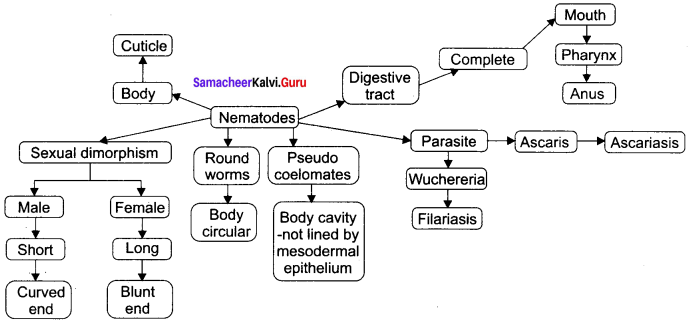
What is Desktop?
Answer:
The opening screen of Windows is called ‘Desktop’. The desktop shows the Start button, Taskbar, Notification Area and date and time.

Question 3.
What is an Icon?
Answer:
Icon is a graphic symbol representing the window elements like files, folders, shortcuts etc., Icons play a vital role in GUI based applications.

Question 4.
What is window?
Answer:
Window is a typical rectangular area in an application or a document. It is an area on the screen that displays information for a specific program.

Question 5.
What is Application Window?
Answer:
It is an area on a computer screen with defined boundaries, and within which information is displayed. Such windows can be resized, maximized, minimized, placed side by side, overlap, and so on.

Question 6.
What is document window?
Answer:
The smaller window, which is inside the Application Window, is called the Document window. This Window is used for typing, editing, drawing, and formatting the text and graphics.

Question 7.
Where the task bar is located? What it contains?
Answer:
At the bottom of the screen is a horizontal bar called the taskbar. This bar contains (from left to right) the Start button, shortcuts to various programs, minimized programs and in the extreme right comer you can see the system tray which consist of volume control, network, date and time etc. Next to the Start button is the quick Launch Toolbar which contains task for frequently used applications.

Question 8.
What is meant by multitasking?
Answer:
Multiple applications can execute simultaneously in Windows, and this is known as “multitasking”.

Question 9.
What is launcher?
Answer:
The vertical bar of icons on the left side of the desktop is called the Launcher. The Launcher provides easy access to applications, mounted devices, and the Trash. All current applications on your system will place an icon in the Launcher.

Question 10.
How will you delete a file in Ubuntu OS?
Answer:
A file / folder created by you can be moved to trash by using right click or by using menu.

Question 11.
Define Ubuntu?
Answer:
Ubuntu is a Linux-based operating system. It is designed for computers, smartphones, and network servers. The system is developed by a UK based company called Canonical Ltd.
Ubuntu was conceived in 2004 by Mark Shuttleworth, a successful South African entrepreneur, and his company Canonical Ltd.

Question 12.
Define Trash?
Answer:
Trash is the equivalent of Recycle bin of windows OS. All the deletted files and folders are moved here.

II. Answer in Brief.

Question 1.
List the functions of an operating system?
Answer:

  1. Memory Management
  2. Process Management
  3. Device Management
  4. File Management
  5. Security Management
  6. Control overall system performance
  7. Error detecting aids
  8. Coordination between other software and users.

Question 2.
Write some of the most popular operating systems?
Answer:

  1. Windows Series – for desktop and laptop computers.
  2. Android – for smart phones.
  3. iOS – for Apple phones, i-Pad and i-Pod.
  4. Linux – Open source Operating System for desktop and server.

Question 3.
Write down the various mouse actions?
Answer:
Action:

  1. Point to an item
  2. Click
  3. Right click
  4. Double-click
  5. Drag and drop

Reaction:

  1. Move the mouse pointer over the item.
  2. Point to the item on the screen, press and release the left mouse button.
  3. Point to the item on the screen, press and release the right mouse button. Clicking the right mouse button displays a pop up menu with various options.
  4. Point to the item on the screen, quickly press twice the left mouse button:
  5. Point to an item then hold the left mouse button as you move the pointer and when you have reached the desired position, release the mouse button.

Question 4.
Explain the icons in windows operating system?
Answer:
Icon:
It is a graphic symbol representing the window elements like files, folders, shortcuts etc., Icons play a vital role in GUI based applications.

Standard Icons:
The icons which are available on desktop by default while installing Windows OS are called standard icons. The standard icons available in all Windows OS are My Computer, Documents and Recycle Bin.

Shortcut Icons:
It can be created for any application or file or folder. By double clicking the icon, the related application or file or folder will open. This represents the shortcut to open a particular application.

Disk drive icons:
The disk drive icons graphically represent five disk drive options

  1. Hard disk
  2. CD-ROM/DVD Drive
  3. Pen drive
  4. Other removable storage such as mobile, smart phone, tablet etc.,
  5. Network drives if your system is connected with other system.

Question 5.
Write the difference between the application window and the document window?
Answer:
Application Window:

  1. The larger window is called the Application Window.
  2. This window helps the user to communicate with the Application Program.

Document Window:

  1. The smaller window, which is inside the Application Window is called the Document Window.
  2. This window is used for typing, editing, drawing and formatting the text and graphics.

Question 6.
Write the ways of creating folders in windows?
Answer:
Method I:
Step 1: Open Computer Icon.
Step 2: Open any drive where you want to create a new folder. (For example select D:)
Step 3: Click on File → New → Folder.
Step 4: A new folder is created with the default name “New folder”.
Step 5: Type in the folder name and press Enter key.

Method II:
In order to create a folder in the desktop:
Step 1: In the Desktop, right click → New → Folder.
Step 2: A Folder appears with the default name “New folder” and it will be highlighted.
Step 3: Type the name you want and press Enter Key.
Step 4: The name of the folder will change.

Question 7.
Write the steps to delete a file or folders in windows?
Answer:
Select the file or folder you wish to delete.

  1. Right- click the file or folder, select Delete option from the po-pup menu or Click File → Delete or press Delete key from the keyboard.
  2. The file will be deleted and moved to the Recycle bin.

Question 8.
Write short note on Recycle Bin?
Answer:
Recycle bin is a special folder to keep the files or folders deleted by the user, which meAnswer:you still have an opportunity to recover them. The user cannot access the files or folders available in the Recycle bin without restoring it. To restore file or folder from the Recycle Bin.

  1. Open Recycle bin.
  2. Right click on a file or folder to be restored and select Restore option from the pop-up menu.
  3. To restore multiple files or folders, select Restore all items.
  4. To delete all files in the Recycle bin, select Empty the Recycle Bin.

Question 9.
Write the steps to create shortcuts on the Desktop?
Answer:
Shortcuts to your most often used folders and files may be created and placed on the Desktop to help automate your work.

  1. Select the file or folder that you wish to have as a shortcut on the Desktop.
  2. Right click on the file or folder.
  3. Select Send to from the shortcut menu, then select Desktop (create shortcut) from the sub-menu.
  4. A shortcut for the file or folder will now appear on your desktop and you can open it from the desktop in the same way as any other icon.

Question 10.
Write the significant features of Ubuntu?
Answer:

  1. The desktop version of Ubuntu supports all normal software like Windows such as Firefox, Chrome, VLC, etc.
  2. It supports the office suite called LibreOffice.
  3. Ubuntu has in-built email software called Thunderbird, which gives the user access to email such as Exchange, Gmail, Hotmail, etc.
  4. There are free applications for users to view and edit photos, to manage and share videos.
  5. It is easy to find content on Ubuntu with the smart searching facility.
  6. The best feature is, it is a free operating system and is backed by a huge open source community.

Question 11.
What is Ambiance?
Answer:
The default desktop background, or wallpaper, belonging to the default Ubuntu 16.04 theme known as Ambiance.

Question 12.
Write the .steps to create files in the windows?
Answer:
Wordpad is an in-built word processor application in Windows OS to qreate and manipulate text documents.
In order to create files in wordpad you need to follow the steps given below.

  1. Click Start → All Programs → Accessories → Wordpad or Run → type Wordpad, click OK. Wordpad window will be opened.
  2. Type the contents in the workspace and save the file using File → Save or Ctrl + S.
  3. Save As dialog box will be opened.
  4. In the dialog box, select the location where you want to save the file by using look in drop down list box.
  5. Type the name of the file in the file name text box.
  6. Click save button.

III. Answer in detail.

Question 1.
Draw and explain the elements of windows?
Answer:
Title Bar:
The title bar will display the name of the application and the name of the document opened. It will also contain minimize, maximize and close button.

Menu Bar:
The menu bar is seen under the title bar. Menus in the menu bar can be accessed by pressing Alt key and the letter that appears underlined in the menu title. Additionally, pressing Alt or F10 brings the focus on the first menu of the menu bar.

In Windows 7, in the absence of the menu bar, click Organize and from the drop down menu, click the Layout option and select the desired item from that list.

The Workspace:
The workspace is the area in the document window to enter or type the text of your document.
Samacheer Kalvi Guru 11th Computer Application Solutions Chapter 5 Working With Typical Operating System (Windows & Linux)

Scroll bars:
The scroll bars are used to scroll the workspace horizontally or vertically.

Comers and borders:
The comers and borders of the window helps to drag and resize the windows. The mouse pointer changes to a double headed arrow when positioned over a border or a comer. Drag the border or comer in the direction indicated by the double headed arrow to the desired. The window can be resized by dragging the comers diagonally across the screen.

Question 2.
Write the steps to log off / shut down the computer?
Answer:

  • Click start → log off (click the arrow next to Shut down) or Start → Shutdown.
  • If you have any open programs, then you will be asked to close them or windows will Force shut down, you will lose any un-saved information if you do this.
  • Switch User: Switch to another user account on the computer without closing your open programs and Windows processes.
  • Log Off: Switch to another user account on the computer after closing all your open programs and Windows processes.
  • Lock: Lock the computer while you’re away from it.
  • Restart: Reboot the computer. (This option is often required as part of installing new software or Windows update.)
  • Sleep: Puts the computer into a low-power mode that retains all mnning programs and open Windows in computer memory for a super-quick restart.
  • Hibernate (found only on laptop computers): Puts the computer into a low-power mode after saving all mnning programs and open windows on the machine’s hard drive for a quick restart.

Question 3.
Explain the different method of renaming files and folders?
Answer:
There are number of ways to rename files or folders. You can rename using the File menu, left mouse button or right mouse button.
Method I:
Using the FILE Menu

  1. Select the File or Folder you wish to Rename.
  2. Click File → Rename.
  3. Type in the new name.
  4. To finalise the renaming operation, press Enter.

Method II:
Using the Right Mouse Button

  1. Select the file or folder you wish to rename.
  2. Click the right mouse button over the file or folder.
  3. Select Rename from the popmp menu.
  4. Type in the new name.
  5. To finalise the renaming Operation, press Enter.
  6. The folder “New Folder” is renamed as C++.

Method III:
Using the Left Mouse Button

  1. Select the file or folded you wish to rename.
  2. Press F2 or click over the file or folder. A surrounding rectangle will appear around the name.
  3. Type in the new name.
  4. To finalise the renaming operation, press Enter.

Question 4.
What are the different method of copying files and folders to removable disk?
Ans
There are several methods of transferring files to or from a removable disk.

  1. Copy and Paste
  2. Send To

Method I:
Copy and Paste:

  1. Plug the USB flash drive directly into an available USB port.
  2. If the USB flash drive or external drive folder does NOT open automatically, follow these steps:
  3. Click Start → Computer.
  4. Double-click on the Removable Disk associated with the USB flash drive.
  5. Navigate to the folders in your computer containing files you want to transfer.
  6. Right-click on the file you want to copy, then select Copy.
  7. Return to the Removable Disk window, right-click within the window, then select Paste.

Method II:
Send To:

  1. Plug the USB flash drive directly into an available USB port.
  2. Navigate to the folders in your computer containing files you want to transfer.
  3. Right-click on the file you want to transfer to your removable disk.
  4. Click Send To and select the Removable Disk associated with the USB flash drive.

Question 5.
Explain the indicators in the menubar of Ubuntu OS?
Answer:
(i) Network indicator:
This manages network connections, allowing you to connect to a wired or wireless network.

(ii)Text entry settings:
This shows the current keyboard layout (such as En, Fr,Ku, and so on). If more than one keyboard layout is shown, it allows you to select a keyboard layout out of those choices. The keyboard indicator menu contains the following menu items: Character Map, Keyboard Layout Chart, and Text Entry Settings.

(iii) Messaging indicator:
This incorporates your social applications. From here, you can access instant messenger and email clients.

(iv) Sound indicator:
This provides an easy way to adjust the volume as well as access your music player.

(v) Clock:
This displays the current time and provides a link to your calendar and time and date settings.

(vi) Session indicator:
This is a link to the system settings, Ubuntu Help, and session options (like locking your computer, user/guest session, logging out of a session, restarting the computer, or shutting down completely).

(vii) Title bar:
The title bar shows the name of the currently selected directory. It also contains the Close, Minimize, and Maximize buttons.

(viii) Toolbar:
The toolbar displays your directory browsing history (using two arrow buttons), your location in the file system, a search button, and options for your current directory view.

Question 6.
How will you move files and folders?
Answer:
Method I:
CUT and PASTE:
To move a file or folder, first select the file or folder and then choose one of the following:

  1. Click on the Edit → Cut or Ctrl + X Or right click → cut from the pop-up menu.
  2. To move the file(s) or folder(s) in the new location, navigate to the new location and paste it using Click.Edit → Paste from edit menu or Ctrl + V using keyboard.
  3. Or Right click → Paste from the pop-up menu. The file will be pasted in the new location.

Method II:
Drag and Drop:
In the disk drive window, we have two panes called left and right panes. In the left pane, the files or folders are displayed like a tree structure. In the right pane, the files inside the specific folders in the left pane are displayed with various options.

  1. In the right pane of the Disk drive window, select the file or folder you want to move.
  2. Click and drag the selected file or folder from the right pane, to the folder list on the left pane.
  3. Release the mouse button when the target folder is highlighted (active).
  4. Your file or folder will now appear in the new area.

Question 7.
How will you copy files and folders in windows?
Answer:
There are variety of ways to copy files and folders:
Method I:
COPY and PASTE:
To copy a file or folder, first select the file or folder and then choose one of the following:

  1. Click Edit → Copy or Ctrl + C or right click → Copy from the pop-up menu.
  2. To paste the file(s) or folder(s) in the new location, navigate to the target location then do one of the following:
  3. Click Edit → Paste or Ctrl + V.
  4. Or Right click → Paste from the pop-up menu.

Method II:
Drag and Drop:

  1. In the RIGHT pane, select the file or folder you want to copy.
  2. Click and drag the selected file and/cr folder to the folder list on the left, and drop it where you want to copy the file and/or folder.
  3. Your file(s) and folder(s) will now appear in the new area.