Samacheer Kalvi 6th Maths Solutions Term 1 Chapter 2 Introduction to Algebra Ex 2.1

You can Download Samacheer Kalvi 6th Maths Book Solutions Guide Pdf, Tamilnadu State Board help you to revise the complete Syllabus and score more marks in your examinations.

Tamilnadu Samacheer Kalvi 6th Maths Solutions Term 1 Chapter 2 Introduction to Algebra Ex 2.1

Samacheer Kalvi 6th Maths Solutions Term 1 Chapter 2 Introduction to Algebra Ex 2.1
Question 1.
Fill in the blanks:
(i) The letters a, b, c, .., x, y, z are used to represent _____
(ii) A quantity that takes _____ values is called a variable.
(iii) If there are 5 students on a bench, then the number of students in ‘n’ benches is ‘5 × n’. Here _____ is a variable.
Solution:
(i) Variables
(ii) Different
(iii) n

Question 2.
Say True or False:
(i) The length of part B in the pencil shown is ‘a – 6’.
Samacheer Kalvi 6th Maths Term 1 Chapter 2 Introduction to Algebra Ex 2.1 Q2
(ii) If the cost of an apple is ‘x’ and cost of banana is ₹ 5, then the total cost of fruits is ₹ ‘x + 5′
(iii) If there are 11 players in a team, then there will be ’11 + q’ players in ‘q’ teams.
Solution:
(i) False
Length of B is 6 – a
(ii) True
(iii) False
There will be 11q players.

Question 3.
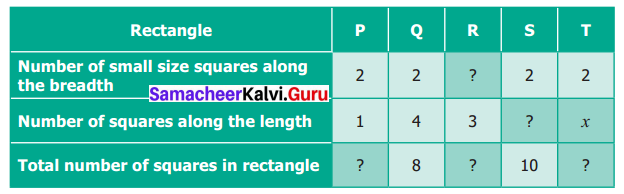
Draw the next two patterns and complete the table.
Samacheer Kalvi 6th Maths Term 1 Chapter 2 Introduction to Algebra Ex 2.1 Q3
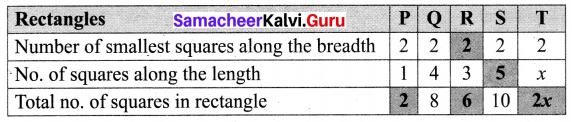
Solution:
Samacheer Kalvi 6th Maths Term 1 Chapter 2 Introduction to Algebra Ex 2.1 Q3.1

Samacheer Kalvi 6th Maths Solutions Term 1 Chapter 2 Introduction to Algebra Ex 2.1

Question 4.
Use a variable to write the rule, which gives the number of ice candy sticks required to make the following patterns.
(a) a pattern of letter C as
Samacheer Kalvi 6th Maths Term 1 Chapter 2 Introduction to Algebra Ex 2.1 Q4
(b) the pattern of letter M as
Samacheer Kalvi 6th Maths Term 1 Chapter 2 Introduction to Algebra Ex 2.1 Q4.1
Solution:
(a) A number of sticks used for 1 Samacheer Kalvi 6th Maths Term 1 Chapter 2 Introduction to Algebra Ex 2.1 Q4 is 3.
Samacheer Kalvi 6th Maths Term 1 Chapter 2 Introduction to Algebra Ex 2.1 Q4.2
If the number of Samacheer Kalvi 6th Maths Term 1 Chapter 2 Introduction to Algebra Ex 2.1 Q4 formed is ‘n’ then
the number of ice candy sticks required = 3 × n = 3n.
(b) A number of sticks used for one’ is 4.
Samacheer Kalvi 6th Maths Term 1 Chapter 2 Introduction to Algebra Ex 2.1 Q4.3
The number of ice candy sticks required = 4n.

Question 5.
The teacher forms a group of five students in a class. How many students will be there in ‘p’ groups?
Solution:
Samacheer Kalvi 6th Maths Term 1 Chapter 2 Introduction to Algebra Ex 2.1 Q5
5p students will be there in groups.

Question 6.
Arivazhagan is 30 years younger to his father. Write Arivazhagan’s age in terms of his father’s age.
Solution:
Let Arivazhagan’s father’s age be x years
According to the problem,
Arivazhagan’s age = (x – 30) years

Question 7.
If ‘u’ is an even number, how would you represent?
(i) the next even number?
(ii) the previous even number?
Solution:
(i) Difference between two even numbers = 2
Given that ‘u’ is an even number.
Next, even number is u + 2.
(ii) Previous even number is u – 2.

Samacheer Kalvi 6th Maths Solutions Term 1 Chapter 2 Introduction to Algebra Ex 2.1

Objective Type Questions

Question 8.
Variable means that it
(a) can take only a few values
(b) has a fixed value
(c) can take different values
(d) can take only 8 values
Solution:
(c) can take different values

Question 9.
‘6y’ means.
(a) 6 + y
(b) 6 – y
(c) 6 × y
(d) \(\frac{6}{y}\)
Solution:
(c) 6 × y

Question 10.
Radha is ‘x’ years of age now 4 years ago, her age was
(a) x – 4
(b) 4 – x
(c) 4 + x
(d) 4x
Solution:
(a) x – 4

Question 11.
The number of days in ‘w’ weeks is
(a) 30 + w
(b) 30w
(c) 7 + w
(d) 7w
Solution:
(d) 7w

Samacheer Kalvi 6th Maths Solutions Term 1 Chapter 2 Introduction to Algebra Ex 2.1

Question 12.
The value of ‘x’ in the circle is
Samacheer Kalvi 6th Maths Term 1 Chapter 2 Introduction to Algebra Ex 2.1 Q12
(a) 6
(b) 8
(c) 21
(d) 22
Solution:
(d) 22
2 + 2 = 4, 4 + 3 = 7, 7 + 4 = 11, 11 + 5 = 16, 16 + 6 = 22

Samacheer Kalvi 6th Maths Solutions Term 2 Chapter 2 Measurements Ex 2.3

You can Download Samacheer Kalvi 6th Maths Book Solutions Guide Pdf, Tamilnadu State Board help you to revise the complete Syllabus and score more marks in your examinations.
Samacheer Kalvi 6th Maths Solutions Term 2 Chapter Chapter 2 Measurements Ex 2.3

Tamilnadu Samacheer Kalvi 6th Maths Solutions Term 2 Chapter 2 Measurements Ex 2.3

Miscellaneous Practice Problems

Question 1.
Two pipes whose lengths are 7 m 25 cm and 8 m 13 cm joined by welding and then a small piece 60 cm is cut from the whole. What is the remaining length of the pipe?
Solution:
Samacheer Kalvi 6th Maths Solutions Term 2 Chapter 2 Measurements Ex 2.3 Q1
Samacheer Kalvi 6th Maths Solutions Term 2 Chapter 2 Measurements Ex 2.3 Q1.1

Question 2.
The saplings are planted at a distance of 2 m 50 cm in the road of length 5 km by saravanan. If he has 2560 saplings, how many saplings will be planted by him? how many saplings are left?
Solution:
Distance between two saplings = 2 m 50 cm = 250 cm
Total length of the road = 5000 m = 500000 cm

Question 3.
Put ✓ a mark in the circles which adds up to the given measure.
Samacheer Kalvi 6th Maths Solutions Term 2 Chapter 2 Measurements Ex 2.3 Q3
Solution:
Samacheer Kalvi 6th Maths Solutions Term 2 Chapter 2 Measurements Ex 2.3 Q3.1

Samacheer Kalvi 6th Maths Solutions Term 2 Chapter Chapter 2 Measurements Ex 2.3

Question 4.
Make a calendar for the month of February 2020 (Hint: January 1st 2020 is Wednesday)
Solution:
Given Jan 1st 2020 is Wednesday.
1st + 7 = 8th Wednesday
8th + 7 = 15th Wednesday
15th + 7 = 22nd Wednesday
22nd + 7 = 29th Wednesday
Jan = 30th Thursday
Jan 31st Friday
Feb 1st Saturday
February has 29 days as 2020 is a leap year.
Samacheer Kalvi 6th Maths Solutions Term 2 Chapter 2 Measurements Ex 2.3 Q4

Question 5.
Observe and Collect the data for a minute:
Samacheer Kalvi 6th Maths Solutions Term 2 Chapter 2 Measurements Ex 2.3 Q5
Solution:
Samacheer Kalvi 6th Maths Solutions Term 2 Chapter 2 Measurements Ex 2.3 Q5.1

Challenge Problems

Question 6.
A squirrel wants to eat the grains quickly. Help the squirrel to find the shortest way to reach the grains. (Use your scale to measure the length of the line segments)
Samacheer Kalvi 6th Maths Solutions Term 2 Chapter 2 Measurements Ex 2.3 Q6
Solution:
The squirrel is in A and the grains are at E
The ways are (i) A → B → C → D → E
(ii) A → G → F → K → E
(iii) A → H → I → J → E
Distance
(i) AB + BC + CD + DE = 2 cm + 2.5 cm + 2.5 cm + 2 cm = 9 cm
(ii) AG + GF + FK + KE = (2.6 + 1.7 + 1.8 + 3) cm = 9.1 cm
(iii) AH + HI + IJ + JE = 3 cm + 2.3 cm + 1 cm + 3.2 cm = 9.5 cm.
1st way ABCDE is the shortest one.

Samacheer Kalvi 6th Maths Solutions Term 2 Chapter Chapter 2 Measurements Ex 2.3

Question 7.
A room has a door whose measures are 1 m wide and 2 m 50 cm high.
(i) Can we make a bed of 2 m and 20 cm length and 90 cm wide into the room?
Solution:
Measures of the door length 2 m 50 cm width and lm (100 cm)
(i) Measures of the bed 2 m 20 cm width and 90 cm
Measures of the bed < measures of the door
∴ Yes, we can take the bed into the room.

Question 8.
A post office functions from 10 a.m to 5.45 pm with a lunch break of 1 hour. If the post office works for 6 days a week. Find the total duration of working hours in a week.
Solution:
Working hours in a day = 6 hrs 45 min
= (6 × 60 min) + 45 min
= (360 + 45) min
= 405 min
Total duration of working hours in a week
= 6 × 405 min
= 2430 min
= \(\frac{2430}{60}\)
= \(\frac{810}{20}\)
= 40 \(\frac{1}{2}\)
= 40 hours 30 minutes

Question 9.
Seetha wakes up at 5.20 a.m. She spends 35 minutes to get ready and travels 15 minutes to reach the railway station. If the train departs exactly at 6 : 00 a.m, will Seetha catch the train?
Solution:
Time of wake up = 5.20 a.m = 5 hour 20 minutes
Time spends = 35 minutes
Then the time = 5 hour 55 minutes
Travelling time to reach railway station = 15 minutes
Now the time will be = 5 hours 70 minutes
= 5 hours (60 + 10) minutes
= 5 hours + (1 hour 10 minutes)
= 6 hours 10 minutes
= 6.10 a.m.
The departure time of the train to get ready = 6.0 a.m.
∴ She will not be able to catch the train.

Question 10.
A doctor advised Vairavan to take one tablet every 6 hours once in the 1st day and once every 8 hours on the 2nd and 3rd day. If he starts to take 9.30 a.m first dose. Prepare a time chart to take the tablet in railway time.
Solution:
The first dose is taken at 9.30 a.m. = 09:30 hours
Duration of every dose in 1st day = 6 hours
Duration of every dose in 2nd and 3rd day = 8 hours
Time Chart.
Samacheer Kalvi 6th Maths Solutions Term 2 Chapter 2 Measurements Ex 2.3 Q10

Samacheer Kalvi 6th Maths Solutions Term 1 Chapter 4 Geometry Ex 4.4

You can Download Samacheer Kalvi 6th Maths Book Solutions Guide Pdf, Tamilnadu State Board help you to revise the complete Syllabus and score more marks in your examinations.
Samacheer Kalvi 6th Maths Solutions Term 1 Chapter 4 Ex 4.4

Tamilnadu Samacheer Kalvi 6th Maths Solutions Term 1 Chapter 4 Geometry Ex 4.4

Miscellaneous Practice Problems

Question 1.
Find the type of lines marked in thick lines (Parallel, intersecting or perpendicular)
Samacheer Kalvi 6th Maths Term 1 Chapter 4 Geometry Ex 4.4 Q1
Solution:
(i) Parallel lines
(ii) Parallel lines
(iii) Parallel lines and Perpendicular lines
(iv) Intersecting lines

Question 2.
Find the parallel and intersecting line segments in the picture given below.
Samacheer Kalvi 6th Maths Term 1 Chapter 4 Geometry Ex 4.4 Q2
Solution:
(a) Parallel line segments

  • \(\overline{\mathrm{YZ}} \text { and } \overline{\mathrm{DE}}\)
  • \(\overline{\mathrm{EA}} \text { and } \overline{\mathrm{ZV}}\)
  • \(\overline{\mathrm{VW}} \text { and } \overline{\mathrm{AB}}\)
  • \(\overline{\mathrm{WX}} \text { and } \overline{\mathrm{BC}}\)
  • \(\overline{\mathrm{YX}} \text { and } \overline{\mathrm{DC}}\)
  • \(\overline{\mathrm{YD}} \text { and } \overline{\mathrm{XC}}\)
  • \(\overline{\mathrm{XC}} \text { and } \overline{\mathrm{WB}}\)
  • \(\overline{\mathrm{WB}} \text { and } \overline{\mathrm{VA}}\)
  • \(\overline{\mathrm{VA}} \text { and } \overline{\mathrm{ZE}}\)
  • \(\overline{\mathrm{ZE}} \text { and } \overline{\mathrm{YD}}\)

(b) Intersecting line segments

  • DE and ZV
  • WX and DC

Question 3.
Name the following angles as shown in the figure.
Samacheer Kalvi 6th Maths Term 1 Chapter 4 Geometry Ex 4.4 Q3
Solution:
(i) ∠1 = ∠DBC or ∠CBD
(ii) ∠2 = ∠DBE or ∠EBD
(iii) ∠3 = ∠ABE or ∠EBA
(iv) ∠1 + ∠2 = ∠EBC or ∠CBE
(v) ∠2 + ∠3 = ∠ABD or ∠DHA
(vi) ∠1 + ∠2 + ∠3 = ∠ABC or ∠B or ∠CBA

Samacheer Kalvi 6th Maths Solutions Term 1 Chapter 4 Ex 4.4

Question 4.
Measure the angles of the given figures using a protractor and identify the type of angle as acute, obtuse, right or straight.
Samacheer Kalvi 6th Maths Term 1 Chapter 4 Geometry Ex 4.4 Q4
Solution:
(i) 90° – Right Angle
(ii) 45° – Acute Angle
(iii) 180° – Straight Angle
(iv) 105° – Obtuse Angle

Question 5.
Draw the following angles using the protractor.
(i) 45°
(ii) 120°
(iii) 65°
(iv) 135°
(v) 0°
(vi) 180°
(vii) 38°
(viii) 90°
Solution:
(i) 45°
Samacheer Kalvi 6th Maths Term 1 Chapter 4 Geometry Ex 4.4 Q5.2
Construction:
1. Drawn the base ray PQ.
2. Placed the centre of the protractor at the vertex P. Lined up the ray \(\overrightarrow{\mathrm{PQ}}\) with the 0° line. Then drawn and labelled a pointed (R) at the 45° mark on the inner scale (a) anticlockwise and (b) outer scale (clockwise)
3. Removed the protractor and drawn at \(\overrightarrow{\mathrm{PR}}\) to complete the angle
Now ∠P = ∠QPR – ∠RPQ = 45°.

(ii) 120°
Samacheer Kalvi 6th Maths Term 1 Chapter 4 Geometry Ex 4.4 Q5.1
Construction:
1. Placed the centre of the protractor at the vertex X. Lined up the ray \(\overline{\mathrm{XY}}\) with the 0° Line. Then draw and label a point Z at 120° mark on the (a) inner scale (anti-clockwise) and (b) outer scale (clockwise).
2. Removed the protractor and draw \(\overline{\mathrm{XZ}}\) to complete the angle.
Now, ∠X = ∠ZXY = ∠YXZ = 120°.

(iii) 65°
Samacheer Kalvi 6th Maths Term 1 Chapter 4 Geometry Ex 4.4 Q5.2
Construction:
1. Placed the centre of the protractor at the vertex A. Line up the ray \(\overrightarrow{\mathrm{AB}}\) with the 0° line. Then draw and label a point C at the 65° mark on the (a) inner scale (anti-clockwise) (b) outer scale (clockwise).
2. Removed the protractor and draw \(\overrightarrow{\mathrm{AB}}\) to complete the angle.
Now ∠A = ∠BAC = ∠CAB = 65°.

(iv) 135°
Samacheer Kalvi 6th Maths Term 1 Chapter 4 Geometry Ex 4.4 Q5.3
Construction:
1. Placed the centre of the protractor at the Vertex A. Lined up the ray \(\overrightarrow{\mathrm{EG}}\) with the 0° line. Then draw and label a point F at the 135° mark on the (a) inner scale (anti-clockwise) and (b) outer scale (clockwise)
2. Removed the protractor and draw \(\overrightarrow{\mathrm{EF}}\) to complete the angle.
Now ∠E = ∠FEG = ∠GEF = 135°.

(v) 0°
Samacheer Kalvi 6th Maths Term 1 Chapter 4 Geometry Ex 4.4 Q5.4
Construction:
1. Placed the centre of the protractor at the vertex G. Lined up the ray \(\overrightarrow{\mathrm{GH}}\) with the 0° line. Then draw and label a point I at the 0° mark on the
(a) inner scale (anti-clockwise)
(b) outer scale (clockwise)
2. Removed the protractor and seen \(\overrightarrow{\mathrm{GI}}\) lies exactly on \(\overrightarrow{\mathrm{GH}}\)
Now ∠G = ∠HGI = ∠IGH = 0°, which is a zero angle.

(vi) 180°
Samacheer Kalvi 6th Maths Term 1 Chapter 4 Geometry Ex 4.4 Q5.5
Construction:
1. Placed the centre of the protractor at the vertex I. Lined up the ray \(\overrightarrow{\mathrm{IJ}}\) with the 0° line. Then draw and labelled a point K at the 180° mark on the (a) inner scale (anticlockwise) (b) outer scale (clockwise)
2. Removed the protractor and draw \(\overrightarrow{\mathrm{IK}}\) to complete the angle.
Now ∠I = ∠JHK = ∠KIJ = 180°, which is a straight Angle.

(vii) 38°
Samacheer Kalvi 6th Maths Term 1 Chapter 4 Geometry Ex 4.4 Q5.6
Construction:
1. Placed the centre of the protractor at the vertex L. Lined up the ray \(\overrightarrow{\mathrm{LM}}\) with the 0° line. Then draw and label a point N at 38° mark on the (a) inner scale (anticlockwise) and (b)*huter scale (clockwise).
2. Removed the protractor and draw \(\overrightarrow{\mathrm{LN}}\) to complete the angle.
Now ∠L = ∠MLN = ∠NLM = 38°.

(viii) 90°
Samacheer Kalvi 6th Maths Term 1 Chapter 4 Geometry Ex 4.4 Q5.7
Construction:
1. Placed the centre of the protractor at the vertex ‘O’. Lined up the ray \(\overrightarrow{\mathrm{OP}}\) with the 0° line. Then draw and label a point Q at 90° mark on the (a) inner scale (anticlockwise) and (b) outer scale (clockwise)
2. Removed the protractor and draw \(\overrightarrow{\mathrm{OQ}}\) to complete the angle.
Now ∠O = ∠POQ = ∠QOP = 90°.

Samacheer Kalvi 6th Maths Solutions Term 1 Chapter 4 Ex 4.4

Question 6.
From the figures given below, classify the following pairs of angles into complementary and non-complementary.
Samacheer Kalvi 6th Maths Term 1 Chapter 4 Geometry Ex 4.4 Q6
Solution:
We know that the two angles are complementary if they add up to 90°.
Therefore (a) (i) is complementary.
In (v) ∠ABC and ∠CBD are complementary
(b) (ii), (iii), (iv) and (v) are non-complementary

Question 7.
From the figures given below, classify the following pairs of angles into supplementary and non-supplementary.
Samacheer Kalvi 6th Maths Term 1 Chapter 4 Geometry Ex 4.4 Q7
Solution:
If two angles add up to 180°, then they are supplementary angles.
(a) In (ii) ∠AOB and ∠BOD are supplementary. In (iv) the pair is supplementary
(b) (i) and (iii) are not supplementary.

Question 8.
From the figure.
(i) name a pair of complementary angles
(ii) name a pair of supplementary angles
Samacheer Kalvi 6th Maths Term 1 Chapter 4 Geometry Ex 4.4 Q8
Solution:
(i) ∠FAE and ∠DAE are complementary
(ii) ∠FAD and ∠DAC are supplementary

Question 9.
Find the complementary angle of
(i) 30°
(ii) 26°
(iii) 85°
(iv) 0°
Solution:
When we have an angle, how far we need to go to reach the right angle is called the complementary angle.
(i) Complementary angle of 30° is 90° – 30° = 60°
(ii) Complementary angle of 26° is 90° – 26° = 64°
(iii) Complementary angle of 85° is 90° – 85° = 5°
(iv) Complementary angle of 0° is 90° – 0° = 90°
(v) Complementary angle of 90° is 90° – 90° = 0°

Question 10.
Find the supplementary angle of
(i) 70°
(ii) 35°
(iii) 165°
(iv) 90°
(v) 0°
(vi) 180°
(vii) 95°
Solution:
How far we should go in the same direction to reach the straight angle (180°) is called supplementary angle.
(i) Supplementary angle of 70° = 180° – 70° = 110°
(ii) Supplementary angle of 35° is 180° – 35° = 145°
(iii) Supplementary angle of 165° is 180° – 165° = 15°
(iv) Supplementary angle of 90° is 180° – 90° = 90°
(v) Supplementary angle of 0° is 180° – 0° = 180°
(vi) Supplementary angle of 180° is 180° – 180° = 0°
(vii) Supplementary angle of 95° is 180° – 95° = 85°

Samacheer Kalvi 6th Maths Solutions Term 1 Chapter 4 Ex 4.4

Challenging Problems

Question 11.
Think and write and object having.
(i) Parallel Lines
1. _____________
2. _____________
3. _____________
(ii) Perpendicular lines
1. _____________
2. _____________
3. _____________
(iii) Intersecting lines
1. _____________
2. _____________
3. _____________
Solution:
(i) 1. Opposite edges of a Table.
2. Path traced by the wheels of a car on a straight road
3. Opposite edges of a black board
(ii) 1. Adjacent edges of a Table.
2. Hands of the block when it shows 3.30
3. Strokes of the letter ‘L’
(iii) 1. Sides of a triangle
2. Strokes of letter ‘V’
3. Hands of a scissors

Question 12.
Which angle is equal to twice of its complement?
Solution:
We know that the sum of complementary angles 90°
Given Angle = 2 × Complementary angle
Samacheer Kalvi 6th Maths Term 1 Chapter 4 Geometry Ex 4.4 Q12
By trial and error, we find that Angle = 2 × Complement for 60°
The required angle = 60°
Another method:
Let the angle be x given
x = 2 (90 – x)
⇒ x = 180 – 2x
⇒ x + 2x = 180
⇒ 3x = 180
⇒ x = 60°

Question 13.
Which angle is equal to two-thirds of its supplement.
Solution:
Supplementary angles sum upto 180°
Given Angle = \(\frac{2}{3}\) × Supplement.
Forming the Table.
Samacheer Kalvi 6th Maths Term 1 Chapter 4 Geometry Ex 4.4 Q13
By trial and error, we find that angle = \(\frac{2}{3}\) × supplement for 72°.
The required angle 72°.

Question 14.
Given two angles are supplementary and one angle is 20° more than other. Find the two angles.
Solution:
Given two angles are supplementary i.e. their sum = 180°.
Let the angle be x
Then another angle = x + 20 (given)
Samacheer Kalvi 6th Maths Term 1 Chapter 4 Geometry Ex 4.4 Q14
The two angles are 80° and 100°.

Question 15.
Two complementary angles are in the ratio 7 : 2. Find the angles.
Solution:
Let the angles be 7x, 2x
According to the problem,
7x + 2x = 90
9x = 90
x = \(\frac{90}{9}\)
x = 10
7x = 7 × 10
= 70
2x = 2 × 10
= 20
∴ Two angles are 70° and 20°

Samacheer Kalvi 6th Maths Solutions Term 1 Chapter 4 Ex 4.4

Question 16.
Two supplementary angles are in ratio 5 : 4. Find the angles.
Solution:
Total of two supplementary angles = 180°
Given they are in the ratio 5 : 4
Dividing total angles to 5 + 4 = 9 equal parts.
One angle \(=\frac{5}{9} \times 180=100^{\circ}\)
Another angle \(=\frac{4}{9} \times 180=80^{\circ}\)
Two angles are 100° and 80°.

Samacheer Kalvi 6th Maths Solutions Term 1 Chapter 1 Numbers Ex 1.3

You can Download Samacheer Kalvi 6th Maths Book Solutions Guide Pdf, Tamilnadu State Board help you to revise the complete Syllabus and score more marks in your examinations.

Tamilnadu Samacheer Kalvi 6th Maths Solutions Term 1 Chapter 1 Numbers Ex 1.3

Samacheer Kalvi 6th Maths Solutions Term 1 Chapter 1 Numbers Ex 1.3
Question 1.
Fill in the blanks.

  1. If Arulmozhi saves ₹ 12 per day then she saves ₹ ____ in 30 days.
  2. If a person ‘A’ earns ₹ 1800 in 12 days, then he earns ₹ ____ in a day.
  3. 45 ÷ (7 + 8) – 2 = _____

Solution:

  1. 12 × 30 = ₹ 360
  2. \(\frac{1800}{12}=150\)
  3. 45 ÷ 15 – 2 = 3 – 2 = 1

Question 2.
Say True or False.

  1. 3 + 9 × 8 = 96
  2. 7 × 20 – 4 = 136
  3. 40 + (56 – 6) ÷ 2 = 45

Solution:

  1. False
  2. True
  3. False

Question 3.
The number of people who visited the Public Library for the past 5 months was 1200, 2000, 2450, 3060 and 3200 respectively. How many people visited the library in the last 5 months.
Solution:
People visited the library for past 5 months = 1200 + 2000 + 2450 + 3060 + 3200 = 11910
Total people visited = 11910

Question 4.
Cheran had a bank savings of Rs 7,50,250. He withdrew Rs 5,34,500 for educational purpose. Find the balance amount in his account.
Solution:
Savings = Rs 7,50,250 Cash withdrawn = Rs 5,34,500
Balance amount = Rs 7,50,250 – Rs 5,34,500 = Rs 2,15,750

Samacheer Kalvi 6th Maths Solutions Term 1 Chapter 1 Numbers Ex 1.3

Question 5.
In a cycle factory, 1560 bicycles were manufactured every day. Find the number of bicycles manufactured in 25 days.
Solution:
Number of bicycles manufactured in one day = 1560
Number of bicycles manufactured in 25 days = 1560 × 25 = 39000
Samacheer Kalvi 6th Maths Term 1 Chapter 1 Numbers Ex 1.3 Q5

Question 6.
Rs 62500 was equally distributed as a New Year bonus for 25 employees of a company. How much did each receive?
Ans:
Total amount = Rs 62500
Total number of employees = 25
Bonus amount received by each employee = Rs 62500 ÷ 25
= RS \(\frac{62500}{25}\)
= Rs 2500

Question 7.
Simplify the following numerical expression:
(i) (10 + 17) ÷ 3
(ii) 12 – [3 – {6 – (5 – 1)}]
(iii) 100 + 8 ÷ 2 + {(3 × 2) – 6 ÷ 2}
Solution:
(i) (10 + 17) ÷ 3 (Given)
= 27 ÷ 3 (Bracket completed first)
= 9 (÷ completed)
∴ (10 + 17) ÷ 3 = 9

(ii) 12 – [3 – {6 – (5 – 1)}] (Given)
= 12 – [3 – {6 – 4}] (Innermost bracket completed first)
= 12 – [3 – 2] (Again Inner bracket completed second)
= 12 – 1 (Bracket completed third)
= 11 (- completed)
∴ 12 – [3 – {6 – (5 – 1)}] = 11

(iii) 100 + 8 ÷ 2 + {(3 × 2) – 6 ÷ 2} (Given)
= 100 + 8 ÷ 2 + {6 – 6 ÷ 2} (Innermost bracket completed first)
= 100 + 8 ÷ 2 + {6 – 3} (To remove the next bracket ÷ within the bar completed second)
= 100 + 8 ÷ 2 + 3 (bar completed third)
= 100 + 4 + 3 (÷ completed fourth)
= 107 (+ completed)
∴ 100 + 8 ÷ 2 + {(3 × 2) – 6 ÷ 2} = 107

Samacheer Kalvi 6th Maths Solutions Term 1 Chapter 1 Numbers Ex 1.3

Objective Type Questions

Question 8.
The value of 3 + 5 – 7 × 1 is …….
(a) 5
(b) 7
(c) 8
(d) 1
Solution:
(d) 1

Question 9.
The value of 24 ÷ {8 – (3 × 2)} is ______
(a) 0
(b) 12
(c) 3
(d) 4
Answer:
(b) 12
24 ÷ {8 – 3 × 2} = 24 ÷ {8 – 6} = 24 ÷ 2 = 12

Question 10.
Use BIDMAS and put the correct operator in the box.
2₹6 – 12 ÷ (4 + 2) = 10
(a) +
(b) –
(c) ×
(d) ÷
Solution:
(c) ×

Samacheer Kalvi 6th Maths Solutions Term 1 Chapter 1 Numbers Ex 1.3

Samacheer Kalvi 6th Maths Solutions Term 1 Chapter 3 Ratio and Proportion Ex 3.4

You can Download Samacheer Kalvi 6th Maths Book Solutions Guide Pdf, Tamilnadu State Board help you to revise the complete Syllabus and score more marks in your examinations.
Samacheer Kalvi 6th Maths Solutions Term 1 Chapter 3 Ratio and Proportion Ex 3.4

Tamilnadu Samacheer Kalvi 6th Maths Solutions Term 1 Chapter 3 Ratio and Proportion Ex 3.4

Question 1.
Fill in the blanks.
(i) If the cost of 3 pens is ₹ 18, then the cost of 5 pens is ____
(ii) If Karkuzhali earns ₹ 1800 in 15 days, then she earns ₹ 3000 in ___ days
Solution:
(i) ₹ 30
Hint: \(5 \times \frac{18}{3}\) = 5 × 6 = ₹ 30
(ii) 25 Days
Hint:
\(\frac{1800}{3000}=\frac{15}{x}\)
⇒ x = \(\frac{15 \times 3000}{1800}\) = 25 days

Question 2.
Say True or False.
(i) If the weight of 40 books is 8 kg, then the weight of 15 books is 3 kg.
(ii) A car travels 90 km in 3 hours with constant speed, It will travel 140 km in 5 hours at the same speed.
Solution:
(i) True
(ii) False

Question 3.
If a person reads 20 pages of a book in 2 hours, how many pages will he read in 8 hours at the same speed.
Solution:
Pages read in 2 hours = 20
Then pages read in 1 hour = \(\frac{20}{2}\) = 10 pages.
Pages will be read in 8 hours = 8 × 10 = 80 pages.
Number of pages will be read in 8 hrs = 80 pages

Question 4.
The cost of 15 chairs is Rs 7500. Find the number of such chairs that can be purchased for Rs 12000?
Solution:
Cost of 15 chairs = Rs 7500
Cost of 1 chair = Rs \(\frac{7500}{15}\) = Rs 500
Number of chairs that can be purchased for Rs 12000 = \(\frac{12000}{500}\)
= 24 chairs
Samacheer Kalvi 6th Maths Solutions Term 1 Chapter 3 Ratio and Proportion Ex 3.4
Question 5.
A car covers a distance of 125 km in 5 kg of LP Gas. How much distance will it cover in 3 kg of LP Gas?
Solution:
With 5kg LP Gas distance covered = 125 km
With 1 kg LP Gas distance covered = \(\frac{125}{5}\) = 25 km
With 3 kg LP Gas distance covered = 25 × 3 = 75 km.
75 km can be covered with 3 kg LP Gas.

Question 6.
Cholan walks 6 km in 1 hour at constant speed. Find the distance covered by him in 20 minutes at the same speed.
Solution:
In 1 hour (60 minutes), distance covered = 6 km
In 1 minute, distance covered = \(\frac{6 km}{60 min}\) = \(\frac{6000 m}{60}\)
= 100 m
In 20 minutes, distance covered = 20 × 100 m = 2000 m = 2 km

Question 7.
The number of correct answers given by Kaarmugilan and Kavitha in a quiz competition is in the ratio 10 : 11. If they had scored a total of 84 points in the competition, then how many points did Kavitha get?
Solution:
Correct answers given by Kaarmugilan and Kavitha are in the ratio 10 : 11
Total of 84 points will be divided into 10 + 11 = 21 equal parts
Points scored by Kavitha = \(\frac{11}{21} \times 84\) = 44 points
Kavitha scored 44 points in the quiz.

Question 8.
Karmegam made 54 runs in 9 overs and Asif made 77 runs in 11 overs. Whose run rate is better? (run rate = ratio of runs to overs)
Solution:
Karmegam Runs made in 9 overs = 54
Runs made in 1 over = \(\frac{54}{9}\) = 6 runs
Asif
Runs made in 11 overs = 77
Runs made in 1 over = \(\frac{77}{11}\) = 7 runs
∴ Asif’s run rate is better than Karmegam.

Question 9.
You purchase 6 apples for ₹ 90 and your Mend purchases 5 apples for ₹ 70. Whose purchase is better?
Solution:
In my purchase cost of 6 apples = ₹ 90
Cost of 1 apple = \(\frac{90}{6}\) = ₹ 15
In my friend’s purchase cost of 5 apples = ₹ 70
Cost of 1 apple = \(\frac{70}{5}\) = ₹ 14
My friend buy for lower prize.
My friend’s purchase is a better buy.

Objective Type Questions

Question 10.
If a Barbie doll costs Rs 90, then the cost of 3 such dolls is Rs …….
(a) 260
(b) 270
(c) 30
(d) 93
Solution:
(b) 270
Samacheer Kalvi 6th Maths Solutions Term 1 Chapter 3 Ratio and Proportion Ex 3.4
Question 11.
If 8 oranges cost ₹ 56, then the cost of 5 oranges is ₹ _____
(a) 42
(b) 48
(c) 35
(d) 24
Solution:
(c) 35
Hint:
Cost of 1 Orange = \(\frac{56}{8}\) = ₹ 7
Cost of 5 Orange = 7 × 5 = ₹ 35

Question 12.
If a man walks 2 km in 15 minutes, then he will walk ………. km in 45 minutes.
(a) 10
(b) 8
(c) 6
(d) 12
Solution:
(c) 6

Samacheer Kalvi 12th Maths Solutions Chapter 7 Applications of Differential Calculus Ex 7.3

You can Download Samacheer Kalvi 12th Maths Book Solutions Guide Pdf, Tamilnadu State Board help you to revise the complete Syllabus and score more marks in your examinations.

Tamilnadu Samacheer Kalvi 12th Maths Solutions Chapter 7 Applications of Differential Calculus Ex 7.3

Queston 1.
Explain why Rolle’s theorem is not applicable to the following functions in the respective intervals.
Samacheer Kalvi 12th Maths Solutions Chapter 7 Applications of Differential Calculus Ex 7.3 1
Solution:
Samacheer Kalvi 12th Maths Solutions Chapter 7 Applications of Differential Calculus Ex 7.3 2
f(x) is not continuous at x = 0. So Rolle’s Theorem is not applicable.

(ii) f (x) = tan x
f(x) is not continuous at x = \(\frac{\pi}{2}\). So Rolle’s Theorem is not applicable..

(iii) f(x) = x – 2 log x
f(x) = x – 2 log x
f(2) = 2 – 2 log 2 = 2 – log 4
f(7) = 7 – 2 log 7 = 7 – log 49
f(2) ≠ f(7)
So Rolle’s theorem is not applicable.

Question 2.
Using the Rolle’s theorem, determine the values of x at which the tangent is parallel to the x-axis for the following functions:
Samacheer Kalvi 12th Maths Solutions Chapter 7 Applications of Differential Calculus Ex 7.3 3
Solution:
Samacheer Kalvi 12th Maths Solutions Chapter 7 Applications of Differential Calculus Ex 7.3 4
Samacheer Kalvi 12th Maths Solutions Chapter 7 Applications of Differential Calculus Ex 7.3 5

Samacheer Kalvi 12th Maths Solutions Chapter 7 Applications of Differential Calculus Ex 7.3

Question 3.
Explain why Lagrange’s mean value theorem is not applicable to the following functions in the respective intervals :
Samacheer Kalvi 12th Maths Solutions Chapter 7 Applications of Differential Calculus Ex 7.3 6
Solution:
Samacheer Kalvi 12th Maths Solutions Chapter 7 Applications of Differential Calculus Ex 7.3 7
The function is not continuous at x = 0. So Lagrange’s mean value theorem is not applicable in the given interval.

(ii) f(x) =|3x + 1|, x ∈ [-1, 3]
The function is not differentiable at x = \(\frac{-1}{3}\). So Lagrange’s mean value theorem is not applicable in the given interval.

Question 4.
Using the Lagrange’s mean value theorem determine the values of x at which the tangent is parallel to the secant line at the end points of the given interval:
(i) f(x) = x3 – 3x + 2, x ∈ [-2, 2]
(ii) f(x) = (x – 2)(x – 7), x ∈ [3, 11]
Solution:
(i) f(x) = x3 – 3x + 2
Here a = -2, b = 2
Samacheer Kalvi 12th Maths Solutions Chapter 7 Applications of Differential Calculus Ex 7.3 8
Samacheer Kalvi 12th Maths Solutions Chapter 7 Applications of Differential Calculus Ex 7.3 9

Question 5.
Show that the value in the conclusion of the mean value theorem for
Samacheer Kalvi 12th Maths Solutions Chapter 7 Applications of Differential Calculus Ex 7.3 10
Solution:
(i) Samacheer Kalvi 12th Maths Solutions Chapter 7 Applications of Differential Calculus Ex 7.3 11
Samacheer Kalvi 12th Maths Solutions Chapter 7 Applications of Differential Calculus Ex 7.3 12
Samacheer Kalvi 12th Maths Solutions Chapter 7 Applications of Differential Calculus Ex 7.3 13

Question 6.
A race car driver is racing at 20th km. If his speed never exceeds 150 km/hr, what is the maximum distance he can cover in the next two hours.
Solution:
Samacheer Kalvi 12th Maths Solutions Chapter 7 Applications of Differential Calculus Ex 7.3 133
Here the interval is [0, 2] and f(0) = 20, f(2) = ?
f(b) – f(a) ≤ (b – a)f’c)
here f (a) = 20
⇒ f(b) – 20 ≤ 150(2 – 0)
⇒ f(b) ≤ 320
(i.e) f(2) = 320 km.

Samacheer Kalvi 12th Maths Solutions Chapter 7 Applications of Differential Calculus Ex 7.3

Question 7.
Suppose that for a function f(x), f'(x) ≤ 1 for all 1 ≤ x ≤ 4. Show that f(4) – f(1) ≤ 3.
Solution:
Samacheer Kalvi 12th Maths Solutions Chapter 7 Applications of Differential Calculus Ex 7.3 14

Question 8.
Does there exist a differentiable function f(x) such that f(0) = -1, f(2) = 4 and f'(x) ≤ 2 for all x. Justify your answer.
Solution:
f(0) = -1, f(2) = 4, f(x) ≤ 2
Samacheer Kalvi 12th Maths Solutions Chapter 7 Applications of Differential Calculus Ex 7.3 15
Here a = 0, b = 2
Samacheer Kalvi 12th Maths Solutions Chapter 7 Applications of Differential Calculus Ex 7.3 16
So this is not possible

Question 9.
Show that there lies a point on the curve Samacheer Kalvi 12th Maths Solutions Chapter 7 Applications of Differential Calculus Ex 7.3 134 where tangent drawn is parallel to the x – axis.
Solution:
Samacheer Kalvi 12th Maths Solutions Chapter 7 Applications of Differential Calculus Ex 7.3 135
⇒ There lies a point in [-3,0], where tangent is parallel to x axis.

Question 10.
Using mean value theorem prove that for, a > 0, b > 0, |e-a – e-b| < |a – b|
Solution:
Samacheer Kalvi 12th Maths Solutions Chapter 7 Applications of Differential Calculus Ex 7.3 18

Samacheer Kalvi 12th Maths Solutions Chapter 7 Applications of Differential Calculus Ex 7.3 Additional Questions Solved

Question 1.
Verify Rolle’s theorem for the following:
(i) f(x) = x3 – 3x + 3, 0 ≤ x ≤ 1
(ii) f(x) = tan x, 0 ≤ x ≤ π
(iii) f(x) = | x |, – 1 ≤ x ≤ 1
(iv) f (x) = sin2 x, 0 ≤ x ≤ π
(v) f(x) = ex sin x, 0 ≤ x ≤ π
(vi) f(x) = x(x – 1) (x – 2), 0 ≤ x ≤ 2
Solution:
(i) f(x) = x3 – 3x + 3, 0 ≤ x ≤ 1. f is continuous on [0, 1] and differentiable in (0, 1)
f(0) = 3 and f(1) = 1 ∴ f(a) ≠ f(b)
∴ Rolle’s theorem, does not hold, since f(a) = f(b) is not satisfied.
Also note that f’ (x) = 3x2 – 3 = 0 ⇒ x2 = 1 ⇒ x = ±1
There exists no point c ∈ (0, 1) satisfying f’ (c) = 0.

(ii) f(x) = tan x, 0 ≤ x ≤ π.
f ‘(x) is not continuous in [0, π] as tan x tends to + ∞ at x = \(\frac{\pi}{2}\),
∴ Rolle’s theorem is not applicable.

(iii) f (x) = | x |, -1 ≤ x ≤ 1
f is continuous in [-1, 1] but not differentiable in (-1, 1) since f'(0) does not exist.
∴ Rolle’s theorem is not applicable.

(iv) f (x) = sin2x, 0 ≤ x ≤ π
f is continuous in [0, π] and differentiable in (0, π). f(0) = f(π) = 0
(i.e.,) f satisfies hypothesis of Rolle’s theorem.
f’ (x) = 2 sin x cos x = sin 2x
Samacheer Kalvi 12th Maths Solutions Chapter 7 Applications of Differential Calculus Ex 7.3 19

(v) f(x) = ex, sin x, 0 ≤ x ≤ π
ex and sin x are continuous for all x, therefore the product ex sin x is continuous in 0 ≤ x ≤ π.

f’ (x) = ex sin x + ex cos x = ex (sin x + cos x) exist in 0 < x < π ⇒ f'(x) is differentiable in (0, π)
f (0) = e° sin 0 = 0
f (π) = eπ sin π = 0
∴ f satisfies hypothesis of Rolle’s theorem.
Thus there exists c ∈ (0, π) satisfying f'(c) = 0 ⇒ ec (sin c + cos c) = 0
⇒ ec = 0 or sin c + cos c = 0
⇒ ec = 0 ⇒ c = -∞ which is not meaningful here.
Samacheer Kalvi 12th Maths Solutions Chapter 7 Applications of Differential Calculus Ex 7.3 20

(vi) f(x) = x (x – 1) (x – 2), 0 ≤ x ≤ 2
f is not continuous in [0, 2] and differentiable in (0, 2)
f(0) = 0 = f(2), satisfying hypothesis of Rolle’s theorem.
Now f'(x) = (x – 1) (x – 2) + x(x – 2) + x(x – 1) = 0
Samacheer Kalvi 12th Maths Solutions Chapter 7 Applications of Differential Calculus Ex 7.3 21
Note: There could exist more than one such ‘c’ appearing in the statement of Rolle’s theorem.

Samacheer Kalvi 12th Maths Solutions Chapter 7 Applications of Differential Calculus Ex 7.3

Question 2.
Suppose that f(0) = -3 and f'(x) ≤ 5 for all values of x, how large can f(2) possibly be?
Solution:
Since by hypothesis f is differentiable, f is continuous everywhere. We can apply Lagrange’s Law of the mean on the interval [0, 2], There exist atleast one ‘c’ ∈ (0, 2) such that
f(2) – f(0) = f'(c)(2 – 0)
f(2) = f(0) + 2f'(c) = -3 + 2f'(c)
Given that f'(x) ≤ 5 for all x.
In particular we know that f'(c) ≤ 5. Multiplying both sides of the inequality by 2, we have
2f'(c) ≤ 10
f(2) = -3 + 2f'(c) < -3 + 10 = 7
i.e., the largest possible value of f(2) is 7.

Question 3.
Using Rolle’s theorem find the points on the curves = x2 +1, -2 ≤ x ≤ 2 where the tangent is parallel to X-axis
Solution:
Samacheer Kalvi 12th Maths Solutions Chapter 7 Applications of Differential Calculus Ex 7.3 22
a = -2,
b = 2
f(x) = x2 + 1
f(a) = f(-2) = 4 + 1 = 5
f(b) = f(2) = 4 + 1 = 5
So, f(a) = f(b)
f'(x) = 2x
f'(x) = 0 ⇒ 2x = 0
x = 0 where 0 ∈ (-2, 2)
at x = 0, y = 0 + 1 = 1
So, the point is (0, 1) at (0, 1) the tangent drawn is parallel to X-axis

Question 4.
Find ‘C’ of Lagrange’s mean value theorem for the function f(x) = 2x3 + x2 – x – 1, [0, 2]
Solution:
f(x) = 2x3 + x2 – x – 1
a = 0,
b = 2
f(a) = f(0) = -1
f(b) = f(2) = 2(8) = 4 – 2 – 1 = 16 + 4 – 2 – 1 = 17
By Lagrange’s mean value theorem, we get a constant c ∈ (a, b) such that
Samacheer Kalvi 12th Maths Solutions Chapter 7 Applications of Differential Calculus Ex 7.3 23

Samacheer Kalvi 12th Maths Solutions Chapter 7 Applications of Differential Calculus Ex 7.3

Question 5.
Find ‘C’ of Lagrange’s mean value theorem for the function f(x) = x3 + x2 – 3x in [1, 3]
Solution:
f(x) = x3 + x2 – 3x
a = 1,
b=3
f(a) = f(1) = 1 – 5 – 3 = -7
f(b) = f(3) = 27 – 5(9) – 3(3)
= 27 – 45 – 9 = -27
Samacheer Kalvi 12th Maths Solutions Chapter 7 Applications of Differential Calculus Ex 7.3 24
f'(x) = 3x2 – 10x – 3
f'(x) = 3c2 – 10c – 3
From (1) and (2),
3c2 – 10c – 3 = -10
3c2 – 10c – 3 + 10 = 0
3c2 – 10c + 7 = 0
3c2 – 3c – 7c + 7 = 0
Samacheer Kalvi 12th Maths Solutions Chapter 7 Applications of Differential Calculus Ex 7.3 25
So, Lagrange’s mean value theorem is true with c = \(\frac{7}{3}\)

Must Read:

INDUSINDBK Pivot Point Calculator

Samacheer Kalvi 12th Maths Solutions Chapter 7 Applications of Differential Calculus Ex 7.4

You can Download Samacheer Kalvi 12th Maths Book Solutions Guide Pdf, Tamilnadu State Board help you to revise the complete Syllabus and score more marks in your examinations.

Tamilnadu Samacheer Kalvi 12th Maths Solutions Chapter 7 Applications of Differential Calculus Ex 7.4

Question 1.
Write the Maclaurin series expansion of the following functions:
(i) ex
(ii) sin x
(iii) cos x
(iv) log (1 – x); -1 ≤ x < 1
(v) tan-1 (x) ; -1 ≤ x ≤ 1
(vi) cos2 x
Solution:
Samacheer Kalvi 12th Maths Solutions Chapter 7 Applications of Differential Calculus Ex 7.4 1
Samacheer Kalvi 12th Maths Solutions Chapter 7 Applications of Differential Calculus Ex 7.4 2
Samacheer Kalvi 12th Maths Solutions Chapter 7 Applications of Differential Calculus Ex 7.4 3
Samacheer Kalvi 12th Maths Solutions Chapter 7 Applications of Differential Calculus Ex 7.4 4

Samacheer Kalvi 12th Maths Solutions Chapter 7 Applications of Differential Calculus Ex 7.4

(vi) f(x) = cos2 x
f(0) = 1
f'(x) = 2 cos x (- sin x) = – sin 2x
f'(0) = 0
f”(x) = (-cos 2x)(2)
f”(0) = -2
f”'(x) = -2[- sin 2x](2) = 4 sin 2x
f”'(0) = 0
f4 (x) = 4(cos 2x)(2) = 8 cos 2x
f4 (0) = 8
Samacheer Kalvi 12th Maths Solutions Chapter 7 Applications of Differential Calculus Ex 7.4 5

Question 2.
Write down the Taylor series expansion, of the function log x about x = 1 upto three non-zero terms for x > 0.
Solution:
Samacheer Kalvi 12th Maths Solutions Chapter 7 Applications of Differential Calculus Ex 7.4 6

Question 3.
Expand sin x in ascending powers x – \(\frac{\pi}{4}\) upto three non-zero terms.
Solution:
f (x) = sin x
Samacheer Kalvi 12th Maths Solutions Chapter 7 Applications of Differential Calculus Ex 7.4 7
Samacheer Kalvi 12th Maths Solutions Chapter 7 Applications of Differential Calculus Ex 7.4 8

Question 4.
Expand the polynomial f(x) = x2 – 3x + 2 in powers of x – 1
Solution:
f(x) = x2 – 3x + 2 = (x – 1) (x – 2)
f(1) = 0
f'(x) = 2x – 3 ; f'(1) = -1
f”(x) = 2 ; f”(1) = 2
Samacheer Kalvi 12th Maths Solutions Chapter 7 Applications of Differential Calculus Ex 7.4 9

Samacheer Kalvi 12th Maths Solutions Chapter 7 Applications of Differential Calculus Ex 7.4 Additional Problems

Question 1.
The Taylor’s series expansion of f(x) = sin x about x = \(\frac{\pi}{2}\) is obtained by the following way.
Solution:
Samacheer Kalvi 12th Maths Solutions Chapter 7 Applications of Differential Calculus Ex 7.4 10

Samacheer Kalvi 12th Maths Solutions Chapter 7 Applications of Differential Calculus Ex 7.4

Question 2.
Obtain the Maclaurin’s series expansion for the following functions.
(i) ex
(ii) sin2 x
(iii) \(\frac{1}{1+x}\)
Solution:
(i)
Samacheer Kalvi 12th Maths Solutions Chapter 7 Applications of Differential Calculus Ex 7.4 12
(ii)
Samacheer Kalvi 12th Maths Solutions Chapter 7 Applications of Differential Calculus Ex 7.4 13
(iii)
Samacheer Kalvi 12th Maths Solutions Chapter 7 Applications of Differential Calculus Ex 7.4 14

Read More:

ICICIBANK Pivot Point Calculator

Samacheer Kalvi 6th Maths Solutions Term 1 Chapter 1 Numbers Ex 1.2

You can Download Samacheer Kalvi 6th Maths Book Solutions Guide Pdf, Tamilnadu State Board help you to revise the complete Syllabus and score more marks in your examinations.

Tamilnadu Samacheer Kalvi 6th Maths Solutions Term 1 Chapter 1 Numbers Ex 1.2

Samacheer Kalvi 6th Maths Solutions Term 1 Chapter 1 Numbers Ex 1.2
Question 1.
Fill in the blanks with > or < or =

  1. 48792 __ 48972
  2. 1248654 __ 1246854
  3. 658794 __ 658794

Solution:

  1. 48792 < 48972
    [Hint: Open side can hold large number 7 < 9
  2. 1248654 > 1246854
    Hint: 8 > 6
  3. 658794 = 658794

Question 2.
Say True or False

  1. The difference between the smallest number of seven digits and the largest number of six digits is 10.
  2. The largest 4-digit number formed by the digits 8, 6, 0, 9 using each digit only once is 9086.
  3. The total number of 4-digit numbers is 9000.

Solution:

  1. False
  2. False
  3. True

Question 3.
Of the numbers 1386787215, 137698890, 86720560, which one is the largest? Which one is the smallest?
Solution:
We know that the number with more digits is greater.
The greatest number is 1386787215
The smallest number is 86720560

Samacheer Kalvi 6th Maths Solutions Term 1 Chapter 1 Numbers Ex 1.2

Question 4.
Arrange the following numbers in the descending order:
128435, 10835, 21354, 6348, 25840
Solution:
Place value chart is given by
Samacheer Kalvi 6th Maths Term 1 Chapter 1 Numbers Ex 1.2 Q4
The number with more digits is the greater number
Step 1: 128435 is the larger number and 6348 is the least number
Step 2: For the remaining 5 digit numbers we can compare the left-most digits and find 25840 > 21354 > 10835.
The descending order:
128435 > 25840 > 21354 > 10835 > 6348

Question 5.
Write any eight-digit number with 6 in ten lakhs place and 9 in ten-thousandth place.
Solution:
Step (i): Preparing place value chart with 8 digits 6 in ten lakh place and 9 in Ten thousand place
Step (ii): Fill the other places with any of the numbers
Samacheer Kalvi 6th Maths Term 1 Chapter 1 Numbers Ex 1.2 Q5
The number maybe 56897432. Similarly, we can write many numbers.

Question 6.
Rajan writes a 3-digit number, using the digits 4, 7 and 9. What are the possible numbers he can write?
Solution:
The given digits are 4, 7 and 9.
Samacheer Kalvi 6th Maths Term 1 Chapter 1 Numbers Ex 1.2 Q6
Rajan can write 974, 947, 794, 749, 479, 497

Question 7.
The password to access my ATM card includes the digits 9, 4, 6 and 8. It is the smallest 4 digit even number. Find the password of my ATM card.
Solution:
4698

Samacheer Kalvi 6th Maths Solutions Term 1 Chapter 1 Numbers Ex 1.2

Question 8.
Postal Index Number consists of six digits The first three digits are 6, 3 and 1. Make the largest and the smallest Postal Index Number by using the digits 0, 3 and 6 each only once.
Solution:
Given PIN consists of six digits. First, three digits are 6, 3, and 1.
The digits 0, 3 and 6 to be used only once, in the remaining places.
Samacheer Kalvi 6th Maths Term 1 Chapter 1 Numbers Ex 1.2 Q8
Largest Postal Index Number: 631630
Smallest Postal Index Number: 631036

Question 9.
The height (in metres) of the mountains in Tamil Nadu as follows:
Samacheer Kalvi 6th Maths Term 1 Chapter 1 Numbers Ex 1.2 Q9.1
(i) Which is the highest mountain listed above?
(ii) Order the mountains from the highest to lowest.
(iii) What is the difference between the heights of the mountains Anaimudi and Mahendragiri?
Solution:
Arranging the numbers in place value chart.
Samacheer Kalvi 6th Maths Term 1 Chapter 1 Numbers Ex 1.2 Q9
(i) The highest mountain is Anaimudi [Comparing left-most digits]
(ii) From the above chart
In thousands place, Doddabetta and Anaimudi have greater value 2.
Comparing digits of 2637 and 2695
2 = 2, 6 = 6, 3 < 9.
2637 < 2695
Again comparing the digits of 1647 and 1778
1 = 1, 6 < 7
1647 < 1778. The required order is 2695 > 2637 > 1778 > 1647.
Anaimudi > Doddabetta > Veliangiri > Mahendragiri
(iii) The height of Anaimudi mountain = 2695 m
The height of Mahendragiri mountain = 1647 m
The Difference = 1048 m

Objective Type Questions

Question 10.
Which list of numbers is in order from the smallest to the largest?
(a) 1468, 1486, 1484
(b) 2345, 2435, 2235
(c) 134205, 134208, 154203
(d) 383553,383548, 383642
Solution:
(c) 134205, 134208, 154203

Question 11.
The Arabian sea has an area of 1491000 square miles. This area lies between which numbers?
(a) 1489000 and 1492540
(b) 1489000 and 1490540
(c) 1490000 and 1490100
(c) 1480000 and 1490000
Solution:
(a) 1489000 and 1492540
Hint: 1489000 < 1491000 < 1492540

Samacheer Kalvi 6th Maths Solutions Term 1 Chapter 1 Numbers Ex 1.2

Question 12.
The chart below shows the number of newspapers sold as per the Indian Readership Survey in 2018. Which could be the missing number in the table?
Samacheer Kalvi 6th Maths Term 1 Chapter 1 Numbers Ex 1.2 Q12
(a) 8
(b) 52
(c) 77
(d) 26
Solution:
(d) 26
Hint: 50 > 26 > 10

Samacheer Kalvi 6th Maths Solutions Term 3 Chapter 4 Geometry Ex 4.1

You can Download Samacheer Kalvi 6th Maths Book Solutions Guide Pdf, Tamilnadu State Board help you to revise the complete Syllabus and score more marks in your examinations.
Samacheer Kalvi 6th Maths Solutions Term 3 Chapter 4 Geometry Ex 4.1

Tamilnadu Samacheer Kalvi 6th Maths Solutions Term 3 Chapter 4 Geometry 4.1

Question 1.
Fill in the blanks
i) The reflected image of the letter ‘q’ is ____.
Hint:
Samacheer Kalvi 6th Maths Solutions Term 3 Chapter 4 Geometry Ex 4.1 1
Solution:
p

ii) A rhombus has ___ lines of symmetry.
Hint:
Samacheer Kalvi 6th Maths Solutions Term 3 Chapter 4 Geometry Ex 4.1 2
Solution:
two

iii) The order of rotational symmetry of the letter ‘Z’ is ___
Solution:
two

iv) A figure is said to have rotational symmetry, if the order of rotation is atleast ___
Solution:
two

v) ___ symmetry occurs when an object slides to new position.
Solution:
Translation
Samacheer Kalvi 6th Maths Solutions Term 3 Chapter 4 Geometry Ex 4.1

Question 2.
Say True or False
(i) A rectangle has four lines of symmetry.
(ii) A shape has reflection symmetry if it has a line of symmetry.
(iii) The reflection of the name RANI is INAЯ.
(iv) Order of rotation of a circle is infinite.
(v) The number 191 has rotational symmetry.
Solution:
(i) False
(ii) True
(iii) False
(iv) True
(v) False

Samacheer Kalvi 6th Maths Solutions Term 3 Chapter 4 Geometry Ex 4.1

Question 3.
Match the following shapes with their number of lines of symmetry.
Samacheer Kalvi 6th Maths Solutions Term 3 Chapter 4 Geometry Ex 4.1 50
Solution:
Samacheer Kalvi 6th Maths Solutions Term 3 Chapter 4 Geometry Ex 4.1 65

Question 4.
Draw the lines of symmetry of the following.
Samacheer Kalvi 6th Maths Solutions Term 3 Chapter 4 Geometry Ex 4.1 51
Solution:
Samacheer Kalvi 6th Maths Solutions Term 3 Chapter 4 Geometry Ex 4.1 52

Question 5.
Using the given horizontal line / vertical line as a line of symmetry, complete each alphabet to discover the hidden word.
Samacheer Kalvi 6th Maths Solutions Term 3 Chapter 4 Geometry Ex 4.1 53
Solution:
Samacheer Kalvi 6th Maths Solutions Term 3 Chapter 4 Geometry Ex 4.1 54

Question 6.
Draw a line of symmetry of the given figures such that one hole coincide with the
Samacheer Kalvi 6th Maths Solutions Term 3 Chapter 4 Geometry Ex 4.1 55
Solution:
The lines of symmetry to coincide one hole with the other are given below.
Samacheer Kalvi 6th Maths Solutions Term 3 Chapter 4 Geometry Ex 4.1 56

Samacheer Kalvi 6th Maths Solutions Term 3 Chapter 4 Geometry Ex 4.1

Question 7.
Complete the other half of the following figures such that the dotted line is the line of Symmetry.
Samacheer Kalvi 6th Maths Solutions Term 3 Chapter 4 Geometry Ex 4.1 57
Solution:
Completing the figures about the line of symmetry we get
Samacheer Kalvi 6th Maths Solutions Term 3 Chapter 4 Geometry Ex 4.1 58

Samacheer Kalvi 6th Maths Solutions Term 3 Chapter 4 Geometry Ex 4.1

Question 8.
Find the order of rotation for each of the following
Samacheer Kalvi 6th Maths Solutions Term 3 Chapter 4 Geometry Ex 4.1 59
Solution:
Samacheer Kalvi 6th Maths Solutions Term 3 Chapter 4 Geometry Ex 4.1 60

Question 9.
A standard die has six faces which are shown below. Find the order of rotational symmetry of each face of a die?
Samacheer Kalvi 6th Maths Solutions Term 3 Chapter 4 Geometry Ex 4.1 59
Solution:
The order of rotational symmetry of all faces of die are given below
Samacheer Kalvi 6th Maths Solutions Term 3 Chapter 4 Geometry Ex 4.1 62

Samacheer Kalvi 6th Maths Solutions Term 3 Chapter 4 Geometry Ex 4.1

Question 10.
What pattern is translated in the given border kolams?
Samacheer Kalvi 6th Maths Solutions Term 3 Chapter 4 Geometry Ex 4.1 63
Solution:
The pattern that translated in each diagrams are
Samacheer Kalvi 6th Maths Solutions Term 3 Chapter 4 Geometry Ex 4.1 66

Objective Type Questions

Question 11.
Which of the following letter does not have a line of symmetry?
(a) A
(b) P
(c) T
(d) U
Solution:
(b) P

Samacheer Kalvi 6th Maths Solutions Term 3 Chapter 4 Geometry Ex 4.1

Question 12.
Which of the following is a symmetrical figure?
Samacheer Kalvi 6th Maths Solutions Term 3 Chapter 4 Geometry Ex 4.1 20
Hint:
refer eyes
Solution:
Samacheer Kalvi 6th Maths Solutions Term 3 Chapter 4 Geometry Ex 4.1 21

Samacheer Kalvi 6th Maths Solutions Term 3 Chapter 4 Geometry Ex 4.1

Question 13.
Which word has a vertical line of symmetry?
(a) DAD
(b) NUN
(c) MAM
(d) EVE
Solution:
(c) MAM

Samacheer Kalvi 6th Maths Solutions Term 3 Chapter 4 Geometry Ex 4.1

Question 14.
The order of rotational symmetry of 818 is
(a) 1
(b) 2
(c) 3
(d) 4
Solution:
(b) 2

Question 15.
The order of rotational symmetry of * is ……….
(a) 5
(b) 6
(c) 7
(d) 8
Solution:
(a) 5

Samacheer Kalvi 6th Maths Solutions Term 1 Chapter 3 Ratio and Proportion Ex 3.3

You can Download Samacheer Kalvi 6th Maths Book Solutions Guide Pdf, Tamilnadu State Board help you to revise the complete Syllabus and score more marks in your examinations.
Samacheer Kalvi 6th Maths Solutions Term 1 Chapter 3 Ratio and Proportion Ex 3.3

Tamilnadu Samacheer Kalvi 6th Maths Solutions Term 1 Chapter 3 Ratio and Proportion Ex 3.3

Question 1.
Fill in the boxes
Samacheer Kalvi 6th Maths Term 1 Chapter 3 Ratio and Proportion Ex 3.3 Q1
Solution:
(i) 12
Hint:
5x = 3 × 20 ⇒ x = 12
(ii) 9
8x = 24 × 3 ⇒ x = 9
(iii) 4, 12
Hint:
10x = 8 × 5 = 40 ⇒ x = 4
10y = 8 × 15 = 120 ⇒ y = 12
(iv) 24, 2
Hint:
16y = 8 × 4 ⇒ y = 2
12 × 4 = 2x ⇒ x = 24

Question 2.
Say True or False.
(i) 2 : 7 :: 14 : 4
(ii) 7 Persons is to 49 Persons as 11 kg is to 88 kg.
(iii) 10 books is to 15 books as 3 books is to 15 books.
Solution:
(i) False
(ii) False
(iii) False

Question 3.
Using the numbers 3, 9, 4, 12 write two ratios that are in a proportion.
Solution:
(i) 3, 9, 4, 12
Here product of extremes = 3 × 12 = 36
Product of means = 9 × 4 = 36
3 : 9 :: 4 : 12
(ii) Also if we take 9, 3, 12, 4
Product of extremes = 9 × 4 = 36
Product of means = 3 × 12 = 36
9 : 3 :: 12 : 4

Question 4.
Find whether 12, 24, 18, 36 are in order that can be expressed as two ratios that are in proportion.
Solution:
Yes, they are in proportion
12 : 24 = 18 : 36
\(\frac{12}{24}\) = \(\frac{1}{2}\) Product of means = 24 × 18 = 432
\(\frac{18}{36}\) = \(\frac{1}{2}\) Product of extremes = 12 × 36 = 432
Hence a × d = b × c
Samacheer Kalvi 6th Maths Solutions Term 1 Chapter 3 Ratio and Proportion Ex 3.3
Question 5.
Write the mean and extreme terms in the following ratios and check whether they are in proportion.
(i) 78 litres is to 130 litres and 12 bottles are to 20 bottles
(ii) 400 gm is to 50 gm and 25 rupees is to 625 rupees.
Solution:
(i) 78 : 130 :: 12 : 20
Extreme terms are 78 and 20.
Mean terms are 130 and 12.
Product of Extremes = 78 × 20 = 1560
Product of Means = 130 × 12 = 1560
Product of Extremes = Product of means
It is in proportion.
(ii) 400 : 50 :: 25 : 625
Product of extremes = 400 × 625 = 250,000
Product of means = 50 × 25 = 1250
Here product of extremes ≠ product of means
400 : 50 and 25 : 625 are not in proportion.

Question 6.
America’s famous Golden Gate bridge is 6480 ft long with 756 ft tall towers. A model of this bridge exhibited in a fair is 60 ft long with 7 ft tall towers. Is the model in proportion to the original bridge?
Samacheer Kalvi 6th Maths Term 1 Chapter 3 Ratio and Proportion Ex 3.3 Q6
Solution:
The ratio of Golden Gate Bridge & Its model are = 6480 : 756
Product of extremes = 6480 × 7 = 45,360
Product of means = 756 x 60 = 45,360
Product of extremes = Product of means
The model is in proportion to the ordinal bridge.

Objective Type Questions

Question 7.
Which of the following ratios are in proportion?
a) 3 : 5, 6 : 11
(b) 2 : 3, 9 : 6
(c) 2 : 5, 10 : 25
(d) 3 : 1, 1 : 3
Solution:
(c) 2 : 5, 10 : 25

Question 8.
If the ratios formed using the numbers 2, 5, x, 20 in the same order are in proportion, then ‘x’ is
(a) 50
(b) 4
(c) 10
(d) 8
Solution:
(d) 8
5x = 2 × 20 ⇒ x = 8
Samacheer Kalvi 6th Maths Solutions Term 1 Chapter 3 Ratio and Proportion Ex 3.3
Question 9.
If 7 : 5 is in proportion to x : 25, then ‘x’ is
(a) 27
(b) 49
(c) 35
(d) 14
Solution:
(c) 35