Samacheer Kalvi 10th Maths Solutions Chapter 7 Mensuration Unit Exercise 7

You can Download Samacheer Kalvi 10th Maths Book Solutions Guide Pdf, Tamilnadu State Board help you to revise the complete Syllabus and score more marks in your examinations.

Tamilnadu Samacheer Kalvi 10th Maths Solutions Chapter 7 Mensuration Unit Exercise 7

Question 1.
The barrel of a fountain-pen cylindrical in shape, is 7 cm long and 5 mm in diameter. A full barrel of ink in the pen will be used for writing 330 words on an average. How many words can be written using a bottle of ink containing one fifth of a litre?
Solution:
Samacheer Kalvi 10th Maths Chapter 7 Mensuration Unit Exercise 7 1

Samacheer Kalvi 10th Maths Solutions Chapter 7 Mensuration Unit Exercise 7

Question 2.
A hemi-spherical tank of radius 1.75 m is full of water. It is connected with a pipe which empties the tank at the rate of 7 litre per second. How much time will it take to empty the tank completely?
Solution:
Suppose the pipe takes x seconds to empty the tank. Then, volume of the water that flows out of the tank in x seconds = Volume of the hemispherical tank.
Volume of the water that flows out of the tank in x seconds.
= Volume of hemispherical shell of radius 175 cm.
Samacheer Kalvi 10th Maths Chapter 7 Mensuration Unit Exercise 7 2

Question 3.
Find the maximum volume of a cone that can be carved out of a solid hemisphere of radius r units.
Solution:
Radius of the base of cone = Radius of the hemisphere = r
Height of the cone = Radius of the hemisphere
Samacheer Kalvi 10th Maths Chapter 7 Mensuration Unit Exercise 7 3

Samacheer Kalvi 10th Maths Solutions Chapter 7 Mensuration Unit Exercise 7

Question 4.
An oil funnel of tin sheet consists of a cylindrical portion 10 cm long attached to a frustum of a cone. If the total height is 22 cm, the diameter of the cylindrical portion be 8cm and the diameter of the top of the funnel be 18 cm, then find the area of the tin sheet required to make the funnel.
Solution:
Slant height of the frustum
Samacheer Kalvi 10th Maths Chapter 7 Mensuration Unit Exercise 7 4

Question 5.
Find the number of coins, 1.5 cm in diameter and 2 mm thick, to be melted to form a right circular cylinder of height 10 cm and diameter 4.5 cm.
Solution:
No. of coins required .
Samacheer Kalvi 10th Maths Chapter 7 Mensuration Unit Exercise 7 5

Samacheer Kalvi 10th Maths Solutions Chapter 7 Mensuration Unit Exercise 7

Question 6.
A hollow metallic cylinder whose external radius is 4.3 cm and internal radius is 1.1 cm
and whole length is 4 cm is melted and recast into a solid cylinder of 12 cm long. Find the diameter of solid cylinder.
Solution:
Volume of the solid cylinder = Volume of the hollow cylinder melted.
Samacheer Kalvi 10th Maths Chapter 7 Mensuration Unit Exercise 7 6

Samacheer Kalvi 10th Maths Solutions Chapter 7 Mensuration Unit Exercise 7

Question 7.
The slant height of a frustum of a cone is 4 m and the perimeter of circular ends are 18 m and 16 m. Find the cost of painting its curved surface area at ₹ 100 per sq. m.
Solution:
Samacheer Kalvi 10th Maths Chapter 7 Mensuration Unit Exercise 7 7

Question 8.
A hemi-spherical hollow bowl has material of volume \(\frac{436 \pi}{3}\) cubic cm. Its external diameter is 14 cm. Find its thickness.
Solution:
Samacheer Kalvi 10th Maths Chapter 7 Mensuration Unit Exercise 7 8

Samacheer Kalvi 10th Maths Solutions Chapter 7 Mensuration Unit Exercise 7

Question 9.
The volume of a cone is \(1005 \frac{5}{7}\) cu. cm. The area of its base is \(201 \frac{1}{7}\) sq. cm. Find the slant height of the cone.
Solution:
Samacheer Kalvi 10th Maths Chapter 7 Mensuration Unit Exercise 7 9

Question 10.
A metallic sheet in the form of a sector of T a circle of radius 21 cm has central angle of 216°. The sector is made into a cone by bringing the bounding radii together. Find the volume of the cone formed.
Solution:
Samacheer Kalvi 10th Maths Chapter 7 Mensuration Unit Exercise 7 10
Samacheer Kalvi 10th Maths Chapter 7 Mensuration Unit Exercise 7 11

Samacheer Kalvi 10th Maths Solutions Chapter 7 Mensuration Ex 7.5

You can Download Samacheer Kalvi 10th Maths Book Solutions Guide Pdf, Tamilnadu State Board help you to revise the complete Syllabus and score more marks in your examinations.

Tamilnadu Samacheer Kalvi 10th Maths Solutions Chapter 7 Mensuration Ex 7.5

Multiple choice questions.
Question 1.
The curved surface area of a right circular cone of height 15 cm and base diameter 16 cm is ______
(1) 60π cm2
(2) 68π cm2
(3) 120π cm2
(4) 136π cm2
Answer:
(4) 136π cm2
Hint:
Samacheer Kalvi 10th Maths Chapter 7 Mensuration Ex 7.5 1

Question 2.
If two solid hemispheres of same base radius r units are joined together along with their bases, then the curved surface area of this new solid is
(1) 4πr2 sq. units
(2) 67πr2 sq. units
(3) 3πr2 sq. units
(4) 8πr2 sq. units
Solution:
(1) 47πr2 sq. units]

Samacheer Kalvi 10th Maths Solutions Chapter 7 Mensuration Ex 7.5

Question 3.
The height of a right circular cone whose radius is 5 cm and slant height is 13 cm will be __________
(1) 12 cm
(2) 10 cm
(3) 13 cm
(4) 5 cm
Answer:
(1) 12 cm
Hint:
Samacheer Kalvi 10th Maths Chapter 7 Mensuration Ex 7.5 2

Question 4.
If the radius of the base of a right circular cylinder is halved keeping the same height, then the ratio of the volume of the cylinder thus obtained to the volume of original cylinder is
(1) 1 : 2
(2) 1 : 4
(3) 1 : 6
(4) 1 : 8
Solution:
(2) 1 : 4
Samacheer Kalvi 10th Maths Chapter 7 Mensuration Ex 7.5 3

Samacheer Kalvi 10th Maths Solutions Chapter 7 Mensuration Ex 7.5

Question 5.
The total surface area of a cylinder whose radius is \(\frac{1}{3}\) of its height is
Samacheer Kalvi 10th Maths Chapter 7 Mensuration Ex 7.5 4
Solution:
(3) \(\frac{8 \pi h^{2}}{9}\) sq. units
Samacheer Kalvi 10th Maths Chapter 7 Mensuration Ex 7.5 70

Question 6.
In a hollow cylinder, the sum of the external and internal radii is 14 cm and the width is 4 cm. If its height is 20 cm, the volume of the material in it is _______
(1) 560π cm3
(2) 1120π cm3
(3) 56π cm3
(4) 360π cm3
Answer:
(2) 1120π cm3
Hint:
R + r = 14 cm
w = 4 cm
h = 90 cm
Samacheer Kalvi 10th Maths Chapter 7 Mensuration Ex 7.5 6
Samacheer Kalvi 10th Maths Chapter 7 Mensuration Ex 7.5 50

Samacheer Kalvi 10th Maths Solutions Chapter 7 Mensuration Ex 7.5

Question 7.
If the radius of the base of a cone is tripled and the height is doubled then the volume is
(1) made 6 times
(2) made 18 times
(3) made 12 times
(4) unchanged
Solution:
(2) made 18 times
Hint:
Samacheer Kalvi 10th Maths Chapter 7 Mensuration Ex 7.5 60

Question 8.
The total surface area of a hemisphere is how many times the square of its radius ______
(1) π
(2) 4π
(3) 3π
(4) 2π
Answer:
(3) 3π
Hint:
Samacheer Kalvi 10th Maths Chapter 7 Mensuration Ex 7.5 7

Question 9.
A solid sphere of radius x cm is melted and cast into a shape of a solid cone of same radius. The height of the cone is
(1) 3x cm
(2) x cm
(3) 4x cm
(4) 2x cm
Solution:
(3) 4x cm
Hint:
Samacheer Kalvi 10th Maths Chapter 7 Mensuration Ex 7.5 8

Question 10.
A frustum of a right circular cone is of height 16 cm with radii of its ends as 8 cm and 20 cm. Then, the volume of the frustum is _______
(1) 3328π cm3
(2) 3228π cm3
(3) 3240π cm3
(4) 3340π cm3
Answer:
(1) 3328π cm3Hint:
Samacheer Kalvi 10th Maths Chapter 7 Mensuration Ex 7.5 9

Samacheer Kalvi 10th Maths Solutions Chapter 7 Mensuration Ex 7.5

Question 11.
A shuttlecock used for playing badminton has the shape of the combination of
(1) a cylinder and a sphere
(2) a hemisphere and a cone
(3) a sphere and a cone
(4) frustum of a cone and a hemisphere
Solution:
(4) frustum of a cone and a hemisphere

Question 12.
A spherical ball of radius r1 units is melted to make 8 new identical balls each of radius r2 units. Then r1 : r2 is
(1) 2 : 1
(2) 1 : 2
(3) 4 : 1
(4) 1 : 4
Solution:
Hint:
Samacheer Kalvi 10th Maths Chapter 7 Mensuration Ex 7.5 10

Question 13.
The volume (in cm3) of the greatest sphere that can be cut off from a cylindrical log of wood of base radius 1 cm and height 5 cm is
Samacheer Kalvi 10th Maths Chapter 7 Mensuration Ex 7.5 11
Solution:
(1) \(\frac{4}{3} \pi\)
Samacheer Kalvi 10th Maths Chapter 7 Mensuration Ex 7.5 12

Samacheer Kalvi 10th Maths Solutions Chapter 7 Mensuration Ex 7.5

Question 14.
The height and radius of the cone of which the frustum is a part are h1 units and r1 units respectively. Height of the frustum is h2 units and the radius of the smaller base is r2 units. If h2: h1 = 1 : 2 then r2 : r1 is
(1) 1 : 3
(2) 1 : 2
(3) 2 : 1
(4) 3 : 1
Solution:
(2) 1 : 2
Samacheer Kalvi 10th Maths Chapter 7 Mensuration Ex 7.5 13
Samacheer Kalvi 10th Maths Chapter 7 Mensuration Ex 7.5 14

Question 15.
The ratio of the volumes of a cylinder, a cone and a sphere, if each has the same diameter and same height is ____
(1) 1 : 2 : 3
(2) 2 : 1 : 3
(3) 1 : 3 : 2
(4) 3 : 1 : 2
Answer:
(4) 3 : 1 : 2
Hint:
Samacheer Kalvi 10th Maths Chapter 7 Mensuration Ex 7.5 15

Tamil Nadu 11th Physics Model Question Paper 4 English Medium

Students can Download Tamil Nadu 11th Physics Model Question Paper 4 English Medium Pdf, Tamil Nadu 11th Physics Model Question Papers helps you to revise the complete Tamilnadu State Board New Syllabus and score more marks in your examinations.

TN State Board 11th Physics Model Question Paper 4 English Medium

Tamil Nadu 11th Physics Model Question Paper 2 English Medium

Instructions:

  1. The question paper comprises of four parts
  2. You are to attempt all the parts. An internal choice of questions is provided wherever: applicable
  3. All questions of Part I, II, III, and IV are to be attempted separately
  4. Question numbers to 15 in Part I are Multiple choice Questions of one mark each. These are to be answered by choosing the most suitable answer from the given four alternatives and writing the option code and the corresponding answer
  5. Question numbers 16 to 24 in Part II are two-mark questions. These are lo be answered in about one or two sentences.
  6. Question numbers 25 to 33 in Part III are three-mark questions. These are lo be answered in about three to five short sentences.
  7. Question numbers 34 to 38 in Part IV are five-mark questions. These are lo be answered in detail. Draw diagrams wherever necessary.

Time: 3 Hours
Max Marks: 70

PART – I

Answer all the questions: [15 × 1 = 15]

Question 1.
A parallax of heavenly body measured from two points diametrically opposite on equator of Earth is 1.0 minute. If the radius of Earth is 6400 km the distance of the body is …………
(a) 8.8 × 10¹⁰m
(b) 4.4 × 10¹⁰m
(c) 0.29 × 10⁻¹⁰m
(d) 8.6 × 10⁻¹⁰m
Answer:
(b) 4.4 × 10¹⁰m
Hint:
θ = 1 min = \(\frac{1}{60}\) × \(\frac{π}{1800}\)rad
Diameter of earth, d = 2 × RE = 2 × 6400 × 10³m
Distance of the heavenly body from the centre of the earth, r = \(\frac{d}{θ}\) = \(\frac{2×6400×10^3}{\frac{π}{60×80}}\)
r = 4.4 × 10¹⁰m

Question 2.
A particle is thrown vertically upwards, its velocity at half of the height is 10 m/s then the maximum height attained by it is (g = 10 m/s²)
(a) 8 m
(b) 20 m
(c) 10 m
(d) 16 m
Answer:
(c) 10 m
Hint: From equation of motion, v² = u² – 2as
O = (10)² + 2(-10) s
∴S = 5 m
u = 10 ms-1
v = 0 ms-1
a = -10 ms-2
Total height = 2 × 5 = 10 m

Question 3.
If the velocity is \(\vec{v}\) = 2\(\vec{i}\) + t²\(\vec{j}\) – 9\(\vec{k}\), then the magnitude, of acceleration at t = 0.5 s is……….
(a) 1 ms-2
(b) 2 ms-2
(c) zero
(d) -1 ms-2
Answer:
(a) 1 ms-2
Hint:
a = \(\frac{dy}{dt}\) = \(\frac{d}{dt}\) (2\(\vec{i}\) + t²\(\vec{j}\) – 9\(\vec{k}\)) = 2t\(\vec{j}\)
at, t = 0.5 s ⇒ a = 2 (0.5).= 1 ms-2

Tamil Nadu 11th Physics Model Question Paper 2 English Medium

Question 4.
A uniform force of (2\(\vec{i}\) + \(\vec{j}\))N acts on a particle of mass 1 kg. The particle displaces from position (3\(\vec{j}\) + \(\vec{k}\)) m to (5\(\vec{i}\) + 3\(\vec{j}\)) m. The work done by the force on the particle is……….
(a) 9 J
(b) 6 J
(c) 10 J
(d) 12 J
Answer:
(c) 10 J
Hint:
\(\vec{F}\) = (2\(\vec{i}\)+ \(\vec{j}\))N; Δ\(\vec{r}\) = \(\vec{j}_2\) – \(\vec{r}_2\) = (5\(\vec{i}\) + 3\(\vec{j}\)) – (3\(\vec{i}\) + \(\vec{k}\)); Δr = 5\(\vec{i}\) – \(\vec{k}\)
Workdone, \(\vec{W}\) = \(\vec{F}\). Δ\(\vec{r}\) = (2\(\vec{i}\) + \(\vec{j}\)) . (5\(\vec{i}\) – \(\vec{k}\))
\(\vec{W}\) = 10\(\vec{i}\) \(\vec{W}\) = 10Nm = 10J

Question 5.
A couple produces……….
(a) pure rotation
(b) pure translation
(c) rotation and translation
(d) no motion
Answer:
(a) pure rotation

Question 6.
What is the shape, when a non-wetting liquid is placed in a capillary tube?
(a) convex upwards
(b) concave upwards
(c) concave downwards
(d) convex downwards
Answer:
(a) convex upwards

Question 7.
An ideal gas heat engine operators in a carnot’s cycle between 227°C and 127°C. It absorbs 6 × 10⁴J at high temperature. The amount of heat converted into work is………
(a) 2.4 × 10⁴J
(b) 4.8 × 10⁴J
(c) 1.2 × 10⁴J
(d) 6 × 10⁴J
Answer:
(c) 1.2 × 10⁴J
Hint:
\(\frac{W}{Q}\) = 1 – \(\frac{T_2}{T_1}\)
W = (1 – \(\frac{273+127}{273+227}\)) × 104 = 1.2 × 10⁴J

Question 8.
Four round objects namely a ring, a disc, a hollow sphere and a solid sphere with same radius R start to roll down an incline at the same time. Find out the order of objects reaching the bottom first?
(a) solid sphere, disc, hollow sphere, ring
(b) ring, disc, hollow sphere, solid sphere
(c) disc, ring, solid sphere, hollow sphere
(d) hollow sphere, disc, ring, solid sphere
Answer:
(a) solid sphere, disc, hollow sphere, ring

Question 9.
Two forces of magnitude F having a resultant of the same magnitude of F, the angle between the two forces is…………
(a) 45°
(b) 60°
(c) 120°
(d) 150°
Answer:
(c) 120°
Hint:
Magnitude of each force is F
∴ The resultant force, F = \(\sqrt{F^2+F^2+2F.Fcosθ}\)
F² = 2F² + 2F² cos θ ⇒ cos θ = –\(\frac{1}{2}\) ⇒ θ = 120°

Tamil Nadu 11th Physics Model Question Paper 2 English Medium

Question 10.
If v0 and v denote the sound velocity and the rms velocity of the molecules in a gas, then……..
(a) v0 = v(\(\frac{3}{r}\))\(\frac{1}{2}\)
(b) v0 = 0
(c) v0 = v(\(\frac{r}{3}\))\(\frac{1}{2}\)
(d) v0 and v are not related
Answer:
(c) v0 = v(\(\frac{r}{3}\))\(\frac{1}{2}\)

Question 11.
The internal energy of an ideal gas depends on ………..
(a) pressure
(b) volume
(c) temperature
(d) size of molecules
Answer:
(c) temperature

Question 12.
The internal energy of an ideal gas increases during an isothermal process, when the gas is ……….
(a) expanded by adding more molecules to it
(b) expanded by adding more heat to it
(c) expanded against zero pressure
(d) compressed by doing work on it
Answer:
(a) expanded by adding more molecules to it

Question 13.
A particle executing simple harmonic motion of amplitude 5 cm has maximum speed of 31.4 cm/s. The frequency of its……….
(a) 3 Hz
(b) 2 Hz
(c) 4 Hz
(d) 1 Hz
Answer:
(d) 1 Hz
Hint:
A = 5 cm = 5 × 10⁻²m ; υmax = 31.4 cm/s = 31.4 × 10⁻² m/s
Maximum speed Vmax = 2πη × A
∴ n = \(\frac{V_{max}}{2πA}\) = \(\frac{31.4×10^{-2}}{2π×5×10^{-2}}\) = \(\frac{31.4}{10×3.14}\); n = 1 Hz

Question 14.
A hollow sphere is filled with water. It is hung by a long thread. As the water flows out of a hole at the bottom, the period of oscillation will………
(a) first increase and then decrease
(b) first decrease and then increase
(c) increase continuously
(d) decrease continuously
Answer:
(a) first increase and then decrease

Question 15.
A wave travels in a medium according to the equation of displacement given by y(x, t) = 0.03 sin {π(2t – 0.01 x)} where y and x are in metres and t in seconds. The wave length of the wave is……….
(a) 200 m
(b) 100 m
(c) 20 m
(d) 10 m
Answer:
(a) 200 m
Hint:
λ = \(\frac{2π}{K}\) = \(\frac{π}{0.01π}\) = 200 m

PART – II

Answer any six questions in which Q. No 23 is compulsory. [6 × 2 = 12]

Question 16.
Distinguish scalar and vector.
Answer:

ScalarVector
(i)Scalar can be described only by magnitudeVector can be described by both magnitude and direction.
(ii)Ex. mass, distance, speedEx. force, velocity, displacement

Tamil Nadu 11th Physics Model Question Paper 2 English Medium

Question 17.
Calculate the total number of degrees of freedom possessed by the molecular in one cm³ of H2 gas at NTP.
Answer:
22400 cm³ of every gas contains 6.02 × 10²³ molecules
∴ Number of molecules in 1 cm² of H2 gas = \(\frac{6.02×10^{23}}{22400}\) = 0.26875 × 10²⁰
Number of degrees of freedom of a H2 gas molecule = 5
∴ Total number of degrees of freedom of 0.26875 × 10²⁰ molecules
= 0.26875 × 1020 × 5 = 1.34375 × 10²⁰

Question 18.
A stone tied to the end of a string 80 cm long is whirled in a horizontal circle with a constant speed. If the stone makes 14 revolution in 25 s, what is the magnitude and direction of acceleration of the stone?
Answer:
The acceleration will be directed towards the centre of the circular loop
angular velocity, ω = 2πf = 2 × 3.14 × \(\frac{14}{25}\); ω = \(\frac{88}{25}\) rad/s
Centripetal acceleration = rω² = \(\frac{0.8×(88)^2}{(25)^2}\); ac = 9.91 m/s²

Question 19.
There are two identical balls of same material, one being solid and the other being hollow. How will you distinguish them without weighting?
Answer:
Solid and hollow balls can be differentiated by different methods
(a) by spinning than using equal torques
(b) by determining their moment of inertia ie Ih > Is
(c) by rolling them down is an inclined plane
ie, when torques are equal angular acceleration of hollow must be smaller than that of solid. Similarly, on rolling, solid ball will reach the bottom before the hollow ball.

Question 20.
In a dark room would you be able to tell whether a given note had been produced by a Piano or a Violin?
Answer:
Yes, in a dark room we can easily identify a sound produced by a Piano or a Violin by using the knowledge of timber or quality of sound. The two sources even though having the same intensity and fundamental frequency will be associated with different number of overtones of different relative intensities. These overtones combine and produce different sounds which enables us to identify them.

Question 21.
Will water at the foot of the waterfall be at a different temperature from that at the top? If yes explain.
Answer:
When water reaches the ground, its gravitational potential energy is converted into kinetic energy which is further converted into heat energy. This raises the temperature of water. So, water at the foot of the water fall is at a higher temperature of water at the top of the waterfall.

Question 22.
Which one among a solid, liquid gas of same mass and at the same temperature has the greatest internal energy. Which one has least and why?
Answer:
A gas has greatest value of internal energy. Being a negative potential energy, potential energy of its molecules is smallest. Internal energy of solid is maximum because negative potential energy of its molecules is maximum.

Question 23.
Is it possible if work is done by the internal force. What will be the change in kinetic energy?
Answer:
Yes. this is possible. If work is done by the internal forces then kinetic energy will be increased. As an example, when a bomb explodes, the combined kinetic energy of all the fragments is greater than the initial energy.

Tamil Nadu 11th Physics Model Question Paper 2 English Medium

Question 24.
What is red shift and blue shift in Doppler effect.
Answer:
If the spectral lines of the star are found to shift towards red end of the spectrum (called as red shift) then the star is receding away from the Earth. Similarly, if the spectral lines of the star are found to shift towards the blue end of the spectrum (called as blue shift) then the star is approaching Earth.

PART – III

Answer any six questions in which Q.No. 29 is compulsory. [6 × 3 = 18]

Question 25.
Give the difference between systematic errors and random errors.
Answer:
Systematic errors: Systematic errors are reproducible inaccuracies that are consistently in the same direction. These occur often due to a problem that persists throughout the experiment.

Random errors: Random errors may arise due to random and unpredictable variations in experimental conditions like pressure, temperature, voltage supply etc. Errors may also be due to personal errors by the observer who performs the experiment. Random errors are sometimes called “chance error”. When different readings are obtained by a person every time he repeats the experiment, personal error occurs.

Question 26.
Write down the kinematics equation for the object moving in a straight line with constant acceleration and also for free falling body.
Answer:
(a) the equation of motion of a moving object with constant acceleration is

  1. v – u + at
  2. s = ut+ \(\frac{1}{2}\) at²
  3. v² – u² = 2 as

(b) for free falling body u = 0 and a = g

  1. V = gt
  2. s = \(\frac{1}{2}\) gt2
  3. v² = 2 gs

Question 27.
A nucleus is at rest in the laboratory frame of reference show that if it disintegrates into two smaller nuclei. The products must be emitted in opposite directions.
Answer:
Let m1, m2 are be the masses of product nuclei and v1, v2 are the velocities of it.
∴ linear momentum after disintegration = m1v1 + m2v2
Before disintegration nucleus is at rest therefore its linear momentum before disintegration is zero. According to the principle of conservation of linear momentum
m1v1 + m2v2 = 0
v2 = –\(\frac{m_1v_1}{m_2}\)

Tamil Nadu 11th Physics Model Question Paper 2 English Medium

Question 28.
How do you classify the physical quantities on the basis of dimension?
Answer:

  1. Dimensional variables: Physical quantities, which possess dimensions and have variable values are called dimensional variables. Examples are length, velocity, and acceleration etc.
  2. Dimensionless variables: Physical quantities which have no dimensions,. but have variable values are called dimensionless variables. Examples are specific gravity, strain, refractive index etc.
  3. Dimensional Constant: Physical quantities which possess dimensions and have constant values are called dimensional constants. Examples are Gravitational constant, Planck’s constant etc.
  4. Dimensionless Constant: Quantities which have constant values and also have no dimensions are called dimensionless constants. Examples are π, e, numbers etc.

Question 29.
Write short notes on the oscillations of liquid column in U-tube.
Answer:
Oscillations of liquid in U-tube.
Tamil Nadu 11th Physics Model Question Paper 4 English Medium 1
Consider a U-shaped glass tube which consists of two open arms with uniform cross sectional area A. Let us pour a non-viscous uniform incompressible liquid of density ρ in the U-shaped tube to a height h as shown in the figure. If the liquid and tube are not disturbed then the liquid surface will be in equilibrium position O. It means the pressure as measured at any point on the liquid is the same and also at the surface on the arm (edge of the tube on either side), which balances with the atmospheric pressure. Due to this the level of liquid in each arm will be the same. By blowing air one can provide sufficient force in one arm, and the liquid gets disturbed from equilibrium position O, which means, the pressure at blown arm is higher than the other arm. This creates difference in pressure which will cause the liquid to oscillate for a very short duration of time about the mean or equilibrium position and finally comes to rest, Time period of the oscillation is
T = 2π\(\sqrt{\frac{l}{2g}}\) second

Question 30.
What are the factors affecting the surface tension of a liquid.
Answer:

  1. The presence of any contamination or impurities.
  2. The presence of dissolved substances.
  3. Electrification
  4. Temperature

Question 31.
Write a note on Brownian motion.
Answer:
Brownian motion is due to the bombardment of suspended particles by molecules of the surrounding fluid. But during 19th century people did not accept that every matter is made up of small atoms or molecules. In the year 1905, Einstein gave systematic theory of Brownian motion based on kinetic theory and he deduced the average size of molecules.

According to kinetic theory, any particle suspended in a liquid or gas is continuously bombarded from all the directions so that the mean free path is almost negligible. This leads to the motion of the particles in a random and zig-zag manner. But when we put our hand in water it causes no random motion because the mass of our hand is so large that the momentum transferred by the molecular collision is not enough to move our hand.
Tamil Nadu 11th Physics Model Question Paper 4 English Medium 2
Factors affecting Brownian Motion:

  1. Brownian motion increases with increasing temperature.
  2. Brownian motion decreases with bigger particle size, high viscosity and density of the liquid (or) gas.

Tamil Nadu 11th Physics Model Question Paper 2 English Medium

Question 32.
What is the acceleration of the block and troller system as the figure. If the Co-efficient of kinetic friction between the trolley and the surface is 0.04? Also calculate friction in the string. Take G = 10 ms-2, mass of the string is negligible.
Answer:
Tamil Nadu 11th Physics Model Question Paper 4 English Medium 3
Free body diagram of the block
30 – T = 3a ……..(1)
Free body diagram of the trolley
T – fk = 20a ……(2)
where fk = = µk N = 0.04 × 20 × 10 = 8 N
Solving (1) & (2), a = 0.96 m/s² and T = 27.2 N

Question 33.
An increase in pressure of 100 kPa causes a certain volume of water to decrease by 0.005% of its original volume.
(a) Calculate the bulk modulus of water?
Answer:
Bulk modulus
B = v|\(\frac{Δp}{Δv}\)| = \(\frac{100×10^3}{0.005×10^{-2}}\)
B = 2000 MPa

(b) Compute the speed of sound (compressional waves) in water?
Answer:
v = \(\sqrt{\frac{B}{ρ}}\) = \(\sqrt{\frac{2000×10_6}{1000}}\)
v = 1414 ms-1

PART – IV

Answer all the questions. [5 × 5 = 25]

Question 34 (a).
Describe the vertical oscillations of a spring?
Answer:
Vertical oscillations of a spring: Let us consider a massless spring with stiffness constant or force constant k attached to a ceiling as shown in figure. Let the length of the spring before loading mass m be L.

If the block of mass m is attached to the other end of spring, then the spring elongates by a length. Let F, be the restoring force due to stretching of spring. Due to mass m, the gravitational force acts vertically downward. We can draw free-body diagram for this system as shown in figure. When the system is under equilibrium,

Tamil Nadu 11th Physics Model Question Paper 4 English Medium 4

F1 + mg = 0 ……………… (1)
But the spring elongates by small displacement 1, therefore,
F1 ∝ l ⇒ F1 = -kl ……………….. (2)
Substituting equation (2) in equation (1) we get
-kl + mg = 0
mg = kl or
\(\frac{m}{k}\) = \(\frac{l}{g}\) ………………….. (3)

Suppose we apply a very small external force on the mass such that the mass further displaces downward by a displacement y, then it will oscillate up and down. Now, the restoring force due to this stretching of spring (total extension of spring is y + 1) is
F2 ∝ (y + l)
F2 = -k(y + l) = -ky – kl …………………… (4)

Since, the mass moves up and down with acceleration \(\frac{d^{2} y}{d t^{2}}\), by drawing the free body diagram for this case we get
-ky – kl + mg = m \(\frac{d^{2} y}{d t^{2}}\) ……………………. (5)
The net force acting on the mass due to this stretching is
F = F2 + mg
F = -ky – kl + mg …………………… (6)
The gravitational force opposes the restoring force. Substituting equation (3) in equation (6), we get
F = – ky- kl + kl = -ky
Applying Newton’s law we get
m \(\frac{d^{2} y}{d t^{2}}\) = -ky
\(\frac{d^{2} y}{d t^{2}}\) = –\(\frac{k}{m}\)y ………………… (7)
The above equation is in the form of simple harmonic differential equation. Therefore, we get the time period as
T = 2π\(\sqrt{m/k}\) second ……………………. (8)
The time period can be rewritten using equation (3)
T = 2π\(\sqrt{m/k}\) = 2πl\(\frac{1}{g}\) second ……………………. (9)
The accleration due to gravity g can be computed by the formula
g = 4π2\((\frac { 1 }{ T } )^{ 2 }\)ms-2 …………………….. (10)

Tamil Nadu 11th Physics Model Question Paper 2 English Medium

[OR]

(b) Derive poiseuille’s formula for the volume of a liquid flowing per second through a pipe under streamlined flow?
Answer:
Consider a liquid flowing steadily through a horizontal capillary tube. Let v = (\(\frac{1}{g}\)) be the volume of the liquid flowing out per second through a capillary tube. It depends on (1) coefficient of viscosity (η) of the liquid, (2) radius of the tube (r), and (3) the pressure gradient (\(\frac{P}{l}\)) . Then,
v ∝ηarb(\(\frac{P}{l}\))c
v = kηarb(\(\frac{P}{l}\))c …………………….. (1)

where, k is a dimensionless constant.
Therefore, [v] = \(\frac { Volume }{ Time } \) = [L3T-1]; [ \(\frac{dP}{dX}\) ] = \(\frac { Pressure }{ Distance } \) = [ML-2T-2]
[η] = [Ml-1T-1] and [r] = [L]

Substituting in equation (1)
[L3T-1] = [ML-1T-1]a[L]b [ML-2T-2]c
M0L3T-1 = Ma+bL-a+b-2cT-a-2c = -1

So, equating the powers of M, L and T on both sides, we get
a + c = 0, – a + b – 2c = 3, and – a – 2c = – 1

We have three unknowns a, b and c. We have three equations, on solving, we get
a = – 1, b = 4 and c = 1

Therefore, equation (1) becomes,
v = kη-1r4(\(\frac{P}{l}\))1

Experimentally, the value of k is shown to be , we have \(\frac{π}{8}\), we have
v = \(\frac{\pi r^{4} \mathrm{P}}{8 \eta /}\)

The above equation is known as Poiseuille’s equation for the flow of liquid through a narrow tube or a capillary tube. This relation holds good for the fluids whose velocities are lesser than the critical velocity (vc).

Tamil Nadu 11th Physics Model Question Paper 2 English Medium

Question 35 (a).
Describe briefly simple harmonic oscillation as a projection of uniform circular motion?
Answer:
Consider a particle of mass m moving with unifonn speed v along the circumference of a circle whose radius is r in anti-clockwise direction (as shown in figure). Let us assume that the origin of the coordinate system coincides with the center O of the circle.

If ω is the angular velocity of the particle and θ the angular displacement of the particle at any instant of time t, then θ = ωt. By projecting the uniform circular motion on its diameter gives a simple harmonic motion.

This means that we can associate a map (or a relationship) between uniform circular (or revolution) motion to vibratory motion. Conversely, any vibratory motion or revolution can be mapped to unifonn circular motion. In other words, these two motions are similar in nature.

Let us first project the position of a particle moving on a circle, on to its vertical diameter or on to a line parallel to vertical diameter as shown in figure. Similarly, we can do it for horizontal axis or a line parallel to horizontal axis.

Tamil Nadu 11th Physics Model Question Paper 4 English Medium 5

The projection of uniform circular motion on a diameter of SHM:
As a specific example, consider a spring mass system (or oscillation of pendulum). When the spring moves up and down (or pendulum moves to and fro), the motion of the mass or bob is mapped to points on the circular motion.

Thus, if a particle undergoes uniform circular motion then the projection of the particle on the diameter of the circle (or on a line parallel to the diameter) traces straight line motion which is simple harmonic in nature. The circle is known as reference circle of the simple harmonic motion. The simple harmonic motion can also be defined as the motion of the projection of a particle on any diameter of a circle of reference.

[OR]

(b) State and prove Bernoulli’s theorem for a flow of incompressible non viscous and stream lined flow of fluid?
Answer:
Bernoulli’s theorem:
According to Bernoulli’s theorem, the sum of pressure energy, kinetic energy, and potential energy per unit mass of an incompressible, non-viscous fluid in a streamlined flow remains a constant. Mathematically,
\(\frac{P}{ρ}\) + \(\frac{1}{2}\)v2 + gh – constant
This is known as Bernoulli’s equation.
Proof:
Let us consider a flow of liquid through a pipe AB. Let V be the volume of the liquid when it enters A in a time t. Which is equal to the volume of the liquid leaving B in the same time. Let aA, vA and PA be the area of cross section of the tube, velocity of the liquid and pressure exerted by the liquid at A respectively.

Let the force exerted by the liquid at A is
FA = PAaA

Distance travelled by the liquid in time t is d = vAt
Therefore, the work done is W = FAd = PAaAvAt
But aAvAt = aAd = V, volume of the liquid entering at A.

Thus, the work done is the pressure energy (at A), W = FAd = PAV

Pressure energy per unit volume at
A = \($\frac{\text { Pressure energy }}{\text { Volume }}$\) = \(\frac { P_{ A }V }{ V } \) = PA

Pressure energy per unit mass at
A = \($\frac{\text { Pressure energy }}{\text { Mass }}$\) = \(\frac { P_{ A }V }{ m } \) = \(\frac { P_{ A } }{ \frac { m }{ V } } \) = \(\frac { P_{ A } }{ \rho } \)

Since m is the mass of the liquid entering at A in a given time, therefore, pressure energy of the liquid at A is
EPA = PAV = PAV × (\(\frac{m}{m}\)) = m\(\frac { P_{ A } }{ \rho } \)

Potential energy of the liquid at A,
PEA = mghA

Due to the flow of liquid, the kinetic energy of the liquid at A,
KEA = \(\frac{1}{2}\)mv2A

Therefore, the total energy due to the flow of liquid at A,
EA = EPA + KEA + PEA
EA = \(m \frac{P_{A}}{\rho}+\frac{1}{2} m v_{A}^{2}+m g h_{A}\)

Similarly, let aB, VB and PB be the area of cross section of the tube, velocity of the liquid and pressure exerted by the liquid at B. Calculating the total energy at FB, we get .
\(\mathrm{E}_{\mathrm{B}}=m \frac{\mathrm{P}_{\mathrm{B}}}{\rho}+\frac{1}{2} m v_{\mathrm{B}}^{2}+m g h_{\mathrm{B}}\)
From the law of conservation of energy.
EA = EB

Tamil Nadu 11th Physics Model Question Paper 4 English Medium 6

Thus, the above equation can be written as
\(\frac { P }{ \rho g } \) + \(\frac{1}{2}\) \(\frac { v^{ 2 } }{ g } \) + h = Constant

The above equation is the consequence of the conservation of energy which is true until there is no loss of energy due to friction. But in practice, some energy is lost due to friction. This arises due to the fact that in a fluid flow, the layers flowing with different velocities exert frictional forces on each other. This loss of energy is generally converted into heat energy. Therefore, Bernoulli’s relation is strictly valid for fluids with zero viscosity or non-viscous liquids. Notice that when the liquid flows through a horizontal pipe, then
h = 0 ⇒ \(\frac { P }{ \rho g } \) + \(\frac{1}{2}\) \(\frac { v^{ 2 } }{ g } \) = Constant

Tamil Nadu 11th Physics Model Question Paper 2 English Medium

Question 36 (a).
Explain perfect inelastic collision and derive an expression for loss of kinetic energy in perfect inelastic collision?
Answer:
In a perfectly inelastic or completely inelastic collision, the objects stick together permanently after collision such that they move with common velocity. Let the two bodies with masses m1 and m2 move with initial velocities u1 and u2 respectively before collision. Aft er perfect inelastic collision both the objects move together with a common velocity v as shown in figure.
Since, the linear momentum is conserved during collisions,

Tamil Nadu 11th Physics Model Question Paper 4 English Medium 7

m1u1 + m2u2 = (m1 + m2) v

Tamil Nadu 11th Physics Model Question Paper 4 English Medium 8

The common velocity can be computed by
v = \(\frac{m_{1} u_{1}+m_{2} u_{2}}{\left(m_{1}+m_{2}\right)}\) ………………….. (1)

Loss of kinetic energy in perfect inelastic collision;
In perfectly inelastic collision, the loss in kinetic energy during collision is transformed to another form of energy like sound, thermal, heat, light etc. Let KEi be the total kinetic energy before collision and KEf be the total kinetic energy after collision.
Total kinetic energy before collision,
KEe = \(\frac{1}{2} m_{1} u_{1}^{2}+\frac{1}{2} m_{2} u_{2}^{2}\) …………………… (2)
Total kinetic energy after collision,
KEf = \(\frac{1}{2}\left(m_{1}+m_{2}\right) v^{2}\) …………………….. (3)
Then the loss of kinetic energy is Loss of KE, ∆Q = KEf – KEi
= \(\frac{1}{2}\left(m_{1}+m_{2}\right) v^{2}-\frac{1}{2} m_{1} u_{1}^{2}-\frac{1}{2} m_{2} u_{2}^{2}\) ………………….. (4)
Substituting equation (1) in equation (4), and on simplifying (expand v by using the algebra (a + b)2 = a2 + b2 + 2ab), we get
Loss of KE, ∆Q = \(\frac{1}{2}\) \(\left(\frac{m_{1} m_{2}}{m_{1}+m_{2}}\right)\) (u1 – u2)2

[OR]

(b) Derive an expression for maximum height attained, time of flight, horizontal range for a projectile in oblique projection?
Answer:

Tamil Nadu 11th Physics Model Question Paper 4 English Medium 9

Maximum height (hmax):
The maximum vertical distance travelled by the projectile during the journey is called maximum height. This is determined as follows:
For the vertical part of the motion
\(v_{y}^{2}=u_{y}^{2}+2 a_{y} s\)
Here, uy= u sin θ, a = -g, s = hmax, and at the maximum height v = 0

Time of flight (Tf):
The total time taken by the projectile from the point of projection till it hits the horizontal plane is called time of flight. This time of flight is the time taken by the projectile to go from point O to B via point A as shown in figure.
We know that sy = uyt + \(\frac{1}{2}\)ayt2
Here, sy = y = 0 (net displacement in y-direction is zero), uy = u sin θ, ay = -g, t = Tf, Then
0 = u sin θ Tf – \(\frac{1}{2} g \mathrm{T}_{f}^{2}\)
Tf = 2u \(\frac{sin θ}{g}\) …………………….. (2)

Horizontal range (R):
The maximum horizontal distance between the point of projection and the point on the horizontal plane where the projectile hits the ground is called horizontal range (R). This is found easily since the horizontal component of initial velocity remains the same. We can write.

Range R = Horizontal component of velocity % time of flight = u cos θ × Tf = \(\frac{u^{2} \sin 2 \theta}{g}\)
The horizontal range directly depends on the initial speed (u) and the sine of angle of projection (θ). It inversely depends on acceleration due to gravity ‘g’.

For a given initial speed u, the maximum possible range is reached when sin 2θ is
maximum, sin 2θ = 1. This implies 2θ = π/2 or θ = π/4
This means that if the particle is projected at 45 degrees with respect to horizontal, it attains maximum range, given by
Rmax = \(\frac { u^{ 2 } }{ g } \).

Tamil Nadu 11th Physics Model Question Paper 2 English Medium

Question 37 (a).
Explain the work-energy theorem in detail and also give three examples?
Answer:

  1. If the work done by the force on the body is positive then its kinetic energy increases.
  2. If the work done by the force on the body is negative then its kinetic energy decreases.
  3. If there is no work done by the force on the body then there is no change in its kinetic energy, which means that the body has moved at constant speed provided its mass remains constant.
  4. When a particle moves with constant speed in a circle, there is no change in the kinetic energy of the particle. So according to work energy principle, the work done by centripetal force is zero.

[OR]

(b) (i) Define molar specific heat capacity?
Answer:
Molar specific heat capacity is defined as heat energy required to increase the temperature of one mole of substance by IK or 1°C

(ii) Derive Mayer’s relation for an ideal gas?

Mayer’s relation: Consider p mole of an ideal gas in a container with volume V, pressure P and temperature T.

When the gas is heated at constant volume the temperature increases by dT. As no work is done by the gas, the heat that flows into the system will increase only the internal energy. Let the change in internal energy be dU.

If CV is the molar specific heat capacity at constant volume, from equation.
CV = \(\frac { 1 }{ \mu } \) \(\frac{dU}{dT}\) …………………… (1)
dU = µCV dT ………………… (2)

Suppose the gas is heated at constant pressure so that the temperature increases by dT. If ‘Q’ is the heat supplied in this process and ‘dV’ the change in volume of the gas.
Q = pCpdT ……………. (3)

If W is the workdone by the gas in this process, then
W = P dV ………………….. (4)

But from the first law of thermodynamics,
Q = dU + W ………………… (5)

Substituting equations (2), (3) and (4) in (5), we get,
For mole of ideal gas, the equation of state is given by
\(\mu \mathrm{C}_{\mathrm{p}} d \mathrm{T}=\mu \mathrm{C}_{\mathrm{v}} d \mathrm{T}+\mathrm{P} d \mathrm{V}\)

Since the pressure is constant, dP = 0
CpdT = CVdT + PdV
∴ Cp = CV + R (or) Cp – CV = R …………………… (6)
This relation is called Mayer’s relation It implies that the molar specific heat capacity of an ideal gas at constant pressure is greater than molar specific heat capacity at constant volume.
The relation shows that specific heat at constant pressure (sp) is always greater than specific heat at constant volume (sv).

Tamil Nadu 11th Physics Model Question Paper 2 English Medium

Question 38 (a).
Derive an expression of pressure exerted by the gas on the walls of the container?
Answer:
Expression for pressure exerted by a gas : Consider a monoatomic gas of N molecules each having a mass m inside a cubical container of side l.
The molecules of the gas are in random motion. They collide with each other and also with the walls of the container. As the collisions are elastic in nature, there is no loss of energy, but a change in momentum occurs.

Tamil Nadu 11th Physics Model Question Paper 4 English Medium 10

The molecules of the gas exert pressure on the walls of the container due to collision on it. During each collision, the molecules impart certain momentum to the wall. Due to transfer of momentum, the walls experience a continuous force. The force experienced per unit area of the walls of the container determines the pressure exerted by the gas. It is essential to determine the total momentum transferred by the molecules in a short interval of time.

A molecule of mass m moving with a velocity \(\vec { v } \) having components (vx, vy, vz) hits the right side wall. Since we have assumed that the collision is elastic, the particle rebounds with same speed and its x-component is reversed. This is shown in the figure. The components of velocity of the molecule after collision are (-vx, vy, vz).

The x-component of momentum of the molecule before collision = mvx
The x-component of momentum of the molecule after collision = – mvx
The change in momentum of the molecule in x direction
= Final momentum – initial momentum = – mvx – mvx = – 2mvx
According to law of conservation of linear momentum, the change in momentum of the wall = 2 mvx
The number of molecules hitting the right side wall in a small interval of time ∆t.

Tamil Nadu 11th Physics Model Question Paper 4 English Medium 11

The molecules within the distance of vx∆t from the right side wall and moving towards the right will hit the wall in the time interval ∆t. The number of molecules that will hit the right side wall in a time interval ∆t is equal to the product of volume (Avx∆t) and number density of the molecules (n).

Here A is area of the wall and n is number of molecules per \(\frac{N}{V}\) unit volume. We have assumed that the number density is the same throughout the cube.

Not all the n molecules will move to the right, therefore on an average only half of the n molecules move to the right and the other half moves towards left side.

The number of molecules that hit the right side wall in a time interval ∆t
= \(\frac{n}{2}\) Avx∆t
In the same interval of time ∆t, the total momentum transferred by the molecules
\(\Delta \mathrm{P}=\frac{n}{2} \mathrm{A} v_{x} \Delta t \times 2 m v_{x}=\mathrm{A} v_{x}^{2} m n \Delta t\) ………………….. (2)
From Newton’s second law, the change in momentum in a small interval of time gives rise to force.

The force exerted by the molecules on the wall (in magnitude)
F = \(\frac{∆p}{∆t}\) = nmAv2x ……………………. (3)

Pressure, P = force divided by the area of the wall
P = \(\frac{F}{A}\) = nmAv2x ……………………….. (4)
p = \(nm\bar{v}_{x}^{2}\)

Since all the molecules are moving completely in random manner, they do not have same . speed. So we can replace the term vnmAv2x by the average \(\bar { v } \)2x in equation (4).
P = nm\(\bar { v } \)2x ……………………. (5)

Since the gas is assumed to move in random direction, it has no preferred direction of motion (the effect of gravity on the molecules is neglected). It implies that the molecule has same average speed in all the three direction. So, \(\bar{v}_{x}^{2}\) = \(\bar{v}_{y}^{2}\) = \(\bar{v}_{z}^{2}\). The mean square speed is written as
\(\bar{v}^{2}\) = \(\bar{v}_{x}^{2}\) + \(\bar{v}_{y}^{2}\) + \(\bar{v}_{z}^{2}\) = 3\(\bar{v}_{x}^{2}\)
\(\bar{v}_{x}^{2}\) = \(\frac{1}{3}\) \(\bar{v}^{2}\)
Using this in equation (5), we get
P = \(\frac{1}{3} n m \bar{v}^{2} \quad \text { or } P=\frac{1}{3} \frac{N}{V} m \bar{v}^{2}\) ………………….. (6)

[OR]

(b) Discuss the simple pendulum in detail?
Answer:
Simple pendulum

Tamil Nadu 11th Physics Model Question Paper 4 English Medium 12

A pendulum is a mechanical system which exhibits periodic motion. It has a bob with mass m suspended by a long string (assumed to be massless and inextensible string) and the other end is fixed on a stand. At equilibrium, the pendulum does not oscillate and hangs vertically downward.

Such a position is known as mean position or equilibrium position. When a pendulum is displaced through a small displacement from its equilibrium position and released, the bob of the pendulum executes to and fro motion. Let l be the length of the pendulum which is taken as the distance between the point of suspension and the centre of gravity of the bob. Two forces act on the bob of the pendulum at any displaced position.

  • The gravitational force acting on the body (\(\vec { F} \) = m\(\vec { g } \)) which acts vertically downwards.
  • The tension in the string T which acts along the string to the point of suspension.

Tamil Nadu 11th Physics Model Question Paper 2 English Medium

Resolving the gravitational force into its components:

  1. Normal component: The component along the string but in opposition to the direction of tension, Fas = mg cos θ.
  2. Tangential component: The component perpendicular to the string i.e., along tangential direction of arc of swing, Fps = mg sin θ.

Therefore, The normal component of the force is, along the string,
\(\mathrm{T}-\mathrm{W}_{a s}=m \frac{v^{2}}{l}\)

Here v is speed of bob
T -mg cos θ = m \(\frac{v^{2}}{l}\)

From the figure, we can observe that the tangential component Wps of the gravitational force always points towards the equilibrium position i.e., the direction in which it always points opposite to the direction of displacement of the bob from the mean position. Hence, in this case, the tangential force is nothing but the restoring force. Applying Newton’s second law along tangential direction, we have
\(m \frac{d^{2} s}{d t^{2}}+\mathrm{F}_{p s}=0 \Rightarrow m \frac{d^{2} s}{d t^{2}}=-\mathrm{F}_{p s}\)
\(m \frac{d^{2} s}{d t^{2}}=-m g \sin \theta\) …………………. (1)

where, s is the position of bob which is measured along the arc. Expressing arc length in terms of angular displacement i.e.,
s = lθ ………………… (2)
then its acceleration, \(\frac{d^{2} s}{d t^{2}}=l \frac{d^{2} \theta}{d t^{2}}\) …………………. (3)

Substituting equation (3) in equation (1), we get
\(\begin{aligned}
l \frac{d^{2} \theta}{d t^{2}} &=-g \sin \theta \\
\frac{d^{2} \theta}{d t^{2}} &=-\frac{g}{l} \sin \theta
\end{aligned}\) ………………….. (4)

Because of the presence of sin θ in the above differential equation, it is a non-linear differential equation (Here, homogeneous second order). Assume “the small oscillation approximation”, sin θ ~ 0, the above differential equation becomes linear differential equation.
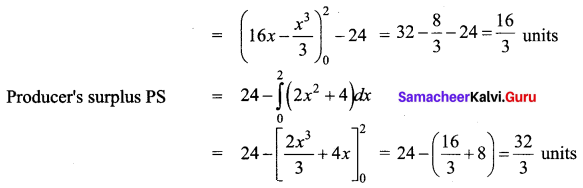
\(\frac{d^{2} \theta}{d t^{2}}=-\frac{g}{l} \theta\) …………………… (5)

This is the well known oscillatory differential equation. Therefore, the angular frequency of this oscillator (natural frequency of this system) is

ω2 = \(\frac{g}{l}\) …………………… (6)
∴ ω = \(\sqrt{g/l}\) in rad s-1 ……………….. (7)

The frequency of oscillation is
f = \(f=\frac{1}{2 \pi} \sqrt{\frac{g}{l}} \text { in } \mathrm{Hz}\) ………………… (8)
and time period of sscillations is
T = 2π\(\sqrt{l/g}\) in second. ……………….. (9)

Samacheer Kalvi 6th Maths Solutions Term 1 Chapter 2 Introduction to Algebra Ex 2.3

You can Download Samacheer Kalvi 6th Maths Book Solutions Guide Pdf, Tamilnadu State Board help you to revise the complete Syllabus and score more marks in your examinations.

Tamilnadu Samacheer Kalvi 6th Maths Solutions Term 1 Chapter 2 Introduction to Algebra Ex 2.3

Miscellaneous Practice Problems
Samacheer Kalvi 6th Maths Solutions Term 1 Chapter 2 Introduction to Algebra Ex 2.3
Question 1.
Complete the following pattern.
9 – 1 =
98 – 21 =
987 – 321 =
9876 – 4321 =
98765 – 54321 =
What comes next?
Solution:
9 – 1 = 8
98 – 21 = 77
987 – 321 = 666
9876 – 4321 = 5555
98765 – 54321 = 44444
Next will be 987654 – 654321 = 333333

Question 2.
A piece of wire is ’12s’ cm long. What will be the length of the side, if it is formed as
(i) an equilateral triangle
(ii) a square?
Solution:
(i) 4s
(ii) 3s

Question 3.
Identify the value of the shapes and figures in the table given below the verify their addition horizontally and vertically.
Samacheer Kalvi 6th Maths Term 1 Chapter 2 Introduction to Algebra Ex 2.3 Q3
Solution:
Samacheer Kalvi 6th Maths Term 1 Chapter 2 Introduction to Algebra Ex 2.3 Q3.1

Samacheer Kalvi 6th Maths Solutions Term 1 Chapter 2 Introduction to Algebra Ex 2.3

Question 4.
The table given below shows the results of the matches played by 8 teams in a Kabaddi championship tournament.
Samacheer Kalvi 6th Maths Term 1 Chapter 2 Introduction to Algebra Ex 2.3 Q4
Find the value of all the variables in the table given above.
Solution:
We know that
Total matches played = Matches wont + Matches lost.
5 + k = 8
⇒ k = 3
7 + 2 = a
a = 9
7 = 6 + m
⇒ m = 1
b + 3 = 9
⇒ b = 6
4 + 6 = n
⇒ n = 10
6 + c = 10
⇒ c = 4
x + 4 = 8
⇒ x = 4
3 + 6 = y
⇒ y = 10

Challenging Problem (Text book Page No. 53)

Question 5.
Gopal is 8 years younger to Karnan. If the sum of their ages is 30, how old is Karnan?
Solution:
Let Kaman’s age be x years
Gopal age is x – 8 years
Given sum of their ages is 30. i.e, x + (x – 8) = 30
Now we will form the table to find their sums = 30.
Samacheer Kalvi 6th Maths Term 1 Chapter 2 Introduction to Algebra Ex 2.3 Q5
For x = 19 (Karnan’s age)
the sum = 30
Kaman’s age = 19 years.

Samacheer Kalvi 6th Maths Solutions Term 1 Chapter 2 Introduction to Algebra Ex 2.3

Question 6.
The rectangles made of identical square blocks with varying lengths but having only two square blocks as width are given below.
Samacheer Kalvi 6th Maths Term 1 Chapter 2 Introduction to Algebra Ex 2.3 Q6
(i) How many smallest squares are there in each of the rectangles P, Q, R and S?
(ii) Fill in the boxes.
Samacheer Kalvi 6th Maths Term 1 Chapter 2 Introduction to Algebra Ex 2.3 Q6.1
Solution:
(i) No. of smallest squares in P, Q, R and S are 2, 8, 6 and 10 respectively.
(ii)
Samacheer Kalvi 6th Maths Term 1 Chapter 2 Introduction to Algebra Ex 2.3 Q6.2

Question 7.
Find the variables from the clues given below and solve the crossword puzzle.
Samacheer Kalvi 6th Maths Term 1 Chapter 2 Introduction to Algebra Ex 2.3 Q7
Samacheer Kalvi 6th Maths Term 1 Chapter 2 Introduction to Algebra Ex 2.3 Q7.1
Solution:
Samacheer Kalvi 6th Maths Term 1 Chapter 2 Introduction to Algebra Ex 2.3 Q7.2

Samacheer Kalvi 6th Maths Solutions Term 1 Chapter 2 Introduction to Algebra Ex 2.3

Please Check This Post:

Samacheer Kalvi 11th Maths Solutions Chapter 11 Integral Calculus Ex 11.5

You can Download Samacheer Kalvi 11th Maths Book Solutions Guide Pdf, Tamilnadu State Board help you to revise the complete Syllabus and score more marks in your examinations.

PNB Pivot Point Calculator

Tamilnadu Samacheer Kalvi 11th Maths Solutions Chapter 11 Integral Calculus Ex 11.5

Integrate the following functions with respect to x
Question 1.
\(\frac{x^{3}+4 x^{2}-3 x+2}{x^{2}}\)
Solution:
Samacheer Kalvi 11th Maths Solutions Chapter 11 Integral Calculus Ex 11.5 1

Question 2.
\(\left(\sqrt{x}+\frac{1}{\sqrt{x}}\right)^{2}\)
Solution:
Samacheer Kalvi 11th Maths Solutions Chapter 11 Integral Calculus Ex 11.5 2

Question 3.
(2x – 5)(36 + 4x)
Solution:
Samacheer Kalvi 11th Maths Solutions Chapter 11 Integral Calculus Ex 11.5 3

Question 4.
cot2 x + tan2 x
Solution:
Samacheer Kalvi 11th Maths Solutions Chapter 11 Integral Calculus Ex 11.5 4

Question 5.
\(\frac{\cos 2 x-\cos 2 \alpha}{\cos x-\cos \alpha}\)
Solution:
Samacheer Kalvi 11th Maths Solutions Chapter 11 Integral Calculus Ex 11.5 5

Question 6.
\(\frac{\cos 2 x}{\sin ^{2} x \cos ^{2} x}\)
Solution:
Samacheer Kalvi 11th Maths Solutions Chapter 11 Integral Calculus Ex 11.5 6

Samacheer Kalvi 11th Maths Solutions Chapter 11 Integral Calculus Ex 11.5

Question 7.
\(\frac{3+4 \cos x}{\sin ^{2} x}\)
Solution:
Samacheer Kalvi 11th Maths Solutions Chapter 11 Integral Calculus Ex 11.5 7

Question 8.
\(\frac{\sin ^{2} x}{1+\cos x}\)
Solution:
Samacheer Kalvi 11th Maths Solutions Chapter 11 Integral Calculus Ex 11.5 8

Question 9.
\(\frac{\sin 4 x}{\sin x}\)
Solution:
Samacheer Kalvi 11th Maths Solutions Chapter 11 Integral Calculus Ex 11.5 9

Question 10.
cos 3x cos 2x
Solution:
Samacheer Kalvi 11th Maths Solutions Chapter 11 Integral Calculus Ex 11.5 10

Samacheer Kalvi 11th Maths Solutions Chapter 11 Integral Calculus Ex 11.5

Question 11.
sin2 5x
Solution:
Samacheer Kalvi 11th Maths Solutions Chapter 11 Integral Calculus Ex 11.5 11

Question 12.
\(\frac{1+\cos 4 x}{\cot x-\tan x}\)
Solution:
Samacheer Kalvi 11th Maths Solutions Chapter 11 Integral Calculus Ex 11.5 12
Question 13.
ex log aex
Solution:
Samacheer Kalvi 11th Maths Solutions Chapter 11 Integral Calculus Ex 11.5 13

Question 14.
(3x + 4) \(\sqrt{3 x+7}\)
Solution:
Samacheer Kalvi 11th Maths Solutions Chapter 11 Integral Calculus Ex 11.5 14
Samacheer Kalvi 11th Maths Solutions Chapter 11 Integral Calculus Ex 11.5 15

Question 15.
\(\frac{8^{1+x}+4^{1-x}}{2^{x}}\)
Solution:
Samacheer Kalvi 11th Maths Solutions Chapter 11 Integral Calculus Ex 11.5 16

Question 16.
\(\frac{1}{\sqrt{x+3}-\sqrt{x-4}}\)
Solution:
Samacheer Kalvi 11th Maths Solutions Chapter 11 Integral Calculus Ex 11.5 17

Question 17.
\(\frac{x+1}{(x+2)(x+3)}\)
Solution:
Samacheer Kalvi 11th Maths Solutions Chapter 11 Integral Calculus Ex 11.5 18
x + 1 = A(x + 3) + B(x + 2) ………….. (i)
Put x = -3 in (i)
-2 = B(-1)
B = 2
Put x = -2 in (i)
-1 = A(1)
A = -1
Samacheer Kalvi 11th Maths Solutions Chapter 11 Integral Calculus Ex 11.5 19

Samacheer Kalvi 11th Maths Solutions Chapter 11 Integral Calculus Ex 11.5

Question 18.
\(\frac{1}{(x-1)(x+2)^{2}}\)
Solution:
Samacheer Kalvi 11th Maths Solutions Chapter 11 Integral Calculus Ex 11.5 20

Question 19.
\(\frac{3 x-9}{(x-1)(x+2)\left(x^{2}+1\right)}\)
Solution:
Samacheer Kalvi 11th Maths Solutions Chapter 11 Integral Calculus Ex 11.5 21
put x = 1 in (i)
3 – 9 = A(3)(2) + 0 + 0
– 6 = 6A
A = -1

put x = -2 in (i)
-6 – 9 = 0 + B(-3) (5) + 0
-15 = – 15B
B = 1

put x = 0 in (i)
0 – 9 = A(2)(1) + B(-1)(1) + D(-1)(2)
-9 = 2A – B – 2D
2D = 2A – B + 9
2D = 2(-1) – 1 + 9
= -2 – 1 + 9
2D = 6
D = 3

Equating x3 coefficients on b/s in (i)
A + B + C = 0
-1 + 1 + C = 0
C = 0
Samacheer Kalvi 11th Maths Solutions Chapter 11 Integral Calculus Ex 11.5 22

Question 20.
\(\frac{x^{3}}{(x-1)(x-2)}\)
Solution:
Samacheer Kalvi 11th Maths Solutions Chapter 11 Integral Calculus Ex 11.5 23
Samacheer Kalvi 11th Maths Solutions Chapter 11 Integral Calculus Ex 11.5 24

Samacheer Kalvi 11th Maths Solutions Chapter 11 Integral Calculus Ex 11.5 Additional Problems

Integrate the following
Question 1.
\(\frac{e^{2 x}+e^{-2 x}+2}{e^{x}}\)
Solution:
Samacheer Kalvi 11th Maths Solutions Chapter 11 Integral Calculus Ex 11.5 25

Question 2.
cos3 2x – sin 6x
Solution:
cos 3x = 4 cos3 x – 3 cos x
∴ 4 cos3 x = cos 3x + 3 cos x
Samacheer Kalvi 11th Maths Solutions Chapter 11 Integral Calculus Ex 11.5 26

Question 3.
\(\sqrt{1-\sin 2 x}\)
Solution:
Samacheer Kalvi 11th Maths Solutions Chapter 11 Integral Calculus Ex 11.5 27

Question 4.
cos 2x sin 4x
Solution:
Samacheer Kalvi 11th Maths Solutions Chapter 11 Integral Calculus Ex 11.5 28
Samacheer Kalvi 11th Maths Solutions Chapter 11 Integral Calculus Ex 11.5 29

Samacheer Kalvi 11th Maths Solutions Chapter 11 Integral Calculus Ex 11.5

Question 5.
(ex – 1)2 e-4x
Solution:
Samacheer Kalvi 11th Maths Solutions Chapter 11 Integral Calculus Ex 11.5 30

Question 6.
(x + 1) \(\sqrt{x+3}\)
Solution:
Samacheer Kalvi 11th Maths Solutions Chapter 11 Integral Calculus Ex 11.5 31

Question 7.
(2x + 1)\(\sqrt{2x+3}\)
Solution:
Samacheer Kalvi 11th Maths Solutions Chapter 11 Integral Calculus Ex 11.5 32
Samacheer Kalvi 11th Maths Solutions Chapter 11 Integral Calculus Ex 11.5 33

Samacheer Kalvi 12th Business Maths Solutions Chapter 2 Integral Calculus I Ex 2.3

Students can download 12th Business Maths Chapter 2 Integral Calculus I Ex 2.3 Questions and Answers, Samacheer Kalvi 12th Business Maths Book Solutions Guide Pdf helps you to revise the complete Tamilnadu State Board New Syllabus and score more marks in your examinations.

Tamilnadu Samacheer Kalvi 12th Business Maths Solutions Chapter 2 Integral Calculus I Ex 2.3

Integrate the following with respect to x.

Question 1.
\(e^{x \log a}+e^{a \log a}-e^{n \log x}\)
Solution:
Samacheer Kalvi 12th Business Maths Solutions Chapter 2 Integral Calculus I Ex 2.3 Q1

Question 2.
\(\frac{a^{x}-e^{x \log b}}{e^{x \log a} b^{x}}\)
Solution:
Samacheer Kalvi 12th Business Maths Solutions Chapter 2 Integral Calculus I Ex 2.3 Q2

Question 3.
\(\left(e^{x}+1\right)^{2} e^{x}\)
Solution:
Samacheer Kalvi 12th Business Maths Solutions Chapter 2 Integral Calculus I Ex 2.3 Q3

Question 4.
\(\frac{e^{3 x}-e^{-3 x}}{e^{x}}\)
Solution:
Samacheer Kalvi 12th Business Maths Solutions Chapter 2 Integral Calculus I Ex 2.3 Q4
Samacheer Kalvi 12th Business Maths Solutions Chapter 2 Integral Calculus I Ex 2.3 Q4.1

Question 5.
\(\frac{e^{3 x}+e^{5 x}}{e^{x}+e^{-x}}\)
Solution:
Samacheer Kalvi 12th Business Maths Solutions Chapter 2 Integral Calculus I Ex 2.3 Q5

Question 6.
\(\left[1-\frac{1}{x^{2}}\right] e^{\left(x+\frac{1}{x}\right)}\)
Solution:
Samacheer Kalvi 12th Business Maths Solutions Chapter 2 Integral Calculus I Ex 2.3 Q6

Question 7.
\(\frac{1}{x(\log x)^{2}}\)
Solution:
Samacheer Kalvi 12th Business Maths Solutions Chapter 2 Integral Calculus I Ex 2.3 Q7

Question 8.
If f'(x) = ex and f(0) = 2, then find f(x).
Solution:
f'(x) = ex
Integrating both sides of the equation,
∫ f'(x) dx = ∫ ex dx
⇒ f(x) = ex + c
given f(0) = 2
2 = e0 + c
⇒ c = 1
Thus f(x) = ex + 1

Samacheer Kalvi 12th Business Maths Solutions Chapter 1 Applications of Matrices and Determinants Miscellaneous Problems

Students can download 12th Business Maths Chapter 1 Applications of Matrices and Determinants Miscellaneous Problems Questions and Answers, Samacheer Kalvi 12th Business Maths Book Solutions Guide Pdf helps you to revise the complete Tamilnadu State Board New Syllabus and score more marks in your examinations.

Tamilnadu Samacheer Kalvi 12th Business Maths Solutions Chapter 1 Applications of Matrices and Determinants Miscellaneous Problems

Question 1.
Find the rank of the matrix A = \(\left(\begin{array}{rrrr}
1 & -3 & 4 & 7 \\
9 & 1 & 2 & 0
\end{array}\right)\)
Solution:
A = \(\left(\begin{array}{rrrr}
1 & -3 & 4 & 7 \\
9 & 1 & 2 & 0
\end{array}\right)\)
Order of A is 2 × 4. So ρ(A) ≤ 2
Consider the second order minor
\(\left|\begin{array}{cc}
1 & -3 \\
9 & 1
\end{array}\right|\) = 1 + 27 = 28 ≠ 0
There is a minor of order 2 which is not zero.
So ρ(A) = 2

Question 2.
Find the rank of the matrix A = \(\left(\begin{array}{rrrr}
-2 & 1 & 3 & 4 \\
0 & 1 & 1 & 2 \\
1 & 3 & 4 & 7
\end{array}\right)\)
Solution:
Given A = \(\left(\begin{array}{rrrr}
-2 & 1 & 3 & 4 \\
0 & 1 & 1 & 2 \\
1 & 3 & 4 & 7
\end{array}\right)\)
Order of A is 3 × 4. So ρ(A) ≤ 3
Consider the third order minor
\(\left|\begin{array}{ccc}
-2 & 1 & 3 \\
0 & 1 & 1 \\
1 & 3 & 4
\end{array}\right|\)
= -2(4 – 3) – 1(0 – 1) + 3(0 – 1)
= -2 + 1 – 3 =
= -4 ≠ 0
There exists a minor of order 3 which is not zero. So ρ(A) = 3

Question 3.
Find the rank of the matrix A = \(\left(\begin{array}{llll}
4 & 5 & 2 & 2 \\
3 & 2 & 1 & 6 \\
4 & 4 & 8 & 0
\end{array}\right)\)
Solution:
Given A = \(\left(\begin{array}{llll}
4 & 5 & 2 & 2 \\
3 & 2 & 1 & 6 \\
4 & 4 & 8 & 0
\end{array}\right)\)
Order of A is 3 × 4. So ρ(A) ≤ 3
Consider the third order minor,
\(\left|\begin{array}{lll}
4 & 5 & 2 \\
3 & 2 & 1 \\
4 & 4 & 8
\end{array}\right|\)
= 4(16 – 4) – 5(24 – 4) + 2 (12 – 8)
= 48 – 100 + 8
= -44 ≠ 0
There is a minor of order 3 which is not zero.
ρ(A) = 3

Question 4.
Examine the consistency of the system of equations:
x + y + z = 7, x + 2y + 3z = 18, y + 2z = 6
Solution:
The given system is x + y + z = 7 , x + 2y + 3z = 18, y + 2z = 6.
The matrix equation corresponding to the given system
Samacheer Kalvi 12th Business Maths Solutions Chapter 1 Applications of Matrices and Determinants Miscellaneous Problems 1
Samacheer Kalvi 12th Business Maths Solutions Chapter 1 Applications of Matrices and Determinants Miscellaneous Problems 2
The last equivalent matrix is in the echelon form. [A, B] has 3 non-zero rows and [A] has 2 non- zero rows.
ρ([A, B]) = 3, ρ(A) = 2
ρ(A) ≠ ρ([A, B])
Hence the given system is inconsistent and has no solution.

Question 5.
Find k if the equations 2x + 3y – z = 5, 3x – y + 4z = 2, x + 7y – 6z = k are consistent.
Solution:
The given system is 2x + 3y – z = 5, 3x – y + 4z = 2, x + 7y – 6z = k
It is also given that the system is consistent.
The matrix equation corresponding to the given system is
Samacheer Kalvi 12th Business Maths Solutions Chapter 1 Applications of Matrices and Determinants Miscellaneous Problems 3
ρ(A) = 2; ρ([A, B]) = 2 or 3
For the equations to be consistent, ρ([A, B]) = ρ(A) = 2
k – 8 = 0 ⇒ k = 8

Question 6.
Find k if the equations x + y + z = 1, 3x – y – z = 4, x + 5y + 5z = k are inconsistent.
Solution:
The given system is x + y + z = 1, 3x – y – z = 4, x + 5y + 5z = k and it is inconsistent.
The matrix equation corresponding to the given system is
Samacheer Kalvi 12th Business Maths Solutions Chapter 1 Applications of Matrices and Determinants Miscellaneous Problems 4
ρ(A) = 2, since the equivalent matrix has 2 non zero rows.
For the equations to be inconsistent
ρ([A, B]) ≠ ρ(A)
ρ([A, B]) ≠ 2 ⇒ k ≠ 0
So k can assume any real value other than 0.

Question 7.
Solve the equations x + 2y + z = 7, 2x – y + 2z = 4, x + y – 2z = -1 by using Cramer’s rule.
Solution:
The given system is x + 2y + z = 7, 2x – y + 2z = 4, x + y – 2z = -1
Here ∆ = \(\left|\begin{array}{ccc}
1 & 2 & 1 \\
2 & -1 & 2 \\
1 & 1 & -2
\end{array}\right|\)
= 1(2 – 2) -2(4 – 2) + 1(2 + 1)
= 12 + 3
= 15 ≠ 0
We can apply Cramer’s ruleand the system is consistent and it has unique solution.
Samacheer Kalvi 12th Business Maths Solutions Chapter 1 Applications of Matrices and Determinants Miscellaneous Problems 5
Samacheer Kalvi 12th Business Maths Solutions Chapter 1 Applications of Matrices and Determinants Miscellaneous Problems 6

Question 8.
The cost of 2kg. of wheat and 1kg. of sugar is ₹ 100. The cost of 1kg. of wheat and 1kg. of rice is ₹ 80. The cost of 3kg. of wheat, 2kg. of sugar and 1kg of rice is ₹ 220. Find the cost of each per kg., using Cramer’s rule.
Solution:
Let the cost of wheat per kg be ₹ x, cost of sugar per kg be ₹ y and cost of rice per kg be ₹ z, respectively.
It is given that 2x + y = 100, x + z = 80, 3x + 2y + z = 220
Here ∆ = \(\left|\begin{array}{lll}
2 & 1 & 0 \\
1 & 0 & 1 \\
3 & 2 & 1
\end{array}\right|\)
= 2 (-2) – 1(-2 )
= -2 ≠ 0
we can apply Cramer’s rule and the system is consistent and its has unique solution.
Samacheer Kalvi 12th Business Maths Solutions Chapter 1 Applications of Matrices and Determinants Miscellaneous Problems 7
Hence the cost of wheat is ₹ 30/kg, cost of sugar is ₹ 40/kg and the cost of rice is ₹ 50/kg.

Question 9.
A salesman has the following record of sales for three months for three items A,B and C, which have different rates of commission.
Samacheer Kalvi 12th Business Maths Solutions Chapter 1 Applications of Matrices and Determinants Miscellaneous Problems 8
Find out the rate of commission on the items A,B and C by using Cramer’s rule.
Solution:
Let the rate of commission on items A, B and C be ₹ x, ₹ y and ₹ z per unit respectively.
According to the problem we have,
January, 90x + 100y + 20z = 800
February, 130x + 50y + 40z = 900
March, 60x + 100y + 30z = 850
Samacheer Kalvi 12th Business Maths Solutions Chapter 1 Applications of Matrices and Determinants Miscellaneous Problems 9
Samacheer Kalvi 12th Business Maths Solutions Chapter 1 Applications of Matrices and Determinants Miscellaneous Problems 10

Question 10.
The subscription department of a magazine sends out a letter to a large mailing list inviting subscriptions for the magazine. Some of the people receiving this letter already subscribe to the magazine while others do not. From this mailing list, 60% of those who already subscribe will subscribe again while 25% of those who do not now subscribe will subscribe. On the last letter it was found that 40% of those receiving it ordered a subscription. What percent of those receiving the current letter can be expected to order a subscription?
Solution:
Let X represent people who subscribe for the magazine and Y represent people who do not subscribe for the magazine. Then
(X X) ⇒ those who already subscribed will do it again.
(X Y) ⇒ those who already subscribed will not do it again.
(Y X) ⇒ those who have not subscribed will do it now.
(Y Y) ⇒ those who have not subscribed already will not do it now also.
From the question,
Samacheer Kalvi 12th Business Maths Solutions Chapter 1 Applications of Matrices and Determinants Miscellaneous Problems 11
Samacheer Kalvi 12th Business Maths Solutions Chapter 1 Applications of Matrices and Determinants Miscellaneous Problems 12
Thus 39% of those receiving the current letter can be expected to order a subscription.

Tamil Nadu 11th Physics Model Question Paper 3 English Medium

Students can Download Tamil Nadu 11th Physics Model Question Paper 3 English Medium Pdf, Tamil Nadu 11th Physics Model Question Papers helps you to revise the complete Tamilnadu State Board New Syllabus and score more marks in your examinations.

TN State Board 11th Physics Model Question Paper 3 English Medium

Tamil Nadu 11th Physics Model Question Paper 2 English Medium

Instructions:

  1. The question paper comprises of four parts
  2. You are to attempt all the parts. An internal choice of questions is provided wherever: applicable
  3. All questions of Part I, II, III, and IV are to be attempted separately
  4. Question numbers to 15 in Part I are Multiple choice Questions of one mark each. These are to be answered by choosing the most suitable answer from the given four alternatives and writing the option code and the corresponding answer
  5. Question numbers 16 to 24 in Part II are two-mark questions. These are lo be answered in about one or two sentences.
  6. Question numbers 25 to 33 in Part III are three-mark questions. These are lo be answered in about three to five short sentences.
  7. Question numbers 34 to 38 in Part IV are five-mark questions. These are lo be answered in detail. Draw diagrams wherever necessary.

Time: 3 Hours
Max Marks: 70

Tamil Nadu 11th Physics Model Question Paper 2 English Medium

PART – I

Answer all the questions. [15 x 1 = 15]
Question 1.
A force F is applied on a square plate of side L. If percentage error in determination of L is 2% and that in F is 4%, the permissible error in pressure is ……….. .
(a) 2%
(b) 4%
(c) 6%
(d) 8%
Answer:
(d) 8%
Hint:
Pressure P = \(\frac { F }{ A }\) = \(\frac { F }{ L² }\)
\(\frac { ∆P }{ P }\) × 100 = (\(\frac { ∆F }{ F }\) × 100) + (\(\frac { ∆L }{ L }\) × 100) = 4% + 2(2%)
\(\frac { ∆P }{ P }\) × 100 = 8%

Question 2.
From the displacement – time graph shown below, particle is ……….. .
Tamil Nadu 11th Physics Model Question Paper 3 English Medium 1
(a) continuously going in positive x – direction
(b) at rest
(c) going with increasing velocity upto a time t0 and then becomes constant
(d) moves at a constant velocity upto a time t0, and then stops
Answer:
(d) moves at a constant velocity upto a time t0, and then stops

Question 3.
The potential energy of the system increases if work is done ……….. .
(a) upon the system by a non conservative force
(b) by the system against a conservative force
(c) by the system against a non conservative force
(d) upon the system by a conservative force
Answer:
(b) by the system against a conservative force

Question 4.
If x = at2 + bt + c where x is displacement as a function of time. The dimension of ‘a’ and ‘b’ are respectively ……… .
(a) LT-1 and LT-2
(b) LT-2 and LT-1
(c) L and LT-2
(d) LT-1 and L
Answer:
(b) LT-2 and LT-1
Hint:
According to principle of homogeneity, the displacement, x = at2 + bt + c
Dimensionally, [L] = [LT-2] [T2] + [LT-1] [T]
Where a = LT-2 and b = LT-1

Question 5.
A satellite in its orbit around earth is weightless on account of its ……….. .
(a) momentum
(b) acceleration
(c) speed
(d) none
Answer:
(b) acceleration

Question 6.
The displacement of a particle along x – axis is given by x = 7t2 + 8t + 3. Its acceleration and velocity at t = 2s respectively ……….. .
(a) 36 ms-1, 14 ms-2
(b) 14 ms-2, 36 ms-1
(c) 47 ms-2, 21 ms-1
(d) 2 ms-1, 47 ms-2
Answer:
(b) 14 ms-2, 36 ms-1
Hint:
x = 7t2 + 8t + 3 dx
V = \(\frac { dx }{ dt }\) = 14t + 8;
at t = 2s; V = 36 ms-1
a = \(\frac { dv }{ dt }\) = 14 ms-2

Question 7.
A sphere of radius r cm falls from rest in a viscous liquid. Heat is produced due to viscous force. The rate of production of heat when the sphere attains its terminal velocity is proportional to ……….. .
(a) r2
(b) r3
(c) r4
(d) r5
Answer:
(d) r5
Hint:
Rate of heat production = F.V
= 6πηrv × v = 6πηrv2
[v ∝ r2] Terminal velocity ∝ r5

Question 8.
A body of weight mg is hanging on a string which extends its length l. The workdone in extending the string is ……….. .
(a) mgl
(b) \(\frac { mgl }{ 2 }\)
(c) 2 mgl
(d) none of these
Answer:
(b) \(\frac { mgl }{ 2 }\)
Hint:
The extension length is
Workdone (W) = Force × distance
Workdone in extension string = Weight × Length extension
mg × \(\frac { l }{ 2 }\)
W = \(\frac { mgl }{ 2 }\)

Tamil Nadu 11th Physics Model Question Paper 2 English Medium

Question 9.
If Sp and Sv denote the specific heat of nitrogen gas per unit mass at constant pressure and constant volume respectively, then ……….. .
(a) Sp– Sv = 28R
(b) Sp – Sv = \(\frac { R }{ 28 }\)
(c) Sp – Sv = \(\frac { R }{ 14 }\)
(d) Sp – Sv = R
Answer:
(b) Sp – Sv = \(\frac { R }{ 28 }\)
Hint:
According to Mayer’s relation, Sp – Sv = \(\frac { R }{ m }\)
For Nitrogen, m = 28
Sp – Sv = \(\frac { R }{ 28 }\)

Question 10.
A particle is moving eastwards with velocity of 5 m/s. In 10 sec the velocity changes to 5 m/s northwards. The average acceleration in this time is ……….. .
(a) zero
(b) \(\frac { 1 }{ √2 }\) m/s2 towards north – west
(c) \(\frac { 1 }{ √2 }\) m/s2 towards north – east
(d) \(\frac { 1 }{ 2 }\) m/s2 towards north – west
Answer:
(b) \(\frac { 1 }{ √2 }\) m/s2 towards north – west
Hint:
Tamil Nadu 11th Physics Model Question Paper 3 English Medium 2
\(\vec { a } \) = \(\frac { d\vec { v } }{ dt }\)
= \(\frac { 5 }{ 2 } (\hat { j } -\hat { i) } \)
= \(\frac { 1 }{ 2 } (\hat { j } -\hat { i) } \)
a = \(\frac { 1 }{ √2 }\) m/s-2

Question 11.
In an isochoric process, we have ……….. .
(a) W ≠ 0, U = 0, Q = 0, T = 0
(b) W ≠ 0, U ≠ 0, Q = 0, T = 0
(c) W = 0, U = 0, Q ≠ 0, T ≠ 0
(d) W = 0, U ≠ 0, Q ≠ 0, T ≠ 0
Answer:
(d) W = 0, U ≠ 0, Q ≠ 0, T ≠ 0

Question 12.
The efficiency of a carnot engine operations between boiling and freezing points of water is ……….. .
(a) 0.1
(b) 100
(c) 1
(d) 0.27
Answer:
(d) 0.27
Hint:
η = [1 – (\(\frac { { T }_{ 2 } }{ { T }_{ 1 } } \))] = [1 – \(\frac { 273 }{ 373 }\)]
η = 0.268
∴ η = 0.27

Question 13.
Bernoulli’s equation is consequences of conservation of ……….. .
(a) energy
(b) linear momentum
(c) angular momentum
(d) mass
Answer:
(a) energy

Question 14.
By what velocity a ball be projected vertically upwards so that the distance covered in 5th second is twice of that covered in 6 m second (tale g = 10 ms-2) ……….. .
(a) 19.6 ms-1
(b) 58.8 ms-1
(c) 49 ms-1
(d) 65 ms-1
Answer:
(d) 65 ms-1
Hint:
Distance covered int he 5th second
S5= u + \(\frac { 1 }{ 2 }\)(-10) × (2 × 5 – 1)
S5 = u – 5 × 9 = u – 45
Distance covered in the 6th second
S6= u +\(\frac { 1 }{ 2 }\)(-10) × (2 × 6 – 1) = u – 5 × 11
S6 = u – 55 .
Here S5 = 6S6 and we get solving
u = 65 ms-1

Tamil Nadu 11th Physics Model Question Paper 2 English Medium

Question 15.
Unit of Stefan’s constant is ……….. .
(a) watt m2 k4
(b) watt m2 / k4
(c) watt k4 / m2
(d) watt / m2 k4
Answer:
(d) watt / m2 k4

PART – II

Answer any six questions in which Q. No 23 is compulsory. [6 × 2 = 12]

Question 16.
Get an expression for stopping distance of a vehicle in terms of initial velocity v0 and deceleration ‘a’.
Answer:
Let s be the distance travelled by a vehicle before it stops
Using v² – u² = 2as,
We can get 0² – \(v_{0}^{2}\) = -2as
∴ s = \(\frac{v_{0}^{2}}{2a}\)
The stopping distance is directly proportional to \(v_{0}^{2}\). i.e. By doubling initial velocity it increase stopping distance by 4 times. Provided deceleration is kept as constant.

Question 17.
A carnot engine has the same efficiency, when operated
(i) between 100 K and 500 K
(ii) between TK and 900 K. Find the value of T.
Answer:
(i) Here T1 = 500 K; T2 = 100 K
η = 1 – \(\frac{T_2}{T_1}\) =1 – \(\frac{100}{500}\) = 1 – 0.2 = 0.8

(ii) Now, T1= 900 K; T2 = T and n = 0.8
Again, η = 1 – \(\frac{T_2}{T_1}\)
0.8 = 1 – \(\frac{T}{900}\) = 1 – 0.8 = 0.2
∴ T = 180K

Question 18.
A block at rest explodes into 3 parts are -2p\(\vec{j}\) and p\(\vec{j}\). Calculate the magnitude of the momentum of the third part.
Answer:
Let \(\vec{P}\) be the momentum of third particle after the explosion of bomb. According to law of conservation of momentum
-2p\(\vec{i}\) + p\(\vec{j}\) + \(\vec{P}\) = 0 (or) \(\vec{P}\) = 2p\(\vec{i}\) – p\(\vec{j}\)
P = \(\sqrt{(2p)^2+(-p)^2}\) = p√5

Question 19.
Discuss the possibilities of work done to be zero.
Answer:
Work done is zero in the following cases.
(i) When the force is zero (F = 0). For example, a body moving on a horizontal smooth frictionless surface will continue to do so as no force (not even friction) is acting along the plane. (This is an ideal situation.)

(ii) When the displacement is zero (dr = 0). For example, when force is applied on a rigid wall it does not produce any displacement. Hence, the work done is zero as shown in figure.

(iii) When the force and displacement are perpendicular (θ = 90°) to each other, when a body moves on a horizontal direction, the gravitational force (mg) does not work on the body, since it acts at right angles to the displacement as shown in Figure (b). In circular motion the centripetal force does not do work on the object moving on a circle as it is always perpendicular to the displacement as shown in Figure (c).
Tamil Nadu 11th Physics Model Question Paper 3 English Medium 3

Tamil Nadu 11th Physics Model Question Paper 2 English Medium

Question 20.
Define (a) unit of length (b) unit of electric current in SI system.
Answer:
Given v = at² + \(\frac{b}{c+t}\)
The physical quantities which are having same dimensional formula only can be added.
Dimensional formula for v = LT-1
Dimensional formula for c = T
Dimensional formula for at² = LT-1
a = \(\frac{LT_{-1}}{T^2}\) = LT-3
Dimensional formula for \(\frac{b}{c+t}\) = LT-1
∴ b = L [∵ c + t = T]

Question 21.
A solid cylinder of mass 20 kg rotates about it axis with angular speed 100 s-1 the radius of the cylinder is 0.25 m. Calculate moment of inertia of the solid cylinder.
Answer:
Given Data : R = 0.25 m, M = 20 kg, ω = 100 s-1
We know that
moment of inertia of the solid cylinder = \(\frac{MR^2}{2}\)
\(\frac{20×(0.25)^2}{2}\) = 0.625 kgm²
K.E of rotation = \(\frac{1}{2}\) Iω²
\(\frac{1}{2}\) × 0.625 × (100)² = 3125 J
∴ Angular momentum L = Iω = 0.625 × 100
L = 62.5 Js

Question 22.
Why moon has no atmosphere?
Answer:
The acceleration due to gravity of moon ‘g’ is small. Therefore the escape velocity on the surface of moon is also small. The molecules of in its atmosphere have greater thermal velocities than escape speed. The molecules can easily escaped from the atmosphere of moon. Hence the moon has no atmosphere.

Question 23.
A refrigerator has cop of 3. How much work must be supplied to the refrigerator in order to remove 200 J of heat from its interion?
Answer:
COP = β = \(\frac{Q_L}{W}\)
W = \(\frac{Q_c}{COP}\) = \(\frac{200}{3}\) = 66.67 J

Question 24.
What is the effect of gravitational force of attraction acting on the person be inside the satellite and stand on moon?
Answer:
The gravitational force of attraction of the Earth on the person inside the satellite provides the centripetal force necessary to move in an orbit. A person standing on the moon possesses weight due to the additional gravitational pull of the moon on the person.

Tamil Nadu 11th Physics Model Question Paper 2 English Medium

PART – III

Answer any six questions in which Q.No. 29 is compulsory. [6 × 3 = 18]

Question 25.
State and prove Archimedes principle.
Answer:
Archimedes Principle: It states that when a body is partially or wholly immersed in a fluid, it experiences an upward thrust equal to the weight of the fluid displaced by it and its upthrust acts through the centre of gravity of the liquid displaced.

Proof: Consider a body of height ‘h’ lying inside a liquid of density p, at a depth x below the free surface of the liquid. Area of cross section of the body is V. The forces on the sides of the body cancel out.
Tamil Nadu 11th Physics Model Question Paper 3 English Medium 4
Pressure at the upper face of the body, P1′ = xpg.
Pressure at the lower face of the body, P2′ = (x + h) pg
Thrust acting on the upper face of the body is F1 = P1 a = xρga acting vertically downwards,
Thrust acting on the lower face of the body is F2 = P2a = (x + h) ρga acting vertically upwards.
The resultant force (F2 – F1) is acting on the body in the upward direction and is called upthrust (U).
U = F2 – F1 = (x + h) ρga – xρga = ahρg
But ah = V, Volume of the body = Volume of liquid
U = Vρg = Mg
i. e., Upthrust or buoyant force = Weight of liquid displaced.
This proves the Archimedes principle.

Question 26.
State kepler’s three laws.
Answer:

  1. Law of Orbits: Each planet moves around the Sun in an elliptical orbit with the Sun at one of the foci.
  2. Law of area: The radial vector (line joining the Sun to a planet) sweeps equal areas in equal intervals of time.
  3. Law of period: The square of the time period of revolution of a planet around the Sun in its elliptical orbit is directly proportional to the cube of the semi-major axis of the ellipse.
    T² ∝ a³
    \(\frac{T²}{a³}\) = Constant

Question 27.
Write the properties of vector product of two vectors.
Answer:
Properties of vector product of two vectors are:
(i) The vector product of any two vectors is always another vector whose direction is perpendicular to the plane containing these two vectors, i.e., orthogonal to both the vectors \(\vec{A}\) and \(\vec{B}\), even though the vectors \(\vec{A}\) and \(\vec{B}\) may or may not be mutually orthogonal.

(ii) The vector product of two vectors is not commutative, i.e., \(\vec{A}\) × \(\vec{B}\) ≠ \(\vec{B}\) × \(\vec{A}\). But, \(\vec{A}\) × \(\vec{B}\) = –\(\vec{B}\) × \(\vec{A}\).

Here it is worthwhile to note that |\(\vec{A}\) × \(\vec{B}\)| = |\(\vec{B}\) x \(\vec{A}\)| = AB sin θ i.e., in the case of the product vectors \(\vec{A}\) × \(\vec{A}\) and \(\vec{B}\) × \(\vec{A}\), the magnitudes are equal but directions are opposite to each other.

(iii) The vector product of two vectors will have maximum magnitude when sin θ = 1, i.e., θ = 90° i.e., when the vectors \(\vec{A}\) and \(\vec{B}\) are orthogonal to each other.
(\(\vec{A}\) × \(\vec{B}\))max = AB\(\hat{n}\)

(iv) The vector product of two non-zero vectors will be minimum when sin θ = 0, i.e., θ = 0° or 180°
(\(\vec{A}\) × \(\vec{B}\))min = 0
i.e., the vector product of two non-zero vectors vanishes, if the vectors are either parallel or antiparallel.

(v) The self-cross product, i.e., product of a vector with itself is the null vector
\(\vec{A}\) × \(\vec{A}\) = AA sin 0° \(\hat{n}\) = \(\vec{0}\)
In physics the null vector \(\vec{0}\) is simply denoted as zero.

(vi) The self-vector products of unit vectors are thus zero.
\(\vec{i}\) × \(\vec{i}\) = \(\vec{j}\) × \(\vec{j}\) = \(\vec{k}\) × \(\vec{k}\) = 0

Question 28.
Let the two springs A and B such that KA > KB on which spring will more work has to be done if they are stretched by the same force.
Answer:
F = K.x so x = \(\frac{F}{K}\)
For same F
Tamil Nadu 11th Physics Model Question Paper 3 English Medium 5

Tamil Nadu 11th Physics Model Question Paper 2 English Medium

Question 29.
Differentiate slipping and sliding.
Answer:

                              SlidingSlipping
(i)Velocity of centre of mass is greater than Rω i.e. VCM > Rω.Velocity of centre of mass is lesser than Rω. i.e. VCM < Rω
(ii)Velocity of translational motion is greater than velocity of rotational motion.Velocity of translation motion is lesser than velocity of rotational motion.
(iii)Resultant velocity acts in the forward direction.Resultant velocity acts in the backward direction.

Question 30.
Jupiter is at a distance of 824.7 million km from the earth. Its angular diameter is measured to be 35.72” calculate the diameter of Jupiter.
Answer:
Distance of Jupiter = 824.7 × 10⁶ km = 8.247 × 10¹¹ m
Angular diameter = 35.72 × 4.85 × 10-6 rad = 173.242 × 10⁻⁶ rad
= 1.73 × 10⁻⁴ rad
Diameter of Jupiter D = θ × d= 1.73 × 10-4 rad × 8.247 × 1011 m
= 14.267 × 10⁷m = 1.427 × 10⁸m (or) 1.427 × 10⁵ km

Question 31.
A wire 10 m long has a cross-sectional area 1.25 × 10⁻⁴ m². It is subjected to a load of 5 kg. If young’s modulus of the material is 4 × 10¹⁰ Nm-2. calculate the elongation produced in the wire, [take g = 10 ms-2]
Answer:
We know that
Tamil Nadu 11th Physics Model Question Paper 3 English Medium 6

Question 32.
State and explain the law of equipartition of energy.
Answer:
According to kinetic theory, the average kinetic energy of system of molecules in thermal equilibrium at temperature T is uniformly distributed to all degrees of freedom (x or y or z directions of motion) so that each degree of freedom will get \(\frac{1}{2}\) kT of energy. This is called law of equipartition of energy.
Average kinetic energy of a monatomic molecule (with f = 3) = 3 × \(\frac{1}{2}\) KT = \(\frac{3}{2}\) KT
Average kinetic energy of diatomic molecule at low temperature (with f = 5) = 5 × \(\frac{1}{2}\) KT = \(\frac{5}{2}\) KT
Average kinetic energy of a diatomic molecule at high temperature (with f = 7) = 7 × \(\frac{1}{2}\) KT = \(\frac{7}{2}\) KT
Average kinetic energy of linear triatomic molecule (with f = 7) = 7 × \(\frac{1}{2}\) KT = \(\frac{7}{2}\) KT
Average kinetic energy of non linear triatomic molecule (with f = 6) = 6 × \(\frac{1}{2}\) KT = 3 KT

Question 33.
A cylindrical tank of height 0.4 m is open at the top and has a diameter 0.16 m. Water is filled in it up to height of 0.16 m. Find the time taken to empty the tank through a hole of radius 5 × 10⁻³ m in its bottom.
Answer:
The velocity of efflux through the hole v = \(\sqrt{2gh}\)
Let R, r be the radius of cylindrical tank and hole and ‘dh’ is the decrease in height of water in time ‘dt’ sec use principle of continuity at the top and hole
Tamil Nadu 11th Physics Model Question Paper 3 English Medium 7
integrating it within the condition of problem,
Tamil Nadu 11th Physics Model Question Paper 3 English Medium 8

Tamil Nadu 11th Physics Model Question Paper 2 English Medium

PART – IV

Answer all the questions. [5 × 5 = 25]

Question 34 (a).
Show that the path of oblique projection is parabola.
Answer:
This projectile motion takes place when the initial velocity is not horizontal, but at some angle with the vertical, as shown in Figure.(Oblique projectile)
Examples:

  1. Water ejected out of a hose pipe held obliquely.
  2. Cannon fired in a battle ground.

Consider an object thrown with initial velocity at an angle θ with the horizontal.
Then,
u = u\(\vec{i}\) + u\(\vec{j}\)
where u = u cos θ is the horizontal component and u = u sin θ, the vertical component of velocity.

Since the acceleration due to gravity is in the direction opposite to the direction of vertical component uy, this component will gradually reduce to zero at the maximum height of the projectile. At this maximum height, the same gravitational force will push the projectile to move downward and fall to the ground. There is no acceleration along the x direction throughout the motion. So, the horizontal component of the velocity (ux = u cos θ) remains the same till the object reaches the ground.
Tamil Nadu 11th Physics Model Question Paper 3 English Medium 9
Hence after the time t, the velocity along horizontal motion vx = ux + axt = ux = u cos θ
The horizontal distance travelled by projectile in time t is sx = uxt + \(\frac{1}{2}\) ax
Here, sx = x, ux = u cos θ, ax = 0
Tamil Nadu 11th Physics Model Question Paper 3 English Medium 10
Thus, x = u cos θ.t or t = \(\frac{x}{u cos θ }\) ………..(1)
Next, for the vertical motion vy = uy + ayt
Here uy = u sin θ, ay = -g (acceleration due to gravity acts opposite to the motion).
Thus, vy = u sin θ – gt
The vertical distance travelled by the projectile in the same time t is
Here, sy = y, uy = u sin θ, ax = -g
Then y = u sin θ t – \(\frac{1}{2}\) gt² ……..(2)
Substitute the value of t from equation (1) in equation (2), we have
Tamil Nadu 11th Physics Model Question Paper 3 English Medium 11
Thus the path followed by the projectile is an inverted parabola.

Tamil Nadu 11th Physics Model Question Paper 2 English Medium

[OR]

(b) Explain the motion of block connected by a string in vertical motion.
Answer:
Tamil Nadu 11th Physics Model Question Paper 3 English Medium 12
Case 1: Vertical motion: Consider two blocks of masses m1 and m2 (m1 > m2) connected by a light and inextensible string that passes over a pulley as shown in figure.
Tamil Nadu 11th Physics Model Question Paper 3 English Medium 13
Let the tension in the string be T and acceleration a. When the system is released, both the blocks start moving, m2 vertically upward and m1 downward with same acceleration a. The gravitational force m1g on mass m1 is used in lifting the mass m2.
The upward direction is chosen as y direction. The free body diagrams of both masses are shown in figure.
Applying Newton’s second law for mass m2
T\(\hat{j}\) – m2g\(\hat{j}\) = m2a\(\hat{j}\)
The left hand side of the above equation is the total force that acts on m2 and the right hand side is the product of mass and acceleration of m2 in y direction.
By comparing the components on both sides, we get
T – m2g = m2a …..(1)
Similarly, applying Newton’s second law for mass m1
T\(\hat{j}\) – m1g\(\hat{j}\) = -m1a\(\hat{j}\)
As mass m1 moves downward (-\(\hat{j}\)), its acceleration is along (-\(\hat{j}\))
By comparing the components on both sides, we get
T – m1g = -m1a
m1g – T = m1a ……(2)
Adding equations (1) and (2), we get
m1g – m2g = m1a – m2a
(m1 – m2)g = (m1 + m1)a ……(3)
From equation (3), the acceleration of both the masses is
a = (\(\frac{m_1-m_2}{m_1+m_2}\))g …….(4)
If both the masses are equal (m1 = m2), from equation (4)
a = 0
This shows that if the masses are equal, there is no acceleration and the system as a whole will be at rest.
To find the tension acting on the string, substitute the acceleration from the equation (4) into the equation (1).
Tamil Nadu 11th Physics Model Question Paper 3 English Medium 14
Equation (4) gives only magnitude of acceleration.
For mass m1, the acceleration vector is given by \(\vec{a}\) = –\(\frac{m_1-m_2}{m_1+m_2}\)g\(\hat{j}\)
For mass m2, the acceleration vector is given by \(\vec{a}\) = \(\frac{m_1-m_2}{m_1+m_2}\)g\(\hat{j}\)

Tamil Nadu 11th Physics Model Question Paper 2 English Medium

Question 35 (a).
Derive the expression for Carnot engine efficiency.
Answer:
Efficiency of a Carnot engine: Efficiency is defined as the ratio of work done by the working substance in one cycle to the amount of heat extracted from the source.
η = \(\frac{Workdone}{Heat extracted}\) = \(\frac{W}{Q_H}\) ……..(1)
From the first law of thermodynamics, W = QH – QL
η = \(\frac{Q_H – Q_L}{Q_H}\) = 1 – \(\frac{Q_L}{Q_H}\) ……..(2)
Applying isothermal conditions, we get,
QH = μRTHln \(\frac{V_2}{V_1}\)
QL = μRTLln \(\frac{V_3}{V_4}\) ………(3)
Here we omit the negative sign. Since we are interested in only the amount of heat (QL) ejected into the sink, we have
\(\frac{T_L}{T_H}\) = \(\frac{Q _L ln (\frac{V_3}{V_4})}{Q _H ln (\frac{V_2}{V_1})}\) …….(4)
By applying adiabatic conditions, we get,
\(\mathrm{T}_{\mathrm{H}} \mathrm{V}_{2}^{\gamma-1}=\mathrm{T}_{\mathrm{L}} \mathrm{V}_{3}^{\gamma-1}\)
\(\mathrm{T}_{\mathrm{H}} \mathrm{V}_{1}^{\gamma-1}=\mathrm{T}_{\mathrm{L}} \mathrm{V}_{4}^{\gamma-1}\)
By dividing the above two equations, we get
\(\left(\frac{v_{2}}{V_{1}}\right)^{\gamma-1}=\left(\frac{V_{3}}{V_{4}}\right)^{\gamma-1}\)
Which implies that \(\frac{V_2}{V_1}\) = \(\frac{V_3}{V_4}\) ……(5)
Substituting equation (5) in (4), we get
\(\frac{Q_L}{Q_H}\) = \(\frac{T_L}{T_H}\) ……..(6)
∴ The efficiency η = 1 – \(\frac{T_L}{T_H}\) ………….(7)
Note : TL and TH should be expressed in Kelvin scale.

Important results:

  1. n is always less than 1 because TL is less than TH. This implies the efficiency cannot be 100%.
  2. The efficiency of the Carnot’s engine is independent of the working substance. It depends only on the temperatures of the source and the sink. The greater the difference between the two temperatures, higher the efficiency.
  3. When TH = TL the efficiency n = 0. No engine can work having source and sink at the same temperature.

[OR]

(b). Explain the concepts of fundamental frequency, harmonics and overtones in detail.
Answer:
Fundamental frequency and overtones: Let us now keep the rigid boundaries at x = 0 and x = L and produce a standing waves by wiggling the string (as in plucking strings in a guitar). Standing waves with a specific wavelength are produced. Since, the amplitude must vanish at the boundaries, therefore, the displacement at the boundary must satisfy the following conditions y(x = 0, t) = 0 and y(x = L, t) = 0………….(1)
Since, the nodes formed are at a distance \(\frac{ λ_n}{2}\) apart, we have n \(\frac{ λ_n}{2}\) = L where n is an integer, L is the length between the two boundaries and λ n is the specific wavelength that satisfy the specified boundary conditions. Hence,
λ n = \(\frac{2L}{n}\)…………(2)
Therefore, not all wavelengths are allowed. The (allowed) wavelengths should fit with the specified boundary conditions, i.e., for n = 1, the first mode of vibration has specific wavelength λ n= 2L. Similarly for n = 2, the second mode of vibration has specific wavelength
λ 2 = \(\frac{2L}{2}\) = L
For n = 3, the third mode of vibration has specific wavelength
λ 3 = \(\frac{2L}{3}\)
and so on.
The frequency of each mode of vibration (called natural frequency) can be calculated.
We have, fn = \(\frac{v}{λ_n}\) = n \(\frac{v}{2L}\) ………..(3)
The lowest natural frequency is called the fundamental frequency.
f1 = \(\frac{v}{λ_1}\) = \(\frac{v}{2L}\) …………(4)
The second natural frequency is called the first over tone.
f2 = 2\(\frac{v}{2L}\) = \(\frac{1}{L} \sqrt{\frac{T}{\mu}}\)
The third natural frequency is called the second over tone.
f3 = 3\(\frac{v}{λ_2}\) = \(3\left(\frac{1}{2L} \sqrt{\frac{T}{\mu}}\right)\)
and so on.
Therefore, the nth natural frequency can be computed as integral (or integer) multiple of fundamental frequency, i.e.,
fn = nf1, where n is an integer …….(5)
If natural frequencies are written as integral multiple of fundamental frequencies, then the frequencies are called harmonics. Thus, the first harmonic is f1 = f1(the fundamental frequency is called first harmonic), the second harmonic is f2 = 2f1, the third harmonic is f3 = 3f1 etc.

Tamil Nadu 11th Physics Model Question Paper 2 English Medium

Question 36 (a).
Compare any two salient features of static and kinetic friction.
Answer:
Static Friction: Static friction is the force which opposes the initiation of motion of an object on the surface. The magnitude of static frictional force fs lies between 0 ≤ fs ≤ μsNs
where,
μs – coefficient of static friction
N – Normal force
Kinetic friction: The frictional force exerted by the surface when an object slides is called as kinetic friction. Also called as sliding friction or dynamic friction,
fk = μkN
where:
μk– the coefficient of kinetic friction
N – Normal force exerted by the surface on the object

(ii) To move an object-push or pull? Which is easier? Explain.
Answer:
When a body is pushed at an arbitrary angle θ (0 to \(\frac{π}{2}\)), the applied force F can be
resolved into two components as F sin θ parallel to the surface and F cos θ perpendicular to the surface as shown in figure. The total downward force acting on the body is mg + F cos θ. It implies that the normal force acting on the body increases. Since there is no acceleration along the vertical direction the normal force N is equal to
NPush = mg + F cos θ ….(1)
As a result the maximal static friction also increases and is equal to
\(f_{x}^{\max }\) = μrNPush = μs(mg + F cos θ ) ……(2)
Equation (2) shows that a greater force needs to be applied to push the object into motion.
Tamil Nadu 11th Physics Model Question Paper 3 English Medium 15
When an object is pulled at an angle θ, the applied force is resolved into two components as shown in figure. The total downward force acting on the object is
NPull = mg – F cos θ ……..(3)
Tamil Nadu 11th Physics Model Question Paper 3 English Medium 16
Equation (3)shows that the normal force is less than NPull. From equations (1) and (3), it is easier to pull an object than to push to make it move.

[OR]

(b). Describe the vertical oscillations of a spring.
Answer:
Vertical oscillations of a spring: Let us consider a massless spring with stiff ness constant or force constant k attached to a ceiling as shown in figure. Let the length of the spring before loading mass m be L. If the block of mass m is attached to the other end of spring, then the spring elongates by a length l. Let F1, be the restoring force due to stretching of spring. Due to mass m, the gravitational force acts vertically downward. We can draw free-body diagram for this system as shown in figure. When the system is under equilibrium,
F1+ mg = 0 ……(1)
But the spring elongates by small displacement 1, therefore,
F1 ∝ l ⇒ F1 = -kl …(2)
Substituting equation (2) in equation (1), we get – kl + mg = 0
-kl + mg = 0
mg = l or \(\frac{m}{k}\) = \(\frac{l}{g}\) …….(3)
Tamil Nadu 11th Physics Model Question Paper 3 English Medium 17
Suppose we apply a very small external force on the mass such that the mass further displaces downward by a displacement y, then it will oscillate up and down. Now, the restoring force due to this stretching of spring (total extension of spring is( y + 1) is
F2 ∝ (y + l)
F2 = -k(y + l) = -ky – kl …..(4)
Since, the mass moves up and down with acceleration \(\frac{d^2y}{dt^2}\) diagram for this case, we get
-ky – kl + mg = m\(\frac{d^2y}{dt^2}\) …….(5)
The net force acting on the mass due to this stretching is
F = F2 + mg
F = – ky – kl + mg ……..(6)
The gravitational force opposes the restoring force. Substituting equation (3) in equation (6), we get
F = – ky – kl + kl = -ky
Applying Newton’s law, we get
m\(\frac{d^2y}{dt^2}\) = -ky
m\(\frac{d^2y}{dt^2}\) = –\(\frac{k}{m}\)y ……(7)
The above equation is in the form of simple harmonic differential equation. Therefore, we get the time period as
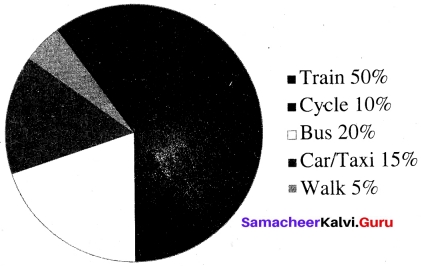
T = 2π, \(\sqrt{\frac{m}{k}}\) second …….(8)
The time period can be rewritten using equation (3)
T = 2π, \(\sqrt{\frac{m}{k}}\) = 2πl\(\frac{l}{g}\) second ……(9)
The acceleration due to gravity g can be computed from the formula
g = 4π²(\(\frac{1}{T^2}\)) ms-2

Tamil Nadu 11th Physics Model Question Paper 2 English Medium

Question 37 (a).
State and prove Bernoulli’s theorem
Answer:
Bernoulli’s theorem: According to Bernoulli’s theorem, the sum of pressure energy, kinetic energy, and potential energy per unit mass of an incompressible, non-viscous fluid in a streamlined flow remains a constant. Mathematically,
\(\frac{p}{roe}\) + \(\frac{1}{2}\)v² + gh = Constant
This is known as Bernoulli’s equation.
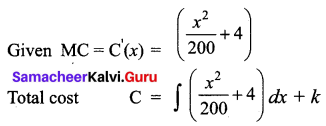
Proof : Let us consider a flow of liquid through a pipe AB. Let V be the volume of the liquid when it enters A in a time t which is equal to the volume of the liquid leaving B in the same time. Let aA, vA and PA be the area of cross section of the tube, velocity of the liquid and pressure exerted by the liquid at A respectively.
Let the force exerted by the liquid at A is
FA = PA aA
Distance travelled by the liquid in time t is d = vAt
Therefore, the work done is W = FAd = PAaAvAt
But aAvAt = aAd = V, volume of the liquid entering at A.
Thus, the work done is the pressure energy (at A), W = FAd = PAV
Pressure energy per unit volume at
A = \(\frac{pressure energy}{volume}\) = \(\frac{P_AV}{V}\) = PA
Pressure energy per unit mass at
A = \(\frac{pressure energy}{volume}\) = \(\frac{P_AV}{m}\) = \(\frac{P_A}{\frac{m}{v}}\) = \(\frac{P_A}{ρ}\)
Since m is the mass of the liquid entering at A in a given time, therefore, pressure energy of the liquid at A is
EPA – PAV = PAV × (\(\frac{m}{m}\)) = m\(\frac{P_A}{ρ}\)
Potential energy of the liquid at A,
PEA = mghA
Due to the flow of liquid, the kinetic energy of the liquid at A,
KEA = \(\frac{π}{2}\)m \(v_{A}^{2}\)
Therefore, the total energy due to the flow of liquid at A,
EA = EPA + KEA + PEA
EA = m\(\frac{P_A}{ρ}\) + \(\frac{1}{2}\) mv\(v_{A}^{2}\) + mg hA
Similarly, let aB, vB and PB be the area of cross section of the tube, velocity of the liquid and pressure exerted by the liquid at B. Calculating the total energy at FB, we get
EB = m\(\frac{P_B}{ρ}\) + \(\frac{1}{2}\) mv\(v_{B}^{2}\) + mg hB
From the law of conservation of energy,
EA = EB
Tamil Nadu 11th Physics Model Question Paper 3 English Medium 18
Thus, the above equation can be written as
\(\frac{P}{ρg}\) + \(\frac{1}{2}\) \(\frac{V_2}{g}\) + h = Constant
Tamil Nadu 11th Physics Model Question Paper 3 English Medium 19
The above equation is the consequence of the conservation of energy which is true until there is no loss of energy due to friction. But iri practice, some energy is lost due to friction. This arises due to the fact that in a fluid flow, the layers flowing with different velocities exert frictional forces on each other. This loss of energy is generally converted into heat energy. Therefore, Bernoulli’s relation is strictly valid for fluids with zero viscosity or non-viscous liquids. Notice that when the liquid flows through a horizontal pipe, then
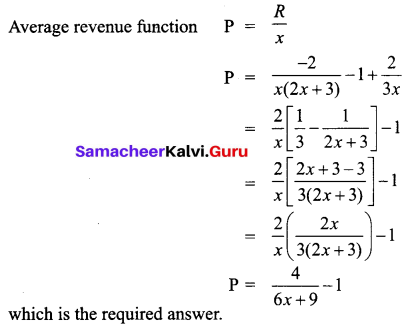
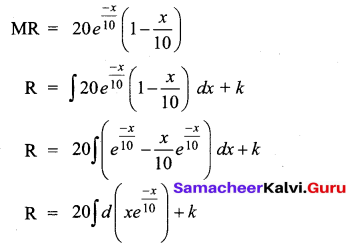
h = 0 ⇒ \(\frac{P}{ρg}\) +\(\frac{1}{2}\) \(\frac{V_2}{g}\) = Constant

Tamil Nadu 11th Physics Model Question Paper 2 English Medium

[OR]

(b) Write down the postulates of kinetic theory of gases.
Answer:

  1. All the molecules of a gas are identical, elastic spheres.
  2. The molecules of different gases are different.
  3. The number of molecules in a gas is very large and the average separation between them is larger than size of the gas molecules.
  4. The molecules of a gas are in a state of continuous random motion.
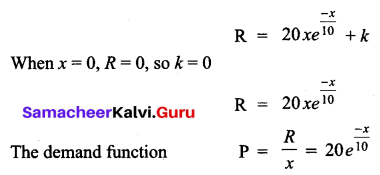
  5. The molecules collide with one another and also with the walls of the container.
  6. These collisions are perfectly elastic so that there is no loss of kinetic energy during collisions.
  7. Between two successive collisions, a molecule moves with uniform velocity.
  8. The molecules do not exert any force of attraction or repulsion on each other except during collision. The molecules do not possess any potential energy and the energy is wholly kinetic.
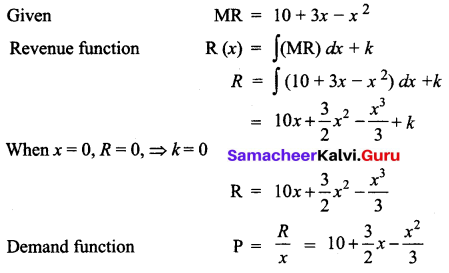
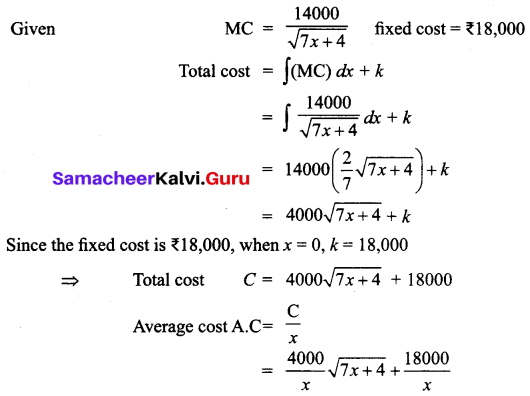
  9. The collisions are instantaneous. The time spent by a molecule in each collision is very small compared to the time elapsed between two consecutive collisions.
  10. These molecules obey Newton’s laws of motion even though they move randomly.

Question 38 (a).
Discuss in detail the energy in simple harmonic motion.
Energy in simple harmonic motion:
Answer:
(a) Expression for Potential Energy
For the simple harmonic motion, the force and the displacement are related by Hooke’s law
\(\vec{F}\) = -k\(\vec{r}\)
Since force is a vector quantity, in three dimensions it has three components. Further, the force in the above equation is a conservative force field; such a force can be derived from a scalar function which has only one component. In one dimensional case
F = -kx ……(1)
We know that the work done by the conservative force field is independent of path. The potential energy U can be calculated from the following expression.
F = –\(\frac{dU}{dx}\)
Comparing (1) and (2), we get
–\(\frac{dU}{dx}\) = -kx
dU = kx dx
This work done by the force F during a small displacement dx stores as potential energy
Tamil Nadu 11th Physics Model Question Paper 3 English Medium 20
From equation to ω = \(\sqrt{\frac{k}{m}}\), we can substitute the value of force constant k = mω² in equation (3),
U(x) = \(\frac{1}{2}\)mω²x² …..(4)
where ω is the natural frequency of the oscillating system. For the particle executing simple harmonic motion from equation y = A sin ωt, we get
x = A sin ωt
U(t) = \(\frac{1}{2}\)mω²A² sin² ωt ……(5)
This variation of U is shown in figure.

Tamil Nadu 11th Physics Model Question Paper 2 English Medium

(b) Expression for Kinetic Energy
Kinetic energy
KE = \(\frac{1}{2}\)m\(v_{x}^{2}\) = \(\frac{1}{2}\)m(\(\frac{dx}{dt}\))² …..(6)
Since the particle is executing simple harmonic motion, from equation
y = A sin ωt
x = A sin ωt
Tamil Nadu 11th Physics Model Question Paper 3 English Medium 21
Therefore, velocity is
vx = \(\frac{dx}{dt}\) = Aω cos ωt ….(7)
Tamil Nadu 11th Physics Model Question Paper 3 English Medium 22
This variation with time is shown in figure.

(c) Expression for Total Energy
Total energy is the sum of kinetic energy and potential energy
E = KE + U ….(11)
E = \(\frac{1}{2}\) mω² (A² – x²) + \(\frac{1}{2}\) mω²x²
Hence, cancelling x² term,
E = \(\frac{1}{2}\) mω²A² = constant ……(12)
Alternatively, from equation (5) and equation (10), we get the total energy as
E = \(\frac{1}{2}\) mω²A² sin² ωt + \(\frac{1}{2}\) mω²A² cos² ωt
= \(\frac{1}{2}\) mω²A² (sin² ωt + cos² ωt)
Tamil Nadu 11th Physics Model Question Paper 3 English Medium 23
From trigonometry identity, (sin² ωt + cos² ωt) = 1
E = \(\frac{1}{2}\) mω²A² = constant
which gives the law of conservation of total energy.
Thus the amplitude of simple harmonic oscillator, can be expressed in terms of total energy.
A = \(\sqrt{\frac{2E}{mω^2}}\) =\(\sqrt{\frac{2E}{k}}\)

Tamil Nadu 11th Physics Model Question Paper 2 English Medium

[OR]

(b) Explain the formation of stationary waves.
Answer:
Consider two harmonic progressive waves (formed by strings) that have the same amplitude and same velocity but move in opposite directions. Then the displacement of the first wave (incident wave) is
y1 = A sin (kx – ωt) (waves move toward right) ……(1)
and the displacement of the second wave (reflected wave) is
y2 = A sin (kx + ωt) (waves move toward left) …….(2)
both will interfere with each other by the principle of superposition, the net displacement is
y = y1 + y2 ……(3)
Substituting equation (1) and equation (2) in equation (3), we get
y = A sin (kx – ωt)+A sin (kx + ωt) …….(4)
Using trigonometric identity, we rewrite equation (4) as
y(x, t) = 2A cos (ωt) sin (kx) ……(5)
This represents a stationary wave or standing wave, which means that this wave does not move either forward or backward, whereas progressive or travelling waves will move forward or backward. Further, the displacement of the particle in equation (5) can be written in more compact form,
y(x, t) = A’ cos (ωt)
where, A’ = 2A sin (kx), implying that the particular element of the string executes simple harmonic motion with amplitude equals to A’. The maximum of this amplitude occurs at positions for which
sin (kx) = 1 ⇒ kx = \(\frac{π}{2}\), \(\frac{3π}{2}\), \(\frac{5π}{2}\), …… = mπ
where m takes half integer or half integral values. The position of maximum amplitude is known as antinode. Expressing wave number in terms of wavelength, we can represent the anti-nodal positions as
xm = (\(\frac{2m+1}{2}\)) \(\frac{λ}{2}\) where> m = 0, 1, 2…. ……(6)
For m = 0we have maximum at x0 = \(\frac{λ}{2}\)
For m = 1 we have maximum at x1 = \(\frac{3λ}{4}\)
For m = 2 we have maximum at x2 = \(\frac{5λ}{4}\) and so on.
The distance between two successive antinodes can be computed by
Tamil Nadu 11th Physics Model Question Paper 3 English Medium 24
Similarly, the minimum of the amplitude A’ also occurs at some points in the space, and these points can be determined by setting
sin (kx) = 0 ⇒ kx = 0, π, 2π, 3π,…. = nπ
where n takes integer or integral values. Note that the elements at these points do not vibrate (not move), and the points are called nodes. The nth nodal positions is given by,
xn = n\(\frac{λ}{2}\) where, n = 0,1,2,… …..(7)
For n = 0we have minimum at x0 = 0
For n = 1 we have minimum at x1 = \(\frac{λ}{2}\)
For n = 2 we have maximum at x2 = λ and so on.
The distance between any two successive nodes can be calculated as
xn – xn-1 = n\(\frac{λ}{2}\) – (n – 1) \(\frac{λ}{2}\) = \(\frac{λ}{2}\)

Tamil Nadu 11th Physics Model Question Paper 2 English Medium

Samacheer Kalvi 12th Business Maths Solutions Chapter 1 Applications of Matrices and Determinants Ex 1.4

Students can download 12th Business Maths Chapter 1 Applications of Matrices and Determinants Ex 1.4 Questions and Answers, Samacheer Kalvi 12th Business Maths Book Solutions Guide Pdf helps you to revise the complete Tamilnadu State Board New Syllabus and score more marks in your examinations.

Tamilnadu Samacheer Kalvi 12th Business Maths Solutions Chapter 1 Applications of Matrices and Determinants Ex 1.4

Choose the correct answer.

Question 1.
If A = (1 2 3), then the rank of AAT is ______
(a) 0
(b) 2
(c) 3
(d) 1
Answer:
(d) 1
Hint:
Samacheer Kalvi 12th Business Maths Solutions Chapter 1 Applications of Matrices and Determinants Ex 1.4 1

Question 2.
The rank of m × n matrix whose elements are unity is _________
(a) 0
(b) 1
(c) m
(d) n
Answer:
(b) 1
Hint:
All the rows except the first row can be made zero

Question 3.
If Samacheer Kalvi 12th Business Maths Solutions Chapter 1 Applications of Matrices and Determinants Ex 1.4 2 is a transition probability matrix, then at equilibrium A is equal to
(a) \(\frac{1}{4}\)
(b) \(\frac{1}{5}\)
(c) \(\frac{1}{6}\)
(d) \(\frac{1}{8}\)
Answer:
(a) \(\frac{1}{4}\)
Hint:
Samacheer Kalvi 12th Business Maths Solutions Chapter 1 Applications of Matrices and Determinants Ex 1.4 3

Question 4.
If A = \(\left(\begin{array}{ll}
2 & 0 \\
0 & 8
\end{array}\right)\) then ρ(A) is _______
(a) 0
(b) 1
(c) 2
(d) n
Answer:
(c) 2
Hint:
Samacheer Kalvi 12th Business Maths Solutions Chapter 1 Applications of Matrices and Determinants Ex 1.4 4

Question 5.
The rank of the matrix \(\left(\begin{array}{lll}
1 & 1 & 1 \\
1 & 2 & 3 \\
1 & 4 & 9
\end{array}\right)\) is _____
(a) 0
(b) 1
(c) 2
(d) 3
Answer:
(d) 3
Hint:
Samacheer Kalvi 12th Business Maths Solutions Chapter 1 Applications of Matrices and Determinants Ex 1.4 5

Question 6.
The rank of the unit matrix of order n is _______
(a) n – 1
(b) n
(c) n + 1
(d) n2
Answer:
(b) n
Hint:
Unit matrix of order n is in echelon form with n non-zero rows

Question 7.
If ρ(A) = r then which of the following is correct?
(a) all the minors of order r which does not vanish
(b) A has at least one minor of order r which does not vanish
(c) A has at least one (r + 1) order minor which vanishes
(d) all (r + 1) and higher-order minors should not vanish
Answer:
(b) A has at least one minor of order r which does not vanish

Question 8.
If A = \(\left(\begin{array}{l}
1 \\
2 \\
3
\end{array}\right)\) then the rank of AAT is _______
(a) 0
(b) 1
(c) 2
(d) 3
Answer:
(b) 1
Hint:
Samacheer Kalvi 12th Business Maths Solutions Chapter 1 Applications of Matrices and Determinants Ex 1.4 6

Question 9.
If the rank of the matrix \(\left(\begin{array}{ccc}
\lambda & -1 & 0 \\
0 & \lambda & -1 \\
-1 & 0 & \lambda
\end{array}\right)\) is 2. Then λ is _______
(a) 1
(b) 2
(c) 3
(d) only real number
Answer:
(a) 1
Hint:
Samacheer Kalvi 12th Business Maths Solutions Chapter 1 Applications of Matrices and Determinants Ex 1.4 7
Since rank is 2, the third order minor should vanish.
λ3 – 1 = 0
⇒ λ = 1

Question 10.
The rank of the diagonal matrix Samacheer Kalvi 12th Business Maths Solutions Chapter 1 Applications of Matrices and Determinants Ex 1.4 8
is _______
(a) 0
(b) 2
(c) 3
(d) 5
Answer:
(c) 3
Hint:
There are only three non-zero rows as the matrix is in echelon form.

Question 11.
If Samacheer Kalvi 12th Business Maths Solutions Chapter 1 Applications of Matrices and Determinants Ex 1.4 9 is a transition probability matrix, then the value of x is
(a) 0.2
(b) 0.3
(c) 0.4
(d) 0.7
Answer:
(c) 0.4
Hint:
x = 1 – 0.6 = 0.4

Question 12.
Which of the following is not an elementary transformation?
(a) Ri ↔ Rj
(b) Ri → 2Ri + 2Cj
(c) Ri → 2Ri – 4Rj
(d) Ci → Ci + 5Cj
Answer:
(b) Ri → 2Ri + 2Cj
Hint:
Since rows and columns cannot be taken together.

Question 13.
If ρ(A) = ρ(A, B), then the system is _______
(a) Consistent and has infinitely many solutions
(b) Consistent and has unique solutions
(c) consistent
(d) inconsistent
Answer:
(c) consistent

Question 14.
If ρ(A) = ρ(A, B) = the number of unknowns, then the system is _______
(a) Consistent and has infinitely many solutions
(b) Consistent and has unique solutions
(c) inconsistent
(d) consistent
Answer:
(i) Consistent and has unique solutions

Question 15.
If ρ(A) ≠ ρ(A, B), then the system is ________
(a) Consistent and has infinitely many solutions
(b) Consistent and has unique solutions
(c) inconsistent
(d) consistent
Answer:
(c) inconsistent

Question 16.
In a transition probability matrix, all the entries are greater than or equal to _______
(a) 2
(b) 1
(c) 0
(d) 3
Answer:
(c) 0

Question 17.
If the number of variables in a non- homogeneous system AX = B is n, then the system possesses a unique solution only when _______
(a) ρ(A) = ρ(A, B) > n
(b) ρ(A) = ρ(A, B) = n
(c) ρ(A) = ρ(A, B) < n
(d) none of these
Answer:
(b) ρ(A) = ρ(A, B) = n

Question 18.
The system of equations 4x + 6y = 5, 6x + 9y = 7 has ________
(a) a unique solution
(b) no solution
(c) infinitely many solutions
(d) none of these
Answer:
(b) no solution
Samacheer Kalvi 12th Business Maths Solutions Chapter 1 Applications of Matrices and Determinants Ex 1.4 10

Question 19.
For the system of equations x + 2y + 3z = 1, 2x + y + 3z = 2, 5x + 5y + 9z = 4 _______
(a) there is only one solution
(b) there exists infinitely many solutions
(c) there is no solution
(d) none of these
Answer:
(a) there is only one solution
Hint:
Samacheer Kalvi 12th Business Maths Solutions Chapter 1 Applications of Matrices and Determinants Ex 1.4 11
By Cramer’s rule, there is only one solution

Question 20.
If |A| ≠ 0, then A is _______
(a) non- singular matrix
(b) singular matrix
(c) zero matrix
(d) none of these
Answer:
(a) non-singular matrix

Question 21.
The system of linear equations x + y + z = 2, 2x + y – z = 3, 3x + 2y + k = 4 has unique solution, if k is not equal to ______
(a) 4
(b) 0
(c) -4
(d) 1
Answer:
(b) 0
Hint:
Samacheer Kalvi 12th Business Maths Solutions Chapter 1 Applications of Matrices and Determinants Ex 1.4 12

Question 22.
Cramer’s rule is applicable only to get an unique solution when ______
(a) Δz ≠ 0
(b) Δx ≠ 0
(c) Δ ≠ 0
(d) Δy ≠ 0
Answer:
(c) Δ ≠ 0

Question 23.
Samacheer Kalvi 12th Business Maths Solutions Chapter 1 Applications of Matrices and Determinants Ex 1.4 12
Answer:
Samacheer Kalvi 12th Business Maths Solutions Chapter 1 Applications of Matrices and Determinants Ex 1.4 13
Hint:
Samacheer Kalvi 12th Business Maths Solutions Chapter 1 Applications of Matrices and Determinants Ex 1.4 14

Question 24.
|An×n| = 3 |adj A| = 243 then the value n is _______
(a) 4
(b) 5
(c) 6
(d) 1
Answer:
(b) 5
Hint:
|adj A| = |A|n-1, n is order of matrix
243 = 3n-1
34 = 3n-1
n = 5

Question 25.
Rank of a null matrix is ______
(a) 0
(b) -1
(c) ∞
(d) 1
Answer:
(a) 0

Samacheer Kalvi 12th Business Maths Solutions Chapter 2 Integral Calculus I Ex 2.2

Students can download 12th Business Maths Chapter 2 Integral Calculus I Ex 2.2 Questions and Answers, Samacheer Kalvi 12th Business Maths Book Solutions Guide Pdf helps you to revise the complete Tamilnadu State Board New Syllabus and score more marks in your examinations.

Tamilnadu Samacheer Kalvi 12th Business Maths Solutions Chapter 2 Integral Calculus I Ex 2.2

Integrate the following with respect to x.

Question 1.
\(\int\left(\sqrt{2 x}-\frac{1}{\sqrt{2 x}}\right)^{2}\)
Solution:
Samacheer Kalvi 12th Business Maths Solutions Chapter 2 Integral Calculus I Ex 2.2 Q1

Question 2.
\(\frac{x^{4}-x^{2}+2}{x-1}\)
Solution:
Samacheer Kalvi 12th Business Maths Solutions Chapter 2 Integral Calculus I Ex 2.2 Q2

Question 3.
\(\frac{x^{3}}{x+2}\)
Solution:
Samacheer Kalvi 12th Business Maths Solutions Chapter 2 Integral Calculus I Ex 2.2 Q3

Question 4.
\(\frac{x^{3}+3 x^{2}-7 x+11}{x+5}\)
Solution:
We have to find the quotient by division
Samacheer Kalvi 12th Business Maths Solutions Chapter 2 Integral Calculus I Ex 2.2 Q4

Question 5.
\(\frac{3 x+2}{(x-2)(x-3)}\)
Solution:
We use partial fraction method to split the given function into two fractions and then integrate.
Samacheer Kalvi 12th Business Maths Solutions Chapter 2 Integral Calculus I Ex 2.2 Q5

Question 6.
\(\frac{4 x^{2}+2 x+6}{(x+1)^{2}(x-3)}\)
Solution:
By partial fractions,
Samacheer Kalvi 12th Business Maths Solutions Chapter 2 Integral Calculus I Ex 2.2 Q6
Samacheer Kalvi 12th Business Maths Solutions Chapter 2 Integral Calculus I Ex 2.2 Q6.1

Question 7.
\(\frac{3 x^{2}-2 x+5}{(x-1)\left(x^{2}+5\right)}\)
Solution:
Samacheer Kalvi 12th Business Maths Solutions Chapter 2 Integral Calculus I Ex 2.2 Q7
Samacheer Kalvi 12th Business Maths Solutions Chapter 2 Integral Calculus I Ex 2.2 Q7.1
Samacheer Kalvi 12th Business Maths Solutions Chapter 2 Integral Calculus I Ex 2.2 Q7.2

Question 8.
If f'(x) = \(\frac{1}{x}\) and f(1) = \(\frac{\pi}{4}\), then find f(x)
Solution:
Samacheer Kalvi 12th Business Maths Solutions Chapter 2 Integral Calculus I Ex 2.2 Q8
Samacheer Kalvi 12th Business Maths Solutions Chapter 2 Integral Calculus I Ex 2.2 Q8.1