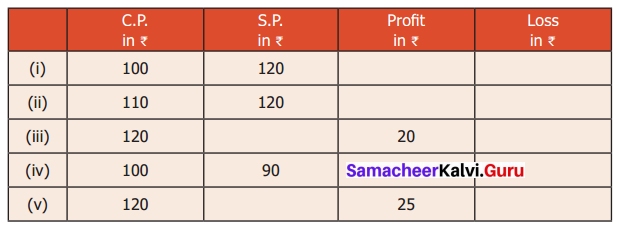
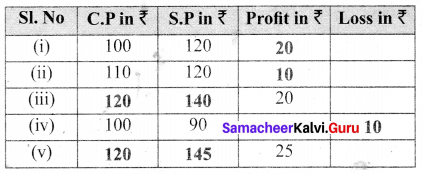
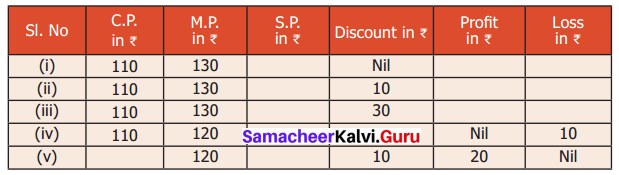
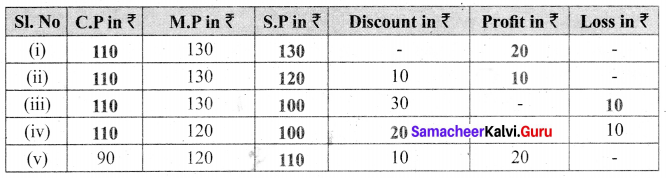
Samacheer Kalvi 6th Maths Solutions Term 2 Chapter 4 Geometry Ex 4.1

You can Download Samacheer Kalvi 6th Maths Book Solutions Guide Pdf, Tamilnadu State Board help you to revise the complete Syllabus and score more marks in your examinations.
Samacheer Kalvi 6th Maths Solutions Term 2 Chapter Chapter 4 Geometry Ex 4.1

Tamilnadu Samacheer Kalvi 6th Maths Solutions Term 2 Chapter 4 Geometry Ex 4.1

Question 1.
Fill in the blanks.
(a) Every triangle has at least _____ acute angles.
(b) A triangle in which none of the sides equal is called a _____.
(c) In an isosceles triangle ______ angles are equal.
(d) The sum of three angles of a triangle is ______.
(e) A right-angled triangle with two equal sides is called ______.
Solution:
(a) Two
(b) Scalene Triangle
(c) Two
(d) 180°
(e) Isosceles right-angled triangle

Question 2.
Match the following:

(i) No sides are equalIsosceles triangle
(ii) One right angleScalene triangle
(iii) One obtuse angleRight-angled triangle
(iv) Two sides of equal lengthEquilateral triangle
(v) All sides are equalObtuse angled triangle

Solution:

(i) No sides are equalScalene triangle
(ii) One right angleRight-angled triangle
(iii) One obtuse angleObtuse angled triangle
(iv) Two sides of equal lengthIsosceles triangle
(v) All sides are equalEquilateral triangle

Question 3.
In ∆ABC, name the
Samacheer Kalvi 6th Maths Solutions Term 2 Chapter 4 Geometry Ex 4.1 Q3
(a) Three sides: ____, _____, _____
(b) Three Angles: _____, _____, _____
(c) Three Vertices: _____, _____, _____
Solution:
(a) \(\overline{\mathrm{AB}}, \overline{\mathrm{BC}}, \overline{\mathrm{CA}}\)
(b) ∠ABC, ∠BCA, ∠CAB or ∠A, ∠B, ∠C
(c) A, B, C

Samacheer Kalvi 6th Maths Solutions Term 2 Chapter Chapter 4 Geometry Ex 4.1

Question 4.
Classify the given triangles based on its sides as scalene, isosceles or equilateral.
Samacheer Kalvi 6th Maths Solutions Term 2 Chapter 4 Geometry Ex 4.1 Q4
Solution:
(i) Equilateral Triangle
(ii) Scalene Triangle
(iii) Isosceles Triangle
(iv) Scalene Triangle

Question 5.
Classify the given triangles based on its angles as acute-angled, right-angled or obtuse-angled.
Samacheer Kalvi 6th Maths Solutions Term 2 Chapter 4 Geometry Ex 4.1 Q5
Solution:
(i) Acute angled triangle
(ii) Right angled triangle
(iii) Obtuse angled triangle
(iv) Acute angled triangle

Question 6.
Classify the following triangles based on its sides and angles.
Samacheer Kalvi 6th Maths Solutions Term 2 Chapter 4 Geometry Ex 4.1 Q6
Solution:
(i) Isosceles Acute angled triangle
(ii) Scalene Right angled triangle
(iii) Isosceles Obtuse angled triangle
(iv) Isosceles Right angled triangle
(v) Equilateral Acute angled triangle
(vi) Scalene Obtuse angled triangle

Question 7.
Can a triangle be formed with the following sides? If yes, name the type of triangle.
(i) 8 cm, 6 cm, 4 cm
(ii) 10 cm, 8 cm, 5 cm
(iii) 6.2 cm, 1.3 cm, 3.5 cm
(iv) 6 cm, 6 cm, 4 cm
(v) 3.5 cm, 3.5 cm, 3.5 cm
(vi) 9 cm, 4 cm, 5 cm
Solution:
(i) Sum of two smaller sides of the triangle
= 6 + 4 = 10 cm > 8 cm
It is greater than the third side. So, a triangle can be formed scalene triangle.

(ii) Sum of two smaller sides of the triangle
= 8 + 5 = 13 cm > 10 cm
It is greater than the third side. So, a triangle can be formed scalene triangle.

(iii) Sum of two smaller sides of the triangle
= 1.3 + 3.5 = 4.8 cm < 6.2 cm
It is not greater than the third side. So, a triangle cannot be formed.

(iv) Two sides are equal.
So, a triangle can be formed. Isosceles triangle.

(v) Three sides are equal.
So, a triangle can be formed equilateral triangle.

(vi) Sum of two smaller sides of the triangle
= 4 + 5 = 9 cm = 9 cm
It is equal to the third side. No, a triangle cannot be formed.

Samacheer Kalvi 6th Maths Solutions Term 2 Chapter Chapter 4 Geometry Ex 4.1

Question 8.
Can a triangle be formed with the following angles? if yes, name the type of triangle.
(i) 60°, 60°, 60°
(ii) 90°, 55°, 35°
(iii) 60°, 40°, 42°
(iv) 60°, 90°, 90°
(v) 70°, 60°, 50°
(vi) 100°, 50°, 30°
Solution:
(i) 60°, 60°, 60°
Sum of three angles = 60° + 60° + 60° = 180°
Yes, a triangle can be formed.
∴ It is Acute angled triangle. [∵ all the angles < 90°]

(ii) 90°, 55°, 35°.
Sum of three angles = 90° + 55° + 55° = 180°
Yes, a triangle can be formed.
∴ It is a right-angled triangle, [∵ one angle is 90°]

(iii) 60°, 40°, 42°.
Sum of three angles = 60° + 40° + 42° = 142° ≠ 180°
No, The triangle cannot be formed.

(iv) 60°, 90°, 90°.
Sum of three angles = 60° + 90° + 90° = 240° ≠ 180°
∴ No, The triangle cannot be formed. [∵ one angle is > 90°]

(v) 70°, 60°, 50°.
Sum of three angles = 70° + 60° + 50° = 180°
Yes, A triangle can be formed.
∴ It is an acute-angled triangle.

(vi) 100°, 50°, 30°.
Sum of three angles = 100° + 50° + 30° = 180°
Yes, A triangle can be formed.
∴ It is an obtuse-angled triangle.

Question 9.
Two angles of the triangles are given. Find the third angle.
(i) 80°, 60°
(ii) 52°, 68°
(iii) 75°, 35°
(iv) 50°, 90°
(v) 120°, 30°
(vi) 55°, 85°
Solution:
(i) 80°, 60°
Let the third angle be x.
Sum of the angles = 180°
80° + 60° + x = 180°
140 + x = 180°
x = 180°- 140°
x = 40°
Third angle = 40°

(ii) 52°, 68°
Let the third angle be x.
Sum of the angles = 180°
52° + 68° + x = 180°
120 + x = 180°
180° – 120°
x = 60°
Third angle = 60°

(iii) 75°, 35°
Let the third angle be x.
Sum of the angles 180°
75° + 35° + x = 180°
110 + x = 180°
x = 180° – 110°
x = 70°
Third angle = 70°

(iv) 50°, 90°
Let the third angle be x. Sum of the angles = 180°
50° + 90° + x = 180°
140 + x = 180°
x = 180° – 140°
x = 40°
Third angle = 40°

(v) 120°, 30°
Let the third angle be x.
Sum of the angles = 180°
120° + 30° + x = 180°
150 + x = 180°
x = 180° – 150°
x = 30°
Third angle = 30°

(vi) 55°, 85°
Let the third angle be x.
Sum of the angles = 180°
55° + 85° + x = 180°
140 + x = 180°
x = 180° – 140°
x = 40°
Third angle = 40°

Question 10.
I am a closed figure with each of my three angles is 60°. Who am I?
Solution:
Equilateral Triangle.

Samacheer Kalvi 6th Maths Solutions Term 2 Chapter Chapter 4 Geometry Ex 4.1

Question 11.
Using the given information, write the type of triangle in the table given below.
Samacheer Kalvi 6th Maths Solutions Term 2 Chapter 4 Geometry Ex 4.1 Q11
Solution:
Samacheer Kalvi 6th Maths Solutions Term 2 Chapter 4 Geometry Ex 4.1 Q11.1

Objective Type Questions

Question 12.
The given triangle is _____.
Samacheer Kalvi 6th Maths Solutions Term 2 Chapter 4 Geometry Ex 4.1 Q12
(a) a right angled triangle
(b) an equilateral triangle
(c) a scalene triangle
(d) an obtuse angled triangle
Solution:
(b) an equilateral triangle

Question 13.
If all angles of a triangle are less than a right angle, then it is called ……….
(a) an obtuse angled triangle
(b) a right angled triangle
(c) an isosceles right angled triangle
(d) an acute angled triangle
Solution:
(d) an acute angled triangle

Question 14.
If two sides of a triangle are 5 cm and 9 cm then the third side is _____.
(a) 5 cm
(b) 3 cm
(c) 4 cm
(d) 14 cm
Solution:
(a) 5 cm

Question 15.
The angles of a right angled triangle are
(a) acute, acute, obtuse
(b) acute, right, right
(c) right, obtuse, acute
(d) acute, acute, right
Solution:
(d) acute, acute, right

Samacheer Kalvi 6th Maths Solutions Term 2 Chapter Chapter 4 Geometry Ex 4.1

Question 16.
An equilateral triangle is
(a) an obtuse-angled triangle
(b) a right-angled triangle
(c) an acute-angled triangle
(d) scalene triangle
Solution:
(c) an acute-angled triangle

Read More:

HDFCAMC Pivot Point Calculator

Samacheer Kalvi 6th Maths Solutions Term 2 Chapter 4 Geometry Ex 4.3

You can Download Samacheer Kalvi 6th Maths Book Solutions Guide Pdf, Tamilnadu State Board help you to revise the complete Syllabus and score more marks in your examinations.
Samacheer Kalvi 6th Maths Solutions Term 2 Chapter Chapter 4 Geometry Ex 4.3

Tamilnadu Samacheer Kalvi 6th Maths Solutions Term 2 Chapter 4 Geometry Ex 4.3

Miscellaneous Practice Problems

Question 1.
What are the angles of an isosceles right-angled triangle?
Solution:
Since it is a right-angled triangle
One of the angles is 90°
Other two angles are equal because it is an isosceles triangle.
Other two angles must be 45° and 45°
Angles are 90°, 45°, 45°.

Question 2.
Which of the following correctly describes the given triangle.
Samacheer Kalvi 6th Maths Solutions Term 2 Chapter 4 Geometry Ex 4.3 Q2
(a) It is a right isosceles triangle.
(b) It is an acute isosceles triangle.
(c) It is an obtuse isosceles triangle.
(d) it is an obtuse scalene triangle.
Solution:
(c) It is an obtuse isosceles triangle.

Question 3.
Which of the following is not possible?
(a) An obtuse isosceles triangle
(b) An acute isosceles triangle
(c) An obtuse equilateral triangle
(d) An acute equilateral triangle
Solution:
(c) an obtuse equilateral triangle

Samacheer Kalvi 6th Maths Solutions Term 2 Chapter Chapter 4 Geometry Ex 4.3

Question 4.
If one angle of an isosceles triangle is 124°, then find the other angles.
Solution:
In an isosceles triangle, any two sides are equal. Also, two angles are equal.
Sum of three angles of a triangle = 180°
Given one angle = 124°
Sum of other two angles = 180° – 124° = 56°
Other angles are = \(\frac{56}{2}\) = 28°
28° and 28°.

Question 5.
The diagram shows a square ABCD. If the line segment joints A and C, then mention the type of triangles so formed.
Samacheer Kalvi 6th Maths Solutions Term 2 Chapter 4 Geometry Ex 4.3 Q5
Solution:
For a square all sides are equal and each angle is 90°.
∆ABC and ∆ADC are isosceles right-angled triangles.

Question 6.
Draw a line segment AB of length 6 cm. At each end of this line segment AB, draw a line perpendicular to the line AB. Are these lines parallel?
Solution:
Here CA and DB are perpendicular to AB.
Yes CA and DB are parallel.
Samacheer Kalvi 6th Maths Solutions Term 2 Chapter 4 Geometry Ex 4.3 Q6
Construction:
(i) Drawn a line segment AB of length 6 cm.
(ii) Place the set square on the line in such a way that the vertex of its right angle coincides with B first and A next and one arm of the right angle coincides with the line AB.
(iii) Drawn lines DB and CA through B and A, the other arm of the right angle of the set square.
(iv) The line CA and DB are perpendicular to AB at A and B.

Samacheer Kalvi 6th Maths Solutions Term 2 Chapter Chapter 4 Geometry Ex 4.3

Challenge Problems

Question 7.
Is a triangle possible with the angles 90°, 90° and 0°? Why?
Solution:
No, a triangle cannot have more than one right angle

Question 8.
Which of the following statements is true. Why?
(a) Every equilateral triangle is an isosceles triangle.
(b) Every isosceles triangle is an equilateral triangle.
Solution:
(a) It is true
In an equilateral triangle, all three sides are equal.
It can be an isosceles triangle also, which has two sides equal.
(b) But every isosceles triangle need not be an equilateral triangle.

Question 9.
If one angle of an isosceles triangle is 70°, then find the possibilities for the other two angles.
Solution:
70°, 40° (or) 55°, 55°

Question 10.
Which of the following can be the sides of an isosceles triangle?
(a) 6 cm, 3 cm, 3 cm
(b) 5 cm, 2 cm, 2 cm
(c) 6 cm, 6 cm, 7 cm
(d) 4 cm, 4 cm, 8 cm
Solution:
In a triangle sum of any two sides greater than the third side
(a), (b) and (d) cannot form a triangle.
(c) can be the sides of an isosceles triangle.

Question 11.
Study the given figure and identify the following triangles.
Samacheer Kalvi 6th Maths Solutions Term 2 Chapter 4 Geometry Ex 4.3 Q11
(a) equilateral triangle
(b) isosceles triangles
(c) scalene triangles
(d) acute triangles
(e) obtuse triangles
(f) right triangles
Solution:
(a) BC = 1 + 1 + 1 + 1 = 4 cm
AB = AC = 4 cm
∆ABC is an equilateral triangle.
(b) ∆ABC and ∆AEF are isosceles triangles.
Since AB = AC = 4 cm Also AE = AF.
(c) In a scalene triangle, no two sides are equal.
∆AEB, ∆AED, ∆ADF, ∆AFC, ∆ABD, ∆ADC, ∆ABF and ∆AEC are scalene triangles.
(d) In an acute-angled triangle all the three angles are less than 90°.
∆ABC, ∆AEF, ∆ABF and ∆AEC are acute-angled triangles.
(e) In an obtuse-angled triangle any one of the angles is greater than 90°.
∆AEB and ∆AFC are obtuse angled triangles.
(f) In a right triangle, one of the angles is 90°.
∆ADB, ∆ADC, ∆ADE and ∆ADF are right-angled triangles.

Samacheer Kalvi 6th Maths Solutions Term 2 Chapter Chapter 4 Geometry Ex 4.3

Question 12.
Two sides of the triangle are given in the table. Find the third side of the triangle?
Samacheer Kalvi 6th Maths Solutions Term 2 Chapter 4 Geometry Ex 4.3 Q12
Solution:
Samacheer Kalvi 6th Maths Solutions Term 2 Chapter 4 Geometry Ex 4.3 Q12.1

Question 13..
Complete the following table.
Samacheer Kalvi 6th Maths Solutions Term 2 Chapter 4 Geometry Ex 4.3 Q13
Solution:
Samacheer Kalvi 6th Maths Solutions Term 2 Chapter 4 Geometry Ex 4.3 Q13.1
(i) Always acute angles
(ii) Acute angle
(iii) Obtuse angle

Samacheer Kalvi 6th Maths Solutions Term 1 Chapter 3 Ratio and Proportion Ex 3.2

You can Download Samacheer Kalvi 6th Maths Book Solutions Guide Pdf, Tamilnadu State Board help you to revise the complete Syllabus and score more marks in your examinations.

Tamilnadu Samacheer Kalvi 6th Maths Solutions Term 1 Chapter 3 Ratio and Proportion Ex 3.2

Samacheer Kalvi 6th Maths Solutions Term 1 Chapter 3 Ratio and Proportion Ex 3.2
Question 1.
Fill in the blanks of the given equivalent ratios.
(i) 3 : 5 = 9 : ___
(ii) 4 : 5 = ___ : 10
(iii) 6 : ____ = 1 : 2
Solution:
(i) 15
Hint: \(\frac{3}{5}=\frac{3 \times 3}{5 \times 3}=\frac{9}{15}\)
(ii) 8
Hint: \(\frac{4}{5}=\frac{4 \times 2}{5 \times 2}=\frac{8}{10}\)
(iii) 12
Hint: \(\frac{1}{2}=\frac{1 \times 6}{2 \times 6}=\frac{6}{12}\)

Question 2.
Complete the Table:
Samacheer Kalvi 6th Maths Term 1 Chapter 3 Ratio and Proportion Ex 3.2 Q2
Solution:
Samacheer Kalvi 6th Maths Term 1 Chapter 3 Ratio and Proportion Ex 3.2 Q2.1

Question 3.
Say True or False.
(i) 5 : 7 is equivalent to 21 : 15.
(ii) If 40 is divided in the ratio 3 : 2, then the larger part is 24.
Solution:
(i) False
(ii) True

Question 4.
Give two equivalent ratios for each of the following.
(i) 3 : 2
(ii) 1 : 6
(iii) 5 : 4
Solution:
Samacheer Kalvi 6th Maths Term 1 Chapter 3 Ratio and Proportion Ex 3.2 Q4

Samacheer Kalvi 6th Maths Solutions Term 1 Chapter 3 Ratio and Proportion Ex 3.2

Question 5.
Which of the two ratios is larger?
(i) 4 : 5 or 8 : 15
(ii) 3 : 4 or 7 : 8
(iii) 1 : 2 or 2 : 1
Solution:
Samacheer Kalvi 6th Maths Term 1 Chapter 3 Ratio and Proportion Ex 3.2 Q5
Samacheer Kalvi 6th Maths Term 1 Chapter 3 Ratio and Proportion Ex 3.2 Q5.1

Question 6.
Divide the numbers given below in the required ratio.
(i) 20 in the ratio 3 : 2
(ii) 27 in the ratio 4 : 5
(iii) 40 in the ratio 6 : 14
Solution:
(i) Ratio = 3 : 2
Sum of the ratio = 3 + 2 = 5
5 parts = 20
1 part = \(\frac{20}{5}\)
= 4
3 parts = 3 × 4 = 12
2 parts = 2 × 4 = 8
20 can be divided in the form as 12, 8.

(ii) Ratio = 4 : 5
Sum of the ratio = 4 + 5 = 9
9 parts = 27
1 part = \(\frac{27}{9}\) = 3
4 parts = 4 × 3 = 12
5 parts = 5 × 3 =15
27 can be divided in the form as 12, 15.

(iii) 40 in the ratio 6 : 14
Ratio = 6 : 14
Sum of the ratio = 6 + 14 = 20
20 parts = 40
1 part = \(\frac{40}{20}\) = 2
6 parts = 2 × 6 = 12
14 parts = 2 × 14 = 28
40 can be divided in the form as 12, 28.

Question 7.
In a family, the amount spent in a month for buying Provisions and Vegetables are in the ratio 3 : 2. If the allotted amount is ₹ 4000, then what will be the amount spent for
(i) Provisions and
(ii) Vegetables?
Solution:
Dividing the total amount ₹ 4000 into 3 + 2 = 5 equal parts then
(i) For Provisions:
3 out of 5 parts are spent for provisions and 2 out of 5 parts for vegetables.
\(4000 \times \frac{3}{5}=2400\) for provisions
(ii) For vegetables:
\(4000 \times \frac{2}{5}=1600\) for Vegetables.
₹ 2400 spend on provisions and ₹ 1600 spend on Vegetables.

Samacheer Kalvi 6th Maths Solutions Term 1 Chapter 3 Ratio and Proportion Ex 3.2

Question 8.
A line segment 63 cm long is to be divided into two parts in the ratio 3 : 4. Find the length of each part.
Solution:
Total length = 63 cm Ratio = 3 : 4
Sum of the ratio = 3 + 4 = 7
7 parts = 63 cm
1 part = \(\frac{63}{7}\) = 9 cm
3 parts = 3 × 9 cm = 27 cm
4 parts = 4 × 9 cm = 36 cm
∴ 63 cm can be divided into the parts as 27 cm and 36 cm.

Objective Type Questions

Question 9.
If 2 : 3 and 4 : ___ or equivalent ratios, then the missing term is ____
(a) 6
(b) 2
(c) 4
(d) 3
Solution:
(a) 6
Hint: \(\frac{2}{3}=\frac{2 \times 2}{3 \times 2}=\frac{4}{6}\)

Question 10.
An equivalent ratio of 4 : 7 is
(a) 1 : 3
(b) 8 : 15
(c) 14 : 8
(d) 12 : 21
Solution:
(d) 12 : 21

Question 11.
Which is not an equivalent ratio of \(\frac{16}{24}\) ?
(a) \(\frac{6}{9}\)
(b) \(\frac{12}{18}\)
(c) \(\frac{10}{15}\)
(d) \(\frac{20}{28}\)
Solution:
(d) \(\frac{20}{28}\)
Hint: \(\frac{16}{24}=\frac{8 \times 2}{8 \times 3}=\frac{2}{3}\)

Question 12.
If Rs 1600 is divided
(a) Rs 480
(b) Rs 800
(c) Rs 1000
(d) Rs 200
Solution:
(c) Rs 1000

Samacheer Kalvi 6th Maths Solutions Term 1 Chapter 3 Ratio and Proportion Ex 3.2

Samacheer Kalvi 6th Maths Solutions Term 1 Chapter 4 Geometry Ex 4.3

You can Download Samacheer Kalvi 6th Maths Book Solutions Guide Pdf, Tamilnadu State Board help you to revise the complete Syllabus and score more marks in your examinations.
Samacheer Kalvi 6th Maths Solutions Term 1 Chapter 4 Ex 4.3

Tamilnadu Samacheer Kalvi 6th Maths Solutions Term 1 Chapter 4 Geometry Ex 4.3

Question 1.
Observe the diagram and fill the blanks.
Samacheer Kalvi 6th Maths Term 1 Chapter 4 Geometry Ex 4.3 Q1
(i) ‘A’, ‘O’ and ‘B’ are ______ points
(ii) ‘A’, ‘O’ and ‘C’ are ______ points
(iii) ‘A’ ‘B’ and ‘C’ are _____ points
(iv) ______ is the point of concurrency
Solution:
(i) collinear points
Hint: Points on a line.
(ii) non collinear points
Hint: Points not on a line
(iii) end points/non collinear points
(iv) O is the point of concurrency.
Hint: A points where lines meet

Question 2.
Draw any line and mark any 3 points that are collinear.
Solution:
Samacheer Kalvi 6th Maths Term 1 Chapter 4 Geometry Ex 4.3 Q2
L, M, N are collinear points

Question 3.
Draw any line and mark any 4 points that are not collinear.
Solution:
Samacheer Kalvi 6th Maths Term 1 Chapter 4 Geometry Ex 4.3 Q3
X, Y, Z and A are non-collinear points.

Question 4.
Draw any 3 lines to have a point of concurrency.
Solution:
Samacheer Kalvi 6th Maths Term 1 Chapter 4 Geometry Ex 4.3 Q4
l1, l2 and l3 are the concurrent lines.
‘O’ is the point of concurrency.

Samacheer Kalvi 6th Maths Solutions Term 1 Chapter 4 Ex 4.3

Question 5.
Draw any 3 lines that are not concurrent. Find the number of points of intersection.
Solution:
Samacheer Kalvi 6th Maths Term 1 Chapter 4 Geometry Ex 4.3 Q5
l1, l2 and l3 are non concurrent lines.
A, B and C are the 3 points of intersection.
There are two points of intersection X and Y

Objective Type Questions

Samacheer Kalvi 6th Maths Term 1 Chapter 4 Geometry Ex 4.3 Q6

Question 6.
A set of collinear points in the figure are ……….
(a) A. B, C
(b) A, F, C
(c) B, C, D
(d)A,C,D
Solution:
(b) A, F, C

Question 7.
A set of non-collinear points in the figure are _____
(a) A, F, C
(b) B, F, D
(c) E, F, G
(d) A, D, C
Solution:
(d) A, D, C
Hint: Non-collinear points are points which are not on a line.

Question 8.
A point of concurrency in the figure is ……..
(a) E
(b) F
(c) G
(d) H
Solution:
(b) F

Samacheer Kalvi 6th Maths Solutions Term 1 Chapter 4 Ex 4.3

Samacheer Kalvi 6th Maths Solutions Term 1 Chapter 1 Numbers Ex 1.1

You can Download Samacheer Kalvi 6th Maths Book Solutions Guide Pdf, Tamilnadu State Board help you to revise the complete Syllabus and score more marks in your examinations.

Tamilnadu Samacheer Kalvi 6th Maths Solutions Term 1 Chapter 1 Numbers Ex 1.1

Samacheer Kalvi 6th Maths Solutions Term 1 Chapter 1 Numbers Ex 1.1
Question 1.
Fill in the blanks.

  1. The smallest 7 digit number is _______
  2. The largest 8 digit number is _______
  3. The place value of 5 in 7005380 is ________
  4. The expanded form of the number 76,70,905 is _______

Solution:

  1. 10,00,000
  2. 9,99,99,999
  3. 5 × 1000 = 5000
  4. 7 × 10,00,000 + 6 × 1,00,000 + 7 × 10,000 + 0 + 9 × 100 + 0 + 5 × 1
    (or)
    70,00,000 + 6,00,000 + 70,000 + 900 + 5

Question 2.
Say True or False.

  1. In the Indian System of Numeration, the number 67999037 is written as 67999037
  2. The successor of a one-digit number is always a one-digit number.
  3. The predecessor of a 3-digit number is always a 3 or 4-digit number.
  4. 88888 = 8 × 10000 + 8 × 100 + 8 × 10 + 8 × 1

Solution:

  1. True
  2. False
  3. False
  4. False

Samacheer Kalvi 6th Maths Solutions Term 1 Chapter 1 Numbers Ex 1.1

Question 3.
Complete the given order.
Ten crore, crore, ten lakh, ____, ____, _____ , _____, _____.
Solution:
Ten crores, Crore, Ten lakh, Lakh, Ten Thousand, Thousand, Hundred, Ten, One

Question 4.
How many ten thousands are there in the smallest 6 digit number?
Solution:
Smallest six-digit number is 1,00,000
1 lakh = Ten Thousand
Another Method:
Lakh is only one place to the left of Ten thousand
1 lakh is 10 times ten thousand
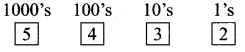
Samacheer Kalvi 6th Maths Term 1 Chapter 1 Numbers Ex 1.1 Q4
1 lakh = Ten-Ten Thousand

Question 5.
Using the digits 5, 2, 0, 7, 3 forms the largest 5 digit number and the smallest 5 digit number.
Solution:
Given digits = 5, 2, 0, 7, 3
Largest 5 digit number – 75320
Smallest 5 digit number – 20357

Question 6.
Observe the commas and write down the place value of 7.

  1. 56,74,56,345
  2. 567,456,345

Solution:

  1. 56,74,56,345
    Place value of 7 is 7 × 10,00,000 = 70,00,000 = Seventy Lakhs.
  2. 567,456,345
    Place value of 7 is 7 × 1,000,000 = 7,000,000 = Seven Million.

Question 7.
Write the following numbers in the International system by using commas.
(i) 347056
(ii) 7345671
(iii) 634567105
(iv) 1234567890
Solution:
Samacheer Kalvi 6th Maths Term 1 Chapter 1 Numbers Ex 1.1 Q7

Samacheer Kalvi 6th Maths Solutions Term 1 Chapter 1 Numbers Ex 1.1

Question 8.
Write the largest six-digit number and put commas in the Indian and the International Systems.
Solution:
The largest six-digit number is 999999
Samacheer Kalvi 6th Maths Term 1 Chapter 1 Numbers Ex 1.1 Q8

Question 9.
Write the number names of the following numerals in the Indian System.
(i) 75,32,105
(ii) 9,75,63,453
Solution:
(i) 75,32,105
Samacheer Kalvi 6th Maths Term 1 Chapter 1 Numbers Ex 1.1 Q9
Seventy-Five Lakhs Thirty-Two Thousand One Hundred and Five
(ii) 9,75,63,453
Samacheer Kalvi 6th Maths Term 1 Chapter 1 Numbers Ex 1.1 Q9.1
Nine crores Seventy Five Lakhs Sixty Three Thousand Four Hundred and Fifty-Three.

Question 10.
Write the number names in words using the International System
(i) 345,678
(ii) 8,343,710
(iii) 103,456,789
Solution:
(i) 345,678
Samacheer Kalvi 6th Maths Term 1 Chapter 1 Numbers Ex 1.1 Q10
Three Hundred and Forty-Five Thousand Six Hundred and Seventy-Eight
(ii) 8,343,710
Samacheer Kalvi 6th Maths Term 1 Chapter 1 Numbers Ex 1.1 Q10.1
Eight Million Three Hundred and Forty-Three Thousand Seven Hundred and Ten.
(iii) 103,456,789
Samacheer Kalvi 6th Maths Term 1 Chapter 1 Numbers Ex 1.1 Q10.2
One Hundred Three Million Four Hundred Fifty-Six Thousand Seven Hundred and Eighty’ Nine.

Samacheer Kalvi 6th Maths Solutions Term 1 Chapter 1 Numbers Ex 1.1

Question 11.
Write the number name in numerals.

  1. Two crores thirty lakhs fifty-one thousand nine hundred eighty.
  2. Sixty-six million three hundred forty-five thousand twenty-seven.
  3. Seven hundred eighty-nine million, two hundred thirteen thousand four hundred fifty six.

Solution:

  1. 2,30,51,980
  2. 66,345,027
  3. 789,213,456

Question 12.
Tamil Nadu has about twenty-six thousand three hundred forty-five square kilometre of Forest land. Write the number mentioned in the statement in the Indian System.
Solution:
26,345 sq km.

Question 13.
The number of employees in the Indian Railways is about 10 lakhs. Write this in the International System of numeration.
Solution:
1.000,000 (one million)

Objective Type Questions

Question 14.
1 billion is equal to
(a) 100 crore
(b) 100 million
(c) 100 lakh
(d) 10000 lakh
Solution:
(a) 100 crore

Question 15.
The successor of 10 million is
(a) 1000001
(b) 10000001
(c) 9999999
(d) 100001
Solution:
(b) 10000001

Question 16.
The difference between successor and predecessor of 99999 is
(a) 90000
(b) 1
(c) 2
(d) 99001
Solution:
(c) 2

Samacheer Kalvi 6th Maths Solutions Term 1 Chapter 1 Numbers Ex 1.1

Question 17.
The expanded form of the number 6,70,905 is
(a) 6 × 10000 + 7 × 1000 + 9 × 100 + 5 × 1
(b) 6 × 10000 + 7 × 1000 + 0 × 100 + 9 × 100 + 0 × 10 + 5 × 1
(c) 6 × 1000000 + 7 × 10000 + 0 × 1000 + 9 × 100 + 0 × 10 + 5 × 1
(d) 6 × 100000 + 7 × 10000 + 0 × 1000 + 9 × 100 + 0 × 10 + 5 × 1
Solution:
(d) 6 × 100000 + 7 × 10000 + 0 × 1000 + 9 × 100 + 0 × 10 + 5 × 1

Samacheer Kalvi 6th Maths Solutions Term 2 Chapter 2 Measurements Ex 2.1

You can Download Samacheer Kalvi 6th Maths Book Solutions Guide Pdf, Tamilnadu State Board help you to revise the complete Syllabus and score more marks in your examinations.
Samacheer Kalvi 6th Maths Solutions Term 2 Chapter Chapter 2 Measurements Ex 2.1

Tamilnadu Samacheer Kalvi 6th Maths Solutions Term 2 Chapter 2 Measurements Ex 2.1

Question 1.
Fill in the blanks.
(i) 250 ml + \(\frac{1}{2}\) ml = _____ l.
(ii) 150 kg 200 g + 55 kg 750 g = ____ kg ____ g.
(iii) 20 l – 1 l 500 ml = ____ l ___ ml
(iv) 450 ml × 5 = ____ l ____ ml.
(v) 50 Kg ÷ 100 g = ______
Solution:
(i) \(\frac{3}{4}\) l
(ii) 205 kg 950 g
(iii) 18 l 500 ml
(iv) 2l 250 ml
(v) 500

Question 2.
True or False
(i) Pugazhenthi ate 100 g of nuts which is equal to 0.1 kg.
(ii) Meena bow it 250 ml of butter milk which is equal to 2.5 l.
(iii) Karkuzhali’s bag 1 kg 250 g and poong- kodi’s bag 2 kg 750 g. The total weight of their bags 4 kg.
(iv) Vanmathi bought 4 books each weighing 500 g. Total weight of 4 books is 2 kg.
(v) Gayathiri bought 1 kg of birthday cake. She shared 450 g with her friends.
The weight of cake remaining is 650 g
Solution:
(i) True
(ii) False
(iii) True
(iv) True
(v) False

Question 3.
Convert into indicated units:
(i) 10 l and 5 ml into ml
(ii) 4 km and 300 m into m
(iii) 300 mg into g
Solution:
(i) 10 l and 5 ml
= 10 × 1000 ml + 5 ml
= 10,000 ml + 5 ml [∴ 1l = 1000 ml]
= 10,005 ml.
∴ 10 l and 5 ml = 10,005 ml.
(ii) 4 km and 300 m into m.
4 km and 300 m
= 4 × 1000 m + 300 m
= 4000 m + 300 m [∴ 1 km = 1000 m]
= 4300 m
∴ 4 km and 300 m = 4300 m
(iii) 300 mg into g.
Samacheer Kalvi 6th Maths Solutions Term 2 Chapter 2 Measurements Ex 2.1 Q3

Samacheer Kalvi 6th Maths Solutions Term 2 Chapter Chapter 2 Measurements Ex 2.1

Question 4.
Convert into higher units:
(i) 13000 mm (km, m, cm)
(ii) 8257 ml (kl, l)
Solution:
(i) 13000 mm (km, m, cm)
(ii) 8257 ml (kl, l)
Samacheer Kalvi 6th Maths Solutions Term 2 Chapter 2 Measurements Ex 2.1 Q4Samacheer Kalvi 6th Maths Solutions Term 2 Chapter 2 Measurements Ex 2.1 Q4.1

Question 5.
Convert into lower units:
(i) 15 km (m, cm, mm)
Solution:
15 km = 15 × 1000 m = 15000 m
15 km = 15 × 100000 cm
= 1500000 cm
15 km = 15 × 1000000 mm
= 15000000 mm

(ii) 12 kg (g, mg)
Solution:
12 kg = 12 × 1000 g
= 12000 g
12 kg = 12 × 1000000 mg
= 12000000 mg

Question 6.
Compare and put > or < or = in the following:
(i) 800 g + 150 g ____ 1 kg
(ii) 600 ml + 400 ml ____ 1 l
(iii) 6 m 25 cm ____ 600 cm + 25 cm
(iv) 88 cm ____ 8 m 8 cm
(v) 55 g ____ 550 mg
Solution:
(i) 800 g + 150g < 3kg
(ii) 600 ml + 400 ml = 1 l
(iii) 6 m 25 cm = 600 cm + 25 cm
(iv) 88 cm < 8 m 8 cm
(v) 55 g > 550 mg

Question 7.
Geetha brought 2 l and 250 ml of water in a bottle. Her friend drank 300 ml from it. How much of water is remaining in the bottle?
Solution:
Total Capacity of water = 2 l 250 ml
= (2 x 1000 + 250) l
= 2000 + 250 ml
= 2250 ml
Water Consumed = 300 ml
Water remaining in the bottle = (2250 – 300) ml
= 1950 ml
= 1 litre 950 ml

Samacheer Kalvi 6th Maths Solutions Term 2 Chapter Chapter 2 Measurements Ex 2.1

Question 8.
Thenmozhi’s height is 1.25 m now. She grows for 5 cm every year. What would be her height after 6 years?
Solution:
Thenmozhi’s present height = 1.25 m
Rate of growth per year = 5 cm
Her growth in 6 years = 5 cm × 6 = 30 cm.
After 6 years her height = 1.25 m + 30 cm
= 1.25 × 100 + 30 cm
= 125 + 30 cm
= 155 cm.
∴ After 6 years Thenmozhi’s height will be 155 cm.

Question 9.
Priya bought 22 \(\frac{1}{2}\) kg of onion/ Krishna bought 18 \(\frac{3}{4}\) kg of onion and sethu bought 9 kg 250 g of onion, what is the total weight of onion did they buy?
Solution:
Total weight of onion bought
= 22 \(\frac{1}{2}\) + 18 \(\frac{3}{4}\) + 9 \(\frac{1}{4}\) kg
= 22 kg 500 g + 18 kg 750 g + 9 kg 250 g
= 49 kg 1500 g
= 50 kg 500 g

Question 10.
Maran walks 1.5 km every day to reach the school while Mahizhan walks 1400 m. Who walks more distance and by how much?
Solution:
Distance which Maran walks = 1.5 km = 1.5 × 1000 m = 1500 m
The distance which Mahizhan walks = 1400 m.
Here 1500 > 1400
∴ Difference = 1500 – 1400 = 100 m.
∴ Maran walks more distance = 100 m.

Question 11.
In a JRC one day camp, 150 gm of rice and 15 ml oil are needed for a student. If there are 40 students to attend the camp how much of rice and oil are needed?
Solution:
Rice needed for a student = 150 gm
Rice needed for 40 students = 40 × 150 gm = 6000 gm = 6 kg
Oil needed for a student = 15 ml
Oil needed for 40 students = 40 × 15 ml = 600 ml

Question 12.
In a school, 200 litres of lemon juice is prepared. If 250 ml lemon juice is given to each student, how many students get the juice?
Solution:
Total lemon juice prepared = 200 l = 200 × 1000 ml = 2,00,000 ml.
∴ Quantity of Lemon juice given to one student = 250 ml.
∴ Number of students can get = \(\frac{2,00,000}{250}\) = 800
∴ 800 students can get the lemon juice.

Samacheer Kalvi 6th Maths Solutions Term 2 Chapter Chapter 2 Measurements Ex 2.1

Question 13.
How many glasses of the given capacity will fill a 2 litre jug?
(i) 100 ml ……….
(ii) 50 ml ……….
(iii) 500 ml ………
(iv) 1 l ………

(v) 250 ml ………
Solution:
(i) 20
(ii) 40
(iii) 4
(iv) 2
(v) 8

Objective Type Questions

Question 14.
9 m 4 cm is equal to _____
(a) 94 cm
(b) 904 cm
(c) 9.4 cm
(d) 0.94 cm
Solution:
(b) 904 cm

Question 15.
1006 g is equal to ………
(i) 1 kg 6 g
(ii) 10 kg 6 g
(iii) 100 kg 6 g
(iv) 1 kg 600 g
Solution:
(i) 1 kg 6 g

Question 16.
Every day 150 l of water is sprayed in the garden. Water sprayed in a week is ____
(a) 700 l
(b) 1000 l
(c) 950 l
(d) 1050 l
Solution:
(d) 1050 l

Question 17.
Which is the greatest? 0.007 g, 70 mg, 0.07 cg ……….
(i) 0.07 cg
(ii) 0.007 g
(iii) 70 mg
(iv) all are equal
Solution:
(iii) 70 mg

Samacheer Kalvi 6th Maths Solutions Term 2 Chapter Chapter 2 Measurements Ex 2.1

Question 18.
7 km – 4200 m is equal to
(a) 3 km 800 m
(b) 2 km 800 m
(c) 3 km 200 rn
(d) 2 km 200 m
Solution:
(b) 2 km 800 m

Samacheer Kalvi 6th Maths Solutions Term 1 Chapter 4 Geometry Ex 4.2

You can Download Samacheer Kalvi 6th Maths Book Solutions Guide Pdf, Tamilnadu State Board help you to revise the complete Syllabus and score more marks in your examinations.
Samacheer Kalvi 6th Maths Solutions Term 1 Chapter 4 Ex 4.2

Tamilnadu Samacheer Kalvi 6th Maths Solutions Term 1 Chapter 4 Geometry Ex 4.2

Question 1.
Use any number of the given dots to make different angles.
Samacheer Kalvi 6th Maths Term 1 Chapter 4 Geometry Ex 4.2 Q1
Solution:
Samacheer Kalvi 6th Maths Term 1 Chapter 4 Geometry Ex 4.2 Q1.1

Question 2.
Name the vertex and sides that form each angle.
Samacheer Kalvi 6th Maths Term 1 Chapter 4 Geometry Ex 4.2 Q2
Solution:
Samacheer Kalvi 6th Maths Term 1 Chapter 4 Geometry Ex 4.2 Q2.1

Question 3.
Pick out the Right angles from the given figures.
Samacheer Kalvi 6th Maths Term 1 Chapter 4 Geometry Ex 4.2 Q3
Solution:
(i), (iii) and (v) are Right Angles.

Question 4.
Pick out the Acute angles from the given figures.
Samacheer Kalvi 6th Maths Term 1 Chapter 4 Geometry Ex 4.2 Q4
Solution:
(i), (iii) and (iv) are the Acute Angles.

Question 5.
Pick out the Obtuse Angles from the given figures.
Samacheer Kalvi 6th Maths Term 1 Chapter 4 Geometry Ex 4.2 Q5
Solution:
(i) and (ii) are the Obtuse Angles.

Samacheer Kalvi 6th Maths Solutions Term 1 Chapter 4 Ex 4.2

Question 6.
Name the angle in each figure given below in all the possible ways.
Samacheer Kalvi 6th Maths Term 1 Chapter 4 Geometry Ex 4.2 Q6
Solution:
(i) ∠M or ∠LMN or ∠NML
(ii) ∠Q or ∠PQR or ∠RQP
(iii) ∠N or ∠MNO or ∠ONM
(iv) ∠A or ∠TAS or ∠SAT
(v) ∠Y or ∠XYZ or ∠ZYX
(vi) There are 3 angles in (vi)

  • ∠ADC or ∠CDA
  • ∠ CDB or ∠BDC
  • ∠D or ∠ADB or ∠BDA

Question 7.
Say True or False.

  1. 20° and 70° are complementary.
  2. 88° and 12° are complementary.
  3. 80° and 180° are supplementary.
  4. 0° and 180° are supplementary.

Solution:

  1. True
  2. False
  3. False
  4. True

Question 8.
Draw and label each of the angles
(i) ∠NAS = 90°
(ii) ∠BLG = 35°
(iii) ∠SMC = 145°
Solution:
Samacheer Kalvi 6th Maths Term 1 Chapter 4 Geometry Ex 4.2 Q8

Samacheer Kalvi 6th Maths Solutions Term 1 Chapter 4 Ex 4.2

Question 9.
Identify the types of angles shown by the hands of the given clock.
Samacheer Kalvi 6th Maths Term 1 Chapter 4 Geometry Ex 4.2 Q9
Solution:
(i) Obtuse Angle.
(ii) Zero Angle.
(iii) Straight Angle.
(iv) Acute Angle.
(v) Right Angle.

Question 10.
Find the supplementary ‘l’ complementary angles in each case.
Samacheer Kalvi 6th Maths Term 1 Chapter 4 Geometry Ex 4.2 Q10
Solution:
(i) If two angles add up to 180°, they are supplementary.
We know that the straight angle ∠CBC = 180°
Given ∠CBD = 25°
∴ ∠DBA = 180° – 25° = 155°
∴ Supplementary ∠DBA = 155°

(ii) If two angles add upto 90°, they are complementary
Given ∠ABC = 25°
∠CBD = 30°
∴ ∠DBA = 90° – 30° = 60°
∴ Complementary angle ∠DBA = 60°

(iii) Given ∠CBA = 90°
∠CBD = 46°
∴ ∠DBA = 90° – 46° = 44°
We know that the sum of two angles is 90°, then they are complementary
∴ Complementary angle ∠DBA = 44°

(iv) Given ∠DBE = 180°
∠DBC = 67°
∴ ∠CBE = 180° – 67° = 113°
Here ∠DBC + ∠DBE = 180°
∴ Supplementary angle ∠CBE = 113°

Samacheer Kalvi 6th Maths Solutions Term 1 Chapter 4 Ex 4.2

Objective Type Questions

Question 11.
In this Figure, which is not the correct way of naming an angle?
Samacheer Kalvi 6th Maths Term 1 Chapter 4 Geometry Ex 4.2 Q11
(a) ∠Y
(b) ∠ZXY
(c) ∠ZYX
(d) ∠XYZ
Solution:
(b) ∠ZXY

Question 12.
In this Figure, ∠AYZ = 45°. If the point ‘A’ is shifted to point ‘B’ along the ray, then the measure of ∠BYZ is ____
Samacheer Kalvi 6th Maths Term 1 Chapter 4 Geometry Ex 4.2 Q12
(a) more than 45°
(b) 45°
(c) less than 45°
(d) 90°
Solution:
(b) 45°
Hint: ∠XYZ = ∠BYZ = ∠AYZ

Tamil Nadu 11th Maths Model Question Paper 2 English Medium

Students can Download Tamil Nadu 11th Maths Model Question Paper 2 English Medium Pdf, Tamil Nadu 11th Maths Model Question Papers helps you to revise the complete Tamilnadu State Board New Syllabus and score more marks in your examinations.

TN State Board 11th Maths Model Question Paper 2 English Medium

General Instructions:

  1. The question paper comprises of four parts.
  2. You are to attempt all the parts. An internal choice of questions is provided wherever applicable.
  3. All questions of Part I, II, III and IV are to be attempted separately.
  4. Question numbers 1 to 20 in Part I are Multiple Choice Questions of one mark each.
    These are to be answered by choosing the most suitable answer from the given four alternatives and writing the option code and the corresponding answer
  5. Question numbers 21 to 30 in Part II are two-mark questions. These are to be answered in about one or two sentences.
  6. Question numbers 31 to 40 in Part III are three-mark questions. These are to be answered in above three to five short sentences.
  7. Question numbers 41 to 47 in Part IV are five-mark questions. These are to be answered in detail Draw diagrams wherever necessary.

Time: 2.30 Hours
Maximum Marks: 90

PART – I

Choose the correct answer. Answer all the questions. [20 × 1 = 20]

Question 1.
The range of the function \(\frac{1}{1-2sin x}\) is………..
(a) (-∞, -1) ∪(\(\frac{1}{3}\), ∞)
(b) (-1, -1)
(c) (-1, \(\frac{1}{3}\))
(d) (-∞, -1] ∪[\(\frac{1}{3}\), ∞)
Solution:
(d) (-∞, -1] ∪[\(\frac{1}{3}\), ∞)

Question 2.
The value of log√2 512 is……….
(a) 16
(b) 18
(c) 9
(d) 12
Solution:
(b) 18

Tamil Nadu 11th Maths Model Question Paper 2 English Medium

Question 3.
If a and b are the roots of the equation x² – kx + 16 = 0 and satisfy a² + b² = 32 then the value of k is………..
(a) 10
(b) -8
(c) -8, 8
(d) 6
Solution:
(c) -8, 8

Question 4.
The value of log9 27 is …………
(a) \(\frac{2}{3}\)
(b) \(\frac{3}{2}\)
(c) \(\frac{3}{4}\)
(d) \(\frac{4}{3}\)
Solution:
(b) \(\frac{3}{2}\)

Question 5.
The value of \(\frac{\sin 3 \theta+\sin 5 \theta+\sin 7 \theta+\sin 9 \theta}{\cos 3 \theta+\cos 5 \theta+\cos 7 \theta+\cos 9 \theta}\) = ………….
(a) tan 3θ
(b) tan 6θ
(c) cot 3θ
(d) cot 6θ
Solution:
(b) tan 6θ

Question 6.
In 3 fingers the number of ways 4 rings can be worn in ways.
(a) 4³ – 1
(b) 34
(c) 68
(d) 64
Solution:
(d) 64

Question 7.
Everybody in a room shakes hands with everybody else. The total number of shake hands is 66. The number of persons in the room is……….
(a) 11
(b) 12
(c) 10
(d) 6
Solution:
(b) 12

Question 8.
The H.M of two positive number whose AM and G.M. are 16, 8 respectively is
(a) 10
(b) 6
(c) 5
(d) 4
Solution:
(d) 4

Question 9.
The co-efficient of the term independent of x in the expansion of (2x + \(\frac{1}{3x}\))6 is……….
(a) \(\frac{160}{27}\)
(b) \(\frac{160}{37}\)
(c) \(\frac{80}{3}\)
(d) \(\frac{80}{9}\)
Solution:
(a) \(\frac{160}{27}\)

Question 10.
The value of \(\left|\begin{array}{lll} a & 0 & 0 \\ 0 & b & 0 \\ 0 & 0 & c \end{array}\right|^{2}\) is……….
(a) abc
(b) -abc
(c) 0
(d) a²b²c²
Solution:
(d) a²b²c²

Tamil Nadu 11th Maths Model Question Paper 2 English Medium

Question 11.
Tamil Nadu 11th Maths Model Question Paper 2 English Medium 1
(a) Δ
(b) kΔ
(c) 3kΔ
(d) k³Δ
Solution:
(d) k³Δ

Question 12.
A vector makes equal angle with the positive direction of the co-ordinate axes then each angle is equal to………..
(a) cos-1 (\(\frac{1}{3}\))
(b) cos-1 (\(\frac{2}{3}\))
(c) cos-1 (\(\frac{1}{√3}\))
(d) cos-1 (\(\frac{2}{√3}\))
Solution:
(c) cos-1 (\(\frac{1}{√3}\))

Question 13.
If the centroids of AABC and A’B’C’ are respectively G and G’ then \(\bar{AA’}\) + \(\bar{BB’}\) + \(\bar{CC’}\)…………
(a) \(\bar{GG’}\)
(b) 3\(\bar{GG’}\)
(c) 2\(\bar{GG’}\)
(d) 0
Solution:
(b) 3\(\bar{GG’}\)

Question 14.
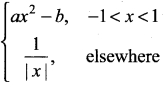
If f(x) = \(\left\{\begin{aligned} k x^{2} & \text { for } \quad x \leq 2 \\ 3 & \text { for } \quad x>2 \end{aligned}\right.\) is continuous at x = 2 then the value of k is ………..
(a) \(\frac{3}{4}\)
(b) 0
(c) 1
(d) \(\frac{4}{3}\)
Solution:
(d) \(\frac{4}{3}\)

Question 15.
If x = \(\frac{1-t²}{1+t²}\) and y = \(\frac{2t}{1+t²}\) then \(\frac{dx}{dy}\) = ……….
(a) \(\frac{y}{x}\)
(b) \(\frac{-y}{x}\)
(c) –\(\frac{x}{y}\)
(d) \(\frac{x}{y}\)
Solution:
(c) –\(\frac{x}{y}\)

Question 16.
\(\lim _{x \rightarrow \infty}\left(\frac{x^{2}+5 x+3}{x^{2}+x+3}\right)^{x}\) is ……….
(a) e4
(b) e²
(c) e³
(d) 1
Solution:
(a) e4

Question 17.
\(\int \frac{e^{x}\left(x^{2} \tan ^{-1} x+\tan ^{-1} x+1\right)}{x^{2}+1}\) dx is ……….
(a) extan-1(x + 1) + c
(b) tan-1(ex) + c
(c) ex \(\frac{tan^{-1}x}{2}\) + c
(d) extan-1x + c
Solution:
(d) extan-1x + c

Question 18.
\(\int \frac{\sec x}{\sqrt{\cos 2 x}}\) dx = ………
(a) tan-1(sin x) + c
(b) 2 sin-1(tan x) + c
(c) tan-1(cos x) + c
(d) sin-1(tan x) + c
Solution:
(d) sin-1(tan x) + c

Tamil Nadu 11th Maths Model Question Paper 2 English Medium

Question 19.
\(\int \frac{e^{6 \log x}-e^{5 \log x}}{e^{4 \log x}-e^{3 \log x}}\)
(a) x + c
(b) \(\frac{x³}{3}\) + c
(c) \(\frac{3}{x³}\) + c
(d) \(\frac{1}{x²}\) + c
Solution:
(b) \(\frac{x³}{3}\) + c

Question 20.
It is given that the events A and B are such that P(A) = \(\frac{1}{4}\), P(A/B) = \(\frac{1}{2}\) and P(B/A) = \(\frac{2}{3}\) then P(B) = …………
(a) \(\frac{1}{6}\)
(b) \(\frac{1}{3}\)
(c) \(\frac{2}{3}\)
(d) \(\frac{1}{2}\)
Solution:
(b) \(\frac{1}{3}\)

PART- II

II. Answer any seven questions. Question No. 30 is compulsory.

Question 21.
Find x such that -π ≤ x ≤ π and cos 2x = sin x
Solution:
We have cos 2x = sin x which gives
2sin² x + sin x – 1 = 0
The roots of the equation are sin x = \(\frac{-1±3}{4}\) = -1 (or) \(\frac{1}{2}\)
Now, sin x = \(\frac{1}{2}\) ⇒ x = \(\frac{π}{6}\), \(\frac{5π}{6}\)
Also sin x = -1 ⇒ x = \(\frac{π}{2}\)
Thus x = \(\frac{π}{2}\), \(\frac{π}{6}\), \(\frac{5π}{6}\)

Question 22.
If (n-1)P3 : nP4 = 1 : 10 find n.
Solution:
Tamil Nadu 11th Maths Model Question Paper 2 English Medium 2

Question 23.
Find the 18th and 25th terms of the sequence defined by
Tamil Nadu 11th Maths Model Question Paper 2 English Medium 3
Solution:
When n = 18 (even)
an = n(n + 2) = 18(18 + 2) = 18 (20) = 360
When n = 25 (odd)
Tamil Nadu 11th Maths Model Question Paper 2 English Medium 4

Question 24.
Show that the lines are 3x + 2y + 9 = 0 and 12x + 8y – 15 = 0 are parallel lines.
Solution:
Tamil Nadu 11th Maths Model Question Paper 2 English Medium 5
Here m1 = m2 ⇒ the two lines are parallel.

Question 25.
Prove that
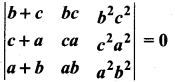
Tamil Nadu 11th Maths Model Question Paper 2 English Medium 6
Solution:
Tamil Nadu 11th Maths Model Question Paper 2 English Medium 7
= 0 + 2(0) (∴ R1 = R3)
= 0 = RHS

Question 26.
Find the value of λ for which the vectors \(\vec{a}\) = 2\(\vec{i}\) + λ\(\vec{j}\) + \(\vec{k}\) and \(\vec{b}\) = \(\vec{i}\) – 2\(\vec{j}\) + 3\(\vec{k}\) are perpendicular.
Solution:
When \(\vec{a}\) and \(\vec{b}\) are ⊥r If then \(\vec{a}\).\(\vec{b}\) = 0
\(\vec{a}\) ⊥r \(\vec{b}\) ⇒ \(\vec{a}\).\(\vec{b}\) = 0
(2) (1) + (λ) (-2) + (1) (3) = 0 ⇒ λ = 5/2

Tamil Nadu 11th Maths Model Question Paper 2 English Medium

Question 27.
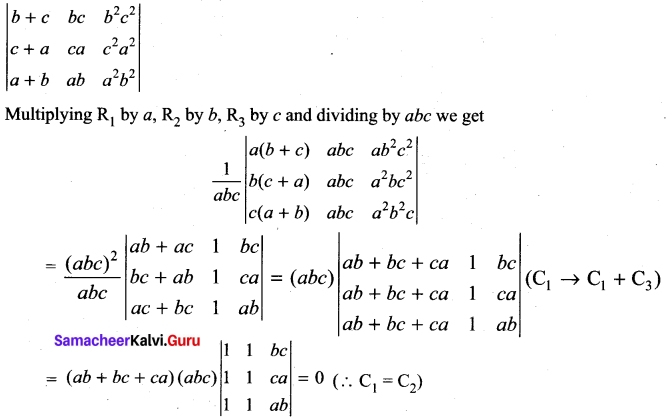
If y = \(\frac{tan x}{x}\) and \(\frac{dx}{dy}\)
Solution:
now y = \(\frac{u}{v}\) ⇒ y’ =\(\frac{vu’-uv’}{v²}\)
u = tan x ⇒ u’ = sec²x
v = x ⇒ v’ = 1
Tamil Nadu 11th Maths Model Question Paper 2 English Medium 8

Question 28.
Evaluate \(\int \sqrt{25 x^{2}-9}\) dx
Solution:
Tamil Nadu 11th Maths Model Question Paper 2 English Medium 9

Question 29.
If A and B are two independent events such that
P(A) = 0.4 and P(A ∪ B) = 0.9. Find P(B).
Solution:
P(A ∪ B) = P(A) + P(B) – P(A ∩ B)
P(A ∪ B) = P(A) + P(B) – P(A).P(B)(since A and B are independent)
That is, 0.9 = 0.4 + P(B) – (0.4) P(B)
0.9 – 0.4 = (1 – 0.4) P(B)
Therefore, P(B) = \(\frac{5}{6}\)

Question 30.
A rope of length 12 m is given. Find the largest area of the triangle formed by this rope and find the dimensions of the triangle so formed.
Solution:
The largest triangle will be an equilateral triangle
∴ side of the triangle = \(\frac{12}{3}\) = 4 m = a
Area of the triangle = \(\frac{a²√3}{4}\) = \(\frac{4²√3}{4}\) = 4√3 sq.m

PART – III

III. Answer any seven questions. Question No. 40 is compulsory. [7 × 3 = 21]

Question 31.
Let A = {a, b, c} and R = {(a, a), (b, b), (a, c)}. Write down the minimum number of ordered pairs to be included to R to make it

  1. reflexive
  2. symmetric
  3. transitive
  4. equivalence

Solution:

  1. (c, c)
  2. (c, a)
  3. nothing
  4. (c, c) and (c, a)

Question 32.
Solve 2|x + 1| – 6 ≤ 7 and graph the solution set in a number line.
Solution:
2|x + 1| – 6 ≤ 7
⇒ 2|x + 1| ≤ 7 + 6 (= 13)
⇒ |x + 1| ≤ \(\frac{13}{2}\)
⇒ x + 1 > \(\frac{-13}{2}\)
x + 1 > \(\frac{-13}{2}\)
⇒ x > \(\frac{-13}{2}\) -1 (= \(\frac{-15}{2}\)) ……….(1)
(or) x + 1 > \(\frac{13}{2}\)
x + 1 < \(\frac{-13}{2}\)
⇒ x < \(\frac{13}{2}\) -1 (= \(\frac{11}{2}\)) ……….(2)
From (1) and (2) \(\frac{-15}{2}\) ≤ x ≤ \(\frac{11}{2}\)

Question 33.
If the different permutations of all letters of the word BHASKARA are listed as in a dictionary, how many strings are there in this list before the first word starting with B?
Solution:
The required number of strings is the total number of strings starting with A and using the letters A, A, B, H, K, R, S = \(\frac{7!}{2}\) = 2520

Question 34.
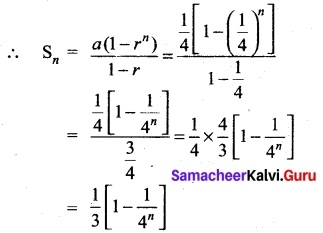
Find the sum up to n terms of the series: 1 + \(\frac{6}{7}\) + \(\frac{11}{49}\) + \(\frac{16}{343}\) + ….
Solution:
Here a = 1, d = 5 and r = \(\frac{1}{7}\)
Tamil Nadu 11th Maths Model Question Paper 2 English Medium 10

Tamil Nadu 11th Maths Model Question Paper 2 English Medium

Question 35.
Area of the triangle formed by a line with the coordinate axes, is 36 square units. Find the equation of the line if the perpendicular drawn from the origin to the line makes an angle of 45° with positive the x-axis.
Solution:
Let p be the length of the perpendicular drawn from the origin to the required line.
The perpendicular makes 45° with the x-axis.
The equation of the required line is of the form,
x cos α + y sin α = p
⇒ x cos 45° + y sin 45° = p
⇒ x + y= √2 P
This equation cuts the coordinate axes at A(√2p, 0) and B (o, √2p).
Area of the ΔOAB is \(\frac{1}{2}\) × √2p × √2p = 36 ⇒ p = 6 (∵ p is positive)
Therefore the equation of the required line is x + y = 6 √2

Question 36.
If AT = \(\left(\begin{array}{cc} 4 & 5 \\ -1 & 0 \\ 2 & 3 \end{array}\right)\) and B = \(\left(\begin{array}{ccc} 2 & -1 & 1 \\ 7 & 5 & -2 \end{array}\right)\) verify that (A – B)T = AT – BT
Solution:
(A – B)T = AT – BT
Tamil Nadu 11th Maths Model Question Paper 2 English Medium 11
Here (1) and (2) ⇒ (A – B)T = AT – BT

Question 37.
For any vector \(\vec{a}\) prove that \(|\vec{a} \times \hat{i}|^{2}+|\vec{a} \times \hat{j}|^{2}+|\vec{a} \times \hat{k}|^{2}=2|\vec{a}|^{2}\)
Solution:
Let = \(\vec{a}\) = a1\(\hat{i}\) + a2\(\hat{j}\) + a3\(\hat{k}\)
Tamil Nadu 11th Maths Model Question Paper 2 English Medium 12

Question 38.
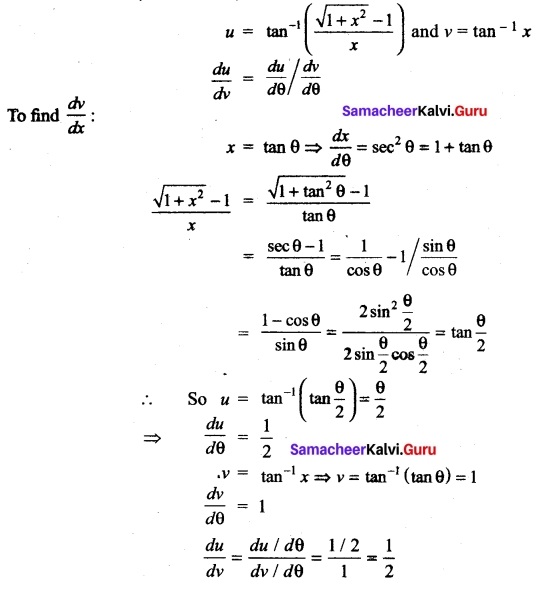
Given y = cos-1 \(\left(\frac{1-x^{2}}{1+x^{2}}\right)\) find \(\frac{dx}{dy}\)
Solution:
put x = tan θ
so \(\left(\frac{1-x^{2}}{1+x^{2}}\right)\) = \(\left(\frac{1-tan^{2}θ}{1+tan{2}θ}\right)\) = 2 cos θ
y = cos-1 (cos 2θ) = 2θ
⇒ \(\frac{dy}{dθ}\)
Now x = tan θ
⇒ \(\frac{dx}{dθ}\) = sec²θ
= 1 + tan² θ
= 1 + x²
so \(\frac{dx}{dy}\) = \(\frac{dy}{dθ}\)/\(\frac{dx}{dθ}\) = \(\frac{2}{1+x²}\)

Question 39.
A wound is healing in such a way that t days since Sunday the area of the wound has been decreasing at a rate of –\(\frac{3}{(t+2)²}\) cm² per day. If on Monday the area of the wound was 2 cm²
(i) What was the area of the wound on Sunday?
(ii) What is the anticipated area of the wound on Thursday if it continues to heal at the same rate ?
Solution:
Let A be the area of wound at time ‘ t ‘
Tamil Nadu 11th Maths Model Question Paper 2 English Medium 13
By the given, condition area of the wound on monday is 2 cm²
⇒ A = 2, t = 1
⇒ 2 = \(\frac{3}{1+2}\) + c
c = 1
∴ Area of wound at any day.
⇒ 1 ⇒ A = \(\frac{3}{1+2}\) + 1
(i) The area of the wound on Sunday
t = 0 ⇒ A = \(\frac{3}{2}\) + 1 = \(\frac{5}{2}\) = 2.5 cm²
(ii) The area of the wound on Thursday
t = 4 ⇒ A = \(\frac{3}{6}\) + 1 = \(\frac{1}{2}\) + 1 = 1.5 cm²

Tamil Nadu 11th Maths Model Question Paper 2 English Medium

Question 40.
An integer is chosen at random from the first fifty positive integers. What is probability that the integer chosen is a prime or multiple of 4?
Solution:
S = {1, 2, 3, ……. ,50} ∴ n(S) = 50
Let A be the event of getting prime number.
∴ A = {2, 3, 5, 7, 11, 13, 17, 19, 23, 29, 31, 37, 41, 43, 47}
n(A) = 15, so P(A) = 15/50
Let B be the event of getting number multiple of 4
∴B = {4, 8, 12, 16, 20, 24, 28, 32, 36, 40, 44, 48}
n(B) = 12, so P(B) = 12/50
Here A and B are mutually exclusive. (i.e.,) A ∩ B = Φ
∴ P(A ∪ B) = P(A) + P(B) = 15/50+ 12/50 = 27/50

PART – IV

IV. Answer all the questions. [7 × 5 = 35]

Question 41 (a).
The formula for converting from Fahrenheit to Celsius temperatures is y = \(\frac{5x}{9}\) – \(\frac{160}{9}\) Find the inverse of this function and determine whether the inverse is also a function.
Solution:
Tamil Nadu 11th Maths Model Question Paper 2 English Medium 14

[OR]

(b) If f : R → R is defined by f(x) = 2x – 3 prove that f is a injection and find its inverse.
Solution:
Method 1:
One-to-one: Let f(x) = f(y). Then 2x – 3 = 2y – 3; this implies that x = y. That is, f(x) = f(y) implies that x = y. Thus f is one-to-one.

Onto: Let y ∈ R. Let x =\(\frac{y+3}{2}\) Then f(x) = 2(\(\frac{y+3}{2}\)) -3 = y. Thus f is onto. This also can be proved by saying the following statement. The range of f is R (how?) which is equal to the co-domain and hence f is onto.

Inverse: Inverse: Let y = 2x – 3. Then y + 3 = 2x and hence x = \(\frac{y+3}{2}\) Thus f-1 (y) = \(\frac{y+3}{2}\). By replacing y as x, we get f-1 (x) = \(\frac{y+3}{2}\)

Method 2:
Let y = 2x – 3 then x = \(\frac{y+3}{2}\). Let, g(y) = \(\frac{y+3}{2}\)
Now (g o f) (x) = g(f(x)) = g(2x – 3) = \(\frac{(2x-3)+3}{2}\) = x
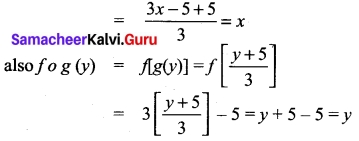
(f o g)(y) = f(g(y)) = f(\(\frac{y+3}{2}\)) = 2(\(\frac{y+3}{2}\)) -3 = y
This implies that f and g are bijections and inverses to each other. Hence f is a bijection and f-1(y) = \(\frac{y+3}{2}\). Replacing y by x we get, f-1(x) = \(\frac{x+3}{2}\)

Question 42 (a).
If the equations x² – ax + b = 0 and x² – ex + f = 0 have one root in common and if the second equation has equal roots then prove that ae = 2(b + f).
Solution:
Let a be the common root
then a² – aα + b = 0 . . . .(1)
we are given that
x² – ex + f = 0 has equal roots.
So the roots will be α, β
Now sum of roots = 2α
= -(-e) ⇒ a = e/2
product of the roots
α × α = α²f
substituting a and α², values in (1) we get
f – a (\(\frac{e}{2}\)) + b = 0
f – \(\frac{ae}{2}\) + b = 0
\(\frac{ae}{2}\) = b + f ⇒ ae = 2(b + f)

Tamil Nadu 11th Maths Model Question Paper 2 English Medium

[OR]

(b) Prove that
cos θ + cos(\(\frac{2π}{2}\)– θ) + (cos\(\frac{2π}{3}\) + θ) = 0
Solution:
we have
Tamil Nadu 11th Maths Model Question Paper 2 English Medium 15
cos θ – cos θ = 0 = RHS

Question 43 (a).
Find the number of strings that can be made using all letters of the word THING. If these words are written as in a dictionary, what will be the 85th string?
Solution:
(i) Number of words formed = 5! = 120
(ii) The given word is THING
Taking the letters in alphabetical order G H I N T
To find the 85th word
The No. of words starting with G = 4! = 24
The No. of words starting with H = 4! = 24
The No. of words starting with 1 = 4! = 24
The No. of words starting with NG = 3! = 6
The No. of words starting with NH = 3! = 6
The No. of words starting with NIGH = 1! = 1
Total = 85
So the 85th word is NIGHT

[OR]

(b) A straight line passes through a fixed point (6, 8). Find the locus of the foot of the perpendicular drawn to it from the origin O.
Solution:
Let the point (x1, y1) be (6, 8). and P (h, k) be a point on thr lequired locus.
Family of equations of the straight lines passing through the fixed point (x1, y1) is y – y1 = m (x – x1) ⇒ y – 8 = m(x – 6)
Since OP is perpendicular to the line (6.25)
m × (\(\frac{k-0}{h-0}\)) = -1 ⇒ m = –\(\frac{h}{k}\)
Also P(h, k) lies on (6.25)
⇒ k – 8 = – \(\frac{h}{k}\)(h – 6) ⇒ k (k – 8) = -h(h – 6) ⇒ h² + k² – 6h – 8k = 0
Locus of P (h, k) is x² + y² – 6x – 8y = 0

Question 44 (a).
If p is a real number and if the middle term in the expansion of (\(\frac{π}{2}\) + 2)8 is 1120, find p.
Solution:
In the equation of (\(\frac{π}{2}\) + 2)8, number of terms = 8 + 1 = 9 (odd)
∴ There is only one middle term i.e. (\(\frac{9+1}{2}\))th or 5th term
Tamil Nadu 11th Maths Model Question Paper 2 English Medium 16

Tamil Nadu 11th Maths Model Question Paper 2 English Medium

[OR]

(b) Express the matrix A = \(\left[\begin{array}{rrr} 1 & 3 & 5 \\ -6 & 8 & 3 \\ -4 & 6 & 5 \end{array}\right]\) the sum Of skew-symmetric matrices.
Solution:
Tamil Nadu 11th Maths Model Question Paper 2 English Medium 17
Thus A is expressed as the sum of symmetric and skew-symmetric matrices.

Question 45 (a).
For any vector a prove that \(|\vec{a} \times \hat{i}|^{2}+|\vec{a} \times \hat{j}|^{2}+|\vec{a} \times \hat{k}|^{2}=2|\vec{a}|^{2}\)
Solution:
Tamil Nadu 11th Maths Model Question Paper 2 English Medium 18

Tamil Nadu 11th Maths Model Question Paper 2 English Medium

[OR]

(b) If y = etan-1x show that (1 + x²) y” + (2x – 1) y’ = 0
Solution:
y = etan-1x
y’ = etan-1x (\(\frac{1}{1+x²}\))
y’ = \(\frac{y}{1+x²}\) ⇒ y’ (1 + x²) = y
differentiating w.r.to x
y’ (2x) + (1 + x²)(y”) = y’
(i.e.) (1 + x²) y” + y’(2x) – y’ = 0
(i.e.) (1 + x²)y” + (2x – 1) y’ = 0

Question 46 (a).
Evaluate \(\lim _{x \rightarrow \infty} \frac{(x+1)^{10}+(x+2)^{10}+\ldots+(x+100)^{10}}{x^{10}+10^{10}}\)
Solution:
Tamil Nadu 11th Maths Model Question Paper 2 English Medium 19

[OR]

(b) Evaluate
Tamil Nadu 11th Maths Model Question Paper 2 English Medium 20
Solution:
Tamil Nadu 11th Maths Model Question Paper 2 English Medium 21

Tamil Nadu 11th Maths Model Question Paper 2 English Medium

Question 47 (a).
Evaluate \(\int \sin ^{-1}\)x dx
Solution:
Let 1 = sin-1x dx
u = sin-1x dv = dx
Tamil Nadu 11th Maths Model Question Paper 2 English Medium 22

[OR]

(b) A factory has two machines I and II. Machine I produces 40% of items of the output and Machine II produces 60% of the items. Further 4% of items produced by Machine I are defective and 5% produced by Machine II are defective. An item is drawn at random. If the drawn item is defective, find the probability that it was produced by Machine II.
Solution:
Let A1 be the event that the items are produced by Machine-I, A2 be the event that items are produced by Machine-II, Let B be the event of drawing a defective item. Now we are asked to find the conditional probability P(A2/B). Since A1, A2 are mutually exclusive and exhaustive events, by Bayes theorem,
Tamil Nadu 11th Maths Model Question Paper 2 English Medium 23

Tamil Nadu 11th Maths Model Question Paper 3 English Medium

Students can Download Tamil Nadu 11th Maths Model Question Paper 3 English Medium Pdf, Tamil Nadu 11th Maths Model Question Papers helps you to revise the complete Tamilnadu State Board New Syllabus and score more marks in your examinations.

TN State Board 11th Maths Model Question Paper 3 English Medium

General Instructions:

  1. The question paper comprises of four parts.
  2. You are to attempt all the parts. An internal choice of questions is provided wherever applicable.
  3. All questions of Part I, II, III and IV are to be attempted separately.
  4. Question numbers 1 to 20 in Part I are Multiple Choice Questions of one mark each.
    These are to be answered by choosing the most suitable answer from the given four alternatives and writing the option code and the corresponding answer
  5. Question numbers 21 to 30 in Part II are two-mark questions. These are to be answered in about one or two sentences.
  6. Question numbers 31 to 40 in Part III are three-mark questions. These are to be answered in above three to five short sentences.
  7. Question numbers 41 to 47 in Part IV are five-mark questions. These are to be answered in detail Draw diagrams wherever necessary.

Time: 2.30 Hours
Maximum Marks: 90

PART – I

I. Choose the correct answer. Answer all the questions. [20 × 1 = 20]

Question 1.
Let A and B be subsets of the universal set N, the set of natural numbers. Then A’∪[(A ∩ B) ∪B’] is
(a) A
(b) A’
(c) B
(d) N
Solution:
(d) N

Question 2.
For any two sets A and B if (A – B) ∪ (B – A) = ………..
(a) (A – B) ∪ A
(b) (B – A) ∪ B
(c) (A ∪ B) – (A ∩ B)
(d) (A ∪ B) ∩ (A ∩ B)
Solution:
(c) (A ∪ B) – (A ∩ B)

Tamil Nadu 11th Maths Model Question Paper 3 English Medium

Question 3.
The equations whose roots are numerically equal but opposite in sign to the roots of 3x² – 5x – 7 = 0 is ……….
(a) 3x² – 5x – 7 = 0
(b) 3x² + 5x – 7 = 0
(c) 3x² – 5x + 7 = 0
(d) 3x² + x – 7 = 0
Solution:
(b) 3x² + 5x – 7 = 0

Question 4.
The value of sin(45° + θ) – cos (45° – θ) is
(a) 2 cos θ
(b) 1
(c) 0
(d) 2 sin θ
Solution:
(c) 0

Question 5.
If tan α sin β = 840, are the roots of x² + ax + b = 0 then \(\frac{\sin (\alpha+\beta)}{\sin \alpha \sin \beta}\) is equal to ……..
(a) \(\frac{b}{a}\)
(b) \(\frac{a}{b}\)
(c) –\(\frac{a}{b}\)
(d) –\(\frac{b}{a}\)
Solution:
(c) –\(\frac{a}{b}\)

Question 6.
If a² – aC2 = a² – aC4 then the a value of a is ………
(a) 2
(b) 3
(c) 4
(d) 5
Solution:
(b) 3

Question 7.
If nPr = 840, nCr = 35 then n = …………
(a) 7
(b) 6
(c) 5
(d) 4
Solution:
(a) 7

Question 8.
If 2x² + 3xy – cy² = 0 represents a pair of perpendicular lines then c = ……….
(a) -2
(b) \(\frac{1}{2}\)
(c) –\(\frac{1}{2}\)
(d) 2
Solution:
(d) 2

Question 9.
If the nth term of an A.P is 2n – 1 then sum to n terms of that A.P. is……….
(a) n²
(b) n² + 1
(c) 2n – 1
(d) n² – 1
Solution:
(a) n²

Question 10.
If A = \(\left(\begin{array}{ll} 1 & -1 \\ 2 & -1 \end{array}\right)\), B = \(\left(\begin{array}{cc} a & 1 \\ b & -1 \end{array}\right)\)
(a) a = 4, b = 1
(b) a = 1, b = 4
(c) a = 0, 6 = 4
(d) a = 2, 6 = 4
Solution:
(b) a = 1, b = 4

Question 11.
If the points (x – 2), (5, 2), (8, 8) are collinear then x is equal to………..
(a) -3
(b) \(\frac{1}{3}\)
(c) 1
(d) 3
Solution:
(d) 3

Tamil Nadu 11th Maths Model Question Paper 3 English Medium

Question 12.
In a regular hexagon ABCDEF if \(\vec { AB }\) and \(\vec { BC }\) are represented by \(\vec { a}\) and \(\vec { b }\) respectively then \(\vec { EF }\) =
(a) \(\vec { a }\) – \(\vec { b }\)
(b) \(\vec { a}\)
(c) –\(\vec { b }\)
(d) \(\vec { a }\) + \(\vec { b }\)
Solution:
(c) –\(\vec { b }\)

Question 13.
If |\(\vec { a }\) + \(\vec { b }\)| = 60, |\(\vec { a }\) – \(\vec { b }\)| = 40 and |\(\vec { b }\)| = 46, then |\(\vec { a }\)| is………….
(a) 42
(b) 12
(c) 22
(d) 32
Solution:
(c) 22

Question 14.
For \(\vec { a }\) = \(\vec { i }\) + \(\vec { j }\) – 2\(\vec { k }\), \(\vec { b }\) = –\(\vec { i }\) + 2\(\vec { j }\) + \(\vec { k }\) and \(\vec { c }\) = \(\vec { i }\) – 2\(\vec { j }\) + 2\(\vec { k }\), the unit vector parallal to \(\vec { a }\) + \(\vec { b }\) + \(\vec { c }\) is ………….
(a) \(\frac{\vec{i}+\vec{j}-\vec{k}}{\sqrt{3}}\)
(b) \(\frac{\vec{i}+\vec{j}+\vec{k}}{\sqrt{3}}\)
(c) \(\frac{\vec{i}+\vec{j}+\vec{k}}{3}\)
(d) \(\frac{\vec{i}+\vec{j}+\vec{k}}{\sqrt{6}}\)
Solution:
(b) \(\frac{\vec{i}+\vec{j}+\vec{k}}{\sqrt{3}}\)

Question 15.
The differential co-efficient of log10x with respect to log10 x is……….
(a) 1
(b) -(log10x)²
(c) (logx10)²
(d) \(\frac{x²}{100}\)
Solution:
(b) -(log10x)²

Question 16.
\(\frac{d}{dx}\)(ex+5logx) is………
(a) e10x10(x + 5)
(b) exx(x + 5)
(c) ex + \(\frac{5}{x}\)
(d) ex – \(\frac{5}{x}\)
Solution:
(a) e10x10(x + 5)

Question 17.
If f(x) = x tan-1x then f'(1) = ……………
(a) 1 + \(\frac{π}{4}\)
(b) \(\frac{1}{2}\) + \(\frac{π}{4}\)
(c) \(\frac{1}{2}\) – \(\frac{π}{4}\)
(d) 2
Solution:
(b) \(\frac{1}{2}\) + \(\frac{π}{4}\)

Question 18.
∫ cosec x dx = ………..
(a) log tan \(\frac{π}{2}\) + c
(b) -log (cosec x + cot x) + c
(c) -log (cosec x + cot x) + c
(d) All of them
Solution:
(d) All of them

Question 19.
If A and B are two events such that A⊂B and P(B) ≠ 0, then which of the following is correct?
(a) P(A / B) = \(\frac{p(A)}{p(B)}\)
(b) P(A/B) < P(A)
(c) P(A/B ≥ P(A))
(d) P(A/B) > P(B)
Solution:
(c) P(A/B ≥ P(A))

Tamil Nadu 11th Maths Model Question Paper 3 English Medium

Question 20.
A number x is chosen at random from the first 100 natural numbers. Let A be the event of numbers which satisfies \(\frac{(x-10)(x-50)}{x-30}\) ≥ 0, then P(A) is ………..
(a) 0.20
(b) 0.51
(c) 0.71
(d) 0.70
Solution:
(c) 0.71

PART – II

II. Answer any seven questions. Question No. 30 is compulsory. [7 × 2 = 14]

Question 21.
Write the values of f at -4, 1, -2, 7, 0 if
Tamil Nadu 11th Maths Model Question Paper 3 English Medium 1
Solution:
f (- 4) = 4 + 4 = 8
f(1) = 1 – 1² = 0
f(-2) = 4 + 2 = 6
f(7) = 0
f(0) = 0

Question 22.
Solve 23x < 100 when
(i) x is a natural number
(ii) x is an integer
Solution:
23x < 100
⇒ \(\frac{23x}{23}\) < \(\frac{100}{23}\) (i.e.,) x > 23
(i) x = 1, 2, 3, 4 (x ∈ N)
(ii) x = -3, -2, -1, 0, 1, 2, 3, 4 (x ∈ Z)

Question 23.
Expand \(\frac{1}{5+x}\) in ascending powers of x.
Solution:
Tamil Nadu 11th Maths Model Question Paper 3 English Medium 2

Question 24.
Find the nearest point on the line 2x +.y = 5 from the origin.
Solution:
The required point is the foot of the perpendicular from the origin on the line 2x + y = 5.
The line perpendicular to the given line, through the origin is x – 2y = 0.
Solving the equations 2x + y = 5 and x – 2y = 0, we get x = 2, y = 1.
Hence the nearest point on the line from the origin is (2, 1).
Alternate method: Using the formula
Tamil Nadu 11th Maths Model Question Paper 3 English Medium 3

Question 25.
Determine 3B + 4C – D if B, C and D are given by
Tamil Nadu 11th Maths Model Question Paper 3 English Medium 4
Solution:
Tamil Nadu 11th Maths Model Question Paper 3 English Medium 5

Question 26.
Find the constant b that makes g continuous on (-∞, ∞) g(x) = \(\left\{\begin{array}{l} x^{2}-b^{2}, \text { if } x<4 \\ b x+20, \text { if } x \geq 4 \end{array}\right.\)
Solution: Since g(x) is continuous,
\(lim _{x \rightarrow 4^{-}}\) g(x) =\(lim _{x \rightarrow 4^{+}}\) g(x)
\(lim _{x \rightarrow 4^{-}}\)(x² – b²) = \(lim _{x \rightarrow 4^{+}}\) bx + 20
16 – b² = 4b + 20
b² + 4b + 4 = 0
(b + 2)² = 0
b = -2

Tamil Nadu 11th Maths Model Question Paper 3 English Medium

Question 27.
Find \(\frac{dx}{dy}\) if x² + y² = 1
Solution:
We differentiate both sides of the equation.
Tamil Nadu 11th Maths Model Question Paper 3 English Medium 6
Solving for the derivative yields
\(\frac{dx}{dy}\) = –\(\frac{x}{y}\)

Question 28.
Evaluate ∫ \(\frac{1}{sin²x cos²x}\) dx
Solution:
Tamil Nadu 11th Maths Model Question Paper 3 English Medium 7

Question 29.
If P(A) = 0.5, P(B) = 0.8 and P(B/A) = 0.8 find P(A/B) and P(A ∪ B)
Solution:
Given P(A) = 0.5, P(B) = 0.8 and P(B/A) = 0.8
p(B/A) = \(\frac{p(A ∩ B)}{p(A)}\) = 0.8 (given)
⇒ \(\frac{p(A ∩ B)}{0.5}\) = 0.8
⇒ p(A ∩ B) = 0.8 × 0.5 = 0.4
(i.e.,) p(A ∩ B) = 0.4
(i) P(A/B) = \(\frac{p(A ∩ B)}{p(B)}\) = \(\frac{0.4}{0.8}\) = \(\frac{4}{8}\) = 0.5
(ii) P(A ∪ B) = P(A) + P(B) – P(A ∩ B)
= 0.5 + 0.8 – 0.4 = 0.9
So, P(A/B) = 0.5 and P(A ∩ B) = 0.9.

Question 30.
Find the angle between the vectors 2\(\hat{i}\) + \(\hat{j}\) – \(\hat{k}\) and \(\hat{i}\) + 2 \(\hat{j}\) + \(\hat{i}\) using vector product.
Solution:
The angle between \(\vec{b}\) and \(\vec{b}\) using vector product is given by
Tamil Nadu 11th Maths Model Question Paper 3 English Medium 8

PART – III

Answer any seven questions. Question No. 40 is compulsory.

Question 31.
If (x1/2 + x-1/2)² = \(\frac{9}{2}\) find the value of (x1/2 – x -1/2) for x > 1
Solution:
Tamil Nadu 11th Maths Model Question Paper 3 English Medium 9

Question 32.
If \(\frac{n!}{3!(n-4)!}\) and \(\frac{n!}{5!(n-5)!}\) are in the ratio 5 : 3 find the value of n.
Solution:
Tamil Nadu 11th Maths Model Question Paper 3 English Medium 10

Question 33.
Expand (1 + x)\(\frac{2}{3}\) up to four terms for |x| < 1.
Solution:
Tamil Nadu 11th Maths Model Question Paper 3 English Medium 11

Question 34.
Find the equation of the line if the perpendicular drawn from the origin makes an angle 30° with x axis and its length is 12.
Solution:
The equation of the line is x cos a + y sin a = p
here a = 30°, cos a = cos 30° = \(\frac{√3}{2}\) ; sin a = sin 30° = 1/2; p = 12.
So equation of the line is x\(\frac{√3}{2}\)+ v\(\frac{1}{2}\) = 12
(i.e) √3x + y = 12 × 2 = 24 ⇒ √3x + y – 24 = 0

Tamil Nadu 11th Maths Model Question Paper 3 English Medium

Question 35.
Prove that
Tamil Nadu 11th Maths Model Question Paper 3 English Medium 12
Solution:
Tamil Nadu 11th Maths Model Question Paper 3 English Medium 13

Question 36.
Find \(\lim _{t \rightarrow 0} \frac{\sqrt{t^{2}+9}-3}{t^{2}}\)
Solution:
We can’t apply the quotient theorem immediately. Use the algebra technique of rationalising the numerator.
Tamil Nadu 11th Maths Model Question Paper 3 English Medium 14

Question 37.
Find \(\frac{dy}{dx}\) where x = \(\frac{1-t²}{1+t²}\), y = \(\frac{2t}{1+t²}\)
Solution:
Tamil Nadu 11th Maths Model Question Paper 3 English Medium 15

Question 38.
Evaluate ∫(5x² – 4 + \(\frac{7}{x}\) + \(\frac{2}{√x}\))dx
Solution:
Tamil Nadu 11th Maths Model Question Paper 3 English Medium 16

Question 39.
What is the chance that leap year should have fifty three Sundays?
Solution:
Leap Year: In 52 weeks we have 52 Sundays. We have to find the probability of getting one Sunday form the remaining 2 days the remaining 2 days can be a combination of the following S = {Saturday and Sunday, Sunday and Monday, Monday and Tuesday, Tuesday and Wednesday, Wednesday and Thursday, Thursday and Friday, Friday and Saturday}.
(i.e) n(s) = 7
In this n(A) = {Saturday and Sunday, Sunday and Monday}
(i.e) n(A) = 2
So, P(A) = \(\frac{2}{7}\)

Question 40.
Find x from the equation cosec (90° + A) + x cos A cot (90° + A) = sin (90° + A).
Solution:
cosec (90° + A) = sec A, cot (90° + A) = – tan A
LHS = sec A + x cos A (-tan A)
Tamil Nadu 11th Maths Model Question Paper 3 English Medium 17

PART – IV

IV. Answer all the questions. [7 × 5 = 35]

Question 41 (a).
From the curve y = x, draw
(i) y = -x
(ii) y = 2x
(iii) y = x + 1
(iv) y= \(\frac{1}{2}\)x + 1
(v) 2x + y + 3 = 0
Solution:
Tamil Nadu 11th Maths Model Question Paper 3 English Medium 18

Tamil Nadu 11th Maths Model Question Paper 3 English Medium

[OR]

(b) Solve √3 sin θ – cos θ = √2
Solution:
√3 sin θ – cos θ = √2
Here a = -1; b = √3 ; c = √2 ; r = \(\sqrt{a²+b²}\) = 2
Thus, the given equation can be rewritten as
Tamil Nadu 11th Maths Model Question Paper 3 English Medium 19

Question 42 (a).
Solve \(\frac{x^{2}-4}{x^{2}-2x-15}\) ≤ 0
Solution:
\(\frac{x^{2}-4}{x^{2}-2x-15}\) ≤ 0 ⇒ \(\frac{(x-2)(x+2)}{(x+3)(x-5)}\) ≤ 0
x – 2 ⇒ x = 2; x + 2 = 0 ⇒ x = -2
x + 3 = 0 ⇒ x = -3; x – 5 = 0 ⇒ x = 5
plotting the points -3, -2, 2, 5 in the number line and taking the intervals
Tamil Nadu 11th Maths Model Question Paper 3 English Medium 20
So the solution for the inequality \(\frac{x^{2}-4}{x^{2}-2x-15}\) ≤ 0 are (-3, -2) ∪ (2, 5)

[OR]

(b) Solve \(\frac{x+1}{x-1}\) > 0
Solution:
\(\frac{x+1}{x-1}\) > 0 ⇒ \(\frac{(x+1)(x-1)}{(x-1)²}\) > 0
(x + 1)(x – 1) > 0 (∵(x – 1)² >0 for all x ≠ l)
Tamil Nadu 11th Maths Model Question Paper 3 English Medium 21
(x + 1) (x – 1) > 0
⇒ x ∈ (-∞, -1) ∪ (1, ∞)

Question 43 (a).
Use the principle of mathematical induction to prove that for every natural number n.
Tamil Nadu 11th Maths Model Question Paper 3 English Medium 22
Solution:
Let P(n) be the given statement
Tamil Nadu 11th Maths Model Question Paper 3 English Medium 23
For n = 1, LHS = 1 + \(\frac{3}{1}\) = 4
RHS = (1 + 1)² = 2² = 4
LHS = RHS
∴ ⇒ P(1) is true.
We note than P(n) is true for n = 1.
Assume that P(k) is true.
Tamil Nadu 11th Maths Model Question Paper 3 English Medium 24
= k² +2k+ 1 + 2k + 3 = k² + 4k + 4 = (k + 2)²
= (k + 1 + 1)²
∴ p(k + 1)is also true whenever P(k) is true Hence, by the principle of mathematical induction, P(n) is also true for all n ∈ N.

[OR]

(b) If cos 2θ = 0 determine Tamil Nadu 11th Maths Model Question Paper 3 English Medium 25
Solution:
Given cos 2θ = 0
⇒ 2θ = π/2 ⇒ θ = π/4
∴ cos θ = cos π/4 = 1/√2
and
sin θ = sin π/4 = 1/√2
Tamil Nadu 11th Maths Model Question Paper 3 English Medium 26

Tamil Nadu 11th Maths Model Question Paper 3 English Medium

Question 44 (a).
Find the distance of the line 4x – y = 0 from the point P(4,1) measured along the line making an angle 135° with the positive x axis.
Solution:
The equation in distance form of the line passing through P (4, 1) and making an angle of 135° with the positive x – axis is
\(\frac{x-4}{cos135°}\) = \(\frac{y-1}{sin135°}\)
Suppose it cuts 4x – y – 0 at Q such that PQ = r then the coordinates of Q are given by
Tamil Nadu 11th Maths Model Question Paper 3 English Medium 27
Hence, required distance is 3√2 units.

[OR]

(b) Evaluate \(\lim _{x \rightarrow \infty} x\left[3^{\frac{1}{x}}+1-\cos \left(\frac{1}{x}\right)-e^{\frac{1}{x}}\right]\)
Solution:
Tamil Nadu 11th Maths Model Question Paper 3 English Medium 28

Question 45 (a).
Prove that \(\sqrt[3]{x^{3}+7}-\sqrt[3]{x^{3}+4}\) is approximately equal to \(\frac{1}{x²}\) when x is large.
Solution:
Tamil Nadu 11th Maths Model Question Paper 3 English Medium 29
Since x is large, \(\frac{1}{x}\) is very small and hence higher powers of \(\frac{1}{x}\) are negligible. Thus
Tamil Nadu 11th Maths Model Question Paper 3 English Medium 30

[OR]

(b) Evaluate sec³ 2x
I = ∫sec³ 2x dx = ∫sec 2x sec² 2x dx
Let u = sec 2x; du = 2 sec 2x tan 2x dx
sec²2x dx = dv
Tamil Nadu 11th Maths Model Question Paper 3 English Medium 31

Question 46 (a).
Evaluate y = sin(tan(\(\sqrt{sin x}\)))
Solution:
Tamil Nadu 11th Maths Model Question Paper 3 English Medium 32

Tamil Nadu 11th Maths Model Question Paper 3 English Medium

[OR]

(b) Evaluate y = \(\sqrt{x+\sqrt{x+\sqrt{x}}}\)
Solution:
Tamil Nadu 11th Maths Model Question Paper 3 English Medium 33

Question 47 (a).
Prove that the line segment joining the midpoints of two sides of a triangle is parallel to the third side whose length is half of the length of the third side.
Solution:
In ΔABC,
Tamil Nadu 11th Maths Model Question Paper 3 English Medium 34

[OR]

(b) Given P(A) = 0.4 and P(A ∪ B) = 0.7 Find P(B) if
(i) A and B are mutually exclusive
(ii) A and B are independent events
(iii) P(A / B) = 0.4
(iv) P(B / A) = 0.5
Solution:
P(A) = 0.4, P(A ∪ B) = 0.7
(i) When A and B are mutually exclusive
P(A ∪ B) = P(A) + P(B)
(i.e.,) 0.7 = 0.4 + P(B)
0.7 – 0.4 = P(B)
(i.e.,) P(B) = 0.3

(ii) Given A and B are independent
⇒ P(A ∩ B) = P(A). P(B)
Now, P(A ∪ B) = P(A) + P(B) – P (A ∩ B)
(i.e.,) 0.7 = 0.4 + P(B) – (0.4) (P(B)
(i.e.,) 0.7 – 0.4 = P(B)(1 – 0.4)
0.3 = P (B) 0.6
⇒ P(B) = \(\frac{0.3}{0.6}\) = \(\frac{3}{6}\) = 0.5

(iii) P(A/B) = 0.4
(i.e.,) \(\frac{P(A ∩ B)}{P(B)}\) = 0.4
⇒ P(A ∩ B) = 0.4 P(B) …..(i)
But We know P(A ∪ B) = P(A) + P(B) – P(A ∩ B)
P(A ∩ B) = P(A) + P(B) – P(A ∪ B)
⇒ P(A ∩ B) = 0.4 + P(B) – 0.7
= P(B) – 0.3
from (i) and (it) (equating RHS) we get
0-4 [P(B)] = P(B) – 0.3
0.3 = P(B)(1 – 0.4)
0.6 (P(B)) = 0.3 ⇒ P(B) = \(\frac{0.3}{0.6}\) = \(\frac{3}{6}\) = 0.5

(iv) P(B/A) = 0.5
(i.e.,) \(\frac{P(A ∩ B)}{P(A)}\) = 0.5
(i.e.,) P(A ∩ B) = 0.5 × P(A)
= 0.5 × 0.4 = 0.2
Now P(A ∪ B) = P(A) + P(B) – P(A ∩ B)
⇒ 0.7 = 0.4 + P(B) – 0.2
⇒ 0.7 = P(B) + 0.2
⇒ P(B) =0.7 – 0.2 = 0.5

Tamil Nadu 11th Maths Model Question Paper 3 English Medium

Tamil Nadu 11th Maths Model Question Paper 1 English Medium

Students can Download Tamil Nadu 11th Maths Model Question Paper 1 English Medium Pdf, Tamil Nadu 11th Maths Model Question Papers helps you to revise the complete Tamilnadu State Board New Syllabus and score more marks in your examinations.

TN State Board 11th Maths Model Question Paper 1 English Medium

General Instructions:

  1. The question paper comprises of four parts.
  2. You are to attempt all the parts. An internal choice of questions is provided wherever applicable.
  3. All questions of Part I, II, III and IV are to be attempted separately.
  4. Question numbers 1 to 20 in Part I are Multiple Choice Questions of one mark each.
    These are to be answered by choosing the most suitable answer from the given four alternatives and writing the option code and the corresponding answer
  5. Question numbers 21 to 30 in Part II are two-mark questions. These are to be answered in about one or two sentences.
  6. Question numbers 31 to 40 in Part III are three-mark questions. These are to be answered in above three to five short sentences.
  7. Question numbers 41 to 47 in Part IV are five-mark questions. These are to be answered in detail Draw diagrams wherever necessary.

Time: 2.30 Hours
Maximum Marks: 90

Part – I

Choose the correct answer. Answer all the questions. [20 × 1 = 20]

Question 1.
The number of students who take both the subjects Mathematics and Chemistry is 70. This represents 10% of the enrollment in Mathematics and 14% of the enrollment in Chemistry. The number of students take at least one of these two subjects, is
(a) 1120
(b)1130
(c) 1100
(d) insufficient data
Answer:
(b)1130

Question 2.
If 8 and 2 are the roots of x² + ax + c = 0 and 3, 3 are the roots of x² + dx + b = 0, then the roots of the equation x² + ax + b = 0 are
(a) 1, 2
(b) -1, 1
(c) 9, 1
(d) -1, 2
Answer:
(c) 9, 1

Tamil Nadu 11th Maths Model Question Paper 1 English Medium

Question 3.
If tan 40° = λ then \(\frac{tan 140° – tan 130°}{1+tan 140° tan 130°}\) = ………….
(a) \(\frac{1-λ²}{λ}\)
(b) \(\frac{1+λ²}{λ}\)
(c) \(\frac{1+λ²}{2λ}\)
(d) \(\frac{1-λ²}{2λ}\)
Answer:
(d) \(\frac{1-λ²}{2λ}\)

Question 4.
The value of 2 sin A cos³ A – 2 cos A sin³ A is………..
(a) sin 4A
(b) cos 4A
(c) \(\frac{1}{2}\) sin 4A
(d) \(\frac{1}{2}\) cos 4A
Answer:
(c) \(\frac{1}{2}\) sin 4A

Question 5.
In a triangle ABC, sin²A + sin²B + sin²C = 2 then the triangle is ………. triangle.
(a) equilateral
(b) isosceles
(c) right
(d) scalene
Answer:
(c) right

Question 6.
The number of ways in which a host lady invite 8 people for a party of 8 out of 12 people of whom two do not want to attend the party together is ………….
(a) 2 × 11C7 + 10C8
(b) 11C7+ 10C8
(c) 12C8 – 10C6
(d) 10C6 + 2!
Answer:
(c) 12C8 – 10C6

Question 7.
If a is the arithmetic mean and g is the geometric mean of two numbers then…………
(a) a ≤ g
(b) a ≥ g
(c) a = g
(d) a > g
Answer:
(b) a ≥ g

Question 8.
The number of rectangles that a chessboard has…………
(a) 81
(b) 99
(c) 1296
(d) 6561
Answer:
(c) 1296

Tamil Nadu 11th Maths Model Question Paper 1 English Medium

Question 9.
The intercepts of the perpendicular bisector of the line segment joining (1,2) and (3,4) with coordinate axes are………….
(a) 5, -5
(b) 5, 5
(c) 5, 3
(d) 5, -4
Answer:
(b) 5, 5

Question 10.
The coordinates of the four vertices of a quadrilateral are (-2, 4), (-1, 2), (1, 2) and (2, 4) taken in order.The equation of the line passing through the vertex (-1, 2) and dividing the quadrilateral in the equal areas is…………
(a) x + 1 = 0
(b) x + y= 1
(c) x + y + 3 = 0
(d) x – y + 3 = 0
Answer:
(c) x + y + 3 = 0

Question 11.
The vectors \(\vec{a}\) – \(\vec{b}\), \(\vec{b}\) – \(\vec{c}\), \(\vec{c}\) – \(\vec{a}\) are …………. vectors.
(a) parallel
(b) unit
(c) mutually perpendicular
(d) coplanar
Answer:
(d) coplanar

Question 12.
If |\(\vec{a}\) + \(\vec{b}\)| = 60, |\(\vec{a}\) – \(\vec{b}\)| = 40, |\(\vec{b}\)| = 46 then |\(\vec{a}\)| is ……………
(a) 42
(b) 12
(c) 22
(d) 32
Answer:
(c) 22

Question 13.
Given \(\vec{a}\) = 2\(\vec{i}\) + \(\vec{j}\) – 8\(\vec{k}\) and \(\vec{b}\) = \(\vec{i}\) + 3\(\vec{j}\) – 4\(\vec{k}\) then |\(\vec{a}\) + \(\vec{b}\)|= …………..
(a) 13
(b) \(\frac{13}{3}\)
(c) \(\frac{4}{13}\)
(d) \(\frac{3}{13}\)
Answer:
(a) 13

Question 14.
If \(\vec{r}\) = \(\frac{9\vec{a}+7\vec{b}}{16}\) then the point P whose position vector \(\vec{r}\) divides the line joining the points with position vectors \(\vec{a}\) and \(\vec{b}\) in the ratio……….
Tamil Nadu 11th Maths Model Question Paper 1 English Medium 1
(a) 7 : 9 internally
(b) 9 : 7 internally
(c) 9 : 7 externally
(d) 7 : 9 externally
Answer:
(a) 7 : 9 internally

Question 15.
If f(x) = x + 2 then f’ (f(x)) at x = 4 is…………
(a) 8
(b) 1
(c) 4
(d) 5
Answer:
(b) 1

Question 16.
The derivative of (x + \(\frac{1}{x}\))² w.r.to. x is ……….
(a) 2x – \(\frac{2}{x³}\)
(b) 2x + \(\frac{2}{x³}\)
(c) 2(x + \(\frac{1}{x}\) )
(d) 0
Answer:
(a) 2x – \(\frac{2}{x³}\)

Question 17.
If y = \(\frac{1}{a-z}\) then \(\frac{dz}{dy}\) is………..
(a) (a – z)²
(b) – (z – a)²
(c) (z + a)²
(d) -(z + a)²
Answer:
(a) (a – z)²

Tamil Nadu 11th Maths Model Question Paper 1 English Medium

Question 18.
∫sin7x cos5x dx = ……….
Tamil Nadu 11th Maths Model Question Paper 1 English Medium 2
Answer:
(b) –\(\frac{1}{2}\) [\(\frac{cos 12x}{2}\) + \(\frac{cos 2x}{2}\)] + c

Question 19.
∫\(\frac{1}{e^x}\) dx = …………..
(a) log ex + c
(b) x + c
(c) \(\frac{1}{e^x}\) + c
(d) \(\frac{-1}{e^x}\) + c
Answer:
(d) \(\frac{-1}{e^x}\) + c

Question 20.
A letter is taken at random from the letters of the word ‘ASSISTANT’ and another letter is taken at random from the letters of the word ‘ STATISTICS ’. The probability that the selected letters are the same………..
(a) \(\frac{7}{45}\)
(b) \(\frac{17}{90}\)
(c) \(\frac{29}{90}\)
(d) \(\frac{19}{90}\)
Answer:
(d) \(\frac{19}{90}\)

PART- II

II. Answer any seven questions. Question No. 30 is compulsory. [7 × 2 = 14]

Question 21.
For a set A, A × A contains 16 elements and two of its elements are (1,3) and (0,2). Find the elements of A.
Answer:
A × A = 16 elements = 4 × 4
⇒ A has 4 elements
∴ A = {0, 1, 2, 3}

Question 22.
Find the area of the triangle whose sides are 13 cm, 14 cm and 15 cm.
Answer:
Tamil Nadu 11th Maths Model Question Paper 1 English Medium 3

Question 23.
If \(\frac{1}{7!}\) + \(\frac{1}{9!}\) = \(\frac{x}{10!}\) find x.
Answer:
Here \(\frac{1}{7!}\) + \(\frac{1}{9!}\) = \(\frac{x}{10!}\)
Tamil Nadu 11th Maths Model Question Paper 1 English Medium 4

Question 24.
Find \(\sqrt[3]{1001}\) approximately (two decimal places)
Answer:
Tamil Nadu 11th Maths Model Question Paper 1 English Medium 5

Question 25.
The slope of one of the straight lines ax² + 2hxy + by² = 0 is three times the other, show that 3h² = 4 ab.
Answer:
Let the slopes be m and 3m.
Now m + 3m = 4m = –\(\frac{2h}{b}\)
⇒ m = –\(\frac{2h}{4b}\) = –\(\frac{h}{2b}\) …….. (1)
m × 3m = \(\frac{a}{b}\) ⇒ 3m² = \(\frac{a}{b}\) ⇒ m² = \(\frac{a}{3b}\) ………. (2)
Eliminating m from (1) and (2)
we get
Tamil Nadu 11th Maths Model Question Paper 1 English Medium 6

Tamil Nadu 11th Maths Model Question Paper 1 English Medium

Question 26.
Simplify
Tamil Nadu 11th Maths Model Question Paper 1 English Medium 7
Answer:
If we denote the given expression by A, then using the scalar multiplication rule, we get
Tamil Nadu 11th Maths Model Question Paper 1 English Medium 8

Question 27.
Find a point whose position vector has magnitude 5 and parallel to the vector 4\(\hat{i}\) – 3\(\hat{j}\) + 10\(\hat{k}\).
Answer:
Let \(\vec{a}\) be the vector 4\(\hat{i}\) – 3\(\hat{j}\) + 10\(\hat{k}\)
The unit vector \(\hat{a}\) along the direction of \(\hat{a}\) is \(\frac{\vec{a}}{|\vec{a}|}\) which is equal to \(\frac{4 \hat{i}-3 \hat{j}+10 \hat{k}}{5 \sqrt{5}}\). the vector whose magnitude is 5 and parallel to
Tamil Nadu 11th Maths Model Question Paper 1 English Medium 9

Question 28.
Evaluate \(\lim _{x \rightarrow-1}\left(x^{2}-3\right)^{10}\)
Answer:
Tamil Nadu 11th Maths Model Question Paper 1 English Medium 10

Question 29.
Evaluate \(\int \frac{e^{2 x}+e^{-2 x}+2}{e^{x}}\)
Answer:
Tamil Nadu 11th Maths Model Question Paper 1 English Medium 11

Question 30.
If A and B are mutually exclusive events P(A) = 3/8 and P(B) = 1/8 then find
(i) P(\(\bar{A}\) ∩ B)
(ii) p(\(\bar{A}\) ∪ \(\bar{B}\))
Answer:
(i) P(A ∩ B) = P(A) + P(B) – P(A ∪ B)
= 3/8 + 1/8 – 1/2
P(A ∩ B) = \(\frac{4-4}{8}\) = 0
P(\(\bar{A}\) ∩ B) = P(B) – P (A ∩ B) = 1/8 – 0 = 1/8

(ii) p(\(\bar{A}\) ∪ \(\bar{B}\)) = P[(A ∩B)’] = 1 – P(A ∩ B)
= 1 – 0 = 1

PART- III

III. Answer any seven questions. Question No. 40 is compulsory. [7 × 3 = 21]

Question 31.
Find the range of the function f(x) = \(\frac{1}{1-3cos x}\)
Answer:
Clearly, -1 ≤ cos x ≤ 1
⇒ 3 ≥ -3 cos x ≥ -3
⇒ -3 ≤ -3 cos x ≤ 3
⇒ 1 – 3 ≤ 1 – 3 cos x ≤ 1 + 3
Thus we get -2 ≤ 1 – 3 cos x and 1 – 3 cos x ≤ 4.
By taking reciprocals, we get \(\frac{1}{1-3 cos x}\) ≤ –\(\frac{1}{2}\) and \(\frac{1}{1-3 cos x}\) ≥ \(\frac{1}{4}\).
Hence the range of f is (-∞, –\(\frac{1}{2}\) ] ∪ [\(\frac{1}{4}\), ∞)

Tamil Nadu 11th Maths Model Question Paper 1 English Medium

Question 32.
Solve for x, -x² + 3x – 2 ≥ 0
Answer:
-x² + 3x – 2 ≥ 0 ⇒ x² – 3x + 2 ≤ 0
(x – 1)(x – 2) ≤ 0
[(x – 1) (x – 2) = 0 ⇒ x = 1 or 2. Here α = 1 and β = 2. Note that α < β]
So for the inequality (x – 1) (x – 2) ≤ 2
x lies between 1 and 2
(i.e.) x ≥ 1 and x ≤ 2 or x ∈ [1, 2] or 1 ≤ x ≤ 2

Question 33.
Solve the following equation for which solutions lies in the interval 0° ≤ θ ≤ 360°. sin4x = sin²x
Answer:
sin²x – sin4x = 0
sin² x (1 – sin² x) = 0
sin²x (cos² x) = 0
[\(\frac{1}{2}\) (2 sinx cos x)]² = 0
⇒ (sin2 x)² = 0
⇒ sin 2x = 0 = 0, π, 2π, 3π, 4π
x = 0, \(\frac{π}{2}\), π, \(\frac{π}{2}\), 2π

Question 34.
Find n if n – 1 P3: nP4 = 1 : 9
Answer:
Here n – 1P3 : nP4 = 1 : 9
Tamil Nadu 11th Maths Model Question Paper 1 English Medium 12

Question 35.
A family is using Liquefied petroleum gas (LPG) of weight 14.2 kg for consumption. (Full weight 29.5 kg includes the empty cylinders tare weight of 15.3 kg.). If it is used with constant rate then it lasts for 24 days. Then the new cylinder is replaced (i) Find the equation relating the quantity of gas in the cylinder to the days. (ii) Draw the graph for first 96 days.
Answer:
Since the usage is in constant rate and it is the slope m = \(\frac{14.2}{24}\)
Tamil Nadu 11th Maths Model Question Paper 1 English Medium 13
which is the equation relating the quantity.
y – f(x) is a periodic function with period 24. (i.e.) f(x) = f(x + 24)

Question 36.
If cos 2θ = 0, determine Tamil Nadu 11th Maths Model Question Paper 1 English Medium 14
Answer:
Given cos 2θ = 0
⇒ 2θ = π/2 ⇒ θ = π/4
Tamil Nadu 11th Maths Model Question Paper 1 English Medium 15

Tamil Nadu 11th Maths Model Question Paper 1 English Medium

Question 37.
Show that the points (4, -3, 1), (2, -4, 5) and (1, -1, 0) form a right angled triangle.
Answer:
Trivially they form a triangle. It is enough to prove one angle is \(\frac{π}{2}\) . So find the sides of the triangle.
Let O be the point of reference and A, B, C be (4, -3, 1), (2, -4, 5) and (1, -1, 0) respectively.
\(\vec{OA}\) = 4\(\hat{i}\) -3\(\hat{j}\) + \(\hat{k}\), \(\vec{OB}\) = 2\(\hat{i}\) – 4\(\hat{j}\) + 5\(\hat{k}\), \(\vec{OC}\) = \(\hat{i}\) – \(\hat{j}\)
Now, \(\vec{AB}\) = \(\vec{OB}\) – \(\vec{OA}\) = -2\(\hat{i}\) – \(\hat{j}\) + 4\(\hat{k}\)
Similarly, \(\vec{BC}\) = –\(\hat{i}\) + 3\(\hat{j}\) – 5\(\hat{k}\); \(\vec{CA}\) = 3\(\hat{i}\) – 2\(\hat{j}\) + \(\hat{k}\)
Clearly \(\vec{AB}\) . \(\vec{CA}\) = 0
Thus one angle is \(\frac{π}{2}\). Hence they form a right angled triangle.

Question 38.
Compute
Tamil Nadu 11th Maths Model Question Paper 1 English Medium 16
Answer:
Tamil Nadu 11th Maths Model Question Paper 1 English Medium 17
= (0 + 1) + (0 + 3)
= 4

Question 39.
If for two events A and B, P(A) = \(\frac{3}{4}\), P(B) = \(\frac{2}{5}\) and A∪B conditional probability P(A/B).
Answer:
Given P(A) = \(\frac{3}{4}\), P(B) = \(\frac{2}{5}\) and P(A ∪ B) = l
Now P(A ∪ B) = P(A) + P(B) – P(A ∩ B)
1 = \(\frac{3}{4}\) + \(\frac{2}{5}\) – P(A ∩ B)
P(A ∩ B) = \(\frac{3}{4}\) + \(\frac{2}{5}\) – 1 = \(\frac{15+8-20}{20}\)
P(A ∩ B) = 3/20
so P(A/B) = \(\frac{P(A ∪ B)}{P(B)}\) = \(\frac{3/20}{2/5}\) = \(\frac{3}{20}\) × \(\frac{5}{2}\) = \(\frac{3}{8}\)

Question 40.
Evaluate \(\int \frac{(x-1)^{2}}{x^{3}+x}\) dx
Answer:
Tamil Nadu 11th Maths Model Question Paper 1 English Medium 18

PART – IV

IV. Answer all the questions. [7 × 5 = 35]

Question 41 (a).
Find the range of the function
Answer:
The range of cos x is – 1 to 1
– 1 < cos x < 1
(x by 2) – 2 < 2 cos x < 2
adding -1 throughout
-2 – 1 < 2 cos x – 1 < 2 – 1
(i.e.,) -3 < 2 cos x -1 < 1
so 1 < \(\frac{1}{2cosx – 1}\) < \(\frac{-1}{3}\)
The range is outside \(\frac{-1}{3}\) and 1
i.e., range is (-∞, \(\frac{-1}{3}\)]∪[1, ∞)

[OR]

(b) In any triangle ABC prove that a² = (b + c)² sin² \(\frac{A}{2}\) + (b – c)² cos² \(\frac{A}{2}\) Answer:
RHS = (b + c)² sin² \(\frac{A}{2}\) + (b – c)² cos² \(\frac{A}{2}\)
= (b² + c² + 2bc) sin² \(\frac{A}{2}\) + (b² + c² – 2bc) cos² \(\frac{A}{2}\)
= (b² + c²) [sin² \(\frac{A}{2}\) + cos² \(\frac{A}{2}\)] + 2bc [sin² \(\frac{A}{2}\) – cos² \(\frac{A}{2}\)]
= b² + c² – 2bc cos A = a² = LHS

Tamil Nadu 11th Maths Model Question Paper 1 English Medium

Question 42 (a).
Find all values of x for which \(\frac{x³(x-1)}{x-2}\) > 0
Answer:
\(\frac{x³(x-1)}{x-2}\) > 0
Now we have to find the signs of
x³, x – 1 and x – 2 as follows
x³ = 0 ⇒ x = 0; x – 1 = 0 ⇒ x = 1; x – 2 = 0 ⇒ x = 2.
Plotting the points in a number line and finding intervals
Tamil Nadu 11th Maths Model Question Paper 1 English Medium 19
So the solution set = (0, 1) ∪ (2, ∞)

[OR]

(b) resolve \(\frac{x}{(x²+1)(x-1)(x+2)}\) Into partial fractions.
Answer:
Tamil Nadu 11th Maths Model Question Paper 1 English Medium 20
Equating numerator on both sides
x = A (x + 2) (x² + 1) + B (x – 1) (x² + 1) + (Cx + D) (x – 1) (x + 2)
This equations is true for any value of x to find A, B, C and D.
put x = 1
1 = A (3) (2) + B (0) + (0)
6A = 1 ⇒ A= 1/6
put x = -2
-2 = + 0 + B (-3) (5) + 0
⇒ -15B = -2 ⇒ B = 2/15
put x = 0
⇒ 2A – B – 2D = 0
(i.e.,) \(\frac{2}{6}\) – \(\frac{2}{15}\) – 2D = 0
Tamil Nadu 11th Maths Model Question Paper 1 English Medium 21

Tamil Nadu 11th Maths Model Question Paper 1 English Medium

Question 43 (a).
7 relatives of a man comprises 4 ladies and 3 gentlemen, his wife has also 7 relatives; 3 of them are ladies and 4 gentlemen. In how many ways can they invite a dinner party of 3 ladies and 3 gentlemen so that there are 3 of mens relative and 3 of the wifes relatives?
Answer:
Tamil Nadu 11th Maths Model Question Paper 1 English Medium 22
We need 3 ladies and 3 gentlemen for the party which consist of 3 Husbands relative and 3 wifes relative.
This can be done as follows
Tamil Nadu 11th Maths Model Question Paper 1 English Medium 23
4C0 = 4C4 = 1; 3C0 = 3C3 = 1
4C1 = 4C3 = 4; 3C1 = 3C2 = 3
4C2 = \(\frac{4×3}{2×1}\) = 6
(4) (1) (1) (4) + (6) (3) (3) (6) + (4) (3) (3) (4) + (1) (1) (1) (1)
= 16 + 324 + 144 + 1 = 485 ways.

[OR]

(b) Show that the points (1, 3), (2, 1) and (\(\frac{1}{2}\), 4) are collinear, by using
(i) Concept of slope
(ii) Using a straight line and
(iii) Any other method.
Answer:
Let the given points be A (1, 3), B (2, 1), and C(\(\frac{1}{2}\), 4)
Tamil Nadu 11th Maths Model Question Paper 1 English Medium 24
Slope of AB = Slope of BC ⇒ AB parallel to BC but B is a common point.
⇒ The points A, B, C are collinear.

(ii) Equation of the line passing through A and B is \(\frac{y-1}{3-1}\) = \(\frac{x-2}{1-2}\) ⇒ \(\frac{y-1}{2}\) = \(\frac{x-2}{-1}\)
1 – y = 2x – 4
2x +y = 5 ……….(1)
Substituting C\(\frac{1}{2}\), 4 in (1),
We get LHS = 2(\(\frac{1}{2}\)) + 4 = 1 + 4 = 5 = RHS
C is a point on AB
⇒ The points A, B, C lie on a line.
⇒ The points A, B, C are collinear.

(iii) Area of ΔABC = \(\frac{1}{2}\)(x1) (y2 y3) + x2 (y3 – y1) + x3 (y1 – y2)
= \(\frac{1}{2}\) {1(1, -4) + 2(4 – 3) +\(\frac{1}{2}\)(3 – 1)} = \(\frac{1}{2}\)(-3 + 2 + 1) = 0
⇒ The points A, B, C are collinear.

Tamil Nadu 11th Maths Model Question Paper 1 English Medium

Question 44 (a).
Prove by vector Method’s that the Medians of a triangle are concurrent.
Answer:
Theorem: The medians of a triangle are concurrent.
Proof: Let ABC be a triangle and let D, E, F be the mid points of its sides BC, CA and AB respectively. We have to prove that the medians AD, BE, CF are concurrent.
Let O be the origin and \(\vec{a}\), \(\vec{b}\), \(\vec{c}\) be the position vectors of A, B, and C respectively.
The position vectors of D, E and F are respectively.
\(\frac{\vec{b}}{\vec{c}}\), \(\frac{\vec{c}}{\vec{a}}\), \(\frac{\vec{a}}{\vec{b}}\)
Let G1, be the point on AD dividing it internally in the ratio 2 : 1.
Tamil Nadu 11th Maths Model Question Paper 1 English Medium 25
From (1), (2) and (3) we find that the position vectors of the three points G1, G2, G3 are one and the same. Hence they are not different points. Let the common point be G.
Therefore the three medians are concurrent and the point of concurrence is G.

[OR]

(b) If y = Ae6x + Be-x prove that \(\frac{d²y}{dx²}\) – 5\(\frac{dy}{dx}\) – 6y = 0
Answer:
Tamil Nadu 11th Maths Model Question Paper 1 English Medium 26

Question 45 (a).
If a and b are distinct integers, prove that a – b is a factor of an – bn, whenever n is a positive integer. [Hint: write an = (a-b + b)n and expand]
Answer:
a = a – b + b
So, an = [a – b + b]n =[(a – b) + b]n
= nC0 (a – b)n + nC1 (a -b)n-1b1 + nC2 (a – b)n-2b² + ……… + nCn-1(a – b) bn-1
+ nCn(bn)
⇒ an – bn = (a – b)n + nC1 (a – b)n-1b + nC2 (a – b)n-2b² + ……. + nCn-1 (a – b) bn-1
= (a – b) [(a – b)n-1 + nC1(a – b)n-2b + nC2 (a – b)n-3b² + ……… + nCn-1, bn-1]
= (a – b) [an integer]
⇒ an – 6n is divisible by (a – b)

[OR]

(b) Verify the property A (B + C) = AB + AC when the matrices A, B and C are given by
Tamil Nadu 11th Maths Model Question Paper 1 English Medium 27
Answer:
Tamil Nadu 11th Maths Model Question Paper 1 English Medium 28

Tamil Nadu 11th Maths Model Question Paper 1 English Medium

Question 46 (a).
Evaluate \(\lim _{x \rightarrow \infty} \sqrt{x^{2}+x+1}-\sqrt{x^{2}+1}\)
Answer:
Here the expression assumes the form ∞ to – ∞ as x → ∞. SO, we first reduce it to the rational form \(\frac{f(x)}{g(x)}\)
Tamil Nadu 11th Maths Model Question Paper 1 English Medium 29

[OR]

(b) Evaluate \(\lim _{x \rightarrow \infty} x\left[3^{\frac{1}{x}}+1-\cos \left(\frac{1}{x}\right)-e^{1 / x}\right]\)
Answer:
Let y = \(\frac{1}{x}\) as x → ∞, y → 0
Tamil Nadu 11th Maths Model Question Paper 1 English Medium 30

Question 47 (a).
Evaluate \(\int \tan ^{-1}\left(\frac{2 x}{1-x^{2}}\right)\) dx.
Answer:
Tamil Nadu 11th Maths Model Question Paper 1 English Medium 31

[OR]

(b) Suppose the chances of hitting a target by a person X is 3 times in 4 shots, by Y is 4 times in 5 shots, and by Z is 2 times in 3 shots. They fire simultaneously exactly one time. What is the probability that the target is damaged by exactly 2 hits?
Answer:
Given P(X) = 3/4, P(X’) = 1 – 3/4 = 1/4
P(Y) = 4/5, P(Y’) = 1 – 4/5 = 1/5
P(Z) = \(\frac{2}{3}\) P(Z’) = 1 – \(\frac{2}{3}\) = \(\frac{1}{3}\)
Tamil Nadu 11th Maths Model Question Paper 1 English Medium 32

Tamil Nadu 11th Maths Model Question Paper 1 English Medium