Samacheer Kalvi 12th Business Maths Solutions Chapter 2 Integral Calculus I Miscellaneous Problems

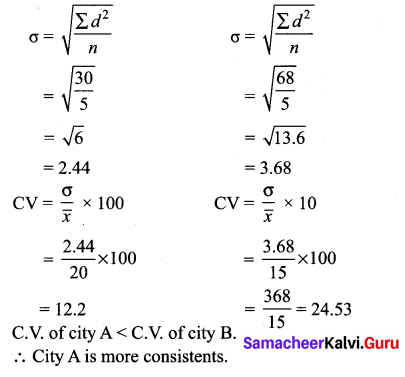
Students can download 12th Business Maths Chapter 2 Integral Calculus I Miscellaneous Problems and Answers, Samacheer Kalvi 12th Business Maths Book Solutions Guide Pdf helps you to revise the complete Tamilnadu State Board New Syllabus and score more marks in your examinations.

Tamilnadu Samacheer Kalvi 12th Business Maths Solutions Chapter 2 Integral Calculus I Miscellaneous Problems

Evaluate the following integrals:

Question 1.
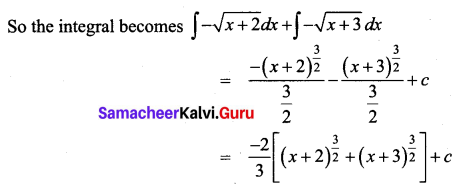
\(\int \frac{1}{\sqrt{x+2}-\sqrt{x+3}} d x\)
Solution:
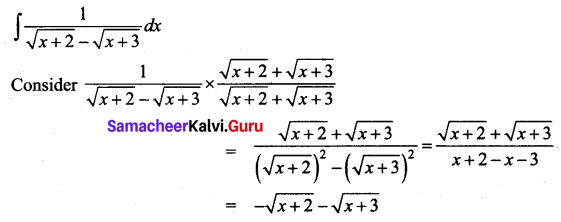
Samacheer Kalvi 12th Business Maths Solutions Chapter 2 Integral Calculus I Miscellaneous Problems Q1
Samacheer Kalvi 12th Business Maths Solutions Chapter 2 Integral Calculus I Miscellaneous Problems Q1.1

Question 2.
\(\int \frac{d x}{2-3 x-2 x^{2}}\)
Solution:
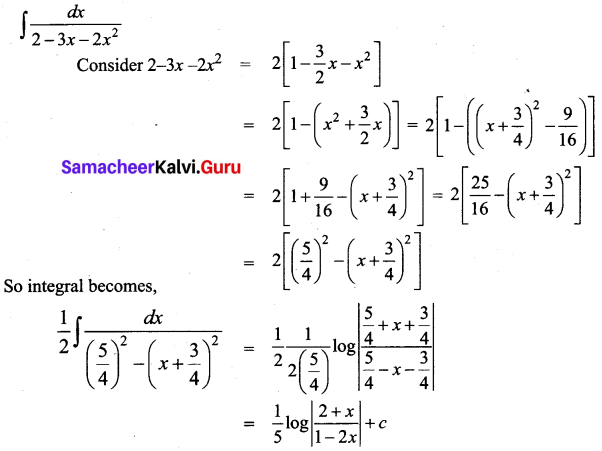
Samacheer Kalvi 12th Business Maths Solutions Chapter 2 Integral Calculus I Miscellaneous Problems Q2

Question 3.
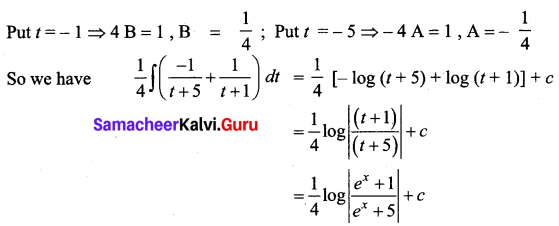
\(\int \frac{d x}{e^{x}+6+5 e^{-x}}\)
Solution:
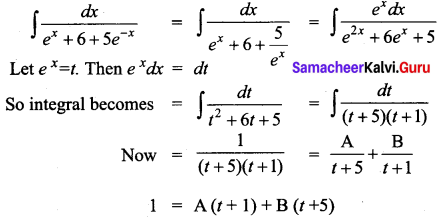
Samacheer Kalvi 12th Business Maths Solutions Chapter 2 Integral Calculus I Miscellaneous Problems Q3
Samacheer Kalvi 12th Business Maths Solutions Chapter 2 Integral Calculus I Miscellaneous Problems Q3.1

Question 4.
\(\int \sqrt{2 x^{2}-3} d x\)
Solution:
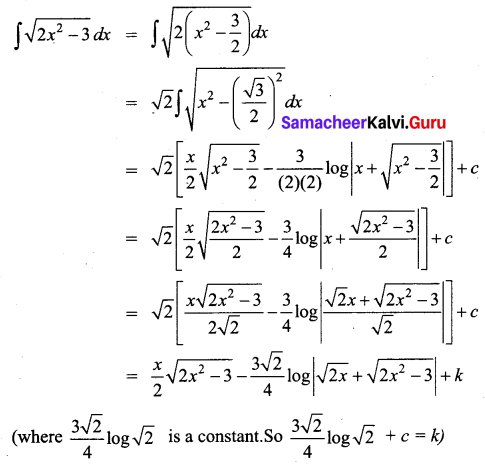
Samacheer Kalvi 12th Business Maths Solutions Chapter 2 Integral Calculus I Miscellaneous Problems Q4

Question 5.
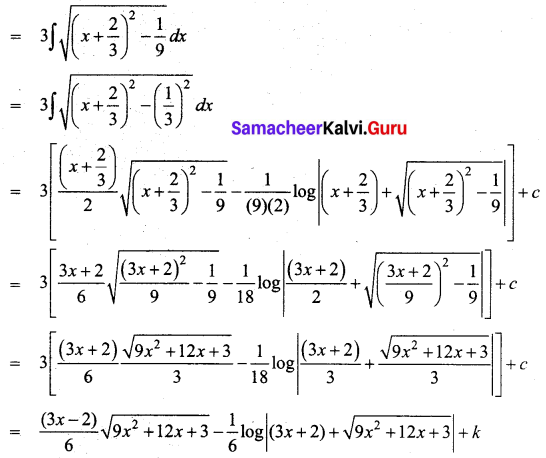
\(\int \sqrt{9 x^{2}+12 x+3} d x\)
Solution:
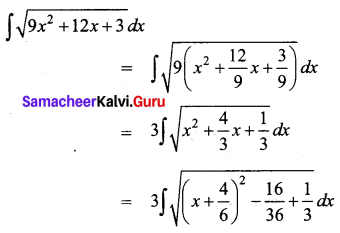
Samacheer Kalvi 12th Business Maths Solutions Chapter 2 Integral Calculus I Miscellaneous Problems Q5
Samacheer Kalvi 12th Business Maths Solutions Chapter 2 Integral Calculus I Miscellaneous Problems Q5.1
Note: The constant \(\frac{1}{6}\) log 3 can be merged with the constant ‘c’.

Question 6.
∫(x + 1)2 log x dx
Solution:
∫(x + 1)2 log x dx
We use integration by parts method.
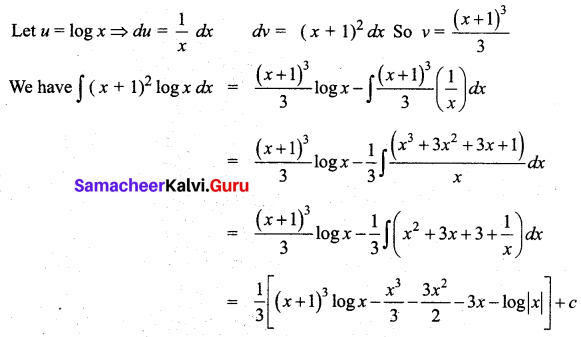
Samacheer Kalvi 12th Business Maths Solutions Chapter 2 Integral Calculus I Miscellaneous Problems Q6

Question 7.
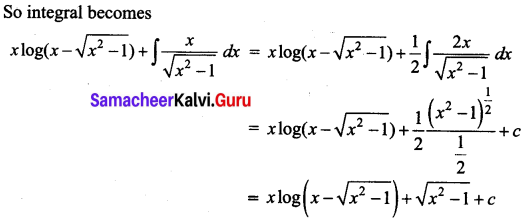
\(\int \log (x-\sqrt{x^{2}}-1) d x\)
Solution:
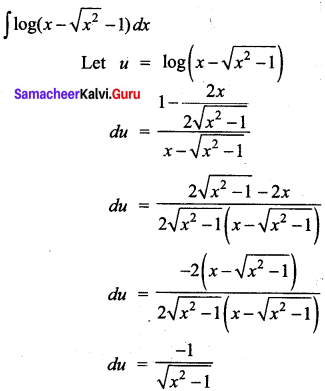
Samacheer Kalvi 12th Business Maths Solutions Chapter 2 Integral Calculus I Miscellaneous Problems Q7
Samacheer Kalvi 12th Business Maths Solutions Chapter 2 Integral Calculus I Miscellaneous Problems Q7.1

Question 8.
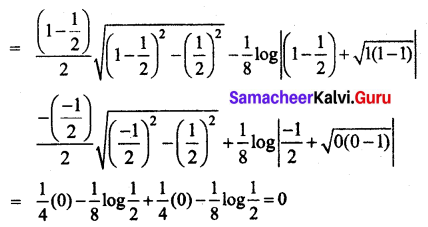
\(\int_{0}^{1} \sqrt{x(x-1)} d x\)
Solution:
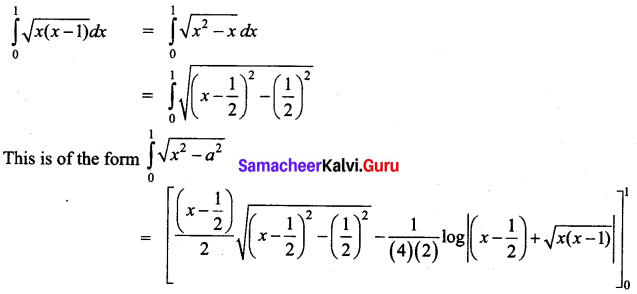
Samacheer Kalvi 12th Business Maths Solutions Chapter 2 Integral Calculus I Miscellaneous Problems Q8
Samacheer Kalvi 12th Business Maths Solutions Chapter 2 Integral Calculus I Miscellaneous Problems Q8.1

Question 9.
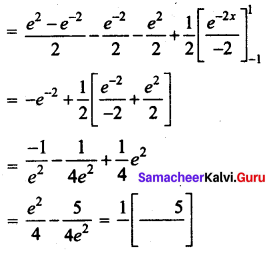
\(\int_{-1}^{1} x^{2} e^{-2 x} d x\)
Solution:
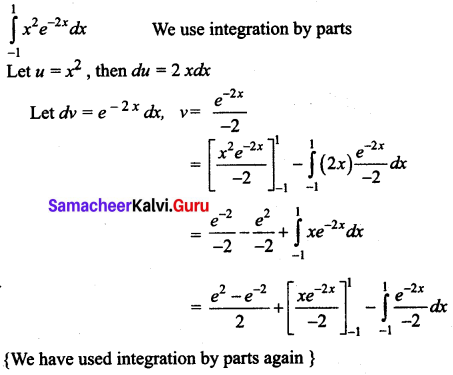
Samacheer Kalvi 12th Business Maths Solutions Chapter 2 Integral Calculus I Miscellaneous Problems Q9
Samacheer Kalvi 12th Business Maths Solutions Chapter 2 Integral Calculus I Miscellaneous Problems Q9.1

Question 10.
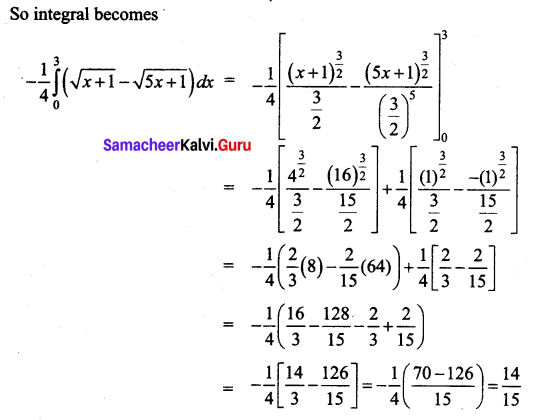
\(\int_{0}^{3} \frac{x d x}{\sqrt{x+1}+\sqrt{5 x+1}}\)
Solution:
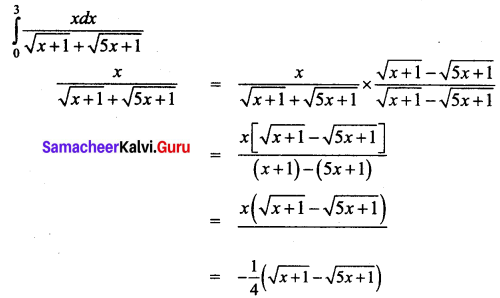
Samacheer Kalvi 12th Business Maths Solutions Chapter 2 Integral Calculus I Miscellaneous Problems Q10

Samacheer Kalvi 12th Business Maths Solutions Chapter 2 Integral Calculus I Miscellaneous Problems Q10.1

Tamil Nadu 11th Physics Model Question Paper 2 English Medium

Students can Download Tamil Nadu 11th Physics Model Question Paper 2 English Medium Pdf, Tamil Nadu 11th Physics Model Question Papers helps you to revise the complete Tamilnadu State Board New Syllabus and score more marks in your examinations.

TN State Board 11th Physics Model Question Paper 2 English Medium

Tamil Nadu 11th Physics Model Question Paper 2 English Medium

Instructions:

  1. The question paper comprises of four parts
  2. You are to attempt all the parts. An internal choice of questions is provided wherever: applicable
  3. All questions of Part I, II, III, and IV are to be attempted separately
  4. Question numbers to 15 in Part I are Multiple choice Questions of one mark each. These are to be answered by choosing the most suitable answer from the given four alternatives and writing the option code and the corresponding answer
  5. Question numbers 16 to 24 in Part II are two-mark questions. These are lo be answered in about one or two sentences.
  6. Question numbers 25 to 33 in Part III are three-mark questions. These are lo be answered in about three to five short sentences.
  7. Question numbers 34 to 38 in Part IV are five-mark questions. These are lo be answered in detail. Draw diagrams wherever necessary.

Time: 3 Hours
Max Marks: 70

PART – I

Answer all the questions. [15 × 1 = 15]

Question 1.
The direction of the angular velocity vector is along…………
(a) the tangent to the circular path
(b) the inward radius
(c) the outward radius
(d) the axis of rotation
Answer:
(d) the axis of rotation

Tamil Nadu 11th Physics Model Question Paper 2 English Medium

Question 2.
The angle between two vectors 2\(\hat{i}\) + 3\(\hat{j}\) + \(\hat{k}\) and -3\(\hat{j}\) + 6\(\hat{k}\) is………..
(a) 0°
(b) 30°
(c) 60°
(d) 90°
Answer:
(d) 90°

Question 3.
The breaking stress of a wire depends on………….
(a) length of a wire
(b) nature of the wire
(c) diameter of the wire
(d) shape of the cross section
Answer:
(b) nature of the wire

Question 4.
The moment of inertia of a rigid body depends upon…………….
(a) distribution of mass from axis of rotation
(b) angular velocity of the body
(c) angular acceleration of the body
(d) mass of the body
Answer:
(a) distribution of mass from axis of rotation

Question 5.
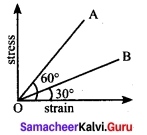
The stress versus strain graphs for wires of two materials A and B are as shown in the graph.If YA and YB are the young’s moduli of the materials then……….
Tamil Nadu 11th Physics Model Question Paper 2 English Medium 1
(a) YB = 2YA
(b) YA = YB
(c) YB = 3YA
(d) YA = 3YB
Answer:
(d) YA = 3YB
Hint:
Slope of stress strain curve gives the young’s modules YA = tan 60° = √3 ; YB = tan 30° \(\frac{1}{√3}\)
\(\frac{Y_A}{Y_B}\) = \(\frac{√3}{\frac{1}{√3}}\) = 3 ⇒ YA = 3YB

Question 6.
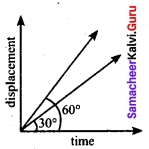
The ratio of the velocities of two particles as shown in figure is…………
Tamil Nadu 11th Physics Model Question Paper 2 English Medium 2
(a) 1 : √3
(b) √3 : 1
(c) 1 : 3
(d) 3 : 1
Answer:
(c) 1 : 3
Hint:
Velocity = Slope of the line formed in displacement v/s time graph = Tan θ
Va : Vb = Tan θA : Tan θB
= Tan 30° : Tan 60°
Va : Vb = 1 : 3

Question 7
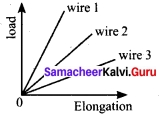
The load-elongation graph of three wires of the same material are shown. Which of the following wire is the thickest?
Tamil Nadu 11th Physics Model Question Paper 2 English Medium 3
(a) wire 1
(b) wire 2
(c) wires
(d) all of them have same thickness
Answer:
(a) wire 1
Hint:
Wire 1 is the thickness compared to other wires. Because the elongation of the wire 1 is minimum.

Question 8.
The waves produced by a motor boat sailing in water.are………
(a) transverse
(b) longitudinal
(c) longitudinal and transverse
(d) stationary
Answer:
(c) longitudinal and transverse

Question 9.
A sound wave whose frequency is 5000 Hz travels in air and then hits the water surface. Theratio of its wavelengths in water surface. The ratio of its wavelengths in water and air is………….
(a) 4.30
(b) 0.23
(c) 5.30
(d) 1.23
Answer:
(a) 4.30
Hint:
f = 5000 Hz ; Va = 343 ms-1; Vb = 1480 ms-1
Ratio of wavelength \(\frac{λ_a}{λ_w}\) = \(\frac{V_w}{f}\) × \(\frac{f}{V_a}\) = \(\frac{1480}{343}\) = 4.31

Question 10.
The wavelength of two sine waves and λ1 = 1 m and λ2 = 6 m, the corresponding wave numbers are respectively…………
(a) 1.05 rad m-1 and 6.28 rad m-1
(b) 6.28 rad m-1 and 1.05 rad m-1
(c) 1 rad m-1 and 0.1666 rad m-1
(d) 0.166 rad m-1 and 1 rad m-1
Answer:
(b) 6.28 rad m-1 and 1.05 rad m-1
Hint:
Standard wave equation, Y = A sin (kx – ωt)
K1 = \(\frac{2π}{λ_1}\) = \(\frac{2π}{1}\) = 6.28 rad m-1
K2 = \(\frac{2π}{λ_2}\) = \(\frac{2π}{6}\) = 1.05 rad m-1

Question 11.
During an adiabatic process, the pressure of a gas is proportional to the cube of its absolute temperature. The value of \(\frac{C_p}{C_r}\) for that gas is ………..
(a) \(\frac{3}{5}\)
(b) \(\frac{4}{3}\)
(c) \(\frac{5}{3}\)
(d) \(\frac{3}{2}\)
Answer:
(b) \(\frac{4}{3}\)
Hint:
PT = \(\frac{γ}{1-γ}\) = constant …….(1)
PT-3 = constant ……….(2)
From equation (1) and (2) \(\frac{γ}{1-γ}\) = (-3)
∴ γ = \(\frac{3}{2}\)

Tamil Nadu 11th Physics Model Question Paper 2 English Medium

Question 12.
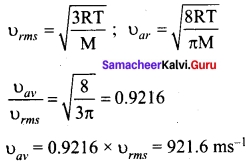
If the rms speed of the molecules of a gas is 1000 ms-1 the average speed of the molecule is………..
(a) 1000 ms-1
(b) 922 ms-1
(c) 780 ms-1
(d) 849 ms-1
Answer:
(b) 922 ms-1
Hint:
Tamil Nadu 11th Physics Model Question Paper 2 English Medium 4

Question 13.
In a cyclic process, work done by the system will be ………….
(a) zero
(b) more than the heat given to the system
(c) equal to heat given to the system
(d) independent of heat given to system
Answer:
(c) equal to heat given to the system

Question 14.
A closed tube partly filled with water lies is a horizontal plane. If the tube is rotated about perpendicular bisector, the moment of inertia of the system…………
(a) increases
(b) decreases
(c) remains constant
(d) depends on sense of rotation
Answer:
(c) remains constant

Question 15.
Force acting on the particle moving with constant speed is…………..
(a) always zero
(b) need not be zero
(c) always non zero
(d) cannot be concluded
Answer:
(a) always zero
Hint:
In a straight line motion, velocity (speed) is constant, a = 0; F = ma = 0

PART – II

Answer any six questions in which Q. No 23 is compulsory. [6 × 2 = 12]

Question 16.
Write limitations of dimensional analysis with examples, (any 2 points only) Limitations of Dimensional analysis.
Answer:

  1. This method gives no information about the dimensionless constants in the formula like 1, 2, …..π, e, etc.
  2. This method is not suitable to derive relations involving trigonometric, exponential and logarithmic functions.
  3. It can only check on whether a physical relation is dimensionally correct but not the correctness of the relation. For example, using dimensional analysis, s = ut + \(\frac{1}{3}\) at² is dimensionally correct whereas the correct relation is s = ut +\(\frac{1}{2}\) at²

Question 17.
A particle of mass 2 kg experiences two forces \(\vec{F_1}\) =5\(\hat{i}\) + 8\(\hat{j}\) + 7\(\hat{k}\) and \(\vec{F_2}\) = 3\(\hat{i}\) – 4\(\hat{j}\) + 3\(\hat{k}\). What is the acceleration of the particle?
Answer:
We use Newton’s second law, \(\vec{F}_{net}\) = m\(\vec{a}\) where \(\vec{F}_{net}\) = \(\vec{F_1}\) + \(\vec{F_2}\). From the equations the acceleration is \(\vec{a}\) = \(\frac{\vec{F}_{net}}{m}\), where
\(\vec{F}_{net}\) = (5 + 3)\(\vec{i}\) + (8 – 4)\(\vec{j}\) + (7 + 3)\(\vec{k}\)
\(\vec{F}_{net}\) = 8\(\vec{i}\) + 4\(\vec{j}\) + 10\(\vec{k}\)
\(\vec{a}\) = (\(\frac{8}{2}\))\(\vec{i}\) + (\(\frac{4}{2}\))\(\vec{j}\) + (\(\frac{10}{2}\))\(\vec{k}\)
\(\vec{a}\) = 4\(\vec{j}\) + 2\(\vec{j}\) + 5\(\vec{k}\)

Question 18.
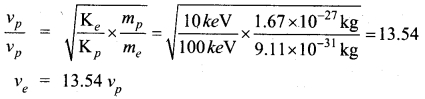
An electron and proton are detected in a cosmic ray experiment, the first with kinetic energy 10 KeV and the second with 100 KeV. Which is faster, the electron or the proton? Obtain the ratio of their speeds.
(electron mass : 9.11 × 10⁻³¹ kg : proton mass : 1.67 × 10⁻²⁷ kg : lev = 1.6 × 10⁻¹⁹ J)
Answer:
Here Ke = 10 keV and Kp = 100 keV
me = 9.11 × 10⁻³¹ kg and mp = 1.67 × 10⁻²⁷ kg
As K = \(\frac{1}{2}\) mv² or v = \(\sqrt {\frac{2K}{m}}\)
Hence
Tamil Nadu 11th Physics Model Question Paper 2 English Medium 5

Question 19.
A bullet of mass 20 g strikes pendulum of mass 5 kg. The centre of mass of pendulum rises a vertical distance of 10 cm. If the bullet gets embedded into the pendulum, calculate its initial speed.
Answer:
Given data: m1 = 20 g = 20 × 10-3kg; m2 = 5 kg; s = 10 × 10-2m
Let the speed of the bullet be v. The common velocity of bullet and pendulum bob is V. According to law of conservation of linear momentum.
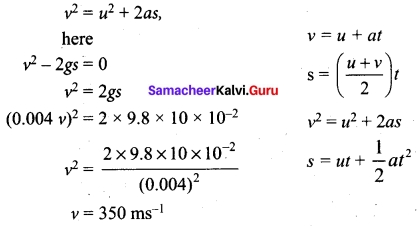
V = \(\frac{m_1v}{(m_1+m_2)}\) = \(\frac{20×10^{-3}v}{5+20×10^{-3}}\) = \(\frac{0.02}{5.02}\) v = 0.004 v
The bob with bullet go up with a deceleration of g= 9.8 ms-2. Bob and bullet come to rest at a height of 10 × 10-2 m.
from IIIrd equation of motion
Tamil Nadu 11th Physics Model Question Paper 2 English Medium 6

Tamil Nadu 11th Physics Model Question Paper 2 English Medium

Question 20.
Get the relation between rotational kinetic energy and angular momentum.
Answer:
Let a rigid body of moment of inertia I rotate with angular velocity ω
The angular momentum of a rigid body is, L = Iω
The rotational kinetic energy of the rigid body is, KE = \(\frac{1}{2}\)Iω²
By multiplying the numerator and denominator of the above equation with I, we get a relation between L and KE as,
KE= \(\frac{1}{2}\) \(\frac{I^2ω^2}{I}\) = \(\frac{1}{2}\) \(\frac{(Iω)^2}{I}\)
KE = \(\frac{L^2}{2I}\)

Question 21.
Why is there no lunar eclipse and solar eclipse every month?
Answer:
If the orbits of the Moon and Earth lie on the same plane, during full Moon of every month, we can observe lunar eclipse. If this is so during new oon we can observe solar eclipse. But Moon’s orbit is tilted 5° with respect to Earth’s orbit. Due to this 5° tilt, only during certain periods of the year, the Sun, Earth and Moon align in straight line leading to either lunar eclipse or solar eclipse depending on the alignment.

Question 22.
Calculate the change in internal energy of a block of copper of mass 200 g when it is heated from 25°C to 75°C. Specific heat of copper = 0.1 cal / g / °C and assume change in volume is negligible.
Answer:
dQ = cmΔT = 0.1 × 200 (75 – 25) = 100 calorie
dw = Pdv = 0
dU = dQ – dW = 100 – 0 = 100 calorie = 4200 J

Question 23.
The shortest distance travelled by a particle executing SHM from mean position in 2 seconds is equal to \(\frac{√3}{2}\) times of its amplitude. Determine its time period.
Answer:
Given data t = 2s ; y = \(\frac{√3}{2}\)A ; T = ?
displacement y = A sin ωt = A sin \(\frac{2π}{T}\) t
\(\frac{√3}{2}\)A = A sin \(\frac{2π×2}{T}\) ; sin \(\frac{4π}{T}\) = \(\frac{√3}{2}\) = sin \(\frac{π}{3}\)
∴ \(\frac{4π}{3}\) = \(\frac{π}{3}\) ; T = 12s

Question 24.
What are the differences from sliding and slipping?
Answer:

SlidingSlipping
(i)Velocity of centre of mass is greater than Rco i.e. VCM > Rco.Velocity of centre of mass is lesser than Rco. i.e. VCM < Rco
(ii)Velocity of translational motion is greater than velocity of rotational motion.Velocity of translation motion is lesser than velocity of rotational motion.
(iii)Resultant velocity acts in the forward direction.Resultant velocity acts in the backward direction.

PART – III

Answer any six questions in which Q.No. 29 is compulsory. [6 × 3 = 18]

Question 25.
You are given a thread and a metre scale. How will you estimate the diameter of the thread?
Answer:
The diameter of a thread is so small. Therefore we cannot measure it using metre scale. We wind a number of turns of the thread on the metre scale so that the turns are closely touching one another.
Measure the length (l) of the windings on the scale which contains number of turns.
∴ Diameter of thread = \(\frac{1}{n}\)

Question 26.
Consider two cylinders with same radius and same mass. Let one of the cylinders be solid and another one be hollow. When subjected to same torque, which one among them gets more angular acceleration than the other?
Answer:
Moment of inertia of a solid cylinder about its axis Is = \(\frac{π}{2}\)MR²
Moment of inertia of a hollow cylinder about its axis lh = MR³
Is = \(\frac{π}{2}\)Ih or Ih = 2Is
torque τ = lα ⇒ α = \(\frac{τ}{I}\)
αs = \(\frac{τ}{I_s}\) and ah = \(\frac{τ}{I_h}\)
αsIs = αhIh ⇒ αs = αh \(\frac{I_h}{I_s}\)
Ih > Ih ⇒ \(\frac{I_h}{I_s}\) > 1
∴ as > ah

Question 27.
The reading of pressure meter attached with a closed pipe is 5 × 10⁵ Nm-2. On opening the valve of the pipe, the reading of the pressure meter is 4.5 × 10⁵ Nm-2. Calculate the speed of the water flowing in the pipe.
Answer:
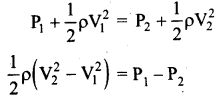
Using Bernoulli’s equation
Tamil Nadu 11th Physics Model Question Paper 2 English Medium 7
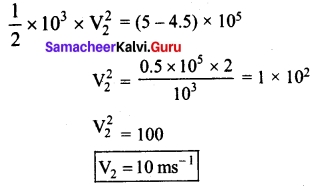
Here initial velocity V1 = 0 and density of water ρ = 1000 kg m 3
Tamil Nadu 11th Physics Model Question Paper 2 English Medium 8

Question 28.
State and prove perpendicular axis theorem.
Answer:
Perpendicular axis theorem: This perpendicular axis theorem holds good only for plane laminar objects.

The theorem states that the moment of inertia of a plane laminar body about an axis perpendicular to its plane is equal to the sum of moments of inertia about two perpendicular axes lying in the plane of the body such that all the three axes are mutually perpendicular and have a common point.

Tamil Nadu 11th Physics Model Question Paper 2 English Medium

Question 29.
State Stoke’s law and give some practical applications of Stoke’s law.
Answer:
The viscous force F acting on a spherical body of radius r depends directly on:
(i) radius (r) of the sphere
(ii) velocity (v) of the sphere and
(iii) coefficient of viscosity q of the liquid
Therefore F ∝ ηxryvz = F = k ηxryvz, where k is a dimensionless constant. Using dimensions, the above equation can be written as
[MLT-2] = k [ML-1T-1]z × [L]y × [LT-1]x
On solving, we get x = 1, y = 1 and z = 1. Therefore, F = kηrv
Experimentally, Stoke found that the value of k = 6π
F = 6πηrv
This relation is known as Stoke’s law.
Practical applications of Stoke’s law Since the raindrops are smaller in size and their terminal velocities are small, remain suspended in air in the form of clouds. As they grow up in size, their terminal velocities increase and they start falling in the form of rain.
This law explains the following:

  1. Floatation of clouds
  2. Larger raindrops hurt us more than the smaller ones
  3. A man coming down with the help of a parachute acquires constant terminal velocity.

Question 30.
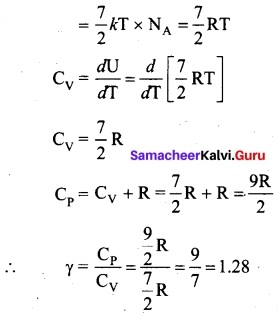
Derive the ratio of two specific heat capacities of triatomic molecules.
(a) Linear molecule:
Answer:
Energy of one mole
Tamil Nadu 11th Physics Model Question Paper 2 English Medium 9

(b) Non – Linear molecule:
Answer:
Energy of one mole
Tamil Nadu 11th Physics Model Question Paper 2 English Medium 10
Note that according to kinetic theory model of gases the specific heat capacity at constant volume and constant pressure are independent of temperature. But in reality it is not sure. The specific heat capacity varies with the temperature.

Question 31.
If 5 L of water at 50°C is mixed with 4 L of of water at 30°C, what will be the final temperature of water? Take the specific heat capacity of water as 4184 J kg-1 k-1.
Answer:
We can use the equation Tf = \(\frac{m_{1} s_{1} \mathrm{T}_{1}+m_{2} s_{2} \mathrm{T}_{2}}{m_{1} s_{1}+m_{2} s_{2}}\)
m1 = 5L = 5 kg ancl m2 = 4 L = 4 kg, s1 = s2 and T1 = 50°C = 323K and T2 = 30°C = 303 K
Tamil Nadu 11th Physics Model Question Paper 2 English Medium 11
Tf = 314.11 K – 273 K ≈ 41°C.
Suppose if we mix equal amount of water (m1 = m2) with 50°C and 30°C, then the final temperature is average of two temperatures.
Tf = \(\frac{T_1+T_2}{2}\) = \(\frac{323+303}{2}\) = 313 K = 40°C
Suppose if both the water are at 30°C then the final temperature will also 30°C. It implies that they are at equilibrium and no heat exchange takes place between each other.

Tamil Nadu 11th Physics Model Question Paper 2 English Medium

Question 32.
Smooth block is released at rest on a 45° incline and then slides a distance d. If the time taken of slide on rough incline is n times as large as that to slide than on a smooth incline. Show that co-efficient of friction µ = (1 – \(\frac{1}{n_2}\))
Answer:
When there is no friction, the block slides down the inclined plane with acceleration.
a – g sin θ
when there is friction, the downward acceleration of the block is
a’ = g (sin θ — µ cos θ)
As the block slides a distance d in each case so
d = \(\frac{1}{2}\) at² = \(\frac{1}{2}\) a’t’²
\(\frac{a}{a’}\) = \(\frac{t’^2}{t^2}\) = \(\frac{(nt)^2}{r^2}\) = n² or \(\frac{g sin θ}{g(sin θ – µ cos θ)}\) = n²
Solving, we get (Using θ = 45°)
µ = 1 – \(\frac{1}{n_2}\)

Question 33.
How do you distinguish between stable and unstable equilibrium?
Answer:

Stable EquilibriumUnstable Equilibrium
(i)The body tries to come back to equilibrium if slightly disturbed and released.The body cannot come back to equilibrium if slightly disturbed and released.
(ii)The center of mass of the body shifts slightly higher if disturbed from equilibrium.The center of mass of the body shifts slightly lower if disturbed from equilibrium.
(iii)Potential energy of the body is minimum and it increases if disturbed.Potential energy of the body is not minimum and it decreases if disturbed.

PART – IV

Answer all the questions. [5 × 5 = 25]

Question 34. (a).
What are the limitation of Dimensional formula? By assuming that the frequency y of a vibrating string may depend upon
(i) Tension
(ii) length (l)
(iii) mass per unit
length (m), prove that γ ∝ \(\frac{1}{l}\) \(\sqrt{\frac{T}{M}}\)
Answer:
(i) Limitations of Dimensional analysis:

  1. This method gives no information about the dimensionless constants in the formula like 1, 2, ……. π, e, etc.
  2. This method cannot decide whether the given quantity is a vector or a scalar.
  3. This method is not suitable to derive relations involving trigonometric, exponential and logarithmic functions.
  4. It cannot be applied to an equation involving more than three physical quantities.
  5. It can only check on whether a physical relation is dimensionally correct but not the correctness of the relation. For example, using dimensional analysis, s = ut + \(\frac{π}{2}\) at² is dimensionally correct whereas the correct relation is s = ut + \(\frac{π}{2}\) at².

(ii) n ∝ Ia Tbmc, [I] = [M0L1 T0]
[T] = [M1L1T-2] (force)
[M] = [M1L-1T0]
[M0L0T-1] = [M0L1T0]a [M1L1T-2]b [M0L-1T0]a
b + c = 0
a + b – c = 0
-2b = -1 ⇒ b = \(\frac{π}{2}\)
c = –\(\frac{π}{2}\)a = 1
γ ∝ \(\frac{1}{l}\) \(\sqrt{\frac{T}{M}}\)

Tamil Nadu 11th Physics Model Question Paper 2 English Medium

[OR]

(b) Prove the law of conservation of linear momentum. Use it to find the recoil velocity of a gun when a bullet is fired from it.
Answer:
In nature, conservation laws play a very important role. The dynamics of motion of bodies can be analysed very effectively using conservation laws. There are three conservation laws in mechanics. Conservation of total energy, conservation of total linear momentum, and conservation of angular momentum. By combining Newton’s second and third laws, we can derive the law of conservation of total linear momentum.

When two particles interact with each other, they exert equal and opposite forces on each other. The particle 1 exerts force \(\frac{\vec{F}_{12}}{m}\) on particle 2 and particle 2 exerts an exactly equal and opposite force \(\frac{\vec{F}_{12}}{m}\) on particle 1 according to Newton’s third law.
\(\frac{\vec{F}_{21}}{m}\) = –\(\frac{\vec{F}_{21}}{m}\) ……….(1)
In terms of momentum of particles, the force on each particle (Newton’s second law) can be written as
\(\frac{\vec{F}_{12}}{m}\) = \(\frac{\vec{dp_1}}{dt}\) and \(\frac{\vec{F}_{21}}{m}\) = \(\frac{\vec{dp_2}}{dt}\) ………(2)
Here \(\vec{p}_1\) is the momentum of particle 1 which changes due to the force \(\vec{F}_{12}\) exerted by
particle 2. Further \(\vec{p}_2\) is the momentum of particle 2. This changes due to \(\vec{F}_{21}\) exerted by particle 1.
Substitute equation (2) in equation (1)
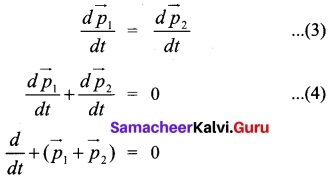
Tamil Nadu 11th Physics Model Question Paper 2 English Medium 12
It implies that \(\vec{p_1}\) + \(\vec{p_2}\) constant vector (always).
\(\vec{p_1}\) + \(\vec{p_2}\) is the total linear momentum of the two particles (\(\vec{p_{tot}}\) = \(\vec{p_1}\) + \(\vec{p_2}\)).It is also called as total linear momentum of the system. Here, the two particles constitute the system. From this result, the law of conservation of linear momentum can be stated as follows.

If there are no external forces acting on the system, then the total linear momentum of the system (\(\vec{p}_{tot}\)) is always a constant vector. In other words, the total linear momentum of the system is conserved in time. Here the word ‘conserve’ means that \(\vec{p_1}\) and p\(\vec{p_2}\) can vary, in such a way that \(\vec{p_1}\) + \(\vec{p_2}\) is a constant vector.

The forces \(\vec{F_{12}}\) and \(\vec{F_{21}}\) are called the internal forces of the system, because they act only between the two particles. There is no external force acting on the two particles from outside. In such a case the total linear momentum of the system is a constant vector or is conserved.

To find the recoil velocity of a gun when a bullet is fired from it:
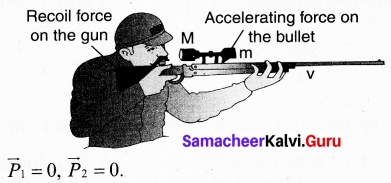
Consider the firing of a gun. Here the system is Gun+bullet. Initially the gun and bullet are at rest, hence the total linear momentum of the system is zero. Let \(\vec{p_1}\) be the momentum of the bullet and \(\vec{p_2}\) the momentum of the gun before firing. Since initially both are at rest,
Tamil Nadu 11th Physics Model Question Paper 2 English Medium 13
Total momentum before firing the gun is zero, \(\vec{p_1}\) + \(\vec{p_2}\) = 0
According to the law of conservation of linear momentum, total linear momemtum has to be zero after the firing also.

When the gun is fired, a force is exerted by the gun on the bullet in forward direction. Now the momentum of the bullet changes from \(\vec{p_1}\) + \(\vec{p_1}\). To conserve the total linear momentum of the system, the momentum of the gun must also change from \(\vec{p_2}\) to \(\vec{p_2}\) Due to the conservation of linear momentum, \(\vec{p_1}\)+ \(\vec{p_2}\)= 0. It implies that \(\vec{p_1}\) = – \(\vec{p_2}\), the momentum of the gun is exactly equal, but in the opposite direction to the momentum of the bullet. This is the reason after firing, the gun suddenly moves backward with the momentum (\(\vec{p_2}\)). It is called ‘recoil momentum’. Th is is an example of conservation of total linear momentum.

Tamil Nadu 11th Physics Model Question Paper 2 English Medium

Question 35 (a).
Explain the variation of g with
(i) latitude
(ii) altitude.
Answer:
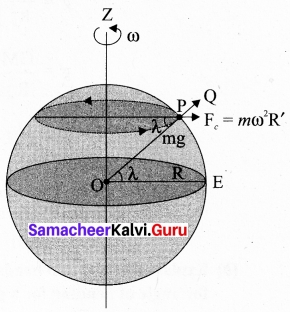
(i) Latitute: When an object is on the surface fo the Earth, it experiences a centrifugal force that depends on the latitude of the object on Earth. If the Earth were not spinning, the force on the object would have been mg. However, the object experiences an additional centrifugal force due to spinning of the Earth.
Tamil Nadu 11th Physics Model Question Paper 2 English Medium 14
This centrifugal force is given by mω²R’.
OPz cos λ = \(\frac{PZ}{OP}\) = \(\frac{R’}{R}\)
R’ = R cos λ
where λ is the latitude. The component of centrifugal acceleration experienced by the object in the direction opposite to g is
NaPQ = ω²R cos λ = ω²R COS² λ
Since R’ = R cos λ
Therefore, g’ = g – ω²R cos² λ
From the above expression, we can infer that at equator, λ = 0, g’ = g ω²R. The acceleration due to gravity is minimum. At poles λ = 90; g’ = g, it is maximum. At the equator, g’ is minimum.

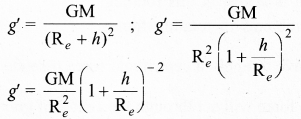
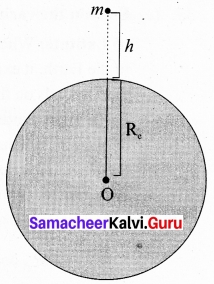
(ii) Altitude: Consider an object of mass m at a height h from the surface of the Earth. Acceleration experienced by the object due to Earth is
Tamil Nadu 11th Physics Model Question Paper 2 English Medium 15
If h << Re: We can use Binomial expansion. Taking the terms up to first order
g’ =\( \frac{\mathrm{GM}}{\mathrm{R}_{e}^{2}}\left[1+\frac{h}{\mathrm{R}_{e}}\right]^{-2}\)
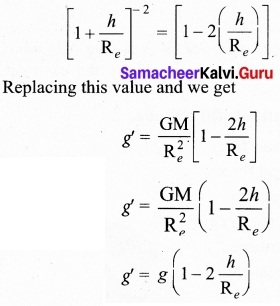
If h << R sub>e: We can use Binomial expansion. Taking the terms up to first order
(1 + x)ⁿ = 1 + nx
Tamil Nadu 11th Physics Model Question Paper 2 English Medium 16
We find that g’ < g. This means that as altitude h increases the acceleration due to gravity g decreases.
Tamil Nadu 11th Physics Model Question Paper 2 English Medium 17

[OR]

(b) Explain why a cyclist bends while negotiating a curve road? Arrive at the expression for angle of bending for a given velocity.
Answer:
Tamil Nadu 11th Physics Model Question Paper 2 English Medium 18
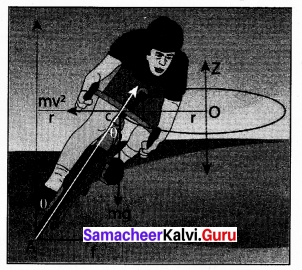
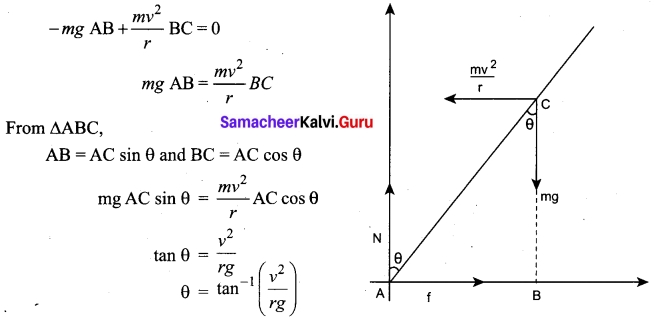
Let us consider a cyclist negotiating a circular level road (not banked) of radius r with a speed v. The cycle and the cyclist are considered as one system with mass m. The center gravity of the system is C and it goes in a circle of radius r with center at O. Let us choose the line OC as X-axis and the vertical line through O as Z-axis as shown in Figure.

The system as a frame is rotating about Z-axis. The system is at rest in this rotating frame. To solve problems in rotating frame of reference, we have to apply a centrifugal force (pseudo force) on the system which will be \(\frac{mv^2}{r}\). this force will act through the center of gravity. the forces acting on the system are , (i) gravitational force (mg), (ii) Normal force (n), (iii) frictional force (f) and (iv) centrifugal force (\(\frac{mv^2}{r}\)). As the system is in equilibrium in the rotational frame of will be of reference, the net external force and net external torque must be zero. Let us consider all torques about the point A in Figure.
For rotational equilibrium,
\(\vec{τ}_{net}\) = 0
The torque due to the gravitational force about point A is (mg AB) which causes a clockwise turn that is taken as negative. The torque due to the centripetal force is (\(\frac{mv^2}{r}\) BC) which causes an anticlock wise turn that is taken as positive
Tamil Nadu 11th Physics Model Question Paper 2 English Medium 19
While negotiating a circular level road of radius Force diagrams for the cyclist r at velocity v, a cyclist has to bend by an angle in turns
0 from vertical given by the above expression to stay in equilibrium (i.e. to avoid a fall).

Question 36 (a).
Derive an expression for moment of inertia of a uniform ring and uniform disc.
Answer:
Let us consider a uniform ring of mass M and radius R. To find the moment of inertia of the ring about an axis passing through its center and perpendicular to the plane, let us take an infinitesimally small mass {dm) of length (dx) of the ring. This (dm) is located at a distance R, which is the radius of the ring from the axis as shown in figure.
The moment of inertia (dl) of this small mass (dm) is,
dl = (dm) R²
The length of the ring is its circumference (2πR). AS the mass is uniformly distributed, the mass per unit length (λ) is,
mass M
λ = \(\frac{mass}{length}\) = \(\frac{M}{2πR}\)
The mass (dm) of the infinitesimally small length is,
dm = λ dx = \(\frac{M}{2πR}\) dx
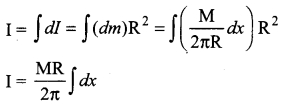
Now, the moment of inertia (I) of the entire ring is,
Tamil Nadu 11th Physics Model Question Paper 2 English Medium 20
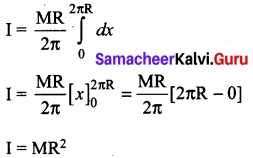
To cover the entire length of the ring, the limits of integration are taken from 0 to 2πR.
Tamil Nadu 11th Physics Model Question Paper 2 English Medium 21

Tamil Nadu 11th Physics Model Question Paper 2 English Medium

[OR]

(b) Explain how overtones are produced in a (i) closed organ pipe
Answer:
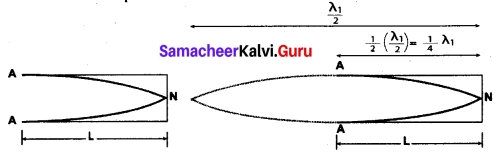
(i) Closed organ pipes: Look at the picture of a clarinet, shown in figure. It is a pipe with one end closed and the other end open. If one end of a pipe is closed, the wave reflected at this closed end is 180° out of phase with the incoming wave. Thus there is no displacement of the particles at the closed end. Therefore, nodes are formed at the closed end and anti¬nodes are formed at open end.
Tamil Nadu 11th Physics Model Question Paper 2 English Medium 22
(a) No motion of particles which leads to nodes at closed end and antinodes at open and (fundamental mode) (N-node, A-antinode)
Let us consider the simplest mode of vibration of the air column called the fundamental mode. Anti-node is formed at the open end and node at closed end. From the figure, let L be the length of the tube and the wavelength of the wave produced. For the fundamental mode of vibration, we have,
L = \(\frac{λ_1}{4}\) or λ1 = 4L …(1)
The frequency of the note emitted is . v v
fp = \(\frac {v}{λ_1}\) = \(\frac{v}{4L}\) …….(2)
which is called the fundamental note.
The frequencies higher than fundamental frequency can be produced by blowing air strongly at open end. Such frequencies are called overtones.
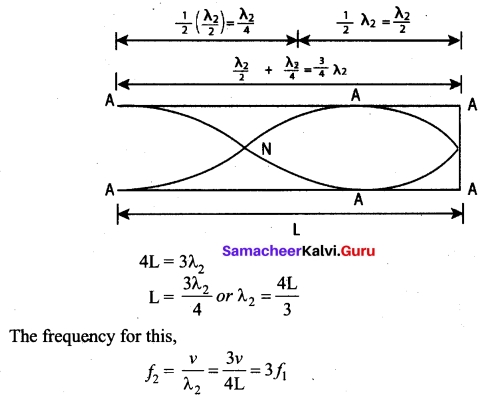
The figure (b) shows the second mode of vibration having two nodes and two antinodes,
Tamil Nadu 11th Physics Model Question Paper 2 English Medium 23
is called first over tone, since here, the frequency is three times the fundamental frequency it is called third harmonic.
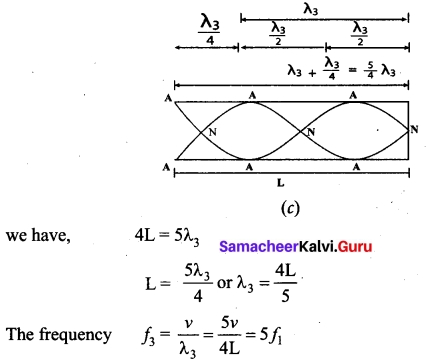
The figure (c) shows third mode of vibration having three nodes and three anti-nodes.
Tamil Nadu 11th Physics Model Question Paper 2 English Medium 24
is called second over tone, and since n = 5 here, this is called fifth harmonic. Hence, the closed organ pipe has only odd harmonics and f1 : f2 : f3 : f4 : …… = 1 : 3 : 5 : 7 : …… ………(3)

Question 37 (a).
What is meant by Doppler effect? Discuss following cases.
(i) source moves towards stationary observer
(ii) source moves away from stationary observer
Answer:
When the source and the observer are in relative motion with respect to each other and to the medium in which sound propagates, the frequency of the sound wave observed is different from the frequency of the source. This phenomenon is called Doppler Effect.

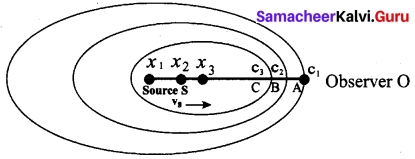
(i) Source moves towards the observer: Suppose a source S moves to the right (as shown in figure) with a velocity vs and let the frequency of the sound waves produced by the source be fs. We assume the velocity of sound in a medium is v. The compression (sound wave front) produced by the source S at three successive instants of time are shown in the figure. When S is at position x1 the compression is at C1. When S is at position x2, the compression is at C2 and similarly for x3 and C3. Assume that if C1 reaches the observer’s position A then at that instant C2reaches the point B and C3 reaches the point C as shown in the figure. It is obvious to see that the distance between compressions C2 and C3 is shorter than distance between C3 and C2. This means the wavelength decreases when the source S moves towards the observer O (since sound travels longitudinally and wavelength is the distance between two consecutive compressions). But frequency is inversely related to wavelength and therefore, frequency increases.
Tamil Nadu 11th Physics Model Question Paper 2 English Medium 25
Let λ be the wavelength of the source S as measured by the observer when S is at position x1 and λ’ be wavelength of the source observed by the observer when S moves to position x2. Then the change in wavelength is Δλ = λ – λ’ = vst, where t is the time taken by the source to travel between x1 and x2. Therefore,
λ’ = λ – vst ………..(1)
But t = \(\frac{λ}{v}\) ………(2)
On substituting equation (2) in equation (3), we get
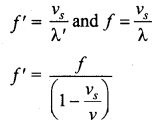
λ’ = λ\(\left(1-\frac{v_{s}}{v}\right)\)
Since frequency is inversely proportional to wavelength, we have
Tamil Nadu 11th Physics Model Question Paper 2 English Medium 26
Since, \(\frac{v_s}{v}\) << 1, we use the binomial expansion and retaining only first order in \(\frac{v_s}{v}\) we get
f’ = f(1 + \(\frac{v_s}{v}\))v ………..(4)

(ii) Source moves away from the observer: Since the velocity here of the source is opposite in direction when compared to case (a), therefore, changing the sign of the velocity of the source in the above case i.e, by substituting (vs → -vs) in equation (1), we get
\(f^{\prime}=\frac{f}{\left(1+\frac{v_{s}}{v}\right)}\) ………(5)
Using binomial expansion again, we get,
\(f^{\prime}=f\left(1-\frac{v_{s}}{v}\right)\) ……….. (6)

Tamil Nadu 11th Physics Model Question Paper 2 English Medium

[OR]

(b) (i) Define specific heat capacity of gas at constant volume
(ii) Define specific heat capacity of gas at constant pressure
(iii) Derive the relationship between Cp and Cv.
Answer:
(i) The amount of heat energy required to raise the temperature of one kg of a substance by 1 K or 1?C by keeping the volume constant is called specific heat capacity at constant volume.
Tamil Nadu 11th Physics Model Question Paper 2 English Medium 27

(ii) The amount of heat required to rise the temperature of one mole of a substance by IK or 1°C at constant volume is called molar specific heat capacity at constant volume.
Tamil Nadu 11th Physics Model Question Paper 2 English Medium 28

(iii) Application of law of equipartition energy in specific heat of a gas Meyer’s relation Cp – Cv = R connects the two specific heats for one mole of an ideal gas.
Tamil Nadu 11th Physics Model Question Paper 2 English Medium 29
Equipartition law of energy is used to calculate the value of Cp – Cv and the ratio between them γ = \(\frac{C_p}{C_v}\) Here y is called adiabatic exponent.

Question 38 (a).
Explain Isobaric process and derive the work done in this process.
Answer:
Isobaric process: This is a thermodynamic process that occurs at constant pressure. Even though pressure is constant in this process, temperature, volume and internal energy are not constant. From the ideal gas equation, we have
V = (\(\frac{µR}{P}\))T ………(1)
Here \(\frac{µR}{P}\) = constant
In an isobaric process the temperature is directly proportional to volume.
V ∝ T (Isobaric process) …(2)
This implies that for a isobaric process, the V-T graph is a straight line passing through the origin.
If a gas goes from a state (Vi ,Ti) to (Vf, Tf) at constant pressure, then the system satisfies the following equation
\(\frac{T_f}{V_f}\) = \(\frac{T_i}{V_i}\) …(3)
Examples for Isobaric process:
(i) When the gas is heated and pushes the piston so that it exerts a force equivalent to atmospheric pressure plus the force due to gravity then this process is isobaric.

(ii) Most of the cooking processes in our kitchen are isobaric processes. When the food is cooked in an open vessel, the pressure above the food is always at atmospheric pressure.

The PV diagram for an isobaric process is a horizontal line parallel to volume axis. Figure (a) represents isobaric process where volume decreases figure (b) represents isobaric process where volume increases.
Tamil Nadu 11th Physics Model Question Paper 2 English Medium 30
The work done in an isobaric process: Work done by the gas
\(\mathbf{W}=\int_{\mathbf{V}_{\mathbf{i}}}^{\mathbf{V}_{f}} \mathbf{P} d \mathbf{V}\) …….(4)
In an isobaric process, the pressure is constant, so P comes out of the integral,
Tamil Nadu 11th Physics Model Question Paper 2 English Medium 31
Where ΔV denotes change in the volume. If ΔV is negative, W is also negative. This implies that the work is done on the gas. If ΔV is positive, W is also positive, implying that work is done by the gas.
The equation (6) can also be rewritten using the ideal gas equation.
From ideal gas equation
PV = µRT and V = \(\frac{µRT}{P}\)
Substituting this in equation (6) we get
W = µRTf (1 – \(\frac{T_i}{T_f}\)) …….(7)
In the PV diagram, area under the isobaric curve is equal to the work done in isobaric process.
Tamil Nadu 11th Physics Model Question Paper 2 English Medium 32
The first law of thermodynamics for isobaric process is given by
ΔU = Q – PΔV ……..(8)
W = PΔY, ΔU = Q – µRTf [1 – \(\frac{T_i}{T_f}\)]

Tamil Nadu 11th Physics Model Question Paper 2 English Medium

[OR]

(b) Explain how the interference of waves is formed.
Answer:
Consider two harmonic waves having identical frequencies, constant phase difference φ and same wave form (can be treated as coherent source), but having amplitudes A1 and A2, then
y1 = A1sin (kx – ωf), ……(1)
y2 = A2 sin (kx – ωt + φ) …..(2)
Suppose they move simultaneously in a particular direction, then interference occurs (i.e., overlap of these two waves). Mathematically
y = y1 + y2 …….(3)
Therefore, substituting equation (1) and equation (3) in equation (3), we get
y = A1 sin (kx – ωt) + A2 sin (kx – ωt + φ)
Using trigonometric identity sin (α + β) = (sin α cos β + cos α sin β ), we get
y= A1 sin (kx – ωt) + A2 [sin (kx – ωt) cos φ + cos (kx – ωt) sin φ]
y= sin (kx – ωt) (A1 + A2 cos φ) + A2 sin φ cos (kx – ωt) ……(4)
Let us re-define A cos θ = (A1 + A2 cos φ) …(5)
and A sin θ = A2 sin φ …(6)
then equation (4) can be rewritten as y = A sin (kx – ωt) cos θ + A cos (kx – ωt) sin θ
y = A (sin (kx – ωt) cos θ + sin θ cos (kx – ωt))
y = A sin (kx – ωt + θ) ……..(7)
By squaring and adding equation (5) and equation (6), we get
A2 =\mathrm{A}_{1}^{2}+\mathrm{A}_{2}^{2} + 2A1 A2 cos φ ……..(8)
Since, intensity is square of the amplitude (I = A2), we have
I = I1 + I2 + 2\(\sqrt{I_1I_2}\) COS φ ……..(9)
This means the resultant intensity at any point depends on the phase difference at that point.

(a) For constructive interference: When crests of one wave overlap with crests of another wave, their amplitudes will add up and we get constructive interference. The resultant wave has a larger amplitude than the individual waves as shown in figure (a). The constructive interference at a point occurs if there is maximum intensity at that point, which means that
cos φ = + 1 ⇒ φ = 0, 2π, 4π,… = 2πn,
where n = 0, 1, 2,…
This is the phase difference in which two waves overlap to give constructive interference. Therefore, for this resultant wave,
Tamil Nadu 11th Physics Model Question Paper 2 English Medium 33

(b) For destructive interference: When the trough of one wave overlaps with the crest of another wave, their amplitudes “cancel” each other and we get destructive interference as shown in figure (b). The resultant amplitude is nearly zero. The destructive interference occurs if there is minimum intensity at that point, which means cos φ = – 1 ⇒ φ = π, 3π, 5π,… = (2 n – 1) π, where n = 0,1,2,…. i.e. This is the phase difference in which two waves overlap to give destructive interference. Therefore,
Tamil Nadu 11th Physics Model Question Paper 2 English Medium 34
Hence, the resultant amplitude
A= |A1 – A2|

Tamil Nadu 11th Physics Model Question Paper 2 English Medium

Samacheer Kalvi 10th Maths Solutions Chapter 8 Statistics and Probability Additional Questions

You can Download Samacheer Kalvi 10th Maths Book Solutions Guide Pdf, Tamilnadu State Board help you to revise the complete Syllabus and score more marks in your examinations.

Tamilnadu Samacheer Kalvi 10th Maths Solutions Chapter 8 Statistics and Probability Additional Questions

Question 1.
Find the standard deviation of 30, 80, 60, 70, 20, 40, 50 using the direct method.
Solution:
Direct method:
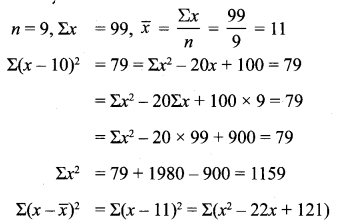
Samacheer Kalvi 10th Maths Solutions Chapter 8 Statistics and Probability Additional Questions 79

Question 2.
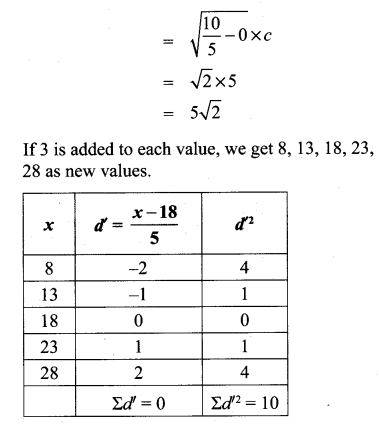
Find the standard deviation for the following data. 5, 10, 15, 20, 25. And also find the new
S.D. if three is added to each value.
Solution:
Samacheer Kalvi 10th Maths Solutions Chapter 8 Statistics and Probability Additional Questions 83
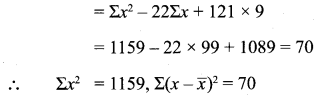
Samacheer Kalvi 10th Maths Solutions Chapter 8 Statistics and Probability Additional Questions 84
Samacheer Kalvi 10th Maths Solutions Chapter 8 Statistics and Probability Additional Questions 85
S.D. doesn’t change when a number is added or subtracted to the values.

Samacheer Kalvi 10th Maths Solutions Chapter 8 Statistics and Probability Additional Questions

Question 3.
The marks scored by 5 students in a test for 50 marks are 20, 25, 30, 35, 40. Find the S.D for the marks. If the marks are converted for 100 marks, find the S.D. for newly obtained marks.
Solution:
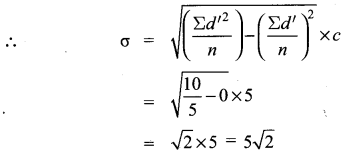
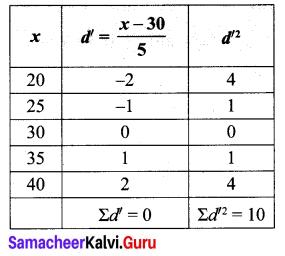
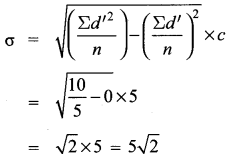
Let assumed mean A = 30
C = 5
Samacheer Kalvi 10th Maths Solutions Chapter 8 Statistics and Probability Additional Questions 87
Samacheer Kalvi 10th Maths Solutions Chapter 8 Statistics and Probability Additional Questions 88
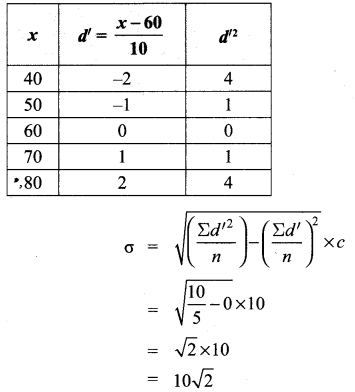
To convert the values for 100, all the values will be multiplied by 2. Therefore the new values are 40, 50, 60, 70, 80.
Let A = 60,
C = 10
Samacheer Kalvi 10th Maths Solutions Chapter 8 Statistics and Probability Additional Questions 89
S.D. also be multiplied by 2. It is also true for the division also.

Samacheer Kalvi 10th Maths Solutions Chapter 8 Statistics and Probability Additional Questions

Question 4.
Samacheer Kalvi 10th Maths Solutions Chapter 8 Statistics and Probability Additional Questions 90
Solution:
Samacheer Kalvi 10th Maths Solutions Chapter 8 Statistics and Probability Additional Questions 91
Samacheer Kalvi 10th Maths Solutions Chapter 8 Statistics and Probability Additional Questions 92

Question 5.
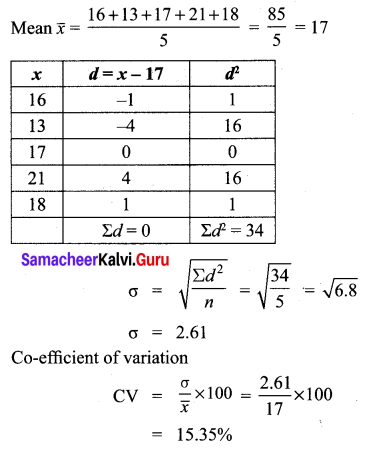
Find the co-efficient of variation for the following data: 16, 13, 17, 21, 18.
Solution:
Samacheer Kalvi 10th Maths Solutions Chapter 8 Statistics and Probability Additional Questions 93

Question 6.
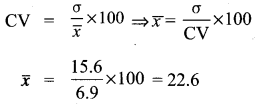
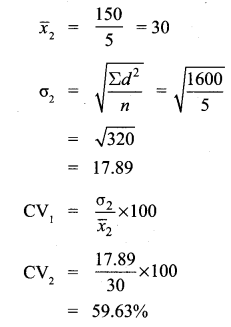
C.V. of a data is 69%, S.D. is 15.6, then find its mean.
Solution:
Samacheer Kalvi 10th Maths Solutions Chapter 8 Statistics and Probability Additional Questions 94

Samacheer Kalvi 10th Maths Solutions Chapter 8 Statistics and Probability Additional Questions

Question 7.
S.D. of a data is 2102, mean is 36.6, then find its C.V.
Solution:
Samacheer Kalvi 10th Maths Solutions Chapter 8 Statistics and Probability Additional Questions 95

Question 8.
Samacheer Kalvi 10th Maths Solutions Chapter 8 Statistics and Probability Additional Questions 96
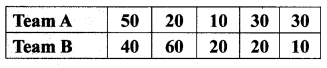
Which team is more consistent?
Solution:
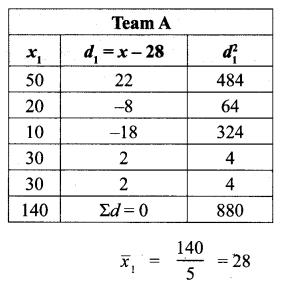
Samacheer Kalvi 10th Maths Solutions Chapter 8 Statistics and Probability Additional Questions 97
Samacheer Kalvi 10th Maths Solutions Chapter 8 Statistics and Probability Additional Questions 98
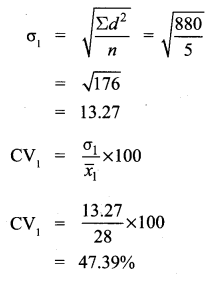
Samacheer Kalvi 10th Maths Solutions Chapter 8 Statistics and Probability Additional Questions 99
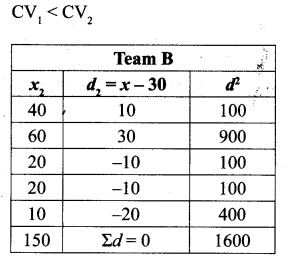
Samacheer Kalvi 10th Maths Solutions Chapter 8 Statistics and Probability Additional Questions 100
∴ Team A is more consistent.

Samacheer Kalvi 10th Maths Solutions Chapter 8 Statistics and Probability Additional Questions

Question 9.
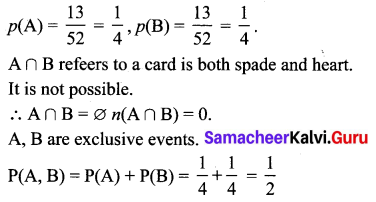
Final the probability of choosing a spade or a heart card from a deck of cards.
Solution:
Total number of cards = 52
Event of selecting a spade card = A
Event of selecting a heart card = B
n(A) = 13,
n(B) = 13
Samacheer Kalvi 10th Maths Solutions Chapter 8 Statistics and Probability Additional Questions 200

Samacheer Kalvi 10th Maths Solutions Chapter 8 Statistics and Probability Unit Exercise 8

You can Download Samacheer Kalvi 10th Maths Book Solutions Guide Pdf, Tamilnadu State Board help you to revise the complete Syllabus and score more marks in your examinations.

Tamilnadu Samacheer Kalvi 10th Maths Solutions Chapter 8 Statistics and Probability Unit Exercise 8

Question 1.
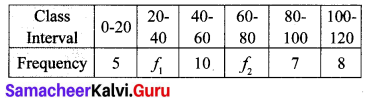
The mean of the following frequency distribution is 62.8 and the sum of all frequencies is 50. Compute the missing frequencies f1 and f2.
Samacheer Kalvi 10th Maths Solutions Chapter 8 Statistics and Probability Unit Exercise 8 30
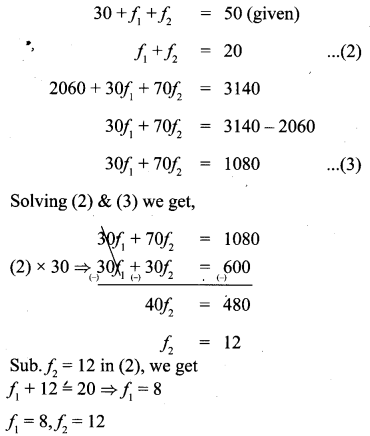
Solution:
Mean \(\overline{x}\) = 62.8
\(\Sigma x\) = 50
Samacheer Kalvi 10th Maths Solutions Chapter 8 Statistics and Probability Unit Exercise 8 40
Samacheer Kalvi 10th Maths Solutions Chapter 8 Statistics and Probability Unit Exercise 8 50

Samacheer Kalvi 10th Maths Solutions Chapter 8 Statistics and Probability Unit Exercise 8

Question 2.
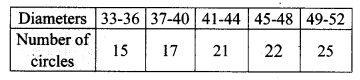
The diameter of circles (in mm) drawn in a design are given below.
Samacheer Kalvi 10th Maths Solutions Chapter 8 Statistics and Probability Unit Exercise 8 60
Claculate the standard deviation.
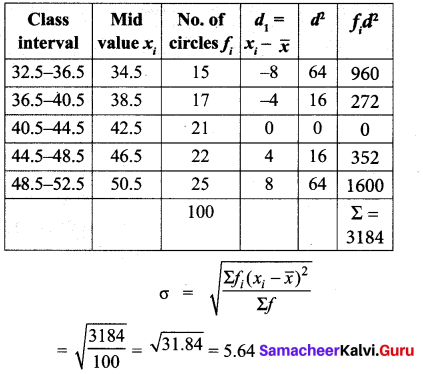
Solution:
Samacheer Kalvi 10th Maths Solutions Chapter 8 Statistics and Probability Unit Exercise 8 61

Samacheer Kalvi 10th Maths Solutions Chapter 8 Statistics and Probability Unit Exercise 8

Question 3.
The frequency distribution is given below.
Samacheer Kalvi 10th Maths Solutions Chapter 8 Statistics and Probability Unit Exercise 8 63
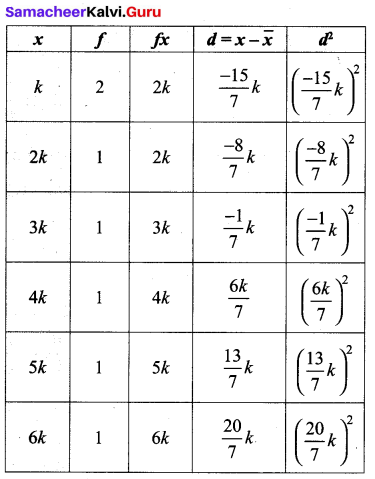
In the table, k is a positive integer, has a varience of 160. Determine the value of k.
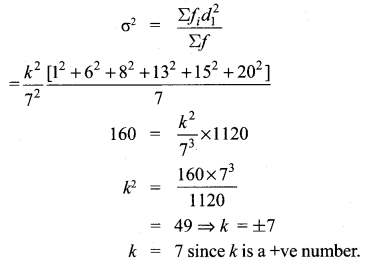
Solution:
Samacheer Kalvi 10th Maths Solutions Chapter 8 Statistics and Probability Unit Exercise 8 64
Samacheer Kalvi 10th Maths Solutions Chapter 8 Statistics and Probability Unit Exercise 8 65
Samacheer Kalvi 10th Maths Solutions Chapter 8 Statistics and Probability Unit Exercise 8 66

Question 4.
The standard deviation of some temperature data in degree Celsius (°C) is 5. If the data were converted into degree Fahrenheit (°F) then what is the variance?
Answer:
Standard deviation (σ) = 5
Variance = 52 = 25
We know the formula, F = \(\frac{9}{5}\) C + 32
Variance (F) = Vanance \(\frac{9}{5}\) C° + 32
[Variance of ax + b = a2 (variance of x)]
= \(\left(\frac{9}{5}\right)^{2}\) . variance
= \(\frac{81}{25}\) × 25
= 81° F
New variance = 81° F

Samacheer Kalvi 10th Maths Solutions Chapter 8 Statistics and Probability Unit Exercise 8

Question 5.
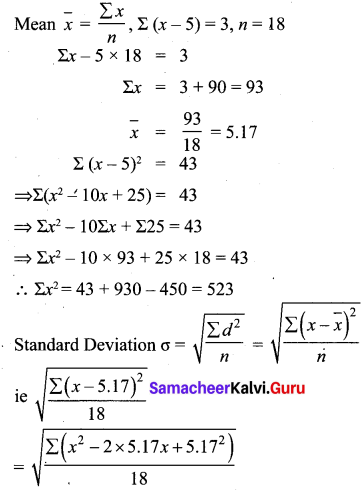
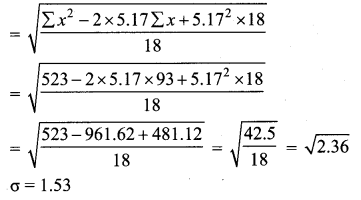
If for a distribution, \(\Sigma(x-5)=3, \Sigma(x-5)^{2}=43\) and total number of observations is 18, find the mean and standard deviation.
Solution:
Samacheer Kalvi 10th Maths Solutions Chapter 8 Statistics and Probability Unit Exercise 8 67
Samacheer Kalvi 10th Maths Solutions Chapter 8 Statistics and Probability Unit Exercise 8 68

Question 6.
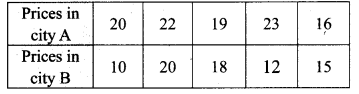
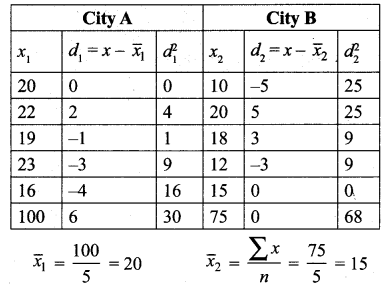
Prices of peanut packets in various places of two cities are given below. In which city, prices were more stable?
Samacheer Kalvi 10th Maths Solutions Chapter 8 Statistics and Probability Unit Exercise 8 69
Solution:
Samacheer Kalvi 10th Maths Solutions Chapter 8 Statistics and Probability Unit Exercise 8 70
Samacheer Kalvi 10th Maths Solutions Chapter 8 Statistics and Probability Unit Exercise 8 71

Samacheer Kalvi 10th Maths Solutions Chapter 8 Statistics and Probability Unit Exercise 8

Question 7.
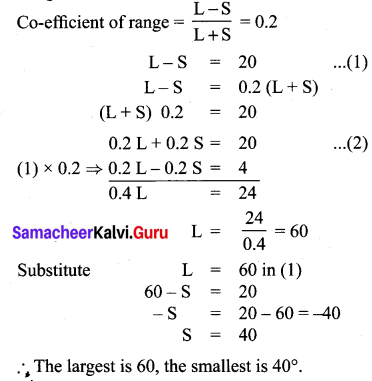
If the range and coefficient of range of the data are 20 and 0.2 respectively, then find the largest and smallest values of the data.
Solution:
Range = L – S = 20
Samacheer Kalvi 10th Maths Solutions Chapter 8 Statistics and Probability Unit Exercise 8 72

Question 8.
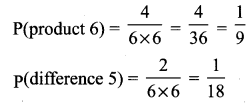
If two dice are rolled, then find the probability of getting the product of face value 6 or the difference of face values 5.
Solution:
Product of face values 6: {(1, 6), (2, 3), (6, 1), (3,2)}
Difference of face value 5: {(1, 6), (6, 1)}
Samacheer Kalvi 10th Maths Solutions Chapter 8 Statistics and Probability Unit Exercise 8 73

Question 9.
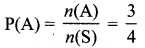
In a two children family, find the probability that there is at least one girl in a family.
Solution:
S = {BB, BG, GB, GG}
n(S) = 4
Event of atleast one girl in a family say A
A= {BG, GB, GG}
n( A) = 3
Samacheer Kalvi 10th Maths Solutions Chapter 8 Statistics and Probability Unit Exercise 8 74
Probability of at least one girl in a family is \(\frac{3}{4}\)

Samacheer Kalvi 10th Maths Solutions Chapter 8 Statistics and Probability Unit Exercise 8

Question 10.
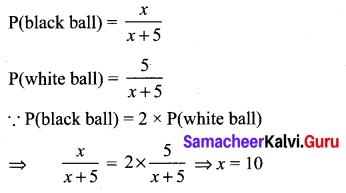
A bag contains 5 white and some black balls. If the probability of drawing a black ball from the bag is twice the probability of drawing a white ball then find the number of black balls.
Solution:
Let a number of black balls be ‘x’.
Number of white balls = 5.
Samacheer Kalvi 10th Maths Solutions Chapter 8 Statistics and Probability Unit Exercise 8 75
Number of Black balls = 10.

Question 11.
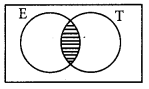
The probability that a student will pass the final examination in both English and Tamil is 0.5 and the probability of passing neither is 0.1. If the probability of passing the English examination is 0.75, what is the probability of passing the Tamil examination?
Solution:
Samacheer Kalvi 10th Maths Solutions Chapter 8 Statistics and Probability Unit Exercise 8 76
P(English) = 0.75
P(Tamil) = x(assume)
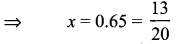
P(English ∪ Tamil) = P(English) + P(Tamil) – P(English ∩ Tamil)
⇒ 1 – 0.1 = 0.75 + x – 0.5
⇒ x = 0.9 – 0.25
Samacheer Kalvi 10th Maths Solutions Chapter 8 Statistics and Probability Unit Exercise 8 77

Samacheer Kalvi 10th Maths Solutions Chapter 8 Statistics and Probability Unit Exercise 8

Question 12.
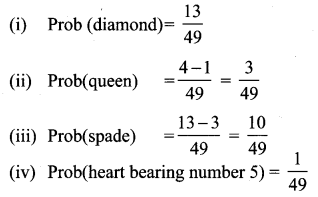
The King, Queen and Jack of the suit spade are removed from a deck of 52 cards. One card is selected from the remaining cards. Find the probability of getting
(i) a diamond
(ii) a queen
(iii) a spade
(iv) a heart card bearing the number 5.
Solution:
King spade, Queen spade, Jack spade are removed
∴ total number of cards = 52 – 3 = 49.
Samacheer Kalvi 10th Maths Solutions Chapter 8 Statistics and Probability Unit Exercise 8 78

Samacheer Kalvi 10th Maths Solutions Chapter 8 Statistics and Probability Ex 8.5

You can Download Samacheer Kalvi 10th Maths Book Solutions Guide Pdf, Tamilnadu State Board help you to revise the complete Syllabus and score more marks in your examinations.

Tamilnadu Samacheer Kalvi 10th Maths Solutions Chapter 8 Statistics and Probability Ex 8.5

Multiple Choice Questions
Question 1.
Which of the following is not a measure of dispersion?
(1) Range
(2) Standard deviation
(3) Arithmetic mean
(4) Variance
Solution:
(3) Arithmetic mean

Samacheer Kalvi 10th Maths Solutions Chapter 8 Statistics and Probability Ex 8.5

Question 2.
The range of the data 8, 8, 8, 8, 8. . . 8 is _____
(1) 0
(2) 1
(3) 8
(4) 3
Answer:
(1) 0
Hint:
Range = L – S = 8 – 8 = 0

Question 3.
The sum of all deviations of the data from its mean is
(1) Always positive
(2) always negative
(3) zero
(4) non-zero integer
Solution:
(3) zero

Question 4.
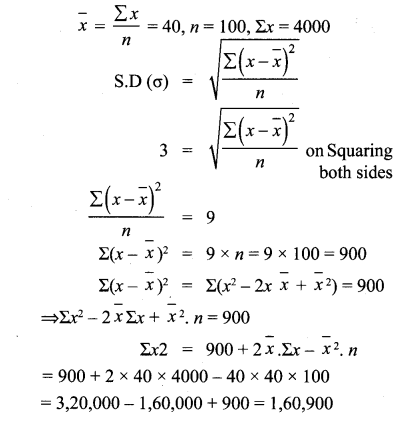
The mean of 100 observations is 40 and their standard deviation is 3. The sum of squares of all deviations is ______
(1) 40000
(2) 160900
(3) 160000
(4) 30000
Answer:
(2) 160900
Hint:
Samacheer Kalvi 10th Maths Chapter 8 Statistics and Probability Ex 8.5 1

Samacheer Kalvi 10th Maths Solutions Chapter 8 Statistics and Probability Ex 8.5

Question 5.
Variance of the first 20 natural numbers is
(1) 32.25
(2) 44.25
(3) 33.25
(4) 30
Solution:
(3) 33.25

Question 6.
The standard deviation of a data is 3. If each value is multiplied by 5 then the new variance is ______
(1) 3
(2) 15
(3) 5
(4) 225
Answer:
(4) 225
Hint:
Standard deviation = 3
Each value is multiplied by 5
New standard deviation = 3 × 5 = 15
New variance = 152 = 225

Question 7.
If the standard deviation of x, y, z is p then the standard deviation of 3x + 5, 3y + 5, 3z + 5 is
(1) 3p + 5
(2) 3p
(3) p + 5
(4) 9p + 15
Solution:
(2) 3p

Samacheer Kalvi 10th Maths Solutions Chapter 8 Statistics and Probability Ex 8.5

Question 8.
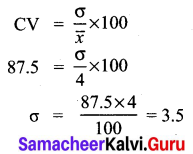
If the mean and coefficient of variation of a data are 4 and 87.5% then the standard deviation is _____
(1) 3.5
(2) 3
(3) 4.5
(4) 2.5
Answer:
(1) 3.5
Hint:
Samacheer Kalvi 10th Maths Chapter 8 Statistics and Probability Ex 8.5 2

Question 9.
Which of the following is incorrect?
(1) P (A) > 1
(2) 0 ≤ P(A) ≤ 1
(3) P(ϕ) = 0 (4)
(4) P (A) + P(\(\overline{\mathbf{A}}\)) = 1
Solution:
(1) P(A) > 1

Question 10.
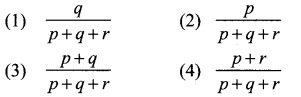
The probability a red marble selected at random from a jar containing p red, q blue and r green marbles is
Samacheer Kalvi 10th Maths Chapter 8 Statistics and Probability Ex 8.5 5
Solution:
(2) \(\frac{p}{p+q+r}\)

Samacheer Kalvi 10th Maths Solutions Chapter 8 Statistics and Probability Ex 8.5

Question 11.
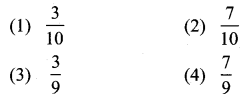
A page is selected at random from a book. The probability that the digit at units place of the page number chosen is less than 7 is
Samacheer Kalvi 10th Maths Chapter 8 Statistics and Probability Ex 8.5 6
Solution:
(2) \(\frac{7}{10}\)

Question 12.
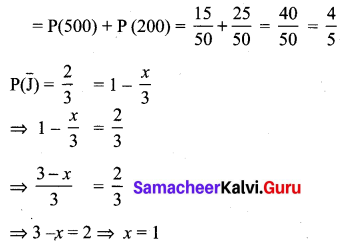
The probability of getting a job for a person is \(\frac{x}{3}\). If the probability of not getting the job is \(\frac{2}{3}\) then the value of x is ____
(1) 2
(2) 1
(3) 3
(4) 1.5
Answer:
(2) 1
Hint:
Samacheer Kalvi 10th Maths Chapter 8 Statistics and Probability Ex 8.5 7

Question 13.
Kamalam went to play a lucky draw contest. 135 tickets of the lucky draw were sold. If the probability of Kamalam winning is \(\frac{1}{9}\), then the number of tickets bought by Kamalam is
(1) 5
(2) 10
(3) 15
(4) 20
Solution:
(3) 15
Hint:
\(=\frac{1}{9} \times 135=15\)

Samacheer Kalvi 10th Maths Solutions Chapter 8 Statistics and Probability Ex 8.5

Question 14.
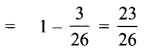
If a letter is chosen at random from the English alphabets {a, b, ……, z} then the probability that the letter chosen precedes x _______
(1) \(\frac{12}{13}\)
(2) \(\frac{1}{13}\)
(3) \(\frac{23}{26}\)
(4) \(\frac{3}{26}\)
Answer:
(3) \(\frac{23}{26}\)
Hint:
Samacheer Kalvi 10th Maths Chapter 8 Statistics and Probability Ex 8.5 10

Question 15.
A purse contains 10 notes of ₹ 2000, 15 notes of ₹ 500, and 25 notes of ₹ 200. One note is drawn at random. What is the probability that the note is either a ₹ 500 note or ₹ 200 note?
(1) \(\frac{1}{5}\)
(2) \(\frac{3}{10}\)
(3) \(\frac{2}{3}\)
(4) \(\frac{4}{5}\)
Solution:
(4) \(\frac{4}{5}\)

Tamil Nadu 11th Maths Model Question Paper 5 English Medium

Students can Download Tamil Nadu 11th Maths Model Question Paper 5 English Medium Pdf, Tamil Nadu 11th Maths Model Question Papers helps you to revise the complete Tamilnadu State Board New Syllabus and score more marks in your examinations.

TN State Board 11th Maths Model Question Paper 5 English Medium

General Instructions:

  1. The question paper comprises of four parts.
  2. You are to attempt all the parts. An internal choice of questions is provided wherever applicable.
  3. All questions of Part I, II, III and IV are to be attempted separately.
  4. Question numbers 1 to 20 in Part I are Multiple Choice Questions of one mark each.
    These are to be answered by choosing the most suitable answer from the given four alternatives and writing the option code and the corresponding answer
  5. Question numbers 21 to 30 in Part II are two-mark questions. These are to be answered in about one or two sentences.
  6. Question numbers 31 to 40 in Part III are three-mark questions. These are to be answered in above three to five short sentences.
  7. Question numbers 41 to 47 in Part IV are five-mark questions. These are to be answered in detail Draw diagrams wherever necessary.

Time: 2.30 Hours
Maximum Marks: 90

PART – I

I. Choose the correct answer. Answer all the questions. [20 × 1 = 20]

Question 1.
Let X= {1,2, 3, 4} and R = {(1, 1), (1, 2), (1, 3), (2, 2), (3, 3) (2, 1), (3, 1), (1, 4), (4, 1)} then R is……………
(a) reflexive
(b) symmetric
(c) transitive
(d) equivalence
Solution:
(b) symmetric

Question 2.
Find a so that the sum and product of the roots of the equation 2x² – (a – 3)x + 3a – 5 = 0 are equal is…………
(a) 1
(b) 2
(c) 3
(d) 4
Solution:
(b) 2

Tamil Nadu 11th Maths Model Question Paper 5 English Medium

Question 3.
If π < 2θ < \(\frac{3π}{2}\) then \(\sqrt{2+\sqrt{2+2 \cos 4 \theta}}\) = ………….
(a) -2 cos θ
(b) -2 sin θ
(c) 2 cos θ
(d) 2 sin θ
Solution:
(d) 2 sin θ

Question 4.
If f(θ) = |sin θ| + |cos θ|, θ ∈ R then f(θ) is in the interval……………
(a) [0, 2]
(b) [1, √2]
(c) [ 1, 2]
(d) [0, 1]
Solution:
(b) [1, √2]

Question 5.
Total number of words formed by 2 vowels and 3 consonants taken from 4 vowels and 5 consonants is equal to…………
(a) 60
(b) 600
(c) 720
(d) 7200
Solution:
(d) 7200

Question 6.
The number of parallelograms that can be formed from a set of four parallel lines intersecting another set of three parallel lines is…………
(a) 6
(b) 9
(c) 12
(d) 18
Solution:
(d) 18

Question 7.
The nth term of the sequence \(\frac{1}{3}\), \(\frac{3}{4}\), \(\frac{7}{8}\),\(\frac{15}{16}\)…. is …………..
(a) 2n – n – 1
(b) 1 – 2-n
(c) 2-n + n – 1
(d) 2n-1
Solution:
(b) 1 – 2-n

Question 8.
The remainder when 3815 is divided by 13 is…………
(a) 12
(b) 1
(c) 11
(d) 5
Solution:
(a) 12

Question 9.
If the straight line joining the points (2, 3) and (-1, 4) passes through the point (α, β) then…………
(a) α + 2β = 7
(b) 3α + β = 9
(c) α + 3β = 11
(d) 3α + β = 11
Solution:
(c) α + 3β = 11

Question 10.
If the equation of the base opposite to the vertex (2, 3) of an equilateral triangle is x + y = 2 then the length of a side is………….
(a) \(\sqrt{\frac{3}{2}}\)
(b) 6
(c) √6
(d) 3√2
Solution:
(c) √6

Question 11.
If A and B are symmetric matrices of order n where A ≠ B then…………
(a) A + B is skew symmetric
(b) A + B is symmetric
(c) A + B is a diagonal matrix
(d) A + B is a zero matrix
Solution:
(b) A + B is symmetric

Tamil Nadu 11th Maths Model Question Paper 5 English Medium

Question 12.
If A is a square matrix then which of the following is not symmetric?
(a) A + AT
(b) AAT
(c) ATA
(d) A – AT
Solution:
(d) A – AT

Question 13.
\(\lim _{x \rightarrow \infty}\) \(\frac{a^x-b^x}{x}\) = …………….
(a) log ab
(b) log \(\frac{a}{b}\)
(c) log log \(\frac{b}{a}\)
(d) \(\frac{a}{b}\)
Solution:
(b) log \(\frac{a}{b}\)

Question 14.
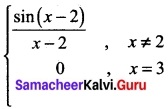
The function f(x) = Tamil Nadu 11th Maths Model Question Paper 5 English Medium 1 is discontinuous at ………..
(a) x = 0
(b) x = 1
(c) x = -2
(d) x = 2
Solution:
(d) x = 2

Question 15.
The function f(x) = \(\left\{\begin{array}{ll} 2 & x \leq 1 \\ x & x>1 \end{array}\right.\) is not differentiable at………..
(a) x = 0
(b) x = 1
(c) x = -1
(d) x = 2
Solution:
(b) x = 1

Question 16.
The number of points in R in which the function f(x) = |x – 1| + |x – 3| + sin x is not differentiable is…………
(a) 3
(a) 2
(c) l
(d) 4
Solution:
(a) 2

Question 17.
If y = 1 + Tamil Nadu 11th Maths Model Question Paper 5 English Medium 2 + …..∞ then \(\frac{dx}{dy}\) =……..
(a) x
(b) x²
(c) y
(d) y²
Solution:
(d) y²

Question 18.
\(\int \frac{\sqrt{\tan x}}{\sin 2 x}\) dx = …………….
(a) \(\sqrt{tan x}\) + c
(b) 2\(\sqrt{tan x}\) + c
(c) \(\frac{1}{2}\) \(\sqrt{tan x}\) + c
(d) \(\frac{1}{4}\) \(\sqrt{tan x}\) + c
Solution:
(a) \(\sqrt{tan x}\) + c

Question 19.
An urn contains 5 red and 5 black balls. A balls is drawn at random, its colour is noted and is returned to the um. Moreover, 2 additional balls of the colour drawn are put in the urn and then a ball is drawn at random. The probability that the second ball drawn is red will be ………….
(a) \(\frac{5}{12}\)
(b) \(\frac{1}{2}\)
(c) \(\frac{7}{12}\)
(d) \(\frac{1}{4}\)
Solution:
(b) \(\frac{1}{2}\)

Question 20.
A bag contains 6 green, 2 white, and 7 black balls. If two balls are drawn simultaneously then the probability that both are different colours is……….
(a) \(\frac{68}{105}\)
(b) \(\frac{71}{105}\)
(c) \(\frac{64}{105}\)
(d) \(\frac{73}{105}\)
Solution:
(a) \(\frac{68}{105}\)

Tamil Nadu 11th Maths Model Question Paper 5 English Medium

PART – II

II. Answer any seven questions. Question No. 30 is compulsory. [7 × 2 = 14]

Question 21.
On the set of natural numbers let R be the relation defined by aRb if 2a + 3b = 30. Write down the relation by listing all the pairs. Check whether it is (i) reflexive, (ii) symmetric, (iii) transitive, (iv) equivalence
Solution:
N = {set of natural numbers};
R ={(3,8), (6, 6), (9, 4), (12, 2)}
(3, 3) ∉ R ⇒ R is not reflexive
(3, 8) ∈ R (8, 3) ∉ R
2a + 3b = 30
3b = 30 – 2a
b = \(\frac{30-2a}{3}\)
⇒ R is not symmetric
(a, b) (b, c) ∉ R ⇒ R is transitive
∴ It is not equivalence relation.

Question 22.
Compute log927 – log279.
Solution:
Let log927 = x ⇒ 27 = 9x ⇒ 3³ = (3²)x = 32x
⇒ 2x = 3 ⇒ x = 3/2
Let log27 9 = x
9 = 27x
3² = (3³)x ⇒ 3² = 33x
3x = 2 ⇒ x = 2/3
∴ log927 – log279 = \(\frac{3}{2}\) – \(\frac{2}{3}\) = \(\frac{9-4}{6}\) = \(\frac{5}{6}\)

Question 23.
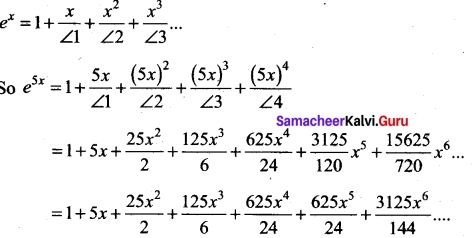
Write the first 6 terms of the exponential series e5x
Solution:
Tamil Nadu 11th Maths Model Question Paper 5 English Medium 3

Question 24.
Find the points on the line x + y = 5, that lie at a distance 2 units from the line 4x + 3y – 12 = 0.
Solution:
Any point on the line x + y = 5 is x = t, y = 5 – t
The distance from (t, 5 – t) to the line 4x.+ 3y – 12 = 0 is given by 2 units.
∴ \(\frac{4(t)+3(5-t)-12}{\sqrt {4^2+3^2}}\) = 2 ⇒ \(\frac{|t+3|}{5}\) = 2
⇒ t + 3 = ± 10
t = -13, t = 7
∴ The points (-13, 18) and (7, -2).

Question 25.
Find |\(\vec{a}\) × \(\vec{b}\)| where \(\vec{a}\) = 3\(\vec{i}\) + 4\(\vec{j}\) and \(\vec{b}\) = \(\vec{i}\) +\(\vec{j}\) + \(\vec{k}\)
Solution:
\(\vec{a}\) × \(\vec{b}\) = \(\left|\begin{array}{lll} \hat{i} & \hat{j} & \hat{k} \\ 3 & 4 & 0 \\ 1 & 1 & 1 \end{array}\right|\) = \(\hat{i}\)(4 – 0) – \(\hat{j}\)(3 – 0) + \(\hat{k}\){3 – 4) = 4\(\hat{i}\) – 3\(\hat{j}\) – \(\hat{k}\)
|\(\vec{a}\) × \(\vec{b}\)| = |4\(\hat{i}\) – 3\(\hat{j}\) – \(\hat{k}\)| = \(\sqrt{16+9+1}\) = \(\sqrt{26}\)

Question 26.
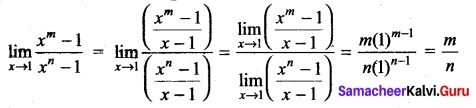
Evaluate \(\lim _{x \rightarrow 1} \frac{x^{m}-1}{x^{n}-1}\) m and n are integers.
Solution:
Tamil Nadu 11th Maths Model Question Paper 5 English Medium 4

Question 27.
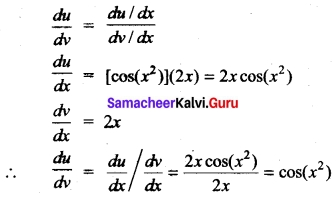
Find the derivative of sinx² with respect to x²
Solution:
Here u = sinx² and v = x²
Now we have to find
Tamil Nadu 11th Maths Model Question Paper 5 English Medium 5

Question 28.
Evaluate ∫[5x4 + 3(2x + 3)4 – 6(4 – 3x)5]
Solution:
∫[5 x4 + 3(2x + 3)4 – 6(4 – 3x)5] dx.
= 5∫x4dx + 3∫ (2x + 3)4 dx – 6∫ (4 – 3x)5 dx
= 5.\(\frac{x^5}{5}\) + 3.\(\frac{1}{2}\)\(\frac{(2x+3)^5}{5}\) – 6.\(\frac{1}{(-3)}\)\(\frac{(4-3x)^6}{6}\) + c.
= x5 + \(\frac{3}{10}\)(2x + 3)5 + \(\frac{1}{3}\) (4 – 3x)6 + c

Tamil Nadu 11th Maths Model Question Paper 5 English Medium

Question 29.
Given that P(A) = 0.52, P(B) = 0.43, and P(A ∩ B) = 0.24, find P(A ∪ B)
Solution:
P(A ∪ B) = P(A) + P(B) – P(A ∩ B)
= 0.52 + 0.43 – 0.24
P(A ∪ B) = 0.71

Question 30.
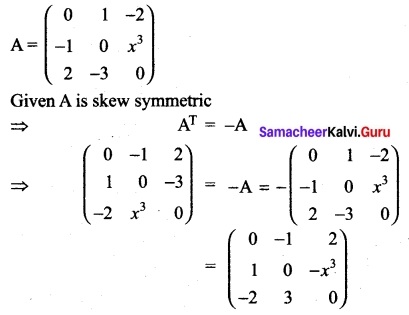
For what value of x, the matrix A = \(\left[\begin{array}{rrr} 0 & 1 & -2 \\ -1 & 0 & x^{3} \\ 2 & -3 & 0 \end{array}\right]\) is skew-symmetric.
Solution:
Tamil Nadu 11th Maths Model Question Paper 5 English Medium 6
-x³ = -3 ⇒ x³ = 3 ⇒ x = 31/3

PART- III

III. Answer any seven questions. Question No. 40 is compulsory. [7 × 3 = 21]

Question 31.
Find the largest possible domain for the real valued function given by f(x) =\(\frac{\sqrt{9-x^{2}}}{\sqrt{x^{2}-1}}\)
Solution:
If x < -3 or x > 3, then x² will be greater than 9 and hence 9 – x² will become negative which has no square root in R. So x must lie on the interval [-3, 3].
Also if x ≥ – 1 and x ≤ 1, then x² – 1 will become negative or zero. If it is negative, x² – 1e has no square root in R. If it is zero, f is not defined. So x must lie outside [-1, 1]. That is, x must lie on (- ∞, -1) ∪ (1, ∞). Combining these two conditions, the largest possible domain for/is [-3, 3] ∩ ((-∞, -1) ∪ (i, ∞)). That is, [-3, -1) ∪ (1, 3].

Question 32.
Solve sin x + sin 5x = sin 3x
Solution:
sin x + sin 5x = sin 3x ⇒ 2 sin 3x cos 2x = sin 3x
sin 3x (2 cos 2x – 1) = 0
Thus, either sin 3x = 0 (or) cos 2x = \(\frac{1}{2}\)
If sin 3x = 0, then 3x = nπ ⇒ x = \(\frac{nπ}{3}\) n ∈ Z ………(i)
If cos 2x = \(\frac{1}{2}\) ⇒ cos 2x = cos \(\frac{π}{3}\)
2x = 2nn ± \(\frac{π}{3}\) ⇒ x = nπ ± \(\frac{π}{6}\), n ∈ Z ….(ii)
From (i) and (ii), we have the general solution x = \(\frac{π}{3}\) (or) x = nπ ± \(\frac{π}{6}\), n ∈ Z

Question 33.
How many triangles can be formed by 15 points in which 7 of them lie on one line and the remaining 8 on another parallel line?
Solution:
Tamil Nadu 11th Maths Model Question Paper 5 English Medium 7
7 points lie on one line and the other 8 points parallel on another parallel line.
A triangle is obtained by taking one point from one line and 2 points from the other parallel line which can be done as follows.
7C1 × 8C2 or 7C2 × 8C1
7C1 = 7; 7C2 = \(\frac{7×6}{2×1}\) = 21
8C1 = 8; 8C2= \(\frac{8×7}{2×1}\) = 28
∴ No. of triangles = (7) (28) + (21) (8) = 196 + 168 = 364

Question 34.
Using binomial theorem indicate which of the following two numbers is larger (1.01)1000000 or 10000
Solution:
(1.01)1000000 = (1 + 0.01)1000000
= 1000000C0(1)1000000 + 1000000C1(1)999997(0.01)1
+ 1000000C2(1)999998(0.01)² + 1000000C3(1)999997(0.01)³ +……….
= 1 (1) + 1000000 × \(\frac{1}{10^2}\) + \(\frac{1000000×999999}{2}\) × \(\frac{1}{10000}\) + …………
= 1 + 10000 + 50 × 999999 +…………
which is > 10000
So (1.01)1000000 > 10000 (i.e.) (1.01)1000000 is larger.

Tamil Nadu 11th Maths Model Question Paper 5 English Medium

Question 35.
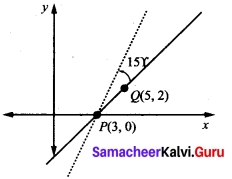
If a line joining two points (3, 0) and (5, 2) is rotated about the point (3, 0) in counter clockwise direction through an angle 15°, then find the equation of the line in the new position.
Solution:
Tamil Nadu 11th Maths Model Question Paper 5 English Medium 8
Let P (3, 0) and Q (5, 2) be the given points.
Slope of PQ = \(\frac{y_2-y_1}{x_2-x_1}\) = 1
⇒ The angle of inclination of the line PQ = tan-1(1) = \(\frac{π}{4}\) = 45°
∴ The slope of the line in new position is m = tan (45° + 15°)
⇒ Slope = tan (60°) = (√3)
∴ Equation of the straight line passing through (3, 0) and with the slope √3 is y – 0 = √3 (x – 3)
√3 x – y – 3√3 = 0

Question 36.
Find the area of the triangle whose vertices are A(3, -1, 2), B(l, -1, -3) and C(4, -3,1)
Solution:
A = (3, -1, 2), B = (1, -1, -3) and C = (4, -3, 1)
∴ \(\vec{OA}\) = 3\(\hat{i}\) – \(\hat{j}\) + 2\(\hat{k}\); \(\vec{OB}\) = \(\hat{i}\) – \(\hat{j}\) – 3\(\hat{k}\); and \(\vec{OC}\) = 4\(\hat{i}\) – 3\(\hat{j}\) + \(\hat{k}\)
Area of ΔABC = \(\frac{1}{2}\)|\(\vec{AB}\) × \(\vec{AC}\)| = \(\frac{1}{2}\)|\(\vec{BA}\) × \(\vec{BC}\)| = \(\frac{1}{2}\)|\(\vec{CA}\) x \(\vec{CB}\)|
\(\vec{AB}\) = \(\vec{OB}\) – \(\vec{OA}\) = (\(\hat{i}\) – \(\hat{j}\) – 3\(\hat{k}\)) – (3\(\hat{i}\) – \(\hat{j}\) + 2\(\hat{k}\)) = \(\hat{i}\) – \(\hat{j}\) – 3\(\hat{k}\) – 3\(\hat{i}\) + \(\hat{j}\) – 2\(\hat{k}\)
= -2\(\hat{i}\) – 5\(\hat{k}\)
\(\vec{AC}\) = \(\vec{OC}\) – \(\vec{OA}\) = 4\(\hat{i}\) – 3\(\hat{j}\) + \(\hat{k}\) – 3\(\hat{i}\) + \(\hat{j}\) – 2\(\hat{k}\)
= \(\hat{i}\) – 2\(\hat{j}\) – \(\hat{k}\)
Tamil Nadu 11th Maths Model Question Paper 5 English Medium 9

Question 37.
Check if \(\lim _{x \rightarrow-5}\) f(x) exists or not, where f(x) = \(\left\{\begin{array}{l} \frac{|x+5|}{x+5}, \text { for } x \neq-5 \\ 0, \quad \text { for } x=-5 \end{array}\right.\)
Solution:
(i) f(-5)
For x < -5, |x + 5| = -(x + 5)
Thus f(-5) = \(\lim _{x \rightarrow-5^-}\) \(\frac{-(x-5)}{(x+5)}\) = -1

(ii) f(-5+)
For x > -5, |x + 5| = (x + 5)
Thus f(-5+) = \(\lim _{x \rightarrow-5^+}\) \(\frac{(x+5)}{(x+5)}\) = 1
∴ f(-5) ≠ f(-5+). Hence the limit does not exist.

Question 38.
Evaluate \(\frac{\sqrt{x}}{1+\sqrt{x}}\)
Solution:
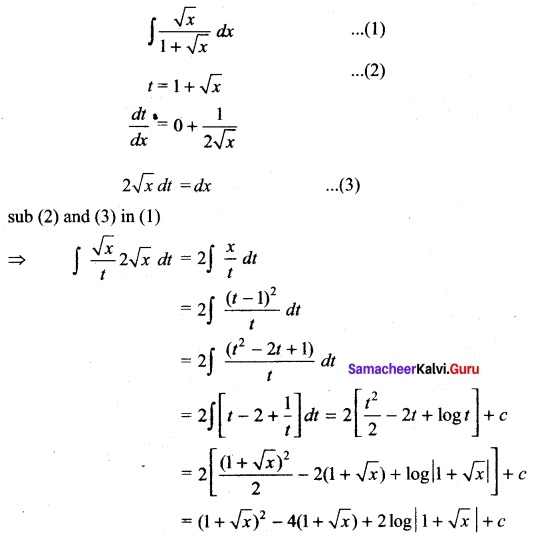
Tamil Nadu 11th Maths Model Question Paper 5 English Medium 10

Question 39.
The probability that a girl, preparing for competitive examination will get a State Government service is 0.12, the probability that she will get a Central Government job is 0.25, and the probability that she will get both is 0.07. Find the probability that
(i) she will get atleast one of the two jobs
(ii) she will get only one of the two jobs.
Solution:
Let I be the event of getting State Government service and C be the event of getting Central Government job.
Given that P(I) = 0.12, P(C) = 0.25, and P(I ∩ C) = 0.07
(i) P (at least one of the two jobs) = P(I or C) = P(I ∪ C)
= P(I) + P(C) – P(I ∩ C)
= 0.12 + 0.25 – 0.07 = 0.30

(if) P(only one of the two jobs) = P[only I or only C].
= P(I ∩ \(\bar{C}\)) + P(\(\bar{I}\) ∩ C)
= (P(I) – P(I ∩ C)} + (P(C) – P(I ∩ C)}
= {0.12 – 0.07} + {0.25 – 0.07}
= 0.23.
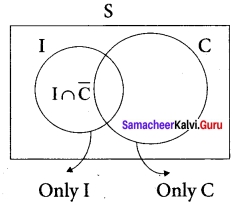
Tamil Nadu 11th Maths Model Question Paper 5 English Medium 11

Question 40.
Find the derivatives of the following function. \(\sqrt{xy}\) = e(x-y)
Solution:
\(\sqrt{xy}\) = ex-y
(i.e.) (xy)1/2 = ex-y
Taking log on both sides we get
log (xy)1/2 = log ex-y
(i.e.) \(\frac{1}{2}\) (log x + log y) = x – y
⇒ log x + log y = 2x – 2y
differentiating w.r. to x we get
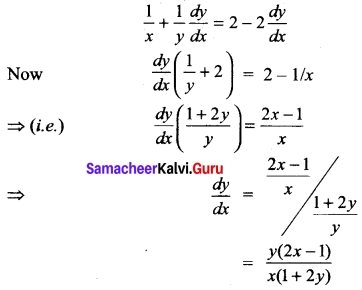
Tamil Nadu 11th Maths Model Question Paper 5 English Medium 12

Tamil Nadu 11th Maths Model Question Paper 5 English Medium

PART – IV

IV. Answer all the questions. [7 × 5 = 35]

Question 41 (a).
Find the range of the function \(\frac{1}{2cos x -1}\)
Solution:
The range of cos x is – 1 to 1
-1 < cos x < 1
(× by 2) -2 < 2 cos x < 2
adding -1 throughout
-2 – 1 <2 cos x – 1 < 2 – 1
(i.e.,) -3 < 2 cos x – 1 < 1
so 1 < \(\frac{1}{2cos x -1}\) < \(\frac{-1}{3}\)
The range is outside \(\frac{-1}{3}\) and 1
i.e., range is (-∞, \(\frac{-1}{3}\)] ∪ [1, ∞)

[OR]

(b) Solve \(\frac{(x-2)}{(x+4)}\) ≥ \(\frac{5}{(x+3)}\)
Solution:
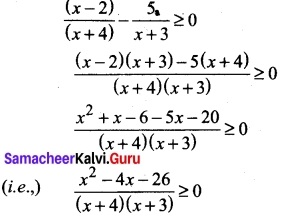
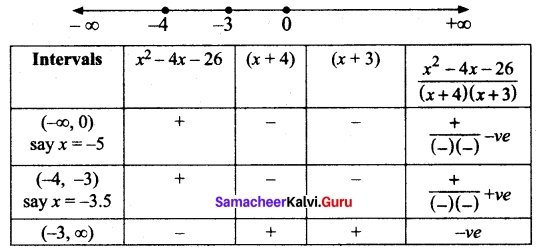
Tamil Nadu 11th Maths Model Question Paper 5 English Medium 13
x + 4 = 0 ⇒ x = -4; x + 3 = 0 ⇒ x = -3
Plotting the points -4, -3 on number line and taking limits (-∞, -4), (-4, -3), (-3, ∞)
Tamil Nadu 11th Maths Model Question Paper 5 English Medium 14
The solution for the inequality \(\frac{(x-2)}{(x+4)}\) ≥ \(\frac{5}{(x+3)}\) are the intervals (-∞, -4) and (-4, -3)

Question 42 (a).
Prove that log 2 + 16 log \(\frac{16}{15}\) + 12 log \(\frac{25}{24}\) + 7 log \(\frac{80}{81}\) = 1
Solution:
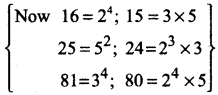
LHS = log 2 + 16 [log 16 – log 15] + 12 [log 25 – log 24] + 7 [log 81 – log 80]
Tamil Nadu 11th Maths Model Question Paper 5 English Medium 15
= log 2 + 16 [log 24 – log 3 × 5 ] + 12 [log 5² – log 2³ × 3] + 7[log 34 – log 24 × 5]
= log 2 + 16 [41og2 – log3 – log5] + 12 [2 log 5 – 3 log 2 – log 3] + 7 [4 log 3 – 4 log 2 – log 5]
= log 2 + 64 log 2 – 16 log 3 – 16 log 5 + 24 log 5 – 36 log 2 – 12 log 3 + 28 log 3 – 28 log 2 – 7 log 5
= log 2 [1+ 64 – 36 – 28] + log 3 [-16 – 12 + 28] + log 5 [-16 + 24 – 7]
= log 2(1) + log 3(0) +log 5(1)
= log 2 + log 5 = log 2 × 5 = log 10 = 1 = RHS

[OR]

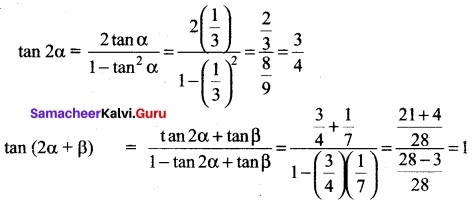
(b) If tan α = \(\frac{1}{3}\) and tan β = \(\frac{1}{7}\) show that 2 α + β = \(\frac{π}{4}\)
Solution:
Tamil Nadu 11th Maths Model Question Paper 5 English Medium 16
∴ 2 α + β = 45° = \(\frac{π}{4}\)

Tamil Nadu 11th Maths Model Question Paper 5 English Medium

Question 43 (a).
Using Binomial theorem, prove that 6n – 5n always leaves remainder 1 when divided by 25 for all positive integer n.
Solution:
To prove this it is enough to prove, 6n – 5n = 25k + 1 for some integer k. We first consider the expansion
(1 + x)n = nC0 + nC1 x + nC2 x² +…+ nCn-1xn-1 + nCn xn, n ∈ N.
Taking x = 5 we get (1 + 5)n = nC0 + nC1 5 + nC2 5² +…+ nCn-1 5n-1 + nCn 5n. The above equality reduces to 6n = 1 + 5n + 25(nC2 + 5 nC3 +…+ nCn 5n-2)
That is,
6n – 5n = 1 + 25(nC2 + 5 nC3 +…+ nCn 5n-2) = 1 + 25k, k ∈ N.
Thus 6n – 5n always, leaves remainder 1 when divided by 25 for all positive integer n.

[OR]

(b) Prove that
Tamil Nadu 11th Maths Model Question Paper 5 English Medium 17
Solution:
Taking p = 0, we get |A| = \(\left|\begin{array}{ccc} (q+r)^{2} & 0 & 0 \\ q^{2} & r^{2} & q^{2} \\ r^{2} & r^{2} & q^{2} \end{array}\right|\) = 0
Therefore, (p- 0) is a factor. That is, p is a factor.
Since |A| is in cyclic symmetric form in p, q, r and hence q and r also factors.
Putting p + q + r = 0 ⇒ q + r = -p; r + p = -q; and p + q = -r.
|A| = \(\left|\begin{array}{lll} p^{2} & p^{2} & p^{2} \\ q^{2} & q^{2} & q^{2} \\ r^{2} & r^{2} & r^{2} \end{array}\right|\) = 0 since 3 columns are identical.
Therefore, (p + q + r)² is a factor of |A|.
The degree of the obtained factor pqr(p + q + r)² is 5. The degree of |A| is 6.
Therefore required factor is k (p + q + r)
Tamil Nadu 11th Maths Model Question Paper 5 English Medium 18
4(16 – 1) -1 (4 – 1) +1 (1 – 4) = 27k
60 – 3 – 3 = 27 k ⇒ k = 2.
|A| = 2pqr (p + q + r)³

Question 44 (a).
The sum of the distance of a moving point from the points (4, 0) and (-4, 0) is always 10 units. Find the equation of the locus of the moving point.
Solution:
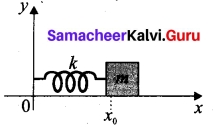
Let point (h, k) be a moving point
Here A = (4, 0) and B = (- 4, 0)
Given PA + PB = 10
⇒ \(\sqrt{(h-4)^{2}+k^{2}}+\sqrt{(h+4)^{2}+k^{2}}\) = 10
⇒ \(\sqrt{(h-4)^{2}+k^{2}}\) = 10 – \(\sqrt{(h+4)^{2}+k^{2}}\)
Squaring both sides (h – 4)² + k² = 100 + (h + 4)² + k² – 20\(\sqrt{(h+4)^{2}+k^{2}}\)
(i.e.) h² + l6 – 8h + k² = 100 + h² + 16 + 8h + k² – 20\(\sqrt{(h+4)^{2}+k^{2}}\)
⇒ -16h – 100 = – 20 \(\sqrt{(h+4)^{2}+k^{2}}\)
(÷ by -4) 4h + 25 = 5 \(\sqrt{(h+4)^{2}+k^{2}}\)
Squaring both sides we get,
(4h + 25)² = 25 [(h + 4)² + k²]
(i.e) 16h² + 25 + 200h = 25 [h² + 8h + 16 + k²]
= 16h² + 625 + 200h – 25h² – 200h – 400 – 25k² = 0
= – 9h² – 25k² + 225 = 0
⇒ 9h² + 25 k² = 225
\(\frac{9h^2}{225}\) + \(\frac{25k^2}{225}\) = 1
(i.e) h²/25 + k²/9 = 1, So the locus is \(\frac{x^2}{25 }\) + \(\frac{y^2}{9}\) = 1

Tamil Nadu 11th Maths Model Question Paper 5 English Medium

[OR]

(b) Show that the vectors \(\hat{i}\) – 2\(\hat{j}\) + 3\(\hat{k}\), -2\(\hat{i}\) + 3\(\hat{j}\) – 4\(\hat{k}\) and – \(\hat{j}\) + 2\(\hat{k}\) are coplanar.
Solution:
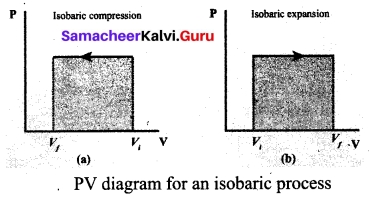
Let the given three vectors be \(\vec{a}\), \(\vec{b}\) and \(\vec{c}\). When we are able to write one vector as a linear combination of the other two vectors, then the given vectors are called coplanar vectors.
Let \(\vec{a}\) = m\(\vec{b}\) + n\(\vec{c}\) where
(i.e.) \(\vec{a}\) = \(\hat{i}\) – 2\(\hat{j}\) + 3\(\hat{k}\)
\(\vec{b}\) = -2\(\hat{i}\) + 3\(\hat{j}\) – 4\(\hat{k}\) and \(\vec{c}\) = –\(\hat{j}\) + 2\(\hat{k}\)
⇒ \(\hat{i}\) – 2\(\hat{j}\) + 3\(\hat{k}\) = m (-2\(\hat{i}\) + 3\(\hat{j}\) – 4\(\hat{k}\)) + n (-\(\hat{j}\) + 2\(\hat{k}\))
Equating the \(\hat{i}\), \(\hat{j}\) and \(\hat{k}\) components
(i.e.) 1 = -2m ……… (1)
-2 = 3m – n …………(2)
3 = -4m + 2n …………(3)
Now we have to solve (1) and (2) and substitute the value in (3).
Solving (1) and (2)
(1) ⇒ -2m = 1
∴ m = –\(\frac{1}{2}\)
Substituting m = –\(\frac{1}{2}\) in (2) we get,
3(\(\frac{-1}{2}\)) – n = -2
–\(\frac{3}{2}\) – n = -2
∴ -n = -2 + \(\frac{3}{2}\) = \(\frac{-4+3}{2}\) = –\(\frac{1}{2}\)
n = \(\frac{1}{2}\)
∴ m = –\(\frac{1}{2}\); n = \(\frac{1}{2}\)
Substituting the values of m and n in (3).
LHS = 3
RHS = -4 + 2n = -4(\(\frac{-1}{2}\)) + 2(\(\frac{1}{2}\))
= 2 + 1 = 3
⇒ LHS = RHS
∴ we are able to write one vector as a linear combination of the other two
⇒ the given vectors are coplanar.

Question 45 (a).
A committee of 7 peoples has to be formed from 8 men and 4 women. In how many ways can this be done when the committee consists of
(i) exactly 3 women?
(ii) at least 3 women?
(iii) at most 3 women?
Solution:

Tamil Nadu 11th Maths Model Question Paper 5 English Medium 19
We need a committee of 7 people with 3 women and 4 men.
This can be done in (4C3) (8C4) ways
4C1 = 4C1 = 4
8C4 = \(\frac{8×7×6×5}{4×3×2×1}\) = 70
The number of ways = (70) (4) = 280

(ii) Atleast 3 women
Tamil Nadu 11th Maths Model Question Paper 5 English Medium 20
So the possible ways are (3W and 4M) or (4W and 3M)
(i.e) (4C3) (8C4) + (4C4) (8C3)
4C3 = 4C1 = 4; 4C4 = 1
8C4 = \(\frac{8×7×6×5}{4×3×2×1}\) = 70
8C3 = \(\frac{8×7×6}{3×2×1}\) = 56
The number of ways (4) (70) + (1) (56) = 280 + 56 = 336

(iii) Atmost 3 women
Tamil Nadu 11th Maths Model Question Paper 5 English Medium 21
The possible ways are (0W 8M) or (1W 6M) or (2W 5M) or (3W 4M)
Tamil Nadu 11th Maths Model Question Paper 5 English Medium 22
∴ The possible ways are
(1) (8) + (4) (28) + (6) (56) + (4) (70) = 8 + 112 + 336 + 280 = 736 ways

Tamil Nadu 11th Maths Model Question Paper 5 English Medium

[OR]

(b) Evaluate \(\lim _{x \rightarrow 0} \frac{\sqrt{1+\sin x}-\sqrt{1-\sin x}}{\tan x}\)
Solution:
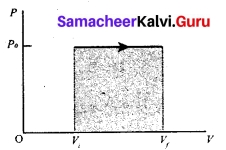
Tamil Nadu 11th Maths Model Question Paper 5 English Medium 23

Question 46 (a).
If y = \(\frac{\sin ^{-1} x}{\sqrt{1-x^{2}}}\) show that (1 – x²)y2 – 3xy1 – y = 0
Solution:
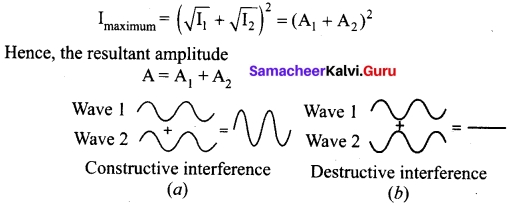
y = \(\frac{\sin ^{-1} x}{\sqrt{1-x^{2}}}\)
⇒ y \(\sqrt{1-x^2}\) = sin-1 x
differentiating w.r.to x we get
Tamil Nadu 11th Maths Model Question Paper 5 English Medium 24
multiplying both sides by \(\sqrt{1-x^2}\) we get
-xy + (1 – x²)y1 = 1
differentiating both sides again w.r.to x.
– [xy-1 +y(1)] + (1 – x²) (y2) + y1(-2x) = 0
(i.e.) -xy1 – y + (1 – x²)y2 – 2xy1 = 0
(1 – x²)y2 – 3xy1 – y = 0

[OR]

(b) If y = cos (m sin-1 x), prove that (1 – x²) y3 – 3xy2 + (m² – 1) y1 = 0
Solution:

We have y = cos (m sin-1 x)
y1 = sin(m sin-1 x) \(\frac{m}{\sqrt{1-x^2}}\)
\(y_{1}^{2}\) = sin² (m sin-1 x) \(\frac{m^2}{(1-x^2)}\)
This implies (1 – x²) \(y_{1}^{2}\) = m² sin² (m sin-1 x) = m² [1 – cos² (m sin-1 x)]
This is, (1 – x²) \(y_{1}^{2}\) = m² (1 – y²).
Again differentiating,
(1 – x²) 2y1 \(\frac{dy_1}{dx}\) + \(y_{1}^{2}\)(-2x) = m² (-2y\(\frac{dy}{dx}\))
(1 – x²) 2y1y2 – 2x\(y_{1}^{2}\) = – 2m²yy1
(1 – x²) y2 – xy1 = m²y
Once again differentiating
(1 – x²) 2y1 \(\frac{dy_2}{dx}\) + \(y_{2}\)(-2x) – [x.\(\frac{dy_1}{dx}\) + y1.1] = -m² (\(\frac{dy}{dx}\))
(1 – x²)y3 – 2xy2 – xy2 – y1 = -m²y1
(1 – x²)y3 – 3xy2 + (m² – 1)y1 = 0

Tamil Nadu 11th Maths Model Question Paper 5 English Medium

Question 47 (a).
Evaluate ∫\(\frac{dx}{\sqrt{9+8x-x^2}}\)
Solution:
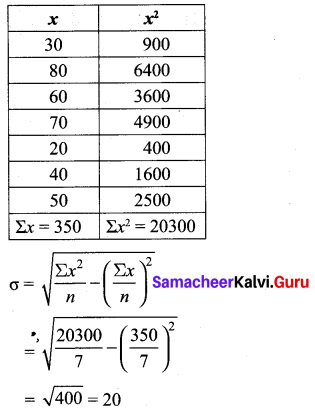
Let I = ∫\(\frac{dx}{\sqrt{9+8x-x^2}}\) dx
Consider, 9 + 8x – x²
= -[x² – 8x – 9]
= -[(x – 4)² – 16 – 9]
= -[(x – 4)² – (5)²]
= (5)² – (x – 4)²
Tamil Nadu 11th Maths Model Question Paper 5 English Medium 25.

[OR]

(b) An advertising executive is studying television viewing habits of married men and women during prime time hours. Based on the past viewing records he has determined that during prime time wives are watching television 60% of the time. It has also been determined that when the wife is watching television, 40% of the time the husband is also watching. When the wife is not watching the television, 30% of the time husband is watching the television. Find the probability that
(i) the husband is watching the television during the prime time of television
(ii) if the husband is watching the television, the wife is also watching the television.
Solution:
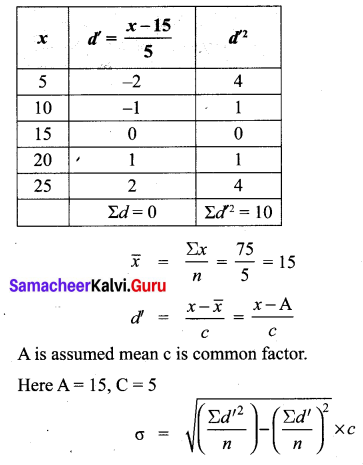
P(Wife watching TV) = P(W) = \(\frac{60}{100}\)
P(H/W) = \(\frac{40}{100}\); P(H/W’) = 30/100
(i) P(Husband watching TV) = P(H)
= P(H/W) P(W) + P(H/W’) P(W’)
Tamil Nadu 11th Maths Model Question Paper 5 English Medium 26

Tamil Nadu 11th Maths Model Question Paper 5 English Medium

Samacheer Kalvi 10th Maths Solutions Chapter 7 Mensuration Additional Questions

You can Download Samacheer Kalvi 10th Maths Book Solutions Guide Pdf, Tamilnadu State Board help you to revise the complete Syllabus and score more marks in your examinations.

Tamilnadu Samacheer Kalvi 10th Maths Solutions Chapter 7 Mensuration Additional Questions

Question 1.
If the radii of the circular ends of a conical bucket which is 45 cm high are 28 cm and 7 cm, find the capacity of the bucket. (Use \(\pi=\frac{22}{7}\))
Solution:
Clearly bucket forms frustum of a cone such that the radii of its circular ends are r1 = 28 cm, r2 = 7 cm, h = 45 cm.
Capacity of the bucket = volume of the frustum
Samacheer Kalvi 10th Maths Chapter 7 Mensuration Additional Questions 1

Samacheer Kalvi 10th Maths Solutions Chapter 7 Mensuration Additional Questions

Question 2.
Find the depth of a cylindrical tank of radius 28 m, if its capacity is equal to that of a rectangular tank of size 28 m × 16 m × 11 m.
Solution:
Volume of the cylindrical tank = Volume of the rectangle tank
Samacheer Kalvi 10th Maths Chapter 7 Mensuration Additional Questions 2

Question 3.
What is the ratio of the volume of a cylinder, a cone, and a sphere. If each has the same diameter and same height?
Solution:
Samacheer Kalvi 10th Maths Chapter 7 Mensuration Additional Questions 3
Samacheer Kalvi 10th Maths Chapter 7 Mensuration Additional Questions 4

Samacheer Kalvi 10th Maths Solutions Chapter 7 Mensuration Additional Questions

Question 4.
Find the number of coins, 1.5 cm is diameter and 0.2 cm thick, to be melted to form a right circular cylinder of height 10 cm and diameter 4.5 cm.
Solution:
Samacheer Kalvi 10th Maths Chapter 7 Mensuration Additional Questions 5

Question 5.
A spherical ball of iron has been melted and made into small balls. If the raidus of each smaller ball is one-fourth of the radius of the original one, how many such balls can be made?
Solution:
Samacheer Kalvi 10th Maths Chapter 7 Mensuration Additional Questions 6

Samacheer Kalvi 10th Maths Solutions Chapter 7 Mensuration Additional Questions

Question 6.
A wooden article was made by scooping out a hemisphere from each end of a cylinder as shown in figure. If the height of the cylinder is 10cm and its base is of radius 3.5 cm find the total surface area of the article.
Samacheer Kalvi 10th Maths Chapter 7 Mensuration Additional Questions 7
Solution:
Radius of the cylinder be r Height of the cylinder be h Total surface area of the article = CSA of cylinder + CSA of 2 hemispheres = 2πrh + 2πr2 = 2πr (h + 2r)
Samacheer Kalvi 10th Maths Chapter 7 Mensuration Additional Questions 8

Samacheer Kalvi 10th Maths Solutions Chapter 7 Mensuration Unit Exercise 7

You can Download Samacheer Kalvi 10th Maths Book Solutions Guide Pdf, Tamilnadu State Board help you to revise the complete Syllabus and score more marks in your examinations.

Tamilnadu Samacheer Kalvi 10th Maths Solutions Chapter 7 Mensuration Unit Exercise 7

Question 1.
The barrel of a fountain-pen cylindrical in shape, is 7 cm long and 5 mm in diameter. A full barrel of ink in the pen will be used for writing 330 words on an average. How many words can be written using a bottle of ink containing one fifth of a litre?
Solution:
Samacheer Kalvi 10th Maths Chapter 7 Mensuration Unit Exercise 7 1

Samacheer Kalvi 10th Maths Solutions Chapter 7 Mensuration Unit Exercise 7

Question 2.
A hemi-spherical tank of radius 1.75 m is full of water. It is connected with a pipe which empties the tank at the rate of 7 litre per second. How much time will it take to empty the tank completely?
Solution:
Suppose the pipe takes x seconds to empty the tank. Then, volume of the water that flows out of the tank in x seconds = Volume of the hemispherical tank.
Volume of the water that flows out of the tank in x seconds.
= Volume of hemispherical shell of radius 175 cm.
Samacheer Kalvi 10th Maths Chapter 7 Mensuration Unit Exercise 7 2

Question 3.
Find the maximum volume of a cone that can be carved out of a solid hemisphere of radius r units.
Solution:
Radius of the base of cone = Radius of the hemisphere = r
Height of the cone = Radius of the hemisphere
Samacheer Kalvi 10th Maths Chapter 7 Mensuration Unit Exercise 7 3

Samacheer Kalvi 10th Maths Solutions Chapter 7 Mensuration Unit Exercise 7

Question 4.
An oil funnel of tin sheet consists of a cylindrical portion 10 cm long attached to a frustum of a cone. If the total height is 22 cm, the diameter of the cylindrical portion be 8cm and the diameter of the top of the funnel be 18 cm, then find the area of the tin sheet required to make the funnel.
Solution:
Slant height of the frustum
Samacheer Kalvi 10th Maths Chapter 7 Mensuration Unit Exercise 7 4

Question 5.
Find the number of coins, 1.5 cm in diameter and 2 mm thick, to be melted to form a right circular cylinder of height 10 cm and diameter 4.5 cm.
Solution:
No. of coins required .
Samacheer Kalvi 10th Maths Chapter 7 Mensuration Unit Exercise 7 5

Samacheer Kalvi 10th Maths Solutions Chapter 7 Mensuration Unit Exercise 7

Question 6.
A hollow metallic cylinder whose external radius is 4.3 cm and internal radius is 1.1 cm
and whole length is 4 cm is melted and recast into a solid cylinder of 12 cm long. Find the diameter of solid cylinder.
Solution:
Volume of the solid cylinder = Volume of the hollow cylinder melted.
Samacheer Kalvi 10th Maths Chapter 7 Mensuration Unit Exercise 7 6

Samacheer Kalvi 10th Maths Solutions Chapter 7 Mensuration Unit Exercise 7

Question 7.
The slant height of a frustum of a cone is 4 m and the perimeter of circular ends are 18 m and 16 m. Find the cost of painting its curved surface area at ₹ 100 per sq. m.
Solution:
Samacheer Kalvi 10th Maths Chapter 7 Mensuration Unit Exercise 7 7

Question 8.
A hemi-spherical hollow bowl has material of volume \(\frac{436 \pi}{3}\) cubic cm. Its external diameter is 14 cm. Find its thickness.
Solution:
Samacheer Kalvi 10th Maths Chapter 7 Mensuration Unit Exercise 7 8

Samacheer Kalvi 10th Maths Solutions Chapter 7 Mensuration Unit Exercise 7

Question 9.
The volume of a cone is \(1005 \frac{5}{7}\) cu. cm. The area of its base is \(201 \frac{1}{7}\) sq. cm. Find the slant height of the cone.
Solution:
Samacheer Kalvi 10th Maths Chapter 7 Mensuration Unit Exercise 7 9

Question 10.
A metallic sheet in the form of a sector of T a circle of radius 21 cm has central angle of 216°. The sector is made into a cone by bringing the bounding radii together. Find the volume of the cone formed.
Solution:
Samacheer Kalvi 10th Maths Chapter 7 Mensuration Unit Exercise 7 10
Samacheer Kalvi 10th Maths Chapter 7 Mensuration Unit Exercise 7 11

Samacheer Kalvi 10th Maths Solutions Chapter 7 Mensuration Ex 7.5

You can Download Samacheer Kalvi 10th Maths Book Solutions Guide Pdf, Tamilnadu State Board help you to revise the complete Syllabus and score more marks in your examinations.

Tamilnadu Samacheer Kalvi 10th Maths Solutions Chapter 7 Mensuration Ex 7.5

Multiple choice questions.
Question 1.
The curved surface area of a right circular cone of height 15 cm and base diameter 16 cm is ______
(1) 60π cm2
(2) 68π cm2
(3) 120π cm2
(4) 136π cm2
Answer:
(4) 136π cm2
Hint:
Samacheer Kalvi 10th Maths Chapter 7 Mensuration Ex 7.5 1

Question 2.
If two solid hemispheres of same base radius r units are joined together along with their bases, then the curved surface area of this new solid is
(1) 4πr2 sq. units
(2) 67πr2 sq. units
(3) 3πr2 sq. units
(4) 8πr2 sq. units
Solution:
(1) 47πr2 sq. units]

Samacheer Kalvi 10th Maths Solutions Chapter 7 Mensuration Ex 7.5

Question 3.
The height of a right circular cone whose radius is 5 cm and slant height is 13 cm will be __________
(1) 12 cm
(2) 10 cm
(3) 13 cm
(4) 5 cm
Answer:
(1) 12 cm
Hint:
Samacheer Kalvi 10th Maths Chapter 7 Mensuration Ex 7.5 2

Question 4.
If the radius of the base of a right circular cylinder is halved keeping the same height, then the ratio of the volume of the cylinder thus obtained to the volume of original cylinder is
(1) 1 : 2
(2) 1 : 4
(3) 1 : 6
(4) 1 : 8
Solution:
(2) 1 : 4
Samacheer Kalvi 10th Maths Chapter 7 Mensuration Ex 7.5 3

Samacheer Kalvi 10th Maths Solutions Chapter 7 Mensuration Ex 7.5

Question 5.
The total surface area of a cylinder whose radius is \(\frac{1}{3}\) of its height is
Samacheer Kalvi 10th Maths Chapter 7 Mensuration Ex 7.5 4
Solution:
(3) \(\frac{8 \pi h^{2}}{9}\) sq. units
Samacheer Kalvi 10th Maths Chapter 7 Mensuration Ex 7.5 70

Question 6.
In a hollow cylinder, the sum of the external and internal radii is 14 cm and the width is 4 cm. If its height is 20 cm, the volume of the material in it is _______
(1) 560π cm3
(2) 1120π cm3
(3) 56π cm3
(4) 360π cm3
Answer:
(2) 1120π cm3
Hint:
R + r = 14 cm
w = 4 cm
h = 90 cm
Samacheer Kalvi 10th Maths Chapter 7 Mensuration Ex 7.5 6
Samacheer Kalvi 10th Maths Chapter 7 Mensuration Ex 7.5 50

Samacheer Kalvi 10th Maths Solutions Chapter 7 Mensuration Ex 7.5

Question 7.
If the radius of the base of a cone is tripled and the height is doubled then the volume is
(1) made 6 times
(2) made 18 times
(3) made 12 times
(4) unchanged
Solution:
(2) made 18 times
Hint:
Samacheer Kalvi 10th Maths Chapter 7 Mensuration Ex 7.5 60

Question 8.
The total surface area of a hemisphere is how many times the square of its radius ______
(1) π
(2) 4π
(3) 3π
(4) 2π
Answer:
(3) 3π
Hint:
Samacheer Kalvi 10th Maths Chapter 7 Mensuration Ex 7.5 7

Question 9.
A solid sphere of radius x cm is melted and cast into a shape of a solid cone of same radius. The height of the cone is
(1) 3x cm
(2) x cm
(3) 4x cm
(4) 2x cm
Solution:
(3) 4x cm
Hint:
Samacheer Kalvi 10th Maths Chapter 7 Mensuration Ex 7.5 8

Question 10.
A frustum of a right circular cone is of height 16 cm with radii of its ends as 8 cm and 20 cm. Then, the volume of the frustum is _______
(1) 3328π cm3
(2) 3228π cm3
(3) 3240π cm3
(4) 3340π cm3
Answer:
(1) 3328π cm3Hint:
Samacheer Kalvi 10th Maths Chapter 7 Mensuration Ex 7.5 9

Samacheer Kalvi 10th Maths Solutions Chapter 7 Mensuration Ex 7.5

Question 11.
A shuttlecock used for playing badminton has the shape of the combination of
(1) a cylinder and a sphere
(2) a hemisphere and a cone
(3) a sphere and a cone
(4) frustum of a cone and a hemisphere
Solution:
(4) frustum of a cone and a hemisphere

Question 12.
A spherical ball of radius r1 units is melted to make 8 new identical balls each of radius r2 units. Then r1 : r2 is
(1) 2 : 1
(2) 1 : 2
(3) 4 : 1
(4) 1 : 4
Solution:
Hint:
Samacheer Kalvi 10th Maths Chapter 7 Mensuration Ex 7.5 10

Question 13.
The volume (in cm3) of the greatest sphere that can be cut off from a cylindrical log of wood of base radius 1 cm and height 5 cm is
Samacheer Kalvi 10th Maths Chapter 7 Mensuration Ex 7.5 11
Solution:
(1) \(\frac{4}{3} \pi\)
Samacheer Kalvi 10th Maths Chapter 7 Mensuration Ex 7.5 12

Samacheer Kalvi 10th Maths Solutions Chapter 7 Mensuration Ex 7.5

Question 14.
The height and radius of the cone of which the frustum is a part are h1 units and r1 units respectively. Height of the frustum is h2 units and the radius of the smaller base is r2 units. If h2: h1 = 1 : 2 then r2 : r1 is
(1) 1 : 3
(2) 1 : 2
(3) 2 : 1
(4) 3 : 1
Solution:
(2) 1 : 2
Samacheer Kalvi 10th Maths Chapter 7 Mensuration Ex 7.5 13
Samacheer Kalvi 10th Maths Chapter 7 Mensuration Ex 7.5 14

Question 15.
The ratio of the volumes of a cylinder, a cone and a sphere, if each has the same diameter and same height is ____
(1) 1 : 2 : 3
(2) 2 : 1 : 3
(3) 1 : 3 : 2
(4) 3 : 1 : 2
Answer:
(4) 3 : 1 : 2
Hint:
Samacheer Kalvi 10th Maths Chapter 7 Mensuration Ex 7.5 15

Tamil Nadu 11th Physics Model Question Paper 4 English Medium

Students can Download Tamil Nadu 11th Physics Model Question Paper 4 English Medium Pdf, Tamil Nadu 11th Physics Model Question Papers helps you to revise the complete Tamilnadu State Board New Syllabus and score more marks in your examinations.

TN State Board 11th Physics Model Question Paper 4 English Medium

Tamil Nadu 11th Physics Model Question Paper 2 English Medium

Instructions:

  1. The question paper comprises of four parts
  2. You are to attempt all the parts. An internal choice of questions is provided wherever: applicable
  3. All questions of Part I, II, III, and IV are to be attempted separately
  4. Question numbers to 15 in Part I are Multiple choice Questions of one mark each. These are to be answered by choosing the most suitable answer from the given four alternatives and writing the option code and the corresponding answer
  5. Question numbers 16 to 24 in Part II are two-mark questions. These are lo be answered in about one or two sentences.
  6. Question numbers 25 to 33 in Part III are three-mark questions. These are lo be answered in about three to five short sentences.
  7. Question numbers 34 to 38 in Part IV are five-mark questions. These are lo be answered in detail. Draw diagrams wherever necessary.

Time: 3 Hours
Max Marks: 70

PART – I

Answer all the questions: [15 × 1 = 15]

Question 1.
A parallax of heavenly body measured from two points diametrically opposite on equator of Earth is 1.0 minute. If the radius of Earth is 6400 km the distance of the body is …………
(a) 8.8 × 10¹⁰m
(b) 4.4 × 10¹⁰m
(c) 0.29 × 10⁻¹⁰m
(d) 8.6 × 10⁻¹⁰m
Answer:
(b) 4.4 × 10¹⁰m
Hint:
θ = 1 min = \(\frac{1}{60}\) × \(\frac{π}{1800}\)rad
Diameter of earth, d = 2 × RE = 2 × 6400 × 10³m
Distance of the heavenly body from the centre of the earth, r = \(\frac{d}{θ}\) = \(\frac{2×6400×10^3}{\frac{π}{60×80}}\)
r = 4.4 × 10¹⁰m

Question 2.
A particle is thrown vertically upwards, its velocity at half of the height is 10 m/s then the maximum height attained by it is (g = 10 m/s²)
(a) 8 m
(b) 20 m
(c) 10 m
(d) 16 m
Answer:
(c) 10 m
Hint: From equation of motion, v² = u² – 2as
O = (10)² + 2(-10) s
∴S = 5 m
u = 10 ms-1
v = 0 ms-1
a = -10 ms-2
Total height = 2 × 5 = 10 m

Question 3.
If the velocity is \(\vec{v}\) = 2\(\vec{i}\) + t²\(\vec{j}\) – 9\(\vec{k}\), then the magnitude, of acceleration at t = 0.5 s is……….
(a) 1 ms-2
(b) 2 ms-2
(c) zero
(d) -1 ms-2
Answer:
(a) 1 ms-2
Hint:
a = \(\frac{dy}{dt}\) = \(\frac{d}{dt}\) (2\(\vec{i}\) + t²\(\vec{j}\) – 9\(\vec{k}\)) = 2t\(\vec{j}\)
at, t = 0.5 s ⇒ a = 2 (0.5).= 1 ms-2

Tamil Nadu 11th Physics Model Question Paper 2 English Medium

Question 4.
A uniform force of (2\(\vec{i}\) + \(\vec{j}\))N acts on a particle of mass 1 kg. The particle displaces from position (3\(\vec{j}\) + \(\vec{k}\)) m to (5\(\vec{i}\) + 3\(\vec{j}\)) m. The work done by the force on the particle is……….
(a) 9 J
(b) 6 J
(c) 10 J
(d) 12 J
Answer:
(c) 10 J
Hint:
\(\vec{F}\) = (2\(\vec{i}\)+ \(\vec{j}\))N; Δ\(\vec{r}\) = \(\vec{j}_2\) – \(\vec{r}_2\) = (5\(\vec{i}\) + 3\(\vec{j}\)) – (3\(\vec{i}\) + \(\vec{k}\)); Δr = 5\(\vec{i}\) – \(\vec{k}\)
Workdone, \(\vec{W}\) = \(\vec{F}\). Δ\(\vec{r}\) = (2\(\vec{i}\) + \(\vec{j}\)) . (5\(\vec{i}\) – \(\vec{k}\))
\(\vec{W}\) = 10\(\vec{i}\) \(\vec{W}\) = 10Nm = 10J

Question 5.
A couple produces……….
(a) pure rotation
(b) pure translation
(c) rotation and translation
(d) no motion
Answer:
(a) pure rotation

Question 6.
What is the shape, when a non-wetting liquid is placed in a capillary tube?
(a) convex upwards
(b) concave upwards
(c) concave downwards
(d) convex downwards
Answer:
(a) convex upwards

Question 7.
An ideal gas heat engine operators in a carnot’s cycle between 227°C and 127°C. It absorbs 6 × 10⁴J at high temperature. The amount of heat converted into work is………
(a) 2.4 × 10⁴J
(b) 4.8 × 10⁴J
(c) 1.2 × 10⁴J
(d) 6 × 10⁴J
Answer:
(c) 1.2 × 10⁴J
Hint:
\(\frac{W}{Q}\) = 1 – \(\frac{T_2}{T_1}\)
W = (1 – \(\frac{273+127}{273+227}\)) × 104 = 1.2 × 10⁴J

Question 8.
Four round objects namely a ring, a disc, a hollow sphere and a solid sphere with same radius R start to roll down an incline at the same time. Find out the order of objects reaching the bottom first?
(a) solid sphere, disc, hollow sphere, ring
(b) ring, disc, hollow sphere, solid sphere
(c) disc, ring, solid sphere, hollow sphere
(d) hollow sphere, disc, ring, solid sphere
Answer:
(a) solid sphere, disc, hollow sphere, ring

Question 9.
Two forces of magnitude F having a resultant of the same magnitude of F, the angle between the two forces is…………
(a) 45°
(b) 60°
(c) 120°
(d) 150°
Answer:
(c) 120°
Hint:
Magnitude of each force is F
∴ The resultant force, F = \(\sqrt{F^2+F^2+2F.Fcosθ}\)
F² = 2F² + 2F² cos θ ⇒ cos θ = –\(\frac{1}{2}\) ⇒ θ = 120°

Tamil Nadu 11th Physics Model Question Paper 2 English Medium

Question 10.
If v0 and v denote the sound velocity and the rms velocity of the molecules in a gas, then……..
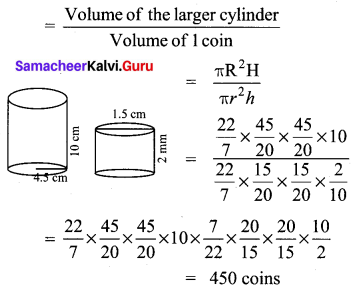
(a) v0 = v(\(\frac{3}{r}\))\(\frac{1}{2}\)
(b) v0 = 0
(c) v0 = v(\(\frac{r}{3}\))\(\frac{1}{2}\)
(d) v0 and v are not related
Answer:
(c) v0 = v(\(\frac{r}{3}\))\(\frac{1}{2}\)

Question 11.
The internal energy of an ideal gas depends on ………..
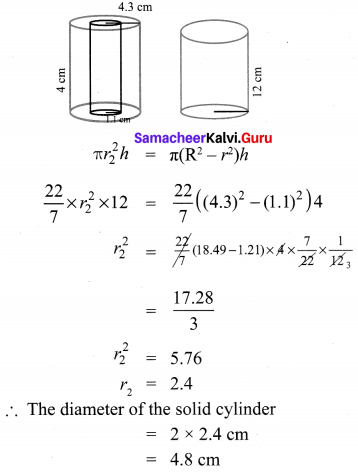
(a) pressure
(b) volume
(c) temperature
(d) size of molecules
Answer:
(c) temperature

Question 12.
The internal energy of an ideal gas increases during an isothermal process, when the gas is ……….
(a) expanded by adding more molecules to it
(b) expanded by adding more heat to it
(c) expanded against zero pressure
(d) compressed by doing work on it
Answer:
(a) expanded by adding more molecules to it

Question 13.
A particle executing simple harmonic motion of amplitude 5 cm has maximum speed of 31.4 cm/s. The frequency of its……….
(a) 3 Hz
(b) 2 Hz
(c) 4 Hz
(d) 1 Hz
Answer:
(d) 1 Hz
Hint:
A = 5 cm = 5 × 10⁻²m ; υmax = 31.4 cm/s = 31.4 × 10⁻² m/s
Maximum speed Vmax = 2πη × A
∴ n = \(\frac{V_{max}}{2πA}\) = \(\frac{31.4×10^{-2}}{2π×5×10^{-2}}\) = \(\frac{31.4}{10×3.14}\); n = 1 Hz

Question 14.
A hollow sphere is filled with water. It is hung by a long thread. As the water flows out of a hole at the bottom, the period of oscillation will………
(a) first increase and then decrease
(b) first decrease and then increase
(c) increase continuously
(d) decrease continuously
Answer:
(a) first increase and then decrease

Question 15.
A wave travels in a medium according to the equation of displacement given by y(x, t) = 0.03 sin {π(2t – 0.01 x)} where y and x are in metres and t in seconds. The wave length of the wave is……….
(a) 200 m
(b) 100 m
(c) 20 m
(d) 10 m
Answer:
(a) 200 m
Hint:
λ = \(\frac{2π}{K}\) = \(\frac{π}{0.01π}\) = 200 m

PART – II

Answer any six questions in which Q. No 23 is compulsory. [6 × 2 = 12]

Question 16.
Distinguish scalar and vector.
Answer:

ScalarVector
(i)Scalar can be described only by magnitudeVector can be described by both magnitude and direction.
(ii)Ex. mass, distance, speedEx. force, velocity, displacement

Tamil Nadu 11th Physics Model Question Paper 2 English Medium

Question 17.
Calculate the total number of degrees of freedom possessed by the molecular in one cm³ of H2 gas at NTP.
Answer:
22400 cm³ of every gas contains 6.02 × 10²³ molecules
∴ Number of molecules in 1 cm² of H2 gas = \(\frac{6.02×10^{23}}{22400}\) = 0.26875 × 10²⁰
Number of degrees of freedom of a H2 gas molecule = 5
∴ Total number of degrees of freedom of 0.26875 × 10²⁰ molecules
= 0.26875 × 1020 × 5 = 1.34375 × 10²⁰

Question 18.
A stone tied to the end of a string 80 cm long is whirled in a horizontal circle with a constant speed. If the stone makes 14 revolution in 25 s, what is the magnitude and direction of acceleration of the stone?
Answer:
The acceleration will be directed towards the centre of the circular loop
angular velocity, ω = 2πf = 2 × 3.14 × \(\frac{14}{25}\); ω = \(\frac{88}{25}\) rad/s
Centripetal acceleration = rω² = \(\frac{0.8×(88)^2}{(25)^2}\); ac = 9.91 m/s²

Question 19.
There are two identical balls of same material, one being solid and the other being hollow. How will you distinguish them without weighting?
Answer:
Solid and hollow balls can be differentiated by different methods
(a) by spinning than using equal torques
(b) by determining their moment of inertia ie Ih > Is
(c) by rolling them down is an inclined plane
ie, when torques are equal angular acceleration of hollow must be smaller than that of solid. Similarly, on rolling, solid ball will reach the bottom before the hollow ball.

Question 20.
In a dark room would you be able to tell whether a given note had been produced by a Piano or a Violin?
Answer:
Yes, in a dark room we can easily identify a sound produced by a Piano or a Violin by using the knowledge of timber or quality of sound. The two sources even though having the same intensity and fundamental frequency will be associated with different number of overtones of different relative intensities. These overtones combine and produce different sounds which enables us to identify them.

Question 21.
Will water at the foot of the waterfall be at a different temperature from that at the top? If yes explain.
Answer:
When water reaches the ground, its gravitational potential energy is converted into kinetic energy which is further converted into heat energy. This raises the temperature of water. So, water at the foot of the water fall is at a higher temperature of water at the top of the waterfall.

Question 22.
Which one among a solid, liquid gas of same mass and at the same temperature has the greatest internal energy. Which one has least and why?
Answer:
A gas has greatest value of internal energy. Being a negative potential energy, potential energy of its molecules is smallest. Internal energy of solid is maximum because negative potential energy of its molecules is maximum.

Question 23.
Is it possible if work is done by the internal force. What will be the change in kinetic energy?
Answer:
Yes. this is possible. If work is done by the internal forces then kinetic energy will be increased. As an example, when a bomb explodes, the combined kinetic energy of all the fragments is greater than the initial energy.

Tamil Nadu 11th Physics Model Question Paper 2 English Medium

Question 24.
What is red shift and blue shift in Doppler effect.
Answer:
If the spectral lines of the star are found to shift towards red end of the spectrum (called as red shift) then the star is receding away from the Earth. Similarly, if the spectral lines of the star are found to shift towards the blue end of the spectrum (called as blue shift) then the star is approaching Earth.

PART – III

Answer any six questions in which Q.No. 29 is compulsory. [6 × 3 = 18]

Question 25.
Give the difference between systematic errors and random errors.
Answer:
Systematic errors: Systematic errors are reproducible inaccuracies that are consistently in the same direction. These occur often due to a problem that persists throughout the experiment.

Random errors: Random errors may arise due to random and unpredictable variations in experimental conditions like pressure, temperature, voltage supply etc. Errors may also be due to personal errors by the observer who performs the experiment. Random errors are sometimes called “chance error”. When different readings are obtained by a person every time he repeats the experiment, personal error occurs.

Question 26.
Write down the kinematics equation for the object moving in a straight line with constant acceleration and also for free falling body.
Answer:
(a) the equation of motion of a moving object with constant acceleration is

  1. v – u + at
  2. s = ut+ \(\frac{1}{2}\) at²
  3. v² – u² = 2 as

(b) for free falling body u = 0 and a = g

  1. V = gt
  2. s = \(\frac{1}{2}\) gt2
  3. v² = 2 gs

Question 27.
A nucleus is at rest in the laboratory frame of reference show that if it disintegrates into two smaller nuclei. The products must be emitted in opposite directions.
Answer:
Let m1, m2 are be the masses of product nuclei and v1, v2 are the velocities of it.
∴ linear momentum after disintegration = m1v1 + m2v2
Before disintegration nucleus is at rest therefore its linear momentum before disintegration is zero. According to the principle of conservation of linear momentum
m1v1 + m2v2 = 0
v2 = –\(\frac{m_1v_1}{m_2}\)

Tamil Nadu 11th Physics Model Question Paper 2 English Medium

Question 28.
How do you classify the physical quantities on the basis of dimension?
Answer:

  1. Dimensional variables: Physical quantities, which possess dimensions and have variable values are called dimensional variables. Examples are length, velocity, and acceleration etc.
  2. Dimensionless variables: Physical quantities which have no dimensions,. but have variable values are called dimensionless variables. Examples are specific gravity, strain, refractive index etc.
  3. Dimensional Constant: Physical quantities which possess dimensions and have constant values are called dimensional constants. Examples are Gravitational constant, Planck’s constant etc.
  4. Dimensionless Constant: Quantities which have constant values and also have no dimensions are called dimensionless constants. Examples are π, e, numbers etc.

Question 29.
Write short notes on the oscillations of liquid column in U-tube.
Answer:
Oscillations of liquid in U-tube.
Tamil Nadu 11th Physics Model Question Paper 4 English Medium 1
Consider a U-shaped glass tube which consists of two open arms with uniform cross sectional area A. Let us pour a non-viscous uniform incompressible liquid of density ρ in the U-shaped tube to a height h as shown in the figure. If the liquid and tube are not disturbed then the liquid surface will be in equilibrium position O. It means the pressure as measured at any point on the liquid is the same and also at the surface on the arm (edge of the tube on either side), which balances with the atmospheric pressure. Due to this the level of liquid in each arm will be the same. By blowing air one can provide sufficient force in one arm, and the liquid gets disturbed from equilibrium position O, which means, the pressure at blown arm is higher than the other arm. This creates difference in pressure which will cause the liquid to oscillate for a very short duration of time about the mean or equilibrium position and finally comes to rest, Time period of the oscillation is
T = 2π\(\sqrt{\frac{l}{2g}}\) second

Question 30.
What are the factors affecting the surface tension of a liquid.
Answer:

  1. The presence of any contamination or impurities.
  2. The presence of dissolved substances.
  3. Electrification
  4. Temperature

Question 31.
Write a note on Brownian motion.
Answer:
Brownian motion is due to the bombardment of suspended particles by molecules of the surrounding fluid. But during 19th century people did not accept that every matter is made up of small atoms or molecules. In the year 1905, Einstein gave systematic theory of Brownian motion based on kinetic theory and he deduced the average size of molecules.

According to kinetic theory, any particle suspended in a liquid or gas is continuously bombarded from all the directions so that the mean free path is almost negligible. This leads to the motion of the particles in a random and zig-zag manner. But when we put our hand in water it causes no random motion because the mass of our hand is so large that the momentum transferred by the molecular collision is not enough to move our hand.
Tamil Nadu 11th Physics Model Question Paper 4 English Medium 2
Factors affecting Brownian Motion:

  1. Brownian motion increases with increasing temperature.
  2. Brownian motion decreases with bigger particle size, high viscosity and density of the liquid (or) gas.

Tamil Nadu 11th Physics Model Question Paper 2 English Medium

Question 32.
What is the acceleration of the block and troller system as the figure. If the Co-efficient of kinetic friction between the trolley and the surface is 0.04? Also calculate friction in the string. Take G = 10 ms-2, mass of the string is negligible.
Answer:
Tamil Nadu 11th Physics Model Question Paper 4 English Medium 3
Free body diagram of the block
30 – T = 3a ……..(1)
Free body diagram of the trolley
T – fk = 20a ……(2)
where fk = = µk N = 0.04 × 20 × 10 = 8 N
Solving (1) & (2), a = 0.96 m/s² and T = 27.2 N

Question 33.
An increase in pressure of 100 kPa causes a certain volume of water to decrease by 0.005% of its original volume.
(a) Calculate the bulk modulus of water?
Answer:
Bulk modulus
B = v|\(\frac{Δp}{Δv}\)| = \(\frac{100×10^3}{0.005×10^{-2}}\)
B = 2000 MPa

(b) Compute the speed of sound (compressional waves) in water?
Answer:
v = \(\sqrt{\frac{B}{ρ}}\) = \(\sqrt{\frac{2000×10_6}{1000}}\)
v = 1414 ms-1

PART – IV

Answer all the questions. [5 × 5 = 25]

Question 34 (a).
Describe the vertical oscillations of a spring?
Answer:
Vertical oscillations of a spring: Let us consider a massless spring with stiffness constant or force constant k attached to a ceiling as shown in figure. Let the length of the spring before loading mass m be L.

If the block of mass m is attached to the other end of spring, then the spring elongates by a length. Let F, be the restoring force due to stretching of spring. Due to mass m, the gravitational force acts vertically downward. We can draw free-body diagram for this system as shown in figure. When the system is under equilibrium,

Tamil Nadu 11th Physics Model Question Paper 4 English Medium 4

F1 + mg = 0 ……………… (1)
But the spring elongates by small displacement 1, therefore,
F1 ∝ l ⇒ F1 = -kl ……………….. (2)
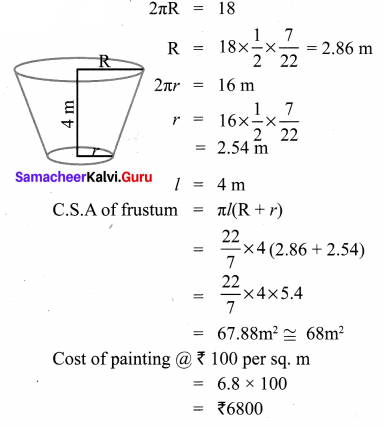
Substituting equation (2) in equation (1) we get
-kl + mg = 0
mg = kl or
\(\frac{m}{k}\) = \(\frac{l}{g}\) ………………….. (3)
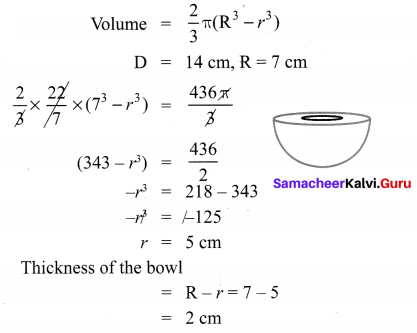
Suppose we apply a very small external force on the mass such that the mass further displaces downward by a displacement y, then it will oscillate up and down. Now, the restoring force due to this stretching of spring (total extension of spring is y + 1) is
F2 ∝ (y + l)
F2 = -k(y + l) = -ky – kl …………………… (4)

Since, the mass moves up and down with acceleration \(\frac{d^{2} y}{d t^{2}}\), by drawing the free body diagram for this case we get
-ky – kl + mg = m \(\frac{d^{2} y}{d t^{2}}\) ……………………. (5)
The net force acting on the mass due to this stretching is
F = F2 + mg
F = -ky – kl + mg …………………… (6)
The gravitational force opposes the restoring force. Substituting equation (3) in equation (6), we get
F = – ky- kl + kl = -ky
Applying Newton’s law we get
m \(\frac{d^{2} y}{d t^{2}}\) = -ky
\(\frac{d^{2} y}{d t^{2}}\) = –\(\frac{k}{m}\)y ………………… (7)
The above equation is in the form of simple harmonic differential equation. Therefore, we get the time period as
T = 2π\(\sqrt{m/k}\) second ……………………. (8)
The time period can be rewritten using equation (3)
T = 2π\(\sqrt{m/k}\) = 2πl\(\frac{1}{g}\) second ……………………. (9)
The accleration due to gravity g can be computed by the formula
g = 4π2\((\frac { 1 }{ T } )^{ 2 }\)ms-2 …………………….. (10)

Tamil Nadu 11th Physics Model Question Paper 2 English Medium

[OR]

(b) Derive poiseuille’s formula for the volume of a liquid flowing per second through a pipe under streamlined flow?
Answer:
Consider a liquid flowing steadily through a horizontal capillary tube. Let v = (\(\frac{1}{g}\)) be the volume of the liquid flowing out per second through a capillary tube. It depends on (1) coefficient of viscosity (η) of the liquid, (2) radius of the tube (r), and (3) the pressure gradient (\(\frac{P}{l}\)) . Then,
v ∝ηarb(\(\frac{P}{l}\))c
v = kηarb(\(\frac{P}{l}\))c …………………….. (1)

where, k is a dimensionless constant.
Therefore, [v] = \(\frac { Volume }{ Time } \) = [L3T-1]; [ \(\frac{dP}{dX}\) ] = \(\frac { Pressure }{ Distance } \) = [ML-2T-2]
[η] = [Ml-1T-1] and [r] = [L]

Substituting in equation (1)
[L3T-1] = [ML-1T-1]a[L]b [ML-2T-2]c
M0L3T-1 = Ma+bL-a+b-2cT-a-2c = -1

So, equating the powers of M, L and T on both sides, we get
a + c = 0, – a + b – 2c = 3, and – a – 2c = – 1

We have three unknowns a, b and c. We have three equations, on solving, we get
a = – 1, b = 4 and c = 1

Therefore, equation (1) becomes,
v = kη-1r4(\(\frac{P}{l}\))1

Experimentally, the value of k is shown to be , we have \(\frac{π}{8}\), we have
v = \(\frac{\pi r^{4} \mathrm{P}}{8 \eta /}\)

The above equation is known as Poiseuille’s equation for the flow of liquid through a narrow tube or a capillary tube. This relation holds good for the fluids whose velocities are lesser than the critical velocity (vc).

Tamil Nadu 11th Physics Model Question Paper 2 English Medium

Question 35 (a).
Describe briefly simple harmonic oscillation as a projection of uniform circular motion?
Answer:
Consider a particle of mass m moving with unifonn speed v along the circumference of a circle whose radius is r in anti-clockwise direction (as shown in figure). Let us assume that the origin of the coordinate system coincides with the center O of the circle.

If ω is the angular velocity of the particle and θ the angular displacement of the particle at any instant of time t, then θ = ωt. By projecting the uniform circular motion on its diameter gives a simple harmonic motion.

This means that we can associate a map (or a relationship) between uniform circular (or revolution) motion to vibratory motion. Conversely, any vibratory motion or revolution can be mapped to unifonn circular motion. In other words, these two motions are similar in nature.

Let us first project the position of a particle moving on a circle, on to its vertical diameter or on to a line parallel to vertical diameter as shown in figure. Similarly, we can do it for horizontal axis or a line parallel to horizontal axis.

Tamil Nadu 11th Physics Model Question Paper 4 English Medium 5

The projection of uniform circular motion on a diameter of SHM:
As a specific example, consider a spring mass system (or oscillation of pendulum). When the spring moves up and down (or pendulum moves to and fro), the motion of the mass or bob is mapped to points on the circular motion.

Thus, if a particle undergoes uniform circular motion then the projection of the particle on the diameter of the circle (or on a line parallel to the diameter) traces straight line motion which is simple harmonic in nature. The circle is known as reference circle of the simple harmonic motion. The simple harmonic motion can also be defined as the motion of the projection of a particle on any diameter of a circle of reference.

[OR]

(b) State and prove Bernoulli’s theorem for a flow of incompressible non viscous and stream lined flow of fluid?
Answer:
Bernoulli’s theorem:
According to Bernoulli’s theorem, the sum of pressure energy, kinetic energy, and potential energy per unit mass of an incompressible, non-viscous fluid in a streamlined flow remains a constant. Mathematically,
\(\frac{P}{ρ}\) + \(\frac{1}{2}\)v2 + gh – constant
This is known as Bernoulli’s equation.
Proof:
Let us consider a flow of liquid through a pipe AB. Let V be the volume of the liquid when it enters A in a time t. Which is equal to the volume of the liquid leaving B in the same time. Let aA, vA and PA be the area of cross section of the tube, velocity of the liquid and pressure exerted by the liquid at A respectively.

Let the force exerted by the liquid at A is
FA = PAaA

Distance travelled by the liquid in time t is d = vAt
Therefore, the work done is W = FAd = PAaAvAt
But aAvAt = aAd = V, volume of the liquid entering at A.

Thus, the work done is the pressure energy (at A), W = FAd = PAV

Pressure energy per unit volume at
A = \($\frac{\text { Pressure energy }}{\text { Volume }}$\) = \(\frac { P_{ A }V }{ V } \) = PA

Pressure energy per unit mass at
A = \($\frac{\text { Pressure energy }}{\text { Mass }}$\) = \(\frac { P_{ A }V }{ m } \) = \(\frac { P_{ A } }{ \frac { m }{ V } } \) = \(\frac { P_{ A } }{ \rho } \)

Since m is the mass of the liquid entering at A in a given time, therefore, pressure energy of the liquid at A is
EPA = PAV = PAV × (\(\frac{m}{m}\)) = m\(\frac { P_{ A } }{ \rho } \)

Potential energy of the liquid at A,
PEA = mghA

Due to the flow of liquid, the kinetic energy of the liquid at A,
KEA = \(\frac{1}{2}\)mv2A

Therefore, the total energy due to the flow of liquid at A,
EA = EPA + KEA + PEA
EA = \(m \frac{P_{A}}{\rho}+\frac{1}{2} m v_{A}^{2}+m g h_{A}\)

Similarly, let aB, VB and PB be the area of cross section of the tube, velocity of the liquid and pressure exerted by the liquid at B. Calculating the total energy at FB, we get .
\(\mathrm{E}_{\mathrm{B}}=m \frac{\mathrm{P}_{\mathrm{B}}}{\rho}+\frac{1}{2} m v_{\mathrm{B}}^{2}+m g h_{\mathrm{B}}\)
From the law of conservation of energy.
EA = EB

Tamil Nadu 11th Physics Model Question Paper 4 English Medium 6

Thus, the above equation can be written as
\(\frac { P }{ \rho g } \) + \(\frac{1}{2}\) \(\frac { v^{ 2 } }{ g } \) + h = Constant

The above equation is the consequence of the conservation of energy which is true until there is no loss of energy due to friction. But in practice, some energy is lost due to friction. This arises due to the fact that in a fluid flow, the layers flowing with different velocities exert frictional forces on each other. This loss of energy is generally converted into heat energy. Therefore, Bernoulli’s relation is strictly valid for fluids with zero viscosity or non-viscous liquids. Notice that when the liquid flows through a horizontal pipe, then
h = 0 ⇒ \(\frac { P }{ \rho g } \) + \(\frac{1}{2}\) \(\frac { v^{ 2 } }{ g } \) = Constant

Tamil Nadu 11th Physics Model Question Paper 2 English Medium

Question 36 (a).
Explain perfect inelastic collision and derive an expression for loss of kinetic energy in perfect inelastic collision?
Answer:
In a perfectly inelastic or completely inelastic collision, the objects stick together permanently after collision such that they move with common velocity. Let the two bodies with masses m1 and m2 move with initial velocities u1 and u2 respectively before collision. Aft er perfect inelastic collision both the objects move together with a common velocity v as shown in figure.
Since, the linear momentum is conserved during collisions,

Tamil Nadu 11th Physics Model Question Paper 4 English Medium 7

m1u1 + m2u2 = (m1 + m2) v

Tamil Nadu 11th Physics Model Question Paper 4 English Medium 8

The common velocity can be computed by
v = \(\frac{m_{1} u_{1}+m_{2} u_{2}}{\left(m_{1}+m_{2}\right)}\) ………………….. (1)

Loss of kinetic energy in perfect inelastic collision;
In perfectly inelastic collision, the loss in kinetic energy during collision is transformed to another form of energy like sound, thermal, heat, light etc. Let KEi be the total kinetic energy before collision and KEf be the total kinetic energy after collision.
Total kinetic energy before collision,
KEe = \(\frac{1}{2} m_{1} u_{1}^{2}+\frac{1}{2} m_{2} u_{2}^{2}\) …………………… (2)
Total kinetic energy after collision,
KEf = \(\frac{1}{2}\left(m_{1}+m_{2}\right) v^{2}\) …………………….. (3)
Then the loss of kinetic energy is Loss of KE, ∆Q = KEf – KEi
= \(\frac{1}{2}\left(m_{1}+m_{2}\right) v^{2}-\frac{1}{2} m_{1} u_{1}^{2}-\frac{1}{2} m_{2} u_{2}^{2}\) ………………….. (4)
Substituting equation (1) in equation (4), and on simplifying (expand v by using the algebra (a + b)2 = a2 + b2 + 2ab), we get
Loss of KE, ∆Q = \(\frac{1}{2}\) \(\left(\frac{m_{1} m_{2}}{m_{1}+m_{2}}\right)\) (u1 – u2)2

[OR]

(b) Derive an expression for maximum height attained, time of flight, horizontal range for a projectile in oblique projection?
Answer:

Tamil Nadu 11th Physics Model Question Paper 4 English Medium 9

Maximum height (hmax):
The maximum vertical distance travelled by the projectile during the journey is called maximum height. This is determined as follows:
For the vertical part of the motion
\(v_{y}^{2}=u_{y}^{2}+2 a_{y} s\)
Here, uy= u sin θ, a = -g, s = hmax, and at the maximum height v = 0

Time of flight (Tf):
The total time taken by the projectile from the point of projection till it hits the horizontal plane is called time of flight. This time of flight is the time taken by the projectile to go from point O to B via point A as shown in figure.
We know that sy = uyt + \(\frac{1}{2}\)ayt2
Here, sy = y = 0 (net displacement in y-direction is zero), uy = u sin θ, ay = -g, t = Tf, Then
0 = u sin θ Tf – \(\frac{1}{2} g \mathrm{T}_{f}^{2}\)
Tf = 2u \(\frac{sin θ}{g}\) …………………….. (2)

Horizontal range (R):
The maximum horizontal distance between the point of projection and the point on the horizontal plane where the projectile hits the ground is called horizontal range (R). This is found easily since the horizontal component of initial velocity remains the same. We can write.

Range R = Horizontal component of velocity % time of flight = u cos θ × Tf = \(\frac{u^{2} \sin 2 \theta}{g}\)
The horizontal range directly depends on the initial speed (u) and the sine of angle of projection (θ). It inversely depends on acceleration due to gravity ‘g’.

For a given initial speed u, the maximum possible range is reached when sin 2θ is
maximum, sin 2θ = 1. This implies 2θ = π/2 or θ = π/4
This means that if the particle is projected at 45 degrees with respect to horizontal, it attains maximum range, given by
Rmax = \(\frac { u^{ 2 } }{ g } \).

Tamil Nadu 11th Physics Model Question Paper 2 English Medium

Question 37 (a).
Explain the work-energy theorem in detail and also give three examples?
Answer:

  1. If the work done by the force on the body is positive then its kinetic energy increases.
  2. If the work done by the force on the body is negative then its kinetic energy decreases.
  3. If there is no work done by the force on the body then there is no change in its kinetic energy, which means that the body has moved at constant speed provided its mass remains constant.
  4. When a particle moves with constant speed in a circle, there is no change in the kinetic energy of the particle. So according to work energy principle, the work done by centripetal force is zero.

[OR]

(b) (i) Define molar specific heat capacity?
Answer:
Molar specific heat capacity is defined as heat energy required to increase the temperature of one mole of substance by IK or 1°C

(ii) Derive Mayer’s relation for an ideal gas?

Mayer’s relation: Consider p mole of an ideal gas in a container with volume V, pressure P and temperature T.

When the gas is heated at constant volume the temperature increases by dT. As no work is done by the gas, the heat that flows into the system will increase only the internal energy. Let the change in internal energy be dU.

If CV is the molar specific heat capacity at constant volume, from equation.
CV = \(\frac { 1 }{ \mu } \) \(\frac{dU}{dT}\) …………………… (1)
dU = µCV dT ………………… (2)

Suppose the gas is heated at constant pressure so that the temperature increases by dT. If ‘Q’ is the heat supplied in this process and ‘dV’ the change in volume of the gas.
Q = pCpdT ……………. (3)

If W is the workdone by the gas in this process, then
W = P dV ………………….. (4)

But from the first law of thermodynamics,
Q = dU + W ………………… (5)

Substituting equations (2), (3) and (4) in (5), we get,
For mole of ideal gas, the equation of state is given by
\(\mu \mathrm{C}_{\mathrm{p}} d \mathrm{T}=\mu \mathrm{C}_{\mathrm{v}} d \mathrm{T}+\mathrm{P} d \mathrm{V}\)

Since the pressure is constant, dP = 0
CpdT = CVdT + PdV
∴ Cp = CV + R (or) Cp – CV = R …………………… (6)
This relation is called Mayer’s relation It implies that the molar specific heat capacity of an ideal gas at constant pressure is greater than molar specific heat capacity at constant volume.
The relation shows that specific heat at constant pressure (sp) is always greater than specific heat at constant volume (sv).

Tamil Nadu 11th Physics Model Question Paper 2 English Medium

Question 38 (a).
Derive an expression of pressure exerted by the gas on the walls of the container?
Answer:
Expression for pressure exerted by a gas : Consider a monoatomic gas of N molecules each having a mass m inside a cubical container of side l.
The molecules of the gas are in random motion. They collide with each other and also with the walls of the container. As the collisions are elastic in nature, there is no loss of energy, but a change in momentum occurs.

Tamil Nadu 11th Physics Model Question Paper 4 English Medium 10

The molecules of the gas exert pressure on the walls of the container due to collision on it. During each collision, the molecules impart certain momentum to the wall. Due to transfer of momentum, the walls experience a continuous force. The force experienced per unit area of the walls of the container determines the pressure exerted by the gas. It is essential to determine the total momentum transferred by the molecules in a short interval of time.

A molecule of mass m moving with a velocity \(\vec { v } \) having components (vx, vy, vz) hits the right side wall. Since we have assumed that the collision is elastic, the particle rebounds with same speed and its x-component is reversed. This is shown in the figure. The components of velocity of the molecule after collision are (-vx, vy, vz).

The x-component of momentum of the molecule before collision = mvx
The x-component of momentum of the molecule after collision = – mvx
The change in momentum of the molecule in x direction
= Final momentum – initial momentum = – mvx – mvx = – 2mvx
According to law of conservation of linear momentum, the change in momentum of the wall = 2 mvx
The number of molecules hitting the right side wall in a small interval of time ∆t.

Tamil Nadu 11th Physics Model Question Paper 4 English Medium 11

The molecules within the distance of vx∆t from the right side wall and moving towards the right will hit the wall in the time interval ∆t. The number of molecules that will hit the right side wall in a time interval ∆t is equal to the product of volume (Avx∆t) and number density of the molecules (n).

Here A is area of the wall and n is number of molecules per \(\frac{N}{V}\) unit volume. We have assumed that the number density is the same throughout the cube.

Not all the n molecules will move to the right, therefore on an average only half of the n molecules move to the right and the other half moves towards left side.

The number of molecules that hit the right side wall in a time interval ∆t
= \(\frac{n}{2}\) Avx∆t
In the same interval of time ∆t, the total momentum transferred by the molecules
\(\Delta \mathrm{P}=\frac{n}{2} \mathrm{A} v_{x} \Delta t \times 2 m v_{x}=\mathrm{A} v_{x}^{2} m n \Delta t\) ………………….. (2)
From Newton’s second law, the change in momentum in a small interval of time gives rise to force.

The force exerted by the molecules on the wall (in magnitude)
F = \(\frac{∆p}{∆t}\) = nmAv2x ……………………. (3)

Pressure, P = force divided by the area of the wall
P = \(\frac{F}{A}\) = nmAv2x ……………………….. (4)
p = \(nm\bar{v}_{x}^{2}\)

Since all the molecules are moving completely in random manner, they do not have same . speed. So we can replace the term vnmAv2x by the average \(\bar { v } \)2x in equation (4).
P = nm\(\bar { v } \)2x ……………………. (5)

Since the gas is assumed to move in random direction, it has no preferred direction of motion (the effect of gravity on the molecules is neglected). It implies that the molecule has same average speed in all the three direction. So, \(\bar{v}_{x}^{2}\) = \(\bar{v}_{y}^{2}\) = \(\bar{v}_{z}^{2}\). The mean square speed is written as
\(\bar{v}^{2}\) = \(\bar{v}_{x}^{2}\) + \(\bar{v}_{y}^{2}\) + \(\bar{v}_{z}^{2}\) = 3\(\bar{v}_{x}^{2}\)
\(\bar{v}_{x}^{2}\) = \(\frac{1}{3}\) \(\bar{v}^{2}\)
Using this in equation (5), we get
P = \(\frac{1}{3} n m \bar{v}^{2} \quad \text { or } P=\frac{1}{3} \frac{N}{V} m \bar{v}^{2}\) ………………….. (6)

[OR]

(b) Discuss the simple pendulum in detail?
Answer:
Simple pendulum

Tamil Nadu 11th Physics Model Question Paper 4 English Medium 12

A pendulum is a mechanical system which exhibits periodic motion. It has a bob with mass m suspended by a long string (assumed to be massless and inextensible string) and the other end is fixed on a stand. At equilibrium, the pendulum does not oscillate and hangs vertically downward.

Such a position is known as mean position or equilibrium position. When a pendulum is displaced through a small displacement from its equilibrium position and released, the bob of the pendulum executes to and fro motion. Let l be the length of the pendulum which is taken as the distance between the point of suspension and the centre of gravity of the bob. Two forces act on the bob of the pendulum at any displaced position.

  • The gravitational force acting on the body (\(\vec { F} \) = m\(\vec { g } \)) which acts vertically downwards.
  • The tension in the string T which acts along the string to the point of suspension.

Tamil Nadu 11th Physics Model Question Paper 2 English Medium

Resolving the gravitational force into its components:

  1. Normal component: The component along the string but in opposition to the direction of tension, Fas = mg cos θ.
  2. Tangential component: The component perpendicular to the string i.e., along tangential direction of arc of swing, Fps = mg sin θ.

Therefore, The normal component of the force is, along the string,
\(\mathrm{T}-\mathrm{W}_{a s}=m \frac{v^{2}}{l}\)

Here v is speed of bob
T -mg cos θ = m \(\frac{v^{2}}{l}\)

From the figure, we can observe that the tangential component Wps of the gravitational force always points towards the equilibrium position i.e., the direction in which it always points opposite to the direction of displacement of the bob from the mean position. Hence, in this case, the tangential force is nothing but the restoring force. Applying Newton’s second law along tangential direction, we have
\(m \frac{d^{2} s}{d t^{2}}+\mathrm{F}_{p s}=0 \Rightarrow m \frac{d^{2} s}{d t^{2}}=-\mathrm{F}_{p s}\)
\(m \frac{d^{2} s}{d t^{2}}=-m g \sin \theta\) …………………. (1)

where, s is the position of bob which is measured along the arc. Expressing arc length in terms of angular displacement i.e.,
s = lθ ………………… (2)
then its acceleration, \(\frac{d^{2} s}{d t^{2}}=l \frac{d^{2} \theta}{d t^{2}}\) …………………. (3)

Substituting equation (3) in equation (1), we get
\(\begin{aligned}
l \frac{d^{2} \theta}{d t^{2}} &=-g \sin \theta \\
\frac{d^{2} \theta}{d t^{2}} &=-\frac{g}{l} \sin \theta
\end{aligned}\) ………………….. (4)

Because of the presence of sin θ in the above differential equation, it is a non-linear differential equation (Here, homogeneous second order). Assume “the small oscillation approximation”, sin θ ~ 0, the above differential equation becomes linear differential equation.
\(\frac{d^{2} \theta}{d t^{2}}=-\frac{g}{l} \theta\) …………………… (5)

This is the well known oscillatory differential equation. Therefore, the angular frequency of this oscillator (natural frequency of this system) is
ω2 = \(\frac{g}{l}\) …………………… (6)
∴ ω = \(\sqrt{g/l}\) in rad s-1 ……………….. (7)

The frequency of oscillation is
f = \(f=\frac{1}{2 \pi} \sqrt{\frac{g}{l}} \text { in } \mathrm{Hz}\) ………………… (8)
and time period of sscillations is
T = 2π\(\sqrt{l/g}\) in second. ……………….. (9)