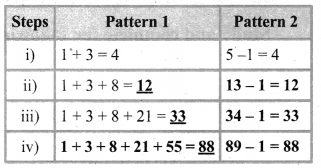
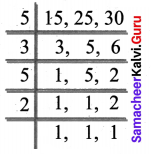
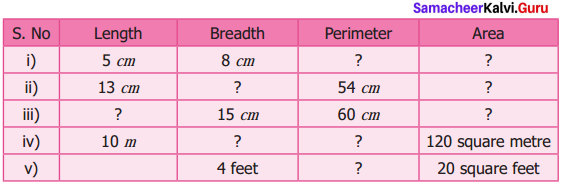
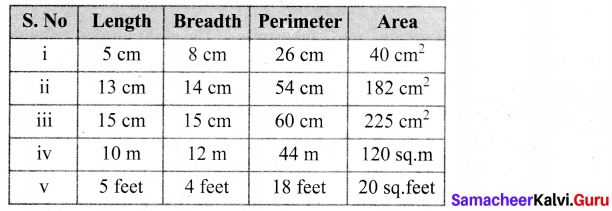
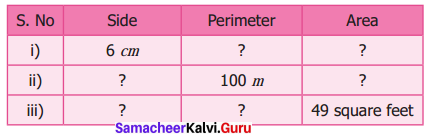
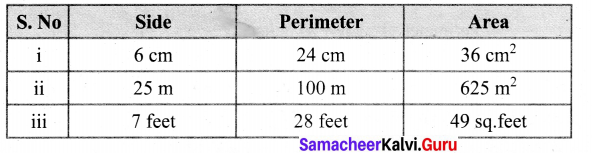
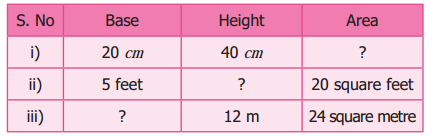
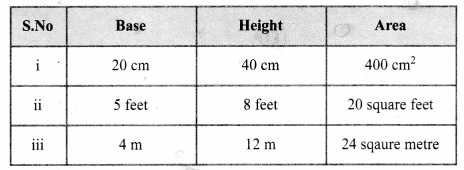
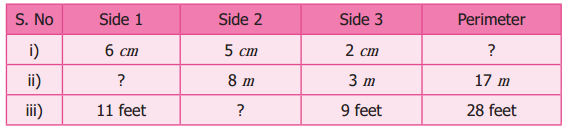
Samacheer Kalvi 6th Maths Solutions Term 1 Chapter 3 Ratio and Proportion Ex 3.1

You can Download Samacheer Kalvi 6th Maths Book Solutions Guide Pdf, Tamilnadu State Board help you to revise the complete Syllabus and score more marks in your examinations.

Tamilnadu Samacheer Kalvi 6th Maths Solutions Term 1 Chapter 3 Ratio and Proportion Ex 3.1

Samacheer Kalvi 6th Maths Solutions Term 1 Chapter 3 Ratio and Proportion Ex 3.1
Question 1.
Fill in the blanks.
(i) Ratio of ₹ 3 to ₹ 5 = ____
(ii) Ratio of 3 m to 200 cm = ______
(iii) Ratio of 5 km 400 m to 6 km = ____
(iv) Ratio of 75 paise to ₹ 2 = ____
Solution:
(i) 3 : 5
(ii) 3 : 2
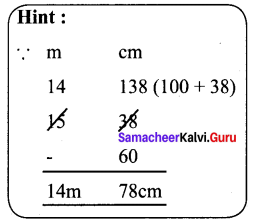
Hint: 3m = 300 cm
(iii) 9 : 10
Hint: 5km 400 m = 5400m and 6 km = 6000 m
(iv) 3 : 8
Hint: ₹ 2 = 200 paise

Question 2.
Say whether the following statements are True or False.
(i) The ratio of 130 cm to 1 m is 13 : 10.
(ii) One of the terms in a ratio cannot be 1.
Solution:
(i) True
(ii) False

Question 3.
Find the simplified form of the following ratios.
(i) 15 : 20
(ii) 32 : 24
(iii) 7 : 15
(iv) 12 : 27
(v) 75 : 100
Solution:
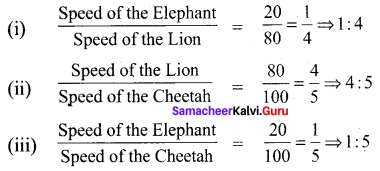
Samacheer Kalvi 6th Maths Term 1 Chapter 3 Ratio and Proportion Ex 3.1 Q3

Question 4.
Akilan walks 10 km in an hour while Selvi walks 6 km in an hour. Find the simplest ratio of the distance covered by Akilan to that of Selvi.
Solution:
Ratio of the distance covered by Akilan to that of Selvi = 10 km : 6 km
= \(\frac{10}{6}\)
= \(\frac{5}{3}\)
= 5 : 3

Question 5.
The cost of parking a bicycle is ₹ 5 and the cost of parking a scooter is ₹ 15. Find the simplest ratio of the parking cost of a bicycle to that of a scooter.
Solution:
Parking cost of bicycle = ₹ 5
Parking cost of Scooter = ₹ 15
\(\frac{\text { Parking cost of bicyle }}{\text { Parking cost of scooter }}=\frac{5}{15}=\frac{1}{3}\)
Parking cost of bicycle : scooter = 1 : 3

Samacheer Kalvi 6th Maths Solutions Term 1 Chapter 3 Ratio and Proportion Ex 3.1

Question 6.
Out of 50 students in class 30 are boys. Find the ratio of
(i) number of boys to the number of girls
(ii) number of girls to the total number of students
(iii) number of boys to the total number of students
Solution:
The total number of students = 50.
The number of boys = 30.
Then number of girls = 50 – 30 = 20.
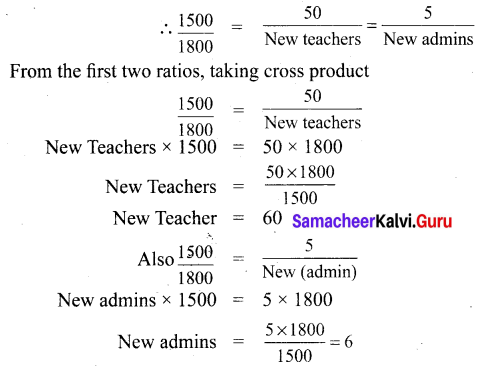
Samacheer Kalvi 6th Maths Term 1 Chapter 3 Ratio and Proportion Ex 3.1 Q6

Objective Type Questions

Question 7.
The ratio of Rs 1 to 20 paise is
(a) 1 : 5
(b) 1 : 2
(c) 2 : 1
(d) 5 : 1
Solution:
(d) 5 : 1

Question 8.
The ratio of 1 m to 50 cm is _____
(a) 1 : 50
(b) 50 : 1
(c) 2 : 1
(d) 1 : 2
Solution:
(c) 2 : 1
Hint: 1 m = 100 cm

Question 9.
The length and breadth of a window are in 1 m and 70 cm respectively. The ratio of the length to the breadth is
a) 1 : 7
(b) 7 : 1
(c) 7 : 10
(d) 10 : 7
Solution:
(d) 10 : 7

Question 10.
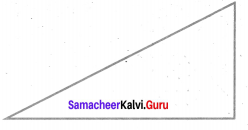
The ratio of the number of sides of a triangle to the number of sides of a rectangle is ____
(a) 4 : 3
(b) 3 : 4
(c) 3 : 5
(d) 3 : 2
Solution:
(b) 3 : 4
Triangle has three sides and a rectangle has four sides.

Samacheer Kalvi 6th Maths Solutions Term 1 Chapter 3 Ratio and Proportion Ex 3.1

Question 11.
If Azhagan is 50 years old and his son is 10 years old then the simplest ratio between the age of Azhagan to his son is
(a) 10 : 50
(b) 50 : 10
(c) 5 : 1
(d) 1 : 5
Solution:
(c) 5 : 1

Samacheer Kalvi 6th Maths Solutions Term 3 Chapter 5 Information Processing Ex 5.2

You can Download Samacheer Kalvi 6th Maths Book Solutions Guide Pdf, Tamilnadu State Board help you to revise the complete Syllabus and score more marks in your examinations.
Samacheer Kalvi 6th Maths Solutions Term 3 Chapter 5 Information Processing Ex 5.2

Tamilnadu Samacheer Kalvi 6th Maths Solutions Term 3 Chapter 5 Information Processing Ex 5.2

Miscellaneous Practice problems

Question 1.
Find HCF of 188 and 230 by Euclid’s game.
Solution:
By Euclid’s game HCF (a, b) = HCF (a, a – b) if a > b.
Here HCF (188, 230) = HCF (230, – 188) because 230 > 188
= HCF (188, 42) = HCF (146, 42)
= HCF (104, 42) = HCF (62, 42)
= HCF (42, 20) = HCF (22, 20)
= HCF (20,2) = HCF (18, 2) = 2
∴ HCF (230, 188) = 2

Question 2.
Write the numbers from 1 to 50. From that find the following.
(i) The numbers which are neither divisible by 2 nor 7.
(ii) The prime numbers between 25 and 40.
(iii) All square number upto 50.
Solution :
(i) 9, 11, 13, 15, 17, 19, 23, 25, 27, 29, 31, 33, 37, 39, 41, 43, 45, 47
(ii) 29, 31, 37
(iii) 1, 4, 9, 16, 25, 36, 49

Samacheer Kalvi 6th Maths Solutions Term 3 Chapter 5 Information Processing Ex 5.2

Question 3.
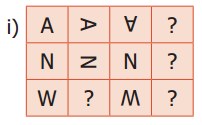
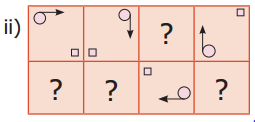
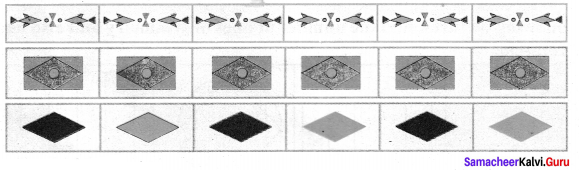
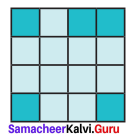
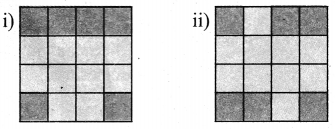
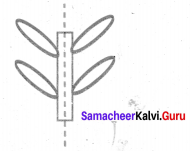
Complete the following pattern
Samacheer Kalvi 6th Maths Solutions Term 3 Chapter 5 Information Processing Ex 5.2 1
Samacheer Kalvi 6th Maths Solutions Term 3 Chapter 5 Information Processing Ex 5.2 3
Samacheer Kalvi 6th Maths Solutions Term 3 Chapter 5 Information Processing Ex 5.2 5
Samacheer Kalvi 6th Maths Solutions Term 3 Chapter 5 Information Processing Ex 5.2 7
Solution:
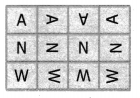
(i)
Samacheer Kalvi 6th Maths Solutions Term 3 Chapter 5 Information Processing Ex 5.2 2

(ii)
Samacheer Kalvi 6th Maths Solutions Term 3 Chapter 5 Information Processing Ex 5.2 4

Samacheer Kalvi 6th Maths Solutions Term 3 Chapter 5 Information Processing Ex 5.2 6


Samacheer Kalvi 6th Maths Solutions Term 3 Chapter 5 Information Processing Ex 5.2

Question 4.
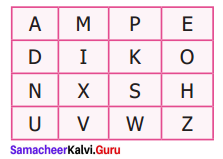
Complete the table by using the following instructions.
A : It is the 6th term in the Fibonacci sequence.
B : The predecessor of 2.
C : LCM of 2 and 3.
D : HCF of 6 and 20.
E : The reciprocal of 1/5.
F : The opposite number of -7.
G : The first composite number.
H : Area of a square of side 3 cm.
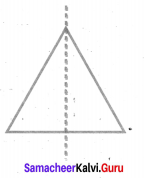
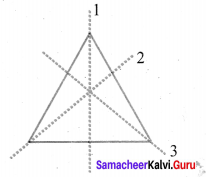
I : The number of lines of symmetry of an equilateral triangle. After completing the table, what do you observe? Discuss.
Samacheer Kalvi 6th Maths Solutions Term 3 Chapter 5 Information Processing Ex 5.2 9
Solution:
A : 6th term in Fibonacci sequence is 8.
B : Predecessor of 2 is 1.
C : LCM of 2 and 3 is 6.
D : HCF of 6 and 20 is 2.
E : Reciprocal of \(\frac{1}{5}\) is 5.
F : Opposite number of – 7 is 7.
G : The first composite number is 4.
H : Area of square of side 3 cm is 3 × 3 = 9 cm2.
I : The number of lines of symmetry of an equilateral triangle is 3.
∴ The table becomes
Samacheer Kalvi 6th Maths Solutions Term 3 Chapter 5 Information Processing Ex 5.2 60
From the table we observe that the numbers are from 1 to 9

Question 5.
Samacheer Kalvi 6th Maths Solutions Term 3 Chapter 5 Information Processing Ex 5.2 80
Solution:
Samacheer Kalvi 6th Maths Solutions Term 3 Chapter 5 Information Processing Ex 5.2 90

Question 6.
Replace the letter by symbols as + for A, – for B, × for C and ÷ for D. Find the answer for the pattern 4B3C5A30D2 by doing the given operations.
Solution:
4

Question 7.
Observe the pattern and find the word by hiding the numbers
1H2O3W 4A5R6E 7Y809U?
Solution:
When hiding the numbers we get
Samacheer Kalvi 6th Maths Solutions Term 3 Chapter 5 Information Processing Ex 5.2 92
HOW ARE YOU?

Samacheer Kalvi 6th Maths Solutions Term 3 Chapter 5 Information Processing Ex 5.2

Question 8.
Arranging from eldest to the youngest. What do you get ?
Samacheer Kalvi 6th Maths Solutions Term 3 Chapter 5 Information Processing Ex 5.2 93
Solution:
Arranging from eldest to the youngest we get
F – refers to grandparents
A – refers to parents
M – refers to uncle
I – refers to elder sister
L – refers to me
Y – refers to younger brother
So we get FAMILY

Challenge Problems

Question 9.
Prepare a daily time schedule for evening study at home.
Solution:
5.30 pm – arrival
5.30 pm – 6.30 pm – Tea, Tv programme
6.30 pm – 7.30 pm – Maths
7.30 pm – 8.30 pm – Supper, Tv news
8.30 pm – 9.00 pm – English
9.00 pm – 9.30 pm – Science
9.30 pm – 10.00 pm – Social science
10.00 pm – Going to bed.

Question 10.
Observe the geometrical pattern and answer the following questions
Samacheer Kalvi 6th Maths Solutions Term 3 Chapter 5 Information Processing Ex 5.2 20
i) Write down the number of sticks used in each of the iterative pattern.
ii) Draw the next figure in the pattern also find the total number sticks used in it.
Solution:
Number of sticks used in first pattern = 3
Number of sticks in second pattern = 9
Number of sticks in third pattern =18
ii) Next pattern
Samacheer Kalvi 6th Maths Solutions Term 3 Chapter 5 Information Processing Ex 5.2 21

Question 11.
Find HCF of 28y, 35, 42 by Euclid’s game.
Solution:
Samacheer Kalvi 6th Maths Solutions Term 3 Chapter 5 Information Processing Ex 5.2 22

Samacheer Kalvi 6th Maths Solutions Term 3 Chapter 5 Information Processing Ex 5.2

Question 12.
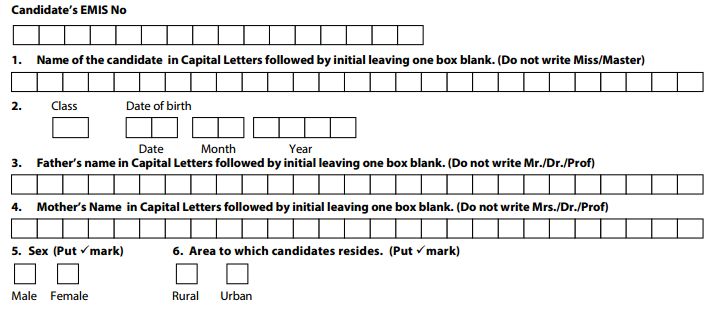
Follow the given instructions to fill your name in the OMR sheet.
* The name should be written in capital letters from left to right.
* One alphabet is to be entered in each box.
* If any empty boxes are there at the end they should be left blank.
* Ball point pen is to be used for shading the bubbles for the corresponding alphabets.
Samacheer Kalvi 6th Maths Solutions Term 3 Chapter 5 Information Processing Ex 5.2 25
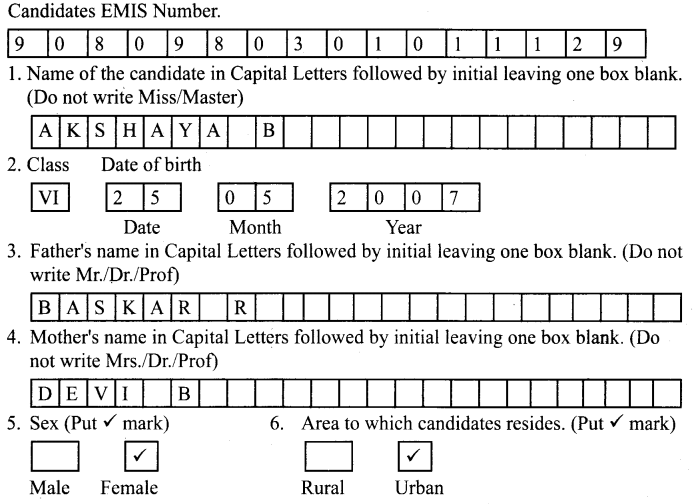
Solution:
Samacheer Kalvi 6th Maths Solutions Term 3 Chapter 5 Information Processing Ex 5.2 26

Question 13.
Consider the Postal Index Number (PIN) written on the letters as follows: 604506; 604516; 604560; 604506; 604516; 604516; 604560; 604516; 604505; 604470; 604515; 604520; 604303; 604509; 604470. How the letters can be sorted as per Postal Index Numbers?
Solution:
604 is common for all postal index numbers. Compare the remaining 3 digits, 303, 470, 505, 506 (two) 509, 510. 515, 516 (Four), 520, 560 (two).

Samacheer Kalvi 6th Maths Solutions Term 1 Chapter 4 Geometry Ex 4.1

You can Download Samacheer Kalvi 6th Maths Book Solutions Guide Pdf, Tamilnadu State Board help you to revise the complete Syllabus and score more marks in your examinations.
Samacheer Kalvi 6th Maths Solutions Term 1 Chapter 4 Ex 4.1

Tamilnadu Samacheer Kalvi 6th Maths Solutions Term 1 Chapter 4 Geometry Ex 4.1

Question 1.
Fill in the blanks.
(i) A line through two endpoints ‘A’ and ‘B’ is denoted by ______
(ii) Aline segment from point ‘B’ to point ‘A’ is denoted by ______
(iii) A ray has ______ endpoint(s).
Solution:
(i) \(\overleftrightarrow { AB }\)
(ii) \(\bar { BA } \)
(iii) one

Question 2.
How many line segments are there in the given line? Name them.
Samacheer Kalvi 6th Maths Term 1 Chapter 4 Geometry Ex 4.1 Q2
Solution:
(i) There are 10 line segments.
(ii) They are \(\overline{\mathrm{PA}}, \overline{\mathrm{AB}}, \overline{\mathrm{BC}}, \overline{\mathrm{CQ}}, \overline{\mathrm{PB}}, \overline{\mathrm{AC}}, \overline{\mathrm{BQ}}, \overline{\mathrm{PC}}, \overline{\mathrm{AQ}} \text { and } \overline{\mathrm{PQ}}\)

Question 3.
Measure the following line segments.
Samacheer Kalvi 6th Maths Term 1 Chapter 4 Geometry Ex 4.1 Q3
Solution:
\(\overline{\mathrm{XY}}=2.4 \mathrm{cm} ; \overline{\mathrm{AB}}=3.4 \mathrm{cm} ; \overline{\mathrm{EF}}=4 \mathrm{cm} ; \overline{\mathrm{PQ}}=3 \mathrm{cm}\)

Samacheer Kalvi 6th Maths Solutions Term 1 Chapter 4 Ex 4.1

Question 4.
Construct a line segment using ruler and compass.
(i) \(\overline{\mathrm{AB}}=7.5 \mathrm{cm}\)
(ii) \(\overline{\mathrm{CD}}=3.6 \mathrm{cm}\)
(iii) \(\overline{\mathrm{QR}}=10 \mathrm{cm}\)
Solution:
(i) \(\overline{\mathrm{AB}}=7.5 \mathrm{cm}\)
Samacheer Kalvi 6th Maths Term 1 Chapter 4 Geometry Ex 4.1 Q4
Construction:
Step 1: Drawn a line l and marked point A.
Step 2: Measured 7.5 cm using compass placing the pointer at ‘0’ and pencil pointer at 7.5 cm.
Step 3: Placing a compass pointer at A, drawn an arc on l with the pencil pointer. It cut l at B.
Step 4: AB is the required segment of length 7.5 cm.

(ii) \(\overline{\mathrm{CD}}=3.6 \mathrm{cm}\)
Samacheer Kalvi 6th Maths Term 1 Chapter 4 Geometry Ex 4.1 Q4.1
Construction:
Step 1: Drawn a line l and marked the point ‘C’ on it.
Step 2: Measured 3.6 cm using a compass by placing the pointer at ‘O’ and pencil at 3.6 cm
Step 3: Placing pointer at C drawn the arc on ‘l’ with pencil pointer
Step 4: CD is the required line segment of length 3.6 cm

(iii) \(\overline{\mathrm{QR}}=10 \mathrm{cm}\)
Samacheer Kalvi 6th Maths Term 1 Chapter 4 Geometry Ex 4.1 Q4.2
Construction:
Step 1: Drawn a line ‘l’ and marked the point Q on it
Step 2: Measured 10 cm using a compass by placing the pointer at ‘0’ and pencil pointer at 10 cm.
Step 3: Placing pointer at Q drawn the arc on ‘l’ with pencil pointer and named the point R
Step 4: QR is the required line segments of 10 cm.

Question 5.
From the given figure
(i) identify the parallel lines
(ii) identify the intersecting lines
(iii) name the points of intersection
Samacheer Kalvi 6th Maths Term 1 Chapter 4 Geometry Ex 4.1 Q5
Solution:
(i) Parallel lines:
(a) \(\overrightarrow{\mathrm{CD}} \text { and } \overrightarrow{\mathrm{AB}}\)
(b) \(\overrightarrow{\mathrm{EF}} \text { and } \overrightarrow{\mathrm{GH}}\)
(ii) Intersecting lines:
(a) \(\overrightarrow{\mathrm{CD}} \text { and } \overrightarrow{\mathrm{EF}}\)
(b) \(\overrightarrow{\mathrm{CD}} \text { and } \overrightarrow{\mathrm{GH}}\)
(c) \(\overrightarrow{\mathrm{AB}} \text { and } \overrightarrow{\mathrm{EF}}\)
(d) \(\overrightarrow{\mathrm{AB}} \text { and } \overrightarrow{\mathrm{GH}}\)
(iii) Point of Intersection:
P, Q, R and S are the points of Intersection.

Samacheer Kalvi 6th Maths Solutions Term 1 Chapter 4 Ex 4.1

Question 6.
From the given figure, name the
(i) parallel lines
(ii) intersecting lines
(iii) points of Intersection.
Samacheer Kalvi 6th Maths Term 1 Chapter 4 Geometry Ex 4.1 Q6
Solution:
(i) Parallel lines:
\(\overrightarrow{\mathrm{CD}} \text { and } \overrightarrow{\mathrm{EF}}\); \(\overrightarrow{\mathrm{CD}} \text { and } \overrightarrow{\mathrm{IJ}}\); \(\overrightarrow{\mathrm{EF}} \text { and } \overrightarrow{\mathrm{IJ}}\) are parallel lines.
(ii) Intersecting lines:
(a) \(\overrightarrow{\mathrm{AB}} \text { and } \overrightarrow{\mathrm{CD}}\)
(b) \(\overrightarrow{\mathrm{AB}} \text { and } \overrightarrow{\mathrm{EF}}\)
(c) \(\overrightarrow{\mathrm{AB}} \text { and } \overrightarrow{\mathrm{GH}}\)
(d) \(\overrightarrow{\mathrm{AB}} \text { and } \overrightarrow{\mathrm{IJ}}\)
(e) \(\overrightarrow{\mathrm{GH}} \text { and } \overrightarrow{\mathrm{IJ}}\)
Points of Intersection:
P, Q and R are the points of intersection.

Question 7.
From the given figure, name
(i) all pairs of parallel lines
(ii) all pairs of intersecting lines
(iii) pair of lines whose point of intersection is ‘ V’
(iv) point of intersection of the lines ‘l2‘ and ‘l3
(v) point of intersection of the lines ‘l1‘ and ‘l5
Samacheer Kalvi 6th Maths Term 1 Chapter 4 Geometry Ex 4.1 Q7
Solution:
(i) Pairs of parallel lines:

  • l3 and l4
  • l4 and l5
  • l3 and l5

(ii) Pairs of intersecting lines:

  • l1 and l2
  • l1 and l3
  • l1 and l4
  • l1 and l5
  • l2 and l3
  • l2 and l4
  • l2 and l5

(iii) l1 and l2 intersect at ‘V’
(iv) point of intersection of the lines ‘l2‘ and; l5‘ is ‘Q’
(v) point of intersection of the lines ‘l1‘ and ‘l5‘ is ‘U’

Samacheer Kalvi 6th Maths Solutions Term 1 Chapter 4 Ex 4.1

Objective Type Questions

Question 8.
The number of line segments in Samacheer Kalvi 6th Maths Term 1 Chapter 4 Geometry Ex 4.1 Q8 is
(a) 1
(b) 2
(c) 3
(d) 4
Solution:
(c) 3
Hint: \(\overline{\mathrm{AB}}, \overline{\mathrm{AC}}, \overline{\mathrm{BC}}\)

Question 9.
A line is denoted as
(a) AB
(b) \(\overrightarrow{AB}\)
(c) \(\overleftrightarrow {AB} \)
(d) \(\overline { AB }\)
Solution:
(c) \(\overleftrightarrow {AB} \)

Samacheer Kalvi 6th Maths Solutions Term 1 Chapter 6 Information Processing Ex 6.1

You can Download Samacheer Kalvi 6th Maths Book Solutions Guide Pdf, Tamilnadu State Board help you to revise the complete Syllabus and score more marks in your examinations.
Samacheer Kalvi 6th Maths Solutions Term 1 Chapter 6 Information Processing Ex 6.1

Tamilnadu Samacheer Kalvi 6th Maths Solutions Term 1 Chapter 6 Information Processing Ex 6.1

Question 1.
Suppose, you have two shorts, one is black and the other one is blue; three shirts which are in white, blue and red. You again wish to make different combinations, but you always want to make sure that the shorts and shirt that you wear are of different colours. List and check how many combinations are possible now.
Solution:
We have given two shorts which are black and blue in colour. Take it as T black and T blue.
Also, we have 3 shirts, coloured white, blue and red denoted by S white, S blue and S red.
Now fix T black and then T blue the different combinations are
Samacheer Kalvi 6th Maths Term 1 Chapter 6 Information Processing Ex 6.1 Q1
Thus we get a total of 6 combinations as
Black short and White shirt
Black short and Blue shirt
Black short and Redshirt
Blue short and White shirt
Blue short and Blue shirt
Blue short and Redshirt.
But it is given short and the shirt is of different colours.
We give up Blue short and Blue shirt combination. So we have 5 different combinations.

Question 2.
You have two red and two blue blocks. How many different towers can you build that are four blocks high using these blocks? List all the possibilities.
Solution:
6 Possibilities,
R-B-R-B
R-R-B-B
B-R-R-B
B-R-B-R
B-B-R-R
R-B-B-R

Samacheer Kalvi 6th Maths Solutions Term 1 Chapter 6 Information Processing Ex 6.1

Samacheer Kalvi 6th Maths Solutions Term 2 Chapter 3 Bill, Profit and Loss Ex 3.2

You can Download Samacheer Kalvi 6th Maths Book Solutions Guide Pdf, Tamilnadu State Board help you to revise the complete Syllabus and score more marks in your examinations.
Samacheer Kalvi 6th Maths Solutions Term 2 Chapter Chapter 3 Bill, Profit and Loss Ex 3.2

Tamilnadu Samacheer Kalvi 6th Maths Solutions Term 2 Chapter 3 Bill, Profit and Loss Ex 3.2

Miscellaneous Practice Problems

Question 1.
A shopkeeper buys three articles for ₹ 325, ₹ 450 and ₹ 510. He is able to sell them for ₹ 350, ₹ 425 and ₹ 525 respectively. Find the gain or loss to the shopkeeper on the whole.
Solution:
C.P of three articles = 325 + 450 + 510 = ₹ 1285
S.P of three articles = 350 + 425 + 525 = ₹ 1,300
Here S.P > C.P
Profit = S.P – C.P = 1,300 – 1285 = ₹ 15
The shopkeeper gained = ₹ 15

Question 2.
A stationery shop owner bought a scientific calculator for Rs 750. He had put a battery worth Rs 100 in it. He had spent Rs 50 for its outer pouch. He was able to sell it for Rs 850. Find his profit or loss.
Solution:
CP = Rs 750 + Rs 100 + Rs 50
= Rs 900
SP = Rs 850
SP < CP
Loss = CP – SP
= Rs 900 – Rs 850
= Rs 50

Question 3.
Nathan paid ₹ 800 and bought 10 bottles of honey from a village vendor. He sold them in a city for ₹ 100 per bottle. Find his profit or loss.
Solution:
C.P of 10 bottles of honey = ₹ 800
C.P of 1 bottle honey = 800/10 = ₹ 80
S.P of a bottle honey = ₹ 100
Here S.P > C.P
Profit per bottle = ₹ 100 – ₹ 80 = ₹ 20
Profit for 10 bottles = 20 × 10 = ₹ 200
Profit = ₹ 200

Question 4.
A man bought 400 metre of cloth for Rs 60,000 and sold it at the rate of Rs 400 per metre. Find his profit or loss.
Solution:
Cost of 400 m of cloth = Rs 60,000
CP = Rs 60,000
Selling price of 400 m of cloth = 400 × Rs 400
SP = Rs 1,60,000
SP > CP
Profit = SP – CP
= Rs 1,60,000 – Rs 60,000
= Rs. 1,00,000

Samacheer Kalvi 6th Maths Solutions Term 2 Chapter Chapter 3 Bill, Profit and Loss Ex 3.2

Challenge Problems

Question 5.
A fruit seller bought 2 dozen bananas at ₹ 20 a dozen and sold them at ₹ 3 per banana. Find his gain or loss.
Solution:
Cost of one dozen banana = ₹ 20
Cost of 2 dozen bananas = ₹ 20 × 2 = ₹ 40
C.P = ₹ 40
S.P per banana = ₹ 3
S.P for 2 dozen banana = ₹ 3 × 24 = ₹ 72
Here S.P > C.P
Profit = S.P – C.P = 72 – 40 = 32
Profit = ₹ 32

Question 6.
A store purchased pens at Rs 216 per dozen. He paid Rs 58 for conveyance and sold the pens at the discount of Rs 2 per pen and made an overall profit of Rs 50. Find the M.P. of each pen.
Solution:
Cost of 1 dozen pens = Rs 216 + Rs 58
CP = Rs 274
Discount for each pen = Rs 2
Overall profit = Rs 50
Total discount for 12 pens = Rs 2 × 12
= Rs 24
Selling price of 12 pens = Mp – Discount
SP = Mp – Rs 24
Profit = SP – CP
Rs 50 = Mp – Rs 24 – Rs 274
MP = Rs 50 + Rs 24 + Rs 274
= Rs 348 (1 dozen)
MP of each pen = Rs 348 / 12
= Rs 174/6
= Rs 29

Question 7.
A vegetable vendor buys 10 kg of tomatoes per day at ₹ 10 per kg, for the first three days of a weak. 1 kg of tomatoes got smashed on every day for those 3 days. For the remaining 4 days of the week, he buys 15 kg of tomatoes daily at ₹ 8 per kg. If for the entire week he sells tomatoes at ₹ 20 per kg, then find his profit or loss for the week.
Solution:
Total tomatoes bought for 3 days = 3 × 10 = 30 kg
Cost of 1 kg = ₹ 10
Cost of 30kg tomatoes = 30 × 10 = ₹ 300
Total tomatoes bought for other 4 days = 4 × 15 = 60 kg
Cost of 1 kg = ₹ 8
Cost of 60 kg tomatoes = 60 × 8 = ₹ 480
Total cost of 90 kg tomatoes = 300 + 480 = ₹ 780
C.P = ₹ 780
Tomatoes smashed = 3 kg
Total kg of Tomatoes for sale = 90 – 3 = 87 kg
S.P of 1 kg tomatoes = ₹ 20
S.P of 87 kg tomatoes = 87 × 20 = ₹ 1740
Here S.P > C.P
Profit = S.P – C.P = 1740 – 780 = ₹ 960
Profit = ₹ 960

Question 8.
An electrician buys a used T.V. for Rs 12,000 and a used Fridge for Rs 11,000. After spending Rs 1,000 on repairing the T.V. and Rs 1500 on painting the Fridge, he fixes up the M.P. of T.V. as Rs 15,000 and that of Fridge as Rs 15,500. If he gives Rs 1000 discount on each find his profit or loss.
Solution:
Total cost price of TV and Fridge = Rs 12,000 + Rs 11,000 + Rs 1,000 + Rs 1,500 = Rs 25,500
Selling price of TV = MP – Discount = Rs 15,000 – Rs 1,000 = Rs 14,000
Selling price of Fridge = MP – Discount = Rs 15,500 – Rs 1,000 = Rs 14,500
Total Selling price of TV and Fridge = Rs 14,000 + Rs 14,500 = Rs 28,500
SP > CP
Profit = SP – CP = Rs 28,500 – Rs 25,500 = Rs 3,000

Samacheer Kalvi 6th Maths Solutions Term 2 Chapter Chapter 3 Bill, Profit and Loss Ex 3.2

Samacheer Kalvi 6th Maths Solutions Term 3 Chapter 3 Perimeter and Area Ex 3.2

You can Download Samacheer Kalvi 6th Maths Book Solutions Guide Pdf, Tamilnadu State Board help you to revise the complete Syllabus and score more marks in your examinations.
Samacheer Kalvi 6th Maths Solutions Term 3 Chapter 3 Perimeter and Area Ex 3.2

Tamilnadu Samacheer Kalvi 6th Maths Solutions Term 3 Chapter 3 Perimeter and Area Ex 3.2

Miscellaneous Practice Problems

Question 1.
A piece of wire is 36 cm long. What will be the length of each side if we form
i) a square
ii) an equilateral triangle.
Solution:
Given the length of the wire = 36 cm
i) When a square is formed out of it
The perimeter of the square = 36 cm
4 × side = 36
side = \(\frac{36}{4}\) = 9 cm
Side of the square

ii) When an equilateral triangle is formed out of it, its perimeter = 36 cm
i.e., side + side + side = 36 cm .
3 × side = 36 cm
side = \(\frac{36}{3}\) = 12 cm
One side of an equilateral triangle = 12 cm

Question 2.
From one vertex of an equilateral triangle with side 40 cm, an equilateral triangle with 6 cm side is removed. What is the perimeter of the remaining portion?
Solution:
Samacheer Kalvi 6th Maths Solutions Term 3 Chapter 3 Perimeter and Area Ex 3.2 1
If an equilateral triangle of side 6 cm is removed the perimeter = (40 + 34 + 6 +34) cm = 114 cm
Perimeter of the remaining portion = 114 cm

Question 3.
Rahim and peter go for a morning walk, Rahim walks around a square path of side 50 m and Peter walks around a rectangular path with length 40 m and breadth 30 m. If both of them walk 2 rounds each, who covers more distance and by how much?
Solution:
Distance covered by Rahim
= 50 × 4 m
= 200 m
If he walks 2 rounds, distance covered = 2 × 200 m
= 400 m
Distance covered by peter
= 2 (40 + 30) m
= 2(70)m
= 140 m
If he walks 2 rounds, distance covered = 2 × 140 m
= 280 m
∴ Rahim covers more distance by (400 – 280) = 120 m

Samacheer Kalvi 6th Maths Solutions Term 3 Chapter 3 Perimeter and Area Ex 3.2

Question 4.
The length of a rectangular park is 14 m more than its breadth. If the perimeter of the park is 200 m, what is its length? Find the area of the park?
Solution:
Given length of rectangular park is 14m more than its breadth.
Let the breadth be b m .
∴ Length of the park will be l = b + 14 m
Given perimeter = 200 m
2 × (l + b) = 200 m
2 × (b + 14 + b) = 200 m [∵ l = b + 14]
2 × (2b + 14) = 200 m
2b + 14 = \(\frac{200}{2}\) m
2b + 14 = 100 m
2b = 100 – 14 m
2b = 86 m
b = \(\frac{86}{2}\) m
b 43 m
Length Length of the park = 57 m
Area of a rectangle = (length × breadth) unit2
= (57 × 43) m2 = 2,451 m2
Area of the park = 2,451 m2

Question 5.
Your garden is in the shape of a square of side 5 m. Each side is to be fenced with 2 rows of wire. Find how much amount is needed to fence the garden at Rs 10 per meter.
Solution:
a = 5 m
Perimeter of the garden
= 4 a units
= 4 × 5 m
= 20 m
For 1 row
Amount needed to fence l m= Rs 10
Amount needed to fence 20 m
= Rs 10 × 20
= Rs 200
For 2 rows
Total amount needed = 2 × Rs 200
= Rs 400

Challenge Problems

Question 6.
A closed shape has 20 equal sides and one of its sides is 3 cm. Find its perimeter.
Solution:
Number of equal sides in the shape = 20
One of its side = 3 cm
Perimeter = length of one side × Number of equal sides
∴ Perimeter = (3 × 20) cm = 60 cm
∴ Perimeter = 60 cm

Question 7.
A rectangle has length 40 cm and breadth 20 cm. How many squares with side 10 cm can be formed from it.
Solution:
l = 40 cm, b = 20 cm
Area of the rectangle = l × b sq units
= 40 × 20 cm²
= 800 cm²
a = 10 cm
Area of the square = a × a sq. units
= 10 × 10 cm²
= 100 m²
No of squares formed = \(\frac{800}{100}\) cm²
= 8

Question 8.
The length of a rectangle is three times its breadth. If its perimeter is 64 cm, find the sides of the rectangle.
Solution:
Given perimeter of a rectangle = 64 cm
Also given length is three times its breadth.
Let the breadth of the rectangle = b cm
∴ Length = 3 × b cm
Perimeter = 64 m
i.e., 2 × (l + b) = 64 m
2 × (3b + b) = 64 m
2 × 4b = 64m
4b = \(\frac{64}{2}\) = 32 m
b = \(\frac{32}{4}\) = 8 m
l = 3 × b = 3 × 8 = 24 m
∴ Breadth of the rectangle = 8 m
Length of the rectangle = 24 m

Question 9.
How many different rectangles can be made with a 48 cm long string? Find the possible pairs of length and breadth of the rectangles.
Solution:
12 rectangles
(1, 23), (2, 22), (3, 21), (4, 20), (5, 19), (6, 18), (7, 17), (8, 16), (9, 15), (10, 14), (11, 13), (12, 12)

Samacheer Kalvi 6th Maths Solutions Term 3 Chapter 3 Perimeter and Area Ex 3.2

Question 10.
Draw a square B whose side is twice of the square A. Calculate the perimeters of the squares A and B.
Solution:
Samacheer Kalvi 6th Maths Solutions Term 3 Chapter 3 Perimeter and Area Ex 3.2 2
Perimeter of A = s + s + s + s units = 4 s units
Perimeter of B = (2s + 2s + 2s + 2s) units
= 8s units = 2 (4s) units.
∴ Perimeter of B is twice perimeter of A

Question 11.
What will be the area of a new square formed if the side of a square is made one – fourth?
Solution:
Area of the new square is reduced to \(\frac{1}{16}\) th times to that of the original area.

Question 12.
Two plots have the same perimeter. One is a square of side 10 m and another is a rectangle of breadth 8 m. Which plot has the greater area and by how much?
Solution:
Samacheer Kalvi 6th Maths Solutions Term 3 Chapter 3 Perimeter and Area Ex 3.2 3
Given perimeter of square = perimeter of rectangle
4 × side = 2 (length + breadth)
(4 × 10) m = 2(l + 8)m
\(\frac{4 \times 10}{2}\) = l + 8
20 = l + 8
l = 20 – 8
l = 12 m
∴ length of the rectangle = 12 m
Area of the square plot – side × side = 10 × 10 m2 = 100 m2
Area of the rectangular plot = length × breadth = (12 × 8) m2 = 96 m2
100 m2 > 96 m2
∴ Square plot has greater area by 4m2

Question 13.
Look at the picture of the house given and find the total area of the shaded portion.
Samacheer Kalvi 6th Maths Solutions Term 3 Chapter 3 Perimeter and Area Ex 3.2 4
Solution:
Total area of the shaded region = Area of a right triangle + Area of a rectangle
= (\(\frac{1}{2}\) × b × h) + (l × b) cm2
= [(\(\frac{1}{2}\) × 3 × 4) + (9 × 6)] cm2
= (6 + 54) cm2 = 60 cm2

Question 14.
Find the approximate area of the flower in the given square grid.
Samacheer Kalvi 6th Maths Solutions Term 3 Chapter 3 Perimeter and Area Ex 3.2 5
Solution:
Approximate area = Number of full squares + Number of more than half squares + \(\frac{1}{2}\) × Number of half squares.
= 10 + 5 + (\(\frac{1}{2}\) × 1) Sq units. = 10 + 5 + \(\frac{1}{2}\) sq. units
= 15 \(\frac{1}{2}\) sq. units = 15.5 sq. units.

Samacheer Kalvi 6th Maths Solutions Term 3 Chapter 3 Perimeter and Area Ex 3.2

Tamil Nadu 11th Maths Previous Year Question Paper June 2019 English Medium

Students can Download Tamil Nadu 11th Maths Previous Year Question Paper June 2019 English Medium Pdf, Tamil Nadu 11th Maths Model Question Papers helps you to revise the complete Tamilnadu State Board New Syllabus and score more marks in your examinations.

TN State Board 11th Maths Previous Year Question Paper June 2019 English Medium

General Instructions:

  1. The question paper comprises of four parts.
  2. You are to attempt all the parts. An internal choice of questions is provided wherever applicable.
  3. All questions of Part I, II, III and IV are to be attempted separately.
  4. Question numbers 1 to 20 in Part I are Multiple Choice Questions of one mark each.
    These are to be answered by choosing the most suitable answer from the given four alternatives and writing the option code and the corresponding answer
  5. Question numbers 21 to 30 in Part II are two-mark questions. These are to be answered in about one or two sentences.
  6. Question numbers 31 to 40 in Part III are three-mark questions. These are to be answered in above three to five short sentences.
  7. Question numbers 41 to 47 in Part IV are five-mark questions. These are to be answered in detail Draw diagrams wherever necessary.

Time: 2.30 Hours
Maximum Marks: 90

PART – I

I. Choose the correct answer. Answer all the questions. [20 × 1 = 20]

Question 1.
The range of the function \(\frac{1}{1-2sin x}\) is………….
(a) (-∞, -1) ∪(\(\frac{1}{3}\), ∞)
(b) (-1, \(\frac{1}{3}\))
(c) [-1, \(\frac{1}{3}\)]
(d) (-∞, -1] ∪(\(\frac{1}{3}\), ∞)
Answer:
(d) (-∞, -1] ∪(\(\frac{1}{3}\), ∞)

Question 2.
If the function f : [-3, 3] → S defined by f(x) = x² is onto, then S is…………
(a) [-9, 9]
(b) R
(c) [-3, 3]
(d) [0, 9]
Answer:
(d) [0, 9]

Question 3.
The number of solutions of x² + |x – 1| = 1 is ………..
(a) 1
(b) 0
(c) 2
(d) 3
Answer:
(c) 2
Tamil Nadu 11th Maths Previous Year Question Paper June 2019 English Medium

Question 4.
cos 1° + cos 2° + cos 3° + …. + cos 179° =……………..
(a) 0
(b) 1
(c) -1
(d) 89
Answer:
(a) 0

Question 5.
If tan α and tan β are the roots of x² + ax + b = 0, then \(\frac{sin(α+β)}{sin α sin β}\) is equal to…………
(a) \(\frac{b}{a}\)
(b) \(\frac{a}{b}\)
(c) –\(\frac{a}{b}\)
(d) –\(\frac{b}{a}\)
Answer:
(b) \(\frac{a}{b}\)

Question 6.
The number of sides of a polygon having 44 diagonals is…………
(a) 4
(b) 4
(c) 11
(d) 22
Answer:
(d) 22

Question 7.
The H.M. of two positive numbers whose A.M. and G.M. are 16, 8 respectively is………….
(a) 10
(b) 6
(c) 5
(d) 4
Answer:
(d) 4

Question 8.
The nth term of the sequence \(\frac{1}{2}\), \(\frac{3}{4}\), \(\frac{7}{8}\), \(\frac{15}{16}\) is……………
(a) 2n – n – 1
(b) 1 – 2-n
(c) 2-n+ n – 1
(d) 2n-1
Answer:
(b) 1 – 2-n

Question 9.
The intercepts of the perpendicular bisector of the line segment joining (1,2) and (3,4) with coordinate axes are
(a) 5, -5
(b) 5, 5
(c) 5, 3
(d) 5, -4
Answer:
(b) 5, 5

Question 10.
The image of the point (2, 3) in the line y = -x is
(a) (-3, -2)
(b) (-3, 2)
(c) (-2, -3)
(d) (3, 2)
Answer:
(a) (-3, -2)

Tamil Nadu 11th Maths Previous Year Question Paper June 2019 English Medium

Question 11.
If A = \(\left[\begin{array}{cc} \lambda & 1 \\ -1 & -\lambda \end{array}\right]\), then for what value of λ, A² = 0?………
(a) 0
(b) ± 1
(c) -1
(d) 1
Answer:
(b) ± 1

Question 12.
If \(\vec{a}\) and \(\vec{b}\) are having same magnitute and angle between them is 60° and their scalar product is \(\frac{1}{2}\), then |\(\vec {a}\)| is
(a) 2
(b) 3
(c) 7
(d) 1
Answer:
(d) 1

Question 13.
\(\lim _{x \rightarrow \infty} \frac{a^{x}-b^{x}}{x}\) = …………..
(a) log ab
(b) log (\(\frac{a}{b}\))
(c) log (\(\frac{b}{a}\))
(d) \(\frac{a}{b}\)
Answer:
(b) log (\(\frac{a}{b}\))

Question 14.
If f(x) = \(\left\{\begin{array}{ccc}x, & x \text { is irrational } \\ 1-x, & x \text { is rational }\end{array}\right.\) then f is………..
(a) discontinuous at x = \(\frac{1}{2}\)
(b) continuous at x = \(\frac{1}{2}\)
(c) continuous everywhere
(d) discontinuous everywhere
Answer:
(b) continuous at x = \(\frac{1}{2}\)

Question 15.
The derivative of f(x) = x |x| at x = -3 is…………..
(a) 6
(b) -6
(c) does not exist
(d) 0
Answer:
(a) 6

Question 16.
If f(x) = x² – 3x, then the points at which f(x) = f'(x) are…………..
(a) both positive integers
(b) both negative integers
(c) both irrational
(d) one rational and another irrational
Answer:
(c) both irrational

Tamil Nadu 11th Maths Previous Year Question Paper June 2019 English Medium

Question 17.
\(\int \tan ^{-1}(\sqrt{\frac{1-\cos 2 x}{1+\cos 2 x}})\) dx ………….
(a) x² + c
(b) 2x² + c
(c) \(\frac{x²}{2}\) + c
(d) –\(\frac{x²}{2}\) + c
Answer:
(c) \(\frac{x^2}{2}\) + c

Question 18.
e-7x sin 5x dx is…………
(a) \(\frac{e^{-7x}}{74}\) [-7 sin 5x – 5 cos 5x] + c
(b) \(\frac{e^{-7x}}{74}\) [7 sin 5x + 5 cos 5x] + c
(c) \(\frac{e^{-7x}}{74}\) [7 sin 5x – 5 cos 5x] + c
(d) \(\frac{e^{-7x}}{74}\) [-7 sin 5x + 5 cos 5x] + c
Answer:
(a) \(\frac{e^{-7x}}{74}\) [-7 sin 5x – 5 cos 5x] + c

Question 19.
If A and B are any two events then the probability that exactly one of them occur is
(a) P(A ∪\(\bar { B }\)) + P(\(\bar { A }\) ∪B)
(b) P(A ∩\(\bar { B }\)) + P(\(\bar { A }\) ∩B)
(c) P(A) + P(B) – P(A ∩ B)
(d) P(A) + P(B) + 2P(A ∩ B)
Answer:
(a) P(A ∪\(\bar { B }\)) + P(\(\bar { A }\) ∪B)

Question 20.
In a certain college 4% of the boys and 1 % of the girls are taller than 1.8 meter. Further 60% of the students are girls. If a student is selected at random and is taller than 1.8 meters, then the probability that the student is a girl is ………….
(a) \(\frac{2}{11}\)
(b) \(\frac{3}{11}\)
(c) \(\frac{5}{11}\)
(d) \(\frac{7}{11}\)
Answer:
(b) \(\frac{3}{11}\)

PART- II

II. Answer any seven questions. Question No: 30 is compulsory. [7 × 2 = 14]

Question 21.
Resolve \(\frac{3x+1}{(x-2)(x+1)}\) into partial fractions.
Answer:
Tamil Nadu 11th Maths Previous Year Question Paper June 2019 English Medium 1
Equating numerator parts
3x + 1 = A (x + 1) + B (x – 2)
This equation is true for any value of x.
To find A and B
Put x = -1
-3 + 1 = A (0) + B (-1 -2)
-3 B = -2 ⇒ B = 2/3
Put x = 2
3(2) + 1 = A(2 + 1) + B (0)
3A = 7 ⇒ A = 7/3
Hence \(\frac{3x+1}{(x-2)(x+1)}\) = \(\frac{7}{3(x-2)}\) + \(\frac{2}{3(x+1)}\)

Tamil Nadu 11th Maths Previous Year Question Paper June 2019 English Medium

Question 22.
Prove that
Tamil Nadu 11th Maths Previous Year Question Paper June 2019 English Medium 2
Answer:
cot (180° + θ) = cot θ
sin (90° – θ) = cos θ
cos (- θ) = cos θ
sin (270 + θ) = – cos θ
tan (-θ) = – tan θ
cosec (360° + θ) = cosec θ
Tamil Nadu 11th Maths Previous Year Question Paper June 2019 English Medium 3

Question 23.
If cos θ = \(\frac{1}{2}\) (a + \(\frac{1}{a}\)), show that cos 3θ = \(\frac{1}{2}\) (a³ + \(\frac{1}{a³}\))
Answer:
Tamil Nadu 11th Maths Previous Year Question Paper June 2019 English Medium 4

Question 24.
If the letters of the word IITJEE are permuted in all possible ways and the strings thus formed are arranged in the lexicographic order, find the rank of the word IITJEE.
Answer:
The lexicographic order of the letters of given word is E, E, I, I, J, T. In the lexicographic order, the strings which begin with E come first. If we fill the first place with E, remaining 5 letters (E, I, I, J, T) can be arranged in \(\frac{5!}{2!}\) ways. On proceeding like this we get,
E – – – – = \(\frac{5!}{2!}\) = 60 ways
IIE – – – = 3! = 6 ways
IIJ – – – = \(\frac{3!}{1!}\) = 3 ways
IITE – – =2! = 2 ways
IITJEE = 1 way
The rank of the word IITJEE = 60 + 6 + 3 + 2 +1 = 72.

Question 25.
Prove that \(\frac{(2n)!}{n!}\) = 2n (1, 3, 5 ……..(2n – 1)).
Answer:
Tamil Nadu 11th Maths Previous Year Question Paper June 2019 English Medium 5

Question 26.
Write the equation of the line passing through the point (1, -1) and parallel to the line x + 3y – 4 = 0
Answer:
Equation of a line parallel to x + 3y – 4 = 0 will be of the form x + 3y + k = 0
It passes through (1,-1)
⇒ (1) + 3(-1) + k = 0
-2 + k = 0 ⇒ k = 2
So the required equation is x + 3y + 2 = 0

Question 27.
If (k, 2), (2, 4) and (3, 2) are vertices of the triangle of area 4 square units then determine the value of k.
Answer:
Area of Δ with vertices (k, 2) (2, 4) and (3, 2) = \(\frac{1}{2}\) \(\left|\begin{array}{lll} k & 2 & 1 \\ 2 & 4 & 1 \\ 3 & 2 & 1 \end{array}\right|\) = 4 (given)
⇒ \(\left|\begin{array}{lll} k & 2 & 1 \\ 2 & 4 & 1 \\ 3 & 2 & 1 \end{array}\right|\) = 2(4) = 8
(i.e.,) k (4 – 2) -2(2 – 3) + 1 (4 – 12) = ±8
(i.e.,) 2k – 2(-1) + 1(-8) = ± 8
(i.e.,) 2k + 2 – 8 = 8
(i.e.,) 2k = 8 + 8 – 2 = 14
k = 14/2 = 7
∴ k = 7
or
2k + 2 – 8 = -8
⇒ 2k = -8 + 8 – 2
2k = -2
k = -1
So k = 7 (or) k = -1

Tamil Nadu 11th Maths Previous Year Question Paper June 2019 English Medium

Question 28.
Find λ, when the projection of \(\vec {a}\) = λ\(\hat{j}\) + \(\hat{j}\) + 4\(\hat{k}\) on \(\vec {b}\) = 2\(\hat{i}\) + 6\(\hat{j}\) + 2\(\hat{k}\) is 4 units.
Answer:
\(\vec {a}\) = λ\(\hat{j}\) + \(\hat{j}\) + 4\(\hat{k}\) and \(\vec {b}\) = 2\(\hat{i}\) + 6\(\hat{j}\) + 2\(\hat{k}\)
Now \(\vec {a}\) – \(\vec {b}\) = (λ) (2) + (1) (6) + (4) (3)
= 2λ + 6 + 12 = 2λ +18
|\(\vec {a}\)| = \(\sqrt{4+36+9}\) = \(\sqrt{49}\) = 7
Here \(\frac{2λ+18}{7}\) = 4
⇒ 2λ+ 18 = 4 × 7 = 28
2λ = 28 – 18 = 10
λ = 10/2 = 5

Question 29.
Find \(\frac{dy}{dx}\) if y = ex sin x
Answer:
y = ex sin x
⇒ y’ = uv’ + vu’
Now u = ex ⇒ u’ = \(\frac{du}{dx}\) = ex
v = sin x ⇒ v’ = \(\frac{dv}{dx}\) = cos x
y’ = ex (cos x) + sin x (ex)
= ex [sin x + cos x]

Question 30.
Find \(\frac{dy}{dx}\) if x² + y² = 1
Answer:
We differentiate both sides of the equation.
\(\frac{d}{dx}\) (x)² + \(\frac{d}{dx}\) (y)² = \(\frac{d}{dx}\) (1)
2x + 2y \(\frac{dy}{dx}\) = 0
Solving for the derivative yields
\(\frac{dy}{dx}\) = –\(\frac{x}{y}\)

PART – III

III. Answer any seven questions. Question No. 40 is compulsory. [7 × 3 = 21]

Question 31.
From the curve y = sin x, draw y = sin |x|
Answer:
Tamil Nadu 11th Maths Previous Year Question Paper June 2019 English Medium 6
Tamil Nadu 11th Maths Previous Year Question Paper June 2019 English Medium 7

Question 32.
If one root of k (x – 1)² = 5x – 7 is double the other root, show that k = 2 or -25
Answer:
k(x – 1)² = 5x – 7
(i.e.,) k (x² – 2x + 1) – 5x + 7 = 0
x² (k) + x(-2k – 5) + k + 7 = 0
kx² – x(2k + 5) + (k + 7) = 0
Here it is given that one root is double the other.
So let the roots to α and 2α
Sum of the roots = α + 2α = 3α = \(\frac{2k+5}{k}\) α \(\frac{2k+5}{3k}\) ……..(1)
Product of the roots = α(2α) = 2α² = \(\frac{k+7}{k}\)
⇒ α² = \(\frac{k+7}{2k}\) = ……..(2)
Substituting a value from (1) in (2)
Tamil Nadu 11th Maths Previous Year Question Paper June 2019 English Medium 8
2(4k² + 25 + 20k) = 9k (k + 7)
2(4k² + 25 + 20k) = 9k² + 63k
8k² + 50 + 40k – 9k² – 65k = 0
-k² – 25k + 50 = 0
k² + 23k – 50 = 0
(k + 25) (k – 2) = 0
k = -25 or 2

Tamil Nadu 11th Maths Previous Year Question Paper June 2019 English Medium

Question 33.
If θ + ∅ = α and tan θ = k tan ∅, then prove that sin(θ – ∅) =\(\frac{k-1}{k+1}\)
Answer:
Tamil Nadu 11th Maths Previous Year Question Paper June 2019 English Medium 9

Question 34.
If a, b, c are in geometric progression, and if a\(\frac{1}{x}\) = b\(\frac{1}{y}\) = c\(\frac{1}{z}\) then prove that x, y, z are in arithmetic progression.
Answer:
Given a, b, c are in G.P.
⇒ b² = ac
⇒ log b² = log ac
(i.e.) 2 log b = log a + log c …(1)
We are given a\(\frac{1}{x}\) = b\(\frac{1}{y}\) = c\(\frac{1}{z}\) = k (say)
⇒ log ak = \(\frac{1}{x}\) = bk \(\frac{1}{y}\) = ck \(\frac{1}{z}\)
⇒ ak = \(\frac{1}{x}\) ⇒ x = log ka
Similarly y = log kb
z = log kc
Substituting these values in equation (1) we get 2y = x + z ⇒ x, y, z are in A.P.

Question 35.
Show that the points (1,3), (2,1) and (\(\frac{1}{2}\), 4) are collinear.
Answer:
Let the given points be A (1, 3), B (2, 1), and C (\(\frac{1}{2}\), 4)
Slope of AB = \(\frac{1-3}{2-1}\) = \(\frac{-2}{1}\) = -2 = m1
Slope of BC = \(\frac{4-1}{1/2-1}\) = \(\frac{3}{-3/2}\) = -2 = m2
Slope of AB = Slope of BC ⇒ AB parallel to BC but B is a common point.
⇒ The points A, B, C are collinear.

Question 36.
If A and B are symmetric matrices of same order, prove that AB + BA is a symmetric matrix.
Answer:
Given A and B are symmetric matrices
⇒ AT = A and BT = B
To prove AB + BA is a symmetric matrix.
Proof: Now(AB + BA)T = (AB)T + (BA)T = BTAT + ATBT
= BA + AB = AB + BA
i.e. (AB + BA)T = AB + BA
⇒ (AB + BA) is a symmetric matrix.

Question 37.
Let \(\vec {a}\), \(\vec {b}\), \(\vec {c}\) be three vectors such that |\(\vec {a}\)| = 3, |\(\vec {b}\)| = 4, |\(\vec {c}\)| = 5 and each one of them being perpendicular to the sum of the other two, find |\(\vec {a}\) + \(\vec {b}\) + \(\vec {c}\)|.
Answer:
Given |\(\vec {a}\)| = 3; |\(\vec {b}\)| = 4; |\(\vec {c}\)| = 5
Now, (\(\vec {a}\) + \(\vec {b}\) + \(\vec {c}\))² = a-2 +b -2+c-2 + 2(\(\vec {a}\).\(\vec {b}\) + \(\vec {b}\).\(\vec {c}\) + \(\vec {a}\).\(\vec {c}\))
= 3² + 4² + 5² + 2 \(\vec {a}\).\(\vec {b}\) + 2\(\vec {b}\).\(\vec {c}\) + 2\(\vec {a}\).\(\vec {c}\)
= 9 + 16 + 25 + \(\vec {a}\).\(\vec {b}\) + \(\vec {a}\).\(\vec {b}\) + \(\vec {b}\).\(\vec {c}\) + \(\vec {b}\).\(\vec {c}\) + \(\vec {a}\).\(\vec {c}\) + \(\vec {a}\).\(\vec {c}\)
= 50 + \(\vec {a}\).(\(\vec {b}\) + \(\vec {c}\)) + \(\vec {b}\).(\(\vec {c}\) + \(\vec {a}\)) + \(\vec {c}\).(\(\vec {a}\) + \(\vec {b}\))
= 50 + 0 + 0 + 0 = 50
(one vector is ⊥r to the sum of other two vectors)
|\(\vec {a}\) + \(\vec {b}\) + \(\vec {c}\)| = \(\sqrt {50}\) = \(\sqrt {25×2}\) = 5√2

Tamil Nadu 11th Maths Previous Year Question Paper June 2019 English Medium

Question 38.
Evaluate \(\lim _{x \rightarrow 0} \frac{\sqrt{1+x^{2}}-1}{x}\)
Answer:
Tamil Nadu 11th Maths Previous Year Question Paper June 2019 English Medium 10

Question 39.
Find the derivatives of the following functions y = xcos x
Answer:
y = xcos x
Taking log on both sides, we get
log y = log xcos x = cos x log x
Differentiating w.r.to x we get
Tamil Nadu 11th Maths Previous Year Question Paper June 2019 English Medium 11

Question 40.
Evaluate
Tamil Nadu 11th Maths Previous Year Question Paper June 2019 English Medium 12
Answer:
Tamil Nadu 11th Maths Previous Year Question Paper June 2019 English Medium 13

PART – IV

IV. Answer all the questions. [7 x 5 = 35]

Question 41 (a).
Let f, g: R → R be defined as f(x) = 2x – |x| and g(x) = 2x + |x|. Find fog.
Answer:
Tamil Nadu 11th Maths Previous Year Question Paper June 2019 English Medium 14
fog (x) = f(g(x))
= f(x) = 3x
For x > 0
fog (x) = f(g(x))
= f(3x) = 3x

[OR]

(b) Prove that \(\lim _{\theta \rightarrow 0} \frac{\sin \theta}{\theta}\) = 1
Answer:
Let θ → 0, thought positive values
∴ Let 0 < θ < \(\frac{π}{2}\)
Draw a circule center O and radius unity and let
∠AOB = θ radiAnswer:
Let the tagent at A meet OB product in the piont P.
Jion AB. From the figure it is clear that
Area of ΔAOB < Area of sector AOB < Area of ΔOAP
Tamil Nadu 11th Maths Previous Year Question Paper June 2019 English Medium 15
i.e., \(\frac{1}{2}\) OA. OB sin θ < 1 (radius)² θ < \(\frac{1}{2}\) OA. AP
or sin θ < θ < tan θ
[ ∵ \(\frac{AP}{OA}\) = tan θ or AP = tan θ as OA = 1
Dividing by sin θ, which is positive
Tamil Nadu 11th Maths Previous Year Question Paper June 2019 English Medium 16

Question 42 (a).
(i) If A × A has 16 elements, S = {(a, b) ∈ A × A: a < b} ; (-1, 2) and (0,1) are two elements of S, then find the remaining elements of S.
(ii) Find the range of the function \(\frac{1}{2 cos x – 1}\)
Answer:
(i) n(A × A) = 16
⇒ n(A) = 4
S = {(-1, 0), (-1, 1), (0, 2), (1, 2)}

(ii) The range of cos x is – 1 to 1
-1 ≤ cos x ≤ 1
(× by 2) -2 ≤ 2 cos x ≤ 2
adding -1 throughout
-2 -1 ≤ 2 cos x – 1 ≤ 2 – 1
(i.e.,) -3 ≤ 2 cos x – 1 ≤ 1
so 1 ≤ \(\frac{1}{2 cos x – 1}\) ≤ \(\frac{-1}{3}\)
The range is outside \(\frac{-1}{3}\) and 1
i.e., range is (-∞,\(\frac{-1}{3}\)] ∪ [1, ∞)

Tamil Nadu 11th Maths Previous Year Question Paper June 2019 English Medium

[OR]

(b) Evaluate: \(\int \frac{3 x+5}{x^{2}+4 x+7}\) dx
Answer:
Let I = \(\int \frac{3 x+5}{x^{2}+4 x+7}\) dx
3x + 5 = A \(\frac{d}{dx}\) (x² + 4x + 7) + B
3x + 5 = A(2x + 4) + B
Comparing the coefficients of like terms we got
2A = 3 ⇒ A = \(\frac{3}{2}\); 4A + B = 5 ⇒ B = -1
Tamil Nadu 11th Maths Previous Year Question Paper June 2019 English Medium 17

Question 43 (a).
Derive cosine formula using the law of sines in a ΔABC.
Answer:
Tamil Nadu 11th Maths Previous Year Question Paper June 2019 English Medium 18

[OR]

(b) Find \(\sqrt[3]{65}\) using binomial expansion upto two decimal places.
Answer:
We know that for |x| < 1,
Tamil Nadu 11th Maths Previous Year Question Paper June 2019 English Medium 19
≈ 4 + 0.02 ( Since \(\frac{1}{36864}\) + …….. is very small)
\(\sqrt[3]{65}\) = 4.02 (approximately)

Tamil Nadu 11th Maths Previous Year Question Paper June 2019 English Medium

Question 44 (a).
(i) Do the limit of the function \(\frac{sin |x|}{x}\) Li exist as x → 0? State reason for the answer.
Answer:
Tamil Nadu 11th Maths Previous Year Question Paper June 2019 English Medium 20
Hence the limit does ndt exist. Since that f(0) ≠ f(0+)
Tamil Nadu 11th Maths Previous Year Question Paper June 2019 English Medium 21

[OR]

(b) Tamil Nadu 11th Maths Previous Year Question Paper June 2019 English Medium 22
Answer:
Tamil Nadu 11th Maths Previous Year Question Paper June 2019 English Medium 23

Question 45.
(i) Evaluate \(\int \frac{x \sin ^{-1} x}{\sqrt{1-x^{2}}}\) dx
Answer:
Let sin-1 x = t
⇒ \(\frac{1}{\sqrt{1-x^{2}}}\) dx = dt
Now sin-1 x = t ⇒ x = sin t
So I = ∫(sin t) (t) dt = ∫ t sin t dt
Now ∫t sin t dt = ∫ t d (-cos t)
= t(- cos t) – ∫(-cos t) dt
= -t cos t + ∫cos t dt
= – t cos t + sin t
Tamil Nadu 11th Maths Previous Year Question Paper June 2019 English Medium 24

[OR]

(b) Show that the points whose position vectors 4\(\hat{i}\) + 5\(\hat{j}\) + \(\hat{k}\),- \(\hat{j}\) – \(\hat{k}\), 3\(\hat{i}\) +9\(\hat{j}\) + 4\(\hat{k}\) and -4\(\hat{i}\) + 4\(\hat{j}\) + 4\(\hat{k}\) are coplanar.
Answer:
Let the given points be A, B, C and D. To prove that the point A, B, C, D are coplanar, we have to prove that the vectors \(\overrightarrow{\mathrm{AB}}\), \(\overrightarrow{\mathrm{AC}}\) and \(\overrightarrow{\mathrm{AD}}\) are coplanar.
Tamil Nadu 11th Maths Previous Year Question Paper June 2019 English Medium 25
Equating \(\hat{i}\), \(\hat{j}\) and \(\hat{k}\) components we get
-4 = -m – 8n
⇒ m + 8n = 4 ….(i)
-6 = 4m – n
⇒ 4m – n = -6 ……. (ii)
-2 = 3m + 3n
⇒ 3m + 3n = -2 …….. (iii)
Solving (i) and (ii)
Tamil Nadu 11th Maths Previous Year Question Paper June 2019 English Medium 26
Substituting m = –\(\frac{4}{3}\) in (i) we get,
–\(\frac{4}{3}\) + 8n = 4
Tamil Nadu 11th Maths Previous Year Question Paper June 2019 English Medium 27
we are able to write one vector as a linear combination of the other two vectors ⇒ the given vectors \(\vec{a}\), \(\vec{b}\), \(\vec{c}\) are coplanar.
(i.e.,) The given points A, B, C, D are coplanar.

Tamil Nadu 11th Maths Previous Year Question Paper June 2019 English Medium

Question 46 (a).
If Q is a point on the locus of x² + y² + 4x – 3x + 7 = 0, then find the equation of locus of P which divides segment OQ externally in the ratio 3 : 4, where O is the origin.
Answer:
Let (h, k) be the moving-point O = (0, 0), Let PQ = (a, b) on x² + y² + 4x – 3y + 7 = 0
P divides OQ externally in the ratio 3 : 4
Tamil Nadu 11th Maths Previous Year Question Paper June 2019 English Medium 28
h² + k² – 12h + 9k + 63 = 0, Locus of (h, k) is x² + y² – 12x + 9y + 63 = 0

[OR]

(b) A consulting firm rents car from three agencies such that 50% from agency L, 30% from agency M and 20% from agency N. If 90% of the cars from L, 70% of cars from M and 60% of cars from N are in good conditions (i) what is the probability that the firm will get a car in good condition? (ii) if a car is in good condition, what is probability that it has come from agency N?
Answer:
Let A1, A2 and A3 be the events that the cars are rented from the agencies X, Y and Z respectively.
Let G be the event of getting a car in good condition.
We have to find
Tamil Nadu 11th Maths Previous Year Question Paper June 2019 English Medium 29
(i) The total probability of event G that is, P(G).
(ii) Find the conditional probability A3, given G that is, P(A3/G) We have
P(A1) = 0.50, P(G/A1) = 0.90
P(A2) = 0.30, P(G/A2) = 0.70
P(A3) = 0.20, P(G/A3) = 0.60.

(i) Since A1, A2 and A3 are mutually exclusive and exhaustive events and G is an event in S, then the total probability of event G is P(G).
P(G) = P(A1) P(G/A1) + P(A2) P(G/A2) + P(A3) P(G/A3)
P(G) = (0.50) (0.90) + (0.30) (0.70) + (0.20) (0.60)
P(G) = 0.78.

(ii) The conditional probability A3 given G is P(A3/G)
By Bayes’ theorem,
Tamil Nadu 11th Maths Previous Year Question Paper June 2019 English Medium 30

Tamil Nadu 11th Maths Previous Year Question Paper June 2019 English Medium

Question 47 (a).
Using the Mathematical induction, show that for any natural number n,
Tamil Nadu 11th Maths Previous Year Question Paper June 2019 English Medium 31
Answer:
Tamil Nadu 11th Maths Previous Year Question Paper June 2019 English Medium 32
Tamil Nadu 11th Maths Previous Year Question Paper June 2019 English Medium 33
∴ P(k + 1) is true
Thus P(k) is true ⇒ P(k + 1) is true.
Hence by principle of mathematical induction,
P(n) is true for all n ∈ Z.

(b) If 7 = (cos-1 x)², prove that (1 – x²) \(\frac{d²y}{dx²}\) -x\(\frac{dx}{dy}\) -2 = 0. Hence find y2, when x = 0.
Answer:
Tamil Nadu 11th Maths Previous Year Question Paper June 2019 English Medium 34
Squaring on both sides (1 – x²) (\(y_{1}^{2}\)) = 4(cos-1 x)² = 4y
⇒ (1 – x²)(\(y_{1}^{2}\)) = 4y
Differentiating again w.r.to x we get
(1 – x²) (2y1, y2) + (\(y_{1}^{2}\)) (-2x) = 4y1
⇒ (1 – x²) (2y1, y2) = 4y1 + 2xy\(y_{1}^{2}\)
(i.e.,) (1 – x²) (2y1, y2) = 2y1 (2 +xy1)
(÷ by 2y1)(1 – x²)y² = 2 + xy1
So (1 – x²)y2 – xy1 – 2 = 0
When x = 0
(1 – 0) y2 – 0y1 – 2 = 0
y2 – 2 = 0
y2 = 2

Tamil Nadu 11th Maths Previous Year Question Paper June 2019 English Medium

Samacheer Kalvi 10th Maths Solutions Chapter 1 Relations and Functions Additional Questions

You can Download Samacheer Kalvi 10th Maths Book Solutions Guide Pdf, Tamilnadu State Board help you to revise the complete Syllabus and score more marks in your examinations.

Tamilnadu Samacheer Kalvi 10th Maths Solutions Chapter 1 Relations and Functions Additional Questions

Question 1.
Let A = {1, 2, 3, 4} and B = {-1, 2, 3, 4, 5, 6, 7, 8, 9, 10, 11, 12} Let R = {(1, 3), (2, 6), (3,10), (4, 9)} ⊂ A × B be a relation. Show that R is a function and find its domain, co-domain and the range of R.
Answer:
Domain of R = {1, 2, 3, 4}
Co-domain of R = B = {-1, 2, 3, 4, 5, 6, 7, 9, 10, 11, 12}
Range of R= {3, 6, 10, 9}

Question 2.
Let A = {0, 1, 2, 3} and B = {1, 3, 5, 7, 9} be two sets. Let f: A → B be a function given by f(x) = 2x + 1. Represent this function as (i) a set of ordered pairs (ii) a table (iii) an arrow and (iv) a graph.
Solution:
A = {0, 1, 2, 3}, B = {1, 3, 5, 7, 9}
f(x) = 2x + 1
f(0) = 2(0) + 1 = 1
f(1) = 2(1) + 1 = 3
f(2) = 2(2) + 1 = 5
f(3) = 2(3) + 1 = 7
(i) A set of ordered pairs.
f = {(0, 1), (1, 3), (2, 5), (3, 7)}
(ii) A table
Samacheer Kalvi 10th Maths Chapter 1 Relations and Functions Additional Questions 1
(iii) An arrow diagram
Samacheer Kalvi 10th Maths Chapter 1 Relations and Functions Additional Questions 2

Samacheer Kalvi 10th Maths Solutions Chapter 1 Relations and Functions Additional Questions

Question 3.
State whether the graph represent a function. Use vertical line test.
Samacheer Kalvi 10th Maths Chapter 1 Relations and Functions Additional Questions 3
Solution:
It is not a function as the vertical line PQ cuts the graph at two points.

Question 4.
Let f = {(2, 7), (3, 4), (7, 9), (-1, 6), (0, 2), (5, 3)} be a function from A = {-1, 0, 2, 3, 5, 7} to B = {2, 3, 4, 6, 7, 9}. Is this (i) an one-one function (ii) an onto function, (iii) both one- one and onto function?
Solution:
It is both one-one and onto function.
Samacheer Kalvi 10th Maths Chapter 1 Relations and Functions Additional Questions 4
All the elements in A have their separate images in B. All the elements in B have their preimage in A. Therefore it is one-one and onto function.

Question 5.
A function f: (-7,6) → R is defined as follows.
Samacheer Kalvi 10th Maths Chapter 1 Relations and Functions Additional Questions 5
Find (i) 2f(-4) + 3 f(2)
(ii) f(-7) – f(-3)
Solution:
Samacheer Kalvi 10th Maths Chapter 1 Relations and Functions Additional Questions 6
(i) 2f(-4) + 3f(2)
f(-4) = x + 5 = -4 + 5 = 1
2f(-4) = 2 × 1 = 2
f(2) = x + 5 = 2 + 5 = 7
3f(2) = 3(7) = 21
∴ 2f(-4) + 3f(2) = 2 + 21 = 23

(ii) f(-7) = x2 + 2x + 1
= (-7)2 + 2(-7) + 1
= 49 – 14 + 1 = 36
f(3) = x + 5 = -3 + 5 = 2
f(-7) – f(-3) = 36 – 2 = 34

Samacheer Kalvi 10th Maths Solutions Chapter 1 Relations and Functions Additional Questions

Question 6.
If A = {2,3, 5} and B = {1, 4} then find
(i) A × B
(ii) B × A
Answer:
A = {2, 3, 5}
B = {1, 4}

(i) A × B = {2,3,5} × {1,4}
= {(2, 1) (2, 4) (3, 1) (3, 4) (5,1) (5, 4)}.

(ii) B × A = {1,4} × {2,3,5}
= {(1,2) (1,3) (1,5) (4, 2) (4, 3) (4, 5)}

Question 7.
Let A = {5, 6, 7, 8};
B = {- 11, 4, 7, -10, -7, – 9, -13} and
f = {(x,y): y = 3 – 2x, x ∈ A, y ∈ B}.
(i) Write down the elements of f.
(ii) What is the co-domain?
(iii) What is the range?
(iv) Identify the type of function.
Answer:
Given, A = {5, 6, 7, 8},
B = {- 11,4, 7,-10,-7,-9,-13}
y = 3 – 2x
ie; f(x) = 3 – 2x
f(5) = 3 – 2 (5) = 3 – 10 = – 7
f(6) = 3 – 2 (6) = 3 – 12 = – 9
f(7) = 3 – 2(7) = 3 – 14 = – 11
f(8) = 3 – 2 (8) = 3 – 16 = – 13
(i) f = {(5, – 7), (6, – 9), (7, – 11), (8, – 13)}
(ii) Co-domain (B)
= {-11,4, 7,-10,-7,-9,-13} i
(iii) Range = {-7, – 9, -11,-13}
(iv) It is one-one function.

Question 8.
A function f: [1, 6] → R is defined as follows:
Samacheer Kalvi 10th Maths Chapter 1 Relations and Functions Additional Questions 7
Find the value of (i) f(5)
(ii) f(3)
(iii) f(2) – f(4).
Solution:
Samacheer Kalvi 10th Maths Chapter 1 Relations and Functions Additional Questions 8
(i) f(5) = 3x2 – 10
= 3 (52) – 10 = 75 – 10 = 65
(ii) f(3) = 2x – 1
= 2(3) – 1 = 6 – 1 = 5
(ii) f(2) – f(4)
f(2) = 2x – 1
= 2(2) – 1 = 3
f(4) = 3x2 – 10
= 3(42) – 10 = 38
∴ f(2) – f(4) = 3 – 38 = 35

Samacheer Kalvi 10th Maths Solutions Chapter 1 Relations and Functions Additional Questions

Question 9.
The following table represents a function from A = {5, 6, 8, 10} to B = {19, 15, 9, 11}, where f(x) = 2x – 1. Find the values of a and b.
Solution:
Samacheer Kalvi 10th Maths Chapter 1 Relations and Functions Additional Questions 9
A = {5, 6, 8, 10}, B = {19, 15, 9, 11}
f(x) = 2x – 1
f(5) = 2(5) – 1 = 9
f(8) = 2(8) – 1 = 15
∴ a = 9, b = 15

Question 10.
If R = {(a, -2), (-5, 6), (8, c), (d, -1)} represents the identity function, find the values of a,b,c and d.
Solution:
R = {(a, -2), (-5, b), (8, c), (d, -1)} represents the identity function.
a = -2, b = -5, c = 8, d = -1.

Samacheer Kalvi 10th Maths Solutions Chapter 1 Relations and Functions Ex 1.6

You can Download Samacheer Kalvi 10th Maths Book Solutions Guide Pdf, Tamilnadu State Board help you to revise the complete Syllabus and score more marks in your examinations.

Tamilnadu Samacheer Kalvi 10th Maths Solutions Chapter 1 Relations and Functions Ex 1.6

Question 1.
If n(A × B) = 6 and A = {1, 3} then n(B) is
(1) 1
(2) 2
(3) 3
(4) 6
Answer:
(3) 3
Hint:
If n(A × B) = 6
A = {1, 1}, n(A) = 2
n(B) = 3

Question 2.
A = {a, b,p}, B = {2, 3}, C = {p, q, r, s)
then n[(A ∪ C) × B] is ………….
(1) 8
(2) 20
(3) 12
(4) 16
Answer:
(3) 12
Hint: A ∪ C = [a, b, p] ∪ [p, q, r, s]
= [a, b, p, q, r, s]
n (A ∪ C) = 6
n(B) = 2
∴ n [(A ∪ C)] × B] = 6 × 2 = 12
Samacheer Kalvi 10th Maths Solutions Chapter 1 Relations and Functions Ex 1.6

Question 3.
If A = {1, 2}, B = {1, 2, 3, 4}, C = {5, 6} and D = {5, 6, 7, 8} then state which of the following statement is true.
(1) (A × C) ⊂ (B × D)
(2) (B × D) ⊂ (A × C)
(3) (A × B) ⊂ (A × D)
(4) (D × A) ⊂ (B × A)
Answer:
(1) (A × C) ⊂ (B × D)]
Hint:
A = {1, 2}, B = {1, 2, 3, 4},
C = {5, 6}, D ={5, 6, 7, 8}
A × C ={(1,5), (1,6), (2, 5), (2, 6)}
B × D = {(1, 5),(1, 6),(1, 7),(1, 8),(2, 5),(2, 6), (2, 7), (2, 8), (3, 5), (3, 6), (3, 7), (3, 8)}
∴ (A × C) ⊂ B × D it is true

Question 4.
If there are 1024 relations from a set A = {1, 2, 3, 4, 5} to a set B, then the number of elements in B is ………………….
(1) 3
(2) 2
(3) 4
(4) 8
Answer:
(2) 2
Hint: n(A) = 5
n(A × B) = 10
(consider 1024 as 10)
n(A) × n(B) = 10
5 × n(B) = 10
n(B) = \(\frac { 10 }{ 5 } \) = 2
n(B) = 2

Question 5.
The range of the relation R = {(x, x2)|x is a prime number less than 13} is
(1) {2, 3, 5, 7}
(2) {2, 3, 5, 7, 11}
(3) {4, 9, 25, 49, 121}
(4) {1, 4, 9, 25, 49, 121}
Answer:
(3) {4, 9, 25, 49, 121}]
Hint:
R = {(x, x2)/x is a prime number < 13}
The squares of 2, 3, 5, 7, 11 are
{4, 9, 25, 49, 121}

Samacheer Kalvi 10th Maths Solutions Chapter 1 Relations and Functions Ex 1.6

Question 6.
If the ordered pairs (a + 2,4) and (5, 2a + 6) are equal then (a, b) is ………
(1) (2, -2)
(2) (5, 1)
(3) (2, 3)
(4) (3, -2)
Answer:
(4) (3, -2)
Hint:
Samacheer Kalvi 10th Maths Solutions Chapter 1 Relations and Functions Ex 1.6 3
The value of a = 3 and b = -2

Question 7.
Let n(A) = m and n(B) = n then the total number of non-empty relations that can be defined from A to B is
(1) mn
(2) nm
(3) 2mn – 1
(4) 2mn
Answer:
(4) 2mn
Hint:
n(A) = m, n(B) = n
n(A × B) = 2mn

Question 8.
If {(a, 8),(6, b)} represents an identity function, then the value of a and 6 are respectively
(1) (8,6)
(2) (8,8)
(3) (6,8)
(4) (6,6)
Answer:
(1) (8,6)
Hint: f = {{a, 8) (6, 6)}. In an identity function each one is the image of it self.
∴ a = 8, b = 6

Question 9.
Let A = {1, 2, 3, 4} and B = {4, 8, 9, 10}. A function f : A → B given by f = {(1, 4),(2, 8),(3, 9),(4, 10)} is a
(1) Many-one function
(2) Identity function
(3) One-to-one function
(4) Into function
Answer:
(3) One-to one function
Hint:
A = {1, 2, 3, 4), B = {4, 8, 9,10}
Samacheer Kalvi 10th Maths Chapter 1 Relations and Functions Ex 1.6 1

Question 10.
If f(x) = 2x2 and g (x) = \(\frac{1}{3 x}\), Then fog is
Samacheer Kalvi 10th Maths Chapter 1 Relations and Functions Ex 1.6 2
Answer:
(3) \(\frac{2}{9 x^{2}}\)
Hint:
f(x) = 2x2
g(x) = \(\frac{1}{3 x}\)
fog = f(g(x)) = \(f\left(\frac{1}{3 x}\right)=2\left(\frac{1}{3 x}\right)^{2}\)
= 2 × \(\frac{1}{9 x^{2}}=\frac{2}{9 x^{2}}\)

Samacheer Kalvi 10th Maths Solutions Chapter 1 Relations and Functions Ex 1.6

Queston 11.
If f: A → B is a bijective function and if n(B) = 7 , then n(A) is equal to …………..
(1) 7
(2) 49
(3) 1
(4) 14
Answer:
(1) 7
Hint:
n(B) = 7
Since it is a bijective function, the function is one – one and also it is onto.
n(A) = n(B)
∴ n(A) = 7

Question 12.
Let f and g be two functions given by f = {(0, 1), (2, 0), (3, -4), (4, 2), (5, 7)} g = {(0, 2), (1, 0), (2, 4), (-4, 2), (7, 0)} then the range of fog is
(1) {0, 2, 3, 4, 5}
(2) {-4, 1, 0, 2, 7}
(3) {1, 2, 3, 4, 5}
(4) {0, 1, 2}
Answer:
(4) {0, 1, 2}
Hint:
gof = g(f(x))
fog = f(g(x))
= {(0, 2),(1, 0),(2, 4),(-4, 2),(7, 0)}
Range of fog = {0, 1, 2}

Question 13.
Let f (x) = \(\sqrt{1+x^{2}}\) then ………………..
(1) f(xy) = f(x) f(y)
(2) f(xy) > f(x).f(y)
(3) f(xy) < f(x). f(y)
(4) None of these
Answer:
(3) f(xy) < f(x) . f(y)

Samacheer Kalvi 10th Maths Solutions Chapter 1 Relations and Functions Ex 1.6

Question 14.
If g = {(1, 1),(2, 3),(3, 5),(4, 7)} is a function given by g(x) = αx + β then the values of α and β are
(1) (-1, 2)
(2) (2, -1)
(3) (-1, -2)
(4) (1, 2)
Answer:
(2) (2,-1)
Hint:
g(x) = αx + β
α = 2
β = -1
g(x) = 2x – 1
g(1) = 2(1) – 1 = 1
g(2) = 2(2) – 1 = 3
g(3) = 2(3) – 1 = 5
g(4) = 2(4) – 1 = 7

Question 15.
f(x) = (x + 1)3 – (x – 1)3 represents a function which is …………….
(1) linear
(2) cubic
(3) reciprocal
(4) quadratic
Answer:
(4) quadratic
Hint: f(x) = (x + 1)3 – (x – 1)3
[using a3 – b3 = (a – b)3 + 3 ab (a – b)]
= (x + 1 – x + 1)3 + 3(x + 1) (x – 1)
(x + 1 – x + 1)
= 8 + 3 (x2 – 1)2
= 8 + 6 (x2 – 1)
= 8 + 6x2 – 6
= 6x2 + 2
It is quadratic polynomial

Tamil Nadu 11th Maths Previous Year Question Paper March 2019 English Medium

Students can Download Tamil Nadu 11th Maths Previous Year Question Paper March 2019 English Medium Pdf, Tamil Nadu 11th Maths Model Question Papers helps you to revise the complete Tamilnadu State Board New Syllabus and score more marks in your examinations.

TN State Board 11th Maths Previous Year Question Paper March 2019 English Medium

General Instructions:

  1. The question paper comprises of four parts.
  2. You are to attempt all the parts. An internal choice of questions is provided wherever applicable.
  3. All questions of Part I, II, III and IV are to be attempted separately.
  4. Question numbers 1 to 20 in Part I are Multiple Choice Questions of one mark each.
    These are to be answered by choosing the most suitable answer from the given four alternatives and writing the option code and the corresponding answer
  5. Question numbers 21 to 30 in Part II are two-mark questions. These are to be answered in about one or two sentences.
  6. Question numbers 31 to 40 in Part III are three-mark questions. These are to be answered in above three to five short sentences.
  7. Question numbers 41 to 47 in Part IV are five-mark questions. These are to be answered in detail Draw diagrams wherever necessary.

Time: 2.30 Hours
Maximum Marks: 90

PART – I

I. Choose the correct answer. Answer all the questions. [20 × 1 = 20]

Question 1.
The value of x, for which the matrix A = \(\left[\begin{array}{cc} e^{x-2} & e^{7+x} \\ e^{2+x} & e^{2 x+3} \end{array}\right]\) is singular, is…………..
(a) 7
(b) 6
(c) 9
(d) 8
Answer:
(d) 8

Question 2.
The nth term of the sequence 2, 7, 14, 23 …. is …………..
(a) n² + 2n + 1
(b) n² + 2n – 1
(c) n² – 2n – 1
(d) n² – 2n + 1
Answer:
(b) n² + 2n – 1

Question 3.
\(\int \frac{\sec x}{\sqrt{\cos 2 x}} d x=\)
(a) tan-1 (tan x) + c
(b) sin-1 (tan x) + c
(c) tan-1 (sin x) + c
(d) 2 sin-1 (tan x) + c
Answer:
(b) sin-1 (tan x) + c

Tamil Nadu 11th Maths Previous Year Question Paper March 2019 English Medium

Question 4.
The line \(\frac{x}{a}\) – \(\frac{y}{b}\) = 0 has the slope 1, if ………..
(a) a = b
(b) only for a = 1, b = 1
(c) a > b
(d) a < b
Answer:
(a) a = b

Question 5.
The number of five digit numbers in which all digits are even, is
(a) 4 × 54
(b) 4 × 55
(c) 55
(d) 5 × 5
Answer:
(a) 4 × 54

Question 6.
Tamil Nadu 11th Maths Previous Year Question Paper March 2019 English Medium 1
(a) f (x) is continuous for all x in R
(b) f(x) is differentiable for all x > a
(c) f(x) is not differentiable at x = a
(d) f (x) is discontinuous at x = a
Answer:
(c) f(x) is not differentiable at x = a

Question 7.
A number is selected from the set {1, 2, 3, 20}. The probability that the selected number is divisible by 3 or 4 is………..
(a) \(\frac{1}{2}\)
(b) \(\frac{2}{3}\)
(c) \(\frac{2}{5}\)
(d) \(\frac{1}{8}\)
Answer:
(a) \(\frac{1}{2}\)

Question 8.
Which of the following is not a periodic function with period 2π?
(a) tan x
(b) cos x
(c) sin x
(d) cosec x
Answer:
(a) tan x

Question 9.
The straight line joining the points (2, 3) and (-1, 4) passes through (α, β) if………..
(a) α + 3β = 11
(b) 3α + β = 11
(c) α + 2β = 7
(d) 3α + β = 9
Answer:
(a) α + 3β = 11

Question 10.
The minimum and the maximum values of |cos x| -2 are respectively………..
(a) 0 and 2
(b) -2 and 0
(c) -2 and -1
(d) -1 and 1
Answer:
(c) -2 and -1

Tamil Nadu 11th Maths Previous Year Question Paper March 2019 English Medium

Question 11.
If A = {(x, y) / y – ex, x ∈ [0, ∞)} and B = {(x, y) / y = sin x, x ∈ [0, ∞)} then n(A ∩ B) is………..
(a) ∞
(b) 1
(c) φ
(d) 0
Answer:
(d) 0

Question 12.
Tamil Nadu 11th Maths Previous Year Question Paper March 2019 English Medium 2
(a) \(\underset { x\rightarrow { 2 }^{ – } }{ lim } \) f(x) = -1
(b) \(\underset { x\rightarrow { 0 } }{ lim } \) f(x) does not exist
(c) \(\underset { x\rightarrow { 0 }^{ – } }{ lim } \) f(x) = -1
(d) \(\underset { x\rightarrow { 0 }^{ + } }{ lim } \) f(x) = 1
Answer:
(b) \(\underset { x\rightarrow { 0 } }{ lim } \) f(x) does not exist

Question 13.
If f(x) = x² – 3x, then the points at which f(x) =f'(x) are…………
(a) both irrational
(b) one rational and another irrational
(c) both positive integers
(d) both negative integers
Answer:
(a) both irrational

Question 14.
The unit vector parallel to the resultant of the vectors \(\hat { i }\) + \(\hat { j }\) – \(\hat { k }\) and \(\hat { i }\) – 2\(\hat { j }\) + \(\hat { k }\) is …………
(a) \(\frac{2 \hat{i}-\hat{j}+\hat{k}}{\sqrt{5}}\)
(b) \(\frac{2 \hat{i}-\hat{j}}{\sqrt{5}}\)
(c) \(\frac{\hat{i}-\hat{j}+\hat{k}}{\sqrt{5}}\)
(d) \(\frac{2 \hat{i}+\hat{j}}{\sqrt{5}}\)
Answer:
(d) \(\frac{2 \hat{i}+\hat{j}}{\sqrt{5}}\)

Question 15.
It is given that the events A and B are such that P(A) = \(\frac{1}{4}\), P(A/B) = \(\frac{1}{2}\) and P(B/A) = \(\frac{2}{3}\). The P(B) is………..
(a) \(\frac{2}{3}\)
(b) \(\frac{1}{2}\)
(c) \(\frac{1}{6}\)
(d) \(\frac{1}{3}\)
Answer:
(d) \(\frac{1}{3}\)

Question 16.
If \(\vec { a }, \vec { b }\) are the position vectors of A and B, then which one of the following points whose position vector lies on AB?
(a) \(\frac{2 \vec{a}+\vec{b}}{2}\)
(b) \(\frac{\vec{a}-\vec{b}}{3}\)
(c) \(\vec { a } + \vec { b }\)
(d) \(\frac{2 \vec{a}-\vec{b}}{2}\)
Answer:
(a) \(\frac{2 \vec{a}+\vec{b}}{2}\)

Question 17.
If |x + 2| ≤ 8, then x belongs to…………
(a) (6, 10)
(b) (-10, 6)
(c) [6, 10]
(d) [-10, 6]
Answer:
(d) [-10, 6]

Tamil Nadu 11th Maths Previous Year Question Paper March 2019 English Medium

Question 18.
The expansion of (1 – x)-2 is ………..
(a) 1 – x + x² – ……
(b) 1 + x + x² + ……
(c) 1 – 2x + 3x² – ….
(d) 1 + 2x + 3x² + ……
Answer:
(d) 1 + 2x + 3x² + ……

Question 19.
If f : R → R is defined by f(x) = |x| – 5, then the range of f is………..
(a) (-∞, -5)
(b) (-∞, 5)
(c) [-5, ∞)
(d) (-5, ∞)
Answer:
(c) [-5, ∞)

Question 20.
Which one of the following is not true about the matrix Tamil Nadu 11th Maths Previous Year Question Paper March 2019 English Medium 3
(a) an upper triangular matrix
(b) lower triangular matrix
(c) a scalar matrix
(d) a diagonal matrix
Answer:
(c) a scalar matrix

PART-II

II. Answer any seven questions. Question No. 30 is compulsory. [7 × 2 = 14]

Question 21.
Write the use of horizontal line test.
Answer:
Horizontal line test is used to check whether a function is one-one, onto or not.

Question 22.
Write the relationship between Permutation and Combination.
Answer:
Permutation means selection followed by arrangement.
Combination means selection only now selcting Y from ‘n’ things can be done in nCr ways ….(1) (r ≤ n)
Selecting and arranging r from n things can be done in nPr ways ……(2)
‘r’ things can be arranged in r! ways …… (3)
Now (2) = (1) × (3)
(i.e.,) nPr = nCr × r!
nCr = \(\frac{^{n}P_r}{r!}\)

Tamil Nadu 11th Maths Previous Year Question Paper March 2019 English Medium

Question 23.
Count the number of positive integers greater than 6000 and less than 7000 which are divisible by 5, provided that no digits are repeated.
Answer:
The required numbers is = 1 × 8 × 7 × 2
= 112

Question 24.
Find the separate equations from a combined equation of a straight line 2x² + xy- 3y² = 0
Answer:
The combined equation is 2x² +xy – 3y² = 0
Tamil Nadu 11th Maths Previous Year Question Paper March 2019 English Medium 4
Factorizing (2) (-3) = -6
2x² + xy – 3y² = 2x² – 2xy + 3xy – 3y²
= 2x(x – y) + by (x – y) = (2x + by) (x – y)
∴ 2x² + xy – by² = 0 ⇒ (2x + 3y) (x – y) = 0
So the separate equations are 2x + 3y = 0; x – y = 0

Question 25.
Define diagonal and scalar matrices.
Answer:
A square matrix A = [aij]n × n is called a diagonal matrix
If aij = 0 whenever i ≠ j
A square matrix A = [aij]n × n is called a scalar matrix
Tamil Nadu 11th Maths Previous Year Question Paper March 2019 English Medium 5

Question 26.
Find a unit vector along the direction of the vector \(5 \hat{i}-3 \hat{j}+4 \hat{k}\)
Answer:
Let \(\hat{a}\) = \(5 \hat{i}-3 \hat{j}+4 \hat{k}\)
Tamil Nadu 11th Maths Previous Year Question Paper March 2019 English Medium 6

Question 27.
Define a continuous function on the closed interval [a, b]
Answer:
A function f : [a, b] → R is said to be continuous on the closed interval [a, b] if it continuous on the open interval (a, b) and
\(\underset { x\rightarrow { a }^{ + } }{ lim } \) f(x) = f(a) and \(\underset { x\rightarrow { b }^{ – } }{ lim } \) f(x) = 1 f(x) = f(b)

Question 28.
Consider the function f(x) = √x, x ≥ 0. Does \(\underset { x\rightarrow { 0 }}{ lim } \) f(x) exist?
Answer:
\(\underset { x\rightarrow { 0 }^{ – } }{ lim } \) √x is does not exist
\(\underset { x\rightarrow { 0 }^{ + } }{ lim } \) √x = 0
\(\underset { x\rightarrow { 0 } }{ lim } \) √x is does not exist

Question 29.
An integer is chosen at random from the first ten positive integers. Find the probability that it is multiple of three.
Answer:
S = {1, 2, 3, 4, 5, 6, 7, 8, 9, 10}
A = {3, 6, 9}
n(S) = 10; n(A) = 3
P(A) = \(\frac{n(A)}{n(S)}\) = \(\frac{3}{10}\)

Question 30.
Is it correct to say A × A = {(a, a): a ∈ A}? Justify your answer.
Answer:
It is not correct
Since A × A = {(a, b); a, b ∈ A} is true

Tamil Nadu 11th Maths Previous Year Question Paper March 2019 English Medium

PART-III

Answer any seven questions. Question no. 40 is compulsory [7 × 3]

Question 31.
A football player can kick a football from ground level with an initial velocity (u) of 80 ft/second. Find the maximum horizontal distance the football travels and at what angle
Take R = \(\frac{u² sin 2α}{g}\), and g = 32
Answer:
Tamil Nadu 11th Maths Previous Year Question Paper March 2019 English Medium 7
Maximum distance = 200ft
The required angle is \(\frac{π}{4}\)

Question 32.
Find the coefficient of x3 in the expansion of (2 – 3x)7.
Answer:
The general term is (2 – 3x)7 is tr + 1 = 7Cr (2)7 – r (-3x)r
= 7Cr (2)7 – r (-3x)r (x)r
So the co-efficient of xr is 7Cr (2)7 – r (-3)r
To find co-efficient of x³
equate r to 3 (i.e.,) r = 3
∴ co-efficient of x³ is 7Cr (2)7 – 3 (-3)3
= \(\frac{7×6×5}{3×2×1}\) (2)4 (-27)
= 7 × 5 × (16) (-27)
= -15120

Question 33.
Find the nearest point on the line x – 2y – 5 from the origin.
Answer:
Tamil Nadu 11th Maths Previous Year Question Paper March 2019 English Medium 8
x = 1, y = -2
Nearest point is (x1, y1) = (1, -2)

Question 34.
Prove that square matrix can be expressed as the sum of a symmetric matrix and a skew-symmetric matrix.
Answer:
Let A be a square matrix. Then A = \(\frac{1}{2}\)(A + AT) + \(\frac{1}{2}\)(A – AT)
We know that, (A + AT) is a symmetric, (A – AT) is a skew-symmetric
A can be written as sum of a symmetric skew symmetric matrices.

Tamil Nadu 11th Maths Previous Year Question Paper March 2019 English Medium

Question 35.
If \(\vec { a }\) , \(\vec { b }\), \(\vec { c }\) are three vectors such that \(\vec { a }\) + 2\(\vec { b }\) + \(\vec { c }\) = 0, and |\(\vec { a }\)|=3, |\(\vec { b }\)| =4, |\(\vec { c }\)| =7, find the angle between \(\vec { a }\) and \(\vec { b }\).
Answer:
\(\vec { a }\) + 2\(\vec { b }\) + \(\vec { c }\) = 0
∴ \(\vec { a }\) + 2\(\vec { b }\) = \(\vec { c }\)
squaring on both sides
(\(\vec { a }\) + 2\(\vec { b }\))² = c²
a² + 4b² + 4\(\vec { a }\)\(\vec { b }\) = c²
3² + 4(4²) + 4 \(\vec { a }\) \(\vec { b }\) = 7²
9 + 64 + 4\(\vec { a }\) \(\vec { b }\) = 49
4\(\vec { a }\) \(\vec { b }\) = 49 – 73 = -24
\(\vec { a }\) \(\vec { b }\) = –\(\frac {24}{4}\) = -6
|\(\vec { a }\)| |\(\vec { b }\)| cos θ = -6 ⇒ (3) (4) cos θ = -6
⇒ cos θ = –\(\frac {6}{12}\) = –\(\frac {1}{2}\) ⇒ θ = π – \(\frac {π}{3}\) = \(\frac {2π}{3}\)

Question 36.
Examine the continuity of the function cot x + tan x.
Answer:
Let f (x) = cot x + tan x
cot x is continuous in R – nπ
tan x is continuous in R – (n + 1) \(\frac {π}{2}\)
∴ f(x) is continuous in R – \(\frac {nπ}{2}\), (n∈Z)

Question 37.
Differentiate y = sin-1 (\(\frac {1-x²}{1+x²}\))
Answer:
Tamil Nadu 11th Maths Previous Year Question Paper March 2019 English Medium 9

Question 38.
find \(\frac {dy}{dx}\) if x = a (t – sin t), y = a(1 – cos t)
Answer:
x = a (t – sin t) ⇒ \(\frac {dy}{dx}\) = a(1 – cos t)
y = a(1 – cos t) ⇒ \(\frac {dy}{dt}\) = a(sin t)
Tamil Nadu 11th Maths Previous Year Question Paper March 2019 English Medium 10

Question 39.
Evaluate \(\int { (x+3) } \sqrt { x+2 }\) dx
Answer:
Tamil Nadu 11th Maths Previous Year Question Paper March 2019 English Medium 11

Tamil Nadu 11th Maths Previous Year Question Paper March 2019 English Medium

Question 40.
Construct a suitable domain X such that f : X → N defined by/(n) = n + 3 to be one to one and onto.
Answer:
f : X → N is defined by f(x) = n + 3
Since f is one-one and onto function
suitable Domain is (-2, 1,0} ∪ N (or) {-2, -1, 0, 1, 2}

PART- IV

IV. Answer all the questions. [7 x 5 = 35]

Question 41 (a).
For the given base curve y = sin x, draw y = \(\frac {1}{2}\) sin 2x
Answer:
Tamil Nadu 11th Maths Previous Year Question Paper March 2019 English Medium 12

[OR]

(b) Write any five different forms of an equation of a straight line.
Answer:
(i) Slope intercept form : y = mx + c, c ≠ 0
(ii) Point and slope form : y – y1 = m (x – x1)
(iii) Two Point form : \(\frac {y – y_1}{y_{2}-y_1}\) \(\frac {x – x_1}{x_{2}-x_1}\)
(iv) Intercept form : \(\frac {x}{a}\) + \(\frac {y}{b}\) = 1
(v) Normal form : x cos α + y sin α

Question 42 (a).
Solve the equation \(\sqrt {6-4x-x²}\) = x + 4
Answer:
Squaring both sides
6 – 4x – x² = (x + 4)²
(i.e.,) x² + 6x + 5 = 0 ⇒ (x + 1) (x + 5) = 0
⇒ x = -1, x = -5
But x ≥ – 4
⇒ x = -1

[OR]

(b) Prove that in any ΔABC, Δ = \(\sqrt{s(s-a)(s-b)(s-c)}\), where s is the semi-perimeter of ΔABC.
Answer:
Δ = \(\frac {1}{2}\) ab sin C = \(\frac {1}{2}\) ab (2sin \(\frac {C}{2}\) cos \(\frac {C}{2}\))
Tamil Nadu 11th Maths Previous Year Question Paper March 2019 English Medium 13

Tamil Nadu 11th Maths Previous Year Question Paper March 2019 English Medium

Question 43 (a).
State and prove any one of the Napier’s formulae.
Answer:
Tamil Nadu 11th Maths Previous Year Question Paper March 2019 English Medium 14

[OR]

(b) Do the limit of the function \(\frac {sin(x-\left\lfloor x \right\rfloor)}{x – \left\lfloor x \right\rfloor}\) exist as x → 0? State the reasons for your answer.
Answer:
Tamil Nadu 11th Maths Previous Year Question Paper March 2019 English Medium 15
So, the limit does not exist.

Question 44. (a)
Prove that for any natural number n, an – bn is divisible by a – b, where a > b.
Answer:
a = a – b + b
So, an =[a- b + b]n = [(a -b) + b]n
= nC0 (a – b)n + nC1 (a – b)n-1b1 + nC2 (a – b)n-2b² + ……. + nCn-1, (a – b) bn-1+ nCn(bn)
⇒ an – bn = (a – b)n + nC1 (a – b)n-1b + nC2 (a – b)n-2b²) + …….. + nCn-1 (a – b) bn-1
= (a – b) [(a – b)n-1 + nC1 (a – b)n-2b + nC2 (a – b)n-3b² + …….. + nCn-1 bn-1]
= (a – b) [an integer]
⇒ an – bn If is divisible by(a – b).

[OR]

(b) Evaluate: \(\int \frac{2 x+4}{x^{2}+4 x+6}\)
Answer:
Let 2x + 4 = A \(\frac {d}{dx}\) (x² + 4x + 6) + B
(i.e.,) 2x + 4 = A(2x + 4) + B
Equating the coefficient of x and constant term we get
A = 1, B = 0
Tamil Nadu 11th Maths Previous Year Question Paper March 2019 English Medium 16

Tamil Nadu 11th Maths Previous Year Question Paper March 2019 English Medium

Question 45 (a).
Prove that \(\sqrt[3]{x^{3}+7}-\sqrt[3]{x^{3}+4}\) is approximately equal to \(\frac {1}{x²}\)when x is large.
Answer:
Tamil Nadu 11th Maths Previous Year Question Paper March 2019 English Medium 17

[OR]

(b) Find the unit vectors perpendicular to each of the vectors \(\vec { a }\) + \(\vec { b }\) and \(\vec { a }\) – \(\vec { b }\) where \(\vec { a }\) = \(\hat { i }\) + \(\hat { j }\) + \(\hat { j }\) and \(\vec { b }\) = \(\hat { i }\) + 2\(\hat { j }\) + 3\(\hat { k }\).
Answer:
Tamil Nadu 11th Maths Previous Year Question Paper March 2019 English Medium 18

Question 46 (a).
Find \(\frac {d²y}{dx}\) if x² + y² = 4
Answer:
we have x² + y² = 4
Tamil Nadu 11th Maths Previous Year Question Paper March 2019 English Medium 19

[OR]

(b) The chances of X, Y and Z becoming managers of a certain company are 4 : 2 : 3. The probabilities that bonus scheme will be introduced if X, Y and Z become managers are 0.3, 0.5 and 0.4 respectively. If the bonus scheme has been introduced, what is the probability that Z was appointed as the manager?
Answer:
Given X : Y : Z = 4 : 2 : 3
Tamil Nadu 11th Maths Previous Year Question Paper March 2019 English Medium 20

Tamil Nadu 11th Maths Previous Year Question Paper March 2019 English Medium

Question 47 (a).
Prove that
Tamil Nadu 11th Maths Previous Year Question Paper March 2019 English Medium 21
Answer:
Tamil Nadu 11th Maths Previous Year Question Paper March 2019 English Medium 22
∴ (x – y) is a factor
Similarly (y – z)(z – x) are also factors.
The other factor is k(x² + y² + z²) + l(xy + yz + zx)
Tamil Nadu 11th Maths Previous Year Question Paper March 2019 English Medium 23
Putting x = 0, y = 1, z = 2 ⇒ 5k + 2l = 2 …. (1)
Putting x = 0, y = – 1, z = 1 ⇒ 2k – l = -1 …. (2)
from (1) & (2) k = 0, l = -1
Tamil Nadu 11th Maths Previous Year Question Paper March 2019 English Medium 24

[OR]

(b) Evaluate \(\int \sqrt{x^{2}+x+1}\) dx
Answer:
Tamil Nadu 11th Maths Previous Year Question Paper March 2019 English Medium 25

Tamil Nadu 11th Maths Previous Year Question Paper March 2019 English Medium