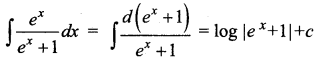
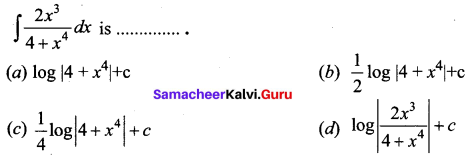
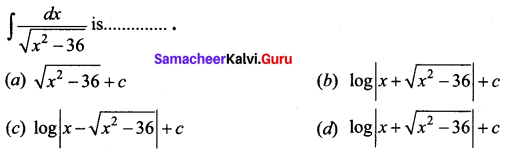
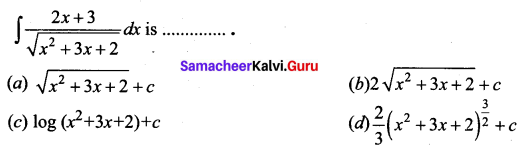
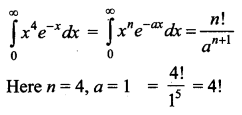
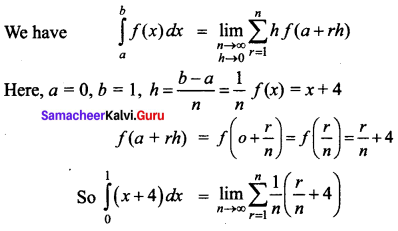
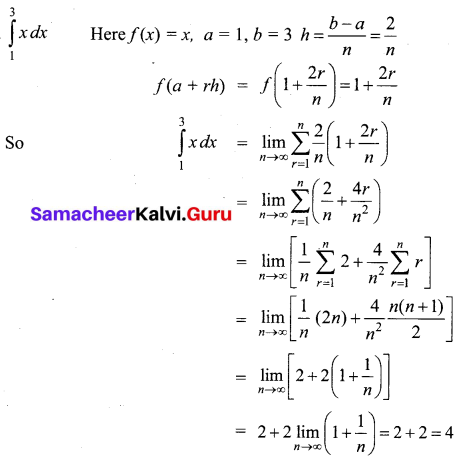
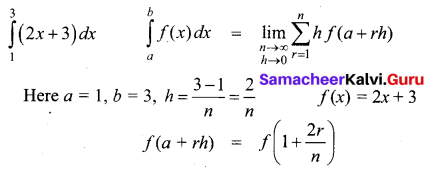
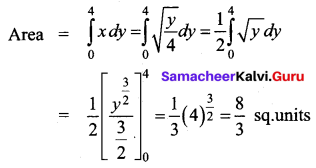
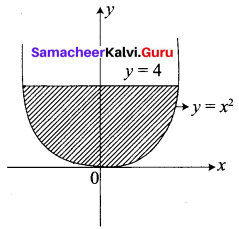
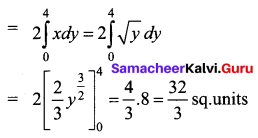
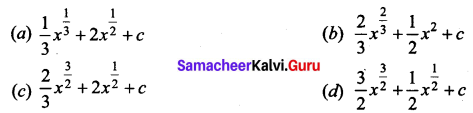
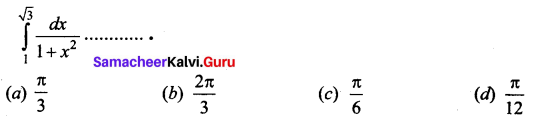
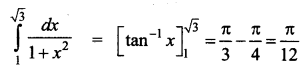
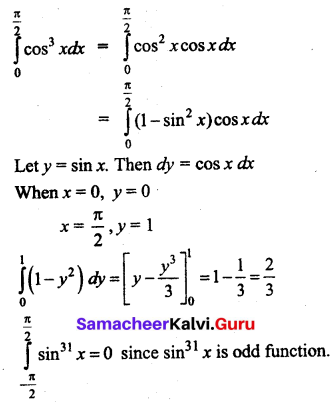
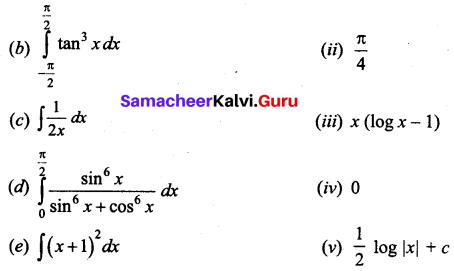
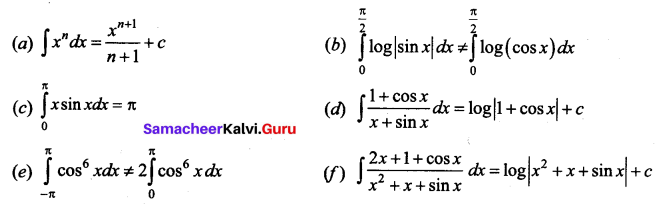
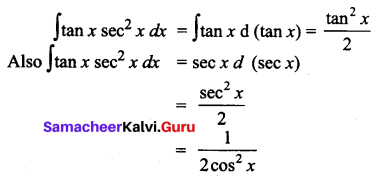
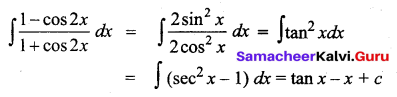
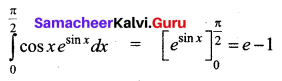
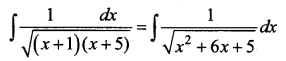
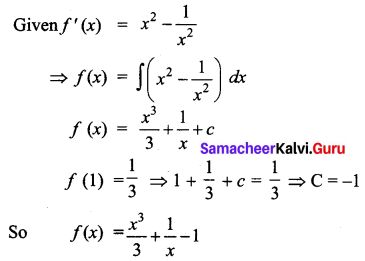
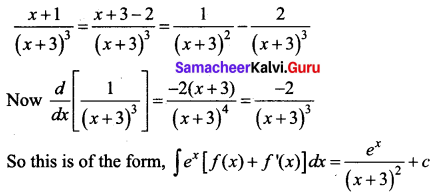
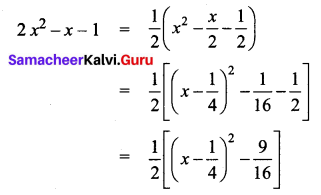
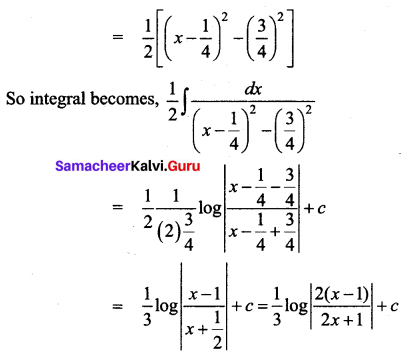
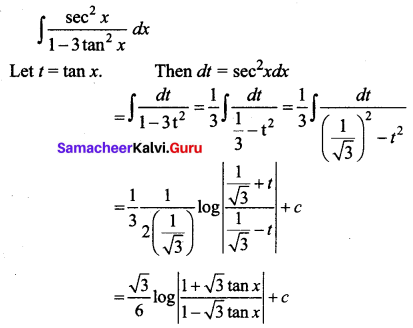
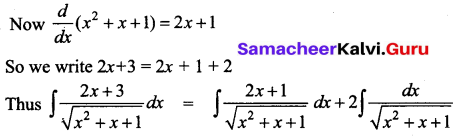
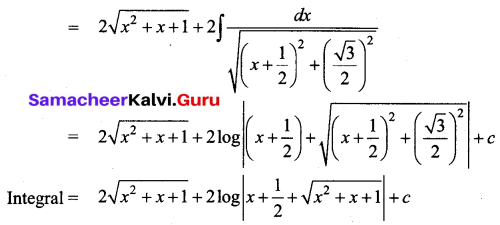
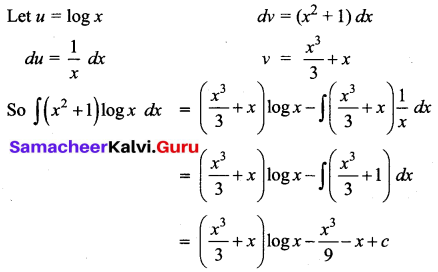
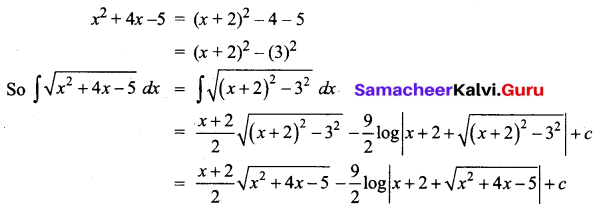
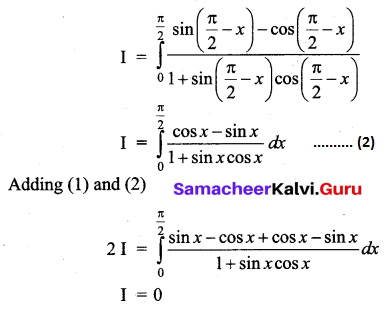
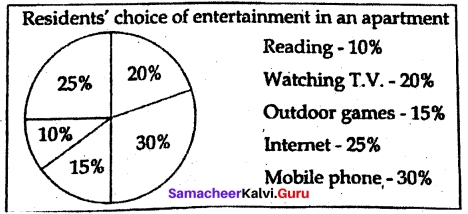
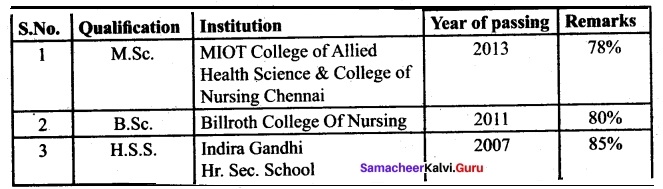
Samacheer Kalvi 12th Business Maths Solutions Chapter 2 Integral Calculus I Ex 2.1

Students can download 12th Business Maths Chapter 2 Integral Calculus I Ex 2.1 Questions and Answers, Samacheer Kalvi 12th Business Maths Book Solutions Guide Pdf helps you to revise the complete Tamilnadu State Board New Syllabus and score more marks in your examinations.

Tamilnadu Samacheer Kalvi 12th Business Maths Solutions Chapter 2 Integral Calculus I Ex 2.1

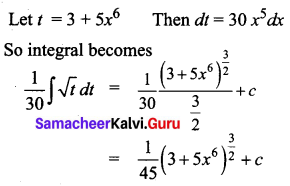
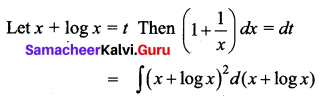
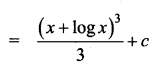
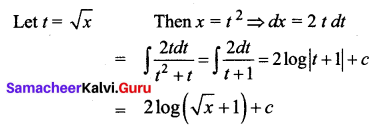
Integrate the following with respect to x.

Question 1.
\(\sqrt{3 x+5}\)
Solution:
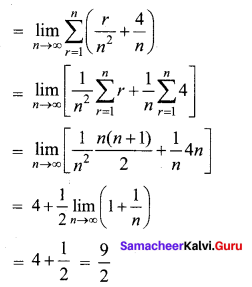
Samacheer Kalvi 12th Business Maths Solutions Chapter 2 Integral Calculus I Ex 2.1 Q1

Question 2.
\(\left(9 x^{2}-\frac{4}{x^{2}}\right)^{2}\)
Solution:
Samacheer Kalvi 12th Business Maths Solutions Chapter 2 Integral Calculus I Ex 2.1 Q2

Question 3.
(3 + x)(2 – 5x)
Solution:
Samacheer Kalvi 12th Business Maths Solutions Chapter 2 Integral Calculus I Ex 2.1 Q3

Question 4.
√x(x3 – 2x + 3)
Solution:
Samacheer Kalvi 12th Business Maths Solutions Chapter 2 Integral Calculus I Ex 2.1 Q4

Question 5.
\(\frac{8 x+13}{\sqrt{4 x+7}}\)
Solution:
Samacheer Kalvi 12th Business Maths Solutions Chapter 2 Integral Calculus I Ex 2.1 Q5
Samacheer Kalvi 12th Business Maths Solutions Chapter 2 Integral Calculus I Ex 2.1 Q5.1

Question 6.
\(\frac{1}{\sqrt{x+1}+\sqrt{x-1}}\)
Solution:
Samacheer Kalvi 12th Business Maths Solutions Chapter 2 Integral Calculus I Ex 2.1 Q6

Question 7.
If f'(x) = x + b, f(1) = 5 and f(2) = 13, then find f(x)
Solution:
f'(x) = x + b
Integrating both sides of the equations
Samacheer Kalvi 12th Business Maths Solutions Chapter 2 Integral Calculus I Ex 2.1 Q7

Question 8.
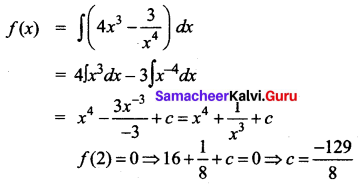
If f(x) = 8x3 – 2x and f(2) = 8, then find f(x)
Solution:
f'(x) = 8x3 – 2x
Integrating both sides of the equation,
Samacheer Kalvi 12th Business Maths Solutions Chapter 2 Integral Calculus I Ex 2.1 Q8

Samacheer Kalvi 12th Business Maths Solutions Chapter 1 Applications of Matrices and Determinants Ex 1.3

Students can download 12th Business Maths Chapter 1 Applications of Matrices and Determinants Ex 1.3 Questions and Answers, Samacheer Kalvi 12th Business Maths Book Solutions Guide Pdf helps you to revise the complete Tamilnadu State Board New Syllabus and score more marks in your examinations.

Tamilnadu Samacheer Kalvi 12th Business Maths Solutions Chapter 1 Applications of Matrices and Determinants Ex 1.3

Question 1.
The subscription department of a magazine sends out a letter to a large mailing list inviting subscriptions for the magazine. Some of the people receiving this letter already subscribe to the magazine while others do not. From this mailing list, 45% of those who already subscribe will subscribe again while 30% of those who do not now subscribe will subscribe. On the last letter, it was found that 40% of those receiving it ordered a subscription. What per cent of those receiving the current letter can be expected to order a subscription?
Solution:
Let X represent people who subscribe for the magazine and Y represent persons who do not subscribe for the magazine.
Now there are four cases,
(X, X) ⇒ those who already subscribed will subscribe again.
(X, Y) ⇒ those who already subscribed will not subscribe again.
(Y, X) ⇒ those who have not subscribed will do it now.
(Y, Y) ⇒ those who have not subscribed will not do it now also.
From the problem, we can see that
(X, X) = 45% = 0.45
(X, Y) = 100 – 45 = 55% = 0.55
(Y, X) = 30% = 0.3
(Y, Y) = (100 – 30) = 70% = 0.7
The transition probability matrix is given by
Samacheer Kalvi 12th Business Maths Solutions Chapter 1 Applications of Matrices and Determinants Ex 1.3 1
The values of X and Y are given as X = 40 % = 0.4; Y = (100 – 40 ) = 60% = 0.6
We have to predict the value of X and Y after the current letter is sent. It is done as below
Samacheer Kalvi 12th Business Maths Solutions Chapter 1 Applications of Matrices and Determinants Ex 1.3 2
That is X = 36% and Y = 64%
Thus 36% of those receiving the current letter can be expected to order a subscription.

Question 2.
A new transit system has just gone into operation in Chennai. Of those who use the transit system this year, 30% will switch over to using the metro train next year and 70% will continue to use the transit system. Of those who use metro train this year, 70% will continue to use metro train next year and 30% will switch over to the transit system. Suppose the population of Chennai city remains constant and that 60% of the commuters use the transit system and 40% of the commuters use metro train this year.
(i) What per cent of commuters will be using the transit system after one year?
(ii) What per cent of commuters will be using the transit system in the long run?
Solution:
Let T denote transit system and M denote metro train. Here again, there are four cases.
(T T) ⇒ those who use the transit system will continue to use the transit system.
(T M) ⇒ those who use the transit system will switch over to the metro train.
(M T) ⇒ those who use metro train will change to the transit system.
(M M) ⇒ those who use metro train will continue to use the metro train.
From the question,
(T T) =70% = 0.7.
(T M) = 30% = 0.3
(M T) = 30% = 0.3
(M M) = 70% = 0.7
The transition probability matrix is given by
Samacheer Kalvi 12th Business Maths Solutions Chapter 1 Applications of Matrices and Determinants Ex 1.3 3
The current position is given by T = 60% and M = 40%
Samacheer Kalvi 12th Business Maths Solutions Chapter 1 Applications of Matrices and Determinants Ex 1.3 4
We have to predict the values of T and M after one year.
Samacheer Kalvi 12th Business Maths Solutions Chapter 1 Applications of Matrices and Determinants Ex 1.3 5
i.e, T = 0.54 = 54%
M = 0.46 = 46%
So after one year, 54% of commuters will use the transit system and 46% of commuters will use the metro train.
(ii) At equilibrium which will be reached in the long run, T + M = 1
We have,
Samacheer Kalvi 12th Business Maths Solutions Chapter 1 Applications of Matrices and Determinants Ex 1.3 6
By matrix multiplications,
(0.7T + 0.3M 0.3 T + 0.7 M) = (T M)
Equating the corresponding elements,
0.7T + 0.3M = T
0.7T + 0.3 (1 – T) = T (Using T + M = 1)
0.7T + 0.3 – 0.3T = T
0.3 = 0.6T
T = 0.5
T = 50%
Thus in the long run, 50% of the commuters will be using transit system and 50% will be using metro train.

Question 3.
Two types of soaps A and B are in the market. Their present market shares are 15% for A and 85% for B. Of those who bought A the previous year, 65% continue to buy it again while 35% switch over to B. Of those who bought B the previous year, 55% buy it again and 45% switch over to A. Find their market shares after one year and when is the equilibrium reached?
Solution:
A and B are the two types of soaps. The current market shares are 15% and 85%.
This is represented as
(A B)
(0.15 0.85)
(A A) ⇒ those who bought A previous year will again buy A = 65 % = 0.65
(A B) ⇒ those who bought A previous year will buy soap B now = 35 % = 0.35
(B A) ⇒ those who bought B previous year will buy A now = 45 % = 0.45
(B B) ⇒ those who bought B previous year will buy it again = 55 % = 0.55
The transition probability matrix is
Samacheer Kalvi 12th Business Maths Solutions Chapter 1 Applications of Matrices and Determinants Ex 1.3 7
(i) Their market shares after one year is given by
Samacheer Kalvi 12th Business Maths Solutions Chapter 1 Applications of Matrices and Determinants Ex 1.3 8
So after one-year market shares of soap A will be 48% and soap B will be 52%
(ii) At equilibrium, A + B = 1
We have
Samacheer Kalvi 12th Business Maths Solutions Chapter 1 Applications of Matrices and Determinants Ex 1.3 9
By matrix multiplication,
(0.65A + 0.45B 0.35A + 0.55B) = (A B)
Equating the corresponding elements,
0.65 A + 0.45 B = A
0.65 A + 0.45 A(1 – A) = A (Using A + B = 1)
0.65 A + 0.45 – 0.45 A = A
0.45 = 0.8 A
A = 0.5625 (or) A = 56.25 %
B = 100 – 56.25 = 43.75%
The equilibrium is reached when the market share of soap A is 56.25% and the market share of soap B is 43.75%

Question 4.
Two products A and B currently share the market with shares 50% and 50% each respectively. Each week some brand switching takes place. Of those who bought A the previous week, 60% buy it again whereas 40% switch over to B. Of those who bought B the previous week, 80% buy it again whereas 20% switch over to A. Find their shares after one week and after two weeks. If the price war continues, when is the equilibrium reached?
Solution:
Given that two products A and B have shared 50 % and 50% respectively.
(A A) ⇒ those who bought A the previous week will buy it again = 60 % = 0.6
(A B) ⇒ those who bought A the previous week will buy B now = 40 % = 0.4
(B A) ⇒ those who bought B the previous week will switch to A = 20 % = 0.2
(B B) ⇒ those who bought B will again buy B = 80 % = 0.8
The transition probability matrix is given by
Samacheer Kalvi 12th Business Maths Solutions Chapter 1 Applications of Matrices and Determinants Ex 1.3 10
The current position of A and B in the market is
Samacheer Kalvi 12th Business Maths Solutions Chapter 1 Applications of Matrices and Determinants Ex 1.3 11
After one week
The shares of A and B are given by
Samacheer Kalvi 12th Business Maths Solutions Chapter 1 Applications of Matrices and Determinants Ex 1.3 12
So after one week the market share of A is \(\frac{0.4}{100}\) × 100 = 40% and that of B is \(\frac{0.6}{100}\) × 100 = 60%
After two weeks
The shares of A and B are given by
Samacheer Kalvi 12th Business Maths Solutions Chapter 1 Applications of Matrices and Determinants Ex 1.3 13
Thus after two weeks, A will have 36% of shares and B will have 64% of shares.
As time goes, equilibrium will be reached in the long run.
At this point A + B = 1
We have
Samacheer Kalvi 12th Business Maths Solutions Chapter 1 Applications of Matrices and Determinants Ex 1.3 14
By matrix multiplication,
(0.6A + 0.2B 0.4A + 0.8B) = (A B)
Equating the corresponding elements,
0.6A + 0.2B = A
0.6A + 0.2(1 – A) = A (using A + B = 1)
0.6A + 0.2 – 0.2A = A
0.2 = A – 0.4A
A = \(\frac{0.2}{0.6}\) = 0.33 = 33%
B = 1 – 0.33 = 0.67 = 67%
Thus the equilibrium is reached when the share of A is 33% and share of B is 67%.

Samacheer Kalvi 12th Business Maths Solutions Chapter 1 Applications of Matrices and Determinants Additional Problems

Students can download 12th Business Maths Chapter 1 Applications of Matrices and Determinants Additional Problems Questions and Answers, Samacheer Kalvi 12th Business Maths Book Solutions Guide Pdf helps you to revise the complete Tamilnadu State Board New Syllabus and score more marks in your examinations.

Tamilnadu Samacheer Kalvi 12th Business Maths Solutions Chapter 1 Applications of Matrices and Determinants Additional Problems

I. One Mark Questions

Choose the correct statement.

Question 1.
If A is a matrix of order m × n, then ______
(a) ρ(A) = m
(b) ρ(A) = n
(c) ρ(A) = min of {m, n}
(d) ρ(A) < m
Answer:
(c) ρ(A) = min of {m, n}

Question 2.
If Samacheer Kalvi 12th Business Maths Solutions Chapter 1 Applications of Matrices and Determinants Additional Problems 12 is a transition probability matrix, then the value of a is
(a) 0.5
(b) 0.7
(c) 0
(d) 0.6
Answer:
(b) 0.7
Hint:
0.3 + α = 1
⇒ α = 1 – 0.3 = 0.7

Question 3.
Let AX = B is a system of n non-homogeneous linear equation. Then which of the following is correct.
(a) |A|= 0
(b) A = B
(c) |A| ≠ 0
(d) ρ(A) < n
Answer:
(c) |A| ≠ 0

Question 4.
Choose the incorrect pair.
Samacheer Kalvi 12th Business Maths Solutions Chapter 1 Applications of Matrices and Determinants Additional Problems 1
Answer:
(a) (3 2 4) – Column matrix

Question 5.
If A is matrix [A, B] is the augmented matrix then which of the following is true?
(a) ρ([A, B]) = ρ(A)
(b) ρ([A, B]) ≥ ρ(A)
(c) ρ([A, B]) = ρ(A) > n
(d) ρ([A, B]) < ρ(A)
Answer:
(b) ρ([A, B]) ≥ ρ(A)

Question 6.
Choose the echelon matrix.
(a) \(\left[\begin{array}{ll}
0 & 1 \\
1 & 0 \\
0 & 0
\end{array}\right]\)
(b) \(\left[\begin{array}{ll}
1 & 2 \\
0 & 1 \\
0 & 0
\end{array}\right]\)
(c) \(\left[\begin{array}{ll}
1 & 2 \\
0 & 1 \\
0 & 1
\end{array}\right]\)
(d) \(\left[\begin{array}{ll}
1 & 0 \\
0 & 0 \\
0 & 1
\end{array}\right]\)
Answer:
(b) \(\left[\begin{array}{ll}
1 & 2 \\
0 & 1 \\
0 & 0
\end{array}\right]\)

Question 7.
Let A be a non-singular matrix of order (3 × 3). Then |adj A| is equal to _______
(a) |A|
(b) |A|2
(c) |A|3
(d) 3|A|
Answer:
(b) |A|2

Question 8.
For what value of k does the matrix. A = \(\left[\begin{array}{cc}
k & -1 \\
3 & 2
\end{array}\right]\) does not have inverse?
(a) 1
(b) \(\frac{-3}{2}\)
(c) 0
(d) -1
Answer:
(b) \(\frac{-3}{2}\)
Hint:
Samacheer Kalvi 12th Business Maths Solutions Chapter 1 Applications of Matrices and Determinants Additional Problems 2

Question 9.
Rank of the matrix A = \(\left(\begin{array}{rrrr}
1 & -1 & 2 & 0 \\
0 & 2 & 0 & 3
\end{array}\right)\) is _______
(a) 1
(b) 0
(c) 2
(d) -1
Answer:
(c) 2
Hint:
The second order minors, \(\left|\begin{array}{cc}
1 & -1 \\
0 & 2
\end{array}\right|,\left|\begin{array}{cc}
-1 & 2 \\
2 & 0
\end{array}\right|,\left|\begin{array}{cc}
2 & 0 \\
0 & 3
\end{array}\right|\) are not zero. So rank is 2

Question 10.
Choose the correct answer.
(a) A system of the linear equation always has a unique solution.
(b) A system of the linear equation can have more than one solution.
(c) A system of the linear equation need not be consistent.
(d) All of the above
Answer:
(d) All of the above

Question 11.
For the matrix equation \(\left(\begin{array}{cc}
1 & 2 \\
3 & -1
\end{array}\right)\left(\begin{array}{l}
x \\
y
\end{array}\right)=\left(\begin{array}{l}
7 \\
3
\end{array}\right)\) the augmented matrix is _______
(a) \(\left(\begin{array}{ccc}
1 & 2 & 7 \\
3 & -1 & 3
\end{array}\right)\)
(b) \(\left(\begin{array}{ll}
1 & 7 \\
3 & 3
\end{array}\right)\)
(c) \(\left(\begin{array}{ll}
7 & 1 \\
3 & 3
\end{array}\right)\)
(d) \(\left(\begin{array}{rrr}
1 & 7 & 2 \\
3 & 3 & -1
\end{array}\right)\)
Answer:
(a) \(\left(\begin{array}{ccc}
1 & 2 & 7 \\
3 & -1 & 3
\end{array}\right)\)

Question 12.
Find the correct statement. Cramer’s rule can be used to solve, _______
(a) n equations in n unknowns
(b) When determinant of the coefficient matrix is non-zero.
(c) The number of unknowns need not be equal to a number of equations.
(d) For infinite solutions
Answer:
(a) n equations in n unknowns & (b) When determinant of the coefficient matrix is non-zero.

Question 13.
Which of the following is a transition probability matrix?
(a) \(\left(\begin{array}{cc}
0.3 & 0.6 \\
0.15 & 0.85
\end{array}\right)\)
(b) \(\left(\begin{array}{ccc}
0.9 & 0.075 & 0.025 \\
0.15 & 0.8 & 0.05 \\
0.25 & 0.25 & 0.5
\end{array}\right)\)
(c) \(\left(\begin{array}{ll}
1 & 0.2 \\
0.3 & 0.25
\end{array}\right)\)
(d) \(\left(\begin{array}{cc}
0.35 & 0.6 \\
0.2 & 0.7
\end{array}\right)\)
(i) only a
(ii) only b
(iii) both c and d
(iv) both a and b
Answer:
(iv) both a and b
Hint:
Sum of all the probabilities should be equal to one

Question 14.
Choose the correct statements.
(a) the rank of an identity matrix is zero.
(b) the rank of an adjoint matrix is more than the rank of a matrix
(c) the rank of a diagonal matrix is equal to the number of rows
(d) the rank of an echelon matrix is greater than the matrix
Answer:
(c) the rank of a diagonal matrix is equal to the number of rows

Question 15.
Samacheer Kalvi 12th Business Maths Solutions Chapter 1 Applications of Matrices and Determinants Additional Problems 3
Answer:
1 – d, 2 – c, 3 – a, 4 – b

II. 2 Mark Questions

Question 1.
Show that the inverse of A = \(\left(\begin{array}{cc}
-6 & 9 \\
4 & -6
\end{array}\right)\) does not exist
Solution:
Show |A| = 0

Question 2.
Find the rank of A = \(\left(\begin{array}{lll}
1 & 2 & 3 \\
2 & 3 & 4 \\
3 & 5 & 7
\end{array}\right)\)
Solution:
Given A = \(\left(\begin{array}{lll}
1 & 2 & 3 \\
2 & 3 & 4 \\
3 & 5 & 7
\end{array}\right)\)
Consider \(\left(\begin{array}{lll}
1 & 2 & 3 \\
2 & 3 & 4 \\
3 & 5 & 7
\end{array}\right)\)
= 1(21 – 20) – 2(14 – 12) + 3(10 – 9)
= 1 – 4 + 3
= 0
Since third order minor equals zero, ρ(A) < 3
Consider \(\left|\begin{array}{ll}
1 & 2 \\
2 & 3
\end{array}\right|\) = 3 – 4 = -1 ≠ 0
There is a minor of order 2 which is not zero. Hence ρ(A) = 2

Question 3.
Find the rank of A = \(\left[\begin{array}{rrrr}
4 & 5 & -6 & -1 \\
7 & -3 & 0 & 8
\end{array}\right]\)
Solution:
Given A = \(\left[\begin{array}{rrrr}
4 & 5 & -6 & -1 \\
7 & -3 & 0 & 8
\end{array}\right]\)
Consider the minor \(\left|\begin{array}{cc}
5 & -6 \\
-3 & 0
\end{array}\right|=-18 \neq 0\)
Since a minor of order 2 is not zero, rank is 2

Question 4.
Solve the system by Cramer’s rule, 4x – 3y = 11; 6x + 5y = 7
Solution:
4x – 3y = 11; 6x + 5y = 7
Samacheer Kalvi 12th Business Maths Solutions Chapter 1 Applications of Matrices and Determinants Additional Problems 4

Question 5.
Solve the system by rank method.
3x + 5y = -7; x + 4y = -14
Solution:
3x + 5y = -7; x + 4y = -14
The matrix equation of the system is
Samacheer Kalvi 12th Business Maths Solutions Chapter 1 Applications of Matrices and Determinants Additional Problems 5
Number of non-zero rows is 2
So ρ(A) = ρ([A, B]) = 2
Now the new matrix equation is
-7y = 35 ⇒ y = -5
x + 4y = -14 ⇒ x = -14 – 4(-5) = 6
Solution is (6, -5)

Question 6.
Find the solution of the system 5x + y = -13; 3x – 2y = 0
Solution:
5x + y = -13; 3x – 2y = 0
We solve the system by Cramer’s rule
Samacheer Kalvi 12th Business Maths Solutions Chapter 1 Applications of Matrices and Determinants Additional Problems 6

III. 3 and 5 Mark Questions

Question 1.
Find λ so that the matrix \(\left(\begin{array}{ccc}
8 & 9 & 7 \\
7 & 8 & 6 \\
9 & 10 & \lambda
\end{array}\right)\) is a singular matrix.
Solution:
Samacheer Kalvi 12th Business Maths Solutions Chapter 1 Applications of Matrices and Determinants Additional Problems 7

Question 2.
Find k so that the matrix \(\left(\begin{array}{ccc}
1 & 2 & k \\
3 & 4 & 5 \\
7 & 10 & 12
\end{array}\right)\) is a non-singular matrix.
Solution:
Samacheer Kalvi 12th Business Maths Solutions Chapter 1 Applications of Matrices and Determinants Additional Problems 8

Question 3.
Solve by Cramer’ rule, x – y + z = 2; 2x – y = 0; 2y – z = 1
Solution:
x – y + z = 2; 2x – y = 0; 2y – z = 1
The matrix equation corresponding to the system is
Samacheer Kalvi 12th Business Maths Solutions Chapter 1 Applications of Matrices and Determinants Additional Problems 9
Samacheer Kalvi 12th Business Maths Solutions Chapter 1 Applications of Matrices and Determinants Additional Problems 10

Question 4.
Solve by rank method x + 2y – 3z = -4; 2x + 3y + 2z = 2; 3x – 3y – 4z = 11
Solution:
x + 2y – 3z = -4; 2x + 3y + 2z = 2; 3x – 3y – 4z = 11
The matrix equation is
Samacheer Kalvi 12th Business Maths Solutions Chapter 1 Applications of Matrices and Determinants Additional Problems 11
The last equivalent matrix is in echelon form.
ρ(A) = ρ([A, B]) = 3 = Number of unknowns
The new matrix equation is given by \(\left(\begin{array}{ccc}
1 & 2 & -3 \\
0 & -1 & 8 \\
0 & 0 & -67
\end{array}\right)\left(\begin{array}{l}
x \\
y \\
z
\end{array}\right)=\left(\begin{array}{c}
-4 \\
10 \\
-67
\end{array}\right)\)
x + 2y – 3z = -4 ……. (1)
-y + 8z = 10 …….. (2)
-67z = -67 ……… (3)
(3) ⇒ z = 1
(2) ⇒ -y + 8 = 10 ⇒ -y = 2 ⇒ y = -2
(1) ⇒ x = -4 -2(-2) + 3(1) ⇒ x = 3
Hence the solution is (x, y, z) = (3, -2, 1)

Question 5.
The sum of three numbers is 20. If we multiply the first by 2 and add the second number and subtract the third we get 23. If we multiply the first by 3 and add second and third to it, we get 46. By using rank method find the numbers.
Solution:
Let the three number be x, y and z respectively.
According to the problem,
x + y + z = 20
2x + y – z = 23
3x + y + z = 46
The matrix equation is given by
Samacheer Kalvi 12th Business Maths Solutions Chapter 1 Applications of Matrices and Determinants Additional Problems 13
x + y + z = 20 …….. (1)
-y – 3z = -17 …….. (2)
4z = 20 …….. (3)
(3) ⇒ z = 5
(2) ⇒ -y = -17 + 3(5) = -2 ⇒ y = 2
(1) ⇒ x = 20 – 2 – 5 = 13
Hence the three numbers are (13, 2, 5)

Question 6.
Weekly expenditure in an office for three weeks is given as follows. Calculate the salary for each type of staff using Cramer’s rule.
Samacheer Kalvi 12th Business Maths Solutions Chapter 1 Applications of Matrices and Determinants Additional Problems 14
Solution:
Let the salary for the three types of staff A, B and C be ₹ x, ₹ y and ₹ z respectively.
According to the problem we have,
4x + 2y + 3z = 4900
3x + 3y + 2z = 4500
4x + 3y + 4z = 5800
Samacheer Kalvi 12th Business Maths Solutions Chapter 1 Applications of Matrices and Determinants Additional Problems 15
Samacheer Kalvi 12th Business Maths Solutions Chapter 1 Applications of Matrices and Determinants Additional Problems 16
Samacheer Kalvi 12th Business Maths Solutions Chapter 1 Applications of Matrices and Determinants Additional Problems 17

Question 7.
Show that the equations x – 3y – 8z = -10; 3x + y – 4z = 0; 2x + 5y + 6z = 13 are consistent and have infinite sets of solution.
Solution:
Samacheer Kalvi 12th Business Maths Solutions Chapter 1 Applications of Matrices and Determinants Additional Problems 18
The last equivalent matrix is in echelon form. It has two non-zero rows.
ρ(A) = ρ([A, B]) = 2 < number of unknowns
The system is consistent and has infinitely many solutions
The changed matrix equation is given by \(\left(\begin{array}{ccc}
1 & -3 & -8 \\
0 & 1 & 2 \\
0 & 0 & 0
\end{array}\right)\left(\begin{array}{c}
x \\
y \\
z
\end{array}\right)=\left(\begin{array}{c}
-10 \\
3 \\
0
\end{array}\right)\)
x – 3y – 8z = -10 ……. (1)
y + 2z = 3 ……. (2)
(2) ⇒ y = 3 – 2z
(1) ⇒ x = -10 + 3y + 8z
⇒ x = -10 + 3(3 – 2z) + 8z
⇒ x = -10 + 9 – 6z + 8z
⇒ x = 2z – 1
Let us take z = k, k ∈ R. We get y = 3 – 2k and x = 2k – 1.
By giving diffemet values for k, we get different solutions.

Question 8.
Find the rank of the matrix by reducing to echelon form A = \(\left(\begin{array}{cccc}
1 & 1 & 1 & 1 \\
1 & 3 & -2 & 1 \\
2 & 0 & -3 & 2
\end{array}\right)\)
Solution:
Samacheer Kalvi 12th Business Maths Solutions Chapter 1 Applications of Matrices and Determinants Additional Problems 19

Question 9.
Show that the equations x – 3y + 4z = 3; 2x – 5y + 7z = 6; 3x – 8y + 11z = 1 are inconsistent.
Solution:
x – 3y + 4z = 3; 2x – 5y + 7z = 6; 3x – 8y + 11z = 1
Samacheer Kalvi 12th Business Maths Solutions Chapter 1 Applications of Matrices and Determinants Additional Problems 20
The last equivalent matrix is in the echelon form. [A, B] has 3 non-zero rows and [A] has 2 non-zero rows.
ρ([A, B]) = 3; ρ(A) = 2
ρ(A) ≠ ρ([A, B])
The system is inconsistent and has no solution.

Question 10.
Find k if the equations 2x + 3y – z = 5; 3x – y + 4z = 2; x + 7y – 6z = k are consistent.
Solution:
Given that the system 2x + 3y – z = 5; 3x – y + 4z = 2, x + 7y – 6z = k is consistent.
Samacheer Kalvi 12th Business Maths Solutions Chapter 1 Applications of Matrices and Determinants Additional Problems 21
ρ(A) = 2 ρ([A, B]) = 2 or 3
For the equations to be consistent, ρ([A, B]) = ρ(A) = 2
-8 + k = 0 ⇒ k = 8

Question 11.
Find k if the equations x + y + z = 3; x + 3y + 2z = 6; x + 5y + 3z = k are inconsistent.
Solution:
Given that the system is inconsistent
Samacheer Kalvi 12th Business Maths Solutions Chapter 1 Applications of Matrices and Determinants Additional Problems 22
Samacheer Kalvi 12th Business Maths Solutions Chapter 1 Applications of Matrices and Determinants Additional Problems 23
For the equations to be inconsistent, ρ[(A, B)] ≠ ρ(A)
Here ρ(A) = 2 So ρ([A, B]) ≠ 2
That is the last row of the echelon matrix should not be zero
⇒ k ≠ 9

Question 12.
Two newspapers A and B are published in a city. Their present market shares are 15% for A and 85% for B. Of those who bought A the previous year, 65% continue to buy it again while 35% switch over to B. Of those who bought B the previous year, 55% buy it again and 45% switch over to A. Find their market shares after two years.
Solution:
Let the present shares of A and B be denoted by (0.15 0.85)
The transition probability matrix is given by
Samacheer Kalvi 12th Business Maths Solutions Chapter 1 Applications of Matrices and Determinants Additional Problems 24
Hence their market shares after 2 years will be 0.546 × 100 = 54.6 % and 0.454 × 100 = 45.4%

Question 13.
The pattern of sunny and rainy days on a planet has two states. Every sunny day is followed by another sunny day with probability 0.8. Every rainy day is followed by another rainy day with probability 0.6. Today is sunny on the planet. What is the chance of rain the day after tomorrow?
Solution:
Let S and R denote sunny and rainy days on the planet
The transition probability matrix is given by
Samacheer Kalvi 12th Business Maths Solutions Chapter 1 Applications of Matrices and Determinants Additional Problems 25
We have to find the probability of rain after two days. We have to find T2
Samacheer Kalvi 12th Business Maths Solutions Chapter 1 Applications of Matrices and Determinants Additional Problems 26
Hence if today is sunny on the planet, the chance of rain the day after tomorrow is 0.28.

Samacheer Kalvi 12th Business Maths Solutions Chapter 1 Applications of Matrices and Determinants Ex 1.2

Students can download 12th Business Maths Chapter 1 Applications of Matrices and Determinants Ex 1.2 Questions and Answers, Samacheer Kalvi 12th Business Maths Book Solutions Guide Pdf helps you to revise the complete Tamilnadu State Board New Syllabus and score more marks in your examinations.

Tamilnadu Samacheer Kalvi 12th Business Maths Solutions Chapter 1 Applications of Matrices and Determinants Ex 1.2

Question 1.
Solve the following equations by using Cramer’s rule
(i) 2x + 3y = 7; 3x + 5y = 9
(ii) 5x + 3y = 17; 3x + 7y = 31
(iii) 2x + y – z = 3, x + y + z = 1, x – 2y – 3z = 4
(iv) x + y + z = 6, 2x + 3y – z = 5, 6x – 2y – 3z = -7
(v) x + 4y + 3z = 2, 2x – 6y + 6z = -3, 5x – 2y + 3z = -5
Solution:
(i) 2x + 3y = 7; 3x + 5y = 9
Samacheer Kalvi 12th Business Maths Solutions Chapter 1 Applications of Matrices and Determinants Ex 1.2 1
Samacheer Kalvi 12th Business Maths Solutions Chapter 1 Applications of Matrices and Determinants Ex 1.2 2
Samacheer Kalvi 12th Business Maths Solutions Chapter 1 Applications of Matrices and Determinants Ex 1.2 3
Samacheer Kalvi 12th Business Maths Solutions Chapter 1 Applications of Matrices and Determinants Ex 1.2 4
Samacheer Kalvi 12th Business Maths Solutions Chapter 1 Applications of Matrices and Determinants Ex 1.2 5
Samacheer Kalvi 12th Business Maths Solutions Chapter 1 Applications of Matrices and Determinants Ex 1.2 6

Question 2.
A commodity was produced by using 3 units of labour and 2 units of capital, the total cost is ₹ 62. If the commodity had been produced by using 4 units of labour and one unit of capital, the cost is ₹ 56. What is the cost per unit of labour and capital? (Use determinant method).
Solution:
Let the cost per unit of labour be ₹ x and cost per unit of capital be ₹ y.
Samacheer Kalvi 12th Business Maths Solutions Chapter 1 Applications of Matrices and Determinants Ex 1.2 7
Samacheer Kalvi 12th Business Maths Solutions Chapter 1 Applications of Matrices and Determinants Ex 1.2 8

Question 3.
A total of ₹ 8,600 was invested in two accounts. One account earned 4\(\frac{3}{4}\)% annual interest and the other earned 6\(\frac{1}{2}\)% annual interest. If the total interest for one year was ₹431.25, how much was invested in each account? (Use determinant method).
Solution:
Let ₹ x and ₹ y be the amounts invested in the two accounts.
Samacheer Kalvi 12th Business Maths Solutions Chapter 1 Applications of Matrices and Determinants Ex 1.2 9
Samacheer Kalvi 12th Business Maths Solutions Chapter 1 Applications of Matrices and Determinants Ex 1.2 10

Question 4.
At marina two types of games viz., Horse riding and Quad Bikes riding are available on hourly rent. Keren and Benita spent ₹ 780 and ₹ 560 during the month of May.
Samacheer Kalvi 12th Business Maths Solutions Chapter 1 Applications of Matrices and Determinants Ex 1.2 11
Find the hourly charges for the two games (rides). (Use determinant method).
Solution:
Let hourly charges for horse riding be ₹ x and hourly charges for Quad bike riding be ₹ y.
According to the problem, for Keren, we have 3x + 4y as total amount and for Benita, we have 2x + 3y as the total amount.
That is 3x + 4y = 780
2x + 3y = 560
Samacheer Kalvi 12th Business Maths Solutions Chapter 1 Applications of Matrices and Determinants Ex 1.2 12
Hence hourly charges for horse riding and bike riding are ₹ 100 and ₹ 120 respectively.

Question 5.
In a market survey three commodities A, B and C were considered. In finding out the index number some fixed weights were assigned to the three varieties in each of the commodities. The table below provides information regarding the consumption of three commodities according to the three varieties and also the total weight received by the commodity.
Samacheer Kalvi 12th Business Maths Solutions Chapter 1 Applications of Matrices and Determinants Ex 1.2 13
Find the weights assigned to the three varieties by using Cramer’s Rule.
Solution:
Let the weights assigned to the three varieties be x, y and z respectively.
According to the problem,
For variety A, x + 2y + 3z = 11
For variety B, 2x + 4y + 5z = 21
For variety C, 3x + 5y + 6z = 27
Samacheer Kalvi 12th Business Maths Solutions Chapter 1 Applications of Matrices and Determinants Ex 1.2 14
Hence the weights assigned to the three varieties are 2, 3 and 1 units respectively.

Question 6.
A total of ₹ 8,500 was invested in three interest-earning accounts. The interest rates were 2%, 3% and 6% if the total simple interest for one year was ₹ 380 and the amount invested at 6% was equal to the sum of the amounts in the other two accounts, then how much was invested in each account? (use Cramer’s rule).
Samacheer Kalvi 12th Business Maths Solutions Chapter 1 Applications of Matrices and Determinants Ex 1.2 15
Solution:
Let the amounts invested in the three accounts be Rs. x, Rs. y and Rs. z
Interest for the three accounts are \(\frac{2}{100}\)x, \(\frac{3}{100}\)y and \(\frac{6}{100}\)z
According to the problem, x + y + z = 8500 ……. (1)
\(\frac{2}{100} x+\frac{3}{100} y+\frac{6}{100} z=380\)
(or) multiplying by 100,
2x + 3y + 6z = 38000 ……… (2)
z = x + y or x + y – z = 0 ………. (3)
Samacheer Kalvi 12th Business Maths Solutions Chapter 1 Applications of Matrices and Determinants Ex 1.2 16

Samacheer Kalvi 12th Business Maths Solutions Chapter 1 Applications of Matrices and Determinants Ex 1.1

Students can download 12th Business Maths Chapter 1 Applications of Matrices and Determinants Ex 1.1 Questions and Answers, Samacheer Kalvi 12th Business Maths Book Solutions Guide Pdf helps you to revise the complete Tamilnadu State Board New Syllabus and score more marks in your examinations.

Tamilnadu Samacheer Kalvi 12th Business Maths Solutions Chapter 1 Applications of Matrices and Determinants Ex 1.1

Question 1.
Find the rank of each of the following matrices.
Solution:
(i) Let A = \(\left(\begin{array}{ll}
5 & 6 \\
7 & 8
\end{array}\right)\)
Order of A is 2 × 2.
ρ(A) ≤ 2
Consider the second order minor
\(\left|\begin{array}{ll}
5 & 6 \\
7 & 8
\end{array}\right|\) = 40 – 42 = -2 ≠ 0
There is a minor of order 2, which is not zero.
ρ(A) = 2
(ii) Let A = \(\left(\begin{array}{ll}
1 & -1 \\
3 & -6
\end{array}\right)\)
Order of A is 2 × 2
ρ(A) ≤ 2
Consider the second order minor
\(\left|\begin{array}{ll}
1 & -1 \\
3 & -6
\end{array}\right|\) = -6 + 3 = -3 ≠ 0
ρ(A) = 2
(iii) Let A = \(\left(\begin{array}{ll}
1 & 4 \\
2 & 8
\end{array}\right)\)
Since A is of order 2 × 2, ρ(A) ≤ 2
Now \(\left|\begin{array}{ll}
1 & 4 \\
2 & 8
\end{array}\right|\) = 8 – 8 = 0
Since second order minor vanishes ρ(A) ≠ 2
But first order minors, |1|, |4|, |2|, |8| are non zero.
ρ(A) = 1
(iv) Let A = \(\left(\begin{array}{ccc}
2 & -1 & 1 \\
3 & 1 & -5 \\
1 & 1 & 1
\end{array}\right)\)
Order of A is 3 × 3
ρ(A) ≤ 3
Consider the third order minor
\(\left|\begin{array}{ccc}
2 & -1 & 1 \\
3 & 1 & -5 \\
1 & 1 & 1
\end{array}\right|\)
= 2(1 + 5) + 1 (3 + 5) + 1(3 – 1)
= 2(6) + 8 + 2
= 22 ≠ 0
There is a minor of order 3, which is non zero.
ρ(A) = 3
(v) Let A = \(\left(\begin{array}{ccc}
-1 & 2 & -2 \\
4 & -3 & 4 \\
-2 & 4 & -4
\end{array}\right)\)
Since order of A is 3 × 3, ρ(A) ≤ 3
Now,
\(\left|\begin{array}{ccc}
-1 & 2 & -2 \\
4 & -3 & 4 \\
-2 & 4 & -4
\end{array}\right|\)
= -1(12 – 16) -2(-16 + 8) – 2(16 – 6)
= 4 + 16 – 20
= 0
Since the third order minor vanishes, ρ(A) ≠ 3
Consider \(\left|\begin{array}{cc}
-1 & 2 \\
4 & -3
\end{array}\right|\) = 3 – 8 = -5 ≠ 0
There is a minor order 2, which is not zero
ρ(A) = 2
(vi) Let A = \(\left(\begin{array}{cccc}
1 & 2 & -1 & 3 \\
2 & 4 & 1 & -2 \\
3 & 6 & 3 & -7
\end{array}\right)\)
Let us transform the matrix A to an echelon form by using elementary transformations.
Samacheer Kalvi 12th Business Maths Solutions Chapter 1 Applications of Matrices and Determinants Ex 1.1 Q1
Samacheer Kalvi 12th Business Maths Solutions Chapter 1 Applications of Matrices and Determinants Ex 1.1 Q1.1
Samacheer Kalvi 12th Business Maths Solutions Chapter 1 Applications of Matrices and Determinants Ex 1.1 Q1.2
Samacheer Kalvi 12th Business Maths Solutions Chapter 1 Applications of Matrices and Determinants Ex 1.1 Q1.3

Question 2.
If A = \(\left(\begin{array}{ccc}
1 & 1 & -1 \\
2 & -3 & 4 \\
3 & -2 & 3
\end{array}\right)\) and B = \(\left(\begin{array}{ccc}
1 & -2 & 3 \\
-2 & 4 & -6 \\
5 & 1 & -1
\end{array}\right)\), then find the rank of AB and the rank of BA.
Solution:
Given A = \(\left(\begin{array}{ccc}
1 & 1 & -1 \\
2 & -3 & 4 \\
3 & -2 & 3
\end{array}\right)\) and B = \(\left(\begin{array}{ccc}
1 & -2 & 3 \\
-2 & 4 & -6 \\
5 & 1 & -1
\end{array}\right)\)
Samacheer Kalvi 12th Business Maths Solutions Chapter 1 Applications of Matrices and Determinants Ex 1.1 Q2
Samacheer Kalvi 12th Business Maths Solutions Chapter 1 Applications of Matrices and Determinants Ex 1.1 Q2.1

Question 3.
Solve the following system of equations by rank method.
x + y + z = 9, 2x + 5y + 7z = 52, 2x + y – z = 0
Solution:
The given equations are x + y + z = 9, 2x + 5y + 7z = 52, 2x + y – z = 0
The matrix equation corresponding to the given system is
Samacheer Kalvi 12th Business Maths Solutions Chapter 1 Applications of Matrices and Determinants Ex 1.1 Q3
Samacheer Kalvi 12th Business Maths Solutions Chapter 1 Applications of Matrices and Determinants Ex 1.1 Q3.1
Samacheer Kalvi 12th Business Maths Solutions Chapter 1 Applications of Matrices and Determinants Ex 1.1 Q3.2

Question 4.
Show that the equations 5x + 3y + 7z = 4, 3x + 26y + 2z = 9, 7x + 2y + 10z = 5 are consistent and solve them by rank method.
Solution:
The given equations are,
5x + 3y + 7 = 4
3x + 26y + 2z = 9
7x + 2y + 10z = 5
The matrix equation corresponding to the given system is
Samacheer Kalvi 12th Business Maths Solutions Chapter 1 Applications of Matrices and Determinants Ex 1.1 Q4
Samacheer Kalvi 12th Business Maths Solutions Chapter 1 Applications of Matrices and Determinants Ex 1.1 Q4.1
Samacheer Kalvi 12th Business Maths Solutions Chapter 1 Applications of Matrices and Determinants Ex 1.1 Q4.2

Question 5.
Show that the following system of equations have unique solution:
x + y + z = 3, x + 2y + 3z = 4, x + 4y + 9z = 6 by rank method.
Solution:
The given system of equations can be written in matrix equation,
Samacheer Kalvi 12th Business Maths Solutions Chapter 1 Applications of Matrices and Determinants Ex 1.1 Q5
The last matrix is in echelon form. It has 3 non – zero rows,
ρ(A) = ρ([A, B]) = 3 = number of unknowns.
The given system is consistent and has a unique solution.
To find the solution, we write the echelon form into matrix form.
\(\left(\begin{array}{lll}
1 & 1 & 1 \\
0 & 1 & 2 \\
0 & 0 & 2
\end{array}\right)\left(\begin{array}{l}
x \\
y \\
z
\end{array}\right)=\left(\begin{array}{l}
3 \\
1 \\
0
\end{array}\right)\)
x + y + z = 3 …… (1)
y + 2z = 1 …… (2)
2z = 0 …… (3)
(3) ⇒ z = 0
(2) ⇒ y = 1
(1) ⇒ x = 2
So the unique solution is x = 2, y = 1, z = 0

Question 6.
For what values of the parameter X, will the following equations fail to have unique solution: 3x – y + λz = 1, 2x + y + z = 2, x + 2y – λz = -1 by rank method.
Solution:
The given system can be written in matrix equation form as given below:
Samacheer Kalvi 12th Business Maths Solutions Chapter 1 Applications of Matrices and Determinants Ex 1.1 Q6
Samacheer Kalvi 12th Business Maths Solutions Chapter 1 Applications of Matrices and Determinants Ex 1.1 Q6.1
λ = \(\frac{-7}{2}\)
So when λ = \(\frac{-7}{2}\), the equations fail to have unique solution.
Note: The system cannot have an infinite number of solutions, since ρ([A, B]) = 3 = a number of unknowns.

Question 7.
The price of three commodities, X,Y and Z are and z respectively Mr. Anand purchases 6 units of Z and sells 2 units of X and 3 units of Y. Mr.Amar purchases a unit of Y and sells 3 units of X and 2 units of Z. Mr. Amit purchases a unit of X and sells 3 units of Y and a unit of Z. In the process they earn ₹ 5,000/-, ₹2,000/- and ₹ 5,500/- respectively. Find the prices per unit of three commodities by rank method.
Solution:
Samacheer Kalvi 12th Business Maths Solutions Chapter 1 Applications of Matrices and Determinants Ex 1.1 Q7
The price of three commodities X, Y, Z are given as x, y, z.
We form the following system of equations from the given conditions.
Anand → 2x + 3y – 6z = 5000
Amar → 3x – y + 2z = 2000
Amit → -x + 3y + z = 5500
The matrix equation is given by
Samacheer Kalvi 12th Business Maths Solutions Chapter 1 Applications of Matrices and Determinants Ex 1.1 Q7
Samacheer Kalvi 12th Business Maths Solutions Chapter 1 Applications of Matrices and Determinants Ex 1.1 Q7.1
Samacheer Kalvi 12th Business Maths Solutions Chapter 1 Applications of Matrices and Determinants Ex 1.1 Q7.2
The prices per unit of the three commodities are Rs.1000, Rs.2000 and Rs.500

Question 8.
An amount of ₹ 5,000/- is to be deposited in three different bonds bearing 6%, 7% and 8% per year respectively. Total annual income is ₹ 358/-. If the income from the first two investments is ₹ 70/- more than the income from the third, then find the amount of investment in each bond by the rank method.
Solution:
Let the amount of investment in the three different bonds be Rs. x, Rs. y and Rs. z respectively.
We get the following equations according to the given conditions,
x + y + z = 5000
Samacheer Kalvi 12th Business Maths Solutions Chapter 1 Applications of Matrices and Determinants Ex 1.1 Q8
Samacheer Kalvi 12th Business Maths Solutions Chapter 1 Applications of Matrices and Determinants Ex 1.1 Q8.1
The above equivalent matrix is in echelon form with 3 non-zero rows.
So ρ(A) = ρ([A, B]) = 3 = number of unknowns.
the system has a unique solution.
The matrix equation is given by
\(\left(\begin{array}{ccc}
1 & 1 & 1 \\
0 & 1 & 2 \\
0 & 0 & -16
\end{array}\right)\left(\begin{array}{l}
x \\
y \\
z
\end{array}\right)=\left(\begin{array}{c}
5000 \\
5800 \\
-28800
\end{array}\right)\)
x + y + z = 5000 …(1)
y + 2z = 5800 …(2)
-16z = -28800 …(3)
(3) ⇒ z = 1800
(2) ⇒ y = 5800 – 2(1800) = 2200
(1) ⇒ x = 5000 – 2200 – 1800 = 1000
The amount invested in the three bonds are ₹ 1000, ₹ 2200 and ₹ 1800.

Tamil Nadu 11th Maths Model Question Paper 4 English Medium

Students can Download Tamil Nadu 11th Maths Model Question Paper 4 English Medium Pdf, Tamil Nadu 11th Maths Model Question Papers helps you to revise the complete Tamilnadu State Board New Syllabus and score more marks in your examinations.

TN State Board 11th Maths Model Question Paper 4 English Medium

General Instructions:

  1. The question paper comprises of four parts.
  2. You are to attempt all the parts. An internal choice of questions is provided wherever applicable.
  3. All questions of Part I, II, III and IV are to be attempted separately.
  4. Question numbers 1 to 20 in Part I are Multiple Choice Questions of one mark each.
    These are to be answered by choosing the most suitable answer from the given four alternatives and writing the option code and the corresponding answer
  5. Question numbers 21 to 30 in Part II are two-mark questions. These are to be answered in about one or two sentences.
  6. Question numbers 31 to 40 in Part III are three-mark questions. These are to be answered in above three to five short sentences.
  7. Question numbers 41 to 47 in Part IV are five-mark questions. These are to be answered in detail Draw diagrams wherever necessary.

Time: 2.30 Hours
Maximum Marks: 90

PART – I

I. Choose the correct answer. Answer all the questions. [20 × 1 = 20]

Question 1.
The number of relations on a set containing 3 elements is………..
(a) 9
(b) 81
(c) 512
(d) 1024
Solution:
(c) 512

Question 2.
If n[(A × B) ∩ (A × C)] = 12 and n(B ∩ C) = 2 then n(A) is……….
(a) 2
(b) 3
(c) 4
(d) 6
Solution:
(d) 6

Tamil Nadu 11th Maths Model Question Paper 4 English Medium

Question 3.
If |x – 3| ≤ 5 then x belongs to………
(a) [-2, 8]
(b) (-2, 8)
(c) [-2, ∞]
(d) (-∞, 8)
Solution:
(a) [-2, 8]

Question 4.
The number of solutions of x² + |x – 1| = 1 is
(a) 1
(b) 0
(c) 2
(d) 3
Solution:
(c) 2

Question 5.
If a, 8, b are in A.P. a, 4, b are in G.P. and a, x, b are in H.P then x = ………..
(a) 2
(b) 1
(c) 4
(d) 16
Solution:
(a) 2

Question 6.
If 10 lines are drawn in a plane such that no two of them are parallel and no three are concurrent, then the total number of points of intersection are………..
(a) 45
(b) 40
(c) 10!
(d) 210
Solution:
(a) 45

Question 7.
The value of e2logx………..
(a) 2x
(b) x²
(c) √2
(d) \(\frac{x}{2}\)
Solution:
(b) x²

Question 8.
The nth term of the sequence 1, 2, 4, 7, 11 …. is ………..
(a) n³ + 3n² + 2n
(b) n³ – 3n² + 3n
(c) \(\frac{n(n+1)(n+2)}{3}\)
(d) \(\frac{n²-n+2}{2}\)
Solution:
(d) \(\frac{n²-n+2}{2}\)

Question 9.
The last term in the expansion (2 + √3)8 is
(a) 81
(b) 27
(c) 9
(d) 3
Solution:
(a) 81

Question 10.
A line perpendicular to the line 5x – y = 0 forms a triangle with the coordinate axes. If the area of the triangle is 5 sq.units, then its equation is………….
(a) x + 5y ± 5√2 = 0
(b) x – 5y ± 5√2 = 0
(c) 5x + y ± 5√2 = 0
(d) 5x – y ± 5√2 = 0
Solution:
(a) x + 5y ± 5√2 = 0

Question 11.
A factor of the determinant Tamil Nadu 11th Maths Model Question Paper 4 English Medium 1 is ……….
(a) x + 3
(b) 2x – 1
(c) x – 2
(d) x – 3
Solution:
(a) x + 3

Question 12.
If λ\(\vec {i}\) + 2λ\(\vec {j}\) + 2λ\(\vec {k}\) is a unit vector then the value of λ is…………
(a) \(\frac{1}{3}\)
(b) \(\frac{1}{4}\)
(c) \(\frac{1}{9}\)
(d) \(\frac{1}{2}\)
Solution:
(a) \(\frac{1}{3}\)

Question 13.
One of the diagonals of parallelogram ABCD with \(\vec {a}\) and \(\vec {b}\) are adjacent sides is The other diagonal BD is…………
(a) \(\vec {a}\) + \(\vec {b}\).
(b) \(\vec {a}\) – \(\vec {b}\)
(c) \(\vec {b}\) – \(\vec {a}\)
(d) \(\frac{\vec a+\vec b}{2}\)
Solution:
(b) \(\vec {a}\) – \(\vec {b}\)

Question 14.
If (1, 2, 4) and (2, -3λ, -3) are the initial and terminal points of the vector \(\vec {i}\) + 5\(\vec {j}\) – 7\(\vec {k}\) then the value of λ ………….
(a) \(\frac{7}{3}\)
(b) –\(\frac{7}{3}\)
(c) \(\frac{5}{3}\)
(d) \(\frac{-5}{b}\)
Solution:
(b) –\(\frac{7}{3}\)

Tamil Nadu 11th Maths Model Question Paper 4 English Medium

Question 15.
If y = mx + c and f(0) = f'(0) = 1 then f(2) =…………
(a) 1
(b) 2
(c) 3
(d) 4
Solution:
(c) 3

Question 16.
The derivative of (x + \(\frac{1}{x}\))² w.r.to. x is…………
(a) 2x – \(\frac{2}{x³}\)
(b) 2x + \(\frac{2}{x³}\)
(c) 2(x + \(\frac{1}{x}\))
(d) 0
Solution:
(a) 2x – \(\frac{2}{x³}\)

Question 17.
If f(x) = Tamil Nadu 11th Maths Model Question Paper 4 English Medium 2 is differentiable at x = 1, then………
(a) a = \(\frac{1}{2}\), b = \(\frac{-3}{2}\)
(b) a = \(\frac{-1}{2}\), b = \(\frac{3}{2}\)
(c) a = –\(\frac{1}{2}\), b = –\(\frac{3}{2}\)
(d) a = \(\frac{1}{2}\), b = \(\frac{3}{2}\)
Solution:
(c) a = –\(\frac{1}{2}\), b = –\(\frac{3}{2}\)

Question 18.
∫sin 7x cos 5x dx =…………
(a) \(\frac{1}{2}\) [\(\frac{cos 12x}{2}\)+\(\frac{cos 2x}{2}\)] + c
(b) –\(\frac{1}{2}\) [\(\frac{cos 12x}{2}\)+\(\frac{cos 2x}{2}\)] + c
(c) –\(\frac{1}{2}\) [\(\frac{cos 6x}{6}\) + cos x] + c
(d) –\(\frac{1}{2}\) [\(\frac{sin 12x}{2}\)+\(\frac{sin 2x}{2}\)] + c
Solution:
(b) –\(\frac{1}{2}\) [\(\frac{cos 12x}{2}\)+\(\frac{cos 2x}{2}\)] + c

Question 19.
∫ \(\frac{1}{e^x}\) dx = ………..
(a) log ex + c
(b) x + c
(c) \(\frac{1}{e^x}\) + c
(d) \(\frac{-1}{e^x}\)
Solution:
(d) \(\frac{-1}{e^x}\)

Question 20.
Two items are chosen from a lot containing twelve items of which four are defective. Then the probability that atleast one of the item is defective is…………
(a) \(\frac{19}{33}\)
(b) \(\frac{17}{33}\)
(c) \(\frac{23}{33}\)
(d) \(\frac{13}{34}\)
Solution:
(a) \(\frac{19}{33}\)

PART – II

II. Answer any seven questions. Question No. 30 is compulsory. [7 × 2 = 14]

Question 21.
Prove that \(\frac{tanθ+secθ-1}{tanθ-secθ+1}\) \(\frac{1+sinθ}{cosθ}\)
Solution:
Tamil Nadu 11th Maths Model Question Paper 4 English Medium 3

Tamil Nadu 11th Maths Model Question Paper 4 English Medium

Question 22.
Prove that the relation ‘friendship’ is not an equivalence relation on the set-of all people in chennai.
Solution:
S = aRa (i.e. ) a person can be a friend to himself or herself.
So it is reflextive.
aRb ⇒ bRa so it is symmetric
aRb, bRc does not ⇒ aRc
so it is not transitive
⇒ it is not an equivalence relation.

Question 23.
How many triangles can be formed by joining 15 points on the plane, in which no line joining any three points?
Solution:
No. of non-collinear points = 15
To draw a Triangle we need 3 points
∴Selecting 3 from 15 points can be done in 15C3 ways.
∴ No. of Triangle formed = 15C3
= \(\frac{15×14×13}{3×2×1}\) = 455

Question 24.
Expand (2x + 3)5
Solution:
By taking a = 2x, b = 3 and n = 5 in the binomial expansion of (a + b)n
we get (2x + 3)5 = (2x)5 + 5(2x)43 + 10(2x)³3² + 10(2x)²3³ + 5(2x)34 + 35
= 32x5 + 240x4 + 720x³ + 1980x² + 810x + 243.

Question 25.
If λ = -2, determine the value of Tamil Nadu 11th Maths Model Question Paper 4 English Medium 4
Solution:
Given λ = -2
2λ = -4; λ² = (-2)² = 4; 3λ² + 1 = 3(4) + 1 = 13
6λ – 1 = 6(-2) – 1 = -13
Tamil Nadu 11th Maths Model Question Paper 4 English Medium 5
expanding along R,
0(0) + 4 (0 + 13) +1 (-52 + 0) = 52 – 52 = 0
Aliter: The determinant value of a skew symmetric matrix is zero.

Question 26.
Compute \(\lim _{x \rightarrow 1} \frac{\sqrt{x}-1}{x-1}\)
Solution:
Here \(\lim _{x \rightarrow 1}\)(x – 1) = 0. In such cases, rationalise the numerator.
Tamil Nadu 11th Maths Model Question Paper 4 English Medium 6

Question 27.
Differentiate the following \(\frac{x²}{a²}\)+ \(\frac{y²}{b²}\) = 1
Solution:
Given \(\frac{x²}{a²}\)+ \(\frac{y²}{b²}\) = 1
Differentiating w.r.to x
Tamil Nadu 11th Maths Model Question Paper 4 English Medium 7

Tamil Nadu 11th Maths Model Question Paper 4 English Medium

Question 28.
Evaluate \(\frac{1}{(x+1)²-25}\)
Solution:
Tamil Nadu 11th Maths Model Question Paper 4 English Medium 8

Question 29.
Given that P(A) = 0.52, P(B) = 0.43, and P(A ∩ B) = 0.24, find p(A ∩ \(\bar { B }\))
Solution:
P(A ∩ \(\bar { B }\)) = P(A) – P(A ∩ B)
= 0.52 – 0.24 = 0.28
P(A ∩ \(\bar { B }\)) = 0.28

Question 30.
Show that 4x² + 4xy + y² – 6x – 3y – 4 = 0 represents a pair of parallel lines
Solution:
4x² + 4xy + y² – 6x – 3y – 4 = 0
a = 4, b = 1, h = 4/2 = 2
h² – ab = 2² – (4) (1) = 4 – 4 = 0
⇒ The given equation represents a pair of parallel lines.

PART-III

III. Answer any seven questions. Question No. 40 is compulsory. [7 × 3 = 21]

Question 31.
If A and B are two sets so that n(B – A) = 2n(A – B) = 4n(A ∩ B) and if n(A ∪ B) = 14 then find n(PA)
Solution:
To find n(P(A)), we need n(A).
Let n( A ∩ B) = t. Then n( A – B) = 2k and n(B – A) = 4k.
Now n(A ∪ B) = n(A – B) + n(B – A) + n(A ∩ B) = 7k.
It is given that n(A ∪ B) = 14. Thus 7k = 14 and hence k = 2.
So n(A – B) = 4 and n(B – A) = 8. As n(A) = n(A – B) + n(A ∩ B), we get n(A) = 6 and hence n(P(A)) = 26 = 64.

Question 32.
Resolve \(\frac{1}{x²-a²}\) into partial fraction.
Solution:
Factorizing the denominator
Dr = x² – a² = (x – a) (x + a)
Tamil Nadu 11th Maths Model Question Paper 4 English Medium 9
Equating the numerator we get
x – a = 0
⇒ x = a
x + a = 0
⇒ x = -a
1 = A (x + a) + B (x – a)
This equation is true for any value of x
Tamil Nadu 11th Maths Model Question Paper 4 English Medium 10

Tamil Nadu 11th Maths Model Question Paper 4 English Medium

Question 33.
Count the number of positive integers greater than 7000 and less than 8000 which are divisible by 5 provided that no digits are repeated.
Solution:
It should be a 4-digit number greater than 7000 and less than 8000. Then the thousand’s place will be the digit 7. Further, as the number must be divisible by 5 the unit place should be either 0 or 5.
Tamil Nadu 11th Maths Model Question Paper 4 English Medium 11
As repetition is not permitted, the 100th place can be filled in 8 ways using remaining numbers and 10th place can be filled in 7 ways. Hence, the required number of numbers is 1 × 8 × 7 × 2 = 112.

Question 34.
Find the \(\sqrt[3]{126}\) approximately to two decimal places.
Solution:
Tamil Nadu 11th Maths Model Question Paper 4 English Medium 12

Question 35.
Find the equation of the line through the intersection of the lines
3x + 2y + 5 = 0 and 3x – 4y + 6 = 0 and the point (1, 1)
Solution:
The family of equations of straight lines through the point of intersection of the lines is of the form (a1x + b1y + c1) + (a2x + b2y + c2) = 0
That is, (3x + 2y + 5) + λ (3x – 4y + 6) = 0
Since the required equation passes through the point (1, 1), the point satisfies the above equation Therefore {3 + 2(1) + 5} + λ(3 (1) – 4(1) + 6} = 0 ⇒ λ = -2
Substituting λ = -2 in the above equation we get the required equation as 3x – 10y + 7 = 0 (verify the above problem by using two points form)

Question 36.
Show that Tamil Nadu 11th Maths Model Question Paper 4 English Medium 13
Solution:
Tamil Nadu 11th Maths Model Question Paper 4 English Medium 14

Question 37.
Complete the following table using calculator and use the result to estimate \(\lim _{x \rightarrow 2}\) \(\frac{x-2}{x²-x-2}\)
Tamil Nadu 11th Maths Model Question Paper 4 English Medium 15
Solution:
Tamil Nadu 11th Maths Model Question Paper 4 English Medium 16
Limit is 0.333…. = 0.\(\bar{3}\)

Tamil Nadu 11th Maths Model Question Paper 4 English Medium

Question 38.
Differentiate \(\frac{e^{3x}}{1+e^x}\) with respect to x
Solution:
Tamil Nadu 11th Maths Model Question Paper 4 English Medium 17

Question 39.
Evaluate: ex (tan x + log sec x)
Solution:
Let I = ∫ex (tan x + log sec x) dx
Take f(x) = log sec x
f(x) = \(\frac{1}{sec x}\) × sec x tan x = tan x
This is of the form ∫ex[f(x) + f'(x)] dx = ex f(x) + c
∴ ∫ex(log sec x + tan x) dx = ex log |sec x| + c

Question 40.
The position vectors of the vertices of a triangle are \(\vec{i}\) + 2\(\vec{j}\) + 3\(\vec{k}\), 3\(\vec{i}\) – 4\(\vec{j}\) + 5\(\vec{k}\) and -2\(\vec{i}\) + 3\(\vec{j}\) – 7\(\vec{k}\) Find the perimeter of a triangle.
Solution:
Let A, B, C be the vertices of triangle ABC,
Tamil Nadu 11th Maths Model Question Paper 4 English Medium 18

PART – IV

IV. Answer all the questions. [7 × 5 = 35]

Question 41 (a).
If f : R → R is defined by f(x) = 3x – 5, prove that f is a bijection and find its inverse.
Solution:
p(x) = 3x – 5
Let g(y) = 3x – 5 ⇒ 3x = y + 5
x = \(\frac{y+5}{3}\)
Let g(y) = \(\frac{y+5}{3}\)
Now g o f(y) = g[(f(x))] = g(3x-5)
Tamil Nadu 11th Maths Model Question Paper 4 English Medium 19
Thus g o f = Ix and f o g = Iy
f and g are bi-jections and inverse to each other. Hence f is a bi-jection and f-1(y) = \(\frac{y+5}{3}\)
Replacing y by x we get f-1(x) = \(\frac{x+5}{3}\)

Tamil Nadu 11th Maths Model Question Paper 4 English Medium

[OR]

(b) Prove that tan-1(\(\frac{m}{n}\)) – tan-1(\(\frac{m-n}{m+n}\)) = \(\frac{π}{4}\)
Solution:
Tamil Nadu 11th Maths Model Question Paper 4 English Medium 20

Question 42 (a).
Find the values of k so that the equation x² = 2x (1 + 3k) + 7(3 + 2k) = 0 has real and equal roots.
Solution:
The equation is x² – x(2) (1 + 3k) – 7 (3 + 2k) = 0
The roots are real and equal
⇒ Δ = 0 (i.e.,) b² – 4ac = 0
Here a = 1, b = -2 (1 + 3k), c = 7(3 + 2k)
So b² – 4ac = 0 ⇒ [-2 (1 + 3k)]² – 4(1) (7) (3 + 2k) = 0
(i.e.,) 4(1+ 3k)² – 28 (3 + 2k) = 0
(÷ by 4) (1 + 3k)² – 7(3 + 2k) = 0
1 + 9k² + 6k – 21 – 14k = 0
9k² – 8k – 20 = 0
(k – 2) (9k + 10) = 0
⇒ k – 2 > 0 or 9k + 10 = 0
⇒ k = 2 or k = \(\frac{-10}{9}\)
To solve the quadratic inequalities ax² + bx + c < 0 (or) ax² + bx + c > 0

[OR]

(b) If the roots of the equation (q – r) x² + (r – p)x + (p – q) = 0 are equal then show that p, q and r are in A.P.
Solution:
The roots are equal ⇒ Δ = 0
(i.e.) b² – 4ac = 0
Hence, a = q – r; b = r – p; c = p – q
b² – 4ac = 0
⇒ (r – p)² – 4(q – r)(p – q) = 0
r² + p² – 2pr – 4[qr – q² – pr + pq] = 0
r² + p² – 2pr – 4qr +4q² + 4pr – 4pq = 0
(i.e.) p² + 4q² + r² – 4pq – 4qr + 2pr = 0
(i.e.) (p – 2q + r)² = 0
⇒ p – 2q + r = 0
⇒ p + r = 2q
⇒ p, q, r are in A.P.

Question 43 (a).
Find the sum of all 4 digit-numbers that can be formed using the digits 1, 2, 3, 4 and 5 repetition not allowed?
Solution:
The given digits are 1, 2, 3, 4, 5
The no. of 4 digit numbers
Tamil Nadu 11th Maths Model Question Paper 4 English Medium 21
= 5 × 4 × 3 × 2 = 120
(i.e) 5P4 = 120
Now we have 120 numbers
So each digit occurs \(\frac{120}{5}\) = 24 times
Sum of the digits =1+2 + 3 + 4 + 5 = 15
Sum of number’s in each place = 24 × 15 = 360
Sum of numbers = 360 × 1 = 360
360 × 10 = 3600
360 × 100 = 36000
360 × 1000 = 360000
Total = 399960

Tamil Nadu 11th Maths Model Question Paper 4 English Medium

[OR]

(b) Three vectors \(\vec{a}\), \(\vec{b}\) and \(\vec{c}\) are such that |\(\vec{a}\)| = 2,|\(\vec{b}\)| = 3, |\(\vec{c}\)| = 4 and \(\vec{a}\) + \(\vec{b}\) + \(\vec{c}\) = 0. Find 4\(\vec{a}\).\(\vec{b}\) + 3\(\vec{b}\).\(\vec{c}\) + 3\(\vec{c}\).\(\vec{a}\).
Solution:
Given \(\vec{a}\) + \(\vec{b}\) + \(\vec{c}\) = 0
⇒ \(\vec{a}\) + \(\vec{a}\) = –\(\vec{a}\)
so (\(\vec{a}\) + \(\vec{a}\))² = \(\vec{c}\)²
(i.e.) a² + b²+ 2\(\vec{a}\).\(\vec{b}\) = \(\vec{c}\)²
⇒ 4 + 9 + 2\(\vec{a}\).\(\vec{b}\) = 16
⇒ 2\(\vec{a}\).\(\vec{b}\) = 16 – 4 – 9 = 3
\(\vec{a}\) \(\vec{b}\) = 3/2
Again \(\vec{a}\) + \(\vec{b}\) + \(\vec{c}\) = 0
⇒ \(\vec{a}\) + \(\vec{c}\) = –\(\vec{b}\)
(\(\vec{a}\) + \(\vec{c}\))² = \(\vec{b}\)²
\(\vec{a}\)² + \(\vec{c}\)² + 2\(\vec{a}\).\(\vec{c}\) = \(\vec{b}\)²
4 + 16 + 2\(\vec{a}\) – \(\vec{a}\) = 9
2\(\vec{a}\) – \(\vec{c}\) = 9 – 4 – 16 = -11
\(\vec{a}\).\(\vec{c}\) = \(\frac{-11}{2}\) (i.e.,) \(\vec{c}\) – \(\vec{a}\) = \(\frac{-11}{2}\) (∵\(\vec{a}\).\(\vec{c}\) = \(\vec{c}\).\(\vec{a}\))
Also \(\vec{a}\) + \(\vec{b}\) + \(\vec{c}\) = 0
\(\vec{b}\) + \(\vec{c}\) = –\(\vec{a}\)
(\(\vec{b}\) + \(\vec{c}\))² = \(\vec{a}\)²
9 + 16 + 2\(\vec{b}\) – \(\vec{c}\) = 4
2\(\vec{b}\) – \(\vec{c}\) = 4 – 9 – 16 = -21
\(\vec{b}\) – \(\vec{c}\) = \(\frac{21}{2}\)
Here \(\vec{a}\).\(\vec{b}\) = 3/2 \(\vec{b}\).\(\vec{c}\) = \(\frac{-21}{2}\) and \(\vec{c}\).\(\vec{a}\) = \(\frac{-11}{2}\)
Tamil Nadu 11th Maths Model Question Paper 4 English Medium 22

Question 44 (a).
If a, b, c are respectively the pth, qth and rth terms of a G.P. show that (q – r) log a+ (r – p) log b + (p – q) log c = 0.
Solution:
Let the G.P. be l, lk, lk²,…
We are given tp = a, tq = b, tr = c
⇒ a = lkp-1; b = l kq-1; c = l kr-1
a = lkp-1 ⇒ log a = log l + log kp-1 = log l + (p – 1) log k
b = lkq-1 ⇒ log b = log l + log kq-1 = log l + (q – 1) log k
c = lkr-1 ⇒ log r = log l + log kr-1 = log l + ( r – 1) log k
LHS = (q – r) log a + (r – p) log b + (p – q) log c
= (q – r) [log l + (p – 1) log k ] + (r – p) [log l + (q – 1) log k]
(p – q) [log l + (r – 1) log k]
= log l[p – q + q – r + r – p] + log k[(q – r)(p – 1) + (r – p) (q – 1) + (p – q)(r – 1)]
= log l (0) + log k[p (q – r) + q (r – p) + r(p – q) – (q – r + r – p + p – q)]
= 0 = RHS.

Tamil Nadu 11th Maths Model Question Paper 4 English Medium

[OR]

(b) If A = \(\left[\begin{array}{ll} \frac{1}{2} & \alpha \\ 0 & \frac{1}{2} \end{array}\right]\), Prove that \(\sum_{k=1}^{n}\) det(Ak) = \(\frac{1}{3}\) (1 – \(\frac{1}{4^n}\))
Solution:
Tamil Nadu 11th Maths Model Question Paper 4 English Medium 23
Which is a G.P with a = \(\frac{1}{4}\) and r = \(\frac{1}{4}\)
Tamil Nadu 11th Maths Model Question Paper 4 English Medium 24

Question 45 (a).
Find the equation of the straight line passing through intersection of the straight lines 5x – 6y = 1 and 3x + 2y + 5 = 0 and perpendicular to the straight line 3x – 5y + 11 = 0.
Solution:
Equation of line through the intersection of straight lines 5x – 6y = 1 and 3x + 2y + 5 = 0 is 5x – 6y – 1 + k (3x + 2y + 5) = 0 x(5 + 3k) + y(-6 + 2k) + (-1 + 5k) = 0
This is perpendicular to 3x – 5y + 11 = 0
That is, the product of their slopes is -1
–\(\frac{5+3k}{-6+2k}\) (-\(\frac{3}{-5}\)) = -1
⇒ \(\frac{15+9k}{-30+10k}\) = 1
⇒ 15 + 9k = -30 + 10k
45 = k
Required equation is 5x – 6y – 1 + 45 (3x + 2y + 5) = 0
140x + 84y + 224 = 0
20x + 12y + 32 = 0
5x + 3y + 8 = 0

[OR]

(b) Integrate the following \(\frac{√x}{1+√x}\) dx
Solution:
Tamil Nadu 11th Maths Model Question Paper 4 English Medium 25

Tamil Nadu 11th Maths Model Question Paper 4 English Medium

Question 46 (a).
If u = tan-1(\(\frac{\sqrt{1+x^{2}}-1}{x}\)) and v = tan-1x, find \(\frac{dx}{dy}\)
Solution:
Tamil Nadu 11th Maths Model Question Paper 4 English Medium 26

[OR]

(b)
If y = Ae6x + Be-x prove that \(\frac{d²y}{dx²}\) – 5\(\frac{dx}{dy}\) – 6y = 0
Solution:
y = Ae6x + Be-x …. (1)
y1 = \(\frac{dx}{dy}\) = Ae6x(6) + Be-x (-1)
= 6Ae6x – Be-x…. (2)
y2 = \(\frac{dx}{dy}\) = 6Ae6x (6) – Be-x (-1)
= 36Ae6x + Be-x ……(3)
eliminating A and B from (1), (2) and (3) we get
Tamil Nadu 11th Maths Model Question Paper 4 English Medium 27
y (6 + 36) – y1 (1 – 36) + y2 (-1 – 6) = 0
42y + 35y1 – 7y2 = 0
(÷ by -7) y2 – 5y1 – 6y = 0
(i.e.,) \(\frac{d²y}{dx²}\) – 5\(\frac{dx}{dy}\) – 6y = 0

Tamil Nadu 11th Maths Model Question Paper 4 English Medium

Question 47 (a).
Evaluate \(\lim _{x \rightarrow 0} \frac{\sqrt{x^{2}+1}-1}{\sqrt{x^{2}+16}-4}\)
Solution:
Tamil Nadu 11th Maths Model Question Paper 4 English Medium 28

[OR]
(b) Urn-I contains 8 red and 4 blue balls and urn-II contains 5 red and 10 blue balls. One urn is chosen at random and two balls are drawn from it. Find the probability that both balls are red.
Solution:
Let A1 be the event of selecting um-I and A2 be the event of selecting um-II.
Let B be the event of selecting 2 red balls.
Tamil Nadu 11th Maths Model Question Paper 4 English Medium 29
We have to find the total probability of event B. That is, P(B).
Clearly A1 and A2A1 are mutually exclusive and exhaustive events.
We have
Tamil Nadu 11th Maths Model Question Paper 4 English Medium 30

Tamil Nadu 11th Maths Model Question Paper 4 English Medium

Samacheer Kalvi 6th Maths Solutions Term 2 Chapter 3 Bill, Profit and Loss Ex 3.1

You can Download Samacheer Kalvi 6th Maths Book Solutions Guide Pdf, Tamilnadu State Board help you to revise the complete Syllabus and score more marks in your examinations.
Samacheer Kalvi 6th Maths Solutions Term 2 Chapter Chapter 3 Bill, Profit and Loss Ex 3.1

Tamilnadu Samacheer Kalvi 6th Maths Solutions Term 2 Chapter 3 Bill, Profit and Loss Ex 3.1

Question 1.
A School purchases some furniture and gets the following bill.
Samacheer Kalvi 6th Maths Solutions Term 2 Chapter 3 Bill, Profit and Loss Ex 3.1 Q1
(i) What is the name of the store?
(ii) What is the serial number of the bill?
(iii) What is the cost of a blackboard?
(iv) How many sets of benches and desks does the school buy?
(v) Verify whether the total bill amount is correct.
Solution:
(i) Mullai Furniture Mart, Thanjavur
(ii) Serial No. 728
(iii) Cost of a blackboard is ₹ 3000
(iv) 50 sets
(v) Yes, the total bill amount is correct.

Question 2.
Prepare a bill for the following books of biographies purchased from Maruthu Book Store, Chidambaram on 12.04.2018 bearing the bill number 507.
10 copies of Subramanya Bharathiar @ ₹ 55 each, 15 copies of Thiruvalluvar @ ₹ 75 every 12 copies of Veeramamunivar @ ₹ 60 each and 12 copies of Thiru. Vi.Ka @ ₹ 70 each.
Solution:
Samacheer Kalvi 6th Maths Solutions Term 2 Chapter 3 Bill, Profit and Loss Ex 3.1 Q2

Question 3.
Fillup the appropriate boxes in the following table.
Samacheer Kalvi 6th Maths Solutions Term 2 Chapter 3 Bill, Profit and Loss Ex 3.1 Q3
Solution:
(i) Here Cost price < Selling price
Profit = S.P – C.P = 120 – 100 = ₹ 20
Here S.P > C.P
Profit = S.P – C.P = 120 – 110 = ₹ 10
(iii) Profit = ₹ 20
Profit = S.P. – C.P
⇒ 20 = S.P. – 120
⇒ 20 + 120 = S.P
⇒ S.P = ₹ 140
(iv) C.P = ₹ 100
S.P = ₹ 90
Here S.P < C.P
Loss = 100 – 90 = ₹ 10
(v) Profit = S.P – C.P
⇒ 25 = S.P – 120
⇒ 25 + 120 = S.P
⇒ S.P = ₹ 145
Samacheer Kalvi 6th Maths Solutions Term 2 Chapter 3 Bill, Profit and Loss Ex 3.1 Q3.1

Samacheer Kalvi 6th Maths Solutions Term 2 Chapter Chapter 3 Bill, Profit and Loss Ex 3.1

Question 4.
Fill up the appropriate boxes in the following table.
Samacheer Kalvi 6th Maths Solutions Term 2 Chapter 3 Bill, Profit and Loss Ex 3.1 Q4
Solution:
(i) S.P. = M.P – Discount
S.P = ₹ 130
Here S.P > C.P
Profit = S.P – C.P = 130 – 110 = ₹ 20
(ii) S.P = M.P – Discount = 130 – 10 = ₹ 120
Here S.P > C.P
Profit = S.P – C.P = ₹ 120 – ₹ 110 = ₹ 10
(iii) S.P = M.P – Discount = 130 – 30 = ₹ 100
Here S.P < C.P
Loss = 110 – 100 = ₹ 10
(iv) C.P = ₹ 110
M.P = ₹ 120
Loss = ₹ 10
Loss = C.P – S.P
⇒ 10 = 110 – SP
⇒ SP = 110 – 10 = ₹ 100
Discount = M.P – S.P = 120 – 100 = ₹ 20
(v) M.P = ₹ 120
Discount = ₹ 10
Discount = M.P – S.P
⇒ 10 = 120 – S.P
⇒ S.P = 120 – 10 = ₹ 110
Profit = ₹ 20
Profit = S.P – C.P
⇒ 20 = 110 – C.P
⇒ C.P = 110 – 20 = 90
Samacheer Kalvi 6th Maths Solutions Term 2 Chapter 3 Bill, Profit and Loss Ex 3.1 Q4.1

Question 5.
Rani bought a set of bangles for Rs 310. Her neighbour liked it most. So, Rani sold it to her for Rs 325. Find the profit or loss to Rani.
Solution:
CP = Rs 310
SP = Rs 325
Profit = SP – CP = Rs 325 – Rs 310 = Rs 15

Question 6.
Sugan bought a Jeans pant for ₹ 750. It did not fit him. He sold it to his friend for ₹ 710. Find the profit or loss to sugan.
Solution:
C.P of the Jeans pant = ₹ 750
S.P of the Jeans pant = ₹ 710
Here S.P < C.P
Loss = C.P – S.P = 750 – 710 = ₹ 40
Loss = ₹ 40

Question 7.
Somu bought a second hand bike for Rs 28,000 and spent Rs 2,000 on its repair. He sold it for Rs 30,000. Find his profit or loss.
Solution:
CP = Rs 28,000 + Rs 2,000
CP = Rs 30,000
SP = Rs 30,000
CP = SP
No profit / Loss

Question 8.
Muthu has a car worth ₹ 8,50,000 and he wants to sell it at a profit of ₹ 25,000. What should be the selling price of the car? Solution:
Cost price of the car = ₹ 8,50,000
Expected profit = ₹ 25,000
We know that profit = S.P – C.P
25000 = S.P – 8,50,000
⇒ 25,000 + 8,50,000 = S.P
⇒ S.P = 8,75,000
Selling Price of the car should be ₹ 8,75,000

Question 9.
Valarmathi sold her pearl set for Rs 30,000 at profit of Rs 5,000. Find the cost price of the pearl set.
Solution:
SP = Rs 30,000
Profit = Rs 5,000
CP = SP – Profit
= Rs 30,000 – Rs 5,000
= Rs 25,000

Question 10.
If Guna marks his product to be sold for ₹ 325 and gives a discount of ₹ 30, then find the S.P.
Solution:
Marked Price of the Product = ₹ 325
Discount = ₹ 30
Selling Price = M.P – Discount = 325 – 30 = ₹ 295
S.P. = ₹ 295

Samacheer Kalvi 6th Maths Solutions Term 2 Chapter Chapter 3 Bill, Profit and Loss Ex 3.1

Question 11.
A man buys a chair for 1,500. He wants to sell it at a profit of Rs 250 after making a discount of Rs 100. What is the M.P. of the chair?
Solution:
CP = Rs 1,500
Profit = Rs 250
SP = CP + Profit
= Rs 1,500 + Rs 250
= Rs 1,750
Discount = Rs 100
SP = MP – Discount
MP = SP + Discount
= Rs 1,750 + Rs 100
= Rs 1,850

Question 12.
Amutha marked her home product of pickle as ₹ 300 per pack. But she sold it for only ₹ 275 per pack. What was the discount offered by her per pack?
Solution:
M.P of the pickle = ₹ 300
S.P = ₹ 275
S.P = M.P – Discount
⇒ 275 = 300 – Discount
⇒ Discount = 300 – 275 = ₹ 25
Discount per pack = ₹ 25

Question 13.
Valavan bought 24 eggs for Rs 96. Four of them were broken and also he had a loss of Rs 36 on selling them. What is the selling price of one egg?
Solution:
Cost of 24 eggs = Rs 96
Since 4 of the eggs were broken, the number of remaining eggs = 24 – 4 = 20
Since the loss is Rs 36
Selling price of 20 eggs
SP = CP – Loss
= Rs 96 – Rs 36
= Rs 60
∴ Cost of 1 egg = Rs 60 / 20 = Rs 3

Question 14.
Mangai bought a cell phone for ₹ 12,585. It fell down. She spent ₹ 500 on it repair. She sold it for ₹ 7,500. Find her profit or loss.
Solution:
Cost of the cell phone = ₹ 12,585
Spent on repairs = ₹ 500
Cost price = Cost of cell phone + repair charge = 12,585 + 500 = ₹ 13,085
S.P. = 7,500
Here C.P > S.P
∴ It is loss
Loss = C.P – S.P = 13,085 – 7500 = ₹ 5,585
Loss = ₹ 5,585

Samacheer Kalvi 6th Maths Solutions Term 2 Chapter Chapter 3 Bill, Profit and Loss Ex 3.1

Objective Type Questions

Question 15.
Discount is subtracted from ……… to get S.P.
(a) M.P
(b) C.P
(c) Loss
(d) Profit
Solution:
(a) M.P

Question 16.
‘Overhead expenses’ is always included in _____.
(a) S.P
(b) C.P.
(c) Profit
(d) Loss
Solution:
(b) C.P.

Question 17.
There is no profit or loss when
(a) C.P = S.P
(b) C.P > S.P
(c) C.P < S.P
(d) M.P = Discount
Solution:
(a) C.P = S.P

Question 18.
Discount = M.P _____
(a) Profit
(b) S.P
(c) Loss
(d) C.P
Solution:
(b) S.P

Samacheer Kalvi 6th Maths Solutions Term 1 Chapter 5 Statistics Ex 5.2

You can Download Samacheer Kalvi 6th Maths Book Solutions Guide Pdf, Tamilnadu State Board help you to revise the complete Syllabus and score more marks in your examinations.
Samacheer Kalvi 6th Maths Solutions Term 1 Chapter 5 Statistics Ex 5.2

Tamilnadu Samacheer Kalvi 6th Maths Solutions Term 1 Chapter 5 Statistics Ex 5.2

Question 1.
Fill in the blanks.
Samacheer Kalvi 6th Maths Term 1 Chapter 5 Statistics Ex 5.2 Q1
(iii) Representation of data by using pictures is known as _______
Solution:
(i) 150 balls
(ii) Samacheer Kalvi 6th Maths Term 1 Chapter 5 Statistics Ex 5.2 Q1.1
(iii) Pictograph

Question 2.
Draw a pictograph for the give data.
Samacheer Kalvi 6th Maths Term 1 Chapter 5 Statistics Ex 5.2 Q2
(Choose your own suitable scales)
Solution:
Pictograph of Number of computers sold.
Samacheer Kalvi 6th Maths Term 1 Chapter 5 Statistics Ex 5.2 Q2.1

Samacheer Kalvi 6th Maths Solutions Term 1 Chapter 5 Statistics Ex 5.2

Question 3.
The following table shows the number of tourists who visited the places in the month of May. Draw a pictograph.
Samacheer Kalvi 6th Maths Term 1 Chapter 5 Statistics Ex 5.2 Q3
(Choose your own suitable scale)
Solution:
The pictograph for the number of tourists who visited various places:
Samacheer Kalvi 6th Maths Term 1 Chapter 5 Statistics Ex 5.2 Q3.1

Question 4.
The following pictograph shows the number of students playing different games in a school
Samacheer Kalvi 6th Maths Term 1 Chapter 5 Statistics Ex 5.2 Q4
Answer the following questions.
(i) Which is the most popular game among the students?
(ii) Find the number of students playing kabaddi?
(iii) Which two games are played by an equal number of students?
(iv) What is the difference between the number of students playing Kho-Kho and Hockey?
(v) Which is the least popular game among the students?
Solution:
(i) Kabaddi is the most popular game among students.
(ii) There are 11 × 10 = 110 students playing kabaddi.
(iii) Kho-Kho and Hockey are played by an equal number of students.
(iv) Difference is 90 – 90 = 0.
(v) Basketball is the least popular game among students.

Samacheer Kalvi 6th Maths Solutions Term 1 Chapter 5 Statistics Ex 5.2

Objective Type Questions

Question 5.
The representation of‘one picture to many objects’ in a pictograph is called
(a) Tally mark
(b) Pictoword
(c) Scaling
(d) Frequency
Solution:
(c) Scaling

Question 6.
The representation of ‘one picture too many objects’ in a Pictograph is called _____
(a) Tally mark
(b) Pictoword
(c) Scaling
(d) Frequency
Solution:
(c) Scaling

Question 7.
A Pictograph is also known as ______
(a) Pictoword
(b) Pictogram
(c) Pictophrase
(d) Pictograph
Solution:
(b) Pictogram

Samacheer Kalvi 6th Maths Solutions Term 1 Chapter 5 Statistics Ex 5.1

You can Download Samacheer Kalvi 6th Maths Book Solutions Guide Pdf, Tamilnadu State Board help you to revise the complete Syllabus and score more marks in your examinations.
Samacheer Kalvi 6th Maths Solutions Term 1 Chapter 5 Statistics Ex 5.1

Tamilnadu Samacheer Kalvi 6th Maths Solutions Term 1 Chapter 5 Statistics Ex 5.1

Question 1.
Fill in the blanks.
(i) The collected information is called _____
(ii) An example of Primary data is ______
(iii) An example of a Secondary data is ______
(iv) The tally marks for number 8 in standard form is _____
Solution:
(i) Data
(ii) List of Absentees in a class
(iii) Cricket scores gathered from a website
(iv) Samacheer Kalvi 6th Maths Term 1 Chapter 5 Statistics Ex 5.1 Q1

Question 2.
Viji threw a die 30 times and noted down the result each time as follows. Prepare a table on the numbers shown using Tally Marks.
Samacheer Kalvi 6th Maths Term 1 Chapter 5 Statistics Ex 5.1 Q2
Solution:
We prepare a table using tally marks from the given information
Samacheer Kalvi 6th Maths Term 1 Chapter 5 Statistics Ex 5.1 Q2.1

Question 3.
The following list tells colours liked by 25 students. Prepare a table using Tally Marks.
Samacheer Kalvi 6th Maths Term 1 Chapter 5 Statistics Ex 5.1 Q3
Solution:
We prepare the table using Tally marks as
Samacheer Kalvi 6th Maths Term 1 Chapter 5 Statistics Ex 5.1 Q3.1

Samacheer Kalvi 6th Maths Solutions Term 1 Chapter 5 Statistics Ex 5.1

Question 4.
The following are the marks obtained by 30 students in a class test out of 20 in Mathematics subject.
Samacheer Kalvi 6th Maths Term 1 Chapter 5 Statistics Ex 5.1 Q4
Prepare a table using Tally Marks.
Solution:
We prepare a table using Tally Marks as
Samacheer Kalvi 6th Maths Term 1 Chapter 5 Statistics Ex 5.1 Q4.1
Samacheer Kalvi 6th Maths Term 1 Chapter 5 Statistics Ex 5.1 Q4.2

Question 5.
The table shows the number of calls recorded by a Fire Service Station in one year.
Samacheer Kalvi 6th Maths Term 1 Chapter 5 Statistics Ex 5.1 Q5
Complete the table and answer the following questions.
(i) Which type of call was recorded the most?
(ii) Which type of call was recorded the least?
(iii) How many calls were recorded in all?
(iv) How many calls were recorded as False Alarm?
Solution:
The completed table is given below.
Samacheer Kalvi 6th Maths Term 1 Chapter 5 Statistics Ex 5.1 Q5.1
(i) The call for “Other Fires” was recorded the most
(ii) The call for “Rescues” was recorded the least
(iii) The total of 35 calls was recorded
(iv) There are 7 calls were recorded as False alarm.

Samacheer Kalvi 6th Maths Solutions Term 1 Chapter 5 Statistics Ex 5.1

Objective Type Questions

Question 6.
The tally marks for the number 7 in standard form is ________
(a) 7
(b) Samacheer Kalvi 6th Maths Term 1 Chapter 5 Statistics Ex 5.1 Q6
(c) ✓✓✓✓✓✓✓
(d) Samacheer Kalvi 6th Maths Term 1 Chapter 5 Statistics Ex 5.1 Q6.1
Solution:
(b) Samacheer Kalvi 6th Maths Term 1 Chapter 5 Statistics Ex 5.1 Q6

Question 7.
The tally marks Samacheer Kalvi 6th Maths Term 1 Chapter 5 Statistics Ex 5.1 Q7represent the number count
(a) 5
(b) 8
(c) 9
(d) 10
Solution:
(c) 9

Question 8.
The plural form of ‘datum’ is
(a) datum
(b) datums
(c) data
(d) datas
Solution:
(c) data

Samacheer Kalvi 6th Maths Solutions Term 1 Chapter 5 Statistics Ex 5.1

Samacheer Kalvi 6th Maths Solutions Term 1 Chapter 1 Numbers Ex 1.6

You can Download Samacheer Kalvi 6th Maths Book Solutions Guide Pdf, Tamilnadu State Board help you to revise the complete Syllabus and score more marks in your examinations.

Tamilnadu Samacheer Kalvi 6th Maths Solutions Term 1 Chapter 1 Numbers Ex 1.6

Miscellaneous Practice Problems
Samacheer Kalvi 6th Maths Solutions Term 1 Chapter 1 Numbers Ex 1.6
Question 1.
Try to open my locked suitcase which has the biggest 5 digits odd number as the password comprising the digits 7, 5, 4, 3 and 8. Find the password.
Solution:
Using a place value chart
The number should be the biggest odd
Samacheer Kalvi 6th Maths Term 1 Chapter 1 Numbers Ex 1.6 Q1
The password is 87543

Question 2.
As per the census of 2001, the population of four states are given below. Arrange the states in ascending and descending order of their population.
Samacheer Kalvi 6th Maths Term 1 Chapter 1 Numbers Ex 1.6 Q2
Solution:
All the four values have 8 digits
Comparing the leftmost digits we have 91276115, 72626809, 72147030, 68548437
Descending order: 91276115 > 72626809 > 72147030 > 68548437
Ascending order: 68548437 < 72147030 < 72626809 < 91276115
Ascending order: Rajasthan < Tamil Nadu < Madhy Pradesh < West Bengal
Descending order: West Bengal > Madhya Pradesh > TamilNadu > Rajasthan

Question 3.
Study the following table and answer the questions.
Samacheer Kalvi 6th Maths Term 1 Chapter 1 Numbers Ex 1.6 Q3
(i) How many tigers were there in 2011?
(ii) How many tigers were less in 2008 than in 1990?
(iii) Did the number of tigers increase or decrease between 2011 and 2014? If yes, by how much?
Solution:
(i) There are 1706 tigers in 2011

(ii) No. of tigers in 2008 = 1400
No. of tigers in 1990 = 3500
There were 2100 lesser tigers

(iii) No. of tigers in 2014 = 2226
No. of tigers in 2011 = 1706
Difference = 520
2226 > 1706
The number of tigers increased from 2011 to 2014.
Yes, the number of tigers increased, 520 more tigers are there in 2014.

Samacheer Kalvi 6th Maths Solutions Term 1 Chapter 1 Numbers Ex 1.6

Question 4.
Mullaikodi has 25 bags of apples. In each bag there are 9 apples. She shares them equally amongst her 6 friends. How many apples do each get? Are there any apples left over?
Solution:
No of apple bags = 25
Apples in each bag = 9
Total no of apples = 25 × 9 = 225
Apples shared among her 6 friends = 225 ÷ 6
So, among her 6 friends, each of them get 37 apples and 3 apples are left over.

Question 5.
A Poultry has produced 15472 eggs and fits 30 eggs in a tray. How many trays do they need?
Solution:
Total eggs = 15472
No. of eggs in 1 tray = 30
No. of trays needed = 15472 ÷ 30 = 516
No. of trays needed = 516 [515 + 1 for remaining 22 eggs]

Challenging Problems (Text book Page No.36 & 37)

Question 6.
Read the table and answer the following questions.
Samacheer Kalvi 6th Maths Term 1 Chapter 1 Numbers Ex 1.6 Q6
Solution:
(i) Write the Canopus star’s diameter in words in the Indian and the International System.
(ii) Write the sum of the place values of 5 in Sirius star’s diameter in Indian System.
(iii) Eight hundred sixty-four million seven hundred thirty. Write in Indian System
(iv) Write the diameter in words of Arcturus star in the International System.
(v) Write the difference of the diameters of Canopus and Arcturus star in the Indian and the International Systems.
Solution:
(i) Canopus star’s diameter is 25941900 miles
Indian System: Two crores Fifty-Nine Lakh Forty-one thousand Nine Hundred
International System: Twenty-Five Million Nine Hundred Forty-One Thousand Nine Hundred.

(ii) Sirus star’s diameter = 1556500 miles
Sum of place values of 5 is 5 × 100000 + 5 × 10000 + 5 × 100
= 500000 + 50000 + 500
= 5,50,500

(iii) Given value is 864,000,730
In Indian System 86,40,00,730
Eighty-six crore forty lakhs seven hundred and thirty.

(iv) The diameter of the Arcturus Star is 19,888,800 miles
Nineteen Million Eight Hundred and Eighty-Eight Thousand Eight Hundred.

(v) The diameter of Canopus = 25941900
Diameter of Arcturus = 19888800
Difference = 6053100
In Indian System 60,53,100
Sixty lakh fifty-three thousand one hundred.
In International System 6,053,100
Six Million fifty-three thousand one hundred.

Samacheer Kalvi 6th Maths Solutions Term 1 Chapter 1 Numbers Ex 1.6

Question 7.
Anbu asks Arivu Selvi to guess a five digit odd number. He gives the following hints.
i. The digit in the 1000s place is less than 5
ii. The digit in the 100s place is greater than 6
iii. The digit in the 10s place is 8
What is Arivu Selvi answer? Does she give more than one answer?
Solution:
63785, 53781

Question 8.
A Music concert is taking place in a stadium, A total of 7,689 chairs are to be put in rows of 90.
(i) How many rows will there be?
(ii) Will there be any chairs left over?
Solution:
(i) There will be 85 rows
(ii) Yes, there are 39 chairs left over.
Samacheer Kalvi 6th Maths Term 1 Chapter 1 Numbers Ex 1.6 Q8

Question 9.
Round off the seven-digit number 29,75,842 to the nearest lakhs and ten lakhs. Are they the same?
Solution:
Samacheer Kalvi 6th Maths Term 1 Chapter 1 Numbers Ex 1.6 Q9
To the nearest lakhs = 30,00,000
To the nearest ten lakhs = 30,00,000
Yes, they are the same.

Question 10.
Find the 5 or 6 or 7 digit numbers from a newspaper or a magazine to get a rounded number to the nearest ten thousand.
Solution:
(i) 14276 \(\simeq\) 10000
(ii) 1,86945 \(\simeq\) 1,90000

Samacheer Kalvi 6th Maths Solutions Term 1 Chapter 1 Numbers Ex 1.6