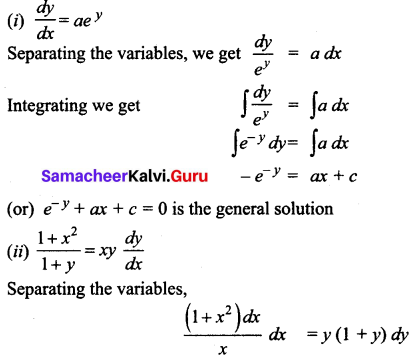
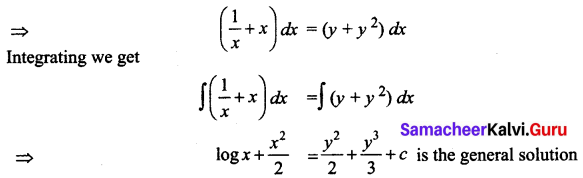
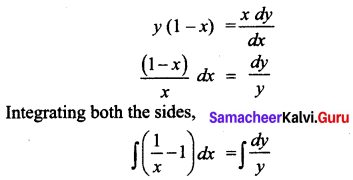
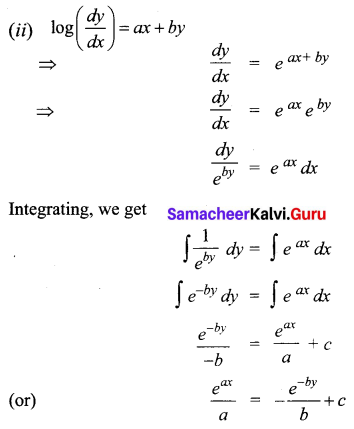
Tamil Nadu 11th English Previous Year Question Paper June 2019

Students can Download Tamil Nadu 11th English Previous Year Question Paper June 2019 Pdf, Tamil Nadu 11th English Model Question Papers helps you to revise the complete Tamilnadu State Board New Syllabus and score more marks in your examinations.

TN State Board 11th English Previous Year Question Paper June 2019

Instructions:

  1.  The question paper comprises of four parts.
  2.  You are to attempt all the parts. An internal choice of questions is provided wherever applicable.
  3. questions of Part I, II. III and IV are to be attempted separately
  4. Question numbers 1 to 20 in Part I are objective type questions of one -mark each. These are to be answered by choosing the most suitable answer from the given four alternatives and writing the option code and the corresponding answer
  5. Question numbers 21 to 30 in Part II are two-marks questions. These are to be answered in about one or two sentences.
  6. Question numbers 31 to 40 in Parr III are three-marks questions, These are to be answered in about three to five short sentences.
  7. Question numbers 41 to 47 in Part IV are five-marks questions. These are to be answered) in detail. Draw diagrams wherever necessary.

Time: 3.00 Hours
Maximum Marks: 90

PART – I

I. Answer all the questions. [20 x 1 = 20]
Choose the correct synonym for the underlined words from the options given.

Question 1.
The role of the University today is not Cloistered.
(a) flexible
(b) restricted
(c) determined
(d) challenging
Answer:
(b) restricted

Tamil Nadu 11th English Previous Year Question Paper June 2019

Question 2.
She thumped the sagging skin of the dilapidated drum.
(a) preserved
(b) repaired
(c) damaged
(d) costly
Answer:
(c) damaged

Question 3.
I am always reluctant to trust a departing visitor to post an important letter.
(a) insensitive
(b) interested
(c) unwilling
(d) forgetful
Answer:
(c) unwilling

Choose the correct antonym for the underlined words from the options given.

Question 4.
He has a memory like a sieve or is an audacious perverter of the truth.
(a) clever
(b) timid
(c) rigid
(d) strong
Answer:
(b) timid

Question 5.
It is because of their antipathy to pills and potions………..
(a) faith
(b) loyalty
(c) interest
(d) liking
Answer:
(d) liking

Question 6.
The other teams ………. weight in, which is compulsory for all players.
(a) optional
(b) natural
(c) critical
(d) occasional
Answer:
(a) optional

Question 7.
Choose the correct prefix for the word “Comfort”.
(a) dis
(b) de
(c) un
(d) under
Answer:
(a) dis

Question 8.
My grandfather is very sick, but the doctor has said that he will “recover”.
(a) pull up
(b) pull on
(c) pull out
(d) pull through
Answer:
(d) pull through

Tamil Nadu 11th English Previous Year Question Paper June 2019

Question 9.
Choose the meaning of the idiom in the sentence.
It is raining on and off for the past two days.
(a) normally
(b) violently
(c) continuously
(d) intermittently
Answer:
(d) intermittently

Question 10.
Choose the clipped form of the word “helicopter”.
(a) heli
(b) helicop
(c) copter
(d) helter
Answer:
(c) copter

Question 11.
Choose the right definition for the given term “Dermatologist”.
(a) One who treats stomach disorders
(b) One who treats heart complications
(c) One who specializes in lung diseases
(d) One who specializes in skin problems
Answer:
(d) One who specializes in skin problems

Question 12.
Choose the expanded form of “MHRD”.
(a) Member of Human Resource Department
(b) Ministry of Human Resource Development
(c) Modem Housing Rural Development
(d) Metro Highways and Railways Department
Answer:
(b) Ministry of Human Resource Development

Question 13.
Ability” is a ……….. word.
(a) trisyllabic
(b) tetrasyllable
(c) disyllabic
(d) pentasyllabic
Answer:
(b) tetrasyllable

Question 14.
The protestors were arrest enmasse yesterday.
Choose the meaning of the foreign word underlined in the above sentence.
(a) mercilessly
(b) before sunset
(c) all together
(d) as usual
Answer:
(c) all together

Question 15.
I cannot put up with this nonsense anymore. (Replace the phrasal verb with a single word)
(a) tolerate
(b) handle
(c) witness
(d) rectify
Answer:
(a) tolerate

Tamil Nadu 11th English Previous Year Question Paper June 2019

Question 16.
Choose the word that cannot be used after “Key” to form a compound word.
(a) note
(b) lock
(c) board
(d) hole
Answer:
(b) lock

Question 17.
Choose the correct sentence pattern.
We met a great writer in the library.
(a) SVOA
(b) SVOC
(c) SVIODO
(d) SVC A
Answer:
(a) SVOA

Question 18.
Choose the unclipped form of “memo”.
(a) memorabilia
(b) memorizer
(c) memorandum
(d) memento
Answer:
(c) memorandum

Question 19.
Choose the suitable preposition and fill in the blank.
A cool and moist breeze drifted ………. the open windows.
(a) from
(b) within
(c) against
(d) through
Answer:
(d) through

Question 20.
Add a suitable question tag to the statement given below.
You can never misuse your power and authority,……….?
(a) can’t you
(b) would you
(c) wouldn’t you
(d) can you
Answer:
(d) can you

Tamil Nadu 11th English Previous Year Question Paper June 2019

PART – II

II. Answer any seven of the following: [7 × 2 = 14]
(i) Read the following sets of poetic lines and answer any four of the following. [4 × 2 = 8]

Question 21.
“Most of all, I want to relearn
How to laugh,……..”
(а) What does the poet want to relearn?
(b) Whom does he want to relearn from?
Answer:
(a) The poet wants to relearn to laugh with his eyes.
(b) The poet wants to relearn to laugh from his little son.

Question 22.
“Let’s talk of graves, of worms, and epitaphs,
Make dust our paper………”,
(а) Define the term ‘epitaphs’.
(b) Mention the figure of speech used here.
Answer:
(a) Epitaphs are ‘a phrase written as an inscription on a tombstone in memory of a person who has died.
(b) Metaphor

Question 23.
“He, who does not stoop, is a king we adore.
We bow before competence and merit;”
(а) Pick out the words in alliteration in the second line.
(b) Who is adored as a king?
Answer:
(a) ‘bow and before’ are the words that alliterate.
(b) An upright or straight forward person is adored as a king.

Question 24.
“Athletes, I’ll drink to you,
Or eat with you,
Or anything except compete with you.”
(a) What does the term ‘drink to you’ mean?
(b) Does the poet want to compete with the athletes?
Answer:
(a) The term ‘drink to you’ means to wish for someone’s success.
(b) The poet is ready to drink or eat with the athletes but never wants to compete with them.

Question 25.
“And‘ this my faith that every flower
Enjoys the air it breathes…….”
(a) What is the poet’s faith?
(b) Identify the figure of speech used here.
Answer:
(a) The poet has faith that nature lives, breathes and enjoys its own presence. Twigs, birds, creepers all live in harmony with each other in absolute bliss and contentment.
(b) Personification.

Question 26.
“For he’s a fiend in feline shape,
a monster of depravity.”
(а) How is Macavity described in this line?
(b) Explain the phrase ‘monster of depravity’.
Answer:
(а) Macavity is described as a “demon in the shape of a cat”.
(b) Satan is called the master of depravity. T.S. Eliot calls Macavity, the master of depravity. He means that the cat is an embodiment of evil. He is wicked, all the time involved in doing something evil.

Tamil Nadu 11th English Previous Year Question Paper June 2019

(ii) Do as directed (any three) [3 x 2 = 6]

Question 27.
Report the following dialogue:
Answer:
Leena : “Mom, I burnt my finger.”
Mother : “I have warned you not to play with fire.”
Leena exclaimed with sorrow to her mother that she had burnt her finger. Mother said that she had warned her not to play with fire.

Question 28.
Change the Voice of the following sentences.
My friend was arrested by the police on a charge of theft.
He was released soon for lack of evidence.
Answer:
The police arrested my friend on a charge of theft.
They/The police released him soon for lack of evidence.

Question 29.
Convert the following simple sentence into a compound sentence.
On hearing their teacher’s footsteps, the boys ran away.
Answer:
They heard their teacher’s footsteps and the boys ran away.

Question 30.
If Reema had informed me earlier, I would have returned home. (Begin the sentence with ‘Had’)
Answer:
Had Reema informed me earlier, I would have returned home.

PART – III

III. Answer any seven of the following: [7 x 3 = 21]
(i) Explain any two of the following with Reference to the Context: [2 x 3 = 6]

Question 31.
“Every hillock has a summit to boast!”
Answer:
Reference: These lines are from the poem “Everest is not the Only Peak” written by Kulothungan.

Context and Explanation: The poet says these words while exploding the myth about achievements or world records. He says climbing Everest alone is not a feat. Every hillock has a peak. He means that every effort, however small it may be, must be respected and appreciated. Each one sets a challenge as per his limited capacity and strives to achieve it in life.

Tamil Nadu 11th English Previous Year Question Paper June 2019

Question 32.
“I have also learned to say “Goodbye”
When I mean “Good-riddance”:”
Answer:
Reference: This line is from the poem “Once upon a time” written by Gabriel Okara.

Context: The poet says these while sharing his exasperation over his own deceitful behaviour with fellow humans.

Explanation: Gabriel Okara regrets that the days when people were innocent and expressed their true emotions in their greetings and day to day interactions have changed a lot. The traditional saying “Goodbye” means ‘God be with you’. But, in modem times, in the postcolonial context it means “good riddance”. The poet finds himself behaving the same way others behave. He is also wearing faces like dresses. He has lost his true cultural identity.

Question 33.
“His powers of levitation would make a fakir stare”
Answer:
Reference: These words are from the poem “Macavity – the mystery cat” written by T.S. Eliot. Context: T.S. Eliot says, these words describing the skills of Macavity – The mystery cat. Explanation: Macavity does all kinds of mischiefs, petty thefts. He breaks things also. But before anyone could link the crime to Macavity he makes good his escape, floating in the air, jumping from building to building. His powers of levitatioh baffles even a fakir who has mystical powers.

(ii) Answer any two of the following questions briefly: [2 x 3 = 6]

Question 34.
What made the dogs follow the grandmother after school hours?
Answer:
Grandmother brought a bundle of stale chapattis with her to the temple. The village dogs followed her. On return, she went on throwing the chapattis to the dogs who growled and fought with each other to have a piece of chapatti.

Question 35.
How did Mary Kom manage to get financial support for her trip to the USA?
Answer:
Mary Korn’s dad gave her Rs. 2,000/-. She spoke to her friend Onler about her problem. He took some elders and friends to meet the two Members of Parliament and seek their support. Two MPs donated Rs. 5,000/- and 3,000/- respectively. Thus Mary Kom managed to raise a . princely sum of Rs. 10,000/-for her trip to USA.

Question 36.
What happened to Bryson when he leaned to tie his shoelace?
Answer:
When Bryson leaned to tie a shoe lace inside the air-craft, someone in the seat ahead of him threw his seat back into full recline. The author found himself pinned helplessly in a crash position.

Tamil Nadu 11th English Previous Year Question Paper June 2019

(iii) Answer any three of the following questions briefly: [3 x 3 = 9]

Question 37.
You are Joseph, the sports secretary of XYZ School. Draft a mail to the Director of Rajarathinam Stadium at Egmore, seeking permission to conduct your School Annual Sports Day celebration in the Stadium.
Answer:
From
Joseph
XYZ School
A.K. Puram
Chennai
25th July, 2021

To
The Director
Rajarathinam Stadium
Egmore
Chennai
Dear Sir,
Sub: Reg. Permission to conduct School Annual Sports Day celebration in the Stadium

I am Joseph, the sports secretary of XYZ School, A.K. Puram. We are celebrating the Annual Sports Day on 14th August 2021. As we have invited a special dignitary as the chief guest we would like to conduct this Sports Day celebration in Rajarathinam Stadium at Egmore. Therefore I kindly request you to grant your consent.

Thank you
Yours sincerely
Joseph
Sports Secretary
Address on the envelope
To
The Director
Rajarathinam Stadium
Egmore
Chennai.

Question 38.
Describe the process of cleaning an overhead water tank.
Answer:

  • First empty the tank by draining the water.
  • Then clean the floors and the walls of the tank by manual scrubbing.
  • After scrubbing, a vacuum cleaner can be used to remove the remaining dirt.
  • After the scrubbing, the floors and ceiling of the tank is washed using water and high pressure jet.
  • To ensure that the tank is germ free, it is necessary to disinfect the tank. Usually liquid bleach is used.
  • After this, the tank is again filled with water, and is made to run through the taps to disinfect the water pipes.
  • The water from the tank is now drained and can be left for drying. After the tank is dry, you can refill the tank.

Tamil Nadu 11th English Previous Year Question Paper June 2019

Question 39.
Expand the news headlines in a sentence each.
Answer:
(a) Tension at Sabarimala – Women pilgrims targetted.
(b) Police nabs gang of 6 robbers in Trichy – Seizes jewellery.
(c) Longest cold spell in Delhi in 14 years – Cold wave to continue.
Answer:
(a) Tensions are high in Kerala as Sabarimala temple gates were opened today to all devotees, including women, for the first time since a Supreme Court order overturned a centuries- old ban on women of menstruating age -between 10 and 50 – from visiting the shrine.

(b) The Trichy police busted a gang of robbers involved in breaking into a jewellery shop on June 27 and have recovered valuables worth Rs. 1.60 lakh. The gang comprising six members was arrested on Thursday night.

(c) According to reports from India Meteorological Department (IMD), Delhi is facing the longest cold spell in a December in as long as fourteen years and apparently, it’s going to remain like this for a while.

Question 40.
Complete the proverbs using the words given below.
(a) An idle ………. a devil’s workshop, (soul, body, mind)
(b) ………. is in the eye of the beholder. (Magic, Beauty, Problem)
(c) Don’t judge a ……… by its cover, (book, pillow, letter)
Answer:
(a) mind
(b) Beauty
(c) book

PART – IV

IV. Answer the following: [7 × 5 = 35]

Question 41.
Why was Mary Kom named the “Queen of Boxing” and “Magnificent Mary”?
Answer:
After Mary Kom’s first silver medal in Pennsylvania in 2001, there was no looking back. Her medal haul continued even after her marriage putting an end to the speculation of family and friends that her marriage may slow down her career progression. She retained the world title in the third World Women’s Boxing Championship at Podolsk in Russia in 2005. She won her fourth gold also in 2006. She had won several golds for India from 2001 to 2004.

She had won all the Senior Women’s Boxing Championships, Second Women’s Championship (2002), Second Asian Women’s Boxing Championship at Hisar (2003) and the Witch Cup Boxing Championship at Paes, Hungary. There were a number of other International World Championships in Taiwan, Vietnam, Denmark and so on. But it was retaining her World title in 2006 by defeating Steluta Duta of Romania which was considered as Mary Kom’s greatest achievement in life. With this hat-trick of World Championship wins, the media christened her, “Queen of Boxing” and “Magnificent Mary”.

Tamil Nadu 11th English Previous Year Question Paper June 2019

Question 42.
Explain the things Gabriel Okara has learnt when he grew into an adult.
Answer:
The African poet observes a marked change in the attitude of modem people. Those who were once so genuine, warm and sincere, have now suddenly turned cold and hostile towards him. He realizes that the early values in the society like sincerity, good-naturedness, simplicity, whole-heartedness, hospitality, friendliness, originality and uniqueness have now drastically changed. The earlier warmth and heartfulness have gone.

He finds himself behaving the same way as those around him. He has learnt to wear different faces for different occasions. He wears faces like dresses. He says not what his heart tells him. His smiles are also fake. He smiles only to be socially accepted. He has learnt to say “Good bye”, when he wants to say ‘good riddance’. After being bored, he brings a fake smile and says “It’s been nice talking to you”.

[OR]

The poem ‘Everest is not the only peak’ does not focus on the destination but the journey towards it. Discuss.
Answer:
The poet discusses the merits of efforts, duty and devotion and values of honesty, uprightness and service-mindedness. He does not have any special appreciation to those who reach great peaks like Himalayas. He appreciates the process, the journey and not the destination. When the whole world has a perspective of seeking glory using any foul method Or underhand dealing, the poet differs from it. For him the means is more important than the end.

However modest may be one’s position is, it is adorable if attained by competence and merit. Pride is not in heights one reaches but in a life that knows no bending or kneeling. The poet respects one who does not stoop as a king. Thus the poet pays importance to the journey of life not the destination.

Question 43.
Write a paragraph (150 words) by developing the following hints.
Philip – travels – train – Brill Manor – meets Bertie – second son – left purse – four quids – needs money – requests Philip to lend him – two pounds -did not help – true son – mistaken for a fraud.
Answer:
The young man who entered the coach gave out a smothered curse, he was engaged in searching something elusive angrily and uselessly. From time to time, he dug a six penny bit out of a waist coat pocket and stared.at it sadly, then resumed his search. He voluntarily broke the silence. He exclaimed that Mr. Sletherby was going to Bill Manor. He introduced himself as Bertie, the younger son of Mrs. Saltpen-Jago. He admitted that he was away for about six months and had not seen his own mother.

Making use of the lucky coincidence that he was going to Brill Manor, he asked for a loan of three pounds as he had lost his sovereign purse and was desperately in need of help. He promised to meet him on the subsequent Monday. There is a dramatic irony when the son himself gives a different version of his mom’s appearance. This influences the decision of Mr. Sletherby in refusing to lend Bertie a loan of three pounds and mistaking the true son Bertie to be a fraud.

[OR]

Jack and Jill – things in instalments – house on instalment – Aunt Jane visited – preached – ease and comfort of buying – first baby in instalment.
Answer:
The Never Never Nest is a comic one-act play about a young couple who make full use of the buy-now-pay-later system. Jack and Jill were a young married couple who had a small baby. One day Aunt Jane visited them and was surprised to find that even though Jack’s salary was not high, they lived in a beautiful house with all comforts. She began to wonder whether, as a wedding gift she had given them 2000 pounds instead of 20 pounds. Otherwise how did Jack and Jill buy all these things?

Then Jane understood that though they had everything, nothing really belonged to them. They bought everything on installments. Only a steering wheel of the car, a wheel and two cylinders had been paid for. The total amount to be paid towards instalments was more than their earnings. Aunt Jane was shocked at the way Jack and Jill ran their family. Before she left, she gave ten pounds to Jill and told them to make at least one article completely theirs, using that money. While Jack went with aunt Jane to the bus stop, Jill sent the money to Dr. Martin. Jack came back and said that he wanted to pay two months instalments on the car using the aunt’s gift. But Jill said that by paying this money to Dr. Martin, their baby would become completely theirs.

Tamil Nadu 11th English Previous Year Question Paper June 2019

Question 44.
Write a summary or Make notes of the following passage.
Answer:
Stress is a part of everyday life. There are many instances when stress can be helpful. A fire alarm is intended to cause the stress that alerts you to avoid danger. The stress created by a deadline to finish a paper can motivate you to finish the assignment on time. But when experienced in excess, stress has the opposite effect.

It can harm our emotional and physical health and limit our ability to function at home, in school and within our relationships. The good news is that, since we are responsible for bringing about much of our own stress, we can also do much to manage stress by learning and practicing specific stress reduction strategies.

Practice time management skills to manage your academic schedule, social activities and making time for yourself. Set and implement specific goals for yourself that will improve your mood and help you reduce stress. Avoid procrastination. It can create more mental and physical stress. Exercise regularly, Physical activity can help you bum-off the energy generated by stress. Do meditation, practice good sleep habits to ensure that you are well rested.

Stress and it’s Management:
No. of words given in the original passage: 184
No. of words to be written in the summary: 184/3 = 61 ± 5

Rough Draft:
Stress is a part of everyday life. At times stress can be helpful. It helps you avoid dangers and motivates you to finish an assignment on time. But excessive stress leads to emotional and physical health breakdown. Hence it is good to learn to manage your own stress. Set and implement specific goals. Avoid procrastination. Exercise regularly, do meditation and practice good sleep habits.

Fair Draft
Stress and it’s Management:
Stress is a part of everyday life. At times stress can be helpful. It helps you avoid dangers and motivates you to finish an assignment on time. But excessive stress leads to emotional and physical health breakdown. Hence it is good to learn to manage your own stress. Set and implement specific goals. Avoid procrastination. Exercise regularly, do meditation and practice good sleep habits.

No. of words in the summary: 64

[OR]

Notes:
Answer:
Stress and it’s Management Stress

  • part of everyday life
  • stress can be helpful
  • fire alarm – avoid dangers and
  • Motivation to finish an assignment on time.

Excessive stress

  • emotional and physical health breakdown.
  • distorts our behaviour at home, school

Management of stress

  • set and implement specific goals.
  • avoid procrastination.
  • exercise regularly
  • meditation
  • good sleep habits

Tamil Nadu 11th English Previous Year Question Paper June 2019

Question 45.
Write a letter to the Inspector of Police reporting a theft in your house.
Answer:
12.10.20
From
D. Siddarth
Royapuram
Chennai

To
Inspector of Police
Chennai
Respected Sir,
Sub: Regarding theft in my house.
I, Siddharth, am a resident of Royapuram, North Chennai. On 11th October 2020 when I returned from work I found the almirah of my house opened and gold worth Rs. 5 lakhs and money worth Rs. 1 lakh stolen. These were kept to present for my sister’s wedding which is going to take place on 22nd October 2020. Therefore, I bring the theft to your notice in order to nab the culprits and kindly request you to help me recover my belongings at the earliest. Thanking you.

Yours sincerely
Siddharth
Address on the Envelope
To
Inspector of Police
Chennai

[OR]

Write a paragraph on ‘the various reasons for road accidents in Indian cities’.
Answer:
The Various Reasons for Road Accidents in Indian Cities:
According to a recent data, around one and a half lakh persons die due to road accidents per year in Indian cities among which most of the deaths are avoidable. The first reason for this is traffic rules violation by riders and drivers. These include; over speeding and red light jumping. Other reasons are bad roads, drunken driving, distractions to drivers such as usage of mobile phones, stereo/radio in vehicles, animals or big banners and billboards, avoiding safety measures like seat belt and helmets, and so on.

Certain people lose control when the other vehicles overtake them from the wrong sides. People are riot willing to learn from their own or others mistakes. It is high time for the government to take necessary steps to reduce the number of accidental deaths by; constructing better designed roads that will cater to the requirements of pedestrians, two-wheelers, and other slow-moving traffic, regulating the safety features of vehicles as well as stricter enforcement of the traffic rules and regulations.

Tamil Nadu 11th English Previous Year Question Paper June 2019

Question 46.
(i) Read the following sentences, spot the errors and rewrite the sentence correctly.
(a) Malini told to her cousin that she would donate some money.
(b) Though I had a good sleep, but I feel very tired.
(c) Every tourist has a amazing story to share.
(d) One of the components are already missing.
(e) Mr. Mohan is going through the most worst phase of his life.
Answer:
(a) Malini told her cousin that she would donate some money.
(b) Though I had a good sleep I feel very tired.
(c) Every tourist has an amazing story to share.
(d) One of the components is already missing.
(e) Mr. Mohan is going through the worst phase of his life.

[OR]

(ii) Fill in the blanks with the correct tense forms of the verbs given in brackets.
(a) Helena ……….. (visit) several doctors before she ……….. (find) out what the problem ………… (be) with her knee.
(b) The fire-service ………… endanger their ………… safety, during their operations, (personal, personnel)
Answer:
(a) visited, found, was
(b) personnel, personal

Question 47.
Read the following passage carefully and answer the questions given below:
At the end of his voyage, Sindbad decided to settle down at Baghdad and spend the rest of his life there. But soon he got tired of this kind of life, which was not at all active. He disliked laziness and wished to be doing something always. So he joined with several other friendly merchants and set out to sea a second time.

They set sail in a good ship and soon reached an island and walked for some distance but could see neither men nor animals. While the other merchants, were amusing themselves in various ways, Sindbad sat down under a tree near a small river to take his food. He had a good meal and fell asleep. He did know how long he slept, but when he woke up, the ship was no longer seen.
Questions:
(a) What did Sindbad decide to do at the end of his first voyage?
(A) Why did he embark on a voyage the second time?
(c) Describe the island the merchants reached.
(d) What did the merchants do after landing on the island?
(e) What happened when Sindbad was fast asleep?
Answer:
(a) At the end of his voyage, Sindbad decided to settle down at Baghdad and spend the rest of his life there.
(b) He got tired of that kind of life, which was not at all active. He disliked laziness and wished to be doing something always.
(c) There were neither men nor animals in that island.
(d) The other merchants, were amusing themselves in various ways.
(e) The ship had gone when Sindbad was fast asleep.

Tamil Nadu 11th English Previous Year Question Paper June 2019

[OR]

Frame a dialogue between two friends discussing and analysing a movie they recently watched (minimum five exchanges).
Answer:
Anand : The movie was superb!
Abhay : Yes. I enjoyed the action sequence.
Anand : Oh! Me too. The action choreography was too good and realistic.
Abhay: Even the comedy scenes were amusing.
Anand : Yogi Babu has done a decent job.
Abhay : I like his confidence.
Anand : But the twist in the story should have been more sensible.
Abhay : Yes. There was something missing in the connectivity after the intermission.
Anand : Yes. Overall, it was worth watching.
Abhay : Definitely. It was a good time pass.

Samacheer Kalvi 12th Business Maths Solutions Chapter 2 Integral Calculus I Additional Problems

Students can download 12th Business Maths Chapter 2 Integral Calculus I Additional Problems and Answers, Samacheer Kalvi 12th Business Maths Book Solutions Guide Pdf helps you to revise the complete Tamilnadu State Board New Syllabus and score more marks in your examinations.

Tamilnadu Samacheer Kalvi 12th Business Maths Solutions Chapter 2 Integral Calculus I Additional Problems

I. One Mark Questions

Choose the correct answer.

Question 1.
The integral of \(\left(\sqrt{x}+\frac{1}{\sqrt{x}}\right)\) equals _____
Samacheer Kalvi 12th Business Maths Solutions Chapter 2 Integral Calculus I Additional Problems 1
Answer:
(c) \(\frac{2}{3} x^{\frac{3}{2}}+2 x^{\frac{1}{2}}+c\)

Question 2.
Samacheer Kalvi 12th Business Maths Solutions Chapter 2 Integral Calculus I Additional Problems 2
Answer:
(a) \(x^{4}+\frac{1}{x^{3}}-\frac{129}{8}\)
Hint:
Samacheer Kalvi 12th Business Maths Solutions Chapter 2 Integral Calculus I Additional Problems 3

Question 3.
\(\int \frac{\sin ^{2} x-\cos ^{2} x}{\sin ^{2} x \cos ^{2} x} d x\) is equal to _____
(a) tan x + cot x + c
(b) tan x + cosec x + c
(c) -tan x + cot x + c
(d) tan x – sec x + c
Answer:
(a) tan x + cot x + c
Hint:
Samacheer Kalvi 12th Business Maths Solutions Chapter 2 Integral Calculus I Additional Problems 4

Question 4.
Samacheer Kalvi 12th Business Maths Solutions Chapter 2 Integral Calculus I Additional Problems 5
Answer:
(d) \(\frac{\pi}{12}\)
Hint:
Samacheer Kalvi 12th Business Maths Solutions Chapter 2 Integral Calculus I Additional Problems 6

Question 5.
The value of \(\int_{-\frac{\pi}{2}}^{\frac{\pi}{2}}\left(x^{3}+x \cos x+\tan ^{5} x\right) d x\) is ______
(a) 0
(b) 2
(c) π
(d) 1
Answer:
(a) 0
Hint:
Let f(x) = x3 + x cos x + tan5 x
f(-x)= -x3 – x cos x – tan5 x = -f(x)
So f(x) is odd function.
Integral is 0.

Question 6.
Fill in the blanks.
(a) \(\int_{0}^{\frac{\pi}{2}} \cos ^{3} x d x\) is equal to _____
(b) \(\int_{-\frac{\pi}{2}}^{\frac{\pi}{2}} \sin ^{31} x d x\) is equal to _________
Answer:
(a) \(\frac{2}{3}\)
(b) 0
Hint:
Samacheer Kalvi 12th Business Maths Solutions Chapter 2 Integral Calculus I Additional Problems 7

Question 7.
Match the following.
Samacheer Kalvi 12th Business Maths Solutions Chapter 2 Integral Calculus I Additional Problems 8
Samacheer Kalvi 12th Business Maths Solutions Chapter 2 Integral Calculus I Additional Problems 9
Answer:
(a) – (iii)
(b) – (iv)
(c) – (v)
(d) – (ii)
(e) – (i)

Question 8.
State True or False.
Samacheer Kalvi 12th Business Maths Solutions Chapter 2 Integral Calculus I Additional Problems 10
Answer:
(a) True
(b) False
(c) True
(d) False
(e) False
(f) True

Question 9.
Which of the following is not equal to ∫ tan x sec2 x dx?
(a) \(\frac{1}{2} \tan ^{2} x\)
(b) \(\frac{1}{2} \sec ^{2} x\)
(c) \(\frac{1}{2 \cos ^{2} x}\)
(d) None of these
Answer:
(d) None of these
Hint:
Samacheer Kalvi 12th Business Maths Solutions Chapter 2 Integral Calculus I Additional Problems 11

Question 10.
∫ex (cos x – sin x) dx is equal to ______
(a) ex sin x + c
(b) ex cos x + c
(c) -ex cos x + c
(d) -ex sin x + c
Answer:
(b) ex cos x + c
Hint:
Let f(x) = cos x
f'(x) = -sin x
∫ex [f(x) + f'(x)] dx = ex f(x) + c

Question 11.
\(\int \frac{1-\cos 2 x}{1+\cos 2 x} d x\) is _____
(a) tan x – x + c
(b) x + tan x + c
(c) x – tan x + c
(d) -x – cot x + c
Answer:
(a) tan x – x + c
Hint:
Samacheer Kalvi 12th Business Maths Solutions Chapter 2 Integral Calculus I Additional Problems 12

Question 12.
\(\int_{0}^{\frac{\pi}{2}} \cos x e^{\sin x} d x\) is equal to ______
(a) e = 1
(b) 1 – e
(c) \(e^{\frac{\pi}{2}}-1\)
(d) \(1-e^{\frac{\pi}{2}}\)
Answer:
(a) e = 1
Hint:
Samacheer Kalvi 12th Business Maths Solutions Chapter 2 Integral Calculus I Additional Problems 13

Question 13.
Which of the following is an even function?
(a) sin x
(b) ex – e-x
(c) x cos x
(d) cos x
Answer:
(d) cos x

Question 14.
Which of the following is neither odd nor even function?
(a) x sin x
(b) x2
(c) e-x
(d) x cos x
Answer:
(c) e-x

Question 15.
∫sec2 (7 – 4x) dx equal to ______
(a) tan (7 – 4x)
(b) -tan (7 – 4x)
(c) –\(\frac{1}{4}\) tan (7 – 4x)
(d) \(\frac{1}{4}\) tan (7 – 4x)
Answer:
(c) – \(\frac{1}{4}\) tan (7 – 4x)

II. 2 Mark Questions.

Question 1.
Samacheer Kalvi 12th Business Maths Solutions Chapter 2 Integral Calculus I Additional Problems 14
Solution:
Samacheer Kalvi 12th Business Maths Solutions Chapter 2 Integral Calculus I Additional Problems 15

Question 2.
Samacheer Kalvi 12th Business Maths Solutions Chapter 2 Integral Calculus I Additional Problems 16
Answer:
Samacheer Kalvi 12th Business Maths Solutions Chapter 2 Integral Calculus I Additional Problems 17

Question 3.
\(\int\left(e^{x}+e^{-x}\right)^{2} d x\)
Solution:
Samacheer Kalvi 12th Business Maths Solutions Chapter 2 Integral Calculus I Additional Problems 18

Question 4.
Find \(\int x^{5} \sqrt{3+5 x^{6}} d x\)
Solution:
Samacheer Kalvi 12th Business Maths Solutions Chapter 2 Integral Calculus I Additional Problems 19

Question 5.
\(\int \frac{(x+1)(x+\log x)^{2}}{x} d x\)
Solution:
Samacheer Kalvi 12th Business Maths Solutions Chapter 2 Integral Calculus I Additional Problems 20
Samacheer Kalvi 12th Business Maths Solutions Chapter 2 Integral Calculus I Additional Problems 21

Question 6.
\(\int \frac{e^{2 x}-1}{e^{2 x}+1} d x\)
Solution:
Dividing numerator and denominator by ex, we get \(\int \frac{e^{x}-e^{-x}}{e^{x}+e^{-x}} d x\)
Samacheer Kalvi 12th Business Maths Solutions Chapter 2 Integral Calculus I Additional Problems 22

Question 7.
\(\int \frac{1}{x+\sqrt{x}} d x\)
Solution:
Samacheer Kalvi 12th Business Maths Solutions Chapter 2 Integral Calculus I Additional Problems 23

III. 3 and 5 Mark Questions.

Question 1.
Find \(\int \frac{e^{x}(x+1)}{(x+3)^{3}} d x\)
Solution:
Samacheer Kalvi 12th Business Maths Solutions Chapter 2 Integral Calculus I Additional Problems 24

Question 2.
\(\int \frac{1}{2 x^{2}-x-1} d x\)
Solution:
Samacheer Kalvi 12th Business Maths Solutions Chapter 2 Integral Calculus I Additional Problems 25
Samacheer Kalvi 12th Business Maths Solutions Chapter 2 Integral Calculus I Additional Problems 26

Question 3.
\(\int \frac{1}{1-3 \sin ^{2} x} d x\)
Solution:
Divide the numerator and denominator by cos2 x
Samacheer Kalvi 12th Business Maths Solutions Chapter 2 Integral Calculus I Additional Problems 27

Question 4.
\(\int \frac{d x}{e^{x}-e^{-x}}\)
Solution:
Samacheer Kalvi 12th Business Maths Solutions Chapter 2 Integral Calculus I Additional Problems 28
Samacheer Kalvi 12th Business Maths Solutions Chapter 2 Integral Calculus I Additional Problems 29

Question 5.
Evaluate \(\int_{-1}^{2}(7 x-5) d x\) as the limit of a sum.
Solution:
Samacheer Kalvi 12th Business Maths Solutions Chapter 2 Integral Calculus I Additional Problems 30

Question 6.
Evaluate \(\int_{1}^{2}\left(x^{2}-1\right) d x\) as the limit of a sum.
Solution:
Samacheer Kalvi 12th Business Maths Solutions Chapter 2 Integral Calculus I Additional Problems 31
Samacheer Kalvi 12th Business Maths Solutions Chapter 2 Integral Calculus I Additional Problems 32

Question 7.
Evaluate \(\int_{1}^{2} \frac{1}{x\left(x^{4}+1\right)} d x\)
Solution:
Samacheer Kalvi 12th Business Maths Solutions Chapter 2 Integral Calculus I Additional Problems 33

Question 8.
Evaluate \(\int_{\frac{\pi}{6}}^{\frac{\pi}{3}} \frac{d x}{1+\sqrt{\tan x}}\)
Solution:
Samacheer Kalvi 12th Business Maths Solutions Chapter 2 Integral Calculus I Additional Problems 34
Samacheer Kalvi 12th Business Maths Solutions Chapter 2 Integral Calculus I Additional Problems 35

Question 9.
Evaluate \(\int_{0}^{1} x(1-x)^{5} d x\)
Solution:
Samacheer Kalvi 12th Business Maths Solutions Chapter 2 Integral Calculus I Additional Problems 36

Question 10.
Evaluate \(\int \frac{2 x+3}{\sqrt{x^{2}+x+1}} d x\)
Solution:
Samacheer Kalvi 12th Business Maths Solutions Chapter 2 Integral Calculus I Additional Problems 37
Samacheer Kalvi 12th Business Maths Solutions Chapter 2 Integral Calculus I Additional Problems 38

Question 11.
∫(x2 + 1) log x dx
Solution:
Samacheer Kalvi 12th Business Maths Solutions Chapter 2 Integral Calculus I Additional Problems 39

Question 12.
\(\int \sqrt{x^{2}+4 x-5} d x\)
Solution:
Samacheer Kalvi 12th Business Maths Solutions Chapter 2 Integral Calculus I Additional Problems 40

Question 13.
\(\int_{0}^{\frac{\pi}{4}}\left(2 \sec ^{2} x+x^{3}+2\right) d x\)
Solution:
Samacheer Kalvi 12th Business Maths Solutions Chapter 2 Integral Calculus I Additional Problems 41
Samacheer Kalvi 12th Business Maths Solutions Chapter 2 Integral Calculus I Additional Problems 42

Question 14.
Evaluate \(\int_{0}^{1} \frac{2 x}{\left(x^{2}+1\right)\left(x^{2}+2\right)} d x\)
Solution:
Let x2 = t, then 2x dx = dt
when x = 0, t = 0 and x = 1, t = 1
so integral becomes, \(\int_{0}^{1} \frac{d t}{(t+1)(t+2)}\)
We use partial fractions to proceed further
Samacheer Kalvi 12th Business Maths Solutions Chapter 2 Integral Calculus I Additional Problems 43

Question 15.
\(\int_{0}^{\frac{\pi}{2}} \frac{\sin x-\cos x}{1+\sin x \cos x} d x\)
Solution:
Samacheer Kalvi 12th Business Maths Solutions Chapter 2 Integral Calculus I Additional Problems 44
Samacheer Kalvi 12th Business Maths Solutions Chapter 2 Integral Calculus I Additional Problems 45

Tamil Nadu 11th English Previous Year Question Paper March 2019

Students can Download Tamil Nadu 11th English Previous Year Question Paper March 2019 Pdf, Tamil Nadu 11th English Model Question Papers helps you to revise the complete Tamilnadu State Board New Syllabus and score more marks in your examinations.

TN State Board 11th English Previous Year Question Paper March 2019

Instructions:

  1.  The question paper comprises of four parts.
  2.  You are to attempt all the parts. An internal choice of questions is provided wherever applicable.
  3. questions of Part I, II. III and IV are to be attempted separately
  4. Question numbers 1 to 20 in Part I are objective type questions of one -mark each. These are to be answered by choosing the most suitable answer from the given four alternatives and writing the option code and the corresponding answer
  5. Question numbers 21 to 30 in Part II are two-marks questions. These are to be answered in about one or two sentences.
  6. Question numbers 31 to 40 in Parr III are three-marks questions, These are to be answered in about three to five short sentences.
  7. Question numbers 41 to 47 in Part IV are five-marks questions. These are to be answered) in detail. Draw diagrams wherever necessary.

Time: 3.00 Hours
Maximum Marks: 90

PART – I

I. Answer all the questions. [20 x 1 = 20]
Choose the correct synonym for the underlined words from the options given.

Question 1.
……….. and I do claim to represent him in all his ruggedness.
(a) toughness
(b) weakness
(c) brightness
(d) seriousness
Answer:
(a) toughness

Question 2.
The greatest disadvantage for me was my loss of appetite.
(a) hope
(b) memory
(c) alertness
(d) hunger
Answer:
(d) hunger

Tamil Nadu 11th English Previous Year Question Paper March 2019

Question 3.
………..that we regard a man who does not possess it as eccentric.
(a) modem
(b) weary
(c) normal
(d) weird
Answer:
(d) weird

Choose the correct antonym for the underlined words from the options given.

Question 4.
Her happiest moments were with her sparrows whom she fed with frivolous rebukes,
(a) serious
(b) harmless
(c) funny
(d) decent
Answer:
(a) serious

Question 5.
“Don’t look so doleful, girls.”
(a) peaceful
(b) joyful
(c) doubtful
(d) powerful
Answer:
(b) joyful

Question 6.
There are, it must be admitted, some matters…………
(a) replied
(b) denied
(c) argued
(d) accepted
Answer:
(b) denied

Question 7.
Select the correct expansion of “HDTV”.
(a) High definition Television
(b) Heavy Dielectric Television
(c) Heavy Distributory Television
(d) Highly Decentralized Television
Answer:
(a) High definition Television

Question 8.
Choose the suitable option to pair it with the word “mantel” to form a compound word,
(a) cover
(b) cloth
(c) picture
(d) piece
Answer:
(d) piece

Question 9.
Form a derivative by adding the right suffix to the word ‘regular’.
(a) -ance
(b) -able
(c) -fill
(d) -ity
Answer:
(d) -ity

Question 10.
Choose the meaning of the foreign word in the sentence.
Nalini is a bonafide student of the Madras University.
(a) confident
(b) punctual
(c) brilliant
(d) genuine
Answer:
(d) genuine

Question 11.
Choose the right definition for the given term “Photophobia”.
(a) Fear of rain
(b) Fear of flight
(c) Fear of light
(d) Fear of pictures
Answer:
(c) Fear of light

Tamil Nadu 11th English Previous Year Question Paper March 2019

Question 12.
Add a suitable question tag to the following sentence.
Many women candidates attended the interview, …………?
(a) haven’t they
(b) shouldn’t they
(c) don’t they
(d) didn’t they
Answer:
(d) didn’t they

Question 13.
Replace the underlined word with a phrasal verb.
I couldn’t understand what you meant.
(a) break out
(b) find out
(c) iron out
(d) figure out
Answer:
(d) figure out

Question 14.
Add a suitable prefix to the root word “Polite”.
(a) im-
(b) non-
(c) un-
(d) anti-
Answer:
(a) im-

Question 15.
One who studies the human mind and behaviour is called a ………..
(a) physicist
(b) psychologist
(c) pathologist
(d) physiologist
Answer:
(b) psychologist

Question 16.
Fill in the blank with the suitable preposition.
The angry champion broke the crystal cup ……….. million pieces.
(a) into
(b) with
(c) against
(d) upon
Answer:
(a) into

Question 17.
Choose the clipped form of the word “dormitory”.
(a) dormy
(b) dory
(c) dorm
(d) dormit
Answer:
(c) dorm

Question 18.
Substitute the underlined word with the appropriate polite alternative.
The gentleman in the black suit is a barber.
(a) hair clipper
(b) hair remover
(c) Mir splitter
(d) hair dresser
Answer:
(d) hair dresser

Question 19.
Substitute the phrasal verb in the sentence with a single word.
Never put off Until tomorrow what you can do today.
(a) continue
(b) finish
(c) halt
(d) postpone
Answer:
(d) postpone

Question 20.
Fill in the blank with a suitable relative pronoun.
The books………….are brought are often not read.
(а) that
(b) what
(c) who
(d) whose
Answer:
(а) that

Tamil Nadu 11th English Previous Year Question Paper March 2019

PART – II

II. Answer any seven of the following: [7 x 2 = 14]
(i) Read the following sets of poetic lines and answer any four of the following. [4 × 2 = 8]

Question 21.
“Feel at home,” “come again.
They say………”
(a) Who are ‘they’?
(b) Do ‘they’ really mean it?
Answer:
(a) They are modem people.
(b) No they don’t mean it.

Question 22.
“And reassure myself anew
That you are not me and I’m not you.”
(a) Who does the poet refer to as “you”?
(b) What does the poet reassure?
Answer:
(a) The athletes who play games and sweat for fun and money are referred as ‘you’.
(b) The poet reassures himself that he is not one of the athletes and the athletes are not in his group either. So, he is safe.

Question 23.
“I heard a thousand blended notes While in a grove I sate reclined,”
(a) What is meant by “a thousand blended notes”?
(b) Where is the poet sitting?
Answer:
(a) The thousand blended notes mean the combined music of birds which cohabit in the grove.
(b) The poet is sitting in a grove.

Question 24.
“He sways his head from side to side,
with movements like a snake;”
(a) Who is ‘he’?
(b) Mention the figure of speech used here.
Answer:
(a) He is Macavity.
(b) Simile

Question 25.
“In dignity and pride no one need to be poor.”
(a) What are the two things mentioned here as our strength?
(b) Is the tone of the line positive or negative?
Answer:
(a) Dignity and pride are the two things mentioned as strength here.
(b) The tone of the line is positive.

Question 26.
“For you have but mistook me all this while…..”
(a) How is the speaker mistaken by the people?
(b) Write the words in alliteration.
Answer:
(a) People mistook the speaker to be a person endowed with divine right to rule them. He was after all like them with similar wants, likes, dislikes and grief. He too needs comfort of friends.
(b) Mistook and me alliterate.

(ii) Do as directed (any three) [3 x 2 = 6]

Question 27.
Report the following dialogue:
Conductor : Where do you want to go?
Passenger : I’m going to Coimbatore. Give me a ticket, please.
Answer:
The conductor asked the passenger where he was going. The passenger replied that he was going to Coimbatore and requested for a ticket.

Question 28.
Tom didn’t know Spanish. He didn’t get the job. (Combine using ‘if’).
Answer:
If Tom had known Spanish, he would have got the job.
(or)
If Tom didn’t know Spanish, he wouldn’t have got the job.

Tamil Nadu 11th English Previous Year Question Paper March 2019

Question 29.
Rewrite the sentence making an inversion in the conditional clause.
If you were a King, you would know the difficulties.
Answer:
Were you a king you would know the difficulties.

Question 30.
The food was cheap. It was very tasty, (form a simple sentence using in spite of)
Answer:
In spite of the food being cheap it was also very tasty.

PART – III

III. Answer any seven of the following: [7 × 3 = 21]
(i) Explain any two of the following with Reference to the Context: [2 × 3 = 6]

Question 31.
“The birds around me hopp’d and play’d;
Their thoughts I cannot measure.”
Answer:
Reference: These lines are from the poem, “Lines Written in Early Spring” written by William Wordsworth.

Context: The poet was quite impressed with the beauty and peace that prevailed in the woodland. The birds were oblivious to the presence of the poet. They hopped and chirped around him in absolute bliss. The poet said these words while trying to fathom their thoughts.

Explanation: The poet was overwhelmed with delight in the company of birds, plant kingdom and the brook. He tried hard to understand the thoughts of the birds through the bird’s language. But he couldn’t succeed. He simply inferred that they were thrilled and enjoying the jocund company.

Question 32.
“How can you say to me, lam a king?”
Answer:
Reference: This lines is from the poem, “The Hollow Crown” by William Shakespeare. The ‘ poem is an excerpt from the play “Richard II”.

Context: King Richard II says these words to his loyal nobles when he talks about the power of death over monarchs.

Explanation: British subjects usually believe that a king is born with a divine right to rule. People respect his crown as a symbol of great power. After he is deposed from power, Henry II realizes the bitter truth that he is no way different from ordinary subjects. He also has wants, need for friends and the compulsion to taste grief. Nobody can escape death.

Question 33.
“I am just glad as glad can be
That I am not them, that they are not me…”
Answer:
Reference: The poet Ogden Nash says these words in the poem “Confession of a Bom Spectator’.

Context and Explanation: While discussing about the athletes he admires, the poet says these words. Right from his boyhood, he had seen boys aspire for sports championships. He had wondered at their ability to specialize in horse riding, to play hockey or basketball. He had seen young ones trying to play center in the football or be a tackle or offender in a game like kabaddi. But he has been absolutely glad that he is not them and they are not him.

(ii) Answer any two of the following questions briefly: [2 × 3 = 6]

Question 34.
How do the chemists make fortunes out of the medicines people forget to take?
Answer:
Similar to the author, many remember to forget medicine as soon as the appointed time arrives. The forgotten medicines tend to aggravate the illness. As a vicious cycle, again they are forced to buy costlier medicines. Thus people who forget to take medicines contribute to the fortunes of chemists.

Question 35.
Why did Mary Kom think that she should not return empty-handed?
Answer:
Mary Kom’s dad had given all he had for her trip to USA. Besides, her friends had raised funds through MPs. They had pinned their hopes on her. So, she thought she should not return empty handed.

Tamil Nadu 11th English Previous Year Question Paper March 2019

Question 36.
What is the difference between a physical and mental tight corner?
Answer:
Physical tight comers are those situations which threaten the life of an individual. Mental tight comers are worries for which no solution is in sight. It upsets the individuals and confounds them.

(ii) Answer any three of the following questions briefly: [3 × 3 = 9]

Question 37.
Study the pie-chart and answer the questions that follow:
Tamil Nadu 11th English Previous Year Question Paper March 2019 1
Questions:
(A) What is the most sought after entertainment activity in the apartment?
(B) Name the activity preferred by the least number of people.
(C) Which activity is chosen by half the number of people who use mobile phones?
Answer:
(A) Mobile phone is the most sought after entertainment activity in the apartment.
(B) Reading is preferred by the least number of people.
(C) Outdoor games is chosen by half the number of people who use mobile phones.

Question 38.
Build a dialogue of minimum three exchanges between a fruit vendor and a customer.
Answer:
Fruit Vendor : What fruits do you want to buy sir?
Customer : I would like to buy 1 Kg of Pineapple.
Fruit Vendor : Good choice sir. It is the right season. Anything else?
Customer : Yes. The fruits look so fresh. I would also like to buy some Kiwis and a dozen of bananas.
Fruit Vendor : Sure sir. Here is the bill.
Customer : Oh! It’s Rs. 250? No seasonal discount?
Fruit Vendor : This is the discounted price sir.
Customer : Okay. Thank you.

Question 39.
Describe the process of opening a bank account.
Answer:

  • Go to the bank and get an application form from the counter.
  • Fill in the details accurately in the mandatory fields.
  • Affix your passport-size photograph on the form.
  • Attach your address proof and the adhaar card photocopy.
  • Obtain the signature of an introducer.
  • Fill in the chalan and hand it over to the bank employee with initial amount.
  • You will receive the bank passbook with the details of your newly created account details with the bank seal on the first page.

Question 40.
Complete the proverbs using the words given below.
(a) Waste not, ……… not. (fight, want, earn)
(b) ………….. waters run deep, (still, flowing, stagnant)
(c) One ……….. doesn’t make a garland, (pearl, bead, flower)
Answer:
(a) want
(b) Still
(c) flower

PART – IV

IV. Answer the following: [7 × 5 = 35]

Question 41.
What does Robert Lynd try to convey in his essay on ‘Forgetting’.
Answer:
Forgetting is deemed by many people leading prosaic lives as a mistake or an inefficiency of mind. But in reality, forgetfulness is freedom. Osho is right in his opinion of forgetfulness. In fact, it liberates painful memories and unpleasant things. We need to “let go” painful memories of the past and be free to aspire for better things in life. Robert Frost in his poem, “Let go” talks about mediocre person’s inability to let go things that hurt them. The capacity to. forget hurtful memories is a real blessing.

If human mind does not have the capacity to forget, life would be miserable for every one of us. Human mind is such a wonderful machine that it retains what is most important for personal or professional growth and allows the other things to slip away from the bank of memory. But young ones should remember to remember important assignments, deadlines for submission of homework, examination time-tables and hall tickets before leaving for examination. Td assist memory, we can have a checklist before leaving for the school. It is often said, “If you fail to plan, you plan to fail.” So students must love whatever work they do. The brain retains in memory whatever one does with great passion, love and involvement.

For a successful life, a strong memory is indispensable. So, one must cultivate a strong memory. However, one may forget failures, betrayals and hurts to grow into a happy and healthy person.

Tamil Nadu 11th English Previous Year Question Paper March 2019

[OR]

How do Universities mould students apart from imparting academic education to them?
Answer:
Universities mould students by providing various opportunities to develop their soft skills and to develop values which would contribute to the process of nation building. They enable graduates to develop patience and perseverance. They help them develop faith in their own inherent ability to shoulder responsibilities. They are oriented to become citizens of democracy and repay to the society quality services which would reform the lives of the poor people.

They develop true spirit of democracy among young graduates. They enable appreciation of others point of view. The graduates are also provided opportunities to adjust with difference through amicable discussions. The universities, apart from imparting education mould the students’character and personality too.

Question 42.
Write an appreciation of the poem “The Hollow Crown”.
Answer:
Shakespeare portrays the fleeting nature of human glory. King Richard II, on the verge of surrender to his rebellious cousin Boling broke, talks about the nature of temporal power and death. He talks about graves, epitaphs and worms. He explains how even monarchs leave nothing behind as their own except a small patch of land in which they are buried. The dejected king talks on various ways kings get killed. Some are slain in the battle field, some poisoned to death by their own spouses.

The kings who believed their bodies to be impregnable brass are shattered by just a pinprick. In fact, death is in supreme command which waits for the king, and only allows the king to act as if he were ruling and in control of everything. He chides his loyal friends who still believe that he is a monarch and tells them that he is an ordinary mortal just like them. He is humbled as he is powerless before the impending death.

[OR]

How does Gabriel Okara criticise the modern life in his poem “Once Upon a Time”?
Answer:
The poet’s understanding of adult society is extremely negative. The poet distinctly portrays how people in modem times have become hypocrites and fake emotions to be socially accepted. The phrases of hospitality they use “feel at home” and “come again” are so fake that a third visit would be disallowed by the hosts. In modem times, people don’t value real emotions instead they value positions and possessions.

Even while shaking hands, they try to assess the material worth of a person. People don’t laugh with heart. Their ice-cold block eyes search the person they talk to. Most of them have acquired the skill of wearing a standard, deceitful, artificial smile on all occasions, i.e., “portrait smile”. Thus the poem is nothing but a criticism of modem life.

Question 43.
Write a paragraph (150 words) by developing the following hints.
Miss Meadows, a music teacher – gets a letter – feels upset – Fiance not interested,- reflects her gloom on students – changes the happy song to a sad one – Headmistress calls – delivers a telegram – Fiance agrees to wedding – Meadows happy – changes the song again to a cheerful one.
Answer:
Miss Meadow was heart-broken. The letter written by Basil had pierced her heart and she was bleeding. Her hatred and anger became a knife and she carried it with her. Her icy cold response to Science Mistress demonstrates it. She is least bothered about the tender feelings of young children who look at her face all time for a friendly nod or smile of approval.

Her favourite pupil Mary Beazley is baffled at her treatment of the chrysanthemum she had brought with so much love. The choice of the song “A lament” perfectly jells well with her worst mood. She is in fact in her heart lamenting over the loss of love, trust and future hopes. She is unnecessarily severe with young children forcing them to redo the singing which drives them to despair, pain and tears they manage to stifle.

After she receives the telegram from Basil apologizing for his insane letter, her mood changes to joy. She takes the chrysanthemum and keeps it close to her lips to conceal her blush. She goads the children to sing a song of joy congratulating someone for success. She persuades them to show warmth in their voices. Her warm and lively voice dominates the tremulous voices of the young ones. The young ones now realize that Miss Meadow who was in a wax earlier is now in her elements.

Tamil Nadu 11th English Previous Year Question Paper March 2019

[OR]

Leacock goes to a studio – The photographer dislikes Leacock’s face – passes several comments – Leacock gets irritated the photo – taken – wants to see the proof – visits the studio again – The photo is edited – help of technology – Leacock upset over the changes – calls it worthless – leaves in anger.
Answer:
‘With the Photographer’ by Stephen Leacock is narrated in the first person. The narrator while sitting in the photographer’s studio begins to read some magazines and sees how other people look and the narrator begins to feel insecure about his appearance.

It is also noticeable that the photographer takes a dislike to his face judging it to be wrong. What should have been a simple process of taking a photograph becomes something of a nightmare for the narrator. How confident the narrator becomes is noticeable when he returns to the photographer’s studio the following Saturday.

He realises that the photograph that has been taken of him looks nothing like him. This angers the narrator as he was simply looking for a photograph that would show his likeness. He accepts that he may not be to everybody’s liking when it comes to his physical appearance but is angered by the changes made.

The photographer has retouched the photograph so much that the narrator does not recognise himself. The end of the story is also interesting as the reader realises that it is just a worthless bauble when he begins to cry. He has been judged solely by his appearance by the photographer whose job was to simply take a life like photograph.

Question 44.
Write a summary or Make notes of the following passage.
Answer:
The Chinese were the first to make gunpowder, invent the magnetic compass and gave to the world the art of making paper. About 2000 years ago the Chinese made gunpowder by mixing sulphur and saltpetre. The mixture exploded when set on fire. The Chinese were the first to find out the fact that a narrow magnet floating in a bowl of water would always point to the north. The discovery led to the invention of magnetic compass. This device helped the sailors to find out the direction when they were out of sight of land.

The Chinese also invented the art of making paper using vegetable pulp reached Arabia, Spain and Europe. In course of time paper factories came into existence. The fourth invention of the Chinese was the art of printing. Before this invention books were written by hand. The Chinese invented the art of printing with movable types. With this invention reading and learning became open to. ordinary people as they were able to print books in large numbers.

Summary:
No. of words given in the original passage: 171
No. of words to be written in the summary: 171/3 = 57 ± 5

Rough Draft
were the first to make gun powders, to invent the magnetic compass, paper \and printing. TheyTnadeJhegun powder by mixing sulphur with salt. The mixture exploded When set on fire. They foundlEaTa^naiiowmagnet floating in a bowl of water would always p|oint to die North. This led to the inventimToflnagaeticcompass. With this the sailors found tfteir direction. Explorers used this for their discoveries/TESyTeutid^the art of making paper using vegetable pulp. As a result factories came into existence. The inventron-oijnjnting led to tpe printing of books in large numbers.

Fair Draft:
The Great Inventions of China
The Chinese made gun powder mixing sulphur and saltpetre. They invented magnetic compass and paper. They enabled great explorers like Magellan, Vasco da Gama and Columbus discovered new lands by their invention the Mariner’s compass. They made papers from vegetable pulp and soon many factories started producing it. The greatest contribution of China to’he world is her invention of printing press which revolutionized printing of books. No. of words in the summary: 68

Tamil Nadu 11th English Previous Year Question Paper March 2019

[OR]

Notes
Title: The Great Inventions of China
Answer:
1. Chinese Inventions – (a) gun powder, (b) magnetic compass, (c) paper, (d) printing
2. (a) Gun powder from sulphur and saltpeter – explosive.
(b) Magnetic powder – finding direction – great explorers used in discovery of lands.
(c) Paper from vegetable pulp – paper industry.
(d) Art of printing – books available to ordinary people.

Question 45.
Read the following advertisement and prepare a Bio-data considering yourself fulfilling the conditions mentioned.
(Write XXXX for name and YYYY for address.)

WANTED:
Qualified nurses for a multi-speciality hospital, Attractive salary, Flexible working hours, Age below 30
Apply to-
Post Box No : 3210,
The Times of India,
Chennai – 600 002.
Answer:

14th January, 2020

From
XXXX
YYYY

To
Post Box No : 3210
C/o. The Times of India
Chennai – 02.
Respected Sir/Madam,
Sub: Application for the post of a Senior Nurse.
With reference to your advertisement dated 12th December 2018,1 hereby wish to apply for the post of a senior nurse in your multi-speciality hospital. I have rich experience and can communicate well with a pleasing personality.

If given an opportunity, I will do my best in taking care of the patient needs.
Please find enclosed my resume for your kind perusal. Looking forward to a positive reply.

Yours sincerely,
XXXX
Address on the Envelope
To
Post Box No : 3210
C/o. The Times of India
Chennai – 02

Bio-data:

Name : XXXX
Date of Birth : 18th May, 1994
Marital Status : Married
Father’s Name : Mr. Rajan
Address For Communication : YYYY
Contact Number – Mobile : 9998777655
Residence : 22345576
Mother Tongue : Tamil
Language Known : Hindi, English and Tamil

Educational Background:
Tamil Nadu 11th English Previous Year Question Paper March 2019 2

Professional Experience:
Tamil Nadu 11th English Previous Year Question Paper March 2019 3

Hobbies : Reading, Music.
Expected Salary : 35,000/ per month
Salary Drawn : 28,000/ per month
Reference : 1. Dr. Ram (Dean, MIOT Hospital 9998887777
2. Dr. Yashodha (ICU in-charge) 9900000222

Declaration
I hereby declare that the above given information is true to my knowledge.
Station : YYY
Date : 14.01.2020

XXXX
Signature of the Applicant

Tamil Nadu 11th English Previous Year Question Paper March 2019

[OR]

Write a paragraph of 150 words on “The Advantages and Disadvantages of Online Shopping”.
Answer:
The Advantages and Disadvantages of Online Shopping:
Due to rapid growth of technology, transformation in buying and selling has taken place. Sellers use internet as a main vehicle to conduct commercial transactions. But, like every coin has two sides, online shopping has got its own advantages and disadvantages.

Advantages:

  • The biggest advantage is convenience. Online shops give us the opportunity to shop 24/7 without being held up in crowd or standing in queue for billing.
  • As we receive products directly from the manufacturers the prices are lower.
  • The choices are unlimited in almost all brands that one looks for.
  • Out of stock products also can be booked which will be sent to us when available.
  • Sending gifts to the persons we desire has become easier.
  • One can analyse the consumer reviews before purchasing the products.

Disadvantages:

  • Online shopping may lead one to spend too much time online. Also, one may end up buying unwanted things.
  • Sometimes the products that you receive may not be the one you ordered or it can be of low quality. There is no guarantee that you are receiving the original product.
  • Returning the product may be problematic.
  • There’s a larger risk of: credit card scams, hacking, phishing, counterfeit products, identity theft, bogus websites, and other scams.
  • Local retailers are affected which brings down the country’s economy.

Question 46.
(i) Read the following sentences, spot the errors and rewrite the sentence correctly.
(a) The colour of the curtains are very bright.
(b) I saw an uniformed soldier behind the wall.
(c) Nobody knows why was he killed.
(d) My older brother is living abroad.
(e) They are discussing about their picnic.
Answer:
(a) The colour of the curtains is very bright.
(b) I saw a uniformed soldier behind the wall.
(c) Nobody knows why he was killed.
id) My older brother lives abroad.
(e) They are discussing their picnic.

[OR]

(ii) Fill in the blanks suitably
(a) Have you ever…………such a beautiful ……… (scene/seen)
(b) How ………. you disobey my words? (use a quasi modal verb)
(c) What is done ………… not be undone, (use a modal verb)
(d) Take an umbrella with you ……….. you will get wet (use a suitable link word)
Answer:
(a) seen, scene
(b) dare
(c) can
(d) or else

Question 47.
Identify each of the following sentences with the given fields given below:
(a) In a democracy, we have the right to criticise anyone.
(ft) The price of the vegetable shot up suddenly.
(c) The passenger sat down to check his e-mails.
(d) It was a thrilling neck and neck finish.
(e) The programme will be telecast next week.
(Commerce, Sports, Literature, Computer, Politics, Media, Agriculture)
Answer:
(a) Politics
(b) Commerce
(c) Computer
(d) Sports
(e) Media

Tamil Nadu 11th English Previous Year Question Paper March 2019

[OR]

Read the following passage and answer the questions that follow:
After the meal, the way we place our eating tools, our knives, forks, spoons or chopsticks is also culturally defined. In Australia, when we have finished eating the main course, we put the knife and fork across the middle of the plate parallel to each other with the handles facing towards us.

When we are resting during the meal, we place the knife and fork across each other in the middle of the plate. In China, the chopsticks go crossways across the top of the plate with the handles facing towards the right. In Indonesia, some people place the fork and spoon like the Australians do but not all. Indonesia is a multi-cultural society, so there may be a number of customs practised within the country.
Questions:
(a) Which table manners reveals one’s culture?
(b) Is table manners important? Why?
(c) What do you know about the table manners observed by the Australians?
(d) How do the Chinese practise their table manners?
(e) Explain the Indonesian culture.
Answer:
(a) After the meal, the way we place our eating tools, our knives, forks, spoons or chopsticks is culturally defined.
(b) Yes, because it ensures comfort of both the guests and hosts at the table.
(c) In Australia, when people have finished eating the main course, they put the knife and fork across the middle of the plate parallel to each other with the handles facing towards them. When they are resting during the meal, they place the knife and fork across each other in the middle of the plate.
(d) In China, the chopsticks go crossways across the top of the plate with the handles facing towards the right.
(e) Indonesia is a multi-cultural society, so there may be a number of customs practised within the country.

Samacheer Kalvi 12th Business Maths Solutions Chapter 2 Integral Calculus I Miscellaneous Problems

Students can download 12th Business Maths Chapter 2 Integral Calculus I Miscellaneous Problems and Answers, Samacheer Kalvi 12th Business Maths Book Solutions Guide Pdf helps you to revise the complete Tamilnadu State Board New Syllabus and score more marks in your examinations.

Tamilnadu Samacheer Kalvi 12th Business Maths Solutions Chapter 2 Integral Calculus I Miscellaneous Problems

Evaluate the following integrals:

Question 1.
\(\int \frac{1}{\sqrt{x+2}-\sqrt{x+3}} d x\)
Solution:
Samacheer Kalvi 12th Business Maths Solutions Chapter 2 Integral Calculus I Miscellaneous Problems Q1
Samacheer Kalvi 12th Business Maths Solutions Chapter 2 Integral Calculus I Miscellaneous Problems Q1.1

Question 2.
\(\int \frac{d x}{2-3 x-2 x^{2}}\)
Solution:
Samacheer Kalvi 12th Business Maths Solutions Chapter 2 Integral Calculus I Miscellaneous Problems Q2

Question 3.
\(\int \frac{d x}{e^{x}+6+5 e^{-x}}\)
Solution:
Samacheer Kalvi 12th Business Maths Solutions Chapter 2 Integral Calculus I Miscellaneous Problems Q3
Samacheer Kalvi 12th Business Maths Solutions Chapter 2 Integral Calculus I Miscellaneous Problems Q3.1

Question 4.
\(\int \sqrt{2 x^{2}-3} d x\)
Solution:
Samacheer Kalvi 12th Business Maths Solutions Chapter 2 Integral Calculus I Miscellaneous Problems Q4

Question 5.
\(\int \sqrt{9 x^{2}+12 x+3} d x\)
Solution:
Samacheer Kalvi 12th Business Maths Solutions Chapter 2 Integral Calculus I Miscellaneous Problems Q5
Samacheer Kalvi 12th Business Maths Solutions Chapter 2 Integral Calculus I Miscellaneous Problems Q5.1
Note: The constant \(\frac{1}{6}\) log 3 can be merged with the constant ‘c’.

Question 6.
∫(x + 1)2 log x dx
Solution:
∫(x + 1)2 log x dx
We use integration by parts method.
Samacheer Kalvi 12th Business Maths Solutions Chapter 2 Integral Calculus I Miscellaneous Problems Q6

Question 7.
\(\int \log (x-\sqrt{x^{2}}-1) d x\)
Solution:
Samacheer Kalvi 12th Business Maths Solutions Chapter 2 Integral Calculus I Miscellaneous Problems Q7
Samacheer Kalvi 12th Business Maths Solutions Chapter 2 Integral Calculus I Miscellaneous Problems Q7.1

Question 8.
\(\int_{0}^{1} \sqrt{x(x-1)} d x\)
Solution:
Samacheer Kalvi 12th Business Maths Solutions Chapter 2 Integral Calculus I Miscellaneous Problems Q8
Samacheer Kalvi 12th Business Maths Solutions Chapter 2 Integral Calculus I Miscellaneous Problems Q8.1

Question 9.
\(\int_{-1}^{1} x^{2} e^{-2 x} d x\)
Solution:
Samacheer Kalvi 12th Business Maths Solutions Chapter 2 Integral Calculus I Miscellaneous Problems Q9
Samacheer Kalvi 12th Business Maths Solutions Chapter 2 Integral Calculus I Miscellaneous Problems Q9.1

Question 10.
\(\int_{0}^{3} \frac{x d x}{\sqrt{x+1}+\sqrt{5 x+1}}\)
Solution:
Samacheer Kalvi 12th Business Maths Solutions Chapter 2 Integral Calculus I Miscellaneous Problems Q10

Samacheer Kalvi 12th Business Maths Solutions Chapter 2 Integral Calculus I Miscellaneous Problems Q10.1

Tamil Nadu 11th Physics Model Question Paper 2 English Medium

Students can Download Tamil Nadu 11th Physics Model Question Paper 2 English Medium Pdf, Tamil Nadu 11th Physics Model Question Papers helps you to revise the complete Tamilnadu State Board New Syllabus and score more marks in your examinations.

TN State Board 11th Physics Model Question Paper 2 English Medium

Tamil Nadu 11th Physics Model Question Paper 2 English Medium

Instructions:

  1. The question paper comprises of four parts
  2. You are to attempt all the parts. An internal choice of questions is provided wherever: applicable
  3. All questions of Part I, II, III, and IV are to be attempted separately
  4. Question numbers to 15 in Part I are Multiple choice Questions of one mark each. These are to be answered by choosing the most suitable answer from the given four alternatives and writing the option code and the corresponding answer
  5. Question numbers 16 to 24 in Part II are two-mark questions. These are lo be answered in about one or two sentences.
  6. Question numbers 25 to 33 in Part III are three-mark questions. These are lo be answered in about three to five short sentences.
  7. Question numbers 34 to 38 in Part IV are five-mark questions. These are lo be answered in detail. Draw diagrams wherever necessary.

Time: 3 Hours
Max Marks: 70

PART – I

Answer all the questions. [15 × 1 = 15]

Question 1.
The direction of the angular velocity vector is along…………
(a) the tangent to the circular path
(b) the inward radius
(c) the outward radius
(d) the axis of rotation
Answer:
(d) the axis of rotation

Tamil Nadu 11th Physics Model Question Paper 2 English Medium

Question 2.
The angle between two vectors 2\(\hat{i}\) + 3\(\hat{j}\) + \(\hat{k}\) and -3\(\hat{j}\) + 6\(\hat{k}\) is………..
(a) 0°
(b) 30°
(c) 60°
(d) 90°
Answer:
(d) 90°

Question 3.
The breaking stress of a wire depends on………….
(a) length of a wire
(b) nature of the wire
(c) diameter of the wire
(d) shape of the cross section
Answer:
(b) nature of the wire

Question 4.
The moment of inertia of a rigid body depends upon…………….
(a) distribution of mass from axis of rotation
(b) angular velocity of the body
(c) angular acceleration of the body
(d) mass of the body
Answer:
(a) distribution of mass from axis of rotation

Question 5.
The stress versus strain graphs for wires of two materials A and B are as shown in the graph.If YA and YB are the young’s moduli of the materials then……….
Tamil Nadu 11th Physics Model Question Paper 2 English Medium 1
(a) YB = 2YA
(b) YA = YB
(c) YB = 3YA
(d) YA = 3YB
Answer:
(d) YA = 3YB
Hint:
Slope of stress strain curve gives the young’s modules YA = tan 60° = √3 ; YB = tan 30° \(\frac{1}{√3}\)
\(\frac{Y_A}{Y_B}\) = \(\frac{√3}{\frac{1}{√3}}\) = 3 ⇒ YA = 3YB

Question 6.
The ratio of the velocities of two particles as shown in figure is…………
Tamil Nadu 11th Physics Model Question Paper 2 English Medium 2
(a) 1 : √3
(b) √3 : 1
(c) 1 : 3
(d) 3 : 1
Answer:
(c) 1 : 3
Hint:
Velocity = Slope of the line formed in displacement v/s time graph = Tan θ
Va : Vb = Tan θA : Tan θB
= Tan 30° : Tan 60°
Va : Vb = 1 : 3

Question 7
The load-elongation graph of three wires of the same material are shown. Which of the following wire is the thickest?
Tamil Nadu 11th Physics Model Question Paper 2 English Medium 3
(a) wire 1
(b) wire 2
(c) wires
(d) all of them have same thickness
Answer:
(a) wire 1
Hint:
Wire 1 is the thickness compared to other wires. Because the elongation of the wire 1 is minimum.

Question 8.
The waves produced by a motor boat sailing in water.are………
(a) transverse
(b) longitudinal
(c) longitudinal and transverse
(d) stationary
Answer:
(c) longitudinal and transverse

Question 9.
A sound wave whose frequency is 5000 Hz travels in air and then hits the water surface. Theratio of its wavelengths in water surface. The ratio of its wavelengths in water and air is………….
(a) 4.30
(b) 0.23
(c) 5.30
(d) 1.23
Answer:
(a) 4.30
Hint:
f = 5000 Hz ; Va = 343 ms-1; Vb = 1480 ms-1
Ratio of wavelength \(\frac{λ_a}{λ_w}\) = \(\frac{V_w}{f}\) × \(\frac{f}{V_a}\) = \(\frac{1480}{343}\) = 4.31

Question 10.
The wavelength of two sine waves and λ1 = 1 m and λ2 = 6 m, the corresponding wave numbers are respectively…………
(a) 1.05 rad m-1 and 6.28 rad m-1
(b) 6.28 rad m-1 and 1.05 rad m-1
(c) 1 rad m-1 and 0.1666 rad m-1
(d) 0.166 rad m-1 and 1 rad m-1
Answer:
(b) 6.28 rad m-1 and 1.05 rad m-1
Hint:
Standard wave equation, Y = A sin (kx – ωt)
K1 = \(\frac{2π}{λ_1}\) = \(\frac{2π}{1}\) = 6.28 rad m-1
K2 = \(\frac{2π}{λ_2}\) = \(\frac{2π}{6}\) = 1.05 rad m-1

Question 11.
During an adiabatic process, the pressure of a gas is proportional to the cube of its absolute temperature. The value of \(\frac{C_p}{C_r}\) for that gas is ………..
(a) \(\frac{3}{5}\)
(b) \(\frac{4}{3}\)
(c) \(\frac{5}{3}\)
(d) \(\frac{3}{2}\)
Answer:
(b) \(\frac{4}{3}\)
Hint:
PT = \(\frac{γ}{1-γ}\) = constant …….(1)
PT-3 = constant ……….(2)
From equation (1) and (2) \(\frac{γ}{1-γ}\) = (-3)
∴ γ = \(\frac{3}{2}\)

Tamil Nadu 11th Physics Model Question Paper 2 English Medium

Question 12.
If the rms speed of the molecules of a gas is 1000 ms-1 the average speed of the molecule is………..
(a) 1000 ms-1
(b) 922 ms-1
(c) 780 ms-1
(d) 849 ms-1
Answer:
(b) 922 ms-1
Hint:
Tamil Nadu 11th Physics Model Question Paper 2 English Medium 4

Question 13.
In a cyclic process, work done by the system will be ………….
(a) zero
(b) more than the heat given to the system
(c) equal to heat given to the system
(d) independent of heat given to system
Answer:
(c) equal to heat given to the system

Question 14.
A closed tube partly filled with water lies is a horizontal plane. If the tube is rotated about perpendicular bisector, the moment of inertia of the system…………
(a) increases
(b) decreases
(c) remains constant
(d) depends on sense of rotation
Answer:
(c) remains constant

Question 15.
Force acting on the particle moving with constant speed is…………..
(a) always zero
(b) need not be zero
(c) always non zero
(d) cannot be concluded
Answer:
(a) always zero
Hint:
In a straight line motion, velocity (speed) is constant, a = 0; F = ma = 0

PART – II

Answer any six questions in which Q. No 23 is compulsory. [6 × 2 = 12]

Question 16.
Write limitations of dimensional analysis with examples, (any 2 points only) Limitations of Dimensional analysis.
Answer:

  1. This method gives no information about the dimensionless constants in the formula like 1, 2, …..π, e, etc.
  2. This method is not suitable to derive relations involving trigonometric, exponential and logarithmic functions.
  3. It can only check on whether a physical relation is dimensionally correct but not the correctness of the relation. For example, using dimensional analysis, s = ut + \(\frac{1}{3}\) at² is dimensionally correct whereas the correct relation is s = ut +\(\frac{1}{2}\) at²

Question 17.
A particle of mass 2 kg experiences two forces \(\vec{F_1}\) =5\(\hat{i}\) + 8\(\hat{j}\) + 7\(\hat{k}\) and \(\vec{F_2}\) = 3\(\hat{i}\) – 4\(\hat{j}\) + 3\(\hat{k}\). What is the acceleration of the particle?
Answer:
We use Newton’s second law, \(\vec{F}_{net}\) = m\(\vec{a}\) where \(\vec{F}_{net}\) = \(\vec{F_1}\) + \(\vec{F_2}\). From the equations the acceleration is \(\vec{a}\) = \(\frac{\vec{F}_{net}}{m}\), where
\(\vec{F}_{net}\) = (5 + 3)\(\vec{i}\) + (8 – 4)\(\vec{j}\) + (7 + 3)\(\vec{k}\)
\(\vec{F}_{net}\) = 8\(\vec{i}\) + 4\(\vec{j}\) + 10\(\vec{k}\)
\(\vec{a}\) = (\(\frac{8}{2}\))\(\vec{i}\) + (\(\frac{4}{2}\))\(\vec{j}\) + (\(\frac{10}{2}\))\(\vec{k}\)
\(\vec{a}\) = 4\(\vec{j}\) + 2\(\vec{j}\) + 5\(\vec{k}\)

Question 18.
An electron and proton are detected in a cosmic ray experiment, the first with kinetic energy 10 KeV and the second with 100 KeV. Which is faster, the electron or the proton? Obtain the ratio of their speeds.
(electron mass : 9.11 × 10⁻³¹ kg : proton mass : 1.67 × 10⁻²⁷ kg : lev = 1.6 × 10⁻¹⁹ J)
Answer:
Here Ke = 10 keV and Kp = 100 keV
me = 9.11 × 10⁻³¹ kg and mp = 1.67 × 10⁻²⁷ kg
As K = \(\frac{1}{2}\) mv² or v = \(\sqrt {\frac{2K}{m}}\)
Hence
Tamil Nadu 11th Physics Model Question Paper 2 English Medium 5

Question 19.
A bullet of mass 20 g strikes pendulum of mass 5 kg. The centre of mass of pendulum rises a vertical distance of 10 cm. If the bullet gets embedded into the pendulum, calculate its initial speed.
Answer:
Given data: m1 = 20 g = 20 × 10-3kg; m2 = 5 kg; s = 10 × 10-2m
Let the speed of the bullet be v. The common velocity of bullet and pendulum bob is V. According to law of conservation of linear momentum.
V = \(\frac{m_1v}{(m_1+m_2)}\) = \(\frac{20×10^{-3}v}{5+20×10^{-3}}\) = \(\frac{0.02}{5.02}\) v = 0.004 v
The bob with bullet go up with a deceleration of g= 9.8 ms-2. Bob and bullet come to rest at a height of 10 × 10-2 m.
from IIIrd equation of motion
Tamil Nadu 11th Physics Model Question Paper 2 English Medium 6

Tamil Nadu 11th Physics Model Question Paper 2 English Medium

Question 20.
Get the relation between rotational kinetic energy and angular momentum.
Answer:
Let a rigid body of moment of inertia I rotate with angular velocity ω
The angular momentum of a rigid body is, L = Iω
The rotational kinetic energy of the rigid body is, KE = \(\frac{1}{2}\)Iω²
By multiplying the numerator and denominator of the above equation with I, we get a relation between L and KE as,
KE= \(\frac{1}{2}\) \(\frac{I^2ω^2}{I}\) = \(\frac{1}{2}\) \(\frac{(Iω)^2}{I}\)
KE = \(\frac{L^2}{2I}\)

Question 21.
Why is there no lunar eclipse and solar eclipse every month?
Answer:
If the orbits of the Moon and Earth lie on the same plane, during full Moon of every month, we can observe lunar eclipse. If this is so during new oon we can observe solar eclipse. But Moon’s orbit is tilted 5° with respect to Earth’s orbit. Due to this 5° tilt, only during certain periods of the year, the Sun, Earth and Moon align in straight line leading to either lunar eclipse or solar eclipse depending on the alignment.

Question 22.
Calculate the change in internal energy of a block of copper of mass 200 g when it is heated from 25°C to 75°C. Specific heat of copper = 0.1 cal / g / °C and assume change in volume is negligible.
Answer:
dQ = cmΔT = 0.1 × 200 (75 – 25) = 100 calorie
dw = Pdv = 0
dU = dQ – dW = 100 – 0 = 100 calorie = 4200 J

Question 23.
The shortest distance travelled by a particle executing SHM from mean position in 2 seconds is equal to \(\frac{√3}{2}\) times of its amplitude. Determine its time period.
Answer:
Given data t = 2s ; y = \(\frac{√3}{2}\)A ; T = ?
displacement y = A sin ωt = A sin \(\frac{2π}{T}\) t
\(\frac{√3}{2}\)A = A sin \(\frac{2π×2}{T}\) ; sin \(\frac{4π}{T}\) = \(\frac{√3}{2}\) = sin \(\frac{π}{3}\)
∴ \(\frac{4π}{3}\) = \(\frac{π}{3}\) ; T = 12s

Question 24.
What are the differences from sliding and slipping?
Answer:

SlidingSlipping
(i)Velocity of centre of mass is greater than Rco i.e. VCM > Rco.Velocity of centre of mass is lesser than Rco. i.e. VCM < Rco
(ii)Velocity of translational motion is greater than velocity of rotational motion.Velocity of translation motion is lesser than velocity of rotational motion.
(iii)Resultant velocity acts in the forward direction.Resultant velocity acts in the backward direction.

PART – III

Answer any six questions in which Q.No. 29 is compulsory. [6 × 3 = 18]

Question 25.
You are given a thread and a metre scale. How will you estimate the diameter of the thread?
Answer:
The diameter of a thread is so small. Therefore we cannot measure it using metre scale. We wind a number of turns of the thread on the metre scale so that the turns are closely touching one another.
Measure the length (l) of the windings on the scale which contains number of turns.
∴ Diameter of thread = \(\frac{1}{n}\)

Question 26.
Consider two cylinders with same radius and same mass. Let one of the cylinders be solid and another one be hollow. When subjected to same torque, which one among them gets more angular acceleration than the other?
Answer:
Moment of inertia of a solid cylinder about its axis Is = \(\frac{π}{2}\)MR²
Moment of inertia of a hollow cylinder about its axis lh = MR³
Is = \(\frac{π}{2}\)Ih or Ih = 2Is
torque τ = lα ⇒ α = \(\frac{τ}{I}\)
αs = \(\frac{τ}{I_s}\) and ah = \(\frac{τ}{I_h}\)
αsIs = αhIh ⇒ αs = αh \(\frac{I_h}{I_s}\)
Ih > Ih ⇒ \(\frac{I_h}{I_s}\) > 1
∴ as > ah

Question 27.
The reading of pressure meter attached with a closed pipe is 5 × 10⁵ Nm-2. On opening the valve of the pipe, the reading of the pressure meter is 4.5 × 10⁵ Nm-2. Calculate the speed of the water flowing in the pipe.
Answer:
Using Bernoulli’s equation
Tamil Nadu 11th Physics Model Question Paper 2 English Medium 7
Here initial velocity V1 = 0 and density of water ρ = 1000 kg m 3
Tamil Nadu 11th Physics Model Question Paper 2 English Medium 8

Question 28.
State and prove perpendicular axis theorem.
Answer:
Perpendicular axis theorem: This perpendicular axis theorem holds good only for plane laminar objects.

The theorem states that the moment of inertia of a plane laminar body about an axis perpendicular to its plane is equal to the sum of moments of inertia about two perpendicular axes lying in the plane of the body such that all the three axes are mutually perpendicular and have a common point.

Tamil Nadu 11th Physics Model Question Paper 2 English Medium

Question 29.
State Stoke’s law and give some practical applications of Stoke’s law.
Answer:
The viscous force F acting on a spherical body of radius r depends directly on:
(i) radius (r) of the sphere
(ii) velocity (v) of the sphere and
(iii) coefficient of viscosity q of the liquid
Therefore F ∝ ηxryvz = F = k ηxryvz, where k is a dimensionless constant. Using dimensions, the above equation can be written as
[MLT-2] = k [ML-1T-1]z × [L]y × [LT-1]x
On solving, we get x = 1, y = 1 and z = 1. Therefore, F = kηrv
Experimentally, Stoke found that the value of k = 6π
F = 6πηrv
This relation is known as Stoke’s law.
Practical applications of Stoke’s law Since the raindrops are smaller in size and their terminal velocities are small, remain suspended in air in the form of clouds. As they grow up in size, their terminal velocities increase and they start falling in the form of rain.
This law explains the following:

  1. Floatation of clouds
  2. Larger raindrops hurt us more than the smaller ones
  3. A man coming down with the help of a parachute acquires constant terminal velocity.

Question 30.
Derive the ratio of two specific heat capacities of triatomic molecules.
(a) Linear molecule:
Answer:
Energy of one mole
Tamil Nadu 11th Physics Model Question Paper 2 English Medium 9

(b) Non – Linear molecule:
Answer:
Energy of one mole
Tamil Nadu 11th Physics Model Question Paper 2 English Medium 10
Note that according to kinetic theory model of gases the specific heat capacity at constant volume and constant pressure are independent of temperature. But in reality it is not sure. The specific heat capacity varies with the temperature.

Question 31.
If 5 L of water at 50°C is mixed with 4 L of of water at 30°C, what will be the final temperature of water? Take the specific heat capacity of water as 4184 J kg-1 k-1.
Answer:
We can use the equation Tf = \(\frac{m_{1} s_{1} \mathrm{T}_{1}+m_{2} s_{2} \mathrm{T}_{2}}{m_{1} s_{1}+m_{2} s_{2}}\)
m1 = 5L = 5 kg ancl m2 = 4 L = 4 kg, s1 = s2 and T1 = 50°C = 323K and T2 = 30°C = 303 K
Tamil Nadu 11th Physics Model Question Paper 2 English Medium 11
Tf = 314.11 K – 273 K ≈ 41°C.
Suppose if we mix equal amount of water (m1 = m2) with 50°C and 30°C, then the final temperature is average of two temperatures.
Tf = \(\frac{T_1+T_2}{2}\) = \(\frac{323+303}{2}\) = 313 K = 40°C
Suppose if both the water are at 30°C then the final temperature will also 30°C. It implies that they are at equilibrium and no heat exchange takes place between each other.

Tamil Nadu 11th Physics Model Question Paper 2 English Medium

Question 32.
Smooth block is released at rest on a 45° incline and then slides a distance d. If the time taken of slide on rough incline is n times as large as that to slide than on a smooth incline. Show that co-efficient of friction µ = (1 – \(\frac{1}{n_2}\))
Answer:
When there is no friction, the block slides down the inclined plane with acceleration.
a – g sin θ
when there is friction, the downward acceleration of the block is
a’ = g (sin θ — µ cos θ)
As the block slides a distance d in each case so
d = \(\frac{1}{2}\) at² = \(\frac{1}{2}\) a’t’²
\(\frac{a}{a’}\) = \(\frac{t’^2}{t^2}\) = \(\frac{(nt)^2}{r^2}\) = n² or \(\frac{g sin θ}{g(sin θ – µ cos θ)}\) = n²
Solving, we get (Using θ = 45°)
µ = 1 – \(\frac{1}{n_2}\)

Question 33.
How do you distinguish between stable and unstable equilibrium?
Answer:

Stable EquilibriumUnstable Equilibrium
(i)The body tries to come back to equilibrium if slightly disturbed and released.The body cannot come back to equilibrium if slightly disturbed and released.
(ii)The center of mass of the body shifts slightly higher if disturbed from equilibrium.The center of mass of the body shifts slightly lower if disturbed from equilibrium.
(iii)Potential energy of the body is minimum and it increases if disturbed.Potential energy of the body is not minimum and it decreases if disturbed.

PART – IV

Answer all the questions. [5 × 5 = 25]

Question 34. (a).
What are the limitation of Dimensional formula? By assuming that the frequency y of a vibrating string may depend upon
(i) Tension
(ii) length (l)
(iii) mass per unit
length (m), prove that γ ∝ \(\frac{1}{l}\) \(\sqrt{\frac{T}{M}}\)
Answer:
(i) Limitations of Dimensional analysis:

  1. This method gives no information about the dimensionless constants in the formula like 1, 2, ……. π, e, etc.
  2. This method cannot decide whether the given quantity is a vector or a scalar.
  3. This method is not suitable to derive relations involving trigonometric, exponential and logarithmic functions.
  4. It cannot be applied to an equation involving more than three physical quantities.
  5. It can only check on whether a physical relation is dimensionally correct but not the correctness of the relation. For example, using dimensional analysis, s = ut + \(\frac{π}{2}\) at² is dimensionally correct whereas the correct relation is s = ut + \(\frac{π}{2}\) at².

(ii) n ∝ Ia Tbmc, [I] = [M0L1 T0]
[T] = [M1L1T-2] (force)
[M] = [M1L-1T0]
[M0L0T-1] = [M0L1T0]a [M1L1T-2]b [M0L-1T0]a
b + c = 0
a + b – c = 0
-2b = -1 ⇒ b = \(\frac{π}{2}\)
c = –\(\frac{π}{2}\)a = 1
γ ∝ \(\frac{1}{l}\) \(\sqrt{\frac{T}{M}}\)

Tamil Nadu 11th Physics Model Question Paper 2 English Medium

[OR]

(b) Prove the law of conservation of linear momentum. Use it to find the recoil velocity of a gun when a bullet is fired from it.
Answer:
In nature, conservation laws play a very important role. The dynamics of motion of bodies can be analysed very effectively using conservation laws. There are three conservation laws in mechanics. Conservation of total energy, conservation of total linear momentum, and conservation of angular momentum. By combining Newton’s second and third laws, we can derive the law of conservation of total linear momentum.

When two particles interact with each other, they exert equal and opposite forces on each other. The particle 1 exerts force \(\frac{\vec{F}_{12}}{m}\) on particle 2 and particle 2 exerts an exactly equal and opposite force \(\frac{\vec{F}_{12}}{m}\) on particle 1 according to Newton’s third law.
\(\frac{\vec{F}_{21}}{m}\) = –\(\frac{\vec{F}_{21}}{m}\) ……….(1)
In terms of momentum of particles, the force on each particle (Newton’s second law) can be written as
\(\frac{\vec{F}_{12}}{m}\) = \(\frac{\vec{dp_1}}{dt}\) and \(\frac{\vec{F}_{21}}{m}\) = \(\frac{\vec{dp_2}}{dt}\) ………(2)
Here \(\vec{p}_1\) is the momentum of particle 1 which changes due to the force \(\vec{F}_{12}\) exerted by
particle 2. Further \(\vec{p}_2\) is the momentum of particle 2. This changes due to \(\vec{F}_{21}\) exerted by particle 1.
Substitute equation (2) in equation (1)
Tamil Nadu 11th Physics Model Question Paper 2 English Medium 12
It implies that \(\vec{p_1}\) + \(\vec{p_2}\) constant vector (always).
\(\vec{p_1}\) + \(\vec{p_2}\) is the total linear momentum of the two particles (\(\vec{p_{tot}}\) = \(\vec{p_1}\) + \(\vec{p_2}\)).It is also called as total linear momentum of the system. Here, the two particles constitute the system. From this result, the law of conservation of linear momentum can be stated as follows.

If there are no external forces acting on the system, then the total linear momentum of the system (\(\vec{p}_{tot}\)) is always a constant vector. In other words, the total linear momentum of the system is conserved in time. Here the word ‘conserve’ means that \(\vec{p_1}\) and p\(\vec{p_2}\) can vary, in such a way that \(\vec{p_1}\) + \(\vec{p_2}\) is a constant vector.

The forces \(\vec{F_{12}}\) and \(\vec{F_{21}}\) are called the internal forces of the system, because they act only between the two particles. There is no external force acting on the two particles from outside. In such a case the total linear momentum of the system is a constant vector or is conserved.

To find the recoil velocity of a gun when a bullet is fired from it:
Consider the firing of a gun. Here the system is Gun+bullet. Initially the gun and bullet are at rest, hence the total linear momentum of the system is zero. Let \(\vec{p_1}\) be the momentum of the bullet and \(\vec{p_2}\) the momentum of the gun before firing. Since initially both are at rest,
Tamil Nadu 11th Physics Model Question Paper 2 English Medium 13
Total momentum before firing the gun is zero, \(\vec{p_1}\) + \(\vec{p_2}\) = 0
According to the law of conservation of linear momentum, total linear momemtum has to be zero after the firing also.

When the gun is fired, a force is exerted by the gun on the bullet in forward direction. Now the momentum of the bullet changes from \(\vec{p_1}\) + \(\vec{p_1}\). To conserve the total linear momentum of the system, the momentum of the gun must also change from \(\vec{p_2}\) to \(\vec{p_2}\) Due to the conservation of linear momentum, \(\vec{p_1}\)+ \(\vec{p_2}\)= 0. It implies that \(\vec{p_1}\) = – \(\vec{p_2}\), the momentum of the gun is exactly equal, but in the opposite direction to the momentum of the bullet. This is the reason after firing, the gun suddenly moves backward with the momentum (\(\vec{p_2}\)). It is called ‘recoil momentum’. Th is is an example of conservation of total linear momentum.

Tamil Nadu 11th Physics Model Question Paper 2 English Medium

Question 35 (a).
Explain the variation of g with
(i) latitude
(ii) altitude.
Answer:
(i) Latitute: When an object is on the surface fo the Earth, it experiences a centrifugal force that depends on the latitude of the object on Earth. If the Earth were not spinning, the force on the object would have been mg. However, the object experiences an additional centrifugal force due to spinning of the Earth.
Tamil Nadu 11th Physics Model Question Paper 2 English Medium 14
This centrifugal force is given by mω²R’.
OPz cos λ = \(\frac{PZ}{OP}\) = \(\frac{R’}{R}\)
R’ = R cos λ
where λ is the latitude. The component of centrifugal acceleration experienced by the object in the direction opposite to g is
NaPQ = ω²R cos λ = ω²R COS² λ
Since R’ = R cos λ
Therefore, g’ = g – ω²R cos² λ
From the above expression, we can infer that at equator, λ = 0, g’ = g ω²R. The acceleration due to gravity is minimum. At poles λ = 90; g’ = g, it is maximum. At the equator, g’ is minimum.

(ii) Altitude: Consider an object of mass m at a height h from the surface of the Earth. Acceleration experienced by the object due to Earth is
Tamil Nadu 11th Physics Model Question Paper 2 English Medium 15
If h << Re: We can use Binomial expansion. Taking the terms up to first order
g’ =\( \frac{\mathrm{GM}}{\mathrm{R}_{e}^{2}}\left[1+\frac{h}{\mathrm{R}_{e}}\right]^{-2}\)
If h << R sub>e: We can use Binomial expansion. Taking the terms up to first order
(1 + x)ⁿ = 1 + nx
Tamil Nadu 11th Physics Model Question Paper 2 English Medium 16
We find that g’ < g. This means that as altitude h increases the acceleration due to gravity g decreases.
Tamil Nadu 11th Physics Model Question Paper 2 English Medium 17

[OR]

(b) Explain why a cyclist bends while negotiating a curve road? Arrive at the expression for angle of bending for a given velocity.
Answer:
Tamil Nadu 11th Physics Model Question Paper 2 English Medium 18
Let us consider a cyclist negotiating a circular level road (not banked) of radius r with a speed v. The cycle and the cyclist are considered as one system with mass m. The center gravity of the system is C and it goes in a circle of radius r with center at O. Let us choose the line OC as X-axis and the vertical line through O as Z-axis as shown in Figure.

The system as a frame is rotating about Z-axis. The system is at rest in this rotating frame. To solve problems in rotating frame of reference, we have to apply a centrifugal force (pseudo force) on the system which will be \(\frac{mv^2}{r}\). this force will act through the center of gravity. the forces acting on the system are , (i) gravitational force (mg), (ii) Normal force (n), (iii) frictional force (f) and (iv) centrifugal force (\(\frac{mv^2}{r}\)). As the system is in equilibrium in the rotational frame of will be of reference, the net external force and net external torque must be zero. Let us consider all torques about the point A in Figure.
For rotational equilibrium,
\(\vec{τ}_{net}\) = 0
The torque due to the gravitational force about point A is (mg AB) which causes a clockwise turn that is taken as negative. The torque due to the centripetal force is (\(\frac{mv^2}{r}\) BC) which causes an anticlock wise turn that is taken as positive
Tamil Nadu 11th Physics Model Question Paper 2 English Medium 19
While negotiating a circular level road of radius Force diagrams for the cyclist r at velocity v, a cyclist has to bend by an angle in turns
0 from vertical given by the above expression to stay in equilibrium (i.e. to avoid a fall).

Question 36 (a).
Derive an expression for moment of inertia of a uniform ring and uniform disc.
Answer:
Let us consider a uniform ring of mass M and radius R. To find the moment of inertia of the ring about an axis passing through its center and perpendicular to the plane, let us take an infinitesimally small mass {dm) of length (dx) of the ring. This (dm) is located at a distance R, which is the radius of the ring from the axis as shown in figure.
The moment of inertia (dl) of this small mass (dm) is,
dl = (dm) R²
The length of the ring is its circumference (2πR). AS the mass is uniformly distributed, the mass per unit length (λ) is,
mass M
λ = \(\frac{mass}{length}\) = \(\frac{M}{2πR}\)
The mass (dm) of the infinitesimally small length is,
dm = λ dx = \(\frac{M}{2πR}\) dx
Now, the moment of inertia (I) of the entire ring is,
Tamil Nadu 11th Physics Model Question Paper 2 English Medium 20
To cover the entire length of the ring, the limits of integration are taken from 0 to 2πR.
Tamil Nadu 11th Physics Model Question Paper 2 English Medium 21

Tamil Nadu 11th Physics Model Question Paper 2 English Medium

[OR]

(b) Explain how overtones are produced in a (i) closed organ pipe
Answer:
(i) Closed organ pipes: Look at the picture of a clarinet, shown in figure. It is a pipe with one end closed and the other end open. If one end of a pipe is closed, the wave reflected at this closed end is 180° out of phase with the incoming wave. Thus there is no displacement of the particles at the closed end. Therefore, nodes are formed at the closed end and anti¬nodes are formed at open end.
Tamil Nadu 11th Physics Model Question Paper 2 English Medium 22
(a) No motion of particles which leads to nodes at closed end and antinodes at open and (fundamental mode) (N-node, A-antinode)
Let us consider the simplest mode of vibration of the air column called the fundamental mode. Anti-node is formed at the open end and node at closed end. From the figure, let L be the length of the tube and the wavelength of the wave produced. For the fundamental mode of vibration, we have,
L = \(\frac{λ_1}{4}\) or λ1 = 4L …(1)
The frequency of the note emitted is . v v
fp = \(\frac {v}{λ_1}\) = \(\frac{v}{4L}\) …….(2)
which is called the fundamental note.
The frequencies higher than fundamental frequency can be produced by blowing air strongly at open end. Such frequencies are called overtones.
The figure (b) shows the second mode of vibration having two nodes and two antinodes,
Tamil Nadu 11th Physics Model Question Paper 2 English Medium 23
is called first over tone, since here, the frequency is three times the fundamental frequency it is called third harmonic.
The figure (c) shows third mode of vibration having three nodes and three anti-nodes.
Tamil Nadu 11th Physics Model Question Paper 2 English Medium 24
is called second over tone, and since n = 5 here, this is called fifth harmonic. Hence, the closed organ pipe has only odd harmonics and f1 : f2 : f3 : f4 : …… = 1 : 3 : 5 : 7 : …… ………(3)

Question 37 (a).
What is meant by Doppler effect? Discuss following cases.
(i) source moves towards stationary observer
(ii) source moves away from stationary observer
Answer:
When the source and the observer are in relative motion with respect to each other and to the medium in which sound propagates, the frequency of the sound wave observed is different from the frequency of the source. This phenomenon is called Doppler Effect.

(i) Source moves towards the observer: Suppose a source S moves to the right (as shown in figure) with a velocity vs and let the frequency of the sound waves produced by the source be fs. We assume the velocity of sound in a medium is v. The compression (sound wave front) produced by the source S at three successive instants of time are shown in the figure. When S is at position x1 the compression is at C1. When S is at position x2, the compression is at C2 and similarly for x3 and C3. Assume that if C1 reaches the observer’s position A then at that instant C2reaches the point B and C3 reaches the point C as shown in the figure. It is obvious to see that the distance between compressions C2 and C3 is shorter than distance between C3 and C2. This means the wavelength decreases when the source S moves towards the observer O (since sound travels longitudinally and wavelength is the distance between two consecutive compressions). But frequency is inversely related to wavelength and therefore, frequency increases.
Tamil Nadu 11th Physics Model Question Paper 2 English Medium 25
Let λ be the wavelength of the source S as measured by the observer when S is at position x1 and λ’ be wavelength of the source observed by the observer when S moves to position x2. Then the change in wavelength is Δλ = λ – λ’ = vst, where t is the time taken by the source to travel between x1 and x2. Therefore,
λ’ = λ – vst ………..(1)
But t = \(\frac{λ}{v}\) ………(2)
On substituting equation (2) in equation (3), we get
λ’ = λ\(\left(1-\frac{v_{s}}{v}\right)\)
Since frequency is inversely proportional to wavelength, we have
Tamil Nadu 11th Physics Model Question Paper 2 English Medium 26
Since, \(\frac{v_s}{v}\) << 1, we use the binomial expansion and retaining only first order in \(\frac{v_s}{v}\) we get
f’ = f(1 + \(\frac{v_s}{v}\))v ………..(4)

(ii) Source moves away from the observer: Since the velocity here of the source is opposite in direction when compared to case (a), therefore, changing the sign of the velocity of the source in the above case i.e, by substituting (vs → -vs) in equation (1), we get
\(f^{\prime}=\frac{f}{\left(1+\frac{v_{s}}{v}\right)}\) ………(5)
Using binomial expansion again, we get,
\(f^{\prime}=f\left(1-\frac{v_{s}}{v}\right)\) ……….. (6)

Tamil Nadu 11th Physics Model Question Paper 2 English Medium

[OR]

(b) (i) Define specific heat capacity of gas at constant volume
(ii) Define specific heat capacity of gas at constant pressure
(iii) Derive the relationship between Cp and Cv.
Answer:
(i) The amount of heat energy required to raise the temperature of one kg of a substance by 1 K or 1?C by keeping the volume constant is called specific heat capacity at constant volume.
Tamil Nadu 11th Physics Model Question Paper 2 English Medium 27

(ii) The amount of heat required to rise the temperature of one mole of a substance by IK or 1°C at constant volume is called molar specific heat capacity at constant volume.
Tamil Nadu 11th Physics Model Question Paper 2 English Medium 28

(iii) Application of law of equipartition energy in specific heat of a gas Meyer’s relation Cp – Cv = R connects the two specific heats for one mole of an ideal gas.
Tamil Nadu 11th Physics Model Question Paper 2 English Medium 29
Equipartition law of energy is used to calculate the value of Cp – Cv and the ratio between them γ = \(\frac{C_p}{C_v}\) Here y is called adiabatic exponent.

Question 38 (a).
Explain Isobaric process and derive the work done in this process.
Answer:
Isobaric process: This is a thermodynamic process that occurs at constant pressure. Even though pressure is constant in this process, temperature, volume and internal energy are not constant. From the ideal gas equation, we have
V = (\(\frac{µR}{P}\))T ………(1)
Here \(\frac{µR}{P}\) = constant
In an isobaric process the temperature is directly proportional to volume.
V ∝ T (Isobaric process) …(2)
This implies that for a isobaric process, the V-T graph is a straight line passing through the origin.
If a gas goes from a state (Vi ,Ti) to (Vf, Tf) at constant pressure, then the system satisfies the following equation
\(\frac{T_f}{V_f}\) = \(\frac{T_i}{V_i}\) …(3)
Examples for Isobaric process:
(i) When the gas is heated and pushes the piston so that it exerts a force equivalent to atmospheric pressure plus the force due to gravity then this process is isobaric.

(ii) Most of the cooking processes in our kitchen are isobaric processes. When the food is cooked in an open vessel, the pressure above the food is always at atmospheric pressure.

The PV diagram for an isobaric process is a horizontal line parallel to volume axis. Figure (a) represents isobaric process where volume decreases figure (b) represents isobaric process where volume increases.
Tamil Nadu 11th Physics Model Question Paper 2 English Medium 30
The work done in an isobaric process: Work done by the gas
\(\mathbf{W}=\int_{\mathbf{V}_{\mathbf{i}}}^{\mathbf{V}_{f}} \mathbf{P} d \mathbf{V}\) …….(4)
In an isobaric process, the pressure is constant, so P comes out of the integral,
Tamil Nadu 11th Physics Model Question Paper 2 English Medium 31
Where ΔV denotes change in the volume. If ΔV is negative, W is also negative. This implies that the work is done on the gas. If ΔV is positive, W is also positive, implying that work is done by the gas.
The equation (6) can also be rewritten using the ideal gas equation.
From ideal gas equation
PV = µRT and V = \(\frac{µRT}{P}\)
Substituting this in equation (6) we get
W = µRTf (1 – \(\frac{T_i}{T_f}\)) …….(7)
In the PV diagram, area under the isobaric curve is equal to the work done in isobaric process.
Tamil Nadu 11th Physics Model Question Paper 2 English Medium 32
The first law of thermodynamics for isobaric process is given by
ΔU = Q – PΔV ……..(8)
W = PΔY, ΔU = Q – µRTf [1 – \(\frac{T_i}{T_f}\)]

Tamil Nadu 11th Physics Model Question Paper 2 English Medium

[OR]

(b) Explain how the interference of waves is formed.
Answer:
Consider two harmonic waves having identical frequencies, constant phase difference φ and same wave form (can be treated as coherent source), but having amplitudes A1 and A2, then
y1 = A1sin (kx – ωf), ……(1)
y2 = A2 sin (kx – ωt + φ) …..(2)
Suppose they move simultaneously in a particular direction, then interference occurs (i.e., overlap of these two waves). Mathematically
y = y1 + y2 …….(3)
Therefore, substituting equation (1) and equation (3) in equation (3), we get
y = A1 sin (kx – ωt) + A2 sin (kx – ωt + φ)
Using trigonometric identity sin (α + β) = (sin α cos β + cos α sin β ), we get
y= A1 sin (kx – ωt) + A2 [sin (kx – ωt) cos φ + cos (kx – ωt) sin φ]
y= sin (kx – ωt) (A1 + A2 cos φ) + A2 sin φ cos (kx – ωt) ……(4)
Let us re-define A cos θ = (A1 + A2 cos φ) …(5)
and A sin θ = A2 sin φ …(6)
then equation (4) can be rewritten as y = A sin (kx – ωt) cos θ + A cos (kx – ωt) sin θ
y = A (sin (kx – ωt) cos θ + sin θ cos (kx – ωt))
y = A sin (kx – ωt + θ) ……..(7)
By squaring and adding equation (5) and equation (6), we get
A2 =\mathrm{A}_{1}^{2}+\mathrm{A}_{2}^{2} + 2A1 A2 cos φ ……..(8)
Since, intensity is square of the amplitude (I = A2), we have
I = I1 + I2 + 2\(\sqrt{I_1I_2}\) COS φ ……..(9)
This means the resultant intensity at any point depends on the phase difference at that point.

(a) For constructive interference: When crests of one wave overlap with crests of another wave, their amplitudes will add up and we get constructive interference. The resultant wave has a larger amplitude than the individual waves as shown in figure (a). The constructive interference at a point occurs if there is maximum intensity at that point, which means that
cos φ = + 1 ⇒ φ = 0, 2π, 4π,… = 2πn,
where n = 0, 1, 2,…
This is the phase difference in which two waves overlap to give constructive interference. Therefore, for this resultant wave,
Tamil Nadu 11th Physics Model Question Paper 2 English Medium 33

(b) For destructive interference: When the trough of one wave overlaps with the crest of another wave, their amplitudes “cancel” each other and we get destructive interference as shown in figure (b). The resultant amplitude is nearly zero. The destructive interference occurs if there is minimum intensity at that point, which means cos φ = – 1 ⇒ φ = π, 3π, 5π,… = (2 n – 1) π, where n = 0,1,2,…. i.e. This is the phase difference in which two waves overlap to give destructive interference. Therefore,
Tamil Nadu 11th Physics Model Question Paper 2 English Medium 34
Hence, the resultant amplitude
A= |A1 – A2|

Tamil Nadu 11th Physics Model Question Paper 2 English Medium

Samacheer Kalvi 10th Maths Solutions Chapter 8 Statistics and Probability Additional Questions

You can Download Samacheer Kalvi 10th Maths Book Solutions Guide Pdf, Tamilnadu State Board help you to revise the complete Syllabus and score more marks in your examinations.

Tamilnadu Samacheer Kalvi 10th Maths Solutions Chapter 8 Statistics and Probability Additional Questions

Question 1.
Find the standard deviation of 30, 80, 60, 70, 20, 40, 50 using the direct method.
Solution:
Direct method:
Samacheer Kalvi 10th Maths Solutions Chapter 8 Statistics and Probability Additional Questions 79

Question 2.
Find the standard deviation for the following data. 5, 10, 15, 20, 25. And also find the new
S.D. if three is added to each value.
Solution:
Samacheer Kalvi 10th Maths Solutions Chapter 8 Statistics and Probability Additional Questions 83
Samacheer Kalvi 10th Maths Solutions Chapter 8 Statistics and Probability Additional Questions 84
Samacheer Kalvi 10th Maths Solutions Chapter 8 Statistics and Probability Additional Questions 85
S.D. doesn’t change when a number is added or subtracted to the values.

Samacheer Kalvi 10th Maths Solutions Chapter 8 Statistics and Probability Additional Questions

Question 3.
The marks scored by 5 students in a test for 50 marks are 20, 25, 30, 35, 40. Find the S.D for the marks. If the marks are converted for 100 marks, find the S.D. for newly obtained marks.
Solution:
Let assumed mean A = 30
C = 5
Samacheer Kalvi 10th Maths Solutions Chapter 8 Statistics and Probability Additional Questions 87
Samacheer Kalvi 10th Maths Solutions Chapter 8 Statistics and Probability Additional Questions 88
To convert the values for 100, all the values will be multiplied by 2. Therefore the new values are 40, 50, 60, 70, 80.
Let A = 60,
C = 10
Samacheer Kalvi 10th Maths Solutions Chapter 8 Statistics and Probability Additional Questions 89
S.D. also be multiplied by 2. It is also true for the division also.

Samacheer Kalvi 10th Maths Solutions Chapter 8 Statistics and Probability Additional Questions

Question 4.
Samacheer Kalvi 10th Maths Solutions Chapter 8 Statistics and Probability Additional Questions 90
Solution:
Samacheer Kalvi 10th Maths Solutions Chapter 8 Statistics and Probability Additional Questions 91
Samacheer Kalvi 10th Maths Solutions Chapter 8 Statistics and Probability Additional Questions 92

Question 5.
Find the co-efficient of variation for the following data: 16, 13, 17, 21, 18.
Solution:
Samacheer Kalvi 10th Maths Solutions Chapter 8 Statistics and Probability Additional Questions 93

Question 6.
C.V. of a data is 69%, S.D. is 15.6, then find its mean.
Solution:
Samacheer Kalvi 10th Maths Solutions Chapter 8 Statistics and Probability Additional Questions 94

Samacheer Kalvi 10th Maths Solutions Chapter 8 Statistics and Probability Additional Questions

Question 7.
S.D. of a data is 2102, mean is 36.6, then find its C.V.
Solution:
Samacheer Kalvi 10th Maths Solutions Chapter 8 Statistics and Probability Additional Questions 95

Question 8.
Samacheer Kalvi 10th Maths Solutions Chapter 8 Statistics and Probability Additional Questions 96
Which team is more consistent?
Solution:
Samacheer Kalvi 10th Maths Solutions Chapter 8 Statistics and Probability Additional Questions 97
Samacheer Kalvi 10th Maths Solutions Chapter 8 Statistics and Probability Additional Questions 98
Samacheer Kalvi 10th Maths Solutions Chapter 8 Statistics and Probability Additional Questions 99
Samacheer Kalvi 10th Maths Solutions Chapter 8 Statistics and Probability Additional Questions 100
∴ Team A is more consistent.

Samacheer Kalvi 10th Maths Solutions Chapter 8 Statistics and Probability Additional Questions

Question 9.
Final the probability of choosing a spade or a heart card from a deck of cards.
Solution:
Total number of cards = 52
Event of selecting a spade card = A
Event of selecting a heart card = B
n(A) = 13,
n(B) = 13
Samacheer Kalvi 10th Maths Solutions Chapter 8 Statistics and Probability Additional Questions 200

Samacheer Kalvi 10th Maths Solutions Chapter 8 Statistics and Probability Unit Exercise 8

You can Download Samacheer Kalvi 10th Maths Book Solutions Guide Pdf, Tamilnadu State Board help you to revise the complete Syllabus and score more marks in your examinations.

Tamilnadu Samacheer Kalvi 10th Maths Solutions Chapter 8 Statistics and Probability Unit Exercise 8

Question 1.
The mean of the following frequency distribution is 62.8 and the sum of all frequencies is 50. Compute the missing frequencies f1 and f2.
Samacheer Kalvi 10th Maths Solutions Chapter 8 Statistics and Probability Unit Exercise 8 30
Solution:
Mean \(\overline{x}\) = 62.8
\(\Sigma x\) = 50
Samacheer Kalvi 10th Maths Solutions Chapter 8 Statistics and Probability Unit Exercise 8 40
Samacheer Kalvi 10th Maths Solutions Chapter 8 Statistics and Probability Unit Exercise 8 50

Samacheer Kalvi 10th Maths Solutions Chapter 8 Statistics and Probability Unit Exercise 8

Question 2.
The diameter of circles (in mm) drawn in a design are given below.
Samacheer Kalvi 10th Maths Solutions Chapter 8 Statistics and Probability Unit Exercise 8 60
Claculate the standard deviation.
Solution:
Samacheer Kalvi 10th Maths Solutions Chapter 8 Statistics and Probability Unit Exercise 8 61

Samacheer Kalvi 10th Maths Solutions Chapter 8 Statistics and Probability Unit Exercise 8

Question 3.
The frequency distribution is given below.
Samacheer Kalvi 10th Maths Solutions Chapter 8 Statistics and Probability Unit Exercise 8 63
In the table, k is a positive integer, has a varience of 160. Determine the value of k.
Solution:
Samacheer Kalvi 10th Maths Solutions Chapter 8 Statistics and Probability Unit Exercise 8 64
Samacheer Kalvi 10th Maths Solutions Chapter 8 Statistics and Probability Unit Exercise 8 65
Samacheer Kalvi 10th Maths Solutions Chapter 8 Statistics and Probability Unit Exercise 8 66

Question 4.
The standard deviation of some temperature data in degree Celsius (°C) is 5. If the data were converted into degree Fahrenheit (°F) then what is the variance?
Answer:
Standard deviation (σ) = 5
Variance = 52 = 25
We know the formula, F = \(\frac{9}{5}\) C + 32
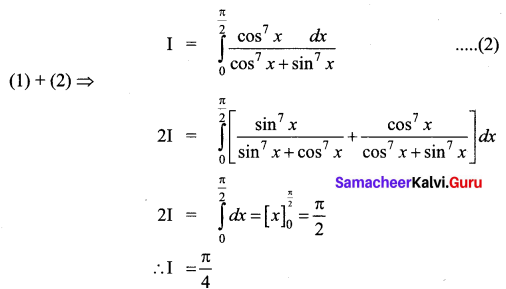
Variance (F) = Vanance \(\frac{9}{5}\) C° + 32
[Variance of ax + b = a2 (variance of x)]
= \(\left(\frac{9}{5}\right)^{2}\) . variance
= \(\frac{81}{25}\) × 25
= 81° F
New variance = 81° F

Samacheer Kalvi 10th Maths Solutions Chapter 8 Statistics and Probability Unit Exercise 8

Question 5.
If for a distribution, \(\Sigma(x-5)=3, \Sigma(x-5)^{2}=43\) and total number of observations is 18, find the mean and standard deviation.
Solution:
Samacheer Kalvi 10th Maths Solutions Chapter 8 Statistics and Probability Unit Exercise 8 67
Samacheer Kalvi 10th Maths Solutions Chapter 8 Statistics and Probability Unit Exercise 8 68

Question 6.
Prices of peanut packets in various places of two cities are given below. In which city, prices were more stable?
Samacheer Kalvi 10th Maths Solutions Chapter 8 Statistics and Probability Unit Exercise 8 69
Solution:
Samacheer Kalvi 10th Maths Solutions Chapter 8 Statistics and Probability Unit Exercise 8 70
Samacheer Kalvi 10th Maths Solutions Chapter 8 Statistics and Probability Unit Exercise 8 71

Samacheer Kalvi 10th Maths Solutions Chapter 8 Statistics and Probability Unit Exercise 8

Question 7.
If the range and coefficient of range of the data are 20 and 0.2 respectively, then find the largest and smallest values of the data.
Solution:
Range = L – S = 20
Samacheer Kalvi 10th Maths Solutions Chapter 8 Statistics and Probability Unit Exercise 8 72

Question 8.
If two dice are rolled, then find the probability of getting the product of face value 6 or the difference of face values 5.
Solution:
Product of face values 6: {(1, 6), (2, 3), (6, 1), (3,2)}
Difference of face value 5: {(1, 6), (6, 1)}
Samacheer Kalvi 10th Maths Solutions Chapter 8 Statistics and Probability Unit Exercise 8 73

Question 9.
In a two children family, find the probability that there is at least one girl in a family.
Solution:
S = {BB, BG, GB, GG}
n(S) = 4
Event of atleast one girl in a family say A
A= {BG, GB, GG}
n( A) = 3
Samacheer Kalvi 10th Maths Solutions Chapter 8 Statistics and Probability Unit Exercise 8 74
Probability of at least one girl in a family is \(\frac{3}{4}\)

Samacheer Kalvi 10th Maths Solutions Chapter 8 Statistics and Probability Unit Exercise 8

Question 10.
A bag contains 5 white and some black balls. If the probability of drawing a black ball from the bag is twice the probability of drawing a white ball then find the number of black balls.
Solution:
Let a number of black balls be ‘x’.
Number of white balls = 5.
Samacheer Kalvi 10th Maths Solutions Chapter 8 Statistics and Probability Unit Exercise 8 75
Number of Black balls = 10.

Question 11.
The probability that a student will pass the final examination in both English and Tamil is 0.5 and the probability of passing neither is 0.1. If the probability of passing the English examination is 0.75, what is the probability of passing the Tamil examination?
Solution:
Samacheer Kalvi 10th Maths Solutions Chapter 8 Statistics and Probability Unit Exercise 8 76
P(English) = 0.75
P(Tamil) = x(assume)
P(English ∪ Tamil) = P(English) + P(Tamil) – P(English ∩ Tamil)
⇒ 1 – 0.1 = 0.75 + x – 0.5
⇒ x = 0.9 – 0.25
Samacheer Kalvi 10th Maths Solutions Chapter 8 Statistics and Probability Unit Exercise 8 77

Samacheer Kalvi 10th Maths Solutions Chapter 8 Statistics and Probability Unit Exercise 8

Question 12.
The King, Queen and Jack of the suit spade are removed from a deck of 52 cards. One card is selected from the remaining cards. Find the probability of getting
(i) a diamond
(ii) a queen
(iii) a spade
(iv) a heart card bearing the number 5.
Solution:
King spade, Queen spade, Jack spade are removed
∴ total number of cards = 52 – 3 = 49.
Samacheer Kalvi 10th Maths Solutions Chapter 8 Statistics and Probability Unit Exercise 8 78

Samacheer Kalvi 10th Maths Solutions Chapter 8 Statistics and Probability Ex 8.5

You can Download Samacheer Kalvi 10th Maths Book Solutions Guide Pdf, Tamilnadu State Board help you to revise the complete Syllabus and score more marks in your examinations.

Tamilnadu Samacheer Kalvi 10th Maths Solutions Chapter 8 Statistics and Probability Ex 8.5

Multiple Choice Questions
Question 1.
Which of the following is not a measure of dispersion?
(1) Range
(2) Standard deviation
(3) Arithmetic mean
(4) Variance
Solution:
(3) Arithmetic mean

Samacheer Kalvi 10th Maths Solutions Chapter 8 Statistics and Probability Ex 8.5

Question 2.
The range of the data 8, 8, 8, 8, 8. . . 8 is _____
(1) 0
(2) 1
(3) 8
(4) 3
Answer:
(1) 0
Hint:
Range = L – S = 8 – 8 = 0

Question 3.
The sum of all deviations of the data from its mean is
(1) Always positive
(2) always negative
(3) zero
(4) non-zero integer
Solution:
(3) zero

Question 4.
The mean of 100 observations is 40 and their standard deviation is 3. The sum of squares of all deviations is ______
(1) 40000
(2) 160900
(3) 160000
(4) 30000
Answer:
(2) 160900
Hint:
Samacheer Kalvi 10th Maths Chapter 8 Statistics and Probability Ex 8.5 1

Samacheer Kalvi 10th Maths Solutions Chapter 8 Statistics and Probability Ex 8.5

Question 5.
Variance of the first 20 natural numbers is
(1) 32.25
(2) 44.25
(3) 33.25
(4) 30
Solution:
(3) 33.25

Question 6.
The standard deviation of a data is 3. If each value is multiplied by 5 then the new variance is ______
(1) 3
(2) 15
(3) 5
(4) 225
Answer:
(4) 225
Hint:
Standard deviation = 3
Each value is multiplied by 5
New standard deviation = 3 × 5 = 15
New variance = 152 = 225

Question 7.
If the standard deviation of x, y, z is p then the standard deviation of 3x + 5, 3y + 5, 3z + 5 is
(1) 3p + 5
(2) 3p
(3) p + 5
(4) 9p + 15
Solution:
(2) 3p

Samacheer Kalvi 10th Maths Solutions Chapter 8 Statistics and Probability Ex 8.5

Question 8.
If the mean and coefficient of variation of a data are 4 and 87.5% then the standard deviation is _____
(1) 3.5
(2) 3
(3) 4.5
(4) 2.5
Answer:
(1) 3.5
Hint:
Samacheer Kalvi 10th Maths Chapter 8 Statistics and Probability Ex 8.5 2

Question 9.
Which of the following is incorrect?
(1) P (A) > 1
(2) 0 ≤ P(A) ≤ 1
(3) P(ϕ) = 0 (4)
(4) P (A) + P(\(\overline{\mathbf{A}}\)) = 1
Solution:
(1) P(A) > 1

Question 10.
The probability a red marble selected at random from a jar containing p red, q blue and r green marbles is
Samacheer Kalvi 10th Maths Chapter 8 Statistics and Probability Ex 8.5 5
Solution:
(2) \(\frac{p}{p+q+r}\)

Samacheer Kalvi 10th Maths Solutions Chapter 8 Statistics and Probability Ex 8.5

Question 11.
A page is selected at random from a book. The probability that the digit at units place of the page number chosen is less than 7 is
Samacheer Kalvi 10th Maths Chapter 8 Statistics and Probability Ex 8.5 6
Solution:
(2) \(\frac{7}{10}\)

Question 12.
The probability of getting a job for a person is \(\frac{x}{3}\). If the probability of not getting the job is \(\frac{2}{3}\) then the value of x is ____
(1) 2
(2) 1
(3) 3
(4) 1.5
Answer:
(2) 1
Hint:
Samacheer Kalvi 10th Maths Chapter 8 Statistics and Probability Ex 8.5 7

Question 13.
Kamalam went to play a lucky draw contest. 135 tickets of the lucky draw were sold. If the probability of Kamalam winning is \(\frac{1}{9}\), then the number of tickets bought by Kamalam is
(1) 5
(2) 10
(3) 15
(4) 20
Solution:
(3) 15
Hint:
\(=\frac{1}{9} \times 135=15\)

Samacheer Kalvi 10th Maths Solutions Chapter 8 Statistics and Probability Ex 8.5

Question 14.
If a letter is chosen at random from the English alphabets {a, b, ……, z} then the probability that the letter chosen precedes x _______
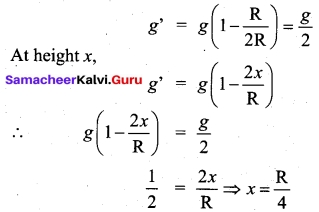
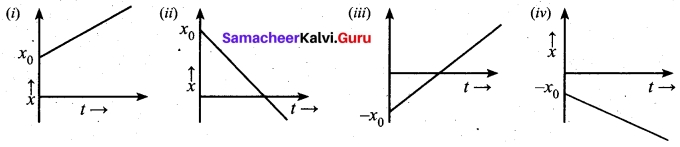
(1) \(\frac{12}{13}\)
(2) \(\frac{1}{13}\)
(3) \(\frac{23}{26}\)
(4) \(\frac{3}{26}\)
Answer:
(3) \(\frac{23}{26}\)
Hint:
Samacheer Kalvi 10th Maths Chapter 8 Statistics and Probability Ex 8.5 10

Question 15.
A purse contains 10 notes of ₹ 2000, 15 notes of ₹ 500, and 25 notes of ₹ 200. One note is drawn at random. What is the probability that the note is either a ₹ 500 note or ₹ 200 note?
(1) \(\frac{1}{5}\)
(2) \(\frac{3}{10}\)
(3) \(\frac{2}{3}\)
(4) \(\frac{4}{5}\)
Solution:
(4) \(\frac{4}{5}\)

Tamil Nadu 11th Maths Model Question Paper 5 English Medium

Students can Download Tamil Nadu 11th Maths Model Question Paper 5 English Medium Pdf, Tamil Nadu 11th Maths Model Question Papers helps you to revise the complete Tamilnadu State Board New Syllabus and score more marks in your examinations.

TN State Board 11th Maths Model Question Paper 5 English Medium

General Instructions:

  1. The question paper comprises of four parts.
  2. You are to attempt all the parts. An internal choice of questions is provided wherever applicable.
  3. All questions of Part I, II, III and IV are to be attempted separately.
  4. Question numbers 1 to 20 in Part I are Multiple Choice Questions of one mark each.
    These are to be answered by choosing the most suitable answer from the given four alternatives and writing the option code and the corresponding answer
  5. Question numbers 21 to 30 in Part II are two-mark questions. These are to be answered in about one or two sentences.
  6. Question numbers 31 to 40 in Part III are three-mark questions. These are to be answered in above three to five short sentences.
  7. Question numbers 41 to 47 in Part IV are five-mark questions. These are to be answered in detail Draw diagrams wherever necessary.

Time: 2.30 Hours
Maximum Marks: 90

PART – I

I. Choose the correct answer. Answer all the questions. [20 × 1 = 20]

Question 1.
Let X= {1,2, 3, 4} and R = {(1, 1), (1, 2), (1, 3), (2, 2), (3, 3) (2, 1), (3, 1), (1, 4), (4, 1)} then R is……………
(a) reflexive
(b) symmetric
(c) transitive
(d) equivalence
Solution:
(b) symmetric

Question 2.
Find a so that the sum and product of the roots of the equation 2x² – (a – 3)x + 3a – 5 = 0 are equal is…………
(a) 1
(b) 2
(c) 3
(d) 4
Solution:
(b) 2

Tamil Nadu 11th Maths Model Question Paper 5 English Medium

Question 3.
If π < 2θ < \(\frac{3π}{2}\) then \(\sqrt{2+\sqrt{2+2 \cos 4 \theta}}\) = ………….
(a) -2 cos θ
(b) -2 sin θ
(c) 2 cos θ
(d) 2 sin θ
Solution:
(d) 2 sin θ

Question 4.
If f(θ) = |sin θ| + |cos θ|, θ ∈ R then f(θ) is in the interval……………
(a) [0, 2]
(b) [1, √2]
(c) [ 1, 2]
(d) [0, 1]
Solution:
(b) [1, √2]

Question 5.
Total number of words formed by 2 vowels and 3 consonants taken from 4 vowels and 5 consonants is equal to…………
(a) 60
(b) 600
(c) 720
(d) 7200
Solution:
(d) 7200

Question 6.
The number of parallelograms that can be formed from a set of four parallel lines intersecting another set of three parallel lines is…………
(a) 6
(b) 9
(c) 12
(d) 18
Solution:
(d) 18

Question 7.
The nth term of the sequence \(\frac{1}{3}\), \(\frac{3}{4}\), \(\frac{7}{8}\),\(\frac{15}{16}\)…. is …………..
(a) 2n – n – 1
(b) 1 – 2-n
(c) 2-n + n – 1
(d) 2n-1
Solution:
(b) 1 – 2-n

Question 8.
The remainder when 3815 is divided by 13 is…………
(a) 12
(b) 1
(c) 11
(d) 5
Solution:
(a) 12

Question 9.
If the straight line joining the points (2, 3) and (-1, 4) passes through the point (α, β) then…………
(a) α + 2β = 7
(b) 3α + β = 9
(c) α + 3β = 11
(d) 3α + β = 11
Solution:
(c) α + 3β = 11

Question 10.
If the equation of the base opposite to the vertex (2, 3) of an equilateral triangle is x + y = 2 then the length of a side is………….
(a) \(\sqrt{\frac{3}{2}}\)
(b) 6
(c) √6
(d) 3√2
Solution:
(c) √6

Question 11.
If A and B are symmetric matrices of order n where A ≠ B then…………
(a) A + B is skew symmetric
(b) A + B is symmetric
(c) A + B is a diagonal matrix
(d) A + B is a zero matrix
Solution:
(b) A + B is symmetric

Tamil Nadu 11th Maths Model Question Paper 5 English Medium

Question 12.
If A is a square matrix then which of the following is not symmetric?
(a) A + AT
(b) AAT
(c) ATA
(d) A – AT
Solution:
(d) A – AT

Question 13.
\(\lim _{x \rightarrow \infty}\) \(\frac{a^x-b^x}{x}\) = …………….
(a) log ab
(b) log \(\frac{a}{b}\)
(c) log log \(\frac{b}{a}\)
(d) \(\frac{a}{b}\)
Solution:
(b) log \(\frac{a}{b}\)

Question 14.
The function f(x) = Tamil Nadu 11th Maths Model Question Paper 5 English Medium 1 is discontinuous at ………..
(a) x = 0
(b) x = 1
(c) x = -2
(d) x = 2
Solution:
(d) x = 2

Question 15.
The function f(x) = \(\left\{\begin{array}{ll} 2 & x \leq 1 \\ x & x>1 \end{array}\right.\) is not differentiable at………..
(a) x = 0
(b) x = 1
(c) x = -1
(d) x = 2
Solution:
(b) x = 1

Question 16.
The number of points in R in which the function f(x) = |x – 1| + |x – 3| + sin x is not differentiable is…………
(a) 3
(a) 2
(c) l
(d) 4
Solution:
(a) 2

Question 17.
If y = 1 + Tamil Nadu 11th Maths Model Question Paper 5 English Medium 2 + …..∞ then \(\frac{dx}{dy}\) =……..
(a) x
(b) x²
(c) y
(d) y²
Solution:
(d) y²

Question 18.
\(\int \frac{\sqrt{\tan x}}{\sin 2 x}\) dx = …………….
(a) \(\sqrt{tan x}\) + c
(b) 2\(\sqrt{tan x}\) + c
(c) \(\frac{1}{2}\) \(\sqrt{tan x}\) + c
(d) \(\frac{1}{4}\) \(\sqrt{tan x}\) + c
Solution:
(a) \(\sqrt{tan x}\) + c

Question 19.
An urn contains 5 red and 5 black balls. A balls is drawn at random, its colour is noted and is returned to the um. Moreover, 2 additional balls of the colour drawn are put in the urn and then a ball is drawn at random. The probability that the second ball drawn is red will be ………….
(a) \(\frac{5}{12}\)
(b) \(\frac{1}{2}\)
(c) \(\frac{7}{12}\)
(d) \(\frac{1}{4}\)
Solution:
(b) \(\frac{1}{2}\)

Question 20.
A bag contains 6 green, 2 white, and 7 black balls. If two balls are drawn simultaneously then the probability that both are different colours is……….
(a) \(\frac{68}{105}\)
(b) \(\frac{71}{105}\)
(c) \(\frac{64}{105}\)
(d) \(\frac{73}{105}\)
Solution:
(a) \(\frac{68}{105}\)

Tamil Nadu 11th Maths Model Question Paper 5 English Medium

PART – II

II. Answer any seven questions. Question No. 30 is compulsory. [7 × 2 = 14]

Question 21.
On the set of natural numbers let R be the relation defined by aRb if 2a + 3b = 30. Write down the relation by listing all the pairs. Check whether it is (i) reflexive, (ii) symmetric, (iii) transitive, (iv) equivalence
Solution:
N = {set of natural numbers};
R ={(3,8), (6, 6), (9, 4), (12, 2)}
(3, 3) ∉ R ⇒ R is not reflexive
(3, 8) ∈ R (8, 3) ∉ R
2a + 3b = 30
3b = 30 – 2a
b = \(\frac{30-2a}{3}\)
⇒ R is not symmetric
(a, b) (b, c) ∉ R ⇒ R is transitive
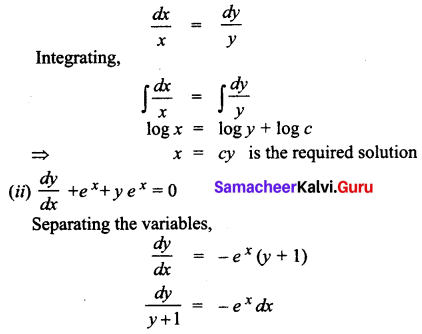
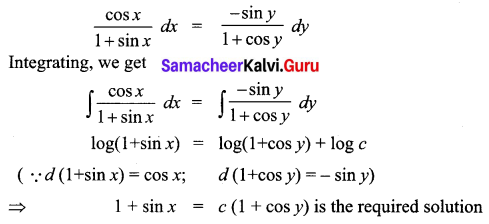
∴ It is not equivalence relation.

Question 22.
Compute log927 – log279.
Solution:
Let log927 = x ⇒ 27 = 9x ⇒ 3³ = (3²)x = 32x
⇒ 2x = 3 ⇒ x = 3/2
Let log27 9 = x
9 = 27x
3² = (3³)x ⇒ 3² = 33x
3x = 2 ⇒ x = 2/3
∴ log927 – log279 = \(\frac{3}{2}\) – \(\frac{2}{3}\) = \(\frac{9-4}{6}\) = \(\frac{5}{6}\)

Question 23.
Write the first 6 terms of the exponential series e5x
Solution:
Tamil Nadu 11th Maths Model Question Paper 5 English Medium 3

Question 24.
Find the points on the line x + y = 5, that lie at a distance 2 units from the line 4x + 3y – 12 = 0.
Solution:
Any point on the line x + y = 5 is x = t, y = 5 – t
The distance from (t, 5 – t) to the line 4x.+ 3y – 12 = 0 is given by 2 units.
∴ \(\frac{4(t)+3(5-t)-12}{\sqrt {4^2+3^2}}\) = 2 ⇒ \(\frac{|t+3|}{5}\) = 2
⇒ t + 3 = ± 10
t = -13, t = 7
∴ The points (-13, 18) and (7, -2).

Question 25.
Find |\(\vec{a}\) × \(\vec{b}\)| where \(\vec{a}\) = 3\(\vec{i}\) + 4\(\vec{j}\) and \(\vec{b}\) = \(\vec{i}\) +\(\vec{j}\) + \(\vec{k}\)
Solution:
\(\vec{a}\) × \(\vec{b}\) = \(\left|\begin{array}{lll} \hat{i} & \hat{j} & \hat{k} \\ 3 & 4 & 0 \\ 1 & 1 & 1 \end{array}\right|\) = \(\hat{i}\)(4 – 0) – \(\hat{j}\)(3 – 0) + \(\hat{k}\){3 – 4) = 4\(\hat{i}\) – 3\(\hat{j}\) – \(\hat{k}\)
|\(\vec{a}\) × \(\vec{b}\)| = |4\(\hat{i}\) – 3\(\hat{j}\) – \(\hat{k}\)| = \(\sqrt{16+9+1}\) = \(\sqrt{26}\)

Question 26.
Evaluate \(\lim _{x \rightarrow 1} \frac{x^{m}-1}{x^{n}-1}\) m and n are integers.
Solution:
Tamil Nadu 11th Maths Model Question Paper 5 English Medium 4

Question 27.
Find the derivative of sinx² with respect to x²
Solution:
Here u = sinx² and v = x²
Now we have to find
Tamil Nadu 11th Maths Model Question Paper 5 English Medium 5

Question 28.
Evaluate ∫[5x4 + 3(2x + 3)4 – 6(4 – 3x)5]
Solution:
∫[5 x4 + 3(2x + 3)4 – 6(4 – 3x)5] dx.
= 5∫x4dx + 3∫ (2x + 3)4 dx – 6∫ (4 – 3x)5 dx
= 5.\(\frac{x^5}{5}\) + 3.\(\frac{1}{2}\)\(\frac{(2x+3)^5}{5}\) – 6.\(\frac{1}{(-3)}\)\(\frac{(4-3x)^6}{6}\) + c.
= x5 + \(\frac{3}{10}\)(2x + 3)5 + \(\frac{1}{3}\) (4 – 3x)6 + c

Tamil Nadu 11th Maths Model Question Paper 5 English Medium

Question 29.
Given that P(A) = 0.52, P(B) = 0.43, and P(A ∩ B) = 0.24, find P(A ∪ B)
Solution:
P(A ∪ B) = P(A) + P(B) – P(A ∩ B)
= 0.52 + 0.43 – 0.24
P(A ∪ B) = 0.71

Question 30.
For what value of x, the matrix A = \(\left[\begin{array}{rrr} 0 & 1 & -2 \\ -1 & 0 & x^{3} \\ 2 & -3 & 0 \end{array}\right]\) is skew-symmetric.
Solution:
Tamil Nadu 11th Maths Model Question Paper 5 English Medium 6
-x³ = -3 ⇒ x³ = 3 ⇒ x = 31/3

PART- III

III. Answer any seven questions. Question No. 40 is compulsory. [7 × 3 = 21]

Question 31.
Find the largest possible domain for the real valued function given by f(x) =\(\frac{\sqrt{9-x^{2}}}{\sqrt{x^{2}-1}}\)
Solution:
If x < -3 or x > 3, then x² will be greater than 9 and hence 9 – x² will become negative which has no square root in R. So x must lie on the interval [-3, 3].
Also if x ≥ – 1 and x ≤ 1, then x² – 1 will become negative or zero. If it is negative, x² – 1e has no square root in R. If it is zero, f is not defined. So x must lie outside [-1, 1]. That is, x must lie on (- ∞, -1) ∪ (1, ∞). Combining these two conditions, the largest possible domain for/is [-3, 3] ∩ ((-∞, -1) ∪ (i, ∞)). That is, [-3, -1) ∪ (1, 3].

Question 32.
Solve sin x + sin 5x = sin 3x
Solution:
sin x + sin 5x = sin 3x ⇒ 2 sin 3x cos 2x = sin 3x
sin 3x (2 cos 2x – 1) = 0
Thus, either sin 3x = 0 (or) cos 2x = \(\frac{1}{2}\)
If sin 3x = 0, then 3x = nπ ⇒ x = \(\frac{nπ}{3}\) n ∈ Z ………(i)
If cos 2x = \(\frac{1}{2}\) ⇒ cos 2x = cos \(\frac{π}{3}\)
2x = 2nn ± \(\frac{π}{3}\) ⇒ x = nπ ± \(\frac{π}{6}\), n ∈ Z ….(ii)
From (i) and (ii), we have the general solution x = \(\frac{π}{3}\) (or) x = nπ ± \(\frac{π}{6}\), n ∈ Z

Question 33.
How many triangles can be formed by 15 points in which 7 of them lie on one line and the remaining 8 on another parallel line?
Solution:
Tamil Nadu 11th Maths Model Question Paper 5 English Medium 7
7 points lie on one line and the other 8 points parallel on another parallel line.
A triangle is obtained by taking one point from one line and 2 points from the other parallel line which can be done as follows.
7C1 × 8C2 or 7C2 × 8C1
7C1 = 7; 7C2 = \(\frac{7×6}{2×1}\) = 21
8C1 = 8; 8C2= \(\frac{8×7}{2×1}\) = 28
∴ No. of triangles = (7) (28) + (21) (8) = 196 + 168 = 364

Question 34.
Using binomial theorem indicate which of the following two numbers is larger (1.01)1000000 or 10000
Solution:
(1.01)1000000 = (1 + 0.01)1000000
= 1000000C0(1)1000000 + 1000000C1(1)999997(0.01)1
+ 1000000C2(1)999998(0.01)² + 1000000C3(1)999997(0.01)³ +……….
= 1 (1) + 1000000 × \(\frac{1}{10^2}\) + \(\frac{1000000×999999}{2}\) × \(\frac{1}{10000}\) + …………
= 1 + 10000 + 50 × 999999 +…………
which is > 10000
So (1.01)1000000 > 10000 (i.e.) (1.01)1000000 is larger.

Tamil Nadu 11th Maths Model Question Paper 5 English Medium

Question 35.
If a line joining two points (3, 0) and (5, 2) is rotated about the point (3, 0) in counter clockwise direction through an angle 15°, then find the equation of the line in the new position.
Solution:
Tamil Nadu 11th Maths Model Question Paper 5 English Medium 8
Let P (3, 0) and Q (5, 2) be the given points.
Slope of PQ = \(\frac{y_2-y_1}{x_2-x_1}\) = 1
⇒ The angle of inclination of the line PQ = tan-1(1) = \(\frac{π}{4}\) = 45°
∴ The slope of the line in new position is m = tan (45° + 15°)
⇒ Slope = tan (60°) = (√3)
∴ Equation of the straight line passing through (3, 0) and with the slope √3 is y – 0 = √3 (x – 3)
√3 x – y – 3√3 = 0

Question 36.
Find the area of the triangle whose vertices are A(3, -1, 2), B(l, -1, -3) and C(4, -3,1)
Solution:
A = (3, -1, 2), B = (1, -1, -3) and C = (4, -3, 1)
∴ \(\vec{OA}\) = 3\(\hat{i}\) – \(\hat{j}\) + 2\(\hat{k}\); \(\vec{OB}\) = \(\hat{i}\) – \(\hat{j}\) – 3\(\hat{k}\); and \(\vec{OC}\) = 4\(\hat{i}\) – 3\(\hat{j}\) + \(\hat{k}\)
Area of ΔABC = \(\frac{1}{2}\)|\(\vec{AB}\) × \(\vec{AC}\)| = \(\frac{1}{2}\)|\(\vec{BA}\) × \(\vec{BC}\)| = \(\frac{1}{2}\)|\(\vec{CA}\) x \(\vec{CB}\)|
\(\vec{AB}\) = \(\vec{OB}\) – \(\vec{OA}\) = (\(\hat{i}\) – \(\hat{j}\) – 3\(\hat{k}\)) – (3\(\hat{i}\) – \(\hat{j}\) + 2\(\hat{k}\)) = \(\hat{i}\) – \(\hat{j}\) – 3\(\hat{k}\) – 3\(\hat{i}\) + \(\hat{j}\) – 2\(\hat{k}\)
= -2\(\hat{i}\) – 5\(\hat{k}\)
\(\vec{AC}\) = \(\vec{OC}\) – \(\vec{OA}\) = 4\(\hat{i}\) – 3\(\hat{j}\) + \(\hat{k}\) – 3\(\hat{i}\) + \(\hat{j}\) – 2\(\hat{k}\)
= \(\hat{i}\) – 2\(\hat{j}\) – \(\hat{k}\)
Tamil Nadu 11th Maths Model Question Paper 5 English Medium 9

Question 37.
Check if \(\lim _{x \rightarrow-5}\) f(x) exists or not, where f(x) = \(\left\{\begin{array}{l} \frac{|x+5|}{x+5}, \text { for } x \neq-5 \\ 0, \quad \text { for } x=-5 \end{array}\right.\)
Solution:
(i) f(-5)
For x < -5, |x + 5| = -(x + 5)
Thus f(-5) = \(\lim _{x \rightarrow-5^-}\) \(\frac{-(x-5)}{(x+5)}\) = -1

(ii) f(-5+)
For x > -5, |x + 5| = (x + 5)
Thus f(-5+) = \(\lim _{x \rightarrow-5^+}\) \(\frac{(x+5)}{(x+5)}\) = 1
∴ f(-5) ≠ f(-5+). Hence the limit does not exist.

Question 38.
Evaluate \(\frac{\sqrt{x}}{1+\sqrt{x}}\)
Solution:
Tamil Nadu 11th Maths Model Question Paper 5 English Medium 10

Question 39.
The probability that a girl, preparing for competitive examination will get a State Government service is 0.12, the probability that she will get a Central Government job is 0.25, and the probability that she will get both is 0.07. Find the probability that
(i) she will get atleast one of the two jobs
(ii) she will get only one of the two jobs.
Solution:
Let I be the event of getting State Government service and C be the event of getting Central Government job.
Given that P(I) = 0.12, P(C) = 0.25, and P(I ∩ C) = 0.07
(i) P (at least one of the two jobs) = P(I or C) = P(I ∪ C)
= P(I) + P(C) – P(I ∩ C)
= 0.12 + 0.25 – 0.07 = 0.30

(if) P(only one of the two jobs) = P[only I or only C].
= P(I ∩ \(\bar{C}\)) + P(\(\bar{I}\) ∩ C)
= (P(I) – P(I ∩ C)} + (P(C) – P(I ∩ C)}
= {0.12 – 0.07} + {0.25 – 0.07}
= 0.23.
Tamil Nadu 11th Maths Model Question Paper 5 English Medium 11

Question 40.
Find the derivatives of the following function. \(\sqrt{xy}\) = e(x-y)
Solution:
\(\sqrt{xy}\) = ex-y
(i.e.) (xy)1/2 = ex-y
Taking log on both sides we get
log (xy)1/2 = log ex-y
(i.e.) \(\frac{1}{2}\) (log x + log y) = x – y
⇒ log x + log y = 2x – 2y
differentiating w.r. to x we get
Tamil Nadu 11th Maths Model Question Paper 5 English Medium 12

Tamil Nadu 11th Maths Model Question Paper 5 English Medium

PART – IV

IV. Answer all the questions. [7 × 5 = 35]

Question 41 (a).
Find the range of the function \(\frac{1}{2cos x -1}\)
Solution:
The range of cos x is – 1 to 1
-1 < cos x < 1
(× by 2) -2 < 2 cos x < 2
adding -1 throughout
-2 – 1 <2 cos x – 1 < 2 – 1
(i.e.,) -3 < 2 cos x – 1 < 1
so 1 < \(\frac{1}{2cos x -1}\) < \(\frac{-1}{3}\)
The range is outside \(\frac{-1}{3}\) and 1
i.e., range is (-∞, \(\frac{-1}{3}\)] ∪ [1, ∞)

[OR]

(b) Solve \(\frac{(x-2)}{(x+4)}\) ≥ \(\frac{5}{(x+3)}\)
Solution:
Tamil Nadu 11th Maths Model Question Paper 5 English Medium 13
x + 4 = 0 ⇒ x = -4; x + 3 = 0 ⇒ x = -3
Plotting the points -4, -3 on number line and taking limits (-∞, -4), (-4, -3), (-3, ∞)
Tamil Nadu 11th Maths Model Question Paper 5 English Medium 14
The solution for the inequality \(\frac{(x-2)}{(x+4)}\) ≥ \(\frac{5}{(x+3)}\) are the intervals (-∞, -4) and (-4, -3)

Question 42 (a).
Prove that log 2 + 16 log \(\frac{16}{15}\) + 12 log \(\frac{25}{24}\) + 7 log \(\frac{80}{81}\) = 1
Solution:
LHS = log 2 + 16 [log 16 – log 15] + 12 [log 25 – log 24] + 7 [log 81 – log 80]
Tamil Nadu 11th Maths Model Question Paper 5 English Medium 15
= log 2 + 16 [log 24 – log 3 × 5 ] + 12 [log 5² – log 2³ × 3] + 7[log 34 – log 24 × 5]
= log 2 + 16 [41og2 – log3 – log5] + 12 [2 log 5 – 3 log 2 – log 3] + 7 [4 log 3 – 4 log 2 – log 5]
= log 2 + 64 log 2 – 16 log 3 – 16 log 5 + 24 log 5 – 36 log 2 – 12 log 3 + 28 log 3 – 28 log 2 – 7 log 5
= log 2 [1+ 64 – 36 – 28] + log 3 [-16 – 12 + 28] + log 5 [-16 + 24 – 7]
= log 2(1) + log 3(0) +log 5(1)
= log 2 + log 5 = log 2 × 5 = log 10 = 1 = RHS

[OR]

(b) If tan α = \(\frac{1}{3}\) and tan β = \(\frac{1}{7}\) show that 2 α + β = \(\frac{π}{4}\)
Solution:
Tamil Nadu 11th Maths Model Question Paper 5 English Medium 16
∴ 2 α + β = 45° = \(\frac{π}{4}\)

Tamil Nadu 11th Maths Model Question Paper 5 English Medium

Question 43 (a).
Using Binomial theorem, prove that 6n – 5n always leaves remainder 1 when divided by 25 for all positive integer n.
Solution:
To prove this it is enough to prove, 6n – 5n = 25k + 1 for some integer k. We first consider the expansion
(1 + x)n = nC0 + nC1 x + nC2 x² +…+ nCn-1xn-1 + nCn xn, n ∈ N.
Taking x = 5 we get (1 + 5)n = nC0 + nC1 5 + nC2 5² +…+ nCn-1 5n-1 + nCn 5n. The above equality reduces to 6n = 1 + 5n + 25(nC2 + 5 nC3 +…+ nCn 5n-2)
That is,
6n – 5n = 1 + 25(nC2 + 5 nC3 +…+ nCn 5n-2) = 1 + 25k, k ∈ N.
Thus 6n – 5n always, leaves remainder 1 when divided by 25 for all positive integer n.

[OR]

(b) Prove that
Tamil Nadu 11th Maths Model Question Paper 5 English Medium 17
Solution:
Taking p = 0, we get |A| = \(\left|\begin{array}{ccc} (q+r)^{2} & 0 & 0 \\ q^{2} & r^{2} & q^{2} \\ r^{2} & r^{2} & q^{2} \end{array}\right|\) = 0
Therefore, (p- 0) is a factor. That is, p is a factor.
Since |A| is in cyclic symmetric form in p, q, r and hence q and r also factors.
Putting p + q + r = 0 ⇒ q + r = -p; r + p = -q; and p + q = -r.
|A| = \(\left|\begin{array}{lll} p^{2} & p^{2} & p^{2} \\ q^{2} & q^{2} & q^{2} \\ r^{2} & r^{2} & r^{2} \end{array}\right|\) = 0 since 3 columns are identical.
Therefore, (p + q + r)² is a factor of |A|.
The degree of the obtained factor pqr(p + q + r)² is 5. The degree of |A| is 6.
Therefore required factor is k (p + q + r)
Tamil Nadu 11th Maths Model Question Paper 5 English Medium 18
4(16 – 1) -1 (4 – 1) +1 (1 – 4) = 27k
60 – 3 – 3 = 27 k ⇒ k = 2.
|A| = 2pqr (p + q + r)³

Question 44 (a).
The sum of the distance of a moving point from the points (4, 0) and (-4, 0) is always 10 units. Find the equation of the locus of the moving point.
Solution:
Let point (h, k) be a moving point
Here A = (4, 0) and B = (- 4, 0)
Given PA + PB = 10
⇒ \(\sqrt{(h-4)^{2}+k^{2}}+\sqrt{(h+4)^{2}+k^{2}}\) = 10
⇒ \(\sqrt{(h-4)^{2}+k^{2}}\) = 10 – \(\sqrt{(h+4)^{2}+k^{2}}\)
Squaring both sides (h – 4)² + k² = 100 + (h + 4)² + k² – 20\(\sqrt{(h+4)^{2}+k^{2}}\)
(i.e.) h² + l6 – 8h + k² = 100 + h² + 16 + 8h + k² – 20\(\sqrt{(h+4)^{2}+k^{2}}\)
⇒ -16h – 100 = – 20 \(\sqrt{(h+4)^{2}+k^{2}}\)
(÷ by -4) 4h + 25 = 5 \(\sqrt{(h+4)^{2}+k^{2}}\)
Squaring both sides we get,
(4h + 25)² = 25 [(h + 4)² + k²]
(i.e) 16h² + 25 + 200h = 25 [h² + 8h + 16 + k²]
= 16h² + 625 + 200h – 25h² – 200h – 400 – 25k² = 0
= – 9h² – 25k² + 225 = 0
⇒ 9h² + 25 k² = 225
\(\frac{9h^2}{225}\) + \(\frac{25k^2}{225}\) = 1
(i.e) h²/25 + k²/9 = 1, So the locus is \(\frac{x^2}{25 }\) + \(\frac{y^2}{9}\) = 1

Tamil Nadu 11th Maths Model Question Paper 5 English Medium

[OR]

(b) Show that the vectors \(\hat{i}\) – 2\(\hat{j}\) + 3\(\hat{k}\), -2\(\hat{i}\) + 3\(\hat{j}\) – 4\(\hat{k}\) and – \(\hat{j}\) + 2\(\hat{k}\) are coplanar.
Solution:
Let the given three vectors be \(\vec{a}\), \(\vec{b}\) and \(\vec{c}\). When we are able to write one vector as a linear combination of the other two vectors, then the given vectors are called coplanar vectors.
Let \(\vec{a}\) = m\(\vec{b}\) + n\(\vec{c}\) where
(i.e.) \(\vec{a}\) = \(\hat{i}\) – 2\(\hat{j}\) + 3\(\hat{k}\)
\(\vec{b}\) = -2\(\hat{i}\) + 3\(\hat{j}\) – 4\(\hat{k}\) and \(\vec{c}\) = –\(\hat{j}\) + 2\(\hat{k}\)
⇒ \(\hat{i}\) – 2\(\hat{j}\) + 3\(\hat{k}\) = m (-2\(\hat{i}\) + 3\(\hat{j}\) – 4\(\hat{k}\)) + n (-\(\hat{j}\) + 2\(\hat{k}\))
Equating the \(\hat{i}\), \(\hat{j}\) and \(\hat{k}\) components
(i.e.) 1 = -2m ……… (1)
-2 = 3m – n …………(2)
3 = -4m + 2n …………(3)
Now we have to solve (1) and (2) and substitute the value in (3).
Solving (1) and (2)
(1) ⇒ -2m = 1
∴ m = –\(\frac{1}{2}\)
Substituting m = –\(\frac{1}{2}\) in (2) we get,
3(\(\frac{-1}{2}\)) – n = -2
–\(\frac{3}{2}\) – n = -2
∴ -n = -2 + \(\frac{3}{2}\) = \(\frac{-4+3}{2}\) = –\(\frac{1}{2}\)
n = \(\frac{1}{2}\)
∴ m = –\(\frac{1}{2}\); n = \(\frac{1}{2}\)
Substituting the values of m and n in (3).
LHS = 3
RHS = -4 + 2n = -4(\(\frac{-1}{2}\)) + 2(\(\frac{1}{2}\))
= 2 + 1 = 3
⇒ LHS = RHS
∴ we are able to write one vector as a linear combination of the other two
⇒ the given vectors are coplanar.

Question 45 (a).
A committee of 7 peoples has to be formed from 8 men and 4 women. In how many ways can this be done when the committee consists of
(i) exactly 3 women?
(ii) at least 3 women?
(iii) at most 3 women?
Solution:
Tamil Nadu 11th Maths Model Question Paper 5 English Medium 19
We need a committee of 7 people with 3 women and 4 men.
This can be done in (4C3) (8C4) ways
4C1 = 4C1 = 4
8C4 = \(\frac{8×7×6×5}{4×3×2×1}\) = 70
The number of ways = (70) (4) = 280

(ii) Atleast 3 women
Tamil Nadu 11th Maths Model Question Paper 5 English Medium 20
So the possible ways are (3W and 4M) or (4W and 3M)
(i.e) (4C3) (8C4) + (4C4) (8C3)
4C3 = 4C1 = 4; 4C4 = 1
8C4 = \(\frac{8×7×6×5}{4×3×2×1}\) = 70
8C3 = \(\frac{8×7×6}{3×2×1}\) = 56
The number of ways (4) (70) + (1) (56) = 280 + 56 = 336

(iii) Atmost 3 women
Tamil Nadu 11th Maths Model Question Paper 5 English Medium 21
The possible ways are (0W 8M) or (1W 6M) or (2W 5M) or (3W 4M)
Tamil Nadu 11th Maths Model Question Paper 5 English Medium 22
∴ The possible ways are
(1) (8) + (4) (28) + (6) (56) + (4) (70) = 8 + 112 + 336 + 280 = 736 ways

Tamil Nadu 11th Maths Model Question Paper 5 English Medium

[OR]

(b) Evaluate \(\lim _{x \rightarrow 0} \frac{\sqrt{1+\sin x}-\sqrt{1-\sin x}}{\tan x}\)
Solution:
Tamil Nadu 11th Maths Model Question Paper 5 English Medium 23

Question 46 (a).
If y = \(\frac{\sin ^{-1} x}{\sqrt{1-x^{2}}}\) show that (1 – x²)y2 – 3xy1 – y = 0
Solution:
y = \(\frac{\sin ^{-1} x}{\sqrt{1-x^{2}}}\)
⇒ y \(\sqrt{1-x^2}\) = sin-1 x
differentiating w.r.to x we get
Tamil Nadu 11th Maths Model Question Paper 5 English Medium 24
multiplying both sides by \(\sqrt{1-x^2}\) we get
-xy + (1 – x²)y1 = 1
differentiating both sides again w.r.to x.
– [xy-1 +y(1)] + (1 – x²) (y2) + y1(-2x) = 0
(i.e.) -xy1 – y + (1 – x²)y2 – 2xy1 = 0
(1 – x²)y2 – 3xy1 – y = 0

[OR]

(b) If y = cos (m sin-1 x), prove that (1 – x²) y3 – 3xy2 + (m² – 1) y1 = 0
Solution:
We have y = cos (m sin-1 x)
y1 = sin(m sin-1 x) \(\frac{m}{\sqrt{1-x^2}}\)
\(y_{1}^{2}\) = sin² (m sin-1 x) \(\frac{m^2}{(1-x^2)}\)
This implies (1 – x²) \(y_{1}^{2}\) = m² sin² (m sin-1 x) = m² [1 – cos² (m sin-1 x)]
This is, (1 – x²) \(y_{1}^{2}\) = m² (1 – y²).
Again differentiating,
(1 – x²) 2y1 \(\frac{dy_1}{dx}\) + \(y_{1}^{2}\)(-2x) = m² (-2y\(\frac{dy}{dx}\))
(1 – x²) 2y1y2 – 2x\(y_{1}^{2}\) = – 2m²yy1
(1 – x²) y2 – xy1 = m²y
Once again differentiating
(1 – x²) 2y1 \(\frac{dy_2}{dx}\) + \(y_{2}\)(-2x) – [x.\(\frac{dy_1}{dx}\) + y1.1] = -m² (\(\frac{dy}{dx}\))
(1 – x²)y3 – 2xy2 – xy2 – y1 = -m²y1
(1 – x²)y3 – 3xy2 + (m² – 1)y1 = 0

Tamil Nadu 11th Maths Model Question Paper 5 English Medium

Question 47 (a).
Evaluate ∫\(\frac{dx}{\sqrt{9+8x-x^2}}\)
Solution:
Let I = ∫\(\frac{dx}{\sqrt{9+8x-x^2}}\) dx
Consider, 9 + 8x – x²
= -[x² – 8x – 9]
= -[(x – 4)² – 16 – 9]
= -[(x – 4)² – (5)²]
= (5)² – (x – 4)²
Tamil Nadu 11th Maths Model Question Paper 5 English Medium 25.

[OR]

(b) An advertising executive is studying television viewing habits of married men and women during prime time hours. Based on the past viewing records he has determined that during prime time wives are watching television 60% of the time. It has also been determined that when the wife is watching television, 40% of the time the husband is also watching. When the wife is not watching the television, 30% of the time husband is watching the television. Find the probability that
(i) the husband is watching the television during the prime time of television
(ii) if the husband is watching the television, the wife is also watching the television.
Solution:
P(Wife watching TV) = P(W) = \(\frac{60}{100}\)
P(H/W) = \(\frac{40}{100}\); P(H/W’) = 30/100
(i) P(Husband watching TV) = P(H)
= P(H/W) P(W) + P(H/W’) P(W’)
Tamil Nadu 11th Maths Model Question Paper 5 English Medium 26

Tamil Nadu 11th Maths Model Question Paper 5 English Medium

Samacheer Kalvi 10th Maths Solutions Chapter 7 Mensuration Additional Questions

You can Download Samacheer Kalvi 10th Maths Book Solutions Guide Pdf, Tamilnadu State Board help you to revise the complete Syllabus and score more marks in your examinations.

Tamilnadu Samacheer Kalvi 10th Maths Solutions Chapter 7 Mensuration Additional Questions

Question 1.
If the radii of the circular ends of a conical bucket which is 45 cm high are 28 cm and 7 cm, find the capacity of the bucket. (Use \(\pi=\frac{22}{7}\))
Solution:
Clearly bucket forms frustum of a cone such that the radii of its circular ends are r1 = 28 cm, r2 = 7 cm, h = 45 cm.
Capacity of the bucket = volume of the frustum
Samacheer Kalvi 10th Maths Chapter 7 Mensuration Additional Questions 1

Samacheer Kalvi 10th Maths Solutions Chapter 7 Mensuration Additional Questions

Question 2.
Find the depth of a cylindrical tank of radius 28 m, if its capacity is equal to that of a rectangular tank of size 28 m × 16 m × 11 m.
Solution:
Volume of the cylindrical tank = Volume of the rectangle tank
Samacheer Kalvi 10th Maths Chapter 7 Mensuration Additional Questions 2

Question 3.
What is the ratio of the volume of a cylinder, a cone, and a sphere. If each has the same diameter and same height?
Solution:
Samacheer Kalvi 10th Maths Chapter 7 Mensuration Additional Questions 3
Samacheer Kalvi 10th Maths Chapter 7 Mensuration Additional Questions 4

Samacheer Kalvi 10th Maths Solutions Chapter 7 Mensuration Additional Questions

Question 4.
Find the number of coins, 1.5 cm is diameter and 0.2 cm thick, to be melted to form a right circular cylinder of height 10 cm and diameter 4.5 cm.
Solution:
Samacheer Kalvi 10th Maths Chapter 7 Mensuration Additional Questions 5

Question 5.
A spherical ball of iron has been melted and made into small balls. If the raidus of each smaller ball is one-fourth of the radius of the original one, how many such balls can be made?
Solution:
Samacheer Kalvi 10th Maths Chapter 7 Mensuration Additional Questions 6

Samacheer Kalvi 10th Maths Solutions Chapter 7 Mensuration Additional Questions

Question 6.
A wooden article was made by scooping out a hemisphere from each end of a cylinder as shown in figure. If the height of the cylinder is 10cm and its base is of radius 3.5 cm find the total surface area of the article.
Samacheer Kalvi 10th Maths Chapter 7 Mensuration Additional Questions 7
Solution:
Radius of the cylinder be r Height of the cylinder be h Total surface area of the article = CSA of cylinder + CSA of 2 hemispheres = 2πrh + 2πr2 = 2πr (h + 2r)
Samacheer Kalvi 10th Maths Chapter 7 Mensuration Additional Questions 8