Samacheer Kalvi 7th Maths Solutions Term 1 Chapter 6 Information Processing Intext Questions

Students can Download Maths Chapter 6 Information Processing Intext Questions and Answers, Notes Pdf, Samacheer Kalvi 7th Maths Book Solutions Guide Pdf helps you to revise the complete Tamilnadu State Board New Syllabus and score more marks in your examinations.

Tamilnadu Samacheer Kalvi 7th Maths Solutions Term 1 Chapter 6 Information Processing Intext Questions

Exercise 6.1

Try this (Text book Page No. 111)

Question 1.
Use the given five tetrominoes only once and create the shape given below.
Samacheer Kalvi 7th Maths Solutions Term 1 Chapter 6 Information Processing Intext Questions 1
Solution:
Using the given five tetrominoes in the proper places we can make the given shape as follows.
Samacheer Kalvi 7th Maths Solutions Term 1 Chapter 6 Information Processing Intext Questions 2

Try these (Text Book Page No. 113)

Question 1.
Complete the rectangle given below using five tetrominoes only once
Samacheer Kalvi 7th Maths Solutions Term 1 Chapter 6 Information Processing Intext Questions 3
Solution:
The given rectangle is halfly filled with the five tetrominoes.
Using the five tetrominoes only once we can fill the rectangles as follows:
Samacheer Kalvi 7th Maths Solutions Term 1 Chapter 6 Information Processing Intext Questions 4

Question 2.
Samacheer Kalvi 7th Maths Solutions Term 1 Chapter 6 Information Processing Intext Questions 5
Solution:
Samacheer Kalvi 7th Maths Solutions Term 1 Chapter 6 Information Processing Intext Questions 6

Exercise 6.2

Try these (Text Book Page No. 119)

Question 1.
Observe the pictures and answer the following.
(i) Find all the possible routes from house to school via fire station.
(ii) Find all the possible routes between central park and school with distance. Mention the shortest route?
(iii) Calculate the shortest distance between bank and school.
Solution:
(i) (a) House ➝ Fire station ➝ Library ➝ Central Park ➝ Hotel ➝ Fruit shop ➝ School.
(b) House ➝ Fire station ➝ Library ➝ Fruit shop ➝ School.
(c) House ➝ Fire station ➝ Library ➝ School.

(ii) Possible routes between Central park and school and their distances are
(a) School ➝ Fruit shop ➝ Hotel ➝ Central park.
Distance ➝ (150 + 300 + 100)m = 550 m

(b) School ➝ Fruit shop ➝ Library ➝ Central park Distance ➝(150 + 100 + 200)m
= 450 m

(c) School ➝ Library ➝ Central park
Distance = (20 + 200 m)
= 220 m

(d) School ➝ Library ➝ Fire station ➝ House ➝ central park Distance = (20 + 50 + 300 + 150) m
= 520 m

(e) School ➝ Emit shop ➝ Hotel ➝ Bank ➝ House ➝ Central park
Distance ➝ (150 + 300 + 150 + 200 + 150) m
= 950 m

(f) School ➝ fruit shop ➝ Hotel ➝ Bank ➝ House ➝ Fire station ➝ Library ➝ central park
Distance = (150 + 300 + 150 + 200 + 300 + 50 + 200)m = 1350 m
∴ Route (c) is the shortest path (i.e.,) School ➝ Library ➝ Central park

(iii) Shortest distance between school and Bank is calculated as follows Bank ➝ Hotel ➝ Central park ➝ Library ➝ school.
Distance = (150 + 100 + 200 + 20)m
= 470 m

Question 2.
A School has planned for a trip to Ooty. Using the route map, the school decides to visit the places such as Boat House Adam Fountain and Botanical Garden.
Samacheer Kalvi 7th Maths Solutions Term 1 Chapter 6 Information Processing Intext Questions 50
(i) How much distance you have to travel to Botanical Garden from Ooty Boat House?
(ii) Find the shortest route to Botanical from the Ooty main Bus stand.
(iii) Mention the direction of Botanical Garden from Adam Foundation.
(iv) In what direction, Ooty Boat House is situated from Ooty Main Bus Stand. Complete the following route map from Ooty Main Bus Stand to Botanical Garden.
Samacheer Kalvi 7th Maths Solutions Term 1 Chapter 6 Information Processing Intext Questions 55
Solution:
(i) (a) 700 m + 8.1 km = 700 m + (8 km + 100 m) = 8 km + 800 m = 8.8 km
(b) 700 m+ 1.7 km + 1.5 km = 700 m + (1 km, 700 m) + 1 km 500 m
= 2 km + 1900 m
= 2 km + 1 km + 900 m
= 3 km + 900 m
= 3.9 km
From the Ooty Boat House, the Botanical Garden is at a distance of 3.9 km(shortest)

(ii) The route from Botanical Garden from Ooty main Bus stand are
(a) Ooty main Bus stand ➝ Boat house ➝ Government Botanical garden Distance 1.5 km + 8.1 km + 700 m
= 1 km 500 m + 8 km 100 m + 700 m
= 9 km 1300 m
= 9 km + 1 km +300 m
= 10 km 300 m
= 10.3 km.

(b) Another route.
Ooty Main Bus stand ➝ Adam Fountain ➝ Botanical garden.
Distance = 1.7 + 700 m
= 1 Km 700 m + 700m
= 1 Km 1400 m
= 1 Km+ 1 Km 400 m
= 2 Km 400 m
= 2.4Km
∴ Shortest Route is Ooty main Bus stand ➝ Adams Foundation ➝ Botanical garden

iii. Botanical garden is north of Adam Foundation.

iv. Ooty Boat House is situated to the west of Ooty main bus bus stand.

v.
Samacheer Kalvi 7th Maths Solutions Term 1 Chapter 6 Information Processing Intext Questions 60

Samacheer Kalvi 7th Maths Solutions Term 1 Chapter 3 Algebra Ex 3.2

Students can Download Maths Chapter 3 Algebra Ex 3.2 Questions and Answers, Notes Pdf, Samacheer Kalvi 7th Maths Book Solutions Guide Pdf helps you to revise the complete Tamilnadu State Board New Syllabus and score more marks in your examinations.

Tamilnadu Samacheer Kalvi 7th Maths Solutions Term 1 Chapter 3 Algebra Ex 3.2

Question 1.
Fill in the blanks
(i) The addition of – 7b and 2b is _______
(ii) The subtraction of 5m from -3m is ______
(iii) The additive inverse of -37xyz is _____
Solution:
(i) -5b
(ii) -8m
(iii) 37xyz

Question 2.
Say True or False
(i) The expressions 8x + 3y and 7x + 2y cannot be added
(ii) If x is a natural number, then x + 1 is its predecessor.
Hint: x – 1 is its predecessor.
(iii) Sum of a – b + c and -a + b – c is zero
Solution:
(i) False
(ii) False
(iii) True

Question 3.
Add: (i) 8x, 3x
(ii) 7mn, 5mn
(iii) -9y, 11y, 2y
Solution:
(i) 8x + 3x = (8 + 3) x = 11x
(ii) 7mn + 5mn = (7 + 5)mn = 12mn
(iii) -9y + 11y + 2y =(-9 + 11 + 2 )y = (2 + 2)y = 4y

Question 4.
Subtract:
(i) 4k from 12k
(ii) 15q from 25q
(iii) 7xyz from 17xyz
Solution:
(i) 4k from 12k
12k – 4k = (12 – 4) k = 8k
(ii) 15q from 25q
25q – 15q = (25 – 15)q = 10q
(iii) 7xyz from 17xyz
17xyz – 7xyz = (17 – 7)xyz = 10xyz

SamacheerKalvi.Guru

Question 5.
Find the sum of the following expressions
(i) 7p + 6q, 5p – q, q + 16p
Solution:
(7p + 6q) + (5p – q) + (q + 16p) = 7p + 6q + 5p – q + q + 16p
= (7p + 5p + 16p) + (6q – q + q)
= (7 + 5 + 16) p + (6 – 1 + 1) q
= (12 + 16) p + 6q = 28p + 6q

(ii) a + 5b + 7c, 2a + 106 + 9c
Solution:
(a + 5b + 7c) + (2a + 10b + 9c) = a + 5b + 7c + 2a + 10b + 9c
= a + 2a + 5b + 10b + 7c + 9c
= (1 + 2)a + (5 + 10)b + (7 + 9)c
= 3a + 15b + 16c

(iii) mn + t, 2mn – 2t, – 3t + 3mn
Solution:
(mn + t) + (2mn – 2t) + (-3t + 3mn)
= mn + t + 2mn – 2t + (-3t) + 3mn
= (mn + 2mn + 3mn) + (t – 2t – 3t)
= (1 + 2 + 3) mn + (1 – 2 – 3) t
= 6mn + (1 – 5)t
= 6mn + (- 4) t
= 6mn – 4t

(iv) u + v, u – v, 2u + 5v, 2u – 5v
Solution:
(u + v) + (u – v) + (2u + 5v) + (2u – 5v)
= u + v + u – v + 2u + 5v + 2u – 5v
= u + u + 2u + 2u + v – v + 5v – 5v
= (1 + 1 + 2 + 2) u +(1 – 1 + 5 – 5)v = 6u + 0v
= 6u

(v) 5xyz – 3xy, 3zxy – 5yx
Solution:
5xyz – 3xy + 3zxy – 5yx = 5xyz + 3xyz – 3xy – 5xy
= (5 + 3) xyz + [(-3) + (-5)] xy = 8xyz + (-8) xy
= 8xyz – 8xy

Question 6.
Subtract
(i) 13x + 12y – 5 from 27x + 5y – 43
Solution:
27x + 5y – 43 – (13x + 12y – 5) = 27z + 5y – 43 + (-13x – 12y + 5)
= 27x + 5y – 43 – 13x – 12y + 5
= (27 – 13) x + (5 – 12)y + (- 43) + 5
= 14x + (- 7) y + (- 38) = 14x – 7y – 38

(ii) 3p + 5 from p – 2q + 7
Solution:
p – 2q + 7 – (3p + 5) = p – 2q + 7 + (- 3p – 5)
= p – 2q + 7 – 3p – 5 = p – 3p – 2q + 7 – 5
= (1 – 3)p – 2q + 2 = -2p – 2q + 2

(iii) m + n from 3m – 7n
Solution:
3m – 7n – (m + n) = 3m – 7n + (-m – n)
= 3m – 7n – m – n = (3m – m) + (-7n – n)
= (3 – 1 )m + (-7 – 1) n = 2m + (-8) n
= 2m – 8n

(iv) 2y + z from 6z – 5y
Solution:
6z – 5y – (2y + z) = 6z – 5y + (-2y – z)
= 6z – 5y – 2y – z = 6z – z – 5y – 2y
= (6 – 1) z + (-5 -2) y = 5z + (-7) y
= 5z – 7y = -7y + 5z

Question 7.
Simplify
(i) (x + y – z) + (3x – 5y + 7z) – (14x + 7y – 6z)
Solution:
(x + y – z) + (3x – 5y + 7z) – (14x – 7y – 6z)
= (x + y – z) + (3x – 5y + 7z) + (-14x – 7y + 6z)
= (x + 3x – 14x) + (y – 5y – 7y) + (-z + 7z + 6z)
= (1 + 3 – 14) x + (1 – 5 – 7)y + (-1 + 7 + 6) z
= – 10x – 11y + 12z

(ii) p + p + 2 + p + 3 + p – 4 – p – 5 + p + 10
Solution:
p + p + 2 + 3 – p – 4 – p – 5 + p + 10 = (p + p + p – p – p + p) + (2 + 3 – 4 – 5 + 10)
= (1 + 1 + 1 – 1 – 1 + 1) p + 6 = 2p + 6

(iii) n + (m + 1) + (n + 2) + (m + 3) + (n + 4) + (m + 5)
Solution:
n + (m + 1) + (n + 2) + (m + 3) + (n + 4) + (m + 5)
= n + m + 1 + n + 2 + m + 3 + n + 4 + m + 5
= n + n + n + m + m + m + 1 + 2 + 3 + 4 + 5
= (1 + 1 + 1)n + (1 + 1 + 1)m + 15
= 3n + 3m + 15 = 3m + 3n + 15

Objective Type Questions

Question 8.
The addition of 3mn, -5mn, 8mn and – 4mn is
(i) mn
(ii) – mn
(iii) 2mn
(iv) 3mn
Solution:
(iii) 2mn
Hint: = 3 mn + 8mn – 5 mn – 4 mn = 11 mn – 9 mn = 2 mn

SamacheerKalvi.Guru

Question 9.
When we subtract ‘a’ from ‘-a’, we get ______
(i) a
(ii) 2a
(iii) -2a
(iv) -a
Solution:
(iii) -2a
Hint: – a – a = – 2a

Question 10.
In an expression, we can add or subtract only _____
(i) like terms
(ii) unlike terms
(iii) all terms
(iv) None of the above
Solution:
(i) like terms

Samacheer Kalvi 7th Maths Solutions Term 1 Chapter 4 Direct and Inverse Proportion Additional Questions

Students can Download Maths Chapter 4 Direct and Inverse Proportion Additional Questions and Answers, Notes Pdf, Samacheer Kalvi 7th Maths Book Solutions Guide Pdf helps you to revise the complete Tamilnadu State Board New Syllabus and score more marks in your examinations.

Tamilnadu Samacheer Kalvi 7th Maths Solutions Term 1 Chapter 4 Direct and Inverse Proportion Additional Questions

Exercise 4.1

Question 1.
The amount of extension in an elastic spring varies directly as the weight hung on it. If a weight of 150 gm produces an extension of 2.9 cm, then what weight would produce an extension of 17.4 cm?
Solution:
To produce 2.9 cm extension weight needed = 150 gm
Samacheer Kalvi 7th Maths Solutions Term 1 Chapter 4 Direct and Inverse Proportion Additional Questions 74

Question 2.
Reeta types 540 words during half on hour. How many words would she type in 12 minutes?
Solution:
In \(\frac{1}{2}\) an hour number of words typed = 540
i.e., In 30 min No. of words typed = 540
Samacheer Kalvi 7th Maths Solutions Term 1 Chapter 4 Direct and Inverse Proportion Additional Questions 75
= 18
In 12 minutes number of words typed = 18 × 12
= 216
216 words can be typed in 12 min

Question 3.
A call taxi charges ₹ 130 for 100 km. How much would one travel for ₹ 390?
Solution:
Samacheer Kalvi 7th Maths Solutions Term 1 Chapter 4 Direct and Inverse Proportion Additional Questions 76

Exercise 4.2

Question 1.
In the following table find out x and y vary directly or inversely?
Samacheer Kalvi 7th Maths Solutions Term 1 Chapter 4 Direct and Inverse Proportion Additional Questions 40
Solution:
From the table itself we observe that as x increases y decreases.
∴ x and y are inversely proportional
∴ xy = 8 × 32 = 16 × 16 = 32 × 8 = 256 × 1 = 256

Question 2.
If x and y vary inversely as each other and x = 10 when y = 6. Find y when x = 15.
Solution:
Since x and y vary inversely as each other
xy = constant
10 × 6 = 15 xy
60 = 15y
Samacheer Kalvi 7th Maths Solutions Term 1 Chapter 4 Direct and Inverse Proportion Additional Questions 41

Question 3.
If x and y vary inversely and if y = 35 find x when constant of variation is 7.
Solution:
Given x andy are inversely proportional
xy = constant
when y = 35 and constant = 7 ; x × 35 = 7
Samacheer Kalvi 7th Maths Solutions Term 1 Chapter 4 Direct and Inverse Proportion Additional Questions 42

Exercise 4.3

Question 1.
Sumathi sweeps 600 m long road in 2\(\frac{1}{2}\) hrs. Ramani sweeps \(\frac{2}{3}\) rd of same road in 1\(\frac{1}{2}\) hrs. Who sweeps more speedily?
Solution:
Samacheer Kalvi 7th Maths Solutions Term 1 Chapter 4 Direct and Inverse Proportion Additional Questions 33

Question 2.
Suma weaves 25 baskets in 35 days. In how many days will she weave 110 baskets?
Solution:
Samacheer Kalvi 7th Maths Solutions Term 1 Chapter 4 Direct and Inverse Proportion Additional Questions 34

Samacheer Kalvi 7th Maths Solutions Term 1 Chapter 5 Geometry Intext Questions

Students can Download Maths Chapter 5 Geometry Intext Questions and Answers, Notes Pdf, Samacheer Kalvi 7th Maths Book Solutions Guide Pdf helps you to revise the complete Tamilnadu State Board New Syllabus and score more marks in your examinations.

Tamilnadu Samacheer Kalvi 7th Maths Solutions Term 1 Chapter 5 Geometry Intext Questions

Exercise 5.1

Recap
Try These (Text book Page No. 83)

Question 1.
Complete the following statements.
(i) A Line is a straight path that goes on endlessly in two directions.
(ii) A Line segment is a line with two end points.
(iii) A Ray is a straight path that begins at a point and goes on and extends endlessly the other direction.
(iv) The lines which intersect at right angles are Perpendicular lines.
(v) The lines which intersect each other at a point are called Intersecting lines.
(vi) The lines that never intersect are called Parallel lines.

Question 2.
Use a ruler or straightedge to draw each figure.

Samacheer Kalvi 7th Maths Solutions Term 1 Chapter 5 Geometry Intext Questions 2

Question 3.
Look at the figure and answer the following questions.
(i) Which line is parallel to AB.
(ii) Name a line which intersect CD.
(iii) Name the lines which are perpendicular to GH
(iv) How many lines are parallel to IJ
(v) Will EF intersect AB? Explain.
Samacheer Kalvi 7th Maths Solutions Term 1 Chapter 5 Geometry Intext Questions 1
Solution:
\(\overleftrightarrow { GH } \) is parallel to \(\overleftrightarrow { AB } \)
(ii) \(\overleftrightarrow { IJ } \) and \(\overleftrightarrow { KL } \) intersect \(\overleftrightarrow { CD } \)
(iii) \(\overleftrightarrow { IJ } \) and \(\overleftrightarrow { KL } \) are perpendicular to \(\overleftrightarrow { GH } \)
(iv) Only one line \(\overleftrightarrow { KL } \) is parallel to \(\overleftrightarrow { IJ } \)
(v) Yes, \(\overleftrightarrow { EF } \) will intersect \(\overleftrightarrow { AB } \) at some point.

Try These (Text Book Page No. 85)

Choose the correct answer

Question 1.
A straight angle measures
(a) 45°
(b) 90°
(c) 180°
(d) 100°
Solution:
(c) 180°
Solution:
No, they are not adjacent pairs.

Question 2.
An angle with measure 128° is called ___ angle.
(a) a straight
(b) an obtuse
(c) an acute
(d) Right
Solution:
(b) an obtuse

Question 3.
The corner of the A4 paper has
(a) An acute angle
(b) A right angle
(c) Straight
(d) An obtuse angle
Solution:
(b) a right angle

Question 4.
If a perpendicular line is bisecting the given line, you would have two
(a) right angles
(b) obtuse angles
(c) acute angles
(d) reflex angles
Solution:
(a) right angle

Question 5.
An angle that measure 0° is called
(a) right angle
(b) obtuse angle
(c) acute angle
(d) Zero angle.
Solution:
(d) Zero angle

Try this (Text Book Page No. 86)

Question 1.
In each of the following figures, observe the pair of angles that are marked as ∠1 and ∠2. Do you think that they are adjacent pairs? Justify your answer.
Samacheer Kalvi 7th Maths Solutions Term 1 Chapter 5 Geometry Intext Questions 45

Solution:
No, they are not adjacent pairs.
In (i) and (ii) angles ∠1 and ∠2 have no common vertex.
In (iii) the interiors of ∠1 and ∠2 overlaps.
∴ they are not adjacent angles.

Try these (Text book Page No. 87)

Question 1.
Few real life examples depicting adjacent angles are shown below.
Samacheer Kalvi 7th Maths Solutions Term 1 Chapter 5 Geometry Intext Questions 80
Can you give three more examples of adjacent angles seen in real life?
Solution:
Samacheer Kalvi 7th Maths Solutions Term 1 Chapter 5 Geometry Intext Questions 81
(i) Angles between leaf veins. [ ∠1 and ∠2],
(ii) Angles between adjacent pages of a book, when it is open [ ∠1 and ∠2 ].
(iii) Adjacent angles of scissors [ ∠1 and ∠2 ]

Question 2.
Observe the six angles marked in the picture shown. Write any four pairs of adjacent angles and that are not.
Solution:
Four pairs of adjacent angles are
1. ∠A and ∠B
2. ∠B and ∠C
3. ∠C and ∠D
4. ∠D and ∠E
Samacheer Kalvi 7th Maths Solutions Term 1 Chapter 5 Geometry Intext Questions 01
Four pairs of non adjacent angles are.
1. ∠A and ∠C
2. ∠C and ∠F
3. ∠E and ∠D
4. ∠A and ∠F

Question 3.
Identify the common arm, common vertex of the adjacent angles and shade the interior with two colours in each of the following figures.
Samacheer Kalvi 7th Maths Solutions Term 1 Chapter 5 Geometry Intext Questions 91
Solution:
Samacheer Kalvi 7th Maths Solutions Term 1 Chapter 5 Geometry Intext Questions 92

(ii)
Samacheer Kalvi 7th Maths Solutions Term 1 Chapter 5 Geometry Intext Questions 83
Solution:
Samacheer Kalvi 7th Maths Solutions Term 1 Chapter 5 Geometry Intext Questions 84

Question 4.
Name the adjacent angles in each of the following figure.
Samacheer Kalvi 7th Maths Solutions Term 1 Chapter 5 Geometry Intext Questions 85
Solution:
(i) ∠BAC and ∠CAD are adjacent angles.
(ii) ∠XWY and ∠YWZ are adjacent angles.

Try These (Text Book Page No. 88)

Question 1.
Observe the following pictures and find the other angles of the linear pair.
Samacheer Kalvi 7th Maths Solutions Term 1 Chapter 5 Geometry Intext Questions 86
Solution:
(i) Given one angle 84°
∴ Other angle of the linear pair is 180° – 84° = 96°

(ii) One angle is given as 86°
Other angle of linear pair is 180° – 86° = 94°

(iii) Given one angle = 159°
Other angle of the linear pair = 180° – 159° = 21°

Try this (Text book Page No. 88)

Question 1.
Observe the figure. There are two angles namely ∠PQR = 150° and ∠QPS = 30° Is all this pair of supplementary angles a linear pair? Discuss
Samacheer Kalvi 7th Maths Solutions Term 1 Chapter 5 Geometry Intext Questions 87
Solution:
Given ∠PQR =150°
∠QPS = 30°
They are supplementary angles,
But they are not adjacent angles as they don’t have common vertex or common arm.
∴ They are not a linear pair.

Try this (Text book Page No. 90)

Question 1.
What would happen to the angles if we add 3 or 4 or 5 rays on a line as given below?
Samacheer Kalvi 7th Maths Solutions Term 1 Chapter 5 Geometry Intext Questions 88
Solution:
New adjacent angles are formed.
The new angles become smaller in measure. But their sum is 180° as it is a linear angle.

Try this (Text book Page No. 90)

Question 1.
Can you justify the statement
∠AOB + ∠BOC + ∠COD + ∠DOE + ∠EOF + ∠FOA = 360°?
Samacheer Kalvi 7th Maths Solutions Term 1 Chapter 5 Geometry Intext Questions 96
Solution:
We know that the sum of angles at a point is 360°
∠AOB + ∠BOC + ∠COD + ∠DOE + ∠EOF + ∠FOA = 360° as they are the sum of angles at the point ‘O’

Try These (Text book Page No. 91)

Question 1.
Four real life examples of vertically opposite angles are given below.
Samacheer Kalvi 7th Maths Solutions Term 1 Chapter 5 Geometry Intext Questions 89
Solution:
(i) The four angles made in the scissors where the opposite angles are always equal.
(ii) The point where two roads intersect each other.
(iii) Rail road crossing signs.
(iv) An hourglass.

Question 2.
In the given figure two lines \(\overleftrightarrow { AB } \) and \(\overleftrightarrow { CD } \) intersect at ‘O’. Observe the pair of angles and complete the following table. One is done for you.
Samacheer Kalvi 7th Maths Solutions Term 1 Chapter 5 Geometry Intext Questions 90
Solution:
Samacheer Kalvi 7th Maths Solutions Term 1 Chapter 5 Geometry Intext Questions 98

Question 3.
Name the two pairs of vertically opposite angles
Samacheer Kalvi 7th Maths Solutions Term 1 Chapter 5 Geometry Intext Questions 99
Solution:
∠PTS and ∠QTR are vertically opposite angles.
∠PTR and ∠QTS are vertically opposite angles.

Question 4.
Find the value of x° in the figure given below.
Samacheer Kalvi 7th Maths Solutions Term 1 Chapter 5 Geometry Intext Questions 100
Solution:
Lines l and m intersect at a point and making a pair of vertically opposite angles x° and 150°.
We know that vertically opposite angles are equal.
x = 150°

Exercise 5.2

Try this (Text book Page No. 93)

Question 1.
For a given set of lines, it is possible to draw more than one transversal.
Samacheer Kalvi 7th Maths Solutions Term 1 Chapter 5 Geometry Intext Questions 150
Solution:
Yes, it is possible to draw more than one transversal for a given set of lines. l and m are given set of lines. n and p are transversal

Try these (Text Book Page No 94)

Question 1.
Draw as many possible transversals in the given figures.
Samacheer Kalvi 7th Maths Solutions Term 1 Chapter 5 Geometry Intext Questions 20
Solution:
Samacheer Kalvi 7th Maths Solutions Term 1 Chapter 5 Geometry Intext Questions 21
(i) a, b, c are transversal to l, m and n.
(ii) a, b, c are transversal to l, m, n and p. More transversals can be drawn.

Question 2.
Draw a line which is not the transversal to the above figures.
Solution:
Samacheer Kalvi 7th Maths Solutions Term 1 Chapter 5 Geometry Intext Questions 22

Question 3.
How many transversals can you draw for the following two lines
Samacheer Kalvi 7th Maths Solutions Term 1 Chapter 5 Geometry Intext Questions 23
Solution:
Infinite number of transversals can be drawn.
Samacheer Kalvi 7th Maths Solutions Term 1 Chapter 5 Geometry Intext Questions 24
a, b, c, d, e, f, g are transversal to m and n.

Try these (Text book Page No. 96)

Question 1.
Four real life examples for transversal of parallel lines are given below.
Samacheer Kalvi 7th Maths Solutions Term 1 Chapter 5 Geometry Intext Questions 25
Give four more examples for transversal of parallel lines seen in your surroundings.
Solution:
Some examples of parallel lines in our surroundings
(i) Zebra crossing on the road.
(ii) Railway tracks with sleepers.
(iii) Steps
(iv) Parallel bars in men’s gymnastics

Question 2.
Find the value of x.
Samacheer Kalvi 7th Maths Solutions Term 1 Chapter 5 Geometry Intext Questions 160
Solution:
(i) We know that if two parallel lines are cut by a transversal, each pair of corresponding angles are equal.
∴ x = 125°

(ii) m and n are parallel lines and l is a transversal x° and 48° are corresponding angles.
∴ x = 48°

(iii) m and n are parallel lines and 7’ is the transversal.
∴ Corresponding angles are equal.
∴ x° = 138°

Try these (Text book Page No. 98)

Question 1.
Find the value of x°.
Samacheer Kalvi 7th Maths Solutions Term 1 Chapter 5 Geometry Intext Questions 26
(i) m and n are parallel lines. ‘l’ is a transversal.
When two parallel lines are cut by a transversal each pair of alternate interior angles are equal.
∴ x° = 127°

(ii) m and n are parallel lines and l is the transversal.
When two parallel lines are cut by a transversal each pair of alternate exterior angles are equal.
∴ x° = 46°

Try These (Text Book Page No. 99)

Question 1.
Find the values of x.
Samacheer Kalvi 7th Maths Solutions Term 1 Chapter 5 Geometry Intext Questions 170
Solution:
(i) m and n are parallel lines and l is the transversal.
When two parallel lines are cut by a transversal, each pair of interior angles that lie on the same side of the transversal are supplementary
Samacheer Kalvi 7th Maths Solutions Term 1 Chapter 5 Geometry Intext Questions 28

(ii) m and n are parallel line and l is the transversal.
When two parallel lines are cut by a transversal, each pair of exterior angles that lie on the same side of the transversal are supplementary.
the same side of the transversal are supplementary.
∴ x° + 132° = 180°
x° = 180° – 132°
= 48°
∴ x = 48°

Exercise 5.3

Question 1.
What will happen If the radius of the arc is less than half of AB?
Solution:
Samacheer Kalvi 7th Maths Solutions Term 1 Chapter 5 Geometry Intext Questions 70
If the radius of the arc is less than half of AB, then both the arcs will not cut at a point
and we can’t draw perpendicular bisector.

Samacheer Kalvi 7th Maths Solutions Term 1 Chapter 2 Measurements Ex 2.2

Students can Download Maths Chapter 2 Measurements Ex 2.2 Questions and Answers, Notes Pdf, Samacheer Kalvi 7th Maths Book Solutions Guide Pdf helps you to revise the complete Tamilnadu State Board New Syllabus and score more marks in your examinations.

Tamilnadu Samacheer Kalvi 7th Maths Solutions Term 1 Chapter 2 Measurements Ex 2.2

Question 1.
Find the area of rhombus PQRS shown in the following figures.
Samacheer Kalvi 7th Maths Solutions Term 1 Chapter 2 Measurements Ex 2.2 1
Solution:
(i) Given the diagonals d1 = 16 cm ; d2 = 8 cm
Area of the rhombus = \(\frac{1}{2}\)(d1 × d2) sq. units
= \(\frac{1}{2}\) × 16 × 8 cm2 = 64 cm2
Area of the rhombus = 64 cm2

(ii) Given base b = 15 cm ; Height h = 11 cm
Area of the rhombus = (base × height) sq. units
= 15 × 11 cm2 = 165 cm2
Area of the rhombus = 165 cm2

Question 2.
Find the area of a rhombus whose base is 14 cm and height is 9 cm.
Solution:
Samacheer Kalvi 7th Maths Solutions Term 1 Chapter 2 Measurements Ex 2.2 2
Given base b = 14 cm ; Height h = 9 cm
Area of the rhombus = b × h sq. units
= 14 × 9 cm2 = 126 cm2

Question 3.
Find the missing value.
Samacheer Kalvi 7th Maths Solutions Term 1 Chapter 2 Measurements Ex 2.2 3
Solution:
(i) Given diagonal d1 = 19 cm ; d2 = 16 cm
Area of the rhombus = \(\frac{1}{2}\)(d1 × d2) sq. units = \(\frac{1}{2}\) × 19 × 16
= 152 cm2

(ii) Given diagonal d1 = 26 m ; Area of the rhombus = 468 sq. m
= \(\frac{1}{2}\)(d1 × d2) = 468 ; (26 × d2) = 468 × 2
d2 = \(\frac{468 \times 2}{26}\) = d2 = 36 m

(iii) Given diagonal d2 = 12 mm; Area of the rhombus = 180 sq. m
\(\frac{1}{2}\)(d1 × d2) = 180
\(\frac{1}{2}\)(d1 × 12) = 180
d1 × 12 = 180 × 2
d1 = \(\frac{180 \times 2}{12}\)
d1 = 30 mm
Diagonal d1 = 30 mm
Tabulating the results we have
Samacheer Kalvi 7th Maths Solutions Term 1 Chapter 2 Measurements Ex 2.2 4

Question 4.
The area of a rhombus is 100 sq. cm and length of one of its diagonals is 8 cm. Find the length of the other diagonal.
Solution:
Given the length of one diagonal d1 = 8 cm ; Area of the rhombus = 100 sq. cm
\(\frac{1}{2}\)(d1 × d2) = 100
\(\frac{1}{2}\) × 8 × d2 = 100
8 × d2 = 100 × 2
d2 = \(\frac{100 \times 2}{8}\) = 25 cm
Length of the other diagonal d2 = 25 cm

SamacheerKalvi.Guru

Question 5.
A sweet is in the shape of rhombus whose diagonals are given as 4 cm and 5 cm. The surface of the sweet should be covered by an aluminum foil. Find the cost of aluminum foil used for 400 such sweets at the rate of ₹ 7 per 100 sq. cm.
Solution:
Diagonals d1 = 4 cm and d2 = 5 cm
Area of one rhombus shaped sweet = \(\frac{1}{2}\)(d1 × d2) sq. units = \(\frac{1}{2}\) × 4× 5 cm2 = 10 cm2
Aluminum foil used to cover 1 sweet = 10 cm2
∴ Aluminum foil used to cover 400 sweets = 400 × 10 = 4000 cm2
Cost of aluminum foil for 100 cm2 = ₹ 7
∴ Cost of aluminum foil for 4000 cm2 = \(\frac{4000}{100}\) × 7 = ₹ 280
∴ Cost of aluminum foil used = ₹ 280.

Objective Type Questions

Question 6.
The area of the rhombus with side 4 cm and height 3 cm is
(i) 7 sq. cm
(ii) 24 sq. cm
(iii) 12 sq. cm
(iv) 10 sq. cm
Solution:
(iii) 12 sq. cm
Hint:
Area = Base × Height = 4 × 3 = 12 cm2

Question 7.
The area of the rhombus when both diagonals measuring 8 cm is
(i) 64 sq. cm
(ii) 32 sq. cm
(iii) 30 sq. cm
(iv) 16 sq. cm
Solution:
(ii) 32 sq. cm
Hint:
Area = \(\frac{1}{2}\)(d1 × d2) = \(\frac{1}{2}\) × 8 × 8 = 32

Question 8.
The area of the rhombus is 128 sq. cm. and the length of one diagonal is 32 cm. The length of the other diagonal is
(i) 12 cm
(ii) 8 cm
(iii) 4 cm
(iv) 20 cm
Solution:
(ii) 8 cm
Hint:
\(\frac{1}{2}\) × d1 × d2 = 128 ⇒ d2 = \(\frac{128 \times 2}{32}\) = 8cm

SamacheerKalvi.Guru

Question 9.
The height of the rhombus whose area 96 sq. m and side 24 m is
(i) 8 m
(ii) 10 m
(iii) 2 m
(iv) 4 m
Solution:
(iv) 4 m
Hint:
Area = Base × height = 96 ⇒ height = \(\frac{96}{24}\) = 4

Question 10.
The angle between the diagonals of a rhombus is
(i) 120°
(ii) 180°
(iii) 90°
(iv) 100°
Solution:
(iii) 90°
Hint:
Angles of a rhombus bisect at right angles.

Samacheer Kalvi 7th Maths Solutions Term 1 Chapter 2 Measurements Ex 2.1

Students can Download Maths Chapter 2 Measurements Ex 2.1 Questions and Answers, Notes Pdf, Samacheer Kalvi 7th Maths Book Solutions Guide Pdf helps you to revise the complete Tamilnadu State Board New Syllabus and score more marks in your examinations.

Tamilnadu Samacheer Kalvi 7th Maths Solutions Term 1 Chapter 2 Measurements Ex 2.1

Question 1.
Find the area and perimeter of the following parallelograms.
Samacheer Kalvi 7th Maths Solutions Term 1 Chapter 2 Measurements Ex 2.1 1
Solution:
(i) Given base b = 11 cm ; height h = 3 cm
Area of the parallelogram = b × h sq. units = 11 × 3 cm2
= 33 cm2
Also perimeter of a parallelogram = Sum of 4 sides
= 11 cm + 4 cm + 11 cm + 4 cm = 30 cm
Area = 33 cm2; Perimeter = 30 cm.

(ii) Given base b = 7 cm
height h = 10 cm
Area of the parallelogram = b × h sq. units
= 7 × 10 cm2 = 70 cm2
Perimeter = Sum of four sides
= 13 cm + 7 cm + 13 cm + 7 cm = 40 cm
Area = 70 cm2, Perimeter = 40 cm

Question 2.
Find the missing values.
Samacheer Kalvi 7th Maths Solutions Term 1 Chapter 2 Measurements Ex 2.1 2
Solution:
(i) Given Base 6 = 18 cm ; Height h = 5 cm
Area of the parallelogram = b × h sq. units
= 18 × 5 cm2
= 90 cm2

(ii) Base b = 8m; Area of the parallelogram = 56 sq. m
b × h = 56
8 × A = 56
h = \(\frac{56}{8}\)
h = 7 m

(iii) Given Height h = 17 mm
Area of the parallelogram = 221 sq. mm
b × h = 221
b × 17 = 221
b = \(\frac{221}{17}\)
b = 13 m
Tabulating the results, we get
Samacheer Kalvi 7th Maths Solutions Term 1 Chapter 2 Measurements Ex 2.1 3

Question 3.
Suresh on a parallelogram shaped trophy in a state level chess tournament. He knows that the area of the trophy is 735 sq. cm and its base is 21 cm. What is the height of that trophy?
Samacheer Kalvi 7th Maths Solutions Term 1 Chapter 2 Measurements Ex 2.1 4
Solution:
Given base 6 = 21 cm
Area of parallelogram = 735 sq. cm
b × h = 735
21 × h = 735
h = \(\frac{735}{21}\)
h = 35 cm
∴ Height of the trophy = 35 cm

SamacheerKalvi.Guru

Question 4.
Janaki has a piece of fabric in the shape of a parallelogram. Its height is 12 m and its base is 18 m. She cuts the fabric into four equal parallelograms by cutting the parallel sides through its mid-points. Find the area of each new parallelogram.
Solution:
Samacheer Kalvi 7th Maths Solutions Term 1 Chapter 2 Measurements Ex 2.1 5
Area of a parallelogram = (base × height) sq. units
Base length = \(\frac{18}{2}\) = 9 m
Height = \(\frac{12}{2}\) = 6 m
Area = 9 × 6 = 54 m2
Area of each parallelogram = 54 m2

Question 5.
A ground is in the shape of parallelogram. The height of the parallelogram is 14 metres and the corresponding base is 8 metres longer than its height. Find the cost of levelling the ground at the rate of ₹ 15 per sq. m.
Solution:
Samacheer Kalvi 7th Maths Solutions Term 1 Chapter 2 Measurements Ex 2.1 6
Height of the parallelogram h = 14 m
Base = 8 m longer than height
= (14 + 8) m = 22 m
Area of the parallelogram = (base × height) sq. units
= (22 × 14)m2 = 308 m2
Cost of levelling 1 m2 = ₹ 15
Cost of levelling 308 m2 = 308 × 15 = ₹ 4,620
Cost of levelling the ground = ₹ 4,620

Objective Type Questions

Question 6.
The perimeter of a parallelogram whose adjacent sides are 6 cm and 5 cm is
(i) 12 cm
(ii) 10 cm
(iii) 24 cm
(iv) 22 cm
Solution:
(iv) 22 cm
Hint:
= 2(6 + 5) = 2 × 11 = 22 cm

Question 7.
The area of parallelogram whose base 10 m and height 7 m is
(i) 70 sq.m
(ii) 35 sq.m
(iii) 7 sq.m
(iv) 10 sq.m
Solution:
(i) 70 sq. m
Hint: = base × height = 10m × 7m = 70 sq.m

Question 8.
The base of the parallelogram with area is 52 sq. cm and height 4 cm is
(i) 48 cm
(ii) 104 cm
(iii) 13 cm
(iv) 26 cm
Solution:
(iii) 13 cm
Hint:
Samacheer Kalvi 7th Maths Solutions Term 1 Chapter 2 Measurements Ex 2.1 7

Question 9.
What happens to the area of the parallelogram if the base is increased 2 times and the height is halved?
(i) Decreases to half
(ii) Remains the same
(iii) Increase by two times
(iv) None
Solution:
(ii) Remains the same
Hint:
Area = b × h sq. units
New base = 2 × old base
New height = \(\frac{1}{2}\) × old height
New Area = New base × New height = (2 × b)\(\frac{1}{2}\) × h = bh = old Area.

SamacheerKalvi.Guru

Question 10.
In a parallelogram the base is three times its height. If the height is 8 cm then the area is
(i) 64 sq. cm
(ii) 192 sq. cm
(iii) 32 sq. cm
(iv) 72 sq. cm
Solution:
(ii) 192 sq. cm
Hint: Given b = 3 × h; h = 8 cm
Area = b × h = 3h × 8 = 3 × 8 × 8 = 192 cm2

Samacheer Kalvi 7th Maths Solutions Term 1 Chapter 5 Geometry Additional Questions

Students can Download Maths Chapter 5 Geometry Additional Questions and Answers, Notes Pdf, Samacheer Kalvi 7th Maths Book Solutions Guide Pdf helps you to revise the complete Tamilnadu State Board New Syllabus and score more marks in your examinations.

Tamilnadu Samacheer Kalvi 7th Maths Solutions Term 1 Chapter 5 Geometry Additional Questions

Exercise 5.1

Question 1.
Can two adjacent angles be supplementary?
Solution:
Yes, In the figure
Samacheer Kalvi 7th Maths Term 1 Chapter 5 Geometry Ex 5.1 101
∠AOB and ∠BOC are adjacent angles.
Also ∠AOB + ∠BOC = 180°
∴ ∠AOB and ∠BOC are supplementary

Question 2.
Can two obtuse angles form a linear pair?
Solution:
No, the sum of the measures of two obtuse angles is more than 180°.

Question 3.
Can two right angles form a linear pair?
Solution:
Yes, because the sum of two right angles is 180° and form a linear pair.

SamacheerKalvi.Guru

Question 4.
Find x, y and z from the figure.
Samacheer Kalvi 7th Maths Term 1 Chapter 5 Geometry Ex 5.1 102
Solution:
x = 55° vertically opposite angles
y + 55° = 180°
y = 180°- 55°
y = 125°

Execise 5.2

Question 1.
Can two lines intersect in more than one point ?
Solution:
No, two lines cannot intersect in more than one point.

Question 2.
In the figure EF parallel to GH
Solution:
∠EAB = 60° and ∠ACD = 105°
Determine (i) ∠CAF and
(ii) ∠BAC
Samacheer Kalvi 7th Maths Solutions Term 1 Chapter 5 Geometry Additional Questions 50
Solution:
(i) Since EF || GH and AC is a transversal
⇒ ∠CAF + ∠ACH = 180°
⇒ ∠CAF + 105° = 180° .
= 75°
(ii) ∴ EF || GH and AC is transversal.
∴ ∠EAC = ∠ACH [ ∵ Alternate interior angles]
⇒ ∠BAC = 105°
⇒ ∠BAC + ∠BAB = 105°
⇒ ∠BAC + 60° = 105°
⇒ ∠BAC = 105° – 60°
= 45°
∴ ∠CAF = 75° and ∠BAC = 45°.

SamacheerKalvi.Guru

Question 3.
In the given figure, the arms of two angles are parallel. If ∠ABC = 70°, then find
(i) ∠DGC
(ii) ∠DEF
Samacheer Kalvi 7th Maths Solutions Term 1 Chapter 5 Geometry Additional Questions 60
Solution:
We have AB||ED and BC || EF
(i) BC is transversal
∠DGC = ∠ABC [corresponding angles]
But ∠ABC = 70°
∠DGC = 70°

(ii) ED is a transversal to BC||EF
∴ ∠DEF = ∠DGC [corresponding]
∠DGC = 70°
∠DEF = 70°

Exercise 5.6

Question 1.
In the following figure, show that CD || EF
Solution:
Samacheer Kalvi 7th Maths Solutions Term 1 Chapter 5 Geometry Additional Questions 74
∠BAD = ∠BAE + ∠EAD
= 40°+ 30° = 70°.
and ∠CDA = 70°
∠BAD = ∠CDA
But they form a pair of alternate angles
⇒ AB || CD
Also ∠BAE + ∠AEF = 40° + 140° = 180°
But they form a pair of interior opposite angles.
⇒ AB || EF
From (1) and (2), we get
AB || CD || EF
⇒ CD || EF
SamacheerKalvi.Guru

Question 2.
In the adjoining figure, the lines \(\overleftrightarrow { AB } \) and \(\overleftrightarrow { CD } \) intersect at ‘O’. If ∠COB = 50°, find the measures of the other three angles.
Solution:
∠COB = 50°
∠AOD = 50° (vertically opposite angles)
Now ∠AOC and ∠COB form a linear pair,
Thus ∠AOC + ∠COB = 180°
⇒ ∠AOC + 50° = 180°.
∠AOC = 180° – 50° = 130°
Also ∠AOC and ∠BOD are vertically opposite angles.
∴ ∠BOD = ∠AOC = 130°
Thus the three angles are
∠AOD = 50°
∠AOC =130°
∠BOD = 130°

Samacheer Kalvi 7th Maths Solutions Term 1 Chapter 5 Geometry Ex 5.6

Students can Download Maths Chapter 5 Geometry Ex 5.6 Questions and Answers, Notes Pdf, Samacheer Kalvi 7th Maths Book Solutions Guide Pdf helps you to revise the complete Tamilnadu State Board New Syllabus and score more marks in your examinations.

Tamilnadu Samacheer Kalvi 7th Maths Solutions Term 1 Chapter 5 Geometry Ex 5.6

Miscellaneous Practice Problems

Question 1.
Find the value of x if ∠AOB is a right angle.
Solution:
Given that ∠AOB = 90°
Samacheer Kalvi 7th Maths Solutions Term 1 Chapter 5 Geometry Ex 5.6 1
∠AOB = ∠AOC + ∠COB = 90° (Adjacent angles)
3x + 2x = 90°
5x = 90°
Samacheer Kalvi 7th Maths Solutions Term 1 Chapter 5 Geometry Ex 5.6 0
SamacheerKalvi.Guru

Question 2.
In the given figure, find the value of x.
Solution:
Since ∠BOC and ∠AOC are linear pair, their sum = 180°
2x + 23 + 3x – 48 = 180°
5x – 25 = 180°
5x – 25 + 25 = 180° + 25
Samacheer Kalvi 7th Maths Solutions Term 1 Chapter 5 Geometry Ex 5.6 2
Samacheer Kalvi 7th Maths Solutions Term 1 Chapter 5 Geometry Ex 5.6 3

Question 3.
Find the value of x, y and z.
Solution:
Samacheer Kalvi 7th Maths Solutions Term 1 Chapter 5 Geometry Ex 5.6 4
∠DOB and ∠BOC are linear pair
∴ ∠DOB + ∠BOC = 180°
x + 3x + 40 = 180°
4x + 40 = 180°
4x + 40 – 40 = 180° – 40°
4x = 140°
Samacheer Kalvi 7th Maths Solutions Term 1 Chapter 5 Geometry Ex 5.6 5
Also ∠BOD and ∠AOC are vertically opposite angles.
∴ ∠BOD = ∠AOC
x = z + 10
35° = z + 10
z + 10 – 10 = 35 – 10
z = 25°
Again ∠AOD and ∠AOC are linear pair.
∴ ∠AOD + ∠AOC = 180°
y + 30 + z + 10 = 180°
y + 30 + 25 + 10 = 180°
y + 65 = 180°
y + 65 – 65 = 180° – 65
y = 115°
∴ x = 35°,
y = 115°,
z = 25°

SamacheerKalvi.Guru

Question 4.
Two angles are in the ratio 11 : 25. If they are linear pair, find the angles.
Solution:
Given two angles are in the ratio 11 : 25.
Let the angles be 11x and 25x.
They are also linear pair
∴ 11x + 25x = 180°.
Samacheer Kalvi 7th Maths Solutions Term 1 Chapter 5 Geometry Ex 5.6 6
∴ The angles 11x = 11 × 5° = 55° and 25x = 25 × 5 = 125°.
∴ The angles are 55° and 125°.

Question 5.
Using the figure, answer the following questions and justify your answer.
(i) Is ∠1 adjacent to ∠2?
(ii) Is ∠AOB adjacent to ∠BOE?
(iii) Does ∠BOC and ∠BOD form a linear pair?
(iv) Are the angles ∠COD and ∠BOD supplementary.
(v) Is ∠3 vertically opposite to ∠1 ?
Samacheer Kalvi 7th Maths Solutions Term 1 Chapter 5 Geometry Ex 5.6 10
Solution:
(i) Yes, ∠1 is adjacent to ∠2.
Because they both have the common vertex ‘O’ and the common arm OA . Also their interiors do not overlap.
(ii) No, ∠AOB and ∠BOB are not adjacent angles because they have overlapping interiors.
(iii) No, ∠BOC and ∠BOD does not form a linear pair.
Because ∠BOC itself a straight angle, so the sum of ∠BOC and ∠BOD exceed 180°.
(iv) Yes, the angles ∠COD and ∠BOD are supplementary ∠COD + ∠BOD = 180°, [∵ linear pair of angles]
∴ ∠COD and ∠BOD are supplementary.
(v) No. ∠3 and ∠1 are not formed by intersecting lines. So they are not vertically opposite angles.

SamacheerKalvi.Guru

Question 6.
In the figure POQ, ROS and TOU are straight lines. Find the x°.
Samacheer Kalvi 7th Maths Solutions Term 1 Chapter 5 Geometry Ex 5.6 80
Solution:
Given TOU is a straight line.
∴ The sum of all angles formed at a point on a straight line is 180°
∠TOR + ∠ROP + ∠POV + ∠VOU = 180°.
36° + 47°+ 45° + x° = 180°.
128° + x° = 180°
128° + x° – 128° = 180° – 128°
x = 52°

Question 7.
In the figure AB is parallel to DC. Find the value of ∠1 and ∠2. Justify your answer.
Samacheer Kalvi 7th Maths Solutions Term 1 Chapter 5 Geometry Ex 5.6 85
Solution:
Given AB || DC
AB and CD are parallel lines Taking CE as transversal we have.
∠1 = 30°, [∵ alternate interior angles]
Taking DE as transversal
∠2 = 80°.[∵ alternate interior angles]
∠1 = 30° and ∠2 = 80°
Justification:
CDE is a triangle
Samacheer Kalvi 7th Maths Solutions Term 1 Chapter 5 Geometry Ex 5.6 50

SamacheerKalvi.Guru

Question 8.
In the figure AB is parallel to CD. Find x, y and z.
Samacheer Kalvi 7th Maths Solutions Term 1 Chapter 5 Geometry Ex 5.6 51
Solution:
Given AB || CD
∴ Z = 42 (∵ Alternate interior angles)
Also y = 42° [vertically opposite angles]
Also x° + 63° + z° = 180°
x° + 63° + 42° = 180°
x° + 105° = 180°
x°+ 105° – 105° = 180° – 105°
x° = 75°
∴ x = 75°;
y = 42°;
z = 42°

Question 9.
Draw two parallel lines and a transversal. Mark two alternate interior angles G and H. If they are supplementary, what is the measure of each angle?
Solution:
l and m are parallel lines and n is the transversal.
∠G and ∠H are alternate interior angles.
∠G = ∠H …… (1)
Given ∠G and ∠G are Suplementary
Samacheer Kalvi 7th Maths Solutions Term 1 Chapter 5 Geometry Ex 5.6 52

Question 10.
A plumber must install pipe 2 parallel to pipe 1. He knows that ∠1 is 53. What is the measure of ∠2?
Samacheer Kalvi 7th Maths Solutions Term 1 Chapter 5 Geometry Ex 5.6 54
Solution:
Given ∠1 = 53°
Samacheer Kalvi 7th Maths Solutions Term 1 Chapter 5 Geometry Ex 5.6 55
Clearly ∠1 and ∠2 are interior angles on the same side of the transversal and so they are supplementary.
∠1 + ∠2 = 180°
53° + ∠2 = 180°
53° + ∠2 – 53° = 180° – 53°
∠2 = 127°

Challenge Problems

Question 11.
Find the value of y.
Samacheer Kalvi 7th Maths Solutions Term 1 Chapter 5 Geometry Ex 5.6 56
Solution:
Cleary POQ is a straight line”
Sum of all angles formed at a point on a straight line is 180°
∴ ∠POT + ∠TOS + ∠SOR + ∠ROQ = 180°
60° + (3y – 20°) + y° + (y + 10°) = 180°
60° + 3y – 20° + y° + y° + 10° = 180°
5y + 50° = 180°
5y + 50° – 50° = 180° – 50
5y = 130°
\(y=\frac{130^{\circ}}{5}\)
y = 26°

SamacheerKalvi.Guru

Question 12.
Find the value of z.
Samacheer Kalvi 7th Maths Solutions Term 1 Chapter 5 Geometry Ex 5.6 58
Solution:
The sum of angles at a point is 360°.
∴ ∠QOP + ∠PON + ∠NOM + ∠MOQ = 360°
3z + (2z – 5) + (z + 10) + (4z – 25) = 360°
3z + 2z + z + 4z — 5 +10 — 25 = 360°
10z – 20° = 360°
10z – 20° + 20 = 360°+ 2
10z = 380°
\(z=\frac{380^{\circ}}{10}\)
z = 38°

Question 13.
Find the value of x and y if RS is parallel to PQ.
Samacheer Kalvi 7th Maths Solutions Term 1 Chapter 5 Geometry Ex 5.6 70
Solution:
Given RS || PQ
Considering the transversal RU, we have y = 25° (corresponding angles)
Considering ST as transversal

Question 14.
Two parallel lines are cut by a transversal. For each pair of interior angles on the same side of the transversal, if one angle exceeds the twice of the other angle by 48°. Find the angles.
Solution:
Let the two parallel lines be m and n and l be the transversal
Let one of the interior angles on the same side of the transversal be x°
Then the other will be 2x + 48.
We know that they are supplementary.
Samacheer Kalvi 7th Maths Solutions Term 1 Chapter 5 Geometry Ex 5.6 71
Samacheer Kalvi 7th Maths Solutions Term 1 Chapter 5 Geometry Ex 5.6 72

Question 15.
In the figure, the lines GH and IJ are parallel. If ∠1 = 108° and ∠2 = 123°, find the value of x, y and z.
Solution:
Given GH || IZ
∠1 = 108°
∠2 = 123°
∠1 + ∠KGH = 180 [linear pair]
108° + ∠KGH = 180°
Samacheer Kalvi 7th Maths Solutions Term 1 Chapter 5 Geometry Ex 5.6 86
108° + ∠KGH – 108° = 180° – 108°
∠KGH = 72°
∠KGH = x° (corresponding angles if KG is a transversal)
∴ x° = 72°
Similarly
∠2 + ∠GHK = 180° (∵ linear pair)
123° + ∠GHK = 180°
123° + ∠GHK – 123° = 180° – 123°
∠GHK = 57°
Again ∠GHK = y° (corresponding angles if KH is a transversal)
y = 57°
x° +y° + z° = 180° (sum of three angles of a triangle is 180°)
72° + 57° + z° = 180°
129° + z° = 180°
129° + z° – 129° = 180° – 129°
z = 51°
x = 72°,
y = 57°,
z = 51°

Question 16.
In the parking lot shown, the lines that mark the width of each space are parallel. If
∠1 = (2x – 3y)°; ∠2 = (x + 39)° find x° and y°.
Samacheer Kalvi 7th Maths Solutions Term 1 Chapter 5 Geometry Ex 5.6 87
Solution:
From the picture
∠2 + 65° = 180° [Sum of interior angles on the same side of a transversal]
x + 39° + 65° = 180°
x + 104° = 180°
x + 104° – 104° = 180° – 104°
x = 76°
Also from the picture
∠1 = 65° [alternate exterior angles]
2x – 3y = 65°
2 (76) – 3y = 65°
152° – 3y = 65°
152° – 3y – 152° = 65 – 152°
-3y = -87
Samacheer Kalvi 7th Maths Solutions Term 1 Chapter 5 Geometry Ex 5.6 88

SamacheerKalvi.Guru

Question 17.
Draw two parallel lines and a transversal. Mark two corresponding angles A and B. If ∠A = 4x, and ∠B = 3x + 7, find the value of x. Explain.
Solution:
Let m and n are two parallel lines and l is the transversal.
A and B are corresponding angles.
We know that corresponding angles are equals,
Samacheer Kalvi 7th Maths Solutions Term 1 Chapter 5 Geometry Ex 5.6 66
Samacheer Kalvi 7th Maths Solutions Term 1 Chapter 5 Geometry Ex 5.6 89

Question 18.
In the figure AB in parallel to CD. Find x°, y° and z°.
Solution:
Samacheer Kalvi 7th Maths Solutions Term 1 Chapter 5 Geometry Ex 5.6 68
Given AB||CD
Then AD and BC are transversals.
x = 48°, alternate interior angles; AD is transversal y = 60°, alternate interior angles; BC is transversal
∠AEB + 48° + y° = 180°, (sum of angles of a triangle is 180°)
Samacheer Kalvi 7th Maths Solutions Term 1 Chapter 5 Geometry Ex 5.6 69

Question 19.
Two parallel lines are cut by transversal. If one angle of a pair of corresponding angles can be represented by 42° less than three times the other. Find the corresponding angles.
Solution:
We know that the corresponding angles are equal.
Let one of the corresponding angles be x.
Then the other will be 3x – 42°.
Samacheer Kalvi 7th Maths Solutions Term 1 Chapter 5 Geometry Ex 5.6 19
Samacheer Kalvi 7th Maths Solutions Term 1 Chapter 5 Geometry Ex 5.6 20

Question 20.
In the given figure, ∠8 = 107°, what is these sum of the angles ∠2 and ∠4.
Solution:
Given ∠8 = 107°
∠2 = 107°
[∵ ∠8 and ∠2 are alternate exterior angles, ∵ ∠8 = ∠2]
Samacheer Kalvi 7th Maths Solutions Term 1 Chapter 5 Geometry Ex 5.6 78
Samacheer Kalvi 7th Maths Solutions Term 1 Chapter 5 Geometry Ex 5.6 79

Samacheer Kalvi 7th Maths Solutions Term 1 Chapter 5 Geometry Ex 5.5

Students can Download Maths Chapter 5 Geometry Ex 5.5 Questions and Answers, Notes Pdf, Samacheer Kalvi 7th Maths Book Solutions Guide Pdf helps you to revise the complete Tamilnadu State Board New Syllabus and score more marks in your examinations.

Tamilnadu Samacheer Kalvi 7th Maths Solutions Term 1 Chapter 5 Geometry Ex 5.5

Question 1.
Construct the following angles using ruler and compass only.
(i) 60°
(ii) 120°
(iii) 30°
(iv) 90°
(v) 45°
(vi) 150°
(vii) 135°
Solution:
(i) 60°
Construction :
Step 1: Drawn a line and marked a point ‘A’ on it.
Step 2: With A as center drawn an arc of convenient radius to meet the line at a point B.
Samacheer Kalvi 7th Maths Solutions Term 1 Chapter 5 Geometry Ex 5.5 1
Step 3: With the same radius and B as center drawn an arc to cut the previous arc at C.
Step 4: Joined AC. The ∠ABC is the required angle with the measure 60°.

(ii) 120°
Construction :
Samacheer Kalvi 7th Maths Solutions Term 1 Chapter 5 Geometry Ex 5.5 2
We know that there are two 60° angles in 120°.
∴ We can construct two 60° angles consecutively construct 120°
Step 1: Drawn a line and marked a point ‘A’ on it.
Step 2: With ‘A’ as center, drawn an arc of convenient radius to the line at a point B.
Step 3: With the same radius and B as center, drawn an arc to cut the previous arc at C.
Step 4: With the same radius and C as center, drawn an arc to cut the arc drawn in step 2 at D.
Step 5: Joined AD. Then ∠BAD is the required angle with measure 120°.
SamacheerKalvi.Guru

(iii) 30°
Constructions :
Samacheer Kalvi 7th Maths Solutions Term 1 Chapter 5 Geometry Ex 5.5 50
Since 30° is half of 60°, we can construct 30° by bisecting the angle 60°.
Step 1: Drawn a line and marked a point A on it.
Step 2: With A as center drawn an arc of convenient radius to the line to meet at a point B.
Step 3: With the same radius and B as center drawn an arc to cut the previous arc at C.
Step 4: Joined AC to get ∠BAC = 60°
Step 5: With B as center drawn an arc of convenient radius in the interior of ∠BAC
Step 6: With the same radius and C as center drawn an arc to cut the previous arc at D.
Step 7: Joined AD.
∴ ∠BAD is the required angle of measure 30°.

SamacheerKalvi.Guru

(iv) 90°
Construction :
Samacheer Kalvi 7th Maths Solutions Term 1 Chapter 5 Geometry Ex 5.5 91
Step 1: Drawn a line and marked a point ‘A’ on it.
Step 2: With ‘A’ as center, drawn an arc of convenient radius to the line at a point B.
Step 3: With the same radius and B as center drawn an arc to cut the previous arc at ‘C’.
Step 4: With the same radius and C as center, drawn an arc to cut the arc drawn in step 2 at D.
Step 5: Joined AD. ∠BAD = 120°.
Step 6: With C as center, drawn an arc of convenient radius in the interior of ∠CAD.
Step 7: With the same radius and D as center, drawn an arc to cut the arc at E.
Step 8: Joined AF ∠BAE = 90°.

(v) 45°
Construction :
Step 1: Drawn a line and marked a point A on it
Samacheer Kalvi 7th Maths Solutions Term 1 Chapter 5 Geometry Ex 5.5 99
Step 2: With A as center, drawn an arc of convenient radius to the line at a point B.
Step 3: With the same radius and B as center drawn an arc to cut the previous arc at C.
Step 4: With the same radius and C as center, drawn an arc to cut the arc drawn in step 2 at D.
Step 5: Joined AD. ∠BAD = 120°.
Step 6: With G as center and any convenient radius drawn an arc in the interior of ∠GAB
Step 7: With the same radius and B as center drawn an arc to cut the arc at F.
Step 8: Joined AF. ∠BAF = 45°

SamacheerKalvi.Guru

(vi) 150°
Construction :
Samacheer Kalvi 7th Maths Solutions Term 1 Chapter 5 Geometry Ex 5.5 98
Since 150° = 60° + 60° + 30°; we construct as follows
Step 1: Drawn a line and marked a point A on it.
Step 2: With ‘A’ as center, drawn a full arc of convenient radius to the line at a point B and at E the other end.
Step 3: With the same radius and B as center, drawn an arc to cut the previous arc at C.
Step 4: With the same radius and C as center drawn an arc to cut the already drawn arc at D.
Step 5: With D as center, drawn an arc of convenient radius in the interior of ∠DAE
Step 6: With E as center and with the same radius drawn an arc to cut the previous arc at F.
Step 7: Joined AF, ∠FAB = 150°.

(vii) 135°
Construction :
Samacheer Kalvi 7th Maths Solutions Term 1 Chapter 5 Geometry Ex 5.5 95
Step 1: Drawn a line and marked a point A on it.
Step 2: With ‘A’ as center, drawn an arc of convenient radius to the line at a point B.
Step 3: With the same radius and B as center drawn an arc to cut the previous arc at C.
Step 4: With the same radius and C as center, drawn an arc to cut the arc at D.
Step 5: With C and D as centers drawn arcs of convenient (same) radius in the interior of ∠CAD. Marked the point of intersection as E.
Step 6: Joined AE, through G. ∠BAE = 90°.
Step 7: Drawn angle bisector to ∠GAH through F.
Now ∠BAF = 135°.

Samacheer Kalvi 6th Maths Solutions Term 1 Chapter 6 Information Processing Intext Questions

You can Download Samacheer Kalvi 6th Maths Book Solutions Guide Pdf, Tamilnadu State Board help you to revise the complete Syllabus and score more marks in your examinations.

Samacheer Kalvi 6th Maths Solutions Term 1 Chapter 6 Information Processing Intext Questions

Tamilnadu Samacheer Kalvi 6th Maths Solutions Term 1 Chapter 6 Information Processing Intext Questions

Try These (Textbook Page No. 138)

Question 1.
Now drop the condition that each digit must be used exactly once. List the numbers that are possible now and find the numbers that were not listed above.
Solution:
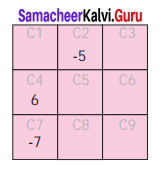
Here repetition of digits allowed.
Fixing 9 for a thousand places we have
Samacheer Kalvi 6th Maths Solutions Term 1 Chapter 6 Information Processing Intext Questions 138 Q1
Fixing 6 for thousand places we have
Samacheer Kalvi 6th Maths Solutions Term 1 Chapter 6 Information Processing Intext Questions 138 Q1.1

Samacheer Kalvi 6th Maths Solutions Term 1 Chapter 6 Information Processing Intext Questions

Fixing 5 for thousands place
Samacheer Kalvi 6th Maths Solutions Term 1 Chapter 6 Information Processing Intext Questions 138 Q1.2
Fixing 3 for thousands place, we get


Thus we have 4 × 4 × 4 × 4 = 256 numbers.
(ii) The underlined 24 numbers were listed as the numbers with non-repeated digits. Remaining numbers are not listed in the previous list.

Samacheer Kalvi 6th Maths Solutions Term 1 Chapter 6 Information Processing Intext Questions

Question 2.
Mother had a lot of wooden pieces in different shapes with her. She gave 6 triangles to Kannagi and 6 circles to Madhan and asked them to create different figures using them. They tried and got some interesting figures. Can you create figures like them that are nice and interesting?
Samacheer Kalvi 6th Maths Solutions Term 1 Chapter 6 Information Processing Intext Questions 138 Q2
Solution:

Samacheer Kalvi 6th Maths Solutions Term 1 Chapter 6 Information Processing Intext Questions 138 Q2.1

Try These (Textbook Page No. 139)

Question 1.
Form a group with two of your friends and try this. All three of you together have to draw a scene. First, one of your friends should draw one part, next the other friend has to continue it, and finally you have to complete it. No discussion or any other communication is allowed. Finally, each person tells what (s)he actually intended to draw the full picture.
Solution:
Activity to be done by the students themselves.