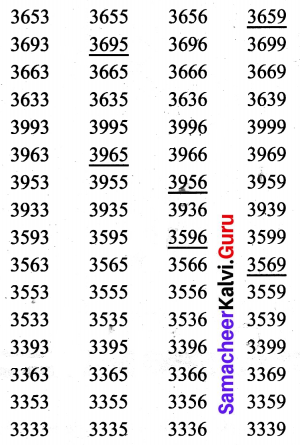
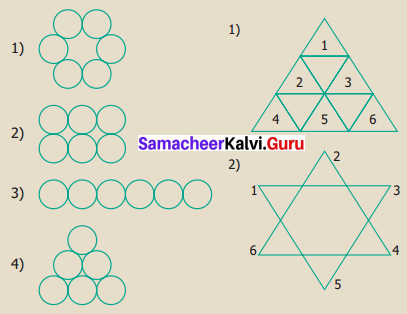
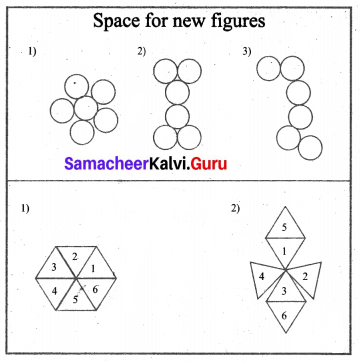
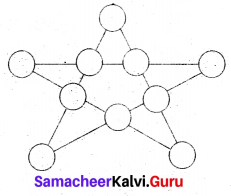
Samacheer Kalvi 7th Maths Solutions Term 1 Chapter 6 Information Processing Ex 6.2

Students can Download Maths Chapter 6 Information Processing Ex 6.2 Questions and Answers, Notes Pdf, Samacheer Kalvi 7th Maths Book Solutions Guide Pdf helps you to revise the complete Tamilnadu State Board New Syllabus and score more marks in your examinations.

Tamilnadu Samacheer Kalvi 7th Maths Solutions Term 1 Chapter 6 Information Processing Ex 6.2

Miscellaneous Practice Problems

Question 1.
Make a model of a fish using the given tetromino shapes
Samacheer Kalvi 7th Maths Term 1 Chapter 6 Information Processing Ex 6.2 1
Complete the given rectangle using the given tetromino shapes.
Solution:
Samacheer Kalvi 7th Maths Term 1 Chapter 6 Information Processing Ex 6.2 2

Question 2.
Complete the given rectangle using the given tetromino shapes.
Samacheer Kalvi 7th Maths Term 1 Chapter 6 Information Processing Ex 6.2 3
Solution:
Samacheer Kalvi 7th Maths Term 1 Chapter 6 Information Processing Ex 6.2 4

Question 3.
Shade the figure completely, by using five Tetromino shapes only once.
Samacheer Kalvi 7th Maths Term 1 Chapter 6 Information Processing Ex 6.2 7
Solution:
Samacheer Kalvi 7th Maths Term 1 Chapter 6 Information Processing Ex 6.2 8

Question 4.
Using the given tetrominoes with numbers on it complete the 4 × 4 magic square?
Samacheer Kalvi 7th Maths Term 1 Chapter 6 Information Processing Ex 6.2 9
Solution:
Samacheer Kalvi 7th Maths Term 1 Chapter 6 Information Processing Ex 6.2 10

Question 5.
Find the shortest route to Vivekanandar Memorial Hall from the Mandapam using the given map.
Samacheer Kalvi 7th Maths Term 1 Chapter 6 Information Processing Ex 6.2 11
Solution:
Possible routes from Mandapam to Vivekandar Memorial are

route 1:
(a) Mandapam ➝ Pullivasal Island ➝ Krusadai Island ➝ Vivekanandar Memorial Hall.
Distance = 6 Km + 2 Km + 1.5 Km = 9.5 Km

route 2:
(b) Mandapam ➝ Krusadai Island ➝ Vivekanandar Memorial Hall.
Distance = 7 Km + 1.5 Km = 8.5 Km
8.5 km < 9.5 km
∴ Shortest route : Mandapam ➝ Krusadai Island ➝ Vivekanandar Memorial Hall.

Challenge Problems

Question 6.
Fill in 4 × 10 rectangle completely, using all the five tetrominoes twice.
Solution:
Samacheer Kalvi 7th Maths Term 1 Chapter 6 Information Processing Ex 6.2 50

(more possible ways are there)

Question 7.
Fill in 8 × 5 rectangle completely, using all the five tetrominoes twice.
Solution:
Samacheer Kalvi 7th Maths Term 1 Chapter 6 Information Processing Ex 6.2 51
(more possible way are there)

Question 8.
Observe the picture and answer the following.
(i) Find all the possible routes from A to D.
(ii) Find the shortest distance between E and C.
(iii) Find all the possible routes between B and F with distance. Mention the shortest route.
Samacheer Kalvi 7th Maths Term 1 Chapter 6 Information Processing Ex 6.2 52
Solution:
(i) All possible routes from A to D are :
(a) A ➝ G ➝ F ➝ E ➝ D
(b) A ➝ G ➝ D
(c) A ➝ B ➝ C ➝ D
(d) A ➝ B ➝ D

(ii) Distance between E and C are
(a) Route 1: E ➝ D ➝ C
Distance: 120 m + 200 m = 320 m.
(b) Route 2: E ➝ D ➝ B ➝ C
Distance = 120 + 100 m + 120 m
= 340 m.
∴ Shortest distance is 320 m.

(iii) All possible routes between B and F are :
(a) Route 1: B ➝ A ➝ G ➝ F
Distance = 250 m + 100 m + 150 m = 600 m.

(b) Route 2: 2 ➝ D ➝ E ➝ F
Distance = 100 m + 120 m + 300 m
= 520 m.

(c) Route 3: B ➝ D ➝ G ➝ F
Distance = 100 m + 200 m + 150 m
= 450 m.

(d) Route 4: B ➝ C ➝ D ➝ E ➝ F
Distance = 120 m + 200 m + 120 m + 300 m
= 740 m.
We find that Route 3 is shortest.
ie B ➝ D ➝ G ➝ F is the shortest route.

Samacheer Kalvi 6th Maths Solutions Term 1 Chapter 5 Statistics Additional Questions

You can Download Samacheer Kalvi 6th Maths Book Solutions Guide Pdf, Tamilnadu State Board help you to revise the complete Syllabus and score more marks in your examinations.
Samacheer Kalvi 6th Maths Solutions Term 1 Chapter 5 Statistics Additional Questions

Tamilnadu Samacheer Kalvi 6th Maths Solutions Term 1 Chapter 5 Statistics Additional Questions

Question 1.
A _____ is a collection of numbers gathered to give some meaningful information.
Solution:
Data

Question 2.
The data can be arranged in a tabular form using ____ marks
Solution:
Tally

Question 3.
A observation occurring 8 times in a data is represented as _____ using tally marks.
Solution:
Samacheer Kalvi 6th Maths Term 1 Chapter 5 Statistics Additional Questions 1 Q3

Question 4.
Tally marks Samacheer Kalvi 6th Maths Term 1 Chapter 5 Statistics Additional Questions 1 Q4 represents _____
Solution:
6

Question 5.
Following are the choice of sports for 20 students of class VI.
Samacheer Kalvi 6th Maths Term 1 Chapter 5 Statistics Additional Questions 1 Q5
Arrange the names of sports in a table using tally marks.
Solution:
Samacheer Kalvi 6th Maths Term 1 Chapter 5 Statistics Additional Questions 1 Q5.1

Samacheer Kalvi 6th Maths Solutions Term 1 Chapter 5 Statistics Additional Questions

Question 6.
Mariana threw a die 40 times and noted the number appearing each time as shown below.
Samacheer Kalvi 6th Maths Term 1 Chapter 5 Statistics Additional Questions 1 Q6
Make a table and enter the data using tally marks.
Find the number that appeared
(a) the minimum number of times
(b) the maximum number of times
(c) Find those numbers that appear an equal number of times.
Solution:
Table using Tally Marks
Samacheer Kalvi 6th Maths Term 1 Chapter 5 Statistics Additional Questions 1 Q6.1
(a) The number ‘4’ appeared the minimum number of times
(b) The number ‘5’ appeared the maximum number of times
(c) Numbers ‘1’ and ‘6’ appeared the equal number of times.

Question 7.
What is the advantage of using pictograph?
Solution:
The data can be analyzed and interpreted. The pictures and symbols help us to understand better.

Question 8.
Total number of students of a school in different years is shown in the following table
Samacheer Kalvi 6th Maths Term 1 Chapter 5 Statistics Additional Questions 2 Q1
(A) Prepare a pictograph of students using one symbol to represent 100 students and answer the following questions
(a) How many symbols represent the total number of students in the year 2000?
(b) How many symbols represent the total number of students in the year 1997?
Solution:
(A) The pictograph is given by
Samacheer Kalvi 6th Maths Term 1 Chapter 5 Statistics Additional Questions 2 Q1.1
(a) 9 Full pictures and a half picture represent the number of students in the year 2000
(b) 5 symbols.

Samacheer Kalvi 6th Maths Solutions Term 1 Chapter 5 Statistics Additional Questions

Question 9.
The number of bottles of honey sold by three different shops are given below.
Samacheer Kalvi 6th Maths Term 1 Chapter 5 Statistics Additional Questions 2 Q2
(A) Draw a pictograph and answer the following questions (use the scale – 20 bottles)
(a) What is the total profit of shop A, if the profit gained on each bottle is ‘E’150?
(b) If the total number of bottles sold is 400 how many figures must be drawn to shops?
(c) Find the difference between the number of bottles sold by shop B and the number of bottles sold by shop ‘C’.
Solution:
(A) Pictograph of number of bottles sold
Samacheer Kalvi 6th Maths Term 1 Chapter 5 Statistics Additional Questions 2 Q2.1
(a) Profit per bottle = ₹ 150
Shop A’s total profit = 80 × 150 = ₹ 12,000
(b) For 400 bottles, the figures to be drawn is \(\frac{400}{20}\) = 20 bottles for shop ‘C ’
(c) Difference = No. of bottles sold by shop ‘C’ – No. of bottles sold by shop ‘B’ = 180 – 140 = 40 bottles

Question 10.
The following data is the total savings of a group of 5 friends in a year.
Samacheer Kalvi 6th Maths Term 1 Chapter 5 Statistics Additional Questions 3 Q1
Draw a pictograph to represent the data.
Solution:
Samacheer Kalvi 6th Maths Term 1 Chapter 5 Statistics Additional Questions 3 Q1.1

Question 11.
The number of mathematics books sold by a shopkeeper on six consecutive days is shown below.
Samacheer Kalvi 6th Maths Term 1 Chapter 5 Statistics Additional Questions 3 Q2
Draw a bar graph to represent the above information choosing the scale of your choice.
Solution:
Samacheer Kalvi 6th Maths Term 1 Chapter 5 Statistics Additional Questions 3 Q2.1

Samacheer Kalvi 6th Maths Solutions Term 1 Chapter 5 Statistics Additional Questions

Question 12.
The following bar graph shows the number of people visited Mahabalipuram over a period of 5 months.
Samacheer Kalvi 6th Maths Term 1 Chapter 5 Statistics Additional Questions 3 Q3
Use the graph to answer the following questions
(a) How many people visited Mahabalipuram in April?
(b) How many more people visited Mahabalipuram in May than in January?
(c) In which month, were there as many visitors as in March?
(d) In which month was there 1500 more visitors than in January?
(e) How many visitors were there in 5 months?
Solution:
(a) 3500 people visited Mahabalipuram in April
(b) 500 more people
(c) January
(d) April
(e) 11,500 people

Samacheer Kalvi 6th Maths Solutions Term 1 Chapter 5 Statistics Additional Questions

Samacheer Kalvi 8th Maths Solutions Term 1 Chapter 4 Geometry Additional Questions

Students can Download Maths Chapter 4 Geometry Additional Questions and Answers, Notes Pdf, Samacheer Kalvi 8th Maths Book Solutions Guide Pdf helps you to revise the complete Tamilnadu State Board New Syllabus and score more marks in your examinations.
Samacheer Kalvi 8th Maths Solutions Term 1 Chapter 4 Geometry Additional Questions

Tamilnadu Samacheer Kalvi 8th Maths Solutions Term 1 Chapter 4 Geometry Additional Questions

Additional Questions And Answers

Very Short Answers [2 Marks]

Question 1.
In the given figure if ∠A = ∠C then prove that ∆AOB ~ ∆COD.
Samacheer Kalvi 8th Maths Term 1 Chapter 4 Geometry Additional Questions 1
Solution:
In triangles ∆AOB and ∆COD
∠A = ∠C (Y given)
∠AOB = ∠COD [∵ Vertically opposite angles]
∠ABO = ∠CDO [Remaining angles of ∆AOB and ∆COD]
∴ ∆AOB ~ ∆COD [∵ AAA similarity]
∵ ∆AOB ~ ∆COD [∵ AAA similarity]

Question 2.
In the figure AB ⊥ BC and DE ⊥ AC prove that ∆ABC ~ ∆AED.
Samacheer Kalvi 8th Maths Term 1 Chapter 4 Geometry Additional Questions 40
Solution:
In triangles ∆ABC and ∆AED
∠ABC = ∠AED = 90°
∠BAC = ∠EAD [Each equal to A]
∠ADE = ∠ACB [∵ Remaining angles]
∴ By AAA criteria of similarity ∆ABC ~ ∆AED

Samacheer Kalvi 8th Maths Solutions Term 1 Chapter 4 Geometry Additional Questions

Short Answers [3 Marks]

Question 1.
In the figure with respect to ABEP and CPD prove that BP × PD = EP × PC.
Samacheer Kalvi 8th Maths Term 1 Chapter 4 Geometry Additional Questions 51
Solution:
Proof:
In ∆EPB and ∆DPC
∠PEB = ∠PDC = 90° [given]
∠EPB = ∠DPC [Vertically opposite angles]
∠EPB = ∠PCD [∵ Remaining angles]
Thus,
Samacheer Kalvi 8th Maths Term 1 Chapter 4 Geometry Additional Questions 50

Long Answers [5 Marks]

Question 1.
P and Q are points on sides AB and AC respectively of ∆ABC. If AP = 3 cm PB = 6cm, AQ = 5 cm and QC = 10 cm, show that BC = 3 PQ.
Solution:
Samacheer Kalvi 8th Maths Term 1 Chapter 4 Geometry Additional Questions 52
AB = AP + PB
= 3 + 6 cm = 9 cm
AC = AQ + QC = 510 cm = 15
Samacheer Kalvi 8th Maths Term 1 Chapter 4 Geometry Additional Questions 53
Samacheer Kalvi 8th Maths Term 1 Chapter 4 Geometry Additional Questions 54

Samacheer Kalvi 8th Maths Solutions Term 1 Chapter 4 Geometry Ex 4.3

Students can Download Maths Chapter 4 Geometry Ex 4.3 Questions and Answers, Notes Pdf, Samacheer Kalvi 8th Maths Book Solutions Guide Pdf helps you to revise the complete Tamilnadu State Board New Syllabus and score more marks in your examinations.
Samacheer Kalvi 8th Maths Solutions Term 1 Chapter 4 Geometry Ex 4.3

Tamilnadu Samacheer Kalvi 8th Maths Solutions Term 1 Chapter 4 Geometry Additional Questions

Construct the quadrilaterals with the following measurements and also find their area.

Question 1.
ABCD, AB = 5 cm, BC 4.5 cm, CD = 3.8 cm, DA = 4.4 cm and AC = 6.2 cm.
Solution:
Given AB = 5 cm,
BC = 4.5 cm,
CD = 3.8 cm,
DA = 4.4 cm,
AC = 6.2 cm
Samacheer Kalvi 8th Maths Term 1 Chapter 4 Geometry Ex 4.3 1
Steps:
1. Draw a line segment AB = 5 cm
2. With A and B as centers drawn arcs of radii 6.2 cm and 4.5cm respectively and let them cut at C.
3. Joined AC and BC.
4. With A and C as centrers drawn arcs of radii 4.4cm and 3.8 cm respectively and let them at D.
5. Joined AD and CD.
6. ABCD is the required quadrilateral.
Calculation of Area:
Samacheer Kalvi 8th Maths Term 1 Chapter 4 Geometry Ex 4.3 2

Question 2.
KITE, KI = 5.4 cm, IT = 4.6 cm, TE= 4.5 cm, KE = 4.8 cm and IE = 6 cm.
Solution:
Given, KI = 5.4 cm,
IT = 4.6 cm,
TE= 4.5 cm,
KE = 4.8 cm,
IE = 6 cm.
Samacheer Kalvi 8th Maths Term 1 Chapter 4 Geometry Ex 4.3 80
Steps:
1. Draw a line segment KI = 5.4 cm
2. With K and I as centers drawn arcs of radii 4.8 cm and 6 cm respectively and let them cut at E.
3. Joined KE and IE.
4. With E and I as centers, drawn arcs of radius 4.5cm and 4.6 cm respectively and let them cut at T.
5. Joined ET and IT.
6. KITE is the required quadrilateral.
Calculation of Area:
Samacheer Kalvi 8th Maths Term 1 Chapter 4 Geometry Ex 4.3 81

Samacheer Kalvi 8th Maths Solutions Term 1 Chapter 4 Geometry Ex 4.3

Question 3.
PLAY, PL = 7 cm, LA = 6 cm, AY= 6 cm, PA = 8 cm and LY = 7 cm.
Solution:
Given PL = 7 cm,
LA = 6 cm,
AY= 6 cm,
PA = 8 cm,
LY = 7 cm
Samacheer Kalvi 8th Maths Term 1 Chapter 4 Geometry Ex 4.3 3
Steps:
1. Draw a line segment PL = 7 cm
2. With P and L as centers, drawn arcs of radii 8 cm and 6 cm respectively, let them cut at A.
3. Joined PA and LA.
4. With L and A as centers, drawn arcs of radii 7 cm and 6 cm respectively and let them cut at Y.
5. Joined LY, PY and AY.
6. PLAY is the required quadrilateral.
Calculation of Area:
Samacheer Kalvi 8th Maths Term 1 Chapter 4 Geometry Ex 4.3 5

Question 4.
LIKE, LI = 4.2 cm, IK = 7 cm, KE = 5 cm, LK = 6 cm and IE = 8 cm.
Solution:
LI = 4.2 cm,
IK = 7 cm,
KE = 5 cm,
LK = 6 cm,
IE = 8 cm
Samacheer Kalvi 8th Maths Term 1 Chapter 4 Geometry Ex 4.3 6
Steps:
1. Draw a line segment LI = 4.2 cm
2. With L and I as centers, drawn arcs of radii 6 cm and 7 cm respectively and let them cut at K.
3. Joined LK and IK.
4. With I and K as centers, drawn arcs of radius 8 cm and 5 cm respectively and let them cut at E.
5. Joined LE, IE and KE.
6. LIKE is the required quadrilateral.
Calculation of Area:
Samacheer Kalvi 8th Maths Term 1 Chapter 4 Geometry Ex 4.3 10

Samacheer Kalvi 8th Maths Solutions Term 1 Chapter 4 Geometry Ex 4.3

Question 5.
PQRS, PQ = QR = 3.5 cm, RS = 5.2 cm, SP = 5.3 cm and ∠Q =120° .
Solution:
PQ = QR = 3.5 cm,
RS = 5.2 cm,
SP = 5.3 cm ,
∠Q =120°
Samacheer Kalvi 8th Maths Term 1 Chapter 4 Geometry Ex 4.3 11
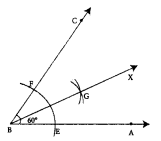
Steps:
1. Draw a line segment PQ = 3.5 cm
2. Made ∠Q = 120°. Drawn the ray QX.
3. With Q as centre drawn an arc of radius 3.5 cm. Let it cut the ray QX at R.
4. With R and P as centres drawn arcs of radii 5.2cm and 5.5 cm respectively and let them cut at S.
5. Joined PS and RS.
6. PQRS is the required quadrilateral.
Calculation of Area:
Samacheer Kalvi 8th Maths Term 1 Chapter 4 Geometry Ex 4.3 16Area of the quadrilateral PQRS = 18 cm2

Question 6.
EASY, EA = 6 cm, AS = 4 cm, SY = 5 cm, EY = 4.5 cm and ∠E = 90°.
Solution:
EA = 6 cm,
AS = 4 cm,
SY = 5 cm,
EY = 4.5 cm,
∠E = 90°
Samacheer Kalvi 8th Maths Term 1 Chapter 4 Geometry Ex 4.3 17
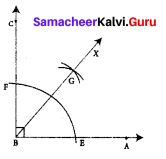
1. Drawn a line segment EA = 6 cm
2. Made ∠E = 90°. From E drawn the ray EX.
3. With E as center drawn an arc of 4.5 cm radius. Let of cut the ray EX at Y.
4. With A and Y as centres drawn arcs of radii 4 cm and 5 cm respectively and let them cut at S.
5. Joined AS and YS.
6. EASY is the required quadrilateral.
Calculation of Area:
Samacheer Kalvi 8th Maths Term 1 Chapter 4 Geometry Ex 4.3 20
∴ Area of the quadrilateral = 22.87 cm2

Samacheer Kalvi 8th Maths Solutions Term 1 Chapter 4 Geometry Ex 4.3

Question 7.
MIND, MI = 3.6 cm, ND = 4 cm, MD = 4 cm, ∠M = 50° and ∠D = 100°.
Solution:
MI = 3.6 cm,
ND = 4 cm,
MD= 4 cm,
∠M = 50°,
∠D = 100°
Samacheer Kalvi 8th Maths Term 1 Chapter 4 Geometry Ex 4.3 21
1. Draw a line segment MI = 3.6 cm
2. At M on MI made an angle ∠IMX = 50°
3. Drawn an arc with center M and radius 4 cm let it cut MX it D
4. At D on DM made an angle ∠MDY = 100°
5. With I as center drawn an arc of radius 4 cm, let it cut DY at N.
6. Joined DN and IN.
7. MIND is the required quadrilateral.
Calculation of Area:
Samacheer Kalvi 8th Maths Term 1 Chapter 4 Geometry Ex 4.3 22
Area of the quadrilateral = 9.6 cm2

Question 8.
WORK, WO = 9 cm, OR = 6 cm, RK = 5 cm, ∠O = 100° and ∠R = 60°.
Solution:
WO = 9 cm,
OR = 6 cm,
RK = 5 cm,
∠O = 100°,
∠R = 60°
Samacheer Kalvi 8th Maths Term 1 Chapter 4 Geometry Ex 4.3 23
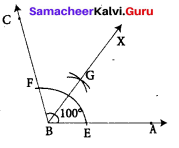
Steps:
1. Drawn a line segment WO = 9 cm
2. At O on WO made an angle ∠WOR = 100° and drawn the ray OX.
3. Drawn an arc of radius 6 cm with center O. Let it intersect OX at R.
4. At R on OR, made ∠ORY = 60°, and drawn the ray RY.
5. With center R drawn an arc of radius 5 cm, let it intersect RY at K.
6. Joined WK.
7. WORK is the required quadrilateral.
Calculation of Area:
Samacheer Kalvi 8th Maths Term 1 Chapter 4 Geometry Ex 4.3 25
Area of the quadrilateral = 31.59 cm2

Question 9.
AGRI, AG = 4.5 cm, GR = 3.8 cm, ∠A = 90°, ∠G = 110° and ∠R = 90°.
Solution:
AG = 4.5 cm,
GR = 3.8 cm,
∠A = 90°,
∠G = 110°,
∠R = 90°
Samacheer Kalvi 8th Maths Term 1 Chapter 4 Geometry Ex 4.3 26
1. Draw a line segment AG = 4.5 cm
2. At G on AG made ∠AGX =110°
3. With G as centre drawn an arc of radius 3.8 cm let it cut GX at R.
4. At R on GR made ∠GRZ = 90°
5. At A on AG made ∠GAY = 90°
6. AY and RZ meet at I.
7. AGRI is the required quadrilateral.
Calculation of Area:
Samacheer Kalvi 8th Maths Term 1 Chapter 4 Geometry Ex 4.3 27

Samacheer Kalvi 8th Maths Solutions Term 1 Chapter 4 Geometry Ex 4.3

Question 10.
YOGA, YO = 6 cm, OG = 6 cm, ∠O = 55°, ∠G = 55° and ∠A = 55°.
Solution:
YO = 6 cm,
OG = 6 cm,
∠O = 55°,
∠G = 55°,
∠A = 55°
Samacheer Kalvi 8th Maths Term 1 Chapter 4 Geometry Ex 4.3 28
Steps:
1. Draw a line segment OG = 6 cm
2. At G on DG made an angle ∠OGY = 55°
3. AT G on GO made ∠GOX = 55°.
4. GY and OX meet cut A.
5. At A on OA made ∠OAZ = 55°
6. Drawn an arc of radius 6 cm with center O. It cut AZ at Y. Joined OY.
7. YOGA is the required quadrilateral.
Calculation of Area:
Samacheer Kalvi 8th Maths Term 1 Chapter 4 Geometry Ex 4.3 30
Area of the quadrilateral YOGA = 28.08 cm2

Samacheer Kalvi 6th Maths Solutions Term 1 Chapter 3 Ratio and Proportion Intext Questions

You can Download Samacheer Kalvi 6th Maths Book Solutions Guide Pdf, Tamilnadu State Board help you to revise the complete Syllabus and score more marks in your examinations.

Tamilnadu Samacheer Kalvi 6th Maths Solutions Term 1 Chapter 3 Ratio and Proportion Intext Questions

Recap (Textbook Page No. 55)
Samacheer Kalvi 6th Maths Solutions Term 1 Chapter 3 Ratio and Proportion Intext Questions
Question 1.
Which of the following fractions is not a proper fraction?
(a) \(\frac{1}{3}\)
(b) \(\frac{2}{3}\)
(c) \(\frac{5}{10}\)
(d) \(\frac{10}{5}\)
Solution:
(d) \(\frac{10}{5}\)

Question 2.
The equivalent fraction of \(\frac{1}{7}\) is ____
(a) \(\frac{2}{15}\)
(b) \(\frac{1}{49}\)
(c) \(\frac{7}{49}\)
(d) \(\frac{100}{7}\)
Solution:
(c) \(\frac{7}{49}\)

Question 3.
Write >, < or = in the box.
(i) \(\frac{5}{8}\) ____ \(\frac{1}{10}\)
(ii) \(\frac{9}{12}\) _____ \(\frac{3}{4}\)
Solution:
Samacheer Kalvi 6th Maths Term 1 Chapter 3 Ratio and Proportion Intext Questions 55 Q3
Samacheer Kalvi 6th Maths Term 1 Chapter 3 Ratio and Proportion Intext Questions 55 Q3.1

Question 4.
Arrange these fractions from the least to the greatest: \(\frac{1}{2}, \frac{1}{4}, \frac{6}{8}, \frac{1}{8}\)
Solution:
\(\begin{array}{l}{\frac{1}{2}=\frac{1 \times 4}{2 \times 4}=\frac{4}{8}} \\ {\frac{1}{4}=\frac{1 \times 2}{4 \times 2}=\frac{2}{8}}\end{array}\)
Comparing \(\frac{4}{8}, \frac{2}{8}, \frac{6}{8} \text { and } \frac{1}{8}\). we have \(\frac{1}{8}<\frac{2}{8}<\frac{4}{8}<\frac{6}{8}\)
i.e, \(\frac{1}{8}<\frac{1}{4}<\frac{1}{2}<\frac{6}{8}\)

Samacheer Kalvi 6th Maths Solutions Term 1 Chapter 3 Ratio and Proportion Intext Questions

Question 5.
Annan says the \(\frac{2}{6}\) th of the group of triangles given below are blue. Is he correct?
Samacheer Kalvi 6th Maths Term 1 Chapter 3 Ratio and Proportion Intext Questions 55 Q5
Solution:
No, he is not correct because of the total of 6 triangles 4 are blue, i.e \(\frac{4}{6}^{\text {th }}\) triangles are blue.

Question 6.
Joseph has a flower garden. Draw a picture which shows that \(\frac{2}{10}\) th of the flowers are red and the rest of them are yellow.
Solution:
Samacheer Kalvi 6th Maths Term 1 Chapter 3 Ratio and Proportion Intext Questions 55 Q6

Question 7.
Malarkodi has 10 oranges. If she ate 4 oranges, what fraction of oranges she was not eaten by her?
Solution:
\(\frac{\text { Oranges not eaten }}{\text { Total oranges }}=\frac{10-4}{10}=\frac{6}{10}\)

Question 8.
After sowing seeds on day one, Muthu observes the growth of two plants and records it. In 10 days, if the first plant grew \(\frac{1}{4}\) th of an inch and the second plant grew \(\frac{3}{8}\) th of an inch, then which plant grew more?
Solution:
Comparing \(\frac{1}{4}\) th of an inch and \(\frac{3}{8}\) th of an inch.
\(\frac{1}{4}=\frac{2}{8}<\frac{3}{8}\)
Second plant grew more.

Samacheer Kalvi 6th Maths Solutions Term 1 Chapter 3 Ratio and Proportion Intext Questions

Try These (Textbook Page No. 57 to 60)

Question 1.
Write the ratio of red tiles to blue tiles and yellow tiles to red tiles.
Samacheer Kalvi 6th Maths Term 1 Chapter 3 Ratio and Proportion Intext Questions 57 Q1
Solution:
(i) Red tiles to blue tiles = 2 : 3
(ii) Yellow tiles to red tiles = 2 : 2

Question 2.
Write the ratio of blue tiles to that of red tiles and red tiles to that of total tiles.
Samacheer Kalvi 6th Maths Term 1 Chapter 3 Ratio and Proportion Intext Questions 57 Q2
Solution:
The ratio of blue tiles to red tiles = 3 : 5
The ratio of red tiles to total tiles = 5 : 8

Question 3.
Write the ratio of shaded portion to the unshaded portions in the following shapes.
Samacheer Kalvi 6th Maths Term 1 Chapter 3 Ratio and Proportion Intext Questions 57 Q3
Solution:
(i) Ratio = 1 : 2
(ii) Ratio = 5 : 4

Question 4.
If the given quantity is in the same unit, put ‘✓’ otherwise put ‘ ✗’ in the table below.
Samacheer Kalvi 6th Maths Term 1 Chapter 3 Ratio and Proportion Intext Questions 57 Q4
Solution:
Samacheer Kalvi 6th Maths Term 1 Chapter 3 Ratio and Proportion Intext Questions 57 Q4.1

Samacheer Kalvi 6th Maths Solutions Term 1 Chapter 3 Ratio and Proportion Intext Questions

Question 5.
Write the ratios in the simplest form and fill in the table.
Samacheer Kalvi 6th Maths Term 1 Chapter 3 Ratio and Proportion Intext Questions 57 Q5
Solution:
Samacheer Kalvi 6th Maths Term 1 Chapter 3 Ratio and Proportion Intext Questions 57 Q5.1

Try These (Textbook Page No. 64)

Question 1.
For the given ratios, find two equivalent ratios and complete the table.
Samacheer Kalvi 6th Maths Term 1 Chapter 3 Ratio and Proportion Intext Questions 64 Q1
Solution:
Samacheer Kalvi 6th Maths Term 1 Chapter 3 Ratio and Proportion Intext Questions 64 Q1.1

Question 2.
Write three equivalent ratios and fill in the boxes.
Samacheer Kalvi 6th Maths Term 1 Chapter 3 Ratio and Proportion Intext Questions 64 Q2
Solution:
Samacheer Kalvi 6th Maths Term 1 Chapter 3 Ratio and Proportion Intext Questions 64 Q2.1

Question 3.
Find the given ratios, find their simplest form and complete the table.
Samacheer Kalvi 6th Maths Term 1 Chapter 3 Ratio and Proportion Intext Questions 64 Q3
Solution:
Samacheer Kalvi 6th Maths Term 1 Chapter 3 Ratio and Proportion Intext Questions 64 Q3.1

Samacheer Kalvi 6th Maths Solutions Term 1 Chapter 3 Ratio and Proportion Intext Questions

Try These (Textbook Page No. 70)

Question 1.
Fill the box by using cross product rule of two ratios Samacheer Kalvi 6th Maths Term 1 Chapter 3 Ratio and Proportion Intext Questions 70 Q1
Solution:
Samacheer Kalvi 6th Maths Term 1 Chapter 3 Ratio and Proportion Intext Questions 70 Q1
By cross product rule we have 1 × □ = 5 × 8
1 × 40 = 40
∴ \(\frac{1}{8}=\frac{5}{40}\)

Question 2.
Use the digits 1 to 9 only once and write as many ratios that are in proportion as possible (For example \(\frac{2}{4}=\frac{3}{6}\))
Solution:
Samacheer Kalvi 6th Maths Term 1 Chapter 3 Ratio and Proportion Intext Questions 70 Q2

Samacheer Kalvi 8th Maths Solutions Term 1 Chapter 4 Geometry Ex 4.2

Students can Download Maths Chapter 4 Geometry Ex 4.2 Questions and Answers, Notes Pdf, Samacheer Kalvi 8th Maths Book Solutions Guide Pdf helps you to revise the complete Tamilnadu State Board New Syllabus and score more marks in your examinations.
Samacheer Kalvi 8th Maths Solutions Term 1 Chapter 4 Geometry Ex 4.2

Tamilnadu Samacheer Kalvi 8th Maths Solutions Term 1 Chapter 4 Geometry Ex 4.2

Miscellaneous Practice Problems

Question 1.
In the given figure, find PT given that l1 || l2
Samacheer Kalvi 8th Maths Term 1 Chapter 4 Geometry Ex 4.2 1
Solution:
Given that l1 || l2
∴ In ∆PQS and ∆PRT
∠P is common
∠Q = ∠R [∵ PR is the transversal for l1 and l2 corresponding angles]
∠S = ∠T [∵ corresponding angles]
∴ ∆PQS ~ ∆PRT [∵ By AAA congruency]
In similar triangles, corresponding angles are proportional.
Samacheer Kalvi 8th Maths Term 1 Chapter 4 Geometry Ex 4.2 50

Question 2.
From the diagram, prove that ∆SUN ~ ∆RAY
Samacheer Kalvi 8th Maths Term 1 Chapter 4 Geometry Ex 4.2 2
Proof:
From the ∆SUN and ∆RAY
SU = 10;
UN = 12;
SN = 14;
RA = 5,
AY = 6;
RY = 7
We have
Samacheer Kalvi 8th Maths Term 1 Chapter 4 Geometry Ex 4.2 51
Samacheer Kalvi 8th Maths Term 1 Chapter 4 Geometry Ex 4.2 61

Question 3.
The height of a tower is measured by a mirror on the ground by which the top of the tower’s reflection is seen. Find the height of the tower.
Solution:
The image and its reflection make similar shapes
Samacheer Kalvi 8th Maths Term 1 Chapter 4 Geometry Ex 4.2 52

Samacheer Kalvi 8th Maths Solutions Term 1 Chapter 4 Geometry Ex 4.2

Question 4.
In the figure, given that ∠1 = ∠2 and ∠3 ≡ ∠4 Prove that ∆MUG ≡ ∆ TUB.
Samacheer Kalvi 8th Maths Term 1 Chapter 4 Geometry Ex 4.2 53
Proof:
Samacheer Kalvi 8th Maths Term 1 Chapter 4 Geometry Ex 4.2 54

Question 5.
If ∆WAR ≡ ∆MOB, name the additional pair of corresponding parts. Name the criterion used by you.
Solution:
Samacheer Kalvi 8th Maths Term 1 Chapter 4 Geometry Ex 4.2 55
Given ∆WAR ≡ ∆MOB
∠RWA ≡ ∠BMO [∵ sum of three angles of a triangle are 180°]
∴ Criteria used here is angle sum property of triangles.

Question 6.
In the figure, ∠TMA ≡ ∠IAM and ∠TAM ≡ ∠IMA. P is the midpoint of MI and N is the midpoint of AI. Prove that ∆ PIN ~ ∆ ATM.
Samacheer Kalvi 8th Maths Term 1 Chapter 4 Geometry Ex 4.2 65
Solution:
Samacheer Kalvi 8th Maths Term 1 Chapter 4 Geometry Ex 4.2 56
Samacheer Kalvi 8th Maths Term 1 Chapter 4 Geometry Ex 4.2 57

Samacheer Kalvi 8th Maths Solutions Term 1 Chapter 4 Geometry Ex 4.2

Question 7.
In the figure, if ∠FEG = ∠1 then, prove that DG2 = DE.DF.
Samacheer Kalvi 8th Maths Term 1 Chapter 4 Geometry Ex 4.2 58
Proof:
Samacheer Kalvi 8th Maths Term 1 Chapter 4 Geometry Ex 4.2 59
Samacheer Kalvi 8th Maths Term 1 Chapter 4 Geometry Ex 4.2 60
Samacheer Kalvi 8th Maths Term 1 Chapter 4 Geometry Ex 4.2 100

Question 8.
In the figure, ∠TEN ≡ ∠TON = 90° and TO = TE. Prove that ∠ORN ≡ ∠ERN
Samacheer Kalvi 8th Maths Term 1 Chapter 4 Geometry Ex 4.2 71
Solution:
Samacheer Kalvi 8th Maths Term 1 Chapter 4 Geometry Ex 4.2 62
Samacheer Kalvi 8th Maths Term 1 Chapter 4 Geometry Ex 4.2 63

Question 9.
In the figure, PQ ≡ TS, Q is the midpoint of PR, S is the midpoint TR and ∠POU ≡ ∠TSU. Prove that QU ≡ SU.
Samacheer Kalvi 8th Maths Term 1 Chapter 4 Geometry Ex 4.2 64
Proof:
Samacheer Kalvi 8th Maths Term 1 Chapter 4 Geometry Ex 4.2 656

Samacheer Kalvi 8th Maths Solutions Term 1 Chapter 4 Geometry Ex 4.2

Question 10.
In the figure ∆TOP ≡ ∆ARM . Explain why?
Solution:
In ∆TOP and ∆ARM
OP = RM given
∠TOP = ∠ARM = 90°
given ∠OTP = ∠RAM
given ∠OPT = ∠RMA Remaining angle, by angle sum property.
∴ By ASA criteria we can say that ∆TOP ≡ ∆ARM

Samacheer Kalvi 6th Maths Solutions Term 1 Chapter 4 Geometry Intext Questions

You can Download Samacheer Kalvi 6th Maths Book Solutions Guide Pdf, Tamilnadu State Board help you to revise the complete Syllabus and score more marks in your examinations.
Samacheer Kalvi 6th Maths Solutions Term 1 Chapter 4 Geometry Intext Questions

Tamilnadu Samacheer Kalvi 6th Maths Solutions Term 1 Chapter 4 Geometry Intext Questions

Try These (Textbook Page No. 80, 81)

Question 1.
Name all the line segments.
Samacheer Kalvi 6th Maths Term 1 Chapter 4 Geometry Intext Questions 80 Q1
Solution:
\(\overline{\mathrm{AB}}, \overline{\mathrm{AE}}, \overline{\mathrm{EB}}, \overline{\mathrm{CD}}, \overline{\mathrm{CE}} \text { and } \overline{\mathrm{ED}}\)

Question 2.
If AB = 5 cm, say which of the following measures are correct in fig 4.9.
Samacheer Kalvi 6th Maths Term 1 Chapter 4 Geometry Intext Questions 80 Q2
Solution:
Fig 4.9(i) and fig 4.9(ii) measures are correct.

Samacheer Kalvi 6th Maths Solutions Term 1 Chapter 4 Geometry Intext Questions

Try These (Textbook Page No. 85)

Question 1.
Samacheer Kalvi 6th Maths Term 1 Chapter 4 Geometry Intext Questions 85 Q1
1. Name the rays in the given figure.
2. What is the common point of all these rays?
Solution:
1. \(\overrightarrow{\mathrm{TA}}, \overrightarrow{\mathrm{TB}}, \overrightarrow{\mathrm{TC}} \text { and } \overrightarrow{\mathrm{TD}}\) are the rays given
2. Point T is the common point of all these rays.

Try These (Textbook Page No. 90, 95)

Question 1.
Which direction will you face if you start facing West and take three right turns clockwise?
Solution:
Will be facing South.

Question 2.
Which direction will you face if you start facing North and take two right turns anticlockwise?
Solution:
Will be facing South.

Question 3.
Adjust the hands of the clock for following time, note the angle made between the hour hand and the minute hand and write the type of angle.
Samacheer Kalvi 6th Maths Term 1 Chapter 4 Geometry Intext Questions 95 Q3
Samacheer Kalvi 6th Maths Term 1 Chapter 4 Geometry Intext Questions 95 Q3.1
Solution:
Samacheer Kalvi 6th Maths Term 1 Chapter 4 Geometry Intext Questions 95 Q3.2

Samacheer Kalvi 6th Maths Solutions Term 1 Chapter 4 Geometry Intext Questions

Samacheer Kalvi 8th Maths Solutions Term 1 Chapter 2 Measurements Intext Questions

Students can Download Maths Chapter 2 Measurements Intext Questions and Answers, Notes Pdf, Samacheer Kalvi 8th Maths Book Solutions Guide Pdf helps you to revise the complete Tamilnadu State Board New Syllabus and score more marks in your examinations.
Samacheer Kalvi 8th Maths Solutions Term 1 Chapter 2 Measurements Intext Questions

Tamilnadu Samacheer Kalvi 8th Maths Solutions Term 1 Chapter 2 Measurements Intext Questions

Try this Page No. 35

Question 1.
\(\frac{22}{7}\) and 3.14 are rational numbers. Is ‘π’ a rational number? Why?
Solution:
\(\frac{22}{7}\) and 3.14 are rational numbers n has non-terminating and non -repeating decimal expansion. So it is not a rational number. It is an irrational number.

Samacheer Kalvi 8th Maths Solutions Term 1 Chapter 2 Measurements Intext Questions

Try this Page No. 38

Question 1.
The given circular figure is divided into six equal parts. Can we call the parts as sectors? Why?
Samacheer Kalvi 8th Maths Term 1 Chapter 2 Measurements Intext Questions 1
Solution:
No, the equal parts are not sectors. Because a sector is a plane surface that is enclosed between two radii and the circular arc of the circle.
Here the boundaries are not radii.

Samacheer Kalvi 8th Maths Solutions Term 1 Chapter 2 Measurements Intext Questions

Try these Page No. 38

Question 1.
Fill the central angle of the shaded sector (each circle is divided into equal sectors)
Samacheer Kalvi 8th Maths Term 1 Chapter 2 Measurements Intext Questions 50

Try this Page No. 44

Question 1.
If the radius of a circle is doubled, what will the area of the new circle so formed?
Solution:
If r = 2r1 ⇒ Area of the circle = πr2 = π(2r1)2 = π4r12 = 4πr12
Area = 4 × old area.

Samacheer Kalvi 8th Maths Solutions Term 1 Chapter 2 Measurements Intext Questions

Try this Page No. 49

Question 1.
All the sides of a rhombus are equal. Is it a regular polygon?
Solution:
For a regular polygon all sides and all the angles must be equal. But in a rhombus all the
sides are equal. But all the angles are not equal
∴ It is not a regular polygon.

Samacheer Kalvi 8th Maths Solutions Term 1 Chapter 2 Measurements Intext Questions

Try this Page No. 53

Question 1.
In the above example split the given mat as into two trapeziums and verify your answer.
Solution:
Area of the mat = Area of I trapezium + Area of II trapezium
Samacheer Kalvi 8th Maths Term 1 Chapter 2 Measurements Intext Questions 55
∴ Cost per sq.feet = ₹ 20
Cost for 28 sq. feet = ₹ 20 × 28 = ₹ 560
∴ Total cost for the entire mat = ₹ 560
Both the answers are the same.

Samacheer Kalvi 8th Maths Solutions Term 1 Chapter 2 Measurements Intext Questions

Try these Page No. 54

Question 1.
Show that the area of the unshaded regions in each of the squares of side ‘a’ units are the same in all the cases given below.
Samacheer Kalvi 8th Maths Term 1 Chapter 2 Measurements Intext Questions 51
Solution:
Samacheer Kalvi 8th Maths Term 1 Chapter 2 Measurements Intext Questions 52
Samacheer Kalvi 8th Maths Term 1 Chapter 2 Measurements Intext Questions 53

Samacheer Kalvi 8th Maths Solutions Term 1 Chapter 2 Measurements Intext Questions

Question 2.
If π = \(\frac{22}{7}\), show that the area of the unshaded part of a square of side ‘a’ units is approximately \(\frac{3}{7}\) a2 sq. units and that of the shaded part is approximately \(\frac{4}{7}\) a2 sq. units for the given figure.
Samacheer Kalvi 8th Maths Term 1 Chapter 2 Measurements Intext Questions 85
Solution:
Samacheer Kalvi 8th Maths Term 1 Chapter 2 Measurements Intext Questions 54
Samacheer Kalvi 8th Maths Term 1 Chapter 2 Measurements Intext Questions 59
Samacheer Kalvi 8th Maths Term 1 Chapter 2 Measurements Intext Questions 89

Try this Page No. 57

Question 1.
List out atleast three objects in each category which are in the shape of cube, cuboid,
cylinder, cone and sphere.
Solution:
(i) Cube – dice, building blocks, jewel box.
(ii) Cuboid – books, bricks, containers.
(iii) Cylinder – candles, electric tube, water pipe.
(iv) Cone – Funnel, cap, ice cream cone
(v) Sphere – ball, beads, lemon.

Samacheer Kalvi 8th Maths Solutions Term 1 Chapter 2 Measurements Intext Questions

Try this Page No. 58

Question 1.
Tabulate the number of faces(F), vertices(V) and edges(E) for the following polyhedron. Also find F + V – E
Solution:
Samacheer Kalvi 8th Maths Term 1 Chapter 2 Measurements Intext Questions 60
From the table F + V – E = 2 for all the solid shapes.

Samacheer Kalvi 8th Maths Solutions Term 1 Chapter 2 Measurements Intext Questions

Try this Page No. 58

Question 1.
Find the area of the given nets.
Samacheer Kalvi 8th Maths Term 1 Chapter 2 Measurements Intext Questions 62
Solution:
Area = 6 × Area of a square of side 6 cm
= 6 × (6 × 6) cm2
= 216 cm2
(ii) Area = Area of 2 rectangles of side (8 × 6) cm2 + Area of 2 rectangles of side (8 × 4) cm2 + Area of 2 rectangles of side (6 × 4) cm2
= (8 × 6) + (8 × 4) + (6 × 4)cm2
= 48 + 32 + 24 cm2
= 104 cm2

Samacheer Kalvi 8th Maths Solutions Term 1 Chapter 3 Algebra Intext Questions

Students can Download Maths Chapter 3 Algebra Intext Questions and Answers, Notes Pdf, Samacheer Kalvi 8th Maths Book Solutions Guide Pdf helps you to revise the complete Tamilnadu State Board New Syllabus and score more marks in your examinations.

Tamilnadu Samacheer Kalvi 8th Maths Solutions Term 1 Chapter 3 Algebra Intext Questions

Exercise 3.1

Recap Page No. 66 and 67

Question 1.
Write the numbers of terms in the following expressions.
(i) x + y + z – xyz
Solution:
4 terms

(ii) m2n2c
Solution:
1 term

(iii) a2b2c – ab2c2 + a2bc2 + 3abc
Solution:
4 terms

(iv) 8x2 – 4xy + 7xy2
Solution:
3 terms
Samacheer Kalvi 8th Maths Solutions Term 1 Chapter 3 Algebra Intext Questions

Question 2.
Identify the numerical co-efficient of each term in the following expressions.
Question 1.
2x2 – 5xy + 6y2 + 7x – 10y + 9
Solution:
Numerical co efficient in 2x2 is 2
Numerical co efficient in -5xy is -5
Numerical co efficient in 6y2 is 6
Numerical co efficient in 7x is 7
Numerical co efficient in -10y is – 10
Numerical co-efficient in 9 is 9

Samacheer Kalvi 8th Maths Solutions Term 1 Chapter 3 Algebra Intext Questions

Question 2.
\(\frac{x}{3}+\frac{2 y}{5}-x y+7\)
Solution:
Samacheer Kalvi 8th Maths Term 1 Chapter 3 Algebra Intext Questions 1
Numerical co efficient in -xy is -1
Numerical co efficient in 7 is 7

Samacheer Kalvi 8th Maths Solutions Term 1 Chapter 3 Algebra Intext Questions

Question 3.
Pick out the like terms from the following.
Samacheer Kalvi 8th Maths Term 1 Chapter 3 Algebra Intext Questions 6
Solution:
Samacheer Kalvi 8th Maths Term 1 Chapter 3 Algebra Intext Questions 7

Question 4.
Add : 2x, 6y, 9x – 2y
Solution:
2x + 6y + 9x – 2y = 2x + 9x + 6y – 2y = (2 + 9)x + (6 – 2)y = 11x + 4y

Question 5.
Simplify : (5x3 y3 – 3x2 y2 + xy + 7) + (2xy + x3y3 – 5 + 2x2y2)
Solution:
(5x3y3 – 3x2y2 + xy + 7) + (2xy + x3y3 – 5 + 2x2y2)
= 5x3y3 + x3y3 – 3x2y2 + 2x2y2 + xy + 2xy + 7 – 5
= (5 + 1)x3y3 + (-3 + 2)x2y2 +(1 +2)xy + 2
= 6x3y3 – x2y2 + 3xy + 2

Samacheer Kalvi 8th Maths Solutions Term 1 Chapter 3 Algebra Intext Questions

Question 6.
The sides of a triangle are 2x – 5y + 9, 3y + 6x – 7 and -4x + y +10 . Find perimeter of the triangle.
Solution:
Perimeter of the triangle = Sum of three sides
= (2x – 5y + 9) + (3y + 6x – 7) + (-4x + y + 10)
= 2x – 5y + 9 + 3y + 6x – 7 – 4x + y + 10
= 2x + 6x – 4x – 5y + 3y + y + 9 – 7 + 10
= (2 + 6 – 4)x + (-5 + 3 + 1)y + (9 – 7 + 10)
= 4x – y + 12
∴ Perimeter of the triangle = 4x – y + 12 units.

Question 7.
Subtract -2mn from 6mn.
Solution:
6 mn – (-2mn) = 6mn + (+2mn) = (6 + 2) mn = 8mn

Samacheer Kalvi 8th Maths Solutions Term 1 Chapter 3 Algebra Intext Questions

Question 8.
Subtract 6a2 – 5ab + 3b2 from 4a2 – 3ab + b2.
Solution:
(4a2 – 3ab+ b2) – (6a2– 5ab + 3b2)
= (4a2 – 6a2) + (- 3ab -(-5 ab)] + (b2– 3b2)
= (4 – 6) a2 + [-3ab + (+ 5ab)] + (1 – 3) b2
= [4 + (- 6)] a2 + (-3 + 5) ab + [1+ (-3)]b2
= -2a2 + 2ab – 2b2

Samacheer Kalvi 8th Maths Solutions Term 1 Chapter 3 Algebra Intext Questions

Question 9.
The length of a log is 3a + 4b – 2 and a piece (2a – b) is remove from it. What is the length of the remaining log?
Solution:
Length of the log = 3a + 4b – 2
Samacheer Kalvi 8th Maths Term 1 Chapter 3 Algebra Intext Questions 70
Length of the piece removed = 2a – b
Remaining length of the log = (3a + 4b – 2) – (2a – b)
= (3a – 2a) + [4b – (-b)] – 2
= (3 – 2)a + (4 + 1)b – 2
= a + 5b – 2

Samacheer Kalvi 8th Maths Solutions Term 1 Chapter 3 Algebra Intext Questions

Question 10.
A tin had ‘x’ litre oil. Another tin had (3x2 + 6x – 5) litre of oil. The shopkeeper added (x + 7) litre more to the second tin. Later he sold (x2 + 6) litres of oil from the second tin. How much oil was left In the second tin?
Solution:
Quantity of oil in the second tin = 3x2 + 6x – 5 litres.
Quantity of oil added = x + 7 litres
∴ Total quantity of oil in the second tin
= (3x2 + 6x – 5) + (x + 7) litres
= 3x2 + (6x + x) + (-5 + 7)
= 3x2 + (6 + 1)x + 2
= 3x2 + 7x + 2 litres
Quantity of oil sold = x + 6 litres
∴ Quantity of oil left in the second tin = (3x2 + 7x + 2) – (x2 + 6)(3x2 – x2 ) + 7x + (2 – 6)
= (3 – 1)x2 + 7x + (-4) = 2x2 + 7x – 4
Quantity of oil left = 2x2 + 7x – 4 litres

Try this Page No. 70

Question 1.
Every algebraic expression is a polynomial. Is this statement true? Why?
Solution:
No, This statement is not true. Because Polynomials contain only whole numbers as the powers of their variables. But an algebraic expression may contains fractions and negative powers on their variables.
Eg. 2y2 + 5y-1 – 3 is a an algebraic expression. But not a polynomial.

Try this Page No. 71

Question 2.
-(5y2 + 2y – 6) Is this correct? If not, correct the mistake.
Solution:
Taking -(5y2 + 2y – 6) = 5y2 + [(-)(+) 2y] + [(-) × (-)6]
= -5y2 – 2y + 6
≠ -5y2 – 2y + 6
∴ Correct answer is -5y2 + 2y – 6 = -(5y2 + 2y + 6)

Samacheer Kalvi 8th Maths Solutions Term 1 Chapter 3 Algebra Intext Questions

Try this Page No 71

(i) 3ab2, -2a2b3
(ii) 4xy, 5y2x, (-x2)
(iii) 2m, -5n, -3p
Solution:
(i) (3ab2) × (-2a2b2) = (+) × (-) × (3 × 2) × (a × a2) × (b2 × b3) = -6a3 b5

(ii) (4xy) × (5y2x) × (-x2)
= (+) × (+) × (-) × (4 × 5 × 1) × (x × x × x2) × (y × y2)
= -20x4y3

(iii) (2m) × (-5n) × (-3p) = (+) × (-) × (-) × (2 × 5 × 3) × m × n × p
= + 30mnp = 30 mnp

Try this Page No. 71

Question 1.
Why 3 + (4x – 7y) ≠ 12x – 21y?
Solution:
Addition and multiplication are different
3 + (4x – 7y) = 3 + 4x – 7y
We can add only like terms.

Samacheer Kalvi 8th Maths Solutions Term 1 Chapter 3 Algebra Intext Questions

Try this Page No. 72

Question 1.
Which is corrcet? (3a)2 is equal to
(i) 3a2
(ii) 32a
(iii) 6a2
(iv) 9a2
Solution:
(3a) =32a2 = 9a2
(iv) 9a2 is the correct answer

Try These Page No.72

Question 1.
Multiply
(i) (5x2 + 7x – 3) by 4x2
Solution:
(5x2 + 7x – 3) × 4x2
= 4x2(5x2 + 7x – 3) Multiplication is commutative
= 4x2 (5x2 + 4x2 (7x) + 4x2 (-3)
= (4 × 5)(x2 × x2) + (4 × 7)(x2 × x) + (4 × -3)(x2)
= 20x4 + 28x3 – 12x2

(ii) (10x – 7y + 5z) by 6xyz
Solution:
(10x – 7y + 5z) by 6xyz
(10x – 7y + 5z) × 6xyz = 6xyz (10x – 7y + 5z) [∵ Multiplication is commutative]
= 6xy (10x) + 6xyz (-7y) + 6xyz (5z)
= (6 × 10)(x × x × y × z) + (6 × -7) + (x × y × y × z) + (6 × 5)(x × y × z × z)
= 60x2yz + (-42xy2z) + 30xyz2
= 60x2yz – 42x2z + 30xyz2

(iii) (ab + 3bc – 5ca) by – 3abc
Solution:
(ab + 3bc – 5ca) × (- 3abc) = (-3abc) (ab + 3bc – 5ca)
[∵ Multiplication is commutativel
= (-3abc) (ab) + (-3abc) (3bc) + (-3abc) (5ca)
= (-3)(a × a × b × b × c) + (- 3 × 3) + (a × b × b × c × c)
= -3a2b2c – 9ab2c2 – 30a2bc2

Samacheer Kalvi 8th Maths Solutions Term 1 Chapter 3 Algebra Intext Questions

Try these Page No. 74

Question 1.
Multiply
(i) (a – 5) and (a + 4)
Solution:
(a – 5) (a + 4) = a(a + 4) – 5 (a + 4)
= (a × a) + (a × 4) + (-5 × a) + (-5 × 4)
= a2 + 4a – 5a – 20 = a2 – a – 20

(ii) (a + b) and (a – b)
Solution:
(a + b) (a – b) = a(a – b) + b (a – b)
= (a × a) + (a × -b)+(b × a) + b(-b)
= a2 – ab + ab – b2 = a2 – b2

(iii) (m4 + n4) and (m – n)
Solution:
(m4 + n4)(m – n) = m4(m – n) + n4(m – n)
= (m4 × m) + (m4 × (-n)) + (n4 × m (n4 × (-n))
= m5 – m4n + mn4 – n5

(iv) (2x + 3)(x – 4)
Solution:
(2x + 3)(x – 4) = 2x(x – 4) + 3(x – 4)
= (2x2 × x) – (2x × 4) + (3 × x) – (3 × 4)
= 2x2 – 8x + 3x – 12 = 2x2 – 5x – 12

(v) (x – 5)(3x + 7)
Solution:
(x – 5)(3x + 7) = x(3x + 7) – 5(3x + 7)
= (x × 3x) + (x × 7) + (-5 × 3x) + (-5 × 7)
= 3x2 + 7x – 15x – 35
= 3x2 – 8x – 35

(vi) (x – 2)(6x – 3)
Solution:
(x – 2)(6x – 3) × (6x – 3) – 2(6x – 3)
= (x × 6x)+(x × (-3) × (2 × 6x) – (2 × 3)
= 6x2 – 3x – 12x + 6
= 6x2 – 15x + 6

Try this Page No. 74

Question 2.
3x2 (x4 – 7x3 + 2), what is the highest power in the expression.
Solution:
3x2(x4 – 7x3 + 2) = (3x2) (x4) + 3x2 (-7x3)+ (3x2)2
= 3x6 – 21x5 + 6x2
Highest power is 6 in x6.

Samacheer Kalvi 8th Maths Solutions Term 1 Chapter 3 Algebra Intext Questions

Exercise 3.2

Try this Page No. 77

Question 1.
Are the following correct?
(i) \(\frac{x^{3}}{x^{8}}=x^{8-3}=x^{5}\)
(ii) \(\frac{10 m^{4}}{10 m^{4}}=0\)
(iii) When a monomial is divided by itself, we will get I?
Solution:
Samacheer Kalvi 8th Maths Term 1 Chapter 3 Algebra Intext Questions 50

Try this Page No. 77

Question 1.
Divide
Samacheer Kalvi 8th Maths Term 1 Chapter 3 Algebra Intext Questions 61
Solution:
Samacheer Kalvi 8th Maths Term 1 Chapter 3 Algebra Intext Questions 625

Try this Page No. 78

Question 1.
Are the following divisions correct ?
Samacheer Kalvi 8th Maths Term 1 Chapter 3 Algebra Intext Questions 51
Solution:
Samacheer Kalvi 8th Maths Term 1 Chapter 3 Algebra Intext Questions 52

Try this Page No. 78

Question 1.
Samacheer Kalvi 8th Maths Term 1 Chapter 3 Algebra Intext Questions 600
Solution:
Samacheer Kalvi 8th Maths Term 1 Chapter 3 Algebra Intext Questions 53
Samacheer Kalvi 8th Maths Term 1 Chapter 3 Algebra Intext Questions 54

Exercise 3.3

Try these Page No. 81

Question 1.
1. (p + 2)2 = …….
2. (3 – a)2 = …….
3. (62 – x2) = ………
4. (a + b)2 – (a – b)2 = …….
= a2 + 2ab + b2 – a2 – 2ab – b2
= (1 – 1)a2 + (2 + 2)ab + (+1 – 1 )b2 = 4ab
5. (a + b)2 = (a + b) × (a + b)
6. (m + n)( m – n) = m2 – n2
7. (m + 7)2 = m2 + 14m + 49
8. (k2 – 36) ≡ k2 – 62 = (k + 6)(k – 6)
9. m2 – 6m + 9 = (m – 3)2
10. (m – 10)(m + 5) = m2 + (-10 + 5)m + (-10)(5) = m2 – 5m – 50
Solution:
Samacheer Kalvi 8th Maths Term 1 Chapter 3 Algebra Intext Questions 90

Samacheer Kalvi 8th Maths Solutions Term 1 Chapter 3 Algebra Intext Questions

Try these page No. 83

Question 1.
Expand using appropriate identities
Question 1.
(3p + 2q)2
Solution:
(3p + 2q)2
Comparing (3p + 2q)2 with (a + b)2, we get a = 3p and b = 2q.
(a + b)2 = a2 + 2ab + b2
(3p + 2q)2 = (3p)2+ 2(3p) (2q) + (2q)2
= 9p2 + 12pq + 4q2

Samacheer Kalvi 8th Maths Solutions Term 1 Chapter 3 Algebra Intext Questions

Question 2.
(105)2
Solution:
(105)2 = (100 + 5)2
Comparing (100 + 5)2 with (a + b)2, we get a = 100 and b = 5.
(a + b)2 = a2 + 2ab + b2
(100 + 5)2 = (100)2 + 2(100)(5) + 52 = 1oooo + 1000 + 25
1052 = 11,025

Question 3.
( 2x – 5d)2
Solution:
(2x – 5d)2
Comparing with (a – b)2, we get a = 2x b = 5d.
(a – b)2 = a2 – 2ab + b2
(2x – 5d)2 = (2x)2 – 2(2x)(5d) + (5d)2
= 2x2 – 20 xd + 52d2 = 4x2 – 20 xd + 25d2

Samacheer Kalvi 8th Maths Solutions Term 1 Chapter 3 Algebra Intext Questions

Question 4.
(98)2
Solution:
(98)2 = (100 – 2)2
Comparing (100 – 2)2 with (a – b)2 we get
a = 100, b = 2
(a – b)2 = a2 – 2ab + b2
(100 – 2)2 = 1002 – 2(100)(2) + 22
= 10000 – 400 + 4 = 9600 + 4 = 9604

Question 5.
(y – 5)(y + 5)
Solution:
(y – 5)(y + 5)
Comparing (y – 5) (y + 5) with (a – b) (a + b) we get
a = y; b = 5
(a – b)(a + b) = a2 – b2
(y – 5)(y + 5) = y2 – 52 = y2 – 25

Samacheer Kalvi 8th Maths Solutions Term 1 Chapter 3 Algebra Intext Questions

Question 6.
(3x)2 – 52
Solution:
(3x)2 – 52
Comparing (3x)2 – 52 with a2 – b2 we have
a = 3x; b = 5
(a2 – b2) = (a + b)(a – b)
(3x)2 – 52 = (3x + 5)(3x – 5) = 3x(3x – 5) + 5(3x – 5)
= (3x) (3x) – (3x)(5) + 5(3x) – 5(5)
= 9x2 – 15x + 15x – 25 = 9x2 – 25

Question 7.
(2m + n)(2m +p)
Solution:
(2m + n) (2m + p)
Comparing (2m + n) (2m + p) with (x + a) (x + b) we have
x = 2n; a = n ;b = p
(x – a)(x + b) = x2 + (a + b)x + ab
(2m +n) (2m +p) = (2m2) + (n +p)(2m) + (n) (p)
= 22m2 + n(2m) + p(2m) + np
= 4m2 + 2mn + 2mp + np

Samacheer Kalvi 8th Maths Solutions Term 1 Chapter 3 Algebra Intext Questions

Question 8.
203 × 197
Solution:
203 × 197 = (200 + 3)(200 – 3)
Comparing (a + b) (a – b) we have
a = 200, b = 3
(a + b)(a – b) = a2 – b2
(200 + 3)(200 – 3) = 2002 – 32
203 × 197 = 40000 – 9
203 × 197 = 39991

Question 9.
Find the area of the square whose side is (x – 2)
Solution:
Side of a square = x – 2
∴ Area = Side × Side
= (x – 2) (x – 2) = x(x – 2) – 2(x – 2)
= x(x) + (x)(-2) + (-2)(x) + (-2)(-2)
= x – 2x – 2x + 4x2 – 4x + 4

Samacheer Kalvi 8th Maths Solutions Term 1 Chapter 3 Algebra Intext Questions

Question 10.
Find the area of the rectangle whose length and breadth are (y + 4) and (y – 3).
Solution:
Length of the rectangle = y+ 4
breadth of the rectangle = y – 3
Area of the rectangle = length × breadth
= (y + 4)(y – 3) = y2 + (4 +(-3))y + (4)(-3)
= y2 + y – 12

Try these Page No. 88

Question 1.
Expand :
Question 1.
(x + 4)3
Solution:
Comparing (x + 4)3 with (a + b)3, we have a = x and b = 4.
(a + b)3 = a3 + 3a2b + 3ab2 + b3
(x + 4)3 = x3 + 3x2(4) + 3(x)(4)2 + 43
= x3 + 12x2 + 48x + 64

Samacheer Kalvi 8th Maths Solutions Term 1 Chapter 3 Algebra Intext Questions

Question 2.
( y – 2)2
Solution:
Comparing (y – 2) with (a – b)3 we have a = y b = z
(a – b)3 = a3 – 3a2b + 3ab2 – b3
(y – 2)2 = y3 – 3y(2) + 3y(2)2 + 23
= y3 – 6y2 + 12y + 8

Question 3.
(x + 1)(x + 3)(x + 5)
Solution:
Comparing (x + 1) (x + 3) (x + 5) with (x + a) (x + b) (x + c) we have
a = 1
b = 3
and c = 5
Samacheer Kalvi 8th Maths Term 1 Chapter 3 Algebra Intext Questions 63

Exercise 3.4

Try These Page No.92

Question 1.
Factorize the following:
Question 1.
3y + 6
Solution:
3y + 6
3y + 6 = 3 × y + 2 × 3
Taking out the common factor 3 from each term we get 3 (y + 2)
∴ 3y + 6 = 3(y + 2)

Samacheer Kalvi 8th Maths Solutions Term 1 Chapter 3 Algebra Intext Questions

Question 2.
10x2 + 15y
Solution:
10x2 + 15y2
10x2 + 15y2 = (2 × 5 × x × x) + (3 × 5 × y × y)
Taking out the common factor 5 we have
10x2 + 15y2 = 5(2x2 + 3y2)

Question 3.
7m(m – 5) + 1(5 – m)
Solution:
7m(m – 5) + 1(5 – m)
7m(m – 5) + 1(5 – m) = 7m(m – 5) + (-1)(-5 + m)
= 7m(m – 5) – 1 (m – 5)
Taking out the common binomial factor (m – 5) = (m – 5)(7m – 1)

Samacheer Kalvi 8th Maths Solutions Term 1 Chapter 3 Algebra Intext Questions

Question 4.
64 – x2
Solution:
64 – x2
64 – x2 = 82 – x2
This is of the form a2 – b2
Comparing with a2 – b2 we have a = 8, b = x
a2 – b2 = (a + b)(a – b)
64 – x2 = (8 + x)(8 – x)

Samacheer Kalvi 8th Maths Solutions Term 1 Chapter 2 Measurements Additional Questions

Students can Download Maths Chapter 2 Measurements Additional Questions and Answers, Notes Pdf, Samacheer Kalvi 8th Maths Book Solutions Guide Pdf helps you to revise the complete Tamilnadu State Board New Syllabus and score more marks in your examinations.
Samacheer Kalvi 8th Maths Solutions Term 1 Chapter 2 Measurements Additional Questions

Tamilnadu Samacheer Kalvi 8th Maths Solutions Term 1 Chapter 2 Measurements Additional Questions

Additional Questions And Answers

Exercise 2.1

Very Short Answers [2 Marks]

Question 1.
Find the length of arc if the perimeter of sector is 45 cm and radius is 10 cm.
Solution:
Given Radius of the sector = 10 cm
Perimeter of the sector P = 45 cm
l + 2r = 45
l + 2(10) = 45
l + 20 = 45
l = 45 – 20
l = 25 cm
Length of the arc l = 25 cm

Question 2.
Find the radius of sector whose perimeter and length of arc are 30 cm and 16 cm respectively.
Solution:
Given length of the arc = 16 cm
Perimeter of the arc = 30 cm
l + 2r = 30
16 + 2 r = 30
2 r = 30 – 16
2 r = 14
r = \(\frac{14}{2}\)
r = 7 cm
Radius of the sector = 7 cm

Question 3.
Find the length of arc whose radius is 7 cm and central angle 90°.
Solution:
Here θ = 90°; radius r = 7cm
Length of the arc = \(\frac{\theta^{\circ}}{360^{\circ}}\) × 2πr units
= \(\frac{90^{\circ}}{360^{\circ}}\) × 2 × \(\frac{22}{7}\) × 7 = 11 cm
∴ Length of the arc = 11 cm

Samacheer Kalvi 8th Maths Solutions Term 1 Chapter 2 Measurements Additional Questions

Short Answers [3 Marks]

Question 1.
Find the length arc whose radius is 42 cm and central angle is 60°.
Solution:
Length of the arc = \(\frac{\theta^{\circ}}{360^{\circ}}\) × 2πr units
Given central angle 0 = 60°
Radius of the sector r = 42 cm
l = \(\frac{60^{\circ}}{360^{\circ}}\) × 2 × \(\frac{22}{7}\) × 42 = 44 cm
∴ Length of the arc = 44 cm

Question 2.
Find the length of the arc whose radius is 10.5 cm and central angle is 36°.
Solution:
Samacheer Kalvi 8th Maths Term 1 Chapter 2 Measurements Additional Questions 1
∴ Length of the arc = 6.6 cm

Long Answers [5 Marks]

Question 1.
A sector is cut from a circle of radius 21 cm. The angle of the sector is 150°. Find the length of its arc and area of the sector.
Solution:
Radius of the sector = 21 cm
Length of the arc
Samacheer Kalvi 8th Maths Term 1 Chapter 2 Measurements Additional Questions 2
∴ Length of the arc = 55 cm
Area of the sector = 577.5 cm2

Question 2.
Find the perimeter of sector whose area is 324 sq. cm and radius is 27 cm.
Solution:
Radius of the sector = 27 cm
Area of the sector =324 cm2
Samacheer Kalvi 8th Maths Term 1 Chapter 2 Measurements Additional Questions 3
Perimeter of the sector P = (l + 2r) units = 24 + 2(27) cm = (24 + 54) cm = 78 cm

Exercise 2.2

Question 1.
PQRS is a diameter of a circle of radius 6 cm. The lengths PQ, QR and RS are equal semi-circles drawn on PQ and Question as diameters. Find the p perimeter and area of the shaded region.
Samacheer Kalvi 8th Maths Term 1 Chapter 2 Measurements Additional Questions 4
Solution:
PS = Diameter of a circle of radius 6 cm = 12 cm
PQ = QR = RS = \(\frac{12}{3}\) = 4 cm Question = QR + RS = 4 + 4 = 8 cm
∴ Perimeter of the shaded part = Arc length of semi-circle of radius 6 cm + Arc length of semicircle of radius 4 cm + Arc length of semi-circle of radius 2 cm.
= (π × 6) + (π × 4) + (π × 2) cm
P = 12 π cm
Area required = Area of semicircle with PS as diameter + Area of semi circle with PQ as diameter – Area of semi-circle with Question as diameter.
Samacheer Kalvi 8th Maths Term 1 Chapter 2 Measurements Additional Questions 5

Question 2.
In the figure AOBCA represents a quadrant of a circle of radius 3.5cm with center ‘O’ calculate the area of the shaded portion (π = \(\frac{22}{7}\))
Samacheer Kalvi 8th Maths Term 1 Chapter 2 Measurements Additional Questions 6
Solution:
Samacheer Kalvi 8th Maths Term 1 Chapter 2 Measurements Additional Questions 7
∴ Area of shaded region = Area of the quadrant – Area of triangle
= 9.625 – 3.5 cm2 = 6.125 cm2

Question 3.
Find the area of the shaded region in the figure
Samacheer Kalvi 8th Maths Term 1 Chapter 2 Measurements Additional Questions 8
Solution:
Radius of the big semicircle = 14 cm
Samacheer Kalvi 8th Maths Term 1 Chapter 2 Measurements Additional Questions 9
∴ Required area = 308 + 154 cm2 = 462 cm2

Samacheer Kalvi 8th Maths Solutions Term 1 Chapter 2 Measurements Additional Questions

Exercise 2.3

Very Short Answers [2 Marks]

Question 1.
What is the least number of planes that can enclose a solid? What is the name of the solid?
Solution:
Least number of planes = 4, the solid is tetrahedron.

Question 2.
Can a polyhedron have for its faces = 12 edges = 16 and vertices = 6.
Solution:
Verifying Euler’s formula
F + V – E = 12 + 6 – 16 = 18 – 16 = 2
Yes, the polyhedron can have F = 12, E = 16 and V = 6

Short Answers [3 Marks]

Question 1.
Verify Euler’s formula for a pyramid.
Solution:
A pyramid has faces = 5, Vertices = 5, Edges = 8
By Euler’s formula F + V – E = 5 + 5 – 8 = 10 – 8 = 2

Question 2.
Verify Eulers formula for a triangular prism.
Solution:
For a triangular prism
Faces = 5, Edges = 9, Vertices = 6
By Euler’s formula F + V – E = 5 + 6 – 9 = 11 – 9 = 2

Samacheer Kalvi 8th Maths Solutions Term 1 Chapter 2 Measurements Additional Questions

Long Answers [5 Marks]

Question 1.
(a) Dice are cubes where the numbers on the opposite faces must total 7. Is the following a die.
Samacheer Kalvi 8th Maths Term 1 Chapter 2 Measurements Additional Questions 10
(b) The following shows a net with areas of faces. What can be the shape?
Samacheer Kalvi 8th Maths Term 1 Chapter 2 Measurements Additional Questions 11
Solution:
(a) 2 + 5 = 6 + 1 = 3 + 4 = 7
∴ It can be a die.
(b) It is a cuboid