Samacheer Kalvi 6th Maths Solutions Term 2 Chapter 5 Information Processing Intext Questions

You can Download Samacheer Kalvi 6th Maths Book Solutions Guide Pdf, Tamilnadu State Board help you to revise the complete Syllabus and score more marks in your examinations.

Samacheer Kalvi 6th Maths Solutions Term 2 Chapter Chapter 5 Information Processing Intext Questions

Tamilnadu Samacheer Kalvi 6th Maths Solutions Term 2 Chapter 5 Information Processing Intext Questions

Question 1.
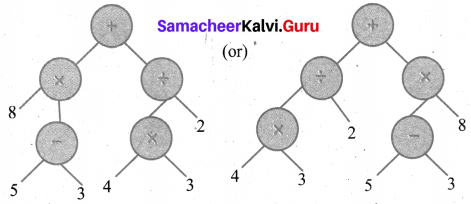
Check whether the Tree diagrams are equal or not.
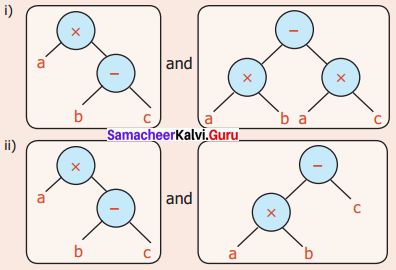
Samacheer Kalvi 6th Maths Solutions Term 2 Chapter 5 Information Processing Intext Questions Q1
Solution:
(i) Their algebraic expressions are a × (b – c) and (a × b) – (a × c)
∴ distributive property of multiplication over subtraction
∴ They are equal
(ii) Their algebraic expressions are a × (b – c) and (a × b) – c
Both are not equal [By BODMAS rule]

Question 2.
Check whether the following algebraic expressions are equal or not by using Tree diagrams.
(i) (x + y) + z and x + (y + z)
(ii) (p × q) × r and p × (q × r)
(iii) a – (b – c) and (a – b) – c
Solution:
(i) (x + y) + z and x + (y + z)
The tree diagrams are
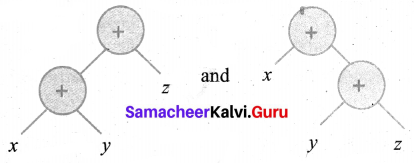
Samacheer Kalvi 6th Maths Solutions Term 2 Chapter 5 Information Processing Intext Questions Q2
Subtraction is not associative and the expressions are not equal.
(ii) (p × q) × r and p × (q × r)
The tree diagram is
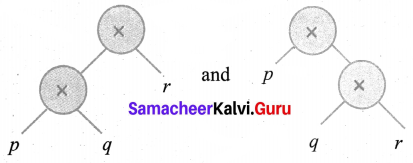
Samacheer Kalvi 6th Maths Solutions Term 2 Chapter 5 Information Processing Intext Questions Q2.1
Multiplication is associative
∴ Both expressions are equal.

Samacheer Kalvi 6th Maths Solutions Term 2 Chapter Chapter 5 Information Processing Intext Questions

(iii) a – (b – c) and (a – b) – c
Their tree diagrams are
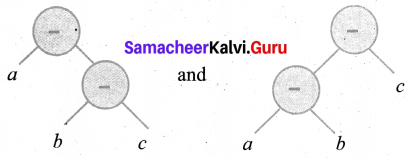
Samacheer Kalvi 6th Maths Solutions Term 2 Chapter 5 Information Processing Intext Questions Q2.2
Subtraction is not associative
∴ Both expressions are not equal.
Samacheer Kalvi 6th Maths Solutions Term 2 Chapter 5 Information Processing Additional Questions

You can Download Samacheer Kalvi 6th Maths Book Solutions Guide Pdf, Tamilnadu State Board help you to revise the complete Syllabus and score more marks in your examinations.
Samacheer Kalvi 6th Maths Solutions Term 2 Chapter Chapter 5 Information Processing Additional Questions

Tamilnadu Samacheer Kalvi 6th Maths Solutions Term 2 Chapter 5 Information Processing Additional Questions

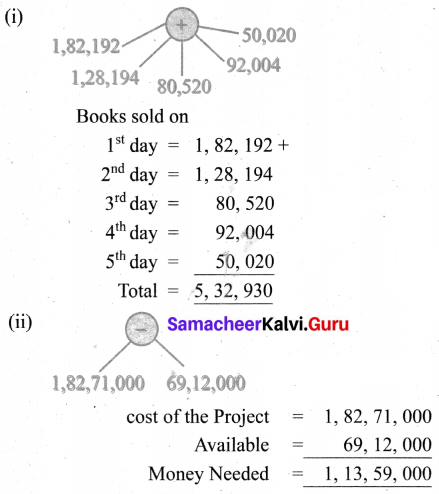
Question 1.
Draw tree diagrams for the following questions:
(i) The number of books sold in a book fair is as follows. First day 1,82,192, Second day 1,28,194, Third day 80,520 fourth day 92,004 and the fifth day 50,020. Find the total number of the book sold.
(ii) A water purification project cost 1,82,71,000. The machinery was bought for ₹ 69,12,000. What is the amount needed to complete the project?
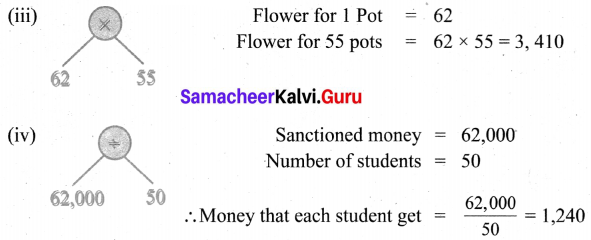
(iii) The number of flowers needed to arrange in a flower pot is 62. Find the number of flowers needed to arrange in 55 pots?
(iv) If the total scholarship money sanctioned for 50 students are ₹ 62,000. Find the amount that each student can get?
Solution:
Samacheer Kalvi 6th Maths Solutions Term 2 Chapter 5 Information Processing Additional Questions Q1
Samacheer Kalvi 6th Maths Solutions Term 2 Chapter 5 Information Processing Additional Questions Q1.1

Samacheer Kalvi 6th Maths Solutions Term 2 Chapter Chapter 5 Information Processing Additional Questions

Question 2.
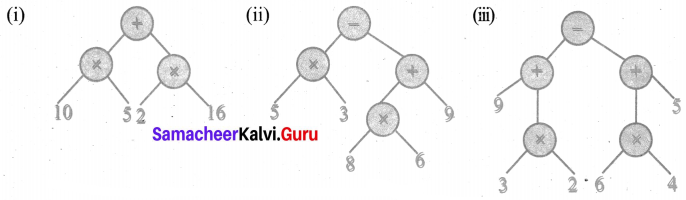
Convert into tree diagrams
(i) (10 × 5) + (2 × 16)
(ii) (5 × 3) – (8 × 6) + 9
(iii) [9 + (3 × 2)] – [(6 × 4) + 5]
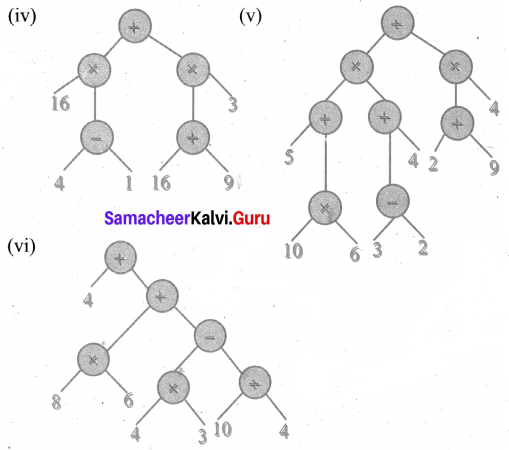
(iv) [(4 – 1) × 16] + [(16 + 9) × 3]
(v) {[(10 × 6) + 5] × [ 4 + (3 – 2)]} ÷ [4 × (2 + 9)]
(vi) 4 + [8 × 6 + {(4 × 3) – (10 ÷ 4)}]
Solution:
Samacheer Kalvi 6th Maths Solutions Term 2 Chapter 5 Information Processing Additional Questions Q2
Samacheer Kalvi 6th Maths Solutions Term 2 Chapter 5 Information Processing Additional Questions Q2.1

Question 3.
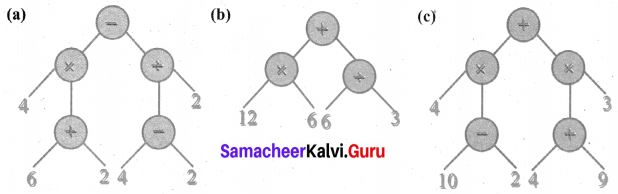
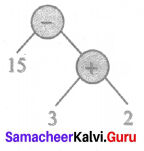
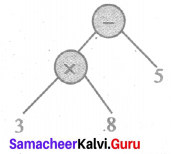
Convert the following tree diagrams into numerical expressions.
Samacheer Kalvi 6th Maths Solutions Term 2 Chapter 5 Information Processing Additional Questions Q3

Samacheer Kalvi 6th Maths Solutions Term 2 Chapter Chapter 5 Information Processing Additional Questions

Solution:
(a) [4 × (6 + 2)] – [(4 – 2) ÷ 2]
(b) (12 × 6) + (6 ÷ 3)
(c) [4 × (10 – 2)] + [(4 + 9) × 3]

Samacheer Kalvi 6th Maths Solutions Term 2 Chapter 5 Information Processing Ex 5.2

You can Download Samacheer Kalvi 6th Maths Book Solutions Guide Pdf, Tamilnadu State Board help you to revise the complete Syllabus and score more marks in your examinations.
Samacheer Kalvi 6th Maths Solutions Term 2 Chapter Chapter 5 Information Processing Ex 5.2

Tamilnadu Samacheer Kalvi 6th Maths Solutions Term 2 Chapter 5 Information Processing Ex 5.2

Miscellaneous Practice Problems

Question 1.
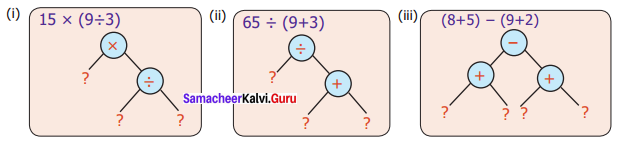
Write the missing numbers.
Samacheer Kalvi 6th Maths Solutions Term 2 Chapter 5 Information Processing Ex 5.2 Q1
Solution:
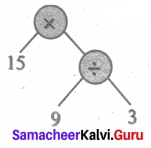
(i) 15 × (9 ÷ 3)
Samacheer Kalvi 6th Maths Solutions Term 2 Chapter 5 Information Processing Ex 5.2 Q1.1
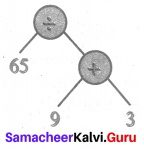
(ii) 65 ÷ (9 + 3)
Samacheer Kalvi 6th Maths Solutions Term 2 Chapter 5 Information Processing Ex 5.2 Q1.2
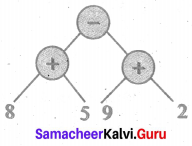
(iii) (8 + 5) – (9 + 2)
Samacheer Kalvi 6th Maths Solutions Term 2 Chapter 5 Information Processing Ex 5.2 Q1.3

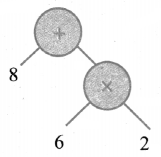
Question 2.
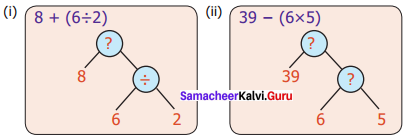
Write the missing operations in the trees.
Samacheer Kalvi 6th Maths Solutions Term 2 Chapter 5 Information Processing Ex 5.2 Q2
Solution:
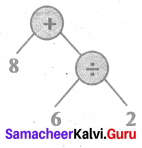
(i) 8 + (6 ÷ 2)
Samacheer Kalvi 6th Maths Solutions Term 2 Chapter 5 Information Processing Ex 5.2 Q2.1
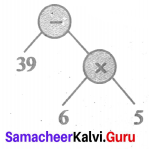
(ii) 39 – (6 × 5)
Samacheer Kalvi 6th Maths Solutions Term 2 Chapter 5 Information Processing Ex 5.2 Q2.2

Samacheer Kalvi 6th Maths Solutions Term 2 Chapter Chapter 5 Information Processing Ex 5.2

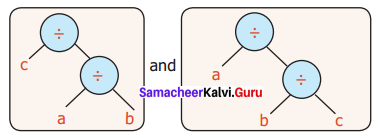
Question 3.
Check whether the Tree diagrams are equal or not.
Samacheer Kalvi 6th Maths Solutions Term 2 Chapter 5 Information Processing Ex 5.2 Q3
Solution:
c ÷ (a ÷ b) ≠ a(b ÷ c)

Challenge Problems

Question 4.
Convert the following questions into tree diagrams:
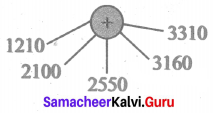
(i) The number of people who visited a library in the last 5 months was 1210, 2100, 2550, 3160 and 3310. Draw the tree diagram of the total number of people who had used the library for the 5 months.
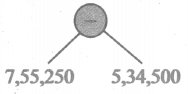
(ii) Ram had a bank deposit of ₹ 7,55,250 and he had withdrawn ₹ 5,34,500 for educational purpose. Find the amount left in his account. Draw a tree diagram for this.
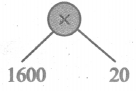
(iii) In a cycle factory, 1,600 bicycles were manufactured on a day. Draw tree diagram to find the number of bicycles produced in 20 days.
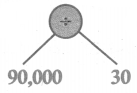
(iv) A company with 30 employees decided to distribute ₹ 90,000 as a special bonus equally among its employees. Draw tree diagram to show how much will each receive?
Solution:
(i) People who visited the library for the past 5 months = 1210 + 2100 + 2550 + 3160 + 3310 = 12,330
Total number of people visited = 12,330
Tree Diagram
Samacheer Kalvi 6th Maths Solutions Term 2 Chapter 5 Information Processing Ex 5.2 Q4
(ii) Total bank deposit of Ram = ₹ 7,55,250
Amount withdrawn for educational purpose = ₹ 5,34,500
Amount left in his account = ₹ 2,20,750
Amount left in Ram’s Account = ₹ 2,20,750
Tree Diagram
Samacheer Kalvi 6th Maths Solutions Term 2 Chapter 5 Information Processing Ex 5.2 Q4.1
(iii) Number of bicycles manufactured in a day = 1600
Number of bicycles manufactured in 20 days = 1600 × 20 = 32,000
Number of bicycles manufactured in 20 days = 32,000
Tree Diagram
Samacheer Kalvi 6th Maths Solutions Term 2 Chapter 5 Information Processing Ex 5.2 Q4.2
(iv) Total amount distributed to 30 employees = 90,000
Amount received by one employee = \(\frac { 90000 }{ 30 }\) = 3000
Each employee receive Rs. 3,000
Tree Diagram
Samacheer Kalvi 6th Maths Solutions Term 2 Chapter 5 Information Processing Ex 5.2 Q4.3

Samacheer Kalvi 6th Maths Solutions Term 2 Chapter Chapter 5 Information Processing Ex 5.2

Question 5.
Write the numerical expression which gives the answer 10 and also convert into a tree diagram.
Solution:
Numerical expression 15 – (3 + 2)
Tree Diagram
Samacheer Kalvi 6th Maths Solutions Term 2 Chapter 5 Information Processing Ex 5.2 Q5

Question 6.
Use brackets inappropriate place to the expression 3 × 8 – 5 which gives 19 and convert it into tree diagram for it.
Solution:
Numerical expression (3 × 8) – 5
Tree Diagram
Samacheer Kalvi 6th Maths Solutions Term 2 Chapter 5 Information Processing Ex 5.2 Q6

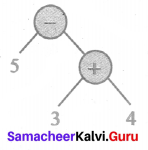
Question 7.
A football team gains 3 and 4 points for successive 2 days and loses 5 points on the third day. Find the total points scored by the team and also represent this in the tree diagram.
Solution:
Total points scored by the team = 3 + 4 – 5 = 2
Tree Diagram
Samacheer Kalvi 6th Maths Solutions Term 2 Chapter 5 Information Processing Ex 5.2 Q7

Samacheer Kalvi 6th Maths Solutions Term 2 Chapter Chapter 5 Information Processing Ex 5.2

Samacheer Kalvi 6th Maths Solutions Term 2 Chapter 5 Information Processing Ex 5.1

You can Download Samacheer Kalvi 6th Maths Book Solutions Guide Pdf, Tamilnadu State Board help you to revise the complete Syllabus and score more marks in your examinations.
Samacheer Kalvi 6th Maths Solutions Term 2 Chapter Chapter 5 Information Processing Ex 5.1

Tamilnadu Samacheer Kalvi 6th Maths Solutions Term 2 Chapter 5 Information Processing Ex 5.1

Question 1.
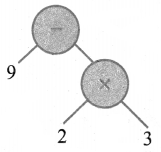
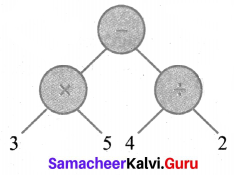
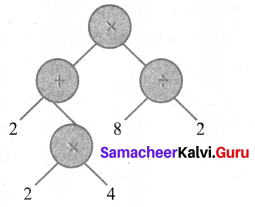
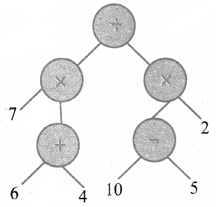
Convert the following numerical expressions into Tree diagrams.
(i) 8 + (6 × 2)
(ii) 9 – (2 × 3)
(iii) (3 × 5) – (4 ÷ 2)
(iv) [(2 × 4) + 2] × (8 ÷ 2)
(v) [(6 + 4) × 7] ÷ [2 × (10 – 5)]
(vi) [(4 × 3) ÷ 2] + [8 × (5 – 3)]
Solution:
(i) 8 + (6 × 2)
Samacheer Kalvi 6th Maths Solutions Term 2 Chapter 5 Information Processing Ex 5.1 Q1
(ii) 9 – (2 × 3)
Samacheer Kalvi 6th Maths Solutions Term 2 Chapter 5 Information Processing Ex 5.1 Q1.1
(iii) (3 × 5) – (4 ÷ 2)
Samacheer Kalvi 6th Maths Solutions Term 2 Chapter 5 Information Processing Ex 5.1 Q1.2
(iv) [(2 × 4) + 2] × (8 ÷ 2)
Samacheer Kalvi 6th Maths Solutions Term 2 Chapter 5 Information Processing Ex 5.1 Q1.3
(v) [(6 + 4) × 7] ÷ [2 × (10 – 5)]
Samacheer Kalvi 6th Maths Solutions Term 2 Chapter 5 Information Processing Ex 5.1 Q1.4
(vi) [(4 × 3) ÷ 2] + [8 × (5 – 3)]
Samacheer Kalvi 6th Maths Solutions Term 2 Chapter 5 Information Processing Ex 5.1 Q1.5
The first expression goes to the right side branch. So that the value does not change.

Samacheer Kalvi 6th Maths Solutions Term 2 Chapter Chapter 5 Information Processing Ex 5.1

Question 2.
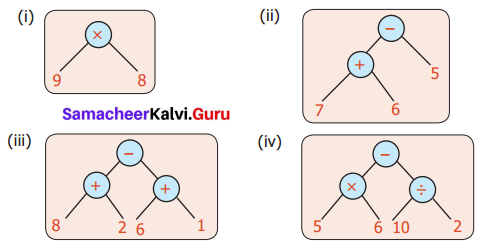
Convert the following Tree diagrams into numerical expressions.
Samacheer Kalvi 6th Maths Solutions Term 2 Chapter 5 Information Processing Ex 5.1 Q2
Solution:
(i) The numerical Expression is 9 × 8
(ii) The numerical expression is (7 + 6) – 5
(iii) The numerical expression is (8 + 2) – (6 + 1)
(iv) The numerical expression is (5 × 6) – (10 ÷ 2)

Question 3.
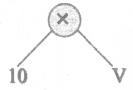
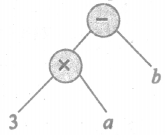
Convert the following algebraic expressions into tree diagrams.
(i) 10 V
(ii) 3a – b
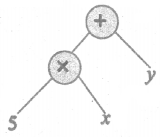
(iii) 5x + y
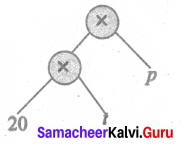
(iv) 20t × p
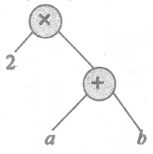
(v) 2(a + b)
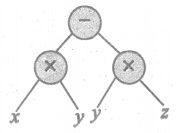
(vi) (x × y) – (y × z)
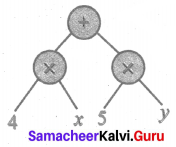
(vii) 4x + 5y
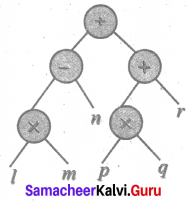
(viii) (lm – n) ÷ (pq + r)
Solution:
(i) 10 V
Samacheer Kalvi 6th Maths Solutions Term 2 Chapter 5 Information Processing Ex 5.1 Q3
(ii) 3a – b
Samacheer Kalvi 6th Maths Solutions Term 2 Chapter 5 Information Processing Ex 5.1 Q3.1
(iii) 5x + y
Samacheer Kalvi 6th Maths Solutions Term 2 Chapter 5 Information Processing Ex 5.1 Q3.2
(iv) 20t × p
Samacheer Kalvi 6th Maths Solutions Term 2 Chapter 5 Information Processing Ex 5.1 Q3.3
(v) 2(a + b)
Samacheer Kalvi 6th Maths Solutions Term 2 Chapter 5 Information Processing Ex 5.1 Q3.4
(vi) (x × y) – (y × z)
Samacheer Kalvi 6th Maths Solutions Term 2 Chapter 5 Information Processing Ex 5.1 Q3.5
(vii) 4x + 5y
Samacheer Kalvi 6th Maths Solutions Term 2 Chapter 5 Information Processing Ex 5.1 Q3.6
(viii) (lm – n) ÷ (pq + r)
Samacheer Kalvi 6th Maths Solutions Term 2 Chapter 5 Information Processing Ex 5.1 Q3.7

Samacheer Kalvi 6th Maths Solutions Term 2 Chapter Chapter 5 Information Processing Ex 5.1

Question 4.
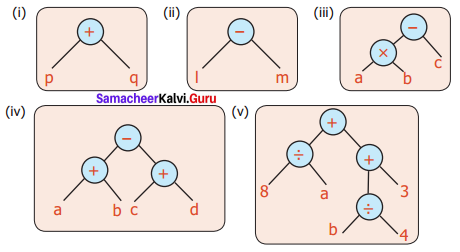
Convert tree diagram into Algebraic expression.
Samacheer Kalvi 6th Maths Solutions Term 2 Chapter 5 Information Processing Ex 5.1 Q4
Solution:
(i) Algebraic Expression is p + q
(ii) Algebraic Expression is l – m
(iii) Algebraic Expression is (a × b) – c (or) (ab) – c
(iv) Algebraic Expression is (a + b) – (c + d)
(v) Algebraic Expression is (8 ÷ a) + [ (6 ÷ 4) + 3]

Samacheer Kalvi 6th Maths Solutions Term 2 Chapter 4 Geometry Intext Questions

You can Download Samacheer Kalvi 6th Maths Book Solutions Guide Pdf, Tamilnadu State Board help you to revise the complete Syllabus and score more marks in your examinations.
Samacheer Kalvi 6th Maths Solutions Term 2 Chapter Chapter 4 Geometry Intext Questions

Tamilnadu Samacheer Kalvi 6th Maths Solutions Term 2 Chapter 4 Geometry Intext Questions

Try These (Textbook Page No. 61)

Question 1.
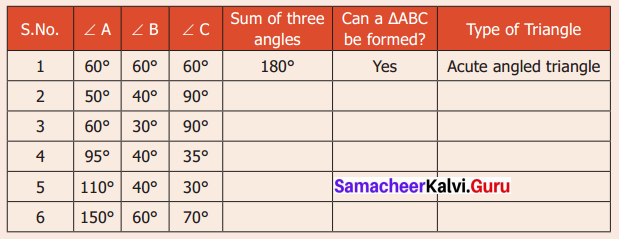
Complete the following table. In any triangle.
Samacheer Kalvi 6th Maths Solutions Term 2 Chapter 4 Geometry Intext Questions Q1
Solution:
Samacheer Kalvi 6th Maths Solutions Term 2 Chapter 4 Geometry Intext Questions Q1.1

Try These (Textbook Page No. 62)

Question 1.
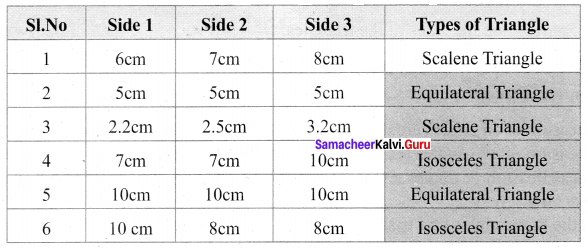
Complete the table.
Samacheer Kalvi 6th Maths Solutions Term 2 Chapter 4 Geometry Intext Questions Q2
Solution:
Samacheer Kalvi 6th Maths Solutions Term 2 Chapter 4 Geometry Intext Questions Q2.1

Samacheer Kalvi 6th Maths Solutions Term 2 Chapter Chapter 4 Geometry Intext Questions

Try These (Textbook Page No. 64)

Question 1.
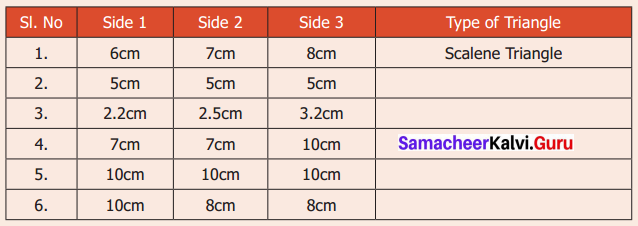
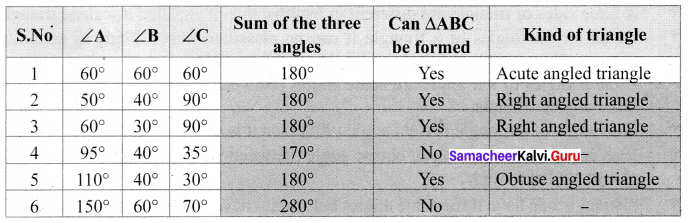
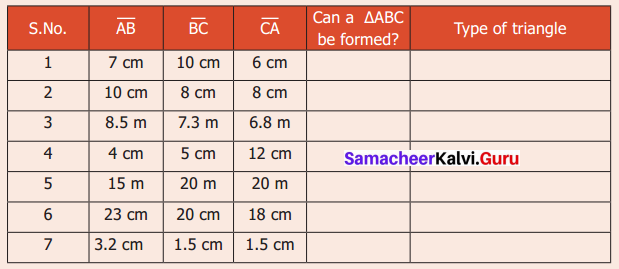
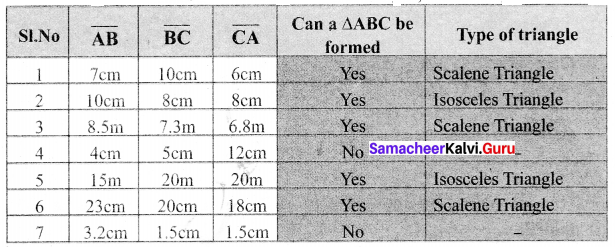
Can a triangle be formed with the given sides? If yes, state the type of triangle formed.
Samacheer Kalvi 6th Maths Solutions Term 2 Chapter 4 Geometry Intext Questions Q3
Solution:
Samacheer Kalvi 6th Maths Solutions Term 2 Chapter 4 Geometry Intext Questions Q3.1

Samacheer Kalvi 6th Maths Solutions Term 2 Chapter 4 Geometry Additional Questions

You can Download Samacheer Kalvi 6th Maths Book Solutions Guide Pdf, Tamilnadu State Board help you to revise the complete Syllabus and score more marks in your examinations.
Samacheer Kalvi 6th Maths Solutions Term 2 Chapter Chapter 4 Geometry Ex Additional Questions

Tamilnadu Samacheer Kalvi 6th Maths Solutions Term 2 Chapter 4 Geometry Additional Questions

Question 1.
Name the type of the following triangles.
(a) ∆PQR with m∠Q = 90°
(b) ∆ABC with m∠B = 90° and AB = BC
Solution:
(a) One of the angles is 90°
It is a right-angled triangle
(b) Since two sides are equal.
It is an isosceles triangle. Also m∠B = 90°
It is an Isosceles right-angled triangle

Question 2.
Classify the triangles (scalene, isosceles, equilateral) given below.
(a) ∆ABC, AB = BC
(b) ∆PQR, PQ = QR = RP
(c) ∆ABC, ∠B = 90°
(d) ∆EFG, EF = 3 cm, FG = 4 cm and GE = 3 cm
Solution:
(a) Isosceles triangle
(b) Equilateral triangle
(c) Right angled triangle
(d) Isosceles triangle

Question 3.
In triangle ∆ABC, AB = BC = CA = 5 cm. Then what is the value of ∠A, ∠B and ∠C?
Solution:
Since AB = BC = CA
∠A = ∠B = ∠C
We know that ∠A + ∠B + ∠C = 180°
∴ ∠A = ∠B = ∠C = 60°

Question 4.
In ∆PQR, ∠P = ∠Q = ∠R = 60°, then what can you say about the length of sides of ∆PQR? Also, write the name of the triangle?
Solution:
∠P = ∠Q = ∠R = 60°
So PQ = QR = RP
∆PQR is equilateral triangle

Question 5.
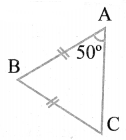
In ∆ABC, AB = BC and ∠A = 50°. Then find the value of ∠C?
Solution:
Samacheer Kalvi 6th Maths Solutions Term 2 Chapter 4 Geometry Additional Questions Q5
It is an isosceles triangle.
∠A = ∠C
∠C = 50°

Samacheer Kalvi 6th Maths Solutions Term 2 Chapter Chapter 4 Geometry Ex Additional Questions

Question 6.
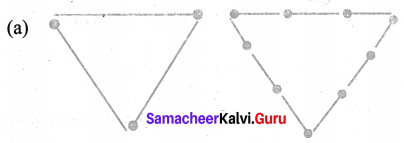
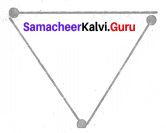
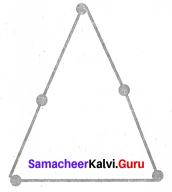
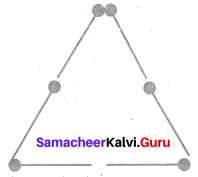
(a) Try to construct triangles using matchsticks.
(b) Can you make a triangle with?
(i) 3 matchsticks?
(ii) 4 matchsticks?
(iii) 5 matchsticks?
(iv) 6 matchsticks?
Name the type of triangle in each case. If you cannot make a triangle think of the reason for it.
Solution:
Samacheer Kalvi 6th Maths Solutions Term 2 Chapter 4 Geometry Additional Questions Q6
(b) (i) With the help of 3 matchsticks, we can make an equilateral triangle. Since all three matchsticks are of equal length.
Samacheer Kalvi 6th Maths Solutions Term 2 Chapter 4 Geometry Additional Questions Q6.1
(ii) With the help of 4 matchsticks, we cannot make any triangle because in this case, sum of two sides is equal to the third side and we know that the sum of the lengths of any two sides of a triangle is always greater than the length of the third side.
(iii) With the help of 5 matchsticks, we can make an isosceles triangle. Since we get two sides equal in this case.
Samacheer Kalvi 6th Maths Solutions Term 2 Chapter 4 Geometry Additional Questions Q6.2
(iv) With the help of 6 matchsticks, we can make an equilateral triangle. Since we get three sides equal in length.
Samacheer Kalvi 6th Maths Solutions Term 2 Chapter 4 Geometry Additional Questions Q6.3

Question 7.
A table is bought for ₹ 4500 and sold for ₹ 4800. Find the profit or loss.
Solution:
C.P = ₹ 4500
S.P. = ₹ 4800
Here S.P< C.P
Profit = S.P – C.P = ₹ 4800 – ₹ 4500 = ₹ 300

Samacheer Kalvi 6th Maths Solutions Term 2 Chapter Chapter 4 Geometry Ex Additional Questions

Question 8.
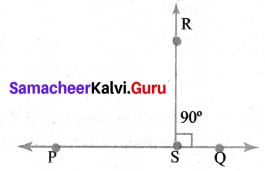
Draw any line segment \(\overline{\mathbf{P Q}}\). Take any point R not on it. Through R, draw a perpendicular to \(\overline{\mathbf{P Q}}\).
Solution:
Construction:
(i) Drawn a line segment \(\overline{\mathbf{P Q}}\) using scale and taken a point R outside of \(\overline{\mathbf{P Q}}\).
(ii) Placed a set-square on \(\overline{\mathbf{P Q}}\) such that one arm of its right angle aligns along \(\overline{\mathbf{P Q}}\).
(iii) Placed a scale along the other edge of the right angle of the set-square
(iv) Slide the set-square along the line till the point R touches the other arm of its right angle.
(v) Joined RS along the edge through R meeting \(\overline{\mathbf{P Q}}\) at S.
Hence \(\overline{\mathbf{R S}}\) ⊥ \(\overline{\mathbf{P Q}}\).
Samacheer Kalvi 6th Maths Solutions Term 2 Chapter 4 Geometry Additional Questions Q8

Samacheer Kalvi 6th Maths Solutions Term 2 Chapter 4 Geometry Ex 4.2

You can Download Samacheer Kalvi 6th Maths Book Solutions Guide Pdf, Tamilnadu State Board help you to revise the complete Syllabus and score more marks in your examinations.
Samacheer Kalvi 6th Maths Solutions Term 2 Chapter Chapter 4 Geometry Ex 4.2

Tamilnadu Samacheer Kalvi 6th Maths Solutions Term 2 Chapter 4 Geometry Ex 4.2

Question 1.
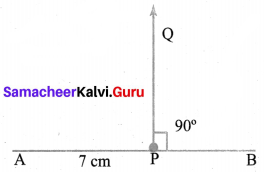
Draw a line segment AB = 7 cm and Mark a point P on it. Draw a line perpendicular to the given line segment at P.
Solution:
Construction:
(i) Drawn a segment \(\overline{\mathrm{AB}}\) such that \(\overline{\mathrm{AB}}\) = 7 cm and took a point P anywhere on the line.
(ii) Placing the set square on the line in such a way that the vertex of its right angle coincides with P and one arm of the right angle coincides with the line AB.
(iii) Drawn a line PQ through P along the other arm of the right angle of the set square,
(iv) The line PQ is perpendicular to the line AB at P. ie PQ ⊥ AB and ∠APQ = ∠BPQ = 90°
Samacheer Kalvi 6th Maths Solutions Term 2 Chapter 4 Geometry Ex 4.2 Q1

Question 2.
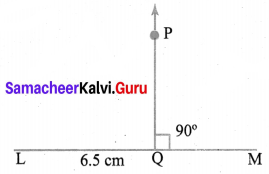
Draw a line segment LM = 6.5 cm and take a point P not lying on it. Using set square construct a line perpendicular to LM through P.
Solution:
Construction:
(i) Drawn a line segment \(\overline{\mathbf{L M}}\) such that \(\overline{\mathbf{L M}}\) = 6.5 cm and marked a point P anywhere above \(\overline{\mathbf{L M}}\)
(ii) Placing one of the arms of the right angle of the set square along the line segment LM.
(iii) Sliding the set square along the line segment in such a way that the other arm of its right angle touches the point P. Draw a line along this side, passing through point P meeting \(\overline{\mathbf{L M}}\) at Q.
(iv) The line PQ is perpendicular to the line segment LM. ie LM ⊥ PQ.
Samacheer Kalvi 6th Maths Solutions Term 2 Chapter 4 Geometry Ex 4.2 Q2

Question 3.
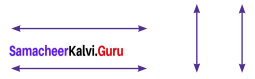
Find the distance between the given lines using a set square at two different points on each of the pairs of lines and check whether they are parallel.
Samacheer Kalvi 6th Maths Solutions Term 2 Chapter 4 Geometry Ex 4.2 Q3
Solution:
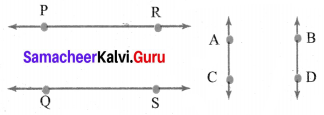
Making the points P, Q, R, S and A, B, C, D on the given lines
PQ = RS = 0.9 cm
AB = CD = 1 cm
Distance between the two lines are equal.
They are parallel lines.
Samacheer Kalvi 6th Maths Solutions Term 2 Chapter 4 Geometry Ex 4.2 Q3.1

Samacheer Kalvi 6th Maths Solutions Term 2 Chapter Chapter 4 Geometry Ex 4.2

Question 4.
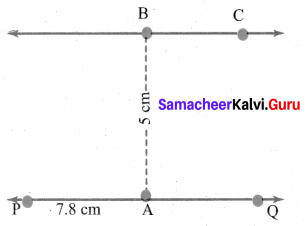
Draw a line segment measuring 7,8cm. Mark a point B above it at a distance of 5 cm. Through B draw a line parallel to the given line segment.
Solution:
Construction:
(i) Using a scale drawn a line segment \(\overline{\mathrm{PQ}}\) = 7.8 cm. Marked a point A on the line.
(ii) Placing the set square in such a way that the vertex of the right angle coincides with A and one of the edges of right angle lies along the line segment PQ. Mark a point B. Such that AB = 5 cm above the line PQ.
(iii) Placed the scale and the set square in such a way the set square is below PQ and one edge that form right angle with PQ. Placed the scale along the other edge of the right angle.
(iv) Holding the scale firmly and sliding the set square along the edge of the scale until the edge touches the point B. Drawn the line BC through B.
(v) Now the line BC is parallel to PQ i.e, BC || PQ.
Samacheer Kalvi 6th Maths Solutions Term 2 Chapter 4 Geometry Ex 4.2 Q4

Question 5.
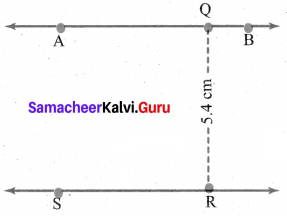
Draw a line. Mark a point R below it at a distance of 5.4 cm. Through R draw a line parallel to the given line.
Solution:
(i) Using a scale drawn a line AB and marked a point Q on the line.
(ii) Placing the set square in such a way that the vertex of the right angle coincides with Q and one of the edges of the right angle lies along AB. Marked the Point R such that QR = 5.4 cm.
(iii) Placing the set square above AB in such a way that one of the edges that form a right angle with AB. Placed the scale along the other edge of the right angle.
(iv) Holding the scale firmly and slide the set square along the edge of the scale until the edge touches the point R. Drawn the line RS through R. The line RS is parallel to AB i.e RS || AB.
Samacheer Kalvi 6th Maths Solutions Term 2 Chapter 4 Geometry Ex 4.2 Q5

Samacheer Kalvi 6th Maths Solutions Term 2 Chapter 3 Bill, Profit and Loss Intext Questions

You can Download Samacheer Kalvi 6th Maths Book Solutions Guide Pdf, Tamilnadu State Board help you to revise the complete Syllabus and score more marks in your examinations.
Samacheer Kalvi 6th Maths Solutions Term 2 Chapter Chapter 3 Bill, Profit and Loss Intext Questions

Tamilnadu Samacheer Kalvi 6th Maths Solutions Term 2 Chapter 3 Bill, Profit and Loss Intext Questions

Try These (Textbook Page No.49)

Question 1.
Arrange in ascending order
(i) C.P, M.P, Discount
(ii) M.P., S.P., Discount
Solution:
(i) Discount < C.P < M.P.
(ii) Discount < S.P < M.P

Samacheer Kalvi 6th Maths Solutions Term 2 Chapter Chapter 3 Bill, Profit and Loss Intext Questions

Question 2.
Which is greater S.P or M.P?
Solution:
M.P is greater than S.P

Samacheer Kalvi 6th Maths Solutions Term 2 Chapter 3 Bill, Profit and Loss Additional Questions

You can Download Samacheer Kalvi 6th Maths Book Solutions Guide Pdf, Tamilnadu State Board help you to revise the complete Syllabus and score more marks in your examinations.

Tamilnadu Samacheer Kalvi 6th Maths Solutions Term 2 Chapter 3 Bill, Profit and Loss Additional Questions

Question 1.
______ is the difference between S.P and C.P., when S.P > C.P.
Solution:
Profit

Question 2.
Samacheer Kalvi 6th Maths Solutions Term 2 Chapter 3 Bill, Profit and Loss Additional Questions Q1
(a) What is the total bill amount?
(b) Which item is the costliest one?
(c) Write the name of the shop?
Solution:
(a) ₹ 4,050
(b) Tables
(c) ABC Furnitures, Madurai

Question 3.
A vegetable vendor bought a dozen drum sticks for ₹ 42. Two of them become dry. If he has to get a profit of ₹ 8. Find the S.P of each drumstick.
Solution:
12 drumsticks cost price = ₹ 42
Profit = ₹ 8
Profit = S.P – C.P
⇒ 8 = S.P – 42
⇒ S.P = 8 + 42 = ₹ 50
S.P of 10 drumsticks = ₹ 50
S.P of each drumstick = \(\frac { 50 }{ 10 }\) = ₹ 5

Question 4.
Rice is being sold at ₹ 1800 per bag of 25kg at profit of ₹ 250. Find the Cost price of the rice bag.
Solution:
S.P = ₹ 1800
Profit = ₹ 250
Profit = S.P – C.P
⇒ 250 = 1800 – C.P
⇒ C.P = 1800 – 250 = ₹ 1550

Question 5.
Mangai buys a book for ₹ 300. She wants to sell it at a profit of ₹ 50 after making a discount of ₹ 30. What is the M.P of a book?
Solution:
Profit = S.P – C.P
⇒ 50 = S.P – 300
⇒ S.P = 50 + 300 = 350
S.P = M.P – Discount
⇒ 350 = M.P – 30
⇒ M.P = 350 + 30 = ₹ 380

Question 6.
Manila buys a dress for ₹ 750. She wants to sell it at a profit of ₹ 75 on sales and she marks ₹ 900. What is the discount that she will give to her customers?
Solution:
Profit = S.P – C.P
⇒ 75 = S.P – 750
⇒ S.P = 75 + 750 = ₹ 825
S.P = M.P – Discount
⇒ 825 = 900 – Discount
⇒ Discount = 900 – 825 = ₹ 75

Question 7.
Complete the following table:
Samacheer Kalvi 6th Maths Solutions Term 2 Chapter 3 Bill, Profit and Loss Additional Questions Q6
Solution:
(i) Profit = S.P – C.P = 60 – 50 where CP < SP = ₹ 10
(ii) S.P = C.P – loss = 80 – 15 = ₹ 65

Samacheer Kalvi 6th Maths Solutions Term 3 Chapter 3 Perimeter and Area Intext Questions

You can Download Samacheer Kalvi 6th Maths Book Solutions Guide Pdf, Tamilnadu State Board help you to revise the complete Syllabus and score more marks in your examinations.
Samacheer Kalvi 6th Maths Solutions Term 3 Chapter 3 Perimeter and Area Intext Questions

Tamilnadu Samacheer Kalvi 6th Maths Solutions Term 3 Chapter 3 Perimeter and Area Intext Questions

Activity (Text book Page No. 39)

Question 1.
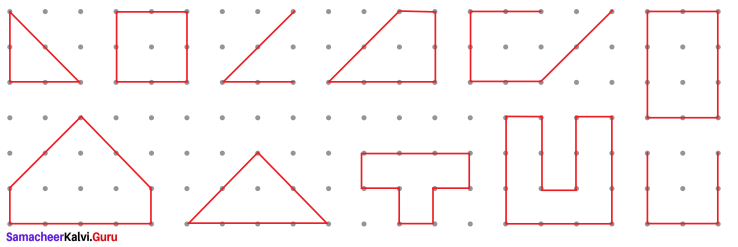
Observe the following shapes and answer the questions given below.
Samacheer Kalvi 6th Maths Solutions Term 3 Chapter 3 Perimeter and Area Intext Questions 1
i) Mark the closed shapes as ‘✓’ and open shapes as ‘✗’
ii) Find the measure of the boundary of closed shapes by using a ruler.
iii) Which closed shape has the shortest boundary?
iv) Which closed shape has the longest boundary?
Activity to be done by the students themselves

Try this (Text book Page No. 40)

Question 1.
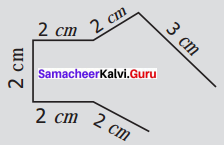
Samacheer Kalvi 6th Maths Solutions Term 3 Chapter 3 Perimeter and Area Intext Questions 2
Is the perimeter of the given shape possible ? why ?
Solution:
Not possible. Because perimeter is the length of the boundaries of any closed shape. It is not a closed shape.

Try These (Text book Page No.41)

Question 1.
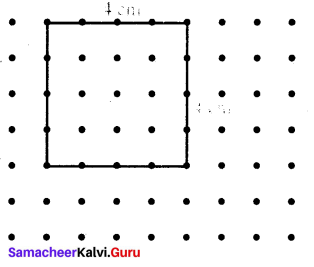
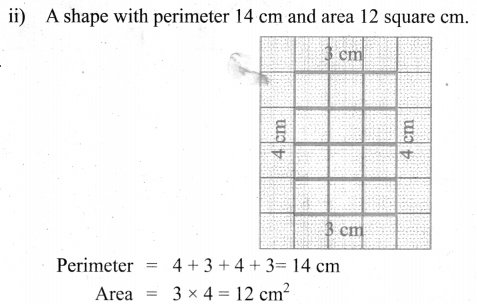
Draw a shape with perimeter 16 cm in a dot sheet.
Solution:
Samacheer Kalvi 6th Maths Solutions Term 3 Chapter 3 Perimeter and Area Intext Questions 3

Question 2.
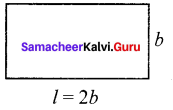
What is the perimeter of a rectangle if the length is twice its breadth?
Solution:
Perimeter of a rectangle = 2(l + b) units
= 2 × (2b + b) units
= 2 × 3b units = 6b units
Samacheer Kalvi 6th Maths Solutions Term 3 Chapter 3 Perimeter and Area Intext Questions 4
Perimeter of a rectangle = 6b units.

Question 3.
What would be the perimeter of a square if its side is reduced to half?
Solution:
Let a side of a square = s units.
Samacheer Kalvi 6th Maths Solutions Term 3 Chapter 3 Perimeter and Area Intext Questions 5
Samacheer Kalvi 6th Maths Solutions Term 3 Chapter 3 Perimeter and Area Intext Questions

Question 4.
What is the perimeter of a triangle if all sides are equal in length?
Solution:
Perimeter of a triangle P = sum of its 3 sides.
If all sides are equal, it is an equilateral triangle with side say a.
Perimeter = a + a + a units = 3a units

Activity (Text book Page No. 41)

Question 1.
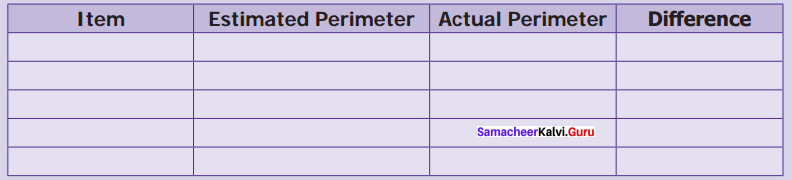
Choose any five items like Table, A4 sheet, Note-book, etc in the classroom. Guess the approximate length of each side by observation and write down the estimated perimeter of the item. Then, measure by using ruler and record the actual perimeter and find the difference in the following table (to the nearest cm)
Samacheer Kalvi 6th Maths Solutions Term 3 Chapter 3 Perimeter and Area Intext Questions 6
Solution:
Activity to be done by the students themselves

Samacheer Kalvi 6th Maths Solutions Term 3 Chapter 3 Perimeter and Area Intext Questions

Try this (Text book Page No. 42)

Question 1.
Samacheer Kalvi 6th Maths Solutions Term 3 Chapter 3 Perimeter and Area Intext Questions 7
Can different shapes have the same perimeter
Solution:
Yes, different shapes can have the same perimeter.

Try These (Text book Page No. 43)

Question 1.
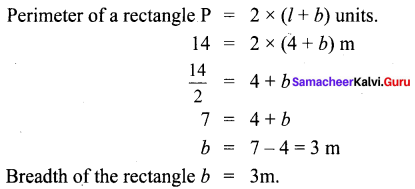
Find the breadth of the rectangle with perimeter 14 m and length 4 m.
Solution:
Given perimeter of the rectangle P = 14 m
length l = 4 m
Samacheer Kalvi 6th Maths Solutions Term 3 Chapter 3 Perimeter and Area Intext Questions 8

Question 2.
The perimeter of an isosceles triangle is 21 cm. Find the measure of equal sides given that the third side is 5 cm.
Solution:
Perimeter of the triangle P = (a + b + c) units.
21 = [(a + b) + 5] cm
21 – 5 = a + b
16 = a + b
Here a and b are equal sides and let a = b
16 = a + a
2a = 16
\(a=\frac{16}{2}\)
a = 8 cm.
∴ Equal sides measure 8 cm.

Try these (Text book Page No. 44)

Question 1.
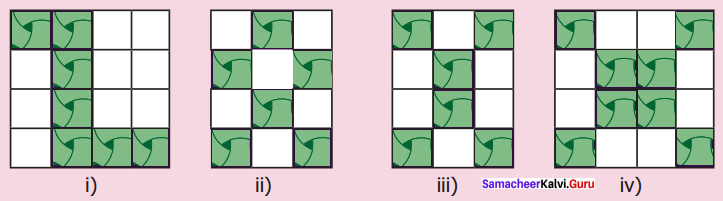
Find the number of tiles required to fill the area of following figures
Samacheer Kalvi 6th Maths Solutions Term 3 Chapter 3 Perimeter and Area Intext Questions 50
Solution:
i) Total number of tiles required = 16
Number of tiles already filled = 7
Remaining required tiles = 16 – 7 = 9
ii) Total number of tiles required = 12
Number of tiles already filled = 6
Remaining required tiles = 12 – 6 = 6
iii) Total number of tiles required = 12
Number of tiles already filled = 6
Remaining required tiles = 12 – 6 = 6
iv) Total number of tiles required = 16
Number of tiles already filled = 8
Remaining required tiles = 16 – 8 = 8

Activity (Text book Page No. 45)

Question 1.
Mark the base and height of the following right angled triangle.
Samacheer Kalvi 6th Maths Solutions Term 3 Chapter 3 Perimeter and Area Intext Questions 60
Solution:
Activity to be done by the students themselves

Try These (Text book Page No. 45)

Question 1.
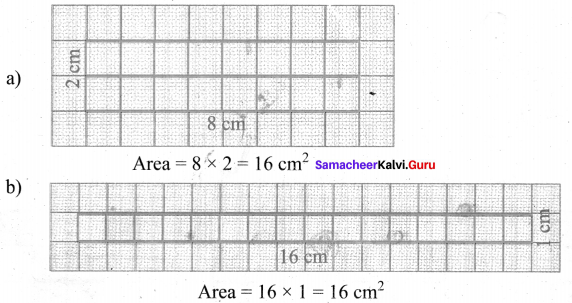
Draw the following in a graph sheet?
i) Two different rectangles whose areas are 16cm2
Solution:
Samacheer Kalvi 6th Maths Solutions Term 3 Chapter 3 Perimeter and Area Intext Questions 61
Samacheer Kalvi 6th Maths Solutions Term 3 Chapter 3 Perimeter and Area Intext Questions 62
Samacheer Kalvi 6th Maths Solutions Term 3 Chapter 3 Perimeter and Area Intext Questions 63
Samacheer Kalvi 6th Maths Solutions Term 3 Chapter 3 Perimeter and Area Intext Questions 64

Activity (Text book Page No. 46)

Question 1.
Find the area of the given ‘L’ shaped rectangular figure by dividing it into squares of equal sizes
Solution:
Activity to be done by the students themselves

Try this (Text book Page No.46)

Samacheer Kalvi 6th Maths Solutions Term 3 Chapter 3 Perimeter and Area Intext Questions

Question 2.
Can you find the area of ‘L’ shaped figure as the difference between two areas.
Solution:
Here Area of L shape = (Area of the rectangle ABCD)
(Area of the rectangle GFHB) = (2 × 3) – (2 × 1) cm2
= 6 – 2 cm2 = 4 cm2

Try these (Text book Page No. 46)

Question 1.
Measure using ruler and find the perimeter of each of the following diagram
Samacheer Kalvi 6th Maths Solutions Term 3 Chapter 3 Perimeter and Area Intext Questions 66
Solution:
i) Perimeter = 2.5 + 0.5 + 1 + 1 + 0.5 + 1 + 0.5 + 1 + 0.5 + 1.5 = 10 cm
ii) Perimeter = 2.5 + 0.5 + 2.5 + 0.5 + 0.5 cm = 6.5 cm
iii) Perimeter = 0.5 + 1 + 0.5 + 0.5 + 1 + 1 + 0.5 + 1 + 1.5 + 0.5 + 1 + 0.5 cm = 9 cm
iv) Perimeter = 2 + 0.5 + 1.5 + 1.5 + 0.5 + 0.5 + 2 + 1 cm = 9.5 cm

Activity (Text book Page No 46)

Question 1.
Form all possible shapes of perimeter 80 cm with 9 identical squares, each of side 4 cm.
Solution:
Activity to be done by the students themselves

Activity

Question 2.
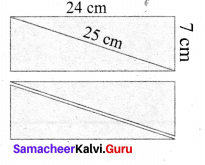
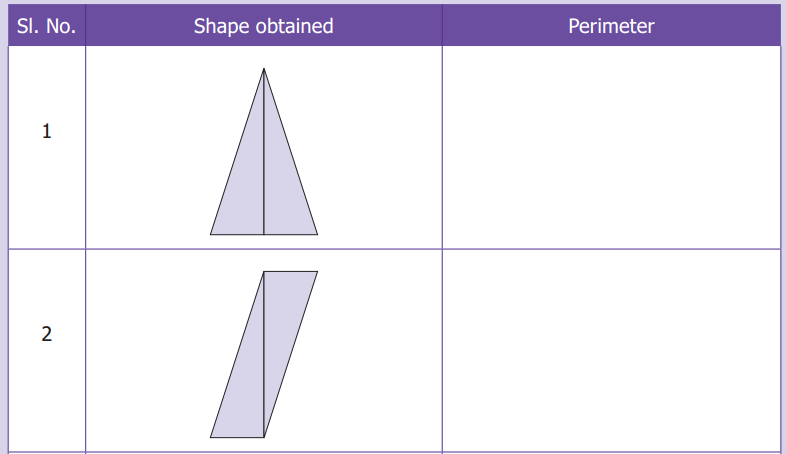
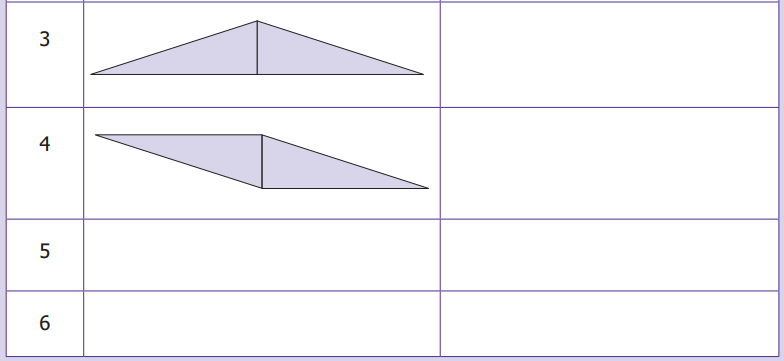
Cut a rectangular sheet along one of its diagonals. Two identical scalene right angled triangles are obtained. Join them along their sides of identical length in all possible ways. Six different shapes can be obtained. Four of them are given. Find the remaining two shapes. Find the perimeter of all the six shapes and fill in the table.
Samacheer Kalvi 6th Maths Solutions Term 3 Chapter 3 Perimeter and Area Intext Questions 70
Samacheer Kalvi 6th Maths Solutions Term 3 Chapter 3 Perimeter and Area Intext Questions 71
Samacheer Kalvi 6th Maths Solutions Term 3 Chapter 3 Perimeter and Area Intext Questions 73
Based on the above activity answer the following questions:
i) Are the perimeters same for all the shapes?
ii) Which shape has the longest perimeter?
iii) Which shape has the shortest perimeter?
iv) Are the areas of all the shapes same? why?
Solution:
Activity to be done by the students themselves

Try These (Text book Page No. 49)

Question 1.
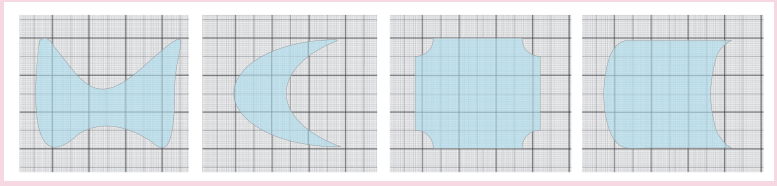
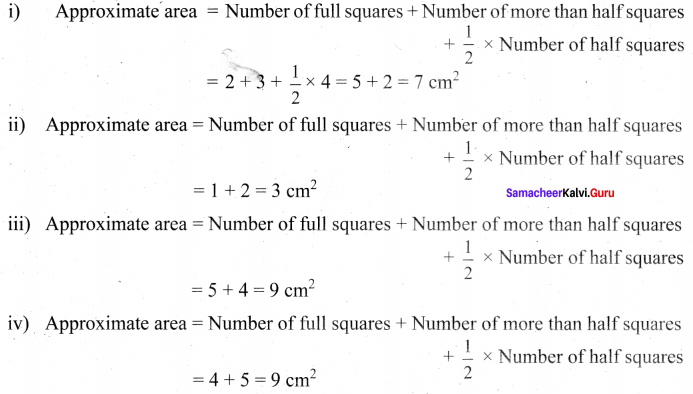
Find the approximate area of the following figures:
Samacheer Kalvi 6th Maths Solutions Term 3 Chapter 3 Perimeter and Area Intext Questions 72
Solution:
Samacheer Kalvi 6th Maths Solutions Term 3 Chapter 3 Perimeter and Area Intext Questions 75

Samacheer Kalvi 6th Maths Solutions Term 3 Chapter 3 Perimeter and Area Intext Questions

Try these (Text book Page No. 50)

Question 2.
Fill in the blanks.
(i) 7 cm2 = ____ mm2
Hint: 1 cm2 = 100 m
Solution:
700

(ii) 10 m2 = ___ cm2
Hint: 1 m2 = 10000 cm2
Solution:
1,00,000

(iii) 3 km2 = ____ m2
Hint: 1 km2 = 1000000
Solution:
30,00,000