Samacheer Kalvi 8th Social Science Civics Solutions Term 3 Chapter 1 Defence & Foreign Policy

Students can Download Social Science Civics Term 3 Chapter 1 Defence & Foreign Policy Questions and Answers, Notes Pdf, Samacheer Kalvi 8th Social Science Book Solutions Guide Pdf helps you to revise the complete Tamilnadu State Board New Syllabus and score more marks in your examinations.

Tamilnadu Samacheer Kalvi 8th Social Science Civics Solutions Term 3 Chapter 1 Defence & Foreign Policy

Samacheer Kalvi 8th Social Science Civics Defence & Foreign Policy Textual Evaluation

SamacheerKalvi.Guru

I. Choose the best answer:

Question 1.
The Supreme Commander of the Armed forces is our-
(a) President
(b) Prime Minister
(c) Governor
(d) Chief Minister
Answer:
(a) President

Question 2.
The primary mission of Indian Army is to ensure-
(a) National Security
(b) National Unity
(c) Defending the nation from external aggression
(d) All the above
Answer:
(d) All the above

Question 3.
The Army day is-
(a) 15th January
(b) 1st February
(c) 10th March
(d) 7th October
Answer:
(a) 15th January

SamacheerKalvi.Guru

Question 4.
Assam Rifles is under the control of-
(a) Ministry of Defence
(b)National Security Advisor
(c) PMO
(d) Ministry of Home Affairs
Answer:
(d) Ministry of Home Affairs

Question 5.
Indian Coast Guard was established in-
(a) 1976
(b) 1977
(c) 1978
(d) 1979
Answer:
(c) 1978

SamacheerKalvi.Guru

Question 6.
India’s foreign policy is based on several principles. One of which is-
(a) Satyameva Jayate
(b) Panchasheel
(c) both of these
(d) None of these
Answer:
(b) Panchasheel

Question 7.
Which of the following islands belonged to India?
(a) Andaman and Maldives
(b) Andaman and Lakshadweep Island
(c) Sri Lanka and Maldives
(d) Maldives and Lakshadweep Island
Answer:
(b) Andaman and Lakshadweep Island

SamacheerKalvi.Guru

II. Fill in the Blanks:

  1. The Madras Regimental Army centre is at ………….
  2. The Indian Navy Chief is ………….
  3. …………. is first and only officer of Indian Air Force to be promoted to Five Star rank Marshal of Indian Air Force.
  4. The chief architect of India’s foreign policy was ………….
  5. The Word Non-Alignment was coined by ………….

Answer:

  1. Wellington, Udhagamandalam, Tamil Nadu
  2. Admiral
  3. Arjan Singh
  4. Jawaharlal Nehru
  5. V.K. Krishna Menon

SamacheerKalvi.Guru

III. Match the following:

Question 1.

  1. Nelson Mandela – 8 members
  2. National war Memorial – Field Marshal
  3. Manekshaw – Energy development
  4. SAARC – Apartheid
  5. BCIM – New Delhi

Answer:

  1. Nelson Mandela – Apartheid
  2. National war Memorial – New Delhi
  3. Manekshaw – Field Marshal
  4. SAARC – 8 members
  5. BCIM – Energy development

IV. State true or false:

  1. Central Armed Police Force serve under the Ministry of Defence.
  2. The Madras Regiment is one of the oldest infantry regiment.
  3. The Rapid Action Force is a specialised wing of the CRPF.
  4. NCC Cadets are given basic military training.
  5. Bangladesh is a part of India.
  6. Myanmar is land bridge to ASEAN nations.

Answer:

  1. False
  2. True
  3. True
  4. True
  5. False
  6. True

SamacheerKalvi.Guru

V. Choose the correct statement:

Question 1.
Consider the following statement related to Armed forces.

(i) The Indian Army is the land based branch of Armed forces.
(ii) The mission of Indian Army is not only ensure the national security but also conducts humanisation rescue operations.

(a) (i) only
(b) (ii) only
(c) Both (i) and (ii)
(d) Neither (i) nor (i)
Answer:
(c) Both (i) and (ii)

Question 2.
Assertion (A): The President is the Supreme Commander of the Armed forces of India.
Reason (R): The President is the head of the State and occupies the highest position.
(a) A is correct and R explains A
(b) A is correct and R does not explain A
(c) A is correct and R is wrong
(d) Both A and R are wrong
Answer:
(a) A is correct and R explains A

SamacheerKalvi.Guru

Question 3.
Assertion (A): India has favored international co-operation.
Reason (R): She believes that all disputes among nations can be solved through friendly co-operation.
(a) A is correct and R is wrong
(b) Both A and R are wrong
(c) A is correct and R explains A
(d) A is correct and R does not explain A
Answer:
(c) A is correct and R explains A

Question 4.
Which of the following statements is not true about “Apartheid?”

(i) Apartheid is a policy of racial discrimination.
(ii) It is against humanism.
(iii) The policy of racialism is practiced in India.

(a) (i) and (ii)
(b) (ii) and (iii)
(c) (ii) only
(d) (iii) only
Answer:
(d) (iii) only

Question 5.
Find the odd One out
(a) Maldives
(b) Sri Lanka
(c) Myanmar
(d) Lakshadweep
Answer:
(c) Myanmar

VI Answer the following in one or two sentences:

Question 1.
Why national security is very entail?
Answer:

  1. National security is very essential for the political, social and economic development of any country,
  2. It is also important for the growth a country’s peace and peospenty.

SamacheerKalvi.Guru

Question 2.
What does the following abbreviation stand for?
(a) SFF
(b) ICG
(c) BSF
(d) NCC
Answer:
(a) SFF – The Special Frontier Force
(b) ICG – Indian Coast Guard
(e) BSF – The Border Security Force
(d) NCC – National Cadet Corps

Question 3.
Write a short note on CRPF
Answer:

  1. CRPF means The Central Reserve Police Force.
  2. This mission is to maintain Rule of law, Public order and internal security effectively and efficiently.
  3. It aims to preserve national integrity and promote social harmony and development by upholding supremacy of the constitution.
  4. Its specialized wing is The Rapid Action Force.

Question 4.
Name of the founding fathers of Non-Aligned Movement.
Answer:
The founding fathers of Non-Aligned Movement were Jawaharlal Nehru of India. Tito of Yugoslavia, Nasser of Egypt, Sukarno of Indonesia, and Kwame Nkumarah of Ghana.

SamacheerKalvi.Guru

Question 5.
Write the basic principles of India’s Foreign Policy.
Answer:
The basic principles of India’s foreign policy are-

  1. Preservation of national interest
  2. Achievement of world peace
  3. Disarmament
  4. Abolition of Colonialism, Racism and Imperialism
  5. Increasing the number of friendly nations

Question 6.
Name the member countries of the SAARC.
Answer:
The member countries of SAARC are Inida, BangLadesh, Pakistan, Nepal,Bhutan, Sri Lanka, Maldives and Afghanistan.

SamacheerKalvi.Guru

VII. Answer the following in detail:

Question 1.
Describe tie structure and administration of Indian Arty.
Answer:
Army:

  1. The Indian Army is the land-based branch and it the largest unicellular arm in the world
  2. It is commanded by the Chief of Army Staff (COAS), who is a four-star general.
  3. The primary mission of the Indian Army is to ensure national security. national unity. defending the nation from internal aggression, internal thresh.
  4. The Indian Army baa a regimental system
  5. It is operationally and geographically divided into seven commands.

Navy:
The primary objective of the navy is to safeguard the nations maritime Borden. and in conjunction with other Armed Forces of the union, act to deter or defeat any threats or aggression against the territory. people or maritime interests of India.

Air Force:
The Indian Air Force is the air arm of the Indian armed forces. Its primary mission is to secure Indian airspace and to conduct serial warfare during aimed conflict. The Chief of Air Staff, an air chief marshal, is a four-star officer and is responsible for the bulk or operational command of the Air Force.

Question 2.
Write about Paramilitary Detract Forces.
Answer:

  1. the Paramilitary Defence Forces help in maintaining internal security.
  2. Protecting the Coastal line. and assisting the army are known as ‘Paramilitary Forces”.
  3. Assist the army forces.
  4. The responsibility is the security of important places like Railway stations.Oil fields and refineries, water reservoirs lines.
  5. They also participate in the management of natural or man-made disasters
  6. During peace time, the protect the international borders.

They can be divided as:

  1. TheAsaamRilles(AR)
  2. The Special Frontier Force (SFF)

1. the Assam Rifles (AR):

  • This was established in 1835 by the British in the Assam region, as a militia called the ‘Cachar Levy’.
  • There are currently 46 battalions of Assam Rifles and it n under the Ministry of Home Affaira (MBA).

2. The Special Frontier Force (SFF):

  • It was created in 1962.
  • This force was put under the duvet supervision of the Intelligence Bureau
  • Later it was brought under the Research and Analysis Wing. India’s external intelligence agency.

SamacheerKalvi.Guru

Question 3.
Write five principles of Panchsheel.
Answer:
Jawaharlal Nehru, the first Prime Minister of India was the chief architect of India’s foreign policy. Nehru was a supporter of world peace. He declared the five principles of peace, known as Panchsheel. These principles included:

  1. Mutual respect for each other’s territorial integrity and sovereignty.
  2. Mutual non-aggression
  3. Mutual non-interference in each other’s internal affairs
  4. Equality and mutual benefit
  5. Peaceful co-existence.

Question 4.
India focuses on improving ties with its neighbours. How?
Answer:
1. It is part of India’s foreign policy that actively focuses on improving ties with India’s immediate neighbours.

2. India provides neighbours with support to improve the free flow of goods, people, energy, capital and information.

3. ACT East Policy:
Myanmar is our land bridge to the countries of the Association of the Southeast Asian Nations (ASEAN). The main purpose is to ensure a stable and multipolor balance of power in the Indo-Pacific region.

SAARC:
To foster the bonds of brotherhood, co-operation and peaceful co-existence SAARC (South Asian Association for Regional Cooperation) was established. The member countries are India. Bangladesh, Pakistan, Nepal, Bhutan, Sri Lanka, Maldives and Afghanistan are the eight members of the SAARC.

BCIM:
This Bangladesh – China – India – Myanmar Economic corridor envisages the formation of a thriving economic belt, focusing on cross – border transport, energy and telecommunication networks.

BIMSTEC:
It refers Bay of Bengal Initiative for Multi-Sectoral Technical and Economic Cooperation. The member countries are Bangladesh, India, Myanmar, Sri Lanka, Thailand, Bhutan and Nepal.

BBIN:
Bangladesh – Bhutan – India – Nepal has signed a framework to enable movement of passengers, cargo vehicles and for energy development. It has high status in the South East Asia. ’

SamacheerKalvi.Guru

VIII. HOTs :

Question 1.
A career in defense forces promises one of the most prestigious and respected position in the country. State the importance.
Answer:

  1. Being a part of the defense forces is one of the most prestigious and respected position in the country.
  2. Young aspirants who aspire to choose a career full of excitement, challenges and adventure can join the defense forces.
  3. When it comes to lifestyle, the defense forces is unmatched. Regular exercise and proper routine key a soldier physically fit and active during his working age.
  4. Each person serves the motherland in his own way and contributes to the growth and development, but he serves his country at the cost of his life.
  5. Having a government job is the best thing for any one in an economy.
  6. The glamor of the uniform, badges add a sense of pride in the person.
  7. The armed forces take care of the family of its men.
  8. Even after retirement private job opportunities are there.
  9. Leadership quality is well developed with various types of experience.
  10. It is the most thrilling career in the world.

Samacheer Kalvi 8th Social Science Civics Defence & Foreign Policy Additional Questions

I. Choose the correct answer:

Question 1.
National security is very essential for …………….
(a) Political development
(b) Social development
(c) Economic development
(d) All of the above
Answer:
(c) All of the above

Question 2.
Indian Army is operationally and geographically divided into ……………. commands.
(a) Five
(b) Seven
(c) Six
(d) Four
Answer:
(b) Seven

Question 3.
The Assam Rifles came into being in …………….
(a) 1830
(b) 1840
(c) 1835
(d) 1845
Answer:
(c) 1835

Question 4.
Kadaram was conquered by …………….
(a) Raja Raja
(b) Rajendra
(c) Mamalla
(d) Narasimhan
Answer:
(b) Rajendra

Question 5.
The Central Industrial Security Forces (CISF) was set up in …………….
(a) 1969
(b) 1950
(c) 1955
(d) 1972
Answer:
(a) 1969

Question 6.
Normal tenure of membership in Home guards is ……………. years.
(a) 2 to 4
(b) 3 to 5
(c) 1 to 2
(d) 5 to 6
Answer:
(b) 3 to 5

SamacheerKalvi.Guru

Question 7.
The end of racialism in South Africa ended in …………….
(a) 1889
(b) 1992
(c) 1990
(d) 1995
Answer:
(c) 1990

II. Fill in the blanks:

  1. India has always maintained ……………. relationship with all the other countries in the world.
  2. Indian Armed Forces come under …………….
  3. Indian Air force primary mission is to secure …………….
  4. The highest attainable rank in the Indian Army is …………….
  5. During peace time, the paramilitary forces also have the responsibility of protecting the ……………. borders.
  6. National Cadet Corps is a ……………. organisation.
  7. India’s foreign policy was evolved with the background of her ……………. sufferings.
  8. A determined fighter against apartheid was …………….
  9. South East Asia begins with ……………. India.
  10. India gives highest priority to her …………….

Answer:

  1. cordial
  2. Ministry of Defence
  3. Indian Air force
  4. Field Marshal
  5. International
  6. Tri – Services
  7. Colonial
  8. Nelson Manadala
  9. North East
  10. Neighbours

III. Match the following:

  1. Navy Day – a) 8th October
  2. Coast Guard Day – b) 7th October
  3. Air Force Day – c) 7th December
  4. Rapid Action Force Day – d) 4th December
  5. Armed Forces Flag day – e) 1st February

Answer:

  1. d
  2. e
  3. a
  4. b
  5. c

SamacheerKalvi.Guru

IV. State True or False:

  1. The Government of India has given higher priorities to the defence sector.
  2. Assam Rifles and special frontier Force belong to Central Armed Police Forces.
  3. Manekshaw was the first Field Marshal of India.
  4. The border security force is a Border Guarding Force of India
  5. Recruitment to the Defence Services in restricted to some Indians.
  6. Non – alignment means neutrality, involvement and isolationism.
  7. India’s foreign policy is to maintain peace, freedom and mutual co-operation among the people.

Answer:

  1. True
  2. False
  3. True
  4. True
  5. False
  6. False
  7. True

SamacheerKalvi.Guru

V. Choose the Correct answer:

Question 1.
(i) Indian Armed forces serve under the Ministry of Defence.
(ii) Assam Rifles and Special Frontier Force come under Paramilitary Forces.

(a) (i) only
(b) (ii) only
(c) Both (i), and (ii)
(d) Neither (i) nor (ii)
Answer:
(c) Both (i), and (ii)

Question 2.
Assertion (A): The Government of India has given higher priorities to the defence sector.
Reason (R): India has to strengthen its security to defend its border from any foreign aggression.
(a) A is correct and R is wrong
(b) Both A and R are wrong
(c) A is correct and R explains A
(d) A is correct and R does not explain A
Answer:
(c) A is correct and R explains A

Question 3.
Assertion (A): Nehru was a supporter of world peace.
Reason (R): Nehru declared the fire principles of peace, known as Panchsheel.
(a) A is correct and R is wrong
(b) Both A and R are wrong
(c) A is correct and R explains A
(d) A is correct and R does not explain A
Answer:
(c) A is correct and R explains A

SamacheerKalvi.Guru

Question 4.
Which of the following statements is not true about SAARC ?
Answer:
(i) India believes in regional co-operation.
(ii) SAARC means South Asian Association for Regional Co-operation.
(iii) Nepal is not a member of SAARC.

(a) (i) and (ii)
(b) (ii) and (iii)
(c) (ii) only
(d) only
Answer:
(d) (iii) only

SamacheerKalvi.Guru

VI. Answer the following in one or two sentences:

Question 1.
Mention the division of the Security Forces in India.
Answer:
Security forces in India can be divided into:

  1. Indian Armed Forces – Army, Navy, Airforce and Coast Guard.
  2. Paramilitary Forces – Assam Rifles and Special Frontier
  3. Central Armed Police Forces – BSF, CRPF, ITBP, CISF and SSB.

Question 2.
Write about the National War Memorial.
Answer:

  1. The National War Memorial is a monument built by the Government of India
  2. It is to honor the Indian Armed Forces.
  3. The memorial is spread over 40 acres of land and is built around the existing Chatri near India gate in New Delhi.
  4. The names of armed forces personnel martyred during the conflicts are inscribed on the memorial walls.

Question 3.
When did the Madras Regiment Originate?
Answer:

  1. The Madras Regiment is one of the oldest infantry regiment of the Indian Army.
  2. It was originating in the year 1758.
  3. The Regimental Centre is at Wellington, Udhagamandalam, Tamil Nadu.

Question 4.
Explain the term OTA.
Answer:

  1. In 1962, after the Sino-Indian War, the need to expand the number of officers was felt,
  2. Two Officers Training Schools (OTS) were established in Pune and Chennai to train officers for Emergency Commission into the Army.
  3. On 1st January 1988, the school was renamed as the Officers Training Academy (OTA).

SamacheerKalvi.Guru

Question 5.
Name the Central Armed Police Forces (CAPR).
Answer:
The Central Armed Police Forces include.

  1. The Central Reserve Police Force (CRPF)
  2. Indo-Tibetan Border Police (ITBP)
  3. The Border Security Force (BSF)
  4. Central Industrial Security Force (CISF)
  5. Special Service Bureau (SSB)

Question 6.
What is the main purpose of ITBP.
Answer:

  1. This force is specialised in high altitude operations.
  2. It is deployed for border guarding duties from Ladakh to Arunachal Pradesh (India – China border).

Question 7.
Write a note on National Cadet Corps. (NCC).
Answer:

  1. NCC is a Tri-Services Organization, comprising the Army, Navy and Air Force.
  2. It is engaged in grooming the youth of the country into disciplined and patriotic citizens.
  3. It is a voluntary organization.
  4. It recruits cadets from high schools, colleges and universities all over India.
  5. The Cadets are given basic military training in small arms and parades.

Question 8.
Who was Nelson Mandela?
Answer:

  1. Nelson Mandela – Leader of the African National Council of South Africa.
  2. He fought against the policy of apartheid known as racial discrimination.
  3. It is against humanism and democracy.
  4. India opposed all types of racial discrimination.
  5. The end of racialism in South Africa in 1990.

Question 9.
Mention the countries with which India shares its borers.
Answer:
India is a vast country with:

  1. Pakistan and Afghanistan to the north-west
  2. China, Nepal, Bhutan to the north
  3. Bangladesh to the east
  4. Myanmar to the far east
  5. Sri Lanka (south-east) and
  6. Maldives (south-west

SamacheerKalvi.Guru

VII. Answer the following in detail:

Question 1.
Explain the role of the Central Armed Police Forces (CAPF).
Answer:

  1. The Central Armed Police Forces (CAPF) come under Ministry of Home affairs and with five wings.
  2. The Central Reserve Police Force (CRPF) comes under CAPA.
  3. Its main mission is to enable government to maintain Rule of Law, public order and internal security effectively and efficiently.
  4. The Rapid Action Force is a specialised wing of the CRPF
  5. Indo-Tibetan Border Police (ITBP). It is deployed for border guarding duties from Ladakh to Arunachal Pradesh (India – China border).
  6. The Border Security Force (BSF) is a border guarding force of India.
  7. Central Industrial Security Force (CISF) was set up under an Act of the Parliament of India on 10th March 1969. Its duties are guarding sensitive governmental buildings, the Delhi Metro, and providing airport security.
  8. Sashastra Seema Bal/Special Service Bureau (SSB) is the border guardening force for Nepal and Bhutan border. –
  9. The Indian Home Guard is a voluntary force, tasked as an auxiliary to the Indian Police.
  10. To protect and guard our nation, our armed forces are always kept ready. Recruitment to the Defence services is open to all Indians.

Samacheer Kalvi 7th English Solutions Term 3 Supplementary Chapter 2 Man Overboard

Students can Download English Lesson 2 Man Overboard Questions and Answers, Summary, Notes Pdf, Activity, Samacheer Kalvi 7th English Book Solutions Guide Pdf helps you to revise the complete Tamilnadu State Board New Syllabus and score more marks in your examinations.

Tamilnadu Samacheer Kalvi 7th English Solutions Term 3 Supplementary Chapter 2 Man Overboard

Read And Understand

A. Complete the following statements.

Question 1.
Everyone in the ship started to pray because -___________
Answer:
they received a message about the formation of storm

Question 2.
Vasanthas imagination ran wild because -___________
Answer:
she remembered her class teacher telling about a big storm

Samacheer Kalvi 7th English Solutions Term 3 Supplementary Chapter 2 Man Overboard

Question 3.
Vasantha made a lot of noise because -___________
Answer:
a man tumbled over the railings into the wild sea

Question 4.
Vasantha could not see the rescue operation because -___________
Answer:
the boat was too far for her to see what was happening

Question 5.
The captain presented a gift to Vasantha because -___________
Answer:
of her immediate action in saving a man

B. Identify the speaker / character.

  1. Don’t worry, Madam, it’s only a warning.
  2. A man fell into the sea. Please save him.
  3. Stop ship. Drop anchor. Quick!
  4. He’ll have to be given artificial respiration and kept warm.
  5. Wake up, child.

Answer:

  1. A gentle man
  2. Vasantha
  3. Captain of the ship
  4. The doctor
  5. A sailor

C. Book Talk!
Read the story once again and fill in the boxes.

Samacheer Kalvi 7th English Solutions Term 3 Supplementary Chapter 2 Man Overboard

Beginning : Vasantha was on board a ship called S.S. Rajula. She was travelling to Singapore after her stay with her grandparents.

Middle : Due to a strong wind, the ship rocked to and fro. Huge waves were dashing against it. A man on board tumbled over the railings into the wild sea. Vasantha shouted for help. The rescue officers saved him and he was sent for immediate medical care.

End : The man was saved. The captain of the ship was pleased and presented her a model of a ship. Vasantha was the happiest person on board that day.

Samacheer Kalvi 7th English Solutions Term 3 Supplementary Chapter 2 Man Overboard

A When : She boarded a ship called S.S. Rajula which was going to Singapore.

Where : At Madras Harbour.

Samacheer Kalvi 7th English Solutions Term 3 Supplementary Chapter 2 Man Overboard

  • Vasantha : Vasantha, a young girl.
  •  Captain : Captain Lindsay, Captain of the ship ‘S.S. Rajula’.
  •  Others :
  1. A person standing next to Vasantha.
  2. An old lady.
  3. A gentleman.
  4. Another lady who was sitting beside Vasantha.
  5. A man who fell into the sea.
  6. Two sailors who saved him.
  7. The ship’s doctor.
  8. Two nurses.
  9. Rescue team.

Samacheer Kalvi 7th English Solutions Term 3 Supplementary Chapter 2 Man Overboard

Describe the prooblem in the story :
When a huge wave lashed the ship, a man tumbled over the railings into the wild sea.

Samacheer Kalvi 7th English Solutions Term 3 Supplementary Chapter 2 Man Overboard

Describe the solution :
Vasantha alerted everyone to save the man. The Rescue team struggled and the two sailors dragged the man to the ship. Immediate medical care was given to him.

Samacheer Kalvi 7th English Solutions Term 3 Supplementary Chapter 2 Man Overboard

Write the part you enjoyed the most :
Vasantha’s immediate action in alerting the members of the ship to save the man.

Connecting To Self

D. Read the incidents. Work in small groups to role play the situations in which they showed their presence of mind. Each group should perform the skit for the rest of the class. Share similar situations in the class.
Answer:
Activity to be done by the students

Project

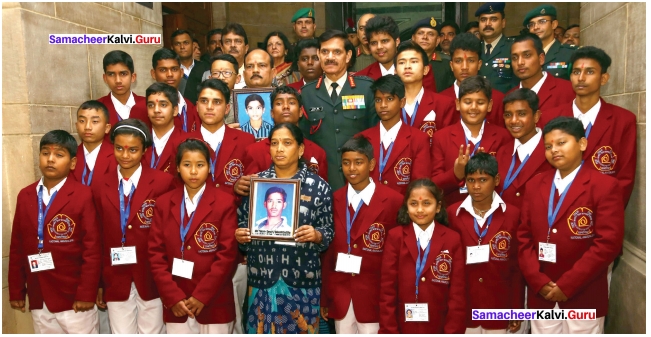
E. Look at the picture. Browse the internet with the help of your teacher to get information about the little brave hearts of India.
Search for similar brave hearts in your locality.
Scan the QR. Download the nomination form for National Bravery Award. Read the instructions and fill the nomination for NBA.
Brave Hearts of India

Samacheer Kalvi 7th English Solutions Term 3 Supplementary Chapter 2 Man Overboard
Answer:
Activity to be done by the students.

Step To Success

F. In each question below, there is a sentence in which some parts have been jumbled up, Rearrange these parts which are labelled P, Q, R and S to produce the correct sentence. Choose the proper sequence.

Question 1.
When he
P : did not know
Q : he was nervous and
R : heard the hue and cry at midnight
S : what to do
(a) RQPS
(b) QSPR
(c) SQPR
(d) PQRS
Answer:
(d) PQRS

Samacheer Kalvi 7th English Solutions Term 3 Supplementary Chapter 2 Man Overboard

Question 2.
They felt safer
P : to watch the mountain
Q : of more than five miles
R : as they settled down
S : from a distance
(a) RPSQ
(b) RSQP
(c) PQRS
(d) PRSQ
Answer:
(b) RSQP

Question 3.
If you need help
P : promptly and politely
Q : ask for attendants
R : to help our customers
S : who have instructions
(a) SQPR
(b) QPSR
(c) QSRP
(d) SQRP
Answer:
(c) QSRP

Question 4.
He knew that
P : and then to save himself
Q : was to save all the lives
R : entrusted to his care
S : the duty of a captain
(a)PQRS
(b) SQRP
(c) SPRQ
(d) QSRP
Answer:
(b) SQRP

Samacheer Kalvi 7th English Solutions Term 3 Supplementary Chapter 2 Man Overboard

Question 5.
With her body
P : dragging her unwilling feet
Q : weak and infirm
R : doubled with age
S : she persisted in her mission
(a) PQRS
(b) QPRS
(c) RQPS
(d) SRPQ
Answer:
(a) PQRS

Man Overboard Additional Questions

I. Choose the Correct Answers (MCQ).

Question 1.
I was _________ to be on board the ship.
(a) bored
(b) sad
(c) thrilled
(d) shocked
Answer:
(c) thrilled

Question 2.
Uncle, I am going back to my parents in _________
(a) London
(b) Malaysia
(c) Australia
(d) Singapore
Answer:
(d) Singapore

Question 3.
I request all of you to keep _________
(a) calm
(b) silent
(c) quiet
(d) Shouting
Answer:
(a) calm

Samacheer Kalvi 7th English Solutions Term 3 Supplementary Chapter 2 Man Overboard

Question 4.
There _________ was everywhere.
(a) sorrow
(b) happiness
(c) energy
(d) Panic
Answer:
(d) Panic

Question 5.
‘A ‘ _________ sea will be the end of me!’
(a) rough
(b) calm
(c) wild
(d) roaring
Answer:
(a) rough

Samacheer Kalvi 7th English Solutions Term 3 Supplementary Chapter 2 Man Overboard

Question 6.
This made my imagination run _________
(a) mad
(b) wild
(c) Strength
(d) deep
Answer:
(b) wild

Question 7.
Even the heavy pianos in the _________ went crashing against the wall
(a) hall
(b) room
(c) lounge
(d) dining room
Answer:
(c) lounge

Question 8.
_________ waves were dashing against the ship
(a) High
(b) Huge
(c) Big
(d) mild
Answer:
(b) Huge

Question 9.
People started crowding the _________
(a) deck
(b) board
(c) kitchen
(d) Lounge
Answer:
(a) deck

Question 10.
I borrowed the captain’s _________
(a) glasses
(b) binoculars
(c) book
(d) gloves
Answer:
(b) binoculars

Samacheer Kalvi 7th English Solutions Term 3 Supplementary Chapter 2 Man Overboard

II. Identify the Character / Speaker.

Question 1.
“What’s your name?”
Answer:
A person on board

Question 2.
“I request all of you to keep calm.”
Answer:
The capital of the ship

Question 3.
“I’ll call you afterwards,”
Answer:
The capital of the ship

Question 4.
“There was a big storm near Gibraltar.”
Answer:
Vasantha class teacher

Question 5.
“Good Morning, Uncle, isn’t it lovely?”
Answer:
Vasantha

Question 6.
“Can I be of any help?”
Answer:
Vasantha

Question 7.
“What’s the matter? Why are you making, so much noise?”
Answer:
The capital of the ship

Samacheer Kalvi 7th English Solutions Term 3 Supplementary Chapter 2 Man Overboard

Question 8.
“You’re hurting me, Sir.”
Vasantha

Question 9.
“Aye, aye, captain.”
Answer:
The Ship’s doctor

Question 10.
Wake up, child. You’re Vasantha, aren’t you?”
Answer:
A sailor

III. Write True or False against each statement.

  1. Vasantha’s class teacher was a Tamilian.
  2. A man was vomiting over the rails of the ship.
  3. The name of the captain was S.S. Rajula.
  4. Vasantha was very much afraid of the storm.
  5. An old lady said that her only son was waiting for her in Singapore

Answer:

  1. False
  2. True
  3. False
  4. False
  5. True

IV. Very Short Questions with Answers.

Question 1.
Who stood on the deck of S.S. Rajula?
Answer:
Vasantha stood on the deck of S.S. Rajula.

Question 2.
Whom did Vasantha wave to?
Answer:
Vasantha waved to her grandparents.

Samacheer Kalvi 7th English Solutions Term 3 Supplementary Chapter 2 Man Overboard

Question 3.
How did Vasantha spend the day in the ship?
Answer:
Vasantha spent the day exploring the ship.

Question 4.
Was Vasantha thrilled about the upcoming storm?
Answer:
Yes, she was thrilled when she got the news about the storm.

Question 5.
Who was Vasantha’s class teacher?
Answer:
Vasantha’s class teacher was an English woman.

Question 6.
Did the storm break in the evening?
Answer:
No, the storm did not break in the evening.

Question 7.
How many life-boats moved towards the man who fell into the sea?
Answer:
Two life – boats moved towards the man who fell into the sea.

Question 8.
How was the captain of the ship watching the rescue operations?
Answer:
The captain was watching the rescue operations through a pair of binoculars.

Samacheer Kalvi 7th English Solutions Term 3 Supplementary Chapter 2 Man Overboard

Question 9.
Who was waiting at the railings for the rescued man?
Answer:
The ship’s doctor, with two nurses, was waiting for the rescued man.

Question 10.
What was inscribed on the model of the ship given as a present to Vasantha?
Answer:
“B.I.S.N. & Co. S.S. RAJULA” was inscribed on the model of the ship.

V. Short Questions with Answers.

Question 1.
What was there inside the ship?
Answer:
There were furnished rooms, a swimming pool, a room for indoor games and a library.

Question 2.
What did the captain of the ship inform the passengers the next day?
Answer:
The captain informed the passengers that they had received a message that a storm was likely to form in the Indian Ocean.

Question 3.
Why did the old lady prayed aloud?
Answer:
An old lady prayed aloud to have mercy on all of them. Her son was waiting for her in Singapore.

Samacheer Kalvi 7th English Solutions Term 3 Supplementary Chapter 2 Man Overboard

Question 4.
What did her class teacher tell her students one day?
Answer:
Her class teacher told them that she was crossing the English channel on her way to Singapore. Then there was a big storm near Gibraltar. Their ship rocked to and fro. Everything in the cabins rolled up and down. Even the heavy pianos went crashing against the walls.

Question 5.
What was the man doing at the railings?
Answer:
The man was almost vomiting over the rails. He looked rather blue about the mouth.

VI. Paragraph Question with Answer.

Question 1.
What was the present given to Vasantha by the captain? How did Vasantha feel about this?
Answer:
The captain gave a big brown box to Vasantha, appreciating her sense of immediate action. She opened the box. On a velvet backing, was a most beautiful model of a ship. On it, was inscribed the letters “B.I.S.N. & Co. S.S. RAJULA.” Vasantha felt very happy. She threw her hands round the captain, hugged and [ kissed him. He patted her cheek and went away. Vasantha proudly showed her present to everyone she met. She was the happiest person on board that day.

VII. Rearrange the fumbled Sentences.

A.
1. The ship slowly moved out of Madras harbour.
2. It was a new experience for me.
3. I was thrilled to be on board a ship.
4. I waved to my grandparents till I could see them no more.
5. I stood on the deck of S. S. Rajula.
Answer:
5. I stood on the deck of S. S. Rajula.
1. The ship slowly moved out of Madras harbour.
4. I waved to my grandparents till I could see them no more.
3. I was thrilled to be on board a ship.
2. It was a new experience for me.

Samacheer Kalvi 7th English Solutions Term 3 Supplementary Chapter 2 Man Overboard

B.
1. Huge waves were dashing against it.
2. The storm didn’t break. .
3. Even though the deck was slippery, I was running around.
4. But in the evening, a strong wind started blowing.
5. The ship rocked to and fro, rocking and rolling to the music of the wind.
Answer:
2. The storm didn’t break.
4. But in the evening, a strong wind started blowing.
5. The ship rocked to and fro, rocking and rolling to the music of the wind.
1. Huge waves were dashing against it.
3. Even though the deck was slippery, I was running around.

C.
1. The crew in the rescue boats threw a strong rope to the two sailors in the sea and shouted ‘catch’.
2. I borrowed the captain’s binoculars.
3. Then, with powerful strokes, they swam towards uncle.
4. Both of them were good swimmers and soon had caught hold of the rope.
5. Now I could see the rescue operation clearly.
Answer:
2. I borrowed the captain’s binoculars.
5. Now I could see the rescue operation clearly.
1. The crew in the rescue boats threw a strong rope to the two sailors in the sea and , shouted’catch’.
4. Both of them were good swimmers and soon had caught hold of the rope.
3. Then, with powerful strokes, they swam towards uncle.

VIII. Read the passage and answer the questions.

A.
The next morning the passengers were seated in the dining hall, having breakfast. The loudspeaker spluttered noisily and then the captain’s voice came loud and clear. “Friends we have just received a message that a storm is brewing in the Indian Ocean.

Question 1.
Where were the passengers seated?
Answer:
There were seated in the dining room.

Question 2.
What splattered noisily?
Answer:
The loudspeaker splattered noisily.

Question 3.
Where was the storm brewing?
Answer:
The storm was brewing in the Indian Ocean.

Samacheer Kalvi 7th English Solutions Term 3 Supplementary Chapter 2 Man Overboard

B.
When he turned away, I quietly sneaked into the hospital room to see what they were doing to the patient. Two nurses were hurrying to and fro with trays full of medicines and syringes. Another was rushing off with Uncles wet clothes.

Question 1.
Who sneaked into the hospital?
Answer:
Vasantha sneaked into the hospital?

Question 2.
How many nurses were helping the doctor?
Answer:
Three nurses were helping the doctor.

Question 3.
What did two nurses carry with them?
Answer:
They were carrying trays full of medicines and syringes.

Samacheer Kalvi 7th English Solutions Term 3 Supplementary Chapter 2 Man Overboard

C.
I followed the officer eagerly. He left me outside the captains door, saying, “Go right inside.” I knocked and entered. The captain was standing in the middle of the room. When he saw me, he came forward and literally swept me off my feet. He was still smiling when he put me down.

Question 1.
What did Vasantha do?
Answer:
She followed the officer eagerly.

Question 2.
Where was the captain standing?
Answer:
The captain was standing in the middle of the room.

Question 3.
What did the captain do, when he saw her?
Answer:
When he saw her, he came forward and literally swept her off her feet.

Man Overboard Summary

Vasantha was on board a ship called ‘S.S. Rajula’. She was travelling to Singapore, after
her stay with her grandparents. She spent the day exploring the ship. It looked like a big house. sdThere were furnished rooms, and swimming pool, a room for indoor games and a library. The | next day morning, the captain announced that they had received a message about a storm in the Indian Ocean. Most of the adults panicked. But Vasantha was excited about it. She remembered 1 her class teacher telling them in class about a big storm. The teacher was on her way to Singapore.
Due to the storm, the ship rocked to and fro. Everything in the cabins rolled up and down. This 1 incident, which was told by her class teacher, made her imagination run wild. She thought it would; be fun, if the storm broke when they had lunch. It would be a merry-go-round to all of them sitting on the chairs.

In the evening, a strong wind started blowing. The ship rocked to and fro. Huge waves were dashing against it. She noticed a man vomiting over the rails and looked rather blue about the mouth. A huge wave lashed the ship and the man tumbled over the railings into the wild sea. Vasantha shouted to save him. The captain heard this and sent the rescue team officers to save the man. Two life-boats moved towards the man. The captain was watching the rescue operation through a pair of binoculars. Vasantha could not see what was happening, as the boat was too far for her. But the captain was giving a running commentary to Vasantha.

The ship had dropped the anchor but was rising up and down. The two sailors caught hold of a rope. One of them tied the rope around his waist. With the man between them, the sailors swam back to the life-boats. The boat headed back to the ship. The ship’s doctor was ready at the railings with two nurses and a stretcher. The man was given immediate attention to improve his condition. A nurse told Vasantha that he was saved and would regain consciousness after a few minutes. The capt ain called Vasantha to his cabin and gifted her with a beautiful model of a ship. On it was inscribed “B.I.S.N. & Co. S.S. RAJULA.” She felt happy. She hugged and kissed the captain. She proudly showed the present to everyone. She was the happiest person on board that day.

Samacheer Kalvi 8th English Solutions Term 3 Play Chapter 1 Jack and the Beanstalk

Students can Download English Lesson 1 Jack and the Beanstalk Questions and Answers, Summary, Activity, Notes, Samacheer Kalvi 8th English Book Solutions Guide Pdf helps you to revise the complete Tamilnadu State Board New Syllabus and score more marks in your examinations.

Tamilnadu Samacheer Kalvi 8th English Solutions Term 3 Play Chapter 1 Jack and the Beanstalk

Textual Questions

A. True or false.

  1. The magic beans grew into a huge beanstalk.
  2. The beanstalk reached high into the sky in the evening.
  3. Everything is so big in the castle.
  4. The hen laid a perfect iron egg.
  5. Jack picked up the Giant’s hen.

Answer:

  1. True
  2. True
  3. True
  4. False
  5. True

B. Fill in the blanks.

  1. The Giant smells the blood of an __________
  2. Jack asked his mom for an __________
  3. Jack chopped down the __________
  4. As soon as the giant was full, he fell fast __________

Answer:

  1. Englishman
  2. axe
  3. beanstalk
  4. asleep

C. Answer the following questions.

Question 1.
Why was Jack’s mother angry?
Answer:
Jack’s mother was angry because she thought he was foolish in getting five magic beans for their cow.

Samacheer Kalvi 8th English Solutions Term 3 Play Chapter 1 Jack and the Beanstalk

Question 2.
Why was Jack surprised when reaching the sky?
Answer:
The wild beanstalk, that grew sky high and huge, surprised Jack

Question 3.
What did Jack find when he reached the top?
Answer:
Jack found a huge castle when he reached the top of the beanstalk.

Question 4.
What did Jack see in the castle?
Answer:
Jack saw a giant in the castle. Everything was so big in the castle.

Question 5.
What did the Giant eat for meal?
Answer:
The giant ate five sheep for his meal. He also had a golden egg from a hen.

Question 6.
Where did Jack hide when he saw the Giant?
Answer:
Jack hid himself in a cupboard.

Question 7.
What did Jack intend to take when the Giant asleep?
Answer:
Jack intended to take away the hen that laid a golden egg, when the giant was asleep.

Question 8.
What did the hen do when Jack picked it up?
Answer:
The hen squawked and tried to fly when jack picked it up.

Samacheer Kalvi 8th English Solutions Term 3 Play Chapter 1 Jack and the Beanstalk

Question 9.
What did Jack do when the Giant woke up?
Answer:
Jack hurried and climbed down the beanstalk as fast as he could, when the giant woke up.

Question 10.
Why did Jack ask for an axe?
Answer:
Jack asked for an axe to cut down the beanstalk, on which the giant was climbing down.

Jack and the Beanstalk Additional Questions

I. Choose the correct Synonyms for the Italicized words :

Question 1.
He was so excited to tell his mother about the old man.
(a) happy
(b) enthusiastic
(c) unhappy
(d) calm
Answer:
(b) enthusiastic

Question 2.
Mom they will make us rich! Trust me.
(a) believe
(b) obey
(c) society
(d) know
Answer:
(a) believe

Question 3.
Jack’s mother was very cross.
(a) happy
(b) sad
(c) angry
(d) dull
Answer:
(c) angry

Samacheer Kalvi 8th English Solutions Term 3 Play Chapter 1 Jack and the Beanstalk

Question 4.
Whispering to himself.
(a) shouting
(b) yelling
(c) speaking
(d) muttering
Answer:
(d) muttering

Question 5.
Scared what is that noise?
(a) bold
(b) fearless
(c) calm
(d) afraid
Answer:
(d) afraid

Question 6.
It’s amazing.
(a) cool
(b) far
(c) wonderful
(d) unknown
Answer:
(c) wonderful

Question 7.
But the hen began to squawk.
(a) make a noise
(b) sit
(c) fly
(d) peck
Answer:
(a) make a noise

Question 8.
I have to chop this beanstalk,
(a) pluck
(b) pull
(c) push
(d) cut down
Answer:
(d) cut down

Samacheer Kalvi 8th English Solutions Term 3 Play Chapter 1 Jack and the Beanstalk

Question 9.
The giant fell to the ground with a thud.
(a) softly
(b) harshly
(c) heairly
(d) lightly
Answer:
(c) heairly

Question 10.
Giant: Yelling I’ll get you!
(a) stillness
(c) heavy sound
(b) muteness
(d) secrecy
Answer:
(c) heavy sound

II. Choose the correct antonyms for the Italicized words.

Question 1.
Jack and his mother were very poor.
(a) penniless
(b) poverty
(c) good
(d) rich
Answer:
(d) rich

Samacheer Kalvi 8th English Solutions Term 3 Play Chapter 1 Jack and the Beanstalk

Question 2.
He lived in a small cottage.
(a) little
(b) tiny
(c) few
(d) big
Answer:
(d) big

Question 3.
So, I think we have to sell the cow.
(a) give
(b) offer
(c) send
(d) buy
Answer:
(d) buy

Question 4.
Be careful, Jack!
(a) hold
(b) live
(c) protect
(d) careless
Answer:
(d) careless

Question 5.
Jack met a little old man.
(a) new
(b) aged
(c) poor
(d) young
Answer:
(d) young

Question 6.
He wanted to make his mother happy.
(a) cheerful
(b) safe
(c) unsafe
(d) un happy
Answer:
(d) un happy

Samacheer Kalvi 8th English Solutions Term 3 Play Chapter 1 Jack and the Beanstalk

Question 7.
He was so existed to tell his mother.
(a) powerful
(b) calm
(c) short
(d) shockd
Answer:
(b) calm

Question 8.
What? you foolish boy!
(a) wise
(b) stupid
(c) careless
(d) play ful
Answer:
(a) wise

Question 9.
These beans are useless.
(a) fine
(b) great
(c) useful
(d) wall
Answer:
(c) useful

Question 10.
Jacks mother was very cross.
(a) fine
(b) pleasant
(c) rough
(d) angry
Answer:
(b) pleasant

III. Choose the right answer (MCQ) :

Question 1.
Jack and his mother had a _____
(a) horse
(b) cow
(c) dog
(d) cat
Answer:
(b) cow

Samacheer Kalvi 8th English Solutions Term 3 Play Chapter 1 Jack and the Beanstalk

Question 2.
Jack saw an
(a) young
(b) rich
(c) poor
(d) old
Answer:
(d) old

Question 3.
Mother was on seeing the magic beans.
(a) happy
(b) cheerful
(c) sad
(d) angry
Answer:
(d) angry

Question 4.
The beans grew into a beanstalk.
(a) tiny
(b) long
(c) big
(d) huge
Answer:
(d) huge

Question 5.
On climbing the beanstalk Jack saw a
(a) hut
(b) house
(c) building
(d) castle
Answer:
(d) castle

Samacheer Kalvi 8th English Solutions Term 3 Play Chapter 1 Jack and the Beanstalk

Question 6.
The giant ate sheep for a meal.
(a) one
(b) two
(c) six
(d) five
Answer:
(d) five

Question 7.
The giant had a hen that laid a egg
(a) silver
(b) normal
(c) golden
(d) iron
Answer:
(c) golden

Question 8.
Jack asked for an.
(a) knife
(b) scissors
(c) sword
(d) axe
Answer:
(d) axe

Question 9.
Jack hid in a to see the giant eat.
(a) beanstalk
(b) cupboard
(c) tree
(d) wall

Question 10.
During the the magic beans grew into a huge beanstalk.
(a) day
(b) noon
(c) evening
(d) night
Answer:
(d) night

IV. True or false.

  1. Jack sold the cow for a high price in the market.
  2. Mother was very happy to see the magic beans.
  3. Jack cut down the beanstalk.
  4. Jack and his mother had a goat.
  5. The giant ate four sheep for his meal.

Answer:

  1. False
  2. False
  3. True
  4. False
  5. False

V. Fill in the blanks.

  1. Jack and his mother were __________
  2. Jacks mother asked him to sell the __________
  3. The old man gave Jack __________ magic beans.
  4. Jack’s mother __________ the magic beans out of the window.
  5. Jack __________ the beanstalk when the giant climbed down.

Answer:

  1. poor
  2. cow
  3. five
  4. threw
  5. cut down

VI. Identify the character :

  1. “I would like to buy the cow from you”
  2. “Magic beans? Mmm”
  3. What? oh, you foolish boy!
  4. Wow! This beanstalk is huge!
  5. Fee, fi, fo, fum, I smell the blood of an Englishman.

Answer:

  1. Old man
  2. Jack
  3. Mother
  4. Jack
  5. giant

VII. Short Questions and Answers :

Question 1.
Why did Jack’s mother want to sell the cow?
Answer:
Jacks mother wanted to sell the cow because they were very poor and needed some money to live.

Question 2.
Whom did Jack see when he took cow to the market?
Answer:
Jack saw a little old man who offered five magic beans for his cow.

Samacheer Kalvi 8th English Solutions Term 3 Play Chapter 1 Jack and the Beanstalk

Question 3.
What did Jack’s mother do with the magic beans?
Answer:
Jack’s mother was very angry and threw the beans through the window.

Question 4.
What did the giant smell?
Answer:
The Giant smelt the blood of an Englishman.

Question 5.
What happened to the Giant when Jack cut down thfe beanstalk?
Answer:
The Giant, who climbed down the beanstalk to catch hold of Jack, fell down and died.

Question 6.
What did the hen do?
Answer:
The hen laid a golden egg everyday and Jack and his mother were not poor anymore.

Question 7.
Why were they called “Magic beans”?
Answer:
They were called “Magic beans” because they grew into a huge beanstalk over night. The beanstalk reached high into the sky.

VIII. Paragraph Questions and Answers :

Question 1.
What happened when Jack went to sell the cow in the market?
Answer:
When Jack went to sell the cow in the market, he met an old man on the way. The old man was willing to buy the cow. He offered five magic beans to Jack, in exchange for the cow. He told Jack that he would become rich with the magic beans. So, Jack got the five magic beans for his cow and returned home happily.

Samacheer Kalvi 8th English Solutions Term 3 Play Chapter 1 Jack and the Beanstalk

Question 2.
What happened to the magic beans?
Answer:
When Jack arrived at his home without any money, his mother was very angry at his foolishness. She threw away the five magic beans out of the window. During the night, the magic beans grew into a huge beanstalk. It reached high into the sky. Jack climbed on it. When he reached the top, he found a Giant was living in a huge castle.

Question 3.
What did the giant do? What happened to the giant at the end?
Answer:
Jack saw a giant in the huge castle. The giant ate five sheep. He had a hen which laid a golden egg every day. When the giant was asleep, Jack took the hen. The hen made a noise. The giant woke up and chased Jack. Jack climbed down the beanstalk quickly. He asked his mother for an axe. He cut down the beanstalk before the giant reached the ground. The giant fell to the ground and died. Jack and his mother lived happily ever after with the riches.

IX. Comprehension passage:

Read the passage and Answer the questions below.

Smelling human blood the giant woke up. Jack ran back to the beanstalk and climbed down quickly. When he reached the bottom he went to his mother to ask for an axe. Jack chopped the huge beanstalk on which the giant had also climbed down to catch him. When the beanstalk was chopped, the giant fell with a thud. His end came. Jack’s mother was surprised to see the giant. Jack took the hen home and it laid a golden egg everyday. Jack and his mother never saw poverty again.

Question 1.
What smell did the giant get?
Answer:
The giant smelt human blood.

Question 2.
What did Jack ask his mother for?
Answer:
Jack asked his mother for an axe.

Question 3.
What happened to the beanstalk?
Answer:
Jack cut down the beanstalk with an axe.

Samacheer Kalvi 8th English Solutions Term 3 Play Chapter 1 Jack and the Beanstalk

Question 4.
What happened to the giant?
Answer:
The giant who climbed down the beanstalk fell down writh a thud and died.

Question 5.
Hoe did Jack and his mother become rich?
Answer:
Jack took the hen home. It laid a golden egg everyday. Jack and his mother never saw – poverty again.

X. Rearrange the jumbled sentences :

Question A.
1. So Jack took the magic beans.
2. The old man offered five magic beans.
3. The mother asked Jack to sell the cow in the market. He and his mother were poor.
4. Once upon a time there was a boy named Jack.
Answer:
5. Once upon a time there was a boy named Jack.
4. He and his mother were poor.
3. The mother asked Jack to sell the cow in the market.
2. The old man offered five magic beans.

Samacheer Kalvi 8th English Solutions Term 3 Play Chapter 1 Jack and the Beanstalk

Question B.
1. He saw a huge castle.
2. Jack climbed on the wild beanstalk.
3. Jacks mother was very angry.
4. During the night the beans grew into a wild beanstalk.
5. She threw the beans out of the window.
Answer:
3. Jack’s mother was very angry.
5. She threw the beans out of the window.
4. During the night the beans grew into a wild beanstalk.
2. Jack climbed on the wild beanstalk.
1. He saw a huge castle.

Grammar

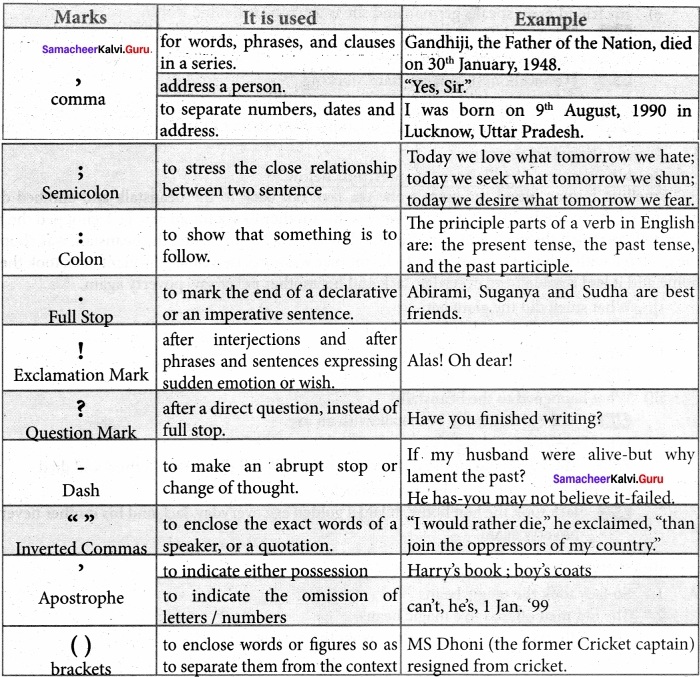
Punctuation

Samacheer Kalvi 8th English Solutions Term 3 Play Chapter 1 Jack and the Beanstalk

If a sentence is not properly punctuated, the meaning will be changed.
For Example :

(a) “Let’s eat Grandpa!”
(b) “Let’s eat, Grandpa!”

(a) “A woman, without her man, is nothing
(b) “A woman: without her, man would be nothing”

(a) “I love baking my family and my friends”
(b) “I love baking, my family, and my friends”

(a) Kill him, not leave him
(b) Kill him not, leave him

A. Punctuate the following sentence.

(a) i like playing with my friends sandy sunny sameer.
Answer:
I like playing with my friends – Sandy, Sunny, Sameer

Samacheer Kalvi 8th English Solutions Term 3 Play Chapter 1 Jack and the Beanstalk

(b) we went through the smoky mountains, near shimla on our way to leh
Answer:
We went through the smoky mountains, near Shimla on our way to Leh

(c) my favourite soap is pears and my favourite toothpaste is pepsodent
Answer:
My favourite soap is Pears and my favourite toothpaste is Pepsodent

(d) friend priya speaks german and she is teaching me some words
Answer:
My friend Priya speaks German and she is teaching me some words

(e) he was honest sincere hard working
Answer:
He was honest, sincere, hard working;

(f) hindus muslims sikhs Christians live together in India
Answer:
Hindus, Muslims, Sikhs, Christians live together in India

(g) long ago in a town in Switzerland there lived a famous man called william
Answer:
Long ago in a town in Switzerland there lived a famous man called William.

(h) akbar the greatest of the mughal emperors ruled wisely
Answer:
Akbar the greatest of the Mughal Emperors ruled wisely.

(i) tanya said to ilarahul is a nice guy
Answer:
Tanya said to Nila, “Rahul is a nice guy.”

Samacheer Kalvi 8th English Solutions Term 3 Play Chapter 1 Jack and the Beanstalk

B. Write the correct punctuation mark from above that best completes each sentence.
Example 1.
Congratulations_____You graduated with honors
Answer:
Congratulations! You graduated with honors!

Question 1.
Where is an exciting place to visit_____
Answer:
Where is an exciting place to visit?

Question 2.
Make sure to complete all your homework on time_____
Answer:
Make sure to complete all your homework on time.

Samacheer Kalvi 8th English Solutions Term 3 Play Chapter 1 Jack and the Beanstalk

Question 3.
Priya asked when are we going on a vacation _____
Answer:
Priya asked, “When are we going on a vacation?”

Question 4.
Terry Sam and Jeremy went to the movies together _____
Answer:
Terry, Sam and Jeremy went to the movies together.

Question 5.
Wow _____ What a wonderful event
Answer:
Wow! What a wonderful event!

Question 6.
I am so excited to see my family for Christmas _____
Answer:
I am so excited to see my family for Christmas!

Question 7.
what day of the week is your favorite _____
Answer:
What day of the week is your favorite?

Question 8.
You need to do your homework right after dinner _____
Answer:
You need to do your homework right after dinner.

Question 9.
Please take out the trash when you get home _____
Answer:
Please take out the trash when you get home.

Question 10.
My favorite team won the game _____
Answer:
My favorite team won the game.

Question 11.
What did you want to eat for lunch _____
Answer:
What did you want to eat for lunch?

Samacheer Kalvi 8th English Solutions Term 3 Play Chapter 1 Jack and the Beanstalk

Question 12.
I had a great time at your party _____
Answer:
I had a great time at your party.

Question 13.
Do you know what time it is _____
Answer:
Will Do you know what time it is? .

Question 14.
How do we get to the amusement park _____
Answer:
How do we get to the amusement park?

Question 15.
I cant wait to go on summer vacation _____
Answer:
I cant wait to go on summer vacation.

Question 16.
What is your favorite food _____
Answer:
What is your favorite food?

Question 17.
You need to take out the trash when you get home _____
Answer:
You need to take out the trash when you get home.

Question 18.
Please hand me my backpack _____
Answer:
Please hand me my backpack.

Jack and the Beanstalk Grammar Additional

Punctuation

I. Punctuate the following sentences.

Question 1.
ramu asked his father can i go for a tour with my friends.
Answer:
Ramu asked his father, “Can I go for a tour with my friends?”

Question 2.
hari is an old man
Answer:
Hari is an old man

Question 3.
the women said how heavy the basket is
Answer:
The woman said ‘‘How heavy the basket is?”

Question 4.
Chennai bombay and kolkata are some of the major cities in india
Answer:
Chennai, Bombay and Kolkata are some of the major cities is India.

Question 5.
all indians are my brothers and sisters
Answer:
All Indians are my brothers and sisters

Question 6.
the doctor said how old are you
Answer:
The doctor said “How old are you?”

Question 7.
why are you late said the teacher
Answer:
“Why are you late?” said the teacher.

Question 8.
india has a great heritage
Answer:
India has a great heritage.

Samacheer Kalvi 8th English Solutions Term 3 Play Chapter 1 Jack and the Beanstalk

Question 9.
my uncle works for the world health organization
Answer:
My uncle works for the World Health Organization.

Question 10.
dont touch the teapot said my mother.
Answer:
“Don’t touch the teapot!” said my mother.

II. Write the correct punctuation mark from above that best completes each sentence.

Question 1.
i am not well today
Answer:
I am not well today.

Question 2.
What a surprise ______
Answer:
What a surprise!

Question 3.
How did you bring it _______
Answer:
How did you bring it?

Question 4.
Can you solve the problem ______
Answer:
Can you solve the problem?

Samacheer Kalvi 8th English Solutions Term 3 Play Chapter 1 Jack and the Beanstalk

Question 5.
What a brilliant idea
Answer:
What a brilliant idea!

Question 6.
alas we lotst the match
Answer:
Alas! we lost the match!

Question 7.
How dare you call me a fool
Answer:
How dare you call me a fool!

Question 8.
How are you new
Answer:
How are you now?

Question 9.
My brother said the shops are closed
Answer:
My brother said, “The shops are closed

Question 10.
hurrah we have won the rolling up
Answer:
Hurrah! we have won the Rolling Cup!

Jack and the Beanstalk Summary

Section – I

At Home

Once upon a time, there was a boy named Jack, who lived with his mother. They were very poor. One day Jack’s mother asked him to sell their cow in the market. Jack took the cow for selling it. On the way, he met an old man who was willing to offer magic beans for his cow. He also told Jack that the magic beans would make him rich. So Jack took the magic beans home. His mother found him to be too foolish and threw the magic beans away through the window.

Samacheer Kalvi 8th English Solutions Term 3 Play Chapter 1 Jack and the Beanstalk

Section – II

The Ground & In The Castle

During the night, the beans grew into a very big beanstalk. Jack was surprised to see it sky high, he climbed to its top and found a huge castle and found everything to be big there. He realized that a giant there. He ate five sheep for a meal and had a hen that laid a golden egg everyday. Jack felt that he and his mother would become rich if they had the hen.

Section – III

In The Castle & At Home

Jack waited for the giant to fall asleep and quickly picked up the hen that laid golden eggs. But the hen squawked. The giant woke up. He smelled the blood of a human, he chased Jack. Jack ran back to the beanstalk and climbed down quickly. When he reached the bottom, he went to his mother to ask for an axe. Jack chopped the huge beanstalk on which the giant had also climbed to catch Jack. When the beanstalk fell the gaints end came, as he fell down. Mother was surprised to see the giant. Jack took the hen home and it laid a golden egg a day. This made Jack and his mother rich and happy.

Samacheer Kalvi 8th Social Science Civics Solutions Term 3 Chapter 2 The Judiciary

Students can Download Social Science Civics Term 3 Chapter 2 The Judiciary Questions and Answers, Notes Pdf, Samacheer Kalvi 8th Social Science Book Solutions Guide Pdf helps you to revise the complete Tamilnadu State Board New Syllabus and score more marks in your examinations.

Tamilnadu Samacheer Kalvi 8th Social Science Civics Solutions Term 3 Chapter 2 The Judiciary

Samacheer Kalvi 8th Social Science Civics The Judiciary Textual Evaluation

SamacheerKalvi.Guru

I. Choose the best answer:

Question 1.
The highest and final judicial tribunal of India is-
(a) President
(b) Parliament
(c) Supreme Court
(d) Prime Minister
Answer:
(c) Supreme Court

Question 2.
Judicial system provides a mechanism for resolving disputes between-
(a) Citizen
(b) Citizen and the government
(c) Two State governments
(d) all the above
Answer:
(d) all the above

Question 3.
Dispute between States of India comes to the Supreme Court under-
(a) Original jurisdiction
(b) Appellate jurisdiction
(c) Advisory jurisdiction
(d) none of these
Answer:
(a) Original jurisdiction

SamacheerKalvi.Guru

Question 4.
Which of the following state/ Union territories have a common High Court?
(a) Punjab and Jammu Kashmir
(b) Assam and Bengal
(c) Panjab, Haryana and Chandigarh
(d) Uttar Pradesh and Bihar
Answer:
(c) Panjab, Haryana and Chandigarh

Question 5.
The System of Public Interest Litigation has been introduced in India by-
(a) Supreme Court
(b) Parliament
(c) Political parties
(d) Constitutional amendments
Answer:
(a) Supreme Court

SamacheerKalvi.Guru

Question 6.
How many courts are there in apex level in India?
(a) One
(b) Two
(c) Three
(d) Four
Ans:
(a) One

Question 7.
Supreme court is located at-
(a) Chandigarh
(b) Bombay
(c) Calcutta
(d) New Delhi
Answer:
(d) New Delhi

Question 8.
FIR means-
(a) First Information Report
(b) First information Result
(c) First Incident Report
(d) None of these
Answer:
(a) First Information Report

Question 9.
The court that hear criminal cases are called-
(a) District court
(b) Sessions court
(c) Family court
(d) Revenue court
Answer:
(b) Sessions court

SamacheerKalvi.Guru

II. Fill in the Blanks:

  1. The ________High Court is the oldest High Court in India.
  2. The framers of the Constitution established ________and _______ judiciary in India.
  3. _______ a famous French philosopher propounded the idea of an independent judiciary.
  4. ________ deals with disputes over money, property and social matters.
  5. During ancient times, most of the Kings’ courts dispensed justice according to _______

Answer:

  1. Calcutta
  2. independent, impartial
  3. Montesquieu
  4. Civil Law
  5. Dharmal

III. Match the following:

  1. Supreme Court – social duties
  2. High Court – speedy justice
  3. Lok Adalat – highest court of appeal
  4. Sir Elijah Impey – highest court in the States
  5. Smiritis – chief justice

Answer:

  1. Supreme Court – highest court of appeal
  2. High Court – highest court in the States
  3. Lok Adalat – speedy justice
  4. Sir Elijah Impey – chief justice
  5. Smiritis – social duties

SamacheerKalvi.Guru

IV. State True or False:

  1. The Supreme Court of India was inaugurated on 28th January 1951.
  2. During the Tughlaq period, the code of procedure was written in Arabic.
  3. The Regulating Act of 1773 made provision for the formation of Supreme Court.
  4. Sadar Diwani Adalat was a Criminal court of appeal.
  5. The Allahabad High Court is the largest court in India.
  6. The Constitution of India secures justice to all its citizen.

Answer:

  1. False
  2. True
  3. True
  4. False
  5. True
  6. True

V. Choose the correct statement:

Question 1.
Consider the following statements.

(i) A law commission was setup by Macaulay.
(ii) It codified the Indian Laws.

Which of the statements given above is / are correct?
(a) (i) only
(b) (ii) only
(c) Both (i) and (ii)
(d) Neither (i) nor (ii)
Answer:
(c) Both (i) and (ii)

SamacheerKalvi.Guru

Question 2.
Consider the following statements.

(i) An Indian Penal Code was prepared in 1860.
(ii) The Calcutta High Court was established in 1862.
(iii) The Government of India Act, 1935 created Federal Court.

Which of the statements given above is/are correct?
(a) (i) only
(b) (ii), (iii) only
(c) (i),(iii) only
(d) All the above
Answer:
(d) All the above

Question 3.
Which of the following statement is not true about India’s Supreme Court?
(i) The Supreme Court of India is the highest court of the land.
(ii) It was established by part V under Chapter IV of Indian Constitution.
(iii) Supreme court cannot transfer cases from one High court to another
(iv) Its decisions are binding on all courts
(a) (i)
(b) (ii)
(c) (iii)
(d) (iv)
Answer:
(c) iii

SamacheerKalvi.Guru

Question 4.
Assertion (A): The Supreme Court is a Court of Record.
Reason (R): It maintains records of the court proceedings and its decisions are finding upon the lower courts.
(a) A is correct and R is wrong.
(b) Both A and R are Wrong
(c) A is correct and R explains A
(d) A is correct and R does not explain A
Answer:
(c) A is correct and R explains A

Question 5.
Agree or disagree
(a) Every citizen of India can approach the Supreme court.
(b) Rich and powerful people control the judiciary system.
(c) Every citizen has a right to get justice through the courts.
(d) Politicians can not control over judges
Answer:
We agree with a, c, and d. Disagree with b

SamacheerKalvi.Guru

VI. Answer the following in one or two sentences:

Question 1.
Why do we need judicial system?
Answer:

  1. Judiciary plays an important role as an organ of the government.
  2. It administers justice, settles disputes, interprets laws, protects fundamental rights and acts as guardian of the Constitution.
  3. So we need a judiciary to be efficient in order to ensure proper justice.

Question 2.
What are the different levels of courts in India?
Answer:
The different levels of courts in India are

  1. Subordinate Courts.
  2. District Courts.
  3. High Court and
  4. Supreme Court

Question 3.
Differentiate Law and Judiciary.
Answer:
Law:
It is a system of rules imposed through a government or institution to govern people.

Judiciary:
In law, the Judiciary or Judicial system is the system of courts which administers Justice in the name of the State.

Question 4.
Write a note on Lok Adalat.
Answer:

  1. Lok Adalat was set up to provide speedy justice.
  2. It hears and settles the disputes in the language of the people in the public presence.
  3. A Lok Adalat is presided over by a retired judge along with a lawyer and a social worker.
  4. Cases are put forward without advocates.
  5. The first Lok Adalat was held on 1982 at Junagadh of Gujarat.

SamacheerKalvi.Guru

Question 5.
What are the advantages of mobile courts?
Answer:

  1. Mobile courts will be of great relief to the rural people.
  2. It would create greater awareness about the judicial system among the rural masses, cut costs for them and render justice at their doorstep.

VII. Answer the following in detail:

Question 1.
Write about the role of judiciary.
Answer:
Role of Judiciaiy can be classified as,
1. Dispute Resolution:
Role of Judiciary can be classified as, The Judicial system provides a mechanism for resolving disputes between Citizen, Citizens and the government, Two State governments,the Centre and the State governments

2. Judicial Review:
The Judicial has the power to declare a law unconstitutional if it believes that the law passed by the Parliament is violating the basic structure of the Constitution.

3. Upholding the Law and Enforcing Fundamental Rights:
Every citizen of India can approach the Supreme Court or High Court if they believe that their fundamental rights have been violated

SamacheerKalvi.Guru

Question 2.
Differentiate Civil Law and Criminal Law.
Answer:
Civil Law:

  1. It deals with disputes over money property and social matters.
    Eg. Disputes relating to land, rent, marriage dispute etc.,
  2. A petition has to be filed before the relevant court by the affected parties.
  3. Sentences awarded in the form of money remuneration and as per the petitioner’s claim.

Criminal Law:

  1. It deals with conducts or acts that the law defines as offences.
    Eg. Theft, murder, women harassment etc.,
  2. It usually begins with lodging of an FIR (First Information Report) with police investigation after which a case is filed in the court.
  3. Punishment is awarded if proven guilty, the accused is sent to jail.

SamacheerKalvi.Guru

Question 3.
Descrbe jurisdiction of Suppreme Court.
Answer:
1. Jurisdiction of Supreme Court:

  • The Supreme Court can hear dispute for the first time in that court only.
  • It is mainly concerned disputes between the Union and one or more states and between two or more states.

2. Appellate Jurisdiction:
It can hear appeals against the decisions made by the High Court on the granting of certificate by the High Court.

3. Advisory Jurisdiction: The Court can report to the President its opinion about a question of the public importance referred to it by the President.

4. Writs Jurisdiction:
The Writs are issued by the Supreme Court under Article 32 and by the High Courts under Article 226 of the Constitution of India.

5. Court of Record:
it maintains records of the court proceedings and its decisions are finding upon the lower courts.

6. Special Powers:
it supervises the functioning of the lower courts.

SamacheerKalvi.Guru

VIII. Project and Activity:

Question 1.
Discuss: Is it necessary to have an independent judiciary? List two reasons.
Answer:
Activity to be done by the students themselves

Question 2.
Organize your classroom for a lockup courtroom session. (Take a case with the help of the teacher)
Answer:
Activity to be done by the students themselves

Samacheer Kalvi 8th Social Science Civics The Judiciary Additional Questions

I. Choose the correct answer:

Question 1.
Supreme Court administers ………….
(a) justice
(b) settles disputes
(c) protects fundamental rights
(d) all of the abovel
Answer:
(d) all of the above

SamacheerKalvi.Guru

Question 2.
Fatawa – i – Alamgiri written in ………….
(a) 1670
(b) 1680
(c) 1660
(d) 1690
Answer:
(a) 1670

Question 3.
The East India Company established a Mayor’s Court in ………….
(a) Madras
(b) Bombay
(c) Calcutta
(d) All of the above
Answer:
(d) All of the above

Question 4.
Circuit Court was set up at ………….
(a) Calcutta
(b) Patna
(c) Dacca
(d) All of the above
Answer:
(d) All of the above

Question 5.
The cases dealing with land records are dealt with by ………….
(a) Sessions Court
(b) Panchayat Courts
(c) Revenue Courts
(d) LokAdalat
Answer:
(c) Revenue Courts

Question 6.
Fast Track courts were established in the year ………….
(a) 2000
(b) 1950
(c) 2010
(d) 1999
Answer:
(a) 2000Tele Law service is for the people in

SamacheerKalvi.Guru

Question 7.
Tele Law service is for the people in ………. areas.
(a) industrial
(b) rural
(c) Urban
(d) Coastal
Answer:
(b) rural

Question 8.
In 2005 these courts were established ………….
(a) Mobile courts
(b) Family Courts
(c) E – courts
(d) None of the above
Answer:
(c) E – courts

II. Fill In the blanks:

  1. In ancient period Dharmic laws governed not only the individual but also the ………….
  2. Amongst the Vajjis, there was a board of …………. Kulikas for the investigation of criminalcases.
  3. A under the British a supreme court was established in 1824 in ………….
  4. During the period of …………. four circuit courts were abolished.
  5. The founding fathers of India constitution accorded highest place to ………….
  6. Montesquieu was a …………. philosopher.
  7. District courts hear …………. at the district level.
  8. A Lok Adalat is presided over by a …………. along with a lawyer and a social worker.
  9. The first Lok Adalat was held on 1982 at …………. of Gujarat.
  10. The legal services authorities was passed in ………….
  11. The special power of the Supreme Court is to supervises the functioning of the ………….
  12. The Chief architect of the Indian constitution is …………..

Answer:

  1. Society
  2. eight
  3. Bombay
  4. William Bentinck
  5. Justice
  6. French
  7. civil cases
  8. retired judge
  9. Junagadh
  10. 1987
  11. lower courts
  12. Dr. B.R. Ambedkar

SamacheerKalvi.Guru

III. Match the following:

  1. Ancient India – (a) Murshidabad
  2. Fort William – (b) Law Commission
  3. Circuit Court – (c) Weaker Sections
  4. Macaulay – (d) Smiritis
  5. NALSA – (e) Calcutta

Answer:

  1. d
  2. e
  3. a
  4. b
  5. c

SamacheerKalvi.Guru

IV. State True or False:

  1. Appeal proceeded from Gana Courts to Kula Courts
  2. A supreme Court was established in Madras in 1801
  3. Lord Cornwallis reorganised the civil and criminal judicial system.
  4. Supreme Court can not transfer judges of High Courts.
  5. The highest court of India is located in New Delhi.
  6. An effective judiciary should be independent as well as accountable.

Answer:

  1. False
  2. True
  3. True
  4. False
  5. True
  6. True

SamacheerKalvi.Guru

V. Choose the correct Statement:

Question 1.
Consider the following Statements:

(i) A Supreme court was established for the first time at Fort Williams in Calcutta.
(ii) Sir Elijah Imphey was appointed its Chief Justice.

Which of the Statement/s given above is / are correct
(a) (i) only
(b) (ii) only
(c) Both (i) and (ii)
(d) Neither (i) nor (ii)
Answer:
(c) Both (i) and (ii)

Question 2.
Consider the following Statements:

(i) Family Courts specifically handle family law matters.
(ii) Mobile courts will be of great relief to the rural people.
(iii) The E-Court project was established in 2000 Which of the Statements given above is / are correct

(a) (i) only
(b) (i) and (ii) only
(c) (i) and (iii) only
(d) (iii) only
Answer:
(b) (i) and (ii) only

SamacheerKalvi.Guru

Question 3.
Which of the following statements is not true about different levels of courts in our country.

(i) Subordinate courts consider cases of civil and criminal nature.
(ii) District Courts can issue writs for restoring fundamental rights.
(iii) Supreme Court can transfer judges of High Court.
(iv) High Court can deal with cases within the jurisdiction of the state.

(a) (i)
(b) (ii)
(c) (iii)
(d) (iv)
Answer:
(b) (ii)

Question 4.
Assertion (A): Judiciary plays an important role as an organ of the government.
Reason (R): It administer justice, settles disputes, interprets laws protects fundamental rights.
(a) A is correct and R is wrong
(b) Both A and R are Wrong
(c) A is correct and R explains A
(d) A is correct and R does not explain A
Answer:
(c) A is correct and R explains A

SamacheerKalvi.Guru

VI. Answer the following in one or two sentences:

Question 1.
Who was Montesquieu?
Answer:

  1. Montesquieu was the first political philosopher, who propounded the idea of an independent judiciary
  2. He was famous French philosopher.
  3. He believed in the theory of separation of powers of the three branches of the Government – Legislature, Executive and Judiciary.

Question 2.
What are Fast Track Court?
Answer:
Fast Track courts:
These courts were established in the year 2000 with an aim to clear the long pending Sessions and other lower judicial cases.

SamacheerKalvi.Guru

Question 3.
Explain the term Tele Law Initiative.
Answer:

  1. To provide legal aid and service to the people in rural areas, the Tele Law Initiative was launched by the Ministry of Law and Justice in collaboration with the Ministry of Electronics and Information Technology.
  2. People can seek legal advice from the lawyers through video conferencing available at the common service centre on the ‘Tele Law’ Portal.

Question 4.
Mention the role of Family Court.
Answer:

  1. Family courts specifically handle family law matters.
  2. They are civil courts and are utilised for various family related claims such as Child custody, Divorce, Adoption, Juvenile issues etc.,

Quetion 5.
State the importance of E- Courts?
Answer:

  1. The E-Courts project was established in 2005.
  2. According to the project all the courts will get computerised.
  3. Judicial service centre is the part of e-court.
  4. The public as well as the advocates can ask directly the case status and next hearing dates free of cost.

Question 6.
What is NALSA?
Answer:

  1. The National Legal Service Authority has been constituted under the Legal Services Authorities Act, 1987 to provide free Legal Services to the weaker sections of the society.
  2. It also organise Lok Adalats for amicable settlement of disputes.

SamacheerKalvi.Guru

Question 7.
Explain the term PIL.
Answer:

  1. Public Interest Litigation (PIL):
    PIL is a litigation filed in a court of law for the protection of public interest.
  2. The Supreme court introduced this šystem which allows a person to approach the court with his case.
  3. PIL can be filed for the following reasons such as violation of basic human rights, religious rights, pollution, and road safety.
  4. This could be done by a written letter stating the case. This concept is unique to the Indian Judiciary.

VII. Answer the following in detail:

Question 1.
Narrate the evolution of Indian Judiciary.
Answer:
1. Judiciary during ancient period:
During ancient times, the concept of justice was linked with religion. The king was regarded as the fountain head of Justice. Most of the Kings’ courts dispensed justice according to ‘dharma’, (righteousness and duty) a set of conventional laws, Dharmic laws governed not only the individual but also the society.

2. Judiciary during Medieval period:
The Tughlaq period saw the compilation of the code of civil procedure. It was called Fiqha-e-Feroze Shahi. The code prescribed details of the procedure and the law in several matters. It was written in Arabic and was translated into Persian.

3. Judiciary during Modern period:
(i) The Indian judicial system and laws we have today was formed by the British during the colonial rule in the country. The beginning of Indian codified common law is traced back to 1727 (Under the Charter of 1 726) when the Mayor ‘s court in Madras, Bombay and Calcutta were established by the East India Company.

(ii) Lord Cornwallis reorganised the civil and criminal judicial system. During tile period of William Bentinck four Circuit courts were abolished.

(iii) The Government of’ India Act 1935 created Federal Court.

Question 2.
Explain the Structure of Courts in India.
Answer:
There are three different levels of courts in our country.
1. Supreme Court of India:

  • Its decisions are binding on all courts.
  • Can transfer judges 6f High Courts.
  • Can move cases from any courts to itself.
  • Can transfer cases from one High Court to another.

2. High Court:

  • Can hear appeals from lower courts.
  • Can issue writs for restoring Fundamental Rights.
  • Can deal with cases within the jurisdiction of the State.
  • Exercises superintendence and control over courts below it.

3. District Court:

  • Deals with cases arising in the District.
  • Considers appeals on decisions given by lower courts.
  • Decides cases involving serious criminal offences.

4. Subordinate Courts:

  • Consider cases of civil and criminal nature.

SamacheerKalvi.Guru

Question 3.
Write a note on

  1. District Court
  2. Sessions Court
  3. The Panchayat Courts
  4. The Revenue Courts.

Answer:

  1. District Courts – The Courts that hear civil cases at the district level are called District Courts.
  2. Sessions Court – The Courts that hear criminal cases are called the Sessions Court.
  3. The Panchayat Courts – The Panchayat Courts deal with Civil and Criminal cases at- the village level.
  4. The Revenue courts – The Revenue courts deal with the cases of land records. It also assesses and collects land revenue from the land holders.

Samacheer Kalvi 12th English Solutions Prose Chapter 6 On the Rule of the Road

Students can Download English Lesson 6 On the Rule of the Road Questions and Answers, Summary, Activity, Notes, Samacheer Kalvi 12th English Book Solutions Guide Pdf helps you to revise the complete Tamilnadu State Board New Syllabus and score more marks in your examinations.

Tamilnadu Samacheer Kalvi 12th English Solutions Prose Chapter 6 On the Rule of the Road

Warm Up

(a) From the pictures given below, identity the actions that may cause inconvenience and discomfort to others. Discuss.

Samacheer Kalvi 12th English Solutions Prose Chapter 6 On the Rule of the Road img-1

Answer:
Using mobile phones, listening to loud music and driving recklessly will cause inconvenience and discomfort to others.

(b) Classify these pictures to show what they depict-Personal freedom/Public liberty.

Personal freedomPublic liberty
colouring the hair red

Answer:

Personal freedomPublic liberty
colouring the hair redUsing mobile phone
listen to musicdriving recklessly on the road
cycling
mountain climbing

Samacheer Kalvi 12th English On the Rule of the Road Textual Questions

1. Answer the following questions in one or two sentences each.

Question (a)
Why did the lady think she was entitled to walk down the middle of the road?
Answer:
The lady thought that they got liberty. She could walk anywhere she liked even if it is the middle of the road.

Question (b)
What would be the consequence of the old lady’s action?
Answer:
If the pedestrian takes to the road, the cars have to take the pavement to drive on. The lady’s action would result in a universal chaos.

SamacheerKalvi.Guru

Question (c)
What does the ‘rule of the road’ mean?
Answer:
The road of the rule means that in order that the liberties of all may be preserved, the liberty’ of everyone must be curtailed.

Question (d)
Why should individual liberty’ be curtailed?
Answer:
The individual liberty must be curtailed in order that everyone may enjoy a social order which makes the individual liberty a reality.

Question (e)
How would a reasonable person react when his actions affect other person’s liberty?
Answer:
A reasonable person would understand that if the traffic police doesn’t interfere with the liberty of individuals at signal points, there will be a huge traffic jam and none will be able to drive on the road.

Question (f)
Define Liberty as perceived by the author.
Answer:
Liberty is an accommodation of interests. It is a social contract rather than a personal affair,

Question (g)
According to the author, what are we more conscious of?
Answer:
We are more conscious of the imperfections of others than of our own.

Question (h)
What is the foundation of social conduct?
Answer:
A reasonable consideration for the rights or feelings of others is the foundation of social conduct.

Question (i)
How can we sweeten our life’s journey?
Answer:
We can sweeten our life’s journey with the-little habits of common place interactions accommodating the interests of fellow human beings.

Question (J)
What does the traffic policeman symbolize?
Answer:
The traffic police man is a symbol of liberty and not tyranny.

Additional Questions

Question (a)
How does individual liberty become social anarchy?
Answer:
When an individual does not follow rules of the road, he interferes with others. Everyone will get into everyone else’s way and thus individual liberty will become social anarchy.

Question (b)
What will happen if the police man does not interfere with traffic?
Answer:
If the traffic police does not interfere with the driving in any way, the result would be chaos. Piccadilly Circus would be a maelstrom which no one would be able to cross.

Question (c)
When can one enjoy a social order?
Answer:
When one submits to a curtailment of private liberty, one can enjoy a social order. Such a social order makes one’s liberty a reality.

SamacheerKalvi.Guru

Question (d)
Why does the author say liberty is a social contract?
Answer:
Liberty is not a personal affair but a social contract. It is an accommodation of interests.

Question (e)
What are we liable to forget?
Answer:
We are liable to forget that there are a lot of people in the world and we have to accommodate our liberties to their liberties.

Question (f)
What are we often conscious of?
Answer:
We are often conscious of the imperfections of others than of our own when it comes to accommodation of interests.

Question (g)
How do we declare ourselves civilised or uncivilised?
Answer:
It is in the small matters of conduct, in the observance of the rules of the road, that we pass judgement upon ourselves and declare if we are civilised or uncivilised.

2. Answer the following questions in three or four sentences each.

Question (a)
What is ‘liberty’ according to the old lady?
Answer:
According to the Russian old lady, liberty is the right to walk in the middle of the road. She is liberty-drunk. She wasn’t aware that if the pedestrian chooses to walk down the middle of the road, then the end of such liberty would be a universal chaos.

Question (b)
How would ‘liberty’ cause universal chaos?
Answer:
When liberty is used without accommodating the interests of others, it results in universal chaos. Everybody would be getting in everybody else’s -way. Nobody would get anywhere. Individual liberty would become a social anarchy.

Question (c)
Why is there a danger of the world getting ‘liberty drunk’?
Answer:
Similar to the Russian old lady many people are liberty-drunk. Many think that a traffic policeman is a symbol of tyranny. Being in a hurry, the people who are crazy driving their cars . at break-neck speed think that the traffic policeman interferes with their right to free use of highway.

Question (d)
‘Curtailment of private liberty is done to establish social order’ – Do you agree?
Answer:
Yes, curtailment of private liberty is done to establish social order. Liberty is not a personal affair only, it is a social contract. There are a lot of people in the world who need to accommodate their liberty to the liberties of others. A reasonable consideration of the rights or feelings of others in the foundation of social conduct. When one has submitted to the curtailment of private liberty, one may enjoy a social order which makes his liberty, a reality.

3. Answer each of the following in a paragraph of 100-150 words.

Question (a)
What do you infer from Gardiner’s essay ‘On the rule of the Road’?
Answer:
A.G. Gardiner’s essay ‘On the rule of the Road’ is a treatise on “liberty”. He starts the essay with an anecdote. A liberty-drunk Russian lady starts walking down the middle of Highway frustrating car drivers, bus drivers and the traffic police. When questioned about her behaviour, she just replied that she now has the liberty to walk anywhere she liked. The author observes that if a- pedestrian gives up the pavement in preference to the road, cars will be forced to move on to the pavement. This would result in universal chaos. Everybody would be getting in everybody’s way. Nobody would get anywhere. Individual liberty would have become social anarchy.

Under such circumstances the world is in the danger of getting liberty-drunk. The rule of the road reminds the readers that in order that liberties of all may be preserv ed, the liberty of everybody must be curtailed. Thus the traffic police at Piccadilly Circus is not a symbol of tyranny but of liberty. He doesn’t hinder but help the smooth flow of traffic. One has to allow curtailment of one’s liberty to enjoy the fruits of a social order.

SamacheerKalvi.Guru

Question (b)
Explain in your own words, “What freedom means?”
Answer:
Freedom is not the absolute right of an individual. It is not a personal affair only but a social contract. It is an accommodation of interests. One may exercise freedom in matters pertaining to choice of hair-cut, clothes, sandals and sleeping habits. There are thousand little things for which one can use freedom and be wise or otherwise. But beyond that kingdom of freedom, one’s freedom of action is qualified by other’s freedom. One might use trombone from midnight till three in the morning provided it is done in the Mount Everest and not where one’s own family members are asleep. One’s right to play on trombone must not interfere with the liberty of neighbours to sleep in quiet. A reasonable consideration for the rights or feelings of fellow humans is the foundation of social conduct.

Question (c)
“My right to swing my fist ends, where your nose begins.” Elucidate with reference to, ‘On the Rule of the Road’.
Answer:
Rights are not completely individual affairs. In order to enjoy one’s rights one has to respect the rights of others too. The lady in Petrograd had the right to walk on the pavement. The right to move stops when the other person’s right to drive starts. A person may have a walking stick and roll it too. But his right just stops where the other person’s nose begins. No one has the right to violate the rights of others. The right, one exercises, must not affect or erode the rights of others. One should not think of one’s own rights but also the rights of others.

A.G.Gardiner beautifully illustrates this idea by emphasising the metaphor of traffic rules. Rules of road are in fact rules of politeness and unselfishness. One may have absolute freedom in the choice , of food, religion, fashionable dress, up keep of hair, funny hairsty le, etc. But one must be conscious of the rights of others. So, the statement “my right to swing my fist ends, where your nose begins” fits well with the central theme of the essay ‘ On the Rule of the Road’.

Question (d)
Civilization can only exist when the public collectively accepts constraints on its freedom of action – Explain.
Answer:
Human beings, by nature are quick to find fault with the imperfections of others. They don’t usually realize the truth that they have to accommodate their liberty to the liberty’ of others. A reasonable consideration for the rights and feelings of others is the foundation of social conduct. It is in small matters of conduct, in the observance of the rules of road, that we pass judgement on ourselves. We assess ourselves as civilized or uncivilized.

We are civilized if we enjoy our rights without violating the rights of others or eroding into the privacy of others. It is the little habits of common place interaction that make up the great sum of life and sweeten or make bitter the journey.

In a civilized society, public collectively accepts the fact that freedom is an accommodation of interests of others. It means curtailing a part of one’s own liberty to the liberty of others. So, it is true that civilization can only exist and prosper when the public collectively accepts constraints to its freedom of action.

Vocabulary

Pronunciation – Functional Stress

(a) Now the teacher will read the following words. Listen carefully to the stress in each word. Write against each word whether it is a noun or a verb and mark the stress.

‘contractcon’tract
‘conductcon’duct
‘objectob’ject
‘subjectsub’ject
‘presentpre’sent
‘desertde’sert
‘projectpro’ject
‘refusere’fuse
‘addressad’dress

Answer:

‘contract (n)con’tract (v)
‘conduct (n)con’duct (v)
‘object (n)object (v)
‘subject (n)subject (v)
‘present (n)pre’sent (v)
‘desert (n)de’sert (v)
‘project (n)project (v)
‘refuse (n)re’fuse (v)
‘address (n)ad’dress (v)

American And British English

(c) Some British English words are given in column ‘A’. Write their corresponding American English word is Column ‘B.’

BritishAmerican
pavementside walk
puil over
waistcoat
chips
flat
ground floor
underground
queue
wind screen
indicator
timetable
post
holiday
autumn
lift
happy
fully

Answer:

BritishAmerican
pavementside walk
puil oversweater
waistcoatvest
chipsfrench fries
flatapartment
ground floorfirst floor
undergroundsub-way
queueline
wind screenwind shield
indicatorturn signal
timetableschedule
postmail
holidayvacation
autumnface
liftelevator
happyhappy
fullytotally

(d) Similarly there is a difference in the spelling of certain words between American and British English. In Column ‘A’ words are spelled in American. Write down the corresponding British English spelling for those words in column ‘B\ (The first one is done for you)

AB
odorodour
program
parlor
apologize
color
check
theater
gray
behavior
humor
labor

Answer:

AB
odorodour
programprogramme
parlorparlour
apologizeapologise
colorcolour
checkcheque
theatertheatre
graygrey
behaviorbehaviour
humorhumour
laborlabour

Listening Activity

Listen carefully to the story being read out and answer the questions.

A boy was flying a kite with his father. He was excited to watch the kite soar high and asked his father, “What kept the kite up?” Dad replied “The String”. The boy said “No dad, the string is holding the kite down.” The father suddenly broke the string, the kite came crashing down. Now the boy understood, what was holding the kite up. This is true in life as well. We are , advised to follow a set of rules or a prescribed code of conduct to enable us to reach our full potential. However, very often we hear the phrase “I want to be free.” If you take the train off the track, it is free. But where would it go? If each one of us follow our own traffic rules and drive on any side of the road what would you call it? Freedom or chaos? By observing rules we are actually gaining freedom. This is what.discipline is all about.

SamacheerKalvi.Guru

Question 1.
According to the father what kept the kite up?
(a) the kite itself
(b) air
(c) the string
(d) father’s skills
Answer:
(c) the string

Question 2.
The string helped the kite to ______
(a) withstand the pressure
(b) break free
(c) crash
(d) soar high
Answer:
(d) soar high

Question 3.
To realize our full potential, we should ______
(a) obey our elders
(b) follow a set of rules
(c) work hard
(d) plan well
Answer:
(b) follow a set of rules

Question 4.
A train should go on the ______ to reach its destination.
(a) track
(b) line
(c) road
(d) path
Answer:
(a) track

Question 5.
Taking freedom in our own hands will lead to ______
(a) self-discipline
(b) chaos
(c) a code of conduct
(d) freedom
Answer:
(b) chaos

Question 6.
The main idea of the passage is ______
(a) the art of flying kites
(b) father’s advice to his son
(c) the importance of discipline
(d) the right to freedome
Answer:
(c) the importance of discipline

Speaking Activity

(a) Everybody enjoys holidays but, when it comes to safety ‘There is no holiday for Safety’. Discuss in groups what safety measures one should take while driving a car/ two wheeler.

Group A:
While riding a bike, the rider should wear a helmet. If there is a pillion rider, he/she should also wear a helmet. When the signal is yellow, one must stop the vehicle as, red signal will follow soon. Don’t ride or drive with a breakneck speed. If somebody tries to cross the road suddenly, there could be a fatal accident. Before leaving the home, check the tyre pressure, adequacy of petrol or diesel or electricity if it is an electric bike/scooter. Thus, you can ensure safety by adopting the above strategies.

Group B:
If you plan to travel by a car, leave at least one hour early to avoid peak hour traffic. Wear seat belt. Before overtaking ensure if the vehicle ahead of you wishes to take a ‘U’ turn or not. If you wish to take a right turn or a left turn use the indicator to warn the following vehicle of your intended change in the direction of travel. If you tend to travel near a school, don’t speed up, look on either side to verify if children are trying to cross the road. Don’t honk near hospitals and schools. If there is an unmanned level crossing, park your car 10 metres away from the level crossing, check for the movement of train on either side. Even if the train is seen far away, wait for the train to pass by.

(b) Your school has arranged for a road safety campaign, Share a few ideas with your classmates which can be used during the campaign. For example ‘Speed thrills but kills’.

The following are some interesting slogans to be used in the road safety campaign.

  • Drive as if every child on the road is your own.
  • A spill, a slip, a hospital trip
  • Start early, drive slowly, reach safely
  • An accident would cripple your income
  • Safety protects people
  • Safety starts within you
  • Risk prevention is better than cure
  • Drowsy driving is impaired driving
  • Fast drive’ could be the last drive
  • Don’t lose your head to gain a minute, you need your head your brains are in it
  • Hug your kids at home but belt them in the car
  • Safety first because accident last
  • Chance takers are accident makers
  • Accidents hurts but safety doesn’t
  • Speed kills, slow down
  • Be cautious, nearly 40% victims in road accidents are pedestrians
  • Sober up, drunk driving kills

Reading

Cyber Safety
Given below is a text on “Cyber safety” developed from the inputs received from Crime- Branch Crime Investigation Department (CBCID), Tamil Nadu dated: 05.12.2018. Read the text and answer the questions that follow.

Samacheer Kalvi 12th English Solutions Prose Chapter 6 On the Rule of the Road img-2

Question 1
How should teenagers guard against cyber crimes?
Answer:

  • Desist from interacting with strangers on social media and never meet strangers in person pursuant to social media chat/interaction.
  • Avoid having your picture as profile picture. Even if you choose to have one, do so while restricting those persons who can see your profile picture.
  • Do not download software’s/Apps from unknown sources. Do not download unnecessary apps in the devices. Be a member of social media group or whatsapp group only if you know majority of members in it and also if it is relevant to be part of the group. Do not believe and blindly share message in social media without verifying the facts.
  • Keep front camera of mobile phones, laptops etc., closed when not used. For Example, Stickers may be used to close the camera and to avoid remote access of front camera.

SamacheerKalvi.Guru

Question 2
What should we do to ensure Safe Surfing?
Answer:

  • Use a secure browser.
  • Do not surf unsafe websites. A website with URL starting with https:// is a secure website. If the website URL starts only as http://, it is unsecure.
  • Avoid clicking on links from unknown mails/pop ups.
  • Do not enter passwords when connected to a public network (WiFi in Railway station or Airports)
  • Always use a computer in which updated Anti Virus is installed.

Question 3
What are the details not to be revealed in public domain ?
Answer:

  • Any Passwords
  • Bank account /credentials
  • Credit card/Debit card details
  • Personal mobile number
  • Date of Birth
  • Any details which would help to track your routine activities

Question 4
What should parents do to ensure the safety of children in cyber space ?
Answer:

  • Set a fixed time during which children are allowed to surf the internet.
  • Always place the computer in that part of the house, which is visited most often by everyone. Don’t keep the computer in a secluded part. Talk with the children and educate them on the websites that they are allowed / not allowed to visit.
  • Be “Friends” with the children’s social media account so that their activities are monitored.
  • Install an Anti Virus with parental control in the computer.
  • Make it a habit to check browsing history/hidden files, apps installed etc., on the computer/ device to monitor activity of the children.

Question 5
Should children be discouraged from playing online games?
Answer:
Yes, the following steps can be followed to discourage children from playing online games.

  • Encourage children to play outdoor games.
  • Monitor closely if they are found playing a single game for long hours.
  • Watch out for early signs of addiction to games such as
    1. Decreasing Academic activity 4 Less time spent with family
    2. Loss of interest in things previously enjoyed.
    3. Lack of sleep / Sore Eyes
    4. Headaches
    5. Create awareness about the ill-effects of dangerous online games.

Questions:

Question 1.
Which of the following should one avoid while using social media? Tick against the correct options.
Answer:

  • Interacting with strangers on social media
  • Avoid posting your picture as profile picture
  • Forwarding Whatsapp messages without verifying facts
  • Use a secure browser
  • Entering passwords while using public network

SamacheerKalvi.Guru

Question 2.
How can we identify insecure websites?
Answer:
If the website URL starts only as http://, it is insecure.

Question 3.
Mention any three details that should not be revealed in public domain.
Answer:

  1. Password
  2. Bank account details
  3. Personal mobile number

Question 4.
What should parents do to ensure cyber safety for their wards ? (Any three points)
Answer:
Set a fixed time for viewing internet
Keep the computer in a place from where the content being viewed can be monitored by anyone Educate children on safe and unsafe sites.

Question 5.
Why is it not advisable to play online games?
Answer:

  1. They could swindle the family fortune
  2. Online games distract children from studies
  3. Children tend to spend less quality time with family members.
  4. Children tend to develop eye problems

Question 6.
Pick out words which mean the same as
Answer:
(a) stop doing something (para 1) – desist/avoid
(b) place or fix (para 2) – having
(c) not protected (para 2) – insecure
(d) keep a check on (para 3) – monitor

Grammar

Agreement of the subject with the verb
Task 1
I. Choose the correct option and complete the sentences.

  1. Manoj ________ (was, were) present along with his parents.
  2. Each of these boys ________ (has, have) passed.
  3. Neither Lekha nor Leela ________ (has, have) been selected.
  4. Every man, woman and child ________ (was, were) happy.
  5. One of the machines ________ (is, are) defective.
  6. A number of books ________ (is, are) missing.
  7. Seker or his brothers ________ (has, have) done it.
  8. To make a promise and then not to keep it ________ (is, are) dishonesty.
  9. One or the other of those men ________ (has, have) lodged a complaint.
  10. TO. Each leaf and each flower ________ (was, were) stripped off the tree.

Answers

  1. was
  2. has
  3. 3. has
  4. were
  5. is
  6. are
  7. have
  8. is
  9. has
  10. was

Task 2
II. Identify the errors in each of the following sentences and rewrite them Correctly.

Question 1.
Either Shyam or Ram have to pay the fine.
Answer:
Either Shyam or Ram has to pay the fine.

Question 2.
Abdul as well as Karim deserve praise.
Answer:
Abdul as well as Karim deserves praise.

Question 3.
Ten thousand rupees a month are an insufficient income.
Answer:
Ten thousand rupees a month is an insufficient income.

Question 4.
Many a student were awarded at the function.
Answer:
Many a student was awarded at the function.

Question 5.
Neither Veena nor her sisters has been informed of the accident.
Answer:
Neither Veena nor her sisters have been informed of the accident.

Question 6.
Mithra as well as her daughters enjoy singing.
Answer:
Mithra as well as her daughters eniovs singing.

Question 7.
You, who is my friend, should help me.
Answer:
You, who are my friend, should help me.

Question 8.
My scissors is missing.
Answer:
My scissors are missing.

Question 9.
A variety of pleasing objects charm the eye.
Answer:
A variety of pleasing objects charms the eye.

Question 10.
Sixty miles are a long distance.
Answer:
Sixty miles is a long distance.

Writing

Describing a process
Task 1:

Preparation of apple juice
You plan to delight your parents and sister, serving them chilled apple juice. Here is the process:

(Complete the sentences with the right form of the verbs)
Four or five apples (1) ______ (take) and (2) ______ (wash) well. They (3) ______ (wipe) dry and cut into pieces of medium size. The seeds (4) ______ (remove). Then the apples (5) ______ (put) into the mixer. Some milk (6) ______ (add) .The apples(7) ______ (crush) and a fine liquid (8) ______ (obtain). This liquid (9) ______ (filter) and the juice (10) ______ (store) in the refrigerator. It is (11) ______ (take ) out whenever needed, and after adding sugar, it (12) ______ (sen e) in cups.
Answer:

  1. should be taken
  2. washed
  3. should be wiped
  4. should be removed
  5. should be put
  6. should be added
  7. should be crushed
  8. will be obtained
  9. should be filtered
  10. should be stored
  11. taken
  12. is served

Task 2:
Installing a computer

The description of installing a computer in your study room is given in the form of jumbled sentences. Rearrange the sentences in the right order and form a coherent paragraph.

  1. Once you connect the CPU, connect the keyboard and mouse.
  2. Before turning on the power, check that all parts are connected to the CPU.
  3. First open the box and take out the computer parts.
  4. Plug both the computer and the monitor with a power cord.
  5. Set the computer on a table or flat surface.
  6. Finally turn on the power.

SamacheerKalvi.Guru

Task 3:
Attempt a description of the following processes, in about 100 words each, either using the imperative or the passive.

Question 1.
Preparing your favourite dish
Answer:

  1. Finely chop one medium size onion, 1 to 2 green chillies, half inch ginger and some coriander leaves.
  2. One must keep aside 8 to 10 curry leaves, 10 to 12 cashew nuts, 1 teaspoon chana dal and 1 teaspoon of urud dal.
  3. Heat a pan or kadai. Add one cup rava and roast at a low flame, until the aroma of roasted rava arises.
  4. Shift the roasted rava to another plate.
  5. In a pan, heat 2 tablespoons of ghee or oil and add mustard seeds. Wait until it crackles.
  6. Then add cumin seeds and chana dal and fry them until brown.
  7. Add cashews and roast till they become golden colour. Now add finely chopped onions and.saute them till they become translucent.
  8. Now add green chilly, ginger, curry’ leaves. Saute for a minute. Add tw’o and a half cups of,water and add salt to taste.
  9. Wait until the water boils and add the roasted rava in four or five batches. Keep stirring and mix well under low flame.
  10. The rava will absorb the water and will be cooked.
  11. Keep on stirring until all the water is absorbed by the rava and then turn off the flame.
  12. Serve the delicious upma with coconut chutney or sugar.

Question 2.
Organising a birthday party in your house
Answer:
Organising a birthday party especially for young children could be great fun.

  1. Shortlist the names of invitees.
  2. Write or print as many invitation cards as necessary,
  3. Place them inside the cover and write the names on each cover.
  4. Decide on the items to be served to the invitees such as juice, cakes, ice-cream, candies etc.
  5. Decorate the home with colour flags, balloons, etc.
  6. Decide on the games to be played.
  7. Along with food items procure gift items to be given to children who come to honour the child in the birthday party.
  8. Either have a photographer or videographer to record the event.
  9. Now go ahead with the plan, you w ill have a wonderful birthday party.

Question 3.
Sending a letter by courier service
Answer:

  1. Write the letter, fold it and place it inside an envelope.
  2. Paste the right end of the envelope and w’rite your address at the left hand bottom.
  3. Write the addressee’s name and address in the middle of the envelope.
  4. Take it to the courier office.
  5. Write on top of the envelope “By Courier”.
  6. Get it weighed.
  7. The front desk personnel will ask you to pay an amount according to the weight of the envelope and distance it has to travel
  8. Pay the money and get the invoice.
  9. Now the courier is on its way to the intended destination.

Question 4.
Obtaining a demand draft from a bank
Answer:

  1. It is a very simple process.
  2. Go to any nationalised bank and ask for a challan to fill in details such as beneficiary’s name,date, amount, commission to be paid.
  3. One can turn the challan leaf to find the Tamil version of the challan to be filled,
  4. Total.the amount and the commission and fill the challan.
  5. Draw a self-drawm cheque and attach it along with the DD challan.
  6. The bank will deduct the money from your account and give a demand draft to you. If you don’t have an account, the commission amount may be a little extra.

On the Rule of the Road About The Author

Samacheer Kalvi 12th English Solutions Prose Chapter 6 On the Rule of the Road img-3

Alfred George Gardiner was a British journalist and author. He was a prolific essayist and his style and subject matter easily qualified him to be categorized as what the English would call a very civilized gentleman. His essays include ‘On Habits’, ‘On Being Tidy’ and ‘On Talk and Talkers’. ‘On the Rule of the Road’, was included in one of Gardiner’s compilations titled “Leaves in the Wind’ and was published under his pseudonym “Alpha of the Plough”.

On the Rule of the Road Summary in English

Introduction
On the rule of the road, A. G. Gardiner emphasises the necessity of certain constraints on individual liberty if society is to function in a genuinely civilised manner.

Social awareness
A plump old lady was walking with her basket in the middle of the road in Petrograd. It created great confusion to the traffic. Even her own life was in danger. Somebody pointed out to her that the pavement was meant for the pedestrians. Her reply was that she enjoyed liberty and could walk anywhere she liked. She did not realise that her liberty or such unrestrained freedom could lead to an all-round disorder. If everybody interferes with the liberties of others, nobody would be able to enjoy liberty. This could lead to social anarchy.

SamacheerKalvi.Guru

Liberty drunk public
In the modem world, people are liberty dmnk like that old lady. Therefore, it is important to remind them what the mle of the road means. It means that to preserve the liberties of all, everybody’s liberties must be reduced. He makes his point clear with an example of a traffic policeman. The traffic policeman is not a symbol of tyranny but of liberty. An unreasonable man will be annoyed by the interference of the traffic policeman. If the policeman stops a man in a hurry, he will feel that his liberty has been injured by violence. A reasonable man will surely think him to be the right man to do so. If he does not interfere with him, he would interfere with none. It would lead to chaos. Then nobody would be able to cross the road. Therefore, one’s liberty has to be curtailed to create social order and make liberty real.

Personal liberty vs Public liberty

Samacheer Kalvi 12th English Solutions Prose Chapter 6 On the Rule of the Road img-4

Liberty is not only a personal affair but a social contract too. It requires an adjustment of our interests. There are matters of a private kingdom which does not touch anybody else’s liberty’. In this kingdom, one can follow one’s own fancy and ask no one’s permission. For example, one may follow any religion or one may marry a dark or fair lady. One may dye one’s hair or do whatever one may like with his hairstyle. These actions do not interfere with the liberties of others. But w’hen one comes out of the kingdom of one’s personal liberty of action, becomes qualified by other people’s liberty. For example, one may like to play upon a guitar. But one should do the practice mildly to accommodate one’s liberty to others liberties. But most often people forget this. People look to the faults of others but forget their own. A reasonable consideration for the rights or feelings of others is the foundation of social conduct

Equal rights for small and big people

Samacheer Kalvi 12th English Solutions Prose Chapter 6 On the Rule of the Road img-5

Rights and liberties of small people are as important as those of small nationalities. Gardiner here condemns the attack of Germany on Belgium. In World War-II, Germany, a super military pow’er overran the small and poorly equipped Belgium. He also criticises the aggressive and bullying nature of some people and nations of the w orld. He called them an ugly specimen of a civilised world.

Small actions with big impact
Small actions of conduct count more. By these actions, like observing or not the rules of the road, we can be civilised or uncivilised. It is the little habits of common place intercourse that make up the great sum of life sweeter or make the journey bitter.

Conclusion
A.G. Gardiner illustrates with interesting examples of how the social anarchy could be prevented by adhering to rules of the road. In a way, adhering to rules of the road will not only retain a social order but also prevent fatal accidents on the road and embarrassing traffic jams.

On the Rule of the Road Summary in Tamil

முன்னுரை
_ ‘On the Rule of the Road’ (“சாலை விதியைப் பற்றி”) என்ற பாடத்தின் வாயிலாக கார்டினர், நம் தனி சுதந்திரத்தில் சில கட்டுப்பாடுகளை வகுத்துக் கொண்டால் நம் சமுதாயம் உண்மையாக நாகரிகம் நிறைந்ததாக செயல்படும் என்கிறார்.

சமூக விழிப்புணர்வு:
பெட்ரோகாட் நகரத்தில் பருமனான வயது | முதிர்ந்த பெண்மணி ஒருவர் தன் கையில் ஒரு | கூடையுடன் நடுரோட்டில் நடந்து கொண்டிருந்தார். இது சாலை போக்குவரத்தை பெரிய குழப்பத்திற்கு | உண்டாக்கியது. அவர் உயிருக்கே ஆபத்தாக இருந்தது. | நடைபாதையில் நடக்குமாறு சிலர் கூறிய போது, தான் | சுதந்திரத்தை விரும்புதால் தான் எங்கும் நடப்பதற்கு | உரிமை உண்டு எனப் பதிலளித்தார். அத்தகைய சுதந்திரம் மொத்தத்தில் குழப்பத்தையே ஏற்படுத்தும் என்பதை அவர் உணரவில்லை. ஒவ்வொருவரும் அடுத்தவரின் தனி சுதந்திரத்தில் தலையிட்டால் எவராலும் சுதந்திரத்தை அனுபவிக்க முடியாது. இது சமூக அராஜகத்தை உண்டாக்கும்.

சுதந்திர போதையில் தள்ளாடும் பொதுமக்கள்:
தனிச் சுதந்திரம் என்ற அபாய நோக்கமானது இக்காலத்தினரிடயே அந்த வயதான மூதாட்டி போல் தொற்றிக் கொண்டுள்ளது. ஆதலால், சாலை ஒழுக்கத்தை அவர்களுக்கு நினைவுபடுத்துவது முக்கியமான கடமையாகிறது. அதாவது அனைவரின் சுதந்திரத்தை பாதுகாக்கும் பொருட்டு அவர்களின் சுதந்திரத்தில் எல்லை வரையறுக்கப்படுகிறது. ஆசிரியர் இந்த கருத்தை தெளிவாக்க சாலை பாதுகாப்பு காவல்காரரை உதாரணமாகக் கொள்கிறார். சாலை பாதுகாப்பு காவலர் எதேச்சதிகாரத்தின் அடையாளம் அல்ல. அவர் உரிமையின் சின்னமாவார். இதைப் புரிந்து கொள்ளாதவர் காவலர் குறுக்கிடுதலை இடையூறாக கருதுவார். அவசரமாக காவலர் தடுத்து நிறுத்தினால் அவர் நம்மை வன்முறைக்கு உள்ளாக்குகிறார் என நினைக்கக்கூடும். புரிந்துகொண்டவர்களுக்கு அவர் நம் நன்மைக்கே செய்கிறார் என்பது விளங்கும். அவர் நம்மிடம் தலையிடாவிட்டால் அவரால் யாரிடமும் தலையிட முடியாது. அது குழப்பத்தையே உருவாக்கும். ஆகவே, வெறும் சாலையை கடக்க முடியாது. உங்களின் தனிச் சுதந்திரத்தை கட்டுப்படுத்துவது உங்களை பொது விதிகளை அனுசரிக்கச் செய்து உண்மை சுதந்திரத்தை உணரச் செய்வதற்கே ஆகும்.

தனிப்பட்ட சுதந்திரம் மற்றும் பொதுச் சுதந்திரம்

Samacheer Kalvi 12th English Solutions Prose Chapter 6 On the Rule of the Road img-6

சுதந்திரம் என்பது தனி நபரைச் சார்ந்தது மட்டும் அல்ல. அது ஒரு பொதுக் கோட்பாடு ஆகும். இதில் நம் உரிமைகளை பொருந்தச் செய்யவேண்டும். தனிப்பட்ட சுதந்திரக் கோட்பாடுகள் வேறு எவரின் சுதந்திரத்தையும் பாதிப்பதில்லை. இந்த நாட்டில் ஒருவர் தன் மனம் செல்லும் வழியில் செல்ல யாரிடமும் உத்தரவு கேட்பதில்லை. உதாரணத்திற்கு ஒருவர் எந்த மதத்தையும் பின்பற்றலாம் அல்லது கறுப்பு நிறத்தவரையோ, வெள்ளை நிறத்தவரையோ திருமணம் செய்து கொள்ளலாம். அவர் தலைக்கு சாயம் அடித்துக் கொள்ளலாம். எதுவாயினும் செய்யலாம். இந்தச் செயல்கள் அடுத்தவரின் சுதந்திரத்தைப் பாதிப்பதில்லை. ஆனால் இந்த தனிப்பட்ட சுதந்திர வட்டத்தை விட்டு வெளியேறும் போது மற்றவரின் சுதந்திரத்தை மதித்து அனுமதிக்க வேண்டியுள்ளது. அதாவது ஒருவர் கிடார் (guitar) வாசிக்க விரும்பலாம். ஆனால், அடுத்தவரின் சுதந்திரத்தை அனுசரிக்கும் வகையில் தன் சுதந்திரம் இருக்க அவர் மெதுவாக வாசிக்க வேண்டும். பெரும்பான்மையான மக்கள் இதை மறந்து விடுகிறார்கள். அடுத்தவர் குறையைக் காணும் மக்கள் தன் குறையை மறந்து விடுகிறார்கள். அடுத்தவரின் உரிமை அல்லது உணர்வுகளுக்கு இடமளிப்பதே சமூக நடத்தையின் அடித்தளம் ஆகும்.

எளியவருக்கும், வலியவருக்கும் ஒரே விதி:

Samacheer Kalvi 12th English Solutions Prose Chapter 6 On the Rule of the Road img-7

சிறிய நாடுகளில் வாழும் மக்களைப் போன்ற சிறுபான்மைப்பட்ட மக்களின் விதிகளும், உரிமைகளும் முக்கியமானதே. கார்டினர் (Gardiner) ஜெர்மனி நாடானது பெல்ஜியத்தின் மேல் போர் தொடுத்ததை வன்மையாகக் கண்டிக்கிறார். இரண்டாம் உலகப் போரின் போது சிறுபான்மையான மற்றும் போதிய இராணுவ வசதிகள் இல்லாத பெல்ஜிய நாட்டை பெரும் இராணுவப் படையுடைய ஜெர்மனி தன் வசப்படுத்தியது. சில மக்கள் மற்றும் உலக நாட்டவரின் ஆக்ரமிக்கும் குணம் மற்றும் அகங்காரம் குறித்தும் ஆசிரியர் விமர்சனம் செய்கிறார். அவர்களை நாகரிக உலகத்தின் வெறுக்கத்தக்க இனம் எனக் குறிப்பிடுகிறார்.

சிறிய நடவடிக்கை கொடுத்த பெரிய விளைவு:
சிறிய சிறிய நம் செயல்கள் பெரிய தாக்கத்தை உருவாக்குகின்றன. இத்தகைய சிறிய செயல்களான விதிமுறைகளைக் கடைப்பிடிப்பது அல்லது | தவிர்ப்பது வழியாகவே நாம் நாகரிகமானவரா அல்லது (நாகரிகமற்றவரா என வரையறுத்துக் கொள்ளலாம். | இத்தகைய சிறிய பொது இடக் கோட்பாடுகளே நம் பெரும்பான்மையான வாழ்வை இனிமையாக்குவது அல்லது கசப்பாக்குவது என்பதை முடிவு செய்கின்றன. இத்தகைய சிறிய பொது இடக் கோட்பாடுகளே நம் பெரும்பான்மையான வாழ்வை இனிமையாக்குவது அல்லது கசப்பாக்குவது என்பதை முடிவு செய்கின்றன.

SamacheerKalvi.Guru

முடிவுரை:
சாலை விதிகளைக் கடைபிடிப்பதன் மூலம் சமூக அராஜகத்தை எப்படி தடை செய்யலாம் என்பதை ஏ.ஜி. கார்டினர் சுவாரஸ்யமான உதாரணங்களுடன் விளக்குகிறார். ஒரு வழியில், சாலையின் விதிகள் கடைபிடிக்கப்படுவது ஒரு சமூக ஒழுங்கைத் தக்கவைத்துக் கொள்வது மட்டுமல்லாமல், சாலையில் விபத்துகள் ஏற்படுவதை தடுக்கவும், சங்கடமான போக்குவரத்து நெரிசலைத் தடுக்கவும் உதவுகிறது.

On the Rule of the Road Glossary

Textual:

Samacheer Kalvi 12th English Solutions Prose Chapter 6 On the Rule of the Road img-8

Additional:

Samacheer Kalvi 12th English Solutions Prose Chapter 6 On the Rule of the Road img-9

On the Rule of the Road Synonyms

Find out the synonym of the underlined word in each of the following sentences.

Question 1.
A stout old lady walking down the middle of street caused a great confusion.
(a) vision
(b) clarity
(c) mess
(d) mesh
Answer:
(c) mess

Question 2.
She caused great peril to herself.
(a) safety
(b) frill
(c) shrill
(d) danger
Answer:
(d) danger

Question 3.
One who walks on the pavement is called,
(a) stalker
(b) walker
(c) pedestrian
(d) martian
Answer:
(c) pedestrian

SamacheerKalvi.Guru

Question 4.
We have got liberty now.
(a) tyranny
(b) freedom
(c) avarice
(d) slavery
Answer:
(b) freedom

Question 5.
The end of such liberty would be universal chaos.
(a) brotherhood
(b) love
(c) peace
(d) confusion
Answer:
(d) confusion

Question 6.
Individual liberty would become social anarchy.
(a) cooperation
(b) vanity
(c) civility
(d) lawlessness
Answer:
(d) lawlessness

Question 7.
Liberties of all may be preserved.
(a) excluded
(b) severed
(c) mainteained
(d) pointed
Answer:
(c) mainteained

Question 8.
Liberties of everybody must be curtailed.
(a) enhanced
(b) increased
(c) levelled
(d) reduced
Answer:
(d) reduced

Question 9.
He is a symbol of tyranny.
(a) plutocracy
(b) democracy
(c) aristocracy
(d) autocracy
Answer:
(d) autocracy

Question 10.
We may choose to be wise or ridiculous.
(a) serious
(b) funny
(c) earnest
(d) critical
Answer:
(b) funny

Question 11.
You can be conventional or odd.
(a) common
(b) usual
(c) strength
(d) popular
Answer:
(c) strength

Question 12.
If I play trombone in my bedroom, my family will object.
(a) accept
(b) approve
(c) oppose
(d) oppese
Answer:
(c) oppose

Question 13.
Liberty is a social contract.
(a) contact
(b) encounter
(c) confront
(d) agreement
Answer:
(d) agreement

SamacheerKalvi.Guru

Question 14.
I have to accommodate the interests of others.
(a) reject
(b) decline
(c) accomplish
(d) fit in with
Answer:
(d) fit in with

Question 15.
A reasonable consideration for the rights or feelings for the others is the foundation of social conduct.
(a) thoughtfulness
(b) rejection
(c) confrontation
(d) argument
Answer:
(a) thoughtfulness

On the Rule of the Road Antonyms

Find out the antonym of the underlined word in each of the following sentences.

Question 1.
A stout old lady was walking.
(a) fat
(b) obese
(c) brittle
(d) lean
Answer:
(d) lean

Question 2.
We’ve got liberty now.
(a) freedom
(b) slavery
(c) right
(d) democracy
Answer:
(b) slavery

Question 3.
Such liberty would be universal chaos.
(a) disorder
(b) confusion
(c) order
(d) mess
Answer:
(c) order

Question 4.
Individual liberty would have become social anarchy.
(a) order
(b) disorder
(c) confusion
(d) mess
Answer:
(a) order

Question 5.
Liberties of all may be preserved.
(a) conserved
(b) damaged
(c) retained
(d) maintained
Answer:
(b) damaged

SamacheerKalvi.Guru

Question 6.
Liberties of everybody must be curtailed.
(a) reduced
(b) constrained
(c) restricted
(d) increased
Answer:
(d) increased

Question 7.
The policeman is not a symbol of tyranny.
(a) democracy
(b) autocracy
(c) plutocracy
(d) aristocracy
Answer:
(a) democracy

Question 8.
If you are a reasonable person, you would understand liberty.
(a) sound
(b) fair
(c) logical
(d) unreasonable
Answer:
(d) unreasonable

Question 9.
I have liberty to be indifferent to you.
(a) caring
(b) disinterested
(c) heedless
(d) unconcerned
Answer:
(a) caring

Question 10.
We may choose to be harsh or easy.
(a) rude
(b) soft
(c) rough
(d) severe
Answer:
(b) soft

Question 11.
I have to accommodate my liberty to other’s liberties.
(a) adjust
(b) hinder
(c) fit in with
(d) give up
Answer:
(b) hinder

Question 12.
We are conscious of much more imperfections of others than of our own.
(a) frailties
(b) follies
(c) perfections
(d) shortcomings
Answer:
(c) perfections

Question 13.
A reasonable consideration for the rights or feelings for the others is the foundation of social conduct.
(a) thoughtfulness
(b) heedfulness
(c) heedlessness
(d) sensitivity
Answer:
(c) heedlessness

Question 14.
I must not interfere with their liberty to sleep in guiet.
(a) solemnity
(b) quietude
(c) tranquillity
(d) noise
Answer:
(d) noise

Question 15.
The lady walked down the middle of the road with great peril to herself.
(a) danger
(b) safety
(c) horror
(d) criticality
Answer:
(b) safety

Samacheer Kalvi 7th Maths Solutions Term 3 Chapter 3 Algebra Ex 3.3

Students can Download Maths Chapter 3 Algebra Ex 3.3 Questions and Answers, Notes Pdf, Samacheer Kalvi 7th Maths Book Solutions Guide Pdf helps you to revise the complete Tamilnadu State Board New Syllabus and score more marks in your examinations.

Tamilnadu Samacheer Kalvi 7th Maths Solutions Term 3 Chapter 3 Algebra Ex 3.3

Miscellaneous Practice problems

Question 1.
Using identity, find the value of
(i) (4.9)2
(ii) (100.1)2
(iii) (1.9) × (2.1)
Solution:
(i) (4.9)2
(4.9)2 = (5 – 0.1)2
Substituting a = 5 and b = 0.1 in
(a – b)2 = a2 – 2ab + b2, we have
(5 – 0.1)2 = 52 – 2(5) (0.1) + (0.1)2
(4.9)2 = 25 – 1 + 0.01 = 24 + 0.01
(4.9)2 = 24.01

(ii) (100.1)2
(100.1)2 = (100 + 0.1)2
Substituting a = 100 and b = 0.1 in
(a + b)2 = a2 + 2ab + b2, we have
(100 + 0.1)2 = (100)2 + 2(100) (0.1) + (0.1)2
(100.1)2 = 10000 + 20 + 0.01
(100.1)2 = 10020.01

Samacheer Kalvi 7th Maths Solutions Term 3 Chapter 3 Algebra Ex 3.3

(iii) (1.9) × (2.1)
(1.9) × (2.1) = (2 – 0.1) × (2 + 0.1)
Substituting a = 100 and b = 0.1 in
(a – b) (a + b) = a2 – b2 we have
(2 – 0.1) (2 + 0.1) = 22 – (0.1)2
(1.9) × (2.1) = 4 – 0.01
(9.9) (2.1) = 3.99

Question 2.
Factorise: 4x2 – 9y2
Solution:
4x2 – 9y2 = 22 x2 – 32 y2 = (2x)2 – (3y)2
Substituting a = 2x and b = 3y in
(a2 – b2) = (a + b) (a – b), we have
(2x)2 – (3y)2 = (2x + 3y) (2x – 3y)
∴ Factors of 4x2 – 9y2 are (2x + 3y) and (2x – 3y)

Question 3.
Simplify using identities
(i) (3p + q) (3p + r)
(ii) (3p + q) (3p – q)
Solution:
(i) (3p + q) (3p + r)
Substitute x = 3p,a = q and b = r in
(x + a) (x + b) = x2 + x(a + b) + ab
(3p + q)(3p + r) = (3p)2 + 3p (q + r) + (q × r)
= 32 p2 + 3p (q + r) + qr
(3p + q)(3p + r) = 9p2 + 3p(q + r) + qr

(ii) (3p + q) (3p – q)
Substitute a = 3p and b = q in
(a + b) (a – b) = a2 – b2, we have
(3p + q) (3p – q) = (3p)2 – q2 = 32 p2 – q2
(3P + q) (3p – q) = 9p2 – q2

Samacheer Kalvi 7th Maths Solutions Term 3 Chapter 3 Algebra Ex 3.3

Question 4.
Show that (x + 2y)2 – (x – 2y)2 = 8xy.
Solution:
LHS = (x + 2y)2 – (x – 2y)2
= x2 + (2 × x × 2y) + (2y)2 – [x2 – (2 × x × 2y) + (2y)2]
= x2 + 4xy + 4y2 – [x2 – 4xy + 22y2]
= x2 + 4xy + 4y2 – x2 + 4xy – 4y2
= x2 – x2 + 4xy + 4xy + 4y2 – 4y2
= x2 (1 – 1) + xy (4 + 4) + y2 (4 – 4)
= 0x2 + 8xy + 0y2 = 8xy = RHS
∴ (x + 2y)2 – (x – 2y)2 = 8xy
[∵ (a + b)2 = a2 + 2ab + b2 (a – b)2 = a2 – 2ab + b2]

Question 5
The pathway of a square paddy field has 5 m width and length of its side is 40 m. Find the total area of its pathway. (Note: Use suitable identity)
Solution:
Given side of the square = 40 m
Also width of the pathway = 5 m
∴ Side of the larger square = 40m + 2(5)m = 40m + 10m = 50m
Area of the path way = area of large square – area of smaller square
= 502 – 402
Samacheer Kalvi 7th Maths Solutions Term 3 Chapter 3 Algebra Ex 3.3 1
Substituting a = 50 and b = 40 in
a2 – b2 = (a + b) (a – b) we have
502 – 402 = (50 + 40) (50 – 40)
Area of pathway = 90 × 10
Area of the pathway = 900 m2

Samacheer Kalvi 7th Maths Solutions Term 3 Chapter 3 Algebra Ex 3.3

Challenge Problems

Question 1.
If X = a2 – 1 and Y = 1 – b2, then find X + Y and factorize the same.
Solution:
Given X = a2 – 1
Y = I – b2
X + Y = (a2 – 1) + (1 – b2)
= a2 – 1 + 1 – b2
We know the identity that a2 – b2 = (a + b) (a – b)
∴ X + Y = (a + b) (a – b)

Question 2.
Find the value of (x – y) (x + y) (x2 + y2).
Solution:
We know that (a – b) (a + b) = a2 – b2
Put a = x and b = y in the identity (1) then
(x – y) (x + y) = x2 – y2
Now (x – y) (x + y)(x2 + y2) = (x2 – y2) (x2 + y2)
Again put a = x2 and b = y2 in (1)
We have (x2 – y2) (x2 + y2) = (x2)2 – (y2)2 = x4 – y4
So (x – y) (x + y) (x2 + y2) = x4 – y4

Samacheer Kalvi 7th Maths Solutions Term 3 Chapter 3 Algebra Ex 3.3

Question 3.
Simplify (5x – 3y)2 – (5x + 3y)2.
Solution:
We have the identities
(a + b)2 = a2 + 2ab + b2
(a – b)2 = a2 – 2ab + b2
So (5x – 3y)2 – (5x + 3y)2 = (5x)2 – (2 × 5x × 3y) + (3y)2
= 52x2 – 30xy + 32 y2 – [52x2 – 30xy + 32 y2]
= 25x2 – 30xy + 9y2 – [25x2 + 30xy + 9y2]
= 25x2 – 30xy + 9y2 – 25x2 – 30xy – 9y2
= x2 (25 – 25) – xy (30 + 30) + y2 (9 – 9)
= 0x2 – 60xy + 0y2 = – 60 xy
∴ (5x – 3y)2 – (5x + 3y)2 = -60xy

Question 4.
Simplify : (i) (a + b)2 – (a – b)2
(ii) (a + b)2 + (a – b)2
Solution:
Applying the identities
(a + b)2 = a2 + 2ab + b2
(a – b)2 = a2 – 2ab + b2

(i) (a + b)2 – (a – b)2 = a2 + 2ab + b2 – [a2 – 2ab + b2]
= a2 + 2ab + b2 – a2 + 2ab – b2
= a2 (1 – 1) + ab (2 + 2) + b2 (1 – 1)
= 0a2 + 4 ab + 0b2 = 4ab
(a + b)2 – (a – b)2 = 4ab

(ii) (a + b)2 + (a – b)2 = a2 + 2ab + b2 + (a2 – 2ab + b2)
= a2 + 2ab + b2 + a2 – 2ab + b2
= a2 (1 + 1) + ab (2 – 2) + b2 (1 + 1)
= 2a2 + 0 ab + 2b2 = 2a2 + 2b2 = 2 (a2 + b2)
∴ (a + b)2 – (a – b)2 = 2 (a2 + b2)

Samacheer Kalvi 7th Maths Solutions Term 3 Chapter 3 Algebra Ex 3.3

Question 5.
A square lawn has a 2 m wide path surrounding it. If the area of the path is 136 m2, find the area of lawn.
Solution:
Let the side of the lawn = a m
then side Of big square = (a + 2(2)) m
= (a + 4)m
Samacheer Kalvi 7th Maths Solutions Term 3 Chapter 3 Algebra Ex 3.3 2
Area of the path – Area Of large square – Area of smaller square
136 = (a + 4)2 – a2
136 = a2 + (2 × a × 4) + 42 – a2
136 = a2 + 8a + 16 – a2
136 = 8a + 16
136 = 8 (a + 2)
Dividing by 8
17 = a + 2
Subtracting 2 on both sides
17 – 3 = a + 2 – 2
15 = a
∴ side of small square = 15 m
Area of square = (side × side) Sq. units
∴ Area of the lawn = (15 × 15)m2 = 225 m2
∴ Area of the lawn = 225 m2

Samacheer Kalvi 7th Maths Solutions Term 3 Chapter 3 Algebra Ex 3.3

Question 6.
Solve the following inequalities.
(i) 4n + 7 > 3n + 10, n is an integer
(ii) 6(x + 6) > 5 (x – 3), x is a whole number.
(iii) -13 < 5x + 2 < 32, x is an integer.
Solution:
(i) 4n + 7 > 3n + 10, n is an integer.
4n + 7 – 3n > 3n + 10 – 3n
n(4 – 3) + 7 > 3n + 10 – 3n
n (4 – 3) + 7 > n (3 – 3) + 10
n + 7 > 10
Subtracting 7 on both sides
n + 7 – 7 > 10 – 7
n > 3
Since the solution is an integer and is greater than or equal to 3, the solution will be 3,
4, 5, 6, 7, …..
n = 3, 4, 5, 6,7, ….

(ii) 6 (x + 6) > 5 (x – 3), x is a whole number.
6x + 36 > 5x – 15
Subtracting 5x on both sides
6x + 36 – 5x > 5x – 15 – 5x
x (6 – 5) + 36 > x(5 – 5) – 15
x + 36 > -15
Subtracting 36 on both sides
x + 36 – 36 > -15 -36
x > -51
The solution is a whole number and which is greater than or equal to -51
∴ The solution is 0, 1, 2, 3, 4,…
x = 0,1,2, 3,4,…

Samacheer Kalvi 7th Maths Solutions Term 3 Chapter 3 Algebra Ex 3.3

(iii) -13 < 5x + 2 < 32, x is an integer.
Subtracting throughout by 2
-13 – 2 < 5x + 2 – 2 < 32 – 2
-15 < 5x < 30
Dividing throughout by 5
\(\frac { -15 }{ 5 } \) < \(\frac { 5x }{ 5 } \) < \(\frac { 30 }{ 5 } \)
– 3 < x < 6
∴ Since the solution is an integer between -3 and 6 both inclusive, we have the solution
as -3, -2, -1,0, 1,2, 3, 4, 5, 6.
i.e. x = -3, -2, 0, 1, 2, 3,4, 5 and 6.

Samacheer Kalvi 7th Maths Solutions Term 3 Chapter 2 Percentage and Simple Interest Additional Questions

Students can Download Maths Chapter 2 Percentage and Simple Interest Additional Questions and Answers, Notes Pdf, Samacheer Kalvi 7th Maths Book Solutions Guide Pdf helps you to revise the complete Tamilnadu State Board New Syllabus and score more marks in your examinations.

Tamilnadu Samacheer Kalvi 7th Maths Solutions Term 3 Chapter 2 Percentage and Simple Interest Additional Questions

Additional Questions and Answers

Exercise 2.1

Question 1.
72% of 25 students are good at science. How many are not good at science?
Solution:
Number of students who are good at science
= 72% of 25 = \(\frac { 72 }{ 100 } \) × 25 = 18 students
∴ Number of students who are not good at science
= 25 – 18 = 7 students

Question 2.
A flower garden has 1000 plants. 5% of the plants are roses and 1% are daisy plants. What is the total number of other plants.
Solution:
Total plants = 1000
Number of rose plants = 5 % of 1000 = \(\frac { 5 }{ 100 } \) × 1000 = 50
Number of Daisy plants = 1 % of 1000 = \(\frac { 1 }{ 100 } \) × 1000 = 10
Total of rose and daisy = 50 + 10 = 60
Number of other plants = 1000 – 60 = 940

Samacheer Kalvi 7th Maths Solutions Term 3 Chapter 2 Percentage and Simple Interest Additional Questions

Question 3.
Find 135 % of 80 ₹.
Solution:
135 % of 80 = \(\frac { 135 }{ 100 } \) × 80 = ₹ 108

Exercise 2.2

Question 1.
Neka bought 72.3m of cloth from a role of 100m. Express the cloth bought in terms of percentage.
Solution:
Total length of the cloth = 100 m
Length of cloth bought = 72.3 m
Percentage of cloth bought = \(\frac { 72.3 }{ 100 } \) = 72.3 %

Question 2.
Convert (i) 88 % (ii) 1.86 % into decimals.
Solution:
(i) 88 % = \(\frac { 88 }{ 100 } \) = 0.88
(ii) 1.86 % = \(\frac { 1.86 }{ 100 } \) = 0.0186

Question 3.
Convert (i) 3.35 (ii) 0.5 into percentage.
Solution:
(i) 3.35 = \(\frac { 335 }{ 100 } \) × 100 % = 335 %
(ii) 0.5 = \(\frac { 5 }{ 10 } \) × 100 % = 50 %

Samacheer Kalvi 7th Maths Solutions Term 3 Chapter 2 Percentage and Simple Interest Additional Questions

Exercise 2.3

Question 1.
If Gayathri had ₹ 600 left after spending 75% of her money, how much did she have in the beginning?
Solution:
Suppose Gayathri had ₹ X in the beginning.
Then money Spend = 75 % of X = \(\frac { 75 }{ 100 } \) X = \(\frac { 3X }{ 4 } \)
Money left with her = X – \(\frac { 3X }{ 4 } \) = \(\frac { 4X-3X }{ 4 } \) = \(\frac { X }{ 4 } \)
But it is given that money left = ₹ 600
i.e. \(\frac { X }{ 4 } \) = 600
X = 600 × 4 = 2400
∴ Gayathri had ₹ 2,400

Question 2.
Mohan gets 98 marks in her exams. This amounts to 56% of the total marks, What are the maximum marks?
Solution:
Let the maximum marks be X. 56 % of X = 98
\(\frac { 56 }{ 100 } \) × (X) = 98
⇒ X = 98 × \(\frac { 100 }{ 56 } \)
X = 175
∴ Maximum marks = 175

Samacheer Kalvi 7th Maths Solutions Term 3 Chapter 2 Percentage and Simple Interest Additional Questions

Exercise 2.4

Question 1.
On what sum of money lent out at 9% per annum for 6 years does the simple interest amount to ₹ 810?
Solution:
Given Simple Interest I = ₹ 810
Let the sum of money (Principal) be P
Rate of interest r = 9 % Per annum.
Time n = 6 years
I = \(\frac { pnr }{ 100 } \)
810 = \(\frac{P \times 6 \times 9}{100}\)
P = \(\frac{810 \times 100}{6 \times 9}\)
P = ₹ 1500
Sum of money required = ₹ 1500

Samacheer Kalvi 7th Maths Solutions Term 3 Chapter 2 Percentage and Simple Interest Additional Questions

Question 2.
Find the simple interest on ₹ 1120 for 2 \(\frac { 2 }{ 5 } \) years at the rate of 5% per annum.
Solution:
Simple Interest I = \(\frac { pnr }{ 100 } \)
Principal P = ₹ 1120
Time n = 2 \(\frac { 2 }{ 5 } \) years
= \(\frac { 12 }{ 5 } \) years
Rate of Interest r = 5 %
Samacheer Kalvi 7th Maths Solutions Term 3 Chapter 2 Percentage and Simple Interest add 1
∴ I = 1120 × \(\frac { 12 }{ 5 } \) × \(\frac { 5 }{ 100 } \)
= \(\frac { 672 }{ 5 } \)
= ₹ 134.4
Simple interest = = ₹ 134.4

Samacheer Kalvi 7th Maths Solutions Term 3 Chapter 2 Percentage and Simple Interest Intext Questions

Students can Download Maths Chapter 2 Percentage and Simple Interest Intext Questions and Answers, Notes Pdf, Samacheer Kalvi 7th Maths Book Solutions Guide Pdf helps you to revise the complete Tamilnadu State Board New Syllabus and score more marks in your examinations.

Tamilnadu Samacheer Kalvi 7th Maths Solutions Term 3 Chapter 2 Percentage and Simple Interest Intext Questions

Exercise 2.1
Try These (Text book Page No. 28)

Question 1.
Find the percentage of children whose scores fall in different categories given in table below.
Samacheer Kalvi 7th Maths Solutions Term 3 Chapter 2 Percentage and Simple Interest Intext Questions 1
Solution:
Samacheer Kalvi 7th Maths Solutions Term 3 Chapter 2 Percentage and Simple Interest Intext Questions 2

Samacheer Kalvi 7th Maths Solutions Term 3 Chapter 2 Percentage and Simple Interest Intext Questions

Try These (Text book Page No. 29)

Question 1.
There are 50 students in class VII of a school. The number of students involved in these activities are :
Scout: 7
Red Ribbon Club : 6
Junior Red Cross : 9
Green Force : 3
Sports : 14
Cultural activity : 11
Find the percentage of students who involved in various activities.
Solution:
Samacheer Kalvi 7th Maths Solutions Term 3 Chapter 2 Percentage and Simple Interest Intext Questions 3

Samacheer Kalvi 7th Maths Solutions Term 3 Chapter 2 Percentage and Simple Interest Intext Questions

Try These (Text book Page No. 30)

Question 1.
Convert the fractions as percentage.
(i) \(\frac { 1 }{ 20 } \)
(ii) \(\frac { 13 }{ 25 } \)
(iii) (i) \(\frac { 45 }{ 50 } \)
(iv) \(\frac { 18 }{ 5 } \)
(v) \(\frac { 27 }{ 10 } \)
(vi) \(\frac { 72 }{ 90 } \)
Solution:
(i) \(\frac { 1 }{ 20 } \)
= \(\frac { 1 }{ 20 } \) × \(\frac { 100 }{ 100 } \)
= \(\frac { 1 }{ 20 } \) × 100 %
= 5 %

(ii) \(\frac { 13 }{ 25 } \)
= \(\frac { 13 }{ 25 } \) × \(\frac { 100 }{ 100 } \)
= \(\frac { 13 }{ 25 } \) × 100 %
= 52 %

(iii) \(\frac { 45 }{ 50 } \)
= \(\frac { 45 }{ 50 } \) × \(\frac { 100 }{ 100 } \)
= \(\frac { 45 }{ 50 } \) × 100 %
= 90 %

(iv) \(\frac { 18 }{ 5 } \)
= \(\frac { 18 }{ 5 } \) × \(\frac { 100 }{ 100 } \)
= \(\frac { 18 }{ 50 } \) × 100 %
= 360 %

(iv) \(\frac { 27 }{ 10 } \)
= \(\frac { 27 }{ 10 } \) × \(\frac { 100 }{ 100 } \)
= \(\frac { 27 }{ 10 } \) × 100 %
= 270 %

(iv) \(\frac { 27 }{ 10 } \)
= \(\frac { 27 }{ 10 } \) × \(\frac { 100 }{ 100 } \)
= \(\frac { 27 }{ 10 } \) × 100 %
= 270 %

(vi) \(\frac { 72 }{ 90 } \)
= \(\frac { 72 }{ 90 } \) × \(\frac { 100 }{ 100 } \)
= \(\frac { 72 }{ 90 } \) × 100 %
= 80 %

Samacheer Kalvi 7th Maths Solutions Term 3 Chapter 2 Percentage and Simple Interest Intext Questions

Question 2.
Convert the following percentage as fractions.
(i) 50%
(ii) 75%
(iii) 250%
(iv) 30 \(\frac { 1 }{ 5 } \) %
(v) \(\frac { 7 }{ 20 } \) %
(vi) 90 %
Solution:
(i) 50 %
= \(\frac { 50 }{ 100 } \)
= \(\frac { 5 }{ 10 } \)
= \(\frac { 1 }{ 2 } \)

(ii) 75 %
= \(\frac { 75 }{ 100 } \)
= \(\frac { 3 }{ 4 } \)

(iii) 250 %
= \(\frac { 250 }{ 100 } \)
= \(\frac { 25 }{ 10 } \)
= \(\frac { 5 }{ 2 } \)

(iv) 30 \(\frac { 1 }{ 5 } \) %
= \(\frac{30 \frac{1}{5}}{100}=\frac{\left(\frac{151}{5}\right)}{100}\)
= \(\frac { 151 }{ 500 } \)

(v) \(\frac { 7 }{ 20 } \) %
= \(\frac{\frac{7}{20}}{100}=\frac{7}{20 \times 100}\)
= \(\frac { 7 }{ 2000 } \)

(vi) 90 % = \(\frac { 90 }{ 100 } \) = \(\frac { 9 }{ 10 } \)

Samacheer Kalvi 7th Maths Solutions Term 3 Chapter 2 Percentage and Simple Interest Intext Questions

Think (Text book Page No. 32)

Question 1.
What is the difference between 0.01 and 1%.
Solution:
0.01 = \(\frac { 1 }{ 100 } \) = 1%
0.01 and 1% are the same.

Question 2.
In a readymade shop there will be a board showing upto 50% off. Most of the people will realize that everything is half of its original price, Is that true?
Solution:
No. Only some of them are half of its original price.

Exercise 2.2
Try These (Text book Page No. 33)

Question 1.
Convert these decimals to percentage.
(i) 0.25
(ii) 0.07
(iii) 0.8
(iv) 0.375
(v) 3.75
Solution:
(i) 0.25
= \(\frac { 25 }{ 100 } \) = 25 %

(ii) 0.07
= \(\frac { 7 }{ 100 } \) = 7 %

(iii) 0.8
= \(\frac { 80 }{ 100 } \) = 80 %

(iv) 0.375
= \(\frac { 375 }{ 1000 } \)
= \(\frac { 375 }{ 10 } \) × \(\frac { 1 }{ 100 } \)
= 37.5 %

(v) 3.75
= \(\frac { 375 }{ 100 } \) = 375 %

Samacheer Kalvi 7th Maths Solutions Term 3 Chapter 2 Percentage and Simple Interest Intext Questions

Try These (Text book Page No. 34)

Question 1.
Write these percentage as decimals
(i) 3 %
(ii) 25 %
(iii) 80 %
(iv) 67 %
(v) 17.5 %
(vi) 135 %
(vii) 0.5 %
Solution:
(i) 3 %
= \(\frac { 3 }{ 100 } \) = 0.03

(ii) 25 %
= \(\frac { 25 }{ 100 } \) = 0.25

(iii) 80 %
= \(\frac { 80 }{ 100 } \) = 0.8

(iv) 67 %
= \(\frac { 67 }{ 100 } \) = 0.67

(v) 17.5 %
= \(\frac { 17.5 }{ 100 } \) = 0.175

(vi) 135 %
= \(\frac { 135 }{ 100 } \) = 1.35

(vii) 0.5 %
= \(\frac { 0.5 }{ 100 } \) = 0.005

Samacheer Kalvi 7th Maths Solutions Term 3 Chapter 2 Percentage and Simple Interest Intext Questions

Exercise 2.3
Try These (Text book Page No. 38)

Question 1.
Level of water in a tank is increased from 35 litres to 50 litres in 2 minutes, what is the Percentage of increase?
Solution:
Level of water in the tank originally = 35 litres.
Increase in the water level = amount of change = 50 – 35 = 15 litres
Samacheer Kalvi 7th Maths Solutions Term 3 Chapter 2 Percentage and Simple Interest Intext Questions 4Samacheer Kalvi 7th Maths Solutions Term 3 Chapter 2 Percentage and Simple Interest Intext Questions 5

Exercise 2.4
Try These (Text book Page No. 41)

Question 1.
Arjun borrowed a sum of ₹ 5,000 from a bank at 5% per annum. Find the interest and amount to be paid at the end of three year.
Solution:
Here Principal (P) = ₹ 5,000
Rate of interest (r) = 5 % Per annum
Time (n) = 3 years
Simple Interest I = \(\frac { pnr }{ 100 } \)
= \(\frac{5000 \times 3 \times 5}{100}\)
= ₹ 750
Amount to be paid A = P + I = ₹ 5,000 + ₹ 750 = ₹ 5,750
I = ₹ 750 ; A = ₹ 5,750

Question 2.
Shanti borrowed ₹ 6,000/- from a Bank for 7 years at 12 % per annum. What amount will clear off her debt?
Solution:
Here principal (P) = ₹ 6,000
Rate of Interest (r) = 12 % Per annum
Time (n) = 4 Years
Simple Interest (I) = \(\frac { pnr }{ 100 } \) =
= \(\frac{6000 \times 7 \times 12}{100}\)
I = ₹ 5,040
Amount to be paid A = P + I = 6,000 + 5,040 = ₹ 11,040

Samacheer Kalvi 7th Maths Solutions Term 3 Chapter 2 Percentage and Simple Interest Intext Questions

Think (Text book Page No. 43)

Question 1.
In simple interest, a sum of money doubles itself in 10 years. In how many years it will get triple itself.
Solution:
Let the Principal be P and Rate of interest be r % per annum.
Here the number of years n = 10 years
Given in 10 years P becomes 2 P.
A = P + I
After 2 years A = 2P
i.e. 2P = P + I
2P – P = I
Samacheer Kalvi 7th Maths Solutions Term 3 Chapter 2 Percentage and Simple Interest Intext Questions 6
Now if the amount becomes triple then A = P + I = 3P
3P = P + I
3P – P = I
2P = I
Samacheer Kalvi 7th Maths Solutions Term 3 Chapter 2 Percentage and Simple Interest Intext Questions 7
∴ After 20 years the amount get tripled.

Samacheer Kalvi 7th Maths Solutions Term 3 Chapter 3 Algebra Ex 3.2

Students can Download Maths Chapter 3 Algebra Ex 3.2 Questions and Answers, Notes Pdf, Samacheer Kalvi 7th Maths Book Solutions Guide Pdf helps you to revise the complete Tamilnadu State Board New Syllabus and score more marks in your examinations.

Tamilnadu Samacheer Kalvi 7th Maths Solutions Term 3 Chapter 3 Algebra Ex 3.2

Question 1.
Given that x > y. Fill in the blanks with suitable inequality signs.
(i) y [ ] x
(ii) x+ 6 [ ] y + 6
(iii) x2 [ ] xy
(iv) -xy [ ] – y2
(v) x – y [ ] 0
Answer:
(i) y [<] x
(ii) x+ 6 [>] y + 6
(iii) x2 [>] xy
(iv) -xy [<] – y2
(v) x – y [>] 0

Samacheer Kalvi 7th Maths Solutions Term 3 Chapter 3 Algebra Ex 3.2

Question 2.
Say True or False.

(i) Linear inequation has almost one solution.
Answer:
False

(ii) When x is an integer, the solution set for x < 0 are -1, -2,..
Answer:
False

(iii) An inequation, -3 < x < -1, where x is an integer, cannot be represented in the number line.
Answer:
True

(iv) x < -y can be rewritten as – y < x
Ans :
False

Question 3.
Solve the following inequations.
(i) x < 7, where x is a natural number.
(ii) x – 6 < 1, where x is a natural number.
(iii) 2a + 3 < 13, where a is a whole number.
(iv) 6x – 7 > 35, where x is an integer.
(v) 4x – 9 > -33, where x is a negative integer.
Solution:
(i) x < 7, where x is a natural number.
Since the solution belongs to the set of natural numbers, that are less than or equal to 7, we take the values of x as 1,2, 3, 4, 5, 6 and 7.

(ii) x – 6 < 1, where x is a natural number.
x – 6 < 1 Adding 6 on the both the sides x – 6 + 6 < 1 + 6
x < 7
Since the solutions belongs to the set of natural numbers that are less than 7, we take the values of x as 1,2, 3, 4, 5 and 6

(iii) 2a + 3 < 13, where a is a whole number.
2a + 3 < 13
Subtracting 3 from both the sides 2a + 3 – 3 < 13 – 3
2a < 10
Dividing both the side by 2. \(\frac { 2a }{ 2 } \) < \(\frac { 10 }{ 2 } \)
a < 5
Since the solutions belongs to the set of whole numbers that are less than or equal to 5 we take the values of a as 0, 1, 2, 3, 4 and 5

Samacheer Kalvi 7th Maths Solutions Term 3 Chapter 3 Algebra Ex 3.2

(iv) 6x – 7 > 35, where x is an integer.
6x – 7 > 35 Adding 7 on both the sides
6x – 7 + 7 > 35 + 7
6x > 42
Dividing both the sides by 6 we get \(\frac { 6x }{ 6 } \) > \(\frac { 42 }{ 6 } \)
x > 7
Since the solution belongs to the set of integers that are greater than or equal to 7, we take the values of x as 7, 8, 9, 10…

(v) 4x – 9 > -33, where x is a negative integer.
4x – 9 > – 33 + 9 Adding 9 both the sides
4x – 9 + 9 > -33 + 9
4x > – 24
Dividing both the sides by 4
\(\frac { 4x }{ 4 } \) > \(\frac { -24 }{ 4 } \)
x > -6
Since the solution belongs to a negative integer that are greater than -6, we take values of u as -5, -4, -3, -2 and -1

Samacheer Kalvi 7th Maths Solutions Term 3 Chapter 3 Algebra Ex 3.2

Question 4.
Solve the following inequations and represent the solution on the number line:
(i) k > -5, k is an integer.
(ii) -7 < y, y is a negative integer.
(iii) -4 < x < 8, x is a natural number.
(iv) 3m – 5 < 2m + 1, m is an integer.
Solution:
(i) k > -5, k is an integer.
Since the solution belongs to the set of integers, the solution is -4, -3, -2, -1, 0,… It’s graph on number line is shown below.
Samacheer Kalvi 7th Maths Solutions Term 3 Chapter 3 Algebra Ex 3.2 1

(ii) -7 < y, y is a negative integer.
-7 < y
Since the solution set belongs to the set of negative integers, the solution is
-7, -6, -5, -4, -3, -2, -1.
Its graph on the number line is shown below
Samacheer Kalvi 7th Maths Solutions Term 3 Chapter 3 Algebra Ex 3.2 2

(iii) -4 < x < 8, x is a natural number.
-4 < x < 8
Since the solution belongs to the set of natural numbers, the solution is
1, 2, 3, 4, 5, 6, 7 and 8.
Its graph on number line is shown below
Samacheer Kalvi 7th Maths Solutions Term 3 Chapter 3 Algebra Ex 3.2 3

(iv) 3m – 5 < 2m + 1, m is an integer.
3m – 5 < 2m + 1
Subtracting 1 on both the sides
3m – 5 – 1 < 2m + 1 + 1
3m – 6 < 2m
Subtracting 2m on both the sides 3m- 6 – 2m < 2m -2m
m – 6 < 0
Adding 6 on both the sides m – 6 + 6 < 0 + 6
m < 6
Since the solution belongs to the set of integers, the solution is
6, 5, 4, 3, 2, 1, 0,-1,…
Its graph on number line is shown below
Samacheer Kalvi 7th Maths Solutions Term 3 Chapter 3 Algebra Ex 3.2 4

Samacheer Kalvi 7th Maths Solutions Term 3 Chapter 3 Algebra Ex 3.2

Question 5.
An artist can spend any amount between ₹ 80 to ₹ 200 on brushes. If cost of each brush is ₹ 5 and there are 6 brushes in each packet, then how many packets of brush can the artist buy?
Solution:
Given the artist can spend any amount between ₹ 80 to ₹ 200
Let the number of packets of brush he can buy be x
Given cost of 1 brush = ₹ 5
Cost of 1 packet brush (6 brushes) = ₹ 5 × 6 = ₹ 30
∴ Cost of x packets of brushes = 30 x
∴ The inequation becomes 80 < 30x < 200
Dividing throughout by 30 we get \(\frac { 80 }{ 30 } \) < \(\frac { 30x }{ 30 } \) < \(\frac { 200 }{ 30 } \)
\(\frac { 8 }{ 3 } \) < x < \(\frac { 20 }{ 3 } \) ;
2 \(\frac { 2 }{ 3 } \) < x < 6 \(\frac { 2 }{ 3 } \)
brush packets cannot get in fractions.
∴ The artist can buy 3 < x < 6 packets of brushes,
or x = 3, 4, 5 and 6 packets of brushes.

Samacheer Kalvi 7th Maths Solutions Term 3 Chapter 3 Algebra Ex 3.2

Objective Type Questions

Question 1.
The solutions set of the inequation 3 < p < 6 are (where p is a natural number)
(i) 4,5 and 6
(ii) 3,4 and 5
(iii) 4 and 5
(iv) 3,4,5 and 6
Answer:
(iv) 3,4,5 and 6

Question 2.
The solution of the inequation 5x + 5 < 15 are (where x is a natural number)
(i) 1 and 2
(ii) 0,1 and 2
(iii) 2, 1,0, -1,-2
(iv) 1, 2, 3..
Answer:
(i) 1 and 2
Hint: 5x + 5 < 15
5x < 15 – 5 = 10
x < \(\frac { 10 }{ 5 } \) = 2

Samacheer Kalvi 7th Maths Solutions Term 3 Chapter 3 Algebra Ex 3.2

Question 3.
The cost of one pen is ₹ 8 and it is available in a sealed pack of 10 pens. If Swetha has only ₹ 500, how many packs of pens can she buy at the maximum?
(i) 10
(ii) 5
(iii) 6
(iv) 8
Answer:
(iii) 6
Hint:
Price of 1 pen = ₹ 8
Price of 1 pack = 10 × 8 = 80
Number of packs Swetha can buy = x
80x < 500
8x < 50
x < \(\frac { 50 }{ 8 } \) = 6.25
x is a natural number x = 1, 2, 3, 4, 5, 6

Samacheer Kalvi 7th Maths Solutions Term 3 Chapter 3 Algebra Ex 3.2

Question 4.
The inequation that is represented on the number line as shown below is _______.
Samacheer Kalvi 7th Maths Solutions Term 3 Chapter 3 Algebra Ex 3.2 5
(i) -4 < x < 0
(ii) -4 < x < 0
(iii) -4 < x < 0
(iv) -4 < x < 0
(v) -4 < x < 2
Answer:
(v) -4 < x < 2

Samacheer Kalvi 8th Maths Solutions Term 2 Chapter 4 Information Processing Ex 4.2

Students can Download Maths Chapter 4 Information Processing Ex 4.2 Questions and Answers, Notes Pdf, Samacheer Kalvi 8th Maths Book Solutions Guide Pdf helps you to revise the complete Tamilnadu State Board New Syllabus and score more marks in your examinations.

Tamilnadu Samacheer Kalvi 8th Maths Solutions Term 2 Chapter 4 Information Processing Ex 4.2

Question 1.
Choose the correct answer

Question (i)
Common prime factors of 30 and 250 are
(a) 2 x 5
(b) 3 x 5
(c) 2 x 3 x 5
(d) 5 x 5
Answer:
(a) 2 x 5
Hint:
Prime factors of 30 are 2 x 3 x 5
Prime factors of 250 are 5 x 5 x 5 x 2
∴ Common prime factors are 2 x 5

Samacheer Kalvi 8th Maths Solutions Term 2 Chapter 4 Information Processing Ex 4.2

Question (ii)
Common prime factors of 36, 60 and 72 are
(a) 2 x 2
(b) 2 x 3
(c) 3 x 3
(d) 3 x 2 x 2
Answer:
(d) 3 x 2 x 2
Hint:
Prime factors of 36 are 2 x 2 x 3 x 3
Prime factors of 60 are 2 x 2 x 3 x 5
Prime factors of 72 are 2 x 2 x 2 x 3 x 3
∴ Common prime factors are 2 x 2 x 3

Question (iii)
Two numbers are said to be co-prime numbers if their HCF is –
(a) 2
(b) 3
(c) 0
(d) 1
Answer:
(d) 1

Question 2.
Using repeated division method find HCF of the following:

  1. 455 and 26
  2. 392 and 256
  3. 6765 and 610
  4. 184, 230 and 276

1. 455 and 26 divisor
Solution:

  • Step 1: The larger number should be dividend = 455 & smaller number should be divisor = 26
  • Step 2: After 1st division, the remainder becomes new divisor & the previous divisor
  • becomes next dividend.
  • Step 3: This is done till remainder is zero.
  • Step 4: The last divisor is the HCF

Samacheer Kalvi 8th Maths Solutions Term 2 Chapter 4 Information Processing Ex 4.2 1
Answer:
The HCF is 13.

2. 392 and 256
256 is smaller, so it is the 1st divisor
Samacheer Kalvi 8th Maths Solutions Term 2 Chapter 4 Information Processing Ex 4.2 2
∴ HCF = 8

3. 6765 and 610
Samacheer Kalvi 8th Maths Solutions Term 2 Chapter 4 Information Processing Ex 4.2 3
∴ HCF = 5

4. 184, 230 and 276
First let us take 184 & 230
Samacheer Kalvi 8th Maths Solutions Term 2 Chapter 4 Information Processing Ex 4.2 4
∴ 46 is the Hi of 184, and 230.
Now the HCF of the first two numbers is the dividend for the third number.
Samacheer Kalvi 8th Maths Solutions Term 2 Chapter 4 Information Processing Ex 4.2 5
Answer:
HCF of 184, 230 & 276 is 46

Samacheer Kalvi 8th Maths Solutions Term 2 Chapter 4 Information Processing Ex 4.2

Question 3.
Using repeated subtracting method find HCF of the following:

  1. 42 and 70
  2. 36 and 80
  3. 280 and 420
  4. 1014 and 654

1. 42 and 70
Solution:
Let number be m & n
m > n
We do m – n & the result of subtraction becomes new ‘m’. if m becomes less than n, we do n – m and then assign the result as n. We should do this till m = n. When m = n then ‘m’ is the HCF.
42 and 70 now m = 70, n = 42
70 – 42 = 28, now m = 42, n = 28
42 – 28 = 14, now m = 28, n = 14
28 – 14= 14, now m = 14, n = 14
we stop here as m = n
∴ HCF of 42 & 70 is 14

2. 36 and 80
Solution:
36 and 80 m = 80, n = 36
80 – 36 = 44, now n = 44, m = 36
Since n > m, we should do n m
44 – 36 = 8, now n = 8, m = 36
36 – 8 = 28
Similarly, processing, proceeding, we do repeated subtraction
till m = n
28 – 8 = 20
20 – 8 = 12
12 – 8 = 4
8 – 4 = 4 now m = n = 4
∴ HCF is 4

3. 280 and 420
Solution:
Let m = 420, n = 280
m – n = 420 – 280 = 140
now m = 280, n = 140
m – n = 280 – 140 = 140
now m = n = 140
∴ HCF is 140

4. 1014 and 654
Solution:
Let m = 1014, n = 654
m – n = 1014 – 654 = 360
now m = 654, n = 360
m – n = 654 – 360 = 294
now m = 360, n = 294
m – n = 360 – 294 = 66
now m = 294, n = 66
m – n = 294 – 66 = 228
now m = 66, n = 228
n – m = 228 – 66 = 162
now m = 162, n = 66
∴ m – n = 162 – 66 = 96
n – m = 96 – 66 = 30
Similarly 66 – 30 = 36
36 – 30 = 6
30 – 6 = 24
24 – 6 = 18
18 – 6 = 12
12 – 6 = 6
now m = n
∴ HCF of 1014 and 654 is 6

Question 4.
Do the given problems in repeated subtraction method
1. 56 and 12
Samacheer Kalvi 8th Maths Solutions Term 2 Chapter 4 Information Processing Ex 4.2 6
2. 320,120 and 95
Samacheer Kalvi 8th Maths Solutions Term 2 Chapter 4 Information Processing Ex 4.2 7
1. 56 and 12
Solution:
56 & 12
Let n = 56 & n = 12
m – n = 56 – 12 = 44
now m = 44, n = 12
m – n = 44 – 12 = 32
m – n = 32 – 12 = 20
m – n = 20 – 12 = 8
n – m = 12 = 8 = 4
m – n = 8 – 44. now m = n
HCF of 56 & 12 is 4

2. 320, 120 and 95
Let us take 320 & 120 first m = 320, n = 120
m – n = 320 – 120 = 200
m = 200, n = 120
∴ m – n = 200 – 120 = 80
120 – 80 = 40
80 – 40 = 40
∴ m = w = 40 → HCF of 320, 120
Now let us find HCF of 40 & 95
m = 95, n = 40
∴ m – n = 95 – 40 = 55
55 – 40 = 15
40 – 15 = 25
25 – 15 = 10
15 – 10 = 5
HCF of 40 & 95 is 5 10 – 5 = 5
HCF of 320, 120 & 95 is 5

Samacheer Kalvi 8th Maths Solutions Term 2 Chapter 4 Information Processing Ex 4.2

Question 5.
On a school trip, 56 girls and 98 boys went to Kanyakumari. They were divided into as many groups as possible so that there were equal numbers of girls and boys in each group. Find the largest group possible? (To find the HCF using repeated division method)
Solution:
56 girls & 98 boys. Now, we need to find HCF of 56 & 98
Using repeated division method. So, we first divide. 98 by 56
Samacheer Kalvi 8th Maths Solutions Term 2 Chapter 4 Information Processing Ex 4.2 8
Answer:
14.

Question 6.
Kalai wants to cut identical squares as big as she can, from a piece of paper measuring 168 mm and by 196 mm. What is the length of the side of the biggest square? (To find HCF using repeated subtraction method)
Solution:
Sides are 168 & 196
To find HCF of 168 & 196, we are to use repeated subtraction method.
m = 196, n = 168
m – n = 196 -168 = 28 now n = 28, m = 168
m – n = 168 – 28 = 140 now m = 140, n = = 28
m – n = 140 – 28 = 112 now m = 112, n = 28
m – n = 112 -28 = 84 now m = 84, n = 28
m – n = 84 – 28 = = 56 now m = 56, n = 28
m – n = 56 – 28 = 28
∴ HCF is 28
∴ Length of biggest square is 28