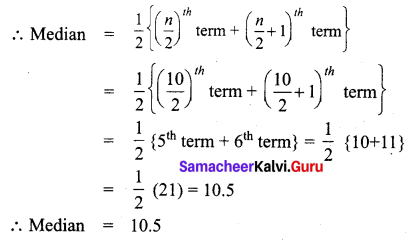
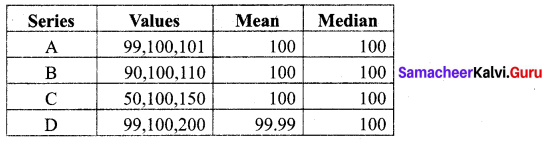
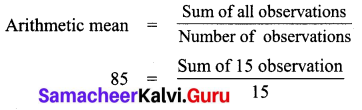
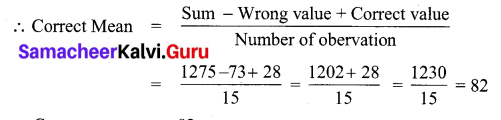
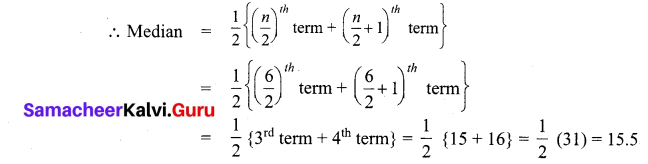
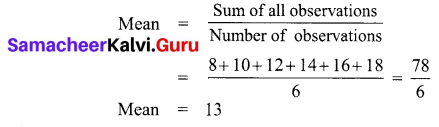
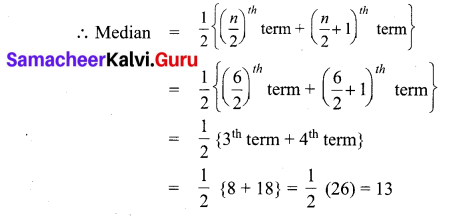
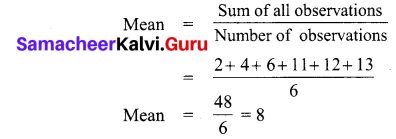
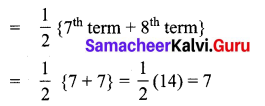
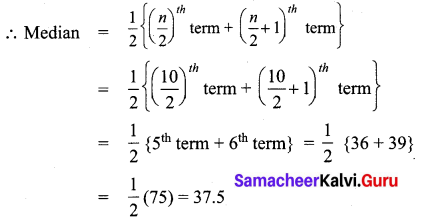
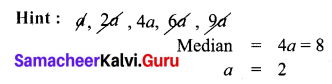
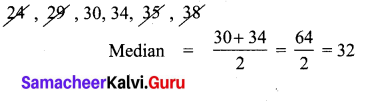
Samacheer Kalvi 7th Maths Solutions Term 3 Chapter 5 Statistics Ex 5.2

Students can Download Maths Chapter 5 Statistics Ex 5.2 Questions and Answers, Notes Pdf, Samacheer Kalvi 7th Maths Book Solutions Guide Pdf helps you to revise the complete Tamilnadu State Board New Syllabus and score more marks in your examinations.

Tamilnadu Samacheer Kalvi 7th Maths Solutions Term 3 Chapter 5 Statistics Ex 5.2

Question 1.
Find the mode of the following data. 2, 4, 5, 2, 6, 7, 2, 7, 5,4, 8, 6, 10, 3, 2, 4, 2.
Solution:
Arranging the given data in ascending order 2, 2, 2, 2, 2, 3, 4, 4, 4, 5, 5, 6, 6, 7, 7, 8, 10.
Here the number 2 occurs 5 times which is the maximum
∴ Mode of this data is 2.

Question 2.
The number of points scored by a Kabaddi team in 20 matches are
36, 35, 27, 28, 29, 31, 32, 31, 35, 38, 38, 31, 28, 31, 34, 33, 34, 31, 30, 29.
Find the mode of the points scored by the team.
Solution:
Arranging the given data in ascending order
27, 28, 28, 29, 29, 30, 31, 31, 31, 31, 31, 32, 33, 34, 34, 35, 35, 36, 38, 38.
Here the number 31 occurs 5 times which is the maximum.
∴ Mode of this data is 31.

Samacheer Kalvi 7th Maths Solutions Term 3 Chapter 3 Chapter 5 Statistics Ex 5.2

Question 3.
The ages (in years) of 11 cricket players are given below.
25, 36, 39,38 40, 36, 25, 25, 38, o 26,36. Find the mode of the ages.
Solution:
Arranging the ages is ascending order: 25, 25, 25, 26, 36, 36, 36, 36, 38, 38, 39, 40.
The ages (in years) of 11 cricket players are given below. 25, 36, 39,38 40, 36, 25, 25, 38, o 26,36. Find the mode of the ages.
Arranging the ages is ascending order: 25, 25, 25, 26, 36, 36, 36, 36, 38, 38, 39, 40.
25 and 36 occurs maximum number of times.
∴ Mode is 25 and 36.

Question 4.
Find the mode of the following data.
12, 14, 12, 16, 15, 13, 14, 18, 19, 12, 14, 15, 16, 15, 16, 16, 15, 17, 13, 16, 16, 15, 15, 13, 15, 17, 15, 14, 15, 13, 15, 14.
Solution:
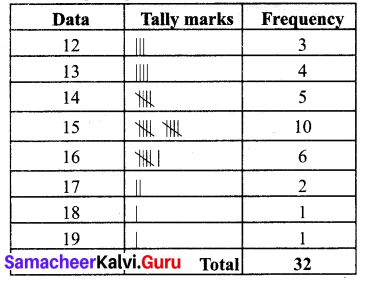
Tabulating the given data
Samacheer Kalvi 7th Maths Solutions Term 3 Chapter 5 Statistics Ex 5.2 1
The highest frequency is 10 which corresponds to the value 15.
Hence mode of this data is 15.

Samacheer Kalvi 7th Maths Solutions Term 3 Chapter 3 Chapter 5 Statistics Ex 5.2

Objective Type Questions

Question 1.
The colors used by the six students for drawing is blue, orange, yellow, white, green and blue then the mode is ________
(i) blue
(ii) green
(iii) white
(iv) yellow
Answer:
(i) blue

Question 2.
Find the mode of data 3, 6, 9, 12, 15.
(i) 1
(ii) 2
(iii) 3
(iv) No mode
Answer:
(iv) No mode

Samacheer Kalvi 7th Maths Solutions Term 3 Chapter 3 Chapter 5 Statistics Ex 5.2

Question 3.
Find the modes of the data 2, 1, 1, 3, 4, 5, 2.
(1) 1 and 5
(2) 2 and 3
(3) 2 and 1
(4) 1 and 4
Answer:
(3) 2 and 1

Samacheer Kalvi 7th Maths Solutions Term 3 Chapter 6 Information Processing Additional Questions

Students can Download Maths Chapter 6 Information Processing Questions and Answers, Notes Pdf, Samacheer Kalvi 7th Maths Book Solutions Guide Pdf helps you to revise the complete Tamilnadu State Board New Syllabus and score more marks in your examinations.

Tamilnadu Samacheer Kalvi 7th Maths Solutions Term 3 Chapter 6 Information Processing Additional Questions

Exercise 6.1

Question 1.
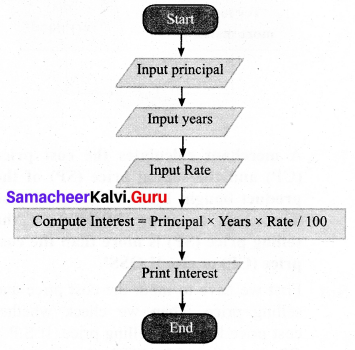
Draw a flowchart to calculate simple interest for your bank deposit.
Solution:
Flow Chart:
Samacheer Kalvi 7th Maths Solutions Term 3 Chapter 6 Information Processing add 1
Algorithm:
(i) Read principal
(ii) Read years
(iii) Read rate of interest per year
(iv) Calculate the interest with formula Interest = Principal × Years × Rate/100
(v) Print Interest

Samacheer Kalvi 7th Maths Solutions Term 3 Chapter 3 Chapter 6 Information Processing Additional Questions

Question 2.
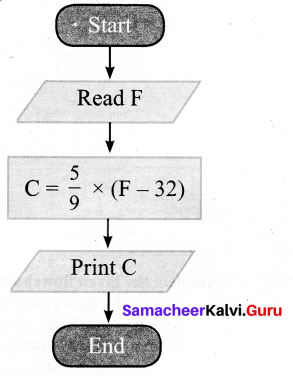
Draw a flowchart to convert the given Fahrenheit temperature to Celsius. Formula is C = \(\frac { 5 }{ 9 } \) × (F – 32)
Solution:
Algorithm:
(i) Read temperature in Fahrenheit
(ii) Calculate temperature in Celsius using formula C = \(\frac { 5 }{ 9 } \) × (F – 32)
(iii) Print C
Samacheer Kalvi 7th Maths Solutions Term 3 Chapter 6 Information Processing add 2

Samacheer Kalvi 7th Maths Solutions Term 3 Chapter 5 Statistics Ex 5.1

Students can Download Maths Chapter 5 Statistics Ex 5.1 Questions and Answers, Notes Pdf, Samacheer Kalvi 7th Maths Book Solutions Guide Pdf helps you to revise the complete Tamilnadu State Board New Syllabus and score more marks in your examinations.

Tamilnadu Samacheer Kalvi 7th Maths Solutions Term 3 Chapter 5 Statistics Ex 5.1

Question 1.
Fill in the blanks.

  1. The mean of first ten natural numbers is ________
  2. If the average selling price of 15 books is ₹ 235, then the total selling price is ________
  3. The average of the marks 2, 9, 5, 4, 4, 8, 10 is ________
  4. The average of integers between -10 to 10 is ________

Answers:

  1. 5.5
  2. 3,525
  3. 6
  4. 0

Samacheer Kalvi 7th Maths Solutions Term 3 Chapter 3 Chapter 5 Statistics Ex 5.1

Question 2.
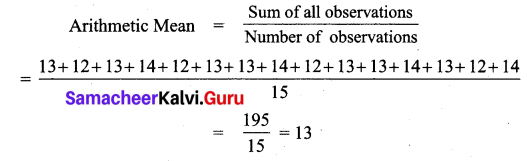
Ages of 15 students in 8th standard is 13, 12, 13, 14, 12, 13, 13, 14, 12, 13, 13, 14, 13, 12, 14.
Find the mean age of the students.
Solution:
Samacheer Kalvi 7th Maths Solutions Term 3 Chapter 5 Statistics Ex 5.1 1
= \(\frac { 195 }{ 15 } \) = 13
Mean age of the students = 13

Question 3.
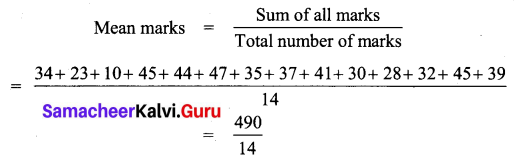
The marks of 14 students in a science test out of 50 are given below. 34, 23, 10, 45, 44, 47, 35, 37, 41, 30, 28, 32, 45, 39 Find
(i) the mean mark.
(ii) the maximum mark obtained.
(iii) the minimum mark obtained.
Solution:
Samacheer Kalvi 7th Maths Solutions Term 3 Chapter 5 Statistics Ex 5.1 2
Mean marks = 35
(ii) Maximum mark obtained = 47
(iii) Minimum mark obtained = 10

Samacheer Kalvi 7th Maths Solutions Term 3 Chapter 3 Chapter 5 Statistics Ex 5.1

Question 4.
The mean height of 11 students in a group is 150 cm. The heights of the students are 154 cm, 145 cm, Y cm, Y + 4 cm, 160 cm, 151 cm, 149 cm, 149 cm, 150 cm, 144 cm and 140 cm. Find the value of Y and the heights of two students.
Solution:
Samacheer Kalvi 7th Maths Solutions Term 3 Chapter 5 Statistics Ex 5.1 3
150 = \(\frac { 1342+Y+Y+4 }{ 11 } \)
150 = \(\frac { 1346+2Y }{ 11 } \)
150 × 11 = 1346 + 2Y
1650 = 1346 + 2Y
2Y = 1650 – 1346 = 304
Y = \(\frac { 304 }{ 2 } \) = 152
Height of two students are Y and Y + 4
⇒ 152 and 152 + 4
⇒ 152 cm and 156 cm

Samacheer Kalvi 7th Maths Solutions Term 3 Chapter 3 Chapter 5 Statistics Ex 5.1

Question 5.
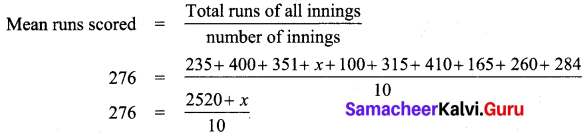
The mean of runs scored by a cricket team in the last 10 innings is 276. If the scores are 235, 400, 351, x, 100, 315, 410,165, 260, 284, then find the runs scored in the fourth innings.
Solution:
Let the runs scored in the fourth innings be x.
Samacheer Kalvi 7th Maths Solutions Term 3 Chapter 5 Statistics Ex 5.1 4
276 × 10 = 2520 + x
2760 = 2520 + x
x = 2760 – 2520 = 240
∴ Number of runs scored in the fourth innings = 240

Question 6.
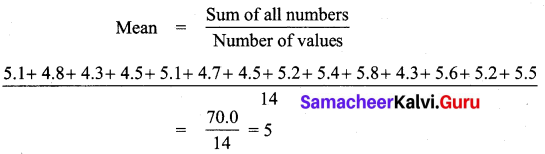
Find the mean of the following data. 5.1, 4.8, 4.3, 4.5, 5.1, 4.7, 4.5, 5.2, 5.4, 5.8, 4.3, 5.6,
Solution:
Samacheer Kalvi 7th Maths Solutions Term 3 Chapter 5 Statistics Ex 5.1 5
Mean = 5

Question 7.
Arithmetic mean of 10 observations was found to be 22. If one more observation 44 was to be added to the data, what would be the new mean?
Solution:
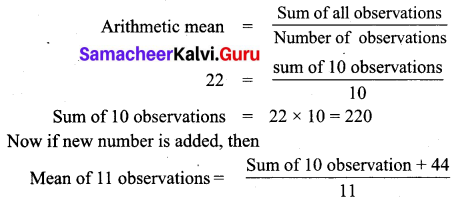
Arithmetic mean of 10 observation is 22.
Samacheer Kalvi 7th Maths Solutions Term 3 Chapter 5 Statistics Ex 5.1 6
= \(\frac { 220+44 }{ 11 } \) = \(\frac { 264 }{ 11 } \) = 24
New mean = 24

Samacheer Kalvi 7th Maths Solutions Term 3 Chapter 3 Chapter 5 Statistics Ex 5.1

Objective Type Questions

Question 1.
________ is a representative value of the entire data.
(i) Mean
(ii) range
(iii) minimum value
(iv) maximum value
Answer:
(i) Mean

Question 2.
The mean of first fifteen even numbers is ________
(i) 4
(ii) 16
(iii) 5
(iv) 10
Answer:
(ii) 16
Hint:
Samacheer Kalvi 7th Maths Solutions Term 3 Chapter 5 Statistics Ex 5.1 7

Samacheer Kalvi 7th Maths Solutions Term 3 Chapter 3 Chapter 5 Statistics Ex 5.1

Question 3.
The average of two numbers are 20. One number is 24, another number is ________
(i) 16
(ii) 26
(iii) 20
(iv) 40
Ans:
(i) 16
Hint:
\(\frac { x+y }{ 2 } \) = 20
x + y = 40
24 + y = 40
y = 40 – 24 = 16

Samacheer Kalvi 7th Maths Solutions Term 3 Chapter 3 Chapter 5 Statistics Ex 5.1

Question 4.
The mean of the data 12, x, 28 is 18. Find the value of x.
(i) 18
(ii) 16
(iii) 14
(iv) 22
Answer:
(iii) 14
Hint:
\(\frac { 12+x+28 }{ 3 } \) = 18
x + 40 = 54
x = 14

Samacheer Kalvi 7th Maths Solutions Term 3 Chapter 6 Information Processing Ex 6.1

Students can Download Maths Chapter 6 Information Processing Ex 6.1 Questions and Answers, Notes Pdf, Samacheer Kalvi 7th Maths Book Solutions Guide Pdf helps you to revise the complete Tamilnadu State Board New Syllabus and score more marks in your examinations.

Tamilnadu Samacheer Kalvi 7th Maths Solutions Term 3 Chapter 6 Information Processing Ex 6.1

Question 1.
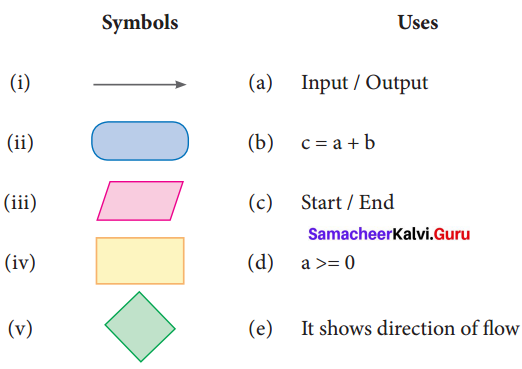
Match the following:
Samacheer Kalvi 7th Maths Solutions Term 3 Chapter 6 Information Processing Ex 6.1 1
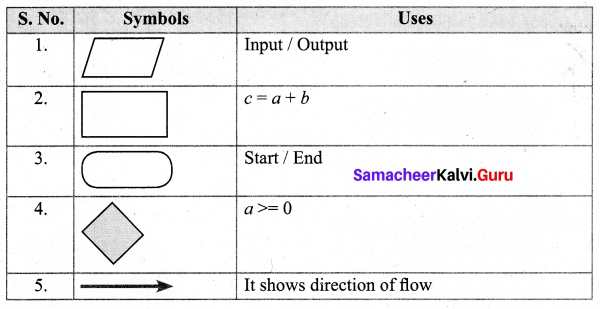
Solution:
Samacheer Kalvi 7th Maths Solutions Term 3 Chapter 6 Information Processing Ex 6.1 2

Samacheer Kalvi 7th Maths Solutions Term 3 Chapter 3 Chapter 6 Information Processing Ex 6.1

Question 2.
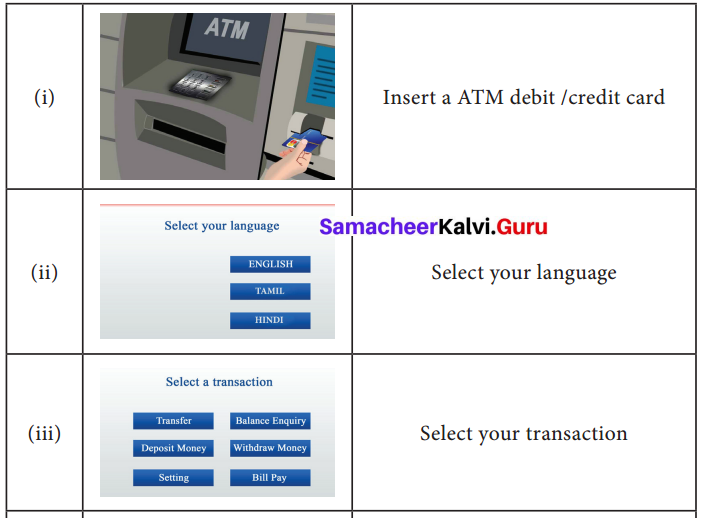
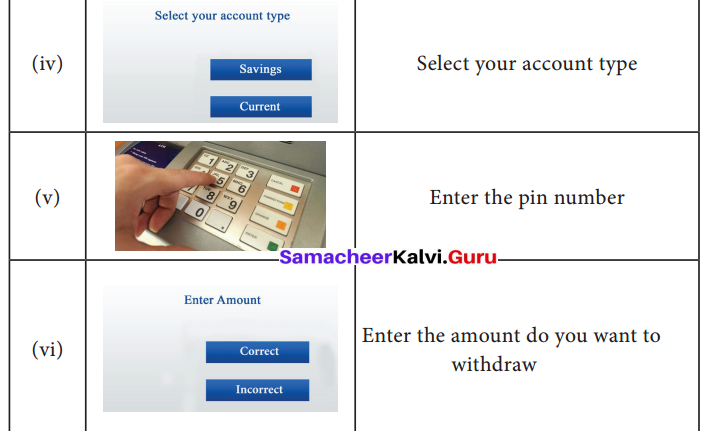
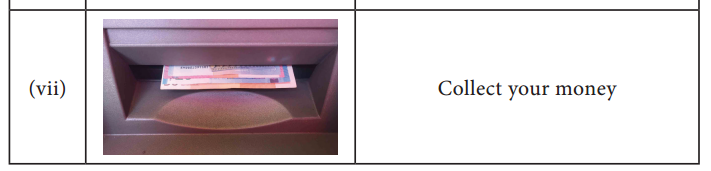
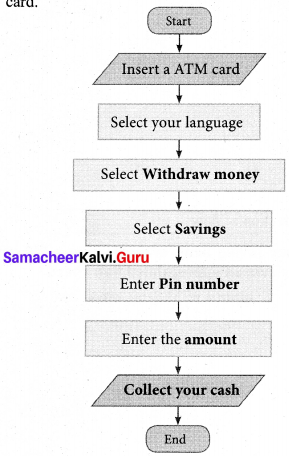
The steps of withdrawing cash from your saving bank account using ATM card are explained in the figures given below. Construct an appropriated flow chart.
Samacheer Kalvi 7th Maths Solutions Term 3 Chapter 6 Information Processing Ex 6.1 3 Samacheer Kalvi 7th Maths Solutions Term 3 Chapter 6 Information Processing Ex 6.1 4 Samacheer Kalvi 7th Maths Solutions Term 3 Chapter 6 Information Processing Ex 6.1 5
Solution:
Algorithm:
(i) Swipe your bank Debit card / credit card.
Samacheer Kalvi 7th Maths Solutions Term 3 Chapter 6 Information Processing Ex 6.1 6
(ii) Select banking
(iii) Select language
(iv) Select transaction
(v) Enter your PIN
(vi) Enter the required amount
(vii) Collect your money

Samacheer Kalvi 7th Maths Solutions Term 3 Chapter 3 Chapter 6 Information Processing Ex 6.1

Question 3.
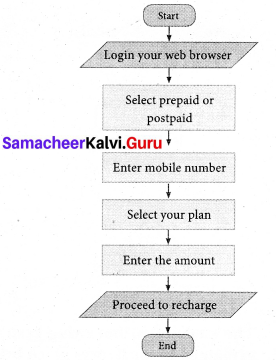
Using given step by step process to recharge mobile phone, draw a sequence flowchart.

Step by Step process:

  • Login the mobile recharge web browser
  • Select prepaid or postpaid
  • Enter mobile number
  • Select operator and browse plans to choose your recharge plan
  • Enter amount to recharge
  • Proceed to recharge

Solution:
Samacheer Kalvi 7th Maths Solutions Term 3 Chapter 6 Information Processing Ex 6.1 7

Question 4.
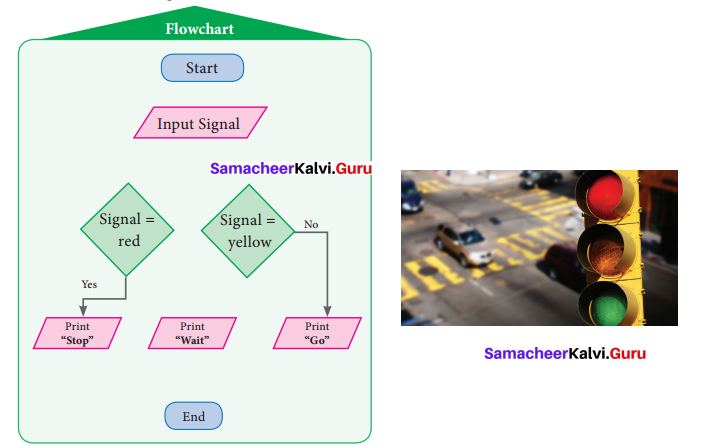
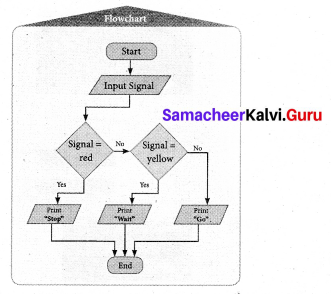
Complete the direction of the flowchart using arrows for the flow chart explaining the traffic rule given below.
Samacheer Kalvi 7th Maths Solutions Term 3 Chapter 6 Information Processing Ex 6.1 8
Solution:
Samacheer Kalvi 7th Maths Solutions Term 3 Chapter 6 Information Processing Ex 6.1 9

Samacheer Kalvi 7th Maths Solutions Term 3 Chapter 3 Chapter 6 Information Processing Ex 6.1

Question 5.
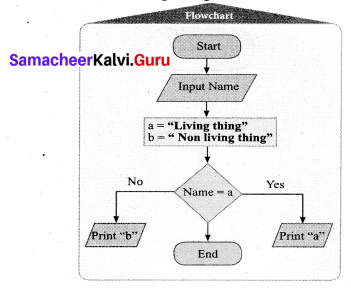
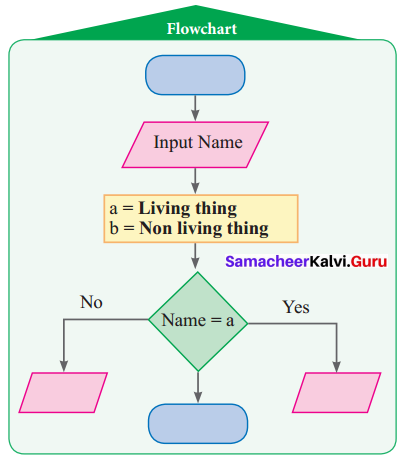
Complete the given flowchart, input names of things and check whether it is living or non – living.
Samacheer Kalvi 7th Maths Solutions Term 3 Chapter 6 Information Processing Ex 6.1 10
Solution:
Input name Horse
Horse = a Yes
Print Living thing
Samacheer Kalvi 7th Maths Solutions Term 3 Chapter 6 Information Processing Ex 6.1 11

Samacheer Kalvi 7th Maths Solutions Term 3 Chapter 3 Chapter 6 Information Processing Ex 6.1

Question 6.
Complete the given flowchart.
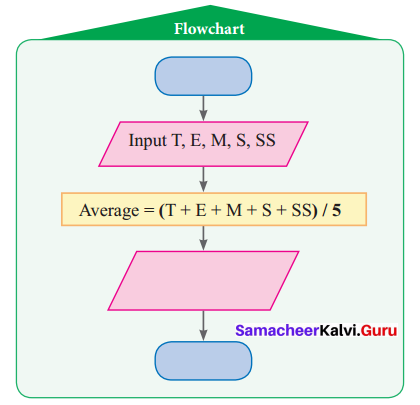
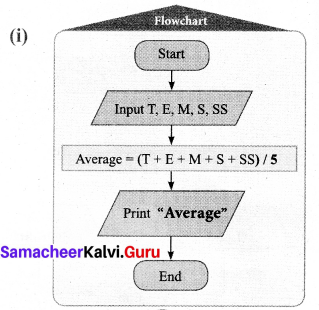
(i) Fill in the flow chart to print the average mark by giving your I term or II term marks as inputs.
Samacheer Kalvi 7th Maths Solutions Term 3 Chapter 6 Information Processing Ex 6.1 12
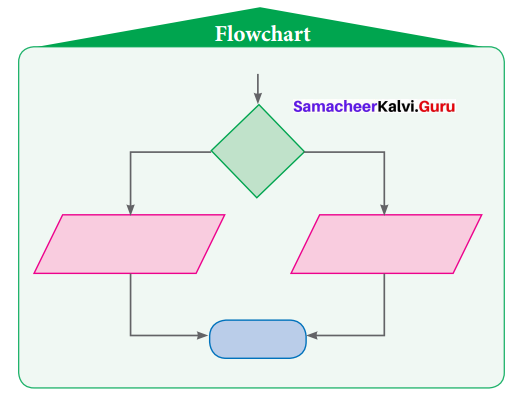
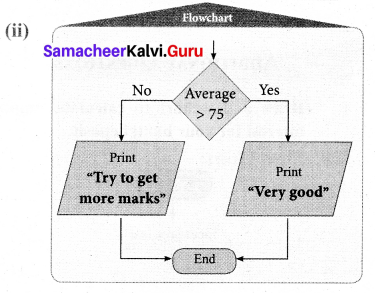
(ii) Construct the flow chart to print teachers comment as “very good” if your average mark is above 75 out of 100 or else, as “still try more” can be inserted in the flow chart with earlier one.
Samacheer Kalvi 7th Maths Solutions Term 3 Chapter 6 Information Processing Ex 6.1 13
Solution:
Samacheer Kalvi 7th Maths Solutions Term 3 Chapter 6 Information Processing Ex 6.1 14
Samacheer Kalvi 7th Maths Solutions Term 3 Chapter 6 Information Processing Ex 6.1 15

Samacheer Kalvi 7th Maths Solutions Term 3 Chapter 3 Chapter 6 Information Processing Ex 6.1

Question 7.
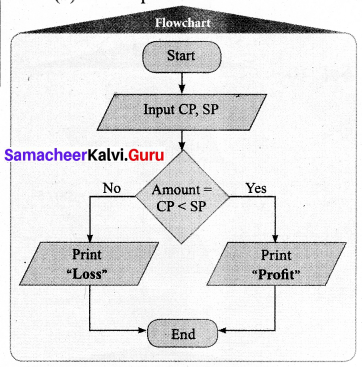
A merchant calculates the cost price (CP) and the selling price (SP) of the product bought by him. Construct the flow chart to print ‘PROFIT’ if the selling price (SP) is more than the cost price (CP) or else ‘LOSS’.
Solution:
First we have to input the cost price and selling price. Then we check whether cost price less than selling price. If S.P > CP, then print “PROFIT” otherwise print ‘Loss’.

Algorithm:

  1. Enter cost price
  2. Enter selling price
  3. Checking whether CP < SP
  4. If Yes print ‘PROFIT’
  5. If No print ‘Loss’

Samacheer Kalvi 7th Maths Solutions Term 3 Chapter 6 Information Processing Ex 6.1 16

Samacheer Kalvi 7th Maths Solutions Term 3 Chapter 5 Statistics Additional Questions

Students can Download Maths Chapter 5 Statistics Additional Questions and Answers, Notes Pdf, Samacheer Kalvi 7th Maths Book Solutions Guide Pdf helps you to revise the complete Tamilnadu State Board New Syllabus and score more marks in your examinations.

Tamilnadu Samacheer Kalvi 7th Maths Solutions Term 3 Chapter 5 Statistics Additional Questions

Additional Questions and Answers

Exercise 5.1

Question 1.
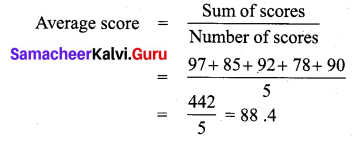
The class scores on an exam are 97, 85, 92, 78 and 90. What is the average score?
Solution:
Samacheer Kalvi 7th Maths Solutions Term 3 Chapter 5 Statistics add 1
= \(\frac { 442 }{ 5 } \) = 88.4

Question 2.
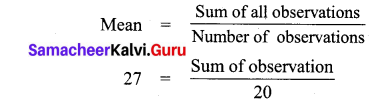
Mean of 20 observations is 27. Find the sum of 20 observations.
Solution:
Samacheer Kalvi 7th Maths Solutions Term 3 Chapter 5 Statistics add 2
Sum of observations = 27 × 20
Sum of observations = 540

Samacheer Kalvi 7th Maths Solutions Term 3 Chapter 3 Chapter 5 Statistics Additional Questions

Question 3.
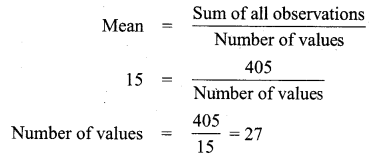
Mean of same observations is 15. Their sum is 405. Find the number of values.
Solution:
Samacheer Kalvi 7th Maths Solutions Term 3 Chapter 5 Statistics add 3
Number of values = \(\frac { 405 }{ 15 } \) = 27

Exercise 5.2

Question 1.
Find the mode of the following data. 1,2,5, 7, 3, 4, 2, 5, 7, 6, 2, 3.
Solution:
Arranging the data in ascending order: 1, 2, 2, 2, 3, 3,4, 5, 5, 6, 7, 7
Here 2 occurs maximum number of times.
∴ Mode is 2.

Samacheer Kalvi 7th Maths Solutions Term 3 Chapter 3 Chapter 5 Statistics Additional Questions

Exercise 5.3

Question 1.
Find the median of the data 1, 3, 7, 16, 0, 19, 7, 4, 3.
Solution:
Arranging the given data in ascending order: 0, 1, 3, 3, 4, 7, 7, 16, 19
Number of terms n = 9, which is odd.
∴ Median = (\(\frac { n+1 }{ 2 } \))th term
= (\(\frac { 9+1 }{ 2 } \))th term = (\(\frac { 10 }{ 2 } \))th term
= 5th term
Hence Median = 4

Samacheer Kalvi 7th Maths Solutions Term 3 Chapter 3 Chapter 5 Statistics Additional Questions

Question 2.
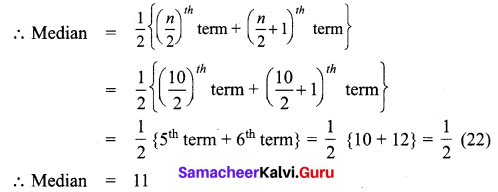
Find the median of first 10 even number.
Solution:
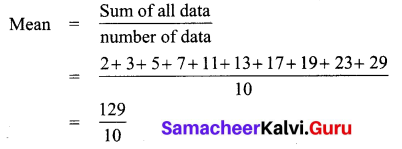
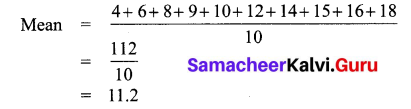
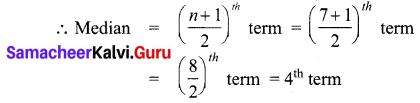
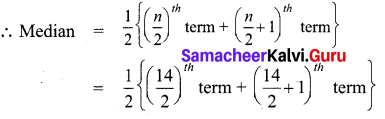
First 10 even numbers are 2, 4, 6, 8, 10, 12, 14, 16, 18, 20.
Here number of data n = 10, which is even
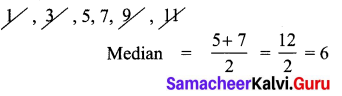
Samacheer Kalvi 7th Maths Solutions Term 3 Chapter 5 Statistics add 4

Samacheer Kalvi 8th Maths Solutions Term 2 Chapter 4 Information Processing Ex 4.4

Students can Download Maths Chapter 4 Information Processing Ex 4.4 Questions and Answers, Notes Pdf, Samacheer Kalvi 8th Maths Book Solutions Guide Pdf helps you to revise the complete Tamilnadu State Board New Syllabus and score more marks in your examinations.

Tamilnadu Samacheer Kalvi 8th Maths Solutions Term 2 Chapter 4 Information Processing Ex 4.4

Information Processing in Maths 8th Standard  Miscellaneous Practice Problems

Information Processing Solution Question 1.
The rule of Fibonacci Sequence is F(n) = F(n – 2) + F(n – 1). Find the 11th to 20th Fibonacci numbers.
Solution:
Fibonacci series is given by F(n) = F(n – 2) + F(n – 1)
∴ F(11) = F(11 – 2) + F(11 – 1) = F(9) + F(10)
Similarly F(12) ; = F(12 – 2) + F(12 – 1) = F(11) + F(10)
F(13) = F(12) + F(11)
F(14) = F(13) + F(12)……
F(20) = F(19) + F(18)
The Fibonacci series given by
Samacheer Kalvi 8th Maths Solutions Term 2 Chapter 4 Information Processing Ex 4.4 1

8th Maths Book Information Processing Question 2.
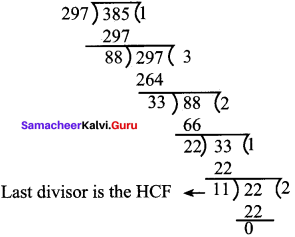
In a library, 385 Math books, 297 Science books and 143 Tamil books are bundled equally in numbers. What is the maximum numbers of books possible in a bundle, for all types of books? (Use repeated division method)
Solution:
In library, no. of math books – 385
Science books – 297 .
Tamil books – 143
We need to find HCF by repeated division method.
Step 1:
First let us take the bigger 2 numbers which are 385 & 297 & find their HCF using repeated division method.
Samacheer Kalvi 8th Maths Solutions Term 2 Chapter 4 Information Processing Ex 4.4 2
Step 2:
Now let us find the HCF of 11 & 143
Samacheer Kalvi 8th Maths Solutions Term 2 Chapter 4 Information Processing Ex 4.4 3
∴ ’11’ is the HCF of 11 & 143
∴ Therefore, the HCF of 385, 297 & 143 is 11.
So, the maximum number of books possible in a bundle, for all types of books is 11.

Samacheer Kalvi 8th Maths Solutions Term 2 Chapter 4 Information Processing Ex 4.4

Repeated Subtraction Method Question 3.
Find the length of the largest which piece of wood used to measure exactly the lengths 4 m, 50 cm and 6 m 30 cm woods.( Use repeated subtraction method)
Solution:
Piece 1 of wood length = 4 m 50 cm ; 1m = 100 cm
∴ 4m 50 cm = 4 x 100 + 50 = 450 cm
Piece 2 of wood length = 6 m 30 cm = 6 x 100 + 30 = 630 cm
Now, we need to find the HCF of 450 & 630 by repeated subtraction method.
Let bigger number be m & smaller number be n
Therefore, m = 630 & n = 450
m – n = 630 – 450 = 180; now m = 450, n = 180
m – n = 450 – 180 = 270; now m = 180, n = 270
n – m = 270 – 180 = 90; now m = 180, n = 90
m – n = 180 – 90 = 90
∴ now m = n …90 is HCF
Answer:
length of larget peice of wood to measure exactly the lenth of both pieces of wood is 90 cm

Question 4.
Using both repeated division method and repeated subtraction method and find the greatest number that divides 167 and 95, leaving 5 as reminder.
We need to find a number ‘x’ that divides 167 & 95 having 5 as reminder.
Therefore, if we subtract 5 from both the numbers, there wont be any reminder when the numbers are divided by ‘x’.
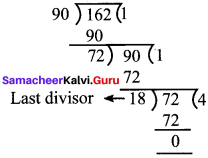
∴ x is the HCF of (167 – 5) & (95 – 5)
= 162 & 90
Finding HCF of 162 & 90 by repeated division method,
Samacheer Kalvi 8th Maths Solutions Term 2 Chapter 4 Information Processing Ex 4.4 4
∴ HCF of 162 & 90 is 18.
HCF of 162 & 90 using repeated subtraction method
Let m = 162 & n = 90
m – n = 162 – 90 = 72
m – n = 90 – 72= 18
m – n = 72 – 18 = 54
n – m = 54 – 18 = 36
n – m = 36 – 18 = 18
now m = n = 18
Answer:
The number is 18
∴ 18 is the HCF

Samacheer Kalvi 8th Maths Solutions Term 2 Chapter 4 Information Processing Ex 4.4

Question 5.
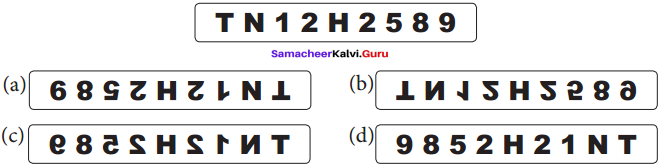
Praveen recently got the registration number for his new two-wheeler. Here, the number is given in the form of mirror – image. Encode the image and find the correct registration number of praveen’s two – wheeler.
Samacheer Kalvi 8th Maths Solutions Term 2 Chapter 4 Information Processing Ex 4.4 5
Solution:
The mirror image is
Samacheer Kalvi 8th Maths Solutions Term 2 Chapter 4 Information Processing Ex 4.4 6
When we place an imaginary mirror & visualize the image seen in the mirror, we will get the below.
Samacheer Kalvi 8th Maths Solutions Term 2 Chapter 4 Information Processing Ex 4.4 7
∴ The answer is Option c

Samacheer Kalvi 12th Commerce Solutions Chapter 25 Government Schemes For Entrepreneurial Development

Enhance your subject knowledge with Tamilnadu State Board Solutions for 25th Commerce Chapter 25 Government Schemes For Entrepreneurial Development Questions and Answers and learn all the underlying concepts easily. Make sure to learn the subject from Tamilnadu State Board Solutions Chapter 25 Government Schemes For Entrepreneurial Development Questions and Answers PDF on a day to day basis and score well in your exams. You can Download Samacheer Kalvi 25th Commerce Book Solutions Questions and Answers are given after enormous research by people having high subject knowledge and for better scoring grade. You can rely on them and prepare any topic of Commerce as per your convenience easily.

Tamilnadu Samacheer Kalvi 12th Commerce Solutions Chapter 25 Government Schemes For Entrepreneurial Development

Students those who are looking for Tamilnadu State Board Solutions Chapter 25 Government Schemes For Entrepreneurial Development Questions and Answers Concepts can find them all in one place from our site Tamilnadu State Board Solutions. Simply click on the links available to prepare the corresponding topics of Samacheer Kalvi 25th Commerce Book Solutions Questions and Answers easily. Clarify all your queries from chapter wise different questions to be familiar with the kind of questions appearing in the exam. Thus, you can increase your score and get higher grade in the final exam.

Samacheer Kalvi 12th Commerce Government Schemes For Entrepreneurial Development Textbook Exercise Questions and Answers

I. Choose the Correct Answer

Question 1.
The ______ initiative was launched to modernize the Indian economy to make all government services available electronically.
(a) Standup India
(b) Startup India
(c) Digital India
(d) Make in India
Answer:
(c) Digital India

Question 2
______ is designed to transform India to a global design and manufacturing hub.
(a) Digital India
(b) Make in India
(c) Startup India
(d) Design India
Answer:
(b) Make in India

Question 3.
______ is the Government of India’s endeavour to promote culture of innovation and entrepreneurship.
(a) AIM
(b) STEP
(c) SEED
(d) AIC
Answer:
(a) AIM

Question 4.
______ should cover aspects like sources of finance, technical know-how, source of labour and raw material, market potential and profitability.
(a) Technical Report
(b) Finance Report
(c) Project Report
(d) Progress Report
Answer:
(c) Project Report

Question 5
______ has to include the mechanism for managing venture in the project report.
(a) Banker
(b) Government
(c) Lending Institutions
(d) Entrepreneur
Answer:
(d) Entrepreneur

II. Very Short Answer Questions

Question 1.
Name any four Governmental Entrepreneurial schemes.
Answer:
Through the Startup India initiative, the Government of India promotes entrepreneurship by mentoring, nurturing and facilitating startups throughout their life cycle. Modified Special Incentive Package Scheme (M-SIPS), New Gen Innovation and Entrepreneurship Development Centre (New Gen IEDC), Dairy Entrepreneurship Development Scheme, and Single Point Registration Scheme (SPRS) are some of the Governmental Entrepreneurial schemes.

Question 2.
Give a note on ‘Digital India’.
Answer:
The Digital India initiative has been launched to modernize the Indian economy to make all government services available electronically.

Question 3.
State any three entrepreneurial development schemes of Government of Tamil Nadu.
Answer:
Entrepreneurial development schemes of Government of Tamil Nadu:

  1. Micro, small and medium enterprises (MSMEs)
  2. New Entrepreneur-Cum-Enterprise Development Scheme (NEEDS)
  3. Self-Help Group (SHG)

Question 4.
List down the two types of finance.
Answer:
Entrepreneur requires two types of finance namely long term and short term. While long term requirements are needed for acquiring fixed assets, short-term requirement are meant for meeting working capital needs.

Question 5.
Mention the time period of Provision Registration Certificate.
Answer:
Entrepreneur has to apply for Provisional Registration certificate. It will be issued to entrepreneur after the fulfilment of certain conditions for a period of one year subject to renewal of two periods of six months duration.

III. Short Answer Questions

Question 1.
What is ‘Startup India’?
Answer:
Through the Startup India initiative, Government of India promotes entrepreneurship by mentoring, nurturing and facilitating startups throughout their life cycle.

Question 2.
Expand the following: STEP, JAM, TREAD, M-SIPS, SEED and New Gen IEDC
Answer:
STEP: Support to Training and Employment Programme for women
JAM: Jan-Dhan-Aadhaar-Mobile
M-SIPS: Modified Special Incentive Package Scheme
SEED: Science for Equity Empowerment and Development
New Gen IEDC: New Gen Innovation and Entrepreneurship Development Centre
TREAD: Trade Related Entrepreneurship Assistance and Development

Question 3.
Write a short note on the following
Answer:
(a) Dairy Entrepreneurship Development Scheme
(b) Project Report
Dairy Entrepreneurship Development Scheme: Dairy Entrepreneurship Development Scheme aims at helping entrepreneurs in the field of Agriculture, pets and animals.
Project Report: Project reports needs to be prepared according to the format prescribed in the loan application form of term lending institutions.

Question 4.
What is the procedure for getting power connection for an Entrepreneurial venture?
Answer:
Entrepreneur has to make application to Assistant Divisional Engineer of State Electricity Board for power connection after paying Security Deposit and fulfilling the official formalities prescribed.

IV. Long Answer Questions

Question 1.
Explain any five Government Entrepreneurial schemes.
Answer:
To support and strengthen the Start-up culture in India, the Government has launched various schemes. They are as follows:

1. The Modified Special Incentive Package Scheme (M-SIPS): The M-SIPS scheme provides capital subsidy of 20% in SEZ and 25% subsidy in non-SEZ for business units engaged in manufacturing of electronic goods.

2. New Gen Innovation and Entrepreneurship Development Centre (New Gen IEDC): It provides a limited one time non-recurring financial assistance to entrepreneurship up to Rs. 25 lakhs in the fields of chemicals, technology, health care, defence, etc.

3. Dairy Entrepreneurship Development Scheme: Dairy Entrepreneurship Development Scheme aims at helping entrepreneurs in the fields of agriculture, pets and animals and dairy farms.

4. Single Point Registration Scheme: A great scheme for micro and small enterprises which provides an exemption from payment of Earnest Money Deposit.

5. Atal Incubation Centres (AIC): The Government of India has set up the Atal Innovation Mission (AIM) at NITI Aayog in 2016 with the over arching purpose of promoting a culture of innovation and entrepreneurship in the country.

Question 2.
Describe the steps for promoting Entrepreneurial venture.
Answer:
Steps for promoting entrepreneurial venture:

  1. Selection of the product: An entrepreneur may select a product according to his capacity and motivation after a thorough scrutiny of micro and macro environment of business.
  2. Selection of form of ownership: Entrepreneur has to choose the form of organisation suitable and appropriate for his venture namely family ownership, partnership and private company.
  3. Selection of site: Entrepreneur has to choose suitable plot for starting his venture. The plot may be industrial site, land by the private people or housing board plot allotted.
  4. Designing capital structure: The entrepreneurs has to determine the source of finance for funding the venture. It may be own savings, loan from friends, relatives or loan from banks.
  5. Acquisition of Manufacturing know-how: Entrepreneur can acquire manufacturing know-how from government research laboratories and industrial consultants.
  6. Preparation of project report: Project reports needs to be prepared according to the format prescribed in the loan application forms.

Question 3.
Discuss the preparation of a project report.
Answer:
An entrepreneur can get the report prepared by technical consultancy organisations or by
auditors or by government agencies. The report should include the following:

  1. Technical feasibility: It should contain the description of product, raw materials, quality control measures, water, power and transport.
  2. Economic viability: It involves compilation of demand for domestic and export market.
  3. Financial viability: It should cover the aspects like: Non-recurring expenses like cost of land, and building. Recurring expenses like wages and salaries.
  4. Managerial competency: Entrepreneurs has to include the mechanism for managing the venture in the project report.
  5. Provisional registration certificate: He has to apply for provisional registration certificate. It will be issued after certain conditions for a period of one year.
  6. Permanent registration certificate: If the venture has commenced production, or is ready to commence production, it is eligible to get permanent registration certificate.
  7. Statutory licence: He should obtain Municipal Licence from the authority concerned.
  8. Power connection: He has to make application to Assistant Divisional Engineer of Electricity Board for power connection.
  9. Arrangement of finance: Entrepreneur requires two types of finance namely Long term and Short term.

Samacheer Kalvi 12th Commerce Government Schemes For Entrepreneurial Development Additional Questions and Answers

I. A. Fill in the blanks

  1. Stand-up-India scheme was launched in _________
  2.  _________ initiative has been launched to modernise the Indian economy to make all Government services available electronically.

Answers:

  1. 2015
  2. Digital India

II. Very Short Answer Questions

Question 1.
Write a note on JAM.
Answer:
Jan-Dhan-Aadhaar-Mobile (JAM), is a technological intervention that enables direct transfer of subsidies to specific beneficiaries and therefore eliminates all intermediaries and leakages in the system.

III. Short Answer Questions

Question 1.
What is meant by SEED?
Answer:
SEED (Science for Empowerment and Development) aims to provide opportunities to motivated scientists and field level workers to undertake the action-oriented, location specific projects for socio-economic gains, in rural areas. The benefits of technology reaches to a vast section of the population.

Question 2.
Describe the term ‘Stand Up India’ Scheme.
Answer:
Stand-Up India scheme was launched in 2015. It seeks to leverage institutional credit for the benefit of India’s underprivileged. It aims at enabling economic participation of, women entrepreneurs, Scheduled Castes and Scheduled Tribes and share the benefit of Indian growth.

We as a team believe the information prevailing regarding the Tamilnadu State Board Solutions for 25th Commerce Chapter 25 Government Schemes For Entrepreneurial Development Questions and Answers has been helpful in clearing your doubts to the fullest. For any other help do leave us your suggestions and we will look into them. Stay in touch to get the latest updates on Tamilnadu State Board Solutions for different subjects in the blink of an eye.

Samacheer Kalvi 7th English Solutions Term 3 Poem Chapter 2 Courage

Students can Download English Poem 2 Courage Questions and Answers, Summary, Notes Pdf, Activity, Samacheer Kalvi 7th English Book Solutions Guide Pdf helps you to revise the complete Tamilnadu State Board New Syllabus and score more marks in your examinations.

Tamilnadu Samacheer Kalvi 7th English Solutions Term 3 Poem Chapter 2 Courage

Read And Understand

A. Answer the following questions.

Question 1.
Can courage be developed suddenly? Why?
Answer:
No, courage cannot be developed suddenly, because it is something, deep-rooted in the soul of a man.

Question 2.
When should we have courage?
Answer:
All those who make great efforts towards a goal, should have courage.

Samacheer Kalvi 7th English Solutions Term 3 Poem Chapter 2 Courage

Question 3.
Give an example for dazzling light.
Answer:
‘Fire fly’ is an example for dazzling light.

Question 4.
Can a courageous man be defeated? Why?
Answer:
No, a courageous man cannot be defeated. This is so because a brave man can never be freed of it.

Question 5.
What is the ‘breath of life’?
Answer:
Courage is the’breath of life’.

Question 6.
What are the characteristics of a courageous man?
Answer:
Patience and strength are the characteristics of a courageous man.

B. Read the following lines and answer the questions.

Question 1.
It isn’t an instantaneous thing
Born of despair with a sudden spring

(a) What does ‘it’ refer to?
Answer:
‘It’ refers to ‘courage’.

(b) What does ‘born of despair mean’?
Answer:
‘Born of despair’ means ‘born of hopelessness’.

Question 2.
It’s a slow, unwavering, ingrained trait
With the patience to work and the strength to wait.

(a) What is an ‘ingrained trait’?
Answer:
Courage is an ‘ingrained trait’.

(b) Why does a courageous man need patience?
Answer:
A courageous man needs patience because courage is a slow, steady and firm quality.

Samacheer Kalvi 7th English Solutions Term 3 Poem Chapter 2 Courage

Question 3.
It’s part of his hours, his days and his years,
Back of his smiles and behind his tears.

(a) What does ‘tears’ mean?
Answer:
‘Tears’ means ‘sorrow’.

Literary Appreciation

(Rhyme Scheme: A rhyme scheme is the pattern of rhyming words at the end of each line of a poem or song. It is usually referred to by using letters to indicate which lines rhyme; lines designated with the same sound rhyme with each other.)

C. Work in pairs and answer the following.

Question 1.
Pick out the alliterated words.
Answer:

  1. Daring – deed
  2. thing – that
  3. no – need
  4. sudden – spring
  5. something – soul
  6. serve – some
  7. thing – that
  8. can – call
  9. he – have
  10. who – would
  11. no – need
  12. can – come
  13. may – meet
  14. his – hours

Samacheer Kalvi 7th English Solutions Term 3 Poem Chapter 2 Courage

Question 2.
Pick out the rhyming words.
Answer:

  1. Dash – flash
  2. thing – spring
  3. hope – rope
  4. man – plan
  5. resort – sport
  6. call – fall
  7. not – hot
  8. goal – soul
  9. light – sight
  10. trait – wait
  11. blue – do
  12. show – go
  13. defeat – meet
  14. years – tears
  15. deed – creed

Question 3.
Write the rhyme scheme of the poem.
Answer:
The rhyming scheme of the poem is ‘a a b b’.

Samacheer Kalvi 7th English Solutions Term 3 Poem Chapter 2 Courage

Creative Writing

Bio – Poem
A Bio – Poem is an essay about oneself in the form of poetry.

D. Work in small groups. Pick out the adjectives and nouns that suit you using a dictionary. Read the steps given. Arrange adjectives and nouns like the given sample to construct your Bio-Poem. Present in the class.

Sarah
Strict, smart, active and friendly,
Daughter of Lazaro, sister of Francis
Lover of sports, music and reading.
Who feels enthusiastic, merry and comfortable
Who needs peace, health and prosperity
Who gives courage, money and guidance
Who fears cockroaches, spiders and lizards
Who would like to see the Himalayas, Kashmir and Europe
Lives in Australia
James

E. Collect all the poems. Compile an Anthology of BioPoems of Class VII.
Answer:
Activity to be done by the Students.

Courage Additional Questions

I. Poem Comprehension.

Question 1.
Courage isn’t a brilliant dash,
A daring deed in a moments flash;

(a) Which is a daring deed?
Answer:
Courage is a daring deed.

(b) What is a deed?
Answer:
A deed is an act.

Samacheer Kalvi 7th English Solutions Term 3 Poem Chapter 2 Courage

Question 2.
For who would strive for a distant goal
Must always have courage within his soul.

(a) Who must have courage?
Answer:
The one who wants to make great effort in life, should have courage.

(b) What is a ‘goal’ here?
Answer:
A goal is a challenge or aim in life.

Question 3.
It’s part of a man when his skies are blue,
It’s part of him when he has work to do.
What do you mean by the phrase ‘his skies are blue’?
Answer:
It means enthusiastic or in a happy state.

II. Poetic Devices.

Question 1
Born of despair with a sudden spring
Pick out the alliterated words,
Answer:
sudden – spring are the alliterated words.

Samacheer Kalvi 7th English Solutions Term 3 Poem Chapter 2 Courage

Question 2.
it isn’t a creature of flickered hope
Or the final tug at a slipping rope;
But it’s something deep in the soul of man
That is working always to serve some plan.

(a) What are the rhyming words?
Answer:
hope – rope; man – plan are the rhyming words.

(b) What is the rhyming scheme?
Answer:
The rhyming scheme is ‘a a b b’

III. Short Questions and Answers.

Question 1.
What do you mean by the word ‘flickered’?
Answer:
‘Flickered’ means shone unsteadily.

Samacheer Kalvi 7th English Solutions Term 3 Poem Chapter 2 Courage

Question 2.
What was courage never designed for?
Answer:
It was never designed for show.

Question 3.
Where is courage written?
Answer:
Courage is written in victory and defeat.

Question 4.
What is more than a daring deed? .
Answer:
Courage is more than a daring deed.

Question 5.
What do you mean by the word ‘creed ?
Answer:
‘Creed’ means faith in oneself.

IV. Paragraph Question with Answer.

Question 1.
How is courage a daring deed?
Answer:
Courage is a daring act of a person. It is not like lightning that flashes and goes off. It is not born of hopelessness and with a sudden spring. It shines steadily and is always long-lasting. The courage always drops in and reflects itself, when the person is facing a tough time. One who wants to win a goal need to have courage. Courage is displayed in every victory and defeat. It is more than a brave deed, as it is the breath of life and the faith of a strong man.

Samacheer Kalvi 7th English Solutions Term 3 Poem Chapter 2 Courage

Warm Up

Look at the ‘Face It’ chart. Discuss in small groups and tell how to face those situations.

Samacheer Kalvi 7th English Solutions Term 3 Poem Chapter 2 Courage
Answer:
When we don’t win in the sports competitions or in any other field, we have to face it boldly with courage. We should be bold enough to accept the failures or defeats. We should always try to win the next game or competition with confidence.
We must be courageous in facing all our endeavours. This attitude will help us to face anything boldly.

Courage Summary

Edgar Albert Guest elaborates that courage is temporary and not a mere flash of reflection. It is not like lightning that flashes and goes off. He explains that courage is long-lasting and always remains. It leaves a deep and lasting impression. It always works in the background and keeps reflecting itself. It stays with the person in every moment, situation and throughout life in one way or the other. It holds back the person, whether he calls for it or not. The courage always drops in and reflects itself, when the person is facing a tough time. As it slips down, the situations go against the run. The poet says one who wants to win has to explore misfortune, failures and mishaps.

The poet emphasizes how one needs to take any sort of failures positively. One should hold on to courage in the tough times. One has to face and suffer the dark during the negative days in life and has to bear the unfortunate losses. The true time to test one’s courage is when one is facing a rough time. It is displayed in every victory and defeat. It is there in every challenge, a man may meet. It is more than a daring act. It is the breath of life and faith of a story man.

Samacheer Kalvi 7th English Solutions Term 3 Play Chapter 1 Jane Eyre

Students can Download English Lesson 1 Jane Eyre Questions and Answers, Summary, Notes Pdf, Activity, Samacheer Kalvi 7th English Book Solutions Guide Pdf helps you to revise the complete Tamilnadu State Board New Syllabus and score more marks in your examinations.

Tamilnadu Samacheer Kalvi 7th English Solutions Term 3 Play Chapter 3 Man Overboard

Vocabulary

Semantic Map
A. Read the list of words. Write down all the words related to those words. Create a “map” using a graphic organiser and discuss it in groups. One is done for you.

(Library,building,garden,student,teacher,advertisement,animal,art)
Answer:
Samacheer Kalvi 7th English Solutions Term 3 Play Chapter 1 Jane Eyre img 1

1.
Samacheer Kalvi 7th English Solutions Term 3 Play Chapter 1 Jane Eyre img 2

2.
Samacheer Kalvi 7th English Solutions Term 3 Play Chapter 1 Jane Eyre img 3

3.
Samacheer Kalvi 7th English Solutions Term 3 Play Chapter 1 Jane Eyre img 4

B. Look at the list of words. Read the instructions and make Vocabulary Frames.notice hide quarrelling quickly
(notice,hide,quarrelling,quickly,tired,wide,pretty,threw)

Top Right Corner : The word’s defination
Top Left Corner : The word’s opposite
Lower Left Corner : A sentence that uses the defination of the word
Lower Right Corner : Graphic visualization
In the Centre : The word
Answer:

Samacheer Kalvi 7th English Solutions Term 3 Play Chapter 1 Jane Eyre img 5

Samacheer Kalvi 7th English Solutions Term 3 Play Chapter 1 Jane Eyre img 6

Samacheer Kalvi 7th English Solutions Term 3 Play Chapter 1 Jane Eyre img 7

Three Samples are given and others to be done by the Students.

Samacheer Kalvi 7th English Solutions Term 3 Play Chapter 1 Jane Eyre

Syllable

C. Fill in the table with monosyllabic, disyllabic and trisyllabic words from the play ‘Jane Eyre’.
Answer:
Samacheer Kalvi 7th English Solutions Term 3 Play Chapter 1 Jane Eyre img 8

Listening

D. Listen to the conversation between a father and daughter and say whether following statements are true or false.

  1. Dad hasn’t been to this fishing spot since last year.
  2. Dad used to go fishing with his father.
  3. Dad has talked a lot about this fishing spot in the past.
  4. The daughter also loves to fish.
  5. Dad says his daughter MUST fish.
  6. The daughter is going to cook the fish.
  7. Dad’s fishing place hasn’t changed since he was a boy.

Answer:

  1. False
  2. False
  3. True
  4. True
  5. False
  6. True
  7. False

Speaking

E. Imagine that below are some of the paintings of Jane Eyre. Discuss with your partner and describe the paintings.
Answer:
Samacheer Kalvi 7th English Solutions Term 3 Play Chapter 1 Jane Eyre img 9

Role Play

F. Put students into groups of three and let them act as Jane.

Student 1 : I am Jane. As my parents died, I had to live with my uncle and aunt Mr. and Mrs. Reed in a town called Gateshead. My three cousins Eliza, John and Georgiana ill-treated me. After my uncle’s death, my aunt did not look after me as her daughter. She always locked me up in a red room. Besides, the maid had to listen to my aunt and did, as was told by her. My aunt wrote a letter to Mr. Brocklehurst and sent me to Lowood.

Student 2 : At Lowood, I met Miss. Muller and Miss. Temple. They put me in the fourth form. There, I got a new companion Helen Burns, who told me that their school was a charity school for the orphans. But after some time, Helen got ill and passed away leaving me alone in Lowood. I spent eight years in school – six years as a student and two years as a teacher. I wanted liberty. So I advertised in Herald for situations. A week later, I received a letter from Mrs. Fairfax, Thornfield, for a job.

Student 3 : There, at Thornfield, I was asked to teach Miss. Adela. She was Mr. Rochester’s ward. I liked Thornfield very much. I told Adela that I would teach her about nature, animals and flowers. We can study all we can that isn’t in books. I believe that art is the window of the soul. So I started teaching Adela and led a new life in Thornfield.

After this, decide who is the unhappiest of the three ‘Janes5.
Answer:
The unhappiest of the three ‘Janes’: ‘Jane’ who lived with Mrs. Reed, at Gateshead.

Samacheer Kalvi 7th English Solutions Term 3 Play Chapter 1 Jane Eyre

Reading

G. Read the story and fill in the grid by ticking each character’s qualities.
Discuss in pairs to rate the characteristic and give marks from 1 to 10 depending on the grade of each quality.
Justify your views in one or two sentences.
Answer:
Samacheer Kalvi 7th English Solutions Term 3 Play Chapter 1 Jane Eyre img 10

Marks
Kind: 10 Marks
Patient: 7 Marks
Emotional: 4 Marks
Rich: 1 Mark
Self-disciplined: 9
Marks Courageous: 6
Marks Sensitive: 3 Marks
Friendly: 8 Marks
Caring: 5 Marks
Poor: 2 Marks
A person should always be kind, self-disciplined and friendly to others

H. Arrange the jumbled sentences and write a paragraph. Use appropriate conjunctions.

  1. Jane Eyre is an orphan.
  2. She lives with her aunt Mrs. Reed. ,
  3. Mrs. Reed does not like Jane because Jane is not her daughter.
  4. Jane’s uncle Mr. Reed likes Jane, but he dies.
  5. He makes Mrs. Reed promise to take care of Jane, but instead she sends Jane away.
  6. Jane is ten years old, she is sent to Lowood school.
  7. Jane graduates and stays there to teach.
  8. She leaves for Thornfield, where she is a governess.
  9. She is very happy there.

Answer:
1, 2,4, 3, 5, 6, 7, 8, 9
Jane Eyre is an orphan. So she lives with her aunt and uncle Mr. and Mrs. Reed. Jane’s uncle Mr. Reed likes Jane, but he dies. Mrs. Reed does not like Jane because Jane is not her daughter. Before his death, Uncle Reed makes his wife promise to take care of Jane, but instead she sends her away. As Jane is only ten years old, she is sent to Lowood school. As, Jane gets graduated herself, she stays there to teach. From there, she leaves for Thornfield, where she becomes a governess. She is very happy there.

I. Read scene I. Discuss with your partner what Mrs Reed might write about Jane in her letter to the owner of a school. Now complete her letter to Mr. Brocklehurst.
Answer:
Gateshead Hall, Gateshead
Northumberland
Mr Brocklehurst Lowood Institution Lowood Durham
Dear Sir,
I understand that you have a school for the orphans. My niece, Miss. Jane Eyre, who is ten years old, is an orphan. She lost her parents. I am finding it difficult to bring her up here. So I request you to admit her in your charity institution. If you permit to take her, I will send her to Lowood.
Thank you.
Yours sincerely,
Mrs. Reed.

Grammar
Determiners

J. Read the passage. Choose between a little, a lot of, a few, few, fewer, many and much to fill in the gap.

DON’T CALL US, WE’LL CALL YOU!
Answer:
Two years ago, I moved to a new neighbourhood. There seemed to be very few people in this area without telephones, so I expected to get a new phone quickly. I applied forone as soon as I moved into my new house. ‘We aren’t supplying a lot of new phones in your area’, an engineer told me. ‘A few people want new phones at the moment and the company is employing fewer engineers than last year so as to save money. A new phone won’t cost you much money, but it will take a little time. We can’t do anything for you before December. ‘You need a lot of patience if you’re waiting for a new phone and you need many friends whose phones you can use as well. Fortunately, I had both. December came and went, but there was no sign of a phone. I went to the company’s local office to protest. ‘They told me I’d have a phone by December,’ I protested. ‘Which year?’ the assistant asked.

Perfect Tenses

K. Read the Time Line of Harish. Write sentences using the present perfect tense.
Answer:

  1. Harish has been born in Madurai in 1971.
  2. Harish and his family have moved to Chennai in 1976.
  3. In 1993, Harish has finished college and started working for Indian Oil.
  4. In 1996, Harish has been promoted as a manager at Indian Oil.
  5. Harishhas met Amina in 1997.
  6. Harish and Amina have got married in 2000.
  7. They have had a child in 2001.

L. Read the following passage and fill in the blanks with the correct form of the verb.
Where had I gone? What had I done?
What had I seen?
Answer:
I had never seen (see) such beautiful sights before I visited Paris in 2012. I had saved (save) money for five years before I booked my trip to Paris. I was very excited! Before my trip to Paris, I had never been (be) out of India.
When I went to Paris, I spent many days touring the city. The city was big. Sometimes I got lost and asked for directions. I asked for directions in French. That was easy because I had studied (study) French for two years before I visited Paris.
By the time I left Paris, I had toured (tour) many beautiful places. The Eiffel Tower, the Notre Dame Cathedral, and the Luxembourg Gardens were just a few of the places I saw. Before I visited Paris, I had only seen (see) those places on television.

Prepositions

M. Look at the picture and write eight sentences using prepositions.
Where is the rabbit
Answer:

Samacheer Kalvi 7th English Solutions Term 3 Play Chapter 1 Jane Eyre img 11

  1. The rabbit is in front of the bag.
  2. The rabbit is behind the bag.
  3. The rabbit is under the bag.
  4. The rabbit inside the bag.
  5. The rabbit is on the bag.
  6. The rabbit is between two bags.
  7. The rabbit is near the bag.
  8. The rabbits are running around a bag.

Samacheer Kalvi 7th English Solutions Term 3 Play Chapter 1 Jane Eyre

Comparative And Superlative Survey

N. Answer the questions below. Write your answers in the second column of the table.

a. How old are you?
b. How tall are you?
c. What bicycle do you have?
d. How many languages do you speak?
e. At what time do you usually wake up?
f. How far is your home from school?
Answer:

Samacheer Kalvi 7th English Solutions Term 3 Play Chapter 1 Jane Eyre img 12

O. Work in groups of six. Write the other students’ names at the top of the fable. Interview each student using the above questions and complete the table with their answers.
When you have all the answers, use the results to write three comparative and three superlative sentences about the students in your group.
Examples: I am the oldest in my group.
My bicycle is more colourful than Jane’s bicycle. m
Answer:

  1. I am younger than Reena.
  2. Vinay is older than me.
  3. Reena gets up earlier than Latha.
  4. My bicycle is the most attractive one.
  5. Latha’s home is the nearest one to the school.
  6. Jane is the youngest in her class.

Passive Voice

P. Read the followingarticleabout theamazingsimif arities be tween the assassination of John F. Kennedy and Abraham Lincoln; then underline the passive forms.
Answer:

  1. Abraham Lincoln was elected to Congress in 1846. Voters elected John F. Kennedy to Congress in 1946.
  2. Lincoln was elected president in 1860. Voters elected Kennedy president in 1960.
  3. Both men were particularly concerned with civil rights.
  4. Both wives lost their children while living in the White House.
  5. Lincoln was shot on a Friday. Someone shot Kennedy on a Friday.
  6. Lincoln was shot in the head. The gunman shot Kennedy in the head.
  7. Lincoln’s secretary was called Kennedy. Kennedy’s secretary A was called Lincoln.
  8. Lincoln was assassinated by a Southerner. A Southerner assassinated Kennedy.
  9. Lincoln was succeeded by a Southerner named Johnson. A Southerner named Johnson succeeded Kennedy.
  10. Andrew Johnson, who succeeded Lincoln, was born in 1808.
  11. Lyndon Johnson, who succeeded Kennedy, was born in 1908.
  12. John Wilkes Booth, who assassinated Lincoln, was born in 1839. Lee Harvey Oswald, who assassinated Kennedy, was born in 1939.
  13. Both assassins were known by their three names and both names are composed of fifteen letters.
  14. Lincoln was shot at a theatre named “Ford”. The gunman shot Kennedy in a car called a “Lincoln” that the company Ford made.
  15. Booth ran from the theatre and was caught in a warehouse. Oswald ran from aware house and the police caught him in a theatre.
  16. Booth was assassinated before his trial. Someone assassinated Oswald before his trial.

Q. Reported Questions.

Question 1.
Jane told Bessie that she would hide herself in the library with Uncle Reed’s book.
Answer:
“I’ll hide myself in the library with uncle Reed’s book”.

Question 2.
John ordered Jane to come there when he called her.
Answer:
“Come here when 1 call you.”

Samacheer Kalvi 7th English Solutions Term 3 Play Chapter 1 Jane Eyre

Question 3.
Eliza asked Jane what she was doing then.
Answer:
“What are you reading now?”

Question 4.
Mrs. Reed told Bessie to take her away to the red room and lock her in there.
Answer:
“Take her away to the red room and lock her in there!”

Question 5.
Miss. Temple asked Jane whether she could read and write.
Answer:
“Can you read and write?”

Question 6.
Miss. Miller asked Miss. Temple where she should put Jane.
Answer:
“Where shall I put her Miss. Temple?”

Question 7.
Jane asked Helen why they called it an institution.
Answer:
“And why do they call it institution?”

Question 8.
Helen asked Jane why she had come there.
Answer:
“Why have you come here, Jane?”

Samacheer Kalvi 7th English Solutions Term 3 Play Chapter 1 Jane Eyre

Question 9.
Jane asked Mrs. Fairfax whether she would have the pleasure of seeing Miss. Fairfax that night.
Answer:
“Shall I have the pleasure of seeing Miss. Fairfax tonight?”

Question 10.
Miss. Adela told Jane that she could sirig and dance also.
Answer:
“I can sing and dance also.

Connecting To Self
R. Case Study.

  • In Charlotte Bronte’s day, many orphans were sent to institutions like Lowood.
  • Conduct research to find out what options exist today for children without parents.
  • Refer books and Internet resources as well as children’s services department in India.
  • Then, prepare two or three case studies, or profiles, using made-up names, that present typical situations.

Answer:
Activity to be done by the Students.

Project

S. Look at the story board. Read the captions given under each frame. Fill the bubbles and complete the story board.

  • Create your own story board for the scene ‘At Thornfield’.
  • Make a power point presentation using the story board.

Samacheer Kalvi 7th English Solutions Term 3 Play Chapter 1 Jane Eyre img 13
Answer:
Activity to be done by the Students

Jane Eyre Additional Question

I. Choose the correct Synonyms from the options below.

Question 1.
mischiefs
(a) solemnity
(b) virtues
(c) tricks
(d) boons
Answer:
(c) tricks

Samacheer Kalvi 7th English Solutions Term 3 Play Chapter 1 Jane Eyre

Question 2.
uproar
(a) calm
(b) harmony
(c) quietness
(d) a loud ness

Question 3.
dependent
(a) independent
(b) unconditional
(c) helpless
(d) strong
Answer:
(c) helpless

Question 4.
screams
(a) shriek
(b) whisper
(c) relax
(d) laugh
Answer:
(a) shriek

Question 5.
behaviour
(a) idleness
(b) misbehaviour
(c) misconduct
(d) conduct
Answer:
(d) conduct

Question 6.
collapses
(a) falls
(b) succeeds
(c) increases
(d) rises
Answer:
(a) fails

Samacheer Kalvi 7th English Solutions Term 3 Play Chapter 1 Jane Eyre

Question 7.
hesitate
(a) willing
(b) certain
(c) pause
(d) resolute
(c) pause

Question 8.
quieten (a) slow
(b) dull
(c) hasten
(d) lethargic
Answer:
(c) hasten

Question 9.
charity
(a) financial aid
(b) selfishness
(c) meanness
(d) miserly
Answer:
(a) finanial aid

Question 10.
composed
(a) disturbed
(b) excited
(c) overwrought
(d) cool
Answer:
(d) cool

II. Choose the correct Antonyms from the options below.

Question 1.
eagerly
(a) happily
(b) anxiously
(c) uninterestingly
(d) strongly
Answer:
(c) uninterestingly

Question 2.
receive
(a) collect
(b) accept
(c) awarded
(d) give
Answer:
(d) give

Question 3.
desperate
(a) cheerful
(b) hopeless
(d) despairing
(d) lacking
Answer:
(a) cheerful

Question 4.
tedious
(a) boring
(b) dull
(d) monotonous
(d) exciting
Answer:
(d) exciting

Samacheer Kalvi 7th English Solutions Term 3 Play Chapter 1 Jane Eyre

Question 5.
pleasure
(a) delight
(b) comfort
(c) displeasure
(d) bliss
Answer:
(c) displeasure

Question 6.
entertain
(a) bore
(b) enjoyment
(c) consideration
(d) amusement
Answer:
(a) bore

Question 7.
horrible
(a) shocking
(b) horror
(c) agreeable
(d) dreadful
Answer:
(c) agreeable

Question 8.
frightful
(a) delightful
(b) awful
(c) horrible
(d) terrible
Answer:
(a) delightful

Question 9.
immediately
(a) instantly
(b) presently
(c)later
(d) directly
Answer:
(c) later

Samacheer Kalvi 7th English Solutions Term 3 Play Chapter 1 Jane Eyre

Question 10.
neglected
(a) cared
(b) failed
(c) ignored
(d) disregarded
Answer:
(a) cared

III. Choose the Correct Answer (MCQ).

Question 1.
Mrs. Reed is in a ______ mood at breakfast this morning.
(a) happy
(b) frightful
(c) sad
(d) jovial
Answer:
(b) frightful

Question 2.
Jane rises and cautiously goes to ______
(a) Eliza
(b) Bessie
(c) Georgiana
(d) John
Answer:
(d) John

Question 3.
Tohn‘throws the ______ at her.
(a) stofie
(b) book
(c) duster
(d) stick Big
Answer:
(b) book

Question 4.
Take her awav in the ______ room and lock her in there.
(a) dark
(b) lonely
(c) red
(d) last
Answer:
(c) red

Samacheer Kalvi 7th English Solutions Term 3 Play Chapter 1 Jane Eyre

Question 5.
What shocking ______ for a voung girl.
(a) behaviour
(b) nature
(c) attitude
(d) quality
Answer:
(a) behaviour

Question 6.
I will not be taken in by your ______
(a) game
(b) show
(c) tricks
(d) plans
Answer:
(c) tricks

Question 7.
She is let off at the gates of ______
(a) Lowood
(b) Gateshead
(c) Thornfield
(d) Northumberland
Answer:
(a) Lowood

Question 8.
It’s partly a charity ______
(a) school
(b) home
(c) organization
(d) orphanage
Answer:
(a) school

Question 9.
Jane spends ______ years in the school.
(a) nine
(b) six
(c) seven
(d) eight
Answer:
(d) eight

Question 10.
You are an early ______
(a) bird
(b) riser
(c) applicant
(d) person
Answer:
(b) riser

IV. Very Short Question with Answer:

Question 1.
How Old was Jane when she came to her aunt’s house?
Answer:
She was ten years Old.

Question 2.
Who were her cousins?
Answer:
Her cousins were Eliza, John and Georgiana.

Question 3.
What was the name of the servant maid of Mrs. Reed?
Answer:
The servant maid of Mrs. Reed was Bessie.

Question 4.
What did Bessie tell Jane?
Answer:
Bessie told Jane not to quarrel with Miss. Georgina and Eliza. If she does, the whole house would be in uproar.

Samacheer Kalvi 7th English Solutions Term 3 Play Chapter 1 Jane Eyre

Question 5.
What book was Jane reading?
Answer:
Jane was reading “Bewick’s History Of British Birds.

Question 6.
What did John do to her?
Answer:
John threw the book at her. He grasped her hair and shoulder and hit her with something.

Question 7.
What does Mrs. Reed tell Bessie to do with Jane?
Answer:
Mrs. Reed ordered Bessie to take Jane to the red room and lock her up.

Question 8.
To whom does Mrs. Reed write a letter about Jane?
Answer:
Mrs. Reed writes a letter to Mr. Brocklehurst about Jane.

Question 9.
Where was Jane sent by Mrs. Reed?
Answer:
Jane was sent to Lowood institution by Mrs. Reed.

Question 10.
How were the girls in the school dressed?
Answer:
girls were uniformly dressed.

V. Short Questions with Answers.

Question 1.
Why was Jane ill at Mrs. Reed’s house?
Answer:
When Jane was locked in the red room, she started crying and screamed loudly to let her out. She also heard some noise and saw someone. So she felt ill.

Samacheer Kalvi 7th English Solutions Term 3 Play Chapter 1 Jane Eyre

Question 2.
Where did Miss Miller and Jane enter, the next day? Who were there?
Answer:
Miss Miller and Jane entered a wide long room. There were many girls of age ten to twenty.

Question 3.
What type of a school was the Lowood Institution?
Answer:
Lowood Institution was partly a charity school. It is an institution for educating orphans.

Question 4.
What happened at Lowood School, when the spring started?
Answer:
When spring started, semi-starvation and neglected colds had put most of the students at the risk of getting infection. Forty-five out of the eighty girls lay ill at one time.

Question 5.
How many years did Jane spend in Lowood School?
Answer:
Jane spent eight years in the Lowood School. She was there as a student for six years and worked as a teacher for two years.

VI. Paragraph Question with Answer.

Question 1.
Narrate the incident at Thornfield.
Answer:
Jane received a letter from Mrs. Fairfax at Thornfield to teach Adela. Jane went to if Thornfield and met Mrs. Fairfax. She gave her a warm welcome. Next morning, Miss. Adela came running to Jane followed by her attendant Miss. Varens. Jane told her that she would teach her to learn about nature, animals and the flowers. They would study all they can that isn’t in the books. They would also learn to paint and draw. She started teaching Adela and led a new life at Thornfield.

Warm Up

Every child has a right to an education, a life free from poverty and protection from abuse. Look at the picture

Samacheer Kalvi 7th English Solutions Term 3 Play Chapter 1 Jane Eyre img 14

Discuss in pairs and answer.

Question 1.
What are the basic human rights?
Answer:

  1. Right to Equality
  2. Right to Freedom
  3. Right against Exploitation
  4. Right to Freedom of Religion, Culture and Education.
  5. Right to Constitutional Remedies.

Samacheer Kalvi 7th English Solutions Term 3 Play Chapter 1 Jane Eyre

Question 2.
What is education?
Answer:
Education is the process of getting knowledge, skills, values, beliefs and habits.

Question 3.
Why do lye jxeed education?
Answer:
Education gives us a knowledge of the world around us and changes it into something better. It helps us build opinions and have points of view on things in life.

Think and Answer.

Question 1.
How would life be on this planet if some of the human rights are excluded?
Answer:
Life on this planet would become more difficult for the commoners, if some of the human rights are excluded.

Question 2.
Are there any rights you would still like to add to the human rights list?
Answer:
I would like to add ‘the right to own your things, Freedom of thought and expression, right to social security and right to play’, to the human rights list.

Jane Eyre Summary

Jane Eyre was a ten years old girl. Her parents were deaid. So she lived with her aunt Mrs. Reed and her three cousins – Eliza, John and Georgiana. Mrs. Reed’s house was in a town called Gateshead, in England. Jane’s uncle Mr. Reed liked her. But he was no more. He died. Mrs. Reed did not like Jane because she was not her daughter. Her three cousins always ill-treated her and Mrs. Reed locked her up in the red room. After this incident, Mrs. Reed wrote a letter to Mr. Brocklehurst who is running a school at Lowood. Jane is sent to Lowood. There Jane was put in form four with other girls. It was a charity school which was run for the orphans. Semi-starvation and neglected colds had given way to infection. Forty-five students out of eighty girls lay ill at one time. Helen, Jane’s friend, also fell ill and died. Jane spent eight years in the school, six years as a student and two years as a teacher. She got a job as a teacher at Thornfield. There she started teaching Adela and led a new life in Thornfield.

Samacheer Kalvi 7th English Solutions Term 3 Play Chapter 1 Jane Eyre

Discuss in pairs and answer.

Question 1.
Why does Jane want to go to school or learn anything in the first place?
Answer:
Jane wants to learn life’s lessons that shape her character as an adult.

Question 2.
Why does education become such an important issue for her as a child?
Answer:
Education becomes such an important issue for Jane because education for every single one of her emotional and physical needs – food, shelter, friendship.

Question 3.
What does Jane’s education at Lowood prepare her to do?
Answer:
Jane’s education at Lowood prepares her to understand the world in teacher-student relationship

Samacheer Kalvi 8th Science Solutions Term 3 Chapter 3 Universe and Space Science

Students can Download Science Term 3 Chapter 3 Universe and Space Science Questions and Answers, Notes Pdf, Samacheer Kalvi 8th Science Book Solutions Guide Pdf helps you to revise the complete Tamilnadu State Board New Syllabus and score more marks in your examinations.

Tamilnadu Samacheer Kalvi 8th Science Solutions Term 3 Chapter 3 Universe and Space Science

Samacheer Kalvi 8th Science Universe and Space Science Text Book Exercise

SamacheerKalvi.Guru

I. Choose the best answer:

Question 1.
Which of the following is a celestial body?
(a) Sun
(b) Moon
(c)Stars
(d) All the above
Answer:
(d) All the above

Question 2.
Mangalyaan was sent to …………….
(a) Moon
(b) Mars
(c) Venus
(d) Mercury
Answer:
(b) Mars

SamacheerKalvi.Guru

Question 3.
Chandrayaan -1 was launched on …………….
(a) 22nd October 2008
(b) 8th November 2008
(c) 22nd July 2019
(d) 22nd October 2019
Answer:
(a) 22nd October 2008

Question 4.
……………. is called as Red planet.
(a) Mercury
(b) Venus
(c) Earth
(d) Mars
Answer:
(d) Mars

SamacheerKalvi.Guru

Question 5.
Which of the following is the working principle of Rockets?
(a) Newton’s first law
(b) Newton’s second law
(c) Newton’s third law
(d) All the above
Answer:
(c) Newton’s third law

Question 6.
Cryogenic fuels are stored at …………….
(a) room temperature
(b) low temperature
(c) very low temperature
(d) very high temperature
Answer:
(c) very low temperature

SamacheerKalvi.Guru

Question 7.
……………. was the first manned mission of NASA to go to the moon.
(a) Apollo-5
(b) Apollo-8
(c) Apollo-10
(d) Apollo-11
Answer:
(b) Apollo-8

II. Fill in the blanks:

  1. The study about stars and planets are known as ……………
  2. Our Sun belongs to …………… Galaxy.
  3. Mars revolves around the Sun once in …………… days.
  4. …………… is India’s first interplanetary mission.
  5. …………… was the first man to walk on the surface of the Moon.

Answer:

  1. Astronomy
  2. Milky way
  3. 687
  4. Mars Orbiter Mission
  5. Neil Armstrong

III. Say True or False. If false, correct the statement:

Question 1.
The Sun and the celestial bodies form Solar system.
Answer:
true

Question 2.
Chandrayaan-1 was launched from Sriharikota.
Answer:
True.

SamacheerKalvi.Guru

Question 3
Mars is the smallest planet in the Solar system.
Answer:
False
Correct statement:
Mercury is the smallest planet in the Solar system.

Question 4.
PSLV and GSLV are India’s popular satellites.
Answer:
True.

Question 5.
The propellant of a rocket is only in the form of solids.
Answer:
False Correct statement:
The propellant of a rocket is may be in the form of solids or liquids.

SamacheerKalvi.Guru

IV. Match the following:

  1. Chandrayaan – Fuel
  2. Mangalyaan – Moon
  3. Cryogenic – First manned mission to the moon
  4. Apple – 8 – First man landing mission to the moon
  5. Apollo-11 – Mars

Answer:

  1. Chandrayaan – Moon
  2. Mangalyaan – Mars
  3. Cryogenic – Fuel
  4. Apple – 8 – First manned mission to the moon
  5. Apollo-11 – First man landing mission to the moon

V. Answer briefly:

Question 1.
What are celestial objects?
Answer:
The stars, the planets, the Moon and any other objects like asteroids and comets in the sky are called celestial objects.

Question 2.
Define galaxy.
Answer:
A collection of billions of stars held together by mutual attraction is called galaxy.

SamacheerKalvi.Guru

Question 3.
What are the objectives of Chandrayaan-1?
Answer:

  1. To find the possibility of water on the Moon.
  2. To find the elements of matter on the Moon.
  3. To search for the existence of Helium-3.
  4. To make a 3-dimensional atlas of the Moon.
  5. To study about the evolution of the solar system.

Question 4.
List out the objectives of Mangalyaan.
Answer:

  1. To develop the technology required for interplanetary mission. .
  2. To explore the surface of Mars.
  3. To study the constituents of the Martian atmosphere.
  4. To provide information about the future possibility of life and past existence of life

SamacheerKalvi.Guru

Question 5.
What are Cryogenic Fuels?
Answer:
Cryogenic fuels are the fuels used in rocket engine. They are maintained or stored at very low temperature in order to keep them in liquid state.

Question 6.
Name the Indians worked at NASA.
Answer:
Kalpana Chawla and Sunitha Williams.

SamacheerKalvi.Guru

VI. Answer in detail:

Question 1.
What are the achievements of Chandrayaan -1?
Answer:

  1. The discovery of presence of water molecules in the lunar soil.
  2. Chandrayaan-1 confirmed that the Moon was completely molten once.
  3. Chandrayaan-1 has recorded images of the landing site of the US space-craft Apollo-15 and Apollo-11.
  4. It has provided high-resolution spectral data on the mineralogy of the Moon.
  5. The existence of aluminium, magnesium and silicon were picked up by the X-ray camera.
  6. More than 40,000 images have been transmitted by the Chandrayaan-1 camera in 75 days.
  7. The acquired images of peaks and craters show that the Moon mostly consists of craters.
  8. Chandrayaan-1 beamed back its first images of the Earth in its entirety.
  9. Chandrayaan-1 has discovered large caves on the lunar surface that can act as human shelter on the Moon.

SamacheerKalvi.Guru

Question 2.
Explain the parts of a rocket.
Answer:
There are four major parts or systems in a rocket. They are:

  1. Structural system
  2. Payload system.
  3. Guidance system.
  4. Propulsion system.

1. Structural system (Frame):
It is the frame that covers the rocket. It is made up of very strong but light weight materials like titanium or aluminum. Fins are attached to some rockets at the bottom of the frame to provide stability during the flight.

2. Payload system:
It is the object that the satellite is carrying into the orbit. Payload depends on the rocket’s mission. The rockets are modified to launch satellites with a wide range of missions like communications, weather monitoring, spying, planetary exploration, and as observatories. Special rockets are also developed to launch people into the Earth’s orbit and onto the surface of the Moon.

3. Guidance system:
Guidance system guides the rocket in its path. It may include sensors, on-board computers, radars, and communication equipments.

4. Propulsion system:
It takes up most of the space in a rocket. It consists of fuel (propellant) tanks, pumps and a combustion chamber. There are two main types of propulsion systems. They are: liquid propulsion system and solid propulsion system.

SamacheerKalvi.Guru

Question 3.
Write a note on Apollo missions.
Answer:

  1. Apollo Missions are the most popular missions of NASA.
  2. These missions made American Astronauts to land on the Moon.
  3. It consists of totally 17 missions.
  4. Among them Apollo -8 and Apollo-11 are more remarkable.
  5. Apollo-8 was the first manned mission to go to the Moon. It orbited around the Moon and came back to the Earth.
  6. Apollo-11 was the first ‘Man Landing Mission’ to the moon. It landed on the Moon on 20th July 1969. –
  7. Neil Armstrong was the first man to walk on the surface of the Moon.

VII. Higher Order Thinking Questions:

Question 1.
Why we are always seeing one side of the Moon?
Answer:
Moon doesn’t have its own light, but it reflects the sunlight. The time period of rotation of the Moon about its own axis is equal to the time period of revolution around the Earth. That’s why we are always seeing its one side.

Samacheer Kalvi 8th Science 3 Universe and Space Science Additional Questions

I. Choose the correct answer:

Question 1.
……………. was the first man landing mission to go to the Moon.
(a) Apollo 8
(b) Apollo 11
(c) Chandrayaan – 1
(d) Chandrayaan – 2
Answer:
(b) Apollo 11

SamacheerKalvi.Guru

Question 2.
……………. is India is first interplanetary mission.
(a) MOM
(b) Mangalyaan
(c) Chandrayaan -1
(d) None
Answer:
(b) Mangalyaan

Question 3.
……………. system guides the rocket in its path.
Answer:
(a) Propulsion
(b) Structural
(c) Payload
(d) Guidance
Answer:
(d) Guidance

SamacheerKalvi.Guru

Question 4.
Liquid hydrogen, hydrazine and ……………. are the liquid fuels.
Answer:
(a) Methyl alcohol
(b) Nitrate
(c) Chlorate salts
(d) Ethyl alcohol
Answer:
(d) Ethyl alcohol

Question 5.
To provide information about the future possibility of life and past existence of life on the planet. This is one the objectives of …………….
Answer:
(a) Chandrayaan – 1
(b) Chandrayaan – 2
(c) Mangalyaan
(d) Apollo 8
Answer:
(c) Mangalyaan

SamacheerKalvi.Guru

II. Fill in the blanks:

  1. The Sun and the Celestial bodies revolving around it form the ……………
  2. A collection of billions of stars held together by mutual attraction is called ……………
  3. Our Sun belongs to a galaxy called ……………
  4. Billions of galaxies form the ……………
  5. The …………… system is the frame that covers the rocket.
  6. …………… and …………… rockets are India’s popular rockets.
  7. The first ever satellite …………… was launched in 1975.
  8. Mars rotates about its own axis once in …………… hours …………… minutes.
  9. …………… became the first Asian country to reach Mars and the first nation in the world to achieve this in the first attempt.
  10. …………… became the first Indian women astronaut to go to space.

Answer:

  1. solar system
  2. galaxy
  3. Milky way
  4. Universe
  5. structural
  6. PSLV, GSLV
  7. Aryabhata
  8. 24, 37
  9. India
  10. Kalpana Chawla

SamacheerKalvi.Guru

III. True or False – if false, give the correct statement:

Question 1.
Propulsion system may include sensors, radars and communication equipments.
Answer:
False

Correct statement:
Guidance system may include sensors, radars and communication equipments.

Question 2.
Structural system is made up of very strong but light weight materials like titanium and aluminium.
Answer:
True.

SamacheerKalvi.Guru

Question 3.
The propellants may be in the form of a liquid or gas.
Answer:
False

Correct statement:
The propellants may be in the form of a liquid or solid.

Question 4.
Liquid hydrogen, hydrazine and ethyl alcohol are the liquid fuels.
Answer:
True.

Question 5.
Combustion of solid propellants can be stopped once it is ignited.
Answer:
False

Correct statement:
Combustion of solid propellants cannot be stopped once it is ignited.

SamacheerKalvi.Guru

IV. Match the following:

  1. Chandrayaan – 1 – (a) Cosmonaut
  2. Chandrayaan – 2 – (b) Mars Orbiter
  3. Mangalyaan – (c) Dr. Mylsamy Annadurai
  4. Rakesh Sharma – (d) Dr. Kailasa vadivoo Sivan

Answer:

  1. c
  2. d
  3. b
  4. a

V. Very short answer questions:

Question 1.
Name an Indian pilot who was selected as a cosmonaut in a joint space program between India and Soviet Russia.
Answer:
Rakesh Sharma.

SamacheerKalvi.Guru

Question 2.
Name the solid fuels used in rockets.
Answer:
Polyurethanes and Polybutadienes.

Question 3.
Name the fuels which do not need any ignition system.
Answer:
Cryogenic fuels.

Question 4.
Name the principle which is used in rocket propulsion.
Answer:
Newton’s third law (For every action there is an equal and opposite reaction).

Question 5.
What are the 4 major parts or systems in a rocket?
Answer:

  1. Structural system
  2. Payload system
  3. Guidance system
  4. Propulsion system

Question 6.
Name the 2 popular rockets of India.
Answer:
Polar satellite launch vehicle (PSLV). Geosynchronous satellite launch vehicle (GSLV)

SamacheerKalvi.Guru

Question 7.
What are the most popular missions of NASA?
Answer:
Apollo missions

VI. Short answer questions:

Question 1.
Write a note on propulsion system of rocket.
Answer:

  1. It takes up most of the space in a rocket.
  2. It consists of fuel (propellant) tanks, pumps and a combustion chamber.
  3. There are two main types of propulsion systems, liquid propulsion system and solid propulsion system.

SamacheerKalvi.Guru

Question 2.
What is a propellant?
Answer:
A propellant is a chemical substance that can undergo combustion to produce pressurized gases whose energy is utilized to move a rocket against the gravitational force of attraction.

Question 3.
Write a note on orbiter and lander of Chandrayaan – 2.
Answer:
1. Orbiter:
It revolves around the Moon and it is capable of communicating with Indian Deep Space Network (IDSN) at Bylalu as well as Vikram Lander.

2. Lander:
It is named as Vikram in the memory of Dr. Vikram A. Sarabhai, the father of Indian space program

SamacheerKalvi.Guru

Question 4.
Write about Sunitha William’s work at NASA.
Answer:

  1. Sunitha Williams started her career as an astronaut in August 1998.
  2. She made two trips to the International Space Station.
  3. She set a record of the longest space walking time by a female astronaut in 2012, with a total space walk of 50 hour and 40 minute (7 space walks).
  4. She is one of the crew of NASA’s Manned Mars Mission.

VII. Long answer questions:

Question 1.
Explain about the launching of satellite in a particular orbit.
Answer:

  1. Before being launched into the space, rockets will be held down by the clamps on the launching pad initially.
  2. Manned or unmanned satellites will be placed at the top of the rocket.
  3. When the fuel in the rocket is burnt, it will produce an upward thrust. There will be a point at which the upward thrust will be greater than the weight of the satellite.
  4. At that point, the clamp will be removed by remote control and the rocket will move upwards.
  5. According to Newton’s third law, for every action there is an equal and opposite reaction.
  6. As the gas is released downward, the rocket will move upward.
  7. To place a satellite in a particular orbit, a satellite must be raised to the desired height and given the correct speed and direction by the launching rocket.
  8. If this high velocity is given to the rocket at the surface of the Earth, the rocket will be burnt due to air friction.
  9. Moreover, such high velocities cannot be developed by a single rocket, So. multistage rockets are used.

SamacheerKalvi.Guru

Question 2.
Explain the two types of propellant.
Answer:
1. Liquid propellants:

  • Fuel and oxidisers are combined in a combustion chamber where they bum and come out from the base of the rocket with a great force.
  • Liquid hydrogen, hydrazine and ethyl alcohol are the liquid fuels.
  • Some of the oxidizers are oxygen, ozone, hydrogen peroxide and fuming nitric acid.

2. Solid propellants :

  • Fuel and oxidiser compounds are already combined.
  • When they are ignited they bum and produce heat energy.
  • Combustion of solid propellants cannot be stopped once it is ignited.
  • Solid fuels used in rockets are polyurethanes and polybutadienes. Nitrate and chlorate salts are used as oxidizers.