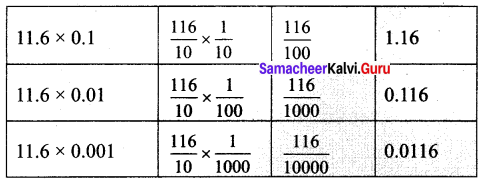
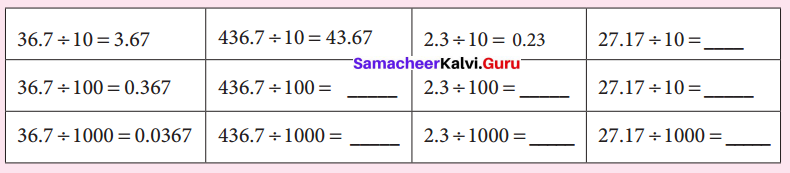
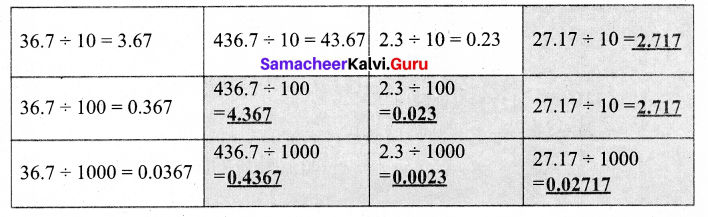
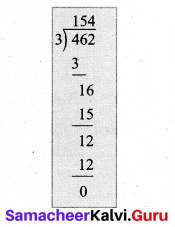
Samacheer Kalvi 7th Maths Solutions Term 3 Chapter 1 Number System Ex 1.5

Students can Download Maths Chapter 1 Number System Ex 1.5 Questions and Answers, Notes Pdf, Samacheer Kalvi 7th Maths Book Solutions Guide Pdf helps you to revise the complete Tamilnadu State Board New Syllabus and score more marks in your examinations.

Tamilnadu Samacheer Kalvi 7th Maths Solutions Term 3 Chapter 1 Number System Ex 1.5

Miscellaneous Practice problems

Question 1.
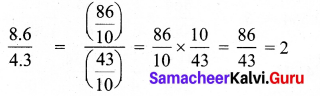
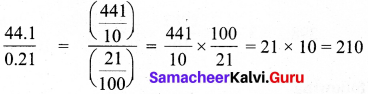
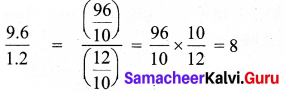
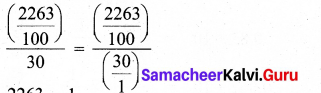
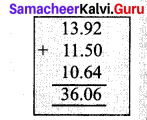
Malini bought three ribbon of lengths 13.92 m, 11.5 m and 10.64 m. Find the total length of the ribbons?
Solution:
Length of ribbon 1 = 13.92 m
Length of ribbon 2 = 11.50 m
Length of ribbon 3 = 10.64 m
Samacheer Kalvi 7th Maths Solutions Term 3 Chapter 1 Number System 1.5 1
Total Length of the ribbons = 13.92 m + 11.5 m + 10.64 m = 36.06 m
Totla length of the ribbons = 36.06 m

Samacheer Kalvi 7th Maths Solutions Term 3 Chapter 1 Number System Ex 1.5

Question 2.
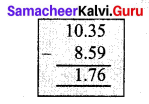
Chitra has bought 10 kg 35 g of ghee for preparing sweets. She used 8 kg 59 g of ghee. How much ghee will be left?
Solution:
Total weight of ghee bought = 10 kg 35 g
Weight of ghee used = 8 kg 59 g
Weight of ghee left = 10.35 kg – 8.59 kg = 1.76 kg
Samacheer Kalvi 7th Maths Solutions Term 3 Chapter 1 Number System 1.5 2
∴ Weight of ghee left= 1 kg 76 g = 1.76 kg

Question 3.
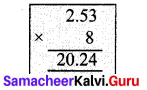
If the capacity of a milk can is 2.53 l, then how much milk is required to fill 8 such cans?
Solution:
Capacity of 1 milk can= 2.53 l
∴ Capacity of 8 milk cans= 2.53 l × 8 = 20.24 l
Samacheer Kalvi 7th Maths Solutions Term 3 Chapter 1 Number System 1.5 3
To fill 8 cans 20.24 l of milk is required.

Question 4.
A basket of orange weighs 22.5 kg. If each family requires 2.5 kg of orange, families can share?
Solution:
Total weight of orange = 22.5 kg
Weight of orange required for 1 family = 2.5 kg
∴ Number of families sharing orange = 22.5 kg ÷ 2.5 kg
= \(\frac { 22.5 }{ 2.5 } \) = \(\frac { 22.5 }{ 2.5 } \) × \(\frac { 10 }{ 10 } \) = \(\frac { 225 }{ 25 } \) = 9
∴ 9 families can share the oranges.

Samacheer Kalvi 7th Maths Solutions Term 3 Chapter 1 Number System Ex 1.5

Question 5.
A baker uses 3.924 kg of sugar to bake 10 cakes of equal size. How much sugar is used in each cake?
Solution:
For 10 cakes sugar required = 3.924 kg
For 1 cake sugar required = 3.924 ÷ 10 = \(\frac { 3.924 }{ 10 } \) = 0.3924 kg
For 1 cake sugar required = 0.3924 kg.

Question 6.
Evaluate:
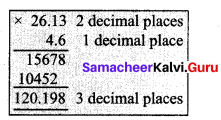
(i) 26.13 × 4.6
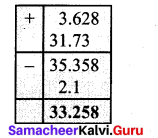
(ii) 3.628 + 31.73 – 2.1
Solution:
(i) 26.13 × 4.6
26.13 × 4.6 = 120.198
Samacheer Kalvi 7th Maths Solutions Term 3 Chapter 1 Number System 1.5 4

(ii) 3.628 + 31.73 – 2.1 = 33.258
Samacheer Kalvi 7th Maths Solutions Term 3 Chapter 1 Number System 1.5 5

Question 7.
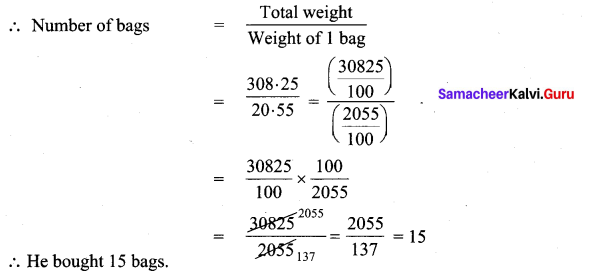
Murugan bought some bags of vegetables. Each bag weighs 20.55 kg. If the total weight of all the bags is 308.25 kg, how many bags did he buy?
Solution:
Total weight of all bags = 308.25 kg
Weight of 1 bag = 20.55 kg
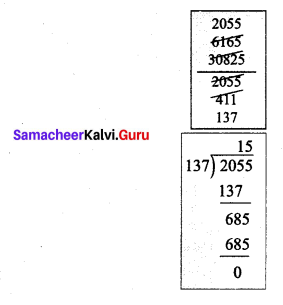
Samacheer Kalvi 7th Maths Solutions Term 3 Chapter 1 Number System 1.5 6Samacheer Kalvi 7th Maths Solutions Term 3 Chapter 1 Number System 1.5 7

Samacheer Kalvi 7th Maths Solutions Term 3 Chapter 1 Number System Ex 1.5

Question 8.
A man walks around a circular park of distance 23.761 m. How much distance will he cover in 100 rounds?
Solution:
In 1 round distance covered = 23.761 m
∴ In 100 rounds distance = 23.761 × 100
= 2376.1 m
∴ In 100 round he covers 2376.1 m.

Question 9.
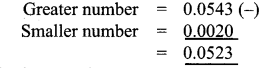
How much 0.0543 is greater than 0.002?
Solution:
Samacheer Kalvi 7th Maths Solutions Term 3 Chapter 1 Number System 1.5 8
∴ Required answer is 0.0523

Question 10.
A printer can print 15 pages per minute. How many pages can it print in 4.6 minutes?
Solution.
In 1 minute the pages printed = 15
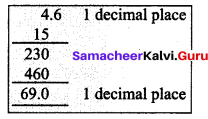
In 4.6 minutes the pages printed = 15 × 4.6
= 69
Samacheer Kalvi 7th Maths Solutions Term 3 Chapter 1 Number System 1.5 9
The printer prints 69 pages.

Samacheer Kalvi 7th Maths Solutions Term 3 Chapter 1 Number System Ex 1.5

Challenge Problems

Question 1.
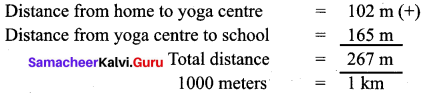
The distance travelled by Prabhu from home to Yoga centre is 102 m and from Yoga centre to school is 165 m. What is the total distance travelled by him in kilometres (in decimal form)?
Solution:
Samacheer Kalvi 7th Maths Solutions Term 3 Chapter 1 Number System 1.5 10
∴ 267 metres = \(\frac { 267 }{ 1000 } \) km = 0.267 km
∴ Total distance travelled = 0.267 km

Question 2.
Anbu and Mala travelled from A to C in two different routes. Anbu travelled from place A to place B and from there to place C. A is 8.3 km from B and B is 15.6 km from C. Mala travelled from place A to place D and from there to place C. D is 7.5 km from A and C is 16.9 km from D. Who travelled more and by how much distance?
Solution:
Distance travelled by Anbu:

From place A to place B = 8.3 km
Distance from place B to place C = 15.6 km
∴ Total distance travelled by Anbu = 8.3 + 15.6
= 23.9 km

Distance travlled by Mala:

Distance travelled place A to D = 7.5 km
Distance from place D to place C = 16.9 km
Total distance travelled by mala = (7.5 + 16.9) km = 24.4 km
24.4 > 23.9
∴ Mala travelled more distance. She travelled (24.4 – 23.9) km more i.e she travelled 0.5 km more

Samacheer Kalvi 7th Maths Solutions Term 3 Chapter 1 Number System Ex 1.5

Question 3.
Ramesh paid ₹ 97.75 per hour for a taxi and he used 35 hours in a week. How much he has to pay totally as taxi fare for a week?
Solution:
Payment for the taxi for an hour = ₹ 97.75
Total hours the taxi was used = 35 hrs
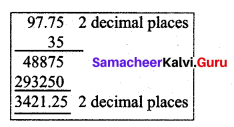
∴ Total payment for the taxi for the week
Samacheer Kalvi 7th Maths Solutions Term 3 Chapter 1 Number System 1.5 11
= 97.75 × 35
= 3421.25
Total payment for a week = ₹ 3421.25

Question 4.
An Aeroplane travelled 2781.20 kms in 6 hours. Find the average speed of the aeroplane in Km/hr.
Solution:
In 6 hours the distance travelled = 2781.20 km
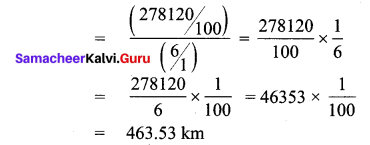
In 1 hour the distance travelled = \(\frac { 2781.20 }{ 6 } \) km
Samacheer Kalvi 7th Maths Solutions Term 3 Chapter 1 Number System 1.5 12
Average speed of the aroplane = 463.53 km/hr.

Samacheer Kalvi 7th Maths Solutions Term 3 Chapter 1 Number System Ex 1.5

Question 5.
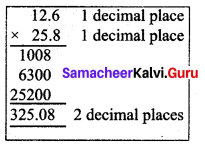
Kumar’s car gives 12.6 km mileage per litre. If his fuel tank holds 25.8 litres then how far can he travel?
Solution.
Distance travelled with 1 litre fuel = 12.6 km
∴ with 25.8 litres distance travelled = 12.6 × 25.8
= 325.08 km
Samacheer Kalvi 7th Maths Solutions Term 3 Chapter 1 Number System 1.5 13
The car can travel 325.08 km

Samacheer Kalvi 7th Maths Solutions Term 3 Chapter 2 Percentage and Simple Interest Ex 2.1

Students can Download Maths Chapter 2 Percentage and Simple Interest Ex 2.1 Questions and Answers, Notes Pdf, Samacheer Kalvi 7th Maths Book Solutions Guide Pdf helps you to revise the complete Tamilnadu State Board New Syllabus and score more marks in your examinations.

Tamilnadu Samacheer Kalvi 7th Maths Solutions Term 3 Chapter 2 Percentage and Simple Interest Ex 2.1

Question 1.
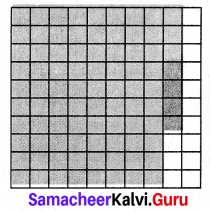
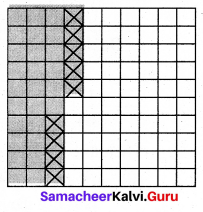
In each of the following grid, find the numbers of coloured squares and express it as a fraction, decimal and percentage.
Samacheer Kalvi 7th Maths Solutions Term 3 Chapter 2 Percentage and Simple Interest Ex 2.1 1
Solution:
Number of coloured square = 58
Total number of squares = 100
∴ Fraction : \(\frac { 58 }{ 100 } \)
Decimal : 0.58
Percentage : 58%

(ii) Number of coloured square = 53
Total number of squares = 100
∴ Fraction : \(\frac { 53 }{ 100 } \)
Decimal : 0.53
Percentage : 53%

(iii) Number of coloured square = 25
Total number of squares = 50
∴ Fraction : \(\frac { 25 }{ 50 } \)

Decimal : \(\frac { 25 }{ 50 } \) × \(\frac { 2 }{ 2 } \)
= \(\frac { 50 }{ 100 } \)
= 0.50

Percentage : \(\frac { 25 }{ 50 } \) × \(\frac { 100 }{ 100 } \)
= \(\frac { 25 }{ 50 } \) × 100% = 50%

Samacheer Kalvi 7th Maths Solutions Term 3 Chapter 2 Percentage and Simple Interest Ex 2.1

(iv) Number of coloured square = 17
Total number of squares = 25
∴ Fraction : \(\frac { 17 }{ 25 } \)
Decimal : \(\frac { 17 }{ 25 } \) × \(\frac { 4 }{ 4 } \)
= \(\frac { 68 }{ 100 } \) = 0.68
Percentage : \(\frac { 17 }{ 25 } \) × \(\frac { 100 }{ 100 } \)
= \(\frac { 17 }{ 25 } \) × 100%
= 68%

(v) Number of coloured square = 15
Total number of squares = 30
∴ Fraction : \(\frac { 15 }{ 30 } \)
Decimal : \(\frac { 15 }{ 30 } \)
= \(\frac { 1 }{ 2 } \) × \(\frac { 50 }{ 50 } \)
= \(\frac { 50 }{ 100 } \) = 0.50
Percentage : \(\frac { 15 }{ 30 } \)
= \(\frac { 15 }{ 30 } \) × \(\frac { 100 }{ 100 } \)
= \(\frac { 15 }{ 30 } \) × 100%
= 50 %

Samacheer Kalvi 7th Maths Solutions Term 3 Chapter 2 Percentage and Simple Interest Ex 2.1

Question 2.
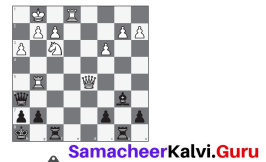
A picture of chess board is given.
(i) Find the percentage of the white coloured squares
(ii) Find the percentage of gray coloured squares
(iii) Find the percentage of the squares that have the pieces and
(iv) The squares that do not have the pieces.
Samacheer Kalvi 7th Maths Solutions Term 3 Chapter 2 Percentage and Simple Interest Ex 2.1 2
Solution:
(i) Total number of squares in the chess board = 64
Number of white coloured squares = 32
Percentage = \(\frac { 32 }{ 64 } \) × \(\frac { 100 }{ 100 } \)
= \(\frac { 32 }{ 64 } \) × 100 %
= 50%

(ii) Grey coloured squares = 64
Percentage = \(\frac { 32 }{ 64 } \) × \(\frac { 100 }{ 100 } \)
= \(\frac { 32 }{ 64 } \) } [/latex] × 100 %
= 50 %

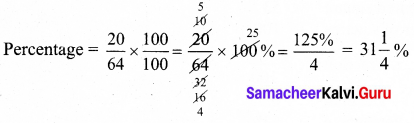
(iii) Number of squares having pieces = 20
Total number of squares = 64
Samacheer Kalvi 7th Maths Solutions Term 3 Chapter 2 Percentage and Simple Interest Ex 2.1 3

(iv) Number of squares do not have pieces = 44
Samacheer Kalvi 7th Maths Solutions Term 3 Chapter 2 Percentage and Simple Interest Ex 2.1 4

Samacheer Kalvi 7th Maths Solutions Term 3 Chapter 2 Percentage and Simple Interest Ex 2.1

Question 3.
A picture of dart board is given. Find the percentage of white coloured portion and black coloured portion.
Samacheer Kalvi 7th Maths Solutions Term 3 Chapter 2 Percentage and Simple Interest Ex 2.1 5
Solution:
Total sector = 20
White coloured sector = 10
Black coloured sector = 10
Percentage of white : \(\frac { 10 }{ 20 } \) × \(\frac { 100 }{ 100 } \)
Decimal : \(\frac { 10 }{ 20 } \) × 100 %
= 50 %
Percentage of black colour : \(\frac { 10 }{ 20 } \) × \(\frac { 100 }{ 100 } \)
Decimal : \(\frac { 10 }{ 20 } \) × 100 %
= 50 %

Samacheer Kalvi 7th Maths Solutions Term 3 Chapter 2 Percentage and Simple Interest Ex 2.1

Question 4.
Write each of the following fraction as percentage.
(i) \(\frac { 36 }{ 50 } \)
(ii) \(\frac { 81 }{ 30 } \)
(iii) \(\frac { 42 }{ 56 } \)
(iv) 2 \(\frac { 1 }{ 4 } \)
(v) 1 \(\frac { 3 }{ 5 } \)
Solution:
(i) \(\frac { 36 }{ 50 } \)
= \(\frac { 36 }{ 50 } \) × \(\frac { 100 }{ 100 } \)
= \(\frac { 36 }{ 50 } \) × 100 %
= 72 %

(ii) \(\frac { 81 }{ 30 } \)
= \(\frac { 81 }{ 30 } \) × \(\frac { 100 }{ 100 } \)
= \(\frac { 81 }{ 30 } \) × 100 %
= 270 %

(iii) \(\frac { 42 }{ 56 } \)
= \(\frac { 42 }{ 56 } \) × \(\frac { 100 }{ 100 } \)
= \(\frac { 42 }{ 56 } \) × 100 %
= \(\frac { 21 }{ 28 } \) × 100 %
= 75 %

(iv) 2 \(\frac { 1 }{ 4 } \)
= \(\frac { 9 }{ 4 } \)
= \(\frac { 9 }{ 4 } \) × \(\frac { 100 }{ 100 } \)
= \(\frac { 9 }{ 4 } \) × 100 %
= 225 %

(v) 1 \(\frac { 3 }{ 5 } \)
= \(\frac { 8 }{ 5 } \)
= \(\frac { 8 }{ 5 } \) × \(\frac { 100 }{ 100 } \)
= \(\frac { 8 }{ 5 } \) × 100 %
= 160 %

Samacheer Kalvi 7th Maths Solutions Term 3 Chapter 2 Percentage and Simple Interest Ex 2.1

Question 5.
Anbu scored 436 marks out of 500 in his exams. What was the percentage he scored?
Answer:
Total marks = 500
Anbu’s Score = 436
Percentage = \(\frac { 436 }{ 500 } \) × \(\frac { 100 }{ 100 } \)
= \(\frac { 436 }{ 500 } \) × 100 %
= 87.2 %
Anbu’s Score = 87.2 %

Samacheer Kalvi 7th Maths Solutions Term 3 Chapter 2 Percentage and Simple Interest Ex 2.1

Question 6.
Write each of the following percentage as fraction,
(i) 21%
(ii) 93.1 %
(iii) 151 %
(iv) 65 %
(v) 0.64 %
Solution:
(i) 21%
= \(\frac { 21 }{ 100 } \)

(ii) 93.1 %
= \(\frac { 93.1 }{ 100 } \)
= \(\frac{93.1 \times 10}{100 \times 10}\)
= \(\frac { 931 }{ 1000 } \)

(iii) 151 %
= \(\frac { 151 }{ 100 } \)

(iv) 65 %
= \(\frac { 65 }{ 100 } \)
= \(\frac { 13 }{ 20 } \)

(v) 0.64 %
= \(\frac { 0.64 }{ 100 } \)
= \(\frac{0.64 \times 100}{100 \times 100}\)
= \(\frac { 64 }{ 10000 } \)
= \(\frac { 4 }{ 625 } \)

Question 7.
Iniyan bought 5 dozen eggs. Out of that 5 dozen eggs, 10 eggs are rotten. Express the number of good eggs as percentage.
Solution:
1 dozen eggs = 12
5 dozen = 5 × 12
Total eggs = 60 eggs
Rotten eggs = 10 Good
eggs = 60 – 10 = 50
Fraction of good eggs = \(\frac { 50 }{ 60 } \)
Percentage of good eggs = \(\frac { 50 }{ 60 } \) × \(\frac { 100 }{ 100 } \)
= \(\frac { 50 }{ 60 } \) × 100 %
= \(\frac { 5 }{ 6 } \) × 100 %
= 83.33 %
Percentage of good eggs = 83.33 %

Samacheer Kalvi 7th Maths Solutions Term 3 Chapter 2 Percentage and Simple Interest Ex 2.1

Question 8.
In an election, Candidate X secured 48% of votes. What fraction will represent his votes?
Solution:
Percentage of votes x secured = 48% = \(\frac { 48 }{ 100 } \)
Fraction of votes x secured = \(\frac { 12 }{ 25 } \)

Question 9.
Ranjith total income was ₹ 7,500. He saved 25% of his total income. Find the amount saved by him.
Solution:
Total income of Ranjith = ₹ 7500
His savings = 25 % of 7500
= \(\frac { 25 }{ 100 } \) of 7500
= \(\frac { 25 }{ 100 } \) × 7500
= ₹ 1,875
∴ Amount saved by Ranjith = ₹ 1,875

Objective Type Questions

Question 1.
Thendral saved one fourth of her salary. Her savings percentage is
(i) \(\frac { 3 }{ 4 } \)
(ii) \(\frac { 1 }{ 4 } \) %
(iii) 25 %
(iv) 1 %
Hint: \(\frac { 1 }{ 4 } \) × \(\frac { 100 }{ 100 } \)
= \(\frac { 1 }{ 4 } \) × 100 %
= 25 %
Answer:
(iii) 25 %

Question 2.
Kavin scored 15 out of 25 in a test. The percentage of his marks is
(i) 60%
(ii) 15%
(iii) 25%
(iv) 15/25
Hint: \(\frac { 15 }{ 25 } \) × \(\frac { 100 }{ 100 } \)
= \(\frac { 15 }{ 25 } \) × 100 %
= 60 %
Answer:
(i) 60%

Samacheer Kalvi 7th Maths Solutions Term 3 Chapter 2 Percentage and Simple Interest Ex 2.1

Question 3.
0.07% is
(i) \(\frac { 7 }{ 10 } \)
(ii) \(\frac { 7 }{ 100 } \)
(iii) \(\frac { 7 }{ 1000 } \)
(iv) \(\frac { 7 }{ 10,000 } \)
Hint: 0.07 %
= 0.07%
= \(\frac { 0.07 }{ 100 } \)
= \(\frac{7}{\frac{100}{100}}\)
= \(\frac{7}{100 \times 100}\)
= \(\frac { 7 }{ 10,000 } \)
Answer:
(iv) \(\frac { 7 }{ 10,000 } \)

Samacheer Kalvi 7th Maths Solutions Term 3 Chapter 1 Number System Ex 1.4

Students can Download Maths Chapter 1 Number System Ex 1.4 Questions and Answers, Notes Pdf, Samacheer Kalvi 7th Maths Book Solutions Guide Pdf helps you to revise the complete Tamilnadu State Board New Syllabus and score more marks in your examinations.

Tamilnadu Samacheer Kalvi 7th Maths Solutions Term 3 Chapter 1 Number System Ex 1.4

Question 1.
Simplify the following
(i) 0.6 ÷ 3
(ii) 0.90 ÷ 5
(iii) 4.08 ÷ 4
(iv) 21.56 ÷ 7
(v) 0.564 ÷ 6
(vi) 41.36 ÷ 4
(vii) 298.2 ÷ 3
Solution:
(i) 0.6 ÷ 3
= \(\frac { 6 }{ 10 } \) × \(\frac { 1 }{ 3 } \)
= \(\frac { 6 }{ 3 } \) × \(\frac { 1 }{ 10 } \)
= 2 × \(\frac { 1 }{ 10 } \)
= \(\frac { 2 }{ 10 } \)
= 0.2

(ii) 0.90 ÷ 5
= \(\frac { 90 }{ 100 } \) × \(\frac { 1 }{ 5 } \)
= \(\frac { 90 }{ 5 } \) × \(\frac { 1 }{ 100 } \)
= 18 × \(\frac { 1 }{ 100 } \) = \(\frac { 18 }{ 100 } \)
= 0.18

(iii) 4.08 ÷ 4
= \(\frac { 408 }{ 100 } \) × \(\frac { 1 }{ 4 } \)
= \(\frac { 408 }{ 4 } \) x \(\frac { 1 }{ 100 } \)
= 102 × \(\frac { 1 }{ 100 } \)
= \(\frac { 102 }{ 100 } \)
= 1.02

(iv) 21.56 ÷ 7
= \(\frac { 2156 }{ 100 } \) × \(\frac { 1 }{ 7 } \)
= \(\frac { 2156 }{ 7 } \) × \(\frac { 1 }{ 100 } \)
= 308 × \(\frac { 1 }{ 100 } \)
= \(\frac { 308 }{ 100 } \)
= 3.08

(v) 0.564 ÷ 6
= \(\frac { 564 }{ 1000 } \) × \(\frac { 1 }{ 6 } \)
= \(\frac { 564 }{ 6 } \) × \(\frac { 1 }{ 1000 } \)
= \(\frac { 94 }{ 1000 } \)
= 0.094

(vi) 41.36 ÷ 4
= \(\frac { 4136 }{ 100 } \) × \(\frac { 1 }{ 4 } \)
= \(\frac { 4136 }{ 4 } \) × \(\frac { 1 }{ 100 } \)
= \(\frac { 1034 }{ 100 } \)
= 10.34

(vii) 298.2 ÷ 3
= \(\frac { 2982 }{ 10 } \) × \(\frac { 1 }{ 3 } \)
= \(\frac { 2982 }{ 3 } \) × \(\frac { 1 }{ 10 } \)
= \(\frac { 994 }{ 10 } \)
= 99.4

Samacheer Kalvi 7th Maths Solutions Term 3 Chapter 1 Number System Ex 1.4

Question 2.
Simplify the following.
(i) 5.7 ÷ 10
(ii) 93.7 ÷ 10
(iii) 0.9 ÷ 10
(iv) 301.301 ÷ 10
(v) 0.83 ÷ 10
(vi) 0.062 ÷ 10
Solution:
(i) 5.7 ÷ 10
= \(\frac { 57 }{ 10 } \) × \(\frac { 1 }{ 10 } \)
= \(\frac { 57 }{ 100 } \)
= 0.57

(ii) 93.7 ÷ 10
= \(\frac { 937 }{ 10 } \) × \(\frac { 1 }{ 10 } \)
= \(\frac { 937 }{ 100 } \)
= 9.37

(iii) 0.9 ÷ 10
= \(\frac { 9 }{ 10 } \) × \(\frac { 1 }{ 10 } \)
= \(\frac { 9 }{ 100 } \)
= 0.09

(iv) 301.301 ÷ 10
= \(\frac { 301301 }{ 1000 } \) × \(\frac { 1 }{ 10 } \)
= \(\frac { 301301 }{ 10000 } \)
= 30.1301

(v) 0.83 ÷ 10
= \(\frac { 83 }{ 100 } \) × \(\frac { 1 }{ 10 } \)
= \(\frac { 83 }{ 1000 } \)
= 0.083

(vi) 0.062 ÷ 10
= \(\frac { 62 }{ 1000 } \) × \(\frac { 1 }{ 10 } \)
= \(\frac { 62 }{ 1000 } \)
= 0.0062

Samacheer Kalvi 7th Maths Solutions Term 3 Chapter 1 Number System Ex 1.4

Question 3.
Simplify the following.
(i) 0.7 ÷ 100
(ii) 3.8 ÷ 100
(iii) 49.3 ÷ 100
(iv) 463.85 ÷ 100
(v) 0.3 ÷ 100
(vi) 27.4 ÷ 100
Solution:
(i) 0.7 ÷ 100
= \(\frac { 7 }{ 10 } \) × \(\frac { 1 }{ 100 } \)
= \(\frac { 7 }{ 1000 } \)
= 0.007

(ii) 3.8 ÷ 100
= \(\frac { 38 }{ 10 } \) × \(\frac { 1 }{ 100 } \)
= \(\frac { 38 }{ 1000 } \)
= 0.038

(iii) 49.3 ÷ 100
= \(\frac { 493 }{ 10 } \) × \(\frac { 1 }{ 100 } \)
= \(\frac { 493 }{ 1000 } \)
= 0.493

(iv) 463.85 ÷ 100
= \(\frac { 46385 }{ 100 } \) × \(\frac { 1 }{ 100 } \)
= \(\frac { 46385 }{ 1000 } \)
= 4.6385

(v) 0.3 ÷ 100
= \(\frac { 3 }{ 10 } \) × \(\frac { 1 }{ 100 } \)
= \(\frac { 3 }{ 1000 } \)
= 4.6385

(vi) 27.4 ÷ 100
= \(\frac { 274 }{ 10 } \) × \(\frac { 1 }{ 100 } \)
= \(\frac { 274 }{ 1000 } \)
= 0.274

Question 4.
Simplify the following.
(i) 18.9 ÷ 1000
(ii) 0.87 ÷ 1000
(iii) 49.3 ÷ 1000
(iv) 0.3 ÷ 1000
(v) 382.4 ÷ 1000
(vi) 93.8 ÷ 1000
Solution:
(i) 18.9 ÷ 1000
= \(\frac { 189 }{ 10 } \) × \(\frac { 1 }{ 1000 } \)
= \(\frac { 189 }{ 10000 } \)
= 0.0189

(ii) 0.87 ÷ 1000
= \(\frac { 87 }{ 100 } \) × \(\frac { 1 }{ 1000 } \)
= \(\frac { 87 }{ 100000 } \)
= 0.00087

(iii) 49.3 ÷ 1000
= \(\frac { 493 }{ 10 } \) × \(\frac { 1 }{ 100 } \)
= \(\frac { 493 }{ 1000 } \)
= 0.493

(iv) 0.3 ÷ 1000
= \(\frac { 3 }{ 10 } \) × \(\frac { 1 }{ 1000 } \)
= \(\frac { 3 }{ 10000 } \)
= 0.0003

(v) 382.4 ÷ 1000
= \(\frac { 3824 }{ 10 } \) × \(\frac { 1 }{ 1000 } \)
= \(\frac { 3824 }{ 10000 } \)
= 0.3824

(vi) 93.8 ÷ 1000
= \(\frac { 938 }{ 10 } \) × \(\frac { 1 }{ 1000 } \)
= \(\frac { 938 }{ 10000 } \)
= 0.0938

Samacheer Kalvi 7th Maths Solutions Term 3 Chapter 1 Number System Ex 1.4

Question 5.
Simplify the following.
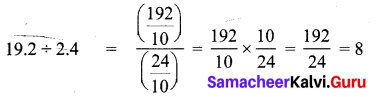
(i) 19.2 ÷ 2.4
(ii) 4.95 ÷ 0.5
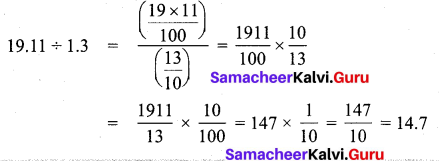
(iii) 19.11 ÷ 1.3
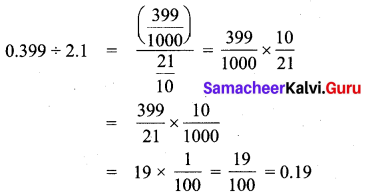
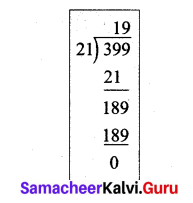
(iv) 0.399 ÷ 2.1
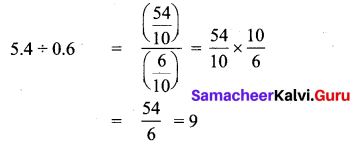
(v) 5.4 ÷ 0.6
(vi) 2.197 ÷ 1.3
Solution:
(i) 19.2 ÷ 2.4
Samacheer Kalvi 7th Maths Solutions Term 3 Chapter 1 Number System 1.4 1

(ii) 4.95 ÷ 0.5
Samacheer Kalvi 7th Maths Solutions Term 3 Chapter 1 Number System 1.4 2

(iii) 19.11 ÷ 1.3
Samacheer Kalvi 7th Maths Solutions Term 3 Chapter 1 Number System 1.4 3

(iv) 0.399 ÷ 2.1
Samacheer Kalvi 7th Maths Solutions Term 3 Chapter 1 Number System 1.4 4Samacheer Kalvi 7th Maths Solutions Term 3 Chapter 1 Number System 1.4 5

(v) 5.4 ÷ 0.6
Samacheer Kalvi 7th Maths Solutions Term 3 Chapter 1 Number System 1.4 6

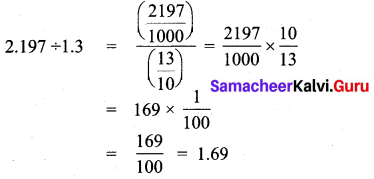
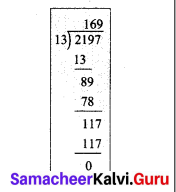
(vi) 2.197 ÷ 1.3
Samacheer Kalvi 7th Maths Solutions Term 3 Chapter 1 Number System 1.4 7Samacheer Kalvi 7th Maths Solutions Term 3 Chapter 1 Number System 1.4 8

Samacheer Kalvi 7th Maths Solutions Term 3 Chapter 1 Number System Ex 1.4

Question 6.
Divide 9.55 kg of sweet among 5 children. How much will each child get?
Solution:
Weight of the sweet = 9.55 Kg
Weight of sweet for 5 children = \(\frac { 955 }{ 100 } \) Kg
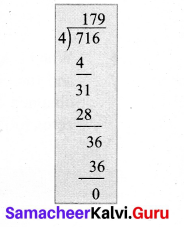
Weight of sweet for 1 child = \(\frac{\left(\frac{955}{100}\right)}{5}\) = \(\frac { 955 }{ 100 } \) × \(\frac { 1 }{ 5 } \) = \(\frac { 955 }{ 5 } \) × \(\frac { 1 }{ 100 } \)
= \(\frac { 191 }{ 100 } \) = 1.91
Each child will get 1.91 kg sweet.

Question 7.
A vehicle covers a distance of 76.8 km for 1.2 litre of petrol. How much distance will it cover for one litre of petrol?
Solution:
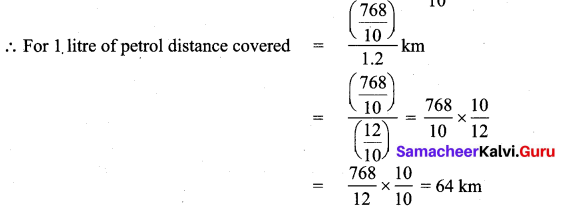
For 1.2 litre of petrol the distance covered = 76.8 Km = \(\frac { 768 }{ 10 } \) Km
Samacheer Kalvi 7th Maths Solutions Term 3 Chapter 1 Number System 1.4 9
For 1 litre of petrol distance covered = 64 Km

Samacheer Kalvi 7th Maths Solutions Term 3 Chapter 1 Number System Ex 1.4

Question 8.
Cost of levelling a land at the rate of ₹ 15.50 sq. ft is ₹ 10,075. Find the area of the land.
Solution:
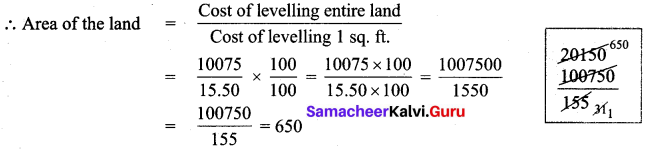
Cost of levelling the entire land = ₹ 10,075
Cost of levelling 1 sq. ft = ₹ 15.50
Samacheer Kalvi 7th Maths Solutions Term 3 Chapter 1 Number System 1.4 10
∴ Area of the land = 650 sq.ft.

Question 9.
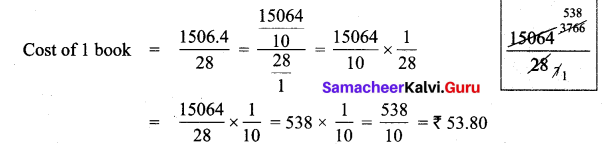
The cost of 28 books are ₹ 1506.4. Find the cost of one book.
Solution:
Cost of 28 books = ₹ 1506.4
Samacheer Kalvi 7th Maths Solutions Term 3 Chapter 1 Number System 1.4 11
Cost of 1 book = ₹ 53.80

Question 10.
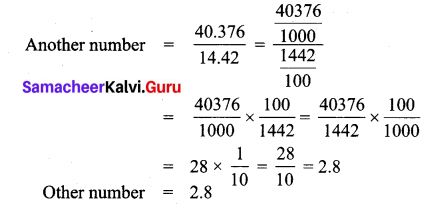
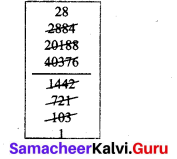
The product of two numbers is 40.376. One number is 14.42. Find the other number.
Product of two numbers = 40.376
One number = 14.42
Samacheer Kalvi 7th Maths Solutions Term 3 Chapter 1 Number System 1.4 12Samacheer Kalvi 7th Maths Solutions Term 3 Chapter 1 Number System 1.4 13

Samacheer Kalvi 7th Maths Solutions Term 3 Chapter 1 Number System Ex 1.4

Objective Type Questions

Question 1.
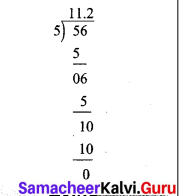
5.6 ÷ 0.5 = ?
(i) 11.4
(ii) 10.4
(iii) 0.14
(iv) 11.2
Answer:
(iv) 11.2
Hint:
\(\frac { 5.6 }{ 0.5 } \) = \(\frac { 56 }{ 5 } \)
= 11.2
Samacheer Kalvi 7th Maths Solutions Term 3 Chapter 1 Number System 1.4 14

Question 2.
2.01 ÷ 0.03 = ?
(i) 6.7
(ii) 67.0
(iii) 0.67
(iv) 0.067
Answer:
(ii) 67.0
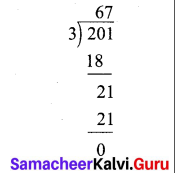
Hint: \(\frac { 2.01 }{ 0.03 } \) = \(\frac { 201 }{ 3 } \)
= 67
Samacheer Kalvi 7th Maths Solutions Term 3 Chapter 1 Number System 1.4 15

Samacheer Kalvi 7th Maths Solutions Term 3 Chapter 1 Number System Ex 1.4

Question 3.
0.05 ÷ 0.5 = ?
(i) 0.01
(ii) 0.1
(iii) 0.10
(iv) 1.0
Answer:
(ii) 0.1
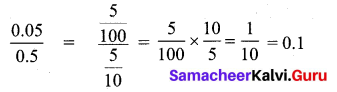
Hint:
Samacheer Kalvi 7th Maths Solutions Term 3 Chapter 1 Number System 1.4 16

Samacheer Kalvi 12th English Solutions Supplementary Chapter 3 The Hour of Truth (Play)

Students can Download English Lesson 3 The Hour of Truth (Play) Questions and Answers, Summary, Activity, Notes, Samacheer Kalvi 12th English Book Solutions Guide Pdf helps you to revise the complete Tamilnadu State Board New Syllabus and score more marks in your examinations.

Tamilnadu Samacheer Kalvi 12th English Solutions Supplementary Chapter 3 The Hour of Truth (Play)

Warm up

Question (a)
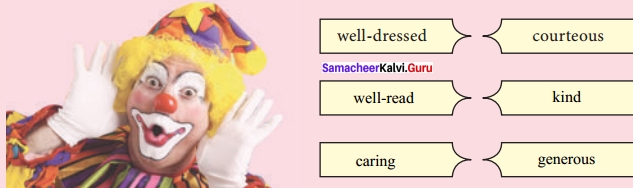
We judge people around us, based on their qualities and actions. We brand some people as good and some bad. What qualities, do you think, characterise a gentleman? Some of them may be merely external and some others internal

Samacheer Kalvi 12th English Solutions Supplementary Chapter 3 The Hour of Truth (Play) img-1

Answer:

Samacheer Kalvi 12th English Solutions Supplementary Chapter 3 The Hour of Truth (Play) img-2

Question (b)
When we see a few coins scattered on the ground, we would probably pick them up on the sly or walk away ignoring them. What if it was an envelope full of 2000 bills? How are people likely to react in such a situation?

Samacheer Kalvi 12th English Solutions Supplementary Chapter 3 The Hour of Truth (Play) img-3

Answer:
Discuss with a partner and share your views:
People may react differently. Reader’s digest conducted a honesty test in the busy roads of major cities of India. They had obviously left a costly mobile on the middle of a pavement. A candid camera was taking a video footage. Many tried to pocket it. One poor man tried to contact a policeman on the beat and hand it over to him. Recently in Saravana Bhavan hotel in Chennai an old lady had left behind a yellow bag. There was 25 lakhs in the bag. The old lady had come to buy jewels for her grand daughter’s wedding. One of the waiters who attended the lady and her family members passed on the bag to the manager, who in turn gave it in person to Inspector, Mambalam Police station. Fortunately a tear filled lady and worried family members also reached the spot. The Inspector sent for the honest waiter and through him gave the money to the old lady.

Whether it is big money or small coins, one should not covet others’ wealth. The person who lost must be feeling the pain of loss. We should never think of enjoying life at the cost of the pain of others.

Samacheer Kalvi 12th English The Hour of Truth (Play) Textual Questions

1. Rearrange the following sentences in a meaningful sequence and write the summary of the play.

(a) Baldwin who returned home after meeting Gresham, informed his family that Gresham had offered a hundred thousand, if he would utter the words ‘I don’t remember’ in court, during the trial.
(b) The family members tried to justify Gresham’s act and enticed Baldwin into accepting the money.
(c) Thus ‘The Hour of Truth’ had dawned relieving Baldwin of the heavy burden and guilt.
(d) Baldwin was an honest and upright man, working under John Gresham, in a bank.
(e) To save Baldwin, Mr. Marshall, President of the Third National, visited him and informed him that Gresham had confessed his crime, in order to free him from betraying his trusted friend and testifying painfully against him.
(f) Gresham and Baldwin had been thick friends for over 30 years and Baldwin had even named his son after Gresham.
(g) Baldwin felt disgusted with himself and the attitude of his family members.
(h) Gresham had been arrested for misappropriation of money at the bank and Baldwin was to testify against him.
(i) Mr. Marshall also offered Baldwin a job in his Bank, to reward him for his honesty and integrity.
(j) The family members who were initially against Gresham, changed their mind on hearing the huge sum offered by him.

Answer:

(f) Gresham and Baldwin had been thick friends for over 30 years and Baldwin had even named his son after Gresham.
(d) Baldwin was an honest and upright man, working under John Gresham, in a bank.
(h) Gresham had been arrested for misappropriation of money at the bank and Baldwin was to testify against him.
(a) Baldwin who returned home after meeting Gresham, informed his family that Gresham had offered a hundred thousand, if he would utter the words ‘I don’t remember’ in court, during the trial.
(b) The family members tried to justify Gresham’s act and enticed Baldwin into accepting the money.
(j) The family members who were initially against Gresham, changed their mind on hearing the huge sum offered by him.
(g) Baldwin felt disgusted with himself and the attitude of his family members.
(e) To save Baldwin, Mr. Marshall, President of the Third National, visited him and informed him that Gresham had confessed his crime, in order to free him from betraying his trusted friend and testifying painfully against him.
(c) Thus ‘The Hour of Truth’ had dawned relieving Baldwin of the heavy burden and guilt.
(i) Mr. Marshall also offered Baldwin a job in his Bank, to reward him for his honesty and integrity.

2. Answer the following questions in one or two sentences each.

Question (a)
Why did Baldwin meet Gresham?
Answer:
Baldwin met Gresham because he had asked to see him before the trial slotted the following day.

Question (b)
What made Martha withdraw her money from the bank?
Answer:
Martha had a doubt that the bank was crashing. So, she withdrew the money from the bank.

SamacheerKalvi.Guru

Question (c)
How is Martha’s strong conviction in Baldwin’s integrity revealed?
Answer:
During the family conversation, Martha defends Mr. Baldwin’s integrity like a tigress. She told her son John Gresham Baldwin and Evie that their father was upright and had no hand in the wrecking of the bank.

Question (d)
What had Donovan told John?
Answer:
Donovan had said that nobody had any idea as to what was ailing the bank. The wreck of the bank was too sudden. He had married on the strength of the cashier’s job in the bank. He said crash would not have happened without the knowledge of the Governor Baldwin.

Question (e)
John feels Gresham deserves punishment. Why?
Answer:
John had a feeling that his dad was paid only 60 dollars per week for the past 20 years. Gresham had become very rich during the same period. He deserved punishment for underpaying his staff.

Question (f)
What was Baldwin’s advice to Gresham?
Answer:
Baldwin advised Gresham to close the bank and make up the losses.

Question (g)
What did Gresham want Baldwin to do?
Answer:
Gresham wanted Baldwin to say three words “I don’t remember’ in the court when the lawyer (or) judge asked him the technical details and dates. If he did so, Gresham will not be indicted. In turn, Baldwin will get one hundred thousand dollars.

Question (h)
Explain the significance of the words ‘I don’t remember’.
Answer:
‘I don’t remember’ were the three words which Gresham wanted Baldwin to say when technical questions on misappropriation of funds are asked in the court. Gresham offered one hundred thousand dollars in hot cash to say them. But Baldwin did not want to do that dishonest and dishonourable thing.

Question (i)
Why does John turn wild on hearing that Gresham had offered his father money?
Answer:
John goes wild trying to convince Mr. Baldwin that it was not wrong to take the offered money. He justified it as a help to a friend who had the name his son shared. When a person with his own name is jailed, he feels that his reputation may also be spoiled.

Question (j)
When would Baldwin part company with Gresham?
Answer:
Baldwin has always been loyal to Gresham. But when John Gresham ceases to be an honest man, John Gresham and Baldwin would part company.

Question (k)
What does John consider ‘a technicality’?
Answer:
John says what Gresham had done would not amount to any crime because not a depositor would lose a cent. It is just a technicality that he used for increasing his gains.

Question (l)
Why was John filled with shame?
Answer:
John was filled with shame because as he is named after Baldwin’s best friend Gresham, he will be put to shame for bearing the name of a criminal. This emotional blackmail is made to ask Baldwin to let Gresham off the hook.

Question (m)
How much did Gresham offer to pay Baldwin for saving his skin and how did he justify that?
Answer:
Gresham offered Baldwin one hundred thousand dollars. He justified the money as a difference of salary he had received and he ought to have received.

Question (n)
What was Mr. Marshall’s offer to Baldwin?
Answer:
Mr. Marshall offered Baldwin a job in the third National Bank.

SamacheerKalvi.Guru

Question (o)
How was Baldwin’s honesty rewarded?
Answer:
In the following morning the whole world know the integrity of Baldwin as Gresham had confessed.

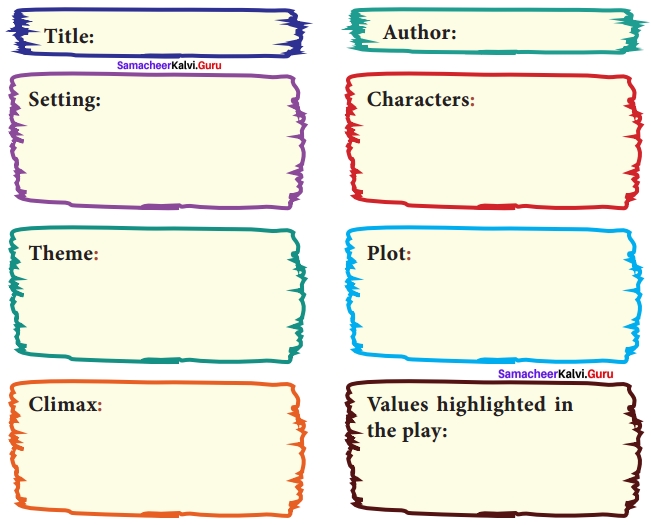
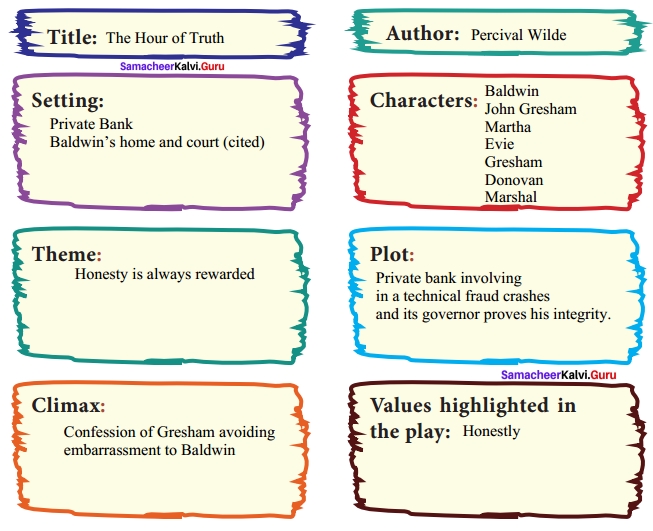
3. Based on your understanding of the play, complete the Graphic Organiser given below.

Samacheer Kalvi 12th English Solutions Supplementary Chapter 3 The Hour of Truth (Play) img-4

Answer:

Samacheer Kalvi 12th English Solutions Supplementary Chapter 3 The Hour of Truth (Play) img-5

4. Answer in a paragraph of about 150 words each.

Question (a)
Trace the bond of friendship between Baldwin and Gresham. Explain why Baldwin wished to attribute some credit to his friend.
Answer:
Baldwin and Gresham were boyhood chums. They went to school together. Their friendship flowered into a lifetime bondage as it was sustained for thirty five years. When Baldwin’s son was being baptised in the church, Gresham was present. Baldwin expressed his wish that his son John Gresham Baldwin grew up to Gresham’s standard in life. Baldwin was paid only 60 dollars a week for working as a Governor of the private bank founded by Gresham. Accidentally, Baldwin found out how Gresham was siphoning money very cleverly from the deposits technically without really causing any loss to the depositors. But Baldwin was loyal to Gresham only as long as he was honest. Once he parted ways with honesty, Baldwin would also part ways with Gresham. By the force of his upright character, Baldwin advised him to close the bank and return the deposit to the customers.

Third National Bank was ready to help the reorganization of the bank. Meanwhile, Gresham was arrested. The court could not nail Gresham as there was not a shred of evidence to prove his guilt. If Baldwin testified, the court would indict him. Just before being arrested Gresham offered him one hundred thousand dollars to just say “I don’t remember”. The three words to let him off the hook. He claimed it was the difference between the salary he had been paid and what he ought to have received. Had it been someone else, Baldwin would have slapped him. But it was Gresham who understood his body language and did not press the matter further. He was proud of the fact that Gresham understood how he could not compromise with his conscience. His family members Martha, Evie and John felt that it was a compliment that cost him one hundred thousand dollars. Baldwin said that Gresham’s compliment about his uprightness was worth a hundred thousand dollars.

Question (b)
How did Martha and John react when they came to know that Baldwin had rejected the generous offer made by Gresham?
Answer:
Martha and John cherished a grudge against Gresham for having underpaid Baldwin for about two decades. They openly said that he deserved punishment. Initially Gresham condemned the bribe claimed as a difference in salary paid. Had he been made a similar offer he claimed he would have asked him to go to the devil. Baldwin said that having been a friend he couldn’t use such an abusive language. Casually John asked how much he offered. Baldwin said that it was one hundred thousand dollars. Suddenly Martha and John changed their attitude towards Gresham. John viewed a shame if Gresham got indicted because he shared his name. Martha also desperately tried to convince him not to testify against Gresham. John even suggested that he could say those three words “I don’t remember” as the depositor would not lose a cent. Baldwin felt miserable because the family members who he wanted to feel proud of his uprightness wanted him to crossover to the side of corrupt practices because of the generous offer made by Gresham.

SamacheerKalvi.Guru

Question (c)
Is Baldwin really honest or does he maintain his honesty fearing criticism? Why do you say so?
Answer:
Baldwin lived the life of an upright and honest man. Though he was paid just 60 dollars a week in the private bank of Gresham, he never complained. The small increments he had been given were not because he had asked but because Gresham had given them. He was frugal and he was worshipped as a hero by his family members (i.e.) wife Martha, son John Gresham Baldwin and daughter Evie.

Baldwin deeply believed that he had been a role model to his children that is more valuable than money. He admitted to his son that he was disturbed that he would lose the respect of his own family members if he stooped even once in his life even if the bait is one hundred thousand dollars. No doubt he was upright. The three words “I don’t remember” would choke him. Only during the momentary explosion of frustration, it appears that he feared criticism. But his natural reflex on the offer was denial. His agony on the contradictory expectation of worldly-wise family members is obvious. He did not even have to articulate his feelings to Gresham who intuitively understood that his uprightness can’t be purchased with even one hundred thousand dollars.

SamacheerKalvi.Guru

Question (d)
Sketch the character of:
(i) Robert Baldwin
(ii) John Gresham.
Answer:
(i) Robert Baldwin:
Robert Baldwin is the central character around whom the whole one-act play revolves. He is a middle class father who values honesty and loyalty to the organization more than 35 year long friendship. He rises in the esteem of the readers and theatre goers on realising that he wants to leave a legacy of honesty to his children and not the ill-gotten hundred thousand dollars which could give his family a life of comfort they did want to lead. Baldwin is really hurt by the three sided attack (i.e.) a war of words waged against his honesty by Martha, Evie and John. Even before the trial begins against Gresham, Baldwin is made to feel like a traitor.

His family members accuse him of letting down the honour of a close family friend who had made a very generous offer. The mental agony experienced by Baldwin is hundred times more at home. He is elated initially as he had successfully forced Gresham with a whip in hand (i.e.) honesty to ‘ close the bank and make up the loss to the customers. But when he discloses the offer of one hundred thousand dollars, as a private fortune without causing loss of a cent to depositors, he is made to experience hell by the emotional blackmail of his family members who knew very well how those three words “I don’t remember” would choke him. Baldwin holds on to honesty even at the prospect of losing both 35 year-old friendship and one hundred thousand dollars he had never had in his life.

(ii) John Gresham:
John Gresham is a worldly-wise founder of a private bank. He values friendship and appoints his boyhood chum Robert Baldwin as the Governor in his bank. He is clever and is very , successful in running his bank profitably. In the meantime, he uses the deposits accrued in a 1 way that enhances his own private fortune of course without costing anything to the depositors, It is in fact a breach of trust. Nobody has had an inkling that any malpractice is going on. Even Donovan the cashier claims that the closure of the bank came as a rude shock to him as he had married on the strength of the job and salary from the bank.

Martha claims she withdrew her money without telling Baldwin who is very loyal to Gresham. He would never have approved of it. After being found out and when the trial against him on misappropriation of funds is in “progress he offers a bait of one hundred thousand dollars from his private fortune. He knows’ that only Baldwin alone could help the law to nail him. But if he says, “I don’t remember” again using the good will regained in the law suit. But he understands the body language of , Baldwin. He realizes it would be a painful thing for Baldwin to testify against him. He might be bad as a banker, but he values the feelings of Baldwin and his honesty. He confesses to avid embarrassment to Baldwin and informs ‘Third National’ chairman that Baldwin has not for technical questions, he would be let off the hook. If acquitted, he could make money budged even after the offer of one hundred thousand dollars.

SamacheerKalvi.Guru

Question (e)
Who do you think exhibits true friendship-Baldwin or Gresham? Justify your answer.
Answer:
This is a typical question for which much can be said on both the sides. Both Baldwin and Gresham exhibit true friendship from their respective sides. Baldwin is rich in great virtues like loyalty, honesty, frugality and valuing human relationships. He is loyal to Gresham with thirty five year old friendship. But the moment Gresham parts ways with honesty, Baldwin would part ways with him. The greatest compliment ever paid to Baldwin is not from Martha, Evie or John but Gresham. Gresham meets Marshall and confesses that Baldwin is an honest man whose honesty cannot be purchased even with one hundred thousand dollars.

He is poor earning just 60 dollars a week, now even that is gone as the bank is closed. He is richer than Gresham in terms of uprightness and honesty. Baldwin, being a friend, shows Gresham the right path even when he realizes that his friendship would be at stake. Thiruvalluvar says, “Friendship is not meant for just laughing and having fun but to criticize a friend when he is wrong.” Likewise, it is Baldwin who compels Gresham to close the bank and ensure the of deposits through honest means. He doesn’t want to support friendship when a friend parts ways with honesty. He doesn’t openly articulate his unwillingness to accept the bait but his uncomfortable silence says it all. Thus both exhibit true friendship towards one another.

Additional Questions

Question (a)
Explain the significance of the words ‘I don’t remember’.
Answer:
‘I don’t remember’ were the three words which Gresham wanted Baldwin to say when technical questions on misappropriation of funds are asked in the court. Gresham offered one hundred thousand dollars in hot cash to say them. But Baldwin did not want to do that dishonest and dishonourable thing. But having been honest earning just 60 dollars a week Baldwin felt like choking. His children and wife persuaded him. Gresham understood Baldwin would not say those words though Baldwin didn’t say it openly. John told Baldwin it was a compliment that cost him a hundred thousand dollars. But Baldwin felt it was a compliment worth hundred thousand dollars.

5. IDIOMS

Now match the idioms under column A with their meanings in column B:

A. IDIOMSB. MEANINGS
save one’s skina sudden unexpected event or news
make both ends meetto be the most powerful
a bolt out of a clear skyviewed with suspicion and distrust
go to graveto protect oneself from difficulty
have the whip handmanage one’s expenses within one’s income
under a cloudto exit the world

Answer:

A. IDIOMSB. MEANINGS
save one’s skinto protect oneself from difficulty
make both ends meetmanage one’s expenses within one’s income
a bolt out of a clear skya sudden unexpected event or news
go to graveto exit the world
have the whip handto be the most powerful
under a cloudviewed with suspicion and distrust

Speaking Activity

(a) Imagine you are Baldwin and your partner is Gresham. Try your best to persuade your partner to confess the truth. Build a conversation describing how both of you would react in such a situation. Work in pairs.

Gresham: Baldwin, why do you look cross?
Baldwin: Ask your conscience.
Gresham: Well, my conscience is clear. What is wrong with you?
Baldwin: I found out that you are siphoning small negligible changes to your own account. Now it amounts to a few hundred thousand dollars as none of the depositors have noticed the disappearance of small changes.
Gresham: Well, none of the depositors would lose a cent. I have transferred it in some investment. I have got ten fold gains. Now we shall quietly transfer the amount in their own accounts. No one will ever come to know of it.
Baldwin: Is it not a breach of trust? I’m not going to keep quiet about this.
Gresham: What do you want to do?
Baldwin: Close the bank and make good the loss to all the depositors. (After a few days)
Gresham: Well, Baldwin I have closed the bank. Third National is going to do the reorganisation. Now I want you to say three words.
Baldwin: What?
Gresham: “I don’t remember” When you are cross examined on vital statistics for which you would require references.
Baldwin: How does that absolve you of your crime.
Gresham: Don’t you know the fact that I’ve earned enough money and no depositor will lose a cent. It is just a technicality.
Baldwin: What do you mean?
Gresham: Well, I will give you one hundred thousand dollars for letting me off the hook. I just want you to say “I don’t remember”.
Baldwin: Already you have used the funds of depositors. You want them to become paupers?
Gresham: Baldwin, you frustrate me. Look here. This is hot cash from my own private fortune. Baldwin, why don’t you say something?
Baldwin: You have known me for more than 35 years.
Gresham: You are silent. Say yes or no. I know you have been an upright man all through your life. The offer is final.
Baldwin: You have one option Gresham. We will meet in the court. You can confess. For God’s sake don’t force me to say anything now. I am disturbed.
Gresham: Why do you think it is a bribe or a bait. It is the difference in your salary, the salary you have received and what you should have got all these years.
Baldwin: As long as you are honest, I will be loyal to you Gresham. When you part with loyalty, we would part ways. The matter is closed.

(b) ‘A friend in need is a friend indeed’. Does this hold good in all situations? Share your views with your class.

The saying, “A friend in need is a friend indeed” is relevant to only those situations when both the friends pursue the goals with justifiable means. I read an interesting story written by O. Henry entitle “After twenty years”. Two boyhood chums, Bob and Jimmy, decide to pursue their dream careers and decide to meet at Big Joe Brady’s Restaurant. Jimmy becomes a policeman and Bob a criminal and notorious robber. Jimmy recognizes the features of the most wanted criminal by Chicago police in Bob. The friend’s need is to help him escape but duty consciousness gives him painful choice of sending a plain clothes man to arrest him. So, the saying “A friend in need is a friend indeed” is not applicable at all occasions. When there is a debate with the conscience on moral grounds and professional ethics, one can’t continue to be a friend “in need”.

The Hour of Truth (Play) About The Author

Samacheer Kalvi 12th English Solutions Supplementary Chapter 3 The Hour of Truth (Play) img-6

Percival Wilde (1887 – 1953) was a prolific American author and playwright. He wrote many novels, short stories and one-act plays. His plays were popular in the little theatre movement. He also authored a textbook on the theatre arts. He was native to New York City, worked for a time as a banker. He began writing plays in 1912.

Percival Wilde chose to portray the values of life in his plays, throwing light on a specific trait of an individual. His one-act play The Hour of Truth is a testimony to his craftsmanship where the three classical unities of time, place and action are observed.
The climax of the play develops rapidly and ends with a pleasant surprise

The Hour of Truth (Play) Summary in English

Introduction
In ‘The hour of truth’, the integrity of Baldwin is the dominant trait around which the whole play is spun. This one- act play evidences his craftsmanship where the classical unites time, place and action were observed meticulously. The climax has an O. Henry twist and thus a surprising end.

Baldwin is a middle class man earning 60 pounds a week. He is working in a private bank for Mr. Gresham. They are close friends for over thirty years. Baldwin Christens his son as Gresham Baldwin. He leads a contented life. He finds out that his boss has been misappropriating money very cleverly. Technically speaking the depositors will i not lose a scent. But Baldwin coerced Mr. Gresham to close the bank and | settle the account of the depositors. Mr. Gresham promised to return the depositors money. He offered Baldwin one hundred thousand dollars if he chose to tell the enquiry officers that he had forgotten some important details. This would help Gresham get out of the problem safely. Baldwin was shocked by the offer.

He went home and told Martha, his wife and Gresham Baldwin about the offer. On hearing the handsome offer, both the wife and son persuade him to take the money as it was just a technicality and the depositors would not lose money. Actually, Baldwin had a faith that his family regarded his integrity far higher than material gains. When he learnt his son and family members were trying to convince him to take the money, he felt disgusted. Just then, Mr. Marshal, President of third National Bank, informed Baldwin that his boss Mr. Gresham has confessed to his crime. He had told him that one hundred thousand dollars couldn’t shake Baldwin’s integrity. Though he had told him that it was a difference of salary he had paid and what he ought to have paid. He said Gresham did not want him to undergo the pain of testifying against him in the court. Hearing this, Baldwin cried. His heart felt light. Mr. marshal offered him a position in his bank. This has been the honour conferred on his honesty.

SamacheerKalvi.Guru

Conclusion
The dramatist reflects the foibles of modem society. People value riches more than honesty and integrity. He rewards honesty at the end reaffirming the common faith “Honesty is always rewarded.”

The Hour of Truth (Play) Summary in Tamil

முன்னுரை
“உண்மை , தெரிந்த நேரம்” என்னும் கதையில் பால்ட்வின் நேர்மையான நடத்தையையும் அதன் பின்னணியில் முழுக்கதையும் சுழல்கிறது. இந்த ஓரங்க நாடகம் ஆசிரியர் இடம், காலம், செயல் இவற்றுக்கிடையே உள்ள பாரம்பரிய ஒற்றுமையைத் துல்லியமாகக் காட்டுகிறது. நாடகத்தில் உச்சக் கட்டத்தில் ஓ.ஹென்றிக்கே உரிய திருப்பத்தால் நாடகம் வியப்பூட்டும் வண்ணம் முடிகிறது. பால்ட்வின் வாரம் 60 டாலர் மட்டுமே சம்பாதிக்கிற நடுத்தர வகுப்பைச் சார்ந்தவர். அவர் திரு.கிரெசாம் நடத்துகிற தனியார் வங்கியில் பணி புரிந்தார். அவர்கள் 30 வருடங்களாக நண்பர்கள். பால்ட்வின் தன் மகனுக்கு கிரெசாம் பால்ட்வின் எனப் பெயர் சூட்டினார். அவர் மனம்

நிறைந்த வாழ்க்கை வாழ்ந்து வந்தார். அவர் தன் முதலாளி மிகத் தந்திரமாகப் பணத்தைக் கையாளுகிறார் என்பதைக் கண்டுபிடித்தார். நுட்பமாகப் பார்த்தால் பணம் செலுத்துபவருக்கு ஒரு பைசா நஷ்டமும் ஏற்படாது. ஆனால், பால்ட்வின் வங்கியை மூடிவிட்டு பணத்தைச் செலுத்திய வாடிக்கையாளர்களுக்கு திரும்பிக் கொடுத்து விடுமாறு கிரெசாமை நிர்பந்தப்படுத்தினார். கிரெசாம் வாடிக்கையாளரின் பணத்தை திருப்பிக் கொடுத்து விடுவதாக வாக்குறுதி அளித்தார். பால்ட்வின் விசாரணை அலுவலர்களிடம் தான் சில முக்கிய தகவல்களை மறந்து விட்டதாகக் கூறும்படியும், அதற்கான சன்மானமாக ஒரு லட்சம் டாலர் தருவதாகவும் கிரெசாம் கூறினார். இது கிரெசாம் பிரச்சனையிலிருந்து தப்பிக்க உதவும். பால்ட்வின் இத்தகைய லஞ்ச அறிவிப்பைக் கேட்டு அதிர்ந்து போனார்.

வீட்டுக்குச் சென்று தன் மனைவி மார்த்தாவிடமும், மகன் கிரெசாம் பால்ட்வினிடமும் ஒப்பந்தத்தைக் குறித்துச் சொன்னார். இதைக் கேட்ட இருவரும் ஒப்பந்தப் பணத்தைப் பெற்றுக் கொள்ளுமாறு தூண்டினர். மேலும், இதனால் நுட்பமாகப் பார்த்தால் வாடிக்கையாளர் எதையும் இழக்கப் போவதில்லை என்றனர். உண்மையாகப் பார்த்தால் தன் குடும்பத்தினர் தன் நாணயத்தின் மீது, பணத்தைவிட அதிக மதிப்பு வைத்திருந்தனர் என்பதில் நம்பிக்கை கொண்டிருந்தார். அவர்கள் பணத்தைப் பெற்றுக் கொள்ளுமாறு தன்னை சம்மதிக்க வைப்பதை எண்ணி வெறுப்படைந்தார். அப்போது தான் மூன்றாவது தேசிய வங்கியின் தலைவரான மார்சல் அவர்கள், கிரெசாம் தன் தவற்றை ஒப்புக்கொண்டதாக பால்ட்வினுக்குத் தெரிவித்தார். அவர் கிரெசாம் கொடுப்பதாகச் சொன்ன 1 லட்சம் டாலர் பால்ட்வினின் நேர்மையைத் தகர்க்கவில்லை எனத் தெரிவித்தார். அதை அவரின் சம்பளத்தில் தான் தந்திருக்க வேண்டிய தொகையின் வித்தியாசமே எனக் கிரெசாம் கூறியும் அதை மறுத்து விட்டார். பால்ட்வின் நீதிமன்றத்தில் தனக்கு எதிராக சாட்சி அளிப்பதில் | தனக்கு விருப்பமில்லை என்பதைக் கிரெசாம் தெரிவித்ததாக மார்சல் கூறினார். இதைக் கேட்ட பால்ட்வின் கண் கலங்கலானார். அவர் மன உலைச்சல் | தளர்ந்தது. மார்சல் தன் வங்கியிலேயே பால்ட்வினுக்கு | வேலை வாய்ப்பு ஏற்படுத்தினார். இதுதான், அவர் நாணயத்திற்கு கிடைத்த சன்மானம்.

முடிவுரை:
‘நாகரீக சமுதாயத்தின் குறைகளை ஆசிரியர் பிரதிபலித்துக் காட்டுகிறார். மனிதன் நேர்மை, நாணயத்தைக் காட்டிலும் பணத்தையே மதிக்கிறான். கதையின் முடிவில் கதாபாத்திரத்திற்கு கிடைக்கும் சன்மானம், ‘நாணயம் சன்மானத்திற்கு உரியது) என்பதை மீண்டும் உறுதிபடுத்துகிறது.

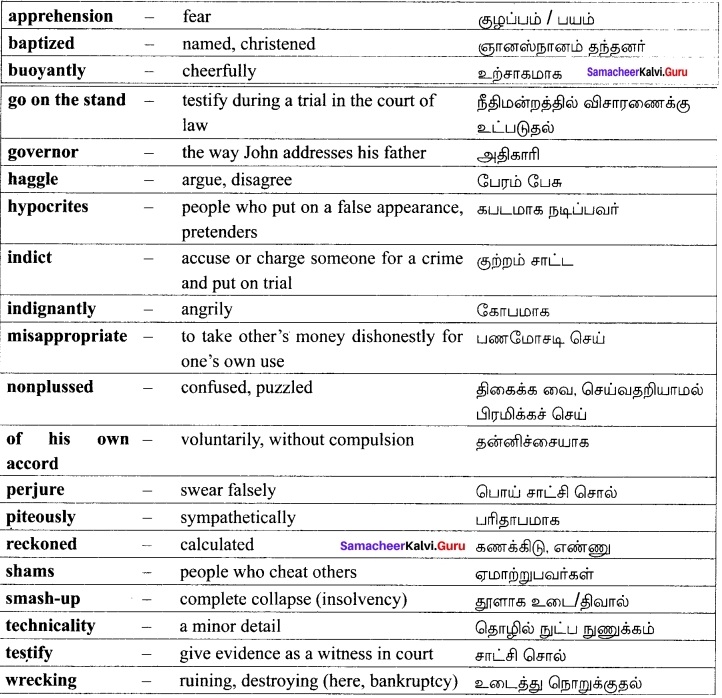
The Hour of Truth (Play) Glossary

Textual:

Samacheer Kalvi 12th English Solutions Supplementary Chapter 3 The Hour of Truth (Play) img-7

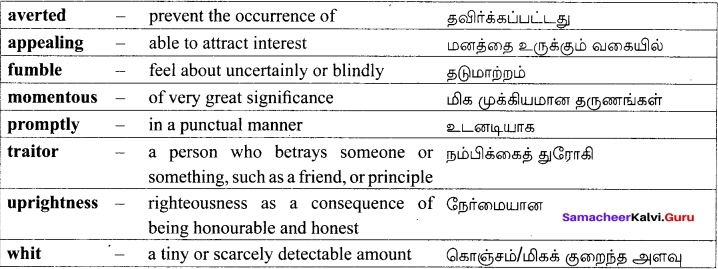
Additional:

Samacheer Kalvi 12th English Solutions Supplementary Chapter 3 The Hour of Truth (Play) img-8

Samacheer Kalvi 8th Maths Solutions Term 3 Chapter 5 Information Processing Additional Questions

Students can Download Maths Chapter 5 Information Processing Additional Questions and Answers, Notes Pdf, Samacheer Kalvi 8th Maths Book Solutions Guide Pdf helps you to revise the complete Tamilnadu State Board New Syllabus and score more marks in your examinations.

Tamilnadu Samacheer Kalvi 8th Maths Solutions Term 3 Chapter 5 Information Processing Additional Questions

Question 1.
Which one is the best buy of the following purchases. A pack of 5 soaps for ₹ 180 or 4 soaps for ₹ 128.
Solution:
From the pack, Cost of 5 soaps = ₹ 180
∴ Cost of 1 soap = \(\frac { 180 }{ 5 } \) = ₹ 36.
Also Cost of 4 soaps = ₹ 128
∴ Cost of 1 soap = \(\frac { 128 }{ 4 } \) = ₹ 32.
∴ Buying the pack of 5 is the best buy.

Samacheer Kalvi 8th Maths Solutions Term 3 Chapter 5 Information Processing Samacheer Kalvi 8th Maths Solutions Term 3 Chapter 5 Information Processing Additional Questions

Samacheer Kalvi 8th Maths Solutions Term 3 Chapter 5 Information Processing Ex 5.2

Students can Download Maths Chapter 5 Information Processing Ex 5.2 Questions and Answers, Notes Pdf, Samacheer Kalvi 8th Maths Book Solutions Guide Pdf helps you to revise the complete Tamilnadu State Board New Syllabus and score more marks in your examinations.

Tamilnadu Samacheer Kalvi 8th Maths Solutions Term 3 Chapter 5 Information Processing Ex 5.2

I. Answer the following Questions

Question 1.
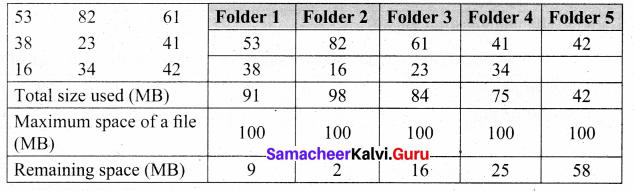
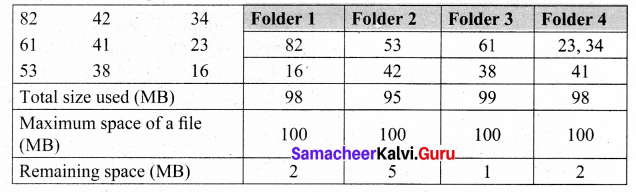
The sizes in MB, for nine computer files are given below. 53 82 61 38 23 41 16 34 42 The files are to be grouped into folders. Each folder may contain a maximum limit of 100 MB.
(a) Determine the minimum number of folders required.
(b) Use the first-fit method to group the files into folders.
(c) Use the first-fit decreasing method to group the files into folders.
Solution:
(a) Maximum number of folders required

Samacheer Kalvi 8th Maths Solutions Term 3 Chapter 5 Information Processing Ex 5.2
(b) First fit method.
Samacheer Kalvi 8th Maths Solutions Term 3 Chapter 5 Information Processing Ex 5.2 2

(c) First fit decreasing method.
Samacheer Kalvi 8th Maths Solutions Term 3 Chapter 5 Information Processing Ex 5.2 3

Samacheer Kalvi 8th Maths Solutions Term 3 Chapter 5 Information Processing Ex 5.2

Question 2.
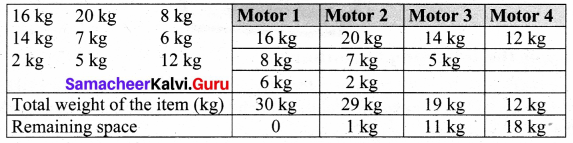
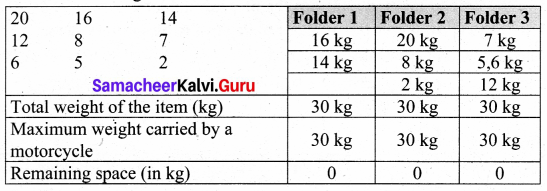
A parcel delivery company has 4 motorcycles. Each motorcycle can carry a maximum load of 30kg. The weights of the parcels, (in kg), in the order they are waiting to be delivered are given below.
Samacheer Kalvi 8th Maths Solutions Term 3 Chapter 5 Information Processing Ex 5.2 4
(a) Determine the minimum number of motorcycles required .
(b) Use the first-fit method to show how the parcels could be allocated to the motorcycles.
(c) Use the first-fit decreasing method to show how the parcels could be allocated to the motorcycles.
Answer:
(a) Minimum number of motorcycles required
Samacheer Kalvi 8th Maths Solutions Term 3 Chapter 5 Information Processing Ex 5.2 5

(b) First fit method :
Samacheer Kalvi 8th Maths Solutions Term 3 Chapter 5 Information Processing Ex 5.2 6

(c) First fit decreasing method :
Samacheer Kalvi 8th Maths Solutions Term 3 Chapter 5 Information Processing Ex 5.2 7

Samacheer Kalvi 8th Maths Solutions Term 3 Chapter 5 Information Processing Ex 5.2

Question 3.
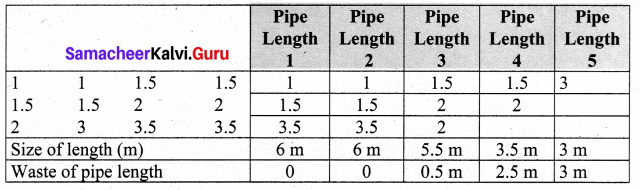
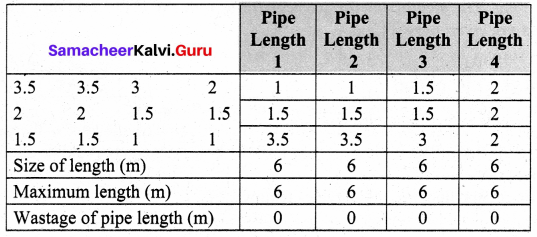
A plumber wishes to cut the following sections from standard size of pipe each of length 6m.
Samacheer Kalvi 8th Maths Solutions Term 3 Chapter 5 Information Processing Ex 5.2 8
Find the
(a) To cut according to the first-fit method calculate the wastage of the pipe length.
(b) To cut according to the first-fit decreasing method calculate the wastage of the pipe length,
Solution:
(a) First fit method :
Samacheer Kalvi 8th Maths Solutions Term 3 Chapter 5 Information Processing Ex 5.2 9

(b) First fit decreasing method.
Samacheer Kalvi 8th Maths Solutions Term 3 Chapter 5 Information Processing Ex 5.2 10

Samacheer Kalvi 7th Maths Solutions Term 3 Chapter 1 Number System Ex 1.3

Students can Download Maths Chapter 1 Number System Ex 1.3 Questions and Answers, Notes Pdf, Samacheer Kalvi 7th Maths Book Solutions Guide Pdf helps you to revise the complete Tamilnadu State Board New Syllabus and score more marks in your examinations.

Tamilnadu Samacheer Kalvi 7th Maths Solutions Term 3 Chapter 1 Number System Ex 1.3

Question 1.
Find the product of the following
(i) 0.5 × 3
(ii) 3.75 × 6
(iii) 50.2 × 4
(iv) 0.03 × 9
(v) 453.03 × 7
(vi) 4 × 0.7
Solution:
(i) 0.5 × 3
5 × 3 = 15
∴ 0.5 × 3 = 1.5

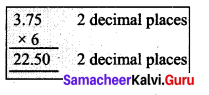
(ii) 3.75 × 6
Samacheer Kalvi 7th Maths Solutions Term 3 Chapter 1 Number System 1.3 1
375 × 6 = 2250
3.75 × 6 = 22.50

Samacheer Kalvi 7th Maths Solutions Term 3 Chapter 1 Number System Ex 1.3

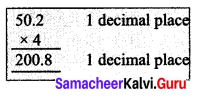
(iii) 50.2 × 4
Samacheer Kalvi 7th Maths Solutions Term 3 Chapter 1 Number System 1.3 2
502 × 4 = 2008
50.2 × 4 = 200.8

(iv) 0.03 × 9
3 × 9 = 27
0.03 × 9 = 0.27

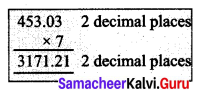
(v) 453.03 × 7
Samacheer Kalvi 7th Maths Solutions Term 3 Chapter 1 Number System 1.3 3
45303 × 7 = 317121
453.03 × 7 = 3171.21

(vi) 4 × 0.7
4 × 7 = 28
4 × 0.7 = 2.8

Question 2.
Find the area of the parallelogram whose base is 6.8 cm and height is 3.5 cm.
Solution:
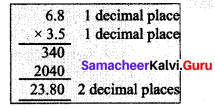
Samacheer Kalvi 7th Maths Solutions Term 3 Chapter 1 Number System 1.3 4
Base of the parallelogram b = 6.8 cm
Height of the parallelogram h = 3.5 cm
Area of the parallelogram A = b × h sq.units = 6.8 × 3.5 cm2
Area of the parallelogram = 23.80 cm2

Samacheer Kalvi 7th Maths Solutions Term 3 Chapter 1 Number System Ex 1.3

Question 3.
Find the area of the rectangle whose length is 23.7 cm and breadth is 15.2 cm.
Solution:
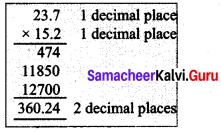
Samacheer Kalvi 7th Maths Solutions Term 3 Chapter 1 Number System 1.3 5
Length of the rectangle l = 23.7 cm
Breadth of the rectangle b= 15.2 cm
Area of the rectangle A = l × b sq.units
= 23.7 × 15.2 cm2
Area of the rectangle = 360.24 cm2

Question 4.
Multiply the following

  1. 2.57 × 10
  2. 0.51 × 10
  3. 125.367 × 100
  4. 34.51 × 100
  5. 62.735 × 100
  6. 0.7 × 10
  7. 0.03 × 100
  8. 0.4 × 1000

Solution:

  1. 2.57 × 10 = 25.7
  2. 0.51 × 10 = 5.1
  3. 125.367 × 100 = 12536.7
  4. 34.51 × 100 = 3451
  5. 62.735 × 100 = 6273.5
  6. 0.7 × 10 = 7.0
  7. 0.03 × 100 = 3
  8. 0.4 × 1000 = 400

Samacheer Kalvi 7th Maths Solutions Term 3 Chapter 1 Number System Ex 1.3

Question 5.
A wheel of a baby cycle covers 49.7 cm in one rotation. Find the distance covered in 10 rotations.
Solution:
Length covered in 1 rotation = 49.7 cm
Length covered in 10 rotations = 49.7 × 10 cm = 497 cm

Question 6.
A picture chart costs ₹ 1.50. Radha wants to buy 20 charts to make an album. How much does she have to pay?
Solution:
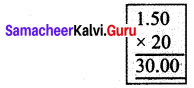
Samacheer Kalvi 7th Maths Solutions Term 3 Chapter 1 Number System 1.3 6
Cost of 1 chart = ₹ 1.50
Cost of 20 charts = ₹ 1.50 × 20 = ₹ 30.00
Cost of 20 charts = ₹ 30

Question 7.
Find the product of the following.
(i) 3.6 × 0.3
(ii) 52.3 × 0.1
(iii) 537.4 × 0.2
(iv) 0.6 × 0.06
(v) 62.2 × 0.23
(vi) 1.02 × 0.05
(vii) 10.05 × 1.05
(viii) 101.01 × 0.01
(ix) 100.01 × 1.1
Solution:
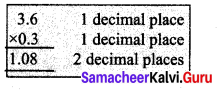
(i) 3.6 × 0.3
Samacheer Kalvi 7th Maths Solutions Term 3 Chapter 1 Number System 1.3 7
36 × 3 = 108
3.6 × 0.3 = 1.08

(ii) 52.3 × 0.1
523 × 1 = 523
52.3 × 0.1 = 5.23

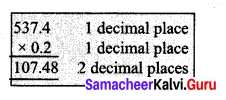
(iii) 537.4 × 0.2
Samacheer Kalvi 7th Maths Solutions Term 3 Chapter 1 Number System 1.3 8
5374 × 2 = 10748
537.4 × 0.2 = 107.48

Samacheer Kalvi 7th Maths Solutions Term 3 Chapter 1 Number System Ex 1.3

(iv) 0.6 × 0.06
6 × 6 = 36
0.6 × 0.06 = 0.036

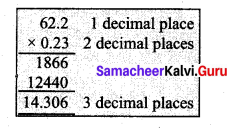
(v) 62.2 × 0.23
Samacheer Kalvi 7th Maths Solutions Term 3 Chapter 1 Number System 1.3 9
622 × 23 = 14306
62.2 × 0.23 = 14.306

(vi) 1.02 × 0.05
102 × 5 = 510
1.02 × 0.05 = 0.0510

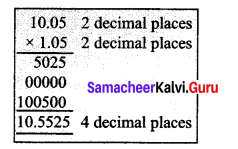
(vii) 10.05 × 1.05
Samacheer Kalvi 7th Maths Solutions Term 3 Chapter 1 Number System 1.3 10
1005 × 105 = 105525
10.05 × 1.05 = 10.5525

(viii) 101.01 × 0.01
10101 × 1 = 10101
101.01 × 0.01 = 1.0101

(ix) 100.01 × 1.1
1001 × 11 = 110011
100.01 × 1.1 = 110.011

Objective Type Questions

Question 1.
1.07 × 0.1 _______
(i) 1.070
(ii) 0.107
(iii) 10.70
(iv) 11.07
Answer:
(ii) 0.107
Hint:
107 × 1 = 107
1.07 × 0.1 = 0.107

Samacheer Kalvi 7th Maths Solutions Term 3 Chapter 1 Number System Ex 1.3

Question 2.
2.08 × 10 = ______
(i) 20.8
(ii) 208.0
(iii) 0.208
(iv) 280.0
Answer:
(i) 20.8
Hint:
208 × 10 = 2080
2.08 × 10 = 20.80 = 20.8

Samacheer Kalvi 7th Maths Solutions Term 3 Chapter 1 Number System Ex 1.3

Question 3.
A frog jumps 5.3 cm in one jump. The distance travelled by the frog in 10 jumps is _______
(i) 0.53 cm
(ii) 530 cm
(iii) 53.0 cm
(iv) 53.5 cm
Answer:
(iii) 53.0 cm
Hint:
53 × 10 = 530
5.3 × 10 = 53.0

Samacheer Kalvi 8th Maths Solutions Term 3 Chapter 5 Information Processing Ex 5.1

Students can Download Maths Chapter 5 Information Processing Ex 5.1 Questions and Answers, Notes Pdf, Samacheer Kalvi 8th Maths Book Solutions Guide Pdf helps you to revise the complete Tamilnadu State Board New Syllabus and score more marks in your examinations.

Tamilnadu Samacheer Kalvi 8th Maths Solutions Term 3 Chapter 5 Information Processing Ex 5.1

I. Choose the correct answer:

Question 1.
Online or television advertisements influence on spending decisions by
(a) using special music
(b) making me think I need the item
(c) using attractive pictures
(d) all the above
Answer:
(d) all the above

Question 2.
When I go shopping, I will buy
(a) something that looks attractive
(b) something my friend has
(c) something that I need to purchase
(d) the first thing I see in the store
Answer:
(c) something that I need to purchase

Samacheer Kalvi 8th Maths Solutions Term 3 Chapter 5 Information Processing Ex 5.1

Question 3.
The best shopping choice is
(a) always shop at brand name stores
(b) compare the choices before buying
(c) the same thing my friends bought
(d) always buy at a regular shop
Answer:
(b) compare the choices before buying

II. Say true or false:

Question 1.
Wise consumers take time to compare two or three shops before spending money.
Answer:
True

Question 2.
Taking time to analyse advertisements cannot save money when shopping.
Answer:
False

Question 3.
One cannot shop on double and triple coupon discounts in available days.
Answer:
True

Question 4.
Every time one must make a shopping list and stick on within his/her budget.
Answer:
False

Samacheer Kalvi 8th Maths Solutions Term 3 Chapter 5 Information Processing Ex 5.1

III. Find the best buy of the following purchases:

(i) A pack of 5 chocolate bars for ₹ 175 or 3 chocolate bars for ₹ 114?
(ii) Basker buy 1 1/2 dozen of eggs for ₹ 81 and Aruna buy 15 eggs for ₹ 64.5?
Solution:
(i)
Samacheer Kalvi 8th Maths Solutions Term 3 Chapter 5 Information Processing Ex 5.1 1
Best buy is a pack of 5 chocolate bars for ₹ 175.

(ii)
Samacheer Kalvi 8th Maths Solutions Term 3 Chapter 5 Information Processing Ex 5.1 2
Best buy is 15 eggs for ₹ 64.5

Question 4.
Using the given picture find the total special offer price of fresh sweets and bakery products to buy 1/2 kg laddu, 1 kg cake, 6 pockets of bread.
Samacheer Kalvi 8th Maths Solutions Term 3 Chapter 5 Information Processing Ex 5.1 80

Samacheer Kalvi 8th Maths Solutions Term 3 Chapter 5 Information Processing Ex 5.1
Solution:
Samacheer Kalvi 8th Maths Solutions Term 3 Chapter 5 Information Processing Ex 5.1 4

Question 5.
Using given picture prepare a price list.
Suppose you plan to buy 1 1/2 kg of apple, 2 kg of pomegranate, 2 kg of banana, 3 kg of mango, 1/2 kg of papaya, 3 kg of onion, 1 1/2 kg of tomato, and 1 kg of carrot in shop 1, how much will you save compared to shop 2.
Samacheer Kalvi 8th Maths Solutions Term 3 Chapter 5 Information Processing Ex 5.1 90
Solution:
Samacheer Kalvi 8th Maths Solutions Term 3 Chapter 5 Information Processing Ex 5.1 6
Price in shop 2 – Shop 1 = 715 – 675.75 = ₹ 39.25
We can save ₹ 39.25 in shop 1 compared to shop 2.

Samacheer Kalvi 8th Maths Solutions Term 3 Chapter 5 Information Processing Ex 5.1

Question 6.
When you plan to buy a shirt, one shop offers a discount of ₹ 200 on MRP ₹ 1000 and another shop offers 15% discount on the same MRP. Where would you buy?
Solution:
Price in Ist shop = ₹ 1000 – ₹ 200 = ₹ 800
Samacheer Kalvi 8th Maths Solutions Term 3 Chapter 5 Information Processing Ex 5.1 7

Question 7.
Amazing park is offers a package deal of 5 entrance passes for ₹ 130. If one entrance pass normally costs ₹ 30, how much will you save by taking advantage of this special deal?
Solution:
Cost of one entrance pass = ₹ 30
∴ Cost of 5 entrance passes = 5 × 30 = ₹ 150
But special deal price = ₹ 130
Amount of saving = 150 – 130 = ₹ 20

Question 8.
Consider that you are going to buy the toys that are given below in the price list. Prepare a comparison price chart table and find where will you get the best offer price and also find how much you save?
Samacheer Kalvi 8th Maths Solutions Term 3 Chapter 5 Information Processing Ex 5.1 8
[The amount to the nearest rupee as ₹ 789.84 is rounded off to ₹ 790]
Solution:
Samacheer Kalvi 8th Maths Solutions Term 3 Chapter 5 Information Processing Ex 5.1 9
By shopping at Toys & Trades mart we can save ₹ 512 (4328 – 3816) then Golden toys in Toys & Trades mart we get the best price.

Samacheer Kalvi 8th Maths Solutions Term 3 Chapter 4 Statistics Additional Questions

Students can Download Maths Chapter 4 Statistics Additional Questions and Answers, Notes Pdf, Samacheer Kalvi 8th Maths Book Solutions Guide Pdf helps you to revise the complete Tamilnadu State Board New Syllabus and score more marks in your examinations.

Tamilnadu Samacheer Kalvi 8th Maths Solutions Term 3 Chapter 4 Statistics Additional Questions

Question 1.
The following information shows the number of students opting different subjects in a college.
Samacheer Kalvi 8th Maths Solutions Term 3 Chapter 4 Statistics Additional Questions 1
Draw a pie-chart to represent the information.
Solution:
Samacheer Kalvi 8th Maths Solutions Term 3 Chapter 4 Statistics Additional Questions 2Samacheer Kalvi 8th Maths Solutions Term 3 Chapter 4 Statistics Additional Questions 3

Samacheer Kalvi 8th Maths Solutions Term 3 Chapter 4 Statistics Additional Questions
Students opting different subjects.
Samacheer Kalvi 8th Maths Solutions Term 3 Chapter 4 Statistics Additional Questions 4

Question 2.
The pie chart represents the expenditures of a family on different items. Find the percentage expenditures on different items by reading the pie-chart.
Samacheer Kalvi 8th Maths Solutions Term 3 Chapter 4 Statistics Additional Questions 5
Solution:
Percentage value of the component = Samacheer Kalvi 8th Maths Solutions Term 3 Chapter 4 Statistics Additional Questions 6
∴ Percentage expenditures on various items are given as :
Samacheer Kalvi 8th Maths Solutions Term 3 Chapter 4 Statistics Additional Questions 7

Samacheer Kalvi 8th Maths Solutions Term 3 Chapter 4 Statistics Additional Questions

Question 3.
The following table gives the marks of 100 students represent in the form of a histogram.
Samacheer Kalvi 8th Maths Solutions Term 3 Chapter 4 Statistics Additional Questions 8
Solution:
We take marks on X axis and frequency Y axis.
Samacheer Kalvi 8th Maths Solutions Term 3 Chapter 4 Statistics Additional Questions 9

Samacheer Kalvi 8th Maths Solutions Term 3 Chapter 4 Statistics Ex 4.3

Students can Download Maths Chapter 4 Statistics Ex 4.3 Questions and Answers, Notes Pdf, Samacheer Kalvi 8th Maths Book Solutions Guide Pdf helps you to revise the complete Tamilnadu State Board New Syllabus and score more marks in your examinations.

Tamilnadu Samacheer Kalvi 8th Maths Solutions Term 3 Chapter 4 Statistics Ex 4.3

Miscellaneous and Practice Problems

Question 1.
Draw a pie chart for the given table.
Samacheer Kalvi 8th Maths Solutions Term 3 Chapter 4 Statistics Ex 4.3 1
Solution:
Converting the area in percentage into components parts of 360°, we have.
Samacheer Kalvi 8th Maths Solutions Term 3 Chapter 4 Statistics Ex 4.3 2

Samacheer Kalvi 8th Maths Solutions Term 3 Chapter 4 Statistics Ex 4.3
Samacheer Kalvi 8th Maths Solutions Term 3 Chapter 4 Statistics Ex 4.3 3

Question 2.
The data on modes of transport used by the students to come to school are given below. Draw a pie chart for the data.
Samacheer Kalvi 8th Maths Solutions Term 3 Chapter 4 Statistics Ex 4.3 4
Solution:
Converting the percentage into components parts of 360°, we have
Samacheer Kalvi 8th Maths Solutions Term 3 Chapter 4 Statistics Ex 4.3 5
Mode of Transport by students.
Samacheer Kalvi 8th Maths Solutions Term 3 Chapter 4 Statistics Ex 4.3 6

Samacheer Kalvi 8th Maths Solutions Term 3 Chapter 4 Statistics Ex 4.3

Question 3.
Draw a histogram for the given frequency distribution.
Samacheer Kalvi 8th Maths Solutions Term 3 Chapter 4 Statistics Ex 4.3 7
Solution:
The given distribution is discontinuous.
Lower boundary = lower limit — \(\frac { 1 }{ 2 } \) (gap between the adjacent class interval)
= 41 – \(\frac { 1 }{ 2 } \) (1) = 40.5
Upper boundary = Upper limit + \(\frac { 1 }{ 2 } \) (gap between the adjacent class interval)
= 45 + \(\frac { 1 }{ 2 } \) (1) = 45.5
Now continuous frequency table is as below
Samacheer Kalvi 8th Maths Solutions Term 3 Chapter 4 Statistics Ex 4.3 8

Question 4.
Draw a histogram and the frequency polygon in the same diagram to represent the following data.
Samacheer Kalvi 8th Maths Solutions Term 3 Chapter 4 Statistics Ex 4.3 9
Solution:
The given distribution is discontinuous.
Lower boundary = lower limit – \(\frac { 1 }{ 2 } \) (gap between the adjacent class interval)
= 50 – \(\frac { 1 }{ 2 } \) (1) = 49.5
Upper boundary = Upper limit + \(\frac { 1 }{ 2 } \) (gap between the adjacent class interval)
= 55 + \(\frac { 1 }{ 2 } \) (1) = 55.5
∴ The continuous frequency table is as below.
Samacheer Kalvi 8th Maths Solutions Term 3 Chapter 4 Statistics Ex 4.3 10

Samacheer Kalvi 8th Maths Solutions Term 3 Chapter 4 Statistics Ex 4.3

Question 5.
The daily income of men and women is given below, draw a separate histogram for men and women.
Samacheer Kalvi 8th Maths Solutions Term 3 Chapter 4 Statistics Ex 4.3 11
Solution:
The given data is continuous frequency distribution. So we take Income in X axis and No. of men in Y axis.
Samacheer Kalvi 8th Maths Solutions Term 3 Chapter 4 Statistics Ex 4.3 12
Now we consider the number of women and their income we have.
Samacheer Kalvi 8th Maths Solutions Term 3 Chapter 4 Statistics Ex 4.3 14

Samacheer Kalvi 8th Maths Solutions Term 3 Chapter 4 Statistics Ex 4.3

Challenging Problems

Question 1.
Form a continuous frequency distribution table and draw histogram from the following data.
Samacheer Kalvi 8th Maths Solutions Term 3 Chapter 4 Statistics Ex 4.3 16
Solution:
Converting into continuous distribution we have
Samacheer Kalvi 8th Maths Solutions Term 3 Chapter 4 Statistics Ex 4.3 17
Samacheer Kalvi 8th Maths Solutions Term 3 Chapter 4 Statistics Ex 4.3 18

Question 2.
A rupee spent in a cloth manufacturing company is distributed as follows. Represent this in a pie chart.
Samacheer Kalvi 8th Maths Solutions Term 3 Chapter 4 Statistics Ex 4.3 19
Solution:
1 Rupee = 100 paise.
Samacheer Kalvi 8th Maths Solutions Term 3 Chapter 4 Statistics Ex 4.3 20

Samacheer Kalvi 8th Maths Solutions Term 3 Chapter 4 Statistics Ex 4.3
Expenditure of a cloth manufacturing company.
Samacheer Kalvi 8th Maths Solutions Term 3 Chapter 4 Statistics Ex 4.3 21

Question 3.
Draw a histogram for the following data.
Samacheer Kalvi 8th Maths Solutions Term 3 Chapter 4 Statistics Ex 4.3 22
Solution:
Since mid values are given, the given distributors is discontinuous.
Lower boundary = lower limit — \(\frac { 1 }{ 2 } \) (gap between the adjacent class interval)
= 15 – \(\frac { 1 }{ 2 } \) (10) = 10
Upper boundary = Upper limit + \(\frac { 1 }{ 2 } \) (gap between the adjacent class interval)
15 + \(\frac { 1 }{ 2 } \) (10) = 20
The continuous distribution will be as follows.
Samacheer Kalvi 8th Maths Solutions Term 3 Chapter 4 Statistics Ex 4.3 23