Samacheer Kalvi 12th English Solutions Supplementary Chapter 5 All Summer in a Day

Students can Download English Lesson 5 All Summer in a Day Questions and Answers, Summary, Activity, Notes, Samacheer Kalvi 12th English Book Solutions Guide Pdf helps you to revise the complete Tamilnadu State Board New Syllabus and score more marks in your examinations.

Tamilnadu Samacheer Kalvi 12th English Solutions Supplementary Chapter 5 All Summer in a Day

Warm Up

(a) What makes the earth the one and only living planet?
(b) Name a few things that make the earth a unique planet.

Samacheer Kalvi 12th English Solutions Supplementary Chapter 5 All Summer in a Day img-1

Answer:

Samacheer Kalvi 12th English Solutions Supplementary Chapter 5 All Summer in a Day img-2

(c) Do you enjoy watching movies? What type of movies do you like to watch? Here are the pictures of a few blockbuster movies.

Samacheer Kalvi 12th English Solutions Supplementary Chapter 5 All Summer in a Day img-3

Classify the movies based on the following categories: Historical/ Comedy/ Horror/ Cartoon/ Science Fiction

Discuss : Gravity is a science fiction movie.

Student A: Gravity, a 2013 block buster science fiction movie received an overwhelming response for its realistic depiction of the various conditions and challenges faced by astronauts to save themselves after their spare shuttle gets’ clobbered by space debris from a destroyed Russian satellite.

Student B: As much wre loved watching Gravity, its important that we get acquainted with various scientific aspects depicted in the movie.

Student C: Let me tel! you about the opening scene of the movie. Three astronauts including Dr. Ryan Stone (played by Sandra Bullock) and Lieutenant Matt Kowalski (played by George Clooney) are seen space walking and having a nice informal chat.

Student D: Allow me to explain what the movie tries to convey to us. The crew members of space shuttle explorer are servicing the Hubble space telescope. Suddenly they are informed by mission control in Houston that a cloud of debris (caused by the destruction of a Russian defunct spaceship) is headed towards their location. They are advised to abort the mission to avoid a nasty collision. But the collision happens. Dr. Stone and Kowalski head for ISS after their shuttle is hit. ISS is destroyed. Kowalski and Stone get separated as their tethers get twisted. She couldn’t dock the Soyuz with Chinese station. She ejects herself from Soyuz via

explosive decompression. She uses pressure from fire extinguisher to push herself towards Tiangong which is also abandoned in space. She enters Shenzhou capsule but is unable to separate the capsule from the space station. The space station begins to break up and the capsule gets separated. As the capsule falls to the earth, it corrects its position and descends through the atmosphere. Parachute opens up. Stone lands in a lake and comes out with unsteady legs.

SamacheerKalvi.Guru

Question (a)
Which aspect of the movie is real science?
Answer:
It is true that space debris can indeed cause uncontrolled collisions between objects present in lower earth orbit (LEO); the orbit that encloses every orbit below 2000 km, Kessler syndrome, excess of “trash” in the space orbit could cause problems. The world communication can be blacked out.

It is also true that space station can fall out of orbit. ISS has to be boosted to make sure that it maintains the orbit. The process doesn’t take place suddenly. It takes a few years, it is true that the earth’s atmosphere is relative to Earth’s size. In the film, the fantastic shots of earth enveloped a thin translucent layer of atmosphere which was truly mesmerising. The best thing is that they have correctly depicted the atmosphere’s thinness relative to the earth’s size without exaggeration.

Question (b)
Which aspect of the movie is fictional?
Answer:
Informal chats in a space walk is fictional. Every action during a space walk is premeditated in order to avoid unnecessary ambling and minimize the use of oxygen.

The possibility of the Hubble telescope and a destroyed Russian satellite colliding in the space is fictional because of the following reasons:

The Hubble telescope orbits at an altitude of 500 kilometres above the earth. The film claims that the Russian satellite is also in orbit at the same height. It is wrong because this type of communication satellites which are called TDRSS (Tracking and Data Relay Satellite System) stay in the geosynchronous orbit which is much higher (i.e.) almost 35000 km above the earth. The film showing the Hubble Telescope, ISS and Tiangong-1 located close to each other is fictional. In fact, these three man-made structures are not only at different heights but also lie in different orbits around the earth.

The scene in which Dr. Stone’s tears trickle down heT cheeks and then floats is fictional as it doesn’t happen that way in space.

Samacheer Kalvi 12th English All Summer in a Day Textual Questions

1. Based on your understanding of the story, answer the following questions in a sentence or two.

Question (a)
What do children get ready for at the beginning of the story?
Answer:
Children get ready to have a glimpse of Sun in the planet Venus after a passage of seven years.

Question (b)
How is life in the planet Venus described?
Answer:
It was raining continuously for seven years without Sunlight. Trees grew and perished in the planet.

SamacheerKalvi.Guru

Question (c)
Who is Margot? How is she different from the rest of the children?
Answer:
Margot had joined the children recently. She had spent her first five years in Ohio. She was sent to Venus by her parents. She remembered the appearance of Sun vividly. Other children had seen it only when they were 2 years old. Her knowledge of Sun made her different.

Question (d)
What does Margot like the most – the sun or the rain?
Answer:
Margot liked Sun the most.

Question (e)
What was Margot waiting for? Why did William say that it was a joke?
Answer:
Margot was waiting for the reappearance of the Sun. She believed in the prediction of reappearance of Sun on the 7th year. William hadn’t seen the Sun after (i.e.) for seven whole years. So, he called the possible reappearance of Sun as a joke.

Question (f)
Why does Margot wish to return to the earth?
Answer:
Margot is accustomed to the systematic change of day and night on the earth. She hated the wretched rain which lasted for seven years. She even refused to take a shower because she never felt like living a normal life in Venus. So, she wanted to go back to the earth.

Question (g)
Why did the children lock Margot in a closet?
Answer:
The children, like those in the novel, “Lord of the flies”, consider the logic and reasoning of Margot as stupid. Her faith in the definite appearance of the Sun is ridiculed by her classmates. She asserts that the prediction of the Sun will be true. She even describes Sun like a lemon but hot in nature. Fed up with her optimism, the children lock her up in a closet.

Question (h)
Margot could recall what the sun looked like while the other children could not. Why?
Answer:
Margot had come only 4 years ago to Venus. She had seen the sunlight almost everyday in Ohio. So, she could recall the appearance of the Sun vividly.

SamacheerKalvi.Guru

Question (i)
How long did the Sun shine on Venus?
Answer:
The Sun shined for only one hour in Venus.

Question (J)
Why did one of the girls wail?
Answer:
One of the girls wailed because rain resumed after one hour of sunlight. She caught a droplet of rain in her palm and reacted to the abrupt end of sunlight and resumption of rain.

2. Based on your understanding of the story, answer the following in three or four sentences.

Question (a)
What is the significance of the particular day described in the story “All summer in a day”?
That particular day all the children were clamouring for a glimpse of sunlight which was predicted for an hour. Only Margot had a clear memory of sunlight that she had seen five years ago. Others had not seen the Sun for about seven long years. Her explanation was an orb like a penny and its colour was that of a lemon, the children were annoyed and could not believe her words of experience.

Question (b)
What happens to Margot while the teacher is out of the classroom?
Answer:
Margot was gazing out of the glass window. William asked her what she was looking at. She didn’t speak. They shoved her and edged away from her. The children in the school hated Margot, the snow faced girl. They hated her for her knowledge of the Sun. She was firm that they would see sunlight that day as per the prediction of the scientists. The boys got annoyed. They seized her roughly and took her to a closet and locked her ignoring her pitiful cries of protest.

Question (c)
How did Margot describe the sun to others?
Margot explained that Sun looked like a penny. When other children objected she said, “It’s like a fire in the stove”. She even wrote a poem, “I think the Sun is a flower, that blooms for just one hour.” One of the boys even protested that Margot did not write the poem.

Question (d)
How did the children react when the sun came out after seven years?
Answer:
It was the colour of flaming bronze and it was very large. And the sky around it was blazing in blue tile colour. The jungle burned with sunlight and the children released from the spell, ran out, yelling into the spring time.

Question (e)
Why did William and the other children bully Margot?
Answer:
William and other children did not have deep living knowledge about the Sun. They had seen it for an hour seven years ago when they were only two years old. But Margot had the fortune to enjoy the warmth of Sunlight till she was 5 years old in Ohio. Others got used to live in the dark but Margot wasn’t comfortable living in the dark planet in the underground tunnel. She longed to see the Sun. She wrote poem on the Sun. She distanced herself from others . and spoke less. The feeling that she was different from them was a cause that made the other students in the school bully her.

Question (f)
What were their feelings towards Margot at the end of the story?
Answer:
At the end of the story, they felt sorry for Margot whom they had locked up. They realized that they had done a cruel thing to her. Their faces had become solemn and pale as they were feeling guilty and moved slowly towards the closet and opened the door to let her out.

Question (g)
What does the title of the story convey?
Answer:
The title of the story suggests, the summer in Venus does not last a few months. It lasts only for an hour in a day. The entire season is capsuled in a single day which is unusual.

3. Answer the following questions in a paragraph of about 100-150 words each.

Question (a)
What is the conflict between Margot and the other children in the story, “All Summer in a day”?
Answer:
Margot had a vivid memory of having seen the Sun till she was five years old on the planet earth. Though she had come to Venus planet school, her heart longed for the ‘Sunny day’. Preparations were going on to send her back to earth because one day she threw tantrums refusing to take a shower. Her intended visit could cost thousands of dollars to her parents. She drew paintings of the Sun and clarified the shape of the Sun and the warmth it generated. All the other students hated her superior understanding of the Sun and her possible return to the earth. She was not their “kind”. She kept her convictions. She refused to mix with them. This was the conflict with Margot and other children in the story.

SamacheerKalvi.Guru

Question (b)
How do the children react to the long awaited event in the story?
Answer:
Children get really excited. They want to see the touch of sunlight on all form of life in the planet. They want to tan themselves in the new found warmth of the Sun. Children persist that they be allowed to go out to the Sun. The teacher allows them with a warning that they must be back in two hours. They start running and turning their faces up to the sky and feeling the Sun on their cheeks like a warm iron. They take off their jackets to allow the Sun to bum their arms. They gladly shouted “Oh, its better than Sun lamps. Children stood in the great jungle in the Venus. The jungle was in the colour of stones as they had not seen the Sun for years.

The children lay out laughing on the jungle mattresses and heard it sigh and squeak under them resilient and alive. They ran among the trees, they slipped and fell and pushed one another. They played hide and seek. But most of them squinted at the sun until tears ran down their faces. They put their hands up to the yellowness and the amazing blueness, they breathed off the fresh air and listened to the silence in a blessed sea of sound lessness. They looked at everything and savoured everything. Like animals escaped from their caves, they ran shouting in circles. Their mirth continued for one hour.

Question (c)
The sun brought about a positive change in the attitude of the children. Illustrate the statement.
Answer:
After really enjoying the brief summer that lasted for an hour, they quietly returned to the tunnel. Suddenly they remembered that they had locked Margot in a closet and a sense of guilt pervaded among all the students. Margot, who was most anxiously waiting to see the Sun had been locked up. They had the opportunity to play in the brief summer but she had to stay in the dark, feeling lonely. She did not deserve that punishment. Realizing their folly, they went back and opened the door very slowly. There was silence. They let Margot out slowly. The arrogance in their behaviour was gone. They were sorry for Margot who they had punished just because she was sharing her real experiences of ‘sunlight’. She had lost the chance to see the Sun.

Question (d)
Did the children regret having locked Margot in a closet? Answer citing relevantly from the story.
Answer:
Yes, the children did regret. Young children can’t keep feelings like anger and hatred for long. The collective sense of guilt tormented them. The joy they experienced under the sunlight for an hour vanished. A kind of uncomfortable gloom and silence fell among them. They looked at one another with remorsefulness. They couldn’t meet each other’s glances. They felt as if someone had driven them like so many stakes into the floor.

One of the girls said, “Margot”. Another girl whispered, “go on.” They could perceive only silence behind the door. They unlocked the door even more slowly and let Margot out. After all, all her descriptions of the Sun turned out to be correct. They had unjustly punished her. Their arrogance and aversion had abandoned them. They were guilt-driven. They did not know how to appease her. They were penitent but had no words to seek Margot’s forgiveness.

Additional Questions

Question (a)
What kind of vegetation was seen in the forest of Venus? How was it different.
Answer:
The jungle continued to grow tumultuously. The children saw a nest of Octopi, clustering up great arms of flesh like weed, wavering and flowering in that brief spring. It was the colour of rubber and ash, this jungle, from the many years without sunlight was the colour of stones and white cheeses and ink. It was the colour of moon. The grass was not green. A thousand forests had been crushed under the rains. They have grown again up a thousand times to be crushed again. This was the way the jungle existed in Venus.

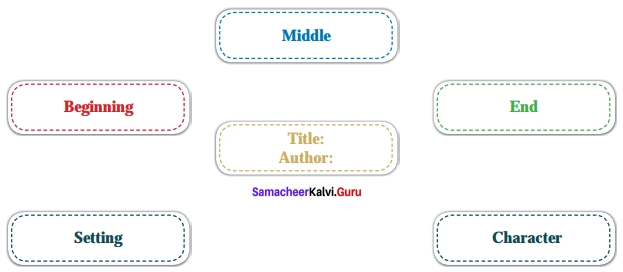
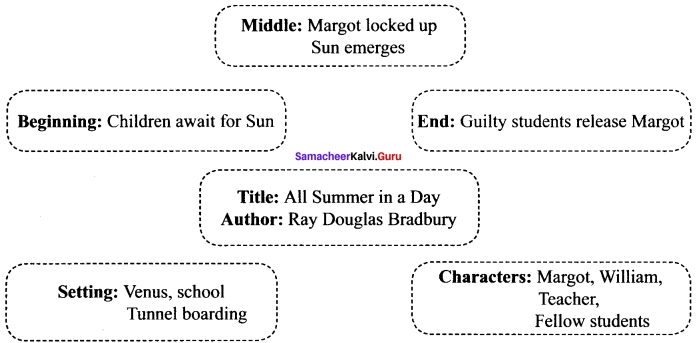
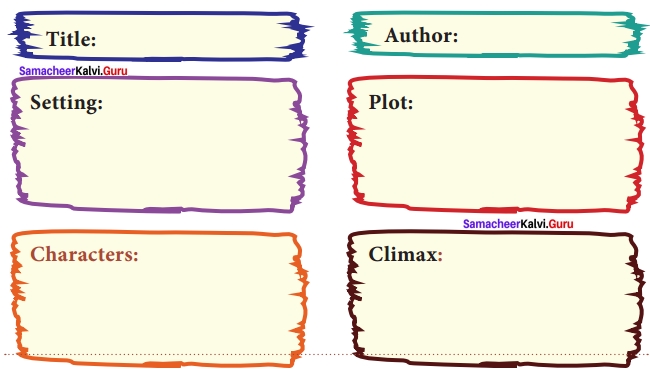
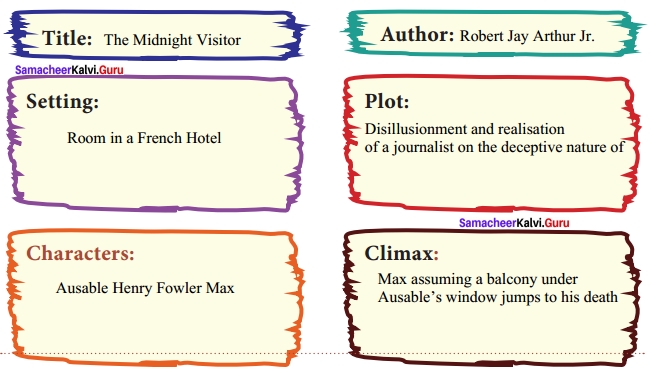
4. Based on your understanding of the story, complete the story map.

Samacheer Kalvi 12th English Solutions Supplementary Chapter 5 All Summer in a Day img-4

Answer:

Samacheer Kalvi 12th English Solutions Supplementary Chapter 5 All Summer in a Day img-5

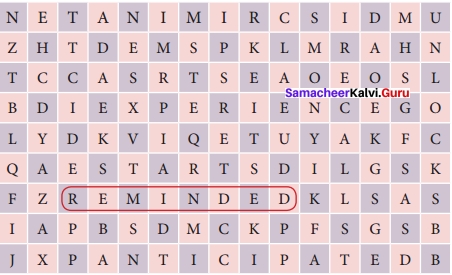
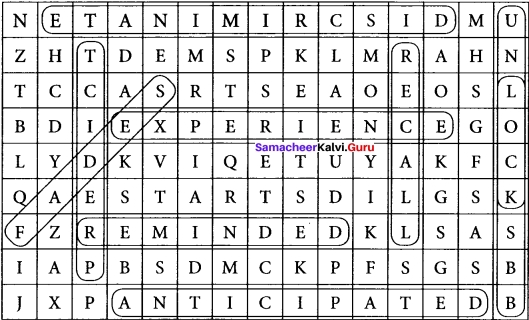
5. Find out and encircle the following words in the word grid. (The words have been placed horizontally, vertically, diagonally and even back to front)

fadespredictdiscriminatelocksreminded
experienceanticipatedunlockrecall

Samacheer Kalvi 12th English Solutions Supplementary Chapter 5 All Summer in a Day img-6

Answer:

Samacheer Kalvi 12th English Solutions Supplementary Chapter 5 All Summer in a Day img-7

Now read the sentences below. Complete them appropriately with the words you identified from the grid.

  1. The scientists ______ that the Sun would come out on Venus that day after seven years.
  2. The children are getting ready for the _____ event.
  3. The children Margot as she _____ the Sun.
  4. William and other children have bullied her and _____ her in a closet.
  5. When the Sun comes out, the children _____ the sun.

Answers:

  1. predicted
  2. anticipated
  3. discriminate, recalls
  4. locked
  5. experience

Speaking Activity

Pair Work
Ray Bradbury’s “All Summer in a Day” is a piece of science fiction. Discuss plots of similar stories with your partner and share your ideas with the class.

We read a story called “The thief’. Yarmuk is one of the top thieves of the solar system. He overhears a secret about planet ‘X’. There is no crime in planet ‘X’. There are no policemen. Most of the shops had no assistants. They were all honesty stores. Yarmuk wanted details about the location of the planet so that he could steal from a jewel store there and settle for life. He mixes a tranquillizer in his friend’s Makin’s second drink. When Makin loses his consciousness, he obtains the address of a man who knows the coordinates of the planet ‘X’. He steals into the house of that man. He uses a hallucinogen to get the information he wants from the man. He prowls the space parking lot. On visiting a space ship dealer, he collects information on different spacecraft and narrows down on MIG-31 spacecraft for his trip to planet ‘X’. He finds a newly married couple parking in a hotel. He takes a room just next to the couple.

SamacheerKalvi.Guru

Using a false key, he enters their room. He gasses them both and takes space-port parking lot pass; the electronic card which opens their spaceships air lock and controls its engines and the hyper-wave radio key. He vacates the room explaining that he got a video call from his wife that she was sick. Yarmuk enters the spaceport and explaining his wife’s sudden illness get permission to blast off. He reaches planet ‘X’. The parking charges in the space port are ridiculously cheap. To try to find out, if alarm goes off, he stealthily picks up socks in an unmanned textile showroom. Nothing happens. Emboldened by the attempt he goes to one of the posh jewellery shops.

He makes a mental note of which ever jewels he wants to steal the following day. He takes two big suitcases and stuffs all valuable jewels and rushes back to the hotel. Nobody checks him. He sleeps gladly. The next morning when he leaves the hotel, he is stopped by the security guards with stenguns. He does not understand how his theft got found out. Later he learns that planet ‘X’ is full of telepathists, mind readers and clairvoyants. Stray customers who had seen him at the jewellery and the hotel staff have read his thoughts and just communicated in a flash of a second through their minds. He is sentenced to 20 years in the alien’s jail.

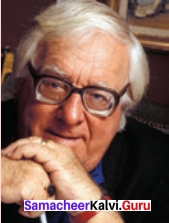
All Summer in a Day About The Author

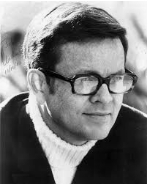
Samacheer Kalvi 12th English Solutions Supplementary Chapter 5 All Summer in a Day img-8

Ray Douglas Bradbury (August 22, 1920 – June 5, 2012) was an American author and screenwriter. He worked in a variety of genres, including fantasy, science fiction, horror, and fiction. Widely regarded as the most important figure in the development of science fiction as a literary genre, Ray Bradbury’s works evoke the themes of racism, censorship, technology, nuclear war, humanistic values and the importance of imagination. Ray Bradbury is well-known for his incredibly descriptive style.

He employs figurative language (mostly similes, metaphors, and personification) throughout the novel and enriches his story with symbolism. On April 16, 2007, Bradbury received a special citation from the Pulitzer Prize jury “for his distinguished, prolific, and deeply influential career as an unmatched author of science fiction and fantasy.” Bradbury also wrote and consulted on screenplays and television scripts, including Moby Dick and It Came from Outer Space. Many of his works were adapted to comic book, television, and film formats.

All Summer in a Day Summary in English

Introduction
Bradbury’s story “All Summer in a day” revolves around a day’s happening in planet Venus after it is colonized by humans. This story falls under the category of Science fiction. So far, Earth is the only planet supporting human beings and the survival of millions of plants and thousands of animals. But in this story we come across children who are settled in Venus in an underground tunnel.

Excitement of children
Scientist predicted that the Sun would be visible in planet Venus for an hour. Children, in the dark planet, were overjoyed about the event. Each tried to visualise how the Sun would appear. Except Margot, all the children had seen the Sun seven years ago. M&rgot had come only four years ago. Till 5, she was in Ohio and had seen and enjoyed many “sunny days” and summer lasting three months. She says it is an orb like a penny. It is a kind of a ball with yellow flame. Its burning like a stove. The more details she gives, the more she is hated by her peers. Realising the unspoken but obvious contempt in the eyes of the peers, Margot keeps quiet. William teases Margot. Her silence of deep understanding of Sun annoys peers.

Be different and be punished
Margot is different from the students in the school. One day she even threw tantrums and wanted to be sent back to her parents to the earth. Other children realised that it would cost a fortune for her parents. But she was helpless. She stopped talking to the peers who did not hide their hatred. They teased her. She ignored and started anxiously waiting for the brief encounter with the Sun. She deeply believed that as per the prediction of the scientists, they would see the sun for an hour in the Venus planet. Her knowing silence and unwillingness disturbed the peers so much that they forcefully locked her up in a room.

SamacheerKalvi.Guru

Vivid Memory
When other children had nightmarish dreams recalling how the Sun was 7 years ago, Margot remembered the yellow lemon-like ball of fire she had seen almost everyday in Ohio for 5 long years. She secretly disdained the inadequate knowledge of her peers.

Pride and Prejudice
Margot was in love with the Sun. Margot wrote a poem, “I think Sun is a flower, that blooms for just one hour.” She read out the poem when it was raining outside the classroom. She knew for sure that her friends were dreaming and remembering gold or yellow crayon or coin large enough to buy the world with. They were often woken up by the tatting drum of rainfall. Her unexpressed pride over her knowledge of the Sun had really caused a prejudice among children. They locked her up in the anticipated day of sunlight

All Summer in a Day Summary in Tamil

முன்னுரை:
‘All summer in a day’ (“ஒரு நாளில் கோடை |காலம்” என்ற பிராட்பரியின் இந்தக் கதை வீனஸ் கோளை மனிதன் ஆக்ரமித்தப் பிறகு நடக்கும் நிகழ்வுகளைத் தழுவி சுழல்கிறது. இது அறிவியல் புனைக் கதையாகும். இதுவரை நம் பூமி தான் பல கோடி மரங்களும் மற்றும் பல்லாயிரம் விலங்குகளும், மனிதனும் வாழ்வதற்கு துணையாக நின்றது. ஆனால், இந்தக் கதையில் நாம் காணுவது வீனஸ் கோளில் | குழந்தைகள் பாதாளத்தில் வாழும் அதிசயம்.

குழந்தைகளின் ஆரவாரம்:
விஞ்ஞானிகள் வீனஸ் கோளில் சூரியன் ஒரு மணி நேரம் தென்படும் எனக் கணித்து அறிவித்தனர். இருண்ட கோளில் இருந்த குழந்தைகளுக்கு ஒரே குதூகலம். சூரியன் எங்ஙனம் இருக்கும் என அவரவர் கற்பனை செய்தனர். மார்கோட்டைத் தவிர மற்ற அனைவரும் | சூரியனை ஏழு வருடங்களுக்கு முன்பு பார்த்திருந்தனர். | ஆனால் மார்கோட் 4 வருடம் முன்பு தான் இங்கு வந்ததால், ஐந்து வயது வரை ஓஹையோவில் இருந்த போது நிறைய வெயில் காலங்கள்

அதுவும் மூன்று மாதங்களுக்கு நீடிக்கக்கூடியதாக அமைய அதை அனுபவித்துள்ளாள். சூரியனை மார்கோட் ஒரு பைசா அளவு வட்டப் பந்து என சித்தரிக்கிறாள். அது மஞ்சள் | நிற தீப்பந்து எனவும் சித்தரிக்கிறாள். அடுப்பைப் | போன்று எறியக் கூடியதாக இருந்தது என்கிறாள். சூரியனைப் பற்றி அவள் அதிக தகவலைக் கொடுக்க கொடுக்க அவளின் குழு அவளை வெறுத்தது. குழுவினர் எதிர் பேச்சு பேசாவிடினும் அவர்கள் கண்களில் தெரிந்த வெறுப்பைக் கண்டு மௌனமானாள். வில்லியம், மார்கோட்டை கிண்டல் செய்தான். சூரியன் பற்றி அவள் அறிந்திருந்த ஆழமான தகவல்கள் அவர்களை வெறுப்புறச் செய்தது.

வேறுபட்டு இருந்ததால் தண்டனைக்கு ஆளாக்கப்பட்டாள்.
பள்ளிக்கூடத்தில் மார்கோட் மற்ற மாணவ மாணவியிடம் இருந்து வேறுபட்டு இருந்தாள். ஒரு நாள் தன்னை தன் பெற்றோரைக் காண பூமிக்கு அனுப்பி விடுமாறு ரகளையும் செய்தாள். மற்ற குழந்தைகள் அது மார்கோட்டின் பெற்றோருக்கு பெருத்த செலவினை உண்டாக்கும் என அறிந்தனர். ஆனால், மார்கோட் விடாப்பிடியாக இருந்தாள். தன் மீது வெறுப்பை வெளிப்படுத்திய தன் குழுவினரோடு பேச மறுத்தாள். அவர்கள் மார்கோட்டை கிண்டல் செய்தனர். அதை அவள் பொருட்படுத்தாமல் சூரியனை சற்று நேரம் தரிசிப்பதை எதிர் நோக்கி காத்திருந்தாள். விஞ்ஞானிகள் கூறியது போல் ஒரு மணி நேரம் சூரியனை வீனஸ் கோளில் தரிசிக்கப் போவது உறுதி என நம்பினாள். மார்கோட்டின் மௌனமும், மற்றவரிடத்தே காட்டிய அலட்சியப் போக்கும் வெகுவாக குழுவினரைப் பாதித்ததால் மார்கோட்டை அவர்கள் ஒரு அறையில் போட்டு பூட்டினர்.

SamacheerKalvi.Guru

தெளிவான நினைவு:
சூரியன் ஏழு வருடங்கள் முன் எங்ஙனம் இருந்தது என்பதைப் பற்றிய பயங்கரக் கனவுகள் குழந்தைகளுக்கு ஏற்பட, மார்கோட்டிற்கோ சூரியனை சிறிய எலுமிச்சை பந்தாய் ஐந்து ஆண்டுகள் ஓஹையோவில் தான் ஒவ்வொரு நாளும் கண்டது நினைவுக்கு வந்தது. குழவினர் அளித்த போதாத தகவல்களை அவள் இரகசியமாக புறக்கணித்தாள்.

மமதையும் பாரபட்சமும்:
மார்கோட் சூரியனிடத்தில் பிரியம் கொண்டிருந்தாள், மார்கோட் ஒரு கவிதை எழுதினாள். சூரியன் ஒரு பூப் போன்றது. ‘அது ஒரு மணி நேரம் தான் பூக்கும்’ என்று, இந்தக் கவிதையை மழை பெய்து கொண்டிருக்கும் போது வகுப்பறையில் வாசித்தாள். | கட்டாயமாக குழுவினர் தங்கம் அல்லது மஞ்சள் | நிறத்திலோ அல்லது உலகை வாங்கவல்ல பெரிய அளவிலான பைசாவையோ சூரியனுக்கு ஒப்பாக கற்பனை செய்து கொண்டிருக்கிறார்கள் என்பதை அறிந்தாள். அவர்கள் மழையோசைக்கு அடிக்கடி விழித்த வண்ணம் இருந்தனர். சூரியனின் பால் தான் அறிந்திருந்த தகவலின் பேரில் உண்டான கர்வம், குழுவினரிடையே பாரபட்ச உணர்வை உண்டாக்கியது. ஆதலால், சூரியன் உதிக்கும் என எதிர்நோக்கிய நாளன்று மார்கோட்டை ஒரு அறையில் தள்ளி பூட்டினர்

7 வருடம் பெய்த மழை:
ஏழு வருடங்களாக தொடர்ந்து மழை பெய்தது. தொடர்ந்து பெய்த மழையால் ஏற்பட்ட பெருத்த வெள்ளப் பெருக்கின் காரணமாக தீவைச் சுற்றி அலைகள் மோதிக் கொண்டிருந்தன. ஏழாயிரம் காடுகள் மழையால் அழிந்தன.

வீனஸ் கோளில் சூரிய உதயம்:
திடீரென்று மழை நின்றது. சூரியன் தோன்றியது. வெண்கல நிறத்தில் மிகப் பெரியதாகக் காணப்பட்டது. சூரியனைச் சுற்றி வானம் மிகுந்த நீல நிறமாய் காணப்பட்டது. காடு சூரிய ஒளியில் பிரகாசிக்க, மாய வசப்பட்டிருந்த குழந்தைகள் திடீரென்று விடுதலை பெற்றது போல் கூக்குரலுடன் ஓடினர். ஆசிரியர் அவர்களை நீண்ட தூரம் செல்லா வண்ணம் எச்சரித்தார். அவர்களுக்கு 2 மணி நேரம் வெளியே சென்று வர அனுமதி கிடைத்தது.

திடீரென்று மழை நின்றது.
சூரியன் தோன்றியது. வெண்கல நிறத்தில் மிகப் பெரியதாகக் காணப்பட்டது.) சூரியனைச் சுற்றி வானம் மிகுந்த நீல நிறமாய் காணப்பட்டது. காடு சூரிய ஒளியில் பிரகாசிக்க, மாய | வசப்பட்டிருந்த குழந்தைகள் திடீரென்று விடுதலை பெற்றது போல் கூக்குரலுடன் ஓடினர். ஆசிரியர் அவர்களை நீண்ட தூரம் செல்லா வண்ணம் எச்சரித்தார். அவர்களுக்கு 2 மணி நேரம் வெளியே சென்று வர அனுமதி கிடைத்தது.

All Summer in a Day Glossary

Textual:

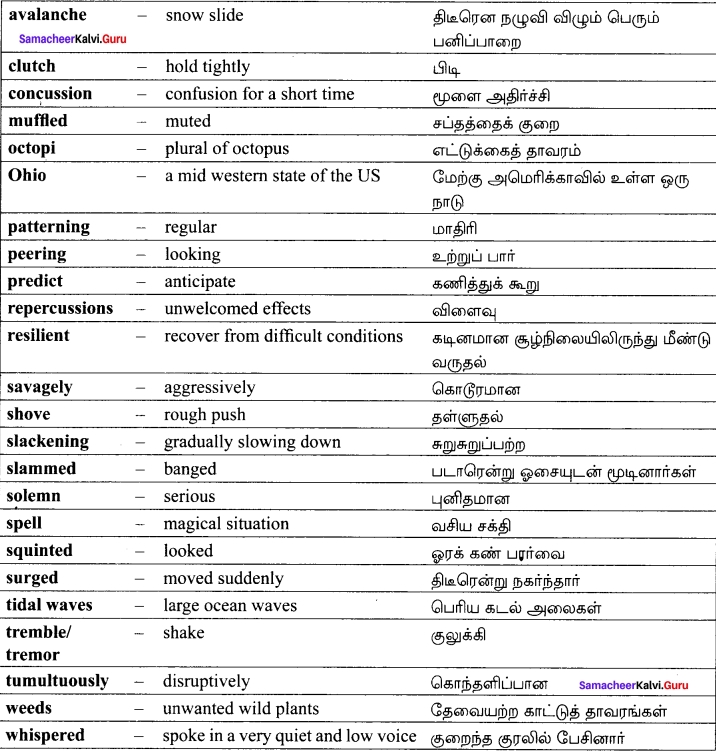
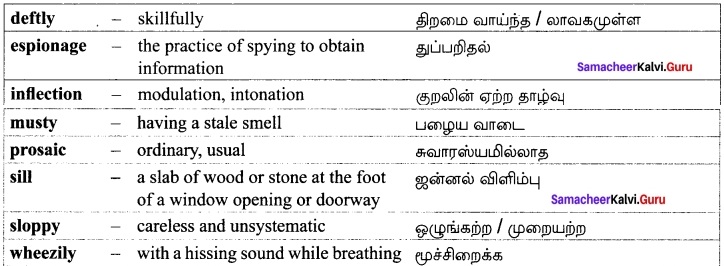
Samacheer Kalvi 12th English Solutions Supplementary Chapter 5 All Summer in a Day img-9

Additional:

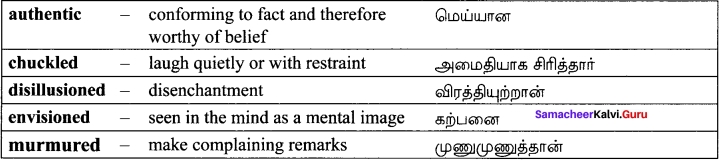
Samacheer Kalvi 12th English Solutions Supplementary Chapter 5 All Summer in a Day img-10

Samacheer Kalvi 7th Maths Solutions Term 3 Chapter 2 Percentage and Simple Interest Ex 2.5

Students can Download Maths Chapter 2 Percentage and Simple Interest Ex 2.5 Questions and Answers, Notes Pdf, Samacheer Kalvi 7th Maths Book Solutions Guide Pdf helps you to revise the complete Tamilnadu State Board New Syllabus and score more marks in your examinations.

Tamilnadu Samacheer Kalvi 7th Maths Solutions Term 3 Chapter 2 Percentage and Simple Interest Ex 2.5

Miscellaneous Practice Problems

Question 1.
When Mathi was buying her flat she had to put down a deposit of \(\frac { 1 }{ 10 } \) of the value of the flat. What percentage was this?
Solution:
Percentage of \(\frac { 1 }{ 10 } \) = \(\frac { 1 }{ 10 } \) × 100 % = 10 %
Mathi has to put down a deposit of 10 % of the value of the flat.

Question 2.
Yazhini scored 15 out of 25 in a test. Express the marks scored by her in percentage.
Solution:
Yazhini’s score = 15 out of 25 = \(\frac { 15 }{ 25 } \)
Score in percentage = \(\frac { 15 }{ 25 } \) × 100% = 60%

Question 3.
Out of total 120 teachers of a school 70 were male. Express the number of male teachers as percentage.
Solution:
Total teachers of the school = 120
Number of male teachers = 70
∴ Percentage of male teacher = \(\frac { 70 }{ 120 } \) × 100 % = \(\frac { 700 }{ 12 } \) %
Score in percentage = 58.33%
Percentage of male teachers = 58.33%

Question 4.
A cricket team won 70 matches during a year and lost 28 matches and no results for two matches. Find the percentage of matches they won.
Solution:
Number of Matches won = 70
Number of Matches lost = 28
“No result” Matches = 2
Total Matches = 70 + 28 + 2 = 100
Percentage of Matches won = \(\frac { 70 }{ 100 } \) × 100 % = 70 %
The won 70% of the matches

Samacheer Kalvi 7th Maths Solutions Term 3 Chapter 2 Percentage and Simple Interest Ex 2.5

Question 5.
There are 500 students in a rural school. If 370 of them can swim, what percentage of them can swim and what percentage cannot?
Solution:
Total number of students = 500
Number of students who can swim = 370
Percentage of students who can swim = \(\frac { 370 }{ 500 } \) × 100 % = 74 %
Number of students who cannot swim = 500 – 370 = 130
Percentage of students who cannot swim = \(\frac { 130 }{ 500 } \) × 100 % = 26 %
i.e. 74% can swim and 26% cannot swim

Question 6.
The ratio of Saral’s income to her savings is 4 : 1. What is the percentage of money saved by her?
Solution:
Total parts of money = 4 + 1 = 5
Part of money saved = 1
∴ Percentage of money saved = \(\frac { 1 }{ 5 } \) × 100% = 20%
∴ 20% of money is saved by Saral

Question 7.
A salesman is on a commission rate of 5%. How much commission does he make on sales worth ₹ 1,500?
Solution:
Total amount on sale = ₹ 1,500
Commission rate = 5 %
Commission received = 5 % of ₹ 1,500 = \(\frac { 5 }{ 100 } \) × 1500 = ₹ 75
∴ Commission received = ₹ 75

Question 8.
In the year 2015 ticket to the world cup cricket match was ₹ 1,500. This year the price has been increased by 18%. What is the price of a ticket this year?
Solution.
Price of a ticket in 2015 = ₹ 1500
Increased price this year = 18% of price in 2015
= 18 % of ₹ 1500 = \(\frac { 18 }{ 100 } \) × 1500
= ₹ 270
Price of ticket this year = last year price + increased price
= ₹ 1500 + ₹ 270 = ₹ 1770
Price of ticket this year = ₹ 1770

Samacheer Kalvi 7th Maths Solutions Term 3 Chapter 2 Percentage and Simple Interest Ex 2.5

Question 9.
2 is what percentage of 50?
Solution:
Let the required percentage be x
x% of 50 = 2
\(\frac { x }{ 100 } \) × 50 = 2
x = \(\frac{2 \times 100}{50}\) = 4 %
∴ 4 % of 50 is 2

Question 10.
What percentage of 8 is 64?
Solution:
Let the required percentage be x
So x % of 8 = 64
\(\frac { x }{ 100 } \) × 8 = 64
x = \(\frac{64 \times 100}{8}\) = 800
∴ 800 % of 8 is 64

Question 11.
Stephen invested ₹ 10,000 in a savings bank account that earned 2% simple interest. Find the interest earned if the amount was kept in the bank for 4 years.
Solution:
Principal (P) = ₹ 10,000
Rate of interest (r) = 2%
Time (n) = 4 years
∴ Simple Interest I = \(\frac { pnr }{ 100 } \)
= \(\frac{10000 \times 4 \times 2}{100}\)
= ₹ 800
Stephen will earn ₹ 800

Question 12.
Riya bought ₹ 15,000 from a bank to buy a car at 10% simple interest. If she paid ₹ 9,000 as interest while clearing the loan, find the time for which the loan was given.
Solution:
Here Principal (P) = ₹ 15,000
Rate of interest (r) = 10 %
Simple Interest (I) = ₹ 9000
I = \(\frac { pnr }{ 100 } \)
9000 = \(\frac{15000 \times n \times 10}{100}\)
n = \(\frac{9000 \times 100}{15000 \times 10}\)
n = 6 years
∴ The loan was given for 6 years

Samacheer Kalvi 7th Maths Solutions Term 3 Chapter 2 Percentage and Simple Interest Ex 2.5

Question 13.
In how much time will the simple interest on ₹ 3,000 at the rate of 8% per annum be the same as simple interest on ?4,000 at 12% per annum for 4 years?
Solution:
Let the required number of years be x
Simple Interest I = \(\frac { pnr }{ 100 } \)
Principal P1 = ₹ 3000
Rate of interest (r) = 8 %
Time (n1) = n1 years
Simple Interest I1 = \(\frac{3000 \times 8 \times n_{1}}{100}\) = 240 n1
Principal (P2) = ₹ 4000
Rate of interest (r) = 12 %
Time n2 = 4 years
Simple Interest I2 = \(\frac{4000 \times 12 \times 4}{100}\)
I2 = 1920
If I1 = I2
240 n1 = 1920
n1 = \(\frac { 1920 }{ 240 } \) = 8
∴ The required time = 8 years

Challenge Problems

Question 14.
A man travelled 80 km by car and 320 km by train to reach his destination. Find what percent of total journey did he travel by car and what per cent by train?
Solution:
Distance travelled by car = 80 km.
Distance travelled by train = 320 km
Total distance = 80 + 320 km = 400 km
Percentage of distance travelled by car = \(\frac { 80 }{ 400 } \) × 100 % = 20 %
Percentage of distance travelled by train = \(\frac { 320 }{ 800 } \) × 100 % = 40 %

Question 15.
Lalitha took a math test and got 35 correct and 10 incorrect answers. What was the percentage of correct answers?
Solution:
Number of correct answers = 35
Number of incorrect answers = 10
Total number of answers = 35 + 10 = 45
Percentage of correct answers = \(\frac { 35 }{ 45 } \) × 100 %
= 77.777 % = 77.78 %

Samacheer Kalvi 7th Maths Solutions Term 3 Chapter 2 Percentage and Simple Interest Ex 2.5

Question 17.
The population of a village is 8000. Out of these, 80% are literate and of these literate people, 40% are women. Find the percentage of literate women to the total population?
Solution:
Population of the village = 8000 people
literate people = 80 % of population
= 80 % of 8000 = \(\frac { 80 }{ 100 } \) × 8000
literate people = 6400
Percentage of women = 40 %
Number of women = 40 % of literate people
= \(\frac { 40 }{ 100 } \) × 6400 = 2560
∴ literate women : Total population
= 8000 : 2560
= 25 : 8

Question 18.
A student earned a grade of 80% on a math test that had 20 problems. How many problems on this test did the student answer correctly?
Solution:
Total number of problems in the test = 20
Students score = 80 %
Number of problem answered = \(\frac { 80 }{ 100 } \) × 20 = 16

Question 19.
A metal bar weighs 8.5 kg. 85% of the bar is silver. How many kilograms of silver are in the bar?
Solution:
Total weight of the metal = 8.5 kg
Percentage of silver in the metal = 85%
Weight of silver in the metal = 85% of total weight
= \(\frac { 85 }{ 100 } \) × 8.5 kg
= 7.225 kg
7.225 kg of silver are in the bar.

Samacheer Kalvi 7th Maths Solutions Term 3 Chapter 2 Percentage and Simple Interest Ex 2.5

Question 20.
Concession card holders pay ₹ 120 for a train ticket. Full fare is ₹ 230. What is the percentage of discount for concession card holders?
Solution:
Train ticket fare = ₹ 230
Ticket fare on concession = ₹ 120
Discount = Ticket fare – concession fare = 230 – 120 = ₹ 110
Samacheer Kalvi 7th Maths Solutions Term 3 Chapter 2 Percentage and Simple Interest Ex 2.5 1
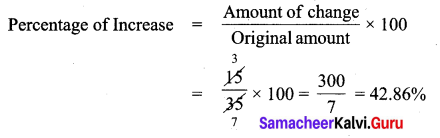
Percentage of discount = 47.83%

Question 21.
A tank can hold 200 litres of water. At present, it is only 40% full. How many litres of water to fill in the tank, so that it is 75 % full?
Solution:
Capacity of the water tank = 200 litres
Percentage of water in the tank = 40%
Percentage of water to fill = Upto 75%
Difference in percentage = 75 % – 40 % = 35 %
∴ Volume of water to be filled = Percentage of difference × total capacity
= \(\frac { 35 }{ 100 } \) × 200 = 70 l
70 l of water to be filled

Question 22.
Which is greater 16 \(\frac { 2 }{ 3 } \) or \(\frac { 2 }{ 5 } \) or 0.17 ?
Solution:
16 \(\frac { 2 }{ 3 } \) = \(\frac { 50 }{ 30 } \)
= \(\frac { 50 }{ 30 } \) × 100 % = 1666.67 %
⇒ \(\frac { 2 }{ 5 } \)
= \(\frac { 2 }{ 5 } \) × 100 = 40 %
0.17 = \(\frac { 17 }{ 100 } \) = 17 %
∴ 1666.67 is greater
∴ 16 \(\frac { 2 }{ 3 } \) is greater

Samacheer Kalvi 7th Maths Solutions Term 3 Chapter 2 Percentage and Simple Interest Ex 2.5

Question 23.
The value of a machine depreciates at 10% per year. If the present value is ₹ 1,62,000, what is the worth of the machine after two years.
Solution:
Present value of the machine = ₹ 1,67,000
Rate of depreciation = 10 % Per annum
Time (n) = 2 years
For 1 year depreciation amount = \(\frac{1,62,000 \times 1 \times 10}{100}\) = ₹ 16,200
Worth of the machine after one year = Worth of Machine – Depreciation
= 1,67,000 – 16,200 = 1,45,800
Depreciation of the machine for 2nd year = 145800 × 1 × \(\frac { 10 }{ 100 } \) = 14580
Worth of the machine after 2 years = 1,45,800 – 14,580 = 1,31,220
∴ Worth of the machine after 2 years = ₹ 1,31,220

Question 24.
In simple interest, a sum of money amounts to ₹ 6,200 in 2 years and ₹ 6,800 in 3 years. Find the principal and rate of interest.
Solution:
Let the principal P = ₹ 100
If A = 6200
⇒ Principal + Interest for 2 years = 6200
A = ₹ 7400
⇒ Principal + Interest for 3 years = 7400
∴ Difference gives the Interest for 1 year
∴ Interest for 1 year = 7400 – 6200
I = 1200
\(\frac { pnr }{ 100 } \) = 1200 ⇒ \(\frac{P \times 1 \times r}{100}\) = 1200
If the Principal = 10,000 then
\(\frac{10,000 \times 1 \times r}{100}\) = 1200 ⇒ r = 12 %
Rate of interest = 12 % Per month

Question 25.
A sum of ₹ 46,900 was lent out at simple interest and at the end of 2 years, the total amount was ₹ 53,466.Find the rate of interest per year.
Solution:
Here principal P = ₹ 46900
Time n = 2 years
Amount A = ₹ 53466
Let r n be the rate of interest per year p
Intrest I = \(\frac { pnr }{ 100 } \)
A = P + I
53466 = 46900 + \(\frac{46900 \times 2 \times r}{100}\)
53466 – 46900 = \(\frac{46900 \times 2 \times r}{100}\)
6566 = 469 × 2 × r
r = \(\frac{6566}{2 \times 469}\) % = 7 %
Rate of interest = 7 % Per Year

Question 26.
Arun lent ₹ 5,000 to Balaji for 2 years and ₹ 3,000 to Charles for 4 years on simple interest at the same rate of interest and received ₹ 2,200 in all from both of them as interest. Find the rate of interest per year.
Solution:
Principal lent to Balaji P1 = ₹ 5000
Time n1 = 2 years
Let r be the rate of interest per year
Simple interest got from Balaji = \(\frac { pnr }{ 100 } \) ⇒ I1 = \(\frac{5000 \times 25 \times r}{100}\)
Again principal let to Charles P2 = ₹ 3000
Time (n2) = 4 years
Simple interest got from Charles (I2) = \(\frac{3000 \times 4 \times r}{100}\)
Altogether Arun got ₹ 2200 as interest.
∴ I1 + I2 = 2200
\(\frac{5000 \times 2 \times r}{100}+\frac{3000 \times 4 \times r}{100}\) = 2200
100r + 120r = 2200
220r = 2200 = \(\frac { 2200 }{ 220 } \)
r = 10 %
Rate of interest per year = 10 %

Samacheer Kalvi 7th Maths Solutions Term 3 Chapter 2 Percentage and Simple Interest Ex 2.5

Question 27.
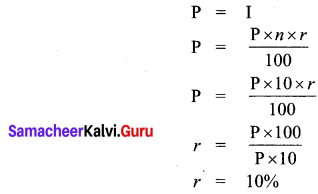
If a principal is getting doubled after 4 years, then calculate the rate of interest. (Hint: Let P = ₹ 100)
Solution:
Let the principal P = ₹ 100
Given it is doubled after 4 years
i.e. Time n = 4 years
After 4 years A = ₹ 200
∴ A = P + I
A – P = I
200 – 100 = I
After 4 years interest I = 100
I = \(\frac { pnr }{ 100 } \) ⇒ 100 = \(\frac{100 \times 4 \times r}{100}\)
4r = 100 ⇒ r = 25 %
Rate of interest r = 25 %

Samacheer Kalvi 7th Maths Solutions Term 3 Chapter 3 Algebra Ex 3.1

Students can Download Maths Chapter 3 Algebra Ex 3.1 Questions and Answers, Notes Pdf, Samacheer Kalvi 7th Maths Book Solutions Guide Pdf helps you to revise the complete Tamilnadu State Board New Syllabus and score more marks in your examinations.

Tamilnadu Samacheer Kalvi 7th Maths Solutions Term 3 Chapter 3 Algebra Ex 3.1

Question 1.
Fill in the blanks.
1. (p – q)2 = _______
2. The product of (x + 5) and (x – 5) is _______
3. The factors of x2 – 4x + 4 are _______
4. Express 24ab2c2 as product of its factors is _______
Answers:
1. p2 – 2pq + q2
2. x2 – 25
3. (x – 2) and (x – 2)
4. 2 × 2 × 2 × 3 × a × b × b × c × c

Question 2.
Say whether the following statements are True or False.
(i) (7x + 3) (7x – 4) = 49 x2 – 7x – 12
(ii) (a – 1)2 = a2 – 1.
(iii) (x2 + y2)(y2 + x2) = (x2 + y2)2
(iv) 2p is the factor of 8pq.
Answers:
(i) True
(ii) False
(iii) True
(iv) True

Samacheer Kalvi 7th Maths Solutions Term 3 Chapter 3 Algebra Ex 3.1

Question 3.
Express the following as the product of its factors.
(i) 24ab2c2
(ii) 36 x3y2z
(iii) 56 mn2p2
Solution:
(i) 24ab2c2 = 2 × 2 × 2 × 3 × a × b × b × c × c
(ii) 36 x3y2z = 2 × 2 × 3 × 3 × x × x × x × y × y × z
(iii) 56 mn2p2 = 2 × 2 × 2 × 7 × m × n × n × p × p

Question 4.
Using the identity (x + a)(x + b) – x2 + x(a + b) + ab, find the following product.
(i) (x + 3) (x + 7)
(ii) (6a + 9) (6a – 5)
(iii) (4x + 3y) (4x + 5y)
(iv) (8 + pq) (pq + 7)
Solution:
(i) (x + 3) (x + 7)
Let a = 3; b = 7, then
(x + 3) (x + 7) is of the form x2 + x (a + b) + ab
(x + 3) (x + 7) = x2 + x (3 + 7) + (3 × 7) = x2 + 10x + 21

(ii) (6a + 9) (6a – 5)
Substituting x = 6a ; a = 9 and b = -5
In (x + a) (x + b) = x2 + x (a + b) + ab, we get
(6a + 9)(6a – 5) = (6a)2 + 6a (9 + (-5)) + (9 × (-5))
62 a2 + 6a (4) + (-45) = 36a2 + 24a – 45
(6a + 9) (6a – 5) = 36a2 + 24a – 45

(iii) (4x + 3y) (4x + 5y)
Substituting x = 4x ; a = 3y and b = 5y in
(x + a) (x + b) = x2 + x (a + b) + ab, we get
(4x + 3y) (4x – 5y) = (4x)2 + 4x (3y + 5y) + (3y) (5y)
= 42 x2 + 4x (8y) + 15y2 = 16x2 + 32xy + 15y2
(4x + 3y) (4x + 5y) = 16x2 + 32xy + 15y2

(iv) (8 + pq) (pq + 7)
Substituting x = pq ; a = 8 and b = 7 in
(x + a) (x + b) = x2 + x (a + b) + ab, we get
(pq + 8) (pq + 7) = (pq)2 + pq (8 + 7) + (8) (7)
= p2 q2 + pq (15) + 56
(8 + pq) (pq + 7) = p2 q2 + 15pq + 56

Samacheer Kalvi 7th Maths Solutions Term 3 Chapter 3 Algebra Ex 3.1

Question 5.
Expand the following squares, using suitable identities.
(i) (2x + 5)2
(ii) (b – 7)2
(iii) (mn + 3p)2
(iv) (xyz – 1)2
Solution:
(i) (2x + 5)2
Comparing (2x + 5)2 with (a + b)2 we have a = 2x and b = 5
a = 2x and b = 5,
(a + b)2 = a2 + 2ab + b2
(2x + 5)2 = (2x)2 + 2(2x) (5) + 52 = 22 x2 + 20x + 25
= 22 x2 + 20x + 25
(2x + 5)2 = 4x2 + 20x + 25

(ii) (b – 7)2
Comparing (b – 7)2 with (a – b)2 we have a = b and b = 7
(a – b)2 = a2 – 2ab + b2
(b – 7)2 = b2 – 2(b) (7) + 72
(b – 7)2 = b2 – 14b + 49

(iii) (mn + 3p)2
Comparing (mn + 3p)2 with (a + b)2 we have
(a + b)2 = a2 + 2ab + b2
(mn + 3p)2 = (mn)2 + 2(mn) (3p) + (3p)2
(mn + 3p)2 = m2 n2 + 6mnp + 9p2

(iv) (xyz – 1)2
Comparing (xyz – 1)2 with (a – b)2 we have = a + xyz and b = 1
a = xyz and b = 1
(a – b)2 = a2 – 2ab + b2
(xyz – 1)2 = (xyz)2 – 2 (xyz) (1) + 12
(xyz -1)2 = x2 y2 z2 – 2 xyz + 1

Samacheer Kalvi 7th Maths Solutions Term 3 Chapter 3 Algebra Ex 3.1

Question 6.
Using the identity (a + b)(a – b) = a2 – b2, find the following product.
(i) (p + 2) (p – 2)
(ii) (1 + 3b) (3b – 1)
(iii) (4 – mn) (mn + 4)
(iv) (6x + 7y) (6x – 7y)
Solution:
(i) (p + 2) (p – 2)
Substituting a = p ; b = 2 in the identity (a + b) (a – b) = a2 – b2, we get
(p + 2) (p – 2) = p2 – 22

(ii) (1 + 3b)(3b – 1)
(1 + 3b) (3b -1) can be written as (3b + 1) (3b – 1)
Substituting a = 36 and b = 1 in the identity
(a + b) (a – b) = a2 – b2, we get
(3b + 1)(3b – 1) = (3b)2 – 12 = 32 × b2 – 12
(3b + 1) (3b – 1) = 9b2 – 12

(iii) (4 – mn) (mn + 4)
(4 – mn) (mn + 4) can be written as (4 – mn) (4 + mn) = (4 + mn) (4 – mn)
Substituting a = 4 and b = mn is
(a + b) (a – b) = a2 – b2, we get
(4 + mn) (4 – mn) = 42 – (mn)2 = 16 – m2 n2

(iv) (6x + 7y) (6x – 7y)
Substituting a = 6x and b = 7y in
(a + b) (a – b) = a2 – b2, We get
(6x + 7y) (6x – 7y) = (6x)2 – (7y)2 = 62x2 – 72y2
(6x + 7y) (6x – 7y) = 36x2 – 49y2

Samacheer Kalvi 7th Maths Solutions Term 3 Chapter 3 Algebra Ex 3.1

Question 7.
Evaluate the following, using suitable identity.
(i) 512
(ii) 1032
(iii) 9982
(iv) 472
(v) 297 × 303
(vi) 990 × 1010
(vii) 51 × 52
Solution:
512
= (50 + 1)2
Taking a = 50 and b = 1 we get
(a + b)2 = a2 + 2ab + b2
(50 + 1)2 = 502 + 2 (50) (1) + 12 = 2500 + 100 + 1
512 = 2601

(ii) 1032
1032 = (100 + 3)2
Taking a = 100 and b = 3
(a + b)2 = a2 + 2ab + b2 becomes
(100 + 3)2 = 1002 + 2 (100) (3) + 32 = 10000 + 600 + 9
1032 = 10609

(iii) 9982
9982 = (1000 – 2)2
Taking a = 1000 and b = 2
(a – b)2 = a2 + 2ab + b2 becomes
(1000 – 2)2 = 10002 – 2 (1000) (2) + 22
= 1000000 – 4000 + 4
9982 = 10,04,004

(iv) 472
472 = (50 – 3)2
Taking a = 50 and b = 3
(a – b)2 = a2 – 2ab + b2 becomes
(50 – 3)2 = 502 – 2 (50) (3) + 32
= 2500 – 300 + 9 = 2200 + 9
472 = 2209

(v) 297 × 303
297 × 303 = (300 – 3) (300 + 3)
Taking a = 300 and b = 3, then
(a + b) (a – b) = a2 – b2 becomes
(300 + 3) (300 – 3) = 3002 – 32
303 × 297 = 90000 – 9
297 × 303 = 89,991

Samacheer Kalvi 7th Maths Solutions Term 3 Chapter 3 Algebra Ex 3.1

(vi) 990 × 1010
990 × 1010 = (1000 – 10) (1000 + 10)
Taking a = 1000 and b = 10, then
(a – b) (a + b) = a2 – b2 becomes
(1000 – 10) (1000 + 10) = 10002 – 102
990 × 1010 = 1000000 – 100
990 × 1010 = 999900

(vii) 51 × 52
= (50 + 1) (50 + 1)
Taking x = 50, a = 1 and b = 2
then (x + a) (x + b) = x2 + (a + b) x + ab becomes
(50 + 1) (50 + 2) = 502 + (1 + 2) 50 + (1 × 2)
2500 + (3) 50 + 2 = 2500 + 150 + 2
51 × 52 = 2652

Question 8.
Simplify: (a + b)2 – 4ab
Solution:
(a + b)2 – 4ab = a2 + b2 + 2ab – 4ab = a2 + b2 – 2ab = (a – b)2

Question 9.
Show that (m – n)2 + (m + n)2 = 2(m2 + n2)
Solution:
Taking the LHS = (m – n)2 + (m + n)2
Samacheer-Kalvi-7th-Maths-Solutions-Term-3-Chapter-3-Algebra-Ex-3.1-1

Question 10.
If a + b = 10 , and ab = 18, find the value of a2 + b2.
Solution:
We have (a + b)2 = a2 + 2ab + b2
(a + b)2 = a2 + b2 + 2ab
given a + b = 0 and ab = 18
102 = = a2 + b2 + 2(18)
100 = = a2 + b2 + 36
100 – 36 = a2 + b2
a2 + b2 = 64

Samacheer Kalvi 7th Maths Solutions Term 3 Chapter 3 Algebra Ex 3.1

Question 11.
Factorise the following algebraic expressions by using the identity a2 – b2 = (a + b)(a – b).
(i) z2 – 16
(ii) 9 – 4y2
(iii) 25a2 – 49b2
(iv) x4 – y4
Solution:
(i) z2 – 16
z2 – 16 = z2 – 42
We have a2 – b2 = (a + b) (a – b)
let a = z and b = 4,
z2 – 42 = (z + 4) (z – 4)

(ii) 9 – 4y2
9 – 4y2 = 32 – 22 y2 = 32 – (2y)2
let a = 3 and b = 2y, then
a2 – b2 = (a + b) (a – b)
∴ 32 – (2y)2 = (3 + 2y) (3 – 2y)
9 – 4y2 = (3 + 2y) (3 – 2y)

(iii) 25a2 – 49b2
25a2 – 49b2 = 52 – a2 – 72 = (5a)2 – (7b)2
let A = 5a and B = 7b
AB2
(5a)2 – (7b)2 = (5a + 7b) (5a – 7b)

(iv) x4 – y4
Let x4 – y4 = (x2)2 – (y2)2
We have a2 – b2 = (a + b) (a – b)
(x2)2 – (y2)2 = (x2 + y2) (x2 – y2)
x4 – y4 = (x2 + y2) (x2 – y2)
Again we have x2 – y2 = (x + y) (x – y)
∴ x4 – y4 = (x2 + y2) (x + y) (x – y)

Samacheer Kalvi 7th Maths Solutions Term 3 Chapter 3 Algebra Ex 3.1

Question 12.
Factorise the following using suitable identity.
(i) x2 – 8x + 16
(ii) y2 + 20y + 100
(iii) 36m2 + 60m + 25
(iv) 64x2 – 112xy + 49y2
(v) a2 + 6ab + 9b2 – c2
Solution:
(i) x2 – 8x + 16
x2 – 8x + 16 = x2 – (2 × 4 × x) + 42
This expression is in the form of identity
a2 – 2ab + b2 = (a – b)2
x2 – 2 × 4 × x + 42 = (x – 4)2
∴ x2 – 8x + 16 = (x – 4) (x – 4)

(ii) y2 + 20y + 100
y2 + 20y + 100 = y2 + (2 × (10)) y + (10 × 10)
= y2 + (2 × 10 × y) + 102
This is of the form of identity
a2 + 2 ab + b2 = (a + b)2
y2 + (2 × 10 × y) + 102 = (y + 10)2
y2 + 20y + 100 = (y + 10)2
y2 + 20y + 100 = (y + 10) (y + 10)

(iii) 36m2 + 60m + 25
36m2 + 60m + 25 = 62 m2 + 2 × 6m × 5 + 52
This expression is of the form of identity
a2 + 2ab + b2 = {a + b)2
(6m)2 + (2 × 6m × 5) + 52
= (6m + 5)2
36m2 + 60m + 25 = (6m + 5) (6m + 5)

(iv) 64x2 – 112xy + 49y2
64x2 – 112xy + 49y2 = 82 x2 – (2 × 8x × 7y) + 72y2
This expression is of the form of identity
a2 – 2ab + b2 = (a- b)2
(8x)2 – (2 × 8x × 7y) + (7y)2 = (8x – 7y)2
64x2 – 112xy + 49y2 = (8x – 7y) (8x – 7y)

(v) a2 + 6ab + 9b2 – c2
a2 + 6ab + 9b2 – c2 = a2 + 2 × a × 3b + 32 b2 – c2
= a2 + (2 × a × 3b) + (3b)2 – c2
This expression is of the form of identity
[a2 + 2ab + b2] – c2 = (a + b)2 – c2
a2 + (2 × a × 36) + (3b)2 – c2 = (a + 3b)2 – c2
Again this RHS is of the form of identity
a2 – b2 = (a + b) (a – b)
(a + 3b)2 – c2 = [(a + 3b) + c] [(a + 3b) – c]
a2 + 6ab + 9b2 – c2 = (a + 3b + c) (a + 3b – c)

Samacheer Kalvi 7th Maths Solutions Term 3 Chapter 3 Algebra Ex 3.1

Objective Type Questions

Question 1.
If a + b = 5 and a2 + b2 = 13, then ab = ?
(i) 12
(ii) 6
(iii) 5
(iv) 13
Answer:
(ii) 6
Hint: (a + b)2 = 25
13 + 2ab = 25
2ab = 12
ab = 6

Question 2.
(5 + 20)(-20 – 5) = ?
(i) -425
(ii) 375
(iii) -625
(iv) 0
Answer:
(iii) -625
Hint: (50 + 20) (-20 – 5) = -(5 + 20)2 = – (25)2 = – 625

Question 3.
The factors of x2 – 6x + 9 are
(i) (x – 3)(x – 3)
(ii) (x – 3)(x + 3)
(iii) (x + 3)(x + 3)
(iv) (x – 6)(x + 9)
Answer:
(i) (x – 3)(x – 3)
Hint: x2 – 6x + 9 = x2 – 2(x) (3) + 32
a2 – 2ab + b2 – (a- b)2 = (x – 3)2 = (x – 3) (x – 3)

Samacheer Kalvi 7th Maths Solutions Term 3 Chapter 3 Algebra Ex 3.1

Question 4.
The common factors of the algebraic expression ax2y, bxy2 and cxyz is
(i) x2y
(ii) xy2
(iii) xyz
(iv) x
Ans :
(iv) xy
Hint: ax2y = a × x × x × y
bxy2 = b × x × y × y
cxyz = C × x × y × z
Common factor = xy

Samacheer Kalvi 8th Maths Solutions Term 2 Chapter 3 Geometry Ex 3.3

Students can Download Maths Chapter 3 Geometry Ex 3.3 Questions and Answers, Notes Pdf, Samacheer Kalvi 8th Maths Book Solutions Guide Pdf helps you to revise the complete Tamilnadu State Board New Syllabus and score more marks in your examinations.

Tamilnadu Samacheer Kalvi 8th Maths Solutions Term 2 Chapter 3 Geometry Ex 3.3

Question I.
Construct the following trapeziums with the given measures and also find their area.

Question 1.
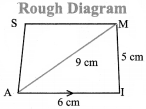
AIMS with \(\overline { AI } \) ∥ \(\overline { SM } \), AI = 6 cm, IM = 5 cm, AM = 9 cm and MS 6.5 cm.
Solution:
Samacheer Kalvi 8th Maths Solutions Term 2 Chapter 3.3 1
Given
AI = 6cm
IM = 5cm
AM = 9cm, and \(\overline { AI } \) ∥ \(\overline { SM } \)
MS = 6.5 cm
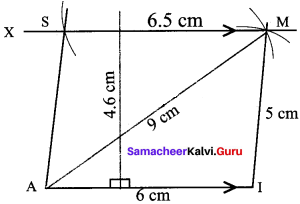
Samacheer Kalvi 8th Maths Solutions Term 2 Chapter 3.3 2
Construction:
Steps:

  1. Draw a line segment AI = 6cm.
  2. With A and I as centres, draw arcs of radii 9 cm and 5 cm respectively and let them cut at M
  3. Join AM and IM.
  4. Draw MX parallel to AI
  5. With M as centre, draw an arc of radius 6.5 cm cutting MX at S.
  6. Join AS AIMS is the required trapezium.

Calculation of Area:
Area of the trapezium AIMS = \(\frac{1}{2}\) x h x (a + b) sq.units
= \(\frac{1}{2}\) x 4.6 x (6 + 6.5) = \(\frac{1}{2}\) x 4.6 x 12.5
= 28.75 Sq.cm

Samacheer Kalvi 8th Maths Solutions Term 2 Chapter 3 Geometry Ex 3.3

Question 2.
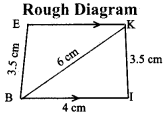
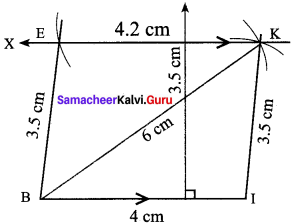
BIKE with \(\overline { BI } \) ∥ \(\overline { EK } \), BI = 4 cm, IK = 3.5 cm, BK = 6 cm and BE = 3.5 cm
Solution:
Samacheer Kalvi 8th Maths Solutions Term 2 Chapter 3.3 3
Given:
In the trapezium BIKE,
BI = 4 cm
IK = 3.5 cm
BK = 6 cm
BE = 3.5 cm and \(\overline { BI } \) ∥ \(\overline { EK } \)
Samacheer Kalvi 8th Maths Solutions Term 2 Chapter 3.3 4
Construction:
Steps:

  1. Draw a line segment BI = 4 cm.
  2. With B and I as centres, draw arcs of radii 6 cm and 3.5 cm respectively and let them cut at K.
  3. Join BK and IK
  4. Draw KX parallel to BI
  5. With B as centre, draw an arc of radius 3.5 cm.cutting KX at E
  6. Join BE. BIKE is the required trapezium.

Calculation of area:
Area of the trapezium BIKE = \(\frac{1}{2}\) x h x (a + b) sq. units = \(\frac{1}{2}\) x 3.5 x (4 + 4.2)
= \(\frac{1}{2}\) x 3.5 x 8.2 = 14.35 sq.cm

Question 3.
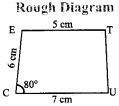
CUTE with \(\overline { CD } \) ∥ \(\overline { ET } \), CU = 7 cm, ∠UCE = 80°, CE = 6 cm and TE = 5 cm.
Solution:
Samacheer Kalvi 8th Maths Solutions Term 2 Chapter 3.3 5
Given:
In the trapezium CUTE,
CU = 7 cm, ∠UCE = 80°,
CE = 6 cm, TE = 5 cm and \(\overline { CD } \) ∥ \(\overline { ET } \)
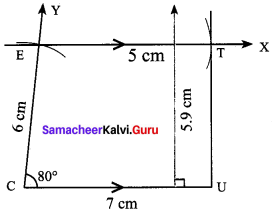
Samacheer Kalvi 8th Maths Solutions Term 2 Chapter 3.3 6
Construction:
Steps:

  1. Draw a line segment CU = 7 cm.
  2. Construct an angle ∠UCE = 80° at C
  3. With C as centre, draw an arc of radius 6 cm cutting CY at E
  4. Draw EX parallel to CU
  5. With E as centre, draw an arc of radius 5 cm cutting EX at T
  6. 6. Join UT. CUTE is the required trapezium.

Calculation of area:
Area of the trapezium CUTE = \(\frac{1}{2}\) x h x (a + b) sq. units = \(\frac{1}{2}\) x 5.9 x (7 + 5) sq. units
= 35.4 sq.cm –

Question 4.
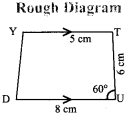
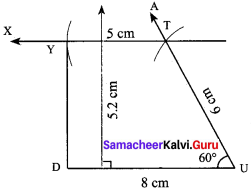
DUTY with \(\overline { DU } \) ∥ \(\overline { YT } \), DU = 8 cm, ∠DUT = 60°, UT = 6 cm and TY = 5 cm.
Solution:
Samacheer Kalvi 8th Maths Solutions Term 2 Chapter 3.3 7
Given:
In the trapezium DUTY
DU = 8 cm, ∠DUT = 60°,
UT = 6 cm, TY = 5 cm and \(\overline { DU } \) ∥ \(\overline { YT } \)
Samacheer Kalvi 8th Maths Solutions Term 2 Chapter 3.3 8
Construction:
Steps:

  1. Draw a line segment DU = 8 cm.
  2. Construct an angle ∠DUT = 60° at U
  3. With U as centre, draw an arc of radius 6 cm cutting UA at T.
  4. Draw TX parallel to DU
  5. With T as centre, draw an arc of radius 5 cm cutting TX at Y
  6. Join DE. DUTY is the required trapezium.

Calculation of area:
Area of the trapezium DUT Y = \(\frac{1}{2}\) x h x (a + b) sq. units= \(\frac{1}{2}\) x 5.2 x (8 + 5) sq. units = \(\frac{1}{2}\) x 5.2 x 13
= 33.8 sq.cm ,

Samacheer Kalvi 8th Maths Solutions Term 2 Chapter 3 Geometry Ex 3.3

Question 5.
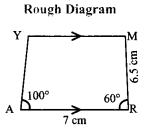
ARMY with \(\overline { AR } \) ∥ \(\overline { YM } \), AR = 7 cm, RM = 6.5 cm ∠RAY = 100° and ∠ARM = 60° 5
Solution:
Samacheer Kalvi 8th Maths Solutions Term 2 Chapter 3.3 9
Given:
In the trapezium ARMY
AR = 7 cm, RM = 6.5 cm,
∠RAY = 100° and ARM = 60°, \(\overline { AR } \) ∥ \(\overline { YM } \)
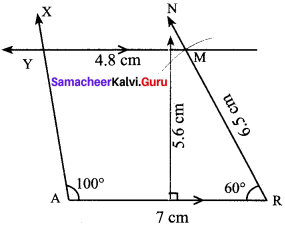
Samacheer Kalvi 8th Maths Solutions Term 2 Chapter 3.3 10
Construction:
Steps:

  1. Draw a line segment AR = 7 cm.
  2. Construct an angle ∠RAX = 100° at A
  3. Construct an angle ∠ARN = 60° at R
  4. With R as centre, draw an arc of radius 6.5 cm cutting RN at M
  5. Draw MY parallel to AR
  6. ARMY is the required trapezium.

Calculation of area:
Area of the trapezium ARMY = \(\frac{1}{2}\) x h x (a + b) sq. units = \(\frac{1}{2}\) x 5.6 x (7 + 4.8) sq. units
= \(\frac{1}{2}\) x 5.6 x 11.8 = 33.04 sq.cm

Question 6.
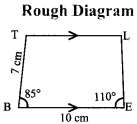
BELT with \(\overline { BE } \) ∥ \(\overline { TL } \), BT = 7 cm ∠EBT = 85° and ∠BEL = 110°
Solution:
Samacheer Kalvi 8th Maths Solutions Term 2 Chapter 3.3 11
Given:
In the trapezium BELT
BE = 10 cm, BT = 7cm,
∠EBT = 85°, ∠BEL = 110° and \(\overline { BE } \) ∥ \(\overline { TL } \)
Samacheer Kalvi 8th Maths Solutions Term 2 Chapter 3.3 12
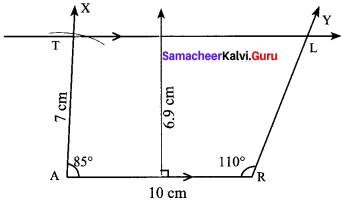
Construction:
Steps:

  1. Draw a line segment BE = 10 cm.
  2. Construct two angles ∠TBE = 85° and ∠BEL =110° respectively at the points B and E.
  3. With B as centre, draw an arc of radius 7 cm cutting BX at T.
  4. Draw TL ∥ BE
  5. BELT is the required trapezium

Question 7.
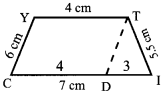
CITY with \(\overline { CI } \) ∥ \(\overline { YT } \) Cl = 7 cm, IT = 5.5 cm, TY = 4 cm and YC = 6 cm.
Solution:
Samacheer Kalvi 8th Maths Solutions Term 2 Chapter 3.3 13
Given:
In the trapezium CITY,
Cl = 7 cm
IT = 5.5 cm
TY = 4 cm
YC = 6 cm, and \(\overline { CI } \) ∥ \(\overline { YT } \)
Samacheer Kalvi 8th Maths Solutions Term 2 Chapter 3.3 14
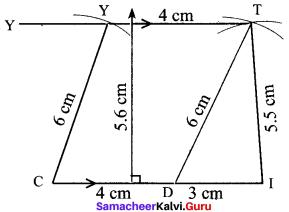
Construction:
Steps:

  1. Draw a line segment Cl = 7 cm.
  2. Mark a point D on Cl such that CD = 4cm
  3. With D and I as centres, draw arcs of radii 6 cm and 5.5 cm respectively. Let them cut at T. Join DT and IT.
  4. With C as centre, draw an arc of radius 6 cm.
  5. Draw TY parallel to CL Let the line cut the previous arc at Y.
  6. Join CY. CITY is the required trapezium.

Calculation of area:
Area of the trapezium CITY = \(\frac{1}{2}\) x h x (a + b) sq. units
= \(\frac{1}{2}\) x 5.5 x (7 + 4) sq. units = \(\frac{1}{2}\) x 5.5 x 11
= 30.25 sq.cm

Samacheer Kalvi 8th Maths Solutions Term 2 Chapter 3 Geometry Ex 3.3

Question 8.
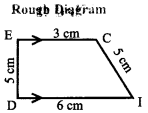
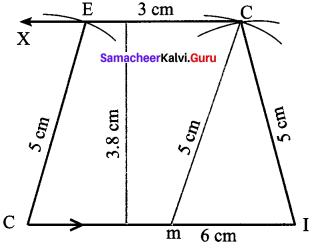
DICE with \(\overline { DI } \) ∥ \(\overline { EC } \), DI = 6 cm, IC = ED = 5 cm and CE = 3 cm. Solution:
Samacheer Kalvi 8th Maths Solutions Term 2 Chapter 3.3 15
Given:
In the trapezium DICE,
DI = 6 cm
IC = ED = 5 cm
CE = 3 cm and \(\overline { DI } \) ∥ \(\overline { EC } \)
Samacheer Kalvi 8th Maths Solutions Term 2 Chapter 3.3 111
Construction:
Steps:

  1. Draw a line segment DI = 6 cm.
  2. Mark a point M on DI such that DM = 3cm
  3. With D and I as centres, draw arcs of radii 5 cm each Let them cut at C. Join MC and IC.
  4. Draw CX parallel to DI
  5. With D as centre, draw an arc of radius 5 cm. Let it cut CX at E
  6. Join DE. DICE is the required trapezium.

Calculation of area:
Area of the trapezium DICE = \(\frac{1}{2}\) x h x (a + b) sq. units = \(\frac{1}{2}\) x 3.8 x (6 + 3) sq. units
= \(\frac{1}{2}\) x 3.8 x 9 = 17.1 sq. cm

Samacheer Kalvi 7th Maths Solutions Term 3 Chapter 1 Number System Additional Questions

Students can Download Maths Chapter 1 Number System Additional Questions and Answers, Notes Pdf, Samacheer Kalvi 7th Maths Book Solutions Guide Pdf helps you to revise the complete Tamilnadu State Board New Syllabus and score more marks in your examinations.

Tamilnadu Samacheer Kalvi 7th Maths Solutions Term 3 Chapter 1 Number System Additional Questions

Additional Questions and Answers

Exercise 1.1

Question 1.
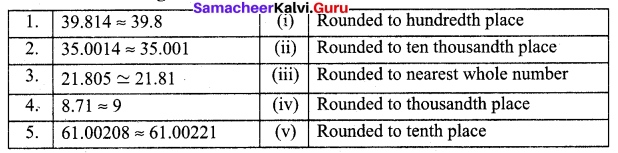
Match the following:
Samacheer Kalvi 7th Maths Solutions Term 3 Chapter 1 Number System add 1
Solution:
1 – (v)
2 – (iv)
3 – (i)
4 – (iii)
5 – (ii)

Question 2.
Round 89.357 to the nearest whole number.
Solution:
Underlining the digit to be rounded 89.357. Since the digit next to the underlined digit 3 which is less than 5, the underlined digit remains the same.
∴ The nearest whole number 89.357 rounds to 89.

Question 3.
Round 110.929 to the nearest tenths place.
Solution:
Underlining the digit to be rounded 110.929. Since the digit next to the underlined digit is 2 which is less than 5.
∴ The underlined digit 9 remains the same. Hence the rounded number is 110.9

Question 4.
Round 87.777 upto 2 places of decimal.
Solution:
Rounding 87.777 upto 2 places of decimal means round to the nearest hundredths place. Underlining the digit in the hundredth place of 87.777 gives 87.777. Since the digit after the hundredth place value is 7 which is more than 5, we add 1 to the underlined digit. So the rounded value of 87.777 upto 2 places of decimal is 87.78

Samacheer Kalvi 7th Maths Solutions Term 3 Chapter 1 Number System Additional Questions

Exercise 1.2

Question 1.
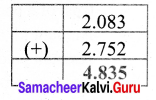
If Sheela bought 2.083 kg of grapes and 3.752 kg of orange. What is the total weight of fruits
Solution:
Samacheer Kalvi 7th Maths Solutions Term 3 Chapter 1 Number System add 2
Weight of grapes = 2.083 Kg
Weight of orange = 2.752 Kg
Total weight = (2.083 + 2.752) Kg = 4.835 Kg

Question 2.
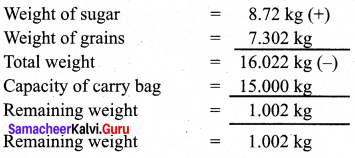
Kathir bought 8.72 kg of sugar, 7.302 kg of grains. His carry bag can contain only 15 kg of weight. What is the remaining weight of items bought?
Solution:
Samacheer Kalvi 7th Maths Solutions Term 3 Chapter 1 Number System add 3

Question 3.
Use place value grid to add 7.357 and 13.92.
Solution:
Let as use place value grid.
Samacheer Kalvi 7th Maths Solutions Term 3 Chapter 1 Number System add 4

Exercise 1.3

Question 1.
Cost of 1m cloth is ₹ 6.75. Find the cost of 14.75m correct to two places of decimal.
Solution:
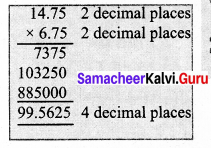
Samacheer Kalvi 7th Maths Solutions Term 3 Chapter 1 Number System add 5
Cost of 1 m cloth = ₹ 6.75
Cost of 14.75 m cloth = 14.75 × 6.75
= ₹ 99.5625
= ₹ 99.56

Samacheer Kalvi 7th Maths Solutions Term 3 Chapter 1 Number System Additional Questions

Question 2.
Length of a side of a square is 18.35 cm. Find its Area.
Solution:
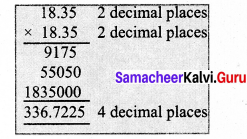
Samacheer Kalvi 7th Maths Solutions Term 3 Chapter 1 Number System add 6
Side of a square = 18.35 cm
Area of a square = (Side × Side) sq.units
= 18.35 × 18.35 cm2
= 336.7225 cm2

Exercise 1.4

Question 1.
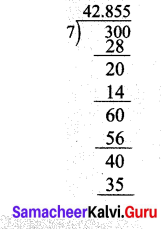
A wire of length 363.987m is cut into 30 pieces. What is the length of each piece?
Solution:
Length of the wire = 363.987m
i.e Total length of 30 pieces = \(\frac { 363987 }{ 1000 } \) m
Samacheer Kalvi 7th Maths Solutions Term 3 Chapter 1 Number System add 7
∴ Length of 1 piece
= 12132.9 × \(\frac { 1 }{ 1000 } \)
Length of 1 piece of wire = 12.1329 m

Question 2.
A cake of 50kg needs 23.4 kg sugar. Find the weight of cake made by 1 kg of sugar.
Solution:
Weight of cake made using 23.4 kg sugar = 50 kg
Weight of cake made using 1 kg sugar = \(\frac { 50 }{ 23.4 } \)
= \(\frac { 50 }{ 23.4 } \) x \(\frac { 10 }{ 10 } \) = \(\frac { 500 }{ 234 } \) = 2.1367 Kg
= 2.14 Kg
Weight of cake made using 1 kg sugar = 2.14 Kg

Samacheer Kalvi 7th Maths Solutions Term 3 Chapter 1 Number System Additional Questions

Question 3.
A pack of 20 pencils cost ₹ 94.4. What is the cost of each pencil?
Solution:
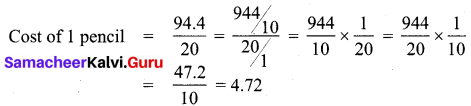
Cost of 20 pencils = ₹ 94.4
Samacheer Kalvi 7th Maths Solutions Term 3 Chapter 1 Number System add 8
∴ Cost of 1 pencil = ₹ 4.72

Samacheer Kalvi 7th Maths Solutions Term 3 Chapter 2 Percentage and Simple Interest Ex 2.4

Students can Download Maths Chapter 2 Percentage and Simple Interest Ex 2.4 Questions and Answers, Notes Pdf, Samacheer Kalvi 7th Maths Book Solutions Guide Pdf helps you to revise the complete Tamilnadu State Board New Syllabus and score more marks in your examinations.

Tamilnadu Samacheer Kalvi 7th Maths Solutions Term 3 Chapter 2 Percentage and Simple Interest Ex 2.4

Question 1.
Find the simple interest on ₹ 35,000 at 9% per annum for 2 years?
Solution:
Samacheer Kalvi 7th Maths Solutions Term 3 Chapter 2 Percentage and Simple Interest Ex 2.4 1
Principal P = ₹ 35,000
Rate of interest r = 9 % Per annum
Time (n) = 2 years
Simple Interest I = \(\frac { Pnr }{ 100 } \) = \(\frac{35000 \times 2 \times 9}{100}\) = ₹ 6300
Simple intrest I = ₹ 6300

Samacheer Kalvi 7th Maths Solutions Term 3 Chapter 2 Percentage and Simple Interest Ex 2.4

Question 2.
Aravind borrowed a sum of ₹ 8,000 from Akash at 7% per annum. Find the interest and amount to be paid at the end of two years.
Solution:
Here Principal P = ₹ 8,000
Rate of interest r = 7% Per annum
Time (n) = 2 Years
Simple Interest (I) = \(\frac { Pnr }{ 100 } \) = \(\frac{8000 \times 2 \times 7}{100}\)
I = ₹ 1120
Amount = P + I
I = ₹ 8000 + 1120 = 9120
Interest to be paid = ₹ 1,120
Amount to be paid = ₹ 9,120

Question 3.
Sheela has paid simple interest on a certain sum for 4 years at 9.5% per annum is ₹ 21,280. Find the sum.
Solution:
Let the Principal be ₹ P
Rate of interest r = 9.5% per annum
Time (n) = 4 years
Simple Interest I = \(\frac { Pnr }{ 100 } \)
Given I = ₹ 21,280
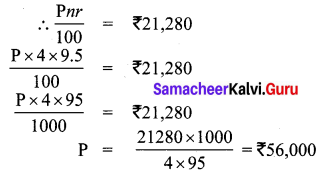
Samacheer Kalvi 7th Maths Solutions Term 3 Chapter 2 Percentage and Simple Interest Ex 2.4 2
∴ Sum of money Sheela bought = ₹ 56,000

Samacheer Kalvi 7th Maths Solutions Term 3 Chapter 2 Percentage and Simple Interest Ex 2.4

Question 4.
Basha borrowed ₹ 8,500 from a bank at a particular rate of simple interest. After 3 years, he paid ₹ 11,050 to settle his debt. At what rate of interest he borrowed the money?
Solution:
Let the rate of interest be r% per annum
Here Principal P = ₹ 8,500
Time n = 3 years
Total amount paid = ₹ 11,050
A = P + 1 = ₹ 11,050
i.e. 8,500 + 1 = ₹ 11,050
I = ₹ 11,050 – ₹ 8,500 = ₹ 2,550
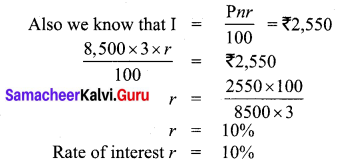
Samacheer Kalvi 7th Maths Solutions Term 3 Chapter 2 Percentage and Simple Interest Ex 2.4 3

Samacheer Kalvi 7th Maths Solutions Term 3 Chapter 2 Percentage and Simple Interest Ex 2.4

Question 5.
In What time will ₹ 16,500 amount to ₹ 22,935 at 13% per annum?
Solution:
Rate of interest r = 13% per annum
Here Amount A = ₹ 22,935
Principal P = ₹ 16,500
A = P + I
22935 = 16,500 + I
∴ Interest I = 22935 – 16,500 = ₹ 6,435
Simple Interest I = \(\frac { pnr }{ 100 } \)
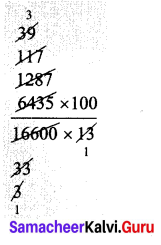
Samacheer Kalvi 7th Maths Solutions Term 3 Chapter 2 Percentage and Simple Interest Ex 2.4 4
6435 = \(\frac{16500 \times n \times 13}{100}\)
n =\(\frac{6435 \times 100}{16500 \times 13}\)
n = 3 years
Required time n = 3 years

Question 6.
In what time will ₹ 17800 amount to ₹ 19936 at 6% per annum?
Solution:
Let the require time be n years
Here Principal P = ₹ 17,800
Rate of interest r = 6% per annum
Amount A = ₹ 19,936
A = P + I
19936 = 17800 + 1
19936 – 17800 = I
2136 = I
Simple Interest (I) = \(\frac { pnr }{ 100 } \)
2136 = \(\frac{17800 \times n \times 6}{100}\)
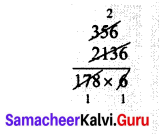
n = \(\frac{2136 \times 100}{17800 \times 6}\)
Samacheer Kalvi 7th Maths Solutions Term 3 Chapter 2 Percentage and Simple Interest Ex 2.4 5
n = 2 Years
Required time = 2 years

Samacheer Kalvi 7th Maths Solutions Term 3 Chapter 2 Percentage and Simple Interest Ex 2.4

Question 7.
A sum of ₹ 48,000 was lent out at simple interest and at the end of 2 years and 3 months the total amount was ₹ 55,560. Find the rate of interest per year.
Solution:
Given Principal P = ₹ 48,000
Time n = 2 years 3 months
= 2 + \(\frac { 3 }{ 12 } \) years = 2 + \(\frac { 1 }{ 4 } \) years
= \(\frac { 8 }{ 4 } \) + \(\frac { 1 }{ 4 } \) years = \(\frac { 9 }{ 4 } \) years
Amount A = ₹ 55,660
A = p + 1
55660 = 48000 + I
I = 55660 – 48000 = ₹ 7660
∴ Interest for \(\frac { 9 }{ 4 } \) years = ₹ 7660
Simple intrest = \(\frac { pnr }{ 100 } \)
7660 = 48000 × \(\frac { 9 }{ 4 } \) × \(\frac { r }{ 100 } \)
r = \(\frac{7660 \times 4 \times 100}{9 \times 48000}\) = 7.09 % = 7 %
Rate of interest = 7 % Per annum

Question 8.
A principal becomes ₹ 17,000 at the rate of 12% in 3 years. Find the principal.
Solution:
Given the Principal becomes ₹ 17,000
Let the principle initially be P
Rate of Interest r Time = 12 % Per annum
Time n = 3 years
According to the problem given I = 17000 – P = \(\frac{P \times 3 \times 12}{100}\)
17000 = \(\frac { 36 }{ 100 } \) p + p
17000 = p(\(\frac { 36 }{ 100 } \) + 1)
17000 = p(\(\frac { 136 }{ 100 } \))
p = \(\frac{17000 \times 100}{136}\) = 12,500
∴ Principal P = ₹ 12,500

Samacheer Kalvi 7th Maths Solutions Term 3 Chapter 2 Percentage and Simple Interest Ex 2.4

Objective Type Questions

Question 9.
The interest for a principle of? 4,500 which gives an amount of? 5,000 at end of certain period is
(i) ₹ 500
(ii) ₹ 200
(iii) 20%
(iv) 15%
Hint: Interest = Amount – Principle = ₹ 5000 – ₹ 4500 = ₹ 500
Answer:
(i) ₹ 500

Question 10.
Which among the following is the simple interest for the principle of ₹ 1,000 for one year at the rate of 10% interest per annum?
(i) ₹ 200
(ii) ₹ 10
(iii) ₹ 100
(iv) ₹ 1,000
Hint: Intrest = \(\frac { pnr }{ 100 } \) = \(\frac{1000 \times 1 \times 10}{100}\) = ₹ 100
Answer:
(iii) ₹ 100

Samacheer Kalvi 7th Maths Solutions Term 3 Chapter 2 Percentage and Simple Interest Ex 2.4

Question 11.
Which among the following rate of interest yields an interest of ₹ 200 for the principle of ₹ 2,000 for one year.
(i) 10%
(ii) 20%
(iii) 5%
(iv) 15%
Hint: r = \(\frac{I \times 100}{P \times n}\) = \(\frac{200 \times 100}{2000 \times 1}\) = 10 %
Answer:
(i) 10%

Samacheer Kalvi 12th English Solutions Supplementary Chapter 4 The Midnight Visitor

Students can Download English Lesson 4 The Midnight Visitor Questions and Answers, Summary, Activity, Notes, Samacheer Kalvi 12th English Book Solutions Guide Pdf helps you to revise the complete Tamilnadu State Board New Syllabus and score more marks in your examinations.

Tamilnadu Samacheer Kalvi 12th English Solutions Supplementary Chapter 4 The Midnight Visitor

Warm up

Study the title of the story ‘The Midnight Visitor’. Discuss in groups what the story is all about.
Student activity:

Question (a)
Certain professionals can be identified by their appearance.
Answer:
What comes to your mind first when you think of a ‘pilot’ or a ‘traffic policeman?
Discuss in pairs and share your thoughts with the class:
A pilot controls and steers an airplane. He operates the directional flight controls. He wears milk white uniform and golden stripes on his shoulders. He wears a shiny black cap. A traffic policeman wears white stripes on his shoulders in a khaki uniform. In some states, a traffic policeman wears a white and white uniform also. He regulates traffic, fines people who violate traffic rules. He prevents accidents by monitoring over speeding vehicles and by discouraging drunken driving.

SamacheerKalvi.Guru

Question (b)
Let us try to picturise people in a few interesting professions (based on common perception there can be exceptions).
Answer:
Form groups of four and draw a picture of one or two of the following:

  • scientist
  • soldier
  • journalist

Samacheer Kalvi 12th English Solutions Supplementary Chapter 4 The Midnight Visitor img-1

In your attempt to sketch you may include the following:

  • typical dress
  • hair style
  • accessories

Samacheer Kalvi 12th English The Midnight Visitor Textual Questions

1. Answer in a sentence or two the following questions.

Question (a)
Mention two features of Ausable that were uncharacteristic of a detective.
Answer:
Ausable’s fat body and American accent were the two uncharacteristic features of a detective.

Question (b)
What was Ausable waiting for?
Answera;
Ausable was waiting for an important report.

Question (c)
Who was the Midnight Visitor? What was the purpose of his visit?
Answer:
Max, a gunman was the midnight visitor. His purpose was to snatch the report on new missiles which was about to be delivered to Ausable

Question (d)
How had Max actually entered the room?
Answer:
Max had used a duplicate key to enter Ausable’s room.

SamacheerKalvi.Guru

Question (e)
Did Max’s presence alarm Ausable?
Answer:
No, he was a little startled. But he was not alarmed. He just expressed his surprise seeing Max who should have been in Berlin.
Question (f)
How did Ausable describe the balcony and the manner in which one could get into his room, through it?
Answer:
It was not Ausable’s balcony. It belonged to the next apartment. It extends under his window now. One can get on to it two doors down as someone did last month. The hotel management, in spite of his protest, has not blocked the balcony till now.

Question (g)
Where did Max try to hide himself?
Answer:
Max tried to hide himself in the balcony described by Mr. Ausable.

Question (h)
Who was Henry? Why had he visited Ausable’s room?
Answer:
Henry was the waiter who entered Ausable’s room with his drinks.

Question (i)
What happened to Max finally?
Answer:
Max foolishly, believing in the presence of a balcony, jumped from the 6th floor to his sure death.

Additional Question

Question (a)
How does Ausable say he got in?
Answer:
Ausable wants to confuse Max. So he says that this is the second time in a month that somebody has got into his room through that balcony next to the window.

Question (b)
Was Max deserving to get a chance to accomplish a risky task?
Answer:
I do not believe that Max deserved a chance to accomplish a risky task. He was not intelligent enough to understand that he was being tricked by the detective. Also, his appearance did not startle the detective.

Question (c)
What did so many people risk their lives for?
Answer:
Ausable was waiting for a report. It contained certain important information about new missiles. This report was so important that several men and women had risked their lives to get it.

Question (d)
What did Mr. Ausable tell Max when he heard the knock?
Answer:
Ausable told Max that it would be the police. He said that he had requested the police for extra protection as he was receiving an important information that night.

Question (e)
What did Ausable tell Fowler when he said that Max would soon come back from the balcony?
Answer:
Ausable told Fowler that Max would never return as he knew that there was no balcony outside. He said that Max has fallen down to the ground and met his end.
2. Answer the following questions in about three to four sentences each.
Question (a)
Who was Fowler? Why did he meet Ausable?
Answer:
Fowler was a journalist. He was assigned to write a column about a private detectives. He was disappointed on seeing a very fat man with American accent living in a small room in the 6th ’ floor. The hotel was not even well-lit.

SamacheerKalvi.Guru

Question (b)
Why was Fowler initially disillusioned with Ausable?
Answer:
Fowler had a romantic notion of a private detective. Ausable did not look like Mr. Bond. He was very fat and had American accent. He lived in a small room. So, he was initially disappointed.

Question (c)
Fowler was thrilled when he entered Ausable’s room. Why?
Answer:
As soon as Ausable closed the door behind and switched on the light, Fowler had his first authentic thrill of the day. Half way across the room a man with a small automatic pistol in hand stood.

Question (d)
How, according to Ausable, had Max entered the room?
Answer:
Ausable did not disclose the real method Max must have adopted to enter his room. He invented a story on the spot that it was the second time in a month someone had entered his room through the neighbouring building’s balcony which extended just below his window. He made Max believe that there was another possible route of escape through the window.

Question (e)
How did the three men react to the knocking at the door?
Answer:
Fowler jumped at the sudden knocking at the door. Ausable smiled and said it must be the police who he had asked to check on him to ensure a little extra protection. Max bit his lip nervously. He rushed to the window so that he could hide in the balcony and come back after sometime.

Question (f)
Was Ausable really waiting for the police? Give reasons.
Answer:
No, Ausable was not waiting for the police. He had ordered his drink with waiter Henry. He was expecting him only. As the knock was heard, he decided to use the opportunity to scare away Max by casually informing that it must be the police. He added the police may fire if they see Max there.

Additional Questions

Question (a)
Do you think that Ausable was a good secret agent? How?
Answer:
Yes, I think that Ausable was a good secret agent. When he saw Max in his room with an automatic pistol, he didn’t get frightened at all. He diverted his attention. He made story of balcony next to the window. By his description, he made Max believe his story. All these traits show that he was a good secret agent.

Question (b)
Pride before a fall befits Max, who arrived at Ausable’s room to steal the important documents. Did he acquire it? What lesson can one learn from this?
Answer:
Max was an overconfident and proud spy. He thought to himself that wielding a gun would give a further edge over the apparently slow Ausable. However, his pride and confidence, made Max utterly unsuccessful. Ausable conveniently outwitted him without lifting a finger. Max, jumped to his own death. Thus, one learns that one should not be too proud, and must be vigilant before attempting to do anything.

Question (c)
How did Max enter the room? Why did he tell this to Ausable?
Answer:
Max entered the room through the door. He had a passkey. He told this to Ausable because Ausable told him that it was the second time in a month that somebody had got into his room through the balcony. He told that he had no idea about balcony.

3. Answer in a paragraph of about 150 words the following questions.

Question (a)
How did Ausable outwit Max?
Answer:
Ausable was a shrewd private detective. He did not become panicky on seeing Max with an automatic gun in his room. Even if he were, he did not show it off. Instead, he expressed surprise that he expected him to be in Berlin. He cooked up a nice story that it was the second time someone had broken into his room through the balcony of the neighbouring apartment which reaches down under his window. He expressed his displeasure that he would raise hell with the hotel management for not blocking that balcony. This gave a strong suggestion to Max, that he could have used the balcony instead of the pass key to enter Ausable’s room.

Being a criminal or spy, a person always looks for various routes of escape in times of danger. Very rarely he starts direct encounter risking his life. When Henry, the waiter who arrived with the pre-ordered drinks, knocked, Mr. Ausable simply smiled. When Max asked who it was, he told a blatant lie that it was the police who had come for his extra protection and wouldn’t hesitate to fire as the door wasn’t locked but just closed. Max, assuming that there is a balcony extending below Ausable’s window, jumped. He never knew that it was a suicidal jump from the 6th floor. Thus, Ausable outwitted the spy, Max.

SamacheerKalvi.Guru

Question (b)
Describe the significance of the balcony.
Answer:
On seeing Max, the spy, with a loaded automatic gun in his room, Ausable expressed surprise. Max disclosed his plan very clearly. He had come to receive the report on the new missile which was likely to be handed over to Mr. Ausable in a short while. Ausable, without being shocked sat heavily on an armchair. He grimly stated that he would raise hell with the hotel management because this was the second time that someone had sneaked into his room through the nuisance of the unblocked balcony. Max asks with disbelief, “balcony?” Max remarked that he did not enter through the balcony but with a pass key. Ausable explained that it was the balcony which extended from the living room of the next apartment just below his room. One could walk through two doors and enter his room.

He was not happy with the management as they had failed to block it. When there was a knock at the door, both Max and Fowler got perturbed. But Ausable smiled and said casually it must be the police whom he had informed to check on him for extra protection. Max was confused for a moment. Ausable said as the door was just closed and not locked, the police could enter even by force at any moment and fire at him. This gave Max no time to think. He jumped through the window believing he will end up in the non-existent balcony, but fell like a stone from the 6th floor with a scream. The vividly portrayed balcony led to the suicidal jump of Max, the spy who had a gun but was not smart enough to tackle Ausable’s ploy.

Question (c)
Ausable planned to get rid of Max the very moment he noticed him. Explain with supporting evidence from the story.
Answer:
Ausable spun a story on seeing Max. Max was armed, and he was unarmed. Any wrong move would cost his life. So, he decided to be cool throughout. He feigned anger against the hotel management. His vivid word picture of a balcony extending just below his window from the next apartment makes both Fowler and Max believe that Ausable is angry and irritated. This makes Max happy for learning another possible way of escape in case any threat comes through the door. He tries to add little pieces of evidence like “the management promised to block it” to make Max believe that someone had already used the same balcony to break into

Ausable’s room earlier. Ausable knew that Henry would arrive soon with the drinks he had ordered. So, he timed his narrative in such a way that the arrival of Henry takes place soon after his vivid word portrait of the balcony to Max and Fowler. His ingenious idea of relating the knock of the waiter to a non-existent police officer is a stroke of genius. Because the fear of encountering police and a possible gun fight only goads Max to jump to his death from the 6th floor of the hotel. He thought he was jumping down on to the balcony but he was outwitted. These facts indicate that Ausable had planned to get rid of Max soon after he saw him in his room.

Question (d)
Sketch the character of Ausable.
Answer:
Ausable does not look very handsome, worthy of being called a secret agent or a detective. He is the central character of the story “The Midnight Visitor”. He is not physically very strong. There is nothing elegant or mysterious about him. He is an American who is unable to cover up his American accent when he speaks French and German though he has lived in France for over 20 years. He is practical and shrewd. He is a well balanced individual. Even at gun point he keeps his cool and instantly cooks up a story to trap the villain, spy Max. He outwits Max without moving from his armchair. He uses his presence of mind. He tells two lies which not only save him and Fowler but also give the momentum for Max to kill himself in an attempt to hide in the non-existent balcony.

Question (e)
Do you think physical appearance matters most for a secret agent? Answer giving reasons in the context of the story ‘The Midnight Visitor.’
Answer:
Physical appearance is important for heroes like James Bond who acts in movies or plays. They need sophisticated cars, a royal life style to flaunt about. But in reality, a detective or a secret agent is not much different from an ordinary citizen at least in appearance. He is an ordinary person who thinks and acts with extraordinary intelligence. When it comes to the question of survival, sharpness of wit and handsome looks would help a person, the disappointment of Fowler, the journalist is very obvious. The young and romantic writer envisioned mysterious figures in the night, the crack of pistols, etc.

The writer must have cherished the idea of beauties with dark eyes passing on secret notes. But he has witnessed nothing but a dull music in a French hotel with a sloppy man who made a prosaic appointment only in a prosaic telephone call. Ausable raises the expectations of both the readers and Fowler when he mentions the important paper he waited which many men and women had risked their lives to possess. The drama that ensues in the room testifies the fact that there is no correlation whatsoever with sharpness of wit and the physical appearance of a person. Only after Fowler witnesses how Ausable had outwitted Max to choose his own death without moving from his armchair, he realizes the truth.

SamacheerKalvi.Guru

Question (f)
The unexpected presence of a criminal wielding a gun triggers different reactions in the two men who entered the room. In this light, discuss the appropriacy of the title.
Answer:
A visitor usually comes during the wakeful hours. Nocturnal visitors are usually thieves. They don’t inform one in advance because the purpose of their visit is never noble enough to inform in advance. People involved in shady businesses only choose midnight to break into someone’s house. In this story a spy is after an important report about missiles, a secretly guarded report, which is expected to be delivered to the private detective Ausable at 12.30 am. The spy gets the secret information from his trusted connections. So, he arrives earlier than Ausable and sneaks into his room using a pass key. The spy is brandishing his pistol to coerce the private detective to pass on the report as and when it arrives. Ausable outsmarts him by cooking up a story about a non-existent balcony beneath his window which extends from the neighbouring apartment. He connects brilliantly the knock of Henry the waiter to that of police who might fire at Max as he is armed. So, the title of the story, “The Midnight Visitor” is very pertinent.

Additional Questions

Question (а)
What impression do you form about Ausable as a secret agent after reading the story ‘The Midnight Visitor’?
Answer:
Ausable is a secret agent. But his appearance is not appropriate to his profession. He does not look smart and intelligent. He is very fat. But he is a very active person. He proves it throughout the story. He never takes decision in a hurry. He works with a cool mind. He is good at talking. He understands Fowler’s internal views about himself. He does not lose his temper when he finds Max in his room with pistol. He sits into an armchair and cooks up a quick story about balcony. It is his style of conversation that he easily makes Max believe about balcony. Thus, we find that Ausable is fearless, clever and fit for the job of a secret agent.

Question (b)
Why was Fowler disappointed after meeting Ausable? Did he change his idea at last?
Answer:
Fowler was a young writer. He wrote for a magazine. He had read in the books that secret agents are mysterious and smart. So he wanted to see all these things in Ausable, a secret agent. But Ausable was a fat man. It appeared that he was not fit for a secret agent’s job. So Fowler was disappointed after meeting Ausable.

But Ausable showed his presence of mind, when he saw armed Max in his room. He misled Max and told him that there was a balcony below the window. Max came there to take an important paper relating to missiles. After this, once again Ausable showed his intelligence, when Henry knocked at the door. He told Max that it might be police to protect him. They might shoot him at sight because he is armed. Without examining the truth of Ausable’s statement, Max jumped from the window to hide himself in the balcony. But it was the end of Max.
Now Fowler was very happy to see Ausable’s intelligence.

4. Look at the following expressions used in the story. Match them with their meanings.

let downto complain or scold
chuckled to himselftry one’s luck/ take a risk
take cheerbecome enraged
raise the devildisappointed
black with angerlaughed softly to himself
take chancesto be encouraged

Answer:

let downdisappointed
chuckled to himselflaughed softly to himself
take cheerto be encouraged
raise the devilto complain or scold
black with angerbecome enraged
take chancestry one’s luck/ take a risk

5. Based on your understanding of the story, complete the Graphic Organiser (GO) suitably.

Samacheer Kalvi 12th English Solutions Supplementary Chapter 4 The Midnight Visitor img-2

Answer:

Samacheer Kalvi 12th English Solutions Supplementary Chapter 4 The Midnight Visitor img-3

6. Given below are pictures of fictitious detective characters in English & Tamil short stories. Match them with the authors who created them.


Samacheer Kalvi 12th English Solutions Supplementary Chapter 4 The Midnight Visitor img-4

  1. Agatha Christie – Hercule Poirot
  2. Sujatha – Ganesh, Vasanth
  3. Sir Arthur Conan Doyle – Sherlock Holmes & Dr. Watson
  4. Devan – Sambu
  5. Tamizhvanan – Sankar Lai

The Midnight Visitor About The Author

Samacheer Kalvi 12th English Solutions Supplementary Chapter 4 The Midnight Visitor img-5

Robert A. Arthur, Jr. was a mystery and speculative fiction writer known for “The Mysterious Traveller” radio series and his “Three Investigators” series of novels. He was born on November 10, 1909. Arthur was a graduate from the University of Michigan. Between 1930 and 1940, his stories were published in Amazing Stories, Argosy All-Story Weekly, Black Mask, etc. He wrote a number of mystery books for children. Arthur, along with his writing partner David Kogan, was twice honoured by the Mystery Writers of America with an Edgar award for best radio drama. Robert Arthur, Jr. died in Philadelphia in 1969.

The Midnight Visitor Summary in English

The detective Ausable:
Ausable was a detective. But he was very fat and he did not look like a detective. He had a room on the sixth floor in a French Hotel and it was the top floor. It was a cheap accommodation unworthy of a detective’s station in life.

SamacheerKalvi.Guru

Fowler meets Ausable:
Fowler was a writer. He wanted to write a book on detectives. So he came to meet Ausable. But after meeting Ausable, he was quite disappointed as he did not possess the qualities like a detective like James Bond. Ausable could speak French and German. But he had an American accent. Contrary to his expectations, Ausable told Fowler that there were no beautiful girls around him. Talking to each other, they reached the room in the hotel and opened the door.

Max with a pistol:

Samacheer Kalvi 12th English Solutions Supplementary Chapter 4 The Midnight Visitor img-6

After entering the room, Ausable told Fowler that he would see an important paper that could change the course of History. Several men and women were after it. As soon as Ausable switched on the light, they saw a man with an automatic pistol. Seeing him, Ausable said that he was shocked to see him there. He thought that he was in Berlin. At this time Fowler was much frightened.

Spinning a Romance:
To confuse Max, Ausable made a false story of balcony next to the window. He sat in an armchair and started saying that it was the second time in a month that somebody had got into his room through the balcony. It is an extension of the neighbour’s balcony reaching just below his window. The hotel management had failed to close it despite his complaint. Ausable showed anger and disappointment. Max believed him and he told that he had come to take the report about missiles.

The sound of knocking at the door:
Just then, they heard a knock at the door. Ausable immediately made a story and told that the police might have come to provide him security due to this important paper. He told Max that the police would enter the room, if he did not open the door. They might fire if they found Max armed.

Max drops from the balcony:

Samacheer Kalvi 12th English Solutions Supplementary Chapter 4 The Midnight Visitor img-7

Max believed Ausable and he went towards the window. He caught the door frame with his free hand and put his gun over Ausable and Fowler. Then he moved his other leg up and over the window sill. The doorknob turned. Max freed himself and dropped in the balcony. He cried loudly.

SamacheerKalvi.Guru

A waiter enters:
After this a waiter entered the room with a bottle and two glasses. It was ordered by Ausable. Fowler was very surprised at this. He asked Ausable about Max. Ausable replied that he (Max) would never return. Thus Ausable had proved himself a true detective.

The Midnight Visitor Summary in Tamil

துப்பறியும் நிபுணர் அவுசபில்:
அவுசபில் ஒரு துப்பறியும் நிபுணர். அவர் பிரஞ் ஹோட்டலின் கடைசி மாடியில் அதாவது ஆறாவது மாடியின் அறையில் தங்கி இருந்தார். அவர் பருமனானவராய் துப்பறியும் நிபுணருக்கேற்ற தோற்றம் அற்றவராகத் தெரிந்தார். அது துப்பறியும் நபர் தன் வாழ்நாளில் தங்கக் கூடிய அறையாக இல்லாமல் மிகவும் எளிமையானதாகக் காணப்பட்டது.

பவுலர். அவுசபிலை சந்திக்கிறார்:
பவுலர் ஒரு எழுத்தாளர். அவர் துப்பறிவதை குறித்து நூல் எழுத விரும்புகிறார். ஆதலால், அவுசபிலைக் காண வருகிறார். ஆனால் அவுசபிலை பார்த்த பின்னர் அவர் ஜேம்ஸ் பாண்ட்டை | போல் எந்த விதத்திலும் தோன்றவில்லையே என | ஏமாற்றமடைந்தார். அவுசபில் பிரஞ்சு மற்றும் ஜெர்மன் மொழிகளை பேசினார். ஆனால் அமெரிக்கர்கள் பேசும் வண்ணம் பேசினார். பவுலர் எதிர்பார்த்ததிற்கு மாறாக, அவுசபில் தன்னை சுற்றி அழகான பெண்கன் எவரும் இல்லை என்றார். இருவரும் பேசிக்கொண்டே தங்கும் விடுதியை அடைந்து அறையைத் திறந்தனர்.

கையில் துப்பாக்கியுடன் மாக்ஸ்:

Samacheer Kalvi 12th English Solutions Supplementary Chapter 4 The Midnight Visitor img-8

அறையை அடைந்த உடன் அவுசபில், | பவுலரிடம் சரித்திரத்தையே மாற்றக் கூடிய ஒரு | காகிதத்தை அவர் காணப் போவதாக கூறினார். எத்தனையோ, ஆண்களும், பெண்களும் அதன் பின்னே அலைந்தனர் என்றார். அறையின் உள்ளே நுழைந்து மின்விளக்குப் பொத்தானைத் தட்டியவுடன் ஒருவன் தானியங்கி கைத் துப்பாக்கியோடு நிற்பதை அவர்கள் கண்டனர். தான் அதிர்ந்து போய்விட்டதாக அவனிடம் அவுசபில் தெரிவித்தார். அவன் பெர்லினில்

கற்பனைக் கதை ஒன்றை புனைதல்:
மாக்ஸ்சை குழப்புவதற்காக ஜன்னலருகே பால்கனி இருப்பதாக ஒரு பொய் கதையை அவுசபில் கூறினார். சாய்வு நாற்காலியில் அமர்ந்த வண்ணம், இவ்வாறாக இரண்டு முறை அந்த பால்கனி வழியாக தன் அறை உள்ளே எவரோ நுழைந்துள்ளனர் என விவரித்தார்.
மேலும், விடுதி உரிமையாளரிடம் ஏற்கனவே இருமுறை புகார் செய்தும் பயனில்லை எனக் கோபமாகச் சொன்னார். அதை உண்மை என மாக்ஸ் நம்பினான். தான் ஆயுதங்களைப் பற்றிய குறிப்புத் | தாள்களை எடுத்துப் போக வந்ததாக உரைத்தான்.

கதவை தட்டும் சத்தம்:
அப்போது யாரோ கதவை தட்டும் சத்தம் கேட்டது. உடனே ஒரு புனைக்கதையாக, அவுசபில் தன்னிடம் ஆயுத குறிப்பு தாள்கள் உள்ளதால் போலீஸ் பாதுகாப்பு தர வேண்டி வந்திருக்கக் கூடும் என வினவினார். தான் கதவை திறக்காவிட்டால் போலீஸ் உள்ளே நுழைந்து விடுவார்கள் என மாக்ஸிடம் தெரிவித்தார். கையில் துப்பாக்கியோடு நின்றிருக்கும் மாக்சை சுட்டு விடக் கூடும் என கூறினார்.

பால்கனியிலிருந்து மாக்ஸ் குதிக்கிறான்:

Samacheer Kalvi 12th English Solutions Supplementary Chapter 4 The Midnight Visitor img-9

அவுசபில் கூறியதை நம்பிக் கொண்டு ஜன்னல் அருகே மாக்ஸ் சென்றான். துப்பாக்கி குறி அவுசபில் மற்றும் பவுலரை நோக்கியிருக்க ஜன்னல் சட்டத்தை எட்டிப் பிடித்தான் மற்ற காலை ஊன்றி ஜன்னல் விளிம்பை எட்டிப் பிடித்தான். கதவின் கைப்பிடி அகன்றது. மாக்ஸ் தன் இடது கைப் பிடியை தளர்த்தி பால்கனி மேல் குதித்தான். குதிக்கும் போது ஒரே ஒரு முறை சத்தமாக அலறினான்.

SamacheerKalvi.Guru

விடுதி ஊழியன் உள்ளே நுழைகிறான்:
கதவு திறந்ததும் மதுபானம் மற்றும் இரண்டு டம்ளர்களுடன் ஹென்றி உள்ளே நுழைகிறான். அதை அவுசபில் வரவழைத்திருந்தார். இதைக் கண்டு பவுலர் மிகவும் வியந்து போனார். பால்கனியில் நிற்பவன் மீண்டும் வந்து விட்டால் என வினவினார். அவன் வரப்போவதில்லை என்றார். ஏனென்றால், அங்கு பால்கனியே இல்லை என்றார். அவுசபில் தான் ஒரு உண்மையான துப்பறியும் நிபுணர் என நிரூபித்து விட்டார்

The Midnight Visitor Glossary

Textual:

Samacheer Kalvi 12th English Solutions Supplementary Chapter 4 The Midnight Visitor img-10

Additional:

Samacheer Kalvi 12th English Solutions Supplementary Chapter 4 The Midnight Visitor img-11

Samacheer Kalvi 7th Maths Solutions Term 3 Chapter 1 Number System Intext Questions

Students can Download Maths Chapter 1 Number System Intext Questions and Answers, Notes Pdf, Samacheer Kalvi 7th Maths Book Solutions Guide Pdf helps you to revise the complete Tamilnadu State Board New Syllabus and score more marks in your examinations.

Tamilnadu Samacheer Kalvi 7th Maths Solutions Term 3 Chapter 1 Number System Intext Questions

Exercise 1.1
Try These (Text book Page No. 1)

Question 1.
Represent the fraction \(\frac { 1 }{ 4 } \) in decimal form
Solution:
\(\frac { 1 }{ 4 } \) = \(\frac{1 \times 25}{4 \times 25}\) = \(\frac { 25 }{ 100 } \) = 0.25

Question 2.
What is the place value of 5 in 63.257.
Solution:
Place value of 5 in 63.257 is 5 hundredths (Hundreth place)

Samacheer Kalvi 7th Maths Solutions Term 3 Chapter 1 Number System Intext Questions

Question 3.
Identify the digit in the tenth place of 75.036.
Solution:
0

Question 4.
Express the decimal number 3.75 as a fraction.
Solution:
3.75 = \(\frac { 375 }{ 100 } \) = \(\frac { 15 }{ 4 } \)

Question 5.
Write the decimal number for the fraction 5 \(\frac { 1 }{ 5 } \)
Solution:
5 \(\frac { 1 }{ 5 } \) = \(\frac { 26 }{ 5 } \) = \(\frac{26 \times 2}{5 \times 2}\) = \(\frac { 52 }{ 10 } \) = 5.2

Question 6.
Identify the biggest number : 0.567 and 0.576.
Solution:
Comparing the digits of 0.567 and 0.576 from left to right, we have the tenths place same comparing the hundredths place 7 > 6.
⇒ 0.576 > 0.567

Samacheer Kalvi 7th Maths Solutions Term 3 Chapter 1 Number System Intext Questions

Question 7.
Compare 3.30 and 3.03 and identify the smaller number.
Solution:
The whole number is equal in both the numbers.
Now comparing the tenths place we have 3 > 0
⇒ 3.03 < 3.30 Smaller number is 3.03

Question 8.
Put the appropriate sign (<, >, =). 2.57 [ ] 2.570
Solution:
2.57 [=] 2.570

Question 9.
Arrange the following decimal numbers in ascending order.
5.14, 5.41, 1.54, 1.45, 4.15, 4.51.
Solution:
Comparing the numbers from left to right. Ascending order : 1.45, 1.54, 4.15, 4.51, 5.14, 5.41

Exercise 1.2
Try These (Text book Page No. 6)

Question 1.
Find the following using grid models:
(i) 0.83 + 0.04
(ii) 0.35 – 0.09
Solution:
(i) 0.83 + 0.04
0.83 = \(\frac { 83 }{ 100 } \) and 0.04 = \(\frac { 4 }{ 100 } \)
Samacheer Kalvi 7th Maths Solutions Term 3 Chapter 1 Number System Intext Questions 1
Shading the regions
0.83 and 0.04
The sum is the total shaded region.
S = 0.83 + 0.04 = 0.87

(ii) 0.35 – 0.09
0.35 = \(\frac { 35 }{ 100 } \) and 0.09 = \(\frac { 9 }{ 100 } \)
Samacheer Kalvi 7th Maths Solutions Term 3 Chapter 1 Number System Intext Questions 2
Shading the regions 0.35 by shading 35 boxes out of 100. Striking off 9 boxes out of 35 shaded boxes to subtract 0.09 from 0.35.
The left over shaded boxes represent the required value.
∴ 0.35 – 0.09 = 0.26

Samacheer Kalvi 7th Maths Solutions Term 3 Chapter 1 Number System Intext Questions

Try These (Text book Page No. 7)

Question 1.
Using the area models solve the following
(i) 1.2 + 3.5
(ii) 3.5 – 2.3
Solution:
(i) 1.2 + 3.5
Samacheer Kalvi 7th Maths Solutions Term 3 Chapter 1 Number System Intext Questions 3
Here 1.2 is represented in blue colour and 3.5 is represented in Green colour. Sum of 1.2 and 3.5 is 4.7.

(ii) 3.5 – 2.3
Samacheer Kalvi 7th Maths Solutions Term 3 Chapter 1 Number System Intext Questions 4
Representing 3.5 using 3 squares and 5 rectangular strips. Crossing out 2 squares from 3 squares and 3 rectangular strips from 5 to get the difference. So 3.5 – 2.3 = 1.2.

Samacheer Kalvi 7th Maths Solutions Term 3 Chapter 1 Number System Intext Questions

Try These (Text book Page No. 9)

Question 1.
Complete the magic square in such a way that rows, columns and diagonals give the same sum 1.5.
Samacheer Kalvi 7th Maths Solutions Term 3 Chapter 1 Number System Intext Questions 5
Solution:
Samacheer Kalvi 7th Maths Solutions Term 3 Chapter 1 Number System Intext Questions 6

Exercise 1.3
Think (Text book Page No. 13)

Question 1.
How are the products 2.1 × 3.2 and 21 × 32 alike? How are they different.
Solution:
2.1 × 3.2 = 6.72 and 21 × 32 = 672.
In both the cases the digits ambers are the same. But the place value differs.

Samacheer Kalvi 7th Maths Solutions Term 3 Chapter 1 Number System Intext Questions

Try These (Text book Page No. 13)

Question 1.
Shade the grid to multiply 0.3 × 0.6.
Samacheer Kalvi 7th Maths Solutions Term 3 Chapter 1 Number System Intext Questions 25
Solution:
Samacheer Kalvi 7th Maths Solutions Term 3 Chapter 1 Number System Intext Questions 7
3 rows of Yellow represent 0.3, 6 columns of Red colour represent 0.6 Double shaded 18 squares of orange colour represent.
∴ 0.3 × 0.6 = 0.18

Question 2.
Use the area model to multiply
Samacheer Kalvi 7th Maths Solutions Term 3 Chapter 1 Number System Intext Questions 8
Solution:
Samacheer Kalvi 7th Maths Solutions Term 3 Chapter 1 Number System Intext Questions 9
Here each row contains 1 whole and 2 tenths. Each column contains 2 wholes and 5 tenths. The entire area model represents 2 wholes 9 tenths and 10 hundredths ( = 1 tenths). So 1.2 × 2.5 = 3.

Samacheer Kalvi 7th Maths Solutions Term 3 Chapter 1 Number System Intext Questions

Try These (Text book Page No. 14)

Question 1.
Complete the following table
Samacheer Kalvi 7th Maths Solutions Term 3 Chapter 1 Number System Intext Questions 10
Solution:
Samacheer Kalvi 7th Maths Solutions Term 3 Chapter 1 Number System Intext Questions 11

Try These (Text book Page No. 15)

Question 1.
Find:

  1. 9.13 × 10
  2. 9.13 × 100
  3. 9.13 × 1000

Solution:

  1. 9.13 × 10 = 91.3
  2. 9.13 × 100 = 913
  3. 9.13 × 1000 = 9130

Samacheer Kalvi 7th Maths Solutions Term 3 Chapter 1 Number System Intext Questions

Try These (Text book Page No. 16)

Question 1.
Complete the following table
Samacheer Kalvi 7th Maths Solutions Term 3 Chapter 1 Number System Intext Questions 12
Solution:
Samacheer Kalvi 7th Maths Solutions Term 3 Chapter 1 Number System Intext Questions 13

Exercise 1.4
Try These (Text book Page No. 19)

Question.
Samacheer Kalvi 7th Maths Solutions Term 3 Chapter 1 Number System Intext Questions 14
Solution:
Samacheer Kalvi 7th Maths Solutions Term 3 Chapter 1 Number System Intext Questions 15

Samacheer Kalvi 7th Maths Solutions Term 3 Chapter 1 Number System Intext Questions

Try These (Text book Page No. 19)

Question 1.
Divide the following
(i) 17.237 ÷ 10
(ii) 17.237 ÷ 100
(iii) 17.237 ÷ 1000
Solution:
(i) 17.237 ÷ 10
= \(\frac { 17237 }{ 1000 } \) × \(\frac { 1 }{ 10 } \)
= \(\frac { 17237 }{ 1000 } \)
= 1.7237

(ii) 17.237 ÷ 100
= \(\frac { 17237 }{ 1000 } \) × \(\frac { 1 }{ 100 } \)
= \(\frac { 17237 }{ 100000 } \)
= 0.17237

(iii) 17.237 ÷ 1000
= \(\frac { 17237 }{ 1000 } \) × \(\frac { 1 }{ 1000 } \)
= \(\frac { 17237 }{ 1000000 } \)
= 0.017237

Try These (Text book Page No. 21)

Question 1.
Find the value of the following:
(i) 46.2 ÷ 3 = ?
(ii) 71.6 ÷ 4 = ?
(iii) 23.24 ÷ 2 = ?
(iv) 127.35 ÷ 9 = ?
(v) 47.201 ÷ 7 = ?
Solution:
(i) 46.2 ÷ 3
= \(\frac { 462 }{ 10 } \) × \(\frac { 1 }{ 3 } \)
= \(\frac { 1 }{ 10 } \) × \(\frac { 462 }{ 3 } \)
= \(\frac { 1 }{ 10 } \) × 15.4
= \(\frac { 154 }{ 10 } \)
= 15.4
Samacheer Kalvi 7th Maths Solutions Term 3 Chapter 1 Number System Intext Questions 16

(ii) 71.6 ÷ 4
= \(\frac { 716 }{ 10 } \) × \(\frac { 1 }{ 4 } \)
= \(\frac { 1 }{ 10 } \) × \(\frac { 716 }{ 4 } \)
= \(\frac { 1 }{ 10 } \) × 179
= 17.9
Samacheer Kalvi 7th Maths Solutions Term 3 Chapter 1 Number System Intext Questions 17

(iii) 23.24 ÷ 2
= \(\frac { 2324 }{ 100 } \) × \(\frac { 1 }{ 2 } \)
= \(\frac { 2324 }{ 2 } \) × \(\frac { 1 }{ 100 } \)
= 1162 × \(\frac { 1 }{ 100 } \)
= \(\frac { 1162 }{ 100 } \)
= 11.62

(iv) 127.35 ÷ 9
= \(\frac { 12735 }{ 100 } \) × \(\frac { 1 }{ 9 } \)
= \(\frac { 12735 }{ 9 } \) × \(\frac { 1 }{ 100 } \)
= 1415 × \(\frac { 1 }{ 100 } \)
= \(\frac { 1415 }{ 100 } \)
= 14.15
Samacheer Kalvi 7th Maths Solutions Term 3 Chapter 1 Number System Intext Questions 18

(v) 47.201 ÷ 7
= \(\frac { 47201 }{ 1000 } \) × \(\frac { 1 }{ 7 } \)
= \(\frac { 47201 }{ 7 } \) × \(\frac { 1 }{ 1000 } \)
= 6743 × \(\frac { 1 }{ 1000 } \)
= \(\frac { 6743 }{ 1000 } \)
= 6.743
Samacheer Kalvi 7th Maths Solutions Term 3 Chapter 1 Number System Intext Questions 19

Samacheer Kalvi 7th Maths Solutions Term 3 Chapter 1 Number System Intext Questions

Try These (Text book Page No. 22)

Question 1.
Divide the following
(i) \(\frac { 9.25 }{ 0.25 } \)
(ii) \(\frac { 8.6 }{ 4.3 } \)
(iii) \(\frac { 44.1 }{ 0.21 } \)
(iv) \(\frac { 9.6 }{ 1.2 } \)
Solution:
(i) \(\frac { 9.25 }{ 0.25 } \)
Samacheer Kalvi 7th Maths Solutions Term 3 Chapter 1 Number System Intext Questions 20

(ii) \(\frac { 8.6 }{ 4.3 } \)
Samacheer Kalvi 7th Maths Solutions Term 3 Chapter 1 Number System Intext Questions 21

(iii) \(\frac { 44.1 }{ 0.21 } \)
Samacheer Kalvi 7th Maths Solutions Term 3 Chapter 1 Number System Intext Questions 22

(iv) \(\frac { 9.6 }{ 1.2 } \)
Samacheer Kalvi 7th Maths Solutions Term 3 Chapter 1 Number System Intext Questions 23

Samacheer Kalvi 7th Maths Solutions Term 3 Chapter 1 Number System Intext Questions

Think (Text book Page No. 22)

Question 1.
The price of a tablet strip containing 30 tablets is 22.63 Then how will you find the price of each tablet?
Solution:
Price of 30 tablets = ₹ 22.63 = ₹ \(\frac { 2263 }{ 100 } \)
∴ Price of 1 tablet
Samacheer Kalvi 7th Maths Solutions Term 3 Chapter 1 Number System Intext Questions 24
= \(\frac { 2263 }{ 100 } \) × \(\frac { 1 }{ 30 } \)
= \(\frac { 2263 }{ 30 } \) × \(\frac { 1 }{ 100 } \)
= \(\frac { 2263 }{ 3 } \) × \(\frac { 1 }{ 1000 } \)
= 754.33 × \(\frac { 1 }{ 1000 } \)
= \(\frac { 754.33 }{ 1000 } \)
= 0.75433
Price of each tablet is ₹ 0.7543

Samacheer Kalvi 7th Maths Solutions Term 3 Chapter 2 Percentage and Simple Interest Ex 2.3

Students can Download Maths Chapter 2 Percentage and Simple Interest Ex 2.3 Questions and Answers, Notes Pdf, Samacheer Kalvi 7th Maths Book Solutions Guide Pdf helps you to revise the complete Tamilnadu State Board New Syllabus and score more marks in your examinations.

Tamilnadu Samacheer Kalvi 7th Maths Solutions Term 3 Chapter 2 Percentage and Simple Interest Ex 2.3

Question 1.
14 out of the 70 magazines at the bookstore are comedy magazines. What percentage of the magazines at the bookstore are comedy magazines?
Solution:
Total number of magazines in the bookstore = 100 m
Number of comedy magazines = 14
Percentage of comedy magzines = \(\frac { 14 }{ 70 } \) × 100% = 20%
20% of the magazines are comedy magazines.

Question 2.
A tank can hold 50 litres of water. At present, it is only 30% full. How many litres of water will fill the tank, so that it is 50% full?
Solution:
Capacity of the tank = 50 litres
Amount of water filled = 30% of 50 litres = \(\frac { 30 }{ 100 } \) × 50 = 15 litres
Amount of water to be filled = 50 – 15 = 35 litres

Samacheer Kalvi 7th Maths Solutions Term 3 Chapter 2 Percentage and Simple Interest Ex 2.3

Question 3.
Karun bought a pair of shoes at a sale of 25%. If the amount he paid was ₹ 1000, then find the marked price.
Solution:
Let the marked price of the raincoat be ₹ P
Amount he paid at a discount of 25% = ₹ 1000
(Marked Price) – (25% of P) = 1000
P – (\(\frac { 25 }{ 100 } \) × P) = 1000
P – \(\frac { 1 }{ 4 } \) × P = 1000
P (1 – \(\frac { 1 }{ 4 } \)) = 1000
\(\frac { 3 }{ 4 } \) P = 1000
P = 1000 × \(\frac { 4 }{ 3 } \)
= \(\frac { 4000 }{ 3 } \)
P = 1333.33
∴ Marked price of the shoes = ₹ 1333

Question 4.
An agent of an insurance company gets a commission of 5% on the basic premium he collects. What will be the commission earned by him if he collects ₹ 4800?
Solution:
Premium collected = ₹ 4800
Commission earned = 5% of basic premium
Commission earned for ₹ 4800 = 5% of 4800
= \(\frac { 5 }{ 100 } \) × 4800
= ₹ 240
Commission earned = ₹ 240

Question 5.
A biology class examined some flowers in a local Grass land. Out of the 40 flowers they saw, 30 were perennials. What percentage of the flowers were perennials?
Solution:
Number of flowers examined = 40
Number of perennials = 30
Percentage = \(\frac { 30 }{ 40 } \) × 100%
= 75%
75% of the flowers were perennials.

Samacheer Kalvi 7th Maths Solutions Term 3 Chapter 2 Percentage and Simple Interest Ex 2.3

Question 6.
Ismail ordered a collection of beads. He received 50 beads in all. Out of that 15 beads were brown. Find the percentage of brown beads?
Solution:
Number of beads received = 50
Number of brown beads = 5
Percentage of brown beads = \(\frac { 15 }{ 50 } \) × 100 %
= 10 %
10% of the beads was brown

Question 7.
Ramu scored 20 out of 25 marks in English, 30 out of 40 marks in Science and 68 out of 80 marks in mathematics. In which subject his percentage of marks is best?
Solution:
Ramu’s score in English = 20 out of 25
Percentage scored in English = \(\frac { 20 }{ 25 } \) × 100 % = 80 %
Ramu’s Score in Science = 30 out of 40
Percentage scored in Science = \(\frac { 30 }{ 40 } \) × 100 % = 75%
Ramu’s score in Mathematics = 68 out of 80
Percentage scored in Maths = \(\frac { 68 }{ 80 } \) × 100 % = 85 %
85% > 80% > 75%.
∴ In Mathematics his percentage of marks is the best.

Samacheer Kalvi 7th Maths Solutions Term 3 Chapter 2 Percentage and Simple Interest Ex 2.3

Question 8.
Peter requires 50% to pass. If he gets 280 marks and falls short by 20 marks, what would have been the maximum marks of the exam?
Solution:
Peters score = 280 marks
Marks needed for a pass = 20
∴ Total marks required to get a pass = 280 + 20 = 300
i.e. 50% of total marks = 300
\(\frac { 50 }{ 100 } \) × Total marks = 300
\(\frac { 1 }{ 2 } \) × Total Marks = 300
Total Marks = 300 × 2 = 600
Total marks of the exam = 600

Question 9.
Kayal scored 225 marks out of 500 in revision test 1 and 265 out of 500 marks in revision test 2. Find the percentage of increase in her score.
Solution:
Marks scored in revision I = 225
Marks scored in revision II = 265
Change in marks = 265 – 225 = 40
Samacheer Kalvi 7th Maths Solutions Term 3 Chapter 2 Percentage and Simple Interest Ex 2.3 1
Percentage of increase in marks = 8%

Samacheer Kalvi 7th Maths Solutions Term 3 Chapter 2 Percentage and Simple Interest Ex 2.3

Question 10.
Roja earned ₹ 18,000 per month. She utilized her salary in the ratio 2 : 1 : 3 for education, savings and other expenses respectively. Express her usage of income in percentage.
Solution:
Amount of Salary = ₹ 18,000
(i) Total number of parts of salary = 2 + 1 + 3 = 6
Salary is divided into 3 portions as \(\frac { 2 }{ 6 } \),\(\frac { 1 }{ 6 } \) and \(\frac { 3 }{ 6 } \)
Portion of salary used for education = \(\frac { 2 }{ 6 } \)
Salary used for education = \(\frac { 2 }{ 6 } \) × 18,000 = ₹ 6,000
Percentage for Education = \(\frac { 6000 }{ 18000 } \) × 100 = 33.33%

(ii) Usage of salary for savings = \(\frac { 1 }{ 6 } \) × 18,000 = ₹ 3,000
Percentage for savings = \(\frac { 3000 }{ 18000 } \) × 100 = 16.67 %

(iii) Usage of salary for other expenses = \(\frac { 3 }{ 6 } \) × 18,000 = ₹ 9,000
Percentage for other expenses = \(\frac { 9000 }{ 18000 } \) × 100 = 50 %

Samacheer Kalvi 7th Maths Solutions Term 3 Chapter 2 Percentage and Simple Interest Ex 2.2

Students can Download Maths Chapter 2 Percentage and Simple Interest Ex 2.2 Questions and Answers, Notes Pdf, Samacheer Kalvi 7th Maths Book Solutions Guide Pdf helps you to revise the complete Tamilnadu State Board New Syllabus and score more marks in your examinations.

Tamilnadu Samacheer Kalvi 7th Maths Solutions Term 3 Chapter 2 Percentage and Simple Interest Ex 2.2

Question 1.
Write each of the following percentage as decimal.
(i) 21 %
(ii) 93.1 %
(iii) 151 %
(iv) 65 %
(v) 0.64 %
Solution:
(i) 21 %
= \(\frac { 21 }{ 100 } \) = 0.21

(ii) 93.1 %
= \(\frac { 93.1 }{ 100 } \) = 0.931

(iii) 151 %
= \(\frac { 151 }{ 100 } \) = 1.51

(iv) 65 %
= \(\frac { 65 }{ 100 } \) = 0.65

(v) 0.64 %
= \(\frac { 0.64 }{ 100 } \) = 0.0064

Samacheer Kalvi 7th Maths Solutions Term 3 Chapter 2 Percentage and Simple Interest Ex 2.2

Question 2.
Convert each of the following decimal as percentage
(i) 0.282
(ii) 1.51
(iii) 1.09
(iv) 0.71
(v) 0.858
Solution:
(i) 0.282
= 0.282 × 100% = \(\frac { 282 }{ 1000 } \) × 100 %
= 28.2 %

(ii) 1.51
= \(\frac { 151 }{ 100 } \) × 100 %
= 151 %

(iii) 1.09
= \(\frac { 109 }{ 100 } \) × 100 %
= 109 %

(iv) 0.71
= \(\frac { 71 }{ 100 } \) × 100 %
= 71 %

(v) 0.858
= \(\frac { 858 }{ 1000 } \) × 100 %
= 85.8 %

Question 3.
In an examination a student scored 75% of marks. Represent the given the percentage in decimal form?
Solution:
Student’s Score = 75% = \(\frac { 75 }{ 100 } \) = 0.75

Question 4.
In a village 70.5% people are literate. Express it as a decimal.
Solution:
Percentage of literate people = 70.5%
= \(\frac { 70.5 }{ 100 } \)
= 0.705

Samacheer Kalvi 7th Maths Solutions Term 3 Chapter 2 Percentage and Simple Interest Ex 2.2

Question 5.
Scoring rate of a batsman is 86%. Write his strike rate as decimal.
Solution:
Scoring rate of the batsman = 86%
= \(\frac { 86 }{ 100 } \)
= 0.86

Question 6.
The height of a flag pole in school is 6.75m. Write it as percentage.
Solution:
Height of flag pole = 6.75m
= \(\frac { 675 }{ 100 } \)
= 6.75%

Question 7.
The weights of two chemical substances are 20.34 g and 18.78 g. Write the difference in percentage?
Solution:
Weight of substance 1 = 20.34g
Percentage of substance 1 = \(\frac { 2034 }{ 100 } \) = 2034 %
Weight of substance 2 = 18.78g
Percentage of substance 2 = \(\frac { 1878 }{ 100 } \) = 1878 %
Their difference = 2034 – 1878 = 156%

Samacheer Kalvi 7th Maths Solutions Term 3 Chapter 2 Percentage and Simple Interest Ex 2.2

Question 8.
Find the percentage of shaded region in the following figure.
Samacheer Kalvi 7th Maths Solutions Term 3 Chapter 2 Percentage and Simple Interest Ex 2.2 1
Solution:
Total region = 4 parts
Shaded region = 1 part
Fraction of shaded region = \(\frac { 1 }{ 4 } \)
Percentage of shaded region = \(\frac { 1 }{ 4 } \) × \(\frac { 100 }{ 100 } \)
= \(\frac { 1 }{ 4 } \) × 100 %
= 25 %

Objective Type Questions

Question 1.
Decimal value of 142.5% is
(i) 1.425
(ii) 0.1425
(iii) 142.5
(iv) 14.25
Hint:
142.5 % = \(\frac { 1425 }{ 10 } \) %
= \(\frac { 1425 }{ 10 } \) × \(\frac { 1 }{ 100 } \)
= 1.425
Answer:
(i) 1.425

Samacheer Kalvi 7th Maths Solutions Term 3 Chapter 2 Percentage and Simple Interest Ex 2.2

Question 2.
The percentage of 0.005 is
(i) 0.005 %
(ii) 5 %
(iii) 0.5 %
(iv) 0.05 %
Hint:
0.005 = \(\frac { 5 }{ 1000 } \)
= \(\frac { 5 }{ 1000 } \) × \(\frac { 100 }{ 100 } \)
= 0.5 %
Answer:
(iii) 0.5 %

Question 3.
The percentage of 4.7 is
(i) 0.47 %
(ii) 4.7 %
(iii) 47 %
(iv) 470 %
Hint:
4.7 = \(\frac { 47 }{ 10 } \)
= \(\frac { 47 }{ 10 } \) × \(\frac { 100 }{ 100 } \)
= 470 %
Answer:
(iv) 470 %